
Powering Arizona’s Future First-Quarter Financial Results May 4, 2026
2 This presentation contains forward-looking statements based on current expectations, including statements regarding our earnings guidance and financial outlook and goals. These forward-looking statements are often identified by words such as “estimate,” “predict,” “may,” “believe,” “plan,” “expect,” “require,” “intend,” “assume,” “project,” "anticipate," "goal," "seek," "strategy," "likely," "should," "will," "could," and similar words. Because actual results may differ materially from expectations, we caution you not to place undue reliance on these statements. A number of factors could cause future results to differ materially from historical results, or from outcomes currently expected or sought by Pinnacle West or APS. These factors include, but are not limited to: our ability to achieve timely and adequate rate recovery of our costs through our regulated rates and adjustor recovery mechanisms, including returns on and of debt and equity capital investment; the impacts of federal, state, and local laws, judicial decisions, statutes, regulations, and FERC, NRC, EPA, ACC, and other agency requirements, including as they are changed by legislative and regulatory action as well as executive orders, such as those relating to tax, environment, energy, nuclear plants, and deregulation of the retail electric market; our operation of Palo Verde is subject to substantial regulatory oversight and potentially significant liabilities and capital expenditures; we are subject to numerous environmental laws and changes to existing laws, or new laws, may increase our costs and impact our business; the potential effects of climate change on our electric system, including as a result of weather extremes, such as prolonged drought and high temperature variations in the area where APS conducts its business, as well as the impacts of policy and regulatory changes introduced to address climate change; co-owners of our jointly owned generation and transmission facilities may have unaligned goals; the willingness or ability of counterparties, participants, and landowners to meet contractual or other obligations or extend the rights for continued generation and transmission operations; deregulation of the electric industry and other factors, such as large customers developing large, utility scale generation to serve their energy needs, may result in increased competition; variations in demand for electricity, including those due to weather, seasonality (including large increases in ambient temperatures), the general economy or social conditions, customer and sales growth (or decline), data center growth (or lack thereof), including to support the AI industry, the effects of energy conservation measures and DG, and technological advancements; wildfires, including those arising as a result of climate change, extreme weather events, or the expansion of the wildland urban interface; generation, transmission, and distribution facilities and system operating costs, conditions, performance, and outages; our ability and efforts to meet current and anticipated future needs for generation and transmission and distribution facilities in our region at reliable levels, including factors affecting our ability to acquire and develop new resources to serve this load as well as difficulties in accurately forecasting load growth, particularly from high load energy users; availability of fuel and water supplies as well as the volatility and costs of fuel and purchased power; the direct or indirect effect on our facilities or business from cybersecurity threats or intrusions, data security breaches, terrorist attack, physical attack, severe storms, or other catastrophic events, such as fires, explosions, pandemic health events, or similar occurrences; risks inherent in the operation of nuclear facilities, including spent fuel disposal uncertainty; the development of new technologies and the impact they have on the retail and wholesale electricity market and the impacts of our adoption or failure to adopt such technologies; the availability and retention of qualified personnel and the need to negotiate collective bargaining agreements with union employees; the cost of debt, including increased cost as a result of rising interest rates, and equity capital and our ability to access capital markets when required as well as the impacts a credit rating downgrade would have on us; the investment performance of the assets of our nuclear decommissioning trust, captive insurance cell, coal mine reclamation escrow, pension, and other postretirement benefit plans, and the resulting impact on future funding requirements; Pinnacle West’s cash flow depends on the performance of APS and its ability to make dividends and distributions; potential shortfalls in insurance coverage; Pinnacle West’s ability to meet its debt service obligation could be adversely affected because its debt securities are structurally subordinated to the debt securities and obligations of its subsidiaries; the liquidity of wholesale power markets and the use of derivative contracts in our business; policy changes in Arizona or other states through ballot initiatives or referenda may increase our cost or operations or affect our business plans; general economic conditions, such as tariffs, inflation, and other supply chain constraints, as well as uncertainties associated with the current and future economic environment and conditions in Arizona; and disruptions in financial markets could adversely affect our cost of and access to credit and capital markets. These and other factors are discussed in the most recent Pinnacle West/APS Form 10-K and Form 10-Q along with other public filings with the Securities and Exchange Commission, which you should review carefully before placing any reliance on our financial statements, disclosures or earnings outlook. Neither Pinnacle West nor APS assumes any obligation to update these statements, even if our internal estimates change, except as required by law. In this presentation, references to net income and earnings per share (EPS) refer to amounts attributable to common shareholders. Forward Looking Statements
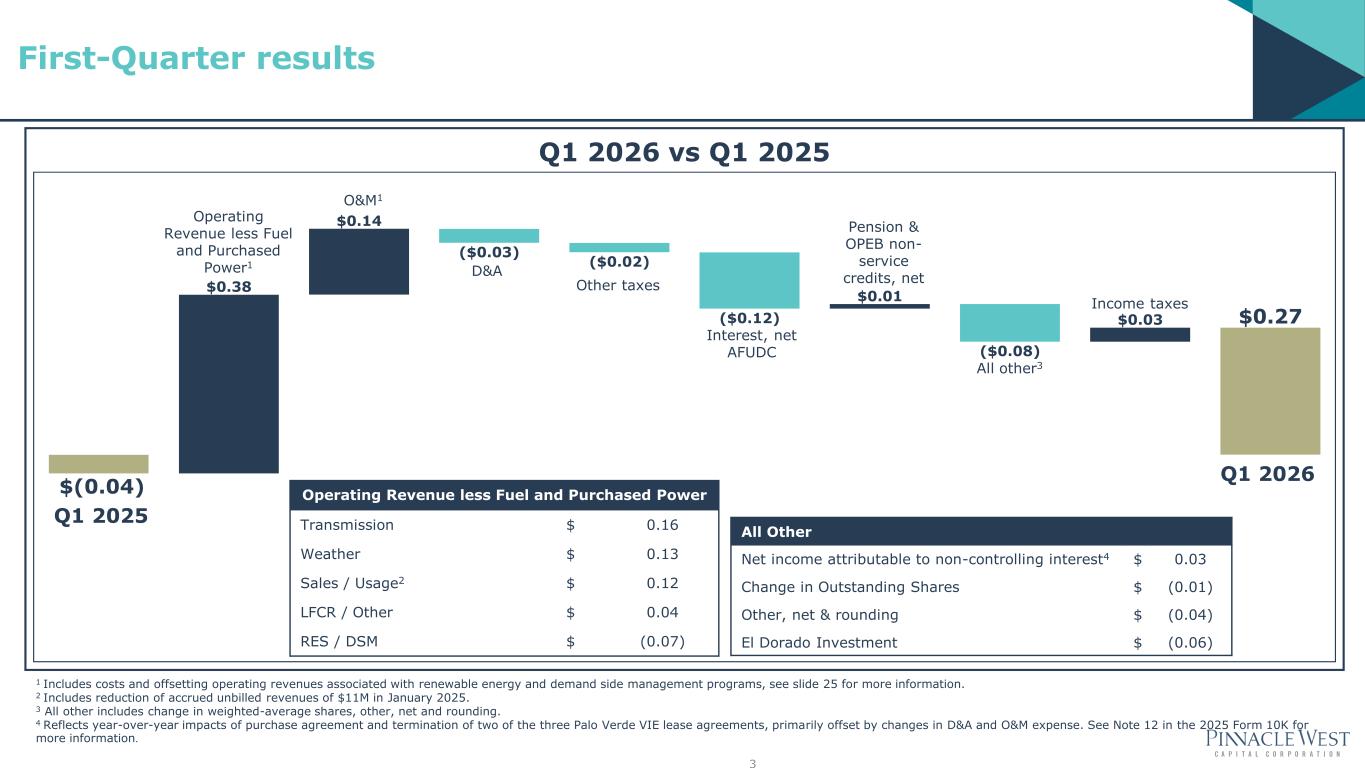
$0.38 $0.14 ($0.03) ($0.02) ($0.12) $0.01 ($0.08) $0.03 $(0.04) $0.27 Q1 2026 vs Q1 2025 Operating Revenue less Fuel and Purchased Power Transmission $ 0.16 Weather $ 0.13 Sales / Usage2 $ 0.12 LFCR / Other $ 0.04 RES / DSM $ (0.07) Q1 2025 Q1 2026 1 Includes costs and offsetting operating revenues associated with renewable energy and demand side management programs, see slide 25 for more information. 2 Includes reduction of accrued unbilled revenues of $11M in January 2025. 3 All other includes change in weighted-average shares, other, net and rounding. 4 Reflects year-over-year impacts of purchase agreement and termination of two of the three Palo Verde VIE lease agreements, primarily offset by changes in D&A and O&M expense. See Note 12 in the 2025 Form 10K for more information. Operating Revenue less Fuel and Purchased Power1 O&M1 D&A Pension & OPEB non- service credits, net Interest, net AFUDC All other3 3 First-Quarter results All Other Net income attributable to non-controlling interest4 $ 0.03 Change in Outstanding Shares $ (0.01) Other, net & rounding $ (0.04) El Dorado Investment $ (0.06) Other taxes Income taxes
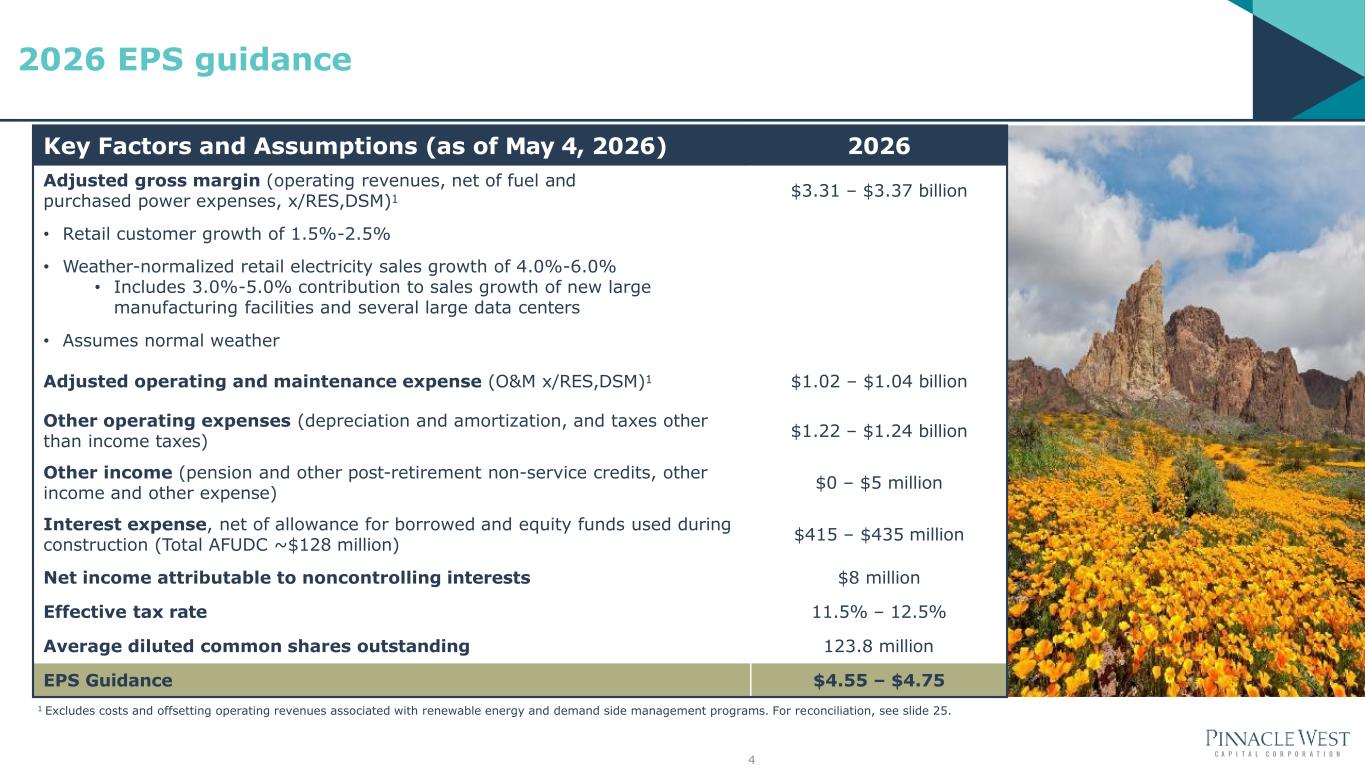
Key Factors and Assumptions (as of May 4, 2026) 2026 Adjusted gross margin (operating revenues, net of fuel and purchased power expenses, x/RES,DSM)1 $3.31 – $3.37 billion • Retail customer growth of 1.5%-2.5% • Weather-normalized retail electricity sales growth of 4.0%-6.0% • Includes 3.0%-5.0% contribution to sales growth of new large manufacturing facilities and several large data centers • Assumes normal weather Adjusted operating and maintenance expense (O&M x/RES,DSM)1 $1.02 – $1.04 billion Other operating expenses (depreciation and amortization, and taxes other than income taxes) $1.22 – $1.24 billion Other income (pension and other post-retirement non-service credits, other income and other expense) $0 – $5 million Interest expense, net of allowance for borrowed and equity funds used during construction (Total AFUDC ~$128 million) $415 – $435 million Net income attributable to noncontrolling interests $8 million Effective tax rate 11.5% – 12.5% Average diluted common shares outstanding 123.8 million EPS Guidance $4.55 – $4.75 1 Excludes costs and offsetting operating revenues associated with renewable energy and demand side management programs. For reconciliation, see slide 25. 4 2026 EPS guidance
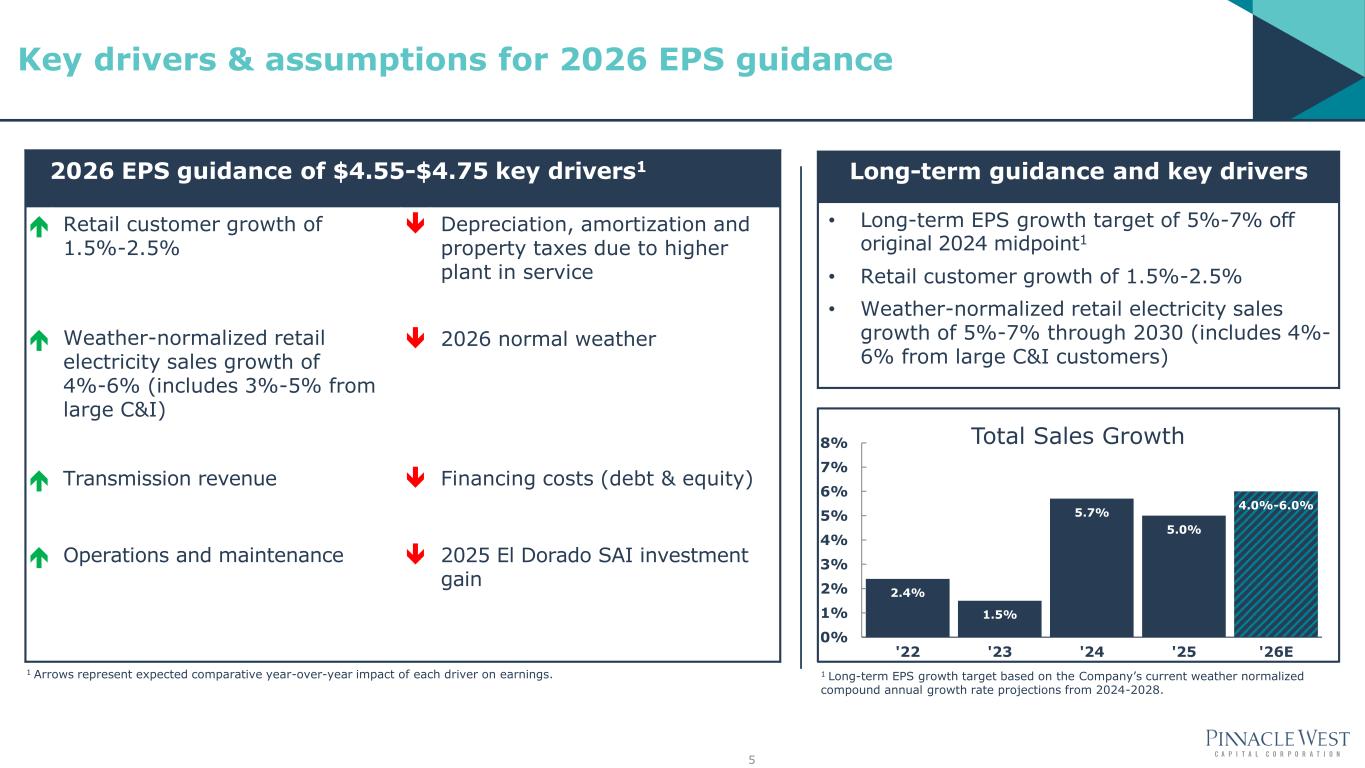
2026 EPS guidance of $4.55-$4.75 key drivers1 Retail customer growth of 1.5%-2.5% Depreciation, amortization and property taxes due to higher plant in service Weather-normalized retail electricity sales growth of 4%-6% (includes 3%-5% from large C&I) 2026 normal weather Transmission revenue Financing costs (debt & equity) Operations and maintenance 2025 El Dorado SAI investment gain Long-term guidance and key drivers • Long-term EPS growth target of 5%-7% off original 2024 midpoint1 • Retail customer growth of 1.5%-2.5% • Weather-normalized retail electricity sales growth of 5%-7% through 2030 (includes 4%- 6% from large C&I customers) 2.4% 1.5% 5.7% 5.0% 4.0%-6.0% 0% 1% 2% 3% 4% 5% 6% 7% 8% '22 '23 '24 '25 '26E Total Sales Growth 5 1 Arrows represent expected comparative year-over-year impact of each driver on earnings. Key drivers & assumptions for 2026 EPS guidance 1 Long-term EPS growth target based on the Company’s current weather normalized compound annual growth rate projections from 2024-2028.
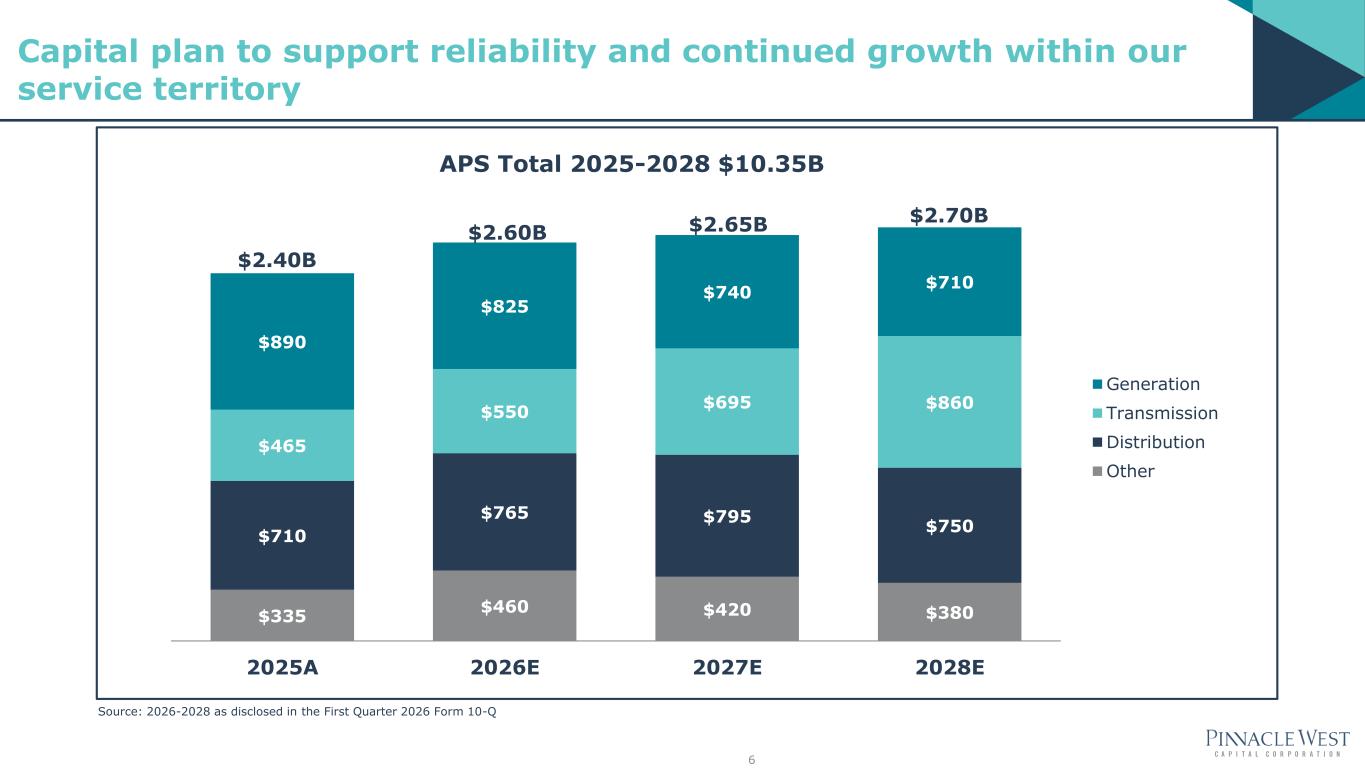
$335 $460 $420 $380 $710 $765 $795 $750 $465 $550 $695 $860 $890 $825 $740 $710 2025A 2026E 2027E 2028E APS Total 2025-2028 $10.35B Generation Transmission Distribution Other $2.40B $2.60B $2.65B $2.70B Source: 2026-2028 as disclosed in the First Quarter 2026 Form 10-Q 6 Capital plan to support reliability and continued growth within our service territory
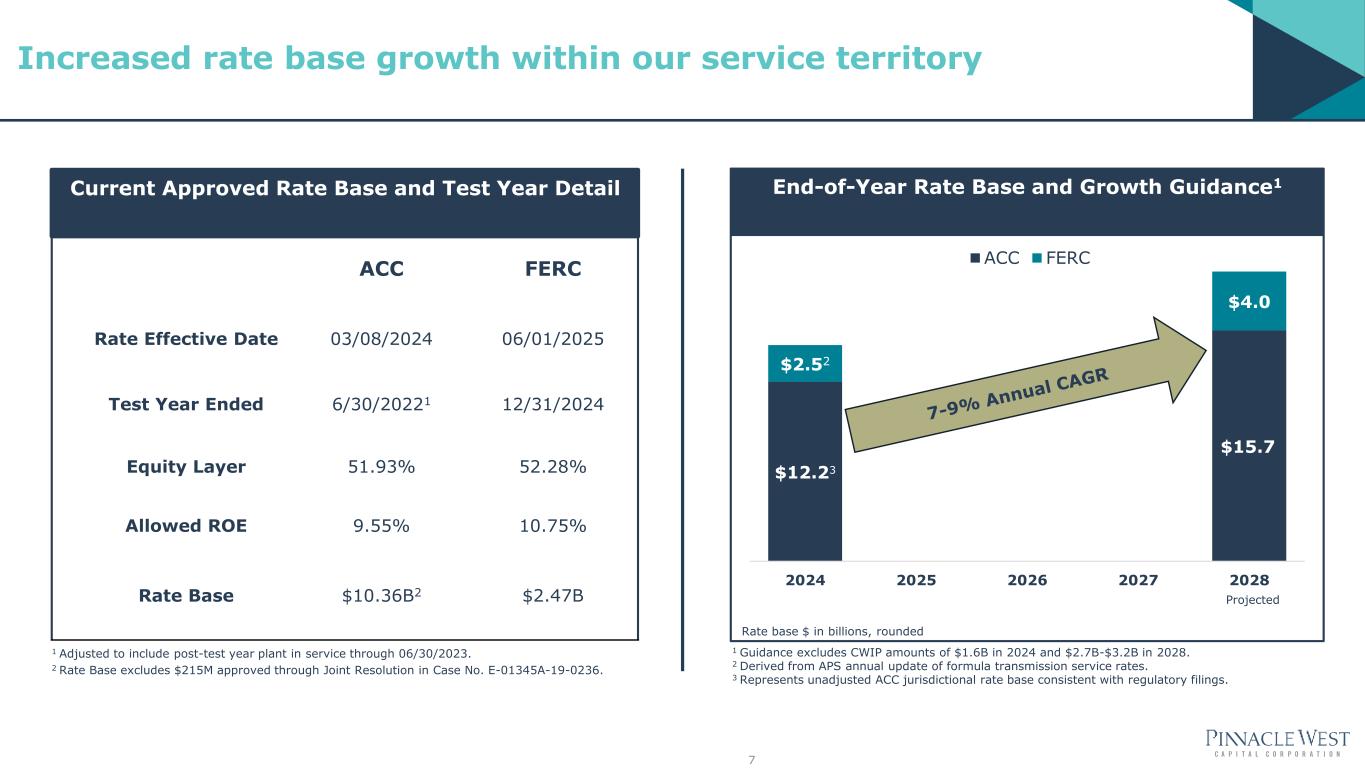
Current Approved Rate Base and Test Year Detail End-of-Year Rate Base and Growth Guidance1 ACC FERC Rate Effective Date 03/08/2024 06/01/2025 Test Year Ended 6/30/20221 12/31/2024 Equity Layer 51.93% 52.28% Allowed ROE 9.55% 10.75% Rate Base $10.36B2 $2.47B $12.23 $15.7 $2.52 $4.0 2024 2025 2026 2027 2028 ACC FERC 7 Rate base $ in billions, rounded Projected 1 Guidance excludes CWIP amounts of $1.6B in 2024 and $2.7B-$3.2B in 2028. 2 Derived from APS annual update of formula transmission service rates. 3 Represents unadjusted ACC jurisdictional rate base consistent with regulatory filings. 1 Adjusted to include post-test year plant in service through 06/30/2023. 2 Rate Base excludes $215M approved through Joint Resolution in Case No. E-01345A-19-0236. Increased rate base growth within our service territory
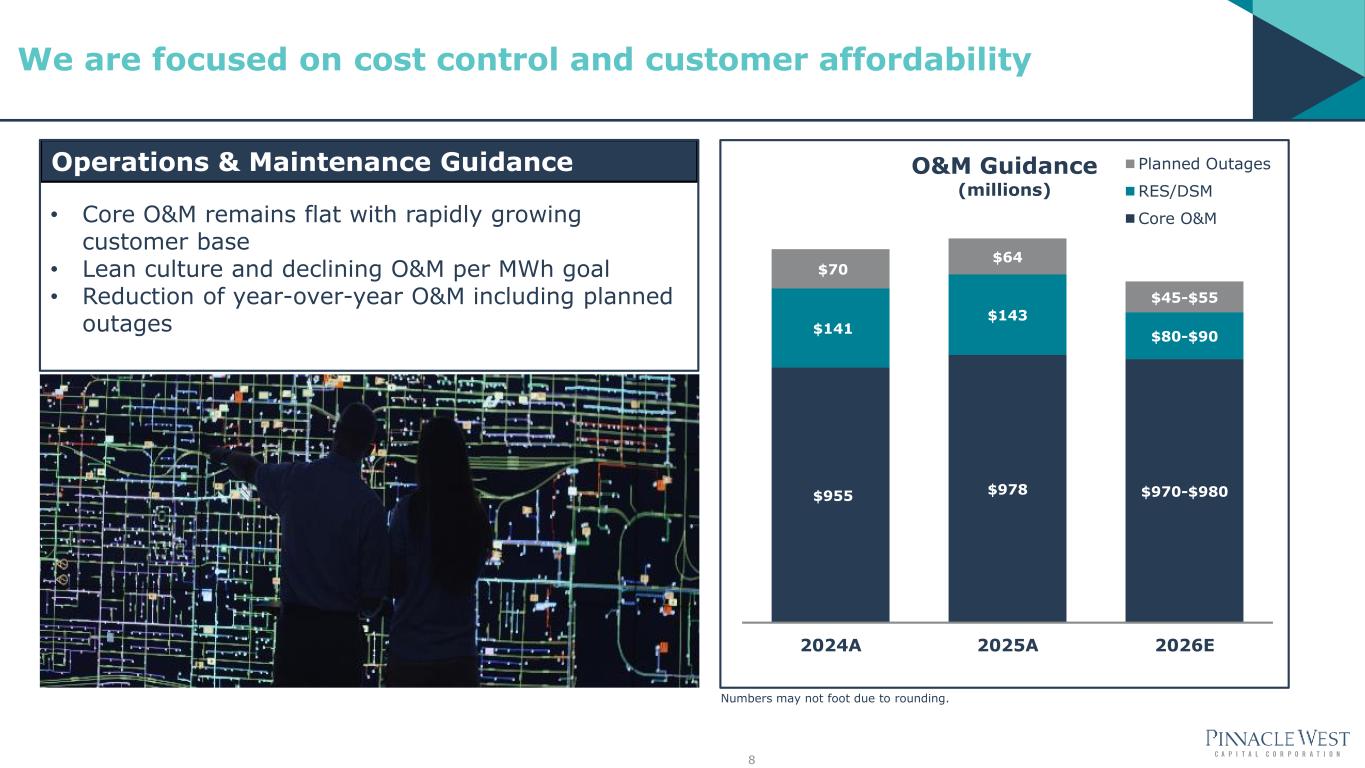
8 Operations & Maintenance Guidance • Core O&M remains flat with rapidly growing customer base • Lean culture and declining O&M per MWh goal • Reduction of year-over-year O&M including planned outages We are focused on cost control and customer affordability $955 $978 $970-$980 $141 $143 $80-$90 $70 $64 $45-$55 2024A 2025A 2026E O&M Guidance (millions) Planned Outages RES/DSM Core O&M Numbers may not foot due to rounding.
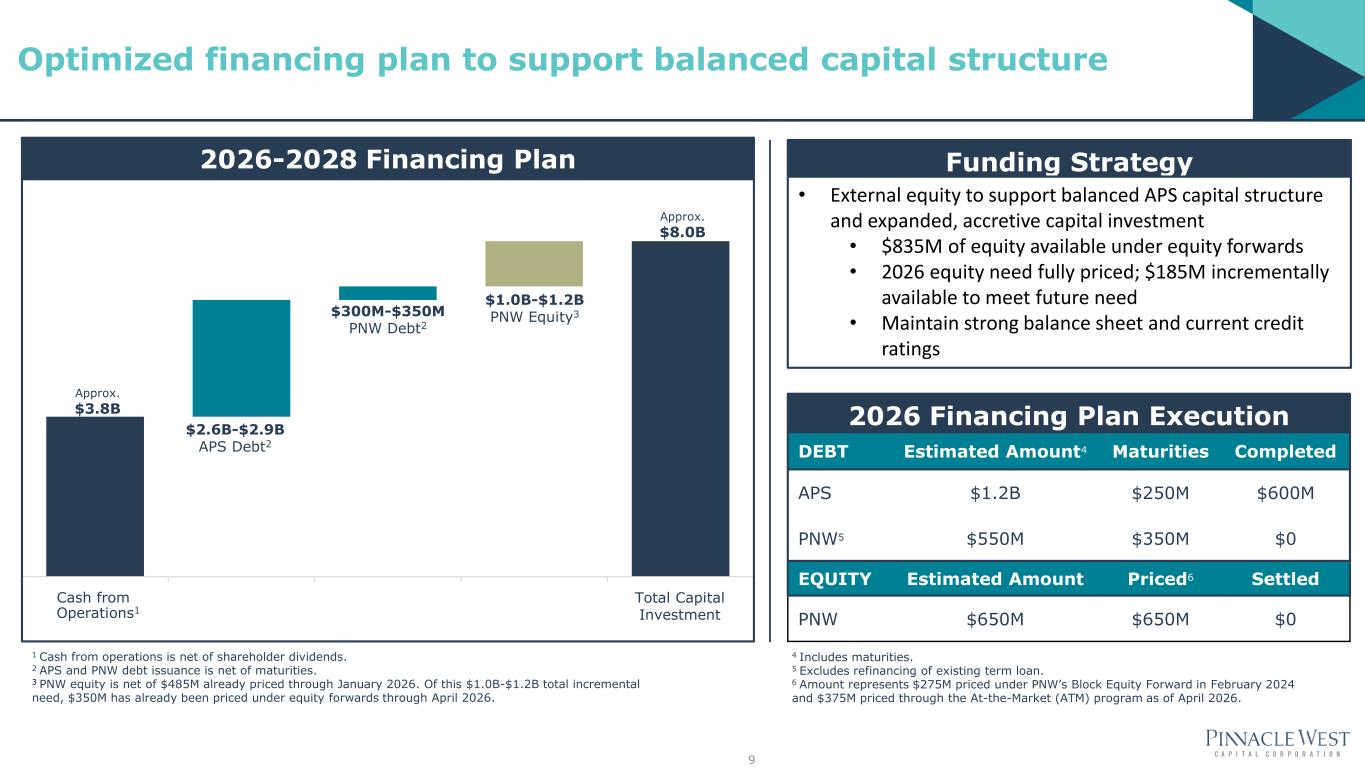
Approx. $3.8B Cash from Operations1 Total Capital Investment $2.6B-$2.9B APS Debt2 $300M-$350M PNW Debt2 1 Cash from operations is net of shareholder dividends. 2 APS and PNW debt issuance is net of maturities. 3 PNW equity is net of $485M already priced through January 2026. Of this $1.0B-$1.2B total incremental need, $350M has already been priced under equity forwards through April 2026. 2026 Financing Plan Execution 2026-2028 Financing Plan Approx. $8.0B $1.0B-$1.2B PNW Equity3 9 Optimized financing plan to support balanced capital structure 4 Includes maturities. 5 Excludes refinancing of existing term loan. 6 Amount represents $275M priced under PNW’s Block Equity Forward in February 2024 and $375M priced through the At-the-Market (ATM) program as of April 2026. DEBT Estimated Amount4 Maturities Completed APS $1.2B $250M $600M PNW5 $550M $350M $0 EQUITY Estimated Amount Priced6 Settled PNW $650M $650M $0 Funding Strategy • External equity to support balanced APS capital structure and expanded, accretive capital investment • $835M of equity available under equity forwards • 2026 equity need fully priced; $185M incrementally available to meet future need • Maintain strong balance sheet and current credit ratings
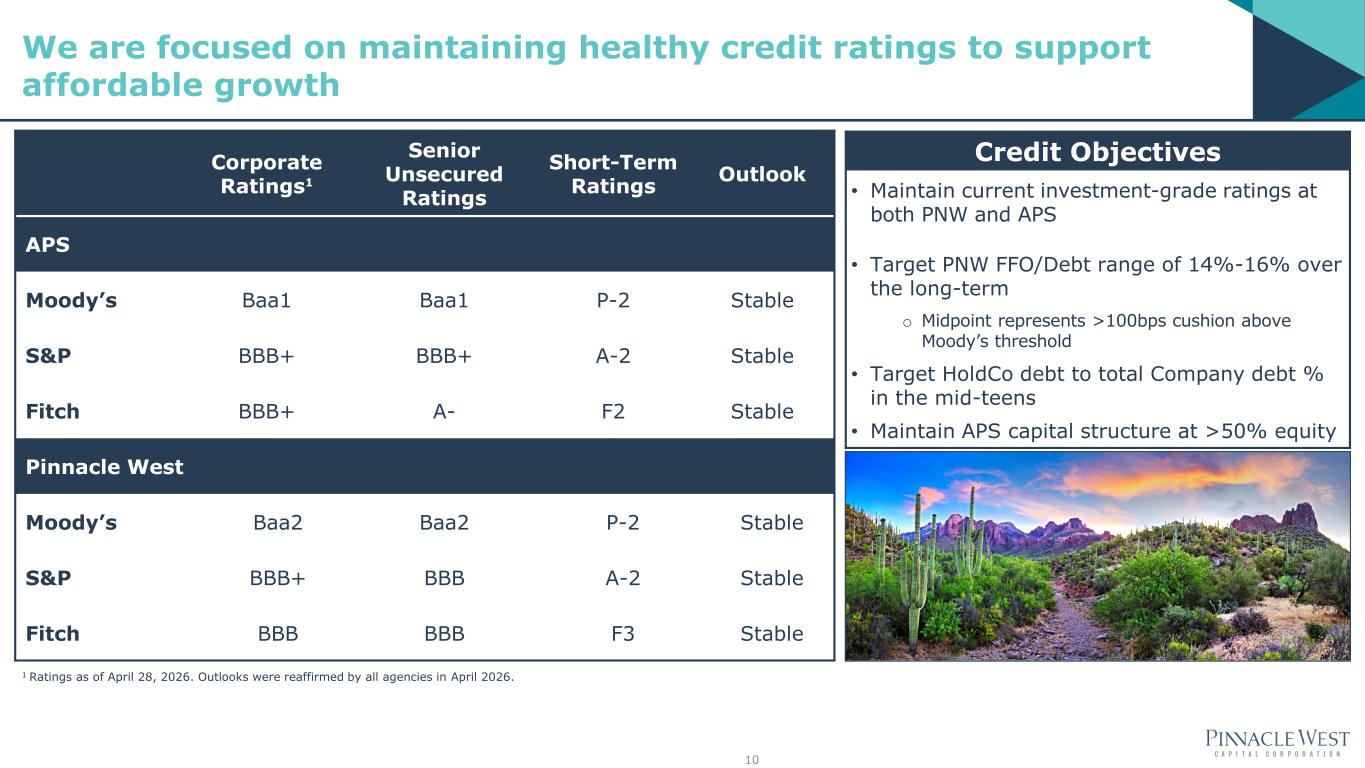
Corporate Ratings1 Senior Unsecured Ratings Short-Term Ratings Outlook APS Moody’s Baa1 Baa1 P-2 Stable S&P BBB+ BBB+ A-2 Stable Fitch BBB+ A- F2 Stable Pinnacle West Moody’s Baa2 Baa2 P-2 Stable S&P BBB+ BBB A-2 Stable Fitch BBB BBB F3 Stable 10 1 Ratings as of April 28, 2026. Outlooks were reaffirmed by all agencies in April 2026. We are focused on maintaining healthy credit ratings to support affordable growth Credit Objectives • Maintain current investment-grade ratings at both PNW and APS • Target PNW FFO/Debt range of 14%-16% over the long-term o Midpoint represents >100bps cushion above Moody’s threshold • Target HoldCo debt to total Company debt % in the mid-teens • Maintain APS capital structure at >50% equity
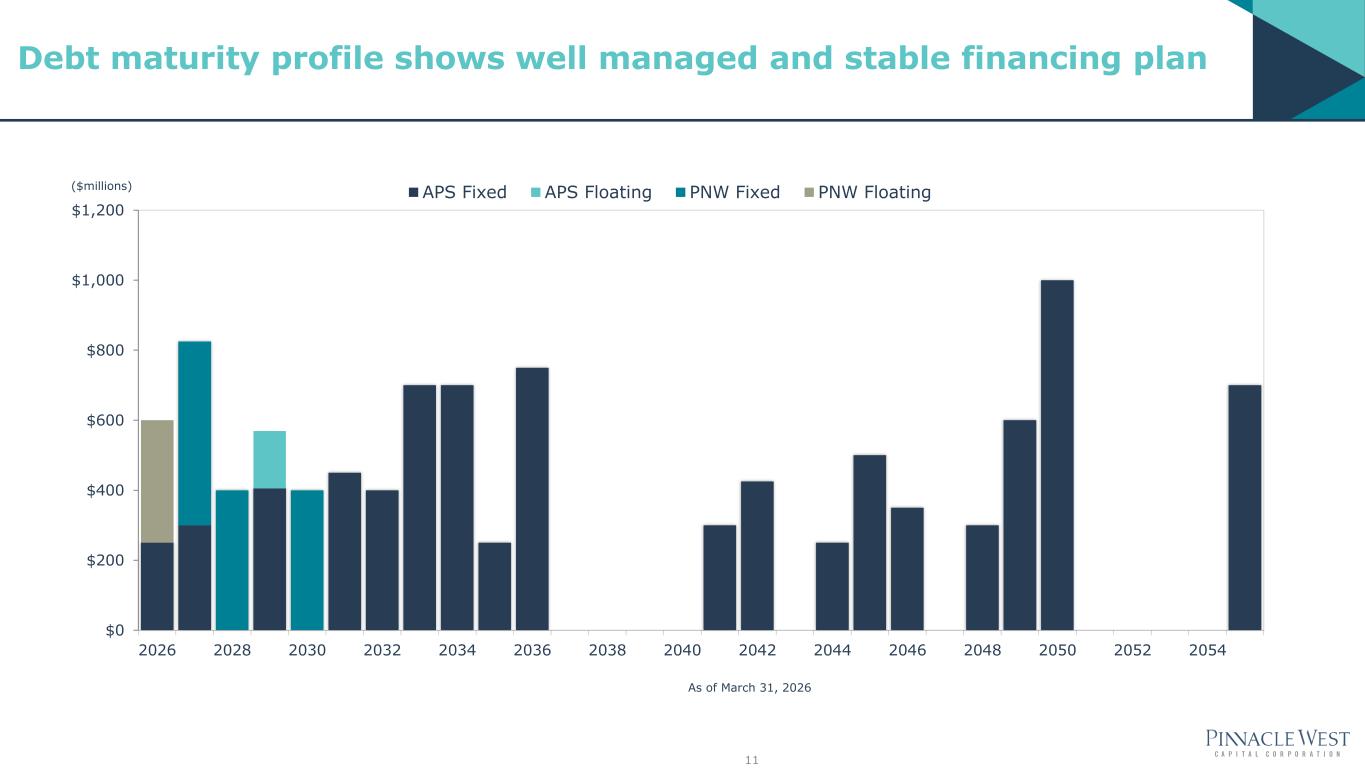
$0 $200 $400 $600 $800 $1,000 $1,200 2026 2028 2030 2032 2034 2036 2038 2040 2042 2044 2046 2048 2050 2052 2054 APS Fixed APS Floating PNW Fixed PNW Floating($millions) As of March 31, 2026 11 Debt maturity profile shows well managed and stable financing plan
Appendix
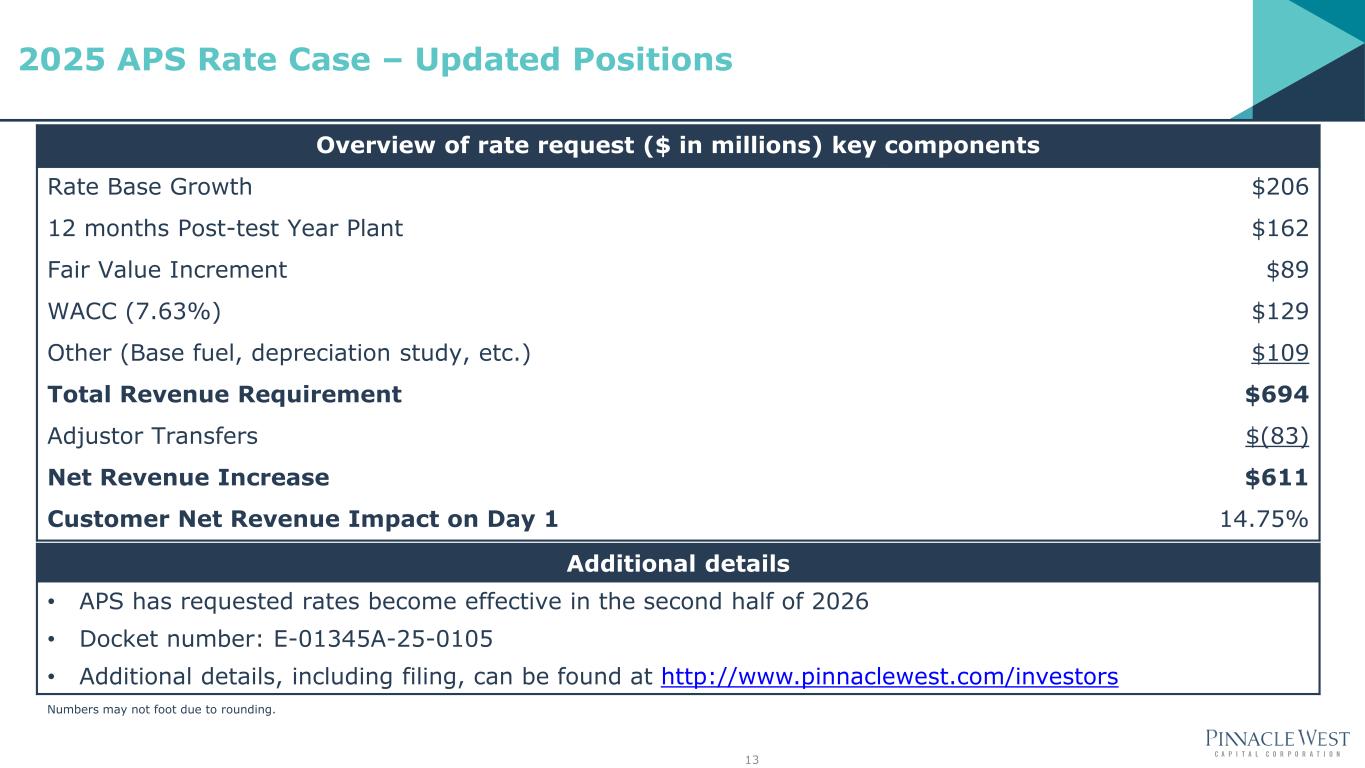
13 2025 APS Rate Case – Updated Positions Overview of rate request ($ in millions) key components Rate Base Growth $206 12 months Post-test Year Plant $162 Fair Value Increment $89 WACC (7.63%) $129 Other (Base fuel, depreciation study, etc.) $109 Total Revenue Requirement $694 Adjustor Transfers $(83) Net Revenue Increase $611 Customer Net Revenue Impact on Day 1 14.75% Additional details • APS has requested rates become effective in the second half of 2026 • Docket number: E-01345A-25-0105 • Additional details, including filing, can be found at http://www.pinnaclewest.com/investors Numbers may not foot due to rounding.
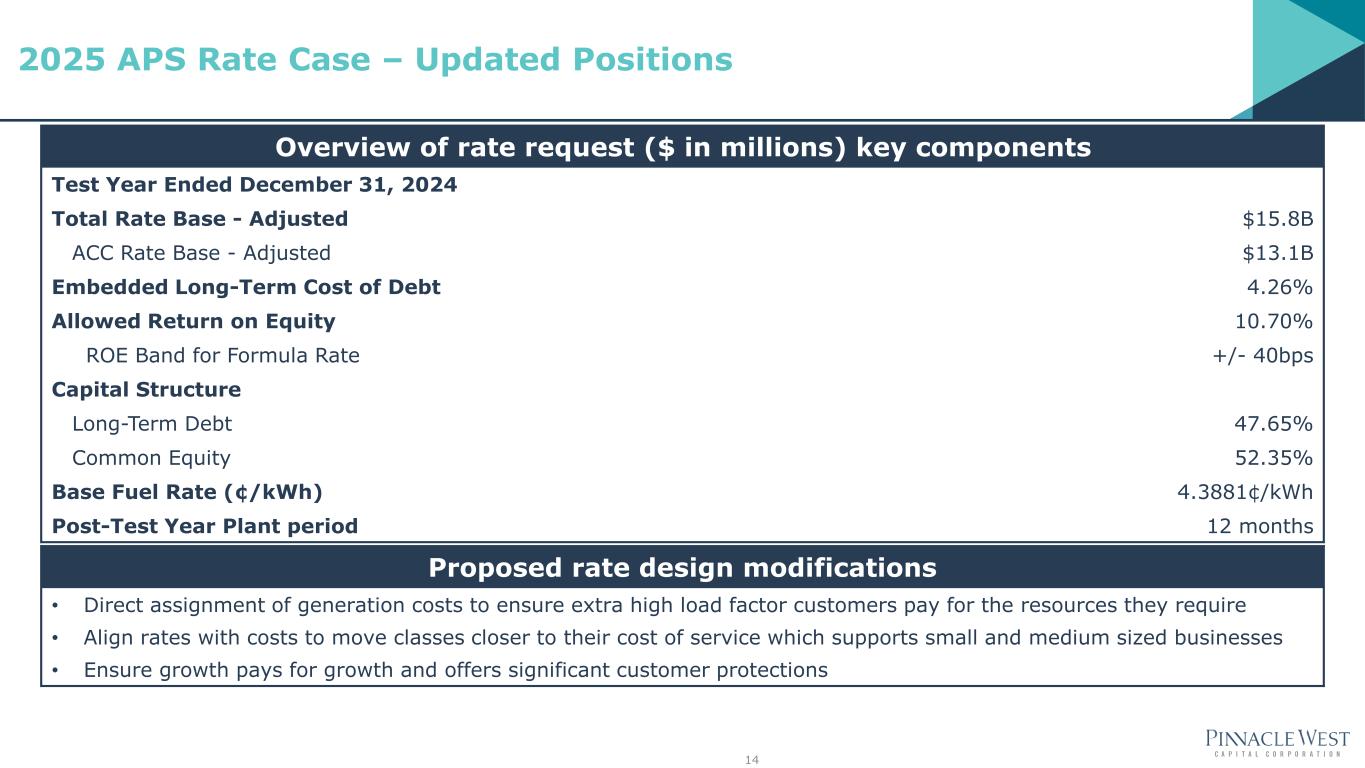
14 2025 APS Rate Case – Updated Positions Overview of rate request ($ in millions) key components Test Year Ended December 31, 2024 Total Rate Base - Adjusted $15.8B ACC Rate Base - Adjusted $13.1B Embedded Long-Term Cost of Debt 4.26% Allowed Return on Equity 10.70% ROE Band for Formula Rate +/- 40bps Capital Structure Long-Term Debt 47.65% Common Equity 52.35% Base Fuel Rate (¢/kWh) 4.3881¢/kWh Post-Test Year Plant period 12 months Proposed rate design modifications • Direct assignment of generation costs to ensure extra high load factor customers pay for the resources they require • Align rates with costs to move classes closer to their cost of service which supports small and medium sized businesses • Ensure growth pays for growth and offers significant customer protections
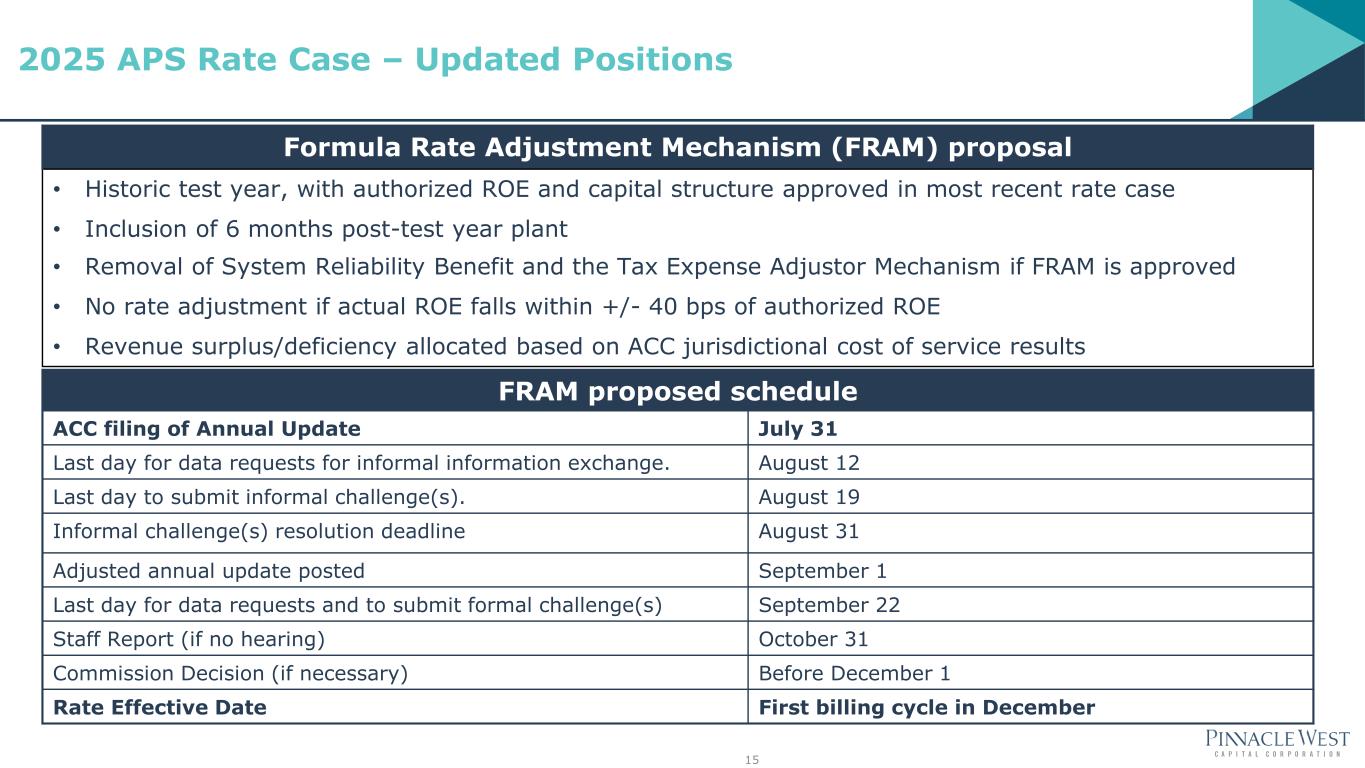
15 2025 APS Rate Case – Updated Positions Formula Rate Adjustment Mechanism (FRAM) proposal • Historic test year, with authorized ROE and capital structure approved in most recent rate case • Inclusion of 6 months post-test year plant • Removal of System Reliability Benefit and the Tax Expense Adjustor Mechanism if FRAM is approved • No rate adjustment if actual ROE falls within +/- 40 bps of authorized ROE • Revenue surplus/deficiency allocated based on ACC jurisdictional cost of service results FRAM proposed schedule ACC filing of Annual Update July 31 Last day for data requests for informal information exchange. August 12 Last day to submit informal challenge(s). August 19 Informal challenge(s) resolution deadline August 31 Adjusted annual update posted September 1 Last day for data requests and to submit formal challenge(s) September 22 Staff Report (if no hearing) October 31 Commission Decision (if necessary) Before December 1 Rate Effective Date First billing cycle in December
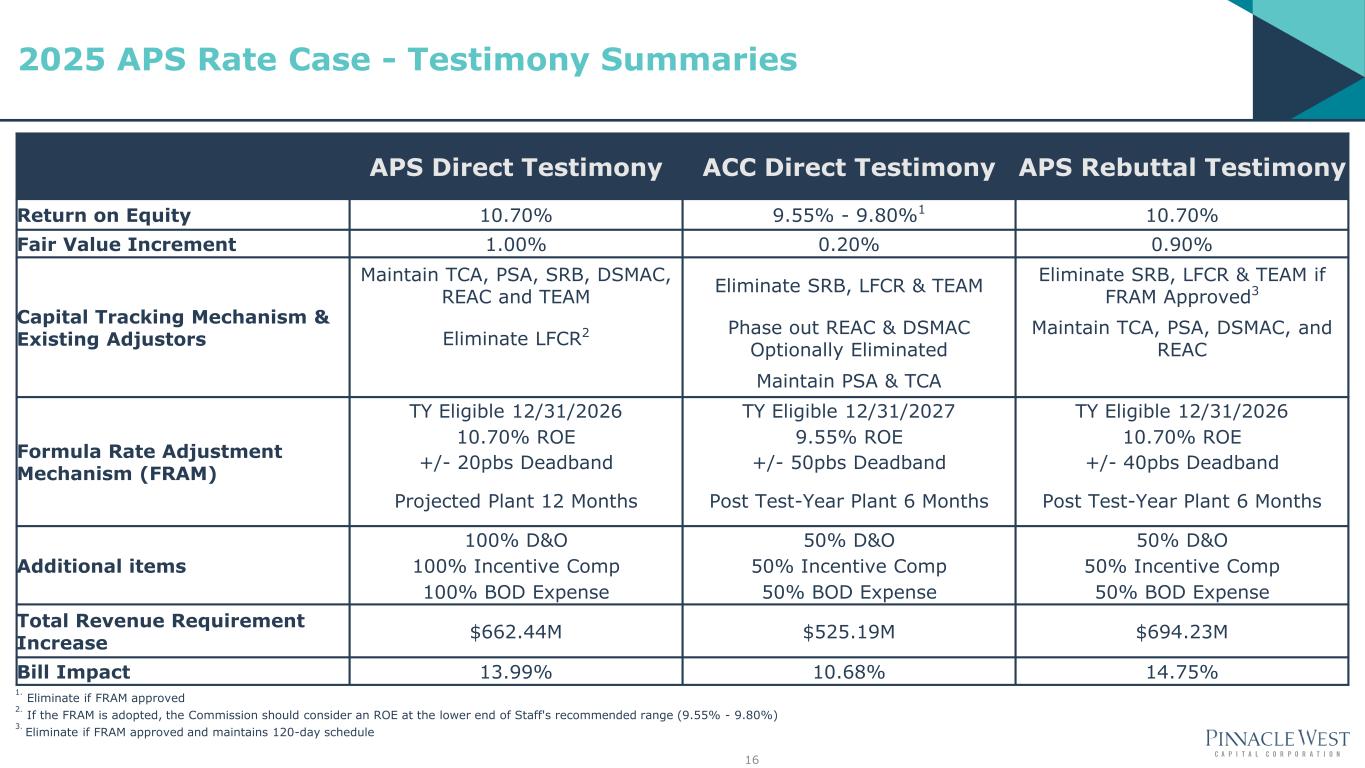
16 2025 APS Rate Case - Testimony Summaries 1. Eliminate if FRAM approved 2. If the FRAM is adopted, the Commission should consider an ROE at the lower end of Staff's recommended range (9.55% - 9.80%) 3. Eliminate if FRAM approved and maintains 120-day schedule APS Direct Testimony ACC Direct Testimony APS Rebuttal Testimony Return on Equity 10.70% 9.55% - 9.80%1 10.70% Fair Value Increment 1.00% 0.20% 0.90% Capital Tracking Mechanism & Existing Adjustors Maintain TCA, PSA, SRB, DSMAC, REAC and TEAM Eliminate SRB, LFCR & TEAM Eliminate SRB, LFCR & TEAM if FRAM Approved3 Eliminate LFCR2 Phase out REAC & DSMAC Optionally Eliminated Maintain TCA, PSA, DSMAC, and REAC Maintain PSA & TCA Formula Rate Adjustment Mechanism (FRAM) TY Eligible 12/31/2026 TY Eligible 12/31/2027 TY Eligible 12/31/2026 10.70% ROE 9.55% ROE 10.70% ROE +/- 20pbs Deadband +/- 50pbs Deadband +/- 40pbs Deadband Projected Plant 12 Months Post Test-Year Plant 6 Months Post Test-Year Plant 6 Months Additional items 100% D&O 50% D&O 50% D&O 100% Incentive Comp 50% Incentive Comp 50% Incentive Comp 100% BOD Expense 50% BOD Expense 50% BOD Expense Total Revenue Requirement Increase $662.44M $525.19M $694.23M Bill Impact 13.99% 10.68% 14.75%
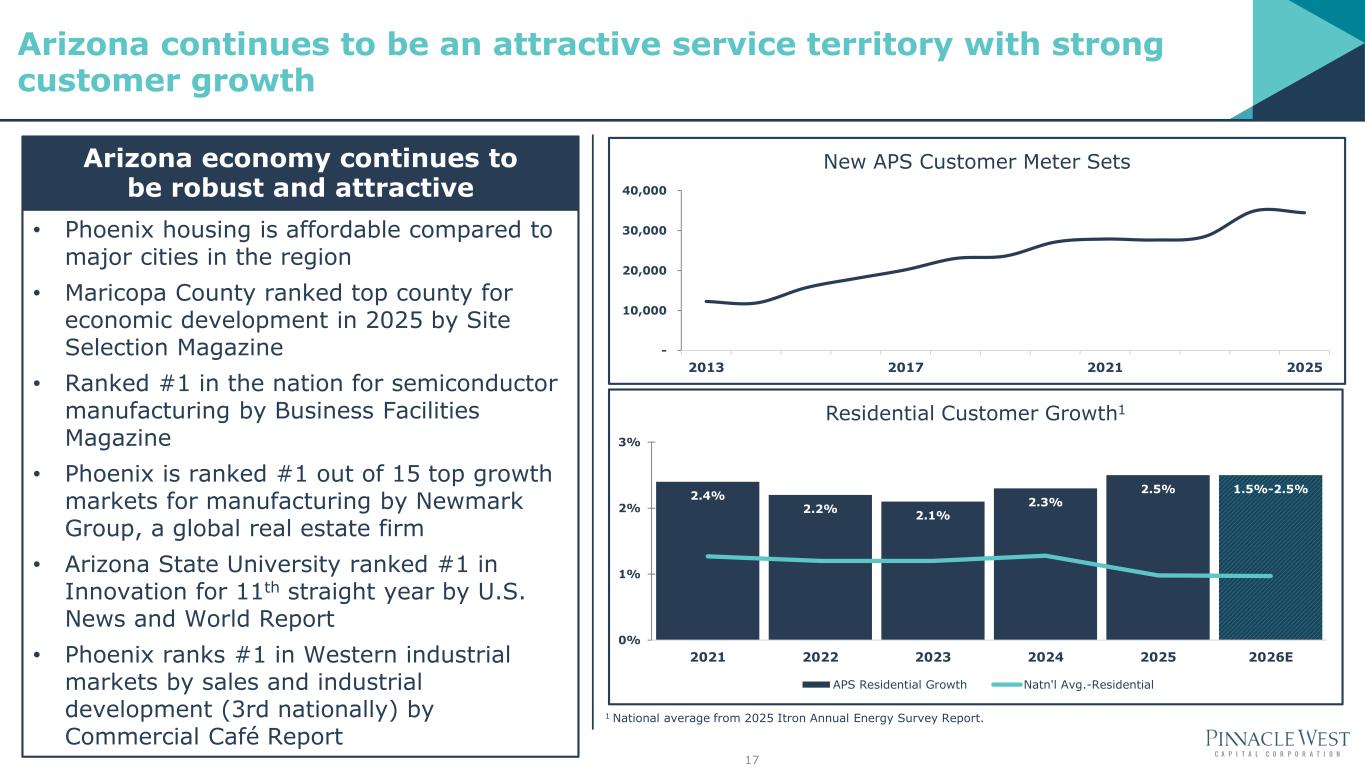
2.4% 2.2% 2.1% 2.3% 2.5% 1.5%-2.5% 0% 1% 2% 3% 2021 2022 2023 2024 2025 2026E Residential Customer Growth1 APS Residential Growth Natn'l Avg.-Residential 17 • Phoenix housing is affordable compared to major cities in the region • Maricopa County ranked top county for economic development in 2025 by Site Selection Magazine • Ranked #1 in the nation for semiconductor manufacturing by Business Facilities Magazine • Phoenix is ranked #1 out of 15 top growth markets for manufacturing by Newmark Group, a global real estate firm • Arizona State University ranked #1 in Innovation for 11th straight year by U.S. News and World Report • Phoenix ranks #1 in Western industrial markets by sales and industrial development (3rd nationally) by Commercial Café Report Arizona economy continues to be robust and attractive 1 National average from 2025 Itron Annual Energy Survey Report. Arizona continues to be an attractive service territory with strong customer growth - 10,000 20,000 30,000 40,000 2013 2017 2021 2025 New APS Customer Meter Sets
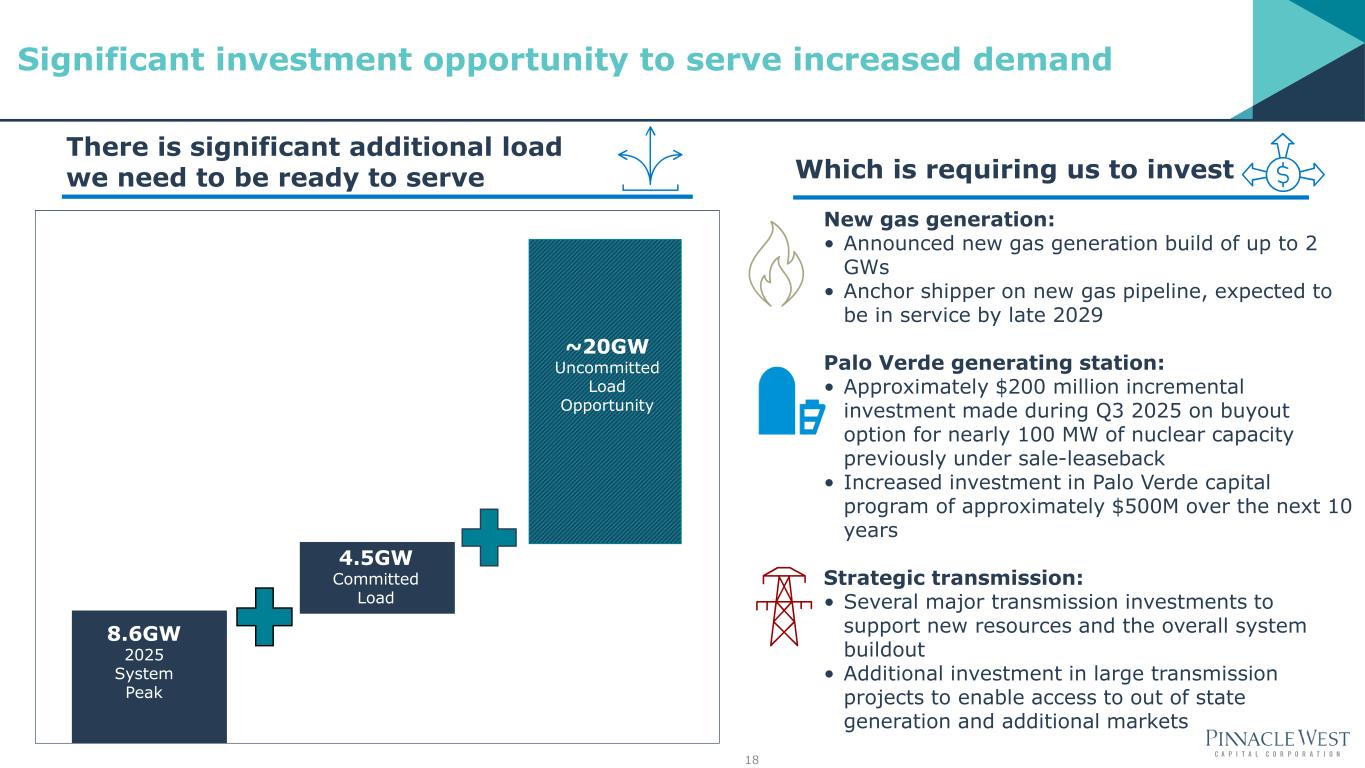
18 Significant investment opportunity to serve increased demand Which is requiring us to invest There is significant additional load we need to be ready to serve New gas generation: • Announced new gas generation build of up to 2 GWs • Anchor shipper on new gas pipeline, expected to be in service by late 2029 Palo Verde generating station: • Approximately $200 million incremental investment made during Q3 2025 on buyout option for nearly 100 MW of nuclear capacity previously under sale-leaseback • Increased investment in Palo Verde capital program of approximately $500M over the next 10 years Strategic transmission: • Several major transmission investments to support new resources and the overall system buildout • Additional investment in large transmission projects to enable access to out of state generation and additional markets 8.6GW 2025 System Peak 4.5GW Committed Load ~20GW Uncommitted Load Opportunity
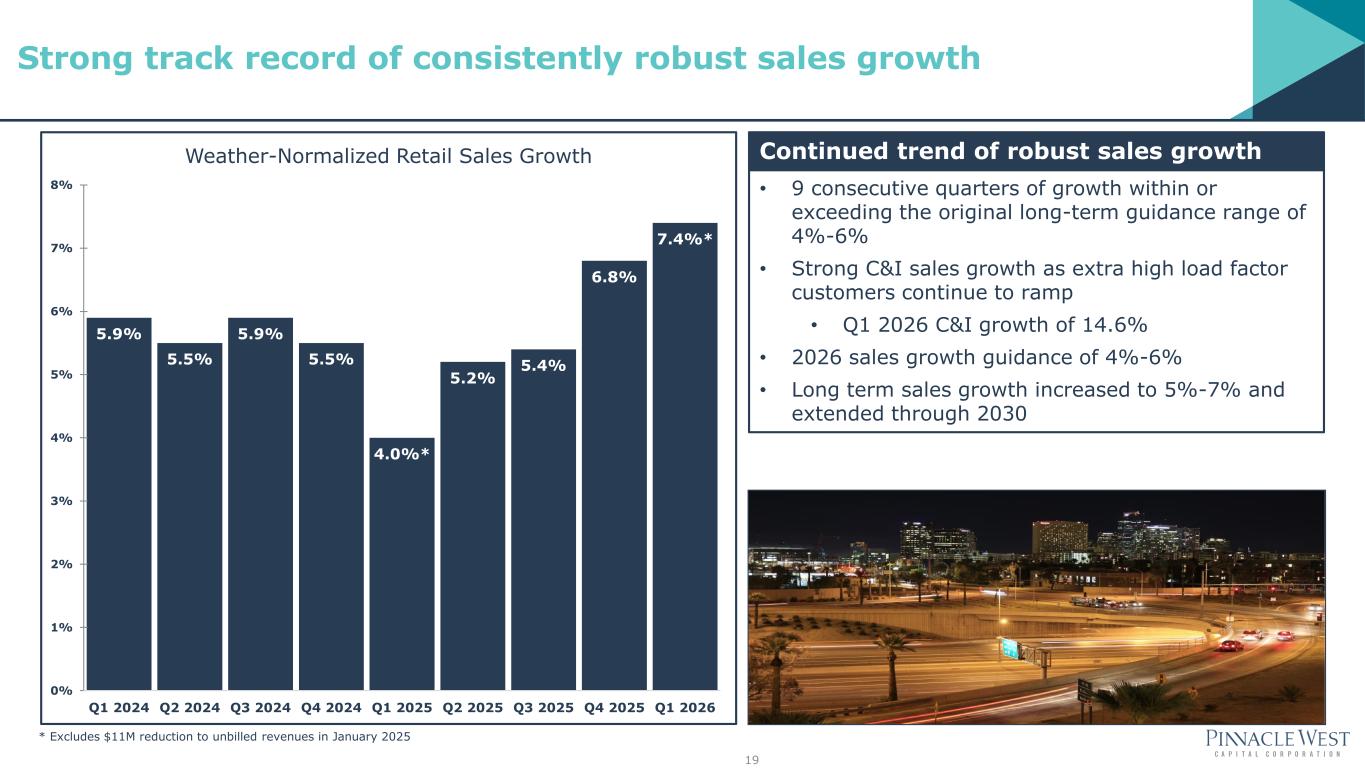
5.9% 5.5% 5.9% 5.5% 4.0%* 5.2% 5.4% 6.8% 7.4%* 0% 1% 2% 3% 4% 5% 6% 7% 8% Q1 2024 Q2 2024 Q3 2024 Q4 2024 Q1 2025 Q2 2025 Q3 2025 Q4 2025 Q1 2026 Weather-Normalized Retail Sales Growth 19 Strong track record of consistently robust sales growth * Excludes $11M reduction to unbilled revenues in January 2025 • 9 consecutive quarters of growth within or exceeding the original long-term guidance range of 4%-6% • Strong C&I sales growth as extra high load factor customers continue to ramp • Q1 2026 C&I growth of 14.6% • 2026 sales growth guidance of 4%-6% • Long term sales growth increased to 5%-7% and extended through 2030 Continued trend of robust sales growth
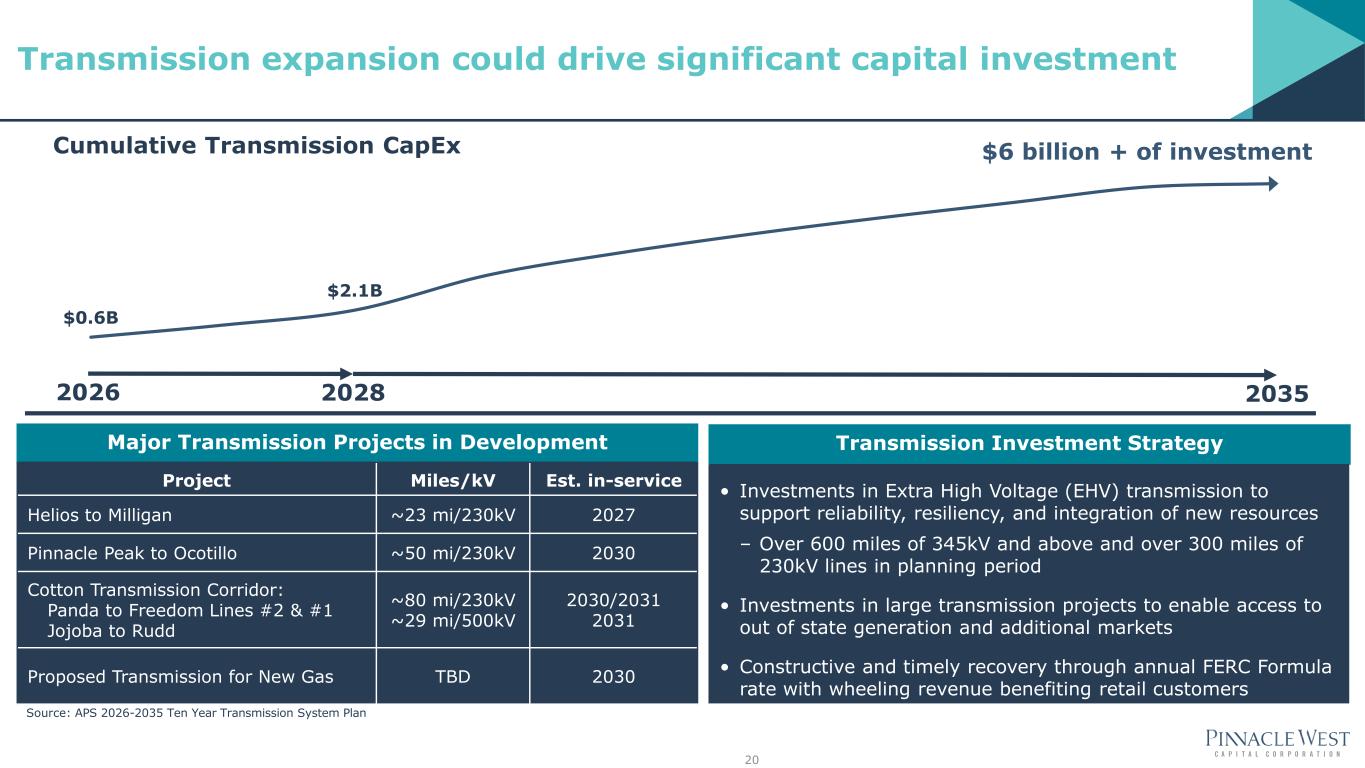
20 Transmission expansion could drive significant capital investment $6 billion + of investmentCumulative Transmission CapEx 2026 2028 2035 Source: APS 2026-2035 Ten Year Transmission System Plan • Investments in Extra High Voltage (EHV) transmission to support reliability, resiliency, and integration of new resources – Over 600 miles of 345kV and above and over 300 miles of 230kV lines in planning period • Investments in large transmission projects to enable access to out of state generation and additional markets • Constructive and timely recovery through annual FERC Formula rate with wheeling revenue benefiting retail customers $0.6B $2.1B Major Transmission Projects in Development Project Miles/kV Est. in-service Helios to Milligan ~23 mi/230kV 2027 Pinnacle Peak to Ocotillo ~50 mi/230kV 2030 Cotton Transmission Corridor: Panda to Freedom Lines #2 & #1 Jojoba to Rudd ~80 mi/230kV ~29 mi/500kV 2030/2031 2031 Proposed Transmission for New Gas TBD 2030 Transmission Investment Strategy • Investments in Extra High Voltage (EHV) transmission to support reliability, resiliency, and integration of new resources – Over 600 miles of 345kV and above and over 300 miles of 230kV lines in planni g period • Investments in large transmission projects to enable access to out f state gen ration nd additional markets • Constructive and timely recovery through annual FERC Formula rate with wheeling revenue ben fiti g retail customers
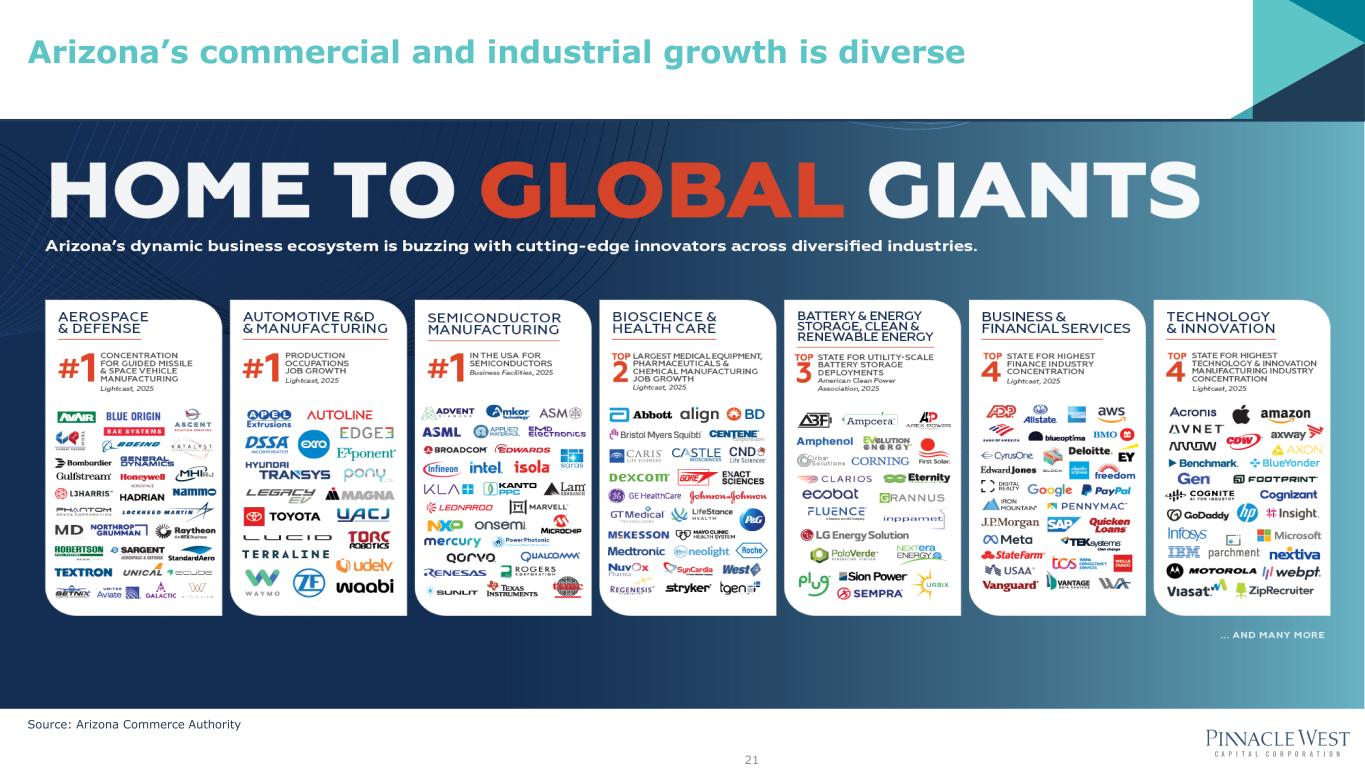
Source: Arizona Commerce Authority 21 Arizona’s commercial and industrial growth is diverse
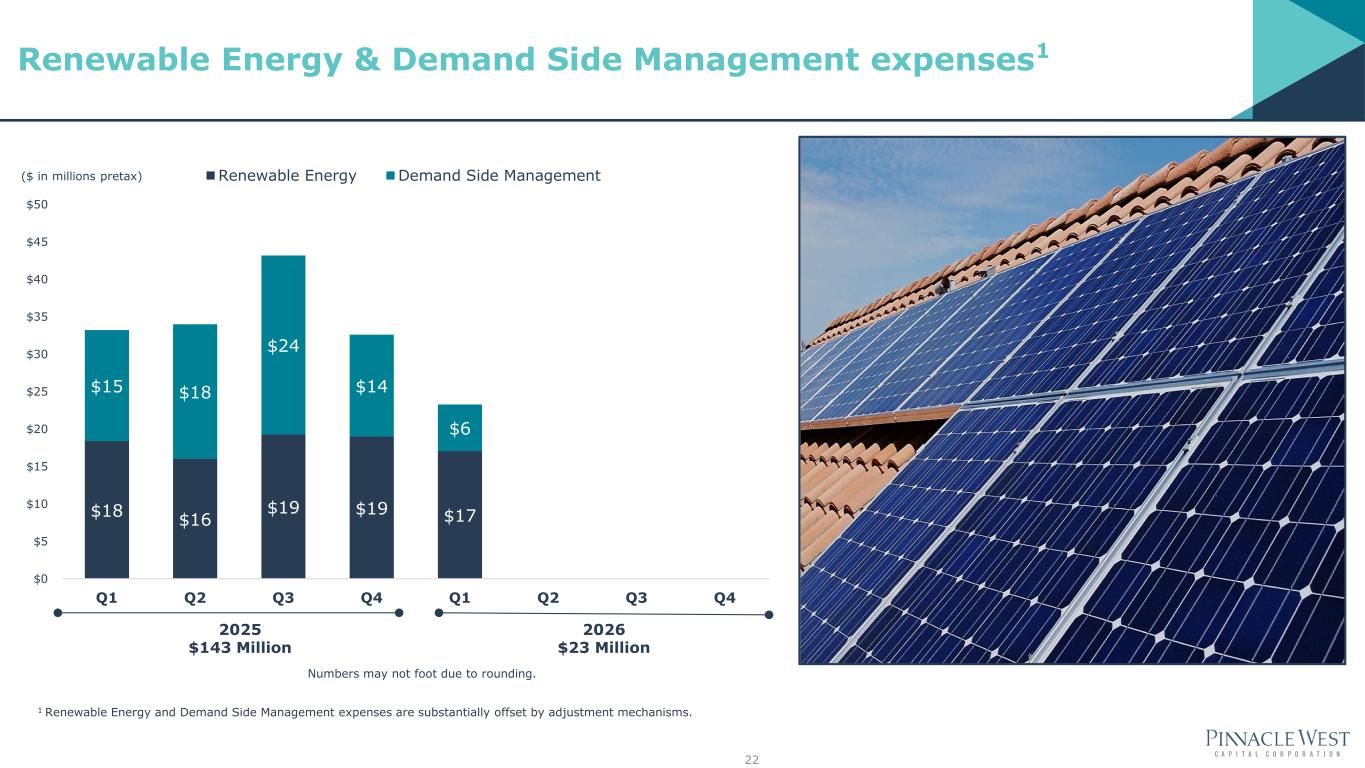
$18 $16 $19 $19 $17 $15 $18 $24 $14 $6 $0 $5 $10 $15 $20 $25 $30 $35 $40 $45 $50 Q1 Q2 Q3 Q4 Q1 Q2 Q3 Q4 Renewable Energy Demand Side Management 2025 $143 Million 2026 $23 Million 1 Renewable Energy and Demand Side Management expenses are substantially offset by adjustment mechanisms. Numbers may not foot due to rounding. ($ in millions pretax) 22 Renewable Energy & Demand Side Management expenses1
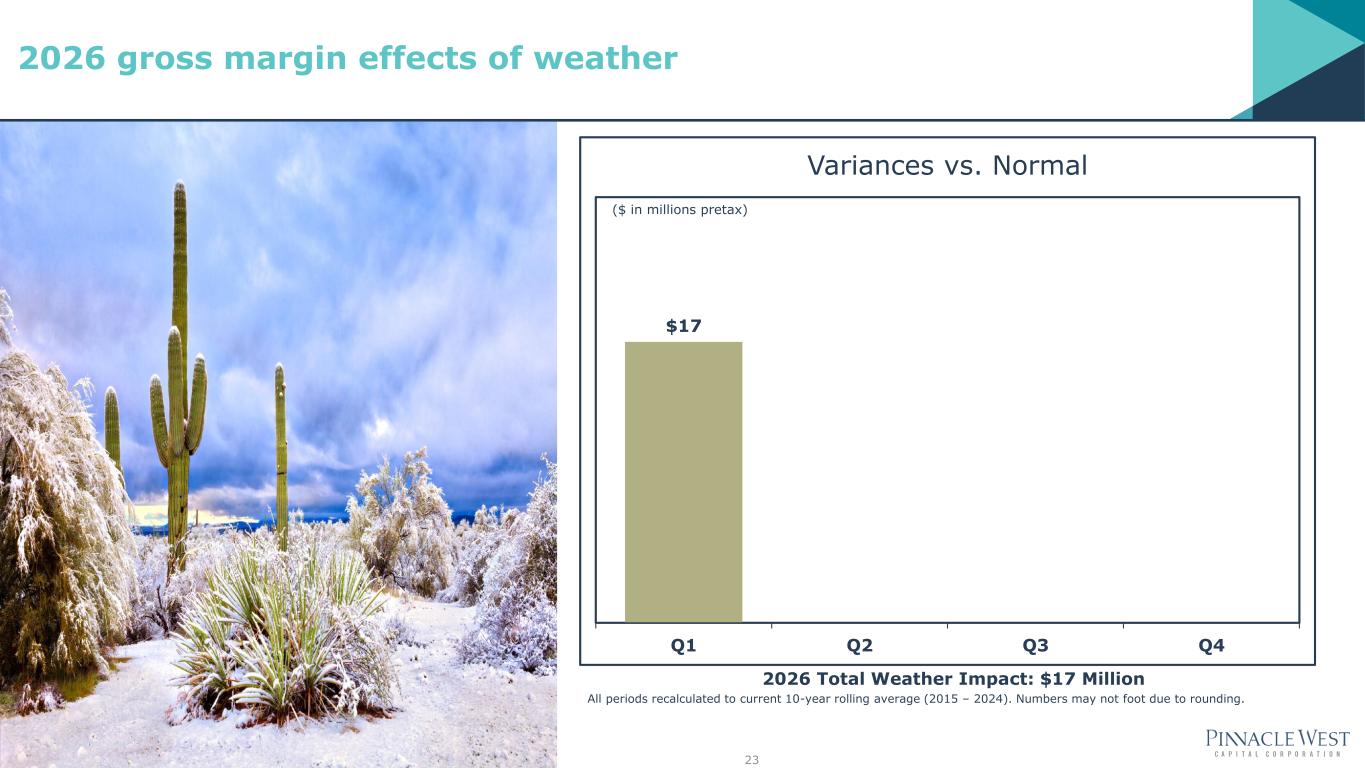
$17 Q1 Q2 Q3 Q4 Variances vs. Normal All periods recalculated to current 10-year rolling average (2015 – 2024). Numbers may not foot due to rounding. ($ in millions pretax) 2026 Total Weather Impact: $17 Million 23 2026 gross margin effects of weather
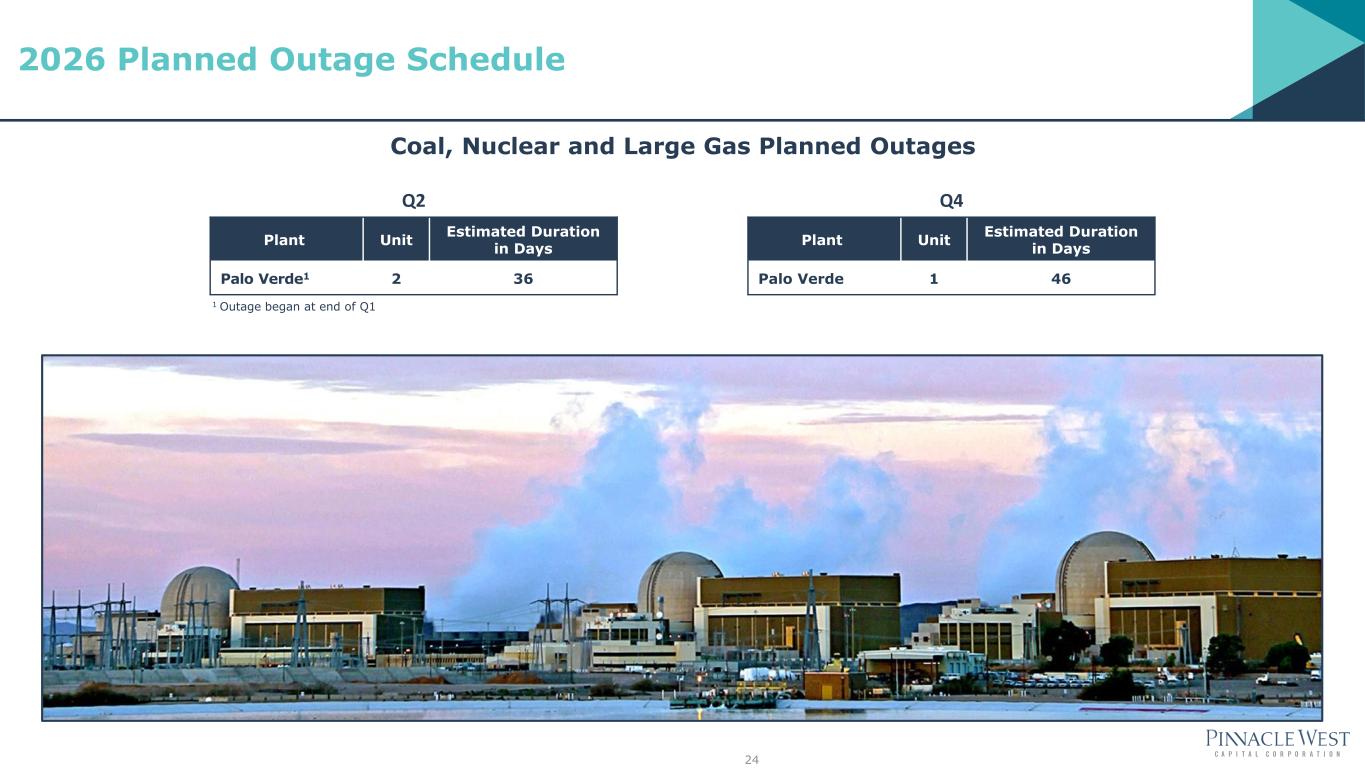
Coal, Nuclear and Large Gas Planned Outages 24 2026 Planned Outage Schedule Q2 Plant Unit Estimated Duration in Days Palo Verde1 2 36 Q4 Plant Unit Estimated Duration in Days Palo Verde 1 46 1 Outage began at end of Q1
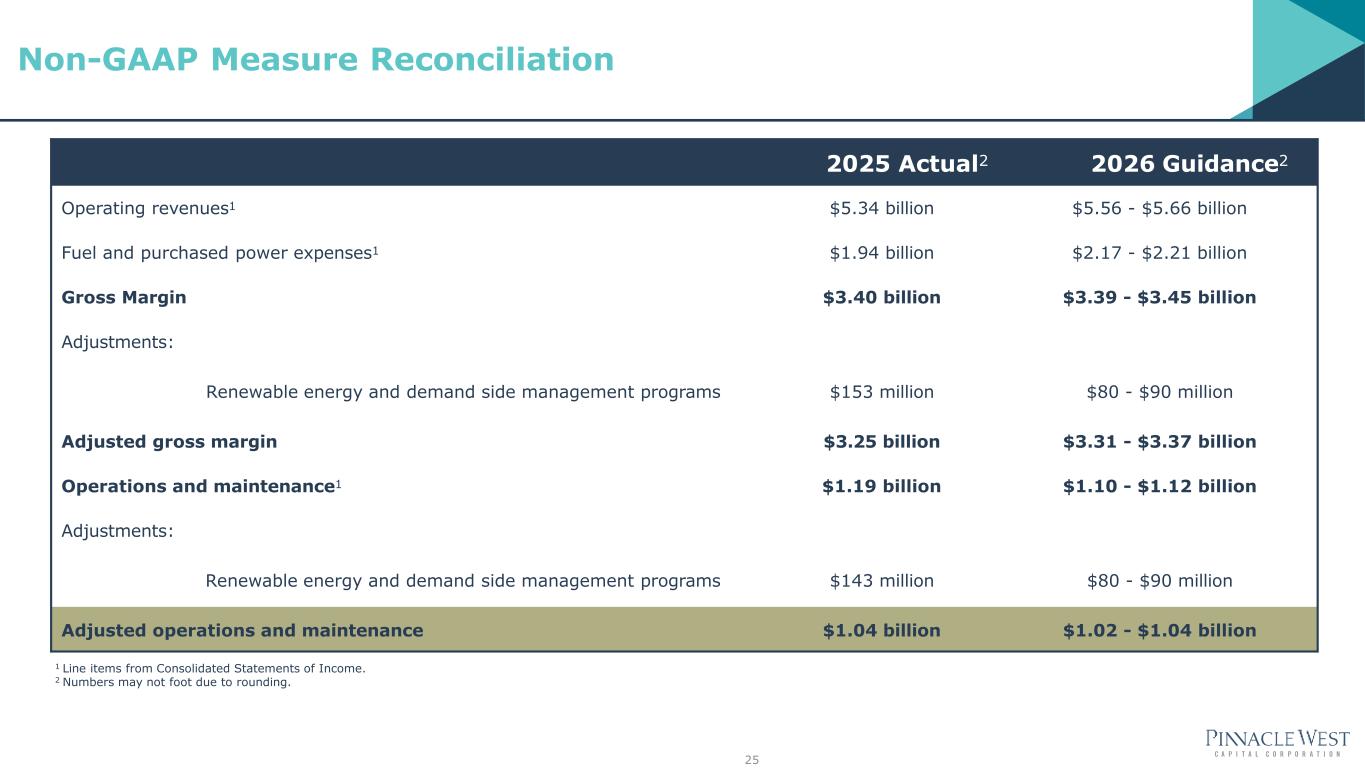
2025 Actual2 2026 Guidance2 Operating revenues1 $5.34 billion $5.56 - $5.66 billion Fuel and purchased power expenses1 $1.94 billion $2.17 - $2.21 billion Gross Margin $3.40 billion $3.39 - $3.45 billion Adjustments: Renewable energy and demand side management programs $153 million $80 - $90 million Adjusted gross margin $3.25 billion $3.31 - $3.37 billion Operations and maintenance1 $1.19 billion $1.10 - $1.12 billion Adjustments: Renewable energy and demand side management programs $143 million $80 - $90 million Adjusted operations and maintenance $1.04 billion $1.02 - $1.04 billion 25 1 Line items from Consolidated Statements of Income. 2 Numbers may not foot due to rounding. Non-GAAP Measure Reconciliation
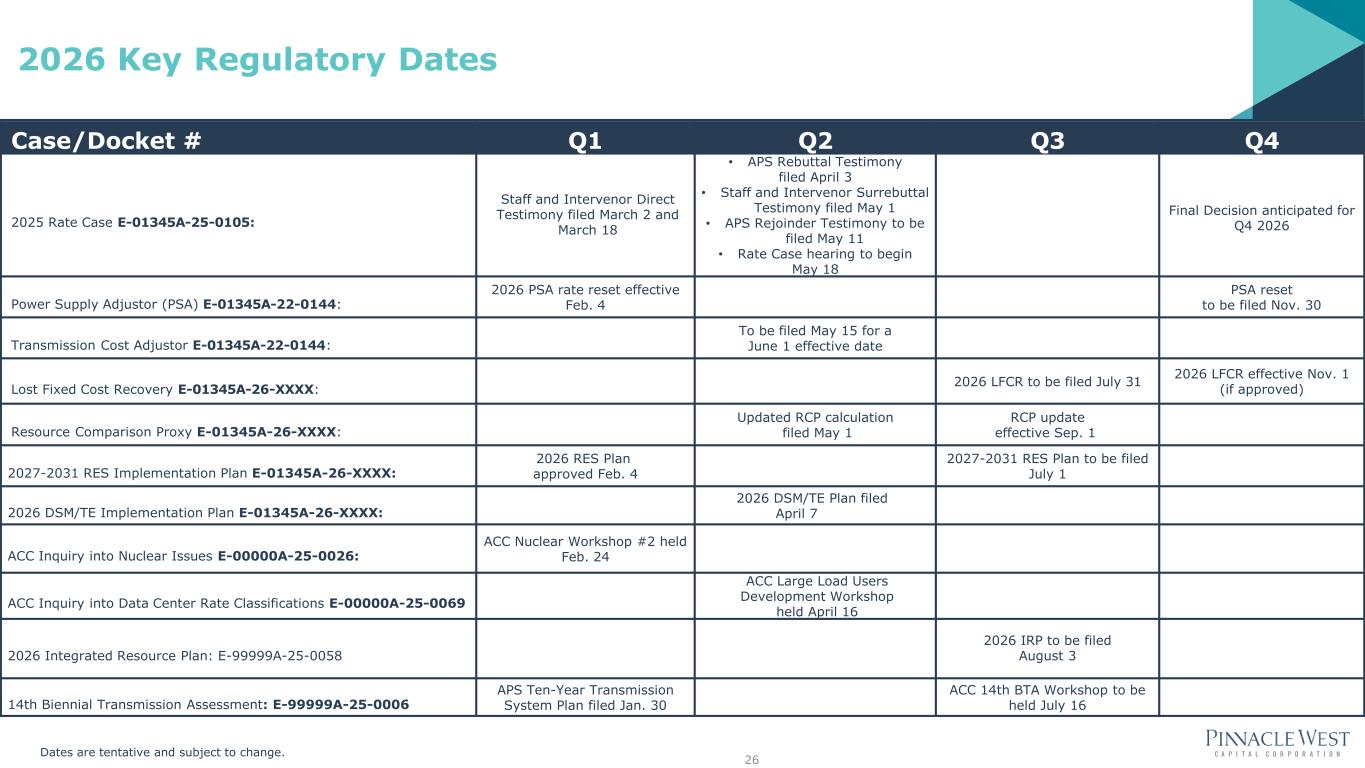
Case/Docket # Q1 Q2 Q3 Q4 2025 Rate Case E-01345A-25-0105: Staff and Intervenor Direct Testimony filed March 2 and March 18 • APS Rebuttal Testimony filed April 3 • Staff and Intervenor Surrebuttal Testimony filed May 1 • APS Rejoinder Testimony to be filed May 11 • Rate Case hearing to begin May 18 Final Decision anticipated for Q4 2026 Power Supply Adjustor (PSA) E-01345A-22-0144: 2026 PSA rate reset effective Feb. 4 PSA reset to be filed Nov. 30 Transmission Cost Adjustor E-01345A-22-0144: To be filed May 15 for a June 1 effective date Lost Fixed Cost Recovery E-01345A-26-XXXX: 2026 LFCR to be filed July 31 2026 LFCR effective Nov. 1 (if approved) Resource Comparison Proxy E-01345A-26-XXXX: Updated RCP calculation filed May 1 RCP update effective Sep. 1 2027-2031 RES Implementation Plan E-01345A-26-XXXX: 2026 RES Plan approved Feb. 4 2027-2031 RES Plan to be filed July 1 2026 DSM/TE Implementation Plan E-01345A-26-XXXX: 2026 DSM/TE Plan filed April 7 ACC Inquiry into Nuclear Issues E-00000A-25-0026: ACC Nuclear Workshop #2 held Feb. 24 ACC Inquiry into Data Center Rate Classifications E-00000A-25-0069 ACC Large Load Users Development Workshop held April 16 2026 Integrated Resource Plan: E-99999A-25-0058 2026 IRP to be filed August 3 14th Biennial Transmission Assessment: E-99999A-25-0006 APS Ten-Year Transmission System Plan filed Jan. 30 ACC 14th BTA Workshop to be held July 16 26 2026 Key Regulatory Dates Dates are tentative and subject to change.
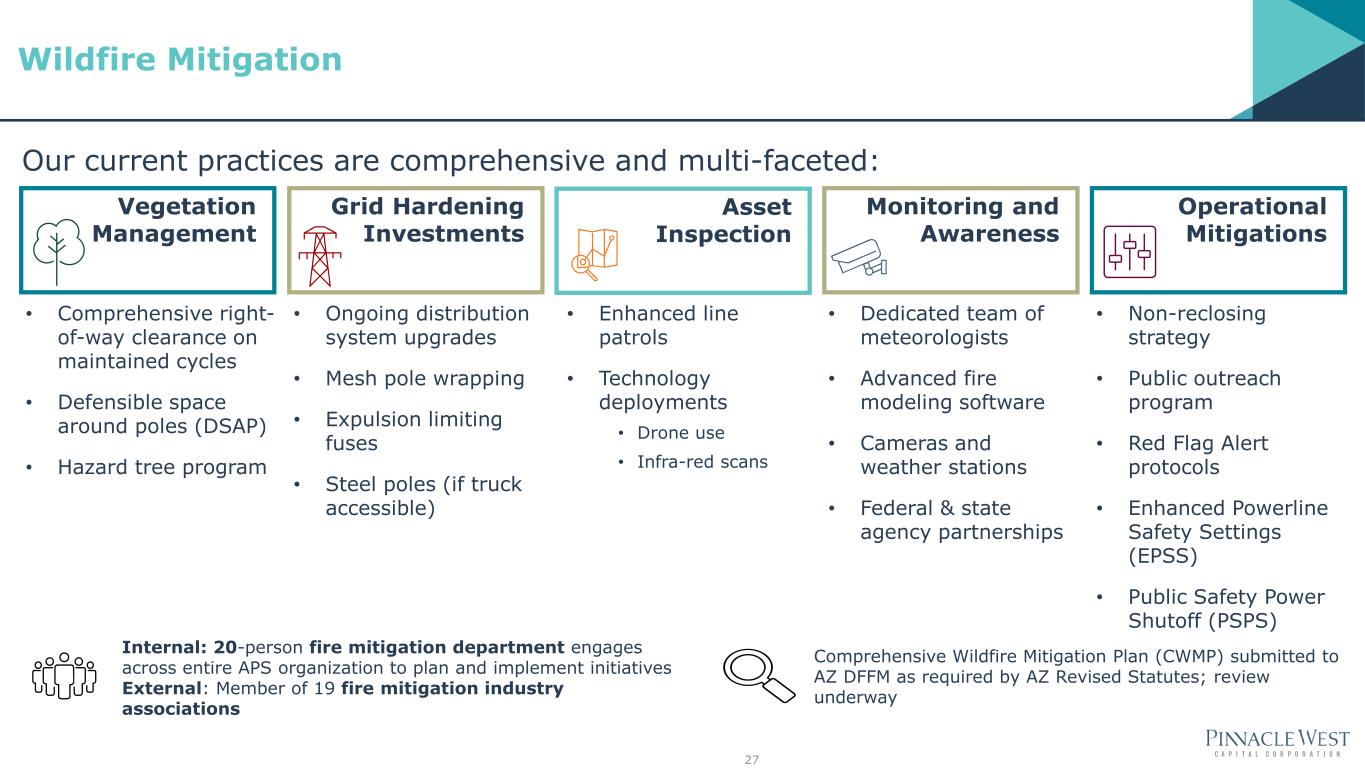
27 Wildfire Mitigation Vegetation Management Asset Inspection Monitoring and Awareness Operational Mitigations • Comprehensive right- of-way clearance on maintained cycles • Defensible space around poles (DSAP) • Hazard tree program • Enhanced line patrols • Technology deployments • Drone use • Infra-red scans • Non-reclosing strategy • Public outreach program • Red Flag Alert protocols • Enhanced Powerline Safety Settings (EPSS) • Public Safety Power Shutoff (PSPS) • Dedicated team of meteorologists • Advanced fire modeling software • Cameras and weather stations • Federal & state agency partnerships Grid Hardening Investments • Ongoing distribution system upgrades • Mesh pole wrapping • Expulsion limiting fuses • Steel poles (if truck accessible) Internal: 20-person fire mitigation department engages across entire APS organization to plan and implement initiatives External: Member of 19 fire mitigation industry associations Comprehensive Wildfire Mitigation Plan (CWMP) submitted to AZ DFFM as required by AZ Revised Statutes; review underway Our current practices are comprehensive and multi-faceted:
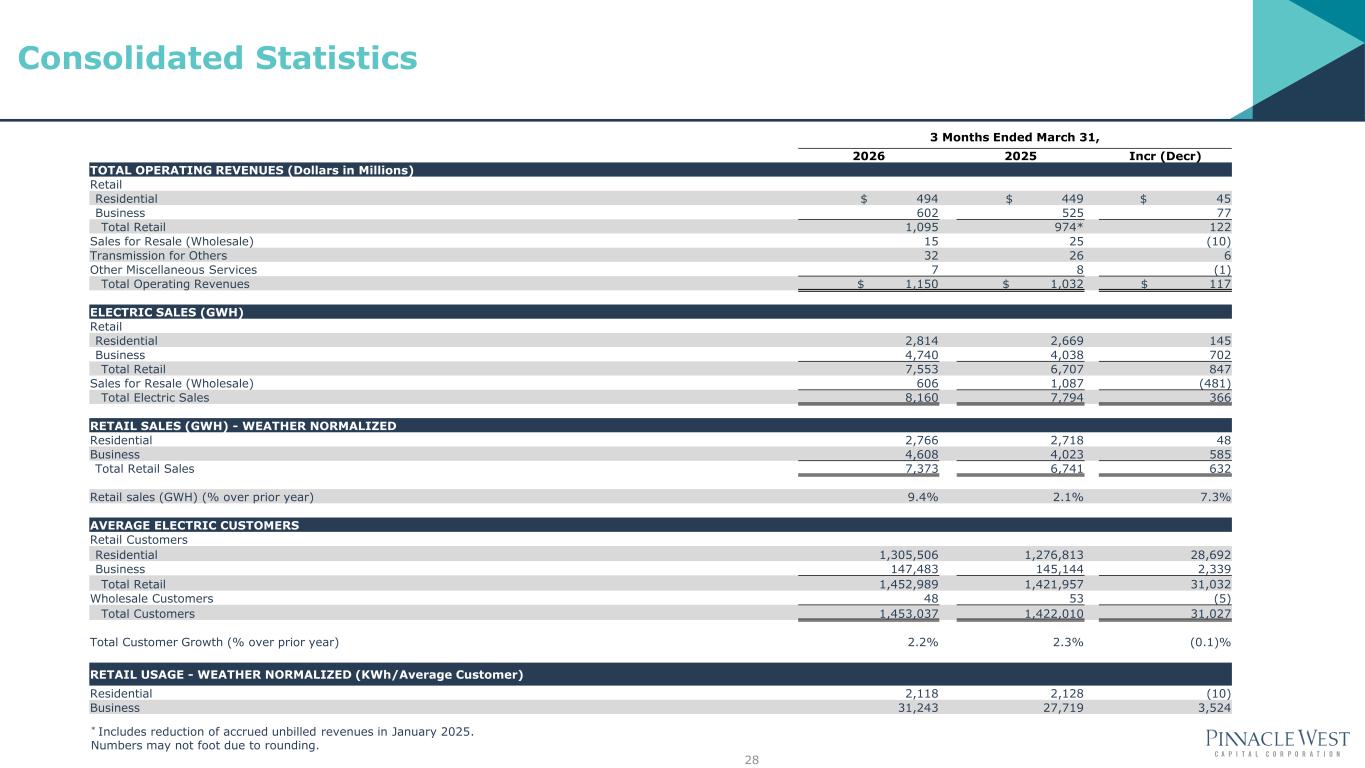
28 Consolidated Statistics * Includes reduction of accrued unbilled revenues in January 2025. Numbers may not foot due to rounding. 3 Months Ended March 31, 2026 2025 Incr (Decr) TOTAL OPERATING REVENUES (Dollars in Millions) Retail Residential $ 494 $ 449 $ 45 Business 602 525 77 Total Retail 1,095 974* 122 Sales for Resale (Wholesale) 15 25 (10) Transmission for Others 32 26 6 Other Miscellaneous Services 7 8 (1) Total Operating Revenues $ 1,150 $ 1,032 $ 117 ELECTRIC SALES (GWH) Retail Residential 2,814 2,669 145 Business 4,740 4,038 702 Total Retail 7,553 6,707 847 Sales for Resale (Wholesale) 606 1,087 (481) Total Electric Sales 8,160 7,794 366 RETAIL SALES (GWH) - WEATHER NORMALIZED Residential 2,766 2,718 48 Business 4,608 4,023 585 Total Retail Sales 7,373 6,741 632 Retail sales (GWH) (% over prior year) 9.4% 2.1% 7.3% AVERAGE ELECTRIC CUSTOMERS Retail Customers Residential 1,305,506 1,276,813 28,692 Business 147,483 145,144 2,339 Total Retail 1,452,989 1,421,957 31,032 Wholesale Customers 48 53 (5) Total Customers 1,453,037 1,422,010 31,027 Total Customer Growth (% over prior year) 2.2% 2.3% (0.1)% RETAIL USAGE - WEATHER NORMALIZED (KWh/Average Customer) Residential 2,118 2,128 (10) Business 31,243 27,719 3,524
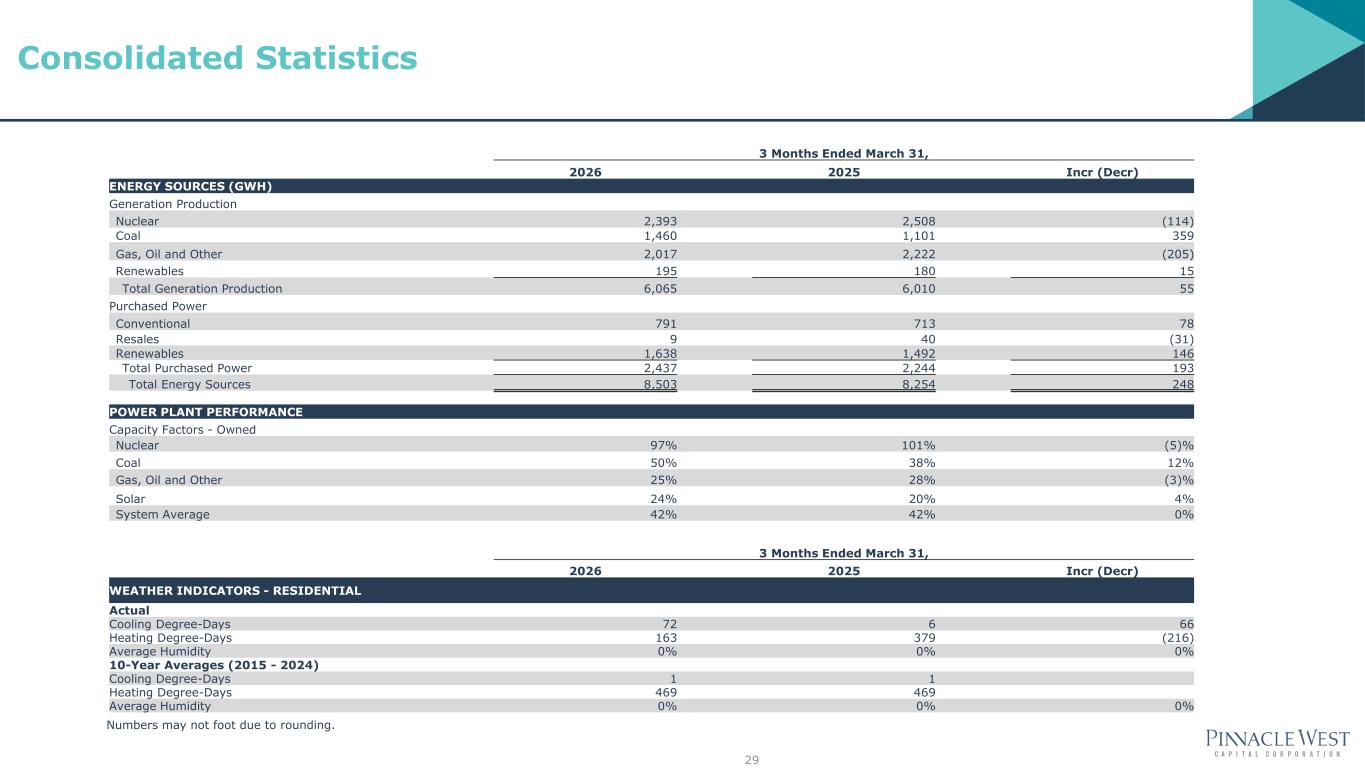
29 Consolidated Statistics Numbers may not foot due to rounding. 3 Months Ended March 31, 2026 2025 Incr (Decr) ENERGY SOURCES (GWH) Generation Production Nuclear 2,393 2,508 (114) Coal 1,460 1,101 359 Gas, Oil and Other 2,017 2,222 (205) Renewables 195 180 15 Total Generation Production 6,065 6,010 55 Purchased Power Conventional 791 713 78 Resales 9 40 (31) Renewables 1,638 1,492 146 Total Purchased Power 2,437 2,244 193 Total Energy Sources 8,503 8,254 248 POWER PLANT PERFORMANCE Capacity Factors - Owned Nuclear 97% 101% (5)% Coal 50% 38% 12% Gas, Oil and Other 25% 28% (3)% Solar 24% 20% 4% System Average 42% 42% 0% 3 Months Ended March 31, 2026 2025 Incr (Decr) WEATHER INDICATORS - RESIDENTIAL Actual Cooling Degree-Days 72 6 66 Heating Degree-Days 163 379 (216) Average Humidity 0% 0% 0% 10-Year Averages (2015 - 2024) Cooling Degree-Days 1 1 Heating Degree-Days 469 469 Average Humidity 0% 0% 0%