ENHANCED DISCLOSURE TASK FORCE (EDTF) RECOMMENDATIONS
The Enhanced Disclosure Task Force (EDTF) was established by the Financial Stability Board in May 2012 with the goal of developing fundamental disclosure principles. On October 29, 2012, the EDTF published its report, “Enhancing the Risk Disclosures of Banks,” which sets forth recommendations around improving risk disclosures and identifies existing leading practice risk disclosures.
Below is the index of all these recommendations to facilitate easy reference in the Bank’s annual report and other public disclosure documents available on www.scotiabank.com/investorrelations.
|
Reference Table for EDTF |
||||||||||||||||||||
|
Pages |
||||||||||||||||||||
| Type of risk | Number | Disclosure | MD&A | Financial Statements |
Supplementary Regulatory Capital Disclosures |
|||||||||||||||
| General | 1 | The index of risks to which the business is exposed. | 16 | |||||||||||||||||
| 2 | The Bank’s risk terminology, measures and key parameters. | 76-83 | ||||||||||||||||||
| 3 | Top and emerging risks, and the changes during the reporting period. | 85-87, 91-96 | ||||||||||||||||||
| 4 | Discussion on the regulatory development and plans to meet new regulatory ratios. | |
60-63, 120-121 |
|
||||||||||||||||
| Risk governance, risk management and business model |
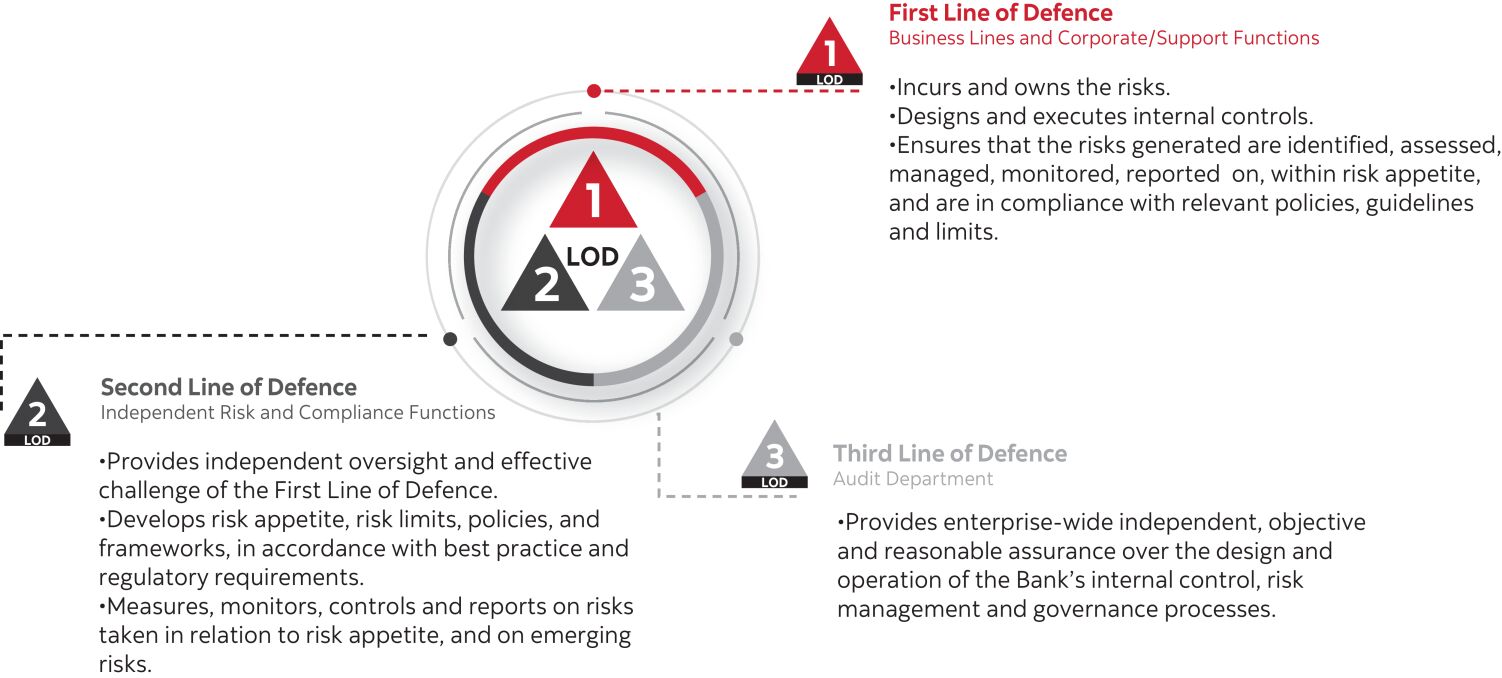
5 | The Bank’s Risk Governance structure. | 78-80 | |||||||||||||||||
| 6 | Description of risk culture and procedures applied to support the culture. | 80-83 | ||||||||||||||||||
| 7 | Description of key risks from the Bank’s business model. | 84 | ||||||||||||||||||
| 8 | Stress testing use within the Bank’s risk governance and capital management. | 80-82 | ||||||||||||||||||
| Capital Adequacy and risk-weighted assets |
9 | Pillar 1 capital requirements, and the impact for global systemically important banks. | 60-63 | 208 | 4, 5 | |||||||||||||||
| 10 | a) Regulatory capital components. | 64 | 22-24 | |||||||||||||||||
| b) Reconciliation of the accounting balance sheet to the regulatory balance sheet. | 18-19 | |||||||||||||||||||
| 11 | Flow statement of the movements in regulatory capital since the previous reporting period, including changes in common equity tier 1, additional tier 1 and tier 2 capital. | 65-66 | 100 | |||||||||||||||||
| 12 | Discussion of targeted level of capital, and the plans on how to establish this. | 60-63 | ||||||||||||||||||
| 13 | Analysis of risk-weighted assets by risk type, business, and market risk RWAs. | 68-73, 84, 127 | 178 | |
6, 37-40, 44-49, 50-55, 56-61, 73-75, 76-78, 82, 97, 103 |
| ||||||||||||||
| 14 | Analysis of the capital requirements for each Basel asset class. | 68-73 | 178, 224-228 | 16-17, 37-62, 71-78, 82, 87-90 | ||||||||||||||||
| 15 | Tabulate credit risk in the Banking Book. | 68-73 | 225 | 16-17, 37-62, 82, 87-90 | ||||||||||||||||
| 16 | Flow statements reconciling the movements in risk-weighted assets for each risk-weighted asset type. | 68-73 | 63, 81, 102 | |||||||||||||||||
| 17 | Discussion of Basel III Back-testing requirement including credit risk model performance and validation. | 69-71 | 64-67, 107 | |||||||||||||||||
| Liquidity Funding | 18 | Analysis of the Bank’s liquid assets. | 103-108 | |||||||||||||||||
| 19 | Encumbered and unencumbered assets analyzed by balance sheet category. | 105 | ||||||||||||||||||
| 20 | Consolidated total assets, liabilities and off-balance sheet commitments analyzed by remaining contractual maturity at the balance sheet date. | 109-111 | ||||||||||||||||||
| 21 | Analysis of the Bank’s sources of funding and a description of the Bank’s funding strategy. | 108-109 | ||||||||||||||||||
| Market Risk | 22 | Linkage of market risk measures for trading and non-trading portfolios and the balance sheet. | 102 | |||||||||||||||||
| 23 | Discussion of significant trading and non-trading market risk factors. | 97-103 | ||||||||||||||||||
| 24 | Discussion of changes in period on period VaR results as well as VaR assumptions, limitations, backtesting and validation. | 97-103 | ||||||||||||||||||
| 25 | Other risk management techniques e.g. stress tests, tail risk and market liquidity horizon. | 97-103 | ||||||||||||||||||
| Credit Risk | 26 | Analysis of the aggregate credit risk exposures, including details of both personal and wholesale lending. | 91-96, 123-127 | 188-189, 225-228 | 6, 37-40, 44-61, 73-78 | |||||||||||||||
| 27 | Discussion of the policies for identifying impaired loans, defining impairments and renegotiated loans, and explaining loan forbearance policies. | 158-160 | ||||||||||||||||||
| 28 | Reconciliations of the opening and closing balances of impaired loans and impairment allowances during the year. | 93, 122-125 | 189 | 34-35 | ||||||||||||||||
| 29 | Analysis of counterparty credit risk that arises from derivative transactions. | 88-90 | 176-179 | 108 | ||||||||||||||||
| 30 | Discussion of credit risk mitigation, including collateral held for all sources of credit risk. | 89-91, 94 | ||||||||||||||||||
| Other risks | 31 | Quantified measures of the management of operational risk. | 72, 112-113 | |||||||||||||||||
| 32 | Discussion of publicly known risk items. | 85-87 | 205-206 | |||||||||||||||||
16 | 2025 Scotiabank Annual Report
| Management’s Discussion & Analysis
|
Management’s Discussion and Analysis (MD&A) is provided to enable readers to assess the Bank’s financial condition and results of operations as at and for the year ended October 31, 2025. The MD&A should be read in conjunction with the Bank’s 2025 Consolidated Financial Statements, including the Notes. This MD&A is dated December 2, 2025.
Additional information relating to the Bank, including the Bank’s 2025 Annual Report, are available on the Bank’s website at www.scotiabank.com. As well, the Bank’s 2025 Annual Report and Annual Information Form are available on the SEDAR+ website at www.sedarplus.ca and on the EDGAR section of the SEC’s website at www.sec.gov.
| 18 | Forward-looking statements | |
| 19 | Financial highlights | |
| 20 | Non-GAAP measures | |
| Overview of Performance | ||
| 28 | Financial results: 2025 vs 2024 | |
| 28 | Medium-term financial objectives | |
| 28 | Shareholder returns | |
| 29 | Significant developments | |
| 29 | Strategy, economic summary and outlook | |
| 30 | Impact of foreign currency translation | |
| 31 | Impact of closed divestitures | |
| Group Financial Performance | ||
| 32 | Net income | |
| 32 | Net interest income | |
| 34 | Non-interest income | |
| 35 | Provision for credit losses | |
| 37 | Non-interest expenses | |
| 37 | Provision for income taxes | |
| 38 | Fourth quarter review | |
| 40 | Trending analysis | |
| Business Line Overview | ||
| 42 | Overview | |
| 45 | Canadian Banking | |
| 48 | International Banking | |
| 52 | Global Wealth Management | |
| 56 | Global Banking and Markets | |
| 59 | Other | |
| Group Financial Condition | ||
| 60 | Statement of financial position | |
| 60 | Capital management | |
| 73 | Off-balance sheet arrangements | |
| 75 | Financial instruments | |
| Risk Management | ||
| 76 | Risk management framework | |
| 88 | Credit risk | |
| 97 | Market risk | |
| 103 | Liquidity risk | |
| 112 | Other risks | |
| Controls and Accounting Policies | ||
| 116 | Controls and procedures | |
| 116 | Critical accounting policies and estimates | |
| 120 | Future accounting developments | |
| 120 | Regulatory developments | |
| 121 | Related party transactions | |
| Supplementary Data and Glossary | ||
| 122 | Geographic information | |
| 123 | Credit risk | |
| 128 | Revenues and expenses | |
| 130 | Selected quarterly information | |
| 131 | Selected annual information | |
| 131 | Ten-year statistical review | |
| 136 | Glossary | |
2025 Scotiabank Annual Report | 17
Management’s Discussion and Analysis
From time to time, our public communications include oral or written forward-looking statements. Statements of this type are included in this document, and may be included in other filings with Canadian securities regulators or the U.S. Securities and Exchange Commission (SEC), or in other communications. In addition, representatives of the Bank may include forward-looking statements orally to analysts, investors, the media and others. All such statements are made pursuant to the “safe harbor” provisions of the U.S. Private Securities Litigation Reform Act of 1995 and any applicable Canadian securities legislation. Forward-looking statements may include, but are not limited to, statements made in this document, the Management’s Discussion and Analysis in the Bank’s 2025 Annual Report under the headings “Outlook” and in other statements regarding the Bank’s objectives, strategies to achieve those objectives, the regulatory environment in which the Bank operates, anticipated financial results, and the outlook for the Bank’s businesses and for the Canadian, U.S. and global economies. Such statements are typically identified by words or phrases such as “believe,” “expect,” “aim,” “achieve,” “foresee,” “forecast,” “anticipate,” “intend,” “estimate,” “outlook,” “seek,” “schedule,” “plan,” “goal,” “strive,” “target,” “project,” “commit,” “objective,” and similar expressions of future or conditional verbs, such as “will,” “may,” “should,” “would,” “might,” “can” and “could” and positive and negative variations thereof.
By their very nature, forward-looking statements require us to make assumptions and are subject to inherent risks and uncertainties, which give rise to the possibility that our predictions, forecasts, projections, expectations or conclusions will not prove to be accurate, that our assumptions may not be correct and that our financial performance objectives, vision and strategic goals will not be achieved.
We caution readers not to place undue reliance on these statements as a number of risk factors, many of which are beyond our control and effects of which can be difficult to predict, could cause our actual results to differ materially from the expectations, targets, estimates or intentions expressed in such forward-looking statements.
The future outcomes that relate to forward-looking statements may be influenced by many factors, including but not limited to: general economic and market conditions in the countries in which we operate and globally; changes in currency and interest rates; increased funding costs and market volatility due to market illiquidity and competition for funding; the failure of third parties to comply with their obligations to the Bank and its affiliates, including relating to the care and control of information, and other risks arising from the Bank’s use of third parties; changes in monetary, fiscal, or economic policy and tax legislation and interpretation; changes in laws and regulations or in supervisory expectations or requirements, including capital, interest rate and liquidity requirements and guidance, and the effect of such changes on funding costs; geopolitical risk (including policies and other changes related to, or affecting, economic or trade matters, including tariffs, countermeasures, tariff mitigation policies and tax-related risks); changes to our credit ratings; the possible effects on our business and the global economy of war, conflicts or terrorist actions and unforeseen consequences arising from such actions; technological changes, including open banking and the use of data and artificial intelligence in our business, and technology resiliency; operational and infrastructure risks; reputational risks; the accuracy and completeness of information the Bank receives on customers and counterparties; the timely development and introduction of new products and services, and the extent to which products or services previously sold by the Bank require the Bank to incur liabilities or absorb losses not contemplated at their origination; our ability to execute our strategic plans, including the successful completion of acquisitions and dispositions, including obtaining regulatory approvals; critical accounting estimates and the effect of changes to accounting standards, rules and interpretations on these estimates; global capital markets activity; the Bank’s ability to attract, develop and retain key executives; the evolution of various types of fraud or other criminal behaviour to which the Bank is exposed; anti-money laundering; disruptions or attacks (including cyberattacks) on the Bank’s information technology, internet connectivity, network accessibility, or other voice or data communications systems or services, which may result in data breaches, unauthorized access to sensitive information, denial of service and potential incidents of identity theft; increased competition in the geographic and business areas in which we operate, including through internet and mobile banking and non-traditional competitors; exposure related to significant litigation and regulatory matters; environmental, social and governance risks, including climate-related risk, our ability to implement various sustainability-related initiatives (both internally and with our clients and other stakeholders) under expected time frames, and our ability to scale our sustainable-finance products and services; the occurrence of natural and unnatural catastrophic events and claims resulting from such events, including disruptions to public infrastructure, such as transportation, communications, power or water supply; inflationary pressures; global supply-chain disruptions; Canadian housing and household indebtedness; the emergence or continuation of widespread health emergencies or pandemics, including their impact on the local, national or global economies, financial market conditions and the Bank’s business, results of operations, financial condition and prospects; and the Bank’s anticipation of and success in managing the risks implied by the foregoing. A substantial amount of the Bank’s business involves making loans or otherwise committing resources to specific companies, industries or countries. Unforeseen events affecting such borrowers, industries or countries could have a material adverse effect on the Bank’s financial results, businesses, financial condition or liquidity. These and other factors may cause the Bank’s actual performance to differ materially from that contemplated by forward-looking statements. The Bank cautions that the preceding list is not exhaustive of all possible risk factors and other factors could also adversely affect the Bank’s results, for more information, please see the “Risk Management” section of the Bank’s 2025 Annual Report, as may be updated by quarterly reports.
Material economic assumptions underlying the forward-looking statements contained in this document are set out in the 2025 Annual Report under the headings “Outlook”, as updated by quarterly reports. The “Outlook” and “2026 Priorities” sections are based on the Bank’s views and the actual outcome is uncertain. Readers should consider the above-noted factors when reviewing these sections. When relying on forward-looking statements to make decisions with respect to the Bank and its securities, investors and others should carefully consider the preceding factors, other uncertainties and potential events.
Any forward-looking statements contained in this document represent the views of management only as of the date hereof and are presented for the purpose of assisting the Bank’s shareholders and analysts in understanding the Bank’s financial position, objectives and priorities, and anticipated financial performance as at and for the periods ended on the dates presented, and may not be appropriate for other purposes. Except as required by law, the Bank does not undertake to update any forward-looking statements, whether written or oral, that may be made from time to time by or on its behalf.
Additional information relating to the Bank, including the Bank’s Annual Information Form, can be located on the SEDAR+ website at www.sedarplus.ca and on the EDGAR section of the SEC’s website at www.sec.gov.
December 2, 2025
18 | 2025 Scotiabank Annual Report
T1 Financial highlights
| As at and for the years ended October 31 | 2025 | 2024 | ||||||
| Operating results ($ millions) |
||||||||
| Net interest income |
21,522 | 19,252 | ||||||
| Non-interest income |
16,219 | 14,418 | ||||||
| Total revenue |
37,741 | 33,670 | ||||||
| Provision for credit losses |
4,714 | 4,051 | ||||||
| Non-interest expenses |
22,518 | 19,695 | ||||||
| Income tax expense |
2,751 | 2,032 | ||||||
| Net income |
7,758 | 7,892 | ||||||
| Net income attributable to common shareholders |
7,283 | 7,286 | ||||||
| Operating performance |
||||||||
| Basic earnings per share ($) |
5.84 | 5.94 | ||||||
| Diluted earnings per share ($) |
5.67 | 5.87 | ||||||
| Return on equity (%)(1) |
9.7 | 10.2 | ||||||
| Return on tangible common equity (%)(2) |
11.9 | 12.6 | ||||||
| Productivity ratio (%)(1) |
59.7 | 58.5 | ||||||
| Operating leverage (%)(1) |
(2.2 | ) | 1.5 | |||||
| Net interest margin (%)(2) |
2.33 | 2.16 | ||||||
| Financial position information ($ millions) |
||||||||
| Cash and deposits with financial institutions |
65,967 | 63,860 | ||||||
| Trading assets |
152,223 | 129,727 | ||||||
| Loans |
771,045 | 760,829 | ||||||
| Total assets |
1,460,042 | 1,412,027 | ||||||
| Deposits |
966,279 | 943,849 | ||||||
| Common equity |
76,927 | 73,590 | ||||||
| Preferred shares and other equity instruments |
9,939 | 8,779 | ||||||
| Assets under administration(1) |
868,347 | 771,454 | ||||||
| Assets under management(1) |
432,375 | 373,030 | ||||||
| Capital and liquidity measures |
||||||||
| Common Equity Tier 1 (CET1) capital ratio (%)(3) |
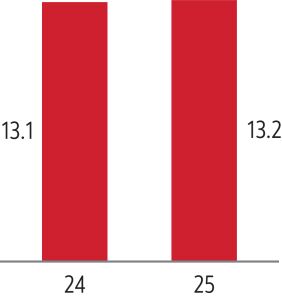
13.2 | 13.1 | ||||||
| Tier 1 capital ratio (%)(3) |
15.3 | 15.0 | ||||||
| Total capital ratio (%)(3) |
17.1 | 16.7 | ||||||
| Total loss absorbing capacity (TLAC) ratio (%)(4) |
29.1 | 29.7 | ||||||
| Leverage ratio (%)(5) |
4.5 | 4.4 | ||||||
| TLAC Leverage ratio (%)(4) |
8.5 | 8.8 | ||||||
| Risk-weighted assets ($ millions)(3) |
474,453 | 463,992 | ||||||
| Liquidity coverage ratio (LCR) (%)(6) |
128 | 131 | ||||||
| Net stable funding ratio (NSFR) (%)(6) |
116 | 119 | ||||||
| Credit quality |
||||||||
| Net impaired loans ($ millions) |
4,903 | 4,685 | ||||||
| Allowance for credit losses ($ millions)(7) |
7,654 | 6,736 | ||||||
| Gross impaired loans as a % of loans and acceptances(1) |
0.93 | 0.88 | ||||||
| Net impaired loans as a % of loans and acceptances(1) |
0.63 | 0.61 | ||||||
| Provision for credit losses as a % of average net loans and acceptances(1)(8) |
0.62 | 0.53 | ||||||
| Provision for credit losses on impaired loans as a % of average net loans and acceptances(1)(8) |
0.54 | 0.52 | ||||||
| Net write-offs as a % of average net loans and acceptances(1) |
0.50 | 0.46 | ||||||
| Adjusted results(2) |
||||||||
| Adjusted total revenue ($ millions) |
37,731 | 33,813 | ||||||
| Adjusted non-interest expenses ($ millions) |
20,581 | 18,961 | ||||||
| Adjusted net income ($ millions) |
9,510 | 8,627 | ||||||
| Adjusted diluted earnings per share ($) |
7.09 | 6.47 | ||||||
| Adjusted return on equity (%) |
11.8 | 11.3 | ||||||
| Adjusted return on tangible common equity (%) |
14.3 | 13.7 | ||||||
| Adjusted productivity ratio (%) |
54.5 | 56.1 | ||||||
| Adjusted operating leverage (%) |
3.0 | 2.3 | ||||||
| Common share information |
||||||||
| Closing share price ($) (TSX) |
91.99 | 71.69 | ||||||
| Shares outstanding (millions) |
||||||||
| Average – Basic |
1,244 | 1,226 | ||||||
| Average – Diluted |
1,248 | 1,232 | ||||||
| End of period |
1,236 | 1,244 | ||||||
| Dividends paid per share ($) |
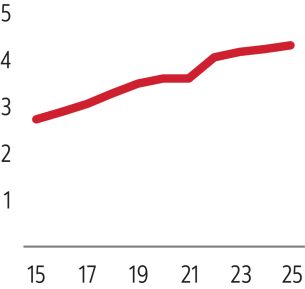
4.32 | 4.24 | ||||||
| Dividend yield (%)(1) |
5.6 | 6.5 | ||||||
| Market capitalization ($ millions) (TSX) |
113,728 | 89,214 | ||||||
| Book value per common share ($)(1) |
62.22 | 59.14 | ||||||
| Market value to book value multiple(1) |
1.5 | 1.2 | ||||||
| Price to earnings multiple (trailing 4 quarters)(1) |
15.8 | 12.0 | ||||||
| Other information |
||||||||
| Employees (full-time equivalent) |
86,431 | 88,488 | ||||||
| Branches and offices |
2,128 | 2,236 | ||||||
| (1) | Refer to Glossary on page 136 for the description of the measure. |
| (2) | Refer to Non-GAAP Measures section starting on page 20. |
| (3) | The regulatory capital ratios are based on Basel III requirements as determined in accordance with the Office of the Superintendent of Financial Institutions (OSFI) Guideline – Capital Adequacy Requirements. |
| (4) | This measure has been disclosed in this document in accordance with OSFI Guideline – Total Loss Absorbing Capacity. |
| (5) | The leverage ratios are based on Basel III requirements as determined in accordance with OSFI Guideline – Leverage Requirements. |
| (6) | The LCR and NSFR are calculated in accordance with OSFI Guideline – Liquidity Adequacy Requirements (LAR). |
| (7) | Includes allowance for credit losses on all financial assets – loans, acceptances, off-balance sheet exposures, debt securities, and deposits with financial institutions. |
| (8) | Includes provision for credit losses on certain financial assets – loans, acceptances, and off-balance sheet exposures. |
2025 Scotiabank Annual Report | 19
Management’s Discussion and Analysis
The Bank uses a number of financial measures and ratios to assess its performance, as well as the performance of its operating segments. Some of these financial measures and ratios are presented on a non-GAAP basis and are not calculated in accordance with Generally Accepted Accounting Principles (GAAP), which are based on International Financial Reporting Standards (IFRS) as issued by the International Accounting Standards Board (IASB), are not defined by GAAP and do not have standardized meanings and therefore might not be comparable to similar financial measures and ratios disclosed by other issuers. The Bank believes that non-GAAP measures and ratios are useful as they provide readers with a better understanding of how management assesses performance. These non-GAAP measures and ratios are used throughout this report and defined below.
Adjusted results and diluted earnings per share
The following tables present a reconciliation of GAAP reported financial results to non-GAAP adjusted financial results. Management considers both reported and adjusted results and measures useful in assessing underlying ongoing business performance. Adjusted results and measures remove certain specified items from revenue, non-interest expenses, income taxes and non-controlling interests. Presenting results on both a reported basis and adjusted basis allows readers to assess the impact of certain items on results for the periods presented, and to better assess results and trends excluding those items that may not be reflective of ongoing business performance.
T2 Reconciliation of reported and adjusted results
| As at October 31 ($ millions) | 2025 | 2024 | ||||||
| Reported Results |
||||||||
| Net interest income |
$ | 21,522 | $ | 19,252 | ||||
| Non-interest income |
16,219 | 14,418 | ||||||
| Total revenue |
37,741 | 33,670 | ||||||
| Provision for credit losses |
4,714 | 4,051 | ||||||
| Non-interest expenses |
22,518 | 19,695 | ||||||
| Income before taxes |
10,509 | 9,924 | ||||||
| Income tax expense |
2,751 | 2,032 | ||||||
| Net income |
$ | 7,758 | $ | 7,892 | ||||
| Net income (loss) attributable to non-controlling interests in subsidiaries (NCI) |
(31 | ) | 134 | |||||
| Net income attributable to equity holders |
7,789 | 7,758 | ||||||
| Net income attributable to preferred shareholders and other equity instrument holders |
506 | 472 | ||||||
| Net income attributable to common shareholders |
$ | 7,283 | $ | 7,286 | ||||
| Adjustments |
||||||||
| Adjusting items impacting non-interest income and total revenue (Pre-tax) |
||||||||
| (a) Divestitures and wind-down of operations |
$ | (36 | ) | $ | 143 | |||
| (d) Amortization of acquisition-related intangible assets |
26 | – | ||||||
| Total non-interest income and total revenue adjusting items (Pre-tax) |
(10 | ) | 143 | |||||
| Adjusting items impacting non-interest expenses (Pre-tax) |
||||||||
| (a) Divestitures and wind-down of operations |
1,422 | (7 | ) | |||||
| (b) Restructuring charge and severance provisions |
373 | 53 | ||||||
| (c) Legal provision |
74 | 176 | ||||||
| (d) Amortization of acquisition-related intangible assets |
68 | 72 | ||||||
| (e) Impairment of non-financial assets |
– | 440 | ||||||
| Total non-interest expense adjusting items (Pre-tax) |
1,937 | 734 | ||||||
| Total impact of adjusting items on net income before taxes |
1,927 | 877 | ||||||
| Impact of adjusting items on income tax expense |
||||||||
| (a) Divestitures and wind-down of operations |
(32 | ) | (46 | ) | ||||
| (b) Restructuring charge and severance provisions |
(103 | ) | (15 | ) | ||||
| (c) Legal provision |
(20 | ) | – | |||||
| (d) Amortization of acquisition-related intangible assets |
(20 | ) | (20 | ) | ||||
| (e) Impairment of non-financial assets |
– | (61 | ) | |||||
| Total impact of adjusting items on income tax expense |
(175 | ) | (142 | ) | ||||
| Total impact of adjusting items on net income |
1,752 | 735 | ||||||
| Impact of adjusting items on NCI |
(191 | ) | (2 | ) | ||||
| Total impact of adjusting items on net income attributable to equity holders |
$ | 1,561 | $ | 733 | ||||
| Adjusted Results |
||||||||
| Adjusted net interest income |
$ | 21,522 | $ | 19,252 | ||||
| Adjusted non-interest income |
16,209 | 14,561 | ||||||
| Adjusted total revenue |
37,731 | 33,813 | ||||||
| Adjusted provision for credit losses |
4,714 | 4,051 | ||||||
| Adjusted non-interest expenses |
20,581 | 18,961 | ||||||
| Adjusted income before taxes |
12,436 | 10,801 | ||||||
| Adjusted income tax expense |
2,926 | 2,174 | ||||||
| Adjusted net income |
$ | 9,510 | $ | 8,627 | ||||
| Adjusted net income attributable to NCI |
160 | 136 | ||||||
| Adjusted net income attributable to equity holders |
9,350 | 8,491 | ||||||
| Adjusted net income attributable to preferred shareholders and other equity instrument holders |
506 | 472 | ||||||
| Adjusted net income attributable to common shareholders |
$ | 8,844 | $ | 8,019 | ||||
20 | 2025 Scotiabank Annual Report
T2A Reconciliation of reported and adjusted diluted earnings per common share
| As at and for the year ended October 31 ($ millions) | 2025 | 2024 | ||||||
| Reported Results |
||||||||
| Net income attributable to common shareholders |
$ | 7,283 | $ | 7,286 | ||||
| Foreign currency loss on redemption of Subordinated Additional Tier 1 Capital Notes |
(22 | ) | – | |||||
| Net income attributable to common shareholders used to calculate basic earnings per common share |
7,261 | 7,286 | ||||||
| Dilutive impact of share-based payment options and others |
(181 | ) | (49 | ) | ||||
| Net income attributable to common shareholders (diluted) |
7,080 | 7,237 | ||||||
| Weighted average number of diluted common shares outstanding (millions) |
1,248 | 1,232 | ||||||
| Diluted earnings per common share (in dollars) |
$ | 5.67 | $ | 5.87 | ||||
| Adjusted Results |
||||||||
| Net income attributable to common shareholders used to calculate basic earnings per common share |
$ | 7,261 | $ | 7,286 | ||||
| Impact of adjusting items on net income attributable to common shareholders(1) |
1,561 | 733 | ||||||
| Foreign currency loss on redemption of Subordinated Additional Tier 1 Capital Notes |
22 | – | ||||||
| Adjusted net income attributable to common shareholders used to calculate adjusted basic earnings per common share |
8,844 | 8,019 | ||||||
| Dilutive impact of share-based payment options and others |
7 | (49 | ) | |||||
| Adjusted net income attributable to common shareholders (diluted) |
8,851 | 7,970 | ||||||
| Weighted average number of diluted common shares outstanding (millions) |
1,248 | 1,232 | ||||||
| Adjusted diluted earnings per common share (in dollars) |
$ | 7.09 | $ | 6.47 | ||||
| Impact of adjustments on diluted earnings per share (in dollars) |
$ | 1.42 | $ | 0.60 | ||||
| (1) | Refer to Table T2 for details of adjusting items. |
T3 Impact of adjustments on (income)/expenses
| For the year ended | For the three months ended | |||||||||||||||||||||||||||||||
| 2025 | 2024 | October 31, 2025 | October 31, 2024 | |||||||||||||||||||||||||||||
| ($ millions) | Pre-tax | After-tax | Pre-tax | After-tax | Pre-tax | After-tax | Pre-tax | After-tax | ||||||||||||||||||||||||
| (a) Divestitures and wind-down of operations |
$ | 1,386 | $ | 1,354 | $ | 136 | $ | 90 | $ | 12 | $ | 8 | $ | – | $ | – | ||||||||||||||||
| (b) Restructuring charge and severance provisions |
373 | 270 | 53 | 38 | 373 | 270 | 53 | 38 | ||||||||||||||||||||||||
| (c) Legal provision |
74 | 54 | 176 | 176 | 74 | 54 | – | – | ||||||||||||||||||||||||
| (d) Amortization of acquisition-related intangible assets |
94 | 74 | 72 | 52 | 25 | 20 | 19 | 13 | ||||||||||||||||||||||||
| Impairment of non-financial assets: |
||||||||||||||||||||||||||||||||
| (e) Investment in associates |
– | – | 343 | 309 | – | – | 343 | 309 | ||||||||||||||||||||||||
| (e) Intangible assets including software |
– | – | 97 | 70 | – | – | 97 | 70 | ||||||||||||||||||||||||
| Total |
$ | 1,927 | $ | 1,752 | $ | 877 | $ | 735 | $ | 484 | $ | 352 | $ | 512 | $ | 430 | ||||||||||||||||
| Diluted EPS Impact |
$ | 1.42 | $ | 0.60 | $ | 0.28 | $ | 0.35 | ||||||||||||||||||||||||
| CET1 Impact(1) |
(20 bps | ) | (9 bps | ) | (7 bps | ) | (5 bps | ) | ||||||||||||||||||||||||
| (1) | Including related impacts on regulatory capital and risk-weighted assets. |
The Bank’s fiscal 2025 and 2024 results were adjusted for the following items. These amounts were recorded in the Other operating segment, unless otherwise noted.
| a) | Divestitures and wind-down of operations |
In Q1 2025, the Bank entered into an agreement to sell its banking operations in Colombia, Costa Rica and Panama in exchange for an approximately 20% ownership stake in the newly combined entity of Davivienda. On that date, the Bank recognized an impairment loss of $1,362 million ($1,355 million after-tax) as the banking operations that are part of the transaction were classified as held for sale. As of October 31, 2025, the Bank has recognized a total impairment loss of $1,422 million in non-interest expense and a credit of $45 million in non-interest income (collectively $1,342 million after-tax). These subsequent changes represent changes in the carrying value of net assets being sold and fair value of shares to be received less costs to sell, as well as changes in foreign currency.
In Q2 2025, the Bank completed the sale of CrediScotia Financiera S.A. (CrediScotia), a wholly-owned consumer finance subsidiary in Peru, to Banco Santander S.A. (Espana). The Bank recognized an additional loss of $9 million in non-interest income – other upon closing. In Q3 2024, the Bank had recognized an impairment loss of $143 million in non-interest income and a recovery of expenses of $7 million in non-interest expenses – salaries and employee benefits (collectively $90 million after-tax), the majority of which relates to goodwill.
For further details, please refer to Note 35 of the consolidated financial statements.
| b) | Restructuring charge and severance provisions |
In Q4 2025, the Bank recorded a restructuring charge and severance provision as well as other related charges of $373 million ($270 million after-tax) primarily related to workforce reductions. These amounts reflect actions taken by the Bank to simplify its organizational structure in Canadian Banking, restructure and right-size Asia operations in Global Banking and Markets and regionalize activities across its international footprint, in line with the Bank’s enterprise strategy. For further details, please refer to Note 22 of the consolidated financial statements.
2025 Scotiabank Annual Report | 21
Management’s Discussion and Analysis
In Q4 2024, the Bank recorded severance provisions of $53 million ($38 million after-tax) related to the Bank’s continued efforts to streamline its organizational structure and support execution of the Bank’s strategy.
| c) | Legal provision |
In Q4 2025, the Bank recognized a legal provision of $74 million ($54 million after-tax) related to several civil and other litigation matters.
In Q3 2024, the Bank recognized a $176 million expense for legal actions in Peru relating to certain value-added tax assessed amounts and associated interest. The legal actions arose from certain client transactions that occurred prior to the Bank’s acquisition of its Peruvian subsidiary. For further details, please refer to Note 22 of the consolidated financial statements.
| d) | Amortization of acquisition-related intangible assets |
These costs relate to the amortization of intangible assets recognized upon the acquisition of businesses, excluding software. The costs are recorded in non-interest expenses – depreciation and amortization for the Canadian Banking, International Banking and Global Wealth Management operating segments, and non-interest income – net income from investments in associated corporations for the Other operating segment.
| e) | Impairment of non-financial assets |
In Q4 2024, the Bank recorded impairment charges of $343 million ($309 million after-tax) related to its investment in associate, Bank of Xi’an Co. Ltd. in China, driven primarily by the continued weakening of the economic outlook in China and whose market value has remained below the Bank’s carrying value for a prolonged period. In Q4 2024, the Bank recorded an impairment of software intangible assets of $97 million ($70 million after-tax).
In addition to the above, the following adjustment also impacted earnings per share calculation.
| f) | Foreign currency loss on redemption of Subordinated Additional Tier 1 Capital Note |
In Q3 2025, the Bank redeemed all outstanding U.S. $1,250 million 4.900% Fixed Rate Resetting Perpetual Subordinated Additional Tier 1 Capital Notes (AT1 Note). The redemption resulted in a foreign currency loss of $22 million, which was recognized in retained earnings. The loss was deducted from net income attributable to common shareholders for the purposes of calculating basic and diluted earnings per share (EPS). For the adjusted diluted EPS calculation, the loss was added back as an adjusting item (refer to Table T2A for reconciliation). Please also refer to Note 23 (b) and Note 32 of the consolidated financial statements.
T4 Reconciliation of reported and adjusted results by business line
| For the year ended October 31, 2025(1) | ||||||||||||||||||||||||
| ($ millions) | Canadian Banking |
International Banking |
Global Wealth Management |
Global Banking and Markets |
Other | Total | ||||||||||||||||||
| Reported net income (loss) |
$ | 3,425 | $ | 2,789 | $ | 1,680 | $ | 1,921 | $ | (2,057 | ) | $ | 7,758 | |||||||||||
| Net income attributable to non-controlling interests in subsidiaries (NCI) |
– | 158 | 10 | (1 | ) | (198 | ) | (31 | ) | |||||||||||||||
| Reported net income attributable to equity holders |
3,425 | 2,631 | 1,670 | 1,922 | (1,859 | ) | 7,789 | |||||||||||||||||
| Reported net income attributable to preferred shareholders and other equity instrument holders |
– | – | – | – | 506 | 506 | ||||||||||||||||||
| Reported net income attributable to common shareholders |
$ | 3,425 | $ | 2,631 | $ | 1,670 | $ | 1,922 | $ | (2,365 | ) | $ | 7,283 | |||||||||||
| Adjustments |
||||||||||||||||||||||||
| Adjusting items impacting non-interest income and total revenue (Pre-tax) |
||||||||||||||||||||||||
| Divestitures and wind-down of operations |
$ | – | $ | – | $ | – | $ | – | $ | (36 | ) | $ | (36 | ) | ||||||||||
| Amortization of acquisition-related intangible assets |
– | – | – | – | 26 | 26 | ||||||||||||||||||
| Total non-interest income adjustments (Pre-tax) |
– | – | – | – | (10 | ) | (10 | ) | ||||||||||||||||
| Adjusting items impacting non-interest expenses (Pre-tax) |
||||||||||||||||||||||||
| Divestitures and wind-down of operations |
– | – | – | – | 1,422 | 1,422 | ||||||||||||||||||
| Restructuring charge and severance provisions |
– | – | – | – | 373 | 373 | ||||||||||||||||||
| Legal provision |
– | – | – | – | 74 | 74 | ||||||||||||||||||
| Amortization of acquisition-related intangible assets |
4 | 28 | 36 | – | – | 68 | ||||||||||||||||||
| Total non-interest expenses adjustments (Pre-tax) |
4 | 28 | 36 | – | 1,869 | 1,937 | ||||||||||||||||||
| Total impact of adjusting items on net income before taxes |
4 | 28 | 36 | – | 1,859 | 1,927 | ||||||||||||||||||
| Total impact of adjusting items on income tax expense |
(1 | ) | (8 | ) | (10 | ) | – | (156 | ) | (175 | ) | |||||||||||||
| Total impact of adjusting items on net income |
3 | 20 | 26 | – | 1,703 | 1,752 | ||||||||||||||||||
| Impact of adjusting items on NCI |
– | – | – | – | (191 | ) | (191 | ) | ||||||||||||||||
| Total impact of adjusting items on net income attributable to equity holders |
3 | 20 | 26 | – | 1,512 | 1,561 | ||||||||||||||||||
| Adjusted net income (loss) |
$ | 3,428 | $ | 2,809 | $ | 1,706 | $ | 1,921 | $ | (354 | ) | $ | 9,510 | |||||||||||
| Adjusted net income attributable to equity holders |
$ | 3,428 | $ | 2,651 | $ | 1,696 | $ | 1,922 | $ | (347 | ) | $ | 9,350 | |||||||||||
| Adjusted net income attributable to common shareholders |
$ | 3,428 | $ | 2,651 | $ | 1,696 | $ | 1,922 | $ | (853 | ) | $ | 8,844 | |||||||||||
| (1) | Refer to Business Line Overview on page 42. |
22 | 2025 Scotiabank Annual Report
| For the year ended October 31, 2024(1) | ||||||||||||||||||||||||
| ($ millions) | Canadian Banking(2) |
International Banking(2) |
Global Wealth Management(2) |
Global Banking and Markets(2) |
Other(2) | Total | ||||||||||||||||||
| Reported net income (loss) |
$ | 3,777 | $ | 2,706 | $ | 1,428 | $ | 1,478 | $ | (1,497 | ) | $ | 7,892 | |||||||||||
| Net income attributable to non-controlling interests in subsidiaries (NCI) |
– | 125 | 10 | – | (1 | ) | 134 | |||||||||||||||||
| Reported net income attributable to equity holders |
3,777 | 2,581 | 1,418 | 1,478 | (1,496 | ) | 7,758 | |||||||||||||||||
| Reported net income attributable to preferred shareholders and other equity instrument holders |
1 | 1 | 1 | 1 | 468 | 472 | ||||||||||||||||||
| Reported net income attributable to common shareholders |
$ | 3,776 | $ | 2,580 | $ | 1,417 | $ | 1,477 | $ | (1,964 | ) | $ | 7,286 | |||||||||||
| Adjustments |
||||||||||||||||||||||||
| Adjusting items impacting non-interest income and total revenue (Pre-tax) |
||||||||||||||||||||||||
| Divestitures and wind-down of operations |
$ | – | $ | – | $ | – | $ | – | $ | 143 | $ | 143 | ||||||||||||
| Adjusting items impacting non-interest expenses (Pre-tax) |
||||||||||||||||||||||||
| Divestitures and wind-down of operations |
– | – | – | – | (7 | ) | (7 | ) | ||||||||||||||||
| Restructuring charge and severance provisions |
– | – | – | – | 53 | 53 | ||||||||||||||||||
| Legal provision |
– | – | – | – | 176 | 176 | ||||||||||||||||||
| Amortization of acquisition-related intangible assets |
4 | 32 | 36 | – | – | 72 | ||||||||||||||||||
| Impairment of non-financial assets |
– | – | – | – | 440 | 440 | ||||||||||||||||||
| Total non-interest expenses adjustments (Pre-tax) |
4 | 32 | 36 | – | 662 | 734 | ||||||||||||||||||
| Total impact of adjusting items on net income before taxes |
4 | 32 | 36 | – | 805 | 877 | ||||||||||||||||||
| Total impact of adjusting items on income tax expense |
(1 | ) | (9 | ) | (10 | ) | – | (122 | ) | (142 | ) | |||||||||||||
| Total impact of adjusting items on net income |
3 | 23 | 26 | – | 683 | 735 | ||||||||||||||||||
| Impact of adjusting items on NCI |
– | – | – | – | (2 | ) | (2 | ) | ||||||||||||||||
| Total impact of adjusting items on net income attributable to equity holders |
3 | 23 | 26 | – | 681 | 733 | ||||||||||||||||||
| Adjusted net income (loss) |
$ | 3,780 | $ | 2,729 | $ | 1,454 | $ | 1,478 | $ | (814 | ) | $ | 8,627 | |||||||||||
| Adjusted net income attributable to equity holders |
$ | 3,780 | $ | 2,604 | $ | 1,444 | $ | 1,478 | $ | (815 | ) | $ | 8,491 | |||||||||||
| Adjusted net income attributable to common shareholders |
$ | 3,779 | $ | 2,603 | $ | 1,443 | $ | 1,477 | $ | (1,283 | ) | $ | 8,019 | |||||||||||
| (1) | Refer to Business Line Overview on page 42. |
| (2) | Effective Q1 2025, changes were made to the methodology used to allocate certain income, expenses and balance sheet items between business segments. Prior period results for each segment have been reclassified to conform with the current period’s methodology. Refer to page 42 for further details. |
Constant Dollar
International Banking business segment results are analyzed on a constant dollar basis which is a non-GAAP measure. Under the constant dollar basis, prior period amounts are recalculated using current period average foreign currency rates. The following table presents the reconciliation between reported, adjusted and constant dollar results for International Banking for prior periods. The Bank believes that constant dollar is useful for readers to understand business performance without the impact of foreign currency translation and is used by management to assess the performance of the business segment. The tables below are computed on a basis that is different than the table “Impact of foreign currency translation” in Overview of Performance on page 30.
T5 Reconciliation of International Banking’s reported and adjusted results and constant dollar results
| For the year ended October 31 ($ millions) | 2024(1) | |||||||||||
| (Taxable equivalent basis) | Reported results |
Foreign exchange |
Constant dollar |
|||||||||
| Net interest income |
$ | 8,867 | $ | 11 | $ | 8,856 | ||||||
| Non-interest income |
2,999 | 19 | 2,980 | |||||||||
| Total revenue |
11,866 | 30 | 11,836 | |||||||||
| Provision for credit losses |
2,285 | (8 | ) | 2,293 | ||||||||
| Non-interest expenses |
6,170 | 49 | 6,121 | |||||||||
| Income tax expense |
705 | 1 | 704 | |||||||||
| Net Income |
$ | 2,706 | $ | (12 | ) | $ | 2,718 | |||||
| Net income attributable to non-controlling interest in subsidiaries |
$ | 125 | $ | (3 | ) | $ | 128 | |||||
| Net income attributable to equity holders of the Bank |
$ | 2,581 | $ | (9 | ) | $ | 2,590 | |||||
| Other measures |
||||||||||||
| Average assets ($ billions) |
$ | 231 | $ | (1 | ) | $ | 232 | |||||
| Average liabilities ($ billions) |
$ | 179 | $ | 1 | $ | 178 | ||||||
2025 Scotiabank Annual Report | 23
Management’s Discussion and Analysis
| For the year ended October 31 ($ millions) | 2024(1) | |||||||||||
| (Taxable equivalent basis) | Adjusted results |
Foreign exchange |
Constant dollar adjusted |
|||||||||
| Net interest income |
$ | 8,867 | $ | 11 | $ | 8,856 | ||||||
| Non-interest income |
2,999 | 19 | 2,980 | |||||||||
| Total revenue |
11,866 | 30 | 11,836 | |||||||||
| Provision for credit losses |
2,285 | (8 | ) | 2,293 | ||||||||
| Non-interest expenses |
6,138 | 49 | 6,089 | |||||||||
| Income tax expense |
714 | 1 | 713 | |||||||||
| Net Income |
$ | 2,729 | $ | (12 | ) | $ | 2,741 | |||||
| Net income attributable to non-controlling interest in subsidiaries |
$ | 125 | $ | (3 | ) | $ | 128 | |||||
| Net income attributable to equity holders of the Bank |
$ | 2,604 | $ | (9 | ) | $ | 2,613 | |||||
| (1) | Effective Q1 2025, changes were made to the methodology used to allocate certain income, expenses and balance sheet items between business segments. Prior period results for each segment have been reclassified to conform with the current period’s methodology. Refer to page 42 for further details. |
Earning and non-earning assets, core earning assets, core net interest income and net interest margin
Net interest margin
Net interest margin is a non-GAAP ratio that is used to measure the return generated by the Bank’s core earning assets, net of the cost of funding. Net interest margin is calculated as core net interest income divided by average core earning assets. Management uses net interest margin to measure profitability and how efficiently the Bank earns income from its core earning assets relative to the cost of funding those assets.
Components of net interest margin are defined below:
Earning assets
Earning assets are defined as income generating assets which include deposits with financial institutions, trading assets, investment securities, investments in associates, securities borrowed or purchased under resale agreements, loans net of allowances, and customers’ liability under acceptances. This is a non-GAAP measure.
Non-earning assets
Non-earning assets are defined as cash, precious metals, derivative financial instruments, property and equipment, goodwill and intangible assets, deferred tax assets and other assets. This is a non-GAAP measure.
Core earning assets
Core earning assets are defined as interest-bearing deposits with financial institutions, investment securities and loans, net of allowances. This is a non-GAAP measure. The Bank believes that this measure is useful for readers as it presents the main interest-generating assets and eliminates the impact of trading businesses.
Core net interest income
Core net interest income is defined as net interest income earned from core earning assets. This is a non-GAAP measure.
T6 Calculation of net interest margin
Consolidated Bank
| For the year ended October 31 (Unaudited) ($ millions) | 2025 | 2024 | ||||||
| Average total assets - Reported(1) |
$ | 1,465,278 | $ | 1,419,284 | ||||
| Less: Non-earning assets |
115,718 | 108,110 | ||||||
| Average total earning assets(1) |
$ | 1,349,560 | $ | 1,311,174 | ||||
| Less: |
||||||||
| Trading assets |
153,283 | 146,307 | ||||||
| Securities purchased under resale agreements |
||||||||
| and securities borrowed |
209,261 | 193,090 | ||||||
| Other deductions |
35,149 | 53,819 | ||||||
| Average core earning assets(1) (A) |
$ | 951,867 | $ | 917,958 | ||||
| Net Interest Income - Reported |
$ | 21,522 | $ | 19,252 | ||||
| Less: Non-core net interest income |
(645 | ) | (620 | ) | ||||
| Core net interest income (B) |
$ | 22,167 | $ | 19,872 | ||||
| Net interest margin (B/A) |
2.33 | % | 2.16 | % | ||||
| (1) | Average balances represent the average of daily balances for the period. |
24 | 2025 Scotiabank Annual Report
Canadian Banking
| For the year ended October 31 (Unaudited) ($ millions) | 2025 | 2024(1) | ||||||
| Average total assets - Reported(2) |
$ | 462,670 | $ | 449,469 | ||||
| Less: Non-earning assets |
4,697 | 4,393 | ||||||
| Average total earning assets(2) |
$ | 457,973 | $ | 445,076 | ||||
| Less: |
||||||||
| Other deductions |
182 | 16,380 | ||||||
| Average core earning assets(2) |
$ | 457,791 | $ | 428,696 | ||||
| Net Interest Income - Reported |
$ | 10,484 | $ | 10,185 | ||||
| Less: Non-core net interest income |
– | 2 | ||||||
| Core net interest income |
$ | 10,484 | $ | 10,183 | ||||
| Net interest margin |
2.29 | % | 2.38 | % | ||||
| (1) | Effective Q1 2025, changes were made to the methodology used to allocate certain income, expenses and balance sheet items between business segments. Prior period results for each segment have been reclassified to conform with the current period’s methodology. Refer to page 42 for further details. |
| (2) | Average balances represent the average of daily balances for the period. |
International Banking
| For the year ended October 31 (Unaudited) ($ millions) | 2025 | 2024(1) | ||||||
| Average total assets - Reported(2) |
$ | 226,820 | $ | 231,456 | ||||
| Less: Non-earning assets |
13,843 | 15,949 | ||||||
| Average total earning assets(2) |
$ | 212,977 | $ | 215,507 | ||||
| Less: |
||||||||
| Trading assets |
6,283 | 6,407 | ||||||
| Securities purchased under resale agreements |
||||||||
| and securities borrowed |
3,763 | 4,063 | ||||||
| Other deductions |
7,184 | 6,660 | ||||||
| Average core earning assets(2) |
$ | 195,747 | $ | 198,377 | ||||
| Net Interest Income - Reported |
$ | 8,866 | $ | 8,867 | ||||
| Less: Non-core net interest income |
66 | 123 | ||||||
| Core net interest income |
$ | 8,800 | $ | 8,744 | ||||
| Net interest margin |
4.50 | % | 4.41 | % | ||||
| (1) | Effective Q1 2025, changes were made to the methodology used to allocate certain income, expenses and balance sheet items between business segments. Prior period results for each segment have been reclassified to conform with the current period’s methodology. Refer to page 42 for further details. |
| (2) | Average balances represent the average of daily balances for the period. |
Global Banking and Markets
| For the year ended October 31 (Unaudited) ($ millions) | 2025 | 2024(1) | ||||||
| Average total assets - Reported(2) |
$ | 509,263 | $ | 494,595 | ||||
| Less: Non-earning assets |
46,594 | 39,787 | ||||||
| Average total earning assets(2) |
$ | 462,669 | $ | 454,808 | ||||
| Less: |
||||||||
| Trading assets |
139,466 | 132,210 | ||||||
| Securities purchased under resale agreements |
||||||||
| and securities borrowed |
205,499 | 189,027 | ||||||
| Other deductions |
23,080 | 32,078 | ||||||
| Average core earning assets(2) |
$ | 94,624 | $ | 101,493 | ||||
| Net Interest Income - Reported |
$ | 1,400 | $ | 1,102 | ||||
| Less: Non-core net interest income |
(273 | ) | (475 | ) | ||||
| Core net interest income |
$ | 1,673 | $ | 1,577 | ||||
| Net interest margin |
1.77 | % | 1.55 | % | ||||
| (1) | Effective Q1 2025, changes were made to the methodology used to allocate certain income, expenses and balance sheet items between business segments. Prior period results for each segment have been reclassified to conform with the current period’s methodology. Refer to page 42 for further details. |
| (2) | Average balances represent the average of daily balances for the period. |
Return on equity
Return on equity is a profitability measure that presents the net income attributable to common shareholders as a percentage of average common shareholders’ equity.
Adjusted return on equity is a non-GAAP ratio which represents adjusted net income attributable to common shareholders as a percentage of average common shareholders’ equity.
Attributed capital and operating segment return on equity
The amount of common equity allocated to each operating segment is referred to as attributed capital. The attribution of capital within each operating segment is intended to approximate a percentage of the Basel III common equity capital requirements based on credit, market and operational risks and leverage inherent within each operating segment. Attributed capital is a non-GAAP measure. The Bank attributes capital to its business lines to approximate 11.5% of the Basel III common equity capital requirements.
2025 Scotiabank Annual Report | 25
Management’s Discussion and Analysis
Return on equity for the operating segments is calculated as a ratio of net income attributable to common shareholders of the operating segment and the capital attributed. This is a non-GAAP measure. Management uses operating segment return on equity to evaluate the performance of its operating segments.
Adjusted return on equity for the operating segments is calculated as a ratio of adjusted net income attributable to common shareholders of the operating segment and the capital attributed. This is a non-GAAP measure.
Return on equity by operating segment
T7 Return on equity by operating segment
| For the year ended October 31, 2025 ($ millions) | Canadian Banking |
International Banking |
Global Wealth Management |
Global Banking and Markets |
Other | Total | ||||||||||||||||||
| Reported |
||||||||||||||||||||||||
| Net income (loss) attributable to common shareholders |
$ | 3,425 | $ | 2,631 | $ | 1,670 | $ | 1,922 | $ | (2,365 | )(1) | $ | 7,283 | |||||||||||
| Total average common equity(2) |
21,030 | 18,061 | 10,417 | 14,968 | 10,529 | 75,005 | ||||||||||||||||||
| Return on equity |
16.3 | % | 14.6 | % | 16.0 | % | 12.8 | % | nm | (3) | 9.7 | % | ||||||||||||
| Adjusted(4) |
||||||||||||||||||||||||
| Net income (loss) attributable to common shareholders |
3,428 | 2,651 | 1,696 | 1,922 | (853 | )(1) | 8,844 | |||||||||||||||||
| Return on equity |
16.3 | % | 14.7 | % | 16.3 | % | 12.8 | % | nm | (3) | 11.8 | % | ||||||||||||
| (1) | Includes dividends paid on preferred shares and other equity instruments of $506. |
| (2) | Average amounts calculated using methods intended to approximate the daily average balances for the period. |
| (3) | Not meaningful. |
| (4) | Refer to Table on page 20. |
| For the year ended October 31, 2024 ($ millions) | Canadian Banking(1) |
International Banking(1) |
Global Wealth Management(1) |
Global Banking and Markets(1) |
Other(1) | Total | ||||||||||||||||||
| Reported |
||||||||||||||||||||||||
| Net income (loss) attributable to common shareholders |
$ | 3,776 | $ | 2,580 | $ | 1,417 | $ | 1,477 | $ | (1,964 | )(2) | $ | 7,286 | |||||||||||
| Total average common equity(3) |
20,585 | 19,148 | 10,210 | 15,342 | 5,842 | 71,127 | ||||||||||||||||||
| Return on equity |
18.3 | % | 13.5 | % | 13.9 | % | 9.6 | % | nm | (4) | 10.2 | % | ||||||||||||
| Adjusted(5) |
||||||||||||||||||||||||
| Net income (loss) attributable to common shareholders |
3,779 | 2,603 | 1,443 | 1,477 | (1,283 | )(2) | 8,019 | |||||||||||||||||
| Return on equity |
18.4 | % | 13.6 | % | 14.1 | % | 9.6 | % | nm | (4) | 11.3 | % | ||||||||||||
| (1) | Effective Q1 2025, changes were made to the methodology used to allocate certain income, expenses and balance sheet items between business segments. Prior period results for each segment have been reclassified to conform with the current period’s methodology. Refer to page 42 for further details. |
| (2) | Includes dividends paid on preferred shares and other equity instruments of $468. |
| (3) | Average amounts calculated using methods intended to approximate the daily average balances for the period. |
| (4) | Not meaningful. |
| (5) | Refer to Table on page 20. |
Return on tangible common equity
Return on tangible common equity (ROTCE) is a profitability measure that is calculated by dividing the net income attributable to common shareholders, adjusted for the amortization of intangibles (excluding software), by average tangible common equity. Tangible common equity is defined as common shareholders’ equity adjusted for goodwill and intangible assets (excluding software), net of deferred taxes. This is a non-GAAP ratio. Management uses ROTCE to assess the Bank’s performance and ability to use its tangible common equity to generate returns.
Adjusted return on tangible common equity represents adjusted net income attributable to common shareholders as a percentage of average tangible common equity. This is a non-GAAP ratio.
T8 Return on tangible common equity
| For the years ended October 31 ($ millions) | 2025 | 2024 | ||||||
| Reported |
||||||||
| Average common equity – reported(1) |
$ | 75,005 | $ | 71,127 | ||||
| Average goodwill(1)(2) |
(9,744 | ) | (9,056 | ) | ||||
| Average acquisition-related intangibles (net of deferred tax)(1) |
(3,577 | ) | (3,629 | ) | ||||
| Average tangible common equity(1) |
$ | 61,684 | $ | 58,442 | ||||
| Net income attributable to common shareholders – reported |
$ | 7,283 | $ | 7,286 | ||||
| Amortization of acquisition-related intangible assets (after-tax)(3) |
74 | 52 | ||||||
| Net income attributable to common shareholders adjusted for amortization of acquisition-related intangible assets (after-tax) |
$ | 7,357 | $ | 7,338 | ||||
| Return on tangible common equity – reported |
11.9 | % | 12.6 | % | ||||
| Adjusted(3) |
||||||||
| Adjusted net income attributable to common shareholders |
$ | 8,844 | $ | 8,019 | ||||
| Return on tangible common equity – adjusted |
14.3 | % | 13.7 | % | ||||
| (1) | Average amounts calculated using methods intended to approximate the daily average balances for the period. |
| (2) | Includes imputed goodwill from investments in associates. |
| (3) | Refer to Table on page 20. |
26 | 2025 Scotiabank Annual Report
Adjusted productivity ratio
Adjusted productivity ratio represents adjusted non-interest expenses as a percentage of adjusted total revenue. This is a non-GAAP ratio.
Management uses the productivity ratio as a measure of the Bank’s efficiency. A lower ratio indicates improved productivity.
Adjusted operating leverage
This financial metric measures the rate of growth in adjusted total revenue less the rate of growth in adjusted non-interest expenses. This is a non-GAAP ratio.
Management uses operating leverage as a way to assess the degree to which the Bank can increase operating income by increasing revenue.
Trading-related revenue (Taxable equivalent basis)
Trading-related revenue consists of net interest income and non-interest income. Included are unrealized gains and losses on trading security positions held, realized gains and losses from the purchase and sale of securities, fees and commissions from trading securities borrowing and lending activities, and gains and losses on trading derivatives. Underwriting and other advisory fees, which are shown separately in the Consolidated Statement of Income, are excluded. Trading-related revenue includes certain net interest income and non-interest income items on a taxable equivalent basis (TEB). This methodology grosses up tax-exempt income earned on certain securities to an equivalent before tax basis. This is a non-GAAP measure.
Management believes that this basis for measurement of trading-related revenue provides a uniform comparability of net interest income and non-interest income arising from both taxable and non-taxable sources and facilitates a consistent basis of measurement. While other banks also use TEB, their methodology may not be comparable to the Bank’s methodology.
Adjusted effective tax rate
The adjusted effective tax rate is calculated by dividing adjusted income tax expense by adjusted income before taxes. This is a non-GAAP ratio.
Adjusted dividend payout ratio
Adjusted dividend payout ratio is defined as common dividends as a percentage of adjusted net income attributable to common shareholders. The reported net income attributable to common shareholders is adjusted to remove the impact of adjusting items, net of income taxes. This is a non-GAAP measure.
Pre-tax, pre-provision earnings
Pre-tax, pre-provision earnings is a non-GAAP measure and is calculated as the difference between revenues and expenses. The Bank believes this measure to be useful for readers as it measures the Bank’s operating profit before subtracting credit losses and taxes.
2025 Scotiabank Annual Report | 27
Management’s Discussion and Analysis
OVERVIEW OF PERFORMANCE
Financial Results: 2025 vs 2024
Net income was $7,758 million compared to $7,892 million, a decrease of 2%. The decrease was driven primarily by higher non-interest expenses, income taxes and provision for credit losses, partly offset by higher net interest income and non-interest income. Diluted earnings per share (EPS) were $5.67 in fiscal 2025 compared to $5.87 last year. Return on equity was 9.7% this year compared to 10.2% in fiscal 2024.
Adjusting items impacting net income in the current year were a net charge of $1,752 million after-tax ($1,927 million pre-tax). The net impact of the adjusting items on diluted earnings per share was $1.42 and on Basel III Common Equity Tier 1 (CET1) ratio was negative 20 basis points. In the prior year, adjusting items were a net charge of $735 million after-tax ($877 million pre-tax), with an impact on diluted earnings per share of $0.60 and on Basel III Common Equity Tier 1 (CET1) ratio of negative nine basis points. Refer to Non-GAAP Measures starting on page 20 for further details.
Adjusted net income was $9,510 million compared to $8,627 million, an increase of 10%. The increase was driven primarily by higher net interest income and non-interest income, partly offset by higher non-interest expenses, income taxes and provision for credit losses. Adjusted diluted EPS was $7.09 compared to $6.47, and adjusted return on equity was 11.8% compared to 11.3%.
Net interest income was $21,522 million compared to $19,252 million, an increase of $2,270 million or 12% due primarily to a higher net interest margin and loan growth inclusive of the conversion of bankers’ acceptances to loans resulting from the cessation of CDOR in June 2024 (“BA conversion”). Higher net interest income was driven by the Other segment due mainly to lower funding costs, as well as increases in Canadian Banking from asset and deposit growth, Global Banking and Markets driven by higher corporate lending margins and deposit growth, and Global Wealth Management from growth in loans and deposits. The net interest margin was 2.33%, an increase of 17 basis points primarily from significantly lower funding costs driven by central bank rate cuts and higher margins in Global Banking and Markets. This was partly offset by lower deposit margins in Canadian Banking, and increased levels of high quality, lower yielding treasury assets.
Non-interest income was $16,219 million, an increase of $1,801 million or 12%. Adjusted non-interest income was $16,209 million, an increase of $1,648 million or 11%. The increase was driven mainly by higher wealth management revenue, trading related revenues, underwriting and advisory fees, and net income from associated corporations, partially offset by lower banking revenues.
The provision for credit losses was $4,714 million compared to $4,051 million last year, an increase of $663 million due mainly to higher provisions on performing loans. The provision for credit losses ratio increased nine basis points to 62 basis points. The provision for credit losses on performing loans increased by $460 million driven by the impact of credit migration, an unfavourable macroeconomic outlook primarily driven by the U.S. tariffs, and business growth, mainly in the International retail portfolio. The increase in provision for credit losses on impaired loans this year was due primarily to higher formations in Canadian Banking.
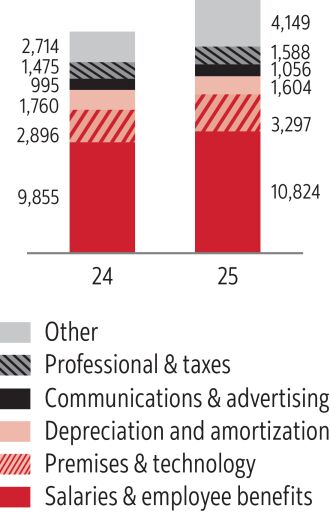
Non-interest expenses were $22,518 million compared to $19,695 million, an increase of $2,823 million or 14%. Adjusted non-interest expenses were $20,581 million compared to $18,961 million, an increase of $1,620 million or 9%. The increase was mainly driven by higher personnel costs, including performance and share-based compensation, inflationary adjustments and annual increases, higher technology and advertising and business development costs to support strategic and regulatory initiatives, as well as the negative impact of foreign currency translation, partly offset by lower depreciation and amortization. Operating leverage was negative 2.2% on a reported basis and positive 3.0% on an adjusted basis.
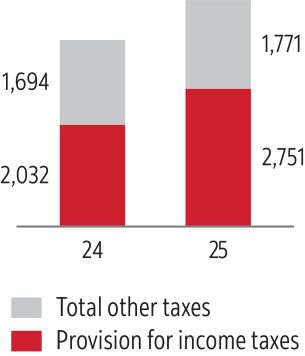
The effective tax rate was 26.2% compared to 20.5% due primarily to the impairment loss related to the announced sale of the banking operations in Colombia, Costa Rica and Panama, lower income in lower tax jurisdictions and the implementation of the Global Minimum Tax (GMT), partially offset by higher non-deductible expenses and the impairment charge on Bank of Xi’an Co in the prior year. On an adjusted basis, the effective tax rate was 23.5% compared to 20.1% primarily due to lower income in lower tax jurisdictions and the implementation of the GMT.
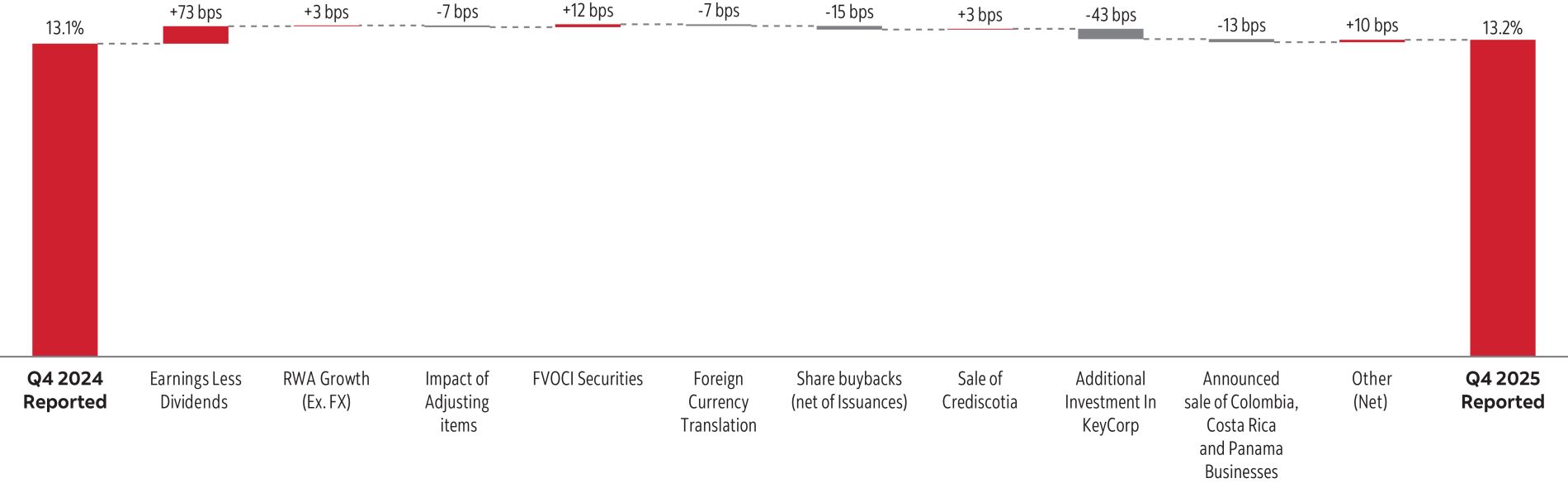
The Basel III Common Equity Tier 1 (CET1) ratio was 13.2% as at October 31, 2025, compared to 13.1% last year.
Medium-term financial objectives
The following table provides a summary of our 2025 performance against our medium-term financial objectives:
| 2025 Results | ||||||||||||
| Reported | Adjusted(1) | |||||||||||
| Diluted earnings per share growth of 7%+ |
(3.4) | % | 9.6% | |||||||||
| Return on equity of 14%+ |
9.7 | % | 11.8% | |||||||||
| Achieve positive operating leverage |
Negative 2.2 | % | Positive 3.0% | |||||||||
| Maintain strong capital ratios |
CET1 capital ratio of 13.2 | % | N/A | |||||||||
| (1) | Refer to Non-GAAP Measures on page 20. |
|
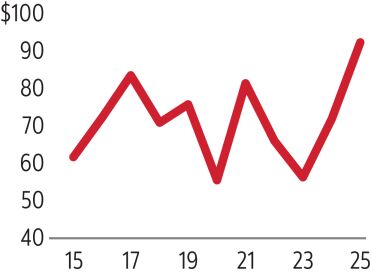
In fiscal 2025, the total shareholder return on the Bank’s shares was 36%, compared to the total return of the S&P/TSX Composite Index of 29%. The total compound annual shareholder return on the Bank’s shares over the past five years was 17.1%, and 9.6% over the past 10 years. This is below the total annual return of the S&P/TSX Composite Index over the past five years and ten years of 17.7% and 11.7%, respectively.
Dividends per share totaled $4.32 for the year, an increase of 1.9% from 2024. The Bank’s target payout range is 40-50%. The dividend payout ratio for the year was 73.7% on a reported basis and 60.7% on an adjusted basis. The Board of Directors approved a quarterly dividend of $1.10 per common share, at its meeting on December 1, 2025. This quarterly dividend applies to shareholders of record at the close of business on January 6, 2026, and is payable January 28, 2026. |
C1 Closing common share price as
|
28 | 2025 Scotiabank Annual Report
Management’s Discussion and Analysis | Overview of Performance
T9 Shareholder returns
| For the years ended October 31 | 2025 | 2024 | ||||||
| Closing market price per common share ($) |
91.99 | 71.69 | ||||||
| Dividends paid ($ per share) |
4.32 | 4.24 | ||||||
| Dividend yield (%)(1) |
5.6 | 6.5 | ||||||
| Increase (decrease) in share price (%) |
28.3 | 27.7 | ||||||
| Total annual shareholder return (%)(1) |
35.7 | 35.9 | ||||||
| (1) | Refer to Glossary on page 136 for the description of the measure. |
Investment in KeyCorp
On December 27, 2024, the Bank completed its acquisition of an approximate ownership interest of 14.9% or 163 million shares in KeyCorp. The acquisition was completed in two stages – an initial investment of 4.9% (Initial Investment) on August 30, 2024, and an additional investment of approximately 10% (Additional Investment) on December 27, 2024. The acquisition was completed through all-cash purchases of newly issued voting common shares, at a fixed price of U.S.$17.17 per share, resulting in total cash consideration paid of approximately U.S.$2.8 billion ($4.1 billion). Following completion of the Additional Investment, the Bank designated two individuals to serve on KeyCorp’s Board of Directors.
Effective December 27, 2024, the combined 14.9% investment was accounted for as an investment in associate as the Bank has significant influence over KeyCorp as defined under IFRS, given its board representation and ownership interest. The Initial Investment of 4.9% previously accounted for at fair value through other comprehensive income was derecognized and included in the cost base of the investment in associate in Q1 2025. The difference between the fixed transaction price and the quoted share price of KeyCorp on the date of Additional Investment (U.S.$17.20) was recognized as a gain in non-interest income – other in Q1 2025, with a corresponding increase in the carrying value of the investment in associate. The carrying amount of the investment in associate upon closing was U.S.$2.8 billion ($4.1 billion), and represents the Bank’s share of KeyCorp’s net assets, adjusted for goodwill and other intangibles. The total impact to the Bank’s common equity Tier 1 (CET1) ratio from the transaction was a decrease of approximately 49 basis points.
For the three and twelve months ended October 31, 2025, $117 million ($111 million after-tax) and $362 million ($338 million after-tax), respectively, was recorded in net income from investments in associated corporations, representing the Bank’s share of KeyCorp’s financial results.
Sale of banking operations in Colombia, Costa Rica and Panama
On January 6, 2025, the Bank entered into an agreement with Davivienda to sell its banking operations in Colombia, Costa Rica and Panama in exchange for an approximately 20% ownership stake in the newly combined entity of Davivienda. The Bank’s ownership will consist of 14.99% voting common shares and the remainder in non-voting preferred shares.
On the date of the agreement, the Bank’s operations that are part of this transaction were classified as held for sale in accordance with IFRS 5 and an impairment loss of $1,362 million ($1,355 million after-tax) was recorded in non-interest expenses – other within the Other operating segment, representing the write-down of goodwill ($589 million), intangibles ($151 million), property and equipment ($290 million) and the remaining in other assets.
As of October 31, 2025, the Bank has recognized a total impairment loss of $1,422 million in non-interest expense and a credit of $45 million in non-interest income (collectively $1,342 million after-tax). The loss was recorded in the Other operating segment. The held for sale operations included total assets of $24 billion and total liabilities of $22 billion, consisting primarily of loans and deposits, and the total cumulative foreign currency translation losses, net of hedges was $249 million.
The total impact of the transaction to the Bank’s CET1 capital ratio was a decrease of approximately 13 basis points as of October 31, 2025.
On December 1, 2025, the Bank completed the sale of its banking operations in Colombia, Costa Rica and Panama to Davivienda Group upon receiving all regulatory approvals and satisfying all customary closing conditions. Following the closing date, the Bank’s investment will be accounted for as an investment in associate since the Bank has significant influence over Davivienda’s combined operations as defined under IFRS, given its board representation and ownership interest. Additionally, total assets and liabilities will be derecognized and the Bank is expected to record a loss in Q1 2026 of approximately $300 million after-tax in the Other segment, primarily relating to the release of cumulative foreign currency translation losses, net of hedges.
The CET1 ratio for Q1 2026 is expected to benefit by approximately 10 basis points, primarily from the reduction in risk-weighted assets, net of the Davivienda Investment.
Strategy, Economic Summary and Outlook
Strategy
The Bank’s strategic vision is to be our clients’ most trusted financial partner and deliver sustainable, profitable growth. Our vision is driven by four strategic pillars:
| (i) | Grow and scale in priority businesses, leveraging connectivity across North America and optimizing capital in lower return businesses. |
| (ii) | Earn more primary clients to build deeper, more meaningful relationships with a focus on value over volume. |
| (iii) | Focus on making it easier for our clients to do business with us and improving experiences, while streamlining and digitizing processes. |
| (iv) | Win as one team by bringing the whole bank to our clients, while building and strengthening our culture where all employees can thrive. |
Our strategy is underpinned by strong risk management practices to keep our bank and our clients safe, and a robust balance sheet that provides flexibility and growth opportunities across changing market conditions.
Economic Summary
The global economic landscape continues to be shaped by developments in U.S. trade policy. While there is now a better sense of the tariff landscape, there remains much uncertainty about how these changes in trade policy will impact economies and financial markets. There is accumulating evidence that these policies and the associated uncertainty are weighing more heavily on the U.S. than on many other countries. In many countries fiscal packages will dampen but not eliminate the macroeconomic consequences of the tariffs on the U.S. and its trading partners.
2025 Scotiabank Annual Report | 29
Management’s Discussion and Analysis
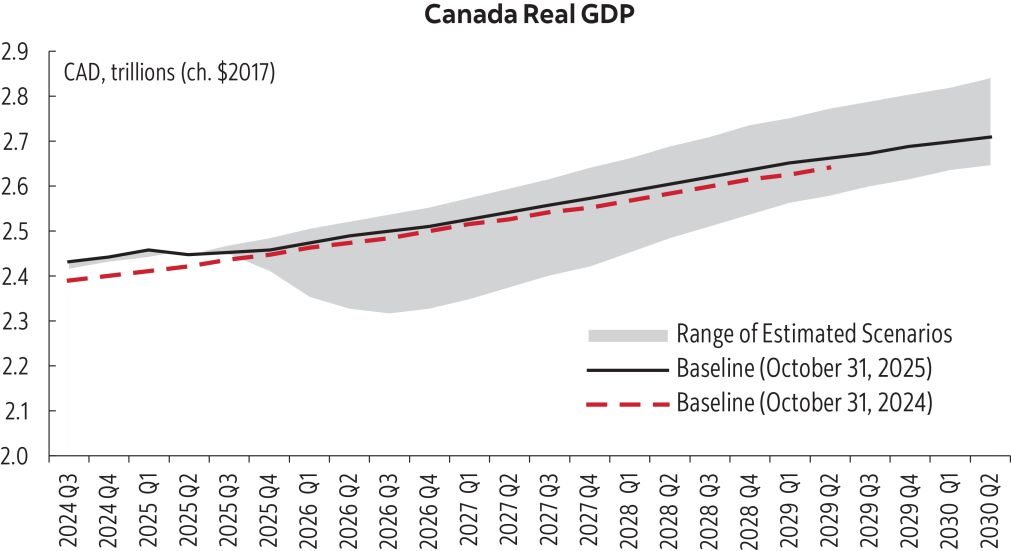
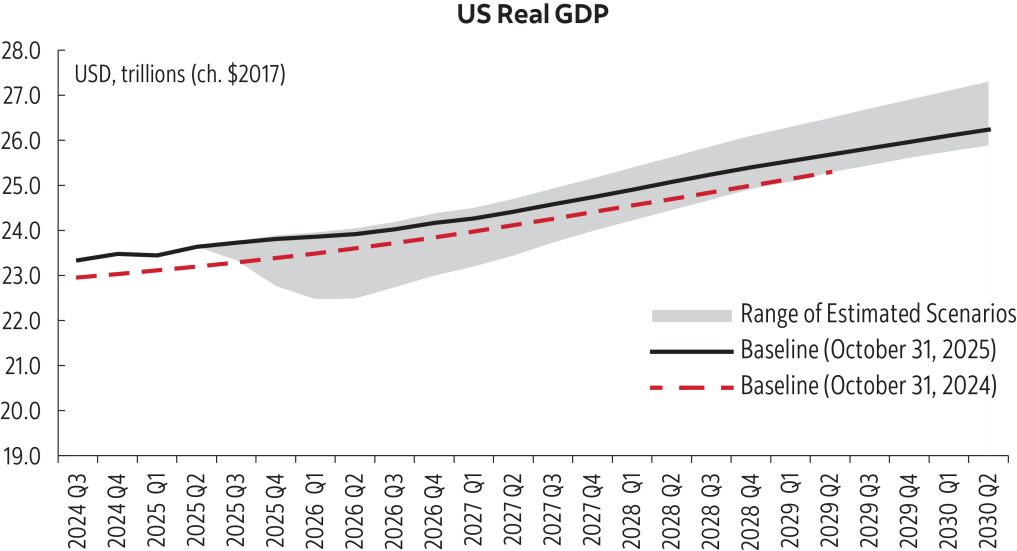
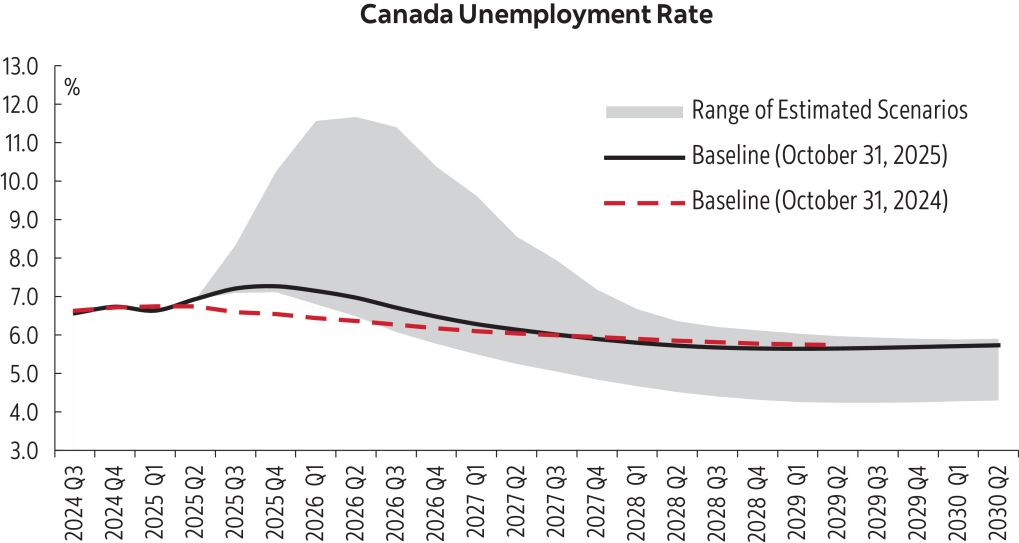
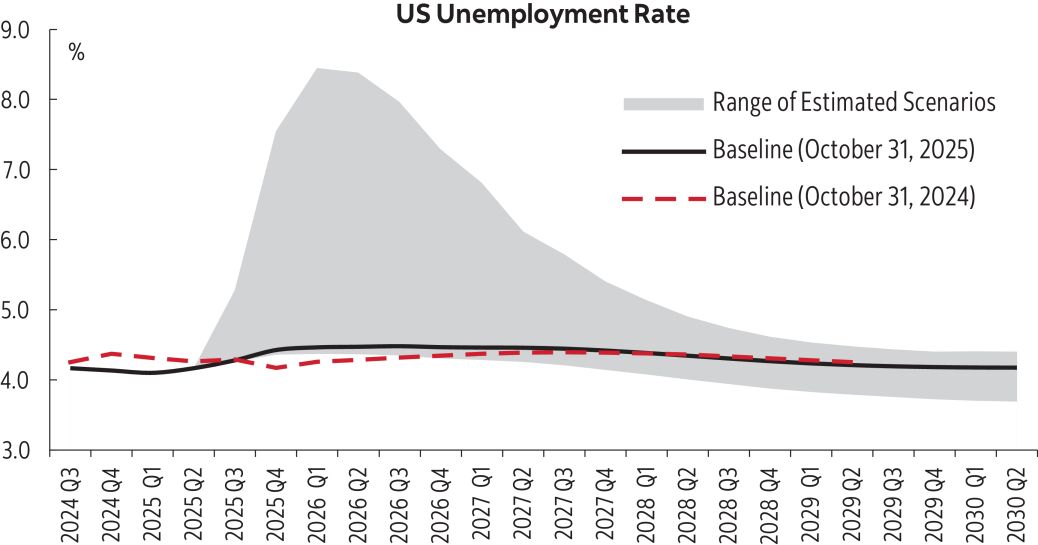
The U.S. Federal Reserve is expected to lower its policy rate through the first half of 2026. Though inflation remains elevated, there are clear signs of a slowdown in the non-technological sectors of the U.S. economy. The labour market is softening and there are rising indications of economic damage in the goods sector of the U.S. economy even though this weakness is masked by rapid investments in the technology sector. This sluggishness suggests the Federal Reserve will lower interest rates by another 100 basis points in coming months. The U.S. will nevertheless maintain a significantly tighter stance relative to other central banks as the U.S. economy adapts to a higher tariff and inflation environment. Restrictive monetary policy and uncertainty surrounding the impact of tariffs are leading to modest growth this year before the economy benefits from some fiscal support next year. The economy is expected to grow by 1.9% in 2025 and 1.6% in 2026.
U.S. trade policy is also significantly impacting Canada. The direct impact of the tariffs on Canadian goods, the uncertainty caused by U.S. policies and the indirect impacts on Canada of a weaker U.S. economy will weigh on growth this year and next. Policy measures announced by the Federal government are likely to provide some offset to the headwinds coming from the U.S. economy, notably as they relate to private investment. This should lead to growth of 1.4% next year, stronger than the 1.2% expected in 2025. There are upside risks to this forecast if, as expected, additional measures are announced as part of the Federal government’s plan to transform the economy. Given that inflation remains above the Bank of Canada’s target, we anticipate the Bank of Canada will remain on hold through the first half of 2026 and subsequently raise its policy rate by 50 basis points by the end of next year.
Latin American economies are moving at different speeds, faced with divergent performances at home and varying impacts from developments in the global economy. Mexico’s economy, already facing weak domestic demand, has been further weighed by U.S. tariffs and softer growth stateside that leave it on track for only a marginal expansion in 2025 and weak growth in 2026. The country’s central bank has also used up most of its easing space, leaving Mexican households and businesses with little additional policy support. Peru’s economy continues to exceed expectations with strong growth and low inflation, as the country mostly benefits from strong copper and gold prices boosting export revenues. Growth should remain firm next year despite some uncertainty and headwinds associated with April elections. Chile has also not faced a significant direct impact from U.S. tariffs, with domestic conditions remaining firm thanks to positive investment trends. The result of December’s second round presidential election vote remains uncertain – with important implications for 2026’s economic performance. In the Caribbean, Jamaican and Dominican Republic economic activity will be affected by the impacts of Hurricane Melissa which caused significant damage in both countries. Jamaica was more heavily impacted by the hurricane and rebuilding efforts will be substantial. This should eventually lead to a strong rebound in activity, but the near-term consequences of the hurricane will weigh on the outlook.
Outlook
The Bank expects to generate strong earnings growth in 2026. Strong revenue growth, excluding the impact of divestitures, is underpinned by growth in both net interest income and non-interest revenue. Higher net interest income is expected to be driven by both loan and deposit growth and net interest margin expansion. Non-interest revenue is expected to grow across all business segments. Earnings are expected to also benefit from lower provision for credit losses, partially offset by the impact of a higher tax rate. The Bank expects modest expense growth, excluding the impact of divestitures, as technology spend to strengthen and strategically grow the Bank will be partly offset by the benefit from productivity initiatives. The Bank is expected to generate positive operating leverage. The capital and liquidity metrics are expected to remain strong in 2026.
Impact of Foreign Currency Translation
The impact of foreign currency translation on net income is shown in the table below.
T10 Impact of foreign currency translation
| 2025 | 2024 | |||||||||||||||
| For the fiscal years | Average exchange rate |
% Change | Average exchange rate |
% Change | ||||||||||||
| U.S. Dollar/Canadian Dollar |
0.714 | (2.9 | )% | 0.735 | (0.9 | )% | ||||||||||
| Mexican Peso/Canadian Dollar |
13.950 | 6.6 | % | 13.091 | (2.5 | )% | ||||||||||
| Peruvian Sol/Canadian Dollar |
2.593 | (5.9 | )% | 2.757 | (1.1 | )% | ||||||||||
| Colombian Peso/Canadian Dollar |
2,964.017 | 0.7 | % | 2,943.081 | (11.1 | )% | ||||||||||
| Chilean Peso/Canadian Dollar |
685.697 | 0.5 | % | 682.082 | 9.2 | % | ||||||||||
| Impact on net income(1) ($ millions except EPS) | 2025 vs. 2024 |
2024 vs. 2023 |
||||||
| Net interest income |
$ | (11 | ) | $ | (31 | ) | ||
| Non-interest income(2) |
(70 | ) | 243 | |||||
| Non-interest expenses |
(45 | ) | (70 | ) | ||||
| Other items (net of tax)(2) |
41 | (56 | ) | |||||
| Net income |
$ | (85 | ) | $ | 86 | |||
| Earnings per share (diluted) |
$ | (0.07 | ) | $ | 0.07 | |||
| Impact by business line ($ millions)(3) |
||||||||
| Canadian Banking |
$ | 4 | $ | 2 | ||||
| International Banking(2) |
1 | 90 | ||||||
| Global Wealth Management |
(2 | ) | – | |||||
| Global Banking and Markets |
24 | 5 | ||||||
| Other(2) |
(112 | ) | (11 | ) | ||||
| $ | (85 | ) | $ | 86 | ||||
| (1) | Includes impact of all currencies. |
| (2) | Includes the impact of foreign currency hedges. |
| (3) | Effective Q1 2025, changes were made to the methodology used to allocate certain income, expenses and balance sheet items between business segments. Prior period results for each segment have been reclassified to conform with the current period’s methodology. Refer to page 42 for further details. |
30 | 2025 Scotiabank Annual Report
Management’s Discussion and Analysis | Overview of Performance
On January 6, 2025, the Bank announced the sale of its banking operations in Colombia, Costa Rica and Panama to Davivienda Group. The sale was completed on December 1, 2025 upon receiving all regulatory approvals and satisfying all customary closing conditions. In addition, on February 28, 2025, the Bank completed the sale of CrediScotia Financiera S.A. (Peru), which was announced in fiscal 2024. The table below reflects the earnings impact of these operations in the current and prior fiscal year. For further details on divestitures, refer to Note 35 in the accompanying consolidated financial statements.
T11 Impact of divested operations
| ($ millions) | 2025 | 2024 | ||||||
| Net interest income |
$ | 1,055 | $ | 1,169 | ||||
| Non-interest income |
568 | 596 | ||||||
| Total revenue |
1,623 | 1,765 | ||||||
| Provision for credit losses |
473 | 742 | ||||||
| Non-interest expenses |
1,009 | 1,113 | ||||||
| Income before taxes |
141 | (90 | ) | |||||
| Income tax expense (recovery) |
56 | (29 | ) | |||||
| Net income (loss) |
$ | 85 | $ | (61 | ) | |||
| Net income (loss) attributable to non-controlling interests (NCI) |
11 | (49 | ) | |||||
| Net income (loss) attributable to equity holders - relating to divested operations |
$ | 74 | $ | (12 | ) | |||
| Average Loans ($ billions) |
18 | 18 | ||||||
| Average Deposits ($ billions) |
$ | 18 | $ | 17 | ||||
2025 Scotiabank Annual Report | 31
Management’s Discussion and Analysis
GROUP FINANCIAL PERFORMANCE
T12 Group financial performance
| As at October 31 ($ millions) | 2025 | 2024 | ||||||
| Reported Results |
||||||||
| Net interest income |
$ | 21,522 | $ | 19,252 | ||||
| Non-interest income |
16,219 | 14,418 | ||||||
| Total revenue |
37,741 | 33,670 | ||||||
| Provision for credit losses |
4,714 | 4,051 | ||||||
| Non-interest expenses |
22,518 | 19,695 | ||||||
| Income before taxes |
10,509 | 9,924 | ||||||
| Income tax expense |
2,751 | 2,032 | ||||||
| Net income |
$ | 7,758 | $ | 7,892 | ||||
| Net income attributable to non-controlling interests in subsidiaries (NCI) |
$ | (31 | ) | $ | 134 | |||
| Net income attributable to equity holders of the Bank |
$ | 7,789 | $ | 7,758 | ||||
| Other Financial Data and Measures |
||||||||
| Return on Equity(1) |
9.7 | % | 10.2 | % | ||||
| Net interest margin(2) |
2.33 | % | 2.16 | % | ||||
| Effective tax rate(1) |
26.2 | % | 20.5 | % | ||||
| Provision for credit losses – performing (Stage 1 and 2) |
$ | 581 | $ | 121 | ||||
| Provision for credit losses – impaired (Stage 3) |
$ | 4,133 | $ | 3,930 | ||||
| Provision for credit losses as a percentage of average net loans and acceptances (annualized)(1) |
0.62 | % | 0.53 | % | ||||
| Provision for credit losses on impaired loans as a percentage of average net loans and acceptances (annualized)(1) |
0.54 | % | 0.52 | % | ||||
| Net write-offs as percentage of average net loans and acceptances (annualized)(1) |
0.50 | % | 0.46 | % | ||||
| (1) | Refer to Glossary on page 136 for the description of the measure. |
| (2) | Refer to Non-GAAP Measures starting on page 20. |
T12A Adjusted Group financial performance(1)
| As at October 31 ($ millions) | 2025 | 2024 | ||||||
| Adjusted Results |
||||||||
| Net interest income |
$ | 21,522 | $ | 19,252 | ||||
| Non-interest income |
16,209 | 14,561 | ||||||
| Total revenue |
37,731 | 33,813 | ||||||
| Provision for credit losses |
4,714 | 4,051 | ||||||
| Non-interest expenses |
20,581 | 18,961 | ||||||
| Income before taxes |
12,436 | 10,801 | ||||||
| Income tax expense |
2,926 | 2,174 | ||||||
| Net income |
$ | 9,510 | $ | 8,627 | ||||
| Net income attributable to non-controlling interests in subsidiaries (NCI) |
$ | 160 | $ | 136 | ||||
| Net income attributable to equity holders of the Bank |
$ | 9,350 | $ | 8,491 | ||||
| (1) | Refer to Non-GAAP Measures starting on page 20. |
Net income was $7,758 million compared to $7,892 million, a decrease of 2%. The decrease was driven primarily by higher non-interest expenses, income taxes and provision for credit losses, partly offset by higher net interest income and non-interest income.
Adjusted net income was $9,510 million compared to $8,627 million, an increase of 10%. The increase was driven primarily by higher net interest income and non-interest income, partly offset by higher non-interest expenses, income taxes and provision for credit losses.
Net interest income was $21,522 million compared to $19,252 million, an increase of $2,270 million or 12% due primarily to a higher net interest margin, and loan growth inclusive of the conversion of bankers’ acceptances to loans resulting from the cessation of CDOR in June 2024 (“BA conversion”). Higher net interest income was driven by the Other segment due mainly to lower funding costs, as well as increases in Canadian Banking from asset and deposit growth, Global Banking and Markets driven by higher contribution from capital market activities, higher corporate lending margins and deposit growth and Global Wealth Management from strong loan growth, and higher margins and growth in deposits.
The net interest margin was 2.33%, an increase of 17 basis points primarily from significantly lower funding costs driven by central bank rate cuts and higher margins in Global Banking and Markets. This was partly offset by lower deposit margins in Canadian Banking, and increased levels of high quality, lower yielding treasury assets.
32 | 2025 Scotiabank Annual Report
Management’s Discussion and Analysis | Group Financial Performance
T13 Average balance sheet(1) and net interest income
| 2025 | 2024 | |||||||||||||||||||||||
| For the fiscal years ($ billions) | Average balance |
Interest | Average rate |
Average balance |
Interest | Average rate |
||||||||||||||||||
| Assets |
||||||||||||||||||||||||
| Deposits with financial institutions |
$ | 67.9 | $ | 2.6 | 3.77 | % | $ | 64.5 | $ | 3.1 | 4.79 | % | ||||||||||||
| Trading assets |
153.3 | 1.1 | 0.73 | % | 146.3 | 1.7 | 1.13 | % | ||||||||||||||||
| Securities purchased under resale agreements and securities borrowed |
209.3 | 2.8 | 1.34 | % | 193.1 | 1.6 | 0.83 | % | ||||||||||||||||
| Investment securities |
157.2 | 6.8 | 4.34 | % | 147.6 | 7.5 | 5.09 | % | ||||||||||||||||
| Loans: |
||||||||||||||||||||||||
| Residential mortgages |
359.0 | 15.8 | 4.40 | % | 343.6 | 16.0 | 4.67 | % | ||||||||||||||||
| Personal loans |
107.4 | 8.2 | 7.64 | % | 105.5 | 8.8 | 8.32 | % | ||||||||||||||||
| Credit cards |
17.5 | 3.2 | 18.18 | % | 17.3 | 3.2 | 18.53 | % | ||||||||||||||||
| Business and government |
285.0 | 17.1 | 6.00 | % | 289.9 | 19.8 | 6.82 | % | ||||||||||||||||
| Allowance for credit losses |
(7.1 | ) | (6.6 | ) | ||||||||||||||||||||
| Total loans |
$ | 761.8 | $ | 44.3 | 5.81 | % | $ | 749.7 | $ | 47.8 | 6.38 | % | ||||||||||||
| Customers’ liability under acceptances |
0.1 | 10.0 | ||||||||||||||||||||||
| Total average earning assets(2) |
$ | 1,349.6 | $ | 57.6 | 4.27 | % | $ | 1,311.2 | $ | 61.7 | 4.70 | % | ||||||||||||
| Other assets |
115.7 | 108.1 | ||||||||||||||||||||||
| Total average assets |
$ | 1,465.3 | $ | 57.6 | 3.93 | % | $ | 1,419.3 | $ | 61.7 | 4.34 | % | ||||||||||||
| Liabilities and equity |
||||||||||||||||||||||||
| Deposits: |
||||||||||||||||||||||||
| Personal |
$ | 299.9 | $ | 7.9 | 2.65 | % | $ | 292.4 | $ | 9.5 | 3.25 | % | ||||||||||||
| Business and government |
619.0 | 24.1 | 3.89 | % | 610.2 | 28.2 | 4.63 | % | ||||||||||||||||
| Financial institutions |
43.0 | 1.4 | 3.28 | % | 49.1 | 1.8 | 3.58 | % | ||||||||||||||||
| Total deposits |
$ | 961.9 | $ | 33.4 | 3.47 | % | $ | 951.7 | $ | 39.5 | 4.15 | % | ||||||||||||
| Obligations related to securities sold under repurchase agreements and securities lent |
208.9 | 0.6 | 0.28 | % | 176.2 | 0.7 | 0.40 | % | ||||||||||||||||
| Subordinated debentures |
7.8 | 0.4 | 4.93 | % | 8.5 | 0.5 | 5.74 | % | ||||||||||||||||
| Other interest-bearing liabilities |
70.6 | 1.7 | 2.38 | % | 73.0 | 1.7 | 2.37 | % | ||||||||||||||||
| Total interest-bearing liabilities |
$ | 1,249.2 | $ | 36.1 | 2.89 | % | $ | 1,209.4 | $ | 42.4 | 3.51 | % | ||||||||||||
| Financial instruments designated at fair value through profit or loss |
40.8 | 33.5 | ||||||||||||||||||||||
| Other liabilities including acceptances |
89.5 | 94.9 | ||||||||||||||||||||||
| Equity(3) |
85.8 | 81.5 | ||||||||||||||||||||||
| Total liabilities and equity |
$ | 1,465.3 | $ | 36.1 | 2.46 | % | $ | 1,419.3 | $ | 42.4 | 2.99 | % | ||||||||||||
| Net interest income |
$ | 21.5 | $ | 19.3 | ||||||||||||||||||||
| (1) | Average of daily balances. |
| (2) | Refer to Non-GAAP Measures on Page 20. |
| (3) | Includes non-controlling interest of $1.7 (2024 – $1.7). |
2025 Scotiabank Annual Report | 33
Management’s Discussion and Analysis
T14 Non-interest income
| For the fiscal years ($ millions) | 2025 | 2024 | 2025 versus 2024 |
|||||||||
| Banking |
||||||||||||
| Card revenues |
$ | 892 | $ | 869 | 3 | % | ||||||
| Banking services fees |
1,997 | 1,955 | 2 | |||||||||
| Credit fees |
1,249 | 1,585 | (21 | ) | ||||||||
| Total banking revenues |
$ | 4,138 | $ | 4,409 | (6 | )% | ||||||
| Wealth management |
||||||||||||
| Mutual funds |
$ | 2,564 | $ | 2,282 | 12 | % | ||||||
| Brokerage fees |
1,436 | 1,251 | 15 | |||||||||
| Investment management and trust |
||||||||||||
| Investment management and custody |
902 | 840 | 7 | |||||||||
| Personal and corporate trust |
260 | 256 | 2 | |||||||||
| 1,162 | 1,096 | 6 | ||||||||||
| Total wealth management revenues |
$ | 5,162 | $ | 4,629 | 12 | % | ||||||
| Underwriting and advisory fees |
964 | 702 | 37 | |||||||||
| Non-trading foreign exchange |
948 | 930 | 2 | |||||||||
| Trading revenues |
1,984 | 1,634 | 21 | |||||||||
| Net gain on sale of investment securities |
71 | 48 | 48 | |||||||||
| Net income from investments in associated corporations |
608 | 198 | 207 | |||||||||
| Insurance service results |
485 | 470 | 3 | |||||||||
| Other fees and commissions |
1,653 | 1,247 | 33 | |||||||||
| Other |
206 | 151 | 36 | |||||||||
| Total non-interest income |
$ | 16,219 | $ | 14,418 | 12 | % | ||||||
| Non-GAAP Adjusting items(1) |
||||||||||||
| Divestitures and wind-down of operations(2) |
(36 | ) | 143 | |||||||||
| Amortization of acquisition-related intangible assets(3) |
26 | – | ||||||||||
| Adjusted non-interest income(1) |
$ | 16,209 | $ | 14,561 | 11 | % | ||||||
| (1) | Refer to Non-GAAP Measures on page 20. |
| (2) | Recorded in Other Non-interest Income. |
| (3) | Recorded in net income from investments in associated corporations. |
| C2 | Sources of non-interest income in 2025 |
|
|
Non-interest income was $16,219 million, an increase of $1,801 million or 12%. Adjusted non-interest income was $16,209 million, an increase of $1,648 million or 11%. The increase was driven mainly by higher wealth management revenue, trading related revenues, underwriting and advisory fees, and net income from associated corporations, partially offset by lower banking revenues.
Wealth management revenues increased $533 million or 12% from higher mutual fund revenues, brokerage fees, and investment management and trust revenues.
Net income from investments in associated corporations increased $436 million or 220%, primarily related to the KeyCorp investment.
Other fee and commissions revenue increased $406 million or 33%, due mainly to higher volume of securities borrowing and lending activities.
Underwriting and advisory fees increased $262 million or 37%, due mainly to higher new issuance activities in equity and debt capital markets.
Trading revenues increased $350 million or 21%, due mainly to higher client-driven trading activity in Global Banking and Markets related to fixed income and currency trading, net of lower equities trading, as well as higher trading revenues in International Banking.
Banking revenues decreased $271 million or 6%, due mainly to lower credit fees from banker’s acceptances, partly offset by higher deposit and payment services fees and higher card revenues.
34 | 2025 Scotiabank Annual Report
Management’s Discussion and Analysis | Group Financial Performance
T15 Trading-related revenues(1)
| For the fiscal years ($ millions) | 2025 | 2024(2) | ||||||
| Trading-related revenue (TEB)(3) |
||||||||
| Net interest income |
$ | (3 | ) | $ | (252 | ) | ||
| Non-interest income |
||||||||
| Trading revenues |
1,984 | 1,686 | ||||||
| Other fees and commissions |
1,006 | 613 | ||||||
| Total trading-related revenue (TEB) |
$ | 2,987 | $ | 2,047 | ||||
| Taxable equivalent adjustment |
– | (52 | ) | |||||
| Trading-related revenue (Non-TEB) |
$ | 2,987 | $ | 1,995 | ||||
| (1) | Refer to Non-GAAP Measures on page 20. |
| (2) | Effective Q1 2025, changes were made to the methodology used to allocate certain income, expenses and balance sheet items between business segments. Prior period results for each segment have been reclassified to conform with the current period’s methodology. Refer to page 42 for further details. |
| (3) | Trading-related revenue consists of net interest income and non-interest income. Included are unrealized gains and losses on trading security positions held, realized gains and losses from the purchase and sale of trading securities, fees and commissions from securities borrowing and lending activities, and gains and losses on trading derivatives. Underwriting and other advisory fees, which are shown separately in the Consolidated Statement of Income, are excluded. |
The provision for credit losses was $4,714 million compared to $4,051 million, an increase of $663 million. The provision for credit losses ratio was 62 basis points compared to 53 basis points. This was due mainly to higher provisions on performing loans, primarily in the Canadian Banking and International Banking portfolios, as well as impaired loans mainly in Canadian Banking.
The provision for credit losses on performing loans was $581 million compared to $121 million. The provision increased by $460 million driven by the impact of credit migration, an unfavourable macroeconomic outlook primarily driven by the U.S. tariffs, as well as business growth, mainly in the International retail portfolio.
The provision for credit losses on impaired loans was $4,133 million compared to $3,930 million. The provision for credit losses ratio on impaired loans was 54 basis points compared to 52 basis points. The increase in provision this year was due primarily to higher formations in Canadian Banking.
T16 Provision for credit losses by business line
| 2025 | 2024 | |||||||||||||||||||||||
| For the fiscal years ($ millions) | Performing (Stage 1 and 2) |
Impaired (Stage 3) |
Total | Performing (Stage 1 and 2) |
Impaired (Stage 3) |
Total | ||||||||||||||||||
| Canadian Banking |
||||||||||||||||||||||||
| Retail |
$ | 291 | $ | 1,419 | $ | 1,710 | $ | 109 | $ | 1,257 | $ | 1,366 | ||||||||||||
| Commercial |
108 | 475 | 583 | 18 | 307 | 325 | ||||||||||||||||||
| Total |
399 | 1,894 | 2,293 | 127 | 1,564 | 1,691 | ||||||||||||||||||
| International Banking |
||||||||||||||||||||||||
| Retail |
66 | 1,872 | 1,938 | (138 | ) | 2,040 | 1,902 | |||||||||||||||||
| Commercial |
62 | 308 | 370 | 89 | 297 | 386 | ||||||||||||||||||
| Total |
128 | 2,180 | 2,308 | (49 | ) | 2,337 | 2,288 | |||||||||||||||||
| Global Wealth Management |
9 | 5 | 14 | 3 | 24 | 27 | ||||||||||||||||||
| Global Banking and Markets |
43 | 54 | 97 | 43 | 5 | 48 | ||||||||||||||||||
| Other |
1 | – | 1 | – | – | – | ||||||||||||||||||
| Provision for credit losses on loans, acceptances and off-balance sheet exposures |
$ | 580 | $ | 4,133 | $ | 4,713 | $ | 124 | $ | 3,930 | $ | 4,054 | ||||||||||||
| International Banking |
$ | 1 | $ | – | $ | 1 | $ | (3 | ) | $ | – | $ | (3 | ) | ||||||||||
| Global Wealth Management |
– | – | – | – | – | – | ||||||||||||||||||
| Global Banking and Markets |
– | – | – | (1 | ) | – | (1 | ) | ||||||||||||||||
| Other |
– | – | – | 1 | – | 1 | ||||||||||||||||||
| Provision for credit losses on debt securities and deposits with banks |
$ | 1 | $ | – | $ | 1 | $ | (3 | ) | $ | – | $ | (3 | ) | ||||||||||
| Total provision for credit losses |
$ | 581 | $ | 4,133 | $ | 4,714 | $ | 121 | $ | 3,930 | $ | 4,051 | ||||||||||||
2025 Scotiabank Annual Report | 35
Management’s Discussion and Analysis
T16A Provision for credit losses against impaired financial instruments by business line
| For the fiscal years ($ millions) | 2025 | 2024 | ||||||
| Canadian Banking |
||||||||
| Retail |
$ | 1,419 | $ | 1,257 | ||||
| Commercial |
475 | 307 | ||||||
| $ | 1,894 | $ | 1,564 | |||||
| International Banking |
||||||||
| Caribbean and Central America |
$ | 212 | $ | 194 | ||||
| Latin America |
||||||||
| Mexico |
489 | 404 | ||||||
| Peru |
392 | 554 | ||||||
| Chile |
639 | 587 | ||||||
| Colombia |
392 | 532 | ||||||
| Other Latin America |
56 | 66 | ||||||
| Total Latin America |
1,968 | 2,143 | ||||||
| $ | 2,180 | $ | 2,337 | |||||
| Global Wealth Management |
$ | 5 | $ | 24 | ||||
| Global Banking and Markets |
||||||||
| Canada |
$ | 12 | $ | (12 | ) | |||
| U.S. |
44 | 24 | ||||||
| Asia and Europe |
(2 | ) | (7 | ) | ||||
| $ | 54 | $ | 5 | |||||
| Total |
$ | 4,133 | $ | 3,930 | ||||
T17 Provision for credit losses as a percentage of average net loans and acceptances(1)(2)
| For the fiscal years (%) | 2025 | 2024 | ||||||
| Canadian Banking |
||||||||
| Retail |
0.47 | % | 0.39 | % | ||||
| Commercial |
0.62 | 0.35 | ||||||
| 0.50 | 0.38 | |||||||
| International Banking |
||||||||
| Retail |
2.40 | 2.42 | ||||||
| Commercial |
0.45 | 0.44 | ||||||
| 1.41 | 1.37 | |||||||
| Global Wealth Management |
0.05 | 0.11 | ||||||
| Global Banking and Markets |
0.08 | 0.04 | ||||||
| Provisions against impaired loans |
0.54 | 0.52 | ||||||
| Provisions against performing loans |
0.08 | 0.01 | ||||||
| Provision for credit losses as a percentage of average net loans and acceptances |
0.62 | % | 0.53 | % | ||||
| (1) | Includes provision for credit losses on certain financial assets - loans, acceptances, and off-balance sheet exposures. |
| (2) | Refer to Glossary on page 136 for the description of the measure. |
T18 Net write-offs(1) as a percentage of average net loans and acceptances(2)
| For the fiscal years (%) | 2025 | 2024 | ||||||
| Canadian Banking |
||||||||
| Retail |
0.38 | % | 0.34 | % | ||||
| Commercial |
0.41 | 0.26 | ||||||
| 0.38 | 0.32 | |||||||
| International Banking |
||||||||
| Retail |
2.21 | 2.43 | ||||||
| Commercial |
0.22 | 0.20 | ||||||
| 1.21 | 1.25 | |||||||
| Global Wealth Management |
0.03 | 0.05 | ||||||
| Global Banking and Markets |
0.06 | – | ||||||
| Total |
0.50 | % | 0.46 | % | ||||
| (1) | Write-offs net of recoveries. |
| (2) | Refer to Glossary on page 136 for the description of the measure. |
36 | 2025 Scotiabank Annual Report
Management’s Discussion and Analysis | Group Financial Performance
T19 Non-interest expenses and productivity
| For the fiscal years ($ millions) | 2025 | 2024 | 2025 versus 2024 |
|||||||||
| Salaries and employee benefits |
||||||||||||
| Salaries |
$ | 6,040 | $ | 5,663 | 7 | % | ||||||
| Performance-based compensation |
2,591 | 2,170 | 19 | |||||||||
| Share-based payments |
407 | 371 | 10 | |||||||||
| Other employee benefits |
1,786 | 1,651 | 8 | |||||||||
| $ | 10,824 | $ | 9,855 | 10 | % | |||||||
| Premises and technology |
||||||||||||
| Premises |
558 | 571 | (2 | ) | ||||||||
| Technology |
2,739 | 2,325 | 18 | |||||||||
| $ | 3,297 | $ | 2,896 | 14 | % | |||||||
| Depreciation and amortization |
||||||||||||
| Depreciation |
683 | 730 | (6 | ) | ||||||||
| Amortization of intangible assets |
921 | 1,030 | (11 | ) | ||||||||
| $ | 1,604 | $ | 1,760 | (9 | )% | |||||||
| Communications |
$ | 384 | $ | 381 | 1 | % | ||||||
| Advertising and business development |
$ | 672 | $ | 614 | 9 | % | ||||||
| Professional |
$ | 880 | $ | 793 | 11 | % | ||||||
| Business and capital taxes |
||||||||||||
| Business taxes |
626 | 617 | 1 | |||||||||
| Capital taxes |
82 | 65 | 26 | |||||||||
| $ | 708 | $ | 682 | 4 | % | |||||||
| Other |
$ | 4,149 | $ | 2,714 | 53 | % | ||||||
| Total non-interest expenses |
$ | 22,518 | $ | 19,695 | 14 | % | ||||||
| Non-GAAP adjusting items(1): |
||||||||||||
| Divestitures and wind-down of operations |
(1,422 | ) | 7 | |||||||||
| Restructuring charge and severance provisions |
(373 | ) | (53 | ) | ||||||||
| Legal provision |
(74 | ) | (176 | ) | ||||||||
| Amortization of acquisition-related intangible assets |
(68 | ) | (72 | ) | ||||||||
| Impairment of non-financial assets |
– | (440 | ) | |||||||||
| (1,937 | ) | (734 | ) | |||||||||
| Recorded in: |
||||||||||||
| Salaries and employee benefits |
(54 | ) | (46 | ) | ||||||||
| Depreciation and amortization |
(78 | ) | (169 | ) | ||||||||
| Professional |
(34 | ) | – | |||||||||
| Other |
(1,771 | ) | (519 | ) | ||||||||
| (1,937 | ) | (734 | ) | |||||||||
| Adjusted non-interest expenses(1) |
$ | 20,581 | $ | 18,961 | 9 | % | ||||||
| Productivity ratio(2) |
59.7 | % | 58.5 | % | ||||||||
| Adjusted productivity ratio(1) |
54.5 | % | 56.1 | % | ||||||||
| (1) | Refer to Non-GAAP Measures starting on page 20. |
| (2) | Refer to Glossary on page 136 for the description of the measure. |
| C3 | Non-interest expenses $ millions |
|
|
| C4 | Direct and indirect taxes $ millions |
|
|
Non-interest expenses were $22,518 million compared to $19,695 million, an increase of $2,823 million or 14%. Included in non-interest expenses is an impairment loss of $1,422 million related to the announced sale of the banking operations in Colombia, Costa Rica and Panama, restructuring charge and severance provisions of $373 million and legal provisions of $74 million.
Adjusted non-interest expenses were $20,581 million compared to $18,961 million, an increase of $1,620 million or 9%. The increase was mainly driven by higher personnel costs, including performance and share-based compensation, inflationary adjustments and annual increases, higher technology and advertising and business development costs to support strategic and regulatory initiatives, as well as the negative impact of foreign currency translation, partly offset by lower depreciation and amortization.
The technology costs reflect the Bank’s medium-term commitment to modernize and scale data and analytics capabilities, cloud migration, and end-to-end digitization, as well as continued investment in core foundational enterprise security and architecture.
The productivity ratio was 59.7% compared to 58.5%. The adjusted productivity ratio was 54.5% compared to 56.1%. Operating leverage was negative 2.2% on a reported basis and positive 3.0% on an adjusted basis.
The effective tax rate was 26.2% compared to 20.5% due primarily to the impairment loss related to the announced sale of the banking operations in Colombia, Costa Rica and Panama, lower income in lower tax jurisdictions and the implementation of the Global Minimum Tax (GMT), partially offset by higher non-deductible expenses and the impairment charge on Bank of Xi’an Co in the prior year. On an adjusted basis, the effective tax rate was 23.5% compared to 20.1% primarily due to lower income in lower tax jurisdictions and the implementation of the GMT.
2025 Scotiabank Annual Report | 37
Management’s Discussion and Analysis
T20 Fourth quarter financial results
| For the three months ended | ||||||||||||
| ($ millions) | October 31 2025 |
July 31 2025 |
October 31 2024 |
|||||||||
| Reported Results |
||||||||||||
| Net interest income |
$ | 5,586 | $ | 5,493 | $ | 4,923 | ||||||
| Non-interest income |
4,217 | 3,993 | 3,603 | |||||||||
| Total revenue |
9,803 | 9,486 | 8,526 | |||||||||
| Provision for credit losses |
1,113 | 1,041 | 1,030 | |||||||||
| Non-interest expenses |
5,828 | 5,089 | 5,296 | |||||||||
| Income tax expense |
656 | 829 | 511 | |||||||||
| Net income |
$ | 2,206 | $ | 2,527 | $ | 1,689 | ||||||
| Net income attributable to non-controlling interests in subsidiaries (NCI) |
(13 | ) | 80 | 47 | ||||||||
| Net income attributable to equity holders of the Bank |
$ | 2,219 | $ | 2,447 | $ | 1,642 | ||||||
| Preferred shareholders and other equity instrument holders |
115 | 134 | 121 | |||||||||
| Common shareholders |
2,104 | 2,313 | 1,521 | |||||||||
| Adjustments(1) |
||||||||||||
| Adjusting items impacting non-interest income and total revenue (Pre-tax) |
||||||||||||
| Divestitures and wind-down of operations |
$ | (45 | ) | $ | – | $ | – | |||||
| Amortization of acquisition-related intangible assets |
9 | 8 | – | |||||||||
| Total non-interest income adjusting items (Pre-tax) |
(36 | ) | 8 | – | ||||||||
| Adjusting items impacting non-interest expenses (Pre-tax) |
||||||||||||
| Divestitures and wind-down of operations |
57 | (23 | ) | – | ||||||||
| Restructuring charge and severance provisions |
373 | – | 53 | |||||||||
| Legal provision |
74 | – | – | |||||||||
| Amortization of acquisition-related intangible assets |
16 | 17 | 19 | |||||||||
| Impairment of non-financial assets |
– | – | 440 | |||||||||
| Total non-interest expense adjusting items (Pre-tax) |
520 | (6 | ) | 512 | ||||||||
| Total impact of adjusting items on net income before taxes |
484 | 2 | 512 | |||||||||
| Impact of adjusting items on income tax expense |
||||||||||||
| Divestitures and wind-down of operations |
(4 | ) | (6 | ) | – | |||||||
| Restructuring charge and severance provisions |
(103 | ) | – | (15 | ) | |||||||
| Legal provision |
(20 | ) | – | – | ||||||||
| Amortization of acquisition-related intangible assets |
(5 | ) | (5 | ) | (6 | ) | ||||||
| Impairment of non-financial assets |
– | – | (61 | ) | ||||||||
| Total impact of adjusting items on income tax expense |
(132 | ) | (11 | ) | (82 | ) | ||||||
| Total impact of adjusting items on net income |
352 | (9 | ) | 430 | ||||||||
| Impact of adjusting items on NCI |
(53 | ) | 37 | – | ||||||||
| Total impact of adjusting items on net income attributable to equity holders |
$ | 299 | $ | 28 | $ | 430 | ||||||
| Adjusted Results |
||||||||||||
| Adjusted net interest income |
$ | 5,586 | $ | 5,493 | $ | 4,923 | ||||||
| Adjusted non-interest income |
4,181 | 4,001 | 3,603 | |||||||||
| Adjusted total revenue |
9,767 | 9,494 | 8,526 | |||||||||
| Adjusted provision for credit losses |
1,113 | 1,041 | 1,030 | |||||||||
| Adjusted non-interest expenses |
5,308 | 5,095 | 4,784 | |||||||||
| Adjusted income tax expense |
788 | 840 | 593 | |||||||||
| Adjusted net income |
$ | 2,558 | $ | 2,518 | $ | 2,119 | ||||||
| Adjusted net income attributable to non-controlling interests in subsidiaries (NCI) |
40 | 43 | 47 | |||||||||
| Adjusted net income attributable to equity holders of the Bank |
$ | 2,518 | $ | 2,475 | $ | 2,072 | ||||||
| Preferred shareholders and other equity instrument holders |
115 | 134 | 121 | |||||||||
| Common shareholders |
2,403 | 2,341 | 1,951 | |||||||||
| (1) | Refer to Non-GAAP Measures starting on page 20. |
38 | 2025 Scotiabank Annual Report
Management’s Discussion and Analysis | Group Financial Performance
Net income
Q4 2025 vs Q4 2024
Net income was $2,206 million compared to $1,689 million, an increase of 31%. Adjusted net income also increased 21% from $2,119 million to $2,558 million. The increase was driven primarily by higher net interest income and non-interest income, partly offset by higher non-interest expenses and income taxes.
Q4 2025 vs Q3 2025
Net income was $2,206 million compared to $2,527 million, a decrease of 13%. The decrease was driven primarily by higher non-interest expenses from the restructuring charge, partly offset by lower income taxes and higher net interest income and non-interest income. Adjusted net income was $2,558 million compared to $2,518 million, an increase of 2%. The increase was driven primarily by higher net interest income, non-interest income and lower income taxes, partly offset by higher non-interest expenses and provision for credit losses.
Total revenue
Q4 2025 vs Q4 2024
Revenues were $9,803 million compared to $8,526 million, an increase of 15%.
Net interest income was $5,586 million compared to $4,923 million, an increase of $663 million or 13%. The increase was due primarily to a higher net interest margin, loan growth and the positive impact of foreign currency translation. The net interest margin was 2.40%, an increase of 25 basis points mainly from significantly lower funding costs driven by central bank rate cuts, and higher margins in International Banking and Global Banking and Markets.
Non-interest income was $4,217 million, an increase of $614 million or 17%. Adjusted non-interest income was $4,181 million, an increase of $578 million or 16%. The increase was due mainly to higher income from associated corporations primarily related to the KeyCorp investment, as well as higher wealth management revenues, underwriting and advisory fees, trading-related revenues, and banking fees.
Q4 2025 vs Q3 2025
Revenues were $9,803 million compared to $9,486 million, an increase of 3%.
Net interest income increased $93 million or 2%, due primarily to a higher net interest margin, and the positive impact of foreign currency translation. The net interest margin increased four basis points, mainly driven by higher business line margins.
Non-interest income increased $224 million or 6%. Adjusted non-interest income was up $180 million or 4%. The increase was due mainly to higher wealth management revenues, other fee and commission revenues, and underwriting and advisory fees.
Provision for credit losses
Q4 2025 vs Q4 2024
The provision for credit losses was $1,113 million compared to $1,030 million, an increase of $83 million. The provision for credit losses ratio was 58 basis points compared to 54 basis points.
Provision for credit losses on performing loans was $71 million compared to a reversal of $13 million. The provision this period was primarily related to business growth, mainly in the International retail portfolio, as well as credit migration impacting Canadian Banking and Corporate loan book, partly offset by the impact of the improving macroeconomic outlook.
Provision for credit losses on impaired loans was $1,042 million compared to $1,043 million. The provision for credit losses ratio on impaired loans was 54 basis points compared to 55 basis points. The decrease was due primarily to lower provisions in the retail portfolio, partly offset by higher provisions in the Canadian commercial portfolio.
Q4 2025 vs Q3 2025
The provision for credit losses was $1,113 million compared to $1,041 million, an increase of $72 million. The provision for credit losses ratio was 58 basis points compared to 55 basis points.
Provision for credit losses on performing loans was $71 million compared to $66 million. The provision this period was primarily related to business growth, mainly in the International retail portfolio, as well as credit migration impacting Canadian Banking and Corporate loan book, partly offset by the impact of the improving macroeconomic outlook.
Provision for credit losses on impaired loans was $1,042 million compared to $975 million, an increase of $67 million or 7% mainly in retail. The provision for credit losses ratio on impaired loans was 54 basis points compared to 51 basis points.
Non-interest expenses
Q4 2025 vs Q4 2024
Non-interest expenses were $5,828 million compared to $5,296 million, an increase of $532 million or 10%. Adjusted non-interest expenses were $5,308 million compared to $4,784 million, an increase of $524 million or 11%, driven mainly by higher personnel costs, including performance-based compensation, higher technology and advertising and business development costs to support strategic and regulatory initiatives, as well as the negative impact of foreign currency translation.
The productivity ratio was 59.4% compared to 62.1%. The adjusted productivity ratio was 54.3% compared to 56.1%. Year-to-date operating leverage was negative 2.2% and positive 3.0% on adjusted basis.
Q4 2025 vs Q3 2025
Non-interest expenses were up $739 million or 14%. Adjusted non-interest expenses were $5,308 million, an increase of $213 million or 4%, driven by higher personnel costs, including performance-based compensation, higher technology and advertising and business development costs to support strategic and regulatory initiatives, and the negative impact of foreign currency translation. This was partly offset by lower professional fees and depreciation and amortization.
The productivity ratio was 59.4% compared to 53.7%. The adjusted productivity ratio was 54.3% compared to 53.7%.
2025 Scotiabank Annual Report | 39
Management’s Discussion and Analysis
Provision for income taxes
Q4 2025 vs Q4 2024
The effective tax rate was 22.9% compared to 23.2%. On an adjusted basis the effective tax rate was 23.6% compared to 21.8% due primarily to lower income in lower tax jurisdictions and the implementation of the GMT.
Q4 2025 vs Q3 2025
The effective tax rate was 22.9% compared to 24.7% and on an adjusted basis the effective tax rate was 23.6% compared to 25.0% due primarily to higher income in lower tax jurisdictions and withholding taxes paid in the prior quarter.
T21 Quarterly financial highlights
| For the three months ended | ||||||||||||||||||||||||||||||||
| ($ millions) | October 31 2025 |
July 31 2025 |
April 30 2025 |
January 31 2025 |
October 31 2024 |
July 31 2024 |
April 30 2024 |
January 31 2024 |
||||||||||||||||||||||||
| Reported results |
||||||||||||||||||||||||||||||||
| Net interest income |
$ | 5,586 | $ | 5,493 | $ | 5,270 | $ | 5,173 | $ | 4,923 | $ | 4,862 | $ | 4,694 | $ | 4,773 | ||||||||||||||||
| Non-interest income |
4,217 | 3,993 | 3,810 | 4,199 | 3,603 | 3,502 | 3,653 | 3,660 | ||||||||||||||||||||||||
| Total revenue |
$ | 9,803 | $ | 9,486 | $ | 9,080 | $ | 9,372 | $ | 8,526 | $ | 8,364 | $ | 8,347 | $ | 8,433 | ||||||||||||||||
| Provision for credit losses |
1,113 | 1,041 | 1,398 | 1,162 | 1,030 | 1,052 | 1,007 | 962 | ||||||||||||||||||||||||
| Non-interest expenses |
5,828 | 5,089 | 5,110 | 6,491 | 5,296 | 4,949 | 4,711 | 4,739 | ||||||||||||||||||||||||
| Income tax expense |
656 | 829 | 540 | 726 | 511 | 451 | 537 | 533 | ||||||||||||||||||||||||
| Net income |
$ | 2,206 | $ | 2,527 | $ | 2,032 | $ | 993 | $ | 1,689 | $ | 1,912 | $ | 2,092 | $ | 2,199 | ||||||||||||||||
| Basic earnings per share ($) |
1.70 | 1.84 | 1.48 | 0.82 | 1.23 | 1.43 | 1.59 | 1.70 | ||||||||||||||||||||||||
| Diluted earnings per share ($) |
1.65 | 1.84 | 1.48 | 0.66 | 1.22 | 1.41 | 1.57 | 1.68 | ||||||||||||||||||||||||
| Net interest margin (%)(1) |
2.40 | 2.36 | 2.31 | 2.23 | 2.15 | 2.14 | 2.17 | 2.19 | ||||||||||||||||||||||||
| Effective tax rate (%)(2) |
22.9 | 24.7 | 21.0 | 42.2 | 23.2 | 19.1 | 20.4 | 19.5 | ||||||||||||||||||||||||
| Adjusted results(1) |
||||||||||||||||||||||||||||||||
| Adjusting items impacting non-interest income and total revenue (Pre-tax) |
||||||||||||||||||||||||||||||||
| Divestitures and wind-down of operations |
$ | (45 | ) | $ | – | $ | 9 | $ | – | $ | – | $ | 143 | $ | – | $ | – | |||||||||||||||
| Amortization of acquisition-related intangible assets |
9 | 8 | 9 | – | – | – | – | – | ||||||||||||||||||||||||
| Total non-interest income and total revenue adjusting items (Pre-tax) |
(36 | ) | 8 | 18 | – | – | 143 | – | – | |||||||||||||||||||||||
| Adjusting items impacting non-interest expenses (Pre-tax) |
||||||||||||||||||||||||||||||||
| Divestitures and wind-down of operations |
57 | (23 | ) | 26 | 1,362 | – | (7 | ) | – | – | ||||||||||||||||||||||
| Restructuring charge and severance provisions |
373 | – | – | – | 53 | – | – | – | ||||||||||||||||||||||||
| Legal provision |
74 | – | – | – | – | 176 | – | – | ||||||||||||||||||||||||
| Amortization of acquisition-related intangible assets |
16 | 17 | 17 | 18 | 19 | 17 | 18 | 18 | ||||||||||||||||||||||||
| Impairment of non-financial assets |
– | – | – | – | 440 | – | – | – | ||||||||||||||||||||||||
| Total non-interest expenses adjusting items (Pre-tax) |
520 | (6 | ) | 43 | 1,380 | 512 | 186 | 18 | 18 | |||||||||||||||||||||||
| Total impact of adjusting items on net income before taxes |
484 | 2 | 61 | 1,380 | 512 | 329 | 18 | 18 | ||||||||||||||||||||||||
| Impact of adjusting items on income tax expense |
(132 | ) | (11 | ) | (21 | ) | (11 | ) | (82 | ) | (50 | ) | (5 | ) | (5 | ) | ||||||||||||||||
| Total impact of adjusting items on net income |
352 | (9 | ) | 40 | 1,369 | 430 | 279 | 13 | 13 | |||||||||||||||||||||||
| Adjusted net income |
$ | 2,558 | $ | 2,518 | $ | 2,072 | $ | 2,362 | $ | 2,119 | $ | 2,191 | $ | 2,105 | $ | 2,212 | ||||||||||||||||
| Adjusted diluted earnings per share |
$ | 1.93 | $ | 1.88 | $ | 1.52 | $ | 1.76 | $ | 1.57 | $ | 1.63 | $ | 1.58 | $ | 1.69 | ||||||||||||||||
| (1) | Refer to Non-GAAP Measures starting on page 20. |
| (2) | Refer to Glossary on page 136 for the description of the measure. |
Earnings over the two-year period were driven by higher net interest income and generally higher non-interest income. Provisions for credit losses, non-interest expenses and provisions for income taxes were generally higher. Earnings during this period were impacted by adjusting items.
40 | 2025 Scotiabank Annual Report
Management’s Discussion and Analysis | Group Financial Performance
Total revenue
Canadian Banking net interest income over the period has increased, driven by asset and deposit growth and the benefit of the BA conversion. International Banking net interest income is stable with improvements in lending mix and the positive impact from central bank rate decreases. Global Wealth Management fee-based revenues increased during the period from AUM and AUA market appreciation and higher net sales. Global Banking and Markets revenues are affected by market conditions that impact client activity and have trended upwards due to positive market conditions in the capital markets and business banking businesses, supported by higher underwriting and advisory fees. Revenues in the Other segment were impacted by higher term funding costs, and income from associated corporations, both of which have improved in 2025.
Provision for credit losses
Provision for credit losses have trended upward during the period driven by higher performing loans, due primarily to credit quality migration and significant deterioration in the macroeconomic outlook in Canadian Banking, which reflects the continued uncertainty related to U.S. tariffs. The increase in provision for credit losses on impaired loans this year was due primarily to higher formations in the Canadian Banking portfolio.
Non-interest expenses
Non-interest expenses for the period reflect the Bank’s continued investment in personnel and technology to support strategy and business growth, as well as the impact of inflation. This was partly offset by expense management and efficiency initiatives. The impact of foreign currency translation also contributed to fluctuations over the period. Non-interest expenses during the period were impacted by adjusting items.
Provision for income taxes
The effective tax rate was 22.9% this quarter. The average effective tax rate was 24.1% over the period and was impacted by implementation of the GMT, divestitures, restructuring charge and net income earned in foreign jurisdictions, as well as the variability of tax exempt dividend income and inflationary benefits.
2025 Scotiabank Annual Report | 41
Management’s Discussion and Analysis
The Bank’s businesses are grouped into four business lines: Canadian Banking, International Banking, Global Wealth Management and Global Banking and Markets. The Bank’s other smaller operating segments and corporate adjustments are included in the Other segment.
Segment measurement methodologies
Taxable Equivalent Basis
The Bank analyzes revenue on a taxable equivalent basis (TEB) for business lines. This methodology grosses up tax-exempt income earned on certain securities reported in either net interest income or non-interest income to an equivalent before tax basis. It also grosses up net income from associated corporations to normalize the effective tax rate in the business lines. Corresponding increases are made to the provision for income taxes; hence, there is no impact on the segment’s net income. Management believes that this basis for measurement provides a uniform comparability of income arising from both taxable and non-taxable sources and facilitates a consistent basis of measurement. While other banks also use TEB, their methodology may not be comparable to the Bank’s methodology. The elimination of the TEB gross-up is recorded in the Other segment; hence, there is no impact on the consolidated results. Effective January 1, 2024, in line with the provisions of Bill C-59, the Bank no longer claims the dividend received deduction on Canadian shares that are mark-to-market property, which resulted in a lower TEB gross-up.
Constant Dollar Basis
International Banking business segment results are analyzed on a constant dollar basis. Under the constant dollar basis, prior period amounts are recalculated using current period average foreign currency rates thereby eliminating the impact of foreign currency translation. The Bank believes that reporting in constant dollar is useful for readers in assessing ongoing business performance.
Other segment
The Other segment includes Group Treasury, investments in certain associated corporations, and smaller operating segments and corporate items which are not allocated to a business line. Group Treasury is primarily responsible for balance sheet, liquidity and interest rate risk management, which includes the Bank’s wholesale funding activities.
Funds transfer pricing
Funds transfer pricing (FTP) is the process by which the Bank prices intra-company borrowing or lending between the business segments and the Other segment. Through consideration of interest rate and liquidity risk characteristics of assets, liabilities and off-balance sheet exposures, this process aims to manage these risks through Group Treasury and enables risk-adjusted management reporting of business segment results. Periodically, the methodology and assumptions used in the FTP process are adjusted to reflect customer behaviours, market dynamics and other factors, which may impact the financial results of the business segments.
Changes in business line allocation methodology
Effective the first quarter of 2025, the Bank made voluntary changes to its allocation methodology impacting business segment presentation. The new methodology includes updates related to the Bank’s FTP, head office expense allocations, and allocations between business segments. Prior period results and ratios for each segment have been revised to conform with the current period’s methodology. Further details on the changes are as follows:
| 1. | FTP methodology was updated, primarily related to the allocation of substantially all liquidity costs to the business lines from the Other segment, reflecting the Bank’s strategic objective to maintain higher liquidity ratios. |
| 2. | Periodically, the Bank updates its allocation methodologies. This includes a comprehensive update to the allocation of head office expenses across countries within International Banking, updates to the allocation of clients and associated revenue, expenses, and balances between International Banking, Global Banking and Markets, and Global Wealth Management to align with the strategy, as well as updates to the allocation of head office expenses and income taxes from the Other segment to the business segments. |
| 3. | To be consistent with the reporting of its recent minority investment in KeyCorp, the Bank has also made changes to the reporting of certain minority investments in International Banking (Bank of Xi’an Co. Ltd.) and Global Wealth Management (Bank of Beijing Scotia Asset Management), which are now reported in the Other segment. |
42 | 2025 Scotiabank Annual Report
Management’s Discussion and Analysis | Business Line Overview
|
KEY PERFORMANCE INDICATORS FOR ALL BUSINESS LINES
|
| Management uses a number of key metrics to monitor business line performance: | ||||||||
• Net income
|
• Return on equity |
• Productivity ratio |
• Provision for credit losses ratio | |||||
Below are the results of the Bank’s operating segments for 2025:
T22 Financial performance – Reported
| For the year ended October 31, 2025 ($ millions) | Canadian Banking |
International Banking |
Global Wealth Management |
Global Banking and Markets |
Other | Total | ||||||||||||||||||
| Net interest income(1) |
$ | 10,484 | $ | 8,866 | $ | 1,025 | $ | 1,400 | $ | (253 | ) | $ | 21,522 | |||||||||||
| Non-interest income(1) |
2,941 | 3,177 | 5,403 | 4,766 | (68 | ) | 16,219 | |||||||||||||||||
| Total revenue(1) |
13,425 | 12,043 | 6,428 | 6,166 | (321 | ) | 37,741 | |||||||||||||||||
| Provision for credit losses |
2,293 | 2,309 | 14 | 97 | 1 | 4,714 | ||||||||||||||||||
| Non-interest expenses |
6,405 | 6,164 | 4,144 | 3,563 | 2,242 | 22,518 | ||||||||||||||||||
| Provision for income taxes(1) |
1,302 | 781 | 590 | 585 | (507 | ) | 2,751 | |||||||||||||||||
| Net income |
$ | 3,425 | $ | 2,789 | $ | 1,680 | $ | 1,921 | $ | (2,057 | ) | $ | 7,758 | |||||||||||
| Net income attributable to non-controlling interests in subsidiaries |
– | 158 | 10 | (1 | ) | (198 | ) | (31 | ) | |||||||||||||||
| Net income attributable to equity holders of the Bank |
$ | 3,425 | $ | 2,631 | $ | 1,670 | $ | 1,922 | $ | (1,859 | ) | $ | 7,789 | |||||||||||
| Return on equity(%)(2) |
16.3 | % | 14.6 | % | 16.0 | % | 12.8 | % | nm | 9.7 | % | |||||||||||||
| Total average assets ($ billions) |
$ | 463 | $ | 227 | $ | 38 | $ | 509 | $ | 228 | $ | 1,465 | ||||||||||||
| Total average liabilities ($ billions) |
$ | 382 | $ | 175 | $ | 48 | $ | 520 | $ | 254 | $ | 1,379 | ||||||||||||
| (1) | Taxable equivalent basis. Refer to Glossary on page 136. |
| (2) | Refer to Non-GAAP Measures on page 20 for the description of the measure. |
| For the year ended October 31, 2024 ($ millions) | Canadian Banking(1) |
International Banking(1) |
Global Wealth Management(1) |
Global Banking and Markets(1) |
Other(1) | Total | ||||||||||||||||||
| Net interest income(2) |
$ | 10,185 | $ | 8,867 | $ | 786 | $ | 1,102 | $ | (1,688 | ) | $ | 19,252 | |||||||||||
| Non-interest income(2) |
2,848 | 2,999 | 4,803 | 3,959 | (191 | ) | 14,418 | |||||||||||||||||
| Total revenue(2) |
13,033 | 11,866 | 5,589 | 5,061 | (1,879 | ) | 33,670 | |||||||||||||||||
| Provision for credit losses |
1,691 | 2,285 | 27 | 47 | 1 | 4,051 | ||||||||||||||||||
| Non-interest expenses |
6,125 | 6,170 | 3,655 | 3,122 | 623 | 19,695 | ||||||||||||||||||
| Provision for income taxes(2) |
1,440 | 705 | 479 | 414 | (1,006 | ) | 2,032 | |||||||||||||||||
| Net income |
$ | 3,777 | $ | 2,706 | $ | 1,428 | $ | 1,478 | $ | (1,497 | ) | $ | 7,892 | |||||||||||
| Net income attributable to non-controlling interests in subsidiaries |
– | 125 | 10 | – | (1 | ) | 134 | |||||||||||||||||
| Net income attributable to equity holders of the Bank |
$ | 3,777 | $ | 2,581 | $ | 1,418 | $ | 1,478 | $ | (1,496 | ) | $ | 7,758 | |||||||||||
| Return on equity(%)(3) |
18.3 | % | 13.5 | % | 13.9 | % | 9.6 | % | nm | 10.2 | % | |||||||||||||
| Total average assets ($ billions) |
$ | 449 | $ | 231 | $ | 35 | $ | 495 | $ | 209 | $ | 1,419 | ||||||||||||
| Total average liabilities ($ billions) |
$ | 389 | $ | 179 | $ | 41 | $ | 475 | $ | 254 | $ | 1,338 | ||||||||||||
| (1) | Effective Q1 2025, changes were made to the methodology used to allocate certain income, expenses and balance sheet items between business segments. Prior period results for each segment have been reclassified to conform with the current period’s methodology. Refer to page 42 for further details. |
| (2) | Taxable equivalent basis. Refer to Glossary on page 136. |
| (3) | Refer to Non-GAAP Measures on page 20 for the description of the measure. |
2025 Scotiabank Annual Report | 43
Management’s Discussion and Analysis
T22A Financial performance – Adjusted
| For the year ended October 31, 2025 ($ millions)(1) | Canadian Banking |
International Banking |
Global Wealth Management |
Global Banking and Markets |
Other | Total | ||||||||||||||||||
| Net interest income(2) |
$ | 10,484 | $ | 8,866 | $ | 1,025 | $ | 1,400 | $ | (253 | ) | $ | 21,522 | |||||||||||
| Non-interest income(2) |
2,941 | 3,177 | 5,403 | 4,766 | (78 | ) | 16,209 | |||||||||||||||||
| Total revenue(2) |
13,425 | 12,043 | 6,428 | 6,166 | (331 | ) | 37,731 | |||||||||||||||||
| Provision for credit losses |
2,293 | 2,309 | 14 | 97 | 1 | 4,714 | ||||||||||||||||||
| Non-interest expenses |
6,401 | 6,136 | 4,108 | 3,563 | 373 | 20,581 | ||||||||||||||||||
| Provision for income taxes(2) |
1,303 | 789 | 600 | 585 | (351 | ) | 2,926 | |||||||||||||||||
| Net income |
$ | 3,428 | $ | 2,809 | $ | 1,706 | $ | 1,921 | $ | (354 | ) | $ | 9,510 | |||||||||||
| Net income attributable to non-controlling interests in subsidiaries |
– | 158 | 10 | (1 | ) | (7 | ) | 160 | ||||||||||||||||
| Net income attributable to equity holders of the Bank |
$ | 3,428 | $ | 2,651 | $ | 1,696 | $ | 1,922 | $ | (347 | ) | $ | 9,350 | |||||||||||
| (1) | Refer to Non-GAAP Measures on page 20 for the description of the adjustments. |
| (2) | Taxable equivalent basis. Refer to Glossary on page 136. |
| For the year ended October 31, 2024 ($ millions)(1) | Canadian Banking(2) |
International Banking(2) |
Global Wealth Management(2) |
Global Banking and Markets(2) |
Other(2) | Total | ||||||||||||||||||
| Net interest income(3) |
$ | 10,185 | $ | 8,867 | $ | 786 | $ | 1,102 | $ | (1,688 | ) | $ | 19,252 | |||||||||||
| Non-interest income(3) |
2,848 | 2,999 | 4,803 | 3,959 | (48 | ) | 14,561 | |||||||||||||||||
| Total revenue(3) |
13,033 | 11,866 | 5,589 | 5,061 | (1,736 | ) | 33,813 | |||||||||||||||||
| Provision for credit losses |
1,691 | 2,285 | 27 | 47 | 1 | 4,051 | ||||||||||||||||||
| Non-interest expenses |
6,121 | 6,138 | 3,619 | 3,122 | (39 | ) | 18,961 | |||||||||||||||||
| Provision for income taxes(3) |
1,441 | 714 | 489 | 414 | (884 | ) | 2,174 | |||||||||||||||||
| Net income |
$ | 3,780 | $ | 2,729 | $ | 1,454 | $ | 1,478 | $ | (814 | ) | $ | 8,627 | |||||||||||
| Net income attributable to non-controlling interests in subsidiaries |
– | 125 | 10 | – | 1 | 136 | ||||||||||||||||||
| Net income attributable to equity holders of the Bank |
$ | 3,780 | $ | 2,604 | $ | 1,444 | $ | 1,478 | $ | (815 | ) | $ | 8,491 | |||||||||||
| (1) | Refer to Non-GAAP Measures on page 20 for the description of the adjustments. |
| (2) | Effective Q1 2025, changes were made to the methodology used to allocate certain income, expenses and balance sheet items between business segments. Prior period results for each segment have been reclassified to conform with the current period’s methodology. Refer to page 42 for further details. |
| (3) | Taxable equivalent basis. Refer to Glossary on page 136. |
44 | 2025 Scotiabank Annual Report
Management’s Discussion and Analysis | Canadian Banking
| 2025 Achievements | ||||
|
Earn primary client relationships
• Accelerated the Mortgage+ program – a customizable bundle with a preferred mortgage rate, everyday banking account and other retail products, with 90% penetration on new originations and significant increase in mortgage renewal rates.
• Leveraged Scene+ program to drive debit and credit card growth, increasing the penetration of Scotia payment products among members to 26%.
• Improved client attrition by 150 bps to its lowest level in recent years, through higher quality acquisition, focus on cross-sell and streamlining everyday service tasks to capture and maintain deeper client relationships.
Grow and scale in priority businesses
• Launched major salesforce effectiveness programs nationally, improving sales practices across Retail, Small Business and Commercial Banking.
• Maintained solid growth in Retail deposits and investments. Retail mutual fund assets under management grew ~12% from last year, driven by strong sales performance.
• Launched the new Scotiabank Passport® Visa Infinite Privilege Card, an elite travel credit card tailored to Canadians seeking a superior travel experience.
• Launched the new Smart Savings tools on our Money Master account, helping clients automate their savings and earn a boosted interest rate, achieving a significant increase in deepening client relationships since the launch.
Make it easy to do business with us
• Expanded our virtual advice teams in Retail and Business Banking, improving overall advisor coverage and making it easier for clients to access advice.
• Accelerated the shift to digital, with digital adoption up 70 bps and share of sales revenue from digital and virtual channels reaching 15%.
• First bank in Canada to fully integrate Nova Credit into a digital onboarding experience, giving newcomers a seamless experience when opening chequing, savings and credit card accounts online, reducing the need for branch visits.
Win as one team
• Built our momentum to increase collaboration across teams and business lines and bring the whole bank to our clients, achieving 18% growth in closed referrals between Retail, Wealth, Small Business and Commercial.
• Named as one of the Best Workplaces™ in Canada by Great Place to Work for the 6th year in a row.
• Named one of Canada’s Top Employers for Young People 2025 by Mediacorp Canada for the 5th consecutive year.
Select awards
• Named Canada’s Best Bank at the 2025 Euromoney Awards for Excellence for the 2nd consecutive year.
• Named Bank of the Year in Canada for the 6th consecutive year by The Banker, which recognizes financial institutions for their performance, and strategic and technological advancements.
• J.D. Power ranked Tangerine Bank highest in Personal Banking Client Satisfaction among Midsize Banks for the 14th consecutive year, with top rankings across six of the study’s seven key dimensions – including ‘Level of trust’.
|
Business Profile
Canadian Banking provides a full suite of financial advice and banking solutions, supported by an excellent customer experience, to over 11 million customers. Retail, Small Business Banking and Commercial Banking customers receive service through its network of 892 branches and 3,542 automated banking machines (ABMs), as well as online, mobile and telephone banking, and specialized sales teams. Canadian Banking also provides an alternative self-directed banking solution to Tangerine customers. Canadian Banking comprises the following areas:
| • | Retail Banking provides financial advice and solutions along with day-to-day banking products, including debit cards, chequing accounts, credit cards, investments, mortgages, personal loans, and related creditor insurance products to retail customers, including automotive dealers and their customers, providing retail automotive financing solutions. Tangerine Bank provides day-to-day banking products, including chequing and saving accounts, credit cards, mortgages, loans, and investments to self-directed customers. |
| • | Business Banking delivers advice and a full suite of lending, deposit, cash management and trade finance solutions to small, medium, and large businesses, including the Roynat franchise, which provides clients with innovative financing alternatives through both public and private markets. |
Strategy
We aim to be Canada’s most trusted and data-driven bank with market-leading client advice, and sustainable growth in earnings and return on equity. Canadian Banking will continue to execute its long-term strategy to deliver stable and consistent earnings, including businesses and products that deliver higher returns on equity and lower risk-weighted assets. Ongoing efforts focus on deepening relationships with clients to increase engagement, loyalty and primacy, investing in digital and analytical capabilities to understand and anticipate customer needs, and developing a high-quality and diverse team of Scotiabank employees.
2025 Scotiabank Annual Report | 45
Management’s Discussion and Analysis
2026 Priorities
| • | Client primacy: Increase client primacy across Retail, Tangerine, Small Business and Commercial Banking, with segment driven value propositions, personalization, and best-in-class client experience. |
| • | Everyday Banking: Strengthen the day-to-day ecosystem and harness the full potential of Scene+ to drive higher deposit and card balances and capture share of wallet. |
| • | Sales and channel effectiveness: Fully embed sales effectiveness enhancements across Retail, Small Business and Commercial Banking to drive consistency, and ramp up our digital and virtual capabilities to enable more specialization in human assisted channels. |
| • | Operational Excellence: Deliver productivity-enabled investments, including end-to-end process optimization, automation and digitization, to unlock savings, fund future growth, and improve organizational agility. |
| • | Realize Tangerine’s full potential as a digital challenger: Strengthen foundational capabilities and capitalize on opportunities as one of Canada’s leading digital challenger banks. |
| • | Accelerate data & analytics, technology, and digital capabilities: Strengthen capabilities across data, technology and digital to support client experience and insight-driven decision-making, and bolster technological resiliency. |
T23 Canadian Banking financial performance
| Taxable equivalent basis ($ millions) | 2025 | 2024(1) | ||||||
| Reported results |
||||||||
| Net interest income |
$ | 10,484 | $ | 10,185 | ||||
| Non-interest income(2) |
2,941 | 2,848 | ||||||
| Total revenue |
13,425 | 13,033 | ||||||
| Provision for credit losses |
2,293 | 1,691 | ||||||
| Non-interest expenses |
6,405 | 6,125 | ||||||
| Income tax expense |
1,302 | 1,440 | ||||||
| Net income |
$ | 3,425 | $ | 3,777 | ||||
| Net income attributable to non-controlling interests in subsidiaries |
– | – | ||||||
| Net income attributable to equity holders of the Bank |
$ | 3,425 | $ | 3,777 | ||||
| Key ratios and other financial data |
||||||||
| Return on equity(3) |
16.3 | % | 18.3 | % | ||||
| Productivity(4) |
47.7 | % | 47.0 | % | ||||
| Net interest margin(3) |
2.29 | % | 2.38 | % | ||||
| Effective tax rate(4) |
27.5 | % | 27.6 | % | ||||
| Provision for credit losses – performing (Stages 1 and 2) |
$ | 399 | $ | 127 | ||||
| Provision for credit losses – impaired (Stage 3) |
$ | 1,894 | $ | 1,564 | ||||
| Provision for credit losses as a percentage of average net loans and acceptances(4) |
0.50 | % | 0.38 | % | ||||
| Provision for credit losses on impaired loans as a percentage of average net loans and acceptances(4) |
0.41 | % | 0.35 | % | ||||
| Net write-offs as a percentage of average net loans and acceptances(4) |
0.38 | % | 0.32 | % | ||||
| Selected Consolidated Statement of Financial Position data (average balances) |
||||||||
| Earning assets(3) |
$ | 457,973 | $ | 445,076 | ||||
| Total assets |
462,670 | 449,469 | ||||||
| Deposits |
377,778 | 367,441 | ||||||
| Total liabilities |
382,398 | 388,957 | ||||||
| (1) | Effective Q1 2025, changes were made to the methodology used to allocate certain income, expenses and balance sheet items between business segments. Prior period results for each segment have been reclassified to conform with the current period’s methodology. Refer to page 42 for further details. |
| (2) | Includes net (loss) income from investments in associated corporations of $19 (2024 – $(9)). |
| (3) | Refer to Non-GAAP Measures on page 20 for the description of the measure. |
| (4) | Refer to Glossary on page 136 for the description of the measure. |
T23A Adjusted Canadian Banking financial performance(1)
| ($ millions) | 2025 | 2024(2) | ||||||
| Adjusted results |
||||||||
| Net interest income |
$ | 10,484 | $ | 10,185 | ||||
| Non-interest income |
2,941 | 2,848 | ||||||
| Total revenue |
13,425 | 13,033 | ||||||
| Provision for credit losses |
2,293 | 1,691 | ||||||
| Non-interest expenses(3) |
6,401 | 6,121 | ||||||
| Income before taxes |
4,731 | 5,221 | ||||||
| Income tax expense |
1,303 | 1,441 | ||||||
| Net income |
$ | 3,428 | $ | 3,780 | ||||
| Net income attributable to non-controlling interests in subsidiaries (NCI) |
– | – | ||||||
| Net income attributable to equity holders |
$ | 3,428 | $ | 3,780 | ||||
| (1) | Refer to Non-GAAP Measures on page 20 for the description of the adjustments. |
| (2) | Effective Q1 2025, changes were made to the methodology used to allocate certain income, expenses and balance sheet items between business segments. Prior period results for each segment have been reclassified to conform with the current period’s methodology. Refer to page 42 for further details. |
| (3) | Includes adjustment for amortization of acquisition-related intangible assets of $4 (2024 – $4). |
46 | 2025 Scotiabank Annual Report
Management’s Discussion and Analysis | Canadian Banking
Financial Performance
Net income
Net income attributable to equity holders was $3,425 million compared to $3,777 million, a decrease of 9%. Adjusted net income attributable to equity holders was $3,428 million compared to $3,780 million, a decrease of 9%. The decrease was driven primarily by higher provision for credit losses and non-interest expenses, partly offset by higher net interest income and non-interest income.
Average assets and liabilities
Average assets were $463 billion compared to $449 billion. The increase was due primarily to growth of $13 billion or 5% in residential mortgages.
Average liabilities were $382 billion compared to $389 billion. The decrease was due primarily to a reduction of $16 billion in bankers’ acceptances liabilities due to the BA conversion, partly offset by growth of $5 billion or 4% in non-personal deposits, primarily in demand accounts, and $5 billion or 2% in personal deposits, mainly in chequing and savings products.
Revenues
Revenues were $13,425 million compared to $13,033 million, an increase of 3%.
Net interest income was $10,484 million compared to $10,185 million, an increase of 3%. The increase was due primarily to solid asset and deposit growth, and the benefit of the BA conversion, partly offset by lower net interest margin. The net interest margin declined nine basis points to 2.29% due primarily to lower deposit margins reflecting the impact of Bank of Canada’s rate cuts, partly offset by an increase in asset margins.
Non-interest income was $2,941 million compared to $2,848 million, an increase of 3%. The increase was due primarily to elevated private equity gains, higher mutual fund distribution fees and insurance income, partly offset by lower banking fees, including the impact of the BA conversion.
Retail Banking
Retail Banking revenues were $9,880 million compared to $9,820 million, an increase of 1%.
Net interest income was $7,701 million compared to $7,758 million, a decrease of 1%, due primarily to lower deposit margins reflecting the impact of Bank of Canada’s rate cuts, partly offset by solid asset and deposit growth, and higher asset margins.
Non-interest income was $2,179 million compared to $2,062 million, an increase of 6%, due primarily to higher insurance revenue, mutual fund distribution fees, and banking revenue.
Business Banking
Total Business Banking revenues were $3,545 million compared to $3,213 million, an increase of 10%.
Net interest income was $2,783 million compared to $2,427 million, an increase of 15%, due primarily to solid deposit growth, the benefit of the BA conversion, and improved margins.
Non-interest income was $762 million compared to $786 million, a decrease of 3%, due primarily to lower banking fees, including the impact of the BA conversion, partly offset by elevated private equity gains.
Provision for credit losses
The provision for credit losses was $2,293 million compared to $1,691 million, an increase of $602 million. The provision for credit losses ratio was 50 basis points compared to 38 basis points.
The provision for credit losses on performing loans was $399 million compared to $127 million. The provision increased by $272 million driven by credit quality migration and significant deterioration in the macroeconomic outlook impacting both the retail and commercial portfolios.
The provision for credit losses on impaired loans was $1,894 million compared to $1,564 million. The provision for credit losses ratio on impaired loans was 41 basis points compared to 35 basis points. This was due primarily to higher formations in retail mortgages and unsecured portfolios, as well as commercial formations.
Non-interest expenses
Non-interest expenses were $6,405 million compared to $6,125 million, an increase of 5%. The increase was due primarily to higher technology costs related to new systems and infrastructure implemented, increased project spend supporting key strategic and regulatory initiatives, as well as general inflationary increases. The productivity ratio was 47.7% compared to 47.0%.
Provision for income taxes
The effective tax rate was 27.5%, compared to 27.6%.
Outlook
Canadian Banking expects to generate strong earnings growth from good revenue growth and moderating loan losses from elevated levels in 2025. Revenue in Canadian Banking is expected to be driven by growth in loans and deposits, and a stable interest rate environment. Retail and Small Business Banking revenue growth is expected to accelerate through continued deposit mix improvements and loan growth. Commercial earnings growth will be driven by growth in loans and deposits, while maintaining the focus on profitability. Earnings growth in Tangerine is expected to remain modest, as we execute upfront strategic investments to drive more significant medium-term revenue lift. The segment will continue to maintain strong expense discipline while balancing investments in strategic initiatives to drive future growth, with a focus on generating positive operating leverage. Provision for credit losses is anticipated to recover from the elevated levels experienced in 2025. Earnings growth will be supported by the continued focus on client primacy across all segments.
| C5 | Total revenue by sub-segment $ millions |
|
| C6 | Average loans and acceptances $ billions |
|
|
| C7 | Average deposits $ billions |
|
2025 Scotiabank Annual Report | 47
Management’s Discussion and Analysis
| 2025 Achievements | ||||
|
Earn primary client relationships
• Strengthened IB Retail by implementing a segmented operating model that improved client quality, deepened relationships, and enhanced client journeys through tailored digital capabilities, driving a 7% increase in primary clients compared to the prior year.
• Enhanced Commercial client relationships by introducing a new segmentation and coverage model, resulting in a 3% increase in Cash Management clients compared to the prior year.
• Deepened engagement in Global Banking and Markets by focusing on client payroll growth and enhancing CRM systems to better serve client needs, achieving a 5% increase in Cash Management clients compared to the prior year.
Grow and scale in priority markets
• Maintained our position across most markets, sustaining franchise value in deposits and loans.
• In Latin America League Tables, GBM is ranked 5th in Mergers and Acquisitions (M&A), 2nd in Equity Capital Market (ECM) and 6th in Debt Capital Market (DCM).
• Executed the sale of CrediScotia Financiera, a wholly owned consumer finance subsidiary in Peru, as part of our strategy to focus on core operations.
• Announced the Davivienda transaction, transferring our Colombia, Costa Rica, and Panama operations, and reinforcing our commitment with priority markets. Agreement includes referral arrangements in Wealth Management and GBM, leveraging our strong capabilities to enhance returns on capital deployed.
Make it easy to do business with us
• Executed on the structural transformation outlined at Investor Day 2023. Begun operating under a simplified, regionally aligned business model and structure focused on client segments.
• Increased client acquisition through virtual and digital channels to 23%, up 469 bps compared to the prior year, strengthening operational efficiency across the footprint.
• Continuous progress in building scalable solutions to better serve our clients’ needs. Select highlights include:
• Launched scalable digital-first client onboarding and deposit account opening in Retail, starting with Mexico.
• Rolled-out Global Treasury Portal within ScotiaConnect 2.0 for business clients in Mexico through regionally scalable solution.
• Released Wallets ecosystem, enabling Apple Pay, Google Pay, etc. for personal clients across International Banking.
• Expanded behavioral biometrics authentication technology to protect the Bank and our clients.
Win as one team
• Renewed our talent pool by promoting internal talent and attracting top-industry leaders for targeted roles.
• Strengthened culture and management processes, resulting in strong employee engagement as per internal employee satisfaction surveys while executing on our business transformation.
• Recognized as a Great Place to Work® in Peru.
• Ranked as a Top Employer in Chile with Certified Excellence in Employee Conditions by Top Employer.
Select awards
• Recognized by Global Finance as Latin America’s Best Bank for Sustainable Transparency, Sustainable Infrastructure & Project Finance, and Payments & Collections, and as Best Bank in Chile for Sustainable Finance (second year).
• Recognized by Euromoney as Latin America’s Best Investment Bank for Financing and Sustainable Finance, and Best Bank for Trade Finance Products in Mexico and Latin America.
• Recognized for Private Banking Excellence by Euromoney as Best International Private Bank (Bahamas, Jamaica, Cayman Islands) and Best Private Bank for Digital Solutions in Peru.
• Named Best Private Bank of the Year in Mexico and Bank of the Year in Bahamas, Barbados, Jamaica, Trinidad & Tobago, and Turks & Caicos by The Banker.
|
||||
Business Profile
International Banking is comprised of a strong and universal banking franchise that provides financial advice and solutions to over 8 million Retail, Commercial and GBM clients. Its geographic presence spans more than 12 countries, including Mexico, Chile, Peru, Brazil, Uruguay, and various markets in the Caribbean, with a relevant local presence in all core markets. The Bank’s unique geographical footprint ensures robust connectivity within the North American corridor.
Strategy
International Banking aims to achieve sustainable earnings growth by strategically targeting priority segments and geographies. The focus is on deepening client relationships to enhance engagement and primacy, managing credit risk prudently, accelerating deposit growth, and prioritizing expansion in markets with scale opportunities. International Banking will continue to maintain a strong emphasis on expense management while executing our long-term vision of building a robust client franchise across priority segments and geographies, supported by a diverse and talented team. International Banking business has successfully undergone a structural transformation and is now well positioned to deliver sustainable earnings and profitability growth, while effectively navigating market challenges.
48 | 2025 Scotiabank Annual Report
Management’s Discussion and Analysis | International Banking
2026 Priorities
| • | Deepen client relationships: Strengthen relationships by launching tailored value propositions in IB Retail to drive acquisition, deepen engagement, and enhance retention. Roll out segmented and consistent IB Commercial offerings focused on cash management and cross-border solutions to deliver improved client experience. |
| • | Grow and scale in priority markets: Focus on strategic segments and geographies while preserving franchise value across other businesses. Expand Global Transaction Banking by leveraging existing assets and capabilities to reinforce our balance sheet. Capture efficiencies through regionalization of support functions, elimination of stranded costs, and deployment of scalable technologies. |
| • | Make it easy to do business with us: Leverage segmentation, digitization, and personalization to deliver regional solutions and boost productivity, competitiveness and improve client experience. |
| • | Win as one team: Continue to strengthen culture and management processes, align incentives to drive accountability and execution, and deliver on sustainability commitments. |
T24 International Banking financial performance – Reported
| Taxable equivalent basis ($ millions) | 2025 | 2024(1) | ||||||
| Reported results |
||||||||
| Net interest income |
$ | 8,866 | $ | 8,867 | ||||
| Non-interest income(2) |
3,177 | 2,999 | ||||||
| Total revenue |
12,043 | 11,866 | ||||||
| Provision for credit losses |
2,309 | 2,285 | ||||||
| Non-interest expenses |
6,164 | 6,170 | ||||||
| Income tax expense |
781 | 705 | ||||||
| Net income |
$ | 2,789 | $ | 2,706 | ||||
| Net income attributable to non-controlling interests in subsidiaries |
158 | 125 | ||||||
| Net income attributable to equity holders of the Bank |
$ | 2,631 | $ | 2,581 | ||||
| Key ratios and other financial data |
||||||||
| Return on equity(3) |
14.6 | % | 13.5 | % | ||||
| Productivity(4) |
51.2 | % | 52.0 | % | ||||
| Net interest margin(3) |
4.50 | % | 4.41 | % | ||||
| Effective tax rate(4) |
21.9 | % | 20.6 | % | ||||
| Provision for credit losses – performing (Stages 1 and 2) |
$ | 129 | $ | (52 | ) | |||
| Provision for credit losses – impaired (Stage 3) |
$ | 2,180 | $ | 2,337 | ||||
| Provision for credit losses as a percentage of average net loans and acceptances(4) |
1.41 | % | 1.37 | % | ||||
| Provision for credit losses on impaired loans as a percentage of average net loans and acceptances(4) |
1.34 | % | 1.40 | % | ||||
| Net write-offs as a percentage of average net loans and acceptances(4) |
1.21 | % | 1.25 | % | ||||
| Selected Consolidated Statement of Financial Position data (average balances) |
||||||||
| Earning assets(3) |
$ | 212,977 | $ | 215,507 | ||||
| Total assets |
226,820 | 231,456 | ||||||
| Deposits |
130,252 | 130,227 | ||||||
| Total liabilities |
175,426 | 178,579 | ||||||
| (1) | Effective Q1 2025, changes were made to the methodology used to allocate certain income, expenses and balance sheet items between business segments. Prior period results for each segment have been reclassified to conform with the current period’s methodology. Refer to page 42 for further details. |
| (2) | Includes income (on a taxable equivalent basis) from associated corporations of $152 (2024 – $130). This income from associated corporations includes a tax normalization adjustment of $34 (2024 – $27). |
| (3) | Refer to Non-GAAP Measures on page 20 for the description of the measure. |
| (4) | Refer to Glossary on page 136 for the description of the measure. |
T24A Adjusted International Banking financial performance(1)
| ($ millions) | 2025 | 2024(2) | ||||||
| Adjusted results |
||||||||
| Net interest income |
$ | 8,866 | $ | 8,867 | ||||
| Non-interest income |
3,177 | 2,999 | ||||||
| Total revenue |
12,043 | 11,866 | ||||||
| Provision for credit losses |
2,309 | 2,285 | ||||||
| Non-interest expenses(3) |
6,136 | 6,138 | ||||||
| Income before taxes |
3,598 | 3,443 | ||||||
| Income tax expense |
789 | 714 | ||||||
| Net income |
$ | 2,809 | $ | 2,729 | ||||
| Net income attributable to non-controlling interests (NCI) |
158 | 125 | ||||||
| Net income attributable to equity holders |
$ | 2,651 | $ | 2,604 | ||||
| (1) | Refer to Non-GAAP Measures on page 20 for the description of the adjustments. |
| (2) | Effective Q1 2025, changes were made to the methodology used to allocate certain income, expenses and balance sheet items between business segments. Prior period results for each segment have been reclassified to conform with the current period’s methodology. Refer to page 42 for further details. |
| (3) | Includes adjustment for amortization of acquisition-related intangible assets of $28 (2024 – $32). |
2025 Scotiabank Annual Report | 49
Management’s Discussion and Analysis
Financial Performance
Net income
Net income attributable to equity holders was $2,631 million compared to $2,581 million, an increase of 2%. The increase was driven primarily by higher non-interest income, lower non-interest expenses and the positive impact of foreign currency translation. This was partly offset by higher income taxes, higher provision for credit losses. Adjusted net income attributable to equity holders was $2,651 million compared to $2,604 million, an increase of 2%.
Financial Performance on an Adjusted and Constant Dollar Basis
The discussion below on the results of operations is on an adjusted and constant dollar basis. Under the constant dollar basis, prior period amounts are recalculated using current period average foreign currency rates, which is a non-GAAP financial measure (refer to Non-GAAP Measures on page 20). The Bank believes that constant dollar is useful for readers in assessing ongoing business performance without the impact of foreign currency translation and is used by management to assess the performance of the business segment. Ratios are on a reported basis.
T25 International Banking financial performance on reported and constant dollar basis
| Taxable equivalent basis ($ millions) | 2025 | 2024(1) | ||||||
| Net interest income |
$ | 8,866 | $ | 8,856 | ||||
| Non-interest income(2) |
3,177 | 2,980 | ||||||
| Total revenue |
12,043 | 11,836 | ||||||
| Provision for credit losses |
2,309 | 2,293 | ||||||
| Non-interest expenses |
6,164 | 6,121 | ||||||
| Income tax expense |
781 | 704 | ||||||
| Net income on constant dollar basis |
$ | 2,789 | $ | 2,718 | ||||
| Net income attributable to non-controlling interests in subsidiaries on a constant dollar basis |
158 | 128 | ||||||
| Net income attributable to equity holders of the Bank on a constant dollar basis |
$ | 2,631 | $ | 2,590 | ||||
| Selected Consolidated Statement of Financial Position data (average balances) |
||||||||
| Total assets |
$ | 226,820 | $ | 231,900 | ||||
| Total liabilities |
175,426 | 177,824 | ||||||
| (1) | Effective Q1 2025, changes were made to the methodology used to allocate certain income, expenses and balance sheet items between business segments. Prior period results for each segment have been reclassified to conform with the current period’s methodology. Refer to page 42 for further details. |
| (2) | Includes net income from investments in associated corporations of $152 (2024 – $132). |
T25A International Banking financial performance on adjusted and constant dollar basis
| Taxable equivalent basis ($ millions) | 2025 | 2024(1) | ||||||
| Net interest income |
$ | 8,866 | $ | 8,856 | ||||
| Non-interest income |
3,177 | 2,980 | ||||||
| Total revenue |
12,043 | 11,836 | ||||||
| Provision for credit losses |
2,309 | 2,293 | ||||||
| Non-interest expenses(2) |
6,136 | 6,089 | ||||||
| Income tax expense |
789 | 713 | ||||||
| Net income on constant dollar basis |
$ | 2,809 | $ | 2,741 | ||||
| Net income attributable to non-controlling interests in subsidiaries on a constant dollar basis |
158 | 128 | ||||||
| Net income attributable to equity holders of the Bank on a constant dollar basis |
$ | 2,651 | $ | 2,613 | ||||
| (1) | Effective Q1 2025, changes were made to the methodology used to allocate certain income, expenses and balance sheet items between business segments. Prior period results for each segment have been reclassified to conform with the current period’s methodology. Refer to page 42 for further details. |
| (2) | Includes adjustment for amortization of acquisition-related intangible assets of $28 (2024 – $32). |
| C8 | Total revenue by region $ millions |
|
|
| C9 | Average loans and acceptances $ billions |
|
|
| C10 | Average earning assets by region $ billions |
|
|
| C11 | Average deposits $ billions |
|
|
50 | 2025 Scotiabank Annual Report
Management’s Discussion and Analysis | International Banking
Net income
Net income attributable to equity holders was $2,631 million compared to $2,590 million, an increase of 2%. Adjusted net income attributable to equity holders was $2,651 million compared to $2,613 million. The increase was driven primarily by higher non-interest income and net interest income, partly offset by higher income taxes, provision for credit losses and non-interest expenses.
Assets and liabilities
Average assets were $227 billion, a decrease of $5 billion or 2%. Total loans decreased by 3%, primarily in Mexico, Brazil and Peru. The decrease was driven by an 8% reduction in business loans, in line with the Bank’s capital deployment strategy. This was partly offset by an increase of 3% in retail loans, mostly mortgages.
Average liabilities were $175 billion, a decrease of $3 billion or 1%. Total deposits were in line with previous year, and personal deposits increased by 1% mainly in Mexico, while non-personal deposits were in line with previous year. Term deposits decreased by 3%, and non-term deposits increased by 5% mainly in Peru and Chile.
Revenues
Revenues were $12,043 million compared to $11,836 million, an increase of 2%.
Net interest income was $8,866 million compared to $8,856 million, in line with the prior period. Net interest margin increased by nine basis points to 4.50%, driven by lower funding costs due to declines in central bank rates.
Non-interest income was $3,177 million compared to $2,980 million, an increase of 7%. This was driven mainly by higher capital markets revenues in Chile and Mexico, corporate loan fees in Colombia, and banking fees in Uruguay.
Provision for credit losses
The provision for credit loss was $2,309 million compared to $2,293 million, an increase of $16 million. The provision for credit losses ratio was 141 basis points compared to 137 basis points.
The provision for credit losses on performing loans was $129 million compared to a reversal of $52 million. The provision this period was driven by retail portfolio growth, credit quality migration in the commercial portfolio along with the continued unfavourable macroeconomic outlook.
The provision for credit losses on impaired loans was $2,180 million compared to $2,345 million. The provision for credit losses ratio on impaired loans was 134 basis points compared to 140 basis points. This was due primarily to a decrease in retail provisions driven by lower formations mainly in Colombia and Peru, due in part to the CrediScotia divestiture.
Non-interest expenses
Non-interest expenses were $6,164 million compared to $6,121 million, an increase of 1%, driven mainly by higher technology costs and salaries and employee benefits. This was offset by lower depreciation and amortization in Colombia. The business continues to realize the benefits from its efficiency initiatives, despite an inflationary environment.
Provision for income taxes
The effective tax rate was 21.9% compared to 20.6%. On an adjusted basis, the effective tax rate was 21.9% compared to 20.7%. The increase was due primarily to the impact of the GMT in the current year and lower inflationary adjustments in Mexico partially offset by higher tax exempt income.
Outlook
International Banking earnings, excluding divestitures, are expected to increase modestly. Good growth in pre-tax pre-provision earnings is expected to be offset by slightly elevated loan loss provisions and a higher tax rate. Revenues, excluding the impact of divestures, are expected to grow, supported by strong performance across retail, commercial, and GBM segments, with good loan and deposit growth. Expenses, excluding the impact of divestures, are projected to modestly increase below inflation rates, reflecting the benefits from productivity initiatives. The segment will continue to invest selectively to grow profitably across the markets while generating positive operating leverage.
2025 Scotiabank Annual Report | 51
Management’s Discussion and Analysis
| 2025 Achievements | ||||
|
Earn primary client relationships
• Through our commitment to provide clients with Total Wealth advice, Scotia’s Wealth Management businesses reached an all-time high in client satisfaction, as measured by Net Promotor Score. • Continued to build strong momentum in broadening investment advice to retail clients, growing our retail mutual fund client base by 450 bps since last year. • Launched multiple new investment solutions for clients in Canada and internationally, including additional ETF funds, and private asset mandates as part of our strategic relationship with Sun Life Capital Management. • Scaled Total Wealth capabilities across our international footprint, including expanded capabilities in Mexico, Chile and the Caribbean. • Entered a strategic referral arrangement with ICICI Bank Canada to provide their high-net-worth clients with access to Scotia Wealth Management advice and solutions in Canada.
Grow and scale in priority businesses
• Ranked as the 3rd largest wealth management business in Canada, based on total net income for publicly traded banks as of July 31, 2025. • Continued strong momentum across our Wealth and Asset Management businesses, with AUA and AUM growing by 13% and 16%, respectively. • Global Asset Management ranked #2 in Canadian retail mutual funds (excluding money market funds) by market share among bank-owned peers. • International Wealth Management delivered double-digit earnings growth, supported by strong growth in Mexico, as we deliver Total Wealth advice and best-in-class investment solutions to our international clients. • Successfully launched our Signature Banking offering in Canada tailored to a wider segment of high-net-worth clients with a service-focused banking solution.
Make it easy to do business with us
• Completed full deployment of a new financial planning tool across all advisory business lines in Canada to enhance Total Wealth advice and planning to our clients. • Deployed our enhanced mobile app across Scotia Wealth Management businesses, providing clients access to new digital capabilities and opportunities to engage with advisors in a seamless manner. • Launched the new elite credit card for Private Banking clients that provides a variety of travel rewards and lifestyle benefits. • The Scotia Smart Investor platform continued to play an integral role in helping our Retail clients invest and plan for their future, with a 37% year-over-year lift in AUM and a 33% increase in the number of accounts activated through Smart Investor. • Continued to enhance the client experience across our international footprint by implementing a new client portal in Chile to provide clients with leading digital capabilities.
Win as one team
• Continued focus on delivering the entire bank to clients and driving partnerships across businesses. Referrals across our Wealth, Retail and Commercial Banking businesses reached a new all-time high in fiscal 2025. • Continued building out a modern data-driven organization that leverages Digital & AI capabilities across our operations and advisor teams to enhance workflows, decision-making, and productivity. • Improvement in employee engagement scores year-over-year supported by various initiatives.
Select awards
• Recognized with seven Euromoney Private Banking Awards for 2025: Latin America’s Best for Fund Selection, Jamaica’s Best International Private Bank, Mexico’s Best for Family Office Services, Peru’s Best for Digital Solutions, The Bahamas’ Best International Private Bank, The Cayman Islands’ Best International Private Bank, and Canada’s Best for Succession Planning. • Scotia Wealth Management earned two Global Finance Best Private Bank Awards for 2026 (awarded in fiscal year 2025) - Best Private Bank in the Bahamas, Caribbean & Central America. • Scotia Wealth Management was recognized with two PWM/The Banker 2024 Global Private Banking Awards (awarded in fiscal year 2025): Best Private Bank in North America for Wealthy Women, and Best Private Bank in North America for Education and Training of Private Bankers. • Scotia Global Asset Management’s investment teams were recognized with 21 awards at the 2024 FundGrade A+ Awards and with 10 individual 2024 LSEG Lipper awards across 7 categories (both awarded in fiscal year 2025). • Scotia Investments Jamaica received the World Finance Pension Fund Award 2025. • Scotia iTRADE ranked 2nd among the Big 5 banks in the 2025 MoneySense Best Online Brokers in Canada.
|
Business Profile
Global Wealth Management is focused on delivering comprehensive wealth management advice and solutions to clients across Scotiabank’s footprint. Global Wealth Management serves over 2 million investment fund and advisory clients across 12 countries – administering over $750 billion in assets.
52 | 2025 Scotiabank Annual Report
Management’s Discussion and Analysis | Global Wealth Management
Global Wealth Management has built a robust client-centric business with comprehensive advice, products, and platforms to meet a broad range of client needs.
Global Wealth Management is comprised of the following businesses:
| • | Wealth Management: Online brokerage (Scotia iTRADE), Scotia Financial Planning (Scotiabank), Full-service brokerage (ScotiaMcLeod and MD Financial Management), Scotiatrust, Private Banking, Private Investment Counsel (Scotia Jarislowsky Fraser, and MD Financial Management). |
| • | Asset Management: Retail mutual funds, Exchange Traded Funds, Liquid Alternatives, Institutional Funds/Strategies. |
Scotiatrust, ScotiaMcLeod, Scotia iTRADE, Private Banking, Private Investment Counsel, 1832 Asset Management and Dynamic Funds are top performers in key industry metrics.
Strategy
Global Wealth Management continues to execute on its mission to provide clients with strong risk-adjusted investment results and financial planning to deliver wealth solutions that meet their complex needs. The focus continues to be delivering comprehensive advice and planning to best serve clients in the current economic environment and through all market conditions. To maintain our strong momentum towards that focus, Global Wealth Management is continuing to enhance our Total Wealth advice capabilities in Canadian and international markets as well as broaden our proprietary and third-party distribution capabilities.
In addition, Global Wealth Management is focused on building a unified data, analytics, and operations foundation to personalize client experiences and accelerate growth.
2026 Priorities
| • | Earn primary client relationships: Evolve Total Wealth model to do even more financial planning across our Canadian and international footprint, and broaden investment advice to Retail clients to win new clients and deepen relationships. |
| • | Grow and scale in priority businesses: Maximize momentum in Canada across Wealth and Asset Management through our distribution channels and salesforce, while continuing to scale capabilities in international markets to accelerate growth. |
| • | Make it easier to do business with us: Deliver innovative, streamlined digital client solutions and modernize our advisor tools and platforms to deliver a leading end-to-end client experience, while investing in our people to grow our integrated team. |
| • | Win as one team: Deepen partnerships with Retail, Small Business and Commercial Banking to deliver the whole Bank to clients, and foster an inclusive culture that reflects our communities and our Scotia Bond. |
T26 Global Wealth Management financial performance
| Taxable equivalent basis ($ millions) | 2025 | 2024(1) | ||||||
| Reported results |
||||||||
| Net interest income |
$ | 1,025 | $ | 786 | ||||
| Non-interest income |
5,403 | 4,803 | ||||||
| Total revenue |
6,428 | 5,589 | ||||||
| Provision for credit losses |
14 | 27 | ||||||
| Non-interest expenses |
4,144 | 3,655 | ||||||
| Income tax expense |
590 | 479 | ||||||
| Net income |
$ | 1,680 | $ | 1,428 | ||||
| Net income attributable to non-controlling interests in subsidiaries |
10 | 10 | ||||||
| Net income attributable to equity holders of the Bank |
$ | 1,670 | $ | 1,418 | ||||
| Key ratios and other financial data |
||||||||
| Return on equity(2) |
16.0 | % | 13.9 | % | ||||
| Productivity(3) |
64.5 | % | 65.4 | % | ||||
| Effective tax rate(3) |
26.0 | % | 25.1 | % | ||||
| Selected Consolidated Statement of Financial Position data (average balances) |
||||||||
| Earning assets(2) |
$ | 28,706 | $ | 25,843 | ||||
| Total assets |
38,273 | 35,468 | ||||||
| Deposits |
45,731 | 36,673 | ||||||
| Total liabilities |
48,041 | 40,967 | ||||||
| Other ($ billions) |
||||||||
| Assets under administration(3) |
$ | 797 | $ | 704 | ||||
| Assets under management(3) |
$ | 432 | $ | 373 | ||||
| (1) | Effective Q1 2025, changes were made to the methodology used to allocate certain income, expenses and balance sheet items between business segments. Prior period results for each segment have been reclassified to conform with the current period’s methodology. Refer to page 42 for further details. |
| (2) | Refer to Non-GAAP Measures on page 20 for the description of the measure. |
| (3) | Refer to Glossary on page 136 for the description of the measure. |
2025 Scotiabank Annual Report | 53
Management’s Discussion and Analysis
T26A Adjusted Global Wealth Management financial performance(1)
| ($ millions) | 2025 | 2024(2) | ||||||
| Adjusted results |
||||||||
| Net interest income |
$ | 1,025 | $ | 786 | ||||
| Non-interest income |
5,403 | 4,803 | ||||||
| Total revenue |
6,428 | 5,589 | ||||||
| Provision for credit losses |
14 | 27 | ||||||
| Non-interest expenses(3) |
4,108 | 3,619 | ||||||
| Income before taxes |
2,306 | 1,943 | ||||||
| Income tax expense |
600 | 489 | ||||||
| Net income |
$ | 1,706 | $ | 1,454 | ||||
| Net income attributable to non-controlling interests in subsidiaries (NCI) |
10 | 10 | ||||||
| Net income attributable to equity holders |
$ | 1,696 | $ | 1,444 | ||||
| (1) | Refer to Non-GAAP Measures on page 20 for the description of the adjustments. |
| (2) | Effective Q1 2025, changes were made to the methodology used to allocate certain income, expenses and balance sheet items between business segments. Prior period results for each segment have been reclassified to conform with the current period’s methodology. Refer to page 42 for further details. |
| (3) | Includes adjustment for Amortization of acquisition-related intangible assets of $36 (2024 – $36). |
54 | 2025 Scotiabank Annual Report
Management’s Discussion and Analysis | Global Wealth Management
Financial Performance
Net income
Net income attributable to equity holders was $1,670 million compared to $1,418 million, an increase of 18%. The increase was driven primarily by higher non-interest income and net interest income, partly offset by higher non-interest expenses. Adjusted net income attributable to equity holders was $1,696 million compared to $1,444 million, an increase of 17%.
Assets under management (AUM) and assets under administration (AUA)
Assets under management were $432 billion compared to $373 billion, an increase of 16%, and assets under administration were $797 billion compared to $704 billion, an increase of 13%, driven by market appreciation and higher net sales.
Revenues
Revenues were $6,428 million compared to $5,589 million, an increase of 15%.
Net interest income was $1,025 million compared to $786 million, an increase of 31%, driven by strong loan and deposit growth, and improved margins.
Non-interest income was $5,403 million compared to $4,803 million, an increase of 12%. The increase was due primarily to higher mutual fund, brokerage and investment management fees, driven by assets under management and assets under administration growth.
Canada
Revenues were $5,572 million compared to $4,829 million, an increase of 15%. The increase was due primarily to higher mutual fund, brokerage, and investment management fees, driven by assets under management and assets under administration growth, and higher net interest income driven by loan and deposit growth, and improved margins.
International
Revenues of $856 million compared to $760 million, an increase of 13%. The growth was due primarily to higher mutual fund fees, investment management fees and brokerage revenues, driven by assets under management and assets under administration growth in Mexico, Peru, and Chile, and net interest income, driven by loan and deposit growth, and improved margins.
Provision for credit losses
The provision for credit losses was $14 million compared to $27 million, a decrease of $13 million. The provision for credit losses ratio was five basis points compared to 11 basis points.
Provision for credit losses on performing loans was $9 million, compared to $3 million.
Provision for credit losses on impaired loans was $5 million, compared to $24 million. The provision for credit losses ratio on impaired loans was two basis points compared to nine basis points. The higher provisions last year were driven by higher formations, mainly related to two impaired loan accounts in Canada.
Non-interest expenses
Non-interest expenses were $4,144 million compared to $3,655 million, an increase of 13%, due primarily to higher volume-related expenses, technology costs, and sales force expansion to support business growth.
Provision for income taxes
The effective tax rate was 26.0%, compared to 25.1%, due to the implementation of the GMT in certain jurisdictions.
Outlook
Global Wealth Management expects to generate strong earnings growth in 2026. Revenue growth is expected to be driven by strong business volumes, retail mutual fund volume growth through active management and multi-brand distribution in Canada; market appreciation; solid growth across our advisory business and Private Banking; and continued expansion across our key international markets. The segment will continue to invest in the business through ongoing enhancements to digital client and advisor capabilities.
| C12 | Total revenue by sub-segment $ millions |
| C13 | Wealth management assets under administration (AUA) $ billions, as at October 31 |
| C14 | Wealth management assets under management (AUM) $ billions, as at October 31 |
2025 Scotiabank Annual Report | 55
Management’s Discussion and Analysis
| 2025 Achievements
|
||||
| Earn primary client relationships
• Launched first Mortgage Capital Markets funding transactions on a newly created platform in the U.S. • Sustained a strong M&A pipeline despite slowdown in announced deals due to market uncertainty and delivered record M&A revenue in the year. • Brought in strong senior leaders to bolster our talent and drive profitable growth in alignment with our strategy.
Grow and scale in priority markets
• In 2025, GBM has improved its League table ranking positions across Canada and the U.S. • In Canadian League Tables, GBM ranked 4th in M&A and 3rd in Debt Capital Market (DCM). • In the U.S., GBM is ranked 18th in DCM.
Make it easy to do business with us
• Enhanced client onboarding process via introduction of a workflow tool providing process transparency to Front office, reducing overall onboarding time and minimizing onboarding forms. • Migrated most of the GBM data platform to cloud and executed conversion of 4,500 legacy trades in preparation for Mexico’s interest rate benchmark reform.
Win as one team
• Executed a significant Synthetic Risk Transfer transaction to support the Bank’s capital strategy. • Facilitated Cedar Leaf Capital entry into First Nations Finance Authority’s dealer syndicate.
Select awards and deal highlights
Awards
• Recognized by Environmental Finance 2025 Sustainable Debt Awards: Sustainability Bond of the Year – Financial Institutions. • Recognized by Global Finance Gordon Platt Foreign Exchange Award for 2025: Best Foreign Exchange (FX) Bank in Canada for the second year in a row. • Recognized by the SCI Risk Sharing Awards 2025 as the North American Arranger of the Year for leadership in structured credit and risk-sharing transactions.
Deal highlights
• Joint Bookrunner on several notable mandates this year, including: • Served as Active Bookrunner for Thermo Fisher Scientific’s USD $2.5 billion senior note offering, Scotiabank’s first mandate in the U.S. Healthcare sector. • Acted as Joint Bookrunner in Severn Trent Utilities Finance Plc’s EUR €850 million sustainable bond issuance, Severn Trent’s largest-ever EUR benchmark deal. • Acted as Ratings Advisor and Joint Bookrunner on Northwest Healthcare Properties REIT’s inaugural CAD $500 million bond offering, securing 80% of the final order book. • Supported CAD $15 billion business combination between Whitecap Resources and Veren, acting as Joint Bookrunner on a CAD $1 billion credit facility. • Strengthened market position with key ABS transactions, including Centersquare’s $885 million inaugural ABS, GM Financial’s $1.25 billion deal, and Porsche Financial Services’ $966 million issuance. • Financial Advisor on several marquee transactions this year, including: • Played a key role in one of the largest power sector transactions in recent years, acting as financial advisor to NRG Energy on its US $12 billion acquisition of LS Power’s ~13 GW power generation portfolio and virtual power plant platform. • Acted as exclusive financial advisor to Carcetti Capital Corp. on its acquisition of the Hemlo Gold Mine from Barrick Mining Corp. for up to US$1.09 billion, while also providing financing as sole underwriter of a US$225 million credit facility and sole bookrunner for a CAD $575 million bought deal private placement of subscription receipts—one of the Bank’s largest-ever sole bookrunner roles. • Acted as financial advisor on the CAD $15 billion business combination between Whitecap Resources and Veren, supporting strategic execution and financing. • Played a key role in Gold Fields Limited’s CAD $1.93 billion acquisition of Osisko Mining Inc., acting as Agent and Mandated Lead Arranger on a US$750 million bridge financing, Joint Bookrunner on the subsequent USD bond issuance, and Sole FX Provider.
|
||||
Business Profile
Global Banking and Markets (GBM) provides corporate clients with lending and transaction services, investment banking advice and access to capital markets. GBM is a full-service wholesale bank in the Americas, serving clients across Canada, the United States, Latin America, Europe and Asia-Pacific.
56 | 2025 Scotiabank Annual Report
Management’s Discussion and Analysis | Global Banking and Markets
Strategy
Global Banking and Markets’ ambition is to deliver sustainable and profitable growth for shareholders, driven by disciplined capital allocation across our footprint. To achieve this vision, GBM is focused on increasing relevance with clients with leading financial advice and solutions and on expanding the Bank’s full-service corporate offering and prioritizing client relationships where we can provide incremental value beyond lending. We are leveraging regional and institutional capabilities to deliver for our clients with focused growth in businesses and markets supported by our strategic framework.
2026 Priorities
| • | Earn primary client relationships: Advance primary client relationships by expanding and deepening repeatable fee-based offerings together with refining our approach to capital and liquidity pricing to deliver enhanced value for clients and shareholders. |
| • | Grow and scale in priority markets: Accelerate growth in priority markets by deepening our North American footprint – in the U.S., execute significant upgrades in cash management and invest in infrastructure to enable scalable expansion and regulatory alignment. |
| • | Make it easy to do business with us: Streamline delivery with a client-first global coverage model to lead our clients’ advisory needs and win event-based mandates (e.g. M&A, Leveraged Finance), driving alpha with high margins. |
| • | Win as one team: Advance a unified go-to-market strategy by aligning client coverage across GBM and the broader enterprise and strengthening our senior banker bench in Canada and the U.S. to improve client connectivity, expand partnership opportunities and deliver the whole bank to our clients. |
T27 Global Banking and Markets financial performance
| Taxable equivalent basis ($ millions) | 2025 | 2024(1) | ||||||
| Reported results |
||||||||
| Net interest income |
$ | 1,400 | $ | 1,102 | ||||
| Non-interest income(2) |
4,766 | 3,959 | ||||||
| Total revenue |
6,166 | 5,061 | ||||||
| Provision for credit losses |
97 | 47 | ||||||
| Non-interest expenses |
3,563 | 3,122 | ||||||
| Income tax expense(2) |
585 | 414 | ||||||
| Net income |
$ | 1,921 | $ | 1,478 | ||||
| Net income attributable to non-controlling interests in subsidiaries |
(1 | ) | – | |||||
| Net income attributable to equity holders of the Bank |
$ | 1,922 | $ | 1,478 | ||||
| Key ratios and other financial data |
||||||||
| Return on equity(3) |
12.8 | % | 9.6 | % | ||||
| Productivity(4) |
57.8 | % | 61.7 | % | ||||
| Net Interest Margin(3) |
1.77 | % | 1.55 | % | ||||
| Effective tax rate(4) |
23.3 | % | 21.9 | % | ||||
| Provision for credit losses – performing (Stages 1 and 2) |
$ | 43 | $ | 42 | ||||
| Provision for credit losses – impaired (Stage 3) |
$ | 54 | $ | 5 | ||||
| Provision for credit losses as a percentage of average net loans and acceptances(4) |
0.08 | % | 0.04 | % | ||||
| Provision for credit losses on impaired loans as a percentage of average net loans and acceptances(4) |
0.05 | % | – | % | ||||
| Net write-offs as a percentage of average net loans and acceptances(4) |
0.06 | % | – | % | ||||
| Selected Consolidated Statement of Financial Position data (average balances) |
||||||||
| Trading assets |
$ | 139,466 | $ | 132,210 | ||||
| Loans and acceptances |
96,669 | 111,670 | ||||||
| Earning assets(3) |
462,669 | 454,808 | ||||||
| Total assets |
509,263 | 494,595 | ||||||
| Deposits |
176,365 | 172,023 | ||||||
| Total liabilities |
520,167 | 475,212 | ||||||
| (1) | Effective Q1 2025, changes were made to the methodology used to allocate certain income, expenses and balance sheet items between business segments. Prior period results for each segment have been reclassified to conform with the current period’s methodology. Refer to page 42 for further details. |
| (2) | Includes the gross-up of tax-exempt income earned on certain securities reported in non-interest income for the year ended October 31, 2025 – nil (October 31, 2024 – $52). |
| (3) | Refer to Non-GAAP Measures on page 20 for the description of the measure. |
| (4) | Refer to Glossary on page 136 for the description of the measure. |
2025 Scotiabank Annual Report | 57
Management’s Discussion and Analysis
Financial Performance
Net income
Global Banking and Markets reported net income attributable to equity holders of $1,922 million, compared to $1,478 million, an increase of 30%. The increase was driven primarily by higher non-interest income, higher net interest income, and the positive impact of foreign currency translation. This was partly offset by higher non-interest expenses, higher provision for credit losses, and higher income taxes.
Average assets and liabilities
Average assets were $509 billion compared to $495 billion, an increase of 3%. The increase was due mainly to higher securities purchased under resale agreements, higher trading securities and the impact of foreign currency translation, partly offset by lower corporate loans and acceptances of $15 billion or 13%.
Average liabilities were $520 billion compared to $475 billion, an increase of 9%. The increase was due mainly to higher securities sold under repurchase agreements, higher deposit volumes of $4 billion or 3%, and the impact of foreign currency translation.
Revenues
Revenues were $6,166 million compared to $5,061 million, an increase of 22%. The increase was due primarily to higher non-interest income, higher net interest income and the positive impact of foreign currency translation.
Net interest income was $1,400 million compared to $1,102 million, an increase of 27%. The increase was due primarily to higher net interest income from corporate lending margins, higher deposit volumes, and capital market activities.
Non-interest income was $4,766 million compared to $3,959 million, an increase of 20%. The increase was due primarily to higher fixed income and equities trading-related revenues, higher fee and commission revenues and higher underwriting and advisory fees.
Provision for credit losses
The provision for credit losses was $97 million compared to $47 million, an increase of $50 million. The provision for credit losses ratio was eight basis points compared to four basis points.
The provision for credit losses on performing loans was $43 million compared to $42 million. The provision this period was driven primarily by credit quality migration in the U.S. and Canada.
The provision for credit losses on impaired loans was $54 million compared to $5 million, due primarily to one account. The provision for credit losses ratio on impaired loans was five basis points.
Non-interest expenses
Non-interest expenses were $3,563 million compared to $3,122 million, an increase of 14%. The increase was due primarily to higher personnel costs, including performance-based compensation, higher technology costs to support business growth and the negative impact of foreign currency translation.
Provision for income taxes
The effective tax rate was 23.3% compared to 21.9% the prior year, due mainly to the change in earnings mix across jurisdictions.
Outlook
Global Banking and Markets earnings are expected to grow modestly in 2026, after a very strong performance in 2025, focused on North American markets and sustainable client engagement. The revenue momentum is expected to continue, benefiting from the investments in talent and technology and constructive markets. The business is committed to advancing its position in priority markets and deepening client relationships to capture greater share of wallet and fee income. Fixed Income, Currencies, and Commodities (FICC) is expected to lead capital markets revenue growth and business banking is expected to expand at a measured pace maintaining our focus on client profitability. Expense growth is expected to outpace revenue growth driven by necessary investments in talent and technology in priority segments and markets, to position the business for continued future growth.
| C15 | Total Revenue (2025) |
|
|
| C16 | Business banking revenue $ millions |
|
|
| C17 | Capital markets revenue by business line $ millions |
|
|
| C18 | Composition of average assets $ billions |
|
|
| C19 | US Net Income |
|
|
58 | 2025 Scotiabank Annual Report
Management’s Discussion and Analysis | Other
The Other segment includes Group Treasury, investments in certain associated corporations, and smaller operating segments and corporate items which are not allocated to a business line. Group Treasury is primarily responsible for Balance Sheet, Liquidity and Interest Rate Risk management, which includes the Bank’s wholesale funding.
Net interest income, non-interest income, and the provision for income taxes in each period include the elimination of tax-exempt income gross-up. This amount is included in the operating segments, which are reported on a taxable equivalent basis.
Net income from associated corporations and the provision for income taxes in each period include the tax normalization adjustments related to the gross-up of income from associated companies. This adjustment normalizes the effective tax rate in the divisions to better present the contribution of the associated companies to the divisional results.
Financial Performance
T28 Other financial performance
| ($ millions) | 2025 | 2024(1) | ||||||
| Reported results |
||||||||
| Net interest income(2) |
$ | (253 | ) | $ | (1,688 | ) | ||
| Non-interest income(2)(3)(4) |
(68 | ) | (191 | ) | ||||
| Total revenue(2) |
(321 | ) | (1,879 | ) | ||||
| Provision for credit losses |
1 | 1 | ||||||
| Non-interest expenses(4) |
2,242 | 623 | ||||||
| Income tax expense(2) |
(507 | ) | (1,006 | ) | ||||
| Net income (loss) |
$ | (2,057 | ) | $ | (1,497 | ) | ||
| Net income (loss) attributable to non-controlling interests in subsidiaries |
(198 | ) | (1 | ) | ||||
| Net income (loss) attributable to equity holders |
$ | (1,859 | ) | $ | (1,496 | ) | ||
| (1) | Effective Q1 2025, changes were made to the methodology used to allocate certain income, expenses and balance sheet items between business segments. Prior period results for each segment have been reclassified to conform with the current period’s methodology. Refer to page 42 for further details. |
| (2) | Includes net residual funds transfer pricing, and the elimination of the tax-exempt income gross-up reported in net interest income, non-interest income, and provision for income taxes in the business segments, which are reported on a taxable equivalent basis. |
| (3) | Includes net income from investments in associated corporations of $436 (2024 – $77). |
| (4) | Includes elimination of fees paid to Canadian Banking by Canadian Wealth Management for administrative support and other services provided by Canadian Banking to the Global Wealth Management businesses. These are reported as revenues in Canadian Banking and operating expenses in Global Wealth Management. |
T28A Adjusted Other financial performance(1)
| ($ millions) | 2025 | 2024(2) | ||||||
| Adjusted results |
||||||||
| Net interest income |
$ | (253 | ) | $ | (1,688 | ) | ||
| Non-interest income(3) |
(78 | ) | (48 | ) | ||||
| Total revenue |
(331 | ) | (1,736 | ) | ||||
| Provision for credit losses |
1 | 1 | ||||||
| Non-interest expenses(4) |
373 | (39 | ) | |||||
| Income before taxes |
(705 | ) | (1,698 | ) | ||||
| Income tax expense |
(351 | ) | (884 | ) | ||||
| Net income (loss) |
$ | (354 | ) | $ | (814 | ) | ||
| Net income (loss) attributable to non-controlling interests (NCI) |
(7 | ) | 1 | |||||
| Net income (loss) attributable to equity holders |
$ | (347 | ) | $ | (815 | ) | ||
| (1) | Refer to Non-GAAP Measures on page 20 for the description of the adjustments. |
| (2) | Effective Q1 2025, changes were made to the methodology used to allocate certain income, expenses and balance sheet items between business segments. Prior period results for each segment have been reclassified to conform with the current period’s methodology. Refer to page 42 for further details. |
| (3) | Includes adjustment for divestitures and wind-down of operations of $(36) (2024 – $143) and amortization of intangible assets of $26 (2024 – nil). |
| (4) | Includes adjustment for legal provision of $74 (2024 – $176), restructuring charge and severance provisions of $373 (2024 – $53) and divestitures and wind-down of operations of $1,422 (2024 – $(7)). Includes adjustment for impairment of non-financial assets of $440 for the year ended October 31, 2024. |
Net income
The Other segment reported a net loss attributable to equity holders of $1,859 million compared to a net loss of $1,496 million, including adjusting items of $1,512 million in the current period, compared to adjusting items of $681 million in the prior year (refer to Non-GAAP measures on page 20). Adjusted net income attributable to equity holders was a loss of $347 million compared to a net loss of $815 million in the prior year. The lower loss of $468 million was due to higher revenues resulting primarily from lower funding costs, partly offset by higher non-interest expenses.
Revenues
Revenues were negative $321 million compared to negative $1,879 million in the prior year. Adjusted revenues were negative $331 million compared to negative $1,736 million in the prior year. The improvement of $1,405 million is due primarily to lower funding costs as a result of central bank rate decreases in the current and prior year, and higher income from associated corporations primarily related to the KeyCorp investment.
Non-interest expenses
Non-interest expenses were $2,242 million, compared to $623 million. Included in non-interest expenses is an impairment loss of $1,422 million related to the announced sale of the banking operations in Colombia, Costa Rica and Panama, restructuring charge and severance provisions of $373 million and legal provisions of $74 million. Adjusted non-interest expenses were $373 million compared to a recovery of $39 million in the prior year. The increase of $412 million is due mainly to higher project costs and higher pension-related expenses.
Outlook
The loss in the Other segment is expected to improve in fiscal 2026. The improved results are expected to be driven primarily by lower funding costs as a result of liabilities repricing at lower interest rates, as well as the repricing of fixed rate assets at higher interest rates.
2025 Scotiabank Annual Report | 59
Management’s Discussion and Analysis
GROUP FINANCIAL CONDITION
T29 Condensed statement of financial position
| As at October 31 ($ billions) | 2025 | 2024 | Change | Volume Change |
FX Change |
|||||||||||||||
| Assets |
||||||||||||||||||||
| Cash, deposits with financial institutions and precious metals |
$ | 71.1 | $ | 66.4 | 7.1 | % | 5.4 | % | 1.7 | % | ||||||||||
| Trading assets |
152.2 | 129.7 | 17.4 | 15.8 | 1.6 | |||||||||||||||
| Securities purchased under resale agreements and securities borrowed |
203.0 | 200.6 | 1.2 | – | 1.2 | |||||||||||||||
| Derivative financial instruments |
46.5 | 44.4 | 4.9 | (1.0 | ) | 5.9 | ||||||||||||||
| Investment securities |
150.0 | 152.8 | (1.9 | ) | (3.1 | ) | 1.2 | |||||||||||||
| Loans |
771.0 | 760.8 | 1.3 | 0.2 | 1.1 | |||||||||||||||
| Other |
66.2 | 57.3 | 15.4 | 14.0 | 1.4 | |||||||||||||||
| Total assets |
$ | 1,460.0 | $ | 1,412.0 | 3.4 | % | 2.0 | % | 1.4 | % | ||||||||||
| Liabilities |
||||||||||||||||||||
| Deposits |
$ | 966.3 | $ | 943.8 | 2.4 | % | 1.1 | % | 1.3 | % | ||||||||||
| Derivative financial instruments |
56.0 | 51.3 | 9.3 | 8.8 | 0.5 | |||||||||||||||
| Obligations related to securities sold under repurchase agreements and securities lent |
189.1 | 190.5 | (0.7 | ) | (2.1 | ) | 1.4 | |||||||||||||
| Other |
152.3 | 134.5 | 13.2 | 10.5 | 2.7 | |||||||||||||||
| Subordinated debentures |
7.7 | 7.8 | (1.8 | ) | (2.1 | ) | 0.3 | |||||||||||||
| Total liabilities |
$ | 1,371.4 | $ | 1,327.9 | 3.3 | % | 1.9 | % | 1.4 | % | ||||||||||
| Equity |
||||||||||||||||||||
| Common equity(1) |
$ | 76.9 | $ | 73.6 | 4.6 | % | 3.6 | % | 1.0 | % | ||||||||||
| Preferred shares and other equity instruments |
10.0 | 8.8 | 13.2 | 13.2 | – | |||||||||||||||
| Non-controlling interests in subsidiaries |
1.7 | 1.7 | 0.8 | 0.2 | 0.6 | |||||||||||||||
| Total equity |
$ | 88.6 | $ | 84.1 | 5.4 | % | 4.5 | % | 0.9 | % | ||||||||||
| Total liabilities and equity |
$ | 1,460.0 | $ | 1,412.0 | 3.4 | % | 2.0 | % | 1.4 | % | ||||||||||
| (1) | Includes net impact of foreign currency translation, primarily change in spot rates on the translation of assets and liabilities from functional currency to Canadian dollar equivalent. |
| C20 | Loan portfolio loans & acceptances, $ billions, as at October 31 |
|
|
| C21 | Deposits $ billions, as at October 31 |
|
|
Statement of Financial Position
Assets
The Bank’s total assets were $1,460 billion as at October 31, 2025, an increase of $48 billion from October 31, 2024. Cash, deposits with financial institutions and precious metals increased $5 billion due mainly to higher amounts at central banks and increases in gold position and price. Trading assets increased $22 billion due mainly to higher trading securities held as a hedge on derivatives. Securities purchased under resale agreements and securities borrowed increased $2 billion due mainly to higher client activity. Derivative instrument assets increased $2 billion due mainly to changes in valuations. Investment securities decreased $3 billion due mainly to lower holdings of common equities in the treasury portfolio. Loans increased $10 billion. Residential mortgages were up $19 billion due mainly to growth in Canada and personal loans increased $4 billion mainly in Latin America, which were partly offset by lower business and government loans, mainly in Asia and Canada. Other assets increased $9 billion due mainly to the Bank’s investment in KeyCorp and higher collateral requirements relating to capital markets businesses.
Liabilities
Total liabilities were $1,371 billion as at October 31, 2025, an increase of $44 billion from October 31, 2024. Total deposits increased $22 billion. Personal deposits of $302 billion increased $3 billion mainly in Latin America and business and government deposits were higher by $28 billion, mainly in U.S., Europe, Canada and Latin America, which were partly offset by lower deposits by financial institutions, mainly in Asia. Derivative instrument liabilities increased by $5 billion due mainly to changes in valuations. Other liabilities increased $18 billion due mainly to new issuances of financial instruments designated at fair value through profit or loss and higher obligations related to securities sold short.
Equity
Total equity was $89 billion, an increase of $5 billion from October 31, 2024. Equity was higher due to current year earnings of $7,758 million less dividends paid of $5,875 million, other comprehensive income of $2,397 million, and net preferred shares and other equity instruments issuances of $1,160 million less share buybacks of $913 million. Other comprehensive income mainly consisted of gains on derivative instruments designated as cash flow hedges of $1,057 million, foreign currency translation of $708 million, and net change in fair value of debt securities measured through other comprehensive income of $533 million.
Overview
Scotiabank is committed to maintaining a strong capital base to support the risks associated with its diversified businesses. Strong capital levels contribute to financial safety for the Bank’s customers, foster investor confidence and support strong credit ratings. It also allows the Bank to take
60 | 2025 Scotiabank Annual Report
Management’s Discussion and Analysis | Group Financial Condition
advantage of growth opportunities as they arise and enhance shareholder returns through increased dividends. The Bank’s capital management framework includes a comprehensive internal capital adequacy assessment process (ICAAP), aimed at ensuring that the Bank’s capital is adequate to meet current and future risks and achieve its strategic objectives. Key components of the Bank’s ICAAP include sound corporate governance; creating a comprehensive risk appetite for the Bank; managing and monitoring capital, both currently and prospectively; and utilizing appropriate financial metrics which relate risk to capital, including internal capital and regulatory capital measures.
Governance and oversight
The Bank has a sound capital management framework to measure, deploy and monitor its available capital and assess its adequacy. Capital is managed in accordance with the Board-approved Capital Management Policy. In addition, the Board reviews and approves the Bank’s annual capital and strategic plans. The Asset-Liability Committee and senior executive management provide governance over the capital management process. The Bank’s Finance, Group Treasury and Global Risk Management groups take a coordinated approach to implementing the Bank’s capital plan.
Risk appetite
The risk appetite framework that establishes enterprise-wide risk tolerances in addition to capital limits is detailed in the Risk Management section “Risk Appetite”. The framework encompasses medium-term targets with respect to regulatory capital thresholds, earnings and other risk-based parameters. These limits drive behaviour to ensure the Bank achieves the following overall objectives: exceed regulatory and internal capital targets, manage capital levels commensurate with the risk profile of the Bank, maintain strong credit ratings and provide the Bank’s shareholders with acceptable returns.
Regulatory capital
Canadian banks are subject to the revised capital adequacy requirements as published by the Basel Committee on Banking Supervision (BCBS) and commonly referred to as Basel III. Under Basel III, there are three primary risk-based regulatory capital ratios used to assess capital adequacy: Common Equity Tier 1 (CET1), Tier 1 and Total capital, which are determined by dividing those capital components by risk-weighted assets (RWA). Basel III also provides guidance on non-viability contingent capital (NVCC). The guidance stipulates that in order to qualify as regulatory capital, non-common share capital instruments must be convertible into common equity upon a trigger event as defined within the guidance.
C22 Minimum Regulatory Capital Requirements (as at October 31, 2025)
The Office of the Superintendent of Financial Institutions, Canada (OSFI) has issued guidelines, reporting requirements and disclosure guidance which are consistent with the international implementation of Basel III. OSFI requires Canadian deposit-taking institutions to meet minimum requirements related to risk-weighted assets of 7%, 8.5% and 10.5% for CET1, Tier 1 and Total capital ratios, respectively, which includes the capital conservation buffer of 2.5%. OSFI has also designated the Bank a domestic systemically important bank (D-SIB), increasing its minimum capital ratio requirements by 1% across all tiers of capital, in line with the requirements for Global Systemically Important Banks. OSFI’s minimum Pillar 1 capital ratio requirements are 8.0%, 9.5% and 11.5% for Common Equity Tier 1, Tier 1 and Total capital ratios, respectively.
In June 2018, OSFI implemented the Domestic Stability Buffer, to be held by Domestic Systemically Important Banks (D-SIBs) as an additional Pillar 2 buffer. Breaches of this buffer will not result in banks being subject to automatic constraints on capital distributions. Instead, OSFI will require a remediation plan to address any shortfall to their minimum. Supervisory interventions pursuant to OSFI’s Guide to Intervention would occur in cases where a remediation plan is not produced or executed in a timely manner satisfactory to OSFI. OSFI undertakes a review of the buffer on a semi-annual basis, in June and December, and any changes to the buffer are made public, along with supporting rationale. In exceptional circumstances, OSFI may make and announce adjustments to the buffer in-between scheduled review dates. In addition, OSFI may subsequently vary the minimum requirements for individual D-SIBs or groups of D-SIBs, as a supervisory measure.
Effective November 1, 2023, the Domestic Stability Buffer (DSB) was increased to 3.5% of total risk-weighted assets. This DSB requirement of 3.5% was maintained by OSFI in their most recent June 2025 announcement. OSFI’s minimum regulatory capital ratio requirements, including the D-SIB 1.0% surcharge and its DSB are: 11.5%, 13.0% and 15.0% for Common Equity Tier 1 (CET1), Tier 1 and Total capital ratios, respectively. In addition, the Bank is presently subject to a BCBS countercyclical buffer requirement of approximately eight basis points.
Leverage ratio
In addition to risk-based capital ratio requirements, Basel III introduced a simpler, non risk-based Leverage ratio requirement to act as a supplementary measure to its risk-based capital requirements. The Leverage ratio is defined as a ratio of Basel III Tier 1 capital to a leverage exposure measure which includes on-balance sheet assets and off-balance sheet commitments, derivatives and securities financing transactions, as defined within the requirements. OSFI’s Basel III Leverage Ratio Requirements Guideline and Public Disclosure Requirements outline the
2025 Scotiabank Annual Report | 61
Management’s Discussion and Analysis
application and disclosure of the Basel III Leverage ratio in Canada. Institutions are expected to maintain an operating buffer above the 3.5% minimum, which includes the D-SIB surcharge of 0.5%.
Total Loss Absorbing Capacity (TLAC)
OSFI has issued its guideline on Total Loss Absorbing Capacity (TLAC), which applies to Canada’s D-SIBs as part of the Federal Government’s bail-in regime. The standard is intended to address the sufficiency of a systemically important bank’s loss absorbing capacity to support its recapitalization in the event of its failure. D-SIBs are required to maintain a minimum risk-based TLAC ratio and a minimum TLAC leverage ratio. TLAC is defined as the aggregate of NVCC Tier 1 capital, NVCC Tier 2 capital, and other TLAC instruments that are subject to conversion in whole or in part into common shares under the Canada Deposit Insurance Corporation (CDIC) Act and meet all of the eligibility criteria under the guidelines. The Bank’s minimum TLAC ratio requirements consist of 25.0% of RWA (including OSFI’s 3.5% DSB) and 7.25% of leverage ratio exposures. As noted above, OSFI may subsequently vary the minimum TLAC requirements for D-SIBs. Where a D-SIB falls below the minimum TLAC requirements, OSFI may take any measures deemed appropriate, including measures set out in the Bank Act (Canada). As at October 31, 2025, the Bank exceeds the OSFI minimum TLAC and TLAC leverage ratios.
OSFI’s Parental Stand-Alone Total Loss Absorbing Capacity (Solo TLAC) framework
In September 2023, OSFI finalized changes to its Solo TLAC Framework, effective the first quarter of 2024. Under this framework, OSFI established a risk-based Solo TLAC ratio, which builds on the risk-based TLAC ratio set out in OSFI’s TLAC Guideline and the risk-based capital ratios described within OSFI’s Capital Adequacy Requirements Guideline. The risk-based Solo TLAC ratio is the primary basis used by OSFI to assess the sufficiency of TLAC that is readily available to the domestic Parent Bank and to assess the Parent’s ability to act as a source of strength for its subsidiaries and/or other affiliates. D-SIBs are required to maintain a minimum Solo TLAC ratio of 21.5% on a continuous basis. Public disclosure of a D-SIBs’ Solo TLAC ratio is not presently a requirement. OSFI plans to consult on its data assurance and its future public disclosure expectations in due course. The Bank remains compliant with OSFI’s Solo TLAC requirements.
Revised Basel III reforms
Effective the second quarter of fiscal 2023, the Bank adopted the Revised Basel III reforms in accordance with OSFI’s revised Capital Adequacy Requirements Guideline, Leverage Ratio Requirements Guideline, and Pillar 3 Disclosures Guideline for domestic systematically important banks (D-SIBs). OSFI’s requirements are substantially aligned with the BCBS’ Revised Basel III reforms with some differences, primarily in residential real estate and qualifying revolving retail exposures.
The final Basel III reforms implemented in the second quarter of 2023 primarily impact the calculation of RWA and include:
| • | a revised standardized approach for credit risk, with increased granularity of prescribed risk weights for credit cards, mortgages and business loans; |
| • | revisions to the internal ratings-based approach for credit risk with new requirements for internally developed model parameters under the Advanced Internal Ratings-Based Approach (AIRB), including scope restrictions which limit certain asset classes to only the Foundation Internal Ratings-Based (FIRB) approach; |
| • | a revised standardized approach for operational risk, which builds on the existing standardized approach including the recognition of an institution’s operational risk loss experience; |
| • | revisions to the measurement of the Leverage ratio and a Leverage ratio buffer, which will take the form of a Tier 1 capital buffer set at 50% of a D-SIB’s 1.0% risk-weighted surcharge capital buffer; and |
| • | an aggregate output floor, which will ensure that banks’ RWAs generated by internal models are not lower than 72.5% of RWAs as calculated by the Basel III framework’s standardized approaches. There is an international phase-in period for the 72.5% aggregate capital output floor from 2023 until 2028, beginning at 65% for Canadian banks in the second quarter of 2023. |
Additionally, the revised market risk framework and credit valuation adjustment (CVA) framework were implemented in the first quarter of 2024. The main changes include:
| • | revised standardized and modelled approaches for market risk capital requirements; and |
| • | a new standardized approach for CVA (SA-CVA) similar to the standardized approach for market risk. |
Internationally, adoption of the revised Basel III reforms is varied across jurisdictions. While a number of BCBS members have finalized their revised Basel III reforms guidelines, delays continue to persist in several key jurisdictions.
The Bank continues to monitor and prepare for developments impacting regulatory capital requirements.
Regulatory capital developments
OSFI defers further increases to the Basel III standardized capital output floor
In February 2025, OSFI announced its deferral of increases to the Basel III standardized capital output floor until further notice. OSFI has noted that there remains uncertainty about when other jurisdictions will fully implement Basel III and it will not extend its implementation lead.
As noted above, Canada concluded its implementation of the revised Basel III 2017 reforms in early 2024 and established an accelerated phase-in of the Basel III standardized capital output floor, calibrated at 65% in 2023, increasing in the first quarter by 2.5% per year through to 72.5% in 2026. OSFI’s announcement of a deferral maintains the capital floor calibration at the 2024 level of 67.5% indefinitely, delaying further increases to 70% and 72.5%, until further notice. Moreover, OSFI has committed to notifying affected banks at least two years prior to resuming an increase to the Basel III standardized capital output floor.
OSFI guideline for the capital and liquidity treatment of crypto-asset exposures
In February 2025, OSFI published its guideline for the capital and liquidity treatment of crypto-asset exposures, effective for the Bank in the first quarter of 2026. The guideline incorporates the BCBS standards for crypto-asset exposures, as updated in November 2024, and it replaces OSFI’s interim advisory on the regulatory treatment of crypto-asset exposures.
Within the guideline, crypto-asset exposures are defined and categorized by type. Regulatory capital treatments for their credit risk, counterparty credit risk and market risk are prescribed. In addition, OSFI published final amendments to its Pillar 3 Disclosure Guidelines, incorporating new crypto-asset disclosure requirements also effective the first quarter of fiscal 2026.
62 | 2025 Scotiabank Annual Report
Management’s Discussion and Analysis | Group Financial Condition
Planning, managing and monitoring capital
Capital is managed and monitored based on planned changes in the Bank’s strategy, identified changes in its operating environment or changes in its risk profile. As part of the Bank’s comprehensive ICAAP, sources and uses of capital are measured and monitored on an ongoing basis through financial metrics, including regulatory thresholds, and internal capital. These results are used in capital planning and strategic decision-making.
The Bank’s assessment of capital adequacy is in the context of its current position and its expected future risk profile and position relative to its internal targets while considering the potential impact of various stress scenarios. Specific scenarios are selected based on the current economic conditions and business events facing the Bank. In addition, the Bank’s forward looking capital adequacy assessment includes a consideration of the results of more severe multi-risk scenarios within its enterprise-wide stress testing. This testing is used to determine the extent to which severe, but plausible events, impact the Bank’s capital.
The Bank sets internal regulatory capital targets to ensure the Bank’s available capital is sufficient within the context of its risk appetite.
The Bank’s internal target includes an adequate buffer over the regulatory minimum ensuring sufficient flexibility for future capital deployment and in consideration of the Bank’s risk appetite, the volatility of planning assumptions, the results from stress testing and contingency planning.
The Bank has a comprehensive risk management framework to ensure that the risks taken while conducting its business activities are consistent with its risk appetite, its impact on capital relative to internal targets, and that there is an appropriate balance between risk and return. Refer to the Risk Management section for further discussion on the Bank’s risk management framework. In managing the Bank’s capital base, close attention is paid to the cost and availability of the various types of capital, desired leverage, changes in the assets and risk-weighted assets, and the opportunities to profitably deploy capital. The amount of capital required for the business risks being assumed, and to meet regulatory requirements, is balanced against the goal of generating an appropriate return for the Bank’s shareholders.
Capital generation
Capital is generated internally through net earnings after dividend payments. As well, capital is generated by the issuance of common shares, preferred shares and other equity instruments, and subordinated debentures, net of redemptions.
Capital deployment
The Bank deploys capital to support sustainable, long-term revenue and net income growth. The growth can be through existing businesses by attracting new customers, increasing cross-selling activities to existing customers, adding new products and enhancing sales productivity, or through acquisitions. All major initiatives to deploy capital are subject to rigorous analysis, validation of business case assumptions and evaluation of expected benefits. Key financial criteria include impact on earnings per share, capital ratios, return on invested capital, expected payback period and internal rate of return based on discounted cash flows.
Regulatory capital and total loss absorbing capacity ratios
The Bank continues to maintain strong, high quality capital levels which position it well for future business growth and opportunities. The CET1 ratio as at October 31, 2025 was 13.2%, an increase of approximately 10 basis points from the prior year. The ratio benefited from strong internal capital generation, revaluation gains on FVOCI securities, partly offset by the completion of the Bank’s investment in KeyCorp, the impairment loss related to the announced sale of banking operations in Colombia, Costa Rica and Panama to Davivienda, the impact of Q4 adjustment items, and share repurchases under the Bank’s Normal Course Issuer Bid.
The Bank’s Tier 1 capital ratio was 15.3% as at October 31, 2025, an increase of approximately 30 basis points from the prior year, due primarily to the above noted impacts to the CET1 ratio and issuances of U.S. $1 billion of Limited Recourse Capital Notes in each of the first and fourth quarters of 2025 partly offset by a redemption of U.S. $1.25 billion of subordinated Additional Tier 1 Capital Notes in the third quarter.
The Bank’s Total capital ratio was 17.1% as at October 31, 2025, an increase of approximately 40 basis points from 2024, due primarily to the above noted redemptions, issuances and impacts to the Tier 1 capital ratio.
The TLAC ratio was 29.1% as at October 31, 2025, a decrease of approximately 60 basis points from the prior year, primarily from higher RWA.
The Leverage ratio was 4.5% as at October 31, 2025, an increase of approximately 10 basis points from the prior year, with growth in Tier 1 capital due to the above noted Additional Tier 1 Capital issuances, partly offset by increases in leverage exposure amounts.
The TLAC Leverage ratio was 8.5%, a decrease of approximately 30 basis points from 2024, primarily due to increased leverage exposures partly offset by higher available TLAC.
The Bank’s capital, leverage and TLAC ratios continue to be in excess of OSFI’s minimum capital ratio requirements for 2025. In 2026, the Bank will continue to maintain strong capital ratios, continuing to optimize capital deployment in line with its strategic plans.
C23 Continuity of Common Equity Tier 1 ratio(1)
| (1) | This measure has been disclosed in this document in accordance with OSFI Guideline – Capital Adequacy Requirements (November 2023). |
2025 Scotiabank Annual Report | 63
Management’s Discussion and Analysis
T30 Regulatory capital(1) and total loss absorbing capacity (TLAC)(2) ratios
| As at October 31 ($ millions) | 2025 | 2024 | ||||||
| Common Equity Tier 1 capital |
||||||||
| Total Common Equity(3) |
$ | 76,927 | $ | 73,590 | ||||
| Qualifying non-controlling interest in common equity of subsidiaries |
718 | 683 | ||||||
| Goodwill and intangibles, net of deferred tax liabilities(4) |
(15,825 | ) | (15,044 | ) | ||||
| Threshold related deductions |
– | – | ||||||
| Net deferred tax assets (excluding those arising from temporary differences) |
(356 | ) | (451 | ) | ||||
| Other Common Equity Tier 1 capital deductions(5) |
1,288 | 1,853 | ||||||
| Common Equity Tier 1 |
62,752 | 60,631 | ||||||
| Additional Tier 1 capital |
||||||||
| Preferred shares |
– | – | ||||||
| Subordinated additional Tier 1 capital notes (NVCC) |
1,560 | 3,249 | ||||||
| Limited recourse capital notes (NVCC) |
8,379 | 5,530 | ||||||
| Capital instrument liabilities – trust securities(6) |
– | – | ||||||
| Other Tier 1 capital adjustments(7) |
99 | 89 | ||||||
| Net Tier 1 capital |
72,790 | 69,499 | ||||||
| Tier 2 capital |
||||||||
| Subordinated debentures, net of amortization |
5,938 | 6,190 | ||||||
| Allowance for credit losses eligible for inclusion in Tier 2 and excess allowance (re: IRB approach) |
2,041 | 1,942 | ||||||
| Qualifying non-controlling interest in Tier 2 capital of subsidiaries |
139 | 77 | ||||||
| Tier 2 capital |
8,118 | 8,209 | ||||||
| Total regulatory capital |
80,908 | 77,708 | ||||||
| Non-regulatory capital elements of TLAC |
||||||||
| External TLAC instruments |
57,312 | 59,092 | ||||||
| TLAC deductions and other adjustments |
(171 | ) | 952 | |||||
| TLAC available after deductions |
138,049 | 137,752 | ||||||
| Risk-weighted assets ($ billions)(1) |
||||||||
| Credit risk |
406.3 | 398.2 | ||||||
| Market risk |
12.8 | 14.7 | ||||||
| Operational risk |
55.4 | 51.1 | ||||||
| Risk-weighted assets |
$ | 474.5 | $ | 464.0 | ||||
| Regulatory Capital (1) and TLAC (2) ratios |
||||||||
| Common Equity Tier 1 |
13.2 | % | 13.1 | % | ||||
| Tier 1 |
15.3 | % | 15.0 | % | ||||
| Total |
17.1 | % | 16.7 | % | ||||
| Total loss absorbing capacity |
29.1 | % | 29.7 | % | ||||
| Leverage(8) |
||||||||
| Leverage exposures |
$ | 1,622,415 | $ | 1,563,140 | ||||
| Leverage ratio |
4.5 | % | 4.4 | % | ||||
| Total loss absorbing capacity leverage ratio(2) |
8.5 | % | 8.8 | % | ||||
| (1) | The regulatory capital ratios are based on Basel III requirements as determined in accordance with OSFI Guideline – Capital Adequacy Requirements (November 2023). |
| (2) | This measure has been disclosed in this document in accordance with OSFI Guideline – Total Loss Absorbing Capacity (September 2018). |
| (3) | Includes Other Reserves adjusted for regulatory capital purposes. |
| (4) | Reported amounts are based on OSFI’s requirements that goodwill relating to investments in associates be classified as goodwill for regulatory reporting purposes. |
| (5) | Other CET1 capital deductions under Basel III include gains/losses due to changes in own credit risk on fair valued liabilities, pension plan assets and other items. |
| (6) | Non-qualifying capital instruments. |
| (7) | Other Tier 1 capital adjustments under Basel III rules include eligible non-controlling interests in subsidiaries. |
| (8) | The leverage ratios are based on Basel III requirements as determined in accordance with OSFI Guideline – Leverage Requirements (February 2023). |
64 | 2025 Scotiabank Annual Report
Management’s Discussion and Analysis | Group Financial Condition
T31 Changes in regulatory capital
| For the fiscal years ($ millions) | 2025 | 2024 | ||||||
| Total capital, beginning of year |
$ | 77,708 | $ | 75,651 | ||||
| Changes in Common Equity Tier 1 |
||||||||
| Net income attributable to common equity holders of the Bank |
7,283 | 7,286 | ||||||
| Dividends paid to equity holders of the Bank |
(5,369 | ) | (5,198 | ) | ||||
| Shares issued |
210 | 1,945 | ||||||
| Shares repurchased/redeemed |
(913 | ) | – | |||||
| Gains/losses due to changes in own credit risk on fair valued liabilities |
525 | 723 | ||||||
| Movements in accumulated other comprehensive income, excluding cash flow hedges |
1,264 | (1,577 | ) | |||||
| Change in non-controlling interest in common equity of subsidiaries |
35 | (80 | ) | |||||
| Change in goodwill and other intangible assets (net of related tax liability)(1) |
(780 | ) | 694 | |||||
| Other changes including regulatory adjustments below: |
(134 | ) | (202 | ) | ||||
| – Deferred tax assets that rely on future profitability (excluding those arising from temporary differences) |
95 | (220 | ) | |||||
| – IFRS 17 impact |
– | (86 | ) | |||||
| – Other capital deductions |
(34 | ) | 85 | |||||
| – Other |
(195 | ) | 19 | |||||
| Changes in Common Equity Tier 1 |
$ | 2,121 | $ | 3,591 | ||||
| Changes in Additional Tier 1 Capital |
||||||||
| Issued |
2,848 | 1,004 | ||||||
| Redeemed |
(1,688 | ) | (300 | ) | ||||
| Other changes including regulatory adjustments |
10 | (20 | ) | |||||
| Changes in Additional Tier 1 Capital |
$ | 1,170 | $ | 684 | ||||
| Changes in Tier 2 Capital |
||||||||
| Issued |
– | 1,000 | ||||||
| Redeemed |
– | (3,250 | ) | |||||
| Allowance for credit losses eligible for inclusion in Tier 2 and Excess Allowance under IRB(2) |
99 | 11 | ||||||
| Other changes including regulatory adjustments |
(190 | ) | 21 | |||||
| Changes in Tier 2 Capital |
$ | (91 | ) | $ | (2,218 | ) | ||
| Total capital generated (used) |
$ | 3,200 | $ | 2,057 | ||||
| Total capital, end of year |
$ | 80,908 | $ | 77,708 | ||||
| (1) | Reported amounts are based on OSFI’s requirements that goodwill relating to investments in associates be classified as goodwill for regulatory reporting purposes. |
| (2) | Eligible allowances for 2025 and 2024. |
2025 Scotiabank Annual Report | 65
Management’s Discussion and Analysis
Regulatory capital components
The Bank’s regulatory capital is divided into three components – CET1, Additional Tier 1 capital and Tier 2 capital, depending on their degree of permanency and loss absorbency. All components of capital provide support for banking operations and protect depositors.
CET1 consists primarily of common shareholders’ equity, regulatory derived non-controlling interest capital, and prescribed regulatory adjustments or deductions. These regulatory deductions include goodwill, intangible assets (net of deferred tax liabilities), deferred tax assets that rely on future profitability, defined-benefit pension assets and the shortfall (if any) of the allowance for credit losses to regulatory parameter-based expected losses.
Additional Tier 1 capital consists primarily of qualifying non-cumulative preferred shares, and qualifying other equity instruments (as described in Note 23 of the consolidated financial statements). Tier 2 capital consists mainly of qualifying subordinated debentures and eligible allowances for credit losses.
The Bank’s CET1 capital was $62.8 billion as at October 31, 2025, an increase of approximately $2.1 billion from the prior year due primarily to:
| • | $1.9 billion growth from internal capital generation, net of dividends paid; |
| • | $0.2 billion from share issuances, mainly related to stock options; |
| • | $1.3 billion from movements in Accumulated Other Comprehensive Income, excluding cash flow hedges, primarily from the impact of foreign currency translation and changes in the fair values of investment securities; and |
| • | $0.5 billion from changes in the regulatory deductions from own credit risk on fair value liabilities. |
Partly offset by:
| • | $0.9 billion from common share buybacks under the Bank’s Normal Course Issuer Bid; and |
| • | $0.9 billion from higher regulatory deductions and other regulatory adjustments. |
The Bank’s Tier 1 capital increased by $3.3 billion to $72.8 billion, primarily due to the above noted impacts to CET1 capital and U.S. $2.0 billion (C$2.8 billion) issuances of Limited Recourse Capital Notes partly offset by a redemption of U.S. $1.25 billion (C$1.7 billion) of AT1 Notes.
Total capital increased by $3.2 billion during the year to $80.9 billion, mainly due to the above noted impacts to CET1 and Tier 1 capital.
| C24 | CET1 capital %, as at October 31 |
|
| C25 | Dividend growth dollars per share |
|
| C26 | Internally generated capital $ billions, for years ended October 31 |
|
Dividends
The annual dividend in 2025 was $4.32, an increase of $0.08 from 2024. The Board of Directors approved a quarterly dividend of $1.10 per common share, at its meeting on December 1, 2025. This quarterly dividend applies to shareholders of record at the close of business on January 6, 2026, and is payable January 28, 2026.
T32 Selected capital management activity
| For the fiscal years ($ millions) | 2025 | 2024 | ||||||
| Dividends |
||||||||
| Common |
$ | 5,369 | $ | 5,198 | ||||
| Preferred and other equity instruments |
506 | 472 | ||||||
| Common shares issued(1) |
210 | 1,945 | ||||||
| Common shares repurchased for cancellation under the Normal Course |
||||||||
| Issuer Bid(2) |
913 | – | ||||||
| Preferred shares and other equity instruments issued |
2,848 | 1,004 | ||||||
| Preferred shares and other equity instruments redeemed |
1,688 | 300 | ||||||
| Maturity, redemption and repurchase of subordinated debentures |
250 | 3,250 | ||||||
| (1) | Represents primarily cash received for stock options exercised during the year and common shares issued pursuant to the Shareholder Dividend and Share Purchase Plan. |
| (2) | Represents reduction to common shares and Retained Earnings, including tax. |
Normal Course Issuer Bid
On May 28, 2025, the Bank announced that OSFI and the Toronto Stock Exchange approved a normal course issuer bid (the “2025 NCIB”) pursuant to which it may repurchase for cancellation up to 20 million of the Bank’s common shares. Purchases under the 2025 NCIB commenced on May 30, 2025, and will terminate upon the earlier of: (i) the Bank purchasing the maximum number of common shares under the 2025 NCIB, (ii) the Bank providing a notice of termination, or (iii) May 29, 2026.
From the commencement of the 2025 NCIB until October 31, 2025, the Bank repurchased and cancelled approximately 10.8 million common shares at an average price of $82.57 per share for a total amount of $913 million, including tax.
The Bank did not have an active normal course issuer bid and did not repurchase any common shares pursuant to a normal course issuer bid during the year ended October 31, 2024.
66 | 2025 Scotiabank Annual Report
Management’s Discussion and Analysis | Group Financial Condition
Share data and other capital instruments
The Bank’s common and preferred share data, as well as certain other capital instruments, are shown in T33. Further details, including exchangeability features, are discussed in Note 20 and Note 23 of the consolidated financial statements.
T33 Shares and other instruments
| As at October 31, 2025 | Amount ($ millions) |
Dividends declared per share(1) |
Number outstanding (000s) |
Conversion features |
||||||||||||
| Common shares(2) |
$ | 22,067 | $ | 4.32 | 1,236,306 | n/a | ||||||||||
| NVCC Additional Tier 1 Securities(3)(5) | Amount ($ millions) |
Distribution(4) | Yield (%) | Number outstanding (000s) |
||||||||||||
| Subordinated Additional Tier 1 Capital Notes(6) |
U.S.$ | 1,250 | U.S.$ | 17.4317 | 6.821 | 1,250 | ||||||||||
| Subordinated Additional Tier 1 Capital Notes(7) |
U.S.$ | – | U.S.$ | – | 4.900 | – | ||||||||||
| Limited Recourse Capital Notes Series 1(8) |
$ | 1,250 | $ | 9.2500 | 3.700 | 1,250 | ||||||||||
| Limited Recourse Capital Notes Series 2(9) |
U.S.$ | 600 | U.S.$ | 9.0625 | 3.625 | 600 | ||||||||||
| Limited Recourse Capital Notes Series 3(10) |
$ | 1,500 | $ | 17.5575 | 7.023 | 1,500 | ||||||||||
| Limited Recourse Capital Notes Series 4(11) |
U.S.$ | 750 | U.S.$ | 21.5625 | 8.625 | 750 | ||||||||||
| Limited Recourse Capital Notes Series 5(12) |
U.S.$ | 750 | U.S.$ | 20.0000 | 8.000 | 750 | ||||||||||
| Limited Recourse Capital Notes Series 6(13) |
U.S.$ | 1,000 | U.S.$ | 18.3750 | 7.350 | 1,000 | ||||||||||
| Limited Recourse Capital Notes Series 7(14) |
U.S.$ | 1,000 | U.S.$ | 20.8160 | 6.875 | 1,000 | ||||||||||
| NVCC Subordinated Debentures(3) | Amount ($ millions) |
Interest Rate (%) |
||||||||||||||
| Subordinated debentures due June 2025(15) |
$ | – | 8.900 | |||||||||||||
| Subordinated debentures due December 2025 |
U.S.$ | 1,250 | 4.500 | |||||||||||||
| Subordinated debentures due May 2032 |
$ | 1,750 | 3.934 | |||||||||||||
| Subordinated debentures due December 2032 |
JPY | 33,000 | 1.800 | |||||||||||||
| Subordinated debentures due August 2033 |
$ | 1,000 | 5.679 | |||||||||||||
| Subordinated debentures due December 2033 |
JPY | 12,000 | 1.830 | |||||||||||||
| Subordinated debentures due August 2034 |
$ | 1,000 | 4.959 | |||||||||||||
| Subordinated debentures due May 2037 |
U.S.$ | 1,250 | 4.588 | |||||||||||||
| Other | Amount ($ millions) |
Distribution(4) | Yield (%) | Number outstanding (000s) |
||||||||||||
| Scotiabank Trust Securities – Series 2006-1 issued by Scotiabank Capital Trust(16a,b) |
$ | 750 | 28.25 | 5.650 | 750 | |||||||||||
| Options | Number outstanding (000s) |
|||||||||||||||
| Outstanding options granted under the Stock Option Plans to purchase common shares(2) |
|
10,087 | ||||||||||||||
| (1) | Dividends declared from November 1, 2024 to October 31, 2025. | |
| (2) | Dividends on common shares are paid quarterly, if and when declared. As at November 21, 2025, the number of outstanding common shares and options was 1,236,011 thousand and 9,901 thousand, respectively. | |
| (3) | These securities contain Non-Viability Contingent Capital (NVCC) provisions necessary to qualify as regulatory capital under Basel III. Refer to Notes 20 and 23 of the consolidated financial statements in the Bank’s 2025 Annual Report for further details. | |
| (4) | Distributions per face amount of $1,000 or U.S.$1,000 semi-annually or quarterly, as applicable. | |
| (5) | Quarterly distributions are recorded in each fiscal quarter if and when paid. | |
| (6) | In respect of these securities, on June 28, 2023, the Bank announced the interest rate transition from three-month USD LIBOR to three-month Term SOFR, plus a spread adjustment of 26.161 bps, for interest periods commencing on or after July 12, 2023. | |
| (7) | On June 4, 2025, the Bank redeemed US $1,250 million 4.900% Fixed Rate Resetting Perpetual Subordinated Additional Tier 1 Capital Notes at 100% of their principal amount plus accrued and unpaid interest. The redemption of these AT1 Notes resulted in a foreign currency loss of $22 million recorded in Retained Earnings. | |
| (8) | Subsequent to the initial five-year fixed rate period ending on July 27, 2026, and resetting every five years thereafter, the distributions will be determined by the sum of the five-year Government of Canada Yield plus 2.761%. | |
| (9) | Subsequent to the initial five-year fixed rate period ending on October 27, 2026, and resetting every five years thereafter, the distributions will be determined by the sum of the five-year U.S. Treasury rate plus 2.613%. | |
| (10) | Subsequent to the initial five-year fixed rate period ending on July 27, 2027, and resetting every five years thereafter, the distributions, if and when paid, will be determined by the sum of the five-year Government of Canada Yield plus 3.95%. | |
| (11) | Subsequent to the initial five-year fixed rate period ending on October 27, 2027, and resetting every five years thereafter, the distributions will be determined by the sum of the five-year U.S. Treasury rate plus 4.389%. | |
| (12) | Subsequent to the initial five-year fixed rate period ending on January 27, 2029, and resetting every five years thereafter, the distributions, if and when paid, will be determined by the sum of the five-year U.S. Treasury rate plus 4.017%. | |
| (13) | On January 31, 2025, the Bank issued US$1,000 million 7.350% Fixed Rate Resetting Limited Recourse Capital Notes Series 6 (NVCC) (“LRCN Series 6”). In connection with the issuance of LRCN Series 6, the Bank issued US$1,000 million of Fixed Rate Resetting Perpetual Subordinated Additional Tier1 Capital Notes (NVCC) (“the Series 6 AT1 Notes”) to Scotiabank LRCN Trust to be held as trust assets in connection with the LRCN structure. Subsequent to the initial five-year fixed rate period ending on April 27, 2030, and resetting every five years thereafter, the distributions will be determined by the sum of the five-year US Treasury rate plus 2.903%. For more details, refer to Note 23 of the consolidated financial statements. | |
| (14) | On September 29, 2025, the Bank issued US$1,000 million 6.875% Fixed Rate Resetting Limited Recourse Capital Notes Series 7 (NVCC) (“LRCN Series 7”). In connection with the issuance of LRCN Series 7, the Bank issued US$1,000 million of Fixed Rate Resetting Perpetual Subordinated Additional Tier1 Capital Notes (NVCC) (“the Series 7 AT1 Notes”) to Scotiabank LRCN Trust to be held as trust assets in connection with the LRCN structure. Subsequent to the initial ten-year fixed rate period ending on October 27, 2035, and resetting every five years thereafter, the distributions will be determined by the sum of the five-year US Treasury rate plus 2.734%. For more details, refer to Note 23 of the consolidated financial statements. | |
| (15) | On June 20, 2025, all $250 million of outstanding 8.9% subordinated debentures matured. The principal plus accrued interest were paid to noteholders on the maturity date. | |
| (16)(a) | On September 28, 2006, Scotiabank Capital Trust issued 750,000 Scotiabank Trust Securities – Series 2006-1 (Scotia BaTS II Series 2006-1). The holders of Scotia BaTS II Series 2006-1 are entitled to receive non-cumulative fixed cash distributions payable semi-annually in an amount of $28.25 per security. With regulatory approval, these securities may be redeemed in whole upon the occurrence of certain tax or regulatory capital changes, or in whole or in part on December 30, 2011 and on any distribution date thereafter at the option of Scotiabank Capital Trust. The holder has the right at any time to exchange their security into Non-cumulative Preferred Shares Series S of the Bank. The Series S shares will be entitled to cash dividends payable semi-annually in an amount of $0.4875 per $25.00 share. Refer to Note 23(c) – Restrictions on payment of dividends and retirement of shares. The Scotia BaTS II Series 2006-1 may be automatically exchanged, without the consent of the holder, into Non-cumulative Preferred Shares Series T of the Bank in the following circumstances: (i) proceedings are commenced for the winding-up of the Bank; (ii) the Superintendent takes control of the Bank or its assets; (iii) the Bank has a Tier 1 Capital ratio of less than 5% or a Total Capital ratio of less than 8%; or (iv) the Superintendent has directed the Bank to increase its capital or provide additional liquidity and the Bank elects such automatic exchange or the Bank fails to comply with such direction. The Series T shares will be entitled to non-cumulative cash dividends payable semi-annually in an amount of $0.625 per $25.00 share. If there is an automatic exchange of the Scotia BaTS II Series 2006-1 into Preferred Shares Series T of the Bank, then the Bank would become the sole beneficiary of the Trust. | |
| (16)(b) | No cash distributions will be payable on the Scotia BaTS II Series 2006-1 in the event that the regular dividend is not declared on the Bank’s preferred shares and, if no preferred shares are outstanding, the Bank’s common shares. In such a circumstance the net distributable funds of the Trust will be payable to the Bank as the holder of the residual interest in the Trust. Should the Trust fail to pay the semi-annual distributions on the Scotia BaTS II Series 2006-1 in full, the Bank will not declare dividends, of any kind on any of its preferred or common shares for a specified period of time. Refer to Note 23(c) - Restrictions on payment of dividends and retirement of shares of the consolidated financial statements. |
2025 Scotiabank Annual Report | 67
Management’s Discussion and Analysis
Risk-weighted assets
Regulatory capital requirements are based on OSFI’s target minimum percentage of risk-weighted assets (RWA). RWA represent the Bank’s exposure to credit, market and operational risks and are computed by applying a combination of the OSFI approved Bank’s internal risk models and OSFI prescribed risk weights to on and off-balance sheet exposures. In addition, OSFI has adopted the revised Basel III aggregate output floor, which ensures that the Bank’s total RWA are not lower than 72.5% of RWA as calculated by the revised Basel III framework’s standardized approaches. The output floor has been set at 72.5% with an international phase-in period from 2023 to 2028. For Canadian banks, the floor is presently at 67.5%. As noted above, OSFI has deferred any further increases to the floor and has committed to notifying affected banks at least two years prior to resuming an increase to the Basel III standardized capital output floor.
As at year end, the Bank’s RWA of $474.5 billion, represents an increase of approximately $10.5 billion, or 2.3%, from 2024, due primarily to higher RWA from credit risk due to book quality, operational risk, FX translation from a weaker Canadian dollar, partly offset by lower asset growth and decrease in market risk RWA.
Credit risk-weighted assets
Credit risk measures the risk that a borrower or counterparty will fail to honour its financial or contractual obligations to the Bank.
The credit risk component consists of on and off-balance sheet claims. The Basel III rules are not applied to traditional balance sheet categories but to categories of on and off-balance sheet exposures which represent general classes of assets or exposure types (e.g. Large Corporate, Mid-size Corporate, Small and Medium Enterprise, Sovereign, Bank, Retail Mortgages, Other Retail, Equity, etc.) based on their different underlying risk characteristics. Generally, while calculating capital requirements, exposure types are analyzed by the following credit risk exposure sub-types: drawn, undrawn, repo-style transactions, over-the-counter (OTC) derivatives, exchange-traded derivatives and other off-balance sheet claims.
Credit risk-weighted assets increased by $8.1 billion to $406.3 billion. The key drivers or components of the change are reflected in Table T34 below.
T34 Flow statement for Basel III credit risk-weighted assets ($ millions)
| 2025 | 2024 | |||||||||||||||
| Credit risk-weighted assets movement by key driver ($ millions) | Credit risk | Of which counterparty credit risk |
Credit risk | Of which counterparty credit risk |
||||||||||||
| Credit risk-weighted assets as at beginning of year |
$ | 398,153 | $ | 18,760 | $ | 378,670 | $ | 16,276 | ||||||||
| Book size(1) |
(6,550 | ) | 5,033 | (5,165 | ) | 246 | ||||||||||
| Book quality(2) |
7,792 | 247 | 17,516 | 662 | ||||||||||||
| Model updates(3) |
(1,900 | ) | – | 6,640 | 635 | |||||||||||
| Methodology and policy(4) |
– | – | 776 | 776 | ||||||||||||
| Acquisitions and disposals |
1,923 | – | 2,749 | – | ||||||||||||
| Foreign exchange movements |
6,838 | 210 | (3,033 | ) | 165 | |||||||||||
| Other |
– | – | – | – | ||||||||||||
| Credit risk-weighted assets as at end of year |
$ | 406,256 | $ | 24,250 | $ | 398,153 | $ | 18,760 | ||||||||
| (1) | Book size is defined as organic changes in book size and composition (including new business and maturing loans). |
| (2) | Book quality is defined as quality of book changes caused by experience such as underlying customer behaviour or demographics, including changes through model calibrations/realignments. |
| (3) | Model updates are defined as model implementation, change in model scope or any change to address model enhancement. |
| (4) | Methodology and policy is defined as methodology changes to the calculations driven by regulatory policy changes, such as new regulation (e.g. Basel III revision). |
T35 Internal rating scale(1) and mapping to external rating agencies
| Equivalent Rating | ||||||||||
| External Rating – S&P and Fitch | External Rating – Moody’s | External Rating – Morningstar DBRS | Grade | IG Code | PD Range(2) | |||||
| AAA to AA+ |
Aaa to Aa1 |
AAA to AA (high) |
Investment grade |
99-98 | 0.0000% – 0.0565% | |||||
| AA to A+ |
Aa2 to A1 |
AA to A (high) |
95 | 0.0565% – 0.0693% | ||||||
| A to A- |
A2 to A3 |
A to A (low) |
90 | 0.0693% – 0.0833% | ||||||
| BBB+ |
Baa1 |
BBB (high) |
87 | 0.0833% – 0.1243% | ||||||
| BBB |
Baa2 |
BBB |
85 | 0.1243% – 0.1976% | ||||||
| BBB- |
Baa3 |
BBB (low) |
83 | 0.1976% – 0.2743% | ||||||
| BB+ |
Ba1 |
BB (high) |
Non-Investment grade |
80 | 0.2743% – 0.3806% | |||||
| BB |
Ba2 |
BB |
77 | 0.3806% – 0.7061% | ||||||
| BB- |
Ba3 |
BB (low) |
75 | 0.7061% – 1.4290% | ||||||
| B+ |
B1 |
B (high) |
73 | 1.4290% – 2.4715% | ||||||
| B to B- |
B2 to B3 |
B to B (low) |
70 | 2.4715% – 6.2065% | ||||||
| CCC+ |
Caa1 |
– |
Watch list | 65 | 6.2065% – 15.9382% | |||||
| CCC |
Caa2 |
– |
60 | 15.9382% – 28.5499% | ||||||
| CCC- to CC |
Caa3 to Ca |
– |
40 | 28.5499% – 48.3748% | ||||||
| – |
– |
– |
30 | 48.3748% – 100.0000% | ||||||
| Default |
Default | 21 | 100% |
| (1) | Applies to non-retail portfolio. |
| (2) | PD Ranges as at October 31, 2025. The Range does not include the upper boundary for the row. |
68 | 2025 Scotiabank Annual Report
Management’s Discussion and Analysis | Group Financial Condition
T36 Non-retail IRB portfolio exposure by internal rating grade(1)
| As at October 31 ($ millions) | 2025 | 2024 | ||||||||||||||||||||||||||||||||||||||||||
| Grade | IG Code | Exposure at default ($)(3) |
RWA ($)(4) |
PD (%)(5)(8) |
LGD (%)(6)(8) |
RW (%)(7)(8) |
Exposure at default ($)(3) |
RWA ($)(4) |
PD (%)(5)(8) |
LGD (%)(6)(8) |
RW (%)(7)(8) |
|||||||||||||||||||||||||||||||||
| Investment grade(2) |
99-98 | 150,554 | 653 | – | 14 | – | 157,031 | 1,030 | – | 14 | 1 | |||||||||||||||||||||||||||||||||
| 95 | 73,203 | 12,175 | 0.06 | 33 | 17 | 67,710 | 11,758 | 0.06 | 34 | 17 | ||||||||||||||||||||||||||||||||||
| 90 | 54,864 | 10,652 | 0.08 | 41 | 19 | 48,113 | 10,146 | 0.07 | 43 | 21 | ||||||||||||||||||||||||||||||||||
| 87 | 56,701 | 10,492 | 0.09 | 35 | 19 | 63,699 | 11,320 | 0.09 | 34 | 18 | ||||||||||||||||||||||||||||||||||
| 85 | 44,862 | 13,629 | 0.17 | 38 | 30 | 49,920 | 15,343 | 0.16 | 39 | 31 | ||||||||||||||||||||||||||||||||||
| 83 | 60,463 | 20,083 | 0.23 | 36 | 33 | 69,342 | 22,379 | 0.22 | 36 | 32 | ||||||||||||||||||||||||||||||||||
|
Non-Investment grade |
80 | 55,548 | 22,600 | 0.32 | 37 | 41 | 54,770 | 21,985 | 0.30 | 37 | 40 | |||||||||||||||||||||||||||||||||
| 77 | 37,003 | 18,439 | 0.45 | 39 | 50 | 40,729 | 19,244 | 0.42 | 39 | 47 | ||||||||||||||||||||||||||||||||||
| 75 | 29,103 | 20,447 | 1.11 | 38 | 70 | 27,324 | 18,610 | 1.05 | 38 | 68 | ||||||||||||||||||||||||||||||||||
| 73 | 10,133 | 7,972 | 1.84 | 36 | 79 | 10,140 | 7,975 | 1.74 | 36 | 79 | ||||||||||||||||||||||||||||||||||
| 70 | 6,060 | 5,849 | 3.33 | 35 | 97 | 3,791 | 3,282 | 3.11 | 34 | 87 | ||||||||||||||||||||||||||||||||||
| Watch list |
65 | 1,010 | 1,711 | 11.58 | 43 | 169 | 1,592 | 2,473 | 10.79 | 40 | 155 | |||||||||||||||||||||||||||||||||
| 60 | 1,156 | 2,366 | 21.93 | 39 | 205 | 986 | 1,972 | 20.59 | 40 | 200 | ||||||||||||||||||||||||||||||||||
| 40 | 1,119 | 2,179 | 37.16 | 39 | 195 | 889 | 1,665 | 36.17 | 37 | 187 | ||||||||||||||||||||||||||||||||||
| 30 | 287 | 419 | 62.97 | 43 | 146 | 232 | 361 | 60.41 | 43 | 156 | ||||||||||||||||||||||||||||||||||
|
Default(9) |
21 | 1,594 | 2,933 | 100.00 | 43 | 184 | 1,313 | 3,529 | 100.00 | 42 | 269 | |||||||||||||||||||||||||||||||||
| Total |
583,660 | 152,599 | 0.68 | 31 | 26 | 597,581 | 153,072 | 0.57 | 31 | 26 | ||||||||||||||||||||||||||||||||||
| Government guaranteed residential mortgages |
|
50,845 | – | – | 17 | – | 53,319 | – | – | 18 | – | |||||||||||||||||||||||||||||||||
| Total |
634,505 | 152,599 | 0.63 | 30 | 24 | 650,900 | 153,072 | 0.52 | 30 | 24 | ||||||||||||||||||||||||||||||||||
| (1) | Excludes securitization exposures. |
| (2) | Excludes government guaranteed residential mortgages of $50.8 billion ($53.3 billion in 2024). |
| (3) | After credit risk mitigation. |
| (4) | RWA – Risk-Weighted Assets. |
| (5) | PD – Probability of Default. |
| (6) | LGD – Loss Given Default. |
| (7) | RW – Risk Weight. |
| (8) | Exposure at default used as basis for estimated weightings. |
| (9) | Gross defaulted exposures, before any related allowances. |
Credit risk-weighted assets – non-retail
The Bank uses the Internal Ratings Based (IRB) approach under Basel III to determine minimum regulatory capital requirements for credit risk in its Canadian, U.S. and European credit portfolios, and for a significant portion of its international corporate and commercial portfolios. The remaining credit portfolios are subject to the Standardized approach, which relies on the external credit ratings (Fitch, Morningstar DBRS, S&P) of exposures and/or borrowers, if available, or prescribed risk weights by counterparty type or exposure type to compute regulatory capital for credit risk. For the Bank’s Corporate, Bank and Sovereign IRB portfolios, the key risk measures used in the quantification of regulatory capital for credit risk include probability of default (PD), loss given default (LGD) and exposure at default (EAD).
| • | Probability of default (PD) measures the likelihood that a borrower, with an assigned Internal Grade (IG) rating, will default within a one-year time horizon. IG ratings are a component of the Bank’s risk rating system. Each of the Bank’s internal borrower IG depending on the borrower type is mapped to a PD. |
| • | Loss given default (LGD) measures the severity of loss on a facility in the event of a borrower’s default. LGD segments are determined based on facility characteristics such as seniority, collateral type, collateral coverage and other structural elements. Each LGD segment is assigned a LGD estimate. LGD is based on the concept of economic loss and is calculated using the present value of repayments, recoveries and related direct and indirect expenses. |
| • | Exposure at default (EAD) measures the expected exposure on a facility at the time of default. |
Under the Advanced Internal Ratings Based (AIRB) approach, all three risk measures are estimated using the Bank’s historical data, as well as available external benchmarks, and are updated on a regular basis. The historical data used for estimating these risk measures exceeds the minimum five-year AIRB requirement for PD estimates and the minimum seven-year AIRB requirement for LGD and EAD estimates.
Under Basel III there are IRB requirements for internally developed model parameters under AIRB including scope restrictions which limit certain asset classes to only the Foundation Internal Ratings Based (FIRB) approach. For those asset classes (e.g. Large Corporates, Banks, etc.) the FIRB utilizes the Bank’s internally modeled PD parameters combined with internationally prescribed LGD and EAD parameters.
Further adjustments, as required under the Basel III Framework and OSFI’s requirements set out in its Domestic Implementation Notes, including any input floor requirements, are applied to average estimates obtained from historical data. These adjustments incorporate the regulatory requirements pertaining to:
| • | Long-run estimation of PD, which requires that PD estimates capture average default experience over a reasonable mix of high-default and low-default years of the economic cycle; |
| • | Downturn estimation for internally modeled AIRB LGD, which requires that LGD estimates appropriately reflect conditions observed during periods where credit losses are substantially higher than average; |
| • | Downturn estimation for internally modeled AIRB EAD, which requires that EAD estimates appropriately reflect conditions observed during periods of economic downturn; and |
| • | The addition of a margin of conservatism, which is related to the likely range of errors based on the identification and quantification of the various sources of uncertainty inherent in historical estimates. |
2025 Scotiabank Annual Report | 69
Management’s Discussion and Analysis
These risk measures are used in the calculation of regulatory capital requirements based on the Basel framework. The credit quality distribution of the Bank’s IRB non-retail portfolio is shown in Table T36. Portfolio average PD increased year-over-year mainly due to model updates and book quality while average LGD and RW stayed flat over the prior year.
The risk measures are subject to a rigorous back-testing framework which uses the Bank’s historical data to ensure that they are appropriately calibrated. Based on results obtained from the back-testing process, risk measures are reviewed, re-calibrated and independently validated on at least an annual basis in order to reflect the implications of new data, technical advances and other relevant information.
| • | As PD estimates represent long-run parameters, back-testing is performed using historical data spanning at least one full economic cycle. Realized PDs are back-tested using pre-defined criteria, and the results are then aggregated to provide an overall assessment of the appropriateness of each PD estimate; |
| • | The back-testing for AIRB LGD and EAD estimates is conducted from both long-run and downturn perspectives, in order to ensure that these estimates are adequately conservative to reflect both long-run and downturn conditions. |
Portfolio-level back-testing results, based on a comparison of estimated and realized parameters for the four-quarter period ended at July 31, 2025, are shown in Table T37. During this period the actual experiences of PD, LGD and CCF were all lower than the estimates as reflected within the risk parameters.
T37 Portfolio-level comparison of estimated and actual non-retail percentages
| Estimated(1) | Actual | |||||||
| Average PD |
0.78 | 0.44 | ||||||
| Average LGD |
41.73 | 17.03 | ||||||
| Average CCF(2) |
50.22 | 49.05 | ||||||
| (1) | Estimated parameters are based on portfolio count-weighted averages at Q3/24, whereas actual parameters are based on count-weighted averages of realized parameters during the subsequent four quarters. |
| (2) | Exposure-at-default (EAD) back-testing of the Bank’s credit conversion factor (CCF) parameters is performed through Limit Factor (LF) back-testing. EAD is computed using the total limit multiplied by the estimated LF. |
Credit risk-weighted assets – Canadian retail
The AIRB approach is used to determine minimum regulatory capital requirements for the retail credit portfolio in Canada. The retail portfolio is comprised of the following Basel-based pools:
| • | Residential real estate secured exposures mainly consist of conventional and high ratio residential mortgages and all other products opened under the Scotia Total Equity Plan (STEP), such as mortgage loans, credit cards and secured lines of credit; |
| • | Qualifying revolving retail exposures (QRRE) consist of unsecured credit cards and lines of credit, including transactors and revolvers; |
| • | Other retail consists of term loans (secured and unsecured), as well as credit cards and lines of credit which are secured by assets other than real estate or do not meet the QRRE definition. |
For the AIRB portfolios, the following models and parameters are estimated, subject to parameter input floors as required by OSFI:
| • | Probability of Default (PD) is the likelihood that the facility will default within the next 12 months. |
| • | Loss Given Default (LGD) measures the estimated economic loss as a proportion of the defaulted balance. |
| • | Exposure at Default (EAD) is the portion of expected exposures at time of default. |
The data observation period used for PD/EAD/LGD estimates meets the five year minimum. Various statistical techniques including predictive modeling and decision trees were used to develop models. The models assign accounts into homogenous segments using internal and external borrower/facility-level credit experience. Every month, exposures are automatically re-rated based on risk and loss characteristics. PD, LGD and EAD estimates are then assigned to each of these segments incorporating the following regulatory requirements:
| • | PD incorporates the average long run default experience over an economic cycle. This long run average includes a mix of high and low default years. |
| • | LGD and EAD include historical data covering stressed years. |
| • | LGD and EAD are adjusted to reflect downturn conditions and when PDs are highly correlated with each of the parameters. |
| • | Sources of uncertainty are reviewed regularly to ensure uncertainties are identified, quantified and included in calculations so that all parameter estimates reflect appropriate levels of conservatism. |
70 | 2025 Scotiabank Annual Report
Management’s Discussion and Analysis | Group Financial Condition
The table below summarizes the credit quality distribution of the Bank’s AIRB retail portfolio as at October 31, 2025.
Year-over-year the Bank’s AIRB retail portfolio parameters and average risk weights at the total portfolio level remained stable.
T38 Retail AIRB portfolio exposure by PD range(1)
| As at October 31 ($ millions) | 2025 | 2024 | ||||||||||||||||||||||||||||||||||||||||
| Category | PD Range | Exposure at default ($)(1) |
RWA ($)(2) |
PD (%)(3)(6) |
LGD (%)(4)(6) |
RW (%)(5)(6) |
Exposure at default ($)(1) |
RWA ($)(2) |
PD (%)(3)(6) |
LGD (%)(4)(6) |
RW (%)(5)(6) |
|||||||||||||||||||||||||||||||
| Exceptionally low |
0.0000% – 0.0500% | 163,826 | 3,898 | 0.05 | 22 | 2 | 145,243 | 3,873 | 0.05 | 22 | 3 | |||||||||||||||||||||||||||||||
| Very low |
0.0501% – 0.1999% | 157,873 | 11,560 | 0.16 | 38 | 7 | 148,919 | 12,705 | 0.16 | 37 | 9 | |||||||||||||||||||||||||||||||
| Low |
0.2000% – 0.9999% | 75,439 | 19,071 | 0.64 | 42 | 25 | 79,011 | 22,791 | 0.63 | 43 | 29 | |||||||||||||||||||||||||||||||
| Medium low |
1.0000% – 2.9999% | 31,463 | 17,352 | 1.95 | 52 | 55 | 25,478 | 15,667 | 2.07 | 57 | 61 | |||||||||||||||||||||||||||||||
| Medium |
3.0000% – 9.9999% | 5,409 | 6,108 | 5.34 | 82 | 113 | 7,524 | 8,812 | 5.81 | 77 | 117 | |||||||||||||||||||||||||||||||
| High |
10.0000% – 19.9999% | 6,419 | 8,418 | 16.02 | 44 | 131 | 3,232 | 4,002 | 14.29 | 39 | 124 | |||||||||||||||||||||||||||||||
| Extremely high |
20.0000% – 99.9999% | 1,298 | 2,638 | 46.03 | 81 | 203 | 2,263 | 3,528 | 43.74 | 50 | 156 | |||||||||||||||||||||||||||||||
|
Default(7) |
100% | 1,213 | 2,636 | 100.00 | 38 | 217 | 975 | 3,030 | 100.00 | 52 | 311 | |||||||||||||||||||||||||||||||
| Total |
442,940 | 71,681 | 1.03 | 35 | 16 | 412,645 | 74,408 | 1.02 | 35 | 18 | ||||||||||||||||||||||||||||||||
| (1) | After credit risk mitigation. |
| (2) | RWA – Risk-Weighted Assets. |
| (3) | PD – Probability of Default. |
| (4) | LGD – Loss Given Default. |
| (5) | RW – Risk Weight. |
| (6) | Exposure at default used as basis for estimated weightings. |
| (7) | Gross defaulted exposures, before any related allowances. |
All AIRB models and parameters are monitored on a quarterly basis and independently validated annually by the Global Risk Management group. These models are tested to ensure rank ordering and back testing of parameters is appropriate. Comparison of estimated and actual loss parameters for the period ended October 31, 2025 is shown in Table T39. During this period the actual experience was generally more favourable to the estimates as reflected by the risk parameters; however, for Secured Lines of Credit PDs and Qualifying Revolving Retail Exposures’ LGDs, actual values are slightly elevated as they reflect the most recent year of defaults and economic losses while estimates reflect the long run overall portfolio averages.
T39 Estimated and actual loss parameters(1)(2)
| ($ millions) |
Average estimated PD (%)(3) |
Actual default rate |
Average estimated LGD (%)(4) |
Actual LGD |
Estimated EAD ($)(5) |
Actual EAD |
||||||||||||||||||
| Residential real estate secured |
||||||||||||||||||||||||
| Residential mortgages |
||||||||||||||||||||||||
| Insured mortgages(8) |
0.57 | 0.50 | – | – | – | – | ||||||||||||||||||
| Uninsured mortgages |
0.48 | 0.44 | 15.65 | 8.83 | – | – | ||||||||||||||||||
| Secured lines of credit |
0.29 | 0.30 | 22.63 | 15.63 | 191 | 173 | ||||||||||||||||||
| Qualifying revolving retail exposures |
1.64 | 1.45 | 93.72 | 96.86 | 853 | 829 | ||||||||||||||||||
| Other retail |
2.03 | 1.52 | 67.74 | 54.32 | 15 | 14 | ||||||||||||||||||
| (1) | Estimated values are based on the models in place four quarters prior to the reporting date. |
| (2) | Actual values are aligned with model updates implemented during the period. |
| (3) | Account weighted aggregation. |
| (4) | Default weighted aggregation. |
| (5) | EAD is estimated for revolving products only. |
| (6) | Actual based on accounts not at default as at four quarters prior to reporting date. |
| (7) | Actual LGD calculated based on 24 month recovery period after default and therefore excludes any recoveries received after the 24 month period. |
| (8) | Actual and estimated LGD for insured mortgages are not shown; actual LGD includes the insurance benefit, whereas estimated LGD may not. |
Credit risk-weighted assets – International retail
International retail credit portfolios follow the Standardized approach and consist of the following components:
| • | Residential real estate secured lending; and |
| • | Other regulatory retail, mainly consisting of term loans and credit card and lines of credit transactors and revolvers. |
Under the standardized approach, each of the above components is risk-weighted based on prescribed risk weights, which consider borrower or facility attributes, such as, loan-to-value, transactors vs. revolvers, and drawn vs. undrawn.
Market risk
Market risk is the risk of loss from changes in market prices including interest rates, credit spreads, equity prices, foreign exchange rates, and commodity prices, the correlations between them, and their levels of volatility.
2025 Scotiabank Annual Report | 71
Management’s Discussion and Analysis
Market Risk – Market Risk-Weighted Assets
In the first quarter of 2024, OSFI implemented the revised market risk framework following the Fundamental Review of the Trading Book (FRTB) as part of the Basel III reforms, including revised standardized and modelled approaches for market risk capital requirements. The Bank applies the standardized approach (FRTB-SA) for calculating market risk capital. Below are the market risk requirements as at October 31, 2025 and 2024:
T40 Total market risk capital(1)
| ($ millions) | 2025 | 2024 | ||||||
| General interest rate risk |
$ | 89 | $ | 80 | ||||
| Equity risk |
188 | 145 | ||||||
| Commodity risk |
86 | 90 | ||||||
| Foreign exchange risk |
31 | 42 | ||||||
| Credit spread risk |
188 | 371 | ||||||
| Default risk |
375 | 400 | ||||||
| Residual risk add-on |
66 | 49 | ||||||
| Total market risk capital(2) |
$ | 1,023 | $ | 1,177 | ||||
| (1) | The Bank uses the standardized approach for calculating market risk capital. |
| (2) | Equates to $12,786 of market risk-weighted assets (2024 – $14,710). |
T41 Risk-weighted assets movement by key drivers
| Market risk | ||||||||
| 2025 | 2024 | |||||||
| RWA as at beginning of the year |
$ | 14,710 | $ | 12,040 | ||||
| Movement in risk levels(1) |
(1,924 | ) | (1,184 | ) | ||||
| Model updates(2) |
– | – | ||||||
| Methodology and policy(3) |
– | 3,854 | ||||||
| Acquisitions and divestitures |
– | – | ||||||
| RWA as at end of the year |
$ | 12,786 | $ | 14,710 | ||||
| (1) | Movement in risk levels are defined as changes in risk due to position changes and market movements. Foreign exchange movements are embedded within Movement in risk levels. |
| (2) | Model updates are defined as updates to the model to reflect recent experience, change in model scope. |
| (3) | Methodology and policy is defined as methodology changes to the calculations driven by regulatory policy changes, such as new regulations (e.g. Revised Basel III), including regulatory interpretation. The impact in 2024 represents the impact from transitioning from the prior modelled approaches to the new standardized approach under FRTB. |
Market risk-weighted assets decreased by $1.9 billion to $12.8 billion, as shown in the table above. This was primarily due to movements in risk levels including position changes and market movements.
Market Risk – CVA Risk-Weighted Assets
Credit Valuation Adjustment (CVA) is the adjustment to the risk free mark-to-market value of transactions to account for the potential default of a counterparty. CVA risk is the risk of loss arising from changing CVA values in response to changes in counterparty credit spreads and market risk factors.
Following the implementation of the revised OSFI Capital Adequacy Requirements (CAR) in Q1 2024, the Bank applies primarily the standardized approach (SA-CVA) for calculating CVA capital as approved by OSFI, and for netting sets carved out from SA-CVA, the basic approach (BA-CVA). CVA capital covers derivatives; securities financing transaction (SFT) positions which are not fair valued for accounting purposes are excluded from CVA Capital.
Operational risk
Operational risk is the risk of loss, whether direct or indirect, to which the Bank is exposed due to external events, human error, or the inadequacy or failure of processes, procedures, systems or controls.
Consistent with OSFI’s adoption of the revised Basel III reforms, the Bank applies the Standardized Approach (SA) for calculating operational risk capital requirements. Under the SA, operational risk capital is determined based on the existing gross income approach further supplemented by a scalar or internal loss multiplier (ILM) that recognizes the Bank’s operational risk loss experience.
Operational risk-weighted assets increased by $4.3 billion during the year to $55.4 billion, due primarily to growth in the Bank’s gross income and an increase to the Bank’s ILM.
Internal capital
The Bank utilizes economic capital methodologies and measures to calculate internal capital. Internal capital is a measure of the unexpected losses inherent in the Bank’s business activities. The calculation of internal capital relies on models that are subject to independent vetting and validation as required by the Bank’s Model Risk Management Policy.
Management assesses its risk profile to determine those risks for which the Bank should attribute internal capital. The major risk categories included in internal capital are:
| • | Credit risk covers derivatives, repo-style transactions, securitizations, corporate and commercial loans and retail products. The measurement of internal capital mainly leverages the Bank’s internal credit risk ratings and a Monte-Carlo simulation model calibrated based on the Bank’s actual experience in probabilities of default, exposures at default, expected severity of loss in the event of default, concentration and diversification. |
| • | Market risk for internal capital incorporates the higher of: a Market Risk VaR calibrated to a higher 99.95% confidence interval, and regulatory capital components under the new standardized approaches. For the banking book, structural interest rate and foreign exchange risks leverage a modelled approach based on Economic Value of Equity (EVE) sensitivities. |
72 | 2025 Scotiabank Annual Report
Management’s Discussion and Analysis | Group Financial Condition
| • | Operational risk for internal capital is calculated based on an approach consistent with the Bank’s regulatory capital requirements including a conservative forward-looking view of gross income. |
| • | Other risks include additional risks for which internal capital is attributed, such as business risk, significant investments, insurance risk and real estate risk. |
In addition, the Bank’s measure of internal capital includes a diversification benefit which recognizes that all of the above risks will not occur simultaneously. The Bank also includes the full amount of goodwill and intangible assets in the internal capital amount.
For further discussion on risk management and details on credit, market and operational risks, refer to the Risk Management section.
Off-Balance Sheet Arrangements
In the normal course of business, the Bank enters into contractual arrangements that are either consolidated or not required to be consolidated in its financial statements but could have a current or future impact on the Bank’s financial performance or financial condition. These arrangements can be classified into the following categories: structured entities, securitizations, guarantees and other commitments.
Structured entities
Structured entities are designed to accomplish certain well-defined objectives and for which voting or similar rights are not the dominant factor in deciding who controls the entity. The Bank may become involved with structured entities either at the formation stage or at a later date. The Bank controls an investee when it is exposed, or has rights, to variable returns from its involvement with the investee and has the ability to affect those returns through its power over the investee. The Bank’s arrangements with structured entities include:
| • | Structured entities that are used to provide a wide range of services to customers, such as structured entities established to allow clients to securitize their financial assets while facilitating cost-efficient financing, and to provide certain investment opportunities. |
| • | Structured entities that the Bank sponsors and actively manages. |
The Bank consolidates all structured entities that it controls which includes a U.S. based multi-seller conduit and certain funding and other vehicles. For many of the structured entities that are used to provide services to customers, the Bank does not guarantee the performance of the structured entities’ underlying assets and does not absorb any related losses. For other structured entities, such as securitization and investment vehicles, the Bank may be exposed to credit, market, liquidity, or operational risks. Noteholders of securitizations may also be exposed to these risks. The Bank may earn fees based on the nature of its association with a structured entity.
Unconsolidated structured entities
There are two primary types of association the Bank has with unconsolidated structured entities:
| • | Canadian multi-seller conduits administered by the Bank; and |
| • | Structured finance entities. |
The Bank earned total fees of $118 million in 2025 (October 31, 2024 – $73 million) from certain structured entities in which it had a significant interest at the end of the year but did not consolidate. More information with respect to the Bank’s involvement with these unconsolidated structured entities, including details of liquidity facilities and maximum loss exposure by category is provided below and in Note 14(b) to the consolidated financial statements.
Canadian multi-seller conduits administered by the Bank
In 2025, the Bank established Temperance Street Funding Trust, a Canadian multi-seller conduit. The Bank sponsors a total of three Canadian-based multi-seller conduits that are not consolidated. The Bank earned commercial paper issuance fees, program management fees, liquidity fees and other fees from these multi-seller conduits, which totaled $55 million in 2025, compared to $54 million in 2024. These multi-seller conduits purchase high-quality financial assets and finance these assets through the issuance of highly-rated commercial paper.
As further described below, the Bank’s exposure to these off-balance sheet conduits primarily consists of liquidity support and temporary holdings of commercial paper. Although the Bank has power over the relevant activities of the conduits, it has limited exposure to variability in returns, which results in the Bank not consolidating the three Canadian conduits. The Bank has a process to monitor these exposures and significant events impacting the conduits to ensure there is no change in control, which could require the Bank to consolidate the assets and liabilities of the conduits at fair value.
A significant portion of the conduits’ assets have been structured to receive credit enhancements from the sellers, including overcollateralization protection and cash reserve accounts. Each asset purchased by the conduits is supported by a backstop liquidity facility provided by the Bank in the form of a liquidity asset purchase agreement (LAPA) or a liquidity agreement (LA). The primary purpose of the backstop liquidity facility is to provide an alternative source of financing in the event the conduits are unable to access the commercial paper market. Under the terms of the LAPA or LA, in most cases, the Bank is not obliged to purchase defaulted assets.
The Bank’s primary exposure to the Canadian-based conduits is the liquidity support provided, with total liquidity facilities of $8.6 billion as at October 31, 2025 (October 31, 2024 – $7.7 billion). The year-over-year increase was primarily driven by the establishment of Temperance Street Funding Trust. As at October 31, 2025, total commercial paper outstanding for the Canadian-based conduits was $7 billion (October 31, 2024 – $6.4 billion) and the Bank held 0.37% (October 31, 2024 – 0.1%) of the total commercial paper issued by these conduits. Table T42 presents a summary of assets purchased and held by the Bank’s three Canadian multi-seller conduits as at October 31, 2025 and 2024, by underlying exposure.
All of the funded assets have at least an equivalent rating of AA or higher based on the Bank’s internal rating program; and assets held in these conduits were investment grade as at October 31, 2025 and 2024.
2025 Scotiabank Annual Report | 73
Management’s Discussion and Analysis
T42 Assets held by Bank-sponsored Canadian-based multi-seller conduits
| 2025 | 2024 | |||||||||||||||||||||||
| As at October 31 ($ millions) | Funded assets |
Unfunded commitments |
Total exposure(1) |
Funded assets |
Unfunded commitments |
Total exposure(1) |
||||||||||||||||||
| Auto loans/leases |
$ | 3,430 | $ | 699 | $ | 4,129 | $ | 2,957 | $ | 578 | $ | 3,535 | ||||||||||||
| Trade receivables |
– | 459 | 459 | – | 459 | 459 | ||||||||||||||||||
| Canadian residential mortgages |
2,775 | 387 | 3,162 | 2,643 | 264 | 2,907 | ||||||||||||||||||
| Equipment leases and rental contracts |
670 | 73 | 743 | 607 | 39 | 646 | ||||||||||||||||||
| Other |
96 | 21 | 117 | 92 | 26 | 118 | ||||||||||||||||||
|
Total(2) |
$ | 6,971 | $ | 1,639 | $ | 8,610 | $ | 6,299 | $ | 1,366 | $ | 7,665 | ||||||||||||
| (1) | Exposure to the Bank is through global-style liquidity facilities. |
| (2) | These assets are substantially sourced from Canada. |
Structured finance entities
The Bank has interests in structured finance entities used to assist corporate clients in accessing cost-efficient financing through their securitization structures. The Bank’s maximum authorized amount from structured finance entities was $22,670 million as at October 31, 2025 (October 31, 2024 – $11,469 million). The year-over-year increase was due to normal business operations and new transactions.
The Bank provides senior credit facilities to unaffiliated structured entities that are established by third parties to acquire and/or originate loans for the purposes of issuing collateralized loan obligations (CLOs). These credit facilities benefit from subordinated capital provided by either the collateral manager or third-party investors via subordinated financing, capital injection or asset contribution. Subordinated capital represents the first loss tranche which absorbs losses prior to the Bank’s senior exposure. The Bank’s broker-dealer affiliate acts as the arranger and placement agent for the CLOs. Proceeds from the sale of the CLOs are used to repay the senior credit facilities. The Bank does not consolidate these entities as it does not have decision making power over their relevant activities, which include the acquisition and/or origination of loans and overall management of the underlying portfolio. The Bank’s maximum authorized amount was $20,735 million as at October 31, 2025 (October 31, 2024 – $9,743 million), relating to credit facilities extended to these entities, of which $8,114 million was funded (October 31, 2024 – $4,243 million). The increase in the Bank’s maximum authorized amount during the year was driven by the addition of new financing facilities.
Other off-balance sheet arrangements
The Bank uses a funding vehicle to transfer credit exposure on certain loan assets and purchases credit protection against eligible credit events from this vehicle. The vehicle collateralizes its obligation using cash proceeds received through the issuance of guarantee-linked notes. Loan assets are not sold or assigned to the vehicle and remain on the Bank’s Consolidated Statement of Financial Position. The total principal balance of guarantee-linked notes issued by this vehicle and outstanding was $1,697 million as at October 31, 2025 (October 31, 2024 – $1,002 million). These are included in Deposits – Business and government on the Bank’s Consolidated Statement of Financial Position.
Other unconsolidated structured entities
The Bank sponsors unconsolidated structured entities including mutual funds, in which it has insignificant or no interest at the reporting date. The Bank is a sponsor when it is significantly involved in the design and formation at inception of the structured entity, and the Bank’s name is used by the structured entity to create an awareness of the instruments being backed by the Bank’s reputation and obligation. The Bank also considers other factors, such as its continuing involvement and obligations to determine if, in substance, the Bank is a sponsor. For the year ended October 31, 2025, the Bank earned $2,851 million (October 31, 2024 – $2,547 million) income from its involvement with the unconsolidated Bank-sponsored structured entities, all of which is from Bank-sponsored mutual funds.
Securitizations
The Bank securitizes fully insured residential mortgage loans, originated by the Bank and third parties, through the creation of mortgage-backed securities that are sold to Canada Housing Trust (CHT), Canada Mortgage and Housing Corporation (CMHC) or third-party investors, as an efficient source of financing. The sale of such mortgages does not meet the derecognition requirements where the Bank retains substantially all of the risks and rewards of ownership of the securitized mortgages. The transferred mortgages continue to be recognized on the Consolidated Statement of Financial Position, along with the proceeds from sale treated as secured borrowings. More details have been provided in Note 13 of the consolidated financial statements.
Third-party originated mortgages purchased by the Bank and social housing mortgage pools originated by the Bank that are securitized and sold, qualify for derecognition where the Bank transfers substantially all of the risks and rewards of ownership to third parties. As at October 31, 2025, the outstanding amount of off-balance sheet securitized third-party originated mortgages was $23,870 million (October 31, 2024 – $24,837 million) and off-balance sheet securitized social housing pools was $1,330 million (October 31, 2024 – $1,148 million).
The Bank securitizes a portion of its Canadian personal and small business credit card receivables (receivables) through Trillium Credit Card Trust II (Trillium), a consolidated Bank-sponsored structured entity. Trillium issues senior and subordinated notes to investors. The proceeds of such issuances are used to purchase co-ownership interests in the receivables originated by the Bank. The sale of such co-ownership interests does not qualify for derecognition and therefore the receivables continue to be recognized on the Bank’s Consolidated Statement of Financial Position. Recourse of the noteholders is limited to the purchased co-ownership interests. During the year, $682 million receivables were securitized through Trillium (2024 – $585 million).
The Bank securitizes a portion of its Canadian auto loans through its Securities Term Auto Receivables Trust program. During the year, $2,990 million of its Canadian auto loan receivables were securitized through Securitized Term Auto Receivables Trust 2025-A (START 2025-A) and $2,937 million through Securitized Term Auto Receivables Trust (SSTRT), both Bank-sponsored consolidated structured entities. These entities issue offered notes to third-party investors which are included as Deposits – Business and government on the Consolidated Statement of Financial Position. Recourse of the noteholders is limited to the receivables and a cash reserve account. The sale of the underlying auto loan receivables does not qualify for derecognition, and the receivables continue to be recognized on the Bank’s Consolidated Statement of Financial Position.
74 | 2025 Scotiabank Annual Report
Management’s Discussion and Analysis | Group Financial Condition
Guarantees and other commitments
Guarantees and other commitments are fee-based products that the Bank provides to its customers. These products can be categorized as follows:
| • | Standby letters of credit and letters of guarantee. As at October 31, 2025, these amounted to $86 billion, compared to $63 billion last year. These instruments are issued at the request of a Bank customer to secure the customer’s payment or performance obligations to a third party. |
| • | Liquidity facilities. These generally provide an alternate source of funding to asset-backed commercial paper conduits in the event a general market disruption prevents the conduits from issuing commercial paper or, in some cases, when certain specified conditions or performance measures are not met; |
| • | Indemnification contracts. In the ordinary course of business, the Bank enters into many contracts where it may indemnify contract counterparties for certain aspects of its operations that are dependent on other parties’ performance, or if certain events occur. The Bank cannot estimate, in all cases, the maximum potential future amount that may be payable, nor the amount of collateral or assets available under recourse provisions that would mitigate any such payments. Historically, the Bank has not made any significant payments under these indemnities; |
| • | Loan commitments. The Bank has commitments to extend credit, subject to specific conditions, which represent undertakings to make credit available in the form of loans or other financings for specific amounts and maturities. As at October 31, 2025, these commitments amounted to $276 billion, compared to $273 billion last year. The higher year-over-year amount is primarily due to an impact from foreign currency translation. |
These guarantees and loan commitments may expose the Bank to credit or liquidity risks, and are subject to the Bank’s standard review and approval processes. For the guaranteed products, the dollar amounts represent the maximum risk of loss in the event of a total default by the guaranteed parties, and are stated before any reduction for recoveries under recourse provisions, insurance policies or collateral held or pledged.
Detailed information on guarantees and loan commitments is disclosed in Note 33 in the consolidated financial statements.
Given the nature of the Bank’s main business activities, financial instruments make up a substantial portion of the Bank’s financial position and are integral to the Bank’s business. Assets that are financial instruments include cash resources, securities, securities purchased under resale agreements, loans and customers’ liability under acceptances. Financial instrument liabilities include deposits, acceptances, obligations related to securities sold under repurchase agreements, obligations related to securities sold short, subordinated debentures and capital instrument liabilities. In addition, the Bank uses derivative financial instruments for both trading and hedging purposes.
Financial instruments are generally carried at fair value, except for non-trading loans and receivables, certain securities and most financial liabilities, which are carried at amortized cost unless designated as fair value through profit and loss at inception.
Unrealized gains and losses on the following items are recorded in other comprehensive income (OCI):
| • | debt instruments measured at fair value through OCI, |
| • | equity instruments measured at fair value through OCI, |
| • | derivatives designated as cash flow hedges, and |
| • | financial instruments designated as net investment hedges. |
Gains and losses on derecognition of debt instruments at FVOCI are reclassified from OCI to the Consolidated Statement of Income under non-interest income. Gains and losses on derecognition of equity instruments designated at FVOCI are not reclassified from OCI to the Consolidated Statement of Income. Gains and losses on cash flow hedges and net investment hedges are recorded in the Consolidated Statement of Income when the hedged item affects income.
The Bank’s accounting policies for derivatives and hedging activities are further described in Note 3 to the consolidated financial statements.
Interest income and expense on non-trading interest-bearing financial instruments are recorded in the Consolidated Statement of Income as part of net interest income. Credit losses related to loans are recorded in the provision for credit losses in the Consolidated Statement of Income. Interest income and expense, as well as gains and losses, on trading securities and trading loans are recorded in non-interest income – trading revenues. Dividends received on equity instruments measured at FVOCI are recorded in interest income in the Consolidated Statement of Income as part of net interest income.
Several risks arise from transacting financial instruments, including credit risk, liquidity risk, operational risk and market risk. The Bank manages these risks using extensive risk management policies and practices, including various Board-approved risk management limits.
A discussion of the Bank’s risk management policies and practices can be found in the Risk Management section on pages 76 to 115. In addition, Note 34 to the consolidated financial statements presents the Bank’s exposure to credit risk, liquidity risk and market risks arising from financial instruments as well as the Bank’s corresponding risk management policies and procedures.
There are various measures that reflect the level of risk associated with the Bank’s portfolio of financial instruments. For example, the interest rate risk arising from the Bank’s financial instruments can be estimated by calculating the impact of a 100 basis point increase or decrease in interest rates on annual income, and the economic value of shareholders’ equity, as described on page 98. For trading activities, Table T51 discloses the average one-day Value at Risk by risk factor. For derivatives, based on the maturity profile of the notional amount of the Bank’s derivative financial instruments, only 16% (2024 – 19%) had a term to maturity greater than five years.
Note 9 to the consolidated financial statements provides details about derivatives used in trading and hedging activities, including notional amounts, remaining term to maturity, credit risk and fair values.
The fair value of the Bank’s financial instruments is provided in Note 6 to the consolidated financial statements along with a description of how these amounts were determined.
The fair value of the Bank’s financial instruments was unfavourable when compared to their carrying value by $1.3 billion as at October 31, 2025 (October 31, 2024 – unfavourable $1.4 billion). This difference relates mainly to loan assets, debt investment securities measured at amortized cost, deposit liabilities, subordinated debentures and other liabilities. These changes are primarily driven by movements in interest rates and by volume changes. Fair value estimates are based on market conditions as at October 31, 2025, and may not be reflective of future fair values. Further information on how fair values are estimated is contained in the section on critical accounting policies and estimates.
Disclosures specific to certain financial instruments designated at fair value through profit and loss can be found in Note 8 to the consolidated financial statements. These designations were made primarily to significantly reduce accounting mismatches.
2025 Scotiabank Annual Report | 75
Management’s Discussion and Analysis
Risk Management
Effective risk management is fundamental to the success and resilience of the Bank and is recognized as key in the Bank’s overall approach to strategy management. Scotiabank has a strong, disciplined risk culture where managing risk is a responsibility shared by all of the Bank’s employees.
The Enterprise Risk Management Framework (the Framework or ERMF) is a key source of information for the Board of Directors, executive management, and other stakeholders of the Bank that:
| • | outlines the Bank’s risk governance and oversight, risk identification and measurement, risk assessment and control management, risk monitoring and testing, risk reporting and escalation and other key elements of the Bank’s risk management framework; and |
| • | serves as an over-arching framework for all elements of the Bank’s risk management activities, and a source document to which all other risk management frameworks and policies must be aligned. |
All local risk management frameworks must be aligned with this Framework, in accordance with the type and scale of their activities and local regulatory requirements and are subject to advice and counsel by Global Risk Management.
Risk Management Principles
Risk-taking and risk management activities across the enterprise are guided by the following principles:
Balancing Risk and Reward – business and risk decisions are consistent with strategies and risk appetite.
Understand the Risks – all material risks to which the Bank is exposed, including both financial and non-financial, are identified and managed.
Forward Thinking – emerging risks and potential vulnerabilities are proactively identified and managed.
Shared Accountability – every employee is responsible for managing risk.
Client Focus – understanding our clients and their needs is essential to all business and risk decision-making.
Protect our Brand – all risk-taking activities must be in line with the Bank’s risk appetite, our Scotiabank Code of Conduct (our “Code”), including values and behaviours (ScotiaBond), and framework principles.
Controls – maintaining a robust and resilient control environment to protect our stakeholders and to manage risk in alignment with the Bank’s Risk Appetite.
Compensation – performance and compensation structures reinforce ScotiaBond values and behaviours and promote sound risk taking behaviour considering the compensation-related regulatory environment.
Financial Resilience – maintaining financial resilience to withstand financial stress. Capital and liquidity management are fundamental to financial resilience as they ensure the Bank can absorb shocks and meet its obligations during periods of stress.
Operational Resilience – maintaining operational resilience to effectively prepare for, respond to, and recover from operational disruptions to the provision of services that have the potential to cause intolerable harm to clients, or threaten the viability of the Bank, or cause instability to the financial system. This could in turn impact the Bank’s financial resilience and its ability to meet obligations during periods of stress. Effective enterprise risk management requires an understanding of how risk types are interconnected, which in turn supports financial and operational resilience.
Three Lines of Defence
The Three Lines of Defence (3LoD) model is a foundational component of the Bank’s Enterprise Risk Management Framework, supporting a robust and resilient risk management lifecycle. It delineates clear roles and responsibilities across the organization to ensure effective risk ownership, oversight, and assurance. Together, these lines form an integrated structure that promotes accountability, transparency, and continuous improvement across the risk lifecycle.
76 | 2025 Scotiabank Annual Report
Management’s Discussion and Analysis | Risk Management
Enterprise Risk Taxonomy
Standardizing data elements around risk assessments is crucial for consistency and clarity in assessing and managing risks. The Bank’s Enterprise Risk Taxonomy (ERT) serves as the definitive source for risk names and definitions, providing a common reference for categorizing risks. This facilitates better communication and understanding across departments by categorizing and defining risks uniformly.
Principal Risk Types
The Bank’s Principal Risk types are reviewed annually as part of the Assessment of Risks process to determine that they adequately reflect the Bank’s risk profile. Principal Risks are defined as:
Those risks which management considers of primary importance: i) having a significant impact or influence on the Bank’s primary business and revenue generating activities (Financial Risks) or ii) inherent in the Bank’s business and can have significant negative strategic, business, financial and/or reputational consequences (Non-Financial Risks).
Principal Risks are assessed on an annual basis considering, amongst other things, the following factors:
| • | Potential impact (direct or indirect) on the Bank’s financial results, operations, management and strategy |
| • | Effect on the Bank’s long-term prospects and ongoing viability |
| • | Regulatory focus and/or social concern |
| • | Short to mid-term macroeconomic and market environment |
| • | Financial and human resources required to manage and monitor the risk |
| • | Establishment of key risk indicators, performance indicators or management limits to monitor and control the risk |
| • | Peer identification and global best practices |
| • | Regular monitoring and reporting to the Board on the risk is warranted |
Principal Risks are categorized into two main groups (Financial and Non-Financial):
Financial Risks:
Credit, Liquidity, Market
These are risks that are directly associated with the Bank’s primary business and revenue generating activities. The Bank understands these risks well and takes them on to generate sustainable, consistent and predictable earnings. Financial risks are generally quantifiable and are relatively predictable. The Bank has a higher risk appetite for financial risks which are a fundamental part of doing business; but only when they are well understood, within established limits, and meet the desired strategic priorities and risk return profile.
Non-Financial Risks:
Operational, Model, Data, Compliance, Money Laundering /Terrorist Financing and Sanctions, Environmental, Social & Governance (ESG), Cyber Security & Information Technology (IT), Strategic, Reputational
These are risks that are inherent in the Bank’s business and can have significant negative strategic, business, financial and/or reputational consequences if not managed properly. In comparison to financial risks, non-financial risks are less predictable and more difficult to define and measure. The Bank has low risk appetite for non-financial risks and mitigates these accordingly.
Transverse Risks:
Transverse risks are risks that do not exist in isolation but instead manifest through other recognized risk channels or types (for example, ESG Risk, Reputational Risk, Culture Risk, and Strategic Risk). Distinct risk events could be the result of a specific risk type or a combination of financial and non-financial transverse risks. The Bank manages these risks through risk-specific teams which coordinate cross-functionally to address and respond to the broader risk environment. This is supported by comprehensive risk reporting, established escalation channels, and data standardization which enables effective aggregate analysis and effective decision-making.
Risk Management Lifecycle
Effective risk management is a continuous and integrated process that underpins the Bank’s ability to achieve its strategic objectives while safeguarding its financial and operational resilience. Each component of the risk management lifecycle operates in an ongoing and iterative manner, reflecting the dynamic nature of the risk environment. The Bank’s Risk Management Framework provides a standardized structure that promotes consistency across these components, enabling the Bank to assess, manage, and monitor risk in a disciplined and transparent way. This standardization enhances the Bank’s ability to evaluate the effectiveness of its risk management practices and supports informed decision-making across the enterprise.
The primary goals of risk management are to ensure that the outcomes of risk-taking activities are consistent with the Bank’s ScotiaBond (Values & Behaviours), strategies and risk appetite, and that there is an appropriate balance between risk and reward to maximize shareholder value. This Framework provides the foundation for achieving these goals.
The Framework is applied on an enterprise-wide basis and consists of five key elements:
| • | Risk Governance and Oversight |
| • | Risk Identification and Measurement |
| • | Risk Assessment and Control Management |
| • | Risk Monitoring and Testing |
| • | Risk Reporting and Escalation |
2025 Scotiabank Annual Report | 77
Management’s Discussion and Analysis
Risk Governance and Oversight
Effective risk management begins with effective risk governance and oversight.
Risk governance and oversight serves as the structural backbone that ensures risk-taking activities are aligned with the Bank’s strategic objectives and risk appetite. The Board of Directors, supported by the Corporate Governance Committee, the Risk Committee, the Audit and Conduct Review Committee, the Human Capital and Compensation Committee, and the Technology Committee, plays a central role in overseeing the Bank’s risk profile. These bodies are responsible for approving principal risk policies, frameworks, and/or limits, and for overseeing that management operates within the defined Enterprise Risk Appetite Framework. This governance structure is complemented by executive leadership who are accountable for embedding risk considerations into strategic planning and operational execution.
Governance Structure
The Bank has a well-established risk governance structure, with an active and engaged Board of Directors supported by an experienced executive management team. Decision-making is highly centralized through several executive and senior risk management committees.
The Bank’s Board of Directors and its Committees provide oversight and governance over the Bank’s risk management program which is supported by the President and Chief Executive Officer (CEO) and Chief Risk Officer (CRO).
The Risk Governance Structure of the Bank is set out below.
78 | 2025 Scotiabank Annual Report
Management’s Discussion and Analysis | Risk Management
Board of Directors: as the top of the Bank’s risk management governance structure, provides oversight, either directly or through its committees, to satisfy itself that decision making is aligned with the Bank’s strategies and risk appetite. The Board receives regular updates on the key risks of the Bank (including a quarterly comprehensive summary of the Bank’s risk profile and performance of the portfolio against defined limits). The Board approves key risk policies, frameworks, and limits, and ensures the implementation of the appropriate processes by management to manage those risks and to adhere to the policies and frameworks.
Corporate Governance Committee of the Board: acts in an advisory capacity to the Board to enhance the Bank’s corporate governance through a continuing assessment of the Bank’s approach to corporate governance and makes policy recommendations in support of the Bank’s purpose, culture and strategy.
Risk Committee of the Board: assists the Board in fulfilling its responsibilities for the review of the Bank’s risk appetite and identifying and monitoring key financial and non-financial risks and the oversight of the promotion and maintenance of a strong risk culture throughout the Bank. The Committee assists the Board by providing oversight of the risk management function at the Bank. This includes periodically reviewing and approving the Bank’s key risk management policies, frameworks and limits and satisfying itself that management is operating within the Bank’s Enterprise Risk Appetite Framework. The Committee oversees the Bank’s sustainability-related risks, specifically the Bank’s environmental (including climate), social, and governance (ESG) risks. The Committee also oversees the independence of Global Risk Management, including the effectiveness of the head of this function, as well as the function itself.
Audit and Conduct Review Committee of the Board: assists the Board by providing oversight on the effectiveness of the Bank’s system of internal controls. The Committee oversees the integrity of the Bank’s consolidated financial statements and related quarterly results. This includes oversight of all financial reporting as well as the external auditor’s qualifications, independence and performance. This Committee assists the Board in fulfilling its oversight responsibilities for setting standards of conduct and ethical behaviour, the oversight of conduct reviews, culture as it relates to conduct risk, and the oversight of compliance with the consumer provisions. The Committee also oversees the Bank’s compliance with legal and regulatory requirements, and oversees the Global Finance, Global Compliance (including anti-money laundering, anti-terrorist financing and sanctions) and Audit Department functions at the Bank. The Committee also oversees the independence of each of these control functions, including the effectiveness of the heads of these functions, as well as the functions themselves.
Human Capital and Compensation Committee of the Board: in conjunction with the Risk Committee of the Board, satisfies itself that adequate procedures are in place to identify, assess and manage the risks (including conduct risk) associated with the Bank’s material compensation programs and that such procedures are consistent with the Bank’s risk management programs. The Committee has further responsibilities relating to talent management, succession planning and total rewards.
Technology Committee of the Board: assists the Board in fulfilling its oversight responsibilities with respect to technology-based risk management in coordination with the Risk Committee. The Committee oversees the Bank’s technology strategy and technology investment and innovation. The Committee reviews, approves or recommends for Board approval, the Bank’s significant technology frameworks, policies and supporting standards and internal controls, and monitors risks related to the use of technology. The Committee also reviews the independence of the Technology function, including the effectiveness of the head of this function, as well as the function itself.
President and Chief Executive Officer (CEO): reports directly to the Board and is responsible for defining, communicating and implementing the strategic direction, goals and core values for Scotiabank that maximize long term shareholder value and returns, and meeting the needs of the Bank’s other key stakeholders. The CEO oversees the establishment of the Bank’s risk appetite, in collaboration with the CRO and CFO, which is consistent with the Bank’s short- and long-term strategy, business and capital plans, as well as compensation programs.
Global Risk Management (GRM): is an independent second line of defence that provides oversight of enterprise-wide risk management and is led by the Group Head & CRO. The CRO reports directly to the Chief Executive Officer and has a functional reporting line to the Risk Committee of the Board of Directors. The CRO also maintains unfettered access to the Board and its committees, ensuring the independence, authority, and transparency of the Risk Function. GRM accountabilities include the management of all principal risks globally. Furthermore, as a senior member of the Bank’s executive team, the CRO provides independent and effective challenge to strategic and capital allocation decisions, ensuring they align with the Bank’s Risk Appetite Statement and support sustainable performance against the Bank’s Balanced Scorecard objectives. GRM is responsible for providing effective challenge and reasonable assurance to executive management, the Board of Directors and shareholders that risks are actively identified, managed and communicated to all key stakeholders. GRM’s accountability is to ensure that the outcomes of risk-taking activities optimize and protect long-term value by using insight and partnership to drive business impact and safeguards trust.
Global Compliance & AML: is an independent second line of defence that is responsible for oversight of Compliance Risk, ML/TF Risk & Sanctions Risk and is led by the EVP & Chief Compliance Officer and supported by the Group Chief Anti-Money Laundering Officer (Group CAMLO). Within this structure, Global Compliance provides effective challenge and oversight to business lines and corporate functions assessing the adequacy of, adherence to, and effectiveness of the Bank’s day-to-day compliance controls, and for opining to the Board on whether, based on the independent monitoring and testing conducted, the controls are sufficiently robust to achieve compliance with the applicable regulatory requirements. It also provides oversight and effective challenge to the Bank’s management of bribery and corruption risk. Global AML under the Group CAMLO is responsible for maintaining the AML/ATF and Sanctions program which is designed to comply in all material respects with the regulations to which it is subject, and to protect the Bank from being used to launder illicit funds, finance terrorism, violate or evade sanctions. This group also develops AML/ATF and Sanctions policies and control standards to effectively manage money laundering, terrorist financing, and sanctions risks and provides risk-based independent oversight, risk assessment and effective challenge to the first line of defence.
Global Finance: is led by the Group Head & Chief Financial Officer (CFO) and is responsible for setting enterprise-wide financial strategies which support the Bank’s ability to maximize sustainable shareholder value. Global Finance actively manages the reliable and timely reporting of financial information to management, the Board of Directors, shareholders, regulators, as well as other stakeholders. This reporting includes the Bank’s consolidated financial statements and related quarterly and annual results, as well as all financial reporting related regulatory filings. Global Finance executes the Bank’s financial, liquidity and capital management strategies with appropriate governance and control, while ensuring its processes are efficient and effective.
Audit Department: reports functionally to the Audit and Conduct Review Committee of the Board on the design and operating effectiveness of the Bank’s risk management processes. The mission of the Audit Department is to provide the Board and Management with independent, risk-
2025 Scotiabank Annual Report | 79
Management’s Discussion and Analysis
based, and objective assurance over the Bank’s internal controls, risk management and governance processes which strengthen the Bank’s ability to create, protect and sustain value. The Audit Department provides value-added insights and advisory services* in support of the Bank’s strategic objectives in addition to developing talent for the Bank. The Audit Department enhances the Bank’s reputation and credibility with its stakeholders.
Business Lines: as the first line of defence, own the risks generated by their activities, are accountable for effective management of the risks within their Business Lines and functions through identifying, assessing, mitigating, monitoring and reporting the risks. Business lines and corporate functions actively design and implement effective controls as well as governance activities to manage risk and maintain activities within risk appetite and policies. Further, business lines have processes to be able to effectively identify, assess, monitor and report against allocated risk appetite limits and are in compliance with relevant policies, standards and guidelines. The Business Risk Management functions (“1B”) play an important role in assisting the Risk Owners (“1A”) in identifying, assessing, monitoring, reporting, and mitigating risks; and establishing risk governance, internal controls, and reporting frameworks. While Business Lines may rely on corporate and support functions to execute certain activities (i.e., technology, procurement, etc.), Business Lines ultimately maintain accountability for the risks generated by their activities and timely remediation of gaps.
Corporate & Support Functions: refer to the departments that execute activities supporting the overall operations of the organization and/or provide assistance and services to the core business operations. These functions typically include human resources, technology, operations, etc. that play a crucial role in ensuring the smooth functioning of the Bank.
* Subject to not impairing the Audit Department’s independence or objectivity.
Risk Oversight Requirements
| • | Each principal risk identified by the Bank must be governed by a clearly articulated risk management governance document (Frameworks and Policies) aligned with the Bank’s overarching risk appetite and governance standards. |
| • | Policies should be developed in consultation with stakeholders across risk management, control functions, business lines, and the Audit Department, and must reflect regulatory expectations, industry best practices, and internal governance principles. |
| • | Policy and Framework development must align with the Bank’s Policy of Policies to ensure consistency and alignment in risk management practices across the Enterprise. |
| • | Committee governance structures must be established to manage each principal risk, with designated risk committees or governance bodies accountable for monitoring exposures, reviewing metrics, and ensuring mitigation strategies are in place. |
| • | Dedicated second line resources must be in place to provide effective challenge and oversight of the risk. |
| • | Risk appetite statements must be established to define the Bank’s appetite for the risk and how it is measured and monitored. |
| • | Risk appetite metrics must be supported by management limits, early warning thresholds, risk appetite limits, and key risk indicators, as appropriate for the risk. |
| • | Adequate and effective monitoring and reporting must be established to the Board and executive and senior management, including from subsidiaries, with clear escalation lines. |
| • | Board and executive management must have clearly defined roles and responsibilities in relation to risk identification, assessment, measurement, monitoring, and reporting to support effective governance and oversight. |
Risk Appetite
Effective risk management requires clear articulation of the Bank’s risk appetite and how the Bank’s risk profile aligns with the Bank’s strategy and managed in relation to that appetite.
The Enterprise Risk Appetite Framework (ERAF) defines the types and levels of risk the Bank is willing to accept to meet its strategic and financial goals. It aligns with the Bank’s vision and strategy, reinforcing a strong risk culture and ensuring decisions stay within set boundaries.
The ERAF is integrated into strategic, capital, and financial planning, as well as compensation programs. It is reviewed annually by senior management and approved by the Board.
Each Principal Risk, Business Line, and Key Subsidiary must have its own Risk Appetite Statement (RAS), aligned with the ERAF and tailored to its operations, including alignment to local requirements where relevant.
The ERAF includes both qualitative and quantitative measures, supported by management-level limits and controls. Key metrics ensure effective management of Principal Risks within regulatory constraints, keep reputational risk top of mind, and support strategic execution within defined operating parameters, helping the Bank maintain its risk posture over time.
80 | 2025 Scotiabank Annual Report
Management’s Discussion and Analysis | Risk Management
Culture Risk and Risk Culture
Culture Risk is the risk that the Bank’s actual culture diverges from its stated desired culture. This misalignment can weaken risk management, impair decision making, and undermine the Bank’s ability to meet strategic and regulatory expectations.
Risk Culture focuses specifically on how risk is understood, discussed, and managed across the organization. A strong risk culture reinforces accountability, ethical conduct, and alignment with the Bank’s risk appetite.
Effective risk management requires a strong, robust, and pervasive risk culture where every Bank employee understands and recognizes their role as a risk manager and is responsible for identifying and managing risks.
The Bank has identified four key themes of a strong Risk Culture: tone from the top, accountability, risk management and people management. These key themes are predicated on our ScotiaBond values and behaviours, and enables employees to identify risk taking activities that are beyond the established risk appetite.
Elements that influence and support the Bank’s Risk Culture:
| • | Governance: Senior management is responsible for culture risk management. The Board is responsible for the Bank’s culture and promotes a risk culture that stresses integrity and effective risk management. |
| • | Decision-making on risk issues is highly centralized: the flow of information and transactions to senior and executive committees keeps management well informed of the risks the Bank faces and ensures that transactions and risks are aligned with the Bank’s risk appetite. |
| • | Scotiabank Code of Conduct: describes standards of conduct required of Employees, Contingent Workers, Directors and officers of the Bank. All Scotiabankers are required to receive, read and comply with our Code, and any other applicable Scotiabank policies and affirm their compliance within the required timeline on an annual basis. |
| • | ScotiaBond: the Bank’s culture ambition reflects the Bank’s values and behaviours. Our values are: Client-centric – Deliver a differentiated experience that creates value for our clients; Integrity – Make the right decisions for our clients, each other, and our Bank; Inclusion – Value and leverage differences and diverse perspectives; Accountability – Take initiative to sustainably and profitably grow our Bank. |
| • | Communication: the Bank actively communicates risk appetite to help embed appropriate risk taking into the Bank’s Risk Culture, to reinforce and champion ScotiaBond values and behaviours, and promote desired culture. |
| • | Training: Risk Culture is continually reinforced by providing effective and informative mandatory and non-mandatory training modules for all employees on a variety of risk management topics. |
| • | Compensation: the Bank’s compensation, rewards and recognition, and incentive programs are designed to support and reinforce appropriate risk behaviours, ensure compliance with compensation-related principles and regulations and discourage behaviours that conflict with ScotiaBond values and behaviours, and our Code – ensuring undesired behaviours are not incentivized or rewarded. |
| • | Employee goals: all employees across the Bank have an accountability goal assigned to them annually. |
| • | Executive mandates: all Executives across the Bank have risk management responsibilities within their mandates. |
Risk Identification and Measurement
Effective risk management requires a comprehensive process to identify risks and assess their materiality.
Risk Identification and Measurement encompasses both known and potential or unknown risks. The Bank’s approach ensures that risks are not only identified through current exposures and trends but also proactively assessed for emerging threats and vulnerabilities that may not yet be fully understood or realized. This comprehensive view supports a resilient and forward-looking risk management framework.
The Bank defines Risk as the potential impact of deviations from expected outcomes on the Bank’s earnings, capital, liquidity, reputation and resilience caused by internal and external vulnerabilities.
Risk Identification and Measurement is performed on an ongoing basis through the following:
| • | Transactions – risks, including credit and market exposures, are assessed by the business lines as risk owners with GRM providing review and effective challenge, as applicable |
| • | Monitoring – risks are identified by constantly monitoring and reporting current trends and analysis, top and emerging risks and internal and external significant adverse events impacting the Bank |
| • | New Products and Services – new or significant change to products, services and/or supporting technology are assessed for potential risks through the New Initiatives Risk Assessment Program |
2025 Scotiabank Annual Report | 81
Management’s Discussion and Analysis
| • | Strategic Investments – investment transactions are thoroughly reviewed for risks and are approved by the Operating Committee with advice and counsel from the Strategic Transactions and Investment Committee who provides direction and guidance on effective allocation and prioritization of resources |
Risk Measurement
The Bank’s measurement of risk is a key component of its risk management framework. The measurement methodologies may apply to a group of risks or a single risk type and are supported by an assessment of qualitative risk factors to ensure the level of risks are within the Bank’s risk appetite. The Bank utilizes various risk techniques such as: models, stress testing, scenario and sensitivity analysis, and back testing using data with forward-looking projections based on plausible and worst-case economic and financial market events to support its risk measurement activities.
Internal Capital Adequacy Assessment Process (ICAAP)
On an annual basis, the Bank undergoes a Bank-wide Assessment of Risks that identifies the principal risks faced by the Bank for the Internal Capital Adequacy Assessment Process and the determination of internal capital. This process evaluates the risks and determines the pervasiveness of the risk across multiple business lines, the significance of the risk to a specific business line, the likelihood and potential impact of the risk and whether the risk may cause unexpected losses in income and therefore would be mitigated by internal capital. The process also reviews other evolving and emerging risks and includes qualitative considerations such as strategic, economic and ESG risk factors. The identified risks are ascribed a rating of how probable and impactful they may be and are used as an important input for the ICAAP and the determination of internal capital.
As part of this annual risk assessment process the Bank’s Principal Risks for the year are identified through consultation with various risk owners and/or stakeholders and approved by the Operational Risk Committee and the Risk Management Committee.
Models
The use of quantitative risk methodologies and models is subject to effective oversight and a strong governance framework which includes the application of sound and experienced judgment. The development, design, independent review and testing, and approval of models are subject to the Model Risk Management Policy.
The Bank employs models for a number of important risk measurement and management processes including: regulatory and internal capital, internal risk management, valuation/pricing and financial reporting, meeting initial margin requirements, business decision-making for risk management, and stress testing.
Stress Testing
Stress testing programs at both the enterprise-wide level and individual risk level allow the Bank to estimate the potential impact on the Bank’s performance resulting from significant changes in market conditions, credit environment, liquidity demands, or other risk factors. Enterprise-wide stress testing is also integrated with both the strategic and financial planning processes, as well as financial crisis management planning. The development, approval and on-going review of the Bank’s stress testing programs are subject to policy, and the oversight of the Stress & Scenarios Committee (SSC) or other management committees as appropriate. The SSC is also responsible for reviewing and approving stress testing, climate risk, and expected credit loss scenarios for implementation and use. Each stress testing program is developed with input from a broad base of stakeholders, and results are integrated into management decision making processes for capital adequacy and/or allocation, funding requirements and strategy, risk appetite setting, and limit determinations. The stress testing programs are designed to capture a number of stress scenarios with differing severities and time horizons.
Other stress tests are conducted, as required, at the enterprise-wide level and within specific functional areas to test the decision-making processes of the senior management team and key personnel, by simulating a potential stress scenario. Simulated stress scenarios may include several complexities and disruptions through which senior management are engaged to make certain key decisions. Generally, the objectives of the simulations can include testing (1) the executability of activation protocols, (2) operational readiness, (3) the flexibility of the executive decision-making process, and (4) the process by which actions to be taken are prioritized. The exercises may also be designed to test the applicability and relevance of available data and the timeliness of reporting for decision making under stressed/crisis conditions.
Scenario Analysis
Scenario analysis is a forward-looking Operational Risk Management (“ORM”) tool utilized by the Bank to actively manage risk by assessing low likelihood, high impact, hypothetical events. Through this process, hypothetical events are analyzed to allow for the identification of potential operational risks or threats and an assessment of the adequacy of controls. The output of this analysis may lead to a mitigation of risk exposures, and ultimately, a reduction in operational losses. This also allows for assessments related to material catastrophic risk exposures (e.g. technology or fraud scenarios, as well as physical risks related to climate change, earthquake, hurricane, forest fire, pandemics, and significant adverse events).
Risk Assessment and Control Management
Effective risk assessment and control management is foundational to the Bank’s Risk Management Framework, it enables the organization to identify, evaluate, manage and control risks in alignment with its strategic objectives and risk appetite.
Risk Assessments
The Bank has developed key risk assessment processes to comprehensively assess materiality of risks and effectiveness of controls to ensure risks are effectively managed.
Risk Response Strategies
Risk response is the process for designing and implementing actions to address risk issues to ensure risks are managed proactively and effectively to minimize any impact on the Bank. Key strategies include:
| • | Risk Mitigation: Involves taking steps to reduce the likelihood or impact of a risk. This process begins when the Risk Owner’s management acknowledges the risk and determines a corrective action plan. |
82 | 2025 Scotiabank Annual Report
Management’s Discussion and Analysis | Risk Management
| • | Risk Avoidance: Risks are avoided when management determines that the risk is outside of the risk appetite or that a cost-effective solution is not available and decides not to pursue the activity which creates the risk. |
| • | Risk Transfer: Risks are transferred when management acknowledges the risk and determines that the risk is more appropriately covered by insurance. |
Controls
The Bank’s risk control activities are integral to maintaining a robust risk management environment and is an important component of corporate governance. The Bank is committed to meet OSFI’s requirements and guidelines when conducting business activities which involve exposure to risk.
The Bank’s Internal Control System is designed to mitigate risks to the Bank and ensure that control activities are defined at every level of the organization, including approval and authorization limits, segregation of duties, physical and logical access controls, and information processing and reconciliation controls. Internal control underpins all activities the Bank undertakes to meet its objectives and its obligations to all its stakeholders.
Risk Monitoring and Testing
The Bank is committed to remaining vigilant and responsive to potential risks to ensure that all business activities operate within the approved risk appetite limits, thresholds, or guidelines. This proactive approach to risk management is essential for safeguarding the Bank’s financial stability, reputation, and regulatory compliance. By maintaining a comprehensive view of risk exposures, the Bank can promptly address any emerging threats and ensure that its risk profile remains within the established risk appetite. A component of risk monitoring is business oversight in which the effectiveness of controls and identification of issues or trends are discussed in committee meetings or similar forums. Risk Monitoring also includes surveillance monitoring in which employee and client activities are reviewed to identify instances of misconduct or non-compliance.
Metric Monitoring
Risk Appetite Metrics are Key Risk Indicators (KRIs) that are monitored as part of the Enterprise Risk Appetite Framework. Management monitors additional metrics, such as KRIs, Key Performance Indicators (KPIs), and Key Control Indicators (KCIs) that assist in the oversight of risk management activities across the Bank.
Risk Limits
Risk limits are a fundamental mechanism for governing risk-taking activities within the boundaries established by the Board of Directors and executive management. These limits are aligned with the Bank’s approved risk appetite and tolerances and are designed to ensure that risk exposures remain within acceptable levels across financial, operational, compliance, and strategic dimensions.
Limits serve to:
| • | Reinforce accountability by clearly assigning responsibility for managing risk within defined thresholds. |
| • | Prevent excessive risk-taking that could compromise the Bank’s financial stability, reputation, or regulatory compliance. |
| • | Promote a culture of risk awareness and disciplined decision-making throughout the organisation. |
By setting clear and measurable boundaries, limits support the effective implementation of the Bank’s risk management strategy and ensure consistency with its overall risk governance framework.
Testing Procedures
Testing is a critical component of the Bank’s risk monitoring activities. It provides assurance that internal controls are appropriately designed and operating effectively to mitigate risks. The Bank’s testing program supports proactive risk management by identifying control weaknesses, supporting the validation of remediation efforts, and reinforcing accountability across the First and Second Lines of Defence.
Testing activities are risk-based and prioritized according to, among other factors, the materiality and complexity of the control environment, regulatory expectations, and the maturity of existing monitoring. Annual testing plans are subject to review and approval by relevant governance committees. Testing may include walkthroughs, control design assessments, data analysis techniques and operating effectiveness testing using sampling methodologies.
Reporting and Escalation
Reporting Process
Within the ERM framework, regular updates to senior management and the Board, including the Enterprise Risk Management (ERM) Quarterly Risk Report (QRR), provide aggregate measures of risk across the Bank’s global operations. These reports ensure adherence to risk appetite and limits while offering a clear overview of the Bank’s risk profile and performance. Senior leadership uses this information to assess the organization’s risk exposure.
Escalations
The Bank’s escalation processes are crucial for risk monitoring and reporting, ensuring timely identification and communication of potential risks. Risk owners are responsible for continuously tracking risk metrics and identifying any breaches of limits or early warning thresholds. When breaches of early warning thresholds or risk appetite limits occur, or if there are any other deteriorating trends in the risk profile that could impact the organization’s stability and performance, risk owners must promptly escalate these issues to senior management and/or the Board. This ensures that timely and necessary actions can be taken to mitigate the risks and maintain the Bank’s risk posture and compliance with regulatory requirements.
2025 Scotiabank Annual Report | 83
Management’s Discussion and Analysis
T43 Exposure to risks arising from the activities of the Bank’s businesses
| (1) | Average assets for the Other segment include certain non-earning assets related to the business lines. |
| (2) | Attributed Capital is a combination of regulatory: (i) Risk-based capital and (ii) Leverage capital. |
| (3) | Includes Attributed Capital for significant investments, goodwill, intangibles and leverage capital. |
| (4) | Risk-weighted assets (RWA) are as at October 31, 2025 as measured for regulatory purposes in accordance with Basel III. |
84 | 2025 Scotiabank Annual Report
Management’s Discussion and Analysis | Risk Management
Top and emerging risks
The Bank is exposed to a variety of top and emerging risks. These risks can potentially affect the Bank’s business strategies, financial performance, and reputation. As part of our risk management approach, we monitor our operating environment to identify, assess, review, and manage a broad range of top and emerging risks and drivers of those risks to undertake appropriate risk mitigation strategies.
Risk drivers are identified using a risk identification system whereby information is gathered and consolidated from a variety of internal and external sources including industry research and peer analysis, Senior Management expertise, and risk reporting from our international operations. The results of this research, in conjunction with internal risk assessments across the Bank’s principal risks and Business Lines, help identify the impact of top and emerging risk drivers, which, along with mitigation activities, are summarized and reported to Executives and the Board of Directors on a quarterly basis.
The external risk environment continues to be characterized by an unprecedented rate of change and interconnectivity on a global scale. Drivers of risk are becoming less predictable and require a more agile approach to respond quickly to mitigate their impacts. While emerging risk drivers continue to be concentrated in non-financial areas, they have the potential to interact and amplify other top risks, including financial ones, in ways that can be difficult to predict. This year, the impacts of U.S. imposed tariffs and continued trade and government policy uncertainty have been key interconnected risk drivers.
The Bank’s top and emerging risk drivers are as follows:
Evolving Cyber Threats
As technology advances, cyber threats continue to evolve in sophistication and scope, which could impact the Bank directly and/or its third-party service providers. These threats manifest as attacks on critical functions or infrastructure, including but not limited to, client facing systems and may result in financial loss, data theft, regulatory consequences, reputational damage or operational disruption to the Bank. The inherent risk of cyber threats continues to increase as attack surfaces grow with the adoption of new technologies and cloud services. Geopolitical conflicts have increased the severity and frequency of cyber threats and state-sanctioned cyber attacks on critical infrastructure, public facing services and emerging technologies. Advancements in Generative AI and Large Language Models (LLM) create additional attack vectors that enable new forms of cyber attacks to commit fraud or exfiltrate sensitive data and personally identifiable information.
The Bank’s overall cyber security and IT program continues to adapt to the evolving and complex cyber threat landscape, and investments in cyber defences, including proactive and adaptive security measures, and IT infrastructure to strengthen its operational resilience. As threat actors look to exploit the weakest link in a system, frequent monitoring of critical suppliers and effective contingency planning helps mitigate the vulnerability to cyber attacks on third parties and safeguards critical assets to ensure business continuity. The Bank also maintains cyber insurance coverage to help mitigate potential losses linked to cyber incidents. The insurance coverage limit is regularly reviewed and evaluated to ensure it meets the Bank’s needs.
Tariffs and Trade Policy Uncertainty
Heightened economic uncertainty driven by the impact of tariffs and changing government policy may contribute to a slowdown in economic and trade activity. This is occurring in an already uncertain macroeconomic environment for the Bank’s clients who may also be dealing with higher borrowing costs and could further dampen consumer demand and investor confidence. In addition, existing sectoral and non-CUSMA compliant goods tariffs on Mexico and Canada could impact key exports creating headwinds for the Bank in its priority markets.
Proactive provisioning, stress testing, and regular monitoring of the environment supports the Bank’s preparedness for a significant downturn, while fostering a deeper understanding of how evolving conditions affect the Bank’s risk profiles and business performance. Ongoing monitoring of liquidity, deposit levels, and credit quality keeps the Bank adept in responding to this changing environment and protects against potential impacts of macroeconomic uncertainty. Portfolios are monitored for delinquency trends, and collections measures are being deployed to mitigate potential impacts to the Bank’s most vulnerable borrowers.
Client Repayment Vulnerability and Recession Risks
After a period of elevated interest rates, most central banks have lowered their policy rates, which should support economies that are actively dealing with tariffs and economic uncertainty. As well, the lag effects of higher interest rates may continue to increase portfolio impacts, including provisions and delinquencies as clients continue to face higher refinancing costs, weakening consumer demand and higher unemployment. This environment also increases the risk of recession or a market downturn, which can put further pressure on consumer and business confidence, loan demand and real estate markets and may result in lower earnings and higher credit losses for the Bank.
The Bank has measures in place to monitor and mitigate impacts on its portfolios (i.e., stress testing, downturn readiness playbooks), while continuing its proactive client outreach. The effectiveness of collection efforts remains critical to sustaining momentum in impaired loan management and driving overall portfolio health. In addition, the Bank’s strategic shift places focus on allocating capital to more mature, priority markets with an emphasis on lower cost deposits and client primacy that helps reduce credit risk.
Changing Government Policy
Recent developments suggest a possible trend toward increased government engagement in economic and regulatory matters that may include more active fiscal measures aimed at achieving specific outcomes. Though the direction of such policies remains uncertain, governments are working towards increasing economic growth, national strength and resilience, including more restrictive trade policies, promotion of industrial policy and supporting national corporate champions. This new policy environment will create uncertainty as previous rules and operating principles for businesses are upended that could result in inflation, higher longer term borrowing costs and sovereign risk concerns. It could also lead to headwinds for the Bank in its priority markets, particularly the North American corridor, as political relationships change and policy uncertainty accelerates, requiring strategic adjustments.
Government Affairs, Compliance, Global AML and Economics teams continue to monitor the changing political and economic landscape across the Bank’s operating footprint, communicating broadly to clients and employees, and supporting stress testing and scenario analysis. These teams regularly update the Bank’s leadership to support a continuous understanding of the evolving environment and its impact on the Bank’s risk profile, strategy and business performance. In Canada, recent legislative efforts, such as the One Canadian Economy Act, may help advance major projects and stimulate economic activity, potentially supporting loan demand and employment.
2025 Scotiabank Annual Report | 85
Management’s Discussion and Analysis
Climate Change
Rising costs of climate change and new climate guidelines increase regulatory oversight and stakeholder expectations to demonstrate strong governance in managing climate risks. The increased intensity and frequency of severe weather events highlights the potential impacts of diverse physical risks due to climate change, which include damage to properties and disruptions to operations that can negatively impact profitability. The changing corporate and political environment in the US and Canada could result in reduced support for climate-related regulation and funding for climate initiatives, creating uncertainty that could limit clients’ ability or willingness to reduce emissions. Under current laws and evolving climate regulations, which include management of nature-related risks and their impacts, making exaggerated or misleading sustainability claims or “greenwashing”, either intentionally or due to data collection and reporting challenges, can create legal and reputational risks. For further details please refer to the ESG Risk section on page 113.
The Bank continues to maintain compliance with evolving climate regulations across its global footprint. To manage physical risks, there are several mechanisms to identify, mitigate, and assess potential Bank losses, while disaster recovery planning is focused on ensuring uninterrupted operations for localized disasters and weather-related events. The Bank has a public ESG policy that restricts lending to the Oil & Gas industry within the Arctic, thermal coal mining or coal power generation and new nature-related sustainability policies for activities in UNESCO World Heritage sites and RAMSAR wetlands.
Geopolitical Tensions
The potential for political miscalculations and conflict escalations remains a key concern. Geopolitical uncertainty and a fracturing global economy continues as many geopolitical conflicts remain unresolved, including U.S.-China tensions, the continuing war in Ukraine, and the ongoing conflict in the Middle East. Geopolitical tensions are accelerating in complexity and speed with risk increasingly manifesting in interconnected ways that could disrupt global trade, supply chains or operations, and cause market volatility. Financial institutions have limited influence over broad geopolitical dynamics and resulting impacts could require strategic adjustments to manage changes to client and investor confidence and to address a higher risk of financial instability.
The Bank seeks to grow and do business in countries that have a track record of economic growth and institutional stability, while continuing to invest in its priority markets within the North American corridor. The Bank monitors geopolitical developments through various pillars and threat intelligence coordination, and monitors regions with geopolitical conflicts to ensure operations, including sanctions related controls continue to be fully compliant with evolving laws. The Bank’s stress testing programs help evaluate the potential impacts of severe economic scenarios, and the Bank can draw from its extensive experience operating in emerging markets across the globe to manage volatility, and right scaling exposure when necessary. As well, the Bank’s strong and varied client base, robust liquidity levels and diversified funding programs help manage disruptions or market dislocations.
Increasing Regulatory Scrutiny and Changing Regulatory Landscape
As a global financial institution, the Bank operates under various legal and regulatory frameworks that affect its businesses. The growing volume, complexity, and pace of regulatory obligations, combined with continued scrutiny and increasing fines and penalties across the Bank’s footprint is competing for limited resources and is a challenge when balancing compliance with innovation amidst growing competition in the non-regulated financial industry. The Bank strives to monitor and evaluate the emerging regulatory developments and to implement the necessary changes to ensure compliance. However, any inadvertent non-compliance may expose the Bank to fines, penalties, litigation, regulatory sanctions, enforcement actions and restrictions or prohibitions on its business activities. These consequences may adversely affect the Bank’s financial performance, its business strategy execution and its reputation.
The Bank continues to monitor changes in regulatory guidance from regulators and to assess the impact of new regulations and increasing scrutiny across its operating footprint. It continues to coordinate regulatory examinations as part of its compliance program and work with peers to promote consistent guidance and requirements across jurisdictions. Although some regulators have indicated a desire to ease financial rules to support lending and economic growth, the Bank is continuing to invest in infrastructure to address immediate compliance challenges while building resilience for the years ahead, supported by a robust funding model and risk culture with the appropriate regulatory talent. For additional information on some of the key regulatory developments that potentially impact the Bank’s operations, see “Regulatory Developments” on page 120.
Increasing Reliance on Third Party Services
The Bank continues to rely on third parties for the delivery of some critical services. The growing concentration of dominant third and nth parties for the delivery of these critical services, combined with attempts to keep up with technological advancements requires oversight and monitoring of complex third- and nth-party arrangements, and their compensating controls. Using third-party service providers increases the risk of attacks, breaches, or disruptions due to the Bank’s reduced oversight and control over their technology and security. This can interrupt critical functions or infrastructure, including but not limited to, client facing systems and may result in financial loss, data theft, regulatory consequences, reputational damage or operational disruption to the Bank. Resiliency and preparedness for third party disruptions, including contingency planning and identification of alternative vendors, is an area of increasing focus.
The Bank aims to be “Resilient by Design” and has established an operational resilience program to support engagements with third party service providers, including defining critical suppliers, enhancing continuous monitoring, increasing the frequency of risk assessments and developing vendor disruption strategies. The Bank continues to invest in enhancing its governance of third parties, resourcing capabilities, and technology to ensure it manages third party risk prudently.
External Fraud, Scams and Insider Risks
The Bank and the industry as a whole continues to be exposed to the threat of increasing fraud given the uncertain economic climate, rapid digitization, and the adoption of new technologies. The Bank anticipates that it will continue to experience fraud losses driven by external threats and scams, including first party fraud. First party fraud involves deceptive actions by clients who knowingly engage in false or deceptive activities relating to financial transactions on an account issued in their name for personal gain. As well, the financial industry continues to observe an increased number of insider risk cases, leading to new or emerging threats. These cases can lead to data being compromised, intellectual property theft, business disruptions, as well as regulatory, operational and compliance risks. It can also lead to fraud, which historically has been driven by external factors, including service providers to the Bank and its customers.
Despite the Bank’s investments in fraud prevention and detection programs, capabilities, measures and defences, it may not prevent against all fraudulent activity which could result in financial loss, reputational damage or operational disruptions in the Bank’s businesses. The Bank is continuously enhancing its fraud oversight functions and governance structures to ensure a coordinated response to fraud attacks and to support future business growth in line with its strategy.
86 | 2025 Scotiabank Annual Report
Management’s Discussion and Analysis | Risk Management
Data Quality and Availability
The increasing role of data in processes, models and operations, its potential for bias, and the increasing sensitivities and concerns on appropriate use of data in the decision-making process, can all result in reputational risk. Models leveraging data with poor quality may impair the Bank’s ability to meet regulatory disclosure requirements and increase compliance and operational costs. As data volumes grow exponentially, driven in part by Gen AI, the risk of inaccurate, incomplete, or untimely data is increasing. This can hinder effective reporting, governance, and risk profiling, and may compromise compliance with regulatory requirements, including the accuracy of disclosures. Challenges in data availability and quality amplify these risks, potentially impacting decision making and leading to higher costs.
The Bank has policies that outline guiding principles on how to manage the risks of using data, in alignment to the latest regulations on data and AI, while incorporating data ethics into its Code and training. The Bank continues to modernize its data management processes, expanding data governance and increasing the scope and thoroughness of its data quality validations.
Rapid AI Adoption
AI introduces risks such as operational disruptions, security vulnerabilities, including a higher risk of fraud, regulatory challenges, and ethical concerns. Maintaining competitiveness through AI adoption including Gen AI, Agentic AI and LLM is vital for the Bank as it aims to leverage the technology for improved decision-making, enhanced client experience and process optimisation. However, keeping pace with the latest advancements poses new risks, including additional model governance requirements, potential copyright and intellectual property infringement, spread of misinformation and inaccuracy of outputs, which could ultimately erode consumer trust and confidence. Rapid adoption and ease of use of Gen AI and Agentic AI technologies also leads to increased competitive pressures from non-regulated FinTech companies that have lower cost structures and regulator oversight.
The Bank is addressing the risks of further AI adoption, including malicious use, data vulnerabilities, and regulatory scrutiny, by operationalizing its AI Risk Management Program through cross functional collaboration and embedding robust procedures across business units, while increasing employee awareness by expanding training, ultimately building trust and oversight across the organization. To address the increasing regulatory scrutiny on the use of AI, and potentially inconsistent AI rules across jurisdictions, the Bank must stay abreast of emerging regulations and continue to establish robust governance with adaptable risk management frameworks as it continues to expand its use of emerging AI technologies across different geographies.
Technology Modernization
Outdated software and complex technology infrastructure can lead to ineffective change management, increased regulatory and strategic risk, and require investments to adapt to new technologies and react to competitive risks. Risks and impacts emanating from digital innovations such as cloud computing, Gen AI, machine learning and process automation, require continued investments to respond to changing customer needs, regulatory expectations, and cyber threats, while staying competitive with peers and new entrants. Rapid digitalization has created greater dependency on technology to carry out critical business processes and as digital service usage continues to increase, stakeholder tolerance for downtime has reduced.
Technology is a focus for the Bank and is a key enabler for the Bank’s clients to do business easily, for automating processes, and for driving innovation, including better risk analytics. Managing legacy IT platforms to stay competitive with digital-first players that offer faster, cheaper, and more accessible services requires the Bank to continue investing in digital infrastructure, enhancements to cybersecurity, while adapting to new technologies. The Bank is strategically increasing its technology investments to address legacy platforms, which should reduce system vulnerabilities and increase flexibility to adopt new technologies cost-effectively. The Bank remains focused on ensuring sufficient resourcing for software updates and to accelerate the remediation of expired software, while cloud investments should support software modernization and application rationalization.
Change Management
Change management and execution risks could remain elevated as the pace of regulatory projects and scale of transformational efforts across the Bank accelerates. It remains essential that change execution is managed effectively by modernizing critical technology and mitigating key person risk. Successful project delivery in support of the Bank’s strategy could be at risk if overdue regulatory actions, resource constraints and maintenance of critical operations is not addressed.
The Bank continues to strengthen its issues management processes to mitigate against execution risk by enhancing the reporting and tracking of issues to further improve visibility and oversight, and to improve closure rates. As well, processes and operations are managed through a structured risk framework that insists on strong governance, ongoing project assessments through the life cycle, a separation of duties, and thorough testing, supported by post-implementation reviews.
Contagion Risks
The external risk landscape remains defined by an extraordinary pace of change and global interconnectivity. Risk drivers have the potential to interact with and intensify key financial and non-financial risks in complex and unforeseen ways. This high degree of interconnectedness is intensifying as interdependencies among top risk drivers deepen – where a cyber breach can cascade into operational outages, liquidity stress, and reputational damage, while credit deterioration in stressed sectors can trigger funding challenges and regulatory pressures – creating systemic vulnerabilities that amplify overall impact across the Bank.
These increasingly unpredictable risk drivers can lead to contagion risks and demand a more agile and responsive approach to mitigation. The Bank actively monitors the risk environment across its operating footprint and coordinates responses to events across stakeholders and functional groups. Stress testing programmes are used to evaluate the potential impact of severe economic scenarios, while scenario planning helps the Bank prepare for a range of interconnected risk events and explore a range of possible future impacts – such as economic downturns, regulatory shifts, or climate-related disruptions – and assess their potential impact on operations, portfolios, and strategy. By modeling these scenarios, the Bank can identify vulnerabilities, test the resilience of its risk frameworks and enhance decision-making.
The grey shaded text and tables marked with an asterisk (*) in the following sections of Management’s Discussion and Analysis (MD&A) form an integral part of the Bank’s 2025 Consolidated Financial Statements. These disclosures are presented in accordance with IFRS 7, Financial Instruments: Disclosures, which permits specific risk information to be disclosed in the MD&A and incorporated by cross-reference in the financial statements. These sections provide discussion on the Bank’s risk management framework to monitor, evaluate, measure and manage credit, market and liquidity risk. As such, these shaded sections should be read in conjunction with the 2025 Consolidated Financial Statements.
2025 Scotiabank Annual Report | 87
Management’s Discussion and Analysis
Principal Risks – Financial
Credit risk is the risk of loss resulting from the failure of a borrower or counterparty to honour its financial or contractual obligations to the Bank. Credit risk arises in the Bank’s direct lending operations, and in its funding, investment and trading activities where counterparties have repayment or other obligations to the Bank.
Credit risk summary
| • | The Bank’s overall loan book as of October 31, 2025 increased to $779 billion versus $768 billion as of October 31, 2024, led by an increase in Residential mortgages, despite decline in Business and Government lending. Residential mortgages were $370 billion as of October 31, 2025, with 84% in Canada. The corporate loan book, which accounts for 36% of the total loan book is composed of 50% of loans with an investment grade rating as of October 31, 2025, compared to 51% of the total loan book in October 31, 2024. |
| • | Loans and acceptances (Personal, and Business and Government lending) remained diversified by region, industry and customer. Regional exposure is spread across our key markets (Canada 68%, United States 8%, Chile 7%, Mexico 6% and Other 11%). Financial Services constitutes 4% of overall gross exposures (before consideration of collateral) and was $32 billion. These exposures are predominately to highly rated counterparties and are generally collateralized. |
The effective management of credit risk requires the establishment of an appropriate risk culture. Key credit risk policies and appetite statements are important elements used to create this culture.
The Board of Directors, either directly or through the Risk Committee (the Board), reviews and approves the Bank’s Credit Risk Appetite limits annually and Credit Risk limits and thresholds biennially.
| • | The objectives of the Credit Risk Appetite are to ensure that: |
| – | target markets and product offerings are well defined at both the enterprise-wide and business line levels; |
| – | the risk parameters for new underwritings and for the portfolios as a whole are clearly specified; and |
| – | transactions, including origination, syndication, loan sales and hedging, are managed in a manner that is consistent with the Bank’s risk appetite. |
| • | The Credit Risk Policy articulates the credit risk management framework, including: |
| – | credit risk management policies; |
| – | delegation of authority; |
| – | the credit risk management program; |
| – | credit risk management for trading and investment activities; and |
| – | Single Name and Aggregate limits, beyond which credit applications must be escalated to the Board for approval. |
GRM develops the credit risk management framework and policies that detail, among other things, the credit risk rating systems and associated parameter estimates; the delegation of authority for granting credit; the methodology and calculation of the allowance for credit losses; and the authorization of write-offs.
Corporate and commercial credit exposures are segmented by various business lines and/or by major industry type. Aggregate credit risk limits for each of these segments are also reviewed and approved biennially by the Board. Portfolio management objectives and risk diversification are key factors in setting these limits.
Consistent with the Board-approved limits, borrower limits are set within the context of established lending criteria and guidelines for individual borrowers, particular industries, countries and certain types of lending, to ensure the Bank does not have excessive concentration to any single borrower, or related group of borrowers, particular industry sector or geographic region. Through the portfolio management process, loans may be syndicated to reduce overall exposure to a single name. For certain segments of the portfolio, credit derivative contracts are also used to mitigate the risk of loss due to borrower default. Risk is also mitigated through the selective sale of loans.
Banking units and GRM regularly review the various segments of the credit portfolio on an enterprise-wide basis to assess the impact of economic trends or specific events on the performance of the portfolio, and to determine whether corrective action is required. These reviews include the examination of the risk factors for particular products, industries and countries. The results of these reviews are reported to the Risk Management Committee and, when significant, to the Board.
Risk measures
The Bank’s credit risk rating systems support the determination of key credit risk parameter estimates (Probability of Default (PD), Loss-Given-Default (LGD) and Exposure at Default (EAD)) that are applicable to both Retail and Business Banking portfolios and are designed to measure customer credit and transaction risk. The parameters are an integral part of enterprise-wide policies and procedures encompassing governance, risk management, and control structure, and are used in various internal and regulatory credit risk quantification calculations.
The Bank’s credit risk rating system is subject to a comprehensive validation, governance and oversight framework. The objectives of this framework are to ensure that:
| • | Credit risk rating methodologies and parameters are appropriately designed and developed, independently validated, and regularly reviewed, and that the results of each process are adequately documented; and |
| • | The validation process represents an effective challenge to the design and development process including an assessment of risk measures. |
The Bank’s credit risk rating methodologies and parameters are reviewed and validated at least annually. Units within GRM are responsible for design, and development of credit risk rating methodologies and parameters. Separate units within GRM are responsible for validation and review. The operation of these separate units is functionally independent from the business units responsible for originating exposures. Within GRM, these units are also independent from the units involved in risk rating approval and credit adjudication.
88 | 2025 Scotiabank Annual Report
Management’s Discussion and Analysis | Risk Management
Business Banking credit risk ratings and associated risk parameters affect lending decisions, and loan pricing. Both Business Banking and Retail Banking’s credit risk rating systems affect the computation of the allowance for credit losses, and regulatory capital.
Corporate and commercial
Corporate and commercial credit exposure arises in the Bank’s business lines.
Risk ratings
The Bank’s risk rating system utilizes internal grade (IG) ratings – a 17 point scale used to differentiate the risk of default of borrowers, and the risk of loss on facilities. The general relationship between the Bank’s IG ratings and external agency ratings is shown in table T35.
IG ratings are also used to define credit adjudication authority levels appropriate to the size and risk of each credit application. Lower-rated credits require increasingly more senior management involvement depending upon the aggregate exposure. Where a credit exceeds the authority delegated to a credit unit, credit units will refer the request – with its recommendation – to a senior credit committee for adjudication. In certain cases, these must be referred to the Risk Committee of the Board of Directors.
Adjudication
Credit adjudication units within GRM analyze and evaluate all significant credit requests for corporate and commercial credit exposures, to ensure that risks are adequately assessed, properly approved, continually monitored and actively managed. The decision-making process begins with an assessment of the credit risk of the individual borrower or counterparty. Key factors considered in the assessment include:
| • | The borrower’s management; |
| • | The borrower’s current and projected financial results and credit statistics; |
| • | The industry in which the borrower operates; |
| • | Environmental and Climate Change risks (including regulatory or reputational impacts); |
| • | Economic trends; and |
| • | Geopolitical risk. |
Based on this assessment, a risk rating is assigned to the individual borrower or counterparty, using the Bank’s risk rating systems.
A separate risk rating is also assigned at the facility level, taking into consideration additional factors, such as security, seniority of claim, structure, term and any other forms of credit risk mitigation that affect the amount of potential loss in the event of a default of the facility. Security typically takes the form of charges over inventory, receivables, real estate, and operating assets when lending to corporate and commercial borrowers; and cash or treasuries for trading lines such as securities lending, repurchase transactions, and derivatives. The types of acceptable collateral, and related valuation processes are documented in risk management policies and manuals.
Other forms of credit risk mitigation include third party guarantees and, in the case of derivatives facilities, master netting agreements.
Internal borrower and facility risk ratings are assigned when a facility is first authorized, and are promptly re-evaluated and adjusted, if necessary, as a result of changes to the customer’s financial condition or business prospects. Re-evaluation is an ongoing process, and is done in the context of general economic changes, specific industry prospects, and event risks, such as revised financial projections, interim financial results and extraordinary announcements.
The internal credit risk ratings are also considered as part of the Bank’s adjudication limits. Single borrower limits are much lower for higher risk borrowers than low risk borrowers.
The credit adjudication process also uses a risk-adjusted profitability model to ensure that the client and transaction structure offers an appropriate return for a given level of risk. For the corporate portfolio, and the large borrowers in International, the Loan Portfolio Management Group reviews the profitability model results, together with external benchmarks, and provides an opinion on the relative return and pricing of each transaction above a minimum threshold.
Individual credit exposures are regularly monitored by both the business line units and GRM for any signs of deterioration. In addition, the business line units and GRM conduct a review and risk analysis of each borrower annually, or more frequently for higher-risk borrowers. If, in the judgement of management, an account requires the expertise of specialists in workouts and restructurings, it will be transferred to a special accounts management group for monitoring and resolution.
Credit Risk Mitigation – Collateral/Security
Traditional Non-Retail Products (e.g. Operating lines of Credit, Term Loans)
Collateral values are accurately identified at the outset and throughout the tenure of a transaction by using standard evaluation methodologies. Collateral valuation estimates are conducted at a frequency that is appropriate to the frequency by which the market value fluctuates, using the collateral type and the borrower risk profile.
In addition, when it is not cost effective to monitor highly volatile collateral (e.g. accounts receivable, inventory), appropriate lending margins are applied to compensate (e.g. accounts receivable are capped at 80% of value, inventory at 50%). The frequency of collateral valuations is also increased when early warning signals of a borrower’s deteriorating financial condition are identified.
Borrowers are required to confirm adherence to covenants, including confirmation of collateral values on a periodic basis, which are used by the Bank to provide early warning signals of collateral value deterioration. Periodic inspections of physical collateral are performed where appropriate and where reasonable means of doing so are available.
Bank procedures require verification, including certification by banking officers during initial, annual, and periodic reviews, that collateral values/margins/etc. have been assessed and, where necessary, steps have been taken to mitigate any decreased collateral values.
The Bank does not use automated valuation models (AVMs) for valuation purposes for traditional non-retail products. GRM performs its own valuations of companies based on various factors such as book value, discounted book value, enterprise value, etc.
2025 Scotiabank Annual Report | 89
Management’s Discussion and Analysis
Commercial/Corporate Real Estate
New or updated appraisals are generally obtained at inception of a new facility, as well as during loan modifications, loan workouts and troubled debt restructure. The primary reason for requiring a new appraisal is if, in the reasonable opinion of the banking execution unit, or GRM, there has been a material change in value. Additionally, none of the appraisal guidelines contained within the policies dissuade the Bank from requesting an appraisal more frequently if an adverse change in market conditions, sponsorship, credit worthiness, or other underwriting assumptions is realized or expected.
Appraisals must be in writing and must contain sufficient information and analysis to support the Bank’s decision to make the loan. Moreover, in rendering an opinion of the property’s market value, third party appraisers are responsible for establishing the scope of work necessary to develop credible assignment results. The appraisal must meet the regulatory and industry requirements which, depending on the type of property being appraised, contain any or all of the following three approaches to value:
| i. | comparable sales approach |
| ii. | replacement cost approach |
| iii. | income approach |
The appraiser must disclose the rationale for the omission of any valuation approach. Furthermore, the appraiser must disclose whether the subject property was physically inspected and whether anyone provided significant assistance to the person signing the appraisal report. The report must contain a presentation and explanation of the assumptions used in determining value under each of the above mentioned approaches.
Review of every appraisal is conducted by the banking units and GRM to confirm that the appraisal identifies all of the relevant issues for the specific asset class, location and economic environment and incorporates all appropriate valuation methodologies and assumptions.
When third party appraisers are used, they must be accredited and satisfactory to the Bank. In addition, GRM validates any third party valuations via internal desktop estimates based on comparables, reversionary calculations or the income capitalization approach.
Traded products
Traded products are transactions such as OTC derivatives (including foreign exchange and commodity based transactions), and Securities Financing Transactions (including repurchase/reverse repurchase agreements, and securities lending/borrowing). Credit risks arising from traded products cannot be determined with certainty at the outset, because during the tenure of a transaction the dollar value of the counterparty’s obligation to the Bank will be affected by changes in the capital markets (such as changes in stock prices, interest rates, and exchange rates). The Bank adjudicates credit exposures arising from transacting in traded products by considering their current fair value plus an additional component to reflect potential future changes in their mark-to-market value. The credit adjudication process also includes an evaluation of potential wrong-way risk, which arises when the exposure to a counterparty is positively correlated to the probability of default of that counterparty.
Credit risk associated with traded products is managed within the same credit adjudication process as the lending business. The Bank considers the credit risk arising from lending activities, as well as the potential credit risk arising from transacting in traded products with that counterparty.
Credit risk mitigation – collateral/security
Derivatives are generally transacted under industry standard International Swaps and Derivatives Association (ISDA) master netting agreements, which allow for a single net settlement of all transactions covered by that agreement in the event of a default or early termination of the transactions. ISDA agreements are frequently accompanied by an ISDA Credit Support Annex (CSA), the terms of which may vary according to each party’s view of the other party’s creditworthiness. CSAs and regulation in some jurisdictions can require both parties to post initial margin (regulatory and non-regulatory). CSAs also allow for variation margin to be called if total uncollateralized mark-to-market exposure exceeds an agreed upon threshold. Such variation margin provisions can be one-way (only one party will ever post collateral) or bilateral (either party may post depending upon which party is in-the-money). The CSA will also detail the types of collateral that are acceptable to each party, and the haircuts that will be applied against each collateral type. The terms of the ISDA master netting agreements and CSAs are taken into consideration in the calculation of counterparty credit risk exposure.
For derivative transactions, investment grade counterparties account for approximately 88% of the credit risk. Approximately 31% of the Bank’s derivative counterparty exposures are to bank counterparties, as defined under Basel III revision. After taking into consideration, where applicable, netting and collateral arrangements, no net credit risk amount arising from traded products transactions with any single counterparty was considered material to the financial position of the Bank as at October 31, 2025. No individual exposure to an investment grade bilateral counterparty exceeded $1,679 million and no individual exposure to a corporate counterparty exceeded $1,233 million.
Retail
Retail credit exposures arise in the Canadian Banking and International Banking business lines.
Adjudication
The decision-making process for retail loans ensures that credit risks are adequately assessed, properly approved, continually monitored and actively managed. Generally, credit decisions and limit assignments for consumer loans are processed by proven adjudication software and are based on strategies that utilize a robust combination of key financial and customer risk indicators and segmentation in addition to credit bureau information and internal risk ratings generated using predictive credit scoring models.
The Bank’s credit adjudication and portfolio management methodologies are designed to ensure consistent underwriting and early identification of problem loans in line with our risk appetite. The Bank’s rigorous credit underwriting and retail risk strategies and modeling methodologies are more customer focused than product focused. The Bank’s view is that a customer-centric approach provides better risk assessment than product-based approaches, a more consistent experience to the customer, and should result in lower loan losses over time.
All credit scoring and policy changes are primarily initiated by units within GRM that are functionally independent from the business units responsible for retail portfolios. Risk models and parameters are also subject to independent validation and review from the units involved in the design and development of models. The review process includes referral to the appropriate Senior Credit Committee for approval, where required. Consumer credit portfolios are reviewed at least monthly to identify emerging trends in loan quality and to assess whether corrective action is required.
90 | 2025 Scotiabank Annual Report
Management’s Discussion and Analysis | Risk Management
Risk ratings
The Bank’s consumer risk rating systems are oriented to borrower or transaction risk. Each retail exposure is assigned a risk grade based on the customer’s credit history and/or internal credit score. The Bank’s automated risk rating systems assess the ongoing credit-worthiness of individual customers on a monthly basis. This process provides for meaningful and timely identification and management of problem loans.
The risk rating system under the AIRB approach is subject to regular review and ongoing performance monitoring of key components. Risk model validations are conducted independently from the areas responsible for rating system development and implementation, to ensure effective independence in design and performance review.
Customer behavior characteristics which are used as inputs within the Bank’s Basel III AIRB models are consistent with those used by the Bank’s Canadian consumer risk rating systems. The International portfolios are subject to the Standardized approach at this time.
Credit risk mitigation – collateral/security
The property values for residential real estate secured exposures are confirmed at origination through a variety of validation methodologies, including AVM and full appraisals (in-person inspection). The appraisal is completed by a third party, Bank approved appraiser. For monitoring of material portfolios, property values are indexed quarterly to house prices. For loan impairment within material portfolios, residential property values are re-confirmed using third party AVMs.
Where AVM values are used, these AVM values are subject to routine validation through a continuous random sampling process that back-tests AVM values against available property appraisals (primarily third party AVMs). Where third party appraisals are obtained, the Bank relies on the professional industry accreditation of the appraiser. Samples of approved appraisal reports are reviewed by the Bank’s senior appraisers to ensure consistent appraisal quality and satisfactory appraisal values. The third party appraisers are selected from a pre-approved list of Bank-vetted appraisers.
Credit Quality
IFRS 9 Financial Instruments, requires the consideration of past events, current conditions and reasonable and supportable forward-looking information over the life of the exposure to measure expected credit losses. Furthermore, to assess significant increases in credit risk, IFRS 9 requires that entities assess changes in the risk of a default occurring over the expected life of a financial instrument when determining staging. Consistent with the requirements of IFRS 9, the Bank considers both quantitative and qualitative information in the assessment of a significant increase in credit risk.
The Bank’s models are calibrated to consider past performance and macroeconomic forward-looking variables as inputs, as further described below. In the current year, the Bank enhanced certain of its IFRS 9 models, with the enhanced models exhibiting higher sensitivity to changes in the macroeconomic outlook. Expert credit judgement may be applied in circumstances where, in the Bank’s view, the inputs, assumptions, and/or modelling techniques do not capture all relevant risk factors, including the emergence of economic or political events up to the date of the financial statements. Expert credit judgement is applied in the assessment of underlying credit deterioration and migration of balances to progressive stages.
The Bank has generated a forward-looking base case scenario and three alternate forward-looking scenarios (one optimistic and two pessimistic) as key inputs into the expected credit loss provisioning models. Given the uncertainty surrounding U.S. trade policies and the direction of tariffs, the scenarios as at October 31, 2025 have varying assumptions of imposed tariffs. The base case scenario assumes tariffs announced and implemented, avoiding speculation on future announcements, including potential trade deals and tariff pauses. Differing assumptions are reflected in the alternate scenarios described below. As new information comes to light in the future, the scenarios and assumptions will be updated accordingly.
U.S. trade policies and related uncertainty have shaped the economic environment over the past year and weighed on the outlook. The Canadian and U.S. forecasts have been adjusted frequently as new developments emerged. In Canada, tariff-sensitive sectors and regions are showing earlier-than-expected weakness, resulting in a softer 2025 growth profile than expected last year. In contrast, the U.S. has shown surprising resilience, supported by strong AI-related activity. As a result, the U.S. growth profile for 2025 is slightly stronger than forecast last year. Persistent upside surprises to U.S. growth, combined with stubborn inflation, delayed the start of monetary easing relative to last year’s expectations. With inflation in both countries now closer to target and economic activity softening, the Bank of Canada and the U.S. Federal Reserve have shifted their focus from inflation control toward supporting growth, though upside inflation risks remain. Economic activity in both countries is expected to improve somewhat in 2026 as tariff impacts fade and, in Canada, as stimulus measures and infrastructure plans from the federal budget take effect.
The optimistic scenario features somewhat stronger economic activity relative to the base case. The pessimistic scenario features a negative demand-type shock with globally tighter financial conditions, weaker growth and inflation, and lower monetary policy rates than in the base case scenario. It also assumes a combination of U.S. imposed tariffs on world economies, including an effective tariff of 7.5% on imports from Canada and Mexico, while facing no retaliation from these countries. The very pessimistic scenario features a strong stagflationary impulse that leads to a protracted period of financial market uncertainty. It also assumes U.S. imposed tariffs with a magnitude about three times that of the pessimistic scenario. Under this scenario, all countries retaliate. This results in higher inflation, requiring central banks to raise their policy rates to higher levels than in the base case in order to bring inflation under control, which is dampening economic activity.
2025 Scotiabank Annual Report | 91
Management’s Discussion and Analysis
The following section provides additional detail on certain key macroeconomic variables used to calculate the modelled estimate for the allowance for credit losses (see page 190 for all key variables). Further changes in these variables up to the date of the consolidated financial statements are incorporated through expert credit judgement.
Gross Domestic Product (GDP): Relative to last year, GDP levels in both countries are higher due to historical data revisions. In Canada, we expect growth of about 1.2% in 2025 – a slower pace than anticipated last year, reflecting tariff impacts – before modestly improving to 1.6% in 2026, remaining below potential in both years. In contrast, deterioration in the U.S. outlook is expected to continue into 2026, with growth projected at 1.8% in 2025 and slowing further to 1.4% in 2026.
|
|
Unemployment Rate: The base case scenario anticipates a rise in the unemployment rate in both Canada and the U.S. from current levels and relative to last year. In Canada, the unemployment rate is projected to peak at 7.3% at the end of 2025 before gradually normalizing. In the U.S., it is expected to peak at about 4.5% in early 2026 before stabilizing.
|
|
T44 Allowance for credit losses by business line
| As at October 31 ($ millions) | 2025 | 2024 | ||||||
| Canadian Banking |
||||||||
| Retail |
$ | 2,301 | $ | 1,977 | ||||
| Commercial |
803 | 614 | ||||||
| $ | 3,104 | $ | 2,591 | |||||
| International Banking |
||||||||
| Retail |
||||||||
| Caribbean and Central America |
$ | 381 | $ | 424 | ||||
| Mexico |
782 | 598 | ||||||
| Peru |
524 | 607 | ||||||
| Chile |
757 | 617 | ||||||
| Colombia |
376 | 354 | ||||||
| Other |
103 | 92 | ||||||
| Commercial |
1,160 | 1,006 | ||||||
| $ | 4,083 | $ | 3,698 | |||||
| Global Wealth Management |
$ | 52 | $ | 47 | ||||
| Global Banking and Markets |
$ | 223 | $ | 198 | ||||
| Other |
$ | 1 | $ | 2 | ||||
| Allowance for credit losses on loans |
$ | 7,463 | $ | 6,536 | ||||
| Allowance for credit losses on: |
||||||||
| Acceptances |
$ | 1 | $ | 1 | ||||
| Off-balance sheet exposures |
175 | 186 | ||||||
| Debt securities and deposits with financial institutions |
15 | 13 | ||||||
| Total Allowance for credit losses |
$ | 7,654 | $ | 6,736 | ||||
92 | 2025 Scotiabank Annual Report
Management’s Discussion and Analysis | Risk Management
Allowance for credit losses
The total allowance for credit losses as at October 31, 2025 was $7,654 million compared to $6,736 million in the prior year. The allowance for credit losses ratio was 98 basis points, an increase of 10 basis points. The allowance for credit losses for loans was $7,463 million, an increase of $927 million from October 31, 2024.
The allowance for credit losses on performing loans was higher at $5,122 million compared to $4,482 million as at October 31, 2024. The allowance for performing loans ratio was 68 basis points, an increase of seven basis points. The increase was driven by credit quality migration and deterioration in the macroeconomic outlook in Canadian Banking and International retail portfolio growth. This also reflects the continued uncertainty related to U.S. tariffs, primarily impacting the Canadian Banking portfolios. The impact of foreign currency translation increased the allowance by $151 million.
The allowance for credit losses on impaired loans increased by $287 million to $2,341 million from $2,054 million last year. The allowance for credit losses on impaired loans ratio was 30 basis points, an increase of three basis points. The increase was due primarily to higher provisions in Canadian and International Banking, and the impact of foreign currency translation of $104 million.
The allowance for credit losses on impaired loans in Canadian Banking increased by $116 million to $667 million, due primarily to higher commercial and retail provisions. In International Banking, the allowance for credit losses on impaired loans increased by $194 million to $1,653 million, due primarily to higher retail and commercial provisions, and the impact of foreign currency translation. In Global Banking and Markets, the allowance for credit losses on impaired loans decreased by $20 million to $3 million, mainly due to the write-off of one account. In Global Wealth Management, the allowance for credit losses on impaired loans decreased by $3 million to $18 million.
T45 Impaired loans by business line
| 2025 | 2024 | |||||||||||||||||||||||
| As at October 31 ($ millions) | Gross impaired loans |
Allowance for credit |
Net impaired loans |
Gross impaired loans |
Allowance for credit |
Net impaired loans |
||||||||||||||||||
| Canadian Banking |
||||||||||||||||||||||||
| Retail |
$ | 1,368 | $ | 413 | $ | 955 | $ | 1,212 | $ | 365 | $ | 847 | ||||||||||||
| Commercial |
911 | 254 | 657 | 840 | 186 | 654 | ||||||||||||||||||
| $ | 2,279 | $ | 667 | $ | 1,612 | $ | 2,052 | $ | 551 | $ | 1,501 | |||||||||||||
| International Banking |
||||||||||||||||||||||||
| Caribbean and Central America |
$ | 578 | $ | 157 | $ | 421 | $ | 665 | $ | 158 | $ | 507 | ||||||||||||
| Latin America |
||||||||||||||||||||||||
| Mexico |
1,494 | 535 | 959 | 1,343 | 424 | 919 | ||||||||||||||||||
| Peru |
818 | 400 | 418 | 715 | 385 | 330 | ||||||||||||||||||
| Chile |
1,412 | 328 | 1,084 | 1,249 | 281 | 968 | ||||||||||||||||||
| Colombia |
364 | 132 | 232 | 322 | 109 | 213 | ||||||||||||||||||
| Other Latin America |
149 | 101 | 48 | 166 | 102 | 64 | ||||||||||||||||||
| Total Latin America |
4,237 | 1,496 | 2,741 | 3,795 | 1,301 | 2,494 | ||||||||||||||||||
| $ | 4,815 | $ | 1,653 | $ | 3,162 | $ | 4,460 | $ | 1,459 | $ | 3,001 | |||||||||||||
| Global Wealth Management |
$ | 92 | $ | 18 | $ | 74 | $ | 71 | $ | 21 | $ | 50 | ||||||||||||
| Global Banking and Markets |
||||||||||||||||||||||||
| Canada |
$ | 58 | $ | 3 | $ | 55 | $ | 47 | $ | 1 | $ | 46 | ||||||||||||
| U.S. |
– | – | – | 109 | 22 | 87 | ||||||||||||||||||
| Asia and Europe |
– | – | – | – | – | – | ||||||||||||||||||
| $ | 58 | $ | 3 | $ | 55 | $ | 156 | $ | 23 | $ | 133 | |||||||||||||
| Totals |
$ | 7,244 | $ | 2,341 | $ | 4,903 | $ | 6,739 | $ | 2,054 | $ | 4,685 | ||||||||||||
Impaired loan metrics
| Net impaired loans | ||||||||
| As at October 31 ($ millions) | 2025 | 2024 | ||||||
| Net impaired loans as a % of loans and acceptances(1) |
0.63 | % | 0.61 | % | ||||
| Allowance against impaired loans as a % of gross impaired loans(1) |
32 | % | 30 | % | ||||
| (1) | Refer to Glossary on page 136 for the description of the measure. |
Impaired loans
Gross impaired loans increased to $7,244 million as at October 31, 2025, from $6,739 million last year. The increase was due primarily to formations mainly in Canadian Banking and International retail portfolio, as well as the impact of foreign currency translation.
Impaired loans in Canadian Banking increased by $227 million, due primarily to higher formations in the commercial and retail portfolios, mainly mortgages and unsecured portfolios. In International Banking, impaired loans increased by $355 million, due primarily to retail formations in Mexico and Chile, as well as the impact of foreign currency translation. Impaired loans in Global Banking and Markets decreased by $98 million, due primarily to higher write-offs and lower formations. Impaired loans in Global Wealth Management increased by $21 million due to new formations. The gross impaired loan ratio was 93 basis points as at October 31, 2025, an increase of five basis points.
Net impaired loans, after deducting the allowance for credit losses, were $4,903 million as at October 31, 2025, an increase of $218 million from the prior year. Net impaired loans as a percentage of loans and acceptances were 0.63% as at October 31, 2025, an increase of two basis point from 0.61% last year.
2025 Scotiabank Annual Report | 93
Management’s Discussion and Analysis
Portfolio review
Canadian Banking
Gross impaired loans in the retail portfolio increased by $156 million or 13% from last year, due primarily to higher formations in mortgages and unsecured portfolios. The allowance for credit losses on impaired loans in the retail portfolio was $413 million, up $48 million or 13% from last year due to higher formations.
In the commercial loan portfolio, gross impaired loans increased $71 million to $911 million due primarily to higher formations. The allowance for credit losses on impaired loans was $254 million, up $68 million or 37% from last year due to higher formations.
International Banking
In the retail portfolio, gross impaired loans increased by $315 million to $2,567 million, due primarily to higher formations in Mexico and Chile, as well as the impact of foreign currency translation. The allowance for credit losses on impaired loans in the retail portfolio was $1,020 million, an increase of $126 million or 14% from last year, due primarily to higher formations, as well as the impact of foreign currency translation.
In the commercial portfolio, gross impaired loans were $2,248 million, an increase of $40 million from last year, due primarily to the impact of foreign currency translation. The allowance for credit losses on impaired loans was $633 million, an increase of $68 million or 12% from last year, due primarily to higher formations as well as the impact of foreign currency translation.
Global Wealth Management
Gross impaired loans in Global Wealth Management were $92 million, an increase of $21 million from last year, due primarily to new formations. The allowance for credit losses on impaired loans was $18 million, a decrease of $3 million from last year due primarily to lower provisions.
Global Banking and Markets
Gross impaired loans in Global Banking and Markets decreased by $98 million to $58 million, due primarily to lower formations and higher write-offs. The allowance for credit losses on impaired loans was $3 million, a decrease of $20 million from last year, due to higher write-offs.
Risk diversification
The Bank’s exposure to various countries and types of borrowers are well diversified (see T64 and T67). Chart C27 shows loans and acceptances by geography. Ontario represents the largest Canadian exposure at 37% of the total. Latin America was 19% of the total exposure and the U.S. was 8%.
Chart C28 shows loans and acceptances by type of borrower (see T67). Excluding loans to households, the largest industry exposures were real estate and construction (8%), financial services (4% including banks and non-banks) and wholesale and retail (4%).
Risk mitigation
To mitigate exposures in its performing corporate portfolios, the Bank uses diversification by company, industry, and country, with loan sales and credit derivatives used sparingly. In 2025, loan sales totaled $0.6 billion, compared to $1.1 billion in 2024. As at October 31, 2025, no credit derivatives were used to mitigate loan exposures in the portfolios (October 31, 2024 – nil). The Bank actively monitors industry and country concentrations. As in the case with all industry exposures, the Bank continues to closely follow developing trends and takes additional steps to mitigate risk as warranted.
Overview of loan portfolio
The Bank has a well-diversified portfolio by product, business and geography. Details of certain portfolios of current focus are highlighted below.
| C27 | Well diversified in Canada and internationally... loans and acceptances, October 2025 |
|
| C28 | ... and in household and business lending loans and acceptances, October 2025 |
|
94 | 2025 Scotiabank Annual Report
Management’s Discussion and Analysis | Risk Management
Real estate secured lending
A large portion of the Bank’s lending portfolio is comprised of residential mortgages and consumer loans, which are well diversified by borrower. As at October 31, 2025, these loans accounted for $499 billion or 64% of the Bank’s total loans and acceptances outstanding (October 31, 2024 – $475 billion or 62%). Of these, $394 billion or 79% are real estate secured loans (October 31, 2024 – $374 billion or 79%). The tables below provide more details by portfolio.
Insured and uninsured residential mortgages and home equity lines of credit
The following table presents amounts of insured and uninsured residential mortgages and home equity lines of credit (HELOCs), by geographic area.
T46 Insured and uninsured residential mortgages and HELOCs, by geographic areas(1)
| 2025 | ||||||||||||||||||||||||||||||||||||||||||||||||
| Residential mortgages | Home equity lines of credit | |||||||||||||||||||||||||||||||||||||||||||||||
| As at October 31 | Insured(2) | Uninsured | Total | Insured(2) | Uninsured | Total | ||||||||||||||||||||||||||||||||||||||||||
| ($ millions) | Amount | % | Amount | % | Amount | % | Amount | % | Amount | % | Amount | % | ||||||||||||||||||||||||||||||||||||
| Canada:(3) |
||||||||||||||||||||||||||||||||||||||||||||||||
| Atlantic provinces |
$ | 4,581 | 1.5 | $ | 7,466 | 2.4 | $ | 12,047 | 3.9 | $ | – | – | $ | 1,095 | 4.7 | $ | 1,095 | 4.7 | ||||||||||||||||||||||||||||||
| Quebec |
7,364 | 2.4 | 13,879 | 4.4 | 21,243 | 6.8 | – | – | 1,287 | 5.5 | 1,287 | 5.5 | ||||||||||||||||||||||||||||||||||||
| Ontario |
29,753 | 9.5 | 143,422 | 46.0 | 173,175 | 55.5 | – | – | 13,771 | 58.6 | 13,771 | 58.6 | ||||||||||||||||||||||||||||||||||||
| Manitoba & Saskatchewan |
4,738 | 1.5 | 4,742 | 1.5 | 9,480 | 3.0 | – | – | 576 | 2.5 | 576 | 2.5 | ||||||||||||||||||||||||||||||||||||
| Alberta |
14,096 | 4.5 | 18,335 | 5.9 | 32,431 | 10.4 | – | – | 2,289 | 9.7 | 2,289 | 9.7 | ||||||||||||||||||||||||||||||||||||
| British Columbia & Territories |
10,417 | 3.3 | 53,338 | 17.1 | 63,755 | 20.4 | – | – | 4,475 | 19.0 | 4,475 | 19.0 | ||||||||||||||||||||||||||||||||||||
| Canada(4)(5) |
$ | 70,949 | 22.7 | % | $ | 241,182 | 77.3 | % | $ | 312,131 | 100 | % | $ | – | – | % | $ | 23,493 | 100 | % | $ | 23,493 | 100 | % | ||||||||||||||||||||||||
| International |
– | – | 58,060 | 100 | 58,060 | 100 | – | – | – | – | – | – | ||||||||||||||||||||||||||||||||||||
| Total |
$ | 70,949 | 19.2 | % | $ | 299,242 | 80.8 | % | $ | 370,191 | 100 | % | $ | – | – | % | $ | 23,493 | 100 | % | $ | 23,493 | 100 | % | ||||||||||||||||||||||||
| 2024 | ||||||||||||||||||||||||||||||||||||||||||||||||
| Canada(4)(5) |
$ | 71,696 | 24.1 | % | $ | 225,981 | 75.9 | % | $ | 297,677 | 100 | % | $ | – | – | % | $ | 23,297 | 100 | % | $ | 23,297 | 100 | % | ||||||||||||||||||||||||
| International |
– | – | 53,264 | 100 | 53,264 | 100 | – | – | – | – | – | – | ||||||||||||||||||||||||||||||||||||
| Total |
$ | 71,696 | 20.4 | % | $ | 279,245 | 79.6 | % | $ | 350,941 | 100 | % | $ | – | – | % | $ | 23,297 | 100 | % | $ | 23,297 | 100 | % | ||||||||||||||||||||||||
| (1) | The measures in this section have been disclosed in this document as required by OSFI Guideline – B20 – Residential Mortgage Underwriting Practices and Procedures (January 2018). |
| (2) | Default insurance is contractual coverage for the life of eligible facilities whereby the Bank’s exposure to real estate secured lending is protected against potential shortfalls caused by borrower default. This insurance is provided by either government-backed entities or private mortgage insurers. |
| (3) | The province represents the location of the property in Canada. |
| (4) | Includes multi-residential dwellings (4+ units) of $4,392 (October 31, 2024 – $3,796) of which $3,767 are insured (October 31, 2024 – $3,024). |
| (5) | Variable rate mortgages account for 34% (October 31, 2024 – 30%) of the Bank’s total Canadian residential mortgage portfolio. |
Amortization period ranges for residential mortgages
The following table presents the distribution of residential mortgages by remaining amortization periods, and by geographic areas.
T47 Distribution of residential mortgages by remaining amortization periods, and by geographic areas(1)
| 2025 | ||||||||||||||||||||||||
| Residential mortgages by remaining amortization periods | ||||||||||||||||||||||||
| As at October 31 | Less than 20 years |
20-24 years |
25-29 years |
30-34 years |
35 years and greater |
Total residential mortgage |
||||||||||||||||||
| Canada |
33.7 | % | 34.0 | % | 30.5 | % | 1.1 | % | 0.7 | % | 100 | % | ||||||||||||
| International |
66.1 | % | 17.3 | % | 14.8 | % | 1.8 | % | 0.0 | % | 100 | % | ||||||||||||
| 2024 | ||||||||||||||||||||||||
| Canada |
36.1 | % | 34.9 | % | 27.7 | % | 0.9 | % | 0.4 | % | 100 | % | ||||||||||||
| International |
64.5 | % | 17.9 | % | 16.6 | % | 1.0 | % | – | % | 100 | % | ||||||||||||
| (1) | The measures in this section have been disclosed in this document as required by OSFI Guideline – B20 – Residential Mortgage Underwriting Practices and Procedures (January 2018). |
Loan-to-value ratios
The Canadian residential mortgage portfolio is 77% uninsured (October 31, 2024 – 76%). The average loan-to-value (LTV) ratio of the uninsured portfolio is 54% (October 31, 2024 – 51%).
The following table presents the weighted average LTV ratio for total newly originated uninsured residential mortgages and home equity lines of credit during the year, which include mortgages for purchases, refinances with a request for additional funds and transfers from other financial institutions, by geographic areas.
2025 Scotiabank Annual Report | 95
Management’s Discussion and Analysis
T48 Loan-to-value ratios(1)
| Uninsured LTV ratios | ||||||||||
| For the year ended October 31, 2025 | ||||||||||
| Residential mortgages LTV% |
Home equity lines of credit(2) LTV% |
|||||||||
| Canada:(3) |
||||||||||
| Atlantic provinces |
60.8 | % | 64.0 | % | ||||||
| Quebec |
61.6 | 66.7 | ||||||||
| Ontario |
61.1 | 63.5 | ||||||||
| Manitoba & Saskatchewan |
65.7 | 64.8 | ||||||||
| Alberta |
65.0 | 66.5 | ||||||||
| British Columbia & Territories |
61.0 | 61.5 | ||||||||
| Canada(3) |
61.6 | % | 63.5 | % | ||||||
| International |
71.0 | % | – | |||||||
| For the year ended October 31, 2024 | ||||||||||
| Canada(3) |
61.7 | % | 62.1 | % | ||||||
| International |
71.1 | % | n/a | |||||||
| (1) | The measures in this section have been disclosed in this document as required by OSFI Guideline – B20 – Residential Mortgage Underwriting Practices and Procedures (January 2018). |
| (2) | Includes all home equity lines of credit (HELOC). For Scotia Total Equity Plan HELOCs, LTV is calculated based on the sum of residential mortgages and the authorized limit for related HELOCs, divided by the value of the related residential property, and presented on a weighted average basis for newly originated mortgages and HELOCs. |
| (3) | The province represents the location of the property in Canada. |
Potential impact on residential mortgages and real estate home equity lines of credit in the event of an economic downturn
As part of its stress testing program, the Bank analyzes the impact of various combinations of home price declines and unemployment increases on the Bank’s residential mortgage portfolios. Those results continue to show that credit losses and impacts on capital ratios are within a level the Bank considers manageable. In addition, the Bank has undertaken extensive all-Bank scenario analyses to assess the impact to the enterprise of different scenarios and is confident that it has the financial resources to withstand even a very negative outlook.
Commercial real estate exposures
The Bank’s commercial real estate portfolio was $60.0 billion (October 31, 2024 – $66.0 billion), or 7.7% (October 31, 2024 – 8.6%) of the Bank’s total loans and acceptances outstanding as at October 31, 2025. This portfolio is comprised of 74% of loans to the residential and industrial sector (October 31, 2024 – 73%) both with relatively stable fundamentals in the long term. Total exposure to the Office subsector (entities engaged in the construction, development, or ownership of office properties as a business) represents approximately 7% of the commercial real estate portfolio (October 31, 2024 – 9%), of which approximately 56% are investment grade facilities (October 31, 2024 – 60%). U.S. office exposure represents approximately 0.3% (October 31, 2024 – 0.4%) of the portfolio.
Loans to Canadian condominium developers
The Bank had loans outstanding to Canadian condominium developers of $3,485 million as at October 31, 2025 (October 31, 2024 – $3,238 million), representing approximately 6% of the commercial real estate portfolio, of which approximately 74% are investment grade facilities, in line with the prior year. This portfolio primarily focuses on top-tier developers with experience managing through business cycles.
Regional non-retail exposures
The Bank’s exposures outside Canada and the U.S. are diversified by region and product and are sized appropriately relative to the creditworthiness of the counterparties (61% of the exposures are to investment grade counterparties based on a combination of internal and external ratings). The Bank’s exposures are carried at amortized cost or fair value using observable inputs, with negligible amounts valued using models with unobservable inputs (Level 3). There were no significant events during the year that materially impacted the Bank’s exposures.
The Bank’s exposure to sovereigns was $52.6 billion as at October 31, 2025 (October 31, 2024 – $58.9 billion), $13.1 billion to banks (October 31, 2024 – $15.5 billion) and $103.8 billion to corporates (October 31, 2024 – $111.0 billion).
In addition to exposures detailed in the table below, the Bank had indirect exposures consisting of securities exposures to non-European entities whose parent company is domiciled in Europe of $0.01 billion as at October 31, 2025 (October 31, 2024 – $0.3 billion).
The Bank’s regional credit exposures are distributed as follows:
T49 Bank’s regional credit exposures distribution
| As at October 31 | 2025 | 2024 | ||||||||||||||||||||||||||||||
| ($ millions) | Loans and loan equivalents(1) |
Deposits with financial institutions |
Securities(2) | SFT and derivatives(3) |
Funded Total |
Undrawn Commitments(4) |
Total | Total | ||||||||||||||||||||||||
| Latin America(5) |
$ | 77,931 | $ | 10,908 | $ | 17,988 | $ | 1,543 | $ | 108,370 | $ | 11,230 | $ | 119,600 | $ | 125,228 | ||||||||||||||||
| Caribbean and Central America |
12,710 | 3,894 | 4,723 | 80 | 21,407 | 3,053 | 24,460 | 24,521 | ||||||||||||||||||||||||
| Europe, excluding U.K. |
7,301 | 2,306 | 4,501 | 2,551 | 16,659 | 11,129 | 27,788 | 25,083 | ||||||||||||||||||||||||
| U.K. |
6,125 | 1,918 | 722 | 1,284 | 10,049 | 6,202 | 16,251 | 18,192 | ||||||||||||||||||||||||
| Asia |
5,881 | 637 | 5,935 | 105 | 12,558 | 6,588 | 19,146 | 29,458 | ||||||||||||||||||||||||
| Other(6) |
481 | 3 | 42 | 1 | 527 | 195 | 722 | 778 | ||||||||||||||||||||||||
| Total |
$ | 110,429 | $ | 19,666 | $ | 33,911 | $ | 5,564 | $ | 169,570 | $ | 38,397 | $ | 207,967 | $ | 223,260 | ||||||||||||||||
| (1) | Allowances for credit losses are $637 million. Letters of credit and guarantees are included as funded exposure as they have been issued. Included in loans and loans equivalent are letters of credit and guarantees which total $14,576 million as at October 31, 2025 (October 31, 2024 – $14,446 million). |
| (2) | Exposures for securities are calculated taking into account derivative positions where the security is the underlying reference asset and short trading positions, with net short positions in brackets. |
| (3) | SFT comprise of securities purchased under resale agreements, obligations related to securities sold under repurchase agreements and securities lending and borrowing transactions. Gross and net funded exposures represent all net positive positions after taking into account collateral. Collateral held against derivatives was $8,978 million and collateral held against SFT was $127,966 million. |
| (4) | Undrawn commitments represent an estimate of the contractual amount that may be drawn upon by the obligor and include commitments to issue letters of credit on behalf of other banks in a syndicated bank lending arrangement. |
| (5) | Includes Mexico, Chile, Peru, Colombia, Brazil, Uruguay, Venezuela, Ecuador and Argentina. |
| (6) | Includes Middle East and Africa. |
96 | 2025 Scotiabank Annual Report
Management’s Discussion and Analysis | Risk Management
|
Market risk is the risk of loss from changes in market prices and rates (including interest rates, credit spreads, equity prices, foreign exchange rates and commodity prices), the correlations between them, and their levels of volatility. Market risk includes trading risk, investment risk, structural interest rate risk and structural foreign exchange risk.
|
Market risk factors
Below is an index of market risk disclosures:
Interest rate risk
The risk of loss due to changes in the level and/or the volatility of interest rates. This risk affects instruments such as, but not limited to, debt securities, loans, mortgages, deposits and derivatives.
Interest rate risks are managed through sensitivity analysis (including economic value of equity and net interest income), stress testing, and VaR limits and mitigated through portfolio diversification and hedges using interest rate derivatives and debt securities.
Credit spread risk
The risk of loss due to changes in the market price and volatility of credit, or the creditworthiness of issuers. This risk is mainly concentrated in loan and debt securities portfolios. Risk is managed through sensitivity, jump-to-default, stress testing and VaR limits and mitigated through hedges using credit derivatives.
Foreign currency risk
The risk of loss resulting from changes in currency exchange rates and exchange rate volatility. Foreign currency denominated debt and other securities as well as future cash flows in foreign currencies are exposed to this type of risk. Risk is managed through sensitivity, stress testing and VaR limits and mitigated through hedges using foreign exchange positions and derivatives.
Equity risk
The risk of loss due to changes in prices, volatility or any other equity related risk factor of individual equity or equity linked securities. This risk affects instruments such as, but not limited to, equities, exchange traded funds, mutual funds, derivatives and other equity linked products. Risk is managed through sensitivity, stress testing and VaR limits and mitigated through hedges using physical equity and derivatives instruments.
Commodity risk
The risk of loss due to changes in prices or volatility of metal, energy and agriculture products. Risk is managed through sensitivity, stress testing and VaR limits and mitigated through derivative hedges.
The following maps risk factors to trading and non-trading activities:
| Non-trading Funding | Investments | Trading | ||
| Interest rate risk Foreign currency risk |
Interest rate risk Credit spread risk Foreign currency risk Equity risk |
Interest rate risk Credit spread risk Foreign currency risk Equity risk Commodity risk | ||
| Market risk governance |
|
Overview The Board of Directors reviews and approves market risk policies and limits annually. The Bank’s Asset-Liability Committee (ALCO), Treasury Risk Committee (TRC) and Market Risk Management and Policy Committee (MRMPC) oversee the application of the framework set by the Board, and monitor the Bank’s market risk exposures and the activities that give rise to these exposures. The MRMPC and TRC establish specific operating policies and sets limits at the product, portfolio, business unit and business line levels, and for the Bank in total. Limits are reviewed at least annually.
Global Risk Management provides independent oversight of all significant market risks, supporting the MRMPC, TRC and ALCO with analysis, risk measurement, monitoring, reporting, proposals for standards and support for new product development. To ensure compliance with policies and limits, market risk exposures are independently monitored on a continuing basis, either by Global Risk Management or the back offices. They provide senior management, business units, the ALCO, TRC, and the MRMPC with a series of reports on market risk exposures by business line and risk type.
Market risk is also managed through the use of a variety of hedging instruments, including derivatives and securities. These instruments are approved for trading by Global Risk Management and the effectiveness of hedging activity is captured through limits on net exposure to risk factors.
The Bank uses a variety of metrics and models to measure and control market risk exposures. These measurements are selected based on an assessment of the nature of risks in a particular activity. The principal measurement techniques applied to market risk exposure are Value at Risk (VaR), stress testing, and sensitivity analysis. The use and attributes of each of these techniques are noted in the Risk Measurement Summary.
Risk measurement summary
Value at risk (VaR) VaR is a statistical method of measuring potential loss due to market risk based upon a common confidence interval and time horizon. The Bank calculates VaR daily using a 99% confidence level, and a one-day holding period for its trading portfolios. This means that once in every 100 days, the trading positions are expected to lose more than the VaR estimate. The Bank calculates VaR using historical simulation based on 300 days of market data. Effective November 1, 2024, credit spread VaR also captures issuer-specific credit spread volatility which was previously included in debt specific VaR.
|
2025 Scotiabank Annual Report | 97
Management’s Discussion and Analysis
|
All material risk factors are captured in VaR. Where historical data is not available, proxies are used to establish the relevant volatility for VaR until sufficient data is available. Changes in VaR between reporting periods are generally due to changes in positions, volatilities and/or correlations between asset classes. Backtesting is also an important and necessary part of the VaR process. The Bank backtests the actual trading profit and loss against the VaR result to validate the quality and accuracy of the Bank’s VaR model. The Board reviews VaR results quarterly.
Stress testing A limitation of VaR is that it only reflects the recent history of market volatility. To complement this measure, stress testing examines the impact that abnormally large changes in market factors and periods of prolonged inactivity might have on trading portfolios. Stress testing scenarios are designed to include large shifts in risk factors as well as historical and theoretical multi risk market events. Historical scenarios capture severe movements over periods that are significantly longer than the one-day holding period captured in VaR, such as the Silicon Valley Bank Crisis Scenario, COVID-19 Scenario or the 2008 Financial Crisis Scenario. Stress testing is a dynamic tool which provides management with information on potential losses due to tail events.
The Bank subjects its trading portfolios to a series of daily stress tests. The stress testing program is an essential component of the Bank’s comprehensive risk management framework which complements the VaR methodology and other risk measures and controls employed by the Bank.
Sensitivity analysis In trading portfolios, sensitivity analysis is used to measure the effect of changes in risk factors, including prices and volatility, on financial products and portfolios. These measures apply across product types and geographies and are used for limit monitoring and management reporting.
In non-trading portfolios, sensitivity analysis assesses the effect of changes in interest rates on current earnings and on the economic value of equity. It is applied globally to each of the major currencies within the Bank’s operations. The Bank’s sensitivity analysis for limit and disclosure purposes is measured through positive and negative parallel shifts in the underlying interest rate curves. These calculations are based on models that consider a number of inputs and are on a constant balance sheet and make no assumptions for management actions that may mitigate the risks. The Bank also performs sensitivity analysis using various non-parallel interest rate curve shifts, for example: curve steepeners, curve flatteners and curve twists.
Validation of market risk models Prior to the implementation of new market risk models, validation and testing are conducted. Validation is conducted when the model is initially developed and when any significant changes are made to the model. The models are also subject to ongoing validation, the frequency of which is determined by model risk ratings. Models may also be triggered for earlier revalidation when there have been significant structural changes in the market or changes to the composition of the portfolio. Model validation includes backtesting, and additional analysis such as:
• Theoretical review or tests to demonstrate whether assumptions made within the internal model are appropriate; and • Impact tests including stress testing that would occur under historical and hypothetical market conditions.
The validation process is governed by the Bank’s Model Risk Management Policy.
|
Market risk from CVA
Credit Valuation Adjustment (CVA) is the adjustment to risk free mark-to-market value of transactions to account for the potential default of a counterparty. CVA risk is the risk of loss arising from changing CVA values in response to changes in counterparty credit spreads and market risk factors.
The CVA risk management framework is governed as part of the Bank’s risk management policies which are designed to ensure effective oversight and control of market risk and CVA risks. Regular risk reporting to senior management provides aggregate measures of risk for CVA and is used to ensure compliance with risk appetite, policies, limits, and guidelines. The framework includes independent control units responsible for maintaining the integrity and effectiveness of CVA risk management practices. These units operate separately from the lines of business to ensure unbiased oversight. Regular independent reviews are conducted to assess the effectiveness of the CVA risk management and hedging framework. The governance structure and Bank policies ensure that data acquisition for CVA calculation is independent of the lines of business.
Senior management is actively involved in the risk control process. They oversee the implementation of policies and procedures to identify, measure, monitor, and control CVA risks. Updates to the CVA risk management framework and policies are approved by senior management committees. Senior management receives regular reports on CVA risk exposures and the effectiveness of hedging strategies. This continuous monitoring helps in making informed decisions and maintaining a robust risk management framework.
| Non-trading market risk |
|
Funding and investment activities Market risk arising from the Bank’s funding and investment activities is identified, managed and controlled through the Bank’s asset-liability management processes. The Asset-Liability Committee meets monthly to review risks and opportunities, and evaluate performance including the effectiveness of hedging strategies.
Interest rate risk Interest rate risk arising from the Bank’s lending, funding and investment activities is managed in accordance with Board-approved policies and global limits, which are designed to control the risk to net interest income and economic value of equity. The net interest income (NII) sensitivity measures the effect of a specified change in interest rates on the Bank’s annual net interest income over the next twelve months, while the economic value of equity (EVE) sensitivity measures the impact of a specified change in interest rates on the present value of the Bank’s net assets. Limits for both measurements are set according to the documented risk appetite of the Bank. Board-level limit utilization is reported to both the Asset-Liability Committee and the Board on a regular basis. Any limit exceptions are reported according to the Limit Monitoring and Compliance Policy of the Bank.
|
98 | 2025 Scotiabank Annual Report
Management’s Discussion and Analysis | Risk Management
|
The net interest income and the economic value of equity result from the differences between yields earned on the Bank’s non-trading assets and interest expense paid on its liabilities. Net interest income and economic value of equity sensitivities measure the risk to the Bank’s earnings and capital arising from adverse movements in interest rates that affect the Bank’s banking book position. The Bank’s banking book position reflects the mismatch of the maturity and re-pricing characteristics between the assets and liabilities and optional elements embedded in the Bank’s structural balance sheet (e.g. mortgage prepayment). The mismatch and embedded optional elements are inherent in the non-trading operations of the Bank and exposes it to changes of interest rates. The Asset-Liability Committee provides strategic direction for the management of structural interest rate risk within the risk appetite framework authorized by the Board of Directors. The asset/liability management strategy is executed by Group Treasury with the objective of protecting net interest income within established risk tolerances.
|
Simulation modeling, sensitivity analysis and stress testing are used to assess exposures and for limit monitoring of the Bank’s interest rate risk in the banking book. The Bank’s interest rate risk exposure is estimated by simulating the banking book position under a range of rate shocks. The simulations incorporate maturities, renewal, and repricing characteristics of the banking book along with prepayment and redemption behaviour of loans and cashable investment products. Calculations are generally based on the earlier of contractual re-pricing or maturity of on-balance sheet and off-balance sheet assets and liabilities, although certain assets and liabilities such as credit cards and deposits without a fixed maturity are assigned a maturity profile based on the longevity of the exposure. Expected prepayments from loans and cashable investment products are also incorporated into the exposure calculations.
| Table T50 shows the pro-forma pre-tax impact on the Bank’s net interest income over the next twelve months and economic value of equity of an immediate and sustained 100 basis points parallel increase and decrease in interest rate across major currencies as defined by the Bank. The interest rate sensitivities tabulated are based on models that consider a number of inputs and are on a constant balance sheet. There are no assumptions made for management actions that may mitigate risk. Based on the Bank’s interest rate positions as at October 31, 2025, an immediate and sustained 100 basis point increase in interest rates across all major currencies and maturities would increase pre-tax net interest income by approximately $236 million over the next 12 months, assuming no further management actions. During fiscal 2025, this measure ranged between increase of $102 million and increase of $236 million.
|
This same increase in interest rates would result in an pre-tax decrease in the present value of the Bank’s net assets of approximately $1,568 million. During fiscal 2025, this measure ranged between $1,147 million and $1,568 million. The directional sensitivity of these two key metrics is largely determined by the difference in time horizons (net interest income captures the impact over the next twelve months only, whereas economic value considers the potential impact of interest rate changes on the present value of all future cash flows). The net interest income and economic value results are compared to the authorized Board limits. Both interest rate sensitivities remained within the Bank’s approved consolidated limits in the reporting period.
| T50 Structural interest sensitivity* |
| 2025 | 2024 | |||||||||||||||||||||||||||||||
| Economic Value of Equity | Net Interest Income | Economic Value of Equity |
Net Interest Income |
|||||||||||||||||||||||||||||
| As at October 31 ($ millions) | Canadian dollar |
Other currencies |
Total | Canadian dollar |
Other currencies |
Total | ||||||||||||||||||||||||||
| Pre-tax impact of |
||||||||||||||||||||||||||||||||
| 100bp increase in rates |
||||||||||||||||||||||||||||||||
| Non-trading risk |
$ | (616 | ) | $ | (952 | ) | $ | (1,568 | ) | $ | 247 | $ | (11 | ) | $ | 236 | $ | (1,338 | ) | $ | (21 | ) | ||||||||||
| 100bp decrease in rates |
||||||||||||||||||||||||||||||||
| Non-trading risk |
$ | 530 | $ | 671 | $ | 1,201 | $ | (224 | ) | $ | (21 | ) | $ | (245 | ) | $ | 780 | $ | (31 | ) | ||||||||||||
Internal risk transfer
As per OSFI Capital Adequacy Requirements (CAR), an internal risk transfer is defined as an internal record of a transfer of risk within the banking or trading book, or between the banking and trading book.
In certain cases, it is more efficient for the Bank to hedge a banking book’s interest rate risk exposure through an internal risk transfer to a trading desk which can externalize the risk to the market. This activity is governed by regulatory defined parameters to ensure the market risk is externalized.
| Foreign currency risk
Foreign currency risk in the Bank’s unhedged funding and investment activities arises primarily from the Bank’s net investments in foreign operations as well as foreign currency earnings in its domestic and remitting foreign branch operations.
The Bank’s foreign currency exposure to its net investments in foreign operations is controlled by a Board-approved limit. This limit considers factors such as potential volatility to shareholders’ equity as well as the potential impact on capital ratios from foreign exchange fluctuations. On a monthly basis, the Asset-Liability Committee reviews the Bank’s foreign currency net investment exposures and determines the appropriate hedging strategies. These may include funding the investments in the same currency or using other financial instruments, including derivatives.
Foreign currency translation gains and losses from net investments in foreign operations, net of related hedging activities and tax effects, are recorded in accumulated other comprehensive income within shareholders’ equity. However, the Bank’s regulatory capital ratios are not materially affected by these foreign exchange fluctuations because the risk-weighted assets of the foreign operations tend to move in a similar direction.
The Bank is also subject to foreign currency translation risk on the earnings of its domestic and remitting foreign branch operations. The Bank forecasts foreign currency revenues and expenses, over a number of future fiscal quarters. The Asset-Liability Committee also assesses |
2025 Scotiabank Annual Report | 99
Management’s Discussion and Analysis
| economic data trends and forecasts to determine if some or all of the estimated future foreign currency revenues and expenses should be hedged. Hedging instruments normally include foreign currency spot and forward contracts, as well as foreign currency options and swaps. Certain of these economic hedges may not qualify for hedge accounting resulting in a potential for a mismatch in the timing of the recognition of economic hedge gains/losses and the underlying foreign earnings translation gains/losses. In accordance with IFRS, foreign currency translation gains and losses relating to monetary and non-monetary items are recorded directly in earnings.
As at October 31, 2025, a one percent increase (decrease) in the Canadian dollar against all currencies in which the Bank operates decreases (increases) the Bank’s before-tax annual earnings by approximately $40 million (October 31, 2024 – $45 million) in the absence of hedging activity, due primarily from exposure to U.S. dollars from the Bank’s operations in the U.S. and activities conducted internationally in this currency and from exposures to Latin American currencies. A similar change in the Canadian dollar as at October 31, 2025 would increase (decrease) the unrealized foreign currency translation losses in the accumulated other comprehensive income in equity by approximately $396 million (October 31, 2024 – $324 million), net of hedging.
Equity risk Equity risk is the risk of loss due to adverse movements in equity prices. Equity price risk is often classified into two categories: general equity risk, which refers to the sensitivity of an instrument or portfolio’s value to changes in the overall level of equity prices, and specific equity risk, which refers to that portion of an individual equity instrument’s price volatility that is determined by entity-specific characteristics.
The Bank is exposed to equity risk through its equity investment portfolios, which are controlled by Board-approved portfolio and VaR limits. Equity investments include common and preferred shares, as well as a diversified portfolio of third-party managed funds.
The majority of the Bank’s equity investment portfolios are managed by Group Treasury under the strategic direction of the ALCO. Group Treasury delegates the management of a portion of equity and equity-related portfolios to other external fund managers to take advantage of these fund managers’ expertise in particular market niches and products.
Investment portfolio risks The Bank holds investment portfolios to meet liquidity and statutory reserve requirements and for investment purposes. These portfolios expose the Bank to interest rate, foreign currency, credit spread and equity risks. Debt investments primarily consist of government, agency, and corporate bonds. Equity investments include common and preferred shares, as well as a diversified portfolio of third-party managed funds. The majority of these securities are valued using prices obtained from external sources. These portfolios are controlled by a Board-approved policy and limits.
Trading market risk The Bank’s policies, processes and controls for trading activities are designed to achieve a balance between pursuing profitable trading opportunities and managing earnings volatility within a framework of sound and prudent practices. Trading activities are primarily customer focused.
|
The designation of an instrument as a trading instrument is determined by the Bank’s Market Risk Management policies. OSFI’s Capital Adequacy Requirements (CAR) guideline prescribes a list of instrument types which are presumed to be part of a Bank’s trading portfolio. To assign these instruments to the banking book, certain criteria must be met including OSFI’s approval.
The Bank’s list of these instruments include equity positions which are outside of the trading business and primarily held for investment, membership in exchanges or to manage the stock-based compensation program. There are also fixed income positions which include positions held for liquidity or regulatory purposes, positions within Wealth Management and loans held as available for sale. As of October 31, 2025, the market value of the instruments mentioned above is $4,483 million in total.
There has been no case where instruments have been moved between the trading and banking book since October 31, 2024.
| Market risk arising from the Bank’s trading activities is managed in accordance with Board-approved policies, and aggregate VaR and stress testing limits. Trading portfolios are marked-to-market in accordance with the Bank’s valuation policies. Positions are marked-to-market daily and valuations are independently reviewed by GRM or finance units on a regular basis. These units also provide profit and loss reporting, as well as VaR and limit compliance reporting to business unit management and executive management for evaluation and action as appropriate. The quality of the Bank’s VaR is validated by regular backtesting analysis, in which the VaR is compared to both theoretical profit and loss results based on fixed end of day positions and actual reported profit and loss. A VaR at the 99% confidence interval is an indication of a 1% probability that losses will exceed the VaR if positions remain unchanged during the next business day. Trading positions are however managed dynamically and, as a result, actual profit/loss backtesting exceptions are uncommon. Aging reports are used to monitor the frequency of turnover of trading portfolio inventory.
Value at Risk (VaR) is a key measure of market risk in the Bank’s trading activities. In fiscal 2025, the total VaR for trading activities averaged $13.6 million, compared to $14.9 million in 2024. The change was mainly driven by lower equity and foreign exchange risk.
|
| T51 Market risk measures* |
| 2025 | 2024 | |||||||||||||||||||||||||||||||||||
| ($ millions) | Year end | Avg | High | Low | Year end | Avg | High | Low | ||||||||||||||||||||||||||||
| Credit Spread plus Interest Rate |
$ | 9.5 | $ | 14.3 | $ | 22.2 | $ | 8.8 | $ | 12.5 | $ | 13.6 | $ | 34.3 | $ | 6.8 | ||||||||||||||||||||
| Credit Spread(1) |
8.1 | 10.3 | 18.7 | 6.6 | 7.3 | 8.4 | 13.6 | 5.9 | ||||||||||||||||||||||||||||
| Interest Rate |
9.6 | 13.7 | 28.5 | 6.0 | 17.5 | 12.3 | 26.9 | 5.8 | ||||||||||||||||||||||||||||
| Equities |
3.4 | 4.8 | 9.9 | 1.9 | 5.4 | 5.1 | 10.1 | 3.0 | ||||||||||||||||||||||||||||
| Foreign Exchange |
3.5 | 2.6 | 5.9 | 0.7 | 2.9 | 3.2 | 9.4 | 1.1 | ||||||||||||||||||||||||||||
| Commodities |
3.2 | 3.5 | 6.7 | 2.2 | 2.8 | 2.6 | 4.6 | 1.3 | ||||||||||||||||||||||||||||
| Debt Specific |
n/a | n/a | n/a | n/a | 3.6 | 3.4 | 4.8 | 2.3 | ||||||||||||||||||||||||||||
| Diversification Effect |
(10.7 | ) | (11.6 | ) | n.m. | n.m. | (15.0 | ) | (13.1 | ) | n.m. | n.m. | ||||||||||||||||||||||||
| All-Bank VaR |
$ | 8.9 | $ | 13.6 | $ | 21.6 | $ | 7.1 | $ | 12.1 | $ | 14.9 | $ | 24.2 | $ | 8.3 | ||||||||||||||||||||
|
(1) Effective November 1, 2024, credit spread VaR also captures issuer-specific credit spread volatility which was previously included in debt specific VaR. n.m. Not meaningful |
100 | 2025 Scotiabank Annual Report
Management’s Discussion and Analysis | Risk Management
Description of trading revenue components and graphical comparison of VaR to daily P&L
Chart C29 compares the daily trading revenue distribution to daily VaR results. Trading revenue includes changes in portfolio value as well as the impact of new trades, commissions, fees and reserves. Some components of revenue which are calculated less frequently are pro-rated. Trading revenue averaged $16.3 million per day, increased from $13.0 million in 2024. Revenue was positive on 100% of trading days during the year, which was the same as the level in 2024. The largest single-day trading revenue gain in this fiscal year was $43.4 million which occurred on November 1, 2024.
| C29 | Daily trading revenue vs. VaR $ millions, November 1, 2024 to October 31, 2025 |
Credit valuation adjustment (CVA) risk
Credit Valuation Adjustment (CVA) is the difference between the risk free value of a portfolio and the true value of that portfolio, accounting for the possible default of a counterparty. The CVA adjustment aims to identify the impact of Counterparty Risk.
CVA risk management framework
The CVA risk management is part of the Bank’s market risk management framework. The framework includes a market risk limit structure to control the level of risk taken by the Bank. This involves setting limits on various risk factors, such as interest rates, foreign exchange rates, and counterparty credit spreads. The Bank uses various tools to measure CVA risk, including stress testing and sensitivity analysis. Regular management reports are produced to monitor market risk exposure. These reports provide insights into the Bank’s risk profile and help in making informed decisions.
Senior management role in the CVA risk management framework.
Senior management is actively involved in the risk control process. They oversee the implementation of policies and procedures to identify, measure, monitor, and control CVA risks. Updates to the CVA risk management framework are approved by senior management committees such as the Market Risk Management & Policy Committee (MRMPC) and the Senior Credit Committee (SCC). Material changes to policies and processes are reviewed and approved by senior executives. Senior management receives regular reports on CVA risk exposures and the effectiveness of hedging strategies. This continuous monitoring helps in making informed decisions and maintaining a robust risk management framework. Senior management ensures that adequate resources are allocated to CVA risk management. This includes staffing independent control units and providing the necessary tools and systems for effective risk management.
An overview of the governance of the CVA risk management framework
The CVA (Credit Valuation Adjustment) risk management framework is governed by the Bank’s risk management policies which are designed to ensure effective oversight and control of market risk, including CVA risks. Regular risk reporting to senior management provides aggregate measures of risk for CVA and is used to ensure compliance with risk appetite, policies, limits, and guidelines. The framework includes independent control units responsible for maintaining the integrity and effectiveness of CVA risk management practices. These units operate separately from the lines of business to ensure unbiased oversight. Regular independent reviews are conducted to assess the effectiveness of the CVA risk management framework. These reviews help identify any gaps or areas for improvement and ensure that the framework remains robust and effective. The governance structure and Bank policies ensure that data acquisition for CVA calculation is independent of the lines of business. This independence is crucial for maintaining the accuracy and reliability of the data used in risk assessments.
Processes implemented to identify, measure, monitor and control CVA risks, including policies for hedging CVA risk and the processes for monitoring the continuing effectiveness of hedges
The Bank uses a variety of metrics and models to measure and control CVA risk exposures. These measurements are selected based on an assessment of the nature of risks of CVA. The principal measurement techniques are stress testing and sensitivity analysis.
To ensure compliance with policies and limits, CVA risk exposures are independently monitored on a continuing basis by Global Risk Management. They provide senior management, business units and the MRMPC with a series of reports on CVA risk exposures.
CVA risk is managed using a variety of hedging instruments, including derivatives and securities. These instruments are approved for trading by Global Risk Management and the effectiveness of hedging activity is captured through limits on net exposure to risk factors.
2025 Scotiabank Annual Report | 101
Management’s Discussion and Analysis
Market risk linkage to Consolidated Statement of Financial Position
Trading assets and liabilities are generally marked-to-market daily and included in trading risk measures and market risk capital. Derivatives captured under trading risk measures are related to market making and hedging of trading exposures. A comparison of Consolidated Statement of Financial Position items which are covered under the trading and non-trading risk measures is provided in the table below.
T52 Market risk linkage to Consolidated Statement of Financial Position of the Bank
| Market Risk Measure | ||||||||||||||||||
| As at October 31, 2025 ($ millions) |
Consolidated Statement of Financial Position |
Trading Risk | Non-trading risk |
Not subject to market risk |
Primary risk sensitivity of non-trading risk | |||||||||||||
| Precious metals |
$ | 5,156 | $ | 5,156 | $ | – | $ | – | n/a | |||||||||
| Trading assets |
152,223 | 151,223 | 1,000 | – | Interest rate, FX | |||||||||||||
| Derivative financial instruments |
46,531 | 42,120 | 4,411 | – | Interest rate, FX, equity | |||||||||||||
| Investment securities |
149,948 | – | 149,948 | – | Interest rate, FX, equity | |||||||||||||
| Loans |
771,045 | – | 771,045 | – | Interest rate, FX | |||||||||||||
| Assets – other(1) |
335,139 | 403 | – | 334,736 | n/a | |||||||||||||
| Total assets |
$ | 1,460,042 | $ | 198,902 | $ | 926,404 | $ | 334,736 | ||||||||||
| Deposits |
$ | 966,279 | $ | – | $ | 898,495 | $ | 67,784 | Interest rate, FX, equity | |||||||||
| Financial instruments designated at fair value through profit or loss |
47,165 | 47,165 | – | – | Interest rate, equity | |||||||||||||
| Obligations related to securities sold short |
38,104 | 38,104 | – | – | n/a | |||||||||||||
| Derivative financial instruments |
56,031 | 51,586 | 4,445 | – | Interest rate, FX, equity | |||||||||||||
| Trading liabilities(2) |
757 | 757 | – | – | n/a | |||||||||||||
| Pension and other benefit liabilities |
1,627 | – | 1,627 | – | Interest rate, credit spread, equity | |||||||||||||
| Liabilities – other(3) |
261,492 | 310 | – | 261,182 | n/a | |||||||||||||
| Total liabilities |
$ | 1,371,455 | $ | 137,922 | $ | 904,567 | $ | 328,966 | ||||||||||
| (1) | Includes goodwill, intangibles, other assets and securities purchased under resale agreements and securities borrowed. |
| (2) | Gold and silver certificates and bullion included in other liabilities. |
| (3) | Includes obligations related to securities sold under repurchase agreements and securities lent and other liabilities. |
| Market Risk Measure | ||||||||||||||||||||
| As at October 31, 2024 ($ millions) |
Consolidated Statement of Financial Position |
Trading Risk | Non-trading risk |
Not subject to market risk |
Primary risk sensitivity of non-trading risk |
|||||||||||||||
| Precious metals |
$ | 2,540 | $ | 2,540 | $ | – | $ | – | n/a | |||||||||||
| Trading assets |
129,727 | 129,032 | 695 | – | Interest rate, FX | |||||||||||||||
| Derivative financial instruments |
44,379 | 39,736 | 4,643 | – | Interest rate, FX, equity | |||||||||||||||
| Investment securities |
152,832 | – | 152,832 | – | Interest rate, FX, equity | |||||||||||||||
| Loans |
760,829 | – | 760,829 | – | Interest rate, FX | |||||||||||||||
| Assets – other(1) |
321,720 | 448 | – | 321,272 | n/a | |||||||||||||||
| Total assets |
$ | 1,412,027 | $ | 171,756 | $ | 918,999 | $ | 321,272 | ||||||||||||
| Deposits |
$ | 943,849 | $ | – | $ | 901,328 | $ | 42,521 | Interest rate, FX, equity | |||||||||||
| Financial instruments designated at fair value through profit or loss |
36,341 | 36,341 | – | – | Interest rate, equity | |||||||||||||||
| Obligations related to securities sold short |
35,042 | 35,042 | – | – | n/a | |||||||||||||||
| Derivative financial instruments |
51,260 | 45,652 | 5,608 | – | Interest rate, FX, equity | |||||||||||||||
| Trading liabilities(2) |
578 | 578 | – | – | n/a | |||||||||||||||
| Pension and other benefit liabilities |
1,587 | – | 1,587 | – | Interest rate, credit spread, equity | |||||||||||||||
| Liabilities – other(3) |
259,294 | 275 | – | 259,019 | n/a | |||||||||||||||
| Total liabilities |
$ | 1,327,951 | $ | 117,888 | $ | 908,523 | $ | 301,540 | ||||||||||||
| (1) | Includes goodwill, intangibles, other assets and securities purchased under resale agreements and securities borrowed. |
| (2) | Gold and silver certificates and bullion included in other liabilities. |
| (3) | Includes obligations related to securities sold under repurchase agreements and securities lent and other liabilities. |
Derivative instruments and structured transactions
Derivatives
The Bank uses derivatives to meet customer needs, generate revenues from trading activities, manage market and credit risks arising from its lending, and for funding and investment activities. The Bank uses several types of derivative products, including interest rate swaps, futures and options, to hedge interest rate risk exposure. Forward contracts, swaps and options are used to manage foreign currency risk exposures. Credit exposures in its lending and investment books may be managed using credit default swaps. As a dealer, the Bank markets a range of derivatives to its customers, including interest rate, foreign exchange, equity, commodity and credit derivatives.
Market risk arising from derivatives transactions is subject to the control, reporting and analytical techniques noted above. Additional controls and analytical techniques are applied to address certain market-related risks that are unique to derivative products.
102 | 2025 Scotiabank Annual Report
Management’s Discussion and Analysis | Risk Management
Structured transactions
Structured transactions are specialized transactions that may involve combinations of cash, other financial assets and derivatives designed to meet the specific risk management or financial requirements of customers. These transactions are carefully evaluated by the Bank to identify and address the credit, market, legal, tax, reputational and other risks, and are subject to a cross-functional review and sign-off by Trading Management, Global Risk Management, Taxation, Finance and Legal departments. Large structured transactions are also subject to review by senior risk management committees and evaluated in accordance with the procedures described below in Reputational Risk.
The market risk in these transactions is usually minimal, and returns are earned by providing structuring expertise and by taking credit risk. Once executed, structured transactions are subject to the same ongoing credit reviews and market risk analysis as other types of derivatives transactions. This review and analysis includes careful monitoring of the quality of the reference assets, and ongoing valuation of the derivatives and reference assets.
|
Liquidity risk is the risk that the Bank is unable to meet its financial obligations in a timely manner at reasonable prices. Financial obligations include liabilities to depositors, payments due under derivative contracts, settlement of securities borrowing and repurchase transactions, and lending and investment commitments.
Effective liquidity risk management is essential to maintain the confidence of depositors and counterparties, manage the Bank’s cost of funds and to support core business activities, even under adverse circumstances.
Liquidity risk is managed within the framework of policies and limits that are approved by the Board of Directors. The Board receives reports on risk exposures and performance against approved limits. The Asset-Liability Committee (ALCO) and the Treasury Risk Committee (TRC) provide senior management oversight of liquidity risk.
The key elements of the liquidity risk framework are:
• Measurement and modeling – the Bank’s liquidity model measures and forecasts cash inflows and outflows, including off-balance sheet cash flows on a daily basis. Risk is managed by a set of key limits over the maximum net cash outflow by currency over specified short-term horizons (cash gaps), a minimum level of core liquidity, and liquidity stress tests.
• Reporting – Global Risk Management provides independent oversight of all significant liquidity risks, supporting the ALCO and TRC with analysis, risk measurement, stress testing, monitoring and reporting.
• Stress testing – the Bank performs liquidity stress testing on a regular basis, to evaluate the effect of both industry-wide and Bank-specific disruptions on the Bank’s liquidity position. Liquidity stress testing has many purposes including:
– Helping the Bank understand the potential behavior of various on-balance sheet and off-balance sheet positions in circumstances of stress; and
– Based on this knowledge, facilitating the development of risk mitigation and contingency plans.
The Bank’s liquidity stress tests consider the effect of changes in funding assumptions, depositor behavior and the market value of liquid assets. The Bank performs industry standard stress tests, the results of which are reviewed at senior levels of the organization and are considered in making liquidity management decisions.
• Contingency planning – the Bank maintains a liquidity contingency plan that specifies an approach for analyzing and responding to actual and potential liquidity events. The plan outlines an appropriate governance structure for the management and monitoring of liquidity events, processes for effective internal and external communication, and identifies potential counter measures to be considered at various stages of an event. A contingency plan is maintained both at the parent-level as well as for major subsidiaries.
• Funding diversification – the Bank actively manages the diversification of its deposit liabilities by source, type of depositor, instrument, term and geography.
• Core liquidity – the Bank maintains a pool of highly liquid, unencumbered assets that can be readily sold or pledged to secure borrowings under stressed market conditions or due to Bank-specific events. The Bank also maintains liquid assets to support its intra-day settlement obligations in payment, depository and clearing systems.
The Bank’s foreign operations have liquidity management frameworks that are similar to the Bank’s framework. Local deposits are managed from a liquidity risk perspective based on the local management frameworks and regulatory requirements.
Derivative instruments The Bank is subject to liquidity risk relating to its use of derivatives to meet customer needs, generate revenues from trading activities, manage market and credit risks arising from its lending, funding and investment activities, and lower its cost of capital. The maturity profile of the notional amounts of the Bank’s derivative instruments is summarized in Note 9(b) of the consolidated financial statements.
Liquid assets Liquid assets are a key component of liquidity management and the Bank holds these types of assets in sufficient quantity to meet potential needs for liquidity management.
Liquid assets can be used to generate cash either through sale, repurchase transactions or other transactions where these assets can be used as collateral to generate cash, or by allowing the asset to mature. Liquid assets include deposits at central banks, deposits with financial institutions, call and other short-term loans, marketable securities, precious metals and securities received as collateral from securities financing and derivative transactions. Liquid assets do not include borrowing capacity from central bank facilities.
|
Marketable securities are securities traded in active markets, which can be converted to cash within a timeframe that is in accordance with the Bank’s liquidity management framework. Assets are assessed considering a number of factors, including the expected time it would take to convert them to cash.
Marketable securities included in liquid assets are comprised of securities specifically held as a liquidity buffer or for asset liability management purposes; trading securities, which are primarily held by Global Banking and Markets; and collateral received for securities financing and derivative transactions.
2025 Scotiabank Annual Report | 103
Management’s Discussion and Analysis
The Bank maintains large holdings of unencumbered liquid assets to support its operations. These assets generally can be sold or pledged to meet the Bank’s obligations. As at October 31, 2025, unencumbered liquid assets were $327 billion (October 31, 2024 – $310 billion). Securities, including National Housing Act (NHA) mortgage-backed securities, comprised 80% of liquid assets (October 31, 2024 – 81%). Other unencumbered liquid assets, comprising cash and deposits with central banks, deposits with financial institutions and precious metals, were 20% (October 31, 2024 – 19%). The increase in total unencumbered liquid assets was attributable to an increase in other liquid securities, NHA mortgage backed securities, cash and deposits with central banks, foreign government obligations and precious metals, partly offset by a decrease in Canada government obligations and deposits with financial institutions.
The carrying values outlined in the liquid asset table are consistent with the carrying values in the Bank’s Consolidated Statement of Financial Position as at October 31, 2025. The liquidity value of the portfolio will vary under different stress events as different assumptions are used for the stress scenarios.
The Bank’s liquid asset pool is summarized in the following table:
T53 Liquid asset pool
| Encumbered liquid assets |
Unencumbered liquid assets |
|||||||||||||||||||||||||||||||
| As at October 31, 2025 ($ millions) |
Bank-owned liquid assets |
Securities received as collateral from securities financing and derivative transactions |
Total liquid assets |
Pledged as collateral |
Other(1) | Available as collateral |
Other | |||||||||||||||||||||||||
| Cash and deposits with central banks |
$ | 58,825 | $ | – | $ | 58,825 | $ | – | $ | 5,940 | $ | 52,885 | $ | – | ||||||||||||||||||
| Deposits with financial institutions |
7,142 | – | 7,142 | – | 56 | 7,086 | – | |||||||||||||||||||||||||
| Precious metals |
5,156 | – | 5,156 | – | – | 5,156 | – | |||||||||||||||||||||||||
| Securities: |
||||||||||||||||||||||||||||||||
| Canadian government obligations |
76,593 | 21,968 | 98,561 | 40,032 | – | 58,529 | – | |||||||||||||||||||||||||
| Foreign government obligations |
114,232 | 123,998 | 238,230 | 110,822 | – | 127,408 | – | |||||||||||||||||||||||||
| Other securities |
93,963 | 151,055 | 245,018 | 201,717 | – | 43,301 | – | |||||||||||||||||||||||||
| NHA mortgage-backed securities |
38,813 | – | 38,813 | 6,670 | – | 32,143 | – | |||||||||||||||||||||||||
| Total |
$ | 394,724 | $ | 297,021 | $ | 691,745 | $ | 359,241 | $ | 5,996 | $ | 326,508 | $ | – | ||||||||||||||||||
| Encumbered liquid assets |
Unencumbered liquid assets |
|||||||||||||||||||||||||||||||
| As at October 31, 2024 ($ millions) |
Bank-owned liquid assets |
Securities received as collateral from securities financing and derivative transactions |
Total liquid assets |
Pledged as collateral |
Other(1) | Available as collateral |
Other | |||||||||||||||||||||||||
| Cash and deposits with central banks |
$ | 55,976 | $ | – | $ | 55,976 | $ | – | $ | 5,991 | $ | 49,985 | $ | – | ||||||||||||||||||
| Deposits with financial institutions |
7,884 | – | 7,884 | – | 82 | 7,802 | – | |||||||||||||||||||||||||
| Precious metals |
2,540 | – | 2,540 | – | – | 2,540 | – | |||||||||||||||||||||||||
| Securities: |
||||||||||||||||||||||||||||||||
| Canadian government obligations |
71,915 | 26,062 | 97,977 | 34,572 | – | 63,405 | – | |||||||||||||||||||||||||
| Foreign government obligations |
121,072 | 129,991 | 251,063 | 126,371 | – | 124,692 | – | |||||||||||||||||||||||||
| Other securities |
75,223 | 101,262 | 176,485 | 143,862 | – | 32,623 | – | |||||||||||||||||||||||||
| NHA mortgage-backed securities |
35,546 | – | 35,546 | 6,584 | – | 28,962 | – | |||||||||||||||||||||||||
| Total |
$ | 370,156 | $ | 257,315 | $ | 627,471 | $ | 311,389 | $ | 6,073 | $ | 310,009 | $ | – | ||||||||||||||||||
| (1) | Assets which are restricted from being used to secure funding for legal or other reasons. |
A summary of total unencumbered liquid assets held by the parent bank and its branches, and domestic and foreign subsidiaries, is presented below:
T54 Total unencumbered liquid assets held by the parent bank and its branches, and domestic and foreign subsidiaries
| As at October 31 ($ millions) |
2025 | 2024 | ||||||
| The Bank of Nova Scotia (Parent) |
$ | 254,103 | $ | 235,378 | ||||
| Bank domestic subsidiaries |
25,017 | 32,769 | ||||||
| Bank foreign subsidiaries |
47,388 | 41,862 | ||||||
| Total |
$ | 326,508 | $ | 310,009 | ||||
The Bank’s liquidity pool is held across major currencies, mostly comprised of Canadian and U.S. dollar holdings. As shown above, the vast majority (85%) of liquid assets are held by the Bank’s corporate office, branches of the Bank, and Canadian subsidiaries of the Bank. The Bank monitors and ensures compliance in relation to minimum levels of liquidity required and assets held within each entity, and/or jurisdiction. Potential regulatory restrictions on the transferability of liquid assets held in Bank foreign subsidiaries are taken into consideration in the Bank’s liquidity management framework.
104 | 2025 Scotiabank Annual Report
Management’s Discussion and Analysis | Risk Management
Encumbered assets
In the course of the Bank’s day-to-day activities, securities and other assets are pledged to secure an obligation, participate in clearing or settlement systems, or operate in a foreign jurisdiction. Securities are also pledged under repurchase agreements. A summary of encumbered and unencumbered assets is presented below:
T55 Asset encumbrance
| Encumbered assets | Unencumbered assets | |||||||||||||||||||||||||||||||
| As at October 31, 2025 ($ millions) |
Bank-owned assets |
Securities received as collateral from securities financing and derivative |
Total assets | Pledged as collateral |
Other(1) | Available as collateral(2) |
Other(3) | |||||||||||||||||||||||||
| Cash and deposits with central banks |
$ | 58,825 | $ | – | $ | 58,825 | $ | – | $ | 5,940 | $ | 52,885 | $ | – | ||||||||||||||||||
| Deposits with financial institutions |
7,142 | – | 7,142 | – | 56 | 7,086 | – | |||||||||||||||||||||||||
| Precious metals |
5,156 | – | 5,156 | – | – | 5,156 | – | |||||||||||||||||||||||||
| Liquid securities: |
||||||||||||||||||||||||||||||||
| Canadian government obligations |
76,593 | 21,968 | 98,561 | 40,032 | – | 58,529 | – | |||||||||||||||||||||||||
| Foreign government obligations |
114,232 | 123,998 | 238,230 | 110,822 | – | 127,408 | – | |||||||||||||||||||||||||
| Other liquid securities |
93,963 | 151,055 | 245,018 | 201,717 | – | 43,301 | – | |||||||||||||||||||||||||
| Other securities |
6,004 | 18,613 | 24,617 | 8,971 | – | – | 15,646 | |||||||||||||||||||||||||
| Loans classified as liquid assets: |
||||||||||||||||||||||||||||||||
| NHA mortgage-backed securities |
38,813 | – | 38,813 | 6,670 | – | 32,143 | – | |||||||||||||||||||||||||
| Other loans |
740,719 | – | 740,719 | 10,016 | 79,113 | 20,157 | 631,433 | |||||||||||||||||||||||||
| Other financial assets(4) |
258,925 | (182,597 | ) | 76,328 | 16,847 | – | – | 59,481 | ||||||||||||||||||||||||
| Non-financial assets |
59,670 | – | 59,670 | – | – | – | 59,670 | |||||||||||||||||||||||||
| Total |
$ | 1,460,042 | $ | 133,037 | $ | 1,593,079 | $ | 395,075 | $ | 85,109 | $ | 346,665 | $ | 766,230 | ||||||||||||||||||
| Encumbered assets | Unencumbered assets | |||||||||||||||||||||||||||||||
| As at October 31, 2024 ($ millions) |
Bank-owned assets |
Securities received as collateral from securities financing and derivative |
Total assets | Pledged as collateral |
Other(1) | Available as collateral(2) |
Other(3) | |||||||||||||||||||||||||
| Cash and deposits with central banks |
$ | 55,976 | $ | – | $ | 55,976 | $ | – | $ | 5,991 | $ | 49,985 | $ | – | ||||||||||||||||||
| Deposits with financial institutions |
7,884 | – | 7,884 | – | 82 | 7,802 | – | |||||||||||||||||||||||||
| Precious metals |
2,540 | – | 2,540 | – | – | 2,540 | – | |||||||||||||||||||||||||
| Liquid securities: |
||||||||||||||||||||||||||||||||
| Canadian government obligations |
71,915 | 26,062 | 97,977 | 34,572 | – | 63,405 | – | |||||||||||||||||||||||||
| Foreign government obligations |
121,072 | 129,991 | 251,063 | 126,371 | – | 124,692 | – | |||||||||||||||||||||||||
| Other liquid securities |
75,223 | 101,262 | 176,485 | 143,862 | – | 32,623 | – | |||||||||||||||||||||||||
| Other securities |
4,534 | 10,677 | 15,211 | 4,415 | – | – | 10,796 | |||||||||||||||||||||||||
| Loans classified as liquid assets: |
||||||||||||||||||||||||||||||||
| NHA mortgage-backed securities |
35,546 | – | 35,546 | 6,584 | – | 28,962 | – | |||||||||||||||||||||||||
| Other loans |
732,932 | – | 732,932 | 6,642 | 79,812 | 17,173 | 629,305 | |||||||||||||||||||||||||
| Other financial assets(4) |
249,058 | (193,018 | ) | 56,040 | 13,148 | – | – | 42,892 | ||||||||||||||||||||||||
| Non-financial assets |
55,347 | – | 55,347 | – | – | – | 55,347 | |||||||||||||||||||||||||
| Total |
$ | 1,412,027 | $ | 74,974 | $ | 1,487,001 | $ | 335,594 | $ | 85,885 | $ | 327,182 | $ | 738,340 | ||||||||||||||||||
| (1) | Assets which are restricted from being used to secure funding for legal or other reasons. |
| (2) | Assets that are readily available in the normal course of business to secure funding or meet collateral needs including central bank borrowing immediately available. |
| (3) | Other unencumbered assets are not subject to any restrictions on their use to secure funding or as collateral but the Bank would not consider them to be readily available. These include loans, a portion of which may be used to access central bank facilities outside of the normal course or to raise secured funding through the Bank’s secured funding programs. |
| (4) | Securities received as collateral against other financial assets are included within liquid securities and other securities. |
As of October 31, 2025, total encumbered assets of the Bank were $480 billion (October 31, 2024 – $421 billion). Of the remaining $1,113 billion (October 31, 2024 – $1,066 billion) of unencumbered assets, $347 billion (October 31, 2024 – $327 billion) are considered readily available in the normal course of business to secure funding or meet collateral needs as detailed above.
In some over-the-counter derivative contracts, the Bank would be required to post additional collateral or receive less collateral in the event its credit rating was downgraded. The Bank maintains access to sufficient collateral to meet these obligations in the event of a downgrade of its ratings by one or more of the rating agencies. As at October 31, 2025, the potential adverse impact on derivatives collateral that would result from a one, two or three-notch downgrade of the Bank’s rating below its lowest current rating was $21 million, $1,061 million or $2,013 million, respectively.
Encumbered liquid assets are not considered to be available for liquidity management purposes. Liquid assets which are used to hedge derivative positions in trading books or for hedging purposes are considered to be available for liquidity management provided they meet the criteria discussed in liquid assets above.
Credit ratings
Credit ratings are one of the factors that impact the Bank’s access to capital markets and the terms on which it can conduct derivatives, hedging transactions and borrow funds. The credit ratings and outlook that the rating agencies assign to the Bank are based on their own views and methodologies.
The Bank continues to have strong credit ratings and its deposits and legacy senior debt are rated AA by Fitch Ratings, Aa2 by Moody’s, AA by Morningstar DBRS and A+ by Standard and Poor’s (S&P). The Bank’s bail-inable senior debt is rated AA- by Fitch Ratings, A2 by Moody’s, AA (low) by Morningstar DBRS, and A- by S&P. As of October 31, 2025, all rating agencies have a Stable outlook on the Bank.
2025 Scotiabank Annual Report | 105
Management’s Discussion and Analysis
Credit ratings are not recommendations to purchase, sell or hold a security and are subject to revision or withdrawal at any time by the rating agency.
Liquidity coverage ratio
The Liquidity Coverage Ratio (LCR) measure is based on a 30-day liquidity stress scenario, with assumptions defined in the Liquidity Adequacy Requirements (LAR) Guideline issued by the Office of the Superintendent of Financial Institutions (OSFI). The LCR is calculated as the ratio of high quality liquid assets (HQLA) to net cash outflows. The Bank is subject to a regulatory minimum LCR of 100%.
HQLA are defined in the LAR Guideline and are grouped into three main categories with varying haircuts applied to arrive at the amount included in the total weighted value in the table that follows.
The total weighted values for net cash outflows for the next 30 days are derived by applying the assumptions specified in the LAR Guideline to specific items, including loans, deposits, maturing debt, derivative transactions and commitments to extend credit.
The following table presents the Bank’s average LCR for the quarter ended October 31, 2025 based on the average daily position in the quarter.
T56 Bank’s average LCR(1)
| For the quarter ended October 31, 2025 ($ millions)(2) | Total unweighted value (Average)(3) |
Total weighted value (Average)(4) |
||||||
| High-quality liquid assets |
||||||||
| Total high-quality liquid assets (HQLA) |
* | $ | 269,168 | |||||
| Cash outflows |
||||||||
| Retail deposits and deposits from small business customers, of which: |
$ | 264,966 | $ | 28,225 | ||||
| Stable deposits |
106,841 | 3,462 | ||||||
| Less stable deposits |
158,125 | 24,763 | ||||||
| Unsecured wholesale funding, of which: |
279,580 | 115,344 | ||||||
| Operational deposits (all counterparties) and deposits in networks of cooperative banks |
110,842 | 26,701 | ||||||
| Non-operational deposits (all counterparties) |
159,368 | 79,273 | ||||||
| Unsecured debt |
9,370 | 9,370 | ||||||
| Secured wholesale funding |
* | 100,004 | ||||||
| Additional requirements, of which: |
263,735 | 62,704 | ||||||
| Outflows related to derivative exposures and other collateral requirements |
51,254 | 29,461 | ||||||
| Outflows related to loss of funding on debt products |
5,722 | 5,722 | ||||||
| Credit and liquidity facilities |
206,759 | 27,521 | ||||||
| Other contractual funding obligations |
3,433 | 3,338 | ||||||
| Other contingent funding obligations(5) |
624,324 | 8,880 | ||||||
| Total cash outflows |
* | $ | 318,495 | |||||
| Cash inflows |
||||||||
| Secured lending (e.g. reverse repos) |
$ | 343,904 | $ | 51,274 | ||||
| Inflows from fully performing exposures |
35,034 | 20,001 | ||||||
| Other cash inflows |
37,313 | 37,313 | ||||||
| Total cash inflows |
$ | 416,251 | $ | 108,588 | ||||
| Total adjusted value(6) |
||||||||
| Total HQLA |
* | $ | 269,168 | |||||
| Total net cash outflows |
* | $ | 209,907 | |||||
| Liquidity coverage ratio (%) |
* | 128 | % | |||||
| For the quarter ended October 31, 2024 ($ millions) | Total adjusted value(6) |
|||||||
| Total HQLA |
* | $ | 261,820 | |||||
| Total net cash outflows |
* | $ | 200,386 | |||||
| Liquidity coverage ratio (%) |
* | 131 | % | |||||
| * | Disclosure is not required under regulatory guideline. |
| (1) | The LCR is calculated in accordance with OSFI’s LAR Guideline (April 2025). |
| (2) | Based on the average daily positions of the 62 business days in the quarter. |
| (3) | Unweighted values represent outstanding balances maturing or callable within the next 30 days. |
| (4) | Weighted values represent balances calculated after the application of HQLA haircuts or inflow and outflow rates, as prescribed by the OSFI LAR Guideline. |
| (5) | Total unweighted value includes uncommitted credit and liquidity facilities, guarantees and letters of credit, outstanding debt securities with remaining maturity greater than 30 days, and other contractual cash outflows. |
| (6) | Total adjusted value represents balances calculated after the application of both haircuts and inflow and outflow rates and any applicable caps. |
HQLA is substantially comprised of Level 1 assets (as defined in the LAR Guideline), such as cash, deposits with central banks available to the Bank in times of stress, and highly rated securities issued or guaranteed by governments, central banks and supranational entities.
The Bank’s average LCR for the quarter ended October 31, 2025 was lower than the prior year mainly due to higher net cash outflows from securities borrowing and lending activities, partially offset by higher HQLA and lower outflows from unsecured wholesale funding. The Bank monitors its significant currency exposures, Canadian and U.S. dollars, in accordance with its liquidity risk management framework and risk appetite.
106 | 2025 Scotiabank Annual Report
Management’s Discussion and Analysis | Risk Management
Net stable funding ratio
The Net Stable Funding Ratio (NSFR) requires institutions to maintain a stable funding profile in relation to the composition of their assets and off-balance sheet exposures. It is calculated as the ratio of available stable funding (ASF) to required stable funding (RSF), with assumptions defined in the LAR Guideline. The Bank is subject to a regulatory minimum NSFR of 100%.
ASF is defined as the portion of capital and liabilities expected to be reliable over the time horizons considered by the NSFR. RSF is a function of the liquidity characteristics and residual maturities of the various assets held by the Bank as well as those of its off-balance sheet exposures.
The total weighted values for ASF and RSF included in the table that follows are derived by applying the assumptions specified in the LAR Guideline to balance sheet items, including capital instruments, wholesale funding, deposits, loans and mortgages, securities, derivatives and off-balance sheet items such as commitments to extend credit.
The following table presents the Bank’s NSFR as at October 31, 2025.
T57 Bank’s NSFR(1)
| Unweighted Value by Residual Maturity | Weighted value(3) |
|||||||||||||||||||
| As at October 31, 2025 ($ millions) | No maturity(2) | < 6 months | 6-12 months | ≥ 1 year | ||||||||||||||||
| Available Stable Funding (ASF) Item |
| |||||||||||||||||||
| Capital: | $ | 95,055 | $ | – | $ | – | $ | – | $ | 95,055 | ||||||||||
| Regulatory capital |
95,055 | – | – | – | 95,055 | |||||||||||||||
| Other capital instruments |
– | – | – | – | – | |||||||||||||||
| Retail deposits and deposits from small business customers: | 235,752 | 82,064 | 37,544 | 46,532 | 364,132 | |||||||||||||||
| Stable deposits |
93,462 | 31,256 | 13,256 | 15,689 | 146,765 | |||||||||||||||
| Less stable deposits |
142,290 | 50,808 | 24,288 | 30,843 | 217,367 | |||||||||||||||
| Wholesale funding: | 217,209 | 362,852 | 54,776 | 129,992 | 322,618 | |||||||||||||||
| Operational deposits |
110,078 | – | – | – | 55,039 | |||||||||||||||
| Other wholesale funding |
107,131 | 362,852 | 54,776 | 129,992 | 267,579 | |||||||||||||||
| Liabilities with matching interdependent assets | – | 1,759 | 1,296 | 12,814 | – | |||||||||||||||
| Other liabilities: | 33,447 | 124,748 | 23,599 | |||||||||||||||||
| NSFR derivative liabilities |
8,794 | |||||||||||||||||||
| All other liabilities and equity not included in the above categories |
33,447 | 90,883 | 2,944 | 22,127 | 23,599 | |||||||||||||||
| Total ASF | $ | 805,404 | ||||||||||||||||||
| Required Stable Funding (RSF) Item |
| |||||||||||||||||||
| Total NSFR high-quality liquid assets (HQLA) | $ | 28,833 | ||||||||||||||||||
| Deposits held at other financial institutions for operational purposes | $ | 1,303 | $ | – | $ | – | $ | – | $ | 652 | ||||||||||
| Performing loans and securities: | 118,673 | 308,557 | 105,608 | 431,791 | 567,659 | |||||||||||||||
| Performing loans to financial institutions secured by Level 1 HQLA |
1 | 68,221 | 1,877 | – | 4,411 | |||||||||||||||
| Performing loans to financial institutions secured by non-Level 1 HQLA and unsecured performing loans to financial institutions |
2,409 | 111,773 | 11,751 | 19,716 | 40,247 | |||||||||||||||
| Performing loans to non-financial corporate clients, loans to retail and small business customers, and loans to sovereigns, central banks and PSEs, of which: |
66,517 | 94,120 | 50,497 | 165,995 | 269,268 | |||||||||||||||
| With a risk weight of less than or equal to 35% under the Basel II standardised approach for credit risk |
– | 360 | 645 | 5,709 | 4,213 | |||||||||||||||
| Performing residential mortgages, of which: |
22,521 | 33,694 | 41,369 | 240,561 | 225,469 | |||||||||||||||
| With a risk weight of less than or equal to 35% under the Basel II standardised approach for credit risk |
22,521 | 30,535 | 37,464 | 211,648 | 197,361 | |||||||||||||||
| Securities that are not in default and do not qualify as HQLA, including exchange-traded equities |
27,225 | 749 | 114 | 5,519 | 28,264 | |||||||||||||||
| Assets with matching interdependent liabilities(4) | – | 1,759 | 1,296 | 12,814 | – | |||||||||||||||
| Other assets: | 8,048 | 161,336 | 73,764 | |||||||||||||||||
| Physical traded commodities, including gold |
8,048 | 6,841 | ||||||||||||||||||
| Assets posted as initial margin for derivative contracts and contributions to default funds of CCPs |
18,534 | 15,754 | ||||||||||||||||||
| NSFR derivative assets |
5,327 | – | ||||||||||||||||||
| NSFR derivative liabilities before deduction of variation margin posted |
28,522 | 1,426 | ||||||||||||||||||
| All other assets not included in the above categories |
– | 59,212 | 1 | 49,740 | 49,743 | |||||||||||||||
| Off-balance sheet items | 546,572 | 20,990 | ||||||||||||||||||
| Total RSF | $ | 691,898 | ||||||||||||||||||
| Net Stable Funding Ratio (%) | 116 | % | ||||||||||||||||||
| (1) | The NSFR is calculated in accordance with OSFI’s LAR guideline (April 2025). |
| (2) | Items in the “no maturity” time bucket do not have a stated maturity. These may include, but are not limited to, items such as capital with perpetual maturity, non-maturity deposits, short positions, open maturity positions, non-HQLA equities, and physical traded commodities. |
| (3) | Weighted values represent balances calculated after the application of ASF and RSF rates, as prescribed by the LAR Guideline. |
| (4) | Interdependent assets and liabilities are primarily comprised of transactions related to the Canada Mortgage Bond program. |
2025 Scotiabank Annual Report | 107
Management’s Discussion and Analysis
| Weighted value |
||||
| As at October 31, 2024 ($ millions) | ||||
| Total ASF | $ | 781,957 | ||
| Total RSF | 656,747 | |||
| Net stable funding ratio (%) | 119 | % | ||
Available stable funding (ASF) is primarily provided by the Bank’s large pool of retail, small business and corporate customer deposits; secured and unsecured wholesale funding and capital. Required stable funding (RSF) primarily originates from the Bank’s loan and mortgage portfolio, securities holdings, off-balance sheet items and other assets.
The Bank’s NSFR as at October 31, 2025 was lower than the prior year mainly due to increased RSF for performing loans and securities, partially offset by higher ASF from retail and small business deposits.
| Funding The Bank ensures that its funding sources are well diversified. Funding concentrations are regularly monitored and analyzed by type. The sources of funding are capital, deposits from retail and commercial clients sourced through the Canadian and international branch network, deposits from financial institutions as well as wholesale debt issuances.
Capital and personal deposits are key components of the Bank’s core funding and these amounted to $403 billion as at October 31, 2025 (October 31, 2024 – $398 billion). The increase since October 31, 2024 is due to growth in personal deposits of $3 billion and common equity of $1 billion from earnings, net of Shareholder Dividend and Share Purchase Plan. The Bank’s funding is also comprised of commercial deposits, particularly those of an operating or relationship nature. Core funding is augmented by wholesale debt issuances, the longer term (original maturity over 1 year) portion of which amounts to $199 billion (October 31, 2024 – $206 billion). Longer term wholesale debt issuances include senior notes, mortgage securitizations, asset-backed securities and covered bonds.
The Bank operates in many different currencies and countries. From a funding perspective, the most significant currencies are Canadian and U.S. dollars. With respect to the Bank’s operations outside Canada, there are different funding strategies depending on the nature of the activities in each country. For those countries where the Bank operates a branch banking subsidiary, the strategy is for the subsidiary to be substantially self-funding in its local market. For other subsidiaries or branches outside Canada where local deposit gathering capability is not sufficient, funding is provided through the wholesale funding activities of the Bank.
From an overall funding perspective, the Bank’s objective is to achieve an appropriate balance between the cost and the stability of funding. Diversification of funding sources is a key element of the funding strategy.
The Bank’s wholesale debt diversification strategy is primarily executed via the Bank’s main wholesale funding centres, located in Toronto, New York, London and Singapore. The majority of these funds are sourced in Canadian and U.S. dollars. Where required, these funds are swapped to fund assets in different currencies. The funding strategy deployed by wholesale funding centres and the management of associated risks, such as geographic and currency risk, are managed centrally within the framework of policies and limits that are approved by the Board of Directors.
In the normal course, the Bank uses a mix of unsecured and secured wholesale funding instruments across a variety of markets. The choice of instruments and markets is based on a number of factors, including relative cost, market capacity and diversification of funding. Market conditions can change over time, impacting cost and capacity in particular markets or instruments. Changing market conditions can include periods of stress where the availability of funding in particular markets or instruments is constrained. In these circumstances, the Bank would increase its focus on sources of funding in functioning markets and secured funding instruments. Should a period of extreme stress exist such that all wholesale funding sources are constrained, the Bank maintains a pool of liquid assets to mitigate its liquidity risk. This pool includes cash, deposits with central banks and securities.
In Canada, the Bank raises short and longer-term wholesale debt through the issuance of senior unsecured notes. Additional longer-term wholesale debt may be generated through the Bank’s Canadian Debt and Equity Shelf, the securitization of Canadian insured residential mortgages through CMHC programs (such as Canada Mortgage Bonds), uninsured residential mortgages through the Bank’s Covered Bond Program, retail credit card receivables through the Trillium Credit Card Trust II program and retail indirect auto loan receivables through the Securitized Term Auto Receivables Trust program. CMHC securitization programs, while included in the Bank’s view of wholesale debt issuance, do not entail the run-off risk that can be experienced in funding raised from capital markets.
Outside of Canada, short-term wholesale debt may be raised through the issuance of negotiable certificates of deposit in the United States, the United Kingdom, and the issuance of commercial paper in the United States. The Bank operates longer-term wholesale debt issuance registered programs in the United States, such as its SEC Registered Debt and Equity Shelf, and non-registered programs, such as the securitization of retail indirect auto loan receivables through the Securitized Term Auto Receivables Trust program and retail credit card receivables through the Trillium Credit Card Trust II program. The Bank may issue through its Covered Bond Program (listed with the U.K. Listing Authority and the Swiss Stock Exchange), in Europe, the United Kingdom, the United States, Australia and Switzerland. The Bank also raises longer-term funding across a variety of currencies through its Australian Medium Term Note Programme, European Medium Term Note Programme (listed with the U.K. Listing Authority and the Swiss Stock Exchange) and Singapore Medium Term Note Programme (listed with the Singapore Exchange and the Taiwan Exchange).
|
The Department of Finance’s bail-in regulations under the Canada Deposit Insurance Corporation (CDIC) Act and the Bank Act, became effective September 23, 2018. Senior long-term debt issued by the Bank on or after September 23, 2018, that has an original term greater than 400 days and is marketable, subject to certain exceptions, is subject to the Canadian Bank Recapitalization (Bail-in) regime. Under the Bail-in regime, in circumstances when the Superintendent of Financial Institutions has determined that a bank may no longer be viable, the Governor in Council may, upon a recommendation of the Minister of Finance that they are of the opinion that it is in the public interest to do so, grant an order directing the CDIC to convert all or a portion of certain shares and liabilities of that bank into common shares.
108 | 2025 Scotiabank Annual Report
Management’s Discussion and Analysis | Risk Management
The table below provides the remaining contractual maturities of funding raised through wholesale funding. In the Consolidated Statement of Financial Position, these liabilities are primarily included in Business & Government Deposits.
T58 Wholesale funding(1)
| As at October 31, 2025 ($ millions) |
Less than 1 month |
1-3 months |
3-6 months |
6-9 months |
9-12 months |
Sub-Total < 1 Year |
1-2 years | 2-5 years | >5 years | Total | ||||||||||||||||||||||||||||||
| Deposits from banks(2) |
$ | 1,358 | $ | 1,362 | $ | 402 | $ | 226 | $ | 28 | $ | 3,376 | $ | – | $ | 281 | $ | – | $ | 3,657 | ||||||||||||||||||||
| Bearer deposit notes, commercial paper and certificate of deposits |
9,364 | 16,089 | 23,389 | 13,655 | 3,623 | 66,120 | 1,278 | 440 | 151 | 67,989 | ||||||||||||||||||||||||||||||
| Asset-backed commercial paper(3) |
3,299 | 5,806 | 4,347 | 70 | – | 13,522 | – | – | – | 13,522 | ||||||||||||||||||||||||||||||
| Senior notes(4)(5) |
138 | 77 | 2,793 | 2,278 | 672 | 5,958 | 3,796 | 7,111 | 13,203 | 30,068 | ||||||||||||||||||||||||||||||
| Bail-inable notes(5) |
199 | 3,835 | 4,458 | 3,788 | 4,877 | 17,157 | 14,467 | 24,033 | 24,317 | 79,974 | ||||||||||||||||||||||||||||||
| Asset-backed securities |
17 | 644 | 47 | 45 | 651 | 1,404 | 816 | 1,649 | 79 | 3,948 | ||||||||||||||||||||||||||||||
| Covered bonds |
1,447 | 2,746 | 3,556 | 3,023 | 5,809 | 16,581 | 8,320 | 19,451 | 2,335 | 46,687 | ||||||||||||||||||||||||||||||
| Mortgage securitization(6) |
– | 1,343 | 360 | 432 | 782 | 2,917 | 2,114 | 6,676 | 3,173 | 14,880 | ||||||||||||||||||||||||||||||
| Subordinated debentures(7) |
– | 1,753 | – | 55 | – | 1,808 | 2 | 197 | 8,039 | 10,046 | ||||||||||||||||||||||||||||||
| Total wholesale funding sources |
$ | 15,822 | $ | 33,655 | $ | 39,352 | $ | 23,572 | $ | 16,442 | $ | 128,843 | $ | 30,793 | $ | 59,838 | $ | 51,297 | $ | 270,771 | ||||||||||||||||||||
| Of Which: |
||||||||||||||||||||||||||||||||||||||||
| Unsecured funding |
$ | 11,059 | $ | 23,115 | $ | 31,042 | $ | 20,003 | $ | 9,201 | $ | 94,420 | $ | 19,544 | $ | 32,062 | $ | 45,709 | $ | 191,735 | ||||||||||||||||||||
| Secured funding |
4,763 | 10,540 | 8,310 | 3,569 | 7,241 | 34,423 | 11,249 | 27,776 | 5,588 | 79,036 | ||||||||||||||||||||||||||||||
| As at October 31, 2024 ($ millions) |
Less than 1 month |
1-3 months |
3-6 months |
6-9 months |
9-12 months |
Sub-Total < 1 Year |
1-2 years | 2-5 years | >5 years | Total | ||||||||||||||||||||||||||||||
| Deposits from banks(2) |
$ | 3,858 | $ | 1,455 | $ | 455 | $ | 318 | $ | 158 | $ | 6,244 | $ | – | $ | – | $ | – | $ | 6,244 | ||||||||||||||||||||
| Bearer deposit notes, commercial paper and certificate of deposits |
6,612 | 12,754 | 17,407 | 12,087 | 8,307 | 57,167 | 1,251 | 269 | 182 | 58,869 | ||||||||||||||||||||||||||||||
| Asset-backed commercial paper(3) |
2,248 | 5,831 | 2,435 | 139 | – | 10,653 | – | – | – | 10,653 | ||||||||||||||||||||||||||||||
| Senior notes(4)(5) |
2,073 | 88 | 2,200 | 2,613 | 794 | 7,768 | 2,949 | 7,934 | 12,337 | 30,988 | ||||||||||||||||||||||||||||||
| Bail-inable notes(5) |
243 | 5,699 | 6,429 | 6,613 | 1,682 | 20,666 | 16,714 | 29,520 | 17,945 | 84,845 | ||||||||||||||||||||||||||||||
| Asset-backed securities |
– | 1 | – | – | 908 | 909 | 1,218 | 770 | 844 | 3,741 | ||||||||||||||||||||||||||||||
| Covered bonds |
– | 1,515 | 4,983 | 2,088 | 916 | 9,502 | 16,039 | 17,251 | 4,143 | 46,935 | ||||||||||||||||||||||||||||||
| Mortgage securitization(6) |
– | 650 | 1,710 | 887 | 235 | 3,482 | 3,061 | 7,099 | 3,844 | 17,486 | ||||||||||||||||||||||||||||||
| Subordinated debentures(7) |
– | 47 | – | 280 | – | 327 | 1,788 | 201 | 7,430 | 9,746 | ||||||||||||||||||||||||||||||
| Total wholesale funding sources |
$ | 15,034 | $ | 28,040 | $ | 35,619 | $ | 25,025 | $ | 13,000 | $ | 116,718 | $ | 43,020 | $ | 63,044 | $ | 46,725 | $ | 269,507 | ||||||||||||||||||||
| Of Which: |
||||||||||||||||||||||||||||||||||||||||
| Unsecured funding |
$ | 12,786 | $ | 20,042 | $ | 26,492 | $ | 21,911 | $ | 10,941 | $ | 92,172 | $ | 22,702 | $ | 37,924 | $ | 37,894 | $ | 190,692 | ||||||||||||||||||||
| Secured funding |
2,248 | 7,998 | 9,127 | 3,114 | 2,059 | 24,546 | 20,318 | 25,120 | 8,831 | 78,815 | ||||||||||||||||||||||||||||||
| (1) | Wholesale funding sources exclude obligations related to securities sold under repurchase agreements and bankers’ acceptances, which are disclosed in the contractual maturities table below. Amounts are based on remaining term to maturity. |
| (2) | Only includes commercial bank deposits. |
| (3) | Wholesale funding sources also exclude asset-backed commercial paper (ABCP) issued by certain ABCP conduits that are not consolidated for financial reporting purposes. |
| (4) | Not subject to bail-in. |
| (5) | Includes structured notes issued to institutional investors. |
| (6) | Represents residential mortgages funded through Canadian Federal Government agency sponsored programs. Funding accessed through such programs does not impact the funding capacity of the Bank in its own name. |
| (7) | Although subordinated debentures are a component of regulatory capital, they are included in this table in accordance with EDTF recommended disclosures. |
Wholesale funding generally bears a higher risk of run-off in a stressed environment than other sources of funding. The Bank mitigates this risk through funding diversification, ongoing engagement with investors and by maintaining a large holding of unencumbered liquid assets. Unencumbered liquid assets of $327 billion as at October 31, 2025 (October 31, 2024 – $310 billion) were well in excess of wholesale funding sources that mature in the next twelve months.
| Contractual maturities and obligations The table below provides the maturity of assets and liabilities as well as the off-balance sheet commitments as at October 31, 2025, based on the contractual maturity date.
|
From a liquidity risk perspective the Bank considers factors other than contractual maturity in the assessment of liquid assets or in determining expected future cash flows. In particular, for securities with a fixed maturity date, the ability and time horizon to raise cash from these securities is more relevant to liquidity management than contractual maturity. For other assets and deposits the Bank uses assumptions about rollover rates to assess liquidity risk for normal course and stress scenarios. Similarly, the Bank uses assumptions to assess the potential drawdown of credit commitments in various scenarios.
The Bank’s contractual obligations include contracts and purchase obligations, including agreements to purchase goods and services that are enforceable, legally binding on the Bank and affect the Bank’s liquidity and capital resource needs. The Bank leases a large number of its branches, offices and other locations. The majority of these leases are for a term of five years, with options to renew.
2025 Scotiabank Annual Report | 109
Management’s Discussion and Analysis
| T59 Contractual maturities* | ||||||||||||||||||||||||||||||||||||||||
| As at October 31, 2025 | ||||||||||||||||||||||||||||||||||||||||
| ($ millions) | Less than one month |
One to three months |
Three to six months |
Six to nine months |
Nine to twelve months |
One to two years |
Two to five years |
Over five years |
No specific maturity |
Total | ||||||||||||||||||||||||||||||
| Assets |
||||||||||||||||||||||||||||||||||||||||
| Cash and deposits with financial institutions and precious metals |
$ | 63,343 | $ | 846 | $ | 226 | $ | 36 | $ | 34 | $ | 110 | $ | 319 | $ | 315 | $ | 5,894 | $ | 71,123 | ||||||||||||||||||||
| Trading assets |
2,570 | 2,275 | 4,149 | 1,678 | 4,065 | 6,769 | 21,163 | 22,882 | 86,672 | 152,223 | ||||||||||||||||||||||||||||||
| Securities purchased under resale agreements and securities borrowed |
158,225 | 24,010 | 15,694 | 1,286 | 3,092 | – | 701 | – | – | 203,008 | ||||||||||||||||||||||||||||||
| Derivative financial instruments |
3,431 | 6,499 | 3,512 | 2,718 | 1,569 | 6,296 | 11,182 | 11,324 | – | 46,531 | ||||||||||||||||||||||||||||||
| Investment securities – FVOCI |
1,733 | 4,356 | 5,620 | 7,552 | 8,698 | 19,180 | 43,185 | 33,408 | 398 | 124,130 | ||||||||||||||||||||||||||||||
| Investment securities – amortized cost |
61 | 479 | 895 | 935 | 485 | 1,794 | 2,966 | 16,107 | – | 23,722 | ||||||||||||||||||||||||||||||
| Investment securities – FVTPL |
2 | – | – | – | – | – | 21 | – | 2,073 | 2,096 | ||||||||||||||||||||||||||||||
| Loans |
42,269 | 45,303 | 53,987 | 63,272 | 50,092 | 162,273 | 225,891 | 60,354 | 67,604 | 771,045 | ||||||||||||||||||||||||||||||
| Residential mortgages |
5,392 | 12,473 | 22,628 | 28,766 | 23,226 | 98,628 | 130,190 | 44,097 | 4,791 | (1) | 370,191 | |||||||||||||||||||||||||||||
| Personal loans |
4,912 | 3,488 | 3,591 | 5,606 | 3,517 | 12,881 | 25,101 | 6,610 | 44,861 | 110,567 | ||||||||||||||||||||||||||||||
| Credit cards |
– | – | – | – | – | – | – | – | 18,045 | 18,045 | ||||||||||||||||||||||||||||||
| Business and government |
31,965 | 29,342 | 27,768 | 28,900 | 23,349 | 50,764 | 70,600 | 9,647 | 7,370 | (2) | 279,705 | |||||||||||||||||||||||||||||
| Allowance for credit losses |
– | – | – | – | – | – | – | – | (7,463 | ) | (7,463 | ) | ||||||||||||||||||||||||||||
| Customers’ liabilities under acceptances |
67 | 68 | 25 | 11 | 6 | – | – | – | – | 177 | ||||||||||||||||||||||||||||||
| Other assets |
– | – | – | – | – | – | – | – | 65,987 | 65,987 | ||||||||||||||||||||||||||||||
| Total assets |
271,701 | 83,836 | 84,108 | 77,488 | 68,041 | 196,422 | 305,428 | 144,390 | 228,628 | 1,460,042 | ||||||||||||||||||||||||||||||
| Liabilities and equity |
||||||||||||||||||||||||||||||||||||||||
| Deposits |
$ | 75,799 | $ | 79,361 | $ | 68,686 | $ | 49,395 | $ | 42,403 | $ | 64,578 | $ | 75,189 | $ | 23,097 | $ | 487,771 | $ | 966,279 | ||||||||||||||||||||
| Personal |
17,355 | 22,930 | 19,913 | 17,931 | 16,136 | 22,151 | 12,109 | 155 | 173,038 | 301,718 | ||||||||||||||||||||||||||||||
| Non-personal |
58,444 | 56,431 | 48,773 | 31,464 | 26,267 | 42,427 | 63,080 | 22,942 | 314,733 | 664,561 | ||||||||||||||||||||||||||||||
| Financial instruments designated at fair value through profit or loss |
1,098 | 932 | 2,774 | 2,454 | 2,335 | 5,798 | 12,103 | 19,671 | – | 47,165 | ||||||||||||||||||||||||||||||
| Acceptances |
68 | 68 | 25 | 11 | 6 | – | – | – | – | 178 | ||||||||||||||||||||||||||||||
| Obligations related to securities sold short |
172 | 1,750 | 2,362 | 1,158 | 456 | 3,693 | 8,311 | 11,091 | 9,111 | 38,104 | ||||||||||||||||||||||||||||||
| Derivative financial instruments |
3,015 | 6,702 | 4,077 | 3,506 | 2,311 | 7,770 | 11,011 | 17,639 | – | 56,031 | ||||||||||||||||||||||||||||||
| Obligations related to securities sold under repurchase agreements and securities lent |
179,305 | 7,159 | 1,894 | 546 | 240 | – | – | – | – | 189,144 | ||||||||||||||||||||||||||||||
| Subordinated debentures |
– | 1,753 | – | – | – | – | – | 5,939 | – | 7,692 | ||||||||||||||||||||||||||||||
| Other liabilities |
158 | 494 | 2,167 | 1,204 | 888 | 2,857 | 7,042 | 9,401 | 42,651 | 66,862 | ||||||||||||||||||||||||||||||
| Total equity |
– | – | – | – | – | – | – | – | 88,587 | 88,587 | ||||||||||||||||||||||||||||||
| Total liabilities and equity |
259,615 | 98,219 | 81,985 | 58,274 | 48,639 | 84,696 | 113,656 | 86,838 | 628,120 | 1,460,042 | ||||||||||||||||||||||||||||||
| Off-balance sheet commitments |
||||||||||||||||||||||||||||||||||||||||
| Credit commitments(3) |
$ | 2,347 | $ | 9,299 | $ | 12,846 | $ | 17,043 | $ | 14,364 | $ | 53,723 | $ | 149,510 | $ | 21,210 | $ | – | $ | 280,342 | ||||||||||||||||||||
| Guarantees and letters of credit(4) |
– | – | – | – | – | – | – | – | 86,851 | 86,851 |
| (1) | Includes primarily impaired mortgages. |
| (2) | Includes primarily overdrafts and impaired loans. |
| (3) Includes the undrawn component of committed credit and liquidity facilities. (4) Includes outstanding balances of guarantees, standby letters of credit and commercial letters of credit which may expire undrawn. |
110 | 2025 Scotiabank Annual Report
Management’s Discussion and Analysis | Risk Management
| T59 Contractual maturities* | ||||||||||||||||||||||||||||||||||||||||
| As at October 31, 2024 | ||||||||||||||||||||||||||||||||||||||||
| ($ millions) | Less than one month |
One to three months |
Three to six months |
Six to nine months |
Nine to twelve months |
One to two years |
Two to five years |
Over five years |
No specific maturity |
Total | ||||||||||||||||||||||||||||||
| Assets |
||||||||||||||||||||||||||||||||||||||||
| Cash and deposits with financial institutions and precious metals |
$ | 59,871 | $ | 600 | $ | 100 | $ | 45 | $ | 53 | $ | 152 | $ | 272 | $ | 221 | $ | 5,086 | $ | 66,400 | ||||||||||||||||||||
| Trading assets |
2,183 | 3,233 | 3,782 | 3,925 | 3,620 | 8,484 | 21,126 | 22,003 | 61,371 | 129,727 | ||||||||||||||||||||||||||||||
| Securities purchased under resale agreements and securities borrowed |
165,155 | 19,828 | 10,573 | 1,722 | 2,569 | – | 696 | – | – | 200,543 | ||||||||||||||||||||||||||||||
| Derivative financial instruments |
3,545 | 5,929 | 3,118 | 2,584 | 1,844 | 6,774 | 9,718 | 10,867 | – | 44,379 | ||||||||||||||||||||||||||||||
| Investment securities – FVOCI |
3,404 | 7,194 | 6,525 | 4,316 | 3,825 | 19,546 | 46,178 | 27,238 | 3,162 | 121,388 | ||||||||||||||||||||||||||||||
| Investment securities – amortized cost |
16 | 919 | 706 | 1,136 | 994 | 1,860 | 4,935 | 18,846 | – | 29,412 | ||||||||||||||||||||||||||||||
| Investment securities – FVTPL |
2 | – | – | – | – | – | 26 | – | 2,004 | 2,032 | ||||||||||||||||||||||||||||||
| Loans |
40,996 | 43,071 | 49,443 | 52,476 | 48,186 | 163,815 | 242,835 | 55,047 | 64,960 | 760,829 | ||||||||||||||||||||||||||||||
| Residential mortgages |
5,215 | 9,719 | 17,163 | 19,002 | 21,784 | 97,508 | 135,961 | 40,720 | 3,869 | (1) | 350,941 | |||||||||||||||||||||||||||||
| Personal loans |
3,499 | 3,470 | 3,379 | 4,807 | 3,598 | 12,012 | 25,695 | 6,582 | 43,337 | 106,379 | ||||||||||||||||||||||||||||||
| Credit cards |
– | – | – | – | – | – | – | – | 17,374 | 17,374 | ||||||||||||||||||||||||||||||
| Business and government |
32,282 | 29,882 | 28,901 | 28,667 | 22,804 | 54,295 | 81,179 | 7,745 | 6,916 | (2) | 292,671 | |||||||||||||||||||||||||||||
| Allowance for credit losses |
– | – | – | – | – | – | – | – | (6,536 | ) | (6,536 | ) | ||||||||||||||||||||||||||||
| Customers’ liabilities under acceptances |
39 | 57 | 36 | 10 | 6 | – | – | – | – | 148 | ||||||||||||||||||||||||||||||
| Other assets |
– | – | – | – | – | – | – | – | 57,169 | 57,169 | ||||||||||||||||||||||||||||||
| Total assets |
275,211 | 80,831 | 74,283 | 66,214 | 61,097 | 200,631 | 325,786 | 134,222 | 193,752 | 1,412,027 | ||||||||||||||||||||||||||||||
| Liabilities and equity |
||||||||||||||||||||||||||||||||||||||||
| Deposits |
$ | 88,575 | $ | 77,322 | $ | 68,891 | $ | 57,925 | $ | 43,415 | $ | 64,530 | $ | 76,309 | $ | 24,977 | $ | 441,905 | $ | 943,849 | ||||||||||||||||||||
| Personal |
16,273 | 23,956 | 24,000 | 22,746 | 19,827 | 19,423 | 12,430 | 138 | 160,028 | 298,821 | ||||||||||||||||||||||||||||||
| Non-personal |
72,302 | 53,366 | 44,891 | 35,179 | 23,588 | 45,107 | 63,879 | 24,839 | 281,877 | 645,028 | ||||||||||||||||||||||||||||||
| Financial instruments designated at fair value through profit or loss |
510 | 1,045 | 2,132 | 1,609 | 1,833 | 5,330 | 8,887 | 14,995 | – | 36,341 | ||||||||||||||||||||||||||||||
| Acceptances |
40 | 57 | 36 | 10 | 6 | – | – | – | – | 149 | ||||||||||||||||||||||||||||||
| Obligations related to securities sold short |
272 | 1,988 | 1,120 | 1,803 | 816 | 3,638 | 7,114 | 9,413 | 8,878 | 35,042 | ||||||||||||||||||||||||||||||
| Derivative financial instruments |
2,754 | 4,595 | 2,429 | 2,301 | 1,857 | 7,647 | 11,705 | 17,972 | – | 51,260 | ||||||||||||||||||||||||||||||
| Obligations related to securities sold under repurchase agreements and securities lent |
186,240 | 3,427 | 93 | 437 | 44 | 208 | – | – | – | 190,449 | ||||||||||||||||||||||||||||||
| Subordinated debentures |
– | – | – | 251 | – | 1,740 | – | 5,842 | – | 7,833 | ||||||||||||||||||||||||||||||
| Other liabilities |
533 | 759 | 1,285 | 1,267 | 979 | 3,142 | 6,860 | 8,954 | 39,249 | 63,028 | ||||||||||||||||||||||||||||||
| Total equity |
– | – | – | – | – | – | – | – | 84,076 | 84,076 | ||||||||||||||||||||||||||||||
| Total liabilities and equity |
278,924 | 89,193 | 75,986 | 65,603 | 48,950 | 86,235 | 110,875 | 82,153 | 574,108 | 1,412,027 | ||||||||||||||||||||||||||||||
| Off-balance sheet commitments |
||||||||||||||||||||||||||||||||||||||||
| Credit commitments(3) |
$ | 1,538 | $ | 9,568 | $ | 15,403 | $ | 18,291 | $ | 12,075 | $ | 58,806 | $ | 144,972 | $ | 8,818 | $ | – | $ | 269,471 | ||||||||||||||||||||
| Guarantees and letters of credit(4) |
– | – | – | – | – | – | – | – | 64,016 | 64,016 |
| (1) | Includes primarily impaired mortgages. |
| (2) | Includes primarily overdrafts and impaired loans. |
| (3) Includes the undrawn component of committed credit and liquidity facilities. (4) Includes outstanding balances of guarantees, standby letters of credit and commercial letters of credit which may expire undrawn. |
2025 Scotiabank Annual Report | 111
Management’s Discussion and Analysis
Principal Risks – Non-Financial
Money Laundering, Terrorist Financing and Sanctions Risk
Money Laundering / Terrorist Financing (ML/TF) and Sanctions risks are the susceptibility of Scotiabank to be used by individuals or organizations to launder the proceeds of crime, finance terrorism, or violate economic sanctions. It also includes the risk that Scotiabank does not comply with applicable Anti-Money Laundering (AML)/Anti-Terrorist Financing (ATF) or Sanctions legislation or does not apply adequate controls reasonably designed to deter and detect ML/TF and sanctions violations or to file required regulatory reports.
Money laundering, terrorist financing and sanctions risks are managed throughout the Bank via the operation of the Bank’s AML/ATF and Sanctions Program (“the AML/ATF Program”). The Group Chief Anti-Money Laundering Officer is responsible for the AML/ATF Program, which includes the development and application of compliance policies, procedures, the assessment of money laundering, terrorist-financing and sanctions risks, and the maintenance of an ongoing training program. The effectiveness of the AML/ATF and Sanctions Program is subject to regular review and independent assessment conducted by the Audit Department. Global AML establishes enterprise standards to assess clients for money laundering, terrorist financing and sanctions risk.
The Bank conducts an enterprise-wide annual self-assessment of the money laundering/terrorist financing (ML/TF) and sanctions risks inherent in its business units, as well as an assessment of the control measures in place to manage those risks. The process is led by Global AML, the results of which are shared with the Bank’s senior management. All active employees are provided with mandatory AML/ATF and Sanctions training on an annual basis. The Bank performs Client Due Diligence sufficient to form a reasonable belief that it knows the true identity of its clients, including in the case of an entity, its material ultimate beneficial owners.
The Bank will not maintain anonymous accounts, nor will it maintain accounts for shell banks. Consistent with a risk-based approach, the Bank assesses the risks of its clients and, where appropriate, conducts enhanced due diligence on those who are considered higher risk. The Bank also conducts ongoing risk tailored monitoring of its clients to detect and report suspicious transactions and activity, and conducts client and transaction screening against terrorist, sanctions, and other designated watch-lists. The Bank has no appetite for its products and services to be used to facilitate money laundering, terrorist financing, or sanctions evasion. The Bank takes appropriate action to prevent, detect, and report such activities to regulators in line with applicable laws and regulations.
Operational Risk
Operational risk is the risk of loss resulting from people, inadequate processes and systems, or from external events. It exists in some form in each of the Bank’s business and support activities, and third parties with whom the Bank has entered a business or strategic arrangement for outsourcing activities, the provision of products or services, or other benefits. It can result in financial loss, regulatory sanctions and damage to the Bank’s reputation. Operational risk management refers to the discipline of systematic identification, assessment, measurement, mitigation, monitoring, and reporting of operational risk.
The Bank’s Operational Risk Management Framework (ORMF) outlines a structured approach for the effective management of enterprise-wide operational risk in a manner consistent with best practices and regulatory requirements, including those issued by OSFI in their Operational Risk and Resilience Guideline (OSFI E-21). The ORMF is supplemented by additional policies, processes, standards and methodologies. The ORMF supports the governance and management of all non-financial risks. The Framework is approved by the Bank’s Board of Directors and addresses program governance, risk culture and risk appetite along with the following key program components:
Risk Identification and Assessment
Risk identification and assessment is a critical part of effectively managing operational risk. Risks are identified, classified and assessed. Their potential impact is evaluated and reported to management and the Board. Operational risk management tools and programs are in place to support the identification and assessment of operational risk with each having their defined methodology and/or standards. The key tools include Risk and Control Self-Assessment (RCSA), Scenario Analysis, and New Initiatives Risk Assessment (NIRA).
Risk Measurement
A key component of risk management is quantifying the size and scope of the Bank’s operational risk exposure. The collection and analysis of operational risk event (ORE) data and operational risk capital values provide meaningful information to measure operational risk. The data provides meaningful information for assessing and mitigating operational risk exposure at the Bank as a result of event root cause analysis and evaluation of internal controls. Timely, accurate and complete reporting of internal operational risk events, and their analysis, ensures that the Bank maintains a strong risk culture, promotes transparency, and enables the following:
| • | Monitoring risk exposure, and to assess if the Bank is operating within risk appetite. |
| • | Contributes to the assessment of the effectiveness of the operational control environment. |
| • | Causal analysis to identify deficiencies and control failures that can be mitigated to prevent recurrence of future events. |
| • | Compliance with Basel III Standardized Approach (SA) requirements for the calculation of operational risk capital. |
Operational Risk Capital refers to regulatory and internal capital which is quantified as a reserve for unexpected losses resulting from operational risk. Operational risk capital is a component of the total amount of risk capital that the Bank holds. Loss data from OREs are collected in the Bank’s Operational Risk Management System and used for reporting purposes. When combined with Business Indicator Component (BIC)1 data, the loss data captured from OREs is a critical input for the calculation of the Bank’s Internal Loss Multiplier (ILM)2, which is included in the operational risk regulatory capital calculation.
Risk Mitigation and Control
Operational risk response decisions include mitigation, transfer, acceptance, and avoidance of operational risks. The appropriate response will be determined based on consideration of the nature of the risks, their potential impacts and the consideration of our Code and risk appetite thresholds. Through the Bank’s operational risk management tools, issues such as deficiencies in the design or operating effectiveness of a control
| 1 | Business Indicator Component (BIC) is calculated by multiplying the Business Indicator (BI) by set of regulatory determined marginal coefficients. The BI is a financial statement-based proxy for operational risk. |
| 2 | Internal Loss Multiplier (ILM) is a scaling factor that is based on an institution’s average historical losses and the BIC. |
112 | 2025 Scotiabank Annual Report
Management’s Discussion and Analysis | Risk Management
may be identified. When issues are identified, action plans can be developed to address them, or, where appropriate, the risk associated with these issues can be accepted. Action plans are managed by action owners to ensure the detailed plans are executed timely and effectively.
Controls are identified and assessed through the various operational risk management tools. In cases where controls are deemed deficient a response will be required which will in turn help to mitigate residual risk.
Risk Monitoring, Analytics, and Reporting
The Bank has processes in place for the ongoing monitoring of operational risk. These monitoring activities can provide an early warning of emerging issues, triggering timely management response. In addition, these activities allow for review and analysis of the risk profile in relation to risk appetite or other key indicators to identify when potential risk events may be approaching or exceeding thresholds, requiring action and/or escalation. Operational risk data is collected in risk systems and used for reporting. Operational risk reporting facilitates distribution and escalation of operational risk information to the relevant parties, including the Operational Risk Committee, as well as senior management and the Board via the Enterprise Risk Management report. It provides stakeholders involved in operational risk management activities access to reliable data in a consistent and timely manner to support risk-based decision making.
Cyber Security and Information Technology (IT) Risk
Cyber Security Risk is the risk of loss of confidentiality, integrity, or availability of information, data, or information systems and reflect the potential adverse impacts to organizational operations (i.e., mission, functions, image, or reputation) and assets, clients, and other stakeholders. Information Technology Risk is the risk of financial loss, disruption or damage to reputation from a failure of information technology systems.
The Cyber Security and IT risk landscape continues to evolve across the financial industry. The increasing use of digital delivery channels to deliver financial services exposes the Bank to various vectors of attack. Threat actors, including individuals, organized crime rings and nation state sponsored entities, continue to target financial institutions to steal data, money or to disrupt operations. These events can adversely impact the Bank’s operational environment, our customers and other third parties.
In 2025, the Board of Directors approved a revised Enterprise Cyber Security and Information Technology Risk Management Framework to ensure ongoing alignment with the evolving IT and cyber risk landscape. Supported by comprehensive policies and governance structures, this framework safeguards the Bank and its customers’ information and ensures a secure, resilient, and reliable technology environment in support of the Bank’s business objectives. During the year, the Bank enhanced its cyber security capabilities, strengthened its risk culture through targeted training and awareness initiatives, and accelerated the remediation of identified issues. These actions were taken to defend against evolving threats and minimize potential impacts to the business.
Compliance Risk
Compliance risk is the risk of an activity not being conducted in conformity with applicable laws, rules, regulations, prescribed practices (“regulatory requirements”), internal policies and procedures, and ethical standards expected by regulators, clients, investors, employees, and other stakeholders. Compliance risk is comprised of regulatory compliance risk, conduct risk, privacy risk, and anti-bribery and anti-corruption (“ABAC”) risk.
Regulatory compliance risk is the risk that a business activity may not be conducted in conformity with all applicable regulatory requirements wherever the Bank does business.
Conduct risk arises from actions or behaviours of the Bank’s officers, directors, employees, or the Bank’s business that do not align with our ScotiaBond values and behaviours or the Scotiabank Code of Conduct. This risk can adversely impact the Bank, clients, employees, or integrity of financial markets. Conduct risk is influenced by organizational culture and is manifested in employee conduct.
Privacy risk arises when there are contraventions of applicable privacy laws, regulations, standards, and regulatory expectations; when ethical or operational standards set out in our Code or other policies, procedures, manuals, or guidelines are not followed; and when employees fail to treat client, employee, and third-party Personally Identifiable Information (“PII”) in accordance with established security safeguards.
ABAC risk arises when there are contraventions of applicable ABAC laws, regulations, standards, and regulatory expectations, as well as ethical or operational standards set out in our Code or other frameworks, policies, standards, operating procedures, or guidelines related to bribery and corruption.
The Audit and Conduct Review Committee of the Board (the “ACRC”) approves the Compliance Risk Summary Framework, which provides an overview of the key governance components, responsibilities, and programs that enable the Bank to effectively manage Compliance Risk as a core component of its enterprise-wide Compliance program. The Bank is required to comply with E-13 guidelines as set out by OSFI with respect to the management of regulatory compliance risk. Regulatory compliance management at the Bank is governed by the Compliance Management Framework (“CMF”). The CMF’s primary objective is to provide assurance that the Bank’s business activities are conducted in compliance with all applicable regulations and within the Bank’s risk appetite.
Environmental, Social and Governance Risk
Environmental, Social and Governance (ESG) Risk is the risk that an environmental (including climate risk), social, or governance event, or condition, which if occurs could cause an actual or potential negative impact to the Bank.
The Bank considers Environmental Risk to be the potential adverse impacts to the Bank because of climate change and/or damage to the natural environment or biodiversity, such as land, water, plants, natural resources, ecosystems, and the atmosphere. The physical and transition risks associated with climate change are a component of Environmental Risk.
Social Risk is the risk of potential adverse impacts to the Bank that can arise due to the mismanagement of social considerations that can cause actual or perceived negative impacts on people and communities. Social considerations include, but are not limited to, human rights (including human trafficking and modern slavery); Indigenous rights; labour standards and working conditions; inclusion; community health, safety, and security; disadvantaged and vulnerable groups; cultural property and heritage; and land acquisition and involuntary resettlement.
Corporate governance refers to the oversight mechanisms and the way in which the Bank is governed. It encompasses the Bank’s policies and processes, how decisions are made, and how it deals with the various interests of, and relationships with, its many stakeholders, including shareholders, customers, employees, regulators, and the broader community. Governance Risk is the risk of potential adverse impacts to the Bank stemming from poor or ineffective corporate governance mechanisms and controls.
2025 Scotiabank Annual Report | 113
Management’s Discussion and Analysis
Governance
Board Oversight
The Board of Directors and its committees provide oversight of ESG Risk to ensure alignment with the Bank’s strategies and risk appetite. It also approves key risk policies, frameworks and limits. The following Board committees provide ongoing oversight:
| • | Risk Committee: Retains oversight of ESG Risks, including climate-related risks, and periodically reviews and approves the Bank’s key risk management policies, frameworks, and limits to ensure that management is operating within the Bank’s Enterprise Risk Appetite Framework. |
| • | Corporate Governance Committee: Evaluates the Bank’s environmental and social performance and assesses best practices for ESG disclosure; examines current and emerging ESG topics, considers their implications on the Bank’s strategy and reviews the Bank’s annual ESG Report; and acts in an advisory capacity through a continuing assessment of the Bank’s approach to corporate governance and makes policy recommendations, including on topics such as human rights. |
| • | Audit & Conduct Review Committee: Oversees climate-related disclosure as part of the Bank’s financial reporting, sets standards of conduct for ethical behaviour and oversees conduct risk management, and consumer protection. |
| • | Human Capital & Compensation Committee: Oversees human capital and compensation strategies related to inclusion, employee health, safety, and well-being and other ESG policies and practices. |
Management’s Role
The Board of Directors is supported by the President and Chief Executive Officer (CEO) and Chief Risk Officer (CRO). The CRO has delegated their authority over the oversight of ESG risk to the Operational Risk Committee (ORC). The ORC provides effective oversight and challenge of the Bank’s management of environmental and social risks. Its responsibilities include monitoring of the ESG risk profile, reviewing and approving ESG Risk frameworks, policies, risk appetite statements and limits.
The Bank actively monitors policy and legislative requirements through ongoing dialogue with government, industry, and stakeholders in the countries where it operates. Scotiabank regularly meets with various external stakeholders, including industry associations, with respect to roles that banks can play on ESG related issues and to share best practices.
Risk Management
The Bank’s approach for the effective management of ESG risk is governed by our ESG Risk Management Framework in a manner consistent with the Enterprise-wide Risk Management Framework. The ESG Risk Management Framework describes the guiding principles, program elements, and roles and responsibilities relating to the Bank’s management of ESG risk and establishes the minimum requirements for the integration of ESG risk considerations into the decision-making processes across other risk types and business strategies, activities and internal operations. This framework assists the Bank as we continue to advance our capabilities in managing ESG risks in a manner that is consistent with regulatory requirements, industry standards, best practices, and risk appetite.
The ESG Risk Management framework is supported by additional policies, processes, and guidelines, designed to help mitigate ESG Risk or advance responsible practices. For example, Scotiabank is a signatory to the Equator Principles (EPs) framework, which enables the Bank, in partnership with our clients, to identify, assess, manage and report environmental and social risks and impacts associated with the large-scale infrastructure and industrial development projects. We also have policies in place related to our financing activities to oil and gas projects in the Arctic Circle, and to projects related to thermal coal mining and power, UNESCO World Heritage Sites and Wetlands of International Importance, and illegal logging and wildlife trade. Our approach to respecting and promoting human rights is communicated in our Code and in the Global Human Rights Statement. The Bank has set a number of enterprise-wide commitments that aim to address climate-related risks and opportunities, such as our commitment to provide $350 billion in climate-related finance by 2030 to support clients in their strategies to address climate change and other environmental goals. Our Climate Related Finance Framework outlines the financial product and services we offer in support of this commitment. Additional information on the Bank’s approach to climate change risk management and strategy will be provided in our 2025 Sustainability Report.
Data Management Risk
Data Management Risk is the risk of exposure to the financial and non-financial consequences caused by people, inadequate processes and systems related to data governance, data quality, data architecture and/or data ethics.
The Data Risk Management Framework provides an overview of the key governance components for the data management risk and oversight activities across the Bank. The Data Risk Management Policy defines key guiding principles for managing data risk, including the interaction model and roles and responsibilities for key stakeholders involved in managing data management risk across the Bank.
Model Risk
Model risk is the risk of adverse financial (e.g. inadequate capital, financial losses, inadequate liquidity, underfunding of defined benefit pension plans) operational, and/or reputational consequences arising from the design, development, implementation and/or use of a model. It can originate from, among other things, inappropriate specification; incorrect parameter estimates; flawed hypotheses and/or assumptions; mathematical computation errors; inaccurate, inappropriate or incomplete data; inappropriate, improper or unintended usage; and inadequate monitoring and/or controls.
Model risk is managed through a structured framework that outlines minimum compliance requirements aligned with OSFI’s revised E-23 Model Risk Management Guideline. This framework spans the entire model lifecycle – from identification and assessment to monitoring and remediation.
All models that meet the Bank’s definition – including those developed internally or sourced from vendors – are governed by the Model Risk Management Framework (MRMF). The MRMF is supported by a suite of policies, standards, and guidelines that ensure consistent and effective model risk management across the organization, including well-defined roles and responsibilities for key stakeholders across the lifecycle.
The Bank’s model risk appetite – expressed through the Enterprise Model Risk Score – is based on aggregated indicators such as persistent performance breaches, policy exceptions, and material issues. This score reflects the Bank’s tolerance for model-related risk and is reported quarterly in the Enterprise Risk Management (ERM) Report.
114 | 2025 Scotiabank Annual Report
Management’s Discussion and Analysis | Risk Management
Reputational Risk
Reputational risk is the risk that negative publicity or stakeholder sentiment regarding Scotiabank’s conduct, business practices or associations, whether true or not, will adversely affect its revenues, operations or client base, or require other defensive measures.
The Bank has an Enterprise Reputational Risk Policy, as well as other policies and procedures for managing reputational risk. Reputational risk is managed and controlled by our Code, governance practices and risk management programs, policies, procedures, and training. All directors, officers and employees have a responsibility to conduct their activities in accordance with our Code, and in a manner that minimizes reputational risk. The activities of the Legal; Global Tax; Corporate Secretary; Global Communications; Global Compliance & AML, and Global Risk Management departments, as well as the Reputational Risk Committee, are particularly oriented to the management of reputational risk.
Strategic Risk
Strategic Risk is the risk that the enterprise, business lines or corporate functions will make strategic choices that are ineffective or insufficiently resilient to changes in the business environment or fail to achieve the Bank’s strategic vision in the execution of the Bank’s strategy.
The Board is ultimately responsible for oversight of strategic risk, by ensuring a robust strategic planning process and approving, on an annual basis, the strategic plan for the Bank. Changes in our business strategy can impact our risk appetite and therefore the Annual Strategy Report to the Board of Directors considers linkages between the Bank’s Enterprise Risk Appetite Framework and the enterprise strategy, business line strategies and how the corporate functions support the business lines in the execution of their strategic plans. The Board reviews this material, along with other relevant strategic and financial presentations by management throughout the year in order to provide the appropriate governance.
The strategic planning process is managed by Enterprise Strategy which supports the management of strategic risk throughout the planning process by ensuring alignment across our business, financial, capital and risk planning. Global Risk Management also provides oversight of strategic risk by providing independent reviews throughout the strategic planning process, establishing enterprise risk frameworks, and independently monitoring and reporting on the level of risk established against our risk appetite metrics.
The development, evaluation and execution of the Bank’s strategic plans is owned by the Management team of the Bank. They participate actively in the annual planning process and on an ongoing basis, Heads of Business Lines and Corporate Functions identify, manage, and assess the internal and external risks that could impede achievement of, or progress of, strategic objectives. The executive management team regularly meets to evaluate the effectiveness of the Bank’s strategic plan, and consider what amendments, if any, are required.
2025 Scotiabank Annual Report | 115
Management’s Discussion and Analysis
Controls and Accounting Policies
Management’s responsibility for financial information contained in this annual report is described on page 140.
Disclosure controls and procedures
The Bank’s disclosure controls and procedures are designed to provide reasonable assurance that information is accumulated and communicated to the Bank’s management, including the President and Chief Executive Officer and the Group Head and Chief Financial Officer, as appropriate, to allow timely decisions regarding required disclosure.
As of October 31, 2025, the Bank’s management, with the participation of the President and Chief Executive Officer and the Group Head and Chief Financial Officer, evaluated the effectiveness of its disclosure controls and procedures, as defined under the rules adopted by the U.S. Securities and Exchange Commission (SEC) and the Canadian securities regulatory authorities, and have concluded that the Bank’s disclosure controls and procedures are effective.
Internal control over financial reporting
Management of the Bank is responsible for establishing and maintaining adequate internal control over financial reporting. These controls include policies and procedures that:
| • | pertain to the maintenance of records that, in reasonable detail, accurately and fairly reflect the transactions and dispositions of the assets of the Bank; |
| • | provide reasonable assurance that transactions are recorded as necessary to permit preparation of financial statements in accordance with International Financial Reporting Standards (IFRS) as issued by the International Accounting Standards Board (IASB), and that receipts and expenditures are being made only in accordance with authorizations of management and directors of the Bank; and |
| • | provide reasonable assurance regarding prevention or timely detection of unauthorized acquisition, use or disposition of the Bank’s assets that could have a material effect on the financial statements. |
All control systems contain inherent limitations, no matter how well designed. As a result, the Bank’s management acknowledges that its internal control over financial reporting will not prevent or detect all misstatements due to error or fraud. In addition, management’s evaluation of controls can provide only reasonable, not absolute, assurance that all control issues that may result in material misstatements, if any, have been detected.
Management assessed the effectiveness of internal control over financial reporting, using the Internal Control-Integrated Framework 2013 issued by the Committee of Sponsoring Organizations of the Treadway Commission (COSO), and based on that assessment concluded that internal control over financial reporting was effective as of October 31, 2025. There are no material weaknesses that have been identified by management in this regard. KPMG LLP, the independent auditors appointed by the shareholders of the Bank, who have audited the consolidated financial statements, have also audited internal control over financial reporting as of October 31, 2025.
Changes in internal control over financial reporting
During the year ended October 31, 2025, there have been no changes in the Bank’s internal control over financial reporting that have materially affected, or are reasonably likely to materially affect, the Bank’s internal control over financial reporting.
Critical Accounting Policies and Estimates
The Bank’s accounting policies are integral to understanding and interpreting the financial results reported in this annual report. Note 3 to the consolidated financial statements summarizes the material accounting policies used in preparing the Bank’s consolidated financial statements. Certain of these policies require management to make estimates, assumptions and subjective judgments that are difficult, complex, and often relate to matters that are inherently uncertain. The policies discussed below are particularly important to the presentation of the Bank’s financial position and results of operations, as changes in the estimates, assumptions and judgments could have a material impact on the Bank’s consolidated financial statements. These estimates, assumptions and judgments are adjusted in the normal course of business to reflect changing underlying circumstances.
Allowance for credit losses
The allowance for credit losses, using an expected credit loss approach as required under IFRS 9, is estimated using valuation models and incorporates inputs, assumptions and techniques that involve a high degree of management judgment. Under IFRS 9 expected credit loss methodology, an allowance is recorded for expected credit losses on financial assets regardless of whether there has been an actual loss event. The Bank recognizes an allowance at an amount equal to 12 month expected credit losses if the credit risk at the reporting date has not increased significantly since initial recognition (Stage 1). When a financial asset experiences a significant increase in credit risk (SIR) after origination but is not considered to be in default, it is included in Stage 2 and subject to lifetime expected credit losses. Financial assets that are in default are included in Stage 3. Similar to Stage 2, the allowance for credit losses for Stage 3 financial assets captures the lifetime expected credit losses.
The main drivers in allowance for credit loss changes that are subject to significant judgment include the following:
| • | Determination of point-in-time parameters such as probability of default (PD), loss given default (LGD) and exposure at default (EAD). |
| • | Forecast of macroeconomic variables for multiple scenarios and probability weighting of the scenarios. |
| • | Assessment of SIR. |
Qualitative adjustments or overlays may also be made as temporary adjustments using expert credit judgment in circumstances where, in the Bank’s view, the existing regulatory guidance, inputs, assumptions, and/or modelling techniques do not capture all relevant risk factors. The use of management overlays requires significant judgment that may impact the amount of allowance recognized.
Measurement of expected credit losses
The PD, EAD, and LGD inputs used to estimate expected credit losses are modelled based on historical default and loss experience, and macroeconomic variables that are closely related with credit losses in the relevant portfolio.
116 | 2025 Scotiabank Annual Report
Management’s Discussion and Analysis | Controls and Accounting Policies
Details of these statistical parameters/inputs are as follows:
| • | PD – The probability of default is an estimate of the likelihood of default over a given time horizon. A default may only happen at a certain time over the remaining estimated life, if the facility has not been previously derecognized and is still in the portfolio. |
| • | EAD – The exposure at default is an estimate of the exposure at a future default date, considering expected changes in the exposure after the reporting date, including repayments of principal and interest, whether scheduled by contract or otherwise, expected drawdowns on committed facilities, and accrued interest from missed payments. |
| • | LGD – The loss given default is an estimate of the loss arising in the case where a default occurs at a given time. It is based on the difference between the contractual cash flows due and those that the lender would expect to receive, including from the realization of any collateral. It is usually expressed as a percentage of the EAD. |
Forward-looking macroeconomic scenarios
The Bank uses a broad range of forward-looking economic information as inputs to its models of expected credit losses and the related allowance. These include real GDP, unemployment rates, consumer price index, central bank interest rates, and house price indices, amongst others. The allowance is determined using four probability-weighted, forward-looking scenarios. The Bank considers both internal and external sources of information and data in order to create unbiased projections and forecasts. The scenarios are prepared using forecasts generated by Scotiabank Economics (SE). The forecasts are generated using both internally and externally developed models whose outputs are modified by SE as necessary to formulate a ‘base case’ view of the most probable future direction of economic developments. SE also develops a representative range of other possible forecast scenarios. More specifically, the process involves the development of three additional economic scenarios to which relative probabilities are assigned. The development of the baseline and alternative scenarios is overseen by a governance committee that consists of internal stakeholders from across the Bank. The final baseline and alternative scenarios reflect significant review and oversight and incorporate judgment both in the determination of the scenarios’ forecasts and the probability weights that are assigned to them.
Significant increase in credit risk
The assessment of SIR since origination of a financial asset considers borrower-specific quantitative and qualitative information without consideration of collateral, and the impact of forward-looking information. Quantitative models may not always be able to capture all reasonable and supportable information that may indicate a SIR. Qualitative factors may be assessed to supplement the gap. Examples of situations include changes in adjudication criteria for a particular group of borrowers, changes in portfolio composition, and natural disaster events impacting certain portfolios.
For retail exposures, a SIR is assessed based on thresholds that exist by product which consider the change in PD. The thresholds used for PD migration are reviewed and assessed at least annually unless there is a significant change in credit risk management practices in which case the review is brought forward.
For non-retail exposures, the Bank uses an internal risk rating scale (IG codes). All non-retail exposures have an IG code assigned that reflects the PD of the borrower. Both borrower specific and non-borrower specific (i.e. macroeconomic) forward-looking information is considered and reflected in the IG rating. SIR is evaluated based on the migration of the exposures among IG codes.
Fair value of financial instruments
All financial instruments are measured at fair value on initial recognition. Subsequent measurement of a financial instrument depends on its classification. The contractual cash flow characteristics of a financial instrument and the business model under which it is held determine such classification. Non-trading loans and receivables, certain securities and most financial liabilities are carried at amortized cost unless classified or designated as fair value through profit and loss or fair value through other comprehensive income at inception.
The fair value of a financial asset or liability is the price that would be received to sell an asset or paid to transfer a liability in an orderly transaction between market participants in the principal, or in its absence, the most advantageous market to which the Bank has access at the measurement date.
The Bank discloses the classification of all financial instruments carried at fair value in a hierarchy based on the determination of fair value. The best evidence of fair value for a financial instrument is the quoted price in an active market. Fair value based on unadjusted quoted market prices for identical instruments in active markets represents a Level 1 valuation. Quoted prices are not always available for over-the-counter (OTC) transactions, as well as transactions in inactive or illiquid markets. OTC transactions are valued using internal models that maximize the use of observable inputs to estimate fair value. The chosen valuation technique incorporates all the factors that market participants would consider in pricing a transaction. When fair value is based on all significant market observable inputs, the valuation is classified as Level 2. Financial instruments traded in a less active market can be valued using indicative market prices, the present value of cash flows or other valuation techniques. Fair value estimates normally do not consider forced or liquidation sales. Where financial instruments trade in inactive markets or when using models where observable parameters do not exist, significant management judgement is required for valuation methodologies and model inputs. Valuations that require the significant use of unobservable inputs are considered Level 3. The calculation of estimated fair value is based on market conditions at a specific point in time and therefore may not be reflective of future fair values.
The Bank has controls and processes in place to ensure that the valuation of financial instruments is appropriately determined. Global Risk Management (GRM) is responsible for the design and application of the Bank’s risk management framework. GRM is independent of the Bank’s business units and is overseen by Executive Management and the Board of Directors. Senior management committees within GRM oversee and establish standards that are critical in ensuring that appropriate valuation methodologies and policies are in place for determining fair value.
Where possible, valuations are based on quoted prices or observable inputs obtained from active markets. GRM oversees a monthly Independent Price Verification (IPV) process to ensure the reliability and accuracy of prices and inputs used in the determination of fair value. The IPV process is performed by price verification groups that are independent of the business. The Bank maintains an approved list of pricing sources that are used in the IPV process. These sources include, but are not limited to, brokers, dealers and consensus pricing services. The valuation policies relating to the IPV process require that all pricing or rate sources be external to the Bank. At least annually, an independent assessment of pricing or rate sources is performed by GRM to determine the market presence or market representative levels.
Where quoted prices are not readily available, such as for transactions in over-the-counter markets, internal models that maximize the use of observable inputs are used to estimate fair value. An independent second-line model risk management function within GRM oversees the initial model validation, approval and ongoing validation and the performance monitoring of valuation models used in determining fair value. Model development and validation processes are governed by the Bank’s Model Risk Management Policy.
In determining fair value for certain instruments or portfolios of instruments, valuation adjustments or reserves may be required to arrive at a more accurate representation of fair value. The Bank’s policy of applying valuation reserves to a portfolio of instruments is approved by a senior
2025 Scotiabank Annual Report | 117
Management’s Discussion and Analysis
management committee. These reserves can include adjustments for credit risk, bid-offer spreads, unobservable parameters, funding costs and constraints on prices in inactive or illiquid markets. The methodology for the calculation of valuation reserves is reviewed at least annually by senior management.
Valuation adjustments recorded against the fair value of financial assets and financial liabilities totaled $103 million as at October 31, 2025 (2024 – $81 million), net of any write-offs. The majority of the year-over-year change is due to widening of counterparty credit spreads during the year.
As at October 31, 2025, a net funding valuation adjustment (FVA) representing an excess of funding benefit adjustment over funding cost adjustment of $136 million (2024 – $165 million), pre-tax, was recorded for uncollateralized derivative instruments.
Employee benefits
The Bank provides pension and other benefit plans for eligible employees globally. Pension benefits are offered in the form of defined benefit pension plans (generally based on an employee’s length of service and earnings) and defined contribution pension plans (where the Bank’s contribution is fixed and there is no legal or constructive obligation to pay further amounts). Other benefits include post-retirement health care, dental care and life insurance, along with other long-term employee benefits, such as long-term disability benefits.
The employee benefit expenses and related benefit obligation are calculated using actuarial methods and certain actuarial assumptions. These assumptions are based on management’s best estimate and are reviewed and approved annually. The most significant assumption is the discount rate used to determine the defined benefit obligation, which is set by reference to the yields on high quality corporate bonds that have durations that match the terms of the Bank’s obligations. Separate discount rates are used to determine the annual benefit expense in Canada and the U.S. These rates are determined with reference to the yields on high quality corporate bonds with durations that match the various components of the annual benefit expense. The discount rate used to determine the annual benefit expense for all other plans is the same as the rate used to determine the defined benefit obligation. Other key assumptions include future compensation, health care costs, employee turnover, retirement age and mortality. When making these estimates, management considers expectations of future economic trends and business conditions, including inflation rates, as well as other factors, such as plan-specific experience and best practices.
Actual experience that differs from assumptions made by management will result in a net actuarial gain or loss recognized immediately in other comprehensive income, except for other long-term employee benefits, where they are recognized in the Consolidated Statement of Income.
Note 27 of the consolidated financial statements contains details of the Bank’s employee benefit plans, such as the disclosure of pension and other benefit amounts, management’s key assumptions, and a sensitivity analysis of changes in these assumptions on the employee benefit obligation and expense.
Corporate income taxes
Management exercises judgment in determining the provision for income taxes and deferred income tax assets and liabilities. The provision is based on management’s expectations regarding the income tax consequences of transactions and events during the period. Management interprets the tax legislation for each jurisdiction in which the Bank operates and makes assumptions about the expected timing of the reversal of deferred income tax assets and liabilities. If management’s interpretations of the legislation differ from those of the tax authorities, or if the actual timing of the reversals of the deferred income tax assets and liabilities is not as anticipated, the provision for income taxes could increase or decrease in future periods.
The Bank maintains provisions for uncertain tax positions that it believes appropriately reflect the risk of tax positions under discussion, audit, dispute or appeal with tax authorities, or which are otherwise considered to involve uncertainty. These provisions are made using the Bank’s best estimate of the amount expected to be paid based on an assessment of all relevant factors, which are reviewed at the end of each reporting period. It is possible that additional liability and income tax expense could arise in the future, depending on the acceptance of the Bank’s tax positions by the relevant tax authorities in the jurisdictions in which the Bank operates.
Note 26 of the consolidated financial statements contains further details with respect to the Bank’s provisions for income taxes.
Structured entities
In the normal course of business, the Bank enters arrangements with structured entities on behalf of its customers and for its own purposes. These structured entities can be generally categorized as multi-seller commercial paper conduits, Bank funding vehicles and structured finance entities. Further details are provided in the Off-balance sheet arrangements section on page 73.
Management is required to exercise judgement to determine whether a structured entity should be consolidated. This evaluation involves understanding the arrangements, determining whether decisions about the relevant activities are made by means of voting rights or other contractual arrangements, and determining whether the Bank controls the structured entity.
The Bank controls an investee when it is exposed, or has rights, to variable returns from its involvement with the investee and has the ability to affect those returns through its power over the investee. The three elements of control are:
| • | power over the investee; |
| • | exposure, or rights, to variable returns from involvement with the investee; and |
| • | the ability to use power over the investee to affect the amount of the Bank’s returns. |
This definition of control applies to circumstances:
| • | when voting rights or similar rights give the Bank power, including situations where the Bank holds less than a majority of voting rights or involving potential voting rights; |
| • | when an investee is designed so that voting rights are not the dominant factor in deciding who controls the investee (i.e., relevant activities are directed by contractual arrangements); |
| • | involving agency relationships; and |
| • | when the Bank has control over specified assets of an investee. |
The Bank does not control an investee when it is acting in an agent’s capacity. The Bank assesses whether it is an agent by determining whether it is primarily engaged to act on behalf and for the benefit of another party or parties. Factors that the Bank considers in this assessment include the scope of its decision-making authority over the investee, the rights held by other parties, the remuneration to which it is entitled, and the Bank’s exposure to variability of returns from other interests that it holds in the investee. The analysis uses both qualitative and quantitative analytical techniques and involves the use of a number of assumptions about the business environment in which the structured entity operates and the
118 | 2025 Scotiabank Annual Report
Management’s Discussion and Analysis | Controls and Accounting Policies
amount and timing of future cash flows. The Bank reassesses whether it controls an investee if facts and circumstances indicate that one or more of the three elements of control change. Management is required to exercise judgement to determine if a change in control event has occurred. During 2025, there were no change in control events that caused the Bank to change its control conclusion of its multi-seller conduits or other structured entities.
As described in Note 14 to the consolidated financial statements and in the discussion of off-balance sheet arrangements, the Bank does not control the three Canadian-based multi-seller conduits that it sponsors and they are not required to be consolidated on the Bank’s Consolidated Statement of Financial Position. The Bank controls its U.S.-based multi-seller conduit and consolidates it on the Bank’s Consolidated Statement of Financial Position.
Goodwill
For impairment testing, goodwill acquired in a business combination is, on the acquisition date, allocated to each of the Bank’s groups of cash-generating units (CGU) that are expected to benefit from the particular acquisition. Goodwill is not amortized but tested for impairment annually and when circumstances indicate that the carrying value may be impaired. At each reporting date, goodwill is reviewed to determine whether there is any indication of impairment. Each CGU to which goodwill is allocated for impairment testing reflects the lowest level at which goodwill is monitored for internal management purposes.
The Bank determines the carrying value of the CGU using a regulatory capital approach based on credit, market, operational risks and leverage, consistent with the Bank’s capital attribution for business line performance measurement. Corporate capital that is not directly attributable is allocated to each CGU on a proportional basis. The recoverable amount is the greater of fair value less costs of disposal (FVLCD) and value in use (VIU). If either FVLCD or VIU exceeds the carrying amount, there is no need to determine the other. An impairment loss is recognized if the carrying amount of the CGU exceeds the recoverable amount. An impairment loss on goodwill is not reversed.
FVLCD is the price that would be received from the sale of a CGU in an orderly transaction between market participants, less costs of disposal, at the measurement date. In determining FVLCD, an appropriate valuation model is used which considers various factors, including normalized net income, price earnings multiples, and control premiums. These calculations are corroborated by valuation multiples and quoted share prices for publicly traded subsidiaries or other available fair value indicators.
VIU is the present value of the future cash flows expected to be derived from a CGU. The determination of VIU involves judgment in estimating future cash flows, terminal growth rate and discount rate. The future cash flows are based on management approved budgets and plans which factor in market trends, macroeconomic conditions, forecasted earnings and business strategy for the CGU. The terminal growth rate is based on the long-term growth expectations in the relevant countries, while the discount rate is based on the cost of capital.
Significant judgment is applied in determining the recoverable amounts of the CGU and assessing whether certain events or circumstances constitute objective evidence of impairment.
Goodwill was assessed for annual impairment based on the methodology described above as at July 31, 2025, and no impairment was determined to exist. As of October 31, 2025, there were no significant changes to this assessment. For additional information, see Note 17 of the consolidated financial statements.
Intangible assets
Intangible assets with indefinite useful lives are not amortized but tested for impairment annually and when circumstances indicate that the carrying value may be impaired. Intangible assets with finite useful lives are amortized over the estimated useful life of the asset and are tested for impairment only when events and circumstances indicate impairment. Indefinite and finite life intangible assets are reviewed at each reporting date to determine whether there is any indication of impairment.
The recoverable amount is the greater of fair value less costs of disposal (FVLCD) and value in use (VIU). If either FVLCD or VIU exceeds the carrying amount, there is no need to determine the other. The VIU method is used by the Bank to determine the recoverable amount of intangible assets. In determining VIU, a discounted cash flow valuation model is used which incorporates key assumptions, such as management-approved cash flow projections, terminal growth rate and the applicable discount rate. An impairment loss is recognized if the carrying amount of the intangible asset exceeds its recoverable amount. Impairment losses recognized in prior periods are reassessed at each reporting period for any indication that the loss has decreased or no longer exists. An impairment loss recognized in a prior period shall be reversed only if there has been a change in the estimates used to determine the asset’s recoverable amount since the last impairment was recognized. The reversal of an impairment loss reflects an increase in the estimated service potential of an asset, either from use or from sale, and does not only result from the passage of time. An impairment loss is reversed only to the extent that the intangible asset’s carrying amount does not exceed the carrying amount that would have been determined if no impairment loss had been recognized.
The recoverable amount is significantly impacted by the discount rate and the terminal value. Significant judgment is applied in determining the intangible asset’s recoverable amount and assessing whether certain events or circumstances constitute objective evidence of impairment.
Indefinite life intangible assets were assessed for annual impairment based on the methodology described above as at July 31, 2025, and no impairment was determined to exist. As of October 31, 2025, there were no significant changes to this assessment. For additional information on both indefinite life and finite life intangible assets, see Note 17 of the consolidated financial statements.
Derecognition of financial assets
Financial assets are derecognized when the contractual rights to the cash flows from the asset have expired, which occurs with repayment by the borrower or upon substantial modification of the asset terms. Assets are also derecognized when the Bank transfers the contractual rights to receive the cash flows from the financial asset or has assumed an obligation to pay those cash flows to an independent third-party, and the Bank has transferred substantially all the risks and rewards of ownership of that asset to an independent third-party.
Management must apply judgement in determining whether a modification of the contractual terms of the financial asset is substantial. For loans, this includes the nature of the modification and the extent of changes to contractual terms including interest rate, authorized amount and term.
Management must also apply judgement in determining, based on specific facts and circumstances, whether the Bank has retained or transferred substantially all the risks and rewards of ownership of the financial asset. Where substantially all the risks and rewards of ownership of the financial asset are neither retained nor transferred, the Bank derecognizes the transferred asset only if it has lost control over that asset. If the Bank retains control over the asset, it will continue to recognize the asset to the extent of its continuing involvement.
Most assets transferred under repurchase agreements, securities lending agreements, securitizations of fully insured Canadian residential mortgages, and securitizations of credit card receivables do not qualify for derecognition. The Bank continues to record the transferred assets on the Consolidated Statement of Financial Position as secured financings.
2025 Scotiabank Annual Report | 119
Management’s Discussion and Analysis
Further information on derecognition of financial assets can be found in Note 13 of the consolidated financial statements.
Provisions
The Bank recognizes a provision if, because of a past event, the Bank has a present legal or constructive obligation that can be estimated reliably, and it is probable that an outflow of economic benefits will be required to settle the obligation. Probable in this context means more likely than not. Significant judgement is required in determining whether a present obligation exists and in estimating the probability, timing, and amount of any future outflows.
In the ordinary course of business, the Bank and its subsidiaries are routinely defendants in, or parties to a number of pending and threatened legal actions and regulatory proceedings, including actions brought on behalf of various classes of claimants. In view of the inherent difficulty of predicting the outcome of such matters, the Bank cannot state what the eventual outcome of such matters will be.
Legal provisions are established when it becomes probable that the Bank will incur an expense related to a legal action and the amount can be reliably estimated. Such provisions are recorded at the best estimate of the amount required to settle any obligation related to these legal actions as at the balance sheet date, considering the risks and uncertainties surrounding the obligation. Management and internal and external experts are involved in estimating any amounts that may be required. The actual costs of resolving these claims may vary significantly from the amount of the legal provisions. The Bank’s estimate involves significant judgement, given the varying stages of the proceedings, the fact that the Bank’s liability, if any, has yet to be determined and the fact that the underlying matters will change from time to time. As such, there is a possibility that the ultimate resolution of those legal actions may be material to the Bank’s consolidated results of operations for any reporting period.
The Bank, through its Peruvian subsidiary, is engaged in a legal action related to certain value-added tax assessed amounts and associated interest totaling $176 million, which arose from certain client transactions that occurred prior to the Bank’s acquisition of the subsidiary. The legal action in Peru relating to the original assessed amount was concluded in favour of the Government of Peru in May 2024. Accordingly, the Bank paid $34 million representing the principal and associated reasonable interest, which was recorded in non-interest expenses – other. In November 2021, the Peruvian Constitutional Court dismissed the matter relating to the accrued default interest for procedural reasons. With respect to this default interest component, and in relation to the Constitutional Court of Peru’s treatment of Scotiabank Peru, in October 2022, the Bank filed a request for arbitration against the Republic of Peru before the International Centre for the Settlement of Investment Disputes (ICSID), pursuant to the provisions of the Canada-Peru Free Trade Agreement. This case is currently proceeding through the arbitration process. In Q3 2024, the Bank recorded a legal provision of $142 million in other liabilities – provisions, representing the amount at issue in the arbitration. The Bank intends to continue to vigorously advance its position.
Future Accounting Developments
The Bank actively monitors developments and changes in accounting standards from the IASB, as well as requirements from the other regulatory bodies, including OSFI. The Bank is currently assessing the impact of adoption of new standards issued by the IASB on its consolidated financial statements and also evaluating the alternative elections available on transition.
Effective November 1, 2026
IFRS 9 Financial Instruments and IFRS 7 Financial Instruments: Disclosures – Amendments
On May 30, 2024, the IASB issued “Amendments to the Classification and Measurement of Financial Instruments (Amendments to IFRS 9 and IFRS 7)” to address post-implementation review findings of IFRS 9 Financial Instruments.
The amendments introduce an accounting policy choice to derecognize financial liabilities settled through an electronic payment system before the settlement date upon meeting certain conditions. The amendments clarify the assessment of contractual cash flow characteristics of financial assets based on contingent events, such as interest rates linked to environmental, social and governance (ESG) targets, the treatment of non-recourse assets, and contractually linked instruments. The amendments introduce new disclosure requirements for financial instruments with contractual terms that can change cash flows due to events not directly related to changes in basic lending risks, such as certain loans subject to ESG targets. Additionally, the amendments change some of the disclosure requirements for equity instruments designated at fair value through other comprehensive income.
The amendments are effective for the Bank on November 1, 2026, and early adoption is permitted. The Bank is required to apply the amendments retrospectively but is not required to restate prior periods. The Bank is currently assessing the impact of these amendments.
Effective November 1, 2027
IFRS 18 Presentation and Disclosure in Financial Statements
The IASB issued IFRS 18 Presentation and Disclosure in Financial Statements on April 9, 2024, to replace IAS 1 Presentation of Financial Statements and is effective for annual periods beginning on or after January 1, 2027. IFRS 18 introduces a defined structure for the presentation of the statement of income, including required totals and subtotals, as well as aggregating and disaggregating principles to categorize financial information. The standard also requires all Management-defined performance measures to be disclosed in the notes to the financial statements.
IFRS 18 will be effective for the Bank on November 1, 2027, with early adoption permitted. The Bank is currently assessing the impact of this new standard.
The Bank continues to monitor global regulatory developments relating to a broad spectrum of topics, in order to ensure that control functions and business lines are responsive on a timely basis and business impacts, if any, are minimized. A high-level summary of some of the key regulatory developments that have the potential of impacting the Bank’s operations is included below.
Global Minimum Tax
The Organisation for Economic Co-operation and Development published Pillar Two model rules in December 2021 as part of its efforts toward international tax reform. The rules aim to have large multinational enterprises, with consolidated revenues in excess of €750 million, pay a minimum effective tax of 15%. These rules apply to the Bank effective November 1, 2024, and have been enacted or substantively enacted in certain jurisdictions in which the Bank operates, including Canada, whose Global Minimum Tax (GMT) Act was enacted in June 2024.
120 | 2025 Scotiabank Annual Report
Management’s Discussion and Analysis | Controls and Accounting Policies
The IASB previously issued amendments to IAS 12 Income Taxes for a temporary mandatory exception from the recognition and disclosure of deferred taxes related to the implementation of Pillar Two GMT rules, which the Bank has applied.
For the twelve months ended October 31, 2025, the impact of the GMT on the Bank’s effective tax rate was approximately 0.8%, and was primarily related to its operations in certain Caribbean jurisdictions and Ireland.
U.S. Tax Legislation
On July 4, 2025, the One Big Beautiful Bill Act was enacted into U.S. law, which codifies certain of the 2017 Tax Cuts and Jobs Act provisions, making them permanent. There has not been any significant impact on the consolidated effective tax rate, however, we continue to monitor any future developments.
Compensation of key management personnel of the Bank
Key management personnel are those persons having authority and responsibility for planning, directing and controlling the activities of the Bank, directly or indirectly, and comprise the directors of the Bank, the President and Chief Executive Officer, certain direct reports of the President and Chief Executive Officer and Group Heads.
T60 Compensation of key management personnel of the Bank
| For the year ended October 31 ($ millions) | 2025 | 2024 | ||||||
| Salaries and cash incentives(1) |
$ | 28 | $ | 25 | ||||
| Equity-based payment(2) |
36 | 29 | ||||||
| Pension and other benefits(1) |
2 | 2 | ||||||
| Total |
$ | 66 | $ | 56 | ||||
| (1) | Represents amounts expensed during the year. |
| (2) | Represents equity-based awards granted during the year. |
Directors can use some or all of their director fees earned to buy common shares of the Bank at market rates through the Director’s Share Purchase Plan. Non-officer directors may elect to receive all or a portion of their fees in the form of deferred stock units which vest immediately. Refer to Note 25 – Share-based payments for further details of these plans.
T61 Loans and deposits of key management personnel
Loans are currently granted to key management personnel at market terms and conditions.
| As at October 31 ($ millions) | 2025 | 2024 | ||||||
| Loans |
$ | 7 | $ | 10 | ||||
| Deposits |
2 | 5 | ||||||
The Bank’s committed credit exposure to companies controlled by directors totaled $263 million as at October 31, 2025 (October 31, 2024 – $267 million) while actual utilized amounts were $186 million (October 31, 2024 – $199 million).
Transactions with associates and joint ventures
In the ordinary course of business, the Bank provides normal banking services and enters into transactions with its associated and other related corporations on terms similar to those offered to non-related parties. If these transactions are eliminated on consolidation, they are not disclosed as related party transactions. Transactions between the Bank and its associated companies and joint ventures also qualify as related party transactions and were recorded as follows:
T62 Transactions with associates and joint ventures
| As at and for the year ended October 31 ($ millions) | 2025 | 2024 | ||||||
| Net income / (loss) |
$ | (21 | ) | $ | (15 | ) | ||
| Loans |
140 | 209 | ||||||
| Deposits |
282 | 253 | ||||||
| Guarantees and commitments |
57 | 46 | ||||||
Scotiabank principal pension plan
The Bank manages assets of $6.4 billion (October 31, 2024 – $6.0 billion) which is a portion of the Scotiabank principal pension plan assets and earned $7.0 million in fees (October 31, 2024 – $6.7 million).
Oversight and governance
The oversight responsibilities of the Audit and Conduct Review Committee (ACRC) with respect to related party transactions include reviewing the Related Party Policy and transactions with related parties that may materially affect the Bank and to ensure compliance with the Bank Act. The Bank Act requirements encompass a broader definition of a related party and the transactions than is set out in International Accounting Standard 24 Related Party Disclosures. The Bank has various procedures in place to ensure that related party information is identified and reported to the ACRC on a semi-annual basis. The ACRC is provided with reports that reflect the Bank’s compliance with its Policy.
The Bank’s Internal Audit department carries out audit procedures as necessary to provide the ACRC with reasonable assurance that the Bank’s policies and procedures to identify, authorize and report related party transactions are appropriately designed and operating effectively in compliance with the Bank Act.
2025 Scotiabank Annual Report | 121
Management’s Discussion and Analysis
Supplementary Data
T63 Net income by geographic segment
| 2025 | 2024(1) | |||||||||||||||||||||||||||||||||||||||||||||||||||||||||||||||||||||||||||||
| For the fiscal year ($ millions) | Canada | U.S. | Mexico | Peru | Chile | Colombia | Caribbean and Central America |
Other Inter- national |
Total | Canada | U.S. | Mexico | Peru | Chile | Colombia | Caribbean and Central America |
Other Inter- national |
Total | ||||||||||||||||||||||||||||||||||||||||||||||||||||||||||||
| Net interest income |
$ | 11,378 | $ | 799 | $ | 2,405 | $ | 1,334 | $ | 1,993 | $ | 717 | $ | 1,931 | $ | 965 | $ | 21,522 | $ | 9,207 | $ | 664 | $ | 2,397 | $ | 1,422 | $ | 2,020 | $ | 690 | $ | 1,842 | $ | 1,010 | $ | 19,252 | ||||||||||||||||||||||||||||||||||||||||||
| Non-interest income |
9,352 | 2,165 | 1,014 | 588 | 571 | 479 | 1,295 | 755 | 16,219 | 8,535 | 1,578 | 1,032 | 546 | 455 | 486 | 1,180 | 606 | 14,418 | ||||||||||||||||||||||||||||||||||||||||||||||||||||||||||||
| Provision for credit losses |
2,338 | 67 | 552 | 368 | 748 | 378 | 196 | 67 | 4,714 | 1,701 | 28 | 380 | 501 | 626 | 561 | 150 | 104 | 4,051 | ||||||||||||||||||||||||||||||||||||||||||||||||||||||||||||
| Non-interest expenses |
13,660 | 1,591 | 1,822 | 885 | 1,168 | 750 | 1,508 | 1,134 | 22,518 | 11,207 | 1,309 | 1,867 | 869 | 1,143 | 794 | 1,454 | 1,052 | 19,695 | ||||||||||||||||||||||||||||||||||||||||||||||||||||||||||||
| Income tax expense |
1,532 | 189 | 264 | 126 | 79 | 38 | 450 | 73 | 2,751 | 1,002 | 146 | 280 | 140 | 119 | (49 | ) | 303 | 91 | 2,032 | |||||||||||||||||||||||||||||||||||||||||||||||||||||||||||
| Net income |
3,200 | 1,117 | 781 | 543 | 569 | 30 | 1,072 | 446 | 7,758 | 3,832 | 759 | 902 | 458 | 587 | (130 | ) | 1,115 | 369 | 7,892 | |||||||||||||||||||||||||||||||||||||||||||||||||||||||||||
| Net income attributable to non-controlling interests in subsidiaries |
(200 | ) | – | 23 | 7 | 7 | 9 | 123 | – | (31 | ) | – | – | 24 | 3 | 42 | (50 | ) | 115 | – | 134 | |||||||||||||||||||||||||||||||||||||||||||||||||||||||||
| Net income attributable to equity holders of the Bank |
$ | 3,400 | $ | 1,117 | $ | 758 | $ | 536 | $ | 562 | $ | 21 | $ | 949 | $ | 446 | $ | 7,789 | $ | 3,832 | $ | 759 | $ | 878 | $ | 455 | $ | 545 | $ | (80 | ) | $ | 1,000 | $ | 369 | $ | 7,758 | |||||||||||||||||||||||||||||||||||||||||
| Adjustments(2) |
1,514 | 24 | – | – | 18 | – | 1 | 4 | 1,561 | 708 | – | – | 2 | 18 | – | 3 | 2 | 733 | ||||||||||||||||||||||||||||||||||||||||||||||||||||||||||||
| Adjusted net income (loss) attributable to equity holders of the Bank(2) |
$ | 4,914 | $ | 1,141 | $ | 758 | $ | 536 | $ | 580 | $ | 21 | $ | 950 | $ | 450 | $ | 9,350 | $ | 4,540 | $ | 759 | $ | 878 | $ | 457 | $ | 563 | $ | (80 | ) | $ | 1,003 | $ | 371 | $ | 8,491 | |||||||||||||||||||||||||||||||||||||||||
| (1) | Effective Q1 2025, changes were made to the methodology used to allocate certain income, expenses and balance sheet items between business segments. Prior period results for each segment have been reclassified to conform with the current period’s methodology. Refer to page 42 for further details. |
| (2) | Refer to Non-GAAP Measures starting on page 20. |
T64 Loans and acceptances by geography
| As at October 31 ($ billions) | 2025 | 2024 | ||||||
| Canada |
||||||||
| Atlantic provinces |
$ | 28.0 | $ | 24.9 | ||||
| Quebec |
50.0 | 44.2 | ||||||
| Ontario |
280.2 | 281.9 | ||||||
| Manitoba and Saskatchewan |
22.6 | 21.0 | ||||||
| Alberta |
57.0 | 55.9 | ||||||
| British Columbia |
94.2 | 95.5 | ||||||
| 532.0 | 523.4 | |||||||
| U.S. |
62.1 | 59.3 | ||||||
| Mexico |
45.7 | 44.2 | ||||||
| Peru |
22.0 | 21.0 | ||||||
| Chile |
51.2 | 49.2 | ||||||
| Colombia |
13.3 | 11.3 | ||||||
| Other International |
||||||||
| Latin America |
13.1 | 14.0 | ||||||
| Europe |
7.8 | 10.5 | ||||||
| Caribbean and Central America |
26.1 | 25.9 | ||||||
| Asia and Other |
5.3 | 8.7 | ||||||
| 52.3 | 59.1 | |||||||
| $ | 778.7 | $ | 767.5 | |||||
| Total allowance for credit losses |
(7.5 | ) | (6.5 | ) | ||||
| Total loans and acceptances net of allowance for credit losses |
$ | 771.2 | $ | 761.0 | ||||
T65 Gross impaired loans by geographic segment
| As at October 31 ($ millions) | 2025 | 2024 | ||||||
| Canada |
$ | 2,416 | $ | 2,158 | ||||
| U.S. |
– | 109 | ||||||
| Mexico |
1,494 | 1,343 | ||||||
| Peru |
823 | 715 | ||||||
| Chile |
1,420 | 1,249 | ||||||
| Colombia |
364 | 322 | ||||||
| Other International |
727 | 843 | ||||||
| Total |
$ | 7,244 | $ | 6,739 | ||||
122 | 2025 Scotiabank Annual Report
Management’s Discussion and Analysis | Supplementary Data
T66 Provision against impaired financial instruments by geographic segment
| For the fiscal years ($ millions) | 2025 | 2024 | ||||||
| Canada |
$ | 1,911 | $ | 1,571 | ||||
| U.S. |
44 | 24 | ||||||
| Mexico |
489 | 404 | ||||||
| Peru |
392 | 554 | ||||||
| Chile |
638 | 592 | ||||||
| Colombia |
392 | 532 | ||||||
| Other International |
267 | 253 | ||||||
| Total |
$ | 4,133 | $ | 3,930 | ||||
T67 Loans and acceptances by type of borrower
| As at October 31 ($ billions) | 2025 | 2024 | ||||||
| Residential mortgages |
$ | 370.2 | $ | 350.9 | ||||
| Personal loans |
110.6 | 106.4 | ||||||
| Credit cards |
18.0 | 17.4 | ||||||
| Personal |
$ | 498.8 | $ | 474.7 | ||||
| Financial services |
||||||||
| Non-bank |
$ | 31.4 | $ | 29.7 | ||||
| Bank(1) |
1.0 | 0.9 | ||||||
| Wholesale and retail |
29.0 | 29.9 | ||||||
| Real estate and contractors |
60.0 | 66.0 | ||||||
| Energy |
6.0 | 7.1 | ||||||
| Transportation |
8.4 | 9.7 | ||||||
| Automotive |
17.6 | 17.6 | ||||||
| Agriculture |
17.4 | 17.0 | ||||||
| Hospitality and leisure |
3.5 | 3.8 | ||||||
| Mining |
5.4 | 6.4 | ||||||
| Metals |
1.9 | 2.2 | ||||||
| Utilities |
21.6 | 25.0 | ||||||
| Health care |
8.9 | 7.9 | ||||||
| Technology and media |
18.9 | 21.7 | ||||||
| Chemicals |
2.1 | 1.9 | ||||||
| Food and beverage |
10.1 | 10.8 | ||||||
| Forest products |
2.5 | 2.8 | ||||||
| Other(2) |
28.1 | 25.2 | ||||||
| Sovereign(3) |
6.1 | 7.2 | ||||||
| Business and government |
$ | 279.9 | $ | 292.8 | ||||
| $ | 778.7 | $ | 767.5 | |||||
| Total allowance for credit losses |
(7.5 | ) | (6.5 | ) | ||||
| Total loans and acceptances net of allowance for credit losses |
$ | 771.2 | $ | 761.0 | ||||
| (1) | Deposit taking institutions and securities firms. |
| (2) | Other includes $9.6 billion in wealth management, $3.5 billion in services and $3.1 billion in financing products. |
| (3) | Includes central banks, regional and local governments, supra-national agencies. |
T68 Off-balance sheet credit instruments
| As at October 31 ($ billions) | 2025 | 2024 | ||||||
| Commitments to extend credit(1) |
$ | 275.5 | $ | 272.8 | ||||
| Standby letters of credit and letters of guarantee |
86.0 | 63.0 | ||||||
| Securities lending, securities purchase commitments and other |
80.2 | 60.3 | ||||||
| Total |
$ | 441.7 | $ | 396.1 | ||||
| (1) | Includes liquidity facilities, and excludes commitments which are unconditionally cancellable at the Bank’s discretion at any time. |
2025 Scotiabank Annual Report | 123
Management’s Discussion and Analysis
T69 Changes in net impaired loans
| For the fiscal years ($ millions) | 2025 | 2024 | ||||||
| Gross impaired loans |
||||||||
| Balance at beginning of year |
$ | 6,739 | $ | 5,726 | ||||
| Net additions |
||||||||
| New additions |
9,598 | 9,495 | ||||||
| Acquisition-related |
– | – | ||||||
| Declassifications |
(2,847 | ) | (2,394 | ) | ||||
| Payments |
(2,028 | ) | (1,744 | ) | ||||
| Sales |
(37 | ) | (79 | ) | ||||
| 4,686 | 5,278 | |||||||
| Write-offs |
||||||||
| Residential mortgages |
(135 | ) | (100 | ) | ||||
| Personal loans |
(2,127 | ) | (2,145 | ) | ||||
| Credit cards |
(1,466 | ) | (1,356 | ) | ||||
| Business and government |
(700 | ) | (484 | ) | ||||
| (4,428 | ) | (4,085 | ) | |||||
| Foreign exchange and other |
247 | (180 | ) | |||||
| Balance at end of year |
$ | 7,244 | $ | 6,739 | ||||
| Allowance for credit losses on financial instruments |
||||||||
| Balance at beginning of year |
$ | 2,054 | $ | 1,881 | ||||
| Provision for credit losses |
4,133 | 3,930 | ||||||
| Write-offs |
(4,428 | ) | (4,085 | ) | ||||
| Recoveries |
||||||||
| Residential mortgages |
25 | 24 | ||||||
| Personal loans |
313 | 288 | ||||||
| Credit cards |
224 | 190 | ||||||
| Business and government |
58 | 60 | ||||||
| 620 | 562 | |||||||
| Foreign exchange and other |
(38 | ) | (234 | ) | ||||
| Balance at end of year |
$ | 2,341 | $ | 2,054 | ||||
| Net impaired loans |
||||||||
| Balance at beginning of year |
$ | 4,685 | $ | 3,845 | ||||
| Net change in gross impaired loans |
505 | 1,013 | ||||||
| Net change in allowance for credit losses on impaired financial instruments |
(287 | ) | (173 | ) | ||||
| Balance at end of year |
$ | 4,903 | $ | 4,685 | ||||
T70 Provision for credit losses
| For the fiscal years ($ millions) | 2025 | 2024 | ||||||
| New provisions |
$ | 4,883 | $ | 4,591 | ||||
| Reversals |
(130 | ) | (99 | ) | ||||
| Recoveries |
(620 | ) | (562 | ) | ||||
| Provision for credit losses on impaired financial instruments |
4,133 | 3,930 | ||||||
| Provision for credit losses – performing financial instruments |
581 | 121 | ||||||
| Total Provision for credit losses |
$ | 4,714 | $ | 4,051 | ||||
124 | 2025 Scotiabank Annual Report
Management’s Discussion and Analysis | Supplementary Data
T71 Provision for credit losses against impaired financial instruments by type of borrower
| For the fiscal years ($ millions) | 2025 | 2024 | ||||||
| Residential mortgages |
$ | 267 | $ | 250 | ||||
| Personal loans |
1,796 | 1,885 | ||||||
| Credit cards |
1,233 | 1,165 | ||||||
| Personal |
3,296 | 3,300 | ||||||
| Financial services |
||||||||
| Non-bank |
26 | 34 | ||||||
| Bank |
– | – | ||||||
| Wholesale and retail |
189 | 137 | ||||||
| Real estate and contractors |
179 | 108 | ||||||
| Energy |
(3 | ) | – | |||||
| Transportation |
79 | 87 | ||||||
| Automotive |
9 | 6 | ||||||
| Agriculture |
95 | 73 | ||||||
| Hospitality and leisure |
5 | 2 | ||||||
| Mining |
1 | – | ||||||
| Metals |
4 | 9 | ||||||
| Utilities |
29 | – | ||||||
| Health care |
30 | 22 | ||||||
| Technology and media |
93 | 32 | ||||||
| Chemicals |
10 | 6 | ||||||
| Food and beverage |
68 | 69 | ||||||
| Forest products |
12 | 9 | ||||||
| Other |
10 | 35 | ||||||
| Sovereign |
1 | 1 | ||||||
| Business and government |
837 | 630 | ||||||
| Provision for credit losses on impaired financial instruments |
$ | 4,133 | $ | 3,930 | ||||
T72 Impaired loans by type of borrower
| 2025 | 2024 | |||||||||||||||||||||||||||
| As at October 31 ($ millions) | Gross | Allowance for credit losses |
Net | Gross | Allowance for credit losses |
Net | ||||||||||||||||||||||
| Residential mortgages |
$ | 2,903 | $ | 840 | $ | 2,063 | $ | 2,372 | $ | 645 | $ | 1,727 | ||||||||||||||||
| Personal loans |
1,071 | 604 | 467 | 1,117 | 621 | 496 | ||||||||||||||||||||||
| Credit cards |
– | – | – | – | – | – | ||||||||||||||||||||||
| Personal |
$ | 3,974 | $ | 1,444 | $ | 2,530 | $ | 3,489 | $ | 1,266 | $ | 2,223 | ||||||||||||||||
| Financial services |
||||||||||||||||||||||||||||
| Non-bank |
106 | 46 | 60 | 141 | 57 | 84 | ||||||||||||||||||||||
| Bank |
– | – | – | – | – | – | ||||||||||||||||||||||
| Wholesale and retail |
556 | 238 | 318 | 487 | 189 | 298 | ||||||||||||||||||||||
| Real estate and contractors |
902 | 187 | 715 | 768 | 147 | 621 | ||||||||||||||||||||||
| Energy |
18 | 4 | 14 | 30 | 5 | 25 | ||||||||||||||||||||||
| Transportation |
253 | 68 | 185 | 351 | 75 | 276 | ||||||||||||||||||||||
| Automotive |
32 | 11 | 21 | 33 | 9 | 24 | ||||||||||||||||||||||
| Agriculture |
308 | 92 | 216 | 338 | 82 | 256 | ||||||||||||||||||||||
| Hospitality and leisure |
69 | 7 | 62 | 71 | 7 | 64 | ||||||||||||||||||||||
| Mining |
4 | 1 | 3 | 6 | 3 | 3 | ||||||||||||||||||||||
| Metals |
36 | 10 | 26 | 53 | 19 | 34 | ||||||||||||||||||||||
| Utilities |
123 | 18 | 105 | 1 | 1 | – | ||||||||||||||||||||||
| Health care |
84 | 26 | 58 | 56 | 16 | 40 | ||||||||||||||||||||||
| Technology and media |
141 | 47 | 94 | 133 | 32 | 101 | ||||||||||||||||||||||
| Chemicals |
76 | 28 | 48 | 81 | 20 | 61 | ||||||||||||||||||||||
| Food and beverage |
121 | 40 | 81 | 198 | 49 | 149 | ||||||||||||||||||||||
| Forest products |
81 | 22 | 59 | 81 | 14 | 67 | ||||||||||||||||||||||
| Other |
160 | 48 | 112 | 172 | 61 | 111 | ||||||||||||||||||||||
| Sovereign |
200 | 4 | 196 | 250 | 2 | 248 | ||||||||||||||||||||||
| Business and government |
$ | 3,270 | $ | 897 | $ | 2,373 | $ | 3,250 | $ | 788 | $ | 2,462 | ||||||||||||||||
| Total |
$ | 7,244 | $ | 2,341 | $ | 4,903 | $ | 6,739 | $ | 2,054 | $ | 4,685 | ||||||||||||||||
2025 Scotiabank Annual Report | 125
Management’s Discussion and Analysis
T73 Total credit risk exposures by geography(1)(2)
| 2025 | 2024 | |||||||||||||||||||||||||||
| Non-Retail | ||||||||||||||||||||||||||||
| As at October 31 ($ millions) | Drawn | Undrawn | Other exposures(3) |
Retail | Total | Total | ||||||||||||||||||||||
| Canada |
$ | 242,044 | $ | 42,449 | $ | 49,473 | $ | 478,160 | $ | 812,126 | $ | 783,178 | ||||||||||||||||
| U.S. |
137,005 | 31,645 | 83,209 | 1 | 251,860 | 238,201 | ||||||||||||||||||||||
| Chile |
23,206 | 2,263 | 3,586 | 33,518 | 62,573 | 60,179 | ||||||||||||||||||||||
| Mexico |
29,050 | 2,950 | 3,183 | 24,184 | 59,367 | 58,439 | ||||||||||||||||||||||
| Peru |
18,163 | 1,435 | 2,164 | 12,005 | 33,767 | 32,609 | ||||||||||||||||||||||
| Colombia |
8,657 | 682 | 941 | 7,873 | 18,153 | 15,015 | ||||||||||||||||||||||
| Other International |
||||||||||||||||||||||||||||
| Europe |
17,423 | 6,241 | 22,195 | – | 45,859 | 38,776 | ||||||||||||||||||||||
| Caribbean and Central America |
17,743 | 1,213 | 1,236 | 16,051 | 36,243 | 36,170 | ||||||||||||||||||||||
| Latin America (other) |
13,982 | 814 | 1,080 | 1,370 | 17,246 | 17,742 | ||||||||||||||||||||||
| Other |
11,361 | 2,882 | 4,891 | – | 19,134 | 25,136 | ||||||||||||||||||||||
| Total |
$ | 518,634 | $ | 92,574 | $ | 171,958 | $ | 573,162 | $ | 1,356,328 | $ | 1,305,445 | ||||||||||||||||
| As at October 31, 2024 |
$ | 535,326 | $ | 99,011 | $ | 131,677 | $ | 539,431 | $ | 1,305,445 | ||||||||||||||||||
| (1) | Geographic segmentation is based upon the location of the ultimate risk of the credit exposure. Includes all credit risk portfolios and excludes equities and other assets. |
| (2) | Amounts represent exposure at default. |
| (3) | Includes off-balance sheet lending instruments such as letters of credit, letters of guarantee, derivatives, securitization and repo-style transactions after collateral. |
T74 IRB credit risk exposures by maturity(1)(2)
| 2025 | 2024 | |||||||||||||||||||||||
| Residual maturity as at October 31 ($ millions) | Drawn | Undrawn | Other exposures(3) |
Total | Total | |||||||||||||||||||
| Non-retail |
||||||||||||||||||||||||
| Less than 1 year |
$ | 133,684 | $ | 20,126 | $ | 89,711 | $ | 243,521 | $ | 260,784 | ||||||||||||||
| One to 5 years |
208,536 | 65,260 | 41,159 | 314,955 | 301,844 | |||||||||||||||||||
| Over 5 years |
48,912 | 1,695 | 16,918 | 67,525 | 55,993 | |||||||||||||||||||
| Total non-retail |
$ | 391,132 | $ | 87,081 | $ | 147,788 | $ | 626,001 | $ | 618,621 | ||||||||||||||
| Retail |
||||||||||||||||||||||||
| Less than 1 year |
$ | 78,048 | $ | 65,109 | $ | – | $ | 143,157 | $ | 123,229 | ||||||||||||||
| One to 5 years |
229,733 | – | – | 229,733 | 234,961 | |||||||||||||||||||
| Over 5 years |
13,793 | – | – | 13,793 | 15,540 | |||||||||||||||||||
| Revolving credits(4) |
44,788 | 63,595 | – | 108,383 | 93,400 | |||||||||||||||||||
| Total retail |
$ | 366,362 | $ | 128,704 | $ | – | $ | 495,066 | $ | 467,130 | ||||||||||||||
| Total |
$ | 757,494 | $ | 215,785 | $ | 147,788 | $ | 1,121,067 | $ | 1,085,751 | ||||||||||||||
| As at October 31, 2024 |
$ | 766,991 | $ | 205,624 | $ | 113,136 | $ | 1,085,751 | ||||||||||||||||
| (1) | Remaining term to maturity of the credit exposure. Includes all credit risk portfolios and excludes equity securities and other assets. |
| (2) | Exposure at default, before credit risk mitigation. |
| (3) | Off-balance sheet lending instruments, such as letters of credit, letters of guarantee, securitization, derivatives and repo-style transactions after collateral. |
| (4) | Credit cards and lines of credit with unspecified maturity. |
126 | 2025 Scotiabank Annual Report
Management’s Discussion and Analysis | Supplementary Data
T75 Total credit risk exposures and risk-weighted assets
| 2025 | 2024 | |||||||||||||||||||||||||||||||||||
| IRB | Standardized(1) | Total | Total | |||||||||||||||||||||||||||||||||
| As at October 31 ($ millions) | Exposure at Default(2) |
Risk- weighted assets |
Exposure at Default(2) |
Risk- weighted assets |
Exposure at Default(2) |
Risk- weighted assets |
Exposure at Default(2) |
Risk- weighted assets |
||||||||||||||||||||||||||||
| Non-retail |
||||||||||||||||||||||||||||||||||||
| Corporate |
||||||||||||||||||||||||||||||||||||
| Drawn |
$ | 189,918 | $ | 82,445 | $ | 49,395 | $ | 46,489 | $ | 239,313 | $ | 128,934 | $ | 246,526 | $ | 125,359 | ||||||||||||||||||||
| Undrawn |
71,341 | 28,083 | 4,901 | 4,716 | 76,242 | 32,799 | 80,749 | 32,574 | ||||||||||||||||||||||||||||
| Other(3) |
54,146 | 14,995 | 2,494 | 2,307 | 56,640 | 17,302 | 47,919 | 13,873 | ||||||||||||||||||||||||||||
| 315,405 | 125,523 | 56,790 | 53,512 | 372,195 | 179,035 | 375,194 | 171,806 | |||||||||||||||||||||||||||||
| Bank |
||||||||||||||||||||||||||||||||||||
| Drawn |
12,924 | 3,379 | 1,609 | 680 | 14,533 | 4,059 | 19,913 | 5,916 | ||||||||||||||||||||||||||||
| Undrawn |
12,253 | 6,217 | 69 | 35 | 12,322 | 6,252 | 14,756 | 6,946 | ||||||||||||||||||||||||||||
| Other(3) |
14,001 | 2,516 | 140 | 95 | 14,141 | 2,611 | 14,521 | 3,687 | ||||||||||||||||||||||||||||
| 39,178 | 12,112 | 1,818 | 810 | 40,996 | 12,922 | 49,190 | 16,549 | |||||||||||||||||||||||||||||
| Sovereign |
||||||||||||||||||||||||||||||||||||
| Drawn |
240,416 | 7,564 | 24,372 | 3,088 | 264,788 | 10,652 | 268,887 | 11,368 | ||||||||||||||||||||||||||||
| Undrawn |
3,487 | 555 | 523 | 471 | 4,010 | 1,026 | 3,506 | 551 | ||||||||||||||||||||||||||||
| Other(3) |
6,927 | 558 | 187 | 178 | 7,114 | 736 | 6,043 | 620 | ||||||||||||||||||||||||||||
| 250,830 | 8,677 | 25,082 | 3,737 | 275,912 | 12,414 | 278,436 | 12,539 | |||||||||||||||||||||||||||||
| Total Non-retail |
||||||||||||||||||||||||||||||||||||
| Drawn |
443,258 | 93,388 | 75,376 | 50,257 | 518,634 | 143,645 | 535,326 | 142,643 | ||||||||||||||||||||||||||||
| Undrawn |
87,081 | 34,855 | 5,493 | 5,222 | 92,574 | 40,077 | 99,011 | 40,071 | ||||||||||||||||||||||||||||
| Other(3) |
75,074 | 18,069 | 2,821 | 2,580 | 77,895 | 20,649 | 68,483 | 18,180 | ||||||||||||||||||||||||||||
| $ | 605,413 | $ | 146,312 | $ | 83,690 | $ | 58,059 | $ | 689,103 | $ | 204,371 | $ | 702,820 | $ | 200,894 | |||||||||||||||||||||
| Retail |
||||||||||||||||||||||||||||||||||||
| Retail residential mortgages |
||||||||||||||||||||||||||||||||||||
| Drawn |
$ | 244,737 | $ | 24,970 | $ | 66,707 | $ | 21,168 | $ | 311,444 | $ | 46,138 | $ | 289,602 | $ | 48,567 | ||||||||||||||||||||
| 244,737 | 24,970 | 66,707 | 21,168 | 311,444 | 46,138 | 289,602 | 48,567 | |||||||||||||||||||||||||||||
| Secured lines of credit |
||||||||||||||||||||||||||||||||||||
| Drawn |
23,119 | 5,190 | 472 | 166 | 23,591 | 5,356 | 23,452 | 4,535 | ||||||||||||||||||||||||||||
| Undrawn |
60,485 | 2,480 | 102 | 36 | 60,587 | 2,516 | 56,913 | 2,379 | ||||||||||||||||||||||||||||
| 83,604 | 7,670 | 574 | 202 | 84,178 | 7,872 | 80,365 | 6,914 | |||||||||||||||||||||||||||||
| Qualifying retail revolving exposures |
||||||||||||||||||||||||||||||||||||
| Drawn |
18,710 | 13,841 | 11,011 | 7,048 | 29,721 | 20,889 | 28,904 | 19,329 | ||||||||||||||||||||||||||||
| Undrawn |
63,595 | 7,569 | 8,161 | 4,001 | 71,756 | 11,570 | 58,300 | 9,541 | ||||||||||||||||||||||||||||
| 82,305 | 21,410 | 19,172 | 11,049 | 101,477 | 32,459 | 87,204 | 28,870 | |||||||||||||||||||||||||||||
| Other retail |
||||||||||||||||||||||||||||||||||||
| Drawn |
27,670 | 15,616 | 41,541 | 31,536 | 69,211 | 47,152 | 75,802 | 52,541 | ||||||||||||||||||||||||||||
| Undrawn/Other |
4,624 | 2,015 | 2,228 | 1,680 | 6,852 | 3,695 | 6,458 | 3,178 | ||||||||||||||||||||||||||||
| 32,294 | 17,631 | 43,769 | 33,216 | 76,063 | 50,847 | 82,260 | 55,719 | |||||||||||||||||||||||||||||
| Total retail |
||||||||||||||||||||||||||||||||||||
| Drawn |
314,236 | 59,617 | 119,731 | 59,918 | 433,967 | 119,535 | 417,760 | 124,972 | ||||||||||||||||||||||||||||
| Undrawn/Other |
128,704 | 12,064 | 10,491 | 5,717 | 139,195 | 17,781 | 121,671 | 15,098 | ||||||||||||||||||||||||||||
| $ | 442,940 | $ | 71,681 | $ | 130,222 | $ | 65,635 | $ | 573,162 | $ | 137,316 | $ | 539,431 | $ | 140,070 | |||||||||||||||||||||
| Securitization exposures |
43,622 | 6,090 | 20,650 | 3,962 | 64,272 | 10,052 | 37,657 | 7,791 | ||||||||||||||||||||||||||||
| Trading derivatives |
29,092 | 6,287 | 699 | 682 | 29,791 | 6,969 | 25,537 | 5,801 | ||||||||||||||||||||||||||||
| CVA derivatives |
– | – | – | 5,394 | – | 5,394 | – | 4,631 | ||||||||||||||||||||||||||||
| Subtotal |
$ | 1,121,067 | $ | 230,370 | $ | 235,261 | $ | 133,732 | $ | 1,356,328 | $ | 364,102 | $ | 1,305,445 | $ | 359,187 | ||||||||||||||||||||
| Equities |
– | – | 8,160 | 20,119 | 8,160 | 20,119 | 7,751 | 18,644 | ||||||||||||||||||||||||||||
| Other assets(4) |
– | – | 54,566 | 22,035 | 54,566 | 22,035 | 46,798 | 20,322 | ||||||||||||||||||||||||||||
| Total credit risk |
$ | 1,121,067 | $ | 230,370 | $ | 297,987 | $ | 175,886 | $ | 1,419,054 | $ | 406,256 | $ | 1,359,994 | $ | 398,153 | ||||||||||||||||||||
| (1) | Portfolios under the Standardized Approach are reported net of specific allowances for credit losses and net of collateral amounts treated under the Comprehensive Approach. |
| (2) | Outstanding amount for on-balance sheet exposures and loan equivalent amount for off-balance sheet exposures, after credit risk mitigation. |
| (3) | Other exposures include off-balance sheet lending instruments, such as letters of credit, letters of guarantee, non-trading derivatives and repo-style exposures, after collateral. |
| (4) | Other assets include amounts related to central counterparties, net of capital deductions. |
2025 Scotiabank Annual Report | 127
Management’s Discussion and Analysis
T76 Volume/rate analysis of change in net interest income
| Increase (decrease) due to change in: 2025 versus 2024 |
Increase (decrease) due to change in: 2024 versus 2023 |
|||||||||||||||||||||||
| ($ millions) | Average volume |
Average rate |
Net change |
Average volume |
Average rate |
Net change |
||||||||||||||||||
| Net interest income |
||||||||||||||||||||||||
| Total earning assets |
$ | 1,442 | $ | (5,499 | ) | $ | (4,057 | ) | $ | 1,064 | $ | 3,771 | $ | 4,835 | ||||||||||
| Total interest-bearing liabilities |
464 | (6,791 | ) | (6,327 | ) | (301 | ) | 4,146 | 3,845 | |||||||||||||||
| Change in net interest income |
$ | 978 | $ | 1,292 | $ | 2,270 | $ | 1,365 | $ | (375 | ) | $ | 990 | |||||||||||
| Assets |
||||||||||||||||||||||||
| Deposits with banks |
$ | 166 | $ | (692 | ) | $ | (526 | ) | $ | (589 | ) | $ | 205 | $ | (384 | ) | ||||||||
| Trading assets |
78 | (604 | ) | (526 | ) | 372 | (570 | ) | (198 | ) | ||||||||||||||
| Securities purchased under resale agreements |
135 | 1,071 | 1,206 | 41 | 83 | 124 | ||||||||||||||||||
| Investment securities |
486 | (1,179 | ) | (693 | ) | 1,281 | 1,244 | 2,525 | ||||||||||||||||
| Loans: |
||||||||||||||||||||||||
| Residential mortgages |
716 | (961 | ) | (245 | ) | (262 | ) | 1,037 | 775 | |||||||||||||||
| Personal loans |
158 | (731 | ) | (573 | ) | 197 | 674 | 871 | ||||||||||||||||
| Credit cards |
37 | (60 | ) | (23 | ) | 244 | 18 | 262 | ||||||||||||||||
| Business and government |
(334 | ) | (2,343 | ) | (2,677 | ) | (220 | ) | 1,080 | 860 | ||||||||||||||
| Total loans |
577 | (4,095 | ) | (3,518 | ) | (41 | ) | 2,809 | 2,768 | |||||||||||||||
| Total earning assets |
$ | 1,442 | $ | (5,499 | ) | $ | (4,057 | ) | $ | 1,064 | $ | 3,771 | $ | 4,835 | ||||||||||
| Liabilities |
||||||||||||||||||||||||
| Deposits: |
||||||||||||||||||||||||
| Personal |
$ | 244 | $ | (1,805 | ) | $ | (1,561 | ) | $ | 362 | $ | 1,418 | $ | 1,780 | ||||||||||
| Business and government |
408 | (4,552 | ) | (4,144 | ) | (468 | ) | 2,447 | 1,979 | |||||||||||||||
| Banks |
(220 | ) | (130 | ) | (350 | ) | (188 | ) | 259 | 71 | ||||||||||||||
| Total deposits |
432 | (6,487 | ) | (6,055 | ) | (294 | ) | 4,124 | 3,830 | |||||||||||||||
| Obligations related to securities sold under repurchase agreements |
131 | (247 | ) | (116 | ) | 178 | (194 | ) | (16 | ) | ||||||||||||||
| Subordinated debentures |
(42 | ) | (63 | ) | (105 | ) | (43 | ) | 62 | 19 | ||||||||||||||
| Other interest-bearing liabilities |
(57 | ) | 6 | (51 | ) | (142 | ) | 154 | 12 | |||||||||||||||
| Total interest-bearing liabilities |
$ | 464 | $ | (6,791 | ) | $ | (6,327 | ) | $ | (301 | ) | $ | 4,146 | $ | 3,845 | |||||||||
T77 Provision for income and other taxes
| For the fiscal years ($ millions) | 2025 | 2024 | 2025 versus 2024 |
|||||||||
| Income taxes |
||||||||||||
| Income tax expense |
$ | 2,751 | $ | 2,032 | 35.4 | % | ||||||
| Other taxes |
||||||||||||
| Payroll taxes |
580 | 530 | 9.4 | |||||||||
| Business and capital taxes |
708 | 682 | 3.8 | |||||||||
| Harmonized sales tax and other |
483 | 482 | 0.2 | |||||||||
| Total other taxes |
1,771 | 1,694 | 4.5 | |||||||||
| Total income and other taxes(1) |
$ | 4,522 | $ | 3,726 | 21.4 | % | ||||||
| Net income before income taxes |
$ | 10,509 | $ | 9,924 | 5.9 | % | ||||||
| Effective income tax rate (%)(2) |
26.2 | 20.5 | 5.7 | |||||||||
| Total tax rate (%)(3) |
36.8 | 32.1 | 4.7 | |||||||||
| (1) | Comprising $2,545 of Canadian taxes (2024 – $1,953) and $1,977 of foreign taxes (2024 – $1,773). |
| (2) | Refer to Glossary on page 136 for the description of the measure. |
| (3) | Total income and other taxes as a percentage of net income before income and other taxes. |
128 | 2025 Scotiabank Annual Report
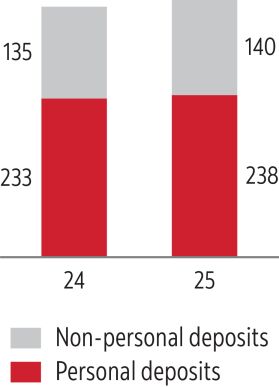
Management’s Discussion and Analysis | Supplementary Data
T78 Assets under administration and management(1)
| ($ billions) | 2025 | 2024 | ||||||
| Assets under administration |
||||||||
| Personal |
||||||||
| Retail brokerage |
$ | 283.6 | $ | 242.9 | ||||
| Investment management and trust |
209.5 | 198.6 | ||||||
| 493.1 | 441.5 | |||||||
| Mutual funds |
269.5 | 233.7 | ||||||
| Institutional |
105.7 | 96.3 | ||||||
| Total |
$ | 868.3 | $ | 771.5 | ||||
| Assets under management |
||||||||
| Personal |
$ | 121.5 | $ | 100.1 | ||||
| Mutual funds |
253.8 | 217.1 | ||||||
| Institutional |
57.1 | 55.8 | ||||||
| Total |
$ | 432.4 | $ | 373.0 | ||||
| (1) | Refer to Glossary on page 136 for the description of the measure. |
T79 Changes in assets under administration and management(1)
| As at October 31 ($ billions) | 2025 | 2024 | ||||||
| Assets under administration |
||||||||
| Balance at beginning of year |
$ | 771.5 | $ | 673.6 | ||||
| Net inflows (outflows) |
16.7 | 9.7 | ||||||
| Impact of market changes, including foreign currency translation |
80.1 | 88.2 | ||||||
| Balance at end of year |
$ | 868.3 | $ | 771.5 | ||||
| (1) | Refer to Glossary on page 136 for the description of the measure. |
| As at October 31 ($ billions) | 2025 | 2024 | ||||||
| Assets under management |
||||||||
| Balance at beginning of year |
$ | 373.0 | $ | 316.6 | ||||
| Net inflows (outflows) |
8.7 | (0.1 | ) | |||||
| Impact of market changes, including foreign currency translation |
50.7 | 56.5 | ||||||
| Balance at end of year |
$ | 432.4 | $ | 373.0 | ||||
T80 Fees paid to the shareholders’ auditors
| For the fiscal years ($ millions) | 2025 | 2024 | ||||||
| Audit services |
$ | 40.6 | $ | 39.1 | ||||
| Audit-related services |
2.4 | 1.2 | ||||||
| Tax services outside of the audit scope |
0.7 | 0.4 | ||||||
| Other non-audit services |
0.9 | 1.2 | ||||||
| Total Bank and Subsidiaries |
$ | 44.6 | $ | 41.9 | ||||
| Mutual funds |
3.9 | 3.6 | ||||||
| Total Fees |
$ | 48.5 | $ | 45.5 | ||||
2025 Scotiabank Annual Report | 129
Management’s Discussion and Analysis
Selected Quarterly Information
T81 Selected quarterly information
| 2025 | 2024 | |||||||||||||||||||||||||||||||
| As at and for the quarter ended | Q4 | Q3 | Q2 | Q1 | Q4 | Q3 | Q2 | Q1 | ||||||||||||||||||||||||
| Operating results ($ millions) |
||||||||||||||||||||||||||||||||
| Net interest income |
5,586 | 5,493 | 5,270 | 5,173 | 4,923 | 4,862 | 4,694 | 4,773 | ||||||||||||||||||||||||
| Non-interest income |
4,217 | 3,993 | 3,810 | 4,199 | 3,603 | 3,502 | 3,653 | 3,660 | ||||||||||||||||||||||||
| Total revenue |
9,803 | 9,486 | 9,080 | 9,372 | 8,526 | 8,364 | 8,347 | 8,433 | ||||||||||||||||||||||||
| Provision for credit losses |
1,113 | 1,041 | 1,398 | 1,162 | 1,030 | 1,052 | 1,007 | 962 | ||||||||||||||||||||||||
| Non-interest expenses |
5,828 | 5,089 | 5,110 | 6,491 | 5,296 | 4,949 | 4,711 | 4,739 | ||||||||||||||||||||||||
| Income tax expense |
656 | 829 | 540 | 726 | 511 | 451 | 537 | 533 | ||||||||||||||||||||||||
| Net income |
2,206 | 2,527 | 2,032 | 993 | 1,689 | 1,912 | 2,092 | 2,199 | ||||||||||||||||||||||||
| Net income attributable to common shareholders |
2,104 | 2,313 | 1,841 | 1,025 | 1,521 | 1,756 | 1,943 | 2,066 | ||||||||||||||||||||||||
| Operating performance |
||||||||||||||||||||||||||||||||
| Basic earnings per share ($) |
1.70 | 1.84 | 1.48 | 0.82 | 1.23 | 1.43 | 1.59 | 1.70 | ||||||||||||||||||||||||
| Diluted earnings per share ($) |
1.65 | 1.84 | 1.48 | 0.66 | 1.22 | 1.41 | 1.57 | 1.68 | ||||||||||||||||||||||||
| Return on equity (%)(1) |
11.0 | 12.2 | 10.1 | 5.5 | 8.3 | 9.8 | 11.2 | 11.8 | ||||||||||||||||||||||||
| Return on tangible common equity (%)(2) |
13.5 | 15.0 | 12.5 | 6.8 | 10.1 | 11.9 | 13.8 | 14.6 | ||||||||||||||||||||||||
| Productivity ratio (%)(1) |
59.4 | 53.7 | 56.3 | 69.3 | 62.1 | 59.2 | 56.4 | 56.2 | ||||||||||||||||||||||||
| Net interest margin (%)(2) |
2.40 | 2.36 | 2.31 | 2.23 | 2.15 | 2.14 | 2.17 | 2.19 | ||||||||||||||||||||||||
| Financial position information ($ billions) |
||||||||||||||||||||||||||||||||
| Cash and deposits with financial institutions |
66.0 | 69.7 | 63.6 | 70.2 | 63.9 | 58.3 | 58.6 | 67.2 | ||||||||||||||||||||||||
| Trading assets |
152.2 | 136.5 | 129.0 | 136.7 | 129.7 | 134.0 | 132.3 | 126.4 | ||||||||||||||||||||||||
| Loans |
771.0 | 761.6 | 756.4 | 766.3 | 760.8 | 759.2 | 753.5 | 743.9 | ||||||||||||||||||||||||
| Total assets |
1,460.0 | 1,414.7 | 1,415.5 | 1,439.2 | 1,412.0 | 1,402.4 | 1,399.4 | 1,392.9 | ||||||||||||||||||||||||
| Deposits |
966.3 | 946.8 | 945.8 | 966.0 | 943.8 | 949.2 | 942.0 | 939.8 | ||||||||||||||||||||||||
| Common equity |
76.9 | 75.3 | 74.7 | 74.6 | 73.6 | 72.7 | 70.6 | 70.0 | ||||||||||||||||||||||||
| Preferred shares and other equity instruments |
10.0 | 8.5 | 10.2 | 10.2 | 8.8 | 8.8 | 8.8 | 8.8 | ||||||||||||||||||||||||
| Assets under administration(1) |
868.3 | 825.1 | 779.1 | 807.5 | 771.5 | 761.0 | 738.9 | 715.9 | ||||||||||||||||||||||||
| Assets under management(1) |
432.4 | 407.0 | 379.9 | 395.5 | 373.0 | 363.9 | 348.6 | 339.6 | ||||||||||||||||||||||||
| Capital and liquidity measures |
||||||||||||||||||||||||||||||||
| Common Equity Tier 1 (CET1) capital ratio (%)(3) |
13.2 | 13.3 | 13.2 | 12.9 | 13.1 | 13.3 | 13.2 | 12.9 | ||||||||||||||||||||||||
| Tier 1 capital ratio (%)(3) |
15.3 | 15.2 | 15.4 | 15.1 | 15.0 | 15.3 | 15.2 | 14.8 | ||||||||||||||||||||||||
| Total capital ratio (%)(3) |
17.1 | 16.9 | 17.1 | 16.8 | 16.7 | 17.1 | 17.1 | 16.7 | ||||||||||||||||||||||||
| Total loss absorbing capacity (TLAC) ratio (%)(4) |
29.1 | 29.0 | 30.3 | 28.8 | 29.7 | 29.1 | 28.9 | 28.9 | ||||||||||||||||||||||||
| Leverage ratio (%)(5) |
4.5 | 4.5 | 4.5 | 4.4 | 4.4 | 4.5 | 4.4 | 4.3 | ||||||||||||||||||||||||
| TLAC Leverage ratio (%)(4) |
8.5 | 8.6 | 8.9 | 8.5 | 8.8 | 8.5 | 8.4 | 8.4 | ||||||||||||||||||||||||
| Risk-weighted assets ($ billions)(3) |
474.5 | 463.5 | 459.0 | 468.1 | 464.0 | 453.7 | 450.2 | 451.0 | ||||||||||||||||||||||||
| Liquidity coverage ratio (LCR) (%)(6) |
128 | 126 | 131 | 128 | 131 | 133 | 129 | 132 | ||||||||||||||||||||||||
| Net stable funding ratio (NSFR) (%)(6) |
116 | 120 | 120 | 117 | 119 | 117 | 117 | 117 | ||||||||||||||||||||||||
| Credit quality |
||||||||||||||||||||||||||||||||
| Net impaired loans ($ millions) |
4,903 | 4,656 | 4,648 | 4,874 | 4,685 | 4,449 | 4,399 | 4,215 | ||||||||||||||||||||||||
| Allowance for credit losses ($ millions)(7) |
7,654 | 7,386 | 7,276 | 7,080 | 6,736 | 6,860 | 6,768 | 6,597 | ||||||||||||||||||||||||
| Gross impaired loans as a % of loans and acceptances(1) |
0.93 | 0.90 | 0.90 | 0.91 | 0.88 | 0.84 | 0.83 | 0.80 | ||||||||||||||||||||||||
| Net impaired loans as a % of loans and acceptances(1) |
0.63 | 0.61 | 0.61 | 0.63 | 0.61 | 0.58 | 0.57 | 0.55 | ||||||||||||||||||||||||
| Provision for credit losses as a % of average net loans and acceptances (annualized)(1)(8) |
0.58 | 0.55 | 0.75 | 0.60 | 0.54 | 0.55 | 0.54 | 0.50 | ||||||||||||||||||||||||
| Provision for credit losses on impaired loans as a % of average net loans and acceptances (annualized)(1)(8) |
0.54 | 0.51 | 0.57 | 0.55 | 0.55 | 0.51 | 0.52 | 0.49 | ||||||||||||||||||||||||
| Net write-offs as a % of average net loans and acceptances (annualized)(1) |
0.51 | 0.50 | 0.50 | 0.49 | 0.51 | 0.45 | 0.48 | 0.42 | ||||||||||||||||||||||||
| Adjusted results(2) |
||||||||||||||||||||||||||||||||
| Adjusted total revenue ($ millions) |
9,767 | 9,494 | 9,098 | 9,372 | 8,526 | 8,507 | 8,347 | 8,433 | ||||||||||||||||||||||||
| Adjusted non-interest expenses ($ millions) |
5,308 | 5,095 | 5,067 | 5,111 | 4,784 | 4,763 | 4,693 | 4,721 | ||||||||||||||||||||||||
| Adjusted net income ($ millions) |
2,558 | 2,518 | 2,072 | 2,362 | 2,119 | 2,191 | 2,105 | 2,212 | ||||||||||||||||||||||||
| Adjusted diluted earnings per share ($) |
1.93 | 1.88 | 1.52 | 1.76 | 1.57 | 1.63 | 1.58 | 1.69 | ||||||||||||||||||||||||
| Adjusted return on equity (%) |
12.5 | 12.4 | 10.4 | 11.8 | 10.6 | 11.3 | 11.3 | 11.9 | ||||||||||||||||||||||||
| Adjusted return on tangible common equity (%) |
15.2 | 15.1 | 12.7 | 14.3 | 12.8 | 13.7 | 13.8 | 14.6 | ||||||||||||||||||||||||
| Adjusted productivity ratio (%) |
54.3 | 53.7 | 55.7 | 54.5 | 56.1 | 56.0 | 56.2 | 56.0 | ||||||||||||||||||||||||
| Common share information |
||||||||||||||||||||||||||||||||
| Closing share price ($) (TSX) |
91.99 | 77.09 | 68.98 | 74.36 | 71.69 | 64.47 | 63.16 | 62.87 | ||||||||||||||||||||||||
| Shares outstanding (millions) |
||||||||||||||||||||||||||||||||
| Average – Basic |
1,239 | 1,244 | 1,246 | 1,245 | 1,238 | 1,230 | 1,223 | 1,214 | ||||||||||||||||||||||||
| Average – Diluted |
1,245 | 1,245 | 1,246 | 1,250 | 1,243 | 1,235 | 1,228 | 1,221 | ||||||||||||||||||||||||
| End of period |
1,236 | 1,242 | 1,246 | 1,246 | 1,244 | 1,237 | 1,230 | 1,222 | ||||||||||||||||||||||||
| Dividends paid per share ($) |
1.10 | 1.10 | 1.06 | 1.06 | 1.06 | 1.06 | 1.06 | 1.06 | ||||||||||||||||||||||||
| Dividend yield (%)(1) |
5.2 | 6.0 | 6.2 | 5.6 | 6.3 | 6.6 | 6.4 | 7.0 | ||||||||||||||||||||||||
| Market capitalization ($ billions) (TSX) |
113.7 | 95.8 | 85.9 | 92.6 | 89.2 | 79.8 | 77.7 | 76.8 | ||||||||||||||||||||||||
| Book value per common share ($)(1) |
62.22 | 60.57 | 59.96 | 59.86 | 59.14 | 58.78 | 57.40 | 57.26 | ||||||||||||||||||||||||
| Market value to book value multiple(1) |
1.5 | 1.3 | 1.2 | 1.2 | 1.2 | 1.1 | 1.1 | 1.1 | ||||||||||||||||||||||||
| Price to earnings multiple (trailing 4 quarters)(1) |
15.8 | 14.4 | 13.9 | 14.7 | 12.0 | 11.3 | 10.5 | 10.3 | ||||||||||||||||||||||||
| (1) | Refer to Glossary on page 136 for the description of the measure. |
| (2) | Refer to page 20 for a discussion of non-GAAP measures. |
| (3) | Regulatory capital ratios are based on Basel III requirements as determined in accordance with OSFI Guideline – Capital Adequacy Requirements. |
| (4) | This measure has been disclosed in this document in accordance with OSFI Guideline – Total Loss Absorbing Capacity. |
| (5) | The leverage ratios are based on Basel III requirements as determined in accordance with OSFI Guideline – Leverage Requirements. |
| (6) | The LCR and NSFR are calculated in accordance with OSFI Guideline – Liquidity Adequacy Requirements (LAR). |
| (7) | Includes allowance for credit losses on all financial assets – loans, acceptances, off-balance sheet exposures, debt securities, and deposits with financial institutions. |
| (8) | Includes provision for credit losses on certain financial assets – loans, acceptances and off-balance sheet exposures. |
130 | 2025 Scotiabank Annual Report
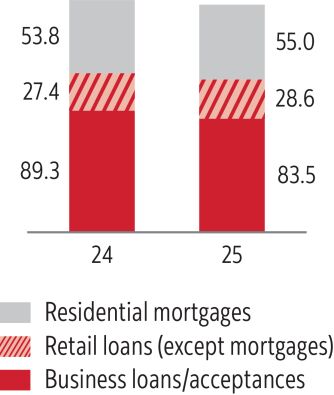
Management’s Discussion and Analysis | Supplementary Data
T82 Selected annual information
| ($ millions) | 2025 | 2024 | 2023 | |||||||||
| Total revenue |
$ | 37,741 | $ | 33,670 | $ | 32,214 | ||||||
| Net income attributable to: |
||||||||||||
| Equity holders of the Bank |
7,789 | 7,758 | 7,338 | |||||||||
| Non-controlling interests in subsidiaries |
(31 | ) | 134 | 112 | ||||||||
| $ | 7,758 | $ | 7,892 | $ | 7,450 | |||||||
| Basic earnings per share (in dollars) |
$ | 5.84 | $ | 5.94 | $ | 5.78 | ||||||
| Diluted earnings per share (in dollars) |
5.67 | 5.87 | 5.72 | |||||||||
| Dividends paid per common share (in dollars) |
4.32 | 4.24 | 4.18 | |||||||||
| Total assets |
1,460,042 | 1,412,027 | 1,411,043 | |||||||||
| Deposits |
966,279 | 943,849 | 952,333 | |||||||||
T83 Condensed Consolidated Statement of Financial Position
| As at October 31 ($ millions) | 2025(1)(2) | 2024(1)(2) | 2023(1)(2) | 2022(1) | 2021(1) | 2020(1) | 2019(1) | 2018(1) | 2017 | 2016 | ||||||||||||||||||||||||||||||
| Assets |
||||||||||||||||||||||||||||||||||||||||
| Cash, deposits with financial institutions and Precious metals |
$ | 71,123 | $ | 66,400 | $ | 91,249 | $ | 66,438 | $ | 87,078 | $ | 77,641 | $ | 50,429 | $ | 65,460 | $ | 65,380 | $ | 54,786 | ||||||||||||||||||||
| Trading assets |
152,223 | 129,727 | 117,868 | 113,154 | 146,312 | 117,839 | 127,488 | 100,262 | 98,464 | 108,561 | ||||||||||||||||||||||||||||||
| Securities purchased under resale agreements and securities borrowed |
203,008 | 200,543 | 199,325 | 175,313 | 127,739 | 119,747 | 131,178 | 104,018 | 95,319 | 92,129 | ||||||||||||||||||||||||||||||
| Investment securities |
149,948 | 152,832 | 118,237 | 110,008 | 75,199 | 111,389 | 82,359 | 78,396 | 69,269 | 72,919 | ||||||||||||||||||||||||||||||
| Loans, net of allowance |
771,045 | 760,829 | 750,911 | 744,987 | 636,986 | 603,263 | 592,483 | 551,834 | 504,369 | 480,164 | ||||||||||||||||||||||||||||||
| Other(3) |
112,695 | 101,696 | 133,453 | 139,518 | 111,530 | 106,587 | 102,224 | 98,523 | 82,472 | 87,707 | ||||||||||||||||||||||||||||||
| $ | 1,460,042 | $ | 1,412,027 | $ | 1,411,043 | $ | 1,349,418 | $ | 1,184,844 | $ | 1,136,466 | $ | 1,086,161 | $ | 998,493 | $ | 915,273 | $ | 896,266 | |||||||||||||||||||||
| Liabilities |
||||||||||||||||||||||||||||||||||||||||
| Deposits |
$ | 966,279 | $ | 943,849 | $ | 952,333 | $ | 916,181 | $ | 797,259 | $ | 750,838 | $ | 733,390 | $ | 676,534 | $ | 625,367 | $ | 611,877 | ||||||||||||||||||||
| Obligations related to securities sold under repurchase agreements and securities lent |
189,144 | 190,449 | 160,007 | 139,025 | 123,469 | 137,763 | 124,083 | 101,257 | 95,843 | 97,083 | ||||||||||||||||||||||||||||||
| Subordinated debentures |
7,692 | 7,833 | 9,693 | 8,469 | 6,334 | 7,405 | 7,252 | 5,698 | 5,935 | 7,633 | ||||||||||||||||||||||||||||||
| Other(3) |
208,340 | 185,820 | 210,439 | 210,994 | 184,890 | 169,957 | 151,244 | 147,324 | 126,503 | 121,852 | ||||||||||||||||||||||||||||||
| 1,371,455 | 1,327,951 | 1,332,472 | 1,274,669 | 1,111,952 | 1,065,963 | 1,015,969 | 930,813 | 853,648 | 838,445 | |||||||||||||||||||||||||||||||
| Common equity |
76,927 | 73,590 | 68,767 | 65,150 | 64,750 | 62,819 | 63,638 | 61,044 | 55,454 | 52,657 | ||||||||||||||||||||||||||||||
| Preferred shares and other equity instruments |
9,939 | 8,779 | 8,075 | 8,075 | 6,052 | 5,308 | 3,884 | 4,184 | 4,579 | 3,594 | ||||||||||||||||||||||||||||||
| Non-controlling interests in subsidiaries |
1,721 | 1,707 | 1,729 | 1,524 | 2,090 | 2,376 | 2,670 | 2,452 | 1,592 | 1,570 | ||||||||||||||||||||||||||||||
| Total equity |
88,587 | 84,076 | 78,571 | 74,749 | 72,892 | 70,503 | 70,192 | 67,680 | 61,625 | 57,821 | ||||||||||||||||||||||||||||||
| $ | 1,460,042 | $ | 1,412,027 | $ | 1,411,043 | $ | 1,349,418 | $ | 1,184,844 | $ | 1,136,466 | $ | 1,086,161 | $ | 998,493 | $ | 915,273 | $ | 896,266 | |||||||||||||||||||||
| (1) | The amounts for the years ended October 31, 2018 to October 31, 2025 have been prepared in accordance with IFRS 9; prior period amounts have not been restated. |
| (2) | The Bank adopted IFRS 17 effective November 1, 2023. As required under the new accounting standard, prior period amounts have been restated. Amounts for fiscal 2016 to 2022 have been prepared in accordance with IFRS 4 and have not been restated. |
| (3) | The amounts for the years ended October 31, 2020 to October 31, 2025 have been prepared in accordance with IFRS 16; prior year amounts have not been restated. |
T84 Condensed Consolidated Statement of Income
| For the year ended October 31 ($ millions) |
2025(1) | 2024(1) | 2023(1) | 2022 | 2021 | 2020 | 2019 | 2018 | 2017 | 2016 | ||||||||||||||||||||||||||||||
| Revenue |
||||||||||||||||||||||||||||||||||||||||
| Net interest income(2)(3) |
$ | 21,522 | $ | 19,252 | $ | 18,262 | $ | 18,115 | $ | 16,961 | $ | 17,320 | $ | 17,177 | $ | 16,191 | $ | 15,035 | $ | 14,292 | ||||||||||||||||||||
| Non-interest income(2)(4) |
16,219 | 14,418 | 13,952 | 13,301 | 14,291 | 14,016 | 13,857 | 12,584 | 12,120 | 12,058 | ||||||||||||||||||||||||||||||
| Total revenue |
37,741 | 33,670 | 32,214 | 31,416 | 31,252 | 31,336 | 31,034 | 28,775 | 27,155 | 26,350 | ||||||||||||||||||||||||||||||
| Provision for credit losses(2) |
4,714 | 4,051 | 3,422 | 1,382 | 1,808 | 6,084 | 3,027 | 2,611 | 2,249 | 2,412 | ||||||||||||||||||||||||||||||
| Non-interest expenses(3)(4) |
22,518 | 19,695 | 19,121 | 17,102 | 16,618 | 16,856 | 16,737 | 15,058 | 14,630 | 14,540 | ||||||||||||||||||||||||||||||
| Income before taxes |
10,509 | 9,924 | 9,671 | 12,932 | 12,826 | 8,396 | 11,270 | 11,106 | 10,276 | 9,398 | ||||||||||||||||||||||||||||||
| Income tax expense |
2,751 | 2,032 | 2,221 | 2,758 | 2,871 | 1,543 | 2,472 | 2,382 | 2,033 | 2,030 | ||||||||||||||||||||||||||||||
| Net income |
$ | 7,758 | $ | 7,892 | $ | 7,450 | $ | 10,174 | $ | 9,955 | $ | 6,853 | $ | 8,798 | $ | 8,724 | $ | 8,243 | $ | 7,368 | ||||||||||||||||||||
| Net income attributable to non-controlling interests in subsidiaries |
(31 | ) | 134 | 112 | 258 | 331 | 75 | 408 | 176 | 238 | 251 | |||||||||||||||||||||||||||||
| Net income attributable to equity holders of the Bank |
$ | 7,789 | $ | 7,758 | $ | 7,338 | $ | 9,916 | $ | 9,624 | $ | 6,778 | $ | 8,390 | $ | 8,548 | $ | 8,005 | $ | 7,117 | ||||||||||||||||||||
| Preferred shareholders and other equity instrument holders |
506 | 472 | 419 | 260 | 233 | 196 | 182 | 187 | 129 | 130 | ||||||||||||||||||||||||||||||
| Common shareholders |
$ | 7,283 | $ | 7,286 | $ | 6,919 | $ | 9,656 | $ | 9,391 | $ | 6,582 | $ | 8,208 | $ | 8,361 | $ | 7,876 | $ | 6,987 | ||||||||||||||||||||
| (1) | The Bank adopted IFRS 17 effective November 1, 2023. As required under the new accounting standard, prior period amounts have been restated. Amounts for fiscal 2016 to 2022 have been prepared in accordance with IFRS 4 and have not been restated. |
| (2) | The amounts for the years ended October 31, 2018 to October 31, 2025 have been prepared in accordance with IFRS 9; prior year amounts have not been restated. |
| (3) | The amounts for the years ended October 31, 2020 to October 31, 2025 have been prepared in accordance with IFRS 16; prior year amounts have not been restated. |
| (4) | The amounts for the years ended October 31, 2019 to October 31, 2025 have been prepared in accordance with IFRS 15; prior year amounts have not been restated. |
2025 Scotiabank Annual Report | 131
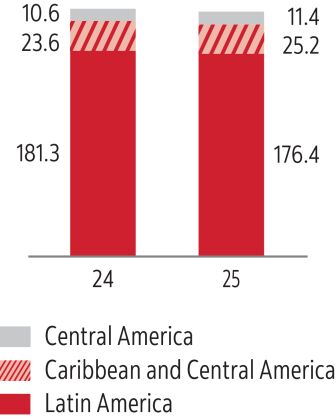
Management’s Discussion and Analysis
T85 Consolidated Statement of Changes in Equity
| For the year ended October 31 ($ millions) | 2025(1) | 2024(1) | 2023(1) | 2022 | 2021 | 2020 | 2019 | |||||||||||||||||||||
| Common shares |
||||||||||||||||||||||||||||
| Balance at beginning of year |
$ | 22,054 | $ | 20,109 | $ | 18,707 | $ | 18,507 | $ | 18,239 | $ | 18,264 | $ | 18,234 | ||||||||||||||
| Issued |
210 | 1,945 | 1,402 | 706 | 268 | 59 | 255 | |||||||||||||||||||||
| Purchased for cancellation |
(197 | ) | – | – | (506 | ) | – | (84 | ) | (225 | ) | |||||||||||||||||
| Balance at end of year |
$ | 22,067 | $ | 22,054 | $ | 20,109 | $ | 18,707 | $ | 18,507 | $ | 18,239 | $ | 18,264 | ||||||||||||||
| Retained earnings |
||||||||||||||||||||||||||||
| Balance at beginning of year |
57,751 | 55,673 | 53,761 | 51,354 | 46,345 | 44,439 | 41,414 | |||||||||||||||||||||
| IFRS adjustment |
– | – | (1 | ) | – | – | – | (58 | ) | |||||||||||||||||||
| Restated balances |
57,751 | 55,673 | 53,760 | 51,354 | 46,345 | 44,439 | 41,356 | |||||||||||||||||||||
| Net income attributable to common shareholders of the Bank |
7,283 | 7,286 | 6,919 | 9,656 | 9,391 | 6,582 | 8,208 | |||||||||||||||||||||
| Common dividends |
(5,369 | ) | (5,198 | ) | (5,003 | ) | (4,858 | ) | (4,371 | ) | (4,363 | ) | (4,260 | ) | ||||||||||||||
| Purchase of shares for cancellation and premium on redemption |
(716 | ) | – | – | (2,367 | ) | – | (330 | ) | (850 | ) | |||||||||||||||||
| Foreign currency loss on redemption of Subordinated Additional Tier 1 Capital Notes |
(22 | ) | – | – | – | – | – | – | ||||||||||||||||||||
| Other |
(11 | ) | (10 | ) | (3 | ) | (24 | ) | (11 | ) | 17 | (15 | ) | |||||||||||||||
| Balance at end of year |
$ | 58,916 | $ | 57,751 | $ | 55,673 | $ | 53,761 | $ | 51,354 | $ | 46,345 | $ | 44,439 | ||||||||||||||
| Accumulated other comprehensive income (loss) |
||||||||||||||||||||||||||||
| Balance at beginning of year |
(6,147 | ) | (6,931 | ) | (7,166 | ) | (5,333 | ) | (2,125 | ) | 570 | 992 | ||||||||||||||||
| IFRS adjustment |
– | – | – | – | – | – | – | |||||||||||||||||||||
| Restated balances |
(6,147 | ) | (6,931 | ) | (7,166 | ) | (5,333 | ) | (2,125 | ) | 570 | 992 | ||||||||||||||||
| Other comprehensive income (loss) |
2,321 | 784 | 278 | (1,564 | ) | (3,134 | ) | (2,668 | ) | (422 | ) | |||||||||||||||||
| Other |
– | – | (43 | ) | (269 | ) | (74 | ) | (27 | ) | – | |||||||||||||||||
| Balance at end of year |
$ | (3,826 | ) | $ | (6,147 | ) | $ | (6,931 | ) | $ | (7,166 | ) | $ | (5,333 | ) | $ | (2,125 | ) | $ | 570 | ||||||||
| Other reserves |
||||||||||||||||||||||||||||
| Balance at beginning of year |
(68 | ) | (84 | ) | (152 | ) | 222 | 360 | 365 | 404 | ||||||||||||||||||
| Share-based payments(2) |
15 | 13 | 14 | 10 | 7 | 5 | 7 | |||||||||||||||||||||
| Other |
(177 | ) | 3 | 54 | (384 | ) | (145 | ) | (10 | ) | (46 | ) | ||||||||||||||||
| Balance at end of year |
$ | (230 | ) | $ | (68 | ) | $ | (84 | ) | $ | (152 | ) | $ | 222 | $ | 360 | $ | 365 | ||||||||||
| Total common equity |
$ | 76,927 | $ | 73,590 | $ | 68,767 | $ | 65,150 | $ | 64,750 | $ | 62,819 | $ | 63,638 | ||||||||||||||
| Preferred shares and other equity instruments |
||||||||||||||||||||||||||||
| Balance at beginning of year |
8,779 | 8,075 | 8,075 | 6,052 | 5,308 | 3,884 | 4,184 | |||||||||||||||||||||
| Net income attributable to preferred shareholders and other equity instrument holders of the Bank |
506 | 472 | 419 | 260 | 233 | 196 | 182 | |||||||||||||||||||||
| Preferred and other equity instrument dividends |
(506 | ) | (472 | ) | (419 | ) | (260 | ) | (233 | ) | (196 | ) | (182 | ) | ||||||||||||||
| Issued |
2,848 | 1,004 | – | 2,523 | 2,003 | 1,689 | – | |||||||||||||||||||||
| Redeemed |
(1,688 | ) | (300 | ) | – | (500 | ) | (1,259 | ) | (265 | ) | (300 | ) | |||||||||||||||
| Balance at end of year |
$ | 9,939 | $ | 8,779 | $ | 8,075 | $ | 8,075 | $ | 6,052 | $ | 5,308 | $ | 3,884 | ||||||||||||||
| Non-controlling interests |
||||||||||||||||||||||||||||
| Balance at beginning of year |
1,707 | 1,729 | 1,524 | 2,090 | 2,376 | 2,670 | 2,452 | |||||||||||||||||||||
| IFRS adjustment |
– | – | – | – | – | – | – | |||||||||||||||||||||
| Restated balances |
1,707 | 1,729 | 1,524 | 2,090 | 2,376 | 2,670 | 2,452 | |||||||||||||||||||||
| Net income attributable to non-controlling interests |
(31 | ) | 134 | 112 | 258 | 331 | 75 | 408 | ||||||||||||||||||||
| Distributions to non-controlling interests |
(82 | ) | (88 | ) | (101 | ) | (115 | ) | (123 | ) | (148 | ) | (150 | ) | ||||||||||||||
| Effect of foreign exchange and others |
127 | (68 | ) | 194 | (709 | ) | (494 | ) | (221 | ) | (40 | ) | ||||||||||||||||
| Balance at end of year |
$ | 1,721 | $ | 1,707 | $ | 1,729 | $ | 1,524 | $ | 2,090 | $ | 2,376 | $ | 2,670 | ||||||||||||||
| Total equity at end of year |
$ | 88,587 | $ | 84,076 | $ | 78,571 | $ | 74,749 | $ | 72,892 | $ | 70,503 | $ | 70,192 | ||||||||||||||
| (1) | The Bank adopted IFRS 17 effective November 1, 2023. As required under the new accounting standard, prior period amounts have been restated. Amounts for fiscal 2016 to 2022 have been prepared in accordance with IFRS 4 and have not been restated. |
| (2) | Represents amounts on account of share-based payments (refer to Note 25 in the consolidated financial statements). |
T86 Consolidated Statement of Comprehensive Income
| For the year ended October 31 ($ millions) | 2025(1) | 2024(1) | 2023(1) | 2022 | 2021 | 2020 | 2019 | |||||||||||||||||||||
| Net income |
$ | 7,758 | $ | 7,892 | $ | 7,450 | $ | 10,174 | $ | 9,955 | $ | 6,853 | $ | 8,798 | ||||||||||||||
| Other comprehensive income (loss), net of income taxes: |
||||||||||||||||||||||||||||
| Items that will be reclassified subsequently to net income |
||||||||||||||||||||||||||||
| Net change in unrealized foreign currency translation gains (losses) |
780 | (1,865 | ) | 942 | 2,454 | (3,520 | ) | (2,239 | ) | (819 | ) | |||||||||||||||||
| Net change in unrealized gains (losses) on available-for-sale securities (debt and equity)(2) |
n/a | n/a | n/a | n/a | n/a | n/a | n/a | |||||||||||||||||||||
| Net change in fair value due to change in debt instruments measured at fair value through other comprehensive income(2) |
535 | 612 | 378 | (1,212 | ) | (600 | ) | 293 | 105 | |||||||||||||||||||
| Net change in gains (losses) on derivative instruments designated as cash flow hedges |
1,053 | 2,343 | 245 | (4,537 | ) | (806 | ) | (32 | ) | 708 | ||||||||||||||||||
| Net changes in finance income/(expense) from insurance contracts(1) |
19 | 1 | (17 | ) | – | – | – | – | ||||||||||||||||||||
| Other comprehensive income (loss) from investments in associates |
176 | (1 | ) | (16 | ) | (344 | ) | 37 | (2 | ) | 103 | |||||||||||||||||
| Items that will not be reclassified subsequently to net income |
||||||||||||||||||||||||||||
| Net change in remeasurement of employee benefit plan asset and liability |
266 | (136 | ) | 114 | 678 | 1,335 | (465 | ) | (815 | ) | ||||||||||||||||||
| Net change in fair value due to change in equity instruments designated at fair value through other comprehensive income(2) |
61 | 338 | (180 | ) | (74 | ) | 408 | (85 | ) | 95 | ||||||||||||||||||
| Net change in fair value due to change in own credit risk on financial liabilities designated under the fair value option |
(500 | ) | (581 | ) | (985 | ) | 1,444 | (199 | ) | (298 | ) | 8 | ||||||||||||||||
| Other comprehensive income (loss) from investments in associates |
7 | 1 | 2 | 2 | 5 | (8 | ) | (10 | ) | |||||||||||||||||||
| Other comprehensive income (loss) |
2,397 | 712 | 483 | (1,589 | ) | (3,340 | ) | (2,836 | ) | (625 | ) | |||||||||||||||||
| Comprehensive income |
$ | 10,155 | $ | 8,604 | $ | 7,933 | $ | 8,585 | $ | 6,615 | $ | 4,017 | $ | 8,173 | ||||||||||||||
| Comprehensive income (loss) attributable to: |
||||||||||||||||||||||||||||
| Common shareholders of the Bank |
$ | 9,604 | $ | 8,070 | $ | 7,197 | $ | 8,092 | $ | 6,257 | $ | 3,914 | $ | 7,786 | ||||||||||||||
| Preferred shareholders and other equity instrument holders of the Bank |
506 | 472 | 419 | 260 | 233 | 196 | 182 | |||||||||||||||||||||
| Non-controlling interests in subsidiaries |
45 | 62 | 317 | 233 | 125 | (93 | ) | 205 | ||||||||||||||||||||
| $ | 10,155 | $ | 8,604 | $ | 7,933 | $ | 8,585 | $ | 6,615 | $ | 4,017 | $ | 8,173 | |||||||||||||||
| (1) | The Bank adopted IFRS 17 effective November 1, 2023. As required under the new accounting standard, prior period amounts have been restated. Amounts for fiscal 2016 to 2022 have been prepared in accordance with IFRS 4 and have not been restated. |
| (2) | The amounts for the years ended October 31, 2018 to October 31, 2025 have been prepared in accordance with IFRS 9; prior period amounts have not been restated. |
132 | 2025 Scotiabank Annual Report
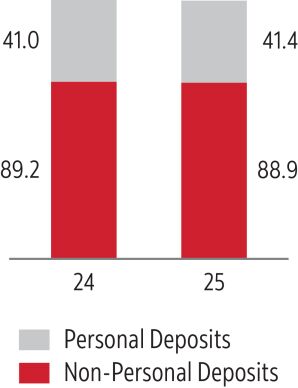
Management’s Discussion and Analysis | Supplementary Data
| 2018 | 2017 | 2016 | ||||||||||||
| $ | 15,644 | $ | 15,513 | $ | 15,141 | |||||||||
| 2,708 | 313 | 391 | ||||||||||||
| (118 | ) | (182 | ) | (19 | ) | |||||||||
| $ | 18,234 | $ | 15,644 | $ | 15,513 | |||||||||
| 38,117 | 34,752 | 31,316 | ||||||||||||
| (564 | ) | – | – | |||||||||||
| 37,553 | 34,752 | 31,316 | ||||||||||||
| 8,361 | 7,876 | 6,987 | ||||||||||||
| (3,985 | ) | (3,668 | ) | (3,468 | ) | |||||||||
| (514 | ) | (827 | ) | (61 | ) | |||||||||
|
|
– |
|
|
– |
|
|
– |
| ||||||
| (1 | ) | (16 | ) | (22 | ) | |||||||||
| $ | 41,414 | $ | 38,117 | $ | 34,752 | |||||||||
| 1,577 | 2,240 | 2,455 | ||||||||||||
| 51 | – | – | ||||||||||||
| 1,628 | 2,240 | 2,455 | ||||||||||||
| (693 | ) | (663 | ) | (215 | ) | |||||||||
| 57 | – | – | ||||||||||||
| $ | 992 | $ | 1,577 | $ | 2,240 | |||||||||
| 116 | 152 | 173 | ||||||||||||
| 6 | 8 | 7 | ||||||||||||
| 282 | (44 | ) | (28 | ) | ||||||||||
| $ | 404 | $ | 116 | $ | 152 | |||||||||
| $ | 61,044 | $ | 55,454 | $ | 52,657 | |||||||||
| 4,579 | 3,594 | 2,934 | ||||||||||||
| |
187 |
129 | 130 | |||||||||||
| (187 | ) | (129 | ) | (130 | ) | |||||||||
| 300 | 1,560 | 1,350 | ||||||||||||
| (695 | ) | (575 | ) | (690 | ) | |||||||||
| $ | 4,184 | $ | 4,579 | $ | 3,594 | |||||||||
| 1,592 | 1,570 | 1,460 | ||||||||||||
| (97 | ) | – | – | |||||||||||
| 1,495 | 1,570 | 1,460 | ||||||||||||
| 176 | 238 | 251 | ||||||||||||
| (199 | ) | (133 | ) | (116 | ) | |||||||||
| 980 | (83 | ) | (25 | ) | ||||||||||
| $ | 2,452 | $ | 1,592 | $ | 1,570 | |||||||||
| $ | 67,680 | $ | 61,625 | $ | 57,821 | |||||||||
| 2018 | 2017 | 2016 | ||||||||||||
| $ | 8,724 | $ | 8,243 | $ | 7,368 | |||||||||
| (606 | ) | (1,259 | ) | 396 | ||||||||||
| |
n/a |
(55 | ) | (172 | ) | |||||||||
| |
(252 |
) |
n/a | n/a | ||||||||||
| |
(361 |
) |
(28 | ) | 258 | |||||||||
| – | – | – | ||||||||||||
| 66 | 56 | 31 | ||||||||||||
| 318 | 592 | (716 | ) | |||||||||||
| |
60 |
n/a | n/a | |||||||||||
| |
(22 |
) |
(21 | ) | (16 | ) | ||||||||
| (7 | ) | 6 | (10 | ) | ||||||||||
| (804 | ) | (709 | ) | (229 | ) | |||||||||
| $ | 7,920 | $ | 7,534 | $ | 7,139 | |||||||||
| $ | 7,668 | $ | 7,213 | $ | 6,772 | |||||||||
| 187 | 129 | 130 | ||||||||||||
| 65 | 192 | 237 | ||||||||||||
| $ | 7,920 | $ | 7,534 | $ | 7,139 | |||||||||
2025 Scotiabank Annual Report | 133
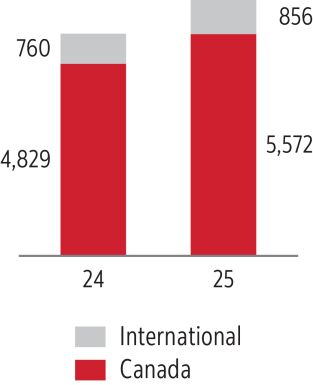
Management’s Discussion and Analysis
T87 Other statistics
| For the year ended October 31 | 2025(1) | 2024(1) | 2023(1) | 2022 | 2021 | 2020 | 2019 | |||||||||||||||||||||
| Operating performance |
||||||||||||||||||||||||||||
| Basic earnings per share ($) |
5.84 | 5.94 | 5.78 | 8.05 | 7.74 | 5.43 | 6.72 | |||||||||||||||||||||
| Diluted earnings per share ($) |
5.67 | 5.87 | 5.72 | 8.02 | 7.70 | 5.30 | 6.68 | |||||||||||||||||||||
| Return on equity (%)(2) |
9.7 | 10.2 | 10.3 | 14.8 | 14.7 | 10.4 | 13.1 | |||||||||||||||||||||
| Productivity ratio (%)(2) |
59.7 | 58.5 | 59.4 | 54.4 | 53.2 | 53.8 | 53.9 | |||||||||||||||||||||
| Return on assets (%)(2) |
0.53 | 0.56 | 0.53 | 0.79 | 0.86 | 0.59 | 0.83 | |||||||||||||||||||||
| Net interest margin (%)(3) |
2.33 | 2.16 | 2.12 | 2.20 | 2.23 | 2.27 | 2.44 | |||||||||||||||||||||
| Capital measures(2) |
||||||||||||||||||||||||||||
| Common Equity Tier 1 (CET1) capital ratio (%)(4) |
13.2 | 13.1 | 13.0 | 11.5 | 12.3 | 11.8 | 11.1 | |||||||||||||||||||||
| Tier 1 capital ratio (%)(4) |
15.3 | 15.0 | 14.8 | 13.2 | 13.9 | 13.3 | 12.2 | |||||||||||||||||||||
| Total capital ratio (%)(4) |
17.1 | 16.7 | 17.2 | 15.3 | 15.9 | 15.5 | 14.2 | |||||||||||||||||||||
| Leverage ratio (%)(5) |
4.5 | 4.4 | 4.2 | 4.2 | 4.8 | 4.7 | 4.2 | |||||||||||||||||||||
| Common share information |
||||||||||||||||||||||||||||
| Closing share price ($) (TSX) |
91.99 | 71.69 | 56.15 | 65.85 | 81.14 | 55.35 | 75.54 | |||||||||||||||||||||
| Number of shares outstanding (millions) |
1,236 | 1,244 | 1,214 | 1,191 | 1,215 | 1,211 | 1,216 | |||||||||||||||||||||
| Dividends paid per share ($) |
4.32 | 4.24 | 4.18 | 4.06 | 3.60 | 3.60 | 3.49 | |||||||||||||||||||||
| Dividend yield (%)(2)(6) |
5.6 | 6.5 | 6.5 | 5.1 | 5.2 | 5.8 | 4.9 | |||||||||||||||||||||
| Price to earnings multiple (trailing 4 quarters)(2) |
15.8 | 12.0 | 9.7 | 8.2 | 10.5 | 10.2 | 11.2 | |||||||||||||||||||||
| Book value per common share ($)(2) |
62.22 | 59.14 | 56.64 | 54.68 | 53.28 | 51.85 | 52.33 | |||||||||||||||||||||
| Other information |
||||||||||||||||||||||||||||
| Average total assets ($ millions) |
1,465,278 | 1,419,284 | 1,396,092 | 1,281,708 | 1,157,213 | 1,160,584 | 1,056,063 | |||||||||||||||||||||
| Number of branches and offices |
2,128 | 2,236 | 2,379 | 2,439 | 2,573 | 2,618 | 3,109 | |||||||||||||||||||||
| Number of employees |
86,431 | 88,488 | 89,483 | 90,979 | 89,488 | 91,447 | 101,380 | |||||||||||||||||||||
| Number of automated banking machines |
8,432 | 8,533 | 8,679 | 8,610 | 8,610 | 8,791 | 9,391 | |||||||||||||||||||||
| (1) | The Bank adopted IFRS 17 effective November 1, 2023. As required under the new accounting standard, prior period amounts have been restated. Amounts for fiscal 2016 to 2022 have been prepared in accordance with IFRS 4 and have not been restated. |
| (2) | Refer to Glossary on page 136 for the description of the measure. |
| (3) | Refer to page 20 for a discussion of non-GAAP measures. |
| (4) | 2024 and 2025 regulatory capital ratios are based on Basel III requirements as determined in accordance with OSFI Guideline – Capital Adequacy Requirements (November 2023). Effective Q2 2023, regulatory capital ratios were based on Basel III requirements as determined in accordance with OSFI Guideline – Capital Adequacy Requirements (February 2023). Prior period regulatory capital ratios were prepared in accordance with OSFI Guideline – Capital Adequacy Requirements (November 2018). |
| (5) | Leverage ratios for 2023 to 2025 are based on Basel III requirements as determined in accordance with OSFI Guideline – Leverage Requirements (February 2023). Prior period leverage ratios were prepared in accordance with OSFI Guideline – Leverage Requirements (November 2018). |
| (6) | Based on the average of the high and low common share price for the year. |
134 | 2025 Scotiabank Annual Report
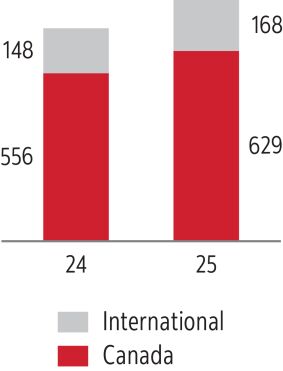
Management’s Discussion and Analysis | Supplementary Data
| 2018 | 2017 | 2016 | ||||||||||||
| 6.90 | 6.55 | 5.80 | ||||||||||||
| 6.82 | 6.49 | 5.77 | ||||||||||||
| 14.5 | 14.6 | 13.8 | ||||||||||||
| 52.3 | 53.9 | 55.2 | ||||||||||||
| 0.92 | 0.90 | 0.81 | ||||||||||||
| 2.46 | 2.46 | 2.38 | ||||||||||||
| 11.1 | 11.5 | 11.0 | ||||||||||||
| 12.5 | 13.1 | 12.4 | ||||||||||||
| 14.3 | 14.9 | 14.6 | ||||||||||||
| 4.5 | 4.7 | 4.5 | ||||||||||||
| 70.65 | 83.28 | 72.08 | ||||||||||||
| 1,227 | 1,199 | 1,208 | ||||||||||||
| 3.28 | 3.05 | 2.88 | ||||||||||||
| 4.2 | 4.0 | 4.7 | ||||||||||||
| 10.2 | 12.7 | 12.4 | ||||||||||||
| 49.75 | 46.24 | 43.59 | ||||||||||||
| 945,683 | 912,619 | 913,844 | ||||||||||||
| 3,095 | 3,003 | 3,113 | ||||||||||||
| 97,021 | 87,761 | 88,901 | ||||||||||||
| 9,029 | 8,140 | 8,144 | ||||||||||||
2025 Scotiabank Annual Report | 135
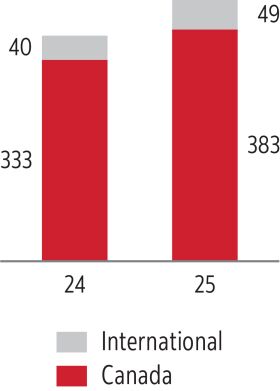
Allowance for Credit Losses: An allowance set aside which, in management’s opinion, is adequate to absorb credit-related losses on all financial assets and off-balance sheet exposures subject to impairment assessment. It includes allowances for performing financial assets and impaired financial assets.
Allowance for Credit Losses Ratio: The ratio of period end total allowance for credit losses (excluding debt securities and deposits with financial institutions) divided by gross loans and acceptances.
Allowance for Impaired Loans Ratio: The ratio of period end impaired allowance for credit losses (excluding debt securities and deposits with financial institutions) divided by gross loans and acceptances.
Allowance for Performing Loans Ratio: The ratio of period end performing allowance for credit losses (excluding debt securities and deposits with financial institutions) divided by gross loans and acceptances.
Allowance against Impaired Loans as a % of Gross Impaired Loans: The ratio of allowance against impaired loans to gross impaired loans.
Assets Under Administration (AUA): Assets administered by the Bank which are beneficially owned by clients and therefore not reported on the Bank’s Consolidated Statement of Financial Position. Services provided for AUA are of an administrative nature, such as trusteeship, custodial, safekeeping, income collection and distribution, securities trade settlements, customer reporting, and other similar services.
Assets Under Management (AUM): Assets managed by the Bank on a discretionary basis and in respect of which the Bank earns investment management fees. AUM are beneficially owned by clients and are therefore not reported on the Bank’s Consolidated Statement of Financial Position. Some AUM are also administered assets and are therefore included in assets under administration.
Bankers’ Acceptances (BAs): Negotiable, short-term debt securities, guaranteed for a fee by the issuer’s bank.
Basis Point (bps): A unit of measure defined as one-hundredth of one percent.
Book Value per Common Share: Common shareholders’ equity divided by the number of outstanding common shares at the end of the period.
Canadian Overnight Repo Rate Average (CORRA): CORRA measures the cost of overnight general collateral funding in Canadian dollars using Government of Canada treasury bills and bonds as collateral for repurchase transactions.
Common Equity Tier 1 (CET1), Tier 1 and Total Capital Ratios: Under Basel III, there are three primary regulatory capital ratios used to assess capital adequacy, CET1, Tier 1 and Total capital ratios, which are determined by dividing those capital components by their respective risk-weighted assets.
CET1 consists primarily of common shareholders’ equity net of regulatory adjustments. These regulatory adjustments include goodwill, intangible assets net of deferred tax liabilities, deferred tax assets that rely on future profitability, defined-benefit pension fund net assets, shortfall of credit provision to expected losses and significant investments in common equity of other financial institutions.
Tier 1 includes CET1 and additional Tier 1 capital which consists primarily of qualifying non-cumulative preferred shares, non-cumulative subordinated additional Tier 1 capital notes and limited recourse capital notes. Tier 2 capital consists mainly of qualifying subordinated debentures and the eligible allowances for credit losses.
Total capital is comprised of CET1 capital, Tier 1 capital and Tier 2 capital.
Covered Bonds: Debt obligations of the Bank for which the payment of all amounts of interest and principal are unconditionally and irrevocably guaranteed by a limited partnership and secured by a pledge of the covered bond portfolio. The assets in the covered bond portfolio held by the limited partnership consist of first lien Canadian uninsured residential mortgages or first lien Canadian residential mortgages insured under CMHC Mortgage Insurance, respectively, and their related security interest.
Derivative Products: Financial contracts whose value is derived from an underlying price, interest rate, exchange rate or price index. Forwards, options and swaps are all derivative instruments.
Dividend Yield: Dividends per common share divided by the average of the high and low share price in the relevant period.
Effective Tax Rate: The effective tax rate is the overall tax rate paid by the Bank on its earned income. The effective tax rate is calculated by dividing the Bank’s income tax expenses by the income before taxes.
Fair Value: The price that would be received to sell an asset or paid to transfer a liability in an orderly transaction between market participants in the principal, or in its absence, the most advantageous market to which the Bank has access at the measurement date.
Foreign Exchange Contracts: Commitments to buy or sell a specified amount of foreign currency on a set date and at a predetermined rate of exchange.
Forward Rate Agreement (FRA): A contract between two parties, whereby a designated interest rate, applied to a notional principal amount, is locked in for a specified period of time. The difference between the contracted rate and prevailing market rate is paid in cash on the settlement date. These agreements are used to protect against, or take advantage of, future interest rate movements.
Futures: Commitments to buy or sell designated amounts of commodities, securities or currencies on a specified date at a predetermined price. Futures are traded on recognized exchanges. Gains and losses on these contracts are settled daily, based on closing market prices.
Gross Impaired Loans as a % of Loans and Acceptances: The ratio of gross impaired loans, debt investments and off-balance sheet exposures expressed as a percentage of loans and acceptances.
Hedging: Protecting against price, interest rate or foreign exchange exposures by taking positions that are expected to react to market conditions in an offsetting manner.
Impaired Loans: Loans on which the Bank no longer has reasonable assurance as to the timely collection of interest and principal, or where a contractual payment is past due for a prescribed period or the customer is declared to be bankrupt.
Leverage Ratio: The ratio of Basel III Tier 1 capital to a leverage exposure measure which includes on-balance sheet assets and off-balance sheet commitments, derivatives and securities financing transactions, as defined within the OSFI Leverage Requirements Guideline.
Liquidity Coverage Ratio (LCR): The ratio of high quality liquid assets to stressed net cash outflows over a 30 calendar day time horizon, as defined within the OSFI Liquidity Adequacy Requirements Guideline.
Marked-To-Market: The valuation of certain financial instruments at fair value as of the Consolidated Statement of Financial Position date.
Market Value to Book Value Multiple: This financial valuation metric is calculated by dividing the current closing share price of the period by the book value per common share.
Net Impaired Loans as a % of Loans and Acceptances: The ratio of net impaired loans, debt investments and off-balance sheet exposures expressed as a percentage of loans and acceptances.
Net Interest Margin: Net interest margin is used to measure the return generated by the Bank’s core earning assets, net of the cost of funding. Net interest margin is calculated as core net interest income divided by average core earning assets.
Net Stable Funding Ratio (NSFR): The ratio of available stable funding to required stable funding, as defined within the OSFI Liquidity Adequacy Requirements Guideline.
Net Write-offs as a % of Average Net Loans and Acceptances: The ratio of net write-offs expressed as a percentage of average net loans and acceptances.
136 | 2025 Scotiabank Annual Report
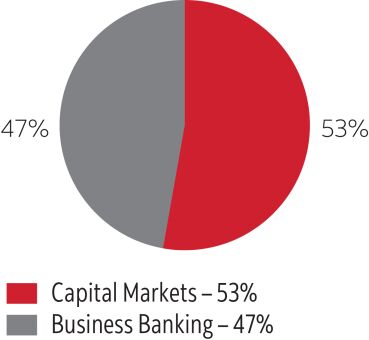
Non-Viability Contingent Capital (NVCC): In order to qualify for inclusion in regulatory capital, all non-common Tier 1 and Tier 2 capital instruments must be capable of absorbing losses at the point of non-viability of a financial institution. This will ensure that investors in such instruments bear losses before taxpayers where the government determines that it is in the public interest to rescue a non-viable bank.
Notional Principal Amounts: The contract or principal amounts used to determine payments for certain off-balance sheet instruments and derivatives, such as FRAs, interest rate swaps and cross-currency swaps. The amounts are termed “notional” because they are not usually exchanged themselves, serving only as the basis for calculating amounts that do change hands.
Off-Balance Sheet Instruments: These are indirect credit commitments, including undrawn commitments to extend credit and derivative instruments, which are not recorded on the Bank’s balance sheet under IFRS.
Operating Leverage: This financial metric measures the rate of growth in total revenue less the rate of growth in non-interest expenses.
Options: Contracts between buyer and seller giving the buyer of the option the right, but not the obligation, to buy (call) or sell (put) a specified commodity, financial instrument or currency at a set price or rate on or before a specified future date.
OSFI: The Office of the Superintendent of Financial Institutions Canada, the regulator of Canadian banks.
Price to Earnings Multiple (Trailing 4 Quarters): Closing share price at period end divided by cumulative basic earnings per common share (EPS) of the past 4 quarters.
Productivity Ratio: This ratio represents non-interest expenses as a percentage of total revenue. Management uses the productivity ratio as a measure of the Bank’s efficiency.
Provision for Credit Losses (PCL) as a % of Average Net Loans and Acceptances: The ratio of PCL on loans, acceptances and off-balance sheet exposures expressed as a percentage of average net loans and acceptances.
Provision for Credit Losses (PCL) on Impaired Loans as a % of Average Net Loans and Acceptances: PCL on impaired loans ratio is calculated using PCL on impaired loans, acceptances and off-balance sheet exposures as a percentage of average net loans and acceptances.
Repos: Repos is short for “obligations related to securities sold under repurchase agreements” – a short-term transaction where the Bank sells assets, normally government bonds, to a client and simultaneously agrees to repurchase them on a specified date and at a specified price. It is a form of short-term funding.
Return on Assets (ROA): Net income expressed as a percentage of total average assets.
Return on Equity (ROE): Net income attributable to common shareholders, expressed as a percentage of average common shareholders’ equity. The Bank attributes capital to its business lines on a basis that approximates 11.5% of Basel III common equity capital requirements which includes credit, market and operational risks and leverage inherent in each operating segment. Return on equity for the operating segments is calculated as a ratio of net income attributable to common shareholders of the operating segment and the capital attributed.
Return on Tangible Common Equity (ROTCE): Return on Tangible Common Equity is calculated by dividing the net income attributable to common shareholders, adjusted for the amortization of intangibles (excluding software), by average tangible common equity. Tangible common equity is defined as common shareholders’ equity adjusted for goodwill and acquisition-related intangible assets (excluding software), net of deferred taxes.
Reverse Repos: Reverse repos is short for “securities purchased under resale agreements” – a short-term transaction where the Bank purchases assets, normally government bonds, from a client and simultaneously agrees to resell them on a specified date and at a specified price. It is a form of short-term collateralized lending.
Risk-Weighted Assets: Comprised of three broad categories including credit risk, market risk and operational risk, which are computed under the Basel III Framework in accordance with OSFI Guideline – Capital Adequacy Requirements (November 2023). Risk-weighted assets for credit risk are calculated using modelled parameters, formulas and risk-weight requirements as specified by the Basel III Framework. In addition, the Bank uses both internal models and standardized approaches to calculate market risk capital and standardized approaches for operational risk capital which are converted to risk-weighted assets.
Securitization: The process by which financial assets (typically loans) are transferred to a trust, which normally issues a series of different classes of asset-backed securities to investors to fund the purchase of loans.
Structured Entities: A structured entity is defined as an entity created to accomplish a narrow and well-defined objective. A structured entity may take the form of a corporation, trust, partnership or unincorporated entity. Structured entities are often created with legal arrangements that impose strict and sometimes permanent limits on the decision-making powers of their governing board, trustee or management over the operations of the entity.
Standby Letters of Credit and Letters of Guarantee: Written undertakings by the Bank, at the request of the customer, to provide assurance of payment to a third-party regarding the customer’s obligations and liabilities to that third-party.
Structured Credit Instruments: A wide range of financial products which includes Collateralized Debt Obligations, Collateralized Loan Obligations, Structured Investment Vehicles, and Asset-Backed Securities. These instruments represent investments in pools of credit-related assets, whose values are primarily dependent on the performance of the underlying pools.
Swaps: Interest rate swaps are agreements to exchange streams of interest payments, typically one at a floating rate, the other at a fixed rate, over a specified period of time, based on notional principal amounts. Cross-currency swaps are agreements to exchange payments in different currencies over predetermined periods of time.
Taxable Equivalent Basis (TEB): The Bank analyzes net interest income, non-interest income, and total revenue on a taxable equivalent basis (TEB). This methodology grosses up tax-exempt income earned on certain securities reported in either net interest income or non-interest income to an equivalent before tax basis. A corresponding increase is made to the provision for income taxes; hence, there is no impact on net income. Management believes that this basis for measurement provides a uniform comparability of net interest income and non-interest income arising from both taxable and non-taxable sources and facilitates a consistent basis of measurement. While other banks also use TEB, their methodology may not be comparable to the Bank’s methodology. For purposes of segmented reporting, a segment’s revenue and provision for income taxes are grossed up by the taxable equivalent amount. The elimination of the TEB gross-up is recorded in the Other segment.
Total Annual Shareholder Return (TSR): Total annual shareholder return is calculated as the overall change in share price, plus any dividends paid during the year; this sum is then divided by the share price at the beginning of the year to arrive at the TSR. Total annual shareholder return assumes reinvestment of quarterly dividends.
Total Loss Absorbing Capacity (TLAC): The aggregate of NVCC Tier 1 capital, NVCC Tier 2 capital, and other TLAC instruments that are subject to conversion in whole or in part into common shares under the CDIC Act and meet all of the eligibility criteria under the OSFI guideline – Total Loss Absorbing Capacity (September 2018).
Other TLAC Instruments include prescribed shares and liabilities that are subject to conversion into common shares pursuant to the CDIC Act and which meet all of the eligibility criteria set out in the Total Loss Absorbing Capacity (TLAC) Guidelines.
Value At Risk (VaR): An estimate of the potential loss that might result from holding a position for a specified period of time, with a given level of statistical confidence.
Yield Curve: A graph showing the term structure of interest rates, plotting the yields of similar quality bonds by term to maturity.
2025 Scotiabank Annual Report | 137
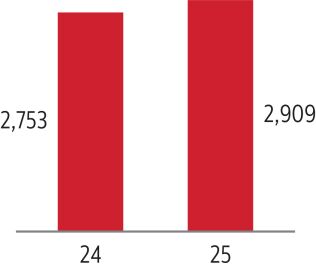
Basel III Glossary
Credit Risk Parameters
Exposure at Default (EAD): Generally represents the expected gross exposure – outstanding amount for on-balance sheet exposure and loan equivalent amount for off-balance sheet exposure at default.
Probability of Default (PD): Measures the likelihood that a borrower will default within a one-year time horizon, expressed as a percentage.
Loss Given Default (LGD): Measures the severity of loss on a facility in the event of a borrower’s default, expressed as a percentage of exposure at default.
Exposure Types
Non-retail
Corporate: Defined as a debt obligation of a corporation, partnership, or proprietorship.
Bank: Defined as a debt obligation of a bank or bank equivalent.
Sovereign: Defined as a debt obligation of a sovereign, central bank, multi development banks and public sector entities (PSEs) as defined in the OSFI Guideline – Capital Adequacy Requirements (November 2023).
Securitization: On-balance sheet investments in asset-backed securities, mortgage-backed securities, collateralized loan obligations and collateralized debt obligations, off-balance sheet liquidity lines to the Bank’s own sponsored and third-party conduits and credit enhancements.
Retail
Residential Mortgage: Loans to individuals against residential property (four units or less).
Secured Lines of Credit: Revolving personal lines of credit secured by residential real estate.
Qualifying Revolving Retail Exposures: Credit cards and unsecured lines of credit for individuals.
Other Retail: All other personal loans.
Exposure Sub-types
Drawn: Outstanding amounts for loans, leases, acceptances, deposits with banks and FVOCI debt securities.
Undrawn: Unutilized portion of authorized committed credit lines.
Other Exposures
Repo-Style Transactions: Reverse repurchase agreements (reverse repos) and repurchase agreements (repos), securities lending and borrowing.
OTC Derivatives: Over-the-counter derivatives contracts refers to financial instruments which are traded through a dealer network rather than through an exchange.
Other Off-balance Sheet: Direct credit substitutes, such as standby letters of credit and guarantees, trade letters of credit, and performance letters of credit and guarantees.
Exchange-Traded Derivative Contracts: Exchange-traded derivative contracts are derivative contracts (e.g. futures contracts and options) that are transacted on an organized futures exchange. These include futures contracts (both long and short positions), purchased options and written options.
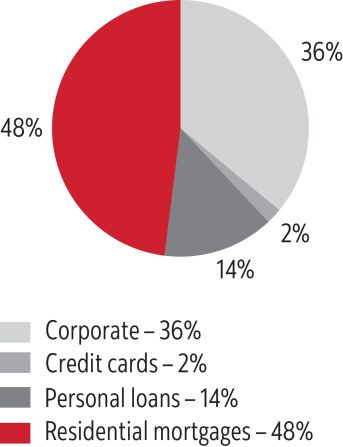
Qualifying Central Counterparty (QCCP): A licensed central counterparty is considered “qualifying” when it is compliant with the International Organization of Securities Commissions (IOSCO) standards and is able to assist clearing member banks in properly capitalizing for CCP exposures.
Asset Value Correlation Multiplier (AVC): Basel III has higher risk-weights on exposures to certain Financial Institutions (FIs) relative to the non-financial corporate sector by introducing an AVC. The correlation factor in the risk-weight formula is multiplied by this AVC factor of 1.25 for all exposures to regulated FIs whose total assets are greater than or equal to U.S. $150 billion and all exposures to unregulated FIs.
Specific Wrong-Way Risk (WWR): Specific Wrong-Way Risk arises when the exposure to a particular counterparty is positively correlated with the probability of default of the counterparty due to the nature of the transactions with the counterparty.
Basel III Regulatory Capital Floor: Since the introduction of Basel II in 2008, OSFI has prescribed a minimum regulatory capital floor for institutions that use the advanced internal ratings-based approach for credit risk. Effective Q2 2023, the capital floor add-on is determined under the Basel III Framework by comparing RWA generated for internally modelled standardized portfolios to RWA calculated under a fully standardized approach at the required capital floor calibration. A shortfall to the capital floor RWA requirement is added to the Bank’s RWA.
138 | 2025 Scotiabank Annual Report