Please wait
Table of Contents


LOGO


Scotiabank Management Proxy Circular ANNUAL AND S PECIAL MEETING OF SHAREHOLDERS APRIL 14, 2026 Please take some time to read this management proxy circular for important information about the business of the meeting and to learn more about Scotiabank. scotiabank.com/annualmeeting your vote is important


Table of Contents

CAUTION REGARDING FORWARD-LOOKING STATEMENTS

From time to time, our public communications include oral or written forward-looking statements. Statements of this type are included in this document, and may be included in other filings with Canadian securities regulators or the U.S. Securities and Exchange Commission (SEC), or in other communications. In addition, representatives of the bank may include forward-looking statements orally to analysts, investors, the media and others. All such statements are made pursuant to the “safe harbor” provisions of the U.S. Private Securities Litigation Reform Act of 1995 and any applicable Canadian securities legislation. Forward-looking statements may include, but are not limited to, statements made in this document and any document incorporated by reference herein regarding the bank’s financial projections, objectives, visions and goals, regarding the outlook for the bank’s businesses and for the Canadian, U.S. and global economies, and regarding environmental, social and governance (Sustainability), including climate-related, projections, objectives, vision and goals (collectively, our Sustainability Objectives), such as our net-zero and interim emissions targets, our statement on thermal coal, and our climate-related finance target. Such statements are typically identified by words or phrases such as “believe,” “expect,” “aim,” “achieve,” “foresee,” “forecast,” “anticipate,” “intend,” “estimate,” “outlook,” “seek,” “schedule,” “plan,” “goal,” “strive,” “target,” “project,” “commit,” “objective,” and similar expressions of future or conditional verbs, such as “will,” “may,” “should,” “would,” “might,” “can” and “could” and positive and negative variations thereof.

By their very nature, forward-looking statements require us to make assumptions and are subject to inherent risks and uncertainties, which give rise to the possibility that our predictions, forecasts, projections, expectations or conclusions will not prove to be accurate, that our assumptions may not be correct and that our financial performance and Sustainability Objectives will not be achieved. We caution readers not to place undue reliance on these statements as a number of risk factors, many of which are beyond our control and effects of which can be difficult to predict, could cause our actual results to differ materially from the expectations, targets, estimates or intentions expressed in such forward-looking statements.

The future outcomes that relate to forward-looking statements may be influenced by many factors, including but not limited to: general economic and market conditions in the countries in which we operate and globally; changes in currency and interest rates; increased funding costs and market volatility due to market illiquidity and competition for funding; the failure of third parties to comply with their obligations to the bank and its affiliates, including relating to the care and control of information, and other risks arising from the bank’s use of third parties; changes in monetary, fiscal, or economic policy and tax legislation and interpretation; changes in laws and regulations or in supervisory expectations or requirements, including capital, interest rate and liquidity requirements and guidance, and the effect of such changes on funding costs; geopolitical risk (including policies and other changes related to, or affecting, economic or trade matters, including tariffs, countermeasures, tariff mitigation policies and tax-related risks); changes to our credit ratings; the possible effects on our business and the global economy of war, conflicts or terrorist actions and unforeseen consequences arising from such actions; technological changes, including open banking and the use of data and artificial intelligence in our business, and technology resiliency; operational and infrastructure risks; reputational risks; the accuracy and completeness of information the bank receives on clients and counterparties; the timely development and introduction of new products and services, and the extent to which products or services previously sold by the bank require the bank to incur liabilities or absorb losses not contemplated at their origination; our ability to execute our strategic plans, including the successful completion of acquisitions and dispositions, including obtaining regulatory approvals; critical accounting estimates and the effect of changes to accounting standards, rules and interpretations on these estimates; global capital markets activity; the bank’s ability to attract, develop and retain key executives; the evolution of various types of fraud or other criminal behaviour to which the bank is exposed; anti-money laundering; disruptions or attacks (including cyberattacks) on the bank’s information technology, internet connectivity, network accessibility, or other voice or data communications systems or services, which may result in data breaches, unauthorized access to sensitive information, denial of service and potential incidents of identity theft; increased competition in the geographic and business areas in which we operate, including through internet and mobile banking and non-traditional competitors; exposure related to significant litigation and regulatory matters; environmental, social and governance risks, including climate-related risk, our ability to implement various sustainability-related initiatives (both internally and with our clients and other stakeholders) under expected time frames, and our ability to scale our sustainable-finance products and services; the occurrence of natural and unnatural catastrophic events and claims resulting from such events, including disruptions to public infrastructure, such as transportation, communications, power or water supply; inflationary pressures; global supply-chain disruptions; Canadian housing and household indebtedness; the emergence or continuation of widespread health emergencies or pandemics, including their impact on the local, national or global economies, financial market conditions and the bank’s business, results of operations, financial condition and prospects; and the bank’s anticipation of and success in managing the risks implied by the foregoing. A substantial amount of the bank’s business involves making loans or otherwise committing resources to specific companies, industries or countries. Unforeseen events affecting such borrowers, industries or countries could have a material adverse effect on the bank’s financial results, businesses, financial condition or liquidity. These and other factors may cause the bank’s actual performance to differ materially from that contemplated by forward-looking statements. Certain statements in this document are based on hypothetical or severely adverse scenarios and assumptions, and these statements should not necessarily be viewed as being representative of current or actual risk or forecasts of expected risk. The bank cautions that the preceding list is not exhaustive of all possible risk factors and other factors could also adversely affect the bank’s results. For more information, please see the “Risk Management” section of the bank’s 2025 annual report, as may be updated by quarterly reports.

Material economic assumptions underlying the forward-looking statements contained in this document are set out in the 2025 annual report under the headings “Outlook”, as updated by quarterly reports. The “Outlook” and “2026 Priorities” sections are based on the bank’s views and the actual outcome is uncertain. Readers should carefully consider the above-noted factors and other uncertainties and potential events, including when relying on forward-looking statements to make decisions with respect to the bank and its securities.

Any forward-looking statements contained in this document represent the views of management only as of the date hereof and are presented for the purpose of assisting shareholders, analysts and other readers in understanding the bank’s financial position, objectives and priorities, anticipated financial performance and Sustainability Objectives as at and for the periods ended on the dates presented, and may not be appropriate for other purposes. No representation or warranty, express or implied, is or will be made in relation to the accuracy, reliability or completeness of the information contained in this document. Except as required by law, the bank does not undertake to update any forward-looking statements, whether written or oral, that may be made from time to time by or on its behalf.

Additional information relating to the bank, including the bank’s annual information form, can be located on the SEDAR+ website at www.sedarplus.ca and on the EDGAR section of the SEC’s website at www.sec.gov.

ADDITIONAL CAUTION REGARDING SUSTAINABILITY-RELATED DISCLOSURES

In setting and implementing our Sustainability Objectives, and in preparing this document, the bank has made various assumptions, including about technological, economic, scientific and legal trends and developments, in light of an evolving policy and regulatory environment. As such, the data, analysis, strategy and other information set out in this document remain under development and subject to evolution, amendment, update and restatement over time. The bank specifically cautions readers of the following:


The terms “ESG”, “net-zero”, “carbon neutral”, “sustainable finance”, “carbon-related finance” and similar terms, taxonomies and criteria are evolving, and the bank’s use of such terms may change to reflect such evolution. Any references to such terms in this document are references to the internally defined criteria of the bank and not to any particular regulatory definition or voluntary standard.


The bank has assumed continued growth in its clients’ investments in and expenditures on Sustainability activities. The bank has also assumed ordinary rates of growth and development of the bank’s business, including in the products and services it provides to clients in all sectors, in its own investments, in its subsidiaries and in its geographic footprint. If any of these assumptions prove incorrect, the bank may not be able to meet its Sustainability Objectives and may need to update or revise them.


The evolution of the policy and regulatory environment relating to Sustainability issues, and climate-related issues in particular, may result in updates or revisions to forward-looking statements and other information contained in this document. There could also be changes to the market practices, taxonomies, methodologies, scenarios, frameworks, criteria and standards (collectively, Sustainability Standards) that governmental and non-governmental entities, the financial sector, the bank and its clients use to classify, assess, measure, report on and verify Sustainability activities, including for inclusion toward the bank’s Sustainability Objectives. In some cases, applicable Sustainability Standards may not yet exist. The bank may update its Sustainability Objectives, its plans to achieve them, its progress toward them, and its estimates of the impact of this progress, as appropriate, in light of new and evolving Sustainability Standards.


In setting and implementing its Sustainability Objectives, the bank relies on data obtained from clients and other third-party sources. The bank’s use of third-party data cannot be taken as an endorsement of the third-party or its data or be construed as granting any form of intellectual property. Although the bank believes these sources are reliable, the bank has not independently verified all third-party data, or assessed the assumptions underlying such data, and cannot guarantee their accuracy. The data used by the bank in connection with its Sustainability Objectives may be limited in quality, unavailable, or inconsistent across sectors, and we have no guarantee that third parties will comply with our policies and procedures in respect of the collection of this data. Certain third-party data may also change over time as Sustainability Standards evolve. These factors could have a material effect on the bank’s Sustainability Objectives and ability to meet them.


The bank and its clients may need to purchase carbon and clean energy instruments (Environmental Attributes) to meet its Sustainability Objectives. The market for Environmental Attributes is still developing and their availability may be limited. Some Environmental Attributes are also subject to the risk of invalidation or reversal, and the bank provides no assurance of the treatment of any such Environmental Attributes in the future. There may also be changes to applicable regulations and standards that impact the market for Environmental Attributes. The maturity, liquidity and economics of this market may make it more difficult for the bank to achieve its Sustainability Objectives.


This document may provide addresses of or contain hyperlinks to websites that are not owned or controlled by the bank. Each such address or hyperlink is provided solely for the recipient’s convenience, and the content of linked third-party websites is not in any way included or incorporated by reference into this document. The bank takes no responsibility for such websites or their content, or for any loss or damage that may arise from their use. If you decide to access any of the third-party websites linked to this document, you do so at your own risk and subject to the terms and conditions of such websites.


Table of Contents

LOGO


Scotiabank’s vision is to be our clients’ most trusted financial partner and deliver sustainable, profitable growth. Guided by our purpose: “for every future,” we help our clients, their families and their communities achieve success through a broad range of advice, products and services.


Notice of annual and special meeting of common shareholders of

The Bank of Nova Scotia


WHEN


WHERE


LIVE WEBCAST

Tuesday, April 14, 2026

9:00 a.m. (Eastern)


Scotiabank Centre
Scotia Plaza,
40 King Street West,
2nd floor
Toronto, Ontario
M5H 3Y2

  https://meetings.lumiconnect.com/400-006-109-753

Our annual and special meeting will be held both in person and online via live webcast, allowing shareholders to attend the meeting, vote their shares, and submit questions using either method.

Please see page 11 for information about attending the meeting, voting, and submitting questions.

AT THE MEETING YOU WILL BE ASKED TO:


  1.

Receive our financial statements for the year ended October 31, 2025 and the auditor’s report on the statements

 
  2.

Elect directors

 
  3.

Appoint auditor

 
  4.

Confirm, by special resolution, an amendment to By-law No. 1 regarding directors’ compensation

 
  5.

Confirm administrative amendments to By-law No. 1

 
  6.

Vote on an advisory resolution on our approach to executive compensation

 
  7.

Vote on the shareholder proposals

 
  8.

Consider any other business that may properly come before the meeting


You can read about each item of business beginning on page 6 of the management proxy circular, which describes the meeting, who can vote, and how to vote.

Holders of common shares on February 17, 2026, the record date, are eligible to vote at the meeting (subject to Bank Act (Canada) restrictions). There were 1,232,483,540 common shares outstanding on this date.

By order of the board,


LOGO


Jaime Larry

Vice President, Bank Governance and Corporate Secretary

Toronto, Ontario, Canada

February 17, 2026


YOUR VOTE IS

IMPORTANT

As a Scotiabank shareholder, it is important to vote your shares at the upcoming meeting. Detailed voting instructions for registered and non-registered shareholders begin on page 11 of the management proxy circular.

If you cannot attend the meeting, you should complete, sign and return your proxy or voting instruction form to vote your shares. We encourage you to vote your shares prior to the annual and special meeting. Your vote must be received by our transfer agent, Computershare Trust Company of Canada, by 9:00 a.m. (Eastern) on April 10, 2026.


Table of Contents

Welcome to our 194th annual and special meeting of shareholders


LOGO

Aaron W. Regent

Chair of Scotiabank’s

Board of Directors


LOGO

L. Scott Thomson

President and Chief Executive Officer

Dear fellow shareholders,

We are pleased to invite you to Scotiabank’s annual and special meeting in Toronto on April 14, 2026.

This management proxy circular provides shareholders with important information, including the bank’s approach to corporate governance matters and executive compensation, as well as other business that will be conducted at the meeting. We encourage you to review this circular and vote your shares.

Shareholders may choose to attend our annual and special meeting either in person or online via a live webcast. Both options will allow for full shareholder participation by viewing the meeting, voting their shares and submitting questions.

The bank’s board and leadership team thank you for your continued engagement and confidence in our bank, as we continue to make strong progress in delivering against our strategic plan to drive profitable and sustainable growth. We look forward to updating you on our progress at our meeting, and hearing from our shareholders directly on April 14.


LOGO   LOGO


2   Scotiabank


Table of Contents

What’s inside


1   

About the meeting


6


Business of the meeting


6


Information about voting


11


About the nominated directors


16


Skills and experience


24


Meeting attendance


25


Director compensation


25


26


26


Director equity ownership


27


2   

Governance


28


About the board


31


31


Board priorities


32


32


33


35


   Technology and innovation


37


   Data ethics and AI


38


   Cybersecurity


38


40


43


   Subsidiary governance


43


   Stakeholder engagement


44


46


Board composition, development and assessment


52


52


   Independent


52


   Diverse


53


   Integrity and engagement


54


  Balanced in other professional activities


54


   Change in principal occupation


55


   Balanced in tenure


55


56


57


57


57


60


Committee reports


62


3   

Executive compensation


69


Message from the Chair of the Board and the chair of the human capital and compensation committee


70


Compensation discussion and analysis


76


81


85


87


92


103


2025 executive compensation details


104


104


106


111


113


4   

Other information


116


116


117


117


117


118


118


5   

Shareholder proposals


119


Directors’ approval


135


Management proxy circular     3  


Table of Contents

LOGO


Management proxy circular


You have received this management proxy circular because you owned Scotiabank common shares as of the close of business on February 17, 2026 (the record date) and are entitled to vote at our annual and special meeting.


Management is soliciting your proxy for the annual and special meeting on April 14, 2026.


This document tells you about the meeting, governance, executive compensation, other information, and shareholder proposals at Scotiabank. We have organized it into five sections to make it easy to find what you are looking for and to help you vote with confidence.


We pay the cost of proxy solicitation for all registered and non-registered (beneficial) shareholders. We are soliciting proxies mainly by mail, but you may also be contacted by employees of Scotiabank, our transfer agent, Computershare Trust Company of Canada (Computershare), or our proxy solicitation firm, Kingsdale Advisors. Kingsdale Advisors may contact certain beneficial shareholders to assist in exercising their voting rights by telephone via Broadridge Investor Communication Corporation’s QuickVote™ service. We have retained Kingsdale Advisors to help us with this process at an estimated cost of $50,000.


Unless indicated otherwise, information in this management proxy circular (circular) is as of February 10, 2026 and all dollar amounts are in Canadian dollars.


DELIVERY OF MEETING MATERIALS


Notice and access


As permitted by the Canadian Securities Administrators (CSA) and pursuant to an exemption from the proxy solicitation requirement received from the Office of the Superintendent of Financial Institutions (OSFI), we are using “notice and access” to deliver this circular to both our registered and beneficial shareholders. This means that this circular will be posted online for you to access instead of receiving a physical copy in the mail. Notice and access gives shareholders more choice, allows for faster access to this circular, reduces our printing and mailing costs, and is environmentally friendly as it reduces paper and energy consumption.


You will still receive a physical copy of the form of proxy in the mail if you are a registered shareholder, or the voting instruction form if you are a beneficial shareholder, so that you can vote your shares. However, instead of receiving a physical copy of the circular, you will receive a notice explaining how to access this circular electronically and how to request a physical copy. Physical copies of the circular will also be provided to shareholders who have standing instructions to receive physical copies of meeting materials.


How to access the circular electronically


This circular is available on the website of the bank (www.scotiabank.com/annualmeeting), Computershare (www.envisionreports.com/scotiabank2026), on SEDAR+ (www.sedarplus.ca), and on EDGAR (www.sec.gov).


In this document:


we, us, our, the bank and Scotiabank mean The Bank of Nova Scotia

you and your mean holders of our common shares

common shares and shares mean the bank’s common shares

annual meeting, AGM, and meeting mean the annual and special meeting of common shareholders of the bank


4   Scotiabank


Table of Contents

Delivery of the annual report


How we deliver our annual report to you depends on whether you are a registered shareholder or a beneficial shareholder.


You are a registered shareholder if the shares you own are registered directly in your name with Computershare. If this is the case, your name will appear on a share certificate or a statement from a direct registration system confirming your shareholdings. You are a beneficial shareholder if the shares you own are registered for you in the name of an intermediary such as a securities broker, trustee, or financial institution.


Registered shareholders


Registered shareholders who have not opted out of receiving our annual report will receive a physical copy, unless they have consented to electronic delivery. For information about enrolling to receive shareholder materials by email, please refer to “Receiving shareholder materials by email” under “Information about voting.”


Beneficial shareholders


As permitted under securities laws, we are using notice and access to deliver our annual report to beneficial shareholders. You may access the annual report online in the same manner as described in “How to access the circular electronically.” Physical copies of the annual report will also be provided to shareholders who have standing instructions to receive physical copies of meeting materials. For information about enrolling to receive shareholder materials by email, please refer to “Receiving shareholder materials by email” under “Information about voting.”


How to request a physical copy of materials provided to you through notice and access


Shareholders may request a physical copy of this circular or our annual report, at no cost, up to one year from the date the circular was filed on SEDAR+. If you would like to receive a physical copy prior to the meeting, please follow the instructions provided in the notice of meeting or contact Computershare at the contact information provided on the back cover of this circular. A copy of the requested documents will be sent to you within three business days of your request. If you request a physical copy of any materials, you will not receive a new form of proxy or voting instruction form, so you should keep the original form sent to you in order to vote.


Questions?


If you have questions about notice and access or to request a physical copy of this circular or our annual report after the meeting at no charge, you can contact Computershare at the contact information provided on the back cover of this circular.


FOR MORE INFORMATION


You can find financial information about Scotiabank in our 2025 annual report, which includes our consolidated financial statements and management’s discussion and analysis (MD&A). Financial information and other information about Scotiabank, including our annual information form (AIF) and quarterly financial statements, are available on our website (www.scotiabank.com), SEDAR+ (www.sedarplus.ca), or on the U.S. Securities and Exchange Commission (SEC) website (www.sec.gov).


Copies of these documents, this circular and any document incorporated by reference, are available for free by writing to:


Corporate Secretary of The Bank of Nova Scotia

40 Temperance Street

Toronto, Ontario

Canada M5H 0B4

corporate.secretary@scotiabank.com


You can also communicate with our board of directors by writing to the Chair of the Board at chair.board@scotiabank.com.


1

ABOUT THE

MEETING

Read about the items of business and how

to vote your shares

2

GOVERNANCE

Learn about our board’s governance practices

3

EXECUTIVE COMPENSATION

Find out what we paid

our senior executives for 2025 and why

4

OTHER INFORMATION

Read additional disclosure about

the bank

5

SHAREHOLDER PROPOSALS

Read the proposals we received from shareholders and learn how and why we recommend

voting in relation to each


Management proxy circular     5  


Table of Contents


1


About the meeting


Business of the meeting


1. RECEIVE FINANCIAL STATEMENTS


Our consolidated financial statements and MD&A for the year ended October 31, 2025, together with the auditor’s report on those statements, will be presented at the meeting. You will find these documents in our 2025 annual report, which is available on our website.


2. ELECT DIRECTORS


Under our majority voting policy, you will elect 12 directors individually to serve on our board until the close of the next annual meeting or until their successors are elected or appointed. You can find information about the nominated directors beginning on page 17 and our majority voting policy on page 57.


The board

recommends you vote

for

each

nominated director


The board

recommends you vote

for

KPMG LLP

as our independent auditor

3. APPOINT AUDITOR


You will vote on appointing the independent auditor. The board recommends that KPMG LLP (KPMG) be re-appointed as the shareholders’ auditor until the close of the next annual meeting. The board assessed the performance and independence of KPMG and confirmed that KPMG is independent of the bank within the meaning of the relevant rules and related interpretations prescribed by the relevant professional bodies in Canada and any applicable legislation or regulation. KPMG was appointed our sole auditor in March 2006 following a comprehensive audit tendering process involving the joint auditors to determine which firm should be appointed as sole auditor. In the prior year, the vote was 94.3% for KPMG as auditor. Representatives of KPMG will attend the meeting.


The bank has robust policies and procedures in place to assess auditor performance, objectivity, and independence. The audit and conduct review committee, which is composed entirely of independent directors, oversees and evaluates the external auditor. The committee recognizes the importance of maintaining auditor independence while balancing a need for continuity of institutional knowledge to ensure the auditor has the necessary experience to effectively audit an international organization of significant size and complexity. When assessing auditor effectiveness and independence, the committee considers a number of factors, including the results of an annual performance and independence review of the external auditor, with a comprehensive review performed on a periodic basis, the nature and amount of any non-audit services, and mandatory partner rotations.


The bank has numerous processes in place in order to ensure auditor effectiveness and independence:

Audit and Conduct Review Committee Review (Performance): The audit and conduct review committee conducts a fulsome annual assessment on the performance of the auditor as per the bank’s policy on the assessment of the external auditor (the auditor assessment policy) with inputs from management, prior to its recommendation to the board on the auditor’s proposed appointment. This is supplemented with a comprehensive review on a periodic basis as documented below. The committee reviews audit quality, including audit quality indicators and related metrics, auditor tenure, reasonableness of the audit fees, knowledge and experience of the lead and other key engagement partners, and the credibility of the auditor in the financial markets and with regulators. In the prior year, the audit and conduct review committee carefully considered whether the auditor assessment policy should be amended to include a provision for mandatory rotation of auditors after a certain period of time. Upon such consideration, the audit and conduct review committee concluded that the current periodic comprehensive review process, which is the preferred alternative to mandatory firm rotation or re-tendering per Chartered Professional Accountants of Canada (CPA Canada)/Canadian Public Accountability Board (CPAB)/Institute of Corporate Directors (ICD) Enhancing Audit Quality Initiative, in addition to the bank’s robust auditor assessment policy and other safeguards against familiarity as outlined below, appropriately ensure auditor independence, and that mandatory auditor rotation is not required at this time.


6   Scotiabank


Table of Contents

Audit and Conduct Review Committee Review (Independence): The audit and conduct review committee takes into consideration both the high standards of independence that the bank employs in reviewing relationships with the auditor, which further mitigate potential concerns of familiarity due to auditor tenure, and the importance of the auditor’s institutional knowledge. The committee also considers the nature and extent of any non-audit service fees when assessing independence, which only represent 4.5% of the total auditor’s fees in 2025.


Mandatory Partner Rotations: The mandated rotation of lead and other key engagement partners of KPMG, including partners auditing the different segments of the bank, provides a safeguard against familiarity threats. The lead audit engagement partner rotated in fiscal 2021 and the next rotation is in fiscal 2026. In working with our auditors, the audit and conduct review committee has agreed on a plan for the effective transition of the lead audit engagement partner. The engagement quality partner will rotate in fiscal 2026. The group engagement partner rotated in fiscal 2022. In addition, the partners for all segments also rotate per required independence standards. The rotations for these key roles are staggered to balance continuity and ensure that risk of familiarity threats is addressed at all times.

Comprehensive Review: The audit and conduct review committee also conducts an in-depth comprehensive review of our external auditor every five years using the standardized toolkit developed by CPA Canada, the CPAB and the ICD, prior to its recommendation to the board regarding the auditor. The comprehensive review is intended to enhance audit quality through a deeper and broader analysis of the external auditor beyond the annual assessment. This approach is consistent with the conclusions and recommendations from CPA Canada/CPAB/ICD Enhancing Audit Quality initiative, which state that a committee’s periodic comprehensive review is the preferred alternative to mandatory firm rotation or re-tendering for addressing the institutional familiarity threat and enhancing audit quality. In 2025, the committee performed a comprehensive review using the CPA Canada/CPAB/ICD toolkit, whose review criteria included (1) independence, objectivity and professional skepticism of the auditor; (2) quality of the audit engagement team; (3) quality of communications and interactions; and (4) measures to safeguard against familiarity threats. The comprehensive review also considered audit quality indicators, which our external auditor reports on annually, as recommended by Canadian regulatory and accounting member bodies such as CPA Canada, the CPAB and the ICD. The review raised no significant concerns with KPMG as the bank’s external auditor. It was recommended that the external auditor contract not be put out for tender and that KPMG be re-appointed as auditor of the bank. The next comprehensive review will be conducted in 2030.

Strong Regulatory Framework: KPMG is an independent registered public accounting firm and is subject to external inspections and oversight by the CPAB and the Public Company Accounting Oversight Board (PCAOB). KPMG shares findings and other relevant matters from these inspections with our audit and conduct review committee.

Regular Review of Committee Membership: The corporate governance committee recommends committee composition (including committee chairs) to the board and reviews committee membership throughout the year and after the annual meeting once the board is elected. The committee also reviews committee chair succession in accordance with their term limits. This review and the committee chair term limits ensure the audit and conduct review committee members have the appropriate skills, experience, and tenure, as well as ensure the committee maintains fresh perspectives and does not develop familiarity issues.

 
Based on the audit and conduct review committee’s rigorous assessment of KPMG, the board has concluded that there are no concerns regarding KPMG’s effectiveness, tenure, and independence and that KPMG should be recommended for re-appointment to shareholders at this annual meeting.  

Auditor’s fees


The table below lists the services KPMG provides and the fees we paid to them for the fiscal years ended October 31, 2025 and 2024. The increase in audit fees was due mainly to scope changes driven by new regulatory compliance requirements and business-related increases. The increase was also driven partly by market-related increases resulting from inflation. The audit and conduct review committee can pre-approve services if they are within the scope of the policies and procedures approved by the committee.


$ millions    2025        2024  
 

Audit services

     40.6          39.1  

Audit services generally relate to the statutory audits and review of financial statements, regulatory required attestation reports, as well as services associated with registration statements, prospectuses, periodic reports and other documents filed with securities regulatory bodies or other documents issued in connection with securities offerings.


Audit-related services

     2.4          1.2  

Audit-related services include special attestation services not directly linked to the financial statements, review of controls and procedures related to regulatory reporting, audits of employee benefit plans and consultation and training on accounting and financial reporting.


Tax services outside of the audit scope

     0.7          0.4  

Tax services outside of the audit scope relate primarily to specified review procedures required by local tax authorities, attestation on tax returns of certain subsidiaries as required by local tax authorities, and review to determine compliance with an agreement with the tax authorities.


Other non-audit services

     0.9          1.2  

Other non-audit services are primarily for the review and translation of English language financial statements into other languages and special attestation services required for sustainability and climate-related reporting.


Total Bank and Subsidiaries


44.6


41.9


Mutual Funds      3.9          3.6  

Total Fees


48.5


45.5


Management proxy circular     7  


Table of Contents

4. CONFIRM, BY SPECIAL RESOLUTION, AN AMENDMENT TO BY-LAW NO. 1 REGARDING DIRECTORS’ COMPENSATION


The Bank Act (Canada) (Bank Act) requires that our by-laws fix the maximum amount of compensation that can be paid to all directors for their services as directors of the bank during a specific period. Section 3.13 of By-law No. 1 fixed that amount at $5,000,000 in each financial year. This amount has not been increased since being approved by shareholders at our annual and special meeting on April 9, 2015. For more information about our approach to director compensation, see pages 25 to 26 of the circular.


On October 28, 2025, the board approved an amendment to Section 3.13 of By-law No. 1 to increase the aggregate maximum amount that can be paid to directors in each financial year to $7,000,000. To be effective, the proposed by-law amendment requires confirmation by a special resolution of shareholders, approved by at least two-thirds of the votes cast by shareholders at the meeting.


Directors’ duties and responsibilities continue to expand and evolve with the growth and complexity of the bank’s business, the markets in which the bank operates and the evolving regulatory environment. The proposed increase recognizes that directors are spending an increasing amount of time on our affairs and that their duties as directors require a substantial commitment. This change allows the bank to continue to attract and recruit qualified candidates with the necessary skills, expertise and experience to meet the expectations of the bank, regulators and stakeholders. Although the current compensation limit is adequate to accommodate the current number of directors and increases in retainers, the new aggregate maximum provides more flexibility in the board succession process by allowing new directors to join the board before others retire. It also allows the bank the ability to establish new or special committees (for which compensation may be payable), to respond to any unforeseen events or address specific priorities or initiatives as they arise, as well as to account for appropriate increases in director compensation in future years.


The resolution to be presented for consideration by shareholders at the meeting is as follows:


“Resolved, as a special resolution, that the amendment of Section 3.13 of By-law No. 1 to delete the reference to $5,000,000 and replace it with $7,000,000, is confirmed.”


If passed, Section 3.13 will read as follows:


“3.13 Compensation – For each financial year, a sum not exceeding $7,000,000 may be taken by the Board from the funds of the Bank as remuneration for their services as Directors, and the Directors may from time to time apportion the same among themselves in such manner as they shall think fit. The Directors shall also be entitled to be reimbursed for travelling and other expenses properly incurred by them in attending meetings of the Board, or any Committee of the Board, or of Shareholders.”


For the full text of our by-laws, including the amendments to be approved by our shareholders, please visit scotiabank.com/annualmeeting, the SEDAR+ website (www.sedarplus.ca) or the EDGAR section of the SEC’s website (www.sec.gov).


The board

recommends you vote

for

the confirmation of an amendment to By-law No. 1


5. CONFIRM ADMINISTRATIVE AMENDMENTS TO BY-LAW NO. 1


On October 28, 2025, the board passed a resolution amending certain provisions of the bank’s by-laws, effective only upon confirmation by an ordinary resolution approved by a majority of the votes cast by shareholders at the meeting. These amendments are part of our continual review of best governance practices and reflect regulatory changes that are administrative in nature.


The changes to the by-laws are to: (1) allow for the annual meeting of shareholders to be delayed if permitted by the Bank Act, applicable laws and applicable stock exchange requirements; (2) require at least two persons present in person or represented by proxyholder for quorum for shareholders’ meetings; (3) clarify that voting at a shareholder meeting can be conducted by a show of hands if permitted by the Bank Act and document what constitutes prima facie evidence in respect of whether a vote at a shareholder meeting has been carried or not; (4) document the authority of the chair of the meeting of shareholders to adjourn or to change the place or method through which shareholders may participate or terminate the meeting; (5) authorize the board to appoint, from time to time, one or more additional directors in a manner permitted by the Bank Act, for a term expiring not later than the close of the next annual meeting of shareholders of the bank; (6) document that board meetings may be conducted by virtual means, clarify the ability to provide notice to directors for board meetings by electronic means in accordance with the Bank Act and revise the notice to directors for board meetings to be at least 24 hours before the time fixed for such meeting; and (7) document that special meetings of the board may be conducted by virtual means and to clarify the ability to provide notice to directors for special meetings of the board by electronic means in accordance with the Bank Act.


The board

recommends you vote

for

the confirmation of the

administrative amendments

to By-law No. 1


8   Scotiabank


Table of Contents


The resolution to be presented for consideration by shareholders at the meeting is as follows:


“Resolved, that the following amendments to By-law No. 1 of the bank are confirmed:


1.   Section 2.01 of By-law No. 1 of the bank be amended as follows:


‘2.01 Annual and special meetings – The Board shall call an annual meeting of Shareholders to be held not later than 6 months after the end of each financial year unless such longer period is permitted under the Act, applicable laws and applicable stock exchange requirements. The Board may at any time call a special meeting of Shareholders.’


2.  Section 2.03 of By-law No.1 of the bank be amended as follows:


‘2.03 Quorum – At any meeting of Shareholders, at least two persons the holders, present in person or represented by proxyholders, of who, together, hold or represent by proxy, at least 25% of the outstanding shares of the Bank entitled to be voted at the meeting shall constitute a quorum for the transaction of business. However, where the provisions relating to a class or series of shares otherwise provide for the quorum for meetings of the holders thereof, such provisions shall apply to meetings of such Shareholders.’


3.  Section 2.06 of By-law No.1 of the bank be amended as follows:


‘2.06 Voting – Subject to the Act, vVoting at any meeting of Shareholders shall take place by show of hands except when, either before or after a show of hands, a ballot is required by the chair of the meeting or is requested by any person present and entitled to vote at the meeting. On a show of hands, each person present and entitled to vote at the meeting shall have one vote. On a ballot, each Shareholder present in person or represented by proxyholder at the meeting and entitled to vote thereat shall have one vote for each share entitled to be voted which the Shareholder owns. Any ballot shall be taken in such manner as the chair of the meeting directs. After a vote, a declaration by the chair of the meeting that the vote upon the matter has been carried or carried by a particular majority or not carried and an entry to that effect in the minutes of the meeting shall be prima facie evidence of the result of the vote.


4.  By-law No. 1 of the bank be amended to include a new Section 2.08 as follows:


‘2.08 Adjournment and termination – The chair at any meeting of Shareholders or the Chair of the Board, may adjourn such meeting of Shareholders from time to time and change the place at which or facility through which Shareholders may participate and may terminate such meeting of Shareholders on completion of the business for which it was called as set out in the notice of meeting.’


5.  Section 3.03 of By-law No. 1 of the bank be amended as follows:


‘3.03 Filling vacancy and appointment of additional directorsSubject to the Act, a quorum of Directors may fill a vacancy among the Directors which exists for any reason. The Directors of the Bank may appoint one or more additional Directors, within the maximum number permitted by these By-laws, who shall hold office for a term expiring not later than the close of the next annual meeting of Shareholders of the Bank, but the total number of Directors so appointed may not exceed one-third of the number of Directors elected at the previous annual meeting of Shareholders of the Bank.


6.  Section 3.05 of By-law No. 1 of the bank be amended as follows:


‘3.05 Meetings Meetings of the Board shall be held at Toronto or at other places on days and at times determined from time to time by the Board and may be conducted by means of telephonic, electronic or other communication facility that permits all participants to communicate adequately with each other during the meeting. nNotice thereof shall be sent by prepaid mail, by personal delivery or other means of electronic, transmitted or recorded communication or by telephone in accordance with the Act at least 24 hours one week before the time fixed for such date of the meeting to each Director at his/her their address or communication number last recorded with the Secretary.’


7.  Section 3.06 of By-law No. 1 of the bank be amended as follows:


‘3.06 Special meeting – The Chair of the Board, the Chief Executive Officer, the President or any three Directors may call a special meeting of the Board to be held at any place at any time he/she or they are of the opinion that the interests of the Bank require it and may be conducted by means of telephonic, electronic or other communication facility that permits all participants to communicate adequately with each other during the meeting. Notice of such special meeting shall be sent by prepaid mail, by personal delivery or other means of electronic, transmitted or recorded communication or by telephone in accordance with the Act at least 12 hours before the meeting to each Director at his/her their address or communication number last recorded with the Secretary.’


For the full text of our by-laws, including the amendments to be approved by our shareholders, please visit scotiabank.com/annualmeeting, the SEDAR+ website (www.sedarplus.ca) or the EDGAR section of the SEC’s website (www.sec.gov).


Management proxy circular     9  


Table of Contents


6. ADVISORY VOTE ON OUR APPROACH TO EXECUTIVE COMPENSATION


You can have a “say on pay” by participating in an advisory vote on our approach to executive compensation.


Since 2010, we have held this annual advisory vote to give shareholders the opportunity to provide the board with important feedback. This vote does not diminish the role and responsibility of the board. Last year, the vote was 94.47% for our approach to executive compensation. For more details about the bank’s approach to executive compensation, please refer to Section 3 – Executive Compensation. Our executive compensation program is designed to deliver strong, consistent, and predictable results to shareholders over the longer term. Our practices meet the model policy on “say on pay” for boards of directors developed by the Canadian Coalition for Good Governance (CCGG).


You will be asked to vote on the following advisory resolution:


Resolved, on an advisory basis and not to diminish the role and responsibilities of the Board of Directors, that the shareholders accept the approach to executive compensation disclosed in this management proxy circular delivered in advance of the 2026 annual and special meeting of shareholders of the bank.


The board

recommends you vote

for

our approach to

executive compensation


This is an advisory vote, which means the results are not binding on the board. The human capital and compensation committee and the board review the results after the meeting and as they consider future executive compensation decisions. If a significant number of shares are voted against the advisory resolution, the human capital and compensation committee will review our approach to executive compensation in the context of any specific shareholder concerns that have been identified and may make recommendations to the board. We will disclose the human capital and compensation committee’s review process and the outcome of its review within six months of the annual meeting.


The human capital and compensation committee and the board welcome questions and comments about executive compensation at Scotiabank. We maintain an open dialogue with shareholders and consider all feedback. See the back cover for our contact information.


7. SHAREHOLDER PROPOSALS


This year you will be asked to consider eight shareholder proposals. You can read the proposals and how and why the board recommends voting in relation to each proposal in Section 5.


The board

recommends you vote

AGAINST the proposals


The deadline for submitting proposals to be considered at next year’s annual meeting is November 19, 2026. Proposals should be sent to the Corporate Secretary of The Bank of Nova Scotia, 40 Temperance Street, Toronto, Ontario, Canada M5H 0B4 or corporate.secretary@scotiabank.com.


SHAREHOLDER APPROVAL


Each item being put to a vote requires the approval of a majority (50% plus one vote) of votes cast in person or by proxy at the meeting other than confirmation of an amendment to By-law No.1 regarding directors’ compensation, which requires approval of at least two-thirds of the votes cast by shareholders at the meeting. Directors are subject to our majority voting policy (see page 57).


You (or your proxyholder) can vote as you (or your proxyholder) wish on any other items of business properly brought before the meeting (or a reconvened meeting if there is an adjournment). As of the date of this circular, we are not aware of other matters that will be brought before the meeting.


Management does not contemplate that any nominated director will be unable to serve as a director. If, however, this does occur for any reason during or prior to the meeting, the individuals named in your proxy form or voting instruction form as your proxyholder can vote for another nominee at their discretion.


10   Scotiabank


Table of Contents

Information about voting

WHO CAN VOTE


You are entitled to one vote per common share held on February 17, 2026, the record date.


Shares beneficially owned by the following entities and persons cannot be voted (except in

circumstances approved by the Minister of Finance):

the Government of Canada or any of its agencies

the government of a province or any of its agencies

the government of a foreign country or any political subdivision of a foreign country or any of its agencies

any person who has acquired more than 10% of any class of shares of the bank.


Also, if a person, or an entity controlled by a person, beneficially owns shares that in total represent more than 20% of the eligible votes that may be cast, that person or entity may not vote any of the shares unless permitted by the Minister of Finance.


Our directors and officers are not aware of any person or entity who beneficially owns, directly or indirectly, or exercises control or direction over, more than 10% of any class of our outstanding shares, as of the record date.


HOW TO VOTE


You can vote in advance of the annual meeting or during the meeting, or you can appoint someone to attend the meeting and vote your shares for you (called voting by proxy). How you vote depends on whether you are a registered or a beneficial shareholder. You are a beneficial shareholder if the shares you own are registered for you in the name of an intermediary such as a securities broker, trustee, or financial institution. You are a registered shareholder if the shares you own are registered directly in your name with Computershare. If this is the case, your name will appear on a share certificate or a statement from a direct registration system confirming your shareholdings.


Outstanding
common shares


1,232,802,966 on
February 10, 2026,
the date of this circular


1,232,483,540 on
February 17, 2026,
the record date


Beneficial (non-registered) shareholders


Registered shareholders


Your intermediary has sent you a voting instruction form with this package. We may not have records of your shareholdings as a beneficial shareholder, so you must follow the instructions from your intermediary to vote.


We have sent you a proxy form with this package. A proxy is a document that can authorize someone else to attend the meeting and vote your shares for you.


Voting in advance of the annual meeting


Complete the voting instruction form and return it to your intermediary.


Your intermediary may also allow you to do this online or by telephone.


You can either mark your voting instructions on the voting instruction form or you can appoint another person (called a proxyholder) to attend the annual meeting and vote your shares for you.


To vote online, follow the instructions on the proxy form.


Alternatively, you may complete the paper proxy form and return it to Computershare.


You can either mark your voting instructions on the proxy form or you can appoint another person (called a proxyholder) to attend the annual meeting and vote your shares for you.


Voting at the annual meeting


Beneficial shareholders who have not duly appointed themselves as proxyholder will not be able to vote at the meeting in person or online. This is because we and Computershare do not have a record of the beneficial shareholders of the bank, and, as a result, will have no knowledge of your shareholdings or entitlement to vote unless you appoint yourself as proxyholder.


If you are a beneficial shareholder and wish to vote at the meeting, you MUST appoint yourself as proxyholder by inserting your own name in the space provided on the voting instruction form sent to you and you MUST follow all the applicable instructions by the deadline provided by your intermediary. See “Appointment of a third party as proxy” and “How to attend the meeting” below.


Registered shareholders may vote in person or online, as applicable, during the meeting, as further described below under “How to attend the meeting.”


Do not complete and return the proxy form in advance.


Management proxy circular     11  


Table of Contents


Beneficial shareholders


Registered shareholders


Returning the form


The voting instruction form tells you how to return it to your intermediary.


Remember that your intermediary must receive your voting instructions in sufficient time to act on them, generally one day before the proxy deadline below.


Computershare must receive your voting

instructions from your intermediary by no later than the proxy deadline, which is 9:00 a.m. (Eastern) on April 10, 2026.


The proxy form tells you how to submit your voting instructions.


Computershare must receive your proxy, including any amended proxy, by no later than the proxy deadline which is 9:00 a.m. (Eastern) on April 10, 2026.


You may return your proxy in one of the following ways:

by mail, in the envelope provided.

using the internet. Go to www.investorvote.com and follow the instructions online.


Changing your vote


If you have provided voting instructions to your intermediary and change your mind about how you want to vote, or you decide to attend and vote at the annual meeting, contact your intermediary to find out what to do.


If your intermediary gives you the option of using the internet to provide your voting instructions, you can also use the internet to change your instructions, as long as your intermediary receives the new instructions in enough time to act on them before the proxy deadline. Contact your intermediary to confirm the deadline.


If you want to revoke your proxy, you must deliver a signed written notice specifying your instructions to one of the following:

our Corporate Secretary, by 5:00 p.m. (Eastern) on the last business day before the meeting (or any adjourned meeting reconvenes). Deliver to:

The Bank of Nova Scotia Executive Offices

ATTN: Jaime Larry, Vice President, Bank Governance and Corporate Secretary

40 Temperance Street

Toronto, Ontario, Canada

M5H 0B4

Email: corporate.secretary@scotiabank.com

Nicola Ray Smith, Regional Senior Vice President, Atlantic Region, by 5 p.m. (Eastern) on the last business day before the meeting (or any adjourned meeting reconvenes). Deliver to:

The Bank of Nova Scotia Head Office

ATTN: Nicola Ray Smith, Regional Senior Vice President

1709 Hollis Street

Halifax, Nova Scotia, Canada

B3J 1W1

the Chair of the meeting, before the meeting starts or any adjourned meeting reconvenes.


You can also revoke your proxy in any other way permitted by law. You can change your voting instructions by voting again using the internet. Your voting instructions must be received by Computershare by the proxy deadline noted above, or by voting at the meeting.


If you have questions or need assistance voting, please contact Kingsdale Advisors at 1-855-476-7988 (toll-free in North America) or 1-416-623-2512 (call and text enabled outside North America) or email contactus@kingsdaleadvisors.com.


12   Scotiabank


Table of Contents

APPOINTMENT OF A THIRD PARTY AS PROXY


Your form of proxy or voting instruction form names Aaron W. Regent, Chair of the Board, or failing him, L. Scott Thomson, President and Chief Executive Officer, each a director of the bank, as your proxyholder. You may appoint anyone as your proxyholder to represent you at the meeting. Your proxyholder does not have to be a shareholder of the bank. Your proxyholder must attend the meeting and vote for you. Beneficial shareholders who wish to attend the meeting in person or online MUST appoint themselves as proxyholder.


We reserve the right to accept late proxies and to waive or extend the proxy deadline with or without notice but are under no obligation to accept or reject a late proxy.


Additional information for appointing a third party as proxy if attending the meeting online


Shareholders who wish to appoint someone other than the Scotiabank proxyholders as their proxyholder to attend and participate at the meeting online and vote their shares MUST submit their form of proxy or voting instruction form, as applicable, appointing that person as proxyholder AND register that proxyholder as described below. This includes beneficial shareholders who wish to appoint themselves as proxyholder to attend, participate in, or vote at the meeting. Registering your proxyholder is an additional step to be completed AFTER you have submitted your form of proxy or voting instruction form. Failure to register the proxyholder will result in the proxyholder not receiving a username that is required to vote online at the meeting.


Step 1: Submit your form of proxy or voting instruction form: To appoint someone other than the Scotiabank proxyholders as your proxyholder, insert that person’s name in the blank space provided in the form of proxy or voting instruction form (if permitted), and follow the instructions for submitting such form of proxy or voting instruction form. This must be completed before registering such proxyholder, which is an additional step to be completed once you have submitted your form of proxy or voting instruction form.


If you are a beneficial shareholder located outside of the United States and wish to vote online during the meeting, you MUST insert your own name in the space provided on the voting instruction form sent to you by your intermediary, follow all the applicable instructions provided by your intermediary, AND register yourself as your proxyholder, as described below. By doing so, you are instructing your intermediary to appoint you as proxyholder. It is important that you comply with the signature and return instructions provided by your intermediary. Please also see further instructions below under the heading “How to attend the meeting.”


If you are a beneficial shareholder located in the United States and wish to vote online during the meeting or, if permitted, appoint a third party as your proxyholder, in addition to the steps described below under “How to attend the meeting”, you MUST obtain a valid legal proxy from your intermediary. Follow the instructions from your intermediary included with the legal proxy form and the voting instruction form sent to you or contact your intermediary to request a legal proxy form or a legal proxy if you have not received one. After obtaining a valid legal proxy from your intermediary, you must then submit such legal proxy to Computershare. Requests for registration from beneficial shareholders located in the United States that wish to vote online at the meeting or, if permitted, appoint a third party as their proxyholder must be sent by email or by courier to: USLegalProxy@computershare.com (if by email), or Computershare, Attention: Proxy Dept., 14th Floor, 320 Bay Street, Toronto, ON M5H 4A6, Canada (if by courier), and in both cases, must be labeled “Legal Proxy” and received no later than the voting deadline of 9:00 a.m. (Eastern) on April 10, 2026.


Step 2: Register your proxyholder: To register a third-party proxyholder to attend the meeting online, shareholders must visit https://www.computershare.com/BNS by 9:00 a.m. (Eastern) on April 10, 2026 and provide Computershare with the required proxyholder contact information OR follow the instructions provided by your intermediary on your voting instruction form so that Computershare may provide the proxyholder with a username via email. Without a username, proxyholders will not be able to vote at the meeting but will be able to join as a guest.


Shareholders who wish to appoint a proxyholder to attend the meeting in person on their behalf are not required to complete this additional registration process.


HOW TO ATTEND THE MEETING


Scotiabank is holding the meeting in Toronto, Ontario and offering a simultaneous live webcast of the event. Shareholders and their proxyholders will be able to choose to attend the meeting either in person or online.


Management proxy circular     13  


Table of Contents


Attending in person


The meeting will take place at the Scotiabank Centre at Scotia Plaza, 40 King Street West, 2nd floor in Toronto. Only shareholders and duly-appointed proxyholders will be granted access to the in-person meeting. All other guests will be able to attend the meeting online as described below under ‘Attending online’. If you are attending the meeting in person, proof that you are a shareholder or a duly-appointed proxyholder will be verified at the registration table. Please visit scotiabank.com/annualmeeting in advance of the meeting for the most current information about attending the meeting in person.


Attending online


A simultaneous webcast of the meeting will also be offered to allow shareholders to attend the meeting online, vote their shares and submit questions.


To join the webcast, log in online at https://meetings.lumiconnect.com/400-006-109-753. You may log in up to one hour before the meeting starts.

Registered shareholders and duly-appointed proxyholders should click “Login” and then enter their control number/username (see below) and the password “bns2026” (case sensitive).

Guests, including beneficial shareholders who have not duly appointed themselves as proxyholder and who do not have a username, should click “Guest” and complete the online form.


If you are attending the meeting online, you must log in as a registered shareholder or duly-appointed proxyholder to vote and ask questions. If you log in as a guest, you will not be able to vote or ask questions online at the meeting.


Duly-appointed proxyholders


Registered shareholders


Control number/username


Computershare will provide the proxyholder with a username by email after the proxy voting deadline has passed if the proxyholder has been duly appointed AND registered as described previously in “Additional information for appointing a third party as proxy if attending the meeting online.”


The control number located on the form of proxy or in the email notification you received is your control number.


If you attend the annual meeting online, it is important that you are connected to the internet at all times during the meeting in order to vote at the designated times. It is your responsibility to ensure connectivity for the duration of the meeting. You should allow ample time to check into the annual meeting and complete the related procedures.


The Lumi platform is supported on Android, iOS, Chrome, Firefox, Edge and Safari. Internet Explorer is not supported. Internal network security protocols including firewalls and VPN connections may block access to the Lumi platform. If you are experiencing any difficulty connecting or watching the meeting, ensure your VPN setting is disabled or use a computer on a network not restricted to security settings of your organization. For further assistance, you may contact Lumi technical support at support-ca@lumiglobal.com.


For additional information about attending the meeting online, refer to our AGM user guide which will be available at scotiabank.com/annualmeeting. For general proxy matters or additional shareholder information and questions, contact Computershare at 1-877-982-8767 (toll-free) or (514) 982-7555 (international).


In the event of a technical malfunction or other significant problem that disrupts the live webcast of the meeting, the Chair of the meeting will continue the meeting in person, so long as a quorum of shareholders is represented at the meeting.


VOTING AT THE MEETING

Registered shareholders and duly-appointed proxyholders can vote at the appropriate times during the meeting if they have not done so in advance of the meeting. Please see “Voting at the annual meeting” set out in the chart in the preceding section “How to vote” for details on how to vote at the meeting.


SUBMITTING QUESTIONS AT THE MEETING

As in years past, the board and senior management will be available for questions from shareholders and duly-appointed proxyholders. As part of our ongoing stakeholder engagement, questions may be submitted in advance of the meeting by contacting the Corporate Secretary by email or mail at the contact information provided on the back cover of this circular. Questions submitted in advance must be received by 9:00 a.m. (Eastern) on April 13, 2026 to be included in the meeting.


Questions may also be asked by shareholders and duly-appointed proxyholders at the meeting. It is recommended that shareholders and duly-appointed proxyholders attending the meeting online submit their questions as soon as possible during the meeting so they can be addressed at the appropriate time. Shareholders and duly-appointed proxyholders attending the meeting in person will also have the opportunity to ask questions.


14   Scotiabank


Table of Contents


As this is a shareholders’ meeting, only shareholders and duly-appointed proxyholders may ask a question during the question period.


The board and senior management will answer questions relating to matters to be voted on before a vote is held on each matter, if applicable. General questions will be addressed at the end of the meeting during the question period.


To answer as many questions as possible, shareholders and duly-appointed proxyholders are asked to be brief and concise and to address only one topic per question. Questions dealing with similar topics or issues may be grouped, summarized, and addressed with one response.


Shareholders who have submitted proposals for the meeting will have the opportunity to present their proposals at the appropriate time during the meeting.


The Chair of the meeting reserves the right to refuse questions he deems irrelevant to the business of the meeting or otherwise inappropriate. The Chair has broad authority to conduct the meeting in a manner that is fair to all shareholders and may exercise discretion in the order in which questions are asked and the amount of time devoted to any one question. Any questions that cannot be answered during the meeting and that have been properly put before the annual meeting will be answered as soon as practical after the meeting and posted online at scotiabank.com/annualmeeting.


HOW YOUR PROXYHOLDER WILL VOTE

Your proxyholder must vote according to the instructions you provide on your proxy form or voting instruction form. For directors and the appointment of the auditor, you may either vote for or withhold. For the confirmations of the amendments to By-law No. 1, you may vote for or against. For the advisory resolution on our approach to executive compensation you may vote for or against. For shareholder proposals, you may vote for, against, or abstain. If you do not specify how you want to vote, your proxyholder can vote your shares as they wish. Your proxyholder will also decide how to vote on any amendment or variation to any item of business in the notice of meeting or any new matters that are properly brought before the meeting, or any postponement or adjournment.


If you properly complete and return your proxy form or voting instruction form, but do not appoint a different proxyholder and do not specify how you want to vote, Aaron Regent or Scott Thomson will vote for you as follows:

for the election of the nominated directors to the board

for the appointment of the auditor

for the confirmation, by special resolution, of the amendment to By-law No. 1 regarding directors’ compensation

for the confirmation of the administrative amendments to By-law No. 1

for the advisory resolution on our approach to executive compensation

against the shareholder proposals.


CONFIDENTIALITY


To keep voting confidential, Computershare counts all proxies. Computershare only discusses proxies with us when legally necessary, when a shareholder clearly intends to communicate with management, or when there is a proxy contest.


QUORUM


A minimum of 25% of all eligible votes must be represented at the meeting for it to take place.


VOTING RESULTS


We will post the voting results (including details about the percentage of support received for each item of business) on our website and file them with securities regulators after the meeting.


RECEIVING SHAREHOLDER MATERIALS BY EMAIL


Electronic delivery is an efficient environmentally responsible alternative that reduces the use of printed paper and the carbon footprint of the associated mail delivery process.


Shareholders are encouraged to sign up to receive shareholder materials by email, including this circular, as follows:

Beneficial owners may go to www.proxyvote.com, use the control number provided on the voting instruction form and click on ‘Delivery Settings’ to enroll

Registered shareholders who hold share certificates or receive a direct registration advice may go to www.investorcentre.com, enter the Holder Account Number on the proxy form, and click on ‘Receive Documents Electronically’ to enroll.


Once enrolled, you will receive your shareholder materials by email and will be able to vote online, including on your device by simply following the link in the email sent by your financial intermediary, provided your intermediary supports this service.


QUESTIONS?


If you have questions or need assistance, please contact:

Computershare – see back cover of this circular for their contact information; or

Kingsdale Advisors at 1-855-476-7988 (toll-free in North America) or 1-416-623-2512 (call and text enabled outside North America) or email contactus@kingsdaleadvisors.com.


Management proxy circular     15  


Table of Contents

About the nominated directors


This year 12 directors are proposed for election to our board. Each nominee was elected at the last annual meeting of shareholders on April 8, 2025, except Antonio Garza, who is standing for election as a new nominee. Don Callahan is not standing for re-election in 2026. The board would like to thank Mr. Callahan for his services and contributions to our bank.


Each director brings a range of skills, experience, and knowledge to the table. As a group, they have been selected based on their integrity, collective skills, and ability to contribute to the broad range of issues the board considers when overseeing our business and affairs. You can learn more about our expectations for directors and how the board functions beginning on page 28.


INDEPENDENCE


Having an independent board is one of the ways we make sure the board can operate independently of management and make decisions in the best interests of Scotiabank. Eleven of our twelve (92%) director nominees are independent and have never served as an executive of the bank. As the bank’s President and Chief Executive Officer (President and CEO), Scott Thomson is the only non-independent director.


DIVERSITY


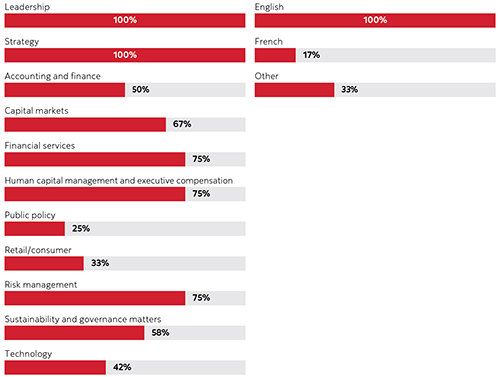
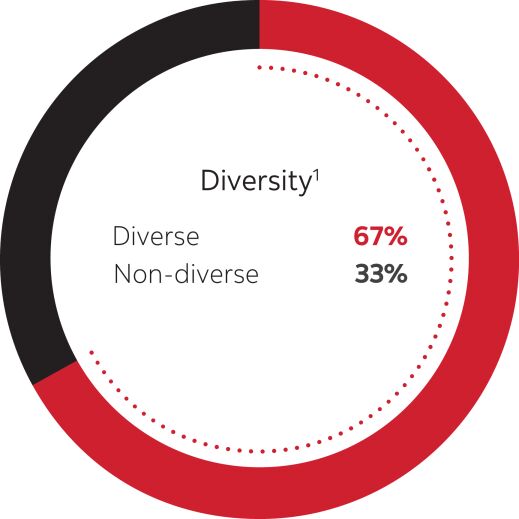
Each director has a wealth of experience in leadership and strategy development. We believe that an important part of board effectiveness includes the unique perspectives of our directors resulting from the combination and diversity of their experience, perspectives, gender, gender identity or gender expression, age, sexual orientation, ethnicity, geographic background, and personal characteristics, along with membership within equity-deserving groups including Women, People of Colour, Indigenous Peoples, and People with Disabilities. Read about our board diversity policy on pages 53 to 54 and how our directors’ skills and experience are represented starting on page 17.


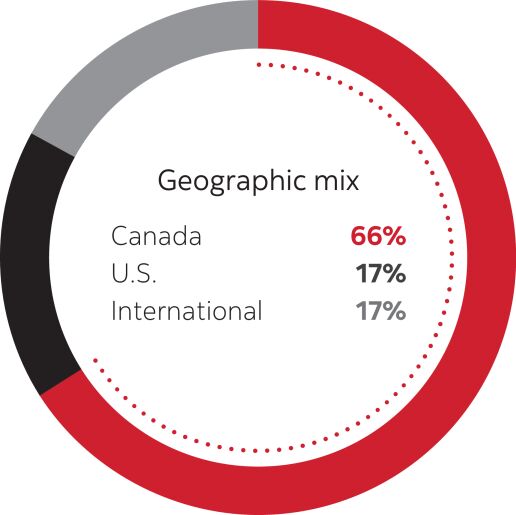
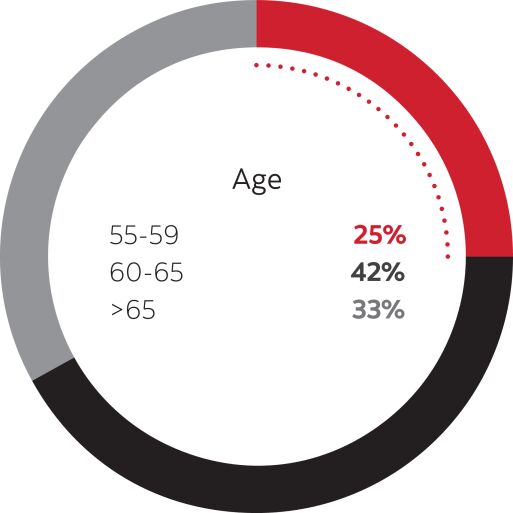
Key skills and experience          Language skills2


LOGO


TENURE AND TERM LIMITS


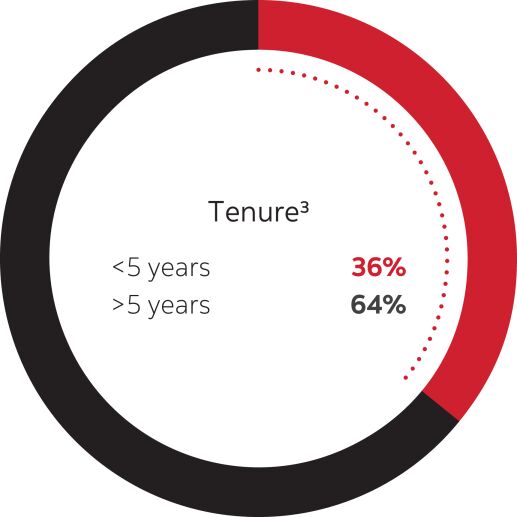
Balancing the combination of longer-serving directors with newer directors allows the board to have the insight of experience while also being exposed to fresh perspectives. Our average board tenure, excluding Antonio Garza, who is not currently a director, is 7.1 years (you can read more about tenure and term limits on page 55).

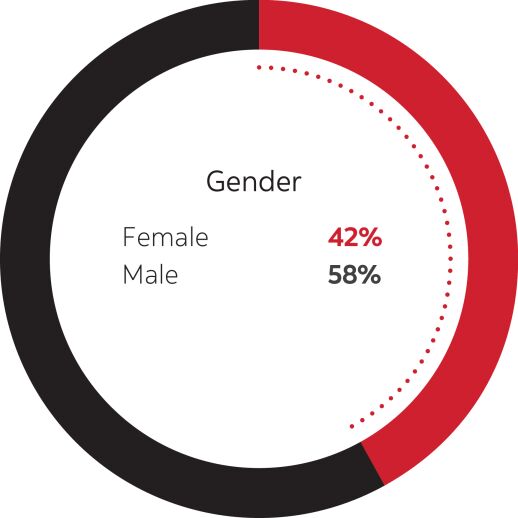
1  Diverse directors include those who identify as Women, People of Colour, Indigenous Peoples, People with Disabilities, and/or those who identify within the 2SLGBTQIA+ community. Five of the nominated directors identify as women and three identify as People of Colour.

2  Our skills matrix asks directors to identify language skills across 10 languages. Data reflects directors who have identified intermediate or fluent skills within the languages listed.

3  Mr. Garza, who is not currently a director, is excluded from the data in this chart.

  LOGO


LOGO


LOGO


LOGO


LOGO


16   Scotiabank


Table of Contents

DIRECTOR PROFILES


Each director has provided information about the Scotiabank shares they own or over which they exercise control or direction. This information and the details about the director deferred share units (DDSUs) they hold are as of October 31, 2025. The value of common shares and DDSUs is calculated using $91.99 (the closing price of our common shares on the Toronto Stock Exchange (TSX) on October 31, 2025) for 2025 and $71.69 (the closing price of our common shares on the TSX on October 31, 2024) for 2024. For fiscal 2025, the equity ownership requirement is five times the equity portion of the annual retainer: $975,000 for directors and $1,750,000 for the Chair. Directors have five years from the date of their appointment to meet this requirement. The Independent Chair has five years from the date of their appointment as Chair to meet this requirement. The multiples in the profiles below are based on the ownership requirements in place each year, which are unchanged for fiscal 2024 and 2025.


The attendance figures reflect the number of board and committee meetings held in fiscal 2025 and each nominee’s attendance for the time they served as a director or committee member.


We have strengthened
our director equity
ownership requirements.
See page 27 for details.


LOGO


Aaron W. Regent


Toronto, Ontario, Canada

Age 60 | Director since 2013

Independent


2025 votes for: 94.76%


Not eligible for

re-election in April 2028

    Aaron Regent is Chair of the Board of Scotiabank. He is the Founder, Chairman, and Chief Executive Officer of Magris Performance Materials Inc., a leading North American performance materials company. He was President and Chief Executive Officer of Barrick Gold Corporation from January 2009 to June 2012. Previously, Mr. Regent was Senior Managing Partner of Brookfield Asset Management, Co-Chief Executive Officer of the Brookfield Infrastructure Group, an asset management company, and President and Chief Executive Officer of Falconbridge Limited. Mr. Regent holds a B.A. from the University of Western Ontario. He is a Chartered Professional Accountant and a Fellow of CPA Ontario.


  KEY SKILLS & EXPERIENCE


  Accounting and finance | Capital markets | Human capital management and executive compensation | Risk management | Sustainability and governance matters


  OVERALL BOARD AND COMMITTEE ATTENDANCE: 37 of 37 / 100%


                Meeting attendance               Committees       Meeting attendance  
 

Board

    10 of 10 / 100%        

Audit and conduct review (Financial expert)

      5 of 5 / 100%  
         

Corporate governance

      6 of 6 / 100%  
         

Human capital and compensation

      6 of 6 / 100%  
         

Risk

      6 of 6 / 100%  
         

Technology1

      4 of 4 / 100%  
                 
  EQUITY OWNERSHIP


Total
common shares
and DDSUs


Value of
DDSUs


Value of
common shares
and DDSUs


Total value as a
multiple of equity
ownership target


    Year    
Common
shares
 
 
    DDSUs          
   

2025

    123,072       88,459         211,531       $8,137,343       $19,458,737       11.1  


2024

    92,422       77,389               169,811       $5,548,017       $12,173,751       7.0  
   

Change

    30,650       11,070         41,720       $2,589,326       $7,284,986    


OTHER PUBLIC COMPANY DIRECTORSHIPS


DURING THE PAST FIVE YEARS


    Current board committee memberships  
   

Nutrien Ltd. (2018 – present)


    Audit | Human resources and compensation (Chair)  
   

1  Effective February 1, 2025, Mr. Regent was appointed a member of the technology committee.


Management proxy circular     17  


Table of Contents

LOGO


Nora A. Aufreiter


Toronto, Ontario, Canada

Age 66 | Director since 2014

Independent


2025 votes for: 98.74%


Not eligible for

re-election in April 2030


Nora Aufreiter is a corporate director and a former senior partner of McKinsey and Company, an international consulting firm. Throughout her 27-year career at McKinsey, she held multiple leadership roles, including Managing Director of McKinsey’s Toronto office and leader of the North American Digital and Omni Channel service line, and was a member of the firm’s global personnel committees. She has worked extensively in Canada, the United States, and internationally, serving her clients in consumer-facing industries including retail, consumer and financial services, energy, and the public sector. Ms. Aufreiter holds a B.A. (Honours) in business administration from the Ivey Business School at the University of Western Ontario and an M.B.A. from Harvard Business School. In September 2024, Ms. Aufreiter earned a Certificate of Sustainability at the Stanford Doerr School of Sustainability. In 2011, she was recognized by the Women’s Executive Network as one of “Canada’s Most Powerful Women: Top 100.” In June 2018, Ms. Aufreiter was awarded an honorary Doctor of Laws, honoris causa (LLD) at the University of Western Ontario.


KEY SKILLS AND EXPERIENCE


  Financial services | Human capital management and executive compensation | Retail/consumer | Sustainability and governance matters | Technology


  OVERALL BOARD AND COMMITTEE ATTENDANCE: 22 of 22 / 100%


                Meeting attendance               Committees       Meeting attendance  
 

Board


    10 of 10 / 100%        

Human capital and compensation (Chair)

Risk


6 of 6 / 100%

6 of 6 / 100%


  EQUITY OWNERSHIP


Total

common shares

and DDSUs


Value of
DDSUs


Value of
common shares
and DDSUs


Total value as a
multiple of equity
ownership target


  Year    
Common
shares
 
 
    DDSUs          
 

2025

    6,900       48,492         55,392       $4,460,779         $5,095,510       5.2  
 

2024

    6,900       41,784               48,684       $2,995,495               $3,490,156       3.6  
 

Change

    0       6,708         6,708       $1,465,284         $1,605,354    


OTHER PUBLIC COMPANY DIRECTORSHIPS


DURING THE PAST FIVE YEARS


            Current board committee memberships  
  LuxExperience B.V. (2021 – present) (Chair)
(formerly MYT Netherlands Parent B.V.)


    Audit | Compensation  | Nominating, governance, and sustainability  
 

The Kroger Co. (2014 – present)


            Finance | Public responsibilities (Chair)  


LOGO


Guillermo E. Babatz


Mexico City, Mexico

Age 57 | Director since 2014

Independent


2025 votes for: 98.94%


Not eligible for

re-election in April 2029

  Guillermo Babatz is the Managing Partner of Atik Capital, S.C., an advisory firm that specializes in structuring financial solutions for its clients. Previously, he was the Executive Chairman of Comision Nacional Bancaria y de Valores in Mexico from July 2007 to December 2012. Mr. Babatz holds a B.A. in economics from the Instituto Tecnologico Autonomo de Mexico in Mexico City and a Ph.D. in economics from Harvard University.


  KEY SKILLS AND EXPERIENCE


Accounting and finance | Capital markets | Financial services | Public policy | Risk management


  OVERALL BOARD AND COMMITTEE ATTENDANCE: 22 of 22 / 100%


                Meeting attendance               Committees       Meeting attendance  
 

Board


    10 of 10 / 100%        

Human capital and compensation

      6 of 6 / 100%  
         

Risk1

      6 of 6 / 100%  
                 
  EQUITY OWNERSHIP


Total
common shares
and DDSUs


Value of
DDSUs


Value of
common shares
and DDSUs


Total value as a
multiple of equity
ownership target


  Year    
Common
shares
 
 
    DDSUs          
 

2025

    2,500       40,360       42,860       $3,712,716         $3,942,691       4  
 

2024

    2,500       35,073               37,573       $2,514,383               $2,693,608       2.8  
 

Change

    0       5,287         5,287       $1,198,333         $1,249,083    


OTHER PUBLIC COMPANY DIRECTORSHIPS


DURING THE PAST FIVE YEARS


    Current board committee memberships  
 

Fibra MTY, S.A.P.I. de C.V. (2015 – present)


    Corporate practices | Investment  
 

1  Effective April 8, 2025, Mr. Babatz ceased to be chair of the risk committee.


18   Scotiabank


Table of Contents


LOGO


W. Dave Dowrich


Brooklyn, New York, U.S.A.

Age 58 | Director since 2022

Independent


2025 votes for: 99.60%


Not eligible for

re-election in April 2035


Dave Dowrich is Senior Executive Vice President and Chief Financial Officer of Teachers Insurance and Annuity Association of America (“TIAA”). In addition to the core finance responsibilities his remit also includes TIAA’s Enterprise Transformation, the investment strategy of the enterprise’s General Account, as well as TIAA Ventures, the strategic venture capital function of TIAA. Prior to joining TIAA in 2021, Mr. Dowrich served as CFO, International Businesses at Prudential Financial Inc., based in Tokyo, Japan. Prior to Prudential Financial, Mr. Dowrich held several executive positions with American International Group (“AIG”) from 2013 to 2020 in Japan and the U.S., including the role of Chief Financial Officer of AIG Japan and Asia Pacific. Previously, Mr. Dowrich held senior roles in investment banking at Goldman Sachs and Credit Suisse. He began his career as a pension consulting actuary in Toronto, Ontario. Mr. Dowrich has a B.Sc. in actuarial science and applied statistics from the University of Toronto and an M.B.A. in finance from the Wharton School of the University of Pennsylvania. He is a Fellow of the Society of Actuaries, an Associate of the Canadian Institute of Actuaries, and a Member of the American Academy of Actuaries.


  KEY SKILLS AND EXPERIENCE


  Accounting and finance | Capital markets |  Financial services | Risk management | Sustainability and governance matters


  OVERALL BOARD AND COMMITTEE ATTENDANCE: 21 of 21 / 100%


                Meeting attendance          Committees               Meeting attendance  
 

Board

    10 of 10 / 100%        

Audit and conduct review (Financial expert)

Corporate governance1

Risk2


5 of 5 / 100%

3 of 3 / 100%

3 of 3 / 100%


  EQUITY OWNERSHIP


Total
common shares
and DDSUs


Value of
DDSUs


Value of
common shares
and DDSUs


Total value as a
multiple of equity
ownership target


  Year    
Common
shares
 
 
    DDSUs          
 

2025

    1,000       15,144         16,144       $1,393,097         $1,485,087       1.5  
 

2024

    1,000       10,870               11,870       $779,270               $850,960       0.9  
 

Change

    0       4,274         4,274       $613,827         $634,127    


OTHER PUBLIC COMPANY DIRECTORSHIPS


DURING THE PAST FIVE YEARS


    Current board committee memberships  


1  Effective April 8, 2025, Mr. Dowrich was appointed a member of the corporate governance committee.


2  Effective April 8, 2025, Mr. Dowrich ceased to be a member of the risk committee.


LOGO


Antonio Garza


Mexico City, Mexico

Age 66 | New nominee

Independent


Not eligible for

re-election in April 2038


Ambassador Antonio Garza (Ret.) is a corporate director and serves as Senior Advisor in the Mexico City office of White & Case LLP, a global law firm. He formerly served as the U.S. Ambassador to Mexico, Chairman of the Texas Railroad Commission, Texas’ 99th Secretary of State, and Cameron County Judge. Mr. Garza is an acknowledged expert on U.S.-Mexico relations and the business and political environments of both nations. He is a Trustee at Southern Methodist University and is Chairman of the university’s Committee on Legal and Governmental Affairs. Mr. Garza also serves as a Director to the George W. Bush Foundation and is Chairman of the Bush Presidential Center’s Advisory Council. Mr. Garza is a director to the Americas Society/Council of the Americas, American Chamber of Commerce in Mexico, a member of the Council on Foreign Relations (CFR) and COMEXI, the CFR’s Mexican counterpart. He is a past recipient of the Águila Azteca (Aztec Eagle), the highest honour bestowed on a foreign national by the Mexican government. Mr. Garza holds a B.B.A. from The University of Texas at Austin and a J.D. from Southern Methodist University School of Law and has been honoured as a distinguished alumnus at both institutions, as well as inducted into the McCombs School of Business Hall of Fame. Mr. Garza is a member of the State Bar of Texas and is admitted to practice before the United States Supreme Court.


  KEY SKILLS AND EXPERIENCE


  Financial services | Human capital management and executive compensation | Public policy | Risk management | Sustainability and governance matters


  OVERALL BOARD AND COMMITTEE ATTENDANCE: N/A


                Meeting attendance          Committees               Meeting attendance  
 

Board


  EQUITY OWNERSHIP


Total
common shares
and DDSUs


Value of
DDSUs


Value of
common shares
and DDSUs


Total value as a
multiple of equity
ownership target


  Year    
Common
shares
 
 
    DDSUs          
 

2025

    N/A1       N/A         N/A       N/A         N/A       N/A2  


OTHER PUBLIC COMPANY DIRECTORSHIPS


DURING THE PAST FIVE YEARS


    Current board committee memberships  
  Canadian Pacific Kansas City Limited (2023 – present)


Corporate governance, nominating and

social responsibility | Risk and sustainability


  The Greenbrier Companies (2021 – present)


            Audit | Nominating and corporate governance (Chair)  
  MoneyGram International (2012 – 2023)3


  Kansas City Southern (2010 – 2023)4


Americas Technology Acquisition Corp. (2020 – 2022)


1  As of the date of this circular, Mr. Garza meets the requirement to hold at least 1,000 common shares in the bank.


2  If elected, Mr. Garza has until 2031 to meet his equity holding requirement.


3  Effective June 1, 2023, MoneyGram International ceased trading on the Nasdaq Stock Market as it was acquired and taken private.


4  Mr. Garza served as a director of Kansas City Southern from 2010 until the completion of the merger creating Canadian Pacific Kansas City Limited in April 2023.


Management proxy circular     19  


Table of Contents


LOGO


Michael B. Medline

Toronto, Ontario, Canada

Age 62 | Director since 2023

Independent


2025 votes for: 98.98%


Not eligible for

re-election in April 2036


Michael Medline was appointed President & Chief Executive Officer of The Woodbridge Company Limited, a private investment holding company, in January 2026. Prior to this, Mr. Medline was President & Chief Executive Officer of Empire Company Limited (Empire) and Sobeys Inc., a role that he held from January 2017 until November 2025. In that role, he oversaw the implementation of Empire’s climate action plan and associated initiatives. Mr. Medline is a proven leader with a strong track record of success in Canadian retail. He has held senior retail leadership positions at Canadian Tire Corporation, including President & Chief Executive Officer. He began his career working with the Ontario Securities Commission, followed by two years practicing law with McCarthy Tétrault. He was Corporate Counsel for PepsiCo Canada before moving to Abitibi Consolidated Inc. where he held a variety of roles including Senior Vice President, Strategy and Corporate Development. Mr. Medline serves on the Board of Trustees for SickKids (and is the Chair of its Human Resources Committee), as Vice Chair on the Board of Governors for Huron University College at Western University, and as a trustee on the William & Mary Business School Foundation Board. He is past Chair of the Retail Council of Canada as well as the Grocery Foundation and was formerly on the Board of Governors for Canada’s Sports Hall of Fame, Board of Directors for SickKids Foundation, and The BlackNorth Initiative. Mr. Medline holds an M.B.A. from Raymond A. Mason School of Business, William & Mary; an LL.B. from the University of Toronto; and a B.A. from Huron University College at Western University.


  KEY SKILLS AND EXPERIENCE


  Capital markets | Human capital management and executive compensation | Retail/consumer | Sustainability and governance matters | Technology


  OVERALL BOARD AND COMMITTEE ATTENDANCE: 21 of 21 / 100%


                Meeting attendance          Committees               Meeting attendance  
 

Board

    10 of 10 / 100%        

Audit and conduct review

Corporate governance (Chair)1


5 of 5 / 100%

6 of 6 / 100%


  EQUITY OWNERSHIP


Total
common shares
and DDSUs


Value of
DDSUs


Value of
common shares
and DDSUs


Total value as a
multiple of equity
ownership target


  Year    
Common
shares
 
 
    DDSUs          
 

2025

    13,052       9,483         22,535       $872,341         $2,072,995       2.1  
 

2024

    13,052       5,187               18,239       $371,856               $1,307,554       1.3  
 

Change

    0       4,296         4,296       $500,485         $765,441    


OTHER PUBLIC COMPANY DIRECTORSHIPS


DURING THE PAST FIVE YEARS


    Current board committee memberships  
 

Empire Company Limited (2017 – 2025)


1  Effective April 8, 2025, Mr. Medline was appointed chair of the corporate governance committee.


LOGO


Lynn K. Patterson


Toronto, Ontario, Canada

Age 64 | Director since 2020

Independent


2025 votes for: 98.10%


Not eligible for

re-election in April 2033


Lynn Patterson is a corporate director and served as Deputy Governor of the Bank of Canada (“BoC”) from May 2014 until her retirement from the BoC in July 2019. In this capacity, she was one of two deputy governors responsible for overseeing the BoC’s analysis and activities promoting a stable and efficient financial system. Prior to this, Ms. Patterson served as Special Adviser to the Governor and Senior Representative (Financial Markets) at the BoC’s Toronto Regional Office. Prior to joining the BoC, Ms. Patterson was President and Country Head for Bank of America Merrill Lynch Canada. Currently, she is a board member of Mastercard Foundation Asset Management Corporation, a not-for-profit organization. She is a recipient of the Diamond Jubilee Medal as a builder and innovator in Canada’s investment industry. Ms. Patterson received an honours degree in Business Administration from the University of Western Ontario and is a Chartered Financial Analyst.


  KEY SKILLS AND EXPERIENCE


  Capital markets | Financial services | Human capital management and executive compensation | Public policy | Risk management


  OVERALL BOARD AND COMMITTEE ATTENDANCE: 22 of 22 / 100%


                Meeting attendance               Committees       Meeting attendance  
 

Board

      10 of 10 / 100%        
Human capital and compensation
 
   
6 of 6 / 100%
 
          Risk (Chair)1             6 of 6 / 100%  
                 
  EQUITY OWNERSHIP


Total
common shares
and DDSUs


Value of
DDSUs


Value of
common shares
and DDSUs


Total value as a
multiple of equity
ownership target


  Year    
Common
shares
 
 
    DDSUs          
 

2025

    16,385       22,556         38,941       $2,074,926         $3,582,183       3.7  
 

2024

    10,885       17,552               28,437       $1,258,303               $2,038,649       2.1  
 

Change

    5,500       5,004         10,504       $816,623         $1,543,534    


OTHER PUBLIC COMPANY DIRECTORSHIPS


DURING THE PAST FIVE YEARS


            Current board committee memberships  


1  Effective April 8, 2025, Ms. Patterson was appointed chair of the risk committee.


20   Scotiabank


Table of Contents

LOGO


Una M. Power


Vancouver, British Columbia, Canada

Age 61 | Director since 2016

Independent


2025 votes for: 97.72%


Not eligible for

re-election in April 2028


Una Power is a corporate director and the former Chief Financial Officer of Nexen Energy ULC, a formerly publicly-traded energy company. During her 24-year career with Nexen, Ms. Power held various executive positions with responsibility for financial and risk management, strategic planning and budgeting, business development, energy marketing and trading, information technology, and capital investment. Ms. Power holds a B.Comm. (Honours) from Memorial University and CPA, CA, and CFA designations. She has completed executive development programs at Wharton Business School and INSEAD.


    KEY SKILLS & EXPERIENCE


    Accounting and finance | Capital markets | Human capital management and executive compensation | Risk management | Sustainability and governance matters


    OVERALL BOARD AND COMMITTEE ATTENDANCE: 22 of 22 / 100%


                  Meeting attendance               Committees       Meeting attendance  
   

Board


    10 of 10 / 100%        
Human capital and compensation
Risk


6 of 6 / 100%

6 of 6 / 100%


    EQUITY OWNERSHIP


Total

common shares

and DDSUs


Value of
DDSUs


Value of
common shares
and DDSUs


Total value as a
multiple of equity
ownership target


    Year    
Common
shares

 
    DDSUs          
   

2025

    5,783       48,118         53,901       $4,426,375         $4,958,353       5.1  


2024

    5,783       42,058               47,841       $3,015,138               $3,429,721       3.5  


Change

    0       6,060         6,060       $1,411,237         $1,528,632    


OTHER PUBLIC COMPANY DIRECTORSHIPS


DURING THE PAST FIVE YEARS


            Current board committee memberships  
   

TC Energy Corporation (2019 – present)


            Audit (Chair) | Health, safety, sustainability, and environment  
   

Teck Resources Limited (2017 – present)


            Audit (Chair) | Compensation and talent  


LOGO


Sandra J. Stuart


Vancouver, British Columbia, Canada

Age 62 | Director since 2023

Independent


2025 votes for: 93.87%


Not eligible for

re-election in April 2036


  Sandra Stuart is a corporate director and the former President and Chief Executive Officer of HSBC Bank Canada. During her over 35-year career with HSBC, Ms. Stuart held various leadership roles in Canada, South America, and the United States including Chief Operating Officer and Group Head of Change Delivery Management. She was recognized as one of Canada’s Most Powerful Women (Top 100) and was awarded the inaugural Deloitte Inclusion Vanguard Award by the Women’s Executive Network. Ms. Stuart was acknowledged as one of British Columbia’s Most Influential Women by BC Business Magazine in both 2015 and 2019. She became a Catalyst Canada Honours Champion in 2019. Ms. Stuart has a B.A. with a double minor in Economics and Business from Simon Fraser University and has completed Executive Management courses at the Harvard Business School and the IMD International Business School.


  KEY SKILLS AND EXPERIENCE


  Financial services | Human capital management and executive  compensation | Retail/consumer | Risk management |  Technology


  OVERALL BOARD AND COMMITTEE ATTENDANCE: 22 of 22 / 100%


                Meeting attendance               Committees       Meeting attendance  
 

Board


    10 of 10 / 100%        

Corporate governance1

Risk

Technology2


2 of 2 / 100%

6 of 6 / 100%

4 of 4 / 100%


  EQUITY OWNERSHIP


Total
common shares
and DDSUs


Value of
DDSUs


Value of
common shares
and DDSUs


Total value as a
multiple of equity
ownership target


  Year    
Common
shares
 
 
    DDSUs          
 

2025

    5,000       9,135         14,135       $840,329         $1,300,279       1.3  
 

2024

    3,000       5,187               8,187       $371,856               $586,926       0.6  
 

Change

    2,000       3,948         5,948       $468,473         $713,353    


OTHER PUBLIC COMPANY DIRECTORSHIPS


DURING THE PAST FIVE YEARS


            Current board committee memberships  
   

Canfor Corporation/Canfor Pulp Products Inc. (2021 – present)


            Audit (Canfor Pulp Products Inc.) | Joint Sustainability, health,  and safety (Chair)  
   

DRI Healthcare Trust (2021 – 2025)


TELUS Digital (2021 – 2025)


1  Effective January 31, 2025, Ms. Stuart ceased to be a member of the corporate governance committee.


2  Effective February 1, 2025, Ms. Stuart was appointed a member of the technology committee.


Management proxy circular     21  


Table of Contents

LOGO


L. Scott Thomson


Toronto, Ontario, Canada

Age 56 | Director since 2016

Not independent


2025 votes for: 99.58%


Eligible for re-election while President and CEO


Scott Thomson assumed the role of President of Scotiabank on December 1, 2022, and became President and CEO of the bank on February 1, 2023. Mr. Thomson has been a member of the Scotiabank Board of Directors since 2016. Prior to joining Scotiabank, Mr. Thomson was the President and CEO of Finning International Inc., the world’s largest dealer of Caterpillar equipment and engines across diverse industries in the Americas and Europe. Mr. Thomson has also held a number of senior executive positions including Chief Financial Officer of Talisman Energy Inc. and Executive Vice President, Corporate Development at Bell Canada Enterprises (BCE). Prior to his tenure at BCE, Mr. Thomson was a Vice President at Goldman Sachs. Mr. Thomson holds a B.A. in economics and political science from Queen’s University and an M.B.A. from the University of Chicago.


  KEY SKILLS AND EXPERIENCE
  Accounting and finance | Capital markets | Financial services | Human capital management and executive compensation | Technology
                 
  OVERALL BOARD AND COMMITTEE ATTENDANCE: 10 of 10 / 100%


                Meeting attendance               Committees                             Meeting attendance
 

Board


    10 of 10 / 100%            
                 
  EQUITY OWNERSHIP


        PSUs      

Total
common shares,
DSUs, and PSUs


Value of
DSUs
 
 
  Value of common shares, DSUs, and PSUs1
  Year    
Common
shares
 
 
    DSUs          
 

2025

    60,733       33,741         148,469       242,943       $3,103,817     $22,348,292
 

2024

    53,686       31,913               72,661       158,260       $2,287,874     $11,345,697
 

Change

    7,047       1,828         75,808       84,683       $815,943    

$11,002,595


OTHER PUBLIC COMPANY DIRECTORSHIPS


DURING THE PAST FIVE YEARS


            Current board committee memberships
 

Finning International Inc. (2013 – 2022)


1  Mr. Thomson has a share ownership requirement of 8x his base salary as CEO, which requirement he exceeds (see page 78). Common shares, DSUs, performance share units, and holdings through our Employee Share Ownership Plan count towards this requirement. See page 97 for details.


LOGO


Steven C. Van Wyk

Chicago, Illinois, U.S.A.

Age 67 | Director since 2024

Independent


2025 votes for: 98.17%


Not eligible for

re-election in April 2037


Steven Van Wyk is a corporate director and the former Group Chief Information Officer (CIO) of HSBC Bank PLC. Throughout his 40-year career, he held senior-level domestic and international information technology roles, including CIO of PNC Financial Services Group, Inc., Global CIO of ING Groep N.V., and multiple roles with Morgan Stanley, including several years as CIO/Chief Operating Officer of its Individual Investor Group. Mr. Van Wyk holds a B.A. in business management and accounting with a minor in computer science from the University of Central Iowa and was awarded an honorary Doctorate of Public Service from Central College in 2019. He is a Certified Public Accountant, Certified Internal Auditor, and Series 27 Financial/Operations Principal. Mr. Van Wyk chairs the Board of the Banking Industry Architecture Network, a non-profit seeking to establish a common architecture framework for enabling banking interoperability.


  KEY SKILLS AND EXPERIENCE
  Financial services | Human capital management and executive compensation | Retail/consumer | Risk management | Technology
                 
  OVERALL BOARD AND COMMITTEE ATTENDANCE: 16 of 18 / 89%


                Meeting attendance               Committees                             Meeting attendance
 

Board


    8 of 9 / 89%        

Audit and conduct review (Financial expert)

Technology (Chair)1


4 of 5 / 80%

4 of 4 / 100%

                 
  EQUITY OWNERSHIP


Total
common shares
and DDSUs


Value of
DDSUs


Value of
common shares
and DDSUs


Total value as a

multiple of equity

ownership target2

  Year    
Common
shares

 
    DDSUs          
 

2025

    1,000       3,982               4,982       $366,304               $458,294     0.5


OTHER PUBLIC COMPANY DIRECTORSHIPS


DURING THE PAST FIVE YEARS


            Current board committee memberships
   

Adyen N.V. (2025 – present)


    Audit and risk
   

Genworth Financial, Inc. (2025 – present)


    Risk | Technology (Chair)
   

Reinsurance Group of America Inc. (2019 – present)


Audit | Cybersecurity and technology (Chair) | Risk
   

1  Effective February 1, 2025, Mr. Van Wyk was appointed chair and a member of the technology committee.


2  Mr. Van Wyk has until 2029 to meet his equity holding requirement.


22   Scotiabank


Table of Contents


LOGO


Benita M. Warmbold

Toronto, Ontario, Canada

Age 67 | Director since 2018

Independent


2025 votes for: 97.80%


Not eligible for

re-election in April 2031


Benita Warmbold is a corporate director and the former Senior Managing Director and Chief Financial Officer of the Canada Pension Plan (“CPP”) Investment Board, having retired from the latter in July 2017. Over her nine years at CPP Investment Board, Ms. Warmbold was responsible for finance, risk, performance, tax, internal audit, legal, technology, data, and investment operations. Prior to joining the CPP Investment Board in 2008, Ms. Warmbold held senior leadership positions with Northwater Capital, Canada Development Investment Corporation, and KPMG. She is former Chair of the Canadian Public Accountability Board and a former member of the Intact Centre on Climate Adaptation Advisory Board. Ms. Warmbold holds a B.Comm. (Honours) from Queen’s University and is a Chartered Professional Accountant and a Fellow of CPA Ontario. Ms. Warmbold is a Fellow of the Institute of Corporate Directors and is a WXN Hall of Fame inductee.


  KEY SKILLS AND EXPERIENCE
  Accounting and finance | Capital markets | Financial services | Risk management | Sustainability and governance matters
                 
  OVERALL BOARD AND COMMITTEE ATTENDANCE: 21 of 21 / 100%


                Meeting attendance               Committees                             Meeting attendance
 

Board


    10 of 10 / 100%        

Audit and conduct review (Chair) (Financial expert)

Corporate governance


  5 of 5 / 100%
6 of 6 / 100%
                 
  EQUITY OWNERSHIP


Total
common shares
and DDSUs


Value of
DDSUs


Value of
common shares
and DDSUs


  Total value as a multiple of equity ownership target
  Year    
Common
shares

 
    DDSUs          
 

2025

    3,000       33,257         36,257       $3,059,311         $3,335,281     3.4
 

2024

    3,000       27,375               30,375       $1,962,514               $2,177,584     2.2
 

Change

    0       5,882         5,882       $1,096,797         $1,157,697    


OTHER PUBLIC COMPANY DIRECTORSHIPS


DURING THE PAST FIVE YEARS


            Current board committee memberships
 

AtkinsRéalis Group Inc. (2017 – present)


            Governance, ethics, and sustainability (Chair) | Human resources
 

Methanex Corporation (2016 – present)


            Audit, finance, and risk (Chair) | Corporate governance


Management proxy circular     23  


Table of Contents

Skills and experience

Our directors are prominent business and community leaders. They bring a wealth of experience to the board, generate public confidence, know our businesses, and are familiar with the markets in which we carry on business. The directors’ backgrounds, skills, and experience, taken as a whole, equip the board to carry out its duties and supervise the bank’s business and affairs.

The board maintains a skills matrix to monitor the skills and experience necessary for the oversight of the bank today and in the future.

To serve on our board, directors must have considerable experience in leadership and strategy. Many directors also have financial services experience in a multitude of ways. In addition, each director has identified five key areas of experience in consultation with the corporate governance committee. The committee developed the skills matrix below based on this consultation and agreement on each director’s key areas of experience, as well as an annual review (including domestic and international benchmarking) of key skills and experience necessary for the oversight of Scotiabank. Our director biographies highlight some of the formative experiences supporting these areas of experience. Our directors review their key areas of experience on an annual basis should changes be required.


Key Areas of Experience

LOGO LOGO     LOGO LOGO LOGO LOGO LOGO LOGO LOGO LOGO LOGO LOGO

Leadership

Experience in senior leadership roles (management and/or board) in an organization of significant size or complexity.


LOGO


LOGO


LOGO


LOGO


LOGO


LOGO


LOGO


LOGO


LOGO


LOGO


LOGO


LOGO

Strategy

Experience in developing, implementing and delivering strategic business objectives in a large organization.


LOGO


LOGO


LOGO


LOGO


LOGO


LOGO


LOGO


LOGO


LOGO


LOGO


LOGO


LOGO

Accounting and Finance

Knowledge of and experience in financial accounting and reporting, corporate finance and familiarity with financial internal controls and GAAP/IFRS.


LOGO


LOGO


LOGO


LOGO


LOGO


LOGO

Capital Markets

Experience in global financial markets, investment banking and/or mergers and acquisitions.


LOGO


LOGO


LOGO


LOGO


LOGO


LOGO


LOGO


LOGO

Financial Services

Experience in the financial services industry and/or financial regulation.


LOGO


LOGO


LOGO


LOGO


LOGO


LOGO


LOGO


LOGO


LOGO

Human Capital Management and Executive Compensation

Experience in people matters including workplace culture, management development, succession planning and compensation.


LOGO


LOGO


LOGO


LOGO


LOGO


LOGO


LOGO


LOGO


LOGO

Public Policy

Experience in government and public policy matters.


LOGO


LOGO


LOGO

Retail/Consumer

Experience in a consumer-facing industry.


LOGO


LOGO


LOGO


LOGO

Risk Management

Experience in identifying, assessing and managing financial and non-financial risks.


LOGO


LOGO


LOGO


LOGO


LOGO


LOGO


LOGO


LOGO


LOGO

Sustainability and Governance Matters

Experience in sustainability matters, environmental issues (including climate-related issues), social issues and/or corporate governance principles and practices in an organization of significant size and complexity.


LOGO


LOGO


LOGO


LOGO


LOGO


LOGO


LOGO

Technology

An understanding of technology and innovation, digital, data management, and/or cybersecurity issues in large, complex enterprises and with respect to the bank’s technology platforms and other complex operating systems and infrastructure.


LOGO


LOGO


LOGO


LOGO


LOGO

The corporate governance committee also maintains a detailed matrix of each director’s general areas of experience (such as marketing, regulatory and compliance, and government), specific sustainability and governance-related and technology-related skills, education, language skills, and business experience in geographic regions where we do business. It uses these matrices to assess board composition, plan board and chair succession, and assess potential director candidates.

Specific sustainability and governance-related skills include environmental/climate, social, and governance skills. Directors with these skills, including climate-related skills, have experience in sustainability matters and climate-related issues through executive roles and/or directorships at complex organizations, certification from institutes with a focus on sustainability, directing climate-related investments and participation in reforming laws with a focus on corporate governance obligations. Directors have also held board, advisory committee, and industry


24   Scotiabank    


Table of Contents

association positions in the mining, forestry, energy infrastructure and resource sectors with focuses on carbon reduction initiatives and other climate-related mandates. Directors with technology-related skills have experience in technology and innovation, cybersecurity, and data ethics and/or artificial intelligence (AI). Directors’ experiences include advising companies on various technology-related strategies, holding executive roles with oversight of technology functions and crisis management, and participating in education courses and seminars on emerging technologies, AI cyber risk management, data risk management, and AI for boards.

Meeting attendance

The table below shows the number of board and committee meetings held in fiscal 2025 and the overall meeting attendance of the members for that period. Directors are expected to attend at least 75% of all board and committee meetings for those committees on which they serve.

You can find the details about each director’s meeting attendance in the director profiles beginning on page 17. All the nominated directors who were members of the board at the time attended the annual meeting in April 2025. Directors also held meetings with regulators, shareholders, and shareholder representative groups throughout the year, which are not shown in the table below.


Meetings


   Attendance


Board

    10       99%  

Audit and conduct review

    5       97%  

Corporate governance

    6       100%  

Human capital and compensation

    6       100%  

Risk

    6       100%  

Technology

    4       100%  

Total number of meetings

    37       99%  

The table below shows the board and committee attendance in fiscal 2025 of directors not standing for re-election in 2026 and of directors who retired from the board in 2025. Mr. Callahan will not stand for re-election at the April 14, 2026 annual meeting and Messrs. Bonham, Penner and Rovinescu did not stand for re-election at the April 8, 2025 annual meeting.


     Meetings        Attendance  

Daniel (Don) Callahan


Board

    10 of 10       100%  

Audit and conduct review1

    1 of 1       100%  

Risk

    6 of 6       100%  

Technology1

    4 of 4       100%  

Scott B. Bonham


Board

    5 of 5       100%  

Audit and conduct review

    2 of 2       100%  

Corporate governance

    3 of 3       100%  

Michael D. Penner


Board

    5 of 5       100%  

Audit and conduct review

    2 of 2       100%  

Corporate governance

    3 of 3       100%  

Calin Rovinescu


Board

    5 of 5       100%  

Corporate governance (Chair)

    3 of 3       100%  

Human capital and compensation

    3 of 3       100%  


1 

Effective January 31, 2025, Mr. Callahan ceased to be a member of the audit and conduct review committee and effective February 1, 2025, he was appointed a member of the technology committee.


Director compensation

Our director compensation program is designed to attract and retain qualified individuals while aligning the interests of our directors and shareholders.

The corporate governance committee annually conducts an extensive review of director compensation against our Canadian bank peer group. The committee also considers trends and compensation structures at several large-capitalization companies in the TSX 60 Index (including CN Rail, Enbridge, Brookfield, Suncor Energy, and TC Energy) and other comparable international financial institutions.

The committee regularly reviews director compensation to make sure our program is appropriate so we can continue to retain and attract qualified professionals to our board and in terms of shareholder value given the risks, responsibilities, time commitment, workload, complexity of issues and decision-making, and the skills required of the board.


Directors are expected to keep abreast of industry developments, nationally and internationally, so that they can make a meaningful contribution.


Directors are routinely kept informed between meetings on issues germane to the bank and their responsibilities as directors.


Our director fee structure reinforces director engagement and is predictable, transparent, and easy to administer, regardless of the number of meetings held during the year.


    Management proxy circular     25  


Table of Contents

PROGRAM ELEMENTS

The table below shows our fee schedule for fiscal 2025. The Chair’s retainer is higher and committee chairs receive a chair retainer to recognize their additional responsibilities in these leadership roles.


Annual board retainers


Chair ($350,000 must be taken in common shares or DDSUs)


$

500,000


All other directors ($195,000 must be taken in common shares or DDSUs)


$

275,000


Annual committee chair retainers


$

50,000


In addition, directors are reimbursed for travel and other expenses they incur when they attend meetings or conduct bank business.

2025 DIRECTOR COMPENSATION TABLE

The table below shows the fees paid to directors in fiscal 2025. As President and CEO of the bank, Mr. Thomson does not receive fees for serving as a director. Mr. Garza is a new nominee and did not receive fees for serving as a director in fiscal 2025.


    Retainers     

Total fees
earned


Portion of
total bank
director fees
received as
DDSUs (%)


All other
compensation
($)


Total

($)


Board

($)


Committee
Chair

($)1


Non-executive
Chair

($)


N. Aufreiter


275,000


50,000


325,000


100


0


325,000


G. Babatz2


275,000


21,944


296,944


83


60,893


357,837


S. Bonham3


120,694


120,694


100


5,000


125,694


D. Callahan


275,000


275,000


100


0


275,000


W. Dowrich


275,000


275,000


100


0


275,000


M. Medline4


275,000


28,056


303,056


100


0


303,056


L. Patterson5


275,000


28,056


303,056


100


0


303,056


M. Penner6


120,694


120,694


71


5,000


125,694


U. Power7


275,000


275,000


100


259,472


534,472


A. Regent


500,000


500,000


100


0


500,000


C. Rovinescu8


120,694


21,944


142,639


100


5,000


147,639


S. Stuart


275,000


275,000


100


0


275,000


S. Van Wyk9


263,542


37,500


301,042


100


0


301,042


B. Warmbold


275,000


50,000


325,000


100


0


325,000


Total


3,100,625


237,500


500,000


3,838,125


335,365


4,173,490


1

A technology committee of the bank was established effective February 1, 2025.

2

Mr. Babatz ceased to be chair of the risk committee on April 8, 2025 and received pro-rated fees. Mr. Babatz earned 806,600 Mexican pesos (C$60,893 based on the October 31, 2025 exchange rate of 0.07549318) in fiscal 2025 for serving as a director of Grupo Financiero Scotiabank Inverlat, S.A. de C.V. and three of its subsidiaries effective from April 30, 2025.

3

Mr. Bonham did not stand for re-election to the board at the April 8, 2025 annual meeting and received pro-rated fees for fiscal 2025. A C$5,000 charitable donation was made in honour of Mr. Bonham’s time on the board. He did not receive any financial benefit from this donation.

4 

Mr. Medline was appointed chair of the corporate governance committee on April 8, 2025 and received pro-rated fees.

5

Ms. Patterson was appointed chair of the risk committee on April 8, 2025 and received pro-rated fees.

6 

Mr. Penner did not stand for re-election to the board at the April 8, 2025 annual meeting and received pro-rated fees for fiscal 2025. A C$5,000 charitable donation was made in honour of Mr. Penner’s time on the board. He did not receive any financial benefit from this donation.

7

Ms. Power earned US$185,000 (C$259,472 based on the October 31, 2025 exchange rate of 1.40255) in fiscal 2025 for serving as Chair of Scotia Holdings (USA) LLC.

8

Mr. Rovinescu did not stand for re-election to the board at the April 8, 2025 annual meeting and received pro-rated fees for fiscal 2025. A C$5,000 charitable donation was made in honour of Mr. Rovinescu’s time on the board. He did not receive any financial benefit from this donation.

9

Mr. Van Wyk was appointed to the board on November 15, 2024 and chair of the technology committee on February 1, 2025. He received pro-rated fees.

NEW FOR 2026

In recognition of increasing responsibilities and to remain competitive for director talent, the board approved the following fee structure, effective November 1, 2025, along with new equity ownership requirements.


Annual board retainers


Chair ($355,000 must be taken in common shares or DDSUs)


$

525,000


All other directors ($200,000 must be taken in common shares or DDSUs)


$

290,000


Annual committee chair retainers


$

55,000


26   Scotiabank    


Table of Contents

Director equity ownership


We believe it is important for our directors to have a significant stake in the bank and to align their interests with those of other shareholders. Equity ownership is reviewed on a regular basis.


Our director equity ownership requirements have been strengthened and were approved by the board effective November 1, 2025:


We have robust equity holding requirements.


All directors meet or exceed the requirement to hold at least 1,000 common shares in the bank.


All current directors exceed our equity holding requirements except Mr. Van Wyk, who has until 2029 to meet the requirements.


As President and CEO, Mr. Thomson has a share ownership requirement of 8x his base salary as CEO, which requirement he exceeds. See pages 22, 78, and 97 for more information.


Requirement   Directors   Chair


Required holdings in common shares or DDSUs to be met within five years of joining the board and maintained while serving on the board


$1,000,000

(5x equity portion of annual retainer)


$1,775,000

(5x equity portion of annual retainer)


Common share holding requirement to be met within six months of joining the board


  1,000


Portion of annual board retainer paid in either DDSUs or bank common shares (by participating in the directors’ share purchase plan), even after equity ownership requirements have been met

  $200,000   $355,000


Each director’s remuneration will be paid entirely in equity until their required equity ownership level has been attained.


All directors currently receive the equity portion of their retainer in DDSUs, which are only redeemable after they leave the board. Directors do not participate in the bank’s pension plans or any other compensation plans. We do not grant stock options to directors.


Director prohibitions against monetizing or hedging


Directors are not allowed to monetize or hedge their economic interest in Scotiabank securities. DDSUs are not transferable, and the use of short sales, calls, or puts on the bank’s securities is prohibited under the Bank Act.


About DDSUs


DDSUs are notional units that have the same value as our common shares, and therefore have the same upside and downside risk. DDSUs earn dividend equivalents at the same rate as dividends are paid on our common shares, but do not give the holder voting or other shareholder rights.


Directors can redeem their DDSUs for cash only after they leave the board. Their redemption value is equal to the market value of our common shares at the time of redemption.


    Management proxy circular     27  


Table of Contents


2


Governance


Sound and effective corporate governance is embedded in everything we do. It is a critical part of the bank’s culture, and fundamental to our long-term success; it provides proper oversight and accountability, strengthens internal and external relationships, builds trust with our stakeholders, and protects the long-term interests of Scotiabank.


Good governance is not about checking a box. It’s about effective structures, a purpose-driven mandate, diverse viewpoints, and a culture of continuous improvement. These qualities are what enable Scotiabank to cultivate deep insights into how the world, our financial markets and our bank work so that oversight is agile, transparent and forward-looking. This section discusses how governance works at Scotiabank, our board and its priorities, and what you can expect from our directors.     


WHERE TO FIND IT


Director compensation


25


Director equity ownership


27


Structure of the board


31


Board priorities


32


Sustainability and governance matters


46


Board composition, development and assessment


52


Committee reports


62


This year, a challenging economic and political environment, with ongoing threats of possible tariffs by a new U.S. administration and the election of a new Canadian prime minister, as well as geopolitical events, changes to the regulatory landscape both in Canada and the U.S., and evolving investor sentiment on a variety of governance issues, comprised some of the key priorities of the board. We will continue to uphold good corporate governance even in uncertain times and to apply good judgment in addressing the needs of the bank and all of our stakeholders.

A solid foundation of openness, integrity, continuous improvement, and accountability is key to maintaining strong, enduring relationships with our diverse stakeholders — shareholders, clients, employees, regulators, and the broader community.

AN EFFECTIVE GOVERNANCE STRUCTURE

Effective oversight, accountability and communication are the cornerstones of good governance and in the best interests of the bank. Shareholders elect the board to supervise the management of our business and affairs. The figure below shows the reporting relationships between shareholders, the board and its committees, management, and other stakeholders. Formal mandates are approved for the board, each committee, the Chair of the Board, committee chairs, directors, and members of executive management. These mandates set out the key responsibilities and accountabilities for each role.


LOGO


28   Scotiabank    


Table of Contents

WE ARE A CORPORATE GOVERNANCE LEADER

Scotiabank is committed to strong corporate governance practices and has a history of being at the forefront of leading practices. The corporate governance committee reviews our corporate governance approach every year against changing regulations, industry developments and emerging best practices. The board approves our corporate governance policies annually to continually enhance our processes and standards. Some key milestones include:


LOGO


2025 highlights


With the support and strategic guidance of the board, Scotiabank was recognized this year for a number of achievements that reflect our vision to be our clients’ most trusted financial partner to drive sustainable, profitable growth, including:


named Bank of the Year in Canada for the sixth year in a row by The Banker


recognized as one of Canada’s Top Employers for Young People 2025 by Mediacorp Canada Inc., for the fifth consecutive year


named the top-scoring bank in North America in the S&P’s 2024 Corporate Sustainability Assessment for the second year in a row and named to the Dow Jones Sustainability Index for the seventh consecutive year


awarded Best Foreign Exchange (FX) Bank in Canada for the second year in a row, by Global Finance


named Canada’s Best Bank by Euromoney for the second year in a row, named North America’s Best Bank for ESG, and named Latin America’s Best Bank for Sustainable Finance, and Investment Banking


recognized as one of the Best Workplaces in Financial Services & Insurance in Canada by Great Place to Work® for the eighth year in a row


recognized for executive gender diversity on The Globe and Mail’s Women Lead Here list for the fifth consecutive year


recognized with 11 wins in the 2025 Global Finance Sustainable Finance Awards, including Best Bank for Sustainable Finance in Canada for the fourth year, Best Bank for Sustainable Financing in Emerging Markets (North America) for the second year, and for its sustainable finance products in Latin America and North America.


The board also provided oversight and strategic support for the execution of key enterprise-wide initiatives, including:


the ongoing execution of the bank’s enterprise strategy, to enable sustainable and profitable growth


the completion of an additional investment of approximately 10% in KeyCorp, for a total approximate investment of approximately 15%


continued our cultural journey embedding our ScotiaBond values and behaviours in our performance, development, recognition, and employee engagement programs


the constitution of a new technology committee of the board


the release of the 2024 Climate and Sustainability Reports, highlighting the bank’s commitment to transparent reporting


the bank’s 193rd annual general meeting, hosted in Halifax, Nova Scotia


the transfer of Scotiabank’s banking operations in Colombia, Costa Rica, and Panama to Davivienda in exchange for an approximately 20% ownership stake in Davivienda Group


continued support of the bank’s efforts to build relationships of trust between Scotiabank and Indigenous employees, clients, and communities, by advancing meaningful progress on the 37 commitments outlined in our Truth and Reconciliation Action Plan.


    Management proxy circular     29  


Table of Contents

LOGO  WHAT WE DO
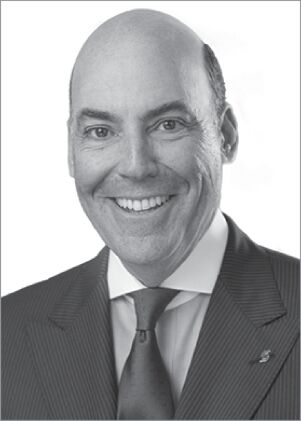
 

  u

Independence


    11 of 12 directors are independent


    all committee members are independent


    board committees have full authority to retain independent external advisors


    in camera sessions with independent directors are scheduled at each board and committee meeting


  u

Integrity, ethics, and accountability


    we promote a strong culture of integrity and ethical behaviour


    we require all directors to certify compliance with our code of conduct each year


    we have a separate directors’ conflicts of interest policy as an addendum to our code of conduct


    we have attendance requirements for our directors


    quorum for meetings is a majority of the board or committee members


    we limit the number of public company boards on which our directors may sit


  u

Risk oversight


    we have strong risk oversight, carried out by the board and its committees


    we have financial services and risk management experience on every committee


    the human capital and compensation committee and risk committee meet jointly to discuss compensation risk


    the risk committee and audit and conduct review committee chairs regularly meet to discuss risk and attend each other’s committee meetings as invitees


    the risk committee chair and the technology committee chair attend each other’s committee meetings as invitees to participate in any technology-based risk discussions


  u

Leadership, development, and succession


    we have individual (not slate) voting for directors


    we elect all our directors annually (we do not have a staggered board)


    our majority voting policy complies with the TSX rules


    we have director term limits


    we have a formal written board diversity policy, which has been updated over the years


    we have a robust director orientation and continuing education program


    we have a formal, annual board effectiveness assessment including individual director effectiveness assessments


    we have a board skills matrix which is used for director nominations and succession planning


  u

Stewardship and stakeholder engagement


    we have an annual strategic planning meeting with the board and management separate from regular board meetings


    we have a robust stakeholder engagement program


    we have strong equity ownership guidelines to align director and shareholder interests


    international subsidiary boards have the opportunity to engage with members of our board


    we have a robust technology strategy

LOGO  WHAT WE DON’T DO


  u

No hedging of bank securities


    no director, executive or employee can monetize or hedge our common shares or equity-based compensation to undermine the risk alignment in our equity ownership requirements


    DDSUs are non-transferable and are only redeemable after a director leaves the board


    directors cannot receive stock options and do not participate in our pension plan


  u

No unequal voting


    we do not have dual class shares, non-voting or subordinated voting shares


    the Chair does not have a deciding vote in the case of a board tie


30   Scotiabank    


Table of Contents

About the board

STRUCTURE OF THE BOARD

The board’s mandate is to:

  oversee the bank’s strategic direction as stewards for stakeholders

  supervise the management of the business and affairs of the bank

  maintain the bank’s strength and integrity through strong oversight

  set the tone at the top, promoting trust and integrity with our shareholders, clients, employees, regulators and communities in which we operate

  oversee the bank’s organizational structure and succession planning for senior management roles

  continually develop its approach to corporate governance.

The board has specific duties and responsibilities set out in global regulatory expectations and best practices, as well as in the Bank Act and other applicable laws and regulations. These are detailed in its mandate. The board delegates day-to-day management of our affairs and the execution of our strategy to executive management, up to certain limits.

This year 12 directors are nominated for election, and the board is comfortable that this is an appropriate size to generate open and engaging discussions, to make sure the committees have the right combination of skills, to allocate responsibilities appropriately and to facilitate board renewal.

Board committees

In fiscal 2025, five standing committees helped the board carry out its duties and responsibilities. Each committee is able to engage external advisors or consultants as necessary and approve their contracts and fees. You can find descriptions of the committee mandates, membership, highlights for the year and how each committee assessed itself in the reports starting on page 62.

All committees are composed entirely of independent board members. The President and CEO does not sit on any board committees.

All independent directors serve on at least two board committees and the Chair is a member of all five committees.

The corporate governance committee recommends committee composition (including committee chairs) to the board and reviews committee membership throughout the year and after the annual meeting once the board is elected. This committee also reviews Chair of the Board and committee chair succession, in light of director term limits.

Effective February 2025, a technology committee was constituted by the board to oversee the bank’s technology strategy, technology-based risk management, and technology investment and innovation. It is composed entirely of independent board members. To review the technology committee report, please see page 68.

Chair of the Board

The Chair of the Board is an independent director, responsible for leading the board in carrying out its duties and responsibilities effectively, efficiently, and independent of management. He presides over all board meetings, oversees the board committees, and chairs all sessions with the independent directors. The Chair is directly involved in director orientation, continuing education, and the board assessment process. The Chair also pays particular attention to the dynamics of the board and ensures all directors are actively and appropriately involved in the board’s oversight role. The Chair ensures that the number of board and committee meetings is appropriate given the issues that the board and bank are addressing in the current environment.

At every meeting, time is allocated to in camera sessions without management. Depending on the nature of the business discussed at the meeting, the board may waive the requirement for these sessions. In fiscal 2025, the independent directors met without management at all regularly scheduled meetings. In addition, the board held one ad hoc meeting during the year where the independent directors waived the need for an in camera session based on the nature of the business discussed.


Our board mandate is posted in the corporate governance section of our website.


LOGO


The committees support the board, with overall leadership by our Chair who is independent from our CEO.


    Management proxy circular     31  


Table of Contents

The Chair acts as a resource for management, advising the President and CEO on major strategic and business issues and corporate governance matters. The Chair meets with OSFI, our primary regulator, as well as other regulators, shareholders, and other stakeholders on behalf of the board. He may also meet periodically with members of the boards of directors of our subsidiaries. In recent years, a challenging economic and political environment, as well as significant changes to the regulatory landscape both in Canada and the U.S. and evolving investor sentiment on a variety of governance issues, has required even more from the role of the Chair in terms of engagement and communication with the board, management, and other stakeholders. The contributions of the Chair and CEO are critical for effective board management and leading the bank through the formal execution of its strategy.

Committee chairs

Committee chairs must be independent directors with the requisite skills and experience necessary to oversee their committees’ responsibilities.

Each chair is responsible for:

  facilitating the functioning of the committee independent of management
  overseeing the orientation of new members
  providing input to the Chair and the chair of the corporate governance committee on succession plans for the committee’s composition, including the role of chair


  managing the operations of the committee to fulfill its charter and address any other matters delegated to it
  setting the meeting agendas, presiding over all meetings, and ensuring that members have the information and resources they need to carry out their duties


  facilitating effective communication between the committees
  reporting the committee’s discussions and decisions or recommendations to the board.

Directors

All directors, regardless of whether they currently have a leadership role on the board, have a written position description outlining our expectations around individual accountability and contribution.

Board priorities

Our effective governance structure allows the board to efficiently fulfill its oversight and advisory mandate, including focusing on key priorities:


Strategic direction


Leadership development, inclusivity and assessment

Risk oversight


Good governance.

Culture and conduct


Sustainability and governance matters


STRATEGIC DIRECTION

The board oversees our strategic direction and holds management accountable for executing our strategy and delivering strong performance.

The board participates in our strategic planning process throughout the year by:

  reviewing and approving our strategic plan, considering the opportunities and risks of our businesses
  keeping abreast of industry developments and the competitive landscape
  reviewing results against our capital and financial plans throughout the year
  approving material strategic initiatives, as well as significant acquisitions, divestitures and investments
  overseeing our technology strategy and technology-based risk management
  overseeing our sustainability-related (including climate-related) strategy and monitoring management’s execution against this strategy


  regularly scrutinizing management’s execution of business plans and other objectives against their results and compared to their industry peers


  reviewing our strategic plan against our risk appetite framework
  approving our capital management policy and overseeing that appropriate strategies are in place to mitigate risk.


You can find the committee charters, board mandate, and position descriptions for the Chair, committee chairs and directors posted in the corporate governance section of our website.


More information about the audit and conduct review committee is available in our 2025 AIF at www.sedarplus.ca.


32   Scotiabank    


Table of Contents

The board approves the strategy and capital and financial plan on an annual basis. In fiscal 2023, the board approved the bank’s new strategy – The New Way Forward – which was announced by the bank at an Investor Day in December 2023, together with the bank’s new vision to be our clients’ most trusted financial partner and to deliver sustainable, profitable growth. Two years later, the board continues to focus on oversight of the execution of the strategy by management. The board received regular strategy updates on its must-win priorities, the progress being made on its strategic pillars, and the bank’s culture ambition (ScotiaBond) and enablement. Throughout this fiscal year, the board held numerous sessions with management to discuss more specific strategies, including the bank’s technology strategy, global fraud management strategy, data and platform strategy, insurance strategy and the Tangerine Bank strategy. The board also approved the bank’s transfer of its banking operations in Colombia, Costa Rica and Panama to Davivienda. Further, in fiscal 2025, the board held its annual strategy session, which provided:

a 2025 all-bank progress update on the strategic plan;

a five-year financial outlook of the bank’s strategy;

business line strategic updates; and

a must-win priorities update, including overall progress in year two of The New Way Forward, execution momentum, reflections learned, the 2026 investment roadmap and deep dives of certain must-win priorities,


and gave directors an opportunity to provide feedback on the bank’s strategic plans. Taking into account the directors’ feedback, the board later approved the 2026 all-bank strategic plan, the bank’s financial and capital plans, the capital management policy, enterprise risk appetite framework, and the all-bank technology strategy. The bank’s strategy continues to be of utmost importance to the bank and a key priority for the board with respect to its mandate.


RISK OVERSIGHT


Our risk management framework sets the foundation for managing our principal risks and embedding a strong risk culture across the enterprise. The board approves our overall risk strategy, including our risk appetite framework, which sets out risk limits and the appropriate balance of risk and reward. It approves significant financial and non-financial risk frameworks and policies that manage risk bank-wide. Each quarter, the board reviews an in-depth enterprise risk management report to monitor and maintain a robust view across defined and emerging risks. A list of risks faced by the bank and detailed information on matters including our risk management framework, risk culture and risk appetite are provided in our 2025 MD&A.


We diversify risk across business lines, geographies, products, and industries. Risk is managed through three levels of accountability:

business lines and internal controls

global risk management and other control functions

internal audit (for independent monitoring and oversight).


Risk Management


Our strong fundamentals in both governance and risk management have allowed the board to work with management to adapt to, and prudently manage risks throughout, a continually evolving and complex environment.


Areas of focus for 2025

Liquidity and funding risks, including provisions for credit losses

Structural interest rate risk

Cybersecurity and information technology (IT) risk

Strategic risk, execution risk and change management risks associated with the strategy

Operational risk, including fraud risk


Other non-financial risks, including data and AI, model, compliance, regulatory, AML and ESG (including climate-related) risks

Challenging economic and geopolitical environments

Risk culture and conduct risk

Culture risk

Third party risk management


    Management proxy circular     33  


Table of Contents

Each board committee has a focus on how we identify and manage our principal business risks:


Board Committees’ Oversight of Risk


Audit and conduct review committee   

provides oversight of the effectiveness of the bank’s system of internal controls

oversees the integrity of the bank’s consolidated financial statements and quarterly results

oversees our sustainability (including climate-related) disclosures as part of our financial reporting

reviews matters as they relate to the enterprise conduct and ethics programs, and anti-bribery and anti-corruption matters

oversees the bank’s consumer protection framework, procedures for complying with consumer provisions and other duties as required under the Bank Act, by OSFI and by the Financial Consumer Agency of Canada (FCAC)

oversees the external auditor’s qualifications, performance, professional skepticism and independence

oversees the bank’s finance, compliance (including the AML and anti-terrorist financing (ATF) and sanctions program) and audit functions

Corporate governance committee   

  acts in an advisory capacity to the board to enhance the bank’s corporate governance through a continuing assessment of the bank’s approach to corporate governance and makes policy recommendations in support of the bank’s purpose, culture (ScotiaBond) and strategy

  responsible for the board succession plan and the bank’s approach to stakeholder engagement

  reviews the bank’s sustainability-related (including climate-related) strategies, priorities and reporting, and reports on the bank’s social impact, community investment, and giving strategy and activities

Human capital and compensation committee   

in conjunction with the risk committee, satisfies itself that adequate procedures are in place to identify, assess and manage the risks associated with the bank’s human capital including material compensation programs (including conduct risk) and that such procedures are consistent with the bank’s risk management programs

oversees talent management, succession planning, total rewards and human capital and compensation strategies relating to fostering an inclusive culture, employee health, safety and well-being and other sustainability (including climate-related) policies and practices

supported by the management compensation review committee, which reviews the compensation of employees that have a material impact on risk

Risk committee   

identifies, monitors and oversees the bank’s key financial and non-financial risks

reviews, approves or recommends for board approval, significant risk management policies, frameworks and limits, and the bank’s risk exposure, satisfying itself that management is operating within the bank’s enterprise risk appetite framework

oversees sustainability-related risks, specifically the bank’s environmental (including climate), social and governance risks

oversees the promotion and maintenance of a strong risk culture throughout the bank

oversees the bank’s risk management function

Technology committee   

  coordinates with the risk committee on risk management associated with the technology strategy and in the reviewing and monitoring, as appropriate, of significant regulatory examinations, supervisory findings, and internal audit findings related to technology matters

  reviews and monitors, and receives reports regarding, risks related to the use of technology, including risks related to information technology, information security, cybersecurity, data (including AI), third party management and business continuity

  receives reports, as necessary and appropriate, regarding emerging risks and regulatory matters related to its mandate and duties


34   Scotiabank    


Table of Contents

Management keeps the board and each of the committees apprised of regulatory developments relevant to their mandates. Management regularly reports on the activities and progress of our various regulatory steering committees as we execute existing, and prepare for new, regulatory initiatives. Furthermore, the audit and conduct review committee reviews regulatory exam results and informs the board of any material developments in our relationship with the bank’s regulators, including OSFI. The board meets with OSFI to discuss regulatory matters and the results of their supervisory activities and may meet with other international regulators throughout our footprint from time to time.

CULTURE AND CONDUCT

Scotiabank’s vision is to be our clients’ most trusted financial partner and deliver sustainable, profitable growth. We aim to be the most trusted bank wherever we operate, and we earn that trust by doing the right things, the right way, every day. Advocacy and leadership are by example, with a strong tone set by an active and engaged board supported by an experienced executive management team. The desired norms, attitudes, beliefs, and values are reinforced through our ScotiaBond – a framework that outlines the core values and key behaviours that drive high performance and support the execution of our strategy; the desired behaviours and norms are also reinforced in the Scotiabank Code of Conduct.

Culture refers to the commonly held beliefs, mindsets, values, and assumptions that guide both what is important and how people should behave in an organization. Culture is positioned as a shared responsibility across the organization and is prioritized as an area of focus to ensure our cultural norms are at the basis of everything we do and permeate throughout all levels of the organization and all lines of defense. The board, assisted by the human capital and compensation committee and the risk committee, has formal oversight of the bank’s culture and monitors how the bank reinforces and evolves the culture throughout the organization and manages culture risk.

Further, the audit and conduct review committee assists the board in fulfilling its oversight responsibilities for setting standards of conduct and ethical behaviour and for conduct reviews and conduct risk. Together, our board and senior management team help to ensure that our programs reflect the values and behaviours that enable a strong risk culture where everyone has ownership and responsibility for managing risk and “doing the right thing” for our clients, shareholders, employees and the communities we serve.

Our people are our most important asset. We invest in attracting, hiring, developing and retaining the best talent, to deliver on the bank’s vision and strategy. We believe that a strong corporate culture is a strategic driver that fuels performance, strengthens alignment, and delivers lasting value to our clients and shareholders. Our culture ambition – our ScotiaBond – captures our shared commitment to each other to create safe spaces to learn and grow, promote accountability, and inclusivity. Our employees are our brand ambassadors, and we equip them to lead and thrive as one team and support them in living our core values and keeping the bank safe.

Our annual Global Mandatory Learning program is a foundational component of Scotiabank’s risk management and compliance practices, supporting all our employees to live our core values and exemplify the ethical behavior that is critical to our success. All of the courses in this program are focused on meeting the requirements stipulated by legislation, regulations and bank policies. Key topics include:

  risk culture and operational risk
  cybersecurity and data protection
  physical security: protecting people and assets
  AML and global sanctions
  code of conduct
  anti-bribery & anti-corruption
  diversity, inclusion and belonging
  health and safety
  Volcker, Fundamental Review of the Trading Book (FRTB), Foreign Account Tax Compliance Act (FATCA), Common Reporting Standard (CRS), and global sales principles (targeted audiences).

In addition to this learning, Canadian employees also complete a program on discrimination, harassment and violence training. The new hire curriculum was enhanced to include all the Global Mandatory Learning courses with a 30-day completion requirement, supported by an automated follow-up process, making it easier for new hires and people managers to engage in the learning required to keep the bank and our clients safe.

Employee feedback is important and continues to shape how we enable our teams to deliver on our vision. We invite our employees to share this feedback by completing our ScotiaPulse employee engagement surveys.


ScotiaBond is more than a reflection of who we are today – it’s a foundation for where we’re headed. It grounds us in a shared mindset and unites us all with a common purpose that empowers everyone to feel they belong and to win together as one team.


    Management proxy circular     35  


Table of Contents

Our employee recognition programs, Applause and Best of the Best, celebrate individuals who exemplify the bank’s values and recognize those employees who through their results and behaviours:

  exemplify ScotiaBond and amplify our culture, supporting others to connect with purpose, both internally and externally
  keep the bank safe, by doing the right thing
  achieve outstanding results, putting the client first, and enabling their teams/colleagues to perform at their best
  deliver with impact and represent the very best of Scotiabankers.

Scotiabank code of conduct

Our code of conduct reflects our commitment to high ethical standards. It is an articulation of who we are and what we stand for. Our code of conduct is based on the following six principles which are aligned with our shared beliefs and guiding values:


LOGO


The board approves material changes to our code of conduct, and the audit and conduct review committee monitors compliance with our code of conduct. Our code of conduct is formally reviewed by Global Compliance and AML at a minimum once every two years or earlier to address any required updates.

All Scotiabankers and directors are given a copy of, or link to, our code of conduct when they join the bank, are retained, or are elected, and must acknowledge that they have received and read the code of conduct. All Scotiabankers and directors are required to receive, read, and comply with our code of conduct and any other applicable Scotiabank policies and affirm their compliance within the required timeline on an annual basis. Directors must also read and consent to the directors’ conflicts of interest policy.

In certain limited situations, Scotiabank may waive application of a provision of our code of conduct to an employee, contingent worker, director, or officer. The board or a committee of the board must approve any waivers involving a director or executive officer of Scotiabank, and any such waivers are disclosed in accordance with applicable regulatory requirements. All other waivers or exceptions must be approved by appropriate authorities within Scotiabank’s legal, compliance and human resources departments. There were no waivers in 2025.


Raising a concern


At Scotiabank, all employees are entitled and encouraged to speak up and raise concerns without fear of retaliation using the Raise a Concern process. When a concern is raised, employees can expect to be treated with fairness, dignity, and respect. Concerns will be taken seriously and handled with sensitivity and consistency and responded to in a timely manner. The Raise a Concern process provides several options for employees to raise concerns, recognizing that one approach does not fit all situations, and that not everyone is comfortable raising a Concern in the same way. These options include speaking with a manager or business area leader, or reporting a concern to human resources. Employees can also raise concerns of wrongdoing through our whistleblower program with the option of remaining anonymous. The whistleblower program reporting process is operated independently by a third party. The whistleblower portal is available in English, Spanish, and French and enables employees to raise their concerns through a website or by telephone. Our whistleblower policy governs the processes by which concerns raised through this channel are reviewed, investigated, and addressed. Concerns may also be raised by emailing the Chair of the Board in situations that warrant review outside of the above (for example, concerns related to the governance of the Raise a Concern program). For confidential guidance, employees may also contact the Staff Ombuds Office to discuss an issue confidentially, receive guidance on identifying options for resolving concerns and receive assistance to aid in resolving communication breakdowns. While not a resource to use to report a concern, file a complaint or ask for an investigation, the Staff Ombuds Office can coach employees on an appropriate option and next steps. Regardless of how an employee chooses to raise their concern(s), our code of conduct affirms that Scotiabank will not tolerate retaliatory action of any kind against those who raise a concern.


Our code of conduct outlines our ethical standards and can be found in the corporate governance section of our website.


The board and senior management are responsible for fostering an environment of open communication where employees feel safe to speak up and raise concerns without fear of retaliation. We are committed to providing an inclusive, equitable, respectful, and safe environment that is free from discrimination and harassment.


36   Scotiabank    


Table of Contents

Avoiding conflicts of interest and related party transactions

Directors must disclose:

  their business and personal relationships with the bank and other companies or entities with which they have relationships by either disclosing them in writing to the bank or requesting to have them entered in the minutes of a meeting of the board or a committee of the board

  if they have a conflict of interest with a matter to be discussed by the board, and must not participate in any board or committee discussions related to or vote on such matter.

The board complies with all Bank Act requirements relating to conflicts of interest. The audit and conduct review committee monitors compliance and informs the board of any material deviations and corrective actions taken.

As a regulated entity, the bank has robust policies, procedures, and processes in place regarding related party transactions. Directors and senior officers are required to complete an annual questionnaire disclosing any related party transactions. The audit and conduct review committee requires management to establish policies to enable the bank to verify that its transactions with related parties (a group that includes directors and senior officers as defined in the Bank Act) comply with the Bank Act and to review those policies and their effectiveness, as further set out in detail in the audit and conduct review committee charter posted in the corporate governance section of our website.

Internal controls and management information systems

The board oversees the integrity and effectiveness of our management information systems and internal controls and approves our internal control program.

The work is carried out mainly by the audit and conduct review committee, which:

  oversees our key controls over financial reporting  

  sets aside time at each meeting to meet separately with the Chief Auditor, Chief Financial Officer, Chief Compliance Officer, Group Chief Anti-Money Laundering Officer (as necessary) and the independent auditor without management present

  receives regular reports from management and the internal audit department on the design and operating effectiveness of our internal control framework and any significant deficiencies or material weaknesses

  reviews the effectiveness of our compliance program as well as first- and second-line compliance culture

  oversees our whistleblower policy and procedures and approves procedures for receiving, filing and resolving complaints about accounting or auditing matters.

A strong control environment is critical to our success. We continue to invest significantly in strengthening our controls surrounding people, processes and technology to protect the bank’s and our clients’ information as further described in our 2025 annual report.

Technology and innovation

In 2025, a technology committee was constituted to oversee technology strategy, technology-based risk management and technology investment and innovation. This year, we continued to spend considerable time and effort modernizing our technology systems and processes, while also developing a refreshed all-bank technology strategy focused on creating, engineering, and safeguarding value and exceptional client experiences – an exercise that included input from the recently-established technology committee of the board, as well as Scotiabank employees, clients and partners. In addition, the bank’s technology budget and governance were centralized, as part of our plan to simplify and advance investments in modernization and innovation.

Throughout the fiscal year, we drove notable progress and performance improvements against our strategic focus areas, significantly reducing service disruptions and successfully implementing several major technology releases without incident. The mobilization of our Resilience Task Force has improved the stability of our assets, and the recent amalgamation of our cyber and physical security functions under a new Enterprise Security mandate will enable even more effective insights and agility when dealing with multiple threats.

We have also made significant investments in strengthening our team and talent, growing our technology leadership team with the addition of new headcount and expanded mandates, and introducing a new Cloud upskilling program that has already graduated its first cohort.


J.D. Power ranked Tangerine Bank the highest in personal banking client satisfaction among midsize banks for the 14th consecutive year.


Scotiabank was ranked third, and Tangerine Bank ranked fourth in Surviscor’s Best Mobile Banking Experiences among Canadian Digital Banks and Credit Unions in 2025.


    Management proxy circular     37  


Table of Contents

Today, we continue to deliver outcomes on key programs to enable the all-bank strategy as we work to solidify our identity as the creators, guardians and engineers of value and exceptional experiences for our clients.

Data ethics and AI

The power of analytics, AI, machine learning (ML), and generative AI are transforming banking, and the bank is using these technologies to create better products and services for our clients. While data and analytics tools offer opportunities for efficient decision-making, they also carry inherent risks. To ensure ethical use of data and the responsible use of AI, the bank’s AI & Ethics Governance team supports the bank’s enterprise-wide approach to the responsible use of data and AI. We are one of the first financial institutions to operationalize AI and data ethics as a centralized function at scale, and one of the first to make our Data Ethics Commitment, which includes our data ethics principles, public.

The oversight of ethics and related issues are part of the board committees’ accountabilities and are documented in the committees’ official charters. Moreover, the board and the risk committee receive quarterly enterprise risk management reports which address top and emerging risks, including data, AI and model risks. The risk committee also reviewed and recommended for board approval the data risk management framework, which outlines the overarching guiding principles for data risk management and defines the governance structure of the enterprise data risk management program. The technology committee reviews, monitors, and receives reports regarding risks related to the use of technology, including risks related to data and AI. The technology committee also reviews and approves the bank’s significant technology frameworks, policies and supporting standards and internal controls, including those related to data ethics and the ethical use of technologies, data, and AI.

The AI & Ethics Governance team is supported by various teams, including the data governance, data and AI risk, privacy, and analytics teams. The common effort of these teams is focused on supporting risk owners to develop and deploy fair, ethical, and responsible AI tools, and to ensure we are working within our risk appetite and preserving client trust.

The bank supports assessing the responsible use of data and AI by providing a suite of processes and tools for meeting internal bank requirements, complying with regulations, following ethical and responsible practices, and maintaining client trust. One such tool is the Ethics Assistant – Trusted AI, which helps reduce the risk of unintended consequences, such as bias and discrimination in decisions made by algorithms, including lending and credit-related decisions. Through this tool, any AI use case goes through a comprehensive review to determine risk and mitigation strategies. Another tool is the Ethics Assistant – Trusted Data Use, which focuses on safeguarding our clients’ data and use throughout data initiatives.

New technology comes with opportunities and challenges, and we remain committed to ensuring the responsible and ethical use of technologies, data, and client information.

For additional information about the bank’s approach to managing risks related to data and AI, see the “Data Risk” section in our MD&A (found in our 2025 annual report) and our annual Sustainability Report.

Cybersecurity

The board recognizes the importance of preserving the trust and confidence of our clients, employees, shareholders, and other stakeholders. The board, which includes members with technology and/or cybersecurity expertise, and the risk committee, with the support of the technology committee, oversee issues relating to cybersecurity risks. Cybersecurity continues to be among the bank’s top risk concerns, with state-sponsored attackers and sophisticated ransomware gangs being the most significant threat actors against financial institutions. Threat actors continue to adapt, and their attacks are increasing in sophistication, severity, and prevalence, with the purpose of extortion, fraud, unauthorized access to sensitive data, and disruption of financial operations. Ongoing geopolitical tensions increase the risk of escalations through retaliatory cyber-attacks. AI-driven attacks, including “deepfakes” of public figures and key bank staff, make malicious activities harder to detect. As such, the technology environment of the bank, our clients, and third parties’ services may be subject to attacks, breaches, or other compromises. The bank proactively monitors and manages these risks by investing in technology and expertise to ensure appropriate risk-based remediation activities.


Our Data Ethics Commitment and data ethics principles can be found on our website.


The technology committee assists the board in its oversight of the bank’s frameworks and policies relating to data ethics and the responsible and ethical use of technologies, data and AI, and of technology-related risks, including data and AI risks.


38   Scotiabank    


Table of Contents

The board approves the enterprise cybersecurity and information technology risk management framework, which, along with its respective policies and other frameworks, are focused on safeguarding the bank and its clients’ information and ensuring the bank’s IT environment is secure and resilient in support of our business objectives.

For fiscal 2025, the risk committee focused on cybersecurity risks in light of regulatory trends and developments and received quarterly presentations on the enterprise cybersecurity program, including updates on the program and the global cybersecurity strategy, along with progress reports. The risk committee also reviewed the bank’s operational, crisis response and cybersecurity readiness scenarios. The audit and conduct review committee reviewed the internal controls of the bank’s cyber program and the impact of changing regulations and regulatory expectations on the bank’s business and followed the guidance of regulators and governments to address cybersecurity threats.

The technology committee oversaw the technology strategy of the bank, including reviewing reports on the strategies, programs, and frameworks relating to information security and cybersecurity, among other things. The committee was also responsible for reviewing and monitoring risks related to the use of technology, including cybersecurity risks.

For additional information about the bank’s approach to managing cybersecurity risk, see the “Cyber Security and Information Technology (IT) Risk” section in our MD&A (found in our 2025 annual report) and our annual Sustainability Report.


Cybersecurity governance highlights

the bank’s global cybersecurity strategy has a vision to build and maintain the trust of the bank’s clients and shareholders by being a leader in cybersecurity across the bank’s global footprint

multi-format reporting approach, with presentations to the board, the risk committee, and the technology committee, as appropriate, along with comprehensive and regular reports addressing key issues and developments

the bank’s cybersecurity program, products, and practices are regularly tested through posture and vulnerability assessments by internal and external parties

employees receive annual mandatory cybersecurity training and complete regular testing activities

the bank purchases insurance coverage to help mitigate against certain potential losses associated with cyber incidents.


Disclosure controls and procedures

Our disclosure controls and procedures gather and communicate material information to senior officers and the board accurately and regularly.

Our disclosure policy, available in the corporate governance section of our website, sets out our commitment to promptly release material information in a timely, accurate and balanced way to stakeholders. Our disclosure committee, which is composed of senior officers, is a key part of this process and its responsibilities include:


evaluating events to determine whether they give rise to material information that must be publicly disclosed and the timing of that disclosure


reviewing our core disclosure documents (management proxy circular, annual and quarterly consolidated financial statements and related MD&A, AIF and Form 40-F) before they are reviewed by the board for approval and public release


reviewing and updating our disclosure policy and practices (at least annually).


The disclosure committee reports to the President and CEO. Committee meetings are chaired by the Executive Vice President and General Counsel.


    Management proxy circular     39  


Table of Contents

LEADERSHIP DEVELOPMENT, INCLUSIVITY AND ASSESSMENT

Leadership development

Our continued success depends upon having the right leaders to execute on our strategy – today and into the future. Our leadership strategy is focused on enhancing the quality, depth, and diversity of our leadership team across our footprint.

To maintain competitive advantage in a global market, we continue to develop the capabilities of our leadership team through customized journeys that accelerate growth and prepare leaders to have an impact today, while continuing to shape the future of our bank.

The board and human capital and compensation committee are responsible for the overarching leadership strategy including succession planning for executive level leaders, up to and including the President and CEO. Our board committees meet regularly to review and approve the goals and succession plans for executive leaders in all business lines and functions. In complement, the President and CEO and the bank’s most senior leaders form the bank’s human capital committee. This management committee meets regularly to review progress against our leadership strategy.

Learning experiences

We continue to invest in our learning experiences by enabling employees to build their skills and capabilities to drive performance, enhance productivity, and take ownership of their careers at the bank.

Our global learning experiences build future-ready capabilities, develop leaders who can thrive in the future of work, benefit the bank’s business lines with improved agility, efficiency, and effectiveness, and keep the bank safe with global learning programs that meet business needs and regulatory requirements.

Scotia Academy, the bank’s digital learning platform, offers both enterprise-wide and business-specific learning solutions in leadership development, compliance and regulatory, operational excellence, digital innovation, advice, and service, as well as role-based training, to enable a client-first mindset and support our teams to win.

Building leadership capabilities

We support our employees in their leadership journey at all stages and levels of their careers with iLEAD, the bank’s flagship leadership development learning experience. iLEAD supports people leaders globally with their daily responsibilities and to manage their teams’ working norms.

In 2025, over 30,000 iLEAD courses were completed, with an overall Net Promoter Score (NPS) of 71, above an internal target of 51. iLEAD furthers people leader skills in coaching and feedback, career development, change and resilience, and enabling high performing and inclusive teams.

We also offer global executive leadership development programs for high potential directors, vice presidents (VPs) and senior vice presidents (SVPs) under the Executive iLEAD umbrella. These programs are intended to strengthen leadership capabilities and enable executives to gain a deeper understanding of the impact their decisions have on Scotiabank clients, employees, and shareholders. Executive iLEAD programs offer a highly experiential and engaging development curriculum that consists of a business simulation, leadership simulation, and learning labs that support personal development and collaboration with other executive participants in the program.

In addition to the unique experiential content each program offers, there are personalized aspects including mentorship, 1-on-1 coaching, and formal opportunities to network. Programs continue to be well received by our leaders with learner experience scores well above target and NPS over 74 and capability scores over 91 for all three programs.

To ensure new leaders are set up for success when assuming a role at the executive level, they participate in our Executive Onboarding Program. Through this program, leaders move through a customized onboarding journey designed to support a successful integration, increase their self-awareness and effectiveness as a leader, and support their ongoing development at the bank. As part of the Executive Onboarding Program, executive coaching services and the executive feedback program are also made available to leaders on an as-needed basis.


40   Scotiabank    


Table of Contents

Inclusive leadership

Valuing differences and fostering an environment where everyone can thrive is fundamental to who we are as Scotiabankers. We know that diverse teams not only reflect the clients we serve but also drive stronger results for our shareholders. In 2025, we reached a pivotal moment in advancing our cultural ambition via ScotiaBond, our new culture framework – placing inclusion at the centre of how we work and lead. Building on this foundation, and guided by our 2020-2025 priorities, we dedicated the past year to listening, reflecting, and researching to shape the future of inclusion at Scotiabank.

To advance this vision, we developed the 2026–2028 Global Inclusion Strategy – Inclusion is Our Bond. This strategy aligns with our core values, sets clear expectations for inclusive leadership and behaviour, and addresses the needs of our global workforce within today’s external realities. It provides a roadmap for embedding inclusion consistently across the organization.

The global inclusion council is instrumental in driving this agenda forward. Sponsored by our President and CEO, the council brings together leaders from key business lines and human resources to unify our vision and turn strategy into action. Its mandate is clear: set goals, priorities, and accountabilities that embed the Global Inclusion Strategy across the organization. Through this work, we ensure every employee experiences a consistent and inclusive culture – no matter where they work.

Advancing inclusion and belonging via our people

Fostered by the global inclusion council and overseen by the human capital and compensation committee, the bank continues to move toward inclusive leadership at every decision-making table across the organization. A key component of our approach to leadership is the inclusive identification, development, and advancement of talent.

In 2025, we continued to deliver development programs across our business lines and geographies, offering mentorship, coaching, and learning opportunities for employees. Initiatives such as Elevate and our partnership with VersaFi strengthened the development of women leaders, while programs like Propel provided sponsorship and mentorship for equity-deserving talent – supporting promotions, lateral moves, and broader career advancement.

We continued to support the retention and development of Indigenous employees in Canada through culturally appropriate wellbeing support, building community through gathering, and providing skill building and networking opportunities. In 2025, the bank further integrated Indigenous perspectives into HR policies and processes. We also launched the mandatory Building Indigenous Cultural Competency course to strengthen employees’ ability to better support Indigenous clients and colleagues.

Through our focus on identification and professional development, we have made progress in identifying a diverse pool of successors for key roles, positioning us well to strengthen the representation of equity-deserving groups in Canada at the executive level over the mid-to long-term. Based on our 2020 baseline, in Canada, we have increased the senior leadership representation for Black People, People of Colour, and our global Women in senior leadership.


We developed the 2026-2028 Global Inclusion Strategy: Inclusion is our Bond which includes three main objectives:

1.  position Scotiabank as an employer of choice in every region where we operate through our inclusive culture

2. equip leaders and employees worldwide with the skills and mindset to champion inclusion

3. drive accountability for inclusion at every level of the organization.


As part of the 2020-2025 inclusion strategy, Scotiabank made the following learning opportunities available:

six distinct, curated learning programs for Scotiabankers championing Inclusion and inclusive behaviours, with over 4,000 completions (in addition to the Global Mandatory Learning program)

over 100 inclusion courses developed by external partners, made available through Scotia Academy

in 2025, we hosted our fourth global allyship summit, Allyship for Belonging, celebrating our ongoing commitment to fostering an inclusive culture with over 13,000 attendees over the learning series.


    Management proxy circular     41  


Table of Contents

As we look toward the future, through our refreshed approach, Scotiabank remains committed to building a culture of inclusion and belonging to cultivate inclusive, high performing leadership that enables superior business outcomes, differentiates Scotiabank as an employer, and creates a wide-reaching impact across the bank.

Women in leadership

Within its accountability to ensure robust succession planning for key executive roles, the human capital and compensation committee has committed ongoing attention to the development of a diverse pool of candidates. We continue to make progress against our VP+ global goal for women representation. The proportion of women at the VP+ level reached 40.0% globally in 2025 (a 5.4 percentage point (pp) increase in the past seven years) with 43.0% in Canada (a 4.1 pp increase in the past seven years). In 2025 (as of October 31, 2025), 39.5% of all VP and SVP level promotional appointments were women.


     # of women in senior
leadership roles (VP+) globally
    %     2025 diversity, equity
and inclusion goal
  progress in achieving
target
 

Fiscal 2025

    270       40.0   40%    
5.4 pp increase in the
past seven years


As of the date of this circular, 38% or 15 of the bank’s 39 executive officers are women. The table below shows the representation of women at the executive officer level for the last two fiscal years.


     # of women executive
officers/executive officers
    %  

Fiscal 2025

    12/36       33%  

Fiscal 2024

    11/32       34%  

Assessment and succession planning

The human capital and compensation committee, along with the risk committee and the audit and conduct review committee, oversees succession planning and the mandates of senior management roles, including relevant roles in our control functions – audit, compliance, risk, finance, and AML. The human capital and compensation committee also reviews the mandates of all executive level positions to ensure alignment with the bank’s strategic priorities. Talent management and succession planning are standing agenda items at every human capital and compensation committee meeting. As a member of this committee, the Chair of the Board plays a direct role in overseeing succession plans for key senior management roles.

Through regular board and committee meetings, as well as director education sessions, the board gains direct exposure to leaders across various levels of the organization, enhancing visibility into the bank’s executive leadership team.

The human capital and compensation committee is responsible for the performance management of the President and CEO, assessing performance against the approved mandate and annual objectives. The board then reviews the assessment, as well as the performance assessments of the other named executives and senior officers.

The board is responsible for selecting, retaining, and, if necessary, replacing the President and CEO. It also maintains a contingency plan to mitigate business risk and to ensure operational continuity in the event the President and CEO position suddenly becomes vacant. These plans are revisited regularly for both the President and CEO role, along with the bank’s key senior management roles. CEO and senior management succession planning is important to ensure that the bank can function effectively and efficiently in both an emergency and in the normal course of business.


In 2025, the bank and its leadership received several industry-leading recognitions, including:

one of the Best Workplaces in Canada for the eighth consecutive year

one of Mediacorp Canada Inc.’s Canada’s Best Diversity Employers 2025 for the fourth consecutive year

Scotiabank received the OBSIDI Award: Employee Resource Group of the Year 2025 awarded to Scotiabank’s Black Employee Network (SBEN)

2025 OnConference Top 10 winner of Global DEI Team

2025 Winner of the Annual Globe and Mail Women Lead Here Benchmark.


42   Scotiabank    


Table of Contents

GOOD GOVERNANCE

Our governance structure supports the board’s ability to provide effective governance over the bank’s affairs. The board must strive to balance the interests of the bank’s diverse constituencies around the world, including its shareholders, clients, employees, regulators and the communities in which it operates.

While many of our corporate governance policies and practices are highly prescribed and regulated by OSFI, the Bank Act, the CSA, the SEC, and the two stock exchanges where our common shares are traded – the TSX and the New York Stock Exchange (NYSE) – we meet or exceed the requirements that apply to us.

Although we are not required to comply with most of the NYSE corporate governance rules that apply to U.S. domestic issuers, we meet or exceed these rules in all significant respects, except as disclosed in the corporate governance section of our website. The board’s culture of continuous improvement includes regularly reviewing its governance practices to make sure that we are staying ahead of the curve.

Subsidiary governance

The board and its committees are responsible for overseeing our global operations and subsidiaries. As part of our strategy to generate long-term value, we have implemented many of our leading governance practices at our subsidiaries. Across our footprint, we have subsidiaries with corporate governance practices that include their own term limits, skills matrices, diversity policies, annual board effectiveness assessments, succession planning guidelines, orientation and education guidelines and share ownership requirements, which for many are market-leading initiatives.

Our enterprise-wide approach to subsidiary corporate governance is coordinated centrally through the Corporate Governance Office (CGO), whose mandate includes the development and implementation of our bank-wide corporate governance strategy. This strategy is also key to mitigating legal and reputational risks. The CGO works with management and our boards across our footprint to implement practices that foster an effective oversight culture of strong and transparent accountability and alignment throughout the enterprise. We continue work to further align our subsidiary governance framework to reflect bank strategic priorities. In 2025, the CGO brought together the board chairs of our major subsidiaries for a two-day summit with members of the parent board and senior management to further align subsidiary boards with the all-bank strategy.

This year there was a focus on subsidiary board education across a range of subjects, including strategy, corporate governance updates, sustainability, capital, liquidity, regulatory developments, internal controls, AML training, AI presentations, cybersecurity, data analytics, technology, fraud management, and operational resiliency, reflecting key accountabilities of boards in their oversight role. Programs included local/regional governance training, tailored programs for subsidiary directors, continued education for subsidiary corporate secretaries, and regulatory engagement.

Our policy on subsidiary board composition, assessment and renewal is designed to provide strong oversight of our subsidiaries and promote a variety of viewpoints. Many of our subsidiaries have independent directors who bring specific skills, local knowledge, and experience to the table. Our subsidiary boards are actively engaged and are tasked with providing effective challenge, advice, and guidance to management.


The importance of an effective corporate governance structure and culture was reinforced over the past few years, as we dealt with the impacts of the challenging economic, environmental and geopolitical tensions on the bank and the global economy.


We aim to set precedents and serve as an example in our subsidiaries’ local markets to foster good governance using best practices in corporate governance that we consider to be part of our corporate culture.


    Management proxy circular     43  


Table of Contents

Members of our CGO meet with shareholders, domestic and international regulators, subsidiary boards and other stakeholders on matters relating to the bank’s corporate governance practices globally. There is an established line of communication between the Chair and directors of our subsidiaries, which promotes strong accountability as subsidiary directors may directly escalate information to the parent board. The Chair, committee chairs, and senior management also meet with directors of major subsidiaries to discuss the bank’s approach to financial oversight, internal controls, risk management, corporate governance, and human capital management matters.

Stakeholder engagement

As set out in our corporate governance policies, we are committed to having constructive and open dialogue and engaging with our stakeholders — investors, clients, employees, regulators, and the broader community — throughout the year on a variety of issues. These discussions may encompass the bank’s financial performance and business strategy, our approach to, and policies on, corporate governance and executive compensation, human capital management, our statements and strategies related to sustainability and governance matters and other areas of interest to stakeholders – all in compliance with the bank’s disclosure policy. The corporate governance committee oversees the bank’s approach to stakeholder engagement, including responses to shareholder proposals.

Our engagement approach is based on our continuous improvement philosophy and on listening to our stakeholders to ensure an effective feedback mechanism for all stakeholders to communicate with management and the board. The board has developed practices to facilitate regular, ongoing engagement with its stakeholders. Such engagement is a constructive way for stakeholders to increase their knowledge about the bank. It also provides a valuable avenue for the bank to address stakeholder concerns and to hear our stakeholders’ views on our practices, strategy, and disclosure so that there is a shared understanding of how the bank approaches stakeholder value creation over the long term. All feedback is carefully considered with the goal of enhancing our practices and disclosure following engagement sessions with stakeholders.


Board of Directors


The Chair and other independent directors meet with our stakeholders, including institutional and retail shareholders, investor advocacy groups, regulators, clients, employees, and the broader community. The board reviews and assesses the input received from our stakeholders in considering their independent oversight of management and the bank’s long-term strategy. Stakeholders can engage with the Chair or any of our independent directors by writing to the Corporate Secretary or the Chair. Please see the back cover for contact details.


Management


The President and CEO, the Chief Financial Officer, the Group Heads, the Senior Vice President, Investor Relations and other officers meet regularly with investment analysts and institutional investors, in Canada and internationally, through a variety of forums including direct meetings, virtual meetings and conferences. Management communicates with shareholders through the bank’s annual and quarterly reports, management proxy circular, AIF, annual Sustainability Report (including climate reporting), news releases and our website. Management also engages with fixed income investors, rating agencies, and the broader community. Questions from the media related to financial matters are referred to Investor Relations while other enquiries from the media and the general public are usually referred to our Global Communications team. Client complaints are handled by individual branches and the Escalated Customer Concerns Office. Please see the back cover for contact details.


Investor Relations


The bank holds conference calls with analysts and investors following the release of our quarterly financial results. All existing and potential stakeholders are welcome to attend these calls by telephone or through the online webcast. These discussions are recorded and available for replay on our website for a minimum of three months following the call. In addition, our Investor Relations team closely collaborates with the Corporate Secretary and the Sustainability team to address sustainability-related questions. The bank hosts a live webcast of the annual meeting, which is archived on the bank’s website until the next meeting.


Investors can access additional information on the bank, including information on dividends, through the Investor Relations webpage and comprehensive information about sustainability and governance initiatives through the Responsibility & Impact webpage.


Our stakeholder engagement program is embedded in our corporate governance practices demonstrating its importance to the bank.


44   Scotiabank    


Table of Contents

The bank’s annual meeting also provides shareholders and other stakeholders with the opportunity to engage with the board and the bank’s management. The board recognizes the evolving nature of stakeholder engagement and continually assesses and implements new practices as appropriate for the bank.

We have continued to execute our engagement strategy to proactively reach out to our shareholders and other stakeholders to better explain certain longer-term decisions made by the bank, as well as to understand their priorities and listen to their concerns. In some cases, we met with stakeholders on multiple occasions to provide ongoing updates on our progress on sustainability and governance matters. We have also met with proxy advisory firms, Institutional Shareholder Services (ISS) and Glass Lewis, to discuss our shareholder engagement and to share the feedback that we have received.

Throughout the year, we actively engaged with retail and institutional shareholders, fixed income investors, investor advocacy groups, rating agencies, regulators, and proxy advisory firms in Canada and around the world, through proactive outreach, requests from stakeholders for group and 1-on-1 meetings, as well as attendance at institutional conferences and events. We had constructive discussions with stakeholders on various matters, including the following:

  the bank’s medium-term plan and strategy including client primacy, disciplined capital allocation, focus on operational excellence, and our approach to winning as one team
  strategic objectives in the near- and medium-term
  how Canadian Banking is approaching loan and deposit growth in a highly competitive market and the levers the bank is focused on to drive its medium-term returns objective
  international banking and the opportunities and challenges in operating in each of the major markets, our repositioning efforts, and potential portfolio repositioning
  rationale for the Colombia and Central America transaction
  the bank’s overall U.S. growth strategy and rationale for the investment in KeyCorp
  the challenging economic environment, as stakeholders were increasingly looking to understand the outlook for credit given the macroeconomic uncertainty
  the underlying economy, fiscal policy, and geopolitical environment in the regions in which the bank operates
  our approach to managing capital
  our approach to funding and deposit growth and how we are competing for deposits and retaining deposits
  the impact of central bank rate cuts to earnings and deposits
  our approach to executive compensation, the importance of transparency in disclosure and the importance of further details about our compensation model and decision-making process
  our commitment to continually refine and improve our financial disclosure to ensure greater transparency and foster improved understanding of the bank and its results, including climate-related disclosure, including the 2024 Climate Report and the disclosure required pursuant to the OSFI Guideline B-15 Climate Risk Management
  climate transition planning, and energy supply ratios (please see page 51 for the bank’s sustainability and governance highlights)
  our approach to social matters including the bank’s disclosure in its modern slavery report, racial equity audits, the bank’s employment systems review and our Truth and Reconciliation Action Plan
  our approach to board composition and refreshment, including our diversity policy, skills matrix, term limits and comprehensive board assessment process
  having broad access to internal subject matter experts on corporate governance, risk management, technology, operations, sustainability topics, and human capital management matters
  our approach to various corporate governance matters, including auditor tenure and independence, our responses to shareholder proposals and the oversight of sustainability and governance matters by the board and its committees
  the culture of the board and how directors oversee management’s execution of our strategy in line with our culture (ScotiaBond), including our risk culture.

For additional information about the bank’s approach to stakeholder engagement, see our annual Sustainability Report.


    Management proxy circular     45  


Table of Contents

Board oversight of stakeholder engagement

Following our annual meeting last year, we arranged meetings with a number of stakeholders to obtain feedback on certain items of business that were voted on. We actively engaged with a number of shareholders regarding certain shareholder proposals in light of the support received at our annual meeting last year:


consistent with prior engagement, numerous shareholders that we met with expressed an interest in continued engagement on our climate transition plan but not by means of a say on climate vote. Some of our shareholders continue to abstain from voting on this proposal to indicate opposition to the proposed say on climate vote while still supporting the underlying principles of climate change action and environmental stewardship


we engaged with shareholders on the topic of racial equity audits to share the proactive efforts the bank has taken, and continues to take, to deliver against the objectives of a racial equity audit, including our Truth and Reconciliation Action Plan commitment, our employment systems review and related Employment Equity Report disclosure and our human rights assessment, along with the bank’s current commitments and initiatives to our inclusive culture


we discussed with shareholders how our annual modern slavery report already addresses the requested disclosure related to the bank’s policies, procedures and practices to identify, assess and address modern slavery, forced labour, child labour and human trafficking risks associated with its client-related activities, including lending and investing activities


we shared our robust governance processes, risk management frameworks, expertise in AI ethics and risk and award-winning capabilities in ethical AI to demonstrate how we effectively manage and mitigate risks associated with the use of data and AI.


In addition, we engaged with many shareholders regarding auditor independence and tenure, including those shareholders who withheld their votes for the appointment of KPMG and those whose voting policies suggest that KPMG’s tenure may be an area of concern. We received positive feedback on our disclosure regarding our process to determine auditor independence as set out on pages 6 and 7, which many of our shareholders felt addressed their previous concerns on this topic.

SUSTAINABILITY AND GOVERNANCE MATTERS

The board recognizes how critical sustainability and governance matters are to the execution of its mandate and its oversight of the bank. The board views sustainability and governance as a shared responsibility; the board engages with management on the execution of its sustainability-related (including climate-related) strategy, while the committees oversee various aspects of the bank’s sustainability-related (including climate-related) strategy, impacts, risks, initiatives and reporting. The oversight of sustainability and governance matters is included in our corporate governance policies to reflect this shared responsibility between the board and its committees and is embedded in our corporate governance practices to demonstrate its importance. We also have regular sustainability and governance updates on board and committee meeting agendas in recognition of the importance of sustainability and governance matters to the board and its committees.

Through relevant advisory committees and working groups, senior leadership is provided recommendations, strategic guidance, and briefings on sustainability-related matters. The bank’s Sustainability Report describes sustainability-related roles and responsibilities associated with key senior management committees, including but not limited to, the global inclusion council, the community investment committee, the truth and reconciliation steering committee and the climate transition steering committee. The climate transition steering committee has accountability for the execution of the bank’s climate strategy, oversight of climate-related regulations, and the design and execution of the bank’s climate transition plan. For additional information about the bank’s governance of sustainability, see our annual Sustainability Report.


46   Scotiabank    


Table of Contents

As further set out in the bank’s corporate governance policies, the board mandate and the committee charters, the following is a summary of the responsibilities of, and activities undertaken by, the board and each committee with respect to sustainability and governance matters:


Governance Body


Summary of Current Sustainability and
Governance-Related Responsibilities1


2025 Sustainability and Governance-Related
Activities1


Board of directors


oversees the bank’s purpose and reviews reports on how the bank executes, and acts in accordance with, its purpose

ensures that there is an ongoing, appropriate and effective process in place for ensuring adherence to the Scotiabank code of conduct

oversees the bank’s sustainability-related (including climate-related) strategy, monitors management’s execution against this strategy and, through the board committees, reviews the related impacts, risks, initiatives and reporting

approves and oversees the implementation of the bank’s overall risk strategy, including the bank’s enterprise risk appetite framework

oversees the promotion and maintenance of a strong risk culture and risk driven values throughout the bank

oversees that processes are in place to identify the significant financial and non-financial risks and reviews and approves significant risk management frameworks and policies and ensures the implementation of appropriate processes by management to manage those risks, including ESG risks


approved this circular, including disclosure on the bank’s governance practices and the bank’s responses to shareholder proposals on sustainability and governance matters

approved updates to the bank’s corporate governance policies, board mandate and each of the committee charters to address good governance practices

approved the constitution of a new technology committee of the board (as well as the technology committee membership, chair and charter) to oversee the bank’s technology strategy, technology-related risk management and technology investment and innovation

reviewed the bank’s 2024 Sustainability Report (including the Public Accountability Statement) and the 2024 Climate Report

received quarterly enterprise risk management reports, which highlight various risks, including ESG risks

approved the bank’s enterprise risk appetite framework (which required consideration of ESG risks)

approved the updated whistleblower policy

approved the Scotiabank 2024 modern slavery report

attended Indigenous cultural awareness training about free, prior and informed consent

reviewed the global human rights statement

reviewed the bank’s ScotiaPulse (employee engagement) annual survey findings

oversaw the bank’s stakeholder engagement program


For further board highlights from 2025, please see page 29.


Audit and conduct review committee


assists the board in fulfilling its oversight responsibilities for the system of internal control, including internal control over financial reporting and disclosure controls and procedures

reviews sustainability (including climate-related) disclosures, to be included in financial reporting as required by regulators or that may be required by law

reviews matters as they relate to the enterprise conduct, and ethics programs, and anti-bribery and anti-corruption matters

reviews and recommends for board approval any material changes to the Scotiabank code of conduct

monitors the bank’s exposure to material risks relating to conduct, and anti-bribery and anti-corruption matters

performs duties to comply with consumer protection provisions of the Bank Act


supported the bank’s sustainability and climate-related disclosure as required for financial reporting

oversaw the bank’s conduct, risk culture, and ethics programs, as they relate to compliance risk

set relevant and meaningful standards of conduct and ethical behaviour by reviewing the Chief Compliance Officer’s annual declaration of employee, director and officer compliance with the bank’s code of conduct

continued to evolve its oversight of conduct reviews and risk management relating to conduct and compliance risk through regular reviews of reports on clients, employees and market conduct

received an update on amendments to the risk culture and conduct risk management summary framework, and the implementation of additional measures to track culture risk to address guidance in OSFI’s new regulatory notice on culture risk management

 
1 

Responsibilities reflect the updates made to applicable mandates and charters effective November 1, 2025, and activities pertain to fiscal 2025.


    Management proxy circular     47  


Table of Contents
       

Governance Body


Summary of Current Sustainability and
Governance-Related Responsibilities1


2025 Sustainability and Governance-Related
Activities


receive reports on the bank’s compliance with legal and regulatory AML requirements


reviewed and recommended for board approval the updated whistleblower policy, including the transition of the whistleblower program from global compliance to global employee and labour relations under global human resources

reviewed quarterly reports on the whistleblower program

received quarterly reports from the Group Chief Anti-Money Laundering Officer on the AML/ATF and sanctions program, including program updates, regulatory commitments and initiatives, emerging trends, and public private partnerships, along with the global AML/ATF audit opinion

served as the bank’s consumer protection committee and recommended consumer protection procedures for board approval


To review the audit and conduct review committee report, please see pages 62 and 63.


Corporate governance committee


acts in an advisory capacity through a continuing assessment of the bank’s approach to corporate governance and makes policy recommendations in support of the bank’s purpose, culture (ScotiaBond) and strategy, as well as its sustainability-related (including climate-related) strategy

monitors the effectiveness of the board’s diversity policy, including its progress in achieving its aspirational goals

supports the board in its oversight of the bank’s purpose and reviews the bank’s disclosure on, execution of, and alignment with, its purpose

reviews the bank’s sustainability-related (including climate-related) strategies, priorities and reporting and reports on the bank’s social impact, community investment, and giving strategy and activities

oversees appropriate allocation of sustainability and governance-related responsibilities across the committees of the board and updates the board on sustainability and governance matters, as necessary

reviews global trends and practices in corporate disclosure of non-financial performance and sustainability and governance matters

reviews the bank’s human rights statement

reviews and recommends to the board the bank’s approach to shareholder engagement and global emerging areas of focus for the bank’s stakeholders

maintains the directors’ skills matrix, which includes sustainability and governance matters as a key area of expertise


oversaw the bank’s 2025 hybrid annual general meeting in Halifax, Nova Scotia, allowing shareholders to participate and vote at the meeting whether attending virtually or in person

supported the board in its oversight of the bank’s core purpose

reviewed the bank’s 2024 Sustainability Report and the Public Accountability Statement, including the annual sustainable bonds report, the impact reporting for ScotiaRISE and related ESG data and indices

reviewed the bank’s 2024 Climate Report, including required disclosure pursuant to OSFI Guideline B-15 Climate Risk Management, the bank’s first climate transition plan, a summary of climate – related risks and opportunities, and new climate-related learning and education initiatives

received a Canadian peer bank climate report review which included regulatory disclosure requirements, metrics and targets and Canadian government commitments on finance and clean energy

reviewed the bank’s human rights statement

monitored the bank’s sustainability and governance priorities throughout the year and received updates on the bank’s sustainability and governance initiatives, as well as reports on new or proposed regulations and legal requirements on these topics, and updated the board on such matters

almost all members of the committee identified sustainability and governance matters as one of their key areas of expertise


1 

Responsibilities reflect the updates made to applicable mandates and charters effective November 1, 2025, and activities pertain to fiscal 2025.


48   Scotiabank    


Table of Contents
       

Governance Body


Summary of Current Sustainability and
Governance-Related Responsibilities1


2025 Sustainability and Governance-Related
Activities


oversaw our stakeholder engagement program, which included over 40 meetings with our stakeholders this year to discuss relevant sustainability and governance issues and trends, including board composition and succession, auditor tenure, leadership changes, our cultural ambition (ScotiaBond), risk management in the current geopolitical landscape, industry-specific issues, the bank’s Truth and Reconciliation Action Plan, our climate transition plan and the corresponding disclosure of same

recommended for board approval this circular, including disclosure on the bank’s governance practices and the bank’s responses to shareholder proposals on sustainability and governance matters

oversaw the board’s Truth and Reconcilitation Indigenous cultural awareness training on free, prior and informed consent

recommended to the board for approval the constitution of a new technology committee of the board (as well as the technology committee membership, chair and charter) to oversee the bank’s technology strategy, technology-related risk management and technology investment and innovation


To review the corporate governance committee report, please see pages 64 and 65 and for more details on the bank’s stakeholder engagement program, please see pages 44 to 46.


Human capital and compensation committee


assists the board in fulfilling its oversight responsibilities relating to talent management, succession planning and total rewards including compensation, pensions, benefits and perquisites and their annual disclosure in support of the bank’s purpose, culture (ScotiaBond) and strategy

assists the board in its oversight of the bank’s human capital management practices and strategies, including:

reviewing reports from management to monitor the bank’s culture (ScotiaBond) and employee engagement

reviewing the bank’s inclusion policies for officers and employees of the bank and measurable objectives

overseeing policies and programs in place to support the health, safety and well-being of the bank’s employees

takes into account the long-term interests of shareholders, investors and other stakeholders, including the public interest, when making remuneration-related decisions, as well as having regard to applicable good practices and corporate governance, in addition to corporate values, when applying remuneration rules

reviews the bank’s compensation framework and tools, with a view to managing conduct risk, and enhancing financial consumer protection, fairness and product suitability


reviewed regulatory, governance, and executive compensation trends, including the selection of appropriate financial and non-financial performance metrics

reviewed updates on pay equity and employment equity in Canada and the United Kingdom

assisted the board in oversight of the bank’s human capital management risks, practices and strategies, including reviewing reports to monitor the bank’s culture (ScotiaBond) and employee engagement, and overseeing programs in place to promote the health, safety and well-being of our employees

received updates on human resources key risk metrics and emerging issues, including the evolving talent market

reviewed the approach to establishing the bank’s leadership behaviours in alignment with the bank’s strategy and cultural ambition (ScotiaBond)

reviewed the ScotiaPulse (employee engagement) survey findings, including indices regarding the effectiveness of leadership and of ScotiaBond

reviewed the bank’s diversity survey results which provided updates on the progress towards the bank’s inclusion goals

received updates on the bank’s stakeholder engagement strategy, including stakeholder views on items of business at the last annual meeting, executive compensation and shareholder proposal topics


To review the human capital and compensation committee report, please see pages 65 and 66.


1 

Responsibilities reflect the updates made to applicable mandates and charters effective November 1, 2025, and activities pertain to fiscal 2025.


    Management proxy circular     49  


Table of Contents
       

Governance Body


Summary of Current Sustainability and
Governance-Related Responsibilities1


2025 Sustainability and Governance-Related
Activities


Risk Committee


assists the board in its oversight responsibilities for the review of the bank’s risk appetite and identifying and monitoring key financial and non-financial risks

retains oversight of enterprise risks, including the bank’s sustainability-related risks, specifically the bank’s environmental (including climate), social and governance risks

reviews and approves the bank’s significant risk management policies, frameworks and limits to make sure that management is operating within the bank’s enterprise risk appetite framework

oversees the promotion and maintenance of a strong risk culture and risk-aware driven values throughout the bank


reviewed the bank’s enterprise risk management reports, which include non-financial risks, including cybersecurity, IT, geopolitical, regulatory, strategic, fraud, data, AI, model, third party, compliance, AML, ESG and reputational risks

reviewed the bank’s enterprise cybersecurity and technology risk program reports, along with the annual cybersecurity audit opinion and discussed various technology and cybersecurity risks, as well as the bank’s external threat landscape, data protection management, external benchmarking, and the current cyber threat landscape

reviewed the bank’s enterprise risk appetite framework and its alignment with the bank’s strategy, and recommended this framework, along with the enterprise risk management framework, to the board for approval

oversaw the promotion and maintenance of the bank’s risk culture and risk-aware driven values, including the bank’s focus on identifying and managing its top and emerging risks, including cybersecurity and IT, geopolitical, data and AI, and fraud risks

received an update on the approach to, and progress made with, integrating culture risk into the enterprise risk program in accordance with the OSFI regulatory notice on culture risk management


To review the risk committee report, please see pages 67 and 68.


Technology committee


reviews, approves or recommends for board approval, as necessary and appropriate, the bank’s significant technology frameworks, policies and supporting standards and internal controls, including those relating to information technology, information security and cybersecurity, and data ethics, including the responsible and ethical use of technologies, data and AI, and any significant changes thereto

reviews, monitors, and receives reports regarding, risks related to the use of technology, including risks related to information technology, information security, cybersecurity, data (including AI), data ethics (including the responsible and ethical use of technologies, data and AI), third party management and business continuity


reviewed and approved and, concurrently with the risk committee, recommended for board approval, the enterprise cybersecurity and information technology risk management framework regarding risks related to information technology, information security, cybersecurity, data (including AI), third party management and business continuity

received reports on technology key risk indicators

received an update on the resiliency and stability of the bank’s technology platform

received an update on a technology and cybersecurity audit


To review the technology committee report, please see page 68.

Scotiabank’s annual Sustainability Report provides insights and key updates about the bank’s approach and progress on sustainability and governance matters, including reporting related to climate and social objectives. It shares how the bank manages sustainability-related topics, risks and opportunities, aligning efforts with our business strategy and those that matter most to our stakeholders. Several members of the board count ‘sustainability and governance matters’ as one of the key areas of experience they bring to the board, given their experience in sustainability matters, climate-related issues, corporate governance, and other sustainability-related topics and practices in complex organizations. Please see pages 24 and 25 for further details about our directors’ skills. More information about our sustainability-related priorities and performance can be found at scotiabank.com/sustainability.


1 

Responsibilities reflect the updates made to applicable mandates and charters effective November 1, 2025, and activities pertain to fiscal 2025.


50   Scotiabank    


Table of Contents

2025 Sustainability and Governance Highlights


GOAL TO PROVIDE


$350 billion by 2030


in climate-related finance1


REACHED


$210+ million


of investments since the
launch of ScotiaRISE®2


ISSUED


$5.7 billion


of offerings under our
Sustainable Issuance Framework3


PROGRESSED


11 commitments


of our Truth & Reconciliation
Action Plan


PARTNERED IN A


$100 million


program with
Canada Infrastructure Bank
to finance energy retrofits4


ESG RATED

MSCI AAA (leader)


top 9% of
banks globally5


49,700+ women entrepreneurs participated in The Scotiabank Women Initiative® across Canada, Chile, Costa Rica, Jamaica, Mexico and Peru.


In 2025, Scotiabank provided $88.9 million of community investments to help promote inclusive economic growth, build community capacity, and improve access to education and essential services.


Hosted our 2nd annual Indigenous Reconciliation Summit, exploring the pursuit of economic reconciliation through the activation of the Truth & Reconciliation Commission of Canada’s Call to Action #92.


Completed a human rights assessment to help the bank identify and prioritize actual and potential human rights impacts.


Scotiabank’s Climate Action Research Fund distributed approximately $1 million in 2025, part of $5 million across 52 climate projects since 2021.


Held our first regional ScotiaRISE Summit in Halifax and announced $3 million in annual community investments across Atlantic Canada. Since 2021, ScotiaRISE has made investments in 300 organizations operating in communities across our footprint.


Established a new technology committee to oversee the bank’s technology strategy, technology-based risk management and technology investment and innovation.


Held the bank’s 193rd annual meeting of shareholders in Halifax, Nova Scotia – returning to the bank’s Atlantic roots where the bank was founded.


1 

Eligibility for inclusion in the $350 Climate-related Finance target is based on criteria outlined in Scotiabank’s Climate-related Finance Framework.

2 

Cumulative ScotiaRISE community investment since its launch in 2021, toward the goal to invest $500 million by 2030.

3 

Scotiabank and its related entities or subsidiaries have issued a total Canadian Dollar Equivalent of $5.7 billion in sustainable bonds and structured notes, as defined pursuant to the framework and its predecessors at the time of issuance.

4 

Through the program, Scotiabank clients can access low-cost, flexible financing for commercial, industrial, institutional, office, and multi-residential buildings energy retrofits.

5 

Scotiabank has retained MSCI ESG rating of AAA (Leader) consistently since May 2021. Scotiabank’s MSCI rating and distribution amongst 604 banks is accurate as of MSCI’s report update December 9, 2025.


    Management proxy circular     51  


Table of Contents

The Scotiabank Women Initiative

Created to empower women and increase their economic and professional opportunities, The Scotiabank Women Initiative® launched in Canada in 2018. The program has since expanded across the bank’s business lines and internationally to Chile, Costa Rica, Jamaica, Mexico, Peru and Europe. The goal of the program is to help women clients grow their businesses, advance their careers and invest in their futures so they can succeed on their own terms.


This enterprise program continues to foster success and growth for women by offering tailored solutions to support them at various stages of their professional and personal wellbeing journeys. The program has:

engaged over 49,000 women entrepreneurs globally supporting access to capital, specialized education and mentorship

hosted nine cohorts of the Good Corporate Governance Program in Canada, exclusive training for women in senior leadership roles, covering emerging topics in corporate governance and supporting corporate boards by elevating the skill sets of current/prospective directors

trained over 1,400 Canadian wealth professionals in sessions designed to take a women-centred approach to wealth management, addressing key topics like life transitions and estate planning.


Board composition, development and assessment

Board composition is regularly reviewed by the corporate governance committee so that the right combination of skills, experience, views, and tenure are represented on the board in order for it to provide effective oversight of the issues described throughout this circular.

Directors must be qualified to understand the nature and operation of our business – including the size, complexity, and risk profile of the bank – and stay current with business, technology, industry, risk, regulatory, governance and other key issues to be effective members of our board. Our rigorous nomination and selection process identifies candidates who have the qualities below, including the experience and aptitude to serve on a bank board with Scotiabank’s footprint.

QUALITIES OF DIRECTORS

Independent


Having an independent board is one of the ways we make sure the board operates independently of management and makes decisions in the best interests of Scotiabank. Our independence standards comply with the Bank Act Affiliated Persons Regulations, the CSA rules and the NYSE corporate governance rules. We also have additional requirements for our audit and conduct review and human capital and compensation committees. Our director independence standards can be found in the corporate governance section of our website.


We consider a director to be independent if they do not have a direct or indirect material relationship with Scotiabank (or subsidiaries of Scotiabank), our auditor, or our executives, and have a robust three-step process for assessing independence:


11 of our 12 (92%) directors are independent.


Scott Thomson is the only non-independent director because of his position as President and CEO.


1.   directors complete a detailed questionnaire

2.  the board reviews directors against the director independence standards, considering all relevant facts and circumstances, including the relationship each director may have with us and any relationship that their spouse, children, principal business affiliations, and any other relevant individuals have with the bank

3.  directors declare any material interest in matters that may come before the board.


52   Scotiabank    


Table of Contents

Diverse


Our board is composed of qualified professionals who have the requisite financial acumen and risk management experience to fulfill the board’s mandate, staff its committees and supervise management. Our current directors have a broad range of skills and experience that we have highlighted in the director profiles and skills matrix starting on page 17. Each director is financially literate.


Five of the 12 (42%) directors identify as women.


The corporate governance committee regularly reviews board succession with a view to having a board and committees with the right skills, qualifications, perspectives, and tenure. The committee looks for the most qualified candidates and we believe the best boards include a diverse mix of experience, expertise, perspectives, gender, gender identity or gender expression, age, sexual orientation, ethnicity, geographic background, and personal characteristics, along with membership within equity-deserving groups, including women, People of Colour, Indigenous peoples, and people with disabilities, as described in our board diversity policy. Our board recognizes the importance of having diverse representation among its members that reflects our clients, shareholders, employees, and the communities in which we operate and that it must continually strive to enhance this representation among its members. The corporate governance committee ensures that diverse candidates, including candidates from the equity-deserving groups, are included in the pool of


Eight of the 12 (67%) directors identify as women, People of Colour, Indigenous peoples, or people with disabilities.


candidates considered for any board position and qualified independent external advisors are regularly engaged to assist with identifying candidates who possess the board’s skills prerequisites and the diversity characteristics as described in our board diversity policy.  


As part of its commitment to board diversity, the bank is a signatory to the Catalyst Accord and the 30% Club Canada and a sponsor of Women in Capital Markets and other organizations increasing the representation of women in the technology industry. Women have made up more than 20% of our board since 2004, even prior to the bank’s adoption of a formal board diversity policy in 2013, setting out our gender diversity goals but also defining diversity broadly across a range of characteristics. In 2016, the board diversity policy was updated to adopt an aspirational target of 30% female representation and in 2020, the policy was updated again to include additional diversity criteria, namely sexual orientation and members of equity-deserving groups. Most recently, in 2021, we updated our board diversity policy to aspire to achieve gender parity and maintain our minimum aspirational goal of at least 30% women on our board. This year, 42% of our director nominees are women. We have consistently had over 25% female nominees since 2012 and have always met our aspirational goals set out in our board diversity policy.


Our board diversity policy states that we aspire to achieve gender parity and maintain our minimum aspirational goal of at least 30% women on our board, and is contained within our corporate governance policies, available on our website.


      # of women       %       goal      
progress in
achieving goal


2026 director nominees

    5       42%       30%       goal achieved    


Our board remains committed to increasing representation of other equity-deserving groups on the board beyond women. However, this is not a new priority of our board. Over the past 10 years, People of Colour have represented at least 8% and up to 25% of our directors standing for election each year. On an annual basis, the directors voluntarily respond to diversity questions to provide self-identification data to the corporate governance committee. This year, we have three director nominees who identify as People of Colour and no director nominees who identify as Indigenous peoples or people with disabilities. We do not currently have measurable objectives related to these three equity-deserving groups given the small size of the board and the need to address regulatory requirements, including residency requirements applicable to directors of Canadian financial institutions and appropriate representation of financial industry and risk management expertise on the board and its committees.


The corporate governance committee considers the effectiveness of the board diversity policy on an ongoing basis, including its progress in achieving its aspirational goals, as part of its continuing assessment of current board composition, potential director candidates, and more formally on an annual basis as part of its review of our corporate governance policies. The effectiveness of this policy is also considered as part of our annual board effectiveness assessment process.


We have also channeled practices from our board and applied those across our footprint, so that we can have a meaningful impact in other markets, developing talent pools in our own organization and in our subsidiaries and the communities we operate in throughout our footprint. This includes


Three of our board committees are chaired by directors who identify as women.


    Management proxy circular     53  


Table of Contents
extending a diversity lens to our subsidiary boards. Among our Canadian subsidiaries, women represent 50% of the board of directors of Tangerine Bank, which has also had a female President and CEO since 2018, and 43% of the Scotia Capital board of directors. We have strong gender diversity at many of our other large subsidiary boards with many meeting or exceeding gender parity, including the United States, Ireland, Jamaica, Trinidad and Tobago, and the Bahamas. Women on subsidiary boards in Mexico, Chile, Barbados, and the Dominican Republic make up 33% or more of their respective boards. This approach can have a big impact, setting an example and raising the bar in jurisdictions where diversity on boards may not be a requirement or may be less further along.  

Of utmost integrity and exhibit high engagement

All of our directors have the professional ability, business judgment, independence of opinion, and integrity to make an effective contribution to the board’s execution of its mandate. This is critical, since the board is responsible for overseeing and maintaining the bank’s strength and integrity, and overseeing our risk culture, standards of conduct and ethical behaviour.


Directors must:

maintain high standards of integrity

act honestly and in good faith, and with the diligence and care of a reasonably prudent person

articulate and model desired corporate culture including expectations of ethical conduct and integrity both in personal and professional dealings

comply with our code of conduct, the whistleblower policy, the directors’ conflicts of interest policy and other supplementary policies

use sound judgment

avoid conflicts of interest and act in the bank’s best interests

fulfill their responsibilities to the board and committees

review all meeting materials to diligently prepare for each board and committee meeting

actively participate in meetings and seek clarification from management to fully understand the issues and make informed recommendations as appropriate

protect our information and keep all discussions confidential

be active and engaged

continuously advance their knowledge of our business and relevant national and international trends and developments affecting the bank, and the financial services’ industry in which we operate, so they can make meaningful contributions

review and approve our strategic direction and business plan, and regularly assess our financial and business line performance against the plan

understand the risks of our business model and how they relate to our strategy and risk appetite framework

understand our regulatory environment

participate in continuing education for directors

attend at least 75% of all board and committee meetings.


These responsibilities and expectations are set out in the board’s governance documents, including its corporate governance policies, board mandate and board member position description.


The chair of the
corporate governance
committee will meet
with any director who
does not meet our
attendance
requirements and
recommend to the
board whether
that director should
continue to serve.


Balanced in their other professional activities

Directors must notify the corporate governance committee chair and Corporate Secretary of any proposed directorships (public and private), changes in employment and new advisor or consultant roles so that the corporate governance committee can consider whether these fall within the board’s guidelines and expectations. This information is also critical for the board to review for potential conflicts of interest. The committee makes recommendations to the board as appropriate.

Directors bring the most to the board when they can devote the necessary time to fulfill their responsibilities, so we have strict limits on the number of boards they can serve on:


directors who are chief executive officers of public companies should hold a maximum of two public company directorships (including the board of the company of which the individual is CEO and membership on the bank’s board)


other directors should hold a maximum of four public company directorships (including membership on the bank’s board)


directors should serve on a maximum of three public company audit committees


directors cannot serve on the board of an unaffiliated financial institution.


54   Scotiabank    


Table of Contents

Consideration is also given to private company directorships (held outside a director’s employment) in assessing whether the individual has the requisite time to serve as a director of the bank. All of our directors comply with this guideline.

Board interlocks

We also limit the number of other boards our directors can serve on together. No more than two directors can serve together on the same public company board without the consent of the corporate governance committee. There are no interlocks among the director nominees.

Change in principal occupation

A director must offer to resign when their principal occupation changes. This allows the board the opportunity to assess how the change affects the composition of the board. In the case of the President and CEO, he is also deemed to have resigned upon ceasing to be employed as an officer unless the board requests that he remain on the board for a fixed period.

Balanced in tenure

Our term limits promote board refreshment so that the board balances experience and institutional knowledge with fresh perspectives.


The term limits set out the maximum time that directors can stand for re-election, and do not provide guaranteed tenure. The board believes that term limits, director independence assessments and the annual board effectiveness assessment process collectively help the board make sure that effective and independent-minded directors are nominated for election by shareholders each year and are important elements in succession planning for the board.


Our term limits are reviewed annually to make sure that they reflect best practices. We added term limits for committee chairs in 2012 and we moved to a flat term limit of 12 years in 2015. Our term limits are as follows:


directors first appointed or elected before July 1, 2015 must retire on the earlier of (1) the completion of a 15-year term, or (2) when they turn 70. However, if at age 70 a director has not served 10 years, their term is extended and they must retire by the end of a 10 year term

directors first appointed or elected after July 1, 2015 may serve on the board for a 12-year term

a director can serve as a committee chair for three years, and for another two years with the board’s approval

notwithstanding the above term limits for directors, the Chair may serve in such capacity for a five-year term.


Shareholders elect directors annually for a one-year term.


Shareholders vote for individual directors, not a slate.


We have not granted an exception to a director’s term under our term limits, which is a reflection of the board’s thoughtful approach to its composition and succession plans.


age limit   term limit   other mechanisms for board renewal      


 We have undertaken
 significant board
 changes, with seven
 new directors named
 between 2020-2025.
 This highlights our
 strong governance
 practices and our
 commitment to
 renewal.


70 for all directors first appointed or elected before July 1, 2015, subject to conditions   12 years for all directors first appointed or elected after July 1, 2015  

committee chairs serve for 3 years, with the option to extend by 2 years

board size and composition are reviewed annually by the corporate governance committee

all directors are elected annually by shareholders

annual board effectiveness assessment process


The date each director is not eligible for re-election under our term limits is set out in the director profiles beginning on page 17.


    Management proxy circular     55  


Table of Contents

NOMINATING DIRECTORS

One of the board’s most important responsibilities is to identify, evaluate and select candidates for the board. The corporate governance committee serves as the nominating committee of the board and is responsible for determining the selection criteria for director candidates and board committees. It maintains a skills matrix of the required skills, experiences and competencies, which is regularly reviewed by the committee and updated as necessary, as part of board and committee succession planning and proposes director candidates for the board’s review and approval. Balancing the qualifications above and the results of the annual board effectiveness assessment process, the corporate governance committee works with the Chair to review candidates for election or re-election. New candidates are identified using the following process:


LOGO


Determine selection criteria and potential candidates


done with a view to succession planning for both the board and its committees


primarily determined according to:


key skills, experience and attributes required on the board


diversity criteria including gender, gender identity or gender expression, age, sexual orientation, ethnicity and geographic background, and membership within designated groups, including women, People of Colour, Indigenous Peoples, and people with disabilities, as diverse candidates are included in the pool of candidates considered for any board position


our corporate governance policies


candidates may be proposed from a variety of sources including the evergreen list or an independent search firm that will be directed to include candidates who meet our skills matrix requirements, diversity criteria and our corporate governance policies


Chair and corporate governance committee chair initial review

the Chair or the corporate governance committee chair will typically be the first and main point of contact and maintains a dialogue with the candidate throughout the process

the Corporate Secretary will track the process and conduct a review to assess conflicts and other requirements

candidates’ profiles will be distributed to the corporate governance committee for review and to determine whether the candidates should proceed to the next stage

the corporate governance committee chair will report to the committee and the board on progress


Board interviews

the Chair and Corporate Secretary will coordinate interviews for potential candidates with independent directors to obtain a variety of views and assess fit

assessments and background checks are conducted to determine suitability and independence


In all prospective director searches, the corporate governance committee considers candidates from equity-deserving groups, including women, People of Colour, Indigenous Peoples, and people with disabilities.


Results and recommendations


the corporate governance committee will review the interview and assessment results


the corporate governance committee may make a recommendation to the board


a candidate may be proposed for appointment or election or may be put on the evergreen list for future consideration


Board approval


a candidate proposed for appointment or election must be approved by the board

Before a candidate is nominated, they meet with several independent directors, the President and CEO and the Corporate Secretary to discuss the board’s expectations of director contribution and commitment.


56   Scotiabank    


Table of Contents

This year, the board and the corporate governance committee performed a targeted search for director nominees, focusing on candidates with financial expertise, senior executive leadership, and certain geographic representation.

SHAREHOLDER INPUT

Shareholders can provide feedback on the nomination process through the following mechanisms:


Shareholders


Any shareholder is welcome to contact the Chair or the corporate governance committee chair through the Corporate Secretary to discuss corporate governance matters, including potential director nominees


Under the Bank Act


Shareholders holding in the aggregate not less than 5% of the bank’s outstanding shares for the minimum period set out by the Bank Act may submit a formal proposal for individuals to be nominated for election as directors. Shareholders should refer to the relevant provisions of the Bank Act for a description of the procedures to be followed


Under our proxy access policy

   Shareholders should consult the policy, available in the corporate governance section of our website, for a description of the procedures to be followed

MAJORITY VOTING POLICY

Our majority voting policy requires any nominated director who is not elected by at least a majority of the votes cast (50% plus 1 vote), to tender their resignation from the board immediately following the annual meeting.

Absent exceptional circumstances, the board will accept the offer of resignation. There are very limited circumstances under which the corporate governance committee can recommend retaining the director, provided that active steps are taken to resolve the circumstances in the following year. In any case, the board will disclose its decision in a press release within 90 days of the annual meeting. The board may appoint a new director to fill the vacancy if it accepts the resignation. You can find our TSX-compliant majority voting policy in our corporate governance policies on our website.

This policy applies only to uncontested elections (elections where the number of nominated directors is the same as the number of directors to be elected).

ORIENTATION AND EDUCATION

Our director orientation and continuing education approach outlines our commitment to equipping directors to fulfill their oversight role in a dynamic global market. We expect all directors to participate in our education programs and suggest topics for seminars, briefings or reports. Our guideline on directors’ orientation and continuing education program addresses, among other things, the available mediums for education sessions to onboard new directors and the provision of relevant and updated education sessions for the board.

Regular communication and access to information

We regularly provide information about the bank to directors at and in between meetings, including research reports, relevant current events, industry developments and corporate governance developments to keep them informed of matters relevant to the board’s execution of its responsibilities. Directors access their board materials, management updates and other key information on a secure information portal as part of our ongoing efforts to reduce paper consumption.

All directors are members of the Institute of Corporate Directors (ICD Canada) and National Association of Corporate Directors (U.S.) and can access their events as part of directors’ ongoing development. We may reimburse directors for approved courses, in line with our expense policy. These organizations support director education and advocate for best practices in governance.


    Management proxy circular     57  


Table of Contents

Orientation

Our orientation program helps new directors increase their understanding of their responsibilities and the bank’s operations as quickly as possible, so they can be fully engaged and contribute to the board and committees in a meaningful way. Our Chair oversees a director’s orientation and mentors a new director through their first set of board meetings.

To guide them through the orientation process, we provide new directors with materials that include an explanation of our key legal requirements, by-laws, directors’ duties and responsibilities, bank and board policies and procedures, organizational charts, an overview of our business lines and copies of our financial statements, MD&A, and circular.

They also:


have a direct resource in the Chair and chairs of committees on which they serve, who have responsibilities for new member orientation and may request to attend meetings of other committees as part of their orientation


meet with the President and CEO, heads of control functions and other executive officers throughout the year


review the bank’s crisis management recovery plan and have the opportunity to discuss it with management


attend information sessions on significant aspects of our business tailored for new directors


have the opportunity to meet with representatives of our primary regulator, OSFI.


Mr. Van Wyk, who joined the board in November 2024, completed the program in 2025. The corporate governance committee continually reviews the status of each new director’s orientation to ensure it is appropriately focused and expectations are met.

Continuing education

Our continuing education program keeps directors up to date on regulatory developments, business initiatives and other issues affecting the bank’s operations, so they can carry out their responsibilities more effectively.

Directors annually receive a corporate governance information book which contains information about our practices and policies, the board and committees, legal requirements, insider reporting and our code of conduct.

All board members have access to all committee materials for ongoing education and information purposes.

At every meeting, directors focus on key issues affecting the bank with management. Our education program, however, allows directors to have an opportunity to explore significant, complex or specialized aspects of our business operations in a more in-depth manner. We also organize off-site board meetings to familiarize directors with our regional and international operations and to meet local senior management, stakeholders, and subsidiary board members. Directors meet with internal and external experts on a variety of topics to give them local insight in the markets in which we operate. Training sessions are also organized for directors on significant regulatory matters which may include in-person or videoconference sessions, annual attestation of policies and online training modules. Between meetings, we regularly provide educational information and reports to directors. The corporate governance committee continually reviews the topics for, and format of, educational sessions in light of current events.


58   Scotiabank    


Table of Contents

Director education in fiscal 2025


Date    Session    Attended or
received materials1
Regularly    Business line, strategy, finance, and treasury sessions    board
   Updates on sustainability and governance matters    board/CGC
   Corporate governance updates and board practices    CGC
     Risk management sessions    RC
Quarterly    Competitive report    board
  

Global compliance program reports

AML/ATF and sanctions program reports

   board/ACRC
  

Enterprise risk management reports

Enterprise cybersecurity and technology risk reports

   board/RC
   Human resources key risk metrics and emerging issues    HCOB
     U.S. enterprise risk management reports/liquidity risk update    RC
Q1   

Investor relations – 2025 semi-annual update

Bank director AML-related duties

   board
    

Mexico stress scenarios

Key risk indicators / key performance indicators for cyber & IT risks

   RC
Q2   

Tariff impact: risk update from global risk management

Cybersecurity and data protection training (through Q3)

U.S. commodities law training

AML/ATF and sanctions awareness training (through Q3)

Deep dive on Atlantic Canada

   board
  

2024 Sustainability Report, Climate Report and Public Accountability Statement

Corporate governance developments, including AGM updates, proxy advisor reports, and stakeholder engagement update

Subsidiary corporate governance report

   CGC
   Global human resources regulatory change management updates    HCOB
     Economic environment presentation by the chief economist    RC
Q3   

Investor relations – 2025 semi-annual update

Treasury governance update

Country deep dives – Peru and Chile

Interprovincial trade barriers

   board
  

Corporate governance developments: 2025 annual meeting summary, stakeholder engagement update, and regulatory updates

2024 Climate Report – peer review

   CGC
     Pay equity/gender pay update    HCOB
Q4   

Truth and reconciliation Indigenous cultural awareness training: briefing of free, prior and informed consent (FPIC)

Must win deep dive: retail client primacy and deposits

Strategic themes – digital asset overview

U.S. regional presentation

U.S. regulation YY/supervision tailoring categories training

U.S. guest presentation on private credit

Peru political update

   board
   Compensation trends and issues report    HCOB
  

Bill C-59: key provisions, emerging impacts, and the bank’s response

Corporate governance developments, including stakeholder engagement update

   CGC
    

OSFI culture risk management regulatory notice update

Country deep dive – U.S.

IFRS 9 methodology overview

   RC


1

ACRC refers to the audit and conduct review committee, CGC refers to the corporate governance committee, HCOB refers to the human capital and compensation committee, and RC refers to the risk committee.


    Management proxy circular     59  


Table of Contents

BOARD EFFECTIVENESS ASSESSMENT

The corporate governance committee is responsible for overseeing our annual board effectiveness assessment. In 2025, the committee engaged an independent external advisor to facilitate the board effectiveness assessment process that included a robust, three-part process focused on individual director, committee and board effectiveness through questionnaires, interviews, and a summary report. Each year, the assessment process, whether facilitated internally or by a third-party external advisor, includes a focus on forward-looking priorities, including how the board should effectively fulfill its oversight responsibilities, with consideration to evolving regulatory and other stakeholder expectations. The process also encompasses feedback from management to ensure that the board receives a 360-degree view of its performance, as well as an opportunity to see if there is alignment in views among directors and management with respect to the board’s execution of its responsibilities and other matters related to its effectiveness. The board effectiveness assessment process for this year included:


LOGO


Questionnaire


developed by the independent advisor to reflect annual priorities and approved by the corporate governance committee prior to distribution


included specific and open-ended questions for feedback on a range of topics, including the board’s access to, and communications with, management


solicited views on the effectiveness of the committees


addressed board communication and other operational matters


asked for views on how the board deals with strategic issues and risk


sought feedback on various relationships, including among individual board members, with the Chair, and with management


submitted centrally to the independent advisor to preserve confidentiality


generated a report that forms the basis of the personal interviews with directors and management


Interviews


director interviews   

conducted individually to facilitate candid feedback about board effectiveness, committee performance, individual performance, Chair performance, committee chair performance, governance, and noteworthy issues relating to board effectiveness or operations or themes raised in the confidential questionnaire results

addressed directors’ views on succession matters for key roles on the board, including potential Chair and committee chair successors at this time and in the future

provided an opportunity to comment formally on management’s engagement with the board

discussed views on the board’s continuing education and orientation program and suggestions for improvement

provided an opportunity to comment formally on the Chair’s performance and provide constructive feedback for the Chair

facilitated a process so that directors could comment on their peers’ contributions to the board and its committees, and any concerns they may have

solicited views on how the board addressed various matters throughout the year

management interviews   

interviewed certain members of the bank’s operating committee for their views on board-related matters and to provide directors with management input as part of their deliberations on board effectiveness and future considerations


60   Scotiabank    


Table of Contents

Reports


to the corporate governance committee   

presented by the independent advisor for discussion and feedback

corporate governance committee chair and Chair reviewed the results and developed proposed priorities, recommendations and considerations for action in the coming year for the board and the committees

to the board   

final report is presented by the Chair and corporate governance committee chair, including priorities, recommendations and considerations based on the results

Action Plans


action plans are developed under the oversight of the corporate governance committee chair and Chair to address issues, monitor progress and report back to the board

action plans involve working with other committee chairs and management, as appropriate

progress on action plan is a regular quarterly agenda item at corporate governance committee meetings until all items are satisfactorily addressed

2025 Results

The assessment culminated in the delivery of a formal report for the board’s consideration that concluded that the board and its committees fulfilled their mandates and had strong results reflected in both qualitative and quantitative scores within the range of peer financial institutions and demonstrating strong alignment between the board and management. The report also included the development of priorities and enhancement opportunities for the board and each committee, and progress will be tracked over the course of the year through action plans. The process is designed with a view to the board maintaining a proactive approach to challenging itself and driving continued improvements in its own effectiveness.

The board reviews the effectiveness assessment process annually and revises it as necessary to reflect director feedback, particular areas of focus for the board during the year, evolving governance rules, best practices and any changes to the board mandate and committee charters. The board’s process and the attention to the action plan results in the assessment being an ongoing exercise, enabling the board to continually review and assess its effectiveness. Directors are also encouraged to approach the Chair and the corporate governance committee chair at any time with comments or concerns.


    Management proxy circular     61  


Table of Contents

Committee reports

The members listed are as at October 31, 2025.

AUDIT AND CONDUCT REVIEW COMMITTEE


Benita Warmbold (chair, financial expert)


Dave Dowrich (financial expert)

Michael Medline

Aaron Regent (financial expert)

Steven Van Wyk (financial expert)


All members are financially literate within the meaning of the CSA rules.


meetings: 5


At each meeting, the committee:


invited the risk committee chair, who attended every committee meeting


met separately with the Chief Financial Officer


met separately with the Chief Compliance Officer


met separately with the Chief Auditor


met separately with the Group Chief Anti-Money Laundering Officer


met separately with the external auditor


met in camera without management present


The committee conducted a thorough assessment of its performance against its mandate and is satisfied that it carried out its duties and responsibilities.


The audit and conduct review committee is primarily responsible for overseeing the integrity of our financial reporting, compliance, AML/ATF and sanctions, standards for ethical behaviour, conduct and conduct risk management, consumer protection, and internal controls and has a direct relationship with the external auditor.


Fiscal 2025 key responsibilities and highlights:


Financial reporting


as part of the regular review of the bank’s financial performance and capital plan, monitored:


the impact of inflationary pressures and the current interest rate environment


the impact of the geopolitical and regulatory landscape, including risks relating to the uncertainty around the potential impacts of U.S. trade policies, national security concerns and related economic conditions


the impact of acquisitions and divestitures, including the closing of the additional 10% investment in KeyCorp and the announcement of the sale of the Bank’s operations in Colombia, Costa Rica and Panama


provision for credit losses and allowance for credit losses


capital and expense management


oversaw the bank’s quarterly and annual financial reporting, satisfied itself that the financial position was presented fairly as part of our rigorous disclosure review procedure, and recommended quarterly and annual financial reports for approval by the board


received regular updates on internal control over financial reporting and significant disclosure changes


reviewed the annual evaluation of internal controls over financial reporting program implemented pursuant to the Sarbanes-Oxley Act of 2002


supported the bank’s sustainability and climate-related disclosure as required for financial reporting


Compliance and AML oversight


held executives accountable for audit and regulatory matters related to their business lines


reviewed quarterly reports on our global compliance programs, along with the annual global compliance audit opinion, and the annual security-based swap dealer Chief Compliance Officer report for both the Commodities Future Trading Commission and the SEC


reviewed reports from regulators across the bank’s footprint and related management responses


reviewed reports on the impact of changing regulations and regulatory expectations on the bank’s business


reviewed reports on legal matters and regulatory investigations and discussed significant legal actions with the General Counsel and the Deputy General Counsel, including emerging legal risks


received quarterly reports from the Group Chief Anti-Money Laundering Officer on the AML/ATF and sanctions program, including program updates, regulatory commitments and initiatives, emerging trends, and public private partnerships, along with the global AML/ATF audit opinion


approved the enterprise AML/ATF and sanctions policy


Culture and conduct review


oversaw the bank’s conduct and ethics programs, as they relate to compliance risk


set relevant and meaningful standards of conduct and ethical behaviour by reviewing the Chief Compliance Officer’s annual declaration of employee, director, and officer compliance with the bank’s code of conduct


continued to evolve its oversight of conduct reviews and risk management relating to conduct and compliance risk through regular reviews of reports on clients, employees, and market conduct


received an update on amendments to the risk culture and conduct risk management summary framework, and the implementation of additional measures to track culture risk to address guidance in OSFI’s new regulatory notice on culture risk management


reviewed reports covering related party transactions and the bank’s compliance with the self-dealing provisions of the Bank Act and Sarbanes-Oxley Act of 2002


reviewed and recommended for board approval the directors’ report to OSFI on conduct review activities handled in the past fiscal year


reviewed and recommended for board approval the updated whistleblower policy, including the transition of the whistleblower program from global compliance to global employee and labour relations under global human resources


reviewed quarterly reports on the whistleblower program


62   Scotiabank    


Table of Contents


Consumer protection


reviewed reports and received updates on the bank’s financial consumer protection program to comply with the Canadian Financial Consumer Protection Framework (CFCPF)


reviewed and recommended for board approval the consumer protection procedures to assure compliance with the consumer protection provisions as required under the CFCPF, as well as the directors’ and the bank’s reports to the Financial Consumer Agency of Canada (FCAC) on consumer protection activities handled in the past fiscal year


reviewed the bank’s customer complaints appeals office semi-annual and annual root cause report


met with the FCAC on their key priorities in connection with strengthening the financial literacy of Canadians, their supervisory highlights and research, policy and education highlights


Internal controls


reviewed and approved the internal control policy


reviewed and discussed quarterly internal audit reports that provided regular updates on the design and operating effectiveness of internal controls


reviewed and approved the annual audit plan


reviewed and discussed specific ongoing third-party reviews and areas of focus including information technology and cybersecurity


communicated directly with internal audit


discussed directly with management their action plans to address specific areas of weakness highlighted through internal audit reports


as part of the annual assessment of internal audit, reviewed changes to the methodology, technology and organizational structure of the function


External auditor


reviewed the audit plan for scope and areas of focus and oversaw the audit, which included the auditor’s opinion on the effectiveness of our internal controls over financial reporting


reviewed the auditor’s interim review and annual audit findings reports, and discussed with the auditor its determination of areas of significant risks and results, and related risk mitigation procedures, as well as other areas of focus under the audit plan


reviewed the audit fees, including the proportion for audit services versus non-audit services on a quarterly basis


reviewed the pre-approved services to be performed by the external auditor


assessed the auditor’s qualifications, performance, and independence in accordance with recommendations by CPA Canada, the Canadian Public Accountability Board (CPAB), the ICD Canada, and management


conducted a comprehensive review of the external auditor’s performance, independence and quality of audit work performed based on certain criteria, including: independence, objectivity and professional skepticism, the quality of the engagement team, the quality of communications and interactions, and the measures to safeguard against familiarity threats


recommended to the board that the audit process should not be tendered at this time and that KPMG LLP should be recommended for re-appointment by shareholders as the shareholders’ auditor


reviewed reports and/or written communications required by the Public Company Accounting Oversight Board (PCAOB) and the CPAB


Oversight of finance, compliance, AML/ATF and sanctions, and internal audit functions


reviewed a report regarding the progress made on the recommendations from the independent review of the effectiveness of the bank’s global finance function


oversaw an independent review of the design and operating effectiveness of the bank’s global AML/ATF and sanctions program and recommendations relating thereto


approved the mandates of the Chief Financial Officer, Chief Compliance Officer, Chief Auditor and the mandate and job description of the Group Chief Anti-Money Laundering Officer and assessed each officer’s job description and/or mandate, effectiveness and performance review


oversaw the appointment and transition of the role of Chief Compliance Officer


oversaw the independence of the finance, compliance, AML/ATF and sanctions, and internal audit departments, assessed the effectiveness of the departments and reviewed their strategy, succession plans, mandates and job descriptions, risk appetite statements (as applicable), budgets, organizational structures, and resources


had exposure to, and interaction with, a diverse group of senior leaders and next generation talent within these functions through attendance and presentations during the year


    Management proxy circular     63  


Table of Contents

CORPORATE GOVERNANCE COMMITTEE


Michael Medline (chair)


Dave Dowrich

Aaron Regent

Benita Warmbold


meetings: 6


At each meeting, the committee met in camera without management present, with the exception of two meetings where the CEO joined the in camera sessions.


The committee conducted a thorough assessment of its performance against its mandate and is satisfied that it carried out its duties and responsibilities.


The corporate governance committee serves as our nominating committee and oversees our board effectiveness assessment process. It informs the board on our approach to stakeholder engagement, oversees our sustainability and governance strategy and reviews how we may enhance our governance standards, consistent with changing regulations and emerging best practices.


Fiscal 2025 key responsibilities and highlights:


Board composition and succession


reviewed board and committee composition and the required skills and attributes to have a high-functioning board


reviewed and updated the director skills matrix to reflect the required skills, experience, and competencies


undertook board succession planning as part of its forward-looking agenda, with a focus on assessing the current board’s collective skills, experiences and attributes against the strategic needs of the bank to identify specific director recruitment priorities to enhance the board’s effectiveness and overall composition


reviewed and updated the Chair of the Board succession process


recommended to the board for approval the appointment of Mr. Van Wyk as the technology committee chair and the appointment of Mr. Callahan, Mr. Regent and Ms. Stuart as members of the technology committee


recommended to the board for approval the appointment of Ms. Patterson as risk committee chair as Mr. Babatz reached his chair term limit


recommended to the board for approval the appointment of Mr. Medline as corporate governance committee chair as the former chair did not stand for re-election in 2025


continued to proactively expand and develop the evergreen list of potential director candidates to be considered for future board openings with a focus on prioritized skill sets and geographical representation


continued to work with an independent search firm to assist in identifying candidates with specific skills, expertise and experience to address our director recruitment priorities


Director orientation and education


oversaw a comprehensive director orientation and education program with presentations from external parties on bank director AML-related duties, U.S. commodities law training, compensation trends and issues, and private credit


oversaw the board’s Truth and Reconciliation Indigenous cultural awareness training on free, prior and informed consent


oversaw the continued onboarding process of new directors and monitored continuous education for directors on several different platforms


Core purpose and sustainability and governance matters


supported the board in its oversight of the bank’s core purpose


reviewed the bank’s 2024 Sustainability Report and Public Accountability Statement, including the annual sustainable bond reports, the impact reporting for ScotiaRISE and related ESG data table and indices


reviewed the bank’s 2024 Climate Report, including required disclosure pursuant to OSFI Guideline B-15 Climate Risk Management, the bank’s first climate transition plan, a summary of climate-related risks and opportunities, and new climate-related learning and education initiatives


received a Canadian peer bank climate report review which included regulatory disclosure requirements, metrics and targets and Canadian government commitments on finance and clean energy


reviewed the bank’s human rights statement


monitored the bank’s sustainability and governance priorities throughout the year and received updates on the bank’s sustainability and governance initiatives, as well as reports on new or proposed regulations and legal requirements on these topics, and updated the board on such matters


Subsidiary governance


reviewed our subsidiary governance annual report, including an overview of the 2025 focus priorities to support the strategy, and the new subsidiary governance tiering framework


discussed relevant governance developments in the bank’s subsidiaries


Stakeholder engagement


oversaw our stakeholder engagement program, including our proactive outreach to our stakeholders and how shareholder feedback is considered


reviewed areas of focus for shareholders globally, including board composition and succession, auditor tenure, leadership changes, our cultural ambition (ScotiaBond), risk management in the current geopolitical landscape, industry-specific issues, the bank’s Truth and Reconciliation Action Plan, our climate transition plan and the corresponding disclosure of same


64   Scotiabank    


Table of Contents


reviewed shareholder proposals received by the bank and oversaw the bank’s related engagement process


Board, committee and director assessment


oversaw the board, committee, and director effectiveness assessment process, which was facilitated by an independent external advisor, to confirm that the board is performing effectively and to identify priorities and enhancement opportunities as part of its continuous improvement mindset


Continuous improvement of our governance standards and practices


further enhanced our corporate governance practices with a view to regulatory updates and developments, shareholder and proxy advisory firms’ voting policies, and global trends and practices for financial institutions


increased focus on the board’s engagement with management and other stakeholders while executing its core duties through enhanced board oversight, including an ad hoc meeting and regular updates on the bank’s strategy, the bank’s cultural ambition, and technology oversight and risk management


oversaw the hybrid annual general meeting in Halifax, Nova Scotia, allowing shareholders to participate and vote at the meeting whether attending virtually or in person


reviewed director remuneration and equity ownership requirements and recommended amendments thereto, effective November 1, 2025


reviewed the Chief Auditor’s annual report on the bank’s governance framework, which was also reviewed by the audit and conduct review committee


recommended to the board for approval the constitution of a new technology committee of the board (as well as the technology committee membership, chair and charter) to oversee the bank’s technology strategy, technology-related risk management and technology investment and innovation


HUMAN CAPITAL AND COMPENSATION COMMITTEE


Nora Aufreiter (chair)


Guillermo Babatz

Lynn Patterson

Una Power

Aaron Regent


meetings: 6 (including one joint session with the risk committee)


At each regularly scheduled meeting, the committee:


  met separately with its independent advisor (with the exception of one meeting where the independent advisor’s attendance was not required)


  met separately with the Chief Human Resources Officer**


  met separately with the President and CEO**


  met in camera without management present


**  with the exception of two meetings in which joint in camera sessions with the Chief Human Resources Officer and the President and CEO were held


The committee conducted a thorough assessment of its performance against its mandate and is satisfied that it carried out its duties and responsibilities.


The human capital and compensation committee is responsible for overseeing our human capital and compensation strategies, programs and practices (total rewards, including salary, incentive plans, pension plans and benefits and our executive compensation program specifically), talent management and succession planning and the performance management of the President and CEO, all in support of the bank’s purpose, culture (ScotiaBond) and strategy.


Fiscal 2025 key responsibilities and highlights:


Compensation philosophy and human capital management policies and practices


  reviewed our compensation policy, executive compensation practices and program design, performance metrics, performance and payout ranges and target-setting approach, to continue to retain and attract talent


  oversaw the continuous alignment of our pay-for-performance strategy and risk appetite


  oversaw the evolving strategy, design, effectiveness, and competitiveness of our benefits programs globally, contributing to our position as an employer of choice


  reviewed the funding, performance, governance, and investment strategy of the bank’s global pension plans as stewards of our employees’ retirement planning


  reviewed updates on pay equity and employment equity in Canada and the United Kingdom


  assisted the board in oversight of the bank’s human capital management risks, practices, and strategies, including reviewing reports to monitor the bank’s culture (ScotiaBond) and employee engagement, and overseeing programs in place to promote the health, safety and well-being of our employees


  reviewed various compensation policies in keeping with evolving global regulatory expectations and governance best practices


  reviewed the ScotiaPulse (employee engagement) survey findings, including indices regarding the effectiveness of leadership and of ScotiaBond


  reviewed the bank’s diversity survey results which provided updates on the progress towards the bank’s inclusion goals


  reviewed the bank’s share ownership requirements and compliance levels


Compensation governance


  reviewed the impact of changing regulations and regulatory expectations on our employment and compensation practices and reporting, including best practices of the Financial Stability Board (FSB), European Banking Authority, Financial Conduct Authority, Prudential Regulation Authority, CCGG, and proxy advisory firms such as ISS and Glass Lewis


reviewed updates on key human capital- and compensation-related regulatory developments globally, including in Canada, the United States, the United Kingdom, and Ireland, and received education on compensation trends and regulatory developments


    Management proxy circular     65  


Table of Contents


received updates on human resources key risk metrics and emerging issues, including the evolving talent market


oversaw the annual disclosure of executive compensation


received updates on the bank’s stakeholder engagement strategy, including stakeholder views on items of business at the last annual meeting, executive compensation, and shareholder proposal topics


reviewed the effectiveness and independence of the committee’s independent advisor


Managing compensation risk


in conjunction with the risk committee, jointly received, reviewed, recommended, or approved:


material compensation plan amendments and stock option plan amendments, including to the bank’s clawback policies, and the Dodd-Frank clawback policy


performance assessments of the bank’s finance, compliance, AML, risk and audit heads


year-end compensation spend and deferred compensation payouts


risks and rewards associated with the design and funding of our material compensation plans, including an evaluation of all current and future risks. Concluded an assessment with the Chief Risk Officer (CRO), with input from human resources, compliance, and finance, that no risk adjustment was required at year end given that risks were within the bank’s risk appetite


updates to the annual incentive plan to better align with business objectives


employee conduct through reports from the compensation review committee, including any decisions related to adjusting individual compensation


informational updates on the above matters for an ongoing assessment of compensation risk throughout the year


a report from the Chief Auditor providing the results of the independent assessment of the compliance of the bank’s compensation practices with the FSB Principles for Sound Compensation Practices and Implementation Standards


Executive compensation


  oversaw all aspects of our executive compensation program and our material compensation plans


  reviewed regulatory, governance, and executive compensation trends, including the selection of appropriate financial and non-financial performance metrics


  assessed the performance of the senior leadership team and recommended the compensation for the President and CEO, control function heads, and officers at the level of executive vice president and above


  reviewed the design and funding of our material compensation plans to capture a holistic assessment of the bank’s performance and reflect strategic alignment, best practices, and proxy advisor input


Talent management and succession planning


reviewed and recommended for board approval executive officer appointments and amendments to executive mandates, subject to our talent management and succession planning processes, as well as the bank’s strategy


reviewed and approved the mandates for all executive roles, including control function heads and the job description of the Group Chief Anti-Money Laundering Officer


assessed the President and CEO’s performance against his approved mandate and performance objectives


assessed the operating committee’s performance against approved mandates and performance objectives


reviewed the refreshed leadership strategy, focused on developing future-ready leaders and bolstering the bench to meet organizational needs


reviewed the refreshed Global HR strategy, focused on modernizing capabilities and elevating impact to unlock the full potential of our people and accelerate business performance


reviewed development plans for the operating committee, and discussed critical experiences required to accelerate the readiness of top talent for roles of greater complexity


reviewed the approach to establishing the bank’s leadership behaviours in alignment with the strategy and the bank’s cultural ambition (ScotiaBond)


oversaw and discussed the bank’s succession planning processes and strategies for business continuity purposes with a view to building bench strength at the executive level including a third-party assessment of our senior officer succession planning program


reviewed progress towards meeting our Canadian and global targets at the VP+ level


reviewed and recommended for board approval the CEO emergency replacement and reviewed the operating committee’s emergency replacements


as part of board and committee meetings and director education sessions, had exposure to, and interaction with, a diverse group of senior leaders to gain greater visibility into the bank’s leadership team


66   Scotiabank    


Table of Contents

RISK COMMITTEE


Lynn Patterson (chair)


Nora Aufreiter

Guillermo Babatz

Daniel (Don) Callahan

Una Power

Aaron Regent

Sandra Stuart


meetings: 6 (including one joint session with the human capital and compensation committee)


At each meeting, the committee:


  invited the audit and conduct review committee chair, who attended every committee meeting

  upon the constitution of the technology committee, invited the technology committee chair, who attended every committee meeting, with the exception of one meeting


  met separately with the CRO, with the exception of two meetings where the CEO joined the in camera sessions


  met in camera without management present


The committee conducted a thorough assessment of its performance against its mandate and is satisfied that it carried out its duties and responsibilities.


The risk committee is primarily responsible for risk oversight and advising executive management on highly sensitive matters and major strategic issues as they relate to the bank’s risk appetite framework.


Fiscal 2025 key responsibilities and highlights:


Risk oversight


  reviewed and approved the bank’s significant financial and non-financial risks from an enterprise-wide perspective


  focused on market risk in light of the political landscape in the U.S., macroeconomic uncertainty, and the anticipation of potential U.S. tariffs


  continued to focus on non-financial risks in light of regulatory trends and developments, including cybersecurity, IT, geopolitical, regulatory, strategic, fraud, data, AI, model, third party, compliance, AML, ESG and reputational risks


  reviewed and approved significant country, industry, market and portfolio risks and limits


  reviewed quarterly enterprise risk management reports on the bank’s risk profile, and discussed the top and emerging risks facing the bank, as well as financial and non-financial risks, scenario analyses, and regulatory developments


  reviewed quarterly U.S. enterprise risk management/liquidity risk updates


  reviewed quarterly enterprise cybersecurity and technology risk program reports, along with the annual cybersecurity audit opinion and discussed various technology and cybersecurity risks, as well as the bank’s external threat landscape, data protection management, external benchmarking and the current cyber threat landscape


  reviewed a report on Mexico stress test scenarios in light of elections in the U.S. and Mexico


  attended education sessions on a variety of topics, including key risk indicators/key performance indicators for cyber and IT risks, an economic update and non-bank financial institutions


  participated in a discussion on mortgage capital markets


  met with executives to discuss risk considerations, exposures and commercial initiatives against their strategies and plans


  conducted a country risk deep dive on the U.S to review its current risk profile to support strategic oversight


  reviewed the bank’s enterprise risk appetite framework and its alignment with the bank’s strategy, and recommended this framework, along with the enterprise risk management framework, to the board for approval


  reviewed and recommended for board approval the bank’s resolution plan


  reviewed and recommended for board approval significant risk management frameworks and policies, including, among others, the operational, data, cybersecurity and information technology, credit risk summary, market and structural, and liquidity risk summary frameworks, as well as a new strategic risk management framework


Risk culture


  oversaw the promotion and maintenance of the bank’s risk culture and risk-aware driven values, including the bank’s focus on identifying and managing its top and emerging risks, including cybersecurity and IT, geopolitical, data and AI, and fraud risks


  received an update on the approach to, and progress made with, integrating culture risk into the enterprise risk program in accordance with the OSFI regulatory notice on culture risk management


Managing compensation risk


  in conjunction with the human capital and compensation committee, jointly received, reviewed, recommended, or approved:


  material compensation plan amendments and stock option plan amendments, including to the bank’s clawback policies, and the Dodd-Frank clawback policy


  performance assessments of the bank’s finance, compliance, AML, risk and audit heads


  year-end compensation spend and deferred compensation payouts


  risks and rewards associated with the design and funding of our material compensation plans, including an evaluation of all current and future risks. Concluded an assessment with the CRO, with input from human resources, compliance, and finance, that no risk adjustment was required at year end given that risks were within the bank’s risk appetite


  updates to the annual incentive plan to better align with business objectives


  employee conduct through reports from the compensation review committee, including any decisions related to adjusting individual compensation


  informational updates on the above matters for an ongoing assessment of compensation risk throughout the year


    Management proxy circular     67  


Table of Contents


  a report from the Chief Auditor providing the results of the independent assessment of the compliance of the bank’s compensation practices with the FSB Principles for Sound Compensation Practices and Implementation Standards


Oversight of risk function


  reviewed and approved the bank’s global risk management charter and risk appetite statement


  oversaw the appointment of a new CRO effective December 2, 2025


  approved the mandate of the CRO, and assessed the CRO’s effectiveness and performance review


  oversaw the independence of the global risk management department, assessed the effectiveness of the department, reviewed the succession plan and approved the mandate, budget, organizational structure and resources


  oversaw priority global risk management department initiatives


  oversaw an action plan pursuant to the independent review of the bank’s global risk management department


  had exposure to, and interaction with, a diverse group of senior risk leaders and next generation talent through attendance and presentations during the year


TECHNOLOGY COMMITTEE


Steven Van Wyk (chair)


Daniel (Don) Callahan

Aaron Regent

Sandra Stuart


meetings: 4


At each meeting, the committee:


  met in camera without management present


  met separately with the Group Head and Chief Information Officer (“CIO”)


The committee was constituted effective February 1, 2025, and fiscal 2025 marked its inaugural year of operation. The foundational work completed during its inaugural year has prepared the committee for a more expansive and proactive role, and the committee’s mandate will continue to evolve over time.


The committee conducted a thorough assessment of its performance against its mandate since the date of its constitution and is satisfied that it carried out its duties and responsibilities.


The committee is primarily responsible for assisting the board in fulfilling its oversight responsibilities with respect to the technology strategy of the bank, technology-based risk management, and technology investment and innovation.


Fiscal 2025 key responsibilities and highlights:


Technology strategy oversight


  reviewed reports regarding the bank’s enterprise-wide technology strategy, as well as the IT and cyber risk strategy and updated data and platform strategy


  received reports on the bank’s key technology programs, including an update on the technology metrics (both key risk indicators and key performance indicators)


  reviewed and approved and, concurrently with the risk committee, recommended for board approval, the enterprise cybersecurity and information technology risk management framework regarding risks related to information technology, information security, cybersecurity, data (including AI), third party management and business continuity


Technology-based risk management


  received reports on technology key risk indicators


  received an update on the resiliency and stability of the bank’s technology platform


  received an update on a technology and cybersecurity audit


Technology investment and innovation


  reviewed reports regarding the bank’s technological initiatives and projects


  reviewed reports regarding the bank’s technology spend approach, optimization and resourcing and investment plan


  conducted a deep dive on the technology strategy of a key subsidiary of the bank


Oversight of technology function


  reviewed reports with respect to the technology function, including the mandate of the CIO, organizational structure, resources and budget, as well as the talent strategy


  assessed the effectiveness of the technology function


  had initial exposure to, and interaction with, a diverse group of senior technology leaders and next generation talent through attendance and presentations during the year


68   Scotiabank    


Table of Contents


3


Executive Compensation


At Scotiabank, our goal is to provide information to our shareholders that is clear and relevant, to help you understand our executive compensation program and our compensation decisions for fiscal 2025. This section discusses our compensation program and the processes we follow when making appropriate compensation decisions that are tied to our performance and risk appetite.


OUR NAMED EXECUTIVE OFFICERS (NEOs)*

Scott Thomson

President and Chief Executive Officer

Rajagopal Viswanathan

Group Head and Chief Financial Officer

Travis Machen

CEO and Group Head, Global Banking and Markets

Francisco Aristeguieta

Group Head, International and Global Transaction Banking

Tim Clark

Group Head and Chief Information Officer


*   In addition to English, other languages spoken by our NEOs include Spanish and Tamil.


WHERE TO FIND IT


Compensation discussion and analysis     76  
   
Compensation governance     81  
   
Decision-making process     85  
   
Program elements     87  
   
2025 compensation decisions     92  
   
Share performance and cost of management     103  
   
2025 executive compensation details     104  
   
Summary compensation table     104  
   
Incentive plan awards     106  
   
Retirement benefits     111  
   
Termination and change of control     113  


Management proxy circular     69  


Table of Contents


Dear fellow shareholders,


Message from the

Chair of the Board and the chair of the human capital and compensation committee

2025 was a very positive year for Scotiabank as we continued to deliver against our refreshed strategy. As outlined during Investor Day in December 2023, the plan was to earn more primary clients and build deeper relationships with each of them, while refocusing our efforts on profitable growth and deploying capital with greater efficiency, concentrating on the North American corridor. During a year of macroeconomic and geopolitical uncertainty, we increased our adjusted net income, our adjusted return on equity, and grew our share price and dividend payouts, while further strengthening our financial, technological and structural foundations.

Before we describe our executive compensation programs in detail, on behalf of the human capital and compensation committee (referred to as the “committee” in this section of the circular) and the board, we would like to take this opportunity to thank our shareholders and other stakeholders with whom we have engaged throughout the past year. We appreciate the feedback received and understand our shareholders’ focus on profitable and sustainable growth to continue to drive improved share price performance.

Scotiabank’s approach to executive compensation

We are pleased to share with you our approach to executive compensation, including the framework and considerations we used to make pay decisions for our President and CEO and other NEOs in respect of 2025.

We continually strive for a compensation program that is clear and simple, so it can be easily communicated and understood by our employees, shareholders and other stakeholders. We have a compensation philosophy that supports our performance-oriented culture and our goal of delivering strong and consistent results to our shareholders without encouraging excessive risk-taking. Specifically, our compensation strategy centers around five goals:

1.

focusing executives on the mid-to long-term by paying out compensation over time and delivering the majority of compensation in equity-based awards

2.

ensuring all compensation programs and pay decisions follow sound risk management principles and prudent practices

3.

reinforcing the accountability of executives by making a significant portion of pay variable and making pay decisions that are based on performance and free from bias

4.

supporting the bank’s goals by paying for performance against the same set of metrics we use to drive performance for our shareholders

5.

designing programs that are compliant with the legislation and regulations which govern our bank, and in line with the companies with which we compete for talent

We are also pleased to present the final compensation outcomes and an explanation of the decisions made by the committee and the board for your consideration in this letter and in the compensation discussion and analysis section of this circular.

The committee’s 2025 workplan

The committee follows a comprehensive annual workplan leading up to the board’s year-end pay decisions. During the year, the committee received regular input from senior executives. The Chief Financial Officer (CFO) addressed the committee on the financial performance of the bank. The Chief Human Resources Officer spoke on many human resources matters, such as ensuring incentive payouts reflect performance, strategic execution and the shareholder experience. At year-end, the CRO presented to a joint session of the committee and the risk committee on risk-related considerations for incentive pools and payouts. This included plan design, individual conduct considerations, performance against risk appetite and capital adequacy. The detailed workplan can be found on page 92. Throughout the year, the committee also received advice from its independent advisors, as detailed on page 82.

Key financial measures for fiscal 2025

Scotiabank delivered adjusted net income1 of $9,510 million, compared to $8,627 million last year. Adjusted diluted earnings per share1 (EPS) were $7.09, compared to $6.47 the prior year. The bank also reported adjusted return on equity1 (ROE) of 11.8% versus 11.3% the year before. In 2025, we made important progress in executing against our strategy, delivering solid revenue growth (revenue was up 12.1% versus 2024) and generating higher positive adjusted operating leverage (3.0%, up from 2.3% the prior year), driven by cost management discipline.

 
1 

Financial results are presented on an adjusted basis and are non-GAAP (generally accepted accounting principles) financial measures. Adjusted results remove certain specified items from revenue, non-interest expenses, income taxes and non-controlling interest. Net income and diluted EPS have been adjusted for divestitures and wind-down of operations, impairment of non-financial assets, restructuring charge and severance provisions, legal provision and amortization of acquisition-related intangible assets. Please refer to pages 20 to 21 (for adjusted net income and adjusted diluted EPS) and 25 to 26 (for adjusted ROE) of the 2025 annual report for reconciliations of GAAP reported financial results to non-GAAP adjusted financial results, which disclosures are incorporated by reference herein. The 2025 annual report is available on SEDAR+ at www.sedarplus.ca and on Scotiabank’s website at https://www.scotiabank.com/ca/en/about/investors-shareholders/annual-reports.html.


70   Scotiabank


Table of Contents

Strategic Progress

The bank’s strategic vision is to be our clients’ most trusted financial partner, while driving sustainable, profitable growth to maximize shareholder value. Our vision is driven by four strategic pillars:

1.

grow and scale in priority businesses, leveraging connectivity across North America and optimizing capital in lower-return businesses

2.

earn more primary clients to build deeper, more meaningful relationships with a focus on value over volume

3.

focus on making it easier for our clients to do business with us, improving experiences while streamlining and digitizing processes

4.

win as one team by bringing the whole bank to our clients, while building and strengthening our culture where all employees can thrive.

Our strategy is underpinned by strong risk management practices to keep our bank and our clients safe, and a robust balance sheet that provides flexibility and growth opportunities across changing market conditions.

In 2025 (or over other periods where specified), we made progress in executing our strategy as follows:

Grow and scale in priority businesses:


Retail deposits and investments grew at a 6% compound annual growth rate over the last two years, in a clear sign of the growing strength and appeal of our offering


Across our Wealth and Asset Management businesses, assets under management increased by 16%, driven primarily by a mix of market appreciation and higher net sales


Strategic investments in the U.S.: we completed our approximately 15% investment in U.S. regional bank KeyCorp, and announced plans to open a best-in-class regional office in Dallas, Texas. Our U.S. earnings contribution grew to 14% in 2025


International Banking results exceeded our Investor Day plan as we continued on our journey of greater efficiency and effectiveness, operating under a simplified, regionally aligned business model and structure focused on client segments


Agreement entered to transfer our banking operations in Colombia, Costa Rica, and Panama to Latin American bank Davivienda, in exchange for an approximate 20% ownership stake in the combined entity, reducing our operational complexity in non-core markets


Acquired Canadian small business clients at double the market rate

Earn primary client relationships:


Since the launch of our strategy, we’ve added 420,000 new retail primary clients across our Canadian and International businesses


Strong momentum in Wealth Management: achieved a 14-point improvement in our Net Promoter Score since our 2023 Investor Day


Global Transaction Banking: announced the official launch of our U.S. Cash Management program powered by our cloud-based treasury platform, ScotiaConnect®, a major step forward in our vision to unify and modernize cash management capabilities across the North American corridor


Achieved record M&A revenue in Global Banking and Markets (GBM) with strong growth across both Capital Markets and Business Banking. Net fee and commissions revenue grew at a 20% compound annual growth rate since our Investor Day in 2023

Make it easy to do business with us:


AskAI chatbot launched for front line staff to service client needs more efficiently. This platform has assisted employees with over 750,000 client questions, providing timely responses to a range of inquiries, resulting in faster calls and lower wait times. Scotia chat, our AI-powered virtual assistant, managed over 132,000 inquiries each month, also improving the speed and quality of our client experience


Made it easier for newcomers to Canada to access credit with the launch of digital onboarding experiences that integrate Nova Credit


Cedar Leaf Capital, Canada’s first majority Indigenous-owned investment dealer, proudly joined the Government of Alberta’s bond underwriting syndicate


Our Commercial teams have streamlined our onboarding process across jurisdictions down to approximately 10 days

Win as one team:


Increased collaboration across our business lines led to $15 billion in combined referrals between our Canadian Retail & Commercial businesses and Wealth Management


Continued to invest in our people and culture, embedding our ScotiaBond values and behaviours into performance, development, recognition, and engagement programs


ScotiaRISE, our 10-year, $500 million initiative to promote economic inclusion, has supported organizations with a cumulative $210 million in investments since 2021, across more than 300 community partners throughout our footprint


Employee Giving: Scotiabankers raised more than $17 million globally, up 20% this past year, and tracked more than 250,000 volunteer hours, supporting more than 7,000 charities around the world


Management proxy circular     71  


Table of Contents

Other recognitions:


Named Canada’s Best Bank at the 2025 Euromoney Awards for Excellence, marking the second consecutive year the bank has received this notable recognition. Scotiabank is also proud to have been recognized by Euromoney in the following categories:


North America’s Best Bank for ESG


Latin America’s Best Investment Bank for Financing


Latin America’s Best Bank for Sustainable Finance


Recognized on The Globe and Mail’s 2025 Report on Business magazine’s annual Women Lead Here list for the fifth consecutive year. This annual editorial benchmark identifies top-level Canadian businesses with the highest executive gender diversity


Tangerine Bank topped the J.D. Power client satisfaction study for the 14th year in a row


Named one of Canada’s Top 100 Employers for 2026 by Mediacorp Canada Inc.


Recognized as one of the Best Workplaces in Canada by Great Place to Work® for the sixth consecutive year


LinkedIn Top Companies: ranked #1 Best Workplace To Grow Your Career In Canada


Recognized for the Best Corporate Card Solution at the 2025 Global Transaction Banking Awards


Global Finance: ranked among the Safest Banks in Latin America, including the safest in Chile for the second consecutive year and among the top 10 in Peru, and recognized as the Best Bank for Sustainability Transparency.

2025 all-bank business performance factor (BPF)

The bank uses an integrated approach to setting performance targets, which includes a broad range of inputs, both internal and external. The process is informed by the macroeconomic outlook, approved risk appetite (credit, market, operational, reputational, conduct and other risks) for our businesses, strategic objectives and deliverables, and includes testing under various scenarios.

The process steps and inputs summarized below and detailed in full on pages 93 to 94 explain how we determined the 2025 all-bank BPF of 103.

2025 performance

The bank’s results on the core metrics this year were above or in line with expectations, demonstrating progress and focused execution against our enterprise strategy. On an adjusted basis, the bank delivered earnings above target, demonstrating the profitability benefits of our shift from volume to value, moving focus from leading with our loan book to building deeper, more meaningful relationships with clients, and diversifying our business mix to advance client primacy. We achieved positive adjusted all-bank operating leverage, an important driver of results, primarily through cost discipline in Canadian Banking and International Banking. We also experienced positive momentum in our share price performance in fiscal 2025.

The following is a summary of our performance against our annual incentive plan metrics and targets:


     2025 target     2025
performance
 

Adjusted net income attributable to common shareholders (NIACS) ($ millions)1

    $8,677       $8,844  

Adjusted operating leverage1

    2.9%       3.0%  

Client / sustainability

    100       At target  

Business performance factor based on core metrics


    103  

Modifier for performance relative to our peers and against our strategic execution objectives


Risk adjustment


Final business performance factor


    103  
1

2025 target and performance metrics are displayed on an adjusted basis and are non-GAAP financial measures. Please refer to pages 20 to 21 (for NIACS) and 19 and 27 (for operating leverage) of the 2025 annual report for reconciliations of GAAP reported financial results to non-GAAP adjusted financial results, which disclosures are incorporated by reference herein.

We first assess the bank’s performance against the BPF structure, taking into account our financial, client and sustainability results. Then we consider the bank’s performance against our refined set of strategic execution metrics as well as our financial performance relative to peers. As a final step, we review risk considerations for the year and whether an adjustment to the BPF is warranted. The calculated BPF was 103, based on our core financial, client and sustainability results. The board did not make any further adjustments. As such, the final BPF in 2025 was 103. The business performance factor is described in more detail on pages 93 to 94.

President and CEO performance and compensation

At year-end, Mr. Thomson’s performance is measured against the three corporate performance metrics included in the BPF, and on his achievement of key deliverables. The committee determines the compensation of the President and CEO taking into account the broader context of the bank’s performance, the shareholder experience and the external regulatory and economic environment.


72   Scotiabank


Table of Contents

His actual variable compensation award is determined based: (i) 80% on results achieved against goals that are shared amongst the bank’s top executives as measured via the BPF, and (ii) 20% on results achieved by him and his team against his own deliverables for the year via an individual performance factor (IPF). Twenty-five percent (25%) of his final award is payable in cash and seventy-five percent (75%) is deferred into equity.

Mr. Thomson continued to deliver on our commitment to reallocate capital from developing to developed markets with a focus on the North American corridor. Under his leadership, the bank delivered 10% adjusted earnings growth while prudently building allowances for credit losses, strengthening the balance sheet and capital position, and maintaining a strong liquidity profile. In an environment of growing geopolitical tensions and the rewiring of global trade relations, he has focused on what the bank can control, such as finding ways to work better, faster, safer, and at a lower cost, while improving our client experience. His disciplined leadership in executing our enterprise strategy has allowed the bank to return capital to our shareholders through a quarterly dividend increase of four cents, and by buying back approximately 11 million shares during 2025.

Based on the considerations outlined above, when determining the compensation for Mr. Thomson, the board applied an individual performance factor of 1.40. The board awarded Mr. Thomson total direct compensation of $12,580,000, which is approximately $1,080,000, or 9.4%, above his target.


     2025 target
compensation
    2025 actual
compensation


Total direct compensation

    $11,500,000       $12,580,000  
 

% variable

    90%       91%  
         

Mr. Thomson is provided with a supplementary pension arrangement in the form of a notional defined contribution (DC) plan in which he receives notional bank contributions of 18% of base salary and target cash variable pay. Notional investment returns are credited and linked to his returns in the DC component of the Scotiabank Pension Plan (SPP), in which he also participates as per the terms of that plan. The DC arrangement of the SPP provides contributions up to the established limits, and the supplementary plan provides additional notional contributions up to the 18% of base salary and target cash variable pay. Providing a CEO executive pension as a DC arrangement instead of a defined benefit (DB) arrangement is an evolution from the typical CEO DB pension plan design provided by us in the past and by other Canadian banks currently; however, it is better aligned with global banking practices and CEOs outside the banking industry in Canada. Mr. Thomson’s executive pension arrangement costs are expected to be stable and lower than they would be under a DB pension plan.

For additional details on the President and CEO compensation decisions, please refer to pages 96 to 98.

During fiscal 2025, the committee worked with its independent advisor, Hugessen Consulting Inc. (Hugessen), to review the target compensation for the President and CEO. Following the review, the committee recommended, and the board approved, an increase in the President and CEO’s total direct compensation target to $13,275,000 for 2026, maintaining appropriate competitive positioning among the large Canadian banks.

Performance share unit (PSU) factor

The performance factor for our mid-term incentive that was granted in 2022 and vested in 2025, which is based on our three-year total shareholder return (TSR) and three-year average adjusted return on equity (ROE), was 83 (or 17% below target). Our three-year TSR of 66% was below the median of our performance comparator group and our three-year average ROE was also below target. The committee reviewed these results and concluded that the calculated performance factor of 83, together with the increase in the bank’s share price from grant to payout, appropriately reflects the plan’s objective of aligning our executives’ deferred compensation with the shareholder experience.


Realized and realizable compensation

When outstanding equity awards – PSUs and stock options – are realized in the future, their value reflects shareholder experience and the success of the bank’s progress in key strategic areas. Variable compensation makes up 90% of the President and CEO’s target compensation package and the realized value reflects performance.


The graph to the right compares the President and CEO’s granted pay and actual realized and realizable compensation over the last five years, and how pay tracks the bank’s total return to shareholders over time.


LOGO


1  Realized and realizable pay include base salary, the annual cash incentive awarded, the payout of share unit awards and value of outstanding units, the value of stock options exercised and in-the-money value of unexercised stock options.


Management proxy circular     73  


Table of Contents

Other NEO compensation

The board is pleased with the performance of new and existing management team members. Total variable compensation awards for NEOs are based on their 2025 total variable compensation targets, modified by the all-bank BPF of 103, as well as their individual performance, including an assessment of the performance of the business line or function they oversee. The compensation determination for our NEOs is described in more detail in the individual compensation summaries found on pages 99 to 102.

On behalf of our full board, we encourage you to take some time to read the compensation discussion and analysis and invite you to vote on our approach to executive compensation at this year’s annual meeting. As always, we welcome your feedback, comments and questions at executive.compensation@scotiabank.com.

Sincerely,


LOGO    LOGO

Aaron W. Regent

Chair of the Board


Nora A. Aufreiter

Chair of the human capital and compensation committee


74   Scotiabank


Table of Contents

Important things to know

We review the executive compensation program every year as part of our commitment to continuous improvement. We refine it as appropriate to align more closely with our strategic objectives, and our focus on building shareholder value, mitigating risk and improving competitiveness. Our program reflects best practices and the feedback we hear from our many stakeholders, including our shareholders.

WE ARE COMMITTED TO BEST PRACTICES

Below, we describe our executive compensation governance practices which are reviewed on an ongoing basis for alignment with shareholder interests. Each year, the committee reviews our practices against changing regulations and emerging best practices. The board approves the committee’s charter annually, including any enhancements to our programs and standards.


LOGO  WHAT WE DO
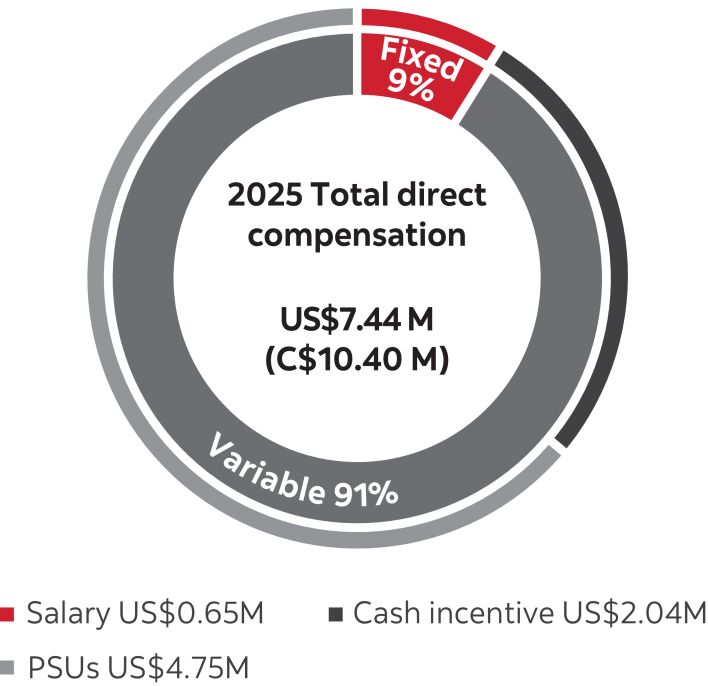
Pay for performance


u 

  executive compensation is mostly variable and not guaranteed


u 

  executive compensation is aligned with both individual and bank performance over the short-, medium- and long-term


u 

  avoid overlap between the performance measures used to determine the annual total variable compensation awards and the performance factor used to determine the vesting and payout of deferred compensation, for example by using both relative and absolute performance across the two


u 

  a significant portion of executive compensation is long-term, and linked to individual and/ or bank performance at the time of grant and vesting


u 

  payouts will be reduced (including down to 0) when performance is significantly below expectations


u 

  our approach to compensation is gender neutral and includes steps to help ensure that decision-making is free from bias

Align with Scotiabank strategy


u 

  compensation is linked directly to our strategy, using financial and non-financial performance metrics, and absolute and relative performance metrics


u 

  payouts under various scenarios are reviewed when determining performance metrics for our incentive plans


u 

  we require executives to maintain a significant share ownership (including deferred incentive compensation) in Scotiabank, and our most senior executives are required to maintain their share ownership holdings for a period of time after they retire

Risk management


u 

  we will claw back or forfeit awards in situations of fraud, misconduct, inappropriate risk-taking or material misstatement of our financial results.


u 

  pay decisions are made within our risk appetite, considering projected capital ratios


u 

  the performance factors in our incentive plans include caps


u 

  we have double-trigger change-of-control provisions in our equity plans, requiring both a change of control and termination before any accelerated vesting of awards


u 

  we have minimum deferral requirements for employees who have a material impact on risk


u 

  compensation for control functions is tied to overall bank performance and not to the performance of the business line they support


u 

  we have tools and processes to adjust compensation for risk and misconduct, if any, including an annual risk assessment by the CRO of incentive plan pools and payouts

u 

  we have a compensation review committee, supported by local conduct committees in our major regions, to lead ongoing risk and conduct reviews and determine adjustments to compensation where appropriate

Strong and effective compensation governance


u 

  compensation is aligned within the broader system of incentives at the bank to ensure ethical conduct is positively incented


u 

  our board has discretion to adjust incentive awards and payouts based on performance and risk appetite


u 

  we have a qualified, experienced and independent human capital and compensation committee that uses an independent advisor


u 

  our human capital and compensation committee and risk committee review all key elements of our material incentive plans and regularly hold joint meetings


u 

  both horizontal and vertical pay analyses are considered when determining the President and CEO’s compensation for the year


u 

  shareholders have a “say on pay” and we engage in discussion with stakeholders


u 

  there is an independent review of our compensation program and practices every year

X WHAT WE DON’T DO


u 

  we do not reprice stock options or grant stock options at a discount


u 

  the structure of our executive compensation program does not encourage excessive risk-taking


u 

  we do not have individual change-of-control agreements


u 

  we do not benchmark CEO pay against companies in more highly remunerated countries, like the U.S. for example, and likewise, we do not include Canadian financial institutions that are not comparable to us in terms of business mix, revenue, net income, market capitalization and number of employees

No hedging or assignment


u 

  executives are not permitted to use hedging to undermine the risk alignment in our compensation plans


u 

  executives are not allowed to assign, pledge, or transfer their equity-based awards

No guarantees


u 

  we do not guarantee a minimum level of vesting in our performance share unit plan


u 

  we do not have employment agreements with multi-year guarantees


Management proxy circular     75  


Table of Contents

Compensation discussion and analysis


FISCAL 2025 INCENTIVE PLAN DESIGN CHANGES


Annual Incentive Plan

In 2025, we have updated the calculation of the all-bank BPF to support the refreshed strategy. There is no change to the core financial and non-financial metrics used to calculate the all-bank BPF; however, we have enhanced and streamlined the client and modifier metrics to better align with and support our new strategic direction.


Our compensation strategy

Our executive compensation strategy supports our goal of delivering strong, consistent and predictable results to shareholders over the longer term. We pay for performance, with a strong emphasis on variable incentive compensation. Our compensation program is built with five goals in mind:


1. REINFORCING ACCOUNTABILITY


by clearly aligning compensation with individual and corporate performance


Most of what we pay our executives is awarded as variable compensation tied to short-, medium- and long-term performance and is not guaranteed.


We set performance ranges for total variable compensation so that executives earn more when performance is strong and less when performance is down. The aggregate total variable compensation is funded by bank performance (both absolute and relative to our peers). Each executive’s performance factor determines the amount of the total variable compensation they are paid and is a combination of the BPF and an individual performance factor (IPF).


Compensation mix


The committee establishes a target compensation mix for each executive based on three criteria:

the executive’s ability to affect results over the longer term – more senior roles have a higher percentage allocated to mid- and long-term incentives, which are equity-based and linked to longer-term performance

market practice for similar positions in our compensation comparator group

regulatory requirements to defer incentive awards.


LOGO


LOGO


Deferred compensation at risk

At least 80% of deferred variable compensation is fully at risk, either directly through a formula or through application of discretion by the board to adjust the calculated performance factor. Canadian senior executives receive at least 80% of their deferred compensation as PSUs, and executives outside of Canada receive 100% of their deferred compensation as PSUs.


Pay at Risk: at least 80% of deferred variable compensation is awarded in PSUs. The PSU payout factor range is 0 to 125, based on a formula described on page 91 and subject to final board determination.


Time vesting: senior Canadian executives receive 20% of their deferred variable compensation awarded in stock options.


76   Scotiabank


Table of Contents

2. SUPPORTING OUR STRATEGY

by assessing performance for compensation purposes against the same financial and non-financial metrics we use to drive performance for our shareholders

We link executive compensation directly to our strategy by incorporating key performance indicators into our total variable compensation. Several of the indicators specifically align to our focus priorities.

Absolute performance is measured against the objectives in our business plan. Relative performance is measured versus our performance comparator group.

Operating leverage and ROE are not defined terms under GAAP and may not be comparable to similar terms used by other financial institutions (see page 117).


Key performance

indicators


How they are used in our

incentive plans

  What they incent us to do    
Financial metrics              
Net income attributable to common shareholders (NIACS)  

absolute performance


increase shareholder value by increasing earnings

measure our profitability in net income generated for shareholders

 
Operating leverage  

absolute performance


manage our expenses efficiently

reduce structural costs by measuring the difference between our growth in revenue and growth in expenses

 
Return on equity (ROE)  

absolute performance

adjustment factor for relative performance


increase shareholder value

measure how efficiently we earn profits on behalf of our shareholders

 
Earnings per share (EPS)  

adjustment factor for relative performance, using EPS growth


increase shareholder value by increasing earnings relative to our peers

 
Total shareholder return (TSR)  

relative performance


increase shareholder value by measuring our share performance compared to our peers

 
Non-financial metrics              
Client  

absolute and relative performance


focus on clients by measuring client advocacy and their likelihood to recommend us. We use Net Promoter Score (NPS) to measure client advocacy and reinforce sustainment of positive client experiences

 
Sustainability  

absolute performance

individual objectives


focus on achieving specific representation goals for equity-deserving groups and progressing against climate-related targets

focus on keeping the bank safe with an individual objective for all employees of upholding a sound risk culture that is considered when assessing individual performance and determining compensation

 
Strategic execution  

adjustment factor in consideration of other measures beyond the core financial and client metrics, and in individual objectives


focus on metrics anchored on strategic priorities, including client primacy, deposits growth, fee revenue and employee engagement


Management proxy circular     77  


Table of Contents

3. EMPHASIZING THE LONG TERM

by paying compensation out over time

A key aspect of our executive compensation design is that a significant portion of executive compensation is deferred and aligned with shareholder experience, as it is determined based on our TSR. We believe that having a longer-term personal investment in the bank aligns the interests of executives and shareholders, encourages our executives to make decisions that increase shareholder value over time and discourages them from taking undue and excessive risks.

The ultimate value of our long-term incentive awards depends on our long-term performance. The largest portion of executive compensation is equity-based, which vests and pays out over three to 10 years.


LOGO

Share ownership guidelines

We require our executives to hold equity in the bank to make sure their interests are aligned with those of shareholders. Our share ownership guidelines provide for varying amounts of ownership by level, expressed as a multiple of base salary. Newly appointed executives have five years to meet the share ownership guidelines while promoted executives have three years to meet their increased share ownership goal. Most of our senior executives must maintain their ownership for a period of time following retirement. Common shares, outstanding deferred stock units (DSUs), PSUs, restricted share units (RSUs) and holdings through our employee share ownership plan (ESOP) all count towards meeting the requirement.


       Share ownership guidelines

CEO

     8x base salary – must hold for two years after retirement

Group heads

     5x base salary – must hold for one year after retirement
Group head, Global Banking and Markets      2x total cash compensation (base salary plus cash incentives) – must hold for one year after retirement
Executive vice presidents and Global Banking and Markets senior leaders      3x base salary
Senior vice presidents, vice presidents and managing directors      1x to 2x base salary

4. ATTRACTING AND RETAINING EXECUTIVE TALENT

by making sure compensation is competitive and aligned with our strategy

Our programs are designed to attract, retain and motivate high-calibre executives to achieve our goals. We benchmark our compensation and performance against companies we compete with for executive talent and capital, and that are comparable to us with respect to business mix, revenue, net income, market capitalization and number of employees.

Our primary compensation comparator group for the President and CEO and Canadian based executives comprises Canada’s eight largest financial institutions: Bank of Montreal, Canadian Imperial Bank of Commerce, Royal Bank of Canada, TD Bank, National Bank, Manulife Financial, Sun Life Financial and Great-West Lifeco. These companies are in the same or similar industry as our bank, and/or are of similar size, scope and complexity. We do not include companies in more highly remunerated countries, like the U.S., for example, in our primary compensation comparator group and, likewise, we do not include Canadian financial institutions that are not comparable to us in terms of business mix, revenue, net income, market capitalization and/or number of employees.

We benchmark target total compensation for executives against these companies using data provided by global survey providers and public proxy compensation disclosures. Benchmarking is based on roles, taking into consideration the scope and relative complexity of the role in relation to the comparator group, as well as the executive’s development in the role, and includes salary, incentive awards, total compensation and compensation mix. This information is considered during our


78   Scotiabank


Table of Contents

compensation decision-making process. Due to the limited number of comparators, we do not set a specific benchmarking target, such as median. The table below includes information from public disclosure filings as of October 31, 2025 for banks and September 30, 2025 for insurance companies.

Our performance comparator group, which we use to assess relative performance in our mid-term incentive plan, comprises Canada’s largest banks: Bank of Montreal, Canadian Imperial Bank of Commerce, Royal Bank of Canada, TD Bank, and National Bank.


                     Compensation comparator group and Scotiabank percentile rank1
     Compensation
comparator
group
    Performance
comparator
group
         LOGO


Bank of Montreal


Canadian Imperial Bank of Commerce


Royal Bank of Canada


TD Bank

                         
National Bank                          


Manulife Financial


Sun Life Financial


Great-West Lifeco


1  Where available, revenue and net income figures exclude one-time items and other items of note, as disclosed by the respective financial institution. Adjusted results are considered non-GAAP measures.

2  As of January 1, 2023, revenue figures for insurance companies are omitted due to the adoption of IFRS 17, which impacted insurers’ revenue reporting without changing their economic fundamentals.

3  The 2025 Great-West Lifeco latest employee count is not publically available. The value reflects the employee count at the start of 2024.


Management proxy circular     79  


Table of Contents

5. ENSURING PRUDENT COMPENSATION RISK MANAGEMENT

by balancing risk and reward in our compensation structure and ensuring our programs do not encourage excessive risk-taking

Our compensation programs are guided by the FSB’s Principles for Sound Compensation Practices and Implementation Standards and Supplementary Guidance (FSB Guidelines), which have been adopted by our primary regulator, OSFI, and other applicable regulatory guidance. A key objective of the FSB Guidelines is ensuring that compensation programs, policies and practices align with effective risk management to enhance the stability and soundness of the international financial system and to protect against excessive risk-taking.

The table below sets out how our compensation program and governance framework align with key elements of the FSB Guidelines, including how risk management is integrated into our compensation process. Please also see page 33 for information on our risk management framework, page 82 for more about compensation risk oversight, and page 84 for our key compensation policies.


 FSB guidelines   Our alignment   Page
     
The board oversees the compensation program design and operations  

u

Our independent human capital and compensation committee is responsible for the bank’s compensation programs including those applicable to foreign subsidiaries and branches


Pages 65 and 66

     
The board monitors and reviews the compensation program to ensure it is operating as intended  

u

The human capital and compensation committee meets jointly with the risk committee to review risks and rewards associated with the design and funding of our material compensation plans, including an evaluation of all current and future risks


Pages 82 and 83

     
Control function employees are compensated in a manner independent of the business areas they oversee  

u

Compensation for employees in control and stewardship functions (such as risk management, legal, compliance, finance, internal audit, anti-money-laundering (AML) and human resources) is determined independently of the business areas they may support

  Page 82
     
Compensation is adjusted for all types of risk  

u

The incentive plans include an adjustment for risk if the board believes excessive risk was taken to achieve the year’s results. The CRO reports on this directly to the risk and human capital and compensation committees in their joint meeting at year end


u

We have tools and processes that address the link between compensation, risk and conduct


Pages 82 and 83

     
Compensation outcomes are symmetric with performance and risk outcomes  

u

We pay for performance and risk outcomes, with a strong emphasis on variable incentive compensation especially at senior levels of the bank. Our most senior executives are focused on overall bank interests and performance


u

Final payout of PSUs is subject to the achievement of ROE and TSR measures and can range from 0% to 125% of the underlying value of the vesting shares. There is no minimum guaranteed level of vesting, and the board may use its discretion to further adjust the performance factor up or down, including down to 0%.


u

Guaranteed incentive payments are discouraged, and multi-year guaranteed incentive awards are not permitted. One-time awards may be selectively provided to new-hire employees to compensate for deferred compensation foregone from a previous employer

  Pages 90 and 91
     
Compensation payouts are sensitive to the time horizon of risk  

u

The proportion of mid- and long-term incentives typically increases as the time horizon and magnitude of risk an employee is responsible for increases. For employees in material risk impact roles, at least 40% of their incentive compensation is deferred. At least 60% of incentive compensation for more senior executives and our most highly paid employees is deferred, subject to local market practices


u

Equity-based compensation is generally deferred for at least three years and any annual cash incentive taken as DSUs is deferred until the employee leaves the bank, subject to tax effectiveness or other legal limitations in countries outside Canada


Page 78

     
The mix of cash, equity and other forms of compensation is consistent with risk alignment  

u

A substantial portion of incentive pay is delivered in mid- and long-term incentives, which are capped where appropriate to avoid excessive risk-taking. Further, all incentive compensation is subject to our clawback policy

  Pages 76 and 84


80   Scotiabank


Table of Contents

Compensation governance

The board of directors is responsible for executive compensation at Scotiabank.

The human capital and compensation committee is responsible for our compensation program and practices and works in collaboration with the risk committee when making compensation decisions. It also receives advice from a qualified, independent third-party advisor.


LOGO

ABOUT THE HUMAN CAPITAL AND COMPENSATION COMMITTEE

As of October 31, 2025, the committee has five independent directors and average committee tenure of 8 years. None of the members has ever been a Scotiabank executive.

All committee members bring extensive experience, acquired through their management involvement in public and private companies and as seasoned directors. The table below lists the committee’s key skills for effective governance and oversight of our executive compensation program.


        Skills and areas of expertise
     On the
committee
since
  Independent   Executive
compensation
experience
  Governance
experience
  Risk management
experience
  Human resources
experience
  President/CEO
experience
  Other executive
leadership
experience

Nora Aufreiter (Chair)

  2016   LOGO   LOGO   LOGO       LOGO       LOGO

Guillermo Babatz

  2017   LOGO   LOGO   LOGO   LOGO   LOGO       LOGO

Lynn Patterson

  2024   LOGO   LOGO   LOGO   LOGO   LOGO   LOGO   LOGO

Una Power

  2016   LOGO   LOGO   LOGO   LOGO   LOGO       LOGO

Aaron Regent

  2014   LOGO   LOGO   LOGO   LOGO   LOGO   LOGO   LOGO


Management proxy circular     81  


Table of Contents

Independent advice

The committee receives advice from a qualified, third-party independent advisor about compensation matters to make sure its decisions are fair, balanced, and reflect a broader perspective. The committee makes its final decisions after considering the advice received.

The committee has the following policies to make sure the advisor it hires is – and remains – independent:


management cannot use the same advisor


the committee meets with the independent advisor at every meeting they attend, as required, without any members of management present


fees must be reported at each committee meeting.

The committee has retained Hugessen as its independent advisor since 2019. At that time, the committee also retained Semler Brossy Consulting Group, LLC (Semler Brossy) to collaborate with Hugessen to provide a broader global perspective on executive compensation practices and related compensation governance matters.

The table below shows the fees paid to each of Hugessen and Semler Brossy in the last two fiscal years for the following services:


review of executive compensation practices and program design


review design of the bank’s material incentive plans


competitive analysis of President and CEO compensation


trends in executive compensation, regulatory developments and governance best practices


perspectives on appropriate total compensation mix and levels, based on competitive practice and performance


advance review of meeting materials to identify any other issues for the committee to consider when evaluating proposed changes to our compensation program and plan designs


attendance at all committee meetings relevant to their mandate, as required.


    2025     2024  


Executive

Compensation-

related fees


All other

fees


Executive

Compensation-

related fees


All other

fees


Hugessen Consulting Inc.     $243,298           $ 233,463        
   
Semler Brossy Consulting Group, LLC1,2     $2,555             $8,742        


1 

In 2024, fees to Semler Brossy were converted from USD to Canadian dollars using the exchange rate of: USD 1.00 = CAD 1.3514.

2 

In 2025, fees to Semler Brossy were converted from USD to Canadian dollars using the exchange rate of: USD 1.00 = CAD 1.4193.

Hugessen and Semler Brossy have confirmed that these fees are not significant relative to their total revenue and, therefore, do not affect their independence. The two firms did not provide any other services to the committee or board in either year.

COMPENSATION RISK OVERSIGHT

Compensation risk oversight is an important component of our risk management framework. The human capital and compensation committee oversees compensation risk using an effective organizational structure, proper management oversight, comprehensive policies and discretion and an independent review by internal audit.

Organizational structure

We tie compensation for control and stewardship functions (finance, risk management, internal audit, compliance and AML, legal, and human resources) to overall corporate performance, and not to the performance of the business lines they support.

Heads of control functions (finance, risk management, internal audit, compliance and AML) manage their groups independently from the business lines they support, and have final sign-off on hiring, compensation and performance assessment for key roles.

Management oversight

Compensation review committee

The compensation review committee identifies key employees whose roles could have a material effect on risk and ensures there is an appropriate link between their incentive compensation and risk. This includes senior executives and other employees who establish policies that significantly affect corporate risk, or manage material businesses, countries or regions.

The committee also reviews the compensation of any employee involved in a material incident, including issues related to conduct. The compensation review committee is chaired by the CRO, who provides updates on the committee’s activities, including all actions and decisions related to adjusting individual compensation, to the human capital and compensation committee. Material risk and conduct incidents reviewed by the compensation review committee may include inappropriate sales practices, insufficient oversight and tone from the top, incidents that create reputational risk for the bank, and behaviour that is inconsistent with our code of conduct.


82   Scotiabank


Table of Contents

To support the compensation review committee process, there are local conduct committees in key countries and regions, with the membership structure of the local committees mirroring that of the bank’s compensation review committee. The local committees provide input into the identification of material risk impact (MRI) employees, and possible misconduct or risk events, if any.

As of October 31, 2025, the compensation review committee consisted of the following global heads of control and stewardship functions, as well as the head of total rewards:


Group Head and Chief Risk Officer (chair)


Group Head and Chief Financial Officer


Chief Human Resources Officer


Executive Vice President and General Counsel


Executive Vice President and Chief Compliance Officer


Executive Vice President and Chief Auditor (non-voting member)


Senior Vice President, Total Rewards.

Human capital committee

The human capital committee is a management committee that has enterprise-wide accountability for the strategic direction, prioritization and progress of our global human resources strategy. Its mandate includes approving strategies, policies and programs relating to leadership, compensation, pensions and benefits.

As of October 31, 2025, the human capital committee was made up of the President and CEO as well as the following members of his senior management team:


Group Head and Chief Financial Officer


CEO and Group Head, Global Banking and Markets


Group Head, International and Global Transaction Banking


Group Head, Canadian Banking


Group Head, Global Wealth Management


Group Head and Chief Information Officer


Group Head and Chief Risk Officer


Chief Strategy & Operating Officer


Chief Human Resources Officer


Executive Vice President and General Counsel


Executive Vice President and Chief Compliance Officer.

Discretion

We make all decisions about compensation plan design and pay within the context of our risk appetite, taking into consideration projected capital ratios as reflected in the annual capital adequacy report to the board.

The incentive plans include an adjustment for risk if the board believes excessive risk was taken to achieve the year’s results. The CRO reports on this directly to the risk and human capital and compensation committees in their joint meeting at year end. As part of the CRO’s risk assessment, prudent valuations for capital adequacy are conducted to ensure we are appropriately managing our capital to produce shareholder returns. Potential risks affecting capital strength include concentration risk, off-balance sheet risk, liquidity risk, current and future capital needs and economic profit.

As each business line is allocated equity which reflects their respective economic capital, our capital adequacy assessment ensures our capital is sufficient to meet current and future risks and achieve strategic objectives. These prudent valuations ensure business lines are being charged adequately for the risk inherent in their respective business, and feed into the determination of incentive pools.

At year end, the CRO also completes a review of performance over the past three years to determine if there were any material risk incidents that warrant a risk adjustment to the PSU payout.

The board can also use its discretion to:


reduce or withhold payment under the material incentive plans if our results are significantly below expectations


not grant mid- and long-term incentive awards at all or to specific individuals


reduce the payout value of PSU awards that have already been granted (including reducing them to zero).


Management proxy circular     83  


Table of Contents

Independent review

Internal audit conducts an independent review of our compensation programs and practices every year and reports to the human capital and compensation committee. The results are also provided to OSFI. The review includes:


an assessment of the appropriateness of material compensation plans and programs that include employees whose actions may have a material impact on the risk exposure of the bank, against our organizational goals, our risk profile and the FSB Guidelines


an assessment of the appropriateness of payouts relative to risk


the compensation of key employees whose roles could have a material effect on risk through operations or policies, or manage material businesses, countries or regions.

The Chief Auditor presents an annual review to the human capital and compensation and risk committees to confirm that Scotiabank is compliant with the FSB Guidelines in all material respects.


KEY POLICIES


Compensation Policy


Our compensation policy sets out a pay-for-performance philosophy that supports our strategic focus, encourages strong corporate performance, fosters a culture of performance and helps the bank create and sustain shareholder value over the long term. Among other things, our compensation policy outlines our approach to compensation risk oversight in our incentive plan design and funding. It outlines the minimum deferral rates for senior executives and individuals whose roles may have a material impact on the risk profile of our business, including roles in control and stewardship functions. Consistent with regulatory requirements and best practices, our approach to compensation is gender neutral.


Hedging and assignment


Employees, officers and directors are not permitted to enter into short sales, calls and puts that involve Scotiabank securities. These restrictions are enforced through our compliance programs. To be eligible to receive equity-based awards, executives are required to attest that they will not use personal hedging strategies or compensation-related insurance to undermine the risk alignment effects embedded in our incentive compensation plans. Equity-based awards, and any entitlements that employees may have under our equity compensation plans, cannot be assigned or transferred, except when it is required by law.


Insider trading


Executives must pre-clear with our compliance department any trades to buy or sell our securities, including exercising stock options. Executives and directors are not allowed to trade during our trading blackout periods.


Clawbacks and forfeitures


Executives will forfeit outstanding incentive awards and/or repay compensation that has already been paid if there is a material misstatement of our financial results, inappropriate risk-taking, fraud, gross negligence, a breach of compliance rules or our code of conduct or inappropriate conduct resulting in significant losses, fines or penalties.


The following can be clawed back:

cash bonuses, commissions, payouts or gains received from our deferred compensation

outstanding equity compensation, including RSUs, PSUs, stock options and DSUs.


84   Scotiabank


Table of Contents

Decision-making process

Our compensation policy is reviewed annually by the human capital and compensation and risk committees, and approved by the board. There were no material changes to our compensation policy in fiscal 2025.

Our compensation decision-making process involves management, the human capital and compensation committee, the risk committee, advice from third party advisors and the board for final approval.

We make all compensation program design and pay decisions within the context of our risk appetite.

The CRO regularly reports to the risk committee and identifies any concerns. These reports form the basis for certain adjustments to our incentive pools. The decision-making process includes:


LOGO

1. Review the compensation program

Management:


reviews the compensation program – how it supports our strategy and how it compares with our competitors, using market data and research from external consultants


presents its recommendations to the human capital and compensation committee.

The committee reviews the recommendations with the risk committee and with its independent advisor for recommendation to the board for approval.

2. Choose performance metrics and annual deliverables

Management determines business performance metrics and weightings for the incentive plans, and sets objectives for the bank overall, and for each business line and each country. The board approves performance targets annually.

Financial targets are established based on a broad range of inputs, such as macroeconomic and market conditions, industry expectations, strategic objectives and initiatives, and the bank’s medium-term objectives.

The process also includes testing various scenarios to understand performance under different conditions, to make sure the performance metrics and objectives support our strategy and reflect the bank’s risk appetite (including credit, market, operational, reputational, conduct and other risks). The performance targets and payout ranges are set to balance risk and reward, ensuring there is an appropriate amount of upside potential and downside risk to reflect performance and results achieved, setting challenging yet attainable goals, while discouraging excessive risk-taking behaviour.

Throughout the year, the CFO provides updates to the committee on the financial performance of the bank and performance against plan metrics. The committee reviews the performance metrics with the risk committee, and then recommends them to the board for approval.

The President and CEO reviews the annual deliverables that will be used to assess each senior executive’s individual performance, ensuring they support our strategy. The President and CEO also presents his own annual deliverables in the context of our corporate goals and long-term strategy to the board for approval.

3. Set targets for executive compensation

Management recommends base salaries and target variable pay for the senior leadership team, after reviewing comparator compensation data provided by external consultants. Target compensation is aligned to the market and adjusted for the scope of each executive’s role as well as their experience to ensure the overall positioning is appropriate. Actual compensation for each executive is aligned with performance and reflects the execution of their strategic objectives.

The committee:


reviews the target total compensation packages for the senior leadership team in relation to our compensation comparator group


looks specifically at compensation for key employees who have significant compensation arrangements or are subject to local remuneration-related regulatory requirements


determines the target total compensation package for the President and CEO with input from its independent advisor.


Management proxy circular     85  


Table of Contents

4. Review corporate performance

Management:


assesses performance against the corporate performance metrics to develop a BPF for the incentive plans as well as the performance factor for PSU award payouts


evaluates our performance relative to the banks in our performance comparator group and assesses whether the factor should be adjusted for relative financial performance


carries out assessments, looking at the amounts accrued to the incentive plans, to assess appropriate use of capital, as well as whether funding of the incentive pool should be adjusted for concentration, off-balance-sheet, liquidity or other potential risks


makes recommendations to the committee.

The committee:


reviews management’s recommendations, working with the risk committee


considers the bank’s overall financial and non-financial performance as the basis for applying any informed judgment to final incentive compensation decisions


may make an adjustment for risk at the recommendation of the CRO


recommends the BPF for the incentive plans as well as the performance factor for PSU award payouts to the board for approval.

The board has the discretion to apply judgment to amend the business performance factor and the PSU factor based on its own assessment of the holistic performance of the bank and/or apply judgment to adjust variable compensation award outcomes. The board can also reduce the business performance factor and the PSU factor based on its own risk assessment, which reduces the pool and payout. It also has discretion to reduce payouts to zero, depending on the circumstances in that year.

5. Review individual performance

The President and CEO reviews the performance and compensation of his direct reports as follows:


assesses senior management performance against their annual goals and leadership behaviours, their leadership potential and sustained performance, and also considers time in role


recommends their actual compensation for the year to the committee


recommends their target salary and total variable compensation taking into account performance, leadership behaviours, potential and market position.

The committee completes an in-depth assessment of the President and CEO’s performance in leading us towards meeting our goals, and setting and executing against our long-term strategy, including:


overall performance


implementation of the President and CEO’s strategies to increase shareholder value


achievement of his annual deliverables.

6. Award compensation

The compensation review committee reviews the conduct of employees whose roles could have a material effect on risk and recommends any reductions to the committee.

The committee reviews and finalizes the recommendations for the President and CEO’s direct reports, the executive vice presidents, other control function heads and UK and Ireland employees who are governed by the Prudential Regulation Authority (PRA), Financial Conduct Authority (FCA), Central Bank of Ireland (CBI), European Banking Authority (EBA) Guidelines on Sound Remuneration Policies and other local remuneration-related regulatory requirements. The board and/or committee reviews the recommendations and approves the executive compensation decisions.

The committee determines the President and CEO’s actual compensation, which it recommends to the board for approval. The President and CEO is not involved in determining his own compensation.

The committee reviews reports from management and the President and CEO’s self-assessment, and consults with its independent advisor before making its recommendation to the board.

The committee’s independent advisor prepares a detailed analysis for the committee to review when making its decisions about the President and CEO’s compensation, including:

Horizontal benchmarking analysis:


target and actual compensation of the President and CEO’s peers in the compensation comparator group, and trends and competitive practice in the broader Canadian market.


86   Scotiabank


Table of Contents

Management supplements this with the following vertical pay analyses:


a pay ratio comparison of the President and CEO’s pay package relative to the median Canadian family income and our average employee pay. The median family income figure used for this analysis is $110,129, which is based on the 2023 figure, as published in 2025 by Statistics Canada and adjusted by the Bank of Canada’s average Consumer Price Index for 2024 and 2025


as Canada is the labour market in which the President and CEO lives and works, the committee also reviews a pay ratio comparison of the President and CEO’s total pay package relative to the bank’s median and average Canadian employee pay. As of October 31, 2025, the median and the average Canadian full-time equivalent employee pay excluding the President and CEO are $110,477 and $146,676, respectively, resulting in CEO to median employee pay multiple of 120x and to average employee pay multiple of 90x


the President and CEO’s compensation in relation to the bank’s net income.

The committee recommends the President and CEO’s compensation to the board for approval. Please see pages 96 to 98 for details about the President and CEO’s compensation.

Program elements

The executive compensation program for NEOs includes direct compensation (base salary and total variable compensation), and indirect compensation (pension, group benefits and perquisites).


     Component   Purpose   Form   Performance
period
 

Pay at risk

profile

Direct compensation
Fixed   Base salary   Compensates executives for fulfilling their day-to-day responsibilities, taking into account their experience, skills, internal equity and market competitiveness   cash   ongoing   no risk
Variable   Total variable compensation   Rewards executives for meeting annual corporate objectives (financial and non-financial) and individual strategic deliverables   a portion of the award is allocated in cash   one year   moderate risk
        A portion of the total variable compensation is allocated under the bank’s deferred compensation plans and rewards executives for creating sustained shareholder value over three to 10 years and achieving specific corporate performance objectives  

to meet compensation deferral requirements, a portion of the award is allocated in:

PSUs – mid-term incentive and, in Canada

stock options – long-term incentive


three years

up to 10 years


significant risk

significant risk

Indirect compensation        
  Pension   Provides an important source of retirement income  

defined benefit plan (contributory or non-contributory membership)


defined contribution plan (contributory or non-contributory membership)


supplemental pension plan (non-registered and unfunded, for some executives)

  ongoing   no risk
  Group benefits  

Invests in employee health and well-being


Executives participate on the same basis as other employees


Varies based on level and local market


group life, accidental death and dismemberment, disability and extended health and dental insurance


employee share ownership plan (Scotiabank matches an additional 60% up to a specified limit)

  ongoing   no risk
  Perquisites  

Provides market competitive benefits


Varies based on level

  annual fixed allowance, paid quarterly (taxable benefit)   ongoing   no risk


Management proxy circular     87  


Table of Contents

ABOUT TOTAL VARIABLE COMPENSATION


Purpose   To reward performance in a way that supports our strategic plan over the short-, medium- and long-term
Who participates   Named executives
How we fund awards  

Aggregate total variable compensation is funded by our business performance factor. The aggregate incentive pool is capped.


The business performance factor is calculated using the same financial and non-financial metrics we use to measure our corporate performance:

absolute performance is measured against the objectives in our business plan

relative performance is measured against our peers.


The business performance factor is capped at 150, except in the case of the President and CEO where the factor is capped at 125 to align the President and CEO’s compensation opportunity with the market. To recognize that a much greater proportion of the President and CEO’s total compensation is subject to the business performance factor than that of the other named executives, it was concluded that the BPF should have a flatter payout curve above target and a lower cap of 125 for the President and CEO compared to the other named executives, in order to limit the upside potential of awards above target.

Form of award  

The total variable compensation award is allocated in cash and equity.


By allocating the equity portion of the award in PSUs and stock options, we ensure a strong link between executive pay and shareholder experience, and also address compensation deferral requirements.

How we determine the award  

The amount of the total variable compensation award depends on the executive’s incentive target and their performance factor. Each executive’s performance factor is a combination of the business performance factor and their individual performance factor. The ratio between all-bank business performance and performance against individual strategic deliverables is 80:20 for the President and CEO and 70:30 for other named executives.


Each executive’s performance is assessed using a four-rating scale of “what was achieved” against strategic deliverables established at the beginning of the year (which include business line or country financial goals for business line and country heads), and “how it was achieved” based on leadership behaviours demonstrated during the year. Each box yields a narrow individual performance factor range within the full range of 0 to 150, within which the executive’s individual performance factor for the year is determined. Use of the four-rating scale provides for consistency and calibration of performance assessments and determination of each executive’s performance factor relative to peers.


LOGO


Forfeiture and clawbacks   Can be forfeited or clawed back under certain conditions.


88   Scotiabank


Table of Contents

How we fund awards

Calculating the all-bank performance factor

We calculate the all-bank BPF in multiple steps. The board also has the discretion to apply judgement to adjust the factor based on its own assessment of the holistic performance of the bank, including reducing the factor to zero (no payouts) if we deliver results that are significantly below expectations.


Step 1


Assess performance against the

core corporate metrics


Step 2


Modify based on strategic

execution metrics and

performance relative to peers


Step 3


Final risk adjustment by the board


LOGO


LOGO


LOGO

Jointly with the risk committee and the Chief Risk Officer, the committee assesses the appropriateness of the business performance factor


           All-bank business performance factor

Score based on core metrics


   LOGO  

Adjusted score


   LOGO   

minimum: 0

cap: 150

First, we calculate a preliminary performance factor based on performance against the core corporate performance metrics.

Next, we may adjust the factor up or down based on how we performed against our strategic execution metrics, and our performance relative to peers.

Finally, the human capital and compensation committee reviews a risk assessment jointly with the risk committee and the Chief Risk Officer and assesses the appropriateness of the business performance factor. Risk adjustments can be made to reduce the factor, and can also increase the factor in recognition of exceptional risk and compliance behaviours.


Management proxy circular     89  


Table of Contents

ABOUT DEFERRED COMPENSATION


Purpose    To reward strong sustained performance over three to 10 years, and link the interests of executives and shareholders
   
How we determine the reward    The amount of the award is based on a pre-determined allocation of each executive’s total variable compensation award, so that a significant percentage of compensation is deferred. The pre-determined allocations are 75% for the President and CEO and 60% to 70% for other named executives. The committee does not consider the value of awards the executive has received in previous years when it determines new grants
Form of award   

Deferred compensation is equity-based and awarded to our Canadian named executives as follows:

80% as PSUs (mid-term incentive)

20% as stock options (long-term incentives)

Named executives outside of Canada receive 100% of their deferred compensation awarded as PSU

Forfeiture and clawbacks    Deferred compensation can be forfeited or clawed back under certain conditions
     Mid-term incentive    Long-term incentive
Purpose    To reward executives for creating sustained shareholder value over three years and achieving specific corporate performance objectives    To retain senior executives, reward them for creating sustained shareholder value over three to 10 years, and link their interests to those of shareholders
Who participates    Vice presidents and above    Senior vice presidents and above
Form of award   

PSUs


The amount of the award is converted to PSUs on the first day of the open trading window following the public release of our year-end financial results, using the average closing price of our common shares on the TSX for the 20 trading days ending on the last trading day before the grant date. PSUs earn dividend equivalents


Stock options


The amount of the award is converted to options on the sixth trading day in the open trading window following the public release of our year-end financial results, using the estimated compensation value of the stock options on the grant date


The exercise price is either the closing price of our common shares on the TSX on the trading day prior to the grant date, or the volume weighted average trading price for the five trading days immediately preceding the grant date (whichever is higher)


Options cannot be re-priced or exchanged for options with a lower price


Options cannot be sold to a third party – they can only be transferred to a beneficiary or legal representative if the holder dies


You can read more about our stock option plan beginning on page 108

Vesting and payout   

PSUs vest and are paid out at the end of the three-year performance period based on our performance (see below for details). Vested units are paid out in cash


The amount the executive receives depends on the number of units that vest and our share price at the time of vesting:

the number of units that vest is determined by the performance factor (see pages 91 and 94 to 95)

vested units are converted to cash using the average closing price of our common shares on the TSX for the 20 trading days ending the day before the first day our trading window opens following the vesting date

payments are made by December 31 of the year the units vest, and withholding taxes apply


Options vest 50% on the third anniversary date of the grant, and 50% on the fourth anniversary date of the grant


Executives can exercise their options after they vest


The amount the executive receives depends on our share price at the time they exercise the options


Withholding taxes and trading fees apply


Options expire after 10 years. If an option’s expiry date falls during an insider trading blackout period (or within 10 business days after the blackout), it will automatically be extended to 10 business days after the end of the blackout period

Potential adjustments   

Our PSUs do not vest without board approval of the final performance factor and resulting payout


As part of the process, the CRO assesses whether a risk adjustment is appropriate. Additionally, the board may use its discretion to adjust the performance factor when the calculated factor may not reflect all of the relevant considerations, taking into account significant events and circumstances (such as a material downturn in financial performance, material failure in managing risk, or events outside of management’s control, etc.)


Such adjustments include the ability to reduce the performance factor to zero


90   Scotiabank


Table of Contents

How we allocate the total variable compensation award


LOGO

How we calculate the performance factor for the mid-term incentive

The performance factor determines the number of units that will vest at the end of the three-year period. It ranges from 0 to 125. There is no minimum guaranteed level of vesting in our PSU plan. The board reviews the performance factor calculated using the formula below and assesses whether the outcome of the formula makes sense in light of the performance objectives established at the time of grant, overall bank performance and other relevant considerations.

Based on this assessment, the board may apply discretion to adjust the calculated performance factor up or down, including reducing it to zero (eliminating the payout entirely) based on its assessment of performance and risk.

We calculate the performance factor using key financial metrics that are also used to measure our corporate performance:


absolute performance is measured against the objectives in our business plan


relative performance is measured against our performance comparator group.


LOGO


Management proxy circular     91  


Table of Contents

2025 Compensation decisions

2025 COMMITTEE WORKPLAN

The human capital and compensation committee follows a comprehensive annual workplan leading up to the board’s year-end pay decisions. During the year, the committee received input from the CFO on the financial performance of the bank and at year-end from the CRO on risk-related considerations for incentive pools and payouts, including plan design, individual conduct considerations, performance against risk appetite and capital adequacy. Throughout the year, the committee also received advice from its independent advisor as detailed on page 82.

Key activities undertaken throughout the course of 2025 included:


receiving quarterly updates on key human resources risk metrics and emerging issues


reviewing and approving the performance metrics for the all-bank business performance factor under the 2025 TVC plan at the December 2024, February and May meetings, and jointly recommending with the risk committee refinements to material compensation plans for fiscal 2026 including minor changes to the all-bank business performance factor to the board for approval at the October meeting


discussing the ISS and Glass Lewis reports and say-on-pay vote recommendations at the committee’s April meeting, together with a review of our peer banks’ performance and pay decisions, and the overall external market context


receiving updates on shareholder engagement at the December 2024 and April meetings


reviewing the bank’s say-on-pay vote outcome at the committee’s May meeting


conducting a mid-year assessment of the President and CEO’s performance in May


reviewing trends and developments on CEO and executive pay, as presented by the committee’s independent advisor in August and October


receiving the CFO’s updates on bank performance, including performance relative to peers, and how the all-bank business performance factor and performance share unit factors were trending for 2025, and their impact on the compensation of executives and other employees, at the August and October meetings, prior to approval of the final factors reflecting full-year performance in December


recommending for board approval the 2025 total direct compensation for executives at the December 2025 meeting, following discussion with the risk committee, the committee’s independent advisor and presentations from the CRO and CFO in respect of the bank’s performance


reviewing and approving the compensation targets for the named executives for fiscal 2026 at the December 2025 meeting


92   Scotiabank


Table of Contents

2025 BUSINESS PERFORMANCE FACTOR

The process steps and inputs detailed below explain how we determined the 2025 all-bank BPF of 103.

We use a multi-step approach to calculate the all-bank BPF, which determines the funding of total variable compensation: 1) a factor based on financial and client experience/sustainability metrics; 2) a modifier based on our strategic execution objectives and performance relative to our peers; and 3) a final adjustment by the board for risk and other considerations. We also believe shareholders are best served by the committee applying sound and thoughtful judgment to final compensation outcomes when appropriate.


Step 1


Assess performance against the

core corporate metrics


Step 2


Modify based on strategic

execution metrics and

performance relative to peers


Step 3


Final risk adjustment by the board


LOGO


LOGO


LOGO


Business performance factor based on core metrics 103   LOGO  

Adjusted score

103


   LOGO   

Final all-bank business performance factor of 103


  1.

Assessment against core performance metrics

Results were at or above target for the three corporate performance metrics set for 2025. As illustrated in the chart below, net income attributable to common shareholders (NIACS) and operating leverage achieved above-target results, and Client experience/sustainability landed at target:


          Performance                              
   
    2025
Results1
  50   Target1     150      Score               Weights         

Business

performance

factor

Adjusted NIACS ($ millions)

      $8,844       $6,942         $8,677         $10,412         105       x           60%        
   

Adjusted operating leverage

      3.0%       -2.1%         2.9%         7.9%         101       x           20%           =       103
   

Client/sustainability

      at target       50         100         150         101       x           20%            


1

2025 target and performance metrics are on an adjusted basis and are non-GAAP financial measures. Please refer to pages 20 to 21 (for NIACS) and 19 and 27 (for operating leverage) of the 2025 annual report for reconciliations of GAAP reported financial results to non-GAAP adjusted financial results, which disclosures are incorporated by reference herein.


Management proxy circular     93  


Table of Contents
  2.

Application of modifier based on strategic executive metrics and performance relative to peers

The committee assessed the bank’s performance against our strategic execution metrics and relative to peers.


Key considerations        Assessment


Strategic execution


driving value over volume – building deeper, long-term relationships with our clients; since the launch of our strategy, adding 420,000 new retail primary clients across our Canadian and International businesses

retail deposits and investments growing at 7% compound growth rate over the last two years

maintaining strong employee engagement scores, exceeding the Financial Services average – continuing to invest in our people, embedding our ScotiaBond values and behaviours into performance, development, recognition, and engagement programs


Relative performance      

as part of our established process for calculating the BPF, the committee assessed our performance relative to peers against key financial metrics. On balance, relative performance was below peer median. However, absolute performance is in line with Investor Day commitments and the full-year plan. In addition, the results are a reflection of ongoing, positive momentum


Adjustment      

Overall, the board determined that no adjustment was appropriate, given overall performance in line with Investor Day targets


  3.

Final risk adjustment by the board

The board did not make an adjustment for risk this year. The Chief Risk Officer led a review of risk-related considerations separate from the mechanisms already embedded in the plans and concluded that the bank had operated within its risk appetite. As such, there was no additional adjustment for risk.

The final business performance factor for 2025 is 103.


LOGO

PAYOUT OF 2022 PSU AWARDS

PSUs awarded to the NEOs in 2022 vested on November 30, 2025 (the end of the three-year PSU performance period) after the board approved the performance factor and final payout. The table below shows how we calculated the payouts, which were made in December 2025.

The performance factor for these PSUs was below target at 83, the result of below target three-year average adjusted ROE performance and below median three-year relative TSR. This decreased the number of PSUs that vested by 17%.


Number of

PSUs granted

in 2022


Number of

dividend
equivalents

received


Total

PSUs


Performance

factor


Vesting

price
($)


Payout value

on vesting

($)


Value on
the

date of the

grant
(2022)

($)


Difference

between

grant value

and payout

value


Rajagopal

Viswanathan

    23,954       +       4,857       =       28,811       x       0.83       x       95.13       =       2,274,837       1,649,200       38%  
                                           

Mr. Thomson, Mr. Machen, Mr. Aristeguieta and Mr. Clark were not bank employees in 2022 and, therefore, did not have any PSUs that vested in 2025.

The vesting price is the average closing price of our common shares on the TSX for the 20 trading days ending on December 3, 2025, the day before the first day our trading window opened following the vesting date.

Factoring in dividend equivalents received, the change in share price, and the performance factor, the overall payout was 38% higher than the original grant value.


94   Scotiabank


Table of Contents

How we calculated the performance factor

We use two steps to calculate the performance factor for the PSU payout: absolute performance against our ROE targets, and relative performance (our TSR compared to our performance comparator group over the three-year period).


LOGO

Absolute performance factor – ROE

Our three-year average adjusted ROE is net income less preferred share dividends, expressed as a percentage of average common shareholders’ equity. ROE is assessed each year against an annual objective, which is in line with the expected earnings target.


performance

factor

0

(threshold


performance
factor

75


performance
factor

100

(target


performance
factor

125


actual
performance
 
1 


Absolute
performance

factor
(3-year average)


2025     less than 5.8%       10.5%       11.6%       12.8%       11.8% u       103    


2024     less than 5.9%       10.6%       11.8%       13.0%       11.3% u       89       923  
 
20232     less than 6.2%       11.2%       12.5%       13.7%       11.6% u       83      


1 

Financial results are presented on an adjusted basis and are non-GAAP financial measures. Please refer to pages 25 and 26 (for 2025 adjusted ROE) of the 2025 annual report for reconciliations of GAAP reported financial results to non-GAAP adjusted financial results, which disclosures are incorporated by reference herein. Please refer to pages 25 and 26 (for 2024 and 2023 adjusted ROE) of the 2024 annual report for reconciliations of GAAP reported financial results to non-GAAP adjusted financial results, which disclosures are incorporated by reference herein.

2 

The bank adopted IFRS 17 effective November 1, 2023. As required under the new accounting standard, prior period amounts have been restated.

3 

The overall ROE factor represents a three-year average and can range from 0 - 125. Annual performance is assessed using straight-line interpolation between and extrapolation above the specified ranges. A threshold of 50% of target ROE must be achieved in order to yield an annual factor above 0.

Relative performance factor – TSR

Our relative TSR is the appreciation in our share price plus dividends reinvested over the three-year period, using the 20 trading-day average closing share price of our common shares on the TSX, compared to the TSR delivered by our performance comparator group. The relative performance factor is calculated by measuring the performance gap between the bank’s 3-year TSR and the median of our performance peer group’s 3-year TSR, multiplied by a constant factor. The lowest performance factor that can be determined by the formula is 75, however, the committee may, in its discretion, reduce the factor below this level, including down to zero.


TSR

performance

target

(peer group median


Actual
performance


Relative
performance

factor


Three-year TSR

    86%       66%       75  


After some discussion and deliberation, the committee concluded that no adjustment would be made to the overall performance factor of 83. Based on a review of performance over the past three years, the CRO concluded that no risk adjustment to the PSU performance factor was warranted.


Management proxy circular     95  


Table of Contents

SCOTT THOMSON, PRESIDENT AND CHIEF EXECUTIVE OFFICER


LOGO


Scott Thomson assumed the role of President on December 1, 2022, and became President and CEO on February 1, 2023. Mr. Thomson has been a member of the Scotiabank Board of Directors since 2016.


Mr. Thomson is responsible for the overall leadership and strategic direction of Scotiabank. As the CEO, he is accountable to the board of directors for developing, communicating and executing our strategy, with the goal of delivering profitable and sustainable growth over the long-term for our key stakeholders including clients, shareholders, employees and communities, while continuing to comply with all governance and regulatory requirements.


 Highlights of 2025 performance and compensation


Mr. Thomson led the bank in executing the strategy and advanced its key priorities, continuing to shift our business from volume to value, moving focus from leading with our loan book to building deeper, more meaningful relationships with clients, and diversifying our business mix to advance client primacy

The table below summarizes the President and CEO’s accomplishments relative to key strategic goals

Based on the overall performance of the bank and Mr. Thomson’s leadership and performance during the year, the board approved total direct compensation of $12.58 million. A significant portion of his total variable compensation award was allocated in deferred compensation to reward sustained future performance


LOGO


Grow and scale in priority markets


Delivered strong results with 9.6% YoY adjusted earnings per share growth, supported by disciplined risk management and improved capital efficiency

Increased capital allocation to priority businesses, reducing exposure in turnaround segments, which helped grow adjusted 3-year ROE1 to 11.6%


Earn primary client relationships


Despite external headwinds, delivered progress in leading indicators on client primacy (accounts growth, client attrition, product penetration), growing the bank’s overall primary client base


Make it easy to do business with us


Exceeded the efficiency targets for the fiscal year, delivering savings through multiple optimization efforts that unlocked structural and process efficiencies


Win as one team


Led with an enterprise mindset and enhanced cross-collaboration on several fronts, including double-digit growth in client referrals across business lines

Continued to make deliberate investments in talent in line with our strategy, balancing internal development with strategic external hires to bolster our bench and overall succession planning efforts

 
1. 

Financial results are presented on an adjusted basis and are non-GAAP financial measures. Please refer to pages 25 and 26 of the 2025 annual report for reconciliations of GAAP reported financial results to non-GAAP adjusted financial results, which disclosures are incorporated by reference herein.


96   Scotiabank


Table of Contents

President and CEO compensation

The board sets the President and CEO’s target and compensation mix based on the following: the target and actual compensation of peer bank CEOs, the size and geographic breadth and complexity of the business, performance and experience in the role, and the bank’s overall performance under the leadership of Mr. Thomson. At year end, CEO performance is assessed based on all-bank results as measured against the three corporate performance metrics included in the BPF, and on the achievement of key strategic and operational goals. The committee determines the compensation of the President and CEO taking into account the broader context of the bank’s performance, the shareholder experience and the external regulatory and economic environment.

Mr. Thomson’s target compensation for fiscal 2025 was set by the board at $11,500,000, composed of a base salary of $1,100,000 and a total variable compensation target of $10,400,000.

When determining the compensation for Mr. Thomson, the board reflected on his leadership and performance during a third year of transition for the bank, and his role in the execution of Scotiabank’s refreshed strategy. Under Mr. Thomson’s leadership, Scotiabank has successfully begun to execute our vision to deliver profitable and sustainable growth. Mr. Thomson also oversaw and supported the transition of new members onto Scotiabank’s executive leadership team, who bring a wealth of experience and new perspectives to our bank.

Based on the considerations outlined above, the board applied an IPF of 140% and total direct compensation of $12,580,000 for Mr. Thomson.


            2025                   2024  


    Actual       Target      


    Actual       Target  

Base salary

    $1,100,000       $1,100,000      


    $1,000,000       $1,000,000  

Total variable compensation

    $11,480,000       $10,400,000      


    $8,760,000       $8,500,000  

Cash

    $2,870,000       $2,600,000    


    $2,190,000       $2,125,000  

Deferred 1

    $8,610,000       $7,800,000      


    $6,570,000       $6,375,000  

Total direct compensation

    $12,580,000       $11,500,000      


    $9,760,000       $9,500,000  


1 

Awarded 80% in PSUs and 20% in stock options.

President and CEO target compensation for 2026

During the 2025 fiscal year, the committee worked with its independent advisor, Hugessen, to review the target compensation for the President and CEO. Following the review, the committee recommended and the board approved an increase in the President and CEO’s total direct compensation target to $13,275,000 for 2026, composed of a base salary of $1,275,000 and a total variable compensation target of $12,000,000, with a view to achieving and maintaining appropriate competitive positioning among the large Canadian banks.

Share ownership (as at October 31, 2025)

Values are based on $91.99, the closing price of our common shares on the TSX on October 31, 2025.


Common shares   DSUs   PSUs   Total value   As a multiple
of base salary
 

Meets share
ownership

guideline

$5,586,832

  $3,103,817   $13,657,643   $22,348,292   20x   yes

President and CEO compensation awarded vs. realized and realizable pay from 2021 to 2025

The table below compares the compensation awarded to the President and CEO over the past five years and the value realized or realizable as at December 31, 2025, where 2021 and 2022 represent Mr. Porter’s compensation awarded and 2023 onwards represents Mr. Thomson’s compensation awarded.

We also compare the compensation values to the value earned by shareholders, indexed to $100 to show a meaningful comparison.

Overall, the value shareholders received over the last five years has exceeded the President and CEO’s realized and realizable compensation. The realized and realizable value includes salary and cash incentive awards, the value at vesting of share units granted and the current value of units that are outstanding, the value of stock options exercised during the period and the value of outstanding stock options that are in-the-money. The values in this table can vary significantly from year to year based on changes in share price, when the awards vest and when stock options are exercised.


Management proxy circular     97  


Table of Contents

The realized and realizable pay analysis shows that the bank’s compensation program has performed as intended, reinforcing accountability by aligning compensation with individual and bank performance. The compensation realized and realizable at each year end over the past five years fluctuates with Scotiabank’s share performance, as the majority of the President and CEO’s direct compensation is deferred and at risk.


CEO


Compensation
awarded1
($ millions)


Realized
pay2
($ millions)


Realizable
pay3
($ millions)
as at
December 31,
2025


Compensation
realized and
realizable
($ millions)


Value of $100


Period


CEO4


Shareholder5


2021


Porter

    11.4       11.3             11.3    

Oct 31, 2020 to Dec 31, 2025

    100       243  

2022


Porter

    11.4       15.8       3.7       19.5    

Oct 31, 2021 to Dec 31, 2025

    171       158  

2023


Thomson

    7.7       2.6       14.9       17.5    

Oct 31, 2022 to Dec 31, 2025

    228       185  

2024


Thomson

    9.8       3.2       10.7       13.9    

Oct 31, 2023 to Dec 31, 2025

    142       203  

2025


Thomson

    12.6       4.0       7.5       11.5    

Oct 31, 2024 to Dec 31, 2025

    91       149  


Average

    160       188  


1 

Compensation awarded includes salary received during the year and variable compensation awarded at year-end for performance during the year.

2 

Realized pay includes salary, cash incentive, payout of share units granted during the period, and the value of options both granted and exercised during the period.

3 

Realizable pay includes the current value of unvested units granted during the period and the in-the-money value of options outstanding.

4 

The compensation realized or realizable for each $100 awarded in total direct compensation during the fiscal year indicated. 2023 to 2025 represents Mr. Thomson’s compensation, and 2022 and 2021 represent Mr. Porter’s compensation.

5 

The cumulative value of $100 invested in Scotiabank common shares on the first trading day of the period indicated, assuming reinvestment of dividends.


98   Scotiabank


Table of Contents

RAJAGOPAL VISWANATHAN, GROUP HEAD AND CHIEF FINANCIAL OFFICER


LOGO


Rajagopal (Raj) Viswanathan serves as Group Head and Chief Financial Officer, a position he has held since December 2019. In this role, Mr. Viswanathan leads the Finance Department, including business line finance groups, capital management, investor relations, strategic transactions, global taxation, economics and group treasury functions. Mr. Viswanathan joined the bank in 2002 and has held progressively senior roles in Internal Audit and Finance. In 2018, he was named Executive Vice President and Chief Financial Officer, prior to assuming his current role.


 Highlights of 2025 performance and compensation


Continued to provide discipline in financial resource allocation to the businesses, optimized returns and supported optimization of our International Banking business

Mr. Viswanathan’s accomplishments relative to key strategic goals are summarized below

Mr. Viswanathan’s actual total direct compensation has been determined recognizing his strong leadership and performance, as well as the overall performance of the bank. A significant portion of his total variable compensation award was allocated in deferred compensation to reward sustained future performance


LOGO


2025 Compensation


        2025             2024  


 Base salary


$650,000


$650,000


 Total variable compensation


$4,000,000


$3,850,000


Cash

    $1,200,000     


     $1,155,000  


Deferred1


$2,800,000


$2,695,000


 Total direct compensation


$4,650,000


$4,500,000


1 

Awarded 80% in PSUs and 20% in stock options.

2025 Key strategic deliverables


Grow and scale in priority markets


Optimized capital management, improved liquidity ratios, and supported critical acquisitions/ divestitures that drove current and future earnings per share growth

Accelerated closing of the financial cycles and improved quarterly and year-end reporting, providing deeper insights into bank performance


Earn primary client relationships


Supported efforts to drive deposit growth while also improving segment-level reporting and client profitability insights across the business lines


Make it easy to do business with us


Commenced a multi-year automation project to improve the profit planning process and expense transparency to support productivity initiatives and enterprise decision making


Win as one team


Strengthened the finance leadership bench through strategic external hires that introduced fresh perspectives and expertise, while accelerating internal talent development through orchestrated, cross-functional moves

Share ownership (as at October 31, 2025)

Values are based on $91.99, the closing price of our common shares on the TSX on October 31, 2025.


Common shares   PSUs   Total value   As a multiple
of base salary
  Meets share
ownership
guideline

$3,919,459

  $8,093,147   $12,012,607   18x   yes


Management proxy circular     99  


Table of Contents

TRAVIS MACHEN, CEO AND GROUP HEAD, GLOBAL BANKING AND MARKETS


LOGO


Travis Machen was appointed CEO and Group Head of Global Banking and Markets (GBM) in May 2024. In this role, he builds on Scotiabank’s unique North American reach and GBM’s strategic presence in Latin America, Europe and Asia-Pacific to deliver sustainable and profitable growth for the bank’s global wholesale banking business.


 Highlights of 2025 performance and compensation


Global Banking and Markets reported net income of $1,922 million, compared to $1,478 million the prior year, an increase of 30%. Return on equity (ROE) was 12.8% compared to 9.6% in the prior year

Mr. Machen’s actual 2025 total direct compensation has been determined in recognition of his leadership and performance against strategic deliverables, and considering the overall performance of the bank and GBM segment. Mr. Machen’s salary remained at US$650,000 for fiscal 2025. A significant portion of his total variable compensation award was allocated in deferred compensation to reward sustained future performance


LOGO


2025 Compensation


    20251             20241,2,3  


 Base salary


$910,283


$432,528


 Total variable compensation


$11,205,938


     $4,690,839  


Cash

    $3,361,781     


     $1,407,252  


Deferred4


$7,844,157


$3,283,587


 Total direct compensation


$12,116,221


$5,123,366


1 

Mr. Machen is paid entirely in U.S. dollars. His compensation has been converted to Canadian dollars for disclosure purposes. See summary compensation table on pages 104 and 105 for additional details.

2 

Mr. Machen’s 2024 compensation is based on his start date of May 6, 2024.

3 

In 2024, Mr. Machen also received a sign-on cash award of US$1,700,000 and restricted share unit (RSU) award of US$3,600,000. For more information about the RSU plan, please refer to page 117.

4 

As an executive based outside of Canada, Mr. Machen received 100% of his deferred compensation as PSUs.

2025 Key strategic deliverables


Grow and scale in priority markets


Delivered profitable growth across all segments, achieving 12.8% ROE and strengthening balance sheet economics through disciplined capital allocation

Restructured APAC to reduce operational risk, enhance shareholder value, and sharpen focus on core markets


Earn primary client relationships


Deepened relationships with clients, leading interactions with advice, that drove fee revenue growth above plan and strengthened the business balance sheet


Make it easy to do business with us


Championed continuous improvement, sponsoring 100+ initiatives that enhanced the client experience, accelerated product mobilization and unlocked operational efficiencies


Win as one team


Upskilled the team through strategic hires with deep technical expertise in the business to accelerate execution of our priorities

Share ownership (as at October 31, 2025)

Values are based on $91.99, the closing price of our common shares on the TSX on October 31, 2025.


Common shares   PSUs   RSUs   Total value   As a multiple of
cash compensation
 

Meets share

ownership

guideline

$7,173

  $4,117,497   $7,636,377   $11,761,047   3x   yes


100   Scotiabank


Table of Contents

FRANCISCO ARISTEGUIETA, GROUP HEAD, INTERNATIONAL AND GLOBAL TRANSACTION BANKING


LOGO


Francisco Aristeguieta joined the bank in May 2023. As the Group Head with executive responsibility for International and Global Transaction Banking (GTB), Mr. Aristeguieta oversees all of International Banking’s personal, small business and commercial banking operations globally outside of Canada. He also has responsibility for cash management and trade through GTB.


 Highlights of 2025 performance and compensation


International Banking reported net income of $2,631 million compared to $2,581 million the prior year, an increase of 2%

Mr. Aristeguieta’s accomplishments relative to key strategic goals are summarized below

Mr. Aristeguieta’s salary increased to US$650,000 for fiscal 2025

2025 total direct compensation target has also been increased in recognition of his leadership, performance and market position

A significant portion of his total variable compensation award was allocated in deferred compensation to reward for sustained future performance


LOGO


2025 Compensation


    20251             20241  


 Base salary


$910,283


$816,356


 Total variable compensation


$9,487,321


$8,051,440


Cash

    $2,846,196     


     $2,415,432  


Deferred2


$6,641,125


$5,636,008


 Total direct compensation


$10,397,604


$8,867,796


1 

Mr. Aristeguieta is paid entirely in U.S. dollars. His compensation has been converted to Canadian dollars for disclosure purposes. See summary compensation table on pages 104 and 105 for additional details.

2 

As an executive based outside of Canada, Mr. Aristeguieta received 100% of his deferred compensation as PSUs.

2025 Key strategic deliverables


Grow and scale in priority markets


Outpaced key financial deliverables through productivity improvements, expense discipline and optimization of risk-weighted assets

Grew deposits consistently across all segments while also growing fee revenue to enhance the bank’s profitability


Earn primary client relationships


Delivered strong growth in primary clients in International Commercial Banking and GBM, surpassing plan, and achieved steady progress in International Retail Banking


Make it easy to do business with us


Completed regionalization of support functions, outperforming expense savings targets and surpassed productivity goals while unlocking scalable regional solutions

Modernized the enterprise payments infrastructure to improve speed, reliability, and user experience


Win as one team


Deepened the leadership bench through targeted hires in key markets and functions, while embedding a culture of transformation and accountability across IB and GTB

Share ownership (as at October 31, 2025)

Values are based on $91.99, the closing price of our common shares on the TSX on October 31, 2025.


Common shares   PSUs   Total value   As a multiple
of base salary
 

Meets share

ownership

guideline

$41,469

  $11,647,471   $11,688,940   13x   yes


Management proxy circular     101  


Table of Contents

TIM CLARK, GROUP HEAD AND CHIEF INFORMATION OFFICER


LOGO


Tim Clark was appointed Group Head and Chief Information Officer (CIO) at Scotiabank in November 2024. In this role, Mr. Clark is responsible for the bank’s overall technology and innovation strategy which supports the company’s growth and innovation with trust and efficiency. His responsibilities include leading the delivery and operation of all technology capabilities, platforms, and services globally, as well as technology risk and information security.


 Highlights of 2025 performance and compensation


Effective November 18, 2024, Mr. Clark was appointed Group Head and Chief Information Officer, and his annual salary was $600,000 for fiscal 2025

Mr. Clark’s accomplishments relative to key strategic goals are summarized below

His 2025 total direct compensation target was set considering Mr. Clark’s experience and skill set. His sign-on awards were determined with reference to compensation he forfeited at his previous employer

Mr. Clark’s 2025 actual total direct compensation was determined based on his performance during the fiscal year, and that of the bank. A significant portion of his total variable compensation award was allocated in deferred compensation to reward for sustained future performance


LOGO


2025 Compensation


    20251  


 Base salary


$572,055


 Total variable compensation


$2,960,000


Cash

    $888,000  


Deferred2


$2,072,000


 Total direct compensation


$3,532,055


1 

Mr. Clark’s base salary based on his start date of November 18, 2024. Mr. Clark also received a sign-on cash award of $1,707,150, RSU award of $1,169,850, PSU award of $1,100,000, and DSU award of $550,000.

2 

Awarded 80% in PSUs and 20% in stock options.

2025 Key strategic deliverables


Grow and scale in priority markets


Established a new strategy for Global Technology and transformed the approach for enterprise technology spend management, delivering a unified global view and enabling disciplined investment aligned with strategic priorities


Delivered key technology releases across multiple areas of the bank through disciplined execution of plans and priorities


Earn primary client relationships


Established the Enterprise Delivery Office to modernize and enhance execution excellence, improving project health, quality, speed to market, and delivery capacity


Make it easy to do business with us


Enhanced stability of critical systems with a proactive approach to risk management and reliability


Win as one team


Made strategic appointments to the technology leadership team that elevated technical expertise and deepened organizational capability

Share ownership (as at October 31, 2025)

Values are based on $91.99, the closing price of our common shares on the TSX on October 31, 2025.


DSUs   PSUs   RSUs   Total value   As a multiple of
base salary
 

Meets share

ownership

guideline

$689,680

  $1,379,360   $1,466,949   $3,535,988   6x   yes


102   Scotiabank


Table of Contents

Share performance and cost of management


SHARE PERFORMANCE


The graph compares our share performance to our performance comparator group, the Canadian stock market and total compensation awarded to our named executives for the past five years ending October 31, 2025 (the 2023 figure includes the total compensation for only the top five paid named executives for comparison purposes, although six named executives were disclosed in that year). The total compensation awarded to our named executives is generally aligned to the bank’s performance, as well as to shareholder and TSX composite returns.


For comparison purposes, TSR assumes:

$100 was invested in Scotiabank common shares on November 1, 2020, and dividends were reinvested over the five-year period

$100 was also invested for each company in our performance comparator group and dividends were also reinvested over the same period (the graph shows the peer group median)

$100 was invested in the S&P/TSX Composite Index on the same date and dividends were also reinvested.


Cost of Management (Total NEO Pay vs TSR)


LOGO

Our performance comparator group includes Bank of Montreal, Canadian Imperial Bank of Commerce, Royal Bank of Canada, TD Bank, and National Bank.

Total compensation includes base salary, annual cash incentive and the grant value of RSUs, PSUs and stock option awards for the top five highest-paid named executives for the past five years (as disclosed in our circular for prior years).


Total shareholder return on $100 investment (2020 = 100)


2020


2021


2022


2023


2024


2025


Scotiabank ($)

     100        154        131        119        162        221  

Peer Group Median ($)

     100        159        156        149        211        273  

S&P/TSX Composite ($)

     100        139        132        133        175        225  

Total compensation paid to our NEOs ($ millions)

     29        32        39        33        41        49  

COST OF MANAGEMENT

Cost of management is a measure we and other Canadian financial institutions use to show how corporate performance compares to compensation awarded to senior officers. We calculate the ratio by dividing total compensation awarded to our named executives by net income after tax (NIAT) for each of the last five years, where:


total compensation includes salary, total variable compensation including the cash portion and the grant value of RSUs, PSUs and stock options, the compensatory portion of the change in the accrued pension obligation in the year, and all other regular compensation as reported in the summary compensation table (the 2023 figures include the total compensation for only the top five paid named executives for comparison purposes, although six named executives were disclosed in that fiscal year)


adjusted NIAT is as disclosed in the consolidated statement of income for each of the last five fiscal years.


Total compensation

awarded to
named executives

($ millions)


Adjusted
NIAT1

($ millions)


Cost of management

(%)

2025

  48.9   9,510   0.51%

2024

  41.3   8,627   0.48%

2023

  33.5   8,363   0.40%

2022

  39.2   10,749   0.36%

2021

  32.3   10,169   0.32%
1 

2025 net income was adjusted upwards by $1,752 million (reported results: $7,758 million), resulting from divestitures and wind-down of operations, a restructuring charge and severance provisions related to actions taken to simplify the organizational structure in Canadian Banking, restructure and right-size Asia operations in Global Banking and Markets and regionalize activities across the international footprint, in line with the bank’s enterprise strategy, as well as legal provisions, amortization of acquisition-related intangible assets and impairment of non-financial assets. Please refer to pages 20 and 21 of the 2025 annual report for reconciliation of GAAP reported financial results to non-GAAP adjusted financial results, which disclosures are incorporated by reference herein. 2024 net income was adjusted upwards by $735 million (reported results: $7,892 million), resulting from divestitures and wind-down of operations, impairment of non-financial assets, restructuring charge and severance provisions, legal provision, amortization of acquisition-related intangible assets, consolidation of real estate and contract termination costs, and the Canada Recovery Dividend. Please refer to page 20 of the 2024 annual report for reconciliation of GAAP reported financial results to non-GAAP adjusted financial results, which disclosures are incorporated by reference herein. 2023 net income was adjusted for acquisition and divestiture-related costs, restructuring and severance provisions, consolidation of real estate and contract termination costs, impairment of non-financial assets, and the Canada Recovery Dividend (reported results: $7,450). Please refer to page 20 of the 2023 annual report for reconciliations of GAAP reported financial results to non-GAAP adjusted financial results, which disclosures are incorporated by reference herein. 2022 net income was adjusted for the impact of acquisition and divestiture-related costs, restructuring and other provisions, as well as support costs for the Scene+ loyalty program (reported results: $10,174 million). Please refer to page 18 of the 2022 annual report for reconciliations of GAAP reported financial results to non-GAAP adjusted financial results, which disclosures are incorporated by reference herein. 2021 net income was adjusted for the impact of restructuring and other provisions, as well as acquisition and divestiture-related costs (reported results: $9,955 million). Please refer to page 19 of the 2021 annual report for reconciliations of GAAP reported financial results to non-GAAP adjusted financial results, which disclosures are incorporated by reference herein. The bank’s annual reports are available on SEDAR+ at www.sedarplus.ca and on Scotiabank’s https://www.scotiabank.com/ca/en/about/investors-shareholders/annual-reports.html.


Management proxy circular     103  


Table of Contents

2025 Executive compensation details

SUMMARY COMPENSATION TABLE

The table below shows the total compensation each NEO earned in the last three fiscal years. We report the share and option awards granted after the end of the fiscal year to reflect decisions made during the 2025 compensation review, rather than awards granted at the outset of fiscal 2025 from the 2024 compensation review. We do not offer long-term, non-equity incentive compensation to our NEOs.


Named executive

    Year      

Fiscal

salary5

($)


Share

awards6

($)


Option

awards7

($)


Annual

incentive

plan8

($)


Pension

value9

($)


All other

compensation10

($)


Total

compensation

($)


Scott Thomson

    2025       1,100,000       6,888,000       1,722,000       2,870,000       658,000       3,600       13,241,600  

President and Chief Executive Officer1

    2024       1,000,000       5,256,000       1,314,000       2,190,000       553,000       3,600       10,316,600  
    2023       917,808       4,096,917       1,018,500       1,697,500       516,000       1,156,994       9,403,719  


Rajagopal Viswanathan

    2025       650,000       2,240,000       560,000       1,200,000       137,000       3,600       4,790,600  

Group Head, Chief

Financial Officer

    2024       650,000       2,156,000       539,000       1,155,000       117,000       3,600       4,620,600  
    2023       650,000       1,579,200       394,800       846,000       114,000       3,600       3,587,600  


Travis Machen

    2025       910,283       7,844,157       0       3,361,781       25,907       211,749       12,353,877  
CEO and Group Head, Global Banking and Markets2     2024       432,528       8,239,887       0       1,407,252       0       2,421,567       12,501,233  


Francisco Aristeguieta

    2025       910,283       6,641,125       0       2,846,196       20,306       1,683       10,419,593  
Group Head, International and Global Transaction Banking3     2024       816,356       5,636,008       0       2,415,432       22,246       0       8,890,042  
    2023       454,426       5,343,727       0       1,131,655       2,697       0       6,932,505  


Tim Clark

    2025       572,055       4,477,450       414,400       888,000       52,615       1,707,150       8,111,670  
Group Head and Chief Information Officer4                  


1 

Mr. Thomson assumed the role of President on December 1, 2022 and became President and CEO on February 1, 2023. Compensation awarded for 2023 is based on his start date.


2 

Mr. Machen joined the bank and was appointed CEO & Group Head, Global Banking and Markets effective May 6, 2024 and his compensation awarded for 2024 is based on his start date. Mr. Machen is paid entirely in U.S. dollars.


3 

Mr. Aristeguieta was hired as Strategic Advisor to the CEO on April 10, 2023. He was appointed Group Head, International Banking on May 1, 2023, and Group Head, International and Global Transaction Banking on February 25, 2025; his compensation awarded for 2023 is based on his start date. Mr. Aristeguieta is paid entirely in U.S. dollars.


4 

Mr. Clark joined the bank and was appointed Group Head and Chief Information Officer effective November 18, 2024.


5 

Mr. Machen’s and Mr. Aristeguieta’s salaries were converted to Canadian dollars using the fiscal year average exchange rate of: US$1.00 = C$1.4004: (for 2025), US$1.00 = C$1.3606 (for 2024) and US$1.00 = C$1.3485 (for 2023).


6 

For compensation purposes, we value PSU awards using the 20-trading day average closing price of our common shares at the time of grant to smooth out short-term aberrations in the share price. The accounting fair value is based on the closing price of our common shares on the TSX on the grant date. 100% of the payout value of the PSU award is based on performance criteria on vesting.


The accounting fair value of each 2025 PSU award is approximately 3.4% more than the compensation value shown in the summary compensation table, 0.9% more for 2024 and 2.0% more for 2023.


     Grant date       
Grant date
fair value


Accounting
fair value


2025

     December 4        $95.13        $98.33  

2024

     December 5        $77.56        $78.29  

2023

     December 1        $59.79        $61.00  


Mr. Thomson’s 2023 share awards reflect $22,917 in Director DSU awards. Mr. Thomson ceased to be paid as a director upon becoming President of the bank on December 1, 2022. All of his Director DSUs, including those earned in fiscal 2023, were exchanged for DSUs on December 1, 2022, when he became an officer of the bank.


Mr. Machen’s fiscal 2024 share awards include an additional one-time RSU award of US$3,600,000, granted at time of hire. The one-time RSU award vested 50% in November 2025, with the remainder (50%) to vest in November 2026. These amounts were converted to Canadian dollars using the exchange rates as of the grant date US$1.00 = C$1.3768.


Mr. Aristeguieta’s fiscal 2023 share awards include an additional one-time RSU award of US$2,000,000, granted at time of hire. The one-time RSU award vested 50% in November 2023 and 50% in November 2024. These amounts were converted to Canadian dollars using the exchange rates as of the grant date US$1.00 = C$1.3516.

Mr. Clark’s fiscal 2025 share awards include a PSU award based on his 2025 performance and additional one-time awards granted at time of hire: an on-hire RSU award of C$1,169,850 vested 55% in November 2025, and the remainder (45%) vests in November 2026; an on-hire PSU award of C$1,100,000 vests 100% in November 2027, and a DSU award of C$550,000 vested upon grant (to replace the forfeited pension from his previous employer).


7 

We use the Black-Scholes model to value stock option awards. The fair value of option awards granted in 2025 is based on a five-year average compensation fair value.

Compensation fair value is different than the accounting fair value disclosed in our financial statements and the following assumptions were used:


    Term      
Share price
volatility


Dividend

yield


Risk-
free
rate


2025

    10 years       19.36%       5.01%       2.87%  

2024

    10 years       19.49%       4.82%       3.06%  

2023

    10 years       19.11%       4.63%       4.12%  

The assumptions used to calculate the accounting fair value of the 2025 option awards for NEOs are different in two ways:


  we used an expected life of 7.16 years, instead of the full term of 10 years, in accordance with IFRS 2, Share-based Payment


    we based volatility on historic and implied volatility and the current dividend yield

The accounting fair value of each 2025 option award is approximately 6% less than the compensation value shown in the summary compensation table, 5% less for 2024 and 30% more for 2023.

The table below shows the differences in the compensation and accounting fair values as a percentage of the grant price.


    Grant date      
Grant
price


Compensation fair
value (as a % of
the grant price)


Accounting fair
value (as a % of
the grant price)


2025

    December 11       $100.35       11.2%       10.6%  

2024

    December 12       $79.13       10.7%       10.1%  

2023

    December 7       $59.99       9.8%       12.8%  


8 

The annual incentive plan is the annual cash incentive (non-equity incentive plan compensation) earned by the named executives.


Mr. Machen’s and Mr. Aristeguieta’s fiscal annual incentive plan payouts were converted to Canadian dollars using the exchange rate as at time of payout of: US$1.00=C$1.3972 (for 2025), US$1.00 = C$1.4002 (for 2024) and US$1.00 = C$1.3569 (for 2023).


104   Scotiabank


Table of Contents
9 

Pension value is the compensatory change described beginning on page 111.

For executives with defined benefit (DB) arrangements (Mr. Viswanathan), compensatory changes are calculated using actuarial methods and assumptions consistent with those used for calculating pension obligations and annual expenses as disclosed in our consolidated financial statements. The most significant assumption is the discount rate used to determine the accrued obligation, which is set based on yields on high quality corporate bonds with matching durations. The remaining assumptions reflect our best estimate of future events, so the values shown may not be directly comparable to similar estimates of pension liabilities disclosed by other companies. The compensatory change amount fluctuates from year to year, even in cases where an executive accrues a flat pension amount, due to changes in market conditions.

For executives with defined contribution (DC) arrangements (Mr. Thomson, Mr. Machen, Mr. Aristeguieta and Mr. Clark), the compensatory change amounts reflect employer contributions during the year. The 2024 pension value for Mr. Aristeguieta has been restated to reflect employer contributions only.

Mr. Thomson is provided with a supplementary pension arrangement in the form of a notional DC plan in which he receives notional bank contributions of 18% of base salary and target cash variable pay. Notional investment returns are credited and linked to his returns in the DC component of the Scotiabank Pension Plan (SPP), in which he also participates as per the terms of that plan. The DC arrangement of the SPP provides contributions up to the established limits, and the supplementary plan provides additional notional contributions up to the 18% of base salary and target cash variable pay. Providing a CEO executive pension as a DC arrangement instead of a DB arrangement is an evolution from the typical CEO DB pension plan design provided by us in the past and by other Canadian banks currently; however, it is better aligned with global banking practices and CEOs outside the banking industry in Canada. Mr. Thomson’s executive pension arrangement costs are expected to be stable and comparatively lower than they would be under a DB pension plan.

Mr. Machen and Mr. Aristeguieta participate in the Scotiabank U.S. 401(k) DC plan. The pension value shown in the table above reflects a conversion rate of US$1.00 = C$1.4004 and US$1.00 = C$1.3606 for 2025 and 2024, respectively.


10 

All other compensation includes perquisites and other taxable benefits. Amounts totaling greater than $50,000 and 10% of the salary of each named executive are disclosed.

Amounts in this column do not include dividend equivalents earned on PSU awards because dividends are factored into the fair value calculation at the time of grant.

The amounts shown for Mr. Thomson in 2025 and 2024, Mr. Viswanathan in all years, Mr. Machen in 2025, and Mr. Aristeguieta in 2025 include Scotiabank’s contribution to ESOP. Named executives may participate in the plan on the same terms as our other employees. Employees can purchase our common shares and the bank contributes an additional 60% to the purchase up to specified limits.

In 2025, Mr. Machen received an executive allowance of US$150,000 (C$210,065). In 2024, Mr. Machen received a one time cash award of US$1,700,000 (C$2,322,295) at time of hire, to replace forgone compensation from his previous employer and in recognition of the experience and expertise that he would bring to the role. Additionally, Mr. Machen received an executive allowance of US$72,962 (C$99,272) in fiscal 2024.

In 2025, Mr. Clark received a one-time cash award of $1,707,150 at time of hire, to replace forgone compensation from his previous employer.

In 2023, Mr. Thomson’s all other compensation covered expenses for his relocation and transition to Toronto including transportation and related costs Mr. Thomson incurred prior to his family’s relocation.


Management proxy circular     105  


Table of Contents

INCENTIVE PLAN AWARDS

Outstanding share and option awards

The table below includes awards granted previously as at October 31, 2025:


the value of unexercised in-the-money options equals the closing price of our common shares on October 31, 2025 ($91.99) minus the exercise price of the option awards, multiplied by the number of outstanding options


the value of unvested PSU awards on October 31, 2025 equals the closing price of our common shares on October 31, 2025 ($91.99) multiplied by the number of units outstanding. This table values the PSUs using performance at target (factor of 100), however, the number of PSUs that may vest can range from 0 to 125 of target. The 2022 PSUs vested on November 30, 2025 and details on the valuation and performance factors for these awards are set out on pages 94 to 95


the value of DSU and RSU awards on October 31, 2025 equals the closing price of our common shares on October 31, 2024 ($91.99) multiplied by the number of units outstanding

Outstanding share and option awards as at October 31, 2025


    Option-based awards                  Share-based awards  
     Grant
date
    Number of
securities
underlying
unexercised
options
(#)
    Option
exercise
price
($)
    Option
expiration
date
    Value of
unexercised
in-the-money
options
($)
                  Grant
date
    Plan     Number
of share
units that
have not
vested
(#)
    Market
value of
awards
that have
not vested
($)
   

Number of
DSUs
outstanding
(all of these
DSUs have
vested)

(#)

    Market or
payout
value of
vested
share unit
awards
not paid
out or
distributed
($)
 

Scott Thomson1

                    01/12/22       DSU           33,358       3,068,602  
                    27/01/23       DSU           383       35,232  
    07/12/23       173,244       59.99       07/12/33       5,543,808             01/12/23       PSU       76,822       7,066,856      


12/12/24


155,193


79.13


12/12/34


1,995,782


05/12/24


PSU


71,647


6,590,808


Total

            328,437                       7,539,590                                       148,469       13,657,663       33,741       3,103,835  

Rajagopal Viswanathan

    01/12/16       5,496       74.14       01/12/26       98,104                    
    07/12/17       4,956       81.81       07/12/27       50,452                    
    06/12/18       10,248       72.28       06/12/28       201,988                    
    05/12/19       28,410       74.34       05/12/29       501,437                    
    10/12/20       46,628       68.36       10/12/30       1,101,820                    
    09/12/21       44,692       85.46       09/12/31       291,839                    
    08/12/22       61,978       68.58       08/12/32       1,450,905             01/12/22       PSU       28,811       2,650,324      
    07/12/23       67,156       59.99       07/12/33       2,148,992             01/12/23       PSU       29,778       2,739,278      


12/12/24


63,660


79.13


12/12/34


818,668


05/12/24


PSU


29,389


2,703,494


Total

            333,224                       6,664,203                                       87,978       8,093,096                  

Travis Machen

                    30/05/24       RSU       83,013       7,636,366      
                                                              05/12/24       PSU       44,760       4,117,472                  

Total

                                                                            127,773       11,753,838                  

Francisco Aristeguieta

                    01/12/23       PSU       49,789       4,580,090      
                                                              05/12/24       PSU       76,827       7,067,316                  

Total

                                                                            126,616       11,647,406                  

Tim Clark

                    05/12/24       DSU           7,497       689,649  
                    05/12/24       PSU       14,995       1,379,390      


05/12/24


RSU


15,947


1,466,965


Total

                                                                            38,439       3,536,004       7,497       689,649  


1 

Mr. Thomson was a former member of Scotiabank’s Board of Directors. All of Mr. Thomson’s DDSUs were converted to DSUs upon his appointment as President and CEO.


106   Scotiabank


Table of Contents

Voluntary deferral of annual cash awards – taking DSUs instead of cash


Senior vice presidents and above can defer some or all of their annual cash awards by electing to receive DSUs, which is an additional way to align their interests with those of our shareholders. Executives must hold their DSUs until they leave the bank


How it works:

executives who want to receive their annual cash incentive award in DSUs must make this decision before the fiscal year begins

when the annual cash incentive award is determined at the end of the fiscal year, we convert the award to DSUs using the price of our common shares on the TSX on the first trading day of the fiscal year. This means the executive can lose or benefit, depending on how our shares perform over the fiscal year

DSUs earn additional units as dividend equivalents at the same rate as dividends paid on our common shares

Executives must redeem their DSUs by the end of the calendar year following the year they leave the bank


Executives who decided to receive their 2026 annual cash incentive award as DSUs will have their award converted to DSUs in December 2026 using $92.36, our closing share price on the TSX on November 3, 2025 (the first trading day of fiscal year 2026).


How our shares
performed in 2025


Our share price when executives chose to receive their 2025 award in DSUs was $72.44 (on November 1, 2024, the first trading day of fiscal 2025).


Our share price was $100.22 on December 16, 2025, when we converted the award to DSUs – a 38% increase in value.


Value vested or earned during the fiscal year

The table below shows the following for each named executive:


the total value that would have been realized on vesting of stock options during fiscal 2025 if the options had been exercised on the vesting date


the value of share awards received on vesting during fiscal 2025


the annual cash incentive compensation awards earned for 2025


Name   

Option-based awards –

Value vested during the year1


Share – based awards –

Value vested during the year2


Annual incentive compensation –

Value vested during the year

 
Scott Thomson      N/A       N/A       $2,870,000  
Rajagopal Viswanathan      $251,791       $1,487,518       $1,200,000  
Travis Machen      N/A       N/A       $3,361,781  
Francisco Aristeguieta      N/A       $1,738,942       $2,846,196  
Tim Clark      N/A       N/A       $888,000  
1 

Mr. Thomson and Mr. Clark do not have any historical option-based awards that vested during the year. As executives based outside of Canada, Mr. Machen and Mr. Aristeguieta do not receive option-based awards.

2 

Mr. Thomson, Mr. Machen and Mr. Clark do not have any historical share-based awards that vested during the year.

Option-based awards include the total value of stock options that vested during fiscal 2025 including 50% of the options granted on December 10, 2020 and December 9, 2021. The value, if any, equals the number of options that vested multiplied by the closing share price on the vesting date minus the option exercise price.


Grant date   Exercise price      Vesting date     Closing share price on vesting date  

December 10, 2020

    $68.36        December 10, 2024       $79.16  

December 9, 2021

    $85.46        December 9, 2024       $79.17  

Share-based awards include the value of PSUs that vested during fiscal 2025 and include dividend equivalents. Their realized value on vesting equals the number of units vested times the performance factor times the vesting price (the average closing price of our common shares on the TSX for the 20 trading days prior to the vesting date).


Vesting date    Performance factor    Vesting price     

November 30, 2024

   84%1    $77.56   


1

See pages 90 and 91 of our prior year management proxy circular for information on how we calculated the performance factor.

Options exercised during fiscal 2025


Name   Grant date     Number of options     Exercise price     Realized value  

Rajagopal Viswanathan

    December 8, 2014       5,488       $68.32       $58,173  


Management proxy circular     107  


Table of Contents

Securities authorized for issuance under equity compensation plans as at October 31, 2025

Shareholders must approve any material changes to our stock option plan.


As at October 31, 2025   Securities to be issued upon exercise     Securities remaining for
future issuance under equity
compensation plans
    Securities to be issued upon
exercise plus available for
issuance
 
Equity compensation plans   #     % of
outstanding
common shares
    Weighted
average
price
    #     % of
outstanding
common shares
    #     % of
outstanding
common shares
 
Stock Option Plan     10,086,534 1      0.81%       $71.65 2      10,562,353 3      0.85%       20,648,887       1.66%  


1 

10,001,665 as at February 10, 2026

2 

$75.32 as at February 10, 2026

3 

9,273,347 as at February 10, 2026

See Note 25 to our 2025 consolidated financial statements for more information.

Burn rate, dilution and overhang

Shareholders approve the number of shares that can be issued under the stock option plan, which is less than 10% of our outstanding common shares. In April 2011 and April 2022, shareholders approved an increase of 15 million and 12 million common shares available for issuance under the stock option plan, respectively.

The table below shows the key details about our stock option plan.


     2025      2024      2023  

Burn rate

       
Total number of options granted in a fiscal year, divided by weighted average number of common shares outstanding     0.13%        0.22%        0.21%  

Dilution

       
Total number of options outstanding divided by weighted average number of common shares outstanding     0.8%        0.9%        1.0%  

Overhang

       
Total number of options available for issue plus options outstanding, divided by weighted average number of common shares outstanding     1.7%        1.9%        2.0%1  
1

2023 overhang has been updated to reflect the removal of a legacy stock option plan.

Stock option plan

We do not have significant share dilution; for fiscal 2025, we issued 1.6 million shares related to equity-based compensation.

Other features of the plan:


we have insider participation limits


our general loan policies and client rates apply to employees who borrow to buy common shares for option exercises


we grant stand-alone stock appreciation rights (SARs) in select countries outside of Canada, where local laws may restrict the issuance of shares.

Eligible participants

Individuals in senior vice president level roles or job classifications more senior than that of a senior vice president of the bank, its subsidiaries and affiliates, are eligible to be granted options and/or SARs under the stock option plan.

Limits

No one can be granted stock options to purchase more than 5% of our total number of issued and outstanding common shares on a non-diluted basis at any time.

The number of shares which may be issued to bank insiders within any one-year period, and issuable to insiders at any time, shall not exceed 10% of the bank’s total number of shares outstanding – this limit applies to the stock option plan and any other security-based compensation arrangement.

Adjustments can be made to options or SARs in proportion to adjustments made to our common shares for certain events, like a subdivision, consolidation, reorganization, reclassification or other event that requires adjustments to be made.

Pricing

The purchase price for shares under each option granted is fixed at the time of grant at not less than the closing price of the shares on the TSX on the last date on which shares were traded on such exchange before the date the option was granted.

The base price of each SAR granted is fixed at the time of grant at not less than the closing price of the shares on the TSX on the last date on which shares were traded on such exchange before the date the SAR was granted. Each SAR granted under the


108   Scotiabank


Table of Contents

stock option plan can be settled, following any applicable vesting period and prior to the specified expiry date, by our payment in cash of an amount equal to the excess of the market value of one share, at the settlement date, over the base price, subject to applicable tax and any other applicable withholdings, as required.

Terms

Each grant of options or SARs is subject to the terms and conditions of the stock option plan and may be subject to additional terms and conditions as we determine from time to time, including, without limiting the generality of the foregoing, terms and conditions such as a vesting period or periods of time during which all or part of the option or SAR is not exercisable or settleable, as applicable, events resulting in early expiry of the option or SAR, as applicable, and/or securities resale restrictions. The expiry date with respect to each option and SAR is limited to not being later than the tenth anniversary of the date of the grant.

Termination or Change of Control

In the event of the death of a stock option plan participant, each option and SAR immediately becomes fully vested and exercisable or settleable, as applicable, as of the participant’s Termination Date (as defined below) and is only exercisable or settleable, as applicable, by the participant’s legal representative or designated beneficiary, as the case may be, during a specified period following the Termination Date, which cannot exceed one year from the Termination Date.

In the event of the retirement of a participant, each option and SAR as of the participant’s Vesting End Date (as defined below) continues to vest and become exercisable or settleable, as applicable, in accordance with its terms and will only continue to vest and be exercisable or settleable, as applicable, during a specified period thereafter.

In the event that the employment of a participant is terminated without cause, unless we determine otherwise, any unvested portion of each option and SAR immediately expires, terminates and is forfeited on the Vesting End Date and any vested portion of the option or SAR only remains exercisable or settleable, as applicable, during a specified period after the Vesting End Date, which cannot exceed three months from the Vesting End Date.

In each of the foregoing cases, at the end of the applicable period the option or SAR, as applicable, expires and terminates and all unexercised or unsettled rights are forfeited, provided, however, that in no event will the option or SAR be exercisable or settleable, as applicable, after its expiry date.

In the event that the employment of a participant is terminated for cause, any unexercised option and unsettled SAR, both vested and unvested portions, immediately expire and terminate on the Termination Date and all unexercised or unsettled rights are forfeited, provided that, for greater certainty, in no event will the participant receive less than what is required by applicable minimum employment standards legislation.

In the event that the employment of a participant is terminated as a result of the participant’s resignation, any unexercised option and unsettled SAR, both vested and unvested portions, immediately expire and terminate on the Termination Date and all unexercised or unsettled rights are forfeited, provided, however, that in no event will the option or SAR be exercisable or settleable, as applicable, after its expiry date.

In the event that the participant commences an approved leave of absence (as determined in accordance with our policies), options and SARs which are at that date fully vested and exercisable or settleable, as applicable, continue to be vested and exercisable or settleable, as applicable, in accordance with their terms during the duration of the leave. Any options or SARs or portion thereof that are unvested or unexercisable or unable to be settled at the commencement of such leave continue to vest and become exercisable or settleable, as applicable, in accordance with their terms during the duration of the leave.

If a change of control occurs and, within the period of two years immediately following such change of control, the employment of a participant is terminated for any reason other than dismissal for cause, all options or SARs held by such participant not vested or exercisable or settleable, as applicable, at the Termination Date, immediately and without notice to such participant, become fully vested and exercisable or settleable, as applicable.

For purposes of the stock option plan, “Termination Date” means, in respect of any participant:


(a)

the participant’s date of death;


(b)

in the case of the participant’s retirement from or termination of employment without cause, the later of: (i) the last day worked by the participant; and, (ii) the last day of the applicable statutory notice required under applicable minimum employment standards legislation, which shall not be extended by any period of common-law, reasonable, or contractual notice;


(c)

in the case of termination of the participant’s employment for cause, the date on which the participant is given written notice of termination; and


Management proxy circular     109  


Table of Contents
(d)

in the case of resignation, the last day worked by the participant. “Vesting End Date” means the later of: (i) the participant’s Termination Date and (ii) the last day of the participant’s salary continuation period, if applicable.

Transferability and Assignability

Each option and SAR is non-assignable and non-transferable and, except in the case of the participant’s death or appointment of a legal representative for a participant who becomes incapable, is exercisable only by the participant. Each option and SAR and any rights thereunder are not transferable otherwise than by will and the laws of succession and shall not be subject to attachment, execution or other similar process; provided, however, that to the extent permitted by applicable law, with respect to any option or SAR, we may establish procedures pursuant to which the participant may designate a beneficiary.

Making changes

Shareholders must approve the following changes to the plan by a majority of votes cast by shareholders present or represented by proxy at a meeting:


an increase in the maximum number of shares that may be issued


a change from a fixed maximum number of shares that may be issued to a fixed maximum percentage of issued and outstanding shares


a reduction in the exercise price of outstanding options or a cancellation for the purpose of exchange for reissuance at a lower exercise price to the same person


an extension of an option expiry date


an expansion of the class of eligible recipients of options to include non-employee members of our board


an expansion of the transferability or assignability of options, other than to permitted assigns or for estate planning and estate settlement purposes


any amendments to the amendment provisions.

Other than the foregoing, the board can make changes to the plan without shareholder approval including, but not limited to:


changes of an administrative or housekeeping nature


terms, conditions mechanics, processes and procedures of granting stock options


changes to vesting, exercise or early expiry of options


amendments that are designed to comply with the law, tax or accounting provisions, or regulatory requirements.


110   Scotiabank


Table of Contents

RETIREMENT BENEFITS

Canada – Scotiabank Pension Plan (SPP)


Participating NEOs


Scott Thomson and Tim Clark (defined contribution)

Rajagopal Viswanathan (defined benefit)

Type of plan

  Defined benefit, defined contribution

Participation

  NEOs residing in Canada, after the first six months of employment

Terms


Scotiabank offers three different arrangements, each with a core benefit paid for by the bank and the opportunity to earn additional benefits from the bank if the employee contributes.


Employees hired before January 1, 2016 (Defined Benefit Arrangement):

Core Benefit:

members earn 1.5% of their highest five-year average base salary for each year of service, less the estimated pension payable under the Canada/Quebec Pension Plan

Contributory Benefit:

members contribute 4% of their base salary up to a maximum of $3,500 each calendar year and earn an annual pension equal to 2% of their highest five-year average base salary for each year of service, less the estimated pension payable under the Canada/Quebec Pension Plan


Employees hired on or after January 1, 2016 but before May 1, 2018 (Hybrid Defined Benefits and Defined Contribution Arrangement). None of the named executives participate in this plan.

Core Benefit:

members earn 1% of their highest five-year average base salary for each year of service in a defined benefit pension plan

Contributory Benefit:

members contribute 1-4% of their base salary each calendar year into a defined contribution account and the bank matches 100% of member contributions


Employees hired on or after May 1, 2018 (Defined Contribution Arrangement):

Core Benefit:

bank paid 5% contribution of a member’s base salary each calendar year into a defined contribution arrangement.

Contributory Benefit:

members contribute 1-4% of their base salary each calendar year into a defined contribution account and the bank matches 100% of member contributions


Annual pension benefits and contributions are capped at the maximum pension limit under the Income Tax Act (Canada)

Pension benefits


the defined benefit retirement benefit is paid for life and if there is a surviving spouse, they receive 60% of the member’s pension for life

the defined contribution retirement benefit is transferred to an approved retirement vehicle at the time of retirement

Eligibility


full pension begins at age 65, the normal retirement age

members can receive a reduced pension at age 55

United States – Retirement Plan for Employees of Scotiabank U.S. 401(k)


Participating NEOs

  Francisco Aristeguieta and Travis Machen (401(k) plan)

Type of plan

  Defined contribution

Participation

  NEOs residing in the United States, after the first six months of employment

Terms


Scotiabank offers a 401(k) defined contribution plan, with a core benefit paid for by the bank and the opportunity to earn additional benefits from the bank if the employee contributes


Core Benefit:

bank paid 4% contribution of a member’s base salary each calendar year into a 401(k) as a non-elective contribution, to a maximum of $4,000

Contributory Benefit:

members contribute 1-6% of their base salary each calendar year into a 401(k) and the bank matches 100% of member contributions up to the first 3% and 50% of member contributions on the next 3%

401(k) benefits


401(k) benefits can be transferred to an approved retirement vehicle at the time of retirement

401(k) balances are subject to required minimum distributions at age 73


Management proxy circular     111  


Table of Contents

Supplemental retirement arrangements (Canada)

Supplemental retirement arrangements are in place for the named executives in Canada.

Summary of benefits


Scott Thomson   Mr. Thomson participates in a supplementary retirement arrangement in the form of a notional defined contribution (DC) plan in which he receives notional bank contributions of 18% of base salary and target cash variable pay. Notional investment returns are credited and linked to his returns in the DC component of the Scotiabank Pension Plan, in which he also participates as per the terms of that plan. The DC Arrangement of the SPP provides contributions up to the established limits, and the supplementary plan provides additional notional contributions up to the 18% of base salary and target cash variable pay. Upon retirement, the bank shall make payment on set intervals over a 5-year period until the account is depleted.
Rajagopal Viswanathan   Mr. Viswanathan participates in the Scotiabank Executive Pension Plan (SEPP). The pension accrual under the SEPP is calculated substantially the same as under the SPP for employees hired before January 1, 2016, in the absence of income tax limits, except that incentive compensation is considered. The total retirement benefits are capped at 70% of the highest average five-year compensation. The total amount of eligible service recognized in the pension calculation is based on the date the member joined the SPP. Mr. Viswanathan has a cap on both pension benefits and eligible compensation. Pension benefits are capped at $560,000 per year.

Francisco Aristeguieta

Travis Machen

  Mr. Aristeguieta and Mr. Machen do not participate in a supplemental retirement arrangement.
Tim Clark   Mr. Clark participates in the Scotiabank Executive Retirement Arrangement (ERA). The ERA is a non-registered defined contribution plan for executives hired on or after May 1, 2018, where the bank contributes 15% of Mr. Clark’s eligible earnings to an eligible earnings limit of $500,000 per year.

Defined benefit plan obligations

The table below shows the pension plan obligations for each applicable named executive as at October 31, 2025.

The amounts are calculated using actuarial methods and assumptions consistent with those used for calculating pension obligations and annual expenses as disclosed in our consolidated financial statements. The most significant assumption is the discount rate used to determine the accrued obligation for participants of the SEPP, which is set based on yields on high quality corporate bonds with matching durations. The remaining assumptions reflect our best estimate of future events, so the values shown may not be directly comparable to similar estimates of pension liabilities disclosed by other companies.


Name   Number
of years
of credited
service
    At year
end
    At age
65
    Accrued
obligation
at start of
year ($)
    Compensatory
change ($)
   

Non-compensatory

change ($)

    Accrued
obligation
at year
end ($)
 

Rajagopal Viswanathan

    21.8       257,000       317,000       2,811,000       137,000       133,000       3,081,000  

Accrued obligation is the value of the projected pension benefits from all pension plans, earned for all service to date.

Compensatory change includes the annual service costs and other compensatory changes:


the annual service cost is the value of the projected pension benefits earned in 2025; and


other compensatory changes reflect the change in the accrued obligation attributable to the impact of the differences between actual earnings (salary and bonus) for the year, and those assumed in the previous years’ calculations, and the retroactive impact of any promotions or plan changes


the compensatory change amount fluctuates from year to year due to changes in market conditions.

Non-compensatory change is the change in the accrued obligation attributable to items that are not related to salary and bonus decisions and promotion, such as assumption changes, interest on the accrued obligation at the start of the year, any employee contributions, and all investment income, real or notional, credited during the fiscal year.

The estimated accrued obligation values are calculated each year by our independent actuaries, based on the same method and assumptions used to determine year end pension plan obligations for our pension plans as disclosed in Note 29 to the 2024 and Note 27 to the 2025 consolidated financial statements.

Defined contribution plan obligations


Name   Accumulated
value at start
of year ($)
    Compensatory
change ($)
    Non-Compensatory
change ($)
    Accumulated
value at year
end ($)
 

Scott Thomson

    1,245,000       658,000       320,000       2,223,000  

Travis Machen1, 2

    n/a       25,907       29,716       55,623  

Francisco Aristeguieta2

    53,366       20,306       39,104       112,776  

Tim Clark3

    n/a       52,615       12,323       64,938  
1. 

Mr. Machen joined the Scotiabank U.S. 401(k) defined contribution plan in December 2024.

2. 

The disclosed amounts reflect a conversion rate of: US$1.00 = C$1.4004 as these executives participate in the U.S. 401(k).

3. 

Mr. Clark joined the SPP DC plan and ERA in May 2025.


112   Scotiabank


Table of Contents

Accumulated value is the value of the named executive officer’s DC account balance. For Mr. Thomson, the amounts shown above include his notional DC plan.

Compensatory change includes the employer contributions and above-market or preferential earnings credited on employer and employee contributions (where applicable). We do not have arrangements that provide our named executives with above-market or preferential earnings. For Mr. Thomson, compensatory changes include the bank’s contributions made to the SPP on Mr. Thomson’s behalf, and the notional contributions credited to his notional DC plan.

Non-Compensatory change is the change in the accumulated value attributable to employee contributions, interest and all investment income (real or notional), and transfers of former employer retirement benefits credited during the fiscal year.

SPP and 401(k) plan governance

The human capital and compensation committee oversees the SPP. It has delegated certain fiduciary plan duties to the pension administration and investment committee, including the plan investment strategy and performance, which the committee reports on to the human capital and compensation committee twice annually. The pension administration and investment committee members include the Group Head and Chief Financial Officer and others. The board retains plan sponsor duties, including approval of plan amendments.

The Scotiabank Group U.S. Tax-Qualified Retirement Plans Committee (QPC) is the administrator of the 401(k) and the named fiduciary and plan administrator for the purposes of the Employee Retirement Income Security Act (ERISA) and the Internal Revenue Code as implemented and enforced by the Internal Revenue Service. Except as to those functions reserved within the 401(k) to the human capital and compensation committee, the QPC controls and manages the operation and administration of the 401(k). The QPC meets a minimum of twice annually and committee members include the Senior Vice President of Total Rewards and other bank executives. The board retains plan sponsor duties, including approval of plan amendments, which it has delegated to the QPC.

TERMINATION AND CHANGE OF CONTROL

Change of control

We define a change of control as:


an acquisition of more than 20% of our voting shares


a change in the majority of our board members


any transaction where one or more entities acquires more than 50% of our assets, or


a merger between us and one or more entities to form another legal entity.

While we do not have individual change-of-control agreements with the NEOs, our equity-based compensation plans and executive pension arrangements include terms for vesting in these circumstances.

These change of control provisions are “double-trigger” – this means they only take effect when there is a change of control and termination of employment without cause. Vesting accelerates under the PSU plan, stock option plan and executive pension arrangements if an executive’s employment is terminated within two years of a change of control for any reason other than dismissal for cause.

Treatment of compensation if employment is terminated

The table below summarizes the treatment of compensation for the NEOs under various termination scenarios:


retirement – NEO may qualify for retirement under our equity plans at age 55 or older with 10 years of service, or within five years of their normal retirement date, whichever is earlier. If neither of these criteria is satisfied, the termination of employment will be treated as a resignation, and the appropriate termination provisions will apply. Outstanding awards will be forfeited if a retiree engages in competitive business after they retire.


salary and annual cash incentive – the table does not reflect any amounts that may be considered under common and civil law.


pension – supplemental retirement arrangement – an executive participating in the Scotiabank Executive Pension Plan forfeits their supplemental pension if they resign or retire or are terminated without cause before being eligible for retirement, are terminated with cause or engages in a competitive business after they retire or are otherwise no longer employed by us. An executive participating in a notional DC plan forfeits their benefit if they are terminated with cause or engages in a competitive business without board approval after they retire or are otherwise no longer employed by us. An executive participating in the ERA is entitled to 100% of their benefit regardless of the rationale for termination.


Management proxy circular     113  


Table of Contents
Compensation
element
  Resignation   Retirement   Termination without
cause
  Termination with
cause
  Termination (within
two years) following a
change of control

Salary

  Salary ends   Salary ends   Salary ends   Salary ends   Salary ends
Annual cash incentive   Award forfeited   Award pro-rated based on period worked during the fiscal year   Award forfeited   Award forfeited   Award forfeited

PSUs

  Unvested units expire on date of resignation and vested units are paid out in accordance with plan   Continue to vest according to normal schedule   Continue to vest according to normal schedule   Unvested units expire on date of termination and vested units are paid out in accordance with plan   Unvested units vest on the vesting date or the termination date, whichever is earlier (normal vesting for U.S. taxpayer). Vested units are paid out in accordance with plan1

Stock options

  All vested and unvested options expire immediately and are forfeited on the resignation date   Continue to vest according to normal schedule and remain exercisable until the original expiry date   Unvested options expire immediately, and any exercise of vested options must be undertaken within three months of the vesting end date   All vested and unvested options expire immediately and are forfeited on the termination date   Vest immediately and can be exercised in accordance with plan

DSUs

  Can be redeemed until the end of the calendar year following the year that employment ends   Can be redeemed until the end of the calendar year following the year that employment ends   Can be redeemed until the end of the calendar year following the year that employment ends   Can be redeemed until the end of the calendar year following the year that employment ends   Can be redeemed until the end of the calendar year following the year that employment ends
Pension / U.S. 401(k)   For the SPP, entitled to accrued pension, including any account balances where applicable. For the U.S. 401(k), entitled to accrued vested balance.   For the SPP, entitled to accrued pension, including any account balances where applicable. For the U.S. 401(k), entitled to accrued vested balance.   For the SPP, entitled to accrued pension, including any account balances where applicable. For the U.S. 401(k), entitled to accrued vested balance.   For SPP, entitled to accrued pension, including any account balances where applicable. For the U.S. 401(k), entitled to accrued vested balance.   For the SPP, entitled to accrued pension, including any account balances where applicable. For the U.S. 401(k), entitled to accrued vested balance.

Perquisites

  Perquisites end   Perquisites end   Perquisites end   Perquisites end   Perquisites end

Estimated payments if employment is terminated

The table below shows the estimated additional benefits each named executive would be entitled to receive if their employment ended on October 31, 2025 but does not include amounts to which a named executive may be entitled under statutory, common or civil law. Any benefits of an equal or lesser value that a named executive would be eligible to receive under continued employment are disclosed elsewhere in this executive compensation section of the circular. For equity-based compensation, the values represent the in-the-money value of any awards (as of October 31, 2025) that would have been eligible for accelerated vesting as a result of termination. These values are based on a share price of $91.99, the closing price of our common shares on October 31, 2025.

We do not gross up any compensation to cover the impact of income taxes.

The actual amounts that a named executive would receive if employment is terminated can only be determined at the time of termination. Many factors could affect the nature and amount of the benefits and the actual amounts may be higher or lower than the amounts shown below. PSUs have been valued assuming a performance factor of 100 and may not reflect the actual payouts.

Executives’ and former executives’ outstanding equity-based incentives may be subject to reduction or recoupment, under the terms of our clawback policy.


114   Scotiabank


Table of Contents

Estimated additional payment for NEOs upon termination of employment, as at October 31, 2025


Scott
Thomson


Rajagopal
Viswanathan


Travis
Machen


Francisco
Aristeguieta
 
 
    Tim Clark  

Resignation


Retirement


Termination without cause


Termination (within two years) following a change of control


Salary & annual incentives


Equity-based incentives

    21,197,233       12,657,631       11,753,874       11,647,471       2,846,308  

Pension


Perquisites

                             
Termination with cause                              
Total     21,197,233       12,657,631       11,753,874       11,647,471       2,846,308  


Management proxy circular     115  


Table of Contents


4


Other Information


COMPENSATION OF MATERIAL RISK IMPACT EMPLOYEES

The tables below show the compensation awarded to our material risk impact (MRI) employees who can significantly impact our corporate risk, or manage material businesses, countries or regions, in accordance with Implementation Standard 15 of the FSB Guidelines and OSFI Pillar 3 Disclosures Guidelines for Domestic Systemically Important Banks (D-SIBs). OSFI remuneration-related requirements are substantially aligned with the Basel Committee on Banking Supervision’s Pillar 3 disclosure requirements and are discussed in Section 3 – Executive Compensation and in this Section 4 – Other Information.

For the purposes of the tables below, MRI employees include all senior vice presidents and above, managing directors who are business heads and above in Global Banking and Markets, and other select employees. At least 40% to 60% of their total incentive compensation is deferred.

The compensation review committee reviews the list of MRI employees to make sure it is complete.


Fixed and variable compensation awarded


    2025          

2024

 
($ millions)   Named
Executives
    Other
MRI
          

Named
Executives


Other
MRI


Number of executives

    5       234               5       224  

Fixed pay

    4.1       90.0               3.6       86.7  

Variable compensation


Non-deferred cash

    11.2       119.0         8.4       93.6  

Non-deferred share units1

    0.0       2.1         0.0       1.5  

Deferred cash

    0.0       0.4         0.0       1.6  

Deferred share units2,3

    25.3       144.5         18.6       95.5  

Stock options2

    2.7       13.8               2.4       11.9  


1 

Includes Restricted Share Unit (RSU) grants that were made to select MRI employees to satisfy local regulatory deferral requirements and reflects their grant value.

2 

Reflects grant value of share units and stock options.

3 

Share units include RSUs and Performance Share Units (PSUs).

Deferred compensation outstanding and paid


    2025          

2024

 
($ millions)   Named
Executives
    Other
MRI
          

Named
Executives


Other
MRI


Vested


Cash

    0.0       0.0         0.0       0.0  

Share units4,5

    0.7       6.5         0.0       4.8  

Stock options4

    2.1       23.0               0.4       2.8  

Unvested


Cash

    0.0       6.2         0.0       5.6  

Share units4,6

    48.0       353.9         29.0       256.8  

Stock options4

    12.1       85.2         4.5       24.4  
Total deferred outstanding     62.9       474.8               33.9       294.4  

Paid


Cash

    0.0       1.0         0.0       0.7  

Share units7

    3.2       54.8         4.5       60.0  

Stock options

    0.1       7.1         0.1       0.3  
Total deferred paid     3.3       62.9               4.6       61.0  


4 

Reflects in-the-money value of vested or unvested share units and stock options as at fiscal year-end of the specified year.

5 

Reflects RSU grants made to select MRI employees to satisfy local regulatory deferral requirements.

6 

Unvested performance share units are valued using a performance factor of 100.

7 

Paid share units include RSUs and PSUs. The payout value of PSUs is based on the actual performance factor for units that vested during fiscal 2025 (see pages 90 and 91 of our prior year management proxy circular for information on how we calculated the performance factor).


All of the vested and unvested awards listed in the deferred compensation outstanding and paid table above are subject to either implicit adjustments (such as a decrease in our share price) and/or explicit adjustments (such as clawbacks or risk-related adjustments as outlined on page 84).

Adjustments to variable compensation

The bank’s compensation program includes the ability for the board to reduce variable compensation in certain circumstances, including non-compliance with our policies or risk appetite or performance-related events. For fiscal 2025, the board exercised its discretion in specific individual circumstances and reduced variable compensation by $0.1 million for MRI employees who are not NEOs. As a result of the performance factor for PSUs that vested in 2025, the value of vested PSUs paid to NEOs was reduced by $0.3 million and by $7.0 million for other MRI employees who are not NEOs.

Other compensation paid

The table below shows aggregate guaranteed incentive awards, sign-on awards, and severance payments for MRI employees over the past two fiscal years. Additional information regarding the highest single severance payment to an MRI employee has been provided to OSFI on a confidential basis to protect employee privacy.


Level

($ millions)

  Year     Guaranteed incentive
awards
          Sign-on awards           Severance payments  
  Number of
employees
  Total
amount
           Number of
employees
  Total
amount
           Number of
employees
  Total
amount
 

Named executive officers

    2025                1     $4.5        –      
      2024                      1     $7.3              –      

Other material risk impact employees

    2025     4     $18.1       19     $22.1       22     $16.9  
      2024                      4     $5.9             36     $33.2  


116   Scotiabank


Table of Contents

OTHER COMPENSATION PROGRAMS

Global Banking and Markets Incentive Plan (GBMIP)

The GBMIP is a discretionary annual incentive plan for Global Banking and Markets (GBM) employees in front-office revenue-generating and client-facing roles within Corporate and Investment Banking and Global Capital Markets. The GBMIP incentive pool is established annually by the human capital and compensation committee and approved by the board. The pool is adjusted based on year-over-year performance of business line net income before bonus and taxes and GBM’s NIAT, and may be further adjusted for:


the overall GBM Internal Controls Index score


GBM’s ROE performance against our target


the overall performance of the bank.

The CRO also reviews the incentive pool to determine whether adjustments for risk are appropriate and makes recommendations to the board. The board has the discretion to reduce or withhold payment under the GBMIP should results fall below expectations.

A portion of the GBMIP is paid in cash and the remainder is deferred as equity-based compensation pursuant to the bank’s PSU Plan, RSU Plan, Europe RSU Plan, or such other applicable plan. The percentage of the participant’s award comprising the deferred portion is based on the participant’s position at the bank. Mr. Machen does not participate in the GBMIP.

Restricted Share Unit (RSU) Plan

The RSU Plan is a mid-term incentive plan used to reward, recognize, and retain select employees. Upon grant, the amount of the award is converted to RSUs on the first day of the open trading window following the public release of our year-end financial results, using the average closing price of our common shares on the TSX for the 20 trading days ending on the last trading day before the grant date. The majority of grants vest at the end of three years, however there are certain grants that provide for a graduated vesting schedule. RSUs earn dividend equivalents at the same rate as dividends on Scotiabank common shares, on the date the dividend is paid. RSUs granted, including accumulated dividend equivalents, vest and are paid out at the end of the performance period. Vested units are converted to cash using the average closing price of our common shares on the TSX for the 20 trading days ending the day before the first day our trading window opens following the vesting date. Payments are made by December 31 of the year the units vest.

BUSINESS PERFORMANCE MEASURES

The bank uses the following business performance measures to assess performance in its incentive plans, as defined below.

Diluted earnings per share

Diluted earnings per share is calculated by dividing adjusted net income for the period attributable to common shareholders by the weighted-average number of diluted common shares outstanding for the period.

Net income attributable to common shareholders

Net income attributable to common shareholders is defined as net income, less amounts attributable to non-controlling interests in subsidiaries, preferred shareholders and other equity instrument holders.

Operating leverage

This financial metric measures the rate of growth in total revenue, less the rate of growth in non-interest operating expenses.

Return on equity

Return on equity is a profitability measure that presents the net income attributable to common shareholders expressed as a percentage of average common shareholders’ equity.

NON-GAAP MEASURES

The bank uses a number of financial measures and ratios to assess its performance, as well as the performance of its operating segments. Some of these financial measures and ratios are presented on a non-GAAP basis and are not calculated in accordance with GAAP, which are based on IFRS as issued by the International Accounting Standards Board, are not defined by GAAP and do not have standardized meanings and therefore might not be comparable to similar financial measures and ratios disclosed by other issuers. The bank believes that non-GAAP measures and ratios are useful as they provide readers with a better understanding of how management assesses performance. These non-GAAP measures and ratios are used throughout this circular. Please refer to pages 20 to 27 of the 2025 annual report for details on non-GAAP measures including reconciliations of GAAP reported financial results to non-GAAP adjusted financial results, which disclosures are incorporated by reference herein.


Management proxy circular     117  


Table of Contents

LOANS TO DIRECTORS, OFFICERS AND EMPLOYEES1

The table below shows the aggregate indebtedness outstanding at January 14, 2026 of current and former directors, executive officers and employees of the bank and our subsidiaries. The amounts exclude routine indebtedness2.


Purpose


To the bank or a subsidary of the bank


To another Entity


Share Purchases


$0


$0


Other


$342,880,876


$0


The following table shows the outstanding amounts that current and former directors and executive officers borrowed from us or our subsidiaries to buy bank securities and for other purposes, including amounts borrowed by their respective associates, but does not include routine indebtedness2.


Name and principal position   Involvement
of issuer
  Largest amount
outstanding during the
financial year ended
October 31, 2025
  Amount
Outstanding as at
January 14, 2026
 

Financially-assisted
securities purchases
during the financial
year ended

October 31, 2025

  Security for
Indebtedness
during the financial
year ended
October 31, 2025
  Amount Forgiven
during the financial
year ended
October 31, 2025

Securities purchase program


$0


$0


$0


$0


$0

Other Programs


$0


$0


$0


$0


$0

President and CEO/Group Head / Executive Vice
President


Jacqueline Allard


Scotiabank


$1,382,241


$1,026,605


$0


$0


$0

Greg Palaschuk


Scotiabank


$2,699,686


$1,742,327


$0


$0


$0

Anya Schnoor


Scotiabank


$676,300


$651,470


$0


$0


$0

Paul Scurfield


Scotiabank


$1,000,000


$986,263


$0


$0


$0

Scott Thomson


Scotiabank


$2,654,923


$2,330,201


$0


$0


$0

TOTAL


$8,413,150


$6,736,866


$0


$0


$0

DIRECTORS’ AND OFFICERS’ LIABILITY INSURANCE AND INDEMNIFICATION

We have purchased a liability insurance policy for our directors and officers (Side A), which expires on June 1, 2026. The policy covers each of them individually if there are situations where we are not able or permitted to indemnify them. The policy has a $300,000,000 limit and a nil deductible, and we pay an annual premium of approximately $1,298,440 for this coverage.

Subject to the limitations contained in the Bank Act, the by-laws of the bank provide for the indemnification of directors and officers, or a person who has acted in a similar capacity for another entity at the bank’s request, from and against any costs, charges and expenses, including an amount paid to settle an action or satisfy a judgment, reasonably incurred by them in connection with any action, proceeding or suit against them or which they are involved in because of their association with the bank or other entity, provided that:


the individual acted in good faith with a view to the best interests of the bank or other entity (as applicable), or


for criminal or administrative matters, the individual had reasonable grounds to believe that their impugned conduct was lawful.

In addition, the bank has entered into indemnification agreements with each of our directors and officers for liabilities and costs in respect of any action or suit against them in connection with the execution of their duties, subject to the limitations contained in the Bank Act. These indemnification agreements mirror the substantive protection in the bank’s by-laws, while providing additional clarity on process for repayment, settlement and other obligations.


1 

Loans and other extensions of credit to executive officers and directors are made on market terms that are no more favourable than those offered to the general public, in accordance with the U.S. Sarbanes-Oxley Act of 2002 and the related provisions of the U.S. Securities Exchange Act of 1934, as amended.

2 

Routine indebtedness includes:

    loans to any director or nominated director, executive officer, together with their associates, made on terms no more favourable than loans to employees generally, where the amount remaining unpaid has not exceeded $50,000 at any time in the last completed financial year


    loans to full-time employees, fully secured against their residence and not exceeding their annual salary
    loans to those other than full-time employees, made on substantially the same terms available to other customers with comparable credit (including terms for interest rates and security rates), and involving no more than the usual risk of collectability
    loans for purchases on usual trade terms, or for ordinary travel or expense advances, or similar reasons, with repayment arrangements according to the usual commercial practice.


118   Scotiabank


Table of Contents


5


Shareholder proposals


SHAREHOLDER PROPOSALS

We value all engagement and stakeholder feedback and believe the most productive dialogue comes from our commitment to constructive and open year-round engagement. Some shareholders engage with us only through the shareholder proposal process, and we recognize the importance of this dialogue. Our hope is that following their initial engagement with us that they will contact us throughout the year to address their issues of interest. For that reason, we reach out to shareholders who have submitted proposals in the past as part of our shareholder engagement strategy to better understand their priorities, hear their feedback and address their questions. This year, we received proposals from a few shareholders and held several discussions with each of them to understand their points of view and to share how we are addressing the issues they raised. In some instances, our discussions with these shareholders resulted in an agreement to withdraw the proposals. Our responses to the proposals are informed by what we are hearing as part of our year-long stakeholder engagement, and what we consider to be in the best interests of the bank for the long term. Our responses are also informed by the manner in which each proposal is framed and whether such formulation poses legal or other challenges for implementation.

Proposals Nos. 1 through 8 were submitted by Mouvement d’éducation et de défense des actionnaires (MÉDAC), 82 Sherbrooke Street West, Montreal, Quebec, H2X 1X3. The proposals were submitted in French and translated into English by Scotiabank. The proposals and supporting statements have been printed as submitted. MÉDAC held 37 shares on the date preceding the submission of their proposals. We note that, consistent with past years, all of the proposals submitted by MÉDAC, including the proposals going to a vote this year, were only raised with us as part of the shareholder proposal process. MÉDAC has expressed its preference for the shareholder proposal process in lieu of shareholder engagement throughout the year.

The board unanimously recommends you vote against all of the proposals. Unless otherwise instructed, the persons designated in the form of proxy intend to vote against all of these proposals.

PROPOSAL NO. 1

Strengthening Shareholder Participation in Annual General Meetings (AGMs)

Be it proposed that the Board of Directors adopt the following measures to protect the organization and mitigate risks associated with declining investor engagement, particularly among individual retail shareholders:


1.

Enhancing the Voting Experience


Collaborate with transfer agents to simplify and improve the accessibility of the voting process, including for in-person and virtual meetings as well as proxy voting;


Provide interactive guides and explanatory videos to help demystify agenda items;


Use personalized reminders or modest incentives to encourage participation.

2.

Modernizing Communications


Make communications clearer, more engaging, and better tailored to retail shareholders;


Accelerate the deployment of technological solutions (simplified electronic voting);


Optimize online voting platforms to improve user experience on mobile devices;


Improve access to information for shareholders who are less familiar with digital technologies (printed newsletters, dedicated help lines, etc.).

3.

Thematic and Intergenerational Engagement


Integrate strategic or social topics likely to generate increased interest among younger investors (climate, inclusion, AI, etc.);


Highlight shareholder proposals and corporate governance issues in a simplified and accessible format.

4.

Documenting Participation


Disclose in the circular, within a dedicated section including a summary table, detailed information on meeting participation (both in-person and virtual, itemized), presented over several years (at least since before COVID), including, where possible:

  i.

the number of votes cast in absolute figures (not only percentages),

  ii.

the quorum,

  iii.

the number of voting shares outstanding (broken down by class, including multiple-voting shares),


Management proxy circular     119  


Table of Contents
  iv.

the number of shareholders (individuals or corporations, Objecting Beneficial Owner or Non-Objecting Beneficial Owner [OBO/NOBO]) present, and

  v.

the number of proxies (individuals) representing them.

Supporting statement

The gradual decline in shareholder participation, particularly among individual retail shareholders, raises several questions, namely as to its causes. A steady downward trend, observed over many years, is well documented.

Concerning finding: data from Broadridge Proxy Pulse Canada1 reveal:

Participation rates among shareholder categories


LOGO

In 2025, Transat A.T. Inc. was forced to postpone its annual meeting due to a lack of quorum. Such incidents, when publicized2, create uncertainty in the market and concern among stakeholders. Several TSX-V mining companies face similar challenges.

By strengthening the participation of small shareholders, the Bank will reinforce its democratic legitimacy, enhance the quality of its dialogue with all security holders, and demonstrate its leadership in modern and inclusive corporate governance.

The Bank’s Position

THE BOARD OF DIRECTORS RECOMMENDS THAT SHAREHOLDERS VOTE AGAINST THIS PROPOSAL BECAUSE THE BANK ALREADY HAS ROBUST PROCESSES IN PLACE TO STRENGTHEN SHAREHOLDER PARTICIPATION AT ANNUAL MEETINGS.

We believe in shareholder democracy and agree that strengthening shareholder participation at annual meetings is important. That is why we have robust processes in place to enhance the voting experience and communications, and engage with shareholders in a variety of different ways. Furthermore, we believe that our disclosure of voting participation not only complies with regulatory requirements, but is also clear, fulsome and relevant to our shareholders.

Scotiabank not only collaborates with our transfer agent (Computershare) to simplify and improve the accessibility of the voting process, including for in-person and virtual participation as well as for proxy-related voting, we also collaborate with a dedicated proxy solicitation firm (Kingsdale Advisors), an investor communications services firm (Broadridge Investor Communication Corporation or “Broadridge”) and a shareholder engagement firm (Lumi Global or “Lumi”). Some of the key processes we have in place to address the proponent’s concerns include:


Scotiabank’s annual meeting is held in a hybrid format, allowing shareholders to attend both in person and online via live webcast, vote their shares, and submit questions using either method. These formats have consistently resulted in the bank significantly exceeding quorum at its annual meeting


all shareholders have the option to receive an electronic or a physical copy of the form of proxy or the voting instruction form with a notice that sets out how to access the shareholder materials, including the circular, electronically


the circular is available on the websites of the bank, Computershare, SEDAR+ and on EDGAR, and shareholders may request physical copies of any of the meeting materials


the section of the circular entitled “How to vote” contains a chart which sets out clear voting instructions


shareholders can choose to return their proxy by mail or online


Scotiabank has an interactive AGM user guide which is available on our website prior to the annual meeting


shareholders are provided with contact information (toll-free telephone numbers) for both Computershare and Kingsdale Advisors in case they need any additional assistance with proxy matters or voting


the Lumi platform provides a seamless connection to the bank’s annual meeting online

 
1 

https://www.broadridge.com/_assets/pdf/broadridge-proxypulse-2023-proxy-season-review.pdf

2 

https://ici.radio-canada.ca/nouvelle/2161434/assemblee-transat-interrompue-quorum-insuffisant


120   Scotiabank


Table of Contents
 

shareholders are provided with reminders – both by mail and electronically – to participate in the meeting by voting their shares


following each annual meeting, the bank discloses detailed voting results and issues a press release with the results of director elections.

We believe that our communications are clear, well-tailored and accessible to all retail shareholders. Furthermore, there are regulatory requirements associated with these disclosures of which we are in compliance. Our transfer agent and Broadridge have modern, industry-standard, user-friendly and familiar online technology which allows shareholders to vote electronically on their computers or mobile devices; and we have printed instructions and dedicated help lines to provide improved access to information for shareholders who are less familiar with digital technologies. It should also be noted that we have not received any feedback from our stakeholders regarding our voting processes not being effective, modern or accessible. On the contrary, we have received positive feedback on how easy it is to tune into our meeting and to vote.

Regarding thematic and intergenerational engagement, under the tab “Responsibility & Impact” on our Scotiabank website, we set out detailed information on many social topics – including in our Sustainability and Climate Reports. In addition, shareholder proposals and corporate governance matters each have their own comprehensive section in the circular.

We do not agree with the proponent that the additional disclosure in the circular in the form of a summary table with detailed meeting information would be decision-useful for our shareholders or help to increase retail shareholder participation. Most of the proposed additional disclosure would be redundant and, pursuant to regulatory requirements, is already included with our voting results – including the number of votes cast, the percentage support received for each item of business, and quorum – which is posted on our website and filed with the regulators as soon as possible after the meeting. Further and pursuant to regulation, the number of voting shares outstanding is already set out clearly in the circular both as of the date of the circular and as of the record date.

Given all the actions taken by the bank to facilitate shareholder participation at the annual meeting and to enhance the voting experience and shareholder communications, along with the bank’s current disclosure about shareholder voting, we believe we are addressing the concerns set out in the proposal and that this proposal is unnecessary.

The board recommends you vote AGAINST this proposal.

PROPOSAL NO. 2

Inclusion of Young People in the Bank’s Governance Bodies

Be it proposed that the Bank’s Board of Directors develop and publish, by the 2026 Annual Meeting, a plan to increase the representation of young people (aged 35 and under) within its governance bodies.

Supporting statement

This plan will include, in particular:


Measurable targets for youth representation on the Board and its advisory committees;


Concrete mechanisms to identify, recruit, and support candidates;


An annual report on progress achieved and actions taken.

In a global environment marked by rapid transformations and complex challenges – whether economic, social or environmental – the ability of financial institutions to anticipate and adapt increasingly depends on the diversity and complementarity of the voices participating in decision-making.

Yet young people remain significantly underrepresented across major Canadian corporations, including in the banking sector. This underrepresentation constitutes not only an equity issue but also a strategic weakness.

Young individuals, through their proximity to emerging economic, technological, and social realities, bring a nuanced understanding of evolving expectations, particularly in areas such as sustainable finance, digital innovation, and social transformation. Their participation in corporate governance can enrich strategic discussions and help anticipate shifts in behaviors, markets, and risks.

Numerous studies demonstrate that diversity within governance bodies enhances not only performance and innovation capacity but also strengthens resilience in times of crisis and improves credibility with stakeholders.

By adopting a structured and transparent plan to foster the inclusion of young people in its governance, the Bank would signal its commitment to building a more representative institution, one grounded in contemporary realities and better prepared for the challenges of tomorrow.


Management proxy circular     121  


Table of Contents

The Bank’s Position

THE BOARD OF DIRECTORS RECOMMENDS THAT SHAREHOLDERS VOTE AGAINST THIS PROPOSAL BECAUSE THE BANK IS ALREADY COMMITTED TO THE DEVELOPMENT AND REPRESENTATION OF YOUTH ACROSS OUR ORGANIZATION AND AGE-BASED TARGETS CONSTRAIN THE BOARD’S ABILITY TO RECRUIT DIRECTORS WHOSE QUALIFICATIONS BEST MATCH THE EVOLVING PRIORITIES OF THE BANK.

Scotiabank recognizes the value of generational perspectives and is committed to developing youth leaders within the organization and otherwise ensuring their views are heard. Youth perspectives are reported to the directors of the bank annually through ScotiaPulse, an internal survey completed by all Scotiabank employees. Scotiabank also regularly hosts town halls and facilitates other forums, including through social media, in which the perspectives of youth are tracked and provided to the board and the committees of the board in various forms.

Moreover, the bank is committed to maintaining a board with diverse skills, perspectives, and experiences as described in our board diversity policy. Our board recognizes the importance of having diverse representation among its members that reflects our clients, shareholders, employees and the communities in which we operate. However, the bank believes that adopting age-based targets for our directors would constrain the board in its selection of candidates and may result in not being able to equip the board with the relevant skills it needs as a result of a candidate not being considered on the basis of age.

For board and committee composition, age is not a determining factor for the bank, and we do not believe that it should be. Consistent with best practices, ISS and Glass Lewis do not support rigid age-based targets, recommending instead that boards assess board composition based on skills, experience, and competency alignment. The bank does not discriminate based on age, which is why we removed the age limits of directors and retained tenure limits – to enable fair, merit-based director renewal without assumptions tied to age. In fact, the board evaluates potential director candidates holistically and prioritizes skills that are required to meet evolving business needs with a view to the bank’s international footprint. The board feels that its current selection process, which is disclosed under “Nominating directors” in this circular, maximizes the board’s ability to attract and retain the best candidates in a dynamic business environment.

It is important to note that there are no statutory or regulatory requirements for youth representation (under the age of 35) when determining board and committee composition. In contrast, the Bank Act requires at least 50% of the directors to be Canadian residents, a mandate that already limits the board’s flexibility and ability to adopt fixed demographic targets given the size of the board. In addition, the Office of the Superintendent of Financial Institution (OSFI) expects directors to have appropriate skills (financial literacy, risk management, business judgement, etc.) and enterprise oversight experience suited to the bank’s profile and to provide effective oversight in the long-term interests of the bank and its stakeholders. We believe that these skills are best developed through sustained professional experience, and individuals aged 35 and below may, on average, have had less opportunity to develop them. Thus, mandating the bank to develop such a target constrains the board’s ability to recruit highly qualified directors who may not meet these age targets and whose qualifications best match the evolving priorities of the bank.

Finally, there are many examples of how Scotiabank supports youth in their development of skills required to become directors (whether on boards of charitable organizations, subsidiary boards or other public or private boards) through various programs across our organization, including:


within the bank’s Employee Resource Group framework, which includes 15 enterprise-wide groups spanning over 20 countries, the Young Professionals Employee Resource Group supports early-career employees through targeted career development opportunities and networking initiatives


through the Talent Incubators for Leaders of Tomorrow programs, the bank supports early-career talent through high-performance rotational opportunities, structured programming and coach-supported learning across multiple business lines and corporate functions.


as part of the ScotiaRISE Initiative, Scotiabank supports charities and non-profit organizations, such as Pathways to Education, HEC Montréal Foundation, MLSE Foundation, YMCA Quebec, Laboratoria, and Teach for All, that equip disadvantaged youths not only with educational support, but also with the competencies and experiences that prepare them for future careers and leadership roles.

The bank has an overarching commitment to the development of its young people and their talent. We believe that these types of real-life initiatives are more meaningful at driving change than taking a prescriptive approach by setting targets for a select group at the board and committee level.

The board recommends you vote AGAINST this proposal.


122   Scotiabank


Table of Contents

PROPOSAL NO. 3

Responsible, Performance-Aligned Executive Compensation Policy

Be it proposed that the Bank adopt a more responsible compensation policy aligned with the Bank’s overall performance.

Supporting statement

In a context where wage moderation is expected across all sectors, it is essential that executive compensation reflects not only the company’s actual performance but also the broader economic and social environment. To strengthen the legitimacy of compensation decisions and maintain stakeholder trust, it is proposed that the Board adopt, by the next annual meeting, a policy of moderation and responsibility governing executive pay.

This policy should include the following elements:


1.

Alignment with Performance and Internal Equity

2.

The growth in total compensation for senior executives (base salary, bonuses, long-term incentives) should follow clear and comparable benchmarks, notably:


the year-over-year increase in the Bank’s adjusted net income;


the median employee salary growth;


the evolution of dividends paid per share.

This alignment ensures that executive recognition to the organization’s actual performance and to employees’ lived experience.


3.

Temporary Cap During Economic Pressure


During periods of significant inflation, housing crises, or stagnation in real-economy incomes, the Bank should consider implementing a temporary cap on annual executive compensation increases (e.g., 3% to 5%, except in clearly justified exceptional cases).

4.

Enhanced Transparency in Public Reports

5.

The annual compensation report should explicitly compare:


the evolution of executive compensation;


the median employee wage growth;


financial and non-financial performance indicators.

Adopting such a policy would promote responsible governance, ensure equitable value sharing, and prevent tensions linked to excessive pay gaps. It would also signal rigor, transparency, and commitment to sustainable performance.

The Bank’s Position

THE BOARD OF DIRECTORS RECOMMENDS THAT SHAREHOLDERS VOTE AGAINST THIS PROPOSAL BECAUSE THE BANK ALREADY ALIGNS ITS EXECUTIVE COMPENSATION WITH THE BANK’S OVERALL PERFORMANCE.

Scotiabank agrees with the importance of aligning executive compensation with performance, maintaining internal equity, ensuring transparency and complying with applicable regulatory requirements. Our programs are designed to be market competitive, and to attract and retain top talent, while being sustainable and maintaining strong alignment with performance and prudent risk management. We believe in the following principles and apply them when establishing our compensation policies or making compensation decisions for our executives:


Long-term focus: the majority of executive compensation is delivered through equity-based awards over time


Pay-for-performance: variable pay is tied to the individual and the bank’s results using consistent financial and non-financial metrics


Sustainability: while meant to be competitive, our compensation programs consider affordability and fiscal prudence, especially in times of economic uncertainty


Risk oversight: tools such as annual risk reviews are in place to adjust for any potential risk or misconduct


Regulatory compliance: programs are guided by Financial Stability Board Principles and OSFI standards to ensure sound governance and stability


Independent oversight: compensation program decisions are made by the human capital and compensation committee in collaboration with the risk committee and external advisors.

Our underlying compensation philosophy supports our performance-oriented culture and goal of delivering strong and consistent results to our shareholders without encouraging excessive risk-taking. We believe we are already addressing the policy elements set out in the proposal in our programs detailed in Section 3 of the circular.

Our alignment with performance and internal equity is demonstrated through our base salary adjustments for executives. Base salary decisions for new hires are made in consideration of external market compensation survey data, internal equity and internal budgets. Budgets consider affordability and are also set based on external benchmark analysis informed by market


Management proxy circular     123  


Table of Contents

survey data from leading external providers, publicly available proxy comparisons and macroeconomic data or projections. In addition, our annual cash incentives are tied to scorecard metrics aligned with our business plan and our equity programs reflect share-price performance trends and may include performance measures. These programs include performance share units (PSUs) that are linked to three-year performance using industry-standard metrics, and stock options (in Canada) that reflect long-term share price growth up to ten years from grant. Further, CEO pay is disclosed alongside total shareholder return (TSR) to demonstrate pay-for-performance alignment.

Growth in total compensation for senior executives follows clear and comparable benchmarks and aligns to the bank’s performance. The incentive pay for our senior executives is pegged to a business performance factor using net income attributable to common shareholders (NIACS) as a main measure of success. In addition, our executive base salaries are generally subject to the same budget and market considerations as the broader employee base. We also monitor the ratios of our CEO’s pay to the Canadian median family income, median and average employee pay, and the value earned by shareholders (see pages 97 and 98). We further demonstrate alignment of executive compensation and benchmarks with our dividend payments. The bank grew its dividend per share in 2022, 2023 and again in 2025, for 10% growth over this period with CEO annualized target total direct compensation remaining flat from 2023 to 2024 and increasing for fiscal 2025.

While we agree that executive compensation changes should be informed by market movements, we have not historically implemented formal “caps” on total compensation to ensure our compensation is competitive to attract, retain and motivate high-calibre executives to achieve the bank’s goals. Instead, our compensation programs and compensation decision process include mechanisms that address this concern, including:


pay decisions are made within the bank’s risk appetite, considering projected capital ratios


performance metrics for our incentive plans are stress- and back-tested, and payouts are reviewed under various scenarios


we benchmark our executive roles to comparable roles in the local market


equity pay constitutes a significant portion of executive pay and is aligned to medium- and long-term results and minimum incentive deferrals apply


incentive plans’ business and individual performance factors are capped by design (including limiting the maximum business performance factor for the President and CEO to 125%)


executives are subject to share ownership guidelines commensurate with their level of seniority


compensation is adjusted for risk and misconduct, if any, including an annual risk assessment by the Chief Risk Officer of incentive plan pools and payouts.

The bank continues to meet or exceed disclosure requirements in the markets where we operate, and we continually review our practices to identify opportunities for enhanced transparency. We include disclosure on the evolution of executive compensation for the President and CEO, and for the other NEOs (see the summary compensation table on page 104), along with share performance and cost of management disclosure (see page 103). Further, our annual disclosure of median employee pay and financial and non-financial performance metrics allows for a comparison to be made year-over-year.

We remain committed as an enterprise to the principles of pay-for-performance, internal equity, and compliance with regulatory standards, while maintaining competitiveness. While we continue to review opportunities to improve how our executive compensation framework connects to the realities of the economic and social environment, we believe our framework achieves the objectives outlined in the proposal of a responsible compensation policy that aligns not only with the bank’s overall performance, but also with each executive’s individual contribution. Further, the proponent already has a “say on pay” and the opportunity to vote to support or not the bank’s approach to executive compensation. As such, we believe that this proposal is unnecessary.

The board recommends you vote AGAINST this proposal.

PROPOSAL NO. 4

Strategic Diversification of Skills on the Board of Directors

Be it proposed that the Board of Directors adopt a new policy on the diversification of competencies adapted to current and emerging challenges.

Supporting statement

This policy would include, in particular:


1.

A review of the Board’s skills matrix to explicitly include key areas such as:

  o

Climate and sustainability;

  o

Social and racial equity;

  o

Relations with Indigenous peoples;

  o

Artificial intelligence ethics;

  o

Community impact and responsible investment.


124   Scotiabank


Table of Contents
2.

A commitment to actively consider candidates from non-traditional backgrounds, including community, academic, Indigenous, or technological environments, provided they bring relevant strategic or social expertise.

3.

The annual publication, in the management proxy circular, of a transparent report on the diversity of expertise represented on the Board and the progress made in this regard.

Financial institution Boards of Directors now operate in an environment where governance issues are becoming increasingly complex. Questions related to technology, climate risk, social equity, Indigenous rights, and business ethics require diversified and up-to-date expertise.

Demographic diversity alone, though essential, is insufficient. It is imperative to broaden the range of skills represented on the Board to ensure:


Higher-quality strategic deliberations and decisions;


Better anticipation of emerging risks;


Enhanced social legitimacy and organizational credibility;


An ability to meet increasing expectations from investors and society.

Actively integrating individuals from non-traditional backgrounds, particularly from community, Indigenous, academic, or technological environments, enriches collective reflection and positions the organization more effectively to address present and future challenges.

Finally, transparent disclosure regarding the diversity of expertise contributes to accountability and stakeholder trust.

The Bank’s Position

THE BOARD OF DIRECTORS RECOMMENDS THAT SHAREHOLDERS VOTE AGAINST THIS PROPOSAL BECAUSE THE BANK ALREADY ADHERES TO A FORMAL BOARD DIVERSITY POLICY AND PROVIDES FULSOME DISCLOSURE OF DIRECTORS’ SKILLS AND EXPERIENCES IN KEY REGULATORY AND DISCLOSURE DOCUMENTS.

Scotiabank is committed to building a board composed of highly qualified directors who demonstrate integrity and suitability for overseeing the management of a Canadian financial institution with a view of the bank’s international footprint. The board is responsible for providing effective oversight, strategic guidance and risk management of the long-term interests of the bank and its stakeholders.

We annually disclose the skills and experience of our directors in a skills matrix which clearly sets out each of the director’s key areas of experience, along with director biographies which highlight the formative experiences supporting these areas of experience. Our directors’ skills matrix is used to monitor the skills and experience necessary for the oversight of the bank today and in the future. As such, an annual review of the key areas of experience, including domestic and international benchmarking, is completed to ensure that they reflect the necessary skills and expertise required to effectively supervise the bank’s business and affairs. Our directors are also asked to review their key areas of experience on an annual basis should changes be required.

In addition, our corporate governance policies are reviewed annually as part of our culture of continuous improvement. This process includes a review of the qualifications and considerations for board composition, including our board diversity policy, which was adopted in 2013 and has been updated over the years. This policy sets out our belief that the best boards include a diverse mix of experience, expertise, perspectives, gender, gender identity or gender expression, age, sexual orientation, ethnicity, geographic background, and personal characteristics, along with membership within equity-deserving groups. The board evaluates potential director candidates holistically and prioritizes skills that are necessary to meet evolving business needs of the bank. This means considering candidates from many different backgrounds, provided that they have the requisite financial acumen, risk management experience and necessary business judgement as required by the regulators and are able to contribute to the broad range of issues the board considers when overseeing the bank. Our guidelines for the nomination process are set out in detail in this circular (pages 52 to 57).

The bank already discloses details about the diversity of experience and expertise of its board in this circular as set out in both the skills matrix and director biographies (page 24 and pages 17 to 23). In addition, the corporate governance committee considers the effectiveness of the board diversity policy on an ongoing basis, including its progress in achieving its aspirational goals, as part of its continuing assessment of current board composition, potential director candidates, and more formally on an annual basis as part of its review of our corporate governance policies. The effectiveness of this policy is also considered as part of our annual board effectiveness assessment process.

We believe that we have the appropriate corporate governance policies in place which address the diversity of skills and experience of directors required to ensure the board is able to supervise the management of the bank’s business and affairs for today and in the future. Moreover, we believe that we are already addressing the proposal based on the key areas of experience set out in our skills matrix, including sustainability and governance matters and technology skills, the commitments set out in our board diversity policy and the annual disclosure of the diversity of expertise of our directors as set out in the skills matrix and the directors’ biographies. As such, we believe this proposal is unnecessary.

The board recommends you vote AGAINST this proposal.


Management proxy circular     125  


Table of Contents

PROPOSAL NO. 5

Formal Recognition of the Board of Directors’ Systemic Role

Be it proposed that the Board of Directors establish a permanent advisory committee on the systemic impact of the Bank’s decisions.

Supporting statement

The mandate of this committee would include, among other things:


1.

Analyzing the systemic impacts of the Bank’s strategic decisions on:

  o

Economic inequalities;

  o

Access to housing;

  o

Climate and energy transition;

  o

Social and territorial stability;

  o

Human rights.

2.

Formulating recommendations aimed at reducing negative externalities and strengthening the positive societal effects associated with the Bank’s financing, investment, and risk management activities.

3.

Publishing an annual systemic impact report, annexed to the ESG report, presented to shareholders and the public, including concrete and measurable indicators.

Financial institutions exert a decisive influence on the economy, the social fabric, and the environment. Through their financing, investment, and risk management decisions, they directly help to shape critical issues such as access to housing, inequality reduction, climate transition, and social stability.

Major banks, in particular, are called upon to assume this systemic responsibility, in a context where expectations from shareholders, stakeholders, and regulators regarding responsible governance are increasing.

Formally recognizing this systemic role means embedding the Bank’s governance within a modern, proactive approach aligned with the public interest. This enables the Bank to:


Anticipate reputational and operational risks linked to negative externalities;


Strengthen the Bank’s long-term resilience;


Address growing societal concerns in a structured manner;


Demonstrate credible leadership in responsible corporate finance.

The creation of an advisory committee on the systemic impact of the Bank’s decisions would provide the Board with an independent and rigorous framework for analyzing such issues, formulating concrete recommendations, and ensuring transparent oversight. The systemic impact report, integrated within the ESG report, would strengthen accountability and offer shareholders a clear view of progress achieved.

The Bank’s Position

THE BOARD OF DIRECTORS RECOMMENDS THAT SHAREHOLDERS VOTE AGAINST THIS PROPOSAL BECAUSE THE MANDATE AND RESPONSIBILITIES OF THE PROPOSED PERMANENT ADVISORY COMMITTEE ARE ALREADY ADDRESSED BY THE BANK’S ROBUST CORPORATE GOVERNANCE FRAMEWORK AND WOULD BE DUPLICATIVE OF THE ROLE OF THE BOARD AND ITS COMMITTEES.

Scotiabank’s corporate governance framework provides effective oversight, strategic guidance and risk management of the long-term interests of the bank and its stakeholders to meet the bank’s evolving business needs. The board is responsible for overseeing the strategic direction of the bank (pages 32 and 33) and as part of that duty, it considers the opportunities and risks of the bank’s businesses. To support the board in carrying out its mandate, it has five standing committees: the audit and conduct review committee, the corporate governance committee, the human capital and compensation committee, the risk committee and the technology committee. The proposal requests that a sixth committee of the board be constituted to address the “systemic impact of the bank’s decisions” – a responsibility that is already part of the board’s mandate when overseeing the strategic direction of the bank.

Moreover, the key topics raised in the proposal are related to social and climate matters. As set out in our corporate governance policies and the circular (page 46), the board views sustainability and governance as a shared responsibility with the board engaging with management on the execution of its sustainability-related (including climate-related) strategy, while its


126   Scotiabank


Table of Contents

committees oversee various aspects of the bank’s sustainability-related (including climate-related) strategy, impacts, risks, initiatives and reporting. More specifically:


The corporate governance committee evaluates the bank’s sustainability (including climate-related) performance and assesses best practices for sustainability (including climate-related) disclosure, examines current and emerging sustainability and governance topics, considers their implications on the bank’s strategy and reviews the bank’s sustainability (including climate-related) reporting, and acts in an advisory capacity through a continuing assessment of the bank’s approach to corporate governance and makes policy recommendations, including on topics such as human rights


The risk committee retains oversight of enterprise risks including sustainability-related (specifically the bank’s environmental, including climate, social and governance) risks, and periodically reviews and approves the bank’s key risk management policies, frameworks and limits to make sure that management is operating within the bank’s enterprise risk management framework and promoting and maintaining a strong risk culture throughout the bank


The audit and conduct review committee oversees sustainability (including climate-related) disclosure as part of the bank’s financial reporting, sets standards of conduct for ethical behaviour and oversees conduct risk management and consumer protection


The human capital and compensation committee oversees strategies related to fostering an inclusive culture, employee health, safety and well-being, sustainability (including climate-related) policies and practices, talent management, succession planning and total rewards, including ensuring that the bank’s compensation programs are consistent with its risk management programs.

In addition, the new technology committee, constituted last year, assists the board in fulfilling its oversight responsibilities with respect to the technology strategy of the bank, technology-based risk management, and technology investment and innovation. This includes reviewing frameworks, policies and supporting standards and internal controls relating to the responsible and ethical use of technologies, data and AI – an important and emerging topic.

Furthermore, the bank already has in place the following management committees, composed of senior leaders from across the bank, which provide oversight of the impact of the bank’s strategic decisions, recommendations, strategic guidance and regular briefings to our senior leadership, board and board committees:


The asset and liability committee provides oversight of the bank’s sustainable issuance framework


The climate transition steering committee is responsible for establishing overall accountability for the execution of the bank’s climate strategy, compliance with climate-related regulations, and the design and execution of the bank’s climate transition plan


The community investment committee is responsible for the execution of the bank’s community investment strategy, as well as reviewing and approving community investments, such as ScotiaRISE


The disclosure committee acts in an advisory capacity to the President and CEO and the board to ensure that all public disclosure of information made by the bank in whatever form is timely, accurate and balanced and that appropriate controls are in place and working effectively. The committee is responsible for the review and approval of the bank’s Sustainability Report


The global inclusion council is responsible for the bank’s global inclusion strategy


The operational risk committee provides effective oversight and challenge of the bank’s management of environmental and social risks. Its responsibilities include monitoring of the sustainability risk profile, recommending approval of relevant risk frameworks, policies, risk appetite statements and limits to the committee


The truth and reconciliation action plan steering committee functions as a specialized cross-functional team responsible for the governance of the bank’s Truth & Reconciliation Action Plan and the successful implementation and sustainment of our 37 commitments.

We are committed to continuously improving our efforts and initiatives to anticipate, address and monitor the impact of our strategic decisions on sustainability and governance matters. Our commitment is already firmly rooted in our frameworks, policies and governance documents. We also recognize that our commitment is an evolving process which is why we monitor and disclose our progress in various key documents such as the annual report, the Sustainability Report (which includes climate-related reporting and the Sustainability Data Pack and Indices), the modern slavery report, this circular, among other disclosure documents.

Given our robust governance framework both at the board and management levels, we believe that the establishment of the proposed permanent advisory committee is superfluous and would only serve to duplicate the roles of the board and its various committees. Scotiabank’s robust stewardship commitment entails a sense of duty to our clients, communities, employees and the environment that drives our decisions and guides our actions. By delegating such responsibilities to the board, its committees and the bank’s management committees with relevant expertise, we are already promoting our stewardship commitment, anticipating risks, ensuring transparent oversight and addressing growing societal concerns. As such, we view this proposal as unnecessary.

The board recommends you vote AGAINST this proposal.


Management proxy circular     127  


Table of Contents

PROPOSAL NO. 6

Oversight of Artificial Intelligence to Preserve the Human Dimension

Be it proposed that the Bank produce a report on the use of artificial intelligence (AI) as it relates to decision-making within senior management, risk assessment, and credit underwriting.

Supporting statement

Artificial intelligence is rapidly transforming the financial sector, particularly in risk analysis, credit automation, fraud detection, and product recommendations. This shift, however, brings new risks that have been widely identified in research and international policy frameworks.

The International Monetary Fund (IMF), in a report published in August 2023 (Generative AI in Financial Services: Risks and Policy Considerations)3, warned against:

“algorithmic biases, privacy breaches, threats to financial stability, and governance risks resulting from the unregulated use of AI.”

Similarly, several renowned experts, including Yoshua Bengio, Turing Award laureate and a leading figure in AI research, have publicly voiced growing concern over the lack of effective safeguards. In a Les Affaires interview (May 2023), Bengio stated:

“(Translation) The urgency to act is real. Powerful AI systems are already capable of manipulation or deception.”

These warnings have led to the adoption or study of regulatory frameworks in several countries. Federally, Bill C-274 – the Digital Charter Implementation Act – currently before the Senate, proposes the creation of a specific legal framework for high-impact AI, imposing new obligations on companies using AI, including banks.

In this evolving regulatory and technological context, it is in the Bank’s interest to:


Demonstrate responsibility and transparency;


Prevent legal, reputational, and systemic risks;


Position itself as a prudent and ethical leader in AI adoption.

The proactive publication of a structured report on the use of AI would enable shareholders to exercise informed oversight and allow the Bank to strengthen governance practices worthy of public and regulatory trust.

This report should address measures taken by the Bank to:


Promote transparency regarding how, why, and when artificial intelligence is used;


Evaluate the outcomes of AI systems, including generative tools, to minimize bias and inaccuracies and to allow users to distinguish AI outputs from human judgment;


Train permanent or contractual employees who develop or use AI so that they understand legal, ethical, and operational issues, including privacy, security, and bias, and can adopt AI systems responsibly.

This proposal received support from 12.19% of votes at the last Annual General Meeting.

The Bank’s Position

THE BOARD OF DIRECTORS RECOMMENDS THAT SHAREHOLDERS VOTE AGAINST THIS PROPOSAL BECAUSE THE BANK ALREADY HAS ROBUST GOVERNANCE, RISK MANAGEMENT AND REPORTING PROCESSES IN PLACE WITH RESPECT TO ARTIFICIAL INTELLIGENCE AND THE PROPOSED ADDITIONAL REPORTING WOULD RISK EXPOSING THE BANK’S SENSITIVE INFORMATION AND UNDERMINING THE BANK’S COMPETITIVE POSITION.

The bank supports the safe, responsible development and ethical use of artificial intelligence (AI) systems. As new technologies are adopted, it is critical that organizations continuously review and update their own data, ethical and risk management frameworks to ensure that they remain suitable and effective. The bank continues to incorporate AI/ML technology to create better products and services for our clients while also ensuring that it has the frameworks needed to ensure those same clients can trust Scotiabank with their money and data.

The bank understands the importance of ensuring that companies across Canada commit to meeting rigorous standards regarding the responsible use of AI. The bank is subject to AI-related requirements specified by OSFI on model risks, cybersecurity risks, third-party risks and outsourcing risks, market conduct obligations from the Financial Consumer Agency of Canada, and federal and provincial privacy laws, with board oversight of such requirements exercised through the board’s various committees, including the newly-constituted technology committee. The technology committee reviews and approves (as necessary) the bank’s significant technology frameworks, policies and supporting standards and internal controls relating to

 
3 

https://www.imf.org/en/Publications/fintech-notes/Issues/2023/08/18/Generative-Artificial-Intelligence-in-Finance-Risk-Considerations-537570

4 

https://www.parl.ca/LegisInfo/fr/projet-de-loi/44-1/C-27


128   Scotiabank


Table of Contents

data ethics, including the responsible and ethical use of technologies, data and AI, and reviews and monitors risks related to the use of technology, including data and AI risks.

The bank’s risk management practices are continuously evolving in response to advancements in AI technologies and regulatory changes, such as OSFI’s Guideline E-23 Model Risk Management 2027 (Guideline E-23) update, which imposes risk management requirements on the use of AI models in federally regulated financial institutions and enhances governance, validation, monitoring, and reporting for AI and machine learning models. The bank’s focus on compliance with this guideline, which will take effect on May 1, 2027, will further strengthen the bank’s reporting and oversight of AI practices. After Bill C-27 “died” before the 2025 Federal election, Guideline E-23 is expected to provide further direction on implementing AI. Current resources are being directed towards meeting these important regulatory obligations and ensuring that our employees understand the Scotiabank Data Ethics Commitment.

The bank maintains a steadfast commitment to responsible AI development and ethical use, recognizing the transformative impact of AI on banking operations. Governance structures, ethical frameworks, and risk management protocols are subject to review, ensuring both effectiveness and alignment with industry standards. The integration of AI and machine learning is designed to enhance client outcomes, supported by appropriate frameworks that safeguard trust in data and financial management. Risk mitigation is systematically achieved through comprehensive guidance, tools, processes, and standards that underpin responsible governance. The bank’s approach is based on the Scotiabank Code of Conduct and our data ethics principles outlined in our enterprise-wide data standards. This further demonstrates our commitment to collect, manage, use, and share client data in a responsible and accountable manner.

AI risk management is anchored in the bank’s Model Risk Management framework (addressing regulated, model-centric risks) and AI Risk Management Policy (addressing broader adoption risks). At the management level, the data and AI risk and data ethics teams provide oversight and establish the bank’s data risk appetite. The bank was one of the first financial institutions to operationalize data ethics as a centralized function at scale and one of the first to make our Data Ethics Commitment public. As part of our Data Ethics Commitment, Scotiabank has set guidelines on data conduct, beyond what is regulated, and is implementing tools and processes to help practitioners proactively incorporate ethics into their work. Ethical considerations are embedded in our design and we have developed procedures and practices to improve the fairness of decision outcomes. Further, we have a model validation team providing an independent review of key models covered under our model risk management policy. Quarterly enterprise risk management reports, presented to the board, the risk committee and the technology committee, address top and emerging risks, including those related to data and models. The bank publishes AI-related content on its website and delivers AI Risk training to employees, covering legal, ethical, and operational considerations. Procedures are established to prevent unintentional bias in data-driven decisions, ensuring that ethical concerns are identified, considered, and appropriately mitigated. The Ethics Assistant – Trusted AI, introduced in March 2022, is embedded early in the development process to facilitate proactive consideration of ethical issues, thereby reducing risks of unintended consequences, such as bias and discrimination in decisions made by algorithms, including lending and credit-related decisions. Through this tool, any AI use case goes through a comprehensive review to determine ethical risk and mitigation strategies. If needed, use cases are escalated to the bank’s Enterprise Data Council and our Chief Compliance Officer.

The bank’s leadership in responsible AI has been recognized externally, including the 2024 DataIQ Best Responsible AI Program award, the 2023 IT World Canada Digital Transformation Award, and high rankings in Evident Insights’ AI transparency pillar.

The proponent is proposing that the bank produce a structured report on AI use in decision-making, risk assessment, and credit underwriting, modeled after the Voluntary Code of Conduct on the Responsible Development and Management of Advanced Generative AI Systems (the Code), which the bank has not adopted at this time. The bank’s current disclosures and governance structures are robust, appropriate, risk-based, and substantially aligned with the Code with respect to the overall principals of accountability, fairness and equity, safety, transparency, human oversight and monitoring. However, creating the proposed report would necessitate the disclosure of sensitive details, thereby undermining the bank’s competitive and security positions and introducing risks associated with over-disclosure with respect to AI use. Public disclosure of AI methodologies, thresholds, and controls could facilitate evasion strategies and diminish the effectiveness of controls. International standards (e.g., the Financial Action Task Force and the Basel Committee on Banking Supervision) caution against publishing detailed controls, as such disclosures could compromise critical defenses. For this reason, the bank’s disclosure practices are calibrated to balance transparency with the imperative of safeguarding the bank’s ability to detect and prevent financial crime and cyber threats.

Scotiabank’s robust governance processes, strong risk management framework, expertise in AI ethics and risk, and award-winning capabilities in ethical AI demonstrate that we are effectively managing and mitigating the risks associated with the use of data and AI. Scotiabank will continue to monitor regulatory developments and review disclosures to ensure ongoing compliance with regulation and alignment with best practices without exposing the bank to increased security risks or compromising the bank’s competitiveness. Furthermore, sustained dialogue with shareholders and other stakeholders will support responsiveness and effectiveness in responsible AI adoption.

The board recommends you vote AGAINST this proposal.


Management proxy circular     129  


Table of Contents

PROPOSAL NO. 7

Public Disclosure of Non-Confidential Information, Country-by-Country Reporting, Compensation ratios and Tax Havens

Be it proposed that the Bank disclose to the general public, on an annual basis, the non-confidential information relating to its Country-by-Country Reporting, for the purposes of detailed and meaningful calculations of compensation ratios, namely broken down by jurisdiction, and to contribute to combatting tax havens, particularly as regards transparency.

Supporting statement

On several occasions over the years, the Bank received from MÉDAC – and today from Vancity – shareholder proposals requesting the calculation and disclosure of the compensation ratio. Despite the substantial number of votes supporting these proposals (XX% in 2023), the bank still refuses to disclose its overall compensation ratio, as has been mandatory for some time now in the United States and as many companies already do here in Canada.

Despite the fact that the compensation ratio should be published for all employees in accordance with (1) Global Reporting Initiative (GRI) standards, public disclosure of non-confidential data in the “Country by Country Reporting” – Action 13(2) of the OECD/G20 Inclusive Framework(3) on BEPS (base erosion and profit shifting(4)), an international initiative to which Canada is a signatory – would enable the calculation of significant compensation ratios so as to allow a better interpretation of the overall compensation ratio by broadening the description of the context.

Moreover, disclosing these non-confidential data to the general public – as is the case in several other countries, notably in Europe – would be an exercise in transparency, goodwill and good faith that would directly contribute to efforts to combat tax evasion, tax avoidance, “tax havens” and other “complacent laws”.

However, according to the Edelman Barometer5 conducted in 2024 among the Canadian population, 59% of Canadian respondents believe that business leaders are deliberately trying to deceive people by disseminating information that they know to be wrong or widely exaggerated. There is a marked distrust of traditional leaders and business leaders.

For all these reasons, the Bank must publicly announce the nonconfidential data of its Country by Country Reporting each year.

This proposal received support from 8.80% of votes at the last Annual General Meeting.

The Bank’s Position

THE BOARD OF DIRECTORS RECOMMENDS THAT SHAREHOLDERS VOTE AGAINST THIS PROPOSAL BECAUSE THE BANK BELIEVES THAT THE VOLUNTARY ADOPTION OF PUBLIC DISCLOSURE OF COUNTRY-BY-COUNTRY REPORTING IS PREMATURE AND WOULD NOT BE IN THE BEST INTERESTS OF THE BANK, NOR ITS SHAREHOLDERS.

In 2022, Scotiabank became the first of our Canadian banking peers to disclose the CEO pay ratio in its management proxy circular, contrary to MÉDAC’s assertion that the bank refuses to disclose its overall compensation ratio. As a result of this disclosure, both MÉDAC and another shareholder withdrew their proposals on the subject in 2022. Moreover, Scotiabank did not receive a proposal from Vancity this year regarding the disclosure of the CEO pay ratio as the ratio is already disclosed. The bank further enhanced its disclosure of the CEO pay ratio in 2023 by including comparisons of the President and CEO’s total pay to both the bank’s median and average Canadian employee pay. The CEO pay ratios for this year are on page 87. As such, the public disclosure of the bank’s country-by-country (CbC) reporting is not necessary for the purposes of calculating the CEO pay ratio because such ratio is already publicly disclosed.

With respect to the proponent’s concerns regarding tax evasion, tax avoidance and tax havens, this subject matter was the basis of a proposal previously submitted by the proponent in 2017 – a proposal that received 1.44% support from shareholders. As we noted at that time, Scotiabank is a multinational bank that offers a variety of banking services to clients in the jurisdictions in which we operate. In doing so, we pay the taxes owed in these jurisdictions following both the letter and spirit of the law.

As a multinational bank, Scotiabank has established clear accountability, strong governance mechanisms, and a robust risk management culture across our operations. We maintain strong tax risk management practices with a view to the bank’s compliance with all filing obligations and tax disclosure requirements in all jurisdictions in which we operate. We are committed to providing relevant disclosure while balancing the need to not disclose confidential and proprietary competitive information that could put us at a disadvantage. Our tax disclosures are in compliance with legally mandated reporting as well as voluntary reporting when such reporting is relevant, beneficial and informative for our shareholders.

Scotiabank’s tax risk management process is governed by our global tax risk management framework, which applies to all bank branches and to our direct and indirect subsidiaries. The framework is aligned with the bank’s enterprise-wide risk management framework. It covers the bank’s approach to tax risk governance, tax risk appetite, and tax risk identification, mitigation, and

 
5 

https://www.edelman.ca/sites/g/files/aatuss376/files/2024-03/2024%20Edelman%20Trust%20Barome-ter_Rapport_Canadien_EN_0.pdf


130   Scotiabank


Table of Contents

reporting. Scotiabank discloses information about the tax we pay in table T77 of our 2025 Annual Report, the Sustainability Data Pack and Public Accountability Statement (specific to Canada). We paid $4.5 billion of taxes representing 36.8% of our pre-tax earnings in fiscal 2025. That is approximately $1 for every $2.32 we earn globally.

We also disclose detailed non-confidential tax information in our annual report, and we participate in sustainability initiatives that promote transparency, while protecting the best interests of our shareholders.

In accordance with the OECD/G20 Inclusive Framework on base erosion and profit shifting (BEPS), the bank is required to file CbC reports for each tax jurisdiction in which it carries on business, allowing international tax authorities to share the amount of revenue, profit, and income tax paid or accrued for every jurisdiction. The bank complies with these annual CbC reporting obligations. However, the CbC report is filed privately and the jurisdictions that receive the CbC report are required to enforce confidentiality of the report specifically because of its competitively sensitive nature and the need to ensure its appropriate use. Moreover, the CbC report is not commonly disclosed by other Canadian financial institutions. The disclosure of certain sensitive information could potentially impact our competitive advantage.

The bank monitors proposed changes in tax law, jurisprudence, and government pronouncements to identify any potential impact on our business. While we understand that certain jurisdictions are starting to implement public disclosure requirements of CbC reporting, we will comply with such requirements as and when the laws are in effect. Moreover, we believe that the voluntary adoption of public disclosure of CbC reporting is premature and would not be in the best interests of the bank or its shareholders.

In light of the bank’s disclosure of the CEO pay ratio, including comparisons of the President and CEO’s total pay to both the bank’s median and average Canadian employee pay, along with the bank’s detailed non-confidential tax information disclosed in its annual report and the bank’s compliance with the OECD/G20 Inclusive Framework, the disclosure of the bank’s CbC reporting for the purpose of calculating compensation ratios and combatting tax havens is unnecessary.

The board recommends you vote AGAINST this proposal.

PROPOSAL NO. 8

Advisory Vote on Environmental Policies

Be it proposed that the Bank adopt an annual advisory voting policy regarding its environmental and climate objectives and action plan.

Supporting statement

According to the most recent Banking on Climate Chaos6 report, financing provided by Canada’s five largest banks to the fossil fuel industry reached nearly US$132 billion in 2024, distributed as follows: RBC: US$34.3 billion; Scotiabank: US$26.2 billion; Toronto-Dominion Bank: US$29.0 billion; Bank of Montreal: US$19.9 billion; and CIBC: US$22.3 billion.

The Bank continues to support the development of this type of energy. Shareholders play a key role in constructive dialogue between boards of directors and stakeholders. In this context, an advisory vote on environmental policy does not seek to impose specific objectives or undermine the competitiveness of the Canadian banking sector, but rather to:


Strengthen governance and transparency by ensuring that the environmental strategy is regularly submitted to shareholder review;


Align the Bank’s practices with growing expectations from international institutional investors, who regard environmental and climate issues as major financial risks;


Reduce reputational risks by demonstrating the Bank’s responsiveness to environmental concerns while maintaining its contribution to the Canadian economy;


Promote a gradual and context-sensitive transition for North America, avoiding radical or adversarial approaches.

It is important to note that this vote is:


Advisory and non-binding, thereby respecting the Board’s governance structure;


An opportunity to express measured support without questioning fundamental strategic decisions or the Board’s independence;


A demonstration of good governance, reflecting the Bank’s commitment to listening to shareholders without adopting a political or ideological stance.

 
6 

https://www.bankingonclimatechaos.org/?bank=JPMorgan%20Chase#fulldata-panel


Management proxy circular     131  


Table of Contents

Support for this proposal has grown in recent years but remains below a significant threshold. Reaching a level of 30% or higher would allow shareholders to:


Send a clear yet balanced signal in favor of strengthened environmental governance;


Avoid the alternative of more intrusive regulatory or political intervention in the future;


Contribute to preserving the Bank’s credibility and social license, including in international markets.

This proposal received 13.97% support at the last Annual General Meeting.

The Bank’s Position

THE BOARD OF DIRECTORS RECOMMENDS THAT SHAREHOLDERS VOTE AGAINST THIS PROPOSAL BECAUSE THE BANK HAS ALREADY ESTABLISHED A FULSOME CLIMATE TRANSITION PLAN AND ROBUST DISCLOSURE, AND A SAY-ON-CLIMATE VOTE IS NOT AN APPROPRIATE MECHANISM TO DEMONSTRATE THE BANK’S COMMITMENT TO THESE IMPORTANT STRATEGIC MATTERS.

Scotiabank has been devoting considerable efforts addressing climate change in recent years. We have published detailed climate-specific reporting since 2022, with our first regulatory climate-related disclosures covering the 2024 fiscal year, given financial institutions in Canada are now subject to OSFI Guideline B-15 Climate Risk Management (OSFI B-15). This includes a description of how the bank measures and manages both physical risk and transition risk, also addressing the potential for stranded assets. A detailed description of how the bank addresses climate risk will be set out in the bank’s 2025 Sustainability Report, which will include climate-related disclosure. In 2024, we also moved our climate change efforts forward with the creation of a climate transition steering committee and a climate transition plan. As part of the climate transition plan, we are calculating an energy supply ratio (ESR), to be published in the bank’s 2025 Sustainability Report. The ESR is intended to reflect the role banks play in facilitating the energy transition by comparing the amount of a bank’s financing of low carbon energy to its conventional energy financing.

OSFI B-15 requires financial institutions to have robust risk management procedures in place and to report on a number of key performance indicators, as well as qualitative reporting on identifying and managing climate risks and opportunities in the short, medium, and long term. We believe we have the appropriate governance structures in place to oversee compliance with such regulations. We are also committed to robust, year-round engagement with our shareholders and other stakeholders on these initiatives. However, we do not believe that the adoption of an advisory voting policy and annual vote regarding our environmental and climate change goals and transition plan (a say-on-climate vote) is appropriate as it improperly shifts the accountability of the board and management to our shareholders, contrary to good corporate governance practices.

We understand the importance of climate-related risks and the need for a climate strategy. Our board is responsible for overseeing the bank’s overall strategy and risk management initiatives, including those relating to climate change, and reporting to shareholders. Scotiabank addresses these responsibilities through our disclosure on strategy and risks in our annual report as well as annual reporting on climate change in our Sustainability Report. Standardization and regulation in the industry also support the existing governance approach versus a shareholder vote on the bank’s climate plans.

We take pride in our comprehensive year-round stakeholder engagement program, which is based on our philosophy of continuous improvement. Our stakeholders know that they can engage with us on any subject at any time. Consistent with past years, throughout this year’s engagement, many stakeholders expressed interest in and support of our climate pillars. However, support for a say-on-climate vote was not consistently evident in these discussions. Support for a say-on-climate vote tends to come from stakeholders in jurisdictions other than Canada and the U.S., where such votes are more common practice. Other stakeholders take a different view and have shared that they believe that this type of advisory vote has the effect of usurping the role of the board and shifting accountability from boards to shareholders. Further, some of our shareholders chose to abstain from voting on this proposal over the past four years to indicate opposition to the proposed say-on-climate vote while still supporting the underlying principles of climate change action and environmental stewardship. Moreover, many stakeholders continue to express their interest in our engagement with them on this topic – but not by means of an advisory vote.

Good corporate governance practices dictate that it is not a shareholder’s role to vote on management plans and strategies – that is the supervisory responsibility of the board. Shareholders can hold directors accountable in other ways, beyond an advisory vote, and communicate with directors when they are of the view that a company’s strategy, risk oversight or disclosures fall short of shareholders’ expectations. This view is supported by many of our institutional investors and by proxy advisory firms who have expressed concerns that a say-on-climate vote allows boards to delegate responsibilities for setting corporate strategy to shareholders and acts as a substitute for meaningful oversight and robust shareholder engagement.

Over the past four years, the majority of shareholders and the proxy advisory firms agreed with management’s position. Factors that influenced this result included: the bank’s current reporting on climate-related disclosure; the alignment of such disclosure with TCFD recommendations; the bank’s disclosure of its scope 1 and 2, and partial scope 3, emissions, which are subject to


132   Scotiabank


Table of Contents

limited assurance procedures by an independent auditor; and the bank’s constructive engagement with its stakeholders on climate transition matters and strategies. We also note that proxy advisory firm Glass Lewis’ comments were aligned with its publicly disclosed voting policy which discusses how a say-on-climate resolution is a violation of the basic premise of corporate governance in allowing the board to delegate its oversight responsibilities for the setting of corporate strategy to shareholders by allowing them to effectively dictate this strategy by means of a vote. Moreover, Glass Lewis expressed concern with a vote on climate strategy acting as a substitute for robust shareholder engagement – the exact reason MÉDAC has proposed a say-on-climate vote.

Four years have passed since MÉDAC first raised this proposal. MÉDAC has not responded to our engagement requests outside of the shareholder proposal process, nor have they offered any specific feedback related to our climate strategy. Moreover, MÉDAC has asserted that an advisory vote on climate was designed to replace continuous engagement throughout the year; we do not agree with that view, as we do not consider the proposal, as submitted, a constructive replacement to ongoing dialogue with our stakeholders. We have been transparent on the progress made to date on our climate strategy through our disclosures and will continue to share our progress regarding such objectives and our climate change strategy with our stakeholders. We do not consider an advisory vote to be a constructive replacement to our stakeholder engagement program.

The board recommends you vote AGAINST this proposal.

DISCUSSION ON WITHDRAWN PROPOSALS

InvestNow, 7 Shannon Street, Toronto, Ontario, M6J 2E6, submitted a proposal requesting that the bank return to viewpoint neutrality in their business practices and put fiduciary duty to their shareholders first. Following productive discussions, InvestNow agreed to withdraw this proposal.

MÉDAC submitted an additional proposal that they agreed to withdraw following discussions with the bank. While this proposal will not be voted on at the meeting, MÉDAC required that the proposal, along with the bank’s response, be included in the circular as part of their withdrawal agreement. The proposal was submitted in French and translated into English by the bank. The proposal and supporting statement have been printed as submitted.

WITHDRAWN PROPOSAL NO. 1

Combating Forced Labour and Child Labour in the Loan and Investment Portfolios

Be it proposed that, starting in 2027, the Bank produce a report for its shareholders and interested parties [stakeholders*] outlining the measures taken during the previous fiscal year to prevent and reduce the risk that loans may be granted to companies that rely on forced labour or child labour in the production of goods manufactured, purchased, or distributed by clients whose activities are financed by the Bank.

Supporting statement

On May 11, 2023, the Fighting Against Forced Labour and Child Labour in Supply Chains Act7 came into effect. This Act requires that certain companies report on their efforts to fight against forced labour and child labour, with the first of these reports due by May 31, 2024.

While the purpose of this Act is to protect children from exploitation and human rights violations in supply chains, we propose that the Bank takes a proactive stance on this issue by publicly committing, as a responsible corporate entity, to prevent and reduce the risk that its loan and investment portfolio involves any form of support for companies that use forced labour or child labour in their commercial activities.

It is important to us that the Bank adopt a more proactive approach for the following key reasons:


1.

Financing, even indirectly, companies involved in forced child labour is inconsistent with Canadians’ core values, the banks’ public commitments to human rights and stakeholder expectations. Scandals related to forced labour can:


Trigger media scrutiny and boycott campaigns;


Cause lasting damage to the brand and public trust;


Undermine relationships with responsible institutional investors.

2.

Major institutional investors, particularly those committed to the Principles for Responsible Investment (PRI) and other ESG initiatives, expect robust management of human rights risks. Banks that are slow to act risk facing opposition votes at annual meetings and potential divestment.

3.

Quebec and Canada position themselves internationally as strong defenders of children’s rights and ethical values. As influential economic actors, the country’s banks have a responsibility to reflect these principles in their financial practices, thereby strengthening Canada’s credibility and influence.

 
7 

https://www.parl.ca/legisinfo/en/bill/44-1/s-211


Management proxy circular     133  


Table of Contents

A proactive approach to reducing financing linked to forced child labour is not only a moral imperative; it is also a risk-management strategy, a means of safegarding the Bank’s reputation, and a way to align with the expectations of investors and stakeholders. It enables Canadian banks to fulfill their role as responsible leaders in the global economy.

This proposal received support from 21.02% of votes at the last Annual General Meeting.

The Bank’s Position

Scotiabank is committed to respecting human rights as set out in our global human rights statement, which is guided by the United Nations Guiding Principles on Business and Human Rights. The bank has policies, procedures, and practices designed to help mitigate against modern slavery. Scotiabank’s enterprise-wide modern slavery report (MSR) is currently published annually in compliance with the applicable modern slavery acts in the jurisdictions in which we operate. For clarity, the term “modern slavery” is used in our MSR to refer to modern slavery, forced labour, child labour, and human trafficking.

The bank recognizes that it is exposed to modern slavery risks through its operations and financial products and services. The bank’s policies, procedures and practices designed to identify, assess and address modern slavery risks associated with its lending and investment-related activities are disclosed in our annual MSR and will continue to be disclosed in our MSR on an annual basis, pursuant to relevant regulatory obligations in several jurisdictions, the requirements of which guide our practices and disclosures. In fiscal 2025, no concerns related to modern slavery were identified through the applicable channels at the bank. Please refer to our annual MSR, which can be found in the ESG Publications & Policies section of our website.


134   Scotiabank


Table of Contents

Directors’ approval

The board has approved the contents of this circular and authorized us to send it to you.


LOGO


Jaime Larry

Vice President, Bank Governance and Corporate Secretary

Toronto, Ontario, Canada

February 10, 2026


Management proxy circular     135  


Table of Contents


Our awards


At Scotiabank, we are proud of the recognition we receive every year for delivering for our clients, empowering every employee to succeed, and caring for our community and other stakeholders.


CANADA’S BEST BANK


EUROMONEY AWARDS FOR
EXCELLENCE

2025 | 2024


BEST FX BANK


GLOBAL FINANCE GORDON
PLATT FOREIGN EXCHANGE
AWARDS

2025


BEST WORKPLACES
IN CANADA


GREAT PLACE TO WORK®

2025 | 2024 | 2023 | 

2022 | 2021  | 2020


RANKED #1 BEST
WORKPLACE TO GROW
YOUR CAREER IN CANADA


LINKEDIN TOP COMPANIES

2025


NORTH AMERICA’S BEST
BANK FOR ESG


EUROMONEY AWARDS FOR
EXCELLENCE

2025


TANGERINE RANKED
HIGHEST IN CLIENT
SATISFACTION AMONG
MIDSIZE BANKS


J.D. Power

2025 | 2024 | 2023  | 

2022 | 2021  | 2020 | 

2019 | 2018  | 2017  | 

2016 | 2015  | 2014  | 

2013  | 2012


OUTSTANDING
LEADERSHIP IN
SUSTAINABILITY
TRANSPARENCY


GLOBAL FINANCE

2025 | 2024 | 2023 | 

2022 | 2021


“AAA” ESG RATING


MSCI

2025 | 2024 | 2023 | 

2022


RANKED AMONG THE
TOP
BANKS GLOBALLY
FOR SUSTAINABILITY
PERFORMANCE


DOW JONES BEST-IN-CLASS
NORTH AMERICAN INDEX

2024 | 2023  | 2022 | 

2021  | 2020 | 2019 | 

2018


* Trademarks are property of their respective owners.


Table of Contents
     
    HOW TO CONTACT US    
   
    INVESTORS  

Investor Relations, Finance Department

Scotiabank

40 Temperance Street, Toronto, Ontario

Canada  M5H 0B4

Tel:  (416) 775-0798

Email: investor.relations@scotiabank.com


    CUSTOMERS  

Contact your branch/service centre manager first.

If your matter is not resolved, contact:


Escalated Customer Concerns Office

Scotiabank

44 King Street West, Toronto, Ontario

Canada  M5H 1H1

Tel: (416) 933-1700 or toll-free 1-877-700-0043

Email:escalatedconcerns@scotiabank.com


SHAREHOLDERS

changes in share registration

address changes

dividend information

lost share certificates

estate transfers

duplicate mailings


Computershare Trust Company of Canada

320 Bay Street, 14th floor

Toronto, Ontario, Canada  M5H 4A6

Tel:  1-877-982-8767

Email:service@computershare.com


Co-Transfer Agent (USA)

Computershare Trust Company, N.A.

Tel: 1-781-575-2000

Email: service@computershare.com


Street/Courier Address

C/O: Shareholder Services

150 Royall Street

Canton, MA, USA 02021


Mailing Address

PO Box 43078

Providence, RI, USA 02940-3078


CORPORATE

GOVERNANCE

MATTERS


Corporate Governance Office

Scotiabank

40 Temperance Street, Toronto, Ontario

Canada  M5H 0B4

Tel:  (416) 866-3672

Email: corporate.secretary@scotiabank.com


INDEPENDENT

DIRECTORS


Chair of the Board

Scotiabank

40 Temperance Street, Toronto, Ontario

Canada  M5H 0B4

Email: chair.board@scotiabank.com


EXECUTIVE

COMPENSATION

MATTERS


Chair, Human capital and compensation committee

Scotiabank

40 Temperance Street, Toronto, Ontario

Canada  M5H 0B4

Email: executive.compensation@scotiabank.com


Reminder about shareholder mailings

We announce our financial results by media release, and our financial statements and management’s discussion and analysis (MD&A) are available on our website (scotiabank.com).

If you are a shareholder and want to receive our quarterly financial statements and MD&A in 2026, you must mark the request box at the bottom of your proxy form (registered shareholders) or voting instruction form (beneficial shareholders).

Some households may receive multiple copies of our annual report because multiple registered shareholders live at the same address. If you are a registered shareholder, you can tell us not to send the annual report (containing the annual financial statements and MD&A) by marking the waiver box at the bottom of your proxy form.


LOGO


Trademark of The Bank of Nova Scotia.

® Registered trademark of The Bank of Nova Scotia.