Please wait
falseDEF 14A0000019584000001958432025-01-012025-12-31000001958422025-01-012025-12-31000001958412025-01-012025-12-3100000195842024-01-012024-12-3100000195842023-01-012023-12-3100000195842022-01-012022-12-3100000195842021-01-012021-12-310000019584ecd:PnsnAdjsSvcCstMemberecd:PeoMember2025-01-012025-12-310000019584ecd:PnsnAdjsSvcCstMemberecd:NonPeoNeoMember2025-01-012025-12-310000019584ecd:AggtChngPnsnValInSummryCompstnTblForAplblYrMemberecd:PeoMember2025-01-012025-12-310000019584ecd:AggtChngPnsnValInSummryCompstnTblForAplblYrMemberecd:NonPeoNeoMember2025-01-012025-12-310000019584che:YearEndFairValueForStockOptionsGrantedInCoveredFiscalYearOutstandingAndUnvestedMemberecd:PeoMember2025-01-012025-12-310000019584che:YearEndFairValueForStockOptionsGrantedInCoveredFiscalYearOutstandingAndUnvestedMemberecd:NonPeoNeoMember2025-01-012025-12-310000019584che:YearEndFairValueForStockAwardsGrantedInCoveredFiscalYearOutstandingAndUnvestedMemberecd:PeoMember2025-01-012025-12-310000019584che:YearEndFairValueForStockAwardsGrantedInCoveredFiscalYearOutstandingAndUnvestedMemberecd:NonPeoNeoMember2025-01-012025-12-310000019584che:ValuesReportedInStockOptionsColumnOnSummaryCompensationTableMemberecd:PeoMember2025-01-012025-12-310000019584che:ValuesReportedInStockOptionsColumnOnSummaryCompensationTableMemberecd:NonPeoNeoMember2025-01-012025-12-310000019584che:ValuesReportedInStockAwardsColumnOnSummaryCompensationTableMemberecd:PeoMember2025-01-012025-12-310000019584che:ValuesReportedInStockAwardsColumnOnSummaryCompensationTableMemberecd:NonPeoNeoMember2025-01-012025-12-310000019584che:PriorYearStockOptionsFairValueMemberecd:PeoMember2025-01-012025-12-310000019584che:PriorYearStockOptionsFairValueMemberecd:NonPeoNeoMember2025-01-012025-12-310000019584che:PriorYearStockAwardsFairValueMemberecd:PeoMember2025-01-012025-12-310000019584che:PriorYearStockAwardsFairValueMemberecd:NonPeoNeoMember2025-01-012025-12-310000019584ecd:PeoMember2025-01-012025-12-310000019584ecd:NonPeoNeoMember2025-01-012025-12-310000019584ecd:PnsnAdjsSvcCstMemberecd:PeoMember2024-01-012024-12-310000019584ecd:PnsnAdjsSvcCstMemberecd:NonPeoNeoMember2024-01-012024-12-310000019584ecd:AggtChngPnsnValInSummryCompstnTblForAplblYrMemberecd:PeoMember2024-01-012024-12-310000019584ecd:AggtChngPnsnValInSummryCompstnTblForAplblYrMemberecd:NonPeoNeoMember2024-01-012024-12-310000019584che:YearEndFairValueForStockOptionsGrantedInCoveredFiscalYearOutstandingAndUnvestedMemberecd:PeoMember2024-01-012024-12-310000019584che:YearEndFairValueForStockOptionsGrantedInCoveredFiscalYearOutstandingAndUnvestedMemberecd:NonPeoNeoMember2024-01-012024-12-310000019584che:YearEndFairValueForStockAwardsGrantedInCoveredFiscalYearOutstandingAndUnvestedMemberecd:PeoMember2024-01-012024-12-310000019584che:YearEndFairValueForStockAwardsGrantedInCoveredFiscalYearOutstandingAndUnvestedMemberecd:NonPeoNeoMember2024-01-012024-12-310000019584che:ValuesReportedInStockOptionsColumnOnSummaryCompensationTableMemberecd:PeoMember2024-01-012024-12-310000019584che:ValuesReportedInStockOptionsColumnOnSummaryCompensationTableMemberecd:NonPeoNeoMember2024-01-012024-12-310000019584che:ValuesReportedInStockAwardsColumnOnSummaryCompensationTableMemberecd:PeoMember2024-01-012024-12-310000019584che:ValuesReportedInStockAwardsColumnOnSummaryCompensationTableMemberecd:NonPeoNeoMember2024-01-012024-12-310000019584che:PriorYearStockOptionsFairValueMemberecd:PeoMember2024-01-012024-12-310000019584che:PriorYearStockOptionsFairValueMemberecd:NonPeoNeoMember2024-01-012024-12-310000019584che:PriorYearStockAwardsFairValueMemberecd:PeoMember2024-01-012024-12-310000019584che:PriorYearStockAwardsFairValueMemberecd:NonPeoNeoMember2024-01-012024-12-310000019584ecd:PeoMember2024-01-012024-12-310000019584ecd:NonPeoNeoMember2024-01-012024-12-310000019584ecd:PnsnAdjsSvcCstMemberecd:PeoMember2023-01-012023-12-310000019584ecd:PnsnAdjsSvcCstMemberecd:NonPeoNeoMember2023-01-012023-12-310000019584ecd:AggtChngPnsnValInSummryCompstnTblForAplblYrMemberecd:PeoMember2023-01-012023-12-310000019584ecd:AggtChngPnsnValInSummryCompstnTblForAplblYrMemberecd:NonPeoNeoMember2023-01-012023-12-310000019584che:YearEndFairValueForStockOptionsGrantedInCoveredFiscalYearOutstandingAndUnvestedMemberecd:PeoMember2023-01-012023-12-310000019584che:YearEndFairValueForStockOptionsGrantedInCoveredFiscalYearOutstandingAndUnvestedMemberecd:NonPeoNeoMember2023-01-012023-12-310000019584che:YearEndFairValueForStockAwardsGrantedInCoveredFiscalYearOutstandingAndUnvestedMemberecd:PeoMember2023-01-012023-12-310000019584che:YearEndFairValueForStockAwardsGrantedInCoveredFiscalYearOutstandingAndUnvestedMemberecd:NonPeoNeoMember2023-01-012023-12-310000019584che:ValuesReportedInStockOptionsColumnOnSummaryCompensationTableMemberecd:PeoMember2023-01-012023-12-310000019584che:ValuesReportedInStockOptionsColumnOnSummaryCompensationTableMemberecd:NonPeoNeoMember2023-01-012023-12-310000019584che:ValuesReportedInStockAwardsColumnOnSummaryCompensationTableMemberecd:PeoMember2023-01-012023-12-310000019584che:ValuesReportedInStockAwardsColumnOnSummaryCompensationTableMemberecd:NonPeoNeoMember2023-01-012023-12-310000019584che:PriorYearStockOptionsFairValueMemberecd:PeoMember2023-01-012023-12-310000019584che:PriorYearStockOptionsFairValueMemberecd:NonPeoNeoMember2023-01-012023-12-310000019584che:PriorYearStockAwardsFairValueMemberecd:PeoMember2023-01-012023-12-310000019584che:PriorYearStockAwardsFairValueMemberecd:NonPeoNeoMember2023-01-012023-12-310000019584ecd:PeoMember2023-01-012023-12-310000019584ecd:NonPeoNeoMember2023-01-012023-12-310000019584ecd:PnsnAdjsSvcCstMemberecd:PeoMember2022-01-012022-12-310000019584ecd:PnsnAdjsSvcCstMemberecd:NonPeoNeoMember2022-01-012022-12-310000019584ecd:AggtChngPnsnValInSummryCompstnTblForAplblYrMemberecd:PeoMember2022-01-012022-12-310000019584ecd:AggtChngPnsnValInSummryCompstnTblForAplblYrMemberecd:NonPeoNeoMember2022-01-012022-12-310000019584che:YearEndFairValueForStockOptionsGrantedInCoveredFiscalYearOutstandingAndUnvestedMemberecd:PeoMember2022-01-012022-12-310000019584che:YearEndFairValueForStockOptionsGrantedInCoveredFiscalYearOutstandingAndUnvestedMemberecd:NonPeoNeoMember2022-01-012022-12-310000019584che:YearEndFairValueForStockAwardsGrantedInCoveredFiscalYearOutstandingAndUnvestedMemberecd:PeoMember2022-01-012022-12-310000019584che:YearEndFairValueForStockAwardsGrantedInCoveredFiscalYearOutstandingAndUnvestedMemberecd:NonPeoNeoMember2022-01-012022-12-310000019584che:ValuesReportedInStockOptionsColumnOnSummaryCompensationTableMemberecd:PeoMember2022-01-012022-12-310000019584che:ValuesReportedInStockOptionsColumnOnSummaryCompensationTableMemberecd:NonPeoNeoMember2022-01-012022-12-310000019584che:ValuesReportedInStockAwardsColumnOnSummaryCompensationTableMemberecd:PeoMember2022-01-012022-12-310000019584che:ValuesReportedInStockAwardsColumnOnSummaryCompensationTableMemberecd:NonPeoNeoMember2022-01-012022-12-310000019584che:PriorYearStockOptionsFairValueMemberecd:PeoMember2022-01-012022-12-310000019584che:PriorYearStockOptionsFairValueMemberecd:NonPeoNeoMember2022-01-012022-12-310000019584che:PriorYearStockAwardsFairValueMemberecd:PeoMember2022-01-012022-12-310000019584che:PriorYearStockAwardsFairValueMemberecd:NonPeoNeoMember2022-01-012022-12-310000019584ecd:PeoMember2022-01-012022-12-310000019584ecd:NonPeoNeoMember2022-01-012022-12-310000019584ecd:PnsnAdjsSvcCstMemberecd:PeoMember2021-01-012021-12-310000019584ecd:PnsnAdjsSvcCstMemberecd:NonPeoNeoMember2021-01-012021-12-310000019584ecd:AggtChngPnsnValInSummryCompstnTblForAplblYrMemberecd:PeoMember2021-01-012021-12-310000019584ecd:AggtChngPnsnValInSummryCompstnTblForAplblYrMemberecd:NonPeoNeoMember2021-01-012021-12-310000019584che:YearEndFairValueForStockOptionsGrantedInCoveredFiscalYearOutstandingAndUnvestedMemberecd:PeoMember2021-01-012021-12-310000019584che:YearEndFairValueForStockOptionsGrantedInCoveredFiscalYearOutstandingAndUnvestedMemberecd:NonPeoNeoMember2021-01-012021-12-310000019584che:YearEndFairValueForStockAwardsGrantedInCoveredFiscalYearOutstandingAndUnvestedMemberecd:PeoMember2021-01-012021-12-310000019584che:YearEndFairValueForStockAwardsGrantedInCoveredFiscalYearOutstandingAndUnvestedMemberecd:NonPeoNeoMember2021-01-012021-12-310000019584che:ValuesReportedInStockOptionsColumnOnSummaryCompensationTableMemberecd:PeoMember2021-01-012021-12-310000019584che:ValuesReportedInStockOptionsColumnOnSummaryCompensationTableMemberecd:NonPeoNeoMember2021-01-012021-12-310000019584che:ValuesReportedInStockAwardsColumnOnSummaryCompensationTableMemberecd:PeoMember2021-01-012021-12-310000019584che:ValuesReportedInStockAwardsColumnOnSummaryCompensationTableMemberecd:NonPeoNeoMember2021-01-012021-12-310000019584che:PriorYearStockOptionsFairValueMemberecd:PeoMember2021-01-012021-12-310000019584che:PriorYearStockOptionsFairValueMemberecd:NonPeoNeoMember2021-01-012021-12-310000019584che:PriorYearStockAwardsFairValueMemberecd:PeoMember2021-01-012021-12-310000019584che:PriorYearStockAwardsFairValueMemberecd:NonPeoNeoMember2021-01-012021-12-310000019584ecd:PeoMember2021-01-012021-12-310000019584ecd:NonPeoNeoMember2021-01-012021-12-3100000195842025-01-012025-12-31iso4217:USDxbrli:sharesiso4217:USD
UNITED STATES
SECURITIES AND EXCHANGE COMMISSION
Washington, D.C. 20549
SCHEDULE 14A
(RULE 14a-101)
SCHEDULE 14A INFORMATION
Proxy Statement Pursuant to Section 14(a) of
the Securities Exchange Act of 1934 (Amendment No.)

Filed by the Registrant
Filed by a Party other than the Registrant☐

Check the appropriate box:
☐Preliminary Proxy Statement
☐Confidential, for Use of the Commission Only (as permitted by Rule 14a-6(e)(2))
☒ Definitive Proxy Statement
☐Definitive Additional Materials
☐Soliciting Material Pursuant to 240.14a-12
Chemed Corporation
(Name of Registrant as Specified In Its Charter)
(Name of Person(s) Filing Proxy Statement, if other than the Registrant)
Payment of Filing Fee (Check the appropriate box):
☑No fee required.
☐Fee computed on table below per Exchange Act Rules 14a-6(i)(1) and 0-11.
(a)Title of each class of securities to which transaction applies:
(b)Aggregate number of securities to which transaction applies:
(c)Per unit price or other underlying value of transaction computed pursuant to Exchange Act Rule 0-11 (set forth the amount on which the filing fee is calculated and state how it was determined):
(d)Proposed maximum aggregate value of transaction:
(e)Total fee paid:
☐Fee paid previously with preliminary materials.
☐Check box if any part of the fee is offset as provided by Exchange Act Rule 0-11(a)(2) and identify the filing for which the offsetting fee was paid previously. Identify the previous filing by registration statement number, or the Form or Schedule and the date of its filing.
(1)Amount Previously Paid:
(2)Form, Schedule or Registration Statement No.:
(3)Filing Party:
(4)Date Filed:

Notice of Annual Meeting of Stockholders
May 18, 2026
The Annual Meeting of Stockholders of Chemed Corporation will be held at the Queen City Club, 331 East Fourth Street, Cincinnati, Ohio on May 18, 2026, at 11:00 a.m. Eastern Time for the following purposes:
(1)To elect directors;
(2)To ratify the selection of independent accountants by the Audit Committee of the Board of Directors;
(3) To hold an advisory vote to approve executive compensation; and
(4)To transact any other business properly brought before the meeting.
The above matters are described in the Proxy Statement accompanying this Notice. You are urged, after reading the Proxy Statement, to vote your shares by proxy by either: (a) completing, signing, dating and returning your proxy card in the postage-paid envelope provided, or (b) voting by telephone, or (c) voting via the Internet using the instructions on your proxy card. Voting instructions are described in more detail in the Proxy Statement.
Your vote is extremely important. If you have any questions or require any assistance with voting your shares, please contact the Board of Directors’ proxy solicitor:
Innisfree M&A Incorporated
Stockholders Toll-Free: (877) 800-5194
Banks and Brokers: (212) 750-5833
Stockholders of record at the close of business on March 23, 2026 are entitled to notice of, and to vote at, the Annual Meeting.
|
Brian C. Judkins Secretary |
April 6, 2026
2025 Performance
The following chart summarizes both Chemed’s Adjusted EPS and stock price performance since 2003.

PROXY STATEMENT
This Proxy Statement and the accompanying proxy card are furnished in connection with the solicitation by the Board of Directors (the “Board” or the “Board of Directors”) of Chemed Corporation (the “Company” or “Chemed”) of proxies to be used at the Annual Meeting of Stockholders of the Company to be held at 11:00 a.m. Eastern Time on May 18, 2026 at The Queen City Club, 331 East Fourth Street, Cincinnati, Ohio (the “Annual Meeting”), and any adjournments or postponements thereof. The Company’s mailing address is Suite 2600, 255 East Fifth Street, Cincinnati, Ohio 45202-4726. The approximate date on which this Proxy Statement and the enclosed proxy card are first being given or sent to stockholders is April 6, 2026.
The Board unanimously recommends that you vote FOR the election of each of the Board’s nominees named on the proxy card accompanying this Proxy Statement. Please read “How to Vote” for more information on how to vote your proxy.
STOCKHOLDERS ENTITLED TO VOTE
Stockholders as recorded in the Company’s stock register on March 23, 2026, will be entitled to notice of and may vote at the Annual Meeting or any adjournments or postponements thereof. On such date, the Company had outstanding 14,614,676 shares of capital stock, par value $1 per share (“Capital Stock”), entitled to one vote per share. The list of stockholders entitled to vote at the meeting will be open to the examination of any stockholder for any purpose relevant to the meeting during normal business hours for 10 days before the meeting at the Company’s office in Cincinnati. The list will also be available during the meeting for inspection by stockholders.
QUORUM
The Company’s bylaws provide that at all meetings of stockholders, the holders of record, present in person or by proxy, of shares of Capital Stock having a majority of the voting power entitled to vote thereat, is necessary and sufficient to constitute a quorum for the transaction of business. Abstentions and shares held of record by a broker or its nominee that are voted on any matter are included in determining the number of votes present. Broker shares that are not voted on any matter at the Annual Meeting will not be included in determining whether a quorum is present.
Your vote is important – we urge you to vote by proxy even if you plan to attend the Annual Meeting.
VOTE REQUIREMENTS
| | | | | | |
Proposal | Vote Required | Voting Options | Effect of Abstentions | Broker Discretionary Voting Allowed? | Effect of Broker Non-Votes | Recommended Vote |
Election of Directors (Proposal 1) | Votes cast for exceed votes cast against | FOR, AGAINST or ABSTAIN | No effect, not treated as a "vote cast" | No | No effect, not treated as a "vote cast" | FOR |
Ratification of Auditor Appointment (Proposal 2) | Majority of shares with voting power present in person or represented by proxy | FOR, AGAINST or ABSTAIN | Treated as a vote AGAINST the proposal | Yes | Not applicable | FOR |
Non-Binding Advisory Vote on Executive Compensation (Say On Pay) (Proposal 3) | Majority of shares with voting power present in person or represented by proxy | FOR, AGAINST or ABSTAIN | Treated as a vote AGAINST the proposal | No | No effect - not entitled to vote | FOR |
HOW TO VOTE; SUBMITTING YOUR PROXY; REVOKING YOUR PROXY
You may vote your shares either by voting at the Annual Meeting or by submitting a completed proxy. By submitting a proxy, you are legally authorizing another person to vote your shares. The enclosed proxy card designates Messrs. McNamara and Walsh to vote your shares in accordance with the voting instructions you indicate on your proxy card.
If you submit your executed proxy card designating Messrs. McNamara and Walsh as the individuals authorized to vote your shares, but you do not indicate how your shares are to be voted, then your shares will be voted by these individuals in accordance with the Board’s recommendations, which are described in this Proxy Statement. In addition, if any other matters are properly brought up at the Annual Meeting (other than the proposals contained in this Proxy Statement), then each of these individuals will have the authority to vote your shares on those other matters in accordance with his or her discretion and judgment. The Board currently does not know of any matters to be raised at the Annual Meeting other than the proposals contained in this Proxy Statement.
We urge you to vote by doing one of the following:
Vote by Mail: You can vote your shares by mail by completing, signing, dating and returning your proxy card in the postage-paid envelope provided. In order for your proxy to be validly submitted and for your shares to be voted in accordance with your instructions, we must receive your mailed proxy card by May 17, 2026.
Vote by Telephone: You can also vote your shares by calling the number (toll-free in the United States and Canada) indicated on your proxy card at any time and following the recorded instructions. If you submit your proxy by telephone, then you may submit your voting instructions up until 11:59 p.m. Eastern Time on May 17, 2026. If you are a beneficial owner, or you hold your shares in “street name” as described below, please contact your bank, broker or other holder of record to determine whether you will be able to vote by telephone.
Vote via the Internet: You can vote your shares via the Internet by going to the website address for Internet voting indicated on your proxy card and following the steps outlined on the secure website. If you submit your proxy via the Internet, then you may submit your voting instructions up until 11:59 p.m. Eastern Time on May 17, 2026. If you are a beneficial owner, or you hold your shares in “street name”, please contact your bank, broker or other holder of record to determine whether you will be able to vote via the Internet.
Vote at the Annual Meeting: You may request and cast a ballot in person at the Annual Meeting at the appropriate time during the meeting.
If your shares are not registered in your name but in the “street name” of a bank, broker or other holder of record (a “nominee”), then your name will not appear in the Company’s register of stockholders. Those shares are held in your nominee’s name, on your behalf, and your nominee will be entitled to vote your shares. Your nominee is required to vote your shares in accordance with your instructions. If you do not give instructions to your nominee, your nominee will be entitled to vote your shares with respect to “discretionary” items but will not be permitted to vote your shares with respect to “non-discretionary” items (your shares are treated as “broker non-votes”).
Your proxy is revocable. If you are a stockholder of record, after you have submitted your proxy card, you may revoke it by mail by sending a written notice to be delivered before the Annual Meeting to the Company’s Secretary at Suite 2600, 255 East Fifth Street, Cincinnati, Ohio 45202-4726. If you wish to revoke your submitted proxy card and submit new voting instructions by mail, then you must sign, date and mail a new proxy card with your new voting instructions, which we must receive by May 17, 2026. If you are a stockholder of record and you voted your proxy card by telephone or via the Internet, you may revoke your submitted proxy and/or submit new voting instructions by that same method, which we must receive by 11:59 p.m. Eastern Time on May 17, 2026. You also may revoke your proxy card by attending the Annual Meeting and voting your shares in person. Attending the Annual Meeting without taking one of the actions above will not revoke your proxy. If you are a beneficial owner, or you hold your shares in “street name” as described above, please contact your bank, broker or other holder of record for instructions on how to change or revoke your vote.
Your vote is very important to the Company. If you do not plan to attend the Annual Meeting, we encourage you to read this Proxy Statement and submit your completed proxy card prior to the Annual Meeting in accordance with the above instructions so that your shares will be represented and voted in accordance with your instructions. Even if you plan to attend the Annual Meeting, we recommend that you vote your shares in advance so that your vote will be counted if you later decide not to attend the Annual Meeting.
You are entitled to attend the Annual Meeting only if you are a stockholder of record or a beneficial owner as of the close of business on March 23, 2026, or if you hold a valid proxy for the meeting. You should be prepared to present photo identification for admission.
If your shares are held in “street name”, to attend the Annual Meeting, you must bring a letter or account statement showing that you beneficially own the shares held by your nominee, as well as proper photo identification. Even if you attend the Annual Meeting, you cannot vote the shares that are held by your nominee unless you have a proxy card from your nominee. Rather, you should vote your shares by following the instructions provided on the enclosed proxy card and returning the proxy card to your nominee to ensure that your shares will be voted on your behalf, as described above.
If you have questions or require any assistance with voting your shares, please contact the Board’s proxy solicitor, Innisfree M&A Incorporated: stockholders toll-free (877) 800-5194; banks and brokers (212) 750-5833.
proposal 1 - ELECTION OF DIRECTORS
In the election of directors, every stockholder has the right to vote each share of Capital Stock owned by such stockholder on the record date for as many persons as there are directors to be elected. Nine directors are to be elected at the Annual Meeting to serve until the next Annual Meeting of Stockholders and until their successors are duly elected and qualified in accordance with our bylaws. Cumulative voting is not permitted. To be elected in an uncontested election, each director must receive the affirmative vote of the majority of the votes cast at the Annual Meeting. The number of votes cast “FOR” a nominee’s election must exceed the number of votes cast “AGAINST” his or her election. Abstentions and broker non-votes shall not be counted as votes cast.
As required by the Company’s bylaws, each incumbent director nominee has submitted an irrevocable letter of resignation as director that becomes effective if he or she does not receive the affirmative vote of the majority of the votes cast at the Annual Meeting and the Board of Directors accepts the resignation. If an incumbent director is not re-elected, the Nominating Committee will consider the director’s resignation and recommend to the Board of Directors the action to be taken with respect to such resignation. The Board of Directors will decide the action to be taken with respect to such resignation no later than 90 days following the certification of the voting results. The Company will publicly disclose the Board of Directors’ decision within four business days, providing an explanation of the process by which the Board reached their decision and, if applicable, the reason for not accepting the director’s resignation. Any director whose resignation is so evaluated and decided upon will not participate in the Nominating Committee’s recommendation or Board of Directors’ action regarding whether to accept the resignation offer.
NOMINEES
Unless otherwise indicated by your proxy card, if you return a validly completed and executed proxy card or vote your proxy card by telephone or via the Internet, your shares will be voted FOR the nominees named below. All nine nominees named below are current directors standing for re-election, all of whom were elected at the Annual Meeting of Stockholders held on May 19, 2025. As of the date of this Proxy Statement, the Board has no reason to believe that any of the nominees named below will be unable or unwilling to serve. Each nominee named below has consented to being named in this Proxy Statement and to serve if elected.
The following paragraphs provide information as of the date of this proxy statement about each nominee. As discussed more fully in “Corporate Governance – Committees and Meetings of the Board – Nominating Committee” below, the Board seeks independent directors who represent a mix of backgrounds and experiences that will enhance the quality of the Board’s deliberations and decisions. Candidates shall have substantial experience or shall have achieved a high level of distinction in their fields. Certain individual qualifications and skills of our nominees that contribute to the Board’s effectiveness as a whole in performing its oversight responsibilities are described below.
The candidates for the Board are comprised of two women and seven men. Of the nine candidates, eight identify as White, and one male director identifies as African American or Black.
| |
Kevin J. McNamara Director since 1987 Age: 72 | Mr. McNamara’s experience, qualifications, attributes and skills include serving as President and Chief Executive Officer of the Company. He has held these positions since August 1994 and May 2001, respectively. Previously, he served as Executive Vice President, Secretary and General Counsel from November 1993, August 1986 and August 1986, respectively, to August 1994. |
Ron DeLyons Director since 2020 Age: 64 | Mr. DeLyons’ experience, qualifications, attributes and skills include serving as a Managing Member and Chief Executive Officer of Creekwood Energy Partners, LLC (renewable energy). He has held this position since 2004. Prior to that, Mr. DeLyons was the co-founder and Chief Executive Officer of Greystone Investment Management. In April 2021, Mr. DeLyons earned his certificate of completion for Berkeley Law’s Executive Education course on ESG matters, ESG: Navigating the Board’s role. In January 2026, Mr. DeLyons earned his AI for Leaders certificate from the Harvard Business School Online. |
Patrick P. Grace Director since 1996 Age: 70 | Mr. Grace’s experience, qualifications, attributes and skills include serving in various executive positions at W.R. Grace & Co. from 1977 to 1995, most recently as President and CEO of Grace Logistics, Inc., an operating company with oversight responsibility for Grace’s $5.0 billion global supply chain. He is currently President and CEO of Grace Institute Foundation. From 1996 to 2017, he served as Chairman of the Grace Institute, New York, New York (workforce development for women). He was the co-founder and managing Principal of Apollo Philanthropy Partners, L.L.C., New York, New York (philanthropic advisory services) from 2008 to 2012. From 1996 to 2017 he served as President of MLP Capital, Inc., New York, New York, an investment holding company which managed several real estate and mining interests in the southeastern United States. From 2008 to 2017 he served as Chairman of KickStart International, a global poverty alleviation organization. He also served as a director of TONIX Pharmaceuticals, Inc., New York, New York (specialty pharmaceutical product development and commercialization) until he retired in 2019. He earned a Master’s of Business Administration degree in finance from Columbia University. |
Christopher J. Heaney Director since 2020 Age: 72 | Mr. Heaney’s experience, qualifications, attributes and skills include previously serving as Vice President of Operations, and then President and Chief Executive Officer of Service America Systems, Inc. (home and service warranties), a former wholly-owned subsidiary of the Company (“Service America”). The Company sold Service America to an investment group led by Mr. Heaney in 2005, and Mr. Heaney served as its President and Chief Executive Officer until 2009. Prior to his roles with Service America, Mr. Heaney served as a Senior Vice President and Group Senior Vice President with Veratex Group (dental supplies), while a wholly-owned subsidiary of first Omnicare and then the Company. |
Thomas C. Hutton Director since 1985 Age: 75 | Mr. Hutton’s experience, qualifications, attributes and skills include serving as a Vice President of the Company. He has held this position since February 1988. Previously, Mr. Hutton, who has a J.D. and Master’s of Public Administration degree from Cornell University, practiced corporate law in New York concentrating in securities and regulatory law from 1977 to 1987. He served as a director of Omnicare from May 1983 to May 2001. Currently Mr. Hutton serves as a trustee on three private foundations including the Chemed Foundation. |
Andrea R. Lindell Director since 2008 Age: 82 | Ms. Lindell’s experience, qualifications, attributes and skills include a career of service in the nursing field as both a practitioner and educator. Ms. Lindell is currently Dean Emeritus, College of Nursing and Emeritus Faculty at Walden University (“Walden”), beginning in March of 2025. Ms. Lindell previously served as Dean of the College of Nursing of Walden from 2016 until 2021, and as the Vice Provost Academic Affairs: Social Determinants of Health and Advancement until February 2025. She formerly served in other administrative/leadership roles at Walden, including DNP Program Director and Associate Dean (Chief Administrator for Nursing) from 2011 through 2016. Before her tenure at Walden, Ms. Lindell served as Dean and Professor of the College of Nursing at the University of Cincinnati, 1990-2010. From September 1994 to June 2010, she also held additional positions as co-founder and Interim Dean of the College of Allied Health Sciences and Senior Associate Vice-President, University Cincinnati Medical Center. She retired from these positions in December 2010 having held them since 1990. She was director of Omnicare until May 2014. |
Eileen P. McCarthy Director since 2023 Age: 59 | Ms. McCarthy’s experience, qualifications, attributes and skills include serving as general counsel and corporate secretary at JetBlue Airways Corporation (NASQAQ: JBLU), with responsibility for legal, ethics and compliance, as well as managing the company's relationship with its board of directors. Ms. McCarthy rejoined JetBlue in 2024, after previously serving as a member of JetBlue's legal leadership team from 2006-2021 most recently as vice president, associate general counsel. Prior to rejoining JetBlue, she served in the legal group with UiPath, Inc. (NYSE: PATH), an automation platform industry leader, culminating in her role as Senior Vice President and Deputy General Counsel, in which she served beginning in April 2022. Earlier in her career, Ms. McCarthy practiced corporate and securities law in New York City from 1997 to 2006. |
John M. Mount, Jr. Director since 2022 Age: 57 | Mr. Mount's experience, qualifications, attributes and skills include serving as the Chief Commercial Officer for Q Mixers, leading the national accounts and field sales customer teams, beginning in March of 2023. Mr. Mount brings a very strong marketing and sales background, developed through over two decades at The Coca-Cola Company prior to his work at Q Mixers, including serving as a Vice President in roles leading Sports Marketing, Customer Marketing, Commercial and Sales where he led The Kroger Company total beverage team. Prior to that he spent several years in various general management and sales roles at RJR Nabisco. Mr. Mount holds an MBA from the University of Notre Dame and a B.A. from Denison University. |
George J. Walsh III Director since 1995 Age: 80 | Mr. Walsh’s experience, qualifications, attributes and skills include having served as a partner with the law firm of Thompson Hine LLP, New York, New York from which he retired in December 2024. He had held this position since May 2002. Prior to this date, Mr. Walsh was a partner with the law firm of Gould & Wilkie LLP, New York, New York, and held this position since January 1979. Gould & Wilkie merged with Thompson Hine on May 1, 2002. Mr. Walsh was elected the Chairman of the Board of Directors in March 2009. |
The Board unanimously recommends that you vote FOR the election of each of the above-named nominees.
CORPORATE GOVERNANCE
Director Compensation
The Company’s compensation program for directors who are not employees of the Company consists of annual cash fees and fully vested stock awards granted pursuant to the Chemed Corporation 2018 Stock Incentive Plan (as amended, supplemented or otherwise modified as of the date hereof, the “2018 Incentive Plan”), the Chemed Corporation 2022 Stock Incentive Plan (as amended, supplemented or otherwise modified as of the date hereof, the “2022 Incentive Plan”) and the Chemed Corporation 2025 Stock Incentive Plan (as amended, supplemented or otherwise modified as of the date hereof, the “2025 Incentive Plan”). Directors who are not employees of the Company may also participate in the Chemed Corporation Deferred Compensation Plan for Non-Employee Directors (the “Director Deferred Compensation Plan”), which is described below. Directors who are employees of the Company do not receive cash compensation for their service as directors, and do not receive annual fully vested stock awards for such service.
The Board reviews and sets the cash compensation and fully vested stock awards for non-employee directors based on recommendation of the Compensation/Incentive Committee (the “Compensation Committee”). In making its determination, the Board seeks input from the Compensation Committee’s independent compensation consultant, Compensation Strategies, Inc., as well as certain executive officers of the Company, and considers any such input, including as to the level of compensation necessary to attract and retain qualified directors, among the factors it reviews in setting the amount of compensation. Director compensation is reviewed annually and from time to time the Board requests and receives input from Compensation Strategies, Inc., in light of current peer group constituency and market data.
Each member of the Board of Directors who is not an employee of the Company is paid an annual fee of $80,000. Directors also receive a fee of $3,000 for each Board meeting attended. Non-employee directors also received annual fully vested stock awards in the amount of approximately $160,394. Mr. Walsh is paid an additional annual fee of $145,000 for his service as Chairman of the Board. Each member of the Board’s Audit Committee (other than its chairman), Compensation Committee (other than its chairman) and Nominating Committee (other than its chairman) is paid an additional annual fee of $15,000, $12,000 and $10,000, respectively, for his or her service on that Committee. The chair of the Audit Committee is paid $30,000 per year, the chair of the Compensation Committee is paid $20,000 per year and the chair of the Nominating Committee is paid $15,000. A Committee member is also paid $1,000 for each Committee meeting attended unless the Committee meeting is on the same day as a meeting of the Board of Directors, in which case Committee members are paid $500 for attendance at the Committee meeting. Messrs. McNamara and Hutton, who are employees of the Company, do not receive compensation for their service as directors. Each member of the Board of Directors and of a Committee is additionally reimbursed for continuing education expenses and reasonable travel expenses incurred in connection with attendance at Board and Committee meetings. No Compensation Committee member received any compensation from the Company other than as a director.
In May 2025, Messrs. DeLyons, Grace, Heaney, Mount, and Walsh and Mses. Lindell and McCarthy each received approximately $160,394 in the form of a fully vested stock award of 277 shares of Capital Stock.
In addition, the Company maintains the Director Deferred Compensation Plan in which directors who are not employees of the Company or of a subsidiary of the Company participate. Under such plan, which is not a tax-qualified plan, an account is established for each participant to whom amounts are credited quarterly at the rate of $6,000 per year. These amounts are used to purchase shares of Capital Stock, and all dividends are reinvested in Capital Stock. Each participant is entitled to receive the balance in his or her account within 90 days following the date he or she ceases to serve as a director. In 2025, each of Messrs. DeLyons, Grace, Heaney, Mount, and Walsh and Mses. Lindell and McCarthy received contributions of $6,000, in each case in his or her respective account in the Director Deferred Compensation Plan. Mr. Rice received $4,500 in his account as he was only a director for a portion of 2025.
Directors may participate in the Company’s health insurance plans by paying rates offered to former employees under COBRA, and may use available space, on a non-exclusive basis, in the Company’s New York office.
In 2025, the Company provided the following compensation to non-employee directors for their service to the Company:
DIRECTOR COMPENSATION – 2025 (a)
| | | | |
| | | | |
| Fees Earned | | | |
| or Paid in | Stock | All Other | |
| Cash | Awards | Compensation | Total |
Name | ($) | ($)(b) | ($) | ($) |
Ron DeLyons | 115,500 | 166,394 | - | 281,894 |
Patrick P. Grace | 147,500 | 166,394 | - | 313,894 |
Christopher J.Heaney | 120,000 | 166,394 | - | 286,394 |
Andrea R. Lindell | 109,000 | 166,394 | - | 275,394 |
Eileen P. McCarthy | 109,000 | 166,394 | - | 275,394 |
John M. Mount, Jr. | 115,500 | 166,394 | - | 281,894 |
Thomas P. Rice | 48,083 | 4,500 | - | 52,583 |
George J. Walsh III (c) | 274,000 | 166,394 | 54,633 | 495,027 |
(a)The Director Compensation Table excludes executive compensation figures for Messrs. McNamara and Hutton who are employees of the Company.
(b)Amounts for each of Messrs. DeLyons, Grace, Heaney, Mount, Walsh, and Mses. Lindell and McCarthy include contributions of $6,000 of Capital Stock held in the Chemed Deferred Compensation Plan. The amount for Mr. Rice was $4,500 as he was only director for a portion of 2025.
(c)All other compensation is related to personal use of the company plane which is calculated based on the incremental cost to the Company.
Majority Voting in Director Elections
The Company’s bylaws require a majority voting standard for uncontested elections of directors. As described above under “Election of Directors,” each director must receive the affirmative vote of the majority of the votes cast to be elected in an uncontested election. Each incumbent director nominee has submitted an irrevocable letter of resignation as director that becomes effective if he or she does not receive the affirmative vote of the majority of the votes cast in an uncontested election and the Board of Directors accepts the resignation. In contested elections, each director must receive a plurality of the votes cast. An election is contested if (a) a stockholder has nominated any person(s) for election to the Board of Directors in compliance with our bylaws or otherwise in accordance with applicable law and (b) such nomination has not been withdrawn on or prior to the fourteenth day prior to the date the Company first mails its notice of meeting.
Committees and Meetings of the Board
The Company has the following Committees of the Board of Directors: Audit Committee, Compensation Committee and Nominating Committee.
Audit Committee The Audit Committee (a) is directly responsible for the appointment, compensation and oversight of a firm of independent registered accountants to audit the consolidated financial statements of the Company, (b) reviews and reports to the Board of Directors on the Company’s annual financial statements and the independent accountants’ report on such financial statements, (c) meets with the Company’s senior financial officers, internal auditors and independent accountants to review audit plans and work regarding the Company’s accounting, financial reporting and internal control systems and other non-audit services, and (d) confers quarterly with senior management, internal audit staff and the independent accountants to review quarterly financial results and major financial risk exposures, including compliance, cybersecurity, legal and reputational matters. Each member of the Audit Committee is independent as defined under the listing standards of the New York Stock Exchange. The Committee conducts an annual self-evaluation that is shared with the Board. A copy of the Audit Committee Charter is available on the Company’s website at chemed.com/company/documents-charters.
Compensation Committee The executive compensation program is administered by the Compensation Committee. The Compensation Committee makes recommendations to the Board of Directors concerning (a) base salary and annual cash incentive compensation for executives of the Company, (b) establishment of incentive compensation plans and programs generally, (c) adoption and administration of certain employee benefit plans and programs, (d) additional year-end contributions by the Company under the Chemed/Roto-Rooter Savings & Retirement Plan (as amended, supplemented or otherwise modified as of the date hereof, the “Retirement Plan”), and (e) non-employee director compensation. In addition, the Compensation Committee administers the 2018 Incentive Plan, the 2022 Incentive Plan and the 2025 Incentive Plan (the “Stock Incentive Plans”), under which it reviews and approves the granting of stock, stock options and performance share units. The Compensation Committee determines annually whether to retain or terminate any compensation advisor, after considering specific independence factors. It is directly responsible for the appointment, compensation and oversight of such advisor. Each member of the Compensation Committee is independent as defined under the listing standards of the New York Stock Exchange. The Committee conducts an annual self-evaluation that is shared with the Board. A copy of the Compensation Committee Charter, as revised in 2018, is available on the Company’s website at chemed.com/company/documents-charters.
Nominating Committee The Nominating Committee (a) recommends to the Board of Directors the candidates for election to the Board at each Annual Meeting of Stockholders of the Company, (b) recommends to the Board of Directors candidates for election by the Board to fill vacancies on the Board, (c) considers candidates submitted to the Nominating Committee by directors, officers, employees, stockholders and others, and (d) performs such other functions as may be assigned by the Board, including the review of political expenditures. The Nominating Committee Chair leads the annual Board evaluation and the self-evaluation of the Nominating Committee, which is shared with the Board.
Procedures Regarding Director Candidates In identifying and evaluating nominees for director, the Nominating Committee considers candidates with a wide variety of academic backgrounds and professional and business experiences. After reviewing the candidates’ backgrounds and qualifications, the Nominating Committee personally interviews those candidates it believes merit further consideration. Once it has completed this process, the Nominating Committee makes its final recommendations to the Board. Stockholders wishing to submit a candidate for election to the Board should submit the candidate’s name and a supporting statement to the Company’s Secretary at Suite 2600, 255 East Fifth Street, Cincinnati, Ohio 45202-4726. The Nominating Committee has no formal policy with regard to the consideration of director candidates recommended by stockholders because it believes such recommendations are sufficiently rare that they may be effectively considered on a case-by-case basis. The Nominating Committee considers diversity in identifying nominees specifically including race, ethnicity and gender diversity. It assesses the effectiveness of the Company’s diversity policy every year as part of the nomination process for the annual election of directors by the Company stockholders. The Committee is committed to including, in the initial list of candidates from which new director nominees are chosen by the Board, candidates with a diversity of race, ethnicity and gender. Board membership should reflect diversity in its broadest sense, including geography, gender, race, experience, professions, skills, backgrounds, and tenure. Having reviewed the collective background and experience of all nominees (including tenure on the Board), the Board has concluded they provide significant diversity. Its policy is to select the most appropriate candidates for election. The Nominating Committee does not assign specific weights to particular criteria. The background and qualifications of all directors, considered as a group, should provide a significant composite mix (including tenure on the Board) of experience, knowledge and abilities that allow the Board to fulfill its responsibilities. Each member of the Nominating Committee is independent as defined under the listing standards of the New York Stock Exchange. A copy of the Nominating Committee Charter is available on the Company’s website at chemed.com/company/documents-charters.
The candidates for the Board are comprised of two women and seven men. Of the nine candidates, eight identify as White, and one male director identifies as African American or Black.
The following table shows the current membership of each committee and the number of meetings held by each committee during 2025:
| | | |
Director | Audit Committee | Compensation Committee | Nominating Committee |
R. DeLyons* | x | | |
P.P. Grace* | Chair | | Chair |
C.J. Heaney | | x | x |
A.R.Lindell | | x | |
E.P. McCarthy | | x | |
J.M. Mount, Jr.* | x | | |
G.J. Walsh III | | Chair | x |
| | | |
Number of Meetings | 7 | 3 | 1 |
*Audit Committee Financial Expert as defined by Securities and Exchange Commission regulations.
Board Meetings The Board of Directors has five scheduled meetings a year, at which it reviews and discusses reports by management on the performance of the Company and its operating subsidiaries, its plans and properties, as well as immediate issues facing the Company. The Board also meets during its meetings in executive session, without executives or management directors present. Such sessions are presided over by the Chairman of the Board.
During 2025, there were five meetings of the Board of Directors and all directors attended 100% of such meetings and his or her applicable Committee meetings. While the Company does not have a formal policy with regard to Board members’ attendance at the Annual Meeting of Stockholders, all members of the Board are encouraged to attend. All members of the Board, with the exception of Mr. Hutton, attended last year’s Annual Meeting of Stockholders held on May 19, 2025.
Director Independence The Board and the Nominating Committee undertake an annual review of director and nominee independence. They consider transactions and relationships between each director or nominee or any member of such director’s or nominee’s immediate family or any other person sharing such director’s or nominee’s home and the Company and its subsidiaries and affiliates, including those reported under the heading “Transactions With Related Persons” below. The Board and the Nominating Committee also examine transactions and relationships between directors and nominees and their respective affiliates and members of the Company’s senior management and their affiliates. The purpose of this review is to determine whether any such relationships or transactions are inconsistent with a determination that the director or nominee is independent under the New York Stock Exchange corporate governance listing standards.
As a result of its most recent review, the Board and the Nominating Committee affirmatively determined that, under the New York Stock Exchange listing standards, the following directors and nominees, constituting a majority of the individuals nominated for election as directors at the Annual Meeting, are independent of the Company and its management: Messrs. DeLyons, Grace, Heaney, Mount and Walsh and Mses. Lindell and McCarthy.
Risk Oversight The Board receives periodic reports from management on matters involving risk exposures such as regulatory changes, material litigation, cybersecurity, and recommended policy revisions.
Management maintains a formal Enterprise Risk Management (“ERM”) program that monitors management’s actions in response to the key risks facing the Company. The Audit Committee reviews various aspects of the ERM program periodically throughout the year. It oversees our risk identification and mitigation process. It reviews material financial risk exposures including regulatory and compliance matters, acquisitions, cybersecurity, evolving technology risks (including artificial intelligence), economic conditions and interest rate exposures. Members of our management, including our Chief Financial Officer, Chief Legal Officer, VITAS Compliance Officer, and our Director of Internal Audit, report to the Audit Committee regarding on-going risk management process activities. The Audit Committee also reviews legal matters that may have a material impact on the Company’s financial statements. These Audit Committee reviews are conducted on at least an annual basis, or more frequently if a significant risk exposure matter develops.
While the Board has responsibility for the Company’s risk oversight, management is responsible for day-to-day risk management processes. We believe this division of responsibilities most effectively addresses the risks we face and that our Board leadership structure supports this approach.
Compensation Risk Management has reviewed the compensation policies and practices for our employees and has concluded that they do not create risks that are reasonably likely to have a material adverse effect on the Company.
The Compensation Committee oversees our risks related to compensation programs and philosophy. It ensures our compensation programs do not encourage excessive risk taking. Determining incentive awards based on a variety of performance metrics diversifies the risk associated with any one performance indicator. The mix of fixed and variable, annual and long-term, and cash and equity compensation is also designed to encourage actions in the Company’s long-term best interests. The Committee works periodically with our independent compensation consultant to ensure our executive compensation plans are appropriately balanced and incentivize management to act in the best interests of our stockholders.
As described in more detail below under “Compensation Discussion and Analysis”, long-term compensation programs for our named executive officers have been structured such that long-term compensation is linked to our long-term relative and absolute performance. This model of linking long-term compensation to our performance applies not only to our named executive officers, but has also been applied to other senior corporate personnel. We believe that our compensation plans reflect sound risk management practices and do not encourage excessive or inappropriate risk taking.
Compensation Committee Interlocks and Insider Participation The Compensation Committee is currently comprised of Messrs. Walsh and Heaney and Mses. Lindell and McCarthy. No member of the Compensation Committee has any direct or indirect material interest in or relationship with the Company, other than holdings of Capital Stock as set forth under the heading “Security Ownership of Certain Beneficial Owners and Management” below and as related to his or her position as a director. During 2025, no executive officer of the Company served on the compensation committee of any other entity where an executive officer of such entity also served on the Board of Directors, and no executive officer of the Company served on the board of directors of any other entity where an executive officer of such entity also served on the Compensation Committee.
Board Leadership Structure The Board has separated the functions of Chief Executive Officer and Chairman of the Board. Mr. Walsh currently serves as Chairman. The Board believes this separation of function promotes independence and enhances corporate governance.
Related Person Policies and Procedures The Audit Committee reviews all material transactions with related persons as identified by management. In February 2007, the Audit Committee adopted a written policy and set of procedures for reviewing transactions between the Company and related persons, who include directors, nominees, executive officers and any person known to be the beneficial owner of more than 5% of the Company’s voting securities (each, a “related person”), any immediate family member of a related person and any person sharing the household of a related person. The policy also covers any firm, corporation or other entity in which any related person is employed or is a partner or principal, or in which such related person has a 5% or greater beneficial ownership interest. Prior to entering into a transaction with a related person, notice must be given to the Secretary of the Company containing (a) the related person’s relationship to the Company and interest in the transaction, (b) the material facts of the transaction, (c) the benefits to the Company of the transaction, (d) the availability of any other sources of comparable products or services, and (e) an assessment of whether the transaction is on terms comparable to those available to an unrelated third party. If the Company’s Secretary and Chief Financial Officer determine that it is a related party transaction exceeding $100,000, the proposed transaction is submitted to the Audit Committee for its approval. The policy also provides for the quarterly review of related person transactions which have not previously been approved or ratified and any other such transactions which come to the attention of the Company’s Chief Executive Officer, Chief Financial Officer and Controller or Secretary. If the transaction is pending or ongoing, it will be promptly submitted to the Audit Committee for approval. If the transaction is completed, it will be submitted to the Audit Committee to determine if ratification or rescission is appropriate. This policy also covers charitable contributions or pledges by the Company to non-profit organizations identified with a related person.
Code of Ethics The Board of Directors has adopted Corporate Governance Principles and Policies on Business Ethics, which, along with the charters of the Audit, Compensation and Nominating Committees, are available on the Company’s website under Corporate Governance — Governance Documents (www.chemed.com). Printed copies may be obtained from the Company’s Secretary at Suite 2600, 255 East Fifth Street, Cincinnati, Ohio 45202-4726.
Insider Trading Policy The Company has also adopted an Insider Trading Policy that includes policies and procedures governing the purchase, sale, and/or other dispositions of our securities by our directors, officers, employees, and the Company itself. The Insider Trading Policy is designed to promote compliance with insider trading laws, rules and regulations, and the New York Stock Exchange listing standards applicable to the Company. A copy of the Insider Trading Policy is incorporated as Exhibit 19 in our form 10K.
Other Corporate Policies and Reports The Company also maintains certain other corporate policies and reports on its website under Corporate Governance – Governance Documents, including its Environmental Policy, its Human Rights Policy, its Policies on Political Spending, its Semiannual Political Spending Report and its Sustainability Report.
Stockholder Communications Stockholders and others wishing to communicate with members of the Board should mail such communications to the Company’s Secretary at Suite 2600, 255 East Fifth Street, Cincinnati, Ohio 45202-4726. The Secretary will forward these communications to the Board and, if applicable, to specified individual directors.
EXECUTIVE COMPENSATION
Compensation Discussion and Analysis
This Compensation Discussion and Analysis explains the material elements of the compensation of the Company’s named executive officers. The Company’s named executive officers for 2025 are Kevin J. McNamara, President and Chief Executive Officer; Michael D. Witzeman, Chief Financial Officer, Executive Vice President and Controller; Joel L. Wherley, President and Chief Executive Officer of Vitas; Spencer S. Lee, Executive Vice President; and Brian C. Judkins, Vice President, Secretary and Chief Legal Officer; and Nicholas M. Westfall, Former Executive Vice President. Mr. Westfall departed the company as of December 1, 2025.
Consideration of the 2025 Say On Pay Vote
Following our 2025 Annual Meeting of Stockholders, the Compensation Committee and the Board of Directors reviewed the results of the non-binding stockholder advisory vote on our executive compensation (“2025 Say On Pay Vote”). Stockholders voted in favor of Say On Pay, with 88.63% positive votes, 11.32% negative votes and 0.05% abstentions (percentages rounded to nearest hundredth of a percent). Based on the strong favorable vote and with input solicited from Company stockholders, the Compensation Committee and Board maintained its executive compensation policies and practices.
Overview of Compensation Program
The executive compensation program is administered by the Compensation Committee. The membership of the Compensation Committee is comprised of four independent directors. The Compensation Committee is responsible for the review, approval and recommendation to the Board of Directors of matters concerning (a) base salary and annual cash incentive compensation for executives of the Company, (b) establishment of incentive compensation plans and programs generally, (c) adoption and administration of certain employee benefit plans and programs, and (d) additional year-end contributions by the Company under the Retirement Plan. The recommendations of the Compensation Committee on such matters must be approved by the non-employee members of the Board of Directors. The employee members of the Board of Directors are not present when compensation recommendations are presented to the Board of Directors and discussed, and such members do not vote on compensation issues. The Compensation Committee also administers the Stock Incentive Plans. Under authority granted it by those plans, it reviews and approves the granting of stock options and performance share units. The Compensation Committee also annually determines whether to retain or terminate the services of independent compensation consultants to assist and advise it in administering the executive compensation program after considering certain independence factors. Currently, Compensation Strategies, Inc., an independent compensation advisory firm, has been retained by, and reports directly and exclusively to, the Compensation Committee. The scope of these consulting services is limited to (a) advising the Compensation Committee regarding executive compensation, (b) performing studies of general market and peer group compensation levels, and (c) advising the Board on director compensation, all upon request of the Compensation Committee. Compensation Strategies, Inc. does no other work for the Company outside of providing these compensation advisory services.
How Compensation Decisions Are Made
Generally, in February of each year, certain senior executives of the Company, including the Chief Executive Officer, prepare recommendations for annual cash incentives to be made to Company employees, based on the performance of the Company and its subsidiaries during the past year. At the same time, Company Senior Executives also make recommendations for the granting of performance shares units (PSUs).
The recommendations made by the Chief Executive Officer and other senior executives to the Compensation Committee, which include detailed memoranda, take into consideration historical compensation, including base salaries, annual incentive compensation and long-term equity awards, performance of the Company as a whole, both on an absolute basis and relative to its peer group, and performance of the individual business unit for which the employee is responsible, if applicable. The Compensation Committee then meets to determine the long-term equity awards for each executive and to review and consider the recommendations prepared by the Company’s senior executives in order to determine the amount of incentives for each executive.
In October of each year, the Compensation Committee meets and grants stock option awards. The timing of the grants is offset from the granting of cash incentive compensation and PSUs, so that it can more fully reflect the Company’s financial and stock price performances during the year. The Compensation Committee is not provided with any material nonpublic information in advance of the granting of options and does not take any material nonpublic information into account when determining the timing or terms of option grants. As it is the Company’s practice to grant option awards at the same time each year, the grants are not timed for the purpose of affecting the value of executive compensation.
In finalizing their grants of stock option awards, the Compensation Committee considers the recommendation of the senior executives and the factors presented by them listed above (which do not include material nonpublic information), the compensation of the Company’s senior executives compared to its peer group and other industry data, the overall mix of compensation for senior executives (as a whole and individually), and the performance of the Company and its business units for the current year. Because stock options are granted after a considerable amount of the year has elapsed and after base salary and performance share units have been granted, option grants may increase or decrease materially in order to help reflect management’s or any member of management’s performance during the year, in the context of the entire executive compensation program. Additionally, the Black-Scholes valuation model used to value stock options granted is highly dependent on the Company’s stock price. Significant variation in the stock price can lead to significant changes in the ascribed value of the grant date fair value of option awards.
The Compensation Committee makes compensation recommendations to the non-employee members of the Board of Directors regarding the compensation of the Chief Executive Officer without the input of any Company employees. The Compensation Committee can modify any recommendations of the Company’s senior executives.
Base salaries of executives are periodically reviewed by the Compensation Committee and approved by the non-employee members of the Board of Directors. As a component of the review and approval process, the Compensation Committee and the non-employee members of the Board consider the recommendations of the Chief Executive Officer and certain senior executives of the Company as to the base salaries of Company executives, other than the Chief Executive Officer. The Chief Executive Officer’s base salary is reviewed and determined without the input of Company employees. In determining recommended base salaries for the Company’s executives, as more fully discussed under “Base Salaries” below, the Compensation Committee also considers each executive’s then-current base salary and their individual performance and receives input from its compensation consultant.
The Compensation Committee directly grants compensation under the Stock Incentive Plans.
Role of Executive Officers
The Chief Executive Officer and certain other senior executives of the Company provide recommendations to the Compensation Committee concerning compensation of Company executives, other than the Chief Executive Officer. Additionally, as part of its process, the Compensation Committee meets with the Chief Executive Officer to obtain input with respect to compensation decisions, including the performance of the Company’s senior executives other than the Chief Executive Officer. In addition to meeting with the Chief Executive Officer, the Compensation Committee meets in executive session without any Company employees present.
Objectives of Compensation Program
The Company’s executive compensation program is intended to achieve the objectives of aligning executives’ interests with those of its stockholders by (i) rewarding the executives for long-term growth in the value of the Capital Stock and encouraging them to hold a significant amount of the Company’s equity; (ii) paying for performance through both cash and equity-based incentives that, in turn, provide greater rewards for stronger performance of the Company as a whole and the Company’s business units; (iii) paying competitively in order to attract and retain senior executives; and (iv) creating incentive to maximize the long-term growth of the Company’s business. To achieve these objectives, the elements of executive compensation are designed to reward past performance and establish incentive for future growth.
Elements of Compensation
The elements of the Company’s executive compensation program are: base salary, annual cash incentive compensation and long-term incentive compensation in the forms of stock option awards, restricted share awards, performance share units, and certain perquisites. Components of compensation that are available generally to all Company employees, including the Company’s named executive officers, are defined contribution plans and welfare benefit plans (including life insurance, health insurance, dental insurance and long-term disability benefits). In addition, the Chemed Corporation Excess Benefit Plan (as amended, supplemented or otherwise modified as of the date hereof, the “Excess Benefit Plan”), the Chemed Corporation Long Term Care Insurance Plan, the Chemed Corporation Supplemental Pension and Life Insurance Plan (as amended, supplemented or otherwise modified as of the date hereof, the “Supplemental Pension Plan”), and the Roto-Rooter Deferred Compensation Plan (as amended, supplemented or otherwise modified as of the date hereof, the “Deferred Compensation Plan”) are available as components of compensation to executives and other highly compensated individuals. Base salary, annual cash incentive compensation and pension and welfare benefit plans are established by the non-employee members of the Board based on the levels that the Compensation Committee and such Board members determine are competitive and are intended to reward executives for current and past performance, while longer-term incentives, such as stock option awards and performance share unit awards are intended to create incentive for future growth. The Company’s executive compensation program also offers perquisites commonly available to senior executives.
Executive Compensation Consultant
The Compensation Committee’s charter grants it sole authority regarding the appointment, compensation and oversight of the Company’s executive compensation consultant. The Compensation Committee retained Compensation Strategies, Inc., after considering specific independence factors, as its consultant to assist the Compensation Committee with its responsibilities related to the Company’s compensation program for its executives and Board of Directors. During 2013, Compensation Strategies, Inc. advised the Compensation Committee and assisted in the development of the Company’s revised management compensation program. The consultant was instrumental in (i) establishing a new peer group against which to benchmark executive compensation, (ii) developing annual incentive compensation target goals and target bonus percentages by executive, (iii) setting Adjusted EPS and Return on Assets payout percentages by performance level, (iv) establishing three-year goals for Adjusted EPS and relative TSR performance share units, and (v) implementing the Company’s clawback provision and “double trigger” regarding incentives in the event of a change in control of the Company. On a periodic basis, the Company’s executive compensation consultant provides the Compensation Committee with a full review of executive compensation. The most recent review, in 2023, included base salary, annual bonus, and long-term incentives for 10 individuals and the Chief Executive Officer.
The Compensation Committee assessed the independence factors set forth in applicable SEC rules and other facts and circumstances in February 2026 and concluded that the services performed by Compensation Strategies, Inc. did not raise any conflicts of interest.
Peer Group
In conjunction with its review of the management compensation program, and in consultation with Compensation Strategies, Inc., the Compensation Committee reviewed the peer group used to benchmark executive compensation. Based on changes to our previous Peer Group (with certain removals of peers due to certain mergers and other transactions pursuant to which former peers are no longer independently or publicly traded) and increases in the Company’s annual revenues and market capitalization, the Compensation Committee selected a new Peer Group.
The new Peer Group, adopted in early 2025, is as follows (with certain removals of peers due to certain mergers and other transactions pursuant to which former peers are no longer independently or publicly traded):
| | |
ABM Industries, Inc. | | Option Care Health, Inc. |
Acadia Healthcare Co., Inc. | | Pediatrix Medical Group |
Addus Homecare Corp. | | (formerly MEDNAX, INC.) |
AMN Healthcare Services, Inc. | | RadNet, Inc. |
Brookdale Senior Living, Inc. | | Rollins, Inc. |
Clean Harbors, Inc. | | Select Medical Holdings Corp. |
Comfort Systems USA, Inc. | | Surgery Partners, Inc. |
Encompass Health Corp. | | Team, Inc. |
Healthcare Services Group, Inc. | | Tetra Tech, Inc. |
National Healthcare Corp. | | The Ensign Group, Inc. |
| | |
| | |
The Compensation Committee will track the Company’s relative TSR performance against the new Peer Group going forward including for performance share units granted in 2026. Prior year relative TSR performance will be tracked against the Peer Group in place at the time of the grant.
Amount of Each Element of Compensation; Decisions Concerning Payments
The Compensation Committee intends compensation to be linked directly to personal performance and to the Company’s overall results, as well as to the results of the specific business units for which executives are responsible. The Company’s executive compensation program is focused on rewarding superior operating performance and long-term growth.
The Compensation Committee meets as often as necessary in order to carry out its duties. In 2025, the Compensation Committee met three times. The Compensation Committee periodically reviews each executive’s total compensation, including base salary, annual cash incentive compensation, stock option awards, restricted stock awards and stock performance unit awards, and perquisites and defined contribution plan holdings (including the amounts contributed to such plans by the Company), as well as such executive’s Capital Stock holdings, in recommending or setting, as applicable, each element of compensation. The Compensation Committee balances the types of compensation for each executive between fixed compensation and performance-based compensation in such a way that less robust Company performance will result in a lower total compensation to the executive. Additionally, because the Compensation Committee grants stock options later in the year than its decision on other compensation, it can take into account the overall mix of compensation for each senior executive based on the Company’s results for the current year, and issue options to appropriately balance the senior executives’ compensation. Accordingly, grants of stock options often may vary more significantly from year to year, at times materially. For 2025, about 72.9 percent of Mr. McNamara’s total compensation was performance-based, while the weighted average for the other named executive officers, excluding Mr. Westfall, as he did not earn any incentive compensation during 2025, was about 73.9 percent. “Performance-based” compensation includes non equity incentive awards, option awards and performance share units.
Base Salaries
In determining the base salaries it recommends to the non-employee members of the Board, the Compensation Committee considers recommendations by certain senior executives of the Company, except with respect to the Chief Executive Officer, for whom the Compensation Committee makes its determination without the input of Company employees. In so doing, it considers each executive’s then-current base salary and evaluates the responsibilities held by each executive, current economic conditions, and his or her experience and performance. Additionally, Compensation Strategies, Inc. reviews base salaries and provides advice to the Compensation Committee. Positions are compared on the basis of job content and responsibility level to similar positions. The Compensation Committee recommends base salaries at levels it believes will attract and retain qualified executives. It believes that the base salaries as finally determined for each of the named executive officers were appropriate and competitive with salaries paid for similar positions by companies in the Peer Group that was used in prior years and the Company’s industries. The Compensation Committee recommended a base salary increase of 6.0% for Mr. McNamara. The Compensation Committee recommended a base salary increase of 8.0% for Mr. Witzeman, a 5.0% increase for Mr. Judkins and a 3.7% increase for Mr. Lee all effective as of May 1, 2025. Prior to his separation from the Company, they also approved a 7.0% increase for Mr. Westfall, which was effective as of June 1, 2025. The Board also approved a 22.7% increase for Mr. Wherley, effective October 1, as a result of his promotion to Chief Executive Officer of Vitas.
Annual Non Equity Incentive Compensation
Amounts of annual non equity incentive compensation are recommended by the Compensation Committee to the non-employee members of the Board. In response to stockholder input and feedback from institutional proxy advisory firms, in 2013 the Compensation Committee adopted a target bonus program based on achieving goals related to Adjusted EPS and Return on Assets.
The Company provides its named executive officers, other officers, and other key management employees an opportunity to earn an annual incentive award based on the Company’s, and its operating divisions’, financial performance each year. Adjusted EPS targets and Return on Assets targets are used to determine incentive compensation for senior executives of the Company, including the Chief Executive Officer. The Compensation Committee believes Adjusted EPS and Return on Assets are the most appropriate measurements of financial performance on an annual basis. They are among the most well-known measures of overall financial performance, widely used by both financial analysts and the investing public. The Compensation Committee believes using these measurements best aligns the interests of non equity incentive plan participants with those of the Company’s stockholders. In March 2018, the Committee evaluated and revised the non equity compensation incentive target percentages to better align compensation with performance.
The detailed calculation of annual incentive compensation based on 2025 performance versus targets for the named executive officers is shown in the following narrative and tables.
The following table shows each named executive officer’s target non equity incentive compensation percentage as a percentage of base salary.
Target Non Equity Incentive Compensation Percentages of Base Salary
| | |
K.J. McNamara | 130 | % |
M.D. Witzeman | 110 | |
S.S. Lee | 110 | |
J.L. Wherley | 105 | |
B.C. Judkins | 85 | |
Mr. Westfall was omitted from the above table as he was not eligible for non equity incentive compensation in 2025 due to his departure and separation agreement.
The Adjusted EPS target is weighted 75% of total non equity incentive compensation opportunity, and the Return On Assets target weighted 25% of total non equity incentive compensation opportunity. Performance above target(s) results in incentive compensation greater than the target percentage of salary; performance below target(s) results in non equity incentive compensation lower than the target percentage of base salary. The target multipliers are highly leveraged both above and below target performance. The maximum multiplier of 200% is achieved at Adjusted EPS at 14% over target and the minimum multiplier of 0% is effective at Adjusted EPS 20% below target; for Return On Assets, the maximum multiplier of 200% is achieved at Return On Assets of 140% of target and the minimum multiplier of 0% is effective at Return On Assets of 60% of target.
The following table shows target and actual performance for the Company and its subsidiaries, the percent of target achievement, and the target multiplier.
OPERATING RESULTS COMPARISONS VS. TARGETS FOR 2025
| | | | | | | | |
| | | | | 2025 Actual/Target |
| | | | | Adjusted | | Return on |
| | | | | E.P.S. | | Total Assets |
| | | | | (75%) | | (25%) |
VITAS | | | | | |
(1) | | Actual | | | $ 15.00 | | | 25.1% |
(2) | | Target | | | 15.88 | | | 27.7% |
(3) | | Percent of Target | | | 94.5% | | | 90.6% |
(4) | | Target Multiplier | | | 72.3% | | | 76.5% |
| | | | | | | | |
| | | | | | | | |
| | | | | | | | |
Roto-Rooter | | | | | |
(5) | | Actual | | | $ 10.57 | | | 27.7% |
(6) | | Target | | | 11.54 | | | 33.4% |
(7) | | Percent of Target | | | 91.6% | | | 82.9% |
(8) | | Target Multiplier | | | 58.0% | | | 57.3% |
| | | | | | | | |
| | | | | | | | |
| | | | | | | | |
Chemed Consolidated | | | | | |
(9) | | Actual | | | $ 22.61 | | | 18.8% |
(10) | | Target | | | 24.92 | | | 20.4% |
(11) | | Percent of Target | | | 90.7% | | | 92.2% |
(12) | | Target Multiplier | | | 53.7% | | | 80.4% |
2025 TARGET/ACTUAL NON EQUITY INCENTIVE COMPENSATION EARNED
| | | | | | | |
NEO | | 2025 Target Non Equity Incentive | | 2025 Actual Non Equity Incentive Earned | | Actual as a % of Target | |
K. J. McNamara | | $2,462,899 | | $1,486,976 | | 60.4 | % |
M. D. Witzeman | | 677,160 | | 408,835 | | 60.4 | |
J. L. Wherley | | 708,750 | | 519,921 | | 73.4 | |
S. S. Lee | | 733,700 | | 424,262 | | 57.8 | |
B. C. Judkins | | 374,850 | | 226,316 | | 60.4 | |
Mr. Westfall was omitted from the above table as he was not eligible for non equity incentive compensation in 2025 due to his departure and separation agreement.
The following chart reconciles the EPS used in the non equity incentive compensation (NEIC) computation with the Adjusted EPS:
| | | |
| As Reported in Charts on Pages 1 and 2 | | As Used for NEIC Calculation |
Net Income as Reported (000) | $ 265,238 | | $ 265,238 |
Adjustments as Outlined on Page 2 | $ 46,342 | | $ 46,342 |
Adjusted Net Income as Outlined on Page 2 | $ 311,580 | | $ 311,580 |
Additional Adjustments for Non Equity Incentive Compensation | | | |
Medicare Cap Charge - Fourth Quarter 2024 | | | $ 1,798 |
Medicare Cap Charge - Fourth Quarter 2025 | | | $ (1,831) |
Adjusted Net Income to be used for NEIC Calculations | | | $ 311,547 |
| | | |
Average Shares Outstanding Diluted (000) | 14,460 | | |
Actual Shares Outstanding for NEIC Calculation (actual as of 12/31/25) | | | 13,781 |
| | | |
Adjusted Net Income Per Share | $ 21.55 | | $ 22.61 |
Long-Term Incentives
The Compensation Committee grants long-term incentive compensation pursuant to the Stock Incentive Plans. While long-term incentive compensation may be paid under the Stock Incentive Plans in the form of stock option awards, performance share units, and restricted or fully vested stock awards, currently all of the long-term incentive awards granted pursuant to such plans (other than to outside directors) are in the form of stock options or performance share units. In granting long-term incentives in the form of stock option awards and performance share units, the Compensation Committee considers as recipients employees who have demonstrated capacity for contributing to the Company’s goals. No grants of time-based restricted stock awards have been granted since May 2015, nor are any contemplated. In all cases, the long-term equity awards are intended to encourage employees to act as owners of the business, further aligning their interests with those of stockholders.
The Compensation Committee grants stock option awards with an exercise price at no less than 100% of fair market value of Capital Stock on the date granted. Stock option awards vest ratably over three years, thus providing value to the Company’s employees only if the share price increases after the date such awards were granted and the employees remain employed for a significant period of time. Options awarded in 2015 or later carry a term of five years; those granted previously had a ten-year term. As set forth above, grants are made at the same time each year and are not made utilizing material non-public information.
Performance share units vest based on targeted criteria, including a three-year cumulative Adjusted EPS target and a three-year relative Total Shareholder Return (“TSR”) performance metric. In February 2025, the Compensation Committee granted performance-based share units under the 2022 Plan. Upon vesting, each unit is converted to one share of Capital Stock.
With respect to the PSUs granted with Adjusted EPS Targets, the Company has traditionally had a benchmark 3-Year Adjusted Compound Annual Growth Rate (“CAGR”) of 7% for Target payout of the Adjusted EPS. The Target was increased and decreased by 4 percentage points from the 7% Target to determine payout either the maximum or the minimum of 200% and 0%, respectively.
Because of the significant disruption COVID had industry-wide in hospice, the Company began setting and communicating Targets using 3-Year cumulative Total Adjusted EPS data rather than the 3-Year CAGR Target itself. For 2022, a Target amount was set based on then-current business conditions. Subsequent year Target values were based on 7% annualized growth from the 2022 Target. Maximum and Minimum amounts were developed based on annualized growth rates of plus four percentage points and minus four percentage points of growth, respectively. Beginning in 2023, target values were all set using an annualized 7% growth rate.
The following two tables detail the percentages of the target grants that will be earned depending on the actual 3-Year Cumulative Total Adjusted EPS and TSR performance levels for the period beginning January 1, 2025 and ending December 31, 2027.
| | | | |
| | 3-Year | | |
| | Cumulative | | Percentage of |
| | Total Adjusted EPS (a) | | Target Shares |
| | | | |
Maximum | | $88.46 | | 200.0% |
Target | | $82.05 | | 100.0% |
Minimum | | $75.95 | | 0.0% |
| | | | |
| | | | |
| | | | |
| | | | Percentage of |
| | 3-Year TSR Percentile | | Target Shares |
| | | | |
Maximum | | Greater than 90th | | 200.0% |
| | 75th | | 150.0% |
| | 60th | | 125.0% |
Target | | 50th | | 100.0% |
| | 40th | | 75.0% |
| | 25th | | 50.0% |
Minimum | | Less than 25th | | 0.0% |
(a)Target values were based on a 7% annualized growth rate. Maximum and Minimum amounts were developed based on annualized growth rates of plus four percentage points and minus four percentage points of growth, respectively.
For performance levels between those appearing in the above tables, the number of shares to be vested and earned will be interpolated between the next closest performance levels appearing in the tables. For all grantees, the performance metrics are those of Chemed in total rather than any individual’s respective operating division. The grant recommendations were dollar-denominated; the number of share units per grantee was determined based on the closing price of the Company’s Capital Stock on the day of the Compensation Committee’s approval. The relative TSR is measured against the Peer Group in effect at the time of the grant.
The following table shows the results and payouts for the performance periods completed between the institution of the PSU incentive program in 2013 and the performance period completed in 2023.
| | | | | | | | | |
| Annualized EPS Avg. Annual | | TSR Peer Group |
Performance Period | Result | | Payout | (a) | | Percentile | | Payout | (a) |
| | | | | | | | | |
3-Year Performance Period Targets | 7.00 | % | 100.0 | % | | 50th | | 100.0 | % |
| | | | | | | | | |
January 1, 2013 - December 31, 2015 | 10.26 | | 144.4 | | | 73rd | | 149.8 | |
| | | | | | | | | |
January 1, 2014 - December 31, 2016 | 8.23 | | 118.0 | | | 91st | | 204.6 | |
| | | | | | | | | |
January 1, 2015 - December 31, 2017 | 11.79 | | 163.0 | | | 90th | | 203.9 | |
| | | | | | | | | |
January 1, 2016 - December 31, 2018 | 20.52 | | 203.3 | | | 70th | | 144.0 | |
| | | | | | | | | |
January 1, 2017 - December 31, 2019 | 24.29 | | 202.5 | | | 79th | | 165.2 | |
| | | | | | | | | |
January 1, 2018 - December 31, 2020 | 29.06 | | 202.0 | | | 79th | | 164.8 | |
| | | | | | | | | |
January 1, 2019 - December 31, 2021 | 18.63 | | 202.0 | | | 63rd | | 131.6 | |
| | | | | | | | | |
January 1, 2020 - December 31, 2022 | 12.67 | | 202.0 | | | 56th | | 115.0 | |
| | | | | | | | | |
January 1, 2021 - December 31, 2023 | 5.47 | | 62.3 | | | 47th | | 93.5 | |
| | | | | | | | | |
(a) Payout percentages are based on payout scales at the time of grant and include reinvestment of dividends paid | |
on Chemed shares during the performance period. | |
| | | | | | | | | |
As stated above, payout percentages beginning with the 2022 grant are based on a 3-year Cumulative Total Adjusted EPS target and include reinvestment of dividends paid on Chemed shares during the performance period.
The following table shows the results and payouts for the performance periods completed between January 1, 2022 and December 31, 2025.
| | | | | | | | | | | | |
| 3- year Cumulative Total Adjusted EPS | | TSR Peer Group |
Performance Period | | Target | | Result | | Payout | (a) | | Percentile | | Payout | (a) |
| | | | | | | | | | | | |
January 1, 2022 - December 31, 2024 | $ | 58.72 | $ | 64.97 | | 202.0 | % | | 31st | | 61.0 | % |
| | | | | | | | | | | | |
January 1, 2023 - December 31, 2025 | | 66.46 | | 67.67 | | 124.1 | | | 7th | | - | |
N |
(a) Payout percentages are based on payout scales at the time of grant and include reinvestment of dividends paid |
on Chemed shares during the performance period. |
The Compensation Committee believes the payment of long-term incentive compensation in the form of performance-based share units promotes and encourages long-term retention and service for the Company and better aligns the interests of the named executive officers with those of the Company’s stockholders through increased share ownership, promoting improved financial performance, and increased stockholder value.
Stock option and stock awards are not granted so as to “time” them before the release of material nonpublic information that is likely to result in an increase in share price (“spring-loading”) or delay them until after the release of material nonpublic information that is likely to result in a decrease in share price (“bullet-dodging”). The Company does not reprice stock option awards or replace them if the share price declines after the date such stock option awards were granted. Beginning in 2013, in the event of a change in control of the Company, all stock option and stock award incentives are subject to a double trigger vesting, requiring employment
termination coupled with a change in control. The Company also has adopted clawback policies affecting incentive compensation, including policies compliant with the New York Stock Exchange’s clawback listing standards.
Perquisites
The Company’s executive compensation program offers perquisites that are commonly available to senior executives, the nature and amounts of which are detailed in the “All Other Compensation Table”.
Retirement Benefits
The Company maintains the Retirement Plan, a tax-qualified defined contribution plan, for the benefit of its employees, including the named executive officers. The Retirement Plan permits employees to contribute a portion of their pay to the plan on a pre-tax basis. The Company also provides a matching contribution to employees who contribute to the plan. The named executive officers participate in the Retirement Plan within the limits imposed by the Internal Revenue Code (the “Code”) and the Employee Retirement Income Security Act (“ERISA”).
The Company also maintains the Excess Benefit Plan and the Deferred Compensation Plan, which are non-qualified supplemental savings plans for key employees, including the named executive officers, whose participation in the Retirement Plan is limited by the Code and ERISA. Messrs. McNamara, Witzeman, Wherley and Judkins participate in the Excess Benefit Plan and Mr. Lee participates in the Deferred Compensation Plan. Mr. Westfall participated in the Excess Benefit Plan prior to his departure. These plans allow participants to defer up to 50% of their base salary and up to 85% of their annual cash incentive compensation and provide a matching contribution from the Company. Participants select mutual funds as investments, and amounts deferred and credited to participant accounts under the plans are credited with earnings or losses depending on the performance of the selected mutual funds. Participants may receive the amounts credited to their accounts at retirement, termination of employment or on a specific date following termination or retirement and may also elect to receive a portion of each year’s deferral and earnings on a specific date prior to retirement or termination of employment. Participants may receive such amounts in a lump-sum payment or in installment payments.
Messrs. McNamara and Lee also participate in the Supplemental Pension Plan, which provides certain key employees with a supplemental pension and optional life insurance benefit. The Company accrues a fixed monthly contribution to each participant’s account under this plan, and participants’ accounts are credited with monthly earnings based on an annual interest rate. Participants have the option to use a portion of this Company contribution to purchase supplemental term life insurance.
Tax Considerations; Loss of Certain Tax Deductions
U.S. federal income tax law prohibits the Company from taking a deduction for compensation paid to its covered executive officers over $1,000,000 per executive per year. Certain pre-December 31, 2017, performance-based compensation qualified for relief. However, transition relief applicable to arrangements in place as of November 2, 2017 ended in 2024. Because of our compensation structure, compensation granted thereafter will not be eligible for transitional relief. The Compensation Committee considers tax regulations, specifically including any losses of deductions due to changes in tax laws, in structuring compensation arrangements to achieve deductibility, except where outweighed by the need for flexibility, or as the Company otherwise determines is in the best interests of the Company and its stockholders.
Employment Agreements; Severance Payments; Change in Control
The Company’s only employment agreement with a named executive officer is with Mr. McNamara.
On May 3, 2008, Mr. McNamara entered into a two-year employment agreement, which automatically renews every May 3 beginning May 3, 2010 for a new two-year term unless either party provides 30 days’ prior written notice of non-renewal. Mr. McNamara’s employment agreement provides for a lump-sum severance payment, in the event of termination without cause, equal to five times his then-current base salary plus a pro-rated portion of his average annual incentive compensation for the then-past three full fiscal years. In the event of termination without cause, he also would be entitled to continue to participate in the Company’s welfare benefit plans for 24 months following termination at the then-current rate of contribution. Under the terms of the agreement, such severance payments and benefits are conditioned upon execution of a general release of claims in favor of the Company, nondisclosure and, for Mr. McNamara, two-year non-compete and non-solicitation covenants. If these payments were subject to the excise taxes imposed by Section 409A of the Code, Mr. McNamara would be entitled to gross-up payments under the terms of the agreement. The Company does not intend to enter into future employment agreements that provide for excise tax gross-ups.
For a termination due to death, disability or retirement, during 2025 Mr. McNamara would have been entitled under his employment agreement to a lump-sum payment equal to the pro-rated portion of the average of his annual incentive compensation for
the then-past three full fiscal years. Such severance payments under each employment agreement for a termination due to disability or retirement are conditioned upon execution of a general release of claims in favor of the Company and a nondisclosure covenant.
In 2006, the Board of Directors adopted the Chemed Corporation Senior Executive Severance Policy (as amended, supplemented or otherwise modified as of the date hereof, the “Senior Executive Severance Policy”) and the Chemed Corporation Change in Control Severance Plan (as amended, supplemented or otherwise modified as of the date hereof, the “Change in Control Plan”), which were intended to replace most of the existing employment agreements entered into by the Company. Accordingly, certain Company executives, including Messrs. Witzeman, Lee, Wherley and Judkins, are now governed by the Senior Executive Severance Policy and the Change in Control Plan. In 2025, Mr. McNamara was not covered by the Senior Executive Severance Policy but is covered by the Change in Control Plan. However, in the event of a change in control of the Company, Mr. McNamara would not receive benefits under both his employment agreement and the Change in Control Plan. With the shift from individual employment agreements to general severance and change in control plans, the Compensation Committee intended to reduce total payouts to executives upon termination and move the Company’s executive severance arrangements more in line with market practices.
Under the Senior Executive Severance Policy, if an executive is terminated without cause, he or she would be entitled to a lump-sum payment equal to one and a half times his or her then-current base salary and a pro-rated portion of his or her average annual incentive compensation for the then-past three full fiscal years. Such executive would also be entitled to continued participation in the Company’s welfare benefit plans for one year following termination of employment at the then-current rate of contribution. Severance payments and benefits under the Senior Executive Severance Policy are conditioned upon execution of a general release of claims in favor of the Company. Additionally, for a termination without cause or due to disability or retirement, such severance payments and benefits are conditioned upon nondisclosure and one-year non-compete and non-solicitation covenants. This policy was revised in August 2018. Previously, if payments under the Senior Executive Severance Policy were subject to the excise taxes imposed by Section 409A of the Code, participants would be entitled to gross-up payments. Only existing participants have such entitlement; newly added plan participants do not. In the event of a change in control of the Company, participants in the Senior Executive Severance Policy would not receive benefits under both the Senior Executive Severance Policy and the Change in Control Plan. For a termination due to death, disability or retirement, each of the participants in the Senior Executive Severance Policy would be entitled to a lump-sum payment equal to the pro-rated portion of the average of his or her annual incentive compensation for the then-past three full fiscal years.
The Change in Control Plan, described in additional detail under “Change in Control of the Company” below, provides for severance payments and benefits in the event of a change in control of the Company followed within two years by an executive’s termination of employment either without cause or for good reason (“double trigger”). Payments under the Change in Control Plan are triggered by:
a.termination of employment by the Company without cause; or
b.termination of employment by the employee within 90 days of an event giving him or her good reason to so terminate.
The Change in Control Plan would provide for payments equal to three times the sum of (a) the highest base salary during the 120-day period prior to the change in control or any time following the change in control and (b) the average annual incentive compensation for the then-past three full fiscal years to Mr. McNamara and two times the sum of (a) the highest base salary during the 120-day period prior to the change in control or any time following the change in control and (b) the average annual incentive compensation for the then-past three full fiscal years to the other participants, all paid in cash in a lump sum within 10 days following termination. If the termination were to take place in a fiscal year other than the fiscal year during which the change in control occurred, each participant would also receive a pro-rated portion of his or her three-year average annual incentive compensation. Mr. McNamara would also receive benefits under the Company’s welfare benefit plans for a period of three years; a lump-sum cash payment within 10 days following termination in the amount of employer contributions to defined contribution plans; perquisites for a period of three years; and outplacement assistance up to $25,000. Regardless of whether a participant is terminated and in addition to the severance benefits set forth above, upon a change in control, each participant in the Change in Control Plan would receive, within 10 days following the change in control, a lump-sum cash payment equal to the average of the participant’s annual incentive compensation for the then-past three full fiscal years (“single-trigger” payments). Payments under the Change in Control Plan, including single-trigger payments, are conditioned on execution of a general release of claims in favor of the Company. Prior to August 2018, if payments under the Change in Control Plan were subject to taxes imposed by Sections 4999 or 409A of the Code, participants would be entitled to gross-up payments. The plan was then amended to restrict such entitlement to then-existing participants only.
Capital Stock Ownership Guidelines
Executive ownership of Capital Stock reflects an alignment of the interests of the Company’s executives and directors with those of its stockholders. All the Company’s non-employee directors, Vice Presidents, Senior Vice Presidents, Executive Vice Presidents, Business Unit Presidents and its Chief Executive Officer are required to acquire and retain stock ownership in the Company, measured as a meaningful level of a multiple of their base salary or board retainer in shares of Capital Stock.
The Chief Executive Officer’s required Capital Stock ownership multiple is five times base salary; for the Chief Financial Officer, Executive Vice Presidents and Business Unit Presidents, four times; for Senior Vice Presidents, three times; and for Vice Presidents, two times base salary. Non-employee directors are required to retain five times their annual board retainer, which is $80,000, resulting in required holdings of $400,000 in 2025. These guidelines are administered by the Compensation Committee. As of December 31, 2025, Mr. McNamara held shares of Capital Stock with a market value exceeding 26 times his current base salary. All named executive officers, directors, and other executives have met their Capital Stock ownership guidelines or are pursuing plans that will permit them to achieve them within the time frame allotted by the guidelines.
Compensation Committee Report
The Compensation Committee has reviewed and discussed the Compensation Discussion and Analysis set forth above with the Company’s management. Based on these reviews and discussions, the Compensation Committee recommended to the Board of Directors that the Compensation Discussion and Analysis be included in the Company’s 2025 Annual Report on Form 10-K and the Company’s 2026 Proxy Statement.
George J. Walsh III, Chairman
Christopher J. Heaney
Andrea R. Lindell
Eileen P. McCarthy
(The remainder of this page intentionally left blank)
Summary Compensation Table
The following table shows the compensation paid to the Chief Executive Officer, the Chief Financial Officer and the three other most highly compensated executive officers of the Company in 2023, 2024 and 2025 for all services rendered in all capacities to the Company and its subsidiaries:
SUMMARY COMPENSATION TABLE
| | | | | | | | |
| | | | | | | | |
| | | | | | Non-Qualified | | |
| | | Non-Equity | | | Deferred | | |
Name and | | | Incentive Plan | Stock | Option | Compensation | All Other | |
Principal | | Salary | Compensation | Awards | Awards | Earnings | Compensation | Total |
Position | Year | ($) | ($) (a) | ($)(b) | ($)(b) | ($)(c) | ($)(d) | ($) |
K.J. McNamara | | | | | | | | |
President and CEO | 2025 | $1,858,792 | $1,486,976 | $2,883,553 | $5,036,021 | $88,175 | $1,551,203 | $12,904,720 |
| 2024 | 1,738,117 | 2,628,448 | 2,375,477 | 4,619,937 | 81,084 | 1,326,501 | 12,769,564 |
| 2023 | 1,604,000 | 2,923,712 | 2,511,638 | 4,200,094 | 73,012 | 1,312,650 | 12,625,106 |
| | | | | | | | |
M.D. Witzeman | | | | | | | | |
Executive Vice President, | 2025 | 600,400 | 408,835 | 743,973 | 1,672,551 | - | 288,983 | 3,714,742 |
CFO and Controller | 2024 | 516,250 | 612,572 | 593,554 | 1,534,366 | - | 236,012 | 3,492,754 |
| 2023 | 399,833 | 536,362 | 382,431 | 1,394,988 | - | 212,119 | 2,925,733 |
| | | | | | | | |
S.S. Lee | | | | | | | | |
Executive Vice President | 2025 | 659,167 | 424,262 | 542,150 | 1,095,149 | 40,029 | 448,007 | 3,208,764 |
| 2024 | 635,250 | 319,771 | 467,534 | 1,042,957 | 36,811 | 443,466 | 2,945,789 |
| 2023 | 605,267 | 568,611 | 461,673 | 1,225,343 | 33,145 | 475,237 | 3,369,276 |
| | | | | | | | |
J.L. Wherley | | | | | | | | |
Vitas President and Chief | 2025 | 579,055 | 519,921 | 411,559 | 1,500,026 | - | 39,428 | 3,049,989 |
Executive Officer | | | | | | | | |
| | | | | | | | |
B.C. Judkins | | | | | | | | |
Vice President, Secretary | 2025 | 434,000 | 226,316 | 494,662 | 1,288,961 | - | 215,058 | 2,658,997 |
and Chief Legal Officer | 2024 | 411,700 | 380,100 | 408,305 | 1,182,476 | - | 246,497 | 2,629,078 |
| | | | | | | | |
N.M. Westfall (e) | | | | | | | | |
Former Executive Vice | 2025 | 648,040 | - | - | - | - | 3,646,822 | 4,294,862 |
President | 2024 | 667,125 | 1,393,714 | 671,686 | 1,923,027 | - | 484,195 | 5,139,747 |
| 2023 | 636,525 | 1,461,300 | 605,228 | 1,602,568 | - | 404,333 | 4,709,954 |
| | | | | | | | |
(a)Included in the Non-Equity Incentive Plan Compensation column is the “Annual Non-Equity Incentive Compensation” as well as the “One Time Special Cash Incentive” in the 2023 amount.
(b)Amounts represent the grant date fair value of stock options and stock awards determined to be in accordance with the FASB’s stock-based compensation rule. See Note 4 to the Consolidated Financial Statements included as Exhibit 13 to the Company’s 2025 Annual Report on Form 10-K for a description of the assumptions used in determining the grant date fair value.
(c)Amounts represent interest earnings on balances in each named executive officer’s account under the Supplemental Pension Plans that are in excess of 120% of the long-term applicable federal funds rate in effect in July 2025.
(d)See “All Other Compensation Table” for details.
(e)Mr. Westfall was not entitled to any performance compensation as he resigned from the Company as of December 1, 2025. Included in Mr. Westfall’s “All Other Compensation” is the severance arrangement related to his separation from the Company which is available in the Company’s 2025 Second Quarter 10-Q.
ALL OTHER COMPENSATION TABLE
The table below describes each component of the All Other Compensation column in the Summary Compensation Table:
| | | | | | |
| K.J. | M.D. | S.S. | J.L. | B.C. | N.M. |
| McNamara | Witzeman | Lee | Wherley | Judkins | Westfall |
Company contribution to non-qualified | | | | | | |
deferred compensation plans | $1,038,167 | $207,863 | $219,787 | $15,443 | $140,314 | $97,887 |
Personal use of Company aircraft (a) | 258,427 | - | 34,892 | - | - | 87,321 |
Company paid sporting event tickets | 121,502 | 9,805 | 9,825 | - | 17,584 | - |
Supplemental thrift earnings over | | | | | | |
120% federal funds rate | 30,181 | - | 13,701 | - | - | - |
Long term care insurance | 15,283 | 4,446 | 28,546 | - | 9,249 | 10,114 |
Term life insurance | 658 | 986 | 31,293 | 501 | 986 | 986 |
Personal use of Company | | | | | | |
club memberships | 13,633 | 29,756 | 31,846 | 17,493 | 16,924 | 44,688 |
Company contributions to unfunded | | | | | | |
supplemental retirement plan | 26,356 | - | 11,965 | - | - | - |
Severance Arrangement | - | - | - | - | - | 3,376,870 |
All other (b) | 46,996 | 36,127 | 66,152 | 5,991 | 30,001 | 28,956 |
| | | | | | |
Total | $1,551,203 | $288,983 | $448,007 | $39,428 | $215,058 | $3,646,822 |
(a)The cost of the personal use of Company aircraft is calculated based on the incremental cost to the Company. Occasionally, our executives are accompanied by guests on the Company aircraft for personal reasons when there is available space on a flight being made for business reasons. There is no incremental cost associated with that guest’s usage of the aircraft on these business trips.
(b)Amounts included in this line represent payments made to the NEO’s or on their behalf: contributions to 401(k) plan; the long-term care plan; term life insurance; supplemental life insurance; parking; cell phone service; personal use of the Company apartment; annual credit card fees; home utilities (mainly home internet service); annual executive physical; family member travel to Company events; personal incidentals while on business travel; expenses paid on certain personal trips and certain housing and automobile expenses. All items accumulated in this line are individually less than $25,000 or 10% of the total other compensation of the NEO, whichever is lower.
(c)Included in Mr. Westfall’s “All Other Compensation” is the severance arrangement related to his separation from the Company.
Grants of Plan-Based Awards
The following table shows stock option and stock awards granted in 2025 to the named executive officers in the Summary Compensation Table pursuant to the Stock Incentive Plans:
| | | | | | |
| | All Other | All Other | | | |
| | Stock Awards: | Option Awards: | | | |
| | Number of | Number of | Exercise | Closing | Grant |
| | Shares of | Securities | or Base Price | Market Price | Date Fair |
| | Stock or | Underlying | of Option | on Grant | Value of |
| Grant | Units | Options | Awards | Date | Award |
Name | Date | (#) | (#) (a) | ($/Share) (b) | ($/Share) | ($)(c) |
K.J. McNamara | 2/14/2025 | 2,186 | - | n.a. | 553.59 | 1,665,273 |
| 2/14/2025 | 2,186 | - | n.a. | 553.59 | 1,218,280 |
| 10/21/2025 | - | 58,672 | 443.79 | 441.00 | 5,036,021 |
| | | | | | |
M.D. Witzeman | 2/14/2025 | 564 | - | n.a. | 553.59 | 429,650 |
| 2/14/2025 | 564 | - | n.a. | 553.59 | 314,323 |
| 10/21/2025 | - | 19,486 | 443.79 | 441.00 | 1,672,551 |
| | | | | | |
S.S. Lee | 2/14/2025 | 411 | - | n.a. | 553.59 | 313,096 |
| 2/14/2025 | 411 | - | n.a. | 553.59 | 229,054 |
| 10/21/2025 | - | 12,759 | 443.79 | 441.00 | 1,095,149 |
| | | | | | |
J.L. Wherley | 2/14/2025 | 312 | - | n.a. | 553.59 | 237,678 |
| 2/14/2025 | 312 | - | n.a. | 553.59 | 173,881 |
| 10/21/2025 | - | 17,476 | 443.79 | 441.00 | 1,500,026 |
| | | | | | |
B.C. Judkins | 2/14/2025 | 375 | - | n.a. | 553.59 | 285,671 |
| 2/14/2025 | 375 | - | n.a. | 553.59 | 208,991 |
| 10/21/2025 | - | 15,017 | 443.79 | 441.00 | 1,288,961 |
| | | | | | |
N.M. Westfall (d) | 2/14/2025 | 632 | - | n.a. | 553.59 | 481,451 |
| 2/14/2025 | 632 | - | n.a. | 553.59 | 352,220 |
| | | | | | |
(a)Options have an expiration date of October 21, 2030.
(b)The exercise price of option awards is the average of the high and low sale prices of the New York Stock Exchange on the date of grant.
(c)Amounts represent the aggregate grant date fair value of the awards determined in accordance with the FASB’s stock-based compensation rules. See Note 4 to the Consolidated Financial Statements included as Exhibit 13 to the Company’s Annual Report on Form 10-K for a description of the assumptions used in determining the grant date fair value.
(d)Mr. Westfall’s stock award grants were canceled as part of his separation agreement.
Narrative to Summary Compensation Table and Grants of Plan-Based Awards Table
The following is a description of material factors necessary to understand the information disclosed in the Summary Compensation Table, the All Other Compensation Table and the Grants of Plan-Based Awards Table. This discussion is meant to supplement the information contained in the Compensation Discussion and Analysis.
“Performance-Based” Compensation in Proportion to Total Compensation
In 2025, the named executive officers’ “performance-based” compensation, including non equity incentive awards, option awards, and equity incentive and market-based stock awards, represented the following approximate percentages of their total compensation: Mr. McNamara – 72.9%; Mr. Witzeman – 76.1%; Mr. Lee – 64.3%; Mr. Wherley – 79.7%; and Mr. Judkins – 75.6%. The Compensation Committee believes that this mix of compensation balances the objectives of rewarding recent results and motivating long-term performance. Additionally, in determining the appropriate combination of compensation elements, the Compensation Committee places an emphasis on stock options and performance share units in order to closely align the executives’ interests with those of the Company’s stockholders and reward stronger performance of the Company.
Employment Agreements
The Company’s only employment agreement with a named executive officer is with Mr. McNamara.
On May 3, 2008, Mr. McNamara entered into a two-year employment agreement, which provided for his continued employment as a senior executive officer of the Company through May 2, 2010. Its two-year term automatically renews on each subsequent May 3 for a new two-year term unless either party provides 30 days’ prior written notice of non-renewal. The agreement provides for a base salary of $700,000 or such higher amount as the Board of Directors may determine. Mr. McNamara’s current base salary is $1,894,538. Mr. McNamara’s employment agreement provides for a lump-sum severance payment, in the event of termination without cause, equal to five times his then-current base salary plus a pro-rated portion of his average annual incentive compensation for the then-past three full fiscal years. He also will be entitled to continue to participate in the Company’s welfare benefit plans for 24 months following termination at the then-current rate of contribution. Such severance payments and benefits are conditioned upon execution of a general release of claims in favor of the Company, nondisclosure and two-year non-compete and non-solicitation covenants. If such payments were subject to the excise taxes imposed by Section 409A of the Code, Mr. McNamara would be entitled to gross-up payments.
The definition of “cause” under each of the employment agreements is set forth below under the heading “Termination Without Cause Prior to and Not in Connection With a Change in Control of the Company; Termination Due to Death, Disability or Retirement - Employment Agreements.”
For a termination due to death, disability or retirement, as of the end of 2025 Mr. McNamara would have been entitled under his employment agreement to a lump-sum payment equal to the pro-rated portion of the average of his annual incentive compensation for the then-past three full fiscal years. Such severance payments under each employment agreement for a termination due to disability or retirement are conditioned upon execution of a general release of claims in favor of the Company and a nondisclosure covenant.
A more detailed discussion of amounts that would be payable to Mr. McNamara upon termination is set forth below under the heading “Potential Payments to Executives Upon Termination or Change in Control.”
Annual Cash Incentives
Annual cash incentive compensation is granted by the Compensation Committee, subject to approval by the Board. For 2025, annual cash incentive compensation was awarded to each of the named executive officers. The amount of the annual cash incentive compensation awards are set forth in the “Non Equity Incentive Plan Compensation” column of the Summary Compensation Table. A more detailed discussion of the criteria that the Compensation Committee considered when recommending the amount of the 2025 cash incentive compensation is set forth in the Compensation Discussion and Analysis.
Stock Incentive Plans
The Company has three Stock Incentive Plans under which stock option awards to purchase shares of Capital Stock, performance share units, and awards of restricted and fully vested stock may be granted for a period of up to ten years to key employees: the 2018 Incentive Plan, the 2022 Incentive Plan and the 2025 Incentive Plan. The Company, prior to 2013, granted stock option and restricted stock awards annually to key employees, including the named executive officers, pursuant to the Stock Incentive Plans. Since 2013, performance share units have been granted rather than time-based restricted stock awards. No further time-based restricted stock awards are contemplated to be granted.
All stock option awards granted under these plans provide for a purchase price equal to the fair market value of the Capital Stock at the date granted. Fair market value is defined as the mean between the high and low sales prices of a share of Capital Stock on the New York Stock Exchange. Stock option awards granted under the Stock Incentive Plans are non-qualified and, when vested, are exercisable for fully vested shares of Capital Stock. Stock option awards granted since 2014 become exercisable in three equal installments on each of the first three anniversaries of the date such awards were granted. Vested stock option awards terminate on the
termination of the holder’s employment, except for termination due to death, incapacity, retirement, or if the Compensation Committee specifically consents, in which case vested stock option awards remain exercisable for 15 months following termination. Unvested stock option awards are forfeited upon termination of employment for any reason other than death, disability, retirement or if the Compensation Committee specifically consents, in which case unvested option awards are forfeited three months after termination. Stock option awards only accelerate and vest upon both a change in control of the Company and the employee’s employment termination without good cause or for good reason. Since 2015, all stock options granted have expired five years after the grant.
Performance share units, which are granted annually in February, are payable on achievement of three-year performance-based targets and continued employment through the date on which the Compensation Committee determines the number of shares to be delivered, after December 31 and before March 15, respectively. Holders of share units do not receive dividends during the performance period on unvested awards; rather, dividends accruing during the performance period are paid in the form of additional shares only if the underlying awards have been earned and vested. If the recipient’s employment terminates due to death, disability or retirement, their units vest and he or she earns a pro-rated number of shares. If their employment terminates for another reason, all performance share units are forfeited. Upon a change in control of the Company, replacement awards are to be issued. If such change in control is followed by a termination of employment other than for good cause or for good reason, the performance share units vest.
Other Plans
The named executive officers participate in various plans that are generally available to the employees of the Company, including the Retirement Plan, which is a tax-qualified defined contribution plan, and the Company’s welfare benefit plans. In addition, the Company has several non-qualified supplemental savings plans for key employees (including each of the named executive officers) whose participation in the Retirement Plan is limited by rules imposed by the Code and ERISA. These non-qualified supplemental savings plans are discussed in greater detail in the narrative that follows the Nonqualified Deferred Compensation Table. The contributions of the Company which were credited into these plans in 2025 on behalf of each of the named executive officers are set forth in the Nonqualified Deferred Compensation Table.
Eligible employees, including each of the named executive officers except Mr. Witzeman, Mr. Westfall and Mr. Judkins, also participate in the Supplemental Pension Plan. This is a supplemental defined contribution plan discussed in greater detail in the narrative that follows the Nonqualified Deferred Compensation Table. Each named executive officer’s accrual of benefits under this plan for 2025 is set forth in the Nonqualified Deferred Compensation Table.
(The remainder of this page intentionally left blank)
Outstanding Equity Awards at Year End
The following table shows outstanding equity awards at 2025 year end held by the named executive officers in the Summary Compensation Table:
OUTSTANDING EQUITY AWARDS AT YEAR END 2025
| | | | | | | | |
| Option Awards | Stock Awards |
| Number of | Number of | | | Number of | Market Value |
| Securities | Securities | | | Shares or Units | Of Shares |
| Underlying | Underlying | | | of Stock | or Units of |
| Unexercised | Unexercised | Option | | That Have | Stock |
| Options | Options | Exercise | Option | Not | That Have Not |
| Exercisable | Unexercisable | Price | Expiration | Vested | Vested (g) |
Name | (#) | (#) | ($) | Date | (#) | ($) |
K.J. McNamara | 21,803 | - | | 445.35 | 10/28/2026 | - | | - |
| 35,772 | - | | 462.04 | 10/31/2027 | - | | - |
| 25,170 | 12,586 | (a) | 509.46 | 10/25/2028 | - | | - |
| 13,444 | 26,888 | (b ) | 597.70 | 10/22/2029 | - | | - |
| - | 58,672 | (c ) | 443.79 | 10/21/2030 | - | | - |
| - | - | | - | n.a. | 4,374 | (d) | 1,871,460 |
| - | - | | - | n.a. | 3,770 | (e) | 1,613,032 |
| - | - | | - | n.a. | 4,372 | (f) | 1,870,604 |
| | | | | | | | |
M.D. Witzeman | 8,549 | - | | 462.04 | 10/31/2027 | - | | - |
| 8,360 | 4,180 | (a) | 509.46 | 10/25/2028 | - | | - |
| 4,465 | 8,930 | (b ) | 597.70 | 10/22/2029 | - | | - |
| - | 19,486 | (c ) | 443.79 | 10/21/2030 | - | | - |
| - | - | | - | n.a. | 666 | (d) | 284,955 |
| - | - | | - | n.a. | 942 | (e) | 403,044 |
| - | - | | - | n.a. | 1,128 | (f) | 482,626 |
| | | | | | | | |
S.S. Lee | 12,099 | - | | 445.35 | 10/28/2026 | - | | - |
| 12,320 | - | | 462.04 | 10/31/2027 | - | | - |
| 7,343 | 3,672 | (a) | 509.46 | 10/25/2028 | - | | - |
| 3,035 | 6,070 | (b ) | 597.70 | 10/22/2029 | - | | - |
| - | 12,759 | (c ) | 443.79 | 10/21/2030 | - | | - |
| - | - | | - | n.a. | 804 | (d) | 343,999 |
| - | - | | - | n.a. | 742 | (e) | 317,472 |
| - | - | | - | n.a. | 822 | (f) | 351,701 |
| | | | | | | | |
J.L. Wherley | 2,599 | - | | 445.35 | 10/28/2026 | - | | - |
| 4,811 | - | | 462.04 | 10/31/2027 | - | | - |
| 4,640 | 2,321 | (a) | 509.46 | 10/25/2028 | - | | - |
| 2,794 | 5,588 | (b ) | 597.70 | 10/22/2029 | - | | - |
| - | 17,476 | (c ) | 443.79 | 10/21/2030 | - | | - |
| - | - | | - | n.a. | 440 | (d) | 188,258 |
| - | - | | - | n.a. | 446 | (e) | 190,826 |
| - | - | | - | n.a. | 624 | (f) | 266,985 |
| | | | | | | | |
OUTSTANDING EQUITY AWARDS AT YEAR END 2025
(Continued)
5 | | | | | | | | |
| Option Awards | Stock Awards |
| Number of | Number of | | | Number of | Market Value |
| Securities | Securities | | | Shares or Units | Of Shares |
| Underlying | Underlying | | | of Stock | or Units of |
| Unexercised | Unexercised | Option | | That Have | Stock |
| Options | Options | Exercise | Option | Not | That Have Not |
| Exercisable | Unexercisable | Price | Expiration | Vested | Vested (g) |
Name | (#) | (#) | ($) | Date | (#) | ($) |
| | | | | | | | |
B.C. Judkins | 6,786 | - | | 445.35 | 10/28/2026 | - | | - |
| 6,600 | - | | 462.04 | 10/31/2027 | - | | - |
| 6,442 | 3,222 | (a) | 509.46 | 10/25/2028 | - | | - |
| 3,441 | 6,882 | (b ) | 597.70 | 10/22/2029 | - | | - |
| - | 15,017 | (c ) | 443.79 | 10/21/2030 | - | | - |
| - | - | | - | n.a. | 566 | (d) | 242,169 |
| - | - | | - | n.a. | 648 | (e) | 277,253 |
| - | - | | - | n.a. | 750 | (f) | 320,895 |
| | | | | | | | |
N.M. Westfall (h) | 4,978 | - | | 462.04 | 3/1/2027 | - | | - |
| 9,604 | - | | 509.46 | 3/1/2027 | - | | - |
| 5,596 | - | | 597.70 | 3/1/2027 | - | | - |
| | | | | | | | |
| | | | | | | | |
(a)All of the unvested stock option award will vest on October 25, 2026.
(b)Half of the remaining stock option award will vest on October 22, 2026, and the remainder on October 22, 2027.
(c)One third of the stock option award will vest on October 21, 2026, one third on October 21, 2027, and the remainder on October 21, 2028.
(d)Award vests upon attainment of certain return or earnings targets on or prior to December 31, 2025.
(e)Award vests upon attainment of certain return or earnings targets on or prior to December 31, 2026.
(f)Award vests upon attainment of certain return or earnings targets on or prior to December 31, 2027.
(g)Amounts are based on the $427.86 closing price of the Capital Stock on December 31, 2025.
(h)Mr. Westfall's outstanding stock options all expire on March 1, 2027, as part of his separation agreement.
Stock Option Award Exercises and Stock Awards Vested
The table below shows information concerning the exercise of stock option awards and vesting of restricted stock awards during 2025 for the named executive officers in the Summary Compensation Table:
OPTION EXERCISES AND STOCK VESTED IN 2025
| | | | |
| Option Awards | Stock Awards |
| Number of | | Number of | |
| Shares | Value | Shares | Value |
| Acquired on | Realized on | Acquired on | Realized on |
| Exercise | Exercise | Vesting | Vesting |
Name | (#) | ($) | (#) | ($) |
K.J. McNamara | 10,000 | 1,022,800 | 5,321 | 2,965,447 |
M.D. Witzeman | 8,796 | 1,368,394 | 850 | 473,714 |
S.S. Lee | - | - | 1,073 | 597,994 |
J. L. Wherley | - | - | 616 | 343,303 |
B.C. Judkins | - | - | 724 | 403,492 |
N.M.Westfall | 26,088 | 3,077,877 | 3,175 | 1,571,159 |
Nonqualified Defined Contribution and other Nonqualified Deferred Compensation Plans
The table below shows information concerning compensation deferred under the Excess Benefit Plan, the Deferred Compensation Plan, and the Supplemental Pension Plan during 2025 by each of the named executive officers in the Summary Compensation Table:
NONQUALIFIED DEFERRED COMPENSATION IN 2025
| | | | |
| Executive | Registrant | Aggregate | Aggregate |
| Contributions | Contributions | Earnings | Balance |
| in Last FY | in Last FY | in Last FY | at Last FYE |
Name | ($) | ($)(a)(b) | ($) | ($)(b) |
K.J. McNamara | | | | |
Excess Benefit Plan | - | 1,038,167 | 308,528 | 44,372,068 |
Supplemental Pension and Life Insurance Plan | - | 26,356 | 88,175 | 1,320,224 |
M.D. Witzeman | | | | |
Excess Benefit Plan | - | 207,863 | 211,030 | 3,125,064 |
Supplemental Pension and Life Insurance Plan | - | - | - | - |
S.S. Lee | | | | |
Roto-Rooter Deferred Compensation Plan | - | 219,787 | 610,658 | 13,257,919 |
Supplemental Pension and Life Insurance Plan | - | 11,965 | 40,029 | 599,353 |
J.L. Wherley | | | | |
Vitas Deferred Compensation Plan | 135,592 | 15,443 | 175,752 | 1,349,826 |
Supplemental Pension and Life Insurance Plan | - | - | - | - |
B.C. Judkins | | | | |
Excess Benefit Plan | 27,846 | 140,314 | 83,400 | 1,067,343 |
Supplemental Pension and Life Insurance Plan | - | - | - | - |
N.M. Westfall | | | | |
Excess Benefit Plan | - | 97,887 | 709,488 | 4,768,915 |
Supplemental Pension and Life Insurance Plan | - | - | - | - |
(a)Amounts reported in All Other Compensation Table for 2025.
(b)To the extent that earnings are reflected herein exceeded 120% of the long-term applicable federal rate in effect in July 2025, such earnings are reported for 2025 in the All Other Compensation Table.
The Excess Benefit Plan and the Deferred Compensation Plan
Each of the named executive officers participate in either the Excess Benefit Plan or the Deferred Compensation Plan (collectively, the “Plans”). The Plans are non-qualified supplemental savings plans that allow participants to defer up to 50% of their base salary and up to 85% of their annual cash incentive compensation. The Plans also provide the participants with Company matching contributions which would have been received in the tax-qualified Retirement Plan had the participant’s participation in the Retirement Plan not been limited by rules imposed under the Code and ERISA. The Plans offer only mutual funds as investment options for participant contributions. Participants select the mutual funds as investments, and amounts deferred and credited to participant accounts under the Plans are credited with earnings or losses depending on the performance of the selected mutual funds. Participants can change their investment options for both future deferrals and current account balances at any time. The earnings credited to the accounts of participants are equal to the actual earnings from the mutual funds in which the participants elect to invest.
The table below shows the funds available under the Excess Benefit Plan and the Roto-Rooter Deferred Compensation Plan and their annual rates of return for the calendar year ended December 31, 2025, as reported by the administrator of the Plans.
| | | |
Name of Fund | Rate of Return | Name of Fund | Rate of Return |
American Europacific Growth Fund | 29.11% | Merrill Lynch Moderate/Conservative Model Portfolio | 13.09% |
American Washington | 17.52% | MFS International Divs Fund R6 | 27.96% |
Chemed Corporation Common Stock | -18.88% | NYLI Winslow Large Cap Growth Fund | 14.60% |
Cohen and Steers Real Estate Fund | 4.41% | Pimco Low Duration Fund | 5.56% |
Columbia Midcap Index Fund | 7.27% | Pimco Real Return Bond Fund | 8.17% |
Dodge and Cox Income | 8.32% | PGIM Global Total Return | 11.13% |
Invesco Global Fund | 15.49% | Principal Midcap Fund | 1.65% |
Ishares S&P 500 Index | 17.83% | Supplemental Pension and Life | 7.00% |
Merrill Lynch Aggressive Model Portfolio | 18.18% | Vanguard Explorer Fund | 7.23% |
Merrill Lynch Conservative Model Portfolio | 9.60% | Vanguard Small Cap Fund | 9.09% |
Merrill Lynch Moderate Model Portfolio | 14.98% | Vanguard Federal Money Market | 4.22% |
Merrill Lynch Moderate/Aggressive Model Portfolio | 16.56% | Victory Sycamore Fund | 2.65% |
Prior to making deferrals in the Plans, participants must specify the date and manner in which they wish to receive their distribution from the Plans. Participants may receive the amounts credited to their accounts at retirement, termination of employment or on a specific date following termination or retirement. Participants must also elect whether to receive distributions in a lump sum or in installment payments. Participants may elect to receive some or all of each year’s deferral and related earnings on a specific date prior to retirement or termination of employment (“In-Service Distribution”). In order to satisfy the requirements of Section 409A of the Code, certain “key employees” may not receive a distribution from the Plans until six months following a separation from service. In-Service Distributions are not subject to the six-month delay.
Messrs. McNamara, Witzeman, Westfall, and Judkins received Company contributions in the Excess Benefit Plan and Mr. Lee received Company contributions in the Roto-Rooter Deferred Compensation Plan for the plan year 2025 in the amounts set forth in the Nonqualified Deferred Compensation Table. Mr. Wherley received Company contributions in the Vitas’ Deferred Compensation Plan for the plan year 2025 in the amounts set forth in the Nonqualified Deferred Compensation Table.
Supplemental Pension Plan
The Supplemental Pension Plan is an unfunded defined contribution plan that provides certain key employees with a supplemental pension and an option life insurance benefit. Participants’ accounts are credited with a fixed monthly Company contribution. Participants have the option to use a portion of this Company contribution to purchase supplemental term life insurance. The Supplemental Pension Plan does not allow for employee contributions or deferrals. The participants’ accounts are credited with monthly earnings based on an annual interest rate. This interest rate is subject to change once a year. Currently this interest rate is 7.0%. Messrs. McNamara and Lee are participants in the Supplemental Pension Plan.
Potential Payment to Executives Upon Termination or Change in Control
The following table represents the amounts of compensation that would be due to each of the named executive officers employed on December 31, 2025 upon each of the listed scenarios pursuant to the Company’s plans and agreements, as if such event had occurred on that date. The amounts shown are estimates of the amounts that would be payable in each circumstance, and the actual amounts payable will only be determined upon the actual occurrence of such event.
(The remainder of this page intentionally left blank)
| | | | | | | | | | | |
CHEMED CORPORATION |
SUMMARY OF PAYOUTS UNDER CONTRACT/SEVERANCE/CONTROL AGREEMENTS |
AS OF DECEMBER 31, 2025 |
| | | | | | | | | | | |
| | K.J. | | M.D. | | S.S. | | J.L. | | B.C. | |
| | McNamara | | Witzeman | | Lee | | Wherley | | Judkins | |
Termination Without Cause | | | | | | | | | | |
| Severance payment (a) | $9,472,690 | | $923,400 | | $1,000,500 | | $1,012,500 | | $661,500 | |
| Pro-rated annual incentive | | | | | | | | | | |
| compensation (b) | 2,346,379 | | 519,256 | | 437,548 | | 680,214 | | 348,860 | |
| Welfare benefit continuation (c) | 41,884 | | 19,357 | | 68,935 | | 10,597 | | 16,025 | |
| Total | $11,860,953 | | $1,462,013 | | $1,506,983 | | $1,703,311 | | $1,026,385 | |
Involuntary Termination for Cause or | | | | | | | | | | |
Voluntary Termination | | | | | | | | | | |
| Severance payment | - | | - | | - | | - | | - | |
| Welfare benefit continuation | - | | - | | - | | - | | - | |
| Total | - | | - | | - | | - | | - | |
Termination due to Death or Disability | | | | | | | | | | |
| Pro-rated annual incentive | | | | | | | | | | |
| compensation (b) | $2,346,379 | | $519,256 | | $437,548 | | $680,214 | | $348,860 | |
| Welfare benefit continuation | - | | - | | - | | - | | - | |
| Total | $2,346,379 | | $519,256 | | $437,548 | | $680,214 | | $348,860 | |
Termination due to Retirement | | | | | | | | | | |
| Pro-rated annual incentive | | | | | | | | | | |
| compensation (b) | $2,346,379 | | $519,256 | | $437,548 | | $680,214 | | $348,860 | |
| Welfare benefit continuation | - | | - | | - | | - | | - | |
| Total | $2,346,379 | | $519,256 | | $437,548 | | $680,214 | | $348,860 | |
Change in Control with No Termination | | | | | | | | | | |
| Annual incentive compensation | | | | | | | | | | |
| payment (b) | $2,346,379 | | $519,256 | | $437,548 | | $680,214 | | $348,860 | |
| Distribution of Performance awards (i)(j) | 3,483,636 | | 885,670 | | 669,173 | | 457,810 | | 598,148 | |
| 280G Gross-up payment (e) | - | | - | | - | | - | | - | |
| Total | $5,830,015 | | $1,404,926 | | $1,106,721 | | $1,138,024 | | $947,008 | |
Qualifying Termination following or in | | | | | | | | | | |
connection with a Change in Control | | | | | | | | | | |
| Severance payment (f) | $12,722,751 | | $2,269,712 | | $2,209,096 | | $2,710,428 | | $1,579,720 | |
| Annual incentive compensation | | | | | | | | | | |
| payment (b) | 2,346,379 | | 519,256 | | 437,548 | | 680,214 | | 348,860 | |
| Welfare benefit continuation and | | | | | | | | | | |
| perquisite continuation and | | | | | | | | | | |
| outplacement assistance (g) | 1,421,293 | | 158,660 | | 437,902 | | 86,170 | | 133,568 | |
| Company contribution to deferred | | | | | | | | | | |
| compensation plans (h) | 3,272,319 | | 468,226 | | 501,304 | | 37,878 | | 333,128 | |
| Accelerated vesting of stock options (d) | - | | - | | - | | - | | - | |
| Distribution of performance awards (i) | 3,483,636 | | 885,670 | | 669,173 | | 457,810 | | 598,148 | |
| 280G Gross-up payment (e) | - | | - | | - | | - | | - | |
| Total | $23,246,378 | | $4,301,524 | | $4,255,023 | | $3,972,500 | | $2,993,424 | |
| |
(a) | The amounts shown are based on the following base salaries as of December 31, 2025: for Mr. McNamara, $1,894,538; for Mr. Witzeman, $615,600; for Mr. Lee, $667,000; for Mr. Wherley, $675,000; and for Mr. Judkins, $441,000. The severance payment is a lump-sum payment equal to: for Mr. McNamara, five times his base salary; and for each of Messrs. Witzeman, Lee, Wherley, and Judkins, one and a half times base salary. |
(b) | The pro-rated annual incentive compensation is based on the average of the prior three years annual incentive compensation (2023, 2043 and 2025). |
(c) | The amounts shown consist of, for the period specified in the employment agreements of Mr. McNamara, or, for Messrs. Witzeman, Lee, Wherley, and Judkins, in the Senior Executive Severance Policy, the continued provision of welfare benefits under the Company’s welfare benefit plans. With respect to these benefits, the amounts shown have been calculated based upon the current premiums paid by the Company for such benefits. |
(d) | The value of each stock option award subject to acceleration was determined by multiplying the number of stock option awards by the excess, if any, of $427.86 (the closing price of one share of Capital Stock on December 31, 2025) over the exercise price of such stock option awards. |
(e) | The amount of the excise taxes imposed pursuant to Section 4999 of the Code was determined by multiplying by 20% the “excess parachute payment” that would arise in connection with payments made to the applicable named executive officer upon the triggering event. The excess parachute payment was determined in accordance with the provisions of Section 280G of the Code. The amount of the gross-up payment to make each named executive officer whole on an after-tax basis for the excise taxes imposed under Section 4999 of the Code was determined assuming a federal tax rate of 37% and 5.0% state tax rate for each named executive officer. |
(f) | The severance payment is equal to: for Mr. McNamara, three times the sum of his current base salary and average annual incentive compensation for the 2023, 2024 and 2025 fiscal years as shown in footnote (a); for each of Messrs. Witzeman, Lee, Wherley, and Judkins, two times the sum of current base salary and average annual incentive compensation for the 2023, 2024 and 2025 fiscal years as shown in footnote (a). |
(g) | The amounts shown assume that Mr. McNamara elects to receive their severance benefits under the Change in Control Plan, which will result in each receiving greater benefits than he would be entitled to receive under his employment agreement. Accordingly, the amounts shown consist of, for the period specified in the Change in Control Plan, (i) the continued provision of the perquisites (if any) listed in the All Other Compensation Table at 2025 levels, (ii) the continued provision of benefits under the Company’s welfare benefit plans, and (iii) outplacement assistance. With respect to the continued provision of benefits under the Company’s welfare benefit plans, the amounts shown have been calculated based upon the current premiums paid by the Company for such benefits. |
(h) | The amounts shown equal the amount of Company contributions that would have been made on the executive’s behalf in the Company’s qualified and non-qualified defined contribution plans had the executive continued participation in such plans, at the level in effect on December 31, 2025, for a three-year period following a Qualifying Termination for Mr. McNamara, and a two-year period following a Qualifying Termination for Messrs. Witzeman, Lee, Wherley, and Judkins. |
(i) | The amounts shown are the December 31, 2025, market value of the performance share units granted on February 16, 2024, and February 14, 2025 at target levels. |
(j) | Payouts for performance share units are forfeited in the event of a termination other than for death, disability, or retirement other than in connection with a change in control. In the case of a termination for death, disability, or retirement, the event does not change any of the original payment terms of the awards. |
Termination Without Cause Prior to and Not in Connection With a Change in Control of the Company; Termination Due to Death, Disability or Retirement
Employment Agreement
The Company has an employment agreement with Mr. McNamara. Pursuant to the terms of this agreement, Mr. McNamara would be entitled to cash severance benefits if his employment was terminated without cause or due to termination of his employment by reason of his death, disability or retirement.
For a termination without cause, as of the end of 2025, Mr. McNamara would have been entitled to a lump-sum payment equal to five times his then-current base salary plus a pro-rated portion of his average annual incentive compensation for the then-past three full fiscal years. Mr. McNamara would also be entitled to continue to participate in the Company’s welfare benefit plans for 24 months following termination at the then-current rate of contribution. Such severance payments and benefits are conditioned upon execution of a general release of claims in favor of the Company, nondisclosure and, for Mr. McNamara, two-year non-compete and non-solicitation covenants.
The definition of “cause” pursuant to the employment agreements is (a) the willful and repeated failure of the executive to substantially perform his duties, other than a failure resulting from physical or mental illness; (b) the executive’s conviction of, or plea of guilty or nolo contendere to, a felony which is materially and demonstrably injurious to the Company; or (c) the executive’s engagement in willful gross misconduct or gross negligence in connection with his employment.
For a termination due to death, disability or retirement, under the terms of the agreements Mr. McNamara would be entitled to a lump-sum payment equal to the pro-rated portion of the average of his annual incentive compensation for the then-past three full fiscal years. Such severance payments under each employment agreement for a termination due to disability or retirement are conditioned upon execution of a general release of claims in favor of the Company and a nondisclosure covenant.
If the payments set forth above were subject to the excise taxes imposed by Section 409A of the Code, Mr. McNamara under the terms of the agreement would be entitled to a gross-up payment. For purposes of the quantification of possible payments due to Mr. McNamara in each of the scenarios set forth in the table above, it is assumed that no excise taxes pursuant to Section 409A of the Code would be imposed. As such, the amounts in the table under the heading “Qualifying Termination following or in connection with a Change in Control” do not reflect a gross-up payment with respect to any excise tax pursuant to Section 409A of the Code.
Senior Executive Severance Policy
The Senior Executive Severance Policy, described in more detail in the Compensation Discussion and Analysis above, provides cash severance benefits to participants upon a termination without cause or due to death, disability or retirement. The Senior Executive Severance Policy covers a group of senior level employees, including Messrs. Witzeman, Lee, Wherley and Judkins. Mr. McNamara is not covered by this policy.
For a termination without cause, each of Messrs. Witzeman, Lee, Wherley and Judkins would be entitled to a lump-sum payment equal to one and a half times his or her then-current base salary plus a pro-rated portion of his or her average annual incentive compensation for the then-past three full fiscal years. Messrs. Witzeman, Lee, Wherley and Judkins, would also be entitled to continue to participate in the Company’s welfare benefit plans for one year following termination of employment at the then-current rate of contribution. The definition of “cause” under the Senior Executive Severance Policy is identical to the definition of cause under the employment agreements described above.
For a termination due to death, disability or retirement, each of Messrs. Witzeman, Lee, Wherley and Judkins would be entitled to a lump-sum payment equal to the pro-rated portion of the average of his or her annual incentive compensation for the then-past three full fiscal years.
If the payments set forth above were subject to the excise taxes imposed by Section 409A of the Code, Messrs. Witzeman and Lee but not any personnel added as plan participants after August 2018, would be entitled to a gross-up payment. For purposes of the quantification of possible payments due to Messrs. Witzeman and Lee upon termination under the Senior Executive Severance Policy in each of the scenarios set forth in the table above, it is assumed that no excise taxes pursuant to Section 409A of the Code would be imposed. As such, the amounts in the table under the heading “Summary of Payouts Under Contract/Severance/Control Agreements” do not reflect a gross-up payment with respect to any such excise tax pursuant to Section 409A of the Code.
Severance payments and benefits under the Senior Executive Severance Policy are conditioned upon execution of a general release of claims in favor of the Company. Additionally, for a termination without cause or due to disability or retirement, such severance payments and benefits are conditioned upon nondisclosure and one-year non-compete and non-solicitation covenants.
Equity Compensation Plans
Pursuant to the Stock Incentive Plans, performance share units are forfeited on termination of employment prior to their settlement dates, unless termination is upon death, disability or retirement, then they vest pro rata. Vested stock option awards granted under the Stock Incentive Plans remain exercisable for three months following termination of the holder’s employment, if the Compensation Committee so specifically consents, except for termination due to death, incapacity or retirement, in which case vested stock option awards remain exercisable for 15 months following termination and unvested options continue to vest for 3 months upon retirement. For a description of the treatment of outstanding unvested stock option awards and performance share units upon a change in control of the Company, see the narrative under the heading “Potential Payment to Executives Upon Termination or Change in Control -- Change in Control of the Company” preceding.
Change in Control of the Company
Change in Control Plan
The Change in Control Plan, described in additional detail in the Compensation Discussion and Analysis, covers 24 officers of the Company, including the named executive officers. However, in the event of a change in control of the Company, Mr. McNamara would not receive benefits under both his employment agreements and the Change in Control Plan, and the participants in the Senior Executive Severance Policy would not receive benefits under both the Senior Executive Severance Policy and the Change in Control Plan.
Under the Change in Control Plan, a change in control of the Company means, in general, the occurrence of any one of the following events: (a) certain acquisitions by a third party of at least 30% of the then-outstanding Capital Stock; (b) individuals who constituted the Board of Directors when the plan became effective (the “Incumbent Board”) cease to constitute at least a majority of the Board (provided that the Incumbent Board will be deemed to include any director (other than one elected in certain contested
solicitations) whose election, or nomination by the stockholders for election, to the Board was approved by a majority of the Board members then comprising the Incumbent Board); (c) consummation of certain mergers, consolidations and similar transactions involving the Company unless the Company is the surviving entity and no person holds 30% or more of the then-outstanding Capital Stock (except to the extent such ownership existed prior to the transaction) and individuals who were members of the Incumbent Board constitute at least a majority of the Board following such transaction; (d) approval by the Company’s stockholders of a plan for the complete liquidation or dissolution of the Company or the sale of all or substantially all of the Company’s assets; or (e) any other transaction that the Compensation Committee or such other committee as determined by the Board deems to be a change in control.
The Change in Control Plan provides for severance payments and benefits in the event of a change in control of the Company followed within two years by an executive’s termination of employment either without cause or for good reason (“double trigger”). Payments under the Change in Control Plan are triggered by (a) termination of employment by the Company without cause or (b) termination of employment by the employee within 90 days of an event giving him or her good reason to so terminate (such termination without cause or for good reason, a “Qualifying Termination”). The definition of cause is identical to the definition of cause in the employment agreements discussed above. Good reason consists of a material reduction in the nature and scope of the participant’s responsibilities, authority or duties; a reduction in the participant’s base salary below the participant’s highest base salary during the 120-day period prior to or any time following a change in control, annual incentive compensation below the participant’s average annual incentive compensation for the then-past three full fiscal years prior to the change in control, equity-based compensation below that received during the 120-day period prior to the change in control or in the aggregate level of employee benefits; a relocation of the participant’s principal work location by more than 50 miles; or notice of the Company’s intention to cancel or not renew his employment agreement.
Upon a Qualifying Termination, had it occurred in 2025, Mr. McNamara would have received a payment equal to three times, and Messrs. Witzeman, Lee, Wherley and Judkins would receive a payment equal to two times, the sum of (a) such named executive officer’s highest base salary during the 120-day period prior to or any time following the change in control and (b) the average of such named executive officer’s annual incentive compensation for the then-past three full fiscal years prior to the change in control, all paid in cash in a lump-sum within 10 days following termination. If the Qualifying Termination were to take place in a fiscal year other than the fiscal year during which the change in control occurred, each named executive officer would also receive a pro-rated portion of his three-year average annual incentive compensation.
Upon a Qualifying Termination, participants would also be entitled to receive benefits under the Company’s welfare benefit plans and perquisites for a period of three years (for Mr. McNamara) or two years (for Messrs. Witzeman, Lee, Wherley and Judkins), and outplacement assistance up to $25,000. Such perquisites would be provided at a level comparable to the level of perquisites received immediately prior to the Qualifying Termination or the change in control, whichever would be more favorable to the participant. If the employee becomes re-employed during the applicable two-year or three-year period and is eligible to receive comparable benefits from his new employer, the benefits provided by the Company under its welfare benefit plans are secondary to those provided by the new employer.
Within 10 days of a Qualifying Termination, a participant would also be entitled to receive a lump-sum cash payment in the amount of employer contributions to the participant’s account in the Company’s qualified and non-qualified defined contribution plans, assuming the participant’s participation in the plans had continued on the same basis as immediately prior to the termination for the applicable three-year period (for Mr. McNamara) or two-year period (for Messrs. Witzeman, Lee, Wherley and Judkins).
Regardless of whether a participant is terminated and in addition to the severance benefits set forth above, upon a change in control, each participant in the Change in Control Plan would receive, within 10 days following the change in control, a lump-sum payment equal to the average of the participant’s annual incentive compensation for the then-past three full fiscal years. The payments described in this paragraph are referred to as “single-trigger” payments.
All payments under the Change in Control Plan are conditioned on execution of a general release of claims in favor of the Company. If payments under the Change in Control Plan were subject to taxes imposed by Sections 4999 or 409A of the Code, certain participants would be entitled to a gross-up payment. For purposes of the quantification of possible payments due to the named executive officers pursuant to the Change in Control Plan, it is assumed that no excise tax pursuant to Section 409A of the Code would be imposed. Following amendment of this plan in August 2018, newly added participants are not eligible for such payments. As such, the amounts in the table under the heading “Qualifying Termination following or in connection with a Change in Control” do not reflect a gross-up payment with respect to any excise taxes pursuant to Section 409A of the Code. The amount of gross-up payments to which the named executive officers would be entitled with respect to tax imposed by Section 4999 of the Code are set forth in the table above, under the heading “Qualifying Termination following or in connection with a Change in Control”, and the assumptions used in determining the amounts are set forth in footnote (f) of such table.
Equity Compensation Plans
Pursuant to the Stock Incentive Plans, upon a change in control of the Company, stock options granted in 2013 and thereafter and for performance share units, a ”double trigger” of employment termination without cause or for good reason is required for vesting. Under the Stock Incentive Plans, a change in control of the Company means, in general, the occurrence of any one of the following events: (a) certain acquisitions by a third party of at least 30% of the then-outstanding Capital Stock; (b) the expiration of a tender offer or exchange offer (other than an offer by the Company) pursuant to which 20% or more of the shares of Capital Stock have been purchased; (c) merger or consolidation in which the Company is not the surviving corporation, a plan for the liquidation of the Company or an agreement for the sale or other disposition of all or substantially all of the Company’s assets; or (d) during any period of two consecutive years, individuals who constitute the Board of Directors at the beginning of such period cease to constitute at least a majority of the Board (provided that the Board at the beginning of such period shall be deemed to include any director whose nomination for election was approved by at least one-half of the persons who were directors (or deemed to be directors) at the beginning of the two-year period).
Deferred Compensation Plans
Upon a termination for any reason, each of Messrs. McNamara, Witzeman, Wherley and Judkins would be entitled to the aggregate balance in his or her account in the Excess Benefit Plan, and Mr. Lee would be entitled to the aggregate balance in his account in the Deferred Compensation Plan. Each of the participating named executive officers would also be entitled to the aggregate balance in his account in the Supplemental Pension Plan. The aggregate balances in these accounts for each named executive officer are set forth in the Non-Qualified Deferred Compensation Table above.
Executive Pay Ratio
The compensation of our Chief Executive Officer in 2025 was approximately 209 times the median pay of our full-time, seasonal, and part-time employees.
We identified the median employee by including all W-2 employees as of December 31, 2025 who had received W-2 wages during the calendar year. Of the 14,650 total employees of Chemed and its subsidiaries meeting the above criteria during 2025, 2,315 were part-time or seasonal.
We annualized such earnings for full-time employees who started work on or after January 1, 2025. We then used the Box 1, W-2 data to identify the median employee.
For computing the ratio, we calculated such employee’s total annual compensation, including:
a.Salary or hourly pay, as applicable
b.Overtime or premium pay, if applicable
c.Bonuses and commissions, if applicable
d.Company contributions to 401K plans, and
e.Company cost of term life insurance
We calculated the reasonable estimate pay ratio by comparing our Chief Executive Officer’s compensation pursuant to Item 402(c)(2)(x), as detailed in the Summary Compensation Table. We divided this by the median employee’s total annual compensation. The ratio is $12,904,720 divided by $61,813.42 = 209 to 1.
PAY VERSUS PERFORMANCE
In accordance with the SEC’s disclosure requirements regarding pay versus performance (“PVP”) this section presents the SEC defined Compensation Actually Paid (“CAP”). We are providing the following information regarding the relationship between executive compensation and our financial performance for each of the last three years. In determining the CAP to our NEO’s, we are required to make various adjustments to amounts that have been previously reported in the Summary Compensation Table. Note that for our NEO’s, other than our principal executive officer, compensation is reported as an average. Compensation decisions made by the Company are made independently of this disclosure requirement. CAP is a supplemental disclosure to be viewed alongside performance measures as an addition to the strategy of compensation discussed in the Compensation Discussion and Analysis included earlier in this proxy statement.
| | | | | | | | |
| | | | | | | | |
| | | Average Summary | Average | | | | |
| Summary | Compensation | Compensation | Compensation | | Peer Group | | |
| Compensation | Actually | Table Total | Actually Paid | Total | Total | Net | |
| Table for | Paid to | For Non-PEO | Non-PEO | Shareholder | Shareholder | Income | Adjusted |
| PEO | PEO | NEOs | NEOs | Return | Return | (000) | EPS |
Year | ($) | ($)(1) | ($)(1) | ($)(2) | ($) | ($)(3) | ($)(a) | ($)(b)(4) |
| | | | | | | | |
2025 | 12,904,720 | 4,075,434 | 3,385,471 | 1,872,406 | 81.68 | 182.29 | 265,238 | 22.61 |
2024 | 12,769,564 | 6,002,636 | 3,551,842 | 1,385,989 | 122.41 | 190.22 | 301,999 | 23.85 |
2023 | 12,625,106 | 19,202,131 | 3,681,708 | 5,745,392 | 134.68 | 151.02 | 272,509 | 21.21 |
2022 | 11,609,033 | 10,125,511 | 3,852,849 | 3,590,451 | 117.23 | 126.17 | 249,624 | 19.91 |
2021 | 11,659,622 | 13,278,416 | 3,807,705 | 4,473,652 | 121.14 | 128.47 | 268,550 | 20.25 |
| | | | | | | | |
(a)U.S. GAAP, as reported.
(b)Adjusted Earnings Per Shares as used to calculated key executive incentive compensation, as shown on page 19.
(1)The PEO and the Non-PEO NEO’s for each year are as follows:
| |
| |
Named Executive Officers | Years Included |
| |
Kevin J. McNamara (PEO) | 2021-2025 |
Michael D. Witzeman | 2021-2025 |
Nicholas M. Westfall | 2021-2025 |
Spencer S. Lee | 2021-2025 |
Joel L. Wherley | 2025 |
Brian C. Judkins | 2024-2025 |
David P. Williams | 2021-2023 |
(2)Below are the reconciliations of the compensation values reported in the Summary Compensation Table to the Pay vs. Performance Table for the PEO and the Non-PEO NEOs:
| | | | | |
PEO | 12/31/2021 | 12/31/2022 | 12/31/2023 | 12/31/2024 | 12/31/2025 |
| | | | | |
| | | | | |
Summary Compensation Table Total | $11,659,622 | $11,609,033 | $12,625,106 | $12,769,564 | $12,904,720 |
| | | | | |
| | | | | |
Aggregate change in the actuarial present value of pension | (39,857) | (31,266) | (25,165) | (14,969) | (30,181) |
Actuarially determined service costs of pension | 26,356 | 26,356 | 26,356 | 26,356 | 26,356 |
Values reported in the stock awards column on | | | | | |
Summary Compensation Table | (1,893,990) | (2,135,216) | (2,511,638) | (2,375,477) | (2,883,553) |
Values reported in the stock options column on | | | | | |
Summary Compensation Table | (3,566,649) | (3,744,820) | (4,200,094) | (4,619,937) | (5,036,021) |
Year-end fair value for stock awards granted in covered fiscal year | | | | | |
(outstanding and unvested) | 2,987,111 | 2,510,610 | 3,221,154 | 2,315,424 | 678,638 |
Year-end fair value for stock options granted in covered fiscal year | | | | | |
(outstanding and unvested) | 4,986,266 | 4,944,102 | 5,933,790 | 3,143,815 | 4,524,779 |
Prior year stock awards fair value (CY vs. PY change only) | (1,042,355) | (1,545,245) | 1,317,900 | (1,496,915) | (3,288,531) |
Prior year stock options fair value (CY vs. PY change only) | 161,912 | (1,508,043) | 2,814,722 | (3,745,225) | (2,820,773) |
Total adjustments | 1,618,794 | (1,483,522) | 6,577,025 | (6,766,928) | (8,829,286) |
| | | | | |
Total Compensation Actually Paid | $13,278,416 | $10,125,511 | $19,202,131 | $6,002,636 | $4,075,434 |
| | | | | |
NEO | 12/31/2021 | 12/31/2022 | 12/31/2023 | 12/31/2024 | 12/31/2025 |
| | | | | |
| | | | | |
Summary Compensation Table Total | $3,807,705 | $3,852,849 | $3,681,708 | $3,551,842 | $3,385,471 |
| | | | | |
| | | | | |
Aggregate change in the actuarial present value of pension | (9,130) | (7,162) | (5,765) | (1,699) | (2,740) |
Actuarially determined service costs of pension | 6,038 | 6,038 | 6,038 | 2,991 | 2,393 |
Values reported in the stock awards column on | | | | | |
Summary Compensation Table | (479,222) | (545,942) | (592,308) | (535,270) | (438,469) |
Values reported in the stock options column on | | | | | |
Summary Compensation Table | (1,347,630) | (1,409,987) | (1,055,725) | (1,420,707) | (1,111,337) |
Year-end fair value for stock awards granted in covered fiscal year | | | | | |
(outstanding and unvested) | 755,806 | 641,924 | 759,630 | 521,738 | 97,205 |
Year-end fair value for stock options granted in covered fiscal year | | | | | |
(outstanding and unvested) | 1,884,025 | 1,861,536 | 1,491,502 | 966,775 | 998,518 |
Prior year stock awards fair value (CY vs. PY change only) | (189,503) | (391,251) | 336,753 | (547,263) | (760,263) |
Prior year stock options fair value (CY vs. PY change only) | 45,563 | (417,554) | 1,123,559 | (1,152,418) | (298,372) |
Total adjustments | 665,947 | (262,398) | 2,063,684 | (2,165,853) | (1,513,065) |
| | | | | |
Total Compensation Actually Paid | $4,473,652 | $3,590,451 | $5,745,392 | $1,385,989 | $1,872,406 |
(3)The new Peer Group, adopted in early 2025, is as follows (with certain removals of peers due to certain mergers and other transactions pursuant to which former peers are no longer independently or publicly traded):
| | |
ABM Industries, Inc. | | Option Care Health, Inc. |
Acadia Healthcare Co., Inc. | | Pediatrix Medical Group |
Addus Homecare Corp. | | (formerly MEDNAX, INC.) |
AMN Healthcare Services, Inc. | | RadNet, Inc. |
Brookdale Senior Living, Inc. | | Rollins, Inc. |
Clean Harbors, Inc. | | Select Medical Holdings Corp. |
Comfort Systems USA, Inc. | | Surgery Partners, Inc. |
Encompass Health Corp. | | Team, Inc. |
Healthcare Services Group, Inc. | | Tetra Tech, Inc. |
National Healthcare Corp. | | The Ensign Group, Inc. |
| | |
| | |
(4)The Company selected measure is Adjusted Earnings Per Share, which is described below.
The following are the financial measures which in our assessment represent the most important financial performance measures we use to link compensation actually paid to our named executive officers for 2025 to company performance:
| |
Measure | Explanation |
Adjusted Earnings Per Share | A non-GAAP measure that consists of diluted net income per share that is then adjusted to eliminate the effect of certain items that the Compensation Committee determines in its discretion should be excluded for compensation purposes. |
Total Stockholder Return | A measure of financial performance, indicating the total amount a stockholder earns from an investment in the Company. Based on the change in stock price over a given period of time, and assuming the reinvestment of dividends. |
Return on Assets | A financial ratio that indicates how profitable the Company is in relation to its total assets. |
RELATIONSHIP BETWEEN PAY AND PERFORMANCE
Below is a graph showing the relationship of Compensation Actually Paid to our Chief Executive Officer and other named excecutive officers in 2021, 2022, 2023, 2024 and 2025 to the TSR of Chemed Corporation, the S&P 500 and the Dow Jones Diversified Industrials. Compensation Actually Paid as required under SEC rules, reflects adjusted values to unvested and vested equity awards during the years shown in the table based on year-end stock prices, various accounting valuations assumptions and projected performance modifers but does not reflect actual amounts paid for those awards.
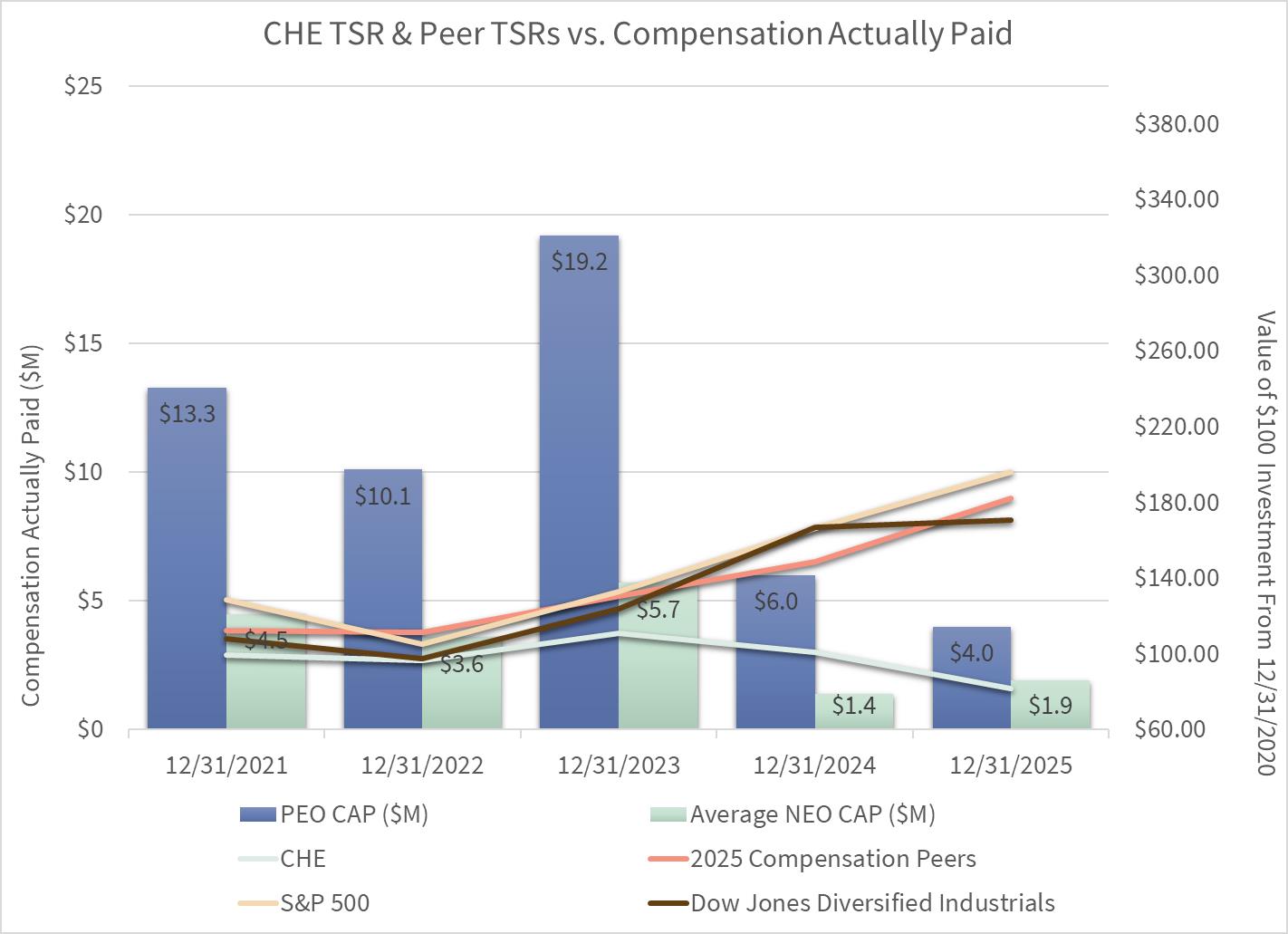
TRANSACTIONS WITH RELATED PERSONS
A son of Mr. McNamara, the Company’s Chief Executive Officer, began employment with Chemed in November of 2018, after previously serving as Director of Innovation and Development at VITAS. He currently serves as a Vice President and Chief Strategy Officer of the Company. His salary for 2025 plus his bonus for 2025 paid in 2026 was $433,195 and his PSUs granted in 2023 vested into 308 shares of company stock. He also received stock options and performance stock units commensurate with his level of responsibilities. His compensation package was established by the Company in accordance with our employment and compensation practices applicable to employees with equivalent qualifications and responsibilities and holding similar positions.
SECURITY OWNERSHIP OF CERTAIN
BENEFICIAL OWNERS AND MANAGEMENT
This table sets forth information as of December 31, 2025, with respect to the only persons known to us to beneficially own more than 5% of the outstanding Capital Stock:
| | | | |
Name and Address Of Beneficial Owner | | Amount and Nature of Beneficial Ownership | | Percent of Class (a) |
| | | | |
The Vanguard Group | | | | |
100 Vanguard Boulevard | | 1,699,648 shares (b) | | 11.28% (c) |
Malvern, PA 19355 | | | | |
| | | | |
BlackRock, Inc. | | | | |
55 E. 52nd Street | | 1,409,958 shares (d) | | 9.4% (e) |
New York, NY 10055 | | | | |
| | | | |
(a)For purposes of calculating Percent of Class, all shares of Capital Stock subject to stock option awards which were exercisable within 60 days of December 31, 2025, were assumed to have been issued.
(b)Sole voting power, 0 shares; shared voting power, 6,686 shares; sole dispositive power, 1,677,311 shares; shared dispositive power, 22,337 shares.
(c) Information is based on a Schedule 13G filed with the SEC on February 13, 2024.
(d) Sole voting power, 1,376,781 shares; sole dispositive power, 1,409,958 shares.
(e) Information is based on a Schedule 13G filed with the SEC on January 24, 2024.
This table shows the shares of Capital Stock beneficially owned by all nominees and directors of the Company, the current executive officers named in the Summary Compensation Table, the Company’s directors and executive officers, and the Chemed Foundation as a group as of December 31, 2025:
CAPITAL STOCK
(Number of shares/options)
| | | | | |
| Amount and Nature of Beneficial Ownership |
| | | Trusteeships | | |
| Direct and | Options | and Family | | Percent of |
Owner | Thrift Plan (a) | Exercisable (b) | Holdings (c) | Total | Class (d) |
Kevin J. McNamara | 96,259 | 96,189 | - | 192,448 | 1.34% |
| | | | | |
Ron DeLyons | 1,666 | - | - | 1,666 | - |
| | | | | |
Patrick P. Grace | 3,397 | - | - | 3,397 | - |
| | | | | |
Christopher J. Heaney | 2,389 | - | - | 2,389 | - |
| | | | | |
Thomas C. Hutton | 37,325 | 13,639 | 41,216 | 92,180 | - |
| | | | | |
Brian C. Judkins | 2,187 | 23,269 | - | 25,456 | - |
| | | | | |
Spencer S. Lee | 14,567 | 34,797 | - | 49,364 | - |
| | | | | |
Andrea R. Lindell | 5,539 | - | - | 5,539 | - |
| | | | | |
Eileen P. McCarthy | 855 | - | - | 855 | - |
| | | | | |
John M. Mount, Jr. | 930 | - | - | 930 | - |
| | | | | |
George J. Walsh III | 3,323 | - | - | 3,323 | - |
| | | | | |
Joel L. Wherley | 659 | 14,844 | - | 15,503 | - |
| | | | | |
Michael D. Witzeman | 5,660 | 21,374 | - | 27,034 | - |
| | | | | |
Chemed Foundation | - | - | 57,821 | 57,821 | - |
| | | | | |
Total as a group | 174,756 | 204,112 | 99,037 | 477,905 | 3.33% |
| | | | | |
(a)Such securities include shares of Capital Stock allocated as of December 31, 2025, to the account of each named person or member of the group under the Retirement Plan.
(b)“Option” refers to shares of Capital Stock which the named person or group has a right to acquire within 60 days from December 31, 2025. Except as otherwise disclosed in this Proxy Statement, each director, director nominee and executive officer has sole voting and investment power over the shares of Capital Stock shown as beneficially owned.
(c)Mr. Hutton is a trustee of several trusts and private foundations which hold in the aggregate, 41,216 shares of Capital Stock over which the trustee has shared voting and investment power. Messrs. McNamara and Hutton are trustees of the Chemed Foundation, which holds 57,821 shares of Capital Stock over which the trustees share both voting and investment power. This number is included in the total number of “Trustee” shares held by the Directors and Executive Officers as a Group but is not reflected in the respective holdings of the individual trustees.
(d)Percent of Class includes Direct, Option and Trustee shares where indicated. For purposes of determining the Percent of Class, all shares of Capital Stock subject to stock option awards which were exercisable within 60 days from December 31, 2025, were assumed to have been issued. Percent of Class under 1.0% is not shown. Shares of Capital Stock over which more than one individual holds beneficial ownership have been counted only once in calculating the aggregate number of shares of Capital Stock owned by Directors and Executive Officers as a Group.
Delinquent Section 16(a) Reports
During 2025, all reports for the Company’s executive officers, directors and beneficial owners of more than 10% of the outstanding shares of Capital Stock required to be filed under Section 16(a) of the Securities Exchange Act of 1934 were filed on a timely basis.
Clawback Policy
In 2024, the Company timely adopted a Recovery Policy for “Erroneously Awarded Compensation” that conforms with the NYSE requirements, which is included as Exhibit 97 to the Company’s 10-K.
Additionally, the Compensation Committee has maintained a policy that it will review all performance-based compensation awarded to or earned by officers subject to Section 16(b) of the Securities Exchange Act of 1934 during the three-year period prior to any restatement of the Company’s financial results, if the Compensation Committee determines such officer engaged in intentional or unlawful misconduct which materially contributed to the need for such restatement. If the Compensation Committee determines the amount of such performance-based compensation would have been lower if calculated on the restated financials, the Compensation Committee may seek to recover the excess amount.
Anti-Hedging Policy
The Company does not permit its officers or directors to indirectly or directly hedge any shares of Capital Stock. Additionally, the Company’s Policy on Business Ethics, applicable to all employees, identifies trading in the Company’s securities for quick profits or speculation as an impermissible conflict of interest and further discourages any short-term trading, as such trading creates pressures inconsistent with the required impartial exercise of judgment on the Company’s behalf.
PROPOSAL 2- RATIFICATION OF SELECTION OF INDEPENDENT REGISTERED PUBLIC ACCOUNTANTS
The Audit Committee has selected the firm of PricewaterhouseCoopers LLP as independent accountants for the Company and its consolidated subsidiaries for 2026. This firm has acted as independent accountants for the Company and its consolidated subsidiaries since 1971. This long-term relationship benefits the Company through the accounting firm’s substantial working knowledge of the Company and its operations. Although the submission of this matter to the stockholders is not required by law or by the bylaws of the Company, the selection of PricewaterhouseCoopers LLP will be submitted for ratification at the Annual Meeting. The affirmative vote of the majority of the shares represented at the meeting, with abstentions having the effect of negative votes, will be necessary to ratify the selection of PricewaterhouseCoopers LLP as independent accountants for the Company and its consolidated subsidiaries for 2026. Representatives of PricewaterhouseCoopers LLP are expected to be present at the Annual Meeting, will have the opportunity to make a statement if they so desire and are expected to be available to respond to appropriate questions. The Board unanimously recommends that you vote FOR the ratification of the Audit Committee’s selection of independent accountants. If the selection is not ratified at the meeting, the Audit Committee will reconsider its selection of independent accountants.
AUDIT COMMITTEE REPORT
The Audit Committee is appointed by the Board of Directors to assist the Board in monitoring:
The integrity of the Company’s financial statements.
Compliance by the Company with legal and regulatory requirements.
The independence and performance of the Company’s internal and external auditors.
During 2000, the Audit Committee developed a charter for the Committee, which was approved by the full Board of Directors on May 15, 2000. The charter was most recently amended on July 23, 2015. A copy of the charter is available on the Company’s website, www.chemed.com.
The Company’s management has primary responsibility for preparing the Company’s financial statements and for the Company’s financial reporting process. The Company’s independent accountants, PricewaterhouseCoopers LLP, are responsible for expressing an opinion on the conformity of the Company’s audited financial statements to generally accepted accounting principles.
In this context, the Audit Committee hereby reports as follows:
1.The Audit Committee has reviewed and discussed the audited financial statements and management’s report on internal control over financial reporting with the Company’s management.
2.The Audit Committee has discussed with the independent accountants the applicable requirements of the Public Company Accounting Oversight Board and the SEC.
3.The Audit Committee has received the written disclosures and the letter from the independent accountants required by the applicable requirements of the Public Company Accounting Oversight Board regarding the independent accountants’ communications with the Audit Committee concerning independence and has discussed with the independent accountants the independent accountants’ independence.
4.Based on the review and discussion referred to in paragraphs (1) through (3) above, the Audit Committee recommended to the Board of Directors that the audited financial statements be included in the Company’s Annual Report on Form 10-K for the fiscal year ended December 31, 2025, for filing with the SEC.
Each of the members of the Audit Committee is independent as defined under the listing standards of the New York Stock Exchange.
The undersigned members of the Audit Committee have submitted this Report.
Patrick P. Grace, Chairman
Ron DeLyons
John M. Mount, Jr.
FEES PAID TO INDEPENDENT REGISTERED PUBLIC ACCOUNTANTS
Audit Fees
PricewaterhouseCoopers LLP billed the Company $2,627,000 for 2024 and $2,637,000 for 2025. The fees and related expenses were for professional services rendered for the integrated audit of the Company’s annual financial statements and of its internal controls over financial reporting, review of the financial statements included in the Company’s Forms 10-Q and review of documents filed with the SEC.
Audit-Related Fees
PricewaterhouseCoopers LLP billed the Company $175,000 and $180,000 for 2024 and 2025, respectively, for audit-related services. These services were related primarily to the audit of one of VITAS’ Florida subsidiaries.
Tax Fees
No such services were rendered during 2024 or 2025.
All Other Fees
No such services were rendered during 2024 or 2025.
The Audit Committee has adopted a policy which requires the Committee’s pre-approval of audit and non-audit services performed by the independent auditor to assure that the provision of such services does not impair the auditor’s independence. The Audit Committee pre-approved all of the audit and non-audit services rendered by PricewaterhouseCoopers LLP as listed above.
(The remainder of this page left intentionally blank)
PROPOSAL 3 - ADVISORY VOTE TO APPROVE EXECUTIVE COMPENSATION
The Board is submitting this Say On Pay proposal pursuant to Section 14A of the Securities Exchange Act of 1934, which allows our stockholders to cast a non-binding vote to approve the compensation of our named executive officers as disclosed in the Compensation Discussion and Analysis and accompanying compensation tables in this Proxy Statement.
In deciding how to vote on this proposal, the Board urges you to carefully consider the actions taken related to the Company’s executive compensation practices in response to stockholder input, more fully described in the Compensation Discussion and Analysis. We encourage stockholders to review the Compensation Disclosure and Analysis above. Our creation of value over time is due to the efforts of our talented and committed executives. As discussed above in Compensation Discussion and Analysis, the Board believes that our current executive compensation program directly links executive compensation to our financial performance and aligns the interests of our executive officers with those of our stockholders. Our Board also believes that our executive compensation program provides our executive officers with a balanced compensation package that includes a reasonable base salary along with annual and long-term incentive compensation plans that are based on the Company’s financial performance. For 2025, about 72.9 percent of our President and Chief Executive Officer’s actual total direct compensation was performance-based, while the average for the other named executive officers, was about 73.9 percent. “Performance-based” compensation includes non equity incentive awards, option awards, and performance share units. These incentive plans are designed to reward our executive officers on both an annual and long-term basis if they attain specified target goals, the attainment of which do not require the taking of an unreasonable amount of risk, as discussed above in Compensation Risk. Our stockholders voted 84.8% in favor of executive compensation in 2025.
We believe our executive compensation program is intended to achieve the objective of aligning executives’ interests with those of stockholders. It rewards executives for long-term growth in the value of Capital Stock through encouraging them to hold a significant amount of the Company’s equity; paying for performance through both cash and equity-based incentives that, in turn, provide greater rewards for stronger performance of the Company as a whole and the Company’s business units; paying competitively in order to attract and retain senior executives; and creating incentives to maximize the long-term growth of the Company’s business. The weighting of incentive compensation toward long-term awards discourages short term risk taking. Rolling performance targets also discourage such behavior. Further, the Company’s Stock Ownership Guidelines discourage such behavior by aligning employees’ interests with those of stockholders.
The elements of the Company’s compensation program include base salary, annual cash incentive compensation and long-term incentive compensation in the forms of stock option awards and performance share units. Each salary, annual cash incentive compensation and pension and welfare benefits plan amount is established by the non-employee members of the Board of Directors based upon levels that the Compensation Committee and such Board members determine are competitive and are intended to reward for current and past performance, while longer-term incentives such as stock option awards and performance share units, are intended to create incentive for future growth.
In 2011, 2017 and 2023 stockholders voted to conduct an advisory vote on executive compensation every year. The Board has adopted this frequency.
The Board endorses the Company’s executive compensation program and recommends stockholders vote in favor of the following resolution:
“RESOLVED, that compensation paid to the Company’s executive officers as disclosed pursuant to Item 402 of Regulation S-K described in this proxy statement under “Executive Compensation”, including the Compensation Discussion and Analysis, Compensation tables and narrative discussion contained in this proxy statement, is hereby APPROVED.”
Because the vote is advisory, it will not be binding upon the Board or the Compensation Committee and neither the Board nor the Compensation Committee will be required to take any action as a result of the outcome of the vote on this proposal. The Compensation Committee will carefully consider the outcome of the vote when considering future executive compensation arrangements.
The Board of Directors unanimously recommends a vote FOR the approval of the Company’s executive compensation.
STOCKHOLDER PROPOSALS
Any stockholder proposals for the 2027 Annual Meeting of Stockholders must be in writing and received by the Secretary of the Company by December 7, 2026 to be eligible for inclusion in the Company’s proxy statement and accompanying proxy for such meeting, unless the date of the 2027 Annual Meeting of Stockholders is changed by more than 30 days from May 18, 2027, in which case such proposal must be received a reasonable time before the Company begins to print and send its proxy materials for such meeting. If a stockholder intends to bring a matter before the 2027 Annual Meeting of Stockholders other than by submitting a proposal for inclusion in the Company’s proxy materials for such meeting he or she must provide notice of the proposal to the Company’s Secretary at our principal executive offices no earlier than January 18, 2027, and not later than February 17, 2027, for such notice to be considered timely. If the date of the 2027 meeting is advanced by more than 30 days, or delayed by more than 90 days from May 18, 2027, such proposal must be received not earlier than the close of business on the 120th day prior to such Annual Meeting and not later than the close of business on the later of the 90th day prior to such meeting, or, if the first public announcement of such meeting is less than 100 days prior to it, the 10th day following the day the Company made such public announcement. In the case of untimely notice of a proposal, persons named in the proxies solicited by the Company for the 2027 Annual Meeting of Stockholders (or their substitutes) will be allowed to use their discretionary voting authority when the proposal is raised at the meeting without any discussion of the proposal in its proxy materials.
If a stockholder intends to propose a ‘proxy access’ nominee pursuant to Section 1.11 of the Company’s bylaws, he or she must provide notice of the proposal to the Company’s Secretary at the Company’s principal executive offices no earlier than November 7, 2026 and not later than December 7, 2026, for such notice to be considered timely. The proxy access provisions of the Company’s bylaws permit an eligible stockholder (or a group of no more than 20 eligible stockholders) owning 3% or more of the Company’s common stock continuously for at least three years to nominate director candidates representing up to two or 20% of the Board (whichever is greater), and, upon the eligible stockholder’s satisfaction of certain conditions as outlined in the Company’s bylaws, require the Company to include such nominees in the Company’s proxy statement and proxy card for the annual meeting of stockholders.
To comply with the universal proxy rules and the Company’s by-laws, stockholders who intend to solicit proxies in support of director nominees other than the Company’s nominees must provide notice that sets forth the information required by Rule 14a-19 under the Exchange Act no later than March 19, 2027.
Important Notice Regarding the Availability of Proxy Materials
for the ANNUAL MEETING
The Proxy Statement and the Company’s 2025 Annual Report are available on the Company’s website at chemed.com/investor-relations/sec-filings.
Information on how to obtain directions to be able to attend the meeting and vote in person are available by contacting:
Innisfree M&A Incorporated
Stockholders Toll-Free: (877) 800-5194
Banks and Brokers: (212) 750-5833
—or—
You may write to us at:
Chemed Corporation
Investor Relations
Suite 2600
255 East Fifth Street
Cincinnati, Ohio 45202-4726
The Company makes available, free of charge on its website, the Proxy Statement, Annual Report on Form 10-K, Quarterly Reports on Form 10-Q, Current Reports on Form 8-K and amendments to these reports filed or furnished pursuant to Section 13(a) or 15(d) of the Exchange Act, as soon as reasonably practicable after these documents are electronically filed with, or furnished to, the SEC. These documents are posted on the website at www.chemed.com. Select the “SEC Filings” link.
A copy of the Company’s Annual Report on Form 10-K for the fiscal year ended December 31, 2025 filed with the SEC (without exhibits) will also be made available to stockholders without charge upon written request to Chemed Investor Relations, Suite 2600, 255 East Fifth Street, Cincinnati, Ohio 45202-4726.
DUPLICATE
ANNUAL REPORT AND PROXY STATEMENT
If you are a stockholder of record and share an address with another stockholder and have received only one copy of the Company’s 2025 Annual Report or Proxy Statement, the Company undertakes to promptly deliver upon written or oral request a separate copy of these materials at no cost to you. In addition, if you are a stockholder of record and share an address with another stockholder and have received multiple copies of the Company’s 2025 Annual Report or Proxy Statement, you may write or call the Company to request delivery of a single copy of such materials in the future. You may write to the Company at Suite 2600, 255 East Fifth Street, Cincinnati, Ohio 45202-4726, Attn: Investor Relations, or call 1-800-2CHEMED or 1-800-224-3633.
OTHER MATTERS
As of the date of this Proxy Statement, management has not been notified of any stockholder proposals intended to be raised at the Annual Meeting outside of the Company’s proxy solicitation process nor does it know of any other matters which will be presented for consideration at the Annual Meeting. However, if any other stockholder proposals or other business should come before the Annual Meeting, the persons named in the enclosed proxy (or their substitutes) will have discretionary authority to take such action as is in accordance with their best judgment.
MISCELLANEOUS
The Company will pay all solicitation expenses in connection with this Proxy Statement and related Company proxy soliciting material, including the expense of preparing, printing, assembling and mailing this Proxy Statement and any other material used in the Company’s solicitation of proxies. Proxies are being solicited through the mail. Certain executive officers and other employees of the Company, on behalf of the Company and without additional compensation, may also solicit proxies personally, by telephone, fax, email or other electronic means.
In addition, the Company has engaged Innisfree M&A Incorporated to assist it in connection with soliciting proxies for a fee estimated not to exceed $17,500, plus reasonable out-of-pocket expenses.
The Company will request banks, brokers and other custodians, nominees and fiduciaries to forward proxy soliciting material to the beneficial owners of shares held of record by such persons and obtain their voting instructions. The Company will reimburse such persons at approved rates for their expenses in connection with the foregoing activities.
Brian C. Judkins
Secretary
April 6, 2026
Shareowner Services
P.O. Box 64945
St. Paul, MN 55164-0945
Address Change? Mark box, sign, and indicate changes below:
TO VOTE BY INTERNET OR TELEPHONE, SEE REVERSE SIDE OF THIS PROXY CARD.
The Board of Directors Recommends a Vote FOR all the Nominees Listed (Proposal 1), FOR Proposals 2 and 3.
1.Election of directors: FOR AGAINST ABSTAIN FOR AGAINST ABSTAIN
01Kevin J. McNamara 06 Andrea R. Lindell
02Ron DeLyons 07 Eileen P. McCarthy
Please fold here – Do not separate
03Patrick P. Grace 08 John M. Mount, Jr.
04Christopher J. Heaney 09 George J. Walsh III
05Thomas C. Hutton
2.Ratification of Audit Committee’s selection of PricewaterhouseCoopers LLP as independent accountants for 2026.
ForAgainst Abstain
3.Advisory vote to approve executive compensation. For Against Abstain
THIS PROXY WHEN PROPERLY EXECUTED WILL BE VOTED AS DIRECTED OR, IF NO DIRECTION IS GIVEN, WILL BE VOTED AS THE BOARD RECOMMENDS.
Date
Signature(s) in Box
Please sign exactly as your name(s) appears on Proxy. If held in joint tenancy, all persons should sign. Trustees, administrators, etc., should include title and authority. Corporations should provide full name of corporation and title of authorized officer signing the Proxy.
CHEMED CORPORATION
ANNUAL MEETING OF STOCKHOLDERS
Monday, May 18, 2026
11:00 a.m. Eastern Time
The Queen City Club
331 East Fourth Street
Cincinnati, OH 45202
YOURVOTEISIMPORTANT!PLEASE VOTE TODAY!
proxy
This proxy is solicited by the Board of Directors for use at the Annual Meeting on May 18, 2026.
The shares of stock you hold in your account or in a dividend reinvestment account will be voted as you specify on the reverse side.
If no choice is specified, the proxy will be voted “FOR” Proposals 1, 2 and 3.
By signing the proxy, you revoke all prior proxies and appoint K. J. McNamara and G. J. Walsh III, and each of them with full power of substitution, to vote your shares on the matters shown on the reverse side and any other matters which may come before the Annual Meeting and all adjournments.
This proxy also provides confidential voting instructions for shares of Chemed Corporation Capital Stock held by Merrill Lynch Trust Company, Trustee of Chemed/Roto-Rooter Savings and Retirement Plan (“Plan”), for the benefit of the undersigned and directs such Trustee to vote as designated on the reverse side of this card. The Trustee will vote all non-vested shares in the same proportion the vested shares have been voted. Additionally, any vested shares for which no voting instructions have been received will be voted in the same proportion as total voted vested shares. With respect to the Plan, the instructions by proxy card, telephone or Internet must be provided by 11:59 p.m., Eastern Time, on May 13, 2026.
This proxy/confidential Plan voting instruction card is solicited jointly by the Board of Directors of Chemed Corporation (“Company”) and the Trustee of the Plan, pursuant to a separate Notice of Annual Meeting and Proxy Statement, receipt of which is hereby acknowledged.
The Company’s proxy tabulator, Equiniti Trust Company, LLC, will report separately to the Company and to the Trustee as to proxies received and voting instructions provided. Individual Plan voting instructions will be kept confidential by the proxy tabulator and not provided to the Company.
PLEASE MARK, SIGN, DATE AND RETURN THIS CARD PROMPTLY USING THE ENCLOSED ENVELOPE.
Vote by Internet, Telephone or Mail 24 Hours a Day, 7 Days a Week
Your phone or Internet vote authorizes the named proxies to vote your shares in the same manner as if you marked, signed and returned your proxy card.