Q1 FY 2026 Supplemental Slides
1Q1 FY26 Supplemental Slides January 8, 2026 This presentation contains forward-looking statements within the meaning of the federal securities laws with respect to the expected benefits of the recent acquisitions of Concrete Pipe & Precast (“CP&P”) and Foley Products Company (“Foley”), general economic conditions, key macro-economic drivers that impact our business, the effects of ongoing trade actions, the effects of continued pressure on the liquidity of our customers, potential synergies and growth provided by acquisitions and strategic investments, demand for our products, shipment volumes, metal margins, the ability to operate our steel mills at full capacity particularly during periods of domestic mill start-ups, future availability and cost of supplies of raw materials and energy for our operations, growth rates in certain reportable segments, product margins within our Construction Solutions Group segment, share repurchases, legal proceedings, construction activity, international trade, the impact of geopolitical conditions, capital expenditures, tax credits, our liquidity and our ability to satisfy future liquidity requirements, estimated contractual obligations, the expected capabilities and benefits of new facilities, anticipated benefits and the timeline for execution of our growth plan and initiatives, including our Transform, Advance and Grow (“TAG”) operational and commercial excellence program, and our expectations or beliefs concerning future events. The statements in this presentation that are not historical statements, are forward-looking statements. These forward-looking statements can generally be identified by phrases such as we or our management “expects,” “anticipates,” “believes,” “estimates,” “future,” “intends,” “may,” “plans to,” “ought,” “could,” “will,” “should,” “likely,” “appears,” “projects,” “forecasts,” “outlook” or other similar words or phrases, as well as by discussions of strategy, plans or intentions. Our forward-looking statements are based on management’s expectations and beliefs as of the date of this presentation. Although we believe that our expectations are reasonable, we can give no assurance that these expectations will prove to have been correct, and actual results may vary materially. Except as required by law, we undertake no obligation to update, amend or clarify any forward-looking statements to reflect changed assumptions, the occurrence of anticipated or unanticipated events, new information or circumstances or any other changes. Important factors that could cause actual results to differ materially from our expectations include those described in our filings with the Securities and Exchange Commission, including, but not limited to, in Part I, Item 1A, “Risk Factors” of our annual report on Form 10-K for the fiscal year ended August 31, 2025, as well as the following: changes in economic conditions which affect demand for our products or construction activity generally, and the impact of such changes on the highly cyclical steel industry; rapid and significant changes in the price of metals, potentially impairing our inventory values due to declines in commodity prices or reducing the profitability of downstream contracts within our vertically integrated steel operations due to rising commodity pricing; excess capacity in our industry, particularly in China, and product availability from competing steel mills and other steel suppliers including import quantities and pricing; the impact of additional steelmaking capacity expected to come online from a number of electric arc furnace projects in the U.S.; the impact of geopolitical conditions, including political turmoil and volatility, regional conflicts, terrorism and war on the global economy, inflation, energy supplies and raw materials; increased attention to environmental, social and governance (“ESG”) matters, including any targets or other ESG, environmental justice or regulatory initiatives; operating and startup risks, as well as market risks associated with the commissioning of new projects could prevent us from realizing anticipated benefits and could result in a loss of all or a substantial part of our investments; impacts from global public health crises on the economy, demand for our products, global supply chain and on our operations; compliance with and changes in existing and future laws, regulations and other legal requirements and judicial decisions that govern our business, including increased environmental regulations associated with climate change and greenhouse gas emissions; involvement in various environmental matters that may result in fines, penalties or judgments; evolving remediation technology, changing regulations, possible third-party contributions, the inherent uncertainties of the estimation process and other factors that may impact amounts accrued for environmental liabilities; potential limitations in our or our customers' abilities to access credit and non-compliance with their contractual obligations, including payment obligations; activity in repurchasing shares of our common stock under our share repurchase program; financial and non-financial covenants and restrictions on the operation of our business contained in agreements governing our debt; our ability to successfully identify, consummate and integrate acquisitions and realize any or all of the anticipated synergies or other benefits of acquisitions; the effects that acquisitions may have on our financial leverage; risks associated with acquisitions generally, such as the inability to obtain, or delays in obtaining, required approvals under applicable antitrust legislation and other regulatory and third-party consents and approvals; lower than expected future levels of revenues and higher than expected future costs; failure or inability to implement growth strategies in a timely manner; the impact of goodwill or other indefinite-lived intangible asset impairment charges; the impact of long-lived asset impairment charges; currency fluctuations; global factors, such as trade measures, military conflicts and political uncertainties, including changes to current trade regulations, such as Section 232 trade tariffs and quotas, tax legislation and other regulations which might adversely impact our business; availability and pricing of electricity, electrodes and natural gas for mill operations; our ability to hire and retain key executives and other employees; competition from other materials or from competitors that have a lower cost structure or access to greater financial resources; information technology interruptions and breaches in security; our ability to make necessary capital expenditures; availability and pricing of raw materials and other items over which we exert little influence, including scrap metal, energy and insurance; unexpected equipment failures; losses or limited potential gains due to hedging transactions; litigation claims and settlements, court decisions, regulatory rulings and legal compliance risks, including risks related to the unfavorable judgment against us in the Pacific Steel Group (“PSG”) litigation; risk of injury or death to employees, customers or other visitors to our operations; and civil unrest, protests and riots. This presentation includes illustrative financial information that gives effect to the consummation of the CP&P and Foley acquisitions. This information is presented for illustrative purposes only and is based on available information and certain assumptions and estimates that we believe are reasonable. The illustrative combined company financial information presented herein has not been prepared and presented in accordance with the requirements of Regulation S-X. The assumptions and estimates underlying the combined company financial information are inherently uncertain and are subject to a variety of significant business, economic and competitive risks and uncertainties that could cause actual results to differ materially from those contained in the illustrative financial information, including the risks and uncertainties described above. The illustrative combined company financial information may not necessarily reflect what our results of operations and financial position would have been had the transactions occurred during the periods discussed or what our results of operations and financial position will be in the future. The Company’s auditors have not audited, reviewed, compiled or performed any procedures with respect to the illustrative combined company financial information. Forward-Looking Statements
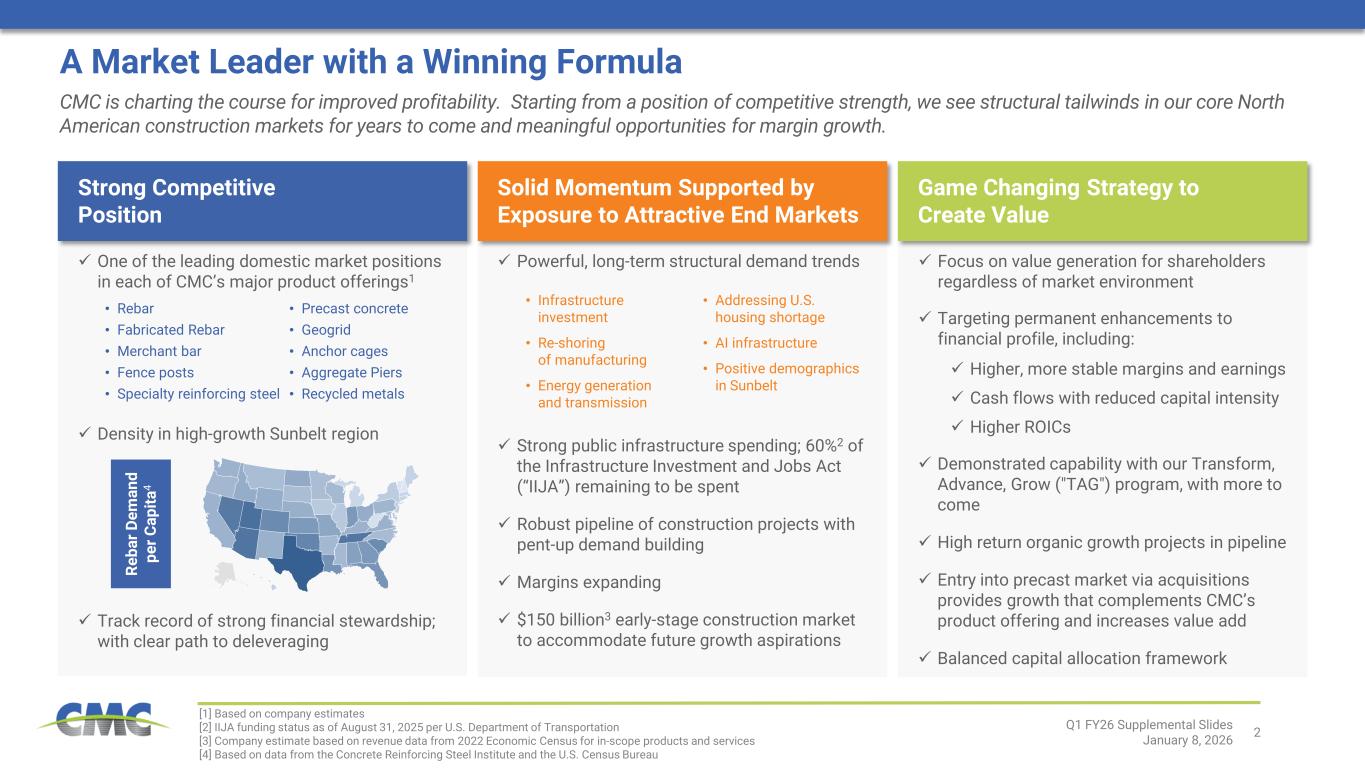
2 © GeoNames, Microsoft, TomTom Powered by Bing A Market Leader with a Winning Formula CMC is charting the course for improved profitability. Starting from a position of competitive strength, we see structural tailwinds in our core North American construction markets for years to come and meaningful opportunities for margin growth. Strong Competitive Position Solid Momentum Supported by Exposure to Attractive End Markets Game Changing Strategy to Create Value One of the leading domestic market positions in each of CMC’s major product offerings1 Density in high-growth Sunbelt region Track record of strong financial stewardship; with clear path to deleveraging • Rebar • Fabricated Rebar • Merchant bar • Fence posts • Specialty reinforcing steel • Precast concrete • Geogrid • Anchor cages • Aggregate Piers • Recycled metals Re ba r D em an d pe r C ap ita 4 Powerful, long-term structural demand trends Strong public infrastructure spending; 60%2 of the Infrastructure Investment and Jobs Act (“IIJA”) remaining to be spent Robust pipeline of construction projects with pent-up demand building Margins expanding $150 billion3 early-stage construction market to accommodate future growth aspirations • Infrastructure investment • Re-shoring of manufacturing • Energy generation and transmission • Addressing U.S. housing shortage • AI infrastructure • Positive demographics in Sunbelt Focus on value generation for shareholders regardless of market environment Targeting permanent enhancements to financial profile, including: Higher, more stable margins and earnings Cash flows with reduced capital intensity Higher ROICs Q1 FY26 Supplemental Slides January 8, 2026 Demonstrated capability with our Transform, Advance, Grow ("TAG") program, with more to come High return organic growth projects in pipeline Entry into precast market via acquisitions provides growth that complements CMC’s product offering and increases value add Balanced capital allocation framework [1] Based on company estimates [2] IIJA funding status as of August 31, 2025 per U.S. Department of Transportation [3] Company estimate based on revenue data from 2022 Economic Census for in-scope products and services [4] Based on data from the Concrete Reinforcing Steel Institute and the U.S. Census Bureau
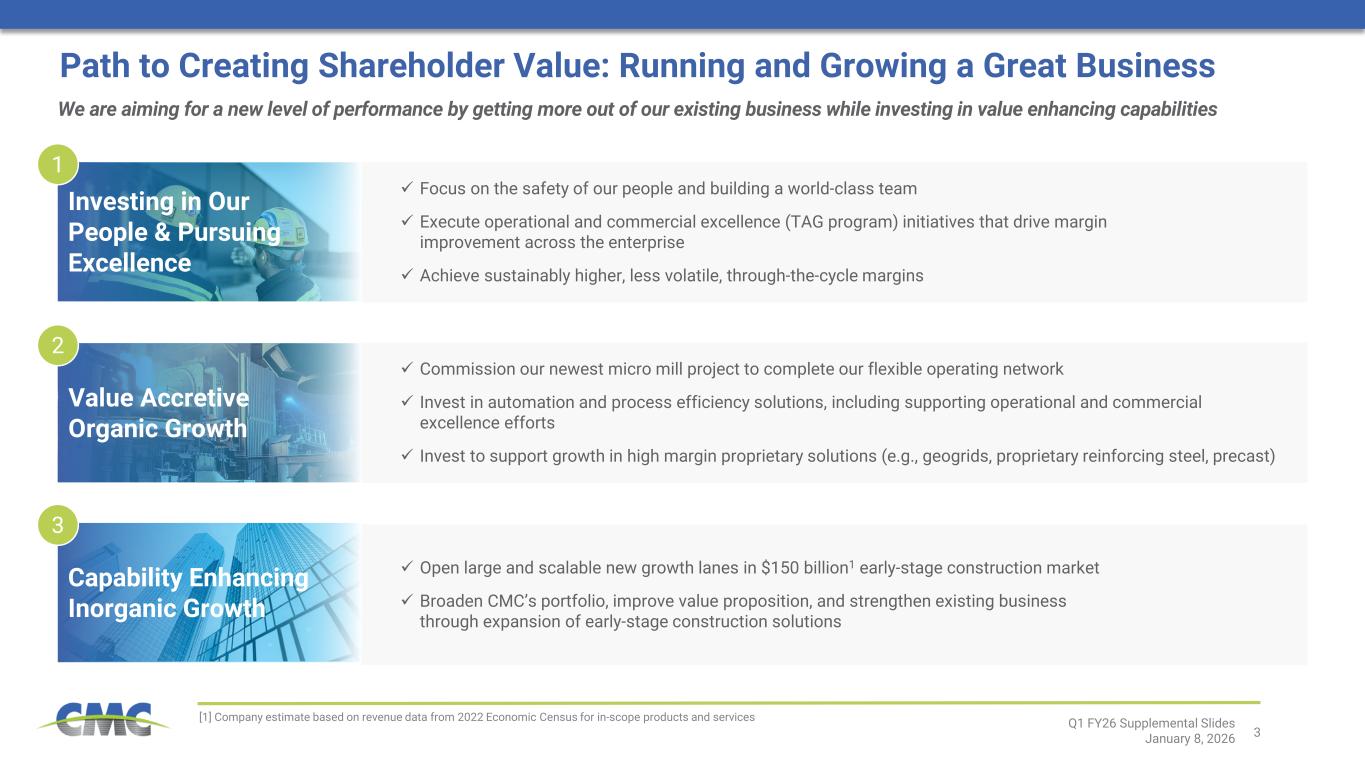
3 Path to Creating Shareholder Value: Running and Growing a Great Business Q1 FY26 Supplemental Slides January 8, 2026 We are aiming for a new level of performance by getting more out of our existing business while investing in value enhancing capabilities Investing in Our People & Pursuing Excellence Value Accretive Organic Growth Capability Enhancing Inorganic Growth 1 2 3 Focus on the safety of our people and building a world-class team Execute operational and commercial excellence (TAG program) initiatives that drive margin improvement across the enterprise Achieve sustainably higher, less volatile, through-the-cycle margins Commission our newest micro mill project to complete our flexible operating network Invest in automation and process efficiency solutions, including supporting operational and commercial excellence efforts Invest to support growth in high margin proprietary solutions (e.g., geogrids, proprietary reinforcing steel, precast) Open large and scalable new growth lanes in $150 billion1 early-stage construction market Broaden CMC’s portfolio, improve value proposition, and strengthen existing business through expansion of early-stage construction solutions [1] Company estimate based on revenue data from 2022 Economic Census for in-scope products and services
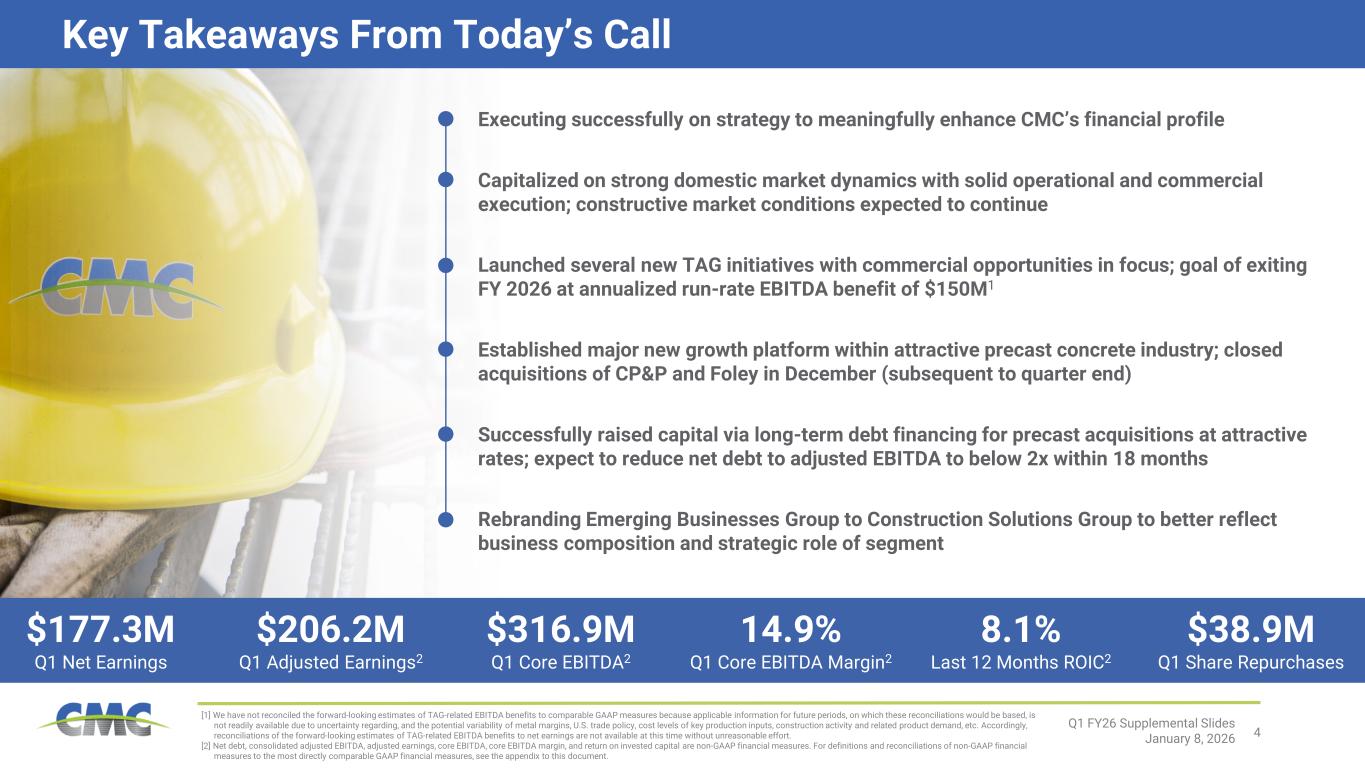
4 [1] We have not reconciled the forward-looking estimates of TAG-related EBITDA benefits to comparable GAAP measures because applicable information for future periods, on which these reconciliations would be based, is not readily available due to uncertainty regarding, and the potential variability of metal margins, U.S. trade policy, cost levels of key production inputs, construction activity and related product demand, etc. Accordingly, reconciliations of the forward-looking estimates of TAG-related EBITDA benefits to net earnings are not available at this time without unreasonable effort. [2] Net debt, consolidated adjusted EBITDA, adjusted earnings, core EBITDA, core EBITDA margin, and return on invested capital are non-GAAP financial measures. For definitions and reconciliations of non-GAAP financial measures to the most directly comparable GAAP financial measures, see the appendix to this document. Executing successfully on strategy to meaningfully enhance CMC’s financial profile Capitalized on strong domestic market dynamics with solid operational and commercial execution; constructive market conditions expected to continue Launched several new TAG initiatives with commercial opportunities in focus; goal of exiting FY 2026 at annualized run-rate EBITDA benefit of $150M1 Established major new growth platform within attractive precast concrete industry; closed acquisitions of CP&P and Foley in December (subsequent to quarter end) Successfully raised capital via long-term debt financing for precast acquisitions at attractive rates; expect to reduce net debt to adjusted EBITDA to below 2x within 18 months Rebranding Emerging Businesses Group to Construction Solutions Group to better reflect business composition and strategic role of segment $177.3M Q1 Net Earnings $206.2M Q1 Adjusted Earnings2 $316.9M Q1 Core EBITDA2 14.9% Q1 Core EBITDA Margin2 8.1% Last 12 Months ROIC2 $38.9M Q1 Share Repurchases Key Takeaways From Today’s Call Q1 FY26 Supplemental Slides January 8, 2026
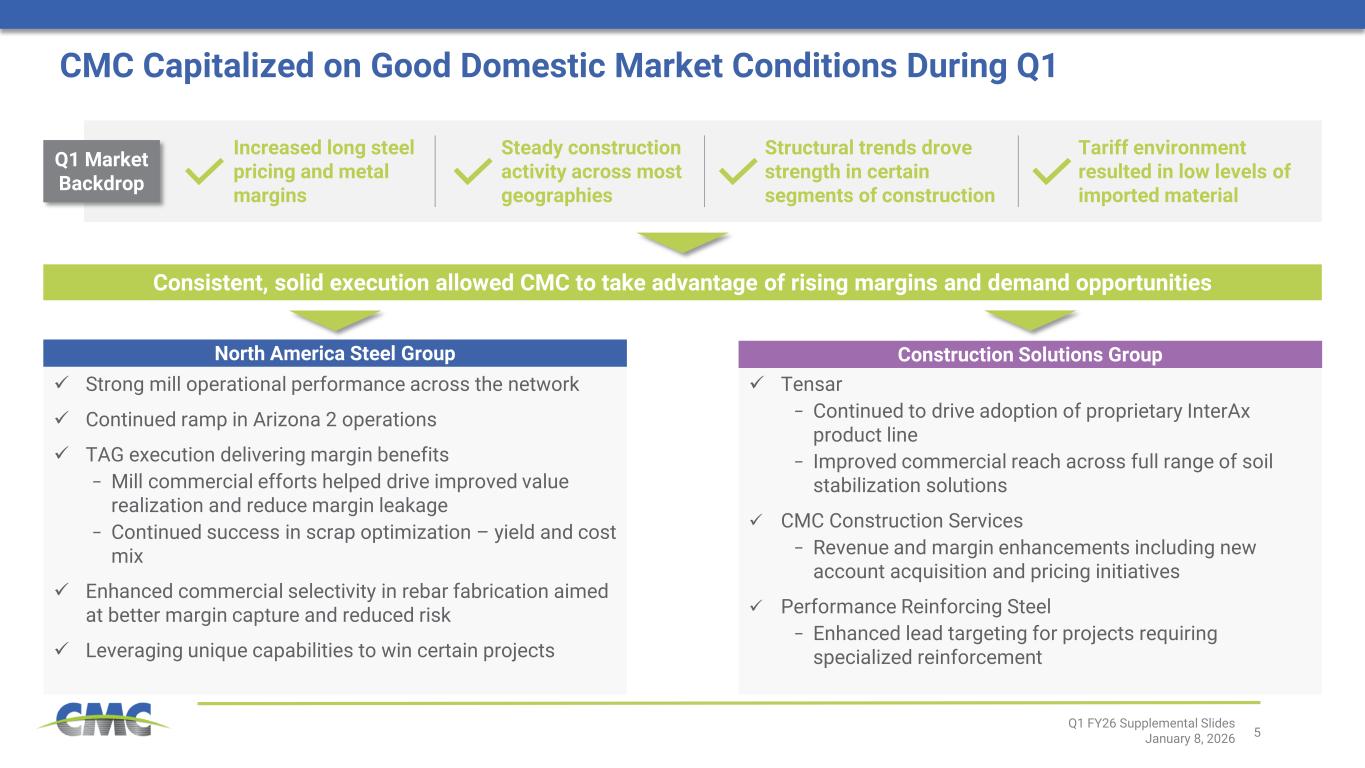
5 Strong mill operational performance across the network Continued ramp in Arizona 2 operations TAG execution delivering margin benefits − Mill commercial efforts helped drive improved value realization and reduce margin leakage − Continued success in scrap optimization – yield and cost mix Enhanced commercial selectivity in rebar fabrication aimed at better margin capture and reduced risk Leveraging unique capabilities to win certain projects Tensar − Continued to drive adoption of proprietary InterAx product line − Improved commercial reach across full range of soil stabilization solutions CMC Construction Services − Revenue and margin enhancements including new account acquisition and pricing initiatives Performance Reinforcing Steel − Enhanced lead targeting for projects requiring specialized reinforcement CMC Capitalized on Good Domestic Market Conditions During Q1 Q1 FY26 Supplemental Slides January 8, 2026 Increased long steel pricing and metal margins Steady construction activity across most geographies Structural trends drove strength in certain segments of construction Q1 Market Backdrop Construction Solutions Group Consistent, solid execution allowed CMC to take advantage of rising margins and demand opportunities North America Steel Group Tariff environment resulted in low levels of imported material
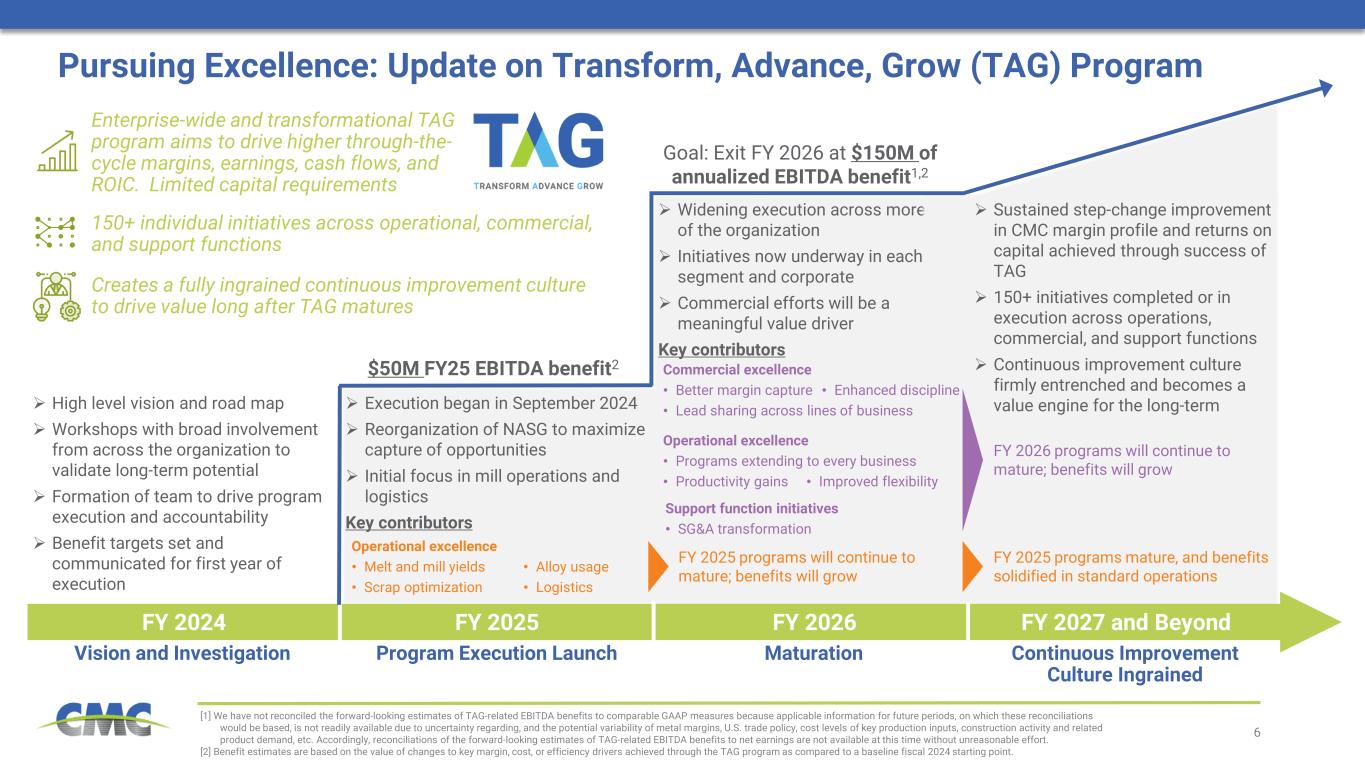
6 $50M FY25 EBITDA benefit2 Goal: Exit FY 2026 at $150M of annualized EBITDA benefit1,2 Widening execution across more of of the organization Initiatives now underway in each segment and corporate Commercial efforts will be a meaningful value driver Key contributors Execution began in September 2024 Reorganization of NASG to maximize capture of opportunities Initial focus in mill operations and logistics Key contributors Pursuing Excellence: Update on Transform, Advance, Grow (TAG) Program [1] We have not reconciled the forward-looking estimates of TAG-related EBITDA benefits to comparable GAAP measures because applicable information for future periods, on which these reconciliations would be based, is not readily available due to uncertainty regarding, and the potential variability of metal margins, U.S. trade policy, cost levels of key production inputs, construction activity and related product demand, etc. Accordingly, reconciliations of the forward-looking estimates of TAG-related EBITDA benefits to net earnings are not available at this time without unreasonable effort. [2] Benefit estimates are based on the value of changes to key margin, cost, or efficiency drivers achieved through the TAG program as compared to a baseline fiscal 2024 starting point. FY 2024 FY 2025 FY 2026 FY 2027 and Beyond Vision and Investigation Program Execution Launch Maturation Continuous Improvement Culture Ingrained High level vision and road map Workshops with broad involvement from across the organization to validate long-term potential Formation of team to drive program execution and accountability Benefit targets set and communicated for first year of execution FY 2025 programs will continue to mature; benefits will grow Commercial excellence • Better margin capture • Enhanced discipline • Lead sharing across lines of business Operational excellence • Programs extending to every business • Productivity gains • Improved flexibility Support function initiatives • SG&A transformation FY 2026 programs will continue to mature; benefits will grow FY 2025 programs mature, and benefits solidified in standard operations Sustained step-change improvement in CMC margin profile and returns on capital achieved through success of TAG 150+ initiatives completed or in execution across operations, commercial, and support functions Continuous improvement culture firmly entrenched and becomes a value engine for the long-term Enterprise-wide and transformational TAG program aims to drive higher through-the- cycle margins, earnings, cash flows, and ROIC. Limited capital requirements 150+ individual initiatives across operational, commercial, and support functions Creates a fully ingrained continuous improvement culture to drive value long after TAG matures Operational excellence • Melt and mill yields • Alloy usage • Scrap optimization • Logistics
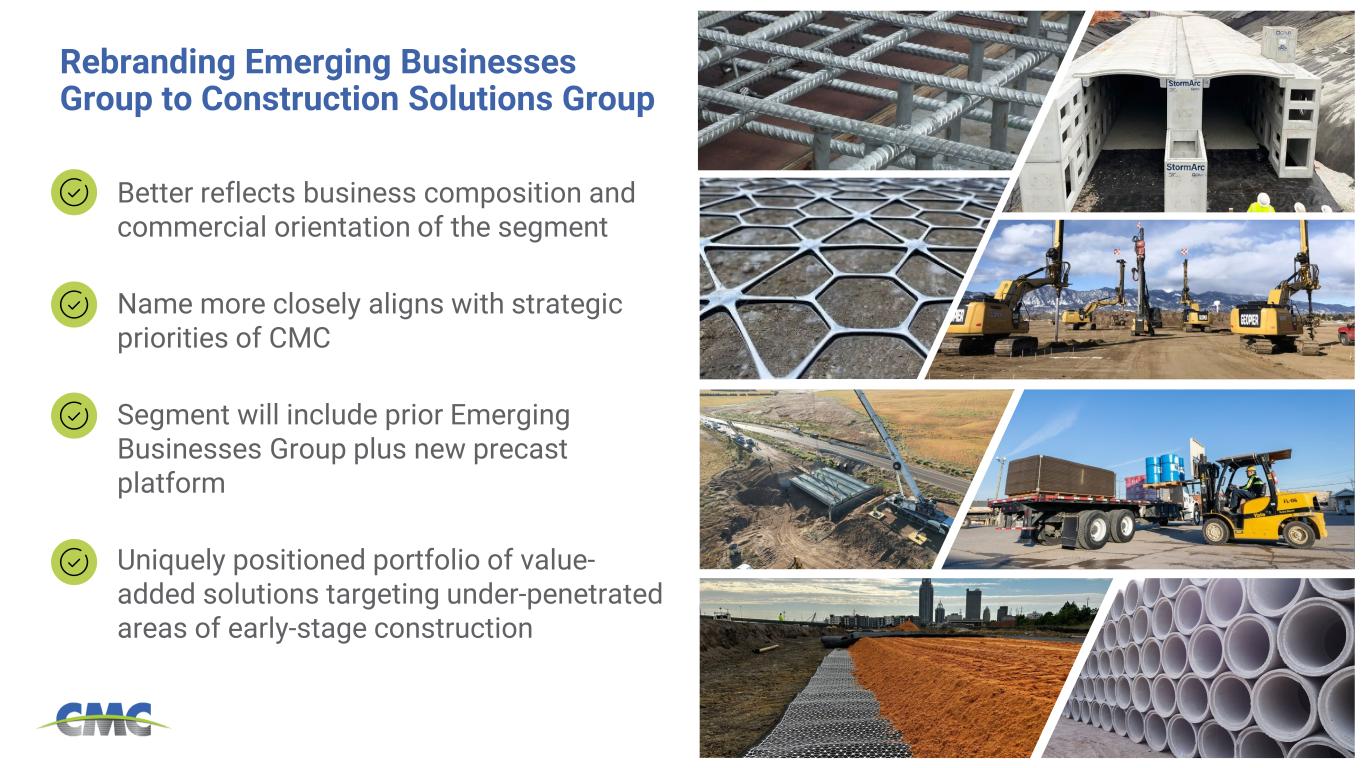
Rebranding Emerging Businesses Group to Construction Solutions Group Better reflects business composition and commercial orientation of the segment Name more closely aligns with strategic priorities of CMC Segment will include prior Emerging Businesses Group plus new precast platform Uniquely positioned portfolio of value- added solutions targeting under-penetrated areas of early-stage construction
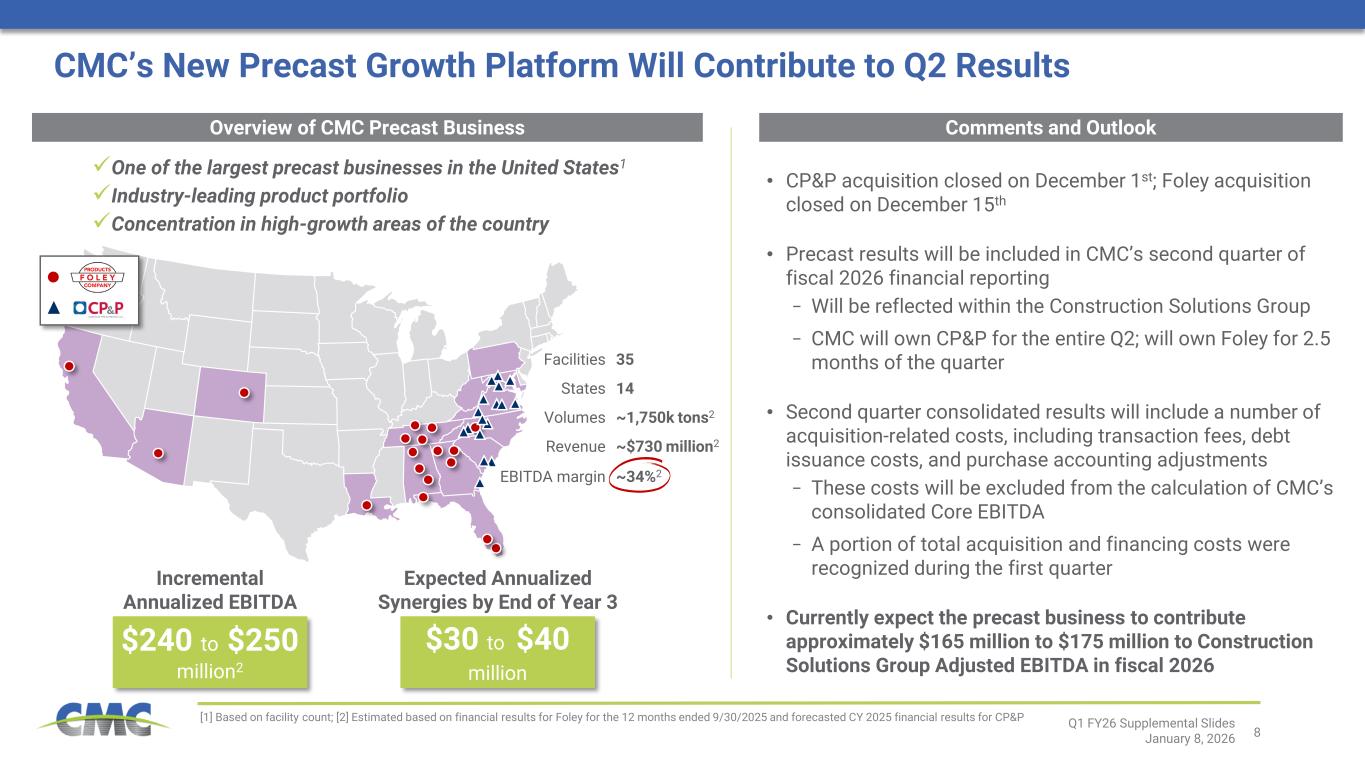
8 Incremental Annualized EBITDA $240 to $250 million2 Expected Annualized Synergies by End of Year 3 Q1 FY26 Supplemental Slides January 8, 2026 [1] Based on facility count; [2] Estimated based on financial results for Foley for the 12 months ended 9/30/2025 and forecasted CY 2025 financial results for CP&P CMC’s New Precast Growth Platform Will Contribute to Q2 Results $30 to $40 million Facilities 35 States 14 Volumes ~1,750k tons2 Revenue ~$730 million2 EBITDA margin ~34%2 One of the largest precast businesses in the United States1 Industry-leading product portfolio Concentration in high-growth areas of the country Overview of CMC Precast Business Comments and Outlook • CP&P acquisition closed on December 1st; Foley acquisition closed on December 15th • Precast results will be included in CMC’s second quarter of fiscal 2026 financial reporting − Will be reflected within the Construction Solutions Group − CMC will own CP&P for the entire Q2; will own Foley for 2.5 months of the quarter • Second quarter consolidated results will include a number of acquisition-related costs, including transaction fees, debt issuance costs, and purchase accounting adjustments − These costs will be excluded from the calculation of CMC’s consolidated Core EBITDA − A portion of total acquisition and financing costs were recognized during the first quarter • Currently expect the precast business to contribute approximately $165 million to $175 million to Construction Solutions Group Adjusted EBITDA in fiscal 2026
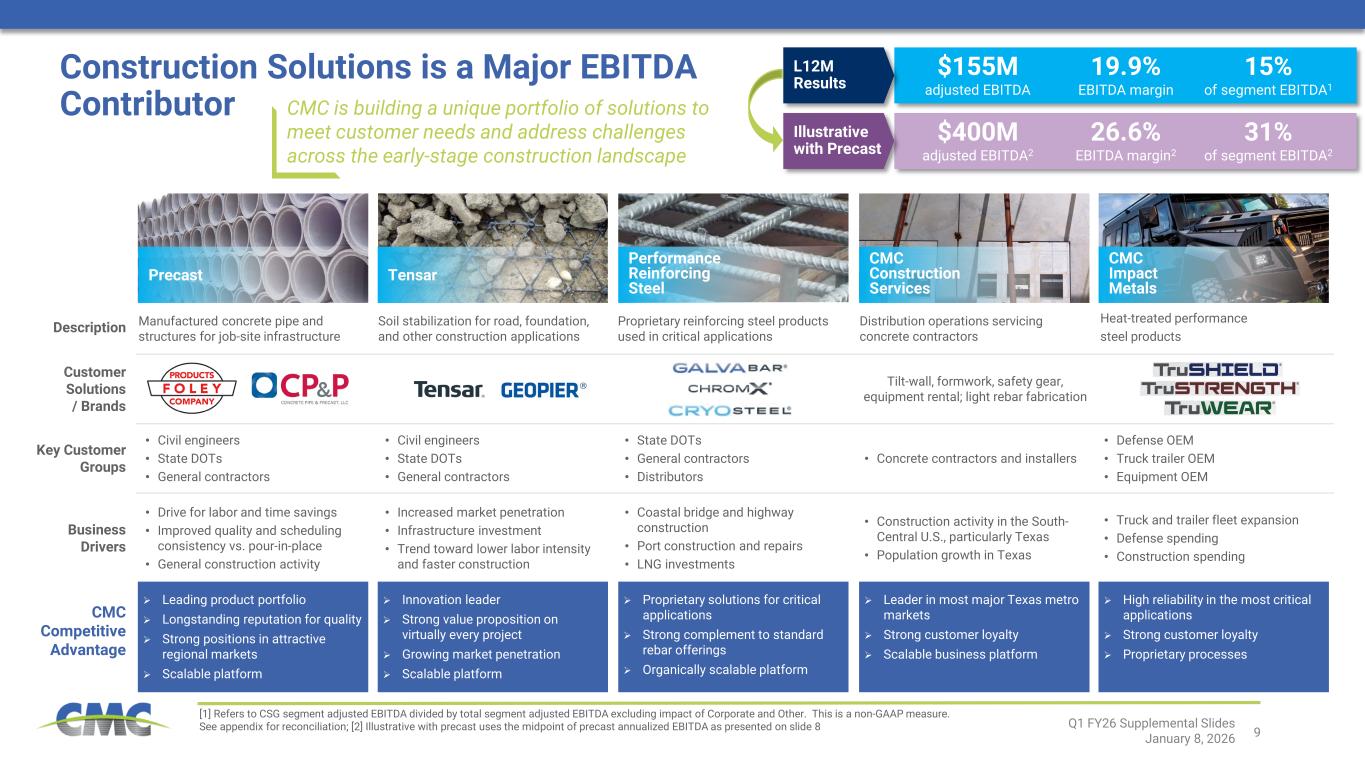
9 Description Manufactured concrete pipe and structures for job-site infrastructure Soil stabilization for road, foundation, and other construction applications Proprietary reinforcing steel products used in critical applications Distribution operations servicing concrete contractors Heat-treated performance steel products Customer Solutions / Brands Tilt-wall, formwork, safety gear, equipment rental; light rebar fabrication Key Customer Groups • Civil engineers • State DOTs • General contractors • Civil engineers • State DOTs • General contractors • State DOTs • General contractors • Distributors • Concrete contractors and installers • Defense OEM • Truck trailer OEM • Equipment OEM Business Drivers • Drive for labor and time savings • Improved quality and scheduling consistency vs. pour-in-place • General construction activity • Increased market penetration • Infrastructure investment • Trend toward lower labor intensity and faster construction • Coastal bridge and highway construction • Port construction and repairs • LNG investments • Construction activity in the South- Central U.S., particularly Texas • Population growth in Texas • Truck and trailer fleet expansion • Defense spending • Construction spending CMC Competitive Advantage Construction Solutions is a Major EBITDA Contributor Q1 FY26 Supplemental Slides January 8, 2026 $155M adjusted EBITDA 19.9% EBITDA margin 15% of segment EBITDA1 CMC Construction Services Tensar CMC Impact Metals Performance Reinforcing Steel Innovation leader Strong value proposition on virtually every project Growing market penetration Scalable platform Leader in most major Texas metro markets Strong customer loyalty Scalable business platform Proprietary solutions for critical applications Strong complement to standard rebar offerings Organically scalable platform High reliability in the most critical applications Strong customer loyalty Proprietary processes L12M Results [1] Refers to CSG segment adjusted EBITDA divided by total segment adjusted EBITDA excluding impact of Corporate and Other. This is a non-GAAP measure. See appendix for reconciliation; [2] Illustrative with precast uses the midpoint of precast annualized EBITDA as presented on slide 8 $400M adjusted EBITDA2 26.6% EBITDA margin2 31% of segment EBITDA2 Illustrative with Precast Precast Leading product portfolio Longstanding reputation for quality Strong positions in attractive regional markets Scalable platform CMC is building a unique portfolio of solutions to meet customer needs and address challenges across the early-stage construction landscape
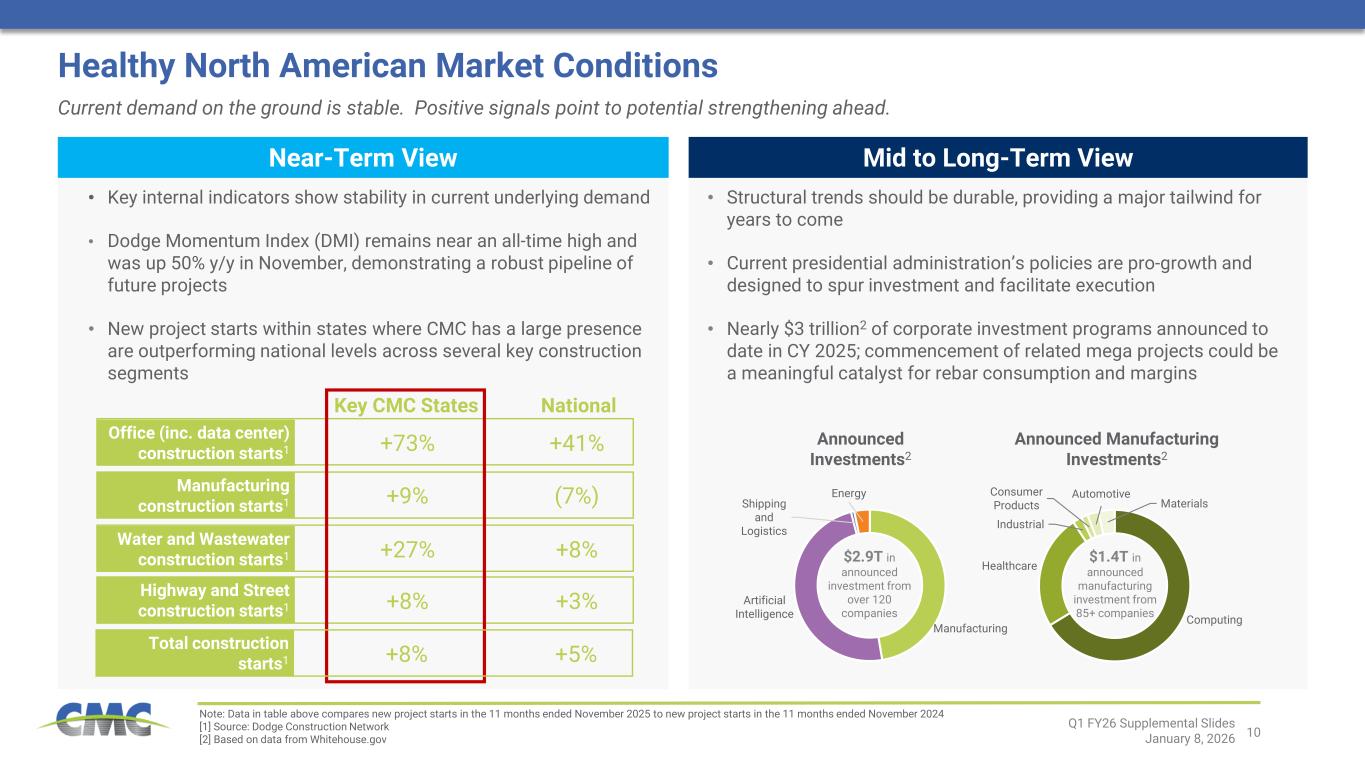
10 Manufacturing Artificial Intelligence Shipping and Logistics Energy Computing Healthcare Industrial Consumer Products Automotive Materials Healthy North American Market Conditions Q1 FY26 Supplemental Slides January 8, 2026 Note: Data in table above compares new project starts in the 11 months ended November 2025 to new project starts in the 11 months ended November 2024 [1] Source: Dodge Construction Network [2] Based on data from Whitehouse.gov Current demand on the ground is stable. Positive signals point to potential strengthening ahead. Near-Term View Mid to Long-Term View • Key internal indicators show stability in current underlying demand • Dodge Momentum Index (DMI) remains near an all-time high and was up 50% y/y in November, demonstrating a robust pipeline of future projects • New project starts within states where CMC has a large presence are outperforming national levels across several key construction segments • Structural trends should be durable, providing a major tailwind for years to come • Current presidential administration’s policies are pro-growth and designed to spur investment and facilitate execution • Nearly $3 trillion2 of corporate investment programs announced to date in CY 2025; commencement of related mega projects could be a meaningful catalyst for rebar consumption and margins $2.9T in announced investment from over 120 companies Announced Investments2 Announced Manufacturing Investments2 $1.4T in announced manufacturing investment from 85+ companies +73% +41% +9% (7%) +27% +8% +8% +3% Office (inc. data center) construction starts1 Manufacturing construction starts1 Water and Wastewater construction starts1 Highway and Street construction starts1 Key CMC States National +8% +5%Total construction starts1
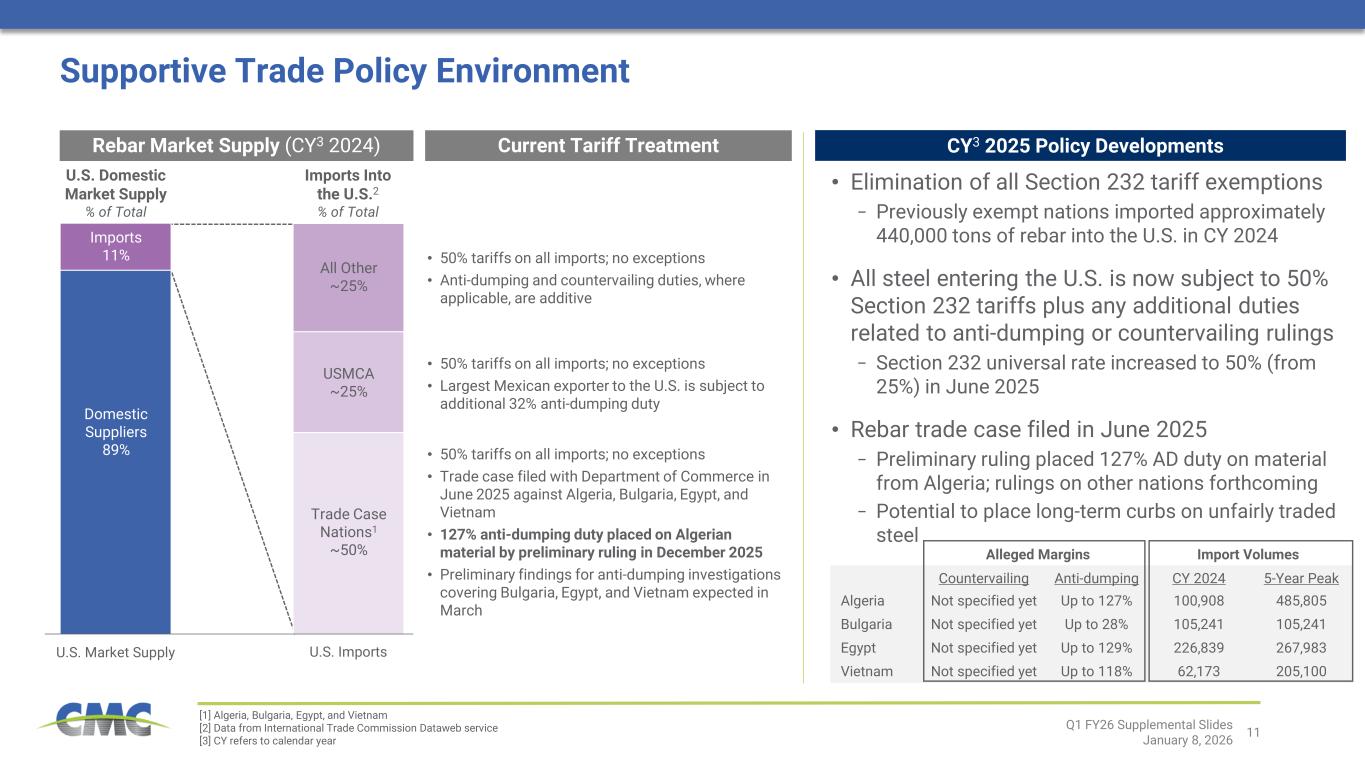
11 CY3 2025 Policy Developments Supportive Trade Policy Environment Q1 FY26 Supplemental Slides January 8, 2026 [1] Algeria, Bulgaria, Egypt, and Vietnam [2] Data from International Trade Commission Dataweb service [3] CY refers to calendar year U.S. Market Supply U.S. Imports Imports 11% Domestic Suppliers 89% All Other ~25% USMCA ~25% Trade Case Nations1 ~50% Rebar Market Supply (CY3 2024) U.S. Domestic Market Supply % of Total Imports Into the U.S.2 % of Total Current Tariff Treatment • 50% tariffs on all imports; no exceptions • Anti-dumping and countervailing duties, where applicable, are additive • 50% tariffs on all imports; no exceptions • Largest Mexican exporter to the U.S. is subject to additional 32% anti-dumping duty • 50% tariffs on all imports; no exceptions • Trade case filed with Department of Commerce in June 2025 against Algeria, Bulgaria, Egypt, and Vietnam • 127% anti-dumping duty placed on Algerian material by preliminary ruling in December 2025 • Preliminary findings for anti-dumping investigations covering Bulgaria, Egypt, and Vietnam expected in March • Elimination of all Section 232 tariff exemptions − Previously exempt nations imported approximately 440,000 tons of rebar into the U.S. in CY 2024 • All steel entering the U.S. is now subject to 50% Section 232 tariffs plus any additional duties related to anti-dumping or countervailing rulings − Section 232 universal rate increased to 50% (from 25%) in June 2025 • Rebar trade case filed in June 2025 − Preliminary ruling placed 127% AD duty on material from Algeria; rulings on other nations forthcoming − Potential to place long-term curbs on unfairly traded steel Countervailing Anti-dumping CY 2024 5-Year Peak Algeria Not specified yet Up to 127% 100,908 485,805 Bulgaria Not specified yet Up to 28% 105,241 105,241 Egypt Not specified yet Up to 129% 226,839 267,983 Vietnam Not specified yet Up to 118% 62,173 205,100 Alleged Margins Import Volumes
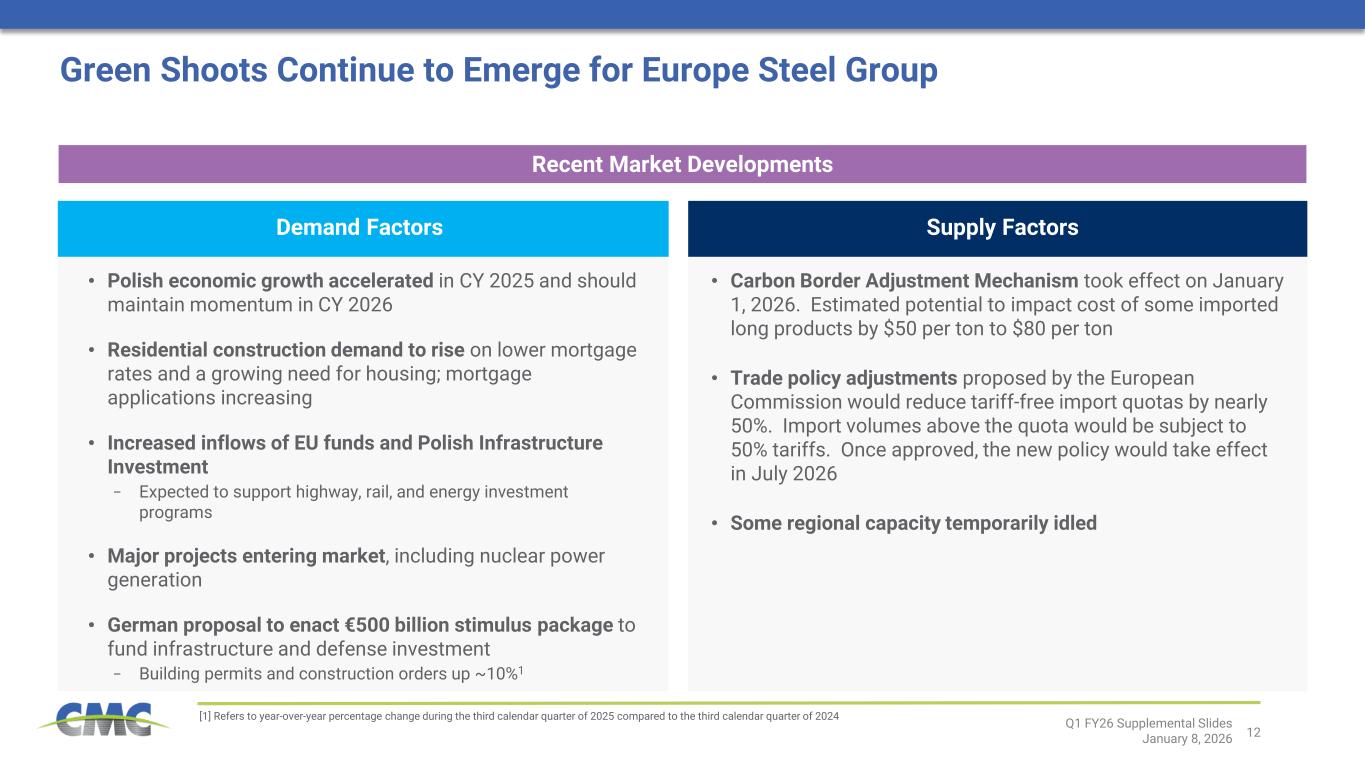
12 Q1 FY26 Supplemental Slides January 8, 2026 Demand Factors Recent Market Developments • Polish economic growth accelerated in CY 2025 and should maintain momentum in CY 2026 • Residential construction demand to rise on lower mortgage rates and a growing need for housing; mortgage applications increasing • Increased inflows of EU funds and Polish Infrastructure Investment − Expected to support highway, rail, and energy investment programs • Major projects entering market, including nuclear power generation • German proposal to enact €500 billion stimulus package to fund infrastructure and defense investment − Building permits and construction orders up ~10%1 Supply Factors • Carbon Border Adjustment Mechanism took effect on January 1, 2026. Estimated potential to impact cost of some imported long products by $50 per ton to $80 per ton • Trade policy adjustments proposed by the European Commission would reduce tariff-free import quotas by nearly 50%. Import volumes above the quota would be subject to 50% tariffs. Once approved, the new policy would take effect in July 2026 • Some regional capacity temporarily idled Green Shoots Continue to Emerge for Europe Steel Group [1] Refers to year-over-year percentage change during the third calendar quarter of 2025 compared to the third calendar quarter of 2024
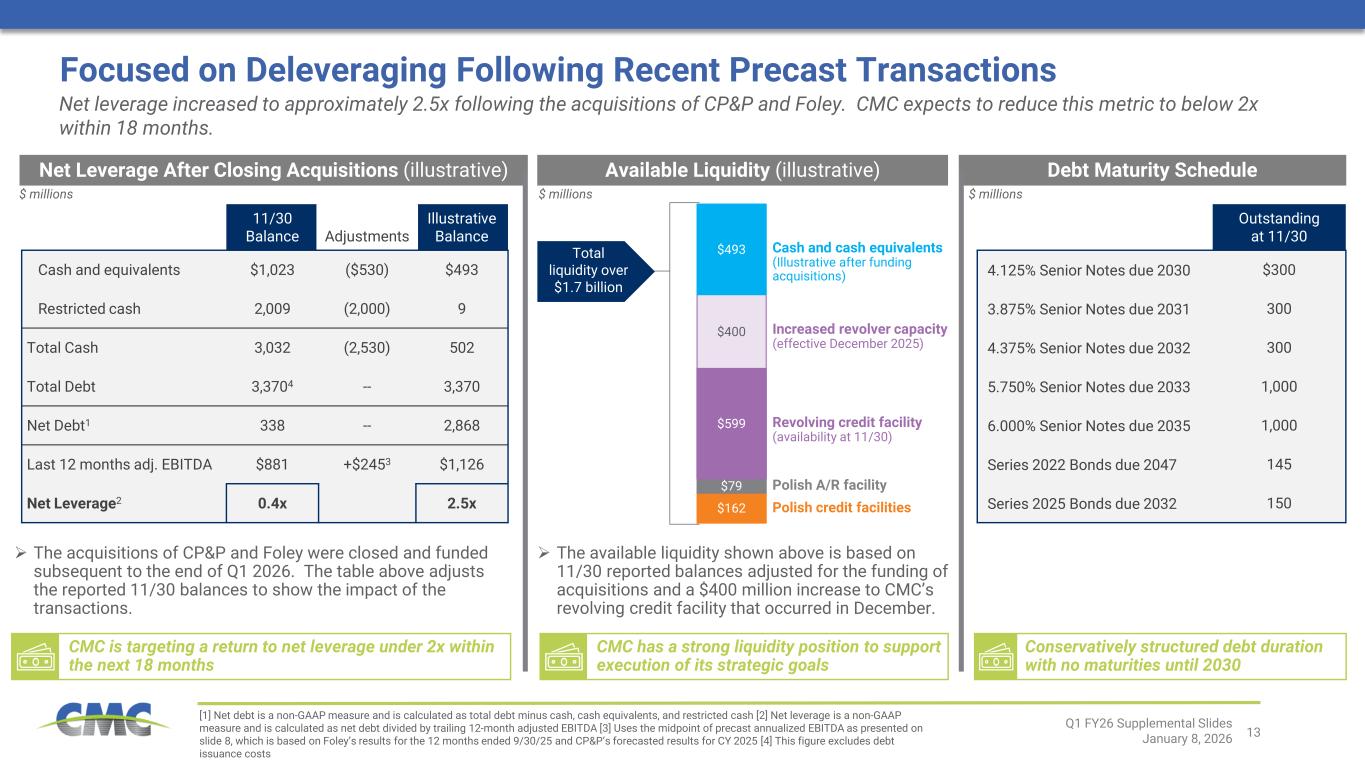
13 Q1 FY26 Supplemental Slides January 8, 2026 Focused on Deleveraging Following Recent Precast Transactions 11/30 Balance Adjustments Illustrative Balance Cash and equivalents $1,023 ($530) $493 Restricted cash 2,009 (2,000) 9 Total Cash 3,032 (2,530) 502 Total Debt 3,3704 -- 3,370 Net Debt1 338 -- 2,868 Last 12 months adj. EBITDA $881 +$2453 $1,126 Net Leverage2 0.4x 2.5x Net Leverage After Closing Acquisitions (illustrative) The acquisitions of CP&P and Foley were closed and funded subsequent to the end of Q1 2026. The table above adjusts the reported 11/30 balances to show the impact of the transactions. CMC is targeting a return to net leverage under 2x within the next 18 months $ millions Available Liquidity (illustrative) $162 $79 $599 $400 $493 Total liquidity over $1.7 billion The available liquidity shown above is based on 11/30 reported balances adjusted for the funding of acquisitions and a $400 million increase to CMC’s revolving credit facility that occurred in December. CMC has a strong liquidity position to support execution of its strategic goals Cash and cash equivalents (Illustrative after funding acquisitions) Increased revolver capacity (effective December 2025) Revolving credit facility (availability at 11/30) Polish A/R facility Polish credit facilities Debt Maturity Schedule $ millions Outstanding at 11/30 4.125% Senior Notes due 2030 $300 3.875% Senior Notes due 2031 300 4.375% Senior Notes due 2032 300 5.750% Senior Notes due 2033 1,000 6.000% Senior Notes due 2035 1,000 Series 2022 Bonds due 2047 145 Series 2025 Bonds due 2032 150 Conservatively structured debt duration with no maturities until 2030 Net leverage increased to approximately 2.5x following the acquisitions of CP&P and Foley. CMC expects to reduce this metric to below 2x within 18 months. $ millions [1] Net debt is a non-GAAP measure and is calculated as total debt minus cash, cash equivalents, and restricted cash [2] Net leverage is a non-GAAP measure and is calculated as net debt divided by trailing 12-month adjusted EBITDA [3] Uses the midpoint of precast annualized EBITDA as presented on slide 8, which is based on Foley’s results for the 12 months ended 9/30/25 and CP&P’s forecasted results for CY 2025 [4] This figure excludes debt issuance costs
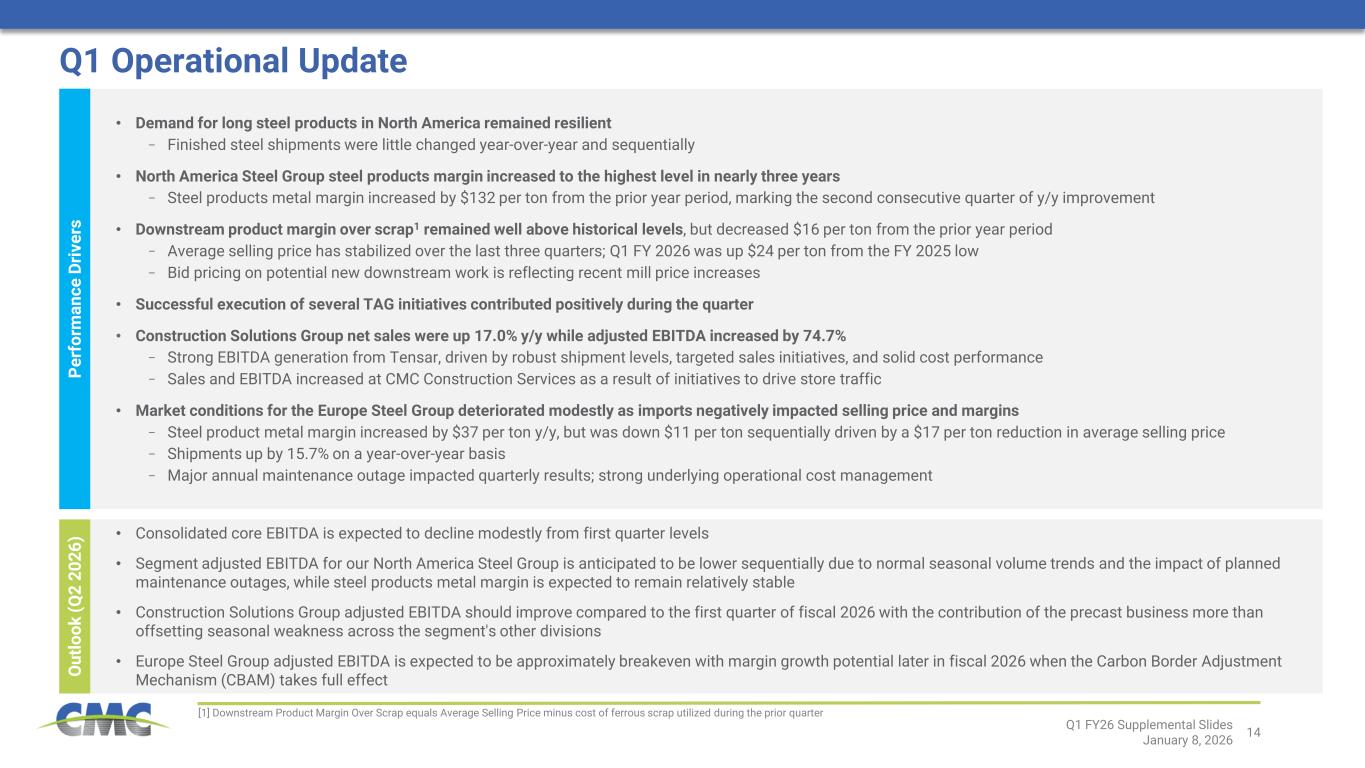
14 • Consolidated core EBITDA is expected to decline modestly from first quarter levels • Segment adjusted EBITDA for our North America Steel Group is anticipated to be lower sequentially due to normal seasonal volume trends and the impact of planned maintenance outages, while steel products metal margin is expected to remain relatively stable • Construction Solutions Group adjusted EBITDA should improve compared to the first quarter of fiscal 2026 with the contribution of the precast business more than offsetting seasonal weakness across the segment's other divisions • Europe Steel Group adjusted EBITDA is expected to be approximately breakeven with margin growth potential later in fiscal 2026 when the Carbon Border Adjustment Mechanism (CBAM) takes full effect • Demand for long steel products in North America remained resilient − Finished steel shipments were little changed year-over-year and sequentially • North America Steel Group steel products margin increased to the highest level in nearly three years − Steel products metal margin increased by $132 per ton from the prior year period, marking the second consecutive quarter of y/y improvement • Downstream product margin over scrap1 remained well above historical levels, but decreased $16 per ton from the prior year period − Average selling price has stabilized over the last three quarters; Q1 FY 2026 was up $24 per ton from the FY 2025 low − Bid pricing on potential new downstream work is reflecting recent mill price increases • Successful execution of several TAG initiatives contributed positively during the quarter • Construction Solutions Group net sales were up 17.0% y/y while adjusted EBITDA increased by 74.7% − Strong EBITDA generation from Tensar, driven by robust shipment levels, targeted sales initiatives, and solid cost performance − Sales and EBITDA increased at CMC Construction Services as a result of initiatives to drive store traffic • Market conditions for the Europe Steel Group deteriorated modestly as imports negatively impacted selling price and margins − Steel product metal margin increased by $37 per ton y/y, but was down $11 per ton sequentially driven by a $17 per ton reduction in average selling price − Shipments up by 15.7% on a year-over-year basis − Major annual maintenance outage impacted quarterly results; strong underlying operational cost management Pe rf or m an ce D riv er s O ut lo ok (Q 2 20 26 ) Q1 Operational Update [1] Downstream Product Margin Over Scrap equals Average Selling Price minus cost of ferrous scrap utilized during the prior quarter Q1 FY26 Supplemental Slides January 8, 2026
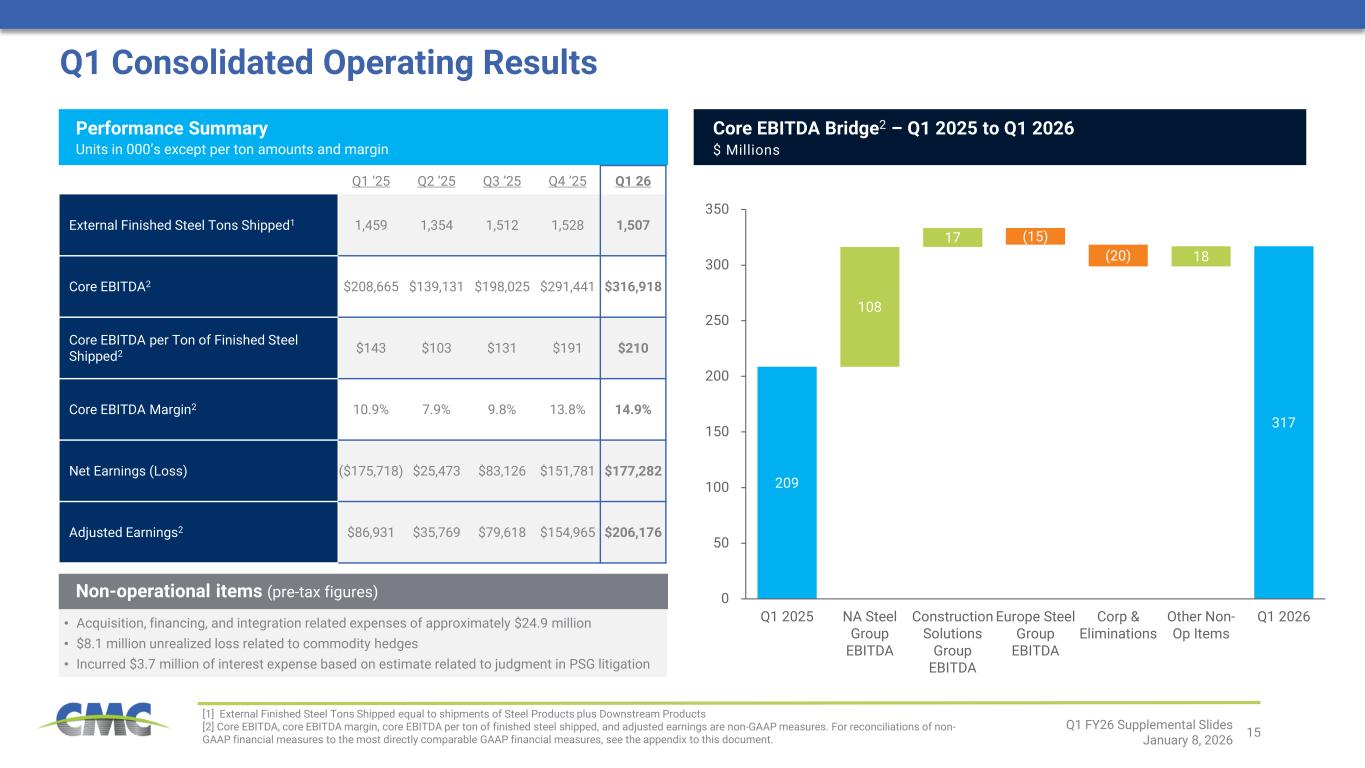
15 209 317 108 17 (15) (20) 18 0 50 100 150 200 250 300 350 Q1 2025 NA Steel Group EBITDA Construction Solutions Group EBITDA Europe Steel Group EBITDA Corp & Eliminations Other Non- Op Items Q1 2026 Q1 Consolidated Operating Results Q1 ’25 Q2 ’25 Q3 ’25 Q4 ’25 Q1 26 External Finished Steel Tons Shipped1 1,459 1,354 1,512 1,528 1,507 Core EBITDA2 $208,665 $139,131 $198,025 $291,441 $316,918 Core EBITDA per Ton of Finished Steel Shipped2 $143 $103 $131 $191 $210 Core EBITDA Margin2 10.9% 7.9% 9.8% 13.8% 14.9% Net Earnings (Loss) ($175,718) $25,473 $83,126 $151,781 $177,282 Adjusted Earnings2 $86,931 $35,769 $79,618 $154,965 $206,176 Performance Summary Units in 000’s except per ton amounts and margin • Acquisition, financing, and integration related expenses of approximately $24.9 million • $8.1 million unrealized loss related to commodity hedges • Incurred $3.7 million of interest expense based on estimate related to judgment in PSG litigation Non-operational items (pre-tax figures) [1] External Finished Steel Tons Shipped equal to shipments of Steel Products plus Downstream Products [2] Core EBITDA, core EBITDA margin, core EBITDA per ton of finished steel shipped, and adjusted earnings are non-GAAP measures. For reconciliations of non- GAAP financial measures to the most directly comparable GAAP financial measures, see the appendix to this document. Core EBITDA Bridge2 – Q1 2025 to Q1 2026 $ Millions Q1 FY26 Supplemental Slides January 8, 2026
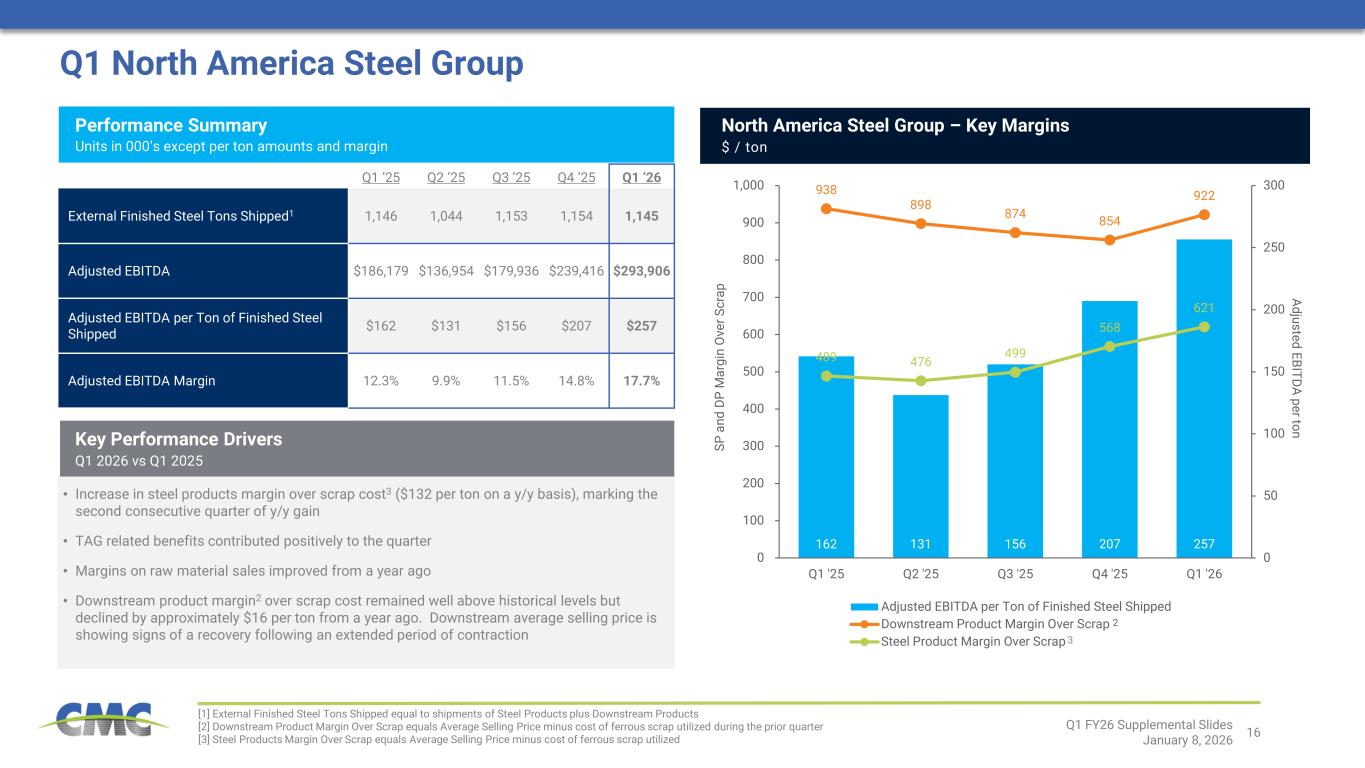
16 162 131 156 207 257 938 898 874 854 922 489 476 499 568 621 0 50 100 150 200 250 300 0 100 200 300 400 500 600 700 800 900 1,000 Q1 '25 Q2 '25 Q3 '25 Q4 '25 Q1 '26 Adjusted EBITDA per Ton of Finished Steel Shipped Downstream Product Margin Over Scrap Steel Product Margin Over Scrap Q1 North America Steel Group Q1 ’25 Q2 ’25 Q3 ’25 Q4 ’25 Q1 ’26 External Finished Steel Tons Shipped1 1,146 1,044 1,153 1,154 1,145 Adjusted EBITDA $186,179 $136,954 $179,936 $239,416 $293,906 Adjusted EBITDA per Ton of Finished Steel Shipped $162 $131 $156 $207 $257 Adjusted EBITDA Margin 12.3% 9.9% 11.5% 14.8% 17.7% Performance Summary Units in 000’s except per ton amounts and margin • Increase in steel products margin over scrap cost3 ($132 per ton on a y/y basis), marking the second consecutive quarter of y/y gain • TAG related benefits contributed positively to the quarter • Margins on raw material sales improved from a year ago • Downstream product margin2 over scrap cost remained well above historical levels but declined by approximately $16 per ton from a year ago. Downstream average selling price is showing signs of a recovery following an extended period of contraction [1] External Finished Steel Tons Shipped equal to shipments of Steel Products plus Downstream Products [2] Downstream Product Margin Over Scrap equals Average Selling Price minus cost of ferrous scrap utilized during the prior quarter [3] Steel Products Margin Over Scrap equals Average Selling Price minus cost of ferrous scrap utilized Q1 FY26 Supplemental Slides January 8, 2026 North America Steel Group – Key Margins $ / ton SP a nd D P M ar gi n O ve r S cr ap Adjusted EBITDA per ton 2 3 Key Performance Drivers Q1 2026 vs Q1 2025
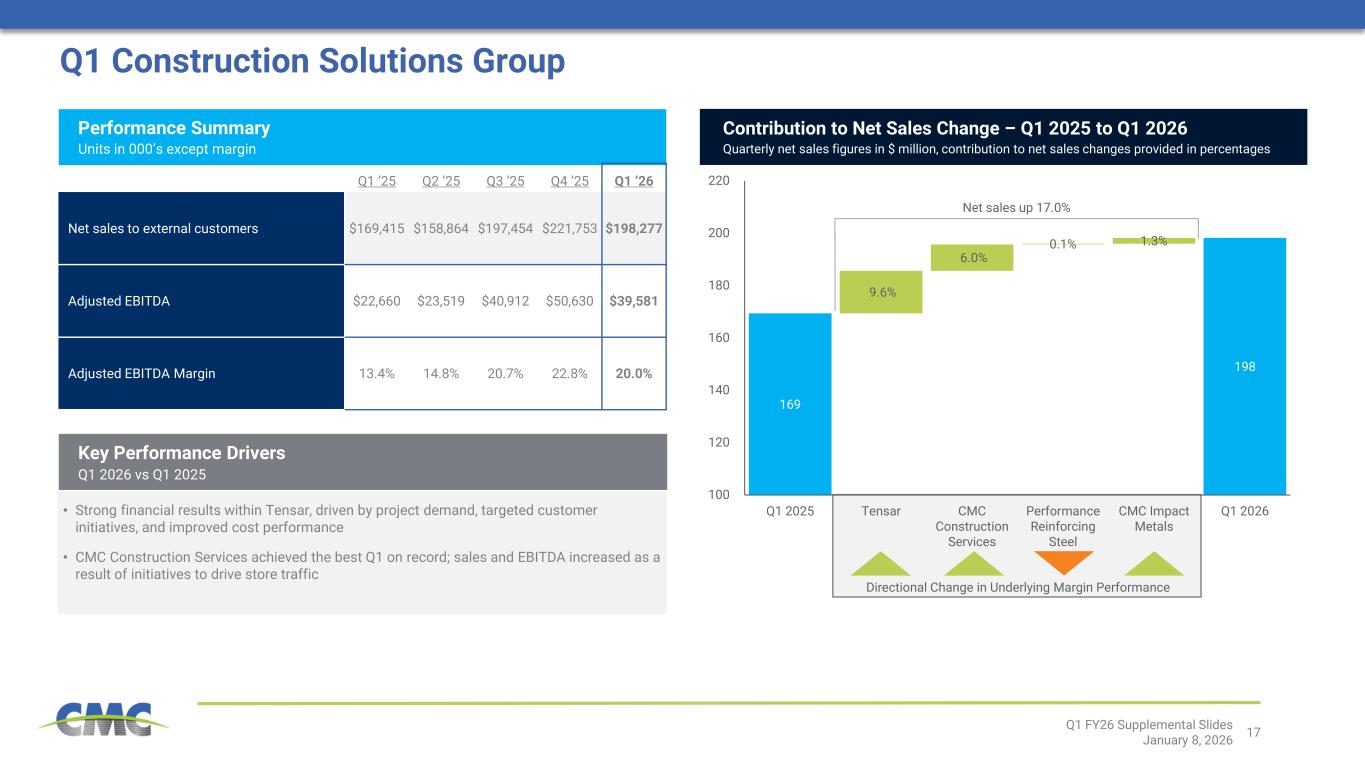
17 169 198 9.6% 6.0% 0.1% 1.3% 100 120 140 160 180 200 220 Q1 2025 Tensar CMC Construction Services Performance Reinforcing Steel CMC Impact Metals Q1 2026 Key Performance Drivers Q1 2026 vs Q1 2025 Q1 Construction Solutions Group Q1 ’25 Q2 ’25 Q3 ’25 Q4 ’25 Q1 ’26 Net sales to external customers $169,415 $158,864 $197,454 $221,753 $198,277 Adjusted EBITDA $22,660 $23,519 $40,912 $50,630 $39,581 Adjusted EBITDA Margin 13.4% 14.8% 20.7% 22.8% 20.0% Performance Summary Units in 000’s except margin • Strong financial results within Tensar, driven by project demand, targeted customer initiatives, and improved cost performance • CMC Construction Services achieved the best Q1 on record; sales and EBITDA increased as a result of initiatives to drive store traffic Contribution to Net Sales Change – Q1 2025 to Q1 2026 Quarterly net sales figures in $ million, contribution to net sales changes provided in percentages Q1 FY26 Supplemental Slides January 8, 2026 Net sales up 17.0% Directional Change in Underlying Margin Performance
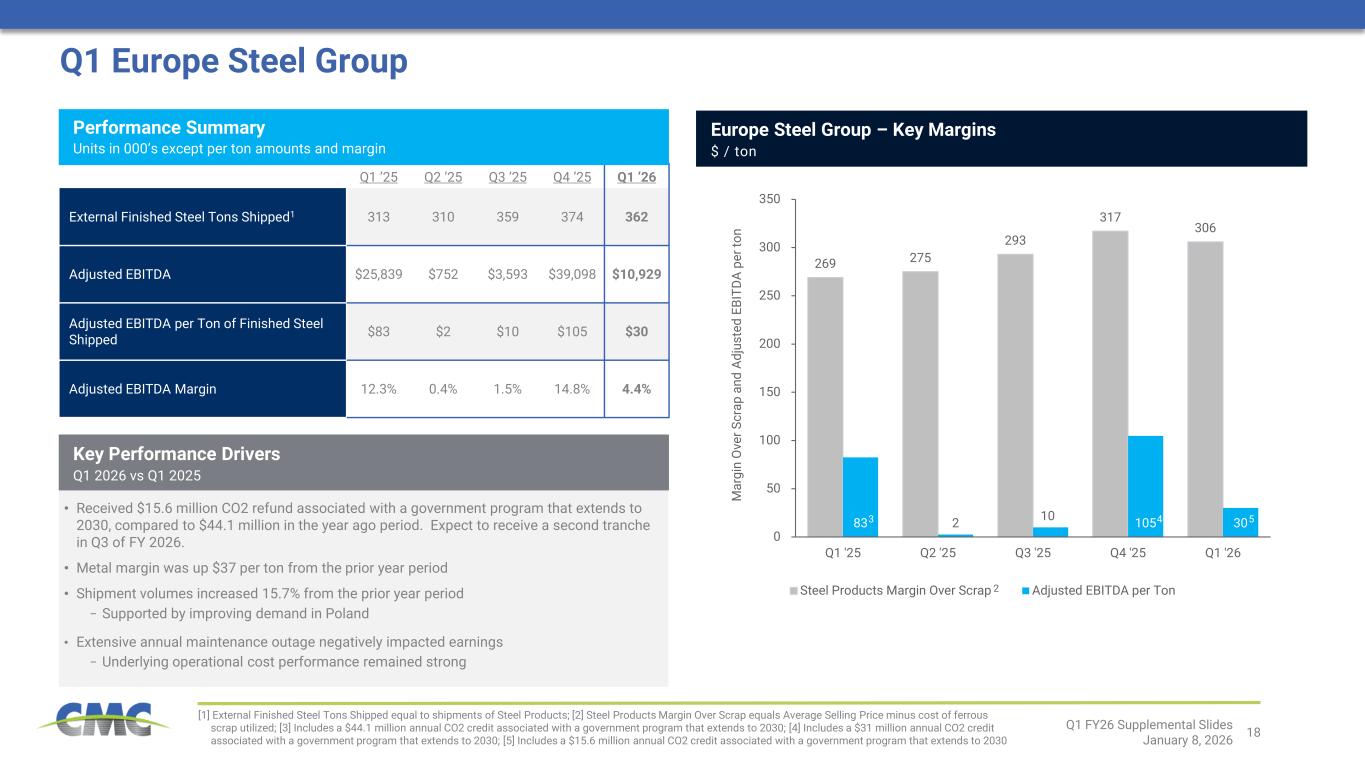
18 269 275 293 317 306 83 2 10 105 30 0 50 100 150 200 250 300 350 Q1 '25 Q2 '25 Q3 '25 Q4 '25 Q1 '26 Steel Products Margin Over Scrap Adjusted EBITDA per Ton Q1 Europe Steel Group Q1 ’25 Q2 ’25 Q3 ’25 Q4 ’25 Q1 ’26 External Finished Steel Tons Shipped1 313 310 359 374 362 Adjusted EBITDA $25,839 $752 $3,593 $39,098 $10,929 Adjusted EBITDA per Ton of Finished Steel Shipped $83 $2 $10 $105 $30 Adjusted EBITDA Margin 12.3% 0.4% 1.5% 14.8% 4.4% • Received $15.6 million CO2 refund associated with a government program that extends to 2030, compared to $44.1 million in the year ago period. Expect to receive a second tranche in Q3 of FY 2026. • Metal margin was up $37 per ton from the prior year period • Shipment volumes increased 15.7% from the prior year period − Supported by improving demand in Poland • Extensive annual maintenance outage negatively impacted earnings − Underlying operational cost performance remained strong [1] External Finished Steel Tons Shipped equal to shipments of Steel Products; [2] Steel Products Margin Over Scrap equals Average Selling Price minus cost of ferrous scrap utilized; [3] Includes a $44.1 million annual CO2 credit associated with a government program that extends to 2030; [4] Includes a $31 million annual CO2 credit associated with a government program that extends to 2030; [5] Includes a $15.6 million annual CO2 credit associated with a government program that extends to 2030 2 M ar gi n O ve r S cr ap a nd A dj us te d EB IT DA p er to n Q1 FY26 Supplemental Slides January 8, 2026 Performance Summary Units in 000’s except per ton amounts and margin Key Performance Drivers Q1 2026 vs Q1 2025 Europe Steel Group – Key Margins $ / ton 3 4 5
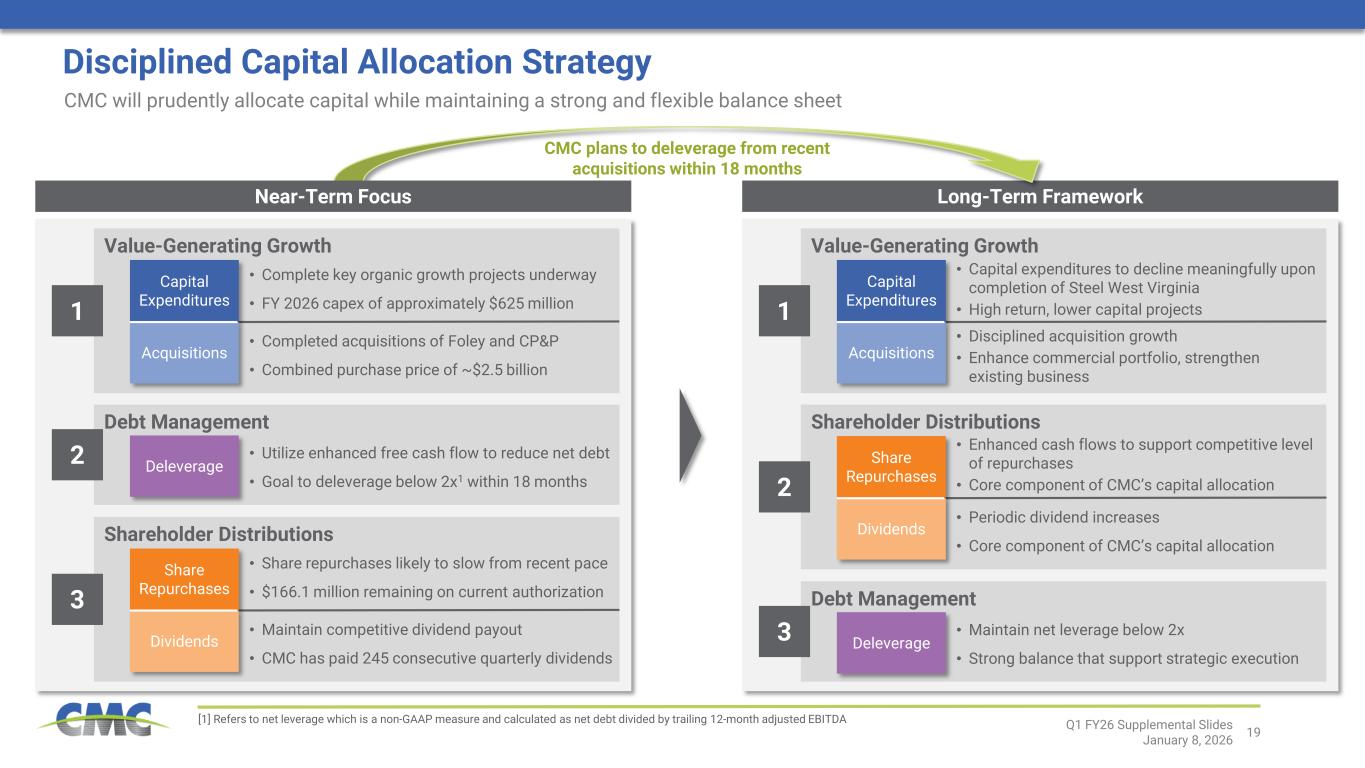
19 Long-Term Framework Debt Management Value-Generating Growth Disciplined Capital Allocation Strategy CMC will prudently allocate capital while maintaining a strong and flexible balance sheet Q1 FY26 Supplemental Slides January 8, 2026 [1] Refers to net leverage which is a non-GAAP measure and calculated as net debt divided by trailing 12-month adjusted EBITDA Deleverage 1 2 • Complete key organic growth projects underway • FY 2026 capex of approximately $625 million Capital Expenditures Acquisitions • Completed acquisitions of Foley and CP&P • Combined purchase price of ~$2.5 billion • Utilize enhanced free cash flow to reduce net debt • Goal to deleverage below 2x1 within 18 months Shareholder Distributions 3 • Share repurchases likely to slow from recent pace • $166.1 million remaining on current authorization Share Repurchases Dividends • Maintain competitive dividend payout • CMC has paid 245 consecutive quarterly dividends Value-Generating Growth 1 • Capital expenditures to decline meaningfully upon completion of Steel West Virginia • High return, lower capital projects Capital Expenditures Acquisitions • Disciplined acquisition growth • Enhance commercial portfolio, strengthen existing business Debt Management Deleverage3 • Maintain net leverage below 2x • Strong balance that support strategic execution Shareholder Distributions 2 • Enhanced cash flows to support competitive level of repurchases • Core component of CMC’s capital allocation Share Repurchases Dividends • Periodic dividend increases • Core component of CMC’s capital allocation Near-Term Focus CMC plans to deleverage from recent acquisitions within 18 months

© CMC Appendix
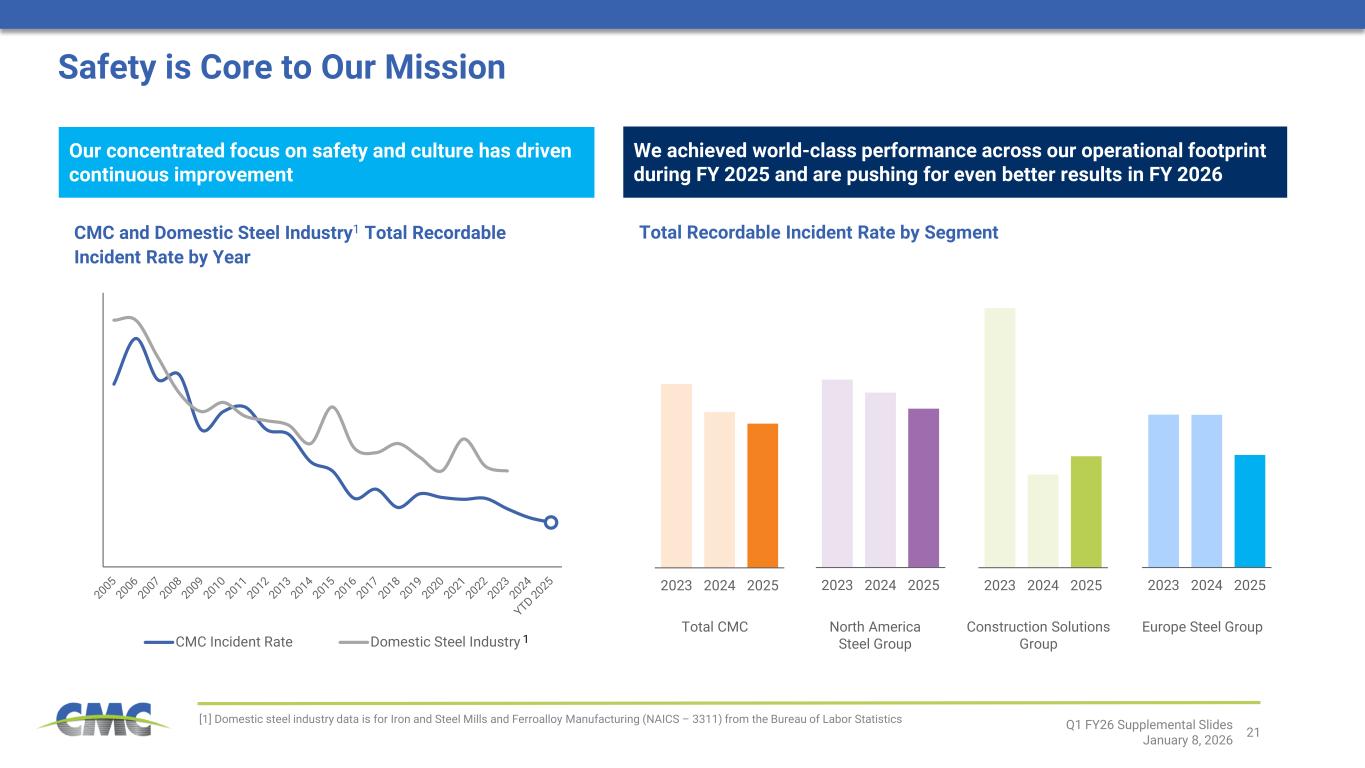
21 2023 2024 20252023 2024 20252023 2024 2025 CMC Incident Rate Domestic Steel Industry 1 Safety is Core to Our Mission [1] Domestic steel industry data is for Iron and Steel Mills and Ferroalloy Manufacturing (NAICS – 3311) from the Bureau of Labor Statistics CMC and Domestic Steel Industry1 Total Recordable Incident Rate by Year Total CMC North America Steel Group Europe Steel Group Total Recordable Incident Rate by Segment Q1 FY26 Supplemental Slides January 8, 2026 Our concentrated focus on safety and culture has driven continuous improvement We achieved world-class performance across our operational footprint during FY 2025 and are pushing for even better results in FY 2026 2023 2024 2025 Construction Solutions Group
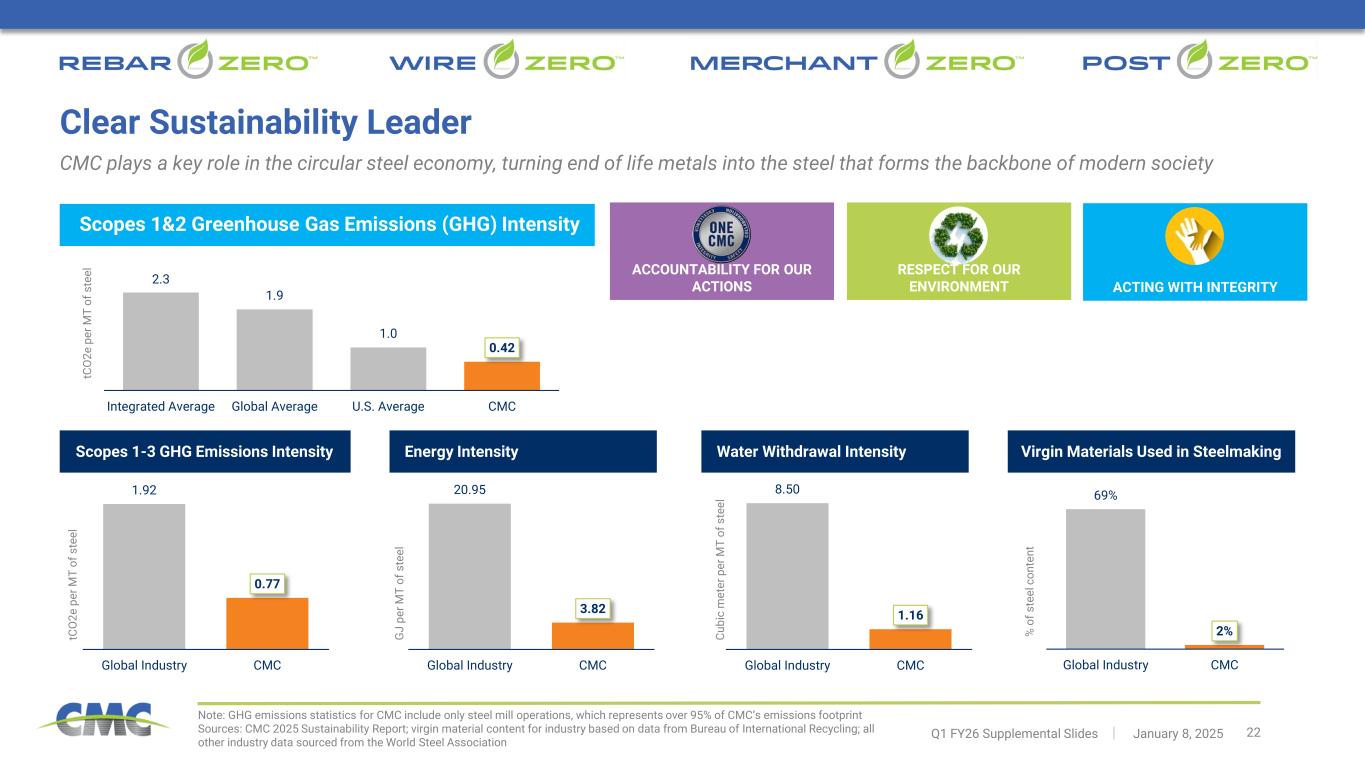
22 2.3 1.9 1.0 0.42 Integrated Average Global Average U.S. Average CMC 1.16 8.50 CMCGlobal Industry 3.82 20.95 CMCGlobal Industry 0.77 1.92 CMCGlobal Industry Q1 FY26 Supplemental Slides │ January 8, 2025 Note: GHG emissions statistics for CMC include only steel mill operations, which represents over 95% of CMC’s emissions footprint Sources: CMC 2025 Sustainability Report; virgin material content for industry based on data from Bureau of International Recycling; all other industry data sourced from the World Steel Association Clear Sustainability Leader CMC plays a key role in the circular steel economy, turning end of life metals into the steel that forms the backbone of modern society Scopes 1&2 Greenhouse Gas Emissions (GHG) Intensity ACCOUNTABILITY FOR OUR ACTIONS RESPECT FOR OUR ENVIRONMENT ACTING WITH INTEGRITY tC O 2e p er M T of s te el Energy Intensity G J pe r M T of s te el Water Withdrawal Intensity Cu bi c m et er p er M T of s te el 2% 69% CMCGlobal Industry % o f s te el c on te nt Scopes 1-3 GHG Emissions Intensity tC O 2e p er M T of s te el Virgin Materials Used in Steelmaking
© CMC Appendix: Non-GAAP Financial Reconciliations
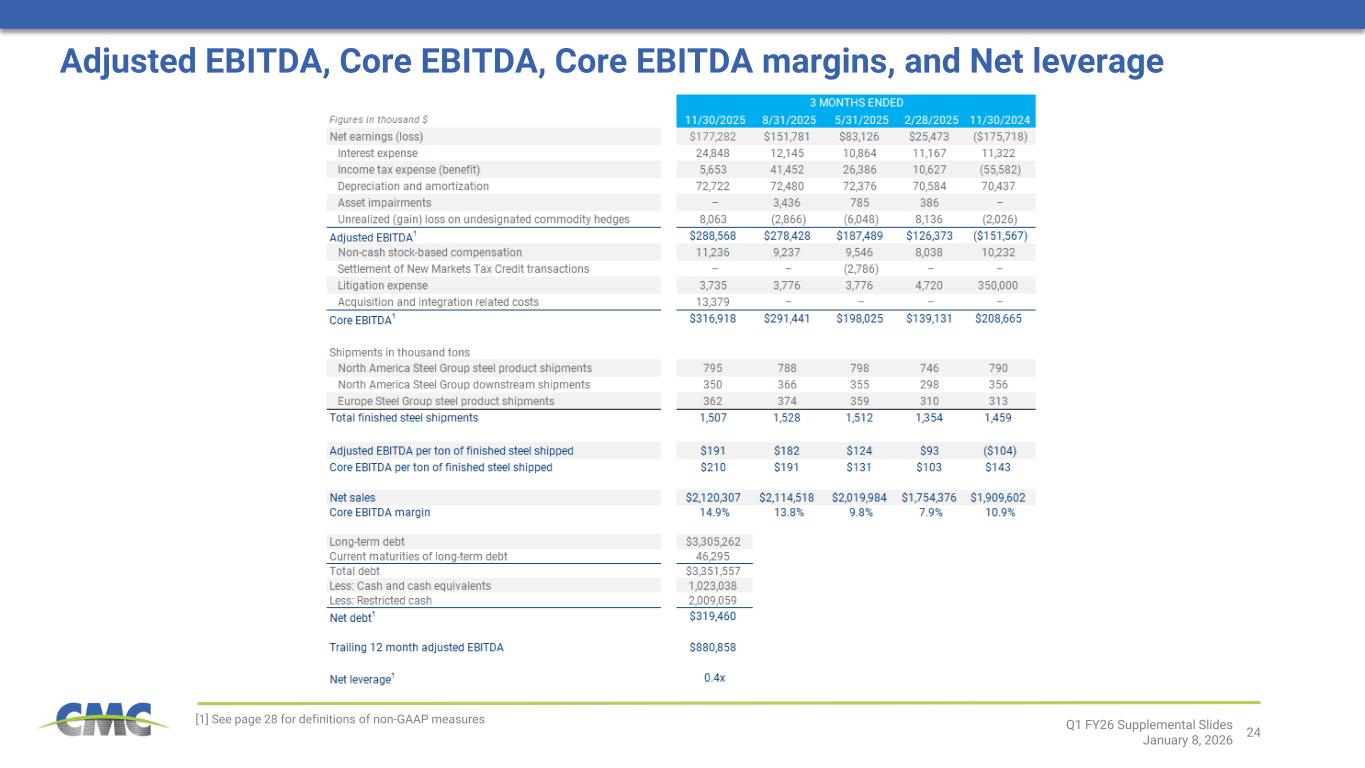
24 [1] See page 28 for definitions of non-GAAP measures Q1 FY26 Supplemental Slides January 8, 2026 Adjusted EBITDA, Core EBITDA, Core EBITDA margins, and Net leverage
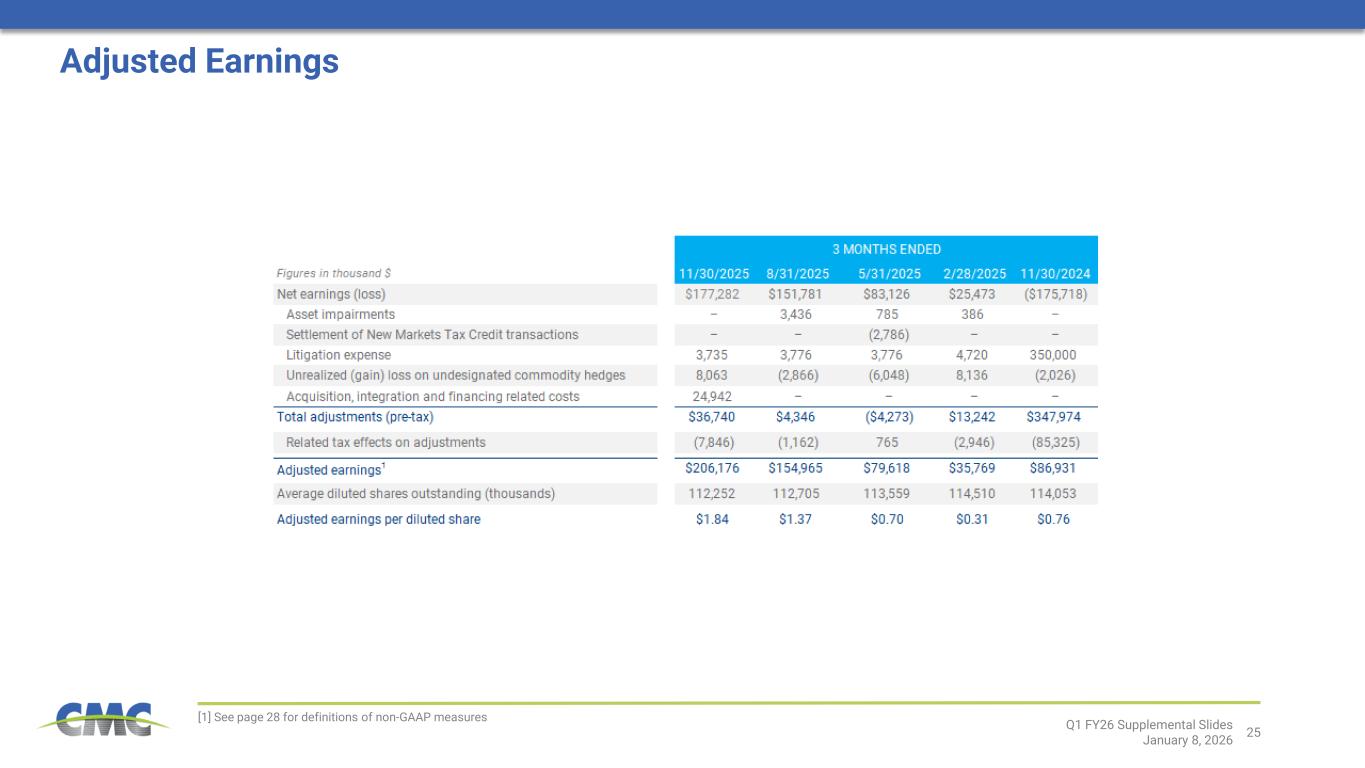
25 [1] See page 28 for definitions of non-GAAP measures Q1 FY26 Supplemental Slides January 8, 2026 Adjusted Earnings
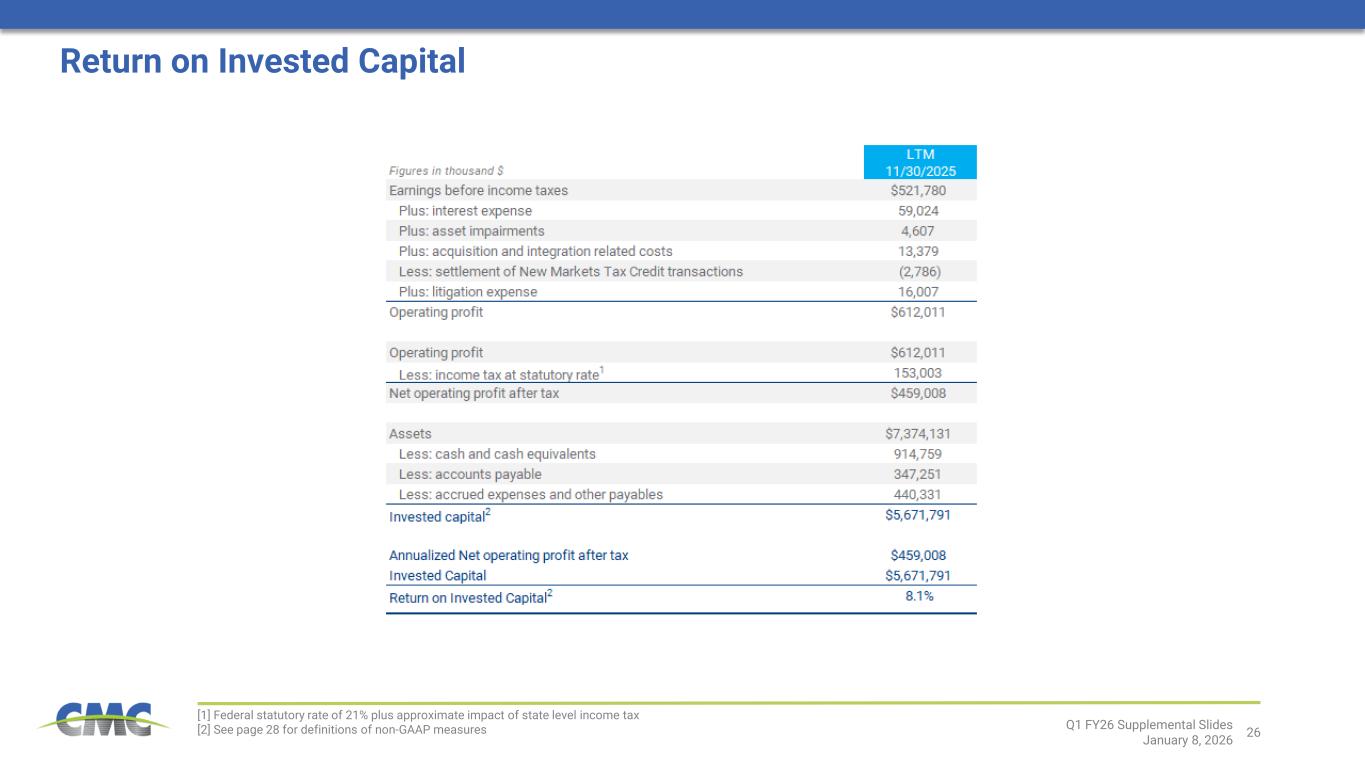
26 [1] Federal statutory rate of 21% plus approximate impact of state level income tax [2] See page 28 for definitions of non-GAAP measures Q1 FY26 Supplemental Slides January 8, 2026 Return on Invested Capital
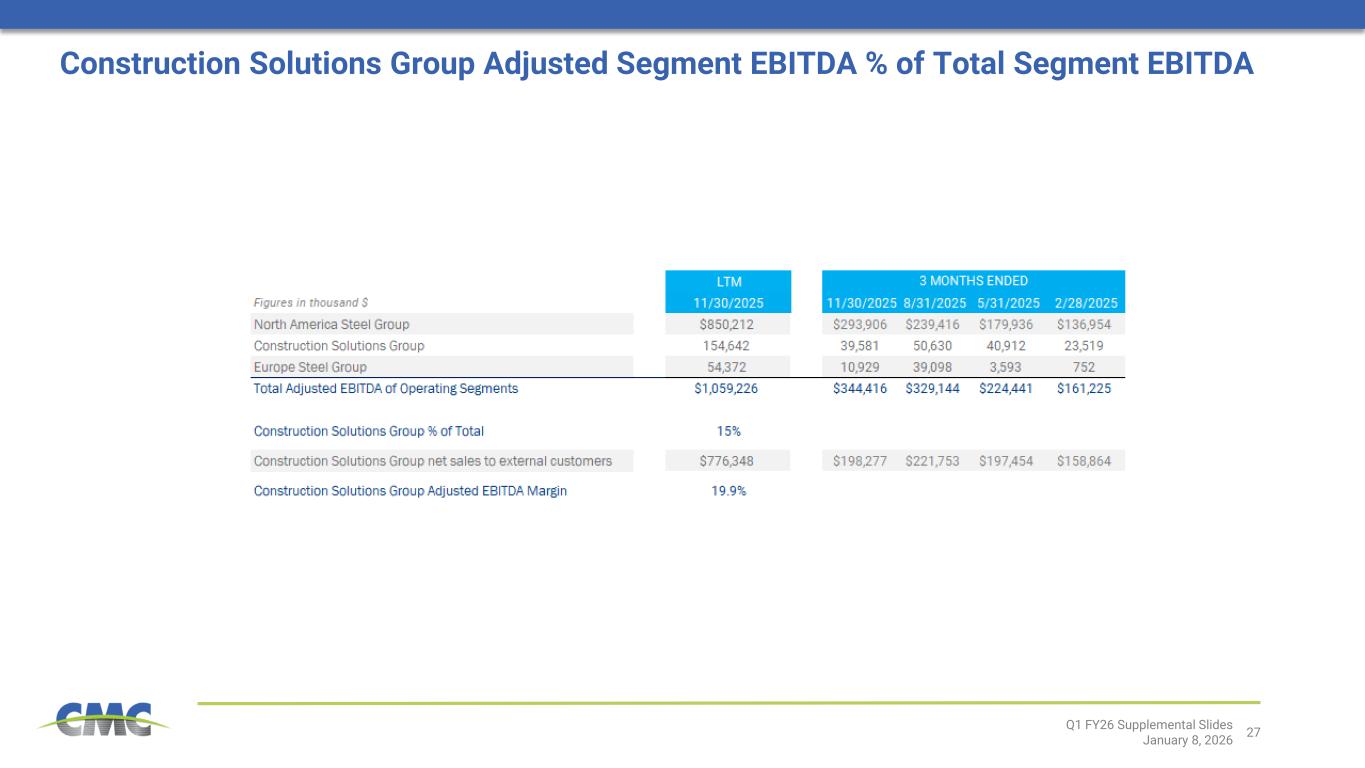
27Q1 FY26 Supplemental Slides January 8, 2026 Construction Solutions Group Adjusted Segment EBITDA % of Total Segment EBITDA
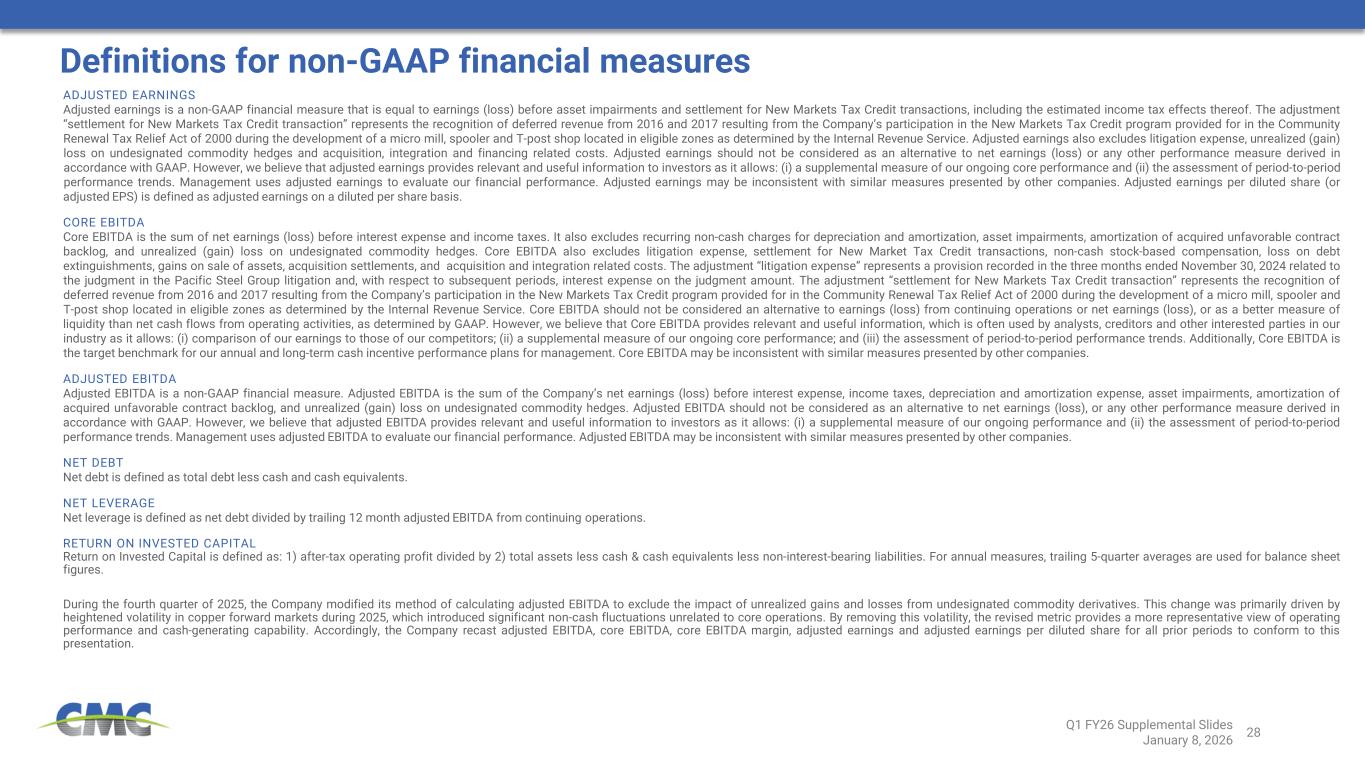
28 ADJUSTED EARNINGS Adjusted earnings is a non-GAAP financial measure that is equal to earnings (loss) before asset impairments and settlement for New Markets Tax Credit transactions, including the estimated income tax effects thereof. The adjustment “settlement for New Markets Tax Credit transaction” represents the recognition of deferred revenue from 2016 and 2017 resulting from the Company’s participation in the New Markets Tax Credit program provided for in the Community Renewal Tax Relief Act of 2000 during the development of a micro mill, spooler and T-post shop located in eligible zones as determined by the Internal Revenue Service. Adjusted earnings also excludes litigation expense, unrealized (gain) loss on undesignated commodity hedges and acquisition, integration and financing related costs. Adjusted earnings should not be considered as an alternative to net earnings (loss) or any other performance measure derived in accordance with GAAP. However, we believe that adjusted earnings provides relevant and useful information to investors as it allows: (i) a supplemental measure of our ongoing core performance and (ii) the assessment of period-to-period performance trends. Management uses adjusted earnings to evaluate our financial performance. Adjusted earnings may be inconsistent with similar measures presented by other companies. Adjusted earnings per diluted share (or adjusted EPS) is defined as adjusted earnings on a diluted per share basis. CORE EBITDA Core EBITDA is the sum of net earnings (loss) before interest expense and income taxes. It also excludes recurring non-cash charges for depreciation and amortization, asset impairments, amortization of acquired unfavorable contract backlog, and unrealized (gain) loss on undesignated commodity hedges. Core EBITDA also excludes litigation expense, settlement for New Market Tax Credit transactions, non-cash stock-based compensation, loss on debt extinguishments, gains on sale of assets, acquisition settlements, and acquisition and integration related costs. The adjustment “litigation expense” represents a provision recorded in the three months ended November 30, 2024 related to the judgment in the Pacific Steel Group litigation and, with respect to subsequent periods, interest expense on the judgment amount. The adjustment “settlement for New Markets Tax Credit transaction” represents the recognition of deferred revenue from 2016 and 2017 resulting from the Company’s participation in the New Markets Tax Credit program provided for in the Community Renewal Tax Relief Act of 2000 during the development of a micro mill, spooler and T-post shop located in eligible zones as determined by the Internal Revenue Service. Core EBITDA should not be considered an alternative to earnings (loss) from continuing operations or net earnings (loss), or as a better measure of liquidity than net cash flows from operating activities, as determined by GAAP. However, we believe that Core EBITDA provides relevant and useful information, which is often used by analysts, creditors and other interested parties in our industry as it allows: (i) comparison of our earnings to those of our competitors; (ii) a supplemental measure of our ongoing core performance; and (iii) the assessment of period-to-period performance trends. Additionally, Core EBITDA is the target benchmark for our annual and long-term cash incentive performance plans for management. Core EBITDA may be inconsistent with similar measures presented by other companies. ADJUSTED EBITDA Adjusted EBITDA is a non-GAAP financial measure. Adjusted EBITDA is the sum of the Company’s net earnings (loss) before interest expense, income taxes, depreciation and amortization expense, asset impairments, amortization of acquired unfavorable contract backlog, and unrealized (gain) loss on undesignated commodity hedges. Adjusted EBITDA should not be considered as an alternative to net earnings (loss), or any other performance measure derived in accordance with GAAP. However, we believe that adjusted EBITDA provides relevant and useful information to investors as it allows: (i) a supplemental measure of our ongoing performance and (ii) the assessment of period-to-period performance trends. Management uses adjusted EBITDA to evaluate our financial performance. Adjusted EBITDA may be inconsistent with similar measures presented by other companies. NET DEBT Net debt is defined as total debt less cash and cash equivalents. NET LEVERAGE Net leverage is defined as net debt divided by trailing 12 month adjusted EBITDA from continuing operations. RETURN ON INVESTED CAPITAL Return on Invested Capital is defined as: 1) after-tax operating profit divided by 2) total assets less cash & cash equivalents less non-interest-bearing liabilities. For annual measures, trailing 5-quarter averages are used for balance sheet figures. During the fourth quarter of 2025, the Company modified its method of calculating adjusted EBITDA to exclude the impact of unrealized gains and losses from undesignated commodity derivatives. This change was primarily driven by heightened volatility in copper forward markets during 2025, which introduced significant non-cash fluctuations unrelated to core operations. By removing this volatility, the revised metric provides a more representative view of operating performance and cash-generating capability. Accordingly, the Company recast adjusted EBITDA, core EBITDA, core EBITDA margin, adjusted earnings and adjusted earnings per diluted share for all prior periods to conform to this presentation. Q1 FY26 Supplemental Slides January 8, 2026 Definitions for non-GAAP financial measures
CMC.COM