
The Wendys company notice of 2026 annual meeting of stockholders & proxy statments
☐ |
Preliminary Proxy Statement | |||
☐ |
Confidential, for Use of the Commission Only (as permitted by Rule 14a-6(e)(2)) | |||
☒ |
Definitive Proxy Statement | |||
☐ |
Definitive Additional Materials | |||
☐ |
Soliciting Material under §240.14a-12 | |||
☒ |
No fee required. | |||
☐ |
Fee paid previously with preliminary materials. | |||
☐ |
Fee computed on table in exhibit required by Item 25(b) per Exchange Act Rules 14a-6(i)(1) and 0-11. | |||
The Wendys company notice of 2026 annual meeting of stockholders & proxy statments

|
The Wendy’s Company One Dave Thomas Boulevard Dublin, Ohio 43017 (614) 764-3100 |
April 2, 2026
Dear Fellow Stockholders:
You are cordially invited to join us at the 2026 Annual Meeting of Stockholders (the “Annual Meeting”) of The Wendy’s Company (the “Company”), which will be held virtually through a live webcast on Wednesday, May 20, 2026 at 11:00 a.m. (Eastern Time). We believe the live webcast will provide greater accessibility and a consistent experience to our stockholders and allow all stockholders with Internet connectivity to participate in the Annual Meeting regardless of location. At our virtual Annual Meeting, stockholders who held shares as of the record date, March 23, 2026, will be able to attend and participate. Please visit www.proxydocs.com/WEN for more details. The Board of Directors and management hope that you will be able to participate in the virtual Annual Meeting. The business to be conducted at the Annual Meeting is described in the Notice of 2026 Annual Meeting of Stockholders and Proxy Statement (the “Proxy Statement”).
Please be advised that prior registration at www.proxydocs.com/WEN is required to attend and participate in the virtual Annual Meeting. Upon completing your registration (which will require the control number included in your proxy card, voting instruction form or Notice of Internet Availability of Proxy Materials) you will receive further instructions via email, including your unique links that will allow you to access, submit questions for and vote at the virtual Annual Meeting. You will not be able to attend the Annual Meeting in person.
We encourage you to participate in the virtual Annual Meeting. For further information on how to participate in the virtual Annual Meeting, please see “Additional Details Regarding the Annual Meeting” on page 6 of the Proxy Statement. Whether or not you plan to attend the virtual Annual Meeting, it is important that your shares be represented and voted at the Annual Meeting. Please promptly cast your vote by completing and returning your proxy card in the enclosed envelope or to the address indicated on your proxy card or voting instruction form. You may also cast your vote by telephone or via the Internet as described in the instructions included with your proxy materials. If you attend the virtual Annual Meeting and wish to vote your shares electronically during the Annual Meeting, you may revoke your previously submitted proxy as explained in the Proxy Statement.
Thank you for your continued support and investment in The Wendy’s Company.
Sincerely,
|
|
| KEN COOK |
| Interim Chief Executive Officer and Chief Financial Officer
|
NOTICE OF 2026 ANNUAL MEETING OF STOCKHOLDERS
Wednesday, May 20, 2026, 11:00 a.m. (Eastern Time)
Virtual Meeting Only – No Physical Meeting Location
The 2026 Annual Meeting of Stockholders (the “Annual Meeting”) of The Wendy’s Company (the “Company”) will be held virtually through a live webcast on Wednesday, May 20, 2026 at 11:00 a.m. (Eastern Time). We believe the live webcast will provide greater accessibility and a consistent experience to our stockholders and allow all stockholders with Internet connectivity to participate in the Annual Meeting regardless of location. See “Annual Meeting Attendance and Participation” below for additional details.
| ITEMS OF BUSINESS |
At the Annual Meeting, you will be asked to:
| (1) | Elect 8 directors to hold office until the Company’s next annual meeting of stockholders; |
| (2) | Vote on an amendment to the Company’s 2020 Omnibus Award Plan to increase the number of shares of common stock available for issuance under the plan; |
| (3) | Ratify the appointment of Deloitte & Touche LLP as the Company’s independent registered public accounting firm for 2026; |
| (4) | Vote on an advisory resolution to approve executive compensation; |
| (5) | Vote on the stockholder proposal described in the accompanying proxy statement, if properly presented at the meeting; and |
| (6) | Transact such other business as may properly come before the Annual Meeting or any adjournment or postponement thereof. |
| RECORD DATE |
The record date for the Annual Meeting is March 23, 2026. Only holders of record of shares of the Company’s common stock at the close of business on the record date are entitled to vote on all business transacted at the Annual Meeting or any adjournment or postponement thereof.
| VOTING YOUR PROXY |
Your vote is important! Stockholders are cordially invited to attend and participate in the virtual Annual Meeting via our live webcast. Whether or not you plan to attend the virtual Annual Meeting, please promptly complete and return your proxy card in the enclosed envelope, or submit your proxy by telephone or via the Internet as described in your proxy card or voting instruction form. As described below, you may also vote electronically at the virtual Annual Meeting if you register, attend and participate in the virtual Annual Meeting.
| ANNUAL MEETING ATTENDANCE AND PARTICIPATION |
Please be advised that prior registration at www.proxydocs.com/WEN is required to attend and participate in the virtual Annual Meeting. Upon completing your registration (which will require the control number included in your proxy card, voting instruction form or Notice of Internet Availability of Proxy Materials) you will receive further instructions via email, including your unique links that will allow you to access, submit questions for and vote at the virtual Annual Meeting. If the shares you own are held in “street name” by a bank or brokerage firm, you must obtain a valid proxy from your bank or brokerage firm in order to submit your vote at the virtual Annual Meeting. For further information on how to register, attend and participate in the virtual Annual Meeting, please see “Additional Details Regarding the Annual Meeting” on page 6 of the Proxy Statement.
By Order of the Board of Directors:
JOHN MIN
Chief Legal Officer and Secretary
April 2, 2026
|
Important Notice Regarding the Availability of Proxy Materials for the Annual Meeting of Stockholders
|
TABLE OF CONTENTS
| Page |
||||
| 1 | ||||
| 1 | ||||
| 2 | ||||
| 2 | ||||
| 3 | ||||
| 4 | ||||
| 4 | ||||
| 5 | ||||
| 6 | ||||
| 6 | ||||
| Submitting Questions and Voting Your Shares at the Annual Meeting |
6 | |||
| 6 | ||||
| 7 | ||||
| 8 | ||||
| 12 | ||||
| 12 | ||||
| 13 | ||||
| Director Nominee Qualifications and Biographical Information |
14 | |||
| 21 | ||||
| 22 | ||||
| 22 | ||||
| 23 | ||||
| 23 | ||||
| 25 | ||||
| 25 | ||||
| 26 | ||||
| Compensation and Human Capital Committee and Performance Compensation Subcommittee |
27 | |||
| 28 | ||||
| 28 | ||||
| 29 | ||||
| 29 | ||||
| 30 | ||||
| 31 | ||||
| 32 | ||||
| 32 | ||||
| 32 | ||||
| 34 | ||||
| 34 | ||||
| 34 | ||||
| 35 | ||||
| 35 | ||||
| 36 | ||||
| Role of Compensation Consultants in the Executive Compensation Process |
36 | |||
| 37 | ||||
| 37 | ||||
The Wendy’s Company 2026 Proxy Statement i
| Page |
||||
| 38 | ||||
| 39 | ||||
| 39 | ||||
| 40 | ||||
| 41 | ||||
| 43 | ||||
| 44 | ||||
| 44 | ||||
| 45 | ||||
| 46 | ||||
| 46 | ||||
| 47 | ||||
| 53 | ||||
| 54 | ||||
| 55 | ||||
| 57 | ||||
| 60 | ||||
| 62 | ||||
| 64 | ||||
| Employment Arrangements and Potential Payments Upon Termination or Change in Control |
65 | |||
| 70 | ||||
| 71 | ||||
| 78 | ||||
| 80 | ||||
| 82 | ||||
| STOCK OWNERSHIP AND RETENTION GUIDELINES FOR EXECUTIVE OFFICERS AND DIRECTORS |
85 | |||
| Stock Ownership and Retention Guidelines for Executive Officers |
85 | |||
| Stock Ownership and Retention Guidelines for Non-Management Directors |
85 | |||
| 85 | ||||
| SECURITY OWNERSHIP OF CERTAIN BENEFICIAL OWNERS AND MANAGEMENT |
86 | |||
| 89 | ||||
| 90 | ||||
| 92 | ||||
| 92 | ||||
| 92 | ||||
| PROPOSAL 2 – APPROVAL OF AN AMENDMENT TO THE COMPANY’S 2020 OMNIBUS AWARD PLAN |
94 | |||
| 94 | ||||
| 94 | ||||
| 95 | ||||
| 96 | ||||
| 97 | ||||
| 103 | ||||
| 106 | ||||
| 107 | ||||
| 108 | ||||
| PROPOSAL 3 – RATIFICATION OF INDEPENDENT REGISTERED PUBLIC ACCOUNTING FIRM |
109 | |||
| 109 | ||||
| 110 | ||||
| 110 | ||||
ii The Wendy’s Company 2026 Proxy Statement
FORWARD-LOOKING STATEMENTS
This proxy statement contains certain statements that are not historical facts, including statements regarding the Company’s future performance. Those statements, as well as statements preceded by, followed by, or that include the words “will,” “may,” “believes,” “intends,” “plans,” “expects,” “anticipates,” or similar expressions constitute “forward-looking statements” within the meaning of the Private Securities Litigation Reform Act of 1995 (the “Reform Act”). The forward-looking statements are based on the Company’s expectations at the time, speak only as of the dates they are made and are susceptible to a number of risks, uncertainties and other factors that may cause our actual results, performance or achievements to differ materially from those expressed or implied in any forward-looking statement. These factors include, but are not limited to, the factors identified in the “Special Note Regarding Forward-Looking Statements and Projections” and “Risk Factors” sections of our Annual Reports on Form 10-K and Quarterly Reports on Form 10-Q and in our other filings with the Securities and Exchange Commission. For all forward-looking statements, the Company claims the protection of the safe harbor for forward-looking statements contained in the Reform Act.
The Wendy’s Company 2026 Proxy Statement iii
|
|
The Wendy’s Company One Dave Thomas Boulevard Dublin, Ohio 43017 (614) 764-3100 |
|
PROXY STATEMENT FOR 2026 ANNUAL MEETING OF STOCKHOLDERS
|
PROXY STATEMENT SUMMARY
This summary highlights information about The Wendy’s Company (“Wendy’s”, the “Company”, “we”, “us” or “our”) and certain information contained elsewhere in this Proxy Statement for the Company’s 2026 Annual Meeting of Stockholders to be held virtually on Wednesday, May 20, 2026 at 11:00 a.m. (Eastern Time), and any adjournment or postponement thereof (the “Annual Meeting”). This summary does not contain all of the information that you should consider in voting your shares, and you should read the entire Proxy Statement carefully before voting. For more complete information regarding the Company’s 2025 performance, please review the Company’s Annual Report on Form 10-K for the fiscal year ended December 28, 2025 (the “2025 Form 10-K”). References in this Proxy Statement to “2025,” “2024,” “2023” and other years refer to the Company’s fiscal year for the respective period indicated. Websites referenced throughout this Proxy Statement are provided for convenience only, and the content on the referenced websites does not constitute a part of, and is not incorporated by reference into, this Proxy Statement.
| ANNUAL MEETING DETAILS
|
The accompanying proxy is being solicited by the Board of Directors of The Wendy’s Company in connection with the Annual Meeting, which will be held virtually through a live webcast on Wednesday, May 20, 2026 at 11:00 a.m. (Eastern Time). We believe the live webcast will provide greater accessibility and a consistent experience to our stockholders and allow all stockholders with Internet connectivity to participate in the Annual Meeting regardless of location.
Please be advised that prior registration at www.proxydocs.com/WEN is required to attend and participate in the virtual Annual Meeting. Upon completing your registration (which will require the control number included in your proxy card, voting instruction form or Notice of Internet Availability of Proxy Materials) you will receive further instructions via email, including your unique links that will allow you to access, submit questions for and vote at the virtual Annual Meeting. If the shares you own are held in “street name” by a bank or brokerage firm, you must obtain a valid proxy from your bank or brokerage firm in order to submit your vote at the virtual Annual Meeting.
On or about April 3, 2026, this Proxy Statement and an accompanying proxy card will first be mailed to stockholders or made available to stockholders electronically via the Internet at www.proxydocs.com/WEN and on our Investor Relations website at www.irwendys.com/financials/annual-report-and-proxy.
The Wendy’s Company 2026 Proxy Statement 1
| HOW TO CAST YOUR VOTE
|
Voting by Proxy Without Participating in the Virtual Annual Meeting:
Even if you plan to participate in the virtual Annual Meeting, please cast your vote as soon as possible in one of the following ways:

|

|

| ||
| Internet | Telephone | |||
|
Visit www.proxypush.com/WEN. You will need the control number included in your proxy card, voting instruction form or Notice of Internet Availability of Proxy Materials. |
Call 855-686-4803. You will need the control number included in your proxy card, voting instruction form or Notice of Internet Availability of Proxy Materials. |
Complete, sign and date your proxy card or voting instruction form and return it in the envelope provided or to the address indicated on your proxy card or voting instruction form. |
Voting by Participating in the Virtual Annual Meeting:
You may vote your shares electronically during the virtual Annual Meeting even if you have previously submitted your vote. To vote at the virtual Annual Meeting, you must register at www.proxydocs.com/WEN in order to attend and participate in the virtual Annual Meeting. Upon completing your registration (which will require the control number included in your proxy card, voting instruction form or Notice of Internet Availability of Proxy Materials) you will receive further instructions via email, including your unique links that will allow you to access, submit questions for and vote at the virtual Annual Meeting. If the shares you own are held in “street name” by a bank or brokerage firm, you must obtain a valid proxy from your bank or brokerage firm in order to submit your vote at the virtual Annual Meeting.
| VOTING MATTERS AND BOARD RECOMMENDATIONS
|
| BOARD PROPOSALS | BOARD VOTE RECOMMENDATION |
PAGE REFERENCE (FOR MORE DETAIL) |
||||||||
|
Proposal 1: |
Election of 8 directors. |
|
FOR each nominee
|
|
|
12
|
| |||
| Proposal 2: |
Approve an amendment to the Company’s 2020 Omnibus Award Plan to increase the number of shares of common stock available for issuance under the plan. |
FOR | 94 | |||||||
| Proposal 3: |
Ratification of the appointment of Deloitte & Touche LLP as the Company’s independent registered public accounting firm for 2026. |
FOR | 109 | |||||||
| Proposal 4: |
Advisory resolution to approve executive compensation. |
|
FOR
|
|
|
111
|
| |||
| STOCKHOLDER PROPOSAL | BOARD VOTE RECOMMENDATION |
PAGE REFERENCE (FOR MORE DETAIL) |
||||||||
| Proposal 5: |
Stockholder proposal regarding a restriction on “blank-check” preferred stock, if properly presented at the Annual Meeting. |
AGAINST |
|
113
|
| |||||
2 The Wendy’s Company 2026 Proxy Statement
| DIRECTOR NOMINEES
|
The following table provides summary information about our 8 director nominees. Additional information about each nominee’s experience, qualifications, attributes and skills can be found under the caption “Proposal 1—Election of Directors.”
| NAME
|
AGE
|
DIRECTOR
|
OCCUPATION
|
INDEPENDENT
|
CURRENT BOARD
|
OTHER PUBLIC COMPANY BOARDS
| ||||||
| Arthur B. Winkleblack |
68 | 2016 | Former Executive Vice President and Chief Financial Officer of H. J. Heinz Company | ✓ | Audit, CI, Executive+, NCG+ | 1 | ||||||
| Peter W. May |
83 | 1993 (3) | President and Founding Partner of Trian Fund Management, L.P. | ✓ | CI+, C&HC, CSR+, Executive, Tech | — | ||||||
| Wendy C. Arlin |
55 | 2023 | Former Executive Vice President and Chief Financial Officer of Bath & Body Works, Inc. | ✓ | Audit+, CI, C&HC | 1 | ||||||
| Michelle Caruso- Cabrera |
57 | 2023 | Chief Executive Officer of MCC Global Enterprises and CNBC Contributor | ✓ | Audit, CSR | — | ||||||
| Richard H. Gomez |
56 | 2021 | Former Executive Vice President and Chief Commercial Officer of Target Corporation | ✓ | C&HC, CSR, Tech | — | ||||||
| Michelle “Mich” J. Mathews-Spradlin |
59 | 2015 | Former Chief Marketing Officer and Senior Vice President of Microsoft Corporation | ✓ | C&HC, NCG, Tech+ | 1 | ||||||
| Bradley G. Peltz |
36 | 2025 | Managing Director, Yellow Cab Holdings, LLC | CSR, Tech | — | |||||||
| Peter H. Rothschild |
70 | 2010 | Partner, East Wind Advisors, LLC | ✓ | Audit, C&HC+, Executive, NCG | — | ||||||
| + | Committee Chair |
| (1) | CI: Capital and Investment; C&HC: Compensation and Human Capital; CSR: Corporate Social Responsibility; NCG: Nominating and Corporate Governance; Tech: Technology. |
| (2) | It is anticipated that the Board of Directors will review and determine committee assignments at the Board’s organizational meeting immediately following the Annual Meeting. |
| (3) | Mr. May has been a director of the Company since September 2008, when the Company commenced its current business – the ownership and franchising of the Wendy’s® restaurant system. Mr. May served as a director of the Company’s predecessor companies from April 1993 until September 2008 when Wendy’s International, Inc. merged with Triarc Companies, Inc., the predecessor to The Wendy’s Company. |
The Wendy’s Company 2026 Proxy Statement 3
|
CORPORATE GOVERNANCE HIGHLIGHTS
|
We are committed to maintaining strong corporate governance practices as a critical component of driving sustained stockholder value. The Company’s Board of Directors (the “Board of Directors” or the “Board”) continually monitors emerging best practices in corporate governance to serve the interests of our stockholders.
Highlights of our current governance practices are set forth in the following tables.
|
BOARD OF DIRECTORS
|
STOCKHOLDER INTERESTS
|
EXECUTIVE COMPENSATION
| ||||||
• Annual election of directors. • Majority voting for directors in uncontested elections with director resignation policy. • Separation of our Board Chair and Chief Executive Officer. • Independent Board Chair. • Lead Independent Director with robust duties (if the Board Chair is not an independent director). • Majority independent Board. • Fully independent key Board committees. • Regularly scheduled executive sessions of non-employee and independent directors. • Approximately 96% Board and committee meeting attendance in 2025. • Active Board and committee oversight of risk management. • Comprehensive Corporate Governance Guidelines and Code of Ethics. • Limited number of outside public company boards on which our directors can serve. • Annual limit on cash and equity awards granted to non-employee directors under our 2020 Omnibus Award Plan. |
• No stockholder rights plan or “poison pill.” • Stockholders have the ability to act by written consent. • Stockholders have the ability to call special meetings. • No supermajority voting requirements. • No exclusive forum selection clause. • Amended and Restated Certificate of Incorporation provides stockholders with a “proxy access” right that is aligned with market practices. • No fee-shifting By-Law provisions. |
• Annual say-on-pay advisory vote. • Strong pay-for-performance philosophy with emphasis on variable, performance-based compensation. • Multiple performance metrics used in incentive plans. • Limited perquisites and benefits. • Engage independent outside compensation consultants. • Utilize comprehensive clawback policies that go beyond the minimum requirements of Nasdaq listing standards to cover detrimental conduct generally. • No speculative trading, hedging or derivative transactions in our Common Stock. • “Double trigger” required for change in control equity vesting. • Significant stock ownership and retention guidelines for executive officers and directors. | ||||||
|
2025 YEAR IN REVIEW
|
Our U.S. business faced a more competitive environment than we anticipated and our 2025 performance did not reflect the strength of the Wendy’s brand or capabilities of our system. In 2025, we launched Project Fresh, our comprehensive strategic turnaround plan for the U.S. business to restore momentum, elevate the customer experience, drive sustainable average unit volume (“AUV”) growth and deliver improved performance and long-term sustainable growth for the U.S. business while continuing to deliver strong growth internationally. Project Fresh is organized around four key pillars of (i) brand revitalization, (ii) operational excellence, (iii) system optimization and (iv) capital allocation. We have begun making meaningful progress against the pillars of Project Fresh and are working with urgency to improve our U.S. business and position Wendy’s for long-term success.
Our International business continued to be a strong growth engine in 2025, delivering an 8.1% increase in systemwide sales, with growth across all regions, and net unit growth up over 9% with 121 net new restaurants in 2025, marking a new record in the history of our International business. This is a meaningful proof point that the Wendy’s brand resonates across the globe as we execute our Globally Great, Locally Loved strategy. In addition, over the course of the year, the Wendy’s system reached a record-high U.S. digital sales mix and we prioritized investments towards driving profitable AUV growth, while also returning cash to our stockholders, including $330 million returned to stockholders through dividends and share repurchases.
Also in 2025, the Company experienced a transition in the Chief Executive Officer role when Kirk Tanner resigned from his position of President and Chief Executive Officer in July 2025. At that time, the Board appointed Ken Cook, our Chief Financial Officer, to the additional role of Interim Chief Executive Officer. The Board, led by an ad hoc CEO Selection Committee, launched a comprehensive recruitment and selection process to select a permanent CEO. Supported by a leading global executive search firm, the Board is continuing with its process to identify and evaluate a strong slate of internal and external candidates with the experience and leadership capabilities required to guide Wendy’s through its next phase of growth.
4 The Wendy’s Company 2026 Proxy Statement
|
2025 EXECUTIVE COMPENSATION PROGRAM HIGHLIGHTS
|
Our executive compensation program is designed to support the Company’s business objectives by linking executive compensation to the Company’s attainment of annual and multiyear operating and financial goals, individual performance and the creation of long-term stockholder value. In accordance with our pay-for-performance philosophy, variable, performance-based incentives constituted the most significant portion of total direct compensation for 2025 for our Interim Chief Executive Officer and Chief Financial Officer and other Named Executive Officers as a group, as shown below.
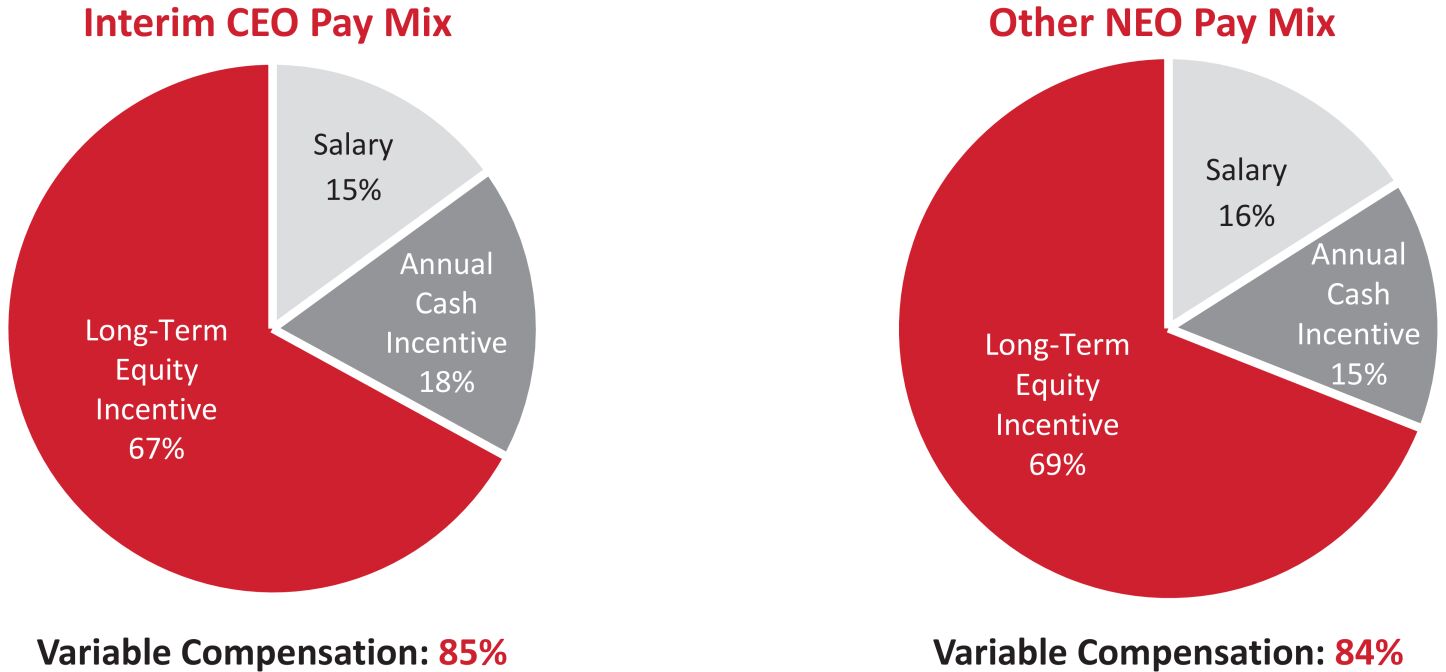
The pay mixes shown above exclude the value of the one-time award given to Pete Suerken, the Company’s President, U.S., who joined the Company in 2025. “Other NEO Pay Mix” does not reflect compensation paid to Mr. Tanner, who departed the Company in 2025.
The primary components of our 2025 executive compensation program are summarized in the following table and further described in the “Compensation Discussion and Analysis” section of this Proxy Statement.
| ELEMENT | VARIABLE | FORM | PERFORMANCE MEASURE | PURPOSE | ||||
| Base Salary |
No | Cash | — | Attract and retain highly qualified executives by providing a competitive level of fixed cash compensation that reflects the experience, responsibilities and performance of each executive.
| ||||
| Annual Cash Incentives |
Yes | Cash | • Adjusted EBITDA (50%) • Global Same-Restaurant Sales Growth (30%) • Global Net Unit Growth (20%) |
Align executive pay with Company performance by motivating and rewarding executives over a one-year period based on the achievement of strategic business objectives. | ||||
| Long-Term Equity Incentives |
Yes | Equity • Performance Units (60%) • Stock Options (25%) • Restricted Stock Units (15%) |
• Global Systemwide Sales Growth (50%) • Global Company-Operated Restaurant Margin Acceleration (50%) • Relative Total Stockholder Return Modifier |
Align the interests of executives with the interests of stockholders and retain highly qualified executives by motivating and rewarding executives to achieve multiyear strategic business objectives. Create a direct link between executive pay and the long-term performance of our Common Stock. | ||||
We encourage you to read the Compensation Discussion and Analysis in this Proxy Statement for a detailed discussion of how our executive compensation program was designed and implemented in 2025 to achieve our overall compensation objectives. Stockholders should also review the 2025 Summary Compensation Table and other related compensation tables, notes and narratives in this Proxy Statement, which provide detailed information regarding the compensation of our NEOs for 2025.
The Wendy’s Company 2026 Proxy Statement 5
ADDITIONAL DETAILS REGARDING THE ANNUAL MEETING
ANNUAL MEETING LOG IN INSTRUCTIONS
Because we have adopted a completely virtual format for the Annual Meeting, there is no physical meeting location. To participate in the virtual Annual Meeting, holders of shares of the Company’s common stock, par value $0.10 per share (the “Common Stock”), at the close of business on March 23, 2026 (the record date for the Annual Meeting), must register at www.proxydocs.com/WEN prior to the start of the meeting in order to attend and participate in the virtual Annual Meeting. Upon completing your registration (which will require the control number included in your proxy card, voting instruction form or Notice of Internet Availability of Proxy Materials) you will receive further instructions via email, including your unique links that will allow you to access, submit questions for and vote at the virtual Annual Meeting. Approximately 60 minutes prior to the meeting, you will receive an email with your unique link that will provide you access to the virtual Annual Meeting. Online access to the live website will then open approximately 15 minutes prior to the start of the Annual Meeting. We recommend that you log in to the Annual Meeting several minutes before its scheduled start time.
Stockholders who hold shares of our Common Stock in a joint account may attend and participate in the virtual Annual Meeting by following the steps described above. If you are the representative of a trust or corporation, limited liability company, partnership or other legal entity that holds shares of our Common Stock, you will need the control number included in the proxy card, voting instruction form or Notice of Internet Availability of Proxy Materials of that legal entity to register for the virtual Annual Meeting in order to attend and participate, as described above.
Only stockholders as of the March 23, 2026 record date who have followed the registration steps as described above, along with Company guests, will be able to attend and participate in the virtual Annual Meeting.
SUBMITTING QUESTIONS AND VOTING YOUR SHARES AT THE ANNUAL MEETING
Submitting Questions. Stockholders as of the record date who attend and participate in the virtual Annual Meeting can submit questions electronically until the start of the meeting at www.proxydocs.com/WEN when completing the registration steps described above. In addition, stockholders as of the record date who attend and participate in the virtual Annual Meeting will also have an opportunity to submit questions via the Internet during the live Q&A portion of the meeting. The Company will use reasonable efforts to answer all questions pertinent to meeting matters during the virtual Annual Meeting, subject to time constraints and the rules of conduct for the Annual Meeting (which will be available on our Investor Relations website at www.irwendys.com/financials/annual-report-and-proxy). If we receive questions on similar topics, we may group such questions together and provide a single response to avoid repetition.
Voting Your Shares. Stockholders as of the record date for the Annual Meeting who attend and participate in the virtual Annual Meeting will have an opportunity to vote their shares electronically at the meeting even if they have previously submitted their vote.
TECHNICAL SUPPORT
We will have technicians ready to assist you with any difficulties you may have accessing the virtual Annual Meeting. If you encounter any difficulties accessing or participating in the virtual Annual Meeting, please contact the technical support email address displayed on the virtual Annual Meeting registration page at www.proxydocs.com/WEN or call the technical support number that will be listed in the virtual Annual Meeting access email that pre-registered stockholders will receive approximately 60 minutes prior to the start of the virtual Annual Meeting. Technical support will be available starting at approximately 10:00 a.m. (ET) on May 20, 2026 and will remain available until 30 minutes after the virtual Annual Meeting has concluded.
6 The Wendy’s Company 2026 Proxy Statement
VOTING YOUR PROXY
When a stockholder returns a proxy card that is properly signed and dated, the shares represented by the proxy card will be voted by the persons named as proxies in the proxy card in accordance with the stockholder’s instructions. If a stockholder returns a signed and dated proxy card without contrary voting instructions, the shares represented by the proxy card will be voted as recommended by the Board of Directors. The Company does not have cumulative voting.
Pursuant to the Company’s Amended and Restated Certificate of Incorporation (the “Certificate of Incorporation”) and By-Laws (as amended and restated, the “By-Laws”), business transacted at the Annual Meeting is limited to the purposes stated in the Notice of Annual Meeting of Stockholders and any other matters that may properly come before the Annual Meeting. Except for the proposals described in this Proxy Statement, no other matters currently are intended to be brought before the Annual Meeting by the Company or, to our knowledge, any other person. The proxy being solicited by the Board, however, conveys discretionary authority to the persons named as proxies in the proxy card to vote on any other matters that may properly come before the Annual Meeting. A proxy may be revoked by a stockholder at any time prior to the time it is voted by giving notice of revocation either personally or in writing to our corporate Secretary at our address stated under the caption “Other Matters—Principal Executive Offices.”
The Wendy’s Company 2026 Proxy Statement 7
QUESTIONS AND ANSWERS ABOUT THE ANNUAL MEETING
| Q: | Who is soliciting my proxy? |
| A: | The Company’s Board of Directors is soliciting your proxy in connection with the Annual Meeting. Certain of our directors, officers and employees also may solicit proxies on the Board’s behalf by personal contact, telephone, mail, e-mail or other means. The Company has engaged Innisfree M&A Incorporated, 501 Madison Avenue, 20th Floor, New York, New York 10022, to assist in soliciting proxies from brokers, banks and other stockholders. |
| Q: | What should I do with these materials? |
| A: | Please carefully read and consider the information contained in this Proxy Statement, and then vote your shares as soon as possible to ensure that your shares will be represented at the Annual Meeting. You may vote your shares prior to the Annual Meeting even if you plan to attend and participate in the virtual Annual Meeting. |
| Q: | Why is the Company using a completely virtual format for the Annual Meeting? |
| A: | The Annual Meeting will be held virtually through a live webcast. We believe the live webcast will provide greater accessibility and a consistent experience to our stockholders and allow all stockholders with Internet connectivity to participate in the Annual Meeting regardless of location. |
We have designed our virtual format to enhance, rather than constrain, stockholder access, participation and communication with the Company at the Annual Meeting. For example, the virtual format allows stockholders to participate in the virtual Annual Meeting regardless of location and to participate by submitting questions both before the meeting and during the live Q&A portion of the meeting and to vote their shares electronically during the live webcast. The Company will use reasonable efforts to answer all questions pertinent to meeting matters during the virtual Annual Meeting, subject to time constraints and the rules of conduct for the Annual Meeting (which will be available on our Investor Relations website at www.irwendys.com/financials/annual-report-and-proxy).
| Q: | What am I being asked to vote on? |
| A: | You are being asked to vote on the following five proposals: |
| (1) | To elect 8 directors to hold office until the Company’s next annual meeting of stockholders; |
| (2) | To approve an amendment to the Company’s 2020 Omnibus Award Plan to increase the number of shares of common stock available for issuance under the plan; |
| (3) | To ratify the appointment of Deloitte & Touche LLP as the Company’s independent registered public accounting firm for 2026; |
| (4) | To approve an advisory resolution to approve executive compensation; and |
| (5) | A stockholder proposal regarding a restriction on “blank-check” preferred stock, if properly presented at the Annual Meeting. |
| Q: | How do I vote? |
| A: | You may vote your shares prior to the Annual Meeting in any of the following ways: |
| • | Visit the website shown on your Notice of Internet Availability of Proxy Materials, proxy card or voting instruction form to vote via the Internet (www.proxypush.com/WEN); |
| • | Use the toll-free telephone number shown on your Notice of Internet Availability of Proxy Materials, proxy card or voting instruction form to vote by telephone; or |
| • | Complete, sign, date and return the enclosed proxy card or voting instruction form in the enclosed postage-paid envelope if you have requested and received our proxy materials by mail. |
You may vote your shares electronically during the virtual Annual Meeting even if you have previously submitted your vote. To vote at the Annual Meeting, you must register at www.proxydocs.com/WEN prior to the start of the meeting in order to attend and participate in the virtual Annual Meeting. Upon completing your registration (which will require the control number included in your proxy card, voting instruction form or Notice of Internet Availability of Proxy Materials) you will receive further instructions via email, including your unique links that will allow you to access, submit questions for and vote at the virtual Annual Meeting.
8 The Wendy’s Company 2026 Proxy Statement
| Q: | When is the record date, and who is entitled to vote? |
| A: | All holders of record of our Common Stock at the close of business on March 23, 2026, the record date for the Annual Meeting, are entitled to vote on all business transacted at the Annual Meeting. |
| Q: | What is the deadline for submitting a proxy? |
| A: | In order to be counted, proxies submitted by beneficial owners via telephone or the Internet must be received by 11:59 p.m. (Eastern Time) on Tuesday, May 19, 2026. Proxies submitted by mail must be received prior to the start of the Annual Meeting. |
| Q: | What is the difference between a registered stockholder and a beneficial owner or “street name” holder? |
| A: | If your shares are registered directly in your name with Equiniti Trust Company, our stock transfer agent, you are considered a stockholder of record, or a registered stockholder, of those shares. |
If your shares are held by a broker, bank or other nominee, you are considered the beneficial owner of those shares, and your shares are said to be held in “street name.” Your broker, bank or other nominee should have enclosed, or should provide you with, a Notice of Internet Availability of Proxy Materials or a voting instruction form for you to use in directing it on how to vote your shares.
| Q: | What constitutes a quorum? |
| A: | At the close of business on March 23, 2026, the Company had 190,466,246 shares of Common Stock outstanding and entitled to vote at the Annual Meeting. Each share of Common Stock entitles the holder to one vote on each matter properly brought before the Annual Meeting. The presence, in person or by proxy, of stockholders entitled to cast at least a majority of the votes that all stockholders are entitled to cast at the Annual Meeting will constitute a quorum. |
Virtual attendance of a stockholder at the Annual Meeting constitutes presence in person for purposes of determining whether a quorum is present at the Annual Meeting. Abstentions and “broker non-votes” (described below) will be included for purposes of determining whether a quorum is present at the Annual Meeting.
| Q: | What are abstentions and broker non-votes and how do they affect voting? |
| A: | Abstentions. If you specify that you “abstain” from voting on an item, your shares will be counted as present and entitled to vote for the purpose of establishing a quorum. Abstentions will be the equivalent of an “against” vote on proposals that require the affirmative vote of a majority of the shares of Common Stock present (in person or by proxy) and entitled to vote (Proposals 2, 3, 4 and 5). Abstentions will not be included in the tabulation of voting results for Proposal 1. |
Broker Non-Votes. Under the rules of The Nasdaq Stock Market (“Nasdaq”), if your shares are held in street name, then your broker has discretion to vote your shares without instructions from you on certain “routine” proposals, such as the ratification of the appointment of the Company’s independent registered public accounting firm (Proposal 3). Your broker does not, however, have such discretion on the election of directors (Proposal 1), the amendment to the Company’s 2020 Omnibus Award Plan (Proposal 2), the advisory resolution to approve executive compensation (Proposal 4) or the stockholder proposal described in this Proxy Statement (Proposal 5). If you do not provide your broker with voting instructions for these proposals (including if you submit your voting instruction form but do not indicate how you want to vote on the proposals), then your broker will be unable to vote on these proposals and will report your shares as “broker non-votes” on these proposals. Like abstentions, broker non-votes are counted as present for the purpose of establishing a quorum, but, unlike abstentions, they are not counted for the purpose of determining the number of shares present (in person or by proxy) and entitled to vote on particular proposals. As a result, broker non-votes will not be included in the tabulation of voting results for proposals that require the affirmative vote of a majority of the votes cast (Proposal 1) or proposals that require the affirmative vote of a majority of the shares of Common Stock present (in person or by proxy) and entitled to vote (Proposals 2, 4 and 5 ). Because brokers are entitled to vote on Proposal 3, we do not anticipate any broker non-votes with regard to that proposal.
| Q: | What vote is needed to elect the 8 director nominees (Proposal 1)? |
| A: | Pursuant to our By-Laws, each of the 8 director nominees must receive the affirmative vote of a majority of the votes cast with respect to that nominee’s election in order to be elected as a director at the Annual Meeting. |
The Wendy’s Company 2026 Proxy Statement 9
| Q: | What vote is needed to approve the amendment to the Company’s 2020 Omnibus Award Plan (Proposal 2)? |
| A: | The affirmative vote of a majority of the shares of Common Stock present (in person or by proxy) and entitled to vote is required to approve the amendment to the Company’s 2020 Omnibus Award Plan to increase the number of shares of common stock available for issuance under the plan (Proposal 2). |
| Q: | What vote is needed to ratify the appointment of the Company’s independent registered public accounting firm (Proposal 3)? |
| A: | The affirmative vote of a majority of the shares of Common Stock present (in person or by proxy) and entitled to vote is required to ratify the appointment of Deloitte & Touche LLP as the Company’s independent registered public accounting firm for 2026 (Proposal 3). |
| Q: | What vote is needed to approve the advisory resolution to approve executive compensation (Proposal 4)? |
| A: | The affirmative vote of a majority of the shares of Common Stock present (in person or by proxy) and entitled to vote is required to approve the advisory resolution to approve the 2025 executive compensation of our NEOs (Proposal 4). The vote is advisory and therefore not binding on the Company, the Board of Directors or the Compensation and Human Capital Committee of the Board. However, the Board and the Compensation and Human Capital Committee will review the voting results of Proposal 4 and take those results into consideration when making future decisions regarding executive compensation as they deem appropriate. |
| Q: | What vote is needed to approve the stockholder proposal described in this Proxy Statement (Proposal 5)? |
| A: | The affirmative vote of a majority of the shares of Common Stock present (in person or by proxy) and entitled to vote is required to approve the stockholder proposal described in this Proxy Statement (Proposal 5). |
| Q: | If I deliver my proxy card (whether signed or unsigned) but do not indicate how I want to vote on the proposals, how will my shares be voted? |
| A: | If you submit your proxy card but do not indicate how you want to vote on the proposals, your proxy will be counted as a vote in accordance with the recommendations of the Board of Directors: FOR the election of each of the 8 director nominees named in Proposal 1, FOR Proposals 2, 3 and 4 and AGAINST Proposal 5. |
| Q: | Can I change my vote after I have delivered my proxy card or voting instruction form? |
| A: | Yes. You can change your vote at any time before your proxy is voted at the Annual Meeting by revoking your proxy. You can revoke your proxy by giving notice of revocation either personally or in writing to our corporate Secretary at the address provided under the caption “Other Matters—Principal Executive Offices.” You also can revoke your proxy by submitting a later-dated proxy by mail, by telephone, via the Internet or by participating in the virtual Annual Meeting and voting electronically. Attending the virtual Annual Meeting by itself will not revoke a previously submitted proxy. |
If your shares are held in an account with a broker, bank or other nominee, you should contact your broker, bank or other nominee if you wish to change your vote or revoke the instructions given in your voting instruction form.
| Q: | Why did I receive a Notice of Internet Availability instead of the printed Proxy Statement and 2025 Annual Report to Stockholders? |
| A: | As permitted by Securities and Exchange Commission (“SEC”) rules, we are making our proxy materials available to stockholders electronically via the Internet at www.proxydocs.com/WEN and on our Investor Relations website at www.irwendys.com/financials/annual-report-and-proxy. On or about April 3, 2026, we will begin mailing the Notice of Internet Availability of Proxy Materials (the “Notice of Internet Availability”) to our stockholders containing information on how to access our proxy materials online or request a printed copy of the proxy materials. If you received a Notice of Internet Availability, then you will not receive a printed copy of our proxy materials unless you request a printed copy by following the instructions contained in the Notice of Internet Availability. Adopting this “notice and access” process allows us to reduce the overall costs, as well as the environmental impact, of printing and mailing our proxy materials. |
10 The Wendy’s Company 2026 Proxy Statement
| Q: | What does it mean if I receive more than one Notice of Internet Availability, proxy card or voting instruction form? |
| A: | If you receive more than one Notice of Internet Availability, proxy card or voting instruction form, this means that you have multiple accounts with our stock transfer agent or with brokers, banks or other nominees. Please follow the instructions set forth on each Notice of Internet Availability, proxy card or voting instruction form you receive to ensure that all your shares are voted. |
| Q: | Who will bear the expenses of this solicitation? |
| A: | The Company will pay the costs and expenses of this solicitation. In addition to soliciting proxies by mailing our proxy materials to stockholders and by making our proxy materials available to stockholders electronically via the Internet, proxies may be solicited by our directors, officers and employees by personal contact, telephone, mail, e-mail or other means without additional compensation. Solicitation of proxies will also be made by employees of Innisfree M&A Incorporated, our proxy solicitation firm, who will be paid a fee of $20,000, plus reasonable out-of-pocket expenses. As is customary, we will also reimburse brokers, banks, custodians, nominees and fiduciaries for their reasonable costs and expenses incurred in forwarding our proxy materials to beneficial owners of our Common Stock. |
| Q: | Where can I find the voting results of the Annual Meeting? |
| A: | We intend to announce preliminary voting results at the Annual Meeting and publish final voting results in a Current Report on Form 8-K filed with the SEC within four business days of the Annual Meeting. After the Form 8-K has been filed, the Form 8-K will be publicly available on the SEC website at www.sec.gov and our Investor Relations website at www.irwendys.com/financials/sec-filings. |
| Q: | Whom should I call with questions? |
| A: | Please call Innisfree M&A Incorporated, the Company’s proxy solicitation firm, toll-free at (877) 687-1866 with any questions about the Annual Meeting. Brokers, banks and other nominees may call Innisfree M&A Incorporated at (212) 750-5833. |
The Wendy’s Company 2026 Proxy Statement 11
PROPOSAL 1
ELECTION OF DIRECTORS
(Item 1 on the Company’s Proxy Card)
OUR DIRECTORS AND DIRECTOR NOMINEES
As of the date of this Proxy Statement, there are 9 members of our Board of Directors.
On March 30, 2026, one of the Company’s current directors, Ms. Kristin A. Dolan, informed the Company and the Board of Directors that she will not stand for re-election as a director at the Annual Meeting, with her service on the Board concluding when her term expires at the Annual Meeting, at which point she will resign from the Board. Ms. Dolan indicated that her departure was not due to any disagreement with the Company on any matter relating to the Company’s operations, policies or practices. The Company has benefited greatly from the distinguished service and outstanding contributions of Ms. Dolan during her Board tenure.
The size of the Board will be reduced from 9 to 8 members upon the expiration of Ms. Dolan’s term at the Annual Meeting. Proxies cannot be voted for a greater number of persons than the 8 nominees named in the Company’s proxy materials.
The Board of Directors, upon the recommendation of the Nominating and Corporate Governance Committee, has nominated the 8 persons named below under the caption “—Director Nominee Qualifications and Biographical Information” for election as directors of the Company at the Annual Meeting. Each of the nominees is presently serving as a director of the Company, and each of the nominees was elected as a director at the Company’s 2025 annual meeting of stockholders, other than Bradley G. Peltz, who was elected to the Board in July 2025.
Mr. B. Peltz joined the Board of Directors in July 2025, when the Board, upon recommendation of the Nominating and Corporate Governance Committee, filled the vacancy resulting from Matthew H. Peltz’s resignation from the Board and elected Mr. B. Peltz to serve as a director of the Company for a term expiring at the Annual Meeting. Mr. B. Peltz was identified to the Nominating and Corporate Governance Committee as a director candidate by an existing independent director, in consultation with the Chair of the Board and members of senior management. The Nominating and Corporate Governance Committee, after reviewing Mr. B. Peltz’s qualifications and considering the needs of the Board of Directors, recommended to the Board that Mr. B. Peltz be elected to serve as a director of the Company.
The Board of Directors recommends that the 8 nominees named below under the caption “—Director Nominee Qualifications and Biographical Information” be elected as directors of the Company at the Annual Meeting. If elected, each of the nominees will hold office until the Company’s next annual meeting of stockholders and until his or her successor is elected and qualified, or until his or her earlier death, resignation, retirement, disqualification or removal. The persons named as proxies in the accompanying proxy card will vote FOR the election of each of the 8 nominees unless a stockholder directs otherwise.
Each nominee has consented to be named and to serve as a director if elected at the Annual Meeting. The Company is unaware of any reason why any nominee would be unwilling or unable to serve as a director if elected. Should, however, any nominee be unwilling or unable to serve as a director at the time of the Annual Meeting, the persons named as proxies in the accompanying proxy card will vote for the election of such substitute person for such directorship as the Board of Directors may recommend.
12 The Wendy’s Company 2026 Proxy Statement
DIRECTOR NOMINEE SKILLS AND ATTRIBUTES
Our director nominees have a diversity of experience and perspective that spans a broad range of industries in the public, private and not-for-profit sectors. They bring to our Board a wide variety of skills, attributes, qualifications and experiences that strengthen the Board’s ability to carry out its oversight role on behalf of our stockholders. The matrix below is intended to disclose certain key skills, qualifications and experiences that are possessed by our director nominees and reflect their core competencies, areas of expertise or those areas in which they have a significant level of knowledge or experience. This matrix reflects information received from each of our director nominees in their responses to our annual director skills questionnaire. This information is intended to provide a summary of our director nominees’ skills, qualifications and experiences and should not be considered to be a complete list of each nominee’s strengths or contributions to the Board. The fact that a director nominee is not designated as having a particular skill does not mean that the nominee would not be able to make a meaningful contribution to the Board’s decision-making or oversight in that area. Additional details on each director nominee’s skills, qualifications and experiences are set forth in their individual biographies.
| Skills & Qualifications |

|

|

|

|

|

|

|

| ||||||||
| Corporate Strategy and Planning |
• |
• |
• |
• |
• |
• |
• | |||||||||
| Operations |
• |
• |
• |
• |
• |
• |
• |
• | ||||||||
| QSR/Restaurant/Foodservice Industry |
• |
• |
• |
• |
• |
• | ||||||||||
| Consumer/Retail Industry |
• |
• |
• |
• |
• |
• |
• | |||||||||
| International |
• |
• |
• |
• |
• | |||||||||||
| Marketing, Brand Management and Digital |
• |
• |
• |
• |
• |
|||||||||||
| Franchise |
• |
• |
• |
• | ||||||||||||
| Financial Reporting, Oversight and Accounting |
• |
• |
• |
• |
• |
• |
• | |||||||||
| Public Company Board Experience and |
• | • | • | • | • | • | • | |||||||||
| Human Capital Management |
• |
• |
• |
• |
• |
• |
• |
• | ||||||||
| Environmental and Corporate Social Responsibility |
• |
• |
• |
• |
• | |||||||||||
| Senior Leadership Experience |
• |
• |
• |
• |
• |
• |
• | |||||||||
| Background |
||||||||||||||||
| Gender Diversity |
• |
• |
• |
|||||||||||||
| Racial / Ethnic Diversity |
• |
• |
||||||||||||||
| Independence |
||||||||||||||||
| 88% of Director Nominees are Independent |
• |
• |
• |
• |
• |
• |
• | |||||||||
| Tenure |
||||||||||||||||
| Years on Board |
0-4 Years (38%) 5-9 Years (13%) 10-14 Years (25%) 15+ Years (25%) | |||||||||||||||
The Wendy’s Company 2026 Proxy Statement 13
DIRECTOR NOMINEE QUALIFICATIONS AND BIOGRAPHICAL INFORMATION
|
ARTHUR B. WINKLEBLACK (CHAIRMAN)
|
||||||
| Mr. Winkleblack has been a director of the Company since May 2016 and has served as the non-executive Chairman of the Board since September 2024. He previously served as the Company’s Lead Independent Director from October 2023 to September 2024. From June 2014 to July 2019, Mr. Winkleblack provided financial, strategic planning and capital markets consulting services for Ritchie Bros. Auctioneers, a global leader in asset management and disposition and the world’s largest industrial auctioneer, where he served as Senior Advisor to the CEO. In June 2013, he retired from H. J. Heinz Company, a global packaged food manufacturer, where he had been employed as Executive Vice President and Chief Financial Officer since 2002. Prior to his tenure with Heinz, Mr. Winkleblack held senior executive positions with various private-equity owned businesses from 1996 to 2001, including Perform.com and Freeride.com as part of Indigo Capital, C. Dean Metropolous Group and Six Flags Entertainment Corporation. He was Vice President and Chief Financial Officer of Commercial Avionics Systems, a division of AlliedSignal Inc., from 1994 to 1996. Previously, he held various finance, strategy and business planning roles at PepsiCo, Inc. from 1982 to 1994.
Mr. Winkleblack has served as a director of Church & Dwight Co., Inc. since January 2008. He previously served as a director of Aramark from November 2019 until January 2024, Performance Food Group Company from March 2015 until November 2019 and RTI International Metals, Inc. from December 2013 until the company was acquired by Alcoa Corporation in July 2015.
|
Qualifications: Mr. Winkleblack has substantial experience as a senior executive and director across a broad range of industries, giving him knowledgeable perspectives on financial and strategic planning for domestic and international operations. Mr. Winkleblack’s 12 years of experience as Chief Financial Officer of a large, multinational consumer goods company enables him to bring valuable insight to the Board on a number of topics, including compliance, performance and risk management, executive compensation, business analytics, finance and capital structure, investor relations, internal controls, financial reporting, information technology and mergers and acquisitions. His experience as a senior executive and public company director in the packaged foods and related industries also provides a unique perspective on product supply dynamics for the quick-service restaurant industry, as well as human capital management and corporate governance. The Board of Directors has determined that Mr. Winkleblack qualifies as an “audit committee financial expert” within the meaning of SEC regulations and as a “financially sophisticated” audit committee member under applicable Nasdaq rules. We believe that Mr. Winkleblack’s overall experience and knowledge will benefit and contribute to the collective qualifications, skills and experience of our Board of Directors.
Age: 68
Director Since: 2016
Current Board Committees: • Audit • Capital and Investment • Executive (Chair) • Nominating and Corporate Governance (Chair)
|
|||||
14 The Wendy’s Company 2026 Proxy Statement
|
PETER W. MAY (SENIOR VICE CHAIRMAN)
|
||||||
| Mr. May has been a director of the Company since September 2008 when the Company commenced its current business, the ownership and franchising of the Wendy’s restaurant system. He served as a director of the Company’s predecessor companies from April 1993 until September 2008, when Wendy’s International, Inc. merged with Triarc Companies, Inc. Mr. May has served as our non-executive Senior Vice Chairman since November 2021. He previously served as our non-executive Vice Chairman from June 2007 to November 2021. He also served as our President and Chief Operating Officer and as a director or manager and an officer of certain of our subsidiaries from April 1993 through June 2007. Additionally, Mr. May has been President and a Founding Partner of Trian Partners since November 2005. From January 1989 to April 1993, Mr. May was President and Chief Operating Officer of Trian Group, Limited Partnership. From 1983 to December 1988, he was President and Chief Operating Officer and a director of Triangle Industries, Inc.
Mr. May previously served as a director of Tiffany & Co. from May 2008 to May 2017 and Mondelēz International, Inc. from March 2018 to May 2022.
Mr. May is actively involved with various civic organizations and serves as Chairman Emeritus and a member of the board of trustees of The Mount Sinai Health System in New York, Co-Chairman of the New York Philharmonic, a trustee of the New-York Historical Society, an emeritus trustee of The University of Chicago, a life member of the advisory council of The University of Chicago Booth School of Business, a director of the Lincoln Center of the Performing Arts and a partner of the Partnership for New York City. |
Qualifications: Mr. May has more than 40 years of business and investment experience, has served as the president and chief operating officer of public companies for over 20 years and, since 2005, has served as President of Trian Partners. Throughout his professional career, he has developed extensive experience working with management teams and boards of directors, as well as in acquiring, investing in and building companies and implementing operational improvements at the companies with which he has been involved, including other large, complex food service organizations with international operations, such as Mondelēz International, Inc. Mr. May also brings to the Board an institutional investor perspective, as well as financial sophistication by virtue of his prior professional experience as a certified public accountant. As a result, Mr. May has strong operating experience and strategic planning skills, valuable leadership and corporate governance experience and has strong relationships with institutional investors, investment banking/capital markets advisors and others that can be drawn upon for the Company’s benefit. We believe that Mr. May’s overall experience and knowledge benefit and contribute to the collective qualifications, skills and experience of our Board of Directors.
Age: 83
Director Since: 1993
Current Board Committees: • Capital and Investment (Chair) • Compensation and Human Capital • Corporate Social Responsibility (Chair) • Executive • Technology
|
|||||
The Wendy’s Company 2026 Proxy Statement 15
|
WENDY C. ARLIN
|
||||||
| Ms. Arlin has been a director of the Company since December 2023. From August 2021 through July 2023, Ms. Arlin served as Executive Vice President and Chief Financial Officer of Bath & Body Works, Inc. (“BBWI”), a home fragrance, body care and soaps and sanitizer products retailer. Prior to her role as Chief Financial Officer of BBWI and prior to the spin-off of BBWI, Ms. Arlin served as Senior Vice President, Finance and Corporate Controller of L Brands, Inc., where she led the corporate finance, financial reporting, accounting and financial shared services functions from 2005 to 2021. Prior to joining L Brands, she spent 12 years at KPMG LLP in the audit practice and ultimately held the position of partner in charge of the central Ohio consumer and industrial/information, communications and entertainment business practices.
Ms. Arlin has also served as a director of Kohl’s Corporation since December 2023. She previously served as a director of WK Kellogg Co from October 2023 to September 2025.
|
Qualifications: Ms. Arlin brings to our Board substantial expertise in corporate finance, financial reporting, oversight and accounting attributable to her professional background as a senior finance executive at a Fortune 500 company in the consumer retail industry and as an audit partner at a big four accounting firm. In her former roles as Executive Vice President and Chief Financial Officer of BBWI, Senior Vice President, Finance and Corporate Controller of L Brands, Inc. and audit partner at KPMG, Ms. Arlin also developed extensive executive management experience, which includes, among other skills, corporate strategy and planning, risk management, domestic and international operations, real estate and development, legal and compliance, franchising, information technology, human capital management, corporate governance and familiarity working with management teams, boards of directors and external auditing firms. The Board of Directors has determined that Ms. Arlin qualifies as an “audit committee financial expert” within the meaning of SEC regulations and as a “financially sophisticated” audit committee member under applicable Nasdaq rules. We believe that Ms. Arlin’s overall experience and knowledge benefit and contribute to the collective qualifications, skills and experience of our Board of Directors.
Age: 55
Director Since: 2023
Current Board Committees: • Audit (Chair) • Capital and Investment • Compensation and Human Capital
|
|||||
16 The Wendy’s Company 2026 Proxy Statement
|
MICHELLE CARUSO-CABRERA
|
||||||
| Ms. Caruso-Cabrera has been a director of the Company since March 2023. She is currently the Chief Executive Officer of MCC Global Enterprises, the international advisory company she founded in September 2018, as well as a contributor to CNBC since September 2022. Previously, Ms. Caruso-Cabrera spent over 20 years at CNBC, where she was the network’s first Latina anchor and long-time Chief International Correspondent. Throughout her career, Ms. Caruso-Cabrera reported live from around the world, covering a wide range of economic and business stories, including the 2008 financial crisis, U.S. elections, the debt crisis in Greece, the Brexit vote, the European banking crisis and Russia’s first invasion of Ukraine in 2014. She has reported live from Ukraine, Russia, Iran, Cuba, Venezuela, Mexico and throughout Europe. She joined CNBC from WTSP-TV in St. Petersburg, Florida, where she spent four years as a general assignment reporter. Prior to that, Ms. Caruso-Cabrera was a special projects producer for Univision where she covered Latin America and the immigrant experience in the U.S., winning an Emmy for coverage of the AIDS crisis. She began her career in 1990 while at Wellesley College, as a stringer for The New York Times, reporting for the education section. Ms. Caruso-Cabrera has also been published in the Wall Street Journal, Washington Post and the New York Post. The National Association of Hispanic Journalists awarded her “Broadcaster of the Year” and Hispanic Business magazine named her one of the “100 Most Influential Hispanics” in the country.
Ms. Caruso-Cabrera has served as an advisor to Star Mountain Capital since August 2025. She sits on the international advisory board of the IE Business School in Madrid, one of Europe’s top business schools and on the board of the Bronx Community College. She is a member of the Council on Foreign Relations, a member of the Economics Club of New York and an active supporter of Manna of Life Ministries in The Bronx. She previously served as a member of the Board of Directors of Del Real Foods, a privately-held food company owned by Palladium Equity, from August 2023 to December 2024. She previously served as the President of the Board of the Ballet Hispanico from March 2020 to June 2025 and was a member of the board for 22 years. Ms. Caruso-Cabrera was a candidate for federal and city-level political office from February 2020 to June 2021. She served on the transition committee for New York City Mayor Eric Adams in 2021.
|
Qualifications: Ms. Caruso-Cabrera is a highly experienced communications professional who possesses extensive expertise in business analysis and messaging. As a long-time business and financial journalist, including as Chief International Correspondent of CNBC, Ms. Caruso-Cabrera has over 20 years of experience analyzing financial statements, corporate investment strategies and transformational corporate transactions. She also possesses a deep knowledge of the legal and regulatory environments in regions around the world. Her Board qualifications include significant expertise in communications, messaging and marketing, as well as strategic planning, domestic and international operations, human capital management, environmental/corporate social responsibility, risk management, financial reporting and corporate governance. Throughout her professional career, Ms. Caruso-Cabrera has developed extensive executive experience, including working with management teams, regulators and ratings agencies. We believe that Ms. Caruso-Cabrera’s overall experience and knowledge benefit and contribute to the collective qualifications, skills and experience of our Board of Directors.
Age: 57
Director Since: 2023
Current Board Committees: • Audit • Corporate Social Responsibility |
|||||
The Wendy’s Company 2026 Proxy Statement 17
|
RICHARD H. GOMEZ
|
||||||
| Mr. Gomez has been a director of the Company since November 2021. From July 2024 to February 2026, Mr. Gomez served as Executive Vice President and Chief Commercial Officer for Target Corporation, one of the largest mass retailers in the United States.
He previously served as Target’s Executive Vice President and Chief Food, Essentials and Beauty Officer from February 2024 to July 2024. Prior to that, Mr. Gomez served as Executive Vice President and Chief Food and Beverage Officer from February 2021 to February 2024, Executive Vice President and Chief Marketing, Digital & Strategy Officer from December 2019 to February 2021, Executive Vice President and Chief Marketing & Digital Officer from January 2019 to December 2019, Executive Vice President and Chief Marketing Officer from January 2017 to January 2019 and Senior Vice President, Brand and Category Marketing from April 2013 to January 2017. Prior to his tenure with Target, Mr. Gomez spent more than 20 years managing multibillion-dollar consumer packaged goods brands, including serving as Vice President of Brand Marketing at MillerCoors from 2009 to 2013 and multiple leadership positions at PepsiCo, Inc., including Chief Marketing Officer of the non-carbonated beverage portfolio from 2007 to 2009. Mr. Gomez began his career in brand management at the Quaker Oats Company.
A graduate of Dartmouth College, Mr. Gomez currently serves on the board of the National Museum of the American Latino at the Smithsonian.
|
Qualifications: Mr. Gomez has more than 20 years of experience managing multibillion-dollar consumer packaged goods brands. His significant knowledge and expertise across marketing and retail industries brings to our Board leadership experience in consumer brand positioning and marketing strategies, new product development, domestic and international operations, digital and social media platforms and cultivation of brand recognition and value, all of which are important to the Company’s business. Throughout his professional career, Mr. Gomez has also developed extensive executive management experience, which includes financial reporting and budgeting, strategic planning and risk management, familiarity working with management teams and board of directors, information technology, human capital management, compliance, environmental/corporate social responsibility and corporate governance. We believe that Mr. Gomez’s overall experience and knowledge benefit and contribute to the collective qualifications, skills and experience of our Board of Directors.
Age: 56
Director Since: 2021
Current Board Committees: • Compensation and Human Capital • Corporate Social Responsibility • Technology
|
|||||
18 The Wendy’s Company 2026 Proxy Statement
|
MICHELLE “MICH” J. MATHEWS-SPRADLIN
|
||||||
| Ms. Mathews-Spradlin has been a director of the Company since February 2015. From 1993 until her retirement in 2011, Ms. Mathews-Spradlin worked at Microsoft Corporation, where she served as Chief Marketing Officer and previously held several other key leadership positions. Prior to her employment with Microsoft, Ms. Mathews-Spradlin worked in the United Kingdom as a communications consultant for Microsoft from 1989 to 1993. She also held various roles at General Motors Co. from 1986 to 1989.
Ms. Mathews-Spradlin has served as chair of the board of directors of iAnthus Capital Holdings, Inc. since June 2022 and also serves as a board member of several private companies, including Jacana Holdings Inc., The Bouqs Company and Brandtech Group. She is also a member of the board of trustees of the California Institute of Technology and a member of the executive board of the UCLA School of Theater, Film and Television. |
Qualifications: Ms. Mathews-Spradlin possesses extensive experience in global brand management and a deep understanding of the technology industry attributable to her background as a senior executive at Microsoft Corporation, one of the world’s largest technology companies. In her role as Chief Marketing Officer, she oversaw the company’s global marketing function, managed a multibillion-dollar marketing budget and an organization of several thousand people, and built demand for the company’s technology brands, including Windows, Office, Xbox, Bing and Internet Explorer. Ms. Mathews-Spradlin provides the Board with substantial and unique insights into digital media and marketing strategies, as well as an in-depth understanding of consumer-facing technology, all of which are important to the Company’s business. Her Board qualifications also include extensive experience with respect to domestic and international operations, human capital management, environmental/corporate social responsibility, corporate governance and strategic planning. We believe that Ms. Mathews-Spradlin’s overall experience and knowledge benefit and contribute to the collective qualifications, skills and experience of our Board of Directors.
Age: 59
Director Since: 2015
Current Board Committees: • Compensation and Human Capital • Nominating and Corporate Governance • Technology (Co-Chair)
|
|||||
The Wendy’s Company 2026 Proxy Statement 19
|
BRADLEY G. PELTZ
|
||||||
| Mr. Peltz has been a director of the Company since July 2025. Since October 2020, Mr. Peltz has been Managing Director of, and holds a minority ownership interest in, Yellow Cab Holdings, LLC (“Yellow Cab”). Yellow Cab is a Wendy’s franchisee which owns and operates 87 Wendy’s restaurants in New York, New Jersey and Pennsylvania.
Prior to joining Yellow Cab, in 2015, Mr. Peltz founded MyMo, an AI healthcare technology company with patented technology, where he served as CEO until 2021. Mr. Peltz was drafted by the National Hockey League (NHL) Ottawa Senators and played in the Senators’ organization from September 2012 to January 2013. He received a B.A. in Political Science from Yale University in 2015, where he was a member of the Men’s Ice Hockey Team.
|
Qualifications: Mr. Peltz brings to our Board significant expertise in the quick-service restaurant industry and the franchise business model attributable to his background as Managing Director of Yellow Cab, a Wendy’s franchisee. His knowledge and expertise in the quick-service restaurant industry brings to our Company experience with respect to managing operations in the food service space and execution of business strategies and operating plans, all of which are important to the Company’s business. Throughout his professional career, Mr. Peltz has developed executive management experience, which includes human capital management and risk management, as well as experience with respect to marketing, financial reporting, oversight and accounting, and an in-depth understanding of the technology industry. We believe that Mr. Peltz’s overall experience and knowledge benefit and contribute to the collective qualifications, skills and experience of our Board of Directors.
Age: 36
Director Since: 2025
Current Board Committees: • Corporate Social Responsibility • Technology
|
|||||
20 The Wendy’s Company 2026 Proxy Statement
|
PETER H. ROTHSCHILD
|
||||||
| Mr. Rothschild has been a director of the Company since May 2010. He served as a director of Wendy’s International from March 2006 until its merger with the Company in September 2008. Since December 2018, Mr. Rothschild has been a Partner and head of the General Industries and Special Situations group at East Wind Advisors, LLC and its affiliated broker-dealer, East Wind Securities, LLC. Mr. Rothschild has been the Managing Member of Daroth Capital LLC, a financial services company, since its founding in 2001, and he served as President and CEO of its wholly-owned subsidiary, Daroth Capital Advisors LLC, a securities broker-dealer, from 2002 to 2018 until its merger with East Wind Advisors, LLC. Prior to founding Daroth Capital LLC, Mr. Rothschild was a Managing Director and co-head of the Leveraged Finance and Industrial Finance groups at Dresdner Kleinwort Wasserstein and its predecessor Wasserstein Perella, an investment bank, where he worked from 1996 to 2001. From 1990 to 1996, Mr. Rothschild was a Senior Managing Director and head of the Natural Resources Group at Bear, Stearns & Co. Inc. and one of the founders of the firm’s Leveraged Finance and Financial Buyer Coverage groups. From 1984 to 1990, he was a Managing Director at Drexel Burnham Lambert.
Mr. Rothschild has been asked to serve as the independent director of Mobility Tech Solutions, LLC (“MTS”), the managed technology affiliate of Fragomen Global, a leading global immigration services law and mobility solutions firm. His service as a director of MTS is expected to begin during the 2nd quarter of 2026. Mr. Rothschild previously served as a director of Deerfield Capital Corp., predecessor to CIFC Corp. (acquired by F.A.B. Partners, n/k/a Centricus, a global investment firm), from December 2004 to April 2011 and as Interim Chairman of Deerfield Capital Corp.’s board of directors from April 2007 to April 2011.
Mr. Rothschild is also actively involved with various civic organizations and serves as a member of The Mount Sinai Medical Center Samuel Bronfman Department of Medicine advisory board, the board of directors of the Middle Market Alliance of Long Island and the Tufts University Derby Entrepreneurial Center’s advisory board.
|
Qualifications: Mr. Rothschild has been employed as an investment banker since 1981. He has served on the board of directors of numerous companies, including Wendy’s International and Deerfield Capital, where he served as Interim Chairman. As a result of his professional background, Mr. Rothschild brings to our Board a deep understanding of corporate governance principles and extensive knowledge and experience in finance, strategic planning, human capital management, domestic and international operations, risk management, compliance, franchising, mergers and acquisitions, capital management, environmental/corporate social responsibility, corporate restructurings, information technology and the quick-service restaurant industry, all of which are important to the Company’s business. We believe that Mr. Rothschild’s overall experience and knowledge benefit and contribute to the collective qualifications, skills and experience of our Board of Directors.
Age: 70
Director Since: 2010
Current Board Committees: • Audit • Compensation and Human Capital (Chair) • Executive • Nominating and Corporate Governance
|
|||||
REQUIRED VOTE
The affirmative vote of a majority of the votes cast with respect to the election of a director nominee is required to elect such nominee as a director at the Annual Meeting. Abstentions and broker non-votes will not be included in the tabulation of voting results for this proposal.
THE BOARD OF DIRECTORS RECOMMENDS THAT YOU VOTE FOR
THE ELECTION OF EACH OF THE 8 DIRECTOR NOMINEES.
The Wendy’s Company 2026 Proxy Statement 21
CORPORATE GOVERNANCE
BOARD LEADERSHIP STRUCTURE AND EXECUTIVE SESSIONS
Independent Chair of the Board
Mr. Arthur B. Winkleblack serves as the independent non-executive Chairman of the Board. The Board believes an independent Chair provides a strong leadership structure and sound governance in the best interests of the Company and its stockholders. In addition to Mr. Winkleblack, Mr. Peter W. May serves as the Company’s non-executive Senior Vice Chairman.
If the position of Chair of the Board is not held by an independent director, the independent directors will elect a Lead Independent Director, with the duties described in the Company’s Corporate Governance Guidelines. The Board believes that utilizing a Lead Independent Director when the Chair of the Board is not an independent director reflects corporate governance best practices, enhances Board leadership and oversight and facilitates communication between the Chair of the Board and the independent directors.
Meetings of the Board of Directors are called to order and led by the Chairman or, in his absence, the Senior Vice Chairman, or in the absence of the Chairman and the Senior Vice Chairman, the Chief Executive Officer. In the absence of the Chairman, the Senior Vice Chairman and the Chief Executive Officer, a majority of the directors present may elect any director present as chair of the meeting.
Separation of the Chairman and Chief Executive Officer Positions
The Board of Directors separated the positions of Chairman and Chief Executive Officer in June 2007 when Mr. Nelson Peltz, our former Chairman and Chairman Emeritus, after serving as Chairman and Chief Executive Officer of Triarc Companies, Inc., the predecessor to The Wendy’s Company, from 1993 to June 2007, became our non-executive Chairman. The positions of Chairman and Chief Executive Officer have remained separate since that time, with Mr. N. Peltz serving as our non-executive Chairman from June 2007 to September 2024 and with Mr. Winkleblack serving as our independent non-executive Chairman since September 2024.
The Board believes that separating these two positions enables our Chairman to lead the Board of Directors in its oversight and advisory roles and allows our Chief Executive Officer to focus on supervising the Company’s day-to-day business operations and developing and implementing the Company’s business strategies and objectives. Because of the many responsibilities of the Board of Directors and the significant time and effort required by each of the Chairman and the Chief Executive Officer to perform their respective duties, the Board believes that having separate persons in these roles enhances the ability of each to discharge those duties effectively and, as a result, enhances the Company’s prospects for success. The Board also believes that having separate positions of Chairman and Chief Executive Officer provides a clear delineation of responsibilities for each position and fosters greater accountability of management.
Executive Sessions of the Board
The Board of Directors holds regularly scheduled executive sessions in which non-management directors meet without any members of management present. The Chairman or, in his absence, the Senior Vice Chairman, presides over these executive sessions. The independent directors also regularly (at least twice a year) meet alone in executive session, with the Chairman presiding over these sessions. If the position of Chair of the Board is not held by an independent director, the Lead Independent Director will chair such executive sessions. The Board believes that holding executive sessions comprised of only independent directors is one of the key elements of effective, independent oversight. The Chairman and other independent directors use these executive sessions to discuss a wide range of matters, including evaluations of the performance of the Chief Executive Officer and senior management, Company strategy and performance and Board priorities and effectiveness.
The Board of Directors has carefully considered and approved its current leadership structure and believes that this structure is appropriate and in the best interests of the Company and our stockholders, who benefit from the combined leadership, judgment, knowledge and experience of our leadership structure.
22 The Wendy’s Company 2026 Proxy Statement
BOARD MEMBERSHIP CRITERIA AND DIRECTOR NOMINATIONS
The Board of Directors has adopted general Board membership criteria, which are set forth in the Company’s Corporate Governance Guidelines and are intended to identify Board members with strong leadership skills, judgment, business acumen and experience that will help the Company drive stockholder value. As a result, the Board seeks members from diverse professional and personal backgrounds who combine a broad spectrum of experience and expertise with a reputation for integrity. The Board’s assessment of potential director candidates includes an individual’s qualification as independent, as well as consideration of diversity, age, educational background, other board experience and commitments, business and professional achievements, skills and experience in the context of the needs of the Board. The Company does not have a stated policy regarding the diversity of nominees or Board members; rather, the Nominating and Corporate Governance Committee and the Board view diversity (whether based on concepts such as gender, race and national origin, or broader principles such as differences in backgrounds, skills, experiences and viewpoints) as one of many elements to be considered when evaluating a particular candidate for Board membership.
The Nominating and Corporate Governance Committee considers recommendations regarding possible director candidates from any source, including stockholders. Stockholders may recommend director candidates for consideration by the Nominating and Corporate Governance Committee by giving written notice of the recommendation to the Chair of the Nominating and Corporate Governance Committee, in care of our corporate Secretary at our address provided under the caption “Other Matters—Principal Executive Offices.” The notice must: (i) include the candidate’s name, age, business address, residence address and principal occupation; (ii) describe the qualifications, attributes, skills or other qualities possessed by the candidate; and (iii) be accompanied by a written statement from the candidate consenting to serve as a director, if elected. Candidates who have been recommended by stockholders will be evaluated by the Nominating and Corporate Governance Committee in the same manner as other potential candidates. Stockholders who wish to formally nominate a candidate for election to the Board may do so provided they comply with the applicable eligibility, notice, content, stock ownership and other requirements set forth in our Certificate of Incorporation and By-Laws, which are described under the caption “Other Matters—Stockholder Proposals for 2027 Annual Meeting of Stockholders.”
DIRECTOR INDEPENDENCE
Under the rules and listing standards of Nasdaq, the Board of Directors must have a majority of directors who meet the criteria for independence required by Nasdaq. Pursuant to our Corporate Governance Guidelines, the Board is required to determine whether each director satisfies the criteria for independence based on all relevant facts and circumstances. No director qualifies as independent unless the Board of Directors affirmatively determines that such director has no relationship that, in the opinion of the Board, would interfere with his or her exercise of independent judgment in carrying out the responsibilities of a director.
In accordance with the Corporate Governance Guidelines, the Board adopted the Director Independence Categorical Standards (the “Independence Standards”) to assist the Board in determining the independence of the Company’s directors. The Corporate Governance Guidelines and Independence Standards are available on our Governance website at www.irwendys.com/esg/governance. Pursuant to the Independence Standards, the following relationships will preclude a director from qualifying as independent:
| • | The director is, or at any time during the past three years was, an employee of the Company, or an immediate family member of the director is, or at any time during the past three years was, an executive officer of the Company; |
| • | The director or an immediate family member of the director accepted, during any 12-month period within the past three years, more than $120,000 in direct or indirect compensation from the Company, other than: (i) compensation for Board or Board committee service; (ii) compensation paid to an immediate family member who is a non-executive employee of the Company; or (iii) benefits under a tax-qualified retirement plan, or non-discretionary compensation; |
| • | The director or an immediate family member of the director: (i) is a current partner of the Company’s outside auditor or (ii) was a partner or employee of the Company’s outside auditor who worked on the Company’s audit at any time during the past three years; |
| • | The director or an immediate family member of the director is employed as an executive officer of another entity where at any time during the past three years any of the Company’s executive officers served on the compensation committee of such other entity; or |
The Wendy’s Company 2026 Proxy Statement 23
| • | The director or an immediate family member of the director is a partner in, or a controlling stockholder or an executive officer of, any organization (including a non-profit organization, foundation or university) to which the Company made, or from which the Company received, payments for property or services in the current fiscal year or any of the past three fiscal years that exceed the greater of $200,000 or 5% of the recipient’s consolidated gross revenues for that year, other than: (i) payments arising solely from investments in the Company’s securities or (ii) payments under non-discretionary charitable contribution matching programs. |
In applying these objective disqualifiers, the Board of Directors will take into account any commentary, interpretations or other guidance provided by Nasdaq with respect to Nasdaq Listing Rule 5605. Under the Independence Standards, any relationships or transactions not described above will preclude a director from qualifying as independent only if:
| • | The director has a “direct or indirect material interest” in such relationship or transaction within the meaning of Item 404(a) of SEC Regulation S-K and the material terms of the relationship or transaction are materially more favorable to the director than those that would be offered at the time and in comparable circumstances to unaffiliated persons; or |
| • | The Board of Directors, in exercising its judgment in light of all relevant facts and circumstances, determines that the relationship or transaction interferes with the director’s exercise of independent judgment in carrying out the responsibilities of a director. |
The Independence Standards provide that a relationship between the Company and an entity for which a director serves solely as a non-management director is not by itself material.
The Nominating and Corporate Governance Committee and the Board of Directors considered and reviewed certain transactions and relationships identified through responses to annual questionnaires completed by the Company’s directors, as well as other information presented by management related to transactions and relationships during the past three years between the Company, on the one hand, and the directors (including their immediate family members and business, charitable and other affiliates), on the other hand. As a result of these reviews, the Board of Directors, upon the recommendation of the Nominating and Corporate Governance Committee, affirmatively determined that under applicable Nasdaq rules and the Independence Standards, each of Mses. Arlin, Caruso-Cabrera, Dolan and Mathews-Spradlin and Messrs. Gomez, May, Rothschild and Winkleblack qualified as an independent director.
In making its independence determinations with respect to Mr. May and Ms. Dolan, the Board of Directors considered the following transactions and relationships, each of which was deemed by the Board not to interfere with the respective director’s exercise of independent judgment in carrying out the responsibilities of a director:
| • | Mr. May is the President and a Founding Partner of Trian Partners, which is a significant and long-term stockholder of the Company and party to that certain agreement with the Company described under the caption “Certain Relationships and Related Person Transactions.” Mr. May also served as President and Chief Operating Officer of the predecessor to the Company from April 1993 through June 2007. The Board of Directors also considered that certain family members of Mr. May hold indirect, minority ownership interests in operating companies managed by Yellow Cab Holdings, LLC, a Wendy’s franchisee, as further described under the caption “Certain Relationships and Related Person Transactions.” |
| • | Ms. Dolan has served as Chief Executive Officer of AMC Networks Inc. since February 2023 and served as a director of AMC Networks Inc. from June 2011 to March 2023. In each of 2023, 2024 and 2025, the Company purchased advertising time from a subsidiary of AMC Networks Inc. See the caption “Certain Relationships and Related Person Transactions” for additional details. |
24 The Wendy’s Company 2026 Proxy Statement
BOARD COMMITTEES AND RELATED MATTERS
The Board has a standing Audit Committee, Compensation and Human Capital Committee (with a separate Performance Compensation Subcommittee), Nominating and Corporate Governance Committee, Corporate Social Responsibility Committee and Technology Committee. The charters for each of these committees are available on our Governance website at www.irwendys.com/esg/governance and are available in print, free of charge, to any stockholder who requests them. The Board also has a standing Capital and Investment Committee and Executive Committee. The current members of each Board committee are identified in the following table.
| NAME | AUDIT | |
COMPENSATION AND HUMAN CAPITAL |
|
|
NOMINATING AND CORPORATE GOVERNANCE |
|
|
CAPITAL AND INVESTMENT |
|
CORPORATE SOCIAL RESPONSIBILITY |
EXECUTIVE | TECHNOLOGY | ||||||||||||||||||||||
| Arthur B. Winkleblack* |
|
✓ |
|
|
Chair |
|
✓ |
|
|
Chair |
|||||||||||||||||||||||||
| Peter W. May* |
|
✓ |
|
|
Chair |
|
Chair |
|
✓ |
|
|
✓ |
| ||||||||||||||||||||||
| Wendy C. Arlin* |
|
Chair |
|
✓ (2) |
|
|
✓ |
|
|||||||||||||||||||||||||||
| Michelle Caruso-Cabrera* |
|
✓ |
|
|
✓ |
|
|||||||||||||||||||||||||||||
| Kristin A. Dolan*(1) |
|
✓ |
|
|
Co-Chair |
||||||||||||||||||||||||||||||
| Richard H. Gomez* |
|
✓ (2) |
|
|
✓ |
|
|
✓ |
| ||||||||||||||||||||||||||
| Michelle J. Mathews-Spradlin* |
|
✓ (2) |
|
|
✓ |
|
|
Co-Chair |
|||||||||||||||||||||||||||
| Bradley G. Peltz |
|
✓ |
|
|
✓ |
| |||||||||||||||||||||||||||||
| Peter H. Rothschild* |
|
✓ |
|
|
Chair (2) |
|
|
✓ |
|
|
✓ |
|
|||||||||||||||||||||||
| * | Independent Director |
| (1) | Not standing for re-election at the Annual Meeting. |
| (2) | Also serves as a member of the Performance Compensation Subcommittee. |
ATTENDANCE AT BOARD AND COMMITTEE MEETINGS, ANNUAL MEETING
The Board of Directors held eleven meetings during 2025. Each director attended at least 75% of the aggregate of the total number of meetings of the Board and the total number of meetings held by the Board committees on which he or she served (in each case, held during the period such director served). In accordance with the Corporate Governance Guidelines, directors are expected to attend the Company’s annual meetings of stockholders. Each of the Company’s directors virtually attended the Company’s 2025 annual meeting of stockholders, other than Mr. B. Peltz, who was elected to the Board in July 2025.
The Wendy’s Company 2026 Proxy Statement 25
AUDIT COMMITTEE
| Committee Members: | Committee Functions: | |
| Wendy C. Arlin* (Chair) Michelle Caruso-Cabrera Peter H. Rothschild Arthur B. Winkleblack*
*Audit Committee Financial Expert
Number of Meetings in 2025: 5 |
As more fully described in its charter, the Audit Committee oversees the accounting and financial reporting processes of the Company and the integrated audits of the Company’s financial statements. The Audit Committee also assists the Board in fulfilling the Board’s oversight responsibility relating to:
• The integrity of the Company’s financial statements and financial reporting process, the Company’s systems of internal accounting and financial controls and other financial information provided by the Company.
• The annual independent integrated audit of the Company’s financial statements, the engagement of the Company’s independent registered public accounting firm and the evaluation of such firm’s qualifications, independence and performance.
• Quarterly and other interim financial statements, including the external release of financial information.
• The performance of the Company’s internal audit function.
• The Company’s compliance with legal and regulatory requirements, including the Company’s disclosure controls and procedures.
• Discussing risk assessment and risk management policies, particularly those involving major financial risk exposures. | |
Independence and Financial Literacy. The Board has determined that each member of the Audit Committee satisfies the independence and financial literacy requirements of Nasdaq and the independence requirements of Rule 10A-3 under the Securities Exchange Act of 1934, as amended (the “Exchange Act”). The Board has also determined that two members of the Audit Committee, Ms. Arlin and Mr. Winkleblack, each qualifies as an “audit committee financial expert” under applicable SEC rules and regulations and as a “financially sophisticated” audit committee member under applicable Nasdaq rules.
Audit Committee Report. The report of the Audit Committee with respect to 2025 is provided in this Proxy Statement under the caption “Audit Committee Report.”
26 The Wendy’s Company 2026 Proxy Statement
COMPENSATION AND HUMAN CAPITAL COMMITTEE AND PERFORMANCE COMPENSATION SUBCOMMITTEE
| Committee Members: | Committee Functions: | |
| Peter H. Rothschild* (Chair) Wendy C. Arlin* Richard H. Gomez* Michelle J. Mathews-Spradlin* Peter W. May
*Subcommittee Member
Number of Meetings in 2025: 5 joint meetings |
As more fully described in its charter, the primary purpose of the Compensation and Human Capital Committee is to assist the Board in discharging the Board’s responsibilities relating to compensation of the Company’s non-employee directors and executive officers and reviewing the Company’s human capital management strategies and policies. In carrying out its duties, the Compensation and Human Capital Committee:
• Reviews and approves the goals and objectives relevant to the compensation of our Chief Executive Officer, evaluates the Chief Executive Officer’s performance in light of those goals and objectives and determines (or recommends to the Board for determination) the compensation of the Chief Executive Officer based on such evaluation.
• Reviews and approves the goals and objectives relevant to the compensation of our other executive officers, oversees an evaluation of the effectiveness of the compensation program for such officers and determines the compensation of such officers upon considering all relevant matters.
• Reviews and approves the overall compensation philosophy, policies and procedures for the Company’s executive officers, including with respect to stock ownership and clawbacks.
• Reviews and advises the Board with respect to executive officer incentive programs, compensation plans and equity-based plans, and administers such plans as the Board designates, which includes the determination of awards to be granted to executive officers and other employees under such plans and the evaluation of achievement of established plan goals and objectives.
• Reviews competitive market data and approves the Company’s peer group companies as one factor in evaluating the overall competitiveness of our executive and director compensation levels.
• Reviews the competitiveness and appropriateness of our non-employee director compensation program and approves (or makes recommendations to the Board with respect to) non-employee director compensation.
• Reviews and discusses the Compensation Discussion and Analysis prepared by management and determines whether to recommend to the Board that the Compensation Discussion and Analysis be included in the Company’s proxy statement.
• Reviews and evaluates with management whether the Company’s compensation policies and practices for executive officers and other employees create risks that are reasonably likely to have a material adverse effect on the Company.
• Provides recommendations to the Board regarding compensation-related proposals considered at stockholder meetings (including say-on-pay and say-on-frequency advisory votes).
• Reviews the Company’s strategies and policies relating to human capital management and the succession plans relating to the Company’s Chief Executive Officer and other executives.
• Performs certain settlor functions with respect to the Company’s 401(k) plan and other pension, profit sharing, thrift or retirement plans and ERISA welfare benefit plans. | |
Performance Compensation Subcommittee. The Performance Compensation Subcommittee (sometimes referred to herein as the “Subcommittee”) administers the Company’s equity-based compensation plans that are subject to Section 16 of the Securities Exchange Act of 1934, as amended, and any other salary, compensation and incentive plans that the Subcommittee is designated by the Board to administer.
The Wendy’s Company 2026 Proxy Statement 27
Independence. The Board has determined that each member of the Compensation and Human Capital Committee and the Subcommittee satisfies the independence requirements of Nasdaq. In addition, each member of the Subcommittee is a “non-employee director” for purposes of Section 16 of the Exchange Act.
Compensation Committee Report. The report of the Compensation and Human Capital Committee with respect to 2025 is provided in this Proxy Statement under the caption “Compensation Committee Report.”
Additional information about the actions taken by the Compensation and Human Capital Committee and Subcommittee in 2025 with respect to the compensation of our NEOs is discussed under the caption “Compensation Discussion and Analysis.” The actions taken by the Compensation and Human Capital Committee in 2025 regarding the compensation of our non-employee directors are discussed under the caption “Compensation of Directors.”
NOMINATING AND CORPORATE GOVERNANCE COMMITTEE
| Committee Members: |
Committee Functions: | |
| Arthur B. Winkleblack (Chair) Kristin A. Dolan Michelle J. Mathews-Spradlin Peter H. Rothschild
Number of Meetings in 2025: 7 |
As more fully described in its charter, the Nominating and Corporate Governance Committee assists the Board in reviewing and overseeing the membership of the Board of Directors and corporate governance principles applicable to the Company. In fulfilling these responsibilities, the Nominating and Corporate Governance Committee:
• Identifies individuals qualified to become members of the Board, consistent with any guidelines and criteria approved by the Board.
• Considers and recommends director nominees for the Board to select in connection with each annual meeting of stockholders.
• Considers and recommends nominees for election to fill any vacancies on the Board and to address related matters.
• Recommends to the Board the committee assignments of directors.
• Recommends to the independent directors of the Board one of the independent directors to serve as the Company’s Lead Independent Director, if the Chair of the Board is not an independent director.
• Develops and recommends to the Board corporate governance principles applicable to the Company.
• Oversees an annual evaluation of the Board’s performance. | |
Independence. The Board of Directors has determined that each member of the Nominating and Corporate Governance Committee satisfies the independence requirements of Nasdaq.
CORPORATE SOCIAL RESPONSIBILITY COMMITTEE
| Committee Members: |
Committee Functions: | |
| Peter W. May (Chair) Michelle Caruso-Cabrera Richard H. Gomez Bradley G. Peltz
Number of Meetings in 2025: 2 |
As more fully described in its charter, the Corporate Social Responsibility Committee assists the Board in reviewing and overseeing the Company’s corporate social responsibility (“CSR”) strategic initiatives, including environmental, social and governance (“ESG”) matters, community involvement and outreach initiatives and philanthropic endeavors. In fulfilling these responsibilities, the Corporate Social Responsibility Committee:
• Reviews and discusses the Company’s overall approach to CSR, including current and potential CSR strategic initiatives.
• Provides recommendations to the Board on CSR strategic initiatives, including ESG matters, community involvement and outreach initiatives and philanthropic endeavors.
• Reviews and approves certain charitable contributions made by or on behalf of the Company.
• Reviews and discusses risks and opportunities, emerging trends and evolving best practices relative to the Company’s CSR strategic initiatives.
• Considers the impact that the Company’s CSR strategic initiatives may have on Company performance, public perception, competitive position and key stakeholders.
• Reviews and discusses with management the Company’s CSR-related disclosures. | |
28 The Wendy’s Company 2026 Proxy Statement
TECHNOLOGY COMMITTEE
| Committee Members: |
Committee Functions: | |
|
Kristin A. Dolan (Co-Chair) Michelle J. Mathews-Spradlin (Co-Chair) Richard H. Gomez Peter W. May Bradley G. Peltz
Number of Meetings in 2025: 4 |
As more fully described in its charter, the Technology Committee assists the Board in discharging the Board’s oversight responsibilities relating to the Company’s overall development, use and risk management of information technology. In carrying out its duties, the Technology Committee:
• Reviews and evaluates the Company’s digital customer engagement initiatives.
• Provides recommendations to the Board regarding information technology matters, including cybersecurity matters.
• Reviews and discusses the Company’s risk management and risk assessment guidelines and policies regarding technology risk.
• Reviews and discusses existing and emerging technology trends.
• In coordination with the Audit Committee, reviews, evaluates and discusses the quality and effectiveness of the Company’s technology risk management, assessment and exposures (including information technology, cybersecurity, data security and fraud risks).
• Consults with the Audit Committee regarding the information technology and cybersecurity systems and processes that affect or relate to the Company’s internal controls.
• Reviews and provides recommendations regarding the Company’s cybersecurity and information technology policies, programs and practices and digital customer engagement initiatives. |
OTHER BOARD COMMITTEES
Capital and Investment Committee. The Capital and Investment Committee is responsible for approving the investment of the Company’s excess funds (i.e., funds not currently required for operations or acquisitions) and exercising approval authority for certain transactions (such as capital expenditures, acquisitions, dispositions and borrowings) within amounts specified by the Board.
Executive Committee. During intervals between meetings of the Board, the Executive Committee may exercise all of the powers and authority of the Board in the management of the business and affairs of the Company, including, without limitation, all such powers and authority as may be permitted under Section 141(c)(2) of the Delaware General Corporation Law.
CEO Selection Committee. In July 2025, following the departure of the Company’s former Chief Executive Officer, the Board of Directors established an ad hoc CEO Selection Committee, chaired by an independent director, to meet frequently to oversee the comprehensive recruitment and selection process and to assist the Board in selecting a permanent Chief Executive Officer for the Company.
The Wendy’s Company 2026 Proxy Statement 29
BOARD’S ROLE IN RISK OVERSIGHT
The Board of Directors provides oversight with respect to the Company’s risk identification, assessment and management activities, which are designed to monitor, identify, assess, prioritize and mitigate material risks to the Company, including financial, operational, technology, compliance and strategic risks. While the Board has primary responsibility for risk oversight, the Board’s standing committees, the Company’s senior leadership team and the Company’s enterprise risk management (“ERM”) committee and program support the Board by regularly addressing various risks within their respective areas of responsibility, as shown below.
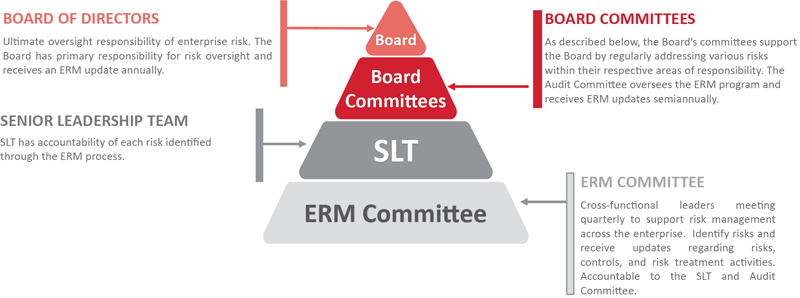
Board Committees
The Audit Committee focuses on financial risks, including reviewing with management the Company’s internal audit function and the Company’s independent registered public accounting firm, the Company’s major risk exposures (with particular emphasis on financial risk exposures), the adequacy and effectiveness of the Company’s accounting and financial controls and the steps management has taken to monitor and control such exposures, including the Company’s risk assessment and risk management policies. The Audit Committee also oversees the Company’s Ethics and Compliance program, including the confidential whistleblower hotline and procedures for the receipt, retention and treatment of complaints, compliance with, and training on, the Code of Ethics and compliance with legal and regulatory requirements. Additionally, the Audit Committee oversees the Company’s ERM program and receives a comprehensive ERM report from management on a semiannual basis. See “—Enterprise Risk Management Committee” below for additional detail.
The Compensation and Human Capital Committee considers risks presented by the Company’s compensation policies and practices for its executive officers and other employees, as discussed below under the caption “Compensation Governance—Compensation Risk Assessment,” as well as succession planning relating to the Chief Executive Officer and other executives.
The Nominating and Corporate Governance Committee reviews risks related to the Company’s corporate governance structure and processes, including director qualifications and independence, stockholder proposals related to corporate governance and the effectiveness of our Corporate Governance Guidelines.
The Technology Committee provides oversight with respect to the Company’s technology risk management, assessment and exposures, including information technology, cybersecurity, data and fraud risks. The Technology Committee receives regular updates from the Company’s Chief Information Officer and Chief Information Security Officer regarding the Company’s technology and cybersecurity risk management strategies, the cyber threat landscape, industry trends and other relevant technology risk topics. Management also provides the Technology Committee with detailed reports regarding the Company’s technology priorities and initiatives to ensure that its technology and cybersecurity risk management strategies remains current and aligned with the Company’s overall business strategy.
The Corporate Social Responsibility Committee reviews risks related to the Company’s CSR strategic initiatives, including matters such as animal care and welfare, food safety and quality, responsible sourcing and other supply chain matters, sustainable packaging, food waste, energy use, greenhouse gas emissions, climate risk, water use and the workforce culture and inclusion.
Each of these committees reports directly to the Board on a regular basis, including updates regarding such risks as and when appropriate.
30 The Wendy’s Company 2026 Proxy Statement
The Board believes that its current leadership structure supports the risk oversight function of the Board. Having the roles of Chief Executive Officer and Chairman filled by separate individuals allows the Chief Executive Officer to lead senior management in its supervision of the Company’s day-to-day business operations, including the identification, assessment, and mitigation of material risks, and allows the Chairman to lead the Board in its oversight of the Company’s risk assessment and risk management activities.
Senior Leadership Team
The Company’s senior leadership team has accountability for each risk identified through the ERM program (as described in greater detail below) and provides management oversight of key risk management, treatment and response activities. Further, the senior leadership team regularly attends meetings of the Board and its committees and discusses with the Board and its committees the Company’s key risks, management action plans to monitor and address risk exposures and resource allocation decisions to support risk mitigation. Board and committee meetings also provide an opportunity for the directors to discuss issues with, and provide guidance to, the senior leadership team.
Enterprise Risk Management Committee
The Company’s ERM program is supported by an internal Enterprise Risk Management Committee composed of a cross-functional group of management, departmental leaders and other personnel who support risk management across of the Company. The ERM program, which is designed to identify current and potential risks facing the Company and ensure that actions are taken as and when appropriate to manage and mitigate those risks, includes an annual risk assessment, assignment of accountability for risk management and development of risk treatment strategies. The Enterprise Risk Management Committee meets quarterly to discuss the Company’s risks and risk management efforts, engage in and promote ERM discussions to foster a culture of risk-based decision making, receive periodic updates regarding identified risks, controls, and risk treatment activities, monitor the external risk landscape and internal factors that influence the Company’s risk universe, identify risks within the functional business areas of operation, and promote a consistent and comprehensive approach to managing risk across the Company. Cybersecurity risks are integrated into the ERM program to align the Company’s cybersecurity risk management strategy with the Company’s broader business goals and objectives. The Audit Committee receives a comprehensive ERM report from management on a semiannual basis and discusses the results with the full Board, which is ultimately responsible for oversight of the Company’s ERM process. In addition, the Board also receives a comprehensive ERM report from management on an annual basis.
BOARD’S ROLE IN SUCCESSION PLANNING
As reflected in our Corporate Governance Guidelines, one of the key responsibilities of the Board of Directors is planning for Chief Executive Officer succession. Succession planning addresses both contingency planning for emergencies (such as death or disability) and succession in the ordinary course of business. The Board’s goal is to ensure senior leadership continuity by overseeing the development of executive talent and planning for the efficient succession of the Chief Executive Officer. The Board has delegated oversight responsibility for succession planning to the Compensation and Human Capital Committee, which periodically reviews succession plans and makes recommendations to the Board in the event of an emergency or the departure of the Chief Executive Officer.
In July 2025, Kirk Tanner resigned from his position as the Company’s President and Chief Executive Officer after approximately 16 months in the role. Subsequently, consistent with its regular and ongoing succession planning, the Board appointed Ken Cook, the Company’s Chief Financial Officer, to the additional role of Interim Chief Executive Officer. In connection with the CEO transition process, the Board promptly formed an ad hoc CEO Selection Committee, chaired by an independent director, to launch a comprehensive recruitment and selection process to select a permanent Chief Executive Officer. Supported by a leading global executive search firm, the Board and the CEO Selection Committee is continuing with its process to evaluate a strong slate of internal and external candidates with the experience and leadership capabilities required to guide the Company through its next phase of growth.
In addition to Chief Executive Officer succession planning, the Board of Directors conducts a periodic review of executive succession plans. During this review, the Board discusses a variety of topics with the Chief Executive Officer and Chief People Officer, including organizational needs, competitive challenges, candidates for senior leadership positions, succession timing for those positions and development plans for high-potential candidates.
The Wendy’s Company 2026 Proxy Statement 31
BOARD AND COMMITTEE EVALUATIONS
Pursuant to our Corporate Governance Guidelines, the Board of Directors and its committees conduct annual self-evaluations under the direction of the Nominating and Corporate Governance Committee. The evaluations provide the Board and its committees with an opportunity to evaluate their performance for the purpose of improving Board and committee processes and effectiveness.
As part of the Board’s self-evaluation, each of the Company’s directors complete written questionnaires that allow them to consider and provide feedback on various issues, including the quality, scope and administration of Board meetings, Board structure and composition, committee composition, the Board’s oversight function, the Board’s role in the effectiveness of the Company’s strategy and performance, Board culture and accountability, the Board’s relationship with management, the Company’s organization and talent management, key priorities and the consideration of stockholder value and interests.
Committee self-evaluations are led by the respective committee chairs and include, among other topics, a review of the roles and responsibilities set forth in the committee charters, interactions with and information flow from management, the nature and scope of agenda items, the adequacy and efficiency of meetings, committee structure and composition, committee resources and the role of outside consultants and advisers. The results of the committee self-evaluations are discussed with the full Board.
STOCKHOLDER ENGAGEMENT
We believe ongoing engagement with our stockholders is an important component of strong corporate governance. In 2025, we had approximately 150 engagement interactions with 45 shareholders representing approximately 50% of our outstanding shares, to discuss a range of topics, including our financial results and outlook, business strategy and performance and capital allocation policy. We also engaged and communicated with stockholders throughout the year on a range of important corporate responsibility and governance topics, including Board composition, leadership and skills, risk management, stockholder rights, executive compensation practices, updates on the Company’s Good Done Right corporate responsibility strategy and other topics of interest.
The Company communicates with stockholders through a variety of means, including our Annual Meeting, quarterly earnings calls, investor outreach calls and roadshows, conferences, Investor Days and our corporate and Investor Relations websites, including The Square Deal™ Wendy’s Blog. We welcome and value input from all stockholders and encourage stockholders to reach out to our Investor Relations team.
We believe our engagement program empowers stockholders to provide feedback and raise any concerns with us and enables us to effectively respond to stockholder feedback in a transparent manner.
CORPORATE RESPONSIBILITY
“Good Done Right” is Wendy’s commitment to “Do the Right Thing” in the area of corporate responsibility. We are focused on three critical areas of our business—Food, Footprint and People—and our strategies include: (i) delivering high-quality food transparently; (ii) delivering more with less environmental impact; and (iii) fostering more inclusive workplaces and communities.
Progress Made in 2025
In 2025, we continued to make progress toward our ambition of building a stronger, more sustainable Wendy’s. During the year, we began collaborating in new ways across our industry to strengthen the resiliency of the U.S. supply chain to advance our efforts to source food responsibly and reduce our environmental footprint.
Investing in Resilient Supply Chains
| • | In late 2025, we joined the Legacy Landscapes Program, a rancher-focused initiative for improving livestock and land management practices across key beef-producing regions in Texas, Arizona, Colorado, Kansas, Missouri and Nebraska. This program provides financial and technical assistance to help ranchers implement adaptive grazing plans to improve rangeland management and ecosystem practices. With additional industry collaboration, the program aims to accelerate the journey to improve outcomes across the U.S. beef supply chain. |
32 The Wendy’s Company 2026 Proxy Statement
| • | We also partnered with AgSpire to launch the Fresh Resilience Beef Cattle Program. This program focuses on supporting small- and medium-sized cattle producers in the Central Plains and Midwest to improve their nutrient optimization, feed efficiency and overall operational resiliency. Through this initiative, participating operations receive technical guidance, tools and financial incentives to strengthen their businesses against weather, market and other disruptions. The program is also designed to improve yield and reduce greenhouse gas emissions. |
| • | Together, these investments reflect our belief that meaningful change in the food system requires partnership and collaboration across the entire supply chain. By helping advance resilient beef production, we are working to ensure that our iconic hamburgers continue to represent quality and reflect responsible business practices. |
Supporting Our Communities and Improving Our Environmental Footprint
| • | Wendy’s continued its support for communities throughout our restaurant footprint, with charitable giving programs that support foster care adoptions, hunger and food integrity, youth and families, and vibrant communities. In 2025, Wendy’s continued expanding opportunities for employees and customers to support the Dave Thomas Foundation for Adoption, a public charity created by our founder, Dave Thomas, which has been our signature charitable cause for more than 30 years. Our Frosty 5K Run for Adoption drew record participation and the Round Up for Adoption program continues to expand across the Wendy’s system. |
| • | We also remain committed to ensuring that any new packaging we introduce is sustainably sourced. Our new chicken tenders menu item, launched in late 2025, features new packaging aligned to the Sustainable Forestry Initiative’s (SFI) “certified sourcing” standard, meaning the fiber in the packaging comes from responsibly managed forest lands. This milestone builds on our prior transitions of beverage cups, fry cartons, chili cups and bakery bags to be sustainably sourced. |
Looking Ahead
We regularly engage with our key stakeholders, including customers, employees, franchisees, stockholders, suppliers and non-governmental organizations, on our Good Done Right strategy, and we encourage stockholders to reach out to our Corporate Social Responsibility team with any questions or comments. We are committed to transparency and intend to continue to regularly report on our sustainability progress, including in our annual Corporate Responsibility report. We anticipate that our 2025 Corporate Responsibility report will be published in April 2026.
Additional information about our corporate responsibility initiatives is available on our website at www.wendys.com/csr-what-we-value, in our annual Corporate Responsibility report and on The Square DealTM Wendy’s Blog at www.wendys.com/blog. The contents of our website and these additional information sources are not incorporated by reference in this Proxy Statement or any other report or document we file with the SEC.
The Wendy’s Company 2026 Proxy Statement 33
• |
May not trade in Company securities if they are aware of material nonpublic information; |
• |
May not trade in the securities of another company if they are aware of material nonpublic information about that company which was obtained during the course of their employment with the Company; |
• |
May not share material nonpublic information with others or recommend to anyone the purchase or sale of any securities when they are aware of material, undisclosed information; and |
• |
Must comply with certain pre-clearance and blackout procedures described in the policy. |
COMPENSATION GOVERNANCE
COMPENSATION RISK ASSESSMENT
As part of the Board’s risk oversight function, the Compensation and Human Capital Committee conducts an annual review of compensation-related risk. In February 2026, the Compensation and Human Capital Committee and its independent advisers met with management to review management’s conclusion that the Company’s compensation policies and practices for its employees do not create risks that are reasonably likely to have a material adverse effect on the Company. Management reviewed with the Compensation and Human Capital Committee the various factors underlying management’s conclusion, including the performance objectives and target levels used in connection with the Company’s incentive awards, as well as the features of the Company’s compensation plans that are designed to mitigate compensation-related risk, including the following:
| • | Plan and award metrics are tied directly to the Company’s key performance measures, such as earnings, sales, profitability and stockholder return; |
| • | Various methods for delivering compensation are utilized, including cash-based and equity-based incentives with different time horizons that are designed to provide a balanced mix of both short-term and long-term incentives; |
| • | Performance-based awards have fixed maximum payouts; |
| • | The Company has the right to reduce or eliminate payouts under incentive awards through the use of negative discretion, including if a participant’s behavior is in conflict with the Company’s Code of Ethics or any other Company policy or procedure; |
| • | Annual incentive payouts are not made until the Company’s financial statements have been audited by the Company’s independent registered public accounting firm and plan results are certified by the Chief Financial Officer; and |
| • | All incentive awards granted under the 2020 Omnibus Award Plan contain clawback provisions in favor of the Company, including in the event a participant has engaged in “detrimental activity” (as defined in such plan). |
With respect to the Company’s compensation program for executive officers, the Compensation and Human Capital Committee concluded that this program is appropriately designed to support the Company’s business objectives by linking executive compensation to the Company’s attainment of annual and multiyear operating, financial and strategic goals, individual performance and the creation of long-term stockholder value. The executive compensation program includes the following features that are designed to prevent risk-taking that could have a material adverse effect on the Company:
| • | Base salaries represent a sufficient component of executives’ total cash compensation so that excessive risk-taking that may be associated with performance-based compensation is mitigated; |
| • | Performance goals and metrics under the Company’s annual incentive plan are closely linked to the Company’s annual financial planning process and are based upon realistic operating levels that can be attained without taking inappropriate risks or deviating from normal operations or approved strategies; |
| • | Long-term equity incentive awards are based upon the Company’s performance over a multiyear period, which mitigates against the taking of short-term risk; |
| • | Incentive compensation plan design allows for adjustment of performance metrics for nonrecurring and unusual items or events so that executives are rewarded based on the Company’s actual operating results; |
| • | Equity-based awards represent a significant portion of executives’ total compensation, which links executive compensation to the long-term value of our Common Stock; |
| • | Executive officers are subject to the Company’s clawback policy providing for the Company’s recoupment of certain incentive-based compensation in the event that the Company is required to prepare an accounting restatement due to its material noncompliance with any financial reporting requirement under applicable securities laws; and |
| • | The Board of Directors adopted our Stock Ownership and Retention Guidelines for Executive Officers and Directors that require significant stock ownership by executives, which further aligns the interests of executives with the interests of stockholders. |
The Wendy’s Company 2026 Proxy Statement 35
AUTHORITY TO DELEGATE
The Compensation and Human Capital Committee and the Subcommittee each may delegate authority to subcommittees composed of one or more of its members, and also may delegate authority to its Chair when it deems appropriate, subject to the terms of its charter. The Compensation and Human Capital Committee and the Subcommittee also may delegate to one or more Company directors or officers the authority to make grants of equity-based compensation to eligible employees who are not executive officers, subject to the terms of the Company’s compensation plans and applicable legal and regulatory requirements. Any director or officer to whom the Compensation and Human Capital Committee or the Subcommittee grants such authority must regularly report any grants so made, and the Committee or the Subcommittee may revoke any delegation of authority at any time.
ROLE OF COMPENSATION CONSULTANTS IN THE EXECUTIVE COMPENSATION PROCESS
In carrying out its responsibilities, the Compensation and Human Capital Committee periodically reviews and evaluates the components and competitiveness of the Company’s executive compensation program, using information drawn from a variety of sources, including information provided by outside compensation consultants, legal counsel and other advisers, as well as the Committee’s own experience in recruiting, retaining and compensating executives. The Compensation and Human Capital Committee has the sole authority to retain and oversee the work of outside compensation consultants, legal counsel and other advisers in connection with discharging its responsibilities, including the sole authority to determine such consultants’ or advisers’ fees and other retention terms. The Company provides such funding as the Compensation and Human Capital Committee determines to be necessary or appropriate for payment of compensation to consultants and advisers retained by the Committee.
Since December 2009, the Compensation and Human Capital Committee has engaged Frederic W. Cook & Co., Inc. (“FW Cook”) to serve as its independent outside compensation consultant. Representatives from FW Cook regularly attend Compensation and Human Capital Committee meetings and provide advice to the Committee on a variety of compensation-related matters. The Compensation and Human Capital Committee seeks input from FW Cook on competitive market practices, including evolving trends and best practices. During 2025, FW Cook assisted the Compensation and Human Capital Committee with respect to the design of the Company’s executive compensation program and determination of compensation levels thereunder, including base salary levels, the 2025 annual cash incentive and long-term equity incentive awards and the overall mix of total direct compensation for the Chief Executive Officer and other senior executives. FW Cook also advised the Compensation and Human Capital Committee in connection with the: Compensation Discussion and Analysis; Pay Versus Performance and other compensation-related disclosures in the Company’s Proxy Statement; Company’s peer group; review of special compensatory actions, including the awards to Mr. Cook in connection with his appointment as Interim Chief Executive Officer in July 2025; one-time equity-based retention awards to certain of the Company’s executive officers to maintain continuity of key executives and ensure a smooth leadership transition following a change in Chief Executive Officer and the compensation package offered to Mr. Suerken in connection with the succession of the President, U.S. role in July 2025; design of and modifications to the executive compensation program for 2026; and review of the proposed increase to the share reserve for the Company’s 2020 Omnibus Award Plan. At the request of the Compensation and Human Capital Committee, FW Cook periodically reviews the compensation components and levels of the Company’s executive officers and advises the Committee on the appropriateness of the Company’s executive compensation program in the context of its overall compensation philosophy. Under the terms of its engagement, FW Cook does not provide any other services to the Company and works with management only on matters for which the Compensation and Human Capital Committee has oversight responsibility. The Compensation and Human Capital Committee has assessed the independence of FW Cook pursuant to applicable SEC and Nasdaq rules (including consideration of the six independence factors specified in Nasdaq Listing Rule 5605(d)(3)(D)) and concluded that no conflict of interest exists that would prevent FW Cook from serving as an independent compensation consultant to the Committee.
Management provides information and makes recommendations to the Compensation and Human Capital Committee from time to time regarding the design of the Company’s executive compensation program. In formulating its recommendations, management reviews information from a variety of sources, including information provided by outside compensation consultants. During 2025, management engaged Willis Towers Watson to serve as management’s outside compensation consultant. Willis Towers Watson provided market data and other information to management in connection with the design of the Company’s executive compensation program, including a review of base salary, total cash compensation and total direct compensation levels for the Chief Executive Officer and other senior executives. Certain of the market data and other information provided by Willis Towers Watson was also made available to the Compensation and Human Capital Committee and FW Cook.
36 The Wendy’s Company 2026 Proxy Statement
ROLE OF MANAGEMENT IN THE EXECUTIVE COMPENSATION PROCESS
The Company’s executive officers provide support and assistance to the Compensation and Human Capital Committee and the Subcommittee on a variety of compensation-related matters. Each year, the Chief Executive Officer and other senior executives provide input to the Committee and the Subcommittee regarding the design of the Company’s annual incentive plan and long-term incentive plan, including proposed performance goals and objectives and a list of participants eligible to receive awards. The Committee and the Subcommittee, as appropriate, then determine the structure and components of the annual cash incentive and long-term equity incentive awards after considering management’s recommendations, as well as input from FW Cook. With respect to performance-based awards, following the completion of each performance period, the Chief Financial Officer provides the Subcommittee with a certification of the Company’s actual performance relative to the stated performance goals and the resulting payouts to participants based on such performance. The Committee and the Subcommittee, as appropriate, then determine the actual incentive payouts to eligible participants after taking into account Company performance and any other relevant facts and circumstances.
The Chief Executive Officer and other members of management with expertise in compensation, benefits, tax, accounting, financial reporting, legal and other matters provide information and make recommendations to the Compensation and Human Capital Committee from time to time on compensation-related matters, including proposed employment, retention, relocation, severance and other compensatory arrangements, base salary levels, annual incentive plans, long-term equity incentive awards, annual compensation risk assessments and evolving trends and best practices in executive compensation. Management also presents information to the Compensation and Human Capital Committee regarding the Company’s business and financial performance, strategic initiatives, legal and regulatory developments and other relevant matters. In accordance with applicable Nasdaq rules, the Chief Executive Officer may not be present during any voting or deliberations by the Committee or Subcommittee with respect to his compensation.
COMPENSATION COMMITTEE INTERLOCKS AND INSIDER PARTICIPATION
Five non-management directors served on the Compensation and Human Capital Committee during 2025: Mses. Arlin and Mathews-Spradlin and Messrs. Gomez, May and Rothschild.
During 2025: (i) no member of the Compensation and Human Capital Committee had ever served as an officer or employee of the Company, except that Mr. May served as President and Chief Operating Officer of the predecessor to the Company from April 1993 to June 2007; (ii) no member of the Compensation and Human Capital Committee was party to any related person transaction or other relationship requiring disclosure under Item 404 of SEC Regulation S-K, except that (a) Mr. May is the President and a Founding Partner of Trian Partners, which is a significant and long-term stockholder of the Company and party to that certain agreement with the Company described under the caption “Certain Relationships and Related Person Transactions” and (b) certain family members of Mr. May hold indirect, minority ownership interests in operating companies managed by Yellow Cab Holdings, LLC, a Wendy’s franchisee, as further described under the caption “Certain Relationships and Related Person Transactions”; and (iii) none of the Company’s executive officers served as a member of the compensation committee (or other committee performing similar functions or, in the absence of any such committee, the entire board of directors), of any other entity of which an executive officer of such other entity served on the Company’s Board of Directors, the Compensation and Human Capital Committee or the Subcommittee.
The Wendy’s Company 2026 Proxy Statement 37
COMPENSATION COMMITTEE REPORT*
The Compensation and Human Capital Committee has reviewed and discussed the following Compensation Discussion and Analysis with the Company’s management and, based on such review and discussions, has recommended to the Board of Directors that the Compensation Discussion and Analysis be included in this Proxy Statement and incorporated by reference into the Company’s Annual Report on Form 10-K for the fiscal year ended December 28, 2025.
The Compensation and Human Capital Committee:
Peter H. Rothschild, Chair
Wendy C. Arlin
Richard H. Gomez
Michelle J. Mathews-Spradlin
Peter W. May
| * | This Compensation Committee Report does not constitute soliciting material and should not be deemed filed or incorporated by reference into any Company filing under the Securities Act of 1933, as amended, or the Securities Exchange Act of 1934, as amended, except to the extent the Company specifically incorporates this Compensation Committee Report by reference into such other filing. |
38 The Wendy’s Company 2026 Proxy Statement
COMPENSATION DISCUSSION AND ANALYSIS
In this Compensation Discussion and Analysis, we refer to certain non-GAAP financial measures (adjusted EBITDA and free cash flow) when describing our financial and operational results during 2025. Please refer to Annex A to this Proxy Statement for further discussion regarding non-GAAP financial measures and for reconciliations of these non-GAAP financial measures to our results as reported under accounting principles generally accepted in the United States (“GAAP”).
This Compensation Discussion and Analysis describes the Company’s executive compensation objectives, philosophy and practices and discusses the compensation that was awarded during 2025 to our Named Executive Officers. To enable easier navigation, we have organized the disclosure into the following sections:
| TABLE OF CONTENTS |
| |
| 39 | ||
| 40 | ||
| 41 | ||
| 43 | ||
| 44 | ||
| 44 | ||
| 45 | ||
| 8. Guiding Principles for Annual and Long-Term Incentive Plans |
46 | |
| 46 | ||
| 47 | ||
| 53 | ||
| 54 | ||
| 55 | ||
1. OUR 2025 YEAR IN REVIEW
Business Performance
In 2025, we began work on Project Fresh, our comprehensive strategic plan to revitalize the Wendy’s brand, reignite growth in the U.S. business, accelerate profitability across the Wendy’s system and enhance stockholder value. Project Fresh is organized around four key pillars of (i) brand revitalization, (ii) operational excellence, (iii) system optimization and (iv) capital allocation. We have begun making meaningful progress against the pillars of Project Fresh and have seen sustained momentum in our International business. Our plan is in place and we are working with urgency to improve our U.S. business and position Wendy’s for long-term success. In 2025, we saw:
| • | Global same-restaurant sales growth1 of (4.7)%; |
| • | Global systemwide sales of approximately $14.0 billion, a year-over-year decrease of 3.5%; |
| • | Operating profit of $343.5 million, net income of $165.1 million and adjusted EBITDA2 of $522.4 million, a year-over-year decrease to adjusted EBITDA of 3.9%; |
| • | Net cash provided by operating activities of $344.5 million and free cash flow2 of $205.4 million, a year-over-year decrease to free cash flow of 13.6%; |
| 1 | Global same-restaurant sales growth and systemwide sales growth are calculated on a constant currency basis and include sales by both Company-operated and franchise restaurants. |
| 2 | Non-GAAP financial measure. Please refer to Annex A for a reconciliation of non-GAAP financial measures. |
The Wendy’s Company 2026 Proxy Statement 39
| • | Net unit growth of 2.2%, reflecting 268 total restaurant openings and 157 net restaurant openings during 2025; and |
| • | U.S. Company-operated restaurant margin of 14.2%, a decline of 180 basis points compared to 2024. |
Executive Compensation Program and Payouts
Consistent with the Company’s philosophy of pay-for-performance, the Company’s business and financial results and stockholder returns were reflected in the performance-based compensation delivered to our executives.
Annual Incentive Compensation
The Compensation and Human Capital Committee of our Board of Directors (referred to in this Compensation Discussion & Analysis section as the “Committee”) set rigorous goals under our executive compensation program to align pay with performance and, based on the Company’s adjusted EBITDA, global same-restaurant sales growth and global net unit growth, the annual cash incentive for the NEOs paid out at 39.6% of target. See “—Compensation Decisions for 2025—Annual Cash Incentive Compensation” for additional details on the design and results of the 2025 annual incentive plan.
Long-Term Equity Compensation
With respect to long-term equity compensation, the performance unit awards granted to executives who were employed by the Company in February 2023 vested at 36.1% of target based on the Company’s relative total stockholder return and cumulative free cash flow performance over the three-year performance period beginning January 2, 2023 and ending December 28, 2025. See “—Additional Compensation Decisions—Vesting of 2023 Performance Unit Awards” for additional details.
2. NAMED EXECUTIVE OFFICERS (NEOS)3
| NAME | POSITION | |
| Ken Cook |
Interim Chief Executive Officer and Chief Financial Officer | |
| Pete Suerken |
President, U.S. | |
| E.J. Wunsch |
President, International | |
| John Min |
Chief Legal Officer and Secretary | |
| Kirk Tanner |
Former President and Chief Executive Officer | |
| 3 | Reflects our named executive officers (“NEOs”) for fiscal year 2025, as defined in Item 402(a)(3) of SEC Regulation S-K. Mr. Tanner resigned from the Company in July 2025. See “—Leadership Changes and Related Compensation Actions” and “Employment Arrangements and Potential Payments Upon Termination or Change in Control” for additional details. For purposes of identifying our NEOs, compensation to any former officers who were terminated without “cause” does not include the value of their outstanding equity awards, all of which were previously disclosed, because such awards were not materially modified in connection with their departures. |
40 The Wendy’s Company 2026 Proxy Statement
3. LEADERSHIP CHANGES AND RELATED COMPENSATION ACTIONS
Executive Transitions
In mid-2025, the Company experienced a transition in the Chief Executive Officer role. As previously disclosed, Kirk Tanner resigned from his position of President and Chief Executive Officer in July 2025. At that time, the Board appointed Ken Cook, our Chief Financial Officer, to the additional role of Interim Chief Executive Officer. The Board, led by an ad hoc CEO Selection Committee, launched a comprehensive search process to select a permanent CEO. Supported by a leading global executive search firm, the Board is continuing with its process to evaluate a strong slate of internal and external candidates with the experience and leadership capabilities required to guide Wendy’s through its next phase of growth.
Furthermore, in July 2025, the Company appointed Pete Suerken as the Company’s new President, U.S., succeeding Abigail Pringle. The Company believes Mr. Suerken is well-positioned to lead the U.S. business with the operational skills, experience and intensity necessary to deliver exceptional customer experiences, increase restaurant-level profitability and accelerate growth for the U.S. business, which are crucial objectives to help the Company achieve our long-term strategic priorities to create value for our franchisees, employees and stockholders.
In connection with these leadership changes, the Committee and Subcommittee, in consultation with FW Cook, its independent outside compensation consultant: (i) adjusted the compensation of Mr. Cook to reflect his appointment as Interim Chief Executive Officer; (ii) approved the employment and compensation terms for Mr. Suerken in connection with his hiring; and (iii) granted one-time equity-based retention awards (the “Retention Awards”) to the Company’s continuing executive officers (other than Mr. Cook and Mr. Suerken) to maintain continuity of key executives and ensure a smooth leadership transition following a change in Chief Executive Officer.
Interim Chief Executive Officer Compensation Actions
As previously disclosed, the Committee and Subcommittee, in consultation with its independent outside compensation consultant, approved the following changes to Mr. Cook’s compensation in connection with his appointment as the Company’s Interim Chief Executive Officer:
| • | Base Salary. Increased his annual base salary to $825,000 per year during his service as the Company’s Interim Chief Executive Officer. |
| • | Annual Cash Incentive Compensation. Increased the target for his annual, performance-based cash incentive under the Company’s annual incentive plan to 100% of his annual base salary (effective for the 2025 annual incentive plan without proration). |
| • | One-Time Equity Award. A long-term incentive award with a grant date fair value of $2.0 million, three-quarters of which consisted of restricted stock units and one-quarter of which consisted of stock options, all vesting in substantially equal installments on each of the first two anniversaries of the grant date, subject to Mr. Cook’s continued employment through the applicable vesting dates. |
In structuring Mr. Cook’s compensation adjustments, the Committee considered: (i) competitive market data with respect to similar interim CEO scenarios; (ii) Mr. Cook’s substantial additional responsibilities; (iii) the value and vesting schedule of unvested equity awards held by Mr. Cook; and (iv) the continued alignment of Mr. Cook’s interests with those of the Company’s stockholders.
In approving Mr. Cook’s one-time equity award, the Subcommittee considered competitive market data and noted that the award supported talent retention at a critical time and was exclusively in the form of variable compensation, with no cash component, and value dependent on the Company’s financial and operational success, which aligns Mr. Cook’s one-time equity award with the interests of our stockholders.
Mr. Tanner did not receive any severance benefits in connection with his resignation as President and Chief Executive Officer and he forfeited all of his unvested equity awards.
President, U.S. Compensation Actions
In connection with his appointment as the Company’s new President, U.S., Mr. Suerken entered into an employment letter that provided for the following:
| • | Base Salary. An annual base salary of $750,000 per year, subject to annual review by the Committee. |
The Wendy’s Company 2026 Proxy Statement 41
| • | Annual Cash Incentive Compensation. Eligibility for an annual, performance-based cash incentive under the Company’s annual incentive plan with a target equal to 100% of his annual base salary. With respect to the 2025 performance year only, Mr. Suerken was guaranteed a payment at the higher of target or actual performance, prorated based on Mr. Suerken’s full calendar months of employment with the Company from his start date. The Committee approved this structure for 2025 to encourage Mr. Suerken to join the Company mid-year, during a period of uncertainty and on the Company’s desired timeline, protect against lost opportunity versus that provided by his prior employer and provide an incentive to work hard toward overachieving the Company’s target goals without having to adopt a special set of mid-year performance goals. The Committee also noted that guaranteeing an award at no less than target in the initial year of employment is a common market practice, especially for mid-year hires who are forfeiting an opportunity at a prior employer. |
| • | Long-Term Equity Incentive Compensation. For fiscal year 2025, a long-term incentive award with a grant date fair value of $1.325 million (comprised of $725,000 of performance share units, $375,000 of stock options and $225,000 of restricted stock units), on the same terms made available to other senior executives under the Company’s executive compensation program for 2025. |
| • | One-Time Make-Whole Award. To make up for compensation that Mr. Suerken forfeited by leaving his prior employer, the Company granted Mr. Suerken a one-time equity award with a grant date fair value of $1.5 million, comprised of restricted stock units that will vest in full on the second anniversary of the grant date. The grant date fair value of the one-time equity award was intended to match the estimated value that Mr. Suerken would forfeit by leaving his prior employer and did not include any value on top of the projection of value that Mr. Suerken would be forfeiting. Recognizing that Mr. Suerken joined in the middle of a CEO transition, and because this award represented exclusively a buyout of compensation he forfeited and would have otherwise earned had he remained with his prior employer, the award provides for accelerated vesting in the event of a Company-initiated termination without “cause.” In approving this one-time award, the Subcommittee noted that the one-time award was exclusively in the form of variable compensation, with no cash component, and value dependent on the Company’s financial and operational success. |
Retention Awards
As described above, in July 2025, following the departure of Mr. Tanner and the succession of the President, U.S. role, the Subcommittee approved the Retention Awards to the Company’s continuing executive officers (other than Mr. Cook and Mr. Suerken) to maintain continuity of key executives and ensure a smooth leadership transition in connection with the interim CEO appointment. In making the determination to grant the Retention Awards, the Committee and Subcommittee consulted with its independent outside compensation consultant and considered a number of factors, including: (i) market data regarding the impact of retention awards on voluntary departure rates of NEOs after a CEO transition; (ii) market data on the size and vesting terms of retention awards in similar CEO transition scenarios; (iii) the value and vesting schedule of unvested equity awards held by the Company’s executive officers; and (iv) the criticality of each key executive to a smooth transition of leadership.
After considering these factors, the Subcommittee approved the grant of the Retention Awards to the Company’s executive officers (other than Mr. Cook and Mr. Suerken), with three-quarters of each award in the form of restricted stock units and one-quarter of each award in the form of stock options, all vesting in substantially equal installments on each of the first two anniversaries of the grant date, subject to executive’s continued employment through the applicable vesting dates. The Subcommittee decided on the mix of restricted stock units and stock options to drive talent retention and to tie value to changes in stockholder value.
The grant date fair value of the Retention Awards granted to our NEOs included:
| • | E.J. Wunsch (President, International): $1,520,000 |
| • | John Min (Chief Legal Officer and Secretary): $1,115,000 |
As described in further detail above, in granting the Retention Awards to our executive officers, the Subcommittee (i) considered multiple strategic factors and (ii) used variable compensation in the form of equity-based awards to maintain alignment of interest between our executives and our stockholders.
42 The Wendy’s Company 2026 Proxy Statement
4. A PHILOSOPHY OF PAY-FOR-PERFORMANCE
Objectives of the Executive Compensation Program
The compensation program for the Company’s executives is designed to support the Company’s business objectives by linking executive compensation to the Company’s attainment of annual and multiyear operating and financial goals, individual performance and the creation of long-term stockholder value. The primary objectives of the executive compensation program are to:
| • | Attract and retain highly qualified executives; |
| • | Motivate and reward executives for achieving Company and individual performance goals and objectives; and |
| • | Align the interests of executives with the interests of the Company’s stockholders. |
Emphasis on Variable Compensation
The Committee believes that a substantial portion of the total compensation for executives should be variable and tied to Company performance. Variable compensation is dependent on our financial and operational success and the achievement of strategic business objectives that create value for our stockholders. This pay-for-performance philosophy aligns executive pay with the Company’s business objectives and ensures that executives are responsive and accountable to stockholder interests.
Total direct compensation for executives is composed of three elements: (i) base salary; (ii) annual cash incentives; and (iii) long-term equity incentives. The following charts illustrate how these three components (at targeted levels of performance) were allocated for 2025 to create the overall pay mix for Mr. Cook, the Company’s Interim Chief Executive Officer and Chief Financial Officer, and the other NEOs as a group.
The pay mixes shown above exclude the value of the one-time award given to Mr. Suerken, who joined the Company in 2025. “Other NEO Pay Mix” does not reflect compensation paid to Mr. Tanner, who departed the Company in 2025.
As reflected in the charts above, variable incentive compensation that is dependent on the Company’s performance constitutes the most significant portion of target total direct compensation for executives, consistent with the Company’s pay-for-performance philosophy. By utilizing a high proportion of variable, performance-based compensation, the executive compensation program offers executives an opportunity for increased compensation in the event of successful Company performance, matched with the prospect of reduced compensation if Company performance goals are not achieved. This type of variable, performance-based compensation is substantially dependent on our financial and operational results and, with respect to our long-term equity awards, the performance of our Common Stock, which are important components of our executive compensation strategy. This compensation framework establishes a strong alignment between our executive compensation and the interests of our stockholders and supports our ability to attract, motivate and retain executive talent by rewarding our executives when they generate value for our stockholders. Our pay-for-performance strategy has resulted in executive compensation that we believe is reasonable and aligned with achievement of the Company’s business objectives.
Our executives’ 2025 incentive structure was based on several key performance measures under our annual and long-term incentive plans, with the largest portion of compensation tied to equity awards that vest over a multiyear period to drive strong alignment with stockholder interests. See “—Incentive Compensation Performance Measures for 2025” below for additional details.
The Wendy’s Company 2026 Proxy Statement 43
5. STRONG COMPENSATION GOVERNANCE AND STOCKHOLDER SUPPORT
Each year we conduct outreach and engage with our stockholders to discuss a range of topics, including executive compensation practices. See “Corporate Governance—Stockholder Engagement” for additional details regarding outreach to our stockholders. In May 2025, our stockholders expressed strong support of our executive compensation program through their annual say-on-pay advisory vote, with approximately 97% of the votes cast for approval of the compensation of our NEOs, the Company’s ninth straight year receiving over 95% support. The following table highlights key features of our executive compensation program that demonstrate the Company’s ongoing commitment to promoting stockholder interests through sound compensation governance practices.
|
WHAT WE DO
|
WHAT WE DON’T DO
| |||||
|
|
Hold an annual say-on-pay advisory vote for stockholders. |
| ||||
|
|
Use an appropriate mix of cash and non-cash compensation, with an emphasis on variable, performance-based compensation. |
|||||
|
|
Engage independent outside compensation consultants and utilize market, industry and peer group data to ensure we compensate fairly and competitively, but not excessively. |
|||||
|
|
Set meaningful performance goals at the beginning of annual and multiyear performance periods. |
|||||
|
|
Balance short-term and long-term compensation to discourage short-term risk-taking at the expense of long-term results. |
|||||
|
|
Mitigate undue risk-taking by utilizing multiple performance measures, imposing caps on individual payouts and performing an annual compensation risk assessment. |
|||||
|
|
Utilize comprehensive clawback policies that go beyond the minimum requirements of Nasdaq listing standards to cover detrimental conduct generally. |
|||||
|
|
Limit accelerated vesting of equity awards by requiring a “double trigger” upon a change in control. |
|||||
|
|
Set significant stock ownership and retention guidelines for the Chief Executive Officer and other executives. |
|||||
6. ELEMENTS OF EXECUTIVE COMPENSATION
The primary components of our executive compensation program are described in the following table.
| COMPONENT |
PURPOSE |
|||||
| Base Salary |
• Attract and retain highly qualified executives by providing a competitive level of fixed cash compensation that reflects the experience, responsibilities and performance of each executive.
|
|||||
| Annual Cash Incentives |
• Align executive pay with Company performance by motivating and rewarding executives over a one-year period based on the achievement of strategic business and financial objectives.
|
|||||
| Long-Term Equity Incentives |
• Align the interests of executives with the interests of stockholders and retain highly qualified executives by motivating and rewarding executives to achieve multiyear strategic business objectives.
• Create a direct link between executive pay and the long-term performance of our Common Stock.
|
|||||
| Perquisites and Benefits |
• Provide limited perquisites and benefits, consistent with competitive market practice.
|
|||||
44 The Wendy’s Company 2026 Proxy Statement
7. HOW EXECUTIVE COMPENSATION IS DETERMINED
On an annual basis, the Committee reviews the effectiveness of our executive compensation philosophy and program and the performance of our executives and establishes the executive compensation program for the current year. In determining the appropriate compensation package for executives, the Committee, in consultation with FW Cook, considers a number of factors, including: (i) Company and individual performance; (ii) scope of responsibilities and relative importance of each role; (iii) qualifications and experience; (iv) the Chief Executive Officer’s recommendations with respect to the performance and compensation of our other executive officers; (v) competitive market practice; (vi) internal pay equity; (vii) recruiting considerations; (viii) alignment with stockholder interests; and (ix) creation of long-term stockholder value.
The Committee believes that the consideration of these factors is effective in maintaining a strong link between executive compensation and Company performance and has been important in the Company’s ability to attract and retain a highly qualified and motivated leadership team.
Throughout the year, the Committee also reviews tally sheets prepared by management that quantify the elements of each executive’s total direct compensation. The Committee uses the tally sheets to ensure that compensation is evaluated based on a complete picture of each executive’s compensation, including accumulated equity value and potential severance.
Peer Group Companies and the Use of Competitive Market Data
In establishing compensation levels for executives, the Committee considers competitive market, industry and peer group data, including: (i) data from companies included in the Willis Towers Watson U.S. General Industry Executive Compensation Survey Report (“General Industry Data”) with a comparable revenue scope determined using a methodology that reflects both the Company’s revenue and a percentage of the Company’s systemwide revenue; (ii) data from the Chain Restaurant Total Rewards Association Executive and Management Compensation Survey Report (“Restaurant Industry Data”); and (iii) with respect to certain executive positions (including our Chief Executive Officer, Chief Financial Officer, President, U.S. and President, International), data from our industry peer group.4 This data is among several factors considered by the Committee in setting executive compensation each year, together with the other factors and considerations described above. The Committee generally sets target total direct compensation for our executives to be competitive with the market, industry and peer group data and other factors described above.
The Committee, with support from FW Cook, annually reviews and approves the composition of our peer group. As part of this review, the Committee considers specific criteria and recommendations from FW Cook regarding companies to be added or removed from the peer group. In selecting our peer group for 2025, the Committee considered companies from the restaurant industry that reported systemwide revenue (i.e., revenue from both Company-operated restaurants and franchised restaurants, as opposed to solely GAAP revenue at the Company level) and a market capitalization within a reasonable range of Wendy’s systemwide revenue and the Company’s market capitalization. The Committee generally favors comparisons to companies in the Restaurants sub-industry of the Global Industry Classification System over companies in other industries and sub-industries, and believes systemwide revenues better reflect the complexity of the Company’s operations than GAAP revenues because approximately 95% of Wendy’s restaurants are operated by franchisees. In contrast, a comparison based on GAAP revenue would not adequately reflect the significant size and complexity of the Company’s operations. The Committee also considered other factors, including, for example, whether the peer group company names Wendy’s as a peer, companies named as a peer by three or more of the Company’s peers, and whether the peer group company is a direct business competitor or competitor for talent.
| 4 | With respect to the Committee’s review of General Industry Data (1,075 companies) and Restaurant Industry Data (50 companies): (i) the Committee does not select the companies that provide information for the surveys; (ii) prior to being provided to the Committee, the aggregate survey data is size-adjusted using a methodology that reflects the Company’s global systemwide sales and revenue; and (iii) the Committee does not link information back to particular companies as the aggregate survey data is reported by executive position and not by company. The Committee utilizes this broad-based, third-party survey data to gain a general understanding of the current compensation practices and trends in the market and the restaurant industry. As described above, competitive market practice is only one of several factors considered by the Committee when approving the elements and amounts of compensation awarded to executives. |
The Wendy’s Company 2026 Proxy Statement 45
The industry peer group used for purposes of the Company’s 2025 executive compensation program included the companies identified in the following table.
| 2025 EXECUTIVE COMPENSATION PEER GROUP COMPANIES | ||||
| Bloomin’ Brands, Inc. (BLMN) |
Dine Brands Global, Inc. (DIN) | Restaurant Brands International Inc. (QSR) | ||
| Brinker International, Inc. (EAT) |
Domino’s Pizza, Inc. (DPZ) | Starbucks Corporation (SBUX) | ||
| Chipotle Mexican Grill, Inc. (CMG) |
Jack in the Box Inc. (JACK) | Texas Roadhouse, Inc. (TXRH) | ||
| Cracker Barrel Old Country Store, Inc. (CBRL) |
McDonald’s Corporation (MCD) | YUM! Brands, Inc. (YUM) | ||
| Darden Restaurants, Inc. (DRI) |
Papa John’s International Inc. (PZZA) |
| ||
The Company ranked between the 25th percentile and median in market capitalization and between the median and 75th percentile in systemwide revenues versus the industry peer group for 2025. The industry peer group is also used for competitive analyses of director compensation, as discussed under the caption “Compensation of Directors.”
8. GUIDING PRINCIPLES FOR ANNUAL AND LONG-TERM INCENTIVE PLANS
In February 2025, the Committee and the Subcommittee approved the 2025 annual cash incentive and long-term equity incentive compensation framework for executives. The design of the 2025 annual and long-term incentive plans was guided by the following key principles:
| • | Drive growth over the prior period. Growth over the prior period is generally required for incentive payouts. |
| • | Reward executives consistent with external outlook. Payout levels are designed to motivate and reward performance that is equal to or greater than the Company’s external outlook to align executives’ interests with those of our stockholders. |
| • | Align executive compensation with Company performance relative to restaurant industry competitors. Performance goals are established at the beginning of the performance period taking into consideration the recent and expected performance of the Company’s industry peers. |
| • | Establish challenging and appropriate incentive performance goals. Incentive design and payouts are structured to support achievement of the Company’s business and financial goals set forth in the Company’s annual operating plan, with achievement of performance targets resulting in target incentive payouts, underperformance resulting in reduced payouts and outperformance of business goals providing for additional compensation opportunities. |
9. INCENTIVE COMPENSATION PERFORMANCE MEASURES FOR 2025
In determining the appropriate incentive compensation award levels for our executives, the Committee and the Subcommittee consider the Company’s achievement of pre-established performance targets focused on a balanced mix of value-driving performance measures. For the 2025 incentive compensation program, the Committee and the Subcommittee approved performance measures designed to measure the Company’s earnings, sales growth, net unit growth, restaurant margin acceleration and stockholder returns, as shown in the following table.
| INCENTIVE COMPENSATION COMPONENT |
PERFORMANCE MEASURES
| |
| Annual Cash Incentive |
• Adjusted EBITDA
• Global Same-Restaurant Sales Growth
• Global Net Unit Growth
| |
| Performance Units – 60% of Long-Term Equity Incentives |
• Global Systemwide Sales Growth
• Global Company-Operated Restaurant Margin Acceleration
• Modifier Based on Total Stockholder Return Relative to Russell 3000 Restaurant Index
| |
46 The Wendy’s Company 2026 Proxy Statement
These performance measures and the framework of our executive compensation program are further discussed below under the caption “—Compensation Decisions for 2025.” The Committee and the Subcommittee determined that for 2025, these performance measures were appropriate and consistent with our executive compensation philosophy because the measures: (i) aligned with the earnings, sales, net unit growth and restaurant margin expectations of our Board, management and stockholders; (ii) served as key indicators of our business operating and strategic performance; and (iii) held our executives accountable for driving strong financial and strategic results and stockholder returns over annual and multiyear performance periods.
10. COMPENSATION DECISIONS FOR 2025
Base Salary
In February 2025, the Committee reviewed the base salaries for the Company’s executives, taking into account individual and Company performance, internal pay equity, the other factors described under the caption “—How Executive Compensation is Determined” and other considerations. After consulting with FW Cook and considering recommendations from the then-serving Chief Executive Officer with respect to other executives, the Committee approved the following annual base salary merit increases: Mr. Cook ($15,000), Mr. Wunsch ($15,000), Mr. Min ($15,000) and Mr. Tanner ($30,000). See “—Leadership Changes and Related Compensation Actions” above for information on the base salary for Mr. Suerken, who became a new executive officer of the Company in 2025, as well as information regarding an additional base salary increase for Mr. Cook in connection with his appointment as Interim Chief Executive Officer during the year.
Annual Cash Incentive Compensation
Design of the 2025 Annual Incentive Plan
In February 2025, the Committee approved the adoption of the 2025 annual incentive plan, including the replacement of free cash flow as a performance measure with global net unit growth (weighted at 20%).
The graphic below illustrates the weighting for the 2025 annual incentive plan:

In selecting these financial performance measures, the Committee determined that (i) adjusted EBITDA continues to incentivize the Company’s focus on driving operating profitability on an annual basis, (ii) continuing to utilize global same-restaurant sales growth was appropriate based on its importance to the Company’s objective to drive organic sales growth, which is generally measured and managed on a year-over-year basis, and (iii) replacing free cash flow with global net unit growth was appropriate based on the importance of expanding the Company’s global footprint to the Company’s long-term success. The Committee also noted that free cash flow is directly affected by the global systemwide sales growth and global Company-operated restaurant margin acceleration targets for the long-term incentive program.
The Wendy’s Company 2026 Proxy Statement 47
Results under the 2025 Annual Incentive Plan
The following table identifies the performance metrics, incentive opportunities and actual results achieved for the NEOs under the 2025 annual incentive plan.
RESULTS UNDER 2025 ANNUAL INCENTIVE PLAN
| PERFORMANCE METRIC |
WEIGHT | THRESHOLD (50% PAYOUT) |
TARGET (100% PAYOUT) |
MAXIMUM (200% PAYOUT) |
2025 ACTUAL ACHIEVEMENT |
2025 ACTUAL PAYOUT % |
WEIGHTED PAYOUT % | ||||||||||||||||||||||||||||
| Adjusted EBITDA5 |
50% | $530M | $560M | $620M | $530.7M | 51.2% | 25.6% | ||||||||||||||||||||||||||||
| Global Same-Restaurant Sales Growth6 |
30% | 0.25% | 1.58% | 2.75% | (4.69)% | 0.0% | 0.0% | ||||||||||||||||||||||||||||
| Global Net Unit Growth7 |
20% | 2.00% | 3.09% | 3.50% | 2.43% | 69.8% | 14.0% | ||||||||||||||||||||||||||||
|
|
|
||||||||||||||||||||||||||||||||||
| 2025 Total Payout % |
|
|
|
|
|
|
|
|
|
|
|
|
|
|
|
|
|
|
39.6% | ||||||||||||||||
|
|
|
||||||||||||||||||||||||||||||||||
Payouts under the 2025 Annual Incentive Plan
The following table shows the target opportunities and actual payouts for the NEOs under the 2025 annual incentive plan. The target payout levels are expressed as a percentage of base salary in effect as of the end of 2025. In no event may an executive’s payout exceed the maximum incentive award opportunity established for that individual. The actual payouts for the NEOs were approved by the Committee in February 2026 based on the Company’s 2025 adjusted EBITDA performance, global same-restaurant sales growth and global net unit growth.
| 5 | “Adjusted EBITDA” for purposes of the 2025 annual incentive plan is defined as earnings for fiscal 2025 before interest, taxes, depreciation and amortization, as adjusted (i) within the “Reconciliation of Net Income to Adjusted EBITDA” (or similarly titled non-GAAP reconciliation table) as presented in the Company’s fiscal 2025 earnings release and (ii) to exclude the impact of (A) any earnings impacts resulting from unplanned adjustments to the Company’s restaurant portfolio, except to the extent that the Committee concludes such exclusion should not be made, and (B) any specific non-recurring and unusual items or other adjustments, except to the extent that the Committee concludes such exclusion should not be made. For purposes of the 2025 annual incentive plan, the specific adjustments applied in calculating Adjusted EBITDA from the Company’s reported 2025 financial results are shown in Annex B. |
| 6 | “Global Same-Restaurant Sales Growth” for purposes of the 2025 annual incentive plan is defined as the increase in same-restaurant sales for fiscal 2025 versus fiscal 2024 for both Company-operated restaurants and franchised restaurants across the Wendy’s system, including both the U.S. and International. Same-restaurant sales are reported for new restaurants that have been open for 15 continuous months and for reimaged restaurants as soon as they reopen. Restaurants temporarily closed for more than one week are excluded from same-restaurant sales. Same-restaurant sales are calculated on a constant currency basis. Constant currency results exclude the impact of foreign currency translation and are derived by translating current year results at prior year average exchange rates. Same-restaurant sales exclude sales from countries with highly inflationary economies (i.e., cumulative inflation in excess of 100% over a three-year period). |
| 7 | “Global Net Unit Growth” for purposes of the 2025 annual incentive plan is defined as the increase in global gross restaurant openings reduced by global restaurant closures for fiscal 2025 versus fiscal 2024 for both Company-operated restaurants and franchise restaurants across the Wendy’s system, including both the U.S. and International. Any delivery kitchen net new units that exceed the number of delivery kitchen net new units contemplated by the Company’s fiscal 2025 annual operating plan will be excluded from the calculation. Accordingly, in approving the payout under the 2025 annual incentive plan in February 2026, the Committee excluded the excess delivery kitchen net new units compared to the 2025 annual operating plan. In addition, the Committee determined to exclude the impact of certain restaurant closures in the fourth quarter of 2025 from the calculation of “Global Net Unit Growth” for purposes of the 2025 annual incentive plan, as these closures related to the Company’s Project Fresh comprehensive strategic plan that was announced in October 2025 and, as a result, were a non-recurring and unusual item that was not known or anticipated at the time of setting the goals in February 2025. On a net basis, these adjustments resulted in an adjustment of +19 net new units for purposes of the 2025 annual incentive plan. |
48 The Wendy’s Company 2026 Proxy Statement
TARGET PAYOUT LEVELS AND ACTUAL PAYOUTS UNDER 2025 ANNUAL INCENTIVE PLAN
| PARTICIPANT |
ANNUAL SALARY ($) |
INCENTIVE TARGET AS % OF SALARY |
ANNUAL TARGET ($) |
WEIGHTED PAYOUT % ACHIEVED FOR 2025 |
TOTAL 2025 | ||||||||||||||||||||
| Ken Cook |
825,000 | 100 | % | 825,000 | 39.6 | % | 326,700 | ||||||||||||||||||
| Pete Suerken* |
750,000 | 100 | % | 312,500 | 100 | % | 312,500 | ||||||||||||||||||
| E.J. Wunsch |
640,000 | 100 | % | 640,000 | 39.6 | % | 253,440 | ||||||||||||||||||
| John Min |
615,000 | 85 | % | 522,750 | 39.6 | % | 207,009 | ||||||||||||||||||
| Kirk Tanner** |
1,030,000 | 175 | % | 1,802,500 | — | — | |||||||||||||||||||
| * | As described in “—Leadership Changes and Related Compensation Actions”, Mr. Suerken’s employment letter provided a guaranteed payment for 2025 (but not for any other year) at the higher of “target” or actual performance, prorated based on the number of full calendar months that Mr. Suerken worked from his start date. Because Mr. Suerken worked for five full calendar months from his start date, his prorated annual incentive target and payout were $312,500 as calculated based on his annual salary of $750,000. |
| ** | Mr. Tanner resigned from the Company in July 2025 and forfeited his annual incentive award in connection with such departure. |
Long-Term Equity Incentive Compensation
In February 2025, the Subcommittee approved the 2025 long-term equity incentive compensation framework for executives. Consistent with the prior year, 2025 long-term equity incentive awards consisted of performance units (60%), stock options (25%) and restricted stock units (15%). In determining the compensation framework for the 2025 long-term incentive plan, the Subcommittee considered the importance of performance-based pay and being competitive with market practice, as well as continuing to align the interests of executives with the long-term interests of stockholders. The resulting 2025 long-term equity incentive framework is summarized in the following table.
DESIGN OF 2025 LONG-TERM INCENTIVE PLAN
| COMPONENT |
WEIGHT | VESTING | TIMING OF GRANT | RATIONALE | ||||
| Performance Units |
60% | • Three-year cliff vesting, subject to the Company’s achievement of pre-determined, objective performance metrics. |
• Granted first quarter (February 2025).
• Performance metrics are established during the first calendar quarter of a three-year performance period. |
• Value is dependent on the Company’s achievement of multiyear strategic business objectives and the price of our Common Stock.
• Cliff vesting requires executives to remain with the Company through the performance period to be eligible to realize the value of the award. | ||||
| Stock Options |
25% | • Three-year ratable vesting. |
• Granted third quarter (August 2025).
• Consistent with historical practice and the timing of long-term equity awards to other eligible employees. |
• Delivers value only if the price of our Common Stock increases.
• Aligns the interests of executives with the long-term interests of stockholders. | ||||
| Restricted Stock Units |
15% | • Three-year ratable vesting. |
• Granted third quarter (August 2025).
• Consistent with historical practice and the timing of long-term equity awards to other eligible employees. |
• Works to incentivize and retain executives and is consistent with stockholder expectations and competitive market practice.
• Ultimate value depends on the price of our Common Stock, which is consistent with the Company’s philosophy of alignment with stockholder interests. | ||||
The Wendy’s Company 2026 Proxy Statement 49
2025 Performance Unit Awards. The extent of the vesting and payout of the 2025 performance unit awards is based on the Company’s achievement of the performance goals under two equally-weighted performance measures—global systemwide sales growth and global Company-operated restaurant margin acceleration—over a three-year performance period (December 30, 2024 through January 2, 2028), with achievement subject to downward or upward adjustment of up to 25% based on relative total stockholder return relative to the Russell 3000 restaurant index, as described in the following tables.
PERFORMANCE METRICS FOR 2025 PERFORMANCE UNIT AWARDS
| PERFORMANCE METRIC | WEIGHT | LEVEL OF PERFORMANCE |
PAYOUT AS PERCENTAGE OF TARGET8 |
RATIONALE | ||||||
| Global Systemwide Sales Growth9 |
50% | Threshold Target Maximum |
0% 100% 200% |
• Motivates executives to achieve same-restaurant sales growth while expanding the Company’s global footprint, in line with the Company’s strategic priorities.
• Rewards executives based on an internal operating measure with clear line of sight. | ||||||
| Global Company-Operated Restaurant Margin Acceleration10 |
50% | Threshold Target Maximum |
0% 100% 200% |
• Motivates executives to achieve consistent, long-term growth in restaurant-level profitability.
• Aligns the interests of executives with the Company’s franchisee partners.
| ||||||
| 8 | Before relative TSR modifier. |
| 9 | With respect to the 2025 performance unit awards, “global systemwide sales growth” was defined as the increase in systemwide sales for (i) fiscal 2025 versus fiscal 2024, (ii) fiscal 2026 versus fiscal 2025 and (iii) fiscal 2027 versus fiscal 2026, in each case including sales by both Company-operated restaurants and franchised restaurants across the Wendy’s system, including both the U.S. and International. For International restaurants, local currency sales are converted to a constant foreign exchange rate. The constant currency approach excludes the impact of foreign currency translation by translating sales results using average exchange rates for the immediately preceding fiscal year. Any market that is deemed to be highly inflationary for external reporting purposes (i.e., cumulative inflation in excess of 100% over a three-year period) will have its sales contributions excluded from the calculation. |
| 10 | With respect to the 2025 performance unit awards, “global Company-operated restaurant margin acceleration” was defined as the increase in sales from all Company-operated restaurants (including both U.S. and International) less cost of sales divided by sales from Company-operated restaurants for (i) fiscal 2025 versus fiscal 2024, (ii) fiscal 2026 versus fiscal 2025 and (iii) fiscal 2027 versus the higher of (a) fiscal 2026 or (b) 16.4%. Cost of sales includes food and paper, restaurant labor and occupancy, advertising and other operating costs. Cost of sales excludes certain costs that support restaurant operations that are not allocated to individual restaurants, which are included in “General and administrative.” Cost of sales also excludes depreciation and amortization expense and impairment of long-lived assets. In February 2026, the Subcommittee approved a modification to the definition of “global Company-operated restaurant margin acceleration” to calculate margin acceleration for fiscal 2027 based on fiscal 2027 versus fiscal 2026, without the 16.4% “floor.” The Subcommittee initially included the floor to ensure that if year-over-year targets were achieved in the first year of the performance period, additional growth would still be required in each of the last two years. However, following the unexpected and significant decline in consumer sentiment beginning in early 2025, an adjustment was needed to incentivize year-over-year improvement for the remainder of the performance cycle. Following the adjustment, payouts under the global Company-operated restaurant margin acceleration metric with respect to a fiscal year continue to be contingent on achieving year-over-year growth. |
50 The Wendy’s Company 2026 Proxy Statement
RELATIVE TSR MODIFIER VS. RUSSELL 3000 RESTAURANT INDEX
| PERFORMANCE METRIC | WEIGHT | BELOW TARGET (-25%) |
TARGET (-) |
ABOVE TARGET (+25%) |
RATIONALE | |||||
| Relative TSR Modifier (Ranking vs. Russell 3000 Restaurant Index)11 |
Modifier (+/-25%) |
<25th Percentile |
50th Percentile |
>75th Percentile |
• Motivates executives to drive superior, long-term growth in share price and dividends.
• Rewards executives based on the Company’s relative performance compared to a market index relevant to the Company’s business.
| |||||
In determining the metrics for the 2025 long-term incentive plan, the Subcommittee determined that (i) the continued use of global systemwide sales growth and the introduction of global Company-operated restaurant margin acceleration aligned the Company’s executive compensation program with its long-term growth strategies, thereby directly linking executive compensation with the Company’s long-term performance goals, (ii) continuing to utilize relative total stockholder return recognizes compensation governance best practices and ensures a linkage between pay and stockholder value and (iii) the Russell 3000 Restaurant Index was a better comparator than the S&P MidCap 400 index because the Russell 3000 Restaurant Index includes a larger sample size of restaurant companies and is more relevant to the Company’s business.
Each of global systemwide sales growth and global Company-operated restaurant margin acceleration have three individual annual target levels of performance that are established at the onset of the three-year performance period. The final payment for each metric (before the relative TSR modifier) is based on the average achievement for each year in the performance period.
In line with the Company’s guiding principles for its long-term incentive plans, the threshold, target and maximum levels of performance for the 2025 performance unit awards were structured to incentivize the achievement of business and financial goals set forth in the Company’s annual and long-range plans. As a result, the performance metrics generally require meaningful improvement over the actual results of each prior year in the three-year performance period, with a maximum payout representing a “stretch” level of performance that is attainable only if the Company were to significantly outperform its expectations with respect to a particular performance measure. The specific targets established by the Subcommittee are based on the business plans of the Company that are reviewed with and overseen by our Board and are intended to take into account a variety of factors, including strategic plans and initiatives, competitive dynamics, macroeconomic conditions, internal forecasts regarding financial and operational metrics, marketing plans and other factors related to the Company’s business.
Furthermore, the relative TSR modifier reinforces alignment with the stockholder experience. For the 2025 performance unit awards, the Committee set rigorous goals with respect to global systemwide sales growth and global Company-operated restaurant margin acceleration. The Committee, therefore, designed relative TSR as a modifier with an expectation that payouts earned on the underlying performance metrics will be directionally consistent with the returns of our stockholders. The Committee believes it is therefore appropriate that median relative TSR performance in line with our peer group should not enhance or reduce earned payouts, including when the broader market produces negative absolute TSR, as a market or industry-wide decline would not necessarily indicate underperformance.
The specific annual global systemwide sales growth and annual global Company-operated restaurant margin acceleration targets for each year in the performance period for the performance units granted in 2025 will be disclosed at the end of the performance period because we believe advance disclosure would be competitively harmful. Following the end of the performance period, the Subcommittee will review the extent to which the performance metrics have been achieved under the 2025 long-term incentive plan and will determine the number of shares of Common Stock that are issuable to each participant. Under the terms of the awards, there is no vesting of performance units unless actual performance in a given year exceeds the threshold level of performance. Consistent with prior year awards, the performance units include dividend equivalent rights, representing the right to receive additional performance units in lieu of cash dividends paid with respect to the shares of Common Stock actually earned, if any, at the completion of the performance period.
| 11 | Linear interpolation will be used to determine the relative TSR modifier in the event the TSR percentile ranking falls between the (i) 25th and 50th percentiles or (ii) 50th and 75th percentiles. For purposes of clarity, in no event will the adjusted attained percentage exceed 200%. |
The Wendy’s Company 2026 Proxy Statement 51
Grant Date Target Value of 2025 Long-Term Equity Incentive Awards. The Subcommittee considered a range of factors in determining the grant date target value of the 2025 long-term equity incentive awards for Mr. Tanner, our former Chief Executive Officer, including qualitative and quantitative measures related to the Company’s overall financial performance, progress made across key strategic initiatives, the reconstitution of the senior leadership team, the performance of the U.S. and International business, global development and other focus areas. The Subcommittee also discussed competitive market compensation data and other information provided by FW Cook, as well as Mr. Tanner’s strategic objectives for 2025. After considering the foregoing and all other relevant factors, the Subcommittee determined that a 2025 long-term equity incentive award with a grant date target value of $6,700,000 was appropriate for Mr. Tanner. As a result of his resignation from the Company in July 2025, Mr. Tanner forfeited all of his unvested long-term equity incentive awards, including 100% of the award granted in 2025. See “—Leadership Changes and Related Compensation Actions—Interim Chief Executive Officer Compensation Actions” above for further information on the long-term equity incentive award granted to Mr. Cook in connection with his appointment as the Company’s Interim Chief Executive Officer in July 2025.
The Subcommittee determined the grant date target value of the 2025 long-term equity incentive awards for the executives, including Mr. Cook, Mr. Wunsch and Mr. Min, by assessing the impact of the value of these awards on each executive’s target total direct compensation, competitive market practices and other relevant factors, such as internal pay equity, individual and Company performance, the value of prior year awards, the terms of individual employment arrangements (where applicable) and recommendations from the then-serving Chief Executive Officer. See “—Leadership Changes and Related Compensation Actions” above for further information on the long-term equity incentive awards granted in 2025 to Mr. Suerken and the Retention Awards granted to the Company’s executive officers, including Mr. Wunsch and Mr. Min, in connection with the transition of the Company’s Chief Executive Officer role. See also the “2025 Grants of Plan-Based Awards” table for additional information.
52 The Wendy’s Company 2026 Proxy Statement
11. ADDITIONAL COMPENSATION DECISIONS
Vesting of 2023 Performance Unit Awards
In February 2023, the Subcommittee awarded performance units to the Company’s executives who were employed at that time, including Mr. Wunsch, as part of the Company’s 2023 executive compensation program. The performance units vested at the conclusion of the three-year performance period (January 2, 2023 through December 28, 2025), based on the Company’s achievement of two equally weighted performance measures—cumulative free cash flow and relative total stockholder return—over such performance period. The performance goals, actual achievements and payout levels are described in the following two tables.
| FREE CASH FLOW12 |
RELATIVE TOTAL STOCKHOLDER RETURN | |||||||
| PERFORMANCE |
VALUE | PAYOUT AS % OF TARGET |
RANKING VS. S&P MIDCAP 400 |
PAYOUT AS % OF TARGET | ||||
| Threshold Level |
$790M | 37.5% | 25th Percentile | 37.5% | ||||
| Above Threshold |
$850M | 75.0% | 37.5th Percentile | 75.0% | ||||
| Target Level |
$891M | 100.0% | 50th Percentile | 100.0% | ||||
| Above Target |
$975M | 150.0% | 75th Percentile | 150.0% | ||||
| Maximum Level |
$1,060M | 200.0% | ≥ 90th Percentile | 200.0% | ||||
| Actual Achievement |
$845.4M | 72.2% | <25th Percentile | 0% | ||||
| ATTAINED AND WEIGHTED PERFORMANCE AS % OF TARGET | ||||||||||
| MEASURE |
ATTAINMENT PER MEASURE |
WEIGHTED ATTAINMENT | ||||||||
| Free Cash Flow (50%) |
72.2% | 36.1% | ||||||||
| Relative Total Stockholder Return (50%) |
0% | 0% | ||||||||
|
|
|
|||||||||
| Total Weighted Payout |
|
|
|
36.1% | ||||||
|
|
|
|||||||||
In February 2025, the Subcommittee approved the Company’s weighted achievement of the cumulative free cash flow and relative total stockholder return performance goals and approved share payouts equal to 36.1% of the performance unit awards to executives, including Mr. Wunsch (12,278 shares).
| 12 | With respect to the 2023 performance unit awards, “free cash flow” was defined as cash flows from operations minus (i) capital expenditures and (ii) the net change in the restricted operating assets and liabilities of the Company’s U.S. and Canadian national advertising funds and any excess/deficit of advertising funds revenue over advertising funds expenses included in net income, each as prepared in accordance with accounting principles generally accepted in the United States of America (“GAAP”) and reported in the Company’s fiscal 2023, 2024 and 2025 Consolidated Statements of Cash Flows, as adjusted (A) within the “Reconciliation of Net Cash Provided by Operating Activities to Free Cash Flow” (or similarly titled non-GAAP reconciliation table) as presented in the Company’s fiscal 2023, 2024 and 2025 earnings release and (B) to exclude the impact of (1) changes in tax law, accounting standards or principles, or other laws or regulations affecting the Company’s reported results, (2) any other specific non-recurring and unusual items as described in management’s discussion and analysis of financial condition and results of operations appearing in the Company’s annual report to stockholders for the applicable fiscal year and (3) any other adjustments to the extent approved by the Committee. Each adjustment made pursuant to the preceding sentence shall be calculated by reference to the applicable line item on the Company’s Consolidated Statements of Cash Flows or the applicable account or journal entry on the Company’s general ledger. Consistent with this definition, the impacts of the following items were excluded from the calculation of “free cash flow” for purposes of the 2023 performance unit awards: (x) the Company’s investments (i) of incremental advertising related to the breakfast daypart, (ii) to drive digital growth and (iii) in digital restaurant technology (collectively resulting in an increase of free cash flow of 33.6 million for 2024 and $28.9 million for 2025); (y) certain tax savings resulting from the One Big Beautiful Bill Act (resulting in a decrease of free cash flow of $14.1 million for 2025); and (z) the Company’s franchise development fund expenditures in 2025 following the modification to the Company’s definition of free cash flow beginning with its first quarter 2025 results (resulting in an increase of free cash flow of $38.4 million for 2025). |
The Wendy’s Company 2026 Proxy Statement 53
12. CHANGES TO THE EXECUTIVE COMPENSATION PROGRAM FOR 2026
In December 2025, the Committee conducted its annual review of the Company’s executive compensation philosophy and program and determined that the executive compensation program has been effective in supporting the objectives of the philosophy by attracting and retaining top talent, being strongly aligned with the interests of stockholders and providing a significant link between executive compensation and Company performance. Accordingly, after consultation with FW Cook, the Committee decided to continue the current executive compensation program for 2026, subject to certain revisions to performance metrics as described in the following table.
| 2026 ANNUAL INCENTIVE PLAN MODIFICATIONS | ||
• With respect to the “corporate” grid, adjusted the weighting of Adjusted EBITDA from 50% to 40% and Global Same-Restaurant Sales Growth from 30% to 60%, and eliminated Global Net Unit Growth
• Transitioned the President, International from 100% reliance on the corporate grid to a separate grid based in part on the corporate grid (40%) and in part on an International-specific grid (60%), which is based on International Systemwide Sales Growth, as shown below (the “International” grid) | ||
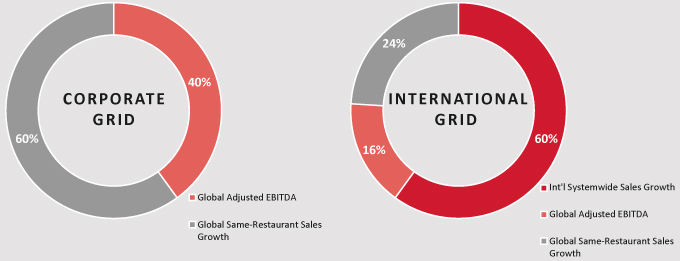
| ||
• Both the corporate grid and the International grid will utilize separate performance targets for the first and second halves of the year, with each half weighted equally. Targets for first half performance were set by the Committee in February 2026 and targets for second half performance will be set by the Committee in July 2026
| ||
| 2026 LONG-TERM EQUITY INCENTIVE PLAN—PERFORMANCE UNIT AWARD MODIFICATIONS | ||
• 2025 Performance Unit Awards
• Global Systemwide Sales Growth (50%)
• Global Company-Operated Restaurant Margin (50%)
• Achievement subject to downward or upward adjustment of up to 25% based on relative total stockholder return relative to the Russell 3000 Restaurant Index
|
• 2026 Performance Unit Awards
• Global Systemwide Sales Growth (50%)
• Relative Total Stockholder Return relative to the Russell 3000 Restaurant Index (50%) | |
In making these changes, the Committee considered the importance of aligning the interests of executives with the interests of the Company’s stockholders in driving long-term growth and stockholder value.
For the annual incentive plan, the Committee determined that (i) continuing to utilize adjusted EBITDA reflected the Company’s focus on driving operating profitability on an annual basis, (ii) increasing the focus on global same-restaurant sales growth was appropriate given its importance to the Company’s objective to drive top-line sales growth, (iii) eliminating global net unit growth aligned with the Company’s strategic initiative to focus on system optimization in order to prioritize average unit volume (“AUV”) growth and (iv) separate international targets align the President, International’s compensation opportunity with the Company’s continued emphasis on expanding its international business, footprint and sales growth, while also continuing to tie part of his compensation to the corporate grid, which rewards both a collaborative culture through common corporate measures as well as the delivery of business unit objectives.
54 The Wendy’s Company 2026 Proxy Statement
• |
In the event of a material restatement of the Company’s financial statements, the Committee will review the facts and circumstances underlying the restatement (including any potential wrongdoing by the participant) and may, in its sole discretion, direct the Company to recover all or a portion of the award or any gain realized on the vesting, exercise or settlement of the award. |
• |
If a participant has engaged in any “detrimental activity”, the Company may cancel the participant’s award(s) and require the participant to return the award(s) or any gain realized on the vesting, exercise or settlement thereof. |
Employment Arrangements with our NEOs
The Company generally does not utilize long-form employment agreements with its NEOs. Employment arrangements for our NEOs are governed by terms set forth in individual offer letters, as well as the Executive Severance Policy and applicable confidentiality and non-compete agreements. The Company believes this practice supports consistency among executives and reduces administrative complexity. Please refer to “Employment Arrangements and Potential Payments Upon Termination or Change in Control” for additional information on the employment arrangements and a summary of the key provisions related to termination of employment for the NEOs, including following a change in control.
Anti-Hedging Policy
The Board of Directors has adopted a Securities Trading Policy to assist the Company’s directors, officers and employees in complying with securities laws and avoiding even the appearance of improper conduct. Under this policy, the Company’s directors, officers and employees, as well as certain close family members of such persons, are prohibited from engaging in speculative transactions, including speculative transactions that are intended to hedge or offset the value of Company securities. Specifically, directors, officers and employees may not: (i) sell Company securities that are not then owned (including sales with delayed delivery); (ii) engage in transactions in publicly traded options of Company securities, such as puts, calls, straddles or other publicly traded options; (iii) purchase Company securities on margin; (iv) engage in any other hedging transactions, including through the use of financial instruments such as prepaid variable forward contracts, equity swaps, collars and exchange funds, unless previously approved by the Company’s Chief Legal Officer or legal department; and (v) otherwise pledge Company securities as collateral for a loan, unless previously approved by the Company’s Chief Legal Officer or legal department.
Furthermore, Company securities held in a margin account or otherwise pledged as collateral for a loan would not count toward satisfaction of the applicable Common Stock ownership requirement under the Company’s Stock Ownership and Retention Guidelines. As of the date of this Proxy Statement, none of the Company’s executive officers or directors has pledged any shares of Common Stock.
Accounting Considerations
The Committee and Subcommittee take into consideration the accounting costs associated with long-term equity incentive awards granted to executives and other eligible employees. Under GAAP, grants of stock options, performance units and other share-based awards result in an accounting charge for the Company. In designing the executive compensation program, the Committee and Subcommittee consider the accounting implications of equity awards, including the estimated cost for financial reporting purposes and the aggregate grant date fair value computed in accordance with FASB ASC Topic 718.
Consideration and Frequency of Annual Stockholder Say-on-Pay Vote
In accordance with the Dodd-Frank Act, the Company provides stockholders with the opportunity to cast an annual advisory vote to approve the compensation of the NEOs (i.e., an annual “say-on-pay” vote), as discussed under the caption “Proposal 4—Advisory Resolution to Approve Executive Compensation.” At the Company’s 2025 annual meeting of stockholders, approximately 97% of the votes cast on the say-on-pay resolution were voted in favor of the compensation of our named executive officers for 2024, as disclosed in the Company’s definitive proxy statement for the 2025 annual meeting of stockholders filed with the SEC on April 3, 2025. In July 2025, the Committee considered those voting results and determined that no changes to the Company’s executive compensation program were warranted at that time. The Committee will continue to review the design of the executive compensation program in light of future say-on-pay votes, developments in executive compensation and the Company’s pay-for-performance philosophy to ensure that the executive compensation program continues to serve the best interests of the Company and its stockholders.
56 The Wendy’s Company 2026 Proxy Statement
2025 SUMMARY COMPENSATION TABLE
This 2025 Summary Compensation Table sets forth the salary, cash incentive awards, equity incentive awards and all other compensation that was earned by, or paid or awarded to, our NEOs for 2025, 2024 and 2023.
| NAME AND PRINCIPAL POSITION |
YEAR | SALARY ($) |
BONUS ($) (1) |
STOCK AWARDS ($) (2) |
OPTION AWARDS ($) (3) |
NON-EQUITY INCENTIVE PLAN COMPENSATION ($) (4) |
ALL OTHER COMPENSATION ($) (5) |
TOTAL ($) | ||||||||||||||||||||||||||||||||
| Ken Cook (6) (Interim CEO and CFO) |
2025 | 698,178 | — | 2,336,232 | 778,748 | 326,700 | 363,582 | 4,503,440 | ||||||||||||||||||||||||||||||||
|
|
2024 |
|
46,027 |
|
325,000 |
|
299,995 |
|
— |
|
30,048 |
|
1,455 |
|
702,525 |
| ||||||||||||||||||||||||
| Pete Suerken (7) (President, U.S.) |
2025 | 328,767 | — | 2,449,992 | 374,999 | 312,500 | 9,904 | 3,476,162 | ||||||||||||||||||||||||||||||||
| E.J. Wunsch (President, International) |
2025 | 634,507 | — | 2,279,969 | 759,999 | 253,440 | 28,594 | 3,956,509 | ||||||||||||||||||||||||||||||||
|
|
2024 |
|
599,604 |
|
— |
|
963,718 |
|
406,247 |
|
441,875 |
|
15,850 |
|
2,427,294 |
| ||||||||||||||||||||||||
|
|
2023 |
|
552,057 |
|
— |
|
824,953 |
|
274,996 |
|
453,392 |
|
27,138 |
|
2,132,536 |
| ||||||||||||||||||||||||
| John Min (8) (Chief Legal Officer and Secretary) |
2025 | 609,575 | — | 1,672,490 | 557,498 | 207,009 | 844,516 | 3,891,088 | ||||||||||||||||||||||||||||||||
| Kirk Tanner (9) (former President and CEO) |
2025 | 559,726 | — | 4,019,990 | — | — | 10,949 | 4,590,665 | ||||||||||||||||||||||||||||||||
| 2024 | 901,370 | — | 13,499,964 | 1,499,997 | 1,237,250 | 169,536 | 17,308,117 | |||||||||||||||||||||||||||||||||
| (1) | The amount shown for 2024 for Mr. Cook reflects a one-time cash sign-on bonus of $325,000. The sign-on bonus was approved by the Compensation and Human Capital Committee in November 2024 as part of Mr. Cook’s overall employment terms with the Company and was paid to Mr. Cook following 30 days of continued active employment. |
| (2) | The amounts shown represent the aggregate grant date fair value of stock awards, including annual performance unit awards and restricted stock unit awards, made to the NEOs in the year shown, computed in accordance with FASB ASC Topic 718, disregarding any estimates of forfeitures. See Note 14 (Share-Based Compensation) to the Company’s consolidated financial statements included in the 2025 Form 10-K for the assumptions made in determining these values. For Mr. Cook, the amount shown for 2025 also includes the portion of his one-time equity award delivered in the form of restricted stock units in connection with his appointment as the Company’s Interim Chief Executive Officer. For Mr. Suerken, the amount shown for 2025 also includes his one-time equity award in the form of restricted stock units granted upon the commencement of his employment with the Company in 2025. For Messrs. Wunsch and Min, the amounts shown for 2025 also include the portion of their special one-time equity awards delivered in the form of restricted stock units in connection with the CEO leadership transition. See the caption “Compensation Discussion and Analysis—Leadership Changes and Related Compensation Actions” for more details. |
| The amounts shown for 2025 include the target grant date fair values of performance unit awards granted to the NEOs in 2025 that are subject to the Company’s achievement of performance goals established by the Subcommittee for the performance period beginning December 30, 2024 and ending January 2, 2028. At target achievement levels, the grant date fair values of such performance unit awards would be as follows: Mr. Cook, $668,992; Mr. Suerken, $724,998; Mr. Wunsch, $911,985; Mr. Min, $668,992; and Mr. Tanner, $4,019,990. At maximum achievement levels, the grant date fair values of such performance unit awards would be as follows: Mr. Cook, $1,337,983; Mr. Suerken, $1,449,996; Mr. Wunsch, $1,823,969; Mr. Min, $1,337,983; and Mr. Tanner, $8,039,980 (as described in footnote (9) below, Mr. Tanner forfeited his unvested equity awards in connection with his departure in July 2025). For more information regarding the performance goals and potential payouts with respect to the 2025 performance unit awards granted to the NEOs, see the caption “Compensation Discussion and Analysis—Compensation Decisions for 2025—Long-Term Equity Incentive Compensation.” |
| (3) | The amounts shown represent the aggregate grant date fair value of stock option awards made to the NEOs in the year shown, computed in accordance with FASB ASC Topic 718. See Note 14 (Share-Based Compensation) to the Company’s consolidated financial statements included in the 2025 Form 10-K for the assumptions made in determining these values. For more information regarding the stock options granted to the NEOs in 2025, see the caption “Compensation Discussion and Analysis—Compensation Decisions for 2025—Long-Term Equity Incentive Compensation.” |
The Wendy’s Company 2026 Proxy Statement 57
| For Mr. Cook, the amount shown for 2025 also includes the portion of his one-time equity award delivered in the form of stock options in connection with his appointment as the Company’s Interim Chief Executive Officer. For Messrs. Wunsch and Min, the amounts shown for 2025 also include the portion of their special one-time equity awards delivered in the form of stock options in connection with the CEO leadership transition. See the caption “Compensation Discussion and Analysis—Leadership Changes and Related Compensation Actions” for more details. |
| (4) | The amounts shown represent the annual cash incentive payouts received by the NEOs for the year shown. For more information regarding the performance goals and potential payouts with respect to the 2025 cash incentive awards granted to the NEOs, see the caption “Compensation Discussion and Analysis—Compensation Decisions for 2025—Annual Cash Incentive Compensation.” |
| (5) | The following table sets forth the details of the “All Other Compensation” paid to the NEOs for 2025: |
| NAME |
COMPANY TO 401(K) PLAN ($) (a) |
RELOCATION ($) (b) |
OTHER OR PERSONAL ($) (c) |
TOTAL ($) | ||||||||||||||||
| Ken Cook |
14,000 | 335,705 | 13,877 | 363,582 | ||||||||||||||||
| Pete Suerken |
9,904 | — | — | 9,904 | ||||||||||||||||
| E.J. Wunsch |
14,000 | — | 14,594 | 28,594 | ||||||||||||||||
| John Min |
14,000 | 818,927 | 11,589 | 844,516 | ||||||||||||||||
| Kirk Tanner |
— | — | 10,949 | 10,949 | ||||||||||||||||
| (a) | The amounts shown reflect matching contributions made by the Company to the NEOs’ respective 401(k) plan accounts. |
| (b) | The Company maintains a relocation policy that provides, for eligible employees who are hired, promoted or transferred at the Company’s request, either (i) a lump sum allowance or (ii) the reimbursement of reasonable relocation expenses incurred by eligible employees. The relocation policy also provides eligible employees with financial, marketing and other assistance in connection with selling their existing home and buying a new home, including reimbursement of real estate commissions and customary closing costs, as well as a guaranteed house sale program administered by a third-party relocation firm, where a minimum sales price is determined by independent, licensed relocation appraisers. Transaction costs from the final sale of the house, as well as carrying costs, are reimbursed as part of this program. The Company’s relocation policy is available to all employees that are relocated at the Company’s request, and the guaranteed house sale program is available to all relocating employees that are a manager or above and are homeowners. Although the relocation policy and the guaranteed house sale program are generally available to substantial portions of the Company’s employee base, and are not unique to executives, in accordance with SEC disclosure rules, we have disclosed the aggregate incremental cost to the Company in the “All Other Compensation” column of the Summary Compensation Table. |
The amounts shown for Messrs. Cook and Min reflect the relocation assistance covered by the Company in fiscal year 2025 under the Company’s relocation policy in connection with their respective relocations to Dublin, Ohio, which was provided to each individual under their respective employment terms with the Company (the portion of the relocation assistance provided to Mr. Cook in fiscal year 2024 was previously reported in the 2024 Summary Compensation Table). Such amounts for Messrs. Cook and Min include the difference between the minimum sale price for the executive’s home, as determined by independent, licensed relocation appraisers under the guaranteed house sale program, and the final sale price for such home. Per the relocation policy, the expenses are tax-assisted and the amounts shown include reimbursement to Mr. Cook in the amount of $56,619 and to Mr. Min in the amount of $29,152 to offset the impact of applicable taxes.
| (c) | The amounts shown for Messrs. Cook and Wunsch include the Company’s reimbursement of medical expenses incurred under the Company’s executive physical examination program (Mr. Cook, $2,000; Mr. Wunsch, $2,100). The Company adopted this program to encourage executive officers to have routine medical check-ups in an effort to maintain good health, identify health issues and drive productivity. The |
58 The Wendy’s Company 2026 Proxy Statement
amounts shown for Messrs. Cook, Wunsch and Min include the Company’s reimbursement of financial planning fees incurred under the Company’s financial well-being benefit program offered through Goldman Sachs Ayco (Mr. Cook, $11,877; Mr. Wunsch, $12,494; Mr. Min, $11,589). The Company adopted this program to ensure that executive officers receive sound financial support and advice. The amount shown for Mr. Tanner reflects the Company’s payment of certain residential security costs that were approved by the Compensation and Human Capital Committee following the Company’s review of potential security concerns while Mr. Tanner served as the Company’s Chief Executive Officer ($10,949).
The Company owns fractional interests in corporate aircraft to enable its executives to safely and efficiently travel for business purposes. On certain occasions, an executive’s spouse or other family members may accompany the executive on the aircraft when the aircraft is already going to a specific destination for business purposes and has available seating. In those cases, the aggregate incremental cost to the Company, if any, is reported in “Other Perquisites or Personal Benefits” above. During 2025, none of the NEOs used the aircraft solely for personal purposes.
| (6) | Mr. Cook was appointed as Interim Chief Executive Officer of the Company effective July 18, 2025 while continuing to serve as the Company’s Chief Financial Officer. |
| (7) | Mr. Suerken was appointed as President, U.S. of the Company effective July 22, 2025. |
| (8) | Mr. Min was appointed Chief Legal Officer and Secretary of the Company effective September 16, 2024. |
| (9) | Mr. Tanner was appointed as President and Chief Executive Officer of the Company effective February 5, 2024. On July 1, 2025, Mr. Tanner informed the Board of his decision to resign from his position as President and Chief Executive Officer of the Company and as a director of the Board, in each case effective July 18, 2025. In connection with his departure, Mr. Tanner forfeited his outstanding unvested equity awards and was not eligible for a payout under the Company’s 2025 annual incentive plan. |
The Wendy’s Company 2026 Proxy Statement 59
2025 GRANTS OF PLAN-BASED AWARDS
The following table provides information concerning the annual cash incentive awards and long-term equity incentive awards granted to the NEOs in 2025.
| NAME |
ESTIMATED POSSIBLE |
ESTIMATED FUTURE PAYOUTS UNDER EQUITY |
ALL OTHER STOCK AWARDS: NUMBER OF SHARES OF STOCK OR (#) |
ALL OTHER AWARDS: (#) |
EXERCISE PRICE OF OPTION AWARDS ($/Sh) |
CLOSING PRICE DATE OF GRANT ($/Sh) |
GRANT ($) (3) | |||||||||||||||||||||||||||||||||||||||||||||||||||||||||||||||
| GRANT DATE |
APPROVAL DATE |
THRESHOLD ($) |
TARGET ($) |
MAXIMUM ($) |
|
THRESHOLD (#) |
TARGET (#) |
MAXIMUM (#) | ||||||||||||||||||||||||||||||||||||||||||||||||||||||||||||||
| Ken Cook |
412,500 | 825,000 | 1,650,000 | |||||||||||||||||||||||||||||||||||||||||||||||||||||||||||||||||||
| 2/20/25 | 2/20/25 | 0 | 41,977 | 83,954 | — | — | — | — | 668,992 | |||||||||||||||||||||||||||||||||||||||||||||||||||||||||||||
| 8/12/25 | 7/24/25 | — | — | — | 16,543 | (4) | — | — | 10.11 | 167,250 | ||||||||||||||||||||||||||||||||||||||||||||||||||||||||||||
| 8/12/25 | 7/24/25 | — | — | — | 148,367 | (5) | — | — | 10.11 | 1,499,990 | ||||||||||||||||||||||||||||||||||||||||||||||||||||||||||||
| 8/12/25 | 7/24/25 | — | — | — | — | 209,002 | (6) | 10.11 | 10.11 | 278,749 | ||||||||||||||||||||||||||||||||||||||||||||||||||||||||||||
| 8/12/25 | 7/24/25 | — | — | — | — | 374,892 | (7) | 10.11 | 10.11 | 499,999 | ||||||||||||||||||||||||||||||||||||||||||||||||||||||||||||
| Pete Suerken |
312,500 | 312,500 | 625,000 | |||||||||||||||||||||||||||||||||||||||||||||||||||||||||||||||||||
| 8/12/25 | 7/24/25 | 0 | 68,577 | 137,154 | — | — | — | — | 724,998 | |||||||||||||||||||||||||||||||||||||||||||||||||||||||||||||
| 8/12/25 | 7/24/25 | — | — | — | 22,255 | (4) | — | — | 10.11 | 224,998 | ||||||||||||||||||||||||||||||||||||||||||||||||||||||||||||
| 7/22/25 | 7/18/25 | — | — | — | 138,376 | (8) | — | — | 10.84 | 1,499,996 | ||||||||||||||||||||||||||||||||||||||||||||||||||||||||||||
| 8/12/25 | 7/24/25 | — | — | — | — | 281,169 | (6) | 10.11 | 10.11 | 374,999 | ||||||||||||||||||||||||||||||||||||||||||||||||||||||||||||
| E.J. Wunsch |
320,000 | 640,000 | 1,280,000 | |||||||||||||||||||||||||||||||||||||||||||||||||||||||||||||||||||
| 2/20/25 | 2/20/25 | 0 | 57,224 | 114,448 | — | — | — | — | 911,985 | |||||||||||||||||||||||||||||||||||||||||||||||||||||||||||||
| 8/12/25 | 7/24/25 | — | — | — | 22,551 | (4) | — | — | 10.11 | 227,991 | ||||||||||||||||||||||||||||||||||||||||||||||||||||||||||||
| 8/12/25 | 7/24/25 | — | — | — | 112,759 | (9) | — | — | 10.11 | 1,139,993 | ||||||||||||||||||||||||||||||||||||||||||||||||||||||||||||
| 8/12/25 | 7/24/25 | — | — | — | — | 284,918 | (6) | 10.11 | 10.11 | 379,999 | ||||||||||||||||||||||||||||||||||||||||||||||||||||||||||||
| 8/12/25 | 7/24/25 | — | — | — | — | 284,918 | (10) | 10.11 | 10.11 | 379,999 | ||||||||||||||||||||||||||||||||||||||||||||||||||||||||||||
| John Min |
261,375 | 522,750 | 1,045,500 | |||||||||||||||||||||||||||||||||||||||||||||||||||||||||||||||||||
| 2/20/25 | 2/20/25 | 0 | 41,977 | 83,954 | — | — | — | — | 668,992 | |||||||||||||||||||||||||||||||||||||||||||||||||||||||||||||
| 8/12/25 | 7/24/25 | — | — | — | 16,543 | (4) | — | — | 10.11 | 167,250 | ||||||||||||||||||||||||||||||||||||||||||||||||||||||||||||
| 8/12/25 | 7/24/25 | — | — | — | 82,715 | (9) | — | — | 10.11 | 836,249 | ||||||||||||||||||||||||||||||||||||||||||||||||||||||||||||
| 8/12/25 | 7/24/25 | — | — | — | — | 209,002 | (6) | 10.11 | 10.11 | 278,749 | ||||||||||||||||||||||||||||||||||||||||||||||||||||||||||||
| 8/12/25 | 7/24/25 | — | — | — | — | 209,002 | (10) | 10.11 | 10.11 | 278,749 | ||||||||||||||||||||||||||||||||||||||||||||||||||||||||||||
| Kirk Tanner (11) |
901,250 | 1,802,500 | 3,605,000 | |||||||||||||||||||||||||||||||||||||||||||||||||||||||||||||||||||
| 2/20/25 | 2/20/25 | 0 | 252,241 | 504,482 | — | — | — | — | 4,019,990 | |||||||||||||||||||||||||||||||||||||||||||||||||||||||||||||
| (1) | Represents threshold, target and maximum payout levels based on 2025 performance for the annual cash incentive awards granted to the NEOs under the 2020 Omnibus Award Plan. For more information regarding the performance goals and potential payouts with respect to such awards, see the caption “Compensation Discussion and Analysis—Compensation Decisions for 2025—Annual Cash Incentive Compensation.” For the actual amounts paid to the NEOs pursuant to such awards based on Company performance during 2025, see the “Non-Equity Incentive Plan Compensation” column of the 2025 Summary Compensation Table. Mr. Suerken joined the Company in July 2025 as President, U.S. and his employment letter provided that, with respect to the 2025 performance year only, his payout under the 2025 annual incentive plan was guaranteed at the higher of “target” or actual performance, prorated based on the number of full calendar months that Mr. Suerken worked from his start date. See “Compensation Discussion and Analysis—Leadership Changes and Related Compensation Actions—President, U.S. Compensation Actions” for additional details. |
| (2) | Represents threshold, target and maximum payout levels based on Company performance over a three-year period for performance unit awards granted to the NEOs under the 2020 Omnibus Award Plan. For more information regarding the performance goals and potential payouts with respect to such awards, see “Compensation Discussion and Analysis—Compensation Decisions for 2025—Long-Term Equity Incentive Compensation.” The performance units include dividend equivalent rights, representing the right to receive |
60 The Wendy’s Company 2026 Proxy Statement
| additional performance units in lieu of cash dividends paid with respect to the shares of Common Stock actually earned, if any, at the completion of the performance period. With respect to the “Threshold” column, there is no payout unless the Company exceeds the threshold level of performance. |
| (3) | Represents the grant date fair value of equity awards granted to the NEOs, computed in accordance with FASB ASC Topic 718, disregarding any estimates of forfeitures. The grant date fair value of the performance unit awards granted to the NEOs is based on achieving target levels of performance. See Note 14 (Share-Based Compensation) to the Company’s consolidated financial statements included in the 2025 Form 10-K for the assumptions made in determining those values. |
| (4) | Reflects restricted stock units granted to the NEOs under the 2020 Omnibus Award Plan. All of the restricted stock units will vest in three equal installments on the first, second and third anniversaries of the grant date, subject to the executive’s continued employment on the applicable vesting date. The restricted stock units include dividend equivalent rights, representing the right to receive additional restricted stock units in lieu of cash dividends paid with respect to the shares of Common Stock underlying the award (if and when the award vests). |
| (5) | Reflects restricted stock units granted to Mr. Cook as part of his one-time equity award in connection with his appointment as the Company’s Interim Chief Executive Officer in July 2025. The restricted stock units will vest in two equal installments on the first and second anniversaries of the grant date, subject to Mr. Cook’s continued employment on the applicable vesting date. The restricted stock units include dividend equivalent rights, representing the right to receive additional restricted stock units in lieu of cash dividends paid with respect to the shares of Common Stock underlying the award (if and when the award vests). See “Compensation Discussion and Analysis—Leadership Changes and Related Compensation Actions—Interim Chief Executive Officer Compensation Actions” for additional details. |
| (6) | Reflects stock options granted to the NEOs under the 2020 Omnibus Award Plan, each having an exercise price equal to the “fair market value” (i.e., the closing sales price) of the underlying shares of Common Stock on the grant date and expiring ten years from the grant date, unless sooner exercised or forfeited. All of the stock options vest and become exercisable in three equal installments on the first, second and third anniversaries of the grant date, subject to the executive’s continued employment on the applicable vesting date. |
| (7) | Reflects stock options granted to Mr. Cook as part of his one-time equity award in connection with his appointment as the Company’s Interim Chief Executive Officer in July 2025, each having an exercise price equal to the “fair market value” (i.e., the closing sales price) of the underlying shares of Common Stock on the grant date and expiring ten years from the grant date, unless sooner exercised or forfeited. The stock options will vest in two equal installments on the first and second anniversaries of the grant date, subject to Mr. Cook’s continued employment on the applicable vesting date. |
| (8) | Reflects restricted stock units granted to Mr. Suerken as part of his one-time equity award in connection with the commencement of his employment with the Company. The restricted stock units will vest in full on the second anniversary of the grant date, subject to Mr. Suerken’s continued employment on the vesting date. The restricted stock units include dividend equivalent rights, representing the right to receive additional restricted stock units in lieu of cash dividends paid with respect to the shares of Common Stock underlying the award (if and when the award vests). See “Compensation Discussion and Analysis—Leadership Changes and Related Compensation Actions—President, U.S. Compensation Actions” for additional details. |
| (9) | Reflects restricted stock units granted to Messrs. Wunsch and Min as part of their one-time equity-based retention awards in connection with the CEO leadership transition. The restricted stock units will vest in two equal installments on the first and second anniversaries of the grant date, subject to the recipient’s continued employment on the applicable vesting date. The restricted stock units include dividend equivalent rights, representing the right to receive additional restricted stock units in lieu of cash dividends paid with respect to the shares of Common Stock underlying the award (if and when the award vests). See “Compensation Discussion and Analysis—Leadership Changes and Related Compensation Actions” for additional details. |
| (10) | Reflects stock options granted to Messrs. Wunsch and Min as part of their one-time equity-based retention awards in connection with the CEO leadership transition, each having an exercise price equal to the “fair market value” (i.e., the closing sales price) of the underlying shares of Common Stock on the grant date and expiring ten years from the grant date, unless sooner exercised or forfeited. The stock options will vest in two equal installments on the first and second anniversaries of the grant date, subject to the recipient’s continued employment on the applicable vesting date. |
| (11) | Mr. Tanner resigned as President and Chief Executive Officer and departed the Company in July 2025. As a result, all of his plan-based awards shown in the table were forfeited. See “Compensation Discussion and Analysis—Leadership Changes and Related Compensation Actions” for additional details. |
The Wendy’s Company 2026 Proxy Statement 61
OUTSTANDING EQUITY AWARDS AT 2025 YEAR-END
The following table provides information concerning the unexercised stock options and unvested restricted stock unit and performance unit awards held by the NEOs as of the end of 2025.
|
OPTION AWARDS |
STOCK AWARDS | |||||||||||||||||||||||||||||||||||
| NAME | NUMBER OF (#) EXERCISABLE |
NUMBER OF (#) UNEXERCISABLE (1) |
OPTION EXERCISE PRICE ($) |
OPTION EXPIRATION DATE (2) |
NUMBER OF SHARES OR UNITS OF STOCK THAT HAVE (#) |
MARKET VALUE OF SHARES OR UNITS OF STOCK THAT HAVE NOT VESTED ($) (3) |
EQUITY INCENTIVE PLAN AWARDS: NUMBER OF NOT VESTED (#) |
EQUITY INCENTIVE MARKET OR OF UNEARNED OR OTHER RIGHTS NOT VESTED ($) (3) |
||||||||||||||||||||||||||||
| Ken Cook |
— | 209,002 | 10.11 | 8/12/2035 | ||||||||||||||||||||||||||||||||
| — | 374,892 (4) | 10.11 | 8/12/2035 | |||||||||||||||||||||||||||||||||
| 17,899 (5) | 149,457 | |||||||||||||||||||||||||||||||||||
| 153,100 (6) | 1,278,385 | |||||||||||||||||||||||||||||||||||
| 17,070 (11) | 142,535 | |||||||||||||||||||||||||||||||||||
| 0 (14) | 0 | |||||||||||||||||||||||||||||||||||
| Pete Suerken |
— | 281,169 | 10.11 | 8/12/2035 | ||||||||||||||||||||||||||||||||
| 142,790 (7) | 1,192,297 | |||||||||||||||||||||||||||||||||||
| 22,965 (11) | 191,758 | |||||||||||||||||||||||||||||||||||
| 0 (14) | 0 | |||||||||||||||||||||||||||||||||||
| E.J. Wunsch |
44,008 | — | 15.355 | 8/11/2027 | ||||||||||||||||||||||||||||||||
| 49,057 | — | 18.515 | 8/20/2028 | |||||||||||||||||||||||||||||||||
| 80,217 | — | 19.71 | 8/9/2029 | |||||||||||||||||||||||||||||||||
| 61,135 | — | 22.34 | 8/7/2030 | |||||||||||||||||||||||||||||||||
| 53,698 | — | 23.70 | 8/13/2031 | |||||||||||||||||||||||||||||||||
| 63,206 | — | 21.40 | 8/12/2032 | |||||||||||||||||||||||||||||||||
| 34,238 | 17,119 | 21.53 | 8/11/2033 | |||||||||||||||||||||||||||||||||
| 39,550 | 79,101 | 16.70 | 8/5/2034 | |||||||||||||||||||||||||||||||||
| — | 284,918 | 10.11 | 8/12/2035 | |||||||||||||||||||||||||||||||||
| — | 284,918 (4) | 10.11 | 8/12/2035 | |||||||||||||||||||||||||||||||||
| 116,356 (6) | 971,573 | |||||||||||||||||||||||||||||||||||
| 2,950 (9) | 24,633 | |||||||||||||||||||||||||||||||||||
| 10,635 (10) | 88,802 | |||||||||||||||||||||||||||||||||||
| 23,270 (11) | 194,305 | |||||||||||||||||||||||||||||||||||
| 31,182 (12) | 260,370 | |||||||||||||||||||||||||||||||||||
| 16,101 (13) | 134,443 | |||||||||||||||||||||||||||||||||||
| 0 (14) | 0 | |||||||||||||||||||||||||||||||||||
| John Min |
— | 209,002 | 10.11 | 8/12/2035 | ||||||||||||||||||||||||||||||||
| — | 209,002 (4) | 10.11 | 8/12/2035 | |||||||||||||||||||||||||||||||||
| 85,354 (6) | 712,706 | |||||||||||||||||||||||||||||||||||
| 15,193 (8) | 126,862 | |||||||||||||||||||||||||||||||||||
| 17,070 (11) | 142,535 | |||||||||||||||||||||||||||||||||||
| 0 (14) | 0 | |||||||||||||||||||||||||||||||||||
| Kirk Tanner (15) |
— | — | — | — | — | — | — | — | — | |||||||||||||||||||||||||||
| (1) | Except as otherwise noted, all stock options vest and become exercisable in three equal installments on the first, second and third anniversaries of the grant date, subject to the executive’s continued employment on the applicable vesting date. |
| (2) | All stock options expire ten years from the grant date, unless sooner exercised or forfeited. |
| (3) | Based on $8.35 per share, which was the per share closing price of our Common Stock on December 26, 2025, the last trading day of fiscal 2025. |
| (4) | The stock options vest and become exercisable in two equal installments on the first and second anniversaries of the grant date, subject to the executive’s continued employment on the applicable vesting date. |
| (5) | Reflects unvested restricted stock units granted to Mr. Cook on December 2, 2024 under the 2020 Omnibus Award Plan, plus dividends accrued thereon as of the end of 2025. The restricted stock units will vest in full on December 2, 2027, subject to Mr. Cook’s continued employment on the vesting date. |
| (6) | Reflects unvested restricted stock units granted on August 12, 2025 under the 2020 Omnibus Award Plan, plus dividends accrued thereon as of the end of 2025. The restricted stock units will vest in two equal installments on |
62 The Wendy’s Company 2026 Proxy Statement
| the first and second anniversaries of the grant date, subject to the executive’s continued employment on the applicable vesting date. |
| (7) | Reflects unvested restricted stock units granted to Mr. Suerken on July 22, 2025 under the 2020 Omnibus Award Plan, plus dividends accrued thereon as of the end of 2025. The restricted stock units will vest in full on July 22, 2027, subject to Mr. Suerken’s continued employment on the vesting date. |
| (8) | Reflects unvested restricted stock units granted to Mr. Min on September 16, 2024 under the 2020 Omnibus Award Plan, plus dividends accrued thereon as of the end of 2025. The restricted stock units will vest in full on September 16, 2027, subject to Mr. Min’s continued employment on the vesting date. |
| (9) | Reflects unvested restricted stock units granted on August 11, 2023 under the 2020 Omnibus Award Plan, plus dividends accrued thereon as of the end of 2025. The restricted stock units will vest in three equal installments on the first, second and third anniversaries of the grant date, subject to the executive’s continued employment on the applicable vesting date. The first two installments (including the related dividend equivalent units) vested on August 11, 2024 and 2025, respectively. |
| (10) | Reflects unvested restricted stock units granted on August 5, 2024 under the 2020 Omnibus Award Plan, plus dividends accrued thereon as of the end of 2025. The restricted stock units will vest in three equal installments on the first, second and third anniversaries of the grant date, subject to the executive’s continued employment on the applicable vesting date. The first installment (including the related dividend equivalent units) vested on August 5, 2025. |
| (11) | Reflects unvested restricted stock units granted on August 12, 2025 under the 2020 Omnibus Award Plan, plus dividends accrued thereon as of the end of 2025. The restricted stock units will vest in three equal installments on the first, second and third anniversaries of the grant date, subject to the executive’s continued employment on the applicable vesting date. |
| (12) | Represents payout levels based on achieving target performance levels over a three-year period (January 2, 2023 through December 28, 2025) for performance unit awards granted on February 16, 2023 under the 2020 Omnibus Award Plan, plus dividends accrued thereon as of the end of 2025. Each performance unit represents the right to receive one share of Common Stock subject to the Company’s achievement of two performance goals based on free cash flow and relative total stockholder return during the performance period. For more information regarding the performance goals and potential payouts with respect to such awards, see “Compensation Discussion and Analysis—Compensation Decisions for 2023—Long-Term Equity Incentive Compensation” in the Company’s definitive proxy statement for the 2024 annual meeting of stockholders filed with the SEC on April 4, 2024. |
| (13) | Represents payout levels based on achieving threshold performance levels over a three-year period (January 1, 2024 through January 3, 2027) for performance unit awards granted on February 22, 2024 under the 2020 Omnibus Award Plan, plus dividends accrued thereon as of the end of 2025. Each performance unit represents the right to receive one share of Common Stock subject to the Company’s achievement of two performance goals based on global systemwide sales and relative total stockholder return during the performance period. For more information regarding the performance goals and potential payouts with respect to such awards, see “Compensation Discussion and Analysis—Compensation Decisions for 2024—Long-Term Equity Incentive Compensation” in the Company’s definitive proxy statement for the 2025 annual meeting of stockholders filed with the SEC on April 3, 2025. |
| (14) | Represents payout levels based on achieving threshold performance levels over a three-year period (December 30, 2024 through January 2, 2028) for performance unit awards granted on February 20, 2025 (July 22, 2025 with respect to Mr. Suerken) under the 2020 Omnibus Award Plan, plus dividends accrued thereon as of the end of 2025. Each performance unit represents the right to receive one share of Common Stock subject to the Company’s achievement of two performance goals based on global systemwide sales growth and global Company-operated restaurant margin acceleration, with an overall modifier based on relative total stockholder return, during the performance period. For more information regarding the performance goals and potential payouts with respect to such awards, see “Compensation Discussion and Analysis—Compensation Decisions for 2025—Long-Term Equity Incentive Compensation” herein. |
| (15) | Mr. Tanner resigned as President and Chief Executive Officer and departed the Company in July 2025. As a result, all of his outstanding unvested equity awards were forfeited. |
The Wendy’s Company 2026 Proxy Statement 63
OPTION EXERCISES AND STOCK VESTED DURING 2025
The following table provides information for 2025 concerning the exercise of stock options and vesting of stock awards granted to the NEOs in prior years.
| OPTION AWARDS | STOCK AWARDS | ||||||||||||||||||||||||
| NAME
|
NUMBER OF SHARES (#)
|
VALUE REALIZED ON EXERCISE ($) (1)
|
NUMBER OF SHARES (#)
|
VALUE REALIZED ON VESTING ($) (2)
| |||||||||||||||||||||
| Ken Cook |
|
— |
|
— |
|
— |
|
— |
|||||||||||||||||
| Pete Suerken |
|
— |
|
— |
|
— |
|
— |
|||||||||||||||||
| E.J. Wunsch |
|
— |
|
— |
|
14,068 (3) |
|
172,897 |
|||||||||||||||||
| John Min |
|
— |
|
— |
|
— |
|
— |
|||||||||||||||||
| Kirk Tanner |
|
— |
|
— |
|
117,842 (3) |
|
1,792,377 |
|||||||||||||||||
| (1) | Based on the difference between the exercise price of the stock options and the market price of our Common Stock at the time of exercise. |
| (2) | Based on the closing sales price of our Common Stock on the applicable vesting date. |
| (3) | For Mr. Wunsch, includes the number of shares of Common Stock earned with respect to performance unit awards granted on February 23, 2022 for the performance period that began on January 3, 2022 and ended on December 29, 2024. The performance unit awards vested on February 21, 2025 at 19.5% of target following the Subcommittee’s determination of the Company’s level of achievement of the free cash flow (39.1% attainment) and relative total stockholder return (0% attainment) performance goals. The number of shares of Common Stock actually received by Mr. Wunsch was reduced by the withholding of shares (2,090 shares withheld), to pay income taxes associated with the value realized upon vesting. |
For Mr. Wunsch, also includes one-third of the restricted stock units (plus dividends accrued thereon) (i) granted on August 11, 2023 and which vested on August 11, 2025 and (ii) granted on August 5, 2024 and which vested on August 5, 2025. The number of shares of Common Stock actually received by Mr. Wunsch was reduced by the withholding of shares (2,388 shares withheld) to pay income taxes associated with the value realized upon vesting.
For Mr. Tanner, reflects one-third of the restricted stock units (plus dividends accrued thereon) granted on February 22, 2024, which vested on February 22, 2025. The number of shares received by Mr. Tanner was reduced by the withholding of shares (44,567 shares withheld) to pay income taxes associated with the value realized upon vesting.
64 The Wendy’s Company 2026 Proxy Statement
EMPLOYMENT ARRANGEMENTS AND
POTENTIAL PAYMENTS UPON TERMINATION OR CHANGE IN CONTROL
EMPLOYMENT ARRANGEMENTS—GENERALLY
The Company generally does not utilize long-form employment agreements with its NEOs. The Company believes this practice supports consistency among executives and reduces administrative complexity. Employment arrangements for our NEOs are governed by terms set forth in individual offer letters (“employment letters”), as well as the Executive Severance Policy and applicable confidentiality and non-compete agreements.
Messrs. Cook, Suerken, Wunsch and Min are each subject to employment letters that were entered into when the respective individual joined the Company. The employment letters provide for initial base salaries and initial annual target cash incentive opportunities and also provide that each individual is eligible to receive equity awards under the Company’s long-term incentive award program in effect for other executives. Copies of these employment letters have been filed with the SEC. Mr. Tanner, who resigned from the Company in July 2025, was also subject to an employment letter that was entered into when he joined the Company, a copy of which has also been filed with the SEC. The Compensation and Human Capital Committee reviews and updates the compensation arrangements for the NEOs on an annual basis.
POTENTIAL PAYMENTS UPON TERMINATION OR CHANGE IN CONTROL
As described in greater detail below, the NEOs have received equity awards under the 2010 Omnibus Award Plan and the 2020 Omnibus Award Plan (collectively, the “Omnibus Award Plans”), which provide for the accelerated vesting of certain awards in connection with a qualifying termination event. Awards granted under the Omnibus Award Plans are subject to “double-trigger” vesting requirements in connection with a “change in control” of the Company. This means that, in order for an outstanding award to be accelerated and become vested in connection with a “change in control”, a “change in control” must occur and the participant’s employment must be terminated by the Company without “cause” or by the participant for “good reason” within a specified period following the change in control.
The Company considers these limited severance and change in control benefits to be an important part of our executive compensation program and consistent with competitive market practice. The Company believes that providing appropriate severance benefits helps to attract and retain highly qualified executives by mitigating the risks associated with leaving a previous employer and accepting a new position with the Company, and by providing income continuity following an unexpected termination. These arrangements also allow the Company to protect its interests through corresponding confidentiality, non-compete and other restrictive covenants following an executive’s termination.
Termination without Cause
Executive Severance Policy
The Executive Severance Policy provides for certain post-termination payments and benefits for U.S. executives at the level of Senior Vice President or above whose employment is terminated by the Company without “cause” (as defined in the 2020 Omnibus Award Plan), as described below:
With respect to executives who were newly hired or promoted to a covered position before February 16, 2023 (including Mr. Wunsch), the Executive Severance Policy provides for:
| • | Base salary continuation for 18 months following termination; |
| • | A pro-rated annual cash incentive for the year of termination, payable based on actual performance; |
| • | Continued vesting of outstanding stock options during the 18-month salary continuation period (any unvested stock options remaining outstanding at the conclusion of the 18-month salary continuation period will be forfeited), with vested stock options exercisable for up to one year after the salary continuation period (but in no event beyond the expiration of the original option period); |
| • | Accelerated vesting of any restricted stock units that would have vested had the participant continued in active employment through the end of the 18-month salary continuation period (all other unvested restricted stock units will be forfeited); and |
| • | Pro rata vesting of outstanding performance units, subject to actual performance attained for the entire performance period. |
The Wendy’s Company 2026 Proxy Statement 65
With respect to executives who are newly hired or promoted to a covered position on or after February 16, 2023 (including Mr. Cook, Mr. Suerken13 and Mr. Min), the Executive Severance Policy provides for:
| • | Base salary continuation for 12 months (or 24 months for the Chief Executive Officer) following termination; |
| • | A pro-rated annual cash incentive for the year of termination, payable based on actual performance; |
| • | Accelerated vesting on a pro rata basis of outstanding restricted stock units and stock options, with vested stock options exercisable for up to 90 days following termination (but in no event beyond the expiration of the original option period); and |
| • | Pro rata vesting of outstanding performance units, subject to actual performance attained for the entire performance period. |
In either case, the executives would be entitled to continued medical, vision, dental and prescription benefits until the earliest of (i) the last day of the applicable salary continuation period, (ii) the date the executive becomes covered under any other group health plan or (iii) the first day the executive becomes eligible to participate as an employee under another employer’s plan. Furthermore, the Company may, in its sole discretion, provide career transition and job outplacement services to executives affected under the Executive Severance Policy.
Change in Control
If the employment of an executive covered by the Executive Severance Policy is terminated by the Company without “cause” or by the executive for “good reason” within 12 months following a “change in control” (as such terms are defined in the 2020 Omnibus Award Plan), they are entitled to the following enhanced benefits:
| • | Base salary continuation |
| o | The applicable base salary continuation described above would be based on base salary plus target annual cash incentive (rather than just base salary). |
| • | Stock options and restricted stock units |
| o | Outstanding stock options and restricted stock units would vest in full (rather than pro rata); and |
| o | Any outstanding stock options that vest would be exercisable for one year (instead of 90 days) following the date of termination (but in no event beyond the expiration of the original option period). |
| • | Performance units |
| o | Performance unit treatment would be as set forth in the applicable award agreement, which, in these circumstances, generally provides that all outstanding performance units will vest pro rata (on a daily basis) through the date of termination based on actual performance through the date of the change in control or, if actual performance cannot be reasonably assessed, then based on the assumed achievement of target performance. |
Retirement
In the event of a qualified retirement (“Retirement”), eligible employees of the Company, including the NEOs, are eligible to receive certain payments and benefits. Under the policy, a Retirement occurs upon an employee’s voluntary termination of employment with the Company at a time when cause does not exist if the employee (i) has attained age 60, (ii) has at least 10 years of employment with the Company, (iii) has provided a notice of at least six months before the proposed retirement date and (iv) has otherwise complied with the terms of the Company’s then-current retirement policy.
In the event of a Retirement, subject to continued service through the six-month notice period, eligible employees would receive:
| • | Payout of all awarded but unused vacation time; |
| • | A pro-rated annual cash incentive award for the year of Retirement, based on actual Company performance and payable when annual incentives are paid to other executives; and |
| 13 | Mr. Suerken’s employment letter provides that if he is terminated without “cause” within 18 months of his hire date, salary and benefits continuation will be provided for a period of 18 months (with the salary continuation amount calculated on the basis of base salary plus target annual cash incentive (rather than just base salary)). Following the completion of 18 months of service, the salary and benefits continuation as set forth in the Executive Severance Policy will apply to Mr. Suerken. As described in “Compensation Discussion and Analysis–Leadership Changes and Related Compensation Actions—President, U.S. Compensation Actions”, Mr. Suerken’s employment letter also provides that in the event of a termination without “cause” prior to the vesting of his one-time make-whole equity award, the award would fully vest on the termination date. |
66 The Wendy’s Company 2026 Proxy Statement
| • | Modified vesting of outstanding equity awards, as follows: |
| o | With respect to stock options, any outstanding options will continue to vest as if the employee remained employed on each scheduled vesting date and will be exercisable until the expiration of the option; |
| o | With respect to restricted stock units, any outstanding restricted stock units will continue to vest as if the employee remained employed on each scheduled vesting date; and |
| o | With respect to performance units, any outstanding performance units will vest and the restrictions thereon will lapse on Retirement, subject to actual performance through the end of the applicable performance period as determined by the Compensation and Human Capital Committee. |
None of the Company’s NEOs are currently Retirement-eligible.
Restrictive Covenants
As a condition to receiving any of the severance payments and benefits described above, the NEOs are required to comply with certain restrictive covenants as described below.
| NAME | GENERAL RELEASE/ COVENANT NOT TO SUE |
NON-COMPETE/NON-SOLICITATION | CONFIDENTIALITY/ NON-DISPARAGEMENT | |||
|
Ken Cook; E.J. Wunsch; John Min
|
✓
|
12 months (termination for “cause”)
18 months (termination without “cause”)
|
Unlimited | |||
| Pete Suerken
|
✓
|
12 months (termination for “cause” or without “cause”)
|
Unlimited | |||
Summary
The following table sets forth the payments and benefits that may be received by the NEOs in the event of a termination of employment for specified reasons and/or a change in control of the Company. See “—Key Assumptions” below for further information. This summary is qualified in its entirety by reference to the complete text of any employment letters for the NEOs, the Executive Severance Policy and the Omnibus Award Plans, copies of which have been filed with the SEC. Mr. Tanner resigned from the Company in July 2025 and did not receive any severance payments or benefits in connection with his departure. Mr. Tanner also forfeited all of his outstanding and unvested equity awards.
The Wendy’s Company 2026 Proxy Statement 67
POTENTIAL PAYMENTS ON TERMINATION OF EMPLOYMENT OR CHANGE IN CONTROL
| NAME (1) |
PAYMENTS AND BENEFITS | TERMINATION WITHOUT ($) |
TERMINATION WITHOUT CAUSE OR FOR ($) |
RETIREMENT (2) ($) |
DEATH OR ($) | ||||||||||||||||||||
| Ken Cook |
Salary Continuation | 825,000 | 1,650,000 | — | — | ||||||||||||||||||||
|
|
Annual Incentive | 326,700 | 326,700 | — | — | ||||||||||||||||||||
|
|
Equity Awards | 457,046 | 1,687,343 | — | 1,687,343 | ||||||||||||||||||||
|
|
Benefits Continuation | 27,825 | 27,825 | — | — | ||||||||||||||||||||
|
|
|
|
|
|
|
|
|
||||||||||||||||||
|
|
Total | 1,636,571 | 3,691,868 | — | 1,687,343 | ||||||||||||||||||||
|
|
|
|
|
|
|
|
|
||||||||||||||||||
| Pete Suerken |
Salary Continuation (4) | 1,437,500 | 1,437,500 | — | — | ||||||||||||||||||||
|
|
Annual Incentive | 312,500 | 312,500 | — | — | ||||||||||||||||||||
|
|
Equity Awards (5) | 1,303,335 | 1,468,464 | — | 1,468,464 | ||||||||||||||||||||
|
|
Benefits Continuation (4) | 39,064 | 39,064 | — | — | ||||||||||||||||||||
|
|
|
|
|
|
|
|
|
||||||||||||||||||
|
|
Total | 3,092,399 | 3,257,528 | — | 1,468,464 | ||||||||||||||||||||
|
|
|
|
|
|
|
|
|
||||||||||||||||||
| E.J. Wunsch |
Salary Continuation | 960,000 | 1,600,000 | — | — | ||||||||||||||||||||
|
|
Annual Incentive | 253,440 | 253,440 | — | — | ||||||||||||||||||||
|
|
Equity Awards | 1,274,953 | 1,934,720 | — | 1,934,720 | ||||||||||||||||||||
|
|
Benefits Continuation | 25,793 | 25,793 | — | — | ||||||||||||||||||||
|
|
|
|
|
|
|
|
|
||||||||||||||||||
|
|
Total | 2,514,186 | 3,813,953 | — | 1,934,720 | ||||||||||||||||||||
|
|
|
|
|
|
|
|
|
||||||||||||||||||
| John Min |
Salary Continuation | 615,000 | 1,137,750 | — | — | ||||||||||||||||||||
|
|
Annual Incentive | 207,009 | 207,009 | — | — | ||||||||||||||||||||
|
|
Equity Awards | 341,615 | 1,099,069 | — | 1,099,069 | ||||||||||||||||||||
|
|
Benefits Continuation | 28,325 | 28,325 | — | — | ||||||||||||||||||||
|
|
|
|
|
|
|
|
|
||||||||||||||||||
|
|
Total | 1,191,949 | 2,472,153 | — | 1,099,069 | ||||||||||||||||||||
|
|
|
|
|
|
|
|
|
||||||||||||||||||
| (1) | Kirk Tanner resigned from the Company in July 2025 and did not receive any severance payments or benefits in connection with his departure. Mr. Tanner also forfeited all of his outstanding and unvested equity awards. As a result, he is not listed in the table. |
| (2) | As described above, none of the NEOs were Retirement-eligible as of December 28, 2025. In the event of a voluntary termination for an NEO that is not Retirement-eligible, any outstanding equity awards, if unvested, will be forfeited. |
| (3) | In the event of the death or “disability” (as defined in the 2020 Omnibus Award Plan) of an NEO, any outstanding equity awards would be treated consistent with the treatment described above for a termination without “cause” or for “good reason” within 12 months following a “change in control.” |
| (4) | Mr. Suerken’s employment letter provides that if he is terminated without “cause” within 18 months of his hire date, salary and benefits continuation will be provided for a period of 18 months (with the salary continuation amount calculated on the basis of base salary plus target annual cash incentive (rather than just base salary)). Following the completion of 18 months of service, the salary and benefits continuation as set forth in the Executive Severance Policy will apply to Mr. Suerken. |
| (5) | Mr. Suerken’s employment letter provides that in the event of a termination without “cause” prior to the vesting of his one-time make-whole equity award, the award would fully vest on the termination date. See “Compensation Discussion and Analysis—Leadership Changes and Related Compensation Actions—President, U.S. Compensation Actions” for additional details. |
68 The Wendy’s Company 2026 Proxy Statement
KEY ASSUMPTIONS
The following assumptions were made in calculating the value of the severance payments and benefits described in the table above:
| • | The triggering event took place on December 26, 2025, the last business day of fiscal 2025; |
| • | The price of our Common Stock was $8.35 per share, the closing price on December 26, 2025; |
| • | No compensation offset for executives for whom a portion of the severance payments would otherwise be subject to reduction for outside earnings; |
| • | The immediate exercise and sale of all stock options and the immediate sale of all restricted stock units and performance units that vested as of the December 26, 2025 triggering date; |
| • | Accelerated vesting of performance units is based on the assumed achievement of target performance and includes grants that subsequently vested and were paid out in February 2026; |
| • | No discount for payment in installments rather than a lump sum; and |
| • | No adjustment for the six-month delay in post-separation payments to a “specified employee” under Section 409A of the Internal Revenue Code, if applicable. |
The Wendy’s Company 2026 Proxy Statement 69
PAY RATIO
Pursuant to Section 953(b) of the Dodd-Frank Act and Item 402(u) of SEC Regulation S-K, we are required to annually disclose the ratio of the annual total compensation of our Chief Executive Officer to the annual total compensation of our median employee.
MEDIAN EMPLOYEE ANALYSIS
Applicable SEC rules require that we identify a median employee at least every three years. We previously identified our median employee for purposes of our 2023 pay ratio disclosure by using wages reported in Box 1 of Internal Revenue Service Form W-2 for 2023 as our consistently applied compensation measure, which reflects gross taxable payroll compensation. We believe this is a consistently applied compensation measure because we do not widely distribute annual equity awards to employees. We then used our consistently applied compensation measure for all individuals who were employed by us as of December 15, 2023, excluding (i) our then serving Chief Executive Officer and (ii) all 433 non-U.S. employees pursuant to the de minimis exemption under the pay ratio rules. Of the 433 excluded non-U.S. employees as of December 15, 2023, 359 were employed in the United Kingdom, 49 in Canada, 9 in Singapore, 9 in the United Arab Emirates, two in Puerto Rico, two in Mexico and one in each of Chile, Georgia, and Guatemala. We used this determination date to select a representative employee prior to year-end while excluding the winter holiday period, during which turnover can be higher. Except as described above, we included all employees of the Company and its subsidiaries, whether employed on a full-time, part-time, seasonal or temporary basis. We did not make any assumptions, adjustments or estimates with respect to our consistently applied compensation measure other than annualizing the compensation used for employees who were not employed by us for all of 2023. As of December 15, 2023, we employed a total of 15,102 full-time, part-time, seasonal or temporary individuals, including 14,669 individuals in the United States. Based on the foregoing, our 2023 median employee was identified as a restaurant crew member.
As previously described in our 2025 proxy statement, the 2023 median employee has since left the Company and, as permitted by applicable SEC rules, we elected to select another employee for 2024 (the “2024 median employee”) using the same data and methodology and whose 2023 compensation was substantially similar to that of our 2023 median employee. The 2024 median employee has also since left the Company and, as permitted by applicable SEC rules, we have elected to select another employee for 2025 (the “2025 median employee”) using the same data and methodology described above and whose 2023 compensation was also substantially similar to that of our 2023 median employee. We do not believe there have been any changes in our employee population or employee compensation arrangements that would significantly impact our pay ratio disclosure.
2025 PAY RATIO
Based on the above analysis, our 2025 median employee was identified as a restaurant crew member who in 2025 was paid on an hourly basis and worked 1,841 hours. We then calculated the 2025 median employee’s 2025 annual total compensation using the same methodology that we used to determine the annual total compensation of Mr. Cook and our other Named Executive Officers set forth in the 2025 Summary Compensation Table in this Proxy Statement.
Using this methodology, our 2025 median employee’s 2025 annual total compensation was $24,880. Mr. Cook’s 2025 annual total compensation was $4,503,440, as reported in the 2025 Summary Compensation Table. As a result, we estimate that for 2025, the ratio of Mr. Cook’s annual total compensation to that of our median employee was approximately 181:1.
If we adjusted Mr. Cook’s annual base salary as if he served as our Chief Executive Officer for all of 2025 (to $822,740), his adjusted annual total compensation for 2025, with no additional changes to the other amounts included in the 2025 Summary Compensation Table, would be $4,628,002. After giving effect to these adjustments, Mr. Cook’s adjusted annual total compensation for 2025 would be approximately 186 times that of our median employee.
We believe our pay ratio is a reasonable estimate calculated in a manner consistent with applicable SEC rules, based on our employment and payroll records and the methodology described herein. The estimates and assumptions that we use may differ from estimates and assumptions used by other companies, including companies in our peer group described in “Compensation Discussion and Analysis.”
70 The Wendy’s Company 2026 Proxy Statement
Y EAR |
S UMMARY C OMPENSATION T ABLE TOTAL FOR TODD P ENEGOR 1 |
C OMPENSATION A CTUALLY PAID TO TODD P ENEGOR 2 |
S UMMARY C OMPENSATION T ABLE TOTAL FOR KIRK T ANNER 1 |
C OMPENSATION A CTUALLY PAID TO KIRK T ANNER 2 |
S UMMARY C OMPENSATION T ABLE TOTAL FOR KEN COOK 1 |
OMPENSATION A CTUALLY PAID TO KEN COOK 2 | ||||||||||||||||||||||||
(a) |
($) (b) |
($) (c) |
($) (d) |
($) (e) |
($) (f) |
($) (g) | ||||||||||||||||||||||||
2025 |
|
|
|
|
( |
) |
|
|
||||||||||||||||||||||
2024 |
|
|
( |
) |
|
|
|
|
||||||||||||||||||||||
2023 |
|
|
|
|
|
|
||||||||||||||||||||||||
2022 |
|
|
|
|
|
|
||||||||||||||||||||||||
2021 |
|
|
|
|
|
|
||||||||||||||||||||||||
Y EAR |
A VERAGE SUMMARY C OMPENSATION TABLE T OTAL FOR NON -PEO NEO S 3 |
A VERAGE C OMPENSATION A CTUALLY PAID TO N ON -PEO NEOS 4 |
V ALUE OF INITIAL FIXED $100 INVESTMENT B ASED ON : |
N ET INCOME ( IN MILLIONS )7 |
A DJUSTED EBITDA ( IN MILLIONS )8 | |||||||||||||||||||||||||
T OTAL SHAREHOLDER R ETURN 5 |
P EER GROUP TOTAL S HAREHOLDER RETURN 6 | |||||||||||||||||||||||||||||
(a) |
($) (h) |
($) (i) |
($) (j) |
($) (k) |
($) (l) |
($) (m) | ||||||||||||||||||||||||
2025 |
|
|
|
|
|
|
||||||||||||||||||||||||
2024 |
|
|
|
|
|
|
||||||||||||||||||||||||
2023 |
|
|
|
|
|
|
||||||||||||||||||||||||
2022 |
|
|
|
|
|
|
||||||||||||||||||||||||
2021 |
|
|
|
|
|
|
||||||||||||||||||||||||
| (1) | The dollar amounts shown in columns (b), (d) and (f) reflect the amounts reported in the “Total” column of the SCT for each applicable year for 18 , 2025), respectively. |
| (2) | The dollar amounts shown in columns (c), (e) and (g) reflect the amount of CAP to Mr. Penegor, Mr. Tanner and Mr. Cook, respectively, as calculated in accordance with Item 402(v) of SEC Regulation S-K for each applicable year. In accordance with the requirements of Item 402(v) of SEC Regulation S-K, the following adjustments were made to |
the amounts reported in the “Total” column of the SCT for Mr. Penegor, Mr. Tanner and Mr. Cook, as applicable, for each year to determine the CAP: |
T ODD PENEGOR (PEO UNTIL FEBRUARY 5, 2024) |
||||||||||||||||||||
2025 ($) |
2024 ($) |
2023 ($) |
2022 ($) |
2021 ($) |
||||||||||||||||
SCT Total for Todd Penegor |
||||||||||||||||||||
Deduct: |
|
|
|
|
|
( |
) |
|
( |
) |
|
( |
) | |||||||
Add Year-End Fair Value of Equity Awards Granted in the Year that are Outstanding and Unvested at Year-End |
|
|
|
|
|
|
|
|
|
| ||||||||||
Add or Deduct Year-End |
|
|
|
( |
) |
|
( |
) |
|
( |
) |
|
( |
) | ||||||
Add or Deduct |
|
|
|
( |
) |
|
( |
) |
|
( |
) |
|
( |
) | ||||||
Deduct |
|
|
|
( |
) |
|
|
|
|
|
| |||||||||
Add |
|
|
|
|
|
|
|
|
|
| ||||||||||
CAP to Todd Penegor (a) |
( |
) |
||||||||||||||||||
IRK TANNER (PEO FROM FEBRUARY 5, 2024 UNTIL JULY 18, 2025) | ||||||||||
2025 ($) |
2024 ($) | |||||||||
SCT Total for Kirk Tanner |
||||||||||
Deduct: |
|
( |
) |
|
( |
) | ||||
Add Year-End Fair Value of Equity Awards Granted in the Year that are Outstanding and Unvested at Year-End |
|
|
|
|||||||
Add or Deduct Year-End |
|
|
|
|
||||||
Add or Deduct |
|
( |
) |
|
|
|||||
Deduct |
|
( |
) |
|
|
|||||
Add |
|
|
||||||||
CAP to Kirk Tanner (a) |
( |
) |
||||||||
K EN COOK (PEO FROM JULY 18, 2025) | |||||
2025 ($) | |||||
SCT Total for Ken Cook |
|||||
Deduct: |
|
( |
) | ||
Add Year-End Fair Value of Equity Awards Granted in the Year that are Outstanding and Unvested at Year-End |
|
||||
Add or Deduct Year-End |
|
( |
) | ||
Add or Deduct |
|
|
|||
Deduct |
|
|
|||
Add |
|
||||
CAP to Ken Cook (a) |
|||||
| (a) | The fair value or change in fair value, as applicable, of the equity awards described in the line items above was determined by reference to: (i) with respect to RSU awards, the closing price of our Common Stock on applicable year-end dates or, in the case of vesting dates, the actual vesting price; (ii) with respect to cumulative free cash flow-based performance unit awards, the same valuation methodology as RSU awards above except year-end and vesting date values were multiplied by the probability of achievement as of each such date; (iii) with respect to relative total shareholder return-based performance unit awards, the fair value calculated by a Monte Carlo simulation model as of the applicable year-end date(s) or, in the case of a vesting date, the actual vesting price and probability of achievement as of each such date; (iv) with respect to global systemwide sales growth-based performance unit awards and global Company-operated restaurant margin acceleration-based performance unit awards that are subject to a downward or upward adjustment of up to 25% based on relative total stockholder return, the same valuation methodology as RSU awards above except year-end and vesting date values were multiplied by the probability of achievement as of each such date and also multiplied by the fair value of the relative total stockholder return modifier calculated by a Monte Carlo simulation model as of the applicable year-end date; and (v) with respect to stock options, the fair value calculated by a Black-Scholes-Merton option pricing model as of the applicable year-end or vesting date(s), determined based on the same methodology as used to determine grant date fair values but using the closing price of our Common Stock, risk-free interest rate, expected life in years, expected volatility and expected dividend yield as of the revaluation date. |
| (3) | The dollar amounts shown in column (h) reflect the average o f the amounts reported in the “Total” column of the SCT for the Non-PEO NEOs as a group for each applicable year. Non-PEO NEOs consisted of Mr. Suerken, Mr. Wunsch and Mr. Min. For 2024, the Non-PEO NEOs consisted of Mr. Cook, Abigail Pringle, our former President, U.S., Mr. Wunsch, Ms. Radkoski and Gunther Plosch, our former Chief Financial Officer. For 2023, the Non-PEO NEOs consisted of Mr. Plosch, Ms. Pringle, J. Kevin Vasconi, our former Chief Information Officer, Mr. Wunsch and Kurt A. Kane, our former President, U.S. and Chief Commercial Officer. For each of 2022 and 2021, the Non-PEO NEOs consisted of Mr. Plosch, Mr. Kane, Ms. Pringle and Mr. Vasconi. |
| (4) | The dollar amounts shown in column (i) reflect the average amount of CAP to the Non-PEO NEOs as a group, as calculated in accordance with Item 402(v) of SEC Regulation S-K for each applicable year. In accordance with the requirements of Item 402(v) of SEC Regulation S-K, the following adjustments were made to the average of the amounts reported in the “Total” column of the SCT for the Non-PEO NEOs as a group for each year to determine the CAP: |
N ON -PEO NEOS |
||||||||||||||||||||
2025 ($) |
2024 ($) |
2023 ($) |
2022 ($) |
2021 ($) |
||||||||||||||||
Average SCT Total for Non-PEO NEOs |
||||||||||||||||||||
Deduct: |
|
( |
) |
|
( |
) |
|
( |
) |
|
( |
) |
|
( |
) | |||||
Add Year-End Fair Value of Equity Awards Granted in the Year that are Outstanding and Unvested at Year-End |
|
|
|
|
|
|
|
|
|
| ||||||||||
Add or Deduct Year-End |
|
( |
) |
|
( |
) |
|
( |
) |
|
( |
) |
|
| ||||||
Add or Deduct |
|
( |
) |
|
( |
) |
|
( |
) |
|
( |
) |
|
| ||||||
Deduct |
|
|
|
|
|
( |
) |
|
|
|
| |||||||||
Add |
|
|
|
|
|
|
|
|
|
| ||||||||||
Average CAP to Non-PEO NEOs(a) |
||||||||||||||||||||
| (a) | See footnote (2.a) above for a discussion of the determination of the fair value or change in fair value, as applicable, of the equity awards described in the line items above. |
| (5) | Assumes an initial investment of $100 on December 31, 2020, the last trading day of fiscal 2020 and a reinvestment of all dividends when received. |
| (6) | The peer group reflected is the same market capitalization weighted peer group used by the Company for purposes of compliance with Item 201(e)(1)(ii) of SEC Regulation S-K. In addition, peer group total shareholder return is calculated using the same method the Company uses for purposes of compliance with Item 201(e)(1)(ii) of SEC Regulation S-K. Assumes an initial investment of $100 on December 31, 2020, the last trading day of fiscal 2020 and a reinvestment of all dividends when received. The companies that comprise this peer group are: Brinker International, Inc.; Chipotle Mexican Grill, Inc.; Darden Restaurants, Inc.; Dine Brands Global, Inc.; Domino’s Pizza, Inc.; Jack in the Box Inc.; McDonald’s Corporation; Papa John’s International, Inc.; Red Robin Gourmet Burgers, Inc.; Restaurant Brands International Inc.; Starbucks Corporation; The Wendy’s Company; and Yum! Brands, Inc. |
| (7) | The dollar amounts reported represent the amount of the Company’s net income for the applicable year, each as calculated in accordance with accounting principles generally accepted in the United States of America (GAAP). |
| (8) | The Company has determined that non-recurring and unusual items. See Annex A for additional details regarding adjusted EBITDA. |
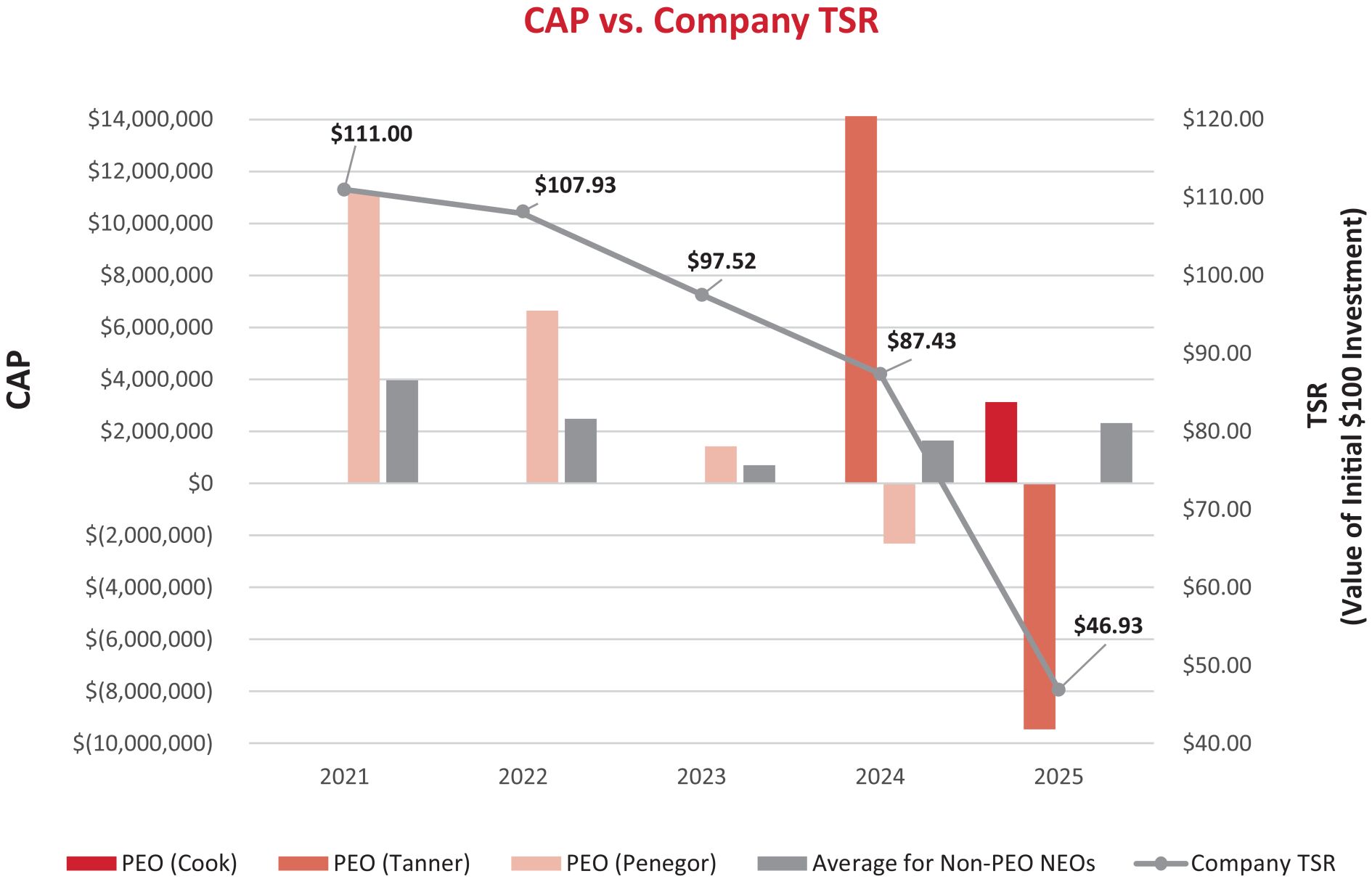
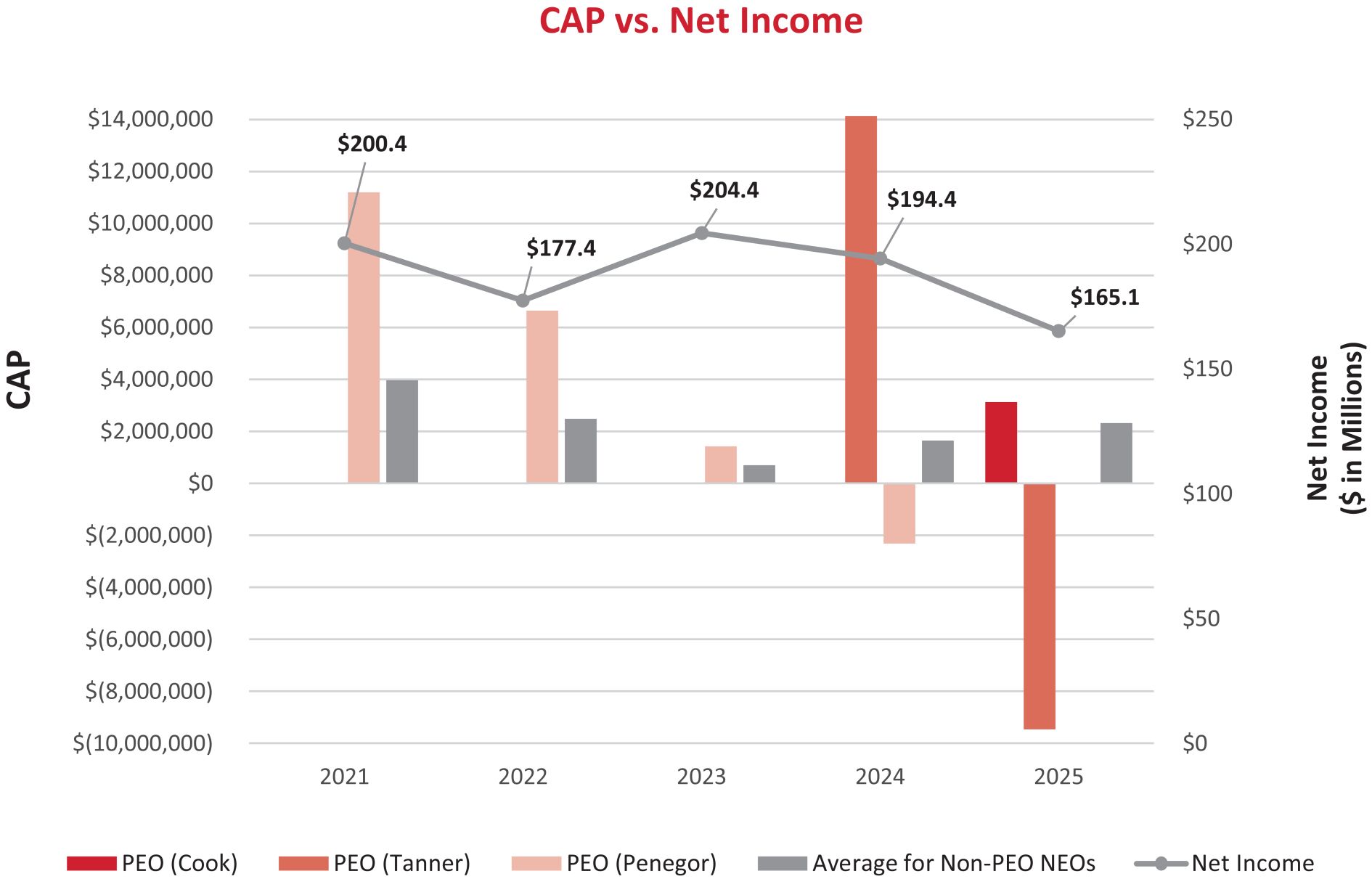
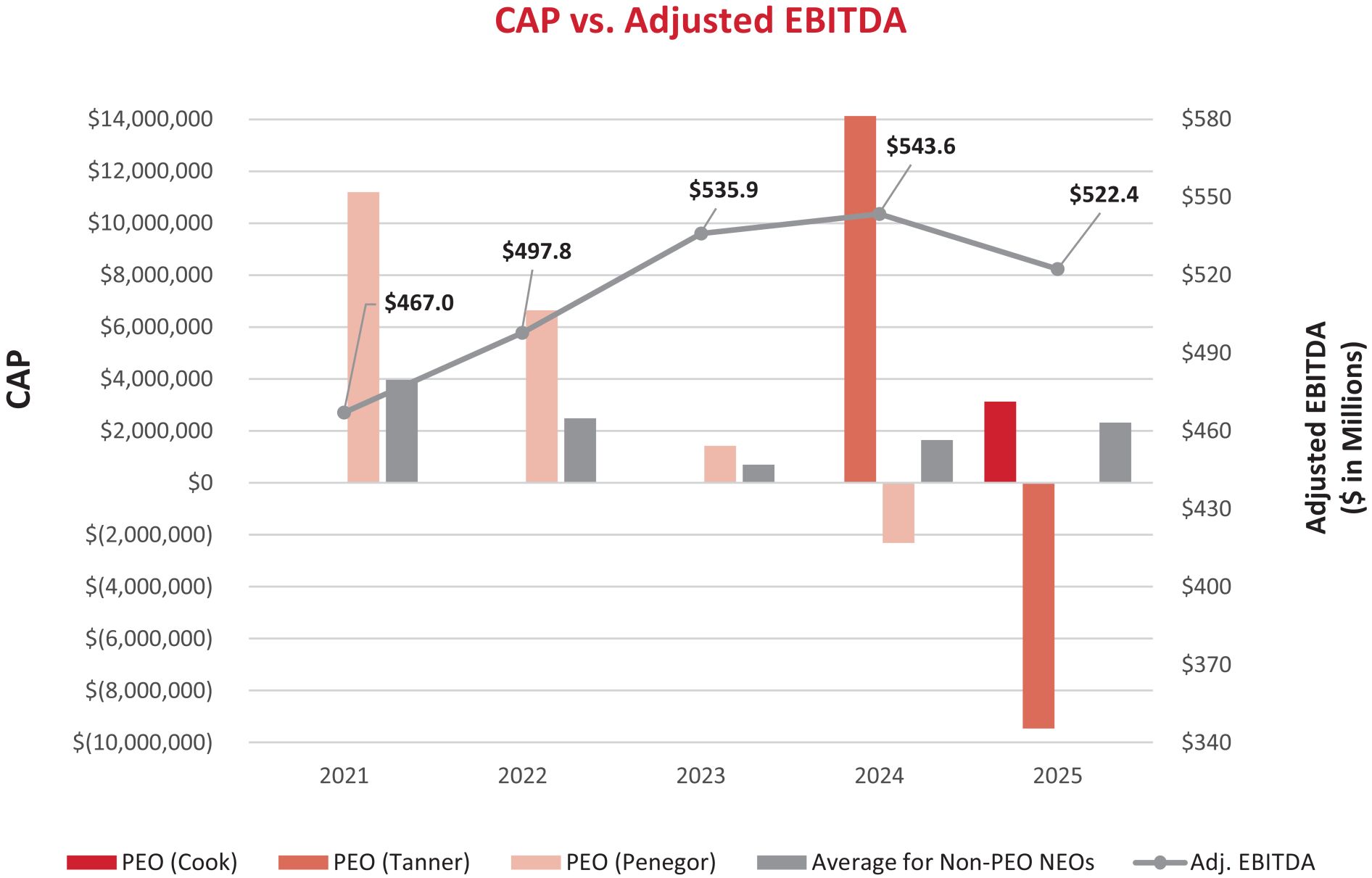
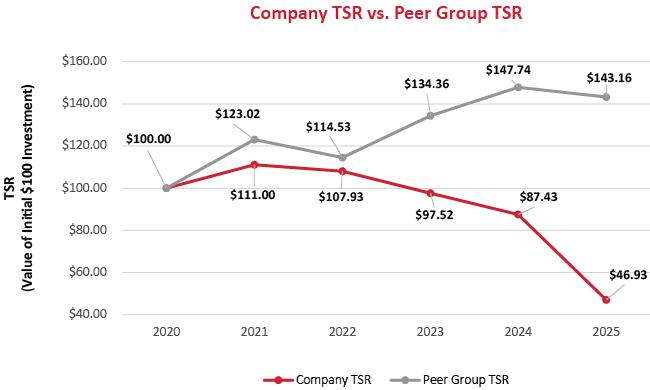
• |
• |
• |
• |
• |
• |
COMPENSATION OF DIRECTORS
The Company’s compensation program for non-management directors is designed to:
| • | Be competitive with companies against which the Company competes for director talent; |
| • | Encourage and facilitate ownership of our Common Stock by non-management directors; and |
| • | Take into consideration stockholder views regarding director compensation. |
The Compensation and Human Capital Committee has responsibility for reviewing the competitiveness and appropriateness of the compensation program for non-management directors and for approving or making recommendations to the Board of Directors with respect to director compensation. In carrying out its duties, the Compensation and Human Capital Committee reviews the competitive positioning of the Company’s director compensation program on a periodic basis in an effort to maintain the competitiveness of our director compensation program based on evolving market trends.
In April 2025, the Compensation and Human Capital Committee reviewed the continued competitiveness and appropriateness of the director compensation program. As part of this review, the Compensation and Human Capital Committee considered and evaluated the market, industry and peer group data, recommendations and other guidance provided by FW Cook in their competitive analysis. The Compensation and Human Capital Committee also considered other factors, including the design and competitiveness of our director compensation program and the amount of work, responsibilities and time required of Board and committee members.
With respect to the peer group data considered by the Compensation and Human Capital Committee, FW Cook prepared a competitive analysis of the Company’s director compensation program to ensure that the program was providing appropriate levels of compensation. The analysis, which compared the compensation of the Company’s non-management directors against a peer group of 14 restaurant companies, reviewed the design and competitiveness of the Company’s director compensation program. The peers considered were the same industry peer group companies used by the Compensation and Human Capital Committee as one factor in making executive compensation decisions. The Compensation and Human Capital Committee believes that the utilization of the industry peer group aligns our director compensation program with the compensation practices of our peers and supports our ability to attract and retain highly qualified individuals to serve on our Board of Directors.
After consulting with FW Cook, the Compensation and Human Capital Committee determined that no changes were needed to the Company’s director compensation program and that both the design and compensation levels of the Company’s director compensation program were reasonably aligned with market practice. The components of the Company’s current compensation program for non-management directors are described below.
Annual Retainers
| • | Each non-management director receives an annual retainer for Board service of $80,000. |
| • | The Chair receives an additional annual retainer of $75,000. |
| • | The Lead Independent Director (if the Chair is not independent) receives an additional annual retainer of $30,000. |
| • | Each member of the Audit Committee receives an annual retainer of $14,000, and the Audit Committee Chair receives an additional annual chair retainer of $20,000. |
| • | Each member of the Compensation and Human Capital Committee receives an annual retainer of $10,500, and the Compensation and Human Capital Committee Chair receives an additional annual chair retainer of $12,500. |
| • | Each member of the Technology Committee receives an annual retainer of $10,500, and the Technology Committee Chair receives an additional annual chair retainer of $12,500. |
| • | Each member of the Nominating and Corporate Governance Committee receives an annual retainer of $8,000, and the Nominating and Corporate Governance Committee Chair receives an additional annual chair retainer of $10,000. |
| • | Each member of the Corporate Social Responsibility Committee receives an annual retainer of $8,000, and the Corporate Social Responsibility Committee Chair receives an additional annual chair retainer of $10,000. |
78 The Wendy’s Company 2026 Proxy Statement
Meeting Fees
| • | Except as otherwise specifically determined by the Compensation and Human Capital Committee, no meeting fees are paid to members of the Audit Committee, Compensation and Human Capital Committee, Performance Compensation Subcommittee, Corporate Social Responsibility Committee, Nominating and Corporate Governance Committee or Technology Committee. Members of all other Board committees receive a fee of $2,000 for each meeting they attend. Ms. Arlin and Messrs. May and Rothschild were the only directors who received such other Board committee meeting fees in 2025, which were related to an ad hoc committee created in connection with the Company’s debt refinancing transaction completed in the fourth quarter of 2025. |
| • | In July 2025, following the departure of the Company’s former Chief Executive Officer, the Board of Directors established an ad hoc CEO Selection Committee to oversee the comprehensive recruitment and selection process and to assist the Board in identifying a permanent Chief Executive Officer for the Company. Given the frequency of meetings for this project and the importance of selecting the Company’s next Chief Executive Officer, the Compensation and Human Capital Committee requested that FW Cook conduct a review and competitive analysis of non-employee director compensation to ensure that members of the CEO Selection Committee were fairly and appropriately compensated. After consulting with FW Cook, the Compensation and Human Capital Committee approved a retainer of $14,000 per committee member and an additional $20,000 retainer for the chair of the CEO Selection Committee. Messrs. Winkleblack, May and Rothschild and Ms. Mathews-Spradlin were the only directors who received retainers related to the CEO Selection Committee. |
Annual Restricted Stock Awards
| • | Each non-management director receives a restricted stock award in connection with his or her initial election and annual re-election to the Board. Each restricted stock award has an annual grant date fair value of $162,500 (plus an additional $75,000 for the Chair) and vests on the earlier of the first anniversary of the grant date or the date of the Company’s next annual meeting of stockholders, subject to the director’s continued service on the Board on the vesting date. |
Non-management directors may elect to receive all or a portion of their annual retainers and meeting fees in shares of Common Stock in lieu of cash. In addition, pursuant to the Company’s 2009 Directors’ Deferred Compensation Plan (the “2009 Directors’ Deferred Compensation Plan”), non-management directors may elect to defer a set percentage or amount of their annual retainers, meeting fees and restricted stock awards into restricted stock units. The restricted stock units represent a contingent right to receive shares of Common Stock and, in the case of a deferral of restricted stock awards, are subject to the same vesting schedule as the underlying restricted stock. Dividend equivalent units accrue on all amounts deferred under the 2009 Directors’ Deferred Compensation Plan. All deferred amounts are payable in shares of Common Stock in a lump sum on the earlier of the director’s termination of Board service, a fixed number of years or the director’s death, as elected by the director at the time of deferral.
The Wendy’s Company 2026 Proxy Statement 79
2025 DIRECTOR COMPENSATION
The following table summarizes the compensation earned by, or paid or awarded to, the Company’s non-management directors for their Board and Board committee service during 2025. Mr. Tanner, the Company’s former President and Chief Executive Officer, did not receive any additional compensation during 2025 for his service as a director and is therefore not included in the table. The compensation paid to Mr. Tanner during 2025 for his service while he was an executive officer of the Company is set forth in the 2025 Summary Compensation Table.
| NAME
|
FEES EARNED OR PAID IN CASH ($) (1)
|
STOCK AWARDS ($) (2)
|
ALL OTHER COMPENSATION ($) (3)
|
TOTAL ($)
|
|||||||||||||||||||||
| Arthur B. Winkleblack |
221,000 | 237,500 | — | 458,500 | |||||||||||||||||||||
| Peter W. May |
136,690 | 162,500 | — | 299,190 | |||||||||||||||||||||
| Matthew H. Peltz (4) |
81,375 | 320,400 | (5) | — | 401,775 | ||||||||||||||||||||
| Wendy C. Arlin |
128,500 | 162,500 | — | 291,000 | |||||||||||||||||||||
| Michelle Caruso-Cabrera |
102,000 | 162,500 | — | 264,500 | |||||||||||||||||||||
| Kristin A. Dolan |
102,318 | 162,500 | — | 264,818 | |||||||||||||||||||||
| Kenneth W. Gilbert (6) |
49,250 | — | 100,000 | (7) | 149,250 | ||||||||||||||||||||
| Richard H. Gomez |
105,879 | 162,500 | — | 268,379 | |||||||||||||||||||||
| Michelle J. Mathews-Spradlin |
126,812 | 162,500 | — | 289,312 | |||||||||||||||||||||
| Bradley G. Peltz |
47,085 | 141,131 | (8) | — | 188,216 | ||||||||||||||||||||
| Peter H. Rothschild |
143,000 | 162,500 | — | 305,500 | |||||||||||||||||||||
| (1) | Consists of: (i) the annual Board retainer; (ii) the annual committee member retainers and additional annual committee chair retainers for the Audit, Compensation and Human Capital, Corporate Social Responsibility, Nominating and Corporate Governance and Technology Committees; and (iii) other committee meeting fees. For 2025, Messrs. May, B. Peltz and M. Peltz elected to receive payment of their entire annual retainers and meeting fees in shares of Common Stock in lieu of cash, and Ms. Dolan elected to receive payment of a portion of her annual retainer and meeting fees in shares of Common Stock in lieu of cash. The number of shares received in lieu of cash was based on the average of the closing price of our Common Stock for the 20 consecutive trading days immediately preceding the date on which the retainers were otherwise payable. |
| (2) | The amounts shown represent the grant date fair value of the annual restricted stock awards granted to each of the non-management directors on May 21, 2025 upon their re-election to the Board at the Company’s 2025 annual meeting of stockholders, computed in accordance with FASB ASC Topic 718. Mses. Arlin and Dolan elected to defer their entire restricted stock awards into restricted stock units under the 2009 Directors’ Deferred Compensation Plan. |
| (3) | The Company believes that its non-management directors are important representatives of the Wendy’s brand. As a result, the Company has established a program (the “Wendy’s Director Ambassador Program”) whereby non-management directors may, from time to time, receive a limited number of Wendy’s gift cards, branded apparel and other similar items. All of the Company’s non-management directors participate in the Wendy’s Director Ambassador Program and, to the extent the value of such participation is required to be disclosed under SEC rules, it is included in the “All Other Compensation” column of this table. |
| (4) | Mr. M. Peltz resigned from the Board on July 8, 2025 to devote more time to other business commitments. |
| (5) | Also includes the incremental fair value ($157,900) associated with the accelerated vesting of the outstanding annual restricted stock award held by Mr. M. Peltz on July 8, 2025, his last day of Board service, computed in accordance with FASB ASC Topic 718. |
| (6) | Mr. Gilbert retired from the Board on May 21, 2025 when his term expired at the Company’s 2025 annual meeting of stockholders. |
80 The Wendy’s Company 2026 Proxy Statement
| (7) | Given Mr. Gilbert’s familiarity with the Wendy’s brand, his extensive marketing expertise and the unexpected and significant decline in consumer sentiment beginning in early 2025, the Company entered into a marketing consulting agreement with Mr. Gilbert in connection with his departure from the Board under which Mr. Gilbert provided expert marketing services to the Company as requested by the Chair of the Board of Directors through December 2025. In accordance with SEC disclosure rules, the compensation Mr. Gilbert received under the agreement is reported in the “All Other Compensation” column of this table. |
| (8) | Represents the grant date fair value of the prorated restricted stock award granted to Mr. B. Peltz in connection with his initial election to the Board in July 2025, computed in accordance with FASB ASC Topic 718. |
The following table shows, for each non-management director who served on our Board during 2025, the aggregate number of shares of restricted stock and restricted stock units outstanding as of the end of 2025. None of our directors had any outstanding stock options as of 2025 year-end.
| NAME
|
SHARES OF RESTRICTED STOCK OUTSTANDING AS OF 2025 FYE (1)
|
RESTRICTED STOCK UNITS OUTSTANDING AS OF 2025 FYE (2)
| ||||
| Arthur B. Winkleblack |
20,438 | — | ||||
| Peter W. May |
13,984 | — | ||||
| Matthew H. Peltz |
— | — | ||||
| Wendy C. Arlin |
— | 24,712 | ||||
| Michelle Caruso-Cabrera |
13,984 | — | ||||
| Kristin A. Dolan |
— | 14,610 | ||||
| Kenneth W. Gilbert |
— | — | ||||
| Richard H. Gomez |
13,984 | — | ||||
| Michelle J. Mathews-Spradlin |
13,984 | — | ||||
| Bradley G. Peltz |
13,226 | — | ||||
| Peter H. Rothschild |
13,984 | — | ||||
| (1) | Represents the aggregate number of shares of Common Stock underlying the unvested restricted stock awards held by each non-management director as of December 28, 2025. |
| (2) | Represents the total annual restricted stock awards that the respective individuals have elected to defer into restricted stock units under the 2009 Directors’ Deferred Compensation Plan. |
The Wendy’s Company 2026 Proxy Statement 81
EXECUTIVE OFFICERS
The Company’s executive officers as of the date of this Proxy Statement are identified below.
|
NAME
|
AGE
|
POSITION
| |||||
|
Ken Cook
|
|
45
|
|
Interim Chief Executive Officer and Chief Financial Officer
| |||
| Liliana M. Esposito |
|
51
|
|
Chief Corporate Affairs & Sustainability Officer
| |||
| John Min |
|
46
|
|
Chief Legal Officer and Secretary
| |||
| Coley O’Brien |
|
52
|
|
Chief People Officer
| |||
| Lindsay J. Radkoski |
|
40
|
|
Chief Marketing Officer, U.S.
| |||
| Matthew P. Spessard |
|
43
|
|
Chief Information Officer
| |||
| Pete Suerken |
|
54
|
|
President, U.S.
| |||
| Suzie Thuerk |
|
44
|
|
Chief Accounting Officer
| |||
| E. J. Wunsch |
|
54
|
|
President, International
| |||
Additional information concerning the executive officers is provided below, including their respective positions with the Company and prior business experience. Executive officers are elected by the Board of Directors and hold office until the organizational meeting of the Board following the Company’s annual meeting of stockholders next succeeding their election and until their successors are elected and qualified, or until their earlier death, resignation, retirement or removal.
| KEN COOK |
Mr. Cook has served as Interim Chief Executive Officer for The Wendy’s Company since July 2025. He has also served as Chief Financial Officer since December 2024. Previously, Mr. Cook worked for 20 years at United Parcel Service, Inc. (“UPS”), where he held a number of financial roles of increasing responsibility, including Head of Financial Planning and Analysis from September 2024 to November 2024, Chief Financial Officer for the U.S. Domestic segment from September 2023 to August 2024, Investor Relations Officer from February 2022 to August 2023, Vice President, Investor Relations from June 2020 to January 2022, Vice President, Assistant Treasurer from April 2017 to May 2020 and Chief Financial Officer, South Asia from 2014 to 2017. Mr. Cook joined UPS in 2004 and also held assignments in multiple departments within UPS Airlines, including aircraft acquisitions, financial planning and analysis and aircraft maintenance finance.
| LILIANA M. ESPOSITO |
Ms. Esposito joined the Company in June 2014 and has served as our Chief Corporate Affairs & Sustainability Officer since February 2021. She previously served as our Chief Communications Officer from June 2014 to February 2021. Previously, Ms. Esposito worked at Dean Foods Company, where she served as Vice President of Corporate Communications and Public Affairs from January 2012 to March 2014 and Senior Director of Public Affairs from January 2010 to December 2011. Prior to her tenure with Dean Foods, she worked at Mercury Public Affairs, a public strategy firm, where she served as Senior Vice President from January 2008 to January 2010 and Vice President from July 2005 to December 2007. Before joining Mercury Public Affairs, Ms. Esposito served as Public Affairs Manager at Mars, Incorporated from July 2000 to July 2005. Previously, she served as a Senior Associate with Burson-Marsteller, a global public relations and communications firm. Ms. Esposito is a member of the board of directors of Quality Supply Chain Co-op, Inc. (“QSCC”), the independent purchasing cooperative for the Company and Wendy’s system. She is also a member of the board of trustees of the Mid-Ohio Food Collective, a member of the board of directors of the Ohio
82 The Wendy’s Company 2026 Proxy Statement
Chamber of Commerce and a member of the board of directors of the Ohio Farm Bureau Foundation. Ms. Esposito previously served as a trustee of the Dave Thomas Foundation for Adoption from January 2015 to December 2022.
| JOHN MIN |
Mr. Min has served as our Chief Legal Officer and Secretary since he joined the Company in September 2024. Previously, Mr. Min served as Senior Vice President, Chief Legal Officer and Secretary of Kellanova from October 2023 to June 2024 following the separation of Kellogg Company, a global food products company (“Kellogg”), into two companies. Prior to the separation of Kellogg, Mr. Min worked 13 years at Kellogg, where he held several key leadership positions, including Chief Legal Officer Designate from January 2023 to October 2023, General Counsel – Asia, Middle East, and Africa from January 2022 to January 2023, General Counsel – Europe from April 2017 to January 2022, and various corporate legal roles from July 2010 to February 2017. Prior to joining Kellogg, Mr. Min was an associate attorney with the law firm of Jenner & Block LLP from March 2006 to July 2010 and the law firm of Jones Day from September 2004 to March 2006. Mr. Min previously served on the board of directors of QSCC from April 2025 to July 2025.
| COLEY O’BRIEN |
Mr. O’Brien joined the Company in May 2007 and has served as our Chief People Officer since March 2018. Previously, he served as our Vice President of Human Resources and Field Capability from August 2013 to December 2017, Vice President of Training from April 2011 to July 2013 and National Director of Operations Training from May 2007 to March 2011. Prior to his tenure with the Company, Mr. O’Brien worked at Sears Holdings Corporation for five years, where he served as Director of Retail Training from 2005 to 2007 and as Manager of Curriculum Development for Sears University from 2002 to 2004. Before joining Sears Holdings Corporation, he was employed from 1999 to 2002 as a Senior Consultant with Arthur Andersen Performance and Learning, a corporate educational institution that developed performance improvement strategies and organizational development opportunities. Mr. O’Brien is certified as a Senior Professional in Human Resources (SPHR) and is an active member of the HR Policy Association. He also serves as a trustee of the Dave Thomas Foundation for Adoption and is a board member of the Women’s Foodservice Forum.
| LINDSAY J. RADKOSKI |
Ms. Radkoski joined the Company in November 2011 and has served as our Chief Marketing Officer, U.S. since August 2024. She previously served as our Senior Vice President, Chief Marketing Officer, U.S. from March 2023 to August 2024, Vice President – National Marketing from January 2019 to March 2023, Director – Marketing & Innovation Finance from January 2015 to January 2019, Manager – Marketing & Innovation Finance from November 2013 to December 2014 and Manager – Investor Relations from November 2011 to November 2013. Prior to her tenure with the Company, Ms. Radkoski worked at Bob Evans Farms, Inc., where she served in a variety of finance and marketing roles from July 2008 to October 2011.
| MATTHEW P. SPESSARD |
Mr. Spessard joined the Company in June 2020 and has served as our Chief Information Officer since February 2024. He previously served as our Senior Vice President, Global Chief Technology Officer from August 2022 to February 2024, Vice President – Digital and Restaurant Technology from September 2020 to August 2022 and Vice President – Restaurant Technology from June 2020 to September 2020. Prior to his tenure with the Company, Mr. Spessard worked for the Sonic Drive-In brand for six years where he held positions of increasing accountability, including Vice President, Head of Technology from November 2019 to June 2020, Senior Director, Retail Technology and Strategy from June 2018 to October 2019, Senior Director, Implementation from June 2017 to May 2018, Director, Integrated Customer Engagement from July 2015 to May 2017 and Managing Partner from April 2014 to June 2015. Mr. Spessard previously served as Operations Leader for Braum’s Ice Cream & Dairy Stores from December 2011 to April 2014 and as Director of Operations for Church’s Chicken from November 2008 to October 2011. Prior to joining Church’s Chicken, Mr. Spessard worked for Yum! Brands, Inc., serving in various operations and technology leadership roles from May 1999 to October 2008.
The Wendy’s Company 2026 Proxy Statement 83
| PETE SUERKEN |
Mr. Suerken has served as our President, U.S. since he joined the Company in July 2025. Previously, from January 2021 to July 2025, Mr. Suerken served as President and Chief Executive Officer of QSCC, which is Wendy’s independent purchasing cooperative and manages, for the Wendy’s system in the United States and Canada, nearly $4 billion in contracts for the purchase and distribution of food, proprietary paper, operating supplies and equipment. Prior to joining QSCC, Mr. Suerken served as President of Resin Technology, Inc. from July 2017 to January 2021. Previously, he worked at Restaurant Supply Chain Solutions, LLC, a Yum! Brands Co-op, from August 2004 to February 2017, where he held a number of roles of increasing responsibility, including Executive Vice President, Food & Packaging Procurement from February 2016 to February 2017. Mr. Suerken was also employed at Archer Daniels Midland, a global food processing and commodities trading company, from May 1995 to August 2004. Mr. Suerken is also a member of the board of directors of QSCC and has served as a trustee of the Dave Thomas Foundation for Adoption since December 2022.
| SUZIE THUERK |
Ms. Thuerk joined the Company in March 2014 and has served as our Chief Accounting Officer since January 2023. She previously served as our Vice President – Accounting from June 2022 to January 2023, Senior Director – Corporate Accounting and Financial Reporting from April 2019 to June 2022, Director – Corporate Accounting from August 2017 to April 2019 and Manager – Financial Planning & Analysis from March 2014 to August 2017. Prior to her tenure with the Company, Ms. Thuerk worked at Bath & Body Works, Inc., where she served as Manager of Financial Planning & Analysis from November 2012 to March 2014, Senior Financial Analyst – Financial Planning & Analysis from July 2011 to November 2012, and Senior Financial Analyst – Financial Reporting from August 2009 to July 2011. Previously, she served as Senior Internal Auditor at L Brands, Inc. (formerly known as Limited Brands, Inc.) from July 2006 to August 2009 and Internal Auditor from August 2005 to July 2006. Ms. Thuerk’s corporate accounting and financial reporting, planning and analysis experience also includes her work in public accounting with PricewaterhouseCoopers LLP, where she served as an Associate from January 2004 to August 2005. Ms. Thuerk is a certified public accountant.
| E. J. WUNSCH |
Mr. Wunsch has served as our President, International since June 2024. He previously served as the Company’s Chief Legal Officer and Secretary from when he joined the Company in October 2016 until June 2024. Previously, Mr. Wunsch worked for 17 years at The Procter & Gamble Company, where he held several key leadership positions, including Vice President and General Counsel—North America and Go-To-Market and Global Practices from July 2015 to September 2016, Associate General Counsel—Global Baby, Feminine & Family Care and Asia Innovation, Commerce & Brand Equity from September 2013 to July 2015, Associate General Counsel—ASEAN, India, Australia/New Zealand & Asia Developing Markets from August 2011 to September 2013, Assistant Secretary and Associate General Counsel—Corporate, Securities & Employee Benefits from November 2006 to August 2011, and Associate Director and Senior Counsel—M&A/Licensing and Baby, Feminine & Family Care from April 2004 to November 2006, Senior Counsel and Counsel—Corporate, Securities & Employee Benefits from November 2000 to April 2004 and Counsel—Beauty Care from November 1999 to November 2000. Prior to joining The Procter & Gamble Company, Mr. Wunsch was an associate attorney with the Taft Stettinius & Hollister LLP law firm from 1997 to 1999 and a law clerk for the Honorable Richard F. Suhrheinrich from 1996 to 1997.
84 The Wendy’s Company 2026 Proxy Statement
STOCK OWNERSHIP AND RETENTION GUIDELINES
FOR EXECUTIVE OFFICERS AND DIRECTORS
The Board of Directors, upon the recommendation of the Compensation and Human Capital Committee, adopted the Stock Ownership and Retention Guidelines for Executive Officers and Directors, which are available on our Governance website at www.irwendys.com/esg/governance. The Stock Ownership and Retention Guidelines were adopted by the Board to further align the interests of executive officers and directors with the interests of stockholders and to promote the Company’s commitment to sound corporate governance. A summary of the Stock Ownership and Retention Guidelines is set forth below.
STOCK OWNERSHIP AND RETENTION GUIDELINES FOR EXECUTIVE OFFICERS
The Chief Executive Officer must own an amount of Common Stock equal to at least six times his base salary, and each of the other executive officers must own an amount of Common Stock equal to at least three times his or her base salary. Until an executive officer satisfies the applicable ownership requirement, he or she is required to hold at least 75% of the net shares received upon the exercise of stock options, the vesting of restricted stock or restricted stock units and the payout of performance units. Once the ownership requirement is met, the executive officer must continue to hold at least that number of shares until leaving his or her position with the Company.
STOCK OWNERSHIP AND RETENTION GUIDELINES FOR NON-MANAGEMENT DIRECTORS
Each non-management member of the Board must own an amount of Common Stock equal to at least five times the annual cash retainer payable for Board service. Until a director satisfies the ownership requirement, he or she is required to hold at least 100% of the net shares received upon the exercise of stock options, the vesting of restricted stock or restricted stock units and the payout of performance units. Once the ownership requirement is met, the director must continue to hold at least that number of shares until leaving the Board.
GENERAL PROVISIONS
Because executive officers and non-management directors must retain at least 75% and 100%, respectively, of the net shares received from any exercise of stock options, vesting of restricted stock or restricted stock units and payout of performance units until they satisfy the applicable ownership requirement, there is no set time period for initial satisfaction of the Stock Ownership and Retention Guidelines. In the case of financial hardship or other unusual situations, the ownership requirements may be waived upon the approval of the Compensation and Human Capital Committee and, in the case of executive officers, the Chief Executive Officer.
For stock options, “net shares” means the number of shares of Common Stock received upon exercise of the option, net of any shares used to pay the exercise price and/or applicable taxes upon such exercise. For restricted stock, restricted stock units and performance units, “net shares” means the number of shares received upon the vesting of the restricted stock or restricted stock units or the payout of the performance units, as applicable, net of any shares used to pay applicable taxes upon such vesting.
In addition to shares owned directly by an executive officer or a director, the Stock Ownership and Retention Guidelines provide that shares held in a trust, shares held by immediate family members residing in the same household, shares held in qualified plans, vested shares or share units held in nonqualified plans and unvested time-based restricted stock or restricted stock units will be counted toward satisfaction of the applicable ownership requirement. Performance units that have not yet vested, stock options that have not yet vested and stock options that have vested but have not yet been exercised will not be counted toward satisfaction of the applicable ownership requirement. In addition, shares held by an executive officer or a director in a margin account or otherwise pledged by an executive officer or a director as collateral for a loan will not be counted toward satisfaction of the applicable ownership requirement.
As of the date of this Proxy Statement, none of the Company’s executive officers or directors has pledged any shares of Common Stock.
The Wendy’s Company 2026 Proxy Statement 85
SECURITY OWNERSHIP OF
CERTAIN BENEFICIAL OWNERS AND MANAGEMENT
The following table sets forth the beneficial ownership as of March 23, 2026 (except as otherwise indicated by footnote) by: (i) each person known by the Company to be the beneficial owner of more than five percent of the outstanding shares of our Common Stock (constituting our only class of voting securities); (ii) each of the Company’s directors and director nominees; (iii) each of the Company’s NEOs included in the 2025 Summary Compensation Table; and (iv) all of the Company’s directors and executive officers as a group. The number of shares of Common Stock beneficially owned by our directors and executive officers includes shares that such persons have the right to acquire within 60 days of March 23, 2026, including through the exercise of stock options as shown in the second table below. Except as otherwise indicated by footnote, each person has sole voting power and sole dispositive power with respect to the shares shown in the table.
|
NAME AND ADDRESS OF BENEFICIAL OWNER
|
AMOUNT AND NATURE
|
PERCENT OF CLASS
| |||||
| Nelson Peltz (2) |
30,913,106 | (3)(4)(5) | 16.2% | ||||
| Peter W. May (2) |
30,706,417 | (3)(4)(5) | 16.1% | ||||
| BlackRock, Inc. (6) |
23,098,336 | (6) | 12.1% | ||||
| The Vanguard Group (7) |
18,589,808 | (7) | 9.8% | ||||
| Trian Fund Management, L.P. (2) |
14,943,466 | (5) | 7.9% | ||||
| AQR Capital Management LLC (8) |
11,705,610 | (8) | 6.2% | ||||
| Harris Associates L.P. |
11,076,295 | (9) | 5.8% | ||||
| Matthew H. Peltz (2) |
459,959 | (10) | * | ||||
| Wendy C. Arlin |
28,554 | (11) | * | ||||
| Michelle Caruso-Cabrera |
30,696 | (12) | * | ||||
| Kristin A. Dolan |
61,609 | (13) | * | ||||
| Richard H. Gomez |
41,343 | (14) | * | ||||
| Michelle J. Mathews-Spradlin |
77,773 | (15) | * | ||||
| Bradley G. Peltz |
153,409 | (16) | * | ||||
| Peter H. Rothschild |
178,154 | (17) | * | ||||
| Arthur B. Winkleblack |
86,239 | (18) | * | ||||
| Ken Cook |
1,500 | (19) | * | ||||
| Pete Suerken |
1,224 | (20) | * | ||||
| E.J. Wunsch |
503,737 | (21) | * | ||||
| John Min |
3,005 | (22) | * | ||||
| Kirk Tanner |
73,275 | * | |||||
| Directors and current executive officers as a group (18 persons) |
32,703,173 | 17.1% | |||||
* Less than 1% of the outstanding shares of our Common Stock.
86 The Wendy’s Company 2026 Proxy Statement
| (1) | All percentages are based upon the number of shares of our Common Stock that were outstanding on March 23, 2026 (190,466,246). |
| (2) | The principal business address of Nelson Peltz, Peter May and Matthew Peltz is 223 Sunset Avenue, Palm Beach, FL 33480. The principal business address of Trian Fund Management, L.P. (“Trian Partners”) is 280 Park Avenue, New York, NY 10017. |
| (3) | In July 2004, Nelson Peltz and Peter May entered into a voting agreement pursuant to which they agreed not to vote certain shares of Common Stock held by them or their affiliates without the prior approval of both parties. Accordingly, the information set forth in the table above with respect to Messrs. N. Peltz and May aggregates their respective ownership interests as described in footnote (4). |
| (4) | In the case of Nelson Peltz, includes: (i) 9,959,519 shares of Common Stock held directly; (ii) 44,169 shares of Common Stock owned by Mr. N. Peltz’s spouse; (iii) 81,104 shares of Common Stock owned by Mr. N. Peltz’s children; (iv) 132,397 shares of Common Stock held by the Peltz 2009 Family Trust, a trust whose trustees are Mr. N. Peltz’s spouse, three of Mr. N. Peltz’s adult children (including Matthew Peltz and Bradley Peltz) and an unrelated person; (v) 195,430 shares of Common Stock owned by the Peltz Family Foundation, a non-profit organization whose trustees are Mr. N. Peltz, Mr. N. Peltz’s spouse, Mr. M. Peltz and an unrelated person; (vi) 19,140 shares of Common Stock owned by the Nelson Peltz 2023 Non-Pourover Revocable Trust, a trust whose sole trustee is Mr. N. Peltz; (vii) 5,537,881 shares of Common Stock held directly by Mr. May (including 13,984 restricted shares of Common Stock that may be voted by Mr. May); and (viii) 14,943,466 shares of Common Stock owned by the Trian Entities identified in footnote (5). Mr. N. Peltz disclaims beneficial ownership of the shares of Common Stock held by Mr. N. Peltz’s spouse, Mr. N. Peltz’s children, the Peltz 2009 Family Trust, the Peltz Family Foundation, Mr. May and the Trian Entities. |
| In the case of Mr. May, includes: (i) 5,537,881 shares of Common stock held directly (including 13,984 restricted shares of Common Stock that may be voted by Mr. May); (ii) 32,910 shares of Common Stock owned by the May Family Foundation, a non-profit organization whose directors are Mr. May, Mr. May’s spouse and their two adult children; (iii) 9,959,519 shares of Common Stock held directly by Mr. N. Peltz; (iv) 81,104 shares of Common Stock owned by Mr. N. Peltz’s children; (v) 132,397 shares of Common Stock held by the Peltz 2009 Family Trust; (vi) 19,140 shares of Common Stock owned by the Nelson Peltz 2023 Non-Pourover Revocable Trust and (vi) 14,943,466 shares of Common Stock owned by the Trian Entities identified in footnote (5). Mr. May disclaims beneficial ownership of the shares of Common Stock held by the May Family Foundation, Mr. N. Peltz, the Peltz 2009 Family Trust, Mr. N. Peltz’s minor children, the Nelson Peltz 2023 Non-Pourover Revocable Trust and the Trian Entities. |
| (5) | Based on: (i) information contained in a Schedule 13D/A filed with the SEC on February 18, 2026 by Trian Partners, L.P., Trian Partners Master Fund, L.P., Trian Partners Parallel Fund I, L.P., Trian Partners Strategic Fund-G II, L.P., Trian Partners Strategic Fund-K, L.P., Trian Partners GP, L.P. (the foregoing entities collectively, the “Trian Entities”), Trian Partners, Trian Fund Management GP, LLC (“Trian Management GP”), Trian Partners General Partner, LLC (“Trian GP LLC”), Nelson Peltz, Peter May and Matthew Peltz; (ii) information contained in Form 4s filed with the SEC by the Trian Entities and by Mr. May on or subsequent to February 18, 2026; and (iii) information provided to the Company by Trian Partners. |
| 14,943,466 shares are owned directly by certain Trian Entities that are managed by Trian Partners, an institutional investment manager (and are not held directly by Messrs. N. Peltz or May). Such shares are currently held in the ordinary course of business with other investment securities owned by the Trian Entities in comingled margin accounts with a prime broker, which prime broker may, from time to time, extend margin credit to certain of the Trian Entities, subject to applicable federal margin regulations, stock exchange rules and credit policies. Messrs. N. Peltz and May, by virtue of their relationships to the Trian Entities, Trian Partners, Trian Management GP and Trian GP LLC, may be deemed to beneficially own (as that term is defined in Rule 13d-3 of the Exchange Act) the shares of our Common Stock that are owned by the Trian Entities. Messrs. N. Peltz and May disclaim ownership of such shares for all other purposes. |
| (6) | BlackRock, Inc. stated in its Schedule 13G/A filed with the SEC on October 17, 2025 that of the 23,098,336 shares of Common Stock beneficially owned, BlackRock, Inc. has sole voting power over 22,567,218 shares and sole dispositive power over 23,098,336 shares. The principal business address of BlackRock, Inc. is 50 Hudson Yards, New York, New York 10001. |
The Wendy’s Company 2026 Proxy Statement 87
| (7) | The Vanguard Group stated in its Schedule 13G/A filed with the SEC on October 31, 2025 that of the 18,589,808 shares of Common Stock beneficially owned, The Vanguard Group has shared voting power over 958,494 shares, sole dispositive power over 17,427,979 shares and shared dispositive power over 1,161,829 shares. The principal business address of The Vanguard Group is 100 Vanguard Boulevard, Malvern, Pennsylvania 19355. |
| On March 27, 2026, The Vanguard Group filed Amendment No. 12 to Schedule 13G, indicating therein that, on “January 12, 2026, The Vanguard Group, Inc. went through an internal realignment. In accordance with SEC Release No. 34-39538 (January 12, 1998), certain subsidiaries or business divisions of subsidiaries of The Vanguard Group, Inc., that formerly had, or were deemed to have, beneficial ownership with The Vanguard Group, Inc., will report beneficial ownership separately (on a disaggregated basis) from The Vanguard Group, Inc. in reliance on such release. These subsidiaries and/or business divisions pursue the same investment strategies as previously pursued by The Vanguard Group, Inc. prior to the realignment. Further in accordance with SEC Release No. 34-39538 (January 12, 1998), The Vanguard Group, Inc. no longer has, or is deemed to have, beneficial ownership over securities beneficially owned by such subsidiaries and/or business divisions.” As of March 23, 2026, the most recent practicable date prior to the date of this Proxy Statement, no subsidiary or business division of The Vanguard Group, Inc. had reported its beneficial ownership of our Common Stock. |
| (8) | AQR Capital Management, LLC (“AQR”) stated in its Schedule 13G filed with the SEC on February 13, 2026 that of the 11,705,610 shares of Common Stock beneficially owned, AQR has shared voting power over 11,705,610 shares and shared dispositive power over 11,705,610 shares. The principal business address of AQR is One Greenwich Plaza, Suite 130, Greenwich, Connecticut 06830. |
| (9) | Harris Associates L.P. stated in its Schedule 13G filed with the SEC on August 14, 2025 that of the 11,076,295 shares of Common Stock beneficially owned, Harris Associates L.P. has sole voting power over 11,070,682 shares and sole dispositive power over 11,076,295 shares. The principal business address of Harris Associates L.P. is 111 South Wacker Drive, Suite 4600, Chicago, Illinois 60606. |
| (10) | Includes: (i) 132,132 shares of Common Stock held directly; (ii) 132,397 shares held by the Peltz 2009 Family Trust (of which Mr. M. Peltz is a trustee); and (iii) 195,430 shares held by the Peltz Family Foundation (of which Mr. M. Peltz is a trustee). Mr. M. Peltz disclaims beneficial ownership of the shares owned by the Peltz 2009 Family Trust and the Peltz Family Foundation. |
| (11) | Includes 25,204 restricted stock units held by Ms. Arlin under the 2009 Directors’ Deferred Compensation Plan, each of which represents a contingent right to receive one share of Common Stock. |
| (12) | Includes 13,984 restricted shares of Common Stock that may be voted by Ms. Caruso-Cabrera. |
| (13) | Includes 14,901 restricted stock units held by Ms. Dolan under the 2009 Directors’ Deferred Compensation Plan, each of which represents a contingent right to receive one share of Common Stock. |
| (14) | Includes 13,984 restricted shares of Common Stock that may be voted by Mr. Gomez. |
| (15) | Includes 13,984 restricted shares of Common Stock that may be voted by Ms. Mathews-Spradlin. |
| (16) | Includes: (i) 21,012 shares of Common Stock held directly (including 13,226 restricted shares of Common Stock that may be voted by Mr. B. Peltz); and (ii) 132,397 shares held by the Peltz 2009 Family Trust (of which Mr. B. Peltz is a trustee). Mr. B. Peltz disclaims beneficial ownership of the shares owned by the Peltz 2009 Family Trust. |
| (17) | Includes 13,984 restricted shares of Common Stock that may be voted by Mr. Rothschild. |
| (18) | Includes 20,438 restricted shares of Common Stock that may be voted by Mr. Winkleblack. |
| (19) | Does not include 191,810 restricted stock units held by Mr. Cook, each of which represents a contingent right to receive one share of Common Stock. |
| (20) | Does not include 169,051 restricted stock units held by Mr. Suerken, each of which represents a contingent right to receive one share of Common Stock. |
| (21) | Does not include 156,258 restricted stock units held by Mr. Wunsch, each of which represents a contingent right to receive one share of Common Stock. |
| (22) | Does not include 119,957 restricted stock units held by Mr. Min, each of which represents a contingent right to receive one share of Common Stock. |
88 The Wendy’s Company 2026 Proxy Statement
The beneficial ownership table above includes shares of Common Stock issuable upon the exercise of stock options that are exercisable as of, or will become exercisable within 60 days of, March 23, 2026 by the persons identified in the following table.
| NAME OF BENEFICIAL OWNER |
NUMBER OF SHARES REPRESENTED BY OPTIONS | ||||
| Peter W. May |
— | ||||
| Wendy C. Arlin |
— | ||||
| Michelle Caruso-Cabrera |
— | ||||
| Kristin A. Dolan |
— | ||||
| Richard H. Gomez |
— | ||||
| Michelle J. Mathews-Spradlin |
— | ||||
| Bradley G. Peltz |
— | ||||
| Peter H. Rothschild |
— | ||||
| Arthur B. Winkleblack |
— | ||||
| Ken Cook |
— | ||||
| Pete Suerken |
— | ||||
| E.J. Wunsch |
425,109 | ||||
| John Min |
— | ||||
| Kirk Tanner |
— | ||||
| Directors and current executive officers as a group (18 persons) |
1,126,069 | ||||
DELINQUENT SECTION 16(A) REPORTS
Section 16(a) of the Exchange Act requires the Company’s directors and executive officers, and persons who own more than 10% of our Common Stock, to report their beneficial ownership of our Common Stock, and any subsequent changes in their beneficial ownership, to the SEC. Specific due dates for these reports have been established by the SEC, and the Company is required to disclose in this Proxy Statement any late report or known failure to file a required report during the most recent fiscal year. The Company assists our directors and executive officers in completing and filing their reports. Based solely on a review of the reports furnished to the Company and written representations that no other reports were required, the Company believes that, during 2025, all directors, executive officers and greater than 10% stockholders complied with all Section 16(a) filing requirements, with the following exceptions: (i) a Form 3 to be filed within 10 days of his July 8, 2025 appointment to the Board of Directors for Mr. B. Peltz was filed on July 22, 2025; and (ii) a Form 4 reporting the restricted stock unit award granted to Mr. Suerken on July 22, 2025 was filed on August 1, 2025, in each case due to delays in receiving their respective EDGAR filing codes from the SEC.
The Wendy’s Company 2026 Proxy Statement 89
EQUITY COMPENSATION PLAN INFORMATION
The following table provides information concerning the Company’s equity compensation plans as of the end of 2025. The 2020 Omnibus Award Plan is currently the only equity compensation plan under which future equity awards may be granted.
| PLAN CATEGORY |
NUMBER OF SECURITIES TO BE ISSUED UPON EXERCISE OF OUTSTANDING OPTIONS, WARRANTS AND RIGHTS (a) |
WEIGHTED-AVERAGE EXERCISE PRICE OF OUTSTANDING OPTIONS, WARRANTS AND RIGHTS (b) |
NUMBER OF SECURITIES REMAINING AVAILABLE FOR FUTURE ISSUANCE UNDER EQUITY COMPENSATION PLANS (EXCLUDING SECURITIES REFLECTED IN COLUMN (a)) (c) | |||||||||
| Equity compensation plans |
12,029,187 Options | $15.5718 | 8,070,934 (2) | |||||||||
| 949,040 Performance Units (3) | — | |||||||||||
| 514,504 Performance Units (4) | — | |||||||||||
| 470,986 Performance Units (5) | — | |||||||||||
| 2,248,068 Restricted Stock Units (6)
|
— | |||||||||||
|
Equity compensation plans not approved by security holders
|
— |
|
— |
|
|
— |
| |||||
|
Total |
12,029,187 Options |
|
$15.5718 |
|
|
8,070,934 (2) |
| |||||
| 949,040 Performance Units (3) | — | |||||||||||
| 514,504 Performance Units (4) | — | |||||||||||
| 470,986 Performance Units (5) | — | |||||||||||
| 2,248,068 Restricted Stock Units (6)
|
— | |||||||||||
| (1) | Includes the 2020 Omnibus Award Plan and the 2010 Omnibus Award Plan. |
| The 2020 Omnibus Award Plan provides for the issuance of stock options, stock appreciation rights, restricted stock awards, restricted stock units, other stock-based awards and performance compensation awards to employees, officers and non-employee directors of the Company and its subsidiaries and affiliates. The 2020 Omnibus Award Plan also permits non-employee directors to elect to receive all or a portion of their director fees in shares of Common Stock in lieu of cash. Under the terms of the 2020 Omnibus Award Plan, (i) shares of Common Stock subject to awards of stock options or stock appreciation rights are counted against the maximum share limit as one share of Common Stock for each share of Common Stock granted and (ii) shares of Common Stock subject to awards other than stock options or stock appreciation rights are counted against the maximum share limit as 2.5 shares of Common Stock for each share of Common Stock granted. As of December 28, 2025, under the 2020 Omnibus Award Plan, options to acquire 9,580,588 shares of Common Stock were outstanding, 1,934,530 performance units were outstanding and 2,248,068 restricted stock units were outstanding (in accordance with SEC disclosure rules, this figure excludes the 103,584 shares of restricted stock that are currently outstanding). |
| The 2010 Omnibus Award Plan provided for the issuance of stock options, stock appreciation rights, restricted stock awards, restricted stock units, other stock-based awards and performance compensation awards to employees, officers and non-employee directors of the Company and its subsidiaries and affiliates. The 2010 Omnibus Award Plan also permitted non-employee directors to elect to receive all or a portion of their director fees in shares of Common Stock in lieu of cash. Under the terms of the 2010 Omnibus Award Plan, (i) shares of Common Stock subject to awards of stock options or stock appreciation rights were counted against the maximum share limit as one share of Common Stock for each share of Common Stock granted and (ii) shares of Common Stock subject to awards other than stock options or stock appreciation rights were counted against the maximum share limit as 2.5 shares of Common Stock for each share of Common Stock granted. As of December 28, 2025, under the 2010 Omnibus Award Plan, options to acquire 2,448,599 shares of Common Stock were outstanding, no performance units were outstanding and no restricted stock units were outstanding. No further awards may be granted under the 2010 Omnibus Award Plan. |
90 The Wendy’s Company 2026 Proxy Statement
| (2) | Represents the aggregate number of shares available for future issuance under the 2020 Omnibus Award Plan. |
| (3) | Each performance unit represents the right to receive one share of Common Stock subject to the Company’s achievement of two performance goals based on global systemwide sales growth and global Company-operated restaurant margin acceleration, with an overall modifier based on relative total stockholder return, during a three-year performance period (December 30, 2024 through January 2, 2028). The number of shares shown as being issuable is based on achieving maximum levels of performance with respect to these awards. |
| (4) | Each performance unit represents the right to receive one share of Common Stock subject to the Company’s achievement of two performance goals based on global systemwide sales and relative total stockholder return during a three-year performance period (January 1, 2024 through January 3, 2027). The number of shares shown as being issuable is based on achieving maximum levels of performance with respect to these awards. |
| (5) | Each performance unit represents the right to receive one share of Common Stock subject to the Company’s achievement of two performance goals based on free cash flow and relative total stockholder return during a three-year performance period (January 2, 2023 through December 28, 2025). The number of shares shown as being issuable is based on achieving maximum levels of performance with respect to these awards. |
| (6) | Each restricted stock unit represents a contingent right to receive one share of the Company’s Common Stock, subject to continued employment on the applicable vesting date. |
The Wendy’s Company 2026 Proxy Statement 91
CERTAIN RELATIONSHIPS AND RELATED PERSON TRANSACTIONS
REVIEW AND APPROVAL OF RELATED PERSON TRANSACTIONS
Pursuant to its written charter, the Audit Committee has responsibility for the review and approval or ratification of all related person transactions where the aggregate amount involved will or may be expected to exceed more than $100,000 in any fiscal year, using appropriate counsel or other advisers as the Committee may deem necessary.
The Company adopted the Related Person Transactions Policy (the “RPT Policy”) which sets forth in writing the procedures for the Audit Committee’s review, approval and ratification of related person transactions. The RPT Policy defines a “related person transaction” as, with limited exceptions, any transaction, arrangement or relationship (or any series of similar transactions, arrangements or relationships) in which (i) the Company or any of its subsidiaries was, is or will be a participant, (ii) any related person had, has or will have a material direct or indirect interest and (iii) the aggregate amount involved will or may be expected to exceed more than $100,000 in any fiscal year. A “related person” is defined as any director, director nominee or officer of the Company, any person who is known to beneficially own more than 5% of the Company’s voting securities, any immediate family member of any of the foregoing persons and any entity in which any of the foregoing persons is employed, is a director, trustee, general partner or principal or holds a similar position or has a 10% or greater beneficial ownership interest. The Company’s legal department is primarily responsible for obtaining information from the applicable related person with respect to a proposed related person transaction and for determining, based on the relevant facts and circumstances, whether the transaction is subject to the RPT Policy. If the transaction is subject to the RPT Policy, the legal department then presents information concerning the transaction to the Audit Committee for review and consideration.
In the course of its review of a proposed related person transaction, the Audit Committee will consider all relevant facts and circumstances, including: (i) the benefits of the transaction to the Company; (ii) the impact of the transaction on the independence of the Company’s directors; (iii) the availability of other sources for comparable products or services; (iv) the terms of the transaction; (v) the terms available to unrelated third parties or to employees generally; and (vi) other facts and circumstances that may bear on the materiality of the transaction under applicable legal and regulatory requirements. The Audit Committee may seek bids, quotes or independent valuations from third parties in connection with assessing any proposed related person transaction.
Pursuant to the RPT Policy, the Audit Committee will approve only those related person transactions that are in, or are not inconsistent with, the best interests of the Company and its stockholders, as the Audit Committee determines in good faith. If a proposed related person transaction involves any member of the Audit Committee (or an immediate family member of any Audit Committee member), such member would not participate in the review, consideration, approval or ratification of the proposed transaction.
RELATED PERSON TRANSACTIONS
On December 1, 2011, the Company entered into an agreement with Trian Partners and certain of its affiliates, including Nelson Peltz (our former Chairman and Chairman Emeritus) and Peter May (collectively, the “Covered Persons”). Pursuant to the agreement, the Board of Directors, including a majority of the independent directors, approved, for purposes of Section 203 of the Delaware General Corporation Law, the Covered Persons becoming the owners of or acquiring an aggregate of up to 32.5% (subject to certain adjustments set forth in the agreement) of the outstanding shares of our Common Stock, such that no such persons would be subject to the restrictions set forth in Section 203 solely as a result of such ownership.
In 2025, the Company directly contributed $175,000 to the Dave Thomas Foundation for Adoption, a not-for-profit charitable foundation created by Wendy’s founder, Dave Thomas (the “DTFA”). For more than 30 years, the DTFA has been the Company’s signature charitable cause and the Company, its franchisees, suppliers and employees support the DTFA in a number of ways, including charitable contributions, events and in-restaurant campaigns. During 2025, certain of the Company’s executive officers served on the board of trustees of the DTFA.
Ms. Kristin Dolan, a director of the Company, has served as Chief Executive Officer of AMC Networks Inc. (“AMC”) since February 2023. In 2025, the Company purchased approximately $0.8 million of advertising time from a subsidiary of AMC. The Company’s advertising spend with AMC was made in the ordinary course of business and approved on an arm’s-length basis, consistent with the Company’s comparable advertising decisions.
92 The Wendy’s Company 2026 Proxy Statement
Certain family members and/or affiliates of Mr. Nelson Peltz, our former Chairman and Chairman Emeritus, Mr. May, our Senior Vice Chairman, and Mr. Matthew Peltz, our former Vice Chairman, hold minority ownership interests in Yellow Cab Holdings, LLC (“Yellow Cab”), a Wendy’s franchisee that owns and operates 87 Wendy’s restaurants, and/or certain of the operating companies managed by Yellow Cab. In addition, Mr. Bradley Peltz, a director of the Company, is a Managing Director of, and holds a minority ownership interest in, Yellow Cab. During 2025, the Company received approximately $15.2 million in royalty, advertising fund, lease and other payments from Yellow Cab and related entities. In all transactions involving Yellow Cab, the Company’s standard franchisee recruiting and approval processes were followed, no modifications were made to the Company’s standard franchise agreements or related documents, and all deal terms and transaction documents were negotiated and executed on an arm’s-length basis, consistent with the Company’s comparable franchise transactions and relationships.
Each of the foregoing related person transactions described above was reviewed and approved by the Audit Committee in accordance with the terms of its written charter and the RPT Policy.
The Wendy’s Company 2026 Proxy Statement 93
PROPOSAL 2
APPROVAL OF AN AMENDMENT TO THE COMPANY’S 2020 OMNIBUS AWARD PLAN
(Item 2 on the Company’s Proxy Card)
The Board previously adopted and our stockholders previously approved The Wendy’s Company 2020 Omnibus Award Plan (the “2020 Plan”). Subject to the approval of our stockholders, the Board, on April 1, 2026, adopted an amendment (the “Amendment”) to the 2020 Plan to increase the number of shares of Common Stock available for issuance under the 2020 Plan. In this proposal, we are asking our stockholders to approve the Amendment.
The Board of Directors recommends a vote FOR the approval of the Amendment.
BACKGROUND OF THE AMENDMENT
The Amendment makes only one change to the 2020 Plan previously approved by the Company’s stockholders, which is to increase the number of shares of Common Stock authorized for issuance under the 2020 Plan. We propose to increase the maximum aggregate number of shares of Common Stock available for grant under the 2020 Plan by 21,000,000 shares. As of December 28, 2025 (and excluding the proposed share increase), 8,070,934 shares of Common Stock remained available for future grants of awards under the 2020 Plan. See the “—Summary of Key Equity Compensation Plan Data” section below for more information about the awards that are outstanding as of December 28, 2025, the shares that have been delivered under the 2020 Plan over the last three fiscal years and the shares available for new awards under the 2020 Plan.
REASONS WHY YOU SHOULD VOTE IN FAVOR OF THE AMENDMENT
The Board recommends a vote for the approval of the Amendment and believes the 2020 Plan, as modified by the Amendment, is in the best interests of the Company and our stockholders for the following reasons:
| • | Attracts and retains talent. Talented employees, executives and directors are essential to the successful execution of our business strategies. The purpose of the 2020 Plan is to enable the Company to attract and retain key personnel and to provide our employees, executives and directors with an opportunity to acquire and maintain an equity interest in the Company and to receive incentive compensation opportunities tied to our annual and long-term performance. |
| • | Motivates and rewards key personnel. The 2020 Plan supports our business objectives by linking the compensation of key personnel to individual and Company performance, as well as the value of our Common Stock. Our compensation program currently provides for (i) annual cash incentives that motivate and reward key personnel to achieve our annual business objectives and (ii) long-term equity incentives that motivate and reward key personnel to achieve our multi-year business objectives and to drive the long-term value of our Common Stock. |
| • | Aligns with stockholder interests. The 2020 Plan provides for the grant of incentive compensation awards to eligible participants, including equity incentives that are based on the long-term value of our Common Stock and the achievement of strategic performance goals over a specified performance period. These awards, coupled with the Company’s Stock Ownership and Retention Guidelines for Executive Officers and Directors, encourage key personnel to focus on the Company’s long-term performance and increase their investment in the Company. If the Amendment is approved, we will be able to maintain our primary means of aligning the interests of our employees, executives and directors with the interests of our stockholders. However, if the Amendment is not approved, the Board believes that the current share authorization under the 2020 Plan will be insufficient to align the interests of our employees, executives and directors with the interests of our stockholders through long-term equity incentives and accordingly, such a shortage would compromise and disrupt our compensation program as well as impair our ability to attract, retain and motivate key personnel, or require us to shift our compensation program to rely more heavily on cash compensation. |
94 The Wendy’s Company 2026 Proxy Statement
SUMMARY OF SOUND GOVERNANCE FEATURES OF THE 2020 PLAN
The 2020 Plan will continue to include several features that the Board and the Compensation and Human Capital Committee (referred to in this proposal as the “Committee”) believe are consistent with the interests of our stockholders and sound corporate governance practices, including the following:
| • | No “evergreen” provision. The 2020 Plan does not include an “evergreen” provision that provides for the automatic replenishment of the number of shares of Common Stock available for issuance under the 2020 Plan. An increase in the number of shares of Common Stock available for issuance under the 2020 Plan requires stockholder approval. |
| • | Stock option exercise prices and stock appreciation right (“SAR”) strike prices may not be lower than the fair market value on the date of grant. The 2020 Plan prohibits granting stock options with exercise prices and SARs with strike prices lower than the fair market value of a share of Common Stock on the date of grant, except in connection with the issuance or assumption of awards in connection with certain corporate transactions involving the Company. |
| • | No repricing without stockholder approval. The 2020 Plan prohibits the cash buyout of underwater stock options or SARs and the repricing of outstanding stock options or SARs without stockholder approval, except in connection with certain corporate transactions involving the Company. |
| • | Minimum vesting requirements. The 2020 Plan provides that awards granted under the plan (other than cash-based awards) may provide for vesting no earlier than the first anniversary of the grant date, subject to certain exceptions set forth in the plan, including exceptions for (i) Substitute Awards (as defined below), (ii) shares of Common Stock delivered in lieu of fully vested cash obligations, (iii) awards to non-employee directors that vest on the earlier of the one-year anniversary of the date of grant and the next annual meeting of stockholders that is at least 50 weeks after the immediately preceding year’s annual meeting, and (iv) additional awards granted by the Committee up to a maximum of five percent of the available share reserve authorized for issuance under the plan. |
| • | No dividends or dividend equivalents on unvested awards. To the extent an award provides for or includes a right to dividends or dividend equivalents, such dividends or dividend equivalents will remain subject to any vesting requirements to the same extent as the applicable award (although dividends and dividend equivalents may be accumulated during such period) and may be paid only if such vesting requirements are satisfied. No dividend equivalents will be payable in respect of outstanding stock options or SARs. |
| • | “Double-trigger” vesting. Awards granted under the 2020 Plan are subject to “double-trigger” vesting requirements in the event of a “change in control” of the Company, unless otherwise provided by the Committee. This means that, in order for a participant’s outstanding awards to be accelerated and become vested upon a “change in control,” the participant generally must be terminated without “cause” or for “good reason” within 12 months following the “change in control.” |
| • | Robust “clawback” and forfeiture provisions. The 2020 Plan provides that, in the event of a material restatement of the Company’s issued financial statements, the Committee will review the facts and circumstances underlying the restatement and may in its sole discretion direct the Company to recover or cancel all or a portion of the awards, the shares of Common Stock issued upon vesting, exercise or settlement of the awards, or any gain realized on the vesting, exercise or settlement of the awards or the subsequent sale of shares of Common Stock acquired upon the vesting, exercise or settlement of the awards, in each case with respect to any fiscal year in which the Company’s financial results are negatively impacted by such restatement. The 2020 Plan also provides that all awards shall be subject to the Clawback Policy (as described in further detail in the “Compensation Discussion and Analysis—Compensation Governance Matters—Clawback Provisions in Incentive Awards” section of this Proxy Statement) and any other clawback or forfeiture policy approved by the Board or the Committee. Furthermore, the Committee may provide in an award agreement that if a participant is determined by the Committee to have violated a non-compete, non-solicit or non-disclosure covenant or agreement or to have taken any action that would constitute a “detrimental activity” (as defined in the 2020 Plan) that is in conflict with or adverse to the interests of the Company, the Committee may cancel the award and require the participant to forfeit and repay to the Company any gain realized by the participant upon the vesting or exercise of the award. |
The Wendy’s Company 2026 Proxy Statement 95
| • | Fungible share design. The share reserve under the 2020 Plan will be reduced by one share for every one share that is subject to an option or SAR and by 2.5 shares for every one share that is subject to a full-value award (i.e., an award other than an option or a SAR). |
| • | No liberal share recycling of options or SARs. Shares of Common Stock tendered or withheld to pay the exercise price of an option, shares of Common Stock withheld to pay the withholding taxes related to options or SARs, shares of Common Stock that are not issued as a result of the net settlement of a SAR, and shares of Common Stock reacquired by the Company on the open market or otherwise with the proceeds of an option exercise will not again be available for issuance under the 2020 Plan. |
| • | No Tax Gross-Ups. The 2020 Plan does not provide for any tax gross-ups. |
| • | No Automatic Grants. The 2020 Plan does not provide for automatic grants to any participant. |
SUMMARY OF KEY EQUITY COMPENSATION PLAN DATA
Share Reserve Information
The following table presents information regarding outstanding equity awards and the shares available for future awards under the Company’s equity plans as of December 28, 2025.
| Number of Stock Options Outstanding (there are no SARs outstanding) |
12,029,187 | |||
| — Weighted-Average Exercise Price of Outstanding Stock Options |
$15.57 | |||
| — Weighted-Average Remaining Term of Outstanding Stock Options |
6.48 years | |||
| Number of Full Value Awards Outstanding (counting Performance Awards at Target) |
3,318,917 | |||
| Incremental Number of Awards Outstanding Due to Counting Performance Awards at Maximum Payout |
967,265 | |||
| A. Number of Shares Available for Future Grant Prior to Proposed Increase* |
8,070,934 | |||
| B. Additional Share Request Under Proposal |
21,000,000 | |||
| Shares Remaining Available After Shareholder Approval (A+B) |
29,070,934 | |||
| Basic Common Shares Outstanding as of the Record Date (March 23, 2026) |
190,466,246 | |||
| * | The 2020 Plan is the only active equity plan under which shares may be granted. Awards of stock options and SARs reduce the available pool by 1 share each and all other awards reduce the available pool by 2.5 shares each (calculated assuming maximum payout of performance awards). |
Dilution and Expected Duration
The Board recognizes the impact of dilution on our stockholders and has evaluated the proposed share increase carefully in the context of our need to attract and retain talented employees, executives and directors and to motivate and reward key personnel for achieving our business objectives and strategic priorities. The total fully-diluted overhang as of December 28, 2025, assuming that the entire share reserve is granted in stock options or SARs, which is unlikely, would be 19.2% and the total fully-diluted overhang, assuming the entire share reserve is granted in full-value awards, would be 12.8%. The Company’s historical practice has been to grant a combination of stock options and full-value awards, resulting in potential overhang between these two levels. In this context, fully-diluted overhang is calculated as the sum of grants outstanding and shares available for future awards (numerator) divided by the sum of the numerator and basic shares of Common Stock outstanding, with all data effective as of December 28, 2025. The Board believes that the proposed share increase represents a reasonable amount of potential equity dilution to accommodate our long-term strategic priorities.
We expect that the proposed share increase will provide an adequate number of shares of Common Stock to fund our equity compensation needs for approximately four years. Expectations regarding future share usage could be impacted by a number of factors such as award type mix, hiring and promotion activity, particularly at the executive level, the rate at which shares are returned to the 2020 Plan’s reserve under permitted addbacks, the future performance of our stock price, and other factors. While we believe that the assumptions we used are reasonable, future share usage may
96 The Wendy’s Company 2026 Proxy Statement
differ from current expectations. If our stockholders do not approve the Amendment, our future ability to issue equity-based compensation would be materially limited, which we believe would place us at a significant competitive disadvantage.
The Committee retained FW Cook, its independent compensation consultant, to assist in the determination of the number of shares of Common Stock being sought in connection with the Amendment. FW Cook reviewed, among other things, the terms of the 2020 Plan, potential dilution, potential burn rate and our historical grant practices. Based on its analysis, FW Cook expressed its support for the Amendment and the proposed share increase.
Share Usage and Burn Rate
The following table sets forth information regarding stock-settled, time-vested equity awards granted, and performance-based equity awards earned, under the Company’s equity compensation plans over each of the last three fiscal years.
| 2025
|
2024
|
2023
|
||||||||||||||
|
Stock Options/SARs Granted
|
5,208,455 | 1,846,226 | 1,088,490 | |||||||||||||
|
Stock-Settled, Time-Vested Restricted Stock/Restricted Stock Units Granted
|
1,828,368 | 1,174,166 | 651,854 | |||||||||||||
|
Stock-Settled Performance Units Earned*
|
67,600 | 212,655 | 192,346 | |||||||||||||
|
Weighted-Average Basic Shares of Common Stock Outstanding
|
193,405,658 | 204,350,701 | 209,485,687 | |
3-Year Average |
| ||||||||||
|
Burn Rate
|
3.67 | % | 1.58 | % | 0.92 | % | 2.06 | % | ||||||||
| * | With respect to performance units in the table above, we calculate the share usage rate based on the applicable number of shares earned each fiscal year. For reference, the performance units granted (at “target”) during the foregoing 3-year period at target levels of performance were as follows: 771,451 shares in 2025, 679,316 shares in 2024 and 349,640 shares in 2023. |
SUMMARY OF THE 2020 PLAN FEATURES
The following summary of the material features of the 2020 Plan, as modified by the Amendment, is qualified in its entirety by reference to the complete text of the 2020 Plan, a copy of which is attached as Annex C to this Proxy Statement. The only change to the 2020 Plan requested in connection with this proposal to approve the Amendment is the authorization of an additional 21,000,000 shares of Common Stock for issuance under the 2020 Plan.
Administration
The Committee administers the 2020 Plan. The Committee has the authority, among other things, to (i) designate participants to receive awards under the 2020 Plan, (ii) determine the types of awards to be granted to participants, (iii) determine the number of shares of Common Stock to be covered by awards, (iv) determine the terms and conditions of awards, including the associated award agreements, (v) determine whether, to what extent, under what circumstances, and the methods by which awards may be accelerated, settled, exercised, canceled, forfeited or suspended and (vi) establish and amend rules and regulations for the administration of the plan. The Board also has the authority to grant awards under the 2020 Plan and administer the plan with respect to such awards, subject to applicable stock exchange rules.
Eligibility
Any employees, directors or officers of, or consultants or advisors to, the Company or its affiliates are eligible for awards under the 2020 Plan. The Committee has the sole and complete authority to determine who receives awards under the 2020 Plan. Additional employees of certain designated foreign subsidiaries of the Company are also eligible for awards under separate “sub-plans.” As of the record date for the Annual Meeting, nine non-employee directors and approximately 14,300 employees, consultants and advisors were eligible to participate in the 2020 Plan.
The Wendy’s Company 2026 Proxy Statement 97
Number of Shares Authorized
The initial share reserve under the 2020 Plan provided for an aggregate of 29,500,000 shares of Common Stock to be available for awards under the plan and any sub-plans, less (i) one share for every share that was subject to an option or SAR granted after March 1, 2020 under the 2010 Plan and (ii) 2.5 shares for every share that was subject to an award other than an option or SAR granted after March 1, 2020 under the 2010 Plan. If our stockholders approve the Amendment, the 2020 Plan will include an additional 21,000,000 shares of Common Stock available for issuance.
The number of shares available for awards under the 2020 Plan will continue to be increased by (i) the number of shares of Common Stock subject to awards under the 2020 Plan that are forfeited or settled in cash, (ii) the number of shares of Common Stock subject to awards under the 2010 Plan that are forfeited, expire or are settled in cash, and (iii) the number of shares of Common Stock that are tendered or withheld to satisfy withholding tax liabilities arising from full-value awards under the 2020 Plan or withholding tax liabilities arising from full-value awards under the 2010 Plan (provided that in no event will any such shares increase the number of shares of Common Stock that may be granted under the 2020 Plan in connection with incentive stock options). For purposes of the foregoing, (i) any shares of Common Stock subject to full-value awards will be added back to the 2020 Plan share reserve as 2.5 shares of Common Stock for every one share of Common Stock granted and (ii) any shares of Common Stock subject to awards of options or SARs will be added back to the 2020 Plan share reserve as one share of Common Stock for every one share of Common Stock granted. No more than 20,000,000 shares of Common Stock in the aggregate may be issued under the 2020 Plan in connection with incentive stock options.
Shares of Common Stock tendered or withheld to pay the exercise price of an option, shares of Common Stock withheld to pay the withholding taxes related to options or SARs, shares of Common Stock that are not issued as a result of the net settlement of a SAR, and shares of Common Stock reacquired by the Company on the open market or otherwise with the proceeds of an option exercise will not again be available for issuance under the 2020 Plan.
The aggregate number of shares of Common Stock subject to awards granted under the 2020 Plan during a single fiscal year to any non-employee director, taken together with any annual cash retainer and/or meeting fees paid to such director during the fiscal year, shall not exceed $1,000,000 in total value (with the value of such equity awards based on their grant date fair value, and not including any approved expense reimbursements).
Change in Capital Structure
If there is a change in the Company’s capital structure in the event of a dividend (other than regular cash dividends) or other distribution, recapitalization, stock split, reorganization, merger, consolidation, spin-off, combination, change in control or other similar corporate transaction or event, a change in applicable law, regulatory requirements or accounting principles, or any other unusual or nonrecurring event affecting the Company or its financial statements, such that the Committee determines that an adjustment is necessary or appropriate, then the Committee will make adjustments in a manner that it deems equitable. Such adjustments may include, without limitation, (i) adjusting the number of shares of Common Stock available for issuance under the 2020 Plan or the terms of any outstanding award (including, without limitation, the number of shares subject to outstanding awards, the exercise or strike price of awards, or any applicable performance measures), (ii) providing for the substitution or assumption of awards or accelerating the exercisability of, lapse of restrictions on, or termination of awards, or (iii) cancelling outstanding awards and paying to participants the value of such awards in cash, shares of Common Stock or other securities or other property.
Awards Available for Grant
Under the 2020 Plan, the Committee may grant non-qualified stock options, incentive stock options, SARs, restricted stock, restricted stock units, other stock-based awards, or performance compensation awards (including cash incentive awards). Awards may be granted under the 2020 Plan in assumption of, or in substitution for, outstanding awards previously granted by an entity acquired by the Company or with which the Company combines (“Substitute Awards”).
Stock Options
The Committee is authorized to grant options to purchase shares of Common Stock that are either “qualified,” meaning they are intended to satisfy the requirements of Section 422 of the Internal Revenue Code for incentive stock options, or “non-qualified,” meaning they are not intended to satisfy the requirements of Section 422. All options granted under the 2020 Plan will be non-qualified unless the applicable award agreement expressly states that the option is intended to be an incentive stock option. Under the terms of the 2020 Plan, the exercise price of the options may not be less than the fair market value of our Common Stock at the time of grant (except with respect to Substitute Awards). Options
98 The Wendy’s Company 2026 Proxy Statement
granted under the 2020 Plan will be subject to the terms, including the exercise price and the conditions and timing of exercise, and conditions established by the Committee and set forth in the applicable award agreement. The maximum term of an option granted under the 2020 Plan will be ten years from the date of grant (or five years in the case of an incentive stock option granted to a 10% stockholder). Payment in respect of the exercise of an option may be made in cash, by check, by cash equivalent and/or in shares of Common Stock valued at the fair market value at the time the option is exercised (provided that such shares are not subject to any pledge or other security interest) or by such other method as the Committee may permit in its sole discretion, including: (i) in other property having a fair market value on the date of exercise equal to the exercise price; (ii) if there is a public market for the shares of our Common Stock at such time, by means of a broker-assisted cashless exercise mechanism; or (iii) by means of a “net exercise” procedure effected by withholding the minimum number of shares of Common Stock otherwise deliverable in respect of an option that are needed to pay the exercise price and all applicable required withholding taxes.
SARs
The Committee is authorized to award SARs under the 2020 Plan. A SAR is a contractual right that allows a participant to receive, either in the form of cash, shares or any combination of cash and shares, the appreciation, if any, in the value of a share of Common Stock over a certain period of time. An option granted under the 2020 Plan may include SARs and SARs may also be awarded to a participant independent of the grant of an option. SARs granted in connection with an option will be subject to terms similar to the option corresponding to such SARs. Except as otherwise provided by the Committee (in the case of Substitute Awards), the strike price per share of Common Stock for each SAR will not be less than 100% of the fair market value of such share, determined as of the date of grant, provided that a SAR granted in tandem with a previously granted option will have a strike price equal to the exercise price of the corresponding option. The maximum term of a SAR granted under the 2020 Plan will be ten years from the date of grant. SARs granted under the 2020 Plan will be subject to the terms and conditions established by the Committee and set forth in the applicable award agreement.
Effect of Termination of Employment or Service on Options and SARs
Unless otherwise provided by the Committee, in the event of (i) the termination of a participant’s employment or service by the Company without “cause” or by the participant for “good reason,” in each case within 12 months following a “change in control,” or (ii) the termination of a participant’s employment or service due to death or “disability,” all of the participant’s outstanding unvested options and SARs will become immediately vested and exercisable; provided, that in the event the vesting or exercisability of any option or SAR would otherwise be subject to the achievement of performance conditions, the portion of any such option or SAR that will become fully vested and immediately exercisable will be based on (A) actual performance through the date of termination as determined by the Committee or (B) if the Committee determines that measurement of actual performance cannot be reasonably assessed, the assumed achievement of target performance as determined by the Committee, in each case prorated based on the time elapsed from the date of grant to the date of termination of employment or service. Unless otherwise provided by the Committee, in the event of (I) the termination of a participant’s employment or service by the Company for “cause,” all outstanding unvested options and SARs will immediately terminate and expire, (II) the termination of a participant’s employment or service due to death or “disability,” after taking into account any accelerated vesting under the preceding sentence, each outstanding unvested option and SAR granted to such participant will immediately terminate and expire, and each outstanding vested option and SAR will remain exercisable for one year thereafter, (III) the termination of a participant’s employment or service due to “retirement,” each outstanding unvested option and SAR granted to such participant will immediately terminate and expire, and each outstanding vested option and SAR will remain exercisable for such period of time as may be set forth in the applicable award agreement, and (IV) the termination of a participant’s employment or service for any other reason, after taking into account any accelerated vesting under the preceding sentence, each outstanding unvested option and SAR will immediately terminate and expire, and each outstanding vested option and SAR will remain exercisable for 90 days thereafter. From time to time, the Committee has exercised its discretion under the 2020 Plan to modify the consequences that termination of employment or service have on options.
Restricted Stock and Restricted Stock Units
The Committee is authorized to award restricted stock and restricted stock units under the 2020 Plan. Awards of restricted stock and restricted stock units will be subject to the terms and conditions established by the Committee and set forth in the applicable award agreement. Restricted stock is Common Stock that is subject to certain restrictions for a specified period of time. Restricted stock units represent an unfunded and unsecured promise by the Company to
The Wendy’s Company 2026 Proxy Statement 99
deliver shares of Common Stock, cash, other securities or other property, subject to certain restrictions for a specified period of time.
Except as set forth in the applicable award agreement, upon the expiration of the restricted period with respect to any shares of restricted stock, the restrictions set forth in the applicable award agreement will be of no further force or effect with respect to such shares. Unless otherwise provided by the Committee in the applicable award agreement, upon the expiration of the restricted period with respect to any outstanding restricted stock units, the Company will deliver to the participant, without charge, one share of Common Stock (or other securities or other property, as applicable) for each such outstanding restricted stock unit or (at the sole discretion of the Committee) an amount in cash equal to the fair market value of that number of shares of Common Stock as of the date on which the restricted period lapsed with respect to such restricted stock units.
Subject to the restrictions set forth in the 2020 Plan and the applicable award agreement, a participant will generally have the rights and privileges of a stockholder with respect to restricted stock granted under the plan, including, without limitation, the right to vote such restricted stock and the payment of dividends. To the extent provided in an award agreement, the holder of outstanding restricted stock units will be entitled to be credited with dividend equivalent payments upon the payment by the Company of dividends on shares of Common Stock, either in cash or (at the sole discretion of the Committee) in shares of Common Stock having a fair market value equal to the amount of such dividends (and interest may, at the sole discretion of the Committee, be credited on the amount of cash dividend equivalents at a rate and subject to such terms as determined by the Committee). Such accumulated dividend equivalents (and any interest thereon) will be payable at the same time as the underlying restricted stock units are settled following the release of restrictions on such restricted stock units. A participant will have no right to receive dividend equivalent payments if the underlying restricted stock units are forfeited.
Other Stock-Based Awards
The Committee is authorized to grant (i) awards of unrestricted shares of Common Stock, (ii) rights to receive grants of awards at a future date or (iii) other awards denominated in shares of Common Stock (including, without limitation, performance shares or performance units) under the 2020 Plan subject to the terms and conditions established by the Committee and set forth in the applicable award agreement.
Effect of Termination of Employment or Service on Restricted Stock, Restricted Stock Units and Other Stock-Based Awards
Unless otherwise provided by the Committee, in the event of (i) the termination of a participant’s employment or service by the Company without “cause” or by the participant for “good reason,” in each case within 12 months following a “change in control,” or (ii) the termination of a participant’s employment or service due to death or “disability,” all of the participant’s outstanding restricted stock, restricted stock units and other stock-based awards will become immediately vested and the restrictions thereon will lapse; provided, that in the event the vesting of or lapse of restrictions on any restricted stock, restricted stock unit or other stock-based award would otherwise be subject to the achievement of performance conditions, the portion of any such restricted stock, restricted stock unit or other stock-based award that will become fully vested and free from such restrictions will be based on (A) actual performance through the date of termination as determined by the Committee or (B) if the Committee determines that measurement of actual performance cannot be reasonably assessed, the assumed achievement of target performance as determined by the Committee, in each case prorated based on the time elapsed from the date of grant to the date of termination of employment or service. From time to time, the Committee has exercised its discretion under the 2020 Plan to modify the consequences that termination of employment or service have on restricted stock, restricted stock units and other stock-based awards.
Performance Compensation Awards
The Committee may grant any award under the 2020 Plan in the form of a “performance compensation award” by conditioning the vesting of the award on the satisfaction of certain performance goals. The Committee is also authorized to grant cash incentive awards to participants that are designated as performance compensation awards under the 2020 Plan. The Committee has sole discretion to select the types of performance compensation awards to be issued, the length of the performance period, the performance criteria that will be used to establish the performance goals, the kinds or levels of performance goals that are to apply, and the performance formula to be applied against the performance goals to determine whether, and to what extent, performance compensation awards have been earned
100 The Wendy’s Company 2026 Proxy Statement
for the performance period. The Committee may establish performance goals with reference to one or more of the following performance criteria:
| • | earnings; |
| • | income; |
| • | cash flows; |
| • | earnings per share, as adjusted for any stock split, stock dividend or other recapitalization; |
| • | revenues; |
| • | profits; |
| • | return measures (including, without limitation, return on investment, assets, revenues, capital, employed capital, invested capital, equity or sales); |
| • | expense or expenditure targets or savings; |
| • | operating margins; |
| • | total stockholder return or other stock price performance metrics; |
| • | other balance sheet, statement of operations or statement of cash flows metrics; |
| • | systemwide sales or revenues; |
| • | same-restaurant sales; |
| • | average unit volumes; |
| • | new restaurant development, including restaurant openings, closings and commitments; |
| • | restaurant reimaging or remodeling; |
| • | customer counts, acquisition, retention or satisfaction; |
| • | productivity, efficiency or other operations measures; |
| • | measures of economic value added or similar metrics; |
| • | market share; |
| • | brand recognition or acceptance; |
| • | franchisee performance, satisfaction, retention or recruitment; |
| • | cost of capital, borrowing levels, leverage ratios or credit ratings; |
| • | measures of supply chain management, performance or related initiatives; |
| • | employee satisfaction, retention or recruitment; |
| • | environmental, social or governance measures or other corporate social responsibility initiatives; |
| • | strategic initiatives, including, without limitation, acquisitions, dispositions, joint ventures, refranchising transactions, reorganizations, recapitalizations, restructurings, financings, debt or equity issuances or repurchases or other corporate transactions, daypart expansion, international expansion, digital initiatives, product rollouts and innovation and other strategic transactions; |
| • | any combination of the foregoing; or |
| • | any other objective or subjective criteria that the Committee, in its sole discretion, determines to be appropriate. |
Any of the above performance criteria can be stated as a percentage of another performance goal, used on a relative or absolute basis or compared to the past or current performance of the Company, a selected group of comparison companies, a published or special index or various stock market indices as the Committee, in its sole discretion, deems appropriate. The Committee also may provide for accelerated vesting of any award based on the achievement of performance goals.
The Wendy’s Company 2026 Proxy Statement 101
If the Committee determines that a change in the business, operations, corporate structure or capital structure of the Company, or the manner in which the Company conducts its business, or other events or circumstances render the performance goals unsuitable, the Committee may modify the applicable levels of achievement, in whole or in part, as the Committee, in its sole discretion, deems appropriate. Performance goals may be adjusted for items not originally contemplated in establishing the applicable levels of achievement, including, without limitation, discontinued operations, foreign exchange gains and losses, extraordinary gains and losses, the effect of changes in accounting standards or principles, acquisitions or divestitures, changes in tax rules or regulations, capital transactions, restructuring, nonrecurring gains or losses or other unusual or significant items. Performance criteria may vary from award to award, and from participant to participant, and may be established on a stand-alone basis, in tandem or in the alternative.
Unless otherwise provided in the applicable award agreement, a participant will be eligible to receive payment in respect of a performance compensation award only to the extent that (i) the performance goals for such period are achieved and (ii) all or some of the portion of such participant’s performance compensation award has been earned for the performance period based on the application of the performance formula to such performance goals; provided, however, that, in the event of (I) the termination of a participant’s employment or service by the Company without “cause” or by the participant for “good reason,” in each case within 12 months following a “change in control,” or (II) the termination of a participant’s employment or service due to death or “disability,” the participant will receive payment in respect of a performance compensation award based on (A) actual performance through the date of termination as determined by the Committee or (B) if the Committee determines that measurement of actual performance cannot be reasonably assessed, the assumed achievement of target performance as determined by the Committee, in each case prorated based on the time elapsed from the date of grant to the date of termination of employment or service.
In determining the actual amount of a participant’s performance compensation award for a performance period, the Committee reserves discretion to reduce or eliminate the amount of the performance compensation award earned under the performance formula in the performance period. The Committee also reserves discretion to grant or provide payment in respect of performance compensation awards for a performance period even if the performance goals for such performance period have not been attained.
Clawback and Forfeiture Provisions
Under the 2020 Plan, in the event of a material restatement of the Company’s issued financial statements, the Committee will review the facts and circumstances underlying the restatement and may in its sole discretion direct the Company to recover or cancel all or a portion of the awards, the shares of Common Stock issued upon vesting, exercise or settlement of the awards, or any gain realized on the vesting, exercise or settlement of the awards or the subsequent sale of shares of Common Stock acquired upon the vesting, exercise or settlement of the awards, in each case with respect to any fiscal year in which the Company’s financial results are negatively impacted by such restatement. The 2020 Plan also provides that all awards shall be subject to the Clawback Policy (as described in further detail in the “Compensation Discussion and Analysis—Compensation Governance Matters—Clawback Provisions in Incentive Awards” section of this Proxy Statement) and any other clawback or forfeiture policy approved by the Board or the Committee. Furthermore, the Committee may provide in an award agreement that if a participant is determined by the Committee to have violated a non-compete, non-solicit or non-disclosure covenant or agreement or to have taken any action that would constitute a “detrimental activity” (as defined in the plan) that is in conflict with or adverse to the interests of the Company, the Committee may cancel the award and require the participant to forfeit and repay to the Company any gain realized by the participant upon the vesting or exercise of the award.
Transferability
Each award may be exercised during the participant’s lifetime only by the participant or, if permissible under applicable law, by the participant’s legal guardian or representative, and may not be otherwise transferred or encumbered by a participant other than by will or by the laws of descent and distribution.
Term
The 2020 Plan was approved by our stockholders on May 27, 2020 and, unless earlier terminated, will continue until the tenth anniversary of that date (except that the Committee may not grant any incentive stock options after the tenth anniversary of the date on which the plan was approved by the Board). If our stockholders approve the Amendment, the Amendment will become effective on the date of that approval.
102 The Wendy’s Company 2026 Proxy Statement
Amendment
The Board may amend, suspend or terminate the 2020 Plan at any time; provided, however, that stockholder approval to amend the plan may be necessary if required by applicable laws or stock exchange rules. No amendment, suspension or termination of the 2020 Plan will materially and adversely affect the rights of any participant or recipient of any award without the consent of the participant or recipient.
The Committee may, to the extent consistent with the terms of the applicable award agreement, waive any conditions or rights under, amend any terms of, or alter, suspend, discontinue, cancel or terminate, any award granted under the 2020 Plan or the associated award agreement, prospectively or retroactively; provided, however, that any such waiver, amendment, alteration, suspension, discontinuance, cancellation or termination that would materially and adversely affect the rights of any participant will not be effective without the consent of the affected participant; and provided further, that, without stockholder approval, (i) no amendment or modification may reduce the exercise price of any option or the strike price of any SAR, (ii) the Committee may not cancel any outstanding underwater option or SAR and replace it with a new option or SAR with a lower exercise price or strike price, as applicable, and (iii) the Committee may not take any other action which is considered a “repricing” for purposes of the stockholder approval requirements of applicable stock exchange rules. However, stockholder approval is not required with respect to clauses (i), (ii) and (iii) above for any action specifically permitted by Section 12 of the 2020 Plan with respect to changes in capital structure and similar events. In addition, none of the requirements described in the preceding clauses (i), (ii) and (iii) can be amended without stockholder approval.
U.S. FEDERAL INCOME TAX CONSEQUENCES
The following is a brief summary of the general U.S. federal income tax consequences relating to participation in the 2020 Plan. This summary is based on U.S. federal tax laws and Treasury Regulations in effect on the date of this Proxy Statement and does not purport to be a complete description of the U.S. federal income tax laws. In addition, this summary does not constitute tax advice or describe employment, state, local or foreign tax consequences. Each participant should consult with his or her tax advisor concerning the U.S. federal income tax and other tax consequences of participating in the 2020 Plan.
Incentive Stock Options
The Company intends for incentive stock options to qualify for special treatment available under Section 422 of the Internal Revenue Code. A participant will not recognize taxable income when an incentive stock option is granted, and we will not receive a deduction at that time. A participant will not recognize ordinary income upon the exercise of an incentive stock option, provided that the participant was, without a break in service, an employee of the Company or a subsidiary during the period beginning on the grant date of the incentive stock option and ending on the date three months prior to the date of exercise (one year prior to the date of exercise if the participant’s employment is terminated due to disability).
If the participant does not sell or otherwise dispose of the shares of Common Stock acquired upon the exercise of an incentive stock option within two years from the grant date of the incentive stock option or within one year after the participant receives the shares of Common Stock, then, upon disposition of such shares of Common Stock, any amount realized in excess of the exercise price will be taxed to the participant as a capital gain, and we will not be entitled to a corresponding deduction. The participant generally will recognize a capital loss to the extent that the amount realized is less than the exercise price.
If the foregoing holding period requirements are not met, the participant generally will recognize ordinary income at the time of the disposition of the shares of Common Stock in an amount equal to the lesser of: (i) the excess of the fair market value of the shares of Common Stock on the date of exercise over the exercise price; or (ii) the excess, if any, of the amount realized upon disposition of the shares of Common Stock over the exercise price, and we will be entitled to a corresponding deduction subject to the possible limitations on deductibility under Section 162(m) of the Internal Revenue Code (“Section 162(m)”). Any amount realized in excess of the value of the shares of Common Stock on the date of exercise will be capital gain. If the amount realized is less than the exercise price, the participant generally will recognize a capital loss equal to the excess of the exercise price over the amount realized upon the disposition of the shares of Common Stock.
The rules that generally apply to incentive stock options do not apply when calculating any alternative minimum tax liability. The rules affecting the application of the alternative minimum tax are complex, and their effect depends on individual circumstances, including whether a participant has items of adjustment other than those derived from incentive stock options.
The Wendy’s Company 2026 Proxy Statement 103
Nonqualified Stock Options
A participant will not recognize any income when a non-qualified stock option is granted, and we will not receive a deduction at that time. However, when a non-qualified stock option is exercised, a participant will recognize ordinary income equal to the excess, if any, of the fair market value of the shares of Common Stock that the participant purchased on the date of exercise over the exercise price. If a participant uses shares of Common Stock or a combination of shares of Common Stock and cash to pay the exercise price of a non-qualified stock option, the participant will recognize ordinary income equal to the value of the excess of the number of shares of Common Stock that the participant purchases over the number of shares of Common Stock that the participant surrenders, less any cash the participant uses to pay the exercise price. When a non-qualified stock option is exercised, we will be entitled to a deduction equal to the ordinary income that the participant recognizes subject to the possible limitations on deductibility under Section 162(m).
If the amount a participant receives upon disposition of the shares of Common Stock that the participant acquired by exercising a non-qualified stock option is greater than the sum of the aggregate exercise price that the participant paid plus the amount of ordinary income recognized by the participant upon exercise, the excess will be treated as a long-term or short-term capital gain, depending on whether the participant held the shares of Common Stock for more than one year after the participant acquired them by exercising the non-qualified stock option. Conversely, if the amount a participant receives upon disposition of the shares of Common Stock that the participant acquired by exercising a non-qualified stock option is less than the sum of the aggregate exercise price the participant paid plus the amount of ordinary income recognized by the participant upon exercise, the difference will be treated as a long-term or short-term capital loss, depending on whether the participant held the shares of Common Stock for more than one year after the participant acquired them by exercising the non-qualified stock option.
SARs
A participant will not recognize taxable income when a SAR is granted, and we will not receive a deduction at that time. When a SAR is exercised, a participant will recognize ordinary income equal to the excess of the cash and/or the fair market value of the shares of Common Stock the participant receives over the aggregate exercise price of the SAR, if any, and we will be entitled to a corresponding deduction subject to the possible limitations on deductibility under Section 162(m). If the amount a participant receives upon disposition of the shares of Common Stock that the participant acquired by exercising a SAR is greater than the sum of the aggregate exercise price that the participant paid plus the amount of ordinary income recognized by the participant upon exercise, the excess will be treated as a long-term or short-term capital gain, depending on whether the participant held the shares of Common Stock for more than one year after the participant acquired them by exercising the SAR. Conversely, if the amount a participant receives upon disposition of the shares of Common Stock that the participant acquired by exercising a SAR is less than the sum of the aggregate exercise price that the participant paid plus the amount of ordinary income recognized by the participant upon exercise, the difference will be treated as a long-term or short-term capital loss, depending on whether the participant held the shares of Common Stock for more than one year after the participant acquired them by exercising the SAR.
Restricted Stock
Unless a participant makes an election under Section 83(b) of the Internal Revenue Code (a “Section 83(b) Election”), the participant generally will not recognize taxable income when restricted stock is granted, and we will not receive a deduction at that time. Instead, a participant will recognize ordinary income when the restricted stock vests (i.e., when the underlying shares of Common Stock are freely transferable or not subject to a substantial risk of forfeiture) equal to the fair market value of the shares of Common Stock that the participant receives when the terms, conditions and restrictions have been met, less any consideration paid for the restricted stock, and we generally will be entitled to a deduction equal to the income that the participant recognizes subject to the possible limitations on deductibility under Section 162(m).
If the amount a participant receives upon disposition of these shares of Common Stock is greater than the fair market value of the shares of Common Stock when the restricted stock vested, the excess will be treated as a long-term or short-term capital gain, depending on whether the participant held the shares of Common Stock for more than one year after the restricted stock vested. Conversely, if the amount the participant receives upon disposition of these shares of Common Stock is less than the fair market value of the shares of Common Stock when the restricted stock vested, the difference will be treated as a long-term or short-term capital loss, depending on whether the participant held the shares of Common Stock for more than one year after the restricted stock vested.
104 The Wendy’s Company 2026 Proxy Statement
If a participant makes a Section 83(b) Election, the participant will recognize ordinary income on the grant date equal to the fair market value of the shares of Common Stock subject to the restricted stock award on the grant date, and we will be entitled to a deduction equal to the income that the participant recognizes at that time subject to the possible limitations on deductibility under Section 162(m).
However, the participant will not recognize income when (and if) the restricted stock vests. If a participant who has made a Section 83(b) Election earns the shares of Common Stock subject to a restricted stock award, any appreciation between the grant date and the date the participant disposes of the shares of Common Stock will be treated as a long-term or short-term capital gain, depending on whether the participant held the shares of Common Stock for more than one year after the grant date. Conversely, if the amount the participant receives upon disposition of these shares of Common Stock is less than the fair market value of the shares of Common Stock on the grant date, the difference will be treated as a long-term or short-term capital loss, depending on whether the participant held the shares of Common Stock for more than one year after the grant date. Also, if a participant forfeits his or her restricted stock, the participant cannot take a tax deduction in connection with the forfeiture of the restricted stock subject to a Section 83(b) Election.
Restricted Stock Units
The grant of restricted stock units generally will not result in the recognition of any U.S. federal taxable income by the recipient or a deduction for the Company at the time of grant. At the time restricted stock units vest, the recipient will recognize ordinary income and the Company will be entitled to a corresponding deduction subject to the possible limitations on deductibility under Section 162(m). Generally, the measure of the income and deduction will be the fair market value of our Common Stock at the time the restricted stock units are settled.
Other Stock-Based Awards
Generally, a participant will not recognize taxable income when an other stock-based award is granted, and we will not receive a deduction at that time. However, upon the settlement of an other stock-based award, the participant will recognize ordinary income equal to the cash and/or fair market value of the shares of Common Stock that the participant receives, less the aggregate exercise price of the other stock-based award, if any. We generally will be entitled to a deduction equal to the income that the participant recognizes subject to the possible limitations on deductibility under Section 162(m).
If the participant receives shares of Common Stock upon the settlement of an other stock-based award and the amount the participant receives upon disposition of the shares of Common Stock acquired upon the settlement of the other stock-based award is greater than the fair market value of the shares of Common Stock when they were issued to the participant, the excess will be treated as a long-term or short-term capital gain, depending on whether the participant held the shares of Common Stock for more than one year after they were issued. Conversely, if the amount the participant receives upon disposition of these shares of Common Stock is less than the value of the shares of Common Stock when they were issued, the difference will be treated as a long-term or short-term capital loss, depending on whether the participant held the shares of Common Stock for more than one year after they were issued.
Section 409A
Section 409A of the Internal Revenue Code imposes certain restrictions on amounts deferred under non-qualified deferred compensation plans and a 20% additional tax on amounts that are subject to, but do not comply with, Section 409A. Section 409A includes a broad definition of non-qualified deferred compensation plans, which includes certain types of equity incentive compensation. The Company intends for the awards granted under the 2020 Plan to comply with or be exempt from the requirements of Section 409A and the Treasury Regulations promulgated thereunder.
Section 162(m)
Section 162(m) generally prohibits a public company from deducting compensation paid to a “covered employee” in excess of $1.0 million in any taxable year. Prior to the enactment of The Tax Cuts and Jobs Act of 2017 (the “TCJA”) on December 22, 2017, compensation that qualified as “performance-based” compensation under Section 162(m) could be excluded from this $1.0 million limit. The TCJA repealed the “performance-based” compensation exemption for taxable years beginning after December 31, 2017 (subject to a transition rule for written binding contracts which were in effect on November 2, 2017 and are not modified in any material respect on or after such date). As a result of the repeal of the “performance-based” compensation exemption, no awards under the 2020 Plan, whether performance-based or otherwise, will be eligible to be excluded from the $1.0 million limit on deductible compensation under Section 162(m).
The Wendy’s Company 2026 Proxy Statement 105
ADDITIONAL PLAN INFORMATION
Awards granted under the 2020 Plan are at the discretion of the Committee. As such, it is not possible at this time to determine the benefits, amounts, type, recipients or other terms of awards to be granted in the future. Consistent with our annual compensation program for our non-employee directors, if our stockholders approve the Amendment, the Committee plans to grant a restricted stock award under the 2020 Plan to each of our non-employee directors in connection with his or her re-election to the Board at the Annual Meeting. See “Compensation of Directors” for additional information regarding our non-employee director compensation program.
For more information concerning the number of shares of Common Stock available for issuance under the 2020 Plan and the outstanding awards under the 2020 Plan, see the “Equity Compensation Plan Information” section of this Proxy Statement.
In accordance with SEC rules, the table below indicates the aggregate number of stock options granted under the 2020 Plan to each named executive officer and the other groups identified below since the inception of the 2020 Plan on May 27, 2020.
| NAME OF INDIVIDUAL OR IDENTITY OF GROUP AND PRINCIPAL POSITION |
NUMBER |
|||
| Named executive officers: |
||||
| Ken Cook (Interim Chief Executive Officer and Chief Financial Officer) |
583,894 | |||
| Pete Suerken (President, U.S.) |
281,169 | |||
| E.J. Wunsch (President, International) |
919,418 | |||
| John Min (Chief Legal Officer and Secretary) |
418,004 | |||
| Kirk Tanner (Former President and Chief Executive Officer) |
483,098 | |||
| Director nominees: |
||||
| Arthur B. Winkleblack |
— | |||
| Peter W. May |
— | |||
| Wendy C. Arlin |
— | |||
| Michelle Caruso-Cabrera |
— | |||
| Richard H. Gomez |
— | |||
| Mich J. Mathews-Spradlin |
— | |||
| Bradley G. Peltz |
— | |||
| Peter H. Rothschild |
— | |||
| All executive officers as a group (9 persons) |
4,099,249 | |||
| All directors (other than executive officers) as a group (9 persons) |
— | |||
| Each associate of any such directors, executive officers or director nominees |
— | |||
| Each other person who received 5% of the aggregate number of stock options granted (2) |
1,316,333 | |||
| All employees (other than executive officers) as a group (245 persons) (3) |
8,847,136 | |||
| (1) | As of March 23, 2026, there were 9,282,018 shares of Common Stock subject to stock options outstanding under the 2020 Plan, and the closing price of our Common Stock was $7.16 per share. All of the stock options reported in the foregoing table: (i) were granted with an exercise price equal to the closing price of our shares of Common Stock on the date of grant; (ii) have exercise prices ranging from $9.13 to $24.02 (with a weighted average exercise price of $14.98); and (c) have a 10-year term and expire between April 30, 2026 and September 29, 2035 (with a weighted average remaining term of 7.3 years). The stock options reported in the foregoing table have vested or |
106 The Wendy’s Company 2026 Proxy Statement
| are scheduled to vest and primarily become exercisable in three equal installments on each of the first three anniversaries of the date of grant, subject to the participant’s continued employment with us on the applicable vesting date. In certain limited circumstances, the Company has granted stock options that become exercisable in two equal installments on each of the first two anniversaries of the date of grant, subject to the participant’s continued employment with us on the applicable vesting date. |
| (2) | Reflects options granted to Mr. Penegor, who served as the Company’s President and Chief Executive Officer from May 2016 until February 2024. |
| (3) | Includes the 1,316,333 options granted to Mr. Penegor and separately reported in this table pursuant to SEC disclosure rules. |
Subject to stockholder approval of the Amendment, the Company intends to file with the SEC a registration statement on Form S-8 registering the new shares authorized for issuance under the 2020 Plan as soon as practicable.
REQUIRED VOTE
The affirmative vote of a majority of the shares of Common Stock present (in person or by proxy) and entitled to vote is required to approve this proposal. Abstentions will have the same effect as votes “against” this proposal. Broker non-votes will not be included in the tabulation of voting results for this proposal.
THE BOARD OF DIRECTORS RECOMMENDS THAT YOU VOTE FOR
APPROVAL OF THE AMENDMENT TO THE COMPANY’S 2020 OMNIBUS AWARD PLAN
The Wendy’s Company 2026 Proxy Statement 107
AUDIT COMMITTEE REPORT*
In accordance with its written charter, the Audit Committee oversees the accounting and financial reporting processes of the Company and the audits of the Company’s financial statements and assists the Board of Directors in its oversight of the accounting, audit and financial reporting practices of the Company. The Audit Committee is directly responsible for the appointment, compensation, retention and oversight of the Company’s independent registered public accounting firm. The Audit Committee is composed of four members, all of whom satisfy the independence and financial literacy requirements of Nasdaq and Section 10A of the Exchange Act. The Company’s management is responsible for the Company’s financial reporting process and for preparing the Company’s financial statements, and the Company’s outside auditors are responsible for performing an independent audit of such financial statements in accordance with the standards of the Public Company Accounting Oversight Board (United States) (the “PCAOB”) and for issuing a report thereon. The members of the Audit Committee are not professionally engaged in the practice of accounting or auditing. The Audit Committee relies, without independent verification, on the information provided to the Committee and on the representations made by management and the independent registered public accounting firm that the Company’s financial statements have been prepared in conformity with GAAP.
In performing its oversight function, the Audit Committee reviewed and discussed the audited consolidated financial statements of the Company as of and for the fiscal year ended December 28, 2025 with management and Deloitte & Touche LLP (“Deloitte”), the Company’s independent registered public accounting firm. The Audit Committee also discussed with Deloitte those matters required to be discussed by the applicable requirements of the PCAOB and the SEC, including those required by PCAOB Auditing Standard No. 1301. In addition, the Audit Committee, with and without management present, reviewed and discussed the results of Deloitte’s examination of the Company’s financial statements.
Pursuant to Section 404 of the Sarbanes-Oxley Act of 2002, management is required to prepare a report as to its assessment of the effectiveness of the Company’s internal control over financial reporting as of December 28, 2025, and Deloitte is required to prepare an attestation report with respect to the effectiveness of the Company’s internal control over financial reporting. The Audit Committee reviewed and discussed with management its report regarding its assessment of the effectiveness of the Company’s internal control over financial reporting as of December 28, 2025, and reviewed and discussed with Deloitte its report as to the effectiveness of the Company’s internal control over financial reporting. Management’s report and Deloitte’s report are each included in the Company’s Annual Report on Form 10-K for the fiscal year ended December 28, 2025.
The Audit Committee also received from Deloitte the written disclosures and the letter required by applicable requirements of the PCAOB regarding Deloitte’s communications with the Audit Committee concerning independence and has discussed with Deloitte its independence. The Audit Committee discussed with Deloitte any relationships that may have an impact on their objectivity and independence and satisfied itself as to Deloitte’s independence. The Audit Committee also considered whether the provision of services by Deloitte to the Company not related to the audit of the Company’s annual financial statements referred to above or to the reviews of the interim financial statements included in the Company’s quarterly reports on Form 10-Q is compatible with maintaining Deloitte’s independence.
Based on the aforementioned review and discussions with management and Deloitte, and subject to the limitations on the role of the Audit Committee and the Audit Committee’s responsibilities described above and in the Audit Committee’s written charter, the Audit Committee recommended to the Board of Directors that the Company’s audited consolidated financial statements be included in the Company’s Annual Report on Form 10-K for the fiscal year ended December 28, 2025.
The Audit Committee:
Wendy C. Arlin, Chair
Michelle Caruso-Cabrera
Peter H. Rothschild
Arthur B. Winkleblack
| * | This Audit Committee Report does not constitute soliciting material and should not be deemed filed or incorporated by reference into any Company filing under the Securities Act of 1933, as amended, or the Securities Exchange Act of 1934, as amended, except to the extent the Company specifically incorporates this Audit Committee Report by reference into such other filing. |
108 The Wendy’s Company 2026 Proxy Statement
PROPOSAL 3
RATIFICATION OF INDEPENDENT REGISTERED PUBLIC ACCOUNTING FIRM
(Item 3 on the Company’s Proxy Card)
In accordance with its written charter, the Audit Committee assists the Board of Directors in fulfilling its responsibility relating to the engagement of the independent registered public accounting firm and the evaluation of such firm’s qualifications, independence and performance. To execute this responsibility, the Audit Committee annually reviews the qualifications, performance, independence and fees of its independent registered public accounting firm, Deloitte, in making its decision whether to appoint Deloitte for the following year. Following this review, the Audit Committee has determined to appoint Deloitte as the Company’s independent registered public accounting firm to examine the consolidated financial statements of the Company and its subsidiaries for 2026. The members of the Audit Committee and the Board of Directors believe that the continued retention of Deloitte to serve as the Company’s independent registered public accounting firm is in the best interests of the Company and its stockholders. The Company’s stockholders are being asked to ratify the appointment of Deloitte at the Annual Meeting.
A representative of Deloitte is expected to be present at the Annual Meeting and will have the opportunity to make a statement and respond to appropriate questions. If the appointment of Deloitte is not ratified at the Annual Meeting, the Audit Committee may consider, in its sole discretion, the selection of another accounting firm.
INDEPENDENT REGISTERED PUBLIC ACCOUNTING FIRM FEES
The following table shows the fees billed (or expected to be billed) for professional services rendered by Deloitte for the audit of the Company’s annual financial statements for the fiscal years ended December 28, 2025 and December 29, 2024, and for other services rendered by Deloitte during 2025 and 2024.
| FEE CATEGORY
|
2025
|
2024
|
||||||
|
Audit Fees (1)
|
$ | 2,576,272 | $ | 2,408,129 | ||||
|
Tax and Tax-Related Fees (2)
|
66,303 | 64,038 | ||||||
|
All Other Fees (3)
|
19,093 | 24,074 | ||||||
|
|
|
|
|
|||||
| Total |
$ | 2,661,668 | $ | 2,496,241 | ||||
|
|
|
|
|
|||||
| (1) | For both 2025 and 2024, includes fees associated with the integrated audit of the Company’s annual financial statements (including the audit of internal control over financial reporting), the review of the Company’s interim financial statements included in the Company’s quarterly reports on Form 10-Q, stand-alone audits of certain of the Company’s subsidiaries and procedures with respect to U.S. and international franchise disclosure documents. For 2025, also includes fees associated with the debt refinancing transaction completed in December 2025, the filing of a registration statement on Form S-8, the Company’s acquisition of franchisee restaurants and internal controls. For 2024, also includes fees associated with the filing of a registration statement on Form S-3 and a cloud computing arrangement implementation. |
| (2) | For both 2025 and 2024, includes fees for professional services related to the preparation of tax credit calculations and the preparation of international income tax returns. |
| (3) | For both 2025 and 2024, includes the Company’s subscription to Deloitte’s online library of accounting and financial disclosure literature, as well as an executive leadership training fee. |
As discussed under the caption “Audit Committee Report,” during 2025, the Audit Committee: (i) discussed with Deloitte any relationships that may have an impact on Deloitte’s objectivity and independence; (ii) satisfied itself as to Deloitte’s independence; and (iii) considered whether the provision of services by Deloitte that were not related to the audit of the Company’s annual financial statements or to the reviews of the Company’s interim financial statements included in the Company’s quarterly reports on Form 10-Q was compatible with maintaining Deloitte’s independence.
The Wendy’s Company 2026 Proxy Statement 109
AUDIT COMMITTEE PRE-APPROVAL POLICIES AND PROCEDURES
The Audit Committee has adopted a Policy Relating to Pre-Approval of Audit and Permitted Non-Audit Services (the “Pre-Approval Policy”) that requires the Committee to pre-approve all services provided by the Company’s independent registered public accounting firm to the Company and its subsidiaries. In general, predictable and recurring covered services, together with the related fees, may be approved by the Audit Committee on an annual basis. Pre-approval in such circumstances will generally be by reference to classes of covered services, provided that the pre-approval is sufficiently detailed to identify the scope of services to be provided. The Pre-Approval Policy sets forth a list of covered services that may be pre-approved by class on an annual basis. Covered services that are not pre-approved by class must be pre-approved on an individual basis by the Audit Committee.
Under the Pre-Approval Policy, any engagement of the independent registered public accounting firm to perform pre-approved “tax” or “all other” services must be reported by management to the Audit Committee at its next scheduled meeting following the engagement. The total payments that may be made with respect to “tax” or “all other” services that have been pre-approved by class may not exceed $200,000 per year. Once the $200,000 threshold has been met in any year, any additional “tax” or “all other” services (including any additional payments for “tax” or “all other” services that were previously pre-approved) must be pre-approved on an individual basis unless otherwise authorized by the Audit Committee.
Pursuant to the Pre-Approval Policy, the Audit Committee will establish fee levels or limits for covered services that are pre-approved on a class basis not less frequently than annually. Any covered services for which the estimated fees would cause the total fees for that class of services to exceed the applicable fee limit must be specifically approved by the Audit Committee. For services that are approved by the Audit Committee on an individual basis, the Committee will indicate an approval fee level or limit at the time of approval. The Audit Committee periodically reviews a schedule prepared by management showing the fees paid and estimated to be paid to the independent registered public accounting firm during the fiscal year for each covered service that was or is being provided by the firm.
The Pre-Approval Policy permits the Audit Committee to delegate pre-approval authority to one or more of its members, provided that (i) the aggregate estimated fees for any covered service approved by delegates may not exceed $250,000 for any applicable fiscal year and (ii) the aggregate estimated fees for all covered services approved by delegates during any fiscal year may not exceed $1.0 million. Any pre-approval granted by delegates must be reported to the Audit Committee at its next scheduled meeting.
In considering whether to grant pre-approval, the Audit Committee considers the nature and scope of the proposed service in light of applicable legal and regulatory requirements, including the rules and regulations promulgated by the SEC and the PCAOB with respect to auditor independence. The Audit Committee retains discretion to prohibit services that, in its view, may compromise, or appear to compromise, the independence and objectivity of the independent registered public accounting firm.
All of the services provided to the Company by Deloitte during 2025 were pre-approved by the Audit Committee or its delegates in accordance with the terms of the Pre-Approval Policy.
REQUIRED VOTE
The affirmative vote of a majority of the shares of Common Stock present (in person or by proxy) and entitled to vote is required to approve this proposal. Abstentions will have the same effect as votes “against” this proposal.
THE BOARD OF DIRECTORS RECOMMENDS THAT YOU VOTE FOR
RATIFICATION OF THE APPOINTMENT OF DELOITTE & TOUCHE LLP AS
THE COMPANY’S INDEPENDENT REGISTERED PUBLIC ACCOUNTING FIRM FOR 2026.
110 The Wendy’s Company 2026 Proxy Statement
PROPOSAL 4
ADVISORY RESOLUTION TO APPROVE EXECUTIVE COMPENSATION
(Item 4 on the Company’s Proxy Card)
In accordance with Section 14A of the Exchange Act, we provide our stockholders with the opportunity to cast an annual advisory vote to approve the compensation of our NEOs (also known as a “say-on-pay” vote). We encourage stockholders to read the Compensation Discussion and Analysis in this Proxy Statement, which describes in detail how our 2025 executive compensation program was designed and implemented to achieve our overall compensation objectives. Stockholders also should review the 2025 Summary Compensation Table and other executive compensation tables, notes and narratives in this Proxy Statement, which provide detailed information regarding the compensation of our NEOs for 2025.
Our executive compensation program is designed to support the Company’s business objectives by linking executive compensation to the Company’s attainment of annual and multiyear operating and financial goals, individual performance and the creation of long-term stockholder value. The executive compensation program utilizes a variety of sound compensation governance practices that support the Company’s commitment to protecting stockholder interests.
The primary objectives of our executive compensation program are to:
• Attract and retain highly qualified executives;
• Motivate and reward executives for achieving Company and individual performance goals and objectives; and
• Align the interests of executives with the interests of the Company’s stockholders.
The primary components of our 2025 executive compensation program are described in the following table.
| COMPONENT |
Purpose | |
| Base Salary |
• Attract and retain highly qualified executives by providing a competitive level of fixed cash compensation that reflects the experience, responsibilities and performance of each executive.
| |
| Annual Cash Incentives |
• Align executive pay with Company performance by motivating and rewarding executives over a one-year period based on the achievement of strategic business objectives.
| |
| Long-Term Equity Incentives |
• Align the interests of executives with the interests of stockholders and retain highly qualified executives by motivating and rewarding executives to achieve multiyear strategic business objectives.
• Create a direct link between executive pay and the long-term performance of our Common Stock.
| |
| Perquisites and Benefits |
• Provide limited perquisites and benefits, consistent with competitive market practice.
| |
We believe that our 2025 executive compensation program reflects our pay-for-performance philosophy, is effectively designed and continues to serve the best interests of the Company and our stockholders.
After considering the foregoing information, together with the more detailed information regarding our executive compensation program set forth in this Proxy Statement, the Company proposes that stockholders approve the following resolution:
RESOLVED, that the Company’s stockholders approve, on an advisory basis, the compensation of the Company’s Named Executive Officers as disclosed pursuant to the compensation disclosure rules of the Securities and Exchange Commission, including the Compensation Discussion and Analysis, the 2025 Summary Compensation Table and the related compensation tables, notes and narratives included in this Proxy Statement for the Company’s 2026 Annual Meeting of Stockholders.
The Wendy’s Company 2026 Proxy Statement 111
The vote on this resolution is advisory, which means that the vote is not binding on the Company, the Board of Directors or the Compensation and Human Capital Committee. However, the Board of Directors and Compensation and Human Capital Committee will carefully review the voting results and, to the extent there is a significant vote in favor of or against our executive compensation program as described in this Proxy Statement, the Compensation and Human Capital Committee will consider whether to implement, or recommend to the Board of Directors the implementation of, any modifications to the Company’s compensation programs and policies in response to such vote.
REQUIRED VOTE
The affirmative vote of a majority of the shares of Common Stock present (in person or by proxy) and entitled to vote is required to approve this proposal. Abstentions will have the same effect as votes “against” this proposal. Broker non-votes will not be included in the tabulation of voting results for this proposal.
THE BOARD OF DIRECTORS RECOMMENDS THAT YOU VOTE FOR
APPROVAL OF THE ADVISORY RESOLUTION TO APPROVE EXECUTIVE COMPENSATION.
112 The Wendy’s Company 2026 Proxy Statement
PROPOSAL 5
STOCKHOLDER PROPOSAL REGARDING A RESTRICTION ON “BLANK-CHECK” PREFERRED STOCK
(Item 5 on the Company’s Proxy Card)
The Accountability Board (the “Proponent”) has informed the Company that it intends to present the following stockholder proposal at the Annual Meeting. In accordance with applicable proxy regulations, the Proponent’s resolution and supporting statement are reproduced verbatim below. The Proponent is responsible for the content of its proposal, for which the Company and our Board of Directors do not accept any responsibility. The Proponent has represented to the Company that it is, and has been for at least the past three years, a beneficial owner of at least $2,000 in market value of the Company’s Common Stock. The address and stock ownership for the Proponent will be furnished promptly upon receipt of any oral or written request to the Secretary at our address stated under the caption “Other Matters—Principal Executive Offices.”
The Board of Directors recommends a vote AGAINST Proposal 5, a stockholder proposal regarding a restriction on “blank-check” preferred stock.
STOCKHOLDER PROPOSAL
RESOLVED: Shareholders ask the Board to take all steps necessary to adopt a policy requiring shareholder approval before distributing “blank-check” preferred stock, except for the ordinary business purposes of raising capital or making acquisitions and without an intent to effect a change in voting power.
SUPPORTING STATEMENT:
As the Council of Institutional Investors’ Policies on Corporate Governance say, “Authorized, unissued preferred shares that have voting rights to be set by the board should not be issued without shareowner approval.”
Yet Wendy’s governing documents include “blank-check” preferred stock provisions—meaning a class of stock that a board of directors may issue, having voting and other rights determined solely by the Board (i.e., without shareholder approval).
Weighing in on this topic, Glass Lewis says, “granting such broad discretion should be of concern to common shareholders,” since blank-check preferred stock can be used in ways “that adversely affects the voting power or financial interests of common shareholders.”
Indeed, because blank-check preferred stock can be issued with disproportionate voting rights, conversion features, or other terms, it can be used as an anti-takeover defense or to dilute the voting power of common shareholders—without their consent.
This, Wendy’s own 10-Ks caution, presents material risks to shareholders.
Specifically, they warn that “our Board of Directors is empowered, without stockholder approval, to issue preferred stock with ... rights that could adversely affect the voting power and other rights of the holders of our common stock” and note that “the preferred stock could be used to discourage, delay or prevent a change in control of the Company that is determined by the Board of Directors to be undesirable” (even shareholders might otherwise deem it to be in their best interests).
Further, even the existence of blank-check provisions to impede takeover opportunities can entrench a board and management, thereby weakening accountability to shareholders.
For example, BlackRock says it frequently opposes company proposals requesting authorization of a class of blank-check preferred stock “because they may serve as a transfer of authority from shareholders to the board and as a possible entrenchment device.”
And Vanguard Group says that its funds generally vote for proposals to create, amend, or issue common or preferred stock, unless the rights “include a blank-check provision” without anti-takeover restrictions.
The Wendy’s Company 2026 Proxy Statement 113
To be clear, this proposal’s adoption wouldn’t prevent the Board from raising capital or other ordinary business uses of preferred stock, but would simply require shareholder approval before it can be used for matters involving corporate control, which could weaken Board accountability and shareholder rights.
This proposal requests a modest safeguard that: (1) promotes transparency, because shareholders would have full information before a potentially dilutive or control-shifting issuance; (2) enhances accountability, because the Board would remain answerable to shareholders on these fundamental issues; and (3) bolsters shareholder rights by strengthening investors’ ability to protect their economic and voting interests. Thank you.
✓ The proponent asks that you vote “FOR” this proposal.
BOARD RECOMMENDATION
The Board of Directors recommends a vote AGAINST this proposal.
The Board has carefully considered this proposal and does not believe it is in the best interests of the Company or our stockholders. As described below, (i) we believe that the proposed restriction on “blank-check” preferred stock limits the Board’s capacity to protect stockholder value in the face of coercive tactics, (ii) provisions regarding the ability to issue “blank-check” preferred stock are widespread and (iii) the proposal could have unforeseen negative consequences regarding the Board’s ability to issue preferred stock.
Wendy’s believes that the proposed restriction on “blank-check” preferred stock limits the Board’s capacity to protect stockholder value in the face of coercive tactics.
The authority to issue preferred stock is a well-established and effective strategy to prevent unattractive and opportunistic takeover attempts and the associated loss of a control premium for the Company’s stockholders. Delaware courts have acknowledged that such strategies—where an acquirer accumulates a controlling position through open market purchases without paying a premium to all stockholders—constitute a legitimate threat to corporate policy and effectiveness. The Proposal effectively seeks to restrict the Board’s power to do its job and curb opportunistic behavior by unsolicited acquirers that could be unattractive to our stockholders. The ability to defend against such activity is not about Board entrenchment, rather, by impeding the Board’s flexibility, the Company believes the Proposal would severely limit the Board’s capacity to protect stockholder value in the face of coercive tactics.
Provisions regarding the ability to issue “blank-check” preferred stock are widespread.
It is standard practice for publicly traded companies in the United States to authorize preferred stock with terms established by the board of directors, free of the restriction that would be required by the Proposal. The vast majority of publicly traded companies permit the issuance of blank-check preferred stock—irrespective of company size. For example, according to Deal Point Data as of January 2026, approximately 93% of the S&P 500, 95% of the S&P 1500, and 94% of the Russell 3000 authorize “blank-check” preferred stock without requiring stockholder approval. Furthermore, 13 of the Company’s 14 peers (for purposes of this proxy statement) authorize “blank-check” preferred stock without requiring stockholder approval. While our certificate of incorporation authorizes the Company to issue shares of preferred stock, we currently do not have any shares of preferred stock outstanding, nor do we maintain any standing rights plan. Furthermore, the Company has never issued any “blank-check” preferred stock for any anti-takeover purpose since its reincorporation into Delaware in 1994. While the Board has no present intention to utilize this tool, it serves as a vital mechanism to bring a hostile bidder to the negotiating table, preventing coercive tactics and ensuring stockholders receive fair value.
The proposal could have unforeseen negative consequences regarding the Board’s ability to issue preferred stock.
Furthermore, the proposal could have unforeseen negative consequences that limit the Board’s ability to issue preferred stock in any situation. Should the Company adopt the proposal, any issuance of preferred stock, even if primarily for a reason that is permitted by the proposal, such as the “ordinary business purposes” of raising capital or making acquisitions without an intent to effect a change in voting power, may be challenged as having an anti-takeover effect by diluting the outstanding shares of stock or by having terms that may concentrate the voting power with a few investors. This could expose the Company to the risk that virtually all issuances of preferred stock would require stockholder approval, materially constraining the Board’s ability to manage the Company’s capital structure by jeopardizing the Board’s ability to issue any preferred stock, even if not for an anti-takeover purpose.
114 The Wendy’s Company 2026 Proxy Statement
For the reasons set forth above, the Board believes that implementing the restriction on issuing “blank-check” preferred stock is not in the best interests of the Company or its stockholders.
REQUIRED VOTE
The affirmative vote of a majority of the shares of Common Stock present (in person or by proxy) and entitled to vote is required to approve this proposal. Abstentions will have the same effect as votes “against” this proposal. Broker non-votes will not be included in the tabulation of voting results for this proposal.
THE BOARD OF DIRECTORS RECOMMENDS THAT YOU VOTE AGAINST THIS PROPOSAL.
The Wendy’s Company 2026 Proxy Statement 115
OTHER MATTERS
OTHER MATTERS TO COME BEFORE THE ANNUAL MEETING
The Company is not aware of any other matters that are intended to be brought before the Annual Meeting. The proxy being solicited by the Board of Directors does, however, convey discretionary authority to the persons named as proxies in the accompanying proxy card to vote on any other matters that may properly come before the Annual Meeting. If any other matter should properly come before the Annual Meeting, the persons named as proxies will vote the shares represented by properly submitted proxies in accordance with their best judgment, to the extent permitted by applicable legal and regulatory requirements.
CONTACTING DIRECTORS
If you would like to contact the Board of Directors, including the Chairman or the non-management directors as a group, or any individual director or directors, you may send written communications by e-mail to corporate-secretary@wendys.com or by mail in care of our corporate Secretary at our address provided below under the caption “—Principal Executive Offices.” Your communication should specify each intended recipient and will be forwarded by the corporate Secretary to each such recipient. Any communication that relates to the Company’s accounting, internal accounting controls or auditing matters will also be forwarded by the corporate Secretary to the Chair of the Audit Committee.
STOCKHOLDER PROPOSALS FOR 2027 ANNUAL MEETING OF STOCKHOLDERS
Our Certificate of Incorporation and By-Laws provide that, except as otherwise provided by law, only business properly brought before an annual meeting of stockholders may be conducted at such meeting. To properly bring business before a meeting, a stockholder proponent and stockholder proposal (including Rule 14a-8 Proposals and Proxy Access Director Nominations, each defined below) must satisfy the applicable eligibility, notice, content, stock ownership and other requirements set forth in our Certificate of Incorporation and By-Laws. Rule 14a-8 Proposals must additionally meet the applicable requirements of Rule 14a-8 of the Exchange Act.
All stockholder proposals must be (i) addressed to the corporate Secretary and (ii) received by the Company, within the timeframes stated below, at our principal executive offices (to the address provided below under the caption “—Principal Executive Offices”). A stockholder who wishes to submit any business before the 2027 annual meeting of stockholders (the “2027 Annual Meeting”) is encouraged to seek independent counsel regarding the requirements under our Certificate of Incorporation and By-Laws and SEC rules and regulations, and the Company reserves the right to forego consideration of any submitted business that is not timely or otherwise does not satisfy the appropriate requirements.
Bringing Stockholder Proposals Before the 2027 Annual Meeting
Stockholders may submit proposals (including director nominations) for consideration at the 2027 Annual Meeting that are not Rule 14a-8 Proposals, not Proxy Access Director Nominations and not otherwise intended for inclusion in the Company’s proxy materials for the 2027 Annual Meeting. To be timely and properly brought before the 2027 Annual Meeting, any such stockholder proposal must be received by the Company not earlier than January 20, 2027 and not later than February 19, 2027. However, if the date of the 2027 Annual Meeting occurs more than 30 days before, or more than 60 days after, May 20, 2027, the Company must receive such stockholder proposals (i) not earlier than 120 calendar days before the 2027 Annual Meeting date and (ii) not later than the later of (a) 90 calendar days before the 2027 Annual Meeting date or (b) the tenth day after the date on which we publicly disclose the 2027 Annual Meeting date by mail, in a press release or in a document filed with the SEC. Please note that delivery of any such stockholder proposal must be made personally or by mail. Delivery by e-mail, facsimile or other means will not satisfy the requirements of our Certificate of Incorporation.
In addition to satisfying the requirements under the Company’s Certificate of Incorporation with respect to the advance notice of any nomination, to comply with the SEC’s universal proxy rules, stockholders who intend to solicit proxies in support of director nominees other than the Company’s nominees must satisfy the requirements of Rule 14a-19 under the Exchange Act.
116 The Wendy’s Company 2026 Proxy Statement
Stockholder Proposals Intended for Inclusion in 2027 Proxy Materials (Rule 14a-8 Proposals)
Stockholders may submit proposals (other than Proxy Access Director Nominations) under Rule 14a-8 of the Exchange Act for inclusion in our 2027 proxy materials and consideration at the 2027 Annual Meeting (“Rule 14a-8 Proposals”). Pursuant to Rule 14a-8, to be timely and properly brought before the 2027 Annual Meeting, any Rule 14a-8 Proposal must be received by the Company not later than the close of business on December 4, 2026. Please note that, as SEC rules make clear, simply submitting a Rule 14a-8 Proposal does not guarantee that such proposal will be included in our 2027 proxy materials.
Director Nominations Intended for Inclusion in 2027 Proxy Materials (Proxy Access Director Nominations)
Our Certificate of Incorporation contains “proxy access” procedures for director nominations submitted by stockholders. As provided in more detail in our Certificate of Incorporation, proxy access permits a stockholder, or a group of up to 25 stockholders, owning 3% or more of the Company’s outstanding Common Stock continuously for at least three years, to nominate and include in the Company’s proxy materials director nominees constituting up to 20% of our Board of Directors (or 25%, if the number of directors serving on the Board is less than ten) (“Proxy Access Director Nominations”).
Stockholders may submit Proxy Access Director Nominations for inclusion in our 2027 proxy materials and consideration at the 2027 Annual Meeting. To be timely and brought before the 2027 Annual Meeting, any Proxy Access Director Nomination must be received by the Company not earlier than November 3, 2026 and not later than December 3, 2026. However, if the date of the 2027 Annual Meeting occurs more than 30 days before, or more than 60 days after, May 20, 2027, the Company must receive Proxy Access Director Nominations (i) not earlier than 120 calendar days before the 2027 Annual Meeting date and (ii) not later than the later of (a) 90 calendar days before the 2027 Annual Meeting date or (b) the tenth day after the date on which we publicly disclose the 2027 Annual Meeting date by mail, in a press release or in a document filed with the SEC. Please note that delivery of any such director nomination(s) must be made personally or by mail. Delivery by e-mail, facsimile or other means will not satisfy the requirements of our Certificate of Incorporation.
HOUSEHOLDING OF ANNUAL MEETING MATERIALS
Some brokers, banks and other nominees follow the practice of “householding” proxy materials. This means that multiple beneficial owners of our Common Stock who share the same address or household may not receive separate copies of this Proxy Statement, the Notice of Internet Availability or the Company’s 2025 Annual Report to Stockholders. The Company will promptly deliver separate copies of such documents to stockholders who write or call the Secretary at our address and telephone number provided below under the caption “—Principal Executive Offices.”
Stockholders who wish to receive separate copies of the Company’s proxy materials in the future also may call or write to our corporate Secretary at the address and telephone number provided below under the caption “—Principal Executive Offices.” Alternatively, if you and other stockholders of record with whom you share an address currently receive multiple copies of the Company’s proxy materials, or if you hold stock in more than one account and, in either case, you wish to receive only one copy of the Company’s proxy materials for your household, you may contact our corporate Secretary at the address and telephone number provided below under the caption “—Principal Executive Offices.”
ANNUAL REPORT ON FORM 10-K
The Company’s Annual Report on Form 10-K for the fiscal year ended December 28, 2025 is included in the 2025 Annual Report to Stockholders that is being delivered, or made available electronically via the Internet, to stockholders with this Proxy Statement. Additional copies of the 2025 Form 10-K may be obtained free of charge by sending a written request to our corporate Secretary at the address provided below under the caption “—Principal Executive Offices.” The 2025 Form 10-K is also available on our Investor Relations website at www.irwendys.com/financials/sec-filings.
The Wendy’s Company 2026 Proxy Statement 117
PRINCIPAL EXECUTIVE OFFICES
Our corporate Secretary is Mr. John Min. The mailing address and telephone number for our Secretary and principal executive offices are:
The Wendy’s Company
Attention: Chief Legal Officer and Secretary
One Dave Thomas Boulevard
Dublin, Ohio 43017-5452
Telephone: (614) 764-3100
| Dublin, Ohio April 2, 2026 |
By Order of the Board of Directors:
JOHN MIN Chief Legal Officer and Secretary |
118 The Wendy’s Company 2026 Proxy Statement
ANNEX A
NON-GAAP RECONCILIATION TABLES AND
DISCLOSURE REGARDING NON-GAAP FINANCIAL MEASURES
The following table provides a reconciliation of net income to adjusted EBITDA for 2025, 2024, 2023, 2022 and 2021.
Reconciliations of Net Income to Adjusted EBITDA
Twelve Month Periods Ended December 28, 2025, December 29, 2024,
December 31, 2023, January 1, 2023 and January 2, 2022
(In Thousands; Unaudited)
| 2025 | 2024 | 2023 | 2022 | 2021 | ||||||||||||||||
| Net income |
$ | 165,075 | $ | 194,357 | $ | 204,440 | $ | 177,370 | $ | 200,392 | ||||||||||
| Provision for income taxes |
62,171 | 78,056 | 74,978 | 66,135 | 40,186 | |||||||||||||||
|
|
|
|
|
|
|
|
|
|
|
|||||||||||
| Income before income taxes |
227,246 | 272,413 | 279,418 | 243,505 | 240,578 | |||||||||||||||
| Other income, net |
(12,621 | ) | (24,924 | ) | (29,570 | ) | (10,403 | ) | (681 | ) | ||||||||||
| Investment loss (income), net |
1,718 | (11 | ) | 10,358 | (2,107 | ) | (39 | ) | ||||||||||||
| Loss (gain) loss on early extinguishment of debt, net |
642 | — | (2,283 | ) | — | 17,917 | ||||||||||||||
| Interest expense, net |
126,467 | 123,881 | 124,061 | 122,319 | 109,185 | |||||||||||||||
|
|
|
|
|
|
|
|
|
|
|
|||||||||||
| Operating profit |
343,452 | 371,359 | 381,984 | 353,314 | 366,960 | |||||||||||||||
| Plus (less): |
|
|
|
|
|
|
|
|
|
|
|
|
|
|
| |||||
| Advertising funds revenue |
(422,085 | ) | (458,092 | ) | (428,996 | ) | (406,220 | ) | (389,521 | ) | ||||||||||
| Advertising funds expense1 |
419,269 | 455,390 | 424,652 | 414,545 | 386,751 | |||||||||||||||
| Depreciation and amortization (exclusive of amortization of cloud computing arrangements shown separately below) |
152,222 | 143,234 | 135,789 | 133,414 | 125,540 | |||||||||||||||
| Amortization of cloud computing arrangements |
18,647 | 14,701 | 12,778 | 2,394 | — | |||||||||||||||
| System optimization gains, net |
(1,030 | ) | (1,219 | ) | (880 | ) | (6,779 | ) | (33,545 | ) | ||||||||||
| Reorganization and realignment costs |
(125 | ) | 8,528 | 9,200 | 698 | 8,548 | ||||||||||||||
| Impairment of long-lived assets |
12,095 | 9,713 | 1,401 | 6,420 | 2,251 | |||||||||||||||
|
|
|
|
|
|
|
|
|
|
|
|||||||||||
| Adjusted EBITDA |
$ | 522,445 | $ | 543,614 | $ | 535,928 | $ | 497,786 | $ | 466,984 | ||||||||||
|
|
|
|
|
|
|
|
|
|
|
|||||||||||
| 1 | Excludes advertising funds expense of $713, $21,919, $2,401, $15,116 and $25,000 related to the Company’s funding of incremental advertising during 2025, 2024, 2023, 2022 and 2021, respectively. In addition, excludes other international-related advertising deficit of $2,570, $827, $950 and $1,099 for 2025, 2024, 2023 and 2022, respectively. There was no international-related advertising deficit for 2021. |
The following table provides a reconciliation of net cash provided by operating activities to free cash flow for 2025.
Reconciliation of Net Cash Provided by Operating Activities to Free Cash Flow
Twelve Month Period Ended December 28, 2025
(In Thousands; Unaudited)
| Net cash provided by operating activities |
$ | 344,543 | ||
| Plus (less): |
|
|
| |
| Capital expenditures |
(101,927 | ) | ||
| Franchise development fund |
(38,410 | ) | ||
| Advertising funds impact1 |
1,191 | |||
|
|
|
|||
| Free cash flow |
$ | 205,397 | ||
|
|
|
|||
| 1 | Advertising funds impact for 2025 includes the net change in the restricted operating assets and liabilities of the funds of $(4,007) and the advertising funds surplus included in net income of $2,816. Advertising funds impact for 2025 excludes the Company’s incremental funding of advertising of $713. |
The Wendy’s Company 2026 Proxy Statement A-1
DISCLOSURE REGARDING NON-GAAP FINANCIAL MEASURES
The Company has included certain non-GAAP financial measures in the Proxy Statement, including adjusted EBITDA and free cash flow. Adjusted EBITDA excludes certain expenses and benefits as detailed in the reconciliation tables in this Annex A. The Company uses these non-GAAP financial measures as internal measures of the Company’s business operating performance and as performance measures for benchmarking against the Company’s peers and competitors. Adjusted EBITDA is also used by the Company in establishing performance goals for purposes of executive compensation, as discussed in the Proxy Statement. The Company believes its presentation of adjusted EBITDA provides a meaningful perspective of the underlying operating performance of the Company’s current business and enables investors to better understand and evaluate the Company’s historical and prospective operating performance. The Company believes these non-GAAP financial measures are important supplemental measures of operating performance because they eliminate items that vary from period to period without correlation to our core operating performance and highlight trends in our business that may not otherwise be apparent when relying solely on GAAP financial measures. Due to the nature and/or size of the items being excluded, such items do not reflect future gains, losses, expenses or benefits and are not indicative of our future operating performance. The Company believes investors, analysts and other interested parties use adjusted EBITDA in evaluating issuers, and the presentation of these measures facilitates a comparative assessment of the Company’s operating performance in addition to the Company’s performance based on GAAP results.
The Proxy Statement also includes disclosures regarding the Company’s free cash flow. Free cash flow is a non-GAAP financial measure that is used by the Company as an internal measure of liquidity. Free cash flow is also used by the Company in establishing performance goals for purposes of executive compensation, as discussed in this Proxy Statement. The Company defines free cash flow as cash flows from operations minus (i) capital expenditures, (ii) expenditures related to the Company’s franchise development fund and (iii) the net change in the restricted operating assets and liabilities of the advertising funds and any excess/deficit of advertising funds revenue over advertising funds expense included in net income, as reported under GAAP. The impact of the Company’s advertising funds is excluded because the funds are used solely for advertising and are not available for the Company’s working capital needs. The Company may also make additional adjustments for certain non-recurring or unusual items, which would be detailed in the applicable reconciliation table. The Company believes free cash flow is an important liquidity measure for investors and other interested persons because it communicates how much cash flow is available for working capital needs or to be used for repurchasing shares, paying dividends, repaying or refinancing debt, financing possible acquisitions or investments or other uses of cash.
Adjusted EBITDA and free cash flow are not recognized terms under GAAP, and the Company’s presentation of these non-GAAP financial measures in the Proxy Statement does not replace the presentation of the Company’s financial results in accordance with GAAP. Because all companies do not calculate adjusted EBITDA and free cash flow (and similarly titled financial measures) in the same way, those measures as used by other companies may not be consistent with the way the Company calculates such measures. Adjusted EBITDA and free cash flow should not be construed as substitutes for, or as better indicators of, the Company’s performance than the most directly comparable GAAP financial measures. See the reconciliation tables in this Annex A for additional information regarding certain of the non-GAAP financial measures included in this Proxy Statement.
A-2 The Wendy’s Company 2026 Proxy Statement
ANNEX B
RECONCILIATION OF NET INCOME TO WENDY’S ADJUSTED EBITDA
(2025 ANNUAL INCENTIVE PLAN)
The following table shows the specific adjustments applied in calculating Wendy’s Adjusted EBITDA for purposes of the Company’s 2025 annual incentive plan from the Company’s reported financial results for the fiscal year ended December 28, 2025.
Reconciliation of Net Income to Wendy’s Adjusted EBITDA (2025 Annual Incentive Plan)
Twelve Month Period Ended December 28, 2025
(In Thousands; Unaudited)
| Net income |
$ | 165,075 | ||
| Provision for income taxes |
62,171 | |||
|
|
|
|||
| Income before income taxes |
227,246 | |||
| Other income, net |
(12,621 | ) | ||
| Investment loss, net |
1,718 | |||
| Loss on early extinguishment of debt |
642 | |||
| Interest expense, net |
126,467 | |||
|
|
|
|||
| Operating profit |
343,452 | |||
| Plus (less): |
|
|
| |
| Advertising funds revenue |
(422,085 | ) | ||
| Advertising funds expense1 |
419,269 | |||
| Depreciation and amortization (exclusive of amortization of cloud computing arrangements shown separately below) |
152,222 | |||
| Amortization of cloud computing arrangements |
18,647 | |||
| System optimization gains, net |
(1,030 | ) | ||
| Reorganization and realignment costs |
(125 | ) | ||
| Impairment of long-lived assets |
12,095 | |||
|
|
|
|||
| Adjusted EBITDA |
$ | 522,445 | ||
| Plus (less): |
|
|
| |
| Impact from final bonus calculation2 |
8,275 | |||
|
|
|
|||
| Wendy’s Adjusted EBITDA (2025 Annual Incentive Plan) |
$ | 530,720 | ||
|
|
|
|||
| 1 | Excludes advertising funds expense of $713 related to the Company’s funding of incremental advertising during 2025. In addition, excludes other international-related advertising deficit of $2,570 during 2025. |
| 2 | Reflects the exclusion of the impact of the Company’s accrual of a higher incentive payout for non-executives. The Company’s accrual accounted for the estimated impact of the Company’s use of discretion with respect to the annual incentive plan for non-executives. Such use of discretion did not apply to the Company’s executive officers under the 2025 annual incentive plan. |
The Wendy’s Company 2026 Proxy Statement B-1
ANNEX C
THE WENDY’S COMPANY 2020 OMNIBUS AWARD PLAN
PROPOSED FIRST AMENDMENT TO THE WENDY’S COMPANY 2020 OMNIBUS AWARD PLAN
This First Amendment (this “Amendment”) to the Plan (as defined below) is adopted by the Board as of the 1st day of April, 2026, subject to and effective upon stockholder approval.
WHEREAS, The Wendy’s Company (the “Company”) has adopted The Wendy’s Company 2020 Omnibus Award Plan (the “Plan”);
WHEREAS, the Compensation and Human Capital Committee and the Performance Compensation Subcommittee of the Board have determined that it is advisable and in the best interests of the Company and its stockholders to amend the Plan, and have recommended to the Board that the Board amend the Plan, subject to stockholder approval;
WHEREAS, the Board may amend the Plan pursuant to Section 13(a) of the Plan, provided that stockholder approval is required for certain types of amendments; and
WHEREAS, the Board has determined that it is in the best interests of the Company and its stockholders to amend the Plan as set forth below.
NOW THEREFORE, BE IT RESOLVED, that
| 1. | Section 5(b) of the Plan is hereby amended and restated in its entirety to read as follows: |
“(b) Share Reserve. Subject to adjustment as provided in Section 5(c) and Section 12 of the Plan, 50,500,000 shares of Common Stock shall be available for all Awards under the Plan, less one (1) share for every one (1) share that was subject to an option or stock appreciation right granted after March 1, 2020 under the Prior Plan and 2.5 shares for every one (1) share that was subject to an award other than an option or stock appreciation right granted after March 1, 2020 under the Prior Plan (the “Absolute Share Limit”). Any shares of Common Stock that are subject to Options or SARs shall be counted against the Absolute Share Limit as one (1) share for every one (1) share granted, and any shares of Common Stock that are subject to Awards other than Options or SARs shall be counted against the Absolute Share Limit as 2.5 shares for every one (1) share granted. Subject to adjustment as provided in Section 12 of the Plan, no more than 20,000,000 shares of Common Stock in the aggregate may be issued under the Plan in connection with Incentive Stock Options. Following the Effective Date, no awards may be granted under the Prior Plan.
| 2. | This Amendment shall be governed by and construed in accordance with the internal laws of the State of Delaware applicable to contracts made and performed wholly within the State of Delaware, without giving effect to the conflict of laws provisions thereof. |
| 3. | Capitalized terms not otherwise defined in this Amendment shall have the meanings set forth in the Plan. Further, except as expressly modified herein, all terms, provisions and conditions of the Plan shall remain in full force and effect. |
IN WITNESS WHEREOF, the undersigned, being authorized by the Board to execute this Amendment in evidence of the adoption of this Amendment by the Board, has executed this Amendment as of the date first written above.
| THE WENDY’S COMPANY | ||||
| By: | /s/ John Min | |||
| Name: |
John Min | |||
| Title: |
Chief Legal Officer and Secretary | |||
The Wendy’s Company 2026 Proxy Statement C-1
THE WENDY’S COMPANY 2020 OMNIBUS AWARD PLAN
1. Purpose. The purpose of The Wendy’s Company 2020 Omnibus Award Plan is to provide a means through which the Company and its Affiliates may attract and retain key personnel and to provide a means whereby directors, officers, employees, consultants and advisors (and prospective directors, officers, employees, consultants and advisors) of the Company and its Affiliates can acquire and maintain an equity interest in the Company, or be paid incentive compensation, including incentive compensation measured by reference to the value of Common Stock, thereby strengthening their commitment to the welfare of the Company and its Affiliates and aligning their interests with those of the Company’s stockholders. This Plan document is an omnibus document which includes, in addition to the Plan, separate sub-plans (“Sub Plans”) that permit offerings of grants to employees of certain Designated Foreign Subsidiaries. Offerings under the Sub Plans may be made in particular locations outside the United States of America and shall comply with local laws applicable to offerings in such foreign jurisdictions. The Plan shall be a separate and independent plan from the Sub Plans, but the total number of shares of Common Stock authorized to be issued under the Plan applies in the aggregate to both the Plan and the Sub Plans.
2. Definitions. The following definitions shall be applicable throughout the Plan.
(a) “Absolute Share Limit” has the meaning set forth in Section 5(b) of the Plan.
(b) “Affiliate” means (i) any person or entity that directly or indirectly controls, is controlled by or is under common control with the Company and/or (ii) to the extent provided by the Committee, any person or entity in which the Company has a significant interest. The term “control” (including, with correlative meaning, the terms “controlled by” and “under common control with”), as applied to any person or entity, means the possession, directly or indirectly, of the power to direct or cause the direction of the management and policies of such person or entity, whether through the ownership of voting or other securities, by contract or otherwise.
(c) “Award” means, individually or collectively, any Incentive Stock Option, Nonqualified Stock Option, Stock Appreciation Right, Restricted Stock, Restricted Stock Unit, Other Stock-Based Award and Performance Compensation Award granted under the Plan.
(d) “Board” means the Board of Directors of the Company.
(e) “Cause” means, in the case of a particular Award, unless the applicable Award agreement states otherwise (i) the Company or an Affiliate having “cause” to terminate a Participant’s employment or service, as defined in any employment or consulting agreement between the Participant and the Company or an Affiliate in effect at the time of such termination, or (ii) in the absence of any such employment or consulting agreement (or in the absence of any definition of “Cause” contained therein), (A) the Participant has failed to reasonably perform his or her duties to the Company or an Affiliate, or has failed to follow the lawful instructions of the Board or his or her direct superiors, in each case other than as a result of his or her incapacity due to physical or mental illness or injury, that could reasonably be expected to result in harm (whether financially, reputationally or otherwise) to the Company or an Affiliate, (B) the Participant has engaged or is about to engage in conduct harmful (whether financially, reputationally or otherwise) to the Company or an Affiliate, (C) the Participant having been convicted of, or plead guilty or no contest to, a felony or any crime involving as a material element fraud or dishonesty, (D) the willful misconduct or gross neglect of the Participant that could reasonably be expected to result in harm (whether financially, reputationally or otherwise) to the Company or an Affiliate, (E) the willful violation by the Participant of the Company’s written policies that could reasonably be expected to result in harm (whether financially, reputationally or otherwise) to the Company or an Affiliate, (F) the Participant’s fraud or misappropriation, embezzlement or misuse of funds or property belonging to the Company or an Affiliate (other than good faith expense account disputes), (G) the Participant’s act of personal dishonesty which involves personal profit in connection with the Participant’s employment or service with the Company or an Affiliate, or (H) the willful breach by the Participant of fiduciary duty owed to the Company or an Affiliate; provided, however, that the Participant shall be provided a 10-day period to cure any of the events or occurrences described in clause (A) above, to the extent capable of cure during such 10-day period. Any determination of whether Cause exists shall be made by the Committee in its sole discretion.
C-2 The Wendy’s Company 2026 Proxy Statement
(f) “Change in Control” shall, in the case of a particular Award, unless the applicable Award agreement states otherwise, be deemed to occur upon:
(i) the acquisition by any individual, entity or group (within the meaning of Section 13(d)(3) or 14(d)(2) of the Exchange Act (a “Person”)) of beneficial ownership (within the meaning of Rule 13d-3 promulgated under the Exchange Act) of 50% or more (on a fully diluted basis) of either (A) the then outstanding shares of Stock of the Company, taking into account as outstanding for this purpose such Stock issuable upon the exercise of options or warrants, the conversion of convertible stock or debt, and the exercise of any similar right to acquire such Stock (the “Outstanding Company Common Stock”) or (B) the combined voting power of the then outstanding voting securities of the Company entitled to vote generally in the election of directors (the “Outstanding Company Voting Securities”); provided, however, that for purposes of the Plan, the following acquisitions shall not constitute a Change in Control: (I) any acquisition by the Company or any Affiliate, (II) any acquisition by any employee benefit plan sponsored or maintained by the Company or any Affiliate, (III) any acquisition which complies with clauses (A), (B) and (C) of subsection (v) of this Section 2(f), or (IV) in respect of an Award held by a particular Participant, any acquisition by the Participant or any group of persons including the Participant (or any entity controlled by the Participant or any group of persons including the Participant);
(ii) during any period of twenty-four months, individuals who, at the beginning of such period, constitute the Board (the “Incumbent Directors”) cease for any reason to constitute at least a majority of the Board, provided, that any person becoming a director subsequent to the date hereof, whose election or nomination for election was approved by a vote of at least two-thirds of the Incumbent Directors then on the Board (either by a specific vote or by approval of the proxy statement of the Company in which such person is named as a nominee for director, without written objection to such nomination) shall be an Incumbent Director; provided, however, that no individual initially elected or nominated as a director of the Company as a result of an actual or threatened election contest, as such terms are used in Rule 14a-12 of Regulation 14A promulgated under the Exchange Act, with respect to directors or as a result of any other actual or threatened solicitation of proxies or consents by or on behalf of any person other than the Board shall be deemed to be an Incumbent Director;
(iii) the approval by the shareholders of the Company of a plan of complete dissolution or liquidation of the Company;
(iv) the sale, transfer or other disposition of all or substantially all of the business or assets of the Company; or
(v) the consummation of a reorganization, recapitalization, merger, consolidation, statutory share exchange or similar form of corporate transaction involving the Company that requires the approval of the Company’s stockholders, whether for such transaction or the issuance of securities in such transaction (a “Business Combination”), unless immediately following such Business Combination: (A) more than 50% of the total voting power of (x) the entity resulting from such Business Combination (the “Surviving Company”), or (y) if applicable, the ultimate parent entity that directly or indirectly has beneficial ownership of sufficient voting securities eligible to elect a majority of the board of directors (or the analogous governing body) of the Surviving Company (the “Parent Company”), is represented by the Outstanding Company Voting Securities that were outstanding immediately prior to such Business Combination (or, if applicable, is represented by shares into which the Outstanding Company Voting Securities were converted pursuant to such Business Combination), and such voting power among the holders thereof is in substantially the same proportion as the voting power of the Outstanding Company Voting Securities among the holders thereof immediately prior to the Business Combination, (B) no Person (other than any employee benefit plan sponsored or maintained by the Surviving Company or the Parent Company) is or becomes the beneficial owner, directly or indirectly, of 50% or more of the total voting power of the outstanding voting securities eligible to elect members of the board of directors (or the analogous governing body) of the Parent Company (or, if there is no Parent Company, the Surviving Company) and (C) at least a majority of the members of the board of directors (or the analogous governing body) of the Parent Company (or, if there is no Parent Company, the Surviving Company) following the consummation of the Business Combination were Board members at the time of the Board’s approval of the execution of the initial agreement providing for such Business Combination.
Notwithstanding the foregoing, (x) the acquisition of any portion of the combined voting power of the voting securities of the Company entitled to vote generally in the election of directors by Nelson Peltz or Peter W. May or any Person Controlled By Nelson Peltz or Peter W. May shall in no event constitute a Change in Control and (y) the merger, consolidation or sale of assets of the Company or any Affiliate with or to Nelson Peltz or Peter W. May or any Person Controlled By Nelson Peltz or Peter W. May shall in no event constitute a Change in Control. For purposes of the preceding sentence and Section 2(b) of the Plan, “Controlled By” means the direct or indirect
The Wendy’s Company 2026 Proxy Statement C-3
possession of the power to direct or cause the direction of the management or policies of any Person (as defined in Section 13(d) or 14(d) of the Exchange Act), whether through the ownership of voting securities, by contract or otherwise, including, without limitation, any investment fund, investment account or investment partnership whose investment manager, investment advisor or general partner is directly or indirectly Controlled By Nelson Peltz or Peter W. May, or with respect to which they individually or in the aggregate beneficially own 50% more of the outstanding economic or voting interests of such entity.
(g) “Code” means the Internal Revenue Code of 1986, as amended, and any successor thereto. Reference in the Plan to any section of the Code shall be deemed to include any regulations or other interpretative guidance under such section, and any amendments or successor provisions to such section, regulations or guidance.
(h) “Committee” means the Compensation Committee of the Board or subcommittee thereof if required with respect to actions taken to comply with Section 16 of the Exchange Act in respect of Awards or, if no such Compensation Committee or subcommittee thereof exists, the Board.
(i) “Common Stock” means the common stock, par value $0.10 per share, of the Company (and any stock or other securities into which such common stock may be converted or into which it may be exchanged).
(j) “Company” means The Wendy’s Company, a Delaware corporation, and any successor thereto.
(k) “Date of Grant” means the date on which the granting of an Award is authorized, or such other date as may be specified in such authorization.
(l) “Detrimental Activity” means any of the following: (i) unauthorized disclosure of any confidential or proprietary information of the Company or its Affiliates, (ii) any activity that would be grounds to terminate the Participant’s employment or service with the Company or an Affiliate for Cause, (iii) whether in writing or orally, maligning, denigrating or disparaging the Company, its Affiliates or their respective predecessors and successors, or any of the current or former directors, officers, employees, shareholders, partners, members, agents or representatives of any of the foregoing, with respect to any of their respective past or present activities, or otherwise publishing (whether in writing or orally) statements that tend to portray any of the aforementioned persons or entities in an unfavorable light, or (iv) the breach of any noncompetition, nonsolicitation or other agreement containing restrictive covenants with the Company or its Affiliates. Notwithstanding anything to the contrary, nothing in the Plan or in an Award agreement prevents a Participant from providing information to governmental authorities regarding possible legal violations or otherwise testifying or participating in any investigation or proceeding by any governmental authorities regarding possible legal violations, and for the purpose of clarity a Participant is not prohibited from providing information voluntarily to the Securities and Exchange Commission pursuant to Section 21F of the Exchange Act.
(m) “Designated Foreign Subsidiaries” means all Affiliates organized under the laws of any jurisdiction or country other than the United States of America that may be designated by the Board or the Committee from time to time.
(n) “Disability” means, unless in the case of a particular Award the applicable Award agreement states otherwise, the Company or an Affiliate having Cause to terminate a Participant’s employment or service on account of “disability,” as defined in any then-existing employment, consulting or other similar agreement between the Participant and the Company or an Affiliate or, in the absence of such an employment, consulting or other similar agreement, a condition entitling the Participant to receive benefits under a long-term disability plan of the Company or an Affiliate or, in the absence of such a plan, the complete and permanent inability of the Participant by reason of illness or accident to perform the duties of the occupation at which the Participant was employed or served when such disability commenced. Any determination of whether a Disability exists shall be made by the Committee in its sole discretion.
(o) “Effective Date” means the date on which the stockholders of the Company approve the Plan.
(p) “Eligible Director” means a person who is (i) a “non-employee director” within the meaning of Rule 16b-3 under the Exchange Act and (ii) an “independent director” under the rules of Nasdaq or any other securities exchange or inter-dealer quotation system on which the Common Stock is listed or quoted, or a person meeting any similar requirement under any successor rules or regulations.
C-4 The Wendy’s Company 2026 Proxy Statement
(q) “Eligible Person” means any (i) individual employed by the Company or an Affiliate; provided, however, that no such employee covered by a collective bargaining agreement shall be an Eligible Person unless and to the extent that such eligibility is set forth in such collective bargaining agreement or in an agreement or instrument relating thereto, (ii) director or officer of the Company or an Affiliate, (iii) consultant or advisor to the Company or an Affiliate who may be offered securities registrable pursuant to a registration statement on Form S-8 under the Securities Act, or (iv) any prospective employees, directors, officers, consultants or advisors who have accepted offers of employment or consultancy from the Company or its Affiliates (and who would satisfy the provisions of clauses (i) through (iii) above once he or she begins employment with or providing services to the Company or its Affiliates) who, in the case of each of clauses (i) through (iv) above, has entered into an Award agreement or who has received written notification from the Committee or its designee that he or she has been selected to participate in the Plan. Solely for purposes of this Section 2(q), “Affiliate” shall be limited to (1) a Subsidiary, (2) any parent corporation of the Company within the meaning of Section 424(e) of the Code (“Parent”), (3) any corporation, association or other business entity of which 50% or more of the combined voting power of such entity’s outstanding securities is directly or indirectly controlled by the Company or any Subsidiary or Parent, (4) any corporation, association or other business entity which directly or indirectly controls 50% or more of the combined voting power of the outstanding securities of the Company and (5) any other entity in which the Company or any Subsidiary or Parent has a material equity interest and which is designated as an “Affiliate” by the Committee.
(r) “Exchange Act” means the Securities Exchange Act of 1934, as amended, and any successor thereto. Reference in the Plan to any section of (or rule promulgated under) the Exchange Act shall be deemed to include any rules, regulations or other interpretative guidance under such section or rule, and any amendments or successor provisions to such section, rules, regulations or guidance.
(s) “Exercise Price” has the meaning set forth in Section 7(b) of the Plan.
(t) “Fair Market Value” means, on a given date, (i) if the Common Stock is listed on a national securities exchange, the closing sales price of the Common Stock reported on the primary exchange on which the Common Stock is listed and traded on such date, or, if there are no such sales on that date, then on the last preceding date on which such sales were reported, (ii) if the Common Stock is not listed on any national securities exchange but is quoted in an inter-dealer quotation system on a last sale basis, the average between the closing bid price and ask price reported on such date, or, if there is no such sale on that date, then on the last preceding date on which a sale was reported, or (iii) if the Common Stock is not listed on a national securities exchange or quoted in an inter-dealer quotation system on a last sale basis, the amount determined by the Committee in good faith to be the fair market value of the Common Stock.
(u) “Good Reason” means, in the case of a particular Award, unless the applicable Award agreement states otherwise, (i) the Participant having “good reason” to terminate the Participant’s employment or service, as defined in any employment or consulting agreement between the Participant and the Company or an Affiliate in effect at the time of such termination or (ii) in the absence of any such employment or consulting agreement (or in the absence of any definition of “good reason” contained therein), the occurrence of any of the following without the Participant’s express written consent: (A) a material reduction in the Participant’s base salary or target annual bonus opportunity from that in effect immediately prior to the Change in Control, other than a reduction that is a part of and consistent with a reduction in compensation of similarly situated employees of the Company, or (B) requiring the Participant to relocate the Participant’s principal place of employment or service to a location that would result in an increase by more than fifty (50) miles in the Participant’s one-way commute from the Participant’s then-current principal residence; provided, however, that any event described in clause (A) or (B) shall not constitute Good Reason unless the Participant has given the Company prior written notice of such event within thirty (30) days after the Participant becomes aware or should have become aware of such event, and the Company has not cured such event (if capable of cure) within thirty (30) days following receipt of such notice.
(v) “Immediate Family Members” has the meaning set forth in Section 14(b) of the Plan.
(w) “Incentive Stock Option” means an Option which is designated by the Committee as an incentive stock option as described in Section 422 of the Code and otherwise meets the requirements set forth in the Plan.
(x) “Indemnifiable Person” has the meaning set forth in Section 4(e) of the Plan.
(y) “Nasdaq” means the Nasdaq Stock Market.
The Wendy’s Company 2026 Proxy Statement C-5
(z) “Nonqualified Stock Option” means an Option which is not designated by the Committee as an Incentive Stock Option.
(aa) “Non-Employee Director” means a member of the Board who is not an employee of the Company or any Affiliate.
(bb) “Option” means an Award granted under Section 7 of the Plan.
(cc) “Option Period” has the meaning set forth in Section 7(c) of the Plan.
(dd) “Other Stock-Based Award” means an Award granted under Section 10 of the Plan.
(ee) “Participant” means an Eligible Person who has been selected by the Committee to participate in the Plan and to receive an Award pursuant to Section 6 of the Plan.
(ff) “Performance Compensation Award” means any Award designated by the Committee as a Performance Compensation Award pursuant to Section 11 of the Plan.
(gg) “Performance Criteria” means the criteria that the Committee selects for purposes of establishing the Performance Goal(s) for a Performance Period with respect to any Performance Compensation Award under the Plan.
(hh) “Performance Formula” means, for a Performance Period, the one or more objective formula or subjective criteria applied against the relevant Performance Goal to determine, with regard to the Performance Compensation Award of a particular Participant, whether all, some portion but less than all, or none of the Performance Compensation Award has been earned for the Performance Period.
(ii) “Performance Goals” means, for a Performance Period, the one or more goals established by the Committee for the Performance Period based upon the Performance Criteria.
(jj) “Performance Period” means the one or more periods of time, as the Committee may select, over which the attainment of one or more Performance Goals will be measured for the purpose of determining a Participant’s right to, and the payment of, a Performance Compensation Award.
(kk) “Permitted Transferee” has the meaning set forth in Section 14(b) of the Plan.
(ll) “Person” has the meaning set forth in the definition of “Change in Control”.
(mm) “Plan” means this The Wendy’s Company 2020 Omnibus Award Plan, as may be amended from time to time.
(nn) “Prior Plan” means The Wendy’s Company 2010 Omnibus Award Plan, as amended from time to time.
(oo) “Restricted Period” means the period of time determined by the Committee during which an Award is subject to restrictions or, as applicable, the period of time within which performance is measured for purposes of determining whether an Award has been earned.
(pp) “Restricted Stock” means Common Stock, subject to certain specified restrictions (including, without limitation, a requirement that the Participant remain continuously employed or provide continuous services for a specified period of time), granted under Section 9 of the Plan.
(qq) “Restricted Stock Unit” means an unfunded and unsecured promise to deliver shares of Common Stock, cash, other securities or other property, subject to certain restrictions (including, without limitation, a requirement that the Participant remain continuously employed or provide continuous services for a specified period of time), granted under Section 9 of the Plan.
(rr) “Retirement” means the termination of a Participant’s employment or service by the Company (other than for Cause or due to death or Disability) or by the Participant upon or after becoming Retirement Eligible; provided, that in the case of a termination of employment or service by a Participant, the Participant has provided to the Company or its
C-6 The Wendy’s Company 2026 Proxy Statement
Subsidiaries six (6) months’ prior written notice (or such longer or shorter period of time as may be set forth in the applicable Award agreement) of such termination upon Retirement.
(ss) “Retirement Eligible” means, unless in the case of a particular Award the applicable Award agreement states otherwise, the Participant is (A) at least fifty-five (55) years of age and (B) has at least ten (10) years of employment or service with the Company or its Subsidiaries.
(tt) “SAR Period” has the meaning set forth in Section 8(c) of the Plan.
(uu) “Securities Act” means the Securities Act of 1933, as amended, and any successor thereto. Reference in the Plan to any section of (or rule promulgated under) the Securities Act shall be deemed to include any rules, regulations or other interpretative guidance under such section or rule, and any amendments or successor provisions to such section, rules, regulations or guidance.
(vv) “Stock Appreciation Right” or “SAR” means an Award granted under Section 8 of the Plan.
(ww) “Strike Price” has the meaning set forth in Section 8(b) of the Plan.
(xx) “Subsidiary” means, with respect to any specified Person:
(i) any corporation, association or other business entity of which more than 50% of the total voting power of shares of Company voting securities (without regard to the occurrence of any contingency and after giving effect to any voting agreement or stockholders’ agreement that effectively transfers voting power) is at the time owned or controlled, directly or indirectly, by that Person or one or more of the other Subsidiaries of that Person (or a combination thereof); and
(ii) any partnership (or any comparable foreign entity) (A) the sole general partner (or functional equivalent thereof) or the managing general partner of which is such Person or Subsidiary of such Person or (B) the only general partners (or functional equivalents thereof) of which are that Person or one or more Subsidiaries of that Person (or any combination thereof).
(yy) “Substitute Award” has the meaning set forth in Section 5(f) of the Plan.
(zz) “Sub Plans” has the meaning set forth in Section 1 of the Plan.
3. Effective Date; Duration. The Plan shall be effective as of the Effective Date. The expiration date of the Plan, on and after which date no Awards may be granted hereunder, shall be the tenth anniversary of the Effective Date unless earlier terminated by the Board; provided, however, that no Incentive Stock Options shall be granted after the tenth anniversary of the date on which the Plan was approved by the Board. Expiration or termination of the Plan shall not affect Awards then outstanding, and the terms and conditions of the Plan shall continue to apply to such Awards.
4. Administration.
(a) The Committee shall administer the Plan. To the extent required to comply with the provisions of Rule 16b-3 promulgated under the Exchange Act (if the Board is not acting as the Committee under the Plan), it is intended that each member of the Committee shall, at the time he or she takes any action with respect to an Award under the Plan, be an Eligible Director. However, the fact that a Committee member shall fail to qualify as an Eligible Director shall not invalidate any Award granted by the Committee that is otherwise validly granted under the Plan.
(b) Subject to the provisions of the Plan and applicable law, the Committee shall have the sole and plenary authority, in addition to other express powers and authorizations conferred on the Committee by the Plan, to (i) designate Participants, (ii) determine the type or types of Awards to be granted to a Participant, (iii) determine the number of shares of Common Stock to be covered by, or with respect to which payments, rights or other matters are to be calculated in connection with, Awards, (iv) determine the terms and conditions of any Award, (v) determine whether, to what extent and under what circumstances Awards may be accelerated, settled or exercised in cash, shares of Common Stock, other securities, other Awards or other property, or canceled, forfeited or suspended and the method or methods by which Awards may be accelerated, settled, exercised, canceled, forfeited or suspended, (vi) determine whether, to what extent and under what circumstances the delivery of cash, Common Stock, other securities, other Awards or other
The Wendy’s Company 2026 Proxy Statement C-7
property and other amounts payable with respect to an Award shall be deferred either automatically or at the election of the Participant or the Committee, (vii) interpret, administer, reconcile any inconsistency in, correct any defect in and/or supply any omission in the Plan and any instrument or agreement relating to the Plan or any Award granted hereunder, (viii) establish, amend, suspend or waive any rules and regulations and appoint such agents as the Committee shall deem appropriate for the proper administration of the Plan, and (ix) make any other determination and take any other action that the Committee deems necessary or desirable for the administration of the Plan.
(c) Except to the extent prohibited by applicable law or the applicable rules and regulations of any securities exchange or inter-dealer quotation system on which the securities of the Company are listed or traded, the Committee may allocate all or any portion of its responsibilities and powers to any one or more of its members and may delegate all or any part of its responsibilities and powers to any person or persons selected by it. Any such allocation or delegation may be revoked by the Committee at any time. Without limiting the generality of the foregoing, the Committee may delegate to one or more officers of the Company or any Subsidiary the authority to act on behalf of the Committee with respect to any matter, right, obligation or election which is the responsibility of or which is allocated to the Committee herein, and which may be so delegated as a matter of law, except for grants of Awards to persons who are Non-Employee Directors or otherwise subject to Section 16 of the Exchange Act.
(d) Unless otherwise expressly provided in the Plan, all designations, determinations, interpretations and other decisions under or with respect to the Plan or any Award or any documents evidencing Awards granted pursuant to the Plan shall be within the sole discretion of the Committee, may be made at any time and shall be final, conclusive and binding upon all persons or entities, including, without limitation, the Company, any Affiliate, any Participant, any holder or beneficiary of any Award and any stockholder of the Company.
(e) No member of the Board, the Committee or any employee or agent of the Company to whom any responsibilities or powers have been delegated under Section 4(c) of the Plan (each such person, an “Indemnifiable Person”) shall be liable for any action taken or omitted to be taken or any determination made with respect to the Plan or any Award hereunder (unless constituting fraud or a willful criminal act or omission). Each Indemnifiable Person shall be indemnified and held harmless by the Company against and from any loss, cost, liability or expense (including attorneys’ fees) that may be imposed upon or incurred by such Indemnifiable Person in connection with or resulting from any action, suit or proceeding to which such Indemnifiable Person may be a party or in which such Indemnifiable Person may be involved by reason of any action taken or omitted to be taken or determination made under the Plan or any Award agreement and against and from any and all amounts paid by such Indemnifiable Person with the Company’s approval, in settlement thereof, or paid by such Indemnifiable Person in satisfaction of any judgment in any such action, suit or proceeding against such Indemnifiable Person, and the Company shall advance to such Indemnifiable Person any such expenses promptly upon written request (which request shall include an undertaking by the Indemnifiable Person to repay the amount of such advance if it shall ultimately be determined as provided below that the Indemnifiable Person is not entitled to be indemnified); provided, that the Company shall have the right, at its own expense, to assume and defend any such action, suit or proceeding and once the Company gives notice of its intent to assume the defense, the Company shall have sole control over such defense with counsel of the Company’s choice. The foregoing right of indemnification shall not be available to an Indemnifiable Person to the extent that a final judgment or other final adjudication (in either case not subject to further appeal) binding upon such Indemnifiable Person determines that the acts or omissions or determinations of such Indemnifiable Person giving rise to the indemnification claim resulted from such Indemnifiable Person’s fraud or willful criminal act or omission or that such right of indemnification is otherwise prohibited by law or by the Company’s Certificate of Incorporation or By-Laws. The foregoing right of indemnification shall not be exclusive of or otherwise supersede any other rights of indemnification to which such Indemnifiable Persons may be entitled under the Company’s Certificate of Incorporation or By-Laws, as a matter of law, under individual indemnification agreements or contracts or otherwise, or any other power that the Company may have to indemnify such Indemnifiable Persons or hold them harmless.
(f) Notwithstanding anything to the contrary contained in the Plan, the Board may, in its sole discretion, at any time and from time to time, grant Awards and administer the Plan with respect to such Awards. Any such actions by the Board shall be subject to the applicable rules of Nasdaq or any other securities exchange or inter-dealer quotation system on which the Common Stock is listed or quoted. In any such case, the Board shall have all the authority granted to the Committee under the Plan.
(g) Notwithstanding any other provision of the Plan to the contrary, Awards granted under the Plan (other than cash-based Awards) shall vest no earlier than the first anniversary of the date on which the Award is granted; provided,
C-8 The Wendy’s Company 2026 Proxy Statement
that the following Awards shall not be subject to the foregoing minimum vesting requirement: any (i) Substitute Awards, (ii) shares of Common Stock delivered in lieu of fully vested cash obligations, (iii) Awards to Non-Employee Directors that vest on the earlier of the one-year anniversary of the date of grant and the next annual meeting of stockholders which is at least 50 weeks after the immediately preceding year’s annual meeting, and (iv) any additional Awards the Committee may grant, up to a maximum of five percent (5%) of the Absolute Share Limit (subject to adjustment under Section 12 of the Plan); and, provided, further, that the foregoing restriction does not apply to the Committee’s discretion to provide for accelerated exercisability or vesting of any Award, including, but not limited to, in cases of Retirement, death, Disability or a Change in Control, in the applicable Award agreement or otherwise.
5. Grant of Awards; Shares Subject to the Plan; Limitations.
(a) General. The Committee may, from time to time, grant Options, Stock Appreciation Rights, Restricted Stock, Restricted Stock Units, Other Stock-Based Awards and/or Performance Compensation Awards to one or more Eligible Persons.
(b) Initial Share Reserve. Subject to adjustment as provided in Section 5(c) and Section 12 of the Plan, 29,500,000 shares of Common Stock shall initially be available for all Awards under the Plan, less one (1) share for every one (1) share that was subject to an option or stock appreciation right granted after March 1, 2020 under the Prior Plan and 2.5 shares for every one (1) share that was subject to an award other than an option or stock appreciation right granted after March 1, 2020 under the Prior Plan (the “Absolute Share Limit”). Any shares of Common Stock that are subject to Options or SARs shall be counted against the Absolute Share Limit as one (1) share for every one (1) share granted, and any shares of Common Stock that are subject to Awards other than Options or SARs shall be counted against the Absolute Share Limit as 2.5 shares for every one (1) share granted. Subject to adjustment as provided in Section 12 of the Plan, no more than 20,000,000 shares of Common Stock in the aggregate may be issued under the Plan in connection with Incentive Stock Options. Following the Effective Date, no awards may be granted under the Prior Plan.
(c) Permitted Addbacks to Share Reserve. If (i) any shares of Common Stock subject to an Award are forfeited, an Award expires or an Award is settled for cash (in whole or in part) or (ii) after March 1, 2020 any shares of Common Stock subject to an Award under the Prior Plan are forfeited, an award under the Prior Plan expires or is settled for cash (in whole or in part), then in each such case the shares of Common Stock subject to such Award or award under the Prior Plan shall, to the extent of such forfeiture, expiration or cash settlement, be added to the Absolute Share Limit. In the event that withholding tax liabilities arising from an Award other than an Option or SAR or, after March 1, 2020, an award other than an option or stock appreciation right under the Prior Plan are satisfied by the tendering of shares of Common Stock (either actually or by attestation) or by the withholding of shares of Common Stock by the Company, the shares of Common Stock so tendered or withheld shall be added to the Absolute Share Limit; provided, however, that shares that again become available for issuance under the Plan pursuant to this Section 5(c) shall not increase the number of shares that may be granted under the Plan in connection with Incentive Stock Options. Any shares of Common Stock that again become available for Awards under the Plan pursuant to this Section 5(c) shall be added as (i) one (1) share for every one (1) share subject to Options or SARs granted under the Plan or options or stock appreciation rights granted under the Prior Plan, and (ii) as 2.5 shares for every one (1) share subject to Awards other than Options or SARs granted under the Plan or awards other than options or stock appreciation rights granted under the Prior Plan.
(d) No Recycling of Options or SARs. Notwithstanding anything to the contrary contained herein, the following shares of Common Stock shall not be added to the shares authorized for grant under Section 5(b) of the Plan: (i) shares tendered by the Participant or withheld by the Company in payment of the exercise price of an Option or, after March 1, 2020, an option under the Prior Plan, (ii) shares tendered by the Participant or withheld by the Company to satisfy any tax withholding obligation with respect to Options or SARs or, after March 1, 2020, options or stock appreciation rights under the Prior Plan, (iii) shares subject to a SAR or, after March 1, 2020, a stock appreciation right under the Prior Plan that are not issued in connection with its stock settlement on exercise thereof, and (iv) shares reacquired by the Company on the open market or otherwise using cash proceeds from the exercise of Options or, after March 1, 2020, options under the Prior Plan.
(e) Source of Shares. Shares of Common Stock delivered by the Company in settlement of Awards may be authorized and unissued shares, shares held in the treasury of the Company, shares acquired or purchased on the open market, by private purchase or otherwise or by a combination of the foregoing.
The Wendy’s Company 2026 Proxy Statement C-9
(f) Substitute Awards. Awards may, in the sole discretion of the Committee, be granted under the Plan in assumption of, or in substitution for, outstanding awards previously granted by an entity directly or indirectly acquired by the Company or with which the Company combines (“Substitute Awards”). Substitute Awards shall not be counted against the Absolute Share Limit; provided, that Substitute Awards issued in connection with the assumption of, or in substitution for, outstanding options intended to qualify as “incentive stock options” within the meaning of Section 422 of the Code shall be counted against the aggregate number of shares of Common Stock available for Awards of Incentive Stock Options under the Plan. Subject to applicable stock exchange requirements, available shares under a stockholder approved plan of an entity directly or indirectly acquired by the Company or with which the Company combines (as appropriately adjusted to reflect the acquisition or combination transaction) may be used for Awards under the Plan and shall not reduce the number of shares of Common Stock available for delivery under the Plan.
(g) Director Limit. The maximum number of shares of Common Stock subject to Awards granted during a single fiscal year to any Non-Employee Director, taken together with any annual cash retainer and/or meeting fees paid to such Non-Employee Director during the fiscal year, shall not exceed $1,000,000 in total value (with the value of such equity Awards based on their grant date fair value for financial reporting purposes, and not including any approved expense reimbursements).
6. Eligibility. Participation in the Plan shall be limited to Eligible Persons.
7. Options.
(a) Generally. Each Option granted under the Plan shall be evidenced by an Award agreement. Each Option so granted shall be subject to the conditions set forth in this Section 7 and to such other conditions not inconsistent with the Plan as may be reflected in the applicable Award agreement. All Options granted under the Plan shall be Nonqualified Stock Options unless the applicable Award agreement expressly states that the Option is intended to be an Incentive Stock Option. Incentive Stock Options shall be granted only to Eligible Persons who are employees of the Company or its Affiliates, and no Incentive Stock Option shall be granted to any Eligible Person who is ineligible to receive an Incentive Stock Option under the Code. No Option shall be treated as an Incentive Stock Option unless the Plan has been approved by the stockholders of the Company in a manner intended to comply with the stockholder approval requirements of Section 422(b)(1) of the Code, provided, that any Option intended to be an Incentive Stock Option shall not fail to be effective solely on account of a failure to obtain such approval, but rather such Option shall be treated as a Nonqualified Stock Option unless and until such approval is obtained. In the case of an Incentive Stock Option, the terms and conditions of such grant shall be subject to and comply with such rules as may be prescribed by Section 422 of the Code. If for any reason an Option intended to be an Incentive Stock Option (or any portion thereof) shall not qualify as an Incentive Stock Option, then, to the extent of such nonqualification, such Option or portion thereof shall be regarded as a Nonqualified Stock Option appropriately granted under the Plan.
(b) Exercise Price. Except as otherwise provided by the Committee in the case of Substitute Awards, the exercise price (the “Exercise Price”) per share of Common Stock for each Option shall not be less than 100% of the Fair Market Value of such share (determined as of the Date of Grant); provided, however, that in the case of an Incentive Stock Option granted to an employee who, at the time of the grant of such Option, owns stock representing more than 10% of the voting power of all classes of stock of the Company or any Affiliate, the Exercise Price per share shall be no less than 110% of the Fair Market Value of such share on the Date of Grant.
(c) Vesting and Expiration.
(i) Options shall vest and become exercisable in such manner and on such date or dates determined by the Committee and shall expire after such period, not to exceed ten years, as may be determined by the Committee (the “Option Period”); provided, however, that in no event shall the Option Period exceed five years from the Date of Grant in the case of an Incentive Stock Option granted to a Participant who on the Date of Grant owns stock representing more than 10% of the voting power of all classes of stock of the Company or any Affiliate.
(ii) Unless otherwise provided by the Committee, in the event of (A) the termination of a Participant’s employment or service by the Company other than for Cause (and other than due to death or Disability) or by the Participant for Good Reason, in each case within 12 months following a Change in Control, or (B) the termination of a Participant’s employment or service due to death or Disability, each outstanding Option granted to such Participant shall become fully vested and immediately exercisable as of the date of such termination of employment
C-10 The Wendy’s Company 2026 Proxy Statement
or service; provided, that in the event the vesting or exercisability of any Option would otherwise be subject to the achievement of performance conditions, the portion of any such Option that shall become fully vested and immediately exercisable shall be based on (x) actual performance through the date of termination as determined by the Committee or (y) if the Committee determines that measurement of actual performance cannot be reasonably assessed, the assumed achievement of target performance as determined by the Committee, in each case prorated based on the time elapsed from the Date of Grant to the date of termination of employment or service.
(iii) Unless otherwise provided by the Committee, in the event of (A) the termination of a Participant’s employment or service by the Company for Cause, all outstanding Options granted to such Participant shall immediately terminate and expire, (B) the termination of a Participant’s employment or service due to death or Disability, after taking into account any accelerated vesting under the preceding clause (ii), each outstanding unvested Option granted to such Participant shall immediately terminate and expire, and each outstanding vested Option shall remain exercisable for one (1) year thereafter (but in no event beyond the expiration of the Option Period), (C) the termination of a Participant’s employment or service due to Retirement, each outstanding unvested Option granted to such Participant shall immediately terminate and expire, and each outstanding vested Option shall remain exercisable for such period of time as may set forth in the applicable Award agreement (but in no event beyond the expiration of the Option Period) and (D) the termination of a Participant’s employment or service for any other reason, after taking into account any accelerated vesting under the preceding clause (ii), each outstanding unvested Option granted to such Participant shall immediately terminate and expire, and each outstanding vested Option shall remain exercisable for ninety (90) days thereafter (but in no event beyond the expiration of the Option Period).
(d) Method of Exercise and Form of Payment. No shares of Common Stock shall be delivered pursuant to any exercise of an Option until payment in full of the Exercise Price therefor is received by the Company and the Participant has paid to the Company an amount equal to any Federal, state, local and non-U.S. income and employment taxes required to be withheld. Options which have become exercisable may be exercised by delivery of written or electronic notice of exercise to the Company (or telephonic instructions to the extent provided by the Committee) in accordance with the terms of the Option accompanied by payment of the Exercise Price. The Exercise Price shall be payable (i) in cash, check, cash equivalent and/or shares of Common Stock valued at the Fair Market Value at the time the Option is exercised (including, pursuant to procedures approved by the Committee, by means of attestation of ownership of a sufficient number of shares of Common Stock in lieu of actual delivery of such shares to the Company); provided, that such shares of Common Stock are not subject to any pledge or other security interest, or (ii) by such other method as the Committee may permit in its sole discretion, including, without limitation: (A) in other property having a fair market value on the date of exercise equal to the Exercise Price, (B) if there is a public market for the shares of Common Stock at such time, by means of a broker-assisted “cashless exercise” pursuant to which the Company is delivered (including telephonically to the extent permitted by the Committee) a copy of irrevocable instructions to a stockbroker to sell the shares of Common Stock otherwise deliverable upon the exercise of the Option and to deliver promptly to the Company an amount equal to the Exercise Price or (C) a “net exercise” procedure effected by withholding the minimum number of shares of Common Stock otherwise deliverable in respect of an Option that are needed to pay the Exercise Price and all applicable required withholding taxes.
(e) Notification upon Disqualifying Disposition of an Incentive Stock Option. Each Participant awarded an Incentive Stock Option under the Plan shall notify the Company in writing immediately after the date he or she makes a disqualifying disposition of any Common Stock acquired pursuant to the exercise of such Incentive Stock Option. A disqualifying disposition is any disposition (including, without limitation, any sale) of such Common Stock before the later of (A) two years after the Date of Grant of the Incentive Stock Option or (B) one year after the date of exercise of the Incentive Stock Option. The Company may, if determined by the Committee and in accordance with procedures established by the Committee, retain possession, as agent for the applicable Participant, of any Common Stock acquired pursuant to the exercise of an Incentive Stock Option until the end of the period described in the preceding sentence, subject to complying with any instructions from such Participant as to the sale of such Common Stock.
(f) Compliance With Laws, etc. Notwithstanding the foregoing, in no event shall a Participant be permitted to exercise an Option in a manner which the Committee determines would violate the Sarbanes-Oxley Act of 2002, or any other applicable law or the applicable rules and regulations of the Securities and Exchange Commission or the applicable rules and regulations of any securities exchange or inter-dealer quotation system on which the securities of the Company are listed or traded.
The Wendy’s Company 2026 Proxy Statement C-11
8. Stock Appreciation Rights.
(a) Generally. Each SAR granted under the Plan shall be evidenced by an Award agreement. Each SAR so granted shall be subject to the conditions set forth in this Section 8, and to such other conditions not inconsistent with the Plan as may be reflected in the applicable Award agreement. Any Option granted under the Plan may include tandem SARs. The Committee also may award SARs to Eligible Persons independent of any Option.
(b) Strike Price. Except as otherwise provided by the Committee in the case of Substitute Awards, the strike price (the “Strike Price”) per share of Common Stock for each SAR shall not be less than 100% of the Fair Market Value of such share (determined as of the Date of Grant). Notwithstanding the foregoing, a SAR granted in tandem with (or in substitution for) an Option previously granted shall have a Strike Price equal to the Exercise Price of the corresponding Option.
(c) Vesting and Expiration.
(i) A SAR granted in connection with an Option shall become exercisable and shall expire according to the same vesting schedule and expiration provisions as the corresponding Option. A SAR granted independent of an Option shall vest and become exercisable and shall expire in such manner and on such date or dates determined by the Committee and shall expire after such period, not to exceed ten years, as may be determined by the Committee (the “SAR Period”).
(ii) Unless otherwise provided by the Committee, in the event of (A) the termination of a Participant’s employment or service by the Company other than for Cause (and other than due to death or Disability) or by the Participant for Good Reason, in each case within 12 months following a Change in Control, or (B) the termination of a Participant’s employment or service due to death or Disability, each outstanding SAR granted to such Participant shall become fully vested and immediately exercisable as of the date of such termination of employment or service; provided, that in the event the vesting or exercisability of any SAR would otherwise be subject to the achievement of performance conditions, the portion of any such SAR that shall become fully vested and immediately exercisable shall be based on (x) actual performance through the date of termination as determined by the Committee or (y) if the Committee determines that measurement of actual performance cannot be reasonably assessed, the assumed achievement of target performance as determined by the Committee, in each case prorated based on the time elapsed from the Date of Grant to the date of termination of employment or service.
(iii) Unless otherwise provided by the Committee, in the event of (A) the termination of a Participant’s employment or service by the Company for Cause, all outstanding SARs granted to such Participant shall immediately terminate and expire, (B) the termination of a Participant’s employment or service due to death or Disability, after taking into account any accelerated vesting under the preceding clause (ii), each outstanding unvested SAR granted to such Participant shall immediately terminate and expire, and each outstanding vested SAR shall remain exercisable for one (1) year thereafter (but in no event beyond the expiration of the SAR Period), (C) the termination of a Participant’s employment or service due to Retirement, each outstanding unvested SAR granted to such Participant shall immediately terminate and expire, and each outstanding vested SAR shall remain exercisable for such period of time as may be set forth in the applicable Award agreement (but in no event beyond the expiration of the SAR Period) and (D) the termination of a Participant’s employment or service for any other reason, after taking into account any accelerated vesting under the preceding clause (ii), each outstanding unvested SAR granted to such Participant shall immediately terminate and expire, and each outstanding vested SAR shall remain exercisable for ninety (90) days thereafter (but in no event beyond the expiration of the SAR Period).
(d) Method of Exercise. SARs which have become exercisable may be exercised by delivery of written or electronic notice of exercise to the Company in accordance with the terms of the Award, specifying the number of SARs to be exercised and the date on which such SARs were awarded.
(e) Payment. Upon the exercise of a SAR, the Company shall pay to the Participant an amount equal to the number of shares subject to the SAR that are being exercised multiplied by the excess, if any, of the Fair Market Value of one share of Common Stock on the exercise date over the Strike Price, less an amount equal to any Federal, state, local and non-U.S. income and employment taxes required to be withheld. The Company shall pay such amount in cash, in shares of Common Stock valued at Fair Market Value, or any combination thereof, as determined by the Committee.
C-12 The Wendy’s Company 2026 Proxy Statement
(f) Substitution of SARs for Nonqualified Stock Options. The Committee shall have the authority in its sole discretion to substitute, without the consent of the affected Participant or any holder or beneficiary of SARs, SARs settled in shares of Common Stock (or SARs settled in shares or cash in the sole discretion of the Committee) for outstanding Nonqualified Stock Options, provided, that (i) the substitution shall not otherwise result in a modification of the terms of any such Nonqualified Stock Option, (ii) the number of shares of Common Stock underlying the substituted SARs shall be the same as the number of shares of Common Stock underlying such Nonqualified Stock Options and (iii) the Strike Price of the substituted SARs shall be equal to the Exercise Price of such Nonqualified Stock Options; provided, however, that if, in the opinion of the Company’s independent registered public accounting firm, the foregoing provision creates adverse accounting consequences for the Company, such provision shall be considered null and void.
9. Restricted Stock and Restricted Stock Units.
(a) Generally. Each grant of Restricted Stock and Restricted Stock Units shall be evidenced by an Award agreement. Each Restricted Stock and Restricted Stock Unit grant shall be subject to the conditions set forth in this Section 9, and to such other conditions not inconsistent with the Plan as may be reflected in the applicable Award agreement.
(b) Stock Certificates and Book Entry; Escrow or Similar Arrangement. Upon the grant of Restricted Stock, the Committee shall cause a stock certificate registered in the name of the Participant to be issued or shall cause shares of Common Stock to be registered in the name of the Participant and held in book-entry form subject to the Company’s directions and, if the Committee determines that the Restricted Stock shall be held by the Company or in escrow rather than delivered to the Participant pending the release of the applicable restrictions, the Committee may require the Participant to additionally execute and deliver to the Company (i) an escrow agreement satisfactory to the Committee, if applicable, and (ii) the appropriate stock power (endorsed in blank) with respect to the Restricted Stock covered by such agreement. If a Participant shall fail to execute and deliver (in a manner permitted under Section 14(a) of the Plan or as otherwise determined by the Committee) an agreement evidencing an Award of Restricted Stock and, if applicable, an escrow agreement and blank stock power within the amount of time specified by the Committee, the Award shall be null and void. Subject to the restrictions set forth in this Section 9 and the applicable Award agreement, the Participant generally shall have the rights and privileges of a stockholder as to such Restricted Stock, including, without limitation, the right to vote such Restricted Stock (provided, that if the lapsing of restrictions with respect to any grant of Restricted Stock is contingent on satisfaction of performance conditions (other than or in addition to the passage of time), any dividends payable on such shares of Restricted Stock shall be held by the Company and delivered (without interest) to the Participant within 15 days following the date on which the restrictions on such Restricted Stock lapse (and the right to any such accumulated dividends shall be forfeited upon the forfeiture of the Restricted Stock to which such dividends relate)). To the extent shares of Restricted Stock are forfeited, any stock certificates issued to the Participant evidencing such shares shall be returned to the Company, and all rights of the Participant to such shares and as a stockholder with respect thereto shall terminate without further obligation on the part of the Company.
(c) Vesting; Acceleration of Lapse of Restrictions.
(i) The Restricted Period with respect to Restricted Stock and Restricted Stock Units shall lapse in such manner and on such date or dates determined by the Committee, and the Committee shall determine the treatment of the unvested portion of Restricted Stock and Restricted Stock Units upon termination of employment or service of the Participant granted the applicable Award.
(ii) Unless otherwise provided by the Committee, in the event of (A) the termination of a Participant’s employment or service by the Company other than for Cause (and other than due to death or Disability) or by the Participant for Good Reason, in each case within 12 months following a Change in Control, or (B) the termination of a Participant’s employment or service due to death or Disability, outstanding Restricted Stock and Restricted Stock Units granted to such Participant shall become fully vested and the restrictions thereon shall immediately lapse as of the date of such termination of employment or service; provided, that in the event the vesting or lapse of restrictions of any Restricted Stock or Restricted Stock Units would otherwise be subject to the achievement of performance conditions, the portion of any such Restricted Stock or Restricted Stock Units that shall become fully vested and free from such restrictions shall be based on (x) actual performance through the date of termination as determined by the Committee or (y) if the Committee determines that measurement of actual performance cannot be reasonably assessed, the assumed achievement of target performance as determined by the Committee, in each case prorated based on the time elapsed from the Date of Grant to the date of termination of employment or service.
The Wendy’s Company 2026 Proxy Statement C-13
(d) Delivery of Restricted Stock and Settlement of Restricted Stock Units.
(i) Upon the expiration of the Restricted Period with respect to any shares of Restricted Stock, the restrictions set forth in the applicable Award agreement shall be of no further force or effect with respect to such shares, except as set forth in the applicable Award agreement. If an escrow arrangement is used, upon such expiration, the Company shall deliver to the Participant, without charge, the stock certificate (or, if applicable, a notice evidencing a book entry notation) evidencing the shares of Restricted Stock which have not then been forfeited and with respect to which the Restricted Period has expired (rounded down to the nearest full share). Dividends, if any, that may have been withheld by the Committee and attributable to any particular share of Restricted Stock shall be distributed to the Participant in cash or, at the sole discretion of the Committee, in shares of Common Stock having a Fair Market Value (on the date of distribution) equal to the amount of such dividends, upon the release of restrictions on such share and, if such share is forfeited, the Participant shall have no right to such dividends.
(ii) Unless otherwise provided by the Committee in an Award agreement, upon the expiration of the Restricted Period with respect to any outstanding Restricted Stock Units, the Company shall deliver to the Participant, without charge, one share of Common Stock (or other securities or other property, as applicable) for each such outstanding Restricted Stock Unit; provided, however, that the Committee may, in its sole discretion, elect to (i) pay cash or part cash and part Common Stock in lieu of delivering only shares of Common Stock in respect of such Restricted Stock Units or (ii) defer the delivery of Common Stock (or the delivery of cash or part cash and part Common Stock, as the case may be) beyond the expiration of the Restricted Period if such extension would not cause adverse tax consequences under Section 409A of the Code. If a cash payment is made in lieu of delivering shares of Common Stock, the amount of such payment shall be equal to the Fair Market Value of the Common Stock as of the date on which the Restricted Period lapsed with respect to such Restricted Stock Units. To the extent provided in an Award agreement, the holder of outstanding Restricted Stock Units shall be entitled to be credited with dividend equivalent payments (upon the payment by the Company of dividends on shares of Common Stock) either in cash or, at the sole discretion of the Committee, in shares of Common Stock having a Fair Market Value equal to the amount of such dividends (and interest may, at the sole discretion of the Committee, be credited on the amount of cash dividend equivalents at a rate and subject to such terms as determined by the Committee), which accumulated dividend equivalents (and interest thereon, if applicable) shall be payable at the same time as the underlying Restricted Stock Units are settled following the release of restrictions on such Restricted Stock Units and, if such Restricted Stock Units are forfeited, the Participant shall have no right to such dividend equivalent payments.
(e) Legends on Restricted Stock. Each certificate representing Restricted Stock awarded under the Plan, if any, shall bear a legend substantially in the form of the following, in addition to any other information the Company deems appropriate, until the lapse of all restrictions with respect to such Restricted Stock:
TRANSFER OF THIS CERTIFICATE AND THE SHARES REPRESENTED HEREBY IS RESTRICTED PURSUANT TO THE TERMS OF THE WENDY’S COMPANY 2020 OMNIBUS AWARD PLAN AND A RESTRICTED STOCK AWARD AGREEMENT BETWEEN THE WENDY’S COMPANY AND PARTICIPANT. A COPY OF SUCH PLAN AND AWARD AGREEMENT IS ON FILE AT THE PRINCIPAL EXECUTIVE OFFICES OF THE WENDY’S COMPANY.
10. Other Stock-Based Awards.
(a) Generally. The Committee may issue unrestricted Common Stock, rights to receive grants of Awards at a future date, or other Awards denominated in Common Stock (including, without limitation, performance shares or performance units) under the Plan to Eligible Persons, alone or in tandem with other Awards, in such amounts as the Committee shall from time to time in its sole discretion determine. Each Other Stock-Based Award granted under the Plan shall be evidenced by an Award agreement. Each Other Stock-Based Award so granted shall be subject to such conditions not inconsistent with the Plan as may be reflected in the applicable Award agreement.
(b) Vesting; Acceleration of Lapse of Restrictions. Unless otherwise provided by the Committee, in the event of (A) the termination of a Participant’s employment or service by the Company other than for Cause (and other than due to death or Disability), or by the Participant for Good Reason, in each case within 12 months following a Change in Control, or (B) the termination of a Participant’s employment or service due to death or Disability, outstanding Other Stock-Based Awards granted to such Participant shall become fully vested and the restrictions thereon shall immediately lapse as of the date of such termination of employment or service; provided, that in the event the vesting or lapse of restrictions of any Other Stock-Based Awards would otherwise be subject to the achievement of performance conditions, the portion of
C-14 The Wendy’s Company 2026 Proxy Statement
any such Other Stock-Based Awards that shall become fully vested and free from such restrictions shall be based on (x) actual performance through the date of termination as determined by the Committee, or (y) if the Committee determines that measurement of actual performance cannot be reasonably assessed, the assumed achievement of target performance as determined by the Committee, in each case prorated based on the time elapsed from the Date of Grant to the date of termination of employment or service.
11. Performance Compensation Awards.
(a) Generally. The Committee shall have the authority, at or before the time of grant of any Award, to designate such Award as a Performance Compensation Award. The Committee shall also have the authority to make an Award of a cash incentive to any Participant and designate such Award as a Performance Compensation Award.
(b) Discretion of Committee with Respect to Performance Compensation Awards. With regard to a particular Performance Period, the Committee shall have sole discretion to select the length of such Performance Period, the types of Performance Compensation Awards to be issued, the Performance Criteria that will be used to establish the Performance Goals, the kinds and/or levels of the Performance Goals that are to apply and the Performance Formula.
(c) Performance Criteria. The Performance Criteria that will be used to establish the Performance Goals may be based on the attainment of specific levels of performance of the Company (and/or one or more of its Affiliates, divisions or operational and/or business units, product lines, brands, business segments, administrative departments, or any combination of the foregoing) or the attainment of one or more individual goals and may include, without limitation: (i) earnings; (ii) income; (iii) cash flows; (iv) earnings per share, as adjusted for any stock split, stock dividend or other recapitalization; (v) revenues; (vi) profits; (vii) return measures (including, without limitation, return on investment, assets, revenues, capital, employed capital, invested capital, equity or sales); (viii) expense or expenditure targets or savings; (ix) operating margins; (x) total stockholder return or other stock price performance metrics; (xi) other balance sheet, statement of operations or statement of cash flows metrics; (xii) systemwide sales or revenues; (xiii) same-restaurant sales; (xiv) average unit volumes; (xv) new restaurant development, including restaurant openings, closings and commitments; (xvi) restaurant reimaging or remodeling; (xvii) customer counts, acquisition, retention or satisfaction; (xviii) productivity, efficiency or other operations measures; (xix) measures of economic value added or similar metrics; (xx) market share; (xxi) brand recognition or acceptance; (xxii) franchisee performance, satisfaction, retention or recruitment; (xxiii) cost of capital, borrowing levels, leverage ratios or credit ratings; (xxiv) measures of supply chain management, performance or related initiatives; (xxv) employee satisfaction, retention or recruitment; (xxvi) environmental, social or governance measures or other corporate social responsibility initiatives; (xxvii) strategic initiatives, including, without limitation, acquisitions, dispositions, joint ventures, refranchising transactions, reorganizations, recapitalizations, restructurings, financings, debt or equity issuances or repurchases or other corporate transactions, daypart expansion, international expansion, digital initiatives, product roll-outs and innovation and other strategic transactions; (xxviii) any combination of the foregoing; or (xxix) any other objective or subjective criteria that the Committee, in its sole discretion, determines to be appropriate. The term “Performance Criteria” shall include any derivations of the Performance Criteria listed above (e.g., “income” shall include pre-tax income, net income, adjusted net income, operating income, etc.). Any one or more of the Performance Criteria may be stated as a percentage of another Performance Criteria, used on an absolute or relative basis or compared to the past or current performance of the Company, a selected group of comparison companies, a published or special index or various stock market indices as the Committee, in its sole discretion, deems appropriate. Performance Criteria that are financial metrics may be determined in accordance with United States Generally Accepted Accounting Principles (“GAAP”) or financial metrics that are based on, or able to be derived from GAAP, and may be adjusted when established or at any time thereafter to include or exclude any items otherwise includable or excludable under GAAP. The Committee also has the authority to provide for accelerated vesting of any Award based on the achievement of Performance Goals established by the Committee.
(d) Modification of Performance Goals. If the Committee determines that a change in the business, operations, corporate structure or capital structure of the Company, or the manner in which the Company conducts its business, or other events or circumstances render the Performance Goals unsuitable, the Committee may modify the applicable levels of achievement, in whole or in part, as the Committee, in its sole discretion, deems appropriate. Performance Goals may be adjusted for items not originally contemplated in establishing the applicable levels of achievement, including, without limitation, discontinued operations, foreign exchange gains and losses, extraordinary gains and losses, the effect of changes in accounting standards or principles, acquisitions or divestitures, changes in tax rules or regulations, capital
The Wendy’s Company 2026 Proxy Statement C-15
transactions, restructuring, nonrecurring gains or losses or other unusual or significant items. Performance Criteria may vary from Award to Award, and from Participant to Participant, and may be established on a stand-alone basis, in tandem or in the alternative.
(e) Payment of Performance Compensation Awards.
(i) Condition to Receipt of Payment. Unless otherwise provided in the applicable Award agreement, a Participant must be employed by the Company on the last day of a Performance Period to be eligible for payment in respect of a Performance Compensation Award for such Performance Period.
(ii) Limitation. Unless otherwise provided in the applicable Award agreement, a Participant shall be eligible to receive payment in respect of a Performance Compensation Award only to the extent that: (A) the Performance Goals for such period are achieved; and (B) all or some of the portion of such Participant’s Performance Compensation Award has been earned for the Performance Period based on the application of the Performance Formula to such achieved Performance Goals; provided, however, that in the event of (x) the termination of a Participant’s employment or service by the Company other than for Cause (and other than due to death or Disability) or by the Participant for Good Reason, in each case within 12 months following a Change in Control, or (y) the termination of a Participant’s employment or service due to death or Disability, the Participant shall receive payment in respect of a Performance Compensation Award based on (1) actual performance through the date of termination as determined by the Committee or (2) if the Committee determines that measurement of actual performance cannot be reasonably assessed, the assumed achievement of target performance as determined by the Committee, in each case prorated based on the time elapsed from the date of grant to the date of termination of employment or service.
(iii) Certification. Following the completion of a Performance Period, the Committee shall review and certify in writing whether, and to what extent, the Performance Goals for the Performance Period have been achieved and, if so, calculate and certify in writing that amount of the Performance Compensation Awards earned for the Performance Period based upon the Performance Formula. The Committee shall then determine the amount of each Participant’s Performance Compensation Award actually payable for the Performance Period.
(iv) Use of Discretion. In determining the actual amount of an individual Participant’s Performance Compensation Award for a Performance Period, the Committee reserves discretion to reduce or eliminate the amount of the Performance Compensation Award earned under the Performance Formula in the Performance Period. The Committee also reserves discretion to grant or provide payment in respect of Performance Compensation Awards for a Performance Period even if the Performance Goals for such Performance Period have not been attained.
(f) Timing of Award Payments. Unless otherwise provided in the applicable Award agreement, Performance Compensation Awards granted for a Performance Period shall be paid to Participants as soon as administratively practicable following completion of the certifications required by this Section 11. Unless otherwise provided in an Award agreement, any Performance Compensation Award that is deferred and is otherwise payable in shares of Common Stock shall be credited (during the period between the date as of which the Award is deferred and the payment date) with dividend equivalents (in a manner consistent with the methodology set forth in the last sentence of Section 9(d)(ii) of the Plan).
12. Changes in Capital Structure and Similar Events. In the event of (a) any dividend (other than regular cash dividends) or other distribution (whether in the form of cash, shares of Common Stock, other securities or other property), recapitalization, stock split, reverse stock split, reorganization, merger, consolidation, split-up, split-off, spin-off, combination, repurchase or exchange of shares of Common Stock or other securities of the Company, issuance of warrants or other rights to acquire shares of Common Stock or other securities of the Company, or other similar corporate transaction or event (including, without limitation, a Change in Control) that affects the shares of Common Stock, or (b) unusual or nonrecurring events (including, without limitation, a Change in Control) affecting the Company, any Affiliate, or the financial statements of the Company or any Affiliate, or changes in applicable rules, rulings, regulations or other requirements of any governmental body or securities exchange or inter-dealer quotation system, accounting principles or law, such that in either case an adjustment is determined by the Committee in its sole discretion to be necessary or appropriate, then the Committee shall make any such adjustments in such manner as it may deem equitable, including, without limitation, any or all of the following:
(i) adjusting any or all of (A) the number of shares of Common Stock or other securities of the Company (or number and kind of other securities or other property) which may be delivered in respect of Awards or with
C-16 The Wendy’s Company 2026 Proxy Statement
respect to which Awards may be granted under the Plan and (B) the terms of any outstanding Award, including, without limitation, (1) the number of shares of Common Stock or other securities of the Company (or number and kind of other securities or other property) subject to outstanding Awards or to which outstanding Awards relate, (2) the Exercise Price or Strike Price with respect to any Award or (3) any applicable performance measures (including, without limitation, Performance Criteria and Performance Goals);
(ii) providing for a substitution or assumption of Awards (or awards of an acquiring company), accelerating the exercisability of, lapse of restrictions on, or termination of, Awards or providing for a period of time (which shall not be required to be more than ten (10) days) for Participants to exercise outstanding Awards prior to the occurrence of such event (and any such Award not so exercised shall terminate upon the occurrence of such event); and
(iii) cancelling any one or more outstanding Awards and causing to be paid to the holders thereof, in cash, shares of Common Stock, other securities or other property, or any combination thereof, the value of such Awards, if any, as determined by the Committee (which if applicable may be based upon the price per share of Common Stock received or to be received by other stockholders of the Company in such event), including, without limitation, in the case of an outstanding Option or SAR, a cash payment in an amount equal to the excess, if any, of the Fair Market Value (as of a date specified by the Committee) of the shares of Common Stock subject to such Option or SAR over the aggregate Exercise Price or Strike Price of such Option or SAR, respectively (it being understood that, in such event, any Option or SAR having a per share Exercise Price or Strike Price equal to, or in excess of, the Fair Market Value of a share of Common Stock subject thereto may be canceled and terminated without any payment or consideration therefor);
provided, however, that in the case of any “equity restructuring” (within the meaning of the Financial Accounting Standards Board Accounting Standards Codification Topic 718 (or any successor pronouncement thereto)), the Committee shall make an equitable or proportionate adjustment to outstanding Awards to reflect such equity restructuring. Any adjustment in Incentive Stock Options under this Section 12 (other than any cancellation of Incentive Stock Options) shall be made only to the extent not constituting a “modification” within the meaning of Section 424(h)(3) of the Code, and any adjustments under this Section 12 shall be made in a manner which does not adversely affect the exemption provided pursuant to Rule 16b-3 under the Exchange Act. Any such adjustment shall be conclusive and binding for all purposes.
13. Amendments and Termination.
(a) Amendment and Termination of the Plan. The Board may amend, alter, suspend, discontinue or terminate the Plan or any portion thereof at any time; provided, that no such amendment, alteration, suspension, discontinuation or termination shall be made without stockholder approval if (i) such approval is necessary to comply with any regulatory requirement applicable to the Plan (including, without limitation, as necessary to comply with any rules or regulations of any securities exchange or inter-dealer quotation system on which the securities of the Company may be listed or quoted), (ii) it would materially increase the benefits accruing to Participants under the Plan, (iii) it would materially increase the number of securities which may be issued under the Plan (except for increases pursuant to Section 5 or Section 12 of the Plan), or (iv) it would materially modify the requirements for participation in the Plan; provided, further, that any such amendment, alteration, suspension, discontinuance or termination that would materially and adversely affect the rights of any Participant or any holder or beneficiary of any Award theretofore granted shall not to that extent be effective without the consent of the affected Participant, holder or beneficiary. Notwithstanding the foregoing, no amendment shall be made to the last proviso of Section 13(b) of the Plan without stockholder approval.
(b) Amendment of Award Agreements. The Committee may, to the extent consistent with the terms of any applicable Award agreement, waive any conditions or rights under, amend any terms of, or alter, suspend, discontinue, cancel or terminate, any Award theretofore granted or the associated Award agreement, prospectively or retroactively (including after a Participant’s termination of employment or service with the Company); provided, that any such waiver, amendment, alteration, suspension, discontinuance, cancellation or termination that would materially and adversely affect the rights of any Participant with respect to any Award theretofore granted shall not to that extent be effective without the consent of the affected Participant; and provided, further, that without stockholder approval, except as otherwise permitted under Section 12 of the Plan, (i) no amendment or modification may reduce the Exercise Price of any Option or the Strike Price of any SAR, (ii) the Committee may not cancel any underwater outstanding Option or SAR and replace it with a new Option or SAR (with a lower Exercise Price or Strike Price, as the case may be) or other Award or cash (or otherwise cause the Award to fail to qualify for equity accounting treatment) and (iii) the Committee may not take any other action which is considered a “repricing” for purposes of the stockholder approval rules of any securities
The Wendy’s Company 2026 Proxy Statement C-17
exchange or inter-dealer quotation system on which the securities of the Company are listed or quoted. An Option or SAR will be deemed to be “underwater” at any time when the Fair Market Value of the shares of Common Stock covered by such Award is less than the applicable Exercise Price or Strike Price.
14. General.
(a) Award Agreements. Each Award under the Plan shall be evidenced by an Award agreement, which shall be delivered to the Participant and shall specify the terms and conditions of the Award and any rules applicable thereto, including, without limitation, the effect on such Award of the death, Disability, Retirement or termination of employment or service of a Participant, or of such other events as may be determined by the Committee. For purposes of the Plan, an Award agreement may be in any such form (written or electronic) as determined by the Committee (including, without limitation, a Board or Committee resolution, an employment agreement or letter, a notice, a certificate or a letter) evidencing the Award. The Committee need not require an Award agreement to be signed by the Participant or a duly authorized representative of the Company.
(b) Nontransferability.
(i) Each Award shall be exercisable only by a Participant during the Participant’s lifetime, or, if permissible under applicable law, by the Participant’s legal guardian or representative. No Award may be assigned, alienated, pledged, attached, sold or otherwise transferred or encumbered by a Participant other than by will or by the laws of descent and distribution and any such purported assignment, alienation, pledge, attachment, sale, transfer or encumbrance shall be void and unenforceable against the Company or an Affiliate; provided, that the designation of a beneficiary shall not constitute an assignment, alienation, pledge, attachment, sale, transfer or encumbrance.
(ii) Notwithstanding the foregoing, the Committee may, in its sole discretion, permit Awards (other than Incentive Stock Options) to be transferred by a Participant, without consideration, subject to such rules as the Committee may adopt consistent with any applicable Award agreement to preserve the purposes of the Plan, to: (A) any person who is a “family member” of the Participant, as such term is used in the instructions to Form S-8 under the Securities Act or any successor form of registration statement promulgated by the Securities and Exchange Commission (collectively, the “Immediate Family Members”); (B) a trust solely for the benefit of the Participant and his or her Immediate Family Members; (C) a partnership or limited liability company whose only partners or stockholders are the Participant and his or her Immediate Family Members; or (D) any other transferee as may be approved either (1) by the Board or the Committee in its sole discretion, or (2) as provided in the applicable Award agreement;
(each transferee described in clauses (A), (B), (C) and (D) above is hereinafter referred to as a “Permitted Transferee”); provided, that the Participant gives the Committee advance written notice describing the terms and conditions of the proposed transfer and the Committee notifies the Participant in writing that such a transfer would comply with the requirements of the Plan.
(iii) The terms of any Award transferred in accordance with the immediately preceding sentence shall apply to the Permitted Transferee, and any reference in the Plan, or in any applicable Award agreement, to a Participant shall be deemed to refer to the Permitted Transferee, except that (A) Permitted Transferees shall not be entitled to transfer any Award, other than by will or the laws of descent and distribution; (B) Permitted Transferees shall not be entitled to exercise any transferred Option unless there shall be in effect a registration statement on an appropriate form covering the shares of Common Stock to be acquired pursuant to the exercise of such Option if the Committee determines, consistent with any applicable Award agreement, that such a registration statement is necessary or appropriate; (C) the Committee or the Company shall not be required to provide any notice to a Permitted Transferee, whether or not such notice is or would otherwise have been required to be given to the Participant under the Plan or otherwise; and (D) the consequences of the termination of the Participant’s employment by, or services to, the Company or an Affiliate under the terms of the Plan and the applicable Award agreement shall continue to be applied with respect to the Participant, including, without limitation, that an Option shall be exercisable by the Permitted Transferee only to the extent, and for the periods, specified in the Plan and the applicable Award agreement.
(c) Dividends and Dividend Equivalents. The Committee in its sole discretion may provide a Participant as part of an Award with dividends or dividend equivalents, payable in cash, shares of Common Stock, other securities, other Awards or other property or may provide for reinvestment in additional shares of Common Stock, Restricted Stock or other
C-18 The Wendy’s Company 2026 Proxy Statement
Awards; provided, that no dividend equivalents shall be payable in respect of outstanding Options or SARs. Notwithstanding any other provision of the Plan to the contrary, to the extent an Award provides for or includes a right to dividends or dividend equivalents, such dividends or dividend equivalents shall remain subject to any vesting requirements to the same extent as the applicable Award (although dividends and dividend equivalents may be accumulated during such period) and may only be paid if such vesting requirements are satisfied.
(d) Tax Withholding.
(i) A Participant shall be required to pay to the Company or any Affiliate, and the Company or any Affiliate shall have the right and is hereby authorized to withhold, from any cash, shares of Common Stock, other securities or other property deliverable under any Award or from any compensation or other amounts owing to a Participant, the amount (in cash, Common Stock, other securities or other property) of any required withholding taxes in respect of an Award, its exercise, or any payment or transfer under an Award or under the Plan and to take such other action as may be necessary in the opinion of the Committee or the Company to satisfy all obligations for the payment of such withholding and taxes.
(ii) Without limiting the generality of clause (i) above, the Committee may, in its sole discretion, permit a Participant to satisfy, in whole or in part, the foregoing withholding liability (up to the highest marginal rate) by (A) the delivery of shares of Common Stock (which are not subject to any pledge or other security interest) owned by the Participant having a Fair Market Value equal to such withholding liability or (B) having the Company withhold from the number of shares of Common Stock otherwise issuable or deliverable pursuant to the exercise or settlement of the Award a number of shares with a Fair Market Value equal to such withholding liability.
(e) No Claim to Awards; No Rights to Continued Employment; Waiver. No employee of the Company or any Affiliate or other person shall have any claim or right to be granted an Award under the Plan or, having been selected for the grant of an Award, to be selected for a grant of any other Award. There is no obligation for uniformity of treatment of Participants or holders or beneficiaries of Awards. The terms and conditions of Awards and the Committee’s determinations and interpretations with respect thereto need not be the same with respect to each Participant and may be made selectively among Participants, whether or not such Participants are similarly situated. Neither the Plan nor any action taken hereunder shall be construed as giving any Participant any right to be retained in the employ or service of the Company or an Affiliate, nor shall it be construed as giving any Participant any rights to continued service on the Board. The Company or any of its Affiliates may at any time dismiss a Participant from employment or discontinue any consulting relationship, free from any liability or any claim under the Plan, unless otherwise expressly provided in the Plan or any Award agreement. By accepting an Award under the Plan, a Participant shall thereby be deemed to have waived any claim to continued exercise or vesting of an Award or to damages or severance entitlement related to non-continuation of the Award beyond the period provided under the Plan or any Award agreement, except to the extent of any provision to the contrary in any written employment contract or other agreement between the Company and its Affiliates and the Participant, whether any such agreement is executed before, on or after the Date of Grant.
(f) International Participants. With respect to Participants who reside or work outside of the United States of America, the Committee may, in its sole discretion, amend the terms of the Plan or Sub-Plans or outstanding Awards with respect to such Participants in order to conform such terms with the requirements of local law or to obtain more favorable tax or other treatment for a Participant, the Company or its Affiliates.
(g) Designation and Change of Beneficiary. Each Participant may file with the Company a written designation of one or more persons as the beneficiary or beneficiaries who shall be entitled to receive the amounts payable with respect to an Award, if any, due under the Plan upon the Participant’s death. A Participant may, from time to time, revoke or change his or her beneficiary designation without the consent of any prior beneficiary by filing a new designation with the Company. The last such designation received by the Company shall be controlling; provided, however, that no designation, or change or revocation thereof, shall be effective unless received by the Company prior to the Participant’s death, and in no event shall it be effective as of a date prior to such receipt. If no beneficiary designation is filed by a Participant, the beneficiary shall be deemed to be his or her estate.
(h) Termination of Employment. Except as otherwise provided in an Award agreement or an employment, severance, consulting, letter or other agreement with a Participant, unless determined otherwise by the Committee at any point following such event: (i) neither a temporary absence from employment or service due to illness, vacation or leave of absence (including, without limitation, a call to active duty for military service through a Reserve or National Guard unit) nor a transfer from employment or service with the Company to employment or service with an Affiliate (or
The Wendy’s Company 2026 Proxy Statement C-19
vice-versa) shall be considered a termination of employment or service of such Participant with the Company or an Affiliate; and (ii) if a Participant’s employment with the Company and its Affiliates terminates, but such Participant continues to provide services to the Company and its Affiliates in a non-employee capacity, such change in status shall not be considered a termination of employment or service of such Participant with the Company or an Affiliate for purposes of the Plan.
(i) No Rights as a Stockholder. Except as otherwise specifically provided in the Plan or any Award agreement, no person shall be entitled to the privileges of ownership in respect of shares of Common Stock which are subject to Awards hereunder until such shares have been issued or delivered to that person.
(j) Government and Other Regulations.
(i) The obligation of the Company to settle Awards in Common Stock or other consideration shall be subject to all applicable laws, rules and regulations, and to such approvals by governmental agencies as may be required. Notwithstanding any terms or conditions of any Award to the contrary, the Company shall be under no obligation to offer to sell or to sell, and shall be prohibited from offering to sell or selling, any shares of Common Stock pursuant to an Award unless such shares have been properly registered for sale pursuant to the Securities Act with the Securities and Exchange Commission or unless the Company has received an opinion of counsel, satisfactory to the Company, that such shares may be offered or sold without such registration pursuant to an available exemption therefrom and the terms and conditions of such exemption have been fully complied with. The Company shall be under no obligation to register for sale under the Securities Act any of the shares of Common Stock to be offered or sold under the Plan. The Committee shall have the authority to provide that all shares of Common Stock or other securities of the Company or any Affiliate delivered under the Plan shall be subject to such stop transfer orders and other restrictions as the Committee may deem advisable under the Plan, the applicable Award agreement, the Federal securities laws, or the rules, regulations and other requirements of the Securities and Exchange Commission, any securities exchange or inter-dealer quotation system on which the securities of the Company are listed or quoted and any other applicable Federal, state, local or non-U.S. laws, rules, regulations and other requirements, and, without limiting the generality of Section 9 of the Plan, the Committee may cause a legend or legends to be put on certificates representing shares of Common Stock or other securities of the Company or any Affiliate delivered under the Plan to make appropriate reference to such restrictions or may cause such shares of Common Stock or other securities of the Company or any Affiliate delivered under the Plan in book-entry form to be held subject to the Company’s instructions or subject to appropriate stop-transfer orders. Notwithstanding any provision in the Plan to the contrary, the Committee reserves the right to add any additional terms or provisions to any Award granted under the Plan that the Committee, in its sole discretion, deems necessary or advisable in order that such Award complies with the legal requirements of any governmental entity to whose jurisdiction the Award is subject.
(ii) The Committee may cancel an Award or any portion thereof if it determines, in its sole discretion, that legal or contractual restrictions or other market considerations would make the Company’s acquisition of shares of Common Stock from the public markets, the Company’s issuance of shares of Common Stock to the Participant, the Participant’s acquisition of shares of Common Stock from the Company and/or the Participant’s sale of shares of Common Stock to the public markets, illegal, impracticable or inadvisable. If the Committee determines to cancel all or any portion of an Award in accordance with the foregoing, the Company shall pay to the Participant an amount equal to the excess of (A) the aggregate Fair Market Value of the shares of Common Stock subject to such Award or portion thereof canceled (determined as of the applicable exercise date, or the date that the shares would have been vested or delivered, as applicable), over (B) the aggregate Exercise Price or Strike Price (in the case of an Option or SAR, respectively) or any amount payable as a condition of delivery of shares of Common Stock (in the case of any other Award). Such amount shall be delivered to the Participant as soon as practicable following the cancellation of such Award or portion thereof.
(k) No Section 83(b) Elections Without Consent of Company. No election under Section 83(b) of the Code or under a similar provision of law may be made unless expressly permitted by the terms of the applicable Award agreement or by action of the Committee in writing prior to the making of such election. If a Participant, in connection with the acquisition of shares of Common Stock under the Plan or otherwise, is expressly permitted to make such election and the Participant makes the election, the Participant shall notify the Company of such election within ten days of filing notice of the election with the Internal Revenue Service or other governmental authority, in addition to any filing and notification required pursuant to Section 83(b) of the Code or other applicable provision.
C-20 The Wendy’s Company 2026 Proxy Statement
(l) Payments to Persons Other Than Participants. If the Committee shall find that any person to whom any amount is payable under the Plan is unable to care for his or her affairs because of illness or accident, or is a minor, or has died, then any payment due to such person or his or her estate (unless a prior claim therefor has been made by a duly appointed legal representative) may, if the Committee so directs the Company, be paid to his or her spouse, child, relative, an institution maintaining or having custody of such person, or any other person deemed by the Committee to be a proper recipient on behalf of such person otherwise entitled to payment. Any such payment shall be a complete discharge of the liability of the Committee and the Company therefor.
(m) Nonexclusivity of the Plan. Neither the adoption of the Plan by the Board nor the submission of the Plan to the stockholders of the Company for approval shall be construed as creating any limitations on the power of the Board to adopt such other incentive arrangements as it may deem desirable, including, without limitation, the granting of stock options otherwise than under the Plan, and such arrangements may be either applicable generally or only in specific cases.
(n) No Trust or Fund Created. Neither the Plan nor any Award shall create or be construed to create a trust or separate fund of any kind or a fiduciary relationship between the Company or any Affiliate, on the one hand, and a Participant or other person or entity, on the other hand. No provision of the Plan or any Award shall require the Company, for the purpose of satisfying any obligations under the Plan, to purchase assets or place any assets in a trust or other entity to which contributions are made or otherwise to segregate any assets, nor shall the Company maintain separate bank accounts, books, records or other evidence of the existence of a segregated or separately maintained or administered fund for such purposes. Participants shall have no rights under the Plan other than as unsecured general creditors of the Company, except that insofar as they may have become entitled to payment of additional compensation by performance of services, they shall have the same rights as other employees under general law.
(o) Reliance on Reports. Each member of the Committee and each member of the Board shall be fully justified in acting or failing to act, as the case may be, and shall not be liable for having so acted or failed to act in good faith, in reliance upon any report made by the independent registered public accounting firm of the Company and its Affiliates and/or any other information furnished in connection with the Plan by any agent of the Company or the Committee or the Board, other than himself or herself.
(p) Relationship to Other Benefits. No payment under the Plan shall be taken into account in determining any benefits under any pension, retirement, profit sharing, group insurance or other benefit plan of the Company except as otherwise specifically provided in such other plan.
(q) Governing Law. The Plan shall be governed by and construed in accordance with the internal laws of the State of Delaware applicable to contracts made and performed wholly within the State of Delaware, without giving effect to the conflict of laws provisions thereof.
(r) Severability. If any provision of the Plan or any Award or Award agreement is or becomes or is deemed to be invalid, illegal, or unenforceable in any jurisdiction or as to any person or entity or Award, or would disqualify the Plan or any Award under any law deemed applicable by the Committee, such provision shall be construed or deemed amended to conform to the applicable laws, or if it cannot be construed or deemed amended without, in the determination of the Committee, materially altering the intent of the Plan or the Award, such provision shall be construed or deemed stricken as to such jurisdiction, person or entity or Award and the remainder of the Plan and any such Award shall remain in full force and effect.
(s) Obligations Binding on Successors. The obligations of the Company under the Plan shall be binding upon any successor corporation or organization resulting from the merger, consolidation or other reorganization of the Company, or upon any successor corporation or organization succeeding to substantially all of the assets and business of the Company.
(t) Section 409A of the Code.
(i) Notwithstanding any provision of the Plan to the contrary, it is intended that the provisions of the Plan comply with Section 409A of the Code, and all provisions of the Plan shall be construed and interpreted in a manner consistent with the requirements for avoiding taxes or penalties under Section 409A of the Code. Each Participant is solely responsible and liable for the satisfaction of all taxes and penalties that may be imposed on or in respect of
The Wendy’s Company 2026 Proxy Statement C-21
such Participant in connection with the Plan or any other plan maintained by the Company (including any taxes and penalties under Section 409A of the Code), and neither the Company nor any Affiliate shall have any obligation to indemnify or otherwise hold such Participant (or any beneficiary) harmless from any or all of such taxes or penalties. With respect to any Award that is considered “deferred compensation” subject to Section 409A of the Code, references in the Plan to “termination of employment” (and substantially similar phrases) shall mean “separation from service” within the meaning of Section 409A of the Code. For purposes of Section 409A of the Code, each of the payments that may be made in respect of any Award granted under the Plan is designated as separate payments.
(ii) Notwithstanding anything in the Plan to the contrary, if a Participant is a “specified employee” within the meaning of Section 409A(a)(2)(B)(i) of the Code, no payments in respect of any Awards that are “deferred compensation” subject to Section 409A of the Code shall be made to such Participant prior to the date that is six months after the date of such Participant’s “separation from service” (as defined in Section 409A of the Code) or, if earlier, the Participant’s date of death. Following any applicable six-month delay, all such delayed payments will be paid in a single lump sum on the earliest date permitted under Section 409A of the Code that is also a business day.
(iii) Unless otherwise provided by the Committee, in the event that the timing of payments in respect of any Award (that would otherwise be considered “deferred compensation” subject to Section 409A of the Code) would be accelerated upon the occurrence of (A) a Change in Control, no such acceleration shall be permitted unless the event giving rise to the Change in Control satisfies the definition of a change in the ownership or effective control of a corporation, or a change in the ownership of a substantial portion of the assets of a corporation pursuant to Section 409A of the Code and any Treasury Regulations promulgated thereunder or (B) a Disability, no such acceleration shall be permitted unless the Disability also satisfies the definition of “Disability” pursuant to Section 409A of the Code and any Treasury Regulations promulgated thereunder.
(u) Clawback/Forfeiture.
(i) Notwithstanding anything to the contrary contained herein, in the event of a material restatement of the Company’s issued financial statements, the Committee shall review the facts and circumstances underlying the restatement (including, without limitation, any potential wrongdoing by the Participant and whether the restatement was the result of negligence or intentional or gross misconduct) and may, in the Committee’s sole discretion, direct the Company to recover (A) all or a portion of the Awards (which may be accomplished by the Company’s cancellation of the Awards), (B) the shares of Common Stock issued upon the vesting, exercise or settlement of the Awards or (C) any gain realized on the vesting, exercise or settlement of the Awards or the subsequent sale of shares of Common Stock acquired upon the vesting, exercise or settlement of the Awards, in each case with respect to any fiscal year in which the Company’s financial results are negatively impacted by such restatement. If the Committee directs the Company to recover any such amount from the Participant, then the Participant agrees to and shall be required to repay any such amount to the Company within thirty (30) days after the Company demands repayment.
(ii) Notwithstanding anything to the contrary contained herein, an Award agreement may provide that the Committee may, in its sole discretion, cancel such Award if the Participant, without the consent of the Company, while employed by or providing services to the Company or any Affiliate or after termination of such employment or service, violates a non-competition, non-solicitation or non-disclosure covenant or agreement or otherwise has engaged in or engages in Detrimental Activity that is in conflict with or adverse to the interest of the Company or any Affiliate, including fraud or conduct contributing to any financial restatements or irregularities, as determined by the Committee in its sole discretion. The Committee may also provide in an Award agreement that if the Participant otherwise has engaged in or engages in any activity referred to in the preceding sentence, the Participant will forfeit any gain realized on the vesting or exercise of such Award, and must repay the gain to the Company. The Committee may also provide in an Award agreement that if the Participant receives any amount in excess of what the Participant should have received under the terms of the Award for any reason (including, without limitation, by reason of a financial restatement, mistake in calculations or other administrative error), then the Participant shall be required to repay any such excess amount to the Company.
(iii) Without limiting the provisions of clauses (i) or (ii) above, any Award issued under the Plan will be subject to any clawback or forfeiture policy approved by the Board or the Committee that is communicated to the Participant or that is consistent with applicable law, whether such Award was granted before or after the effective date of any such clawback or forfeiture policy.
C-22 The Wendy’s Company 2026 Proxy Statement
(v) No Fractional Shares. No fractional shares of Common Stock shall be issued or delivered pursuant to the Plan or any Award. The Committee shall determine whether cash, other Awards or other property shall be issued or paid in lieu of fractional shares or whether such fractional shares or any rights thereto shall be forfeited or otherwise eliminated.
(w) Expenses; Gender; Titles and Headings. The expenses of administering the Plan shall be borne by the Company and its Affiliates. Masculine pronouns and other words of masculine gender shall refer to both men and women. The titles and headings of the sections in the Plan are for convenience of reference only, and in the event of any conflict, the text of the Plan, rather than such titles or headings shall control.
* * *
As adopted by the Board of Directors of The Wendy’s Company on April 1, 2020.
As approved by the stockholders of The Wendy’s Company on May 27, 2020.
The Wendy’s Company 2026 Proxy Statement C-23


P.O. BOX 8016, CARY, NC 27512-9903

|
Go Green! To receive documents via e-mail, simply go to: www.proxydocs.com/WEN |

| YOUR VOTE IS IMPORTANT! | ||||
| PLEASE VOTE BY: | ||||
| The Wendy’s Company
|
Internet: | |||

|
www.proxypush.com/WEN | |||
| Annual Meeting of Stockholders |
● Cast your vote online | |||
● Have your Proxy Card ready | ||||
● Follow the simple instructions to record your vote | ||||
| For Stockholders of Record as of March 23, 2026 | Phone: | |||
| Wednesday, May 20, 2026 11:00 AM, ET
2026 Annual Meeting of Stockholders to be held via the Internet - please visit
www.proxydocs.com/WEN for more details |

|
1-855-686-4803 | ||
● Use any touch-tone telephone | ||||
● Have your Proxy Card ready | ||||
● Follow the simple recorded instructions | ||||

|
Mail: | |||
● Mark, sign and date your Proxy Card | ||||
● Fold and return your Proxy Card in the postage-paid | ||||
| envelope provided |
This proxy is being solicited on behalf of the Board of Directors
The undersigned hereby appoints Ken Cook, Suzie Thuerk and John Min (the “Named Proxies”), and each of them, with full power of substitution, as lawful agents and proxies, to vote all the shares of common stock of The Wendy’s Company (the “Company”) that the undersigned is entitled to vote at the 2026 Annual Meeting of Stockholders of the Company, and any adjournment or postponement thereof, upon the matters set forth herein, and in their discretion upon such other matters as may properly come before the meeting.
This proxy, if signed, dated and returned, will be voted as directed herein by the undersigned. If this proxy is signed, dated and returned without such direction, the shares will be voted FOR the election of each of the director nominees (proposal 1), FOR proposals 2, 3 and 4, and AGAINST proposal 5.
All proxies previously given or executed by the undersigned with respect to the shares of common stock represented by this proxy are hereby revoked. The undersigned acknowledges receipt of the accompanying Notice of 2026 Annual Meeting of Stockholders, Proxy Statement for the 2026 Annual Meeting of Stockholders and 2025 Annual Report to Stockholders.
You are encouraged to specify your choice by marking the appropriate box (SEE REVERSE SIDE) but you need not mark any box if you wish to vote in accordance with the Board of Directors’ recommendation. The Named Proxies cannot vote your shares unless you sign (on the reverse side) and return this card.
PLEASE BE SURE TO SIGN AND DATE THIS PROXY CARD AND MARK ON THE REVERSE SIDE
Copyright © 2026 BetaNXT, Inc. or its affiliates. All Rights Reserved
|
|
The Wendy’s Company 2026 Annual Meeting of Stockholders |
| Please make your marks like this: |

|
Use dark black pencil or pen only |
THE BOARD OF DIRECTORS RECOMMENDS THAT YOU VOTE FOR EACH OF THE DIRECTOR NOMINEES (PROPOSAL 1), FOR PROPOSALS
2, 3, AND 4 AND AGAINST PROPOSAL 5.
| BOARD OF | ||||||||||||
| DIRECTORS | ||||||||||||
| PROPOSAL | YOUR VOTE | RECOMMENDS | ||||||||||
| 1. | Election of Directors | FOR | AGAINST | ABSTAIN |

|
|||||||
| 1.01 Arthur B. Winkleblack | ☐ | ☐ | ☐ | FOR | ||||||||
| 1.02 Peter W. May | ☐ | ☐ | ☐ | FOR | ||||||||
| 1.03 Wendy C. Arlin | ☐ | ☐ | ☐ | FOR | ||||||||
| 1.04 Michelle Caruso-Cabrera | ☐ | ☐ | ☐ | FOR | ||||||||
| 1.05 Richard H. Gomez | ☐ | ☐ | ☐ | FOR | ||||||||
| 1.06 Michelle J. Mathews-Spradlin | ☐ | ☐ | ☐ | FOR | ||||||||
| 1.07 Bradley G. Peltz | ☐ | ☐ | ☐ | FOR | ||||||||
| 1.08 Peter H. Rothschild | ☐ | ☐ | ☐ | FOR | ||||||||
| FOR | AGAINST | ABSTAIN | ||||||||||
| 2. |
Approve an amendment to the Company’s 2020 Omnibus Award Plan to increase the number of shares of common stock available for issuance under the plan. | ☐ | ☐ | ☐ | FOR | |||||||
| 3. |
Ratification of the appointment of Deloitte & Touche LLP as the Company’s independent registered public accounting firm for 2026. | ☐ | ☐ | ☐ | FOR | |||||||
| 4. |
Advisory resolution to approve executive compensation. | ☐ | ☐ | ☐ | FOR | |||||||
| 5. |
Stockholder proposal regarding a restriction on “blank-check” preferred stock, if properly presented at the Annual Meeting. | ☐ | ☐ | ☐ | AGAINST | |||||||
*If any other matters properly come before the meeting, shares represented by properly submitted proxies will be voted on such matters in the discretion of the Named Proxies.
Only stockholders of record as of the close of business on March 23, 2026, the record date for the meeting, are entitled to receive notice of, and to vote at, the meeting.
Authorized Signatures - Must be completed for your instructions to be executed.
Please sign exactly as your name(s) appears on your account. If held in joint tenancy, all persons should sign. Trustees,
administrators, etc., should include title and authority. Corporations should provide full name of corporation and title of
authorized officer signing the proxy card and/or voting instruction form.
|
|
| |||
| Signature (and Title if applicable) Date | Signature (if held jointly) Date | |||



 Provide annual or multiyear incentive guarantees.