☐ |
Preliminary Proxy Statement | |
☐ |
Confidential, for Use of the Commission Only (as permitted by Rule 14a-6(e)(2)) | |
☑ |
Definitive Proxy Statement | |
☐ |
Definitive Additional Materials | |
☐ |
Soliciting Material under §240.14a-12 | |
☑ |
No fee required | |||
☐ |
Fee paid previously with preliminary materials | |||
☐ |
Fee computed on table in exhibit required by Item 25(b) per Exchange Act Rules 14a-6(i)(1) and 0-11 | |||

March 10, 2026
Dear Shareholder,
You are cordially invited to attend the 2026 Annual Meeting of Shareholders of M&T Bank Corporation to be held on Tuesday, April 21, 2026, at 11:00 a.m. Eastern Time.
This year’s meeting will be a virtual Annual Meeting conducted by live webcast only. You will be able to attend the meeting online as more fully described in the accompanying notice of the Annual Meeting and proxy statement.
Shareholders will be asked to vote on the following matters at the virtual Annual Meeting:
| 1. | election of 12 directors for one-year terms and until their successors have been duly elected and qualified; |
| 2. | advisory approval of the 2025 compensation of M&T Bank Corporation’s Named Executive Officers; |
| 3. | approval of the amendment and restatement of the M&T Bank Corporation 2019 Equity Incentive Compensation Plan; |
| 4. | ratification of the appointment of PricewaterhouseCoopers LLP as the independent registered public accounting firm of M&T Bank Corporation for the year ending December 31, 2026; and |
| 5. | transaction of such other business as may properly come before the Annual Meeting and any adjournments thereof. |
Your vote is important. Whether or not you plan to attend the virtual Annual Meeting, we encourage you to vote your shares as promptly as possible via the internet, by telephone or by executing and returning your signed proxy card if one was mailed to you.
We encourage you to carefully review this year’s notice and proxy statement, which contain important information about voting your shares, attending the virtual Annual Meeting and the business to be conducted at the virtual Annual Meeting.
Thank you for your continued support of M&T.
Sincerely,
RENÉ F. JONES
Chairman of the Board and Chief Executive Officer
NOTICE OF ANNUAL MEETING OF SHAREHOLDERS
TIME
11:00 a.m. Eastern Time on Tuesday, April 21, 2026
PLACE
This year’s Annual Meeting will be held virtually and conducted solely online via webcast. Shareholders as of the record date will be able to attend and participate in the Annual Meeting by visiting the following website: meetnow.global/MVLYTF9. Please see the accompanying proxy statement for important information about attending the virtual Annual Meeting.
ITEMS OF BUSINESS
| (1) | Election of 12 directors for one-year terms and until their successors have been duly elected and qualified. |
| (2) | Advisory approval of the 2025 compensation of M&T Bank Corporation’s Named Executive Officers. |
| (3) | Approval of the amendment and restatement of the M&T Bank Corporation 2019 Equity Incentive Compensation Plan. |
| (4) | Ratification of the appointment of PricewaterhouseCoopers LLP as the independent registered public accounting firm of M&T Bank Corporation for the year ending December 31, 2026. |
| (5) | Transaction of such other business as may properly come before the Annual Meeting and any adjournments thereof. |
RECORD DATE
Shareholders of record of M&T’s common stock at 5:00 p.m. Eastern Time on February 23, 2026, are entitled to receive notice of and to vote at the Annual Meeting.
VOTING
It is important that your shares be represented and voted at the Annual Meeting. Shareholders as of the record date can vote their shares either during the virtual Annual Meeting or by proxy by using one of the following methods: (1) vote over the internet or by telephone using the instructions in the notice or proxy card; or (2) if you received a proxy card in the mail, complete, sign, date and promptly return the proxy card. Whether or not you plan to attend the virtual Annual Meeting, we encourage you to vote your shares as promptly as possible.
Please see the accompanying proxy statement for further information.
IMPORTANT NOTICE REGARDING THE AVAILABILITY OF PROXY MATERIALS FOR THE ANNUAL MEETING OF SHAREHOLDERS TO BE HELD ON APRIL 21, 2026
The proxy statement, as well as the message to shareholders and Form 10-K of M&T Bank Corporation that together comprise our 2025 annual report to shareholders, are available at www.edocumentview.com/MTB.
March 10, 2026
LAURA O’HARA
Chief Legal Officer
ATTENDING AND PARTICIPATING IN THE ANNUAL MEETING
Virtual Meeting
We are holding the 2026 Annual Meeting of Shareholders (the “Annual Meeting”) in a virtual meeting format exclusively by webcast. No physical meeting will be held.
As more fully described in the “General Information—Questions and Answers” section of the proxy statement, you are entitled to participate in the Annual Meeting if, as of the close of business on February 23, 2026, you held shares of M&T Bank Corporation common stock registered in your name (a “Registered Holder”), or you held shares through a broker, trustee, bank or other intermediary and have a valid legal proxy for the Annual Meeting (a “Beneficial Holder”). Both Registered Holders and Beneficial Holders will be able to attend the Annual Meeting online, ask questions and vote during the meeting by visiting meetnow.global/MVLYTF9 and following the instructions. Please have your control number, which can be found on your proxy card, notice or email previously received, to access the Annual Meeting. While we expect that the vast majority of Beneficial Holders will be able to participate using the control number received with their voting instruction form, there is no guarantee this option will be available for every type of Beneficial Holders’ control numbers, and some Beneficial Holders may instead have to register in advance of the Annual Meeting. Please see the “General Information—Questions and Answers” section of the proxy statement for more information.
Technical Support
We encourage shareholders to visit the Annual Meeting website above in advance of the Annual Meeting to familiarize themselves with the online access process. The virtual Annual Meeting platform is fully supported across browsers and devices that are equipped with the most updated version of applicable software and plugins.
Shareholders encountering difficulty with the Annual Meeting virtual platform during the sign-in process or at any time during the Annual Meeting may utilize technical support provided by M&T through Computershare by calling 1-888-724-2416. Technical support information also is provided on the sign-in page for all shareholders.
Participation and Questions
Shareholders will have substantially the same opportunities to participate in our virtual Annual Meeting as they would have at an in-person meeting. Shareholders as of the record date will be able to attend, vote, examine the shareholder list, and submit questions during a portion of the meeting via the online platform. Shareholders may also submit questions in advance of the Annual Meeting by sending them via email to: ir@mtb.com. Please send any questions in advance of the Annual Meeting by 5:00 p.m. Eastern Time on April 14, 2026.
Questions that comply with the Annual Meeting’s rules of conduct and that are germane to the purpose of the Annual Meeting will be answered during the meeting, subject to time constraints. If there are questions regarding matters of personal concern to a shareholder or if a question posed is not answered, M&T’s Corporate Development & Investor Relations Department will respond after the Annual Meeting. If we receive substantially similar questions from multiple shareholders, we may group them together. Prior to the Annual Meeting, the meeting website will contain details on other procedures and guidelines relevant to the Annual Meeting, as well as technical support information. Even if you intend to attend the virtual Annual Meeting, to ensure your shares are represented, please vote your shares in advance of the meeting over the internet or by telephone, or complete and return a physical proxy card by mail.
TABLE OF CONTENTS
PROXY SUMMARY
M&T Bank Corporation (“M&T,” “we,” “our,” or the “company”) is providing you this proxy statement because its Board of Directors (the “Board”) is soliciting your proxy to vote your shares of M&T common stock at the 2026 Annual Meeting of Shareholders (the “Annual Meeting”), or any adjournment or adjournments thereof. The proxy materials are first being made available to shareholders of M&T on or about March 10, 2026. The Annual Meeting will be held on Tuesday, April 21, 2026.
For information on the details of the voting process, how to attend the virtual Annual Meeting and other important procedures, please see the section of this proxy statement titled “General Information—Questions and Answers” starting on page 102.
Voting Matters and Board Recommendations
| Matter: |
Board Voting |
For More Information, See: | ||
| 1. Election of 12 Directors |
FOR EACH DIRECTOR NOMINEE |
Proposal 1—Election of Directors, page 9. | ||
| 2. Advisory Approval of 2025 Compensation of Named Executive Officers |
FOR | Proposal 2—Advisory, Non-Binding Vote to Approve the 2025 Compensation of M&T Bank Corporation’s Named Executive Officers, page 35. | ||
| 3. Amendment and Restatement of the M&T Bank Corporation 2019 Equity Incentive Compensation Plan |
FOR | Proposal 3—Amendment and Restatement of the M&T Bank Corporation 2019 Equity Incentive Compensation Plan, page 84. | ||
| 4. Ratification of PricewaterhouseCoopers LLP as our Independent Registered Public Accounting Firm for 2026 |
FOR | Proposal 4—Ratification of the Appointment of PricewaterhouseCoopers LLP as the Independent Registered Public Accounting Firm of M&T Bank Corporation for the Year Ending December 31, 2026, page 98. | ||
|
|
1
|
|
|
About Our Company
At M&T, we connect our customers to the capital, ideas and people they need to thrive—because we know that when our communities succeed, we all succeed. Founded in 1856 in Buffalo, New York, we strive to provide strength and peace of mind to our clients in all economic environments thanks to our consistent earnings, strong profitability and financial stability.
M&T’s principal banking subsidiary, M&T Bank, creates opportunities for our commercial, business, and retail clients through financial services and personalized customer service across its branch and ATM network. As our company grows, we are expanding on our unique combination of core, specialty and institutional banking services, along with Wilmington Trust’s corporate trust, agency services and wealth guidance.

A Bank for Communities
For more than 165 years, M&T has strived to take an active role in our communities and build long- lasting relationships with our customers. We are a bank for communities—combining the capabilities of a large bank with the care of a locally focused institution. Our purpose is to make a difference in people’s lives and uplift the communities we serve.
Local Roots, Big Scale
M&T is more than a bank. We aim to be a trusted partner offering local bank service and big bank scale. We have the stability and sophistication of one of the largest U.S. banks, but we are grounded in our relationship-driven, community bank model that has made us a dependable engine of local economic development.
|
Strong and Stable
We strive to have a resilient balance sheet and strong earnings, and we are growing our size and capabilities so that we can provide more communities with the financial services they need to thrive. We’re investing in technology to meet the demands of tomorrow’s banking system. As we grow and look to the future, we are committed to grow with purpose—to empower us to better serve our communities and to make a difference in people’s lives. |
M&T Highlights (as of December 31, 2025)
• One of the 15 largest U.S.-based, commercial bank holding companies*
• National capabilities from our suite of specialty businesses and Wilmington Trust
• More than 22,000 employees
• More than 900 domestic banking offices
• Contributed over $54 million to nearly 3,800 nonprofit organizations through charitable foundation grants, community sponsorships and tax credit programs in 2025
• $213.5 billion in total assets
• $166.9 billion in total deposits
• Total shareholders’ equity of $29.2 billion
• 10.84% Common Equity Tier 1 (CET1) Capital Ratio
• Net Interest Margin in top quartile of peer group**: 3.67% Net Interest Margin for full year 2025
* Based on total assets, excluding certain non-U.S. bank holding companies and non-commercial banks ** See page 44 of this proxy statement for information on M&T’s 2025 peer group
|
|
|
|
2
|
|
Proposal 1—Election of Directors
M&T aims to maintain a highly engaged Board with balanced tenure and substantive expertise that has a diversity of skills and backgrounds necessary to effectively oversee our management team and serve the long-term interests of our company and shareholders.
We are asking our shareholders to elect 12 director nominees at the Annual Meeting to hold office until the 2027 Annual Meeting of Shareholders and until their successors have been duly elected and qualified. Each nominee is elected annually by the affirmative vote of the majority of votes cast.
Director Nominees
| Name |
Age(1) | Board Tenure(2) |
Independent | Professional Background | ||||
| John P. Barnes |
70 | 4 years | ✓ | Former Chairman and CEO of People’s United Financial, Inc. | ||||
| Carlton J. Charles |
67 | 3 years | ✓ | Senior Vice President of Treasury and Risk Management, Hearst | ||||
| Jane Chwick |
63 | 4 years | ✓ | Former Partner and Co-COO of the Technology Division at Goldman Sachs | ||||
| William F. Cruger, Jr. |
67 | 4 years | ✓ | Former Vice Chairman of Investment Banking at J.P. Morgan Chase & Co. | ||||
| Leslie V. Godridge |
70 | 5 years | ✓ | Former Vice Chair and Co-Head of Corporate and Commercial Banking for US Bancorp | ||||
| René F. Jones |
61 | 8 years | Chairman and CEO of M&T and M&T Bank | |||||
| Richard H. Ledgett, Jr. |
68 | 8 years | ✓ | Former Deputy Director and COO of the National Security Agency | ||||
| Melinda R. Rich |
68 | 17 years | ✓ | Chairman of Rich Products Corporation | ||||
| Denis J. Salamone |
72 | 10 years | ✓ | Former Chairman and CEO of Hudson City Bancorp, Inc. and Hudson City Savings Bank | ||||
| Rudina Seseri |
48 | 5 years | ✓ | Founder and Managing Partner of Glasswing Ventures, LLC | ||||
| Kirk W. Walters |
70 | 4 years | ✓ | Former Senior Executive Vice President of People’s United Financial, Inc. | ||||
| Herbert L. Washington |
75 | 30 years | ✓ | President of H.L.W. Fast Track, Inc. |
| (1) | As of March 10, 2026. |
| (2) | As of the 2026 Annual Meeting (April 21, 2026). |
|
|
3
|
|
|
Board Composition
In discharging its duties to review director nominees, the Nomination and Governance Committee (the “N&G Committee”) considers the experience, skill set, independence and backgrounds of nominees in the full context of the current composition, needs, and obligations of the Board. A balanced Board composition, supplemented by a thoughtful approach to director refreshment, is a priority.
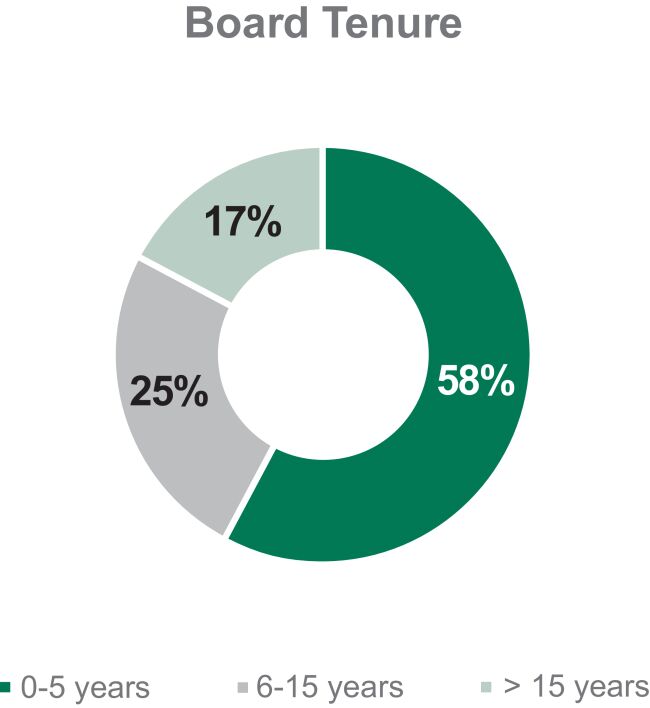
The 12 director nominees represent a range of backgrounds, professions, skills, experiences and communities. The N&G Committee believes these complementary skills and experiences produce an effective and highly qualified Board. The N&G Committee also believes it is desirable to maintain a mix of experienced, longer-tenured directors who possess deep institutional knowledge along with newer directors who have different areas of expertise, backgrounds and perspectives. Information on the skills, tenure, and independence of the Board, including a Board Skills Matrix, can be found in the Corporate Governance of M&T Bank Corporation section of this proxy statement.
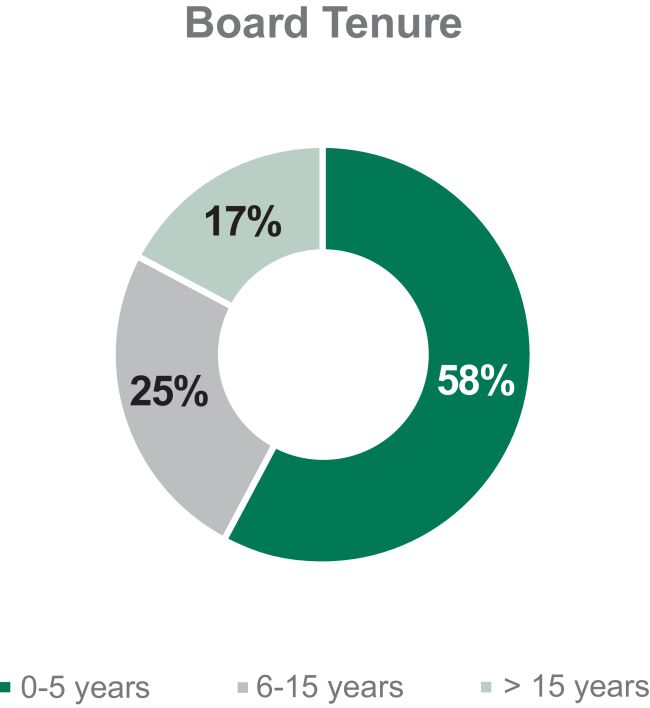
At the 2026 Annual Meeting, the director nominees range in age from 48 to 75, and the average age is approximately 67. Half of the director nominees have served on the Board for five years or less.
|
|
The Board unanimously recommends you vote “FOR” each director nominee standing for election. See “Proposal 1—Election of Directors” and “Corporate Governance of M&T Bank Corporation” further below for more information on our director nominees as well as Board qualifications, tenure and independence.
|
|
|
4
|
|

|
Corporate Governance Practices
The Board is committed to sound and effective corporate governance that conforms to the highest standards of business ethics and integrity, provides robust oversight of management and promotes the long-term interests of our shareholders. The Board and N&G Committee each review M&T’s Corporate Governance Standards annually. The Board regularly reviews other governance practices, industry developments and shareholder feedback to promote continued effectiveness. Below are selected highlights of M&T’s corporate governance practices. |
| Board Composition and Refreshment |
Robust Shareholder Rights | |
✓ Engaged Board with balanced tenure and substantial experience |
✓ Bylaws include proxy access right | |
✓ Strong Board refreshment practices, with more than half the director nominees joining the Board since 2020 |
✓ All shareholders have the same voting rights | |
✓ Regular refreshment at the committee level |
✓ Bylaws provide shareholders the ability to call a special meeting | |
✓ Ongoing and formalized director nominee identification and selection process based on needs identified by the Board and N&G Committee |
✓ No super-majority voting requirements under the Bylaws | |
✓ Diverse skills represented, including risk management, cybersecurity, leadership, finance, commercial and retail banking, technology, and corporate governance |
✓ No poison pill or other anti-takeover devices in effect | |
| Board Accountability and Independence |
Board Effectiveness | |
✓ Audit Committee, Compensation and Human Capital Committee, N&G Committee, and Risk Committee comprised entirely of independent directors |
✓ Corporate Governance Standards and committee charters reviewed and approved annually | |
✓ Majority voting standard for director elections |
✓ Strong Board leadership in risk oversight and management through Risk Committee and risk governance framework | |
✓ All directors elected annually |
✓ N&G Committee oversight of director orientation and continuing education efforts | |
✓ Conflict of interest policy for directors |
✓ Annual Board and committee self-evaluations | |
✓ Stock ownership guidelines for directors and executives |
✓ Independent Board evaluation of CEO performance and compensation through Compensation and Human Capital Committee | |
✓ Pledging and hedging policies for directors and executives |
✓ Lead independent director role and executive sessions of non-management directors held regularly | |
✓ Directors are subject to over-boarding review |
✓ Average attendance of directors at Board and committee meetings held in 2025 approximately 96.5% | |
See “Corporate Governance of M&T Bank Corporation” further below in this proxy statement for more information on our corporate governance practices.
|
|
5
|
|
|
Proposal 2—Advisory, Non-Binding Vote to Approve the 2025 Compensation of M&T Bank Corporation’s Named Executive Officers
We are asking our shareholders to review and vote, on an advisory basis, on the 2025 compensation of our named executive officers (“NEOs”). As described in the “Compensation Discussion and Analysis” section of this proxy statement, our executive compensation policies and practices are centered on creating a pay-for- performance culture that drives M&T performance, aligns the interests of our executives with the long-term interests of our shareholders and reduces incentives for unnecessary and excessive risk-taking.

|
Executive Compensation Program
Our executive compensation program aims to create a culture of pay-for-performance by offering short- and long-term incentive compensation opportunities that reward executives for their individual contributions as well as M&T’s long-term performance. |
| Compensation Philosophy. Our compensation philosophy is to emphasize long-term equity-based compensation and provide competitive compensation opportunities that will attract and retain executive officers capable of achieving M&T’s performance objectives. Overseen by the Compensation and Human Capital (“C&HC”) Committee, this philosophy allows us to align our compensation with performance by:
• linking the size of individual equity awards to the NEO’s role, responsibilities and prior and anticipated future contributions, as well as to the performance of M&T;
• tying a significant portion of each NEO’s ultimate realized compensation to the future value of M&T common stock, in alignment with our shareholders;
• balancing growth with prudent risk taking, including through the C&HC Committee’s consideration of each NEO’s performance with respect to risk management and the use of performance-based stock unit awards that vest in alignment with levels of performance;
• creating a culture of stock ownership and retention, including through M&T’s Stock Ownership and Retention Guidelines for Executives, resulting in each NEO having a substantial financial stake tied to the long-term performance of M&T and further ensuring our NEOs’ alignment with shareholders;
• performing, for each NEO, an annual assessment of the “market price of the seat” and balancing external data with an executive’s experience, role, responsibilities and prior and anticipated future contributions; and
• assessing short-term performance and awarding variable compensation based on a balanced discretionary assessment of holistic company and individual performance.
|
The following illustrates some important features of our executive compensation program:
| What We Do: | What We Don’t Do: | |||
✓ Strong alignment between pay and performance |

|
Reprice stock options | ||
✓ Discourage excessive risk-taking through program design |
|
Time equity award grants (i.e., instead, we only grant long-term equity incentive awards on pre-determined dates) | ||
|
✓ Maintain robust Stock Ownership and Retention Guidelines |
|
Tax gross-ups (other than in connection with relocation) | ||
✓ Retain an independent compensation consultant to advise and support the C&HC Committee in its duties |
|
Pay dividends on unearned performance units | ||
✓ Maintain a compensation forfeiture policy which subjects incentives to risk adjustments |
|
Grant excessive severance, pension or other benefits | ||
✓ Review share utilization |
|
Enter into employment contracts with our executives | ||
✓ Annual risk assessment of incentive compensation plans |
|
Permit hedging or pledging of M&T securities (except in limited circumstances pursuant to prescribed policy) | ||
✓ Routinely engage with shareholders and investors |
|
|||
✓ Use a peer group to provide perspective on competitive pay levels |
|
|||
|
|
|
6
|
|
Total Compensation Pay Mix
Our executive compensation program provides for a mix of base salary, short-term cash incentives and long-term equity-based incentives that vest over time in alignment with our compensation philosophy and the objectives cited above.
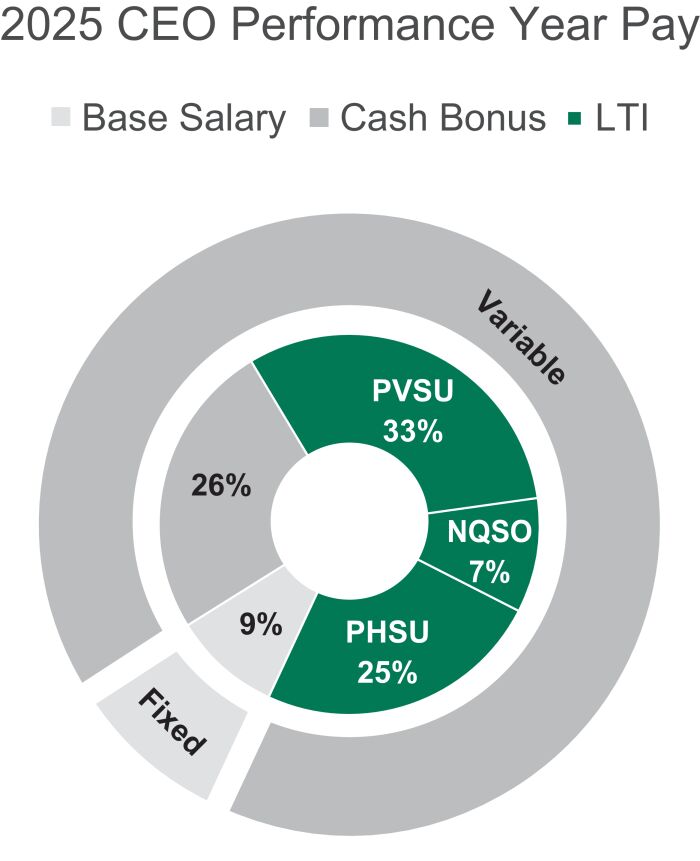
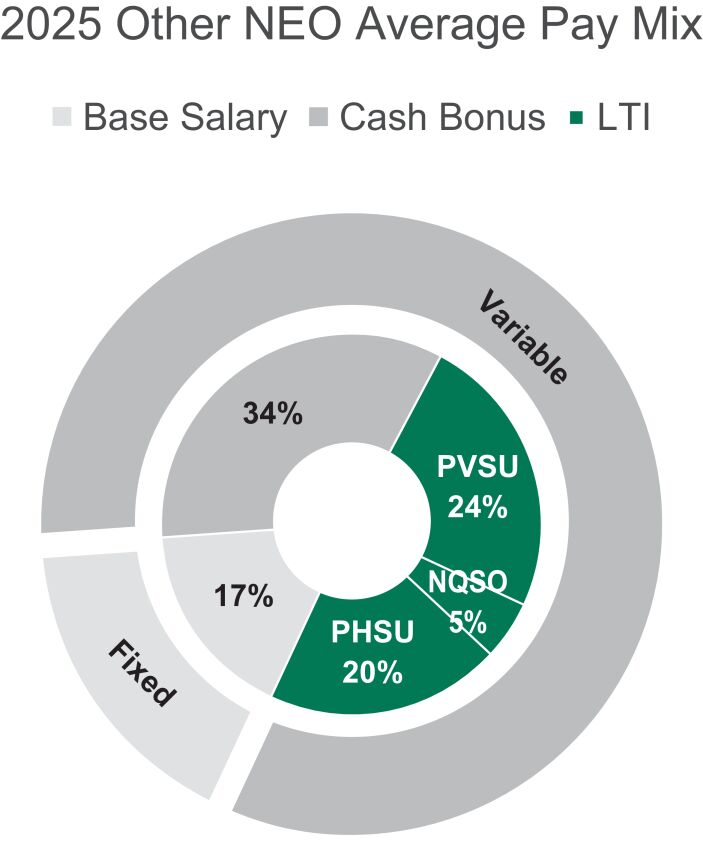
The charts below show the 2025 performance year total compensation pay mix of our CEO and the average of our other NEOs. For this purpose, compensation for the “performance year” consists of (i) annual base salary as of the end of 2025, (ii) short-term cash incentive (“STI”) paid in 2026 for 2025 performance, and (iii) the long-term equity-based incentive (“LTI”) award (target value) granted in 2026 for 2025 performance.
Our LTI award is a mix of performance-vested stock units (“PVSUs”), performance-hurdled stock units (“PHSUs”) and non-qualified stock options (“stock options” or “NQSOs”). As shown here, 91% of 2025 performance year target pay is “at risk” for our CEO and, on average, 83% is “at risk” for our other NEOs.
|
|
As described in more detail in the “Compensation Discussion and Analysis” section of this proxy statement:
| • | Annual base salary provides market-competitive, fixed pay reflective of an executive’s role, responsibilities and performance. |
| • | STI provides a discretionary annual incentive opportunity that is reflective of overall bank and individual performance. STI is awarded based on corporate performance, quantitative and qualitative business unit and individual performance, and progress toward strategic initiatives. |
| • | PHSUs vest ratably at target each year over three years based on achievement of a pre-established performance hurdle for each year. If the performance hurdle is not met for a given year, the portion of the award scheduled to vest for the corresponding year will be forfeited. |
| • | PVSUs cliff vest after three years based on achievement of the pre-established performance metrics over the three-year performance period, with final payout values ranging from 0% to 150% of target. |
| • | Stock options align our NEOs’ interests with those of shareholders by providing value only if M&T’s stock price increases from the date the stock option award is granted. Stock options vest ratably over three years. |
The Board unanimously recommends you vote “FOR” the 2025 compensation of M&T’s Named Executive Officers. See “Proposal 2—Advisory, Non-Binding Vote to Approve the 2025 Compensation of M&T Bank Corporation’s Named Executive Officers” further below in this proxy statement for more information.
|
|
7
|
|
|
Proposal 3—Amendment and Restatement of the M&T Bank Corporation 2019 Equity Incentive Compensation Plan
Our 2019 Equity Incentive Compensation Plan, as amended and restated from time to time (the “Equity Plan”) was most recently amended and restated in 2023, with more than 95% of shareholder votes cast in favor. The Equity Plan was originally adopted in 2019 and allows us to execute our pay-for-performance compensation philosophy by providing equity-based incentive awards to employees, including executive officers, thereby offering pay opportunities that align employee interests with the long-term interests of our shareholders. Under the terms of the Equity Plan, a limited number of shares of our common stock are reserved for these equity-based incentive grants.
In February 2026, our Board approved an amendment and restatement of the Equity Plan, subject to the approval of our shareholders at the Annual Meeting. The amendment and restatement of the Equity Plan includes an increase in the number of shares of our common stock available for future awards under the Equity Plan, so that the company can continue to grant equity-based incentive awards.
The Board unanimously recommends you vote “FOR” the approval of the amendment and restatement of the Equity Plan. See “Proposal 3—Amendment and Restatement of the M&T Bank Corporation 2019 Equity Incentive Compensation Plan” further below in this proxy statement for more information.
Proposal 4—Ratification of the Appointment of PricewaterhouseCoopers LLP as the Independent Registered Public Accounting Firm of M&T Bank Corporation for the Year Ending December 31, 2026
We are asking shareholders to ratify the appointment of PricewaterhouseCoopers LLP as our independent registered public accounting firm for the year ending December 31, 2026.
The Audit Committee annually evaluates the qualifications, performance and independence of the independent auditor. As a result of this evaluation, on February 17, 2026, the Audit Committee appointed PricewaterhouseCoopers LLP as the independent registered public accounting firm of M&T for the year ending December 31, 2026. The Audit Committee and Board believe the continued retention of PricewaterhouseCoopers LLP is in the best interests of M&T and its shareholders.
The Board unanimously recommends you vote “FOR” the ratification of the appointment of PricewaterhouseCoopers LLP. See “Proposal 4—Ratification of the Appointment of PricewaterhouseCoopers LLP as the Independent Registered Public Accounting Firm of M&T Bank Corporation for the Year Ending December 31, 2026” further below in this proxy statement for more information.
|
|
|
8
|
|
| PROPOSAL 1 |
ELECTION OF DIRECTORS
Upon the recommendation of the N&G Committee, the Board recommends the following 12 persons for election as directors of M&T, to hold office until the 2027 Annual Meeting of Shareholders and until their successors have been duly elected and qualified.
Each nominee’s business experience, including current occupation, occupation held at any time during the past five years, current public company directorships, and public company directorships held at any time during the past five years are provided. Additionally, the experience, qualifications and skills, including education, of each nominee are listed.
The information with respect to each nominee is as of March 1, 2026. The information contained in this proxy statement concerning the nominees is based upon statements made or confirmed to M&T by or on behalf of such nominees, except to the extent certain information is contained in M&T’s records.
Two current directors, Mr. Gary N. Geisel and Mr. Robert E. Sadler, Jr., are not nominees and their terms will end at the Annual Meeting. The Board would like to thank Mr. Geisel and Mr. Sadler for their decades of service and valuable contributions to M&T and the Board. The size of the Board will be reduced and fixed at 12 directors effective as of the Annual Meeting. Mr. Geisel currently serves as the non-executive Vice Chairman of the Board and lead independent director. Mr. Sadler currently serves as Chair of the Risk Committee and Chair of the Executive Committee. By or on the date of the Annual Meeting, the Board will appoint a new non-executive Vice Chairman of the Board and lead independent director, and new Chairs of the Risk Committee and Executive Committee, pursuant to its director succession planning and committee appointment process.
The Board believes that the experience, qualifications and skills of each of the director nominees contributes to an effective and well-functioning board providing oversight of M&T’s business and management.
THE BOARD OF DIRECTORS UNANIMOUSLY RECOMMENDS A VOTE FOR THE
ELECTION OF EACH OF THE 12 NOMINEES.
|
|
9
|
|
|
NOMINEES FOR DIRECTOR
| JOHN P. BARNES | ||
|
Executive Committee
Risk Committee
Director since 2022
|
Mr. Barnes, age 70, is the former Chairman of the Board and Chief Executive Officer of People’s United Financial, Inc. (“People’s United”). He served as Chief Executive Officer of People’s United from July 2010 until April 2022, when he joined the M&T Board upon the closing of M&T’s acquisition of People’s United. He also previously served as Senior Executive Vice President and Chief Administrative Officer of People’s United following its acquisition of Chittenden Corporation in early 2008. He previously served as an Executive Vice President and in multiple other positions at Chittenden Corporation, including heading the Credit Policy and Administration Division. Mr. Barnes is a member of the Risk Committee of the Board. He is also a director of M&T’s subsidiary, M&T Bank, a member of its Risk Committee and Executive Committee.
Experience, Skills and Qualifications Mr. Barnes brings extensive banking and finance knowledge, having worked in the financial services industry since 1983, when he joined Chittenden Corporation after five years with the Federal Deposit Insurance Corporation in Boston. He brings exceptional executive and management experience gained through his leadership roles at multiple financial institutions. Mr. Barnes is a graduate of Northeastern University and received a Master of Business Administration from the University of Vermont. | |
| CARLTON J. CHARLES | ||
|
Nomination and
Risk Committee
Director since 2023 |
Mr. Charles, age 67, is the Senior Vice President of Treasury and Risk Management at Hearst, a leading global, diversified information, services and media company with operations in 40 countries. Prior to joining Hearst, he was Senior Vice President and Chief Operational Risk Officer at Moody’s Corporation. Mr. Charles also serves as the Chair of Level Up Ventures, a venture capital unit within Hearst focused on founders experiencing barriers to accessing capital. He is a member of the Hearst Board of Directors. Mr. Charles also serves on the board of Urban Arts, a non-profit that teaches video game design to kids in high school, creating pathways to college and career. Mr. Charles is also on the board of a newly formed non-profit called the Bronx Community Enterprise Accelerator which helps small businesses in the Bronx by providing capital and access to advisors/mentors to foster their growth. He is a member of the Executive Leadership Council and a governance fellow and certified director from the National Association of Corporate Directors. He is a member of the Risk and Nomination and Governance Committees of the Board. He is also a director of M&T’s subsidiary, M&T Bank and a member of its Risk Committee.
Experience, Skills and Qualifications Mr. Charles brings extensive experience and knowledge in corporate finance, risk management, cybersecurity, retail and consumer operations, and corporate governance. He holds a Bachelor of Science in Quantitative Economics and a Master of Public Policy from the State University of New York at Stony Brook and a Master of Business Administration with a concentration in Finance from the University of Chicago (Booth) School of Business. | |
|
|
|
10
|
|
| JANE CHWICK | ||
|
Audit Committee
Director since 2022 |
Ms. Chwick, age 63, served as a director of People’s United from 2017 until April 2022, when she joined the M&T Board upon the closing of M&T’s acquisition of People’s United. She previously served as a partner at Goldman Sachs where she had a 30-year career in technology, including most recently as the Co-Chief Operating Officer of the Technology Division. As Co-Chief Operating Officer, Ms. Chwick was responsible for financial business planning, setting the technical strategy and management of an 8,000-person organization within the firm. While at Goldman Sachs, she also served as a member of many governance committees, including the firm’s Finance Committee, the firm-wide New Activity Committee and the Technology Risk Committee, and she was Co-Chair of the Technology Division Operating Committee. Ms. Chwick was also the Co-founder and Co-CEO of Trewtec, Inc., providing corporate directors, chief executive officers and chief technology officers with the information to improve their oversight of a company’s technology division. She is a director of Voya Financial (NYSE: VOYA) and MarketAxess Holdings Inc. (NASDAQ: MKTX). At Voya Financial, she is Chair of the Technology Committee, a member of the Risk Committee, and a member of the Nominating, Governance and Social Responsibility Committee. At MarketAxess, she is Chair of the Risk Committee and a member of the Nominating and Governance Committee. Ms. Chwick is a member of the Audit Committee of the Board. She is also a director of M&T’s subsidiary, M&T Bank, and a member of its Examining Committee.
Experience, Skills and Qualifications Ms. Chwick brings extensive technology experience, gained in a global financial services firm, combined with strategic perspective and in-depth knowledge of the financial services industry. She holds an undergraduate degree in Mathematics from Queens College, and a Master of Business Administration with a concentration in quantitative analysis from St. John’s University.
| |
| WILLIAM F. CRUGER, JR. | ||
|
Audit Committee
Compensation and
Executive
Director since 2022 |
Mr. Cruger, age 67, served as a director of People’s United from 2014 until April 2022, when he joined the M&T Board upon the closing of M&T’s acquisition of People’s United. Mr. Cruger served as Vice Chairman of Investment Banking at J.P. Morgan Chase & Co., a leading global financial services firm, until August 2013. His responsibilities included senior client relationship management and transaction leadership with a primary focus on financial institutions, among other sectors. He was Managing Director, Financial Institutions Group at J.P. Morgan Chase & Co. from 1996 until 2011 when he was elevated to the position of Vice Chairman. Mr. Cruger also ran the firm’s investment banking practices in Japan from 1991 to 1996, in Latin America from 1989 to 1991, and in Emerging Asia from 1984 to 1988. He is a director of MarketAxess Holdings Inc. (NASDAQ: MKTX), serving as Chair of the Nominating and Governance Committee and a member of the Audit and Finance Committees, and of Virtu Financial, Inc. (NASDAQ: VIRT), serving as Chair of the Audit Committee and a member of the Risk Committee. Mr. Cruger has also previously served as a director of Archipelago, Capital IQ and Credittrade. He is the Chair of the Compensation and Human Capital Committee of the Board and a member of the Audit Committee of the Board. Mr. Cruger is also a director of M&T’s subsidiary, M&T Bank, and a member of its Examining Committee.
Experience, Skills and Qualifications Mr. Cruger has diverse experience in investment banking at a global financial services firm and extensive knowledge of financial institutions and financial markets. His leadership roles as a director of other financial services firms and his international business experience bring critical skills and strategic insight to the Board. Mr. Cruger holds a Bachelor of Arts from Clark University and a Master of Business Administration from Columbia University.
| |
|
|
11
|
|
|
| LESLIE V. GODRIDGE | ||
|
Nomination and
Risk Committee
Director since 2020 |
Ms. Godridge, age 70, served as Vice Chair and Co-Head of Corporate, Commercial, Commercial Real Estate, Capital Markets, Equipment Leasing & Treasury Management for U.S. Bancorp, a member of the Managing Committee, Asset-Liability Committee, Risk Committee, Executive Credit Management Committee and Strategic Investment Committee, and on the boards of the U.S. Bank Foundation and U.S. Bank N.A., roles she held from 2016 until her retirement in 2020. She joined U.S. Bancorp in 2007 as Executive Vice President and Head of National Corporate, Institutional, Special Industries and Global Treasury Management. Previously, Ms. Godridge worked for The Bank of New York for 25 years as a Senior Executive Vice President in a variety of senior managerial roles in Corporate, Special & Financial Institutions, culminating as Combined Head of Consumer, Commercial, Private Banking and Asset Management. She was a member of the Executive, ALCO, and Credit Risk Committees and headed the CRA and Fiduciary Committees. Ms. Godridge was recognized for 13 of 14 years from 2005 to 2019 on the American Banker’s list of the Most Powerful Women in Banking. She is a director and Audit Committee member of National Integrity Life Insurance Co. and of Gerber Life Insurance Company, subsidiaries of Western Southern Financial Company. Ms. Godridge served as a Trustee and the Treasurer of the Museum of the City of New York for 18 years, and is now Trustee Emerita. She is a director of the Redwood Library & Athenaeum in Newport, RI and a corporator of the Newport Hospital affiliated with the Brown University Medical System also in Newport. Ms. Godridge is a member of the Risk Committee as well as the Nomination and Governance Committee of the Board. She is also a director of M&T’s subsidiary, M&T Bank, a member of its Risk Committee and Chair of its Trust and Investment Committee. In addition, Ms. Godridge is an Advisory Member of the Trust and Investment Committees of Wilmington Trust, N.A., a subsidiary of M&T, and of Wilmington Trust Company, a subsidiary of M&T Bank.
Experience, Skills and Qualifications Ms. Godridge brings extensive banking, risk and finance knowledge in the corporate, institutional, consumer and investment businesses with nearly 40 years of experience in the banking industry. She also brings exceptional executive and management experience gained through her senior executive positions at financial institutions. Ms. Godridge holds a Bachelor of Arts from Smith College and a Master of Business Administration from New York University Stern School of Business.
| |
| RENÉ F. JONES | ||
|
Chief Executive
Executive
Director since 2017 |
Mr. Jones, age 61, has been Chairman of the Board and Chief Executive Officer of M&T and of M&T Bank since December 2017. Mr. Jones served as an Executive Vice President of M&T from 2006 to 2017, served as Chief Financial Officer of M&T and M&T Bank from 2005 to 2016 and as a Vice Chairman of M&T Bank from 2014 to 2017. He is a director of the Federal Reserve Bank of New York and Chair of its Audit and Risk Committee and a member of its Management and Budget Committee. Mr. Jones also serves as a director and a member of the Audit Committee of ACV Auctions Inc. (NASDAQ: ACVA). He is Chairman of the Bank Policy Institute after previously serving as Vice Chair. Mr. Jones is a steward for the Council for Inclusive Capitalism, a member of the Board of Trustees of Boston College, a member of the UB Council of the State University of New York at Buffalo, and a member of the Pan-Massachusetts Challenge, Inc., a nonprofit that raises money for adult and pediatric cancer treatment and research. Mr. Jones is a member of the Executive Committees of M&T and M&T Bank.
Experience, Skills and Qualifications Mr. Jones joined M&T Bank in 1992 as an Executive Associate and has 30 years of experience in banking. He has served M&T Bank in numerous executive and managerial positions in the Finance, Wealth and Institutional Services, Human Resources, Consumer Lending, Mortgage, and Treasury Divisions which have provided him with valuable institutional knowledge. Mr. Jones holds a Bachelor of Science in Management Science from Boston College and a Master of Business Administration with concentrations in Finance, Organization and Markets from the University of Rochester Simon School of Business.
| |
|
|
|
12
|
|
| RICHARD H. LEDGETT, JR. | ||
|
Risk Committee
Director since 2017
|
Mr. Ledgett, age 68, is a private consultant. He served as Deputy Director and Chief Operating Officer of the National Security Agency (“NSA”), the largest intelligence organization in the U.S., from January 2014 until his retirement in April 2017, and worked for the NSA for 29 years. Mr. Ledgett was Chair of the Board of Trustees of the Institute for Defense Analyses, a member of a cyber advisory board of Beazley PLC, as well as a director of Elbit Systems of America. He has served as an instructor and course developer at the National Cryptologic School within the NSA in Washington, D.C. and as an adjunct faculty member at the National Intelligence University in Washington, D.C. Mr. Ledgett is a member of the Risk Committee of the Board. He is also a director of M&T’s subsidiary, M&T Bank, and a member of its Risk Committee.
Experience, Skills and Qualifications Mr. Ledgett brings four decades of specialty expertise in the areas of intelligence, cybersecurity and cyber operations. He holds a Bachelor of Science in Psychology from the State University of New York at Albany and a Master of Science in Strategic Intelligence from the Defense Intelligence College.
| |
| MELINDA R. RICH | ||
|
Executive
Nomination and
Director since 2009 |
Ms. Rich, age 68, is the Chairman of Rich Holdings Inc., the holding company for international food manufacturer Rich Products Corporation, headquartered in Buffalo, New York, and all Rich family business enterprises worldwide. Prior to her appointment as Chairman in August 2022, Ms. Rich had served as Vice Chairman of Rich Products Corporation since 2006. She is Chair of Rich Products Corporation’s Executive Committee and Governance Committee and a member of its Finance and Audit Committee and Compensation and Organization Committee. Ms. Rich is also Chairman of Rich Entertainment Group, which consists of various businesses in the sports, entertainment and restaurant industries. Ms. Rich is a director and member of the Compensation Committee of Weber Inc., a leading manufacturer of outdoor grills and related products, and a director of Grove Entertainment, a production company in New York City. She serves as an Advisor of BDT & MSD Partners in Chicago, Illinois, and as a member of the Cleveland Clinic Board of Directors and Cleveland Clinic Technology Committee in Cleveland, Ohio. Ms. Rich is also a director of several charitable foundations, including Rich Family Foundation, DreamCatcher Foundation, Inc. and Cleveland Rock and Roll, Inc./Rock & Roll Hall of Fame. She is a former director of Wm. Wrigley, Jr. Company. Ms. Rich is a member of the Executive Committee and Chair of the Nomination and Governance Committee of the Board. She is also a director of M&T’s subsidiary, M&T Bank, and a member of its Executive Committee.
Experience, Skills and Qualifications Ms. Rich brings considerable knowledge of executive compensation matters, leadership roles and service to civic and community organizations. She provides a valuable international perspective on public policy, societal and economic issues. Ms. Rich holds a Bachelor of Arts in Psychology and Business from the University of Colorado. She received an Honorary Doctor of Humane Letters from the Culinary Institute of America, an Honorary Doctor of Law from D’Youville College and Honorary Doctorate of Humane Letters from Canisius College.
| |
|
|
13
|
|
|
| DENIS J. SALAMONE | ||
|
Audit Committee
Executive
Director since 2015
|
Mr. Salamone, age 72, joined the Board upon the closing of M&T’s acquisition of Hudson City Bancorp, Inc. and Hudson City Savings Bank (“Hudson City”) in 2015. He served as Chairman and Chief Executive Officer of Hudson City from September 2014 until November 2015. Mr. Salamone joined Hudson City in 2001 as Senior Executive Vice President and served on its Board of Directors. Between 2002 and 2014, he held several senior executive positions at Hudson City, including President and Chief Operating Officer. Prior to joining Hudson City, Mr. Salamone was an accountant with PricewaterhouseCoopers LLP for 26 years, 16 years as a partner where he served as the Global Financial Services leader for Audit and Business Advisory Services. He is a member of the American Institute of CPAs and a member of the New York State Society of CPAs. Mr. Salamone serves as Chairman of the Board of Trustees for St. Francis College in Brooklyn Heights, New York, as a trustee of the Ridgewood, New Jersey YMCA, and Vice Chair of the Board of Trustees and Chair of the Audit and Risk Committees of Valley Health System of Ridgewood, New Jersey. He is the Chair of the Audit Committee of the Board. Mr. Salamone is also a director of M&T’s subsidiary, M&T Bank, the Chair of its Examining Committee and a member of its Executive Committee.
Experience, Skills and Qualifications Mr. Salamone has more than 40 years of experience in the financial services industry and brings significant accounting skills and knowledge of financial reporting and risk management. He holds a Bachelor of Science in Accounting from St. Francis College.
| |
| RUDINA SESERI | ||
|
Compensation and
Director since 2020 |
Ms. Seseri, age 48, is the Founder and Managing Partner of Glasswing Ventures, LLC, an early-stage venture capital firm that invests in artificial intelligence and frontier technology companies that provide solutions in the enterprise and cybersecurity markets. Prior to founding Glasswing Ventures in 2015, she was a partner at Fairhaven Capital, a technology venture capital firm, from 2010 to 2015 after serving as an associate since 2007. Ms. Seseri previously served as a Senior Manager in the Corporate Development Group at Microsoft Corporation, where she was responsible for leading acquisitions and investments in companies of strategic importance, and as an investment banker in the Technology Group at Credit Suisse Group AG, leading public market transactions. She was appointed by the Dean of Harvard Business School as an Executive Fellow in 2022, having previously served as Entrepreneur in Residence in the Rock Center at Harvard Business School since 2013. Ms. Seseri serves as a director of MSC Industrial Direct Co., Inc. (NYSE: MSM) and as a member of its Compensation Committee and of its Nominating and Corporate Governance Committee. She also serves on the boards of several private startup companies. Ms. Seseri is a member of the Compensation and Human Capital Committee of the Board. She is also a director of M&T’s subsidiary, M&T Bank, and a member of its Trust and Investment Committee. In addition, she is an advisory member of the Trust and Investment Committees of Wilmington Trust, N.A., a subsidiary of M&T and of Wilmington Trust Company, a subsidiary of M&T Bank.
Experience, Skills and Qualifications Ms. Seseri brings nearly 20 years of investing and transactional experience, including in building successful technology companies in innovative fields such as artificial intelligence, machine learning, enterprise software, and digital marketing technologies. She has significant knowledge in areas of technology, digital innovation, consumer solutions and strategic planning. Ms. Seseri holds a Bachelor of Arts from Wellesley College and a Master of Business Administration from Harvard Business School. | |
|
|
|
14
|
|
| KIRK W. WALTERS | ||
|
Risk Committee
Director since 2022 |
Mr. Walters, age 70, previously served as Senior Executive Vice President of Corporate Development and Strategic Planning as well as a director of People’s United. He joined the M&T Board upon the closing of M&T’s acquisition of People’s United in April 2022. In addition, from 2011 to 2014, Mr. Walters served as Chief Financial Officer of People’s United. Prior to joining People’s United, he was a Senior Executive Vice President and a director of Santander Holdings USA, Inc. Previously Mr. Walters held various senior executive positions with Chittenden Corporation from 1996 to 2008; Northeast Federal Corporation (including Chairman, President and Chief Executive Officer) from 1989 to 1995; and CalFed, Inc. from 1984 to 1989. He began his career with Coopers & Lybrand and is a member of the California Society of CPAs. Mr. Walters is also actively involved in several philanthropic activities among which are AngelFlight and ImproveCareNow. Mr. Walters is a member of the Risk Committee of the Board. He is also a director of M&T’s subsidiary, M&T Bank.
Experience, Skills and Qualifications Mr. Walters brings substantial banking and financial services industry expertise. He has extensive executive and management experience gained through his leadership roles at various financial institutions. Mr. Walters holds a Bachelor of Science in Accounting from the University of Southern California.
| |
| HERBERT L. WASHINGTON | ||
|
Audit Committee
Compensation and
Director since 1996 |
Mr. Washington, age 75, is President of H.L.W. Fast Track, Inc., a fast-food restaurant enterprise located in Youngstown, Ohio, which owned and operated McDonald’s franchises in Ohio, Pennsylvania and New York from 1980 to 2022. He is a director of the Youngstown, Ohio Chamber of Commerce and of the Big Ten Athletic Advisory Committee. Mr. Washington was appointed as a director of the Federal Reserve Bank of New York for a three-year term in 1993. He served as Chairman of the Federal Reserve Bank of New York, Buffalo Branch Board from 1992 to 1993. Mr. Washington is a member of the Audit Committee and Compensation and Human Capital Committee of the Board. He is also a director of M&T’s subsidiary, M&T Bank, and a member of its Examining Committee.
Experience, Skills and Qualifications Mr. Washington brings extensive business acumen, valuable entrepreneurial skills as well as human capital, corporate governance and financial regulation experience. He holds a Bachelor of Arts in Education from Michigan State University.
| |
|
|
15
|
|
|
CORPORATE GOVERNANCE OF M&T BANK CORPORATION
Corporate Governance Standards
The Board is committed to sound and effective corporate governance that conforms to the highest standards of business ethics and integrity, provides robust oversight of management, and promotes the long-term interests of our company and shareholders. The Board and the N&G Committee each annually evaluate its Corporate Governance Standards in light of best practices and regulatory guidance. These standards address director qualifications and responsibilities, board committees, director compensation and independence, director orientation and continuing education, performance evaluations, director commitments and conflicts of interest, among other items. The Corporate Governance Standards are available on M&T’s website at ir.mtb.com/corporate-governance.
Board Composition and Refreshment
Our Corporate Governance Standards provide that the N&G Committee, in discharging its duties to review director nominee qualifications, consider business experiences, skill sets, independence and backgrounds in the context of the Board’s needs and obligations. In light of these standards, the N&G Committee endeavors to identify nominees who possess diverse business experiences, life skills, geographic representation and community involvement.
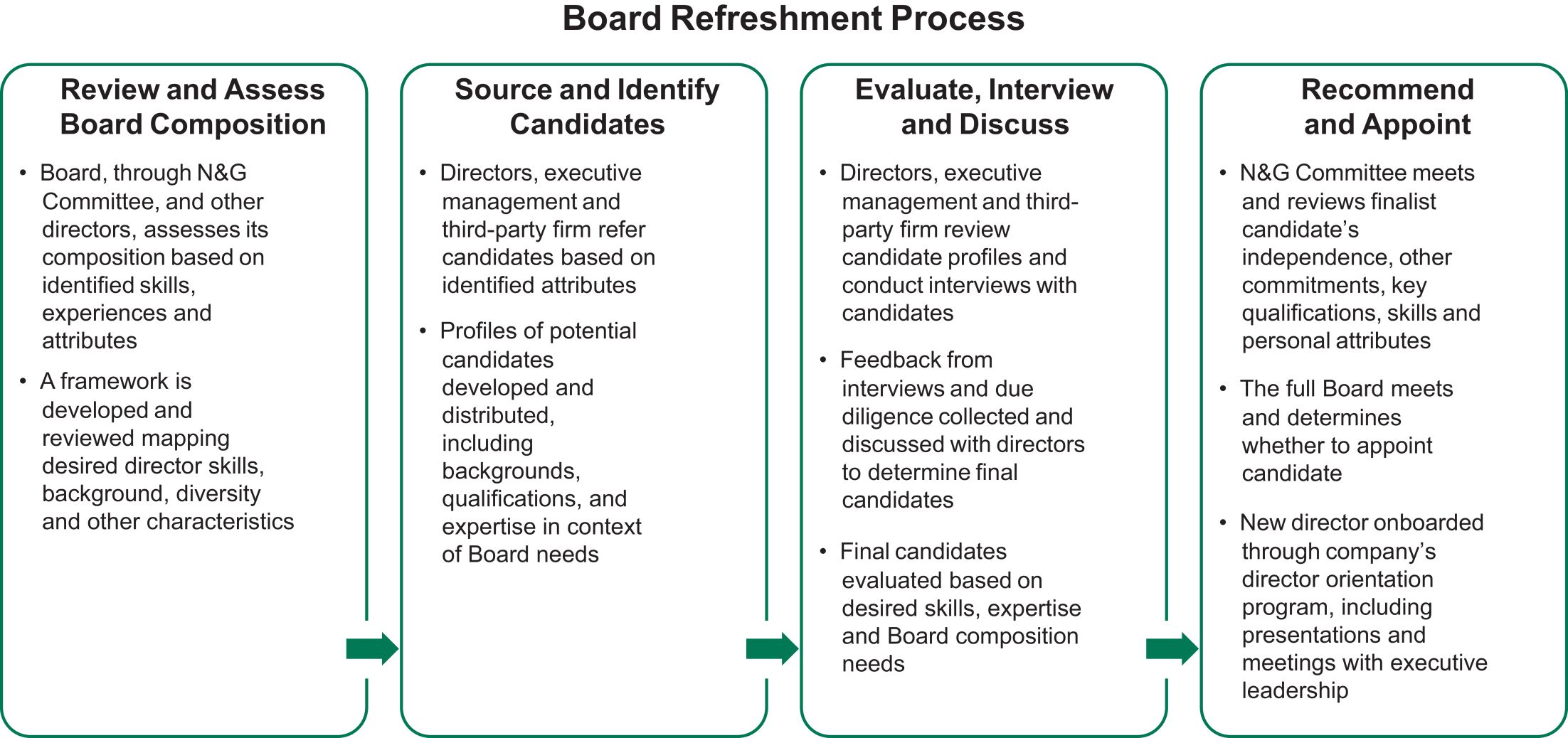
Board Succession and Continuity Process. The Board, acting through the N&G Committee, reviews and considers new director candidates and existing members as part of its ongoing succession planning process for Board and committee positions. The N&G Committee engages a third-party firm to assist in this process, including with the identification and evaluation of potential future director nominees. Based on contributions and feedback from the N&G Committee, other directors, executive management and the third-party firm, a board framework and analysis of the skills, experiences and attributes that M&T believes would be beneficial to have represented on the Board and its committees have been developed. This process takes into account the current needs of the Board, future director succession planning needs and M&T’s business strategy and industry trends. The analysis of desired skills and attributes is leveraged throughout the process in identifying and evaluating Board candidates. This process is also leveraged to consider committee assignments for new and existing members. The Board, through the N&G Committee, annually assesses its committee structure, leadership and composition.
|
|
|
16
|
|
| Experience, Skills and Tenure. M&T values a diversity of experiences, skills, perspectives and backgrounds among its Board members. The following page includes a matrix that shows the skills and experiences represented by the nominees. The Board believes it is desirable to maintain a mix of experienced, longer-tenured directors who possess deep institutional knowledge along with newer directors who have different areas of expertise, backgrounds and perspectives. At the 2026 Annual Meeting, the director nominees range in age from 48 to 75, and the average age is approximately 67. Half of the director nominees have served on the Board for five years or less.
Board Size. We are asking our shareholders to vote for the election of 12 director nominees. The Board regularly evaluates its size and |
|
structure to provide effective oversight and best serve the needs of M&T and the interests of our shareholders and stakeholders. As a financial institution, M&T faces considerable and changing regulatory, risk management and economic demands that require a substantial commitment on the part of our directors. The size of our Board allows for an appropriate number of directors to be designated to each committee with the skills, experience and time to provide proper and effective oversight. The diversity of viewpoints and skills possessed by members of the Board and each committee also allows for an effective check and balance on proposals from management and other directors.
Over-Boarding Policy. The Board also considers the availability of each nominee to fulfill his or her responsibilities as a director. Both the Corporate Governance Standards and the N&G Committee Charter require that the Board, through the N&G Committee, review a director’s ability to continue to serve as a director of M&T if he or she wishes to join another public company board and would serve on three or more other public company boards after accepting the invitation. In the case of a director who is also an executive officer of a public company, the N&G Committee will conduct such review whenever the director wishes to join another public company board, regardless of the number of other boards on which he or she sits. Each year, the N&G Committee receives a report on and reviews the outside board commitments of all director nominees when considering whether to recommend such directors as nominees.
|
|
17
|
|
|
Board Skills and Experience. The 12 director nominees represent a range of backgrounds, professions, skills, experiences and communities. The Board believes these complementary skills and experiences produce an effective and highly qualified Board. The skills and experiences below were self-identified by the directors as part of the company’s annual director questionnaire process.
Board Skills and Experience Matrix

|

|

|

|

|

|

|

|

|

|

|

| |||||||||||||
| SKILLS AND EXPERIENCE | ||||||||||||||||||||||||
| CEO Experience |
✓ | ✓ | ✓ | ✓ | ✓ | ✓ | ✓ | |||||||||||||||||
| Commercial |
✓ | ✓ | ✓ | ✓ | ✓ | |||||||||||||||||||
| Wealth / Investment |
✓ | ✓ | ✓ | ✓ | ✓ | ✓ | ||||||||||||||||||
| Customer Experience / Retail |
✓ | ✓ | ✓ | ✓ | ✓ | ✓ | ✓ | |||||||||||||||||
| Technology / Digital Innovation |
✓ | ✓ | ✓ | ✓ | ✓ | |||||||||||||||||||
| Cybersecurity |
✓ | ✓ | ✓ | ✓ | ||||||||||||||||||||
| Risk Management |
✓ | ✓ | ✓ | ✓ | ✓ | ✓ | ✓ | ✓ | ✓ | ✓ | ✓ | ✓ | ||||||||||||
| Corporate Governance |
✓ | ✓ | ✓ | ✓ | ✓ | ✓ | ✓ | ✓ | ✓ | |||||||||||||||
| Bank |
✓ | ✓ | ✓ | ✓ | ✓ | ✓ | ✓ | |||||||||||||||||
| Finance / Accounting |
✓ | ✓ | ✓ | ✓ | ✓ | ✓ | ✓ | ✓ | ✓ | ✓ | ||||||||||||||
| Human Capital Management |
✓ | ✓ | ✓ | ✓ | ✓ | ✓ | ✓ | ✓ | ✓ | ✓ | ✓ | ✓ | ||||||||||||
| Board Independence
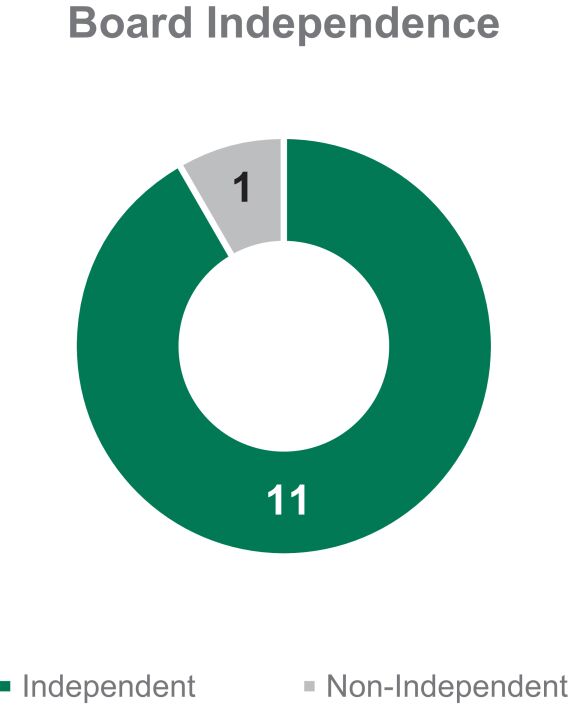
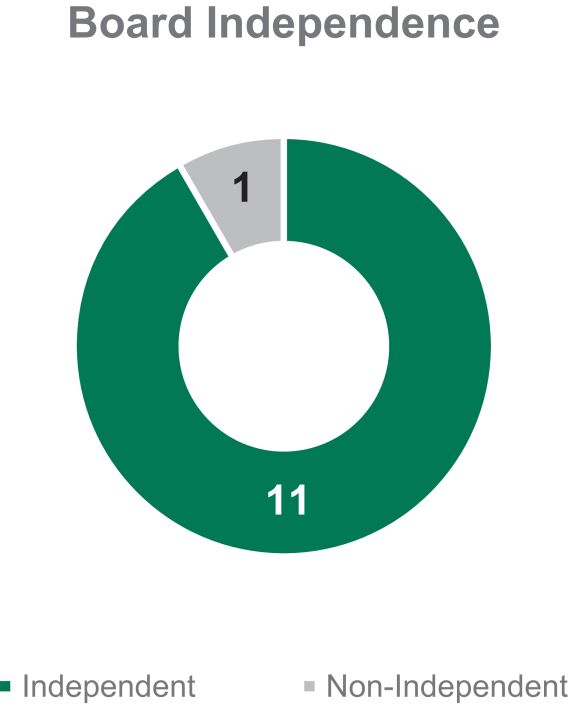
Annually, the Board reviews director independence. Based upon the recommendation of the N&G Committee, the Board determined that all of the current members of the Board and nominees at the Annual Meeting, except Mr. Jones, are independent and do not have any material relationships with M&T or its subsidiaries.
The Board applies the standards of the Securities and Exchange Commission (“SEC”), New York Stock Exchange (“NYSE”), and M&T’s Corporate Governance Standards in making independence determinations. The Board considers all relevant facts and circumstances in determining whether a material relationship exists with M&T. |
| |
Material relationships that the Board may consider include commercial, banking, consulting, legal, accounting, industrial, charitable and family relationships. As described below, the NYSE listing standards set forth specific relationships that will automatically bar independence.
|
|
|
18
|
|
NYSE “Bright-Line” Independence Tests. Under the NYSE “bright-line” tests, each of the following relationships will automatically bar a director from being independent:
| • | A director is employed by M&T or an immediate family member is an executive officer of M&T; |
| • | A director’s (or immediate family member’s) receipt of more than $120,000 during any twelve month period in direct compensation from M&T (other than director fees and pension or other forms of deferred compensation for prior service not contingent upon continued service, and other than compensation received by an immediate family member who is not an executive officer for service as an employee); |
| • | A director’s (or immediate family member’s) affiliation or employment with M&T’s internal or external auditors; |
| • | A director (or immediate family member) who has been an executive officer of another company where any executive officer of M&T serves or served on that company’s compensation committee; or |
| • | A director employed by (or an immediate family member is an executive officer of) a company that makes payments to, or receives payments from, M&T in an amount in excess of the greater of $1 million or 2% of such other company’s consolidated gross revenues. |
An employee-director of M&T (or a director with an immediate family member who is an M&T executive officer) cannot be independent until three years after the employment relationship ends. The other bright-line tests will bar independence if they existed at any time during the prior three years. In addition, a director must be affirmatively determined by our Board to have no material relationship with M&T or its subsidiaries to be considered independent.
In making its determination as to the independence of the directors, the Board considered specific transactions, relationships and arrangements with directors and their immediate family members and any such person’s business affiliations. Additionally, the Board considers ordinary course banking and financial services transactions provided by M&T and its subsidiaries in making its determination as to independence. See the section below titled “Transactions with Directors, Executive Officers and Certain Shareholders” for more information.
Board Leadership Structure
Chairman. Mr. Jones was elected as M&T’s Chairman of the Board and appointed Chief Executive Officer in December 2017. Mr. Jones has been an employee of M&T for more than 30 years and has been a member of executive management for over 20 years. The Board believes that, in light of Mr. Jones’ significant broad- based experience with M&T and his leadership tenure with the organization, his service as Chairman continues to be appropriate for the Board as it fosters effective decision making and clear accountability.
Lead Independent Director. The Board adheres to M&T’s Corporate Governance Standards and annually elects a non-executive Vice Chairman of the Board who also serves as the lead independent director. Mr. Geisel has served as the lead independent director since April 2024. As lead independent director, Mr. Geisel presides over the executive sessions of the non-management directors, provides leadership and input into Board operations and governance decisions and may, from time to time, represent the Board in meetings with shareholders or other stakeholders. Mr. Geisel is not a nominee and his Board service will end at the Annual Meeting. By or on the date of the Annual Meeting, the Board will appoint a new non-executive Vice Chairman of the Board and lead independent director pursuant to its normal director succession planning process.
|
|
19
|
|
|
Executive Sessions of the Non-Management Directors. The non-management directors meet at regularly scheduled executive sessions without management. Mr. Geisel, Vice Chairman of the Board and the lead independent director, presides at these sessions. In the absence of the lead independent director, the non-management directors determine which director will preside at such sessions.
Board Self-Evaluation Process
The N&G Committee oversees an annual self-evaluation of the Board. Prior to the beginning of the Board’s self-evaluation each year, the N&G Committee considers possible enhancements to the process, including changes to the evaluation format and the written questionnaire. The written questionnaire, which is provided to each director, covers a range of topics related to Board effectiveness and performance, including questions on Board composition, culture, committee performance, risk management, oversight of corporate strategy, management accountability, and agenda and meeting effectiveness.
After completion of the written questionnaire, the full Board, led by the Chair of the N&G Committee, reviews the results and holds a self-evaluation discussion. Any points of attention or changes to Board practices are identified, and the Chair of the N&G Committee has the opportunity to meet with the Chief Legal Officer or others as necessary to discuss any such follow-up items. In addition to this formal Board self- evaluation process, directors are encouraged to provide feedback at any point during the year. The Chair of the N&G Committee also holds one-on-one discussions with individual directors throughout the year to obtain additional feedback on Board effectiveness, composition, practices and performance. Board committees also perform their own self-evaluation process as required in their respective committee charters.
Board Continuing Education and Orientation
The N&G Committee oversees director continuing education and orientation efforts, which are administered by management. Areas of focus for director continuing education and development are identified by the Board and committees through discussion with management as well as in the annual Board self- evaluation. Management will suggest agenda items for Board and committee meetings in order to provide opportunities for continuing education to all directors, and any director may request the inclusion of a particular agenda item in order to facilitate continuing director education. As a result, educational topics are planned throughout the year and presented at meetings of the Board and committees on a regular basis. The presentations are provided by both internal specialists and outside advisors on a range of topics to enhance directors’ knowledge of areas important to their ability to carry out Board and committee responsibilities. M&T also encourages and sponsors director participation in outside learning opportunities, including attendance at conferences and membership in educational associations.
Newly-elected directors participate in the company’s director orientation program. The director orientation program aims to further acquaint newly elected directors with M&T’s business and values. The orientation program includes written information and a series of presentations by members of executive leadership, including heads of business lines and key departments, to better familiarize new directors with M&T’s governance framework, talent and leadership, strategic objectives, risk management practices, regulatory environment, director responsibilities, and other matters.
Board’s Role in Risk Oversight
The Risk Committee assists the Board in its oversight of risk management functions. Management has established the Enterprise Risk Framework (“Risk Framework”) through which M&T identifies, assesses, monitors, controls, communicates, and escalates risk in a manner designed to ensure the Risk Committee is provided the transparency necessary to be effective in its oversight responsibilities.
|
|
|
20
|
|
The Risk Framework, which is reviewed and approved by the Risk Committee and Board at least annually, represents M&T’s overall risk management approach, including the policies, processes, controls, and systems, through which the company seeks to manage risk. It provides a common foundation for all employees and officers as well as directors to understand and communicate the types of risks that M&T faces in pursuit of its business objectives.
|
M&T’s Risk Framework includes the following critical elements:
• The Risk Appetite Statement, reviewed annually by the Board and Risk Committee, articulates the amount and the types of risks that M&T is willing to take and those risks that M&T seeks to avoid in pursuit of its objectives.
• The “Three Lines of Defense” Control Structure, which is intended to clarify roles, responsibilities and accountabilities for decision making, risk taking and control across M&T. The Second and Third Lines of Defense provide independent oversight to help ensure thorough and effective identification, assessment, monitoring, and mitigation of risks.
• The Risk Governance Committees, through a multi-tiered structure, are responsible for overseeing proactive risk identification, developing an aggregated view of risks, and providing a consistent governance methodology across M&T. The Risk Governance Committees are management committees predominately chaired by members of our Independent Risk Management teams, and membership spans employees from all Three Lines of Defense. All such committees report up to the Management Risk Committee, which is chaired by the Chief Risk Officer (“CRO”), and serves as the executive level committee responsible for the implementation and oversight of the Risk Framework.
• Clearly defined roles and responsibilities through the establishment of Risk Management policies and procedures.
• Risk Reporting, which provides a sustainable mechanism designed to ensure that the Management Risk Committee and the Risk Committee are notified of all material risks and provided an independent assessment of M&T’s activities by the Second Line of Defense.
|
In addition to the Risk Committee, the Audit Committee plays a key role in risk management oversight through the validation and oversight of our internal controls, policies and procedures to help ensure their effectiveness, as described further below in the description of the Audit Committee. Our C&HC Committee also provides oversight of risks associated with M&T’s compensation programs, as described in more detail below under the heading “Incentive Compensation Governance” in the Compensation Discussion and Analysis section of this proxy statement.
The CRO meets with the Risk Committee at each of its meetings and provides a report at least twice per year to the Audit Committee and at least annually to the C&HC Committee. The Board regularly receives reports from the Chair of the Risk Committee and the CRO. The Board also regularly receives reports from the Chair of the Audit Committee. During 2025, the Risk Committee held 14 meetings, including two joint meetings with the Audit Committee.
|
|
21
|
|
|
Oversight of Sustainability and Related Matters
Board Oversight. The Board is committed to effective oversight of sustainability and related matters. The Board maintains such oversight through its committee structure.
| • | N&G Committee: The N&G Committee serves as a resource to the Board on corporate governance, including governance of sustainability matters, and oversees the company’s overall sustainability strategy and policies; |
| • | Risk Committee: The Risk Committee is responsible for oversight of M&T’s Risk Framework, which includes the oversight of climate risk; |
| • | C&HC Committee: The C&HC Committee reviews M&T’s human capital and talent management strategies; and |
| • | Audit Committee: The Audit Committee reviews and discusses with management as necessary key sustainability-related disclosures, including internal procedures and controls related to such disclosures. |
Management Governance Structure. Board oversight is supported by a management governance structure which includes our Sustainability Committee. The Sustainability Committee oversees M&T’s sustainability program and management framework, including sustainability-related strategies, goals and targets, and disclosures. The Sustainability Committee is comprised of key executive leaders and reports regularly to the N&G Committee. In addition, we have established a Sustainability Working Group comprised of senior leaders from across M&T to provide feedback on and promote enterprise alignment of sustainability initiatives.
Climate risk is integrated into our Risk Framework with oversight from the Risk Committee. The Climate Risk Working Group was established to aid in the governance and review of oversight of climate risk and is comprised of employees across the company who monitor for climate risks.
|
M&T provides more information regarding its sustainability program, priorities and progress in its annual Sustainability Report, which can be found on M&T’s Investor Relations website at ir.mtb.com.
|
Oversight of Executive Succession Planning
The Board, through the C&HC Committee, oversees M&T’s executive management succession planning process, including regular reviews of succession plans for the CEO and other executive officers (including the named executive officers described in this proxy statement). The C&HC Committee’s review of succession plans goes beyond in-line replacement planning, taking into account the evolving needs of the bank, future capabilities required, and management’s preparation of multiple succession options for critical positions.
The C&HC Committee regularly meets with the CEO, Chief Human Resources Officer, and Chief Talent Officer to review the effectiveness of the bank’s performance management, compensation, and succession planning practices. This increases transparency and governance in areas such as pay-for-performance, pay equity, identification of succession risks, and management’s efforts to mitigate those risks by preparing future leaders to operate the bank. Talent and executive succession planning is also discussed and reviewed with the full Board and the N&G Committee.
|
|
|
22
|
|
Board Committees
Current Board and Committee Membership
(as of March 10, 2026)
| Director |
Audit |
Compensation and Human Capital |
Executive | Nomination and Governance |
Risk | |||||
|
John P. Barnes(1) |
|
|
✓ |
|
✓ | |||||
|
Carlton J. Charles |
|
|
|
✓ |
✓ | |||||
|
Jane Chwick |
✓ |
|
|
|
| |||||
|
William F. Cruger, Jr.(2) |
✓ |
Chair |
✓ |
|
| |||||
|
Gary N. Geisel(3) |
|
✓ |
✓ |
|
| |||||
|
Leslie V. Godridge(1) |
|
|
|
✓ |
✓ | |||||
|
René F. Jones(4) |
|
|
✓ |
|
| |||||
|
Richard H. Ledgett, Jr. |
|
|
|
|
✓ | |||||
|
Melinda R. Rich |
|
|
✓ |
Chair |
| |||||
|
Robert E. Sadler, Jr.(1), (5) |
|
|
Chair |
|
Chair | |||||
|
Denis J. Salamone(2) |
Chair |
|
✓ |
|
| |||||
|
Rudina Seseri |
|
✓ |
|
|
| |||||
|
Kirk W. Walters(1) |
|
|
|
|
✓ | |||||
|
Herbert L. Washington |
✓ |
✓ |
|
|
| |||||
| (1) | Designated as a “risk management expert” under Regulation YY of the Board of Governors of the Federal Reserve System. |
| (2) | Determined to be an “audit committee financial expert” under SEC rules. |
| (3) | Mr. Geisel also serves as the non-executive Vice Chairman of the Board and as lead independent director. Mr. Geisel is not a nominee and his term will end at the Annual Meeting. By or on the date of the Annual Meeting, the Board will appoint a new non-executive Vice Chairman of the Board and lead independent director pursuant to its director succession planning process. |
| (4) | Mr. Jones serves as the Chairman of the Board. |
| (5) | Mr. Sadler is not a nominee and his term will end at the Annual Meeting. By or on the date of the Annual Meeting, the Board will appoint new Chairs of the Risk Committee and Executive Committee, pursuant to its director succession planning and committee appointment process. |
Audit Committee
The Audit Committee has the authority and responsibility to engage and discharge the independent registered public accounting firm, pre-approve all audit and non-audit services to be provided by such firm, review the plan and results of the auditing engagement, review management’s evaluation of the adequacy of M&T’s system of internal controls over financial reporting, direct and supervise investigations into matters within the scope of its duties, and perform the duties set forth in its written charter and such other duties as are required by applicable laws or SEC rules. The Audit Committee also oversees the appointment and compensation of M&T’s internal Chief Auditor. In addition, the Audit Committee serves as the Examining Committee for M&T Bank and Wilmington Trust, N.A.
The current members of the Audit Committee are Ms. Chwick and Messrs. Cruger, Salamone (Chair) and Washington, each of whom served on the Audit Committee throughout 2025. The Audit Committee held 15 meetings in 2025, including two joint meetings with the Risk Committee.
The Audit Committee is comprised solely of independent directors who the Board has determined have the requisite financial literacy to serve on the Audit Committee. The Board determined that no member of the Audit Committee has any material relationship with M&T that might interfere with the exercise of the member’s independent judgment and that each member meets the standards of independence established by the SEC and the NYSE. In addition, the Board has determined that at least one member of the Audit Committee meets the NYSE standard of having “accounting or related financial management expertise.” The Board, based upon the recommendation of the N&G Committee, after reviewing all relevant facts and circumstances, has determined that Mr. Cruger and Mr. Salamone each is an “audit committee financial expert” under SEC rules.
|
|
23
|
|
|
The Audit Committee is governed by a written charter approved by the Board. The Audit Committee Charter is available on M&T’s website at ir.mtb.com/corporate-governance.
Compensation and Human Capital (C&HC) Committee
The C&HC Committee, in accordance with its charter, is responsible for discharging the responsibilities of the Board relating to the compensation of M&T’s executive officers as well as administering M&T’s equity compensation plans and awarding grants thereunder. The C&HC Committee is also responsible for oversight of M&T’s human capital and talent management strategies, including executive management succession planning.
The C&HC Committee recommends to the Board the compensation of directors and reviews and approves the compensation and benefits of executive officers of M&T. The C&HC Committee is also responsible for reviewing with management the Compensation Discussion and Analysis (“CD&A”) and providing a report recommending to the Board whether such CD&A should be included in the proxy statement.
The current members of the C&HC Committee are Messrs. Cruger (Chair), Geisel and Washington and Ms. Seseri, each of whom served on the C&HC Committee throughout 2025. The C&HC Committee held nine meetings in 2025, including one joint meeting with the N&G Committee.
The C&HC Committee is comprised solely of independent directors. The Board determined that no member of the C&HC Committee has any material relationship with M&T that might interfere with the exercise of the member’s independent judgment and that each member meets the standards of independence established by the SEC and the NYSE, including for compensation committees.
The C&HC Committee is governed by a written charter approved by the Board. The C&HC Committee Charter is available on M&T’s website at ir.mtb.com/corporate-governance.
Executive Committee
The Board has empowered its Executive Committee to act when the Board is not in session, during which time the Executive Committee possesses all of the Board’s powers, except as otherwise limited by law. The current members of the Executive Committee are Ms. Rich and Messrs. Barnes, Cruger, Geisel, Jones, Salamone and Sadler (Chair). Messrs. Barnes, Cruger and Salamone joined the Executive Committee in September 2025, joining the other four members who served throughout 2025. The Executive Committee held four meetings in 2025. Mr. Sadler is not a nominee and his term will end at the Annual Meeting. By or on the date of the Annual Meeting, the Board will appoint a new Chair of the Executive Committee, pursuant to its director succession planning and committee appointment process.
The Executive Committee is governed by a written charter approved by the Board.
Nomination and Governance (N&G) Committee
The N&G Committee assists the Board by identifying candidates for election to the Board and serves as a resource to the Board on corporate governance and sustainability matters.
The current members of the N&G Committee are Ms. Rich (Chair), Ms. Godridge and Mr. Charles. In 2025, a former director served on the N&G Committee until April 2025, at which time Ms. Godridge joined the N&G Committee alongside existing members Ms. Rich and Mr. Charles who each served throughout 2025. The N&G Committee held five meetings in 2025, including one joint meeting with the C&HC Committee.
|
|
|
24
|
|
The N&G Committee considers nominees for director who are recommended by various persons or entities, including, but not limited to, non-management directors, the Chief Executive Officer and other executive officers of M&T, and shareholders. As explained above under the heading “Board Composition and Refreshment,” in evaluating all nominees for director, including any recommended by shareholders, the N&G Committee reviews the qualifications and independence of each potential nominee in light of the composition of the current Board and its various committees. This assessment includes, among other considerations, the potential nominee’s qualifications, independence, skills, experience, tenure, potential contribution and the appropriate geographic balance in the context of the needs of the Board and its committees. The N&G Committee has engaged a third-party firm to assist with identification and evaluation of potential future director nominees.
The N&G Committee is comprised solely of independent directors. The Board determined that no member of the N&G Committee has any material relationship with M&T that might interfere with the exercise of the member’s independent judgment and that each member meets the standards of independence established by the SEC and the NYSE.
The N&G Committee is governed by a written charter approved by the Board. The N&G Committee Charter is available on M&T’s website at ir.mtb.com/corporate-governance.
Risk Committee
The Risk Committee assists the Board in its oversight of M&T’s risk management function, including the strategies, policies, procedures and systems established by management to identify, assess, measure and manage the major risks facing M&T. In discharging its duties of risk oversight, the Risk Committee provides input to management on risk appetite, risk profile and regulatory requirements and assesses the effectiveness of M&T’s risk management framework. The Risk Committee also oversees the appointment and compensation of the CRO. See the section of this proxy statement titled “Board’s Role in Risk Oversight” above for more information about the Risk Committee’s role in assisting the Board in its oversight of risk management functions.
The current members of the Risk Committee are Ms. Godridge and Messrs. Barnes, Charles, Ledgett, Sadler (Chair) and Walters, each of whom served on the Risk Committee throughout 2025. The Risk Committee held 14 meetings in 2025, including two joint meetings with the Audit Committee.
Regulation YY promulgated by the Federal Reserve Board (“FRB”), requires that publicly traded bank holding companies such as M&T must maintain a risk committee chaired by an independent director and include at least one member meeting the FRB standards of experience in identifying, assessing and managing risk exposures of large, complex financial firms commensurate with the company’s structure, risk profile complexity, activities and size (a “risk management expert”). The Board, based upon the recommendation of the N&G Committee, after reviewing all relevant facts and circumstances, determined that Messrs. Barnes, Sadler and Walters and Ms. Godridge each is a “risk management expert.” Mr. Sadler is not a nominee and his term will end at the Annual Meeting. By or on the date of the Annual Meeting, the Board will appoint a new independent Chair of the Risk Committee, pursuant to its director succession planning and committee appointment process.
The Risk Committee is governed by a written charter approved by the Board. The Risk Committee Charter is available on M&T’s website at ir.mtb.com/corporate-governance.
|
|
25
|
|
|
Board and Committee Attendance
| The Board held 10 meetings in 2025. Each director attended at least 75% of the aggregate of the total number of meetings of the Board and the total number of meetings held by committees on which the director served. The average attendance of directors at Board and board committee meetings held in 2025 was approximately 96.5%. |
96.5% Average attendance of directors at Board and committee meetings in 2025
|
M&T’s Corporate Governance Standards encourage all members of the Board to attend its Annual Meeting of Shareholders, absent exigent circumstances. Thirteen out of the fourteen director nominees attended the 2025 Annual Meeting of Shareholders on April 15, 2025, which was held virtually.
Codes of Business Conduct and Ethics
M&T makes its Code of Business Conduct and Ethics available to all employees. M&T requires all employees to certify that they have read and are familiar with the employee policies and procedures and their content, including our Code of Business Conduct and Ethics, and that they will adhere to such policies and procedures.
M&T’s Code of Business Conduct and Ethics applies to our directors, officers, advisors and employees, as well as to our agents and representatives, including consultants. Our Code of Business Conduct and Ethics requires that individuals avoid conflicts of interest, comply with laws and other legal requirements, conduct business in an honest and ethical manner, and otherwise act with integrity and in the best interests of M&T. In addition, our Code of Business Conduct and Ethics expects individuals to report any observed illegal or unethical behavior and provides a retaliation-free reporting mechanism. Our Code of Business Conduct and Ethics is a guide to help ensure that all individuals live up to the highest ethical standards.
M&T also maintains a Code of Ethics for CEO and Senior Financial Officers that applies to our Chief Executive Officer, Chief Financial Officer, Controller and certain other senior financial officers who have primary responsibility for M&T’s financial reporting and accounting functions. This Code of Ethics supplements our Code of Business Conduct and Ethics and is intended to promote honest and ethical conduct, full and accurate financial reporting and compliance with laws, as well as other matters.
Our Code of Business Conduct and Ethics and the Code of Ethics for CEO and Senior Financial Officers are available on M&T’s website at ir.mtb.com/corporate-governance. In accordance with SEC rules, M&T will post on its website or file a Form 8-K to report any amendment to or waiver from any provision in the Code of Business Conduct and Ethics or Code of Ethics for CEO and Senior Financial Officers that applies to our Chief Executive Officer, Chief Financial Officer, Controller, or persons performing similar functions.
|
In addition to being available on M&T’s website at ir.mtb.com/corporate-governance, any shareholder can request copies of M&T’s Corporate Governance Standards, the charters for each of the Audit Committee, C&HC Committee, N&G Committee or Risk Committee, as well as our Code of Business Conduct and Ethics, and our Code of Ethics for CEO and Senior Financial Officers. To make a request, shareholders may either mail their request to M&T Bank Corporation, Attention: Shareholder Relations, One M&T Plaza, Buffalo, New York 14203, or send such request to Shareholder Relations via electronic mail at ir@mtb.com.
|
|
|
|
26
|
|
Communications with the Board
Any shareholder or other interested party wishing to communicate with the Board or any individual director may submit his or her written correspondence to M&T Bank Corporation’s Corporate Secretary, One M&T Plaza, Buffalo, New York 14203. The Corporate Secretary will provide the communication, or prepare a summary of the communication, to the appropriate member(s) of the Board, unless the matter is not intended or appropriate for the Board, as provided in M&T’s Corporate Governance Standards.
Majority Voting Standard for Director Elections
Pursuant to M&T’s Amended and Restated Bylaws, in an uncontested election when a quorum is represented, the affirmative vote of a majority of the votes cast with respect to a director nominee is required for the election of that nominee as a director. If an incumbent director in an uncontested election does not receive the affirmative vote of a majority of the votes cast, that director would still be elected, but would be required to tender his or her resignation to the Board. The independent members of the Board would then determine whether or not to accept such resignation, taking into account the recommendation of the N&G Committee. The Board will publicly disclose, in a press release or SEC filing, its decision to accept or reject such resignation within 90 days after the certification of the election results.
Shareholder Nominations
The N&G Committee will consider candidates nominated by shareholders who are properly submitted in writing, and in accordance with our Amended and Restated Bylaws, to M&T’s Corporate Secretary at One M&T Plaza, Buffalo, New York 14203 and received no earlier than 150 days and no later than 120 days prior to the anniversary of the date on which M&T first mailed its proxy materials for the preceding year’s Annual Meeting of Shareholders. For the 2027 Annual Meeting of Shareholders, M&T’s Corporate Secretary must receive those nominations for consideration no earlier than October 11, 2026 and no later than November 10, 2026. Please refer to the section of this proxy statement titled General Information—Questions and Answers for more information on shareholder nominations and proposals.
Compensation and Human Capital Committee Interlocks and Insider Participation
No individual who served as a member of the C&HC Committee during 2025 was at any time or formerly an officer or employee of M&T or any of its subsidiaries. During 2025, none of M&T’s executive officers served as a director of another entity, one of whose executive officers served on the C&HC Committee, and none of M&T’s executive officers served as a member of the compensation committee of another entity, one of whose executive officers served as a member of M&T’s Board or on the C&HC Committee.
The Board determined that all members of the C&HC Committee are independent and have no financial or personal relationships with M&T requiring disclosure pursuant to SEC rules (other than director compensation, equity ownership and transactions made in the ordinary course of business with its banking or other operating subsidiaries as described in this proxy statement).
|
|
27
|
|
|
Director Compensation
The compensation program for our non-employee directors aims to compensate directors in a competitive range compared to peer financial institutions, commensurate with the significant amount of time, effort and expertise required to fulfill director duties. The program also aims to align the interests of our directors with M&T’s shareholders through the award of an annual Board equity retainer.
The director compensation structure provides annual compensation to directors approximately 50 percent in equity and 50 percent in cash (depending upon committee participation) through an annual Board equity retainer and an annual Board cash retainer, as well as annual committee cash retainers for service on Board committees. There are no per meeting fees.
Equity Award. The annual Board equity retainer component is granted in the form of restricted stock units having a grant date fair value of $150,000 for the lead independent director and $145,000 for each other non-employee director. For 2025, the restricted stock units were awarded in April 2025, vest on the one-year anniversary of the grant date, and have such other terms as provided in a Directors’ Restricted Stock Unit Award Agreement and under the Equity Plan.
Cash Fees. Under the annual Board cash retainer component, a cash retainer of $115,000 is paid to the lead independent director and a cash retainer of $100,000 is paid to each other non-employee director.
Committee Fees. The following annual cash retainers are also paid to the members of the committees of the Board:
| • | An annual cash retainer of $50,000 is paid to the Chair of the Audit Committee, and an annual cash retainer of $20,000 is paid to each other member of the Audit Committee. |
| • | An annual cash retainer of $30,000 is paid to the Chair of the C&HC Committee and an annual cash retainer of $15,000 is paid to each other member of the C&HC Committee. |
| • | An annual cash retainer of $25,000 is paid to the Chair of the Executive Committee, and an annual cash retainer of $15,000 is paid to each other member of the Executive Committee (including directors who serve on the Executive Committee of M&T’s principal banking subsidiary, M&T Bank). |
| • | An annual cash retainer of $25,000 is paid to the Chair of the N&G Committee and an annual cash retainer of $15,000 is paid to each other member of the N&G Committee. |
| • | An annual cash retainer of $60,000 is paid to the Chair of the Risk Committee and an annual cash retainer of $30,000 is paid to each other member of the Risk Committee. |
In addition, directors who also serve as members of M&T Bank’s Trust and Investment Committee are paid an annual cash retainer of $12,000, with the Chair paid an annual cash retainer of $15,000.
The annual Board and committee cash retainers are paid in quarterly installments, with quarterly payments paid in arrears at the beginning of each calendar quarter for service during the prior quarter.
Directors who are salaried officers of M&T or its subsidiaries do not receive any compensation for their service as directors or on any committees.
|
|
|
28
|
|
The following table sets forth the compensation of directors (who are not salaried officers of M&T or its subsidiaries) for fiscal year 2025.
2025 Director Compensation Table
| Name |
Fees Earned or Paid in Cash(1) ($) |
Stock ($) |
All Other ($) |
|
Total ($) | ||||||||||||||||||||
|
John P. Barnes |
|
142,500.00 |
|
|
145,144.80 |
|
|
— |
|
|
|
|
|
287,644.80 |
| ||||||||||
|
Robert T. Brady(4) |
|
30,000.00 |
|
|
— |
|
|
— |
|
|
|
|
|
30,000.00 |
| ||||||||||
|
Carlton J. Charles |
|
142,500.00 |
|
|
145,144.80 |
|
|
— |
|
|
|
|
|
287,644.80 |
| ||||||||||
|
Jane Chwick |
|
117,500.00 |
|
|
145,144.80 |
|
|
— |
|
|
|
|
|
262,644.80 |
| ||||||||||
|
William F. Cruger, Jr. |
|
150,000.00 |
|
|
145,144.80 |
|
|
— |
|
|
|
|
|
295,144.80 |
| ||||||||||
|
T. Jefferson Cunningham III(4) |
|
27,500.00 |
|
|
5,031.00 |
|
|
— |
|
|
|
|
|
32,531.00 |
| ||||||||||
|
Gary N. Geisel |
|
145,000.00 |
|
|
154,092.64 |
|
|
— |
|
|
|
|
|
299,092.64 |
| ||||||||||
|
Leslie V. Godridge |
|
153,750.00 |
|
|
145,144.80 |
|
|
— |
|
|
|
|
|
298,894.80 |
| ||||||||||
|
Richard H. Ledgett, Jr. |
|
127,500.00 |
|
|
145,144.80 |
|
|
— |
|
|
|
|
|
272,644.80 |
| ||||||||||
|
Melinda R. Rich |
|
137,500.00 |
|
|
145,144.80 |
|
|
— |
|
|
|
|
|
282,644.80 |
| ||||||||||
|
Robert E. Sadler, Jr. |
|
182,500.00 |
|
|
153,194.40 |
|
|
— |
|
|
|
|
|
335,694.40 |
| ||||||||||
|
Denis J. Salamone |
|
162,500.00 |
|
|
145,144.80 |
|
|
— |
|
|
|
|
|
307,644.80 |
| ||||||||||
|
Rudina Seseri |
|
124,500.00 |
|
|
145,144.80 |
|
|
— |
|
|
|
|
|
269,644.80 |
| ||||||||||
|
Kirk W. Walters |
|
130,500.00 |
|
|
145,144.80 |
|
|
— |
|
|
|
|
|
275,644.80 |
| ||||||||||
|
Herbert L. Washington |
|
132,500.00 |
|
|
145,144.80 |
|
|
— |
|
|
|
|
|
277,644.80 |
| ||||||||||
| (1) | As described on the prior page, cash fees are paid in quarterly installments at the beginning of each calendar quarter for service the prior quarter. |
| (2) | The amounts in this column include the annual Board equity retainer granted in April 2025 under the compensation program for our non-employee directors, as described on the prior page. The annual Board equity retainer was granted in the form of restricted stock units under the Equity Plan, which vest on the one-year anniversary of the grant date. The grant date fair value of the annual Board equity retainer is based on the closing price of M&T common stock on the NYSE as of the grant date. Grants to directors for the annual Board equity retainer are rounded up to the next whole share. |
| (3) | For each of Messrs. Cunningham, Geisel and Sadler, the amount listed in this column also includes the grant date fair value of an annual equity award paid for such director’s service on an M&T Bank Regional Directors Advisory Council (each, a “DAC Award”), which is granted in the form of restricted stock units under the Equity Plan that vest upon grant. The grant date fair value of each annual DAC Award granted in 2025 as included in the column is based on the closing price of M&T common stock on the NYSE as of the grant date and is as follows for each director: (i) $5,031.00 for Mr. Cunningham; (ii) $4,024.80 for Mr. Geisel; and (iii) $8,049.60 for Mr. Sadler. |
| (4) | Mr. Brady and Mr. Cunningham served on the Board until their term ended at the 2025 Annual Meeting of Shareholders on April 15, 2025. |
M&T Bank Regional Directors Advisory Council Fees
As reflected in the 2025 Director Compensation Table above, Messrs. Cunningham, Geisel and Sadler also received an annual equity award in 2025 for their service on an M&T Bank Regional Directors Advisory Council (“DAC”). During 2025, Mr. Cunningham served as Chairman of the DAC of the Hudson Valley Division of M&T Bank; Mr. Geisel served as Chairman of the DAC of the Baltimore Division of M&T Bank; and Mr. Sadler served as Chairman of the DAC of the Florida Division of M&T Bank. The annual equity award for DAC service is granted under the Equity Plan and vests upon grant. The value of each equity award is described in the 2025 Director Compensation Table above.
Director Stock Ownership Guidelines
Under M&T’s Corporate Governance Standards, each director is expected to own shares of M&T common stock, which includes all beneficially owned shares and unvested restricted stock units, with a value equal to at least five times the amount of the director’s annual cash retainer. Each director is expected to meet this ownership guideline by the fifth anniversary of his or her initial
|
|
29
|
|
|
election to the Board. Directors who receive no personal compensation for their service are not subject to this guideline. All directors are in compliance with the director stock ownership guidelines (as of February 13, 2026).
Stock Ownership Information
The tables below set forth direct and indirect ownership of M&T’s common stock by each of our directors, each of the NEOs, all directors and executive officers as a group, and by each person who is known to be the beneficial owner of more than 5% of M&T’s common stock as of February 13, 2026. The tables also show the percentage of M&T’s outstanding common stock represented by such ownership as of February 13, 2026.
For purposes of these tables, beneficial ownership has been determined in accordance with the provisions of Rule 13d-3 of the Securities Exchange Act of 1934, as amended (the “Exchange Act”) where, in general, a person is deemed to be the beneficial owner of a security if such person has or shares the power to vote or to direct the voting of the security or the power to dispose or to direct the disposition of the security, or if such person has the right to acquire the beneficial ownership of the security within 60 days.
Directors and Executive Officers Stock Ownership
| Name of Beneficial Owner |
Number of Shares | Percentage of Class | |||||
| John P. Barnes |
15,142 | * | |||||
| Carlton J. Charles |
2,744 | * | |||||
| Jane Chwick |
6,330 | * | |||||
| William F. Cruger, Jr. |
9,191 | * | |||||
| Gary N. Geisel |
16,465 | * | |||||
| Leslie V. Godridge |
4,457 | * | |||||
| René F. Jones |
150,069 | (1)(2)(3) | * | ||||
| Richard H. Ledgett, Jr. |
5,271 | * | |||||
| Melinda R. Rich |
23,333 | * | |||||
| Robert E. Sadler, Jr. |
85,813 | (4) | * | ||||
| Denis J. Salamone |
52,442 | (5) | * | ||||
| Rudina Seseri |
3,526 | * | |||||
| Kirk W. Walters |
5,985 | (3) | * | ||||
| Herbert L. Washington |
18,135 | (6) | * | ||||
| Daryl N. Bible |
30,143 | (2) | * | ||||
| Christopher E. Kay |
25,999 | (2) | * | ||||
| Kevin J. Pearson |
121,583 | (2)(3) | * | ||||
| Peter G. D’Arcy |
29,686 | (2) | * | ||||
| Current directors and executive officers as a group (23 persons) common stock ownership |
666,071 | (2)(3) | * | ||||
| * | Less than 1% |
| (1) | Includes 2,134.4 shares held indirectly by Mr. Jones’ children. |
| (2) | Includes shares subject to options granted under M&T’s incentive compensation plans, all of which are currently exercisable or are exercisable within 60 days after February 13, 2026: Mr. Jones – 20,303 shares; Mr. Bible – 6,092 shares; Mr. Kay – 16,141 shares; Mr. Pearson – 69,983 shares; Mr. D’Arcy – 16,959 shares; and all directors and executive officers as a group – 152,667 shares. Out-of-the-money options are included in the shares presented as beneficially owned to the extent they are currently exercisable within 60 days after February 13, 2026. |
| (3) | Includes shares through participation in the M&T Bank Corporation Retirement Savings Plan: Mr. Jones – 6,074 shares; Mr. Walters – 9 shares; Mr. Pearson – 3,493 shares; and all directors and executive officers as a group - 9,576 shares. Such individuals retain voting and investment power over their respective shares in the M&T Bank Corporation Retirement Savings Plan. |
|
|
|
30
|
|
(4) |
includes 18,398 shares owned by the Sadler Family Foundation, a charitable foundation formed by Mr. Sadler. Mr. Sadler is a trustee of the Sadler Family Foundation and holds voting and dispositive power over the shares owned by it. Also includes 17,070 shares owned by a relative and 22,731 shares held in a grantor retained annuity trust of which Mr. Sadler is the trustee. Mr. Sadler disclaims beneficial ownership of such shares except to the extent of his pecuniary interest therein. |
(5) |
Includes shares jointly held with a relative. |
(6) |
Includes 500 shares held indirectly with a relative. |
Name and Address of Beneficial Owner |
Amount and Nature of Beneficial Ownership |
Percentage of Class (1) | ||||
The Vanguard Group, Inc. |
100 Vanguard Blvd. Malvern, PA 19355 |
19,433,884 (2) |
13.04% | |||
FMR LLC |
245 Summer Street Boston, MA 02210 |
13,300,901.57 (3) |
8.93% | |||
BlackRock, Inc. |
50 Hudson Yards New York, NY 10001 |
13,109,596 (4) |
8.80% | |||
Wellington Management Group LLP |
280 Congress Street Boston, MA 02110 |
9,894,065 (5) |
6.64% | |||
(1) |
Percentage based on the number of shares of M&T common stock outstanding as of the close of business on February 13, 2026, which was 149,000,252 shares. |
(2) |
Information based on The Vanguard Group, Inc.’s (“Vanguard”) most recently filed amended Schedule 13G, which Vanguard filed with the SEC on February 13, 2024, reporting that it is deemed to be the beneficial owner of in excess of 5% of the outstanding shares of M&T common stock as of December 31, 2023. Vanguard reported that it has shared voting power with respect to 217,569 of the indicated shares, sole dispositive power with respect to 18,693,530 of the indicated shares and shared dispositive power with respect to 740,354 of the indicated shares. |
(3) |
Information based on FMR LLC’s most recently filed amended Schedule 13G, which FMR LLC and Abigail P. Johnson filed jointly with the SEC on February 5, 2026, reporting that they were deemed to be the beneficial owner of in excess of 5% of the outstanding shares of M&T common stock as of December 31, 2025. FMR LLC reported that it has sole voting power with respect to 9,731,317.92 of the indicated shares and sole dispositive power with respect to all 13,300,901.57 of the indicated shares, which includes shares beneficially owned by certain subsidiaries, and Abigail P. Johnson report that she has sole dispositive power with respect to all 13,300,901.57 of the indicated shares. |
(4) |
Information based on BlackRock, Inc.’s most recently filed amended Schedule 13G, which Blackrock, Inc. (“Blackrock”) filed with the SEC on January 26, 2024, reporting that it is deemed to be the beneficial owner of in excess of 5% of the outstanding shares of M&T common stock as of December 31, 2023. BlackRock reported that it has sole voting power with respect to 11,930,479 of the indicated shares and sole dispositive power with respect to all 13,109,596 of the indicated shares, which includes shares beneficially owned by certain subsidiaries of BlackRock. |
(5) |
Information based on Wellington Management Group LLP’s most recently filed amended Schedule 13G (the “Wellington Schedule 13G”), which Wellington Management Group LLP, Wellington Group Holdings LLP, Wellington Investment Advisors Holdings LLP and Wellington Management Company LLP (collectively, “Wellington”) filed jointly with the SEC on May 12, 2025, reporting that they were deemed to be the beneficial owner of in excess of 5% of the outstanding shares of M&T common stock as of March 31, 2025. Wellington Management Group LLP, Wellington Group Holdings LLP and Wellington Investment Advisors Holdings LLP reported that they have shared voting power with respect to 9,201,926 of the indicated shares and shared dispositive power with respect to 9,894,065 of the indicated shares. Wellington Management Company LLP reported that it has shared voting power with respect to 9,081,395 of the indicated shares and shared dispositive power with respect to 9,326,851 of the indicated shares. The shares reported on the Wellington Schedule 13G include shares beneficially owned by certain subsidiaries of Wellington |
31 |
 |
| |
32 |
Transactions with Directors, Executive Officers and Certain Shareholders
Directors and executive officers of M&T and their immediate family members and affiliated entities are, and have been, customers of, and have had transactions with the banking and other operating subsidiaries of M&T, and additional transactions may be expected to take place in the future between such persons and M&T’s subsidiaries. As described in “Board Independence” under the section of this proxy statement titled “Corporate Governance of M&T Bank Corporation,” the Board reviews such related party or affiliate transactions in its review and assessment of director independence. Additionally, these transactions are subject to M&T’s Code of Business Conduct and Ethics. See “Codes of Business Conduct and Ethics” under the section of this proxy statement titled “Corporate Governance of M&T Bank Corporation” above for more information.
Regulation O Policies and Procedures. Any financial services provided to directors, executive officers and their immediate family members and affiliated entities are offered in the ordinary course of business, upon substantially the same terms and conditions, including price, as we provide to similarly situated customers. M&T’s subsidiary banks extend credit to some of the directors and their immediate family members and affiliated entities. All such extensions of credit outstanding at any time since January 1, 2025, comply with our policies and procedures and Federal Reserve Board Regulation O. All extensions of credit were made in the ordinary course of business on substantially the same terms, including interest rates and collateral, as those prevailing at the time for comparable loans with persons not related to M&T or its subsidiary banks, and did not involve more than the normal risk of collectability or present other unfavorable features.
Related-Party Transactions Policy. The Board has adopted a written related-party transactions policy, which is reviewed annually by the N&G Committee. Under the policy, our executive officers, directors (and nominees), large shareholders, and their immediate family members (each a “Related Party”) may not enter into a transaction with M&T or a subsidiary in which the amount involved exceeds $120,000, and in which the Related Party has a direct or indirect material interest, without approval from the N&G Committee. Under certain circumstances, a related-party transaction may be brought before the Board for consideration, and the Board may elect to review any proposed related party transaction or designate another independent body of the Board to review the proposed transaction. Under the policy, Related Parties are deemed not to have a direct or indirect material interest in various types of transactions, including certain compensation provided in connection with the discharge of duties; indemnification or advancement of expenses; charitable contributions; transactions involving competitive bids; ordinary course loans and other ordinary course deposit, banking, commercial, fiduciary or other financial services relationships; and transactions in which a Related Party’s interest derives solely from his or her service as a director of another entity or from certain equity interests.
Our N&G Committee (or Board or other independent body of the Board) will take into account the following factors, as appropriate, among other factors it deems appropriate in approving or rejecting a proposed transaction: (i) the benefits to M&T and whether the transaction is consistent with the interests of M&T and its shareholders; (ii) whether the transaction would impair the independence of an otherwise independent non-employee director; (iii) the availability of other sources for comparable products or services; (iv) whether the terms of the transaction are fair to M&T and on the same basis as would apply if the transaction did not involve a Related Party; and (v) whether the transaction would present an improper conflict of interest.
Certain Transactions with Related Parties. Tyler Barnes, the son of one of our directors (John P. Barnes) is employed as a non-executive officer employee of M&T Bank. The compensation of Tyler Barnes was established by M&T Bank in accordance with its compensation practices applicable to employees with comparable qualifications and responsibilities and holding similar positions, and without the involvement of John P. Barnes. During 2025, Tyler Barnes earned less than
|
|
33
|
|
|
$300,000 in total compensation from M&T Bank. His compensation is within the range for M&T Bank employees within the same grade and with the same title or within the same geography as each person. Tyler Barnes also participates in company benefit plans available to all other employees in similar positions.
Subsidiaries of FMR LLC (“Fidelity”) and State Street Corporation (“State Street”) were the beneficial owner of more than 5 percent of our common stock for all or part of 2025. We engage Fidelity Stock Plan Services LLC to provide administration and recordkeeping services for our stock plans, including our equity compensation awards and Employee Stock Purchase Program. In 2025, we paid fees of approximately $129,415 to Fidelity Stock Plan Services LLC. We have a contract with State Street Bank and Trust Company pursuant to which we leverage State Street’s network of foreign banks to settle foreign trades. In 2025, we paid fees of approximately $174,253 to State Street Bank and Trust Company. These relationships are in the ordinary course, at arms-length and unrelated to Fidelity’s or State Street’s ownership of M&T stock.
|
|
|
34
|
|
| PROPOSAL 2 |
ADVISORY, NON-BINDING VOTE TO APPROVE THE 2025 COMPENSATION OF M&T BANK CORPORATION’S NAMED EXECUTIVE OFFICERS
M&T Bank Corporation believes that its 2025 compensation policies and practices are centered on a pay-for-performance culture and are strongly aligned with the long-term interests of its shareholders, while reducing incentives for unnecessary and excessive risk taking. Our executive compensation programs are described in detail below in the sections titled “Compensation Discussion and Analysis” and “Executive Compensation.”
SEC rules require that all U.S. public companies provide their shareholders with an advisory vote on the compensation of their named executive officers, commonly known as a “say-on-pay” proposal. SEC rules also require that shareholders have an opportunity at least once every six years to vote, on an advisory basis, on the frequency of such say-on -pay advisory votes. Our shareholders were last presented with such a proposal in 2023 when our Board recommended, and our shareholders approved, continuing to have such say-on-pay advisory votes occur every year.
This proposal gives shareholders the opportunity to vote on the overall compensation program of M&T and specifically as it applies to the named executive officers through the following resolution:
“RESOLVED, that the 2025 compensation paid to M&T Bank Corporation’s Named Executive Officers, as disclosed pursuant to Item 402 of Regulation S-K, including the Compensation Discussion and Analysis, compensation tables and narrative discussion, is hereby approved.”
The shareholder vote on this matter is advisory, meaning that it will serve as a recommendation to the Board and the C&HC Committee, but will not be binding. The C&HC Committee will consider the outcome of this vote when determining future executive compensation arrangements.
THE BOARD OF DIRECTORS UNANIMOUSLY RECOMMENDS A VOTE FOR THE APPROVAL OF THE 2025 COMPENSATION OF M&T BANK CORPORATION’S NAMED EXECUTIVE OFFICERS.
|
|
35
|
|
|
COMPENSATION DISCUSSION AND ANALYSIS
Named Executive Officers
This Compensation Discussion and Analysis (the “CD&A”) provides information regarding the 2025 compensation of M&T’s Chief Executive Officer (“CEO”), M&T’s Chief Financial Officer (“CFO”) and the three most highly compensated executive officers other than the CEO and CFO (collectively, the “NEOs”). For 2025, our NEOs were the following individuals:
| Name |
2025 Title | |
| René F. Jones |
Chairman Chief Executive Officer | |
| Daryl N. Bible |
Senior Executive Vice President Chief Financial Officer | |
| Kevin J. Pearson |
Vice Chairman | |
| Christopher E. Kay |
Senior Executive Vice President Head of Enterprise Platforms | |
| Peter G. D’Arcy |
Senior Executive Vice President Head of Commercial Banking | |
|
|
|
36
|
|
Overview of M&T Bank Corporation
M&T’s vision is focused on long-term sustained performance. We strive to consistently maintain a conservative risk profile and a strong financial position in order to provide high levels of service to our customers and communities throughout economic cycles.
2025 Financial Performance Highlights
M&T’s results of operations for 2025 reflected a year of strong returns and effective use of the bank’s resources to generate shareholder value as measured by several metrics, including diluted earnings per common share, return on average assets and return on average common shareholders’ equity. On an operating basis, M&T evaluates certain key metrics including diluted net operating earnings per common share, net operating return on average tangible assets and net operating return on average tangible common equity(1). The Company’s performance and financial position reflected strength in core businesses, notable improvement in asset quality, and strong liquidity and capital generation. Specific 2025 performance highlights are noted below(2):
| • | M&T earned net operating income(1) of $2.88 billion and diluted net operating earnings per common share(1) of $17.20 - the highest levels in the company’s history, reflecting consistent and continued growth; |
| • | Net operating return on average tangible assets(1) of 1.43% was tied for the highest among peers. Net operating return on average tangible common equity(1) was 15.4%. Excluding the impact of accumulated other comprehensive income, net operating return on average tangible common equity(1) was in the top quartile among peers; |
| • | M&T’s net interest margin of 3.67% led its peer group and fee income grew 13% year over year, reaching a record level of $2.74 billion; |
| • | M&T’s efficiency ratio(1) improved to 56.0% as expenses remained well controlled while investing in enterprise-wide capabilities; |
| • | Average loans grew $1.4 billion, or 1.0%, in 2025 while the growth in average loans, excluding average commercial real estate loans, was 6.4% in 2025; |
| • | Asset quality improved meaningfully with a 26% decline in nonaccrual loans from the prior year end, ending 2025 at 0.90% of total loans, a level not seen since 2007. The level of criticized commercial and industrial and commercial real estate loans declined by 27% over the course of the year to 8.3% at the end of 2025; |
| • | M&T’s decision to participate in the 2025 Supervisory Stress Test yielded a strong outcome with Stress Capital Buffer declining 110 basis points to 2.7%; |
| • | M&T repurchased 14.3 million common shares at a total cost of $2.66 billion(3) in 2025, representing 9% of outstanding common shares; |
| • | M&T’s quarterly dividend per share increased 11% in the third quarter of 2025, from $1.35 to $1.50, resulting in a 7% increase in the full year 2025 dividend, the 9th consecutive year of annual dividend growth; and |
| • | Tangible equity per common share(1) grew 7% from the prior year end and M&T’s capital position remained strong with Common Equity Tier 1 capital ratio at 10.84% at the end of 2025. |
| (1) | M&T consistently provides supplemental reporting of its results on a “net operating” or “tangible” basis, from which M&T excludes the after-tax effect of amortization of core deposit and other intangible assets (and the related goodwill and core deposit and other intangible asset balances, net of applicable deferred tax amounts) and expenses associated with merging acquired operations into M&T (when incurred), since such items are considered by management to be “nonoperating” in nature. See Appendix A to this proxy statement as well as “Supplemental Reporting of Non-GAAP Results of Operations” in M&T’s Annual Report on Form 10-K for the year ended December 31, 2025, filed with the SEC on February 18, 2026 (“M&T’s 2025 Form 10-K”) for a reconciliation of GAAP financial measures with corresponding non-GAAP financial measures. |
| (2) | For more information, see “Management’s Discussion and Analysis of Financial Condition and Results of Operations” in M&T’s 2025 Form 10-K. |
| (3) | Includes share repurchase excise tax. |
|
|
37
|
|
|
M&T’s Executive Compensation Philosophy and Objectives
The objectives of M&T’s executive compensation programs are to attract and retain executives capable of maximizing performance for the benefit of M&T and its shareholders. We endeavor, over time and based on performance, to establish total direct compensation (“TDC”) in a competitive range of the market for our compensation peer group. Our longstanding compensation philosophy is to emphasize long-term equity-based compensation for our NEOs. This philosophy, combined with C&HC Committee engagement and oversight, allows us to align our compensation with performance by:
| • | linking the size of individual equity awards to the NEO’s role, responsibilities and prior and anticipated future contributions, as well as to the performance of M&T; |
| • | tying a significant portion of the NEOs’ ultimate realized compensation to future performance and the value of M&T common stock, in alignment with our shareholders; |
| • | balancing growth with prudent risk taking, including through the C&HC Committee’s consideration of each NEO’s performance with respect to risk management and the use of equity compensation with robust forfeiture provisions; |
| • | creating a culture of stock ownership and retention, including through M&T’s Stock Ownership and Retention Guidelines for Executives; |
| • | performing, for each NEO, an annual assessment of the “market price of the seat” and balancing external data with an executive’s experience, role, responsibilities, and prior and anticipated future contributions; and |
| • | assessing short-term performance and awarding variable compensation based on a balanced discretionary assessment of holistic bank and individual performance. |
We design our executive compensation program to promote risk mitigation and good governance, which includes maintaining the following best practices:
| What We Do: | What We Don’t Do: | |||
| ✓ Strong alignment between pay and performance |
|
Reprice stock options | ||
✓ Discourage excessive risk-taking through program design |
|
Time equity award grants (i.e., instead, we only grant long-term equity incentive awards on pre-determined dates) | ||
✓ Maintain robust stock ownership and retention guidelines |
|
Tax gross-ups (other than in connection with relocation) | ||
✓ Retain an independent compensation consultant to advise and support the C&HC Committee in its duties |
|
Pay dividends on unearned performance units | ||
✓ Maintain a compensation forfeiture policy which subjects incentives to risk adjustments |
|
Grant excessive severance, pension or other benefits | ||
✓ Review share utilization |
|
Enter into employment contracts with our executives | ||
✓ Annual risk assessment of incentive compensation plans |
|
Permit hedging or pledging of M&T securities (except in limited circumstances pursuant to prescribed policy) | ||
✓ Routinely engage with shareholders and investors |
|
| ||
✓ Use a peer group to provide perspective on competitive pay levels |
|
| ||
|
|
|
38
|
|
2025 Say-on-Pay Vote and Shareholder Outreach
Our 2025 shareholder vote on executive compensation passed with 94.5% support. The C&HC Committee considered this to be an indication that our shareholders believe that the NEOs’ compensation is aligned with the performance of M&T.
In addition, we regularly engage with our shareholders’ proxy voting and investor stewardship teams to gain a deeper understanding of the perspectives and concerns related to our executive compensation programs. In these meetings, our shareholders have generally expressed a positive view with respect to our executive compensation program.
We regularly evaluate whether our executive compensation programs support our compensation philosophy and objectives and monitor program alignment with our priorities. Further, we continue to look for ways to provide transparent disclosure around these programs.
In connection with this review, combined with other factors discussed in this CD&A as well as the feedback we received from our shareholders, the C&HC Committee made the following changes in recent years:
| • | Continued to emphasize the link between long-term company performance and executive compensation by issuing a significant proportion (50%) of NEO long-term equity based incentive awards in the form of Performance-Vested Stock Units (“PVSUs”); and |
| • | Developed and introduced performance scorecards for our NEOs that explicitly link company, business unit/function and individual performance to compensation determinations for formal use in performance year 2023 and beyond. |
|
|
39
|
|
|
Components of Executive Compensation
The components of our executive compensation program, described below, align with M&T’s philosophy to emphasize long-term equity-based compensation, while providing compensation that will attract and retain executives capable of achieving M&T’s performance objectives and delivering value to our shareholders.
| Compensation |
Objective | Determination of Salary/Award Levels and Key Features | ||
| Base Salary |
• Provides fixed pay reflective of an executive’s role, responsibilities and individual performance |
• Scope of the executive’s responsibilities • Experience • Internal equity evaluation • Peer compensation market data | ||
| Short-Term: Cash Incentive |
• Provides annual incentive opportunity generally reflective of overall bank and individual performance
• Considers both quantitative and qualitative performance:
• Quantitative – reflects balance between financial and risk performance
• Qualitative – reflects progress towards key strategic initiatives and other individual performance factors |
• Company-wide STI pool funded based on a percentage of operating income • Rewards NEOs based on: Ø Company performance as reflected by financial results (including key metrics such as net operating income, EPS, Efficiency Ratio, Return on Tangible Common Equity (ROTCE), Return on Tangible Assets (ROTA) and returns to shareholders)(1) Ø Achievement of annual performance objectives across all stakeholder groups (customers, communities, employees and regulators, including both financial and non-financial measures) Ø Risk management and adherence to risk appetite Ø Other key strategic initiatives for the year • Award values also consider peer compensation market data | ||
| Long-Term: Equity-Based Incentive |
• Provides equity-based incentive opportunity generally reflective of overall bank and individual performance
• Aligns rewards with sustained long-term performance and shareholder value
• Provides a strong retention tool
• Unearned/unvested awards subject to forfeiture |
• Equity-based incentives awarded to NEOs in the form of performance-based stock unit awards and stock options
• Performance-based stock unit awards key features: Ø Performance-Hurdled Stock Units (PHSUs) ¡ Vesting: Ratably at target over three years ¡ Performance Metric: Absolute ROTCE(1) Ø Performance-Vested Stock Unit Awards (PVSUs) ¡ Vesting: Cliff vest after a 3-year performance period with final payout ranging from 0%-150% of target based on performance ¡ Performance Metric: Absolute ROTCE and Relative ROTCE to peer group(1) ¡ Beginning with the 2024 grant, the Performance Metrics also include Absolute and Relative ROTA(1)
• Non-Qualified Stock Options (NQSOs) key features: Ø Vesting: 3-year annual pro-rata Ø Option Term: 10 years
• Initial award value is based on: Ø Roles/responsibilities and expected future contribution Ø Company and individual performance for the immediately preceding year Ø Consideration of peer compensation market data
• Amount ultimately realized is based on: Ø Absolute company performance for the immediately preceding year relative to the operating plan Ø Absolute and relative company performance over the 3-year period from date of grant Ø Long-term, sustained corporate performance and stock price | ||
| (1) | The C&HC Committee and management use certain non-GAAP financial measures as they believe they better reflect the impact of acquisition activity in reported results. See “Supplemental Reporting of Non-GAAP Results of Operations” in M&T’s 2025 Form 10-K for a reconciliation of GAAP measures with these corresponding non-GAAP measures. See Appendix A of this proxy statement as well for a description of how ROTCE and ROTA are calculated and a reconciliation of ROTCE and ROTA to their most directly comparable GAAP financial measure. |
|
|
|
40
|
|
2025 Performance Year Pay Mix
Our executive compensation program provides for a market-competitive mix of base salary, short-term cash incentives (“STI”) and long-term equity-based incentives (“LTI”) that vest over time in alignment with our compensation philosophy and the objectives cited above.
Executive performance scorecards were utilized for the 2025 performance year and serve to provide structure around our performance-guided discretionary variable compensation program, specifically with respect to STI awards. The executive performance scorecards consider overall bank performance, in addition to the performance of the business unit(s) or functional area(s) led by each NEO and their individual contributions predominantly with respect to risk management, enterprise leadership and talent development. As a result of the executive performance scorecard review, strong financial results of the organization and sound risk management, STI awards were increased for the NEOs. For continued retention and shareholder alignment, LTI awards for NEOs were increased from the prior year to better reflect performance, market competitiveness and continued alignment with shareholders.
The charts below represent the 2025 performance year total compensation pay mix of our CEO and the average of our other NEOs. For purposes of this and other “performance year” disclosures in this CD&A, compensation for the “performance year” consists of (i) annual base salary as of the end of the performance year, (ii) STI paid in the following year for the prior year’s performance, and (iii) the LTI award (target value) granted in the following year for the prior year’s performance and in consideration of anticipated future contributions. The LTI award is comprised of PHSUs, PVSUs and Non-Qualified Stock Options (“NQSOs”). This view differs from the disclosure in the 2025 Summary Compensation Table (“SCT”) set forth in the “Executive Compensation” section beginning on page 67 below, in that the LTI awards disclosed in the SCT reflect equity awards granted during 2025 for the prior performance year (i.e., 2024 performance). We prefer the performance year view as this is how we (and many of our peer companies) tend to view executive compensation.
The charts below show the 2025 performance year pay mix for our CEO and the average for our other NEOs, of which 91% of pay is “at risk” for Mr. Jones and, on average, 83% of pay is “at risk” for our other NEOs.
|
|
|
|
|
41
|
|
|
Roles and Responsibilities
M&T’s executive compensation programs are administered through the joint efforts of various constituents to ensure sound holistic governance around compensation determinations.
Role of the C&HC Committee
The C&HC Committee is responsible for determining M&T’s compensation philosophy and objectives, as well as compensation of the executive officers (including the NEOs) and reporting such determinations to the full Board. The C&HC Committee follows competitive pay mix practices and exercises judgment to establish a total compensation program for each NEO that is a mix of current, short- and long-term incentive compensation, and cash and non-cash compensation, which the C&HC Committee believes is appropriate to achieve the goals of the executive compensation program and corporate objectives.
As discussed below, in determining the amount and mix of compensation to be paid to each NEO, the C&HC Committee reviews the compensation levels of the NEOs relative to a group of commercial banking peers that are similar in size and business mix (the “peer group”). As part of this review, the C&HC Committee also considers the financial performance of M&T relative to the peer group, as well as certain other factors, including M&T’s common stock price performance and relative shareholder returns, compensation mix philosophy, risk management, and individual and company performance. The C&HC Committee reviews M&T’s financial performance and risk management performance prior to finalizing TDC for the NEOs.
The C&HC Committee’s responsibilities with respect to executive compensation include:
| • | understanding, monitoring, and effectively challenging M&T’s performance management practices, ensuring they are aligned with the bank’s stated “pay for performance” philosophy and risk appetite; |
| • | annually reviewing and approving the corporate goals and objectives relevant to CEO and executive officer compensation; |
| • | conducting the CEO’s annual performance review; |
| • | reviewing the annual performance reviews of Section 16 officers, which includes discussions of team performance and leadership abilities (in addition to individual performance); |
| • | annually reviewing and approving the base salaries, annual incentive opportunities and overall TDC of the NEOs and other Section 16 officers; |
| • | annually reviewing and approving equity awards for the NEOs; and |
| • | oversight of M&T’s executive management succession planning process (as further described in the Corporate Governance of M&T Bank Corporation section above). |
Role of the Chief Executive Officer
The CEO provides the performance assessments for the other NEOs and makes corresponding compensation recommendations to the C&HC Committee. Performance achieved against business unit/ function and individual goals set in early 2025, as well as overall bank financial results and risk management, are considered when the CEO makes the initial compensation recommendations. Ultimate decision making authority for the compensation determinations for all NEOs, including the CEO, however, lies solely with the C&HC Committee. The CEO does not participate in C&HC Committee discussions of his compensation.
|
|
|
42
|
|
Role of Independent Compensation Consultant
In 2025, the C&HC Committee continued to retain Aon’s Human Capital Solutions practice, a division of Aon plc (“Aon”), to provide executive compensation consulting services. Aon’s role is to provide analysis and advice to the C&HC Committee regarding the amount and form of executive compensation, attend C&HC Committee meetings, as requested, and advise the C&HC Committee on executive compensation levels, market trends, regulatory issues and other developments that may impact M&T’s executive compensation programs. In 2025, Aon performed the following services for the C&HC Committee:
| • | recommended the peer group used as a reference for compensation decisions for the NEOs; |
| • | conducted detailed market analyses on executive and director compensation relative to our peer group, including all elements of TDC, and advised on general industry pay practices; |
| • | advised the C&HC Committee on contemporary pay practices to create executive compensation opportunities that align more closely with M&T’s strategic objectives and long-term performance; |
| • | advised the C&HC Committee on market competitive base salaries, annual cash incentives and long-term incentives for NEOs; and |
| • | advised the C&HC Committee on regulatory issues. |
The fees for these services totaled $215,207. Aon also provided $266,309 in additional compensation survey/ advisory services and $120,000 in Cyber Solutions services to management during 2025. Management engaged Aon for these services after consultation with the C&HC Committee. Based on an assessment of SEC and NYSE factors, the C&HC Committee determined that Aon was independent and that engagement of Aon did not present any conflicts of interest. Aon also determined that it was independent from our management and confirmed this in a written statement delivered to the C&HC Committee.
Peer Group
On an annual basis, the C&HC Committee, using advice provided by Aon, makes decisions about compensation levels for each of the NEOs with reference to the compensation peer group—a group of commercial banking institutions of similar business makeup, size and geographic reach. For the 2025 year-end compensation review, M&T continued the practice of having the same peer group for both compensation (used as a reference for compensation levels for NEOs) and financial (used as a reference for our financial performance) comparisons.
|
|
43
|
|
|
The eleven commercial banking companies listed below were identified by selecting a group of U.S.-based commercial bank holding companies generally having assets or market capitalization within a reasonable range of M&T and excluded those that had either a significantly dissimilar business mix or a substantial international presence. This peer group is reviewed annually, with the assistance of Aon, and is updated as necessary. The 2025 peer group remains unchanged from 2024:
2025 Peer Group (size statistics as of June 30, 2025)
| Peer |
Market Cap (in Millions) |
|
Assets (in Millions) |
| ||||
| U.S. Bancorp (USB) |
70,509 |
|
686,370 | |||||
| PNC Financial Services Group, Inc (PNC) |
73,447 |
|
559,107 | |||||
| Truist Financial Corporation (TFC) |
55,433 |
|
543,833 | |||||
| M&T (MTB) |
30,366 |
|
211,584 | |||||
| Percent Rank |
71% |
|
62% | |||||
| Fifth Third Bancorp (FITB) |
27,463 |
|
209,991 | |||||
| Huntington Bancshares Incorporated (HBAN) |
24,449 |
|
207,742 | |||||
| Regions Financial Corporation (RF) |
21,014 |
|
159,206 | |||||
| Citizens Financial Group, Inc. (CFG) |
19,366 |
|
218,310 | |||||
| KeyCorp (KEY) |
19,379 |
|
185,499 | |||||
| First Horizon National Corporation (FHN) |
10,787 |
|
82,084 | |||||
| Comerica Incorporated (CMA) |
7,735 |
|
77,988 | |||||
| Zions Bancorporation (ZION) |
7,666 |
|
88,893 | |||||
| Median (excluding M&T) |
21,014 |
|
207,742 | |||||
Process for Determining 2025 NEO Compensation
Factors Considered. In determining NEO compensation, the C&HC Committee uses a holistic, performance-guided and balanced discretionary approach, guided by the executive scorecards to evaluate performance against the following quantitative and qualitative factors:
| Quantitative Factors |
Qualitative Factors | |
| Operating Income |
Asset quality relative to the banking industry | |
| EPS |
Responsiveness to economic environment | |
| Return on Assets |
Achievement of operating plans | |
| Returns to Shareholders |
Achievement of performance objectives related to talent management and employee engagement | |
| Various capital ratios |
Achievement of performance objectives related to customer satisfaction and customer growth | |
| Competitive market compensation data |
Enterprise leadership and establishment of strategic direction | |
| Efficiency ratio |
Effective risk management and adherence to the risk appetite | |
One of the key components of our executive compensation program is tying pay to company performance. At the beginning of each year, bank-wide and business unit/function specific performance goals are established, as are other goals related to our strategic imperatives. At the end of the year, the C&HC Committee compares these expectations to actual results for M&T and each NEO. We evaluate company performance by using a diverse set of performance metrics to ensure
|
|
|
44
|
|
that no single measure can disproportionately impact compensation. Our performance is evaluated against internal expectations and our operating plan for the year and is balanced with a relative performance evaluation by comparing our results to those of the peer group.
STI and Executive Performance Scorecards. To further ensure a strong alignment between performance and compensation determinations (specifically STI awards), we use executive performance scorecards for each of the NEOs. The executive performance scorecards provide a consistent framework to measure company, business unit/function and individual performance against established quantitative and qualitative metrics. In addition, all performance is reviewed in the context of the company’s and the business unit/ functional area’s adherence to their respective risk appetite parameters. The CRO provides a bank-wide and business unit/function specific risk adherence scores, which are also taken into consideration when finalizing performance ratings and the resulting STI awards.
Below is an illustration of how the executive performance scorecards are structured for the NEOs and what factors/metrics are considered with corresponding weightings. Company performance (strategic imperatives and achievement against operating plan), Business Line/Functional performance (growth, profits, returns, customer experience (“CX”) and employee experience (“EX”)) and Individual performance with reference to qualitative factors (primarily enterprise leadership, talent development and risk management outcomes) are all considered in the short-term incentive award determination.
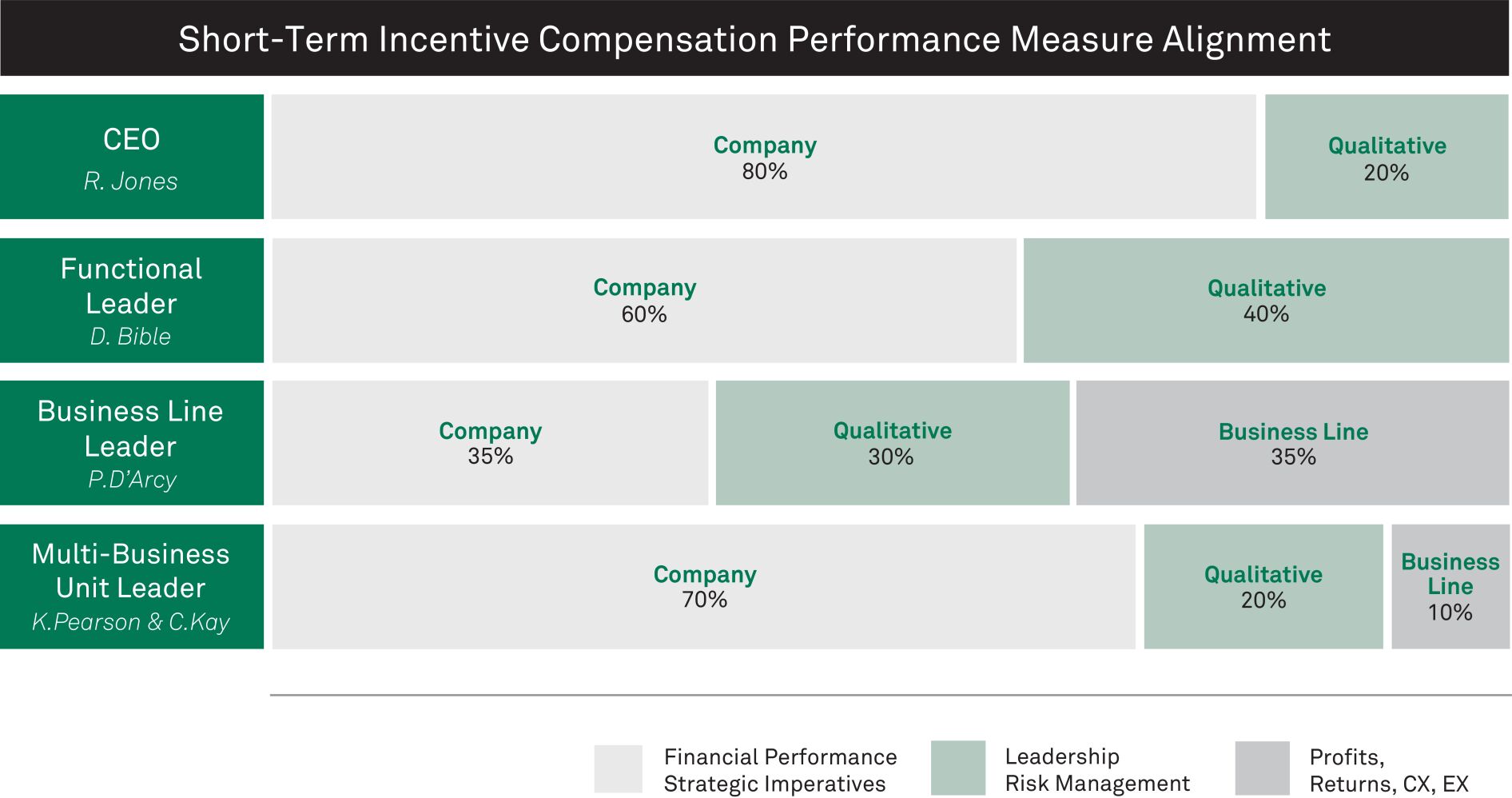
Market Analysis. The C&HC Committee reviews an estimated market pay range for each NEO. Ranges are developed based on public information and third-party market surveys of compensation for the same or comparable roles at peer firms. This practice is designed to ensure that our NEO pay appropriately reflects market pay, based on varying levels of performance. The C&HC Committee determined that all of our NEOs were appropriately positioned in the range of our peer group compensation data based on tenure in the role and performance.
In establishing pay levels for the NEOs, the C&HC Committee considers the various quantitative and qualitative factors set forth in this CD&A in the context of market data, internal equity, the value of the executive’s performance over the long-term, and their future potential with M&T. In addition, the C&HC Committee reviewed the performance of the NEOs against the executive performance scorecard metrics described above.
|
|
45
|
|
|
Below is a summary of the annual pay for performance review cycle for the 2025 performance year:
| Annual Pay for Performance Cycle | ||||
| Step | Timing | Activities | ||
| 1 |
1st Quarter of 2025 | Annual Objectives
1. Quantitative – 2025 Operating Plan • Bank-wide goals • Business-unit specific goals
2. Qualitative – 2025 Strategic Imperatives • Differentiate our customer experience • Grow new customers / develop new markets • Drive operational effectiveness • Optimize our risk management infrastructure • Be a talent and people driven organization
3. Cascade objectives to each Executive Officer 4. Distribute executive performance scorecards to Executive Officers | ||
| 2 |
2nd Quarter of 2025 | Succession Planning
1. Joint meeting between the C&HC Committee and the N&G Committee to review succession plans for executive leadership roles, including Chief Executive Officer, and other key positions | ||
| 3 |
3rd Quarter of 2025 | Establish Peer Group (as advised by Aon)
1. Review and update peer group to be used as a reference for executive officer compensation and Board compensation | ||
| 4 |
4th Quarter of 2025 | Preliminary Review and Discussion of NEO and Other Executive Officer Competitive Market Data
1. Review of 2025 Financial Performance including relative performance on key financial metrics
2. Review 2025 Risk Management Assessment
3. Review current compensation market position based on peer market data (as advised by Aon) | ||
| 5 |
4th Quarter of 2025 | Assess Performance Against the Quantitative and Qualitative Objectives Described Above for NEOs and Other Executive Officers
1. Evaluate performance • C&HC Committee evaluates and rates the CEO’s performance • C&HC Committee and the CEO evaluate and rate the performance of the other Executive Officers based on performance appraisals and executive performance scorecard results
2. Quantitative and qualitative performance is assessed based on executive performance scorecards | ||
| 6 |
1st Quarter of 2026 | Link Pay to Performance
1. Finalize performance evaluations for NEOs and other Executive Officers
2. Determine final total compensation, mix of pay and specific pay actions • 2026 Base Salary • 2025 STI (Paid in 2026 for 2025 Performance) • 2026 LTI (Granted in 2026 for 2025 Performance) | ||
|
|
|
46
|
|
2025 NEO Compensation Elements
Base Salary. The C&HC Committee made 2025 base salary determinations for the NEOs in January 2025. At that time, given the individual performance of each of the NEOs and their respective positioning against competitive market data for their roles, the C&HC Committee determined that the base salaries for Messrs. Bible and D’Arcy should be increased to approach the median of market, while the remaining NEOs were deemed to be well positioned compared to market.
| Named Executive Officer |
2025 Base Salary(1) ($) |
| ||
| René F. Jones |
1,100,000 | |||
| Daryl N. Bible |
750,000 | |||
| Kevin J. Pearson |
775,000 | |||
| Christopher E. Kay |
725,000 | |||
| Peter G. D’Arcy |
600,000 | |||
| (1) | Base salaries listed are full year salaries. |
Variable Compensation. M&T maintains a performance-guided discretionary approach to its incentive programs. While we aim to deliver TDC in a competitive range of the market for our peer group, we do not use formulas for determining performance year incentives. Instead, individual target award levels are derived using various factors including competitive market pay ranges, experience and strategic importance of a given role to the organization. As described above, the C&HC Committee performs a holistic, balanced performance assessment of company, business unit/function and individual performance that considers quantitative and qualitative factors, market compensation levels by role, and internal equity.
The executive performance scorecards provide a framework to assess annual performance of the NEOs and provides additional structure to incentive compensation recommendations. Results of the executive performance scorecards were presented to the C&HC Committee and were reviewed in conjunction with written performance appraisals to provide a holistic view of each NEO’s performance. Additional support was provided from the CRO in assessing the risk adherence for each business unit/function. Consequently, the C&HC Committee considered the following factors in making the award determinations in January 2026 for 2025 performance:
| • | the performance of M&T during 2025 relative to its operating plan and relative to the peer group; |
| • | achievement of key strategic objectives and goals set in the first quarter of the performance year; |
| • | the leadership and contribution of each of the NEOs to that performance; |
| • | the performance of the business unit/function for which each NEO has oversight; |
| • | effective risk management and adherence to M&T’s risk appetite statement; and |
| • | compensation peer group market data for the roles occupied by each of the NEOs. |
Short-term (Cash) Incentive Compensation. Based upon the performance factors described above, including the overall absolute and relative to peer financial performance and effective risk management of the organization, the STI pool was funded at target for performance year 2025. Considering this strong performance, as well as relevant market compensation information, and
|
|
47
|
|
|
applying the executive performance scorecard results, including individual performance ratings, the C&HC Committee set the amount of STI awards to each NEO for the 2025 performance year as follows:
| Named Executive Officer |
2025 STI ($) | |
| René F. Jones |
3,300,000 | |
| Daryl N. Bible |
1,625,000 | |
| Kevin J. Pearson |
1,950,000 | |
| Christopher E. Kay |
1,300,000 | |
| Peter G. D’Arcy |
1,000,000 | |
Long-term (Equity-based) Incentive Compensation. Consistent with our philosophy of linking compensation to M&T’s performance for the continued alignment with M&T’s shareholders, a substantial portion (ranging from 58% to 71%) of 2024 performance year variable compensation was awarded to NEOs through LTI grants in January 2025 under the Equity Plan.
The C&HC Committee established the LTI compensation mix to maximize shareholder value and tie the NEOs’ compensation to M&T’s long-term performance. The NEO LTI mix awarded in January 2025 based upon 2024 performance was 40% Performance Hurdled Stock Units (PHSUs), 50% Performance Vested Stock Units (PVSUs) and 10% Non-Qualified Stock Options (NQSOs or stock options). All of the LTI awards are fully at risk as stock options are worthless without M&T common stock price appreciation, and PHSUs and PVSUs are subject to performance metrics in order for awards to vest. Going forward, M&T will continue to monitor, evaluate, and modify this program as deemed necessary to ensure continued evolution in line with our business strategy and compensation philosophy. In addition, M&T continues to monitor the LTI mix on an annual basis.
The C&HC Committee determined the dollar value of the LTI awards to be made to the NEOs at its meeting in January 2025. Following that meeting, the 2024 performance year equity awards were granted on January 31, 2025. In light of a gap to competitive market positioning, and strong company performance, the C&HC Committee determined that an increase in the dollar value of the LTI awards to be awarded for 2024 performance was warranted for all NEOs.
| Named Executive Officer |
2024 ($) |
2024 ($) |
2024 ($) |
2024 ($) | ||||
| René F. Jones |
7,400,000 | 740,000 | 2,960,000 | 3,700,000 | ||||
| Daryl N. Bible |
2,350,000 | 235,000 | 940,000 | 1,175,000 | ||||
| Kevin J. Pearson |
2,830,000 | 283,000 | 1,132,000 | 1,415,000 | ||||
| Christopher E. Kay |
1,700,000 | 170,000 | 680,000 | 850,000 | ||||
| Peter G. D’Arcy |
1,325,000 | 125,000 | 575,000 | 625,000 | ||||
PHSUs. PHSUs are utilized as a strategy vehicle and were granted as part of the LTI mix in January 2025 for the 2024 performance year, consistent with prior years. PHSUs vest ratably at target each year over three years based on achievement of an absolute ROTCE safety and soundness performance hurdle for each year, which has been established at 5%. If the performance hurdle is not satisfied for a given year, the portion of the PHSU award that is scheduled to vest on the vesting date immediately following that annual performance period will not vest and will be forfeited unless otherwise determined by the C&HC Committee. Any dividend equivalents credited during the annual performance period are accrued and paid in cash to the extent the PHSUs vest and are distributed and, if the PHSUs do not vest, are forfeited.
|
|
|
48
|
|
2023-2025 PHSU Award Payouts. At the conclusion of the 2025 performance period with respect to the PHSU grants made in 2023, 2024 and 2025, the company’s absolute ROTCE was calculated to be 15.4%, which was above the absolute threshold (5%) required for each tranche to vest and pay out at target.
The C&HC Committee certified the payout at its meeting in January 2026. See Appendix A for a description of how ROTCE is calculated for purposes of these awards and a related reconciliation of ROTCE to its most directly comparable GAAP financial measured for purposes of these 2023-2025 PHSU awards.
| Named Executive Officer(1) |
Grant Date | Target Award | ||||||
| René F. Jones |
1/31/2023 | 5,129 | ||||||
| 1/31/2024 | 5,069 | |||||||
|
|
1/31/2025 | 4,902 | ||||||
| Daryl N. Bible |
1/31/2024 | 1,795 | ||||||
|
|
1/31/2025 | 1,557 | ||||||
| Kevin J. Pearson |
1/31/2023 | 2,138 | ||||||
| 1/31/2024 | 2,112 | |||||||
|
|
1/31/2025 | 1,875 | ||||||
| Christopher E. Kay |
1/31/2023 | 1,262 | ||||||
| 1/31/2024 | 1,267 | |||||||
|
|
1/31/2025 | 1,126 | ||||||
| Peter G. D’Arcy |
1/31/2023 | 984 | ||||||
| 1/31/2024 | 972 | |||||||
|
|
1/31/2025 | 952 | ||||||
| (1) | Each tranche of PHSU grants vested and were settled in shares of the company’s common stock in 2026 at target based on achievement of the 2025 performance hurdle. |
PVSUs. The C&HC Committee also grants PVSUs, which cliff vest after three years based on (i) with respect to the 2023 PVSU grant for which the three-year performance period ended in 2025, absolute and relative average ROTCE performance over the performance period, with final payout values ranging from 0% to 150% of target, and and (ii) with respect to the 2025 and 2026 PVSU grants, two metrics—ROTCE and Return on Tangible Assets (“ROTA”)—with both metrics weighted equally (50% each) and taking into consideration the three-year average performance on an absolute and relative basis, with final payout values ranging from 0% to 150% of target. In addition, the PVSUs have accrued reinvested dividend equivalent units, which will pay out at the time the underlying shares vest and are subject to the same performance payout percentage and, if the underlying PVSUs do not vest, are forfeited.
|
|
49
|
|
|
With respect to the 2023 PVSU grant, the absolute and relative average ROTCE performance metrics used were as follows:
| PVSU Performance Metrics(1) | Absolute ROTCE |
Payout | Relative ROTCE |
Payout(2) | ||||
| Above Absolute Maximum – payout is 150% regardless of relative performance | ≥17% | 150% | N/A | 150% | ||||
| Performance between these two Absolute ROTCE levels is assessed relative to the peer group | 5% to < 17% | Payout by relative ROTCE Scale | >75th percentile 50th percentile 25th percentile <25th percentile |
150% 100% 75% 50% | ||||
| Below Absolute Threshold – payout is zero, regardless of relative performance |
< 5% | 0% | N/A | 0% | ||||
| (1) | See Appendix A for a description of how ROTCE is calculated and a reconciliation of ROTCE to its most directly comparable GAAP financial measure. |
| (2) | For performance between the 25th and 75th percentiles, payout will be determined based on interpolation. |
2023-2025 PVSU Award Payout. At the conclusion of the three-year performance period for the 2023 PVSU grant, the company’s three-year average absolute ROTCE was calculated to be 15.8%, which yielded a 95% payout. The C&HC Committee certified the payout at its meeting in February 2026.
| Year |
Absolute ROTCE(1) (%) |
Payout (%) | ||||||
| 2023 |
17.6 | |||||||
| 2024 |
14.5 | |||||||
| 2025 |
15.4 | |||||||
| Three-Year Average |
15.8 | 95 | ||||||
| (1) | See Appendix A for a description of how ROTCE is calculated and a reconciliation of ROTCE to its most directly comparable GAAP financial measure. |
| Named Executive Officer(1) |
2023 PVSU Grant Target Award |
Distributed Shares(2) | ||||||
| René F. Jones |
15,385 | 16,199 | ||||||
| Kevin J. Pearson |
6,411 | 6,750 | ||||||
| Christopher E. Kay |
3,783 | 3,983 | ||||||
| Peter G. D’Arcy |
2,949 | 3,105 | ||||||
| (1) | Mr. Bible did not receive a grant of PVSUs in 2023. |
| (2) | Earned PVSUs includes payout of underlying Dividend Equivalent Units (DEUs). The DEUs are also subject to the same payout percentage of 95% as approved by the C&HC Committee. The earned DEUs for the NEOs are as follows: Mr. Jones 1,583, Mr. Pearson 659, Mr. Kay 389 and Mr. D’Arcy 303. |
Stock Options. M&T also awards a portion of the LTI awards in the form of stock options. Stock options align our NEOs’ interests with those of shareholders by providing value only if M&T’s common stock price increases from the date that the stock option is granted. In addition, the vesting schedule for the stock options promotes retention of our NEOs. The stock option awards granted to the NEOs in January 2025 for 2024 performance vest ratably over three years. Stock options create close alignment with shareholder experience, and due to their ten-year term, support M&T’s business strategy and compensation philosophy by providing a link to long-term business objectives and sustained long-term value creation.
|
|
|
50
|
|
2026 Long-Term Incentive Grant.
Each year the C&HC Committee evaluates the LTI mix to maintain competitiveness, drive appropriate behaviors and align the interests of our executives with M&T’s long-term performance. To maintain the strong link between company performance and executive compensation, the C&HC Committee maintained the percentage of LTI awarded in the three vehicles as was awarded in 2025. The NEO LTI mix awarded in January 2026 based upon 2025 performance was:
| • | 50% Performance-Vested Stock Units |
| • | 40% Performance-Hurdled Stock Units |
| • | 10% Non-Qualified Stock Options |
| Named Executive Officer(1) |
2025 (2026 Grant) ($) |
2025 Performance ($) |
2025 Performance ($) |
2025 Performance ($) |
||||||||||||
| René F. Jones |
8,500,000 | 850,000 | 3,400,000 | 4,250,000 | ||||||||||||
| Daryl N. Bible |
2,350,000 | 235,000 | 940,000 | 1,175,000 | ||||||||||||
| Kevin J. Pearson |
2,925,000 | 292,500 | 1,170,000 | 1,462,500 | ||||||||||||
| Christopher E. Kay |
1,750,000 | 175,000 | 700,000 | 875,000 | ||||||||||||
| Peter G. D’Arcy |
1,450,000 | 145,000 | 580,000 | 725,000 | ||||||||||||
2026 PVSUs. The C&HC Committee approved a plan design change for the PVSUs, starting with grants in 2024, and this updated design remains in effect for 2026 grants. The updated plan design includes two metrics – ROTCE and ROTA. Both metrics are weighted equally (50% each) and both take into consideration the three-year average performance on an absolute and relative basis. Like the prior design, the PVSUs have a three-year cliff vesting schedule with final payout values ranging from 0% to 150% of target. In addition, the PVSU design includes accrued reinvested dividend equivalent units, which will pay out at the time that the underlying shares vest and are subject to the same performance payout percentage and, if the underlying PVSUs do not vest, are forfeited.
|
|
PVSU Performance Metric 1 | Absolute ROTCE |
Payout | Relative ROTCE |
Payout(2) | |||||
| Metric 1: ROTCE(1)
50% weighting |
Above Absolute Maximum – payout is 150% regardless of relative performance | ≥17% | 150% | N/A | 150% | |||||
| Performance between these two Absolute ROTCE levels is assessed relative to the peer group | 5% to < 17% | Payout by relative ROTCE Scale | >75th %’ile 50th %’ile 25th %’ile <25th %’ile |
150% 100% 75% 50% | ||||||
|
Below Absolute Threshold – payout is zero, regardless of relative performance |
< 5% |
0% |
N/A |
0% | ||||||
| (1) | See Appendix A for a description of how ROTCE is calculated. |
| (2) | For performance between the 25th and 75th percentiles, payout will be determined based on interpolation. |
|
|
51
|
|
|
| |
PVSU Performance Metric 2 |
Absolute ROTA |
Payout |
Relative ROTA |
Payout (2) | |||||
Metric 2: ROTA (1) 50% weighting |
Above Absolute Maximum – payout is 150% regardless of relative performance | ≥ 1.25% |
150% | N/A | 150% | |||||
| Performance between these two Absolute ROTA levels is assessed relative to the peer group | 0.35% to <1.25% | Payout by relative ROTA Scale | >75th %’ile 50th %’ile 25th %’ile <25th %’ile |
150% 100% 75% 50% | ||||||
Below Absolute Threshold – payout is zero, regardless of relative performance |
< 0.35% | 0% | N/A | 0% | ||||||
(1) |
See Appendix A for a description of how ROTA is calculated. |
(2) |
For performance between the 25th and 75th percentiles, payout will be determined based on interpolation. |
| |
52 |
René F. Jones - Chairman and Chief Executive Officer
The C&HC Committee established Mr. Jones’ TDC based on the company’s performance relative to peers and our 2025 Operating Plan, as well as progress toward our long-term strategic objectives. Specifically, the C&HC Committee considered the following performance factors (among others discussed in this CD&A) in establishing Mr. Jones’ TDC:
| Company Results (“What”) |
Strong financial performance and long-term shareholder return
• Net operating income(1) and diluted net operating earnings per common share(1) were at highest levels in company history.
• Net operating return on average tangible assets(1) was tied for highest among peers.
• Net interest margin led peer group and fee income reached a record level.
• Net operating return on average tangible common equity(1), excluding the impact of accumulated other comprehensive income, was in the top quartile among peers.
• Increased quarterly common stock dividend by 11%, and repurchased over 14 million common shares representing 9% of outstanding shares.
• See 2025 Financial Performance Highlights for further results.
| |
| Progress against Strategic Imperatives
• Advanced the Company’s multiyear finance modernization initiative, positioning for 2026 delivery, to enhance financial management capabilities and reduce manual processes.
• Streamlined centralized operations, leading to improved execution efficiency and greater economies of scale.
• Continued modernization of customer support infrastructure, reducing wait times and piloting AI-enabled routing to strengthen service quality.
| ||
| Customer Experience
• For the 17th consecutive year, ranked among the nation’s top 10 Small Business Administration (SBA) lenders; M&T also placed among the top five lenders across its New England SBA districts.
| ||
| Qualitative Results (“How”) |
Employee Experience
• Advanced the Executive Leadership program, driving improved collaboration, more consistent governance routines, and strengthened enterprise leadership capability.
• Continued investment in talent development and succession planning across critical roles to support long term organizational strength.
| |
| Leadership
• Supported the Company’s priorities around coordinated growth and operational excellence by guiding leaders to improve collaboration across businesses and make more integrated decisions.
• Maintained cultural continuity and disciplined execution amid ongoing economic uncertainty.
• Strengthened leadership depth and readiness across the organization to support long term strategic objectives.
| ||
| Risk Management
• Company continues to operate within its established risk appetite parameters, which was updated and affirmed by the Risk Committee of the Board
• Improved early identification of risk through stronger first-line risk engagement and improved transparency and alignment with regulatory stakeholders.
|
| (1) | See “Supplemental Reporting of Non-GAAP Results of Operations” in M&T’s 2025 Form 10-K for a reconciliation of GAAP measures to corresponding non-GAAP measures. |
|
|
53
|
|
|
René F. Jones - Chairman and Chief Executive Officer (continued)
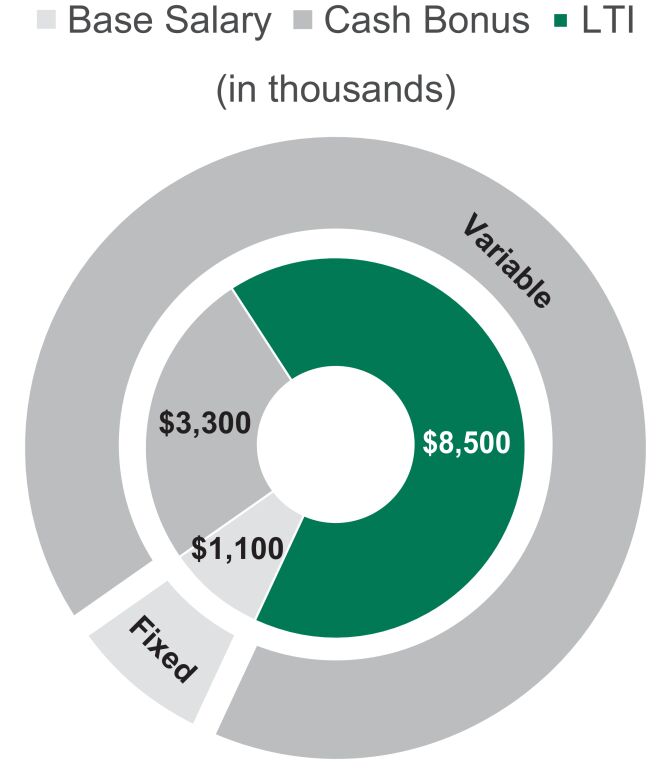
| ||||||||||
| Performance Year | ||||||||||
|
|
2024 | 2025 | ||||||||
| Salary |
$ | 1,100,000 | $ | 1,100,000 | ||||||
| STI Payout |
$ | 3,000,000 | $ | 3,300,000 | ||||||
| NQ Stock Options |
$ | 740,000 | $ | 850,000 | ||||||
| PHSUs(1) |
$ | 2,960,000 | $ | 3,400,000 | ||||||
| PVSUs(2) |
$ | 3,700,000 | $ | 4,250,000 | ||||||
| LTI Grant |
$ | 7,400,000 | $ | 8,500,000 | ||||||
| Total Direct Compensation |
$ | 11,500,000 | $ | 12,900,000 | ||||||
(1) Represents grant date fair value. Actual payout dependent on achievement of performance hurdle.
(2) Represents grant date fair value. Actual payout could range from 0%-150% of target depending on actual performance achieved.
Linking 2025 CEO Pay Elements to Performance
| • | 91% variable pay for the 2025 performance year |
| • | 72% of variable pay is equity-based deferred LTI subject to multi-year vesting and forfeiture to align shareholder and executive interests |
| • | Stock Options vest ratably over three years on the anniversary of the grant date and provide value only if M&T’s common stock price increases from the date that the options are granted |
| • | PHSUs vest ratably over three years and are earned based on achievement of an absolute ROTCE performance hurdle each year |
| • | PVSUs are earned only to the extent M&T performance objectives are achieved against absolute and relative average ROTCE and ROTA over a three-year period |
|
|
|
54
|
|
Daryl Bible - Senior Executive Vice President and Chief Financial Officer
Mr. Bible has served as CFO since June 2023. For performance year 2025, the C&HC Committee considered the following performance factors (among others discussed in this CD&A) in establishing his TDC:
| Company Results (“What”) |
Strong financial performance and long-term shareholder return
• Net operating income(1) and diluted net operating earnings per common share(1) were at highest levels in company history.
• Net operating return on average tangible assets(1) was tied for highest among peers.
• Net interest margin led peer group and fee income reached a record level.
• Net operating return on average tangible common equity(1), excluding the impact of accumulated other comprehensive income, was in the top quartile among peers.
• Increased quarterly common stock dividend by 11%, and repurchased over 14 million common shares representing 9% of outstanding shares.
| |
|
Progress against Strategic Imperatives
• Advanced modernization of the Company’s financial systems and analytical capabilities, completing key milestones in the multiyear finance transformation program.
• Improved the finance operating model through progress in process simplification, technology enhancements, and stronger data and reporting infrastructure.
• Implemented a new hedge accounting platform that improves efficiency, reduces operational risk, and enhances reporting consistency.
| ||
|
Customer Experience
• Improved the quality, reliability, and timeliness of financial information that supports customer facing decisions and enhances transparency for stakeholders.
• Strengthened analytical support for more consistent credit evaluation and more informed client engagement across the organization.
| ||
| Qualitative Results (“How”) |
Employee Experience
• Supported talent development through promotions, internal mobility opportunities, and targeted hiring to strengthen critical finance capabilities.
| |
|
Leadership
• Led adoption of advanced data, technology, and analytical capabilities to enhance financial reporting and decision support.
• Encouraged responsible innovation to maintain competitiveness and regulatory readiness, including expanded use of data science and AI.
| ||
|
Risk Management
• Delivered year-over-year improvement in regulatory stress testing outcomes, strengthening the Company’s capital planning posture.
• Strengthened governance of financial models, processes, and controls to support sound risk management and regulatory expectations.
|
| (1) | See “Supplemental Reporting of Non-GAAP Results of Operations” in M&T’s 2025 Form 10-K for a reconciliation of GAAP measures to corresponding non-GAAP measures. |
|
|
55
|
|
|
Daryl Bible - Senior Executive Vice President and Chief Financial Officer (continued)
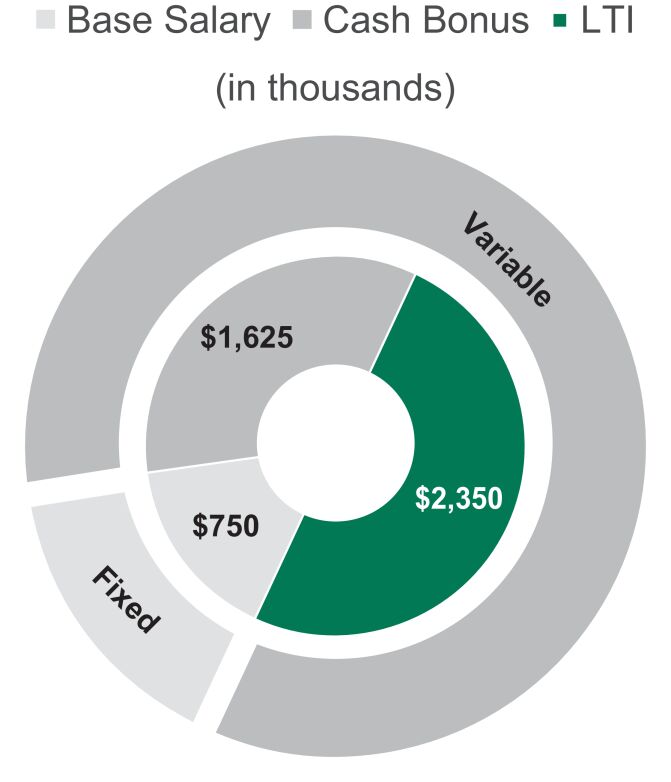
| ||||||||||||
| Performance Year | ||||||||||||
|
|
2024 | 2025 | ||||||||||
| Salary |
$ | 740,000 | $ | 750,000 | ||||||||
| STI Payout |
$ | 1,400,000 | $ | 1,625,000 | ||||||||
| NQ Stock Options |
$ | 235,000 | $ | 235,000 | ||||||||
| PHSUs(1) |
$ | 940,000 | $ | 940,000 | ||||||||
| PVSUs(2) |
$ | 1,175,000 | $ | 1,175,000 | ||||||||
| LTI Grant |
$ | 2,350,000 | $ | 2,350,000 | ||||||||
| Total Direct Compensation |
$ | 4,490,000 | $ | 4,725,000 | ||||||||
(1) Represents grant date fair value. Actual payout dependent upon achievement of performance hurdle.
(2) Represents grant date fair value. Actual payout could range from 0%-150% of target depending on actual performance achieved.
|
|
|
56
|
|
Kevin J. Pearson - Vice Chairman
Mr. Pearson has overall responsibility for M&T’s Mortgage, Indirect Consumer Lending and Dealer Services divisions, as well as our Wealth Management and Institutional Client Services divisions operating under the Wilmington Trust brand. For performance year 2025, the C&HC Committee considered the results of the portfolio of businesses he oversees and the following performance factors (among others discussed in this CD&A) in establishing his TDC:
| Company Results (“What”) |
Strong financial performance and long-term shareholder return
• Net operating income(1) and diluted net operating earnings per common share(1) were at highest levels in company history.
• Net operating return on average tangible assets(1) was tied for highest among peers.
• Net interest margin led peer group and fee income reached a record level.
• In addition, the Institutional Services & Wealth Management businesses delivered positive fee income growth and record sales levels for the segment.
• Revenues for Dealer Commercial Services, Mortgage and Indirect lending increased year over year.
| |
|
Progress against Strategic Imperatives
• Advanced operating discipline across the enterprise by strengthening governance routines, integrating strategic planning, and reinforcing decision making processes that support long term value creation.
• Enhanced alignment between enterprise priorities and execution, contributing to sustained financial performance, disciplined balance sheet management, and progress against multi year strategic commitments.
• Drove cross-enterprise coordination by maturing business review forums and reinforcing enterprise accountability frameworks that improved transparency, coordination, and execution cadence.
| ||
|
Customer Experience
• Supported scalable customer-facing capabilities through integration of key enterprise platforms, improving consistency and coordination of customer experience efforts across markets and business lines.
| ||
| Qualitative Results (“How”) |
Employee Experience
• Activated a framework for operational excellence and teaming for growth across the bank, creating visibility and opportunities for top talent.
| |
|
Leadership
• Elevated senior leadership effectiveness by promoting enterprise-level accountability, shared ownership of strategic outcomes, and leadership expectations aligned with high performing organizations.
• Strengthened executive succession depth through focused development of high potential leaders and effective onboarding of executives assuming expanded responsibilities.
| ||
|
Risk Management
• Strengthened risk and resiliency posture by advancing initiatives focused on operational continuity and risk mitigation.
• Delivered progress on regulatory expectations, reinforcing a disciplined risk management framework and sustaining the organization’s commitment to strong governance practices.
|
| (1) | See “Supplemental Reporting of Non-GAAP Results of Operations” in M&T’s 2025 Form 10-K for a reconciliation of GAAP measures to corresponding non-GAAP measures. |
|
|
57
|
|
|
Kevin J. Pearson - Vice Chairman (continued)
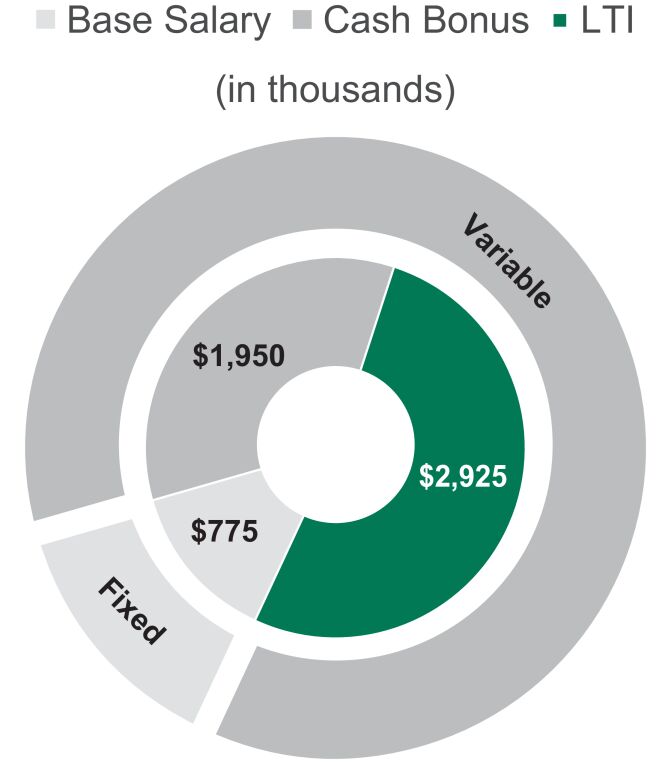
| ||||||||||||
| Performance Year | ||||||||||||
|
|
2024 | 2025 | ||||||||||
| Salary |
$ | 775,000 | $ | 775,000 | ||||||||
| STI Payout |
$ | 1,820,000 | $ | 1,950,000 | ||||||||
| NQ Stock Options |
$ | 283,000 | $ | 292,500 | ||||||||
| PHSUs(1) |
$ | 1,132,000 | $ | 1,170,000 | ||||||||
| PVSUs(2) |
$ | 1,415,000 | $ | 1,462,500 | ||||||||
| LTI Grant |
$ | 2,830,000 | $ | 2,925,000 | ||||||||
| Total Direct Compensation |
$ | 5,425,000 | $ | 5,650,000 | ||||||||
(1) Represents grant date fair value. Actual payout dependent upon achievement of performance hurdle.
(2) Represents grant date fair value. Actual payout could range from 0%-150% of target depending on actual performance achieved.
|
|
|
58
|
|
Christopher E. Kay - Senior Executive Vice President and Head of Enterprise Platforms
Mr. Kay is responsible for Retail and Business Banking, Community Market teams, as well as the company’s Enterprise Platforms (Digital, Marketing/Communications/PR/Customer Experience (CX), and Innovation & Transformation). For performance year 2025, the C&HC Committee considered the following performance factors (among others discussed in this CD&A) in establishing his TDC:
| Company Results (“What”) |
Strong financial performance and long-term shareholder return
• Net operating income(1) and diluted net operating earnings per common share(1) were at highest levels in company history.
• Net operating return on average tangible assets(1) was tied for highest among peers.
• Net interest margin led peer group and fee income reached a record level.
• The Consumer Bank division delivered strong financial performance driven by growth in direct lending and prudent deposit and expense management.
• Business Banking delivered strong fee income growth while managing expenses.
| |
|
Progress against Strategic Imperatives
• Advanced enterprise growth and innovation through a strengthened partnership model that drove cross-functional collaboration and delivered measurable business impact.
• Expanded market presence in New England by establishing an executive footprint in Boston and activating a refreshed growth model to accelerate client engagement and market integration.
• Introduced a framework to assess and improve key enterprise capabilities, helping prioritize investments and raise performance consistency across the organization.
| ||
|
Customer Experience
• Enhanced engagement with top clients through a more integrated relationship model improving transparency, connectivity, and service quality.
• Delivered meaningful digital service improvements, including stronger authentication and expanded mobile and paperless features, benefiting more than 3.4 million customers.
• Strengthened brand presence through comprehensive research and more than 50 strategic client and community engagements.
| ||
| Qualitative Results (“How”) |
Employee Experience
• Embedded “The Way We Work” program, focused on realigning the organization around customer experience, agility, process improvement, and encouraging change management mindsets, further into the culture, contributing to higher engagement scores.
• Implemented enterprise routines and frameworks that improved visibility, prioritization, and execution of strategic initiatives.
| |
|
Leadership
• Built leadership strength and succession readiness by advancing high-potential talent and onboarding experienced new leaders.
• Improved cross business alignment through enhanced enterprise forums and integrated review cycles that elevated decision quality.
| ||
|
Risk Management
• Strengthened first-line risk maturity through improved governance, closure of longstanding issues, and stronger audit outcomes.
• Enhanced regulatory agility through coordinated routines that support timely assessment and action.
|
| (1) | See “Supplemental Reporting of Non-GAAP Results of Operations” in M&T’s 2025 Form 10-K for a reconciliation of GAAP measures to corresponding non-GAAP measures. |
|
|
59
|
|
|
Christopher E. Kay - Senior Executive Vice President and Head of Enterprise Platforms (continued)
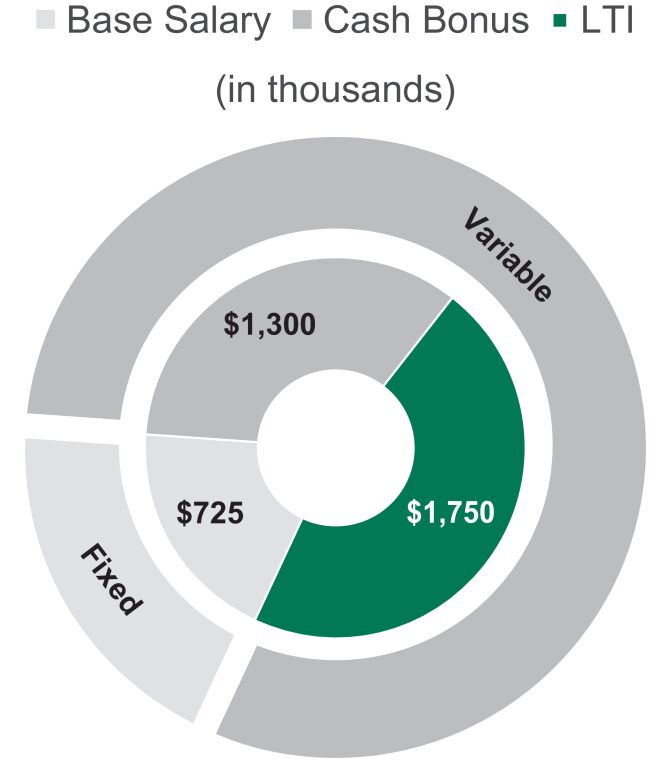
| ||||||||||||
| Performance Year | ||||||||||||
|
|
2024 | 2025 | ||||||||||
| Salary |
$ | 725,000 | $ | 725,000 | ||||||||
| STI Payout |
$ | 1,225,000 | $ | 1,300,000 | ||||||||
| NQ Stock Options |
$ | 170,000 | $ | 175,000 | ||||||||
| PHSUs(1) |
$ | 680,000 | $ | 700,000 | ||||||||
| PVSUs(2) |
$ | 850,000 | $ | 875,000 | ||||||||
| LTI Grant |
$ | 1,700,000 | $ | 1,750,000 | ||||||||
| Total Direct Compensation |
$ | 3,650,000 | $ | 3,775,000 | ||||||||
(1) Represents grant date fair value. Actual payout dependent upon achievement of performance hurdle.
(2) Represents grant date fair value. Actual payout could range from 0%-150% of target depending on actual performance achieved.
|
|
|
60
|
|
Peter D’Arcy - Senior Executive Vice President and Head of Commercial Banking
Mr. D’Arcy has served as the head of Commercial Banking since April 2022. For performance year 2025, the C&HC Committee considered the following performance factors (among others discussed in this CD&A) in establishing his TDC:
| Company Results (“What”) |
Strong financial performance and long-term shareholder return
• Net operating income(1) and diluted net operating earnings per common share(1) were at highest levels in company history.
• Net operating return on average tangible assets(1) was tied for highest among peers.
• Net interest margin led peer group and fee income reached a record level.
• In addition, net income for the Commercial Bank increased year over year.
• Asset quality continued to improve with a decline in level of criticized commercial and industrial and commercial real estate loans.
| |
|
Progress against Strategic Imperatives
• Completed modernization and remediation of the first-line credit platform.
• Strengthened enterprise resiliency through added automation, data foundation upgrades, and modernization of core credit processes.
• Developed a new approach for cross-divisional teaming to grow regional businesses more deliberately, starting with New England.
| ||
|
Customer Experience
• Improved service delivery for 1,000+ Commercial & Industrial clients through a redesigned operating model that increases RM productivity, reduces credit decision timelines, and enhances overall client connectivity.
• Expanded use of shared enterprise functions – including call centers, fraud operations, and account-opening teams – to provide a more consistent and scalable experience for commercial clients.
| ||
| Qualitative Results (“How”) |
Employee Experience
• Built leadership depth by hiring experienced external leaders and providing structured stretch opportunities for high-potential internal talent.
• Increased transparency and engagement through improved leadership messaging, redesigned town halls, and increased collaboration across businesses.
| |
|
Leadership
• Balanced regulatory remediation with forward-looking investments in modernization and enterprise collaboration.
• Launched a new enterprise teaming model to drive coordinated, cross-segment growth across consumer, business banking, commercial, and wealth divisions.
| ||
|
Risk Management
• Strengthened risk consistency and operational efficiency through the deployment of an early warning tool that significantly reduced false positives, the migration of credit analysis to modern systems, and the implementation of 23 new risk-rating scorecards.
|
| (1) | See “Supplemental Reporting of Non-GAAP Results of Operations” in M&T’s 2025 Form 10-K for a reconciliation of GAAP measures to corresponding non-GAAP measures. |
|
|
61
|
|
|
Peter D’Arcy - Senior Executive Vice President and Head of Commercial Banking (continued)
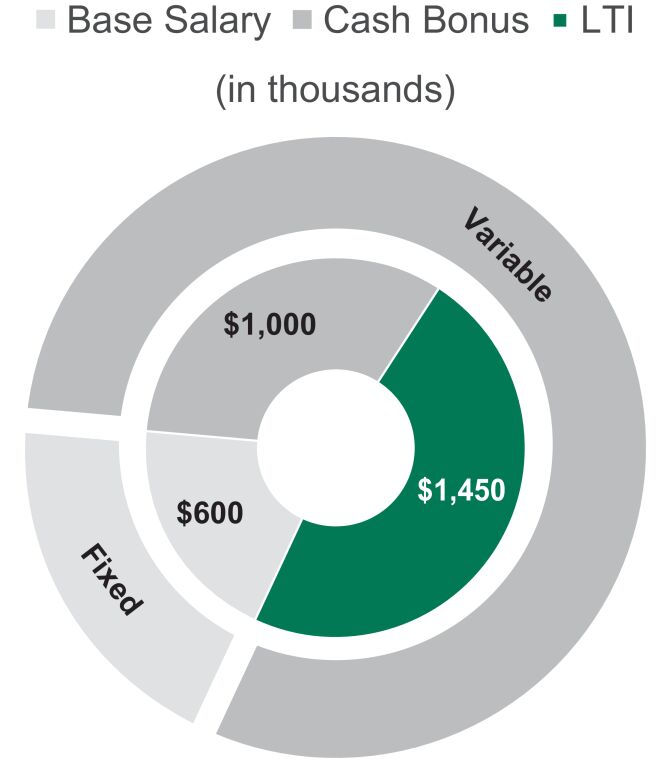
| |||||||
| Performance Year | |||||||
|
|
2025(1) | ||||||
| Salary |
$ | 600,000 | |||||
| STI Payout |
$ | 1,000,000 | |||||
| NQ Stock Options |
$ | 145,000 | |||||
| PHSUs(2) |
$ | 580,000 | |||||
| PVSUs(3) |
$ | 725,000 | |||||
| LTI Grant |
$ | 1,450,000 | |||||
| Total Direct Compensation |
$ | 3,050,000 | |||||
(1) Mr. D’Arcy’s 2024 Performance Compensation is not listed as he was not an NEO for 2024.
(2) Represents grant date fair value. Actual payout dependent upon achievement of performance hurdle.
(3) Represents grant date fair value. Actual payout could range from 0%-150% of target depending on actual performance achieved.
|
|
|
62
|
|
Retirement and Other Benefits
M&T maintains two tax-qualified retirement plans for its employees, one a defined benefit plan and the other a defined contribution plan. Mr. Pearson participates in the defined benefit plan and continues to receive benefit accruals. Messrs. Jones and D’Arcy elected to have their respective benefits accrued under the defined contribution plan. This election was made pursuant to a one-time election that was offered to all participants in the defined benefit plan in late 2005 to either (i) remain an active participant in the defined benefit plan and earn future benefits under a new reduced benefit formula or (ii) retain the frozen benefit in the defined benefit plan and earn future benefits under a new defined contribution plan formula beginning January 1, 2006. Messrs. Kay and Bible are not eligible to participate in the defined benefit plan and are participants in the defined contribution plan.
In addition, M&T maintains nonqualified defined benefit and defined contribution retirement plans to supplement retirement benefits for the NEOs and other eligible participants in order to make up for benefits that cannot be provided in the qualified plans due to Internal Revenue Code limits; however, compensation recognized for the purpose of these plans is capped at two times the annual Internal Revenue Code Section 401(a)(17) limit. The nonqualified plans are not funded, except as benefits are actually paid to executive officers upon retirement or such other date elected by the executive. Additional information regarding these retirement plans and arrangements is provided in the sections titled “Pension Benefits” and “Nonqualified Deferred Compensation.”
M&T does not provide the NEOs with severance packages beyond what is provided to employees of M&T generally. Consequently, the NEOs have historically participated in the M&T Bank Corporation Employee Severance Pay Plan (“Severance Pay Plan”), which provides for post-employment severance payments that are tiered based upon an employee’s position and years of service, and the continuation of certain employee benefits. Upon a “Qualifying Event” (defined in the Severance Pay Plan as any permanent, involuntary termination of a participant’s active employment as a result of a reduction in force, restructuring, outsourcing or elimination of position), a NEO would be entitled to benefits under the Severance Pay Plan.
Other than benefits that are generally available to our employees, M&T does not maintain any individual executive severance or change in control arrangements. M&T’s compensation plans do not contain payments or benefits to NEOs that are specifically triggered by a change in control, except that the Equity Plan provides that, upon a change in control, all employees, including the NEOs, would become fully vested in any outstanding awards that were not already vested. M&T has elected to provide such acceleration because of a belief that the principal purpose of providing executive officers and other employees with equity incentives is to align their interests with those of M&T’s shareholders and that this alignment should be enhanced, not weakened, in the context of a change in control. Accelerating the vesting of equity-based compensation upon a change in control allows our employees the same opportunity as other shareholders to sell shares freely following the completion of the transaction and realize the economic benefits of such transaction, without forcing them to be exposed to the post-closing performance of the acquirer. More information regarding severance benefits and the impact of a change in control can be found later in the “Potential Payments Upon Termination or Change in Control” section.
Perquisites. M&T provides limited perquisites to its NEOs. The perquisites that are provided are designed to assist NEOs in being productive and are limited to those that management and the C&HC Committee believe are consistent with M&T’s overall compensation philosophy. Given the importance of developing business relationships for M&T’s success, the NEOs are generally reimbursed for certain initiation fees and dues they incur for club memberships deemed advisable for business purposes. Other perquisites may include tax preparation, parking, meals, executive physical examinations, relocation services/commuting expenses and use of a corporate apartment. In 2025, the C&HC Committee approved a corporate aircraft policy, which recognizes that the use of corporate
|
|
63
|
|
|
aircraft helps executives achieve company objectives, maximizes their productivity and availability by permitting executives to travel more efficiently, and provides a greater level of security and personal safety. Pursuant to this policy, the C&HC Committee also approved limited use of corporate aircraft by the CEO for non-business travel up to a maximum value of $100,000 (any excess of this amount to be reimbursed by the CEO).
Sound Compensation and Governance Practices and Policies
M&T’s executive compensation programs are managed in consideration of the Guidance on Sound Incentive Compensation Policies, which is promulgated by the Treasury Department and Federal Reserve System, among other government agencies, and other regulatory requirements. In light of these requirements, M&T has adopted certain governance practices, which are more fully described below.
Stock Ownership and Retention Guidelines for Executives and Board Members. M&T’s philosophy has been to foster a culture for its NEOs to acquire and retain M&T common stock. To bolster this philosophy, M&T maintains formal Stock Ownership and Retention Guidelines for Executives (“Stock Ownership Guidelines”) for our executive officers in order to further align their interests with those of our shareholders. The Stock Ownership Guidelines provide that executive officers should own a significant amount of M&T common stock measured as a multiple of base salary as follows:
| Role | Ownership Guideline Base Salary) |
|||
| Chairman and Chief Executive Officer | 6x | |||
| Other NEOs | 3x | |||
| Other executive officers | 2x | |||
The Stock Ownership Guidelines provide that executive officers should achieve the targeted stock ownership levels within five years of first becoming subject to the Stock Ownership Guidelines. Once the ownership threshold is met, executives are expected to maintain the required ownership amount as long as they are subject to the Stock Ownership Guidelines. Shares counted towards the Stock Ownership Guidelines include any shares held by the executive directly or through a broker, shares held through employee benefit plans, and shares held as restricted stock units or restricted stock awards, whether vested or unvested. Unvested PVSUs and unexercised stock options do not count as shares held by the executive for purposes of the guidelines. If an executive officer fails to meet the requirement, the individual is expected to hold 50% of all shares acquired from the settlement of equity awards, net of shares withheld for taxes or payment of exercise price, if applicable, until the executive meets the ownership threshold. Pursuant to the Stock Ownership Guidelines, the C&HC Committee reviews compliance with the Stock Ownership Guidelines on an annual basis. As of February 13, 2026, all executive officers are in compliance with the Stock Ownership Guidelines.
As noted above under “Director Stock Ownership Guidelines,” members of the Board are also expected to own M&T common stock with a value equal to five times their annual cash retainer and are expected to meet this ownership guideline by the fifth anniversary of his or her initial election to the Board. Directors who receive no personal compensation for their service are not subject to this guideline. As of February 13, 2026, all directors are in compliance with the director stock ownership guidelines.
Anti-Hedging and Anti-Pledging Policies. M&T’s Insider Trading Policy prohibits all employees from engaging in any hedging transactions or any form of short-term trading with respect to M&T securities. The Insider Trading Policy also prohibits executive officers from pledging M&T
|
|
|
64
|
|
securities, except in limited circumstances. None of our NEOs pledged any M&T securities in 2025. For more information regarding the anti-hedging and anti-pledging policies, see “M&T Bank Corporation Insider Trading Policy” further above in this proxy statement.
Clawback and Forfeiture Policies. M&T has a Forfeiture Policy that sets forth the circumstances under which the C&HC Committee may cause a downward adjustment in current year compensation as well as cause all or part of unvested equity awards to be canceled. Such circumstances include, but are not limited to, action or inaction on the part of an employee that results in a significant loss event (either to M&T as a whole or to a significant business line), a restatement of the financial statements due to material noncompliance with applicable financial reporting requirements, or a violation of M&T’s risk policies or procedures.
In 2023, M&T also adopted the M&T Bank Corporation Executive Compensation Recoupment Policy (the “Recoupment Policy”) that provides for clawback of erroneously awarded incentive-based compensation received by M&T’s current or former executive officers. Such clawback is triggered if the company is required to prepare an accounting restatement. The Recoupment Policy was adopted pursuant to NYSE listing standards that implemented the clawback provisions of the Dodd-Frank Wall Street Reform and Consumer Protection Act of 2010 (the “Dodd-Frank Act”).
In addition, our CEO and CFO are subject to the clawback provision of the Sarbanes-Oxley Act of 2002, which generally requires that they reimburse M&T for any bonus or other incentive- or equity-based compensation and any profits on sales of M&T common stock that they receive within the 12-month period following the public issuance of financial information if there is an accounting restatement because of material noncompliance, as a result of misconduct, with any financial reporting requirement under the federal securities laws.
Working together, the components of the executive compensation programs continue to drive alignment of our NEOs’ interests with those of our shareholders, are consistent with the safety and soundness of M&T and provide an enhanced ability to account for the duration of risks and adjust compensation in the event of misconduct or adverse risk outcomes.
Incentive Compensation Governance and Compensation Risk Assessment. M&T works continuously to ensure effective controls are in place for its incentive compensation programs. As part of M&T’s enhanced enterprise risk framework, control functions, including Human Resources, Finance, Compliance, Legal, Internal Audit, and Risk Management, are actively involved in the oversight of M&T’s incentive compensation programs. In addition, the CRO meets with the C&HC Committee to review and discuss M&T’s risk scorecard, which details the CRO’s assessment of risk management at M&T.
Active and effective oversight of M&T’s incentive compensation practices is also provided by the C&HC Committee. The C&HC Committee is responsible for maintaining M&T’s Forfeiture Policy and the Recoupment Policy in addition to determining the appropriate pay mix and total compensation for M&T’s NEOs. Additionally, the C&HC Committee is responsible for establishing the appropriate performance measure for performance- based stock unit awards. Reviews of M&T’s compensation plans and practices by the C&HC Committee and M&T management did not identify any plan that was reasonably likely to have a material adverse impact on the company or that would incentivize excessive risk-taking.
Tax Matters
Internal Revenue Code Section 162(m) generally imposes a $1 million cap on the deductibility of compensation paid to “covered employees” of a publicly held corporation during a year. The executive officers to whom Section 162(m) applies for 2025 include M&T’s CEO and CFO, the next three most highly compensated executive officers, and any such “covered employee” for a year after 2016. The C&HC Committee considers tax consequences to M&T as one of many factors when it makes compensation determinations, and will award compensation to NEOs that it determines to be consistent with the goals of our executive compensation program, even if such compensation is not deductible for income tax purposes.
|
|
65
|
|
|
COMPENSATION AND HUMAN CAPITAL COMMITTEE REPORT
The Compensation and Human Capital Committee has reviewed and discussed the Compensation Discussion and Analysis required by Item 402(b) of SEC Regulation S-K with management. Based on such review and discussions, the Compensation and Human Capital Committee recommended to the Board of Directors that the Compensation Discussion and Analysis be included in this proxy statement.
This report was adopted by the Compensation and Human Capital Committee of the Board of Directors on February 13, 2026:
William F. Cruger, Jr., Chair
Gary N. Geisel
Rudina Seseri
Herbert L. Washington
|
|
|
66
|
|
EXECUTIVE COMPENSATION
The following table contains information concerning the compensation of M&T’s NEOs in the fiscal years ended December 31, 2025, 2024 and 2023.
2025 Summary Compensation Table
| Name and Principal Position |
Yr. | Salary ($) |
Bonus ($) |
Stock Awards(1) ($) |
Option ($) |
Non-Equity ($) |
Change in Pension ($) |
All Other ($) |
Total ($) | ||||||||||||||||||||||||||||||||||||
| René F. Jones |
2025 | 1,100,000 | 3,300,000 | 6,660,238 | 740,022 | — | 21,932 | 193,056 | 12,015,250 | ||||||||||||||||||||||||||||||||||||
| Chairman & |
2024 | 1,100,000 | 3,000,000 | 5,100,172 | 900,012 | — | — | 165,399 | 10,265,583 | ||||||||||||||||||||||||||||||||||||
| Chief Executive Officer |
2023 | 1,100,000 | 2,150,000 | 4,800,120 | 1,200,010 | — | 11,982 | 123,445 | 9,385,557 | ||||||||||||||||||||||||||||||||||||
| Daryl N. Bible(5) |
2025 | 748,846 | 1,625,000 | 2,115,234 | 235,014 | — | — | 71,872 | 4,795,966 | ||||||||||||||||||||||||||||||||||||
| Senior Executive Vice President & |
2024 | 740,000 | 1,900,000 | 1,806,348 | 318,776 | — | — | 75,226 | 4,840,350 | ||||||||||||||||||||||||||||||||||||
| Chief Financial Officer |
2023 | 418,385 | 750,000 | 2,500,137 | — | — | — | 23,162 | 3,691,684 | ||||||||||||||||||||||||||||||||||||
| Kevin J. Pearson |
2025 | 775,000 | 1,950,000 | 2,547,296 | 283,050 | — | 245,382 | 70,848 | 5,871,576 | ||||||||||||||||||||||||||||||||||||
| Vice Chairman |
2024 | 775,000 | 1,820,000 | 2,125,083 | 375,005 | — | 95,212 | 68,494 | 5,258,794 | ||||||||||||||||||||||||||||||||||||
|
|
2023 | 775,000 | 1,300,000 | 2,000,232 | 500,020 | — | 163,129 | 68,719 | 4,807,100 | ||||||||||||||||||||||||||||||||||||
| Christopher E. Kay |
2025 | 725,000 | 1,300,000 | 1,530,229 | 170,012 | — | — | 341,879 | 4,067,120 | ||||||||||||||||||||||||||||||||||||
| Senior Executive Vice President & |
2024 | 725,000 | 1,225,000 | 1,275,077 | 225,003 | — | — | 80,343 | 3,530,423 | ||||||||||||||||||||||||||||||||||||
| Head of Enterprise Platforms |
2023 | 725,000 | 950,000 | 1,180,296 | 295,044 | — | — | 71,608 | 3,221,948 | ||||||||||||||||||||||||||||||||||||
| Peter G. D’Arcy(6) |
2025 | 594,231 | 1,000,000 | 1,200,195 | 125,048 | — | 8,467 | 114,748 | 3,042,689 | ||||||||||||||||||||||||||||||||||||
| Senior Executive Vice President & |
|
|
|
|
|
|
|
|
|
|
|
|
|
|
|
|
|
|
|
|
|
|
|
|
|
|
| ||||||||||||||||||
| Head of Commercial Banking |
|
|
|
|
|
|
|
|
|
|
|
|
|
|
|
|
|
|
|
|
|
|
|
|
|
|
| ||||||||||||||||||
| (1) | The amounts indicated represent the aggregate grant date fair value of equity awards granted to each of the NEOs. The grant date fair values are calculated in accordance with Financial Accounting Standards Board Accounting Standards Codification Topic 718, Compensation—Stock Compensation (“FASB ASC Topic 718”). |
The grant date fair value of stock awards for 2025 reflected in this column is based on the closing price of M&T common stock on January 31, 2025, or $201.24. These amounts were calculated in accordance with applicable accounting guidance (i.e., at target for PVSUs awarded in 2025). At the maximum level of performance, the value of the PVSUs awarded in 2025 would be: $5,550,300 for Mr. Jones; $1,762,561 for Mr. Bible; $2,122,680 for Mr. Pearson; $1,275,057 for Mr. Kay; and $937,577 for Mr. D’Arcy.
For purposes of determining the fair value of stock option awards, we use an option pricing model and the assumptions provided in the table below. M&T determines the dividend yield by dividing the current annual dividend on M&T’s common stock by the option exercise price. A historical weekly measurement of volatility is determined based on the expected life of the option granted. The risk- free interest rate is determined by reference to the yield on an outstanding U.S. Treasury Note with a term equal to the expected life of the option granted. Expected life is determined by reference to the M&T’s historical experience.
| Dividend Yield |
2.69 | % | ||
| Volatility |
36.31 | |||
| Risk-Free Interest Rate |
4.45 | % | ||
| Expected Life (Years) |
6.50 |
| (2) | This column includes the aggregate positive change in actuarial present value of each NEO’s accumulated benefit under the M&T Bank Corporation Pension Plan (“Qualified Pension Plan”) and M&T Bank Corporation Supplemental Pension Plan (“Supplemental Pension Plan”). In accordance with SEC rules, to the extent the aggregate change in present value of all defined benefit plans for a particular fiscal year would have been a negative amount, the amount has instead been reported as $0 (in the form of a dash) and the aggregate compensation for the NEO in the “Total” column has not been adjusted to reflect the negative amount. The assumptions used to calculate the present value of accumulated benefits are the same as those used for Financial Accounting Standards Board Accounting Standards Codification Topic 715, Compensation-Retirement Benefits (“FASB ASC Topic 715”) financial statement disclosure purposes, except that no pre-retirement decrements are assumed. The present value of accrued benefits as of December 31, 2025 is calculated assuming the executive commences his or her accrued benefit earned through December 31, 2025 at normal retirement age. See Note 12 to the consolidated financial statements included in Part 8, “Financial Statements and Supplementary Data,” of M&T’s 2025 Form 10-K. |
Normal retirement age is age 65 for all participants. It is assumed that the participants will elect the single life annuity form.
|
|
67
|
|
|
| (3) | This column includes information from the following table for each NEO in 2025: |
| Name |
Retirement Savings Plan ($) |
Leadership ($) |
Qualified RAA / ($) |
Leadership ($) |
Term Life ($) | ||||||||||||||||||||
| René F. Jones |
17,500 | 17,500 | 22,750 | 22,750 | 3,459 | ||||||||||||||||||||
| Daryl N. Bible |
17,500 | 17,500 | 7,000 | 7,000 | 2,326 | ||||||||||||||||||||
| Kevin J. Pearson |
17,500 | 17,500 | 0 | 0 | 2,440 | ||||||||||||||||||||
| Christopher E. Kay |
17,500 | 17,500 | 9,625 | 9,625 | 1,490 | ||||||||||||||||||||
| Peter G. D’Arcy |
17,500 | 17,500 | 20,125 | 20,125 | 693 | ||||||||||||||||||||
| (a) | The Retirement Accumulation Account (“RAA”) was frozen to new participants at the end of 2019 and replaced by the Discretionary Employer Contribution (“DEC”). An eligible employee can only participate in either the pension plan, RAA or DEC. Mr. Pearson elected to remain in the pension plan. Messrs. Jones, Kay and D’Arcy participate in the RAA and Mr. Bible in the DEC. This is further explained under the Pension Benefits and the Nonqualified Deferred Compensation sections of the proxy statement. |
| (4) | Perquisites provided to the NEOs in 2025 included the following (as indicted by “X”). Unless otherwise indicated, no individual perquisite provided in 2025 to the NEOs exceeded the greater of $25,000 or 10% of the total perquisites provided to each NEO. |
| Name |
Club Membership Dues & Expenses |
Tax Preparation |
Parking | Meals | Executive Physical |
|||||||||||||||
| René F. Jones(a) |
X |
|
|
|
X | X | X | |||||||||||||
| Daryl N. Bible(b) |
|
|
|
|
|
|
X | X |
|
|
| |||||||||
| Kevin J. Pearson |
|
|
|
X | X | X |
|
|
| |||||||||||
| Christopher E. Kay(c) |
X | X | X | X | X | |||||||||||||||
| Peter G. D’Arcy |
X | X |
|
|
|
X |
|
|
| |||||||||||
| (a) | In addition to these perquisite categories, Mr. Jones’ perquisites for fiscal year 2025 included (1) use of a corporate apartment in an amount of $46,985 and (2) use of corporate aircraft for non-profit board attendance. We generally do not consider amounts related to business- and/or business-development related flights, including for non-profit board service, as compensation or a personal benefit to Mr. Jones. However, SEC rules require that we include in the “Summary Compensation Table” the value of certain flights or portions of certain flights as a perquisite. For aircraft provided by a third-party vendor, the reported values are determined using a method that takes into account the contracted per-hour costs, fuel charges, segment fees, and taxes, as well as a proportional share of the monthly management fee and insurance costs. |
| (b) | In addition to these perquisite categories, Mr. Bible’s perquisites included certain costs for commuting between his out-of-state residence and our corporate headquarters. |
| (c) | In addition to these perquisite categories, Mr. Kay’s perquisites included relocation expenses totaling $137,308.86. Also included in the All Other Compensation column are tax gross up expenses exclusively related to Mr. Kay’s relocation totaling $116,759.95. |
| (5) | Included in Mr. Bible’s bonus for 2024 is his cash bonus of $500,000 he received at the time of hire in June 2023, which was forfeitable by Mr. Bible should he separate from M&T within one year, and therefore is reported in his 2024 compensation in this Summary Compensation Table in accordance with SEC rules. |
| (6) | Mr. D’Arcy was not an NEO prior to 2025, and therefore only his compensation for 2025 is reported. |
CEO Pay Ratio
In accordance with the final rule issued under section 953(b) of the Dodd-Frank Act, companies, including M&T, are required to disclose the ratio of the total annual compensation of their CEO to that of their median employee. SEC rules require disclosure of (i) the median of the annual total compensation of all employees of M&T, except the CEO; (ii) the annual total compensation of the CEO; and (iii) the ratio of the amount of annual total compensation of the CEO to the amount of the median annual total compensation of all employees of M&T. Because the SEC rules do not mandate a particular approach to determining the median employee, M&T has employed the following approach:
As required under section 953(b), we have chosen a new median employee for purposes of this disclosure as the previous employee was used in the prior three proxy statements for the 2023, 2024 and 2025 Annual Meeting of Shareholders. Our median employee was identified by calculating the total cash compensation and equity awards granted within the twelve months prior to December 31, 2025 to all domestic employees, excluding the CEO, employed as of December 31, 2025, the last day of our fiscal year. The fixed compensation of our employees hired during 2025 was annualized.
|
|
|
68
|
|
Additionally, non-U.S. employees account for 0.66% of M&T’s employees and therefore have been excluded under the de minimis exemption allowed by the rule. These non-U.S. employees being excluded are from Canada (7 employees), the United Kingdom (93 employees), Germany (7 employees) and Ireland (40 employees).
| Total non-U.S. employees: |
147 | |||
| Total U.S. employees (not including CEO): |
22,131 |
As calculated using the methodology required for the 2025 Summary Compensation Table, the annual total compensation of Mr. Jones for 2025 was $12,015,250 and the annual total compensation of the median employee for the corresponding period was $83,428, which yields a ratio of approximately 144 to 1.
Grants of Plan-Based Awards
The following table reflects the terms of compensation plan-based awards granted to the NEOs in 2025.
2025 Grants of Plan-Based Awards
| Name |
C&HC Committee |
Grant Date |
Estimated Future Awards ($) |
Estimated Future Payouts Under Equity Incentive Plan Awards(1)(2) (#) |
All Other Stock Awards: Number of Shares of Stock or Units (#) |
All Other Option Awards: Number of Securities Under- lying Options(3) (#) |
Exercise or Base Price of Option Awards ($) |
Grant Date Fair Value of Stock and Option Awards(4) ($) |
||||||||||||||||||||||||||||||||||||||||
| Threshold | Target | Max. | Threshold | Target | Max. | |||||||||||||||||||||||||||||||||||||||||||
| René F. Jones |
1/31/2025 | 1/31/2025 | — | — | — | — | 18,387 | 27,581 |
|
|
|
|
|
|
|
|
|
3,700,200 | ||||||||||||||||||||||||||||||
|
|
1/31/2025 | 1/31/2025 | — | — | — | — | 14,709 |
|
|
|
|
|
|
|
|
|
|
|
|
2,960,039 | ||||||||||||||||||||||||||||
|
|
1/31/2025 | 1/31/2025 | — | — | — |
|
|
|
|
|
|
|
|
|
|
|
|
10,599 | 201.24 | 740,022 | ||||||||||||||||||||||||||||
| Daryl N. Bible |
1/24/2025 | 1/31/2025 | — | — | — | — | 5,839 | 8,759 |
|
|
|
|
|
|
|
|
|
1,175,040 | ||||||||||||||||||||||||||||||
|
|
1/24/2025 | 1/31/2025 |
|
|
|
|
|
|
|
|
|
|
|
|
4,672 |
|
|
|
|
|
|
|
|
|
|
|
|
940,193 | ||||||||||||||||||||
|
|
1/24/2025 | 1/31/2025 |
|
|
|
|
|
|
|
|
|
|
|
|
|
|
|
|
|
|
|
|
|
3,366 | 201.24 | 235,014 | ||||||||||||||||||||||
| Kevin J. Pearson |
1/24/2025 | 1/31/2025 | — | — | — | — | 7,032 | 10,548 |
|
|
|
|
|
|
|
|
|
1,415,120 | ||||||||||||||||||||||||||||||
|
|
1/24/2025 | 1/31/2025 | — | — | — | — | 5,626 |
|
|
|
|
|
|
|
|
|
|
|
|
1,132,176 | ||||||||||||||||||||||||||||
|
|
1/24/2025 | 1/31/2025 | — | — | — |
|
|
|
|
|
|
|
|
|
|
|
|
4,054 | 201.24 | 283,050 | ||||||||||||||||||||||||||||
| Christopher E. Kay |
1/24/2025 | 1/31/2025 | — | — | — | — | 4,224 | 6,336 |
|
|
|
|
|
|
|
|
|
850,038 | ||||||||||||||||||||||||||||||
|
|
1/24/2025 | 1/31/2025 | — | — | — | — | 3,380 |
|
|
|
|
|
|
|
|
|
|
|
|
680,191 | ||||||||||||||||||||||||||||
|
|
1/24/2025 | 1/31/2025 | — | — | — |
|
|
|
|
|
|
|
|
|
|
|
|
2,435 | 201.24 | 170,012 | ||||||||||||||||||||||||||||
| Peter G. D’Arcy |
1/24/2025 | 1/31/2025 | — | — | — | — | 3,106 | 4,659 |
|
|
|
|
|
|
|
|
|
625,051 | ||||||||||||||||||||||||||||||
|
|
1/24/2025 | 1/31/2025 | — | — | — | — | 2,858 |
|
|
|
|
|
|
|
|
|
|
|
|
575,144 | ||||||||||||||||||||||||||||
|
|
1/24/2025 | 1/31/2025 | — | — | — |
|
|
|
|
|
|
|
|
|
|
|
|
1,791 | 201.24 | 125,048 | ||||||||||||||||||||||||||||
| (1) | Vesting of the PVSU awards granted to the NEOs in 2025, which appear in the first row for each NEO, is scheduled to occur on a three-year cliff basis. The PVSUs are earned only to the extent M&T achieves performance against a pre-established absolute and relative average ROTCE metric and absolute and relative ROTA (the “PVSU Performance Metrics”) for the three-year performance period of 2025–2027, with performance certified by the C&HC Committee in the first quarter of 2028. Depending on the level of the PVSU Performance Metrics achieved, the number of shares vesting will be a range between 0% to 150% of the initial award value and will include any accumulated reinvested dividend equivalent units. The awards issued allow for accelerated vesting at target in cases of death and disability, on a pro-rata basis for an involuntary termination without cause, or based on the greater of target or actual performance achieved in the case of a change in control. |
| (2) | Vesting of the PHSU awards granted to the NEOs in 2025, which appear in the second row for each NEO, is scheduled to occur on a graduated basis with 33% vesting on January 31, 2026, an additional 33% vesting on January 31, 2027 and the remaining 34% vesting on January 31, 2028. Each vesting is contingent upon M&T achieving a pre-established absolute ROTCE metric (the “PHSU Performance Hurdle”). Awards are only payable at the target level; if the PHSU Performance Hurdle is not satisfied for a given year, the portion of the stock award that is scheduled to vest on the vesting date immediately following that performance period will not vest and will be forfeited in full unless otherwise determined by the C&HC Committee. The awards allow for accelerated vesting in cases of death, disability, position elimination, retirement, or a change in control. |
|
|
69
|
|
|
| (3) | Vesting of the stock option awards granted to the NEOs in 2025 is scheduled to occur on a graduated basis with 33% vesting on January 31, 2026, an additional 33% vesting on January 31, 2027 and the remaining 34% vesting on January 31, 2028. The awards expire 10 years from the grant date. The awards allow for accelerated vesting in cases of death, disability, or a change in control with an exercise period of one year from the date of termination (but not beyond 10 years from the date of grant). Upon retirement, the awards continue to vest according to the schedule noted above with an exercise period equal to the lesser of four years following the date of retirement or 10 years from the date of grant. |
| (4) | The amounts indicated represent the aggregate grant date fair value of equity awards granted to each of the NEOs in 2025. The grant date fair values are calculated in accordance with FASB ASC Topic 718. |
Outstanding Equity Awards at Fiscal Year-End
The following table reflects the number and terms of stock option awards and stock awards outstanding as of December 31, 2025 for the NEOs.
Outstanding Equity Awards at 2025 Fiscal Year-End
| Option Awards
|
Stock Awards
| ||||||||||||||||||||||||||||||||||||||||||||
| Name |
Number of Securities Underlying Unexercised Options Exercisable (#) |
Number of Securities Underlying Unexercised Options Un- exercisable(1) (#) |
Equity (#) |
Option ($) |
Option Expiration Date |
Number of (#) |
Market Not ($) |
Equity Not Vested(1)(3)(4) (#) |
Equity Not Vested(5) ($) | ||||||||||||||||||||||||||||||||||||
| René F. Jones |
16,770 | — |
|
|
|
190.78 | 1/31/2028 | — | — | — | — | ||||||||||||||||||||||||||||||||||
| 22,215 | — | — | 164.54 | 1/31/2029 | — | — | — | — | |||||||||||||||||||||||||||||||||||||
| 30,541 | — | — | 173.04 | 2/5/2030 | — | — | — | — | |||||||||||||||||||||||||||||||||||||
| 22,969 | — | — | 169.38 | 1/31/2032 | — | — | — | — | |||||||||||||||||||||||||||||||||||||
| — | 8,390 | — | 156 | 1/31/2033 | — | — | — | — | |||||||||||||||||||||||||||||||||||||
| — | 14,032 | — | 138.10 | 1/31/2034 | — | — | — | — | |||||||||||||||||||||||||||||||||||||
| — | 10,599 | — | 201.24 | 1/31/2035 | 29,977 | 6,039,766 | 63,072 | 12,707,757 | |||||||||||||||||||||||||||||||||||||
|
Daryl N. Bible(6) |
2,485 | 4,970 | — | 138.10 | 1/31/2034 | — | — | — | — | ||||||||||||||||||||||||||||||||||||
| — | 3,366 | — | 201.24 | 1/31/2035 | 14,222 | 2,865,449 | 21,298 | 4,291,202 | |||||||||||||||||||||||||||||||||||||
| Kevin J. Pearson |
10,062 | — | — | 190.78 | 1/31/2028 | — | — | — | — | ||||||||||||||||||||||||||||||||||||
| 13,296 | — | — | 164.54 | 1/31/2029 | — | — | — | — | |||||||||||||||||||||||||||||||||||||
| 18,540 | — | — | 173.04 | 2/5/2030 | — | — | — | — | |||||||||||||||||||||||||||||||||||||
| 10,401 | — | — | 169.38 | 1/31/2032 | — | — | — | — | |||||||||||||||||||||||||||||||||||||
| 6,991 | 3,496 | — | 156 | 1/31/2033 | — | — | — | — | |||||||||||||||||||||||||||||||||||||
| 2,923 | 5,847 | — | 138.10 | 1/31/2034 | — | — | — | — | |||||||||||||||||||||||||||||||||||||
| — | 4,054 | — | 201.24 | 1/31/2035 | 11,989 | 2,415,544 | 25,308 | 5,099,153 | |||||||||||||||||||||||||||||||||||||
| Christopher E. Kay |
5,634 | — | — | 169.38 | 1/31/2032 | — | — | — | — | ||||||||||||||||||||||||||||||||||||
| 4,125 | 2,063 | — | 156.00 | 1/31/2033 | — | — | — | — | |||||||||||||||||||||||||||||||||||||
| 1,754 | 3,508 | — | 138.10 | 1/31/2024 | — | — | — | — | |||||||||||||||||||||||||||||||||||||
| — | 2,435 | — | 201.24 | 1/31/2035 | 7,177 | 1,446,022 | 15,192 | 3,060,920 | |||||||||||||||||||||||||||||||||||||
| Peter G. D’Arcy |
1,396 | — | — | 190.78 | 1/31/2028 | — | — | — | — | ||||||||||||||||||||||||||||||||||||
| 2,020 | — | — | 164.54 | 1/31/2029 | — | — | — | — | |||||||||||||||||||||||||||||||||||||
| 2,065 | — | — | 173.04 | 2/5/2030 | — | — | — | — | |||||||||||||||||||||||||||||||||||||
| 1,958 | — | — | 132.47 | 1/29/2031 | — | — | — | — | |||||||||||||||||||||||||||||||||||||
| 1,409 | — | — | 169.38 | 1/31/2032 | — | — | — | — | |||||||||||||||||||||||||||||||||||||
| 3,216 | 1,608 | — | 156.00 | 1/31/2033 | — | — | — | — | |||||||||||||||||||||||||||||||||||||
| 1,345 | 2,690 | — | 138.10 | 1/31/2024 | — | — | — | — | |||||||||||||||||||||||||||||||||||||
| — | 1,791 | — | 201.24 | 1/31/2035 | 5,786 | 1,165,763 | 11,443 | 2,305,572 | |||||||||||||||||||||||||||||||||||||
|
|
|
70
|
|
| (1) | Vesting details provided below in separate chart for outstanding stock options, PHSUs and PVSUs. |
| (2) | Vesting of the PHSU awards granted to the NEOs in 2023, 2024 and 2025 occurs on a graduated basis with 33% of the award vesting on the first anniversary of the grant date, an additional 33% of the award vesting on the second anniversary of the grant date, and the remaining 34% of the award vesting on the third anniversary of the grant date. Each vesting is contingent upon M&T achieving the pre-established PHSU Performance Hurdle. If the PHSU Performance Hurdle is not satisfied for a given period, the portion of the stock award that is scheduled to vest on the vesting date immediately following that performance period will not vest and will be forfeited in full unless otherwise determined by the C&HC Committee. See footnotes (1) and (2) to the table set forth above titled “2025 Grants of Plan-Based Awards” for the vesting schedule of the stock awards granted to the NEOs in 2025. See the below chart for more detailed information concerning the number of outstanding shares from each PHSU grant that remain unvested and their corresponding vesting dates. |
| (3) | Vesting of the PVSU awards granted to the NEOs in 2025 occurs on a 3-year cliff basis and have a payout range of 0% to 150% based on pre-established absolute and relative average ROTCE performance and absolute and relative ROTA over the 3-year performance period. Shares in this column include the accrued dividend equivalent units, which accrue quarterly at the time the quarterly dividend is paid and reflect maximum payout at 150%. See the below chart for more detailed information concerning the number of outstanding shares from each PVSU grant that remain unvested and their corresponding vesting dates. |
| (4) | The PVSUs granted on January 31, 2023, with a performance period of January 1, 2023 through December 31, 2025, vested on December 31, 2025, and were earned based on the level of achievement against the pre-established performance metrics as certified by the C&HC Committee on February 13, 2026. These PVSUs are reflected in the 2025 Option Exercises and Stock Vested table. |
| (5) | Values based on closing price of M&T’s common stock on the NYSE on December 31, 2025 of $201.48. |
| (6) | For Mr. Bible, the number of unvested shares includes his remaining unvested restricted stock units that were granted to him upon his joining M&T in accordance with our Grant Policy. One-third of the award vested in July 2024, another one-third of the award vested in July 2025, and 34% will vest on July 31, 2026. The restricted stock units allow for accelerated vesting in cases of death, disability, retirement, position elimination, or change in control. |
| Name(1) |
Grant Date | Total Unvested Options Outstanding |
Options Not Vested | Remaining Dates |
||||||||||
| René F. Jones |
1/31/2023 | 8,390 | 8,390 | 1/31/2026 | ||||||||||
|
|
1/31/2024 |
|
14,032 |
|
7,016 |
|
|
1/31/2026 |
| |||||
| 7,016 | 1/31/2027 | |||||||||||||
|
|
1/31/2025 |
|
10,599 |
|
3,533 |
|
|
1/31/2026 |
| |||||
| 3,533 | 1/31/2027 | |||||||||||||
| 3,533 | 1/31/2028 | |||||||||||||
| Daryl N. Bible |
1/31/2024 | 4,970 | 2,485 | 1/31/2026 | ||||||||||
| 2,485 | 1/31/2027 | |||||||||||||
|
|
1/31/2025 |
|
3,366 |
|
1,122 |
|
|
1/31/2026 |
| |||||
| 1,122 | 1/31/2027 | |||||||||||||
| 1,122 | 1/31/2028 | |||||||||||||
| Kevin J. Pearson |
1/31/2023 | 3,496 | 3,496 | 1/31/2026 | ||||||||||
|
|
1/31/2024 |
|
5,847 |
|
2,923 |
|
|
1/31/2026 |
| |||||
| 2,924 | 1/31/2027 | |||||||||||||
|
|
1/31/2025 |
|
4,054 |
|
1,351 |
|
|
1/31/2026 |
| |||||
| 1,351 | 1/31/2027 | |||||||||||||
| 1,352 | 1/31/2028 | |||||||||||||
| Christopher E. Kay |
1/31/2023 | 2,063 | 2,063 | 1/31/2026 | ||||||||||
|
|
1/31/2024 |
|
3,508 |
|
1,754 |
|
|
1/31/2026 |
| |||||
| 1,754 | 1/31/2027 | |||||||||||||
|
|
1/31/2025 |
|
2,435 |
|
811 |
|
|
1/31/2026 |
| |||||
| 812 | 1/31/2027 | |||||||||||||
| 812 | 1/31/2028 | |||||||||||||
| Peter G. D’Arcy |
1/31/2023 | 1,608 | 1,608 | 1/31/2026 | ||||||||||
|
|
1/31/2024 |
|
2,690 |
|
1,345 |
|
|
1/31/2026 |
| |||||
| 1,345 | 1/31/2027 | |||||||||||||
|
|
1/31/2025 |
|
1,791 |
|
597 |
|
|
1/31/2026 |
| |||||
| 597 | 1/31/2027 | |||||||||||||
| 597 | 1/31/2028 | |||||||||||||
|
|
71
|
|
|
| Name |
Grant Date | Performance Based Stock Units Granted |
Performance Based Vested |
Remaining Vesting Dates |
||||||||||
| René F. Jones |
1/31/2023 | 15,385 | 5,129 | 1/31/2026 | ||||||||||
|
|
1/31/2024 |
|
15,207 |
|
5,069 |
|
|
1/31/2026 |
| |||||
| 5,070 | 1/31/2027 | |||||||||||||
|
|
1/31/2024 |
|
21,724(1) |
|
23,112 |
|
|
12/31/2026 |
| |||||
|
|
1/31/2025 |
|
14,709 |
|
4,902 |
|
|
1/31/2026 |
| |||||
| 4,903 | 1/31/2027 | |||||||||||||
| 4,904 | 1/31/2028 | |||||||||||||
|
|
1/31/2025 |
|
18,387(1) |
|
18,936 |
|
|
12/31/2027 |
| |||||
| Daryl N. Bible |
7/31/2023 | 17,876 | 5,959 | 7/31/2026 | ||||||||||
|
|
1/31/2024 |
|
5,386 |
|
1,795 |
|
|
1/31/2026 |
| |||||
| 1,795 | 1/31/2027 | |||||||||||||
|
|
1/31/2024 |
|
7,694(1) |
|
8,185 |
|
|
12/31/2026 |
| |||||
|
|
1/31/2025 |
|
4,672 |
|
1,557 |
|
|
1/31/2026 |
| |||||
| 1,557 | 1/31/2027 | |||||||||||||
| 1,558 | 1/31/2028 | |||||||||||||
|
|
1/31/2025 |
|
5,839(1) |
|
6,013 |
|
|
12/31/2027 |
| |||||
| Kevin J. Pearson |
1/31/2023 | 6,411 | 2,138 | 1/31/2026 | ||||||||||
|
|
1/31/2024 |
|
6,336 |
|
2,112 |
|
|
1/31/2026 |
| |||||
| 2,113 | 1/31/2027 | |||||||||||||
|
|
1/31/2024 |
|
9,052(1) |
|
9,630 |
|
|
12/31/2026 |
| |||||
|
|
1/31/2025 |
|
5,626 |
|
1,875 |
|
|
1/31/2026 |
| |||||
| 1,875 | 1/31/2027 | |||||||||||||
| 1,876 | 1/31/2028 | |||||||||||||
|
|
1/31/2025 |
|
7,032(1) |
|
7,242 |
|
|
12/31/2027 |
| |||||
| Christopher E. Kay |
1/31/2023 | 3,783 | 1,262 | 1/31/2026 | ||||||||||
|
|
1/31/2024 |
|
3,802 |
|
1,267 |
|
|
1/31/2026 |
| |||||
| 1,268 | 1/31/2027 | |||||||||||||
|
|
1/31/2024 |
|
5,431(1) |
|
5,778 |
|
|
12/31/2026 |
| |||||
|
|
1/31/2025 |
|
3,380 |
|
1,126 |
|
|
1/31/2026 |
| |||||
| 1,127 | 1/31/2027 | |||||||||||||
| 1,127 | 1/31/2028 | |||||||||||||
|
|
1/31/2025 |
|
4,224(1) |
|
4,350 |
|
|
12/31/2027 |
| |||||
| Peter G. D’Arcy |
1/31/2023 | 2,949 | 984 | 1/31/2026 | ||||||||||
|
|
1/31/2024 |
|
2,915 |
|
972 |
|
|
1/31/2026 |
| |||||
| 972 | 1/31/2027 | |||||||||||||
|
|
1/31/2024 |
|
4,164(1) |
|
4,430 |
|
|
12/31/2026 |
| |||||
|
|
1/31/2025 |
|
2,858 |
|
952 |
|
|
1/31/2026 |
| |||||
| 953 | 1/31/2027 | |||||||||||||
| 953 | 1/31/2028 | |||||||||||||
|
|
1/31/2025 |
|
3,106(1) |
|
3,199 |
|
|
12/31/2027 |
| |||||
| (1) | Awards indicated are PVSUs with a three-year cliff vesting schedule with payouts ranging from 0% to 150% of target based on absolute and relative average ROTCE and absolute and relative ROTA performance for the 2024 and 2025 awards. Also included in these figures are the accrued reinvested dividend equivalent units which are accrued on a quarterly basis and will pay out at the time the underlying shares vest and are subject to the same performance payout percentage. The PVSUs vest on December 31 of the last year of the three-year performance period, as indicated in the chart, but are not actually earned and settled until after the level of achievement against the pre-established performance metrics is certified by the C&HC Committee, which is completed in the first quarter of the year following the three-year performance period. |
|
|
|
72
|
|
Option Exercises and Stock Vested
The following table sets forth the number of stock option awards exercised and the value realized upon exercise during 2025 for the NEOs, as well as the number of stock awards vested and the value realized upon vesting.
2025 Option Exercises and Stock Vested
|
|
Option Awards | Stock Awards | ||||||||||||||||||
| Name |
Number of (#) |
Value Realized on Exercise ($) |
Number of (#) |
Value Realized on Vesting(2) ($) | ||||||||||||||||
| René F. Jones |
73,742 | 4,208,441 | 29,525 | 6,515,857 | ||||||||||||||||
| Daryl N. Bible |
— | — | 7,754 | 1,558,756 | ||||||||||||||||
| Kevin J. Pearson |
15,087 | 917,893 | 12,416 | 2,739,624 | ||||||||||||||||
| Christopher E. Kay |
— | — | 7,279 | 1,606,110 | ||||||||||||||||
| Peter G. D’Arcy |
— | — | 5,699 | 1,257,551 | ||||||||||||||||
| (1) | Includes PVSUs granted on January 31, 2023 with a performance period of January 1, 2023 through December 31, 2025. The PVSUs and dividend equivalent units vested on December 31, 2025 and were earned and delivered after the level of achievement of 95% against the pre-established performance metrics was certified by the C&HC Committee on February 13, 2026. |
| (2) | Amounts were calculated using the closing price of M&T’s common stock on the NYSE on the vesting dates. This also includes accrued cash dividends that payout only to the extent the underlying shares vest and distribute to participants. |
Pension Benefits
The following table sets forth the present value of the accumulated pension benefits for the NEOs.
2025 Pension Benefits(1)(5)
| Name |
Plan Name | Number of Years Credited Service(3) |
Present Value ($) |
Payments ($) | |||||||||||||
| René F. Jones |
Qualified Pension Plan(2) | 13 | 268,674 | — | |||||||||||||
| Kevin J. Pearson |
Qualified Pension Plan(2) | 36 | 1,382,871 | — | |||||||||||||
|
|
Supplemental Pension Plan(2)(4) | 36 | 546,850 | — | |||||||||||||
| Peter G. D’Arcy |
Qualified Pension Plan(2) | 10 | 84,578 | — | |||||||||||||
| (1) | Please refer to footnote (2) to the “2025 Summary Compensation Table” for the assumptions used to calculate the present value of accumulated benefits. |
| (2) | The Qualified Pension Plan provides tax-qualified pension benefits for a broad base of M&T employees. Effective January 1, 2006, the formula used to calculate benefits under the Qualified Pension Plan and the Supplemental Pension Plan was modified with respect to benefits earned after 2005. Benefits accrued under the prior formula as of December 31, 2005 were frozen and all Qualified Pension Plan participants, including each NEO (other than Messrs. Kay and Bible, who were never eligible to participate in the Qualified Pension Plan), were given a one-time election to remain an active participant in the Qualified Pension Plan and earn future benefits under a new reduced pension benefit formula, or to retain the frozen benefit in the Qualified Pension Plan and earn future enhanced benefits pursuant to a new component under the M&T Bank Corporation Retirement Savings Plan known as the “Qualified RAA.” Under the Qualified Pension Plan, each participant’s retirement benefit equals the sum of (a) the participant’s accrued benefit as of December 31, 2005 and (b) for each year of credited service earned after December 31, 2005, the sum of (i) 1% of compensation up to the Internal Revenue Code Section 401(a)(17) compensation limit for the plan year plus (ii) 0.35% of eligible compensation for the plan year in excess of 50% of that year’s Social Security wage base. Mr. Pearson elected to remain in the Qualified Pension Plan for periods on and after January 1, 2006. Messrs. Jones and D’Arcy elected to discontinue their future participation in the Qualified Pension Plan and Supplemental Pension Plan, choosing instead to participate in the Qualified RAA effective January 1, 2006. Messrs. Jones and D’Arcy have an accrued benefit under the Qualified Pension Plan as of December 31, 2005, but have each ceased to earn any benefit accrual service and any further benefit under the Qualified Pension Plan as of January 1, 2006. |
| (3) | The years of credited service for all of the NEOs are based only on their service while eligible for participation in the Qualified Pension Plan. Generally, a participant must be paid for at least 1,000 hours of work during a plan year to be credited with a year of service for purposes of the Qualified Pension Plan. |
|
|
73
|
|
|
| (4) | As described in footnote (2) above, effective January 1, 2006, the formula used to calculate benefits under the Qualified Pension Plan and the Supplemental Pension Plan was modified with respect to benefits earned after 2005, and participants were given the opportunity to elect whether to continue participation in the Qualified Pension Plan and the Supplemental Pension Plan. Of the NEOs, Mr. Pearson elected to continue to actively participate in the revised Qualified Pension Plan and, as such, Mr. Pearson continues to participate in the Supplemental Pension Plan. Messrs. Jones and D’Arcy elected to discontinue their future active participation in the Qualified Pension Plan and Supplemental Pension Plan, choosing instead to participate in the Qualified RAA effective January 1, 2006. M&T maintains a nonqualified deferred compensation plan that is designed to provide participants with contributions that cannot be provided under the Qualified RAA because of the Internal Revenue Code Section 401(a)(17) compensation limit. For purposes of those contributions, compensation is capped at two times the annual Internal Revenue Code Section 401(a)(17) limit. For 2025, the Internal Revenue Code Section 401(a)(17) limit was $350,000 resulting in a plan compensation maximum of $700,000. Messrs. Jones and D’Arcy participated in the nonqualified deferred compensation plan in 2025 and were each credited with a contribution for 2025 as reported below under the discussion of 2025 Nonqualified Deferred Compensation Plans. |
| (5) | Messrs. Kay and Bible are not participants in the Qualified Pension Plan or the Supplemental Pension Plan. |
Explanation of 2025 Pension Benefits Table. The 2025 Pension Benefits Table indicates, for each of the Qualified Pension Plan and the Supplemental Pension Plan, the NEO’s number of years of credited service, present value of accumulated benefit and any payments made during the year ended December 31, 2025.
The amounts indicated in the column titled “Present Value of Accumulated Benefit” represent the lump-sum value, as of December 31, 2025, of the annual benefit that was earned by the NEOs as of December 31, 2025, assuming payment begins at each executive’s normal retirement age, or their current age, if later. The normal retirement age is defined as age 65 in the Qualified Pension Plan and the Supplemental Pension Plan. Certain assumptions were used to determine the present value of accumulated benefits payable at normal retirement age. Those assumptions are described in footnote (2) to the “2025 Summary Compensation Table.” Certain material terms of each of the Qualified Pension Plan and the Supplemental Pension Plan are summarized in the footnotes to the “2025 Pension Benefits Table” and in the narrative below.
Qualified Pension Plan. Benefits under the Qualified Pension Plan are paid over the lifetime of the NEO or the lifetimes of the NEO and a beneficiary, as elected by the NEO. If the NEO is married on the date payments are to begin under the Qualified Pension Plan, payment will be in the form of a joint and 50% survivor annuity with the spouse as beneficiary unless the NEO elects another form of payment with the consent of the spouse. None of the NEOs who are participants in the Qualified Pension Plan are eligible to elect to receive the benefit due under the Qualified Pension Plan in the form of a one-time lump-sum payment. If benefits are paid in a form in which a benefit is to be paid to a beneficiary after the death of the NEO, benefits are reduced from the amount payable as a lifetime benefit solely to the NEO in accordance with the actuarial factors that apply to all participants in the Qualified Pension Plan. A participant’s benefit under the Qualified Pension Plan is generally payable as an annuity with monthly benefit payments. The Qualified Pension Plan benefits of all participants, including those benefits of NEOs, are payable from the assets held by an irrevocable, tax-exempt trust. In calculating a participant’s benefit, annual compensation in excess of the annual Internal Revenue Code 401(a)(17) limit may not be considered.
A participant is eligible for early retirement under the Qualified Pension Plan if the participant retires before normal retirement age but after attaining age 55 and completing 10 years of service. An early retirement benefit is reduced 4% per year for each year that the benefit commences prior to normal retirement age. At December 31, 2025, Messrs. Jones and Pearson were each eligible for early retirement. Benefits under the Qualified Pension Plan are 100% vested after an employee has completed at least five years of service, and Messrs. Jones and Pearson are each 100% vested in his benefits in the Qualified Pension Plan.
Supplemental Pension Plan.
The Supplemental Pension Plan provides a benefit that is intended to make up for benefits that cannot be provided under the Qualified Pension Plan due to the Internal Revenue Code Section 401(a)(17) compensation limit. Under the Supplemental Pension Plan, compensation up to
|
|
|
74
|
|
two times the annual Internal Revenue Code Section 401(a)(17) limit may be considered. For 2025, the Internal Revenue Code Section 401(a)(17) limit was $350,000 resulting in a compensation maximum of $700,000.
Generally, benefits under the Supplemental Pension Plan are paid over the lifetime of the NEO or the lifetimes of the NEO and a beneficiary, as elected by the NEO. The Supplemental Pension Plan allows a NEO to elect to receive the benefit due under the plan in the form of a one-time lump sum payment. If benefits are paid as a lump sum payment, benefits are adjusted from the amount payable as a lifetime benefit solely to the NEO in accordance with the actuarial factors that apply to all participants in the Qualified Pension Plan.
The pension benefit under the Supplemental Pension Plan is reduced in the same manner as under the Qualified Pension Plan if it begins to be paid before normal retirement age and continues to accrue in the same manner as under the Qualified Pension Plan if it begins to be paid after the normal retirement age.
Service is determined under the Supplemental Pension Plan in the same manner as under the Qualified Pension Plan, as described above. The vesting schedule in the Supplemental Pension Plan is the same as in the Qualified Pension Plan and all of the NEOs who are participants in the Supplemental Pension Plan are 100% vested in their benefits in the Supplemental Pension Plan.
A participant is eligible for early retirement under the Supplemental Pension Plan if the participant retires before normal retirement age but after attaining age 55 and completing 10 years of service. An early retirement benefit is reduced 4% per year for each year that the benefit commences prior to normal retirement age. At December 31, 2025, Messrs. Jones and Pearson were each eligible for early retirement.
Nonqualified Deferred Compensation
The following table sets forth contributions, earnings and year-end balances for 2025 with respect to nonqualified deferred compensation for the NEOs.
2025 Nonqualified Deferred Compensation
| Name |
Nonqualified Deferred Compensation Component |
Executive ($) |
Registrant ($) |
Aggregate in Last FY(3) ($) |
Aggregate ($) |
Aggregate ($) |
||||||||||||||
| René F. Jones |
Leadership Deferral/Match |
205,000 | 17,250 | 169,105 | — | 1,391,225 | ||||||||||||||
| Leadership RAA | — | 22,425 | 18,041 | — | 140,501 | |||||||||||||||
| Daryl N. Bible |
Leadership Deferral/Match |
359,769 | 17,250 | 52,554 | — | 546,603 | ||||||||||||||
| Leadership DEC | — | 7,245 | 682 | — | 7,927 | |||||||||||||||
| Kevin J. Pearson |
Leadership Deferral/Match |
220,750 | 17,250 | 375,043 | — | 3,015,687 | ||||||||||||||
| Leadership RAA | — | — | — | — | — | |||||||||||||||
| Christopher E. Kay |
Leadership Deferral/Match |
97,500 | 17,250 | 106,586 | — | 795,017 | ||||||||||||||
| Leadership RAA | — | 9,488 | 7,028 | — | 54,294 | |||||||||||||||
| Peter G. D’Arcy |
Leadership Deferral/Match |
568,269 | 17,250 | 502,413 | — | 3,411,811 | ||||||||||||||
| Leadership RAA | — | 19,838 | 25,257 | — | 169,821 | |||||||||||||||
|
|
75
|
|
|
| (1) | The executive contributions to the Leadership Deferral/Match component were based on the NEOs’ deferral elections and the salaries set forth in the “2025 Summary Compensation Table.” The salaries in the “2025 Summary Compensation Table” include these contributions. Beginning in 2020, the NEOs had the opportunity to also make deferrals from their cash STI compensation. |
| (2) | This column represents M&T matching contributions made by M&T attributable to 2024 based on compensation earned and service performed during the year. These contributions by M&T to the Leadership Deferral/Match and the Leadership RAA components attributable to 2024 were made after December 31, 2024. |
| (3) | This column reflects earnings or losses on nonqualified deferred compensation account balances in 2025. Earnings may increase or decrease depending on the performance of the elected investment options. Earnings on these plans are not “above-market” and thus are not reported in the “2025 Summary Compensation Table.” Plan balances may be invested in various mutual funds and common stock. Investment returns on those funds and common stock ranged from (1.12)% to 32.37% for the year ended December 31, 2025. |
| (4) | This column represents the year-end balances of the NEOs’ nonqualified deferred compensation accounts. These balances include NEOs’ and M&T contributions that were included in the Summary Compensation Tables in previous years; such contribution amounts by M&T were reported each year in the “All Other Compensation” column of the Summary Compensation Table and are quantified by footnote thereto. Amounts in this column include earnings that were not previously reported in the respective year’s Summary Compensation Table because they were not “above-market” earnings. |
Overview of Nonqualified Deferred Compensation Plans. M&T maintains the Leadership Retirement Savings Plan, a nonqualified deferred compensation plan. See footnote (3) to the “2025 Summary Compensation Table” for information regarding M&T’s contribution to the Leadership Retirement Savings Plan on behalf of each of the NEOs for 2025.
Leadership Retirement Savings Plan—Overview
The Leadership Retirement Savings Plan is an unfunded, nonqualified defined contribution plan offered to select members of management and other highly compensated employees of M&T. It is intended to make up for benefits that cannot be provided under the Retirement Savings Plan due to the Internal Revenue Code Section 401(a)(17) compensation limit. It consists of three components— Leadership Deferral/Match, Leadership RAA and Leadership DEC—and provides benefits in excess of those provided under the Qualified 401(k) and Qualified RAA and DEC components of the Retirement Savings Plan, which are described below.
Under the tax-qualified 401(k) (the “Qualified 401(k)”) component of the Retirement Savings Plan, a participant may elect to contribute up to 50% of compensation (subject to the Internal Revenue Code Section 401(a)(17) limit), in which event, the participant will be credited with a matching employer contribution equal to 100% of contributions that do not exceed 5% of the participant’s compensation. All participants are always 100% vested in all contributions in the Qualified 401(k) component of the Retirement Savings Plan. All NEOs participate in the Qualified 401(k) component of the Retirement Savings Plan.
Under the Qualified RAA component of the Retirement Savings Plan, a participant hired prior to December 31, 2019 and after January 1, 2005 will be credited with an employer contribution based on a percentage of compensation (subject to the Internal Revenue Code 401(a)(17) compensation limit) and the participant’s years of service recognized under the plan. The employer contribution will be made for each year in which the participant is credited with at least 1,000 hours of service and is employed by M&T on December 31st of such year (or for such years where employment was terminated during the year due to retirement, death or disability). Benefits under the Qualified RAA component are subject to a five-year vesting schedule. As explained in the discussion of the “2025 Pension Benefits Table,” Messrs. Jones and D’Arcy participate in the Qualified RAA, and are fully vested in the Qualified RAA benefits based on their years of service. Mr. Kay became eligible to participate in the Qualified RAA in 2019 and is also fully vested.
Under the Qualified DEC component of the Retirement Savings Plan, a participant hired in 2020 or after will be credited with an employer contribution based on compensation (subject to the Internal Revenue Code 401(a)(17) compensation limit) multiplied by a discretionary contribution percentage, if any, determined by the company from year to year. Mr. Bible received a Qualified DEC contribution based on 2025 eligible earnings and is vested in 40% thereof.
|
|
|
76
|
|
Leadership Retirement Savings Plan—Leadership Deferral/Match
The Leadership Deferral/Match component of the Leadership Retirement Savings Plan is designed to provide compensation deferral opportunities and matching contributions that cannot be provided under the Qualified 401(k) component of the Retirement Savings Plan due to the Internal Revenue Code Section 401(a)(17) compensation limit. All of the NEOs participate in the Leadership Deferral/Match component.
Under the Leadership Deferral/Match component, a participant may elect to contribute up to 50% of compensation. The participant must elect the contribution percentage before the beginning of the plan year.
Additionally, select members of management who contribute to the Leadership Deferral/Match component for a given plan year and have maximized their Qualified 401(k) contributions are credited with a matching employer contribution under the Leadership Deferral/Match component, determined under the same matching formula as in the Qualified 401(k) component of the Retirement Savings Plan (equal to 100% of contributions that do not exceed 5% of the participant’s compensation) but with compensation capped at two times the annual Internal revenue Code Section 401(a)(17) limit. For 2024, the Internal Revenue Code Section 401(a)(17) compensation limit was $350,000, resulting in a compensation cap of $700,000. All of the NEOs were credited with a maximum company matching contribution of $17,500 under the Leadership Retirement Savings Plan for the 2025 plan year. Company matching contributions for 2025 under the Leadership Deferral/ Match component are credited to the participant’s bookkeeping account in the first quarter of 2026. These values are also reflected in the “Leadership Retirement Savings Plan” column set forth in footnote (3) of the “2025 Summary Compensation Table.”
A participant is always 100% vested in both his own contributions and the employer matching contributions, and all earnings thereon under the Leadership Deferral/Match component. The Leadership Retirement Savings Plan provides that a participant may elect to receive benefits at a specified age or date, upon separation from service, at death or disability, or at the earliest of these events. A participant may elect to receive benefits in the form of a single lump sum or in annual installments payable over 5 or 10 years. Elections are made with respect to each year’s contribution to the Leadership Deferral/Match component prior to the beginning of each plan year. All payments from the Leadership Deferral/Match component are made in the form of cash.
Leadership Retirement Savings Plan—Leadership Retirement Accumulation Account (LRAA) and Leadership Discretionary Employer Contribution (LDEC)
The LRAA and LDEC components of the Leadership Retirement Savings Plan are designed to provide participants with benefits that cannot be provided under the Qualified RAA and DEC as a result of the Internal Revenue Code Section 401(a)(17) compensation limit. Messrs. Jones, Kay, D’Arcy and Bible participated in the LRAA and LDEC in the 2024 plan year. Mr. Kay became eligible for the LRAA in 2019. Mr. Bible became eligible for the LDEC in the 2024 plan year.
For a given plan year, the LRAA and LDEC component credits a contribution on behalf of a participant that is equal to the difference between (1) the contribution that would be provided based on the participant’s compensation under the Qualified RAA and DEC if the Internal Revenue Code Section 401(a)(17) limit did not exist, up to two times the Internal Revenue Code Section 401(a)(17) limit, and (2) the contribution actually provided under the Qualified RAA and DEC. Mr. Jones was credited with a LRAA contribution of $22,750 for the 2025 plan year. Mr. Kay received a LRAA contribution of $9,625 for the 2025 plan year. Mr. D’Arcy was credited with a LRAA contribution of $20,125 for the 2025 plan year. The book reserve accounts attributable to LRAA and LDEC contributions are subject to the same vesting schedule as the accounts in the Qualified RAA and DEC, and Messrs. Jones, Kay and D’Arcy are fully vested in their Leadership RAA account. Mr. Bible
|
|
77
|
|
|
was credited with an LDEC contribution of $7,000 for the 2025 plan year, which is 40% vested. Company contributions for 2025 under the LRAA and LDEC are credited to the participant’s bookkeeping account in the first quarter of 2026. Service crediting for the LRAA and LDEC is determined in the same manner as under the Qualified RAA and DEC. These values are also reflected in the “Leadership Retirement Accumulation Account” column set forth in footnote (3) of the “2025 Summary Compensation Table.”
Potential Payments Upon Termination or Change in Control
The following table indicates the potential post-employment payments and benefits for the NEOs in the events indicated below as though termination of employment occurred on December 31, 2025.
M&T maintains certain arrangements, plans and programs under which our NEOs would be eligible to receive severance payments and other benefits upon termination of employment or a change in control of the company. M&T also sponsors a number of broad-based health, life and disability benefit programs for its employees, in which the NEOs also participate, such as short- and long-term disability coverage and group term life insurance coverage, which are not included below.
While our plans provide for the payout amounts indicated below, actual amounts that M&T may pay out and the assumptions used in arriving at such amount can only be determined at the time of such executive’s termination or change in control and could differ materially from the amounts set forth below. Our plans do not provide for any payment at, following or in connection with a termination for cause.
2025 Post-Employment Benefits
| Name |
Involuntary / ($) |
Death / ($) |
Retirement(3) ($) |
Change in ($) |
||||||||||||
| René F. Jones(5) |
|
|
|
|
|
|
|
|
|
|
|
| ||||
| Severance and Health Benefit Coverage |
2,247,275 | — | — | 2,247,275 | ||||||||||||
| LTI(6) |
13,997,170 | 18,391,025 | 18,391,025 | 18,391,025 | ||||||||||||
| Total |
16,244,445 | 18,391,025 | 18,391,025 | 20,638,300 | ||||||||||||
| Daryl N. Bible(5)(7) |
|
|
|
|
|
|
|
|
|
|
|
| ||||
| Severance and Health Benefit Coverage |
1,545,011 | — | — | 1,545,011 | ||||||||||||
| LTI(6) |
4,684,054 | 6,199,555 | 0 | 6,199,555 | ||||||||||||
| Total |
6,229,065 | 6,199,555 | 0 | 7,744,566 | ||||||||||||
| Kevin J. Pearson(5) |
|
|
|
|
|
|
|
|
|
|
|
| ||||
| Severance and Health Benefit Coverage |
1,595,238 | — | — | 1,595,238 | ||||||||||||
| LTI(6) |
6,503,257 | 8,308,710 | 8,308,710 | 8,308,710 | ||||||||||||
| Total |
8,098,495 | 8,308,710 | 8,308,710 | 9,903,948 | ||||||||||||
| Christopher E. Kay(5)(7) |
|
|
|
|
|
|
|
|
|
|
|
| ||||
| Severance and Health Benefit Coverage |
1,481,253 | — | — | 1,481,253 | ||||||||||||
| LTI(6) |
3,199,086 | 4,283,008 | 0 | 4,283,008 | ||||||||||||
| Total |
4,680,339 | 4,283,008 | 0 | 5,764,261 | ||||||||||||
| Peter G. D’Arcy(5) |
|
|
|
|
|
|
|
|
|
|
|
| ||||
| Severance and Health Benefit Coverage |
1,241,744 | — | — | 1,241,744 | ||||||||||||
| LTI(6) |
2,694,297 | 3,507,010 | — | 3,507,010 | ||||||||||||
| Total |
3,936,041 | 3,507,010 | — | 4,748,754 | ||||||||||||
|
|
|
78
|
|
| (1) | In the event of an involuntary termination without cause (i) unvested PVSUs will accelerate at target, but the payout will be prorated to reflect the number of months of service provided over the 36-month performance period; (ii) unvested PHSUs will accelerate at target and (iii) stock options will continue to vest for one year following termination and the exercise period for such vested stock options will end on the earlier of one year following termination or the original 10-year expiration date. |
| (2) | All vesting restrictions lapse immediately upon death or disability at target. |
| (3) | For employees who resign and are retirement eligible (defined as having reached age 55 with 10 or more years of service or as otherwise provided under an employee’s equity award agreement) (i) all vesting restrictions on PHSUs lapse immediately and (ii) PVSUs and stock options continue to vest pursuant to their original vesting schedule and the exercise period for stock options ends on the earlier of 4 years following retirement or the original 10-year expiration date. |
| (4) | In the event of a change in control, all vesting restrictions will lapse. With respect to the PVSUs, the payout will be at an amount equal to the greater of target or actual performance, calculated as of the quarter end immediately prior to the change in control announcement. For purposes of this disclosure, a payout at target is assumed. Cash severance is payable only upon a termination of employment. |
| (5) | See the “Present Value of Accumulated Benefit” column of the “2025 Pension Benefits” table and the “Aggregate Balance at Last FYE” column of the “2025 Nonqualified Deferred Compensation” table for additional payments upon termination. |
| (6) | Value computed for each stock option grant by multiplying (i) the difference between (a) $201.48, the closing market price of a share of our common stock on December 31, 2025 and (b) the exercise price per share for that option granted by (ii) the number of shares subject to each option that vests or continues to vest. PHSUs and PVSUs are valued at target based on the closing market price of a share of our common stock on December 31, 2025. |
| (7) | Messrs. Bible, Kay and D’Arcy are not retirement eligible. |
Severance Pay Plan
M&T maintains the Severance Pay Plan, which is a broad-based, tiered severance plan that provides eligible employees with post-employment severance payments and the continuation of certain employee benefits when a “Qualifying Event” (defined as any permanent, involuntary termination of a participant’s active employment as a result of a reduction in force, restructuring, outsourcing or elimination of position) occurs. The amount of severance an employee is eligible to receive is based upon the employee’s position and years of service. Each NEO participates in the Severance Pay Plan. Upon the occurrence of a Qualifying Event, each NEO will be entitled to:
| • | the continuation of his or her cash base salary for 104 weeks as determined at the time of the Qualifying Event; and |
| • | the continuation of certain benefits for up to the first 18 months in which severance payments are made, for those benefits that the NEO has elected at the time of the Qualifying Event, which may include medical, dental, vision and life insurance, and flexible spending accounts, provided the NEO continues to make contributions at the active employee rate. |
Accelerated Vesting of Equity Awards
As a general matter, all employees, including the NEOs, would be immediately vested in any unvested equity awards at the time of a change in control, death and disability. Unvested PHSUs granted to the NEOs will also vest automatically at retirement. Unvested PVSUs will vest automatically at target in the case of death or disability, at the greater of target or actual performance in the event of a change in control, and will continue vesting into retirement, subject to actual performance according to the original payout schedule. The stock options also continue to vest according to the original schedule upon retirement, and the exercise period is shortened to the lesser of four years post-retirement or the remaining original term. See also footnote (3) to the table titled “2025 Grants of Plan-Based Awards.”
|
|
79
|
|
|
Year |
Summary Compensation Table Total for René F. Jones 1 ($) |
Compensation Actually Paid to René F. Jones 1,2,3 ($) |
Average Summary Compensation Table Total for Non-PEO NEOs 1 ($) |
Average Compensation Actually Paid to Non-PEO NEOs 1,2,3 ($) |
Value of Initial Fixed $100 Investment based on: 4 |
Net Income ($ Millions) |
Return on Tangible Common Equity 5 | |||||||||||||||||||||||||||||||||
TSR ($) |
Peer Group TSR ($) | |||||||||||||||||||||||||||||||||||||||
2025 |
||||||||||||||||||||||||||||||||||||||||
2024 |
||||||||||||||||||||||||||||||||||||||||
2023 |
|
|
||||||||||||||||||||||||||||||||||||||
2022 |
|
|
||||||||||||||||||||||||||||||||||||||
2021 |
|
|
||||||||||||||||||||||||||||||||||||||
| 1. | Non-PEO NEOs for each year presented are listed below. |
2021 |
2022 |
2023 |
2024 |
2025 | ||||
| Darren J. King | Darren J. King | Daryl Bible | Daryl Bible | Daryl Bible | ||||
| Richard S. Gold | Richard S. Gold | Darren J. King | Kevin J. Pearson | Kevin J. Pearson | ||||
| Kevin J. Pearson | Kevin J. Pearson | Kevin J. Pearson | Christopher E. Kay | Christopher E. Kay | ||||
| Doris P. Meister | Christopher E. Kay | Christopher E. Kay | Mike Todaro | Peter D’Arcy | ||||
| Doris P. Meister | ||||||||
| 2. | The amounts shown for Compensation Actually Paid have been calculated in accordance with Item 402(v) of Regulation S-K and do not reflect compensation actually earned, realized, or received by the company’s NEOs. These amounts reflect the “Total” column of the Summary Compensation Table with certain adjustments as described in footnote 3 below. |
| 3. | Compensation Actually Paid reflects the exclusions and inclusions of certain amounts for the PEO and the other NEOs as set forth below. Equity values are calculated in accordance with FASB ASC Topic 718 and valuation assumptions do not differ materially from those disclosed as of the grant date of the equity awards. Amounts in the Exclusion of Stock Awards and Option Awards column are the totals from the Stock Awards and Option Awards columns set forth in the Summary Compensation Table. Amounts in the Exclusion of Change in Pension Value column reflect the amounts attributable to the Change in Pension Value reported in the Summary Compensation Table. Amounts in the Inclusion of Pension Service Cost are based on the service cost for services rendered during the listed year. |
Year |
Summary Compensation Table Total for René F. Jones ($) |
Exclusion of Change in Pension Value for René F. Jones ($) |
Exclusion of Stock Awards and Option Awards for René F. Jones ($) |
Inclusion of Pension Service Cost for René F. Jones ($) |
Inclusion of Equity Values for René F. Jones ($) |
Compensation Actually Paid to René F. Jones ($) | ||||||||||||||||||||||||
2025 |
|
( |
||||||||||||||||||||||||||||
Year |
Average Summary Compensation Table Total for Non-PEO NEOs ($) |
Average Exclusion of Change in Pension Value for Non-PEO NEOs ($) |
Average Exclusion of Stock Awards and Option Awards for Non-PEO NEOs ($) |
Average Inclusion of Pension Service Cost for Non-PEO NEOs ($) |
Average Inclusion of Equity Values for Non-PEO NEOs ($) |
Average Compensation Actually Paid to Non-PEO NEOs ($) | ||||||||||||||||||||||||
2025 |
|
( |
||||||||||||||||||||||||||||
| |
80 |
Year |
Year-End FairValue of Equity Awards Granted During Year That Remained Unvested as of Last Day of Year for René F. Jones ($) |
Change in Fair Value from Last Day of Prior Year to Last Day of Year of Unvested Equity Awards for René F. Jones ($) |
Vesting-Date Fair Value of Equity Awards Granted During Year that Vested During Year for René F. Jones ($) |
Change in Fair Value from Last Day of Prior Year to Vesting Date of Unvested Equity Awards that Vested During Year for René F. Jones ($) |
Fair Value at Last Day of Prior Year of Equity Awards Forfeited During Year for René F. Jones ($) |
Value of Dividends or Other Earnings Paid on Equity Awards Not Otherwise Included for René F. Jones ($) |
Total - Inclusion of Equity Values for René F. Jones ($) | ||||||||||||||||||||||||||||
2025 |
|||||||||||||||||||||||||||||||||||
Year |
Average Year-End FairValue of Equity Awards Granted During Year That Remained Unvested as of Last Day of Year for Non- PEO NEOs ($) |
Average Change in Fair Value from Last Day of Prior Year to Last Day of Year of Unvested Equity Awards for Non-PEO NEOs($) |
Average Vesting-Date Fair Value of Equity Awards Granted During Year that Vested During Year for Non- PEO NEOs ($) |
Average Change in Fair Value from Last Day of Prior Year to Vesting Date of Unvested Equity Awards that Vested During Year for Non-PEO NEOs ($) |
Average Fair Value at Last Day of Prior Year of Equity Awards Forfeited During Year for Non-PEO NEOs ($) |
Average Value of Dividends or Other Earnings Paid on Equity Awards Not Otherwise Included for Non-PEO NEOs($) |
Total - Average Inclusion of Equity Values for Non-PEO NEOs ($) | ||||||||||||||||||||||||||||
2025 |
|||||||||||||||||||||||||||||||||||
| 4. | The Peer Group TSR set forth in this table utilizes the KBW NASDAQ Bank Index (assuming reinvestment of all dividends), which we also utilize in the stock performance graph required by Item 201(e) of Regulation S-K included in M&T’s 2025 Form 10-K. The comparison assumes $100 was invested for the period starting December 31, 2020, through the end of the listed year in the company and in the KBW NASDAQ Bank Index, respectively, and assumes reinvestment of all dividends. Historical stock performance is not necessarily indicative of future stock performance. |
| 5. | We determined Non-PEO NEOs in 2021, 2022, 2023, 2024 and 2025. ROTCE is computed by dividing net operating income available to common equity by average tangible common equity. Net operating income available to common equity is computed by taking net income available to common equity and adding back the after-tax effect of the amortization of core deposit and other intangible assets, adding back the after-tax effects of merger-related expenses, and subtracting the after-tax effects of merger-related gains. Average tangible common equity is computed by taking average common equity for the applicable period and subtracting average goodwill and average core deposit and other intangible assets (net of any related average deferred tax amounts). The C&HC Committee and management use these non-GAAP financial measures as they believe they better reflect the impact of acquisition activity in reported results. See Appendix A for a reconciliation of GAAP financial measures to these corresponding non-GAAP financial measures. |
81 |
|
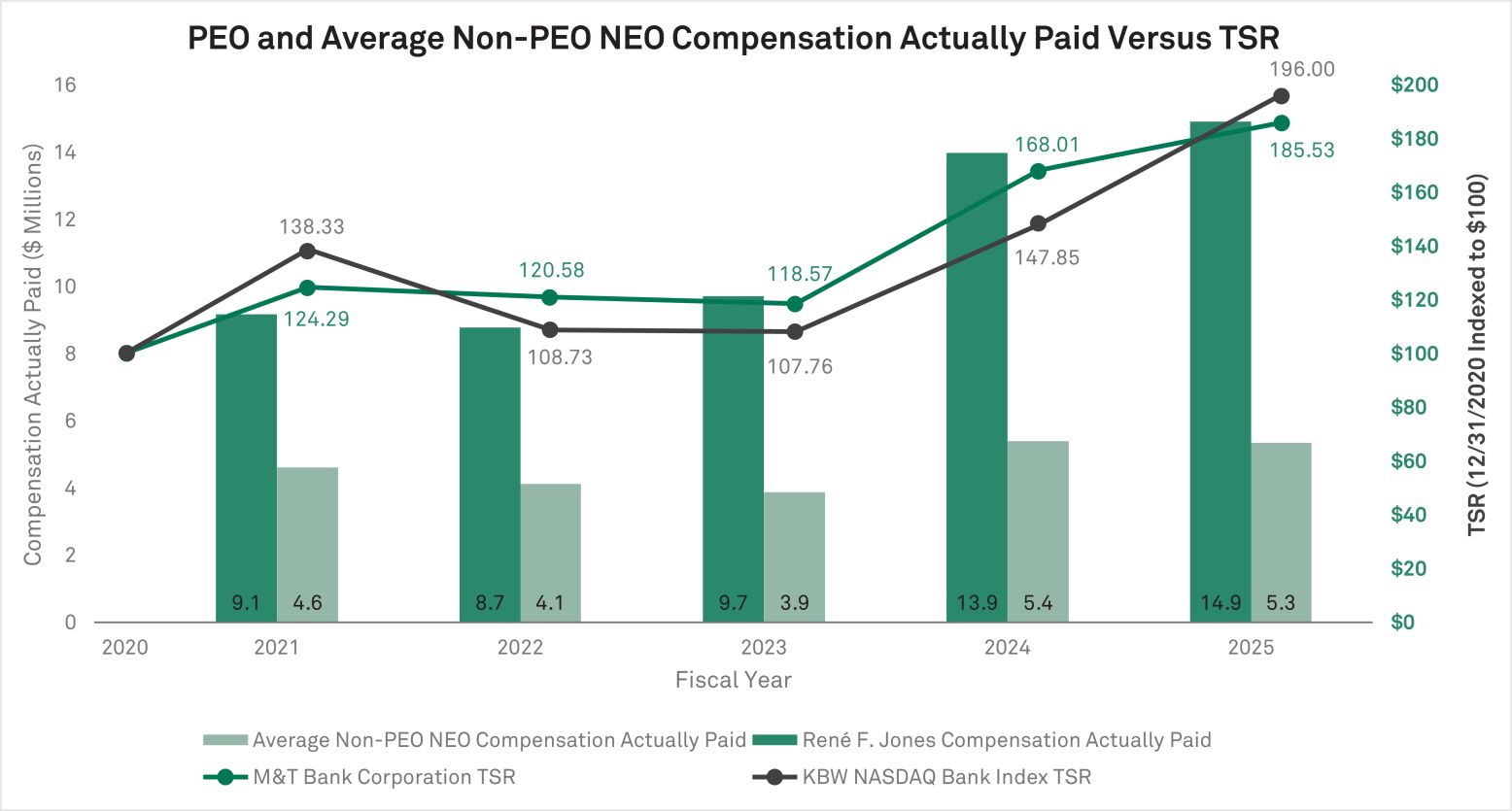
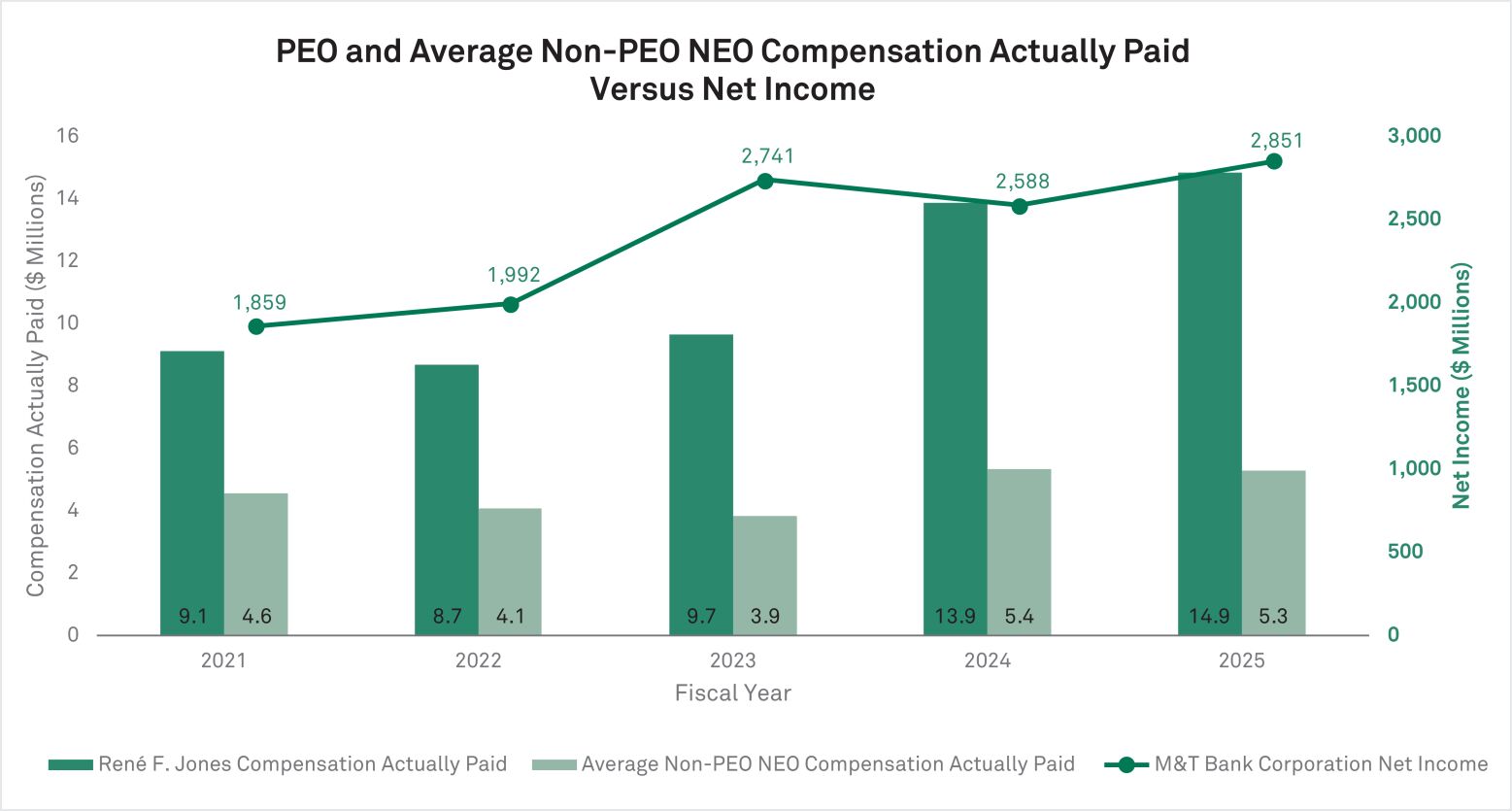
| |
82 |
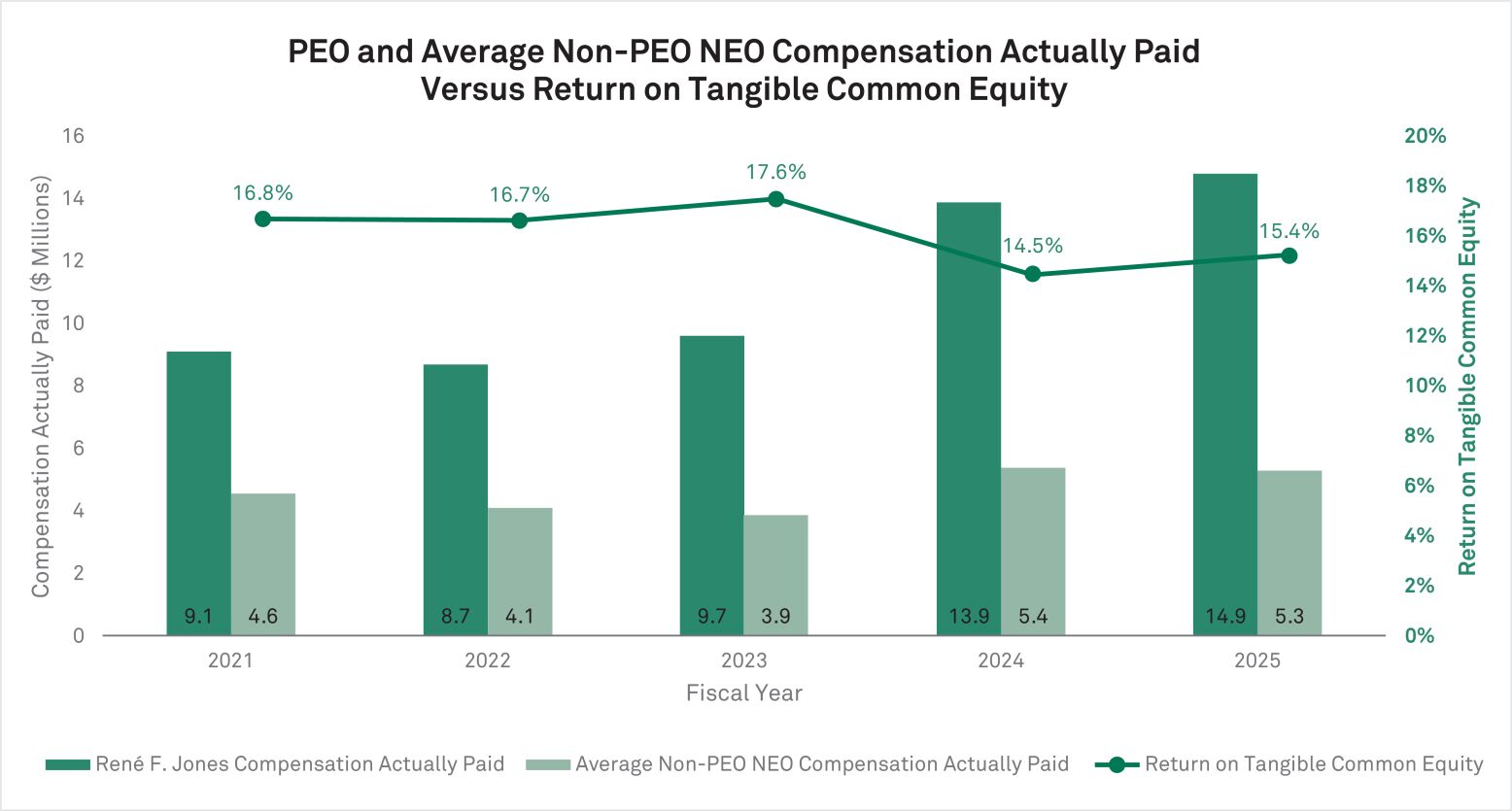
83 |
|
| PROPOSAL 3 |
APPROVAL OF THE AMENDMENT AND RESTATEMENT OF THE M&T BANK CORPORATION 2019 EQUITY INCENTIVE COMPENSATION PLAN
The M&T Bank Corporation 2019 Equity Incentive Compensation Plan (the “Existing Equity Plan”) was initially approved by shareholders in 2019 and was amended and restated in 2023 with more than 95% of shareholder votes cast in favor of approval. The Existing Equity Plan allows us to execute our pay-for- performance compensation philosophy by providing equity-based incentive awards to employees, including executive officers, offering pay opportunities that align employee interests with the long-term interests of our shareholders. Under the terms of the Existing Equity Plan, a limited number of shares of our common stock are reserved for these equity-based incentive grants.
In February 2026, our Board approved an amendment and restatement of the Existing Equity Plan, subject to approval of our shareholders at the Annual Meeting. As described below, the amendment and restatement includes an increase to the number of shares of our common stock available for future awards, so that M&T can continue to grant equity-based incentive awards.
Background
On February 18, 2026, on the recommendation of the C&HC Committee, the Board unanimously approved an amendment and restatement of the Existing Equity Plan (the “Amended Equity Plan”), subject to shareholder approval. Accordingly, the Board directed that the Amended Equity Plan be submitted to shareholders for approval at the Annual Meeting.
The terms of the Amended Equity Plan will only apply to awards made after the effective date of the Amended Equity Plan. If the Amended Equity Plan is approved, M&T will be able to continue its compensation program, which is intended to attract, retain and reward directors, officers and other employees and certain advisors and link compensation to measures of M&T’s performance. Any awards granted prior to the effective date of the Amended Equity Plan will continue to be governed by the terms of the Existing Equity Plan. Outstanding awards previously granted under the 2009 Equity Incentive Compensation Plan (the “Prior Plan”) shall continue in effect in accordance with their terms.
If our shareholders do not approve the Amended Equity Plan, we will continue to be able to grant awards under the Existing Equity Plan. As of February 1, 2026, 1,504,401 shares of M&T’s common stock, par value $0.50 per share (“Shares”), are available for grant under the Existing Equity Plan (assuming achievement of maximum performance levels under performance-based awards).
Changes Reflected by the Amended Equity Plan
The principal changes made by the Amended Equity Plan, which will be effective, if at all, on the date that our shareholders approve the Amended Equity Plan (the “Amendment Effective Date”) are as follows:
| • | Increasing the number of Shares reserved for issuance by an additional 2.75 million Shares. |
| • | Imposing a one-year minimum vesting schedule for awards, except that up to 5% of the Shares reserved for issuance (subject to certain adjustments) are available for grant without regard to this requirement, and awards granted to non-employee directors on the date of an annual shareholders’ meeting satisfy this requirement if they provide for vesting at the shareholders’ meeting immediately following the grant date (but in any event not less than 50 weeks following the date of grant). |
| • | Extending the expiration date of the Amended Equity Plan from April 18, 2033 to April 21, 2036. |
|
|
|
84
|
|
Purpose
The Board is seeking shareholder approval of the Amended Equity Plan in order to (i) meet NYSE listing requirements, (ii) continue to maintain a limit on annual compensation of M&T’s non-employee directors, (iii) allow incentive stock options awarded under the Amended Equity Plan to meet the requirements of the Internal Revenue Code of 1986, as amended (the “Code”), and (iv) conform to good corporate governance.
The purpose of the Amended Equity Plan is to promote the success of M&T and its affiliates by providing incentives to employees, non-employee directors, and members of the Director Advisory Councils of M&T or any of its subsidiaries or any successors thereto (“Key Advisors”) that will link their personal interests (i) to the financial success of M&T and its affiliates, and (ii) to growth in shareholder value. The Board and management believe that the ability to make equity awards enhances M&T’s ability to attract and retain qualified employees, non-employee directors and Key Advisors. The Board also believes that it is in the best interest of M&T and its shareholders to recognize the contributions of its employees, non-employee directors and Key Advisors in the success of M&T by providing an incentive for those employees, non-employee directors and Key Advisors to continue their service with M&T and its affiliates. Furthermore, as described in the CD&A section of this proxy statement, equity-based compensation is a significant component of M&T’s total compensation program, particularly with respect to its executive officers.
Certain Key Provisions
The Amended Equity Plan has several provisions designed to protect the interests of shareholders and to facilitate effective corporate governance. Specifically, the Amended Equity Plan:
| • | does not include liberal recycling provisions which would permit Shares withheld for purposes of satisfaction of withholding tax liabilities and payment of stock option exercise price to be reissued under the Amended Equity Plan; |
| • | imposes a one-year minimum vesting schedule for awards, except that up to 5% of the Shares reserved for issuance (subject to certain adjustments) are available for grant without regard to this requirement, and awards granted to non-employee directors on the date of an annual shareholders’ meeting satisfy this requirement if they provide for vesting at the shareholders’ meeting immediately following the grant date (but in any event not less than 50 weeks following the date of grant); |
| • | prohibits the grant of stock options or stock appreciation rights with an exercise price or base price that is less than fair market value on the date of grant; |
| • | imposes an aggregate limit on the number of Shares for which awards may be made to any employee or Key Advisor in any calendar year; |
| • | imposes an aggregate limit on the value of awards that may be granted, when aggregated with cash fees that may be paid, to each non-employee director in any year; |
| • | prohibits any repricing of outstanding stock options or stock appreciation rights, absent shareholder approval; |
| • | provides that all awards granted under the Amended Equity Plan will be subject to any clawback or recoupment policies approved or implemented by the Board or a committee thereof, including the clawback policy that M&T adopted pursuant to the requirements of the NYSE; |
| • | does not contain an “evergreen” share reserve, meaning that the Shares reserved for awards are fixed by number rather than by reference to a percentage of M&T’s total outstanding Shares; and |
| • | will be administered by an independent committee of the Board. |
|
|
85
|
|
|
Determination of the Number of Shares Available for Awards under the Amended Equity Plan
If this Proposal 3 is approved by our shareholders, subject to adjustments as described in the Amended Equity Plan, the maximum aggregate number of Shares that may be issued under the Amended Equity Plan will be 2,750,000. In addition, subject to adjustments described in the Amended Equity Plan, any Shares that remained available for awards under the Existing Equity Plan as of the Amendment Effective Date (as of February 1, 2026, 1,504,401 Shares remained available for awards under the Existing Equity Plan) and any Shares subject to outstanding awards granted under the Existing Equity Plan and awards granted under the Prior Plan as of the Amendment Effective Date that are payable in Shares and that are forfeited, terminated, surrendered, exchanged, or canceled or that expire, in each case, without having been exercised, vested or paid in Shares, on or after the Amendment Effective Date, subject to adjustment as provided in the Amended Equity Plan, may be issued with respect to awards under the Amended Equity Plan.
In determining the number of Shares to be authorized for issuance under the Amended Equity Plan, the Board worked with McLagan, an Aon company (and the independent compensation consultant to the C&HC Committee), and considered a number of factors, including our past Share usage (referred to as “burn rate”), the number of Shares expected to be needed for future awards, a dilution analysis, competitive data from relevant peer companies, the current and future accounting expenses associated with our equity award practices, and input from our shareholders. As of February 1, 2026, 1,504,401 Shares remain available for awards under the Existing Equity Plan, and the Board took such number of Shares into account when determining the number of Shares to be available under the Amended Equity Plan.
Dilution Analysis
As of February 1, 2026, M&T has 150,585,757 Shares outstanding. The proposed Share authorization is a request for a total of 2,750,000 new Shares to be added under the Amended Equity Plan on the Amendment Effective Date. The table below shows our potential dilution levels based on common shares outstanding as of February 1, 2026, our new Share request and our total equity awards outstanding as of February 1, 2026. The Board believes that the number of Shares under the Amended Equity Plan represents a reasonable amount of potential equity dilution and will allow M&T to continue granting equity awards. Equity awards are an important component of M&T’s equity-based compensation program.
Potential Dilutive Impact of the Share Request
Potential Overhang with 2,750,000 Additional Shares
| Stock Options Outstanding under the Existing Equity Plan and the Prior Plan as of February 1, 2026 |
746,053 | |||
| Weighted Average Exercise Price of Stock Options Outstanding under the Existing Equity Plan and the Prior Plan as of February 1, 2026 |
$ | 169.76 | ||
| Weighted Average Remaining Term of Stock Options Outstanding under the Existing Equity Plan and the Prior Plan as of February 1, 2026 |
5.21 | |||
| Outstanding Full Value Awards under the Existing Equity Plan and the Prior Plan as of February 1, 2026(1) |
1,743,721 | |||
| Total Equity Awards Outstanding under the Existing Equity Plan and the Prior Plan as of February 1, 2026(2) |
2,489,774 | |||
| Shares Available for Grant under the Existing Equity Plan as of February 1, 2026(3) |
1,504,401 | |||
| Additional Shares Requested under the Amended Equity Plan |
2,750,000 | |||
| Total Shares Requested under the Amended Equity Plan (Shares Available for Grant under the Existing Equity Plan, plus Additional Shares Requested under the Amended Plan) |
4,254,401 | |||
| Total Potential Overhang under the Amended Equity Plan and the Prior Plan, as well as Assumed Equity Awards(4) |
6,833,025 | |||
| Shares of Common Stock Outstanding as of February 1, 2026 |
|
150,585,757 |
| |
| Fully Diluted Shares(5) |
|
157,418,782 |
| |
| Potential Dilution of 2,750,000 Additional Shares as a Percentage of Fully Diluted Shares |
1.75% |
|
|
|
86
|
|
| (1) | “Full Value Awards” includes performance-based and time-based restricted stock unit awards and time-based restricted stock awards under the Existing Equity Plan and Prior Plan. As of February 1, 2026, such “Full Value Awards” represent: 873,058 Shares subject to time-based restricted stock unit awards and 1,012,676 Shares subject to performance-based restricted stock unit awards (assuming maximum performance levels achieved). |
| (2) | “Total Equity Awards” represents the sum of outstanding stock options and outstanding Full Value Awards under the Existing Equity Plan and the Prior Plan, in each case as of February 1, 2026. |
| (3) | Assumes outstanding performance-based restricted stock units will be settled based on achievement of maximum performance levels. Any Shares that remain available for awards under the Existing Equity Plan will be available under the Amended Equity Plan, if approved, as of the Amendment Effective Date. |
| (4) | “Total Potential Overhang” reflects the sum (i) Shares subject to outstanding equity awards under the Existing Equity Plan and the Prior Plan as of February 1, 2026, plus (ii) total Shares requested under the Amended Equity Plan, plus (iii) 88,850 Shares issuable upon exercise of outstanding stock options or rights assumed by M&T in connection with merger and acquisition transactions that are outstanding as of February 1, 2026. |
| (5) | “Fully Diluted Shares” reflects the sum of (i) the total number of Shares outstanding as of February 1, 2026, plus (ii) the number of Shares subject to outstanding equity awards under the Existing Equity Plan and the Prior Plan as of February 1, 2026, plus (iii) the number of Shares issuable upon exercise of outstanding stock options or rights assumed by M&T in connection with merger and acquisition transactions, plus (iv) the number of Shares available for grant under the Existing Equity Plan as of February 1, 2026, plus (v) the number of additional Shares requested under the Amended Equity Plan. |
Based on our historic and projected future usage patterns, the Board estimates that the Shares requested under the Amended Equity Plan will be sufficient to provide awards under the Amended Equity Plan for approximately four years. Share reserves could be used more quickly or more slowly depending on increases or decreases in the price of our common stock, award amounts provided by our competitors, hiring activity, and promotions during the next few years.
Burn Rate
The table below sets forth the following information regarding the awards granted under the Existing Equity Plan: (i) the burn rate for each of the last three calendar years and (ii) the average burn rate over the last three calendar years. The burn rate for a year has been calculated as follows:
| 1. | all stock options granted in the applicable year, all time-based restricted stock units granted in the applicable year, and all performance-based restricted stock units (assuming target performance) granted in the applicable year, divided by |
| 2. | the weighted average number of Shares outstanding for the applicable year. |
Burn Rate
| Element |
2025 | 2024 | 2023 | 3-Year Avg. |
||||||
| Stock Options Granted |
74,753 | 133,834 | 179,551 |
|
|
| ||||
| Time-Based Restricted Stock Units Granted |
463,637 | 608,637 | 522,367 |
|
|
| ||||
| Performance-Based Restricted Stock Units Granted(1) |
250,350 | 318,454 | 249,551 |
|
|
| ||||
| Total Granted |
788,740 | 1,060,925 | 951,469 |
|
|
| ||||
| Weighted Average Shares of Common Stock Outstanding as of applicable fiscal year-end |
157,875,414 | 166,478,667 | 166,360,960 |
|
|
| ||||
| Unadjusted Burn Rate (%) |
0.50 | 0.64 | 0.57 | 0.57 | ||||||
| (1) | Assumes achievement of target performance. |
The burn rate means that M&T used an annual average of 0.57% of the weighted average Shares outstanding for awards granted over the past three years.
|
|
87
|
|
|
Summary of the Amended Equity Plan
The material terms of the Amended Equity Plan are summarized below. A copy of the full text of the Amended Equity Plan is attached to this proxy statement as Appendix B. This summary of the Amended Equity Plan is not intended to be a complete description and is qualified in its entirety by the actual text of the Amended Equity Plan to which reference is made. Capitalized terms used, but not defined, in the following summary have the meaning assigned to those terms in the Amended Equity Plan.
Purpose. The purpose of the Amended Equity Plan is to promote the success of M&T and its affiliates by providing incentives to employees of M&T and its Affiliates, Non-Employee Directors and Key Advisors that will link their personal interests to the financial success of M&T and its affiliates and to growth in shareholder value. The Amended Equity Plan is designed to provide flexibility to M&T and its Affiliates in their ability to motivate, attract and retain qualified employees and service providers.
Administration
The Amended Equity Plan will be administered by a committee appointed by the Board, consisting of three or more outside, independent members of the Board each of whom is (i) a “non-employee director” as defined in Rule 16b-3 of the Exchange Act and (ii) “independent” under the rules and regulations of the NYSE (or other stock exchange on which the M&T common stock is traded). The Board has appointed the C&HC Committee to administer the Amended Equity Plan.
The C&HC Committee will have full power to administer the Amended Equity Plan, including the power to determine which Eligible Persons will receive awards under the Amended Equity Plan, the number of Shares that will be subject to awards, the terms, conditions and form of the awards, at which times awards may vest or be subject to vesting conditions (subject to the one-year minimum vesting limitation described below), determine whether awards should be subject to any conditions or objectives and when and to what extent any such conditions are achieved, whether an award may be deferred, whether the amount of payment of an award should be reduced or eliminated, and establish any “blackout” period that the C&HC Committee determines in its discretion necessary or advisable.
The C&HC Committee will have discretionary authority to interpret the Amended Equity Plan and the award agreements evidencing the awards, prescribe, amend and rescind rules, guidelines and practices relating thereto, and make all other determinations deemed necessary or advisable for the administration of the Amended Equity Plan and the awards granted thereunder. To the extent permitted by the Amended Equity Plan and subject to compliance with applicable law and applicable stock exchange requirements, the C&HC Committee may also delegate its authority under the Amended Equity Plan to our Chief Executive Officer or to other officers of M&T, including the right to grant awards under the Amended Equity Plan other than to Eligible Persons who, at the time of grant, are subject to the reporting requirements of Section 16(a) of the Exchange Act. The C&HC Committee or its delegate are referred to as the “Committee” in the Amended Equity Plan. All determinations and decisions of the Committee will be final, conclusive and binding on all persons.
Shares and Other Limits
Shares Available for Issuance. The total number of Shares that may be issued pursuant to awards under the Amended Equity Plan may not exceed 2,750,000 Shares, subject to adjustment as described below. In addition, subject to adjustments described below, any Shares that remained available for awards under the Existing Equity Plan as of the Amendment Effective Date and any Shares subject to outstanding awards granted under the Existing Equity Plan and awards granted under the Prior Plan as of the Amendment Effective Date that are payable in Shares and that are forfeited, terminated, surrendered, exchanged, or canceled or that expire, in each case, without having been exercised, vested or paid in Shares, on or after the Amendment Effective Date, subject to adjustment as provided in the Amended Equity Plan, may be issued with respect to awards under the Amended Equity Plan.
|
|
|
88
|
|
To the extent that Shares subject to an outstanding award under the Amended Equity Plan are not issued by reason of being forfeited, terminated, surrendered, exchanged, or canceled or by expiration of such award or by reason of being settled in cash in lieu of Shares, then such Shares will immediately again be available for issuance under the Amended Equity Plan. Shares issued under the Amended Equity Plan may consist, in whole or in part, of authorized and unissued Shares or treasury Shares, including Shares that have been reacquired by M&T in the open market, in private transactions, or otherwise, to fulfill its obligations under the Amended Equity Plan. Fractional Shares will not be issued under the Amended Equity Plan.
If stock appreciation rights are granted under the Amended Equity Plan, the full number of Shares subject to the stock appreciation rights will be considered issued under the Amended Equity Plan, regardless of the number of Shares actually issued upon exercise of the stock appreciation rights. Shares that are surrendered in payment of the exercise price of an option (including an option granted under the Prior Plan) will not be available for issuance under the Amended Equity Plan. Shares that are withheld or surrendered in satisfaction of withholding taxes, or surrendered for the payment of taxes, with respect to awards (including awards granted under the Prior Plan) will not be available for issuance under the Amended Equity Plan. For the avoidance of doubt, if M&T repurchases Shares on the open market with the proceeds received from the exercise price of stock options, the repurchased Shares will not be available for issuance under the Amended Equity Plan.
Award Limits. The maximum number of Shares that may be issued under the Amended Equity Plan as of the Amendment Effective Date pursuant to the exercise of “incentive stock options” as defined in Section 422 of the Code, is 2,750,000 Shares, subject to adjustment as described below. The maximum number of Shares that may be subject to awards granted to any employee or Key Advisor under the Amended Equity Plan in any calendar year will not exceed 300,000 Shares in the aggregate, subject to adjustment as described below.
Non-Employee Director Compensation Limits. The maximum aggregate grant date value of Shares subject to awards made to any Non-Employee Director during any calendar year for services rendered as a Non-Employee Director, including any cash fees earned for services rendered as a Non-Employee Director during the calendar year, will not exceed $500,000 in total value. In determining this dollar limit, the value of awards will be calculated based on the grant date fair value of the awards for financial reporting purposes.
Minimum Vesting Requirements. Awards will have regular vesting schedules that provide that no portion of the award will vest earlier than one year from the draft of grant. However, (i) awards granted to Non- Employee Director will be deemed to satisfy this minimum vesting requirement if granted on the date of our annual meeting of shareholders and vest on the date of our annual meeting of shareholders immediately following the date of grant (but in any event, not less than 50 weeks), and (ii) up to 5% of the Shares reserved under the Amended Equity Plan as of the Amendment Effective Date (subject to adjustment described below) may be granted without regard to this minimum vesting requirement. The Committee may accelerate vesting of any award in its discretion.
Eligibility
Awards may be granted under the Amended Equity Plan to employees of M&T and its Affiliates, Non-Employee Directors and Key Advisors. As of December 31, 2025, if the Amended Equity Plan were in effect on such date, approximately 21,839 full time and 439 part time employees of M&T Bank and its Affiliates, 13 Non-Employee Directors and 213 Key Advisors would be eligible to receive awards under the Amended Equity Plan. As of December 31, 2025, 3,446 employees, and 13 of its Non-Employee Directors or Key Advisors, held outstanding equity awards under the Existing Equity Plan.
|
|
89
|
|
|
Subject to the provisions of the Amended Equity Plan, the Committee may select eligible participants, and the nature and amount of each award granted under the Amended Equity Plan. For this reason, it is not possible to determine the benefits or amounts that will be received by any particular person in the future. Because our executive officers and non-employee directors are eligible to receive awards under the Amended Equity Plan, they may be deemed to have a personal interest in the approval of this Proposal 3.
Types of Awards
Awards granted under the Amended Equity Plan may be in the form of stock options, stock appreciation rights, stock awards, restricted stock units, and performance units. The following is a brief description of the types of awards that may be granted under the Amended Equity Plan:
Stock Options. The Committee may grant options to purchase Shares in such amounts as it determines, and each option granted under the Amended Equity Plan will be pursuant to an award agreement that contains the terms and conditions of the option, including the right to exercise the option following termination of employment or service, if any. The Committee may condition the grant or vesting of an option on the achievement of one or more performance goals. Dividends or dividend equivalent payments will not be payable on the Shares underlying an option.
The Committee may grant options that are intended to qualify as incentive stock options under Section 422 of the Code, or non-qualified stock options, which are not intended to so qualify. Incentive stock options may only be granted to our employees. Anyone eligible to participate in the Amended Equity Plan may receive a grant of non-qualified stock options. The Committee may determine the exercise price of options granted under the Amended Equity Plan, but the exercise price cannot be less than the fair market value of a Share on the date the option is granted. If an incentive stock option is granted to an employee owning more than ten percent of M&T common stock or stock of our subsidiaries as determined under Section 424 of the Code, the exercise price of the incentive stock option cannot be less than 110% of the fair market value of a Share on the date such option is granted. The fair market value of our common stock is generally equal to the closing price of the common stock on the date the option is granted (or if there was no closing price on that date, on the next preceding date on which a closing price was reported).
To the extent an option is exercisable, the option may be exercised by the delivery of a written notice to us setting forth the number of Shares with respect to which the option will be exercised and accompanied by the full payment of the exercise price for the options. The exercise price for any option may be paid in cash, through broker-assisted cashless exercise, by delivery or deemed delivery through attestation of Shares having a fair market value at the time of exercise equal to the aggregate exercise price, or any combination of the foregoing. If permitted by the Committee, the exercise price may be paid by directing the withholding of Shares subject to the exercisable option which have a fair market value on the date of exercise equal to the aggregate exercise price of the option, or by such other method as the Committee approves.
The term of an option cannot exceed ten years from the date of grant, except that if an incentive stock option is granted to an employee owning more than ten percent of our common stock or stock of our subsidiaries, the term cannot exceed five years from the date of grant. Stock options are nontransferable, other than by will or the laws of descent and distribution, except that in the case of a non-qualified stock option, the Committee may permit the transfer of such stock option to the option-holder’s family members in accordance with applicable securities laws. Except as otherwise provided in an award agreement, any portion of a stock option that is not vested and exercisable at the time of a participant’s termination of employment or service will be forfeited upon the participant’s termination of employment or service for any reason.
|
|
|
90
|
|
Stock Appreciation Rights. The Committee may grant stock appreciation rights in such amounts as the Committee determines to anyone eligible to participate in the Amended Equity Plan. Stock appreciation rights will be granted pursuant to an award agreement that contains the terms and conditions of the grant, including the right to exercise the exercisable stock appreciation rights following termination of employment or service, if any, and may be granted separately or in tandem with any option. The Committee may condition the grant or vesting of stock appreciation rights on the achievement of one or more performance goals. Dividends or dividend equivalent payments will not be payable on the Shares underlying stock appreciation rights.
Stock appreciation rights granted with a non-qualified stock option may be granted either at the time the non-qualified stock option is granted or any time thereafter while the option remains outstanding. Stock appreciation rights granted with an incentive stock option must be granted only at the date of the grant of the incentive stock option. The Committee may determine the base amount of stock appreciation rights granted under the Amended Equity Plan, but the base amount cannot be less than the fair market value of a Share on the date the stock appreciation right is granted.
If a stock appreciation right is granted in tandem with an option, the stock appreciation right is only exercisable during the period in which the related option is also exercisable. When a participant exercises a stock appreciation right, the participant will receive the excess of the fair market value of the underlying common stock on the date the stock appreciation right is exercised, over the base amount of the stock appreciation right. The appreciation of a stock appreciation right will be paid in Shares, cash, or both, as determined by the Committee. The term of a stock appreciation right cannot exceed ten years from the date of grant. Stock appreciation rights are nontransferable, other than by will or the laws of descent and distribution. Except as otherwise provided in an award agreement, any portion of a stock appreciation right that is not exercisable at the time of a participant’s termination of employment or service will be forfeited upon the participant’s termination of employment or service for any reason.
Stock Awards. The Committee may grant stock awards to anyone eligible to participate in the Amended Equity Plan. A stock award is an award of our common stock that may be subject to restrictions or no restrictions as the Committee determines. The Shares underlying a stock award will be evidenced in a manner determined by the Committee, including book-entry registration or issuance of one or more stock certificates. Any stock certificate issued in respect of a stock award will be issued in the participant’s name and contain the terms, conditions, and any restrictions applicable to the stock award.
Each stock award will be subject to an award agreement that will specify the terms and conditions of the stock award. The terms and conditions of a stock award may, in the discretion of the Committee, provide for the lapse of transfer restrictions, forfeiture provisions, or vesting and settlement conditions, as applicable, and may be contingent upon the participant’s continued employment or service, or on the achievement of one or more performance goals as determined by the Committee. Participants may not sell, transfer, pledge, assign, or otherwise alienate or hypothecate a stock award until the termination of any applicable restrictions.
Except as provided under an award agreement, participants holding stock awards will have all of the voting rights of a shareholder as to the Shares underlying the stock award during the period under which such stock award is subject to any applicable restrictions. Unless otherwise determined by the Committee, participants holding stock awards will be entitled to receive dividends and distributions on the Shares underlying the stock award, provided that dividends with respect to stock awards that are subject to vesting restrictions will vest only if and to the extent that the underlying stock award vests. Except as otherwise provided in an award agreement, all unvested stock awards are forfeited if the participant’s employment or service is terminated for any reason.
|
|
91
|
|
|
Restricted Stock Units. The Committee may grant restricted stock units to anyone eligible to participate in the Amended Equity Plan. Restricted stock units are awards denominated in Shares that will be settled, subject to the terms and conditions of the restricted stock unit grant, in an amount in cash, Shares, or a combination thereof, based on the fair market value of a specified number of Shares.
Each restricted stock unit award will be subject to an award agreement that will specify the terms and conditions of the stock award. The terms and conditions of a restricted stock unit award may, in the discretion of the Committee, provide for the lapse of transfer restrictions, forfeiture provisions, or vesting and settlement conditions, as applicable, and may be contingent upon the participant’s continued employment or service or on the achievement of one or more performance goals as determined by the Committee. Participants may not sell, transfer, pledge, or assign a restricted stock unit award until the termination of any applicable restrictions.
Holders of restricted stock unit awards are not entitled to any voting rights, but the award agreement granting the restricted stock unit award will specify whether, and to what extent, the participant will be entitled to receive amounts equal to dividends payable on the Shares underlying the award. Such dividend equivalents, if any, will be paid in cash, Shares, or other property, as provided for in the applicable award agreement, and will be payable only if and to the extent that the restricted stock unit award vests and is paid.
Except as otherwise provided in an award agreement, all unvested restricted stock unit awards are forfeited if the participant’s employment or service is terminated for any reason.
Performance Units. The Committee may grant performance units to anyone eligible to participate in the Amended Equity Plan. Performance units will be subject to terms and conditions and earned by the achievement of performance goals over designated performance periods, as established by the Committee. Like restricted stock units, performance units are not actual Shares but instead are awards that are denominated in Shares.
After a performance period has ended, the holder of a performance unit may be entitled to receive a distribution of Shares, cash, or a combination thereof, in each case at the achievement level and on the terms and conditions as determined by the Committee. Until the end of the applicable performance period, performance units granted under the Amended Equity Plan may not be sold, transferred, pledged, or assigned, other than by will or by laws of decent and distribution. Any dividends or dividend equivalents related to performance units will not vest or be paid unless and until the underlying award vests and is paid. Except as otherwise provided in an award agreement, all unvested performance unit awards are forfeited if the participant’s employment or service is terminated for any reason.
Performance Goals. The Committee may establish performance goals in connection with the grant of awards under the Amended Equity Plan, including performance units, stock awards, stock options, stock appreciation rights and restricted stock units that are conditioned or subject to the satisfaction of performance goals. The performance goals may be based on attainment of specific levels of performance of M&T or one or more of its Affiliates or lines of business (or may be particular to a participant or the department, branch, Affiliate or division of the business in which the participant works) with reference to one or more of the following criteria, or any such other criteria as the Committee determines: earnings, earnings growth, earnings per share, stock price (including growth measures and total shareholder return), improvement of financial ratings, internal rate of return, market share, cash flow, operating income, operating margin, net profit after tax, earnings before interest and taxes (EBIT), earnings before interest and taxes and amortization (EBITA), earnings before interest, taxes, depreciation and amortization (EBITDA), operating income before interest and taxes (OBIT), operating income before interest, taxes, depreciation and amortization (OBITDA), gross
|
|
|
92
|
|
profit, operating profit, cash generation, revenues, asset quality, return on equity, return on tangible common equity, return on assets, return on operating assets, cost saving levels, efficiency ratio, net income, marketing-spending efficiency, core non-interest income, change in working capital, return on capital, capital adequacy, shareholder return or strategic goals and objectives. These performance goals may be measured for achievement or satisfaction during the performance period established by the Committee. The performance goals may include or exclude extraordinary charges, losses from discontinued operations, restatements and accounting changes and other unplanned special charges, or any other items that the Committee deems appropriate. Any applicable performance goals shall be applied and interpreted in the discretion of the Committee.
Effect of Change in Control. Unless otherwise provided in the applicable award agreement or otherwise determined by the Committee, upon a “change in control” of M&T, any outstanding options and stock appreciation rights that are not then vested and exercisable will become fully vested and exercisable, and the restrictions applicable to any stock award or restricted stock unit award will lapse and the award will become fully vested and transferrable or settled, as applicable. The Committee may require that participants surrender any outstanding options or stock appreciation rights in exchange for a payment in cash or common stock, as determined by the Committee, in an amount equal to the amount, if any, that the fair market value of the Shares subject to the options or stock appreciation rights exceeds the exercise price or base price, as applicable, or, after giving participants an opportunity to exercise their outstanding stock options or stock appreciation rights, the Committee may terminate any or all unexercised stock options or stock appreciation rights. In the event that the fair market value of the Shares subject to an option or stock appreciation right does not exceed the applicable exercise price or base price, as applicable, M&T will not be required to make any payment to the participant upon the participant’s surrender of their option or stock appreciation right.
In addition, unless otherwise provided in the applicable award agreement, or otherwise determined by the Committee, in the event of a change in control, all awards that are subject to performance goals will immediately be settled and paid out in an amount based upon the extent, as determined by the Committee, to which the performance goals for the performance period then in progress have been satisfied through the end of the month immediately preceding the effective date of the change in control.
A change in control is defined in the Amended Equity Plan, which is attached to this proxy statement as Appendix B. The settlement and payment of awards, including restricted stock units and performance units, will be in accordance with applicable requirements of the Code.
Capital Adjustments and Events. In the event that there is a (1) stock dividend or split, reverse stock split, share combination, recapitalization or similar event affecting the capital structure of M&T, or (2) a merger, consolidation, acquisition of property or shares, separation, spin-off, reorganization, stock rights offering, liquidation, disaffiliation, or other corporate change affecting M&T or any of its subsidiaries, the Committee or the Board will make an equitable and proportionate substitution or adjustment as it deems appropriate to (i) the aggregate number and kind of Shares or other securities reserved for issuance under the Amended Equity Plan, (ii) the award limitations set forth in the Amended Equity Plan and described above, (iii) the number and kind of Shares or other securities subject to outstanding awards under the Amended Equity Plan, and (iv) the exercise price of stock options or base price of stock appreciation rights outstanding under the Amended Equity Plan, in order to preserve the value of awards under the Amended Equity Plan as a result of any such corporate change. In addition, in the event of any such corporate change, the Committee will adjust in any manner it deems appropriate the performance goals applicable to awards.
No Repricing. Notwithstanding anything in the Amended Equity Plan to the contrary, after a stock option or a stock appreciation right is granted, neither the Board nor the Committee may, without obtaining shareholder approval, (i) amend the terms of outstanding stock options or stock
|
|
93
|
|
|
appreciation rights to reduce the exercise price of such outstanding stock options or base price of such stock appreciation rights, (ii) cancel outstanding stock options or stock appreciation rights in exchange for stock options or stock appreciation rights with an exercise price or base price, as applicable, that is less than the exercise price or base price, as applicable, of the original stock options or stock appreciation rights or (iii) cancel outstanding stock options or stock appreciation rights with an exercise price or base price, as applicable, above the current stock price in exchange for cash or other securities, except pursuant to a corporate change described above under “Capital Adjustments and Events.”
Tax Withholding. M&T’s obligation to issue or deliver Shares or pay any amount pursuant to an award is subject to the satisfaction of applicable federal (including FICA), state, local and foreign tax withholding requirements, and M&T and its Affiliates have the power to deduct or withhold, or require a participant to remit, an amount sufficient to satisfy such taxes required by law to be withheld. To the extent permitted by the Committee, a participant may satisfy any withholding tax requirements by paying cash, authorizing us to withhold Shares otherwise issuable pursuant to the award or by delivering Shares. The Committee may establish such procedures as it deems appropriate for the settlement of withholding obligations with common stock having a fair market value on the date of withholding up to the maximum amount permitted to be withheld for tax purposes in the applicable jurisdiction.
Term, Amendment and Termination, and Company Policies
Term. If approved by shareholders, the Amended Equity Plan will become effective as of the date of such approval and remain in effect until all Shares subject to it have been issued according to its provisions. However, no awards may be granted on or after the tenth anniversary of the Amendment Effective Date.
Amendment and Termination. The Board or the Committee may terminate the Amended Equity Plan, or any portion of the Amended Equity Plan, at any time and may amend or modify it from time to time in such respects as the Board or Committee deem advisable. However, after our shareholders approve the Amended Equity Plan, the Board or the Committee may not amend the plan without approval of our shareholders to the extent that shareholder approval is required by the Code or other applicable law or the requirements of the NYSE (or other stock exchange on which the M&T common stock is traded). In addition, no amendment may be adopted without approval by a participant if the amendment would materially and adversely affect the participant’s rights and obligations under any award granted prior to the date of such amendment.
Company Policies. All awards under the Amended Equity Plan will be subject to any applicable clawback or recoupment policies, including without limitation M&T’s Forfeiture Policy, share trading policies and other policies that may be approved or implemented by the Board or the Committee from time to time, whether approved before or after the Amendment Effective Date.
Participants Outside of the United States. If any individual who receives an award under the Amended Equity Plan is subject to the laws of a non-U.S. country or jurisdiction, the Committee may make such award on such terms and conditions different from those specified in the Amended Equity Plan as the Committee deems appropriate. The Committee may also create such modifications, amendments, procedures, sub-plans and the like as it determines to be necessary or advisable to comply with the laws of such other countries or jurisdictions.
Summary of Certain Federal Income Tax Consequences
The following is a summary of certain U.S. federal income tax consequences of certain awards made under the Amended Equity Plan, based upon the federal income tax laws currently in effect. The discussion is general in nature and does not take into account a number of considerations that
|
|
|
94
|
|
may apply in light of the individual circumstances of a participant under the Amended Equity Plan. The income tax consequences under applicable state and local tax laws, and under any foreign tax laws, may not be the same as under U.S. federal income tax laws.
Stock Options. A participant does not realize ordinary income on the grant of a stock option. Upon exercise of a non-qualified stock option, the participant will realize ordinary income equal to the excess of the fair market value of the Shares over the option exercise price. The cost basis of the Shares acquired for capital gain treatment is their fair market value at the time of exercise. Upon exercise of an incentive stock option, the excess of the fair market value of the Shares acquired over the option exercise price will be an item of tax preference to the participant, which may be subject to an alternative minimum tax for the year of exercise. If no disposition of the Shares is made within two years from the date of granting of the incentive stock option or within one year after the transfer of the Shares to the participant, the participant does not realize taxable income as a result of exercising the incentive stock option; the tax basis of the Shares received for capital gain treatment is the option exercise price; and any gain or loss realized on the sale of the Shares is long-term capital gain or loss. If the participant disposes of the Shares within the two-year or one-year periods referred to above, the participant will realize ordinary income at that time in an amount equal to the excess of the fair market value of the Shares at the time of exercise (or the net proceeds of disposition, if less) over the option exercise price. For capital gain treatment on such a disposition, the tax basis of the Shares will be their fair market value at the time of exercise.
Stock Appreciation Rights. No ordinary income will be realized by a participant in connection with the grant of a stock appreciation right. When the stock appreciation right is exercised, the participant will realize ordinary income in an amount equal to the sum of the amount of any cash received and the fair market value of the Shares of common stock or other property received upon the exercise.
Stock Awards. A participant will not realize ordinary income on the grant of a stock award that is subject to vesting (or a performance award if the Shares are issued on grant), but will realize ordinary income when the Shares subject to the award become vested in an amount equal to the excess of (i) the fair market value of the Shares on the vesting date over (ii) the purchase price, if any, paid for the Shares. The participant may, however, elect under Section 83(b) of the Code to include as ordinary income in the year the shares are granted an amount equal to the excess of (i) the fair market value of the Shares on the date of issuance, over (ii) the purchase price, if any, paid for the Shares. If the Section 83(b) election is made, the participant will not realize any additional taxable income when the Shares become vested. A participant will realize ordinary income on the grant of a stock award that is fully vested at grant equal to the excess of (i) the fair market value of the Shares on the grant date over (ii) the purchase price, if any, paid for the Shares.
Upon disposition of Shares acquired under a stock award, the participant will realize a capital gain or loss equal to the difference between the selling price and the sum of the amount paid for the Shares plus any amount realized as ordinary income upon grant (or vesting) of the Shares.
Restricted Stock Unit Awards; Performance Unit Awards. A participant will not realize ordinary income on the grant of a restricted stock unit award, or performance unit award. The participant will realize ordinary income when the Shares subject to the award are issued (or cash is paid) to the participant after the units become vested. The amount of ordinary income will be equal to the fair market value of the Shares on the date they are issued, or the amount of cash paid.
Upon disposition of Shares acquired under a restricted stock unit award or performance unit award, the participant will realize a capital gain or loss equal to the difference between the selling price and the amount realized as ordinary income upon payment of the Shares.
|
|
95
|
|
|
Awards subject to Section 409A of the Code. Certain awards, particularly restricted stock units and performance units may constitute a “nonqualified deferred compensation plan” within the meaning of Section 409A of the Code and be subject to the restrictions by that Code Section. Awards subject to Section 409A of the Code may be designed to provide for exercise, payment or settlement that are intended to comply with the requirements of Section 409A of the Code.
The foregoing general tax discussion is solely intended for the information of shareholders considering how to vote with respect to this Proposal and not as tax guidance to participants in the Amended Equity Plan. Participants should consult their own tax advisors regarding the federal, state, local, foreign and other tax consequences to them of participating in the Amended Equity Plan.
Company Tax Deduction
Generally, M&T is entitled to a deduction based on the amount of ordinary income a participant recognizes with respect to an award. When setting executive compensation, we consider many factors, such as attracting and retaining executives and providing appropriate performance incentives. We also consider the after-tax cost to M&T in establishing executive compensation programs, both individually and in the aggregate, but tax deductibility is not our sole consideration. Section 162(m) of the Internal Revenue Code generally disallows a federal income tax deduction to public companies for annual compensation over $1 million (per individual) paid to “covered employees” which generally includes, among others, all named executive officers.
While deductibility of executive compensation for federal income tax purposes is among the factors the Committee considers when structuring our executive compensation arrangements, it is not the sole or primary factor considered. We retain the flexibility to authorize compensation that may not be deductible if we believe it is in the best interests of M&T and its shareholders.
New Plan Benefits
Future benefits under the Amended Equity Plan generally will be granted at the discretion of the Committee and are therefore not currently determinable. The closing price of a Share on the NYSE as of February 1, 2026 was $221.57.
Additional Equity Compensation Plan Information
The following table provides information as of December 31, 2025 as required by SEC rules with respect to Shares that may be issued under M&T’s existing equity compensation plans. M&T’s existing equity compensation plans include the Existing Equity Plan, which has been previously approved by shareholders, and the M&T Bank Corporation Deferred Bonus Plan, which did not require shareholder approval. The Deferred Bonus Plan was frozen effective January 1, 2010 and did not allow any additional deferrals after that date. Prior to January 1, 2010, the plan allowed eligible officers of M&T and its subsidiaries to elect to defer all or a portion of their annual incentive compensation awards and allocate such awards to several investment options, including M&T common stock. At the time of the deferral election, participants also elected the timing of distributions from the plan. Such distributions are payable in cash, with the exception of balances allocated to M&T common stock which are distributable in the form of Shares. M&T also maintains an employee stock purchase plan (the “ESPP”), which was previously approved by shareholders and provides eligible employees of the company with the right to purchase Shares at a discount through accumulated payroll deductions.
The table does not include information with respect to Shares subject to outstanding options and rights assumed by M&T in connection with mergers and acquisitions of the companies that originally granted those options and rights. Footnote (1) to the table sets forth the total number of
|
|
|
96
|
|
Shares issuable upon the exercise of such assumed options and rights as of December 31, 2025 and their weighted-average exercise price.
| Plan Category |
Number of Securities to be Issued Upon Exercise of Outstanding Options or Rights (1) |
Weighted-Average Exercise Price of Outstanding Options or Rights |
Number of Securities Remaining Available for Future Issuance Under Equity Compensation Plans (Excluding Securities Reflected in Column A) (2) | ||||||||||||
| (A) | (B) | (C) | |||||||||||||
| Equity compensation plans approved by security holders |
729,680 | $164.46 | 2,459,959 | ||||||||||||
| Equity compensation plans not approved by security holders |
7,710 | $88.08 | — | ||||||||||||
| Total |
737,390 | $163.66 | 2,459,959 | ||||||||||||
| (1) | As of December 31, 2025, a total of 107,989 Shares were issuable upon exercise of outstanding options or rights assumed by M&T in connection with merger and acquisition transactions. The weighted-average exercise price of those outstanding options or rights is $149.64 per common share. |
| (2) | This figure does not include the additional 2,750,000 Shares that are to be added under the Amended Equity Plan as of the Amendment Effective Date, for which shareholder approval is sought pursuant to this Proposal 3 of this proxy statement. As of December 31, 2025, in addition to 2,459,959 Shares remaining available for issuance as awards under the Existing Equity Plan, 1,807,347 Shares remain available for future issuance under the ESPP, including 59,208 Shares that were subject to purchase under the ESPP during the purchase period in effect as of December 31, 2025 and that were subsequently purchased in February 2026. |
Registration with the SEC
If our shareholders approve the Amended Equity Plan, the company will file with the SEC a registration statement on Form S-8, as soon as reasonably practicable after the approval, to register the Shares available for issuance under the Amended Equity Plan.
THE BOARD OF DIRECTORS UNANIMOUSLY RECOMMENDS A VOTE FOR THE
APPROVAL OF THE AMENDMENT AND RESTATEMENT OF THE M&T BANK
CORPORATION 2019 EQUITY INCENTIVE COMPENSATION PLAN.
|
|
97
|
|
|
| PROPOSAL 4 |
RATIFICATION OF THE APPOINTMENT OF PRICEWATERHOUSECOOPERS LLP AS THE INDEPENDENT REGISTERED PUBLIC ACCOUNTING FIRM OF M&T BANK CORPORATION FOR THE YEAR ENDING DECEMBER 31, 2026
The Audit Committee appointed PricewaterhouseCoopers LLP, certified public accountants, as the independent registered public accounting firm of M&T for the year ending December 31, 2026, a capacity in which it has served since 1984.
Although shareholder approval of the appointment of the independent registered public accounting firm is not required by law, M&T believes that it is desirable to request that the shareholders ratify the Audit Committee’s appointment of PricewaterhouseCoopers LLP as M&T’s independent registered public accounting firm for the year ending December 31, 2026. In the event that the shareholders fail to ratify the appointment, the Audit Committee will reconsider the appointment and make a determination that it believes to be in M&T’s and its shareholders’ best interests. Even if the appointment is ratified, the Audit Committee, in its discretion, may direct the appointment of a different independent registered public accounting firm at any time during the year if the Audit Committee determines that such a change would be in M&T’s and its shareholders’ best interests.
Representatives of PricewaterhouseCoopers LLP are expected to be present at the virtual Annual Meeting. The representatives may, if they wish, make a statement and, it is expected, will be available to respond to appropriate questions.
THE BOARD OF DIRECTORS UNANIMOUSLY RECOMMENDS THAT YOU VOTE “FOR” THE
RATIFICATION OF THE APPOINTMENT OF PRICEWATERHOUSECOOPERS LLP AS THE INDEPENDENT REGISTERED PUBLIC ACCOUNTING FIRM OF M&T BANK CORPORATION FOR THE YEAR ENDING DECEMBER 31, 2026.
|
|
|
98
|
|
INDEPENDENT PUBLIC ACCOUNTANTS
The following is a summary of the fees billed to M&T by PricewaterhouseCoopers LLP for professional services rendered during 2025 and 2024, which are categorized in accordance with the SEC’s rules as follows:
Fees to Independent Auditors
|
|
2025 ($) | 2024 ($) | ||||||
| Audit Fees |
7,257,530 | 7,558,527 | ||||||
| Audit-Related Fees |
1,351,000 | 2,461,346 | ||||||
| Tax Fees |
1,696,600 | 1,341,450 | ||||||
| All Other Fees |
3,000 | 902,175 | ||||||
| Total |
10,308,130 | 12,263,498 | ||||||
Audit Fees
Audit fees consist of fees billed by PricewaterhouseCoopers LLP for services rendered for the audit of M&T’s annual consolidated financial statements as of and for the years ended December 31, 2025 and 2024, for its review of M&T’s quarterly consolidated financial statements during 2025 and 2024, and for other audit and attest services in connection with statutory and regulatory filings as of and for the years ended December 31, 2025 and 2024.
Audit-Related Fees
Audit-related fees consist of fees billed by PricewaterhouseCoopers LLP for audit-related services, including audits of employee benefit plans and other attest services that are not required by statute or regulation for the years ended December 31, 2025 and 2024 and that are reasonably related to the performance of the audit or review of our financial statements that are not disclosed under the heading “Audit Fees” above. Of the audit-related fees billed for the years ended December 31, 2025 and 2024, all services were pre-approved by the Audit Committee.
Tax Fees
Fees for the years ended December 31, 2025 and 2024, for tax compliance and tax return preparation services were $1,545,268 and $1,312,000, respectively. Fees for other tax services, including tax advisory and consultation on tax matters were $151,332 and $29,450, respectively. All services were pre-approved by the Audit Committee.
All Other Fees
All other fees for the years ended December 31, 2025, primarily consisted of fees billed by PricewaterhouseCoopers LLP for accounting disclosure software licensing. For the year ended December 31, 2024, this category included fees billed by PricewaterhouseCoopers LLP for services rendered related to pre-implementation procedures for the replacement of financial record systems as well as accounting disclosure software licensing. All fees billed in this category for the years ended December 31, 2025 and 2024 were pre- approved by the Audit Committee.
In addition to the above services, for the year ended December 31, 2025, PricewaterhouseCoopers LLP billed $80,000 for a mortgage servicing report that was reimbursed by an outside mortgage company, directly billed certain trusts, for which a subsidiary of M&T was the trustee, $1,053,601 for tax return preparation services, and directly billed certain investment funds sponsored by a subsidiary of M&T a total of $88,000 for audit services. Likewise, for the year ended
|
|
99
|
|
|
December 31, 2024, PricewaterhouseCoopers LLP billed $77,607 for a mortgage servicing report that was reimbursed by an outside mortgage company, directly billed certain trusts, for which a subsidiary of M&T was trustee, $278,600 for tax return preparation services, and directly billed certain investment funds sponsored by a subsidiary of M&T a total of $106,000 for audit services.
The Audit Committee has determined that PricewaterhouseCoopers LLP’s provision of professional services is compatible with maintaining its independence. No fees were billed and no services were provided by PricewaterhouseCoopers LLP during 2025 and 2024 for financial information systems design and implementation.
No other fees were billed for any other services and no other services were provided by PricewaterhouseCoopers LLP for the years ended December 31, 2025 and 2024.
Policy on Audit Committee Pre-Approval of Audit and Permissible Non-Audit Services of Independent Registered Public Accounting Firm
Beginning with the year ended December 31, 2003, M&T instituted a policy that the Audit Committee pre-approve all audit and permissible non-audit services provided by the independent registered public accounting firm. These services may include audit services, audit-related services, tax services and other services. Pre-approval is generally detailed as to the particular service or category of services and is generally subject to a specific budget range. The independent registered public accounting firm and management are required to periodically report to the Audit Committee regarding the extent of services provided by the independent registered public accounting firm in accordance with this pre-approval policy, and the fees for the services performed to date. The Audit Committee may also pre-approve additional services on a case-by-case basis. In the period between scheduled meetings of the Audit Committee, the Chair of the Audit Committee is authorized to pre-approve such services on behalf of the Audit Committee provided that such pre-approval is reported to the Audit Committee at its next scheduled meeting.
Before appointing PricewaterhouseCoopers LLP, the Audit Committee considered PricewaterhouseCoopers LLP’s qualifications as an independent registered public accounting firm. This included a review of the qualifications of the engagement team, the quality control procedures the firm has established, any issues raised by the most recent quality control review of the firm, as well as its reputation for integrity and competence in the fields of accounting and auditing. The Audit Committee’s review also included matters required to be considered under the SEC’s rules on auditor independence, including the nature and extent of non-audit services, to ensure that the auditor’s independence will not be impaired. The Audit Committee has considered and determined that PricewaterhouseCoopers LLP’s provision of non-audit services to M&T during 2025 is compatible with and did not impair PricewaterhouseCoopers LLP’s independence.
Report of the Audit Committee
The members of the Audit Committee are independent as that term is defined in the listing standards of the NYSE and standards of independence established by the SEC. The Audit Committee operates under a written charter adopted by the Board. A copy of such charter can be accessed on M&T’s website at ir.mtb.com/corporate-governance. During 2025, the Audit Committee met 14 times, and held discussions with management and representatives of its independent registered public accounting firm consistent with its responsibilities under its charter.
Management is responsible for the preparation of M&T’s consolidated financial statements and their assessment of the design and effectiveness of M&T’s internal control over financial reporting. The independent registered public accounting firm is responsible for performing an independent audit of M&T’s consolidated financial statements and opining on the effectiveness of those controls in accordance with the standards of the Public Company Accounting Oversight Board (United States)
|
|
|
100
|
|
(“PCAOB”) and issuing its reports thereon. As provided in its charter, the Audit Committee’s responsibilities include monitoring and overseeing these processes.
In discharging its oversight responsibilities, the Audit Committee has reviewed and discussed M&T’s 2025 audited consolidated financial statements with management and its independent registered public accounting firm and has reviewed and discussed with the independent registered public accounting firm the matters required to be discussed by the applicable requirements of the PCAOB and the SEC, which include, among other items, matters related to the conduct of the audit of M&T’s consolidated financial statements.
The Audit Committee has also received the written disclosures and the letter from M&T’s independent registered public accounting firm as required by the PCAOB’s Ethics and Independence Rule 3526 (Communication with Audit Committees Concerning Independence) and has discussed with the independent registered public accounting firm its independence.
Based on these reviews and discussions with management and the independent registered public accounting firm, the Audit Committee recommended to the Board that the audited consolidated financial statements and report on management’s assessment of the design and effectiveness of internal control over financial reporting be included in M&T’s Annual Report on Form 10-K for the year ended December 31, 2025 to be filed with the SEC on or about February 18, 2026. The Audit Committee also selected the independent registered public accounting firm.
This report was adopted on February 17, 2026 by the Audit Committee of the Board:
Denis J. Salamone, Chair
Jane Chwick
William F. Cruger, Jr.
Herbert L. Washington
In accordance with and to the extent permitted by applicable law or regulation, the information contained in the Report of the Audit Committee of M&T Bank Corporation shall not be incorporated by reference into any future filing under the Securities Act or the Exchange Act and shall not be deemed to be “soliciting material” or to be “filed” with the SEC under the Securities Act or the Exchange Act.
NOTICE PURSUANT TO SECTION 726(D) OF THE NEW YORK BUSINESS CORPORATION LAW
On May 1, 2025, M&T renewed its directors’ and officers’ liability insurance policy until May 1, 2026. The premium, including commissions, for the annual renewal is $5,422,157. The primary policy is issued by XL Specialty Insurance Company and covers all directors and officers of M&T and its subsidiaries.
OTHER MATTERS
The Board is not aware of any matters not referred to in this proxy statement that will be presented for action at the Annual Meeting. If any other matters properly come before the meeting, it is the intention of the persons named in the enclosed proxy to vote the shares represented thereby in accordance with their best judgment.
|
|
101
|
|
|
GENERAL INFORMATION—QUESTIONS AND ANSWERS
Why am I being provided this proxy statement?
M&T is providing this proxy statement to you because its Board is soliciting your proxy to vote your shares of M&T common stock at the Annual Meeting, or any adjournment or adjournments thereof. This proxy statement contains information about matters to be voted upon at the Annual Meeting and certain other information required by the SEC and the NYSE.
We are first making available this proxy statement and the accompanying form of proxy on or about March 10, 2026, to shareholders of record of our common stock as of February 23, 2026. A copy of M&T’s message to shareholders and M&T’s 2025 Form 10-K, including financial statements, which together comprise our 2025 annual report to shareholders, are being made available along with this proxy statement but are not part of this proxy statement.
When and where will the Annual Meeting be held?
The Annual Meeting will be held on Tuesday, April 21, 2026, at 11:00 a.m., Eastern Time. We are holding this year’s Annual Meeting in a virtual meeting format. There is no physical location for the meeting.
Who is entitled to receive notice of and to vote at the Annual Meeting?
Shareholders of record of our common stock as of 5:00 p.m., Eastern Time, on February 23, 2026 are entitled to receive notice of and to vote at the Annual Meeting. On February 23, 2026, M&T had outstanding 148,504,608 shares of common stock, $0.50 par value per share. Each share of common stock is entitled to one vote, and only holders of our common stock may vote. Shares of common stock may not be voted at the Annual Meeting unless the owner is present or represented by proxy, as more fully explained in this proxy statement.
How do I attend, vote and ask questions at the Annual Meeting?
You are entitled to participate in the Annual Meeting if, as of 5:00 p.m., Eastern Time on February 23, 2026, you held shares of M&T common stock registered in your name (a “Registered Holder”), or you held shares through a broker, trustee, bank or other intermediary, and have a valid legal proxy for the Annual Meeting (a “Beneficial Holder”).
If you are a Registered Holder or Beneficial Holder, you will be able to attend the Annual Meeting online, ask questions and vote during the meeting by visiting meetnow.global/MVLYTF9 and following the instructions. Please have your control number, which can be found on your proxy card, notice or email previously received, to access the meeting. Please review this information prior to the Annual Meeting to ensure you have access.
We encourage shareholders to visit the meeting website above in advance of the Annual Meeting to familiarize themselves with the online access process. While we expect that the vast majority of Beneficial Holders will be able to fully participate using the control number received with their voting instruction form, there is no guarantee this option will be available for every type of Beneficial Holders’ voting control numbers. Beneficial Holders also have the option to register in advance of the Annual Meeting as described more fully below. The virtual Annual Meeting platform is fully supported across browsers and devices that are equipped with the most updated version of applicable software and plugins. Shareholders should verify their internet connection prior to the Annual Meeting.
|
|
|
102
|
|
Shareholders encountering difficulty with the Annual Meeting virtual platform during the sign-in process or at any time during the meeting may utilize technical support provided by M&T through Computershare by calling 1-888-724-2416. Technical support information also is provided on the sign-in page for all shareholders.
Shareholders will have substantially the same opportunities to participate in our virtual Annual Meeting as they would have at an in-person meeting. Shareholders as of 5:00 p.m. Eastern Time on the record date will be able to attend, vote, examine the shareholder list, and submit questions during a portion of the meeting via the online platform. Shareholders may also submit questions in advance of the Annual Meeting by sending them via email to: ir@mtb.com. Please send any questions in advance of the Annual Meeting by 5:00 p.m. Eastern Time on April 14, 2026.
Questions that comply with the Annual Meeting’s rules of conduct and that are germane to the purpose of the Annual Meeting will be answered during the meeting, subject to time constraints. If there are questions regarding matters of personal concern to the shareholder or if a question posed is not answered, M&T’s Corporate Development & Investor Relations Department will respond after the Annual Meeting. If we receive substantially similar questions from multiple shareholders, we may group them together. Prior to the Annual Meeting, the meeting website will contain details on other procedures and guidelines relevant to the Annual Meeting as well as technical support information.
Even if you intend to be present at the virtual Annual Meeting, to ensure your shares are represented, please vote your shares in advance of the meeting over the internet or by telephone, or complete and return a physical proxy card by mail.
Do I have to register in advance of the Annual Meeting if I want to attend?
If you are a Beneficial Holder, you may choose to register before the Annual Meeting by submitting proof of your proxy power (“Legal Proxy”) reflecting your M&T common stock holdings along with your name and email address to Computershare as described below. Requests for registration must be labeled as “Legal Proxy” and be received no later than 5:00 p.m., Eastern Time, on Thursday, April 16, 2026. You will receive a confirmation of your registration by email after Computershare receives your registration materials. Requests for registration should be directed to Computershare at the following addresses:
By email: Forward the email from your broker granting you a Legal Proxy, or attach an image of your Legal Proxy, to legalproxy@computershare.com.
By mail: Computershare, M&T Bank Corporation Legal Proxy, P.O. Box 43001, Providence, RI 02940-3001.
What is the difference between a Registered Holder and a Beneficial Holder?
If your shares of M&T common stock are registered in your name with M&T’s transfer agent, Computershare, you are considered to be a Registered Holder. M&T will mail the notice directly to you (or will mail the printed proxy materials, including a proxy card, as requested).
If your shares of M&T common stock are held by a broker, trustee, bank or other intermediary, then that intermediary is considered the shareholder of record, the shares are considered held in “street name,” and you are considered to be a Beneficial Holder. This intermediary will send the notice to you (or will send the printed proxy materials with the intermediary’s voting instruction card, as requested).
As the Beneficial Holder of the shares, you have the right to direct your intermediary on how to vote and you are also invited to attend the virtual Annual Meeting. However, if you are a Beneficial Holder, you are not the shareholder of record and, in order to vote your shares during the Annual Meeting, you must follow the instructions from your intermediary. Please refer to the information your
|
|
103
|
|
|
intermediary provided to you. NYSE rules do not permit an intermediary to vote street name shares on “non-routine” matters, which include the vote on the election of directors (Proposal 1), the advisory vote to approve the 2025 compensation of M&T’s NEOs (Proposal 2), and the amendment and restatement of M&T Bank Corporation’s 2019 Equity Incentive Compensation Plan (Proposal 3), unless the intermediary has received voting instructions from the beneficial holder. M&T encourages Beneficial Holders to promptly direct their intermediary on how to vote their shares for the matters to be voted upon at the Annual Meeting.
How are we distributing our proxy materials?
To expedite delivery, reduce costs and decrease the environmental impact of our proxy materials, we are again using the SEC rule known as “Notice and Access” that allows us to furnish proxy materials over the internet instead of mailing paper copies of those materials to each shareholder. As a result, beginning on or about March 10, 2026, shareholders will be sent a Notice of Internet Availability containing instructions on how to access our proxy materials, including this proxy statement, as well as the message to shareholders and M&T’s 2025 Form 10-K that together comprise our 2025 annual report to shareholders, over the internet. If you received the notice, you will not receive paper copies of the proxy materials unless you request the materials by following the instructions in the notice. The notice is not a proxy card that can be submitted to vote your shares. Instead, the notice instructs you on how to access and review all of the important information contained in the proxy materials. The notice also instructs you on how to vote via the internet. Shareholders who have requested paper copies of the proxy materials will receive printed copies in the mail.
If you received paper copies of the proxy materials, but instead in the future would like to receive only the proxy materials electronically, you can elect to do so by: (i) following the instructions provided in the proxy card, if your shares are registered in your name (i.e., a Registered Holder), or (ii) by contacting your broker, trustee, bank or other intermediary, if you hold your shares in street name (i.e., a Beneficial Holder).
How can I vote by proxy?
You can vote by proxy by following the internet or telephone voting procedures described on the notice or proxy card or by completing and returning a physical proxy card or, if you are a Beneficial Holder and hold your shares in street name, by following the voting instruction card you receive from your broker, trustee, bank or other intermediary. The internet and telephone voting procedures are designed to authenticate that you are a shareholder by use of a control number and allow you to confirm that your instructions have been properly recorded. If you are a Registered Holder, the method by which you vote will not limit your right to vote at the Annual Meeting if you later decide to attend the virtual Annual Meeting, as described above.
May I revoke my proxy?
How you hold your shares (Registered Holder or Beneficial Holder) determines how and when you may revoke your proxy. A Registered Holder may revoke a proxy that has been previously given at any time before it is exercised by giving written notice of such revocation or by delivering a later dated proxy, in either case, to M&T’s Corporate Secretary, at One M&T Plaza, Buffalo, New York 14203, or by attending and voting during the virtual Annual Meeting. A Beneficial Holder of shares in street name must follow the instructions from his or her broker, trustee, bank or other intermediary to revoke a previously given proxy.
|
|
|
104
|
|
How will my proxy be voted?
Your proxy will be voted in accordance with the directions you provide. If you sign, date and return your proxy card but do not specify how you want to vote your shares, your shares will be voted FOR the election as directors of the 12 persons named under the section of this proxy statement titled “Nominees for Director” (Proposal 1), FOR approving, on an advisory basis, the 2025 compensation of M&T’s NEOs (Proposal 2), FOR the amendment and restatement of the M&T Bank Corporation 2019 Equity Incentive Compensation Plan (Proposal 3), and FOR ratifying the appointment of PricewaterhouseCoopers LLP as the independent registered public accounting firm of M&T for the year ending December 31, 2026 (Proposal 4)
What is required for a quorum at the Annual Meeting?
The presence, or presence by proxy, of the holders of record of a majority of the outstanding shares of common stock entitled to vote at the Annual Meeting constitutes a quorum for the transaction of business at the Annual Meeting. Broker non-votes will be counted as being present or represented at the Annual Meeting for purposes of establishing a quorum, but, under NYSE rules, brokers will not be permitted to vote on “non-routine” matters, which include the election of directors (Proposal 1), the advisory vote to approve the 2025 compensation of M&T’s NEOs (Proposal 2), and the amendment and restatement of the M&T Bank Corporation’s 2019 Equity Incentive Compensation Plan (Proposal 3), unless specific voting instructions are provided to the broker. We therefore encourage Beneficial Holders whose shares are held in street name to direct the vote of their shares for all matters to be voted upon at the Annual Meeting on the form of proxy or instruction card sent by their broker, trustee, bank or other intermediary.
What approval is necessary for the election of directors (Proposal 1), and what happens if an incumbent director nominee does not receive a majority of votes cast in favor of his or her election?
Pursuant to M&T’s Amended and Restated Bylaws, in an uncontested election of directors, the affirmative vote of a majority of the votes cast with respect to the nominee is required for the election of such nominee as a director, assuming a quorum is present or represented at the Annual Meeting. This means that the number of votes cast “for” a particular nominee for director must exceed the number of votes cast “against” the nominee for director. If an incumbent director receives more “against” votes than “for” votes in an uncontested election, that director would still be elected, but would be required to tender his or her resignation to the Board for consideration in accordance with M&T’s Amended and Restated Bylaws.
What approval is necessary to approve Proposals 2, 3 and 4?
For Proposals 2, 3 and 4, the affirmative vote of a majority of the votes cast at the Annual Meeting, which means the number of votes cast “for” the proposal must exceed the number of votes cast “against,” is required to approve, on an advisory basis, the 2025 compensation of M&T’s NEOs (Proposal 2), the amendment and restatement of the M&T Bank Corporation 2019 Equity Incentive Compensation Plan (Proposal 3), and the ratification of the appointment of PricewaterhouseCoopers LLP as the independent registered public accounting firm of M&T for the year ending December 31, 2026 (Proposal 4).
How are abstentions and broker non-votes counted?
Abstentions are counted for purposes of determining whether a quorum is present at the Annual Meeting. However, an abstention will not constitute a vote cast and therefore will not affect the outcome of any of the proposals, including the vote on the election of directors (Proposal 1), the
|
|
105
|
|
|
advisory vote to approve the 2025 compensation of M&T’s NEOs (Proposal 2), the amendment and restatement of the M&T Bank Corporation 2019 Equity Incentive Compensation Plan (Proposal 3), and the ratification of the appointment of PricewaterhouseCoopers LLP as the independent registered public accounting firm of M&T for the year ending December 31, 2026 (Proposal 4).
Broker non-votes are counted for purposes of determining whether a quorum is present at the Annual Meeting. However, broker non-votes will not constitute votes cast for the election of directors (Proposal 1), for the approval of the 2025 compensation of M&T’s NEOs (Proposal 2), or the amendment and restatement of the M&T Bank Corporation 2019 Equity Incentive Compensation Plan (Proposal 3), and therefore will have no effect on the outcome of any of these proposals. Proposals 1, 2 and 3 are considered “non-routine,” and a broker or other nominee may generally vote in their discretion on “routine” matters. The only “routine” matter anticipated to be presented to shareholders for a vote at the Annual Meeting is Proposal 4, the ratification of the appointment of PricewaterhouseCoopers LLP as the independent registered public accounting firm of M&T for the year ending December 31, 2026, and therefore no broker non-votes are expected in connection with Proposal 4.
Who is paying for the solicitation of proxies?
M&T will bear the cost of soliciting proxies in the accompanying form of proxy. We are making this solicitation by mail, by telephone and in person using the services of employees of M&T or its subsidiaries at nominal cost. In addition, M&T has retained Georgeson to assist in the solicitation of proxies for a fee of approximately $11,500 plus the reasonable out-of-pocket expenses and disbursements of that firm. We will reimburse brokers, trustees, banks and other intermediaries for expenses they incur in mailing proxy materials to Beneficial Holders of M&T’s common stock.
How do I propose actions for the 2027 Annual Meeting of Shareholders?
SEC Rule 14a-8
In order for a shareholder proposal at next year’s meeting, the 2027 Annual Meeting of Shareholders, to be eligible for inclusion in M&T’s proxy statement pursuant to SEC Rule 14a-8, we must receive the proposal at our principal executive offices no later than November 10, 2026. You must provide your proposal to us in writing and it must comply with the requirements of SEC Rule 14a-8.
Advance Notice Procedures
M&T’s Amended and Restated Bylaws state that no business may be brought before an annual meeting of shareholders unless it is specified in the notice of the meeting or is otherwise brought before the meeting by the Board or by a shareholder entitled to receive notice of, and to vote at, the annual meeting who has delivered notice to M&T (containing the information specified in M&T’s Amended and Restated Bylaws) in compliance with the advance notice requirements specified in M&T’s Amended and Restated Bylaws. Under M&T’s Amended and Restated Bylaws, any such shareholder entitled to receive notice of, and to vote at, the annual meeting may nominate an individual for election to the Board or propose other business to be brought directly at an annual meeting of shareholders by giving advance notice to M&T (containing the information specified in M&T’s Amended and Restated Bylaws) no earlier than 150 days and no later than 120 days prior to the anniversary of the date on which M&T first mailed its proxy materials for the preceding year’s annual meeting of shareholders. These advance notice procedures are separate from the SEC’s requirements that a shareholder must meet in order to have a shareholder proposal included in M&T’s proxy statement pursuant to SEC Rule 14a-8 referred to above. A shareholder’s notice of a nomination or other business for consideration at the 2027 Annual Meeting of Shareholders must be
|
|
|
106
|
|
delivered by no earlier than October 11, 2026 and no later than November 10, 2026. In addition, pursuant to the SEC’s universal proxy rules, shareholders who intend to solicit proxies in support of director nominees other than the M&T’s nominees must comply with and provide the information required by M&T’s Amended and Restated Bylaws as well as comply with the additional requirements of SEC Rule 14a-19 under the Exchange Act.
Proxy Access Procedures
M&T’s Amended and Restated Bylaws permit a shareholder, or a group of up to 20 shareholders, who has continuously owned at least 3% of the outstanding shares of M&T’s common stock for at least three years to nominate and include in our proxy statement for the annual meeting of shareholders director nominees constituting up to the greater of two directors or 20% of the total number of directors serving on the Board on the last day on which notice of a nomination may be delivered (known generally as “proxy access”).
The proxy access notice must be in writing and contain the information specified in M&T’s Amended and Restated Bylaws for a proxy access nomination and must be delivered no earlier than 150 days and no later than 120 days prior to the anniversary of the date on which M&T first mailed its proxy materials for the preceding year’s annual meeting of shareholders. A shareholder wishing to submit a proxy access notice regarding a nomination for the 2027 Annual Meeting of Shareholders should do so no earlier than October 11, 2026 and no later than November 10, 2026.
These proxy access procedures are separate from the advance notice procedures referred to above, from the SEC’s requirements that a shareholder must meet in order to have a shareholder proposal included in our proxy statement pursuant to SEC Rule 14a-8 referred to above, and from the procedures you must follow to submit a director nominee for consideration by the N&G Committee as described in this proxy statement (see “Nomination and Governance Committee” in the section titled “Corporate Governance of M&T Bank Corporation”).
How do I discontinue multiple mailings?
In accordance with a notice sent to certain shareholders who receive paper copies of the proxy materials, multiple shareholders sharing a single address will receive only one copy of this proxy statement, the message to shareholders and M&T’s 2025 Form 10-K, unless we have previously received other instructions. This practice, known as “householding,” is designed to reduce printing and postage costs.
If you are a Registered Holder and have more than one account in your name or at the same address as other shareholders of record, you may authorize M&T to discontinue mailings of multiple sets of proxy materials. To discontinue multiple mailings, or to reinstate multiple mailings, please either mail your request to M&T Bank Corporation, Attention: Shareholder Relations, One M&T Plaza, Buffalo, New York 14203, or send your request to Shareholder Relations via electronic mail at ir@mtb.com.
|
|
107
|
|
|
Appendix A
Reconciliation of GAAP to Non-GAAP Measures
As indicated in this proxy statement, the C&HC Committee and management use certain non-GAAP measures, such as Return on Tangible Common Equity (“ROTCE”) and Return on Tangible Assets (“ROTA”), as part of M&T’s executive compensation program, which they believe better reflect the impact of acquisition activity in reported results.
Below is a reconciliation of GAAP measures to corresponding non-GAAP measures for 2025, 2024 and 2023.
| Year ended 12/31/2025 |
Year ended 12/31/2024 |
Year ended 12/31/2023 | |||||||||||||
| Income statement data In millions |
|
|
|
|
|
|
|
|
| ||||||
| Net income |
$ | 2,851 | $ | 2,588 | $ | 2,741 | |||||||||
| Amortization of core deposit and other intangible assets(a) |
32 | 42 | 48 | ||||||||||||
|
|
|
|
|
|
|
||||||||||
| Net operating income |
2,883 | 2,630 | 2,789 | ||||||||||||
| Preferred stock dividends |
(146 | ) | (134 | ) | (100 | ) | |||||||||
|
|
|
|
|
|
|
||||||||||
| Net operating income available to common equity |
$ | 2,737 | $ | 2,496 | $ | 2,689 | |||||||||
|
|
|
|
|
|
|
||||||||||
| As of 12/31/2025 |
As of 12/31/2024 |
As of 12/31/2023 | |||||||||||||
| Balance sheet data In millions |
|
|
|
|
|
|
|
|
| ||||||
| Average common equity |
|
|
|
|
|
|
|
|
| ||||||
| Average total equity |
$ | 28,804 | $ | 28,052 | $ | 25,899 | |||||||||
| Preferred stock |
(2,468 | ) | (2,344 | ) | (2,011 | ) | |||||||||
|
|
|
|
|
|
|
||||||||||
| Average common equity |
26,336 | 25,708 | 23,888 | ||||||||||||
| Goodwill, core deposit and other intangible assets |
(8,547 | ) | (8,585 | ) | (8,650 | ) | |||||||||
| Deferred taxes |
24 | 33 | 44 | ||||||||||||
|
|
|
|
|
|
|
||||||||||
| Average tangible common equity |
$ | 17,813 | $ | 17,156 | $ | 15,282 | |||||||||
|
|
|
|
|
|
|
||||||||||
| Net operating return on average tangible common equity |
15.36 | % | 14.54 | % | 17.60 | % | |||||||||
| (a) | After any related tax effect |
The company’s three-year average ROTCE of 15.83% for payout of the 2023 PVSU grant was calculated by taking the average ROTCE for each of the three years in the performance period (2023, 2024 and 2025).
ROTCE Description. ROTCE is computed by dividing net operating income available to common equity by average tangible common equity. Net operating income available to common equity is computed by taking net income available to common equity and adding back the after-tax effect of the amortization of core deposit and other intangible assets, adding back the after-tax effects of merger-related expenses, and subtracting the after- tax effects of merger-related gains. Average tangible common equity is computed by taking average common equity for the applicable period and subtracting average goodwill and average core deposit and other intangible assets (net of any related average deferred tax amounts).
|
|
|
A-1
|
|
ROTA Description. As described in this proxy statement, in 2024, the C&HC Committee approved a design change for the PVSUs, which applied to grants in 2024, 2025 and 2026. This updated design maintains a three-year cliff vesting schedule, but now includes two metrics, ROTCE and ROTA. ROTA is computed by dividing net operating income by average tangible assets. Net operating income is computed by taking net income and adding back the after-tax effect of the amortization of core deposit and other intangible assets, adding back the after-tax effects of merger-related expenses, and subtracting the after-tax effects of merger- related gains. Average tangible assets is computed by taking average common assets for the applicable period and subtracting average goodwill and average core deposit and other intangible assets (net of any related average deferred tax amounts).
As also referenced in this proxy statement, see “Supplemental Reporting of Non-GAAP Results of Operations” in Item 7, “Management’s Discussion and Analysis of Financial Condition and Results of Operations” of M&T’s Annual Report on Form 10-K for the year ended December 31, 2025, for the GAAP reconciliation of, and other information regarding, non-interest operating expenses.
| A-2
|
|
Appendix B
M&T BANK CORPORATION
2019 EQUITY INCENTIVE COMPENSATION PLAN
(amended and restated effective as of April 21, 2026)
Article 1
Establishment, Purpose, and Duration
1.1. Establishment of the Plan. The Plan first became effective as of April 16, 2019, and was amended and restated effective as of April 18, 2023. This Plan, as herein amended and restated, will be effective as of April 21, 2026, subject to approval by the Company’s shareholders on such date (“Amendment Effective Date”). Changes made pursuant to this amendment and restatement shall only apply to Awards made after the Amendment Effective Date. Awards made prior to the Amendment Effective Date shall continue to be governed by the applicable Award Agreement and the terms of the Plan in effect prior to the Amendment Effective Date without giving effect to changes made pursuant to this amendment and restatement. The Plan is a successor to the M&T Bank Corporation 2009 Equity Incentive Compensation Plan (the “Prior Plan”). No additional grants have been or shall be made under the Prior Plan on and after the Effective Date. Outstanding grants under the Prior Plan shall continue in effect according to their terms.
1.2. Purpose of the Plan. The purpose of the Plan is to promote the success of the Company and its Affiliates by providing incentives to Eligible Persons that will link their personal interests to the financial success of the Company and its Affiliates and to growth in shareholder value. The Plan is designed to provide flexibility to the Company and its Affiliates in their ability to motivate, attract, and retain the services of Eligible Persons.
1.3. Duration of the Plan. The Plan became effective on the Effective Date and shall remain in effect, subject to the right of the Board or the Committee to terminate the Plan at any time pursuant to Section 11.1, until all Shares subject to it shall have been issued according to the provisions herein. However, in no event may an Award be granted under the Plan on or after the day immediately preceding the tenth (10th) anniversary of the Amendment Effective Date of the Plan. The termination of the Plan shall not affect the validity of any Award outstanding on the date of termination.
Article 2
Definitions
2. Definitions. Certain terms used in the Plan have definitions given to them in the first place in which they are used. In addition, for purposes of the Plan, the following terms are defined as set forth below:
2.1. “Affiliate” means a corporation, partnership, business trust, limited liability company, or other form of business organization at least a majority of the total combined voting power of all classes of stock or other equity interests of which is owned by the Company, either directly or indirectly, or that controls or is under common control with the Company.
2.2. “Award” means an Option, SAR, Stock Award, Restricted Stock Unit, or Performance Unit, all on a stand-alone, combination or tandem basis, as described in or granted under the Plan.
|
|
|
B-1
|
|
2.3. “Award Agreement” means a written agreement or other document (which may be provided in the form of a plan or program) evidencing an Award under the Plan, including any amendment or modification thereof, that shall be in such form as the Committee may specify. The Committee in its discretion may, but need not, require a Participant to sign an Award Agreement.
2.4. “Base Price” means the price per Share at which an SAR may be exercised.
2.5. “Board” or “Board of Directors” means the Board of Directors of the Company.
2.6. “Cause” means, unless otherwise provided in an Award Agreement: the Participant’s (a) indictment for, conviction of, or pleading nolo contendere to, a felony or any crime involving fraud, misrepresentation, or moral turpitude (excluding traffic offenses other than traffic offenses involving the use of alcohol or illegal substances), (b) fraud, dishonesty, theft, or misappropriation of funds in connection with the Participant’s duties with the Company and its Affiliates, (c) material violation of the Company’s or an Affiliate’s Code of Conduct or employment policies, as in effect from time to time, (d) gross negligence or willful misconduct in the performance of the Participant’s duties with the Company and its Affiliates, or (e) breach of any written confidentiality, nonsolicitation, or noncompetition covenant with the Company or an Affiliate, in each case as determined in the sole discretion of the Committee. In the event that the Committee determines that the Participant engaged in any of the foregoing activities that are grounds for termination for Cause at any time, the Committee may determine that the Participant’s Termination of Service was a termination for Cause, even if not so designated at the date of termination.
Notwithstanding the general rule of Section 3.2, following a Change in Control, any determination by the Committee as to whether “Cause” exists shall be subject to de novo review.
2.7. “Change in Control” shall have the meaning set forth in Appendix A.
2.8. “Code” means the Internal Revenue Code of 1986, as amended from time to time, and any successor thereto.
2.9. “Committee” means the committee(s), subcommittee(s), or person(s) the Board appoints to administer the Plan or to make or administer specific Awards hereunder consisting of three or more outside, independent members of the Board, each of whom shall be (a) a “non-employee director” as defined in Rule 16b-3 of the Exchange Act (or any successor rule), and (b) qualified to administer the Plan as contemplated by any rules and regulations of the New York Stock Exchange (or such other stock exchange on which the Common Stock is traded). If no appointment is in effect at any time, “Committee” means the Compensation and Human Capital Committee of the Board.
2.10. “Common Stock” means a share of the Company’s common stock, par value $0.50 per share.
2.11. “Company” means M&T Bank Corporation, and any successor thereto.
2.12. “Date of Grant” means the date on which an Award is granted under the Plan.
2.13. “Disability” means, unless otherwise provided in an Award Agreement, totally and permanently disabled as from time to time defined under the long-term disability plan of the Company or an Affiliate entitling a Participant to long-term disability benefits, or in the case where there is no applicable plan, permanent and total disability as defined in Section 22(e)(3) of the Code (or any successor section).
| B-2
|
|
2.14. “Disaffiliation” means an Affiliate’s ceasing to be an Affiliate for any reason (including, without limitation, as a result of a public offering, or a spin-off or sale by the Company, of the stock or other equity interests of the Affiliate) or a sale of a division of the Company and its Affiliates.
2.15. “Effective Date” means April 16, 2019.
2.16. “Eligible Person” means Employees, Non-Employee Directors and Key Advisors. 2.17. “Employee” means any person who is an employee of the Company or an Affiliate.
2.18. “Exchange Act” means the Securities Exchange Act of 1934, as amended from time to time, and any successor thereto.
2.19. “Exercise Price” means the price per Share at which an Option may be exercised.
2.20. “Fair Market Value” on or as of any date shall mean an amount equal to the then fair market value of a Share, as determined by the Committee pursuant to a reasonable method adopted in good faith for such purpose. Unless the Committee determines otherwise, if the Common Stock is traded on a securities exchange or automated dealer quotation system, Fair Market Value shall be the closing price for a Share, as of the relevant date, as reported on such securities exchange or automated dealer quotation system, or if there are no sales on such date, on the next preceding day on which there were sales. If the Common Stock is not listed on a national securities exchange, Fair Market Value shall be determined by the Committee in its good faith discretion, in accordance with the requirements of Section 409A of the Code.
2.21. “Incentive Stock Option” or “ISO” means an Option granted under the Plan that the
Committee designates as an incentive stock option and is intended to meet the requirements of Section 422 of the Code (or any successor Section).
2.22. “Key Advisor” means a member of any of the Company’s, or any of its subsidiaries’, Director Advisory Councils or any successors thereto.
2.23. “Non-Employee Director” shall mean a member of the Board who is not an Employee.
2.24. “Nonqualified Stock Option” or “NQSO” means an Option granted under the Plan that is not intended to be an Incentive Stock Option.
2.25. “Option” means an Award described in Section 6.2(a).
2.26. “Participant” means an Eligible Person to whom an Award has been granted hereunder.
2.27. “Performance Goals” means the performance goals established by the Committee in connection with the grant of Awards, which may be based on the attainment of specified levels of one or more of the following measures or any such other measures as the Committee determines: earnings, earnings growth, earnings per share, stock price (including growth measures and total shareholder return), improvement of financial ratings, internal rate of return, market share, cash flow, operating income, operating margin, net profit after tax, EBIT, EBITA, EBITDA, OBIT, OBITDA, gross profit, operating profit, cash generation, revenues, asset quality, return on equity, return on tangible common equity, return on assets, return on operating assets, cost saving levels, efficiency ratio, net income, marketing-spending efficiency, core non-interest income, change in working capital, return on capital, capital adequacy, shareholder return or strategic goals and objectives. Performance Goals may be particular to an Eligible Person or the department, branch, Affiliate, or division in which the
|
|
|
B-3
|
|
Eligible Person works, or may be based on the performance of the Company, one or more Affiliates, the Company and one or more Affiliates, or a particular line of business, and may, but need not be, based upon a change or an increase or positive result, and shall cover such period as the Committee may specify, subject to Section 3.8. Performance Goals may include or exclude extraordinary charges, losses from discontinued operations, restatements and accounting changes and other unplanned special charges such as restructuring expenses, acquisitions, acquisition expenses, including expenses related to goodwill and other intangible assets, stock offerings, stock repurchases and loan loss provisions, or any other items that the Committee deems appropriate. Any applicable Performance Goals shall be applied and interpreted in the discretion of the Committee.
2.28. “Performance Period” shall have the meaning ascribed to it in Section 8.2.
2.29. “Performance Unit” means an Award granted pursuant to Article 8 and settled in cash, Shares or a combination thereof.
2.30. “Period of Restriction” means the period during which (a) restrictions are imposed on Shares underlying a Stock Award, if applicable or (b) a Restricted Stock Unit becomes vested, taking into account the restrictions set forth in Section 3.8.
2.31. “Person” shall have the meaning ascribed to such term in Section 3(a)(9) of the Exchange Act and used in Sections 13(d) and 14(d) thereof, including a “group” as defined in Section 13(d) thereof.
2.32. “Plan” means this M&T Bank Corporation 2019 Equity Incentive Compensation Plan, as amended from time to time.
2.33. “Qualifying Separation” means, except to the extent otherwise provided by the Committee in the applicable Award Agreement, the Termination of Service of a Participant for any reason (other than under circumstances determined by the Company or an Affiliate to constitute Cause, or death or Disability) on or after attaining age 55 and completing ten or more years of service with the Company and/or an Affiliate, as such years of service are determined in accordance with the Company’s Human Resources Information System.
2.34. “Restricted Stock Unit” means an Award described in Section 7.2(b).
2.35. “SAR” means an Award in the form of a stock appreciation right described in Section 6.2(b).
2.36. “Section 422 Employee” means an Employee who is employed by the Company or a “parent corporation” or “subsidiary corporation” (both as defined in Sections 424(e) and (f) of the Code) with respect to the Company.
2.37. “Share” means a share of Common Stock.
2.38. “Specified Employee” means any individual who is a “key employee” (as defined in Section 416(i) of the Code without regard to paragraph (5) thereof) with respect to the Company and its Affiliates, as determined by the Company (or the Affiliate, in the event that the Affiliate and the Company are not considered a single employer under Sections 414(b) or 414(c) of the Code) each year in accordance with its uniform policy with respect to all arrangements subject to Section 409A of the Code.
2.39. “Stock Award” means an Award described in Section 7.2(a).
| B-4
|
|
2.40. “Ten-Percent Shareholder” means a Section 422 Employee who (applying the rules of Section 424(d) of the Code) owns stock possessing more than ten percent of the total combined voting power of all classes of stock of the Company or a “parent corporation” or “subsidiary corporation” (both as defined in Sections 424(e) and (f) of the Code) with respect to the Company.
2.41. “Termination of Service” means the termination of the applicable Participant’s employment with, or performance of services (including as a Non-Employee Director or Key Advisor) for, the Company and any of its Affiliates. A Participant employed by, or performing services for, an Affiliate or a division of the Company and its Affiliates shall be deemed to incur a Termination of Service if, as a result of a Disaffiliation, such Affiliate or division ceases to be an Affiliate or division, as the case may be, and the Participant does not immediately thereafter become an employee of, or service provider for, the Company or another Affiliate. Temporary absences from employment or service because of illness, vacation or leave of absence and transfers among the Company and its Affiliates shall not be considered a Termination of Service. Notwithstanding the foregoing, with respect to any Award that constitutes a “nonqualified deferred compensation plan” within the meaning of Section 409A of the Code, for purposes of distributions upon Termination of Service, “Termination of Service” means a “separation from service” as defined under Section 409A of the Code.
Unless the context expressly requires the contrary, references in the Plan to (a) the term “Section” refers to the sections of the Plan, and (b) the word “including” means “including (without limitation).”
Article 3
Administration
3.1. Authority of the Committee. The Committee shall administer the Plan. Subject to the provisions of the Plan, the Committee shall have all powers vested in it by the terms of the Plan, such powers to include the plenary authority and discretion to:
(a) Determine the Eligible Persons to whom it grants Awards;
(b) Determine whether and to what extent Incentive Stock Options, Nonqualified Stock Options, SARs, Stock Awards, Restricted Stock Units, Performance Units, or any combination thereof, are to be granted hereunder;
(c) Determine the terms, conditions, form and amount (which need not be identical) of all Awards, including the Exercise Price of Options, the Base Price of SARs and the number of Shares covered by Awards;
(d) Subject to Section 3.8, determine the time or times at which Awards may be granted or vest and any conditions which must be satisfied before an Award is made, vests or is settled;
(e) Determine whether an Option shall be an Incentive Stock Option or a Nonqualified Stock Option;
(f) Establish any objectives and conditions, including Performance Goals, for earning Awards;
(g) Determine the terms of each Award Agreement and, subject to the provisions of Article 11, any amendments or modifications thereof;
(h) Determine whether the conditions for earning an Award have been met and whether an Award will be paid at the end of a Performance Period;
|
|
|
B-5
|
|
(i) Determine if, when, and the terms on which, an Award may be deferred;
(j) Determine whether the amount or payment of an Award should be reduced or eliminated;
(k) Adopt, alter and repeal such administrative rules, guidelines and practices governing the Plan as it shall from time to time deem advisable;
(l) Establish guidelines and/or procedures for the payment or exercise of Awards;
(m) Interpret the terms and provisions of the Plan and any Award issued under the Plan (and any agreement relating thereto);
(n) Establish any “blackout” period that the Committee in its sole discretion deems necessary or advisable; and
(o) Otherwise administer the Plan.
In performing these actions, the Committee may take into account the nature of the services rendered or to be rendered by an Eligible Person, the Eligible Person’s present and potential contributions to the success of the Company and its Affiliates, and such other factors as the Committee in its discretion shall deem relevant.
3.2. Decisions Binding. Subject to the provisions of the Plan, the Committee shall have plenary discretionary authority to interpret the Plan and Award Agreements, prescribe, amend and rescind rules and regulations relating to them, and make all other determinations deemed necessary or advisable for the administration of the Plan and Awards granted hereunder. All determinations and decisions made by the Committee pursuant to the provisions of the Plan or by an appropriately delegated officer pursuant to delegated authority under the provisions of the Plan and all related orders or resolutions of the Board shall be final, conclusive and binding on all persons, including the Company and its Affiliates, its shareholders, employees, Participants, Eligible Persons, and their respective successors and assigns, including to the extent applicable their estates and beneficiaries, and, except as provided in Section 2.6, such determinations and decisions shall not be reviewable. All Awards shall be made conditional upon the Participant’s acknowledgement, in writing or by acceptance of the Award, that all decisions and determinations of the Committee shall be final, conclusive and binding on the Participant, the Participant’s beneficiaries and any other person having or claiming an interest under such Award. Unless otherwise required under applicable law or the applicable stock exchange rules, any authority granted to the Committee may also be exercised by the full Board. To the extent that any permitted action taken by the Board conflicts with action taken by the Committee, the Board action shall control.
3.3. Delegation of Certain Responsibilities. The Committee may delegate its authority under Section 3.1 hereof and the terms of the Plan to the extent it deems necessary or advisable for the proper administration of the Plan, consistent with the requirements of applicable law; provided, however, that except as provided below, the Committee may not delegate its authority to grant Awards under the Plan or to correct errors, omissions or inconsistencies in the Plan. Subject to compliance with applicable law, the Committee may delegate to the Company’s Chief Executive Officer and/or to other officers of the Company its authority under Article 3, including the right to grant Awards; provided that such delegation shall not extend to the grant of Awards or the exercise of discretion with respect to Awards to Eligible Persons who, at the time of such action, are subject to the reporting requirements of Section 16(a) of the Exchange Act. All authority delegated by the Committee under Section 3.3 shall be exercised in accordance with the provisions of the Plan and any guidelines for the exercise of such authority that may from time to time be established by the Committee. To the extent that the Board, the Committee or its delegate, as described above,
| B-6
|
|
administers the Plan, references in the Plan to the “Committee” shall be deemed to refer to the Board, the Committee or such delegate.
3.4. Procedures of the Committee. Except as may otherwise be provided in the charter or similar governing document applicable to the Committee, (a) all determinations of the Committee shall be made by not less than a majority of its members present at the meeting (in person or otherwise) at which a quorum is present; (b) a majority of the entire Committee shall constitute a quorum for the transaction of business; and (c) any action required or permitted to be taken at a meeting of the Committee may be taken without a meeting if a unanimous written consent, which sets forth the action, is signed by each member of the Committee and filed with the minutes for proceedings of the Committee.
3.5. Indemnification of Committee. In addition to such other rights of indemnification as they may have as members of the Board or Committee, the Company shall indemnify members of the Committee against all reasonable expenses, including attorneys’ fees, actually and reasonably incurred in connection with the defense of any action, suit or proceeding, or in connection with any appeal therein, to which they or any of them may be a party by reason of any action taken or failure to act under or in connection with the Plan or any Award granted hereunder, and against all amounts reasonably paid by them in settlement thereof or paid by them in satisfaction of a judgment in any such action, suit or proceeding, if such members acted in good faith and in a manner which they believed to be in, and not opposed to, the best interests of the Company.
3.6. Award Agreements. Each Award under the Plan (a) shall be evidenced by an Award Agreement which shall be signed by an authorized officer of the Company and, if required, by the Participant, and (b) shall contain such terms and conditions as may be authorized or approved by the Committee. Such terms and conditions need not be the same in all cases. The effectiveness of an Award shall not be subject to the Award Agreement’s being signed by the Company and/or the Participant receiving the Award unless specifically so provided in the Award Agreement. Award Agreements may be amended only in accordance with Article 11 hereof.
3.7. Rule 16b-3 Requirements. Notwithstanding any other provision of the Plan, the Board or the Committee may impose such conditions on any Award (including, without limitation, the right of the Board or the Committee to limit the time of exercise to specified periods) as may be required to satisfy the requirements of Rule 16b-3 (or any successor rule), under the Exchange Act.
3.8. Minimum Vesting. Notwithstanding anything to the contrary herein, all Awards shall be subject to regular vesting schedules pursuant to which no portion of the Award is scheduled to vest prior to the first anniversary of the Date of Grant. However, (a) for purposes of Awards granted to Non-Employee Directors, any such Award shall be deemed to satisfy this minimum vesting requirement if such Award is granted on the date of the Company’s annual meeting of shareholders and vests on the date of the Company’s annual meeting of shareholders immediately following the Date of Grant (but not less than 50 weeks following the Date of Grant), and (b) subject to adjustments made in accordance with Section 4.2 below, up to 5% of the maximum number of Shares that may be delivered under the Plan as set forth in Section 4.1 may be granted without regard to this minimum vesting requirement.
Article 4
Common Stock Subject to Plan
4.1. Number of Shares.
(a) Subject to adjustment as provided in Section 4.2, the aggregate number of Shares that may be delivered under the Plan shall not exceed 2,750,000 Shares. In addition, any Shares that
|
|
|
B-7
|
|
remained available for Awards under the Plan as of the Amendment Effective Date and any Shares subject to outstanding Awards granted under the Plan and awards granted under the Prior Plan as of the Amendment Effective Date that are payable in Shares and that are forfeited, terminated, surrendered, exchanged, cancelled, or expired, in each case, without having been exercised, vested or paid in Shares, on or after the Amendment Effective Date, subject to adjustment as provided in Section 4.2 below, may be issued with respect to Awards under this Plan. Shares issued under the Plan may consist, in whole or in part, of authorized and unissued Shares or treasury shares, including Shares that shall have been, or may be, reacquired by the Company in the open market, in private transactions, or otherwise. To the extent that Shares subject to an outstanding Award are not issued by reason of the forfeiture, termination, surrender, exchange, cancellation, or expiration of such Award, or by reason of being settled in cash in lieu of Common Stock, then such Shares shall immediately again be available for issuance under the Plan. If SARs are granted, the full number of Shares subject to the SARs shall be considered issued under the Plan, without regard to the number of shares issued upon exercise of the SARs. Shares surrendered in payment of the Exercise Price of an Option (including an option granted under the Prior Plan) shall not be available for re-issuance under the Plan. Shares withheld or surrendered for payment of taxes with respect to Awards (including awards granted under the Prior Plan) shall not be available for re-issuance under the Plan. For the avoidance of doubt, if Shares are repurchased by the Company on the open market with the proceeds of the Exercise Price of Options, such Shares may not again be made available for issuance under the Plan.
(b) Subject to adjustment as provided in Section 4.2, the following limitations shall apply to Awards under the Plan:
(i) The number of Shares that may be issued under the Plan as of the Amendment Effective Date pursuant to Options which are Incentive Stock Options shall be limited to 2,750,000 Shares.
(ii) The maximum number of Shares for which Awards may be made to any Employee or Key Advisor in any calendar year shall not exceed 300,000 Shares in the aggregate.
(iii) The maximum aggregate grant date value of Shares subject to Awards granted to any Non-Employee Director during any calendar year for services rendered as a Non-Employee Director during the calendar year, taken together with any cash fees earned by such Non-Employee Director for services rendered as a Non-Employee Director during the calendar year, shall not exceed $500,000 in total value. For purposes of this limit, the value of such Awards shall be calculated based on the grant date fair value of such Awards for financial reporting purposes.
4.2. Capital Events and Adjustments. In the event of (a) a stock dividend, stock split, reverse stock split, share combination, or recapitalization or similar event affecting the capital structure of the Company (each, a “Share Change”), or (b) a merger, consolidation, acquisition of property or shares, separation, spinoff, reorganization, stock rights offering, liquidation, Disaffiliation, or similar event affecting the Company or any of its subsidiaries (each, a “Corporate Transaction”), the Committee or the Board shall make an equitable and proportionate substitution or adjustment as it deems appropriate to (i) the aggregate number and kind of Shares or other securities reserved for issuance and delivery under the Plan, (ii) the maximum limitations set forth in Sections 4.1(b)(i) and (ii), (iii) the number and kind of Shares or other securities subject to outstanding Awards; and (iv) the Exercise Price of outstanding Options or the Base Price of outstanding SARs, in order to preserve the value of Awards as a result of such Share Change or Corporate Transaction. In the case of Corporate Transactions, such adjustments may include, without limitation, (1) the cancellation of outstanding Awards in exchange for payments of cash, property or a combination thereof having an aggregate value equal to the value of such Awards, as determined by the Committee or the Board in its sole
| B-8
|
|
discretion (it being understood that in the case of a Corporate Transaction with respect to which substantially all shareholders of Shares receive consideration other than publicly traded equity securities of the ultimate surviving entity, any such determination by the Committee that the value of an Option or an SAR shall for this purpose be deemed to equal the excess, if any, of the value of the consideration being paid for each Share pursuant to such Corporate Transaction over the Exercise Price of such Option or Base Price of such SAR, as applicable, shall conclusively be equitable, proportionate and appropriate); (2) subject to Section 11.5, the substitution of other property (including, without limitation, cash or other securities of the Company and securities of entities other than the Company) for the Shares subject to outstanding Awards; and (3) in connection with any Disaffiliation, arranging for the assumption of Awards, or replacement of Awards with new awards based on other property or other securities (including, without limitation, other securities of the Company and securities of entities other than the Company), by the affected Affiliate, or division or by the entity that controls such Affiliate or division following such Disaffiliation (as well as any corresponding adjustments to Awards that remain based upon Company securities); provided that, with respect to any Award that constitutes “nonqualified deferred compensation” within the meaning of Section 409A of the Code, any such adjustment shall be made solely to the extent permitted under Section 409A of the Code. In addition, in the event of a Share Change or Corporate Transaction, the Committee shall adjust in any manner it deems appropriate the Performance Goals applicable to any Awards, including to reflect any unusual or non-recurring events, impact of charges for restructurings, discontinued operations and the cumulative effects of accounting or tax changes, each as defined by generally accepted accounting principles or as identified in the Company’s financial statements, notes to the financial statements, management’s discussion and analysis or other Company filings with the Securities and Exchange Commission.
Article 5
Eligibility and Participation
5.1. Eligibility. Awards may be granted only to Eligible Persons; provided that, any Award that constitutes a “stock right,” within the meaning of Section 409A of the Code, shall only be granted to Eligible Persons with respect to whom the Company is an “eligible issuer of service recipient stock,” under Section 409A of the Code.
5.2. Actual Participation. Subject to the provisions of the Plan, the Committee may from time to time select those Eligible Persons to whom Awards shall be granted and determine the nature and amount of each Award. No Eligible Person shall have any right (a) to be granted an Award or to be granted any particular type of Award or (b) to be granted a subsequent Award under the Plan if previously granted an Award.
Article 6
Options and SARs
6.1. Grant of Options or SARs. Subject to the terms and provisions of the Plan, Options or SARs may be granted to Eligible Persons at any time and from time to time as shall be determined by the Committee. The Committee shall have the sole discretion, subject to the terms of the Plan, to determine the actual number of Shares subject to Options or SARs granted to any Participant. The Committee may, in its discretion, condition the grant or vesting of an Option or SAR upon the achievement of one or more specified Performance Goals. No dividends or payments of cash, Shares or other property corresponding to the dividends payable on the Shares underlying an Option or SAR will be granted or paid in connection with an Option or SAR.
|
|
|
B-9
|
|
6.2. Nature of Awards.
(a) An Option is a right to purchase Shares at a specified Exercise Price. The Committee may grant any type of Option to purchase Common Stock that is permitted by law at the time of grant including, but not limited to, ISOs and NQSOs; provided, however, that ISOs may only be granted to Eligible Persons who are Section 422 Employees on the Date of Grant.
(b) An SAR is a right to receive in settlement of such SAR an amount equal to the stock appreciation for the SAR. The stock appreciation for an SAR is the amount by which the Fair Market Value of the underlying Share on the date of exercise of the SAR exceeds the Base Price of the SAR. The appreciation in an SAR shall be paid in Shares, cash or any combination of the foregoing, as the Committee shall determine. For purposes of calculating the number of Shares to be received, Shares shall be valued at their Fair Market Value on the date of exercise of the SAR. The Committee may grant SARs separately or in tandem with any Option (for all or a portion of the applicable Option). Tandem SARs may be granted either at the time the Option is granted or at any time thereafter while the Option remains outstanding; provided, however, that, in the case of an ISO, SARs may be granted only at the time of the grant of the ISO. A tandem SAR shall be exercisable only during the period when the Option to which it is related is also exercisable.
6.3. Award Agreement. Each Option or SAR granted under the Plan shall be evidenced by an Award Agreement that specifies the terms and conditions of the Option or SAR. Subject to Section 3.8, Options and SARs shall be subject to the terms and conditions set forth in Article 6 and such other terms and conditions not inconsistent with the Plan as the Committee may specify. Unless the Award Agreement for an Option specifies that the Option is intended to be an ISO within the meaning of Section 422 of the Code, the Option shall be a NQSO, the grant of which is not intended to be subject to the provisions of Code Section 422.
6.4. Option or SAR Price. The Exercise Price of an Option and the Base Price of an SAR granted under the Plan shall be determined by the Committee but shall not be less than 100% of the Fair Market Value of a Share on the Date of Grant.
6.5. Exercise Period. The Committee shall determine the exercise period for an Option or SAR, which shall be specifically set forth in the Award Agreement; provided, however, that no Option or SAR shall be exercisable after ten years (five years in the case of an Incentive Stock Option granted to a Ten-Percent Shareholder on the Date of Grant) from its Date of Grant.
6.6. Exercise of Options or SARs. To the extent exercisable and not forfeited, terminated, surrendered, exchanged, cancelled or expired, in each case, Options or SARs granted under the Plan shall be exercisable at such times and be subject to such restrictions and conditions as provided in the Award Agreement, which need not be the same for all Participants. The Committee may at any time accelerate the exercisability of any Option or SAR.
6.7. Payment of Exercise Price. To the extent exercisable and not forfeited, terminated, surrendered, exchanged, cancelled or expired, Options shall be exercised by the delivery of a written notice to the Company setting forth the number of Shares with respect to which the Option is to be exercised, accompanied by full payment of the Exercise Price for the Options. The Exercise Price upon exercise of any Option shall be payable to the Company in full either (a) in cash or its equivalent, including, but not limited to, to the extent permitted by applicable law, delivery of a properly completed exercise notice, together with irrevocable instructions to a broker to promptly deliver to the Company the amount of sale proceeds from the sale of the Shares subject to the Option exercise or to deliver loan proceeds from such broker to pay the Exercise Price and any withholding
| B-10
|
|
taxes due, (b) by delivery or deemed delivery through attestation of Shares having a Fair Market Value at the time of exercise equal to the total Exercise Price, (c) if permitted by the Committee, by withholding Shares subject to the exercisable Option, which have a Fair Market Value on the date of exercise equal to the Exercise Price, (d) by a combination of (a), (b) and (c), or (d) such other methods as the Committee deems appropriate. The proceeds from such a payment shall be added to the general funds of the Company and shall be used for general corporate purposes. As soon as practicable after receipt of written notification, payment of the Exercise Price and satisfaction of the applicable taxes, the Company shall deliver to the Participant stock certificates in an appropriate amount based upon the number of Options exercised, issued in the Participant’s name. No Shares shall be delivered pursuant to the exercise of an Option until the Exercise Price therefor has been fully paid and applicable taxes have been satisfied. Except as otherwise provided in Section 6.9 below, the applicable Participant shall have all of the rights of a shareholder of the Company holding the class or series of Shares that is subject to the Option (including, if applicable, the right to vote the applicable Shares and the right to receive dividends), when the Participant (i) has given written notice of exercise, (ii) if requested, has given the representation described in Section 15.7, and (iii) has paid in full for such Shares and satisfied all applicable tax obligations.
6.8. Special Provisions Applicable to Incentive Stock Options. To the extent provided or required under Section 422 of the Code or regulations thereunder (or any successor Section or regulations), the Award of Incentive Stock Options shall be subject to the following:
(a) In the event that the aggregate Fair Market Value of the Common Stock (determined at the time the Options are granted) subject to ISOs held by a Participant that first becomes exercisable during any calendar year exceeds $100,000 then the portion of such ISOs equal to such excess shall be NQSOs.
(b) An Incentive Stock Option granted to a Section 422 Employee who, on the Date of Grant is a Ten-Percent Shareholder, shall have an Exercise Price which is not less than 110% of the Fair Market Value of a Share on the Date of Grant.
(c) No Incentive Stock Option granted to a Section 422 Employee who, on the Date of Grant is a Ten-Percent Shareholder, shall be exercisable later than the fifth (5th) anniversary of its Date of Grant.
6.9. Nontransferability of Options or SARs. No Option or SAR granted under the Plan may be sold, transferred, pledged, assigned, or otherwise alienated or hypothecated, other than (a) by will or by the laws of descent and distribution or (b) in the case of a Nonqualified Stock Option, as otherwise expressly permitted by the Committee including, if so permitted, pursuant to a transfer to the Participant’s family members, whether directly or indirectly or by means of a trust or partnership or otherwise. For purposes of the Plan, unless otherwise determined by the Committee, “family member” shall have the meaning given to such term in the Instructions to Form S-8 under the Securities Act of 1933, as amended, and any successor thereto. Any Option or SAR shall be exercisable, subject to the terms of the Plan, only by the applicable Participant, the guardian or legal representative of such Participant, or any person to whom such Option or SAR is permissibly transferred pursuant to this Section, it being understood that the term “Participant” includes such guardian, legal representative and other transferee; provided, however, that the term “Termination of Service” shall continue to refer to the Termination of Service of the original Participant.
|
|
|
B-11
|
|
Article 7
Stock Awards and Restricted Stock Units
7.1. Grant of Stock Awards or Restricted Stock Units. Subject to the terms and conditions of the Plan, including without limitation Section 3.8, the Committee, at any time and from time to time, may grant Stock Awards or Restricted Stock Units under the Plan to such Eligible Persons and in such amounts and on such terms and conditions as it shall determine.
7.2. Nature of Awards.
(a) Stock Awards are actual Shares issued to a Participant, and shall be evidenced in such manner as the Committee may deem appropriate, including book-entry registration or issuance of one or more stock certificates. Any certificate issued in respect of Stock Awards shall be registered in the name of the applicable Participant and shall bear an appropriate legend referring to the terms, conditions, and any restrictions applicable to such Award. Stock Awards may be subject to restrictions or no restrictions, as determined by the Committee.
(b) Restricted Stock Units are Awards denominated in Shares that will be settled, subject to the terms and conditions of the Restricted Stock Units, in an amount in cash, Shares, or a combination thereof, based upon the Fair Market Value of a specified number of Shares.
7.3. Award Agreement. Each grant of a Stock Award or Restricted Stock Units under the Plan shall be subject to an Award Agreement specifying the terms and conditions of the Award. The terms and conditions may provide, in the discretion of the Committee, for the lapse of transfer restrictions or forfeiture provisions or vesting and settlement, as applicable, to be contingent upon the continued performance of services and/or the achievement of one or more specified Performance Goals.
7.4. Transferability. Restricted Stock Units and Stock Awards granted under the Plan may not be sold, transferred, pledged, assigned, or otherwise alienated or hypothecated until the termination of the applicable Period of Restriction, if any.
7.5. Other Restrictions. The Committee shall impose such other restrictions on any Restricted Stock Units and Stock Awards granted pursuant to the Plan as it may deem advisable and the Committee may legend certificates representing Stock Awards or record stop transfer orders with respect to uncertificated Shares to give appropriate notice of such restrictions.
7.6. End of Period of Restriction. Except as otherwise provided in Articles 7 and 9, on the last day of the applicable Period of Restriction, (a) Shares subject to Stock Awards shall become nonforfeitable and freely transferable by the Participant and (b) subject to Section 15.13, Restricted Stock Units shall vest and be immediately settled. Once Stock Awards are released from the applicable restrictions, the Participant shall be entitled to have the legend or stop transfer order removed. The Committee may at any time accelerate the vesting of any Stock Awards or Restricted Stock Units.
7.7. Voting Rights Applicable to Stock Awards. During the Period of Restriction, if applicable, Participants holding Stock Awards granted hereunder may exercise full voting rights with respect to those Shares, unless otherwise specified in the applicable Award Agreement.
7.8. Dividends and Other Distributions.
(a) Except as otherwise provided by the Committee and subject to the provisions of Section 4.2 and this Section 7.8, during the Period of Restriction, Participants holding Stock Awards shall be
| B-12
|
|
entitled to receive all dividends and other distributions paid with respect to such Shares underlying the Stock Awards. Cash dividends with respect to Stock Awards that are subject to vesting restrictions will be credited to a book-entry account and paid to the Participant only when the underlying Stock Award vests. Subject to the limitations imposed under Article 4, dividends payable in Shares shall be paid in the form of Shares of the same class as the Shares with which such dividend was paid, and shall be subject to the same vesting terms as the underlying Stock Award. If any Shares underlying the Stock Award are forfeited, the Participant shall have no right to dividends or other distributions with respect to such Stock Award.
(b) The Award Agreement for Restricted Stock Units shall specify whether, to what extent and on what terms and conditions the Participant shall be entitled to receive payments of cash, Shares or other property corresponding to the dividends payable on the Shares underlying the Award; provided that no such cash, Shares or other property corresponding to such dividends shall be paid unless and until the underlying Restricted Stock Units vest and are paid.
Article 8
Performance Units
8.1. Grant of Performance Units. Subject to the terms and conditions of the Plan, Performance Units may be granted to Eligible Persons at any time and from time to time as shall be determined by the Committee. The Committee shall have complete discretion in determining the number of Performance Units granted to each Participant and the terms and conditions thereof.
8.2. Value of Performance Units. Subject to Section 3.8, the Committee shall set Performance Goals over certain periods to be determined in advance by the Committee (“Performance Period”). Prior to each grant of Performance Units, the Committee shall establish an initial number of Performance Units granted to a Participant for that Performance Period. Prior to each grant of Performance Units, the Committee also shall set the Performance Goals that will be used to determine the extent to which the Participant receives a number of Shares, an amount of cash, or a combination thereof for the Performance Units awarded for such Performance Period. With respect to the Performance Goals utilized during a Performance Period, the Committee may assign percentages to various levels of performance which shall be applied to determine the extent to which the Participant shall receive a distribution of Shares, amount of cash or a combination thereof in respect of the Performance Units awarded.
8.3. Payment of Performance Units. After a Performance Period has ended, the holder of an Award of Performance Units shall be entitled to receive a distribution of Shares, payment of cash or a combination thereof in respect of Performance Units awarded, in each case, at the level and on the terms and conditions determined by the Committee.
8.4. Committee Discretion to Adjust Awards. The Committee shall have the authority to modify, amend or adjust the terms and conditions of any Award of Performance Units, at any time or from time to time, including but not limited to the Performance Goals. Notwithstanding the foregoing provisions of this Section 8.4, any adjustments made pursuant to this Section 8.4 to any Award that constitutes “nonqualified deferred compensation” within the meaning of Section 409A of the Code shall be made in a manner such that the Award shall comply or continue to comply with the requirements of Section 409A of the Code.
8.5. Nontransferability. No Performance Units granted under the Plan may be sold, transferred, pledged, assigned, or otherwise alienated or hypothecated, otherwise than by will or by the laws of descent and distribution until the termination of the applicable Performance Period.
|
|
|
B-13
|
|
8.6. Dividends and Other Distributions. The Award Agreement for Performance Units shall specify whether, to what extent and on what terms and conditions the Participant shall be entitled to receive payments of cash, Shares or other property corresponding to the dividends payable on the Shares underlying the Performance Units, as applicable; provided that no such cash, Shares or other property corresponding to such dividends shall be paid unless and until the underlying Performance Units vest and are paid.
Article 9
Termination of Service or Services as a Participant
9.1. Termination of Service Other Than Due to a Qualifying Separation, Death, Disability or Cause. Subject to Section 15.13 and except as otherwise provided in an Award Agreement, if a Participant’s Termination of Service is on account of any reason other than a Qualifying Separation, death, Disability, or termination for Cause:
(a) Any Option or SAR that is unvested as of the date of termination shall be immediately cancelled and terminated, and any Option or SAR that is vested and exercisable may be exercised during such period of time following the Participant’s Termination of Service as determined by the Committee and set forth in the Award Agreement; provided that such period of time shall not extend past the original expiration date of the Option or SAR;
(b) Any unvested Stock Award shall automatically be forfeited and any such unvested Shares shall be returned to the Company or cancelled, as applicable; and
(c) Any unvested Restricted Stock Units and Performance Units shall be forfeited and no payment shall be made with respect thereto.
9.2. Termination of Service Due to a Qualifying Separation, Death or Disability. Subject to Section 15.13, in the event a Participant’s Termination of Service is on account of a Qualifying Separation, death or Disability, the Committee shall determine and provide in an Award Agreement whether and to what extent (a) a Participant’s Options and SARs may be exercised; (b) any remaining Period of Restriction applicable to Stock Awards or Restricted Stock Units where vesting is not conditioned upon the achievement of Performance Goals shall lapse and Restricted Stock Units shall be settled; and (c) the Performance Goals applicable to any unvested Awards shall be deemed earned and settled.
9.3. Termination of Service for Cause. Except as otherwise provided in an Award Agreement, in the event of a Termination of Service of a Participant by the Company for Cause, any Awards then held by a Participant shall be immediately forfeited by the Participant and cancelled.
Article 10
Change in Control
10.1. Vesting of Awards. Notwithstanding any other provisions of the Plan, and except as otherwise provided in the Award Agreement, or otherwise determined by the Committee, in the event of a Change in Control, (a) any Options or SARs outstanding which are not then exercisable and vested shall become fully exercisable and vested, (b) the restrictions applicable to any Stock Awards shall lapse and such Stock Awards shall become free of all restrictions and become fully vested and transferable and (c) the restrictions applicable to any Restricted Stock Units shall lapse and such Restricted Stock Unit shall become fully vested and settled; provided that, with respect to any Restricted Stock Unit Award that constitutes “nonqualified deferred compensation” within the meaning
| B-14
|
|
of Section 409A of the Code, unless the Change in Control constitutes a “change in control event” within the meaning of Section 409A of the Code, the Award shall immediately vest but shall not be settled until the date such Award would otherwise be settled pursuant to the terms of the Award Agreement. Without the consent of Participants, the Committee may require that Participants surrender their outstanding Options or SARs in exchange for a payment by the Company, in cash or Common Stock as determined by the Committee, in an amount equal to the amount, if any, by which the then Fair Market Value of the Shares subject to the Participant’s unexercised Options or SARs exceeds the Option Exercise Price or SAR Base Price, as applicable, or, after giving Participants an opportunity to exercise their outstanding Options or SARs, the Committee may terminate any or all unexercised Options or SARs at such time as the Committee deems appropriate. Such surrender, termination or payment shall take place as of the date of the Change in Control or such other date as the Committee may specify. Without limiting the foregoing, if the per share Fair Market Value of the Common Stock does not exceed the per share Option Exercise Price or per share SAR Base Price, the Company shall not be required to make any payment to the Participant upon surrender of the Option or SAR.
10.2. Performance-Based Awards. Notwithstanding any other provisions of the Plan, and except as otherwise provided in the Award Agreement or otherwise determined by the Committee, in the event of a Change in Control, all Awards granted under the Plan which are subject to Performance Goals, including Performance Units, shall be immediately settled and paid out; provided that, with respect to each Award that constitutes “nonqualified deferred compensation” within the meaning of Section 409A of the Code, unless the Change in Control constitutes a “change in control event” within the meaning of Section 409A of the Code, the Award shall immediately vest but shall not be settled until the date such Award would otherwise be settled pursuant to the terms of the Award Agreement. Unless otherwise provided in the Award Agreement or otherwise determined by the Committee, the amount of the payout shall be based on the extent, as determined by the Committee, to which Performance Goals established for the Performance Period then in progress have been satisfied through the end of the month immediately preceding the effective date of the Change in Control.
Article 11
Amendment, Modification, Substitution and Termination
11.1. Amendment, Modification and Termination of Plan. The Board or the Committee may terminate the Plan or any portion thereof at any time, and may amend or modify the Plan from time to time in such respects as the Board or the Committee may deem advisable; provided, however, that, after the shareholders of the Company have approved the Plan, the Board or the Committee shall not amend the Plan without approval of (a) the Company’s shareholders to the extent the Code or other applicable law or regulations or the requirements of the principal exchange or interdealer quotation system on which the Common Stock is listed or quoted, if any, requires shareholder approval of the amendment, and (b) a Participant whose Award is affected by such amendment, if the amendment would materially and adversely affect the Participant’s rights or obligations under any Award granted prior to the date of the amendment.
11.2. Amendment or Modification of Awards. Subject to the terms and conditions of the Plan, including Section 11.5, the Committee may amend or modify the terms of any outstanding Awards in any manner to the extent that the Committee would have had the authority under the Plan initially to make such Award as so modified or amended, including to change the date or dates as of which Awards may be exercised, to remove the restrictions on Awards, or to modify the manner in which Awards are determined and paid; provided that no amendment or modification of an Award
|
|
|
B-15
|
|
shall, without the consent of the Participant, materially and adversely alter or impair any of the Participant’s rights or obligations under the Award.
11.3. Substitution of Awards. Anything contained herein to the contrary notwithstanding, Awards may, in the Committee’s discretion, be granted under the Plan in substitution for stock options and other awards covering capital stock of another corporation which is merged into, consolidated with, or all or a substantial portion of the property or stock of which is acquired by, the Company or one of its Affiliates. The terms and conditions of the substitute Awards so granted may vary from the terms and conditions set forth in the Plan to such extent as the Committee may deem appropriate to conform, in whole or part, to the provisions of the awards in substitution for which they are granted. Substitute Awards granted hereunder shall not be counted toward the Share limits imposed by Article 4.
11.4. Effect on Outstanding Awards. No such amendment, modification or termination of the Plan pursuant to Section 11.1 above, amendment or modification of an Award pursuant to Section 11.2 above, or substitution of awards pursuant to Section 11.3 above shall materially adversely alter or impair any outstanding Awards without the consent of the Participant affected thereby.
11.5. Repricing. Notwithstanding anything in the Plan to the contrary, after an Option or SAR is granted, neither the Board nor the Committee may, without obtaining shareholder approval, (a) amend the terms of outstanding Options or SARs to reduce the Exercise Price of such outstanding Options or Base Price of such SARs, (b) cancel outstanding Options or SARs in exchange for Options or SARs with an Exercise Price or Base Price, as applicable, that is less than the Exercise Price or Base Price, as applicable, of the original Options or SARs or (c) cancel outstanding Options or SARs with an Exercise Price or Base Price, as applicable, above the current stock price in exchange for cash or other securities, except pursuant to Section 4.2 of the Plan related to a Share Change or Corporate Transaction.
Article 12
Non-U.S. Service Providers
Without amendment of the Plan, the Committee may grant Awards to Eligible Persons who are subject to the laws of non-U.S. countries or jurisdictions on such terms and conditions different from those specified in the Plan as may in the judgment of the Committee be necessary or desirable to foster and promote achievement of the purposes of the Plan. The Committee may make such modifications, amendments, procedures, sub-plans and the like as may be necessary or advisable to comply with provisions of laws of other countries or jurisdictions in which the Company or any of its Affiliates operates or has employees or other service providers.
Article 13
Shareholder Approval
The Plan, and any amendments hereto requiring shareholder approval pursuant to Article 11, are subject to approval by vote of the shareholders of the Company at the next annual meeting of shareholders following adoption by the Board.
Article 14
Tax Withholding
Notwithstanding any other provision of the Plan to the contrary, the Company’s obligation to issue or deliver Shares or pay any amount pursuant to the terms of any Award granted hereunder
| B-16
|
|
shall be subject to satisfaction of applicable federal, state, local and foreign tax withholding requirements (including the Participant’s FICA obligation), and the Company and any of its Affiliates shall have the power and the right to deduct or withhold, or require a Participant to remit to the Company or any of its Affiliates, an amount sufficient to satisfy such federal, state, local and foreign taxes required by law to be withheld with respect to any grant, exercise, or payment made under or as a result of the Plan. No later than the date as of which an amount first becomes taxable with respect to any Award under the Plan, such Participant shall pay to the Company, or make arrangements satisfactory to the Company regarding the payment of, any federal, state, local or foreign taxes of any kind required by law to be withheld with respect to such amount. The obligations of the Company under the Plan shall be conditional on such payment or arrangements, and the Company and its Affiliates shall, to the extent permitted by law, have the right to deduct any such taxes from any payment otherwise due to such Participant. To the extent provided in the applicable Award Agreement and in accordance with such rules as the Committee may prescribe, a Participant may satisfy any withholding tax requirements by one or any combination of the following means: tendering a cash payment; authorizing the Company to withhold Shares otherwise issuable to the Participant; or delivering Shares to the Company. The Committee may authorize withholding of Shares for applicable tax withholding and may establish such procedures as it deems appropriate for the settlement of withholding obligations with Common Stock having a Fair Market Value on the date of withholding up to the maximum amount permitted to be withheld for tax purposes in the applicable jurisdiction.
Article 15
General Provisions
15.1. The establishment of the Plan shall not confer upon any Eligible Person any legal or equitable right against the Company, any Affiliate or the Committee. Except as expressly provided in the Plan, neither the Company nor any of its Affiliates shall be required or be liable to make any payment under the Plan. Participation in the Plan shall not give an Eligible Person any right to be retained in the service of the Company or any Affiliate.
15.2. Neither the adoption of the Plan nor its submission to the Company’s shareholders shall be taken to impose any limitations on the powers of the Company or its Affiliates to issue, grant, or assume options, warrants, rights, or restricted stock, or other awards otherwise than under the Plan, or to adopt other stock option, restricted stock, or other plans, or to impose any requirement of shareholder approval upon the same.
15.3. The interests of any Eligible Person under the Plan or Awards granted hereunder are not subject to the claims of creditors and may not, in any way, be transferred, assigned, alienated or encumbered, except to the extent provided in an Award Agreement.
15.4. Each Participant under the Plan may, from time to time, name any beneficiary or beneficiaries (who may be named contingently or successively and who may include a trustee under a will or living trust) to whom any benefit under the Plan is to be paid in case of the Participant’s death before the Participant receives any or all of such benefit. Each designation will revoke all prior designations by the same Participant, shall be in a form prescribed by the Committee, and will be effective only when filed by the Participant in writing with the Committee during the Participant’s lifetime. In the absence of any such designation or if all designated beneficiaries predecease the Participant, benefits remaining unpaid at the Participant’s death shall be paid to the Participant’s estate.
|
|
|
B-17
|
|
15.5. Except as otherwise provided under the Plan, a Participant or beneficiary thereof shall have no rights as a holder of Shares with respect to Awards hereunder, unless and until Shares are issued (as evidenced by the appropriate entry on the books of the Company or of a duly authorized transfer agent of the Company).
15.6. This Plan shall be governed, construed and administered in accordance with the laws of the State of New York without giving effect to the conflict of laws principles. The captions of the Plan are not part of the provisions hereof and shall have no force or effect.
15.7. The Committee may require each person acquiring Shares pursuant to Awards granted hereunder to represent to and agree with the Company in writing that the person is acquiring the Shares without a view to distribution thereof. The certificates for the Shares may include any legend which the Committee deems appropriate to reflect any restrictions on transfer. All certificates for Shares issued pursuant to the Plan shall be subject to such stock transfer orders and other restrictions as the Committee may deem advisable under the rules, regulations, and other requirements of the U.S. Securities and Exchange Commission, the New York Stock Exchange (or such other stock exchange upon which the Common Stock is then listed or interdealer quotation system upon which the Common Stock is then quoted), and any applicable federal or state securities laws. The Committee may place a legend or legends on certificates for Shares to make appropriate reference to the restrictions.
15.8. The Company shall not be required to issue any certificate or certificates for Shares with respect to Awards granted under the Plan, or record any person as a holder of record of Shares, without obtaining, to the complete satisfaction of the Committee, the approval of all regulatory bodies the Committee deems necessary, and without complying to the Board’s or Committee’s complete satisfaction, with all rules and regulations, under federal, state or local law the Committee deems applicable.
15.9. To the extent that the Plan provides for issuance of stock certificates to reflect the issuance of Shares, the issuance may be effected on a noncertificated basis, to the extent not prohibited by applicable law or the rules of the New York Stock Exchange (or such other stock exchange or automated dealer quotation system on which the Shares are traded). No fractional Shares shall be issued or delivered pursuant to the Plan or any Award. The Committee shall determine whether cash, other Awards, or other property shall be issued or paid in lieu of any fractional Shares or whether any fractional Shares or any rights thereto shall be rounded down, forfeited or otherwise eliminated.
15.10. The Committee may permit or require a Participant to defer receipt of the payment of cash or the delivery of Shares that would otherwise be due to such Participant in connection with any Award (other than Options or SARs). If any such deferral election is permitted or required, the Committee shall establish rules and procedures for such deferrals and may provide for interest or other earnings to be paid on such deferrals. The rules and procedures for any such deferrals shall be consistent with applicable requirements of Section 409A of the Code.
15.11. All obligations of the Company under the Plan with respect to Awards shall be binding on any successor to the Company, whether the existence of such successor is the result of a direct or indirect purchase, merger, consolidation or otherwise, of all or substantially all of the business and/or assets of the Company.
15.12. It is presently intended that the Plan constitute an “unfunded” plan for incentive and deferred compensation. The Committee may authorize the creation of trusts or other arrangements to
| B-18
|
|
meet the obligations created under the Plan to deliver Common Stock or make payments; provided, however, that unless the Committee otherwise determines, the existence of such trusts or other arrangements is consistent with the “unfunded” status of the Plan; provided, further, that with respect to any Awards that constitute “nonqualified deferred compensation” within the meaning of Section 409A of the Code, in no event shall any assets be transferred to any such rabbi trust with respect to any Participant during any period in which any plan maintained by the Company and its Affiliates is in a “Restricted Period,” within the meaning of Section 409A(b)(3) of the Code.
15.13. The Plan is intended to comply with the requirements of Section 409A of the Code, to the extent applicable. Each Award shall be construed and administered such that the Award either (a) qualifies for an exemption from the requirements of Section 409A of the Code or (b) satisfies the requirements of Section 409A of the Code. If an Award is subject to Section 409A of the Code, (i) distributions shall only be made in a manner and upon an event permitted under Section 409A of the Code, (ii) unless the Award specifies otherwise, each installment payment shall be treated as a separate payment for purposes of Section 409A of the Code, and (iii) in no event shall a Participant, directly or indirectly, designate the calendar year in which a distribution is made except in accordance with Section 409A of the Code. Notwithstanding any other provision of the Plan to the contrary, with respect to any Award that constitutes “nonqualified deferred compensation” within the meaning of Section 409A of the Code, any payments (whether in cash, Shares or other property) to be made with respect to such Award upon the Participant’s Termination of Service shall be delayed if the Participant is a Specified Employee until the earlier of (a) the first day of the seventh month following the Participant’s Termination of Service or (b) the Participant’s death. Notwithstanding anything in the Plan or any Award Agreement to the contrary, each Participant shall be solely responsible for the tax consequences of Awards under the Plan, and in no event shall the Company or any Affiliate have any responsibility or liability if an Award does not meet any applicable requirements of Section 409A of the Code. Although the Company intends to administer the Plan to prevent taxation under Section 409A of the Code, the Company does not represent or warrant that the Plan or any Award complies with any provision of federal, state, local or other tax law.
15.14. Nothing contained in the Plan shall prevent the Company or any Affiliate from adopting other or additional compensation arrangements for its employees or other service providers.
15.15. The Plan shall not constitute a contract of employment or service, and adoption of the Plan shall not confer upon any employee or other service provider any right to continued employment or service, nor shall it interfere in any way with the right of the Company or any Affiliate to terminate the employment or services of any individual at any time.
15.16. All Awards under the Plan shall be subject to any applicable clawback or recoupment policies, share trading policies and other policies that may be approved or implemented by the Board or the Committee from time to time, whether or not approved before or after the Amendment Effective Date.
15.17. All Award Agreements under the Plan may be signed (or otherwise acknowledged) and produced electronically.
|
|
|
B-19
|
|
APPENDIX A OF THE PLAN
“Change in Control” shall be deemed to have occurred if the conditions set forth in any one of the following paragraphs shall have been satisfied:
(a) The acquisition by any Person of beneficial ownership (within the meaning of Rule 13d-3 promulgated under the Exchange Act) of 20% or more of either (A) the then-outstanding Shares (the “Outstanding Company Common Stock”) or (B) the combined voting power of the then-outstanding voting securities of the Company entitled to vote generally in the election of directors (the “Outstanding Company Voting Securities”); provided, however, that, for purposes of Appendix A, the following acquisitions shall not constitute a Change in Control: (i) any acquisition directly from the Company, (ii) any acquisition of between 20% and 40%, inclusive, of the Outstanding Company Common Stock or the Outstanding Company Voting Securities if the Board approves such acquisition either prior to or immediately after its occurrence, (iii) any acquisition by the Company, (iv) any acquisition by any employee benefit plan (or related trust) sponsored or maintained by the Company or any Affiliate, (v) any acquisition by any corporation controlled by the Company or (vi) any acquisition by any corporation pursuant to a transaction that complies with clauses (c)(A), (c)(B) and (c)(C) of Appendix A; or
(b) Any time at which individuals who, as of the Amendment Effective Date, constitute the Board (the “Incumbent Board”) cease for any reason to constitute at least a majority of the Board; provided, however, that any individual becoming a director subsequent to the Amendment Effective Date whose election, or nomination for election by the Company’s shareholders was approved by a vote of at least a majority of the directors then comprising the Incumbent Board shall be considered as though such individual were a member of the Incumbent Board, but excluding, for this purpose, any such individual whose initial assumption of office occurs as a result of an actual or threatened election contest with respect to the election or removal of directors or other actual or threatened solicitation of proxies or consents by or on behalf of a Person other than the Board; or
(c) Consummation of a reorganization, merger, statutory share exchange or consolidation or similar corporate transaction involving the Company or any of its subsidiaries, or a sale or other disposition of all or substantially all of the assets of the Company (each, a “Business Combination”), in each case unless, following such Business Combination, (A) all or substantially all of the individuals and entities that were the beneficial owners, respectively, of the Outstanding Company Common Stock and the Outstanding Company Voting Securities immediately prior to such Business Combination beneficially own, directly or indirectly, more than 50% of the then-outstanding shares of common stock and the combined voting power of the then-outstanding voting securities entitled to vote generally in the election of directors, as the case may be, of the corporation resulting from such Business Combination (including, without limitation, a corporation that, as a result of such transaction, owns the Company or all or substantially all of the Company’s assets either directly or through one or more subsidiaries) in substantially the same proportions as their ownership immediately prior to such Business Combination of the Outstanding Company Common Stock and the Outstanding Company Voting Securities, as the case may be, (B) no Person (excluding any corporation resulting from such Business Combination or any employee benefit plan (or related trust) of the Company or such corporation resulting from such Business Combination) beneficially owns, directly or indirectly, 20% or more of, respectively, the then-outstanding shares of common stock of the corporation resulting from such Business Combination or the combined voting power of the then-outstanding voting securities of such corporation, except to the extent that such ownership existed prior to the Business Combination, and (C) at least a majority of the members of the board of directors of the corporation resulting from
| B-20
|
|
such Business Combination were members of the Incumbent Board at the time of the execution of the initial agreement or of the action of the Board providing for such Business Combination; or
(d) Approval by the shareholders of the Company of a complete liquidation or dissolution of the Company.
Notwithstanding anything to the contrary herein, a divestiture or spin-off of an Affiliate of the Company shall not by itself constitute a “Change in Control.”
|
|
|
B-21
|
|

mtb.com

| YOUR VOTE IS IMPORTANT All votes must be received before the closing of voting at the meeting. However, votes by participants in the M&T Bank Corporation Retirement Savings Plan must be received by 11:00 a.m. Eastern Time on April 17, 2026. | ||||
2026 ANNUAL MEETING – PROXY CARD
Attend the meeting on April 21, 2026 at 11:00 a.m. Eastern Time virtually at meetnow.global/MVLYTF9.
|
|
i IF VOTING BY MAIL, SIGN, DETACH AND RETURN THE BOTTOM PORTION IN THE ENCLOSED ENVELOPE. i
THE BOARD OF DIRECTORS RECOMMENDS A VOTE FOR ALL THE DIRECTOR NOMINEES LISTED:
| 1. TO ELECT 12 DIRECTORS FOR ONE-YEAR TERMS AND UNTIL THEIR SUCCESSORS HAVE BEEN ELECTED AND QUALIFIED: |

| |||||||||||||||||||||||||
|
For |
Against |
Abstain |
For |
Against |
Abstain |
For |
Against |
Abstain |
||||||||||||||||||
| 01 - John P. Barnes | ☐ | ☐ | ☐ | 02 - Carlton J. Charles | ☐ | ☐ | ☐ | 03 - Jane Chwick | ☐ | ☐ | ☐ | |||||||||||||||
| 04 - William F. Cruger, Jr. | ☐ | ☐ | ☐ | 05 - Leslie V. Godridge | ☐ | ☐ | ☐ | 06 - René F. Jones | ☐ | ☐ | ☐ | |||||||||||||||
| 07 - Richard H. Ledgett, Jr. | ☐ | ☐ | ☐ | 08 - Melinda R. Rich | ☐ | ☐ | ☐ | 09 - Denis J. Salamone | ☐ | ☐ | ☐ | |||||||||||||||
| 10 - Rudina Seseri | ☐ | ☐ | ☐ | 11 - Kirk W. Walters | ☐ | ☐ | ☐ | 12 - Herbert L. Washington | ☐ | ☐ | ☐ | |||||||||||||||
THE BOARD OF DIRECTORS RECOMMENDS A VOTE FOR PROPOSALS 2, 3 AND 4:
| For | Against | Abstain | For | Against | Abstain | |||||||||
| 2. TO APPROVE, ON A NON-BINDING, ADVISORY BASIS, THE 2025 COMPENSATION OF M&T BANK CORPORATION’S NAMED EXECUTIVE OFFICERS.
4. TO RATIFY THE APPOINTMENT OF PRICEWATERHOUSECOOPERS LLP AS THE INDEPENDENT REGISTERED PUBLIC ACCOUNTING FIRM OF M&T BANK CORPORATION FOR THE YEAR ENDING DECEMBER 31, 2026. |
☐
☐ |
☐
☐ |
☐
☐ |
3. TO APPROVE THE AMENDMENT AND RESTATEMENT OF THE M&T BANK CORPORATION 2019 EQUITY INCENTIVE COMPENSATION PLAN. |
☐ | ☐ | ☐ |

|
1 P C F |

| ||
| 048OTF | ||||
|
ATTEND the meeting on April 21, 2026 at 11:00 a.m. Eastern Time. |
YOUR VOTE • Have a voice • Keep your account active • Stay informed |
| ||||||||||
|
To attend the virtual |
|
SAVE PAPER To receive meeting materials
|
i IF VOTING BY MAIL, SIGN, DETACH AND RETURN THE BOTTOM PORTION IN THE ENCLOSED ENVELOPE. i
| Annual Meeting of Shareholders – April 21, 2026, 11:00 a.m. Eastern Time THIS PROXY IS SOLICITED ON BEHALF OF THE BOARD OF DIRECTORS |

|
The undersigned hereby appoints Daryl N. Bible and Laura P. O’Hara as Proxies and authorizes said Proxies, or either of them, to represent and to vote all of the shares of common stock of M&T Bank Corporation which the undersigned may be entitled to vote at the 2026 Annual Meeting of Shareholders (the “Annual Meeting’), to be held virtually via the internet at meetnow. global/MVL YTF9 on April 21, 2026, 11 :00 a.m. Eastern Time, and any adjournments thereof (i) as designated on the proposals set forth on the reverse side of this card and (ii) at the discretion of said Proxies, or either of them, on such other matters as may properly come before the Annual Meeting. IF PROPERLY EXECUTED, THIS PROXY WILL BE VOTED AS SPECIFIED OR, IF NOT SPECIFIED, WILL BE VOTED FOR ALL PROPOSALS.
Participants in the M&T Bank Corporation Retirement Savings Plan
In accordance with the M&T Bank Corporation Retirement Savings Plan (the ‘Plan’), the undersigned hereby directs T. Rowe Price Trust Company, the Trustee of the Plan to vote all of the shares of common stock of M&T Bank Corporation allocated to the undersigned under the Plan in connection with the Annual Meeting. IF PROPERLY EXECUTED, THIS INSTRUCTION CARD WILL BE VOTED AS DIRECTED OR, IF NOT DIRECTED, WILL BE DIRECTED TO VOTE IN THE SAME PROPORTION AS SHARES THAT WERE AFFIRMATIVELY VOTED BY PLAN PARTICIPANTS.
NON-VOTING ITEMS
Change of Address – Please print new address below.
AUTHORIZED SIGNATURES – THIS SECTION MUST BE COMPLETED FOR YOUR VOTE TO COUNT; PLEASE DATE AND SIGN BELOW.
Please sign exactly as name(s) appear(s) hereon. Joint owners should each sign. When signing as attorney, executor, administrator, corporate officer, trustee, guardian, or custodian, please give full title.
| Date (mm/dd/yyyy) – Please print date below. | Signature 1 – Please keep signature within the box. | Signature 2 – Please keep signature within the box. | ||||||
| / / | ||||||||

|
|