Please wait
FALSE2025FY0000037996http://fasb.org/us-gaap/2025#AccountsPayableAndAccruedLiabilitiesCurrenthttp://fasb.org/us-gaap/2025#AccountsPayableAndAccruedLiabilitiesCurrenthttp://fasb.org/us-gaap/2025#CostOfGoodsAndServicesSoldhttp://fasb.org/us-gaap/2025#AccountsReceivableNetCurrenthttp://fasb.org/us-gaap/2025#CostOfGoodsAndServicesSoldhttp://fasb.org/us-gaap/2025#CostOfGoodsAndServicesSoldP2Y11.3333.3333.3333http://fasb.org/us-gaap/2025#OtherAssetshttp://fasb.org/us-gaap/2025#OtherAssetshttp://fasb.org/us-gaap/2025#RevenueFromContractWithCustomerExcludingAssessedTaxhttp://fasb.org/us-gaap/2025#RevenueFromContractWithCustomerExcludingAssessedTaxhttp://fasb.org/us-gaap/2025#RevenueFromContractWithCustomerExcludingAssessedTaxhttp://fasb.org/us-gaap/2025#IncomeLossFromEquityMethodInvestmentshttp://fasb.org/us-gaap/2025#OtherLiabilitiesCurrenthttp://fasb.org/us-gaap/2025#OtherLiabilitiesCurrenthttp://fasb.org/us-gaap/2025#OtherLiabilitiesNoncurrenthttp://fasb.org/us-gaap/2025#OtherLiabilitiesNoncurrenthttp://fasb.org/us-gaap/2025#OtherAssetsNoncurrenthttp://fasb.org/us-gaap/2025#OtherAssetsNoncurrenthttp://fasb.org/us-gaap/2025#OtherLiabilitiesCurrenthttp://fasb.org/us-gaap/2025#OtherLiabilitiesCurrenthttp://fasb.org/us-gaap/2025#OtherLiabilitiesNoncurrenthttp://fasb.org/us-gaap/2025#OtherLiabilitiesNoncurrenthttp://fasb.org/us-gaap/2025#DebtCurrenthttp://fasb.org/us-gaap/2025#DebtCurrenthttp://fasb.org/us-gaap/2025#LongTermDebtAndCapitalLeaseObligationshttp://fasb.org/us-gaap/2025#LongTermDebtAndCapitalLeaseObligations7.1257.5006.6256.6256.3750.075372http://fasb.org/us-gaap/2025#OtherAssetsNoncurrenthttp://fasb.org/us-gaap/2025#OtherAssetsNoncurrenthttp://fasb.org/us-gaap/2025#OtherAssetsCurrenthttp://fasb.org/us-gaap/2025#OtherAssetsCurrenthttp://fasb.org/us-gaap/2025#NonoperatingIncomeExpensehttp://fasb.org/us-gaap/2025#NonoperatingIncomeExpensehttp://fasb.org/us-gaap/2025#NonoperatingIncomeExpensehttp://fasb.org/us-gaap/2025#OtherLiabilitiesCurrenthttp://fasb.org/us-gaap/2025#OtherLiabilitiesCurrent1iso4217:USDxbrli:sharesiso4217:USDxbrli:sharesxbrli:puref:electric_vehicleiso4217:GBPf:plant00000379962025-01-012025-12-310000037996us-gaap:CommonStockMember2025-01-012025-12-310000037996f:FPRBMember2025-01-012025-12-310000037996f:FPRCMember2025-01-012025-12-310000037996f:FPRDMember2025-01-012025-12-3100000379962025-06-300000037996us-gaap:CommonStockMember2026-02-060000037996us-gaap:CommonClassBMember2026-02-0600000379962025-10-012025-12-310000037996f:CompanyExcludingFordCreditMember2023-01-012023-12-310000037996f:CompanyExcludingFordCreditMember2024-01-012024-12-310000037996f:CompanyExcludingFordCreditMember2025-01-012025-12-310000037996f:FordCreditMember2023-01-012023-12-310000037996f:FordCreditMember2024-01-012024-12-310000037996f:FordCreditMember2025-01-012025-12-3100000379962023-01-012023-12-3100000379962024-01-012024-12-3100000379962024-12-3100000379962025-12-310000037996f:CompanyExcludingFordCreditMember2024-12-310000037996f:CompanyExcludingFordCreditMember2025-12-310000037996f:FordCreditMember2024-12-310000037996f:FordCreditMember2025-12-310000037996us-gaap:CommonStockMember2025-12-310000037996us-gaap:CommonStockMember2024-12-310000037996us-gaap:CommonClassBMember2025-12-310000037996us-gaap:CommonClassBMember2024-12-310000037996us-gaap:VariableInterestEntityPrimaryBeneficiaryMember2024-12-310000037996us-gaap:VariableInterestEntityPrimaryBeneficiaryMember2025-12-3100000379962022-12-3100000379962023-12-310000037996us-gaap:CommonStockMember2022-12-310000037996us-gaap:AdditionalPaidInCapitalMember2022-12-310000037996us-gaap:RetainedEarningsMember2022-12-310000037996us-gaap:AccumulatedOtherComprehensiveIncomeMember2022-12-310000037996us-gaap:TreasuryStockCommonMember2022-12-310000037996us-gaap:ParentMember2022-12-310000037996us-gaap:NoncontrollingInterestMember2022-12-310000037996us-gaap:RetainedEarningsMember2023-01-012023-12-310000037996us-gaap:ParentMember2023-01-012023-12-310000037996us-gaap:NoncontrollingInterestMember2023-01-012023-12-310000037996us-gaap:AccumulatedOtherComprehensiveIncomeMember2023-01-012023-12-310000037996us-gaap:AdditionalPaidInCapitalMember2023-01-012023-12-310000037996us-gaap:TreasuryStockCommonMember2023-01-012023-12-310000037996us-gaap:CommonStockMember2023-12-310000037996us-gaap:AdditionalPaidInCapitalMember2023-12-310000037996us-gaap:RetainedEarningsMember2023-12-310000037996us-gaap:AccumulatedOtherComprehensiveIncomeMember2023-12-310000037996us-gaap:TreasuryStockCommonMember2023-12-310000037996us-gaap:ParentMember2023-12-310000037996us-gaap:NoncontrollingInterestMember2023-12-310000037996us-gaap:RetainedEarningsMember2024-01-012024-12-310000037996us-gaap:ParentMember2024-01-012024-12-310000037996us-gaap:NoncontrollingInterestMember2024-01-012024-12-310000037996us-gaap:AccumulatedOtherComprehensiveIncomeMember2024-01-012024-12-310000037996us-gaap:AdditionalPaidInCapitalMember2024-01-012024-12-310000037996us-gaap:TreasuryStockCommonMember2024-01-012024-12-310000037996us-gaap:CommonStockMember2024-12-310000037996us-gaap:AdditionalPaidInCapitalMember2024-12-310000037996us-gaap:RetainedEarningsMember2024-12-310000037996us-gaap:AccumulatedOtherComprehensiveIncomeMember2024-12-310000037996us-gaap:TreasuryStockCommonMember2024-12-310000037996us-gaap:ParentMember2024-12-310000037996us-gaap:NoncontrollingInterestMember2024-12-310000037996us-gaap:RetainedEarningsMember2025-01-012025-12-310000037996us-gaap:ParentMember2025-01-012025-12-310000037996us-gaap:NoncontrollingInterestMember2025-01-012025-12-310000037996us-gaap:AccumulatedOtherComprehensiveIncomeMember2025-01-012025-12-310000037996us-gaap:AdditionalPaidInCapitalMember2025-01-012025-12-310000037996us-gaap:CommonStockMember2025-12-310000037996us-gaap:AdditionalPaidInCapitalMember2025-12-310000037996us-gaap:RetainedEarningsMember2025-12-310000037996us-gaap:AccumulatedOtherComprehensiveIncomeMember2025-12-310000037996us-gaap:TreasuryStockCommonMember2025-12-310000037996us-gaap:ParentMember2025-12-310000037996us-gaap:NoncontrollingInterestMember2025-12-310000037996f:O2025Q1DividendsMember2025-01-012025-03-310000037996f:O2024Q1DividendsMember2024-01-012024-03-310000037996f:O2023Q1DividendsMember2023-01-012023-03-310000037996f:S2023Q1DividendsMember2023-01-012023-03-310000037996f:S2024Q1DividendsMember2024-01-012024-03-310000037996f:S2025Q1DividendsMember2025-01-012025-03-310000037996us-gaap:SubsequentEventMember2026-02-022026-02-020000037996f:FordCreditMembersrt:AffiliatedEntityMember2024-12-310000037996f:FordCreditMembersrt:AffiliatedEntityMember2025-12-3100000379962025-12-012025-12-310000037996f:FordModelEMember2025-01-012025-12-310000037996f:FordModelEMember2025-10-012025-12-310000037996f:FordCreditMembersrt:AffiliatedEntityMember2023-01-012023-12-310000037996f:FordCreditMembersrt:AffiliatedEntityMember2024-01-012024-12-310000037996f:FordCreditMembersrt:AffiliatedEntityMember2025-01-012025-12-310000037996f:VehiclesPartsAndAccessoriesMemberf:CompanyExcludingFordCreditMember2023-01-012023-12-310000037996f:VehiclesPartsAndAccessoriesMemberf:FordCreditMember2023-01-012023-12-310000037996f:VehiclesPartsAndAccessoriesMember2023-01-012023-12-310000037996f:SaleOfUsedVehiclesMemberf:CompanyExcludingFordCreditMember2023-01-012023-12-310000037996f:SaleOfUsedVehiclesMemberf:FordCreditMember2023-01-012023-12-310000037996f:SaleOfUsedVehiclesMember2023-01-012023-12-310000037996f:ServiceAndOtherRevenueMemberf:CompanyExcludingFordCreditMember2023-01-012023-12-310000037996f:ServiceAndOtherRevenueMemberf:FordCreditMember2023-01-012023-12-310000037996f:ServiceAndOtherRevenueMember2023-01-012023-12-310000037996f:AllSalesTypeProductsAndServicesMemberf:CompanyExcludingFordCreditMember2023-01-012023-12-310000037996f:AllSalesTypeProductsAndServicesMemberf:FordCreditMember2023-01-012023-12-310000037996f:AllSalesTypeProductsAndServicesMember2023-01-012023-12-310000037996f:LeasingincomeMemberf:CompanyExcludingFordCreditMember2023-01-012023-12-310000037996f:LeasingincomeMemberf:FordCreditMember2023-01-012023-12-310000037996f:LeasingincomeMember2023-01-012023-12-310000037996f:FinancingincomeMemberf:CompanyExcludingFordCreditMember2023-01-012023-12-310000037996f:FinancingincomeMemberf:FordCreditMember2023-01-012023-12-310000037996f:FinancingincomeMember2023-01-012023-12-310000037996f:InsuranceincomeMemberf:CompanyExcludingFordCreditMember2023-01-012023-12-310000037996f:InsuranceincomeMemberf:FordCreditMember2023-01-012023-12-310000037996f:InsuranceincomeMember2023-01-012023-12-310000037996f:VehiclesPartsAndAccessoriesMemberf:CompanyExcludingFordCreditMember2024-01-012024-12-310000037996f:VehiclesPartsAndAccessoriesMemberf:FordCreditMember2024-01-012024-12-310000037996f:VehiclesPartsAndAccessoriesMember2024-01-012024-12-310000037996f:SaleOfUsedVehiclesMemberf:CompanyExcludingFordCreditMember2024-01-012024-12-310000037996f:SaleOfUsedVehiclesMemberf:FordCreditMember2024-01-012024-12-310000037996f:SaleOfUsedVehiclesMember2024-01-012024-12-310000037996f:ServiceAndOtherRevenueMemberf:CompanyExcludingFordCreditMember2024-01-012024-12-310000037996f:ServiceAndOtherRevenueMemberf:FordCreditMember2024-01-012024-12-310000037996f:ServiceAndOtherRevenueMember2024-01-012024-12-310000037996f:AllSalesTypeProductsAndServicesMemberf:CompanyExcludingFordCreditMember2024-01-012024-12-310000037996f:AllSalesTypeProductsAndServicesMemberf:FordCreditMember2024-01-012024-12-310000037996f:AllSalesTypeProductsAndServicesMember2024-01-012024-12-310000037996f:LeasingincomeMemberf:CompanyExcludingFordCreditMember2024-01-012024-12-310000037996f:LeasingincomeMemberf:FordCreditMember2024-01-012024-12-310000037996f:LeasingincomeMember2024-01-012024-12-310000037996f:FinancingincomeMemberf:CompanyExcludingFordCreditMember2024-01-012024-12-310000037996f:FinancingincomeMemberf:FordCreditMember2024-01-012024-12-310000037996f:FinancingincomeMember2024-01-012024-12-310000037996f:InsuranceincomeMemberf:CompanyExcludingFordCreditMember2024-01-012024-12-310000037996f:InsuranceincomeMemberf:FordCreditMember2024-01-012024-12-310000037996f:InsuranceincomeMember2024-01-012024-12-310000037996f:VehiclesPartsAndAccessoriesMemberf:CompanyExcludingFordCreditMember2025-01-012025-12-310000037996f:VehiclesPartsAndAccessoriesMemberf:FordCreditMember2025-01-012025-12-310000037996f:VehiclesPartsAndAccessoriesMember2025-01-012025-12-310000037996f:SaleOfUsedVehiclesMemberf:CompanyExcludingFordCreditMember2025-01-012025-12-310000037996f:SaleOfUsedVehiclesMemberf:FordCreditMember2025-01-012025-12-310000037996f:SaleOfUsedVehiclesMember2025-01-012025-12-310000037996f:ServiceAndOtherRevenueMemberf:CompanyExcludingFordCreditMember2025-01-012025-12-310000037996f:ServiceAndOtherRevenueMemberf:FordCreditMember2025-01-012025-12-310000037996f:ServiceAndOtherRevenueMember2025-01-012025-12-310000037996f:AllSalesTypeProductsAndServicesMemberf:CompanyExcludingFordCreditMember2025-01-012025-12-310000037996f:AllSalesTypeProductsAndServicesMemberf:FordCreditMember2025-01-012025-12-310000037996f:AllSalesTypeProductsAndServicesMember2025-01-012025-12-310000037996f:LeasingincomeMemberf:CompanyExcludingFordCreditMember2025-01-012025-12-310000037996f:LeasingincomeMemberf:FordCreditMember2025-01-012025-12-310000037996f:LeasingincomeMember2025-01-012025-12-310000037996f:FinancingincomeMemberf:CompanyExcludingFordCreditMember2025-01-012025-12-310000037996f:FinancingincomeMemberf:FordCreditMember2025-01-012025-12-310000037996f:FinancingincomeMember2025-01-012025-12-310000037996f:InsuranceincomeMemberf:CompanyExcludingFordCreditMember2025-01-012025-12-310000037996f:InsuranceincomeMemberf:FordCreditMember2025-01-012025-12-310000037996f:InsuranceincomeMember2025-01-012025-12-310000037996f:VehiclesPartsAndAccessoriesMembersrt:MinimumMemberf:CompanyExcludingFordCreditMember2025-01-012025-12-310000037996f:VehiclesPartsAndAccessoriesMembersrt:MaximumMemberf:CompanyExcludingFordCreditMember2025-01-012025-12-310000037996f:ExtendedServiceContractsMembersrt:MinimumMemberf:CompanyExcludingFordCreditMember2025-12-310000037996f:ExtendedServiceContractsMembersrt:MaximumMemberf:CompanyExcludingFordCreditMember2025-12-310000037996f:ExtendedServiceContractsMemberf:CompanyExcludingFordCreditMember2023-12-310000037996f:ExtendedServiceContractsMemberf:CompanyExcludingFordCreditMember2024-12-310000037996f:ExtendedServiceContractsMemberf:CompanyExcludingFordCreditMember2024-01-012024-12-310000037996f:ExtendedServiceContractsMemberf:CompanyExcludingFordCreditMember2025-01-012025-12-310000037996f:ExtendedServiceContractsMemberf:CompanyExcludingFordCreditMember2025-12-310000037996f:ExtendedServiceContractsMemberf:CompanyExcludingFordCreditMember2026-01-012025-12-310000037996f:ExtendedServiceContractsMemberf:CompanyExcludingFordCreditMember2027-01-012025-12-310000037996f:ExtendedServiceContractsMemberf:CompanyExcludingFordCreditMember2028-01-012025-12-310000037996f:ExtendedServiceContractsMemberf:CompanyExcludingFordCreditMember2023-01-012023-12-310000037996f:VehicleRelatedDesignAndTestingServicesMembersrt:MinimumMemberf:CompanyExcludingFordCreditMember2025-12-310000037996f:VehicleRelatedDesignAndTestingServicesMembersrt:MaximumMemberf:CompanyExcludingFordCreditMember2025-12-310000037996us-gaap:RestrictedStockUnitsRSUMember2025-01-012025-12-310000037996us-gaap:StockOptionMember2025-01-012025-12-310000037996us-gaap:RestrictedStockUnitsRSUMember2023-01-012023-12-310000037996us-gaap:RestrictedStockUnitsRSUMember2024-01-012024-12-310000037996us-gaap:RestrictedStockUnitsRSUMember2025-12-310000037996us-gaap:PerformanceSharesMember2023-01-012023-12-310000037996us-gaap:PerformanceSharesMember2024-01-012024-12-310000037996us-gaap:PerformanceSharesMember2025-01-012025-12-310000037996us-gaap:PerformanceSharesMember2023-12-310000037996us-gaap:PerformanceSharesMember2024-12-310000037996us-gaap:PerformanceSharesMember2025-12-310000037996f:PeerCompaniesMemberus-gaap:PerformanceSharesMember2023-01-012023-12-310000037996f:PeerCompaniesMemberus-gaap:PerformanceSharesMember2024-01-012024-12-310000037996f:PeerCompaniesMemberus-gaap:PerformanceSharesMember2025-01-012025-12-310000037996us-gaap:RestrictedStockUnitsRSUMember2024-12-310000037996us-gaap:RestrictedStockUnitsRSUMemberus-gaap:ShareBasedPaymentArrangementNonemployeeMember2025-12-310000037996us-gaap:RestrictedStockUnitsRSUMemberus-gaap:ShareBasedCompensationAwardTrancheOneMember2025-01-012025-12-310000037996us-gaap:RestrictedStockUnitsRSUMemberus-gaap:ShareBasedCompensationAwardTrancheTwoMember2025-01-012025-12-310000037996us-gaap:RestrictedStockUnitsRSUMemberus-gaap:ShareBasedCompensationAwardTrancheThreeMember2025-01-012025-12-310000037996country:US2025-01-012025-12-310000037996country:BR2025-01-012025-12-310000037996country:DE2025-01-012025-12-310000037996country:IN2025-01-012025-12-310000037996country:MX2025-01-012025-12-310000037996us-gaap:ForeignTaxJurisdictionOtherMember2025-01-012025-12-310000037996us-gaap:USTreasurySecuritiesMemberus-gaap:FairValueInputsLevel1Memberf:CompanyExcludingFordCreditMember2024-12-310000037996us-gaap:USTreasurySecuritiesMemberus-gaap:FairValueInputsLevel1Memberf:FordCreditMember2024-12-310000037996us-gaap:USTreasurySecuritiesMemberus-gaap:FairValueInputsLevel1Member2024-12-310000037996us-gaap:USGovernmentAgenciesDebtSecuritiesMemberus-gaap:FairValueInputsLevel2Memberf:CompanyExcludingFordCreditMember2024-12-310000037996us-gaap:USGovernmentAgenciesDebtSecuritiesMemberus-gaap:FairValueInputsLevel2Memberf:FordCreditMember2024-12-310000037996us-gaap:USGovernmentAgenciesDebtSecuritiesMemberus-gaap:FairValueInputsLevel2Member2024-12-310000037996us-gaap:ForeignGovernmentDebtSecuritiesMemberus-gaap:FairValueInputsLevel2Memberf:CompanyExcludingFordCreditMember2024-12-310000037996us-gaap:ForeignGovernmentDebtSecuritiesMemberus-gaap:FairValueInputsLevel2Memberf:FordCreditMember2024-12-310000037996us-gaap:ForeignGovernmentDebtSecuritiesMemberus-gaap:FairValueInputsLevel2Member2024-12-310000037996us-gaap:CorporateDebtSecuritiesMemberus-gaap:FairValueInputsLevel2Memberf:CompanyExcludingFordCreditMember2024-12-310000037996us-gaap:CorporateDebtSecuritiesMemberus-gaap:FairValueInputsLevel2Memberf:FordCreditMember2024-12-310000037996us-gaap:CorporateDebtSecuritiesMemberus-gaap:FairValueInputsLevel2Member2024-12-310000037996us-gaap:CashEquivalentsMemberf:CompanyExcludingFordCreditMember2024-12-310000037996us-gaap:CashEquivalentsMemberf:FordCreditMember2024-12-310000037996us-gaap:CashEquivalentsMember2024-12-310000037996us-gaap:CashMemberf:CompanyExcludingFordCreditMember2024-12-310000037996us-gaap:CashMemberf:FordCreditMember2024-12-310000037996us-gaap:CashMember2024-12-310000037996us-gaap:USTreasurySecuritiesMemberus-gaap:FairValueInputsLevel1Memberf:CompanyExcludingFordCreditMember2024-12-310000037996us-gaap:USTreasurySecuritiesMemberus-gaap:FairValueInputsLevel1Memberf:FordCreditMember2024-12-310000037996us-gaap:USTreasurySecuritiesMemberus-gaap:FairValueInputsLevel1Member2024-12-310000037996us-gaap:USGovernmentAgenciesDebtSecuritiesMemberus-gaap:FairValueInputsLevel2Memberf:CompanyExcludingFordCreditMember2024-12-310000037996us-gaap:USGovernmentAgenciesDebtSecuritiesMemberus-gaap:FairValueInputsLevel2Memberf:FordCreditMember2024-12-310000037996us-gaap:USGovernmentAgenciesDebtSecuritiesMemberus-gaap:FairValueInputsLevel2Member2024-12-310000037996us-gaap:ForeignGovernmentDebtSecuritiesMemberus-gaap:FairValueInputsLevel2Memberf:CompanyExcludingFordCreditMember2024-12-310000037996us-gaap:ForeignGovernmentDebtSecuritiesMemberus-gaap:FairValueInputsLevel2Memberf:FordCreditMember2024-12-310000037996us-gaap:ForeignGovernmentDebtSecuritiesMemberus-gaap:FairValueInputsLevel2Member2024-12-310000037996us-gaap:CorporateDebtSecuritiesMemberus-gaap:FairValueInputsLevel2Memberf:CompanyExcludingFordCreditMember2024-12-310000037996us-gaap:CorporateDebtSecuritiesMemberus-gaap:FairValueInputsLevel2Memberf:FordCreditMember2024-12-310000037996us-gaap:CorporateDebtSecuritiesMemberus-gaap:FairValueInputsLevel2Member2024-12-310000037996us-gaap:EquitySecuritiesMemberus-gaap:FairValueInputsLevel1Memberf:CompanyExcludingFordCreditMember2024-12-310000037996us-gaap:EquitySecuritiesMemberus-gaap:FairValueInputsLevel1Memberf:FordCreditMember2024-12-310000037996us-gaap:EquitySecuritiesMemberus-gaap:FairValueInputsLevel1Member2024-12-310000037996f:OthermarketablesecuritiesMemberus-gaap:FairValueInputsLevel2Memberf:CompanyExcludingFordCreditMember2024-12-310000037996f:OthermarketablesecuritiesMemberus-gaap:FairValueInputsLevel2Memberf:FordCreditMember2024-12-310000037996f:OthermarketablesecuritiesMemberus-gaap:FairValueInputsLevel2Member2024-12-310000037996us-gaap:USTreasurySecuritiesMemberus-gaap:FairValueInputsLevel1Memberf:CompanyExcludingFordCreditMember2025-12-310000037996us-gaap:USTreasurySecuritiesMemberus-gaap:FairValueInputsLevel1Memberf:FordCreditMember2025-12-310000037996us-gaap:USTreasurySecuritiesMemberus-gaap:FairValueInputsLevel1Member2025-12-310000037996us-gaap:USGovernmentAgenciesDebtSecuritiesMemberus-gaap:FairValueInputsLevel2Memberf:CompanyExcludingFordCreditMember2025-12-310000037996us-gaap:USGovernmentAgenciesDebtSecuritiesMemberus-gaap:FairValueInputsLevel2Memberf:FordCreditMember2025-12-310000037996us-gaap:USGovernmentAgenciesDebtSecuritiesMemberus-gaap:FairValueInputsLevel2Member2025-12-310000037996us-gaap:ForeignGovernmentDebtSecuritiesMemberus-gaap:FairValueInputsLevel2Memberf:CompanyExcludingFordCreditMember2025-12-310000037996us-gaap:ForeignGovernmentDebtSecuritiesMemberus-gaap:FairValueInputsLevel2Memberf:FordCreditMember2025-12-310000037996us-gaap:ForeignGovernmentDebtSecuritiesMemberus-gaap:FairValueInputsLevel2Member2025-12-310000037996us-gaap:CorporateDebtSecuritiesMemberus-gaap:FairValueInputsLevel2Memberf:CompanyExcludingFordCreditMember2025-12-310000037996us-gaap:CorporateDebtSecuritiesMemberus-gaap:FairValueInputsLevel2Memberf:FordCreditMember2025-12-310000037996us-gaap:CorporateDebtSecuritiesMemberus-gaap:FairValueInputsLevel2Member2025-12-310000037996us-gaap:CashEquivalentsMemberf:CompanyExcludingFordCreditMember2025-12-310000037996us-gaap:CashEquivalentsMemberf:FordCreditMember2025-12-310000037996us-gaap:CashEquivalentsMember2025-12-310000037996us-gaap:CashMemberf:CompanyExcludingFordCreditMember2025-12-310000037996us-gaap:CashMemberf:FordCreditMember2025-12-310000037996us-gaap:CashMember2025-12-310000037996us-gaap:USTreasurySecuritiesMemberus-gaap:FairValueInputsLevel1Memberf:CompanyExcludingFordCreditMember2025-12-310000037996us-gaap:USTreasurySecuritiesMemberus-gaap:FairValueInputsLevel1Memberf:FordCreditMember2025-12-310000037996us-gaap:USTreasurySecuritiesMemberus-gaap:FairValueInputsLevel1Member2025-12-310000037996us-gaap:USGovernmentAgenciesDebtSecuritiesMemberus-gaap:FairValueInputsLevel2Memberf:CompanyExcludingFordCreditMember2025-12-310000037996us-gaap:USGovernmentAgenciesDebtSecuritiesMemberus-gaap:FairValueInputsLevel2Memberf:FordCreditMember2025-12-310000037996us-gaap:USGovernmentAgenciesDebtSecuritiesMemberus-gaap:FairValueInputsLevel2Member2025-12-310000037996us-gaap:ForeignGovernmentDebtSecuritiesMemberus-gaap:FairValueInputsLevel2Memberf:CompanyExcludingFordCreditMember2025-12-310000037996us-gaap:ForeignGovernmentDebtSecuritiesMemberus-gaap:FairValueInputsLevel2Memberf:FordCreditMember2025-12-310000037996us-gaap:ForeignGovernmentDebtSecuritiesMemberus-gaap:FairValueInputsLevel2Member2025-12-310000037996us-gaap:CorporateDebtSecuritiesMemberus-gaap:FairValueInputsLevel2Memberf:CompanyExcludingFordCreditMember2025-12-310000037996us-gaap:CorporateDebtSecuritiesMemberus-gaap:FairValueInputsLevel2Memberf:FordCreditMember2025-12-310000037996us-gaap:CorporateDebtSecuritiesMemberus-gaap:FairValueInputsLevel2Member2025-12-310000037996us-gaap:EquitySecuritiesMemberus-gaap:FairValueInputsLevel1Memberf:CompanyExcludingFordCreditMember2025-12-310000037996us-gaap:EquitySecuritiesMemberus-gaap:FairValueInputsLevel1Memberf:FordCreditMember2025-12-310000037996us-gaap:EquitySecuritiesMemberus-gaap:FairValueInputsLevel1Member2025-12-310000037996f:OthermarketablesecuritiesMemberus-gaap:FairValueInputsLevel2Memberf:CompanyExcludingFordCreditMember2025-12-310000037996f:OthermarketablesecuritiesMemberus-gaap:FairValueInputsLevel2Memberf:FordCreditMember2025-12-310000037996f:OthermarketablesecuritiesMemberus-gaap:FairValueInputsLevel2Member2025-12-310000037996us-gaap:USTreasurySecuritiesMemberf:CompanyExcludingFordCreditMember2024-12-310000037996us-gaap:USGovernmentAgenciesDebtSecuritiesMemberf:CompanyExcludingFordCreditMember2024-12-310000037996us-gaap:ForeignGovernmentDebtSecuritiesMemberf:CompanyExcludingFordCreditMember2024-12-310000037996us-gaap:CorporateDebtSecuritiesMemberf:CompanyExcludingFordCreditMember2024-12-310000037996f:OthermarketablesecuritiesMemberf:CompanyExcludingFordCreditMember2024-12-310000037996us-gaap:USTreasurySecuritiesMemberf:CompanyExcludingFordCreditMember2025-12-310000037996us-gaap:USGovernmentAgenciesDebtSecuritiesMemberf:CompanyExcludingFordCreditMember2025-12-310000037996us-gaap:ForeignGovernmentDebtSecuritiesMemberf:CompanyExcludingFordCreditMember2025-12-310000037996us-gaap:CorporateDebtSecuritiesMemberf:CompanyExcludingFordCreditMember2025-12-310000037996f:OthermarketablesecuritiesMemberf:CompanyExcludingFordCreditMember2025-12-310000037996srt:MinimumMember2025-12-310000037996us-gaap:ConsumerPortfolioSegmentMemberf:RetailInstallmentContractsMemberf:FordCreditMember2024-12-310000037996us-gaap:ConsumerPortfolioSegmentMemberf:RetailInstallmentContractsMemberf:FordCreditMember2025-12-310000037996us-gaap:FinanceLeasesPortfolioSegmentMemberus-gaap:AutomobileLoanMemberf:FordCreditMember2024-12-310000037996us-gaap:FinanceLeasesPortfolioSegmentMemberus-gaap:AutomobileLoanMemberf:FordCreditMember2025-12-310000037996us-gaap:ConsumerPortfolioSegmentMemberf:FordCreditMember2024-12-310000037996us-gaap:ConsumerPortfolioSegmentMemberf:FordCreditMember2025-12-310000037996us-gaap:ConsumerPortfolioSegmentMemberus-gaap:AutomobileLoanMemberf:FordCreditMember2024-12-310000037996us-gaap:ConsumerPortfolioSegmentMemberus-gaap:AutomobileLoanMemberf:FordCreditMember2025-12-310000037996us-gaap:CommercialPortfolioSegmentMemberf:WholesaleAndDealerLoansMemberf:FordCreditMember2024-12-310000037996us-gaap:CommercialPortfolioSegmentMemberf:WholesaleAndDealerLoansMemberf:FordCreditMember2025-12-310000037996us-gaap:CommercialPortfolioSegmentMemberf:FordCreditMember2024-12-310000037996us-gaap:CommercialPortfolioSegmentMemberf:FordCreditMember2025-12-310000037996us-gaap:FairValueMeasurementsNonrecurringMemberus-gaap:FairValueInputsLevel3Memberf:FordCreditMember2024-12-310000037996us-gaap:FairValueMeasurementsNonrecurringMemberus-gaap:FairValueInputsLevel3Memberf:FordCreditMember2025-12-310000037996srt:MinimumMemberf:FordCreditMember2025-12-310000037996srt:MaximumMemberf:FordCreditMember2025-12-310000037996f:FordCreditMemberus-gaap:FinanceLeasesPortfolioSegmentMember2024-12-310000037996f:FordCreditMemberus-gaap:FinanceLeasesPortfolioSegmentMember2025-12-310000037996us-gaap:ConsumerPortfolioSegmentMember2024-12-310000037996us-gaap:ConsumerPortfolioSegmentMember2025-12-310000037996us-gaap:CommercialPortfolioSegmentMember2024-12-310000037996us-gaap:CommercialPortfolioSegmentMember2025-12-310000037996us-gaap:ConsumerPortfolioSegmentMemberf:FinancingReceivables31to60DaysPastdueMemberf:FordCreditMember2024-12-310000037996us-gaap:ConsumerPortfolioSegmentMemberf:FinancingReceivablesGreaterThan60DaysPastDueMemberf:FordCreditMember2024-12-310000037996us-gaap:ConsumerPortfolioSegmentMemberus-gaap:FinancialAssetPastDueMemberf:FordCreditMember2024-12-310000037996us-gaap:ConsumerPortfolioSegmentMemberus-gaap:FinancialAssetNotPastDueMemberf:FordCreditMember2024-12-310000037996us-gaap:ConsumerPortfolioSegmentMemberf:FordCreditMember2024-01-012024-12-310000037996us-gaap:ConsumerPortfolioSegmentMemberf:FinancingReceivables31to60DaysPastdueMemberf:FordCreditMember2025-12-310000037996us-gaap:ConsumerPortfolioSegmentMemberf:FinancingReceivablesGreaterThan60DaysPastDueMemberf:FordCreditMember2025-12-310000037996us-gaap:ConsumerPortfolioSegmentMemberus-gaap:FinancialAssetPastDueMemberf:FordCreditMember2025-12-310000037996us-gaap:ConsumerPortfolioSegmentMemberus-gaap:FinancialAssetNotPastDueMemberf:FordCreditMember2025-12-310000037996us-gaap:ConsumerPortfolioSegmentMemberf:FordCreditMember2025-01-012025-12-310000037996us-gaap:CommercialPortfolioSegmentMemberf:DealerLoansMemberf:InternallyAssignedGradeGroupIMemberf:FordCreditMember2024-12-310000037996us-gaap:CommercialPortfolioSegmentMemberf:InternallyAssignedGradeGroupIMemberf:FordCreditMember2024-12-310000037996us-gaap:CommercialPortfolioSegmentMemberf:WholesaleAndDealerLoansMemberf:InternallyAssignedGradeGroupIMemberf:FordCreditMember2024-12-310000037996us-gaap:CommercialPortfolioSegmentMemberf:DealerLoansMemberf:InternallyAssignedGradeGroupIIMemberf:FordCreditMember2024-12-310000037996us-gaap:CommercialPortfolioSegmentMemberf:InternallyAssignedGradeGroupIIMemberf:FordCreditMember2024-12-310000037996us-gaap:CommercialPortfolioSegmentMemberf:WholesaleAndDealerLoansMemberf:InternallyAssignedGradeGroupIIMemberf:FordCreditMember2024-12-310000037996us-gaap:CommercialPortfolioSegmentMemberf:DealerLoansMemberf:InternallyAssignedGradeGroupIIIMemberf:FordCreditMember2024-12-310000037996us-gaap:CommercialPortfolioSegmentMemberf:InternallyAssignedGradeGroupIIIMemberf:FordCreditMember2024-12-310000037996us-gaap:CommercialPortfolioSegmentMemberf:WholesaleAndDealerLoansMemberf:InternallyAssignedGradeGroupIIIMemberf:FordCreditMember2024-12-310000037996us-gaap:CommercialPortfolioSegmentMemberf:DealerLoansMemberf:InternallyAssignedGradeGroupIVMemberf:FordCreditMember2024-12-310000037996us-gaap:CommercialPortfolioSegmentMemberf:InternallyAssignedGradeGroupIVMemberf:FordCreditMember2024-12-310000037996us-gaap:CommercialPortfolioSegmentMemberf:WholesaleAndDealerLoansMemberf:InternallyAssignedGradeGroupIVMemberf:FordCreditMember2024-12-310000037996us-gaap:CommercialPortfolioSegmentMemberf:DealerLoansMemberf:FordCreditMember2024-12-310000037996us-gaap:CommercialPortfolioSegmentMemberf:DealerLoansMemberf:FordCreditMember2024-01-012024-12-310000037996us-gaap:CommercialPortfolioSegmentMemberf:FordCreditMember2024-01-012024-12-310000037996us-gaap:CommercialPortfolioSegmentMemberf:WholesaleAndDealerLoansMemberf:FordCreditMember2024-01-012024-12-310000037996us-gaap:CommercialPortfolioSegmentMemberf:WholesaleAndDealerLoansMemberus-gaap:FinancialAssetPastDueMemberf:FordCreditMember2024-12-310000037996us-gaap:CommercialPortfolioSegmentMemberf:DealerLoansMemberf:InternallyAssignedGradeGroupIMemberf:FordCreditMember2025-12-310000037996us-gaap:CommercialPortfolioSegmentMemberf:InternallyAssignedGradeGroupIMemberf:FordCreditMember2025-12-310000037996us-gaap:CommercialPortfolioSegmentMemberf:WholesaleAndDealerLoansMemberf:InternallyAssignedGradeGroupIMemberf:FordCreditMember2025-12-310000037996us-gaap:CommercialPortfolioSegmentMemberf:DealerLoansMemberf:InternallyAssignedGradeGroupIIMemberf:FordCreditMember2025-12-310000037996us-gaap:CommercialPortfolioSegmentMemberf:InternallyAssignedGradeGroupIIMemberf:FordCreditMember2025-12-310000037996us-gaap:CommercialPortfolioSegmentMemberf:WholesaleAndDealerLoansMemberf:InternallyAssignedGradeGroupIIMemberf:FordCreditMember2025-12-310000037996us-gaap:CommercialPortfolioSegmentMemberf:DealerLoansMemberf:InternallyAssignedGradeGroupIIIMemberf:FordCreditMember2025-12-310000037996us-gaap:CommercialPortfolioSegmentMemberf:InternallyAssignedGradeGroupIIIMemberf:FordCreditMember2025-12-310000037996us-gaap:CommercialPortfolioSegmentMemberf:WholesaleAndDealerLoansMemberf:InternallyAssignedGradeGroupIIIMemberf:FordCreditMember2025-12-310000037996us-gaap:CommercialPortfolioSegmentMemberf:DealerLoansMemberf:InternallyAssignedGradeGroupIVMemberf:FordCreditMember2025-12-310000037996us-gaap:CommercialPortfolioSegmentMemberf:InternallyAssignedGradeGroupIVMemberf:FordCreditMember2025-12-310000037996us-gaap:CommercialPortfolioSegmentMemberf:WholesaleAndDealerLoansMemberf:InternallyAssignedGradeGroupIVMemberf:FordCreditMember2025-12-310000037996us-gaap:CommercialPortfolioSegmentMemberf:DealerLoansMemberf:FordCreditMember2025-12-310000037996us-gaap:CommercialPortfolioSegmentMemberf:DealerLoansMemberf:FordCreditMember2025-01-012025-12-310000037996us-gaap:CommercialPortfolioSegmentMemberf:FordCreditMember2025-01-012025-12-310000037996us-gaap:CommercialPortfolioSegmentMemberf:WholesaleAndDealerLoansMemberf:FordCreditMember2025-01-012025-12-310000037996us-gaap:CommercialPortfolioSegmentMemberf:WholesaleAndDealerLoansMemberus-gaap:FinancialAssetPastDueMemberf:FordCreditMember2025-12-310000037996us-gaap:ConsumerPortfolioSegmentMemberf:FordCreditMember2023-12-310000037996us-gaap:CommercialPortfolioSegmentMemberf:FordCreditMember2023-12-310000037996f:FordCreditMember2023-12-310000037996f:SecuritizationTransactionsVIEPrimaryBeneficiaryandNonVIEPrimaryBeneficiaryMemberf:FordCreditMember2024-12-310000037996f:SecuritizationTransactionsVIEPrimaryBeneficiaryandNonVIEPrimaryBeneficiaryMemberf:FordCreditMember2025-12-310000037996srt:MaximumMember2025-12-310000037996us-gaap:MachineryAndEquipmentMember2025-12-310000037996us-gaap:SoftwareAndSoftwareDevelopmentCostsMember2025-12-310000037996us-gaap:LandImprovementsMember2025-12-310000037996us-gaap:BuildingMember2025-12-310000037996us-gaap:LandMember2024-12-310000037996us-gaap:LandMember2025-12-310000037996us-gaap:BuildingAndBuildingImprovementsMember2024-12-310000037996us-gaap:BuildingAndBuildingImprovementsMember2025-12-310000037996us-gaap:OtherMachineryAndEquipmentMember2024-12-310000037996us-gaap:OtherMachineryAndEquipmentMember2025-12-310000037996us-gaap:SoftwareAndSoftwareDevelopmentCostsMember2024-12-310000037996us-gaap:ConstructionInProgressMember2024-12-310000037996us-gaap:ConstructionInProgressMember2025-12-310000037996f:LandPlantAndEquipmentExcludingSpecialToolsMember2024-12-310000037996f:LandPlantAndEquipmentExcludingSpecialToolsMember2025-12-310000037996us-gaap:ToolsDiesAndMoldsMember2024-12-310000037996us-gaap:ToolsDiesAndMoldsMember2025-12-310000037996us-gaap:ToolsDiesAndMoldsMember2023-01-012023-12-310000037996us-gaap:ToolsDiesAndMoldsMember2024-01-012024-12-310000037996us-gaap:ToolsDiesAndMoldsMember2025-01-012025-12-310000037996f:FordModelEMemberf:EVProgramCancellationsMember2025-10-012025-12-310000037996f:FordOtomotivSanayiAnonimSirketiMember2024-12-310000037996f:FordOtomotivSanayiAnonimSirketiMember2025-12-310000037996f:JianglingMotorsCorporationLimitedMember2024-12-310000037996f:JianglingMotorsCorporationLimitedMember2025-12-310000037996f:AutoAllianceThailandCo.LtdMember2024-12-310000037996f:AutoAllianceThailandCo.LtdMember2025-12-310000037996f:ChanganFordAutomobileCorporationLimitedMember2024-12-310000037996f:ChanganFordAutomobileCorporationLimitedMember2025-12-310000037996f:IonityGmbHMember2024-12-310000037996f:IonityGmbHMember2025-12-310000037996f:FfsFinanceSouthAfricaPtyLtdMember2024-12-310000037996f:FfsFinanceSouthAfricaPtyLtdMember2025-12-310000037996f:RouteOneLLCMember2024-12-310000037996f:RouteOneLLCMember2025-12-310000037996f:BlueOvalSKLLCMember2025-01-012025-12-310000037996f:BlueOvalSKLLCMember2024-12-310000037996f:BlueOvalSKLLCMember2025-12-310000037996f:OtherEquityInvestmentsMember2024-12-310000037996f:OtherEquityInvestmentsMember2025-12-310000037996us-gaap:EquityMethodInvestmentNonconsolidatedInvesteeOrGroupOfInvesteesMember2024-12-310000037996us-gaap:EquityMethodInvestmentNonconsolidatedInvesteeOrGroupOfInvesteesMember2025-12-310000037996us-gaap:EquityMethodInvestmentNonconsolidatedInvesteeOrGroupOfInvesteesMember2023-01-012023-12-310000037996us-gaap:EquityMethodInvestmentNonconsolidatedInvesteeOrGroupOfInvesteesMember2024-01-012024-12-310000037996us-gaap:EquityMethodInvestmentNonconsolidatedInvesteeOrGroupOfInvesteesMember2025-01-012025-12-310000037996us-gaap:EquityMethodInvesteeMember2023-01-012023-12-310000037996us-gaap:EquityMethodInvesteeMember2024-01-012024-12-310000037996us-gaap:EquityMethodInvesteeMember2025-01-012025-12-310000037996us-gaap:EquityMethodInvesteeMember2024-12-310000037996us-gaap:EquityMethodInvesteeMember2025-12-310000037996us-gaap:OtherCurrentLiabilitiesMember2025-12-310000037996us-gaap:OtherCurrentLiabilitiesMember2024-12-310000037996f:WorldwideDefinedContributionAndSavingsPlanMember2023-01-012023-12-310000037996f:WorldwideDefinedContributionAndSavingsPlanMember2024-01-012024-12-310000037996f:WorldwideDefinedContributionAndSavingsPlanMember2025-01-012025-12-310000037996f:PrimaryEmployeeSavingsPlanMember2023-01-012023-12-310000037996f:PrimaryEmployeeSavingsPlanMember2024-01-012024-12-310000037996f:PrimaryEmployeeSavingsPlanMember2025-01-012025-12-310000037996country:USus-gaap:PensionPlansDefinedBenefitMember2024-12-310000037996us-gaap:ForeignPlanMemberus-gaap:PensionPlansDefinedBenefitMember2024-12-310000037996us-gaap:OtherPostretirementBenefitPlansDefinedBenefitMember2024-12-310000037996country:USus-gaap:PensionPlansDefinedBenefitMember2025-12-310000037996us-gaap:ForeignPlanMemberus-gaap:PensionPlansDefinedBenefitMember2025-12-310000037996us-gaap:OtherPostretirementBenefitPlansDefinedBenefitMember2025-12-310000037996country:USus-gaap:PensionPlansDefinedBenefitMember2024-01-012024-12-310000037996us-gaap:ForeignPlanMemberus-gaap:PensionPlansDefinedBenefitMember2024-01-012024-12-310000037996us-gaap:OtherPostretirementBenefitPlansDefinedBenefitMember2024-01-012024-12-310000037996country:USus-gaap:PensionPlansDefinedBenefitMember2025-01-012025-12-310000037996us-gaap:ForeignPlanMemberus-gaap:PensionPlansDefinedBenefitMember2025-01-012025-12-310000037996us-gaap:OtherPostretirementBenefitPlansDefinedBenefitMember2025-01-012025-12-310000037996country:USus-gaap:PensionPlansDefinedBenefitMember2023-01-012023-12-310000037996us-gaap:ForeignPlanMemberus-gaap:PensionPlansDefinedBenefitMember2023-01-012023-12-310000037996us-gaap:OtherPostretirementBenefitPlansDefinedBenefitMember2023-01-012023-12-310000037996us-gaap:PensionPlansDefinedBenefitMember2023-01-012023-12-310000037996us-gaap:PensionPlansDefinedBenefitMember2024-01-012024-12-310000037996us-gaap:PensionPlansDefinedBenefitMember2025-01-012025-12-310000037996country:USus-gaap:PensionPlansDefinedBenefitMember2023-12-310000037996us-gaap:ForeignPlanMemberus-gaap:PensionPlansDefinedBenefitMember2023-12-310000037996us-gaap:OtherPostretirementBenefitPlansDefinedBenefitMember2023-12-310000037996us-gaap:UnfundedPlanMemberus-gaap:PensionPlansDefinedBenefitMember2025-01-012025-12-310000037996us-gaap:PensionPlansDefinedBenefitMember2025-12-310000037996us-gaap:UnfundedPlanMemberus-gaap:PensionPlansDefinedBenefitMember2025-12-310000037996country:GBus-gaap:PensionPlansDefinedBenefitMember2025-12-310000037996country:CAus-gaap:PensionPlansDefinedBenefitMember2025-12-310000037996country:USus-gaap:PensionPlansDefinedBenefitMemberf:DividendsAndInterestReceivableMember2024-12-310000037996us-gaap:ForeignPlanMemberus-gaap:PensionPlansDefinedBenefitMemberf:DividendsAndInterestReceivableMember2024-12-310000037996country:USus-gaap:FairValueInputsLevel1Memberus-gaap:PensionPlansDefinedBenefitMemberus-gaap:DefinedBenefitPlanEquitySecuritiesUsMember2024-12-310000037996country:USus-gaap:FairValueInputsLevel2Memberus-gaap:PensionPlansDefinedBenefitMemberus-gaap:DefinedBenefitPlanEquitySecuritiesUsMember2024-12-310000037996country:USus-gaap:FairValueInputsLevel3Memberus-gaap:PensionPlansDefinedBenefitMemberus-gaap:DefinedBenefitPlanEquitySecuritiesUsMember2024-12-310000037996country:USus-gaap:PensionPlansDefinedBenefitMemberus-gaap:DefinedBenefitPlanEquitySecuritiesUsMember2024-12-310000037996us-gaap:ForeignPlanMemberus-gaap:FairValueInputsLevel1Memberus-gaap:PensionPlansDefinedBenefitMemberus-gaap:DefinedBenefitPlanEquitySecuritiesUsMember2024-12-310000037996us-gaap:ForeignPlanMemberus-gaap:FairValueInputsLevel2Memberus-gaap:PensionPlansDefinedBenefitMemberus-gaap:DefinedBenefitPlanEquitySecuritiesUsMember2024-12-310000037996us-gaap:ForeignPlanMemberus-gaap:FairValueInputsLevel3Memberus-gaap:PensionPlansDefinedBenefitMemberus-gaap:DefinedBenefitPlanEquitySecuritiesUsMember2024-12-310000037996us-gaap:ForeignPlanMemberus-gaap:PensionPlansDefinedBenefitMemberus-gaap:DefinedBenefitPlanEquitySecuritiesUsMember2024-12-310000037996country:USus-gaap:FairValueInputsLevel1Memberus-gaap:PensionPlansDefinedBenefitMemberus-gaap:DefinedBenefitPlanEquitySecuritiesNonUsMember2024-12-310000037996country:USus-gaap:FairValueInputsLevel2Memberus-gaap:PensionPlansDefinedBenefitMemberus-gaap:DefinedBenefitPlanEquitySecuritiesNonUsMember2024-12-310000037996country:USus-gaap:FairValueInputsLevel3Memberus-gaap:PensionPlansDefinedBenefitMemberus-gaap:DefinedBenefitPlanEquitySecuritiesNonUsMember2024-12-310000037996country:USus-gaap:PensionPlansDefinedBenefitMemberus-gaap:DefinedBenefitPlanEquitySecuritiesNonUsMember2024-12-310000037996us-gaap:ForeignPlanMemberus-gaap:FairValueInputsLevel1Memberus-gaap:PensionPlansDefinedBenefitMemberus-gaap:DefinedBenefitPlanEquitySecuritiesNonUsMember2024-12-310000037996us-gaap:ForeignPlanMemberus-gaap:FairValueInputsLevel2Memberus-gaap:PensionPlansDefinedBenefitMemberus-gaap:DefinedBenefitPlanEquitySecuritiesNonUsMember2024-12-310000037996us-gaap:ForeignPlanMemberus-gaap:FairValueInputsLevel3Memberus-gaap:PensionPlansDefinedBenefitMemberus-gaap:DefinedBenefitPlanEquitySecuritiesNonUsMember2024-12-310000037996us-gaap:ForeignPlanMemberus-gaap:PensionPlansDefinedBenefitMemberus-gaap:DefinedBenefitPlanEquitySecuritiesNonUsMember2024-12-310000037996country:USus-gaap:FairValueInputsLevel1Memberus-gaap:PensionPlansDefinedBenefitMemberus-gaap:DefinedBenefitPlanEquitySecuritiesMember2024-12-310000037996country:USus-gaap:FairValueInputsLevel2Memberus-gaap:PensionPlansDefinedBenefitMemberus-gaap:DefinedBenefitPlanEquitySecuritiesMember2024-12-310000037996country:USus-gaap:FairValueInputsLevel3Memberus-gaap:PensionPlansDefinedBenefitMemberus-gaap:DefinedBenefitPlanEquitySecuritiesMember2024-12-310000037996country:USus-gaap:PensionPlansDefinedBenefitMemberus-gaap:DefinedBenefitPlanEquitySecuritiesMember2024-12-310000037996us-gaap:ForeignPlanMemberus-gaap:FairValueInputsLevel1Memberus-gaap:PensionPlansDefinedBenefitMemberus-gaap:DefinedBenefitPlanEquitySecuritiesMember2024-12-310000037996us-gaap:ForeignPlanMemberus-gaap:FairValueInputsLevel2Memberus-gaap:PensionPlansDefinedBenefitMemberus-gaap:DefinedBenefitPlanEquitySecuritiesMember2024-12-310000037996us-gaap:ForeignPlanMemberus-gaap:FairValueInputsLevel3Memberus-gaap:PensionPlansDefinedBenefitMemberus-gaap:DefinedBenefitPlanEquitySecuritiesMember2024-12-310000037996us-gaap:ForeignPlanMemberus-gaap:PensionPlansDefinedBenefitMemberus-gaap:DefinedBenefitPlanEquitySecuritiesMember2024-12-310000037996country:USus-gaap:FairValueInputsLevel1Memberus-gaap:PensionPlansDefinedBenefitMemberus-gaap:USGovernmentAgenciesDebtSecuritiesMember2024-12-310000037996country:USus-gaap:FairValueInputsLevel2Memberus-gaap:PensionPlansDefinedBenefitMemberus-gaap:USGovernmentAgenciesDebtSecuritiesMember2024-12-310000037996country:USus-gaap:FairValueInputsLevel3Memberus-gaap:PensionPlansDefinedBenefitMemberus-gaap:USGovernmentAgenciesDebtSecuritiesMember2024-12-310000037996country:USus-gaap:PensionPlansDefinedBenefitMemberus-gaap:USGovernmentAgenciesDebtSecuritiesMember2024-12-310000037996us-gaap:ForeignPlanMemberus-gaap:FairValueInputsLevel1Memberus-gaap:PensionPlansDefinedBenefitMemberus-gaap:USGovernmentAgenciesDebtSecuritiesMember2024-12-310000037996us-gaap:ForeignPlanMemberus-gaap:FairValueInputsLevel2Memberus-gaap:PensionPlansDefinedBenefitMemberus-gaap:USGovernmentAgenciesDebtSecuritiesMember2024-12-310000037996us-gaap:ForeignPlanMemberus-gaap:FairValueInputsLevel3Memberus-gaap:PensionPlansDefinedBenefitMemberus-gaap:USGovernmentAgenciesDebtSecuritiesMember2024-12-310000037996us-gaap:ForeignPlanMemberus-gaap:PensionPlansDefinedBenefitMemberus-gaap:USGovernmentAgenciesDebtSecuritiesMember2024-12-310000037996country:USus-gaap:FairValueInputsLevel1Memberus-gaap:PensionPlansDefinedBenefitMemberus-gaap:ForeignGovernmentDebtSecuritiesMember2024-12-310000037996country:USus-gaap:FairValueInputsLevel2Memberus-gaap:PensionPlansDefinedBenefitMemberus-gaap:ForeignGovernmentDebtSecuritiesMember2024-12-310000037996country:USus-gaap:FairValueInputsLevel3Memberus-gaap:PensionPlansDefinedBenefitMemberus-gaap:ForeignGovernmentDebtSecuritiesMember2024-12-310000037996country:USus-gaap:PensionPlansDefinedBenefitMemberus-gaap:ForeignGovernmentDebtSecuritiesMember2024-12-310000037996us-gaap:ForeignPlanMemberus-gaap:FairValueInputsLevel1Memberus-gaap:PensionPlansDefinedBenefitMemberus-gaap:ForeignGovernmentDebtSecuritiesMember2024-12-310000037996us-gaap:ForeignPlanMemberus-gaap:FairValueInputsLevel2Memberus-gaap:PensionPlansDefinedBenefitMemberus-gaap:ForeignGovernmentDebtSecuritiesMember2024-12-310000037996us-gaap:ForeignPlanMemberus-gaap:FairValueInputsLevel3Memberus-gaap:PensionPlansDefinedBenefitMemberus-gaap:ForeignGovernmentDebtSecuritiesMember2024-12-310000037996us-gaap:ForeignPlanMemberus-gaap:PensionPlansDefinedBenefitMemberus-gaap:ForeignGovernmentDebtSecuritiesMember2024-12-310000037996country:USus-gaap:FairValueInputsLevel1Memberus-gaap:PensionPlansDefinedBenefitMemberus-gaap:CorporateDebtSecuritiesMember2024-12-310000037996country:USus-gaap:FairValueInputsLevel2Memberus-gaap:PensionPlansDefinedBenefitMemberus-gaap:CorporateDebtSecuritiesMember2024-12-310000037996country:USus-gaap:FairValueInputsLevel3Memberus-gaap:PensionPlansDefinedBenefitMemberus-gaap:CorporateDebtSecuritiesMember2024-12-310000037996country:USus-gaap:PensionPlansDefinedBenefitMemberus-gaap:CorporateDebtSecuritiesMember2024-12-310000037996us-gaap:ForeignPlanMemberus-gaap:FairValueInputsLevel1Memberus-gaap:PensionPlansDefinedBenefitMemberus-gaap:CorporateDebtSecuritiesMember2024-12-310000037996us-gaap:ForeignPlanMemberus-gaap:FairValueInputsLevel2Memberus-gaap:PensionPlansDefinedBenefitMemberus-gaap:CorporateDebtSecuritiesMember2024-12-310000037996us-gaap:ForeignPlanMemberus-gaap:FairValueInputsLevel3Memberus-gaap:PensionPlansDefinedBenefitMemberus-gaap:CorporateDebtSecuritiesMember2024-12-310000037996us-gaap:ForeignPlanMemberus-gaap:PensionPlansDefinedBenefitMemberus-gaap:CorporateDebtSecuritiesMember2024-12-310000037996country:USus-gaap:FairValueInputsLevel1Memberus-gaap:PensionPlansDefinedBenefitMemberus-gaap:AssetBackedSecuritiesMember2024-12-310000037996country:USus-gaap:FairValueInputsLevel2Memberus-gaap:PensionPlansDefinedBenefitMemberus-gaap:AssetBackedSecuritiesMember2024-12-310000037996country:USus-gaap:FairValueInputsLevel3Memberus-gaap:PensionPlansDefinedBenefitMemberus-gaap:AssetBackedSecuritiesMember2024-12-310000037996country:USus-gaap:PensionPlansDefinedBenefitMemberus-gaap:AssetBackedSecuritiesMember2024-12-310000037996us-gaap:ForeignPlanMemberus-gaap:FairValueInputsLevel1Memberus-gaap:PensionPlansDefinedBenefitMemberus-gaap:AssetBackedSecuritiesMember2024-12-310000037996us-gaap:ForeignPlanMemberus-gaap:FairValueInputsLevel2Memberus-gaap:PensionPlansDefinedBenefitMemberus-gaap:AssetBackedSecuritiesMember2024-12-310000037996us-gaap:ForeignPlanMemberus-gaap:FairValueInputsLevel3Memberus-gaap:PensionPlansDefinedBenefitMemberus-gaap:AssetBackedSecuritiesMember2024-12-310000037996us-gaap:ForeignPlanMemberus-gaap:PensionPlansDefinedBenefitMemberus-gaap:AssetBackedSecuritiesMember2024-12-310000037996country:USus-gaap:FairValueInputsLevel1Memberus-gaap:PensionPlansDefinedBenefitMemberf:FixedIncomeFundsCommingledFundsMember2024-12-310000037996country:USus-gaap:FairValueInputsLevel2Memberus-gaap:PensionPlansDefinedBenefitMemberf:FixedIncomeFundsCommingledFundsMember2024-12-310000037996country:USus-gaap:FairValueInputsLevel3Memberus-gaap:PensionPlansDefinedBenefitMemberf:FixedIncomeFundsCommingledFundsMember2024-12-310000037996country:USus-gaap:PensionPlansDefinedBenefitMemberf:FixedIncomeFundsCommingledFundsMember2024-12-310000037996us-gaap:ForeignPlanMemberus-gaap:FairValueInputsLevel1Memberus-gaap:PensionPlansDefinedBenefitMemberf:FixedIncomeFundsCommingledFundsMember2024-12-310000037996us-gaap:ForeignPlanMemberus-gaap:FairValueInputsLevel2Memberus-gaap:PensionPlansDefinedBenefitMemberf:FixedIncomeFundsCommingledFundsMember2024-12-310000037996us-gaap:ForeignPlanMemberus-gaap:FairValueInputsLevel3Memberus-gaap:PensionPlansDefinedBenefitMemberf:FixedIncomeFundsCommingledFundsMember2024-12-310000037996us-gaap:ForeignPlanMemberus-gaap:PensionPlansDefinedBenefitMemberf:FixedIncomeFundsCommingledFundsMember2024-12-310000037996country:USus-gaap:FairValueInputsLevel1Memberus-gaap:PensionPlansDefinedBenefitMemberus-gaap:DefinedBenefitPlanDerivativeMember2024-12-310000037996country:USus-gaap:FairValueInputsLevel2Memberus-gaap:PensionPlansDefinedBenefitMemberus-gaap:DefinedBenefitPlanDerivativeMember2024-12-310000037996country:USus-gaap:FairValueInputsLevel3Memberus-gaap:PensionPlansDefinedBenefitMemberus-gaap:DefinedBenefitPlanDerivativeMember2024-12-310000037996country:USus-gaap:PensionPlansDefinedBenefitMemberus-gaap:DefinedBenefitPlanDerivativeMember2024-12-310000037996us-gaap:ForeignPlanMemberus-gaap:FairValueInputsLevel1Memberus-gaap:PensionPlansDefinedBenefitMemberus-gaap:DefinedBenefitPlanDerivativeMember2024-12-310000037996us-gaap:ForeignPlanMemberus-gaap:FairValueInputsLevel2Memberus-gaap:PensionPlansDefinedBenefitMemberus-gaap:DefinedBenefitPlanDerivativeMember2024-12-310000037996us-gaap:ForeignPlanMemberus-gaap:FairValueInputsLevel3Memberus-gaap:PensionPlansDefinedBenefitMemberus-gaap:DefinedBenefitPlanDerivativeMember2024-12-310000037996us-gaap:ForeignPlanMemberus-gaap:PensionPlansDefinedBenefitMemberus-gaap:DefinedBenefitPlanDerivativeMember2024-12-310000037996country:USus-gaap:FairValueInputsLevel1Memberus-gaap:PensionPlansDefinedBenefitMemberf:DefinedBenefitPlanFixedIncomeMember2024-12-310000037996country:USus-gaap:FairValueInputsLevel2Memberus-gaap:PensionPlansDefinedBenefitMemberf:DefinedBenefitPlanFixedIncomeMember2024-12-310000037996country:USus-gaap:FairValueInputsLevel3Memberus-gaap:PensionPlansDefinedBenefitMemberf:DefinedBenefitPlanFixedIncomeMember2024-12-310000037996country:USus-gaap:PensionPlansDefinedBenefitMemberf:DefinedBenefitPlanFixedIncomeMember2024-12-310000037996us-gaap:ForeignPlanMemberus-gaap:FairValueInputsLevel1Memberus-gaap:PensionPlansDefinedBenefitMemberf:DefinedBenefitPlanFixedIncomeMember2024-12-310000037996us-gaap:ForeignPlanMemberus-gaap:FairValueInputsLevel2Memberus-gaap:PensionPlansDefinedBenefitMemberf:DefinedBenefitPlanFixedIncomeMember2024-12-310000037996us-gaap:ForeignPlanMemberus-gaap:FairValueInputsLevel3Memberus-gaap:PensionPlansDefinedBenefitMemberf:DefinedBenefitPlanFixedIncomeMember2024-12-310000037996us-gaap:ForeignPlanMemberus-gaap:PensionPlansDefinedBenefitMemberf:DefinedBenefitPlanFixedIncomeMember2024-12-310000037996country:USus-gaap:FairValueMeasuredAtNetAssetValuePerShareMemberus-gaap:PensionPlansDefinedBenefitMemberus-gaap:HedgeFundsMember2024-12-310000037996country:USus-gaap:PensionPlansDefinedBenefitMemberus-gaap:HedgeFundsMember2024-12-310000037996us-gaap:ForeignPlanMemberus-gaap:FairValueMeasuredAtNetAssetValuePerShareMemberus-gaap:PensionPlansDefinedBenefitMemberus-gaap:HedgeFundsMember2024-12-310000037996us-gaap:ForeignPlanMemberus-gaap:PensionPlansDefinedBenefitMemberus-gaap:HedgeFundsMember2024-12-310000037996country:USus-gaap:FairValueMeasuredAtNetAssetValuePerShareMemberus-gaap:PensionPlansDefinedBenefitMemberus-gaap:PrivateEquityFundsMember2024-12-310000037996country:USus-gaap:PensionPlansDefinedBenefitMemberus-gaap:PrivateEquityFundsMember2024-12-310000037996us-gaap:ForeignPlanMemberus-gaap:FairValueMeasuredAtNetAssetValuePerShareMemberus-gaap:PensionPlansDefinedBenefitMemberus-gaap:PrivateEquityFundsMember2024-12-310000037996us-gaap:ForeignPlanMemberus-gaap:PensionPlansDefinedBenefitMemberus-gaap:PrivateEquityFundsMember2024-12-310000037996country:USus-gaap:FairValueMeasuredAtNetAssetValuePerShareMemberus-gaap:PensionPlansDefinedBenefitMemberus-gaap:DefinedBenefitPlanRealEstateMember2024-12-310000037996country:USus-gaap:PensionPlansDefinedBenefitMemberus-gaap:DefinedBenefitPlanRealEstateMember2024-12-310000037996us-gaap:ForeignPlanMemberus-gaap:FairValueMeasuredAtNetAssetValuePerShareMemberus-gaap:PensionPlansDefinedBenefitMemberus-gaap:DefinedBenefitPlanRealEstateMember2024-12-310000037996us-gaap:ForeignPlanMemberus-gaap:PensionPlansDefinedBenefitMemberus-gaap:DefinedBenefitPlanRealEstateMember2024-12-310000037996country:USus-gaap:FairValueMeasuredAtNetAssetValuePerShareMemberus-gaap:PensionPlansDefinedBenefitMemberf:AlternativesMember2024-12-310000037996country:USus-gaap:PensionPlansDefinedBenefitMemberf:AlternativesMember2024-12-310000037996us-gaap:ForeignPlanMemberus-gaap:FairValueMeasuredAtNetAssetValuePerShareMemberus-gaap:PensionPlansDefinedBenefitMemberf:AlternativesMember2024-12-310000037996us-gaap:ForeignPlanMemberus-gaap:PensionPlansDefinedBenefitMemberf:AlternativesMember2024-12-310000037996country:USus-gaap:FairValueInputsLevel1Memberus-gaap:PensionPlansDefinedBenefitMemberf:CashCashEquivalentsAndRepurchaseAgreementsMember2024-12-310000037996country:USus-gaap:FairValueInputsLevel2Memberus-gaap:PensionPlansDefinedBenefitMemberf:CashCashEquivalentsAndRepurchaseAgreementsMember2024-12-310000037996country:USus-gaap:FairValueInputsLevel3Memberus-gaap:PensionPlansDefinedBenefitMemberf:CashCashEquivalentsAndRepurchaseAgreementsMember2024-12-310000037996country:USus-gaap:PensionPlansDefinedBenefitMemberf:CashCashEquivalentsAndRepurchaseAgreementsMember2024-12-310000037996us-gaap:ForeignPlanMemberus-gaap:FairValueInputsLevel1Memberus-gaap:PensionPlansDefinedBenefitMemberf:CashCashEquivalentsAndRepurchaseAgreementsMember2024-12-310000037996us-gaap:ForeignPlanMemberus-gaap:FairValueInputsLevel2Memberus-gaap:PensionPlansDefinedBenefitMemberf:CashCashEquivalentsAndRepurchaseAgreementsMember2024-12-310000037996us-gaap:ForeignPlanMemberus-gaap:FairValueInputsLevel3Memberus-gaap:PensionPlansDefinedBenefitMemberf:CashCashEquivalentsAndRepurchaseAgreementsMember2024-12-310000037996us-gaap:ForeignPlanMemberus-gaap:PensionPlansDefinedBenefitMemberf:CashCashEquivalentsAndRepurchaseAgreementsMember2024-12-310000037996country:USus-gaap:FairValueInputsLevel1Memberus-gaap:PensionPlansDefinedBenefitMemberf:OtherPensionBenefitPlanAssetMemberMember2024-12-310000037996country:USus-gaap:FairValueInputsLevel2Memberus-gaap:PensionPlansDefinedBenefitMemberf:OtherPensionBenefitPlanAssetMemberMember2024-12-310000037996country:USus-gaap:FairValueInputsLevel3Memberus-gaap:PensionPlansDefinedBenefitMemberf:OtherPensionBenefitPlanAssetMemberMember2024-12-310000037996country:USus-gaap:PensionPlansDefinedBenefitMemberf:OtherPensionBenefitPlanAssetMemberMember2024-12-310000037996us-gaap:ForeignPlanMemberus-gaap:FairValueInputsLevel1Memberus-gaap:PensionPlansDefinedBenefitMemberf:OtherPensionBenefitPlanAssetMemberMember2024-12-310000037996us-gaap:ForeignPlanMemberus-gaap:FairValueInputsLevel2Memberus-gaap:PensionPlansDefinedBenefitMemberf:OtherPensionBenefitPlanAssetMemberMember2024-12-310000037996us-gaap:ForeignPlanMemberus-gaap:FairValueInputsLevel3Memberus-gaap:PensionPlansDefinedBenefitMemberf:OtherPensionBenefitPlanAssetMemberMember2024-12-310000037996us-gaap:ForeignPlanMemberus-gaap:PensionPlansDefinedBenefitMemberf:OtherPensionBenefitPlanAssetMemberMember2024-12-310000037996country:USus-gaap:FairValueInputsLevel1Memberus-gaap:PensionPlansDefinedBenefitMember2024-12-310000037996country:USus-gaap:FairValueInputsLevel2Memberus-gaap:PensionPlansDefinedBenefitMember2024-12-310000037996country:USus-gaap:FairValueInputsLevel3Memberus-gaap:PensionPlansDefinedBenefitMember2024-12-310000037996country:USus-gaap:FairValueMeasuredAtNetAssetValuePerShareMemberus-gaap:PensionPlansDefinedBenefitMember2024-12-310000037996us-gaap:ForeignPlanMemberus-gaap:FairValueInputsLevel1Memberus-gaap:PensionPlansDefinedBenefitMember2024-12-310000037996us-gaap:ForeignPlanMemberus-gaap:FairValueInputsLevel2Memberus-gaap:PensionPlansDefinedBenefitMember2024-12-310000037996us-gaap:ForeignPlanMemberus-gaap:FairValueInputsLevel3Memberus-gaap:PensionPlansDefinedBenefitMember2024-12-310000037996us-gaap:ForeignPlanMemberus-gaap:FairValueMeasuredAtNetAssetValuePerShareMemberus-gaap:PensionPlansDefinedBenefitMember2024-12-310000037996country:USus-gaap:FairValueInputsLevel1Memberus-gaap:PensionPlansDefinedBenefitMemberus-gaap:RepurchaseAgreementsMember2024-12-310000037996us-gaap:ForeignPlanMemberus-gaap:FairValueInputsLevel1Memberus-gaap:PensionPlansDefinedBenefitMemberus-gaap:RepurchaseAgreementsMember2024-12-310000037996us-gaap:PensionPlansDefinedBenefitMemberus-gaap:ForeignPlanMemberus-gaap:FairValueInputsLevel3Memberf:FordWerkeGmbHAndOtherMemberf:OtherPensionBenefitPlanAssetInsuranceContractsMember2024-12-310000037996country:USus-gaap:PensionPlansDefinedBenefitMemberf:DividendsAndInterestReceivableMember2025-12-310000037996us-gaap:ForeignPlanMemberus-gaap:PensionPlansDefinedBenefitMemberf:DividendsAndInterestReceivableMember2025-12-310000037996country:USus-gaap:FairValueInputsLevel1Memberus-gaap:PensionPlansDefinedBenefitMemberus-gaap:DefinedBenefitPlanEquitySecuritiesUsMember2025-12-310000037996country:USus-gaap:FairValueInputsLevel2Memberus-gaap:PensionPlansDefinedBenefitMemberus-gaap:DefinedBenefitPlanEquitySecuritiesUsMember2025-12-310000037996country:USus-gaap:FairValueInputsLevel3Memberus-gaap:PensionPlansDefinedBenefitMemberus-gaap:DefinedBenefitPlanEquitySecuritiesUsMember2025-12-310000037996country:USus-gaap:PensionPlansDefinedBenefitMemberus-gaap:DefinedBenefitPlanEquitySecuritiesUsMember2025-12-310000037996us-gaap:ForeignPlanMemberus-gaap:FairValueInputsLevel1Memberus-gaap:PensionPlansDefinedBenefitMemberus-gaap:DefinedBenefitPlanEquitySecuritiesUsMember2025-12-310000037996us-gaap:ForeignPlanMemberus-gaap:FairValueInputsLevel2Memberus-gaap:PensionPlansDefinedBenefitMemberus-gaap:DefinedBenefitPlanEquitySecuritiesUsMember2025-12-310000037996us-gaap:ForeignPlanMemberus-gaap:FairValueInputsLevel3Memberus-gaap:PensionPlansDefinedBenefitMemberus-gaap:DefinedBenefitPlanEquitySecuritiesUsMember2025-12-310000037996us-gaap:ForeignPlanMemberus-gaap:PensionPlansDefinedBenefitMemberus-gaap:DefinedBenefitPlanEquitySecuritiesUsMember2025-12-310000037996country:USus-gaap:FairValueInputsLevel1Memberus-gaap:PensionPlansDefinedBenefitMemberus-gaap:DefinedBenefitPlanEquitySecuritiesNonUsMember2025-12-310000037996country:USus-gaap:FairValueInputsLevel2Memberus-gaap:PensionPlansDefinedBenefitMemberus-gaap:DefinedBenefitPlanEquitySecuritiesNonUsMember2025-12-310000037996country:USus-gaap:FairValueInputsLevel3Memberus-gaap:PensionPlansDefinedBenefitMemberus-gaap:DefinedBenefitPlanEquitySecuritiesNonUsMember2025-12-310000037996country:USus-gaap:PensionPlansDefinedBenefitMemberus-gaap:DefinedBenefitPlanEquitySecuritiesNonUsMember2025-12-310000037996us-gaap:ForeignPlanMemberus-gaap:FairValueInputsLevel1Memberus-gaap:PensionPlansDefinedBenefitMemberus-gaap:DefinedBenefitPlanEquitySecuritiesNonUsMember2025-12-310000037996us-gaap:ForeignPlanMemberus-gaap:FairValueInputsLevel2Memberus-gaap:PensionPlansDefinedBenefitMemberus-gaap:DefinedBenefitPlanEquitySecuritiesNonUsMember2025-12-310000037996us-gaap:ForeignPlanMemberus-gaap:FairValueInputsLevel3Memberus-gaap:PensionPlansDefinedBenefitMemberus-gaap:DefinedBenefitPlanEquitySecuritiesNonUsMember2025-12-310000037996us-gaap:ForeignPlanMemberus-gaap:PensionPlansDefinedBenefitMemberus-gaap:DefinedBenefitPlanEquitySecuritiesNonUsMember2025-12-310000037996country:USus-gaap:FairValueInputsLevel1Memberus-gaap:PensionPlansDefinedBenefitMemberus-gaap:DefinedBenefitPlanEquitySecuritiesMember2025-12-310000037996country:USus-gaap:FairValueInputsLevel2Memberus-gaap:PensionPlansDefinedBenefitMemberus-gaap:DefinedBenefitPlanEquitySecuritiesMember2025-12-310000037996country:USus-gaap:FairValueInputsLevel3Memberus-gaap:PensionPlansDefinedBenefitMemberus-gaap:DefinedBenefitPlanEquitySecuritiesMember2025-12-310000037996country:USus-gaap:PensionPlansDefinedBenefitMemberus-gaap:DefinedBenefitPlanEquitySecuritiesMember2025-12-310000037996us-gaap:ForeignPlanMemberus-gaap:FairValueInputsLevel1Memberus-gaap:PensionPlansDefinedBenefitMemberus-gaap:DefinedBenefitPlanEquitySecuritiesMember2025-12-310000037996us-gaap:ForeignPlanMemberus-gaap:FairValueInputsLevel2Memberus-gaap:PensionPlansDefinedBenefitMemberus-gaap:DefinedBenefitPlanEquitySecuritiesMember2025-12-310000037996us-gaap:ForeignPlanMemberus-gaap:FairValueInputsLevel3Memberus-gaap:PensionPlansDefinedBenefitMemberus-gaap:DefinedBenefitPlanEquitySecuritiesMember2025-12-310000037996us-gaap:ForeignPlanMemberus-gaap:PensionPlansDefinedBenefitMemberus-gaap:DefinedBenefitPlanEquitySecuritiesMember2025-12-310000037996country:USus-gaap:FairValueInputsLevel1Memberus-gaap:PensionPlansDefinedBenefitMemberus-gaap:USGovernmentAgenciesDebtSecuritiesMember2025-12-310000037996country:USus-gaap:FairValueInputsLevel2Memberus-gaap:PensionPlansDefinedBenefitMemberus-gaap:USGovernmentAgenciesDebtSecuritiesMember2025-12-310000037996country:USus-gaap:FairValueInputsLevel3Memberus-gaap:PensionPlansDefinedBenefitMemberus-gaap:USGovernmentAgenciesDebtSecuritiesMember2025-12-310000037996country:USus-gaap:PensionPlansDefinedBenefitMemberus-gaap:USGovernmentAgenciesDebtSecuritiesMember2025-12-310000037996us-gaap:ForeignPlanMemberus-gaap:FairValueInputsLevel1Memberus-gaap:PensionPlansDefinedBenefitMemberus-gaap:USGovernmentAgenciesDebtSecuritiesMember2025-12-310000037996us-gaap:ForeignPlanMemberus-gaap:FairValueInputsLevel2Memberus-gaap:PensionPlansDefinedBenefitMemberus-gaap:USGovernmentAgenciesDebtSecuritiesMember2025-12-310000037996us-gaap:ForeignPlanMemberus-gaap:FairValueInputsLevel3Memberus-gaap:PensionPlansDefinedBenefitMemberus-gaap:USGovernmentAgenciesDebtSecuritiesMember2025-12-310000037996us-gaap:ForeignPlanMemberus-gaap:PensionPlansDefinedBenefitMemberus-gaap:USGovernmentAgenciesDebtSecuritiesMember2025-12-310000037996country:USus-gaap:FairValueInputsLevel1Memberus-gaap:PensionPlansDefinedBenefitMemberus-gaap:ForeignGovernmentDebtSecuritiesMember2025-12-310000037996country:USus-gaap:FairValueInputsLevel2Memberus-gaap:PensionPlansDefinedBenefitMemberus-gaap:ForeignGovernmentDebtSecuritiesMember2025-12-310000037996country:USus-gaap:FairValueInputsLevel3Memberus-gaap:PensionPlansDefinedBenefitMemberus-gaap:ForeignGovernmentDebtSecuritiesMember2025-12-310000037996country:USus-gaap:PensionPlansDefinedBenefitMemberus-gaap:ForeignGovernmentDebtSecuritiesMember2025-12-310000037996us-gaap:ForeignPlanMemberus-gaap:FairValueInputsLevel1Memberus-gaap:PensionPlansDefinedBenefitMemberus-gaap:ForeignGovernmentDebtSecuritiesMember2025-12-310000037996us-gaap:ForeignPlanMemberus-gaap:FairValueInputsLevel2Memberus-gaap:PensionPlansDefinedBenefitMemberus-gaap:ForeignGovernmentDebtSecuritiesMember2025-12-310000037996us-gaap:ForeignPlanMemberus-gaap:FairValueInputsLevel3Memberus-gaap:PensionPlansDefinedBenefitMemberus-gaap:ForeignGovernmentDebtSecuritiesMember2025-12-310000037996us-gaap:ForeignPlanMemberus-gaap:PensionPlansDefinedBenefitMemberus-gaap:ForeignGovernmentDebtSecuritiesMember2025-12-310000037996country:USus-gaap:FairValueInputsLevel1Memberus-gaap:PensionPlansDefinedBenefitMemberus-gaap:CorporateDebtSecuritiesMember2025-12-310000037996country:USus-gaap:FairValueInputsLevel2Memberus-gaap:PensionPlansDefinedBenefitMemberus-gaap:CorporateDebtSecuritiesMember2025-12-310000037996country:USus-gaap:FairValueInputsLevel3Memberus-gaap:PensionPlansDefinedBenefitMemberus-gaap:CorporateDebtSecuritiesMember2025-12-310000037996country:USus-gaap:PensionPlansDefinedBenefitMemberus-gaap:CorporateDebtSecuritiesMember2025-12-310000037996us-gaap:ForeignPlanMemberus-gaap:FairValueInputsLevel1Memberus-gaap:PensionPlansDefinedBenefitMemberus-gaap:CorporateDebtSecuritiesMember2025-12-310000037996us-gaap:ForeignPlanMemberus-gaap:FairValueInputsLevel2Memberus-gaap:PensionPlansDefinedBenefitMemberus-gaap:CorporateDebtSecuritiesMember2025-12-310000037996us-gaap:ForeignPlanMemberus-gaap:FairValueInputsLevel3Memberus-gaap:PensionPlansDefinedBenefitMemberus-gaap:CorporateDebtSecuritiesMember2025-12-310000037996us-gaap:ForeignPlanMemberus-gaap:PensionPlansDefinedBenefitMemberus-gaap:CorporateDebtSecuritiesMember2025-12-310000037996country:USus-gaap:FairValueInputsLevel1Memberus-gaap:PensionPlansDefinedBenefitMemberus-gaap:AssetBackedSecuritiesMember2025-12-310000037996country:USus-gaap:FairValueInputsLevel2Memberus-gaap:PensionPlansDefinedBenefitMemberus-gaap:AssetBackedSecuritiesMember2025-12-310000037996country:USus-gaap:FairValueInputsLevel3Memberus-gaap:PensionPlansDefinedBenefitMemberus-gaap:AssetBackedSecuritiesMember2025-12-310000037996country:USus-gaap:PensionPlansDefinedBenefitMemberus-gaap:AssetBackedSecuritiesMember2025-12-310000037996us-gaap:ForeignPlanMemberus-gaap:FairValueInputsLevel1Memberus-gaap:PensionPlansDefinedBenefitMemberus-gaap:AssetBackedSecuritiesMember2025-12-310000037996us-gaap:ForeignPlanMemberus-gaap:FairValueInputsLevel2Memberus-gaap:PensionPlansDefinedBenefitMemberus-gaap:AssetBackedSecuritiesMember2025-12-310000037996us-gaap:ForeignPlanMemberus-gaap:FairValueInputsLevel3Memberus-gaap:PensionPlansDefinedBenefitMemberus-gaap:AssetBackedSecuritiesMember2025-12-310000037996us-gaap:ForeignPlanMemberus-gaap:PensionPlansDefinedBenefitMemberus-gaap:AssetBackedSecuritiesMember2025-12-310000037996country:USus-gaap:FairValueMeasuredAtNetAssetValuePerShareMemberus-gaap:PensionPlansDefinedBenefitMemberf:FixedIncomeFundsCommingledFundsMember2025-12-310000037996country:USus-gaap:PensionPlansDefinedBenefitMemberf:FixedIncomeFundsCommingledFundsMember2025-12-310000037996us-gaap:ForeignPlanMemberus-gaap:FairValueInputsLevel1Memberus-gaap:PensionPlansDefinedBenefitMemberf:FixedIncomeFundsCommingledFundsMember2025-12-310000037996us-gaap:ForeignPlanMemberus-gaap:FairValueInputsLevel2Memberus-gaap:PensionPlansDefinedBenefitMemberf:FixedIncomeFundsCommingledFundsMember2025-12-310000037996us-gaap:ForeignPlanMemberus-gaap:FairValueInputsLevel3Memberus-gaap:PensionPlansDefinedBenefitMemberf:FixedIncomeFundsCommingledFundsMember2025-12-310000037996us-gaap:ForeignPlanMemberus-gaap:PensionPlansDefinedBenefitMemberf:FixedIncomeFundsCommingledFundsMember2025-12-310000037996country:USus-gaap:FairValueInputsLevel1Memberus-gaap:PensionPlansDefinedBenefitMemberus-gaap:DefinedBenefitPlanDerivativeMember2025-12-310000037996country:USus-gaap:FairValueInputsLevel2Memberus-gaap:PensionPlansDefinedBenefitMemberus-gaap:DefinedBenefitPlanDerivativeMember2025-12-310000037996country:USus-gaap:FairValueInputsLevel3Memberus-gaap:PensionPlansDefinedBenefitMemberus-gaap:DefinedBenefitPlanDerivativeMember2025-12-310000037996country:USus-gaap:PensionPlansDefinedBenefitMemberus-gaap:DefinedBenefitPlanDerivativeMember2025-12-310000037996us-gaap:ForeignPlanMemberus-gaap:FairValueInputsLevel1Memberus-gaap:PensionPlansDefinedBenefitMemberus-gaap:DefinedBenefitPlanDerivativeMember2025-12-310000037996us-gaap:ForeignPlanMemberus-gaap:FairValueInputsLevel2Memberus-gaap:PensionPlansDefinedBenefitMemberus-gaap:DefinedBenefitPlanDerivativeMember2025-12-310000037996us-gaap:ForeignPlanMemberus-gaap:FairValueInputsLevel3Memberus-gaap:PensionPlansDefinedBenefitMemberus-gaap:DefinedBenefitPlanDerivativeMember2025-12-310000037996us-gaap:ForeignPlanMemberus-gaap:PensionPlansDefinedBenefitMemberus-gaap:DefinedBenefitPlanDerivativeMember2025-12-310000037996country:USus-gaap:FairValueInputsLevel1Memberus-gaap:PensionPlansDefinedBenefitMemberf:DefinedBenefitPlanFixedIncomeMember2025-12-310000037996country:USus-gaap:FairValueInputsLevel2Memberus-gaap:PensionPlansDefinedBenefitMemberf:DefinedBenefitPlanFixedIncomeMember2025-12-310000037996country:USus-gaap:FairValueInputsLevel3Memberus-gaap:PensionPlansDefinedBenefitMemberf:DefinedBenefitPlanFixedIncomeMember2025-12-310000037996country:USus-gaap:FairValueMeasuredAtNetAssetValuePerShareMemberus-gaap:PensionPlansDefinedBenefitMemberf:DefinedBenefitPlanFixedIncomeMember2025-12-310000037996country:USus-gaap:PensionPlansDefinedBenefitMemberf:DefinedBenefitPlanFixedIncomeMember2025-12-310000037996us-gaap:ForeignPlanMemberus-gaap:FairValueInputsLevel1Memberus-gaap:PensionPlansDefinedBenefitMemberf:DefinedBenefitPlanFixedIncomeMember2025-12-310000037996us-gaap:ForeignPlanMemberus-gaap:FairValueInputsLevel2Memberus-gaap:PensionPlansDefinedBenefitMemberf:DefinedBenefitPlanFixedIncomeMember2025-12-310000037996us-gaap:ForeignPlanMemberus-gaap:FairValueInputsLevel3Memberus-gaap:PensionPlansDefinedBenefitMemberf:DefinedBenefitPlanFixedIncomeMember2025-12-310000037996us-gaap:ForeignPlanMemberus-gaap:PensionPlansDefinedBenefitMemberf:DefinedBenefitPlanFixedIncomeMember2025-12-310000037996country:USus-gaap:FairValueMeasuredAtNetAssetValuePerShareMemberus-gaap:PensionPlansDefinedBenefitMemberus-gaap:HedgeFundsMember2025-12-310000037996country:USus-gaap:PensionPlansDefinedBenefitMemberus-gaap:HedgeFundsMember2025-12-310000037996us-gaap:ForeignPlanMemberus-gaap:FairValueMeasuredAtNetAssetValuePerShareMemberus-gaap:PensionPlansDefinedBenefitMemberus-gaap:HedgeFundsMember2025-12-310000037996us-gaap:ForeignPlanMemberus-gaap:PensionPlansDefinedBenefitMemberus-gaap:HedgeFundsMember2025-12-310000037996country:USus-gaap:FairValueMeasuredAtNetAssetValuePerShareMemberus-gaap:PensionPlansDefinedBenefitMemberus-gaap:PrivateEquityFundsMember2025-12-310000037996country:USus-gaap:PensionPlansDefinedBenefitMemberus-gaap:PrivateEquityFundsMember2025-12-310000037996us-gaap:ForeignPlanMemberus-gaap:FairValueMeasuredAtNetAssetValuePerShareMemberus-gaap:PensionPlansDefinedBenefitMemberus-gaap:PrivateEquityFundsMember2025-12-310000037996us-gaap:ForeignPlanMemberus-gaap:PensionPlansDefinedBenefitMemberus-gaap:PrivateEquityFundsMember2025-12-310000037996country:USus-gaap:FairValueMeasuredAtNetAssetValuePerShareMemberus-gaap:PensionPlansDefinedBenefitMemberus-gaap:DefinedBenefitPlanRealEstateMember2025-12-310000037996country:USus-gaap:PensionPlansDefinedBenefitMemberus-gaap:DefinedBenefitPlanRealEstateMember2025-12-310000037996us-gaap:ForeignPlanMemberus-gaap:FairValueMeasuredAtNetAssetValuePerShareMemberus-gaap:PensionPlansDefinedBenefitMemberus-gaap:DefinedBenefitPlanRealEstateMember2025-12-310000037996us-gaap:ForeignPlanMemberus-gaap:PensionPlansDefinedBenefitMemberus-gaap:DefinedBenefitPlanRealEstateMember2025-12-310000037996country:USus-gaap:FairValueMeasuredAtNetAssetValuePerShareMemberus-gaap:PensionPlansDefinedBenefitMemberf:AlternativesMember2025-12-310000037996country:USus-gaap:PensionPlansDefinedBenefitMemberf:AlternativesMember2025-12-310000037996us-gaap:ForeignPlanMemberus-gaap:FairValueMeasuredAtNetAssetValuePerShareMemberus-gaap:PensionPlansDefinedBenefitMemberf:AlternativesMember2025-12-310000037996us-gaap:ForeignPlanMemberus-gaap:PensionPlansDefinedBenefitMemberf:AlternativesMember2025-12-310000037996country:USus-gaap:FairValueInputsLevel1Memberus-gaap:PensionPlansDefinedBenefitMemberf:CashCashEquivalentsAndRepurchaseAgreementsMember2025-12-310000037996country:USus-gaap:FairValueInputsLevel2Memberus-gaap:PensionPlansDefinedBenefitMemberf:CashCashEquivalentsAndRepurchaseAgreementsMember2025-12-310000037996country:USus-gaap:FairValueInputsLevel3Memberus-gaap:PensionPlansDefinedBenefitMemberf:CashCashEquivalentsAndRepurchaseAgreementsMember2025-12-310000037996country:USus-gaap:PensionPlansDefinedBenefitMemberf:CashCashEquivalentsAndRepurchaseAgreementsMember2025-12-310000037996us-gaap:ForeignPlanMemberus-gaap:FairValueInputsLevel1Memberus-gaap:PensionPlansDefinedBenefitMemberf:CashCashEquivalentsAndRepurchaseAgreementsMember2025-12-310000037996us-gaap:ForeignPlanMemberus-gaap:FairValueInputsLevel2Memberus-gaap:PensionPlansDefinedBenefitMemberf:CashCashEquivalentsAndRepurchaseAgreementsMember2025-12-310000037996us-gaap:ForeignPlanMemberus-gaap:FairValueInputsLevel3Memberus-gaap:PensionPlansDefinedBenefitMemberf:CashCashEquivalentsAndRepurchaseAgreementsMember2025-12-310000037996us-gaap:ForeignPlanMemberus-gaap:PensionPlansDefinedBenefitMemberf:CashCashEquivalentsAndRepurchaseAgreementsMember2025-12-310000037996country:USus-gaap:FairValueInputsLevel1Memberus-gaap:PensionPlansDefinedBenefitMemberf:OtherPensionBenefitPlanAssetMemberMember2025-12-310000037996country:USus-gaap:FairValueInputsLevel2Memberus-gaap:PensionPlansDefinedBenefitMemberf:OtherPensionBenefitPlanAssetMemberMember2025-12-310000037996country:USus-gaap:FairValueInputsLevel3Memberus-gaap:PensionPlansDefinedBenefitMemberf:OtherPensionBenefitPlanAssetMemberMember2025-12-310000037996country:USus-gaap:PensionPlansDefinedBenefitMemberf:OtherPensionBenefitPlanAssetMemberMember2025-12-310000037996us-gaap:ForeignPlanMemberus-gaap:FairValueInputsLevel1Memberus-gaap:PensionPlansDefinedBenefitMemberf:OtherPensionBenefitPlanAssetMemberMember2025-12-310000037996us-gaap:ForeignPlanMemberus-gaap:FairValueInputsLevel2Memberus-gaap:PensionPlansDefinedBenefitMemberf:OtherPensionBenefitPlanAssetMemberMember2025-12-310000037996us-gaap:ForeignPlanMemberus-gaap:FairValueInputsLevel3Memberus-gaap:PensionPlansDefinedBenefitMemberf:OtherPensionBenefitPlanAssetMemberMember2025-12-310000037996us-gaap:ForeignPlanMemberus-gaap:PensionPlansDefinedBenefitMemberf:OtherPensionBenefitPlanAssetMemberMember2025-12-310000037996country:USus-gaap:FairValueInputsLevel1Memberus-gaap:PensionPlansDefinedBenefitMember2025-12-310000037996country:USus-gaap:FairValueInputsLevel2Memberus-gaap:PensionPlansDefinedBenefitMember2025-12-310000037996country:USus-gaap:FairValueInputsLevel3Memberus-gaap:PensionPlansDefinedBenefitMember2025-12-310000037996country:USus-gaap:FairValueMeasuredAtNetAssetValuePerShareMemberus-gaap:PensionPlansDefinedBenefitMember2025-12-310000037996us-gaap:ForeignPlanMemberus-gaap:FairValueInputsLevel1Memberus-gaap:PensionPlansDefinedBenefitMember2025-12-310000037996us-gaap:ForeignPlanMemberus-gaap:FairValueInputsLevel2Memberus-gaap:PensionPlansDefinedBenefitMember2025-12-310000037996us-gaap:ForeignPlanMemberus-gaap:FairValueInputsLevel3Memberus-gaap:PensionPlansDefinedBenefitMember2025-12-310000037996us-gaap:ForeignPlanMemberus-gaap:FairValueMeasuredAtNetAssetValuePerShareMemberus-gaap:PensionPlansDefinedBenefitMember2025-12-310000037996country:USus-gaap:FairValueInputsLevel1Memberus-gaap:PensionPlansDefinedBenefitMemberus-gaap:RepurchaseAgreementsMember2025-12-310000037996us-gaap:ForeignPlanMemberus-gaap:FairValueInputsLevel1Memberus-gaap:PensionPlansDefinedBenefitMemberus-gaap:RepurchaseAgreementsMember2025-12-310000037996us-gaap:PensionPlansDefinedBenefitMemberus-gaap:ForeignPlanMemberus-gaap:FairValueInputsLevel3Memberf:FordWerkeGmbHAndOtherMemberf:OtherPensionBenefitPlanAssetInsuranceContractsMember2025-12-310000037996country:USus-gaap:FairValueInputsLevel3Memberus-gaap:PensionPlansDefinedBenefitMember2023-12-310000037996us-gaap:ForeignPlanMemberus-gaap:FairValueInputsLevel3Memberus-gaap:PensionPlansDefinedBenefitMember2023-12-310000037996f:UnitedKingdomAndGermanyMemberus-gaap:PensionPlansDefinedBenefitMember2024-12-310000037996f:UnitedKingdomAndGermanyMemberus-gaap:PensionPlansDefinedBenefitMember2025-12-310000037996srt:MinimumMember2025-01-012025-12-310000037996srt:MaximumMember2025-01-012025-12-310000037996us-gaap:ShortTermDebtMembersrt:WeightedAverageMemberf:CompanyExcludingFordCreditMember2024-12-310000037996us-gaap:ShortTermDebtMembersrt:WeightedAverageMemberf:CompanyExcludingFordCreditMember2025-12-310000037996f:UKExportFinanceProgramMemberus-gaap:NotesPayableOtherPayablesMemberf:CompanyExcludingFordCreditMember2024-12-310000037996f:UKExportFinanceProgramMemberus-gaap:NotesPayableOtherPayablesMemberf:CompanyExcludingFordCreditMember2025-12-310000037996us-gaap:CorporateDebtSecuritiesMemberf:CompanyExcludingFordCreditMember2024-12-310000037996us-gaap:CorporateDebtSecuritiesMemberf:CompanyExcludingFordCreditMember2025-12-310000037996us-gaap:NotesPayableOtherPayablesMemberf:CompanyExcludingFordCreditMember2024-12-310000037996us-gaap:NotesPayableOtherPayablesMemberf:CompanyExcludingFordCreditMember2025-12-310000037996us-gaap:ConvertibleDebtMemberf:CompanyExcludingFordCreditMember2024-12-310000037996us-gaap:ConvertibleDebtMemberf:CompanyExcludingFordCreditMember2025-12-310000037996srt:WeightedAverageMemberus-gaap:LongTermDebtMemberf:CompanyExcludingFordCreditMember2024-12-310000037996srt:WeightedAverageMemberus-gaap:LongTermDebtMemberf:CompanyExcludingFordCreditMember2025-12-310000037996us-gaap:FairValueMeasurementsNonrecurringMemberus-gaap:FairValueInputsLevel2Memberf:CompanyExcludingFordCreditMember2024-12-310000037996us-gaap:FairValueMeasurementsNonrecurringMemberus-gaap:FairValueInputsLevel2Memberf:CompanyExcludingFordCreditMember2025-12-310000037996us-gaap:ShortTermDebtMembersrt:WeightedAverageMemberf:FordCreditMember2024-12-310000037996us-gaap:ShortTermDebtMembersrt:WeightedAverageMemberf:FordCreditMember2025-12-310000037996us-gaap:UnsecuredDebtMemberf:FordCreditMember2024-12-310000037996us-gaap:UnsecuredDebtMemberf:FordCreditMember2025-12-310000037996us-gaap:AssetBackedSecuritiesMemberf:FordCreditMember2024-12-310000037996us-gaap:AssetBackedSecuritiesMemberf:FordCreditMember2025-12-310000037996srt:WeightedAverageMemberf:FordCreditMember2024-12-310000037996srt:WeightedAverageMemberf:FordCreditMember2025-12-310000037996us-gaap:FairValueMeasurementsNonrecurringMemberus-gaap:FairValueInputsLevel2Memberf:FordCreditMember2024-12-310000037996us-gaap:FairValueMeasurementsNonrecurringMemberus-gaap:FairValueInputsLevel2Memberf:FordCreditMember2025-12-310000037996us-gaap:ShortTermDebtMemberf:CompanyExcludingFordCreditMember2024-12-310000037996us-gaap:ShortTermDebtMemberf:CompanyExcludingFordCreditMember2025-12-310000037996us-gaap:ShortTermDebtMemberf:FordCreditMember2024-12-310000037996us-gaap:ShortTermDebtMemberf:FordCreditMember2025-12-310000037996us-gaap:SecuredDebtMemberf:FordCreditMember2025-12-310000037996f:DebenturesDueNovember152025Memberus-gaap:CorporateDebtSecuritiesMemberf:CompanyExcludingFordCreditMember2024-12-310000037996f:DebenturesDueNovember152025Memberus-gaap:CorporateDebtSecuritiesMemberf:CompanyExcludingFordCreditMember2025-12-310000037996f:ZeroPercentConvertibleSeniorNotesDue2026Memberus-gaap:ConvertibleDebtMemberf:CompanyExcludingFordCreditMember2025-12-310000037996f:ZeroPercentConvertibleSeniorNotesDue2026Memberus-gaap:ConvertibleDebtMemberf:CompanyExcludingFordCreditMember2024-12-310000037996f:DebenturesDueAugust12026Memberus-gaap:CorporateDebtSecuritiesMemberf:CompanyExcludingFordCreditMember2024-12-310000037996f:DebenturesDueAugust12026Memberus-gaap:CorporateDebtSecuritiesMemberf:CompanyExcludingFordCreditMember2025-12-310000037996f:NotesDueDecember82026Memberus-gaap:CorporateDebtSecuritiesMemberf:CompanyExcludingFordCreditMember2025-12-310000037996f:NotesDueDecember82026Memberus-gaap:CorporateDebtSecuritiesMemberf:CompanyExcludingFordCreditMember2024-12-310000037996f:DebenturesDueFebruary152028Memberus-gaap:CorporateDebtSecuritiesMemberf:CompanyExcludingFordCreditMember2024-12-310000037996f:DebenturesDueFebruary152028Memberus-gaap:CorporateDebtSecuritiesMemberf:CompanyExcludingFordCreditMember2025-12-310000037996f:DebenturesDueOctober12028Memberus-gaap:CorporateDebtSecuritiesMemberf:CompanyExcludingFordCreditMember2024-12-310000037996f:DebenturesDueOctober12028Memberus-gaap:CorporateDebtSecuritiesMemberf:CompanyExcludingFordCreditMember2025-12-310000037996f:DebenturesDueFebruary12029Memberus-gaap:CorporateDebtSecuritiesMemberf:CompanyExcludingFordCreditMember2024-12-310000037996f:DebenturesDueFebruary12029Memberus-gaap:CorporateDebtSecuritiesMemberf:CompanyExcludingFordCreditMember2025-12-310000037996f:A930NotesDueMarch12030Memberus-gaap:CorporateDebtSecuritiesMemberf:CompanyExcludingFordCreditMember2025-12-310000037996f:A930NotesDueMarch12030Memberus-gaap:CorporateDebtSecuritiesMemberf:CompanyExcludingFordCreditMember2024-12-310000037996f:A9625NotesDueApril222030Memberus-gaap:CorporateDebtSecuritiesMemberf:CompanyExcludingFordCreditMember2025-12-310000037996f:A9625NotesDueApril222030Memberus-gaap:CorporateDebtSecuritiesMemberf:CompanyExcludingFordCreditMember2024-12-310000037996f:GloblsDueJuly162031Memberus-gaap:CorporateDebtSecuritiesMemberf:CompanyExcludingFordCreditMember2025-12-310000037996f:GloblsDueJuly162031Memberus-gaap:CorporateDebtSecuritiesMemberf:CompanyExcludingFordCreditMember2024-12-310000037996f:DebenturesDueJanuary152032Memberus-gaap:CorporateDebtSecuritiesMemberf:CompanyExcludingFordCreditMember2025-12-310000037996f:DebenturesDueJanuary152032Memberus-gaap:CorporateDebtSecuritiesMemberf:CompanyExcludingFordCreditMember2024-12-310000037996f:A325NotesDueFebruary122032Memberus-gaap:CorporateDebtSecuritiesMemberf:CompanyExcludingFordCreditMember2025-12-310000037996f:A325NotesDueFebruary122032Memberus-gaap:CorporateDebtSecuritiesMemberf:CompanyExcludingFordCreditMember2024-12-310000037996f:DebenturesDueFebruary152032Memberus-gaap:CorporateDebtSecuritiesMemberf:CompanyExcludingFordCreditMember2025-12-310000037996f:DebenturesDueFebruary152032Memberus-gaap:CorporateDebtSecuritiesMemberf:CompanyExcludingFordCreditMember2024-12-310000037996f:A61InterestNotesDueAugust192032Memberus-gaap:CorporateDebtSecuritiesMemberf:CompanyExcludingFordCreditMember2025-12-310000037996f:A61InterestNotesDueAugust192032Memberus-gaap:CorporateDebtSecuritiesMemberf:CompanyExcludingFordCreditMember2024-12-310000037996f:NotesDueJanuary152043Memberus-gaap:CorporateDebtSecuritiesMemberf:CompanyExcludingFordCreditMember2025-12-310000037996f:NotesDueJanuary152043Memberus-gaap:CorporateDebtSecuritiesMemberf:CompanyExcludingFordCreditMember2024-12-310000037996f:DebenturesDueJune152043Memberus-gaap:CorporateDebtSecuritiesMemberf:CompanyExcludingFordCreditMember2025-12-310000037996f:DebenturesDueJune152043Memberus-gaap:CorporateDebtSecuritiesMemberf:CompanyExcludingFordCreditMember2024-12-310000037996f:DebenturesDueNovember12046Memberus-gaap:CorporateDebtSecuritiesMemberf:CompanyExcludingFordCreditMember2025-12-310000037996f:DebenturesDueNovember12046Memberus-gaap:CorporateDebtSecuritiesMemberf:CompanyExcludingFordCreditMember2024-12-310000037996f:NotesDueDecember82046Memberus-gaap:CorporateDebtSecuritiesMemberf:CompanyExcludingFordCreditMember2025-12-310000037996f:NotesDueDecember82046Memberus-gaap:CorporateDebtSecuritiesMemberf:CompanyExcludingFordCreditMember2024-12-310000037996f:DebenturesDueFebruary152047Memberus-gaap:CorporateDebtSecuritiesMemberf:CompanyExcludingFordCreditMember2025-12-310000037996f:DebenturesDueFebruary152047Memberus-gaap:CorporateDebtSecuritiesMemberf:CompanyExcludingFordCreditMember2024-12-310000037996f:NotesDueJune12059Memberus-gaap:CorporateDebtSecuritiesMemberf:CompanyExcludingFordCreditMember2025-12-310000037996f:NotesDueJune12059Memberus-gaap:CorporateDebtSecuritiesMemberf:CompanyExcludingFordCreditMember2024-12-310000037996f:NotesDueDecember12059Memberus-gaap:CorporateDebtSecuritiesMemberf:CompanyExcludingFordCreditMember2025-12-310000037996f:NotesDueDecember12059Memberus-gaap:CorporateDebtSecuritiesMemberf:CompanyExcludingFordCreditMember2024-12-310000037996f:NotesDueAugust152062Memberus-gaap:CorporateDebtSecuritiesMemberf:CompanyExcludingFordCreditMember2025-12-310000037996f:NotesDueAugust152062Memberus-gaap:CorporateDebtSecuritiesMemberf:CompanyExcludingFordCreditMember2024-12-310000037996f:DebenturesDueMay152097Memberus-gaap:CorporateDebtSecuritiesMemberf:CompanyExcludingFordCreditMember2025-12-310000037996f:DebenturesDueMay152097Memberus-gaap:CorporateDebtSecuritiesMemberf:CompanyExcludingFordCreditMember2024-12-310000037996f:ZeroPercentConvertibleSeniorNotesDue2026Memberus-gaap:ConvertibleDebtMemberf:CompanyExcludingFordCreditMember2021-03-310000037996f:ZeroPercentConvertibleSeniorNotesDue2026OverAllotmentOptionMemberus-gaap:ConvertibleDebtMemberf:CompanyExcludingFordCreditMember2021-03-310000037996f:ZeroPercentConvertibleSeniorNotesDue2026Memberus-gaap:ConvertibleDebtMemberf:CompanyExcludingFordCreditMember2021-03-012021-03-310000037996f:DebtConversionTermsOneMemberf:ZeroPercentConvertibleSeniorNotesDue2026Memberus-gaap:ConvertibleDebtMemberf:CompanyExcludingFordCreditMember2021-03-012021-03-310000037996f:ZeroPercentConvertibleSeniorNotesDue2026Memberus-gaap:ConvertibleDebtMemberf:CompanyExcludingFordCreditMember2025-01-012025-12-310000037996f:ZeroPercentConvertibleSeniorNotesDue2026Memberus-gaap:ConvertibleDebtMemberf:CompanyExcludingFordCreditMember2023-01-012023-12-310000037996f:ZeroPercentConvertibleSeniorNotesDue2026Memberus-gaap:ConvertibleDebtMemberf:CompanyExcludingFordCreditMember2024-01-012024-12-310000037996f:FordOfBritainMemberf:UKExportFinanceProgramMemberf:CompanyExcludingFordCreditMember2022-12-310000037996f:FordOfBritainMemberf:UKExportFinanceProgramMemberf:CompanyExcludingFordCreditMember2025-12-310000037996f:UKExportFinanceProgramMemberf:FordOfBritainMemberf:CompanyExcludingFordCreditMember2022-01-012022-12-310000037996f:UKExportFinanceProgramMemberf:FordOfBritainMemberf:CompanyExcludingFordCreditMember2025-01-012025-12-310000037996f:CorporateCreditFacilityMemberf:CompanyExcludingFordCreditMember2025-12-310000037996f:SupplementalCreditFacilityMemberf:CompanyExcludingFordCreditMember2025-12-310000037996f:A364DayRevolvingFacilityMemberf:CompanyExcludingFordCreditMember2025-12-310000037996f:April162026Memberf:SupplementalCreditFacilityMemberf:CompanyExcludingFordCreditMember2025-01-012025-12-310000037996us-gaap:DelayedDrawTermLoanMemberf:CompanyExcludingFordCreditMember2025-12-310000037996f:LocalCreditFacilitiesMemberf:FordCreditMember2025-12-310000037996f:LocalCreditFacilitiesMemberf:CompanyExcludingFordCreditMember2025-01-012025-12-310000037996f:April172028Memberf:CorporateCreditFacilityMemberf:CompanyExcludingFordCreditMember2025-12-310000037996f:April172030Memberf:CorporateCreditFacilityMemberf:CompanyExcludingFordCreditMember2025-12-310000037996f:April172028Memberf:SupplementalCreditFacilityMemberf:CompanyExcludingFordCreditMember2025-12-310000037996us-gaap:RevolvingCreditFacilityMemberf:CompanyExcludingFordCreditMember2025-12-310000037996f:FordCreditMemberus-gaap:VariableInterestEntityPrimaryBeneficiaryMember2024-12-310000037996f:FordCreditMemberus-gaap:VariableInterestEntityPrimaryBeneficiaryMember2025-12-310000037996f:FordCreditMemberus-gaap:VariableInterestEntityPrimaryBeneficiaryMember2025-01-012025-12-310000037996f:FordCreditMemberus-gaap:VariableInterestEntityPrimaryBeneficiaryMember2024-01-012024-12-310000037996f:SecuritizationTransactionsVIEPrimaryBeneficiaryandNonVIEPrimaryBeneficiaryMemberus-gaap:SecuredDebtMemberf:FordCreditMember2023-01-012023-12-310000037996f:SecuritizationTransactionsVIEPrimaryBeneficiaryandNonVIEPrimaryBeneficiaryMemberus-gaap:SecuredDebtMemberf:FordCreditMember2024-01-012024-12-310000037996f:SecuritizationTransactionsVIEPrimaryBeneficiaryandNonVIEPrimaryBeneficiaryMemberus-gaap:SecuredDebtMemberf:FordCreditMember2025-01-012025-12-310000037996us-gaap:CashFlowHedgingMember2025-01-012025-12-310000037996us-gaap:ForeignExchangeContractMemberus-gaap:DesignatedAsHedgingInstrumentMemberus-gaap:CashFlowHedgingMember2023-01-012023-12-310000037996us-gaap:ForeignExchangeContractMemberus-gaap:DesignatedAsHedgingInstrumentMemberus-gaap:CashFlowHedgingMember2024-01-012024-12-310000037996us-gaap:ForeignExchangeContractMemberus-gaap:DesignatedAsHedgingInstrumentMemberus-gaap:CashFlowHedgingMember2025-01-012025-12-310000037996us-gaap:CommodityContractMemberus-gaap:DesignatedAsHedgingInstrumentMemberus-gaap:CashFlowHedgingMember2023-01-012023-12-310000037996us-gaap:CommodityContractMemberus-gaap:DesignatedAsHedgingInstrumentMemberus-gaap:CashFlowHedgingMember2024-01-012024-12-310000037996us-gaap:CommodityContractMemberus-gaap:DesignatedAsHedgingInstrumentMemberus-gaap:CashFlowHedgingMember2025-01-012025-12-310000037996us-gaap:InterestRateContractMemberus-gaap:DesignatedAsHedgingInstrumentMemberus-gaap:FairValueHedgingMember2023-01-012023-12-310000037996us-gaap:InterestRateContractMemberus-gaap:DesignatedAsHedgingInstrumentMemberus-gaap:FairValueHedgingMember2024-01-012024-12-310000037996us-gaap:InterestRateContractMemberus-gaap:DesignatedAsHedgingInstrumentMemberus-gaap:FairValueHedgingMember2025-01-012025-12-310000037996us-gaap:CrossCurrencyInterestRateContractMemberus-gaap:DesignatedAsHedgingInstrumentMemberus-gaap:FairValueHedgingMember2023-01-012023-12-310000037996us-gaap:CrossCurrencyInterestRateContractMemberus-gaap:DesignatedAsHedgingInstrumentMemberus-gaap:FairValueHedgingMember2024-01-012024-12-310000037996us-gaap:CrossCurrencyInterestRateContractMemberus-gaap:DesignatedAsHedgingInstrumentMemberus-gaap:FairValueHedgingMember2025-01-012025-12-310000037996us-gaap:ForeignExchangeContractMemberus-gaap:NondesignatedMember2023-01-012023-12-310000037996us-gaap:ForeignExchangeContractMemberus-gaap:NondesignatedMember2024-01-012024-12-310000037996us-gaap:ForeignExchangeContractMemberus-gaap:NondesignatedMember2025-01-012025-12-310000037996us-gaap:CrossCurrencyInterestRateContractMemberus-gaap:NondesignatedMember2023-01-012023-12-310000037996us-gaap:CrossCurrencyInterestRateContractMemberus-gaap:NondesignatedMember2024-01-012024-12-310000037996us-gaap:CrossCurrencyInterestRateContractMemberus-gaap:NondesignatedMember2025-01-012025-12-310000037996us-gaap:InterestRateContractMemberus-gaap:NondesignatedMember2023-01-012023-12-310000037996us-gaap:InterestRateContractMemberus-gaap:NondesignatedMember2024-01-012024-12-310000037996us-gaap:InterestRateContractMemberus-gaap:NondesignatedMember2025-01-012025-12-310000037996us-gaap:CommodityContractMemberus-gaap:NondesignatedMember2023-01-012023-12-310000037996us-gaap:CommodityContractMemberus-gaap:NondesignatedMember2024-01-012024-12-310000037996us-gaap:CommodityContractMemberus-gaap:NondesignatedMember2025-01-012025-12-310000037996us-gaap:ForeignExchangeContractMemberus-gaap:NondesignatedMemberus-gaap:CostOfSalesMember2023-01-012023-12-310000037996us-gaap:ForeignExchangeContractMemberus-gaap:NondesignatedMemberus-gaap:CostOfSalesMember2024-01-012024-12-310000037996us-gaap:ForeignExchangeContractMemberus-gaap:NondesignatedMemberus-gaap:CostOfSalesMember2025-01-012025-12-310000037996us-gaap:ForeignExchangeContractMemberus-gaap:NondesignatedMemberus-gaap:NonoperatingIncomeExpenseMember2023-01-012023-12-310000037996us-gaap:ForeignExchangeContractMemberus-gaap:NondesignatedMemberus-gaap:NonoperatingIncomeExpenseMember2024-01-012024-12-310000037996us-gaap:ForeignExchangeContractMemberus-gaap:NondesignatedMemberus-gaap:NonoperatingIncomeExpenseMember2025-01-012025-12-310000037996us-gaap:ForeignExchangeContractMemberus-gaap:DesignatedAsHedgingInstrumentMemberus-gaap:CashFlowHedgingMember2024-12-310000037996us-gaap:ForeignExchangeContractMemberus-gaap:DesignatedAsHedgingInstrumentMemberus-gaap:FairValueInputsLevel2Memberus-gaap:CashFlowHedgingMember2024-12-310000037996us-gaap:ForeignExchangeContractMemberus-gaap:DesignatedAsHedgingInstrumentMemberus-gaap:CashFlowHedgingMember2025-12-310000037996us-gaap:ForeignExchangeContractMemberus-gaap:DesignatedAsHedgingInstrumentMemberus-gaap:FairValueInputsLevel2Memberus-gaap:CashFlowHedgingMember2025-12-310000037996us-gaap:CommodityContractMemberus-gaap:DesignatedAsHedgingInstrumentMemberus-gaap:CashFlowHedgingMember2024-12-310000037996us-gaap:CommodityContractMemberus-gaap:DesignatedAsHedgingInstrumentMemberus-gaap:FairValueInputsLevel2Memberus-gaap:CashFlowHedgingMember2024-12-310000037996us-gaap:CommodityContractMemberus-gaap:DesignatedAsHedgingInstrumentMemberus-gaap:CashFlowHedgingMember2025-12-310000037996us-gaap:CommodityContractMemberus-gaap:DesignatedAsHedgingInstrumentMemberus-gaap:FairValueInputsLevel2Memberus-gaap:CashFlowHedgingMember2025-12-310000037996us-gaap:InterestRateContractMemberus-gaap:DesignatedAsHedgingInstrumentMemberus-gaap:FairValueHedgingMember2024-12-310000037996us-gaap:InterestRateContractMemberus-gaap:DesignatedAsHedgingInstrumentMemberus-gaap:FairValueInputsLevel2Memberus-gaap:FairValueHedgingMember2024-12-310000037996us-gaap:InterestRateContractMemberus-gaap:DesignatedAsHedgingInstrumentMemberus-gaap:FairValueHedgingMember2025-12-310000037996us-gaap:InterestRateContractMemberus-gaap:DesignatedAsHedgingInstrumentMemberus-gaap:FairValueInputsLevel2Memberus-gaap:FairValueHedgingMember2025-12-310000037996us-gaap:CrossCurrencyInterestRateContractMemberus-gaap:DesignatedAsHedgingInstrumentMemberus-gaap:FairValueHedgingMember2024-12-310000037996us-gaap:CrossCurrencyInterestRateContractMemberus-gaap:DesignatedAsHedgingInstrumentMemberus-gaap:FairValueInputsLevel2Memberus-gaap:FairValueHedgingMember2024-12-310000037996us-gaap:CrossCurrencyInterestRateContractMemberus-gaap:DesignatedAsHedgingInstrumentMemberus-gaap:FairValueHedgingMember2025-12-310000037996us-gaap:CrossCurrencyInterestRateContractMemberus-gaap:DesignatedAsHedgingInstrumentMemberus-gaap:FairValueInputsLevel2Memberus-gaap:FairValueHedgingMember2025-12-310000037996us-gaap:ForeignExchangeContractMemberus-gaap:NondesignatedMember2024-12-310000037996us-gaap:ForeignExchangeContractMemberus-gaap:NondesignatedMemberus-gaap:FairValueInputsLevel2Member2024-12-310000037996us-gaap:ForeignExchangeContractMemberus-gaap:NondesignatedMember2025-12-310000037996us-gaap:ForeignExchangeContractMemberus-gaap:NondesignatedMemberus-gaap:FairValueInputsLevel2Member2025-12-310000037996us-gaap:CrossCurrencyInterestRateContractMemberus-gaap:NondesignatedMember2024-12-310000037996us-gaap:CrossCurrencyInterestRateContractMemberus-gaap:NondesignatedMemberus-gaap:FairValueInputsLevel2Member2024-12-310000037996us-gaap:CrossCurrencyInterestRateContractMemberus-gaap:NondesignatedMember2025-12-310000037996us-gaap:CrossCurrencyInterestRateContractMemberus-gaap:NondesignatedMemberus-gaap:FairValueInputsLevel2Member2025-12-310000037996us-gaap:InterestRateContractMemberus-gaap:NondesignatedMember2024-12-310000037996us-gaap:InterestRateContractMemberus-gaap:NondesignatedMemberus-gaap:FairValueInputsLevel2Member2024-12-310000037996us-gaap:InterestRateContractMemberus-gaap:NondesignatedMember2025-12-310000037996us-gaap:InterestRateContractMemberus-gaap:NondesignatedMemberus-gaap:FairValueInputsLevel2Member2025-12-310000037996us-gaap:CommodityContractMemberus-gaap:NondesignatedMember2024-12-310000037996us-gaap:CommodityContractMemberus-gaap:NondesignatedMemberus-gaap:FairValueInputsLevel2Member2024-12-310000037996us-gaap:CommodityContractMemberus-gaap:NondesignatedMember2025-12-310000037996us-gaap:CommodityContractMemberus-gaap:NondesignatedMemberus-gaap:FairValueInputsLevel2Member2025-12-310000037996us-gaap:FairValueInputsLevel2Member2024-12-310000037996us-gaap:FairValueInputsLevel2Member2025-12-310000037996f:AccountsPayableAccruedLiabilitiesAnOtherLiabilitiesCurrentMember2025-12-310000037996f:AccountsPayableAccruedLiabilitiesAnOtherLiabilitiesCurrentMember2024-12-310000037996f:CompanyExcludingFordCreditMember2023-12-310000037996us-gaap:PensionCostsMember2024-01-012024-12-310000037996us-gaap:PensionCostsMember2025-01-012025-12-310000037996us-gaap:DisposalGroupHeldforsaleNotDiscontinuedOperationsMemberf:FordSalesAndServicesKoreaCompanyMemberf:CompanyExcludingFordCreditMember2025-04-012025-06-300000037996us-gaap:DisposalGroupHeldforsaleNotDiscontinuedOperationsMemberf:FordSalesAndServicesKoreaCompanyMemberf:CompanyExcludingFordCreditMember2025-12-310000037996us-gaap:DisposalGroupHeldforsaleNotDiscontinuedOperationsMemberf:FordMotorCompanyASMemberf:CompanyExcludingFordCreditMember2024-07-012024-09-300000037996us-gaap:DisposalGroupHeldforsaleNotDiscontinuedOperationsMemberf:FordMotorCompanyASMemberf:CompanyExcludingFordCreditMember2024-12-310000037996us-gaap:AccumulatedTranslationAdjustmentMember2022-12-310000037996us-gaap:AccumulatedTranslationAdjustmentMember2023-12-310000037996us-gaap:AccumulatedTranslationAdjustmentMember2024-12-310000037996us-gaap:AccumulatedTranslationAdjustmentMember2023-01-012023-12-310000037996us-gaap:AccumulatedTranslationAdjustmentMember2024-01-012024-12-310000037996us-gaap:AccumulatedTranslationAdjustmentMember2025-01-012025-12-310000037996us-gaap:AccumulatedTranslationAdjustmentMember2025-12-310000037996us-gaap:AccumulatedNetUnrealizedInvestmentGainLossMember2022-12-310000037996us-gaap:AccumulatedNetUnrealizedInvestmentGainLossMember2023-12-310000037996us-gaap:AccumulatedNetUnrealizedInvestmentGainLossMember2024-12-310000037996us-gaap:AccumulatedNetUnrealizedInvestmentGainLossMember2023-01-012023-12-310000037996us-gaap:AccumulatedNetUnrealizedInvestmentGainLossMember2024-01-012024-12-310000037996us-gaap:AccumulatedNetUnrealizedInvestmentGainLossMember2025-01-012025-12-310000037996us-gaap:AccumulatedNetUnrealizedInvestmentGainLossMember2025-12-310000037996us-gaap:AccumulatedGainLossNetCashFlowHedgeParentMember2022-12-310000037996us-gaap:AccumulatedGainLossNetCashFlowHedgeParentMember2023-12-310000037996us-gaap:AccumulatedGainLossNetCashFlowHedgeParentMember2024-12-310000037996us-gaap:AccumulatedGainLossNetCashFlowHedgeParentMember2023-01-012023-12-310000037996us-gaap:AccumulatedGainLossNetCashFlowHedgeParentMember2024-01-012024-12-310000037996us-gaap:AccumulatedGainLossNetCashFlowHedgeParentMember2025-01-012025-12-310000037996us-gaap:AccumulatedGainLossNetCashFlowHedgeParentMember2025-12-310000037996us-gaap:AccumulatedDefinedBenefitPlansAdjustmentMember2022-12-310000037996us-gaap:AccumulatedDefinedBenefitPlansAdjustmentMember2023-12-310000037996us-gaap:AccumulatedDefinedBenefitPlansAdjustmentMember2024-12-310000037996us-gaap:AccumulatedDefinedBenefitPlansAdjustmentNetPriorServiceCostCreditMember2023-01-012023-12-310000037996us-gaap:AccumulatedDefinedBenefitPlansAdjustmentNetPriorServiceCostCreditMember2024-01-012024-12-310000037996us-gaap:AccumulatedDefinedBenefitPlansAdjustmentNetPriorServiceCostCreditMember2025-01-012025-12-310000037996f:AccumulatedDefinedBenefitPlansAdjustmentTranslationAdjustmentsMember2023-01-012023-12-310000037996f:AccumulatedDefinedBenefitPlansAdjustmentTranslationAdjustmentsMember2024-01-012024-12-310000037996f:AccumulatedDefinedBenefitPlansAdjustmentTranslationAdjustmentsMember2025-01-012025-12-310000037996us-gaap:AccumulatedDefinedBenefitPlansAdjustmentMember2023-01-012023-12-310000037996us-gaap:AccumulatedDefinedBenefitPlansAdjustmentMember2024-01-012024-12-310000037996us-gaap:AccumulatedDefinedBenefitPlansAdjustmentMember2025-01-012025-12-310000037996us-gaap:AccumulatedDefinedBenefitPlansAdjustmentMember2025-12-310000037996us-gaap:AccumulatedForeignCurrencyAdjustmentAttributableToNoncontrollingInterestMember2023-01-012023-12-310000037996us-gaap:AccumulatedForeignCurrencyAdjustmentAttributableToNoncontrollingInterestMember2024-01-012024-12-310000037996us-gaap:AccumulatedForeignCurrencyAdjustmentAttributableToNoncontrollingInterestMember2025-01-012025-12-310000037996us-gaap:VariableInterestEntityNotPrimaryBeneficiaryMember2024-12-310000037996us-gaap:VariableInterestEntityNotPrimaryBeneficiaryMember2025-12-310000037996stpr:KYf:BlueOvalSKLLCMember2022-07-310000037996f:BlueOvalSKLLCMemberf:U.S.DepartmentOfEnergyDoEMember2025-12-310000037996f:BlueOvalSKLLCMember2025-01-012025-03-310000037996srt:MaximumMemberf:BlueOvalSKLLCMember2025-12-310000037996f:BlueOvalSKLLCMember2025-10-012025-12-310000037996stpr:TNf:BlueOvalSKLLCMember2022-07-310000037996us-gaap:FinancialGuaranteeMember2024-12-310000037996us-gaap:FinancialGuaranteeMember2025-12-310000037996f:FieldServiceActionsAndCustomerServiceActionsMember2025-12-310000037996us-gaap:OperatingSegmentsMemberf:FordBlueMember2023-01-012023-12-310000037996us-gaap:OperatingSegmentsMemberf:FordModelEMember2023-01-012023-12-310000037996us-gaap:OperatingSegmentsMemberf:FordProMember2023-01-012023-12-310000037996us-gaap:OperatingSegmentsMemberf:FordCreditMember2023-01-012023-12-310000037996us-gaap:MaterialReconcilingItemsMember2023-01-012023-12-310000037996us-gaap:IntersegmentEliminationMemberf:FordBlueMember2023-01-012023-12-310000037996us-gaap:IntersegmentEliminationMemberf:FordModelEMember2023-01-012023-12-310000037996us-gaap:IntersegmentEliminationMemberf:FordProMember2023-01-012023-12-310000037996us-gaap:IntersegmentEliminationMemberf:FordCreditMember2023-01-012023-12-310000037996us-gaap:IntersegmentEliminationMember2023-01-012023-12-310000037996f:OperatingSegmentsExcludingIntersegmentEliminationMemberf:FordBlueMember2023-01-012023-12-310000037996f:OperatingSegmentsExcludingIntersegmentEliminationMemberf:FordModelEMember2023-01-012023-12-310000037996f:OperatingSegmentsExcludingIntersegmentEliminationMemberf:FordProMember2023-01-012023-12-310000037996f:OperatingSegmentsExcludingIntersegmentEliminationMemberf:FordCreditMember2023-01-012023-12-310000037996f:EliminationsAndReconcilingItemsMember2023-01-012023-12-310000037996us-gaap:CorporateNonSegmentMember2023-01-012023-12-310000037996us-gaap:OperatingSegmentsMemberf:FordBlueMember2023-12-310000037996us-gaap:OperatingSegmentsMemberf:FordModelEMember2023-12-310000037996us-gaap:OperatingSegmentsMemberf:FordProMember2023-12-310000037996us-gaap:OperatingSegmentsMemberf:FordCreditMember2023-12-310000037996us-gaap:MaterialReconcilingItemsMember2023-12-310000037996us-gaap:OperatingSegmentsMemberf:FordBlueMember2024-01-012024-12-310000037996us-gaap:OperatingSegmentsMemberf:FordModelEMember2024-01-012024-12-310000037996us-gaap:OperatingSegmentsMemberf:FordProMember2024-01-012024-12-310000037996us-gaap:OperatingSegmentsMemberf:FordCreditMember2024-01-012024-12-310000037996us-gaap:MaterialReconcilingItemsMember2024-01-012024-12-310000037996us-gaap:IntersegmentEliminationMemberf:FordBlueMember2024-01-012024-12-310000037996us-gaap:IntersegmentEliminationMemberf:FordModelEMember2024-01-012024-12-310000037996us-gaap:IntersegmentEliminationMemberf:FordProMember2024-01-012024-12-310000037996us-gaap:IntersegmentEliminationMemberf:FordCreditMember2024-01-012024-12-310000037996us-gaap:IntersegmentEliminationMember2024-01-012024-12-310000037996f:OperatingSegmentsExcludingIntersegmentEliminationMemberf:FordBlueMember2024-01-012024-12-310000037996f:OperatingSegmentsExcludingIntersegmentEliminationMemberf:FordModelEMember2024-01-012024-12-310000037996f:OperatingSegmentsExcludingIntersegmentEliminationMemberf:FordProMember2024-01-012024-12-310000037996f:OperatingSegmentsExcludingIntersegmentEliminationMemberf:FordCreditMember2024-01-012024-12-310000037996f:EliminationsAndReconcilingItemsMember2024-01-012024-12-310000037996us-gaap:CorporateNonSegmentMember2024-01-012024-12-310000037996us-gaap:OperatingSegmentsMemberf:FordBlueMember2024-12-310000037996us-gaap:OperatingSegmentsMemberf:FordModelEMember2024-12-310000037996us-gaap:OperatingSegmentsMemberf:FordProMember2024-12-310000037996us-gaap:OperatingSegmentsMemberf:FordCreditMember2024-12-310000037996us-gaap:MaterialReconcilingItemsMember2024-12-310000037996us-gaap:OperatingSegmentsMemberf:FordBlueMember2025-01-012025-12-310000037996us-gaap:OperatingSegmentsMemberf:FordModelEMember2025-01-012025-12-310000037996us-gaap:OperatingSegmentsMemberf:FordProMember2025-01-012025-12-310000037996us-gaap:OperatingSegmentsMemberf:FordCreditMember2025-01-012025-12-310000037996us-gaap:MaterialReconcilingItemsMember2025-01-012025-12-310000037996us-gaap:IntersegmentEliminationMemberf:FordBlueMember2025-01-012025-12-310000037996us-gaap:IntersegmentEliminationMemberf:FordModelEMember2025-01-012025-12-310000037996us-gaap:IntersegmentEliminationMemberf:FordProMember2025-01-012025-12-310000037996us-gaap:IntersegmentEliminationMemberf:FordCreditMember2025-01-012025-12-310000037996us-gaap:IntersegmentEliminationMember2025-01-012025-12-310000037996f:OperatingSegmentsExcludingIntersegmentEliminationMemberf:FordBlueMember2025-01-012025-12-310000037996f:OperatingSegmentsExcludingIntersegmentEliminationMemberf:FordModelEMember2025-01-012025-12-310000037996f:OperatingSegmentsExcludingIntersegmentEliminationMemberf:FordProMember2025-01-012025-12-310000037996f:OperatingSegmentsExcludingIntersegmentEliminationMemberf:FordCreditMember2025-01-012025-12-310000037996f:EliminationsAndReconcilingItemsMember2025-01-012025-12-310000037996us-gaap:CorporateNonSegmentMember2025-01-012025-12-310000037996us-gaap:OperatingSegmentsMemberf:FordBlueMember2025-12-310000037996us-gaap:OperatingSegmentsMemberf:FordModelEMember2025-12-310000037996us-gaap:OperatingSegmentsMemberf:FordProMember2025-12-310000037996us-gaap:OperatingSegmentsMemberf:FordCreditMember2025-12-310000037996us-gaap:MaterialReconcilingItemsMember2025-12-310000037996us-gaap:MaterialReconcilingItemsMemberf:SpecialItemsMember2025-01-012025-12-310000037996country:US2023-01-012023-12-310000037996country:US2023-12-310000037996country:US2024-01-012024-12-310000037996country:US2024-12-310000037996country:US2025-01-012025-12-310000037996country:US2025-12-310000037996country:CA2023-01-012023-12-310000037996country:CA2023-12-310000037996country:CA2024-01-012024-12-310000037996country:CA2024-12-310000037996country:CA2025-01-012025-12-310000037996country:CA2025-12-310000037996country:GB2023-01-012023-12-310000037996country:GB2023-12-310000037996country:GB2024-01-012024-12-310000037996country:GB2024-12-310000037996country:GB2025-01-012025-12-310000037996country:GB2025-12-310000037996country:MX2023-01-012023-12-310000037996country:MX2023-12-310000037996country:MX2024-01-012024-12-310000037996country:MX2024-12-310000037996country:MX2025-01-012025-12-310000037996country:MX2025-12-310000037996f:OtherGeographicalMember2023-01-012023-12-310000037996f:OtherGeographicalMember2023-12-310000037996f:OtherGeographicalMember2024-01-012024-12-310000037996f:OtherGeographicalMember2024-12-310000037996f:OtherGeographicalMember2025-01-012025-12-310000037996f:OtherGeographicalMember2025-12-310000037996us-gaap:AllowanceForLoanAndLeaseLossesMember2022-12-310000037996us-gaap:AllowanceForLoanAndLeaseLossesMember2023-01-012023-12-310000037996us-gaap:AllowanceForLoanAndLeaseLossesMember2023-12-310000037996us-gaap:AllowanceForCreditLossMember2022-12-310000037996us-gaap:AllowanceForCreditLossMember2023-01-012023-12-310000037996us-gaap:AllowanceForCreditLossMember2023-12-310000037996us-gaap:InventoryValuationReserveMember2022-12-310000037996us-gaap:InventoryValuationReserveMember2023-01-012023-12-310000037996us-gaap:InventoryValuationReserveMember2023-12-310000037996us-gaap:ValuationAllowanceOfDeferredTaxAssetsMember2022-12-310000037996us-gaap:ValuationAllowanceOfDeferredTaxAssetsMember2023-01-012023-12-310000037996us-gaap:ValuationAllowanceOfDeferredTaxAssetsMember2023-12-310000037996f:SECSchedule1209ValuationAllowanceDeferredTaxAssetU.S.FlowThroughOperationsMember2022-12-310000037996f:SECSchedule1209ValuationAllowanceDeferredTaxAssetU.S.FlowThroughOperationsMember2023-01-012023-12-310000037996f:SECSchedule1209ValuationAllowanceDeferredTaxAssetU.S.FlowThroughOperationsMember2023-12-310000037996us-gaap:AllowanceForLoanAndLeaseLossesMember2024-01-012024-12-310000037996us-gaap:AllowanceForLoanAndLeaseLossesMember2024-12-310000037996us-gaap:AllowanceForCreditLossMember2024-01-012024-12-310000037996us-gaap:AllowanceForCreditLossMember2024-12-310000037996us-gaap:InventoryValuationReserveMember2024-01-012024-12-310000037996us-gaap:InventoryValuationReserveMember2024-12-310000037996us-gaap:ValuationAllowanceOfDeferredTaxAssetsMember2024-01-012024-12-310000037996us-gaap:ValuationAllowanceOfDeferredTaxAssetsMember2024-12-310000037996f:SECSchedule1209ValuationAllowanceDeferredTaxAssetU.S.FlowThroughOperationsMember2024-01-012024-12-310000037996f:SECSchedule1209ValuationAllowanceDeferredTaxAssetU.S.FlowThroughOperationsMember2024-12-310000037996us-gaap:AllowanceForLoanAndLeaseLossesMember2025-01-012025-12-310000037996us-gaap:AllowanceForLoanAndLeaseLossesMember2025-12-310000037996us-gaap:AllowanceForCreditLossMember2025-01-012025-12-310000037996us-gaap:AllowanceForCreditLossMember2025-12-310000037996us-gaap:InventoryValuationReserveMember2025-01-012025-12-310000037996us-gaap:InventoryValuationReserveMember2025-12-310000037996us-gaap:ValuationAllowanceOfDeferredTaxAssetsMember2025-01-012025-12-310000037996us-gaap:ValuationAllowanceOfDeferredTaxAssetsMember2025-12-310000037996f:SECSchedule1209ValuationAllowanceDeferredTaxAssetU.S.FlowThroughOperationsMember2025-01-012025-12-310000037996f:SECSchedule1209ValuationAllowanceDeferredTaxAssetU.S.FlowThroughOperationsMember2025-12-31
UNITED STATES
SECURITIES AND EXCHANGE COMMISSION
Washington, DC 20549
FORM 10-K
☑ Annual report pursuant to Section 13 or 15(d) of the Securities Exchange Act of 1934
For the fiscal year ended December 31, 2025
or
☐ Transition report pursuant to Section 13 or 15(d) of the Securities Exchange Act of 1934
For the transition period from __________ to __________
Commission file number 1-3950
Ford Motor Company
(Exact name of Registrant as specified in its charter)
| | | | | | | | | | | |
| Delaware | | 38-0549190 |
| (State of incorporation) | | (I.R.S. Employer Identification No.) |
| | | | |
| One American Road | | |
| Dearborn, | Michigan | | 48126 |
| (Address of principal executive offices) | | (Zip Code) |
313-322-3000
(Registrant’s telephone number, including area code)
Securities registered pursuant to Section 12(b) of the Act: | | | | | | | | | | | | | | |
| Title of each class | | Trading symbols | | Name of each exchange on which registered |
| Common Stock, par value $.01 per share | | F | | New York Stock Exchange |
| 6.200% Notes due June 1, 2059 | | FPRB | | New York Stock Exchange |
| 6.000% Notes due December 1, 2059 | | FPRC | | New York Stock Exchange |
| 6.500% Notes due August 15, 2062 | | FPRD | | New York Stock Exchange |
Securities registered pursuant to Section 12(g) of the Act: None.
Indicate by check mark if the registrant is a well-known seasoned issuer, as defined in Rule 405 of the Securities Act. Yes ☑ No ☐
Indicate by check mark if the registrant is not required to file reports pursuant to Section 13 or Section 15(d) of the Act. Yes ☐ No ☑
Indicate by check mark whether the registrant (1) has filed all reports required to be filed by Section 13 or 15(d) of the Securities Exchange Act of 1934 during the preceding 12 months (or for such shorter period that the registrant was required to file such reports), and (2) has been subject to such filing requirements for the past 90 days. Yes ☑ No ☐
Indicate by check mark whether the registrant has submitted electronically every Interactive Data File required to be submitted pursuant to Rule 405 of Regulation S-T (§ 232.405 of this chapter) during the preceding 12 months (or for such shorter period that the registrant was required to submit such files). Yes ☑ No ☐
Indicate by check mark whether the registrant is a large accelerated filer, an accelerated filer, a non-accelerated filer, a smaller reporting company, or emerging growth company. See the definitions of “large accelerated filer,” “accelerated filer,” “smaller reporting company,” and “emerging growth company” in Rule 12b-2 of the Exchange Act.
Large accelerated filer ☑ Accelerated filer ☐ Non-accelerated filer ☐ Smaller reporting company ☐
Emerging growth company ☐
If an emerging growth company, indicate by check mark if the registrant has elected not to use the extended transition period for complying with any new or revised financial accounting standards provided pursuant to Section 13(a) of the Exchange Act. ☐
Indicate by check mark whether the registrant has filed a report on and attestation to its management’s assessment of the effectiveness of its internal control over financial reporting under Section 404(b) of the Sarbanes-Oxley Act (15 U.S.C. 7262(b)) by the registered public accounting firm that prepared or issued its audit report. ☑
If securities are registered pursuant to Section 12(b) of the Act, indicate by check mark whether the financial statements of the registrant included in the filing reflect the correction of an error to previously issued financial statements. ☐
Indicate by check mark whether any of those error corrections are restatements that required recovery analysis of incentive-based compensation received by any of the registrant’s executive officers during the relevant recovery period pursuant to §240.10D-1(b). ☐
Indicate by check mark whether the registrant is a shell company (as defined in Rule 12b-2 of the Act). Yes ☐ No ☑
As of June 30, 2025, Ford had outstanding 3,908,928,344 shares of Common Stock and 70,852,076 shares of Class B Stock. Based on the New York Stock Exchange Composite Transaction closing price of the Common Stock on that date ($10.85 per share), the aggregate market value of such Common Stock was $42,411,872,532. Although there is no quoted market for our Class B Stock, shares of Class B Stock may be converted at any time into an equal number of shares of Common Stock for the purpose of effecting the sale or other disposition of such shares of Common Stock. The shares of Common Stock and Class B Stock outstanding at June 30, 2025 included shares owned by persons who may be deemed to be “affiliates” of Ford. We do not believe, however, that any such person should be considered to be an affiliate. For information concerning ownership of outstanding Common Stock and Class B Stock, see the Proxy Statement for Ford’s Annual Meeting of Stockholders currently scheduled to be held on May 14, 2026 (our “Proxy Statement”), which is incorporated by reference under various Items of this Report as indicated below.
As of February 6, 2026, Ford had outstanding 3,918,623,149 shares of Common Stock and 70,852,076 shares of Class B Stock. Based on the New York Stock Exchange Composite Transaction closing price of the Common Stock on that date ($13.80 per share), the aggregate market value of such Common Stock was $54,076,999,456.
DOCUMENTS INCORPORATED BY REFERENCE
| | | | | | | | |
| Document | | Where Incorporated |
| Proxy Statement* | | Part III (Items 10, 11, 12, 13, and 14) |
__________
* As stated under various Items of this Report, only certain specified portions of such document are incorporated by reference in this Report.
Exhibit Index begins on page 101
FORD MOTOR COMPANY
ANNUAL REPORT ON FORM 10-K
For the Year Ended December 31, 2025
| | | | | | | | | | | |
| | Table of Contents | | Page |
| | Part I | | |
| Item 1 | Business | | |
| Overview | | |
| Ford Blue, Ford Model e, and Ford Pro Segment | | |
| Ford Credit Segment | | |
| Corporate Other | | |
| Interest on Debt | | |
| Governmental Standards | | |
| Human Capital Resources | | |
| Item 1A | Risk Factors | | |
| Item 1B | Unresolved Staff Comments | | |
| Item 1C | Cybersecurity | | |
| Item 2 | Properties | | |
| Item 3 | Legal Proceedings | | |
| Item 4 | Mine Safety Disclosures | | |
| Item 4A | Information about our Executive Officers | | |
| Part II | | |
| Item 5 | Market for Registrant’s Common Equity, Related Stockholder Matters and Issuer Purchases of Equity Securities | | |
| Item 6 | [Reserved] | | |
| Item 7 | Management’s Discussion and Analysis of Financial Condition and Results of Operations | | |
| Key Trends and Economic Factors Affecting Ford and the Automotive Industry | | |
| Results of Operations - 2025 | | |
| Ford Blue Segment | | |
| Ford Model e Segment | | |
| Ford Pro Segment | | |
| Ford Credit Segment | | |
| Corporate Other | | |
| Interest on Debt | | |
| Taxes | | |
| Results of Operations - 2024 | | |
| Ford Blue Segment | | |
| Ford Model e Segment | | |
| Ford Pro Segment | | |
| Ford Credit Segment | | |
| Corporate Other | | |
| Interest on Debt | | |
| Taxes | | |
| Liquidity and Capital Resources | | |
| Credit Ratings | | |
| Outlook | | |
| Cautionary Note on Forward-Looking Statements | | |
| Non-GAAP Financial Measures That Supplement GAAP Measures | | |
Table of Contents
(continued) | | | | | | | | | | | |
| Non-GAAP Financial Measure Reconciliations | | |
| 2025 Supplemental Financial Information | | |
| Critical Accounting Estimates | | |
| Accounting Standards Issued But Not Yet Adopted | | |
| Item 7A | Quantitative and Qualitative Disclosures About Market Risk | | |
| Item 8 | Financial Statements and Supplementary Data | | |
| Item 9 | Changes in and Disagreements with Accountants on Accounting and Financial Disclosure | | |
| Item 9A | Controls and Procedures | | |
| Item 9B | Other Information | | |
| Item 9C | Disclosure Regarding Foreign Jurisdictions that Prevent Inspections | | |
| Part III | | |
| Item 10 | Directors, Executive Officers of Ford, and Corporate Governance | | |
| Item 11 | Executive Compensation | | |
| Item 12 | Security Ownership of Certain Beneficial Owners and Management and Related Stockholder Matters | | |
| Item 13 | Certain Relationships and Related Transactions, and Director Independence | | |
| Item 14 | Principal Accounting Fees and Services | | |
| Part IV | | |
| Item 15 | Exhibits and Financial Statement Schedules | | |
| Item 16 | Form 10-K Summary | | |
| Signatures | | |
| Ford Motor Company and Subsidiaries Financial Statements | | |
| Report of Independent Registered Public Accounting Firm | | |
| Consolidated Income Statements | | |
| Consolidated Statements of Comprehensive Income | | |
| Consolidated Balance Sheets | | |
| Consolidated Statements of Cash Flows | | |
| | | |
| Consolidated Statements of Equity | | |
| Notes to the Financial Statements | | |
| Schedule II — Valuation and Qualifying Accounts | | |
PART I.
ITEM 1. Business.
Ford Motor Company was incorporated in Delaware in 1919. We acquired the business of a Michigan company, also known as Ford Motor Company, which had been incorporated in 1903 to produce and sell automobiles designed and engineered by Henry Ford. We are a global company based in Dearborn, Michigan. With about 169,000 employees worldwide, the Company is committed to helping build a better world, where every person is free to move and pursue their dreams. The Company’s Ford+ plan for growth and value creation combines existing strengths, new capabilities, and always-on relationships with customers to enrich experiences for customers and deepen their loyalty. Ford develops and delivers innovative, must-have Ford trucks, sport utility vehicles, commercial vans and cars, and Lincoln luxury vehicles, along with connected services, including BlueCruise (ADAS) and security. The Company offers freedom of choice through three customer-centered business segments: Ford Blue, engineering iconic gas-powered and hybrid vehicles; Ford Model e, inventing breakthrough electric vehicles (“EVs”), including extended range electric vehicles (“EREVs”), along with embedded software that defines always-on digital experiences for all customers; and Ford Pro, helping commercial customers transform and expand their businesses with vehicles and services tailored to their needs. Additionally, the Company provides financial services through Ford Motor Credit Company LLC (“Ford Credit”).
In addition to the information about Ford and our subsidiaries contained in this Annual Report on Form 10-K for the year ended December 31, 2025 (“2025 Form 10-K Report” or “Report”), extensive information about our Company can be found at https://corporate.ford.com, including information about our management team, brands, products, services, and corporate governance principles.
The corporate governance information on our website includes our Corporate Governance Principles, Code of Ethics for Senior Financial Personnel, Code of Ethics for the Board of Directors, Code of Corporate Conduct for all employees, and the Charters for each of the Committees of our Board of Directors. In addition, any amendments to our Code of Ethics or waivers granted to our directors and executive officers will be posted on our corporate website. All of these documents may be accessed by going to our corporate website, or may be obtained free of charge by writing to our Shareholder Relations Department, Ford Motor Company, One American Road, P.O. Box 1899, Dearborn, Michigan 48126-1899.
Our recent periodic reports filed with the Securities and Exchange Commission (“SEC”) pursuant to Section 13(a) or 15(d) of the Securities Exchange Act of 1934, as amended, are available free of charge at https://shareholder.ford.com. This includes recent Annual Reports on Form 10-K, Quarterly Reports on Form 10-Q, and Current Reports on Form 8-K, as well as any amendments to those reports, and our Section 16 filings. We post each of these documents on our website as soon as reasonably practicable after it is electronically filed with the SEC. Our reports filed with the SEC also may be found on the SEC’s website at www.sec.gov.
Our Integrated Sustainability and Financial Report, which details our performance and progress toward our sustainability and corporate responsibility goals, is available at https://sustainability.ford.com.
The foregoing information regarding our websites and their content is for convenience only and not deemed to be incorporated by reference into this Report nor filed with the SEC.
Item 1. Business (Continued)
OVERVIEW
Below is a description of our reportable segments and other activities as of December 31, 2025.
FORD BLUE SEGMENT
Ford Blue primarily includes the sale of Ford and Lincoln internal combustion engine (“ICE”) and hybrid (excluding EREVs) vehicles, service parts, accessories, and digital services for retail customers, together with the associated costs of development, manufacture, and distribution of the vehicles, parts, accessories, and services. This segment focuses on developing Ford and Lincoln ICE and hybrid vehicles. Additionally, this segment provides hardware engineering and manufacturing capabilities to Ford Model e and manufactures vehicles on behalf of Ford Pro and, in certain cases, Ford Model e. Ford Blue also includes:
•All sales for markets not presently in scope for Ford Model e or Ford Pro (as further described below)
•In markets outside of the United States and Canada, sales to commercial, government, and rental customers of ICE and hybrid vehicles not considered core to Ford Pro
•Sales of EVs, including EREVs, by our unconsolidated affiliates in China
•All sales of vehicles manufactured and sold to other OEMs
FORD MODEL E SEGMENT
Ford Model e primarily includes the sale of our EVs (including EREVs), service parts, accessories, and digital services for retail customers, together with the associated costs of development, manufacture, and distribution of the vehicles, parts, accessories, and services. This segment focuses on developing EV and digital vehicle technologies, as well as software development. Additionally, Ford Model e provides software and connected vehicle technologies on behalf of the enterprise, and manufactures certain EVs, including for Ford Pro. Ford Model e operates in North America, Europe, and China. Ford Model e also includes EV and related sales not considered core to Ford Pro to commercial, government, and rental customers in Europe, China, and Mexico.
FORD PRO SEGMENT
Ford Pro primarily includes the sale of Ford and Lincoln vehicles, service parts, accessories, and services for commercial, government, and rental customers. Included in this segment are sales of all core Ford Pro vehicles, such as Super Duty and the Transit range of vans in North America and Europe and all sales of Ranger in Europe. In the United States and Canada, Ford Pro also includes all vehicle sales to commercial, government, and rental customers. This segment focuses on selling ICE, hybrid, and electric vehicles, and providing digital and physical services to optimize and maintain fleets, including telematics and EV charging solutions. This segment reflects external sales of vehicles produced by Ford Blue and Ford Model e and the costs (including intersegment markup) associated with acquiring vehicles for sale and providing services. Ford Pro operates in North America and Europe.
General
Our vehicle brands are Ford and Lincoln. In 2025, we sold approximately 4,395,000 vehicles at wholesale throughout the world. See “Item 7. Management’s Discussion and Analysis of Financial Condition and Results of Operations” (“Item 7”) for a discussion of our calculation of wholesale unit volumes.
Substantially all of our vehicles, parts, and accessories are sold through distributors and dealers (collectively, “dealerships”), the substantial majority of which are independently owned. At December 31, the approximate number of dealerships worldwide distributing our vehicle brands was as follows:
| | | | | | | | | | | |
| Brand | 2024 | | 2025 |
| Ford | 8,212 | | | 7,479 | |
| Ford-Lincoln (combined) | 451 | | | 408 | |
| Lincoln | 343 | | | 339 | |
| Total | 9,006 | | | 8,226 | |
We do not depend on any single customer or a few customers to the extent that the loss of such customers would have a material adverse effect on our business.
Item 1. Business (Continued)
In addition to the products we sell to our dealerships for retail sale, we also sell vehicles to our dealerships for sale to fleet customers, including commercial fleet customers, daily rental car companies, and governments. We also sell parts and accessories, primarily to our dealerships (which, in turn, sell these products to retail customers) and to authorized parts distributors (which, in turn, primarily sell these products to retailers). We also offer extended service contracts.
The worldwide automotive industry is affected significantly by general economic and political conditions over which we have little control. Vehicles are durable goods, and consumers and businesses have latitude in determining whether and when to replace an existing vehicle. The decision whether to purchase a vehicle may be affected significantly by slowing economic growth, geopolitical events, and other factors (including the cost of purchasing and operating cars, trucks, and utility vehicles, the availability and cost of financing, cost of fuel, and EV charging availability and cost). As a result, the number of cars, trucks, and utility vehicles sold may vary substantially from year to year. Further, the automotive industry is a highly competitive business that has a wide and growing variety of product and service offerings from a growing number of manufacturers.
Our wholesale unit volumes vary with the level of total industry demand and our share of that industry demand. Our wholesale unit volumes also are influenced by the level of dealer inventory, and our ability to maintain sufficient production levels to support desired dealer inventory in the event of supplier disruptions or other types of disruptions affecting our production. Our share is influenced by how our products are perceived by customers in comparison to those offered by other manufacturers based on many factors, including price, quality, styling, reliability, safety, fuel efficiency, functionality, sustainability, and reputation. Our share also is affected by the timing and frequency of new model introductions. Our ability to satisfy changing consumer and business preferences with respect to type or size of vehicle, as well as design and performance characteristics and the services our vehicles offer, affects our sales and earnings significantly.
As with other manufacturers, the profitability of our business is affected by many factors, including:
•Wholesale unit volumes
•Margin of profit on each vehicle sold - which, in turn, is affected by many factors, such as:
◦Market factors - volume and mix of vehicles and options sold, and net pricing (reflecting, among other factors, incentive programs)
◦Costs of components and raw materials necessary for production of vehicles
◦Costs for customer warranty claims and additional service actions
◦Costs for safety, emissions, and fuel economy technology and equipment
•A high proportion of relatively fixed structural costs, so that small changes in wholesale unit volumes can significantly affect overall profitability
Although supply disruptions have resulted in a higher level of new vehicle prices, our industry has historically had a very competitive pricing environment, driven in part by excess capacity. For the past several decades, manufacturers typically have offered price discounts and other marketing incentives to provide value for customers and maintain market share and production levels, and we saw some of these actions resume as industry production and inventories increased in recent quarters, especially with waning policy support for EVs leading to excess supply in that market segment. The decline in value of foreign currencies can also contribute significantly to competitive pressures in many of our markets.
Competitive Position. The worldwide automotive industry consists of many producers, with no single dominant producer. Certain manufacturers, however, account for the major percentage of total sales within particular countries, especially their countries of origin.
Seasonality. We manage our vehicle production schedule based on a number of factors, including retail sales (i.e., units sold by our dealerships to their customers at retail) and dealer stock levels (i.e., the number of units held in inventory by our dealerships for sale to their customers). Historically, we have experienced some seasonal fluctuation in the business, with production in many markets tending to be higher in the first half of the year to meet demand in the spring and summer (typically the strongest sales months of the year); however, that may not be the case in a particular year depending on the circumstances, e.g., if we have a higher number of vehicle launches (particularly for our higher volume vehicles) in the first half of the year, we would expect production in the second half of the year to be higher.
Item 1. Business (Continued)
Raw Materials. We purchase a wide variety of raw materials from numerous suppliers around the world for use in the production of, and development of technologies in, our vehicles. These materials include base metals (e.g., steel and aluminum), precious metals (e.g., palladium), energy (e.g., natural gas), plastics/resins (e.g., polypropylene), battery raw materials (e.g., lithium, cobalt, nickel), and rare earth minerals (e.g., magnets, neodymium, dysprosium). We expect to have adequate supplies or sources of availability of raw materials necessary to meet our needs; however, there always are risks and uncertainties with respect to the supply of raw materials that could impact availability in sufficient quantities and at cost effective prices to meet our needs. See “Item 1A. Risk Factors” for a discussion of the risks associated with a shortage of components or raw materials, supplier disruptions, and inflationary pressures, the “Key Trends and Economic Factors Affecting Ford and the Automotive Industry” section of Item 7 for a discussion of commodity and energy price changes, and “Item 7A. Quantitative and Qualitative Disclosures about Market Risk” (“Item 7A”) for a discussion of commodity price risks.
Intellectual Property. We own or hold licenses to use numerous patents, trade secrets, copyrights, and trademarks on a global basis. We expect to continue building this portfolio as we actively pursue innovation in every part of our business. We also own numerous trademarks and service marks that contribute to the identity and recognition of our Company and its products and services globally. While our intellectual property rights in the aggregate are important to the operation of each of our businesses, we do not believe that our business would be materially affected by the expiration of any particular intellectual property right or termination of any particular intellectual property agreement.
Warranty Coverage, Field Service Actions, and Customer Satisfaction Actions. We provide warranties on vehicles we sell. Warranties are offered for specific periods of time and/or mileage and vary depending upon the type of product and the geographic location of its sale. Pursuant to these warranties, we will repair, replace, or adjust parts on a vehicle that are defective in factory-supplied materials or workmanship during the specified warranty period. In addition to the costs associated with this warranty coverage provided on our vehicles, we also incur costs as a result of field service actions (i.e., safety recalls, emission recalls, and other product campaigns) and for customer satisfaction actions. Software updates are increasingly a component of vehicle service and may be performed during warranty coverage repairs, through field service actions, or through over-the-air updates.
For additional information regarding warranty and related costs, see “Critical Accounting Estimates” in Item 7 and Note 24 of the Notes to the Financial Statements.
Wholesales
Wholesales consist primarily of vehicles sold to dealerships. For the majority of such sales, we recognize revenue when we ship the vehicles to our dealerships from our manufacturing facilities. See Item 7 for additional discussion of revenue recognition practices. Wholesales in certain key markets during the past three years were as follows: | | | | | | | | | | | | | | | | | |
| | Wholesales (a) |
| (in thousands of units) |
| | 2023 | | 2024 | | 2025 |
| United States | 2,097 | | | 2,200 | | | 2,105 | |
| China (b) | 467 | | | 442 | | | 379 | |
| Canada | 260 | | | 269 | | | 292 | |
| United Kingdom | 243 | | | 242 | | | 218 | |
| Germany | 162 | | | 155 | | | 155 | |
Türkiye | 124 | | | 114 | | | 119 | |
| Italy | 122 | | | 109 | | | 100 | |
| Australia | 89 | | | 104 | | | 92 | |
| France | 104 | | | 78 | | | 66 | |
| Other Markets | 745 | | | 757 | | | 869 | |
| Total Company | 4,413 | | | 4,470 | | | 4,395 | |
__________
(a)Wholesale unit volumes include sales of medium and heavy trucks. Wholesale unit volumes also include all Ford and Lincoln badged units (whether produced by Ford or by an unconsolidated affiliate) that are sold to dealerships or others, units manufactured by Ford that are sold to other manufacturers, units distributed by Ford for other manufacturers, local brand units produced by our unconsolidated Chinese joint venture Jiangling Motors Corporation, Ltd. (“JMC”) that are sold to dealerships or others, and Ford badged vehicles produced in Taiwan by Lio Ho Group. Vehicles sold to daily rental car companies that are subject to a guaranteed repurchase option (i.e., rental repurchase), as well as other sales of finished vehicles for which the recognition of revenue is deferred (e.g., consignments), also are included in wholesale unit volumes. Revenue from certain vehicles in wholesale unit volumes (specifically, Ford badged vehicles produced and distributed by our unconsolidated affiliates, as well as JMC brand vehicles) are not included in our revenue.
(b)China includes Taiwan.
Item 1. Business (Continued)
Sales, Industry Volume, and Market Share
Sales, industry volume, and market share in certain key markets during the past three years were as follows:
| | | | | | | | | | | | | | | | | | | | | | | | | | | | | | | | | | | | | | | | | | | | | | | | | | | | | |
| | Sales (a) | | Industry Volume (b) | | Market Share (c) |
| (in millions of units) | | (in millions of units) | | (as a percentage) |
| | 2023 | | 2024 | | 2025 | | 2023 | | 2024 | | 2025 | | 2023 | | 2024 | | 2025 |
| United States | 2.0 | | | 2.1 | | | 2.2 | | | 16.1 | | | 16.4 | | | 16.7 | | | 12.4 | % | | 12.6 | % | | 13.2 | % |
| China (d) | 0.5 | | | 0.4 | | | 0.4 | | | 25.1 | | | 27.1 | | | 26.9 | | | 1.8 | | | 1.6 | | | 1.3 | |
| Canada | 0.2 | | | 0.3 | | | 0.3 | | | 1.8 | | | 1.9 | | | 1.9 | | | 13.7 | | | 14.7 | | | 15.2 | |
| United Kingdom | 0.2 | | | 0.2 | | | 0.2 | | | 2.3 | | | 2.4 | | | 2.4 | | | 10.8 | | | 9.6 | | | 9.8 | |
| Germany | 0.2 | | | 0.2 | | | 0.2 | | | 3.2 | | | 3.2 | | | 3.2 | | | 5.1 | | | 5.0 | | | 5.3 | |
Türkiye | 0.1 | | | 0.1 | | | 0.1 | | | 1.3 | | | 1.3 | | | 1.4 | | | 8.9 | | | 8.8 | | | 8.2 | |
| Italy | 0.1 | | | 0.1 | | | 0.1 | | | 1.8 | | | 1.8 | | | 1.7 | | | 6.1 | | | 5.8 | | | 5.5 | |
| Australia | 0.1 | | | 0.1 | | | 0.1 | | | 1.2 | | | 1.2 | | | 1.2 | | | 7.2 | | | 8.2 | | | 7.8 | |
| France | 0.1 | | | 0.1 | | | 0.1 | | | 2.3 | | | 2.2 | | | 2.1 | | | 3.9 | | | 3.5 | | | 3.5 | |
__________
(a)Represents primarily sales by dealers, sales to the government, and leases to Ford management, and is based, in part, on estimated vehicle registrations; includes medium and heavy trucks.
(b)Industry volume is an internal estimate based on publicly available data collected from various government, private, and public sources around the globe; includes medium and heavy trucks.
(c)Market share represents reported retail sales of our brands as a percent of total industry volume in the relevant market or region.
(d)China includes Taiwan; China market share includes Ford and Lincoln brand and JMC brand vehicles produced and sold by our unconsolidated affiliates.
U.S. Sales by Type
The following table shows U.S. sales volume and U.S. wholesales (consisting primarily of vehicles sold to dealerships) segregated by electric, hybrid, and internal combustion vehicles. U.S. sales volume represents primarily sales by dealers, sales to the government, and leases to Ford management, and is based, in part, on estimated vehicle registrations and includes medium and heavy trucks.
| | | | | | | | | | | | | | | | | | | | | | | |
| U.S. Sales | | U.S. Wholesales |
| 2024 | | 2025 | | 2024 | | 2025 |
| Electric Vehicles | 97,865 | | | 84,113 | | | 68,990 | | | 82,530 | |
| Hybrid Vehicles | 187,426 | | | 228,072 | | | 215,735 | | | 216,599 | |
| Internal Combustion Vehicles | 1,793,541 | | | 1,891,939 | | | 1,914,862 | | | 1,805,372 | |
| Total Vehicles | 2,078,832 | | | 2,204,124 | | | 2,199,587 | | | 2,104,501 | |
Item 1. Business (Continued)
FORD CREDIT SEGMENT
The Ford Credit segment is comprised of the Ford Credit business on a consolidated basis, which is primarily vehicle-related financing and leasing activities.
Ford Credit offers a wide variety of automotive financing products to and through automotive dealers throughout the world. The predominant share of Ford Credit’s business consists of financing our vehicles and supporting our dealers. Ford Credit earns its revenue primarily from payments made under retail installment sale and finance lease (retail financing) and operating lease contracts that it originates and purchases; interest rate supplements and other support payments from us and our affiliates; and payments made under dealer financing programs.
As a result of these financing activities, Ford Credit has a large portfolio of finance receivables and operating leases which it classifies into two portfolios — “consumer” and “non-consumer.” Finance receivables and operating leases in the consumer portfolio include products offered to individuals and businesses that finance the acquisition of our vehicles from dealers for personal and commercial use. Retail financing includes retail installment sale contracts for new and used vehicles and finance leases (comprised of sales-type and direct financing leases) for new vehicles to retail and commercial customers, including leasing companies, government entities, daily rental companies, and fleet customers. Finance receivables in the non-consumer portfolio include products offered to automotive dealers. Ford Credit makes wholesale loans to dealers to finance the purchase of vehicle inventory, also known as floorplan financing, as well as loans to dealers to finance working capital and improvements to dealership facilities, finance the purchase of dealership real estate, and finance other dealer vehicle programs. Ford Credit also purchases receivables generated by us and our affiliates, primarily related to the sale of parts and accessories to dealers and certain used vehicles from daily rental fleet companies. Ford Credit also provides financing to us for vehicles that we lease to our employees.
The majority of Ford Credit’s business is in the United States and Canada. Outside of the United States, Europe is Ford Credit’s largest operation. Ford Credit’s European operations are managed primarily through its United Kingdom-based subsidiary, FCE Bank plc (“FCE”), and a Germany-based subsidiary, Ford Bank GmbH (“Ford Bank”). Within Europe, Ford Credit’s largest markets are the United Kingdom and Germany.
See Item 7 and Notes 10 and 12 of the Notes to the Financial Statements for a detailed discussion of Ford Credit’s receivables, credit losses, allowance for credit losses, loss-to-receivables ratios, funding sources, and funding strategies. See Item 7A for a discussion of how Ford Credit manages its financial market risks.
We routinely sponsor special retail financing and lease incentives to dealers’ customers who choose to finance or lease our vehicles from Ford Credit. In order to compensate Ford Credit for the lower interest or lease payments offered to the retail customer, we pay the discounted value of the incentive directly to Ford Credit when it originates the retail finance or lease contract with the dealer’s customer. These programs increase Ford Credit’s financing volume and share. See Note 2 of the Notes to the Financial Statements for information about our accounting for these programs.
We have a Third Amended and Restated Relationship Agreement with Ford Credit, pursuant to which, if Ford Credit’s financial statement leverage for a calendar quarter were to be higher than 12.5:1 (as reported in its most recent periodic report), Ford Credit could require us to make or cause to be made a capital contribution to it in an amount sufficient to have caused such financial statement leverage to have been 12.5:1. No capital contributions have been made pursuant to this agreement. In a separate agreement with FCE, Ford Credit has agreed to maintain FCE’s net worth in excess of $500 million. No payments have been made pursuant to that agreement.
Ford Credit files periodic reports with the SEC that contain additional information regarding Ford Credit. The reports are available through Ford Credit’s website located at www.ford.com/finance/investor-center and can also be found on the SEC’s website located at www.sec.gov.
The foregoing information regarding Ford Credit’s website and its content is for convenience only and not deemed to be incorporated by reference into this Report nor filed with the SEC.
Item 1. Business (Continued)
CORPORATE OTHER
Corporate Other primarily includes corporate governance expenses, past service pension and other postretirement employee benefits (“OPEB”) income and expense, interest income (excluding Ford Credit interest income and interest earned on our extended service contract portfolio) and gains and losses from our cash, cash equivalents, and marketable securities, and foreign exchange derivatives gains and losses associated with intercompany lending. Corporate governance expenses are primarily administrative, delivering benefit on behalf of the global enterprise, that are not allocated to operating segments. These include expenses related to setting and directing global policy, providing oversight and stewardship, and promoting the Company’s interests. Corporate Other assets include: cash, cash equivalents and marketable securities, tax related assets, defined benefit pension plan net assets, and other assets managed centrally.
INTEREST ON DEBT
Interest on Debt consists of interest expense on Company debt excluding Ford Credit.
GOVERNMENTAL STANDARDS
Many governmental standards and regulations relating to safety, fuel economy, air pollution emissions control, noise control, vehicle and component recycling, substances of concern, vehicle damage, and theft prevention are applicable to new motor vehicles, engines, and equipment. In addition, manufacturing and other automotive assembly facilities are subject to stringent standards regulating air emissions, water discharges, and the handling and disposal of hazardous substances. The most significant of the standards and regulations affecting us are discussed below:
U.S. Vehicle Emissions Standards and Fuel Economy
Federal and California Emissions Standards. Both the U.S. Environmental Protection Agency (“EPA”) and the California Air Resources Board (“CARB”) have generally maintained motor vehicle tailpipe and evaporative emissions standards that become increasingly stringent over time. In addition to regulating emissions of certain pollutants—known as “criteria pollutants”—for which EPA has adopted ambient health-based standards (e.g., oxides of nitrogen), EPA and CARB have also regulated greenhouse gases (“GHGs”) from vehicles (e.g., carbon dioxide). EPA and CARB also require: that vehicles and engines are durable enough to meet emissions standards for prescribed amounts of time; that vehicles and engines be equipped with on-board diagnostic (“OBD”) systems that monitor emissions-related systems and components; and that manufacturers offer and honor warranties on certain emissions-related components. Vehicles and engines must be certified by EPA prior to sale in the United States and by CARB prior to sale in California and those states that have adopted California’s standards.
Manufacturers generally demonstrate compliance with emissions standards on a fleet-wide, production-volume-weighted basis, and over time through a system based on credits. Manufacturers may generate credits insofar as their products emit less than the emissions standards, and may incur and carry credit deficits for a limited amount of time insofar as their products emit more than the emissions standards. Under certain circumstances, manufacturers may sell credits to other manufacturers, who may then use the purchased credits to cure a deficit. If a manufacturer fails to comply with applicable emissions standards, even after considering its ability to carry deficits and use credits, then EPA and CARB may take various actions, including withholding approvals to sell new vehicles and engines and/or enforcement actions for civil penalties and injunctive relief.
As of December 31, 2025, EPA has promulgated emissions standards through the 2032 model year. These standards are subject to pending legal challenges. In 2025, EPA proposed to stop regulating GHGs for all model years, and publicly announced an intention to revisit existing emissions standards for criteria pollutants. CARB has also promulgated emissions standards for criteria pollutants for future model years. However, in 2025, federal legislation—which is currently subject to legal challenge—eliminated the authority of California and other states to implement and enforce most of their emissions standards (and zero-emission vehicles (“ZEV”) sales requirements, which are discussed below). These EPA and CARB standards also include updates to durability, warranty, and OBD requirements.
Item 1. Business (Continued)
Approximately seventeen states (referenced as “opt-in” states) have adopted CARB’s light-duty emissions standards, and nine opt-in states have adopted California’s heavy-duty emissions standards. The list of opt-in states changes over time, based on the legislative, executive, and regulatory actions by each individual state, and their ability to enforce these standards is subject to the same legislation and legal challenges noted above.
California ZEV Requirements. California regulations state that manufacturers must produce and deliver for sale ZEVs, which include EVs. This is in addition to the emissions standards outlined above. In 2025, federal legislation—which is currently subject to legal challenge—eliminated the authority of California and other states to implement and enforce these ZEV sales requirements. California’s regulations, which use a system based on credits (whether generated by us or purchased from another manufacturer) that can be banked and carried forward, require annual percentage increases in the production and sale of ZEVs. For light-duty vehicles, in the 2025 model year, CARB regulations required that approximately 22% of a manufacturer’s California light-duty vehicle sales volume be ZEVs. In the 2026 model year, this grows to 35%, and the requirements continue to grow each year, rising to 100% by the 2035 model year. For heavy-duty vehicles, CARB regulations likewise required year-over-year increases in the percentage of a manufacturer’s California sales volume that must be ZEVs, with current percentages in the single digits growing to well over 50% by 2035.
Approximately sixteen opt-in states have adopted California’s ZEV requirements for light-duty vehicles, and 10 opt-in states have adopted California’s ZEV requirements for heavy-duty vehicles. The list of opt-in states changes over time, based on the legislative, executive, and regulatory actions by each individual state, and their ability to enforce these standards is subject to the same legislation and legal challenges noted above.
California Waivers of Clean Air Act Preemption. The federal Clean Air Act preempts states from establishing their own standards, though it provides that EPA shall waive that preemption and thereby allow California to establish its own standards if, among other requirements, those standards will be at least as protective of public health and welfare as federal standards.
For decades, California has requested, and EPA has granted, waivers to allow California to implement emissions standards (and, likewise, allow opt-in states to implement those same standards within their borders). In some cases, EPA withheld approval of waivers. In 2019, during the first Trump administration, in an unprecedented move, EPA rescinded a previously granted waiver (for California’s emissions standards for GHGs through the 2025 model year). Then, in 2022, during the Biden administration, EPA reinstated that waiver, allowing California to enforce the relevant standards as though the waiver was never rescinded. These actions reflect policy differences between subsequent presidential administrations and remain the subject of ongoing legal challenges. Such rescissions and reinstatements, and pending and future legal challenges concerning California’s authority, create significant uncertainty for regulated manufacturers about the need to comply with California and opt-in state requirements.
Federal Fuel Economy Requirements. The National Highway Traffic Safety Administration (“NHTSA”) requires that light-duty vehicles meet minimum corporate average fuel economy (“CAFE”) standards, and that certain heavy-duty vehicles meet fuel efficiency standards. For CAFE standards, NHTSA establishes separate standards applicable to three subsets of manufacturers’ products: domestic passenger cars, imported passenger cars, and light-duty trucks. NHTSA has promulgated fuel economy standards for light-duty vehicles through the 2031 model year, and for heavy-duty pickup trucks and vans through the 2035 model year. In 2025, NHTSA proposed to significantly relax the stringency of the fuel economy standards for model year 2022 through 2031 light-duty vehicles. Manufacturers are subject to pre-determined civil penalties if they fail to meet fuel economy standards in any model year, after taking into account all available credits for the preceding five model years and expected credits for the three succeeding model years. In 2025, federal legislation effectively eliminated civil penalties under the light-duty vehicle CAFE program by setting the civil penalty amount at $0.
Item 1. Business (Continued)
Alignment and Misalignment of Standards. Because the vast majority of GHGs emitted by a vehicle are the result of fuel combustion, GHG emissions correspond closely with fuel economy. Before approximately the 2020 model year, NHTSA and EPA aligned their standards, and California agreed that compliance with the federal program would satisfy compliance with its own GHG requirements, thereby avoiding a patchwork of federal and state standards. Since approximately the 2021 model year, EPA and NHTSA have independently promulgated GHG and fuel economy standards, and while they generally avoided material inconsistencies between the standards, they nonetheless created complexity and redundancy for manufacturers that must meet both sets of standards. Also since approximately the 2021 model year, California and opt-in states have maintained emissions standards and ZEV requirements, outlined above, which are not aligned with and are generally more stringent than the federal requirements. Recent proposals from EPA and NHTSA and federal legislation passed in 2025 may alleviate the misalignment, but these proposals and new legislation are subject to legal challenge.
Implications for Ford. The requirements for light-duty vehicles outlined above apply to most cars, sport utility vehicles, and light-duty pickup trucks that Ford sells in the United States. The requirements for heavy-duty vehicles and engines outlined above apply to most heavy-duty pickup trucks, vans, cab-chassis products, and vocational vehicles that Ford sells in the United States. Ford is subject to each separate regulatory regime, and in general, this means separate compliance measures for each regulator and for each regulated pollutant and performance standard. EPA, NHTSA, and CARB have requirements that govern the same aspects of the same products at the same time, as outlined above. Different standards pose additional compliance burdens, including complexity and costs, and these burdens are heightened when these various requirements are misaligned or change, e.g., when there is a change in administration or as a result of a legal challenge.
Compliance with emissions standards, ZEV requirements, fuel economy standards, OBD requirements, emissions warranty requirements, and related regulations can be challenging and can drive increased product development costs, production costs, higher retail prices, warranty costs, and vehicle recalls. Compliance depends in part on the widespread availability of high-quality and consistent automotive fuels that internal combustion vehicles are designed to use. Insofar as regulatory requirements get increasingly stringent, manufacturers must comply by increasing their sales of EVs and other ZEVs, as a portion of overall sales. This is directly required by California’s ZEV requirements, insofar as those requirements are not preempted by the 2025 federal legislation described above, but is also required to comply with the emissions and fuel economy standards promulgated in recent years, which are not achievable solely through sales of internal combustion engines with today’s technology. There are factors limiting faster and future growth of EV sales, including: supportive public policy; consumer acceptance and understanding of EVs; upfront costs; technology cost and readiness; battery raw material availability and cost; and the availability of adequate infrastructure to support vehicle charging.
Stringent requirements that are misaligned with market conditions could force Ford to take various product-led actions that could have substantial adverse effects on its sales volumes and operations. Such actions could include: restricting offerings of certain products and popular options; taking actions to increase sales of Ford’s lowest-emitting and most fuel-efficient vehicles; and curtailing the production and sale of certain internal combustion vehicles.
To some extent, Ford can manage and is managing these risks in the United States and elsewhere by purchasing emissions credits from other vehicle manufacturers when the cost of those credits is less than the financial impact of the product-led actions listed above. Such credits are available only from other manufacturers and only to the extent those manufacturers exceed compliance requirements. Credits have limited availability and may not be adequate to completely eliminate the need for product-led actions. Accordingly, we have made a strategic decision to enter into agreements to purchase regulatory compliance credits for current and future model years in various regions. Our obligations under these agreements are dependent on the continued existence of an underlying regulatory compliance requirement in the applicable jurisdiction. For example, in 2025, Ford terminated some of its obligations to purchase credits as a result of the reduction in stringency of, or elimination of, compliance requirements. As of December 31, 2025, our outstanding purchase obligations under our compliance credit purchase agreements totaled about $1.6 billion. During 2025, we recorded about $700 million of expense for our estimated utilization of regulatory compliance credits related to current compliance period volumes (e.g., model year, calendar year), which was allocated to Ford Blue and Ford Pro results.
Ford’s ability to optimize investments and planning for compliance is made more difficult by sudden or frequent changes in applicable emissions and fuel economy standards and ZEV requirements. Such changes can include reinstatements and rescissions of Clean Air Act waivers for California, court decisions that change applicable regulatory requirements, and significant changes to the stringency of federal requirements with each subsequent administration.
Item 1. Business (Continued)
Global Vehicle Emissions Standards and Fuel Economy
European Emissions Standards. EU and U.K. regulations, directives, and related legislation limit the amount of regulated pollutants that may be emitted by new motor vehicles and engines sold in the European Union and the United Kingdom. Regulatory stringency has increased significantly with the application of Stage VI emission standards (first introduced in 2014) and the implementation of a laboratory test cycle for CO2 and emissions and the introduction of on-road emission testing using portable emission analyzers (Real Driving Emission or “RDE”). These on-road emission tests are in addition to the laboratory-based tests (first introduced in 2017). The divergence between the regulatory limit that is tested in laboratory conditions and the allowed values measured in RDE tests will ultimately be reduced to zero as the regulatory demands increase. In addition, new requirements for tailpipe and non-tailpipe emissions will be included in the upcoming Euro 7 regulation and will be phased in beginning in November 2026 for new vehicle types and for all vehicles in November 2027. The costs associated with complying with all of these requirements are significant, and following the EU Commission’s indication of its intent to accelerate emissions rules in its road map publication “EU Green Deal” as well as the EU sustainable mobility action plan, these challenges will continue in European markets, including the United Kingdom. In addition, the Whole Vehicle Type Approval (“WVTA”) regulation has been updated to increase the stringency of in-market surveillance. Moreover, following the U.K.’s withdrawal from the European Union in 2020, we have been and may continue to be subject to diverging requirements in our European markets, which could increase vehicle complexity and duties.
There continues to be an increasing trend of city access restrictions for internal combustion engine powered vehicles. These access rules are developed by individual cities based on their specific concerns, resulting in rapid deployment of access rules that differ greatly among cities. The speed of implementation of access rules may directly influence customer vehicle residual values and choice of next purchase. In an effort to support the Paris Accord, some countries are adopting yearly increases in CO2 taxes, where such a system is in place, and publishing dates by when internal combustion powered vehicles may no longer be registered, e.g., Netherlands in 2030.
Other National Emissions Control Requirements. Many countries, in an effort to address air quality and climate change concerns, have adopted previous versions of European or United Nations Economic Commission for Europe (“UN-ECE”) mobile source emission regulations. Some countries have adopted more advanced regulations based on the most recent version of European or U.S. regulations. For example, the China Stage VI light-duty vehicle emission standards, based on European Stage VI emission standards for light-duty vehicles, U.S. evaporative and refueling emissions standards, and CARB OBD II requirements, incorporate two levels of stringency for tailpipe emissions. Under the level one (VI(a)) standard, the emissions limits are comparable to the EU Stage VI limits, except for carbon monoxide, which is 30% lower than the EU Stage VI limit. The more stringent level two (VI(b)) standard’s emissions limits, which are currently in place nationwide in China, are approximately 30-50% lower than the EU Stage VI limits, depending on the pollutants. China Stage VII emission standards are in development, a draft of which is expected to be available in the first quarter of 2026, while the official standard is expected to be published at the end of 2026 and implemented in January 2029. The Worldwide Harmonized Light Vehicles Test Cycle remains the testing standard, some pollutant standards remain the same and other pollutants will become newly regulated, and fuel evaporation and OBD monitoring requirements will refer to relevant U.S. emission standards. Mexico and most countries in Central America, the Caribbean, and South America continue to evolve and implement more stringent requirements accepting Europe and U.S. regulations, except Brazil, which has a unique local process called PROCONVE based on U.S. regulations for light-duty vehicles, including RDE-unique requirements with targets starting in 2025, and European regulations for heavy-duty vehicles. Other countries across Southeast Asia, the Middle East, and Australasia (e.g., Australia, New Zealand, UAE) have introduced or expect to introduce regulations based on EU Stage VI standards in the near term. Canadian criteria emissions regulations are largely aligned with U.S. requirements, and Canada accepts U.S. EPA certifications of vehicles and engines prior to their sale or importation into Canada.
Elsewhere, there is a mix of regulations and processes based on U.S. and EU standards. Not all countries have adopted appropriate fuel quality standards to accompany the stringent emission standards adopted. This could lead to compliance problems, particularly if OBD or in-use surveillance requirements are implemented.
Global Developments. Vehicle emissions regulators continue to focus on the use of “defeat devices.” Defeat devices are elements of design (typically embedded in software) that improperly cause the emission control system to function less effectively during normal on-road driving than during an official laboratory emissions test, without justification. They are prohibited by law in many jurisdictions, and we do not use defeat devices in our vehicles.
Item 1. Business (Continued)
Regulators around the world continue to scrutinize automakers’ emission testing, which has led to a number of defeat device settlements by various manufacturers. EPA is carrying out additional non-standard tests as part of its vehicle certification program. CARB has also been conducting extensive non-standard emission tests, which in some cases have resulted in certification delays for diesel vehicles. In the past, several European countries have conducted non-standard emission tests and published the results, and, in some cases, this supplemental testing has triggered investigations of manufacturers for possible defeat devices. Testing is expected to continue on an ongoing basis, with new testing methods continually under development. In addition, plaintiffs’ attorneys are pursuing consumer class action lawsuits based on alleged excessive emissions from cars and trucks, which could, in turn, prompt further investigations by regulators.
European GHG Requirements. The European Union regulates passenger car and light commercial vehicle CO2 emissions using sliding scales with different CO2 targets for each manufacturer based on the respective average vehicle weight for its fleet of vehicles first registered in a calendar year, with separate targets for passenger cars and light commercial vehicles. A penalty system applies to manufacturers failing to meet the individual CO2 targets. Pooling agreements between manufacturers to utilize credits are possible under certain conditions, and Ford has entered into such pooling agreements in order to comply with fuel economy regulations without paying a penalty and to enable other manufacturers to benefit from our positive CO2 performance. For “multi-stage vehicles” (e.g., Ford’s Transit chassis cabs), the base manufacturer (e.g., Ford) is fully responsible for the CO2 performance of the final up-fitted vehicles. The initial target levels get significantly more stringent every five years (2025, 2030, and 2035), after which all new passenger cars and light commercial vehicles must be zero emission, requiring significant investments in alternative propulsion technologies and extensive fleet management to enable low CO2 emissions for our fleet. EU heavy-duty CO2 regulations are being finalized and will also limit CO2 fleet performance, with slightly different requirements. In December 2025, the EU Commission proposed revised CO2 emission standards for cars and vans through 2035 and decarbonizing corporate fleets with binding national targets for zero- and low-emission vehicles. Both proposals are expected to be adopted by the fourth quarter of 2026.
The United Kingdom has introduced the Vehicle Emission Trading Schemes (“VETS”), which is applicable to manufacturers and establishes ZEV mandates of 80% for cars and 70% for light commercial vehicles by 2030, with a ban on ICE passenger vehicles beginning in 2030 and light commercial vehicles beginning in 2035.
The EU Commission has introduced mandatory requirements for national authorities to conduct in-service verification testing on vehicles to measure their actual CO2 emissions in the field. It is also investigating the introduction of Real Driving CO2 and Life Cycle Assessment elements, and heavy-duty vehicles are addressed in separate regulations with analogous requirements and challenges. As discussed above, the EU Commission has announced a “Green Deal” with more stringent requirements for CO2 emissions (including stricter CO2 fleet regulations) and other regulated emissions and include recycling and substance restrictions. The EU Commission targets net climate neutrality by 2050 and an ambitious 2030 interim target (a 55% CO2 reduction across all industries compared to 1990). In December 2025, the EU Commission set a legally-binding target of 90% reduction in net GHG emissions for 2040, with the possibility to use high-quality international credits toward the 2040 target, starting in 2036. This amount can be up to 5% of 1990 EU net GHG emissions, corresponding to a domestic reduction of net GHG emissions by 85% compared to 1990 levels by 2040.
Ford also faces the risk of additional compliance-related costs for both passenger cars and light commercial vehicles in all European markets due to, for example, unexpected market fluctuations and shorter lead times impacting average fleet performance.
The United Nations developed a technical regulation for passenger car emissions and CO2. This world light-duty test procedure (“WLTP”) is focused primarily on better aligning laboratory CO2 and fuel consumption figures with customer-reported figures. The introduction of WLTP in Europe started in September 2017 and requires updates to CO2 labeling, thereby impacting taxes in countries with a CO2 tax scheme as well as CO2 fleet regulations for passenger cars and light commercial vehicles. Costs associated with new or incremental testing for WLTP are significant.
Some European countries have implemented or are considering other initiatives for reducing CO2 vehicle emissions, including fiscal measures and CO2 labeling to address country specific targets associated with the Paris Accord. For example, the United Kingdom, France, Germany, Spain, Portugal, and the Netherlands, among others, have introduced taxation based on CO2 emissions. The EU CO2 requirements have led to further measures, and we expect that trend to continue. In addition, delayed vehicle launches and supply shortages, as well as an insufficient charging infrastructure and lower demand for ZEV and low CO2 emission vehicles as certain EV incentives are reduced or eliminated or for other reasons, can trigger compliance risks in all European markets.
Item 1. Business (Continued)
European regulators are also starting to look beyond tailpipe CO2 emissions with new requirements for battery EVs and life cycle assessments. For example, the EU Battery Regulation, which came into effect in 2023, introduces a range of new requirements, including that manufacturers calculate and declare the carbon footprint of their EV batteries and track their environmental performance throughout their life cycles. Maximum carbon footprint thresholds are expected to be set in 2028. The passage of secondary legislation under the EU Battery Regulation, referred to as the Battery Carbon Footprint Delegated Act, has faced significant delays due to technical issues relating to carbon footprint methodology. Compliance with regulations like these will require manufacturers to navigate complex data collection, calculation, and reporting processes.
In addition to imposing strict emissions requirements, European regulations are increasingly expanding to include broader sustainability obligations, such as reporting requirements and supply chain due diligence. Although these rules originate in European jurisdictions, they often apply to global corporations across markets and can require costly adjustments to corporate processes, policies, and strategies. This trend is also emerging beyond Europe, with country-specific sustainability reporting requirements in place in Australia and others forthcoming. For example, the EU Corporate Sustainability Reporting Directive and Australia’s Sustainability Reporting Standard both require expanded sustainability-related disclosures, including how companies manage climate risks and align their strategies with global climate goals. Noncompliance can result in monetary penalties and reputational harm.
In 2023, the EU adopted the Carbon Border Adjustment Mechanism (“CBAM”), which will subject certain imported materials (such as iron, steel, and aluminum) to a carbon levy linked to the carbon price payable on domestic goods under the European Trading Scheme. The EU CBAM is expected to increase our costs of importing such materials from 2026 onwards and/or limit our ability to import lower cost materials from non-EU countries. A similar CBAM is expected to be introduced in the United Kingdom in 2027.
Other National GHG and Fuel Economy Requirements. The Canadian federal government regulates vehicle GHG emissions under the Canadian Environmental Protection Act. A majority of the U.S. EPA light-duty vehicle standards are automatically adopted in Canada by reference to the United States Code of Federal Regulations, with a few standalone administrative elements. Similarly, heavy-duty vehicle and engine GHG emissions regulations in Canada also incorporate U.S. EPA rules by reference; however, while currently aligned, model year emission targets are standalone in Canada’s heavy-duty vehicle and engine regulations and, therefore, are not automatically updated with any updates to U.S. law. Due to the anticipated changes to U.S. EPA GHG standards, the Canadian federal government will end its longstanding regulatory alignment with the United States on GHG requirements, and in February 2026, Canada announced its intention to introduce GHG emission standards for light-duty vehicles to achieve a goal of 75% EV sales by 2035 and 90% by 2040. With such GHG standards, Canada also announced it will repeal the light-duty ZEV sales requirements that would have commenced in the 2027 model year under the Electric Vehicle Availability Standard.
Simultaneously, Quebec and British Columbia are reviewing their provincial regulations, which currently mandate 100% ZEV sales by 2035. While both provinces began developing heavy-duty ZEV mandates, there were no new developments in 2025. Additionally, Quebec announced plans in September 2025 to repeal its regulation banning the sale of light-duty internal combustion engine vehicles as of 2035. Ultimately, compliance with these shifting ZEV and emissions requirements depends heavily on market conditions that drive consumer demand for EVs, including technology readiness, purchase incentives, affordability, and the availability and reliability of a charging infrastructure. The prospect of maintaining stringent Canada-specific federal GHG requirements and provincial ZEV sales mandates presents significant challenges.
Regional governments across the globe have adopted or are considering implementing, and in some cases introducing, emissions regulations that align with CAFE standards. For example, China’s Corporate Average Fuel Consumption and New Energy Vehicle (“NEV”) Credits Administrative Rules contain fuel consumption requirements as well as credit mandates for NEV passenger vehicles, i.e., plug-in hybrids, EVs, or fuel cell vehicles. The fuel consumption requirement, which is based on the WLTP, uses a weight-based approach to establish targets, with year-over-year target reductions. The credit mandates require OEMs to generate a specific amount of NEV credits each year based on a percentage of the OEM’s annual ICE vehicle production or import volume, with the percentage increasing year over year. China also imposes a national standard governing fuel consumption limits for passenger vehicles that are produced and to be sold domestically in China. An updated version of this national standard, which will impose more stringent fuel consumption limits, was implemented in January 2026. China is developing a new mandatory national standard to impose limits on fuel consumption and electric energy consumption by PHEVs, detailed proposals of which are expected to be available in the second quarter of 2026. China also released a new mandatory national standard to regulate the limits of electric energy consumption by battery EVs that was implemented in January 2026.
Item 1. Business (Continued)
Australia implemented a unique fleet CO2 standard in 2025 for light-duty and mid-size cars, SUVs, pickups, and vans, which is expected to remain in effect until 2029. Governmental reviews of national standards in Australia, New Zealand, and Saudi Arabia are expected to occur in 2026.
South American countries are implementing stricter standards for vehicle energy efficiency and sustainability as well. For example, in 2024, Brazil introduced its MOVER Program (formerly the Rota 2030 Program), which aims to significantly reduce carbon emissions from Brazil’s automotive fleet through financial incentives for investments in sustainable technologies. In addition to setting stricter fuel economy targets starting in 2027, MOVER mandates new requirements, applicable to all commercial vehicles, for recyclability and reporting for each vehicle’s carbon footprint over its full lifecycle.
As discussed above and below in Item 1A. Risk Factors under “Ford may need to substantially modify its product plans and facilities to comply with safety, emissions, fuel economy, autonomous driving technology, environmental, and other regulations,” in addition to the rates of EV growth, production disruptions, stop ships, supply chain limitations, lower-than-planned market acceptance of our vehicles, and/or other circumstances may cause us to modify product plans or, in some cases, purchase credits in order to comply with emissions standards, fuel economy standards, or ZEV requirements.
Vehicle Safety
U.S. Requirements. The National Traffic and Motor Vehicle Safety Act of 1966 (the “Safety Act”) regulates vehicles and vehicle equipment in two primary ways. First, the Safety Act prohibits the sale in the United States of any new vehicle or equipment that does not conform to applicable vehicle safety standards established by NHTSA. Meeting or exceeding many safety standards is costly and has continued to evolve as global compliance requirements and public domain (e.g., New Car Assessment Programs (“NCAPs”), Insurance Institute for Highway Safety (“IIHS”), and the China Insurance Auto Safety Index) ratings and assessments continue to evolve, are increasing in demands, and lack harmonization globally. As we expand our business priorities to include autonomous vehicle technologies and broader mobility products and services, our financial exposure has increased. Similarly, federal and state regulatory requirements are growing as lawmakers and regulators adapt to advancements in automation, ranging from driver-assistance technologies such as automatic braking to fully autonomous vehicles. Autonomous vehicle and driver assist technologies continue to be scrutinized by the government, and actual or perceived failures or misuse of these technologies and features have led to government investigations and inquiries, including of Ford, which has responded to information requests from NHTSA and the National Transportation Safety Board about our hands-free highway driving system, BlueCruise. Ford and other OEMs are required to report to NHTSA any crashes that meet NHTSA-defined criteria and occur when certain advanced driver assistance system features are in use. Second, the Safety Act requires that defects related to motor vehicle safety be remedied through safety recall campaigns. A manufacturer is obligated to recall vehicles if it or NHTSA determines the vehicles contain a non-compliance or a defect resulting in an unreasonable risk to safety. Should we or NHTSA determine that either a safety defect or noncompliance issue exists with respect to any of our vehicles, the cost of such recall campaigns could be substantial. Ford is also subject to a consent order we entered into with NHTSA in 2024, pursuant to which we have retained an independent third party selected by NHTSA to assess the Company’s adherence to the consent order and Safety Act over the term of the consent order and to report on Ford’s progress to NHTSA.
European Requirements. The EU has established vehicle safety standards and regulations and is likely to adopt additional or more stringent requirements in the future, especially in the areas of access to in-vehicle data, artificial intelligence, and autonomous vehicle technologies.
The European General Safety Regulation (“GSR”) introduced UN-ECE regulations, which are required for the European Type Approval process. The GSR includes the mandatory introduction of multiple active and passive safety features, including cybersecurity requirements for all registrations, which began in 2024. EU regulators are focusing on active safety features, such as lane departure warning systems, electronic stability control, and automatic brake assist. EV safety continues to be an active area of regulation in the EU, with UN-ECE Regulation No. 100 establishing safety requirements for EVs and mandating certain testing of electrical powertrains. Furthermore, mobile network providers in certain EU Member States have begun shutting down their 2G and 3G networks, which form the basis for e-Call system functionality in existing vehicles. The e-Call systems in existing vehicles may need to be updated as these systems are phased out. It is also possible that the EU may mandate Member States to maintain these networks to allow for the continued functionality of existing e-Call systems.
Item 1. Business (Continued)
Other National Requirements. Globally, governments generally have been adopting UN-ECE based regulations with minor variations to address local concerns. Any difference between North American and UN-ECE based regulations can add complexity and costs to the development of global platform vehicles, and we continue to support efforts to harmonize regulations to reduce vehicle design complexity while providing a common level of safety performance; we are seeking new opportunities in bilateral negotiations that can potentially contribute to this goal.
Safety and recall requirements in Brazil, China, India, South Korea, and Gulf Cooperation Council (“GCC”) countries may add substantial costs and complexity to our global recall process. Brazil has set mandatory fleet safety targets and penalties are applied if these levels are not maintained, while a tax reduction may be available for over-performance. In Canada, regulatory requirements are mostly aligned with U.S. regulations; however, under the Canadian Motor Vehicle Safety Act, the Minister of Transport has broad powers to order manufacturers to submit a notice of defect or non-compliance when the Minister considers it to be in the interest of safety. In 2021, Canada started preliminary consultations on several new proposed regulations. Final regulations for Administrative Monetary Penalties took effect in 2023. Draft regulations for Analysis of Technical Information for Vehicles and Equipment were delayed; they are now expected to be released in 2026 and will likely contain some reporting requirements unique to Canada. In China, new standards for AECS (Accident Emergency Call System) related to electronic architecture and devices are expected to take effect in July 2027. Additionally, mandatory national standards for intelligent connected vehicles governing vehicle cybersecurity, software updates, and autonomous driving data recording systems are currently under development in China and will take effect in July 2026. New mandatory national standards with an accident-driven focus, including safety requirements for driver assistance systems, are under development and are expected to take effect in January 2027. Similarly, in the Middle East and Southeast Asia, legislators are focusing on regulating driver assistance and autonomous driving technologies, as well as cyber and data security for connected vehicles. In Malaysia and South Korea, mandatory e-Call requirements are being drafted. E-Call is mandatory in the UAE for new vehicles, and, following an update to its next generation e-Call regulations, will be required in Saudi Arabia beginning with the 2027 model year. The next generation of e-Call regulations are expected to be expanded across the GCC region in the near future with efforts to draft a regional e-Call regulation commenced in 2025.
New Car Assessment Programs. Organizations around the world rate and compare motor vehicles in NCAPs to provide consumers and businesses with additional information about the safety of new vehicles. NCAPs use crash tests and other evaluations that are different and often more stringent than what is required by applicable regulations. Vehicle safety is rated using stars, with five stars awarded for the highest safety rating and one for the lowest. Achieving high NCAP ratings, which may vary by country or region, can add complexity and cost to vehicles. Similarly, environmental rating systems exist in various regions, e.g., Green NCAP in Europe. In China, updated NCAP protocols were implemented in 2024, requiring more stringent assessment methods for both passive and active safety technologies and expanding the scope of such assessments to pick-up trucks and commercial vans. In Southeast Asia and Latin America, an updated NCAP test and rating protocol is similarly forecast to be effective beginning in 2026 and is expected to put greater emphasis on assessment of driver assistance technologies. In Australia and New Zealand, the Australasian NCAP published protocols that are expected to be effective from 2026 to 2028 and harmonize with other protocols adopted in the EU, but with distinct local e-Call and child restraint specifications. These protocols impose additional requirements relating to testing, evaluation, and mandatory safety features, and compliance with them (or any subsequent updates to them) may be costly.
Item 1. Business (Continued)
HUMAN CAPITAL RESOURCES
People Strategy and Governance
We strive to create an employee experience that enables an inclusive environment of excellence, focus, and collaboration among team members, allowing us to deliver short- and long-term business success. Ford maintains an Executive People Forum consisting of the CEO and top leadership team that meets monthly with a specific focus on people and organizational topics that will enable and accelerate delivery of our Ford+ plan. Key topic areas include Compensation & Retention; Organization Design; Talent Planning & Development; and Inclusion and Culture.
Our Board of Directors and Board committees provide important oversight on human capital matters, including items discussed at the Executive People Forum. The Compensation, Talent and Culture Committee maintains responsibility to review, discuss, and set strategic direction for various people-related business strategies, including: compensation and benefit programs, leadership succession planning, inclusive culture, and talent development programs. The Sustainability, Innovation and Policy Committee is responsible for discussing and advising management on maintaining and improving sustainability strategies, the implementation of which creates value consistent with the long-term preservation and enhancement of shareholder value and social wellbeing, including human rights, working conditions, and responsible sourcing. Collective recommendations to the Board and its committees are an important part of how we proactively manage our human capital and create an employee experience that allows employees and our organization to thrive.
Employee Health and Safety
Nothing is more important than the health, safety, and wellbeing of our employees, and we consistently strive to achieve world-class levels of safety through the application of sound policies and best practices. We maintain a robust safety culture designed to reduce workplace injuries, supported by effective communication, reporting, and external benchmarking.
We verify compliance with regulatory requirements as well as our internal safety standards. To prevent recurrence of workplace injuries, regular updates are provided to Company management on key safety issues, including safety key performance indicators, significant incidents, and high potential near misses. As a Company, we participate in multi-industry benchmarking groups, within and outside the automotive sector, to share safety best practices and collaborate on common health and safety concerns.
In 2025, there were zero employee fatality incidents globally. Proactive initiatives and leading safety metrics have been implemented as we strive to prevent workplace injuries and reduce risk to our employees and contractors.
Building a Diverse and Inclusive Workplace
At Ford, we are committed to supporting and sustaining a respectful, inclusive, and safe workplace for all employees. We believe this empowers every person to do their best work and ultimately achieve the Ford+ plan. We actively recruit and hire the best talent and are proud that our workforce is made up of people with different backgrounds, perspectives, and experiences so we can deliver the best products and services for our customers around the world.
Ford offers 10 global Employee Resource Groups (“ERGs”) that represent various dimensions of our employee population, including race, ethnicity, gender, religion, LGBTQ+, disability, veterans, and generation with chapters throughout the world. All ERGs are open to all employees and are instrumental in providing a voice to our global workforce, while also providing valuable insights into the employee experience and product and service development.
We work to strengthen collaboration across the organization by embedding inclusion in the leadership behaviors that support the Ford operating system. We also leverage the benefit of diversity by listening to the voices of our employees and stakeholders, which strengthens our workplace, systems, and offerings and ultimately drives value for the business.
Our workforce statistics include the following as of December 31, 2025: 27.9% of our salaried employees worldwide are women; 25.5% of our total salaried and hourly employees in the United States are women; and 36.7% of our total salaried and hourly employees in the United States are underrepresented racial and ethnic groups.
Item 1. Business (Continued)
Talent Attraction, Growth, and Capability Assessment
Talent attraction at Ford is evolving with the transformation of our business. We are sourcing and attracting candidates from multiple industries and regions of the world. We continue to recruit talent from traditional industries, such as manufacturing and consulting, and have been successful in attracting talent from non-traditional industries, specifically the technology industry. This is important as we build our expertise in growth areas such as software, electrification and adjacent technologies, and integrated services.
From a capability perspective, we leverage best practices in assessments and talent management to strengthen our current capabilities and future pipeline while reinforcing a culture of excellence, focus, and collaboration. The performance management process is reviewed regularly to ensure we set clear expectations, measure individual performance, and reward appropriately. Our process includes a semi-annual review of each individual’s performance to objectives and demonstration of expected behaviors of excellence, focus, and collaboration.
Finally, the extent to which our people leaders are equipped to drive our transformation plays a vital role in our strategy, and we are committed to helping our leaders strengthen their capabilities with dedicated traditional and non-traditional learning opportunities. Our leadership strategy equips our leaders with the capabilities to deliver business results and grow the talent needed to meet our organizational needs.
Competitive Benefit Programs
We provide employees with a competitive, comprehensive, and flexible set of benefits and resources to support their financial, social, mental/emotional, physical, and professional health. Our comprehensive global benefits programs are designed to attract and retain top talent worldwide. These programs include a wide range of resources and solutions to educate, empower, and support individual and organizational goals while being tailored to local regulations and employee needs across our diverse global workforce. This comprehensive approach is integral to our total rewards strategy, addressing business and employee challenges through a multi-channel approach that provides diverse populations and global regions with flexible options to meet their specific goals.
We use data-driven insights gathered through surveys, focus groups, and claims data to understand employee challenges and prioritize our programs and resources. Our benefits are regularly reviewed and adjusted to remain competitive within our respective markets and reflect evolving employee expectations. We are committed to creating an environment where employees and People Leaders respect and value each other as we deliver Ford+.
Employee Sentiment Strategy
We gather feedback from our employees through a variety of channels throughout the year. Our approach is designed to capture sentiment and make it actionable for managers, leadership, and for the teams designing the tools, processes, and policies that impact the employee experience. We use a mix of annual and real-time surveys designed to understand employee sentiment in areas such as people leader effectiveness, job satisfaction, inclusion, wellbeing, overall satisfaction, strategy and execution, and Ford Operating System behaviors.
A critical element of measuring sentiment is ensuring the data gets to those who are best positioned to use it to drive improvements in the employee experience. We design dashboards and tools for managers to view the results from their teams, help them to generate meaningful insights, and convert those insights into guided actions. We share the results with senior executives to identify broader trends and themes and to inform larger strategic decisions across the Company.
Item 1. Business (Continued)
Employment Data
The approximate number of individuals employed by us and entities that we consolidated as of December 31 was as follows (in thousands):
| | | | | | | | | | | |
| 2024 | | 2025 |
| United States | 87 | | | 87 | |
| Rest of World | 78 | | | 76 | |
| Company excluding Ford Credit | 165 | | | 163 | |
| Ford Credit | 6 | | | 6 | |
| Total Company | 171 | | | 169 | |
In the United States, approximately 99% of our unionized hourly employees are covered by collective bargaining agreements and represented by the International Union, United Automobile, Aerospace and Agricultural Implement Workers of America (“UAW” or “United Auto Workers”). At December 31, 2025, approximately 56,300 hourly employees in the United States were represented by the UAW.
ITEM 1A. Risk Factors.
We have listed below the material risk factors applicable to us grouped into the following categories: Operational Risks; Macroeconomic, Market, and Strategic Risks; Financial Risks; and Legal and Regulatory Risks. Some of the risks and contingencies discussed herein may have previously occurred. These risk factors are not representations as to whether or not such matters have occurred in the past and instead reflect our opinions on material factors that may materially and adversely affect our business in the future. We have a global business, and conditions in our industry and the regions where we operate and sell our products and services may change quickly. Accordingly, institutional stability is crucial to businesses like Ford as we make hiring and investment decisions, as well as to the smooth functioning of financial markets on which we depend. Rapid policy change in our home market, the United States, is creating uncertainty in our operations and business outlook, and may remain a source of volatility in the future.
Operational Risks
Ford’s long-term success depends on delivering the Ford+ plan, including improving cost competitiveness. We previously announced our plan for growth and value creation – Ford+. Ford+ is our plan to thrive at the intersection of great vehicles, iconic brands, and innovative software and service, building Ford into a higher growth, higher margin, more capital efficient, and more durable company. Our Ford+ plan is designed to leverage our foundational strengths with enhanced capabilities – enriching customer experiences and deepening loyalty. As we progress this transformation of our business, we must integrate our strategic initiatives into a cohesive business model, modernize our systems, processes, and technologies, and balance competing priorities, or we will not be successful. To facilitate this transformation, we are making substantial investments, recruiting new talent, and modernizing and optimizing our business model, management and IT systems, and organization. Our strategy involves providing customers freedom of choice to select the powertrain that best suits their needs and maintaining manufacturing flexibility at Ford to meet shifting customer demand. Accordingly, maintaining discipline in our capital allocation continues to be important, as a strong core business and a balance sheet that provides the flexibility to invest in these opportunities are critical to the success of our Ford+ plan. If we are unable to optimize our capital allocation among vehicles (and propulsion systems among our vehicles), services, technology, and other calls on capital, make sufficient and timely progress to become competitive on cost and quality and ensure that progress is sustainable, or we are otherwise not successful in executing Ford+ (or are delayed for reasons outside of our control), we may not be able to realize the full benefits of our plan, which could have an adverse effect on our financial condition or results of operations. Furthermore, if we fail to make progress on our plan at the pace that shareholders expect, it may lead to an increase in shareholder activism, which may disrupt the conduct of our business and divert management’s attention and resources. As described elsewhere herein, global political instability and volatility in government regulations and unpredictable trade policy (including tariffs) in the United States and around the world limit our ability to conduct effective long-term planning and make capital allocation decisions.
Ford’s products have been and could continue to be affected by defects that result in recall campaigns, increased warranty costs, or delays in new model launches, and the time it takes to improve the quality of our products and services and reduce the costs associated therewith could continue to have an adverse effect on our business. Government safety standards require manufacturers to remedy defects related to vehicle safety through safety recall campaigns, and a manufacturer is obligated to recall vehicles if it determines that the vehicles do not comply with a safety standard. We may also be obligated to remedy defects or potentially recall our products due to defective components provided to us by our suppliers, arising from their quality issues or otherwise.
NHTSA’s enforcement strategy has resulted in significant civil penalties being levied and the use of consent orders, including at Ford, requiring direct oversight by NHTSA of certain manufacturers’ safety processes, a strategy that could continue. For example, as part of a consent order we entered into with NHTSA in 2024, we have retained an independent third party selected by NHTSA to assess the Company’s adherence to the consent order and Safety Act over the term of the consent order and to report on Ford’s progress to NHTSA. Should we or government safety regulators determine that a safety or other defect or a noncompliance exists with respect to certain of our products prior to the start of production, the launch of such product could be delayed until such defect is remedied. The cost of recall and customer satisfaction actions to remedy defects in vehicles that have been sold could be substantial, particularly if the actions relate to global platforms or involve defects that are identified years after production. For example, NHTSA and the automotive industry are currently engaged in a study of the safety of approximately 56 million Takata desiccated airbag inflators in the United States. Of these, approximately 3.5 million of the inflators are in our vehicles. In addition, NHTSA is considering action related to 52 million vehicles containing inflators from ARC Automotive and Delphi Automotive in the United States. Ford has 2.5 million vehicles within this population. Should NHTSA determine that these inflators contain a safety defect, Ford and other manufacturers could potentially face significant incremental recall costs. Further, to the extent recall and customer satisfaction actions relate to defective components we receive from suppliers, our ability to recover from the suppliers may be limited by the suppliers’ financial condition.
Item 1A. Risk Factors (Continued)
Ford is also subject to environmental regulatory compliance requirements, and in many jurisdictions (including the United States), we are required to report on and correct certain emissions-related defects. Similarly, where required by regulation, we are obligated to honor certain warranties on emissions-related components, which can impose additional obligations beyond our standard warranties and increase our costs.
We accrue the estimated cost of both base warranty coverages and field service actions at the time a vehicle is sold, and we reevaluate the adequacy of our accruals on a regular basis. In addition, from time to time, we issue extended warranties at our expense, the estimated cost of which is accrued at the time of issuance. The impact of such accruals will be reflected in our results of operations for the period in which the accrual is made, which could cause variability in our financial performance, while the cash flow impact may be reflected in a later period or periods. For additional information regarding warranty and field service action costs, including our process for establishing our reserves, see “Critical Accounting Estimates” in Item 7 and Note 24 of the Notes to the Financial Statements. If warranty costs are greater than anticipated as a result of increased vehicle and component complexity, the adoption of new technologies, the time it takes to improve the quality of our products and services (or if such efforts are unsuccessful), implementation of additional remedies in the event the initial one is ineffective or parts are unavailable, or otherwise (including as a result of higher repair costs driven by inflation or other economic factors), such costs could continue to have an adverse effect on our financial condition or results of operations.
Furthermore, launch delays, recall actions, and increased warranty costs have generated negative publicity and adversely affected and could continue to adversely affect our reputation or the public perception and market acceptance of our products and services as discussed elsewhere herein. In an effort to improve quality, we have slowed down and may continue to slow down launches, which may result in lost sales, revenue, and profits and could have an adverse effect on our financial condition or results of operations. From time to time, our inventory levels may be higher due to a number of different factors, including as a result of vehicles on hold for quality control, which may cause us to incur additional costs associated with those vehicles, e.g., repair costs for weather-related damage.
Ford is highly dependent on its suppliers to deliver components in accordance with Ford’s production schedule and specifications, and a shortage of or inability to timely acquire key components or raw materials has previously disrupted and may, in the future, disrupt Ford’s operations. Our products contain many components that we source globally from a complex network of suppliers, who, in turn, source components from their suppliers. If there is a shortage of a key component in our supply chain or a supplier is unable to deliver a component to us in accordance with our specifications and at the cost contracted for, because of a production issue, a disruption at a supplier’s facility (e.g., fire, explosion, equipment failure, or natural disaster), limited availability of materials, shipping problems, restrictions on transactions with certain countries or companies, implementation of tariffs, or other reason, and the component cannot be easily sourced from a different supplier, or we are unable to obtain a component on a timely basis, the shortage may disrupt our operations or increase our costs of production and our ability to recoup lost production volume may be limited. For example, in 2025, our production was disrupted by fires at one of our major aluminum suppliers, the effects of which are ongoing.
For the manufacture of our electrified products, we are dependent on the supply of batteries and the raw materials (e.g., lithium, cobalt, and nickel) used by our suppliers to produce those batteries. Some of these resources are limited, and, as a result, we may be unable to acquire raw materials needed for our products in sufficient amounts that are responsibly sourced or at reasonable prices. As described in the Liquidity and Capital Resources section in Item 7 below, and elsewhere herein, we have entered into and we may, in the future, enter into offtake agreements and other long-term purchase contracts that obligate us, subject to certain conditions such as quality or minimum output, to purchase a certain percentage or minimum amount of output from certain raw materials suppliers. In the event the supplier under those agreements or any of our or our suppliers’ raw material supply contracts is unable to deliver sufficient quantities of raw materials needed for our or our suppliers’ production operations, e.g., if a mine does not produce at expected levels, or the raw materials do not otherwise satisfy our requirements, and we or our suppliers are unable to find an alternative resource that satisfies our technical requirements and with sufficient quantities, at reasonable prices, responsibly sourced, and in a timely manner, it could impact our ability to manufacture products. Further, suppliers who fail to comply with our requirements for ethical business practices could lead us to seek alternative suppliers, which may result in delayed deliveries or increased costs.
A shortage of, or our inability to acquire or find adequate suppliers of, key components or raw materials as a result of disruptions in the supply chain, import and export bans or tariffs imposed by the U.S. or foreign governments, capacity constraints, limited availability, competition for those items within the automotive industry and other sectors, or otherwise can cause a significant disruption to our production schedule and have a substantial adverse effect on our financial condition or results of operations. For example, China’s restriction on the export of rare earth minerals, which we and our suppliers utilize for a number of components, has impacted (e.g., rescheduling production, changing operating patterns)
Item 1A. Risk Factors (Continued)
and caused disruptions in our production operations, increases the risk of future production disruptions, and has increased and may further increase costs (e.g., premium freight and expedited shipping costs to make up for delays in component availability). Moreover, as the industry evolves, suppliers of traditional or EV-specific components may face financial distress or choose to exit certain lines of business, further narrowing our sourcing options and potentially leading to higher prices or supply shortages that could have a substantial adverse effect on our results of operations and reputation.
Ford’s production, as well as Ford’s suppliers’ production, and/or the ability to deliver products to consumers could be disrupted by labor issues, public health issues, natural or man-made disasters, adverse effects of climate change, financial distress, production difficulties, capacity limitations, or other factors. A work stoppage or other limitation on production has occurred, and could in the future occur, at Ford’s facilities, at a facility in its supply chain, or at one of its logistics providers for any number of reasons, including as a result of labor issues, such as shortages of available employees, disputes under existing collective bargaining agreements with labor unions or in connection with negotiation of new collective bargaining agreements, absenteeism, public health issues (e.g., COVID), stay-at-home orders, or in response to potential restructuring actions (e.g., plant closures); as a result of supplier financial distress or other production constraints, such as limited quantities of components or raw materials, quality issues, capacity limitations, or other difficulties; as a result of a natural disaster (including climate-related physical risk); social unrest; cybersecurity incidents; or for other reasons. A suspension or substantial curtailment of our manufacturing operations could have a significant adverse effect on our financial condition and results of operations. The duration of a suspension of manufacturing operations and a return to our full production schedule will vary. Our Ford Blue, Ford Model e, and Ford Pro operations generally do not realize revenue while our manufacturing operations are suspended, but we continue to incur operating and non-operating expenses, resulting in a deterioration of our cash flow. Accordingly, any significant future disruption to our production schedule, regionally or globally, whether as a result of our own or a supplier’s suspension of operations, could have a substantial adverse effect on our financial condition, liquidity, and results of operations. Moreover, our supply and distribution chains may be disrupted by supplier or dealer bankruptcies or their permanent discontinuation of operations. In addition, broader changes in the supplier landscape, including supplier consolidation and suppliers’ decisions to no longer participate in a particular line of business, pose a risk of supply shortages and/or price increases.
The limited availability of components, labor shortages, public health emergencies, and supplier operating issues have led to intermittent interruptions in our supply chain and an inconsistent production schedule at our facilities. This has exacerbated the disruption to our suppliers’ operations, which, in turn, has led to higher costs and production shortfalls. As a result of this disrupted production schedule, we have received and continue to receive claims from our supply base for reimbursement of costs beyond our original agreed terms. Upon receipt, we evaluate those claims, and, in certain circumstances, we have made payments to our suppliers, and this trend may continue.
Given the worldwide scope of our supply chain and operations, we and our suppliers face a risk of disruption or operating inefficiencies that may increase costs due to the adverse physical effects of climate change, which are predicted to increase the frequency and severity of weather and other natural events, e.g., wildfires, extended droughts, flooding, and extreme temperatures. In addition, in the event a weather-related event, strike, international conflict, or other occurrence limits the ability of freight carriers to deliver components or other materials to us, or logistics providers are unable to transport our products for an extended period of time, it may increase our costs and delay or otherwise impact our production operations and customers’ ability to receive our products.
Many components used in our products are available only from a single or limited number of suppliers and, therefore, cannot be re-sourced quickly or inexpensively to another supplier (due to long lead times, specialized tooling, rigorous validation requirements, and new contractual commitments that may be required by another supplier before ramping up to provide the components or materials, etc.). Such suppliers also could threaten to disrupt our production as leverage in negotiations. In addition, when we undertake a model changeover, significant downtime at one or more of our production facilities may be required, and our ability to return to full production may be delayed if we experience production difficulties at one of our facilities or a supplier’s facility. Moreover, as vehicles, components, and their integration become more complex, we may face an increased risk of a delay in production of new vehicles. Regardless of the cause, our ability to recoup lost production volume may be limited. Accordingly, as we have experienced in the past, and may again experience in the future, a significant disruption to our production schedule could have a substantial adverse effect on our financial condition or results of operations and may impact our strategy to comply with fuel economy standards as discussed elsewhere herein.
Item 1A. Risk Factors (Continued)
Ford may not realize the anticipated benefits of existing or pending strategic alliances, joint ventures, acquisitions, divestitures, commercial relationships, or business strategies or the benefits may take longer than expected to materialize. We have invested in, formed strategic alliances or entered into commercial relationships with, and announced or formed joint ventures with a number of companies, and we may expand those relationships or enter into similar relationships with additional companies. These initiatives typically involve enormous complexity, may require a significant amount of capital, and may involve a lengthy regulatory approval process. As a result, we may not be able to complete anticipated transactions, the anticipated benefits of these transactions may not be realized, or the benefits may be delayed. For example, we may not successfully integrate an alliance or joint venture with our operations, including the implementation of our controls, systems, procedures, and policies, we may be unable to retain key employees, or unforeseen expenses or liabilities may arise that were not discovered during due diligence prior to an investment or entry into a strategic alliance, or a misalignment of interests may develop between us and the other party. Further, to the extent we share ownership, control, or management with another party in a joint venture, our ability to influence the joint venture may be limited, and we may be unable to prevent misconduct or implement our compliance or internal control systems. Moreover, negative publicity, government investigations, or litigation involving a company with which we have a business or supply relationship, including licensing intellectual property, may have an adverse effect on our reputation. In order to secure critical materials to manufacture our products, we have entered into and may, in the future, enter into offtake agreements and other long-term purchase contracts with raw materials and other suppliers and make investments in certain raw material, battery, and suppliers; however, we may not realize the anticipated benefits of these actions and our efforts to have our suppliers, particularly those in less developed markets, adopt Ford’s sustainability and other standards may be unsuccessful, which could have an adverse impact on our reputation and may expose us to litigation or investigations as a result of our relationships with such suppliers.
In addition, the implementation of a new or different business strategy may not be successful or may lead to the disruption of our existing business operations, including distracting management from current operations. For example, the new battery energy storage business we announced in the fourth quarter of 2025 or our efforts to evaluate and implement alternative distribution models and channels for our products and services from those we have traditionally used may be challenged or may not succeed or be as successful as our historical arrangements. External factors may also impact the success of our initiatives. For example, our business and strategy are susceptible to tensions in U.S.-China relations and the rapid development of the Chinese electrified vehicle industry, with domestic Chinese producers exporting to some key markets in which we operate. In addition, as we implement our strategy to provide customers freedom of choice to select the powertrain that best suits their needs and maintain manufacturing flexibility to meet shifting customer demand, we have in the past taken, and may in the future take, actions such as adjusting our investments and spending, not fully utilizing or reducing the capacity of our existing or future plants, reducing production hours or shifts, cancelling programs or deciding to no longer produce vehicles already in production, or delaying vehicle and technology launches, and we have in the past and may in the future become subject to claims by suppliers or other parties, incur charges related to impairments, asset write-downs, or inventory adjustments, or lose or become obligated to repay government incentives as a result. For example, we have taken, and may in the future take, such actions to better match the pace of EV adoption, which has been lower than anticipated industrywide. Results of operations from new activities may be lower than anticipated or our existing activities, and, if a strategy is unsuccessful, we may not recoup our investments, which may be significant, in that strategy. Further, as our strategy evolves in an area, we may be unable to utilize or redeploy our existing assets or investments in that or other areas, which may lead to impairments and other cash and non-cash charges. Moreover, we have in the past incurred and may in the future incur charges and continue to have financial exposure following a change in strategy, a strategic divestiture, a cessation of operations in a market, or a decision to unwind an existing venture or relationship. For example, in December 2025, we announced our updated EV strategy, the expected disposition of our investment in BlueOval SK, LLC, and the charges we expected to record related to those items. Failure to successfully and timely realize the anticipated benefits of the transactions or strategies described herein could have an adverse effect on our financial condition or results of operations.
Ford may not realize the anticipated benefits of restructuring actions and such actions may cause Ford to incur significant charges, disrupt our operations, or harm our reputation. We continually review and evaluate our business to find opportunities to make our operations more efficient and reduce costs. In doing so, we have taken, and may in the future take, restructuring actions, such as strategic divestitures, unwinding an existing venture or relationship, or ceasing operations in a market, particularly for those businesses where a path to sustained profitability is not feasible in light of the capital allocation requirements or for other reasons. Our plans for implementing such actions may be accelerated by shifting industry dynamics and new entrants to our industries with which we must compete. These actions may include employee separations, a reduced footprint (e.g., plant closures or smaller operations at existing plants or plants that are not yet on-line), operating our plants at less than full capacity (e.g., reducing shifts), cancelling products or programs, or shifting our strategy for the deployment of technologies. Such restructuring actions have caused us and may in the future cause us to incur significant costs; record impairments or other charges; subject us to potential claims from employees, suppliers, dealers, other counterparties, or governmental authorities (including a reduction or clawback of
Item 1A. Risk Factors (Continued)
incentives); disrupt our operations; distract management from current operations; or harm our reputation. Further, we may not realize the expected benefits of such restructuring actions (e.g., anticipated cost savings), such benefits may be delayed, or market dynamics or other factors may have evolved such that we cannot obtain the original intended results of an action.
Failure to develop and deploy secure digital services that appeal to customers, retain existing subscribers, and grow our subscription rates could have a negative impact on Ford’s business. A growing part of our business involves connectivity, digital and physical services, and integrated software services, and we are devoting significant resources to develop this business. Further, we have announced our plans and expectations for integrated services to become a larger portion of our revenue and earnings by offering new and differentiated products, retaining existing subscribers, and growing subscription rates with new customers. If we do not develop, deliver, and make available standardized technologies that customers can easily adopt and use, fail to generate sufficient demand for our integrated software and digital services, or if customers do not opt to activate the modems in our vehicles, which would hinder our ability to offer and sell such services, we may not grow revenue in line with the costs we are investing or achieve profitability on our increasingly digitally-connected products. Shifting public policy regarding data privacy and the effects of artificial intelligence has caused and may in the future cause us to incur substantial costs to modify our operations or business practices, reduce consumers’ willingness to engage with our offerings, or cause delays or lapses in the availability of our products or services in various jurisdictions. We must convince prospective users of the benefits of our subscription services and our existing users of the continued value thereof. This depends in large part on our ability to offer exceptional services, competitive pricing, integrated functionality, and a satisfying user experience. Further discussion of risks associated with market acceptance of our services and the evolving regulatory landscape is provided elsewhere herein.
We contract with third parties to offer digital content to customers and license technologies for use in our software and digital services. This includes the right to sell, or offer subscriptions to, third-party content, as well as the right to incorporate specific content into our own services; however, continuation of these third-party licensing and other arrangements, or their renewal on commercially reasonable terms, is not guaranteed or may be unavailable. Moreover, while we seek to grow our share of this business, third parties may be less inclined to continue developing or licensing software for Ford’s products or permit the Company to distribute their content, or such providers may offer competing products and services to the detriment of our business. If we are unable to offer integrated software applications and digital services on competitive terms, it may reduce customer demand or increase our costs to provide such applications and services, which we may be unable to pass on to customers. Alternatively, we may have to develop or license new content or technology to provide digital services, and there can be no assurance we would be able to develop or license such content or technology at a reasonable cost or in a timely manner, either of which could have a negative impact on our financial condition, results of operations, or reputation.
Sophisticated software integration may have issues that can unexpectedly interfere with the intended operation of hardware or other software products and services. In addition, the services we offer can have quality issues and may, from time to time, experience outages, service slowdowns, or errors. Moreover, the reliance of our services on cloud-based systems and other digital infrastructure owned by third parties creates particular risk. Any outage, misconfiguration, or loss of data within the systems or infrastructure of these third parties could impair the performance of our services from time to time. As a result, these services may not always perform as anticipated and may not meet customer expectations. There can be no assurance we will be able to detect and remedy all issues and defects in the hardware, software, and services we offer, or successfully deliver over-the-air (“OTA”) updates. Failure to do so on a timely basis could result in widespread technical and performance issues affecting our products and services. Further discussion of the risks associated with product defects, quality issues, or delays in product launches and availability is provided elsewhere herein.
We continue to increase the number of BlueCruise (our hands-free highway driving system) enabled vehicles on the road and its growth and expansion remains an important part of our strategy. We also face substantial competition in that area. In addition, autonomous vehicle and driver assist technologies, including BlueCruise, continue to be scrutinized by government regulators and consumers, and actual or perceived failures or misuse of these technologies and features have led to government investigations and inquiries, including of Ford. Such negative publicity of our products or those of our competitors could undermine consumer trust and negatively impact our subscription rates. If we are unable to successfully develop and grow BlueCruise and other subscription services or build and maintain consumer trust in those offerings, we may be unable to recoup the investments we have made in those technologies and it could negatively impact our reputation, financial condition, and results of operations.
Item 1A. Risk Factors (Continued)
While we continue to invest in direct-to-consumer sales methods for our connectivity, digital and physical services, and integrated software services offerings, we are dependent on the efforts of third-party dealers for the majority of our sales in this space. We have invested and will continue to invest in programs to enhance sales through dealers, including education programs for dealership employees on the benefits of our services offerings and developing and making available digital marketing assets to dealers. These efforts may require a substantial investment of time and capital while providing no assurance of incremental sales.
The actions of end users are generally beyond our control and some users may engage in fraudulent or abusive activities that involve our digital services. These include unauthorized use of accounts through stolen credentials, failure to pay for services accessed, or other activities that violate our terms of service. While we have implemented security measures intended to prevent unauthorized access to our digital services and related information systems, malicious entities have and will continue to attempt to gain unauthorized access to them. If our efforts to detect such violations or our actions to control these types of fraud and abuse are not effective or timely, it may have an adverse effect on our financial condition, results of operations, or reputation. Further discussion of the risks associated with operational information systems and our cybersecurity posture is provided elsewhere herein.
Ford’s ability to maintain a competitive cost structure could be affected by labor or other constraints. The vast majority of the hourly employees in our manufacturing operations in the United States and Canada are represented by unions and covered by collective bargaining agreements. These agreements provide guaranteed wage and benefit levels throughout the contract term and some degree of income security, subject to certain conditions. Our recent labor contracts, including those with the International Union, United Automobile, Aerospace and Agricultural Implement Workers of America (“UAW”) in the United States and Unifor in Canada, have resulted in significant cost increases. If we are unable to offset these costs, it could have a significant adverse effect on our business. Some of our competitors do not have such collective bargaining agreements and are not subject to the same constraints. Further, a substantial number of our employees in other regions are represented by unions or government councils, and legislation or custom promoting retention of manufacturing or other employment in the state, country, or region may constrain as a practical matter our ability to sell or close manufacturing or other facilities or increase the cost of doing so. These agreements in the United States, Canada, Europe, and other regions may restrict our ability to close plants and divest businesses. In addition, to the extent companies in our global supply chain that are not currently parties to collective bargaining agreements enter into such agreements or otherwise increase their employees’ wages and benefits, any increased costs incurred by those suppliers may, in turn, increase our costs.
Ford’s ability to attract, develop, grow, support, and reward talent is critical to its success and competitiveness. Our success depends on our ability to continue to attract, develop, grow, support, and reward talented and diverse employees with domain expertise in engineering, software, technology, integrated services, supply chain, marketing, and finance, among other areas. While we have been successful in attracting talent in recent years, as with any company, the ability to continue to attract talent is important, particularly in growth areas vital to our success such as software, electrification and adjacent technologies, and integrated services. Competition for such talent is intense, which has led to an increase in compensation throughout a tight labor market, and, accordingly, may increase costs for companies. In addition to attracting talent, we must also retain the talent needed to deliver our business objectives. If we lose existing employees, are unable to attract talent with needed skills, or we are unable to develop existing employees, particularly with the introduction of new technologies and our focus on operational efficiency and quality, it could have a substantial adverse effect on our business.
Operational information systems, security systems, products, and services could be affected by cybersecurity incidents, ransomware attacks, and other disruptions and impact Ford, Ford Credit, their suppliers, and dealers. We rely on information technology networks and information systems, including in-vehicle systems and mobile devices, some of which are managed by suppliers, some of which are provided by third-party service providers, and some of which ultimately rely on other services provided to these third parties by unaffiliated service providers, to process, transmit, and store electronic information that is important to the operation of our business, our vehicles, and the services we offer. Despite devoting significant resources to our cybersecurity program, we are at risk for interruptions, outages, and compromises of: (i) operational information systems (including business, financial, accounting, product development, consumer receivables, data processing, or manufacturing processes); (ii) facility security systems; and/or (iii) in-vehicle systems or mobile devices, whether caused by a ransomware or other cybersecurity incident, security breach, or other reason (e.g., a natural disaster, fire, acts of terrorism or war, or an overburdened infrastructure system). Additionally, any outage, security breach, misconfiguration, or loss of data within networks and systems managed by or reliant on the products and services of unaffiliated third parties could lead to similar compromises. Such incidents could materially disrupt operational information systems; result in loss or unwilling publication of trade secrets or other proprietary or competitively sensitive information; compromise the privacy of personal information of consumers, employees, or others; jeopardize the security of our facilities; disrupt or degrade service or our operations; affect the
Item 1A. Risk Factors (Continued)
performance of in-vehicle systems or services we offer; and/or impact the safety of our vehicles. This risk exposure rises as we continue to develop and produce vehicles with increased connectivity. Moreover, we, our suppliers, service providers, and dealers have been the target of cybersecurity incidents and such threats are continuing and evolving, which may cause cybersecurity incidents to be more difficult to detect for periods of time. Our networks and in-vehicle systems, sharing similar architectures, could also be impacted by, or a cybersecurity incident may result from, the negligence or misconduct of insiders or third parties who have access to our networks and systems. We employ capabilities, processes, and other security measures we believe are reasonably designed to detect, reduce, and mitigate the risk of cybersecurity incidents, and have requirements for our suppliers and service providers to do the same; however, we may not be aware of all vulnerabilities or might not accurately assess the risks of incidents, and such preventative measures cannot provide absolute security and may not be sufficient in all circumstances or mitigate all potential risks, including potential production disruption or the loss or disclosure of sensitive information. Moreover, a cybersecurity incident could harm our reputation, cause customers to lose trust in our security measures, and/or subject us to regulatory actions or litigation, which may result in fines, penalties, judgments, or injunctions, and a cybersecurity incident involving us or one of our suppliers or service providers could impact our production, internal operations, business strategy, results of operations, financial condition, or our ability to deliver products and services to our customers.
To facilitate access to the raw materials and other components necessary for the manufacture of electrified products, Ford has entered into and may, in the future, enter into multi-year commitments to raw material and other suppliers that subject Ford to risks associated with lower future demand for such items as well as costs that fluctuate and are difficult to accurately forecast. Our ability to manufacture electrified products is dependent upon the availability of raw materials and other components necessary for the production of batteries, e.g., lithium, cobalt, nickel. As described in the Liquidity and Capital Resources section in Item 7 below, and elsewhere herein, to facilitate our access to such raw materials, we have entered into and we may, in the future, enter into offtake agreements and other long-term purchase contracts. Such agreements obligate us, subject to certain conditions such as quality or minimum output, to purchase a certain percentage or minimum amount of output from raw material suppliers over an agreed upon period of time pursuant to agreed upon purchase price mechanisms that are typically based on the market price of the material at the time of delivery.
Unlike our standard arrangements with suppliers, under multi-year offtake agreements and other long-term purchase contracts, the risks associated with lower-than-expected electrified vehicle production volumes or changes in battery technology that reduce the need for certain raw materials, batteries, or their components are borne by Ford rather than our suppliers. In the event we do not purchase the materials or components pursuant to the terms of these agreements, we may nevertheless be obligated to pay the purchase price or otherwise compensate the supplier in an amount determined by the contract or reimburse the supplier for costs or losses it incurs. We have incurred and we may continue to incur such charges. This may be the case even if the supplier finds another purchaser, as we may be responsible for the costs of finding the new purchaser as well as any lost revenue attributable to the replacement purchaser paying a lower price than required under the pricing mechanism in our agreement.
As a result of the competition for and limited availability of the raw materials needed for our electrified vehicle business, the costs of such materials are difficult to accurately forecast as they may fluctuate during the term of the offtake agreements and other long-term purchase contracts based on market conditions. Accordingly, we may be subject to increases in the prices we pay for those raw materials, and our ability to recoup such costs through increased pricing to our customers may be limited. As a result, our margins, results of operations, financial condition, and reputation may be adversely impacted by commitments we make pursuant to offtake agreements and other long-term purchase contracts.
Macroeconomic, Market, and Strategic Risks
With a global footprint and supply chain, Ford’s results and operations have been and could continue to be adversely affected by economic or geopolitical developments, including protectionist trade policies such as tariffs, or other events. Because of the interconnectedness of the global economy, financial crises, economic downturns or recessions (including reduced consumer spending), pandemics, natural disasters, wars, social unrest, geopolitical crises, or other significant events in one market can have an immediate and material adverse impact on other markets where Ford operates. Unprecedented trade policy (including tariffs) in the United States and foreign governments’ reactions limit our ability to conduct effective long-term planning and make capital allocation decisions. The continued strain in U.S.-China relations presents unique risks to U.S. automakers, as does China’s unique regulatory landscape, the level of integration with key components in our global supply chain, the limited availability of various components and materials (including certain rare earth minerals and related products from China), and the rapid development of the Chinese EV industry, with Chinese electrified vehicle manufacturers exporting their products to some key markets in which we operate.
Item 1A. Risk Factors (Continued)
Changes in international trade policy can also have a substantial adverse effect on our financial condition, results of operations, or our business in general. To the extent governments in various regions implement or intensify restrictions or barriers to trade, such as tariff or non-tariff barriers, export controls, currency manipulation, or policies that otherwise favor domestic companies, there can be a significant negative impact on manufacturers based in other markets. Steps taken by governments to implement local content requirements, restrict export and import activities, or apply or consider applying additional or new tariffs on automobiles, parts, and other products and materials have disrupted supply chains, imposed additional costs on our business, and led to other countries attempting to retaliate by imposing tariffs or other barriers, which make our products more expensive for customers, and, in turn, our products less competitive, and this trend may continue. Tariffs implemented to date in the United States and elsewhere have caused significant disruption, increased costs, and uncertainty in the automotive industry, including for Ford, other OEMs, suppliers, and dealers, as well as customers. Moreover, tariffs implemented or increased in the United States and elsewhere in the future may exacerbate these impacts. The U.S. government has implemented limited tariff relief for qualifying parties based on certain criteria, which could include prospective avoidance and retroactive relief through refunds. This relief is subject to periodic approval by the U.S. Department of Commerce and may be revised based on factors such as U.S. production and import content levels. Although we may be entitled to relief under these programs, and we may carry a receivable on our balance sheet reflecting tariffs paid but for which we expect, but have not yet received, refunds, the timing of our receipt of these amounts (and whether we will ultimately receive a refund) is uncertain and is subject to changes in trade policy. Accordingly, any delay in receiving the refunds could have a negative impact on our cash flow, and in the event we do not ultimately receive a refund, it could have an adverse impact on our financial condition or results of operations.
In addition, instability in the supply chain exacerbated by tariffs and other industry concerns, such as China’s restriction on the export of rare earth minerals and various components, has resulted in production disruptions and increased costs and heightens the risk of future production disruptions and further cost increases. Although there is uncertainty regarding the application, scope, and duration of tariffs, those that have been implemented have had a significant adverse effect, both operationally and financially, on the overall automotive industry, Ford, and our supply chain. Any additional tariffs or other measures that are implemented in the United States and any retaliatory tariffs or other measures or restrictions that are implemented by other governments, and the potential related market impacts, should they be sustained for an extended period of time, may have a significant adverse effect.
With operations in various markets with volatile economic or political environments and our global supply chain and utilization of transportation routes and logistics providers around the world, we are exposed to heightened risks as a result of economic, geopolitical, or other events. This could include governmental takeover (i.e., nationalization) of our manufacturing facilities or intellectual property, restrictive exchange or import controls, changes to international trade agreements, disruption of operations as a result of systemic political or economic instability, social unrest, outbreak of war or expansion of hostilities, and acts of terrorism, each of which could impact our supply chain as well as our operations. These events could also have a substantial adverse effect on our financial condition, results of operations, or our business in general. Changes in trade policy may also restrict or limit the ability of logistics providers and customs brokers to process imports timely, which may delay or disrupt our operations and increase our costs. Further, the U.S. government, other governments, and international organizations could impose additional sanctions or export controls that could restrict us from doing business directly or indirectly in or with certain countries or parties, which could include affiliates, disrupt our supply chain and production, and potentially impact the repatriation of earnings.
Ford’s new and existing products and digital, software, and physical services are subject to market acceptance and face significant competition from existing and new entrants in the automotive and digital and software services industries, and Ford’s reputation may be harmed based on positions it takes or if it is unable to achieve the initiatives it has announced. Although we conduct extensive market research before launching new or refreshed products and introducing new services, many factors both within and outside our control affect the success of new or existing products and services in the marketplace, and we may not be able to accurately predict or identify emerging trends or preferences or the success of new products or services in the market. It takes years to design and develop a new vehicle or change an existing vehicle. Because customers’ preferences may change quickly, our new and existing products may not generate sales in sufficient quantities and at costs low enough to be profitable and recoup investment costs. Offering products and services that customers want and value can mitigate the risks of increasing price competition, price sensitive customers, and declining demand, but products and services that are perceived to be less desirable (whether in terms of price, quality, styling, safety, overall value, fuel efficiency, or other attributes) can exacerbate these risks. For example, if we are unable to differentiate our products and services from those of our competitors in a manner that appeals to customers, develop innovative new products and services, or sufficiently tailor our products and services to customers in other markets, there could be insufficient demand for our products and services, which could have an adverse impact on our financial condition or results of operations. Insufficient demand for our products may also result in higher inventory levels, which may lead to downward pricing pressure, or reduced
Item 1A. Risk Factors (Continued)
manufacturing efficiencies, which may reduce margins. In the event of a shortage of available products, customers may elect to purchase from our competitors and may not return to Ford in the future.
With increased consumer interconnectedness through the internet, social media, and other media, mere allegations relating to quality, safety, reliability, fuel efficiency, sustainability, corporate social responsibility, or other key attributes can negatively impact our reputation or market acceptance of our products or services, even where such allegations prove to be inaccurate or unfounded. Further, our ability to successfully grow through capacity expansion and investments in the areas of electrification, connectivity, digital and physical services, and software services depends on many factors, including advancements in technology, regulatory changes (e.g., new or revised government mandates and incentives), infrastructure development (e.g., a widespread vehicle charging network), and other factors that are difficult to predict, that have affected and may continue to affect significantly the future of electrified vehicles, autonomous and driver assistance technologies, digital and physical services, and software services. The automotive, software, and digital service businesses are very competitive and change rapidly. Traditional competitors are expanding their offerings, and new types of competitors (particularly in our areas of strength, e.g., pickup trucks, utilities, and commercial vehicles) that may possess superior technology, may have business models with certain aspects that are more efficient, are not subject to the same level of fixed costs as us, and/or have the support of domestic government mandates that advantage them and hinder our ability to compete, are entering the market. For example, Chinese electrified vehicle producers are exporting their products to some key markets in which we operate. This level of competition necessitates that we invest in and integrate emerging technologies into our business and increases the importance of our ability to anticipate, develop, and deliver products and services that customers desire on a timely basis, in quantities in line with demand, with the quality they expect, and at costs low enough to be profitable. Moreover, if we do not meet customer expectations for quickly and effectively addressing and remedying issues that may develop with or that improve our products and services, e.g., successfully delivering OTA updates, it would have an adverse effect on our business.
Although we recently scaled back our EV investments to redeploy that capital to other areas of the business, we intend to continue making significant investments in electrification and software services. Our plans continue to include offering electrified versions of many of our vehicles as well as solely electric nameplates, although we have observed lower than initially anticipated industrywide EV adoption rates. Low EV adoption rates may persist, including as a result of the regulatory framework in various markets shifting away from supporting the adoption of electrified vehicles (as was the case in the United States in 2025); any negative perception of our electrified vehicles or EVs in general; an inability to or delay in developing or embracing new technologies or processes; or shifts in consumer preference. As a result, there has been, and could in the future be, an adverse impact on our financial condition and results of operations. Further, as discussed elsewhere herein, lower than planned market acceptance of our vehicles may impact our strategy to comply with fuel economy standards in certain markets.
Ford is addressing its impact on climate change aligned with the United Nations Framework Convention on Climate Change (Paris Agreement) by working to reduce our carbon footprint over time across our vehicles, operations, and supply chain. We have announced interim emissions targets approved by the Science Based Targets initiative (“SBTi”) and made other statements about similar initiatives. As we navigate a complex global environment and align with the normal SBTi five-year target review process, we are reassessing our near-term decarbonization strategy and putting great emphasis on public choice. Achievement of these initiatives will require significant investments and the implementation of new processes; however, there is no assurance that the desired outcomes will be achieved. To the extent we are unable to achieve these initiatives, it may harm our reputation or we may not otherwise receive the expected return on the investment. For example, we are exposed to reputational risk if we do not reduce vehicle CO2 emissions in line with our targets or in compliance with applicable regulations. Further, our customers, investors, and other stakeholders evaluate how well we are progressing on our announced climate goals and aspirations, and if we are not on track to achieve those goals and aspirations on a timely basis, or if the expectations of our customers and investors change and we do not adequately address their expectations, our reputation could be impacted, and customers may choose to purchase the products and services of, investors may choose to invest in, and suppliers and vendors may choose to do business with other companies. Other parties may object to the positions we have or are perceived to have taken and may, in the future, take or be perceived to take on sustainability, social, or other issues, or in the event we change our position on such issues, which may result in a loss of customers, a boycott of our products or services, litigation, investigations, information requests, or other actions that may impact not only our brand and reputation but also our results of operations, financial condition, and the price of our Common Stock.
Moreover, new offerings, including those related to electrified vehicles and autonomous driving technologies, may present technological challenges that could be costly to implement and overcome and have subjected us and may continue to subject us to customer claims, government investigations, and recalls of our vehicles if they do not operate as anticipated. In addition, since new technologies are subject to market acceptance, a malfunction involving any
Item 1A. Risk Factors (Continued)
manufacturer’s vehicle using autonomous or driver assist technologies may negatively impact the perception of such technologies and erode customer trust.
Ford may face increased price competition for its products and services, including pricing pressure resulting from industry excess capacity, currency fluctuations, competitive actions, legal and policy changes, or economic or other factors, particularly for electrified vehicles. The global automotive industry is intensely competitive, with installed manufacturing capacity generally exceeding current demand. Historically, industry overcapacity has resulted in many manufacturers offering marketing incentives on vehicles in an attempt to maintain and grow market share; these incentives historically have included a combination of subsidized financing or leasing programs, price rebates and reductions, and other incentives. As a result, we are not necessarily able to set our prices to offset higher marketing incentives, commodity or other cost increases, tariffs, or the impact of adverse currency fluctuations. This risk includes cost advantages foreign competitors may have because of their weaker home market currencies, which may, in turn, enable those competitors to offer their products at lower prices. Further, higher inventory levels put downward pressure on pricing, which may have an adverse effect on our financial condition and results of operations.
Although we are investing in our EV strategy, we anticipate that the EV market will continue to evolve. To date, we have observed lower-than-anticipated industrywide EV adoption rates due to changes in consumer sentiment, competitive dynamics, legal and policy changes, and significant developments in vehicle pricing dynamics, among other factors that we continue to monitor. This environment has led us, and may in the future lead us, to adjust our investments, spending, production, and product and future technology launches to better match the pace of EV adoption. The trend may be further exacerbated as recent policy changes in the United States have reduced or eliminated supply- and demand-side EV incentives, which may further slow the adoption of EVs. As a result of the lower-than-anticipated adoption rates, near-term pricing pressures, and other factors, we have recorded and may continue to incur charges related to payments to our EV-related suppliers (battery, raw material, or otherwise), inventory adjustments, impairments, or other matters. Significant unexpected changes in the EV demand environment have led, and may in the future lead, to incremental competitive pricing actions. Battery costs remain high, which is detrimental to EVs reaching pricing parity with ICE vehicles and further exacerbates the pricing pressures on EVs. Furthermore, given our existing and continued investment in battery production, if we are unable to operate battery facilities at their expected capacity because EV adoption rates or the demand for such batteries is lower-than-anticipated or otherwise, we may be unable to recoup our investments.
Conversely, should EV adoption rates increase again in the future, the risk of excess capacity, particularly for internal combustion engine trucks and utilities, may be exacerbated. This excess capacity may further increase price competition in that segment of the market, which could have a substantial adverse effect on our financial condition or results of operations.
Inflationary pressure and fluctuations in commodity and energy prices, foreign currency exchange rates, interest rates, and market value of Ford or Ford Credit’s investments, including marketable securities, can have a significant effect on results. We and our suppliers are exposed to inflationary pressure and a variety of market risks, including the effects of changes in commodity and energy prices, foreign currency exchange rates, and interest rates. We monitor and attempt to manage these exposures as an integral part of our overall risk management program, which recognizes the unpredictability of markets and seeks to reduce potentially adverse effects on our business. Changes in commodity and energy prices (from tariffs, geopolitical developments, or otherwise), currency exchange rates, and interest rates cannot always be predicted, hedged, or offset with price increases to eliminate earnings volatility. As a result, significant changes in commodity and energy prices, foreign currency exchange rates, or interest rates as well as increased material, freight, logistics, and similar costs could have a substantial adverse effect on our financial condition or results of operations. See Item 7 and Item 7A for additional discussion of currency, commodity and energy price, and interest rate risks. These market forces have caused us to incur higher material costs, which may continue, and our warranty costs have increased, in part, due to inflationary cost pressures at our dealers. Moreover, due to inflationary pressure, some of our suppliers have submitted claims to us for reimbursement of costs beyond our original agreed terms. Upon receipt, we evaluate those claims, and, in certain circumstances, we have made payments to our suppliers, and this trend may continue. Further, despite some recent rate cuts, over the last several years interest rates have increased significantly as central banks in developed countries attempt to subdue inflation, and, as inflation risks remain elevated, there is no assurance that interest rates will ultimately return to their prior low levels. At the same time, government deficits and debt remain at high levels in many global markets. Elevated interest rates would make government debt more expensive to finance, and in that environment, businesses would face a higher cost of capital, impacting capital intensive businesses such as Ford. At Ford Credit, a high interest rate environment may impact Ford Credit’s ability to source funding and offer financing at competitive rates, which could reduce its financing margin. In addition, our results are impacted by fluctuations in the market value of our investments, with unrealized gains and losses that could be material in any period.
Item 1A. Risk Factors (Continued)
Ford’s results are dependent on sales of larger, more profitable vehicles, particularly in the United States. A shift in consumer preferences away from larger, more profitable vehicles with internal combustion engines (including trucks and utilities) to other vehicles in our portfolio that may be less profitable could result in an adverse effect on our financial condition or results of operations. Despite recent trends, if demand for electrified vehicles grows at a rate greater than our plan or ability to increase our production capacity for those vehicles, lower market share and revenue, as well as facility and other asset-related charges (e.g., accelerated depreciation) associated with the production of internal combustion vehicles, may result. In addition, government regulations aimed at reducing emissions and increasing fuel efficiency (e.g., ZEV mandates and low emission zones) and other factors that accelerate the transition to EVs in various markets may increase the cost of vehicles by more than the perceived benefit to consumers and dampen margins. Moreover, governmental restrictions on the sale, purchase, or use of internal combustion engine vehicles (e.g., city access restrictions) may limit our ability to sell some of our more profitable vehicles in various markets.
While a suspension or disruption of our manufacturing operations at any facility could have an adverse effect on our financial condition, results of operations, and cash flow, such an occurrence at one of our facilities where our larger, more profitable vehicles are produced, or in the event a launch is delayed or a stop ship is initiated for those vehicles, the impact may be particularly significant.
Industry sales volume can be volatile and could decline if there is a financial crisis, recession, public health emergency, or significant geopolitical event. Because we, like other manufacturers, have a higher proportion of fixed structural costs, relatively small changes in industry sales volume can have a substantial effect on our cash flow and results of operations. Vehicle sales are affected by overall economic and market conditions (e.g., the level of interest rates and tariffs; the impact of higher-than-anticipated inflation on vehicle affordability), consumer sentiment and behavior, and other trends such as shared vehicle ownership and ridesharing services. If industry vehicle sales were to decline to levels significantly below our planning assumption, the decline could have a substantial adverse effect on our financial condition, results of operations, and cash flow. For a discussion of economic trends, see Item 7.
Financial Risks
The impact of government incentives on Ford’s business has been and could continue to be significant, and Ford’s receipt of government incentives could be subject to reduction, termination, or clawback. We receive economic benefits from national, state, and local governments in various regions of the world in the form of incentives designed to encourage manufacturers to establish, maintain, or increase investment, workforce, or production. These incentives may take various forms, including grants, forgivable loans and loan subsidies, or tax abatements or credits. The impact of these incentives can be significant in a particular market during a reporting period. A decrease in, expiration without renewal of, or other cessation or clawback of government incentives for any of our operations or that impact consumers of our products and services (e.g., the termination of U.S. tax credits intended to incentivize the purchase of EVs), as a result of administrative decision or otherwise, has had and could in the future have a substantial adverse impact on the operation of our business, financial condition, or results of operations. Further, we may lose or be required to repay incentives or forgivable loans as a result of a change we make to our business strategy, e.g., if we elect not to proceed with a previously planned program or project or do not create as many jobs as initially anticipated.
For example, until 2021, most of our manufacturing facilities in South America were located in Brazil, where the state or federal governments historically offered significant incentives to manufacturers to encourage capital investment, increase manufacturing production, and create jobs. As a result, the performance of our South American operations had been impacted favorably by government incentives to a substantial extent. The federal government in Brazil has levied assessments against us concerning the federal incentives we previously received, and the State of São Paulo has challenged the grant to us of tax incentives by the State of Bahia. See Note 2 of the Notes to the Financial Statements for a discussion of our accounting for government incentives, and “Item 3. Legal Proceedings” for a discussion of tax proceedings in Brazil, the collateral we have posted related to those proceedings, and the potential requirement for us to post additional collateral.
Additionally, as noted above, U.S. federal tax incentives for purchasers of plug-in vehicles have changed in recent years. In 2022, Congress established these incentives and many retail and commercial vehicle purchasers were eligible for a tax credit of up to $7,500 per vehicle, increasing market demand for plug-in vehicles. Further, to make vehicles eligible for the tax incentive for retail purchasers, Ford and other manufacturers structured battery supply chains to comply with the “foreign entity of concern” criteria, which were aimed at reducing dependence on China and companies based in or operating in China. In 2025, Congress eliminated these credits, ending the incentives for purchasers and likewise changing the business rationale to use and create battery supply chains with less control by China.
Item 1A. Risk Factors (Continued)
The 2025 legislation preserved the advanced manufacturing production tax credit for the domestic manufacture of batteries and battery components (first established in the 2022 legislation), but restricted the eligibility criteria going forward, most notably by imposing criteria for “prohibited foreign entities,” which concern China and other countries. As a manufacturer that intends to engage in large-scale production of batteries in the United States for vehicles and energy storage, this tax credit influences our decisions concerning the location, scale, supply chain, and operations of our domestic battery manufacturing business. Such decisions involve substantial lead time, and it may take years before Ford can satisfy any new or changed eligibility criteria. Accordingly, the termination of or a change to such incentives could have a significant impact on our financial condition, results of operations, or the operation of our business.
Ford and Ford Credit’s access to debt, securitization, or derivative markets around the world at competitive rates or in sufficient amounts could be affected by credit rating downgrades, market volatility, market disruption, regulatory requirements, asset portfolios, or other factors. Ford and Ford Credit’s ability to obtain unsecured funding at a reasonable cost is dependent on their credit ratings or their perceived creditworthiness. Further, Ford Credit’s ability to obtain securitized funding under its committed asset-backed liquidity programs and certain other asset-backed securitization transactions is subject to having a sufficient amount of assets eligible for these programs, as well as Ford Credit’s ability to obtain appropriate credit ratings for those transactions and, for certain committed programs, derivatives to manage the interest rate risk. Over time, and particularly in the event of credit rating downgrades, market volatility, market disruption, or other factors, Ford Credit may reduce the amount of receivables it purchases or originates because of funding constraints. In addition, Ford Credit may reduce the amount of receivables it purchases or originates if there is a significant decline in the demand for the types of securities it offers or Ford Credit is unable to obtain derivatives to manage the interest rate risk associated with its securitization transactions. A significant reduction in the amount of receivables Ford Credit purchases or originates would significantly reduce its ongoing results of operations and could adversely affect its ability to support the sale of Ford vehicles.
An increasing interest rate environment may have an adverse effect on borrowing costs for Ford Credit, making it more expensive to fund our operations or leading to higher rates charged to our customers if these costs are passed on.
Ford Credit could experience higher-than-expected credit losses, lower-than-anticipated residual values, or higher-than-expected return volumes for leased vehicles. Credit risk is the possibility of loss from a customer’s or dealer’s failure to make payments according to contract terms. Credit risk (which is heavily dependent upon economic factors including unemployment, consumer debt service burden, personal income growth, dealer profitability, and used car prices) has a significant impact on Ford Credit’s business. The level of credit losses Ford Credit may experience could exceed its expectations and adversely affect its financial condition or results of operations. In addition, Ford Credit projects expected residual values (including residual value support payments from Ford) and return volumes for the vehicles it leases. Actual proceeds realized by Ford Credit upon the sale of returned leased vehicles at lease termination may be lower than the amount projected, which would reduce Ford Credit’s return on the lease transaction. Among the factors that can affect the value of returned lease vehicles are the volume and mix of vehicles returned industrywide, economic conditions, marketing programs, and quality or perceived quality, safety, fuel efficiency, or reliability of the vehicles, or changes in propulsion technology and related legislative or regulatory changes. Actual return volumes may be influenced by these factors, as well as by contractual lease-end values relative to auction values. If auction values decrease significantly in the future, return volumes could exceed Ford Credit’s expectations. Each of these factors, alone or in combination, has the potential to adversely affect Ford Credit’s results of operations if actual results were to differ significantly from Ford Credit’s projections. See “Critical Accounting Estimates” in Item 7 for additional discussion.
Economic and demographic experience for pension and OPEB plans (e.g., discount rates or investment returns) could be worse than Ford has assumed. The measurement of our obligations, costs, and liabilities associated with benefits pursuant to our pension and OPEB plans requires that we estimate the present value of projected future payments to all participants. We use many assumptions in calculating these estimates, including assumptions related to discount rates, investment returns on designated plan assets, and demographic experience (e.g., mortality and retirement rates). We generally remeasure these estimates at each year end and recognize any gains or losses associated with changes to our plan assets and liabilities in the year incurred. To the extent actual results are less favorable than our assumptions, we may recognize a remeasurement loss in our results, which could be substantial. For additional information regarding our assumptions, see “Critical Accounting Estimates” in Item 7 and Note 16 of the Notes to the Financial Statements.
Item 1A. Risk Factors (Continued)
Pension and other postretirement liabilities could adversely affect Ford’s liquidity and financial condition. We have defined benefit retirement plans in the United States that cover many of our hourly and salaried employees. We also provide pension benefits to non-U.S. employees and retirees, primarily in Europe. In addition, we sponsor plans to provide OPEB for retired employees (primarily health care and life insurance benefits). See Note 16 of the Notes to the Financial Statements for more information about these plans. These benefit plans impose significant liabilities on us and could require us to make additional cash contributions, which could impair our liquidity. If our cash flows and capital resources are insufficient to meet any pension or OPEB obligations, we could be forced to reduce or delay investments and capital expenditures, suspend dividend payments, seek additional capital, or restructure or refinance our indebtedness.
Legal and Regulatory Risks
Ford and Ford Credit have experienced and could continue to experience unusual or significant litigation, governmental investigations, or adverse publicity arising out of alleged defects in products, services, perceived environmental impacts, or otherwise. We spend substantial resources to comply with governmental safety regulations, environmental regulatory obligations concerning our products and operations, consumer and automotive financial regulations, labor and employment regulations and practices, and other standards, but we have experienced employees, contractors, agents, and other individuals affiliated with us violating such laws or regulations from time to time, which at times has resulted in civil or criminal liability, and we cannot ensure that any such violations have not occurred or will not occur in the future, which may further result in civil or criminal liability. In addition, as discussed more fully elsewhere herein, the adoption of new regulations or executive orders, modifications to existing regulations, changes to interpretations of those regulations, and changes to enforcement priorities and directives of various governmental agencies, sometimes on short notice, may impact our compliance status.
Government investigations against Ford or Ford Credit have resulted in, and may in the future result in, fines, penalties, orders, customer remuneration, or other resolutions, through litigation, administrative proceedings, settlement, or otherwise, which have in the past had, and could in the future have, an adverse impact on our financial condition, results of operations, or the operation of our business, including oversight by regulators or a government-appointed monitor or independent third party. For example, as part of a consent order we entered into with NHTSA in 2024, we have retained an independent third party selected by NHTSA to assess the Company’s adherence to the consent order and Safety Act over the term of the consent order and to report on Ford’s progress to NHTSA.
Moreover, compliance with governmental standards does not necessarily prevent individual or class action lawsuits, which can entail significant cost and risk, in addition to defending litigation and claims concerning instances of alleged non-compliance. In certain circumstances, courts may permit civil actions even where our products, services, and financial products comply with federal and/or other applicable law. Furthermore, simply responding to actual or threatened litigation, government investigations, subpoenas, or information requests concerning our compliance with regulatory standards, whether related to our products, services, or business or commercial relationships, requires significant expenditures of time and other resources and may be disruptive to our operations. Litigation also is inherently uncertain, and we have in the past experienced, and could in the future experience, significant adverse results, including compensatory and punitive damage awards, a disgorgement of profits or revenue, or injunctive relief, any of which could have an adverse effect on our financial condition, results of operations, or our business in general, particularly with larger jury verdicts becoming more prevalent. We may decide to settle a matter in anticipation of or during litigation, which may require a monetary or non-monetary payment, a change to our business practices (e.g., to undertake or cease a particular activity), or other remedies. However, a settlement on acceptable terms may not always be feasible. Furthermore, regulatory investigations and litigation, including class actions, are becoming more prevalent in some international markets, potentially leading to increasing fines, damage awards, and settlement costs. While we have an insurance program that provides coverage for certain claims, it may not be sufficient to cover the losses incurred. In addition, adverse publicity surrounding an allegation, litigation, or investigation, even if there is no merit to the matter, may cause significant reputational harm or create a negative public perception of our products and services, which could have a significant adverse effect on our sales.
Ford may need to substantially modify its product plans and facilities to respond to shifting consumer sentiment and competitive dynamics as a result of policy changes affecting, or otherwise to comply with, safety, emissions, fuel economy, autonomous driving technology, environmental, and other regulations. The automotive industry is subject to regulations worldwide that govern product characteristics and that differ by global region, country, and sometimes within national boundaries. Regulators have enacted and are proposing standards to address concerns regarding the environment (including concerns about global climate change and air quality), vehicle safety, and energy independence, and the regulatory landscape can change on short notice. These regulations vary, but generally require that over time motor vehicles and engines emit less air pollution, including GHG emissions, oxides of nitrogen,
Item 1A. Risk Factors (Continued)
hydrocarbons, carbon monoxide, and particulate matter, and there are associated increased reporting requirements. Similarly, we are making substantial investments in our facilities and revising our processes to not only comply with applicable regulations but also to make our operations more efficient and sustainable. As our suppliers make similar investments, any higher costs may be passed on to us. In the United States, legal and policy debates on environmental regulations are continuing, with a recent primary trend toward rescinding federal and state regulations aimed at reducing GHG emissions and increasing vehicle electrification. However, different federal administrations have either sought to make standards more strict or to make them less strict, with one administration often replacing the regulations enacted by the last. Various third parties routinely seek judicial review of these federal regulatory and deregulatory efforts. In parallel, California continues to enact increasingly strict emissions standards and requirements for ZEVs (standards that some other states are adopting), and those actions are also the subject of legal challenges. In 2025, federal legislation, which is currently subject to challenge, eliminated the authority of California and other states to implement and enforce most of their standards and ZEV sales requirements. Court rulings regarding regulatory actions by federal, California, and other state regulators create uncertainty and the potential for applicable regulatory standards to change quickly. Volatility in government regulations regarding emissions and safety creates an environment where companies such as Ford must focus on near-term issues, which challenges our ability to develop and implement long-term plans for compliance and our business in general. In addition, many governments regulate local product content or impose import requirements with the aim of creating jobs, protecting domestic producers, and influencing the balance of payments.
We regularly refine our product cycle plan to improve the fuel economy of our internal combustion vehicles and to offer more propulsion choices, such as hybrid and electrified vehicles, that generate lower GHG emissions. Electrification, including hybrids, plug-in hybrids, EREVs, and battery electric vehicles, is core to our global strategy to comply with current and anticipated environmental laws and regulations in major markets. However, there are limits to our ability to reduce emissions and increase fuel economy over given time frames and many factors that could delay or impede our plans. Those factors primarily relate to the cost and effectiveness of available technologies; consumer acceptance of new technologies and their costs; changes in industrial policy, including incentives for electrified vehicles and battery manufacturing and requirements for battery supply chains; changes in trade policy, which may affect the profitability of certain products; changes in vehicle mix (as described in more detail elsewhere herein); the appropriateness (or lack thereof) of certain technologies for use in particular vehicles; the widespread availability (or lack thereof) of supporting infrastructure for new technologies, including charging for electrified vehicles; the availability (or lack thereof) of the raw materials and component supply to make affordable batteries and other elements of electrified vehicles; and the human, engineering, and financial resources necessary to deploy new technologies across a wide range of products and powertrains in a short time. If fuel prices are relatively low and market conditions or the consumer attributes of our vehicles do not lead consumers to purchase electrified vehicles and other highly fuel-efficient vehicles in sufficient numbers, it may be difficult to meet applicable environmental standards in various markets and may constrain our ability to sell internal combustion engine vehicles, including some of the more profitable vehicles in our portfolio. Our obligations under the regulatory compliance credit purchase agreements we have entered into, including the ultimate number of credits we may purchase under those agreements, are dependent on the sellers’ delivery of the credits. If the seller under a credit purchase agreement does not deliver the credits contracted for, it may cause us to be out of compliance with emissions standards or other requirements. Such noncompliance may result in fines, penalties, or other costs, and/or we may need to modify our product plans and be unable to sell certain products. In the event we are obligated to purchase credits under those agreements, the cash impact of such purchases may be significant. In addition, we have written off, and may in the future write off, compliance credits we are no longer able to use as a result of legal and policy changes.
Moreover, the rates of EV growth, production disruptions, stop ships, supply chain limitations, lower-than-planned market acceptance of our vehicles, and/or other circumstances may cause us to modify product plans, or, in some cases, purchase credits, which we have done, in order to comply with emissions standards, fuel economy standards, or ZEV requirements, which could have an adverse effect on our financial condition and results of operations and cause reputational harm.
Increased scrutiny of automaker emission compliance by regulators around the world has led to new regulations, more stringent enforcement programs, additional field actions, demands for reporting on the field performance of emissions components and higher scrutiny of field data, and delays in regulatory approvals. The cost to comply with government regulations concerning new vehicle standards and in-use vehicle requirements, including field service actions, is substantial. New, additional, and changing regulations, regulatory interpretations, legislation, executive orders, directives, and enforcement priorities, or changes in consumer preferences that affect vehicle mix, as well as any non-compliance with applicable laws and regulations, which, in some jurisdictions, may include criminal liability due to the absence of civil or administrative enforcement regimes, could have a substantial adverse impact on our financial condition, results of operations, operations, or reputation. In addition, a number of governments, as well as non-governmental organizations, publicly assess vehicles to their own protocols. Any negative perception regarding the performance of our vehicles subjected to such tests could reduce future sales. Court decisions arising out of consumer
Item 1A. Risk Factors (Continued)
and investor litigation could give rise to de facto changes in the interpretation of existing emission laws and regulations, thereby imposing new burdens on manufacturers. For more discussion of the impact of standards on our global business, see the “Governmental Standards” discussion in “Item 1. Business” above.
We and other companies continue to develop autonomous vehicle and driver assist technologies, and the U.S. and foreign governments are continuing to develop the regulatory framework that will govern autonomous vehicles and related technologies. Governmental restrictions on such technologies may limit our ability to provide these features to consumers, and manufacturers are facing increased scrutiny from regulators at the state and federal level on system misuse by customers, feature capabilities, and whether advertising for this technology contains false or misleading information. Some states are developing their own regulations that impact the testing and design of autonomous vehicles. This patchwork approach without federal guidance may subject Ford to additional compliance costs. Further, autonomous vehicle and driver assist technologies continue to be scrutinized by the government and consumers, and actual or perceived failures or misuse of these technologies and features have led to government investigations and inquiries, including of Ford, which has responded to information requests from NHTSA and the National Transportation Safety Board about our BlueCruise system. We and other OEMs are required to report to NHTSA crashes that meet NHTSA-defined criteria and occur when certain advanced driver assistance system features are in use. Such events involving our vehicles and technologies could require safety recalls and/or subject us to fines, penalties, damages, investigations, and reputational harm. In addition, the demand for these services by consumers is fluctuating as the technology is rolled out in various stages and with mixed industry results.
Ford and Ford Credit could be affected by the continued development of more stringent privacy, data use, data protection, data access, and artificial intelligence laws and regulations as well as consumers’ heightened expectations to safeguard their personal information. We are subject to laws, rules, guidelines from privacy and other regulators, and regulations in the United States and other countries relating to the collection, use, transfer, and security of data and the personal information of consumers, employees, or others, including laws that may require us to notify regulators and affected individuals of a data security incident. Such laws, rules, and regulations, also apply to our vendors and/or may hold us liable for any violations by our vendors. Existing and newly developed laws and regulations may apply broadly to our operations within the relevant jurisdiction, are subject to change and uncertain interpretations by courts and regulators, and may be inconsistent across jurisdictions. Accordingly, complying with such laws and regulations may lead to a decline in consumer engagement or cause us to incur substantial costs to modify our operations or business practices. Moreover, regulatory actions seeking to impose significant financial penalties for noncompliance and/or legal actions (including pursuant to laws providing for private rights of action by consumers) could be brought against us in the event of a data compromise, misuse of consumer information, or perceived or actual non-compliance with data protection, data access, privacy, or artificial intelligence requirements. The rapid evolution and increased adoption of artificial intelligence technologies may intensify these risks. Further, any unauthorized release of personal information could harm our reputation, disrupt our business, cause us to expend significant resources, and lead to a loss of consumer confidence resulting in an adverse impact on our business and/or consumers deciding to withhold or withdraw consent for our collection or use of data.
Ford Credit could be subject to new or increased credit regulations, consumer protection regulations, or other regulations. As a finance company, Ford Credit is highly regulated by governmental authorities in the locations in which it operates, which can impose significant additional costs and/or restrictions on its business. In the United States, for example, Ford Credit’s operations are subject to regulation and supervision under various federal, state, and local laws, including the federal Truth-in-Lending Act, Consumer Leasing Act, Equal Credit Opportunity Act, and Fair Credit Reporting Act.
The Dodd-Frank Act directs federal agencies to adopt rules to regulate the finance industry and the capital markets and gives the Consumer Financial Protection Bureau (“CFPB”) broad rule-making and enforcement authority for a wide range of consumer financial protection laws that regulate consumer finance businesses, such as Ford Credit’s automotive financing business. Exercise of these powers by the CFPB may increase the costs of, impose additional restrictions on, or otherwise adversely affect companies in the automotive finance business. The CFPB has authority to supervise and examine the largest nonbank automotive finance companies, such as Ford Credit, for compliance with consumer financial protection laws.
Failure to comply with applicable laws and regulations could subject Ford Credit to regulatory enforcement actions, including consent orders or similar orders where Ford Credit may be required to revise practices, remunerate customers, or pay fines. An enforcement action against Ford Credit or publicity around even an allegation that Ford Credit has not complied with applicable laws or regulations could harm Ford Credit’s reputation or lead to further litigation. Moreover, in response to audits, inspections, or investigations conducted by regulatory authorities, Ford Credit has in the past modified and may in the future modify its operations or take other actions, such as remunerating customers.
ITEM 1B. Unresolved Staff Comments.
None.
ITEM 1C. Cybersecurity.
Cybersecurity Strategy and Risk Management
We devote significant resources to our cybersecurity program that we believe is reasonably designed to mitigate our cybersecurity and information technology risks. We believe our cybersecurity program is reasonably designed to protect our information systems, software, networks, and other assets against, and mitigate the effects of incidents where unauthorized parties attempt, among other things, to disrupt or degrade service or our operations; misuse or abuse technology and information systems; make unauthorized disclosure of data; or otherwise cause harm to the Company, our customers, suppliers, or dealers, or other key stakeholders. We employ capabilities, processes, and other security measures we believe are reasonably designed to reduce and mitigate these risks, and have requirements for our suppliers and service providers to do the same. Despite having thorough due diligence, onboarding, and cybersecurity assessment processes in place for our suppliers and service providers, the responsibility ultimately rests with those parties to establish and maintain their respective cybersecurity programs. Our ability to monitor the cybersecurity practices of third parties is limited and there can be no assurance that we can prevent or mitigate the risk of any compromise or failure in the information systems, software, networks, and other assets owned or controlled by each of them. When we become aware that a supplier or service provider’s cybersecurity has been compromised, we attempt to mitigate the risk to the Company, including, if appropriate and feasible, by terminating the supplier’s connection to our information systems.
In an effort to effectively prevent, detect, and respond to cybersecurity threats, we employ a multi-layered cybersecurity risk management program supervised by our Chief Information Security Officer, whose team is responsible for leading enterprise-wide cybersecurity strategy, policy, architecture, and processes. This responsibility includes identifying, considering, and assessing potentially material cybersecurity incidents on an ongoing basis, establishing processes designed to prevent and monitor potential cybersecurity risks, implementing mitigation and remedial measures, and maintaining our cybersecurity program. Our program is informed by and designed to comply with the National Institute of Standards and Technology (NIST) Cybersecurity Framework (CSF). Our program leverages both internal and external techniques and expertise. Internally, we perform penetration tests, internal tests/code reviews, and red team exercises, among other things, to evaluate aspects of our cybersecurity program. We also perform phishing and social engineering simulations with, and provide cybersecurity training for, personnel with Company email and access to Company assets, and regularly circulate security awareness newsletters to employees. Externally, we monitor notifications from the U.S. Computer Emergency Readiness Team (“CERT”) and various Information Sharing and Analysis Centers (each an “ISAC”); review customer, media, and third-party cybersecurity reports; and operate a bug bounty program. Our cybersecurity program also includes disaster recovery and incident response plans, including a ransomware response plan which is regularly tested and evaluated in tabletop simulations.
The Company’s global cybersecurity incident response is also overseen by our Chief Information Security Officer. Our Chief Information Security Officer has served in that role for over 8 years and has over a decade of engineering and operations expertise with cybersecurity technologies and services. Our Chief Information Security Officer reports to our Chief Enterprise Technology Officer who has spent over two decades managing cybersecurity risks as a leader at enterprise software and Fortune 50 companies. Our Chief Enterprise Technology Officer reports directly to our Chief Executive Officer.
When a cybersecurity threat or incident is identified, our policy is to review and triage the threat or incident, and to then manage it to conclusion in accordance with our cybersecurity incident response processes. When a cybersecurity incident is determined to be significant, it is addressed by management committees using processes that leverage subject-matter expertise from across the Company. Further, we have in the past and may in the future engage with third-party advisors and government and law enforcement agencies as part of our incident management processes. All cybersecurity incidents that are believed to reasonably have the potential to be significant to the Company are brought to the attention of both the Chief Enterprise Technology Officer and Chief Policy Officer and General Counsel by the Chief Information Security Officer as part of our cybersecurity incident response processes.
ITEM 1C. Cybersecurity (Continued)
Cybersecurity Governance and Oversight
Cybersecurity risk identification, assessment, and management are integrated into our overall enterprise risk management program. As part of its enterprise risk management efforts, the Board meets with senior management, including the executive leadership team, to assess and respond to critical business risks. These critical enterprise risks are assessed by senior management annually and discussed with the Board. Then each of the top risks are validated, prioritized, and assigned risk owners who are responsible to oversee risk assessment, develop and implement mitigation plans, and provide regular updates to the Board (and/or Board committee assigned to the risk). In this way, critical business risks, including cybersecurity risk, benefit from both top-down and bottom-up risk management efforts that we believe are reasonably designed to escalate key risk and control issues to senior management and the Board.
As a result of this enterprise risk management process, cybersecurity threats have been and continue to be identified as one of the Company’s critical business risks, with our Chief Enterprise Technology Officer and Chief Information Security Officer assigned as the executive risk owners. The Chief Enterprise Technology Officer and Chief Information Security Officer monitor the prevention, mitigation, detection, and remediation of cybersecurity incidents through their management of, and participation in, the cybersecurity risk management and strategy processes described above, including through the operation of the Company’s global cybersecurity incident response plans, which include provisions for escalation to the Chief Policy Officer and General Counsel, as well as the Board and its committees, as appropriate. As discussed below, the executive risk owners for cybersecurity risk report out to the Audit Committee and, in some cases, the Board, on a regular basis as part of our enterprise risk management process.
The Board has delegated primary responsibility for the oversight of cybersecurity and information technology risks, and the Company’s preparedness for these risks, to the Audit Committee. As part of its oversight responsibilities, the Audit Committee receives regular updates on our cybersecurity practices as well as cybersecurity and information technology risks from our Chief Information Security Officer. These updates include topics related to cybersecurity practices, cyber risks, and risk management processes, such as updates to our cybersecurity programs and mitigation strategies, and other cybersecurity developments. In addition to these regular updates, as part of our incident response processes, the Chief Enterprise Technology Officer, in collaboration with the Chief Information Security Officer and Chief Policy Officer and General Counsel, provides updates on certain cybersecurity incidents to the Audit Committee and, in some cases, the Board. The Audit Committee reviews and provides input into and oversight of our cybersecurity processes, and in the event Ford determines it has experienced a material cybersecurity incident, the Audit Committee is notified about the incident in advance of filing a Current Report on Form 8-K.
In 2025, we did not identify any cybersecurity threats that have materially affected or are reasonably likely to materially affect our business strategy, results of operations, or financial condition. For a discussion of whether and how cybersecurity incidents, ransomware attacks, and other disruptions to our operational information systems, security systems, vehicles, and services could reasonably be expected to affect the Company, including its business strategy, results of operations or financial condition, see our risk factors above in Item 1A. generally and, in particular, “Operational information systems, security systems, products, and services could be affected by cybersecurity incidents, ransomware attacks, and other disruptions and impact Ford, Ford Credit, their suppliers, and dealers” on page 23.
ITEM 2. Properties.
Our principal properties include manufacturing and assembly facilities, distribution centers, warehouses, sales or administrative offices, and testing, prototype, and operations space.
We own substantially all of our U.S. manufacturing and assembly facilities. Our facilities are situated in various sections of the country and include assembly plants, engine plants, casting plants, metal stamping plants, transmission plants, and other component plants. Most of our distribution centers are leased, though some of the larger locations are owned (we own approximately 37% of the total square footage and lease the balance). The majority of the warehouses that we operate are leased, though some of the larger warehouses are owned and many of our manufacturing and assembly facilities contain some warehousing space. Substantially all of our sales offices are leased space. Approximately 84% of the total square footage of our testing, prototype, and operations space is owned by us.
In addition, we maintain and operate manufacturing plants, assembly facilities, parts distribution centers, and engineering centers outside of the United States. We own substantially all of our non-U.S. manufacturing plants, assembly facilities, and engineering centers. The majority of our parts distribution centers outside of the United States are either leased or provided by vendors under service contracts.
We and the entities that we consolidated as of December 31, 2025 use over 409 operations facilities globally, including testing and prototype, across 27 countries, and 42 manufacturing and assembly plants, which includes plants that are operated by us or our consolidated joint venture that support our Ford Blue, Ford Model e, and Ford Pro segments.
We have one consolidated joint venture with manufacturing operations, which is in our Ford Blue segment:
•Ford Vietnam Limited — a joint venture between Ford (75%) and Diesel Song Cong One Member Limited Liability Company (a subsidiary of the Vietnam Engine and Agricultural Machinery Corporation, which, in turn, is majority owned (87.43%) by the State of Vietnam represented by the Ministry of Industry and Trade) (25%). Ford Vietnam Limited assembles and distributes a variety of Ford passenger and commercial vehicle models. The joint venture operates one plant in Vietnam.
In addition to the plants that we operate directly or that are operated by our consolidated joint venture, additional plants that support our Ford Blue, Ford Model e, and Ford Pro segments are operated by unconsolidated joint ventures of which we are a partner. The most significant of those unconsolidated joint ventures are as follows:
•AutoAlliance (Thailand) Co., Ltd. (“AAT”) — a 50/50 joint venture between Ford and Mazda that owns and operates a manufacturing plant in Rayong, Thailand. AAT produces Ford and Mazda products for domestic and export sales.
•BlueOval SK, LLC (“BOSK”) — a 50/50 joint venture among Ford, SK On Co., Ltd. (“SK On”), and SK Battery America, Inc. (“SKBA,” a wholly owned subsidiary of SK On) formed to build and operate an EV battery plant in Tennessee and two EV battery plants in Kentucky to supply batteries to Ford and Ford affiliates. On December 9, 2025, Ford, SK On, SKBA and BOSK entered into a Joint Venture Disposition Agreement, pursuant to which Ford’s membership interest in BOSK will be redeemed and a Ford subsidiary will receive the two BOSK plants and related assets in Kentucky and will assume the related liabilities. Closing on the transactions contemplated by the Joint Venture Disposition Agreement is expected in the first half of 2026.
•Changan Ford Automobile Corporation, Ltd. (“CAF”) — a 50/50 joint venture between Ford and Chongqing Changan Automobile Co., Ltd. (“Changan”). CAF operates four assembly plants, an engine plant, and a transmission plant in China where it produces and distributes a variety of Ford and Lincoln brand passenger vehicle models.
•Ford Otomotiv Sanayi Anonim Sirketi (“Ford Otosan”) — a joint venture in Türkiye among Ford (41%), the Koc Group of Türkiye (41%), and public investors (18%) that is the sole supplier to us of the Transit, Transit Custom, and Transit Courier commercial vehicles and the Puma for Europe and the sole distributor of Ford vehicles in Türkiye. Ford Otosan also manufactures Ford heavy trucks for global distribution, except for markets in the Americas, China, and Taiwan. The joint venture owns three plants, a parts distribution depot, and a research and development center in Türkiye, and a combined vehicle and engine plant in Romania.
Item 2. Properties (Continued)
•JMC — a publicly-traded company in China with Ford (32%) and Nanchang Jiangling Investment Co., Ltd. (41%) as its controlling shareholders. Nanchang Jiangling Investment Co., Ltd. is a 50/50 joint venture between Changan and Jiangling Motors Company Group. The public investors in JMC own 27% of its total outstanding shares. JMC assembles Ford Transit, Ford Ranger, a series of Ford SUVs, Ford engines, and non-Ford vehicles and engines for distribution in China and, for certain products, other export markets. JMC operates two assembly plants and one engine plant in Nanchang.
The facilities described above are, in the opinion of management, suitable and adequate for the manufacture and assembly of our and our joint ventures’ products.
The furniture, equipment, and other physical property owned by our Ford Credit operations are not material in relation to the operations’ total assets.
ITEM 3. Legal Proceedings.
The litigation process is subject to many uncertainties, and the outcome of individual matters is not predictable with assurance. See Note 24 of the Notes to the Financial Statements for a discussion of loss contingencies. Following is a discussion of our significant pending legal proceedings:
PRODUCT LIABILITY MATTERS
We are a defendant in numerous actions in state and federal courts within and outside of the United States alleging damages from injuries resulting from (or aggravated by) alleged defects in our vehicles. In many actions, no monetary amount of damages is specified or the specific amount alleged is the jurisdictional minimum. Our experience with litigation alleging a specific amount of damages suggests that such amounts, on average, bear little relation to the actual amount of damages, if any, that we will pay in resolving such matters.
In addition to pending actions, we assess the likelihood of incidents that likely have occurred but not yet been reported to us. We also take into consideration specific matters that have been raised as claims but have not yet proceeded to litigation. Individual product liability matters that have more than a remote risk of loss and such loss would likely be significant if the matter is resolved unfavorably to us would be described herein. Currently, there is one such matter to report:
Hetsler v. Ford. Plaintiff, Robert Hetsler, filed this product liability action against Ford in the Circuit Court of the Fourth Judicial Circuit in and for Duval County, Florida on April 24, 2020 alleging that a 2016 Roush Mustang had a manufacturing defect in an unidentified component of the engine compartment that resulted in a fire. After a trial in February 2024, a jury found Ford liable and awarded plaintiff $103 million in damages. On August 22, 2024, Ford appealed the judgment to the Fifth District Court of Appeal. Ford believes a new trial is warranted based on the trial court’s improper instructions to the jury and the trial court’s improper admission of undisclosed expert opinions. On November 18, 2025, the Fifth District Court of Appeal issued a per curiam affirmance with no written opinion. On December 3, 2025, Ford filed a Motion for Issuance of a Written Opinion, Including a Certification to the Florida Supreme Court, or in the Alternative, for Rehearing En Banc. The Fifth District Court of Appeal has not ruled on Ford’s motion.
ASBESTOS MATTERS
Asbestos was used in some brakes, clutches, and other automotive components from the early 1900s. Along with other vehicle manufacturers, we have been the target of asbestos litigation and, as a result, are a defendant in various actions for injuries claimed to have resulted from alleged exposure to Ford parts and other products containing asbestos. Plaintiffs in these personal injury cases allege various health problems as a result of asbestos exposure, either from component parts found in older vehicles, insulation or other asbestos products in our facilities, or asbestos aboard our former maritime fleet. We believe that we are targeted more aggressively in asbestos suits because many previously targeted companies have filed for bankruptcy or emerged from bankruptcy relieved of liability for such claims.
Item 3. Legal Proceedings (Continued)
Most of the asbestos litigation we face involves individuals who claim to have worked on the brakes of our vehicles. We are prepared to defend these cases and believe that the scientific evidence confirms our long-standing position that there is no increased risk of asbestos-related disease as a result of exposure to the type of asbestos formerly used in the brakes on our vehicles. The extent of our financial exposure to asbestos litigation remains very difficult to estimate and could include both compensatory and punitive damage awards. The majority of our asbestos cases do not specify a dollar amount for damages; in many of the other cases the dollar amount specified is the jurisdictional minimum, and the vast majority of these cases involve multiple defendants. Some of these cases may also involve multiple plaintiffs, and we may be unable to tell from the pleadings which plaintiffs are making claims against us (as opposed to other defendants). Annual payout and defense costs may become significant in the future. Our accrual for asbestos matters includes probable losses for both asserted and unasserted claims.
CONSUMER MATTERS
We provide warranties on the vehicles we sell. Warranties are offered for specific periods of time and/or mileage and vary depending upon the type of product and the geographic location of its sale. Pursuant to these warranties, we will repair, replace, or adjust parts on a vehicle that are defective in factory-supplied materials or workmanship during the specified warranty period. Software updates are increasingly a component of vehicle service and may be performed during warranty coverage repairs, through field service actions, or through over-the-air updates. We are a defendant in numerous actions in state and federal courts alleging breach of warranty and claiming damages based on state and federal consumer protection laws. Remedies under these statutes may include vehicle repurchase, civil penalties, and payment by Ford of the plaintiff’s attorneys’ fees. In some cases, plaintiffs also include an allegation of fraud. Remedies for a fraud claim may include contract rescission, vehicle repurchase, and punitive damages. Annual payout and defense costs may become significant in the future.
The cost of these litigation matters is included in our warranty costs. We accrue obligations for warranty costs at the time of sale using a patterned estimation model that includes historical information regarding the nature, frequency, and average cost of claims for each vehicle line by model year. We reevaluate the adequacy of our accruals on a regular basis.
We are currently a defendant in a significant number of litigation matters relating to the performance of vehicles, including those equipped with DPS6 transmissions.
ENVIRONMENTAL MATTERS
We have received notices under various federal and state environmental laws that we (along with others) are or may be a potentially responsible party for the costs associated with remediating numerous hazardous substance storage, recycling, or disposal sites in many states and, in some instances, for natural resource damages. We also may have been a generator of hazardous substances at a number of other sites. The amount of any such costs or damages for which we may be held responsible could be significant. Any legal proceeding arising under any federal, state, or local provisions that have been enacted or adopted regulating the discharge of materials into the environment or primarily for the purpose of protecting the environment, in which (i) a governmental authority is a party, and (ii) we believe there is the possibility of monetary sanctions (exclusive of interest and costs) in excess of $1,000,000 is described herein.
On June 16, 2022, the New Jersey Department of Environmental Protection (“NJDEP”) filed a complaint in the Superior Court of New Jersey (Bergen County) seeking natural resource damages and other claims related to the Ringwood Mines/Landfill Site located in Ringwood, New Jersey. On February 21, 2023, the court denied our motion to dismiss. We continue to defend against the NJDEP’s allegations.
CLASS ACTIONS
In light of the fact that few of the purported class actions filed against us in the past have been certified by the courts as class actions, in general we list those actions that (i) have been certified as a class action by a court of competent jurisdiction (and any additional purported class actions that raise allegations substantially similar to an existing and certified class), and (ii) have more than a remote risk of loss, and such loss would likely be significant if the action is resolved unfavorably to us. At this time, we have no such class actions filed against us.
Item 3. Legal Proceedings (Continued)
OTHER MATTERS
Brazilian Tax Matters. One Brazilian state (São Paulo) and the Brazilian federal tax authority currently have outstanding substantial tax assessments against Ford Motor Company Brasil Ltda. (“Ford Brazil”) related to state and federal tax incentives Ford Brazil received for its operations in the Brazilian state of Bahia. The São Paulo assessment is part of a broader conflict among various states in Brazil. The federal legislature enacted laws designed to encourage the states to end that conflict, and in 2017 the states reached an agreement on a framework for resolution. Ford Brazil continues to pursue a resolution under the framework and expects the amount of any remaining assessments by the states to be resolved under that framework. The federal assessments are outside the scope of the legislation.
All of the outstanding assessments have been appealed to the relevant administrative court of each jurisdiction and some appeals are now pending in the judicial court system. To proceed with an appeal within the judicial court system, an appellant may be required to post collateral. If we are required to post collateral, which could be in excess of $1 billion for all the cases in the aggregate, we expect it to be in the form of fixed assets, surety bonds, and/or letters of credit, but we may be required to post cash collateral. To date, we have received collateral waivers for most of the cases that have been appealed to the judicial court system, although we have been required to post less than $100 million of collateral. Although the ultimate resolution of these matters may take many years, we consider our overall risk of loss to be remote.
ITEM 4. Mine Safety Disclosures.
Not applicable.
ITEM 4A. Information About Our Executive Officers.
Our executive officers are as follows, along with each executive officer’s position and age at February 1, 2026: | | | | | | | | | | | | | | | | | | | | |
| Name | | Position | | Position
Held Since | | Age |
| William Clay Ford, Jr. (a) | | Executive Chair and Chair of the Board | | September 2006 | | 68 |
| James D. Farley, Jr. (b) | | President and Chief Executive Officer | | October 2020 | | 63 |
| John Lawler | | Vice Chair | | June 2024 | | 59 |
| Sherry House | | Chief Financial Officer | | February 2025 | | 54 |
| Ashwani (“Kumar”) Galhotra | | Chief Operating Officer | | October 2023 | | 60 |
| Michael Amend | | Chief Enterprise Technology Officer | | March 2022 | | 48 |
| Michael Aragon | | President, Ford Integrated Services | | March 2025 | | 52 |
| Steven P. Croley | | Chief Policy Officer and General Counsel | | July 2021 | | 60 |
| Alicia Boler Davis | | President, Ford Pro | | September 2025 | | 56 |
| J. Doug Field | | Chief EV, Digital, and Design Officer | | October 2023 | | 60 |
| Andrew Frick | | President, Ford Blue and Model e | | February 2025 | | 52 |
| Jennifer Waldo | | Chief People and Employee Experience Officer | | May 2022 | | 49 |
| Shengpo (“Sam”) Wu | | President and Chief Executive Officer, Ford China and IMG | | February 2025 | | 59 |
| Kyle Crockett | | Chief Accounting Officer | | July 2025 | | 52 |
__________
(a)Also a Director, Chair of the Office of the Chair and Chief Executive, Chair of the Finance Committee, and a member of the Sustainability, Innovation and Policy Committee of the Board of Directors. Mr. Ford’s daughter, Alexandra Ford English, is a member of the Board of Directors.
(b)Also a Director and member of the Office of the Chair and Chief Executive.
Except as noted below, each of the officers listed above has been employed by Ford or its subsidiaries in one or more capacities during the past five years.
Prior to joining Ford:
•Sherry House was Vice President, Finance at Ford from June 2024 to January 2025. She was Chief Financial Officer of Lucid Motors from 2021 to 2023. She was Treasurer and Head of Investor Relations at Waymo from 2020 to 2021 and Director of Corporate Development from 2019 to 2020.
•Michael Amend was President, Online, at Lowe’s from 2018 to 2021. From 2015 to 2018, Mr. Amend served as Executive Vice President, Omnichannel, at JCPenney.
•Michael Aragon was CEO, MIRROR and EVP lululemonDigital Fitness at lulumelon athletica inc. from 2022 to 2023. He continued serving in an advisory role during 2024 following an acquisition of the lululemonDigital Fitness platform by Peloton Interactive, Inc. From 2017 to 2022, Mr. Aragon was Chief Content Officer at Twitch Interactive, Inc., a subsidiary of Amazon.com, Inc.
•Alicia Boler Davis was the Chief Executive Officer of Alto Pharmacy, LLC from 2022 to August 2025. She worked at Amazon.com as Senior Vice President, Global Customer Fulfillment from 2021 to 2022, Senior Team Member from 2020 to 2022, and Vice President, Global Customer Fulfillment from 2019 to 2021.
•Steven Croley was a partner in the Washington, D.C., office of Latham & Watkins from 2017 to 2021. From 2014 to 2017, Mr. Croley served as General Counsel for the U.S. Department of Energy.
•J. Doug Field was Vice President, Special Projects Group, at Apple from 2018 to 2021. From 2013 to 2018, Mr. Field served as Tesla’s Senior Vice President of Engineering.
•Jennifer Waldo was Vice President, People Business Partners at Apple from 2019 to 2022. From 2015 to 2019, Ms. Waldo was Chief Human Resources Officer at GE Digital.
ITEM 4A. Information About Our Executive Officers (Continued)
•Shengpo “Sam” Wu was Executive Vice President and President, Whirlpool Asia from 2019 until he retired from that position in 2022. He served in an advisory role and as the Vice-Chairman of Whirlpool China Co., Ltd. from 2022 to 2023. Mr. Wu joined Whirlpool Corporation in 2017 as President, Whirlpool Asia and a member of the company’s Executive Committee.
•Kyle Crockett was Vice President, Controller and Chief Accounting Officer of Carrier Global Corporation from January 2020 to May 2025.
Under our by-laws, executive officers are elected by the Board of Directors at an annual meeting of the Board held for this purpose or by a resolution to fill a vacancy. Each officer is elected to hold office until a successor is chosen or as otherwise provided in the by-laws.
PART II.
ITEM 5. Market for Registrant’s Common Equity, Related Stockholder Matters and Issuer Purchases of Equity Securities.
Market for Registrant’s Stock
Our Common Stock is listed on the New York Stock Exchange in the United States under the symbol F. As of February 6, 2026, stockholders of record of Ford included approximately 92,216 holders of Common Stock and 4 holders of Class B Stock. We believe that the number of beneficial owners is substantially greater than the number of record holders because a large portion of our Common Stock is held in “street name” by brokers.
Stock Performance Graph
The information contained in this Stock Performance Graph section shall not be deemed to be “soliciting material” or “filed” or incorporated by reference in future filings with the SEC, or subject to the liabilities of Section 18 of the Exchange Act, except to the extent that we specifically incorporate it by reference into a document filed under the Securities Act or the Exchange Act.
The following graph compares the cumulative total shareholder return on our Common Stock with the total return on the S&P 500 Index and the Dow Jones Automobiles & Parts Titans 30 Total Return Index for the five year period ended December 31, 2025. It shows the growth of a $100 investment on December 31, 2020, including the reinvestment of all dividends.
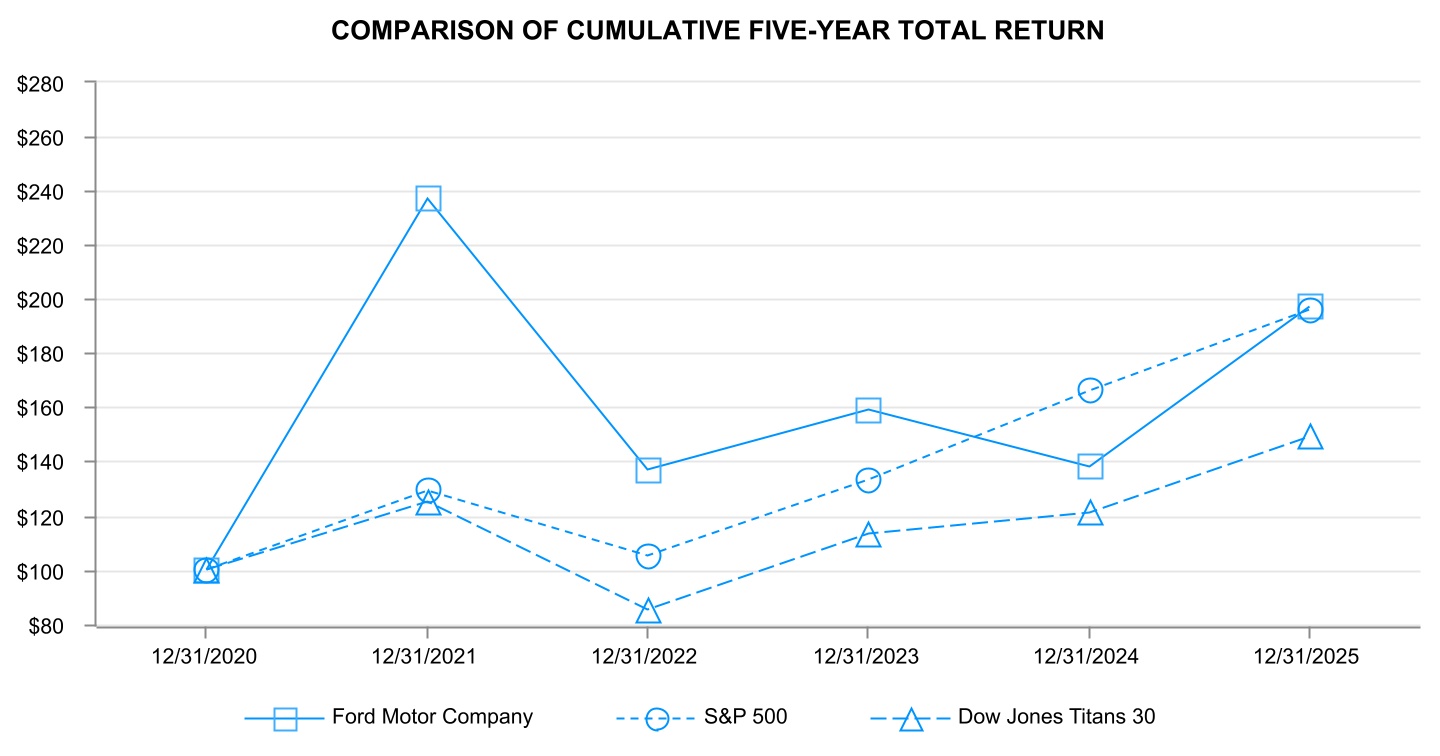
| | | | | | | | | | | | | | | | | | | | | | | | | | | | | | | | | | | | | | |
| | Base Period | | Years Ending |
| Company/Index | | 2020 | | 2021 | | 2022 | | 2023 | | 2024 | | 2025 |
Ford Motor Company | | 100 | | 237 | | 137 | | 159 | | 138 | | 197 |
S&P 500 | | 100 | | 129 | | 105 | | 133 | | 166 | | 196 |
Dow Jones Automobiles & Parts Titans 30 | | 100 | | 125 | | 85 | | 113 | | 121 | | 149 |
Item 5. Market for Registrant’s Common Equity, Related Stockholder Matters and Issuer Purchases of Equity Securities (Continued)
Issuer Purchases of Equity Securities
We completed no share repurchases during the fourth quarter of 2025.
Dividends
The table below shows the dividends we paid per share of Common and Class B Stock for each quarterly period in 2024 and 2025: | | | | | | | | | | | | | | | | | | | | | | | | | | | | | | | | | | | | | | | | | | | | | | | |
| | 2024 | | 2025 |
| First Quarter(a) | | Second
Quarter | | Third
Quarter | | Fourth
Quarter | | First Quarter(a) | | Second
Quarter | | Third
Quarter | | Fourth
Quarter |
Dividends per share of Ford Common and Class B Stock | $ | 0.33 | | | $ | 0.15 | | | $ | 0.15 | | | $ | 0.15 | | | $ | 0.30 | | | $ | 0.15 | | | $ | 0.15 | | | $ | 0.15 | |
__________
(a)In the first quarter of 2024 and 2025, in addition to a regular dividend of $0.15 per share, we paid a supplemental dividend of $0.18 per share and $0.15 per share, respectively.
On February 2, 2026, we declared a regular dividend of $0.15 per share.
Subject to legally available funds, we intend to continue to pay a regular quarterly cash dividend on our outstanding Common Stock and Class B Stock. The declaration and payment of future dividends is at the sole discretion of our Board of Directors after taking into account various factors, including our financial condition, operating results, available cash, and current and anticipated cash needs.
ITEM 6. [Reserved.]
ITEM 7. Management’s Discussion and Analysis of Financial Condition and Results of Operations.
Key Trends and Economic Factors Affecting Ford and the Automotive Industry
Trade Policy. To the extent governments in various regions implement or intensify restrictions or barriers to trade, such as tariff or non-tariff barriers, export controls, currency manipulation, or policies that otherwise favor domestic companies, there can be a significant negative impact on manufacturers based in other markets.
Tariffs implemented to date in the United States and elsewhere have caused significant disruption, increased costs (both directly and indirectly), and uncertainty in the automotive industry, including for Ford, other OEMs, suppliers, and dealers, as well as customers. Moreover, tariffs implemented or increased in the United States and elsewhere in the future may exacerbate these impacts. Further, instability in the supply chain exacerbated by tariffs and other industry concerns, such as China’s restriction on the export of rare earth minerals and various components, has resulted in production disruptions and increased costs and heightens the risk of future production disruptions and additional cost increases. Tariffs have affected and will continue to affect all OEMs, to various degrees.
In 2025, Ford’s gross costs related to tariffs implemented or revised in 2025 was about $3 billion, including the impact of tariff relief, and the net EBIT impact was about $2 billion after offsets. This relief is subject to periodic approval by the U.S. Department of Commerce and may be revised based on factors such as U.S. production and import content levels. As of December 31, 2025, we recognized a receivable of $974 million reflecting tariffs paid but for which we had not yet received refunds. Although we have started to receive refunds, the timing for our receipt of refunds is uncertain and is subject to changes in trade policy. Tariffs, particularly on auto parts for U.S. assembly, if sustained for an extended period of time, will have a significant adverse effect on U.S. production and the overall automotive industry.
For additional information regarding the impact and potential impact of trade policy and tariffs on our business, see the Outlook section on page 74 of this Report and Item 1A. Risk Factors.
Production and Supply Chain. Market volatility and shifting global supply chains have continued to create some production constraints, though conditions have improved from the immediate post-COVID period. As we adjust to shifting market conditions and balance our production mix, continued uncertainty with regard to current and future levels of tariffs, as discussed above, could have a significant impact on our supply chain and, in turn, our production. We continue to reevaluate our supply base and sourcing decisions and may in the future incur charges to improve flexibility and cost competitiveness.
In September 2025 and November 2025, fires at a Novelis Inc. plant in New York disrupted operations at the facility. Novelis is a major aluminum supplier to Ford, and since the initial fire occurred, we have been working closely with Novelis to address the situation and exploring potential alternative sources of aluminum. We have also sought mitigating actions to minimize potential disruptions to our operations. Although the ultimate impact on Ford is uncertain, we experienced lower production in the fourth quarter of 2025 driven by the Novelis fires, which we expect to recover partially in 2026. For more information regarding the impact and potential impact of the Novelis fires on our business, see the Outlook section on page 74 of this Report.
See Item 1A. Risk Factors for additional discussion of the risks related to disruptions to Ford’s and Ford’s suppliers’ production and operations.
Electric Vehicle Market. Although we are investing in our EV strategy, we anticipate that the EV market will continue to evolve. To date, we have observed lower-than-anticipated industrywide EV adoption rates due to changes in consumer sentiment, competitive dynamics, legal and policy changes, and significant developments in vehicle pricing dynamics, among other factors that we continue to monitor. The trend may be further exacerbated as policy changes in the United States have reduced or eliminated supply- and demand-side EV incentives, which may further slow the adoption of EVs. Moreover, potentially significant reductions in the stringency of federal emissions and fuel economy standards and federal legislation that eliminated the authority of California and other states to implement and enforce their most stringent emissions standards and zero-emission vehicle sales requirements, and other actions that may be forthcoming, may add to the disruption of the market for EVs in the United States, our largest market. These developments, which may continue to affect the pace of EV adoption, could extend the period of underutilization of EV production capacity across the industry.
Item 7. Management’s Discussion and Analysis of Financial Condition and Results of Operations (Continued)
This environment has led us, and may in the future lead us, to adjust our investments, spending, production, and product and future technology launches to better match the pace of EV adoption. As a result of the lower-than-anticipated adoption rates, near-term pricing pressures, and other factors, we have recorded and may continue to incur charges related to payments to our EV-related suppliers (battery, raw material, or otherwise), inventory adjustments, impairments, or other matters.
For example, in 2024, we announced the cancellation of an all-electric three-row SUV program. The impact of that cancellation also resulted in changes to future technology and product launches. Through December 31, 2025, we incurred expenses of $2.4 billion related to these actions, all of which we reported as special items. Although we do not expect to incur significant additional expenses, cash payments related to these actions will continue through 2026.
In December 2025, we announced our decision to rationalize our EV manufacturing capacity and product roadmap, including cancelling three previously planned EVs and ending production of the current generation F-150 Lightning EV. As a result of the challenges facing the EV market and the decisions we made in response to those challenges, we recorded the following charges as special items: an $8.4 billion pre-tax non-cash impairment charge, including goodwill, for our Model e long-lived assets; $1.1 billion of non-cash asset write-downs related to the EV program cancellations described above; and $1.2 billion of other charges to be paid in cash (primarily related to contractual commitments related to those programs). We may incur additional expenses and cash expenditures of up to about $4 billion related to these actions and will recognize those charges in the quarter they are incurred as a special item.
In addition, in December 2025, Ford, SK On Co., Ltd., and SK Battery America, Inc., and BlueOval SK, LLC (“BOSK”) entered into a Joint Venture Disposition Agreement (“JVDA”), pursuant to which our membership interest in BOSK will be redeemed, and a Ford subsidiary will receive BOSK’s two Kentucky plants and related assets, and will assume the related liabilities. The value of the liabilities assumed is expected to exceed the value of the assets received; accordingly, we do not expect to recover the carrying amount of our investment in BOSK. Therefore, in the fourth quarter of 2025, we recorded a $3.2 billion pre-tax non-cash impairment charge as a special item.
Upon closing of the transactions contemplated by the JVDA (expected in the first half of 2026), we expect to recognize additional special item charges of about $3 billion, which includes about $500 million of cash expenditures. For additional information about BOSK and the JVDA, see Note 23 of the Notes to the Financial Statements.
In total, in the fourth quarter of 2025, we recorded about $13.8 billion of charges related to our updated EV strategy and the expected disposition of our BOSK investment.
These regulatory and market dynamics may continue to occur, which could have a substantial adverse impact on our results of operations and/or business, including our investments in supply, production capacity, and equity method investments.
Further, the pace of EV adoption and slower-than-anticipated development of the EV market may impact our strategy to comply with regulatory emissions and fuel economy standards and zero-emission vehicle requirements. Although recent actions taken and expected to be taken in the United States and elsewhere may eliminate or reduce the stringency of such standards, if consumers do not purchase our EVs and other highly fuel-efficient vehicles in sufficient numbers, it may be difficult for Ford to meet applicable environmental standards in certain markets and may force us to take various product-led actions (e.g., curtailing the production and sale of certain internal combustion vehicles) that could have substantial adverse effects on our sales volume and operations and/or purchase compliance credits from third parties.
For additional discussion of the impact of changes in the EV market to our business, and the risks related thereto, see the “Governmental Standards” discussion in “Item 1. Business” and “Item 1A. Risk Factors” above.
Currency Exchange Rate Volatility. Although a few global central banks have raised interest rates recently, most remain in the process of lowering policy rates that had been elevated in order to address inflation concerns. As these policy rates shift, central banks need to carefully balance the risk that inflation remains elevated against the heightened financial and economic risks associated with high interest rates. This is notable for many emerging markets, which may also face increased exposure to commodity prices and political instability, contributing to unpredictable movements in the value of their exchange rates. In addition to direct impacts on the financial flows of global automotive companies, currency movements can also impact pricing of vehicles exported to overseas markets. In most markets, exchange rates are market-determined, and all are impacted by many different macroeconomic and policy factors, and thus likely to remain volatile. However, in some markets, exchange rates are heavily influenced or controlled by governments.
Item 7. Management’s Discussion and Analysis of Financial Condition and Results of Operations (Continued)
Pricing Pressure. Despite vehicle pricing remaining elevated over the last year due to strong demand, lingering supply shortages, tariffs, and inflationary costs, we have already observed some declines in new and used vehicle prices, especially in the EV segment, but it is unclear whether industry prices will decline fully to pre-COVID-19 pandemic levels as costs remain elevated. Intense competition and excess capacity are likely to put downward pressure on inflation-adjusted prices, including increased marketing incentives, for similarly contented vehicles and contribute to a challenging pricing environment for the automotive industry in most major markets.
Commodity and Energy Prices. Prices for commodities remain volatile. Spot prices for various commodities have recently diverged, as weakening global EV demand mitigates price increases for battery-related commodities, while base metals such as steel and aluminum face tariff-related impacts, and precious metals (e.g., palladium) also remain at elevated price levels due to geopolitical uncertainty and other factors. Overall, the net impact on us and our suppliers has been higher material costs. To help ensure supply of raw materials for critical components, we, like others in the industry, have entered into multi-year sourcing agreements and may enter into additional agreements. In the long term, the outcome of de-carbonization and electrification of the vehicle fleet may depress oil demand, but geopolitical dynamics and the global energy transition will also contribute to ongoing volatility of oil and other energy prices.
Inflation and Interest Rates. We continue to see lingering impacts on our business due to inflation, including ongoing geopolitical volatility, driving up labor costs, freight premiums, and other operating costs above historical rates. Although headline inflation in the United States and Europe appears to have peaked, core inflation (excluding food and energy prices) remains elevated and is a source of continued cost pressure on businesses and households. Interest rates have increased significantly and are only now beginning to decline, as central banks in developed countries attempted to subdue inflation while government deficits and debt remain at high levels in many global markets. Accordingly, the eventual implications of higher government deficits and debt, tighter monetary policy, and potentially higher long-term interest rates may drive a higher cost of capital for our business. At Ford Credit, rising interest rates may impact its ability to source funding and offer financing at competitive rates, which could reduce its financing margin.
Vehicle Profitability. Our financial results depend on the profitability of the vehicles we sell, which may vary significantly by vehicle line. In general, larger vehicles tend to command higher prices and be more profitable than smaller vehicles. For example, in Ford Blue, our larger, more profitable vehicles had an average contribution margin that was 153% of our total average contribution margin across all vehicles, whereas our smaller vehicles had significantly lower contribution margins. In addition, government regulations in certain markets aimed at reducing emissions and increasing fuel efficiency (e.g., ZEV mandates and low emission zones), and other factors that accelerate the transition to electrified vehicles, may increase the cost of vehicles by more than the perceived benefit to consumers and dampen margins.
Revenue
Company excluding Ford Credit revenue is generated primarily by sales of vehicles, parts, accessories, and services from our Ford Blue, Ford Model e, and Ford Pro segments. Revenue is recorded when control is transferred to our customers (generally, our dealers and distributors). For the majority of sales, this occurs when products are shipped from our manufacturing facilities. However, we defer a portion of the consideration received when there is a separate future or stand-ready performance obligation, such as extended service contracts or ongoing vehicle connectivity. Revenue related to extended service contracts is recognized over the term of the agreement in proportion to the costs we expect to incur in satisfying the contract obligations; revenue related to other future or stand-ready performance obligations is generally recognized on a straight-line basis over the period in which services are expected to be performed. Vehicles sold to daily rental car companies with an obligation to repurchase at an agreed upon amount, exercisable at the option of the customer, are accounted for as operating leases. We also earn income from other operating lease assets, primarily vehicles, and record the income on a straight-line basis over the term of the lease agreement. Proceeds from the sale of vehicles at auction are recognized in revenue upon transfer of control of the vehicle to the buyer.
Most of the vehicles sold by us to our dealers and distributors are financed at wholesale by Ford Credit. Upon Ford Credit originating the wholesale receivable related to a dealer’s purchase of a vehicle, Ford Credit pays cash to the relevant Ford entity in payment of the dealer’s obligation for the purchase price of the vehicle. The dealer then pays the wholesale finance receivable to Ford Credit when it sells the vehicle to a retail customer.
Our Ford Credit segment revenue is generated primarily from interest on finance receivables and revenue from operating leases. Revenue from interest on finance receivables is recognized over the term of the receivable using the interest method and includes the amortization of certain deferred origination costs. Revenue from operating leases is recognized on a straight-line basis over the term of the lease.
Item 7. Management’s Discussion and Analysis of Financial Condition and Results of Operations (Continued)
Transactions between Ford Credit and our other segments occur in the ordinary course of business. For example, we offer special retail financing and lease incentives to dealers’ customers who choose to finance or lease our vehicles from Ford Credit. The cost for these incentives is included in our estimate of variable consideration at the date the related vehicle sales to our dealers are recorded. In order to compensate Ford Credit for the lower interest or lease payments offered to the retail customer, we pay the discounted value of the incentive directly to Ford Credit when it originates the retail finance or lease contract with the dealer’s customer. Ford Credit recognizes the incentive amount over the life of retail finance contracts as an element of financing revenue and over the life of lease contracts as a reduction to depreciation. See Note 1 of the Notes to the Financial Statements for a more detailed discussion of transactions between Ford Credit and our other segments.
Costs and Expenses
Our income statement classifies our Company excluding Ford Credit total costs and expenses into two categories: (i) cost of sales, and (ii) selling, administrative, and other expenses. We include within cost of sales those costs related to the development, production, and distribution of our vehicles, parts, accessories, and services. Specifically, we include in cost of sales each of the following: material costs (including commodity and component costs); freight and duty (including tariff) costs; warranty, including product recall costs; labor and other costs related to the development and production of our vehicles and connectivity, parts, accessories, and services; depreciation and amortization; regulatory compliance expenses; and other associated costs. We include within selling, administrative, and other expenses labor and other costs not directly related to the development and production of our vehicles, parts, accessories, and services, including such expenses as advertising and sales promotion costs.
Certain of our costs, such as material costs, generally vary directly with changes in volume and mix of production. In our industry, production volume often varies significantly from quarter to quarter and year to year. Quarterly production volumes experience seasonal shifts throughout the year (including peak retail sales seasons and the impact on production of model changeover and new product launches). Annual production volumes are heavily impacted by external economic factors, including the pace of economic growth and factors such as the availability of consumer credit and cost of fuel.
As a result, we analyze the profit impact of certain cost changes, holding constant present-year volume and mix and currency exchange, in order to evaluate our cost trends absent the impact of varying production and currency exchange levels. We analyze these cost changes in the following categories:
•Contribution Costs – these costs typically vary with production volume. These costs include material (including commodity and component), warranty, and freight and duty (including tariff) costs.
•Structural Costs – these costs typically do not have a directly proportionate relationship to production volume. These costs include manufacturing; vehicle and software engineering; spending-related (primarily depreciation and amortization for our manufacturing and engineering assets); advertising and sales promotion; administrative, information technology, and selling; and pension and OPEB costs.
While contribution costs generally vary directly in proportion to production volume, elements within our structural costs category are impacted to differing degrees by changes in production volume. We also have varying degrees of discretion when it comes to controlling the different elements within our structural costs. For example, depreciation and amortization expense largely is associated with prior capital spending decisions. On the other hand, while labor costs do not vary directly with production volume, manufacturing labor costs may be impacted by changes in volume, for example when we increase overtime, add a production shift, or add personnel to support volume increases. Other structural costs, such as advertising or engineering costs, do not necessarily have a directly proportionate relationship to production volume. Our structural costs generally are within our discretion, although to varying degrees, and can be adjusted over time in response to external factors.
We consider certain structural costs to be a direct investment in future growth and revenue. For example, structural costs are necessary to grow our business and improve profitability, invest in new products, technologies, and services, respond to increasing industry sales volume, and grow our market share.
Cost of sales and Selling, administrative, and other expenses for full year 2025 were $185.3 billion. Company excluding Ford Credit’s total material and commodity costs make up the largest portion of these costs and expenses, followed by structural costs. Although material costs are our largest absolute cost, our margins can be affected significantly by changes in any category of costs.
Item 7. Management’s Discussion and Analysis of Financial Condition and Results of Operations (Continued)
RESULTS OF OPERATIONS - 2025
The net loss attributable to Ford Motor Company was $8,182 million in 2025. Company adjusted EBIT was $6,780 million.
Net income/(loss) includes certain items (“special items”) that are excluded from Company adjusted EBIT. These items are discussed in more detail under “Non-GAAP Financial Measures That Supplement GAAP Measures” on page 77 and in Note 25 of the Notes to the Financial Statements. We report special items separately to allow investors analyzing our results to identify certain infrequent significant items that they may wish to exclude when analyzing ongoing operating results. Our pre-tax and tax special items were as follows (in millions):
| | | | | | | | | | | | | | |
| | 2024 | | 2025 |
| Restructuring (by Geography) | | | | |
| Europe | | $ | (716) | | | $ | (736) | |
| North America Hourly Buyouts | | (260) | | | — | |
| China | | (16) | | | — | |
| Subtotal Restructuring | | $ | (992) | | | $ | (736) | |
| Other Items | | | | |
| Model e asset impairment and EV program cancellations | | $ | — | | | $ | (10,657) | |
| BOSK JV disposition | | — | | | (3,173) | |
| All-electric three-row SUV program cancellation and resulting actions | | (1,200) | | | (1,198) | |
| Fuel injector field service action | | — | | | (521) | |
| Ford share of equity method investment's asset impairment/other | | — | | | (285) | |
| Ford share of BOSK's asset write-down/other | | — | | | (225) | |
| Legal matter | | — | | | (114) | |
| Gain on investment in equity security | | — | | | 276 | |
| Extended Oakville Assembly Plant changeover | | (181) | | | — | |
| Other | | 41 | | | — | |
| Subtotal Other Items | | $ | (1,340) | | | $ | (15,897) | |
| Pension and OPEB Gain/(Loss) | | | | |
| Pension and OPEB remeasurement | | $ | 687 | | | $ | (597) | |
| Pension settlements, curtailments, and separations costs | | (215) | | | (126) | |
| Subtotal Pension and OPEB Gain/(Loss) | | $ | 472 | | | $ | (723) | |
| Total EBIT Special Items | | $ | (1,860) | | | $ | (17,356) | |
| | | | |
| Provision for/(Benefit from) tax special items (a) | | $ | (323) | | | $ | (4,775) | |
__________
(a)Includes related tax effect on special items and tax special items.
We recorded $17,356 million of pre-tax special item charges in 2025, primarily reflecting a Model e asset impairment, asset write-downs and other charges due to EV program cancellations, and an impairment of our investment in BOSK related to the BOSK JV disposition. For additional information, see Notes 13, 14, and 23 of the Notes to the Financial Statements. Charges related to the all-electric three-row SUV program cancellation and resulting actions, ongoing restructuring actions in Europe, a field service action for fuel injectors, and pension and OPEB remeasurement were also recorded as special items in 2025.
We recorded a $4.8 billion benefit from tax special items in 2025, primarily reflecting the impact of the special items above and a net benefit of $1.5 billion associated with the release of valuation allowances resulting from improvements in our South American and South Asian operations, offset partially by non-cash charges to deferred tax assets of $0.5 billion associated with resolving transfer pricing matters in certain non-U.S. operations and $0.4 billion to recognize the impact of tax legislation enacted in Germany.
In Note 25 of the Notes to the Financial Statements, special items are reflected as a separate reconciling item, as opposed to being allocated among our segments. This reflects the fact that management excludes these items from its review of operating segment results for purposes of measuring segment profitability and allocating resources.
Item 7. Management’s Discussion and Analysis of Financial Condition and Results of Operations (Continued)
COMPANY KEY METRICS
The table below shows our full year 2025 key metrics for the Company compared to a year ago. | | | | | | | | | | | | | | | | | | | | |
| | 2024 | | 2025 | | H / (L) |
| GAAP Financial Measures | | | | | | |
| Cash Flows from Operating Activities ($B) | | $ | 15.4 | | | $ | 21.3 | | | $ | 5.9 | |
| Revenue ($M) | | 184,992 | | | 187,267 | | | 1 | % |
| Net Income/(Loss) ($M) | | 5,879 | | | (8,182) | | | $ | (14,061) | |
| Net Income/(Loss) Margin (%) | | 3.2 | % | | (4.4 | %) | | (7.6) ppts |
| EPS (Diluted) | | $ | 1.46 | | | $ | (2.06) | | | $ | (3.52) | |
| | | | | | |
Non-GAAP Financial Measures (a) | | | | | | |
| Company Adj. Free Cash Flow ($B) | | $ | 6.7 | | | $ | 3.5 | | | $ | (3.2) | |
| Company Adj. EBIT ($M) | | 10,208 | | | 6,780 | | | (3,428) | |
| Company Adj. EBIT Margin (%) | | 5.5 | % | | 3.6 | % | | (1.9) ppts |
| Adjusted EPS (Diluted) | | $ | 1.84 | | | $ | 1.09 | | | $ | (0.75) | |
| Adjusted ROIC (Trailing Four Quarters) | | 12.9 | % | | 8.8 | % | | (4.2) ppts |
__________
(a)See Non-GAAP Financial Measure Reconciliations section for reconciliation to GAAP.
In 2025, our diluted earnings per share of Common and Class B Stock was a loss of $2.06 and our diluted adjusted earnings per share was $1.09.
Net income/(loss) margin was negative 4.4% in 2025, down from 3.2% a year ago. Company adjusted EBIT margin was 3.6% in 2025, down from 5.5% a year ago.
The table below shows our full year 2025 net income/(loss) attributable to Ford and Company adjusted EBIT by segment (in millions). | | | | | | | | | | | | | | | | | | | | |
| | 2024 | | 2025 | | H / (L) |
| Ford Blue | | $ | 5,269 | | | $ | 3,024 | | | $ | (2,245) | |
| Ford Model e | | (5,105) | | | (4,806) | | | 299 | |
| Ford Pro | | 9,007 | | | 6,843 | | | (2,164) | |
| Ford Credit | | 1,654 | | | 2,557 | | | 903 | |
| Corporate Other | | (617) | | | (838) | | | (221) | |
| Company Adjusted EBIT (a) | | 10,208 | | | 6,780 | | | (3,428) | |
| Interest on Debt | | (1,115) | | | (1,254) | | | (139) | |
| Special Items | | (1,860) | | | (17,356) | | | (15,496) | |
| Taxes / Noncontrolling Interests | | (1,354) | | | 3,648 | | | 5,002 | |
| Net Income/(Loss) | | $ | 5,879 | | | $ | (8,182) | | | $ | (14,061) | |
__________
(a)See Non-GAAP Financial Measure Reconciliations section for reconciliation to GAAP.
The year-over-year decrease of $14,061 million in net income/(loss) in 2025 was primarily driven by higher special items and lower Ford Blue and Ford Pro EBIT, offset partially by lower taxes. The higher year-over-year special items primarily reflect the Model e asset impairment and EV program cancellations as well as the BOSK JV disposition. The year-over-year decrease of $3,428 million in Company adjusted EBIT primarily reflects lower Ford Blue and Ford Pro EBIT, including the impact of new and revised tariffs, offset partially by higher Ford Credit EBT and improved Model e EBIT.
Item 7. Management’s Discussion and Analysis of Financial Condition and Results of Operations (Continued)
The tables below and on the following pages provide full year 2025 key metrics and the change in full year 2025 EBIT compared with full year 2024 by causal factor for each of our Ford Blue, Ford Model e, and Ford Pro segments. For a description of these causal factors, see Definitions and Information Regarding Ford Blue, Ford Model e, and Ford Pro Causal Factors.
Ford Blue Segment
| | | | | | | | | | | | | | | | | |
| 2024 | | 2025 | | H / (L) |
| Key Metrics | | | | | |
| Wholesale Units (000) (a) | 2,862 | | | 2,728 | | | (133) | |
| Revenue ($M) | $ | 101,935 | | | $ | 101,019 | | | $ | (916) | |
| EBIT ($M) | 5,269 | | | 3,024 | | | (2,245) | |
| EBIT Margin (%) | 5.2 | % | | 3.0 | % | | (2.2) ppts |
__________
(a)Includes Ford and Lincoln brand and JMC brand vehicles produced and sold in China by our unconsolidated affiliates (about 438,000 units in 2024 and 375,000 units in 2025).
| | | | | | | | |
| Change in EBIT by Causal Factor (in millions) | | |
2024 Full Year EBIT | | $ | 5,269 | |
| Volume / Mix | | (1,661) | |
| Net Pricing | | 1,487 | |
| Cost | | (1,125) | |
| Exchange | | (778) | |
| Other | | (168) | |
2025 Full Year EBIT | | $ | 3,024 | |
In 2025, Ford Blue’s wholesales decreased 5% from a year ago, primarily driven by lower wholesales in North America including a planned reduction in dealer stocks resulting in lower wholesales across multiple nameplates and lower F-150 wholesales driven by a disruption in aluminum supply. Lower sales at our joint ventures in China also contributed to the decrease. Full year 2025 revenue decreased 1%, reflecting lower wholesales offset partially by favorable net pricing and mix.
Ford Blue’s 2025 full year EBIT was $3,024 million, a decrease of $2,245 million from a year ago, with an EBIT margin of 3.0%. The lower EBIT was primarily driven by lower volume, including the impact of the disruption in aluminum supply, higher tariff-related costs, and adverse exchange. Favorable net pricing and lower material and warranty costs were partial offsets.
Item 7. Management’s Discussion and Analysis of Financial Condition and Results of Operations (Continued)
Ford Model e Segment | | | | | | | | | | | | | | | | | | | | |
| | 2024 | | 2025 | | H / (L) |
| Key Metrics | | | | | | |
| Wholesale Units (000) | | 105 | | | 178 | | | 73 | |
| Revenue ($M) | | $ | 3,858 | | | $ | 6,670 | | | $ | 2,812 | |
| EBIT ($M) | | (5,105) | | | (4,806) | | | 299 | |
| EBIT Margin (%) | | (132.3) | % | | (72.1) | % | | 60.3 ppts |
| | | | | | | | |
| Change in EBIT by Causal Factor (in millions) | | |
2024 Full Year EBIT | | $ | (5,105) | |
| Volume / Mix | | 332 | |
| Net Pricing | | (7) | |
| Cost | | 122 | |
| Exchange | | (6) | |
| Other | | (142) | |
2025 Full Year EBIT | | $ | (4,806) | |
In 2025, Ford Model e’s wholesales increased 69% from a year ago, primarily reflecting higher wholesales in Europe, including a full year of production of the Explorer and Capri and the introduction of the Puma Gen-E. Full year 2025 revenue increased 73%, driven by the higher wholesales.
Ford Model e’s 2025 full year EBIT loss was $4,806 million, a $299 million improvement from a year ago, with an EBIT margin of negative 72.1%. The improved EBIT was primarily driven by higher volume and lower costs. The lower costs include lower material cost, which more than offset increased tariff-related costs and volume-related manufacturing costs.
Ford Pro Segment | | | | | | | | | | | | | | | | | | | | |
| | 2024 | | 2025 | | H / (L) |
| Key Metrics | | | | | | |
| Wholesale Units (000) (a) | | 1,503 | | | 1,488 | | | (14) | |
| Revenue ($M) | | $ | 66,906 | | | $ | 66,286 | | | $ | (620) | |
| EBIT ($M) | | 9,007 | | | 6,843 | | | (2,164) | |
| EBIT Margin (%) | | 13.5 | % | | 10.3 | % | | (3.1) ppts |
__________
(a)Includes Ford brand vehicles produced and sold by our unconsolidated affiliate Ford Otosan in Türkiye (about 91,000 units in 2024 and 98,000 units in 2025).
| | | | | | | | |
| Change in EBIT by Causal Factor (in millions) | | |
2024 Full Year EBIT | | $ | 9,007 | |
| Volume / Mix | | (657) | |
| Net Pricing | | (1,024) | |
| Cost | | (501) | |
| Exchange | | 113 | |
| Other | | (95) | |
2025 Full Year EBIT | | $ | 6,843 | |
In 2025, Ford Pro’s wholesales decreased 1% from a year ago, primarily reflecting lower industry volume in Europe and the impact of a disruption in aluminum supply, offset partially by higher daily rental volume in North America. Full year 2025 revenue decreased 1%, driven by moderated pricing across fleets (including daily rental), offset partially by favorable exchange.
Ford Pro’s 2025 full year EBIT was $6,843 million, a decrease of $2,164 million from a year ago, with an EBIT margin of 10.3%. The lower EBIT was primarily driven by unfavorable fleet pricing (including daily rental), unfavorable mix, and higher tariff-related costs. Excluding tariffs, cost improved year-over-year, driven by lower material and warranty costs.
Item 7. Management’s Discussion and Analysis of Financial Condition and Results of Operations (Continued)
Definitions and Information Regarding Ford Blue, Ford Model e, and Ford Pro Causal Factors
In general, we measure year-over-year change in Ford Blue, Ford Model e, and Ford Pro segment EBIT using the causal factors listed below, with net pricing and cost variances calculated at present-year volume and mix and exchange:
•Market Factors (exclude the impact of unconsolidated affiliate wholesale units):
◦Volume and Mix – primarily measures EBIT variance from changes in wholesale unit volumes (at prior-year average contribution margin per unit) driven by changes in industry volume, market share, and dealer stocks, as well as the EBIT variance resulting from changes in product mix, including mix among vehicle lines and mix of trim levels and options within a vehicle line
◦Net Pricing – primarily measures EBIT variance driven by changes in wholesale unit prices to dealers and marketing incentive programs such as rebate programs, low-rate financing offers, special lease offers, and stock adjustments on dealer inventory
•Cost:
◦Contribution Costs – primarily measures EBIT variance driven by per-unit changes in cost categories that typically vary with volume, such as material costs (including commodity and component costs), warranty expense, and freight and duty (including tariff) costs
◦Structural Costs – primarily measures EBIT variance driven by absolute change in cost categories that typically do not have a directly proportionate relationship to production volume. Structural costs include the following cost categories:
▪Manufacturing, Including Volume-Related - consists primarily of costs for hourly and salaried manufacturing personnel, plant overhead (such as utilities and taxes), and new product launch expense. These costs could be affected by volume for operating pattern actions such as overtime, line-speed, and shift schedules
▪Engineering and Connectivity – consists primarily of costs for vehicle and software engineering personnel, prototype materials, testing, and outside engineering and software services
▪Spending-Related – consists primarily of depreciation and amortization of our manufacturing and engineering assets, but also includes asset retirements and operating leases
▪Advertising and Sales Promotions – includes costs for advertising, marketing programs, brand promotions, customer mailings and promotional events, and auto shows
▪Administrative, Information Technology, and Selling – includes primarily costs for salaried personnel and purchased services related to our staff activities, information technology, and selling functions
•Exchange – primarily measures EBIT variance driven by one or more of the following: (i) transactions denominated in currencies other than the functional currencies of the relevant entities, (ii) effects of converting functional currency income to U.S. dollars, (iii) effects of remeasuring monetary assets and liabilities of the relevant entities in currencies other than their functional currency, or (iv) results of our foreign currency hedging
•Other – includes a variety of items, such as parts and services earnings, royalties, government incentives, compensation-related changes, and regulatory compliance expenses
In addition, definitions and calculations used in this report include:
•Wholesales and Revenue – wholesale unit volumes include all Ford and Lincoln badged units (whether produced by Ford or by an unconsolidated affiliate) that are sold to dealerships or others, units manufactured by Ford that are sold to other manufacturers, units distributed by Ford for other manufacturers, and local brand units produced by our China joint venture, Jiangling Motors Corporation, Ltd. (“JMC”), that are sold to dealerships or others. Vehicles sold to daily rental car companies that are subject to a guaranteed repurchase option (i.e., rental repurchase), as well as other sales of finished vehicles for which the recognition of revenue is deferred (e.g., consignments), also are included in wholesale unit volumes. Revenue from certain vehicles in wholesale unit volumes (specifically, Ford badged vehicles produced and distributed by our unconsolidated affiliates, as well as JMC brand vehicles) are not included in our revenue. Excludes transactions between Ford Blue, Ford Model e, and Ford Pro segments
•Industry Volume and Market Share – based, in part, on estimated vehicle registrations; includes medium and heavy duty trucks
•SAAR – seasonally adjusted annual rate
Item 7. Management’s Discussion and Analysis of Financial Condition and Results of Operations (Continued)
Ford Credit Segment
The tables below provide full year 2025 key metrics and the change in full year 2025 EBT compared with full year 2024 by causal factor for the Ford Credit segment. For a description of these causal factors, see Definitions and Information Regarding Ford Credit Causal Factors. | | | | | | | | | | | | | | | | | | | | |
| | 2024 | | 2025 | | H / (L) |
| GAAP Financial Measures | | | | | | |
| Total Net Receivables ($B) | | $ | 143.6 | | | $ | 146.3 | | | $ | 2.7 | |
| Loss-to-Receivables (bps) (a) | | 50 | | | 59 | | | 9 | |
| Auction Values (b) | | $ | 30,510 | | | $ | 31,475 | | | 3 | % |
| EBT ($M) | | 1,654 | | | 2,557 | | | $ | 903 | |
| ROE (%) | | 9.1 | % | | 14.9 | % | | 5.8 ppts |
| | | | | | |
| Other Balance Sheet Metrics | | | | | | |
| Debt ($B) | | $ | 137.9 | | | $ | 141.4 | | | $ | 3.5 | |
| Net Liquidity ($B) | | 25.2 | | | 24.6 | | | (0.6) | |
| Financial Statement Leverage (to 1) | | 10.0 | | | 9.6 | | | (0.4) | |
__________
(a)U.S. retail financing only.
(b)U.S. portfolio off-lease auction values at full year 2025 mix.
| | | | | | | | |
| Change in EBT by Causal Factor (in millions) | | |
2024 Full Year EBT | | $ | 1,654 | |
| Volume / Mix | | 109 | |
| Financing Margin | | 718 | |
| Credit Loss | | (115) | |
| Lease Residual | | 53 | |
| Exchange | | 2 | |
| Other | | 136 | |
2025 Full Year EBT | | $ | 2,557 | |
Ford Credit’s total net receivables at December 31, 2025 of $146.3 billion were 2% higher than a year ago, explained primarily by a larger operating lease portfolio and exchange, offset partially by lower non-consumer financing. The 2025 U.S. retail loss-to-receivables ratio of 59 basis points increased from a year ago, reflecting increased loss severity and higher repossessions. Ford Credit’s U.S. auction values for off-lease vehicles increased 3% from a year ago, reflecting industrywide low used vehicle supply and high demand.
Ford Credit’s 2025 EBT of $2.6 billion was $0.9 billion higher than a year ago, explained primarily by higher financing margin, higher receivables, and a favorable derivative market valuation adjustment (included in Other). Higher credit losses and charges related to an industrywide review by the U.K. Financial Conduct Authority into the historical use of dealer commissions (also included in Other) were partial offsets.
Item 7. Management’s Discussion and Analysis of Financial Condition and Results of Operations (Continued)
Definitions and Information Regarding Ford Credit Causal Factors
In general, we measure year-over-year changes in Ford Credit’s EBT using the causal factors listed below:
•Volume and Mix:
◦Volume primarily measures changes in net financing margin driven by changes in average net receivables excluding the allowance for credit losses at prior period financing margin yield (defined below in financing margin) at prior period exchange rates. Volume changes are primarily driven by the volume of new and used vehicles sold and leased, the extent to which Ford Credit purchases retail financing and operating lease contracts, the extent to which Ford Credit provides wholesale financing, the sales price of the vehicles financed, the level of dealer inventories, Ford-sponsored special financing programs available exclusively through Ford Credit, and the availability of cost-effective funding
◦Mix primarily measures changes in net financing margin driven by period-over-period changes in the composition of Ford Credit’s average net receivables excluding the allowance for credit losses by product within each region
•Financing Margin:
◦Financing margin variance is the period-over-period change in financing margin yield multiplied by the present period average net receivables excluding the allowance for credit losses at prior period exchange rates. This calculation is performed at the product and country level and then aggregated. Financing margin yield equals revenue, less interest expense and scheduled depreciation for the period, divided by average net receivables excluding the allowance for credit losses for the same period
◦Financing margin changes are driven by changes in revenue and interest expense. Changes in revenue are primarily driven by the level of market interest rates, cost assumptions in pricing, mix of business, and competitive environment. Changes in interest expense are primarily driven by the level of market interest rates, borrowing spreads, and asset-liability management
•Credit Loss:
◦Credit loss is the change in the provision for credit losses at prior period exchange rates. For analysis purposes, management splits the provision for credit losses into net charge-offs and the change in the allowance for credit losses
◦Net charge-off changes are primarily driven by the number of repossessions, severity per repossession, and recoveries. Changes in the allowance for credit losses are primarily driven by changes in historical trends in credit losses and recoveries, changes in the composition and size of Ford Credit’s present portfolio, changes in trends in historical used vehicle values, and changes in forward looking macroeconomic conditions. For additional information, refer to the “Critical Accounting Estimates - Allowance for Credit Losses” section of Item 7
•Lease Residual:
◦Lease residual measures changes to residual performance at prior period exchange rates. For analysis purposes, management splits residual performance primarily into residual gains and losses, and the change in accumulated supplemental depreciation
◦Residual gain and loss changes are primarily driven by the number of vehicles returned to Ford Credit and sold, and the difference between the auction value and the depreciated value (which includes both base and accumulated supplemental depreciation) of the vehicles sold. Changes in accumulated supplemental depreciation are primarily driven by changes in Ford Credit’s estimate of the expected auction value at the end of the lease term, and changes in Ford Credit’s estimate of the number of vehicles that will be returned to it and sold. Depreciation on vehicles subject to operating leases includes early termination losses on operating leases due to customer default events. For additional information, refer to the “Critical Accounting Estimates - Accumulated Depreciation on Vehicles Subject to Operating Leases” section of Item 7
•Exchange:
◦Reflects changes in EBT driven by the effects of converting functional currency income to U.S. dollars
•Other:
◦Primarily includes operating expenses, other revenue, insurance expenses, and other income/(loss) at prior period exchange rates
◦Changes in operating expenses are primarily driven by salaried personnel costs, facilities costs, and costs associated with the origination and servicing of customer contracts
◦In general, other income/(loss) changes are primarily driven by changes in earnings related to market valuation adjustments to derivatives (primarily related to movements in interest rates) and other miscellaneous items
Item 7. Management’s Discussion and Analysis of Financial Condition and Results of Operations (Continued)
In addition, the following definitions and calculations apply to Ford Credit when used in this Report:
•Cash (as shown in the Funding Structure and Liquidity tables) – Cash, cash equivalents, marketable securities, and restricted cash, excluding amounts related to insurance activities
•Debt (as shown in the Key Metrics and Leverage tables) – Debt on Ford Credit’s balance sheets. Includes debt issued in securitizations and payable only out of collections on the underlying securitized assets and related enhancements. Ford Credit holds the right to receive the excess cash flows not needed to pay the debt issued by, and other obligations of, the securitization entities that are parties to those securitization transactions
•Earnings Before Taxes (“EBT”) – Reflects Ford Credit’s income before income taxes
•Loss-to-Receivables (“LTR”) Ratio – LTR ratio is calculated using net charge-offs divided by average finance receivables, excluding unearned interest supplements and the allowance for credit losses
•Return on Equity (“ROE”) (as shown in the Key Metrics table) – Reflects return on equity calculated by annualizing net income for the period and dividing by monthly average equity for the period
•Securitization and Restricted Cash (as shown in the Liquidity table) – Securitization cash is held for the benefit of the securitization investors (for example, a reserve fund). Restricted cash primarily includes cash held to meet certain local governmental and regulatory reserve requirements and cash held under the terms of certain contractual agreements
•Securitizations (as shown in the Public Term Funding Plan table) – Public securitization transactions, Rule 144A offerings sponsored by Ford Credit, and widely distributed offerings by Ford Credit Canada
•Term Asset-Backed Securities (as shown in the Funding Structure table) – Obligations issued in securitization transactions that are payable only out of collections on the underlying securitized assets and related enhancements
•Total Net Receivables (as shown in the Key Metrics table) – Includes finance receivables (retail financing and wholesale) sold for legal purposes and net investment in operating leases included in securitization transactions that do not satisfy the requirements for accounting sale treatment. These receivables and operating leases are reported on Ford Credit’s balance sheets and are available only for payment of the debt issued by, and other obligations of, the securitization entities that are parties to those securitization transactions; they are not available to pay the other obligations of Ford Credit or the claims of Ford Credit’s other creditors
Item 7. Management’s Discussion and Analysis of Financial Condition and Results of Operations (Continued)
Corporate Other
Corporate Other primarily includes corporate governance expenses, past service pension and OPEB income and expense, interest income (excluding Ford Credit interest income and interest earned on our extended service contract portfolio) and gains and losses from our cash, cash equivalents, and marketable securities, and foreign exchange derivatives gains and losses associated with intercompany lending. Corporate governance expenses are primarily administrative, delivering benefit on behalf of the global enterprise, that are not allocated to operating segments. These include expenses related to setting and directing global policy, providing oversight and stewardship, and promoting the Company’s interests. For full year 2025, Corporate Other had a $838 million EBIT loss, compared with a $617 million EBIT loss in 2024. The lower EBIT was driven by higher corporate governance expenses offset partially by higher Company excluding Ford Credit interest income.
Interest on Debt
Interest on Debt consists of interest expense on Company debt excluding Ford Credit. Our full year 2025 interest expense on Company debt excluding Ford Credit was $1,254 million, compared with $1,115 million in 2024.
Taxes
Our Provision for/(Benefit from) income taxes for full year 2025 was a benefit of $3,668 million, resulting in an effective tax rate of 31.0%. This rate was impacted by a net benefit of $1,538 million associated with the release of valuation allowances resulting from improvements in our South American and South Asian operations, offset partially by a non-cash charge of $424 million to deferred tax assets to recognize the impact of tax legislation enacted in Germany, and a non-cash charge of $471 million to deferred tax assets associated with resolving transfer pricing matters in certain non-U.S. operations. The foregoing were treated as special items.
Our full year 2025 adjusted effective tax rate, which excludes special items, was 20.0%.
On July 4, 2025, P.L. 119-21 (otherwise known as the “One Big Beautiful Bill Act”) was signed into law. We have analyzed the provisions within the act and determined there was no material impact on our 2025 consolidated financial statements.
We regularly review our organizational structure and income tax elections for affiliates in non-U.S. and U.S. tax jurisdictions, which may result in changes in affiliates that are included in or excluded from our U.S. tax return. Any future changes to our structure, as well as any changes in income tax laws in the countries that we operate, could cause increases or decreases to our deferred tax balances and related valuation allowances.
Item 7. Management’s Discussion and Analysis of Financial Condition and Results of Operations (Continued)
RESULTS OF OPERATIONS - 2024
The net income attributable to Ford Motor Company was $5,879 million in 2024. Company adjusted EBIT was $10,208 million.
Net income/(loss) includes certain items (“special items”) that are excluded from Company adjusted EBIT. These items are discussed in more detail under “Non-GAAP Financial Measures That Supplement GAAP Measures” on page 77 and in Note 25 of the Notes to the Financial Statements. We report special items separately to allow investors analyzing our results to identify certain infrequent significant items that they may wish to exclude when considering the trend of ongoing operating results. Our pre-tax and tax special items were as follows (in millions):
| | | | | | | | | | | | | | |
| | 2023 | | 2024 |
| Restructuring (by Geography) | | | | |
| Europe | | $ | (978) | | | $ | (716) | |
| North America Hourly Buyouts | | — | | | (260) | |
| China | | (958) | | | (16) | |
| Other (a) | | (87) | | | — | |
| Subtotal Restructuring | | $ | (2,023) | | | $ | (992) | |
| Other Items | | | | |
| All-electric three-row SUV program cancellation and resulting actions | | $ | — | | | $ | (1,200) | |
| Transit Connect customs matter | | (396) | | | — | |
| Extended Oakville Assembly Plant changeover | | — | | | (181) | |
| EV program dispute | | (143) | | | 19 | |
| Other (including gains/(losses) on investments) | | (188) | | | 22 | |
| Subtotal Other Items | | $ | (727) | | | $ | (1,340) | |
| Pension and OPEB Gain/(Loss) | | | | |
| Pension and OPEB remeasurement | | $ | (2,058) | | | $ | 687 | |
| Pension settlements, curtailments, and separations costs | | (339) | | | (215) | |
| Subtotal Pension and OPEB Gain/(Loss) | | $ | (2,397) | | | $ | 472 | |
| Total EBIT Special Items | | $ | (5,147) | | | $ | (1,860) | |
| | | | |
| Provision for/(Benefit from) tax special items (b) | | $ | (1,273) | | | $ | (323) | |
__________
(a)2023 includes $28 million related to restructuring charges in India and $41 million in North America.
(b)Includes related tax effect on special items and tax special items.
We recorded $1,860 million of pre-tax special item charges in 2024, primarily reflecting a write-down of certain product specific assets and other expenses related to the cancellation of a previously planned all-electric three-row SUV program, continued ongoing restructuring actions in Europe, and buyouts for hourly employees in North America. Pension and OPEB remeasurement was a partial offset.
In Note 25 of the Notes to the Financial Statements, special items are reflected as a separate reconciling item, as opposed to being allocated among our segments. This reflects the fact that management excludes these items from its review of operating segment results for purposes of measuring segment profitability and allocating resources.
Item 7. Management’s Discussion and Analysis of Financial Condition and Results of Operations (Continued)
COMPANY KEY METRICS
The table below shows our full year 2024 key metrics for the Company compared with full year 2023. | | | | | | | | | | | | | | | | | | | | |
| | 2023 | | 2024 | | H / (L) |
| GAAP Financial Measures | | | | | | |
| Cash Flows from Operating Activities ($B) | | $ | 14.9 | | | $ | 15.4 | | | $ | 0.5 | |
| Revenue ($M) | | 176,191 | | | 184,992 | | | 5 | % |
| Net Income/(Loss) ($M) | | 4,347 | | | 5,879 | | | $ | 1,532 | |
| Net Income/(Loss) Margin (%) | | 2.5 | % | | 3.2 | % | | 0.7 ppts |
| EPS (Diluted) | | $ | 1.08 | | | $ | 1.46 | | | $ | 0.38 | |
| | | | | | |
Non-GAAP Financial Measures (a) | | | | | | |
| Company Adj. Free Cash Flow ($B) | | $ | 6.8 | | | $ | 6.7 | | | $ | (0.1) | |
| Company Adj. EBIT ($M) | | 10,416 | | | 10,208 | | | (208) | |
| Company Adj. EBIT Margin (%) | | 5.9 | % | | 5.5 | % | | (0.4) ppts |
| Adjusted EPS (Diluted) | | $ | 2.01 | | | $ | 1.84 | | | $ | (0.17) | |
| Adjusted ROIC (Trailing Four Quarters) | | 13.9 | % | | 12.9 | % | | (1.0) ppts |
__________
(a)See Non-GAAP Financial Measure Reconciliations section for reconciliation to GAAP.
In 2024, our diluted earnings per share of Common and Class B Stock was $1.46 and our diluted adjusted earnings per share was $1.84.
Net income/(loss) margin was 3.2% in 2024, up from 2.5% in 2023. Company adjusted EBIT margin was 5.5% in 2024, down from 5.9% in 2023.
The table below shows our full year 2024 net income/(loss) attributable to Ford and Company adjusted EBIT by segment (in millions). | | | | | | | | | | | | | | | | | | | | |
| | 2023 | | 2024 | | H / (L) |
| Ford Blue | | $ | 7,453 | | | $ | 5,269 | | | $ | (2,184) | |
| Ford Model e | | (4,778) | | | (5,105) | | | (327) | |
| Ford Pro | | 7,217 | | | 9,007 | | | 1,790 | |
| Ford Credit | | 1,331 | | | 1,654 | | | 323 | |
| Corporate Other | | (807) | | | (617) | | | 190 | |
| Company Adjusted EBIT (a) | | 10,416 | | | 10,208 | | | (208) | |
| Interest on Debt | | (1,302) | | | (1,115) | | | 187 | |
| Special Items | | (5,147) | | | (1,860) | | | 3,287 | |
| Taxes / Noncontrolling Interests | | 380 | | | (1,354) | | | (1,734) | |
| Net Income/(Loss) | | $ | 4,347 | | | $ | 5,879 | | | $ | 1,532 | |
__________
(a)See Non-GAAP Financial Measure Reconciliations section for reconciliation to GAAP.
The year-over-year increase of $1,532 million in net income/(loss) in 2024 was primarily driven by lower special items and higher Ford Pro EBIT, offset partially by lower Ford Blue EBIT and higher taxes. The lower year-over-year special items primarily reflect the non-recurrence of a pension and OPEB remeasurement loss in 2023, a pension remeasurement gain in 2024, and lower year-over-year restructuring related charges, offset partially by expenses related to the three-row SUV EV program cancellation. The year-over-year decrease of $208 million in Company adjusted EBIT primarily reflects lower Ford Blue and Model e EBIT, offset partially by higher Ford Pro EBIT and Ford Credit EBT.
Item 7. Management’s Discussion and Analysis of Financial Condition and Results of Operations (Continued)
The tables below and on the following pages provide full year 2024 key metrics and the change in full year 2024 EBIT compared with full year 2023 by causal factor for each of our Ford Blue, Ford Model e, and Ford Pro segments. For a description of these causal factors, see Definitions and Information Regarding Ford Blue, Ford Model e, and Ford Pro Causal Factors.
Ford Blue Segment
| | | | | | | | | | | | | | | | | | | | |
| | 2023 | | 2024 | | H / (L) |
| Key Metrics | | | | | | |
| Wholesale Units (000) (a) | | 2,920 | | | 2,862 | | | (58) | |
| Revenue ($M) | | $ | 101,934 | | | $ | 101,935 | | | $ | 1 | |
| EBIT ($M) | | 7,453 | | | 5,269 | | | (2,184) | |
| EBIT Margin (%) | | 7.3 | % | | 5.2 | % | | (2.1) ppts |
__________
(a)Includes Ford and Lincoln brand and JMC brand vehicles produced and sold in China by our unconsolidated affiliates (about 455,000 units in 2023 and 438,000 units in 2024).
| | | | | | | | |
| Change in EBIT by Causal Factor (in millions) | | |
2023 Full Year EBIT | | $ | 7,453 | |
| Volume / Mix | | (1,130) | |
| Net Pricing | | 732 | |
| Cost | | (905) | |
| Exchange | | (1,194) | |
| Other | | 313 | |
2024 Full Year EBIT | | $ | 5,269 | |
In 2024, Ford Blue’s wholesales decreased 2% from 2023, driven primarily by the end of production of the Fiesta in Europe and the Edge in North America, offset partially by higher Ranger and Bronco wholesales. Full year 2024 revenue was flat year over year, primarily reflecting favorable currency-related pricing in South America and higher outside component sales revenue, offset by unfavorable exchange resulting from a stronger U.S. dollar.
Ford Blue’s 2024 full year EBIT was $5,269 million, a decrease of $2,184 million from 2023, with an EBIT margin of 5.2%. The lower EBIT was driven primarily by unfavorable exchange, adverse mix (primarily supplier-related constraints and fewer F-150s due to the new model launch) and lower wholesales, and higher cost (including higher material cost for new products and higher warranty costs). Higher currency-related pricing in South America was a partial offset.
Item 7. Management’s Discussion and Analysis of Financial Condition and Results of Operations (Continued)
Ford Model e Segment | | | | | | | | | | | | | | | | | | | | |
| | 2023 | | 2024 | | H / (L) |
| Key Metrics | | | | | | |
| Wholesale Units (000) | | 116 | | | 105 | | | (11) | |
| Revenue ($M) | | $ | 5,899 | | | $ | 3,858 | | | $ | (2,041) | |
| EBIT ($M) | | (4,778) | | | (5,105) | | | (327) | |
| EBIT Margin (%) | | (81.0) | % | | (132.3) | % | | (51.3) ppts |
| | | | | | | | |
| Change in EBIT by Causal Factor (in millions) | | |
2023 Full Year EBIT | | $ | (4,778) | |
| Volume / Mix | | (101) | |
| Net Pricing | | (1,575) | |
| Cost | | 1,377 | |
| Exchange | | (112) | |
| Other | | 84 | |
2024 Full Year EBIT | | $ | (5,105) | |
In 2024, Ford Model e’s wholesales decreased 9% from 2023, reflecting lower Mustang Mach-E and F-150 Lightning wholesales due to competitive market conditions, offset partially by the introduction of the Explorer BEV and Capri in Europe. Full year 2024 revenue decreased 35%, driven primarily by lower net pricing and lower wholesales.
Ford Model e’s 2024 full year EBIT loss was $5,105 million, a $327 million higher loss than in 2023, with an EBIT margin of negative 132.3%. The lower EBIT was primarily driven by lower net pricing due to industrywide competitive pressures, offset partially by lower costs (including battery-related raw material costs as well as other material costs and lower engineering and warranty expense).
Ford Pro Segment | | | | | | | | | | | | | | | | | | | | |
| | 2023 | | 2024 | | H / (L) |
| Key Metrics | | | | | | |
| Wholesale Units (000) (a) | | 1,377 | | | 1,503 | | | 126 | |
| Revenue ($M) | | $ | 58,058 | | | $ | 66,906 | | | $ | 8,848 | |
| EBIT ($M) | | 7,217 | | | 9,007 | | | 1,790 | |
| EBIT Margin (%) | | 12.4 | % | | 13.5 | % | | 1.0 ppts |
__________
(a)Includes Ford brand vehicles produced and sold by our unconsolidated affiliate Ford Otosan in Türkiye (about 90,000 units in 2023 and 91,000 units in 2024).
| | | | | | | | |
| Change in EBIT by Causal Factor (in millions) | | |
2023 Full Year EBIT | | $ | 7,217 | |
| Volume / Mix | | 3,309 | |
| Net Pricing | | 937 | |
| Cost | | (2,824) | |
| Exchange | | 245 | |
| Other | | 123 | |
2024 Full Year EBIT | | $ | 9,007 | |
In 2024, Ford Pro’s wholesales increased 9% from 2023, primarily reflecting higher sales of Super Duty and the Transit family of vehicles, offset partially by the end of production of the Edge in North America for fleet customers (including daily rental). Full year 2024 revenue increased 15%, driven by higher wholesales, favorable mix, and higher net pricing.
Ford Pro’s 2024 full year EBIT was $9,007 million, an increase of $1,790 million from 2023, with an EBIT margin of 13.5%. The EBIT improvement was driven by favorable market factors. Higher cost was a partial offset, including material costs (primarily new product-related and the impact of inflation at our Ford Otosan joint venture in Türkiye), higher warranty costs, and higher growth-related structural costs.
Item 7. Management’s Discussion and Analysis of Financial Condition and Results of Operations (Continued)
Ford Credit Segment
The tables below provide full year 2024 key metrics and the change in full year 2024 EBT compared with full year 2023 by causal factor for the Ford Credit segment.
| | | | | | | | | | | | | | | | | | | | |
| | 2023 | | 2024 | | H / (L) |
| GAAP Financial Measures | | | | | | |
| Total Net Receivables ($B) | | $ | 133.2 | | | $ | 143.6 | | | $ | 10.4 | |
| Loss-to-Receivables (bps) (a) | | 35 | | | 50 | | | 15 | |
| Auction Values (b) | | $ | 31,655 | | | $ | 30,510 | | | (4) | % |
| EBT ($M) | | 1,331 | | | 1,654 | | | $ | 323 | |
| ROE (%) | | 10.6 | % | | 9.1 | % | | (1.5) ppts |
| | | | | | |
| Other Balance Sheet Metrics | | | | | | |
| Debt ($B) | | $ | 129.3 | | | $ | 137.9 | | | $ | 8.6 | |
| Net Liquidity ($B) | | 25.7 | | | 25.2 | | | (0.5) | |
| Financial Statement Leverage (to 1) | | 9.7 | | | 10.0 | | | 0.3 | |
__________
(a)U.S. retail financing only.
(b)U.S. portfolio off-lease auction values at full year 2025 mix.
| | | | | | | | |
| Change in EBT by Causal Factor (in millions) | | |
2023 Full Year EBT | | $ | 1,331 | |
| Volume / Mix | | 177 | |
| Financing Margin | | 709 | |
| Credit Loss | | (138) | |
| Lease Residual | | (376) | |
| Exchange | | 12 | |
| Other | | (61) | |
2024 Full Year EBT | | $ | 1,654 | |
Total net receivables at December 31, 2024 were $10.4 billion higher than at December 31, 2023, reflecting higher consumer and non-consumer financing and a larger lease portfolio. Ford Credit’s U.S. auction values for off-lease vehicles were down 4% from the prior year.
Ford Credit’s 2024 EBT of $1,654 million was $323 million higher than in 2023, explained primarily by higher financing margin and favorable volume and mix, offset partially by higher operating lease depreciation, reflecting higher return rates and lower expected auction values, and higher retail credit losses.
Item 7. Management’s Discussion and Analysis of Financial Condition and Results of Operations (Continued)
Corporate Other
For full year 2024, Corporate Other had a $617 million EBIT loss, compared with an $807 million EBIT loss in 2023. The EBIT improvement was driven by lower corporate governance expenses and higher Company excluding Ford Credit interest income.
Interest on Debt
Our full year 2024 interest expense on Company debt excluding Ford Credit was $1,115 million, compared with $1,302 million in 2023.
Taxes
Our Provision for/(Benefit from) income taxes for full year 2024 was a provision of $1,339 million, resulting in an effective tax rate of 18.5%.
Our full year 2024 adjusted effective tax rate, which excludes special items, was 18.3%.
Item 7. Management’s Discussion and Analysis of Financial Condition and Results of Operations (Continued)
LIQUIDITY AND CAPITAL RESOURCES
At December 31, 2025, total cash, cash equivalents, marketable securities, and restricted cash, including Ford Credit and entities held for sale, was $38.9 billion.
We consider our key balance sheet metrics to be: (i) Company cash, which includes cash equivalents, marketable securities, and restricted cash (including cash held for sale), excluding Ford Credit’s cash, cash equivalents, marketable securities, and restricted cash; and (ii) Company liquidity, which includes Company cash, less restricted cash, and total available committed credit lines, excluding Ford Credit’s total available committed credit lines.
Company excluding Ford Credit | | | | | | | | | | | | | | |
| | December 31, 2024 | | December 31, 2025 |
Balance Sheets ($B) | | | | |
| Company Cash | | $ | 28.5 | | | $ | 28.7 | |
| Liquidity | | 46.7 | | | 49.8 | |
| Debt (excluding finance leases) | | (19.9) | | | (21.0) | |
| Cash Net of Debt (excluding finance leases) | | 8.7 | | | 7.7 | |
| | | | |
Pension Funded Status ($B) | | | | |
| Funded Plans | | $ | 3.4 | | | $ | 3.7 | |
| Unfunded Plans | | (3.9) | | | (3.9) | |
| Total Global Pension | | $ | (0.5) | | | $ | (0.2) | |
| | | | |
| Total Funded Status OPEB | | $ | (4.4) | | | $ | (4.4) | |
Liquidity. Our key priority is to maintain a strong balance sheet to withstand potential stress scenarios, while having resources available to invest in and grow our business. At December 31, 2025, we had Company cash of $28.7 billion and liquidity of $49.8 billion. At December 31, 2025, about 86% of Company cash was held by consolidated entities domiciled in the United States.
To be prepared for an economic downturn and other stress scenarios, we target an ongoing Company cash balance at or above $20 billion plus significant additional liquidity above our Company cash target. We expect to have periods when we will be above or below this amount due to: (i) future cash flow expectations, such as for investments in future business opportunities, capital investments, debt maturities, pension contributions, or restructuring requirements, (ii) short-term timing differences, and (iii) changes in the global economic or operating environment.
Our Company cash investments primarily include U.S. Department of Treasury obligations, federal agency securities, bank time deposits with investment-grade institutions, investment-grade corporate securities, investment-grade commercial paper, and debt obligations of a select group of non-U.S. governments, non-U.S. governmental agencies, and supranational institutions. The average maturity of these investments is approximately one year and is adjusted based on market conditions and liquidity needs. We monitor our Company cash levels and average maturity on a daily basis.
Item 7. Management’s Discussion and Analysis of Financial Condition and Results of Operations (Continued)
Material Cash Requirements. Our material cash requirements may include:
•Capital expenditures (for additional information, see the “Changes in Company Cash” section below) and other payments for engineering, software, product development, and implementation of our plans for electrified products
•Purchases of raw materials and components to support the manufacturing and sale of vehicles (including electrified vehicles), parts, accessories, and payment of tariffs (for additional information, see the description of our “purchase obligations” below)
•Purchases of regulatory compliance credits
•Marketing incentive payments to dealers
•Payments for warranty and field service actions (for additional information, see Note 24 of the Notes to the Financial Statements)
•Debt repayments including finance lease payments (for additional information, see Note 18 of the Notes to the Financial Statements)
•Discretionary and mandatory payments to our global pension plans (for additional information, see the “Liquidity and Capital Resources - Total Company” section below and Note 16 of the Notes to the Financial Statements)
•Employee wages, benefits, and incentives
•Operating lease payments (for additional information, see Note 17 of the Notes to the Financial Statements)
•Cash effects related to the restructuring of our business
•Strategic acquisitions and investments to grow our business, including electrification
Subject to approval by our Board of Directors, shareholder distributions in the form of dividend payments and/or a share repurchase program (including share repurchases to offset the anti-dilutive effect of increased share-based compensation) may require the expenditure of a material amount of cash. We generally target shareholder distributions of 40% to 50% of adjusted free cash flow. Moreover, we may be subject to additional material cash requirements that are contingent upon the occurrence of certain events, e.g., legal contingencies, uncertain tax positions, and other matters.
We are party to many contractual obligations involving commitments to make payments to third parties, and, as noted above, such commitments require a material amount of cash. Most of these are debt obligations incurred by our Ford Credit segment. In addition, as part of our normal business practices, we enter into contracts with suppliers for purchases of certain raw materials, components, and services to facilitate adequate supply of these materials and services. These arrangements, including multi-year offtake commitments, may contain fixed or minimum quantity purchase requirements. We define “purchase obligations” (as used below) as off-balance sheet agreements to purchase goods or services that are enforceable and legally binding on the Company and that specify all significant terms; however, as we purchase raw materials and components beyond the minimum amounts required by the “purchase obligations,” our material cash requirements for these items are higher than what is disclosed below. For additional information on the timing of these payments and the impact on our working capital, see the “Changes in Company Cash” section below. As of December 31, 2025, our purchase obligations include $2.3 billion due in 2026, $3.1 billion due in 2027-2028, $2.2 billion due in 2029-2030, and $1.2 billion due thereafter. This includes regulatory compliance credit purchase commitments but excludes offtake agreements for certain battery raw materials. For additional information on regulatory compliance credit purchases, see page 9 in the “Government Standards” section in “Item 1. Business.” For additional information on our offtake agreements, see the discussion below on page 64.
We plan to utilize our liquidity (as described above) and our cash flows from business operations to fund our material cash requirements.
Item 7. Management’s Discussion and Analysis of Financial Condition and Results of Operations (Continued)
Changes in Company Cash. In managing our business, we classify changes in Company cash into operating and non-operating items. Operating items include: Company adjusted EBIT excluding Ford Credit EBT; capital spending; depreciation and tooling amortization; changes in working capital; Ford Credit distributions; interest on debt; cash taxes; and all other and timing differences (including timing differences between accrual-based EBIT and associated cash flows). Non-operating items include: restructuring costs; changes in Company debt excluding Ford Credit and finance lease payments; contributions to funded pension plans; shareholder distributions; and other items (including gains and losses on investments in equity securities, acquisitions and divestitures, equity investments, and other transactions with Ford Credit).
With respect to “Changes in working capital,” in general, the Company excluding Ford Credit carries relatively low trade receivables compared with our trade payables because the majority of our wholesales are financed (primarily by Ford Credit) immediately upon the sale of vehicles to dealers, which generally occurs shortly after being produced. In contrast, our trade payables are based primarily on industry-standard production supplier payment terms of about 45 days. As a result, our cash flow deteriorates if wholesale volumes (and the corresponding revenue) decrease while trade payables continue to become due. Conversely, our cash flow improves if wholesale volumes (and the corresponding revenue) increase while new trade payables are generally not due for about 45 days. For example, the suspension of production at most of our assembly plants and lower industry volumes due to COVID-19 in early 2020 resulted in an initial deterioration of our cash flow, while the subsequent resumption of manufacturing operations and return to pre-COVID-19 production levels at most of our assembly plants resulted in a subsequent improvement of our cash flow. Disruptions to our production due to supplier shortages or otherwise may have similar cash flow timing impacts. Even in normal economic conditions, however, these working capital balances generally are subject to seasonal changes that can impact cash flow. For example, we typically experience cash flow timing differences associated with inventories and payables due to our annual shutdown periods when production, and therefore inventories and wholesale volumes, are usually at their lowest levels, while payables continue to come due and be paid. The net impact of this typically results in cash outflows from changes in our working capital balances during these shutdown periods.
In response to, or in anticipation of, supplier disruptions, we may stockpile certain components or raw materials to help prevent disruption in our production of vehicles. Such actions could have a short-term adverse impact on our cash and increase our inventory. Moreover, in order to secure critical materials to manufacture electrified products, we have entered into and we may, in the future, enter into offtake agreements with raw material suppliers and make investments in certain raw material and battery suppliers. Such investments could have an additional adverse impact on our cash in the near-term.
The terms of the offtake agreements we have entered into, and those we may enter into in the future, vary by transaction, though they generally obligate us to purchase a certain percentage or minimum amount of output produced by the counterparty over an agreed upon period of time. The purchase price mechanisms included in our offtake agreements are typically based on the market price of the material at the time of delivery. The terms also may include conditions to our obligation to purchase the materials, such as quality or minimum output. Subject to satisfaction of those conditions, we will be obligated to purchase the materials or otherwise compensate the supplier in the amount determined by the contract. As of December 31, 2025, our estimated expenditures for the maximum quantity that we are committed to purchase under these offtake agreements through 2035, subject to certain conditions, total approximately $4.7 billion based on our present forecast; however, our forecast could fluctuate from period to period based on market prices, which may result in significant increases or decreases in our estimate. The actual price paid for these materials will be recorded on our balance sheet at the time of purchase. In the event that we do not expect to consume all of the materials we are obligated to purchase pursuant to the terms of these agreements, we may sell the excess materials back to the supplier or another party. The resale price may or may not be the same as the original purchase price, depending on then-current market conditions and negotiated terms. As a result, we have recorded, and may in the future record, accruals related to either the resale when the purchase price mechanism under our agreements is higher than the expected resale price of the excess materials or when we are required to otherwise compensate the supplier. Accruals recorded to date for such items have been immaterial.
As market conditions dictate, we have entered, and may in the future enter, into additional offtake agreements with raw material suppliers or renegotiate existing agreements.
Item 7. Management’s Discussion and Analysis of Financial Condition and Results of Operations (Continued)
Unlike our standard arrangements with suppliers, under multi-year offtake agreements, the risks associated with lower-than-expected EV production volumes or changes in battery technology that reduce the need for certain raw materials are borne by Ford rather than our suppliers. Accordingly, in the event we do not purchase the materials pursuant to the terms of these agreements, and we are unable to restructure an agreement or an alternate purchaser is unable to be found, Ford retains a financial obligation for those materials. For additional discussion of the risks related to our offtake agreements and other long-term purchase contracts, see “Item 1A. Risk Factors.”
Financial institutions participate in a supply chain finance (“SCF”) program that enables our suppliers, at their sole discretion, to sell their Ford receivables (i.e., our payment obligations to the suppliers) to the financial institutions on a non-recourse basis in order to be paid earlier than our payment terms provide. Our suppliers’ voluntary inclusion of invoices in the SCF program has no bearing on our payment terms, the amounts we pay, or our liquidity. We have no economic interest in a supplier’s decision to participate in the SCF program, and we do not provide any guarantees in connection with it. As of December 31, 2025, the outstanding amount of Ford receivables that suppliers elected to sell to the SCF financial institutions was $148 million. The amount settled through the SCF program during 2025 was $1.3 billion.
Changes in Company cash excluding Ford Credit are summarized below (in billions): | | | | | | | | | | | | | | | | | | | | |
| | December 31, 2023 | | December 31, 2024 | | December 31, 2025 |
| Company excluding Ford Credit | | | | | | |
| Company adjusted EBIT excluding Ford Credit (a) | | $ | 9.1 | | | $ | 8.6 | | | $ | 4.2 | |
| | | | | | |
| Capital spending | | $ | (8.2) | | | $ | (8.6) | | | $ | (8.7) | |
| Depreciation and tooling amortization | | 5.3 | | | 5.0 | | | 5.2 | |
| Net spending | | $ | (2.9) | | | $ | (3.6) | | | $ | (3.5) | |
| | | | | | |
| Receivables | | $ | (1.0) | | | $ | (0.3) | | | $ | (1.3) | |
| Inventory | | (1.2) | | | 0.1 | | | 0.5 | |
| Trade payables | | (0.2) | | | (1.3) | | | — | |
| Changes in working capital | | $ | (2.4) | | | $ | (1.5) | | | $ | (0.8) | |
| | | | | | |
| Ford Credit distributions | | $ | — | | | $ | 0.5 | | | $ | 1.7 | |
| Interest on debt and cash taxes | | (2.2) | | | (2.1) | | | (1.7) | |
| All other and timing differences | | 5.2 | | | 4.7 | | | 3.6 | |
| Company adjusted free cash flow (a) | | $ | 6.8 | | | $ | 6.7 | | | $ | 3.5 | |
| | | | | | |
| Restructuring | | $ | (0.9) | | | $ | (0.8) | | | $ | (0.1) | |
| Changes in debt excluding finance lease payments | | (0.2) | | | 0.6 | | | 0.9 | |
| Finance lease payments | | — | | | (0.1) | | | (0.1) | |
| Funded pension contributions | | (0.6) | | | (1.1) | | | (0.7) | |
| Shareholder distributions | | (5.3) | | | (3.5) | | | (3.0) | |
| All other | | (3.2) | | | (2.0) | | | (0.3) | |
| Change in cash | | $ | (3.4) | | | $ | (0.3) | | | $ | 0.2 | |
__________
(a)See Non-GAAP Financial Measure Reconciliations section for reconciliation to GAAP.
Note: Numbers may not sum due to rounding.
Our full year 2025 Net cash provided by/(used in) operating activities was positive $21.3 billion, an increase of $5.9 billion from a year ago (see page 80 for additional information). The year-over-year increase primarily reflects higher Ford Credit operating cash flows, offset partially by lower net income. Company adjusted free cash flow was $3.5 billion, $3.2 billion lower than a year ago. The year-over-year decrease was primarily driven by lower Company adjusted EBIT excluding Ford Credit and timing differences, offset partially by higher Ford Credit distributions and improved working capital.
Capital spending was $8.7 billion in 2025, $0.1 billion higher than a year ago, and is expected to be in the range of $9.5 billion to $10.5 billion in 2026.
Item 7. Management’s Discussion and Analysis of Financial Condition and Results of Operations (Continued)
The full year 2025 working capital impact was negative $0.8 billion, driven by an increase in receivables (including tariff receivables), offset partially by lower inventory. All other and timing differences were positive $3.6 billion. Timing differences include differences between accrual-based EBIT and the associated cash flows (e.g., marketing incentive and warranty payments to dealers, JV equity income, compensation payments, and pension and OPEB income or expense). Cash outflows related to our warranty accruals are expected to occur over several years.
Shareholder distributions were $3.0 billion in 2025, all of which was attributable to our regular and supplemental dividends. On February 2, 2026, we declared a regular dividend of $0.15 per share.
Available Credit Lines. Total Company committed credit lines, excluding Ford Credit, at December 31, 2025 were $23.7 billion, consisting of $13.5 billion of our corporate credit facility, $2.0 billion of our supplemental revolving credit facility, $2.5 billion of our 364-day revolving credit facility, $3.0 billion of our delayed draw term loan facility, and $2.7 billion of local credit facilities. At December 31, 2025, $2.4 billion of committed Company credit lines, excluding Ford Credit, was utilized under local credit facilities for our affiliates, and the full amount under each of our corporate, supplemental, 364-day, and delayed draw term loan credit facilities was available.
Lenders under our corporate credit facility have $3.4 billion of commitments maturing on April 17, 2028 and $10.1 billion of commitments maturing on April 17, 2030. Lenders under our supplemental revolving credit facility have $2.0 billion of commitments maturing on April 17, 2028. Lenders under our 364-day revolving credit facility have $2.5 billion of commitments maturing on April 16, 2026. Lenders under our delayed draw term loan facility have $3.0 billion of commitments available through July 28, 2026. Any unused commitments shall automatically terminate after July 28, 2026, and any loans drawn under the facility will mature on December 31, 2028.
The corporate, supplemental, and 364-day credit agreements include certain sustainability-linked targets, pursuant to which the applicable margin and facility fees may be adjusted if Ford achieves, or fails to achieve, the specified targets related to global manufacturing facility greenhouse gas emissions, carbon-free electricity consumption, and Ford Europe CO2 tailpipe emissions. For the most recent performance period, Ford outperformed the global manufacturing facility greenhouse gas emissions and carbon-free electricity consumption metrics, and it was on target for the Ford Europe CO2 tailpipe emissions metric.
The corporate credit facility is unsecured and free of material adverse change conditions to borrowing, restrictive financial covenants (for example, interest or fixed-charge coverage ratio, debt-to-equity ratio, and minimum net worth requirements), and credit rating triggers that could limit our ability to obtain funding or trigger early repayment. The corporate credit facility contains a liquidity covenant that requires us to maintain a minimum of $4 billion in aggregate of domestic cash, cash equivalents, and loaned and marketable securities and/or availability under the corporate credit facility, supplemental revolving credit facility, and 364-day revolving credit facility. If our senior, unsecured, long-term debt does not maintain at least two investment grade ratings from Fitch, Moody’s, and S&P, the guarantees of certain subsidiaries will be required. The terms and conditions of the supplemental and 364-day revolving credit facilities and the delayed draw term loan facility are consistent with our corporate credit facility. Ford Credit has been designated as a subsidiary borrower under the corporate credit facility and the 364-day revolving credit facility.
Debt. As shown in Note 18 of the Notes to the Financial Statements, at December 31, 2025, Company debt excluding Ford Credit was $21.9 billion (including $0.9 billion of finance leases). This balance is $1.3 billion higher than at December 31, 2024.
Leverage. We manage Company debt (excluding Ford Credit) levels with a leverage framework that targets investment grade credit ratings through a normal business cycle. The leverage framework includes a ratio of total Company debt (excluding Ford Credit), underfunded pension liabilities, operating leases, and other adjustments, divided by Company adjusted EBIT (excluding Ford Credit EBT), and further adjusted to exclude depreciation and tooling amortization (excluding Ford Credit).
Ford Credit’s leverage is calculated separately as described in the “Liquidity and Capital Resources - Ford Credit Segment” section of Item 7. Ford Credit is self-funding and its debt, which is used to fund its operations, is separate from our Company debt excluding Ford Credit.
Item 7. Management’s Discussion and Analysis of Financial Condition and Results of Operations (Continued)
Ford Credit Segment
Ford Credit remains well capitalized with a strong balance sheet and funding diversified across platforms and markets. Ford Credit continues to have robust access to capital markets and ended 2025 with $24.6 billion of liquidity.
Key elements of Ford Credit’s funding strategy include:
•Maintain strong liquidity and funding diversity
•Prudently access public markets
•Continue to leverage retail deposits in Europe
•Flexibility to increase asset-backed securities mix as needed; preserving assets and committed capacity
•Target financial statement leverage of 9:1 to 10:1
•Maintain self-liquidating balance sheet
Ford Credit’s liquidity profile continues to be diverse, robust, and focused on maintaining liquidity levels that meet its business and funding requirements. Ford Credit regularly stress tests its balance sheet and liquidity to ensure that it can continue to meet its financial obligations through economic cycles.
Funding Sources. Ford Credit’s funding sources include primarily unsecured debt and securitization transactions (including other structured financings). Ford Credit issues both short-term and long-term debt that is held by both institutional and retail investors, with long-term debt having an original maturity of more than 12 months. Ford Credit sponsors a number of securitization programs that can be structured to provide both short-term and long-term funding through institutional investors and other financial institutions in the United States and international capital markets.
Ford Credit obtains unsecured funding from the sale of demand notes under its Ford Interest Advantage program and through the retail deposit programs at FCE and Ford Bank. At December 31, 2025, the principal amount outstanding of Ford Interest Advantage notes, which may be redeemed at any time at the option of the holders thereof without restriction, and FCE and Ford Bank deposits was $18.5 billion. Ford Credit maintains multiple sources of readily available liquidity to fund the payment of its unsecured short-term debt obligations.
The following table shows funding for Ford Credit’s net receivables (in billions): | | | | | | | | | | | | | | | | | | | | |
| | December 31, 2023 | | December 31, 2024 | | December 31, 2025 |
| Funding Structure | | | | | | |
| Term unsecured debt | | $ | 54.1 | | | $ | 59.2 | | | $ | 63.4 | |
| Term asset-backed securities | | 58.0 | | | 60.4 | | | 59.5 | |
| Retail Deposits / Ford Interest Advantage | | 17.2 | | | 18.3 | | | 18.5 | |
| Other | | 1.4 | | | 1.2 | | | (0.6) | |
| Equity | | 13.4 | | | 13.8 | | | 14.8 | |
| Cash | | (10.9) | | | (9.3) | | | (9.3) | |
| Total Net Receivables | | $ | 133.2 | | | $ | 143.6 | | | $ | 146.3 | |
| | | | | | |
| Securitized Funding as Percent of Total Debt | | 44.9 | % | | 43.8 | % | | 42.0 | % |
Net receivables of $146.3 billion at December 31, 2025 were funded primarily with term unsecured debt and term asset-backed securities. Securitized funding as a percent of total debt was 42.0% as of December 31, 2025.
Item 7. Management’s Discussion and Analysis of Financial Condition and Results of Operations (Continued)
Public Term Funding Plan. The following table shows Ford Credit’s issuances for full year 2023, 2024, and 2025, and its planned issuances for full year 2026, excluding short-term funding programs (in billions):
| | | | | | | | | | | | | | | | | | | | | | | | | | |
| | 2023 Actual | | 2024 Actual | | 2025 Actual | | 2026 Forecast |
| | | | | | | | |
| Unsecured | | $ | 14 | | | $ | 17 | | | $ | 13 | | | $ 11 - 14 |
| Securitizations | | 14 | | | 16 | | | 13 | | | 13 - 16 |
| Total public | | $ | 28 | | | $ | 33 | | | $ | 26 | | | $ 24 - 30 |
In 2025, Ford Credit completed $26 billion of public term funding. For 2026, Ford Credit projects full year public term funding in the range of $24 billion to $30 billion. Through February 9, 2026, Ford Credit completed $6 billion of public term issuances.
Liquidity. The following table shows Ford Credit’s liquidity sources and utilization (in billions):
| | | | | | | | | | | | | | | | | | | | |
| | December 31, 2023 | | December 31, 2024 | | December 31, 2025 |
Liquidity Sources (a) | | | | | | |
| Cash | | $ | 10.9 | | | $ | 9.3 | | | $ | 9.3 | |
| Committed asset-backed facilities | | 42.9 | | | 42.9 | | | 43.6 | |
| Other unsecured credit facilities | | 2.4 | | | 1.7 | | | 1.5 | |
| Total liquidity sources | | $ | 56.2 | | | $ | 53.9 | | | $ | 54.4 | |
| | | | | | |
Utilization of Liquidity (a) | | | | | | |
| Securitization cash and restricted cash | | $ | (2.8) | | | $ | (3.1) | | | $ | (3.0) | |
| Committed asset-backed facilities | | (27.5) | | | (25.6) | | | (26.4) | |
| Other unsecured credit facilities | | (0.4) | | | (0.5) | | | (0.6) | |
| Total utilization of liquidity | | $ | (30.7) | | | $ | (29.2) | | | $ | (30.0) | |
| | | | | | |
| Available liquidity | | $ | 25.5 | | | $ | 24.7 | | | $ | 24.4 | |
| Other adjustments | | 0.2 | | | 0.5 | | | 0.2 | |
| Net liquidity available for use | | $ | 25.7 | | | $ | 25.2 | | | $ | 24.6 | |
__________
(a)See Definitions and Information Regarding Ford Credit Causal Factors section.
Ford Credit’s net liquidity available for use will fluctuate quarterly based on factors including near-term debt maturities, receivable growth and decline, and timing of funding transactions. At December 31, 2025, Ford Credit’s net liquidity available for use was $24.6 billion, $0.6 billion lower than year-end 2024. At December 31, 2025, Ford Credit’s liquidity sources, including cash, committed asset-backed facilities, and unsecured credit facilities, totaled $54.4 billion, up $0.5 billion from year-end 2024, primarily explained by higher committed asset-backed facilities.
Material Cash Requirements. Ford Credit’s material cash requirements include: (1) the purchase of retail financing and operating lease contracts from dealers and providing wholesale financing for dealers to finance new and used vehicles; and (2) debt repayments (for additional information on debt, see the “Balance Sheet Liquidity Profile” section below and Note 18 of the Notes to the Financial Statements). In addition, subject to approval by Ford Credit’s Board of Directors, shareholder distributions may require the expenditure of a material amount of cash. Moreover, Ford Credit may be subject to additional material cash requirements that are contingent upon the occurrence of certain events, e.g., legal contingencies, uncertain tax positions, and other matters.
Ford Credit plans to utilize its liquidity (as described above) and its cash flows from business operations to fund its material cash requirements.
Item 7. Management’s Discussion and Analysis of Financial Condition and Results of Operations (Continued)
Balance Sheet Liquidity Profile. Ford Credit defines its balance sheet liquidity profile as the cumulative maturities, including the impact of expected prepayments and allowance for credit losses, of its finance receivables, investment in operating leases, and cash, less the cumulative debt maturities over upcoming annual periods. Ford Credit’s balance sheet is inherently liquid because of the short-term nature of its finance receivables, investment in operating leases, and cash. Ford Credit ensures its cumulative debt maturities have a longer tenor than its cumulative asset maturities. This positive maturity profile is intended to provide Ford Credit with additional liquidity after all of its assets have been funded and is in addition to liquidity available to protect for stress scenarios.
The following table shows Ford Credit’s cumulative maturities for assets and total debt for the periods presented and unsecured long-term debt maturities in the individual periods presented (in billions):
| | | | | | | | | | | | | | | | | | | | | | | | | | |
| | 2026 | | 2027 | | 2028 | | 2029 and Beyond |
| Balance Sheet Liquidity Profile | | | | | | | | |
| Assets (a) | | $ | 77 | | | $ | 108 | | | $ | 135 | | | $ | 163 | |
| Total debt (b) | | 65 | | | 92 | | | 111 | | | 142 | |
| Memo: Unsecured long-term debt maturities | | 14 | | | 13 | | | 12 | | | 28 | |
__________
(a)Includes gross finance receivables less the allowance for credit losses (including certain finance receivables that are reclassified in consolidation to Trade and other receivables), investment in operating leases net of accumulated depreciation, cash and cash equivalents, and marketable securities (excluding amounts related to insurance activities). Amounts shown include the impact of expected prepayments.
(b)Excludes unamortized debt (discount)/premium, unamortized issuance costs, and fair value adjustments.
Maturities of investment in operating leases consist primarily of the portion of rental payments attributable to depreciation over the remaining life of the lease and the expected residual value at lease termination. Maturities of finance receivables and investment in operating leases in the table above include expected prepayments for Ford Credit’s retail installment sale contracts and investment in operating leases. The table above also reflects adjustments to debt maturities to match the asset-backed debt maturities with the underlying asset maturities.
All wholesale securitization transactions and wholesale receivables are shown maturing in the next 12 months, even if the maturities extend beyond 2026. The retail securitization transactions under certain committed asset-backed facilities are assumed to amortize immediately rather than amortizing after the expiration of the commitment period. As of December 31, 2025, Ford Credit had $163 billion of assets, $83 billion of which were unencumbered.
Funding and Liquidity Risks. Ford Credit’s funding plan is subject to risks and uncertainties, many of which are beyond its control, including disruption in the capital markets that could impact both unsecured debt and asset-backed securities issuance and the effects of regulatory changes on the financial markets.
Despite Ford Credit’s diverse sources of funding and liquidity, its ability to maintain liquidity may be affected by, among others, the following factors (not necessarily listed in order of importance or probability of occurrence):
•Prolonged disruption of the debt and securitization markets
•Global capital markets volatility
•Credit ratings assigned to Ford and Ford Credit
•Market capacity for Ford- and Ford Credit-sponsored investments
•General demand for the type of securities Ford Credit offers
•Ford Credit’s ability to continue funding through asset-backed financing structures
•Performance of the underlying assets within Ford Credit’s asset-backed financing structures
•Inability to obtain hedging instruments
•Accounting and regulatory changes
•Ford Credit’s ability to maintain credit facilities and committed asset-backed facilities
Stress Tests. Ford Credit regularly conducts stress testing on its funding and liquidity sources to ensure it can continue to meet its financial obligations and support the sale of Ford and Lincoln vehicles during firm-specific and market-wide stress events. Stress tests are intended to quantify the potential impact of various adverse scenarios on the balance sheet and liquidity. These scenarios include assumptions on access to unsecured and secured debt markets, runoff of short-term funding, and ability to renew expiring liquidity commitments and are measured over various time periods, including 30 days, 90 days, and longer term. Ford Credit’s stress test does not assume any additional funding, liquidity, or capital support from Ford. Ford Credit routinely develops contingency funding plans as part of its liquidity stress testing.
Item 7. Management’s Discussion and Analysis of Financial Condition and Results of Operations (Continued)
Leverage. Ford Credit uses leverage, or the debt-to-equity ratio, to make various business decisions, including evaluating and establishing pricing for finance receivable and operating lease financing, and assessing its capital structure.
The table below shows the calculation of Ford Credit’s financial statement leverage (in billions): | | | | | | | | | | | | | | | | | | | | |
| | December 31, 2023 | | December 31, 2024 | | December 31, 2025 |
| Leverage Calculation | | | | | | |
| Debt | | $ | 129.3 | | | $ | 137.9 | | | $ | 141.4 | |
| Equity (a) | | 13.4 | | | 13.8 | | | 14.8 | |
| Financial statement leverage (to 1) | | 9.7 | | | 10.0 | | | 9.6 | |
__________
(a)Total shareholder’s interest reported on Ford Credit’s balance sheets.
Ford Credit plans its leverage by considering market conditions and the risk characteristics of its business. At December 31, 2025, Ford Credit’s financial statement leverage was 9.6:1.
Item 7. Management’s Discussion and Analysis of Financial Condition and Results of Operations (Continued)
Total Company
Pension and OPEB Plan Funded Status and Contributions
| | | | | | | | | | | | | | | | | | | | |
| | 2024 | | 2025 | | 2025 H / (L) 2024 |
Pension Funded Status ($B) | | | | | | |
| Funded Plans | | $ | 3.4 | | | $ | 3.7 | | | $ | 0.3 | |
| Unfunded Plans | | (3.9) | | | (3.9) | | | — | |
| Total Global Pension | | $ | (0.5) | | | $ | (0.2) | | | $ | 0.3 | |
| | | | | | |
| Total Funded Status OPEB | | $ | (4.4) | | | $ | (4.4) | | | $ | — | |
Our defined benefit pension plans were underfunded by $0.2 billion at December 31, 2025, an improvement of $0.3 billion from December 31, 2024, primarily reflecting 2025 plan contributions offset partially by a remeasurement loss and separation costs. Of the $0.2 billion underfunded status at year-end 2025, our funded plans were $3.7 billion overfunded, in aggregate, and our unfunded plans were $3.9 billion underfunded. There was no change in our funding status of our defined benefit OPEB plans, which remain underfunded by $4.4 billion. These unfunded plans, primarily senior management and OPEB plans, are “pay as you go” with benefits paid from Company cash.
We limit our pension contributions to offset ongoing service cost, ensure our funded plans remain fully funded in aggregate, and meet regulatory requirements, if any. During 2026, we expect to contribute about $550 million to our global funded pension plans. We also expect to make about $400 million of benefit payments to participants in unfunded plans. Based on current assumptions and regulations, we do not expect to have a legal requirement to fund our major U.S. pension plans in 2026. Our global funded plans remain fully funded in aggregate, demonstrating the effectiveness of our de-risking strategy and our commitment to a strong balance sheet.
For a detailed discussion of our pension plans, refer to the “Critical Accounting Estimates - Pensions and Other Postretirement Employee Benefits” section of Item 7 and Note 16 of the Notes to the Financial Statements.
Item 7. Management’s Discussion and Analysis of Financial Condition and Results of Operations (Continued)
Return on Invested Capital (“ROIC”). We analyze total Company performance using an adjusted ROIC financial metric based on an after-tax rolling four quarter average. The following table contains the calculation of our ROIC for the years shown (in billions): | | | | | | | | | | | | | | | | | | | | |
| | December 31, 2023 | | December 31, 2024 | | December 31, 2025 |
| Adjusted Net Operating Profit/(Loss) After Cash Tax | | | | | | |
| Net income/(loss) attributable to Ford | | $ | 4.3 | | | $ | 5.9 | | | $ | (8.2) | |
| Add: Noncontrolling interest | | — | | | — | | | — | |
| Less: Income tax | | 0.4 | | | (1.3) | | | 3.7 | |
| Add: Cash tax | | (1.0) | | | (1.2) | | | (0.6) | |
| Less: Interest on debt | | (1.3) | | | (1.1) | | | (1.3) | |
| Less: Total pension / OPEB income / (cost) | | (3.1) | | | (0.1) | | | (1.1) | |
| Add: Pension / OPEB service costs | | (0.6) | | | (0.6) | | | (0.4) | |
| Net operating profit/(loss) after cash tax | | $ | 6.7 | | | $ | 6.7 | | | $ | (10.6) | |
| Less: Special items (excl. pension / OPEB) pre-tax | | (2.7) | | | (2.3) | | | (16.6) | |
| Adjusted net operating profit/(loss) after cash tax | | $ | 9.5 | | | $ | 9.1 | | | $ | 6.1 | |
| | | | | | |
| Invested Capital | | | | | | |
| Equity | | $ | 42.8 | | | $ | 44.9 | | | $ | 36.0 | |
| Debt (excl. Ford Credit) | | 19.9 | | | 20.7 | | | 21.9 | |
| Net pension and OPEB liability | | 7.0 | | | 5.0 | | | 4.6 | |
| Invested capital (end of period) | | $ | 69.8 | | | $ | 70.5 | | | $ | 62.5 | |
| Average invested capital | | $ | 68.1 | | | $ | 70.1 | | | $ | 69.2 | |
| | | | | | |
| ROIC (a) | | 9.9 | % | | 9.6 | % | | (15.3) | % |
| Adjusted ROIC (Non-GAAP) (b) | | 13.9 | % | | 12.9 | % | | 8.8 | % |
__________
(a)Calculated as the sum of net operating profit/(loss) after cash tax from the last four quarters, divided by the average invested capital over the last four quarters.
(b)Calculated as the sum of adjusted net operating profit/(loss) after cash tax from the last four quarters, divided by the average invested capital over the last four quarters.
Note: Numbers may not sum due to rounding.
Item 7. Management’s Discussion and Analysis of Financial Condition and Results of Operations (Continued)
CREDIT RATINGS
Our short-term and long-term debt is rated by four credit rating agencies designated as nationally recognized statistical rating organizations (“NRSROs”) by the U.S. Securities and Exchange Commission: DBRS, Fitch, Moody’s, and S&P.
In several markets, locally recognized rating agencies also rate us. A credit rating reflects an assessment by the rating agency of the credit risk associated with a corporate entity or particular securities issued by that entity. Rating agencies’ ratings of us are based on information provided by us and other sources. Credit ratings are not recommendations to buy, sell, or hold securities and are subject to revision or withdrawal at any time by the assigning rating agency. Each rating agency may have different criteria for evaluating company risk and, therefore, ratings should be evaluated independently for each rating agency.
There have been no rating actions by these NRSROs since the filing of our Quarterly Report on Form 10-Q for the quarter ended September 30, 2025.
The following table summarizes certain of the credit ratings and outlook presently assigned by these four NRSROs: | | | | | | | | | | | | | | | | | | | | | | | | | | | | | | | | | | | | | | | | | |
| NRSRO RATINGS |
| Ford | | Ford Credit | | NRSROs |
| Issuer
Default /
Corporate /
Issuer Rating | | Long-Term Senior Unsecured | | Outlook / Trend | | Long-Term Senior Unsecured | | Short-Term
Unsecured | | Outlook / Trend | | Minimum Long-Term Investment Grade Rating |
| DBRS | BBB (low) | | BBB (low) | | Stable | | BBB (low) | | R-2 (low) | | Stable | | BBB (low) |
| Fitch | BBB- | | BBB- | | Stable | | BBB- | | F3 | | Stable | | BBB- |
| Moody’s | N/A | | Ba1 | | Stable | | Ba1 | | NP | | Stable | | Baa3 |
| S&P | BBB- | | BBB- | | Negative | | BBB- | | A-3 | | Negative | | BBB- |
Item 7. Management’s Discussion and Analysis of Financial Condition and Results of Operations (Continued)
OUTLOOK
We provided 2026 Company guidance in our earnings release furnished on Form 8-K dated February 10, 2026. The guidance is based on our expectations as of February 10, 2026, and assumes no material change to our current assumptions for inflation, logistics issues, production, or macroeconomic conditions. Moreover, our guidance has not factored in any new policy changes by the administration in the United States, including future or revised tariffs or related offsets, that have not been announced or tariffs or other policy changes that may be announced by other governments after the date hereof. Our actual results could differ materially from our guidance due to risks, uncertainties, and other factors, including those set forth in “Risk Factors” in Item 1A of Part I. | | | | | | | | |
| | 2026 Guidance |
| Total Company | | |
| Adjusted EBIT (a) | | $8.0 - $10.0 billion |
| Adjusted Free Cash Flow (a) | | $5.0 - $6.0 billion |
__________
(a)When we provide guidance for Adjusted EBIT and Adjusted Free Cash Flow, we do not provide guidance for the most comparable GAAP measures because, as described in more detail below in “Non-GAAP Measures That Supplement GAAP Measures,” they include items that are difficult to predict with reasonable certainty.
For full-year 2026, we expect adjusted EBIT of $8.0 billion to $10.0 billion and adjusted free cash flow of $5.0 billion to $6.0 billion.
On a segment basis we expect:
•Ford Pro EBIT of $6.5 billion to $7.5 billion
•Ford Blue EBIT of $4.0 billion to $4.5 billion
•Ford Model e EBIT loss of $4.0 billion to $4.5 billion
•Ford Credit EBT of about $2.5 billion
Our outlook for 2026 assumes:
•U.S. SAAR of 16.0 million to 16.5 million
•Flat U.S. industry pricing
•With respect to Novelis, in 2025, the fires were a headwind of $2 billion. In 2026, we expect a year-over-year improvement of about $1.0 billion, which includes $1.5 billion to $2.0 billion of temporary costs, including tariffs, attributable to continuity in aluminum supply
•Excluding the impact of Novelis:
◦Positive market factors, including favorable mix associated with the sunset of low-margin nameplates and benefits from changes in the U.S. regulatory environment
◦About flat cost–We expect lower tariff costs of about $1.0 billion, reflecting a full year’s worth of credit expansion, and further material and warranty cost reductions. We expect these lower costs to offset about $1.0 billion of higher commodity prices, driven by inflation, and incremental investment in support of our Universal EV platform, the ramp of Ford Energy, and cycle plan actions
Item 7. Management’s Discussion and Analysis of Financial Condition and Results of Operations (Continued)
Cautionary Note on Forward-Looking Statements
Statements included or incorporated by reference herein may constitute “forward-looking statements” within the meaning of the Private Securities Litigation Reform Act of 1995. Forward-looking statements are based on expectations, forecasts, and assumptions by our management and involve a number of risks, uncertainties, and other factors that could cause actual results to differ materially from those stated, including, without limitation:
•Ford’s long-term success depends on delivering the Ford+ plan, including improving cost competitiveness;
•Ford’s products have been and could continue to be affected by defects that result in recall campaigns, increased warranty costs, or delays in new model launches, and the time it takes to improve the quality of our products and services and reduce the costs associated therewith could continue to have an adverse effect on our business;
•Ford is highly dependent on its suppliers to deliver components in accordance with Ford’s production schedule and specifications, and a shortage of or inability to timely acquire key components or raw materials has previously disrupted and may, in the future, disrupt Ford’s operations;
•Ford’s production, as well as Ford’s suppliers’ production, and/or the ability to deliver products to consumers could be disrupted by labor issues, public health issues, natural or man-made disasters, adverse effects of climate change, financial distress, production difficulties, capacity limitations, or other factors;
•Ford may not realize the anticipated benefits of existing or pending strategic alliances, joint ventures, acquisitions, divestitures, commercial relationships, or business strategies or the benefits may take longer than expected to materialize;
•Ford may not realize the anticipated benefits of restructuring actions and such actions may cause Ford to incur significant charges, disrupt our operations, or harm our reputation;
•Failure to develop and deploy secure digital services that appeal to customers, retain existing subscribers, and grow our subscription rates could have a negative impact on Ford’s business;
•Ford’s ability to maintain a competitive cost structure could be affected by labor or other constraints;
•Ford’s ability to attract, develop, grow, support, and reward talent is critical to its success and competitiveness;
•Operational information systems, security systems, products, and services could be affected by cybersecurity incidents, ransomware attacks, and other disruptions and impact Ford, Ford Credit, their suppliers, and dealers;
•To facilitate access to the raw materials and other components necessary for the manufacture of electrified products, Ford has entered into and may, in the future, enter into multi-year commitments to raw material and other suppliers that subject Ford to risks associated with lower future demand for such items as well as costs that fluctuate and are difficult to accurately forecast;
•With a global footprint and supply chain, Ford’s results and operations have been and could continue to be adversely affected by economic or geopolitical developments, including protectionist trade policies such as tariffs, or other events;
•Ford’s new and existing products and digital, software, and physical services are subject to market acceptance and face significant competition from existing and new entrants in the automotive and digital and software services industries, and Ford’s reputation may be harmed based on positions it takes or if it is unable to achieve the initiatives it has announced;
•Ford may face increased price competition for its products and services, including pricing pressure resulting from industry excess capacity, currency fluctuations, competitive actions, legal and policy changes, or economic or other factors, particularly for electrified vehicles;
•Inflationary pressure and fluctuations in commodity and energy prices, foreign currency exchange rates, interest rates, and market value of Ford or Ford Credit’s investments, including marketable securities, can have a significant effect on results;
•Ford’s results are dependent on sales of larger, more profitable vehicles, particularly in the United States;
•Industry sales volume can be volatile and could decline if there is a financial crisis, recession, public health emergency, or significant geopolitical event;
•The impact of government incentives on Ford’s business has been and could continue to be significant, and Ford’s receipt of government incentives could be subject to reduction, termination, or clawback;
•Ford and Ford Credit’s access to debt, securitization, or derivative markets around the world at competitive rates or in sufficient amounts could be affected by credit rating downgrades, market volatility, market disruption, regulatory requirements, asset portfolios, or other factors;
•Ford Credit could experience higher-than-expected credit losses, lower-than-anticipated residual values, or higher-than-expected return volumes for leased vehicles;
•Economic and demographic experience for pension and OPEB plans (e.g., discount rates or investment returns) could be worse than Ford has assumed;
•Pension and other postretirement liabilities could adversely affect Ford’s liquidity and financial condition;
•Ford and Ford Credit have experienced and could continue to experience unusual or significant litigation, governmental investigations, or adverse publicity arising out of alleged defects in products, services, perceived environmental impacts, or otherwise;
•Ford may need to substantially modify its product plans and facilities to respond to shifting consumer sentiment and competitive dynamics as a result of policy changes affecting, or otherwise to comply with, safety, emissions, fuel economy, autonomous driving technology, environmental, and other regulations;
Item 7. Management’s Discussion and Analysis of Financial Condition and Results of Operations (Continued)
•Ford and Ford Credit could be affected by the continued development of more stringent privacy, data use, data protection, data access, and artificial intelligence laws and regulations as well as consumers’ heightened expectations to safeguard their personal information; and
•Ford Credit could be subject to new or increased credit regulations, consumer protection regulations, or other regulations.
We cannot be certain that any expectation, forecast, or assumption made in preparing forward-looking statements will prove accurate, or that any projection will be realized. It is to be expected that there may be differences between projected and actual results. Our forward-looking statements speak only as of the date of their initial issuance, and we do not undertake, and expressly disclaim to the extent permitted by law, any obligation to update or revise publicly any forward-looking statement, whether as a result of new information, future events, or otherwise. For additional discussion, see “Item 1A. Risk Factors” above.
Item 7. Management’s Discussion and Analysis of Financial Condition and Results of Operations (Continued)
NON-GAAP FINANCIAL MEASURES THAT SUPPLEMENT GAAP MEASURES
We use both generally accepted accounting principles (“GAAP”) and non-GAAP financial measures for operational and financial decision making, and to assess Company and segment business performance. The non-GAAP measures listed below are intended to be considered by users as supplemental information to their equivalent GAAP measures, to aid investors in better understanding our financial results. We believe that these non-GAAP measures provide useful perspective on underlying operating results and trends, and a means to compare our period-over-period results. These non-GAAP measures should not be considered as a substitute for, or superior to, measures of financial performance prepared in accordance with GAAP. These non-GAAP measures may not be the same as similarly titled measures used by other companies due to possible differences in method and in items or events being adjusted.
•Company Adjusted EBIT (Most Comparable GAAP Measure: Net Income/(Loss) Attributable to Ford) – Earnings before interest and taxes (“EBIT”) excludes interest on debt (excluding Ford Credit Debt), taxes, and pre-tax special items. This non-GAAP measure is useful to management and investors because it focuses on underlying operating results and trends, and improves comparability of our period-over-period results. Our management excludes special items from its review of the results of the operating segments for purposes of measuring segment profitability and allocating resources. Our categories of pre-tax special items and the applicable significance guideline for each item (which may consist of a group of items related to a single event or action) are as follows:
| | | | | | | | |
| Pre-Tax Special Item | | Significance Guideline |
| ∘ Pension and OPEB remeasurement gains and losses | | ∘ No minimum |
| | |
| ∘ Personnel expenses, supplier- and dealer-related costs, and facility-related charges stemming from our efforts to match production capacity and cost structure to market demand and changing model mix | | ∘ Generally $100 million or more |
| | |
| ∘ Other items that we do not generally consider to be indicative of earnings from ongoing operating activities | | ∘ $500 million or more for individual field service actions; generally $100 million or more for other items |
•Company Adjusted EBIT Margin (Most Comparable GAAP Measure: Company Net Income/(Loss) Margin) – Company adjusted EBIT margin is Company adjusted EBIT divided by Company revenue. This non-GAAP measure is useful to management and investors because it allows users to evaluate our operating results aligned with industry reporting.
•Adjusted Earnings/(Loss) Per Share (Most Comparable GAAP Measure: Earnings/(Loss) Per Share) – Measure of Company’s diluted net earnings/(loss) per share adjusted for impact of pre-tax special items (described above), tax special items, and restructuring impacts in noncontrolling interests. The measure provides investors with useful information to evaluate performance of our business excluding items not indicative of earnings from ongoing operating activities.
•Adjusted Effective Tax Rate (Most Comparable GAAP Measure: Effective Tax Rate) – Measure of Company’s tax rate excluding pre-tax special items (described above) and tax special items. The measure provides an ongoing effective rate which investors find useful for historical comparisons and for forecasting.
•Company Adjusted Free Cash Flow (Most Comparable GAAP Measure: Net Cash Provided By/(Used In) Operating Activities) – Measure of Company’s operating cash flow excluding Ford Credit’s operating cash flows. The measure contains elements management considers operating activities, including Company excluding Ford Credit capital spending, Ford Credit distributions to its parent, and settlement of derivatives. The measure excludes cash outflows for funded pension contributions, restructuring actions, and other items that are considered operating cash flows under U.S. GAAP. This measure is useful to management and investors because it is consistent with management’s assessment of the Company’s operating cash flow performance.
Item 7. Management’s Discussion and Analysis of Financial Condition and Results of Operations (Continued)
•Adjusted ROIC – Calculated as the sum of adjusted net operating profit/(loss) after cash tax from the last four quarters, divided by the average invested capital over the last four quarters. Adjusted Return on Invested Capital (“Adjusted ROIC”) provides management and investors with useful information to evaluate the Company’s after-cash tax operating return on its invested capital for the period presented. Adjusted net operating profit/(loss) after cash tax measures operating results less special items, interest on debt (excluding Ford Credit Debt), and certain pension/OPEB costs. Average invested capital is the sum of average balance sheet equity, debt (excluding Ford Credit Debt), and net pension/OPEB liability.
When we provide guidance for adjusted EBIT, adjusted earnings/(loss) per share, and adjusted effective tax rate, we do not provide guidance for their respective most comparable GAAP measures as those GAAP measures will include potentially significant special items that have not yet occurred and are difficult to predict with reasonable certainty prior to year-end, including gains and losses on pension and OPEB remeasurement, and other items that are difficult to quantify. When we provide guidance for Company adjusted free cash flow, we do not provide guidance for its most comparable GAAP measure (net cash provided by/(used in) operating activities) as the GAAP measure will include items that are difficult to quantify or predict with reasonable certainty, including cash flows related to the Company’s exposures to foreign currency exchange rates and certain commodity prices (separate from any related hedges), Ford Credit's operating cash flows, and cash flows related to special items, including separation payments, each of which individually or in the aggregate could have a significant impact to our net cash provided by/(used in) our operating activities.
Item 7. Management’s Discussion and Analysis of Financial Condition and Results of Operations (Continued)
NON-GAAP FINANCIAL MEASURE RECONCILIATIONS
The following tables show our Non-GAAP financial measure reconciliations.
Net Income/(Loss) Reconciliation to Adjusted EBIT ($M) | | | | | | | | | | | | | | | | | | | | |
| | 2023 | | 2024 | | 2025 |
| | | | | | |
| Net income/(loss) attributable to Ford (GAAP) | | $ | 4,347 | | | $ | 5,879 | | | $ | (8,182) | |
| Income/(Loss) attributable to noncontrolling interests | | (18) | | | 15 | | | 20 | |
| Net income/(loss) | | $ | 4,329 | | | $ | 5,894 | | | $ | (8,162) | |
| Less: (Provision for)/Benefit from income taxes | | 362 | | | (1,339) | | | 3,668 | |
| Income/(Loss) before income taxes | | $ | 3,967 | | | $ | 7,233 | | | $ | (11,830) | |
| Less: Special items pre-tax | | (5,147) | | | (1,860) | | | (17,356) | |
| Income/(Loss) before special items pre-tax | | $ | 9,114 | | | $ | 9,093 | | | $ | 5,526 | |
| Less: Interest on debt | | (1,302) | | | (1,115) | | | (1,254) | |
| Adjusted EBIT (Non-GAAP) | | $ | 10,416 | | | $ | 10,208 | | | $ | 6,780 | |
| | | | | | |
| Memo: | | | | | | |
| Revenue ($B) | | $ | 176.2 | | | $ | 185.0 | | | $ | 187.3 | |
| Net income/(loss) margin (%) | | 2.5 | % | | 3.2 | % | | (4.4) | % |
| Adjusted EBIT margin (%) | | 5.9 | % | | 5.5 | % | | 3.6 | % |
Earnings/(Loss) per Share Reconciliation to Adjusted Earnings/(Loss) per Share | | | | | | | | | | | | | | | | | | | | |
| | 2023 | | 2024 | | 2025 |
Diluted After-Tax Results ($M) | | | | | | |
| Diluted after-tax results (GAAP) | | $ | 4,347 | | | $ | 5,879 | | | $ | (8,182) | |
| Less: Impact of pre-tax and tax special items (a) | | (3,786) | | | (1,537) | | | (12,581) | |
| Adjusted net income/(loss) - diluted (Non-GAAP) | | $ | 8,133 | | | $ | 7,416 | | | $ | 4,399 | |
| | | | | | |
Basic and Diluted Shares (M) | | | | | | |
| Basic shares (average shares outstanding) | | 3,998 | | | 3,978 | | | 3,979 | |
| Net dilutive options, unvested restricted stock units, unvested restricted stock shares, and convertible debt | | 43 | | | 43 | | | 56 | |
| Diluted shares | | 4,041 | | | 4,021 | | | 4,035 | |
| | | | | | |
| Earnings/(Loss) per share - diluted (GAAP) (b) | | $ | 1.08 | | | $ | 1.46 | | | $ | (2.06) | |
| Less: Net impact of adjustments | | (0.93) | | | (0.38) | | | (3.15) | |
| Adjusted earnings per share - diluted (Non-GAAP) | | $ | 2.01 | | | $ | 1.84 | | | $ | 1.09 | |
_________
(a)Includes adjustment for noncontrolling interest in 2023.
(b)In 2025, there were 56 million shares excluded from the GAAP calculation of diluted earnings/(loss) per share due to their anti-dilutive effect.
Item 7. Management’s Discussion and Analysis of Financial Condition and Results of Operations (Continued)
Effective Tax Rate Reconciliation to Adjusted Effective Tax Rate | | | | | | | | | | | | | | | | | | | | |
| | 2023 | | 2024 | | 2025 |
Pre-Tax Results ($M) | | | | | | |
| Income/(Loss) before income taxes (GAAP) | | $ | 3,967 | | | $ | 7,233 | | | $ | (11,830) | |
| Less: Impact of special items | | (5,147) | | | (1,860) | | | (17,356) | |
| Adjusted earnings before taxes (Non-GAAP) | | $ | 9,114 | | | $ | 9,093 | | | $ | 5,526 | |
| | | | | | |
Taxes ($M) | | | | | | |
| (Provision for)/Benefit from income taxes (GAAP) (a) | | $ | 362 | | | $ | (1,339) | | | $ | 3,668 | |
| Less: Impact of special items | | 1,273 | | | 323 | | | 4,775 | |
| Adjusted (provision for)/benefit from income taxes (Non-GAAP) | | $ | (911) | | | $ | (1,662) | | | $ | (1,107) | |
| | | | | | |
Tax Rate (%) | | | | | | |
| Effective tax rate (GAAP) (a) | | (9.1) | % | | 18.5 | % | | 31.0 | % |
| Adjusted effective tax rate (Non-GAAP) | | 10.0 | % | | 18.3 | % | | 20.0 | % |
_________
(a)2023 reflects benefits from U.S. research tax credits and legal entity restructuring within our leasing operations and China.
Net Cash Provided by/(Used in) Operating Activities Reconciliation to Company Adjusted Free Cash Flow ($M) | | | | | | | | | | | | | | | | | | | | |
| | 2023 | | 2024 | | 2025 |
| | | | | | |
| Net cash provided by/(used in) operating activities (GAAP) | | $ | 14,918 | | | $ | 15,423 | | | $ | 21,282 | |
| | | | | | |
| Less: Items not included in company adjusted free cash flows | | | | | | |
| Ford Credit operating cash flows | | $ | 1,180 | | | $ | 3,600 | | | $ | 12,931 | |
| Funded pension contributions | | (592) | | | (1,073) | | | (720) | |
| Restructuring (including separations) (a) | | (1,025) | | | (799) | | | (436) | |
| Ford Credit tax payments/(refunds) under tax sharing agreement | | 169 | | | (15) | | | — | |
| Other, net | | 240 | | | (877) | | | (996) | |
| | | | | | |
| Add: Items included in company adjusted free cash flows | | | | | | |
| Company excluding Ford Credit capital spending | | $ | (8,152) | | | $ | (8,590) | | | $ | (8,694) | |
| Ford Credit distributions | | — | | | 500 | | | 1,650 | |
| Settlement of derivatives | | 7 | | | 175 | | | 54 | |
| Company adjusted free cash flow (Non-GAAP) | | $ | 6,801 | | | $ | 6,672 | | | $ | 3,513 | |
__________
(a)Restructuring excludes cash flows reported in investing activities.
Item 7. Management’s Discussion and Analysis of Financial Condition and Results of Operations (Continued)
2025 SUPPLEMENTAL INFORMATION
The tables below provide supplemental consolidating financial information and other financial information. Company excluding Ford Credit includes our Ford Blue, Ford Model e, and Ford Pro reportable segments, Corporate Other, Interest on Debt, and Special Items. Eliminations, where presented, primarily represent eliminations of intersegment transactions and deferred tax netting.
Selected Income Statement Information. The following table provides supplemental income statement information (in millions):
| | | | | | | | | | | | | | | | | |
| For the Year Ended December 31, 2025 |
| Company excluding Ford Credit | | Ford Credit | | Consolidated |
| Revenues | $ | 173,996 | | | $ | 13,271 | | | $ | 187,267 | |
| Total costs and expenses | 185,315 | | | 11,121 | | | 196,436 | |
| Operating income/(loss) | (11,319) | | | 2,150 | | | (9,169) | |
| Interest expense on Company debt excluding Ford Credit | 1,254 | | | — | | | 1,254 | |
| Other income/(loss), net | 1,389 | | | 357 | | | 1,746 | |
| Equity in net income/(loss) of affiliated companies | (3,203) | | | 50 | | | (3,153) | |
| Income/(Loss) before income taxes | (14,387) | | | 2,557 | | | (11,830) | |
| Provision for/(Benefit from) income taxes | (4,050) | | | 382 | | | (3,668) | |
| Net income/(loss) | (10,337) | | | 2,175 | | | (8,162) | |
| Less: Income/(Loss) attributable to noncontrolling interests | 20 | | | — | | | 20 | |
| Net income/(loss) attributable to Ford Motor Company | $ | (10,357) | | | $ | 2,175 | | | $ | (8,182) | |
Item 7. Management’s Discussion and Analysis of Financial Condition and Results of Operations (Continued)
Selected Balance Sheet Information. The following tables provide supplemental balance sheet information (in millions): | | | | | | | | | | | | | | | | | | | | | | | | | | |
| | December 31, 2025 |
| Assets | | Company excluding
Ford Credit | | Ford Credit | | Eliminations | | Consolidated |
| Cash and cash equivalents | | $ | 14,086 | | | $ | 9,270 | | | $ | — | | | $ | 23,356 | |
| Marketable securities | | 14,347 | | | 784 | | | — | | | 15,131 | |
| Ford Credit finance receivables, net | | — | | | 49,130 | | | — | | | 49,130 | |
| Trade and other receivables, net | | 7,679 | | | 7,719 | | | — | | | 15,398 | |
| Inventories | | 15,285 | | | — | | | — | | | 15,285 | |
| Other assets | | 3,888 | | | 1,299 | | | — | | | 5,187 | |
| Receivable from other segments | | 1,059 | | | 2,581 | | | (3,640) | | | — | |
| Total current assets | | 56,344 | | | 70,783 | | | (3,640) | | | 123,487 | |
| | | | | | | | |
| Ford Credit finance receivables, net | | — | | | 61,449 | | | — | | | 61,449 | |
| Net investment in operating leases | | 2,038 | | | 26,502 | | | — | | | 28,540 | |
| Net property | | 36,950 | | | 338 | | | — | | | 37,288 | |
| Equity in net assets of affiliated companies | | 2,628 | | | 125 | | | — | | | 2,753 | |
| Deferred income taxes | | 21,438 | | | 512 | | | 3 | | | 21,953 | |
| Other assets | | 11,536 | | | 2,154 | | | — | | | 13,690 | |
| | | | | | | | |
| Total assets | | $ | 130,934 | | | $ | 161,863 | | | $ | (3,637) | | | $ | 289,160 | |
| | | | | | | | | | | | | | | | | | | | | | | | | | |
| Liabilities | | | | | | | | |
| Payables | | $ | 24,845 | | | $ | 964 | | | $ | — | | | $ | 25,809 | |
| Other liabilities and deferred revenue | | 29,118 | | | 2,661 | | | — | | | 31,779 | |
| Company excluding Ford Credit debt payable within one year | | 5,550 | | | — | | | — | | | 5,550 | |
| Ford Credit debt payable within one year | | — | | | 51,752 | | | — | | | 51,752 | |
| Payable to other segments | | 3,640 | | | — | | | (3,640) | | | — | |
| Total current liabilities | | 63,153 | | | 55,377 | | | (3,640) | | | 114,890 | |
| | | | | | | | |
| Other liabilities and deferred revenue | | 29,545 | | | 1,357 | | | — | | | 30,902 | |
| Company excluding Ford Credit long-term debt | | 16,369 | | | — | | | — | | | 16,369 | |
| Ford Credit long-term debt | | — | | | 89,665 | | | — | | | 89,665 | |
| Deferred income taxes | | 691 | | | 660 | | | 3 | | | 1,354 | |
| | | | | | | | |
| Total liabilities | | $ | 109,758 | | | $ | 147,059 | | | $ | (3,637) | | | $ | 253,180 | |
Item 7. Management’s Discussion and Analysis of Financial Condition and Results of Operations (Continued)
Selected Cash Flow Information. The following tables provide supplemental cash flow information (in millions): | | | | | | | | | | | | | | | | | | | | | | | |
| For the Year Ended December 31, 2025 |
| Cash flows from operating activities | Company excluding Ford Credit | | Ford Credit | | Eliminations | | Consolidated |
| Net income/(loss) | $ | (10,337) | | | $ | 2,175 | | | $ | — | | | $ | (8,162) | |
| Depreciation and tooling amortization | 5,245 | | | 2,589 | | | — | | | 7,834 | |
| Other amortization | 52 | | | (1,891) | | | — | | | (1,839) | |
EV asset impairment/program cancellation asset write-downs (including depreciation of $8,140) | 9,435 | | | — | | | — | | | 9,435 | |
| | | | | | | |
| | | | | | | |
| Provision for credit and insurance losses | 2 | | | 614 | | | — | | | 616 | |
| Pension and OPEB expense/(income) | 1,062 | | | — | | | — | | | 1,062 | |
| Equity method investment (earnings)/losses and impairments in excess of dividends received | 3,563 | | | 9 | | | — | | | 3,572 | |
| Foreign currency adjustments | 9 | | | (96) | | | — | | | (87) | |
| Net realized and unrealized (gains)/losses on cash equivalents, marketable securities, and other investments | (317) | | | (29) | | | — | | | (346) | |
| | | | | | | |
| Stock compensation | 492 | | | 18 | | | — | | | 510 | |
| Provision for/(Benefit from) deferred income taxes | (4,785) | | | 249 | | | — | | | (4,536) | |
| Decrease/(Increase) in finance receivables (wholesale and other) | — | | | 4,992 | | | — | | | 4,992 | |
| Decrease/(Increase) in intersegment receivables/payables | 239 | | | (239) | | | — | | | — | |
| Decrease/(Increase) in accounts receivable and other assets | (2,838) | | | 47 | | | — | | | (2,791) | |
| Decrease/(Increase) in inventory | 539 | | | — | | | — | | | 539 | |
Increase/(Decrease) in accounts payable and accrued and other liabilities | 9,707 | | | 396 | | | — | | | 10,103 | |
| Other | 294 | | | 86 | | | — | | | 380 | |
Interest supplements and residual value support to Ford Credit | (4,011) | | | 4,011 | | | — | | | — | |
| Net cash provided by/(used in) operating activities | $ | 8,351 | | | $ | 12,931 | | | $ | — | | | $ | 21,282 | |
| | | | | | | | | | | | | | | | | | | | | | | |
| Cash flows from investing activities | | | | | | | |
| Capital spending | $ | (8,694) | | | $ | (121) | | | $ | — | | | $ | (8,815) | |
| Acquisitions of finance receivables and operating leases | — | | | (55,747) | | | — | | | (55,747) | |
| Collections of finance receivables and operating leases | — | | | 45,710 | | | — | | | 45,710 | |
| Purchases of marketable securities and other investments | (9,050) | | | (407) | | | — | | | (9,457) | |
| Sales and maturities of marketable securities and other investments | 9,703 | | | 360 | | | — | | | 10,063 | |
| | | | | | | |
| Settlements of derivatives | 54 | | | (497) | | | — | | | (443) | |
| Capital contributions to equity method investments | (1,172) | | | — | | | — | | | (1,172) | |
| Returns of capital from equity method investments | 1,702 | | | — | | | — | | | 1,702 | |
| Other | 108 | | | 2 | | | — | | | 110 | |
| Investing activity (to)/from other segments | 1,650 | | | — | | | (1,650) | | | — | |
| Net cash provided by/(used in) investing activities | $ | (5,699) | | | $ | (10,700) | | | $ | (1,650) | | | $ | (18,049) | |
| | | | | | | | | | | | | | | | | | | | | | | |
| Cash flows from financing activities | | | | | | | |
| Cash payments for dividends and dividend equivalents | $ | (2,989) | | | $ | — | | | $ | — | | | $ | (2,989) | |
| Purchases of common stock | — | | | — | | | — | | | — | |
| Net changes in short-term debt | 610 | | | 44 | | | — | | | 654 | |
| Proceeds from issuance of long-term debt | 1,372 | | | 48,316 | | | — | | | 49,688 | |
| Payments on long-term debt | (1,195) | | | (49,108) | | | — | | | (50,303) | |
| Other | (158) | | | (97) | | | — | | | (255) | |
| Financing activity to/(from) other segments | — | | | (1,650) | | | 1,650 | | | — | |
| Net cash provided by/(used in) financing activities | $ | (2,360) | | | $ | (2,495) | | | $ | 1,650 | | | $ | (3,205) | |
| Effect of exchange rate changes on cash, cash equivalents, and restricted cash | $ | 251 | | | $ | 281 | | | $ | — | | | $ | 532 | |
Item 7. Management’s Discussion and Analysis of Financial Condition and Results of Operations (Continued)
Selected Other Information.
Equity. At December 31, 2024, total equity attributable to Ford was $44.8 billion, an increase of $2.1 billion compared with December 31, 2023. At December 31, 2025, total equity attributable to Ford was $36.0 billion, a decrease of $8.9 billion compared with December 31, 2024. The detail for the changes is shown below (in billions): | | | | | | | | | | | |
| 2024 vs 2023 Increase/(Decrease) | | 2025 vs 2024 Increase/(Decrease) |
| Net income/(loss) | $ | 5.9 | | | $ | (8.2) | |
| Shareholder distributions (a) | (3.6) | | | (3.0) | |
| Other comprehensive income/(loss) | (0.6) | | | 1.9 | |
| Common stock issued (including share-based compensation impacts) | 0.4 | | | 0.4 | |
| Total | $ | 2.1 | | | $ | (8.9) | |
________
(a)Includes cash dividends, dividend equivalents, and anti-dilutive share repurchases.
Item 7. Management’s Discussion and Analysis of Financial Condition and Results of Operations (Continued)
CRITICAL ACCOUNTING ESTIMATES
We consider an accounting estimate to be critical if: (1) the accounting estimate requires us to make assumptions about matters that were highly uncertain at the time the accounting estimate was made, and (2) changes in the estimate that are reasonably likely to occur from period to period, or use of different estimates that we reasonably could have used in the current period, would have a material impact on our financial condition or results of operations.
Management has discussed the development and selection of these critical accounting estimates with the Audit Committee of our Board of Directors. In addition, there are other items within our financial statements that require estimation, but are not deemed critical as defined above. Changes in estimates used in these and other items could have a material impact on our financial statements.
Warranties and Field Service Actions
Nature of Estimates Required. We provide base warranties on the products we sell for specific periods of time and/or mileage, which vary depending upon the type of product and the geographic location of its sale. Separately, we also periodically perform field service actions related to safety recalls, emission recalls, and other product campaigns. Software updates are increasingly a component of vehicle service and may be performed during warranty coverage repairs, through field service actions, or through over-the-air updates. We accrue the estimated cost of both base warranty coverages and field service actions at the time of sale. In addition, from time to time, we issue extended warranties at our expense, the estimated cost of which is accrued at the time of issuance.
Assumptions and Approach Used. We establish our estimate of base warranty obligations using a patterned estimation model. We use historical information regarding the nature, frequency, and average cost of claims for each vehicle line by model year. We reevaluate our estimate of base warranty obligations on a quarterly basis. Experience has shown that initial data for any given model year may be volatile; therefore, our process relies on long-term historical averages until sufficient data are available. With actual experience, we use the data to update the historical averages. We then compare the resulting accruals with present spending rates to assess whether the balances are adequate to meet expected future obligations. Based on this data, we update our estimates as necessary.
Field service actions may occur in periods beyond the base warranty coverage period. We establish our estimates of field service action obligations using a patterned estimation model. We use historical information regarding the nature, frequency, severity, and average cost of claims for each model year. We assess our obligation for field service actions on a regular basis using actual claims experience and update our estimates as necessary.
We disclose our estimate of reasonably possible costs in excess of our accruals for material field service actions and customer satisfaction actions. The estimate we provide is presented on a gross cost basis, and we do not reduce or net our estimate to eliminate any unrealized profit Ford may earn associated with part sales to dealers.
Due to the uncertainty and potential volatility of the factors used in establishing our estimates, changes in our assumptions could materially affect our financial condition and results of operations. See Note 24 of the Notes to the Financial Statements for information regarding warranty and field service action costs.
Pensions and Other Postretirement Employee Benefits
Nature of Estimates Required. The estimation of our defined benefit pension and OPEB plan obligations and expenses requires that we utilize the calculated present value of the projected future payments to all participants, taking into consideration valuation assumptions specific to each plan. Plan obligations and expenses are based on existing retirement plan provisions. No assumption is made regarding any potential future changes to benefit provisions beyond those to which we are presently committed (e.g., in existing labor contracts).
Item 7. Management’s Discussion and Analysis of Financial Condition and Results of Operations (Continued)
Assumptions and Approach Used. The assumptions used in developing the required estimates include the following key factors:
•Discount rates. Our discount rate assumptions are based primarily on the results of cash flow matching analyses, which match the future cash outflows for each major plan to a yield curve based on high-quality bonds specific to the country of the plan. Benefit payments are discounted at the rates on the curve to determine the year-end obligations.
•Expected long-term rate of return on plan assets. Our expected long-term rate of return considers inputs from a range of advisors for capital market returns, adjusted for specific aspects of our investment strategy by plan. Historical returns also are considered when appropriate. The assumption is based on consideration of all inputs, with a focus on long-term trends to avoid short-term market influences.
•Salary growth. Our salary growth assumption reflects our actual experience, long-term outlook, and assumed inflation.
•Inflation. Our inflation assumption is based on an evaluation of external market indicators, including real gross domestic product growth and central bank inflation targets.
•Retirement rates. Retirement rates are developed to reflect actual and projected plan experience.
•Mortality rates. Mortality rates are developed to reflect actual and projected plan experience.
•Health care cost trends. Our health care cost trend assumptions are developed based on historical cost data, the near-term outlook, and an assessment of likely long-term trends.
•Expected contributions. Our expected amount and timing of contributions are based on an assessment of minimum requirements, cash availability, and other considerations (e.g., funded status, avoidance of regulatory premiums and levies, and tax efficiency).
Assumptions are set at each year-end and are generally not changed during the year unless there is a major plan event, such as a curtailment or settlement that would trigger a plan remeasurement.
See Note 16 of the Notes to the Financial Statements for more information regarding pension and OPEB costs and assumptions.
Pension Plans
Effect of Actual Results. The year-end 2025 weighted average discount rate was 5.34% for U.S. plans and 4.80% for non-U.S. plans, reflecting a decrease of 31 basis points and an increase of 29 basis points, respectively, compared with year-end 2024. Lower discount rates increased the valuations of U.S. plans, while higher discount rates decreased the valuations of non-U.S. plans. In 2025, the U.S. actual return on assets was 9.37%, which was higher than the expected long-term rate of return of 6.37%. Non-U.S. actual return on assets was 0.30%, which was lower than the expected long-term rate of return of 5.23%. The combination of lower discount rates and higher asset returns for our U.S. plans and higher discount rates and lower asset returns for our non-U.S. plans had offsetting effects and minimal impact to our net remeasurement. In 2025, we recorded a remeasurement loss of $616 million. For U.S. plans, the remeasurement loss was primarily from actuarial losses compared to plan assumptions. For non-U.S. plans, the remeasurement loss was from changes in key measurement assumptions, primarily improved life expectancy. This loss has been recognized within net periodic benefit cost and reported as a special item.
For 2026, the expected long-term rate of return on assets is 6.20% for U.S. plans, down 17 basis points from 2025, and 5.15% for non-U.S. plans, down 8 basis points compared with a year ago, reflecting lower expected capital market return assumptions.
Item 7. Management’s Discussion and Analysis of Financial Condition and Results of Operations (Continued)
De-risking Strategy. We employ a broad de-risking strategy for our global funded plans that increases the matching characteristics of our assets relative to our obligation as funded status improves. Changes in interest rates, which directly influence changes in discount rates, in addition to other factors, have a significant impact on the value of our pension obligation and fixed income asset portfolio. Our de-risking strategy has increased the allocation to fixed income investments and reduced our funded status sensitivity to changes in interest rates. Changes in interest rates should result in offsetting effects in the value of our pension obligation and the value of the fixed income asset portfolio. Additionally, we aim to:
•Limit our pension contributions to offset ongoing service cost, ensure our funded plans remain fully funded in aggregate, and to meet regulatory requirements, if any;
•Ensure sufficient liquid assets to pay plan benefits; and
•Evaluate strategic actions to reduce pension liabilities, such as plan design changes or pension risk transfers to insurers
The fixed income mix was 79% in our U.S. plans and 86% in our non-U.S. plans at year-end 2025.
Sensitivity Analysis. The December 31, 2025 pension funded status and 2026 expense are affected by year-end 2025 assumptions. Sensitivities to these assumptions may be asymmetric and are specific to the time periods noted. The effects of changes in the factors that generally have the largest impact on year-end funded status and pension expense are discussed below.
Discount rates and interest rates have the largest impact on our obligations and fixed income assets. The table below estimates the effect on our funded status of an increase/decrease in discount rates and interest rates (in millions): | | | | | | | | | | | | | | | | | | | | |
| | Basis
Point Change | | Increase/(Decrease) in December 31, 2025 Funded Status |
| | |
| Factor | | | U.S. Plans | | Non-U.S. Plans |
| Discount rate - obligation | | +/- 100 bps | | $2,500/$(2,900) | | $1,700/$(2,100) |
| Interest rate - fixed income assets | | +/- 100 | | (2,400)/2,800 | | (1,400)/1,700 |
| Net impact on funded status | | | | $100/$(100) | | $300/$(400) |
The fixed income asset sensitivity shown excludes other fixed income return components (e.g., changes in credit spreads, bond coupon and active management excess returns), and growth asset returns. Other factors that affect net funded status (e.g., contributions) are not reflected.
Interest rates and the expected long-term rate of return on assets have the largest effect on pension expense. These assumptions are generally set at each year-end for expense recorded throughout the following year. The table below estimates the effect on pension expense of a higher/lower assumption for these factors (in millions): | | | | | | | | | | | | | | | | | | | | |
| | Basis
Point Change | | Increase/(Decrease) in
2026 Pension Expense |
| | |
| Factor | | | U.S. Plans | | Non-U.S. Plans |
| Interest rate - service cost and interest cost | | +/- 25 bps | | $30/$(30) | | $10/$(10) |
| Expected long-term rate of return on assets | | +/- 25 | | (70)/70 | | (60)/60 |
The effect of changing multiple factors simultaneously cannot be calculated by combining the individual sensitivities. The sensitivity of pension expense to a change in discount rate assumptions may not be linear.
Other Postretirement Employee Benefits
Effect of Actual Results. The weighted average discount rate used to determine the benefit obligation for worldwide OPEB plans at December 31, 2025 was 5.27%, compared with 5.46% at December 31, 2024, resulting in a minimal impact to our worldwide remeasurement. The $19 million gain has been recognized within net periodic benefit cost and reported as a special item.
Item 7. Management’s Discussion and Analysis of Financial Condition and Results of Operations (Continued)
Sensitivity Analysis. Discount rates and interest rates have the largest effect on our OPEB obligation and expense. The table below estimates the effect on 2026 OPEB expense of higher/lower assumptions for these factors (in millions): | | | | | | | | | | | | | | | | | | | | |
| | | | Worldwide OPEB |
| | Basis
Point Change | | (Increase)/Decrease
2025 YE Obligation | | Increase/(Decrease)
2026 Expense |
| | | |
| Factor | | | |
| Discount rate - obligation | | +/- 100 bps | | $385/$(460) | | N/A |
| Interest rate - service cost and interest cost | | +/- 25 | | N/A | | $5/$(5) |
Income Taxes
Nature of Estimates Required. We must make estimates and apply judgment in determining the provision for income taxes for financial reporting purposes. We make these estimates and judgments primarily in the following areas: (i) the calculation of tax credits, (ii) the calculation of differences in the timing of recognition of revenue and expense for tax reporting and financial statement purposes, and (iii) the calculation of interest and penalties related to uncertain tax positions.
Assumptions and Approach Used. We are subject to the income tax laws and regulations of the many jurisdictions in which we operate. These tax laws and regulations are complex and involve uncertainties in the application to our facts and circumstances that may be open to interpretation. We recognize benefits for these uncertain tax positions based upon a process that requires judgment regarding the technical application of laws, regulations, and various related judicial opinions. If, in our judgment, it is more likely than not (defined as a likelihood of more than 50%) that the uncertain tax position will be settled favorably for us, we estimate an amount that ultimately will be realized. This process is inherently subjective since it requires our assessment of the probability of future outcomes. We evaluate these uncertain tax positions on a quarterly basis, including consideration of changes in facts and circumstances, such as new regulations or recent judicial opinions, as well as the status of audit activities by taxing authorities.
We must also assess the likelihood that we will be able to recover our deferred tax assets against future sources of taxable income and reduce the carrying amount of deferred tax assets by recording a valuation allowance if, based on all available evidence, it is more likely than not that all or a portion of such assets will not be realized.
This assessment, which is completed on a taxing jurisdiction basis, takes into account various types of evidence, including the following:
•Nature, frequency, and severity of current and cumulative financial reporting losses. A pattern of objectively measured recent financial reporting losses is heavily weighted as a source of negative evidence. We generally consider cumulative pre-tax losses in the three-year period ending with the current quarter to be significant negative evidence regarding future profitability. We also consider the strength and trend of earnings, as well as other relevant factors. In certain circumstances, historical information may not be as relevant due to changes in our business operations;
•Sources of future taxable income. Future reversals of existing temporary differences are heavily weighted sources of objectively verifiable positive evidence. Projections of future taxable income exclusive of reversing temporary differences are a source of positive evidence only when the projections are combined with a history of recent profits and can be reasonably estimated. Otherwise, these projections are considered inherently subjective and generally will not be sufficient to overcome negative evidence that includes relevant cumulative losses in recent years, particularly if the projected future taxable income is dependent on an anticipated turnaround to profitability that has not yet been achieved. In such cases, we generally give these projections of future taxable income no weight for the purposes of our valuation allowance assessment; and
•Tax planning strategies. If necessary and available, tax planning strategies could be implemented to accelerate taxable amounts to utilize expiring carryforwards. These strategies would be a source of additional positive evidence and, depending on their nature, could be heavily weighted.
Item 7. Management’s Discussion and Analysis of Financial Condition and Results of Operations (Continued)
In assessing the realizability of deferred tax assets, we consider the trade-offs between cash preservation and cash outlays to preserve tax credits. We presently believe that global valuation allowances of $628 million are required and that we ultimately will recover the remaining $20.6 billion of deferred tax assets. However, realization of our deferred tax assets is impacted by a number of variables, including future profitability within relevant tax jurisdictions, tax law changes, and tax planning and the related effects on our cash and liquidity position. Accordingly, our valuation allowances may increase or decrease in future periods.
For additional information regarding income taxes, see Note 7 of the Notes to the Financial Statements.
Impairment of Long-Lived Assets and Goodwill
Asset groups are tested at the lowest level for which identifiable cash flows are largely independent of the cash flows from other assets or groups of assets. Asset groups are reevaluated when events occur, such as changes in organizational structure and management reporting. Our asset groups for 2025 were: Ford Blue North America, Ford Blue Europe, Ford Blue Rest of World, Ford Model e, Ford Pro, and Ford Credit.
Nature of Estimates Required - Held-and-Used Long-Lived Assets. We test our long-lived asset groups when changes in circumstances indicate their carrying value may not be recoverable. Events that trigger a test for recoverability include:
•Material adverse changes in projected revenues or expenses, present negative cash flows combined with a history of negative cash flows and a forecast that demonstrates significant continuing losses
•Adverse change in legal factors or significant negative industry or regulatory trends (such as overcrowding of market offerings or changes in regulations, resulting in excess capacity relative to market demand)
•Current expectation that a long-lived asset group will be disposed of significantly before the end of its useful life
•Significant adverse change in the manner in which an asset group is used or in its physical condition
•Significant change in the asset group
In addition, investing in new or emerging products or services often requires substantial upfront capital, which may result in initial forecasted negative cash flows in the near term. In these instances, near-term negative cash flows on their own may not be indicative of a triggering event for evaluation of impairment. In such circumstances, when appropriate, we may also conduct a qualitative evaluation of the business growth trajectory, which can include updating our assessment of when positive cash flows are expected to be generated, confirming whether critical milestones have been achieved, and assessing our ability and intent to continue to access required funding to execute the plan. If this evaluation indicates a triggering event has occurred, a test for recoverability is performed.
When a triggering event occurs, a test for recoverability is performed, comparing projected undiscounted future cash flows to the carrying value of the asset group. If the undiscounted future cash flows are less than the carrying value of the assets, the asset group’s estimated fair value is measured by calculating the present value of the discounted cash flows or by valuing our long-lived assets using the market approach or cost approach. An impairment charge is recognized for the amount by which the carrying value of the asset group exceeds its estimated fair value. When an impairment loss is recognized for assets to be held and used, the adjusted carrying amounts of those assets are depreciated over their remaining useful lives.
Nature of Estimates Required - Goodwill. Goodwill is subject to periodic assessments for impairment. We test goodwill for impairment annually during the fourth quarter, or when an event occurs or circumstances change that indicate goodwill may be impaired. We assess qualitative factors to determine whether it is more likely than not that the fair value of a reporting unit is less than its carrying amount, including goodwill. If a qualitative assessment identifies a possible impairment or we impair the assets of a reporting unit, then a quantitative goodwill impairment test is performed. If the carrying value of the reporting unit is above fair value, an impairment charge is recognized in an amount equal to the excess.
Assumptions and Approach Used - Held-and-Used Long-Lived Assets and Goodwill. The fair value of an asset group is determined from the perspective of a market participant. Considerations include valuation techniques, the most advantageous market, and assumptions about the highest and best use of the asset group, and appropriate discount rates.
Item 7. Management’s Discussion and Analysis of Financial Condition and Results of Operations (Continued)
Fair value reflects the price that would be received to sell an asset in an orderly transaction between market participants. The most appropriate method to determine the estimated fair value of an asset group depends on the facts and circumstances pertaining to the asset group being measured, and in certain instances, we may engage third parties to assist with the determination of fair value. We measure the fair value of an asset group based on market prices (i.e., the amount for which the asset could be sold to a third party) when available. When market prices are not available, we estimate the fair value of an asset group using the income approach, a market approach and/or a cost approach. The income approach uses cash flow projections. Inherent in our development of cash flow projections are assumptions and estimates derived from a review of our operating results, business plan forecasts, expected growth rates, and cost of capital, similar to those a market participant would use to assess fair value. We also make certain assumptions about future economic conditions and other data. Many of the factors used in assessing fair value are outside the control of management, and these assumptions and estimates may change in future periods.
Changes in assumptions or estimates can materially affect the fair value of an asset group, and, therefore, can affect test results. The following are key assumptions we use in making cash flow projections:
•Business projections. We make assumptions about the demand for our products in the marketplace. These
assumptions drive our planning assumptions for volume, mix, and pricing. We also make assumptions about our cost levels (e.g., capacity utilization, cost performance). These projections are derived using our internal business plan forecasts that are updated at least annually and reviewed by our Board of Directors.
•Long-term growth rate. A growth rate is used to calculate the terminal value of the business and is added to the present value of the debt-free cash flows. The growth rate is the expected rate at which an asset group’s earnings stream is projected to grow beyond the planning period.
•Discount rate. When measuring possible impairment, future cash flows are discounted at a rate that is consistent with a weighted-average cost of capital that we anticipate a potential market participant would use. Weighted-average cost of capital is an estimate of the overall risk-adjusted pre-tax rate of return expected by equity and debt holders of a business enterprise.
•Economic projections. Assumptions regarding general economic conditions are included in and affect our assumptions regarding industry sales and pricing estimates for our vehicles. These macroeconomic assumptions include, but are not limited to, industry sales volumes, inflation, interest rates, prices of raw materials (e.g., commodities), and foreign currency exchange rates.
The market approach is another method for measuring the fair value of an asset group. This approach relies on the market value (i.e., market capitalization) of companies that are engaged in the same or a similar line of business as the asset group being evaluated. It may also use prices and other relevant information generated by market transactions involving identical or comparable assets, liabilities, or a group of assets and liabilities, such as a business. The cost approach may also be used to measure the fair value of an asset group. The cost approach reflects the amount that would be required currently to replace the service capacity of an asset (often referred to as current replacement cost). The cost approach must also consider assumptions related to functional and economic obsolescence and marketability of the assets, and also considers factors such as replacement cost, reproduction cost, physical deterioration, age, and remaining useful life. In addition, to the extent available, we may also consider third-party valuations that have been prepared for other business purposes.
Model e Impairment. Despite challenges in the EV market, through the third quarter of 2025, Model e continued to make progress in the following areas, leading the company to conclude that an impairment trigger had not occurred:
•U.S. and EU EV sales were projected to continue to grow over the long term
•The Company continued to invest in next generation products
•Prior business plans indicated significant cash flow improvement by 2028
Item 7. Management’s Discussion and Analysis of Financial Condition and Results of Operations (Continued)
However, during the fourth quarter of 2025, we determined that a triggering event requiring us to test Model e long-lived assets and goodwill for impairment occurred based on the convergence of several events, including:
•Lower-than-anticipated industrywide EV adoption rates due to changes in consumer sentiment, competitive dynamics, legal and policy changes, and, in the last several months, significant developments in vehicle pricing dynamics
•The negative effect on EV adoption rates due to the termination of U.S. tax credits intended to incentivize the purchase of EVs
•Potentially significant relaxations in the stringency of federal emissions and fuel economy standards and federal legislation that eliminates the authority of California and other states to implement and enforce their more stringent emissions standards and zero-emission vehicle sales requirements that may further disrupt the market for EVs in the United States
•Our decision in December to rationalize our EV manufacturing capacity and product roadmap, including cancelling three previously planned EV product programs (a full-size pickup, a commercial van for the United States, and a commercial van for Europe) and ending production of the current generation F-150 Lightning EV
The challenges facing the EV market led us to conclude that a path to long-term profitability for our EV business was not possible without taking the strategic actions described above. As a result, we performed a recoverability test of the Model e asset group and concluded that its carrying value exceeded its fair value. We primarily used the market and cost approaches to estimate fair value for our long-lived assets, and we used the income approach to test goodwill. We subsequently recorded an impairment charge, including goodwill, of $8.4 billion during the fourth quarter.
Item 7. Management’s Discussion and Analysis of Financial Condition and Results of Operations (Continued)
Allowance for Credit Losses
The allowance for credit losses represents Ford Credit’s estimate of the expected lifetime credit losses inherent in finance receivables as of the balance sheet date. The adequacy of Ford Credit’s allowance for credit losses is assessed quarterly, and the assumptions and models used in establishing the allowance are evaluated regularly. Because credit losses can vary substantially over time, estimating credit losses requires a number of assumptions about matters that are uncertain. Changes in assumptions affect Ford Credit interest, operating, and other expenses on our consolidated income statements and the allowance for credit losses contained within Ford Credit finance receivables, net on our consolidated balance sheets. See Note 10 of the Notes to the Financial Statements for more information regarding allowance for credit losses.
Nature of Estimates Required. Ford Credit estimates the allowance for credit losses for receivables that share similar risk characteristics based on a collective assessment using a combination of measurement models and management judgment. The models consider factors such as historical trends in credit losses, recent portfolio performance, and forward-looking macroeconomic conditions. The models vary by portfolio and receivable type including consumer finance receivables, wholesale loans, and dealer loans. If Ford Credit does not believe the models reflect lifetime expected credit losses for the portfolio, an adjustment is made to reflect management judgment regarding qualitative factors, including economic uncertainty, observable changes in portfolio performance, and other relevant factors.
Assumptions Used. Ford Credit’s allowance for credit losses is based on its assumptions regarding:
•Probability of default. The expected probability of payment and time to default, which include assumptions about macroeconomic factors and recent performance.
•Loss given default. The percentage of the expected balance due at default that is not recoverable. The loss given default takes into account expected collateral value and future recoveries.
Macroeconomic factors used in Ford Credit’s models are country specific and include variables such as unemployment rates, personal bankruptcy filings, housing prices, and gross domestic product.
Sensitivity Analysis. Changes in the probability of default and loss given default assumptions would affect the allowance for credit losses. The effect of the indicated increase/decrease in the assumptions for Ford Credit’s U.S. Ford and Lincoln retail financing portfolio at December 31, 2025 is as follows (in millions): | | | | | | | | | | | | | | |
| Assumption | | Basis Point Change | | Increase/(Decrease) in Allowance for Credit Losses |
| Probability of default (lifetime) | | +/- 100 bps | | $225/$(225) |
| Loss given default | | +/- 100 | | 15/(15) |
Accumulated Depreciation on Vehicles Subject to Operating Leases
Accumulated depreciation on vehicles subject to operating leases reduces the value of the leased vehicles in Ford Credit’s operating lease portfolio from their original acquisition value to their expected residual value at the end of the lease term.
Ford Credit monitors residual values each month, and it reviews the adequacy of accumulated depreciation on a quarterly basis. If Ford Credit believes that the expected residual values for its vehicles have changed, it revises depreciation to ensure that net investment in operating leases (equal to the acquisition value of the vehicles less accumulated depreciation) will be adjusted to reflect Ford Credit’s revised estimate of the expected residual value at the end of the lease term. Adjustments to depreciation expense result in a change in the depreciation rates of the vehicles subject to operating leases and are recorded prospectively on a straight-line basis.
Generally, lease customers have the option to buy the leased vehicle at the end of the lease or to return the vehicle to the dealer.
Item 7. Management’s Discussion and Analysis of Financial Condition and Results of Operations (Continued)
Nature of Estimates Required. Each operating lease in Ford Credit’s portfolio represents a vehicle it owns that has been leased to a customer. At the time Ford Credit purchases a lease from a dealer, it establishes an expected residual value for the vehicle. Ford Credit estimates the expected residual value by evaluating recent auction values, return volumes for Ford Credit’s leased vehicles, industrywide used vehicle prices, marketing incentive plans, and vehicle quality data and benchmarks to third-party data depending on availability. Similar factors are considered in the third-party data Ford Credit uses to revise its estimate of the expected residual value during the lease term.
Assumptions Used. Ford Credit’s accumulated depreciation on vehicles subject to operating leases is based on assumptions regarding:
•Auction value. Ford Credit’s projection of the market value of the vehicles when sold at the end of the lease; and
•Return volume. Ford Credit’s projection of the number of vehicles that will be returned at lease-end.
See Note 12 of the Notes to the Financial Statements for more information regarding accumulated depreciation on vehicles subject to operating leases.
Sensitivity Analysis. For returned vehicles, Ford Credit faces a risk that the amount it obtains from the vehicle sold at auction will be less than its estimate of the expected residual value for the vehicle. The impact of the change in assumptions on future auction values and return volumes would increase or decrease accumulated supplemental depreciation and depreciation expense over the remaining terms of the operating leases; however, the impact may be tempered or exacerbated based on future auction values in relation to the purchase price specified in the lease contract. A change in the assumption for an auction value will impact Ford Credit’s estimate of accumulated supplemental depreciation if the future auction value is lower than the purchase price specified in the lease contract. The effect of the indicated increase/decrease in the assumptions for Ford Credit’s U.S. Ford and Lincoln brand operating lease portfolio at December 31, 2025 is as follows (in millions): | | | | | | | | | | | | | | |
| Assumption | | Basis Point Change | | Increase/(Decrease) in Projected Lifetime Depreciation |
| Future auction values | | +/- 100 bps | | $(50)/$50 |
| Return volumes | | +/- 100 | | 10/(10) |
Adjustments to the amount of accumulated supplemental depreciation on operating leases are reflected on our balance sheets as Net investment in operating leases and on our income statements in Ford Credit interest, operating, and other expenses.
ACCOUNTING STANDARDS ISSUED BUT NOT YET ADOPTED
For a discussion of recent accounting standards, see Note 3 of the Notes to the Financial Statements.
ITEM 7A. Quantitative and Qualitative Disclosures About Market Risk
OVERVIEW
We are exposed to a variety of market and other risks, including the effects of changes in foreign currency exchange rates, commodity prices, and interest rates, as well as risks to availability of funding sources, hazard events, and specific asset risks.
We monitor and manage these exposures as an integral part of our overall risk management program, which includes regular reports to a central management committee, the Global Risk Management Committee (“GRMC”). The GRMC is chaired by our Chief Financial Officer, and the committee includes our Chief Accounting Officer and Treasurer.
We are exposed to liquidity risk, including the possibility of having to curtail business or being unable to meet financial obligations as they come due because funding sources may be reduced or become unavailable. Our plan is to maintain funding sources to ensure liquidity through a variety of economic or business cycles. As discussed in greater detail in Item 7, our funding sources include unsecured debt issuances, sales of receivables in securitization transactions and other structured financings, equity and equity-linked issuances, and bank borrowings.
We are exposed to a variety of other risks, such as loss or damage to property, liability claims, and employee injury. We protect against these risks through the purchase of commercial insurance that is designed to protect us above our self-insured retention limits against events that could generate significant losses.
Direct responsibility for the execution of our market risk management strategies resides with our Treasurer’s Office and is governed by written policies and procedures. Separation of duties is maintained between the development and authorization of derivative trades, the transaction of derivatives, and the settlement of cash flows. Regular audits are conducted to ensure that appropriate controls are in place and that they remain effective. In addition, our market risk exposures and our use of derivatives to manage these exposures are approved by the GRMC and reviewed by the Audit Committee of our Board of Directors.
In accordance with our corporate risk management policies, we use derivative instruments, when available, such as forward contracts, swaps, and options that economically hedge certain exposures (foreign currency, commodity, and interest rates). We do not use derivative contracts for trading, market-making, or speculative purposes. In certain instances, we forgo hedge accounting, and in certain other instances, our derivatives do not qualify for hedge accounting. Either situation results in unrealized gains and losses that are recognized in income. For additional information on our derivatives, see Note 19 of the Notes to the Financial Statements.
The market and counterparty risks of the Company excluding Ford Credit as well as our Ford Credit segment are discussed and quantified below.
COMPANY EXCLUDING FORD CREDIT MARKET RISK
We frequently have expenditures and receipts denominated in foreign currencies, including the following: purchases and sales of finished vehicles and production parts, debt and other payables, subsidiary dividends, and investments in foreign operations. These expenditures and receipts create exposures to changes in exchange rates. We also are exposed to changes in prices of commodities used in the manufacture of our products and changes in interest rates.
Foreign currency risk, commodity risk, and interest rate risk are measured and quantified using a model to evaluate the sensitivity of market value to instantaneous, parallel shifts in rates and/or prices.
Foreign Currency Risk. Foreign currency risk is the possibility that our financial results could be worse than planned because of changes in currency exchange rates. Accordingly, our practice is to use derivative instruments to hedge our economic exposure with respect to forecasted revenues and costs, assets, liabilities, and firm commitments denominated in certain foreign currencies consistent with our overall risk management strategy. In our hedging actions, we use derivative instruments commonly used by corporations to reduce foreign exchange risk (e.g., forward contracts). The extent to which we hedge is also impacted by materiality of the risk in the context of our overall portfolio, market liquidity, and/or our ability to achieve designated hedge accounting.
Item 7A. Quantitative and Qualitative Disclosures About Market Risk (Continued)
The net fair value of foreign exchange forward contracts (including adjustments for credit risk) as of December 31, 2025 was an asset of $1 million, compared with an asset of $410 million as of December 31, 2024. The potential change in the fair value from a 10% change in the underlying exchange rates, in U.S. dollar terms, would have been $3.0 billion at December 31, 2025, compared with $2.9 billion at December 31, 2024. The sensitivity analysis presented is hypothetical and assumes foreign exchange rate changes are instantaneous and adverse across all currencies. In reality, some of our exposures offset and foreign exchange rates move in different magnitudes and at different times, and any changes in fair value would generally be offset by changes in the underlying exposure. See Note 19 of the Notes to the Financial Statements for more information regarding our foreign currency exchange contracts.
Commodity Price Risk. Commodity price risk is the possibility that our financial results could be worse than planned because of changes in the prices of commodities used in the manufacture of our products, such as base metals (e.g., steel, copper, and aluminum), precious metals (e.g., palladium), energy (e.g., natural gas and electricity), plastics/resins (e.g., polypropylene), and battery raw materials (e.g., lithium, cobalt, and nickel).
Our practice is to use derivative instruments to hedge the price risk with respect to forecasted purchases of certain commodities consistent with our overall risk management strategy. In our hedging actions, we use derivative instruments commonly used by corporations to reduce commodity price risk (e.g., financially settled forward contracts). The extent to which we hedge is also impacted by materiality of the risk in the context of our overall portfolio, market liquidity, and/or our ability to achieve designated hedge accounting.
The net fair value of commodity forward contracts (including adjustments for credit risk) as of December 31, 2025 was an asset of $177 million, compared with a liability of $8 million as of December 31, 2024. The potential change in the fair value from a 10% change in the underlying commodity prices would have been $192 million at December 31, 2025, compared with $189 million at December 31, 2024. The sensitivity analysis presented is hypothetical and assumes commodity price changes are instantaneous and adverse across all commodities. In reality, commodity prices move in different magnitudes and at different times, and any changes in fair value would generally be offset by changes in the underlying exposure.
In addition, our purchasing organization (with guidance from the GRMC, as appropriate) negotiates contracts for the continuous supply of raw materials. In some cases, these contracts stipulate minimum purchase amounts and specific prices, and, therefore, play a role in managing commodity price risk.
Interest Rate Risk. Interest rate risk relates to the loss we could incur in our Company cash investment portfolios due to a change in interest rates. Our interest rate sensitivity analysis on our investment portfolios includes cash and cash equivalents and net marketable securities. At December 31, 2025, we had Company cash of $28.7 billion in our investment portfolios, compared to $28.5 billion at December 31, 2024. We invest the portfolios in securities of various types and maturities, the value of which are subject to fluctuations in interest rates. The investment strategy is based on clearly defined risk and liquidity guidelines to maintain liquidity, minimize risk, and earn a reasonable return on the short-term investments. In investing the cash in our investment portfolios, safety of principal is the primary objective and risk-adjusted return is the secondary objective.
At any time, a rise in interest rates could have a material adverse impact on the fair value of our portfolios. Assuming a hypothetical increase in interest rates of one percentage point, the fair value of our portfolios would be reduced by $231 million, as calculated as of December 31, 2025. This compares to $233 million, as calculated as of December 31, 2024. While these are our best estimates of the impact of the specified interest rate scenario, actual results could differ from this projection. The sensitivity analysis presented assumes interest rate changes are instantaneous, parallel shifts in the yield curve. In reality, interest rate changes of this magnitude are rarely instantaneous or parallel.
Item 7A. Quantitative and Qualitative Disclosures About Market Risk (Continued)
FORD CREDIT MARKET RISK
Market risk for Ford Credit is the possibility that changes in interest and currency exchange rates will adversely affect cash flow and economic value.
Interest Rate Risk. Generally, Ford Credit’s assets and the related debt have different re-pricing periods, and consequently, respond differently to changes in interest rates.
Ford Credit’s assets consist primarily of fixed-rate retail financing and operating lease contracts and floating-rate wholesale receivables. Fixed-rate retail financing and operating lease contracts generally require customers to make equal monthly payments over the life of the contract. Wholesale receivables are originated to finance new and used vehicles held in dealers’ inventory and generally require dealers to pay a floating rate.
Debt consists primarily of short- and long-term unsecured and securitized debt. Ford Credit’s term debt instruments are principally fixed-rate and require fixed and equal interest payments over the life of the instrument and a single principal payment at maturity.
Ford Credit’s interest rate risk management objective is to reduce volatility in its cash flows and volatility in its economic value from changes in interest rates based on an established risk tolerance that may vary by market. Ford Credit uses economic value sensitivity analysis and re-pricing gap analysis to evaluate potential long-term effects of changes in interest rates. It then enters into interest rate swaps to convert portions of its floating-rate debt to fixed or its fixed-rate debt to floating to ensure that Ford Credit’s exposure falls within the established tolerances. Ford Credit also uses pre-tax cash flow sensitivity analysis to monitor the level of near-term cash flow exposure. The pre-tax cash flow sensitivity analysis measures the changes in expected cash flows associated with Ford Credit’s interest-rate-sensitive assets, liabilities, and derivative financial instruments from hypothetical changes in interest rates over a twelve-month horizon. Interest rate swaps are placed to maintain exposure within approved thresholds and the Asset-Liability Committee reviews the re-pricing mismatch monthly.
To provide a quantitative measure of the sensitivity of its pre-tax cash flow to changes in interest rates, Ford Credit uses interest rate scenarios that assume a hypothetical, instantaneous increase or decrease of one percentage point in all interest rates across all maturities (a “parallel shift”), as well as a base case that assumes that all interest rates remain constant at existing levels. In reality, interest rate changes are rarely instantaneous or parallel and rates could move more or less than the one percentage point assumed in Ford Credit’s analysis. As a result, the actual impact to pre-tax cash flow could be higher or lower than the results detailed in the table below. These interest rate scenarios are purely hypothetical and do not represent Ford Credit’s view of future interest rate movements.
Under these interest rate scenarios, Ford Credit expects more assets than debt and liabilities to re-price in the next twelve months. Assuming all else being equal, this means that during a period of rising interest rates, the interest received on Ford Credit’s assets will increase more than the interest paid on Ford Credit’s debt, thereby initially increasing Ford Credit’s pre-tax cash flow. During a period of falling interest rates, Ford Credit would expect its pre-tax cash flow to initially decrease. Ford Credit’s pre-tax cash flow sensitivity to interest rate movement at December 31 was as follows (in millions):
| | | | | | | | | | | | | | |
Pre-Tax Cash Flow Sensitivity | | 2024 | | 2025 |
One percentage point instantaneous increase in interest rates | | $ | 107 | | | $ | 38 | |
One percentage point instantaneous decrease in interest rates | | (107) | | | (38) | |
While the sensitivity analysis presented is Ford Credit’s best estimate of the impacts of the specified assumed interest rate scenarios, its actual results could differ from those projected. The model Ford Credit uses to conduct this analysis is heavily dependent on numerous assumptions. Embedded in the model are assumptions regarding the reinvestment of maturing asset principal, refinancing of maturing debt, replacement of maturing derivatives, exercise of options embedded in debt and derivatives, and predicted repayment of retail financing and operating lease contracts ahead of contractual maturity. Ford Credit’s repayment projections ahead of contractual maturity are based on historical experience. If interest rates or other factors change, Ford Credit’s actual prepayment experience could be different than projected.
Item 7A. Quantitative and Qualitative Disclosures About Market Risk (Continued)
Foreign Currency Risk. Ford Credit’s policy is to minimize exposure to changes in currency exchange rates. To meet funding objectives, Ford Credit borrows in a variety of currencies, principally U.S. dollars, Canadian dollars, euros, sterling, and renminbi. Ford Credit faces exposure to currency exchange rates if a mismatch exists between the currency of receivables and the currency of the debt funding those receivables. When possible, receivables are funded with debt in the same currency, minimizing exposure to exchange rate movements. When a different currency is used, Ford Credit may use foreign currency swaps and foreign currency forwards to convert substantially all of its foreign currency debt obligations to the local country currency of the receivables. As a result of this policy, Ford Credit believes its market risk exposure, relating to changes in currency exchange rates at December 31, 2025, is insignificant.
Derivative Fair Values. The net fair value of Ford Credit’s derivative financial instruments at December 31, 2025 was an asset of $581 million, compared to a liability of $1.2 billion at December 31, 2024.
COUNTERPARTY RISK
Counterparty risk relates to the loss we could incur if an obligor or counterparty defaulted on an investment or a derivative contract. We enter into master agreements with counterparties that allow netting of certain exposures in order to manage this risk. Exposures primarily relate to investments in fixed income instruments and derivative contracts used for managing interest rate, foreign currency exchange rate, and commodity price risk. We, together with Ford Credit, establish exposure limits for each counterparty to minimize risk and provide counterparty diversification.
Our approach to managing counterparty risk is forward-looking and proactive, allowing us to take risk mitigation actions before risks become losses. Exposure limits are established based on our overall risk tolerance, which is calculated from counterparty credit ratings and market-based credit default swap (“CDS”) spreads. The exposure limits are lower for smaller and lower-rated counterparties, counterparties that have relatively higher CDS spreads, and for longer dated exposures. Our exposures are monitored on a regular basis and included in periodic reports to our Treasurer.
Substantially all of our counterparty exposures are with counterparties that have an investment grade rating. Investment grade is our guideline for minimum counterparty long-term ratings.
ITEM 8. Financial Statements and Supplementary Data.
The Report of Independent Registered Public Accounting Firm, our Financial Statements, the accompanying Notes to the Financial Statements, and the Financial Statement Schedule that are filed as part of this Report are listed under “Item 15. Exhibits and Financial Statement Schedules” and are set forth beginning on page 108 immediately following the signature pages of this Report.
ITEM 9. Changes in and Disagreements with Accountants on Accounting and Financial Disclosure.
None.
ITEM 9A. Controls and Procedures.
Evaluation of Disclosure Controls and Procedures. James D. Farley, Jr., our Chief Executive Officer (“CEO”), and Sherry A. House, our Chief Financial Officer (“CFO”), have performed an evaluation of the Company’s disclosure controls and procedures, as that term is defined in Rule 13a-15(e) or 15d-15(e) of the Securities Exchange Act of 1934, as amended (“Exchange Act”), as of December 31, 2025, and each has concluded that such disclosure controls and procedures are effective to ensure that information required to be disclosed in our periodic reports filed under the Exchange Act is recorded, processed, summarized, and reported within the time periods specified by SEC rules and forms, and that such information is accumulated and communicated to the CEO and CFO to allow timely decisions regarding required disclosures.
Management’s Report on Internal Control Over Financial Reporting. Our management is responsible for establishing and maintaining adequate internal control over financial reporting, as such term is defined in Exchange Act Rule 13a-15(f) or 15d-15(f). The Company’s internal control over financial reporting is a process designed to provide reasonable assurance regarding the reliability of financial reporting and the preparation of financial statements for external purposes in accordance with generally accepted accounting principles.
Because of its inherent limitations, internal control over financial reporting may not prevent or detect misstatements. Also, projections of any evaluation of effectiveness to future periods are subject to the risk that controls may become inadequate because of changes in conditions or because the degree of compliance with policies or procedures may deteriorate.
Under the supervision and with the participation of our management, including our CEO and CFO, we conducted an assessment of the effectiveness of our internal control over financial reporting as of December 31, 2025. The assessment was based on criteria established in the framework Internal Control - Integrated Framework (2013), issued by the Committee of Sponsoring Organizations of the Treadway Commission. Based on this assessment, management concluded that our internal control over financial reporting was effective as of December 31, 2025.
The effectiveness of the Company’s internal control over financial reporting as of December 31, 2025 has been audited by PricewaterhouseCoopers LLP (PCAOB ID 238), an independent registered public accounting firm, as stated in its report included herein.
Changes in Internal Control Over Financial Reporting. There were no changes in internal control over financial reporting during the quarter ended December 31, 2025 that have materially affected, or are reasonably likely to materially affect, our internal control over financial reporting.
ITEM 9B. Other Information.
During the quarter ended December 31, 2025, no director or officer (as defined in Rule 16a-1(f) under the Exchange Act) of the Company adopted, modified, or terminated a “Rule 10b5-1 trading arrangement” or a “non-Rule 10b5-1 trading arrangement” as each term is defined in Item 408(a) of Regulation S-K.
ITEM 9C. Disclosure Regarding Foreign Jurisdictions that Prevent Inspections.
Not applicable.
PART III.
ITEM 10. Directors, Executive Officers of Ford, and Corporate Governance.
The information required by Item 10 regarding our directors is incorporated by reference from the information under the captions “Proposal 1. Election of Directors,” “Corporate Governance – Beneficial Stock Ownership,” and “Corporate Governance – Delinquent Section 16(a) Reports” in our Proxy Statement. The information required by Item 10 regarding our executive officers appears as Item 4A under Part I of this Report. The information required by Item 10 regarding an audit committee financial expert is incorporated by reference from the information under the caption “Corporate Governance – Audit Committee Financial Expert and Auditor Rotation” in our Proxy Statement. The information required by Item 10 regarding the members of our Audit Committee of the Board of Directors is incorporated by reference from the information under the captions “Proxy Summary,” “Corporate Governance – Board Committee Functions,” “Corporate Governance – Audit Committee Financial Expert and Auditor Rotation,” and “Proposal 1. Election of Directors” in our Proxy Statement. The information required by Item 10 regarding the Audit Committee’s review and discussion of the audited financial statements is incorporated by reference from information under the caption “Audit Committee Report” in our Proxy Statement. The information required by Item 10 regarding our codes of ethics is incorporated by reference from the information under the caption “Corporate Governance – Codes of Ethics and Insider Trading Policy” in our Proxy Statement. In addition, we have included in Item 1 instructions for how to access our codes of ethics on our website and our Internet address. Amendments to, and waivers granted under, our Code of Ethics for Senior Financial Personnel, if any, will be posted to our website as well. The information required by Item 10 regarding our insider trading arrangements and policies is incorporated by reference from the information under the caption “Corporate Governance – Codes of Ethics and Insider Trading Policy” in our Proxy Statement. A copy of our insider trading policy is filed as Exhibit 19 to this Report.
ITEM 11. Executive Compensation.
The information required by Item 11 is incorporated by reference from the information under the following captions in our Proxy Statement: “Director Compensation in 2025,” “Compensation Discussion and Analysis,” “Compensation Committee Report,” “Compensation Committee Interlocks and Insider Participation,” “Compensation of Named Executives,” “Summary Compensation Table,” “Grants of Plan-Based Awards in 2025,” “Outstanding Equity Awards at 2025 Fiscal Year-End,” “Option Exercises and Stock Vested in 2025,” “Pension Benefits in 2025,” “Nonqualified Deferred Compensation in 2025,” “Potential Payments Upon Termination or Change-in-Control,” and “Pay Ratio.”
ITEM 12. Security Ownership of Certain Beneficial Owners and Management and Related Stockholder Matters.
The information required by Item 12 is incorporated by reference from the information under the captions “Equity Compensation Plan Information” and “Corporate Governance – Beneficial Stock Ownership” in our Proxy Statement.
ITEM 13. Certain Relationships and Related Transactions, and Director Independence.
The information required by Item 13 is incorporated by reference from the information under the captions “Corporate Governance – Certain Relationships and Related Party Transactions” and “Corporate Governance – Independence of Directors and Relevant Facts and Circumstances” in our Proxy Statement.
ITEM 14. Principal Accounting Fees and Services.
The information required by Item 14 is incorporated by reference from the information under the caption “Proposal 2. Ratification of Independent Registered Public Accounting Firm” in our Proxy Statement.
PART IV.
ITEM 15. Exhibits and Financial Statement Schedules.
(a) 1. Financial Statements – Ford Motor Company and Subsidiaries
The following are contained in this 2025 Form 10-K Report:
•Report of Independent Registered Public Accounting Firm.
•Consolidated Statements of Cash Flows for the years ended December 31, 2023, 2024, and 2025.
•Consolidated Income Statements for the years ended December 31, 2023, 2024, and 2025.
•Consolidated Statements of Comprehensive Income for the years ended December 31, 2023, 2024, and 2025.
•Consolidated Balance Sheets at December 31, 2024 and 2025.
•Consolidated Statements of Equity for the years ended December 31, 2023, 2024, and 2025.
•Notes to the Financial Statements.
The Report of Independent Registered Public Accounting Firm, the Consolidated Financial Statements, and the Notes to the Financial Statements listed above are filed as part of this Report and are set forth beginning on page 108 immediately following the signature pages of this Report.
(a) 2. Financial Statement Schedules
| | | | | | | | |
| Designation | | Description |
| Schedule II | | Valuation and Qualifying Accounts for the years ended 2023, 2024, and 2025 |
Schedule II is filed as part of this Report and is set forth on page 176 immediately following the Notes to the Financial Statements referred to above. The other schedules are omitted because they are not applicable or the information required to be contained in them is disclosed elsewhere on our Consolidated Financial Statements.
(a) 3. Exhibits | | | | | | | | | | | | | | |
| Designation | | Description | | Method of Filing |
| | Restated Certificate of Incorporation, dated August 2, 2000. | | Filed as Exhibit 3-A to our Annual Report on Form 10-K for the year ended December 31, 2000. (a) |
| | Certificate of Designations of Series A Junior Participating Preferred Stock filed on September 11, 2009. | | Filed as Exhibit 3.1 to our Current Report on Form 8-K filed September 11, 2009. (a) |
| | By-Laws, as amended December 11, 2025. | | Filed as Exhibit 3 to our Current Report on Form 8-K filed on December 12, 2025. (a) |
| | Tax Benefit Preservation Plan (“TBPP”) dated September 11, 2009 between Ford Motor Company and Computershare Trust Company, N.A. | | Filed as Exhibit 4.1 to our Current Report on Form 8-K filed September 11, 2009. (a) |
| | Amendment No. 1 to TBPP dated September 11, 2012.
| | Filed as Exhibit 4 to our Current Report on Form 8-K filed September 12, 2012. (a) |
| | Amendment No. 2 to TBPP dated September 9, 2015.
| | Filed as Exhibit 4 to our Current Report on Form 8-K filed September 11, 2015. (a) |
| | Amendment No. 3 to TBPP dated September 13, 2018. | | Filed as Exhibit 4 to our Current Report on Form 8-K filed September 14, 2018. (a) |
| | Amendment No. 4 to TBPP dated September 9, 2021. | | Filed as Exhibit 4 to our Current Report on Form 8-K filed September 10, 2021. (a) |
| | Amendment No. 5 to TBPP dated September 12, 2024. | | Filed as Exhibit 4 to our Current Report on Form 8-K filed September 13, 2024. (a) |
| | Description of Securities. | | Filed with this Report. |
| | Executive Separation Allowance Plan, as amended and restated effective as of March 14, 2024. (b) | | Filed as Exhibit 10.2 to our Current Report on Form 8-K filed March 14, 2024. (a) |
| | Deferred Compensation Plan for Non-Employee Directors, as amended and restated as of January 1, 2012. (b) | | Filed as Exhibit 10-B to our Annual Report on Form 10-K for the year ended December 31, 2011. (a) |
| | 2014 Stock Plan for Non-Employee Directors. (b) | | Filed as Exhibit 10-C to our Annual Report on Form 10-K for the year ended December 31, 2013. (a) |
| | 2024 Stock Plan for Non-Employee Directors. (b) | | Filed as Exhibit 4.9 to Registration No. 333-278917. (a) |
| | Benefit Equalization Plan, as amended and restated effective as of January 1, 2026. (b) | | Filed as Exhibit 10.1 to our Current Report on Form 8-K filed December 12, 2025. (a) |
| | Description of Executive Wellness Program Allowance. (b) | | Filed with this Report. |
| | Defined Benefit Supplemental Executive Retirement Plan, as amended and restated effective as of March 14, 2024. (b) | | Filed as Exhibit 10.1 to our Current Report on Form 8-K filed March 14, 2024. (a) |
| | Defined Contribution Supplemental Executive Retirement Plan, as amended and restated effective as of January 1, 2022. (b) | | Filed as Exhibit 10.5 to our Quarterly Report on Form 10-Q for the quarter ended March 31, 2022. (a) |
| | Description of Director Compensation as of July 13, 2006. (b) | | Filed as Exhibit 10-G-3 to our Quarterly Report on Form 10-Q for the quarter ended September 30, 2006. (a) |
| | Amendment to Description of Director Compensation as of February 8, 2012. (b) | | Filed as Exhibit 10-F-3 to our Annual Report on Form 10-K for the year ended December 31, 2011. (a) |
| | Amendment to Description of Director Compensation as of July 1, 2013. (b) | | Filed as Exhibit 10-G-2 to our Annual Report on Form 10-K for the year ended December 31, 2013. (a) |
| | Amendment to Description of Director Compensation as of January 1, 2017. (b) | | Filed as Exhibit 10-G-3 to our Annual Report on Form 10-K for the year ended December 31, 2016. (a) |
| | 2008 Long-Term Incentive Plan. (b) | | Filed as Exhibit 10.1 to our Quarterly Report on Form 10-Q for the quarter ended June 30, 2008. (a) |
| | Description of Vehicle Evaluation Program for Non-Executive Directors. (b) | | Filed as Exhibit 10-I to our Annual Report on Form 10-K for the year ended December 31, 2021. (a) |
| | Non-Employee Directors Life Insurance and Optional Retirement Plan as amended and restated as of December 31, 2010. (b) | | Filed as Exhibit 10-I to our Annual Report on Form 10-K for the year ended December 31, 2010. (a) |
| Exhibit 10-L | | Description of Non-Employee Directors Accidental Death, Dismemberment and Permanent Total Disablement Indemnity. (b) | | Filed as Exhibit 10-S to our Annual Report on Form 10-K for the year ended December 31, 1992. (a) |
| | Description of Amendment to Basic Life Insurance and Accidental Death & Dismemberment Insurance. (b) | | Filed as Exhibit 10-K-1 to our Annual Report on Form 10-K for the year ended December 31, 2013. (a) |
| | Offer Letter to Sherry House dated April 19, 2024. (b) | | Filed with this Report. |
| | Offer Letter to Alicia Boler Davis dated September 11, 2025. (b) | | Filed with this Report. |
| | Offer Letter to Doug Field dated August 26, 2021. (b) | | Filed as Exhibit 10-N to our Annual Report on Form 10-K for the year ended December 31, 2021. (a) |
| | Agreement between Ford Motor Company and James D. Farley, Jr. dated August 3, 2020. (b) | | Filed as Exhibit 10.1 to our Quarterly Report on Form 10-Q for the quarter ended September 30, 2020. (a) |
| | Select Retirement Plan, as amended and restated effective as of January 1, 2026. (b) | | Filed as Exhibit 10.2 to our Current Report on Form 8-K filed December 12, 2025. (a) |
| | | | | | | | | | | | | | |
| Designation | | Description | | Method of Filing |
| | Deferred Compensation Plan, as amended and restated as of December 31, 2010. (b) | | Filed as Exhibit 10-M to our Annual Report on Form 10-K for the year ended December 31, 2010. (a) |
| | Suspension of Open Enrollment in Deferred Compensation Plan. (b) | | Filed as Exhibit 10-M-1 to our Annual Report on Form 10-K for the year ended December 31, 2009. (a) |
| | Annual Performance Bonus Plan, as amended May 10, 2023. (b) | | Filed as Exhibit 10.1 to our Quarterly Report on Form 10-Q for the quarter ended June 30, 2023. (a) |
| | Annual Performance Bonus Plan Metrics for 2024. (b) | | Filed as Exhibit 10.1 to our Quarterly Report on Form 10-Q for the quarter ended March 31, 2024. (a) |
| | Annual Performance Bonus Plan Metrics for 2025. (b) | | Filed as Exhibit 10.1 to our Quarterly Report on Form 10-Q for the quarter ended March 31, 2025. (a) |
| | Performance-Based Restricted Stock Unit Metrics for 2022. (b) | | Filed as Exhibit 10.2 to our Quarterly Report on Form 10-Q for the quarter ended March 31, 2022. (a) |
| | Performance-Based Restricted Stock Unit Metrics for 2023. (b) | | Filed as Exhibit 10.2 to our Quarterly Report on Form 10-Q for the quarter ended March 31, 2023. (a) |
| | Performance-Based Restricted Stock Unit Metrics for 2024. (b) | | Filed as Exhibit 10.2 to our Quarterly Report on Form 10-Q for the quarter ended March 31, 2024. (a) |
| | Performance-Based Restricted Stock Unit Metrics for 2025. (b) | | Filed as Exhibit 10.2 to our Quarterly Report on Form 10-Q for the quarter ended March 31, 2025. (a) |
| | Corporate Officer Compensation Recoupment Policy. (b) | | Filed as Exhibit 10-Q-7 to our Annual Report on Form 10-K for the year ended December 31, 2023. (a) |
| | 2018 Long-Term Incentive Plan. (b) | | Filed as Exhibit 4.1 to Registration Statement No. 333-226348. (a) |
| | 2023 Long-Term Incentive Plan, as amended January 1, 2025. (b) | | Filed as Exhibit 10-T to our Annual Report on Form 10-K for the year ended December 31, 2024. (a) |
| | Form of Stock Option Terms and Conditions for 2023 Long-Term Incentive Plan. (b) | | Filed as Exhibit 10.2 to our Quarterly Report on Form 10-Q for the quarter ended June 30, 2023. (a) |
| | Form of Stock Option Agreement for 2023 Long-Term Incentive Plan. (b) | | Filed as Exhibit 10.3 to our Quarterly Report on Form 10-Q for the quarter ended June 30, 2023. (a) |
| | Form of Stock Option Agreement (ISO) for 2023 Long-Term Incentive Plan. (b) | | Filed as Exhibit 10.4 to our Quarterly Report on Form 10-Q for the quarter ended June 30, 2023. (a) |
| | Form of Stock Option Agreement (U.K. NQO) for 2023 Long-Term Incentive Plan. (b) | | Filed as Exhibit 10.5 to our Quarterly Report on Form 10-Q for the quarter ended June 30, 2023. (a) |
| | Form of Stock Option (U.K.) Terms and Conditions for 2023 Long-Term Incentive Plan. (b) | | Filed as Exhibit 10.6 to our Quarterly Report on Form 10-Q for the quarter ended June 30, 2023. (a) |
| | Form of Restricted Stock Grant Letter for 2023 Long-Term Incentive Plan. (b) | | Filed as Exhibit 10.7 to our Quarterly Report on Form 10-Q for the quarter ended June 30, 2023. (a) |
| | Form of Final Award Notification Letter for Performance Stock Units. (b) | | Filed as Exhibit 10.8 to our Quarterly Report on Form 10-Q for the quarter ended June 30, 2023. (a) |
| | Form of Annual Equity Grant Letter for 2023 Long-Term Incentive Plan V.1. (b) | | Filed as Exhibit 10.9 to our Quarterly Report on Form 10-Q for the quarter ended June 30, 2023. (a) |
| | Form of Annual Equity Grant Letter for 2023 Long-Term Incentive Plan V.2. (b) | | Filed as Exhibit 10.10 to our Quarterly Report on Form 10-Q for the quarter ended June 30, 2023. (a) |
| | Form of 2023 Long-Term Incentive Plan Restricted Stock Unit Agreement. (b) | | Filed as Exhibit 10.11 to our Quarterly Report on Form 10-Q for the quarter ended June 30, 2023. (a) |
| | Form of 2023 Long-Term Incentive Plan Restricted Stock Unit Terms and Conditions. (b) | | Filed as Exhibit 10.12 to our Quarterly Report on Form 10-Q for the quarter ended June 30, 2023. (a) |
| | Form of Final Award Agreement for Performance Stock Units under 2023 Long-Term Incentive Plan. (b) | | Filed as Exhibit 10.13 to our Quarterly Report on Form 10-Q for the quarter ended June 30, 2023. (a) |
| | Form of Final Award Terms and Conditions for Performance Stock Units under 2023 Long-Term Incentive Plan. (b) | | Filed as Exhibit 10.14 to our Quarterly Report on Form 10-Q for the quarter ended June 30, 2023. (a) |
| | Form of Notification Letter for Time-Based Restricted Stock Units under 2023 Long-Term Incentive Plan. (b) | | Filed as Exhibit 10.15 to our Quarterly Report on Form 10-Q for the quarter ended June 30, 2023. (a) |
| | Description of Cash Bonus Plan. (b) | | Filed as Exhibit 10.4 to our Quarterly Report on Form 10-Q for the quarter ended June 30, 2025. (a) |
| | Amended and Restated Credit Agreement dated as of November 24, 2009. (d) | | Filed as Exhibit 99.2 to our Current Report on Form 8-K filed November 25, 2009. (a) |
| | Seventh Amendment dated as of March 15, 2012 to our Credit Agreement dated as of December 15, 2006, as amended and restated as of November 24, 2009, and as further amended. (d) | | Filed as Exhibit 99.2 to our Current Report on Form 8-K filed March 15, 2012. (a) |
| | Ninth Amendment dated as of April 30, 2013 to our Credit Agreement dated as of December 15, 2006, as amended and restated as of November 24, 2009, and as further amended. (d) | | Filed as Exhibit 10 to our Quarterly Report on Form 10-Q for the quarter ended March 31, 2013. (a) |
| | Tenth Amendment dated as of April 30, 2014 to our Credit Agreement dated as of December 15, 2006, as amended and restated as of November 24, 2009, and as further amended. (d) | | Filed as Exhibit 10.1 to our Quarterly Report on Form 10-Q for the quarter ended March 31, 2014. (a) |
| | | | | | | | | | | | | | |
| Designation | | Description | | Method of Filing |
| | Eleventh Amendment dated as of April 30, 2015 to our Credit Agreement dated as of December 15, 2006, as amended and restated as of November 24, 2009, as amended and restated as of April 30, 2014, and as further amended, including the Third Amended and Restated Credit Agreement. (d) | | Filed as Exhibit 10.1 to our Current Report on Form 8-K filed May 1, 2015. (a) |
| | Twelfth Amendment dated as of April 29, 2016 to our Credit Agreement dated as of December 15, 2006, as amended and restated as of November 24, 2009, as amended and restated as of April 30, 2014, and as further amended and restated as of April 30, 2015. (d) | | Filed as Exhibit 10 to our Current Report on Form 8-K filed April 29, 2016. (a) |
| | Thirteenth Amendment dated as of April 28, 2017 to our Credit Agreement dated as of December 15, 2006, as amended and restated as of November 24, 2009, as amended and restated as of April 30, 2014, and as further amended and restated as of April 30, 2015. (d) | | Filed as Exhibit 10 to our Current Report on Form 8-K filed April 28, 2017. (a) |
| | Fourteenth Amendment dated as of April 26, 2018 to our Credit Agreement dated as of December 15, 2006, as amended and restated as of November 24, 2009, as amended and restated as of April 30, 2014, and as further amended and restated as of April 30, 2015. (d) | | Filed as Exhibit 10 to our Current Report on Form 8-K filed April 26, 2018. (a) |
| | Fifteenth Amendment dated as of April 23, 2019 to our Credit Agreement dated as of December 15, 2006, as amended and restated as of November 24, 2009, as amended and restated as of April 30, 2014, and as further amended and restated as of April 30, 2015. (d) | | Filed as Exhibit 10.1 to our Current Report on Form 8-K filed April 26, 2019. (a) |
| | Sixteenth Amendment dated as of July 27, 2020 to our Credit Agreement dated as of December 15, 2006, as amended and restated as of November 24, 2009, as amended and restated as of April 30, 2014, and as further amended and restated as of April 30, 2015. (d) | | Filed as Exhibit 10.1 to our Current Report on Form 8-K filed July 30, 2020. (a) |
| | Seventeenth Amendment dated as of March 16, 2021 to our Credit Agreement dated as of December 15, 2006, as amended and restated as of November 24, 2009, as amended and restated as of April 30, 2014, and as further amended and restated as of April 30, 2015. (d) | | Filed as Exhibit 10.1 to our Current Report on Form 8-K filed March 17, 2021. (a) |
| | Eighteenth Amendment dated as of September 29, 2021 to our Credit Agreement dated as of December 15, 2006, as amended and restated as of November 24, 2009, as amended and restated as of April 30, 2014, as amended and restated as of April 30, 2015, and as further amended, including the Fourth Amended and Restated Credit Agreement. (d) | | Filed as Exhibit 10.1 to our Current Report on Form 8-K filed September 29, 2021. (a) |
| | Nineteenth Amendment dated as of June 23, 2022 to our Credit Agreement dated as of December 15, 2006, as amended and restated as of November 24, 2009, as amended and restated as of April 30, 2014, as amended and restated as of April 30, 2015, as amended and restated as of September 29, 2021, and as further amended. (d) | | Filed as Exhibit 10.1 to our Current Report on Form 8-K filed June 23, 2022. (a) |
| | Twentieth Amendment dated as of April 26, 2023 to our Credit Agreement dated as of December 15, 2006, as amended and restated as of November 24, 2009, as amended and restated as of April 30, 2014, as amended and restated as of April 30, 2015, as amended and restated as of September 29, 2021, and as further amended. (d) | | Filed as Exhibit 10.1 to our Current Report on Form 8-K filed April 26, 2023. (a) |
| | Twenty-First Amendment dated April 22, 2024 to our Credit Agreement dated as of December 15, 2006, as amended and restated as of November 24, 2009, as amended and restated as of April 30, 2014, as amended and restated as of April 30, 2015, as amended and restated as of September 29, 2021, and as further amended. (d) | | Filed as Exhibit 10.1 to our Current Report on Form 8-K filed April 22, 2024. (a) |
| | Twenty-Second Amendment dated April 17, 2025 to our Credit Agreement dated as of December 15, 2006, as amended and restated as of November 24, 2009, as amended and restated as of April 30, 2014, as amended and restated as of April 30, 2015, as amended and restated as of September 29, 2021, and as further amended. (d) | | Filed as Exhibit 10.1 to our Current Report on Form 8-K filed April 17, 2025. (a) |
| | Revolving Credit Agreement dated as of April 23, 2019. (d) | | Filed as Exhibit 10.2 to our Current Report on Form 8-K filed April 26, 2019. (a) |
| | First Amendment dated July 27, 2020 to our Revolving Credit Agreement dated April 23, 2019. (d) | | Filed as Exhibit 10.2 to our Current Report on Form 8-K filed July 30, 2020. (a) |
| | Second Amendment dated March 16, 2021 to our Revolving Credit Agreement dated April 23, 2019. (d) | | Filed as Exhibit 10.2 to our Current Report on Form 8-K filed March 17, 2021. (a) |
| | | | | | | | | | | | | | |
| Designation | | Description | | Method of Filing |
| | Third Amendment dated September 29, 2021 to our Revolving Credit Agreement dated April 23, 2019, and as further amended, including the First Amended and Restated Revolving Credit Agreement. (d) | | Filed as Exhibit 10.2 to our Current Report on Form 8-K filed September 29, 2021. (a) |
| | Fourth Amendment dated June 23, 2022 to our Revolving Credit Agreement dated April 23, 2019, as amended and restated as of September 29, 2021, and as further amended. (d) | | Filed as Exhibit 10.2 to our Current Report on Form 8-K filed June 23, 2022. (a) |
| | Fifth Amendment dated April 26, 2023 to our Revolving Credit Agreement dated April 23, 2019, as amended and restated as of September 29, 2021, and as further amended. (d) | | Filed as Exhibit 10.2 to our Current Report on Form 8-K filed April 26, 2023. (a) |
| | Sixth Amendment dated April 22, 2024 to our Revolving Credit Agreement dated April 23, 2019, as amended and restated as of September 29, 2021, and as further amended. (d) | | Filed as Exhibit 10.2 to our Current Report on Form 8-K filed April 22, 2024. (a) |
| | Seventh Amendment dated April 17, 2025 to our Revolving Credit Agreement dated April 23, 2019, as amended and restated as of September 29, 2021, and as further amended. (d) | | Filed as Exhibit 10.2 to our Current Report on Form 8-K filed April 17, 2025. (a) |
| | 364-Day Revolving Credit Agreement dated as of June 23, 2022. (d) | | Filed as Exhibit 10.3 to our Current Report on Form 8-K filed June 23, 2022. (a) |
| | First Amendment dated October 26, 2022 to our 364-Day Revolving Credit Agreement dated as of June 23, 2022. (d) | | Filed as Exhibit 10 to our Current Report on Form 8-K filed October 28, 2022. (a) |
| | Second Amendment dated April 26, 2023 to our 364-Day Revolving Credit Agreement dated as of June 23, 2022. (d) | | Filed as Exhibit 10.3 to our Current Report on Form 8-K filed April 26, 2023. (a) |
| | Third Amendment dated April 22, 2024 to our 364-Day Revolving Credit Agreement dated as of June 23, 2022. (d) | | Filed as Exhibit 10.3 to our Current Report on Form 8-K filed April 22, 2024. (a) |
| | Fourth Amendment dated April 17, 2025 to our 364-Day Revolving Credit Agreement dated as of June 23, 2022. (d) | | Filed as Exhibit 10.3 to our Current Report on Form 8-K filed April 17, 2025. (a) |
| | Term Loan Credit Agreement dated as of July 28, 2025. (d) | | Filed as Exhibit 10 to our Current Report on Form 8-K filed July 28, 2025. (a) |
| | Sponsor Support, Share Retention and Subordination Agreement dated December 13, 2024 among the Company, BlueOval SK, LLC, SK Innovation Co., Ltd., SK On Co., Ltd., SK Battery America, Inc., and United States Department of Energy. (d) | | Filed as Exhibit 10.1 to our Current Report on Form 8-K filed December 16, 2024. (a) |
| | Ford Motor Company Insider Trading Policy as of October 9, 2024. | | Filed as Exhibit 19 to our Annual Report on Form 10-K for the year ended December 31, 2024. (a) |
| | List of Subsidiaries of Ford as of January 31, 2026. | | Filed with this Report. |
| | Consent of Independent Registered Public Accounting Firm. | | Filed with this Report. |
| | Powers of Attorney. | | Filed with this Report. |
| | Rule 15d-14(a) Certification of CEO. | | Filed with this Report. |
| | Rule 15d-14(a) Certification of CFO. | | Filed with this Report. |
| | Section 1350 Certification of CEO. | | Furnished with this Report. |
| | Section 1350 Certification of CFO. | | Furnished with this Report. |
| | Financial Statement Compensation Recoupment Policy. (b) | | Filed as Exhibit 97 to our Annual Report on Form 10-K for the year ended December 31, 2023. (a) |
| Exhibit 101.INS | | Interactive Data Files pursuant to Rule 405 of Regulation S-T formatted in Inline Extensible Business Reporting Language (“Inline XBRL”). | | (c) |
| Exhibit 101.SCH | | XBRL Taxonomy Extension Schema Document. | | (c) |
| Exhibit 101.CAL | | XBRL Taxonomy Extension Calculation Linkbase Document. | | (c) |
| Exhibit 101.LAB | | XBRL Taxonomy Extension Label Linkbase Document. | | (c) |
| Exhibit 101.PRE | | XBRL Taxonomy Extension Presentation Linkbase Document. | | (c) |
| Exhibit 101.DEF | | XBRL Taxonomy Extension Definition Linkbase Document. | | (c) |
| Exhibit 104 | | Cover Page Interactive Data File (formatted in Inline XBRL contained in Exhibit 101). | | (c) |
__________
(a)Incorporated by reference as an exhibit to this Report (file number reference 1-3950, unless otherwise indicated).
(b)Management contract or compensatory plan or arrangement.
(c)Submitted electronically with this Report in accordance with the provisions of Regulation S-T.
(d)Portions of this exhibit have been omitted pursuant to Rule 601(b)(10) of Regulation S-K. The omitted information is not material and would likely cause competitive harm to the Company if publicly disclosed.
Instruments defining the rights of holders of certain issues of long-term debt of Ford and of certain consolidated subsidiaries and of any unconsolidated subsidiary, for which financial statements are required to be filed with this Report, have not been filed as exhibits to this Report because the authorized principal amount of any one of such issues does not exceed 10% of the total assets of Ford and our subsidiaries on a consolidated basis. Ford agrees to furnish a copy of each of such instrument to the Securities and Exchange Commission upon request.
ITEM 16. Form 10-K Summary.
None.
SIGNATURES
Pursuant to the requirements of Section 13 or 15(d) of the Securities Exchange Act of 1934, as amended, Ford has duly caused this Report to be signed on its behalf by the undersigned, thereunto duly authorized.
FORD MOTOR COMPANY
| | | | | |
| By: | /s/ Kyle Crockett |
| | Kyle Crockett, Chief Accounting Officer |
| | (principal accounting officer) |
| | |
| Date: | February 10, 2026 |
Pursuant to the requirements of the Securities Exchange Act of 1934, as amended, this Report has been signed below by the following persons on behalf of Ford and in the capacities on the date indicated:
| | | | | | | | | | | | | | |
| Signature | | Title | | Date |
| | | | |
| /s/ WILLIAM CLAY FORD, JR. | | Director, Chair of the Board, Executive Chair, Chair of the Office of the Chair and Chief Executive, and Chair of the Finance Committee | | February 10, 2026 |
| William Clay Ford, Jr. | | | |
| | | | |
| /s/ JAMES D. FARLEY, JR. | | Director, President and Chief Executive Officer | | February 10, 2026 |
| James D. Farley, Jr. | | (principal executive officer) | | |
| | | | |
| KIMBERLY A. CASIANO* | | Director | | February 10, 2026 |
| Kimberly A. Casiano | | | | |
| | | | |
| ADRIANA CISNEROS* | | Director | | February 10, 2026 |
| Adriana Cisneros | | | | |
| | | | |
| ALEXANDRA FORD ENGLISH* | | Director | | February 10, 2026 |
| Alexandra Ford English | | | | |
| | | | |
| HENRY FORD III* | | Director | | February 10, 2026 |
| Henry Ford III | | | |
| | | | |
| WILLIAM W. HELMAN IV* | | Director and Chair of the Sustainability, Innovation and Policy Committee | | February 10, 2026 |
| William W. Helman IV | | | |
| | | | |
| JON M. HUNTSMAN, JR.* | | Director | | February 10, 2026 |
| Jon M. Huntsman, Jr. | | | |
| | | | |
| WILLIAM E. KENNARD* | | Director and Chair of the Nominating and Governance Committee | | February 10, 2026 |
| William E. Kennard | | | |
| | | | |
| JOHN C. MAY II* | | Director | | February 10, 2026 |
| John C. May II | | | | |
| | | | |
| BETH E. MOONEY* | | Director | | February 10, 2026 |
| Beth E. Mooney | | | | |
| | | | |
| LYNN RADAKOVICH* | | Director and Chair of the Compensation, Talent and Culture Committee | | February 10, 2026 |
| Lynn Radakovich | | | |
| | | | | | | | | | | | | | |
| Signature | | Title | | Date |
| | | | |
| JOHN L. THORNTON* | | Director | | February 10, 2026 |
| John L. Thornton | | | | |
| | | | |
| JOHN B. VEIHMEYER* | | Director and Chair of the Audit Committee | | February 10, 2026 |
| John B. Veihmeyer | | | | |
| | | | |
| JOHN S. WEINBERG* | | Director | | February 10, 2026 |
| John S. Weinberg | | | | |
| | | | | |
| /s/ SHERRY A. HOUSE | | Chief Financial Officer | | February 10, 2026 |
| Sherry A. House | | (principal financial officer) | | |
| | | | |
| /s/ KYLE CROCKETT | | Chief Accounting Officer | | February 10, 2026 |
| Kyle Crockett | | (principal accounting officer) | | |
| | | | |
| *By: /s/ SARAH E. FORTT | | | | February 10, 2026 |
| Sarah E. Fortt | | | | |
| Attorney-in-Fact | | | | |
| | | | |
Report of Independent Registered Public Accounting Firm
To the Board of Directors and Stockholders of Ford Motor Company
Opinions on the Financial Statements and Internal Control over Financial Reporting
We have audited the accompanying consolidated balance sheets of Ford Motor Company and its subsidiaries (the “Company”) as of December 31, 2025 and 2024, and the related consolidated statements of income, of comprehensive income, of equity and of cash flows for each of the three years in the period ended December 31, 2025, including the related notes and financial statement schedule listed in the index appearing under Item 15(a)(2) (collectively referred to as the “consolidated financial statements”). We also have audited the Company’s internal control over financial reporting as of December 31, 2025, based on criteria established in Internal Control - Integrated Framework (2013) issued by the Committee of Sponsoring Organizations of the Treadway Commission (COSO).
In our opinion, the consolidated financial statements referred to above present fairly, in all material respects, the financial position of the Company as of December 31, 2025 and 2024, and the results of its operations and its cash flows for each of the three years in the period ended December 31, 2025 in conformity with accounting principles generally accepted in the United States of America. Also in our opinion, the Company maintained, in all material respects, effective internal control over financial reporting as of December 31, 2025, based on criteria established in Internal Control - Integrated Framework (2013) issued by the COSO.
Basis for Opinions
The Company’s management is responsible for these consolidated financial statements, for maintaining effective internal control over financial reporting, and for its assessment of the effectiveness of internal control over financial reporting, included in Management’s Report on Internal Control over Financial Reporting appearing under Item 9A. Our responsibility is to express opinions on the Company’s consolidated financial statements and on the Company's internal control over financial reporting based on our audits. We are a public accounting firm registered with the Public Company Accounting Oversight Board (United States) (PCAOB) and are required to be independent with respect to the Company in accordance with the U.S. federal securities laws and the applicable rules and regulations of the Securities and Exchange Commission and the PCAOB.
We conducted our audits in accordance with the standards of the PCAOB. Those standards require that we plan and perform the audits to obtain reasonable assurance about whether the consolidated financial statements are free of material misstatement, whether due to error or fraud, and whether effective internal control over financial reporting was maintained in all material respects.
Our audits of the consolidated financial statements included performing procedures to assess the risks of material misstatement of the consolidated financial statements, whether due to error or fraud, and performing procedures that respond to those risks. Such procedures included examining, on a test basis, evidence regarding the amounts and disclosures in the consolidated financial statements. Our audits also included evaluating the accounting principles used and significant estimates made by management, as well as evaluating the overall presentation of the consolidated financial statements. Our audit of internal control over financial reporting included obtaining an understanding of internal control over financial reporting, assessing the risk that a material weakness exists, and testing and evaluating the design and operating effectiveness of internal control based on the assessed risk. Our audits also included performing such other procedures as we considered necessary in the circumstances. We believe that our audits provide a reasonable basis for our opinions.
Definition and Limitations of Internal Control over Financial Reporting
A company’s internal control over financial reporting is a process designed to provide reasonable assurance regarding the reliability of financial reporting and the preparation of financial statements for external purposes in accordance with generally accepted accounting principles. A company’s internal control over financial reporting includes those policies and procedures that (i) pertain to the maintenance of records that, in reasonable detail, accurately and fairly reflect the transactions and dispositions of the assets of the company; (ii) provide reasonable assurance that transactions are recorded as necessary to permit preparation of financial statements in accordance with generally accepted accounting principles, and that receipts and expenditures of the company are being made only in accordance with authorizations of management and directors of the company; and (iii) provide reasonable assurance regarding prevention or timely
detection of unauthorized acquisition, use, or disposition of the company’s assets that could have a material effect on the financial statements.
Because of its inherent limitations, internal control over financial reporting may not prevent or detect misstatements. Also, projections of any evaluation of effectiveness to future periods are subject to the risk that controls may become inadequate because of changes in conditions, or that the degree of compliance with the policies or procedures may deteriorate.
Critical Audit Matters
The critical audit matters communicated below are matters arising from the current period audit of the consolidated financial statements that were communicated or required to be communicated to the audit committee and that (i) relate to accounts or disclosures that are material to the consolidated financial statements and (ii) involved our especially challenging, subjective, or complex judgments. The communication of critical audit matters does not alter in any way our opinion on the consolidated financial statements, taken as a whole, and we are not, by communicating the critical audit matters below, providing separate opinions on the critical audit matters or on the accounts or disclosures to which they relate.
Impairments of Model e Long-Lived Assets and Equity in Net Assets of an Affiliated Company
As described in Notes 2, 13, 14, and 23 to the consolidated financial statements, the Company’s net property was $37.3 billion as of December 31, 2025, a portion of which relates to the Model e long-lived assets, and equity in net assets of affiliated companies was $2.8 billion as of December 31, 2025. The Company tests its long-lived asset groups and equity in net assets of affiliated companies when changes in circumstances indicate their carrying value may not be recoverable. As a result of the challenges facing the EV market and decisions the Company made in response to those challenges, in the fourth quarter of 2025, the Company determined that a triggering event occurred which required the Company to test Model e long-lived assets for impairment and recorded a pre-tax charge of $8.1 billion in cost of sales, representing the amount by which the carrying value of these assets exceeded the estimated fair value. Management primarily used the market and cost approaches to estimate fair value for its long-lived assets. The market approach uses prices and other relevant information generated by market transactions involving identical or comparable assets, liabilities, or a group of assets and liabilities, such as a business. The cost approach reflects the amount that would be required currently to replace the service capacity of an asset (often referred to as current replacement cost). As described in Notes 14 and 23 to the consolidated financial statements, in December 2025, Ford, SK On Co., Ltd., SK Battery America, Inc., and BlueOval SK, LLC (“BOSK), a joint venture related to electric vehicle battery plants, entered into a Joint Venture Disposition Agreement (“JVDA”), which is expected to close in the first half of 2026. Management used the market and cost approaches to estimate the fair value of the long-lived assets, and determined that the value of the liabilities assumed is expected to exceed the value of the assets received. Accordingly, since the Company does not expect to recover the carrying amount of its investment in BOSK, it recorded a $3.2 billion pre-tax impairment charge in the fourth quarter of 2025, reducing the equity in net assets of affiliated companies balance related to BOSK to $0.
The principal considerations for our determination that performing procedures relating to the impairments of Model e long-lived assets and equity in net assets of an affiliated company is a critical audit matter are (i) the significant judgment by management in developing the fair value estimates of the assets; (ii) a high degree of auditor judgment, subjectivity, and effort in performing procedures and evaluating management’s fair value estimates using the market and cost approaches; and (iii) the audit effort involved the use of professionals with specialized skill and knowledge.
Addressing the matter involved performing procedures and evaluating audit evidence in connection with forming our overall opinion on the consolidated financial statements. These procedures included testing the effectiveness of controls relating to management’s long-lived asset and equity in net assets of an affiliated company, including controls over the valuation of the fair value of the assets. These procedures also included, among others, (i) testing management’s process for developing the fair value estimates of the assets and (ii) testing the completeness and accuracy of certain of the underlying data used in the market and cost approaches. Professionals with specialized skill and knowledge were used to assist in evaluating (i) the appropriateness of the market and cost approaches and (ii) the reasonableness of the fair value estimates of the assets.
Warranty and Field Service Actions Accrual (United States)
As described in Note 24 to the consolidated financial statements, the Company had an accrual for estimated future warranty and field service action costs, net of estimated supplier recoveries (“warranty accrual”), of $17,190 million as of
December 31, 2025, of which the United States comprises a significant portion. Management accrues the estimated cost of both base warranty coverages and field service actions at the time of sale. Management establishes their estimate of base warranty obligations using a patterned estimation model, using historical information regarding the nature, frequency, and average cost of claims for each vehicle line by model year. Management establishes their estimates of field service action obligations using a patterned estimation model, using historical information regarding the nature, frequency, severity, and average cost of claims for each model year. Management reevaluates the adequacy of their accruals on a regular basis.
The principal considerations for our determination that performing procedures relating to the warranty accrual for the United States is a critical audit matter are (i) the significant judgment by management in the estimation of the accrual and development of the patterned estimation model; (ii) a high degree of auditor judgment, subjectivity, and effort in performing procedures and evaluating the estimation model and significant assumptions related to the frequency and average cost of claims; and (iii) the audit effort involved the use of professionals with specialized skill and knowledge.
Addressing the matter involved performing procedures and evaluating audit evidence in connection with forming our overall opinion on the consolidated financial statements. These procedures included testing the effectiveness of controls related to the estimate of the warranty accrual for the United States. These procedures also included, among others, evaluating the reasonableness of significant assumptions used by management to develop the warranty accrual for the United States, related to the frequency and average cost of claims, in part by considering the historical experience of the Company. Professionals with specialized skill and knowledge were used to assist in evaluating the appropriateness of the model as well as the reasonableness of significant assumptions related to the frequency and average cost of claims.
Ford Credit Consumer Finance Receivables Allowance for Credit Losses
As described in Note 10 to the consolidated financial statements, the Company had consumer finance receivables of $85,255 million, for which a consumer allowance for credit losses of $902 million was recorded as of December 31, 2025. The consumer allowance for credit losses represents management’s estimate of the lifetime expected credit losses inherent in the consumer finance receivables as of the balance sheet date. For consumer receivables that share similar risk characteristics, management estimates the lifetime expected credit losses based on a collective assessment using measurement models and management judgment. The lifetime expected credit losses for the receivables is determined by applying probability of default and loss given default assumptions to monthly expected exposures, then discounting these cash flows to present value using the receivable’s original effective interest rate or the current effective interest rate for a variable rate receivable. If management does not believe the models reflect lifetime expected credit losses for the portfolio, an adjustment is made to reflect management judgment regarding qualitative factors including economic uncertainty, observable changes in portfolio performance, and other relevant factors.
The principal considerations for our determination that performing procedures relating to the Ford Credit consumer finance receivables allowance for credit losses is a critical audit matter are (i) the significant judgment by management in determining the consumer finance receivables allowance for credit losses; (ii) a high degree of auditor judgment, subjectivity and effort in performing procedures and evaluating audit evidence relating to the probability of default and loss given default assumptions and management’s judgment regarding qualitative factors; and (iii) the audit effort involved the use of professionals with specialized skill and knowledge.
Addressing the matter involved performing procedures and evaluating audit evidence in connection with forming our overall opinion on the consolidated financial statements. These procedures included testing the effectiveness of controls relating to the Company’s determination of the consumer finance receivables allowance for credit losses. These procedures also included, among others (i) testing management’s process for determining the consumer finance receivables allowance for credit losses; (ii) evaluating the appropriateness of the models used to determine the allowance; (iii) evaluating the reasonableness of the probability of default and loss given default assumptions; (iv) testing the data used in the models; and (v) evaluating the reasonableness of management’s judgment regarding qualitative factors related to economic uncertainty, observable changes in portfolio performance, and other relevant factors. Professionals with specialized skill and knowledge were used to assist in performing the procedures described in (i) through (v).
/s/ PricewaterhouseCoopers LLP
Detroit, Michigan
February 10, 2026
We have served as the Company’s auditor since 1946.
FORD MOTOR COMPANY AND SUBSIDIARIES
CONSOLIDATED INCOME STATEMENTS
(in millions, except per share amounts) | | | | | | | | | | | | | | | | | |
| For the years ended December 31, |
| | 2023 | | 2024 | | 2025 |
| Revenues | | | | | |
| Company excluding Ford Credit | $ | 165,901 | | | $ | 172,706 | | | $ | 173,996 | |
| Ford Credit | 10,290 | | | 12,286 | | | 13,271 | |
| Total revenues (Note 4) | 176,191 | | | 184,992 | | | 187,267 | |
| | | | | |
| Costs and expenses | | | | | |
Cost of sales (Note 13) | 150,550 | | | 158,434 | | | 174,466 | |
| Selling, administrative, and other expenses | 10,702 | | | 10,287 | | | 10,849 | |
| Ford Credit interest, operating, and other expenses | 9,481 | | | 11,052 | | | 11,121 | |
| Total costs and expenses | 170,733 | | | 179,773 | | | 196,436 | |
| Operating income/(loss) | 5,458 | | | 5,219 | | | (9,169) | |
| Interest expense on Company debt excluding Ford Credit | 1,302 | | | 1,115 | | | 1,254 | |
Other income/(loss), net (Note 5) | (603) | | | 2,451 | | | 1,746 | |
Equity in net income/(loss) of affiliated companies (Note 14 and Note 23) | 414 | | | 678 | | | (3,153) | |
| Income/(Loss) before income taxes | 3,967 | | | 7,233 | | | (11,830) | |
| Provision for/(Benefit from) income taxes (Note 7) | (362) | | | 1,339 | | | (3,668) | |
| Net income/(loss) | 4,329 | | | 5,894 | | | (8,162) | |
| Less: Income/(Loss) attributable to noncontrolling interests | (18) | | | 15 | | | 20 | |
| Net income/(loss) attributable to Ford Motor Company | $ | 4,347 | | | $ | 5,879 | | | $ | (8,182) | |
| | | | | |
| EARNINGS/(LOSS) PER SHARE ATTRIBUTABLE TO FORD MOTOR COMPANY COMMON AND CLASS B STOCK (Note 8) |
| Basic income/(loss) | $ | 1.09 | | | $ | 1.48 | | | $ | (2.06) | |
| Diluted income/(loss) | 1.08 | | | 1.46 | | | (2.06) | |
| | | | | |
| Weighted-average shares used in computation of earnings/(loss) per share | | | | | |
| Basic shares | 3,998 | | | 3,978 | | | 3,979 | |
| Diluted shares | 4,041 | | | 4,021 | | | 3,979 | |
CONSOLIDATED STATEMENTS OF COMPREHENSIVE INCOME
(in millions) | | | | | | | | | | | | | | | | | |
| | For the years ended December 31, |
| | 2023 | | 2024 | | 2025 |
| Net income/(loss) | $ | 4,329 | | | $ | 5,894 | | | $ | (8,162) | |
| Other comprehensive income/(loss), net of tax (Note 22) | | | | | |
| Foreign currency translation | 974 | | | (1,457) | | | 2,020 | |
| Marketable securities | 272 | | | 120 | | | 131 | |
| Derivative instruments | (460) | | | 608 | | | (315) | |
| Pension and other postretirement benefits | (488) | | | 131 | | | 92 | |
| Total other comprehensive income/(loss), net of tax | 298 | | | (598) | | | 1,928 | |
| Comprehensive income/(loss) | 4,627 | | | 5,296 | | | (6,234) | |
Less: Comprehensive income/(loss) attributable to noncontrolling interests | (17) | | | 14 | | | 19 | |
| Comprehensive income/(loss) attributable to Ford Motor Company | $ | 4,644 | | | $ | 5,282 | | | $ | (6,253) | |
The accompanying notes are part of the consolidated financial statements.
FORD MOTOR COMPANY AND SUBSIDIARIES
CONSOLIDATED BALANCE SHEETS
(in millions) | | | | | | | | | | | |
| | December 31,
2024 | | December 31,
2025 |
| ASSETS | | | |
| Cash and cash equivalents (Note 9) | $ | 22,935 | | | $ | 23,356 | |
| Marketable securities (Note 9) | 15,413 | | | 15,131 | |
Ford Credit finance receivables, net of allowance for credit losses of $247 and $261 (Note 10) | 51,850 | | | 49,130 | |
Trade and other receivables, less allowances of $84 and $108 | 14,723 | | | 15,398 | |
| Inventories (Note 11) | 14,951 | | | 15,285 | |
| Other assets | 4,602 | | | 5,187 | |
| Total current assets | 124,474 | | | 123,487 | |
Ford Credit finance receivables, net of allowance for credit losses of $617 and $650 (Note 10) | 59,786 | | | 61,449 | |
| Net investment in operating leases (Note 12) | 22,947 | | | 28,540 | |
| Net property (Note 13) | 41,928 | | | 37,288 | |
Equity in net assets of affiliated companies (Note 14 and Note 23) | 6,821 | | | 2,753 | |
| Deferred income taxes (Note 7) | 16,375 | | | 21,953 | |
| Other assets | 12,865 | | | 13,690 | |
| Total assets | $ | 285,196 | | | $ | 289,160 | |
| LIABILITIES | | | |
| Payables | $ | 24,128 | | | $ | 25,809 | |
Other liabilities and deferred revenue (Note 15 and Note 24) | 27,782 | | | 31,779 | |
Debt payable within one year (Note 18) | | | |
| Company excluding Ford Credit | 1,756 | | | 5,550 | |
| Ford Credit | 53,193 | | | 51,752 | |
| Total current liabilities | 106,859 | | | 114,890 | |
Other liabilities and deferred revenue (Note 15 and Note 24) | 28,832 | | | 30,902 | |
Long-term debt (Note 18) | | | |
| Company excluding Ford Credit | 18,898 | | | 16,369 | |
| Ford Credit | 84,675 | | | 89,665 | |
| Deferred income taxes (Note 7) | 1,074 | | | 1,354 | |
| Total liabilities | 240,338 | | | 253,180 | |
| EQUITY | | | |
Common Stock, par value $0.01 per share (4,138 million shares issued of 6 billion authorized) | 41 | | | 41 | |
Class B Stock, par value $0.01 per share (71 million shares issued of 530 million authorized) | 1 | | | 1 | |
| Capital in excess of par value of stock | 23,502 | | | 23,922 | |
| Retained earnings | 33,740 | | | 22,508 | |
| Accumulated other comprehensive income/(loss) (Note 22) | (9,639) | | | (7,710) | |
| Treasury stock | (2,810) | | | (2,810) | |
| Total equity attributable to Ford Motor Company | 44,835 | | | 35,952 | |
| Equity attributable to noncontrolling interests | 23 | | | 28 | |
| Total equity | 44,858 | | | 35,980 | |
| Total liabilities and equity | $ | 285,196 | | | $ | 289,160 | |
The following table includes assets to be used to settle liabilities of the consolidated variable interest entities (“VIEs”). These assets and liabilities are included in the consolidated balance sheets above. See Note 23 for additional information on our VIEs. | | | | | | | | | | | |
| December 31,
2024 | | December 31,
2025 |
| ASSETS | | | |
| Cash and cash equivalents | $ | 2,494 | | | $ | 2,523 | |
| Ford Credit finance receivables, net | 60,717 | | | 55,773 | |
| Net investment in operating leases | 13,309 | | | 13,572 | |
| Other assets | 34 | | | 21 | |
| LIABILITIES | | | |
| Other liabilities and deferred revenue | $ | 100 | | | $ | 40 | |
| Debt | 50,855 | | | 52,054 | |
The accompanying notes are part of the consolidated financial statements.
FORD MOTOR COMPANY AND SUBSIDIARIES
CONSOLIDATED STATEMENTS OF CASH FLOWS
(in millions) | | | | | | | | | | | | | | | | | |
| For the years ended December 31, |
| | 2023 | | 2024 | | 2025 |
| Cash flows from operating activities | | | | | |
| Net income/(loss) | $ | 4,329 | | | $ | 5,894 | | | $ | (8,162) | |
Depreciation and tooling amortization (Note 12 and Note 13) | 7,690 | | | 7,567 | | | 7,834 | |
| Other amortization | (1,167) | | | (1,700) | | | (1,839) | |
EV asset impairment/program cancellation asset write-downs (including depreciation of $8,140) (Note 13) | — | | | — | | | 9,435 | |
| Provision for credit and insurance losses | 438 | | | 575 | | | 616 | |
Pension and other postretirement employee benefits (“OPEB”) expense/(income) (Note 16) | 3,052 | | | 149 | | | 1,062 | |
Equity method investment (earnings)/losses and impairments in excess of dividends received (Note 14 and Note 23) | (33) | | | (287) | | | 3,572 | |
| Foreign currency adjustments | (234) | | | 227 | | | (87) | |
Net realized and unrealized (gains)/losses on cash equivalents, marketable securities, and other investments (Note 5) | 205 | | | 42 | | | (346) | |
Stock compensation (Note 6) | 460 | | | 511 | | | 510 | |
| Provision for/(Benefit from) deferred income taxes | (1,649) | | | 350 | | | (4,536) | |
| Decrease/(Increase) in finance receivables (wholesale and other) | (4,827) | | | (4,299) | | | 4,992 | |
| Decrease/(Increase) in accounts receivable and other assets | (2,620) | | | (2,497) | | | (2,791) | |
| Decrease/(Increase) in inventory | (1,219) | | | 27 | | | 539 | |
| Increase/(Decrease) in accounts payable and accrued and other liabilities | 9,829 | | | 8,425 | | | 10,103 | |
| Other | 664 | | | 439 | | | 380 | |
| Net cash provided by/(used in) operating activities | 14,918 | | | 15,423 | | | 21,282 | |
| | | | | |
| Cash flows from investing activities | | | | | |
| Capital spending | (8,236) | | | (8,684) | | | (8,815) | |
| Acquisitions of finance receivables and operating leases | (54,505) | | | (59,720) | | | (55,747) | |
| Collections of finance receivables and operating leases | 44,561 | | | 45,159 | | | 45,710 | |
| Purchases of marketable securities and other investments | (8,590) | | | (12,300) | | | (9,457) | |
| Sales and maturities of marketable securities and other investments | 12,700 | | | 12,346 | | | 10,063 | |
| | | | | |
| Settlements of derivatives | (138) | | | (268) | | | (443) | |
Capital contributions to equity method investments (Note 23) | (2,733) | | | (2,323) | | | (1,172) | |
Returns of capital from equity method investments (Note 23) | 1 | | | 1,465 | | | 1,702 | |
| Other | (688) | | | (45) | | | 110 | |
| Net cash provided by/(used in) investing activities | (17,628) | | | (24,370) | | | (18,049) | |
| | | | | |
| Cash flows from financing activities | | | | | |
| Cash payments for dividends and dividend equivalents | (4,995) | | | (3,118) | | | (2,989) | |
| Purchases of common stock | (335) | | | (426) | | | — | |
| Net changes in short-term debt | (1,539) | | | (276) | | | 654 | |
| Proceeds from issuance of long-term debt | 51,659 | | | 57,312 | | | 49,688 | |
| Payments of long-term debt | (41,965) | | | (45,680) | | | (50,303) | |
| Other | (241) | | | (327) | | | (255) | |
| Net cash provided by/(used in) financing activities | 2,584 | | | 7,485 | | | (3,205) | |
| Effect of exchange rate changes on cash, cash equivalents, and restricted cash | (104) | | | (458) | | | 532 | |
| Net increase/(decrease) in cash, cash equivalents, and restricted cash | $ | (230) | | | $ | (1,920) | | | $ | 560 | |
| | | | | |
| Cash, cash equivalents, and restricted cash at beginning of period (Note 9) | $ | 25,340 | | | $ | 25,110 | | | $ | 23,190 | |
| Net increase/(decrease) in cash, cash equivalents, and restricted cash | (230) | | | (1,920) | | | 560 | |
| Cash, cash equivalents, and restricted cash at end of period (Note 9) | $ | 25,110 | | | $ | 23,190 | | | $ | 23,750 | |
The accompanying notes are part of the consolidated financial statements.
FORD MOTOR COMPANY AND SUBSIDIARIES
CONSOLIDATED STATEMENTS OF EQUITY
(in millions) | | | | | | | | | | | | | | | | | | | | | | | | | | | | | | | | | | | | | | | | | | | | | | | |
| | Equity Attributable to Ford Motor Company | | | | |
| | Capital Stock | | Cap. in
Excess of
Par Value
of Stock | | Retained Earnings/(Accumulated Deficit) | | Accumulated Other Comprehensive Income/(Loss) (Note 22) | | Treasury Stock | | Total | | Equity
Attributable
to Non-controlling Interests | | Total
Equity |
| Balance at December 31, 2022 | $ | 42 | | | $ | 22,832 | | | $ | 31,754 | | | $ | (9,339) | | | $ | (2,047) | | | $ | 43,242 | | | $ | (75) | | | $ | 43,167 | |
| Net income/(loss) | — | | | — | | | 4,347 | | | — | | | — | | | 4,347 | | | (18) | | | 4,329 | |
Other comprehensive income/(loss), net of tax | — | | | — | | | — | | | 297 | | | — | | | 297 | | | 1 | | | 298 | |
| Common stock issued (a) | — | | | 425 | | | — | | | — | | | — | | | 425 | | | — | | | 425 | |
| Treasury stock/other | — | | | (129) | | | — | | | — | | | (337) | | | (466) | | | 129 | | | (337) | |
| Dividend and dividend equivalents declared (b) | — | | | — | | | (5,072) | | | — | | | — | | | (5,072) | | | (12) | | | (5,084) | |
| Balance at December 31, 2023 | $ | 42 | | | $ | 23,128 | | | $ | 31,029 | | | $ | (9,042) | | | $ | (2,384) | | | $ | 42,773 | | | $ | 25 | | | $ | 42,798 | |
| | | | | | | | | | | | | | | |
| Balance at December 31, 2023 | $ | 42 | | | $ | 23,128 | | | $ | 31,029 | | | $ | (9,042) | | | $ | (2,384) | | | $ | 42,773 | | | $ | 25 | | | $ | 42,798 | |
| Net income/(loss) | — | | | — | | | 5,879 | | | — | | | — | | | 5,879 | | | 15 | | | 5,894 | |
Other comprehensive income/(loss), net of tax | — | | | — | | | — | | | (597) | | | — | | | (597) | | | (1) | | | (598) | |
| Common stock issued (a) | — | | | 374 | | | — | | | — | | | — | | | 374 | | | — | | | 374 | |
| Treasury stock/other | — | | | — | | | — | | | — | | | (426) | | | (426) | | | — | | | (426) | |
| Dividend and dividend equivalents declared (b) | — | | | — | | | (3,168) | | | — | | | — | | | (3,168) | | | (16) | | | (3,184) | |
| Balance at December 31, 2024 | $ | 42 | | | $ | 23,502 | | | $ | 33,740 | | | $ | (9,639) | | | $ | (2,810) | | | $ | 44,835 | | | $ | 23 | | | $ | 44,858 | |
| | | | | | | | | | | | | | | |
| Balance at December 31, 2024 | $ | 42 | | | $ | 23,502 | | | $ | 33,740 | | | $ | (9,639) | | | $ | (2,810) | | | $ | 44,835 | | | $ | 23 | | | $ | 44,858 | |
| Net income/(loss) | — | | | — | | | (8,182) | | | — | | | — | | | (8,182) | | | 20 | | | (8,162) | |
Other comprehensive income/(loss), net of tax | — | | | — | | | — | | | 1,929 | | | — | | | 1,929 | | | (1) | | | 1,928 | |
| Common stock issued (a) | — | | | 420 | | | — | | | — | | | — | | | 420 | | | — | | | 420 | |
| Treasury stock/other | — | | | — | | | — | | | — | | | — | | | — | | | — | | | — | |
| Dividend and dividend equivalents declared (b) | — | | | — | | | (3,050) | | | — | | | — | | | (3,050) | | | (14) | | | (3,064) | |
| Balance at December 31, 2025 | $ | 42 | | | $ | 23,922 | | | $ | 22,508 | | | $ | (7,710) | | | $ | (2,810) | | | $ | 35,952 | | | $ | 28 | | | $ | 35,980 | |
__________
(a)Includes impacts of share-based compensation.
(b)We declared dividends per share of Common and Class B Stock of $1.25, $0.78, and $0.75 in 2023, 2024 and 2025, respectively. In the first quarter of 2023, 2024, and 2025, in addition to a regular dividend of $0.15 per share, we declared a supplemental dividend of $0.65 per share, $0.18 per share, and $0.15 per share, respectively. On February 2, 2026, we declared a regular dividend of $0.15 per share.
The accompanying notes are part of the consolidated financial statements.
FORD MOTOR COMPANY AND SUBSIDIARIES
NOTES TO THE FINANCIAL STATEMENTS
Table of Contents | | | | | | | | |
| Footnote | | Page |
| Note 1 | Presentation | |
| Note 2 | Summary of Significant Accounting Policies | |
| Note 3 | New Accounting Standards | |
| Note 4 | Revenue | |
| Note 5 | Other Income/(Loss) | |
| Note 6 | Share-Based Compensation | |
| Note 7 | Income Taxes | |
| Note 8 | Capital Stock and Earnings/(Loss) Per Share | |
| Note 9 | Cash, Cash Equivalents, and Marketable Securities | |
| Note 10 | Ford Credit Finance Receivables and Allowance for Credit Losses | |
| Note 11 | Inventories | |
| Note 12 | Net Investment in Operating Leases | |
| Note 13 | Net Property | |
| Note 14 | Equity in Net Assets of Affiliated Companies | |
| Note 15 | Other Liabilities and Deferred Revenue | |
| Note 16 | Retirement Benefits | |
| Note 17 | Lease Commitments | |
| Note 18 | Debt and Commitments | |
| Note 19 | Derivative Financial Instruments and Hedging Activities | |
| Note 20 | Employee Separation Actions and Exit and Disposal Activities | |
| Note 21 | Acquisitions and Divestitures | |
| Note 22 | Accumulated Other Comprehensive Income/(Loss) | |
| Note 23 | Variable Interest Entities | |
| Note 24 | Commitments and Contingencies | |
| Note 25 | Segment Information | |
FORD MOTOR COMPANY AND SUBSIDIARIES
NOTES TO THE FINANCIAL STATEMENTS
NOTE 1. PRESENTATION
For purposes of this report, “Ford,” the “Company,” “we,” “our,” “us,” or similar references mean Ford Motor Company, our consolidated subsidiaries, and our consolidated VIEs of which we are the primary beneficiary, unless the context requires otherwise. We also make reference to Ford Motor Credit Company LLC, herein referred to as Ford Credit. Our consolidated financial statements are presented in accordance with U.S. generally accepted accounting principles (“GAAP”). We reclassified certain prior year amounts in our consolidated financial statements to conform to the current year presentation.
Certain Transactions with Ford Credit
Transactions between Ford Credit and our other segments occur in the ordinary course of business. Additional detail regarding certain of those transactions is below (in billions):
| | | | | | | | | | | |
| | December 31, 2024 | | December 31, 2025 |
| Balance Sheet | | | |
| Trade and other receivables (a) | $ | 8.2 | | | $ | 7.1 | |
| Unearned interest supplements and residual support (b) | (6.5) | | | (6.8) | |
| Other (c) | 2.2 | | | 2.2 | |
__________
(a)Ford Blue, Ford Model e, and Ford Pro receivables (generated primarily from vehicle and parts sales to third parties) sold to Ford Credit.
(b)Ford Blue, Ford Model e, and Ford Pro pay amounts to Ford Credit at the point of retail financing or lease origination, which represent interest supplements and residual support.
(c)Includes a sale-leaseback agreement between Ford Blue and Ford Credit relating primarily to vehicles that we lease to our employees.
See Note 2 for additional information regarding our finance and lease incentives between Ford Credit and our other segments.
NOTE 2. SUMMARY OF SIGNIFICANT ACCOUNTING POLICIES
For each accounting topic that is addressed in its own note, the description of the accounting policy may be found in the related note. Other significant accounting policies are described below.
Use of Estimates
The preparation of financial statements requires us to make estimates and assumptions that affect our results. Estimates are used to account for certain items such as marketing accruals, warranty costs, employee benefit programs, impairments of long-lived assets and goodwill, allowance for credit losses, and other items requiring judgment. Estimates are based on assumptions that we believe are reasonable under the circumstances. Due to the inherent uncertainty involved with estimates, actual results may differ.
Foreign Currency
When an entity has monetary assets and liabilities denominated in a currency that is different from its functional currency, each reporting period, we remeasure those assets and liabilities from the transactional currency to the entity’s functional currency. The effect of this remeasurement process and the results of our related foreign currency hedging activities are reported in Cost of sales and Other income/(loss), net and were not material for the years ended 2023, 2024, and 2025.
Generally, our foreign subsidiaries use the local currency as their functional currency. We translate the assets and liabilities of our foreign subsidiaries from their respective functional currencies to U.S. dollars using end-of-period exchange rates. Changes in the carrying value of these assets and liabilities attributable to fluctuations in exchange rates are recognized in Foreign currency translation, a component of Other comprehensive income/(Ioss), net of tax. Upon sale or upon complete or substantially complete liquidation of an investment in a foreign subsidiary, the amount of accumulated foreign currency translation related to the entity is reclassified to income and recognized as part of the gain or loss on the sale or liquidation of the investment.
FORD MOTOR COMPANY AND SUBSIDIARIES
NOTES TO THE FINANCIAL STATEMENTS
NOTE 2. SUMMARY OF SIGNIFICANT ACCOUNTING POLICIES (Continued)
Cash Equivalents
Cash and cash equivalents are highly liquid investments that are readily convertible to known amounts of cash and are subject to an insignificant risk of change in value due to interest rate, quoted price, or penalty on withdrawal. A debt security is classified as a cash equivalent if it meets these criteria and if it has a remaining time to maturity of three months or less from the date of purchase. Amounts on deposit and available upon demand, or negotiated to provide for daily liquidity without penalty, are classified as Cash and cash equivalents. Time deposits, certificates of deposit, and money market accounts that meet the above criteria are reported at par value on our consolidated balance sheets.
Restricted Cash
Cash and cash equivalents that are restricted as to withdrawal or use under the terms of certain contractual agreements are recorded in Other assets in the non-current assets section of our consolidated balance sheets. Our Company excluding Ford Credit restricted cash balances primarily include various escrow agreements related to legal, insurance, customs, and environmental matters and cash held under the terms of certain contractual agreements. Our Ford Credit segment restricted cash balances primarily include cash held to meet certain local governmental and regulatory reserve requirements and cash held under the terms of certain contractual agreements. Restricted cash does not include required minimum balances or cash securing debt issued through securitization transactions.
Marketable Securities
Investments in debt securities with a maturity date greater than three months at the date of purchase and other debt securities for which there is more than an insignificant risk of change in value due to interest rate, quoted price, or penalty on withdrawal are classified and accounted for as either trading or available-for-sale marketable securities. Equity securities with a readily determinable fair value are classified and accounted for as trading marketable securities.
Realized gains and losses, interest income, and dividend income on all of our marketable securities and unrealized gains and losses on securities not classified as available for sale are recorded in Other income/(loss), net. Unrealized gains and losses on available-for-sale securities are recognized in Unrealized gains and losses on securities, a component of Other comprehensive income/(loss), net of tax. Realized gains and losses and reclassifications of accumulated other comprehensive income into net income/(loss) are measured using the specific identification method.
On a quarterly basis, we review our available-for-sale debt securities for credit losses. We compare the present value of cash flows expected to be collected from the security with the amortized cost basis of the security. If the present value of cash flows expected to be collected is less than the amortized cost basis of the security, we determine if a credit loss allowance is necessary. If a credit loss allowance is necessary, we will record an allowance, limited by the amount that fair value is less than the amortized cost basis, and recognize the corresponding charge in Other income/(loss), net. Factors we consider include the severity and reason for the decline in value, interest rate changes, and counterparty long-term ratings.
Other Investments
We have investments in entities not accounted for under the equity method for which fair values are not readily available. We record these investments at cost (less impairment, if any), adjusted for observable price changes in orderly transactions for the identical or a similar investment of the same issuer. We report the carrying value of these investments in Other assets in the non-current assets section of our consolidated balance sheets. These investments were $256 million and $531 million at December 31, 2024 and 2025, respectively. The increase from December 31, 2024 primarily reflects an adjustment to the fair value of one of our investments for an observable price event of $276 million recognized in December 2025.
Trade, Notes, and Other Receivables
Trade, notes, and other receivables consist primarily of receivables from contracts with customers for the sale of vehicles, parts, and accessories. The current portion of trade and notes receivables is reported in Trade and other receivables, net. The non-current portion of notes receivables is reported in Other assets. Trade receivables are typically outstanding for 30 days or less, are recorded at their contractual value, and do not bear interest. Notes receivable are recorded at their amortized cost using the effective interest method.
FORD MOTOR COMPANY AND SUBSIDIARIES
NOTES TO THE FINANCIAL STATEMENTS
NOTE 2. SUMMARY OF SIGNIFICANT ACCOUNTING POLICIES (Continued)
Each reporting period, we evaluate the collectibility of trade and notes receivables and record an allowance for credit losses representing our estimate of the expected losses that result from all possible default events over the expected life of the receivables. Additions to the allowance for credit losses are made by recording charges to bad debt expense reported in Selling, administrative, and other expenses and Cost of sales. Trade and notes receivables are written off against the allowance for credit losses when the account is deemed to be uncollectible.
The carrying value of trade, notes, and other receivables was $15.7 billion and $16.5 billion at December 31, 2024 and 2025, respectively. The credit loss reserve included in the carrying value of trade, notes, and other receivables was $113 million and $140 million at December 31, 2024 and 2025, respectively.
Supplier Finance Programs
Financial institutions participate in a supply chain finance (“SCF”) program that enables our suppliers, at their sole discretion, to sell their Ford receivables (i.e., our payment obligations to the suppliers) to the financial institutions on a non-recourse basis in order to be paid earlier than our payment terms provide. Our suppliers’ voluntary inclusion of invoices in the SCF program has no bearing on our payment terms, the amounts we pay, or our liquidity. We have no economic interest in a supplier’s decision to participate in the SCF program, and we do not provide any guarantees in connection with it. SCF obligations are reported in Payables.
The rollforward of SCF obligations for the years ended December 31 was as follows (in millions):
| | | | | | | | | | | |
| 2024 | | 2025 |
| Outstanding at the beginning of the year | $ | 220 | | | $ | 172 | |
| Invoices received during the year | 1,522 | | | 1,264 | |
| Invoices settled during the year | (1,570) | | | (1,288) | |
| Outstanding at the end of the year | $ | 172 | | | $ | 148 | |
Net Intangible Assets and Goodwill
Indefinite-lived intangible assets and goodwill are not amortized but are tested for impairment annually or more frequently if events or circumstances indicate the assets may be impaired. Goodwill impairment testing is also performed following an allocation of goodwill to a business to be disposed or a change in reporting units. We test for impairment by assessing qualitative factors to determine whether it is more likely than not that the fair value of the indefinite-lived intangible asset or the reporting unit allocated the goodwill is less than its carrying amount. If the qualitative assessment indicates a possible impairment, the carrying value of the asset or reporting unit is compared with its fair value. Fair value is measured relying primarily on the income approach by applying a discounted cash flow method, the market approach using market values or multiples, and/or third-party valuations. We capitalize and amortize our finite-lived intangible assets over their estimated useful lives.
The carrying amount of intangible assets and goodwill is reported in Other assets in the non-current assets section of our consolidated balance sheets. Intangible assets are primarily comprised of license agreements. The net carrying amount of our intangible assets was $69 million and $170 million at December 31, 2024 and 2025, respectively. The net carrying amount of goodwill was $658 million and $483 million at December 31, 2024 and 2025, respectively. For the periods presented, we did not record any material impairments for indefinite-lived intangibles. In the fourth quarter of 2025, the Company identified triggering events indicating that the carrying value of the Model e asset group may not be recoverable. Consequently, a quantitative impairment test was performed, resulting in a goodwill impairment charge of $215 million in the fourth quarter of 2025. For further details regarding the Model e impairment, see Note 13.
Regulatory Compliance Credits
When we are not able to meet regulatory compliance requirements through the sales mix of our products, compliance credits may be purchased and/or, in some cases, fines or penalties may be paid. Compliance credits are recorded as Other assets upon delivery. Once an asset is recorded, it must be monitored for recoverability at least quarterly.
When it is probable and estimable that the mix of vehicles sold will not meet regulatory compliance requirements and will result in a compliance shortfall during the compliance period (e.g., model year, calendar year), we recognize a liability and related expense. The liability reflects an estimate of the cost of compliance credits and/or fines expected to be incurred to settle a compliance shortfall.
FORD MOTOR COMPANY AND SUBSIDIARIES
NOTES TO THE FINANCIAL STATEMENTS
NOTE 2. SUMMARY OF SIGNIFICANT ACCOUNTING POLICIES (Continued)
The asset and liability remain on our balance sheet until final certification from the applicable regulatory agency is received.
Held-and-Used Long-Lived Asset Impairment
We test our long-lived asset groups when changes in circumstances indicate their carrying value may not be recoverable. Events that trigger a test for recoverability include:
•Material adverse changes in projected revenues or expenses, present negative cash flows combined with a history of negative cash flows and a forecast that demonstrates significant continuing losses
•Adverse change in legal factors or significant negative industry or regulatory trends (such as overcrowding of market offerings or changes in regulations, resulting in excess capacity relative to market demand)
•Current expectation that a long-lived asset group will be disposed of significantly before the end of its useful life
•Significant adverse change in the manner in which an asset group is used or in its physical condition
•Significant change in the asset group
In addition, investing in new or emerging products or services often requires substantial upfront capital, which may result in initial forecasted negative cash flows in the near term. In these instances, near-term negative cash flows on their own may not be indicative of a triggering event for evaluation of impairment. In such circumstances, when appropriate, we may also conduct a qualitative evaluation of the business growth trajectory, which can include updating our assessment of when positive cash flows are expected to be generated, confirming whether critical milestones have been achieved, and assessing our ability and intent to continue to access required funding to execute the plan. If this evaluation indicates a triggering event has occurred, a test for recoverability is performed.
When a triggering event occurs, a test for recoverability is performed, comparing projected undiscounted future cash flows to the carrying value of the asset group. If the undiscounted future cash flows are less than the carrying value of the assets, the asset group’s estimated fair value is measured by calculating the present value of the discounted cash flows or by valuing our long-lived assets using the market approach or cost approach. An impairment charge is recognized for the amount by which the carrying value of the asset group exceeds its estimated fair value. When an impairment loss is recognized for assets to be held and used, the adjusted carrying amounts of those assets are depreciated over their remaining useful lives. During the fourth quarter of 2025, we tested our Model e asset group for impairment and recorded a pre-tax charge of $8.1 billion (see Note 13).
Held-for-Sale Asset Impairment
We perform an impairment test on a disposal group to be discontinued, held for sale (“HFS”), or otherwise disposed of when we have committed to an action and the action is expected to be completed within one year. We estimate fair value to approximate the expected proceeds to be received, less cost to sell, and compare it to the carrying value of the disposal group. An impairment charge is recognized when the carrying value exceeds the estimated fair value (see Note 21). We also assess fair value if circumstances arise that were considered unlikely and, as a result, we decide not to sell a disposal group previously classified as HFS upon reclassification to held and used. When there is a change to a plan of sale, and the assets are reclassified from HFS to held and used, the long-lived assets are reported at the lower of (i) the carrying amount before an HFS designation, adjusted for depreciation that would have been recognized if the assets had not been classified as HFS, or (ii) the fair value at the date the assets no longer satisfy the criteria for classification as HFS.
Fair Value Measurements
We measure fair value of our financial instruments, including those held within our pension plans, using various valuation methods and prioritize the use of observable inputs. The use of observable and unobservable inputs and their significance in measuring fair value are reflected in our fair value hierarchy:
•Level 1 - inputs include quoted prices for identical instruments and are the most observable
•Level 2 - inputs include quoted prices for similar instruments and observable inputs such as interest rates, currency exchange rates, and yield curves
•Level 3 - inputs include data not observable in the market and reflect management judgment about the assumptions market participants would use in pricing the instruments
FORD MOTOR COMPANY AND SUBSIDIARIES
NOTES TO THE FINANCIAL STATEMENTS
NOTE 2. SUMMARY OF SIGNIFICANT ACCOUNTING POLICIES (Continued)
Fixed income securities, equities, commingled funds, derivative financial instruments, and alternative assets are remeasured and presented within our consolidated financial statements at fair value on a recurring basis. Finance receivables and debt are measured at fair value for the purpose of disclosure. Other assets and liabilities are measured at fair value on a nonrecurring basis.
Transfers into and transfers out of the hierarchy levels are recognized as if they had taken place at the end of the reporting period.
Valuation Method
Fixed Income Securities. Fixed income securities primarily include government securities, government agency securities, corporate bonds, and asset-backed securities. We generally measure fair value using prices obtained from pricing services or quotes from dealers that make markets in such securities. Pricing methods and inputs to valuation models used by the pricing services depend on the security type (i.e., asset class). Where possible, fair values are generated using market inputs, including quoted prices (the closing price in an exchange market), bid prices (the price at which a buyer stands ready to purchase), and other market information. For fixed income securities that are not actively traded, the pricing services use alternative methods to determine fair value for the securities, including quotes for similar fixed income securities, matrix pricing, discounted cash flow using benchmark curves, or other factors. In certain cases, when market data are not available, we may use broker quotes or pricing services that use proprietary pricing models to determine fair value. The proprietary models incorporate unobservable inputs primarily consisting of prepayment curves, discount rates, default assumptions, recovery rates, yield assumptions, and credit spread assumptions.
An annual review is performed on the security prices received from our pricing services, which includes discussion and analysis of the inputs used by the pricing services to value our securities. We also compare the price of certain securities sold close to the quarter end to the price of the same security at the balance sheet date to ensure the reported fair value is reasonable.
Equities. Equity securities are primarily exchange-traded and are valued based on the closing bid, official close, or last trade pricing on an active exchange. If closing prices are not available, securities are valued at the last quoted bid price or may be valued using the last available price. Securities that are thinly traded or delisted are valued using pricing data not observable in the market.
Commingled Funds. Fixed income and public equity securities may each be combined into commingled fund investments. Most commingled funds are valued to reflect our interest in the fund based on the reported year-end net asset value (“NAV”).
Derivative Financial Instruments. Exchange-traded derivatives for which market quotations are readily available are valued at the last reported sale price or official closing price as reported by an independent pricing service on the primary market or exchange on which they are traded. Over-the-counter derivatives are not exchange traded and are valued using independent pricing services or industry-standard valuation models such as a discounted cash flow. When discounted cash flow models are used, projected future cash flows are discounted to a present value using market-based expectations for interest rates, foreign exchange rates, commodity prices, and the contractual terms of the derivative instruments. The discount rate used is the relevant benchmark interest rate (e.g., SOFR, SONIA) plus an adjustment for non-performance risk. The adjustment reflects the full credit default swap (“CDS”) spread applied to a net exposure, by counterparty, considering the master netting agreements we have entered into and any posted collateral. We use our counterparty’s CDS spread when we are in a net asset position and our own CDS spread when we are in a net liability position. In cases when market data are not available, we use broker quotes and models (e.g., Black-Scholes) to determine fair value. This includes situations where there is a lack of liquidity for a particular currency or commodity, or when the instrument is longer dated. When broker quotes or models are used to determine fair value, the derivative is categorized within Level 3 of the hierarchy. All other derivatives are categorized within Level 2.
FORD MOTOR COMPANY AND SUBSIDIARIES
NOTES TO THE FINANCIAL STATEMENTS
NOTE 2. SUMMARY OF SIGNIFICANT ACCOUNTING POLICIES (Continued)
Alternative Assets. Hedge funds generally hold liquid and readily-priced securities, such as public equities, exchange-traded derivatives, and corporate bonds. Private equity and real estate investments are less liquid. External investment managers typically report valuations reflecting initial cost or updated appraisals, which are adjusted for cash flows, and realized and unrealized gains/losses. All alternative assets are valued at the most recent NAV (which may not coincide with our balance sheet date) provided by the investment sponsor or third-party administrator, as they do not have readily available market quotations. The NAV will be adjusted for cash flows (additional investments or contributions and distributions) through year end. We may make further adjustments for any known substantive valuation changes not reflected in the NAV.
We may hold annuity contracts within some of our non-U.S. pension plans (see Note 16). The contract valuation method is applied for markets where we have purchased annuity contracts from an insurer as a plan asset. We measure the fair value of the insurance asset by projecting expected future cash flows from the contract and discounting them to present value based on current market rates. The assumptions used to project expected future cash flows are based on actuarial estimates. We include all annuity contracts within Level 3 of the hierarchy.
Finance Receivables. We measure finance receivables at fair value using internal valuation models (see Note 10). These models project future cash flows of financing contracts based on scheduled contract payments (including principal and interest) and assumptions regarding expected credit losses and pre-payment speed. The projected cash flows are discounted to present value at current rates that incorporate present yield curve and credit spread assumptions. The fair value of finance receivables is categorized within Level 3 of the hierarchy.
On a nonrecurring basis, we also measure at fair value retail contracts 120 days past due or deemed to be uncollectible and individual dealer loans probable of foreclosure. We use the fair value of collateral, adjusted for estimated costs to sell, to determine the fair value of these receivables. The collateral for a retail financing or wholesale receivable is the vehicle financed and for dealer loans is real estate or other property.
The fair value of collateral for retail receivables is calculated as the outstanding receivable balances multiplied by the average recovery value percentage. The fair value of collateral for wholesale receivables is based on the wholesale market value or liquidation value for new and used vehicles. The fair value of collateral for dealer loans is determined by reviewing various appraisals, which include total adjusted appraised value of land and improvements, alternate use appraised value, broker’s opinion of value, and purchase offers.
Debt. We measure debt at fair value using quoted prices for our own debt with approximately the same remaining maturities (see Note 18). Where quoted prices are not available, we estimate fair value using discounted cash flows and market-based expectations for interest rates, credit risk, and the contractual terms of the debt instruments. For certain short-term debt with an original maturity date of one year or less, we assume that book value is a reasonable approximation of the debt’s fair value. The fair value of debt is categorized within Level 2 of the hierarchy.
Finance and Lease Incentives
We routinely sponsor special retail financing and lease incentives to dealers’ customers who choose to finance or lease our vehicles from Ford Credit. The cost for these incentives is included in our estimate of variable consideration when the vehicle is sold to the dealer. Ford Credit records a reduction to the finance receivable or reduces the cost of the vehicle operating lease when it records the underlying finance contract, and we transfer to Ford Credit the amount of the incentive on behalf of the dealer’s customer. See Note 1 for additional information regarding transactions between Ford Credit and our other segments. The Ford Credit segment recognized interest revenue of $2.3 billion, $2.9 billion, and $3.0 billion in 2023, 2024, and 2025, respectively, and lower depreciation of $0.9 billion, $1.0 billion, and $1.3 billion in 2023, 2024, and 2025, respectively, associated with these incentives.
Supplier Price Adjustments
We frequently negotiate price adjustments with our suppliers throughout a production cycle, even after receiving production material. These price adjustments relate to changes in design specification or other commercial terms such as economics, productivity, and competitive pricing. We recognize price adjustments when we reach final agreement with our suppliers. In general, we avoid direct price changes in consideration of future business; however, when these occur, our policy is to defer the recognition of any such price change given explicitly in consideration of future business.
FORD MOTOR COMPANY AND SUBSIDIARIES
NOTES TO THE FINANCIAL STATEMENTS
NOTE 2. SUMMARY OF SIGNIFICANT ACCOUNTING POLICIES (Continued)
Government Incentives
We receive incentives from U.S. and non-U.S. governmental entities in the form of tax rebates or credits, grants, loans, and tariff mitigation programs. Government incentives are recorded in our consolidated financial statements in accordance with their purpose as a reduction of expense or as other income. The benefit is generally recorded when all conditions attached to the incentive have been met and there is reasonable assurance of receipt. Government incentives related to capital investment are recognized in Net property as a reduction to the net book value of the related asset. The incentives are recognized over the life of the asset as a reduction to depreciation and amortization expense.
For tariffs imposed by the U.S. government, paid by Ford, and for which mitigating programs are subsequently announced, the retrospective benefit from tariff mitigation programs is recognized as a reduction in Cost of sales and an increase to Trade and other receivables. Recognition occurs when the U.S. government issues tariff-related proclamations allowing retrospective application of preferential rates and import offset adjustments to eligible vehicles and parts that were previously imported, all conditions have been met, and we have reasonable assurance of receipt. Following the announcement of tariff mitigation programs, the benefit will be recognized at the time of import. As of December 31, 2025, we recognized a receivable from the U.S. government of $974 million.
The Inflation Reduction Act of 2022 incentivizes companies to engage in a wide range of activities primarily focused on clean energy investments and domestic manufacturing. We are eligible for production credits related to advanced manufacturing of certain battery components. These credits are recognized when an eligible component is produced in the United States and sold to a third party. We recognized $105 million and $53 million as a reduction to Cost of sales during the years ended December 31, 2024 and 2025, respectively, related to production tax credits.
Ford may also indirectly benefit from incentives and grants awarded to companies with which we are affiliated but are not included in our consolidated financial statements.
Ford’s receipt of government incentives could be subject to reduction, termination, or claw back. Claw back provisions are monitored for ongoing compliance and are accrued for when losses are deemed probable and estimable (see Note 24).
Selected Other Costs
Engineering, research, and development expenses are primarily reported in Cost of sales and consist of salaries, materials, and associated costs. Engineering, research, and development costs are expensed as incurred when performed internally or when performed by a supplier if we guarantee reimbursement. Advertising costs are reported in Selling, administrative, and other expenses and are expensed as incurred. Engineering, research, development, and advertising expenses for the years ended December 31 were as follows (in billions): | | | | | | | | | | | | | | | | | |
| | 2023 | | 2024 | | 2025 |
| Engineering, research, and development | $ | 8.2 | | | $ | 8.0 | | | $ | 9.4 | |
| Advertising | 2.5 | | | 2.8 | | | 2.7 | |
FORD MOTOR COMPANY AND SUBSIDIARIES
NOTES TO THE FINANCIAL STATEMENTS
NOTE 3. NEW ACCOUNTING STANDARDS
Adoption of New Accounting Standards
Accounting Standards Update (“ASU”) 2023-09, Improvements to Income Tax Disclosures. We adopted the new standard, which requires additional income tax disclosures for annual reporting periods, and applied the amendments prospectively. Adoption of the new standard did not impact our consolidated income statements, balance sheets, or statements of cash flows. Refer to Note 7 for the additional disclosures required under the standard.
All other ASUs adopted during 2025 did not have a material impact to our consolidated financial statements or financial statement disclosures.
Accounting Standards Issued But Not Yet Adopted
ASU 2024-03, Disaggregation of Income Statement Expenses (“DISE”). In November 2024, the Financial Accounting Standards Board (“FASB”) issued a new accounting standard to improve the disclosures about an entity’s expenses and address requests from investors for more detailed information about the types of expenses included in commonly presented expense captions. The new standard is effective for annual reporting periods beginning after December 15, 2026, and interim reporting periods beginning after December 15, 2027, with retrospective application permitted. We are assessing the effect on our consolidated financial statement disclosures; however, adoption will not impact our consolidated income statements, balance sheets, or statements of cash flows.
All other ASUs issued but not yet adopted were assessed and determined to be not applicable or are not expected to have a material impact on our consolidated financial statements or financial statement disclosures.
FORD MOTOR COMPANY AND SUBSIDIARIES
NOTES TO THE FINANCIAL STATEMENTS
NOTE 4. REVENUE
The following tables disaggregate our revenue by major source for the years ended December 31 (in millions): | | | | | | | | | | | | | | | | | |
| 2023 |
| Company excluding Ford Credit | | Ford Credit | | Consolidated |
| Vehicles, parts, and accessories | $ | 161,052 | | | $ | — | | | $ | 161,052 | |
| Used vehicles | 1,873 | | | — | | | 1,873 | |
| Services and other revenue (a) | 2,797 | | | 105 | | | 2,902 | |
Revenues from sales and services | 165,722 | | | 105 | | | 165,827 | |
| | | | | |
| Leasing income | 179 | | | 4,105 | | | 4,284 | |
| Financing income | — | | | 5,980 | | | 5,980 | |
| Insurance income | — | | | 100 | | | 100 | |
| Total revenues | $ | 165,901 | | | $ | 10,290 | | | $ | 176,191 | |
| | | | | | | | | | | | | | | | | |
| 2024 |
| Company excluding Ford Credit | | Ford Credit | | Consolidated |
| Vehicles, parts, and accessories | $ | 167,218 | | | $ | — | | | $ | 167,218 | |
| Used vehicles | 2,175 | | | — | | | 2,175 | |
| Services and other revenue (a) | 3,099 | | | 104 | | | 3,203 | |
Revenues from sales and services | 172,492 | | | 104 | | | 172,596 | |
| | | | | |
| Leasing income | 214 | | | 4,217 | | | 4,431 | |
| Financing income | — | | | 7,819 | | | 7,819 | |
| Insurance income | — | | | 146 | | | 146 | |
| Total revenues | $ | 172,706 | | | $ | 12,286 | | | $ | 184,992 | |
| | | | | | | | | | | | | | | | | |
| 2025 |
| Company excluding Ford Credit | | Ford Credit | | Consolidated |
| Vehicles, parts, and accessories | $ | 167,310 | | | $ | — | | | $ | 167,310 | |
| Used vehicles | 2,853 | | | — | | | 2,853 | |
| Services and other revenue (a) | 3,506 | | | 80 | | | 3,586 | |
Revenues from sales and services | 173,669 | | | 80 | | | 173,749 | |
| | | | | |
| Leasing income | 327 | | | 4,816 | | | 5,143 | |
| Financing income | — | | | 8,211 | | | 8,211 | |
| Insurance income | — | | | 164 | | | 164 | |
| Total revenues | $ | 173,996 | | | $ | 13,271 | | | $ | 187,267 | |
__________
(a)Includes extended service contract revenue.
Revenue is recognized when obligations under the terms of a contract with our customer are satisfied; generally this occurs when we transfer control of our vehicles, parts, or accessories or provide services. Revenue is measured as the amount of consideration we expect to receive in exchange for transferring goods or providing services. For the majority of sales, this occurs when products are shipped from our manufacturing facilities. However, we defer a portion of the consideration received when there is a separate future or stand-ready performance obligation, such as extended service contracts or ongoing vehicle connectivity. Sales, value-added, and other taxes we collect concurrent with revenue-producing activities are excluded from revenue. Incidental items that are immaterial in the context of the contract are recognized as expense. The expected costs associated with our base warranties and field service actions are recognized as expense when the products are sold (see Note 24). We do not have any material significant payment terms related to vehicle sales, as payment is received at or shortly after the point of sale.
FORD MOTOR COMPANY AND SUBSIDIARIES
NOTES TO THE FINANCIAL STATEMENTS
NOTE 4. REVENUE (Continued)
Company excluding Ford Credit
Vehicles, Parts, and Accessories. For the majority of vehicles, parts, and accessories, we transfer control and recognize a sale when we ship the product from our manufacturing facility to our customer (dealers and distributors). We receive cash equal to the invoice price for most vehicle sales at the time of wholesale. When the vehicle sale is financed by our wholly-owned subsidiary Ford Credit, the dealer is obligated to pay Ford Credit when it sells the vehicle to the retail customer (see Note 10). Payment terms on parts sales to dealers, distributors, and retailers generally range from 30 to 120 days. The amount of consideration we receive and revenue we recognize varies with changes in return rights, marketing incentives we offer to our customers and their customers, and other pricing adjustments. When we give our dealers the right to return eligible parts and accessories, we estimate the expected returns based on an analysis of historical experience. Estimates of marketing incentives and other pricing adjustments are based on our expectation of retail and fleet sales volumes, mix of products to be sold, competitor actions, and incentive programs to be offered. Customer acceptance of products and programs, as well as other market conditions, will impact these estimates. We adjust our estimate of revenue at the earlier of when the value of consideration we expect to receive changes or when the consideration becomes fixed. As a result of changes in our estimate of variable consideration (e.g., marketing incentives), we recorded a decrease in revenue of $147 million and $757 million during 2023 and 2024, respectively, and an increase in revenue of $128 million during 2025 related to revenue recognized in prior annual periods.
We have elected to recognize the cost for freight and shipping when control over vehicles, parts, or accessories has transferred to the customer as an expense in Cost of sales.
Used Vehicles. We sell used vehicles both at auction and through our consolidated dealerships. Proceeds from the sale of these vehicles are recognized in Company excluding Ford Credit revenues upon transfer of control of the vehicle to the customer, and the related vehicle carrying value is recognized in Cost of sales.
Services and other revenue. For separate or stand-ready performance obligations that are included as part of the vehicle consideration received (e.g., free extended service contracts, vehicle connectivity, over-the-air updates), we use an observable price to determine the stand-alone selling price or, when one is not available, we use a cost-plus margin approach. We also sell separately priced service contracts that extend mechanical and maintenance coverages beyond our base warranty agreements to vehicle owners. We receive payment at contract inception and the contracts generally range from 12 to 120 months. We recognize revenue for vehicle service contracts that extend mechanical and maintenance coverages beyond our base warranties over the term of the agreement in proportion to the costs we expect to incur in satisfying the contract obligations. Revenue related to other future or stand-ready performance obligations is generally recognized on a straight-line basis over the period in which services are expected to be performed.
We had a balance of $4.8 billion and $5.3 billion of unearned revenue associated primarily with outstanding extended service contracts reported in Other liabilities and deferred revenue at December 31, 2023 and 2024, respectively. We recognized $1.8 billion and $2.0 billion of the unearned amounts as revenue during the years ended December 31, 2024 and 2025, respectively. At December 31, 2025, the unearned amount was $6.2 billion. We expect to recognize approximately $1.9 billion of the unearned amount in 2026, $1.4 billion in 2027, and $2.9 billion thereafter.
We record a premium deficiency reserve to the extent we estimate the future costs associated with extended service contracts exceed the unrecognized revenue. Amounts paid to dealers to obtain these contracts are deferred and recorded as Other assets. These costs are amortized to expense consistent with how the related revenue is recognized. We had a balance of $312 million and $307 million in deferred costs as of December 31, 2024 and 2025, respectively. We recognized $103 million, $105 million, and $106 million of amortization during the years ended December 31, 2023, 2024, and 2025, respectively.
FORD MOTOR COMPANY AND SUBSIDIARIES
NOTES TO THE FINANCIAL STATEMENTS
NOTE 4. REVENUE (Continued)
We also receive other revenue related to vehicle-related design and testing services we perform for others and net commissions for serving as the agent in facilitating the sale of a third party’s products or services to our customers. We have applied the practical expedient to recognize Company excluding Ford Credit revenues for vehicle-related design and testing services over the term of the related agreements (generally two to three years) in proportion to the amount we have the right to invoice.
Leasing Income. We sell vehicles to daily rental companies with an obligation to repurchase the vehicles at an agreed upon amount, exercisable at the option of the customer. The transactions are accounted for as operating leases. Upon the transfer of vehicles to the daily rental companies, we record proceeds received in Other liabilities and deferred revenue. The difference between the proceeds received and the agreed upon repurchase amount is recorded in Company excluding Ford Credit revenues over the term of the lease using a straight-line method. The cost of the vehicle is recorded in Net investment in operating leases on our consolidated balance sheets and the difference between the cost of the vehicle and the estimated auction value is depreciated in Cost of sales over the term of the lease. We also earn income from other operating lease assets and record the income on a straight-line basis over the term of the lease agreement.
Ford Credit Segment
Leasing Income. Ford Credit offers leasing plans to retail consumers through Ford and Lincoln brand dealers that originate the leases. Ford Credit records an operating lease upon purchase of a vehicle subject to a lease from the dealer. The retail consumer makes lease payments representing the difference between Ford Credit’s purchase price of the vehicle and the contractual residual value of the vehicle plus lease fees, which Ford Credit recognizes on a straight-line basis over the term of the lease agreement. Depreciation and the gain or loss upon disposition of the vehicle is recorded in Ford Credit interest, operating, and other expenses.
Financing Income. Ford Credit originates and purchases finance installment contracts. Financing income represents interest earned on the finance receivables (including sales-type and direct financing leases). Interest is recognized using the interest method and includes the amortization of certain direct origination costs.
Insurance Income. Income from insurance contracts is recognized evenly over the term of the agreement. Insurance commission revenue is recognized on a net basis at the time of sale of the third party’s product or service to our customer.
NOTE 5. OTHER INCOME/(LOSS)
The amounts included in Other income/(loss), net for the years ended December 31 were as follows (in millions): | | | | | | | | | | | | | | | | | |
| | 2023 | | 2024 | | 2025 |
Net periodic pension and OPEB income/(cost), excluding service cost (Note 16) | $ | (2,494) | | | $ | 411 | | | $ | (633) | |
| Investment-related interest income | 1,567 | | | 1,540 | | | 1,490 | |
Interest income/(expense) on income taxes | (16) | | | (21) | | | (79) | |
| Realized and unrealized gains/(losses) on cash equivalents, marketable securities, and other investments | (205) | | | (42) | | | 346 | |
Gains/(Losses) on changes in investments in affiliates (Note 20 and Note 21) | 9 | | | 78 | | | 9 | |
| Royalty income | 477 | | | 503 | | | 456 | |
| Other | 59 | | | (18) | | | 157 | |
| Total | $ | (603) | | | $ | 2,451 | | | $ | 1,746 | |
FORD MOTOR COMPANY AND SUBSIDIARIES
NOTES TO THE FINANCIAL STATEMENTS
NOTE 6. SHARE-BASED COMPENSATION
Under our Long-Term Incentive Plans, we may issue restricted stock units (“RSUs”), restricted stock shares (“RSSs”), and stock options. RSUs and RSSs consist of time-based and performance-based awards. The number of shares that may be granted in any year is limited to 2% of our issued and outstanding Common Stock as of December 31 of the prior calendar year. The limit may be increased up to 3% in any year, with a corresponding reduction in shares available for grants in future years. Granted RSUs generally cliff vest or ratably vest over a three-year service period. Performance-based RSUs can be based on internal financial performance metrics or total shareholder return relative to a peer group or a combination of the two metrics. At the time of vest, RSU awards are net settled (i.e., shares are withheld to cover the employee tax obligation). Stock options ratably vest over a three-year service period and expire ten years from the grant date.
The fair value of both the time-based and the internal performance metrics portion of the performance-based RSUs and RSSs is determined using the closing price of our Common Stock at grant date. For awards that include a market condition, we measure the fair value using a Monte Carlo simulation. The weighted average per unit grant date fair value for the years ended December 31, 2023, 2024, and 2025 was $12.98, $12.49, and $10.54, respectively.
Time-based RSUs generally have a graded vesting feature whereby one-third of each grant vests after the first anniversary of the grant date, one-third after the second anniversary, and one-third after the third anniversary. The graded vesting method recognizes expense over the service period for each separately-vesting tranche, which results in accelerated recognition of expense. The fair value of time-based RSUs, RSSs, and stock options is expensed over the shorter of each separate vesting period, using the graded vesting method, or the time period an employee becomes eligible to retain the award at retirement. The fair value of performance-based RSUs and RSSs is expensed when it is probable and estimable as measured against the performance metrics over the shorter of the performance or required service periods. We measure the fair value of our stock options on the date of grant using either the Black-Scholes option-pricing model (for options without a market condition) or a Monte Carlo simulation (for options with a market condition). We have elected to recognize forfeitures as an adjustment to compensation expense for all RSUs, RSSs, and stock options in the same period as the forfeitures occur. Expense is recorded in Selling, administrative, and other expenses and Cost of sales, as incurred.
Restricted Stock Units and Restricted Stock Shares
The fair value of vested RSUs and RSSs as well as the compensation cost for the years ended December 31 were as follows (in millions): | | | | | | | | | | | | | | | | | |
| | 2023 | | 2024 | | 2025 |
| Fair value of vested shares | $ | 303 | | | $ | 522 | | | $ | 545 | |
| Compensation cost (a) | 356 | | | 411 | | | 418 | |
__________ (a) Net of tax benefit of $104 million, $100 million, and $92 million in 2023, 2024, and 2025, respectively.
As of December 31, 2025, there was approximately $394 million in unrecognized compensation cost related to non-vested RSUs. This expense will be recognized over a weighted average period of 1.8 years.
The performance-based RSUs granted in March 2023, 2024, and 2025 include a relative Total Shareholder Return (“TSR”) metric. Inputs and assumptions used to calculate the fair value at grant date through a Monte Carlo simulation were as follows: | | | | | | | | | | | | | | | | | |
| | 2023 | | 2024 | | 2025 |
| Fair value per stock award | $ | 18.57 | | | $ | 18.50 | | | $ | 11.58 | |
| Grant date stock price | 13.08 | | | 12.74 | | | 9.12 | |
| Assumptions: | | | | | |
| Ford’s stock price expected volatility (a) | 49.5 | % | | 41.9 | % | | 39.2 | % |
| Expected average volatility of peer companies (a) | 49.6 | | | 40.7 | | | 41.2 | |
| Risk-free interest rate | 4.57 | | | 4.43 | | | 3.94 | |
__________ (a)Expected volatility based on three years of daily closing share price changes ending on the grant date.
FORD MOTOR COMPANY AND SUBSIDIARIES
NOTES TO THE FINANCIAL STATEMENTS
NOTE 6. SHARE-BASED COMPENSATION (Continued)
During 2025, activity for RSUs and RSSs was as follows (in millions, except for weighted-average fair value): | | | | | | | | | | | | | |
| | Shares | | Weighted-
Average
Fair Value | | |
| Outstanding, beginning of year | 95.7 | | | $ | 13.44 | | | |
| Granted (a) | 56.2 | | | 10.54 | | | |
| Vested (a) | (39.6) | | | 13.76 | | | |
| Forfeited | (8.1) | | | 13.73 | | | |
| Outstanding, end of year (b) | 104.2 | | | 12.04 | | | |
__________ (a)Includes shares awarded to non-employee directors.
(b)Excludes 1,436,600 non-employee director shares that were vested but unissued at December 31, 2025.
Stock Options
During 2025, 450,000 options were exercised, for which, we received approximately $3 million in proceeds with an equivalent of $6 million in new issues used to settle the exercised options. The difference between the fair value of the Common Stock issued and the respective exercise price was $3 million. At December 31, 2024 and 2025, stock options outstanding were 4.7 million and 4.2 million, respectively. As of December 31, 2025, all of our stock options are fully vested and will expire in 2030, if not exercised sooner. During 2025, no stock options were granted.
NOTE 7. INCOME TAXES
We recognize income tax-related penalties in Provision for/(Benefit from) income taxes on our consolidated income statements. We recognize income tax-related interest income and expense in Other income/(loss), net on our consolidated income statements.
We account for U.S. tax on global intangible low-taxed income in the period incurred, and we account for investment tax credits using the deferral method.
Deferred tax assets and liabilities are recognized based on the future tax consequences attributable to temporary differences that exist between the financial statement carrying value of assets and liabilities and their respective tax bases, and net operating loss carryforwards and tax credit carryforwards on a taxing jurisdiction basis. We measure deferred tax assets and liabilities using enacted tax rates that will apply in the years in which we expect the temporary differences to be recovered or paid.
Our accounting for deferred tax consequences represents our best estimate of the likely future tax consequences of events that have been recognized in our consolidated financial statements or tax returns and their future probability. In assessing the need for a valuation allowance, we consider both positive and negative evidence related to the likelihood of realization of the deferred tax assets. If, based on the weight of available evidence, it is more likely than not that the deferred tax assets will not be realized, we record a valuation allowance.
As disclosed in Note 3, New Accounting Standards, we have prospectively adopted the guidance in ASU 2023-09, Improvements to Income Tax Disclosures.
FORD MOTOR COMPANY AND SUBSIDIARIES
NOTES TO THE FINANCIAL STATEMENTS
NOTE 7. INCOME TAXES (Continued)
Components of Income Taxes
The components of income taxes excluding other comprehensive income/(loss) and equity in net results of affiliated companies accounted for after-tax for the years ended December 31 were as follows (in millions): | | | | | | | | | | | | | | | | | |
| | 2023 | | 2024 | | 2025 |
| Income/(Loss) before income taxes | | | | | |
| U.S. | $ | 3,395 | | | $ | 3,424 | | | $ | (11,550) | |
| Non-U.S. | 572 | | | 3,809 | | | (280) | |
| Total | $ | 3,967 | | | $ | 7,233 | | | $ | (11,830) | |
| Provision for/(Benefit from) income taxes | | | | | |
| Current | | | | | |
| Federal | $ | 62 | | | $ | 78 | | | $ | 71 | |
| Non-U.S. | 948 | | | 791 | | | 701 | |
| State and local | 229 | | | 107 | | | 99 | |
| Total current | 1,239 | | | 976 | | | 871 | |
| Deferred | | | | | |
| Federal | (413) | | | 25 | | | (1,405) | |
| Non-U.S. | (1,149) | | | 303 | | | (2,630) | |
| State and local | (39) | | | 35 | | | (504) | |
| Total deferred | (1,601) | | | 363 | | | (4,539) | |
| Total | $ | (362) | | | $ | 1,339 | | | $ | (3,668) | |
Reconciliation of Income Tax
The reconciliation of the Company’s effective tax rate for the years ended December 31 were as follows:
| | | | | | | | | | | |
| Reconciliation of the Company’s effective tax rate | 2023 | | 2024 |
| U.S. federal statutory tax | 21.0 | % | | 21.0 | % |
| Non-U.S. tax rate differential | (3.4) | | | 2.9 | |
| U.S. state and local taxes | 1.9 | | | 1.7 | |
| General business credits | (15.9) | | | (5.9) | |
| | | |
| Dispositions and restructurings (a) | (14.7) | | | — | |
| U.S. tax on non-U.S. earnings | 7.7 | | | (0.2) | |
| Prior year settlements and claims | 1.2 | | | 0.1 | |
| Tax incentives | (3.9) | | | (2.2) | |
| Enacted change in tax laws | 0.1 | | | 0.4 | |
| Valuation allowances | (0.7) | | | (1.0) | |
| Other | (2.4) | | | 1.7 | |
| Effective tax rate | (9.1) | % | | 18.5 | % |
__________
(a)2023 includes benefits of $610 million associated with legal entity restructuring within our leasing operations and China.
FORD MOTOR COMPANY AND SUBSIDIARIES
NOTES TO THE FINANCIAL STATEMENTS
NOTE 7. INCOME TAXES (Continued)
| | | | | | | | | | | | | | |
| | | | | | 2025 |
| Reconciliation of the Company’s provision for/(benefit from) income taxes and effective tax rate | | | | | | | Amount | Percent |
| U.S. federal statutory tax | | | | | | | $ | (2,484) | | 21.0 | % |
| Federal | | | | | | | | |
| Effect of cross-border tax laws (a) | | | | | | | | |
| Flow-through operations | | | | | | | 1,313 | | (11.1) | |
| Other | | | | | | | (46) | | 0.4 | |
| Tax Credits | | | | | | | | |
| Research and development | | | | | | | (341) | | 2.9 | |
| Changes in valuation allowances | | | | | | | 7 | | (0.1) | |
| Nontaxable or nondeductible items | | | | | | | 23 | | (0.2) | |
| Other | | | | | | | 18 | | (0.2) | |
| U.S. state and local taxes (b) | | | | | | | (321) | | 2.7 | |
| Foreign | | | | | | | | |
| Brazil | | | | | | | | |
| Change in valuation allowances | | | | | | | (2,809) | | 23.7 | |
| Other | | | | | | | 145 | | (1.2) | |
| Germany | | | | | | | | |
| Effect of changes in tax laws or rates | | | | | | | 592 | | (5.0) | |
| Other | | | | | | | 82 | | (0.7) | |
| India | | | | | | | | |
| Change in valuation allowances | | | | | | | (362) | | 3.1 | |
| Other | | | | | | | 13 | | (0.1) | |
| Mexico | | | | | | | | |
| Non-U.S. tax rate differential | | | | | | | (128) | | 1.1 | |
| Other | | | | | | | 18 | | (0.2) | |
| Other foreign tax effects | | | | | | | 80 | | (0.6) | |
| Changes in unrecognized tax benefits | | | | | | | 532 | | (4.5) | |
| Total | | | | | | | $ | (3,668) | | 31.0 | % |
__________
(a) Includes the impact of foreign tax credits.
(b) For the year ended December 31, 2025, the majority of taxes were incurred in California; New Jersey; Louisville, Kentucky; Michigan; Wisconsin; Illinois; and Maryland.
Cash Paid for Income Taxes, Net of Refunds
Cash paid for income taxes, net of refunds, for the years ended December 31, 2023 and 2024 was $1,027 million and $1,218 million, respectively.
Cash paid for income taxes, net of refunds, for the year ended December 31, 2025, were as follows (in millions):
| | | | | |
| 2025 |
| Cash paid for income taxes, net of refunds | |
| U.S. federal | $ | 52 | |
| U.S. state and local | 42 | |
| Foreign | |
| Mexico | 158 | |
| Other (a) | 370 | |
| Total | $ | 622 | |
__________
(a) Includes payments to numerous jurisdictions that are individually insignificant.
FORD MOTOR COMPANY AND SUBSIDIARIES
NOTES TO THE FINANCIAL STATEMENTS
NOTE 7. INCOME TAXES (Continued)
Components of Deferred Tax Assets and Liabilities
The components of deferred tax assets and liabilities at December 31 were as follows (in millions): | | | | | | | | | | | |
| | 2024 | | 2025 |
| Deferred tax assets | | | |
| Net operating loss carryforwards | $ | 7,458 | | | $ | 7,196 | |
| Tax credit carryforwards | 7,993 | | | 7,500 | |
| Research expenditures | 4,873 | | | 5,184 | |
| Dealer and dealers’ customer allowances and claims | 3,498 | | | 4,088 | |
| Employee benefit plans | 2,010 | | | 1,906 | |
| Other foreign deferred tax assets | 2,691 | | | 3,418 | |
| All other | 1,995 | | | 3,031 | |
| Total gross deferred tax assets | 30,518 | | | 32,323 | |
| Less: Valuation allowances | (3,856) | | | (628) | |
| Total net deferred tax assets | 26,662 | | | 31,695 | |
| Deferred tax liabilities | | | |
| Leasing transactions | 3,523 | | | 2,718 | |
| Depreciation and amortization (excluding leasing transactions) | 3,590 | | | 1,855 | |
| Flow-through operations | 891 | | | 2,370 | |
| Other foreign deferred tax liabilities | 1,381 | | | 2,066 | |
| All other | 1,976 | | | 2,087 | |
| Total deferred tax liabilities | 11,361 | | | 11,096 | |
| Net deferred tax assets | $ | 15,301 | | | $ | 20,599 | |
Net operating loss carryforwards were $24.6 billion at December 31, 2025. These losses resulted in a deferred tax asset of $7.2 billion, of which $5.8 billion has no expiration date. A substantial portion of the remaining losses will expire beyond 2031. Tax credit carryforwards available to offset future tax liabilities are $7.5 billion. The majority of these credits have a remaining carryforward period of 12 years or more. Tax benefits from net operating loss carryforwards and tax credit carryforwards are evaluated on an ongoing basis, including a review of historical and projected future operating results, the eligible carryforward period, and available tax planning strategies. In our evaluation, we anticipate making tax elections that change the order of tax credit carryforward utilization on our U.S. tax returns.
At December 31, 2025, we maintained earnings that are considered indefinitely reinvested in operations outside the United States, for which deferred taxes have not been provided. Quantification of the deferred tax liability, if any, associated with these earnings is not practicable.
Other
A reconciliation of the amount of unrecognized tax benefits for the years ended December 31 were as follows (in millions): | | | | | | | | | | | |
| | 2024 | | 2025 |
| Beginning balance | $ | 2,913 | | | $ | 2,540 | |
| Increase – tax positions in prior periods | 512 | | | 506 | |
| Increase – tax positions in current period | 11 | | | 8 | |
| Decrease – tax positions in prior periods | (775) | | | (350) | |
| Settlements | (13) | | | (7) | |
| Lapse of statute of limitations | (5) | | | (3) | |
| Foreign currency translation adjustment | (103) | | | 147 | |
| Ending balance | $ | 2,540 | | | $ | 2,841 | |
FORD MOTOR COMPANY AND SUBSIDIARIES
NOTES TO THE FINANCIAL STATEMENTS
NOTE 7. INCOME TAXES (Continued)
The amount of unrecognized tax benefits that would affect the effective tax rate if recognized was $2.5 billion and $2.8 billion as of December 31, 2024 and 2025, respectively.
Examinations by tax authorities have been completed through 2008 in Germany; 2014 in the United States; 2017 in Mexico; 2018 in the United Kingdom; 2019 in Canada; 2020 in China; and 2021 in India.
Net tax-related interest expense was $16 million, $21 million, and $79 million for the years ended December 31, 2023, 2024, and 2025, respectively. At December 31, 2024 and 2025, we recognized a net tax-related interest receivable of $37 million and a net tax-related interest payable of $49 million, respectively.
NOTE 8. CAPITAL STOCK AND EARNINGS/(LOSS) PER SHARE
All general voting power is vested in the holders of Common Stock and Class B Stock. Holders of our Common Stock have 60% of the general voting power, and holders of our Class B Stock are entitled to such number of votes per share as will give them the remaining 40%. Shares of Common Stock and Class B Stock share equally in dividends when and as paid, with stock dividends payable in shares of stock of the class held.
If liquidated, each share of Common Stock is entitled to the first $0.50 available for distribution to holders of Common Stock and Class B Stock, each share of Class B Stock is entitled to the next $1.00 so available, each share of Common Stock is entitled to the next $0.50 so available, and each share of Common and Class B Stock is entitled to an equal amount thereafter.
We present both basic and diluted earnings/(loss) per share (“EPS”) amounts in our financial reporting. Basic EPS excludes dilution and is computed by dividing Net income/(loss) attributable to Ford Motor Company by the weighted-average number of shares of Common and Class B Stock outstanding for the period. Diluted EPS reflects the maximum potential dilution that could occur from our share-based compensation (“in-the-money” stock options, unvested RSUs, and unvested RSSs) and convertible debt. Potentially dilutive shares are excluded from the calculation if they have an anti-dilutive effect.
Earnings/(Loss) Per Share Attributable to Ford Motor Company Common and Class B Stock
Basic and diluted income/(loss) per share were calculated using the following (in millions):
| | | | | | | | | | | | | | | | | |
| | 2023 | | 2024 | | 2025 |
| Net income/(loss) attributable to Ford Motor Company | $ | 4,347 | | | $ | 5,879 | | | $ | (8,182) | |
| | | | | |
| Basic and Diluted Shares | | | | | |
| Basic shares (average shares outstanding) | 3,998 | | | 3,978 | | | 3,979 | |
| Net dilutive options, unvested RSUs, unvested RSSs, and convertible debt (a) | 43 | | | 43 | | | — | |
| Diluted shares | 4,041 | | | 4,021 | | | 3,979 | |
__________
(a) In 2025, there were 56 million shares excluded from the calculation of diluted earnings/(loss) per share due to their anti-dilutive effect.
FORD MOTOR COMPANY AND SUBSIDIARIES
NOTES TO THE FINANCIAL STATEMENTS
NOTE 9. CASH, CASH EQUIVALENTS, AND MARKETABLE SECURITIES
The fair values of cash, cash equivalents, and marketable securities were as follows (in millions): | | | | | | | | | | | | | | | | | | | | | | | |
| | | December 31, 2024 |
| | Fair Value Level | | Company excluding Ford Credit | | Ford Credit | | Consolidated |
| Cash and cash equivalents | | | | | | | |
| U.S. government | 1 | | $ | 1,099 | | | $ | 854 | | | $ | 1,953 | |
| U.S. government agencies | 2 | | 2,529 | | | 400 | | | 2,929 | |
| Non-U.S. government and agencies | 2 | | 1,073 | | | 370 | | | 1,443 | |
| | | | | | | |
| Corporate debt | 2 | | 659 | | | 339 | | | 998 | |
Total marketable securities classified as cash equivalents | | | 5,360 | | | 1,963 | | | 7,323 | |
| Cash, time deposits, and money market funds | | | 8,303 | | | 7,309 | | | 15,612 | |
| Total cash and cash equivalents | | | $ | 13,663 | | | $ | 9,272 | | | $ | 22,935 | |
| | | | | | | |
| Marketable securities | | | | | | | |
| U.S. government | 1 | | $ | 3,530 | | | $ | 185 | | | $ | 3,715 | |
| U.S. government agencies | 2 | | 1,691 | | | — | | | 1,691 | |
| Non-U.S. government and agencies | 2 | | 2,272 | | | 79 | | | 2,351 | |
| Corporate debt | 2 | | 6,676 | | | 252 | | | 6,928 | |
| Equities | 1 | | 22 | | | — | | | 22 | |
| Other marketable securities | 2 | | 516 | | | 190 | | | 706 | |
| Total marketable securities | | | $ | 14,707 | | | $ | 706 | | | $ | 15,413 | |
| | | | | | | |
| Restricted cash | | | $ | 120 | | | $ | 88 | | | $ | 208 | |
| | | | | | | |
Cash, cash equivalents, and restricted cash - held-for-sale (Note 21) | | | $ | 47 | | | $ | — | | | $ | 47 | |
| | | | | | | |
| | | December 31, 2025 |
| Fair Value
Level | | Company excluding Ford Credit | | Ford Credit | | Consolidated |
| Cash and cash equivalents | | | | | | | |
| U.S. government | 1 | | $ | 1,649 | | | $ | 70 | | | $ | 1,719 | |
| U.S. government agencies | 2 | | 610 | | | 400 | | | 1,010 | |
| Non-U.S. government and agencies | 2 | | 1,300 | | | 1,082 | | | 2,382 | |
| | | | | | | |
| Corporate debt | 2 | | 1,404 | | | 780 | | | 2,184 | |
Total marketable securities classified as cash equivalents | | | 4,963 | | | 2,332 | | | 7,295 | |
| Cash, time deposits, and money market funds | | | 9,123 | | | 6,938 | | | 16,061 | |
| Total cash and cash equivalents | | | $ | 14,086 | | | $ | 9,270 | | | $ | 23,356 | |
| | | | | | | |
| Marketable securities | | | | | | | |
| U.S. government | 1 | | $ | 3,817 | | | $ | 224 | | | $ | 4,041 | |
| U.S. government agencies | 2 | | 1,319 | | | — | | | 1,319 | |
| Non-U.S. government and agencies | 2 | | 2,043 | | | 91 | | | 2,134 | |
| Corporate debt | 2 | | 6,755 | | | 269 | | | 7,024 | |
| Equities | 1 | | — | | | — | | | — | |
| Other marketable securities | 2 | | 413 | | | 200 | | | 613 | |
| Total marketable securities | | | $ | 14,347 | | | $ | 784 | | | $ | 15,131 | |
| | | | | | | |
| Restricted cash | | | $ | 251 | | | $ | 107 | | | $ | 358 | |
| | | | | | | |
Cash, cash equivalents, and restricted cash - held-for-sale (Note 21) | | | $ | 36 | | | $ | — | | | $ | 36 | |
FORD MOTOR COMPANY AND SUBSIDIARIES
NOTES TO THE FINANCIAL STATEMENTS
NOTE 9. CASH, CASH EQUIVALENTS, AND MARKETABLE SECURITIES (Continued)
The cash equivalents and marketable securities accounted for as available-for-sale (“AFS”) securities were as follows (in millions): | | | | | | | | | | | | | | | | | | | | | | | | | | | | | | | | | | | | | | | | | |
| December 31, 2024 | | |
| | | | | | | | | Fair Value of Securities with
Contractual Maturities |
| | Amortized Cost | | Gross Unrealized Gains | | Gross Unrealized Losses | | Fair Value | | Within 1 Year | | After 1 Year through 5 Years | | After 5 Years |
| Company excluding Ford Credit | | | | | | | | | | | | | |
| U.S. government | $ | 3,476 | | | $ | 1 | | | $ | (27) | | | $ | 3,450 | | | $ | 282 | | | $ | 3,168 | | | $ | — | |
| U.S. government agencies | 1,755 | | | 1 | | | (30) | | | 1,726 | | | 697 | | | 1,010 | | | 19 | |
| Non-U.S. government and agencies | 2,039 | | | 1 | | | (39) | | | 2,001 | | | 559 | | | 1,429 | | | 13 | |
| Corporate debt | 7,295 | | | 35 | | | (21) | | | 7,309 | | | 2,272 | | | 5,033 | | | 4 | |
| Other marketable securities | 486 | | | 3 | | | (1) | | | 488 | | | — | | | 411 | | | 77 | |
Total | $ | 15,051 | | | $ | 41 | | | $ | (118) | | | $ | 14,974 | | | $ | 3,810 | | | $ | 11,051 | | | $ | 113 | |
| | | | | | | | | | | | | |
| December 31, 2025 | | |
| | | | | | | | | Fair Value of Securities with
Contractual Maturities |
| Amortized Cost | | Gross Unrealized Gains | | Gross Unrealized Losses | | Fair Value | | Within 1 Year | | After 1 Year through 5 Years | | After 5 Years |
| Company excluding Ford Credit | | | | | | | | | | | | | |
| U.S. government | $ | 3,724 | | | $ | 25 | | | $ | (2) | | | $ | 3,747 | | | $ | 356 | | | $ | 3,391 | | | $ | — | |
| U.S. government agencies | 1,358 | | | 6 | | | (8) | | | 1,356 | | | 460 | | | 892 | | | 4 | |
| Non-U.S. government and agencies | 1,958 | | | 12 | | | (8) | | | 1,962 | | | 553 | | | 1,400 | | | 9 | |
| Corporate debt | 8,065 | | | 65 | | | (1) | | | 8,129 | | | 2,925 | | | 5,200 | | | 4 | |
Other marketable securities | 385 | | | 3 | | | — | | | 388 | | | 2 | | | 357 | | | 29 | |
Total | $ | 15,490 | | | $ | 111 | | | $ | (19) | | | $ | 15,582 | | | $ | 4,296 | | | $ | 11,240 | | | $ | 46 | |
Sales proceeds and gross realized gains/losses from the sale of AFS securities for the years ended December 31 were as follows (in millions): | | | | | | | | | | | | | | | | | |
| 2023 | | 2024 | | 2025 |
| Company excluding Ford Credit | | | | | |
| Sales proceeds | $ | 3,140 | | | $ | 11,026 | | | $ | 6,150 | |
| Gross realized gains | 2 | | | 17 | | | 24 | |
| Gross realized losses | 37 | | | 28 | | | 5 | |
We determine credit losses on AFS debt securities using the specific identification method. During the years ended December 31, 2023, 2024, and 2025, we did not recognize any credit losses. Unrealized losses on securities are due to changes in interest rates and market liquidity.
Cash, Cash Equivalents, and Restricted Cash
Cash, cash equivalents, and restricted cash as reported on our consolidated statements of cash flows were as follows (in millions): | | | | | | | | | | | |
| December 31,
2024 | | December 31,
2025 |
| Cash and cash equivalents | $ | 22,935 | | | $ | 23,356 | |
| Restricted cash (a) | 208 | | | 358 | |
Cash, cash equivalents, and restricted cash - held-for-sale (Note 21) | 47 | | | 36 | |
| Total cash, cash equivalents, and restricted cash | $ | 23,190 | | | $ | 23,750 | |
__________
(a)Included in Other assets in the non-current assets section of our consolidated balance sheets.
FORD MOTOR COMPANY AND SUBSIDIARIES
NOTES TO THE FINANCIAL STATEMENTS
NOTE 10. FORD CREDIT FINANCE RECEIVABLES AND ALLOWANCE FOR CREDIT LOSSES
Ford Credit manages finance receivables as “consumer” and “non-consumer” portfolios. The receivables are generally secured by the vehicles, inventory, or other property being financed.
Consumer Portfolio. Receivables in this portfolio include products offered to individuals and businesses that finance the acquisition of Ford and Lincoln vehicles from dealers for personal or commercial use. Retail financing includes retail installment contracts for new and used vehicles and finance leases with retail customers, government entities, daily rental companies, and fleet customers.
Non-Consumer Portfolio. Receivables in this portfolio include products offered to automotive dealers. Dealer financing includes wholesale loans to dealers to finance the purchase of vehicle inventory, also known as floorplan financing, as well as loans to dealers to finance working capital and improvements to dealership facilities, finance the purchase of dealership real estate, and finance other dealer programs. Wholesale financing is approximately 96% of dealer financing.
Finance receivables are recorded at the time of origination or purchase at fair value and are subsequently reported at amortized cost, net of any allowance for credit losses.
For all finance receivables, Ford Credit defines “past due” as any payment, including principal and interest, that is at least 31 days past the contractual due date.
Finance Receivables Classification
Finance receivables are accounted for as held for investment (“HFI”) if Ford Credit has the intent and ability to hold the receivables for the foreseeable future or until maturity or payoff. The determination of intent and ability to hold for the foreseeable future is highly judgmental and requires Ford Credit to make good faith estimates based on information available at the time of origination or purchase. If Ford Credit does not have the intent and ability to hold the receivables, then the receivables are classified as HFS.
Each quarter, Ford Credit makes a determination of whether it is probable that finance receivables originated or purchased during the quarter will be held for the foreseeable future based on historical receivables sale experience, internal forecasts and budgets, as well as other relevant, reliable information available through the date of evaluation. For purposes of this determination, probable means at least 70% likely and, consistent with the budgeting and forecasting period, the foreseeable future means twelve months. Ford Credit classifies receivables as HFI or HFS on a receivable-by-receivable basis. Specific receivables included in off-balance sheet sale transactions are generally not identified until the month in which the sale occurs.
Held-for-Investment. Finance receivables classified as HFI are recorded at the time of origination or purchase at fair value and are subsequently reported at amortized cost, net of any allowance for credit losses. Cash flows from finance receivables, excluding wholesale and other receivables, that were originally classified as HFI are recorded as an investing activity since GAAP requires the statement of cash flows presentation to be based on the original classification of the receivables. Cash flows from wholesale and other receivables are recorded as an operating activity.
Held-for-Sale. Finance receivables classified as HFS are carried at the lower of cost or fair value. Cash flows resulting from the origination or purchase and sale of HFS receivables are recorded as an operating activity in Decrease/(Increase) in finance receivables (wholesale and other). Once a decision has been made to sell receivables that were originally classified as HFI, the receivables are reclassified as HFS and carried at the lower of cost or fair value. The valuation adjustment, if any, is recorded in Other income/(loss), net to recognize the receivables at the lower of cost or fair value.
FORD MOTOR COMPANY AND SUBSIDIARIES
NOTES TO THE FINANCIAL STATEMENTS
NOTE 10. FORD CREDIT FINANCE RECEIVABLES AND ALLOWANCE FOR CREDIT LOSSES (Continued)
Ford Credit finance receivables, net at December 31 were as follows (in millions): | | | | | | | | | | | |
| | 2024 | | 2025 |
| Consumer | | | |
| Retail installment contracts, gross | $ | 79,459 | | | $ | 80,467 | |
| Finance leases, gross | 8,357 | | | 9,274 | |
| Retail financing, gross | 87,816 | | | 89,741 | |
| Unearned interest supplements | (4,598) | | | (4,486) | |
| Consumer finance receivables | 83,218 | | | 85,255 | |
| Non-Consumer | | | |
| Dealer financing | 29,282 | | | 26,235 | |
| Non-Consumer finance receivables | 29,282 | | | 26,235 | |
| Total recorded investment | $ | 112,500 | | | $ | 111,490 | |
| | | |
| Recorded investment in finance receivables | $ | 112,500 | | | $ | 111,490 | |
| Allowance for credit losses | (864) | | | (911) | |
| Total finance receivables, net | $ | 111,636 | | | $ | 110,579 | |
| | | |
| Current portion | $ | 51,850 | | | $ | 49,130 | |
| Non-current portion | 59,786 | | | 61,449 | |
| Total finance receivables, net | $ | 111,636 | | | $ | 110,579 | |
| | | |
| Net finance receivables subject to fair value (a) | $ | 103,755 | | | $ | 101,822 | |
| Fair value (b) | 103,231 | | | 102,499 | |
__________ (a)Net finance receivables subject to fair value exclude finance leases.
(b)The fair value of finance receivables is categorized within Level 3 of the fair value hierarchy.
Ford Credit’s finance leases are comprised of sales-type and direct financing leases. These financings include primarily lease plans for terms of 24 to 60 months. Financing revenue from finance leases for the years ended December 31, 2023, 2024, and 2025, was $381 million, $515 million, and $576 million, respectively, and is included in Ford Credit revenues on our consolidated income statements.
The amounts contractually due on Ford Credit’s finance leases at December 31 were as follows (in millions): | | | | | | | | |
| | | 2025 |
| 2026 | | $ | 2,089 | |
| 2027 | | 1,975 | |
| 2028 | | 1,724 | |
| 2029 | | 1,068 | |
| 2030 | | 148 | |
| Thereafter | | 6 | |
| Total future cash payments | | 7,010 | |
| Less: Present value discount | | 602 | |
| Finance lease receivables | | $ | 6,408 | |
FORD MOTOR COMPANY AND SUBSIDIARIES
NOTES TO THE FINANCIAL STATEMENTS
NOTE 10. FORD CREDIT FINANCE RECEIVABLES AND ALLOWANCE FOR CREDIT LOSSES (Continued)
The reconciliation from finance lease receivables to finance leases, gross and finance leases, net at December 31 is as follows (in millions): | | | | | | | | | | | |
| | 2024 | | 2025 |
| Finance lease receivables | $ | 5,367 | | | $ | 6,408 | |
| Unguaranteed residual assets | 2,883 | | | 2,738 | |
| Initial direct costs | 107 | | | 128 | |
| Finance leases, gross | 8,357 | | | 9,274 | |
| Unearned interest supplements from Ford and affiliated companies | (437) | | | (470) | |
| Allowance for credit losses | (39) | | | (47) | |
| Finance leases, net | $ | 7,881 | | | $ | 8,757 | |
At December 31, 2024 and 2025, accrued interest was $335 million and $314 million, respectively, which we report in Other assets in the current assets section of our consolidated balance sheets.
Included in the recorded investment in finance receivables at December 31, 2024 and 2025 were consumer receivables of $47.6 billion and $43.8 billion, respectively, and non-consumer receivables of $24.4 billion and $20.3 billion, respectively, (including Ford Blue, Ford Model e, and Ford Pro receivables sold to Ford Credit, which we report in Trade and other receivables) that have been sold for legal purposes in securitization transactions but continue to be reported in our consolidated financial statements. The receivables are available only for payment of the debt issued by, and other obligations of, the securitization entities that are parties to those securitization transactions; they are not available to pay the other obligations or the claims of Ford Credit’s other creditors. Ford Credit holds the right to receive the excess cash flows not needed to pay the debt issued by, and other obligations of, the securitization entities that are parties to those securitization transactions (see Note 23).
Credit Quality
Consumer Portfolio
When originating consumer receivables, Ford Credit uses a proprietary scoring system that measures credit quality using information in the credit application, proposed contract terms, credit bureau data, and other information. After a proprietary risk score is generated, Ford Credit decides whether to purchase a contract using a decision process based on a judgmental evaluation of the applicant, the credit application, the proposed contract terms, credit bureau information (e.g., FICO score), proprietary risk score, and other information. The evaluation emphasizes the applicant’s ability to pay and creditworthiness focusing on payment, affordability, applicant credit history, and stability as key considerations.
After origination, Ford Credit reviews the credit quality of retail financing based on customer payment activity. As each customer develops a payment history, an internally developed behavioral scoring model is used to assist in determining the best collection strategies, which allows Ford Credit to focus collection activity on higher-risk accounts. These models are used to refine Ford Credit’s risk-based staffing model to ensure collection resources are aligned with portfolio risk. Based on data from this scoring model, contracts are categorized by collection risk. Ford Credit’s collection models evaluate several factors, including origination characteristics, updated credit bureau data, and payment patterns.
Credit quality ratings for consumer receivables are based on aging. Receivables over 60 days past due are in intensified collection status.
FORD MOTOR COMPANY AND SUBSIDIARIES
NOTES TO THE FINANCIAL STATEMENTS
NOTE 10. FORD CREDIT FINANCE RECEIVABLES AND ALLOWANCE FOR CREDIT LOSSES (Continued)
The credit quality analysis of consumer receivables at December 31, 2024 and gross charge-offs during the year ended December 31, 2024 were as follows (in millions): | | | | | | | | | | | | | | | | | | | | | | | | | | | | | | | | | | | | | | | | | | | | | | | |
| Amortized Cost Basis by Origination Year | | | | |
| Prior to 2020 | | 2020 | | 2021 | | 2022 | | 2023 | | 2024 | | Total | | Percent |
| Consumer | | | | | | | | | | | | | | | |
| 31 - 60 days past due | $ | 43 | | | $ | 93 | | | $ | 104 | | | $ | 187 | | | $ | 242 | | | $ | 203 | | | $ | 872 | | | 1.0 | % |
| Greater than 60 days past due | 15 | | | 27 | | | 35 | | | 57 | | | 82 | | | 59 | | | 275 | | | 0.4 | |
| Total past due | 58 | | | 120 | | | 139 | | | 244 | | | 324 | | | 262 | | | 1,147 | | | 1.4 | |
| Current | 788 | | | 3,162 | | | 5,458 | | | 12,275 | | | 24,153 | | | 36,235 | | | 82,071 | | | 98.6 | |
| Total | $ | 846 | | | $ | 3,282 | | | $ | 5,597 | | | $ | 12,519 | | | $ | 24,477 | | | $ | 36,497 | | | $ | 83,218 | | | 100.0 | % |
| | | | | | | | | | | | | | | |
| Gross charge-offs | $ | 46 | | | $ | 58 | | | $ | 71 | | | $ | 152 | | | $ | 191 | | | $ | 50 | | | $ | 568 | | | |
The credit quality analysis of consumer receivables at December 31, 2025 and gross charge-offs during the year ended December 31, 2025 were as follows (in millions): | | | | | | | | | | | | | | | | | | | | | | | | | | | | | | | | | | | | | | | | | | | | | | | |
| Amortized Cost Basis by Origination Year | | | | |
| Prior to 2021 | | 2021 | | 2022 | | 2023 | | 2024 | | 2025 | | Total | | Percent |
| Consumer | | | | | | | | | | | | | | | |
| 31 - 60 days past due | $ | 61 | | | $ | 65 | | | $ | 139 | | | $ | 228 | | | $ | 275 | | | $ | 166 | | | $ | 934 | | | 1.1 | % |
| Greater than 60 days past due | 21 | | | 24 | | | 51 | | | 75 | | | 89 | | | 60 | | | 320 | | | 0.4 | |
| Total past due | 82 | | | 89 | | | 190 | | | 303 | | | 364 | | | 226 | | | 1,254 | | | 1.5 | |
| Current | 1,139 | | | 2,206 | | | 6,290 | | | 15,071 | | | 26,716 | | | 32,579 | | | 84,001 | | | 98.5 | |
| Total | $ | 1,221 | | | $ | 2,295 | | | $ | 6,480 | | | $ | 15,374 | | | $ | 27,080 | | | $ | 32,805 | | | $ | 85,255 | | | 100.0 | % |
| | | | | | | | | | | | | | | |
| Gross charge-offs | $ | 54 | | | $ | 54 | | | $ | 124 | | | $ | 187 | | | $ | 205 | | | $ | 42 | | | $ | 666 | | | |
Non-Consumer Portfolio
Ford Credit extends credit to dealers primarily in the form of lines of credit to purchase new Ford and Lincoln vehicles as well as used vehicles. Payment is typically required when the dealer has sold the vehicle. Each non-consumer lending request is evaluated by considering the borrower’s financial condition and the underlying collateral securing the loan. Ford Credit uses a proprietary model to assign each dealer a risk rating. This model uses historical dealer performance data to identify key factors about a dealer that are considered most significant in predicting a dealer’s ability to meet its financial obligations. Ford Credit also considers numerous other financial and qualitative factors of the dealer’s operations, including capitalization and leverage, liquidity and cash flow, profitability, and credit history with Ford Credit and other creditors.
Dealers are assigned to one of four groups according to risk ratings as follows:
•Group I – strong to superior financial metrics
•Group II – fair to favorable financial metrics
•Group III – marginal to weak financial metrics
•Group IV – poor financial metrics, including dealers classified as uncollectible
Ford Credit generally suspends credit lines and extends no further funding to dealers classified in Group IV.
FORD MOTOR COMPANY AND SUBSIDIARIES
NOTES TO THE FINANCIAL STATEMENTS
NOTE 10. FORD CREDIT FINANCE RECEIVABLES AND ALLOWANCE FOR CREDIT LOSSES (Continued)
Ford Credit regularly reviews the model to confirm the continued business significance and statistical predictability of the model and may make updates to improve the performance of the model. In addition, Ford Credit regularly audits dealer inventory and dealer sales records to verify that the dealer is in possession of the financed vehicles and is promptly paying each receivable following the sale of the financed vehicle. The frequency of on-site vehicle inventory audits depends primarily on the dealer’s risk rating. Under Ford Credit’s policies, on-site vehicle inventory audits of low-risk dealers are conducted only as circumstances warrant. On-site vehicle inventory audits of higher-risk dealers are conducted with increased frequency based primarily on the dealer’s risk rating, but also considering the results of electronic monitoring of the dealer’s performance, including daily payment verifications and monthly analyses of the dealer’s financial statements, payoffs, aged inventory, over credit line, and delinquency reports. Ford Credit typically performs a credit review of each dealer annually and more frequently reviews certain dealers based on the dealer’s risk rating and total exposure. Ford Credit adjusts the dealer’s risk rating, if necessary. The credit quality of dealer financing receivables is evaluated based on Ford Credit’s internal dealer risk rating analysis. A dealer has the same risk rating for all of its dealer financing regardless of the type of financing.
The credit quality analysis of dealer financing receivables at December 31, 2024 and gross charge-offs during the year ended December 31, 2024 were as follows (in millions): | | | | | | | | | | | | | | | | | | | | | | | | | | | | | | | | | | | | | | | | | | | | | | | | | | | | | | | | | | | |
| Amortized Cost Basis by Origination Year | | Wholesale Loans | | | | |
| Dealer Loans | | | | | |
| Prior to 2020 | | 2020 | | 2021 | | 2022 | | 2023 | | 2024 | | Total | | | Total | | Percent |
| Group I | $ | 270 | | | $ | 63 | | | $ | 97 | | | $ | 47 | | | $ | 217 | | | $ | 245 | | | $ | 939 | | | $ | 25,257 | | | $ | 26,196 | | | 89.4 | % |
| Group II | 13 | | | — | | | 3 | | | 1 | | | 28 | | | 31 | | | 76 | | | 2,494 | | | 2,570 | | | 8.8 | |
| Group III | — | | | — | | | 2 | | | — | | | 1 | | | 4 | | | 7 | | | 462 | | | 469 | | | 1.6 | |
| Group IV | — | | | — | | | — | | | — | | | — | | | 1 | | | 1 | | | 46 | | | 47 | | | 0.2 | |
Total (a) | $ | 283 | | | $ | 63 | | | $ | 102 | | | $ | 48 | | | $ | 246 | | | $ | 281 | | | $ | 1,023 | | | $ | 28,259 | | | $ | 29,282 | | | 100.0 | % |
| | | | | | | | | | | | | | | | | | | |
| Gross charge-offs | $ | 1 | | | $ | — | | | $ | — | | | $ | — | | | $ | — | | | $ | — | | | $ | 1 | | | $ | 6 | | | $ | 7 | | | |
__________ (a)Total past due dealer financing receivables at December 31, 2024 were $8 million.
The credit quality analysis of dealer financing receivables at December 31, 2025 and gross charge-offs during the year ended December 31, 2025 were as follows (in millions): | | | | | | | | | | | | | | | | | | | | | | | | | | | | | | | | | | | | | | | | | | | | | | | | | | | | | | | | | | | |
| Amortized Cost Basis by Origination Year | | Wholesale Loans | | | | |
| Dealer Loans | | | | | |
| Prior to 2021 | | 2021 | | 2022 | | 2023 | | 2024 | | 2025 | | Total | | | Total | | Percent |
| Group I | $ | 269 | | | $ | 68 | | | $ | 31 | | | $ | 149 | | | $ | 78 | | | $ | 268 | | | $ | 863 | | | $ | 20,608 | | | $ | 21,471 | | | 81.8 | % |
| Group II | 25 | | | 8 | | | 4 | | | 33 | | | 46 | | | 44 | | | 160 | | | 3,979 | | | 4,139 | | | 15.8 | |
| Group III | 1 | | | — | | | — | | | 2 | | | 1 | | | 11 | | | 15 | | | 584 | | | 599 | | | 2.3 | |
| Group IV | — | | | — | | | — | | | — | | | — | | | 2 | | | 2 | | | 24 | | | 26 | | | 0.1 | |
Total (a) | $ | 295 | | | $ | 76 | | | $ | 35 | | | $ | 184 | | | $ | 125 | | | $ | 325 | | | $ | 1,040 | | | $ | 25,195 | | | $ | 26,235 | | | 100.0 | % |
| | | | | | | | | | | | | | | | | | | |
| Gross charge-offs | $ | — | | | $ | — | | | $ | — | | | $ | 1 | | | $ | — | | | $ | — | | | $ | 1 | | | $ | 10 | | | $ | 11 | | | |
__________ (a)Total past due dealer financing receivables at December 31, 2025 were $8 million.
Non-Accrual of Revenue. The accrual of financing revenue is discontinued at the time a receivable is determined to be uncollectible or when it is 90 days past due. Accounts may be restored to accrual status only when a customer settles all past-due deficiency balances and future payments are reasonably assured. For receivables in non-accrual status, subsequent financing revenue is recognized only to the extent a payment is received. Payments are generally applied first to outstanding interest and then to the unpaid principal balance.
Loan Modifications. Consumer and non-consumer receivables that have a modified interest rate and/or a term extension (including receivables that were modified in reorganization proceedings pursuant to the U.S. Bankruptcy Code) are typically considered to be loan modifications. Ford Credit does not grant modifications to the principal balance of the receivables. If a receivable is modified in a reorganization proceeding, all payment requirements of the reorganization plan need to be met before remaining balances are forgiven.
FORD MOTOR COMPANY AND SUBSIDIARIES
NOTES TO THE FINANCIAL STATEMENTS
NOTE 10. FORD CREDIT FINANCE RECEIVABLES AND ALLOWANCE FOR CREDIT LOSSES (Continued)
The use of interest rate modifications and term extensions helps Ford Credit mitigate financial loss. Term extensions may assist in cases where Ford Credit believes the customer will recover from short-term financial difficulty and resume regularly scheduled payments. The effect of most loan modifications made to borrowers experiencing financial difficulty is included in the historical trends used to measure the allowance for credit losses. A loan modification that improves the delinquency status of a borrower reduces the probability of default, which results in a lower allowance for credit losses. At December 31, 2025, an insignificant portion of Ford Credit's total finance receivables portfolio had been granted a loan modification, and these modifications are generally treated as a continuation of the existing loan.
Allowance for Credit Losses
The allowance for credit losses represents an estimate of the lifetime expected credit losses inherent in finance receivables as of the balance sheet date. The adequacy of the allowance for credit losses is assessed quarterly.
Adjustments to the allowance for credit losses are made by recording charges to Ford Credit interest, operating, and other expenses on our consolidated income statements. The uncollectible portion of a finance receivable is charged to the allowance for credit losses at the earlier of when an account is deemed to be uncollectible or when an account is 120 days delinquent, taking into consideration the financial condition of the customer or borrower, the value of the collateral, recourse to guarantors, and other factors.
Charge-offs on finance receivables include uncollected amounts related to principal, interest, late fees, and other allowable charges. Recoveries on finance receivables previously charged off as uncollectible are credited to the allowance for credit losses. In the event Ford Credit repossesses the collateral, the receivable is charged off and the collateral is recorded at its estimated fair value less costs to sell and reported in Other assets on our consolidated balance sheets.
Consumer Portfolio
For consumer receivables that share similar risk characteristics such as product type, initial credit risk, term, vintage, geography, and other relevant factors, Ford Credit estimates the lifetime expected credit loss allowance based on a collective assessment using measurement models and management judgment. The lifetime expected credit losses for the receivables is determined by applying probability of default and loss given default assumptions to monthly expected exposures, then discounting these cash flows to present value using the receivable’s original effective interest rate or the current effective interest rate for a variable rate receivable. Probability of default models are developed from internal risk scoring models taking into account the expected probability of payment and time to default, adjusted for macroeconomic outlook and recent performance. The models consider factors such as risk evaluation at the time of origination, historical trends in credit losses, and the composition and recent performance of the present portfolio (including vehicle brand, term, risk evaluation, and new/used vehicles). The loss given default is the percentage of the expected balance due at default that is not recoverable, taking into account the expected collateral value and trends in recoveries (including key metrics such as delinquencies, repossessions, and bankruptcies). Monthly exposures are equal to the receivables’ expected outstanding principal and interest balance.
The allowance for credit losses incorporates forward-looking macroeconomic conditions for baseline, upturn, and downturn scenarios. Three separate credit loss allowances are calculated from these scenarios. They are then probability-weighted to determine the quantitative estimate of the credit loss allowance recognized in the financial statements. Ford Credit uses forecasts from a third party that revert to a long-term historical average after a reasonable and supportable forecasting period, which is specific to the particular macroeconomic variable and which varies by market. Ford Credit updates the forward-looking macroeconomic forecasts quarterly.
If management does not believe the models reflect lifetime expected credit losses for the portfolio, an adjustment is made to reflect management judgment regarding qualitative factors, including economic uncertainty, observable changes in portfolio performance, and other relevant factors.
On an ongoing basis, Ford Credit reviews and periodically updates its models, including macroeconomic factors, the selection of macroeconomic scenarios, and their weighting, to ensure they reflect the risk of the portfolio.
FORD MOTOR COMPANY AND SUBSIDIARIES
NOTES TO THE FINANCIAL STATEMENTS
NOTE 10. FORD CREDIT FINANCE RECEIVABLES AND ALLOWANCE FOR CREDIT LOSSES (Continued)
Non-Consumer Portfolio
Dealer financing is evaluated on an individual dealer basis by segmenting dealers by risk characteristics (such as the amount of the loans, the nature of the collateral, and the financial status of the dealer) to determine if an individual dealer requires a specific allowance for credit loss. If required, the allowance is based on the present value of the expected future cash flows of the dealer’s receivables discounted at the loans’ original effective interest rate or the fair value of the collateral adjusted for estimated costs to sell.
For the remaining dealer financing, Ford Credit estimates an allowance for credit losses on a collective basis.
Wholesale Loans. Ford Credit estimates the allowance for credit losses for wholesale loans based on historical loss-to-receivable (“LTR”) ratios, expected future cash flows, and the fair value of collateral. The LTR model is based on the most recent years of history. An LTR ratio is calculated by dividing credit losses (i.e., charge-offs net of recoveries) by average net finance receivables, excluding allowance for credit losses. The average LTR ratio is multiplied by the end-of-period balances, representing the lifetime expected credit loss reserve.
Dealer Loans. Ford Credit uses a weighted-average remaining maturity method to estimate the lifetime expected credit loss reserve for dealer loans. The loss model is based on industrywide commercial real estate credit losses, adjusted to factor in the historical credit losses for the dealer loans portfolio. The expected credit loss is calculated under different macroeconomic scenarios that are weighted to provide the total lifetime expected credit loss.
After establishing the collective and specific allowance for credit losses, if management believes the allowance does not reflect all losses inherent in the portfolio due to changes in recent economic trends and conditions, or other relevant forward-looking economic factors, an adjustment is made based on management judgment.
An analysis of the allowance for credit losses related to finance receivables for the years ended December 31 was as follows (in millions): | | | | | | | | | | | | | | | | | |
| 2024 |
| | Consumer | | Non-Consumer | | Total |
| Allowance for credit losses | | | | | |
| Beginning balance | $ | 879 | | | $ | 3 | | | $ | 882 | |
| Charge-offs | (568) | | | (7) | | | (575) | |
| Recoveries | 160 | | | 3 | | | 163 | |
| Provision for credit losses | 412 | | | 5 | | | 417 | |
| Other (a) | (23) | | | — | | | (23) | |
| Ending balance | $ | 860 | | | $ | 4 | | | $ | 864 | |
| | | | | | | | | | | | | | | | | |
| 2025 |
| | Consumer | | Non-Consumer | | Total |
| Allowance for credit losses | | | | | |
| Beginning balance | $ | 860 | | | $ | 4 | | | $ | 864 | |
| Charge-offs | (666) | | | (11) | | | (677) | |
| Recoveries | 177 | | | 3 | | | 180 | |
| Provision for credit losses | 516 | | | 12 | | | 528 | |
| Other (a) | 15 | | | 1 | | | 16 | |
| Ending balance | $ | 902 | | | $ | 9 | | | $ | 911 | |
__________
(a)Primarily represents amounts related to foreign currency translation adjustments.
FORD MOTOR COMPANY AND SUBSIDIARIES
NOTES TO THE FINANCIAL STATEMENTS
NOTE 11. INVENTORIES
All inventories are stated at the lower of cost or net realizable value. Cost of our inventories is determined by costing methods that approximate a first-in, first-out basis. Inventories at December 31 were as follows (in millions): | | | | | | | | | | | |
| | 2024 | | 2025 |
| Raw materials, work-in-process, and supplies | $ | 5,394 | | | $ | 6,020 | |
| Finished products | 9,557 | | | 9,265 | |
Total inventories | $ | 14,951 | | | $ | 15,285 | |
NOTE 12. NET INVESTMENT IN OPERATING LEASES
Net investment in operating leases consists primarily of lease contracts for vehicles with individuals, daily rental companies, government entities, and fleet customers. Assets subject to operating leases are depreciated using the straight-line method over the term of the lease to reduce the asset to its estimated residual value at the end of the scheduled lease term. Estimated residual values are based on assumptions for used vehicle prices at lease termination and the number of vehicles that are expected to be returned. Adjustments to depreciation expense reflecting revised estimates of expected residual values at the end of the lease terms are recorded prospectively on a straight-line basis.
The net investment in operating leases at December 31 was as follows (in millions): | | | | | | | | | | | |
| | 2024 | | 2025 |
| Company excluding Ford Credit | | | |
| Vehicles, net of depreciation | $ | 1,258 | | | $ | 2,038 | |
| Ford Credit Segment | | | |
| Vehicles, at cost (a) | 25,424 | | | 30,639 | |
| Accumulated depreciation | (3,735) | | | (4,137) | |
| Total Ford Credit Segment | 21,689 | | | 26,502 | |
| Total | $ | 22,947 | | | $ | 28,540 | |
__________ (a)Includes Ford Credit’s operating lease assets of $13.3 billion and $13.6 billion at December 31, 2024 and 2025, respectively, that have been included in securitization transactions. These net investments in operating leases are available only for payment of the debt or other obligations issued or arising in the securitization transactions; they are not available to pay other obligations or the claims of other creditors.
Ford Credit Segment
Included in Ford Credit interest, operating, and other expense is operating lease depreciation expense, which includes gains and losses on disposal of assets along with fees assessed to a customer at lease termination such as excess wear and use and excess mileage that are considered variable lease payments. Operating lease depreciation expense for the years ended December 31 was as follows (in millions): | | | | | | | | | | | | | | | | | |
| | 2023 | | 2024 | | 2025 |
| Operating lease depreciation expense | $ | 2,309 | | | $ | 2,482 | | | $ | 2,522 | |
The amounts contractually due on operating leases at December 31, 2025 were as follows (in millions): | | | | | | | | | | | | | | | | | | | | | | | | | | | | | | | | | | | |
| | 2026 | | 2027 | | 2028 | | 2029 | | 2030 | | Total |
| Operating lease payments | $ | 4,541 | | | $ | 3,181 | | | $ | 1,586 | | | $ | 404 | | | $ | 20 | | | $ | 9,732 | |
FORD MOTOR COMPANY AND SUBSIDIARIES
NOTES TO THE FINANCIAL STATEMENTS
NOTE 13. NET PROPERTY
Net property is reported at cost, net of accumulated depreciation, which includes impairments. We capitalize new assets when we expect to use the asset for more than one year. Routine maintenance and repair costs are expensed when incurred.
Property and equipment are depreciated primarily using the straight-line method over the estimated useful life of the asset. Useful lives range from 3 years to 40 years. The estimated useful lives generally are 14.5 years for machinery and equipment, 8 years for software, 30 years for land improvements, and 40 years for buildings. Tooling generally is amortized over the expected life of a product program using a straight-line method.
Net property at December 31 was as follows (in millions): | | | | | | | | | | | |
| 2024 | | 2025 |
| Land | $ | 360 | | | $ | 408 | |
| Buildings and land improvements | 13,912 | | | 15,305 | |
| Machinery, equipment, and other | 40,765 | | | 41,056 | |
| Software | 5,694 | | | 6,017 | |
| Construction in progress | 6,240 | | | 4,094 | |
| Total land, plant and equipment, and other | 66,971 | | | 66,880 | |
| Accumulated depreciation | (33,525) | | | (36,305) | |
| Net land, plant and equipment, and other | 33,446 | | | 30,575 | |
| Tooling, net of amortization | 8,482 | | | 6,713 | |
| Total | $ | 41,928 | | | $ | 37,288 | |
Property-related expenses, excluding net investment in operating leases, for the years ended December 31 were as follows (in millions): | | | | | | | | | | | | | | | | | |
| | 2023 | | 2024 | | 2025 |
| Depreciation and other amortization (a) | $ | 3,041 | | | $ | 3,067 | | | $ | 10,254 | |
| Tooling amortization (a) | 2,340 | | | 2,018 | | | 3,198 | |
| Total | $ | 5,381 | | | $ | 5,085 | | | $ | 13,452 | |
| | | | | |
| Maintenance and rearrangement | $ | 1,909 | | | $ | 1,919 | | | $ | 2,137 | |
__________
(a)Included in 2025 is our impairment of long-lived assets, which is reported as part of Cost of sales.
Long-Lived Asset Impairment
The challenges facing the electric vehicle (“EV”) market that have led to lower-than-anticipated adoption rates have, in turn, led us to conclude, in the fourth quarter of 2025, that a path to long-term profitability for our EV business was not possible without taking strategic actions. Accordingly, in December 2025, we made the decision to rationalize our EV manufacturing capacity and product roadmap by cancelling three previously planned EVs and ending production of the current generation F-150 Lightning EV.
As a result of the challenges facing the EV market and the decisions we made in response to those challenges, in the fourth quarter of 2025, we tested our Model e segment long-lived assets for impairment and recorded a pre-tax charge of $8.1 billion in Cost of sales, representing the amount by which the carrying value of these assets exceeded the estimated fair value. We primarily used the market and cost approaches to estimate fair value for our long-lived assets.
In addition to the charge described above, in the fourth quarter of 2025, as part of Cost of sales, we recognized asset write-downs of $1.1 billion for assets related to the EV program cancellations referenced above; recognized $1.2 billion of other charges, primarily related to contractual commitments related to those programs; and fully impaired Model e segment goodwill of $0.2 billion (see Note 2).
FORD MOTOR COMPANY AND SUBSIDIARIES
NOTES TO THE FINANCIAL STATEMENTS
NOTE 14. EQUITY IN NET ASSETS OF AFFILIATED COMPANIES
We use the equity method of accounting for our investments in entities over which we do not have control, but over whose operating and financial policies we are able to exercise significant influence. We assess an investment for potential impairment when a change in circumstance indicates its carrying value may not be recoverable.
Our carrying value and ownership percentages of our equity method investments at December 31 were as follows (in millions, except percentages): | | | | | | | | | | | | | | | | | |
| | Investment Balance | | Ownership Percentage |
| 2024 | | 2025 | | 2025 |
| Ford Otomotiv Sanayi Anonim Sirketi | $ | 1,028 | | | $ | 1,156 | | | 41 | % |
| Jiangling Motors Corporation, Limited | 521 | | | 574 | | | 32 | |
| AutoAlliance (Thailand) Co., Ltd. | 339 | | | 381 | | | 50 | |
| Changan Ford Automobile Corporation, Limited | 356 | | | 250 | | | 50 | |
| Ionity Holding GmbH & Co. KG | 114 | | | 117 | | | 15 | |
| FFS Finance South Africa (Pty) Limited | 76 | | | 66 | | | 50 | |
| RouteOne, LLC | 50 | | | 56 | | | 30 | |
| BlueOval SK, LLC (a) | 4,154 | | | — | | | 50 | |
| Other | 183 | | | 153 | | | Various |
| Total | $ | 6,821 | | | $ | 2,753 | | | |
__________ (a)Our share of BlueOval SK, LLC (“BOSK”) losses for 2025 was $1.8 billion, which included our share ($1.4 billion) of BOSK’s long-lived asset impairment charges. After recognizing our share of BOSK’s losses, we fully impaired the remaining balance of our investment in the fourth quarter of 2025. See Note 23 for more information.
We recorded $381 million, $418 million, and $420 million of dividends from these affiliated companies for the years ended December 31, 2023, 2024, and 2025, respectively.
An aggregate summary of the balance sheets and income statements of our equity method investees, on a standalone basis, as reported by those investees at December 31 is below (in millions). Our investment in each equity method investee is reported in Equity in net assets of affiliated companies, and our proportionate share of each of the entities’ income/(loss) is reported in Equity in net income/(loss) of affiliated companies.
| | | | | | | | | | | |
| Summarized Balance Sheet | 2024 | | 2025 |
| Current assets | $ | 11,965 | | | $ | 13,939 | |
| Non-current assets | 22,603 | | | 24,552 | |
| Total assets | $ | 34,568 | | | $ | 38,491 | |
| | | |
| Current liabilities | $ | 10,653 | | | $ | 12,375 | |
| Non-current liabilities | 11,635 | | | 15,702 | |
| Total liabilities | $ | 22,288 | | | $ | 28,077 | |
| | | |
| Equity attributable to noncontrolling interests | $ | 113 | | | $ | 65 | |
| | | | | | | | | | | | | | | | | |
| For the years ended December 31, |
| Summarized Income Statement | 2023 | | 2024 | | 2025 |
| Total revenue | $ | 31,052 | | | $ | 34,025 | | | $ | 35,615 | |
| Income/(Loss) before income taxes (a) | 991 | | | 1,315 | | | (2,173) | |
| Net income/(loss) (a) | 1,207 | | | 1,582 | | | (2,236) | |
| | | | | |
| Net income/(loss) attributable to noncontrolling interests | (63) | | | (37) | | | (48) | |
__________
(a)2025 results reflect BOSK’s losses, which included BOSK’s long-lived asset impairment charges, offset partially by the net income/(loss) of our other equity method investees. See Note 23 for more information on our investment in BOSK.
FORD MOTOR COMPANY AND SUBSIDIARIES
NOTES TO THE FINANCIAL STATEMENTS
NOTE 14. EQUITY IN NET ASSETS OF AFFILIATED COMPANIES (Continued)
In the ordinary course of business, we buy/sell various products and services including vehicles, parts, and components to/from our equity method investees. In addition, we receive royalty income.
Transactions with equity method investees reported for the years ended or at December 31 were as follows (in millions): | | | | | | | | | | | | | | | | | |
| Income Statement | 2023 | | 2024 | | 2025 |
| Sales | $ | 5,237 | | | $ | 6,049 | | | $ | 7,166 | |
| Purchases | 13,457 | | | 16,629 | | | 19,658 | |
| Royalty income | 329 | | | 363 | | | 309 | |
| | | | | | | | | | | |
| Balance Sheet | 2024 | | 2025 |
| Receivables | $ | 1,149 | | | $ | 1,214 | |
| Payables | 1,758 | | | 2,206 | |
NOTE 15. OTHER LIABILITIES AND DEFERRED REVENUE
Other liabilities and deferred revenue at December 31 were as follows (in millions): | | | | | | | | | | | |
| | 2024 | | 2025 |
| Current | | | |
| Dealer and dealers’ customer allowances and claims | $ | 14,140 | | | $ | 15,293 | |
| Deferred revenue | 3,331 | | | 4,489 | |
| Employee benefit plans | 2,457 | | | 3,507 | |
| Accrued interest | 1,346 | | | 1,453 | |
| Operating lease liabilities | 558 | | | 567 | |
| OPEB | 335 | | | 331 | |
| Pension | 215 | | | 228 | |
| Other (a) | 5,400 | | | 5,911 | |
| Total current other liabilities and deferred revenue | $ | 27,782 | | | $ | 31,779 | |
| | | |
| Non-current | | | |
| Dealer and dealers’ customer allowances and claims | $ | 9,836 | | | $ | 12,136 | |
| Deferred revenue | 4,910 | | | 5,360 | |
| OPEB | 4,080 | | | 4,031 | |
| Pension | 4,470 | | | 3,701 | |
| Operating lease liabilities | 1,782 | | | 1,835 | |
| Employee benefit plans | 806 | | | 792 | |
| Other (b) | 2,948 | | | 3,047 | |
| Total non-current other liabilities and deferred revenue | $ | 28,832 | | | $ | 30,902 | |
__________
(a) Includes current derivative liabilities of $1.0 billion and $0.5 billion at December 31, 2024 and 2025, respectively (see Note 19).
(b) Includes non-current derivative liabilities of $0.9 billion and $0.5 billion at December 31, 2024 and 2025, respectively (see Note 19).
FORD MOTOR COMPANY AND SUBSIDIARIES
NOTES TO THE FINANCIAL STATEMENTS
NOTE 16. RETIREMENT BENEFITS
Defined benefit pension and OPEB plan obligations are remeasured at least annually as of December 31 based on the present value of projected future benefit payments for all participants for services rendered to date. The measurement of projected future benefits is dependent on the provisions of each specific plan, demographics of the group covered by the plan, and other key measurement assumptions. For plans that provide benefits dependent on salary assumptions, we include a projection of salary growth in our measurements. No assumption is made regarding any potential future changes to benefit provisions beyond those to which we are presently committed (e.g., in existing labor contracts).
Net periodic benefit costs, including service cost, interest cost, and expected return on assets, are determined using assumptions regarding the benefit obligation and the fair value of plan assets (where applicable) as of the beginning of each year. We have elected to use the fair value of plan assets to calculate the expected return on assets in net periodic benefit cost. The funded status of the benefit plans, which represents the difference between the benefit obligation and fair value of plan assets, is calculated on a plan-by-plan basis. The benefit obligation and related funded status are determined using assumptions as of the end of each year. Actuarial gains and losses resulting from plan remeasurement are recognized in net periodic benefit cost in the period of the remeasurement. The impact of a retroactive plan amendment is recorded in Accumulated other comprehensive income/(loss) and is amortized as a component of net periodic cost, generally over the remaining service period of the active employees. The service cost component is included in Cost of sales and Selling, administrative, and other expenses. Other components of net periodic benefit cost/(income) are included in Other income/(loss), net on our consolidated income statements.
A curtailment results from an event that significantly reduces the expected years of future service or eliminates the accrual of defined benefits for the future service of a significant number of employees. A curtailment gain is recorded when the employees who are entitled to a benefit terminate their employment or when a plan suspension or amendment that results in a curtailment gain is adopted. A curtailment loss is recorded when it becomes probable a curtailment loss will occur. We recognize settlement expense when the costs associated with all settlements during the year exceed the interest component of net periodic cost for the affected plan. Expense from curtailments and settlements is recorded in Other income/(loss), net.
Defined Benefit Pension Plans. We have defined benefit pension plans covering hourly and salaried employees in the United States, Canada, the United Kingdom, Germany, and other locations. The largest portion of our worldwide obligation is associated with our U.S. plans. Virtually all of our worldwide defined benefit plans are closed to new participants.
In general, our defined benefit pension plans are funded (i.e., have restricted assets from which benefits are paid). Our unfunded defined benefit pension plans are treated on a “pay as you go” basis with benefit payments from Company cash. These unfunded plans primarily include certain plans in Germany and the U.S. defined benefit plans for senior management.
OPEB. We have defined benefit OPEB plans, primarily certain health care and life insurance benefits, covering hourly and salaried employees in the United States, Canada, and other locations. The largest portion of our worldwide obligation is associated with our U.S. plans. Our OPEB plans are unfunded and the benefits are paid from Company cash.
Defined Contribution and Savings Plans. We also have defined contribution and savings plans for hourly and salaried employees in the United States and other locations. Company contributions to these plans are made from Company cash and are expensed as incurred. The expense for our worldwide defined contribution and savings plans was $546 million, $699 million, and $761 million for the years ended December 31, 2023, 2024, and 2025, respectively. This includes the expense for Company-matching contributions to our primary employee savings plan in the United States of $155 million, $177 million, and $184 million for the years ended December 31, 2023, 2024, and 2025, respectively.
FORD MOTOR COMPANY AND SUBSIDIARIES
NOTES TO THE FINANCIAL STATEMENTS
NOTE 16. RETIREMENT BENEFITS (Continued)
Defined Benefit Plans – Expense and Status
The assumptions used to determine benefit obligation and net periodic benefit cost/(income) were as follows: | | | | | | | | | | | | | | | | | | | | | | | | | | | | | | | | | | | |
| | 2024 | | 2025 |
| | Pension Benefits | | OPEB | | Pension Benefits | | OPEB |
| | U.S. Plans | | Non-U.S. Plans | | Worldwide | | U.S. Plans | | Non-U.S. Plans | | Worldwide |
Weighted Average Assumptions at December 31 | | | | | | | | | | | |
| Discount rate | 5.65 | % | | 4.51 | % | | 5.46 | % | | 5.34 | % | | 4.80 | % | | 5.27 | % |
| Average rate of increase in compensation | 3.80 | | | 3.52 | | | 3.80 | | | 3.80 | | | 3.27 | | | 3.70 | |
Weighted Average Assumptions Used to Determine Net Benefit Cost for the Year Ended December 31 | | | | | | | | | | | |
| Discount rate - Service cost | 5.25 | % | | 3.92 | % | | 5.28 | % | | 5.83 | % | | 4.60 | % | | 5.73 | % |
| Effective interest rate on benefit obligation | 5.02 | | | 4.01 | | | 5.02 | | | 5.35 | | | 4.36 | | | 5.14 | |
| Expected long-term rate of return on assets | 5.93 | | | 4.53 | | | — | | | 6.37 | | | 5.23 | | | — | |
| Average rate of increase in compensation | 4.05 | | | 3.54 | | | 3.98 | | | 3.80 | | | 3.52 | | | 3.80 | |
The pre-tax net periodic benefit cost/(income) for our defined benefit pension and OPEB plans for the years ended December 31 was as follows (in millions): | | | | | | | | | | | | | | | | | | | | | | | | | | | | | | | | | | | | | | | | | | | | | | | | | | | | | |
| | 2023 | | 2024 | | 2025 |
| | Pension Benefits | | OPEB | | Pension Benefits | | OPEB | | Pension Benefits | | OPEB |
| | U.S. Plans | | Non-U.S. Plans | | Worldwide | | U.S. Plans | | Non-U.S. Plans | | Worldwide | | U.S. Plans | | Non-U.S. Plans | | Worldwide |
| Service cost | $ | 292 | | | $ | 245 | | | $ | 21 | | | $ | 288 | | | $ | 248 | | | $ | 24 | | | $ | 209 | | | $ | 199 | | | $ | 21 | |
| Interest cost | 1,641 | | | 965 | | | 231 | | | 1,581 | | | 938 | | | 226 | | | 1,571 | | | 949 | | | 220 | |
| Expected return on assets | (1,897) | | | (890) | | | — | | | (1,817) | | | (1,019) | | | — | | | (1,826) | | | (1,156) | | | — | |
Amortization of prior service costs/(credits) | — | | | 22 | | | 3 | | | 92 | | | 25 | | | 10 | | | 88 | | | 25 | | | 9 | |
| Net remeasurement (gain)/loss | 841 | | | 932 | | | 286 | | | 444 | | | (1,019) | | | (112) | | | 308 | | | 308 | | | (19) | |
| Separation costs/other | 20 | | | 261 | | | 1 | | | 22 | | | 111 | | | — | | | 30 | | | 120 | | | — | |
Settlements and curtailments | 69 | | | 9 | | | — | | | 129 | | | (22) | | | — | | | — | | | 6 | | | — | |
| Net periodic benefit cost/(income) | $ | 966 | | | $ | 1,544 | | | $ | 542 | | | $ | 739 | | | $ | (738) | | | $ | 148 | | | $ | 380 | | | $ | 451 | | | $ | 231 | |
In 2023, we recognized an expense of $360 million related to separation programs, settlements, and curtailments, which included $71 million of settlement losses primarily related to a U.S. pension plan and separation and curtailment expenses of $268 million for non-U.S. pension plans related to ongoing restructuring programs.
In 2024, we recognized an expense of $240 million related to separation programs, settlements, and curtailments, which included $129 million of settlement and curtailment losses related to U.S. pension plans and separation and curtailment expenses of $89 million for non-U.S. pension plans related to ongoing restructuring programs.
In 2025, we recognized an expense of $156 million related to separation programs, settlements, and curtailments, which included separation and curtailment expenses of $126 million for non-U.S. pension plans related to ongoing restructuring programs.
FORD MOTOR COMPANY AND SUBSIDIARIES
NOTES TO THE FINANCIAL STATEMENTS
NOTE 16. RETIREMENT BENEFITS (Continued)
The year-end status of these plans was as follows (in millions): | | | | | | | | | | | | | | | | | | | | | | | | | | | | | | | | | | | | | | |
| | | 2024 | | 2025 |
| | | Pension Benefits | | OPEB | | Pension Benefits | | OPEB |
| | | U.S. Plans | | Non-U.S. Plans | | Worldwide | | U.S. Plans | | Non-U.S. Plans | | Worldwide |
| Change in Benefit Obligation | | | | | | | | | | | | |
| Benefit obligation at January 1 | | $ | 32,676 | | | $ | 24,004 | | | $ | 4,696 | | | $ | 30,555 | | | $ | 21,245 | | | $ | 4,415 | |
| Service cost | | 288 | | | 248 | | | 24 | | | 209 | | | 199 | | | 21 | |
| Interest cost | | 1,581 | | | 938 | | | 226 | | | 1,571 | | | 949 | | | 220 | |
| Amendments | | — | | | — | | | — | | | — | | | — | | | — | |
| Separation costs/other | | (19) | | | 103 | | | — | | | 30 | | | 94 | | | — | |
| Curtailments | | 87 | | | (22) | | | — | | | — | | | 1 | | | — | |
| Settlements | | (8) | | | (6) | | | — | | | — | | | — | | | — | |
| Plan participant contributions | | 15 | | | 9 | | | — | | | 16 | | | 8 | | | — | |
| Benefits paid | | (2,706) | | | (1,416) | | | (324) | | | (2,851) | | | (1,362) | | | (331) | |
| Foreign exchange translation | | — | | | (989) | | | (95) | | | — | | | 1,970 | | | 56 | |
| Actuarial (gain)/loss | | (1,359) | | | (1,624) | | | (112) | | | 1,117 | | | (779) | | | (19) | |
| Benefit obligation at December 31 | | 30,555 | | | 21,245 | | | 4,415 | | | 30,647 | | | 22,325 | | | 4,362 | |
| Change in Plan Assets | | | | | | | | | | | | |
| Fair value of plan assets at January 1 | | 31,423 | | | 22,958 | | | — | | | 29,502 | | | 21,751 | | | — | |
| Actual return on plan assets | | 13 | | | 414 | | | — | | | 2,635 | | | 69 | | | — | |
| Company contributions | | 808 | | | 685 | | | — | | | 703 | | | 462 | | | — | |
| Plan participant contributions | | 15 | | | 9 | | | — | | | 16 | | | 8 | | | — | |
| Benefits paid | | (2,706) | | | (1,416) | | | — | | | (2,851) | | | (1,362) | | | — | |
| Settlements | | (8) | | | (6) | | | — | | | — | | | — | | | — | |
| Foreign exchange translation | | — | | | (880) | | | — | | | — | | | 1,875 | | | — | |
| Other | | (43) | | | (13) | | | — | | | — | | | (28) | | | — | |
| Fair value of plan assets at December 31 | | 29,502 | | | 21,751 | | | — | | | 30,005 | | | 22,775 | | | — | |
| Funded status at December 31 | | $ | (1,053) | | | $ | 506 | | | $ | (4,415) | | | $ | (642) | | | $ | 450 | | | $ | (4,362) | |
| | | | | | | | | | | | |
| Amounts Recognized on the Balance Sheets | | | | | | | | | | | | |
| Prepaid assets | | $ | 983 | | | $ | 3,155 | | | $ | — | | | $ | 964 | | | $ | 2,773 | | | $ | — | |
| Other liabilities | | (2,036) | | | (2,649) | | | (4,415) | | | (1,606) | | | (2,323) | | | (4,362) | |
| Total | | $ | (1,053) | | | $ | 506 | | | $ | (4,415) | | | $ | (642) | | | $ | 450 | | | $ | (4,362) | |
Amounts Recognized in Accumulated Other Comprehensive Loss (pre-tax) | | | | | | | | | | | | |
| Unamortized prior service costs/(credits) | | $ | 449 | | | $ | 132 | | | $ | 42 | | | $ | 361 | | | $ | 110 | | | $ | 34 | |
| | | | | | | | | | | | |
Pension Plans in which Accumulated Benefit Obligation Exceeds Plan Assets at December 31 | | | | | | | | | | | | |
| Accumulated benefit obligation | | $ | 1,641 | | | $ | 2,793 | | | | | $ | 1,669 | | | $ | 2,916 | | | |
| Fair value of plan assets | | 85 | | | 500 | | | | | 89 | | | 687 | | | |
| | | | | | | | | | | | |
| Accumulated Benefit Obligation at December 31 | | $ | 30,070 | | | $ | 20,209 | | | | | $ | 30,177 | | | $ | 21,420 | | | |
| | | | | | | | | | | | |
Pension Plans in which Projected Benefit Obligation Exceeds Plan Assets at December 31 | | | | | | | | | | | | |
| Projected benefit obligation | | $ | 13,696 | | | $ | 8,813 | | | | | $ | 1,695 | | | $ | 3,016 | | | |
| Fair value of plan assets | | 11,660 | | | 6,164 | | | | | 89 | | | 693 | | | |
| | | | | | | | | | | | |
| Projected Benefit Obligation at December 31 | | $ | 30,555 | | | $ | 21,245 | | | | | $ | 30,647 | | | $ | 22,325 | | | |
FORD MOTOR COMPANY AND SUBSIDIARIES
NOTES TO THE FINANCIAL STATEMENTS
NOTE 16. RETIREMENT BENEFITS (Continued)
The actuarial (gain)/loss for our pension benefit obligations in 2024 and 2025 was primarily related to changes in discount rates.
Pension Plan Contributions
Our policy for funded pension plans is to contribute annually, at a minimum, amounts required by applicable laws and regulations. We may make contributions beyond those legally required.
In 2025, we contributed $720 million to our global funded pension plans and made $445 million of benefit payments to participants in unfunded plans. During 2026, we expect to contribute about $550 million of cash to our global funded pension plans. We also expect to make about $400 million of benefit payments to participants in unfunded plans. Based on current assumptions and regulations, we do not expect to have a legal requirement to fund our major U.S. pension plans in 2026.
Expected Future Benefit Payments
The expected future benefit payments at December 31, 2025 were as follows (in millions): | | | | | | | | | | | | | | | | | | | | |
| | | Benefit Payments |
| | | Pension | | OPEB |
| | | U.S. Plans | | Non-U.S.
Plans | | Worldwide |
| 2026 | | $ | 2,695 | | | $ | 1,440 | | | $ | 340 | |
| 2027 | | 2,630 | | | 1,420 | | | 335 | |
| 2028 | | 2,600 | | | 1,425 | | | 330 | |
| 2029 | | 2,600 | | | 1,430 | | | 330 | |
| 2030 | | 2,550 | | | 1,425 | | | 325 | |
| 2031-2035 | | 11,990 | | | 7,080 | | | 1,570 | |
Pension Plan Asset Information
Investment Objectives and Strategies. Our investment objectives for the U.S. plans are to minimize the volatility of the value of our U.S. pension assets relative to U.S. pension obligations and to ensure assets are sufficient to pay plan benefits. Our largest non-U.S. plans (e.g., the United Kingdom and Canada) have similar investment objectives to the U.S. plans.
Investment strategies and policies for the U.S. plans and the largest non-U.S. plans reflect a balance of risk-reducing and return-seeking considerations. The objective of minimizing the volatility of assets relative to obligations is addressed primarily through asset-liability matching, asset diversification, and hedging. The fixed income asset allocation matches the bond-like and long-dated nature of the pension obligations. Assets are broadly diversified within asset classes to achieve risk-adjusted returns that, in total, lower asset volatility relative to the obligations. Strategies to address the goal of ensuring sufficient assets to pay benefits include target allocations to a broad array of asset classes, and strategies within asset classes that provide adequate returns, diversification, and liquidity.
FORD MOTOR COMPANY AND SUBSIDIARIES
NOTES TO THE FINANCIAL STATEMENTS
NOTE 16. RETIREMENT BENEFITS (Continued)
Derivatives are permitted for fixed income investment and public equity managers to use as efficient substitutes for traditional securities and to manage exposure to interest rate and foreign exchange risks. Interest rate and foreign currency derivative instruments are used for the purpose of hedging changes in the fair value of assets that result from interest rate changes and currency fluctuations. Interest rate derivatives are also used to adjust portfolio duration. Derivatives may not be used to leverage or to alter the economic exposure to an asset class outside the scope of the mandate an investment manager has been given. Alternative investment managers are permitted to employ leverage (including through the use of derivatives or other tools) that may alter economic exposure.
Alternative investments execute diverse strategies that provide exposure to a broad range of hedge fund strategies, equity investments in private companies, and investments in private property funds.
Significant Concentrations of Risk. Significant concentrations of risk in our plan assets relate to interest rates, growth assets, and operating risks. In order to minimize asset volatility relative to the obligations, the majority of plan assets are allocated to fixed income investments, which are exposed to interest rate risk. Rate increases generally will result in a decline in the value of fixed income assets, while reducing the present value of the obligations. Conversely, rate decreases generally will increase the value of fixed income assets, offsetting the related increase in the obligations.
In order to ensure assets are sufficient to pay benefits, a portion of plan assets is allocated to growth assets (primarily hedge funds, real estate, private equity, and public equity) that are expected over time to earn higher returns with more volatility than fixed income investments, which more closely match pension obligations. Within growth assets, risk is mitigated by constructing a portfolio that is broadly diversified by asset class, investment strategy, manager, style, and process.
Operating risks include the risks of inadequate diversification and weak controls. To mitigate these risks, investments are diversified across and within asset classes in support of investment objectives. Policies and practices to address operating risks include ongoing manager oversight (e.g., style adherence, team strength, firm health, and internal risk controls), plan and asset class investment guidelines and instructions that are communicated to managers, and periodic compliance reviews to ensure adherence.
At year-end 2025, Ford securities comprised less than 1% of our plan assets.
Expected Long-Term Rate of Return on Assets. The long-term return assumption at year-end 2025, which will be used to determine the 2026 expected return on assets, is 6.20% for the U.S. plans, 5.38% for the U.K. plans, and 5.11% for the Canadian plans, and averages 5.15% for all non-U.S. plans. A generally consistent approach is used worldwide to develop this assumption. This approach considers inputs from advisors for long-term capital market returns adjusted for specific aspects of our investment strategy by plan. Historical returns also are considered where appropriate. The assumption is based on consideration of all inputs, with a focus on long-term trends to avoid short-term market influences.
FORD MOTOR COMPANY AND SUBSIDIARIES
NOTES TO THE FINANCIAL STATEMENTS
NOTE 16. RETIREMENT BENEFITS (Continued)
The fair value of our defined benefit pension plan assets (including dividends and interest receivables of $236 million and $65 million for U.S. and non-U.S. plans, respectively) by asset category at December 31 was as follows (in millions): | | | | | | | | | | | | | | | | | | | | | | | | | | | | | | | | | | | | | | | | | | | | | | | | | | | | | | | | | | | |
| 2024 |
| U.S. Plans | | Non-U.S. Plans |
| | Level 1 | | Level 2 | | Level 3 | | Assets measured at NAV (a) | | Total | | Level 1 | | Level 2 | | Level 3 | | Assets measured at NAV (a) | | Total |
| Asset Category | | | | | | | | | | | | | | | | | | | |
| Equity | | | | | | | | | | | | | | | | | | | |
U.S. companies | $ | 1,035 | | | $ | 2 | | | $ | 2 | | | $ | — | | | $ | 1,039 | | | $ | 1,719 | | | $ | 25 | | | $ | — | | | $ | — | | | $ | 1,744 | |
International companies | 490 | | | 38 | | | 6 | | | — | | | 534 | | | 1,080 | | | 47 | | | 1 | | | — | | | 1,128 | |
Total equity | 1,525 | | | 40 | | | 8 | | | — | | | 1,573 | | | 2,799 | | | 72 | | | 1 | | | — | | | 2,872 | |
Fixed Income | | | | | | | | | | | | | | | | | | | |
U.S. government and agencies | 7,106 | | | 1,079 | | | — | | | — | | | 8,185 | | | 4 | | | 26 | | | — | | | — | | | 30 | |
Non-U.S. government | 1 | | | 607 | | | — | | | — | | | 608 | | | 1,360 | | | 10,698 | | | 6 | | | — | | | 12,064 | |
Corporate bonds | — | | | 15,079 | | | 21 | | | — | | | 15,100 | | | — | | | 1,667 | | | 56 | | | — | | | 1,723 | |
Mortgage/other asset-backed | — | | | 433 | | | — | | | — | | | 433 | | | — | | | 291 | | | 13 | | | — | | | 304 | |
Commingled funds | — | | | — | | | — | | | — | | | — | | | 30 | | | 186 | | | — | | | — | | | 216 | |
Derivative financial instruments, net | (6) | | | (57) | | | — | | | — | | | (63) | | | (1) | | | (20) | | | 51 | | | — | | | 30 | |
Total fixed income | 7,101 | | | 17,141 | | | 21 | | | — | | | 24,263 | | | 1,393 | | | 12,848 | | | 126 | | | — | | | 14,367 | |
Alternatives | | | | | | | | | | | | | | | | | | | |
Hedge funds | — | | | — | | | — | | | 3,732 | | | 3,732 | | | — | | | — | | | — | | | 779 | | | 779 | |
Private equity | — | | | — | | | — | | | 845 | | | 845 | | | — | | | — | | | — | | | 370 | | | 370 | |
Real estate | — | | | — | | | — | | | 1,298 | | | 1,298 | | | — | | | — | | | — | | | 370 | | | 370 | |
Total alternatives | — | | | — | | | — | | | 5,875 | | | 5,875 | | | — | | | — | | | — | | | 1,519 | | | 1,519 | |
Cash, cash equivalents, and repurchase agreements (b) | (1,656) | | | — | | | — | | | — | | | (1,656) | | | (197) | | | — | | | — | | | — | | | (197) | |
Other (c) | (553) | | | — | | | — | | | — | | | (553) | | | (248) | | | — | | | 3,438 | | | — | | | 3,190 | |
Total assets at fair value | $ | 6,417 | | | $ | 17,181 | | | $ | 29 | | | $ | 5,875 | | | $ | 29,502 | | | $ | 3,747 | | | $ | 12,920 | | | $ | 3,565 | | | $ | 1,519 | | | $ | 21,751 | |
__________
(a)Certain assets that are measured at fair value using the NAV per share (or its equivalent) practical expedient have not been classified in the fair value hierarchy.
(b)Primarily short-term investment funds to provide liquidity to plan investment managers and cash held to pay benefits, offset by repurchase agreements valued at $(2.6) billion in U.S. plans and $(0.7) billion in non-U.S. plans.
(c)For U.S. plans, amounts related to net pending security (purchases)/sales and net pending foreign currency purchases/(sales). For non-U.S plans, $2.7 billion of insurance contracts, primarily the Ford-Werke plan, and amounts related to net pending security (purchases)/sales and net pending foreign currency purchases/(sales).
FORD MOTOR COMPANY AND SUBSIDIARIES
NOTES TO THE FINANCIAL STATEMENTS
NOTE 16. RETIREMENT BENEFITS (Continued)
The fair value of our defined benefit pension plan assets (including dividends and interest receivables of $256 million and $48 million for U.S. and non-U.S. plans, respectively) by asset category at December 31 was as follows (in millions): | | | | | | | | | | | | | | | | | | | | | | | | | | | | | | | | | | | | | | | | | | | | | | | | | | | | | | | | | | | |
| 2025 |
| U.S. Plans | | Non-U.S. Plans |
| | Level 1 | | Level 2 | | Level 3 | | Assets measured at NAV (a) | | Total | | Level 1 | | Level 2 | | Level 3 | | Assets measured at NAV (a) | | Total |
| Asset Category | | | | | | | | | | | | | | | | | | | |
| Equity | | | | | | | | | | | | | | | | | | | |
U.S. companies | $ | 842 | | | $ | 29 | | | $ | 2 | | | $ | — | | | $ | 873 | | | $ | 1,273 | | | $ | 31 | | | $ | — | | | $ | — | | | $ | 1,304 | |
International companies | 452 | | | 10 | | | 7 | | | — | | | 469 | | | 786 | | | 45 | | | 1 | | | — | | | 832 | |
Total equity | 1,294 | | | 39 | | | 9 | | | — | | | 1,342 | | | 2,059 | | | 76 | | | 1 | | | — | | | 2,136 | |
Fixed Income | | | | | | | | | | | | | | | | | | | |
U.S. government and agencies | 7,388 | | | 941 | | | — | | | — | | | 8,329 | | | 3 | | | 58 | | | — | | | — | | | 61 | |
Non-U.S. government | 1 | | | 688 | | | — | | | — | | | 689 | | | 2,629 | | | 6,974 | | | 51 | | | — | | | 9,654 | |
Corporate bonds | — | | | 15,355 | | | 23 | | | — | | | 15,378 | | | — | | | 1,025 | | | 38 | | | — | | | 1,063 | |
Mortgage/other asset-backed | — | | | 453 | | | 3 | | | — | | | 456 | | | — | | | 172 | | | 3 | | | — | | | 175 | |
Commingled funds | — | | | — | | | — | | | 611 | | | 611 | | | 26 | | | 124 | | | — | | | — | | | 150 | |
Derivative financial instruments, net | (4) | | | 20 | | | — | | | — | | | 16 | | | — | | | 21 | | | — | | | — | | | 21 | |
Total fixed income | 7,385 | | | 17,457 | | | 26 | | | 611 | | | 25,479 | | | 2,658 | | | 8,374 | | | 92 | | | — | | | 11,124 | |
Alternatives | | | | | | | | | | | | | | | | | | | |
Hedge funds | — | | | — | | | — | | | 2,908 | | | 2,908 | | | — | | | — | | | — | | | 488 | | | 488 | |
Private equity | — | | | — | | | — | | | 820 | | | 820 | | | — | | | — | | | — | | | 325 | | | 325 | |
Real estate | — | | | — | | | — | | | 1,175 | | | 1,175 | | | — | | | — | | | — | | | 278 | | | 278 | |
Total alternatives | — | | | — | | | — | | | 4,903 | | | 4,903 | | | — | | | — | | | — | | | 1,091 | | | 1,091 | |
Cash, cash equivalents, and repurchase agreements (b) | (1,460) | | | — | | | — | | | — | | | (1,460) | | | (1,296) | | | — | | | — | | | — | | | (1,296) | |
Other (c) | (259) | | | — | | | — | | | — | | | (259) | | | (42) | | | — | | | 9,762 | | | — | | | 9,720 | |
Total assets at fair value | $ | 6,960 | | | $ | 17,496 | | | $ | 35 | | | $ | 5,514 | | | $ | 30,005 | | | $ | 3,379 | | | $ | 8,450 | | | $ | 9,855 | | | $ | 1,091 | | | $ | 22,775 | |
__________
(a)Certain assets that are measured at fair value using the NAV per share (or its equivalent) practical expedient have not been classified in the fair value hierarchy.
(b)Primarily short-term investment funds to provide liquidity to plan investment managers and cash held to pay benefits, offset by repurchase agreements valued at $(2.2) billion in U.S. plans and $(1.6) billion in non-U.S. plans.
(c)For U.S. plans, amounts related to net pending security (purchases)/sales and net pending foreign currency purchases/(sales). For non-U.S plans, $9.0 billion of insurance contracts, primarily in the U.K. and Germany, and amounts related to net pending security (purchases)/sales and net pending foreign currency purchases/(sales).
FORD MOTOR COMPANY AND SUBSIDIARIES
NOTES TO THE FINANCIAL STATEMENTS
NOTE 16. RETIREMENT BENEFITS (Continued)
The following table summarizes the changes in Level 3 defined benefit pension plan assets for the years ended December 31 (in millions): | | | | | | | | | | | | | | | | | | | | | | | | | | | | | | | | | | | |
| 2024 |
| | | Return on plan assets | | | | | | |
| Fair
Value
at
January 1 | | Attributable
to Assets
Held
at
December 31 | | Attributable
to
Assets
Sold | | Net Purchases/
(Settlements) | | Transfers Into/(Out of) Level 3 | | Fair
Value
at
December 31 |
| U.S. Plans | $ | 21 | | | $ | — | | | $ | 3 | | | $ | 4 | | | $ | 1 | | | $ | 29 | |
| Non-U.S. Plans (a) | 4,138 | | | (387) | | | (16) | | | (2) | | | (168) | | | 3,565 | |
| | | | | | | | | | | |
| 2025 |
| | | Return on plan assets | | | | | | |
| Fair
Value
at
January 1 | | Attributable
to Assets
Held
at
December 31 | | Attributable
to
Assets
Sold | | Net Purchases/
(Settlements) | | Transfers Into/(Out of) Level 3 | | Fair
Value
at
December 31 |
| U.S. Plans | $ | 29 | | | $ | 6 | | | $ | — | | | $ | 9 | | | $ | (9) | | | $ | 35 | |
| Non-U.S. Plans (a) | 3,565 | | | 6,278 | | | 8 | | | (33) | | | 37 | | | 9,855 | |
__________
(a)Includes insurance contracts, primarily in the U.K. and Germany, valued at $2.7 billion and $9.0 billion at year-end 2024 and 2025, respectively.
NOTE 17. LEASE COMMITMENTS
We lease land, dealership facilities, offices, distribution centers, warehouses, and equipment under agreements with contractual periods ranging from less than one year to 40 years. Many of our leases contain one or more options to extend. In certain dealership lease agreements, we are the tenant and we sublease the site to a dealer. In the event the sublease is terminated, we have the option to terminate the head lease. We include options that we are reasonably certain to exercise in our evaluation of the lease term after considering all relevant economic and financial factors.
Leases that are economically similar to the purchase of an asset are classified as finance leases. The leased (“right-of-use”) assets in finance lease arrangements are reported in Net property on our consolidated balance sheets. Otherwise, the leases are classified as operating leases and reported in Other assets in the non-current assets section of our consolidated balance sheets. We also recognize in Net property “build-to-suit” arrangements during the construction period where we are involved in the construction or design of the asset and are considered the accounting owner. We do not recognize right-of-use assets and lease liabilities for leases with a term of 12 months or less. These lease payments are amortized to expense on a straight-line basis over the lease term. We have also entered into manufacturing contracts where Ford’s portion of the output is expected to be significant. As a result, there are embedded leases, and related liabilities, that are reported as part of our financial statements, typically upon commencement of production.
For the majority of our leases, we do not separate the non-lease components (e.g., maintenance and operating services) from the lease components to which they relate. Instead, non-lease components are included in the measurement of the lease liabilities. However, we do separate lease and non-lease components for contracts containing a significant service component (e.g., energy performance contracts). We calculate the initial lease liability as the present value of fixed payments not yet paid and variable payments that are based on a market rate or an index (e.g., CPI), measured at commencement. The majority of our leases are discounted using our incremental borrowing rate because the rate implicit in the lease is not readily determinable. All other variable payments are expensed as incurred.
FORD MOTOR COMPANY AND SUBSIDIARIES
NOTES TO THE FINANCIAL STATEMENTS
NOTE 17. LEASE COMMITMENTS (Continued)
Lease right-of-use assets and liabilities at December 31 were as follows (in millions): | | | | | | | | | | | | | | |
| | 2024 | | 2025 |
| Operating leases | | | | |
| Other assets, non-current | | $ | 2,308 | | | $ | 2,389 | |
| | | | |
| Other liabilities and deferred revenue, current | | $ | 558 | | | $ | 567 | |
| Other liabilities and deferred revenue, non-current | | 1,782 | | | 1,835 | |
| Total operating lease liabilities | | $ | 2,340 | | | $ | 2,402 | |
| | | | |
| Finance leases | | | | |
| Property and equipment, gross | | $ | 1,150 | | | $ | 1,304 | |
| Accumulated depreciation | | (162) | | | (298) | |
| Property and equipment, net | | $ | 988 | | | $ | 1,006 | |
| | | | |
| Company excluding Ford Credit debt payable within one year | | $ | 94 | | | $ | 136 | |
| Company excluding Ford Credit long-term debt | | 711 | | | 754 | |
| Total finance lease liabilities | | $ | 805 | | | $ | 890 | |
The amounts contractually due on our lease liabilities as of December 31, 2025 were as follows (in millions): | | | | | | | | | | | | | | |
| | Operating Leases (a) | | Finance
Leases |
| 2026 | | $ | 666 | | | $ | 180 | |
| 2027 | | 548 | | | 177 | |
| 2028 | | 414 | | | 119 | |
| 2029 | | 305 | | | 101 | |
| 2030 | | 202 | | | 96 | |
| Thereafter | | 644 | | | 455 | |
| Total | | 2,779 | | | 1,128 | |
| Less: Present value discount | | 377 | | | 238 | |
| Total lease liabilities | | $ | 2,402 | | | $ | 890 | |
__________
(a) Excludes approximately $1,141 million in future lease payments for various leases commencing in future periods.
FORD MOTOR COMPANY AND SUBSIDIARIES
NOTES TO THE FINANCIAL STATEMENTS
NOTE 17. LEASE COMMITMENTS (Continued)
Supplemental cash flow information related to leases for the years ended December 31 was as follows (in millions): | | | | | | | | | | | | | | | | | | | | |
| | 2023 | | 2024 | | 2025 |
| Cash paid for amounts included in the measurement of lease liabilities | | | | | | |
| Operating cash flows from operating leases | | $ | 581 | | | $ | 663 | | | $ | 751 | |
| Operating cash flows from finance leases | | 32 | | | 39 | | | 46 | |
| Financing cash flows from finance leases | | 91 | | | 110 | | | 135 | |
| Right-of-use assets obtained in exchange for lease liabilities | | | | | | |
| Operating leases | | $ | 889 | | | $ | 1,051 | | | $ | 723 | |
| Finance leases | | 165 | | | 286 | | | 185 | |
The components of lease expense for the years ended December 31 were as follows (in millions): | | | | | | | | | | | | | | | | | | | | |
| | 2023 | | 2024 | | 2025 |
| Operating lease expense | | $ | 580 | | | $ | 650 | | | $ | 744 | |
| Variable lease expense | | 109 | | | 167 | | | 159 | |
| Sublease income | | (18) | | | (18) | | | (16) | |
| Finance lease expense | | | | | | |
| Amortization of right-of-use assets (a) | | 64 | | | 80 | | | 166 | |
| Interest on lease liabilities | | 32 | | | 39 | | | 46 | |
| Total lease expense | | $ | 767 | | | $ | 918 | | | $ | 1,099 | |
__________
(a) Included in 2025 is our impairment of finance lease assets. See Note 13 for additional information.
The weighted average remaining lease term and weighted average discount rate at December 31 were as follows: | | | | | | | | | | | | | | | | | | | | |
| | 2023 | | 2024 | | 2025 |
| Weighted average remaining lease term (in years) | | | | | | |
| Operating leases | | 5.4 | | 5.7 | | 6.0 |
| Finance leases | | 11.9 | | 10.8 | | 9.2 |
| Weighted average discount rate | | | | | | |
| Operating leases | | 4.7 | % | | 4.5 | % | | 4.7 | % |
| Finance leases | | 5.3 | | | 4.8 | | | 4.9 | |
NOTE 18. DEBT AND COMMITMENTS
Our debt consists of short-term and long-term secured and unsecured debt securities and secured and unsecured borrowings from banks and other lenders. Debt issuances are placed directly by us or through securities dealers or underwriters and are held by institutional and retail investors. In addition, Ford Credit sponsors securitization programs that provide short-term and long-term asset-backed financing through institutional investors in the U.S. and international capital markets.
Debt is reported on our consolidated balance sheets at par value adjusted for unamortized discount or premium, unamortized issuance costs, and adjustments related to designated fair value hedging (see Note 19). Discounts, premiums, and costs directly related to the issuance of debt are capitalized and amortized over the life of the debt or to the put date and are recorded in interest expense using the effective interest method. Gains and losses on the extinguishment of debt are recorded in Other income/(loss), net.
FORD MOTOR COMPANY AND SUBSIDIARIES
NOTES TO THE FINANCIAL STATEMENTS
NOTE 18. DEBT AND COMMITMENTS (Continued)
The carrying value of Company debt excluding Ford Credit and Ford Credit debt at December 31 was as follows (in millions): | | | | | | | | | | | | | | | | | | | | | | | | | | |
| | | | | Average Contractual | |
| | | | | Interest Rates | |
| Company excluding Ford Credit | 2024 | | 2025 | | 2024 | | 2025 | |
| Debt payable within one year | | | | | | | | |
| Short-term | $ | 632 | | | $ | 1,355 | | | 4.0 | % | | 3.8 | % | |
| Long-term payable within one year | | | | | | | | |
| U.K. Export Finance Program | 784 | | | — | | | | | | |
| Public unsecured debt securities | 176 | | | 1,672 | | | | | | |
| Convertible notes | — | | | 2,300 | | | | | | |
| Other debt (including finance leases) (a) | 176 | | | 226 | | | | | | |
| Unamortized (discount)/premium and issuance costs | (12) | | | (3) | | | | | | |
| Total debt payable within one year | 1,756 | | | 5,550 | | | | | | |
| Long-term debt payable after one year | | | | | | | | |
| Public unsecured debt securities | 14,759 | | | 13,087 | | | | | | |
| Convertible notes | 2,300 | | | — | | | | | | |
| U.K. Export Finance Program | 940 | | | 2,355 | | | | | | |
| Other debt (including finance leases) (a) | 1,160 | | | 1,210 | | | | | | |
| Unamortized (discount)/premium and issuance costs | (261) | | | (283) | | | | | | |
Total long-term debt payable after one year | 18,898 | | | 16,369 | | | 5.1 | % | (b) | 5.0 | % | (b) |
| Total Company excluding Ford Credit | $ | 20,654 | | | $ | 21,919 | | | | | | |
| | | | | | | | |
| Fair value of Company debt excluding Ford Credit (c) | $ | 20,178 | | | $ | 21,640 | | | | | | |
| | | | | | | | |
| Ford Credit | | | | | | | | |
| Debt payable within one year | | | | | | | | |
| Short-term | $ | 17,413 | | | $ | 18,350 | | | 4.7 | % | | 3.7 | % | |
| Long-term payable within one year | | | | | | | | |
| Unsecured debt | 12,871 | | | 13,625 | | | | | | |
| Asset-backed debt | 23,050 | | | 19,831 | | | | | | |
| Unamortized (discount)/premium and issuance costs | (16) | | | (18) | | | | | | |
| Fair value adjustments (d) | (125) | | | (36) | | | | | | |
| Total debt payable within one year | 53,193 | | | 51,752 | | | | | | |
| Long-term debt payable after one year | | | | | | | | |
| Unsecured debt | 49,607 | | | 52,357 | | | | | | |
| Asset-backed debt | 36,224 | | | 37,741 | | | | | | |
| Unamortized (discount)/premium and issuance costs | (237) | | | (229) | | | | | | |
| Fair value adjustments (d) | (919) | | | (204) | | | | | | |
| Total long-term debt payable after one year | 84,675 | | | 89,665 | | | 4.8 | % | (b) | 4.7 | % | (b) |
| Total Ford Credit | $ | 137,868 | | | $ | 141,417 | | | | | | |
| | | | | | | | |
| Fair value of Ford Credit debt (c) | $ | 140,046 | | | $ | 144,213 | | | | | | |
__________ (a)At December 31, 2024 and 2025, long-term finance leases payable within one year were $94 million and $136 million, respectively, and long-term finance leases payable after one year were $711 million and $754 million, respectively.
(b)Includes interest on long-term debt payable within one year and after one year.
(c)At December 31, 2024 and 2025, the fair value of debt includes $632 million and $1,355 million of Company excluding Ford Credit short-term debt, respectively, and $16.2 billion and $16.4 billion of Ford Credit short-term debt, respectively, carried at cost, which approximates fair value. All other debt is categorized within Level 2 of the fair value hierarchy.
(d)These adjustments are related to hedging activity and include discontinued hedging relationship adjustments of $(450) million and $(319) million at December 31, 2024 and 2025, respectively. The carrying value of hedged debt was $41.1 billion and $41.7 billion at December 31, 2024 and 2025, respectively.
Cash paid for interest was $1.3 billion, $1.1 billion, and $1.3 billion in 2023, 2024, and 2025, respectively, on Company excluding Ford Credit debt. Cash paid for interest was $5.8 billion, $7.0 billion, and $6.7 billion in 2023, 2024, and 2025, respectively, on Ford Credit debt.
FORD MOTOR COMPANY AND SUBSIDIARIES
NOTES TO THE FINANCIAL STATEMENTS
NOTE 18. DEBT AND COMMITMENTS (Continued)
Debt Obligations
The amounts contractually due for our debt maturities and interest payments on long-term debt at December 31, 2025 were as follows (in millions): | | | | | | | | | | | | | | | | | | | | | | | | | | | | | | | | | | | | | | | | | | | | | | | |
| | 2026 | | 2027 | | 2028 | | 2029 | | 2030 | | Thereafter | | Adjustments | | Total Debt Maturities |
| Company excluding Ford Credit | | | | | | | | | | | | | | | |
| Public unsecured debt securities | $ | 3,972 | | | $ | — | | | $ | 550 | | | $ | 202 | | | $ | 432 | | | $ | 11,903 | | | $ | (197) | | | $ | 16,862 | |
| Short-term and other debt | 1,581 | | | 1,184 | | | 273 | | | 258 | | | 253 | | | 1,597 | | | (89) | | | 5,057 | |
| Total | $ | 5,553 | | | $ | 1,184 | | | $ | 823 | | | $ | 460 | | | $ | 685 | | | $ | 13,500 | | | $ | (286) | | | $ | 21,919 | |
| Interest payments relating to long-term debt (a) | $ | 1,026 | | | $ | 904 | | | $ | 869 | | | $ | 817 | | | $ | 763 | | | $ | 8,370 | | | $ | — | | | $ | 12,749 | |
| | | | | | | | | | | | | | | |
| Ford Credit | | | | | | | | | | | | | | | |
| Unsecured debt | $ | 30,053 | | | $ | 12,941 | | | $ | 11,657 | | | $ | 8,613 | | | $ | 7,836 | | | $ | 11,310 | | | $ | (423) | | | $ | 81,987 | |
| Asset-backed debt | 21,753 | | | 17,819 | | | 12,104 | | | 4,581 | | | 3,237 | | | — | | | (64) | | | 59,430 | |
| Total | $ | 51,806 | | | $ | 30,760 | | | $ | 23,761 | | | $ | 13,194 | | | $ | 11,073 | | | $ | 11,310 | | | $ | (487) | | | $ | 141,417 | |
| Interest payments relating to long-term debt (a) | $ | 5,309 | | | $ | 3,858 | | | $ | 2,583 | | | $ | 1,633 | | | $ | 1,057 | | | $ | 1,666 | | | $ | — | | | $ | 16,106 | |
__________ (a)Long-term debt may have fixed or variable interest rates. For long-term debt with variable-rate interest, we estimate the future interest payments based on projected market interest rates for various floating-rate benchmarks received from third parties.
Company excluding Ford Credit Segment
Public Unsecured Debt Securities
Our public unsecured debt securities outstanding at December 31 were as follows (in millions): | | | | | | | | | | | |
| | Aggregate Principal Amount Outstanding |
| Title of Security | 2024 | | 2025 |
| 7 1/8% Debentures due November 15, 2025 | $ | 176 | | | $ | — | |
0.00% Notes due March 15, 2026 | 2,300 | | | 2,300 | |
| 7 1/2% Debentures due August 1, 2026 | 172 | | | 172 | |
4.346% Notes due December 8, 2026 | 1,500 | | | 1,500 | |
| 6 5/8% Debentures due February 15, 2028 | 104 | | | 104 | |
6 5/8% Debentures due October 1, 2028 (a) | 446 | | | 446 | |
6 3/8% Debentures due February 1, 2029 (a) | 202 | | | 202 | |
9.30% Notes due March 1, 2030 | 294 | | | 294 | |
9.625% Notes due April 22, 2030 | 432 | | | 432 | |
7.45% GLOBLS due July 16, 2031 (a) | 1,070 | | | 1,070 | |
8.900% Debentures due January 15, 2032 | 108 | | | 108 | |
3.25% Notes due February 12, 2032 | 2,500 | | | 2,500 | |
9.95% Debentures due February 15, 2032 | 4 | | | 4 | |
6.10% Notes due August 19, 2032 | 1,750 | | | 1,750 | |
4.75% Notes due January 15, 2043 | 2,000 | | | 2,000 | |
7.75% Debentures due June 15, 2043 | 73 | | | 73 | |
7.40% Debentures due November 1, 2046 | 398 | | | 398 | |
5.291% Notes due December 8, 2046 | 1,300 | | | 1,300 | |
9.980% Debentures due February 15, 2047 | 114 | | | 114 | |
6.20% Notes due June 1, 2059 | 750 | | | 750 | |
6.00% Notes due December 1, 2059 | 800 | | | 800 | |
6.50% Notes due August 15, 2062 | 600 | | | 600 | |
7.70% Debentures due May 15, 2097 | 142 | | | 142 | |
| Total public unsecured debt securities | $ | 17,235 | | | $ | 17,059 | |
__________
(a) Listed on the Luxembourg Exchange and on the Singapore Exchange.
FORD MOTOR COMPANY AND SUBSIDIARIES
NOTES TO THE FINANCIAL STATEMENTS
NOTE 18. DEBT AND COMMITMENTS (Continued)
Convertible Debt
In March 2021, we issued $2.3 billion aggregate principal amount of unsecured 0% Convertible Senior Notes due 2026, including $300 million aggregate principal amount of such notes pursuant to the exercise in full of the overallotment option granted to the initial purchasers. The notes do not bear regular interest and the principal amount of the notes does not accrete. The total net proceeds from the offering, after deducting debt issuance costs, were approximately $2,267 million.
Each $1,000 principal amount of the notes is convertible into 75.3720 shares of our Common Stock, which is equivalent to a conversion price of approximately $13.27 per share, subject to adjustment upon the occurrence of specified events. The notes are convertible, at the option of the noteholders, on or after December 15, 2025.
Upon conversion, we will pay cash up to the aggregate principal amount of the notes to be converted and deliver shares of our Common Stock for the remainder of our obligation in excess, if any, of the aggregate principal amount of the notes being converted. Any conversions on or after December 15, 2025 will be paid at maturity.
If we undergo a fundamental change (e.g., change of control), subject to certain conditions, holders of the notes may require us to repurchase for cash all or any portion of their notes at a repurchase price equal to 100% of the principal amount of the notes. In addition, if specific corporate events occur prior to the maturity date or if we issue a notice of redemption, we will increase the conversion rate by pre-defined amounts for holders who elect to convert their notes in connection with such a corporate event. The conditions allowing holders of the notes to convert were not met in 2024 or 2025.
The notes were issued at par and fees associated with the issuance of these notes are amortized to Interest expense on Company debt excluding Ford Credit over the contractual term of the notes. Amortization of issuance costs was $7 million in 2023, 2024, and 2025. The effective interest rate of the notes is 0.3%.
The total estimated fair value of the notes as of December 31, 2024 and 2025 was approximately $2.2 billion and $2.4 billion, respectively. The fair value was determined using commonly employed valuation methodologies applying observable market inputs and is classified within Level 2 of the fair value hierarchy.
The notes did not have an impact on our full year 2024 or 2025 diluted EPS.
U.K. Export Finance Program
In 2022 and 2025, Ford Motor Company Limited (“Ford of Britain”), our operating subsidiary in the United Kingdom, entered into, and drew in full, £750 million and £1 billion term loan credit facilities, respectively, with a syndicate of banks to support Ford of Britain’s general export activities. Accordingly, U.K. Export Finance (“UKEF”) provided £600 million and £800 million guarantees of the credit facilities, respectively, under its Export Development Guarantee scheme, which supports high value commercial lending to U.K. exporters. We have also guaranteed Ford of Britain’s obligations under the credit facilities to the lenders. As of December 31, 2025, the full £1,750 million under the two credit facilities remained outstanding. The 2022 loan is a five-year, non-amortizing loan that matures on June 30, 2027, and the 2025 loan is a seven-year, partially amortizing loan that matures on July 23, 2032.
Company excluding Ford Credit Facilities
Total Company committed credit lines, excluding Ford Credit, at December 31, 2025 were $23.7 billion, consisting of $13.5 billion of our corporate credit facility, $2.0 billion of our supplemental revolving credit facility, $2.5 billion of our 364-day revolving credit facility, $3.0 billion of our delayed draw term loan facility, and $2.7 billion of local credit facilities. At December 31, 2025, $2.4 billion of committed Company credit lines, excluding Ford Credit, was utilized under local credit facilities for our affiliates, and the full amount under each of our corporate, supplemental, 364-day, and delayed draw term loan credit facilities was available.
FORD MOTOR COMPANY AND SUBSIDIARIES
NOTES TO THE FINANCIAL STATEMENTS
NOTE 18. DEBT AND COMMITMENTS (Continued)
Lenders under our corporate credit facility have $3.4 billion of commitments maturing on April 17, 2028, and $10.1 billion of commitments maturing on April 17, 2030. Lenders under our supplemental revolving credit facility have $2.0 billion of commitments maturing on April 17, 2028. Lenders under our 364-day revolving credit facility have $2.5 billion of commitments maturing on April 16, 2026. Lenders under our delayed draw term loan facility have $3.0 billion of commitments available through July 28, 2026. Any unused commitments shall automatically terminate after July 28, 2026, and any loans drawn under the facility will mature on December 31, 2028.
The corporate, supplemental, and 364-day credit agreements include certain sustainability-linked targets, pursuant to which the applicable margin and facility fees may be adjusted if Ford achieves, or fails to achieve, the specified targets related to global manufacturing facility greenhouse gas emissions, carbon-free electricity consumption, and Ford Europe CO2 tailpipe emissions. For the most recent performance period, Ford outperformed the global manufacturing facility greenhouse gas emissions and carbon-free electricity consumption metrics, and it was on target for the Ford Europe CO2 tailpipe emissions metric.
The corporate credit facility is unsecured and free of material adverse change conditions to borrowing, restrictive financial covenants (for example, interest or fixed-charge coverage ratio, debt-to-equity ratio, and minimum net worth requirements), and credit rating triggers that could limit our ability to obtain funding or trigger early repayment. The corporate credit facility contains a liquidity covenant that requires us to maintain a minimum of $4 billion in aggregate of domestic cash, cash equivalents, and loaned and marketable securities and/or availability under the corporate credit facility, supplemental revolving credit facility, and 364-day revolving credit facility. If our senior, unsecured, long-term debt does not maintain at least two investment grade ratings from Fitch, Moody’s, and S&P, the guarantees of certain subsidiaries will be required. The terms and conditions of the supplemental and 364-day revolving credit facilities and the delayed draw term loan facility are consistent with our corporate credit facility. Ford Credit has been designated as a subsidiary borrower under the corporate credit facility and the 364-day revolving credit facility.
Ford Credit Segment
Asset-Backed Debt
At December 31, 2025, the carrying value of our asset-backed debt was $59.5 billion. This secured debt is issued by Ford Credit and includes asset-backed securities used to fund operations and maintain liquidity. Assets securing the related debt issued as part of all our securitization transactions are included in our consolidated results and are based upon the legal transfer of the underlying assets in order to reflect legal ownership and the beneficial ownership of the debt holder. The third-party investors in the securitization transactions have legal recourse only to the assets securing the debt and do not have such recourse to us, except for customary representation and warranty provisions or when we are counterparty to certain derivative transactions of the special purpose entities (“SPEs”). In addition, the cash flows generated by the assets are restricted only to pay such liabilities; Ford Credit retains the right to residual cash flows. See Note 23 for additional information.
Although not contractually required, we regularly support our wholesale securitization programs by repurchasing receivables of a dealer from a SPE when the dealer’s performance is at risk, which transfers the corresponding risk of loss from the SPE to us. In order to continue to fund the wholesale receivables, we also may contribute additional cash or wholesale receivables if the collateral falls below required levels. The balance of cash related to these contributions was $0 at both December 31, 2024 and 2025 and was $0 for all of 2024 and 2025.
SPEs that are exposed to interest rate or currency risk may reduce their risks by entering into derivative transactions. In certain instances, we have entered into derivative transactions with the counterparty to protect the counterparty from risks absorbed through derivative transactions with the SPEs. Derivative income/(expense) related to the derivative transactions that support Ford Credit’s securitization programs were $39 million, $56 million, and $(36) million for the years ended December 31, 2023, 2024, and 2025, respectively. See Note 19 for additional information regarding the accounting for derivatives.
Interest expense on securitization debt was $2.5 billion, $2.8 billion, and $2.5 billion in 2023, 2024, and 2025, respectively.
FORD MOTOR COMPANY AND SUBSIDIARIES
NOTES TO THE FINANCIAL STATEMENTS
NOTE 18. DEBT AND COMMITMENTS (Continued)
The assets and liabilities related to our asset-backed debt arrangements included in our consolidated financial statements at December 31 were as follows (in billions): | | | | | | | | | | | |
| | 2024 | | 2025 |
| Assets | | | |
| Cash and cash equivalents | $ | 3.0 | | | $ | 2.9 | |
| Finance receivables, net | 71.6 | | | 63.7 | |
| Net investment in operating leases | 13.3 | | | 13.6 | |
| | | |
| Liabilities | | | |
| Debt (a) | $ | 60.4 | | | $ | 59.5 | |
__________ (a)Debt is net of unamortized discount and issuance costs.
Committed Credit Facilities
At December 31, 2025, Ford Credit’s committed capacity totaled $45.1 billion, compared with $44.6 billion at December 31, 2024. Ford Credit’s committed capacity is primarily comprised of commitments from banks and bank-sponsored asset-backed commercial paper conduits and committed unsecured credit facilities with financial institutions.
FORD MOTOR COMPANY AND SUBSIDIARIES
NOTES TO THE FINANCIAL STATEMENTS
NOTE 19. DERIVATIVE FINANCIAL INSTRUMENTS AND HEDGING ACTIVITIES
In the normal course of business, our operations are exposed to global market risks, including the effect of changes in foreign currency exchange rates, certain commodity prices, and interest rates. To manage these risks, we enter into derivative contracts:
•Foreign currency exchange contracts, including forwards, that are used to manage foreign exchange exposure
•Commodity contracts, including forwards, that are used to manage commodity price risk
•Interest rate contracts, including swaps, that are used to manage the effects of interest rate fluctuations
•Cross-currency interest rate swap contracts that are used to manage foreign currency and interest rate exposures on foreign-denominated debt
Our derivatives are over-the-counter customized derivative transactions and are not exchange-traded. We review our hedging program, derivative positions, and overall risk management strategy on a regular basis.
Derivative Financial Instruments and Hedge Accounting. Derivative assets are reported in Other assets and derivative liabilities are reported in Payables and Other liabilities and deferred revenue.
We have elected to apply hedge accounting to certain derivatives. Derivatives that are designated in hedging relationships are evaluated for effectiveness using regression analysis at the time they are designated and throughout the hedge period. Some derivatives do not qualify for hedge accounting; for others, we elect not to apply hedge accounting.
Cash Flow Hedges. We have designated certain forward contracts as cash flow hedges of forecasted transactions with exposure to foreign currency exchange and commodity price risks.
Changes in the fair value of cash flow hedges are deferred in Accumulated other comprehensive income/(loss) and are recognized in Cost of sales when the hedged item affects earnings. Our policy is to de-designate foreign currency exchange cash flow hedges prior to the time forecasted transactions are recognized as assets or liabilities on our consolidated balance sheets and report subsequent changes in fair value through Cost of sales. If it becomes probable that the originally forecasted transaction will not occur, the related amount included in Accumulated other comprehensive income/(loss) is reclassified and recognized in earnings. The cash flows associated with hedges designated until maturity are reported in Net cash provided by/(used in) operating activities on our consolidated statements of cash flows. Our cash flow hedges mature within three years.
Fair Value Hedges. Our Ford Credit segment uses derivatives to reduce the risk of changes in the fair value of debt. We have designated certain receive-fixed, pay-float interest rate and cross-currency interest rate swaps as fair value hedges of fixed-rate debt. The risk being hedged is the risk of changes in the fair value of the hedged debt attributable to changes in the benchmark interest rate and foreign exchange. We report the change in fair value of the hedged debt related to the change in benchmark interest rate in Ford Credit debt and Ford Credit interest, operating, and other expenses. We report the change in fair value of the hedged debt related to foreign currency in Ford Credit debt and Other income/(loss), net. Net interest settlements and accruals and fair value changes on hedging instruments due to the benchmark interest rate change are reported in Ford Credit interest, operating, and other expenses. We report the change in fair value of the hedging instrument related to foreign currency in Other income/(loss), net. The cash flows associated with fair value hedges are reported in Net cash provided by/(used in) operating activities on our consolidated statements of cash flows.
When a fair value hedge is de-designated, or when the derivative is terminated before maturity, the fair value adjustment to the hedged debt continues to be reported as part of the carrying value of the debt and is recognized in Ford Credit interest, operating, and other expenses over its remaining life.
Derivatives Not Designated as Hedging Instruments. For total Company excluding Ford Credit, we report changes in the fair value of derivatives not designated as hedging instruments through Cost of sales. Cash flows associated with non-designated or de-designated derivatives are reported in Net cash provided by/(used in) investing activities on our consolidated statements of cash flows.
Our Ford Credit segment reports the gains/(losses) on derivatives not designated as hedging instruments in Other income/(loss), net. Cash flows associated with non-designated or de-designated derivatives are reported in Net cash provided by/(used in) investing activities on our consolidated statements of cash flows.
FORD MOTOR COMPANY AND SUBSIDIARIES
NOTES TO THE FINANCIAL STATEMENTS
NOTE 19. DERIVATIVE FINANCIAL INSTRUMENTS AND HEDGING ACTIVITIES (Continued)
Normal Purchases and Normal Sales Classification. We have elected to apply the normal purchases and normal sales classification for physical supply contracts that are entered into for the purpose of procuring commodities to be used in production over a reasonable period in the normal course of our business.
Income Effect of Derivative Financial Instruments
The gains/(losses), by hedge designation, reported in income for the years ended December 31 were as follows (in millions): | | | | | | | | | | | | | | | | | |
| | 2023 | | 2024 | | 2025 |
| Cash flow hedges | | | | | |
| Reclassified from AOCI to Cost of sales | | | | | |
| Foreign currency exchange contracts (a) | $ | 145 | | | $ | 46 | | | $ | 88 | |
| Commodity contracts (b) | (62) | | | (38) | | | 22 | |
| Fair value hedges | | | | | |
| Interest rate contracts | | | | | |
Net interest settlements and accruals on hedging instruments | (507) | | | (361) | | | (162) | |
| Fair value changes on hedging instruments | 196 | | | (220) | | | 548 | |
| Fair value changes on hedged debt | (260) | | | 182 | | | (530) | |
| Cross-currency interest rate swap contracts | | | | | |
Net interest settlements and accruals on hedging instruments | (79) | | | (133) | | | (79) | |
| Fair value changes on hedging instruments | 96 | | | (134) | | | 474 | |
| Fair value changes on hedged debt | (96) | | | 108 | | | (463) | |
Derivatives not designated as hedging instruments | | | | | |
| Foreign currency exchange contracts (c) | (38) | | | 384 | | | (64) | |
Cross-currency interest rate swap contracts | 127 | | | (272) | | | 276 | |
| Interest rate contracts | 37 | | | (85) | | | (48) | |
| Commodity contracts | (49) | | | (48) | | | 67 | |
| Total | $ | (490) | | | $ | (571) | | | $ | 129 | |
__________ (a)For 2023, 2024, and 2025, a $482 million loss, an $808 million gain, and a $438 million loss, respectively, were reported in Other comprehensive income/(loss), net of tax.
(b)For 2023, 2024, and 2025, a $37 million loss, a $5 million loss, and a $139 million gain, respectively, were reported in Other comprehensive income/(loss), net of tax.
(c)For 2023, 2024, and 2025, a $3 million loss, a $116 million gain, and a $71 million gain, respectively, were reported in Cost of sales and a $35 million loss, a $268 million gain, and a $135 million loss were reported in Other income/(loss), net, respectively.
FORD MOTOR COMPANY AND SUBSIDIARIES
NOTES TO THE FINANCIAL STATEMENTS
NOTE 19. DERIVATIVE FINANCIAL INSTRUMENTS AND HEDGING ACTIVITIES (Continued)
Balance Sheet Effect of Derivative Financial Instruments
Derivative assets and liabilities are reported on our consolidated balance sheets at fair value and are presented on a gross basis. The notional amounts of the derivative instruments do not necessarily represent amounts exchanged by the parties and are not a direct measure of our financial exposure. We also enter into master agreements with counterparties that may allow for netting of exposures in the event of default or breach of the counterparty agreement. Collateral represents cash received or paid under reciprocal arrangements that we have entered into with our derivative counterparties, which we do not use to offset our derivative assets and liabilities.
The fair value of our derivative instruments and the associated notional amounts at December 31 were as follows (in millions): | | | | | | | | | | | | | | | | | | | | | | | | | | | | | | | | | | | |
| | 2024 | | 2025 |
| Notional | | Fair Value of
Assets | | Fair Value of
Liabilities | | Notional | | Fair Value of
Assets | | Fair Value of
Liabilities |
| Cash flow hedges | | | | | | | | | | | |
Foreign currency exchange contracts | $ | 20,027 | | | $ | 578 | | | $ | 123 | | | $ | 17,750 | | | $ | 98 | | | $ | 114 | |
| Commodity contracts | 959 | | | 22 | | | 13 | | | 940 | | | 122 | | | — | |
| Fair value hedges | | | | | | | | | | | |
| Interest rate contracts | 16,194 | | | 66 | | | 645 | | | 18,582 | | | 374 | | | 220 | |
Cross-currency interest rate swap contracts | 3,802 | | | 9 | | | 139 | | | 4,158 | | | 383 | | | 5 | |
Derivatives not designated as hedging instruments | | | | | | | | | | | |
| Foreign currency exchange contracts | 20,799 | | | 301 | | | 192 | | | 24,934 | | | 150 | | | 180 | |
Cross-currency interest rate swap contracts | 5,455 | | | 133 | | | 246 | | | 7,121 | | | 379 | | | 28 | |
| Interest rate contracts | 76,977 | | | 305 | | | 845 | | | 87,293 | | | 364 | | | 619 | |
| Commodity contracts | 944 | | | 14 | | | 31 | | | 803 | | | 56 | | | 1 | |
Total derivative financial instruments, gross (a) (b) | $ | 145,157 | | | $ | 1,428 | | | $ | 2,234 | | | $ | 161,581 | | | $ | 1,926 | | | $ | 1,167 | |
| | | | | | | | | | | |
Current portion | | | $ | 869 | | | $ | 1,311 | | | | | $ | 634 | | | $ | 643 | |
Non-current portion | | | 559 | | | 923 | | | | | 1,292 | | | 524 | |
Total derivative financial instruments, gross | | | $ | 1,428 | | | $ | 2,234 | | | | | $ | 1,926 | | | $ | 1,167 | |
__________ (a)At December 31, 2024 and 2025, we held collateral of $27 million and $5 million, respectively, and we posted collateral of $127 million and $102 million, respectively.
(b)At December 31, 2024 and 2025, the fair value of assets and liabilities available for counterparty netting was $780 million and $814 million, respectively. All derivatives are categorized within Level 2 of the fair value hierarchy.
FORD MOTOR COMPANY AND SUBSIDIARIES
NOTES TO THE FINANCIAL STATEMENTS
NOTE 20. EMPLOYEE SEPARATION ACTIONS AND EXIT AND DISPOSAL ACTIVITIES
We generally record costs associated with voluntary separations at the time of employee acceptance. We generally record costs associated with involuntary separation programs when management has approved the plan for separation, the affected employees are identified, and it is unlikely that actions required to complete the separation plan will change significantly. Costs associated with benefits that are contingent on the employee continuing to provide service are accrued over the required service period.
Company excluding Ford Credit
Employee separation actions and exit and disposal activities include employee separation costs, facility and other asset-related charges (e.g., impairment, accelerated depreciation), dealer and supplier payments, other statutory and contractual obligations, and other expenses, which are recorded in Cost of sales and Selling, administrative, and other expenses. Below are actions we have initiated:
In 2021, we ceased vehicle manufacturing in Sanand, India and exited manufacturing operations in Brazil. In 2022, we ceased manufacturing in Chennai, India and ceased production of the Mondeo in Valencia, Spain. We do not expect significant additional costs for these actions; however, the remaining cash outflows are expected to be finalized over several years.
In 2023, we announced our plan to phase-out production of the Focus at our Saarlouis Body and Assembly plant in Germany. We ceased production in the fourth quarter of 2025, and we plan to repurpose the facility into a technical center.
In 2023, 2024, and 2025, we also had separation programs for hourly and salaried workers, primarily in Europe, and expect these programs to be substantially complete by the end of 2027. In addition, in 2024, we offered voluntary separation packages to certain members of our hourly workforce in North America, and these programs are substantially complete.
The following table summarizes the activities for the years ended December 31, which are recorded in Other liabilities and deferred revenue (in millions): | | | | | | | | | | | | | | |
| | 2024 | | 2025 |
| Beginning balance | | $ | 1,086 | | | $ | 1,098 | |
| Changes in accruals (a) | | 973 | | | 719 | |
| Payments | | (871) | | | (458) | |
| Foreign currency translation and other | | (90) | | | 98 | |
| Ending balance | | $ | 1,098 | | | $ | 1,457 | |
__________ (a) Excludes pension costs of $218 million and $126 million in 2024 and 2025, respectively.
We recorded costs of $1.2 billion and $845 million in 2024 and 2025, respectively, related to the initiated actions above. We estimate that we will incur total charges in 2026 that range between $500 million and $1 billion related to such actions, primarily attributable to employee separations; some charges are related to plans that are subject to negotiations with a works council, union, or other social partner. In addition, we continue to review our global businesses and may take additional restructuring actions where a path to sustained profitability is not feasible.
FORD MOTOR COMPANY AND SUBSIDIARIES
NOTES TO THE FINANCIAL STATEMENTS
NOTE 21. ACQUISITIONS AND DIVESTITURES
Company excluding Ford Credit
Ford Sales and Service Korea Company (“FSSK”). In the second quarter of 2025, we entered into an agreement to sell 100% of our equity interest in FSSK. The entity was classified as held for sale in the fourth quarter of 2025 once all criteria were met. Accordingly, as of December 31, 2025, we reported $49 million of held-for-sale assets, including $36 million of cash, and $18 million of held-for-sale liabilities in Other assets and Other liabilities, respectively. We determined the assets held for sale were not impaired. On January 2, 2026, we completed the sale of FSSK. The consideration received approximated the carrying value of FSSK at the time of sale.
Ford Motor Company A/S (“Ford Denmark”). In the third quarter of 2024, we entered into an agreement to sell 100% of our equity interest in Ford Denmark. The entity was classified as held for sale in the fourth quarter of 2024 once all criteria were met. Accordingly, as of December 31, 2024, we reported $52 million of held-for-sale assets, including $47 million of cash, and $33 million of held-for-sale liabilities in Other assets and Other liabilities, respectively. We determined the assets held for sale were not impaired. On January 2, 2025, we completed the sale of Ford Denmark. The consideration received approximated the carrying value of Ford Denmark at the time of sale.
FORD MOTOR COMPANY AND SUBSIDIARIES
NOTES TO THE FINANCIAL STATEMENTS
NOTE 22. ACCUMULATED OTHER COMPREHENSIVE INCOME/(LOSS)
The changes in the balances for each component of accumulated other comprehensive income/(loss) attributable to Ford Motor Company for the years ended December 31 were as follows (in millions): | | | | | | | | | | | | | | | | | |
| 2023 | | 2024 | | 2025 |
| Foreign currency translation | | | | | |
| Beginning balance | $ | (6,416) | | | $ | (5,443) | | | $ | (6,899) | |
| Gains/(Losses) on foreign currency translation | 967 | | | (1,336) | | | 1,960 | |
| Less: Tax/(Tax benefit) (a) | (10) | | | 77 | | | (66) | |
| Net gains/(losses) on foreign currency translation | 977 | | | (1,413) | | | 2,026 | |
| (Gains)/Losses reclassified from AOCI to net income (b) | (4) | | | (43) | | | (5) | |
| Other comprehensive income/(loss), net of tax (c) | 973 | | | (1,456) | | | 2,021 | |
| Ending balance | $ | (5,443) | | | $ | (6,899) | | | $ | (4,878) | |
| | | | | |
| Marketable securities | | | | | |
| Beginning balance | $ | (442) | | | $ | (170) | | | $ | (50) | |
| Gains/(Losses) on available for sale securities | 326 | | | 146 | | | 190 | |
| Less: Tax/(Tax benefit) | 80 | | | 34 | | | 45 | |
| Net gains/(losses) on available for sale securities | 246 | | | 112 | | | 145 | |
| (Gains)/Losses reclassified from AOCI to net income | 35 | | | 11 | | | (19) | |
| Less: Tax/(Tax benefit) | 9 | | | 3 | | | (5) | |
| Net (gains)/losses reclassified from AOCI to net income (b) | 26 | | | 8 | | | (14) | |
| Other comprehensive income/(loss), net of tax | 272 | | | 120 | | | 131 | |
| Ending balance | $ | (170) | | | $ | (50) | | | $ | 81 | |
| | | | | |
| Derivative instruments | | | | | |
| Beginning balance | $ | 129 | | | $ | (331) | | | $ | 277 | |
| Gains/(Losses) on derivative instruments | (519) | | | 803 | | | (299) | |
| Less: Tax/(Tax benefit) | (126) | | | 188 | | | (69) | |
| Net gains/(losses) on derivative instruments | (393) | | | 615 | | | (230) | |
| (Gains)/Losses reclassified from AOCI to net income | (83) | | | (8) | | | (110) | |
| Less: Tax/(Tax benefit) | (16) | | | (1) | | | (25) | |
| Net (gains)/losses reclassified from AOCI to net income (d) | (67) | | | (7) | | | (85) | |
| Other comprehensive income/(loss), net of tax | (460) | | | 608 | | | (315) | |
| Ending balance | $ | (331) | | | $ | 277 | | | $ | (38) | |
| | | | | |
| Pension and other postretirement benefits | | | | | |
| Beginning balance | $ | (2,610) | | | $ | (3,098) | | | $ | (2,967) | |
| Prior service (costs)/credits arising during the period (e) | (659) | | | — | | | — | |
| Less: Tax/(Tax benefit) | (157) | | | — | | | — | |
Net prior service (costs)/credits arising during the period | (502) | | | — | | | — | |
| Amortization and recognition of prior service costs/(credits) (f) | 25 | | | 167 | | | 127 | |
| Less: Tax/(Tax benefit) | 6 | | | 40 | | | 29 | |
Net prior service costs/(credits) reclassified from AOCI to net income | 19 | | | 127 | | | 98 | |
Translation impact on non-U.S. plans | (5) | | | 4 | | | (6) | |
| Other comprehensive income/(loss), net of tax | (488) | | | 131 | | | 92 | |
| Ending balance | $ | (3,098) | | | $ | (2,967) | | | $ | (2,875) | |
| | | | | |
| Total AOCI ending balance at December 31 | $ | (9,042) | | | $ | (9,639) | | | $ | (7,710) | |
__________ (a)We do not recognize deferred taxes for a majority of the foreign currency translation gains and losses because we do not anticipate reversal in the foreseeable future. However, we have made elections to tax certain non-U.S. operations simultaneously in our U.S. tax returns, and have recorded deferred taxes for temporary differences that will reverse, independent of repatriation plans, in our U.S. tax returns. Taxes or tax benefits resulting from foreign currency translation of the temporary differences are recorded in Other comprehensive income/(loss), net of tax.
(b)Reclassified to Other income/(loss), net.
(c)Excludes a gain of $1 million, a loss of $1 million, and a loss of $1 million related to noncontrolling interests in 2023, 2024, and 2025, respectively.
(d)Reclassified to Cost of sales. During the next twelve months we expect to reclassify existing net gains on cash flow hedges of $48 million. See Note 19 for additional information.
(e)Reflects benefit enhancements included in the collective bargaining agreements with the UAW and Unifor ratified in 2023.
(f)Amortization and recognition of prior service costs/(credits) is included in the computation of net periodic pension cost/(income). See Note 16 for additional information.
FORD MOTOR COMPANY AND SUBSIDIARIES
NOTES TO THE FINANCIAL STATEMENTS
NOTE 23. VARIABLE INTEREST ENTITIES
A VIE is an entity that either (i) has insufficient equity to finance its activities without additional subordinated financial support, or (ii) has equity investors who lack the characteristics of a controlling financial interest. We consolidate VIEs of which we are the primary beneficiary. We consider ourselves the primary beneficiary of a VIE when we have both the power to direct the activities that most significantly impact the entity’s economic performance and the obligation to absorb losses or the right to receive benefits from the entity that could potentially be significant to the VIE. Assets recognized as a result of consolidating these VIEs do not represent additional assets that could be used to satisfy claims against our general assets. Liabilities recognized as a result of consolidating these VIEs do not represent additional claims on our general assets; rather, they represent claims against the specific assets of the consolidated VIEs.
We have the power to direct the significant activities of an entity when our management has the ability to make key operating decisions, such as decisions regarding budgets, capital investment, manufacturing, or product development. For securitization entities, we have the power to direct significant activities when we have the ability to exercise discretion in the servicing of financial assets, issue additional debt, exercise a unilateral call option, add assets to revolving structures, or control investment decisions.
VIEs of Which We Are Not the Primary Beneficiary
Certain of our affiliates are VIEs in which we are not the primary beneficiary. Our maximum exposure to any potential losses associated with these unconsolidated affiliates is limited to our equity investments, accounts receivable, loans, and guarantees and was $9.3 billion and $5.2 billion at December 31, 2024 and 2025, respectively. The guarantee exposure is related to certain debt at our unconsolidated affiliates, which includes amounts outstanding as well as potential future draws up to a maximum amount of $4.9 billion at both December 31, 2024 and 2025, related to certain obligations of our VIEs (see Note 24). The decrease in maximum exposure from December 31, 2024 is primarily related to BOSK as discussed below.
In July 2022, Ford, SK On Co., Ltd. (“SK On”), and SK Battery America, Inc. (“SKBA,” a wholly owned subsidiary of SK On) completed the creation of BlueOval SK, LLC, a 50/50 joint venture formed to build and operate an EV battery plant in Tennessee and two EV battery plants in Kentucky to supply batteries to Ford and Ford affiliates. BOSK is a VIE of which we are not the primary beneficiary, and we use the equity method of accounting for our investment. In December 2024, BOSK entered into a loan agreement with the United States Department of Energy (“DOE”) of up to $9.6 billion (the “BOSK DOE Loan”). In conjunction with the loan agreement, Ford agreed to guarantee its 50% share of BOSK’s payment obligations under the BOSK DOE Loan. After its draws on the BOSK DOE Loan, BOSK distributed $3.1 billion (including $1.7 billion in the first quarter of 2025) to Ford as returns of capital. As of December 31, 2025, Ford recognized contributions (net of returns of capital) to BOSK of $3.5 billion of its agreed capital contribution of up to $6.6 billion through 2026. The total amount of capital contributions is subject to adjustments agreed to by the parties.
Since the formation of BOSK, our and the automotive industry’s expectations for EV adoption rates have shifted significantly and led to a decline in our expected volume requirements for batteries. Accordingly, in December 2025, Ford, SK On, SKBA, and BOSK entered into a Joint Venture Disposition Agreement (“JVDA”), which is expected to close in the first half of 2026.
Pursuant to the JVDA, our membership interest in BOSK will be redeemed, and a Ford subsidiary will receive the two Kentucky plants and related assets, and will assume the related liabilities, including the portion of the BOSK DOE Loan related to the Kentucky plants, which Ford guaranteed as noted above. We used the market and cost approaches to estimate the fair value of BOSK’s long-lived assets and determined the value of the liabilities to be assumed is expected to exceed the value of the assets received. Accordingly, we do not expect to recover the carrying amount of our investment in BOSK.
Therefore, in the fourth quarter of 2025, we recorded a $3.2 billion pre-tax impairment charge, which includes our share of BOSK’s long-lived asset impairment (see Note 14). The non-cash charge is reported in Equity in net income/(loss) of affiliated companies. The carrying value of our investment in BOSK is $0 as of December 31, 2025.
Upon closing of the transactions contemplated by the JVDA, we expect to recognize additional charges primarily because the value of the liabilities to be assumed is expected to exceed the value of the assets received. Moreover, upon closing, Ford will no longer have an obligation to make capital contributions to BOSK and will be released from the BOSK DOE Loan guarantee related to the Tennessee plant.
FORD MOTOR COMPANY AND SUBSIDIARIES
NOTES TO THE FINANCIAL STATEMENTS
NOTE 23. VARIABLE INTEREST ENTITIES (Continued)
VIEs of Which We Are the Primary Beneficiary
Securitization Entities. Through Ford Credit, we securitize, transfer, and service financial assets associated with consumer finance receivables, operating leases, and wholesale loans. Our securitization transactions typically involve the legal transfer of financial assets to bankruptcy remote SPEs. We generally retain a portion of the economic interests in the asset-backed securitization transactions, which could be retained in the form of a portion of the senior interests, the subordinated interests, cash reserve accounts, residual interests, and servicing rights. The transfers of assets in our securitization transactions do not qualify for accounting sale treatment. In most cases, the bankruptcy remote SPEs meet the definition of VIEs for which we are the primary beneficiary and, therefore, are consolidated. We account for all securitization transactions as if they were secured financing and therefore the assets, liabilities, and related activity of these transactions are consolidated in our financial statements. See Note 18 for additional information on the accounting for asset-backed debt and the assets securing this debt.
NOTE 24. COMMITMENTS AND CONTINGENCIES
Commitments and contingencies primarily consist of guarantees and indemnifications, litigation and claims, and warranty and field service actions.
Guarantees and Indemnifications
Financial Guarantees. Financial guarantees and indemnifications are recorded at fair value at their inception. Subsequent to initial recognition, the guarantee liability is adjusted at each reporting period to reflect the current estimate of expected payments resulting from possible default events over the remaining life of the guarantee. The maximum potential payments for financial guarantees were $5.3 billion and $5.4 billion at December 31, 2024 and 2025, respectively. See Note 23 for additional information. The carrying value of recorded liabilities related to financial guarantees was $144 million and $92 million at December 31, 2024 and 2025, respectively.
Our financial guarantees consist of debt and lease obligations of certain joint ventures, as well as certain financial obligations of outside third parties, including suppliers, to support our business and economic growth. Expiration dates vary through 2040, and guarantees will terminate on payment and/or cancellation of the underlying obligation. A payment by us would be triggered by failure of the joint venture or other third party to fulfill its obligation covered by the guarantee. In some circumstances, we are entitled to recover from a third party amounts paid by us under the guarantee.
Non-Financial Guarantees. Non-financial guarantees and indemnifications are recorded at fair value at their inception. We regularly review our performance risk under these arrangements, and in the event it becomes probable we will be required to perform under a guarantee or indemnity, the probable amount of payment is recorded. The maximum potential payments and carrying values of recorded liabilities related to non-financial guarantees were de minimis at both December 31, 2024 and 2025.
In the ordinary course of business, we execute contracts involving indemnifications standard in the industry and indemnifications specific to a transaction, such as the sale of a business. These indemnifications might include and are not limited to claims relating to any of the following: environmental, tax, and shareholder matters; intellectual property rights; power generation contracts; governmental regulations and employment-related matters; dealer, supplier, and other commercial contractual relationships; and financial matters, such as securitizations. Performance under these indemnities generally would be triggered by a breach of contract claim brought by a counterparty, including a joint venture or alliance partner, or a third-party claim. While some of these indemnifications are limited in nature, many of them do not limit potential payment. Therefore, we are unable to estimate a maximum amount of future payments that could result from claims made under these unlimited indemnities.
FORD MOTOR COMPANY AND SUBSIDIARIES
NOTES TO THE FINANCIAL STATEMENTS
NOTE 24. COMMITMENTS AND CONTINGENCIES (Continued)
Litigation and Claims
Various legal actions, proceedings, and claims (generally, “matters”) are pending or may be instituted or asserted against us. These include, but are not limited to, matters arising out of alleged defects in our products; product warranties; governmental regulations relating to safety, emissions, and fuel economy or other matters; government incentives; tax matters, including trade and customs; alleged illegal acts resulting in fines or penalties; financial services; employment-related matters; dealer, supplier, and other contractual relationships; intellectual property rights; environmental matters; shareholder or investor matters; and financial reporting matters. Certain of the pending legal actions are, or purport to be, class actions. Some of the matters involve or may involve claims for compensatory, punitive, or antitrust or other treble damages that are significant, or demands for field service actions, environmental remediation programs, sanctions, loss of government incentives, assessments, or other relief, which, if granted, would require significant expenditures.
The extent of our financial exposure to these matters is difficult to estimate. Many matters do not specify a dollar amount for damages, and many others specify only a jurisdictional minimum. To the extent an amount is asserted, our historical experience suggests that in most instances the amount asserted is not a reliable indicator of the ultimate outcome.
We accrue for matters when losses are deemed probable and reasonably estimable. In evaluating matters for accrual and disclosure purposes, we take into consideration factors such as our historical experience with matters of a similar nature, the specific facts and circumstances asserted, the likelihood that we will prevail, and the severity of any potential loss. We reevaluate and update our accruals as matters progress over time.
For the majority of matters, which generally arise out of alleged defects in our products, we establish an accrual based on our extensive historical experience with similar matters. We do not believe there is a reasonably possible outcome materially in excess of our accrual for these matters. For the remaining matters, where our historical experience with similar matters is of more limited value (i.e., “non-pattern matters”), we evaluate the matters primarily based on the individual facts and circumstances. For non-pattern matters, we evaluate whether there is a reasonable possibility of a material loss in excess of any accrual that can be estimated.
Our estimate of reasonably possible loss in excess of our accruals for all material matters currently reflects indirect tax and regulatory matters, for which we estimate the aggregate risk to be a range of up to about $0.6 billion.
As noted, the litigation process is subject to many uncertainties, and the outcome of individual matters is not predictable with assurance. Our assessments are based on our knowledge and experience, but the ultimate outcome of any matter could require payment substantially in excess of the amount that we have accrued and/or disclosed.
FORD MOTOR COMPANY AND SUBSIDIARIES
NOTES TO THE FINANCIAL STATEMENTS
NOTE 24. COMMITMENTS AND CONTINGENCIES (Continued)
Warranty and Field Service Actions
We accrue the estimated cost of both base warranty coverages and field service actions at the time of sale. We establish our estimate of base warranty obligations using a patterned estimation model, using historical information regarding the nature, frequency, and average cost of claims for each vehicle line by model year. We establish our estimates of field service action obligations using a patterned estimation model, using historical information regarding the nature, frequency, severity, and average cost of claims for each model year. In addition, from time to time, we issue extended warranties at our expense, the estimated cost of which is accrued at the time of issuance. Warranty and field service action obligations are reported in Other liabilities and deferred revenue. We reevaluate the adequacy of our accruals on a regular basis.
We recognize the benefit from a recovery of the costs associated with our warranty and field service actions when specifics of the recovery have been agreed with our supplier and the amount of recovery is virtually certain. Recoveries are reported in Trade and other receivables, net and Other assets.
The estimate of our future warranty and field service action costs, net of estimated supplier recoveries, for the years ended December 31 was as follows (in millions): | | | | | | | | | | | |
| | 2024 | | 2025 |
| Beginning balance | $ | 11,504 | | | $ | 14,032 | |
| Payments made during the period | (5,831) | | | (5,733) | |
| Changes in accrual related to warranties issued during the period | 6,294 | | | 6,707 | |
| Changes in accrual related to pre-existing warranties | 2,690 | | | 2,266 | |
| Foreign currency translation and other | (625) | | | (82) | |
| Ending balance | $ | 14,032 | | | $ | 17,190 | |
Changes to our estimated costs are reported as changes in accrual related to pre-existing warranties in the table above. In addition, our estimate of reasonably possible costs in excess of our accruals for material field service actions and customer satisfaction actions is a range of up to about $1.7 billion in the aggregate.
FORD MOTOR COMPANY AND SUBSIDIARIES
NOTES TO THE FINANCIAL STATEMENTS
NOTE 25. SEGMENT INFORMATION
We report segment information consistent with the way our chief operating decision maker (“CODM”), our President and Chief Executive Officer, evaluates the operating results and performance of the Company. Accordingly, we analyze the results of our business through the following segments: Ford Blue, Ford Model e, Ford Pro, and Ford Credit.
Beginning January 1, 2025, the expenses and investments for emerging business initiatives in vehicle-adjacent market segments (previously the Ford Next segment) are reflected in the reportable segments that benefit from those expenses and investments or Corporate Other. Prior period amounts were adjusted retrospectively to reflect the change.
Below is a description of our reportable segments and other activities.
Ford Blue Segment
Ford Blue primarily includes the sale of Ford and Lincoln internal combustion engine (“ICE”) and hybrid (excluding extended range electric vehicles (“EREVs”)) vehicles, service parts, accessories, and digital services for retail customers, together with the associated costs of development, manufacture, and distribution of the vehicles, parts, accessories, and services. This segment focuses on developing Ford and Lincoln ICE and hybrid vehicles. Additionally, this segment provides hardware engineering and manufacturing capabilities to Ford Model e and manufactures vehicles on behalf of Ford Pro and, in certain cases, Ford Model e. Ford Blue also includes:
•All sales for markets not presently in scope for Ford Model e or Ford Pro (as further described below)
•In markets outside of the United States and Canada, sales to commercial, government, and rental customers of ICE and hybrid vehicles not considered core to Ford Pro
•Sales of EVs, including EREVs, by our unconsolidated affiliates in China
•All sales of vehicles manufactured and sold to other OEMs
Ford Model e Segment
Ford Model e primarily includes the sale of our EVs (including EREVs), service parts, accessories, and digital services for retail customers, together with the associated costs of development, manufacture, and distribution of the vehicles, parts, accessories, and services. This segment focuses on developing EV and digital vehicle technologies, as well as software development. Additionally, this segment provides software and connected vehicle technologies on behalf of the enterprise, and manufactures certain EVs, including for Ford Pro. Ford Model e operates in North America, Europe, and China. Ford Model e also includes EV and related sales not considered core to Ford Pro to commercial, government, and rental customers in Europe, China, and Mexico.
Ford Pro Segment
Ford Pro primarily includes the sale of Ford and Lincoln vehicles, service parts, accessories, and services for commercial, government, and rental customers. Included in this segment are sales of all core Ford Pro vehicles, such as Super Duty and the Transit range of vans in North America and Europe and all sales of Ranger in Europe. In the United States and Canada, Ford Pro also includes all vehicle sales to commercial, government, and rental customers. This segment focuses on selling ICE, hybrid, and electric vehicles, and providing digital and physical services to optimize and maintain fleets, including telematics and EV charging solutions. This segment reflects external sales of vehicles produced by Ford Blue and Ford Model e, and the costs (including intersegment markup) associated with acquiring vehicles for sale and providing services are reflected in this segment. Ford Pro operates in North America and Europe.
Ford Credit Segment
The Ford Credit segment is comprised of the Ford Credit business on a consolidated basis, which is primarily vehicle-related financing and leasing activities.
FORD MOTOR COMPANY AND SUBSIDIARIES
NOTES TO THE FINANCIAL STATEMENTS
NOTE 25. SEGMENT INFORMATION (Continued)
Corporate Other
Corporate Other primarily includes corporate governance expenses, past service pension and OPEB income and expense, interest income (excluding Ford Credit interest income and interest earned on our extended service contract portfolio) and gains and losses from our cash, cash equivalents, and marketable securities, and foreign exchange derivatives gains and losses associated with intercompany lending. Corporate governance expenses are primarily administrative, delivering benefit on behalf of the global enterprise, that are not allocated to operating segments. These include expenses related to setting and directing global policy, providing oversight and stewardship, and promoting the Company’s interests. Corporate Other assets include: cash, cash equivalents, and marketable securities; tax related assets; defined benefit pension plan net assets; and other assets managed centrally.
Interest on Debt
Interest on Debt is presented as a separate reconciling item and consists of interest expense on Company debt excluding Ford Credit.
Special Items
Special items are presented as a separate reconciling item. They consist of (i) pension and OPEB remeasurement gains and losses, (ii) significant personnel expenses, supplier- and dealer-related costs, and facility-related charges stemming from our efforts to match production capacity and cost structure to market demand and changing model mix, and (iii) other items that we do not generally consider to be indicative of earnings from ongoing operating activities. Our management excludes these items from its review of the results of the operating segments for purposes of measuring segment profitability and allocating resources. We also report these special items separately to help investors track amounts related to these activities and to allow investors analyzing our results to identify certain infrequent significant items that they may wish to exclude when analyzing operating results.
CODM Evaluation of the Business
When we report segment earnings before interest and taxes (“Segment EBIT”) for each of the Ford Blue, Ford Model e, and Ford Pro segments, it consists of the earnings for the particular segment and does not include interest and taxes. Ford Credit segment earnings include interest and exclude taxes (“Segment EBT”). Each segment’s EBIT/EBT also excludes the results reported in Corporate Other and Special Items. For the Ford Blue, Ford Model e, and Ford Pro segments, our CODM reviews Segment EBIT and Segment EBIT margin, as well as market share, revenue, and wholesale volume to evaluate performance and allocate resources, predominately in the budgeting, planning, and forecasting processes. For Segment EBIT, our CODM reviews the year-over-year change in EBIT, sequential change in EBIT, and change in EBIT from internal forecasts/budgets. Revenue and certain of our costs, such as material costs, generally vary directly with changes in volume and mix of vehicles. As a result, our CODM reviews the EBIT impact driven by changes in volume and mix, the EBIT impact driven by changes in exchange, and the EBIT impact driven by changes in net pricing and cost categories at constant volume and mix and/or exchange. For the Ford Credit segment, our CODM reviews Segment EBT to evaluate performance and allocate resources. Expense information is provided to and reviewed by the CODM on a consolidated basis to evaluate cost efficiency and company level performance.
FORD MOTOR COMPANY AND SUBSIDIARIES
NOTES TO THE FINANCIAL STATEMENTS
NOTE 25. SEGMENT INFORMATION (Continued)
Segment Revenue, Cost, and Asset Principles for Ford Blue, Ford Model e, and Ford Pro
External vehicle and digital services revenue is generally vehicle-specific and included in the segment responsible for the external vehicle sale. A majority of parts and accessories revenue and cost is attributed to customer sales channels or vehicle lines based on recent end customer sales and is included in the respective segment.
In the normal course of business, Ford Blue, Ford Model e, and Ford Pro transact between segments and cooperate to leverage synergies, including developing and manufacturing vehicles on behalf of another segment. When one segment produces a vehicle that is sold externally by another segment, an intersegment transaction occurs. The producing segment will report intersegment revenue to recoup the costs associated with the unit produced. This includes material cost, labor and overhead (including depreciation and amortization), inbound freight, and an intersegment markup. The intersegment markup amount is set to deliver a competitive return to the producing segment for its manufacturing and distribution service. Costs are reflected in the associated segment externally reporting the vehicle sale, as detailed in the table below:
| | | | | | | | |
| Income Statement Elements | Examples | Segment Reporting |
| Costs specific to a particular vehicle | Bill of material cost and initial warranty accrual | Reported in the segment externally selling the vehicle |
| Costs identifiable by product line | Manufacturing and logistics costs, depreciation & amortization expense, direct research & development costs | Typically identifiable to the product line or production location. Reported in the segment externally selling the vehicle, based on relative volume |
| Shared costs | Selling, general & administrative expense, and indirect/cross product line research & development costs | Typically shared across all segments, generally based on relative volume. Certain costs clearly linked to a segment are reported in the specific segment |
| Intersegment markup for intersegment vehicle transactions | Contract manufacturing and distribution fees | Reported in the segment externally selling the vehicle, for each applicable vehicle transaction |
Assets are reported in each segment, aligned to the appropriate operational responsibility. Manufacturing assets, e.g., our plants and the machinery and equipment therein, are included in our Ford Blue and Ford Model e segments. Manufacturing assets producing only, or primarily, EVs and related components are reflected in Ford Model e. Manufacturing assets that support the production of ICE and hybrid vehicles, including those producing ICE and electric vehicles in the same facility, are included in Ford Blue. Company-owned vendor tooling dedicated to producing EV parts is reported in Ford Model e. Purchased regulatory credit compliance assets are reported in Ford Blue. There are no Ford manufacturing, Company-owned vendor tooling, or regulatory credit compliance assets reported in Ford Pro. Depreciation and amortization expense is reflected on the basis of production volume. Regulatory compliance credit expense is allocated by vehicle line between the Ford Blue and Ford Pro segments. Regardless of the segment reporting the asset, the related expenses are reported in the segment that reports the external vehicle sale.
Equity in net income/(loss) of affiliated companies is included in Income/(Loss) before income taxes, based primarily on which segment the entity supports or has the majority of the entity’s purchases or sales. The table below shows the segment reporting for our most significant unconsolidated entities:
| | | | | | | | |
| Ford Blue | Ford Model e | Ford Pro |
∘ Changan Ford Automobile Corporation, Ltd. (“CAF”) | ∘ BlueOval SK, LLC (“BOSK”) | ∘ Ford Otomotiv Sanayi Anonim Sirketi (“Ford Otosan”) |
∘ Jiangling Motors Corporation, Ltd. (“JMC”) | | |
∘ AutoAlliance (Thailand) Co., Ltd. (“AAT”) | | |
FORD MOTOR COMPANY AND SUBSIDIARIES
NOTES TO THE FINANCIAL STATEMENTS
NOTE 25. SEGMENT INFORMATION (Continued)
Key financial information for the years ended or at December 31 was as follows (in millions):
| | | | | | | | | | | | | | | | | | | | | | | | | | | | | | | | | | | |
| | Ford Blue | | Ford
Model e | | Ford Pro | | Ford Credit | | Unallocated Amounts and Eliminations (a) | | Total |
| 2023 | | | | | | | | | | | |
| External revenues | $ | 101,934 | | | $ | 5,899 | | | $ | 58,058 | | | $ | 10,290 | | | $ | 10 | | | $ | 176,191 | |
| Intersegment revenues (b) | 38,693 | | | 629 | | | — | | | — | | | (39,322) | | | — | |
| Total revenues | $ | 140,627 | | | $ | 6,528 | | | $ | 58,058 | | | $ | 10,290 | | | $ | (39,312) | | | $ | 176,191 | |
| Other segment items (c) | 133,174 | | | 11,306 | | | 50,841 | | | 8,959 | | | | | |
| Segment EBIT/EBT | $ | 7,453 | | | $ | (4,778) | | | $ | 7,217 | | | $ | 1,331 | | | | | $ | 11,223 | |
| Reconciliation of Segment EBIT/EBT | | | | | | | | | | | |
| Unallocated amounts: | | | | | | | | | | | |
| Corporate Other | | | | | | | | | | | (807) | |
Interest on debt (excludes $6,311 of Ford Credit interest on debt) | | | | | | | | | | | (1,302) | |
| Special items (d) | | | | | | | | | | | (5,147) | |
| Income/(Loss) before income taxes | | | | | | | | | | | $ | 3,967 | |
| | | | | | | | | | | |
| Other Segment Disclosures | | | | | | | | | | | |
| Depreciation and tooling amortization | $ | 3,378 | | | $ | 517 | | | $ | 1,291 | | | $ | 2,354 | | | $ | 150 | | | $ | 7,690 | |
| Investment-related interest income | 110 | | | 1 | | | 32 | | | 522 | | | 902 | | | 1,567 | |
| Equity in net income/(loss) of affiliated companies | 334 | | | (55) | | | 589 | | | 32 | | | (486) | | | 414 | |
| Cash outflow for capital spending | 4,963 | | | 2,867 | | | 7 | | | 80 | | | 319 | | | 8,236 | |
| Total assets | 59,036 | | | 13,692 | | | 2,942 | | | 148,521 | | | 49,119 | | | 273,310 | |
| | | | | | | | | | | |
| 2024 | | | | | | | | | | | |
| External Revenues | $ | 101,935 | | | $ | 3,858 | | | $ | 66,906 | | | $ | 12,286 | | | $ | 7 | | | $ | 184,992 | |
| Intersegment Revenues (b) | 43,442 | | | 257 | | | — | | | — | | | (43,699) | | | — | |
| Total Revenues | $ | 145,377 | | | $ | 4,115 | | | $ | 66,906 | | | $ | 12,286 | | | $ | (43,692) | | | $ | 184,992 | |
| Other segment items (c) | 140,108 | | | 9,220 | | | 57,899 | | | 10,632 | | | | | |
| Segment EBIT/EBT | $ | 5,269 | | | $ | (5,105) | | | $ | 9,007 | | | $ | 1,654 | | | | | $ | 10,825 | |
| Reconciliation of Segment EBIT/EBT | | | | | | | | | | | |
| Unallocated amounts: | | | | | | | | | | | |
| Corporate Other | | | | | | | | | | | (617) | |
Interest on debt (excludes $7,583 of Ford Credit interest on debt) | | | | | | | | | | | (1,115) | |
| Special items (e) | | | | | | | | | | | (1,860) | |
| Income/(Loss) before income taxes | | | | | | | | | | | $ | 7,233 | |
| | | | | | | | | | | |
| Other Segment Disclosures | | | | | | | | | | | |
| Depreciation and tooling amortization | $ | 2,952 | | | $ | 568 | | | $ | 1,394 | | | $ | 2,529 | | | $ | 124 | | | $ | 7,567 | |
| Investment-related interest income | 167 | | | 2 | | | 52 | | | 500 | | | 819 | | | 1,540 | |
| Equity in net income/(loss) of affiliated companies | 237 | | | (66) | | | 482 | | | 42 | | | (17) | | | 678 | |
| Cash outflow for capital spending | 4,490 | | | 3,846 | | | 37 | | | 94 | | | 217 | | | 8,684 | |
| Total assets | 58,834 | | | 17,111 | | | 3,469 | | | 157,534 | | | 48,248 | | | 285,196 | |
FORD MOTOR COMPANY AND SUBSIDIARIES
NOTES TO THE FINANCIAL STATEMENTS
NOTE 25. SEGMENT INFORMATION (Continued)
| | | | | | | | | | | | | | | | | | | | | | | | | | | | | | | | | | | |
| | Ford Blue | | Ford
Model e | | Ford Pro | | Ford Credit | | Unallocated Amounts and Eliminations (a) | | Total |
| 2025 | | | | | | | | | | | |
| External Revenues | $ | 101,019 | | | $ | 6,670 | | | $ | 66,286 | | | $ | 13,271 | | | $ | 21 | | | $ | 187,267 | |
| Intersegment Revenues (b) | 44,909 | | | 496 | | | — | | | — | | | (45,405) | | | — | |
| Total Revenues | $ | 145,928 | | | $ | 7,166 | | | $ | 66,286 | | | $ | 13,271 | | | $ | (45,384) | | | $ | 187,267 | |
| Other segment items (c) | 142,904 | | | 11,972 | | | 59,443 | | | 10,714 | | | | | |
| Segment EBIT/EBT | $ | 3,024 | | | $ | (4,806) | | | $ | 6,843 | | | $ | 2,557 | | | | | $ | 7,618 | |
| Reconciliation of Segment EBIT/EBT | | | | | | | | | | | |
| Unallocated amounts: | | | | | | | | | | | |
| Corporate Other | | | | | | | | | | | (838) | |
Interest on debt (excludes $7,133 of Ford Credit interest on debt) | | | | | | | | | | | (1,254) | |
| Special items (f) | | | | | | | | | | | (17,356) | |
| Income/(Loss) before income taxes | | | | | | | | | | | $ | (11,830) | |
| Other Segment Disclosures | | | | | | | | | | | |
| Depreciation and tooling amortization | $ | 3,188 | | | $ | 565 | | | $ | 1,397 | | | $ | 2,589 | | | $ | 8,235 | | (g) | $ | 15,974 | |
| Investment-related interest income | 195 | | | 3 | | | 63 | | | 357 | | | 872 | | | 1,490 | |
| Equity in net income/(loss) of affiliated companies | 206 | | | (122) | | | 381 | | | 50 | | | (3,668) | | (h) | (3,153) | |
| Cash outflow for capital spending | 4,976 | | | 3,543 | | | 49 | | | 121 | | | 126 | | | 8,815 | |
| Total assets | 63,257 | | | 6,482 | | | 4,189 | | | 161,863 | | | 53,369 | | | 289,160 | |
__________
(a)Unallocated amounts include Corporate Other (see above description of corporate expenses and corporate assets) and Special Items. Eliminations include intersegment transactions occurring in the ordinary course of business.
(b)Intersegment revenues only reflect finished vehicle transactions between Ford Blue, Ford Model e, and Ford Pro where there is an intersegment markup and are recognized at the time of the intersegment transaction.
(c)Other segment items for the Ford Blue, Ford Model e, and Ford Pro segments primarily includes material costs, manufacturing costs, warranty coverages and field service action costs, freight and distribution costs, vehicle and software engineering costs, spending-related costs, advertising and sales promotions costs, and administrative, information technology, and selling costs. Other segment items for the Ford Credit segment primarily includes interest expense and depreciation.
(d)Primarily reflects pension and OPEB remeasurement, restructuring actions in Europe and China, and the Transit Connect customs matter accrual.
(e)Includes a write-down of certain product-specific assets of $0.4 billion and other expenses of $0.8 billion related to the cancellation of a previously planned all-electric three-row SUV program, all of which was recorded in Cost of sales. The amount also reflects restructuring actions in Europe, buyouts for hourly employees in North America, the extended duration of the Oakville Assembly Plant changeover, and pension curtailment and separation costs in North America and Europe, offset partially by pension and OPEB remeasurement.
(f)Primarily reflects a Model e asset impairment of $8.1 billion, asset write-downs of $1.3 billion (including $0.2 billion of goodwill), other charges due to EV program cancellations of $1.2 billion (see Note 13), and a $3.2 billion impairment of our investment in BOSK related to the expected BOSK JV disposition (see Note 23). The amount also reflects charges related to the all-electric three-row SUV program cancellation and resulting actions, ongoing restructuring actions in Europe, a field service action for fuel injectors, and pension and OPEB remeasurement.
(g)Includes $8.1 billion of depreciation related to the Model e asset impairment (see Note 13).
(h)Includes a $3.2 billion impairment of our investment in BOSK related to the expected BOSK JV disposition (see Note 23).
Geographic Information
We report revenue on a “where-sold” basis, which reflects the revenue within the country in which the ultimate sale or financing is made to our external customer.
Total Company revenues and long-lived assets, split geographically by our country of domicile (the United States) and other countries where our major subsidiaries are domiciled, for the years ended December 31 were as follows (in millions): | | | | | | | | | | | | | | | | | | | | | | | | | | | | | | | | | | | |
| | 2023 | | 2024 | | 2025 |
| | Revenues | | Long-Lived
Assets (a) | | Revenues | | Long-Lived
Assets (a) | | Revenues | | Long-Lived
Assets (a) |
| United States | $ | 116,995 | | | $ | 42,235 | | | $ | 124,968 | | | $ | 45,392 | | | $ | 122,574 | | | $ | 44,994 | |
| Canada | 13,391 | | | 6,147 | | | 13,412 | | | 6,548 | | | 14,548 | | | 8,567 | |
| United Kingdom | 8,968 | | | 1,868 | | | 9,936 | | | 2,174 | | | 12,298 | | | 2,260 | |
| Mexico | 2,774 | | | 5,222 | | | 2,634 | | | 4,352 | | | 2,463 | | | 3,515 | |
| All Other | 34,063 | | | 6,733 | | | 34,042 | | | 6,409 | | | 35,384 | | | 6,492 | |
| Total Company | $ | 176,191 | | | $ | 62,205 | | | $ | 184,992 | | | $ | 64,875 | | | $ | 187,267 | | | $ | 65,828 | |
__________
(a) Includes Net property and Net investment in operating leases from our consolidated balance sheets.
FORD MOTOR COMPANY AND SUBSIDIARIES
Schedule II — Valuation and Qualifying Accounts
(in millions)
| | | | | | | | | | | | | | | | | | | | | | | | | | | | | | | | |
| Description | | Balance at
Beginning of
Period | | Charged to
Costs and
Expenses | | Deductions | | Balance at End
of Period |
| For the Year Ended December 31, 2023 | | | | | | | | | | |
| Allowances deducted from assets | | | | | | | | | | |
| Credit losses | | $ | 857 | | | $ | 385 | | | | $ | 343 | | (a) | | $ | 899 | |
| Doubtful receivables | | 93 | | | 30 | | | | 54 | | (b) | | 69 | |
| Inventories (primarily service part obsolescence) | | 718 | | | (31) | | (c) | | — | | | | 687 | |
| Deferred tax assets | | 822 | | | 36 | | (d) | | 12 | | | | 846 | |
| Deferred tax assets for U.S. flow-through operations (e) | | 3,230 | | | 111 | | | | — | | | | 3,341 | |
| Total allowances deducted from assets | | $ | 5,720 | | | $ | 531 | | | | $ | 409 | | | | $ | 5,842 | |
| | | | | | | | | | |
| For the Year Ended December 31, 2024 | | | | | | | | | | |
| Allowances deducted from assets | | | | | | | | | | |
| Credit losses | | $ | 899 | | | $ | 430 | | | | $ | 429 | | (a) | | $ | 900 | |
| Doubtful receivables | | 69 | | | 23 | | | | 15 | | (b) | | 77 | |
| Inventories (primarily service part obsolescence) | | 687 | | | 68 | | (c) | | — | | | | 755 | |
| Deferred tax assets | | 846 | | | (428) | | (d) | | 11 | | | | 407 | |
| Deferred tax assets for U.S. flow-through operations (e) | | 3,341 | | | 108 | | | | — | | | | 3,449 | |
| Total allowances deducted from assets | | $ | 5,842 | | | $ | 201 | | | | $ | 455 | | | | $ | 5,588 | |
| | | | | | | | | | |
| For the Year Ended December 31, 2025 | | | | | | | | | | |
| Allowances deducted from assets | | | | | | | | | | |
| Credit losses | | $ | 900 | | | $ | 530 | | | | $ | 481 | | (a) | | $ | 949 | |
| Doubtful receivables | | 77 | | | 32 | | | | 7 | | (b) | | 102 | |
| Inventories (primarily service part obsolescence) | | 755 | | | 133 | | (c) | | — | | | | 888 | |
| Deferred tax assets | | 407 | | | 25 | | (d) | | 3 | | | | 429 | |
| Deferred tax assets for U.S. flow-through operations (e) | | 3,449 | | | (3,250) | | | | — | | | | 199 | |
| Total allowances deducted from assets | | $ | 5,588 | | | $ | (2,530) | | | | $ | 491 | | | | $ | 2,567 | |
_________
(a) Finance receivables deemed to be uncollectible and other changes, principally amounts related to finance receivables sold and translation adjustments.
(b) Accounts receivable deemed to be uncollectible as well as translation adjustments.
(c) Net change in inventory allowances, including translation adjustments.
(d) Change in valuation allowance on deferred tax assets including translation adjustments.
(e) Deferred tax assets of U.S. flow-through operations no longer requiring a valuation allowance would result in an increase in deferred tax liabilities.