Please wait

TABLE OF CONTENTS

UNITED STATES
SECURITIES AND EXCHANGE COMMISSION
Washington, DC 20549
SCHEDULE 14A
PROXY STATEMENT PURSUANT TO SECTION 14(a)
OF THE SECURITIES EXCHANGE ACT OF 1934
(Amendment No.   )
☑ Filed by the Registrant
 Filed by a Party other than the Registrant
Check the appropriate box:
Preliminary Proxy Statement
Confidential, for Use of the Commission Only (as permitted by Rule 14A-6(E)(2))
Definitive Proxy Statement
Definitive Additional Materials
Soliciting Material under §240.14a-12
Franklin Resources, Inc.

FRANKLIN RESOURCES, INC
(Name of Registrant as Specified in Its Charter)

(Name of Person(s) Filing Proxy Statement, if other than the Registrant)
Payment of Filing Fee (Check all boxes that apply):
No fee required.
Fee paid previously with preliminary materials.
Fee computed on table in exhibit required by Item 25(b) per Exchange Act Rules 14a-6(i)(1) and 0-11.

TABLE OF CONTENTS


TABLE OF CONTENTS

Letter from our Chairman and CEO


Gregory E. Johnson
Chairman of the Board


Jennifer M. Johnson
Chief Executive Officer
December 22, 2025
DEAR FELLOW SHAREHOLDERS,
The 2026 Annual Meeting of Stockholders of Franklin Resources, Inc. will be held virtually, and we cordially invite you to participate on February 3, 2026, at 8:00 a.m. Pacific Time (11:00 a.m. Eastern Time). Instructions for accessing the virtual meeting platform online are included in the Proxy Statement for this meeting.
In recent years, we have evolved and intentionally diversified our business by adding a wide range of capabilities to help clients achieve their investment goals through a variety of market conditions and cycles. Our clients view us as a trusted partner with the ability to fulfill their comprehensive investment needs across public and private markets in investment vehicles of their choice.
As we reflect on our fiscal year, global markets rallied significantly, despite ongoing geopolitical complexity and uncertainty. Against this backdrop, ending assets under management (AUM) were $1.66 trillion as of September 30, 2025, and long-term inflows increased 7.8% to $343.9 billion from $319 billion in the prior year. Long-term net outflows were $97.4 billion (including $30.4 billion of reinvested distributions). Excluding Western Asset, long-term net inflows were $44.5 billion compared to $16 billion in the prior year, with eight consecutive quarters of positive net flows.
Fiscal 2025 marked the first year of our five-year plan, and we have made great strides across a number of key focus areas for the company. We saw record growth in retail separately managed accounts, exchange traded funds (ETFs) and Canvas®, our custom indexing platform, each delivering positive net flows with double-digit AUM growth rates. Alternative AUM reached a record $270 billion after closing the Apera Asset Management acquisition with strong fundraising of $26.2 billion, including $22.9 billion in private markets. We are ahead of our five-year plan in alternatives fundraising, ETFs and Canvas, and on track in the other areas.
While continuing to invest in long-term growth initiatives, we further strengthened the foundation of our business through disciplined expense management and operational efficiencies. Our balance sheet gives us the financial flexibility to continue to grow our business. This year, we returned $930 million to shareholders through dividends and share repurchases, funded the majority of our remaining acquisition-related payments, and repaid $400 million senior notes due in March 2025. As always, we continue to prioritize our dividend, which has increased every year since 1981.
We encourage you to review the accompanying Proxy Statement and to vote your shares before our annual meeting on February 3, 2026. On behalf of the Board and management team, thank you for your continued support and commitment to our firm.
2026 Proxy Statement
i

TABLE OF CONTENTS

Notice of annual meeting of stockholders
Date
Tuesday, February 3, 2026
8:00 a.m. Pacific Time
 
Virtual meeting
www.virtualshareholdermeeting.com/
BEN2026
We encourage you to allow ample time for online check-in, which will open at 7:45 a.m. Pacific Time.
 
Record date
Stockholders of record
on December 5, 2025
are entitled to vote.
 
Ways to vote

Internet

Telephone

Mail

Attend the virtual annual meeting
 

Your vote is very important.
Even if you think that you will attend the Annual Meeting, we ask you to please cast your vote in advance. You may vote your shares via the Internet, by telephone, by mail or, except for certain stockholders described on page 89, via the virtual meeting website during the Annual Meeting.
 
Items of business
Proposals
Board
Recommendation
1
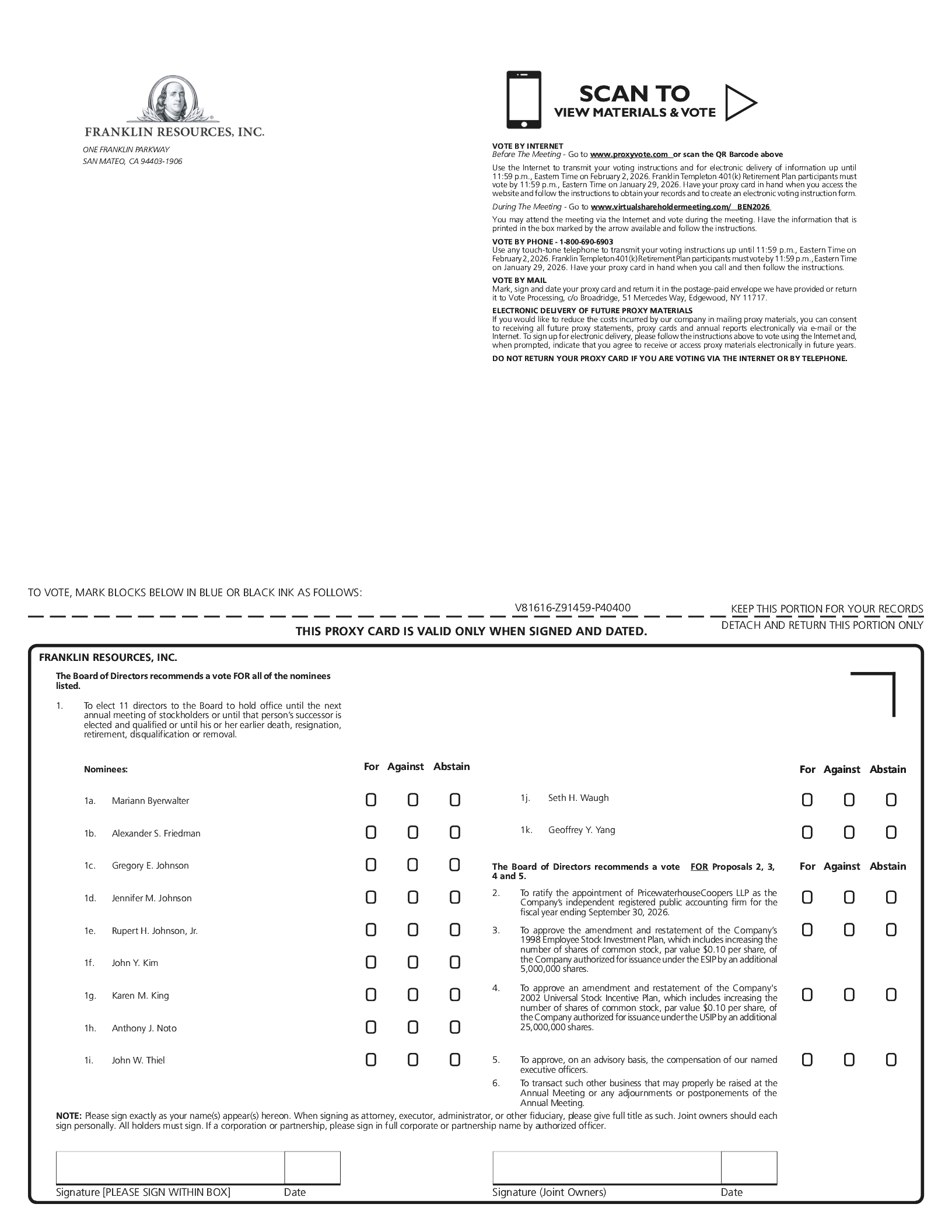
To elect 11 directors to the Board to hold office until the next annual meeting of stockholders or until that person’s successor is elected and qualified or until his or her earlier death, resignation, retirement, disqualification or removal.
For Further Details See page 7
FOR
each director nominee

2
To ratify the appointment of PricewaterhouseCoopers LLP as the Company’s independent registered public accounting firm for the fiscal year ending September 30, 2026.
For Further Details See page 72
FOR

3
To approve the amendment and restatement of the Company’s 1998 Employee Stock Investment Plan, which includes increasing the number of shares of common stock, par value $0.10 per share, of the Company authorized for issuance under the ESIP by an additional 5,000,000 shares.
For Further Details See page 73
FOR

4
To approve an amendment and restatement of the Company’s 2002 Universal Stock Incentive Plan , which includes increasing the number of shares of common stock, par value $0.10 per share, of the Company authorized for issuance under the USIP by an additional 25,000,000 shares.
For Further Details See page 79
FOR

5
To approve, on an advisory basis, the compensation of our named executive officers.
For Further Details See page 87
FOR

Stockholders will also transact such other business that may properly be raised at the Annual Meeting or any adjournments or postponements of the Annual Meeting.
We are furnishing proxy materials to our stockholders primarily via the Internet rather than mailing paper copies of the materials to each stockholder. By doing so, we save costs and reduce the environmental impact of our Annual Meeting. On December 22, 2025, we mailed to certain of our stockholders a Notice of Internet Availability of Proxy Materials (“Notice”) containing instructions on how to access our proxy materials and vote (online or by telephone). If you would like to request a paper copy of our proxy materials, follow the instructions in the Notice.
Important notice regarding the availability of proxy materials for the Annual Meeting to be held on February 3, 2026. The Notice, the Proxy Statement, and our 2025 Annual Report, are available online at www.proxyvote.com. These proxy materials are first being sent or made available to stockholders commencing on December 22, 2025.
Attendance at the Annual Meeting. The Annual Meeting is being conducted virtually. Stockholders of record as of the record date can attend the Annual online, vote their shares electronically, and submit questions during the meeting by by visiting www.virtualshareholdermeeting.com/BEN2026, We encourage you to allow ample time for online check-in, which will open at 7:45 a.m. Pacific Time.
By order of the Board of Directors,

Courtney A. Hoffmann
Secretary
December 22, 2025
San Mateo, California
ii
Franklin Resources

TABLE OF CONTENTS

Table of contents
2026 Proxy Statement
iii

TABLE OF CONTENTS

Proxy statement summary
December 22, 2025
Franklin Resources, Inc.
One Franklin Parkway
San Mateo, California 94403-1906
This Proxy Statement and the accompanying Notice of Annual Meeting of Stockholders are furnished in connection with the solicitation by the Board of Directors (the “Board”) of Franklin Resources, Inc., a Delaware corporation (the “Company”), of the accompanying proxy to be voted at the 2026 Annual Meeting of stockholders (the “Annual Meeting”), which will be held on Tuesday, February 3, 2026 at 8:00 a.m. Pacific Time. The Annual Meeting can be accessed by visiting www.virtualshareholdermeeting.com/BEN2026, where you will be able to listen to the meeting live and vote online. Please note that this is the only means of accessing the Annual Meeting and only stockholders of record as of the Record Date will be able to access the Annual Meeting. This Proxy Statement and the accompanying proxy card are being mailed and/or made available on or about December 22, 2025 to each stockholder entitled to vote at the Annual Meeting. References to “us,” “we” or “our” as used throughout this Proxy Statement mean the Company.
All materials filed by the Company with the U.S. Securities and Exchange Commission (the “SEC”) can be obtained through the SEC’s website at www.sec.gov.
2026 Annual meeting information
Date
Tuesday, February 3, 2026
8:00 a.m. Pacific Time
 
Virtual meeting
www.virtualshareholdermeeting.com/
BEN2026
We encourage you to allow ample time for online check-in, which will open at 7:45 a.m. Pacific Time.
 
Record date
Stockholders of record
on December 5, 2025
are entitled to vote.
 
Items of business
Proposals
Board
Recommendation
1
To elect 11 directors to the Board to hold office until the next annual meeting of stockholders or until that person’s successor is elected and qualified or until his or her earlier death, resignation, retirement, disqualification or removal.
For Further Details See page 7
FOR
each director nominee

2
To ratify the appointment of PricewaterhouseCoopers LLP as the Company’s independent registered public accounting firm for the fiscal year ending September 30, 2026.
For Further Details See page 72
FOR

3
To approve the amendment and restatement of the Company’s 1998 Employee Stock Investment Plan, which includes increasing the number of shares of common stock, par value $0.10 per share, of the Company authorized for issuance under the ESIP by an additional 5,000,000 shares.
For Further Details See page 73
FOR

4
To approve the amendment and restatement of the Company’s 2002 Universal Stock Incentive Plan (“USIP”), which includes increasing the number of shares of common stock, par value $0.10 per share, of the Company authorized for issuance under the USIP by an additional 25,000,000 shares.
For Further Details See page 79
FOR

5
To approve, on an advisory basis, the compensation of our named executive officers.
For Further Details See page 87
FOR


2026 Proxy Statement
1

TABLE OF CONTENTS

Business highlights
Who we are
We are a global investment management organization with over $1.66 trillion in assets under management (“AUM”) as of September 30, 2025. Our mission is to help clients achieve better outcomes through investment management expertise, wealth management and technology solutions. Through our specialist investment managers, we offer specialization on a global scale bringing extensive capabilities in equity, fixed income, alternatives and multi-asset solutions. For over 75 years, we have been committed to providing clients with exceptional investment management services and have developed a globally diversified business, including through strategic acquisitions.
Our strategy
We have continued the successful evolution of our company to benefit our clients and meet their own evolving needs and preferences in pursuit of their financial goals. That includes progress executing on our long-term plan of further diversifying our business across asset classes, vehicles and geographies—as well as increasing interconnectivity within our growing firm. From our expansion into alternative asset categories to solutions in the insurance and retirement channels and from private wealth management to customization and personalization to innovative technology-based solutions, we now offer comprehensive investment capabilities across public and private markets to clients around the world.
Fiscal year 2025 marked the first year of Franklin Templeton’s 5-Year Plan, and we've made great strides across a number of key strategic focus areas for the Company. The Company is ahead of the strategic plan for alternatives fundraising, Exchange Trade Funds (ETFs), and Canvas, and on track in the other areas.
For additional information about our strategic initiatives, please see “Compensation Discussion and Analysis – 1. Executive Summary – Executing on Corporate Strategy” and “Compensation Discussion and Analysis – 3. Fiscal Year 2025 Executive Compensation Decisions – Individual Accomplishments – Jennifer M. Johnson – Strategic Initiatives”
2
Franklin Resources

TABLE OF CONTENTS

SNAPSHOT OF OUR DIRECTORS
Name
Occupation
Age
Director
Since
Independent
Committees
Mariann Byerwalter
Chairman of the Board, Pacific Mutual Holding Company
65
2015

Audit, Corporate Governance
Alexander S. Friedman
Co-Founder and Co-Chief Executive Officer, Novata Inc.
55
2021

Audit, Corporate Governance
Gregory E. Johnson
Executive Chairman, Franklin Resources, Inc.
64
2007
 
 
Jennifer M. Johnson
Chief Executive Officer, Franklin Resources, Inc.
61
2020
 
 
Rupert H. Johnson, Jr.
Vice Chairman, Franklin Resources, Inc.
85
1971
 
 
John Y. Kim
Founder and Managing Partner, Brewer Lane Ventures LLC
65
2021

Compensation, Corporate Governance
Karen M. King
Managing Director and Chief Operating Officer, Silver Lake
53
2021

Audit, Compensation
Anthony J. Noto
Chief Executive Officer, SoFi Technologies, Inc.
57
2020

Audit, Corporate Governance
John W. Thiel
Executive Chairman & Founder, Indivisible Partners, LLC
65
2021

Audit, Compensation
Seth H. Waugh
Former Chief Executive Officer, The PGA of America
67
2015

Compensation
Geoffrey Y. Yang
Managing Director and Founding Partner of Redpoint Ventures
66
2011

Compensation, Corporate Governance
2026 Proxy Statement
3

TABLE OF CONTENTS


4
Franklin Resources

TABLE OF CONTENTS

CORPORATE GOVERNANCE HIGHLIGHTS
Our Board and its committees are committed to high standards of corporate governance and have adopted thoughtful and effective practices and processes consistent with, and supportive of, our strategic objectives.

Independent Oversight
• 
8 of 11 directors are independent
• 
Strong Independent Lead Director with clearly delineated duties
• 
Regular executive session of independent directors
• 
All standing Board committees are composed entirely of independent directors

Strong Corporate Governance Practices and Stockholder Rights
• 
“Proxy Access” right for stockholders
• 
No supermajority vote provisions
• 
Stockholders can act by written consent
• 
25% of shares can call a special meeting
• 
One-share, one-vote standard
• 
Overboarding limits
• 
Stock Ownership Guidelines
• 
Trading Blackout Policy and prohibitions against hedging and pledging transactions
• 
CEO and executive leadership succession planning

Accountability and Commitment to Continuous Improvement
• 
All directors are elected annually
• 
Robust annual Board and committee evaluations
• 
Active stockholder engagement
• 
Clawback Policy for executive officers
• 
Comprehensive Code of Ethics and Business Conduct
• 
Director orientation and continuing education programs
EXECUTIVE COMPENSATION HIGHLIGHTS

What We Do
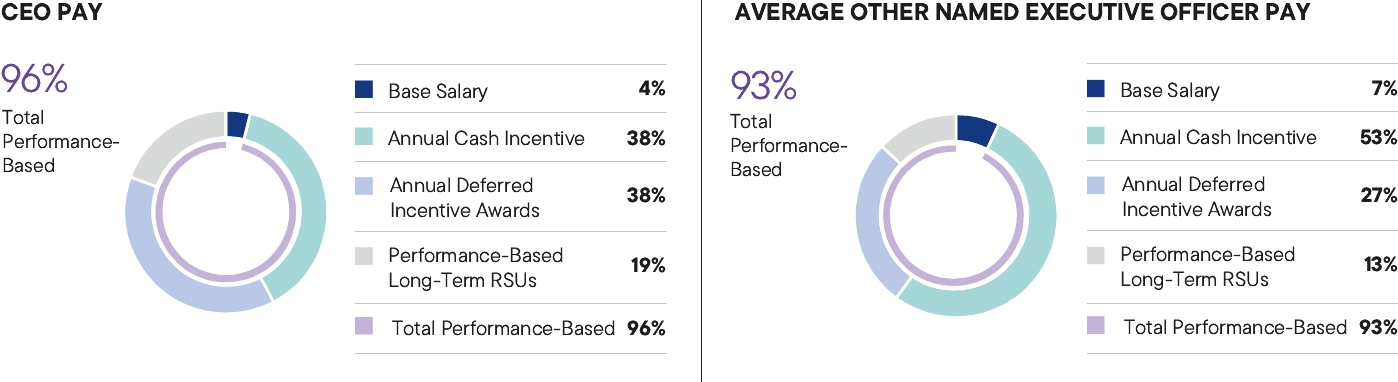
Align pay with performance: a significant portion of total compensation for all NEOs is performance-based
Grant long-term awards based on meaningful performance measures
Maintain clawback policies
Require significant stock ownership
Limit perquisites
Retain an independent consultant to the Compensation Committee
Regularly review incentive compensation plans and compensation practices
Engage with stockholders regarding compensation practices

What We Don’t Do
Provide excessive severance benefits
Enter into change in control agreements with NEOs
Provide excise tax gross-ups
Reprice underwater stock options
Permit hedging of Company stock
Allow pledging of Company stock received as compensation
Offer executive-specific retirement plans
Pay dividends or dividend equivalents to NEOs on unvested performance shares
2026 Proxy Statement
5

TABLE OF CONTENTS


 CEO
 Compensation
Other NEOs
Compensation
Pay Type
Pay Element
Purpose
Base
Salary


Fixed
Cash
 Provides fixed pay for performing day-to-day responsibilities
Short-Term
Incentive


At Risk
Performance-
Based Variable
Compensation
Cash
 Performance-based variable compensation reinforces our pay-for-performance culture

 Recognizes current year achievement of goals and objectives

 Total award amount determined and divided into short and long-term incentives

 All long-term incentive awards are subject to malus and clawback provisions
Long-Term
Incentive


Time-Based Restricted Stock
Units

Performance-Based Share
Units
 
2025 STOCKHOLDER ENGAGEMENT
We engage with stockholders to provide multiple opportunities for them to express their views so that we may consider those views as we evaluate our governance practices, executive compensation program and other matters of interest to stockholders. We value our stockholders’ feedback and we are committed to maintaining an active dialogue to ensure that we understand the priorities and concerns of our stockholders. In fiscal year 2025, we contacted our top 15 institutional shareholders, representing approximately 30% of our outstanding shares, and approximately 50% of our outstanding shares held by persons or entities other than Messrs. Charles B. Johnson and Rupert H. Johnson, Jr. and held meetings with the nine of these shareholders who requested to meet with us. Our outreach to stockholders focused on corporate governance, succession planning, director tenure and sustainability. No concerns regarding executive compensation were raised during these engagements.
6
Franklin Resources

TABLE OF CONTENTS

PROPOSAL NO. 1:
Election of directors
The Board, upon the recommendation of the Corporate Governance Committee has nominated the following 11 candidates for election as members of the Board to serve until the next annual meeting of stockholders and until their respective successors are elected and qualified or until their earlier death, resignation, retirement, disqualification or removal.
Recommendation of
the board


FOR
The Board of Directors recommends a vote “FOR” the election to the Board of each of the nominees listed below. The voting requirements for this proposal are described in the “Questions and Answers” section.
Name
Occupation
Age
Director
Since
Independent
Committees
Mariann Byerwalter
Chairman of the Board, Pacific Mutual Holding Company
65
2015

Audit, Corporate Governance
Alexander S. Friedman
Co-Founder and Co-Chief Executive Officer, Novata Inc.
55
2021

Audit, Corporate Governance
Gregory E. Johnson
Executive Chairman, Franklin Resources, Inc.
64
2007
 
 
Jennifer M. Johnson
Chief Executive Officer, Franklin Resources, Inc.
61
2020
 
 
Rupert H. Johnson, Jr.
Vice Chairman, Franklin Resources, Inc.
85
1971
 
 
John Y. Kim
Founder and Managing Partner, Brewer Lane Ventures LLC
65
2021

Compensation, Corporate Governance
Karen M. King
Managing Director and Chief Operating Officer, Silver Lake
53
2021

Audit, Compensation
Anthony J. Noto
Chief Executive Officer, SoFi Technologies, Inc.
57
2020

Audit, Corporate Governance
John W. Thiel
Executive Chairman & Founder, Indivisible Partners, LLC
65
2021

Audit, Compensation
Seth H. Waugh
Former Chief Executive Officer, The PGA of America
67
2015

Compensation
Geoffrey Y. Yang
Managing Director and Founding Partner of Redpoint Ventures
66
2011

Compensation, Corporate Governance
All nominees are current directors of the Company who were elected by stockholders. If any nominee becomes unable to serve, proxies will be voted for the election of such other person as the Board may designate, unless the Board chooses to reduce the number of directors. Each of the nominees has consented to serve as a nominee, to be named in this Proxy Statement, and to serve on the Board if elected.
2026 Proxy Statement
7

TABLE OF CONTENTS

PROPOSAL 1 ELECTION OF DIRECTORS
Board attributes

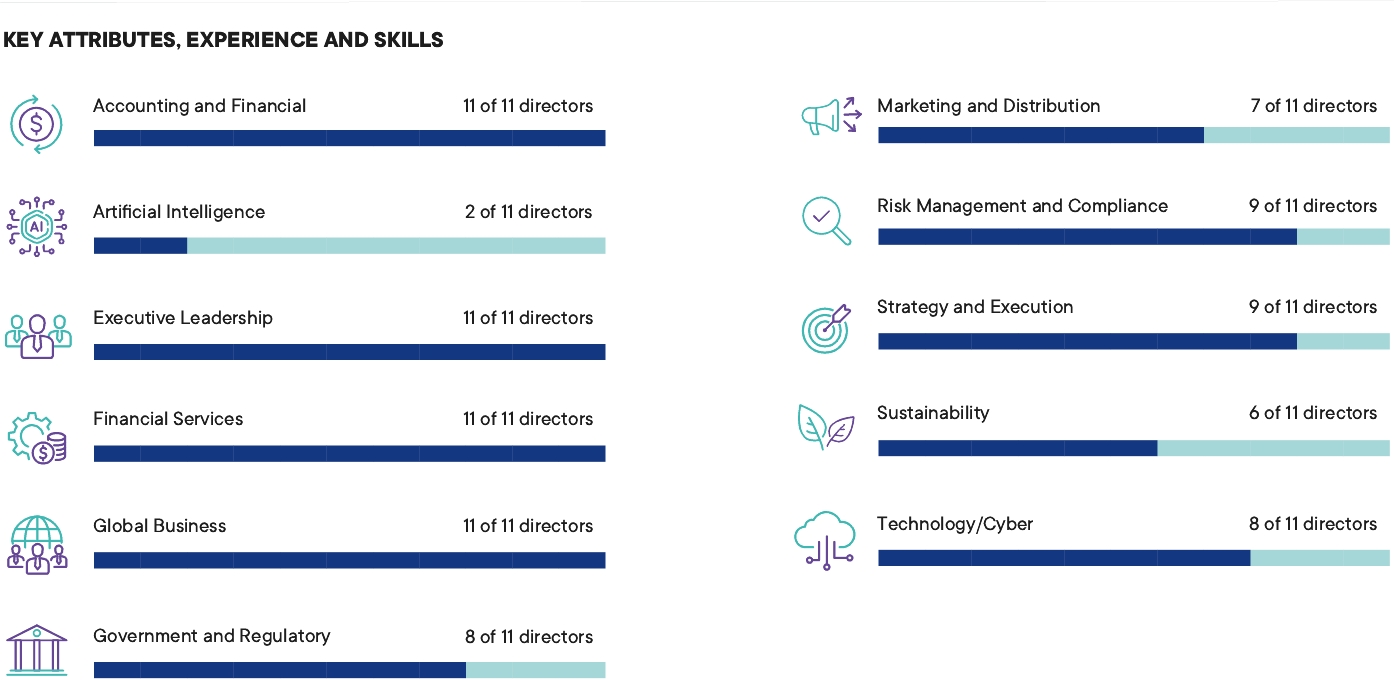
Board skills and expertise
The Corporate Governance Committee and the Board believe that the director nominees have the requisite experience, qualifications, attributes and skills to provide the Company with effective oversight of a global investment management organization and to support the Company’s strategy. Summarized below are certain key skills (and qualifications) that led the Board, as recommended by the Corporate Governance Committee, to nominate each candidate for election.

8
Franklin Resources

TABLE OF CONTENTS

PROPOSAL 1 ELECTION OF DIRECTORS
Director Nominee Biographies

Board committees:
Audit
Corporate Governance
Key attributes:
Accounting and Financial
Executive Leadership
Financial Services
Strategy and Execution
Global Business
Government and Regulatory
Sustainability
Risk Management and Compliance
Mariann Byerwalter
Independent Lead Director
Age: 65
Director since: 2015
Career highlights:
Chairman of the Board of Directors of Pacific Mutual Holding Company since 2022
Chairman Emeritus of the Board of Directors of SRI International, having served as Chairman from January 2014 through December 2019
Chairman of JDN Corporate Advisory, LLC, a privately held advisory services firm, since 2001
From 2006 to 2013, Chairman of the Board of Directors of Stanford Healthcare, and from January 2016 to July 2016, Interim President and Chief Executive Officer and President of Stanford Healthcare. Served on the Stanford Health Care Board of Directors from 1999 to 2013 and from 2015 until September 2024
From 1996 to 2001, she served as the Chief Financial Officer, Vice President for Business Affairs and Special Assistant to the President of Stanford University
Partner and co-founder of America First Financial Corporation from 1987 to 1996
Director, Redwood Trust, Inc. from 1998 to June 2020
Trustee of various investment companies affiliated with Charles Schwab Corporation
Key attributes, experience and skills:
Ms. Byerwalter’s significant financial expertise provides the Board with valuable perspectives on finance, accounting and investment management matters. From her leadership roles at Stanford University and several financial institutions she has a deep understanding of accounting and strategic planning as well as wide-ranging management expertise. Ms. Byerwalter’s current and prior service on the boards of private and public companies as well as with non-profit organizations including SRI International, Pacific LifeCorp and Pacific Mutual Holding Company, Burlington Capital Group, Lyric.ai, Stanford Healthcare, Lucile Packard Children’s Hospital, and the Stanford University Board of Trustees also provides our Board with the benefit of her perspectives on business, corporate governance and citizenship.

Board committees:
Audit CHAIR
Corporate Governance
Key attributes:
Accounting and Financial
Executive Leadership
Financial Services
Strategy and Execution
Global Business
Marketing and Distribution
Government and Regulatory
Sustainability
Risk Management and Compliance
Technology/Cyber
Alexander S. Friedman
Independent
Age: 55
Director since: 2021
Career highlights:
Co-Founder and Co-Chief Executive Officer of Novata Inc., a public benefit corporation committed to simplifying the process of collecting, analyzing and benchmarking sustainability data since 2021
Co-Founded Jackson Hole Economics, a non-profit private economic research firm, in January 2019
Chief Executive Officer of GAM Holding AG, a publicly listed international investment management firm, from September 2014 to November 2018
Global Chief Investment Officer of UBS AG Wealth Management and Wealth Management Americas, Chairman of the UBS Global Investment Committee and Group Managing Director from February 2010 to September 2014
Chief Financial Officer of the Bill & Melinda Gates Foundation from March 2007 to February 2010
Director, Investment Banking at Lazard from June 2001 to March 2007
Key attributes, experience and skills:
Mr. Friedman’s experience as a senior business leader with two decades of experience growing and transforming businesses in the financial services industry, and as the senior financial executive of the world’s largest foundation, provides the Board with valuable insights on financial matters, investment and wealth management, strategic planning and operational integration and development. Mr. Friedman is a member of the Council on Foreign Relations, and also serves on the advisory council of Social Finance, a non-profit organization dedicated to mobilizing capital to drive social progress, and the advisory board of America Needs You, a non-profit organization focused on college access for first generation college students.
2026 Proxy Statement
9

TABLE OF CONTENTS

PROPOSAL 1 ELECTION OF DIRECTORS

Key attributes:
Accounting and Financial
Artificial Intelligence
Executive Leadership
Financial Services
Global Business
Marketing and Distribution
Risk Management and Compliance
Strategy and Execution
Sustainability
Technology/Cyber
Gregory E. Johnson
Career highlights:
Age: 64
Director since: 2007
Executive Chairman since February 2020, Chairman of the Board since June 2013 and director of the Company since January 2007
Chairman of the San Francisco Giants, a professional baseball team, since November 2019
Chief Executive Officer of the Company from July 2005 to February 2020
Co-Chief Executive Officer of the Company from January 2004 to July 2005
President of the Company from December 1999 to September 2015
Officer and/or director of certain subsidiaries of the Company
Director or trustee of certain funds registered as investment companies managed or advised by subsidiaries of the Company
Key attributes, experience and skills:
Mr. G. Johnson brings leadership and extensive business and operating experience, as well as significant knowledge of our Company and the global fund management industry, to the Board. Mr. G. Johnson is a Certified Public Accountant and prior to joining the Company, was a senior accountant with Coopers & Lybrand. Over his 30-year tenure with the Company, Mr. G. Johnson has held officer and director positions with various subsidiaries of the Company; hands-on experience that provides him with in-depth knowledge of the Company’s operations. Mr. G. Johnson’s presence on the Board provides the Board with management’s current perspectives on the Company’s business and strategic vision for the Company. Mr. G. Johnson’s service on various boards of industry organizations, including the Investment Company Institute’s Board of Governors, also provides the Board with the benefit of additional perspectives on industry developments, including regulatory and policy issues. He is a past Chairman and Vice Chairman of the Investment Company Institute and currently serves on its Executive Committee.

Key attributes:
Accounting and Financial
Artificial Intelligence
Executive Leadership
Financial Services
Global Business
Government and Regulatory
Marketing and Distribution
Risk Management and Compliance
Strategy and Execution
Sustainability
Technology/Cyber
Jennifer M. Johnson
Career highlights:
Age: 61
Director since: 2020
Chief Executive Officer and Director since February 2020 and President of the Company from December 2016 to October 2025
Chief Operating Officer of the Company from February 2017 to February 2020
Co-President of the Company from October 2015 to December 2016
Executive Vice President and Chief Operating Officer of the Company from March 2010 to September 2015
Executive Vice President – Operations and Technology of the Company from December 2005 to March 2010
Senior Vice President and Chief Information Officer of the Company from May 2003 to December 2005
Officer and/or director of certain subsidiaries of the Company, including certain of the specialist investment managers acquired through the Legg Mason transaction
Director or trustee of certain funds registered as investment companies managed or advised by subsidiaries of the Company
Director of Thermo Fisher Scientific Inc., a science service company since July 2023
Key attributes, experience and skills:
Ms. Johnson brings significant experience leading and working with all parts of our business, as well as extensive knowledge of the global investment management industry. Over her 35-year tenure with the Company, Ms. Johnson has held leadership roles in all major divisions of the business, including investment management, global distribution, customer service, fund administration, global technology, and the Company’s high-net-worth business. This extensive hands-on experience provides her with in-depth knowledge of the Company’s operations. She has been a key driver of many key acquisitions, including the acquisitions of Legg Mason in 2020 and Putnam Investments in 2024, as well as the expansion of the Company’s alternative investment capabilities through the acquisitions of Lexington Partners in April 2022 and Alcentra in November 2022. Under Ms. Johnson’s leadership, the Company continues to invest strategically in areas designed to deliver strong client results, including financial technology and investment data science.
10
Franklin Resources

TABLE OF CONTENTS

PROPOSAL 1 ELECTION OF DIRECTORS

Key attributes
Accounting and Financial
Executive Leadership
Financial Services
Global Business
Risk Management and Compliance
Rupert H. Johnson, Jr.
Career highlights:
Age: 85
Director since: 1971
Vice Chairman of the Company since December 1999 and director of the Company since 1971
Officer and/or director of certain subsidiaries of the Company
Officer and/or director or trustee of certain funds registered as investment companies managed or advised by subsidiaries of the Company
Key attributes, experience and skills:
Mr. R.H. Johnson, Jr.’s service as Vice Chairman of the Company and as an officer, director or trustee of various subsidiaries of the Company and Franklin Templeton mutual funds since its inception provides the Board with significant knowledge of and insights into the Company and the global fund management industry in which we operate. His fundamental knowledge of the Company gained over 60 years gives him an important perspective on the Company and provides significant leadership, business and operational expertise to the Board. Mr. R. H. Johnson, Jr. has served on various industry boards and committees addressing investment company issues including the Board of Governors of the Investment Company Institute. In his capacity with the Company, he has served as Director of Research and is a portfolio manager for one of its funds. He provides the Board with a unique perspective on critical components of the Company’s business.

Board committees:
Compensation
Corporate Governance
Key attributes:
Accounting and Financial
Executive Leadership
Financial Services
Global Business
Government and Regulatory
Risk Management and Compliance
Strategy and Execution
Technology/Cyber
John Y. Kim
Independent
Age: 65
Director since: 2021
Career highlights:
Founder and Managing Partner of Brewer Lane Ventures LLC, an early stage fintech venture capital firm, since 2019
President of New York Life Insurance Company from 2015 to 2018
Chief Executive Officer and Chief Investment Officer of New York Life Investment Management from 2008 to 2015
President of Prudential Retirement from 2004 to 2007
President of Cigna Investments and Retirement from 2002 to 2004
Chief Executive Officer of Bondbook, a financial technology company, from 2001 to 2002
Chief Executive Officer and Chief Investment Officer of Aeltus Investment Management, an investment subsidiary of Aetna, from 1994 to 2000
Board of Trustees, Eversource Energy since 2018
Director of FiServ, a global provider of financial services technology, from 2016 to 2018
Key attributes, experience and skills:
Mr. Kim brings leadership and extensive business and technology experience to the Board, including direct management of asset management firms. In addition, Mr. Kim’s significant experience as chief executive officer of a variety of companies provides valuable insights into leadership, growth, and strategy. Mr. Kim currently serves on the boards of several privately held technology startup companies in FinTech including—Cowbell, Ease Capital, Exos, Kingfield, Ladder Financial, Inc. and Socotra. His service on various public and private boards of industry organizations provides additional perspectives on asset management, insurance, and technology.
2026 Proxy Statement
11

TABLE OF CONTENTS

PROPOSAL 1 ELECTION OF DIRECTORS

Board committees:
Audit
Compensation
Key attributes:
Accounting and Financial
Executive Leadership
Financial Services
Global Business
Government and Regulatory
Risk Management and Compliance
Sustainability
Technology/Cyber
Karen M. King
Independent
Age: 53
Director since: 2021
Career highlights:
Managing Director and Chief Operating Officer of Silver Lake, a global investment firm focused on large-scale opportunities in the technology, technology-enabled, and related growth sectors
Formerly held a variety of roles at Silver Lake since 2004
Key attributes, experience and skills:
Ms. King’s experience with Silver Lake provides the Board with valuable perspective and experience in the alternative investments area, specifically in the private equity space, as well as strategic matters relating to M&A activity and fundraising transactions. Her management experience at Silver Lake also provides the Board with an additional perspective on regulatory matters and cybersecurity matters. Ms. King’s involvement with Silver Lake’s portfolio companies, including as a current member of the board of directors of Relativity, Qualtrics and Endeavor, acting as an Advisor to Eudia (formerly Cicero) and previous service on the boards of Aras and Serena Software, as well as her service on various non-profit boards, including the Duke University Board of Trustees, United States Olympic and Paralympic Foundation and as former Chair of the American Leadership Forum—Silicon Valley and former Chair of the Menlo School Board of Trustees, provides the board with additional perspectives on governance.

Board committees:
Audit
Corporate Governance
Key attributes:
Accounting and Financial
Executive Leadership
Financial Services
Global Business
Government and Regulatory
Marketing and Distribution
Risk Management and Compliance
Strategy and Execution
Sustainability
Technology/Cyber
Anthony J. Noto
Independent
Age: 57
Director since: 2020
Career highlights:
Chief Executive Officer and a director of SoFi Technologies, Inc. (SoFi), a digital financial services company, since March 1, 2018
Director of Warner Bros. Discovery, Inc. since January 2025
Chief Operations Officer from 2017 until 2018, Chief Operations Officer and Chief Financial Officer from 2016 to 2017, and Chief Financial Officer from 2014 to 2016, of Twitter, Inc., a global social media company
Partner, Co-Head, Global Technology, Media and Telecom Investment Banking from 2011 to 2014, and Partner, Investment Banking Division from 2010 to 2011, at Goldman Sachs & Co
Chief Financial Officer from 2008 to 2010 of the National Football League
Key attributes, experience and skills:
As Chief Executive Officer of SoFi, Mr. Noto brings valuable fintech industry experience. He has overseen SoFi’s expansion from a desktop lending business to a broad-based, mobile-first personal financial platform, offering users investment products including stocks, ETFs, cryptocurrency trading, as well as loans and cash management accounts. He also brings valuable leadership, strategic, financial and operations experience, having previously served as Chief Operating Officer and Chief Financial Officer of Twitter, Inc., and as Chief Financial Officer of the National Football League. During his nearly 13 years at Goldman Sachs & Co., Mr. Noto developed a deep understanding of the technology, media and telecommunications industries, including serving as Co-Head of Global Technology, Media and Telecommunications Investment Banking, and Co-Head of Communications, Media and Entertainment Investment Research. His current and prior experience provides the Board with the benefit of his perspective on trends in the financial industry, including developments in the fintech and social media spaces, and finance matters.
12
Franklin Resources

TABLE OF CONTENTS

PROPOSAL 1 ELECTION OF DIRECTORS

Board committees:
Audit
Compensation
Key attributes:
Accounting and Financial
Executive Leadership
Financial Services
Global Business
Government and Regulatory
Marketing and Distribution
Strategy and Execution
John W. Thiel
Independent
Age: 65
Director since: 2021
Career highlights:
Executive Chairman and Founder of Indivisible Partners, LLC, a registered investment adviser, since January 2025
Partner and Senior Advisor with MyNextSeason, an executive coaching firm, since 2018
Formerly with Bank of America Merrill Lynch Wealth Management from 1989 to 2018, serving as Vice Chairman of Global Wealth and Investment Management of Bank of America Merrill Lynch from 2017 to 2018
Head of Merrill Lynch Wealth Management from 2011 to 2016
Head of Private Banking and Investment Group at Merrill Lynch Wealth Management from 2005 to 2011
Pacific West Regional Managing Director of Private Banking and Investment Group at Merrill Lynch Wealth Management from 2001 to 2005
Market Executive at Merrill Lynch Wealth Management from 1997 to 2001
District Sales Manager at Merrill Lynch Wealth Management from 1995 to 1997
Financial Advisor at Merrill Lynch Wealth Management from 1989 to 1995
Key attributes, experience and skills:
Mr. Thiel brings deep global leadership and extensive asset, investment and distribution management expertise to the Board as well as operating experience, including navigating complex relationships. Client-focused, Mr. Thiel is recognized as a transformative leader who, during his tenure at Merrill Lynch, accelerated growth and drove dramatic cultural and strategic transformation while forming effective internal and external partnerships. He is a director of Cohen & Steers Income Opportunities REIT, Inc. and Executive Chairman of Forabaya, LLC. Mr. Thiel’s long-term commitment to philanthropy and his community includes service on the board of V Foundation for Cancer Research, and as the chair of Don’t Ever Give Up, Inc.

Board committees:
Compensation CHAIR
Key attributes:
Accounting and Financial
Executive Leadership
Financial Services
Global Business
Marketing and Distribution
Strategy and Execution
Technology/Cyber
Seth H. Waugh
Independent
Age: 67
Director since: 2015
Career highlights:
Former Chief Executive Officer and current Senior Adviser of The PGA of America, an American organization of golf professionals, since 2018
Former Managing Director, Partner and current Senior Advisor at Silver Lake since 2017
Non-executive chairman of Alex. Brown, a division of Raymond James, from 2016 to 2019
Vice Chairman of Florida East Coast Industries, LLC, the parent company of several commercial real estate, transportation and infrastructure companies based in Florida, from 2013 to 2017
From 2000 to 2013, Mr. Waugh served in various roles at Deutsche Bank Americas, including Chief Executive Officer and Chairman of the Board of Directors of Deutsche Bank Securities Inc.
Chief Executive Officer of Quantitative Financial Strategies, a hedge fund
Served in various capacities at Merrill Lynch over 11 years, including Co-head of Global Debt Markets
Director of Yext, Inc. since 2020
Key attributes, experience and skills:
Mr. Waugh’s significant experience in the financial sector provides the Board with valuable perspectives on capital markets and investment management. Having held various leadership roles at Deutsche Bank and other financial institutions, Mr. Waugh brings strong leadership skills as well as deep knowledge of operational and strategic matters to the Board. His prior service on the boards of the Deutsche Bank Americas Advisory Board, the Deutsche Bank Americas Foundation, The Clearing House, the Financial Services Forum and the Board of Governors of FINRA provides our Board with the benefit of his substantial expertise in financial industry developments and corporate citizenship.
2026 Proxy Statement
13

TABLE OF CONTENTS

PROPOSAL 1 ELECTION OF DIRECTORS

Board committees:
Compensation
Corporate Governance CHAIR
Key attributes:
Accounting and Financial
Executive Leadership
Financial Services
Global Business
Government and Regulatory
Marketing and Distribution
Risk Management and Compliance
Strategy and Execution
Technology/Cyber
Geoffrey Y. Yang
Independent
Age: 66
Director since: 2011
Career highlights:
Managing Director and Founding Partner of Redpoint Ventures, a private equity and venture capital firm, since 1999
General Partner with Institutional Venture Partners from 1987 to 1999
Director of Warner Bros. Discovery, Inc. since April 2022
Director of Silver Lake Private Equity, L.P since May 2025
Director of AT&T, Inc. from July 2016 to April 2022
Director of Liberty Media Acquisition Corp. from January 2021 to December 2022
Director of BigBand Networks from 1999 to 2011
Director of Ask Jeeves 1999 to 2004
Director of TiVo from 1997 to 2009
A member of the President’s Information Technology Advisory Committee for the United States from 2003-2007
Key attributes, experience and skills:
Mr. Yang’s experience as a Managing Director of Redpoint Ventures provides the Board with valuable perspectives on financial and strategic matters as well as expertise in the capital markets. Mr. Yang co-founded Redpoint Ventures in 1999, after having previously been a General Partner with IVP since 1987. With approximately $7 billion of capital under management, Redpoint invests in venture capital and early growth stage technology companies. Some of the companies in which Redpoint has invested include DraftKings, Hashicorp, Netflix, Snowflake, Stripe and Twilio. In addition, Mr. Yang is the CEO/founder of Performance Health Sciences (d/b/a Apeiron Life), the CEO/founder of The Odds, the Chairman/founder of Rock the Bells, the Chairman/Founder of Sake Ono, and serves on the board of these companies as well as Esquel and Scribd. These experiences bring strategic direction, growth and technology expertise to the Board. Mr. Yang’s current and prior service on the boards of several private and public companies as well as with non-profit organizations including as current Chairman of the U.S. Olympic and Paralympic Foundation, the Naval Postgraduate Advisory Board, the Workday CEO Advisory Board, the President’s Advisory Committee at Princeton University, McLaren Advisory Team, and formerly serving on the Advisory Council for the Stanford Graduate School of Business, the U.S. Golf Association, and the U.S. Ski and Snowboard Foundation provides our Board with the benefit of his perspectives on business, corporate governance and citizenship, and finance.
Family relationships
Jennifer M. Johnson and Gregory E. Johnson are siblings, and their uncle is Rupert H. Johnson, Jr. Each serves as both a director and an executive officer of the Company.
14
Franklin Resources

TABLE OF CONTENTS

PROPOSAL 1 ELECTION OF DIRECTORS
Director independence
The Board has adopted Director Independence Standards for determining whether a director is independent, which are posted in the corporate governance section of the Company’s website. The Board will monitor and review as necessary, but at least once annually, commercial, charitable, family and other relationships that directors have with the Company to determine whether the Company’s directors are independent. For purposes of the Company’s Director Independence Standards, the “Company” refers to Franklin Resources, Inc. and its consolidated subsidiaries.
For a director to be considered independent, the Board must affirmatively determine that the director does not have material relationships with the Company either directly, or as a partner, stockholder or officer of an organization that has a relationship with the Company. Such determination will be made and disclosed pursuant to applicable NYSE listing standards, together with such other requirements imposed by applicable law or regulation. A material relationship can include, but is not limited to, commercial, industrial, banking, consulting, legal, accounting, charitable and family relationships.
In accordance with the Company’s Director Independence Standards, described more fully below, and the rules of the NYSE, the Board has affirmatively determined that it is currently composed of a majority of independent directors, and that the following director nominees are independent and do not have a material relationship with the Company:
• 
Mariann Byerwalter
• 
Alexander S. Friedman
• 
John Y. Kim
• 
Karen M. King
• 
Anthony J. Noto
• 
John W. Thiel
• 
Seth H. Waugh
• 
Geoffrey Y. Yang
As part of its determination, the Board considered the transactions and relationships described below under “Compensation Committee Interlocks and Insider Participation” and “Certain Relationships and Related Transactions” and applied our Director Independence Standards as adopted by the Board, which includes categorical standards to assist the Board in making independence determinations and specifies the types of relationships that are deemed not material and, therefore, not considered each year.
As considered and described under “Certain Relationships and Related Transactions,” from time to time, our directors, executive officers and employees, members of their immediate families and companies, affiliates of companies or investment vehicles managed by companies that employ or are associated with our directors may have investments in various investment vehicles or accounts sponsored or managed by the Company’s specialist investment managers (“SIMs”) or other subsidiaries or utilize our products or services in the ordinary course of business on substantially the same terms as those prevailing at the time for comparable products or services provided to unaffiliated third parties. In addition, in the ordinary course of business, our SIMs or other subsidiaries may from time to time invest client assets in companies in which certain of our directors may be a director or in which certain affiliates of our directors may be significant stockholders or invest client assets in funds and other investment vehicles managed by entities affiliated with certain of our directors.
2026 Proxy Statement
15

TABLE OF CONTENTS

Corporate governance
Board leadership structure
Mr. Gregory E. Johnson has served as Chairman of the Board since June 2013 and Executive Chairman of the Company since February 2020. Our CEO, Ms. Jennifer M. Johnson, serves as a director, but does not have a chair or lead director role on the Board. Ms. Mariann Byerwalter was selected by the independent directors as the Lead Director. The Board believes that its leadership structure strengthens the Board’s ability to focus on key risk, business and strategic issues and helps the Company operate in the long-term interests of stockholders.
The duties of the Lead Director are set forth in the Lead Director Charter available on the Company’s website and include:
presiding at the executive sessions of the independent directors and of the non-employee directors of the Board;
presiding at meetings of the Board in the absence of the Chairman and Vice Chairman of the Board or upon the request of the Chairman;
calling meetings of the independent directors and non-employee directors of the Board, as appropriate;
serving as a liaison to facilitate communications between other members of the Board and the Chairman, the Vice Chairman, the CEO and the President, without inhibiting direct communications between and among such persons;
advising and consulting with the Chairman and CEO on, and approving, Board and committee meeting schedules, including the need for special meetings as appropriate, and Board and committee meeting agenda items, to help ensure that appropriate items are brought forward for Board and committee consideration and appropriate time is apportioned for discussion;
advising and consulting with the Chairman and CEO on the general scope and type of information to be provided in advance and/or to be presented at Board meetings;
in coordination with the Chairman, serving as a liaison to stockholders who request direct communications and consultation with the Board or otherwise delegating such task to an appropriate member of the Board based on the circumstances;
consulting with outside counsel and other advisors as he or she deems appropriate in fulfilling the Lead Director role;
collaborating with the Compensation Committee on the annual performance evaluation of the CEO; and
collaborating with the Corporate Governance Committee on matters related to Board effectiveness and independence including the performance and structure of the Board and its committees, and the performance of individual directors.
The Board does not have a fixed policy regarding the separation of the offices of the Chairman and CEO and the Corporate Governance Committee reviews the Board’s leadership structure annually with the Board. The Board believes that the current structure is appropriate because it facilitates clear leadership for the strategic vision, management and operations of the Company while maintaining effective independent oversight of management and the Company’s strategy, risk management and operations. The Board also believes this structure allows for robust and frequent communication between the Board’s independent directors and management, enabling the Board to gain a deeper understanding of the Company and work with management to enhance shareholder value. However, the Board recognizes that the optimal leadership structure may change as circumstances evolve.
16
Franklin Resources

TABLE OF CONTENTS

Information about the board and its committees
Board committees
Committee membership and meetings
The current standing committees of the Board are the Audit Committee, the Compensation Committee and the Corporate Governance Committee. Each committee is composed entirely of directors who meet the applicable independence requirements under the NYSE listing standards and the Director Independence Standards established by the Board. The table below provides current membership and meeting information.
 
Audit
Compensation
Corporate
Governance
Mariann Byerwalter
Alexander S. Friedman
CHAIR
John Y. Kim
Karen M. King
Anthony J. Noto
John W. Thiel
Seth H. Waugh
CHAIR
Geoffrey Y. Yang
CHAIR
Fiscal year 2025 Meetings
5
7
3
The key responsibilities, recent activities and focus areas of each committee are summarized below. Each committee’s written charter is available on the corporate governance section of the Company’s website at www.franklinresources.com (the “Company’s website”)
2026 Proxy Statement
17

TABLE OF CONTENTS

INFORMATION ABOUT THE BOARD AND ITS COMMITTEES
The audit committee
Members:

Alexander S. FriedmanCHAIR

Mariann Byerwalter

Karen M. King

Anthony J. Noto

John W. Thiel

The Board has determined that each Audit Committee member is financially literate under the NYSE listing standards and is an audit committee financial expert within the meaning of the rules of the SEC.

Number of meetings in
fiscal year 2025: 5
Key responsibilities:

  
Overseeing Company’s financial reporting, auditing and internal control activities, including the integrity of the Company’s financial statements.
  
Reviewing the qualifications, independence, and performance of the independent auditor, and being responsible for the appointment, compensation, retention and oversight of the work of the independent auditor, including approval of all services and fees of the independent auditor.
  
Overseeing the performance of the internal audit function.
  
Reviewing the anti-money laundering policies, procedures and operations of the Company on a periodic basis.
  
Preparing the Report of the Audit Committee included in the Company’s annual proxy statement.
  
Overseeing the Company’s compliance with legal and regulatory requirements.
  
Assisting the Board in reviewing the Company’s enterprise risk assessment and risk management program with respect to key risks, including risks related to cybersecurity (as described more fully below under “Risk Management and the Board’s Role in Risk Oversight”).
18
Franklin Resources

TABLE OF CONTENTS

INFORMATION ABOUT THE BOARD AND ITS COMMITTEES
The compensation committee
Members:

Seth H. Waugh, CHAIR

John Y. Kim

Karen M. King

John W. Thiel

Geoffrey Y. Yang

Number of meetings in
fiscal year 2025: 7
Key responsibilities:

  
Overseeing the establishment of goals and objectives related to CEO compensation, determining the compensation of the CEO, and discharging the responsibilities of the Board relating to compensation of the Company’s executive officers.
  
Assisting the Board in fulfilling its responsibilities relating to management succession planning.
  
Administering, reviewing and recommending applicable amendments to the Company’s “clawback” policies for recovering incentive-based compensation.
  
Reviewing and approving compensation arrangements between the Company and members of the Board.
  
Reviewing and discussing with management proposed Compensation Discussion and Analysis disclosure and determining whether to recommend it to the Board for inclusion in the Company’s proxy statement.
  
Preparing the Compensation Committee Report regarding executive compensation matters for the Company’s proxy statement.
The Compensation Committee generally adheres to the following processes and procedures in connection with the consideration and determination of the compensation of the Company’s executive officers and directors.
Determination of Executive Compensation. The Compensation Committee meets periodically throughout the year to (i) review and approve corporate goals and objectives relevant to the compensation of the executive officers, (ii) evaluate the performance of the executive officers in light of those goals and objectives, and (iii) determine and approve the compensation of the executive officers. For a detailed description regarding the Compensation Committee’s role in setting executive compensation, including the role of the Compensation Committee’s compensation consultant and the Chief Executive Officer (“CEO”) in the process, see “Compensation Discussion and Analysis”.
Determination of Non-executive Director Compensation. The Compensation Committee meets at least annually to review and make recommendations to the Board on the compensation (including equity-based compensation) of the Company’s non-executive directors. In reviewing and making recommendations on non-executive director compensation, the Compensation Committee considers, among other things, the following policies and principles:
that the compensation should fairly pay the directors for the work, time commitment and efforts required by directors of an organization of the Company’s size and scope of business activities, including service on Board committees;
that a component of the compensation should be designed to align the directors’ interests with the long-term interests of the Company’s stockholders; and
that directors’ independence may be compromised or impaired for Board or committee purposes if director compensation exceeds customary levels.
As a part of its review, the Compensation Committee receives a report from its independent consultant on comparable non-executive director compensation practices and levels. No executive officer of the Company is involved in determining or recommending non-executive director compensation levels. For a description regarding the role and scope of assignment of the Compensation Committee’s compensation consultant with respect to executive compensation, see “Compensation Discussion and Analysis” below. See the section of this Proxy Statement titled “Director Fees” below, for a discussion of compensation paid to the Company’s directors during fiscal year 2025. Directors who are executives of the Company do not receive compensation for their Board service.
Incentive Plan Matters. The Compensation Committee also administers, among other plans and awards, the Company’s Amended and Restated Annual Incentive Compensation Plan, the 2002 Universal Stock Incentive Plan, the Amended and Restated 1998 Employee Stock Investment Plan and the Amended and Restated 2017 Equity Incentive Plan. We refer to the 2002 Universal Stock Incentive Plan, the Amended and Restated 1998 Employee Stock Investment Plan and the Amended and Restated 2017 Equity Incentive Plan collectively as our “equity incentive plans”.
2026 Proxy Statement
19

TABLE OF CONTENTS

INFORMATION ABOUT THE BOARD AND ITS COMMITTEES
The corporate governance committee
Members:

Geoffrey Y. Yang CHAIR

Mariann Byerwalter

Alexander S. Friedman

John Y. Kim

Anthony J. Noto

Number of meetings in
fiscal year 2025: 3
Key responsibilities:

  
Recommending to the Board nominees for election and directors to serve on each standing Board committee.
  
Developing and recommending to the Board minimum qualifications that the Committee believes must be met by a potential nominee for director.
  
Developing and recommending to the Board corporate governance policies and procedures applicable to the Company.
  
Overseeing the evaluation of the Board, its committees and individual directors.
  
Overseeing the Company’s political activities and related policies, including reviewing and approving our “Political Activities Statement”.
  
Identifying and recommending to the Board’s independent directors potential Lead Director candidates from among the independent directors.
  
Overseeing the Company’s approach to corporate responsibility and sustainability and environmental, social and governance matters (including reviewing related stockholder engagement).
Director Nomination Process. The Corporate Governance Committee is responsible for identifying and recommending to the Board potential director candidates for nomination and election to the Board at the annual meeting of stockholders. It uses a variety of means as it determines are necessary or appropriate, including recommendations of stockholders, to do so. The Corporate Governance Committee has adopted a policy regarding nominations and qualifications of directors, which has been approved by the Board. Under this policy, the Corporate Governance Committee may solicit recommendations from current and former directors, management or others who may be familiar with qualified candidates and may consider current directors for re-nomination. The Corporate Governance Committee may, in its sole discretion, retain and terminate any search firm (and approve such search firm’s fees and other retention terms) to assist in the identification of candidates.
The Corporate Governance Committee believes there are certain minimum skills and qualifications that each director nominee must possess or satisfy, including:
high personal and professional integrity and ethical character;
significant achievement in business, finance, government, education, law, technology or other fields important to the operation of the Company;
the ability to exercise sound business judgment on a broad range of issues;
sufficiently broad experience and professional and educational background to have a general appreciation of the major issues facing public companies of a size and scope similar to the Company;
the willingness and ability to devote the necessary time to Board duties, including preparing for and attending meetings of the Board and its committees; and
being prepared to represent the best interests of the Company and its stockholders and committed to enhancing stockholder value.
20
Franklin Resources

TABLE OF CONTENTS

INFORMATION ABOUT THE BOARD AND ITS COMMITTEES
The Corporate Governance Committee also believes there are other skills and qualifications that at least one or more directors must possess or satisfy, including:
experience and knowledge of the industry sector in which the Company operates its business;
a majority of the directors being “independent” directors in accordance with the corporate governance listing standards of the NYSE;
at least three directors meeting the additional independence requirements for members of the Audit Committee of the Board in accordance with the applicable rules of the NYSE and the SEC;
at least three directors who are eligible to serve on the Audit Committee of the Board being “financially literate” or capable of becoming “financially literate” within a reasonable period of time;
at least one director who is eligible to serve on the Audit Committee of the Board being an “audit committee financial expert” in accordance with applicable rules of the SEC;
at least three directors meeting the additional independence requirements for members of the Compensation Committee of the Board in accordance with the applicable rules of the NYSE and the SEC; and
other standards the Board may adopt from time to time.
In considering candidates for director nominees, the Corporate Governance Committee generally assembles information regarding a candidate’s background and qualifications, evaluates a candidate’s mix of skills and qualifications and determines the contribution the candidate could be expected to make to the overall functioning of the Board, giving due consideration to the overall Board balance of diversity of perspectives, backgrounds and experiences. The Corporate Governance Committee reviews annually with the Board the composition of the Board as a whole, including whether the Board reflects the appropriate balance of independence, sound judgment, business specialization, technical skills, diversity and other desired qualities. The Company does not have a Company Board or executive officer gender diversity policy with targets.
With respect to current directors, the Corporate Governance Committee considers past attendance at meetings and assesses participation in and contributions to the activities of the Board. The Corporate Governance Committee, in its discretion, may designate one or more of its members to interview any candidate. In addition, the Corporate Governance Committee may seek input from the Company’s management or the Board, who may interview any candidate. The Corporate Governance Committee recommends director nominees to the Board based on its assessment of overall suitability to serve on the Board in accordance with the Company’s policy regarding nominations and qualifications of directors.
Stockholder Recommendation of Director Nominees. The Corporate Governance Committee will consider candidates recommended for nomination to the Board by stockholders of the Company. Stockholders may make such a recommendation by submitting a completed Director Nomination Form, which is posted in the corporate governance section of the Company’s website, not later than the close of business on the 120th day nor earlier than the close of business on the 150th day prior to the first anniversary of the date on which the Company first (i) mailed its notice of annual meeting, proxy statement and proxy or (ii) sent its notice of annual meeting and notice of internet availability of its proxy materials, whichever is earlier, for the immediately preceding year’s annual meeting. Completed Director Nomination Forms shall be sent to: Corporate Governance Committee, Franklin Resources, Inc., c/o Corporate Secretary, One Franklin Parkway, San Mateo, CA 94403-1906. This year our Proxy Statement was mailed on or about December 22, 2025 for a recommendation to be properly made for the 2027 annual meeting, we must receive the notice of recommendation between July 25, 2026 and August 24, 2026.
The Corporate Governance Committee evaluates candidates recommended by stockholders generally in the same manner as any other candidate. The Corporate Governance Committee will also seek and consider information concerning any relationship between a stockholder recommending a candidate and the candidate to determine if the candidate can represent the interests of all of the stockholders. The Corporate Governance Committee will not evaluate a candidate recommended by a stockholder unless the Director Nomination Form provides that the potential candidate has indicated a willingness to serve as a director, to comply with the expectations and requirements for Board service as publicly disclosed by the Company and to provide all of the information necessary to conduct an evaluation.
2026 Proxy Statement
21

TABLE OF CONTENTS

INFORMATION ABOUT THE BOARD AND ITS COMMITTEES
The board’s role in risk oversight
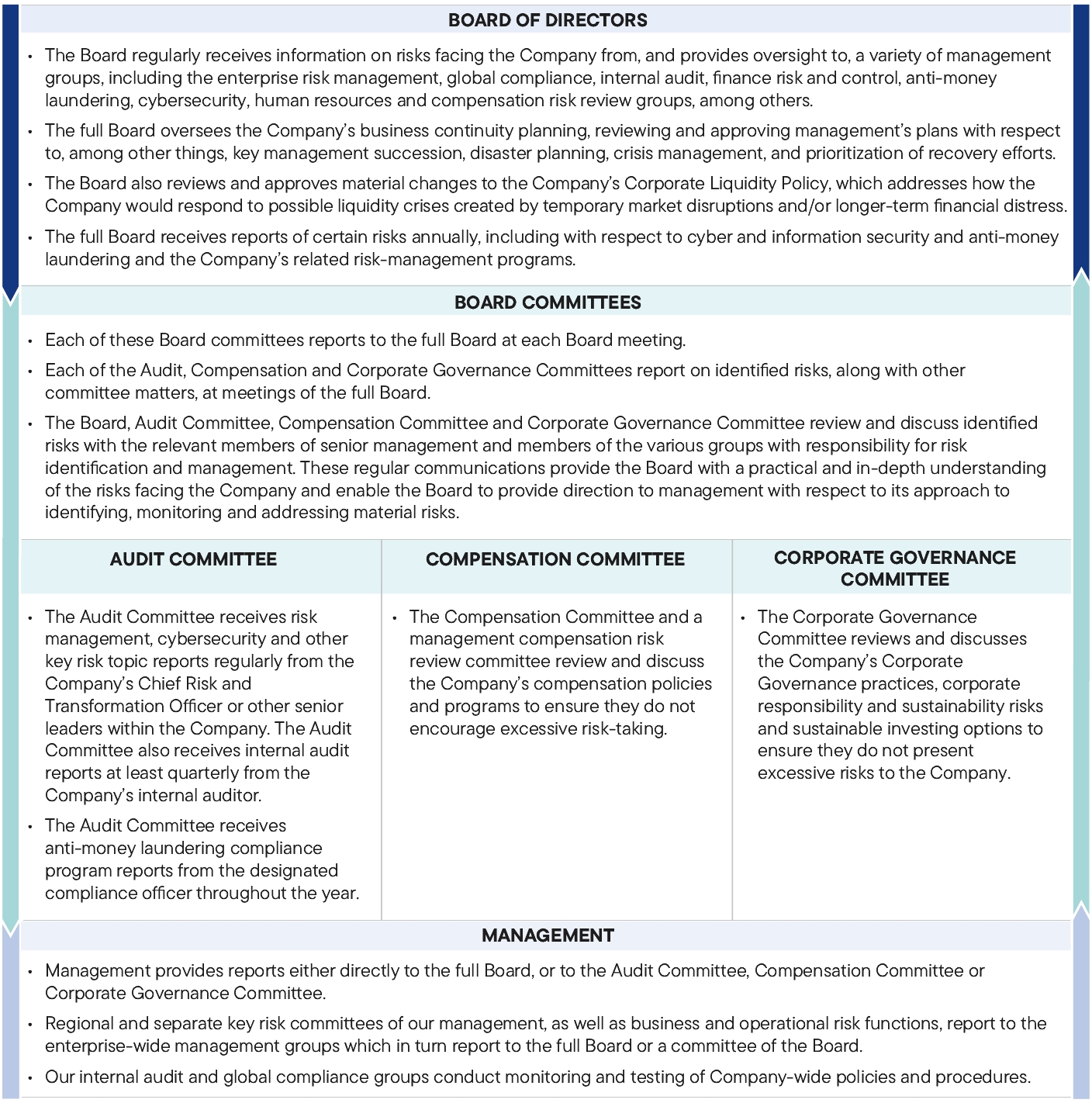
We recognize the importance of effective risk management to the success of our business and our stockholders and have long-standing and highly developed structures in place to manage risk. The Board has principal responsibility for oversight of the Company’s risk management processes.

Our Board’s role in risk oversight is well-supported by having as directors an experienced Chairman and CEO, both of whom have extensive knowledge of and experience with the risks that the Company faces. In addition, the Audit, Compensation and Corporate Governance Committees of the Board are composed entirely of independent directors, as described above in “Committee Membership and Meetings,” which the Board believes also enhances risk oversight.
22
Franklin Resources

TABLE OF CONTENTS

INFORMATION ABOUT THE BOARD AND ITS COMMITTEES
Board processes and insights
Board meetings, executive sessions and annual meeting of stockholders
During fiscal year 2025, the Board held five meetings (not including committee meetings). For fiscal year 2025, each of the directors attended at least seventy-five percent (75%) of the aggregate of (i) the total number of meetings of the Board held during the period he or she served as a director and (ii) the total number of meetings of each committee on which he or she served during the period.
To promote open discussion among the independent directors, the independent directors meet in executive session at least two times per year and generally meet in executive session at each regularly scheduled Board meeting. Mariann Byerwalter, the Lead Director, presides at the executive sessions of the independent directors.
The Board encourages directors to attend the annual meeting of stockholders. All directors attended last year’s annual meeting.
Board and committee evaluation process
The Board believes that conducting an annual evaluation process is a critical component of good corporate governance and improves the performance of the Board as a whole and its committees. In collaboration with the Lead Director, the Corporate Governance Committee oversees the annual performance evaluation of the Board. The Chair of each of the committees leads the review of their respective committees and shares this information with the Lead Director who discusses these results with the Board as part of the Board’s self-evaluation process. Each Committee holds a candid evaluation of its performance, using established guidelines as a resource, and the Board holds a similar evaluation of its performance. The results of the evaluation are discussed in a closed session of the independent directors led by the Lead Director and the committee Chairs. A summary of the evaluation results and recommendations for improvement is then reported to the full Board, and Company policies and practices are updated, as appropriate.
Director orientation and continuing education
The Corporate Governance Committee oversees the Company's orientation for newly elected directors, which may include presentations by senior management to familiarize new directors with the Company’s strategic plans, significant financial, accounting and risk management issues, compliance program, Code of Ethics and Business Conduct, Corporate Governance Guidelines, principal officers, and internal and independent auditors. In addition, the orientation may include visits to Company headquarters and, to the extent appropriate, other of the Company’s significant facilities.
Continuing education opportunities are also available to keep directors updated with information about the Company and its strategy, operations and other matters relevant to Board service. Directors are encouraged to attend continuing education programs sponsored by universities, stock exchanges or other organizations. The Company will reimburse the reasonable costs and expenses associated with such programs.
Management succession planning
The Company is committed to attracting, developing and retaining top executive talent. The Board, with assistance from the Compensation Committee, oversees the succession planning for the management of the Company, including policies and principles for the selection and performance review of our Chief Executive Officer and other executive officers, as well as policies regarding succession in the event of an emergency or the departure of the Chief Executive Officer.
Governance policies and procedures
The Company regularly monitors regulatory developments and reviews its policies and procedures in the area of corporate governance to respond to such developments. As part of those efforts, we review federal laws affecting corporate governance, as well as corporate governance-related rules adopted by the SEC and the NYSE, as appropriate.
Corporate Governance Guidelines. The Board has adopted Corporate Governance Guidelines, which are posted in the corporate governance section of the Company’s website. The inclusion of our website address or reference to our website here and elsewhere in this Proxy Statement does not include or incorporate by reference the information on our website into this Proxy Statement. The Corporate Governance Guidelines set forth the practices the Board follows with respect to, among other things, the composition of the Board, director responsibilities, Board committees, director access to officers, employees and independent advisers, director compensation, director orientation and continuing education, management succession and performance evaluation of the Board.
Code of Ethics and Business Conduct. The Board has adopted a Code of Ethics and Business Conduct, which is applicable to all employees, temporary employees, directors and officers of the Company and its subsidiaries and affiliates. The Code of Ethics and Business Conduct is posted in the corporate governance section of the Company’s website. The Company also has a Compliance and
2026 Proxy Statement
23

TABLE OF CONTENTS

INFORMATION ABOUT THE BOARD AND ITS COMMITTEES
Ethics Hotline, where employees and applicable third parties can anonymously report a violation of the Code of Ethics and Business Conduct or submit another question or concern. We intend to satisfy the disclosure requirement regarding any amendment to, or a waiver of, a provision of the Code of Ethics and Business Conduct for the Company’s principal executive officer, principal financial officer, principal accounting officer and controller, or persons performing similar functions, by posting such information on the Company’s website.
Insider Trading Blackout Policy. The Board has adopted an insider Trading Blackout Policy, which is applicable to all designated employees, temporary employees, directors and officers of the Company and its subsidiaries and affiliates. The Trading Blackout Policy is posted in the corporate governance section of the Company’s website. The Trading Blackout Policy is designed to promote compliance with insider trading laws, rules and regulations with respect to the purchase, sale and/or other dispositions of the Company’s securities, as well as the applicable rules and regulations of the New York Stock Exchange. The Trading Blackout Policy addresses the implementation of certain trading blackout periods in the Company’s securities (including common stock, debt, options and other related derivative securities) for covered persons.
Director Independence Standards. The Board has adopted Director Independence Standards for determining whether a director is independent, which are posted in the corporate governance section of the Company’s website. The Board will monitor and review as necessary, but at least once annually, commercial, charitable, family and other relationships that directors have with the Company to determine whether the Company’s directors are independent. See “Director Independence” on page 15 for additional information.
Policy Regarding Multiple Board Memberships. The Board has adopted a policy regarding memberships on boards of directors or equivalent governance bodies of unaffiliated publicly traded companies or other entities. If a director of the Company also serves as the principal executive officer, such as the chief executive officer or president, of a publicly traded company, it is the policy of the Board that such director shall not accept membership on a board of directors or equivalent governance body of another publicly traded company, without first informing and obtaining the consent of the Company’s Corporate Governance Committee, if such new membership would result in the director serving contemporaneously on three or more boards of directors or equivalent governance bodies of unaffiliated publicly traded companies, excluding the Company’s Board. If a director does not serve as a principal executive officer, such as a chief executive officer or president, of a publicly traded company, it is the policy of the Board that such director shall not accept membership on a board of directors or equivalent governance body of another publicly traded company, without first informing and obtaining the consent of the Company’s Corporate Governance Committee, if such new membership would result in the member serving contemporaneously on four or more boards of directors or equivalent governance bodies of publicly traded companies, excluding the Company’s Board.
Prohibition Against Hedging Transactions. Pursuant to the Company’s Code of Ethics and Business Conduct, which is applicable to all employees, temporary employees, directors and officers of the Company and its subsidiaries and affiliates, short sales of securities, including “short sales against the box” (i.e., a short sale by the holder of a long position in the same stock) of securities issued by the Company, and securities issued by any closed-end fund sponsored or advised by the Company, are prohibited. This prohibition also applies to effecting economically equivalent transactions, including, but not limited to, purchasing and selling call or put options and swap transactions or other derivatives that would result in a net short exposure to the Company or any closed-end fund sponsored or advised by the Company.
Prohibition Against Pledging. Pursuant to the Company’s Code of Ethics and Business Conduct, unless otherwise previously approved by the Compensation Committee, directors and executive officers are prohibited from directly or indirectly pledging, hypothecating or otherwise encumbering securities issued by the Company as collateral for indebtedness. This prohibition includes, but is not limited to, holding such securities in a margin account that could cause securities issued by the Company to be subject to a margin call or serve as collateral for a margin loan. Securities issued by the Company that were not received as compensation are not subject to the prohibition as long as the holder of such securities remains in compliance with applicable Stock Ownership Guidelines. If any person has subject securities issued by the Company pledged as collateral or held in a margin account when such person becomes a director or executive officer of the Company, the pledge must be released within one year from the date the person became a director or executive officer.
Stock Ownership Guidelines. The Board has adopted stock ownership guidelines for directors and executive officers. Directors and executive officers are permitted a five-year grace period to reach the applicable ownership level established under the guidelines. Our Directors are expected to own shares of common stock of the Company with a value of at least 5x the value of their annual cash retainer within five years of their appointment to the Board. Similarly, executive officers of the Company are expected to own shares of common stock of the Company with a value equal to a specific multiple of such executive officer’s base salary, as indicated in the table below, by five years from when he or she first assumed the position for which stock ownership is expected:
24
Franklin Resources

TABLE OF CONTENTS

INFORMATION ABOUT THE BOARD AND ITS COMMITTEES
Title
Market Value of Shares Owned as a Multiple of Base Salary
Director
5X
Executive Chairman
5X
Vice Chairman
5X
Chief Executive Officer
5X
President
4X
Executive Vice President
4X
Other Executive Officers
3X
Both direct and certain indirect forms of ownership are recognized in achieving these guidelines, including shares owned outright, unvested time-based restricted stock and restricted stock units, 401(k) plan funds invested in shares of the Company’s common stock, and funds deemed invested in shares of the Company’s common stock under the 2006 Directors Deferred Compensation Plan. Shares of the Company’s common stock held by immediate family members (which includes a director’s or executive officer’s spouse, children and parents) or entities controlled by a director or executive officer may be considered holdings of the director or executive officer for purposes of the guidelines only and not as an admission of beneficial ownership for any other purpose. As of December 19, 2025, all directors and executive officers were in compliance with these guidelines.
Corporate Forum-Selection Bylaws. Our Amended and Restated Bylaws (“Bylaws”) provide that, unless the Board consents to the selection of an alternative forum, the Court of Chancery of the State of Delaware will be the sole and exclusive forum for any derivative action or proceeding brought on behalf of the Company, or certain other actions or claims, involving the Company or our directors, officers, employees or agents. The forum-selection provision is designed to help the Company manage corporate litigation risks.
Executive compensation clawback policy
The Company’s general employee compensation clawback practices provide for recovery of compensation amounts (i) in connection with fraud or a breach of securities law by an individual or (ii) when (A) the Company issues a restatement of financial results to correct a material error; (B) the Compensation Committee determines, in good faith, the individual’s fraud or willful misconduct was a significant contributing factor to the need to issue such restatement; and (C) some or all of an award awarded to that individual prior to such restatement and/or shares of the Company’s common stock or mutual fund shares that were awarded and/ or other property earned by the individual prior to such restatement would not have been awarded and/or earned, as applicable, based upon the restated financial results.
In addition, effective for compensation awarded for periods beginning on or after October 1, 2023, the Board adopted an Executive Compensation Clawback Policy (“Clawback Policy”). The Clawback Policy provides for the mandatory recovery of erroneously awarded incentive-based compensation following accounting restatements from persons who served as an executive officer of the Company at any time during the performance period for such incentive-based compensation and who received such compensation during the three fiscal years preceding the date on which the Company is required to prepare an accounting restatement. The compensation to be recovered is the amount in excess of what would have been paid based on the restated results. Recovery will be required on a “no fault” basis, without regard to whether any misconduct occurred and without regard to whether an executive officer was responsible for the erroneous financial statements.
2026 Proxy Statement
25

TABLE OF CONTENTS

INFORMATION ABOUT THE BOARD AND ITS COMMITTEES
Non-employee director compensation
The following table provides information on the total compensation earned by the Company’s directors in fiscal year 2025. As officers of the Company, Jennifer M. Johnson, Gregory Johnson and Rupert H. Johnson, Jr. did not receive separate directors’ fees and, accordingly, they have been omitted from this table.
Fiscal year 2025 director compensation
Name
Fees Earned or
Paid in Cash
($)(1)
Stock
Awards
($)(2)(3)
Total
($)(4)
Mariann Byerwalter
202,000
195,011
397,011
Alexander S. Friedman
197,000
195,000
392,000
John Y. Kim
319,000
319,000
Karen King
352,000
352,000
Anthony J. Noto
127,000
195,011
322,011
John W. Thiel
162,000
195,011
357,011
Seth H. Waugh
137,000
195,000
332,000
Geoffrey Y. Yang
181,500
195,011
376,511
(1)
Fees include quarterly retainer fees, excess meeting attendance fees and fees for service as a committee chair. Fees also include meeting fees for serving on ad hoc committees. Fees are awarded in cash, the payment of which may be deferred pursuant to the 2006 Directors Deferred Compensation Plan (the “Director Deferred Plan”) described below under “Deferred Director Fees.” Pursuant to the Director Deferred Plan, directors may elect to defer payment of their directors’ fees and stock awards into hypothetical investments in common stock of the Company and/or in Company-sponsored mutual funds. If a director receives fees in cash or elects to defer fees (including the annual stock grant) into hypothetical units of Company-sponsored mutual funds, such amounts are included in this column. Any such director fees deferred into hypothetical shares of the Company’s common stock are included in the “Stock Awards” column. See notes 2 and 3 below.
(2)
Stock Awards amounts represent the aggregate grant date fair value, determined in accordance with the requirements of Financial Accounting Standards Board Accounting Standards Codification Topic 718, “Compensation - Stock Compensation” (“ASC 718”), associated with (i) an annual stock grant made on February 4, 2025, provided such stock grant is not deferred into hypothetical units of Company-sponsored mutual funds (see note 1 above), and (ii) director fees earned in fiscal year 2025 but whose payment is deferred into hypothetical shares of the Company’s common stock and eventually payable in cash. See “Deferred Director Fees” below. The valuation assumptions (i) for the annual stock grant are the closing price for the common stock on the NYSE on the grant date (February 4, 2025) and (ii) for the deferred hypothetical shares of Company common stock are changes in the closing price of the common stock on the NYSE during fiscal year 2025, and the reinvestment of dividends declared by the Company. Because of the required accounting treatment under ASC 718, the stock award amounts for fees earned in fiscal year 2025 and deferred into hypothetical shares of common stock may vary (up or down) to reflect market prices of the common stock.
(3)
The following represents the grant date fair value determined in accordance with ASC 718 for all Stock Awards granted in fiscal year 2025. See “Note 16—Stock-Based Compensation” in the Company’s Annual Report on Form 10-K for fiscal year 2025 filed with the SEC on November 10, 2025 for further details.
Name
Actual
Common
Stock ($)
Deferred
Hypothetical
Shares ($)
Mariann Byerwalter
195,011
Alexander S. Friedman
195,000
John Y. Kim
319,000
Karen King
352,000
Anthony J. Noto
195,011
John W. Thiel
195,011
Seth H. Waugh
195,000
Geoffrey Y. Yang
195,011
(4)
Mr. G. Johnson is the Executive Chairman of the Company and Chairman of the Board and does not receive compensation for his service as a director. Ms. Johnson is the CEO of the Company and does not receive compensation for her service as a director. See the “Summary Compensation Table for Fiscal Year 2025” below. Mr. R. H. Johnson, Jr. is the Vice Chairman of the Company and does not receive compensation for his service as a director. See “Certain Relationships and Related Transactions” below for information regarding his fiscal year 2025 compensation. In addition, investment offerings may be provided to directors without charging management or performance fees consistent with the terms offered to other employees who meet the applicable requirements. As of September 30, 2025, Mr. Friedman had investments of $856,838 in these funds.
26
Franklin Resources

TABLE OF CONTENTS

Director fees
Standard compensation arrangements
As of September 30, 2025, the compensation arrangements for non-employee directors consist of the board and meeting fees, and annual equity award, below.
Lead director retainer. The director designated by the independent directors of the Board as the lead director of the Board is entitled to receive an annual lead director cash retainer fee of $35,000 (one-fourth of which is paid quarterly).
Director retainer and special meeting fee. Non-employee directors are entitled to receive an annual Board cash retainer fee of $100,000 (one-fourth of which is paid quarterly), plus $5,000 for each Board meeting attended by such director in excess of the five regularly scheduled Franklin Board meetings per fiscal year.
Director annual equity award. Non-employee directors are also entitled to receive an annual equity award on the date of each annual organizational meeting of the Board, valued at $195,000 (rounded up to the nearest whole share).
Committee chairperson retainers. The Chairperson of the Audit Committee is entitled to receive an annual cash retainer fee of $30,000 (one-fourth of which is paid quarterly), and the Chairpersons of the Compensation Committee and the Corporate Governance Committee each is entitled to receive an annual cash retainer fee of $25,000 (one-fourth of which is paid quarterly).
Committee member retainers. Each member of the Audit Committee (including the Chairperson) is entitled to receive an annual cash retainer fee of $15,000 (one-fourth of which is paid quarterly), and each member of the Compensation Committee and the Corporate Governance Committee (including each committee’s Chairperson) is entitled to receive an annual cash retainer fee of $12,000 (one-fourth of which is paid quarterly).
Special committee meeting fees. Additionally, a $1,500 special committee meeting cash fee is payable to (i) each member of the Audit Committee for each Audit Committee meeting attended by such member in excess of 10 Audit Committee meetings per fiscal year, (ii) each member of the Compensation Committee for each Compensation Committee meeting attended by such member in excess of eight Compensation Committee meetings per fiscal year, and (iii) each member of the Corporate Governance Committee for each Corporate Governance Committee meeting attended by such member in excess of eight Corporate Governance Committee meetings per fiscal year. Further, a $2,500 special committee meeting cash fee is payable to each member of an ad hoc special committee addressing litigation and regulatory matters for each such committee meeting attended by such member subject to applicable limitations per member as approved by the Board.
Other board compensation. In addition, the Company reimburses directors for certain expenses incurred in connection with attending Board and committee meetings as well as other related events, including travel, hotel accommodations, meals and other incidental expenses for the director and his or her spouse accompanying the director in connection with such events.
Deferred director fees
The Company allows non-employee directors to defer payment of their directors’ fees and stock awards in a manner that is intended to comply with the provisions of Section 409A of the Internal Revenue Code (“Code”), and to treat the deferred amounts as hypothetical investments in common stock of the Company and/or in Company-sponsored mutual funds, as selected by the director. Directors are then credited with the same earnings, gains or losses that they would have incurred if the deferred amounts had been invested in the specific investments and for the specific periods as directed by each particular director.
Additionally, directors who defer their directors’ fees and stock awards are credited with notional dividends and other distributions at the same time, in the same form, and in equivalent amounts as dividends and other distributions that are payable from time to time with respect to investments selected by each particular director. On the payout dates elected by a director, the hypothetical investments are valued and the Company must pay the director or his or her beneficiary a cash amount equal to the value of the hypothetical investments. Payouts may be made in a lump sum or in periodic installments consistent with director elections.
2026 Proxy Statement
27

TABLE OF CONTENTS

Stock ownership of certain beneficial owners
The following table contains information regarding the beneficial ownership of our common stock as of December 5, 2025, by the stockholders that our management knows to beneficially own more than five percent of our outstanding common stock as of such date. The percentage of ownership is calculated based on 521,390,673 outstanding shares of common stock on December 5, 2025.
Except as otherwise noted, each beneficial owner in the following table had sole voting and investment power with respect to such shares.
Name and Address of Beneficial Owner(1)
Shares Beneficially Owned(2)
Percent of Class
Rupert H. Johnson, Jr.(3)
104,203,443
20.0%
Charles B. Johnson(4)
98,651,261
18.9%
The Vanguard Group(5)
32,296,534
6.2%
Great-West Lifeco Inc.(6)
31,557,117
6.1%
BlackRock, Inc.(7)
29,501,986
5.7%
(1)
The addresses of Messrs. C. B. Johnson and R. H. Johnson, Jr. are: c/o Franklin Resources, Inc., One Franklin Parkway, San Mateo, CA 94403-1906.
(2)
The number of shares of Company common stock beneficially owned by each person is determined under rules promulgated by the SEC.
(3)
Includes 102,453,045 shares held in a trust for which Mr. R. H. Johnson, Jr. is trustee; 29,914.38 shares held in the 401(k) Plan; 563,735 shares held in an individual retirement account (“IRA”); 10,116 shares held by spouse (disclaims beneficial ownership of such shares); and 1,146,633 shares held by a private charitable foundation for which he is trustee (disclaims beneficial ownership of such shares).
(4)
Includes 90,137,677 shares held in a trust for which Mr. C.B. Johnson is trustee; 25,108 shares held in the 401(k) Plan; 4,059,651 shares held in an IRA; and an aggregate of 4,428,825 shares held by two private charitable foundations for which he is trustee (disclaims beneficial ownership of such shares).
(5)
Based solely on a Schedule 13G/A of The Vanguard Group, Inc. filed with the SEC on February 13, 2024, reporting shares of Company common stock owned as of December 29, 2023. Includes (i) shared power to vote or direct to vote 398,169 shares, (ii) sole power to dispose of or direct the disposition of 31,012,786 shares, and (iii) shared power to dispose of or direct the disposition of 1,283,748 shares. Principal business office address is 100 Vanguard Blvd, Malvern, PA 19355.
(6)
Based solely on a Schedule 13G of Great-West Lifeco Inc. filed with the SEC on January 5, 2024, reporting shares of Company common stock owned as of January 1, 2024. Includes shared power to vote or direct to vote and shared power to dispose of or direct the disposition of 31,557,117 shares. Principal business office address is 100 Osborne Street North, Winnipeg, Manitoba, Canada R3C 3A5.
(7)
Based solely on a Schedule 13G/A of BlackRock, Inc. filed with the SEC on January 29, 2024, reporting shares of Company common stock owned as of December 31, 2023. Includes (i) sole power to vote or direct to vote 27,044,363 shares, and (ii) sole power to dispose of or direct the disposition of 29,501,986 shares. Principal business office address is 50 Hudson Yards, New York, NY 10001.
28
Franklin Resources

TABLE OF CONTENTS

Stock ownership and stock-based holdings of directors and executive officers
The following table contains information regarding the beneficial ownership of our common stock as of December 5, 2025 by:
each director and director nominee;
each executive officer named in the “Summary Compensation Table for Fiscal Year 2025” below; and
all current directors, director nominees and executive officers of the Company as a group (including named executive officers).
The percentage of ownership is calculated based on 521,390,673 outstanding shares of common stock on December 5, 2025. Except as otherwise noted, each beneficial owner in the following table had sole voting and investment power with respect to such shares.
Name of Beneficial Owner
Shares
Beneficially
Owned(1)
Total
Company
Stock-Based
Holdings(2)
Percent
of Shares
Beneficially
Owned(3)
Directors and Director Nominees:


Mariann Byerwalter(4)
17,403
44,591
*
Alexander S. Friedman
36,277
*
Gregory E. Johnson(5)
​7,337,616
​7,337,616
1.4%
Jennifer M. Johnson(6)
8,269,286
8,269,286
1.6%
Rupert H. Johnson, Jr.(7)
​104,203,443
​104,203,443
20.0%
John Y. Kim
64,750
*
Karen M. King
59,091
*
Anthony J. Noto
39,559
39,559
*
John W. Thiel
33,199
33,199
*
Seth H. Waugh
2,414
71,024
*
Geoffrey Y. Yang
​66,471
127,719
*
Named Executive Officers:


Jennifer M. Johnson (see above)


Matthew Nicholls(8)
548,947
548,947
*
Gregory E. Johnson (see above)


Terrence J. Murphy(9)
186,159
186,159
*
Adam B. Spector(10)
​625,558
​625,558
*
All directors, nominees and executive officers as a group (16 persons)(11)
121,790,365
122,182,701
23.4%
*
Represents less than 1% of the outstanding common stock.
(1)
The number of shares of Company common stock beneficially owned by each person is determined under rules promulgated by the SEC. Under these rules, a person is deemed to have “beneficial ownership” of any shares over which that person has or shares voting or investment power, plus any shares that the person may acquire within 60 days. The Company has no outstanding stock options.
(2)
For non-employee directors, this column combines beneficial ownership of shares of our common stock with deferred director fees held by certain non-employee directors in an account economically equivalent to our common stock (but payable in cash), as of December 5, 2025. See “Director Fees—Deferred Director Fees” for a description of deferred director fees. For named executive officers, this column includes time-based unvested restricted stock units held by such officers. Restricted stock units do not confer voting or dispositive power. This column indicates the alignment of the named persons with the interests of the Company’s stockholders because the value of their total holdings will increase or decrease correspondingly with the price of the Company’s common stock. Other than beneficially owned shares of our common stock, the amounts described in this footnote are not included in the calculation of the percentages contained in the Percent of Shares Beneficially Owned column of this table.
(3)
The percent ownership for each stockholder on December 5, 2025 is calculated by dividing (i) the total number of shares beneficially owned by the stockholder by (ii) the total number of shares outstanding on December 5, 2025 plus any shares acquirable by that person currently or within 60 days after such date.
(4)
Shares held by a revocable family trust for which Ms. Byerwalter is sole trustee with voting and investment power.
2026 Proxy Statement
29

TABLE OF CONTENTS

Stock Ownership and Stock-Based Holdings of Directors and Executive Officers
(5)
Mr. G. Johnson is also a named executive officer of the Company. Includes 7,680 shares held in the 401(k) Plan, 54,324 unvested restricted stock units, and an aggregate of 2,969,100 shares held by two limited partnerships. Also includes 252,415 shares held by his children or children’s trusts for which he is trustee, 216,900 shares held by sibling venture limited partnership for which he is manager, 26,444 shares held by spouse, and 1,178,795 shares held by a private charitable foundation for which he is trustee (in each case disclaims beneficial ownership of such shares).
(6)
Ms. Johnson is also a named executive officer of the Company. Includes 2,643 shares held in the 401(k) Plan, 587,199 unvested restricted stock units, an aggregate of 2,854,600 shares held by two limited partnerships. Also includes 595,649 shares held by her children or children’s trusts for which she is trustee, 309,256 shares held in trusts for niece/nephews for which she is trustee, and 1,177,954 shares held by a private charitable foundation for which she is trustee (in each case disclaims beneficial ownership of such shares).
(7)
See footnote (3) under “Stock Ownership of Certain Beneficial Owners” above.
(8)
Includes 221,029 unvested restricted stock units.
(9)
Includes 130,531 unvested restricted stock units.
(10)
Includes 208,874 unvested restricted stock units.
(11)
Includes an aggregate of 40,237 shares held in the 401(k) Plan and 1,686,706 unvested restricted stock units.
30
Franklin Resources

TABLE OF CONTENTS

Compensation discussion and analysis
This Compensation Discussion and Analysis (“CD&A”) provides an overview and analysis of our executive compensation program and the decisions made regarding the compensation of our named executive officers, who are our Chief Executive Officer, our Chief Financial Officer, and our three other highest paid executive officers in fiscal year 2025 (together, our “NEOs”). It explains how the Compensation Committee made 2025 performance-year compensation decisions for our NEOs, and provides financial and operational highlights to illustrate how our executive compensation design and decision-making aligns with the Company’s performance and business objectives. This CD&A should be read together with the compensation tables that follow this section.
For the fiscal year ended September 30, 2025, our NEOs were:

Jennifer M. Johnson
Chief Executive Officer(1)

Gregory E. Johnson
Executive Chairman and
Chairman of the Board

Matthew Nicholls
Co-President,
Chief Financial Officer and
Chief Operating
Officer(2)

Terrence J. Murphy
Co-President and
Head of Public Market Investments(2)

Adam B. Spector
Former Executive Vice President and Head of Global Distribution(3)
This CD&A, introduced by an executive summary, is organized into the following five sections, which begin on the page numbers referenced below.
CD&A TABLE OF CONTENTS
1. Executive Summary
Our compensation philosophy
Our Compensation Committee believes that executive compensation should be strongly linked to our performance – both for our investors and for our clients who entrust us to manage their investments and in turn drive our success. We recognize the importance of our compensation decisions to these constituencies and believe the design and implementation of our executive compensation program reflects this stewardship. Accordingly, we seek to maintain an executive compensation program that is designed to attract and retain skilled executives, incentivize executives to deliver returns for our clients and thus maximize our financial performance and the creation of stockholder value, and align executives’ interests with those of our stockholders.
We aim to achieve these objectives by granting a significant majority of executive compensation in the form of “at-risk” compensation, where the value of compensation is dependent on our performance. Our at-risk compensation is typically granted in the form of (i) annual incentive cash bonus awards and restricted stock unit (“RSU”) awards granted under our Amended and Restated Annual Incentive Compensation Plan (the “AIP”) that are earned based on certain annual performance objectives and (ii) performance-based RSU awards that are earned and vest based on achievement of annual and three-year financial performance objectives. We currently do not grant stock options. The significant equity portion of our at-risk compensation serves to align the interests of our NEOs with those of our stockholders. In addition, the Compensation Committee recognizes that NEOs implement and effect long-term initiatives for the Company that often take more than one fiscal year to accomplish and, accordingly, should receive a significant percentage of their compensation in the form of equity that does not immediately vest.
(1)
Ms. Johnson relinquished the title of President effective October 15, 2025.
(2)
As discussed under “Strengthening leadership” below, Messrs. Nicholls and Murphy were appointed Co-Presidents of the Company, together with Daniel Gamba, Co-President and Chief Commercial Officer, effective October 15, 2025.
(3)
Effective October 15, 2025, Mr. Spector was appointed chief executive officer of the Company's wholly-owned subsidiary, Fiduciary Trust International, and no longer serves as an executive officer of the Company.
2026 Proxy Statement
31

TABLE OF CONTENTS

COMPENSATION DISCUSSION AND ANALYSIS
In making executive compensation decisions, the Compensation Committee exercises structured judgment to evaluate each NEO’s performance in light of financial and non-financial performance objectives that it believes are important to the growth and welfare of the Company and for long-term value for our stockholders. These performance objectives emphasize the achievement of Company-wide investment and financial performance objectives as well as strategic initiatives which typically are focused on business unit and individual performance objectives that are specific to each NEO. Below is a summary of the objectives that the Compensation Committee assesses when making compensation decisions.
Performance Objectives
Primary Considerations
Investment Performance
Ratings are weighted 10%, 40%, 40%, and 10% for the 1-, 3-, 5- and 10-year investment management performance respectively, including performance relative to peers and performance of our alternative SIMs
Financial Metrics (vs Target)
Adjusted operating revenue, adjusted operating income, adjusted operating margin, adjusted earnings per share, and three-year stockholder return
Strategic Execution and Leadership/Management
Further enhance investment management platform; strengthen investment services for investment teams; evolve distribution to diversify clients, geography and investment vehicles; focus on firm-wide effectiveness and efficiencies; accelerate growth by adding capabilities through opportunistic acquisitions, innovate new business models and revenue streams; human resources matters including fostering an inclusive culture
Distribution Performance
Flows including sales and redemptions; long-term organic growth rates and effective fee rates vs peers
The weighting of performance metrics used by the Compensation Committee in determining our CEO’s fiscal year 2025 annual incentive award is as depicted below:


32
Franklin Resources

TABLE OF CONTENTS

COMPENSATION DISCUSSION AND ANALYSIS
Compensation mix for our NEOs
The following chart shows the breakdown of the types of compensation paid or granted to our NEOs for fiscal year 2025, which illustrates the Compensation Committee’s emphasis on at-risk, equity-based and performance-based components of our executive compensation program.
COMPENSATION MIX


2026 Proxy Statement
33

TABLE OF CONTENTS

COMPENSATION DISCUSSION AND ANALYSIS
2025 Financial performance
Financial Performance Measures Impacting Executive Compensation
In fiscal year 2025, we continued to focus on key areas that directly support the firm’s multi-year strategic plan to drive organic growth including executing on mergers and acquisitions (“M&A”) opportunities that position us to capitalize on industry change. In addition, we continued to invest in opportunities that will support our strategy, including augmentation of our alternative investment strategies and ESG offerings.
The Compensation Committee evaluated fiscal year 2025 performance in light of its philosophy that a significant portion of executive compensation should be at-risk and tied to the Company’s performance.
The chart below compares the results of our key financial performance measures for the current fiscal year against last fiscal year:
Key Financial Performance Measures
(as of and for fiscal years ended September 30)
2025
2024
Percentage Change
2025 vs. 2024
Ending Assets Under Management ($ billions)
$1,661.2
$1,678.6
(1 %)
Average Assets Under Management ($ billions)
$1,606.7
$1,565.8
3 %
Adjusted Operating Revenue ($ millions)(1)
$6,701.1
$6,564.8
2 %
Adjusted Operating Income ($ millions)(1)
​$1,640.2
$1,713.1
(4 %)
Adjusted Net Income ($ millions)(1)
$1,195.8
$1,276.7
(6 %)
Adjusted Earnings Per Share(1)
$2.22
$2.39
(7 %)
Adjusted Operating Margin(1)
24.5%
26.1%
Three-Year Stockholder Return
7.9%
(7.9%)
(1)
See discussion of supplemental non-GAAP financial measures in Item 7 of the Company’s Annual Report on Form 10-K for the fiscal year ended September 30, 2025.
Fiscal year 2025 investment management performance
We are committed to delivering strong investment performance for our clients, offering a broad range of strategies and drawing on our diverse experiences and perspectives gained through our long history in the investment management business. We know that success demands smart and effective business innovation, solutions and technologies, and we remain focused on investment excellence, innovating to meet evolving client goals, and building strong partnerships by delivering superior client service. We continue to focus on the long-term investment performance of our investment products and on providing high quality service to our clients.
A key driver of our overall success is the long-term investment performance of our investment products. A measure of the performance of these products is the percentage of AUM exceeding peer group medians and benchmarks. We compare the relative performance of our mutual funds against peers, and of our strategy composites against benchmarks.
The performance of our mutual fund products against peer group medians and of our strategy composites against benchmarks is presented in the table below. Past performance is no guarantee of future results.
 
Peer Group Comparison(1)
% of Mutual Fund AUM
in Top Two Peer Group Quartiles
Benchmark Comparison(2)
% of Strategy Composite AUM
Exceeding Benchmark
As of September 30, 2025
1-Year
3-Year
5-Year
10-Year
1-Year
3-Year
5-Year
10-Year
Fixed Income
53%
71%
71%
64%
68%
76%
83%
92%
Equity
​60%
​62%
49%
58%
​37%
41%
​34%
44%
Total AUM(3)
51%
57%
62%
54%
53%
55%
52%
62%
(1)
Mutual fund performance is sourced from Morningstar and measures the percentage of ranked fund AUM in the top two quartiles of their peer groups. Mutual Fund AUM measured for the 1-, 3-, 5- and 10-year periods represents 40%, 39%, 39%, and 36%, respectively of our total AUM as of September 30, 2025.
(2)
Strategy composite performance measures the percent of composite AUM beating its benchmark. The benchmark comparisons are based on each account’s/composite’s (strategy composites may include retail separately managed accounts and mutual fund assets managed as part of the same strategy) return as compared to a market index that has been selected to be generally consistent with the asset class of the account/ composite. Total strategy composite AUM measured for the 1-, 3-, 5- and 10-year periods represents 56%, 55%, 55%, and 50% of our total AUM as of September 30, 2025.
(3)
Total AUM includes performance of the Company’s alternative and multi-asset funds, and total strategy composite AUM includes performance of the Company’s alternative composites. Alternative and multi-asset AUM represent 16% and 12% of our total AUM at September 30, 2025.
34
Franklin Resources

TABLE OF CONTENTS

COMPENSATION DISCUSSION AND ANALYSIS
Executing on corporate strategy
Fiscal year 2025 marked the first year of Franklin Templeton’s 5-Year Plan, and we've made great strides across a number of key strategic focus areas for the Company. The Company is ahead of the strategic plan for alternatives fundraising, Exchange Trade Funds (ETFs), and Canvas, and on track in the other areas.
The Company continued its strategic expansion of its alternatives platform, reinforcing Franklin Templeton’s position as a leading manager of alternative assets with $264 billion in AUM. In fiscal year 2025, the Company increased alternatives fundraising, expanded the Company’s presence in the wealth management channel, and enhanced capabilities through strategic partnerships. In addition, on October 1, 2025, we further strengthened our private debt platform through our acquisition of Apera Asset Management, increasing our private credit AUM to $95 billion and broadening reach across mid-market European markets.
Franklin Templeton also advanced its diversification strategy across investment vehicles, positioning the Company to capture evolving investor preferences and strengthen long-term growth and competitiveness, resulting in record growth in retail SMAs, ETFs, and Canvas.
The Company strengthened global institutional partnerships, expanding Franklin Templeton’s role as a trusted strategic advisor, including $15.7 billion in new insurance sub-advisory fundings and multi-billion-dollar relationships across all regions, including the appointment as Trustee and Manager of the $1.68 billion National Investment Fund of the Republic of Uzbekistan.
During the fiscal year, we also expanded and strengthened our offerings and capabilities in other key areas. We expanded our ability to offer investments solutions across investment teams and public and private markets to clients and added Rich Nuzum to lead the expansion of the OCIO business. We also strengthened Fiduciary Trust International, our wealth management business, which grew to $43 billion of AUM, through the appointment of Adam Spector as chief executive officer of Fiduciary to accelerate Fiduciary’s next phase of growth.
Franklin Templeton continued to expand its leadership in digital assets and blockchain innovation, growing tokenized and digital AUM to $1.7 billion, a 75% increase from the prior fiscal year. As one of the only global asset manager offering digitally native, on-chain mutual fund tokenization, we introduced first-of-their-kind features for registered money market funds, including intra-day yield calculation and daily yield payouts year-round. We also established a strategic partnership with Binance, the world’s largest crypto exchange, to collaborate on digital asset product development and innovation initiatives.
In order to support and augment strategic growth and better support or clients, Franklin is engaged in an enterprise-wide Artificial Intelligence (“AI”) transformation, integrating capabilities across investment management, operations, sales, and marketing. These AI initiatives include the accelerated adoption of Agentic AI and launching of scalable platforms, including strategic partnerships with Microsoft and WandAI, delivering measurable operational efficiencies and commercial impact.
For additional information about our Strategic Initiatives, please see “3. Fiscal Year 2025 Executive Compensation Decisions – Individual Accomplishments – Jennifer M. Johnson – Strategic Initiatives”.
Stockholder engagement on compensation and say on pay
We engage with stockholders to provide multiple opportunities for them to express their views so that we may consider those views as we evaluate our governance practices, executive compensation program and other matters of interest to stockholders. We value our stockholders’ feedback and we are committed to maintaining an active dialogue to ensure that we understand the priorities and concerns of our stockholders.
This year we will submit an advisory proposal on the compensation of our NEOs (a “say-on-pay proposal”) to our stockholders for consideration. Our focus on at-risk compensation has been strongly supported by our stockholders in the past. At our 2023 annual meeting of stockholders, approximately 94% of the votes cast were in favor of our executive compensation policies, practices and determinations. The Compensation Committee believes that the results of our past say-on-pay proposals reflect strong support for our executive compensation program and philosophy. The Compensation Committee intends to continue to implement executive compensation programs and decisions that it believes are in the best interests of our stockholders.
Our Board encourages an open and constructive dialogue with stockholders on compensation and other corporate governance matters to ensure alignment on policies and practices. In fiscal year 2025, we contacted our top 15 institutional stockholders, representing approximately 30% of our outstanding shares, and approximately 50% of our outstanding shares held by persons or entities other than Messrs. Charles B. Johnson and Rupert H. Johnson. Our investor relations, corporate governance, executive compensation, and ESG teams met with the nine stockholders who requested to meet with us. Our meetings with stockholders focused on corporate governance, succession planning, director tenure, and sustainability. No concerns regarding executive compensation were raised from our engagements.
2026 Proxy Statement
35

TABLE OF CONTENTS

COMPENSATION DISCUSSION AND ANALYSIS
Strengthening leadership
In September of 2025, we announced structural changes to our leadership and Executive Committee with the appointment of Mr. Murphy, Head of Public Market Investments, and Mr. Nicholls, Chief Financial and Chief Operating Officer, as Co-Presidents of the Company, to serve along with Mr. Daniel Gamba, who was appointed Co-President and Chief Commercial Officer, effective October 15, 2025. Together, the Co-Presidents will work in conjunction with Ms. Johnson and the Board of Directors on continuing to execute the long-term strategic plans of the Company.
Over the past several years, Franklin Templeton has accelerated its efforts to provide diverse investment capabilities across a broad range of clients around the world. Through both organic growth and targeted acquisitions, the company has continued its successful evolution to benefit clients and meet their changing needs in pursuit of financial goals. These capabilities have included alternative assets, ETFs, customization through Canvas and additional capabilities in the retirement and insurance sectors. Franklin Templeton’s regionally focused sales model, which consists of over 1,500 professionals, is driven by a consultative, investment-led mindset, and has contributed greatly to this growth.
2. Compensation Elements
Our executive compensation program consists primarily of three elements: (1) base salary, (2) short-term incentive compensation based on company-wide investment and financial performance objectives and NEO-specific strategic initiatives, and which is paid in a combination of cash and time-based incentive RSU awards, and (3) RSU awards subject to long-term performance-based vesting conditions.
Compensation Element
Designed To Reward
Relationship To The Objectives
Base Salary
  
Experience, knowledge of the industry, duties and scope of responsibility
  
Provides a minimum, fixed level of cash compensation to attract and retain talented executives to the Company who can continue to drive and improve the Company’s overall performance
Annual Incentive Compensation
  
Incentive cash awards
  
Incentive RSU awards
  
Incentive investment fund unit awards
  
Success in achieving objectives
  
Motivates executives to achieve specific financial and non-financial Company-wide, business unit and individual performance objectives
  
Provides competitive compensation to attract and retain talented executives
  
Links annual incentive to value creation for stockholders with a mix of cash and equity
  
Encourages retention of key executives with incentive RSU awards granted based on annual performance for the prior year subject to vested conditioned on continued service
Long-term Incentive Compensation
  
Performance RSU awards
  
Continued excellence and achievement of objectives over time
  
Success in long-term growth and development
  
Motivates executives to achieve specific Company-wide financial objectives over a three-year performance period
  
Aligns the executives’ interests with long-term stockholder interests with performance RSU awards earned based on achievement of financial performance objectives
  
Provides competitive compensation to attract and retain talented executives
  
Encourages retention of key executives with the Company with performance RSU awards subject to performance-based vesting conditions over a three-year period
36
Franklin Resources

TABLE OF CONTENTS

COMPENSATION DISCUSSION AND ANALYSIS
Base salary
The Compensation Committee believes that base salaries for our NEOs should be limited to a reasonable base compensation for the day-to-day performance of the NEOs’ job responsibilities and that the majority of their pay should be in at-risk compensation tied to performance. Base salaries are evaluated by the Compensation Committee annually for all NEOs and in general do not change significantly year-to-year unless the NEO is promoted or the Compensation Committee determines that an adjustment is necessary due to compensation or economic trends in the industry.
Annual incentive compensation
Annual incentive compensation in the form of incentive cash awards and incentive RSU awards granted to our NEOs and incentive investment fund unit awards (“Fund Unit Awards” and, together with RSU awards, the “Annual Deferred Incentive Awards”) granted to Mr. Murphy, are funded from an award pool (the “Award Pool”) that is established annually under the AIP. The incentive RSU awards are granted under the 2002 Universal Stock Incentive Plan, as amended (the “USIP”), based on prior year performance and vest in equal installments over three years subject to continued service with the Company. The Annual Deferred Incentive Awards are granted shortly following the end of the fiscal year to which the award relates, with the number of RSU awards determined by dividing the dollar value of the equity portion of the award by the closing price of our common stock on the date of grant and the number of Fund Unit Awards determined based on the dollar value of the units of the applicable funds amongst which the award is allocated. NEOs receive dividends on unvested incentive RSU awards as and when dividends are paid to stockholders.
Targets under the AIP are based on a combination of Company-wide, business unit and individualized performance objectives. The Compensation Committee recognizes that the Company-wide measures may not fully reflect the individual performance and contributions made by our separate business units and their respective leaders, and therefore has incorporated objectives relating to achievement of strategic initiatives into the AIP. These objectives are specifically tailored to each business unit and include, but are not limited to, a mix of investment performance, sales, financial, customer service, technology and human resources objectives.
The size of the Award Pool is approved by the Compensation Committee and is fixed at a percentage of our pre-bonus net operating income, exclusive of passive income and calculated before non-operating interest, taxes, extraordinary items, and any special items such as special compensation payouts on account of an acquisition (“PBOI”). The specific size of the Award Pool is determined at the start of the fiscal year but may be revised by the Compensation Committee at any point during or after the fiscal year.
The annual incentive compensation paid and granted in November 2025, the specific strategic objectives considered by the Compensation Committee for each NEO in fiscal year 2025, and the Compensation Committee’s determination of the Award Pool for fiscal year 2025 are summarized in “3. Fiscal Year 2025 Executive Compensation Decisions” below.
Long-term incentive compensation
Our long-term incentive compensation consists of annual grants of performance RSU awards (“Performance Awards”) under the USIP that vest over a three-year period based on the achievement of specified financial performance goals as described below.
Half of the Performance Awards granted in fiscal year 2025 will be earned and vested based on our Adjusted Operating Margin (as defined below) and half of the Performance Awards will be based on our relative total stockholder return over a three-year period (as described below). The Performance Award component that is based on Adjusted Operating Margin is earned based on our fiscal year performance, with performance vesting occurring in equal increments in each year over a three-year period, while the Performance Award component that is based on relative total stockholder return is earned and “cliff”-vests based on a three-year performance period. NEOs receive dividends on Performance Awards only upon and to the extent of vesting of the applicable Performance Award.
The Performance Awards granted to each NEO for fiscal year 2025 was determined by the Compensation Committee with the goal of targeting a material percentage of the NEO’s total incentive compensation in the form of Performance Awards. The applicable metrics were selected because these measures can be influenced by the NEO's performance and are intended to drive the Company's business strategy and objectives.
In the event a performance measure is not achieved at or above a specified threshold level, the portion of an award tied to such performance measure is forfeited. The Compensation Committee selects performance-based vesting targets that it believes are sufficient to motivate NEOs by being challenging, but achievable. The specific performance-based vesting conditions applicable to awards granted in November 2025 and those completing their vesting cycle in November 2025 are summarized in “3. Fiscal Year 2025 Executive Compensation Decisions — Types of Compensation — Long-term Incentive Compensation” below.
2026 Proxy Statement
37

TABLE OF CONTENTS

COMPENSATION DISCUSSION AND ANALYSIS
3. Fiscal Year 2025 Executive Compensation Decisions
Fiscal year 2025 base salary and annual incentive awards
In November 2025, based on the Compensation Committee’s evaluation of the strategic initiative achievements summarized below and the performance objectives discussed above, the Compensation Committee approved the base salary and annual incentive awards in the aggregate amounts below.
 
 
Annual Incentive Award
Performance
Award
Total
Annual
Compensation
% change
in Total
Compensation
vs. 2024
Name
Base
Salary
Total
Incentive
Award
Incentive
Cash
Component
Incentive
Deferred
Component
Jennifer M. Johnson
$750,000
$13,850,000
$6,925,000
$6,925,000
$3,500,000
$18,100,000
20.3 %
Matthew Nicholls
$600,000
$7,400,000
$4,910,000
$2,490,000
$2,000,000
$10,000,000
7.5 %
Gregory E. Johnson
$600,000
$1,900,000
$1,335,000
$565,000
$500,000
$3,000,000
0.0 %
Terrence J. Murphy(1)
$500,000
$12,350,000
$8,127,500
$4,222,500
$500,000
$13,350,000
​-11.1 %
Adam B. Spector
$525,000
$3,575,000
$2,423,750
$1,151,250
$1,200,000
$5,300,000
0.0 %
(1)
For Mr. Murphy, the incentive deferred component includes the deferral of $3,166,875 into Fund Unit Awards to align Company performance and the performance of products under his remit as Head of Public Markets.
2025 compensation decisions for our chief executive officer
During 2025, our Compensation Committee engaged with its compensation consultant to consider changes to the total compensation paid to our CEO. The Compensation Committee reviewed our peers’ CEO compensation and determined that our CEO compensation was below peers and should be increased to reflect Ms. Johnson’s contributions to the Company. The Compensation Committee approved an overall compensation package for our CEO that is more comparable with those of her peers and reflects Ms. Johnson’s leadership through the continuing evolution of our business and the challenging market environment.
Determination of the award pool for fiscal year 2025
The Award Pool, for which all NEOs were eligible for fiscal year 2025, was capped at 2.5% of PBOI for the fiscal year 2025 . During the first quarter of fiscal year 2025, the Compensation Committee determined that no individual participant would be eligible to receive or expected to receive an award exceeding 40% of the total Award Pool.
For fiscal year 2025, the breakdown of the cash component and equity component (subject to vesting) of the annual incentive award for each NEO as set forth in the following table:

38
Franklin Resources

TABLE OF CONTENTS

COMPENSATION DISCUSSION AND ANALYSIS
Fiscal year 2025 performance awards
The NEOs were also issued Performance Awards for fiscal year 2025. The table below sets forth the specific vesting thresholds that were set for these Performance Awards.
 
% of
Award
Eligible
to Vest
Performance
Period
2025 Performance Awards
Performance Level(1)
% Vesting(2)
2025 Adjusted Operating Margin Performance Award
(50% of 2025
Performance Awards)
34%
Fiscal Year
2026
Adj. Operating Margin ≥ 90% of Plan
100%
Adj. Operating Margin ≥ 80% and < 90% of Plan
50%
Adj. Operating Margin < 80% of Plan
0%
 
33%
Fiscal Year
2027
Adj. Operating Margin ≥ 90% of Plan
100%
Adj. Operating Margin ≥ 80% and < 90% of Plan
50%
Adj. Operating Margin < 80% of Plan
0%
 
33%
Fiscal Year
2028
Adj. Operating Margin ≥ 90% of Plan
100%
Adj. Operating Margin ≥ 80% and < 90% of Plan
50%
Adj. Operating Margin < 80% of Plan
0%
2025 Relative TSR
Performance Award
(50% of 2025
Performance Awards)
100%
Fiscal Years
2026 - 2028
≥ 75th percentile
150%
≥ 50th to 75th percentile
100 to 149%
≥ 25th to 50th percentile
50 to 99%
0 to 25th percentile
0 to 49%
(1)
The Adjusted Operating Margin for Plan for fiscal year 2026, fiscal year 2027 and fiscal year 2028 is 26.1%, 24.5% and 26.7%, respectively. For Relative TSR performance, the percentiles refer to the Compensation Peer Group listed below.
(2)
For amounts falling between specified performance level thresholds, the percentage vested will be a linear interpolation between the applicable vesting percentages.
The Compensation Committee approved Performance Awards in 2025 with the following grant date target award amounts:
 
2025 Performance Awards
Name
Total Target
Award
Amount
Adjusted
Operating
Margin
Target
Relative
TSR Target
Jennifer M. Johnson
$3,500,000
$1,750,000
$1,750,000
Matthew Nicholls
$2,000,000
$1,000,000
$1,000,000
Gregory E. Johnson
$500,000
$250,000
$250,000
Terrence J. Murphy
$500,000
$250,000
$250,000
Adam B. Spector
$1,200,000
$600,000
$600,000
Upon granting of the award, the targeted amounts are converted into a number of restricted share units of the Company’s common stock based on the share price on the grant date.
2026 Proxy Statement
39

TABLE OF CONTENTS

COMPENSATION DISCUSSION AND ANALYSIS
Payout of performance awards granted in fiscal years 2022-2024
While the Committee does not consider these amounts to be compensation for fiscal year 2025, Ms. Johnson, Mr. Nicholls, Mr. G. Johnson, and Mr. Spector had 61,171, 55,209, 9,591 and 22,083 performance restricted share units vested for performance in fiscal year 2025, respectively, and 62,955, 52,463, 10,493 and 20,985 performance restricted share units that did not vest and were forfeited because the performance objectives related to those units were not achieved. Mr. Murphy did not receive Performance Awards during this time period.
Name
# of
Performance
Units
Vested
# of
Performance
Units
Forfeited
Jennifer M. Johnson
61,171
62,955
Matthew Nicholls
55,209
52,463
Gregory E. Johnson
9,591
10,493
Adam B. Spector
22,083
20,985
Vesting of the Performance Awards granted in fiscal years 2022-2024 is based upon the achievement of: (i) the Company’s adjusted operating margin as a percentage of the average operating margin for certain peer companies (“Relative Adjusted Margin”), and (ii) our total stockholder return ranking, defined as our total return to stockholders, as reported by Bloomberg or FactSet Research Systems (or their respective successors), relative to the respective total return to stockholders of certain peer companies over a three-year period (“Relative TSR”). For purposes of the Relative Adjusted Margin awards, “adjusted operating margin” means (a) operating income divided by (b) total revenues for the performance period, in each case as reported in the consolidated financial statements filed with the SEC (or if such financial statements are not available at the time of determination as otherwise disclosed in a press release), which amount is adjusted to exclude material onetime, non-recurring expenses including, but not limited to, M&A, severance, or other restructuring charges as reported in the relevant financial statements.
Performance Awards that are based on Adjusted Operating Margin are earned based on our annual performance and performance vest in equal installments in each year over a three-year period, while Performance Awards that are based on Relative TSR are earned based on our performance over a three-year period and vest in one installment (cliff-vest) shortly following the Compensation Committee’s determination that the performance condition has been achieved.
40
Franklin Resources

TABLE OF CONTENTS

COMPENSATION DISCUSSION AND ANALYSIS
Individual accomplishments
In addition to Company-wide investment and financial performance objectives described above, the Compensation Committee evaluates certain strategic initiatives that are specific to each NEO in making executive compensation decisions for fiscal year 2025. Below is a summary of the individual accomplishments for each NEO in fiscal year 2025 that were considered by the Compensation Committee in making its compensation decisions.


Chief Executive Officer

Weighting of Performance Metrics

Jennifer M. Johnson
Introduction

As one of the world's most comprehensive asset managers, Franklin Templeton combines deep expertise across public and private markets with a client reach spanning over 150 countries. Our position today reflects years of deliberate strategic planning and the strength of a global brand that's earned the trust of investors around the world.

Fiscal year 2025 marked the first year of our 5-Year Plan, and we've made great strides across a number of key focus areas for the company. We are ahead of our plan for Alternatives fundraising, Exchange Trade Funds (ETFs), and Canvas, and on track in the other areas.

Investment Performance

Under Ms. Johnson’s leadership, Franklin Templeton achieved strong investment performance during the fiscal year, with a majority of AUM outperforming peers and benchmarks across key time periods. Results highlight the firm’s investment strength, disciplined consistent execution, and ability to deliver competitive returns across market cycles.

At fiscal year-end, more than half of mutual fund/ETF AUM outperformed peer median and over half of composite AUM outperformed their benchmark in all periods.
Mutual fund investment performance AUM outperformed its peers by 51%, 57%, 62% and 54% over the 1-, 3-, 5-and 10-year periods.1 Compared to the prior year, performance significantly improved in 5-year period. The decrease in the 1- and 3-year periods was due to the categorization of one of our largest funds managed for yield.
Strategy composite investment performance AUM resulted in 53%, 55%, 52% and 62%, of AUM ahead of benchmark on a 1-, 3-, 5-, and 10-year basis.2 Compared to the prior year, performance improved in the 3-year period and slightly declined in the 1-, 5-, and 10-year periods.
Strong investment performance continued in our private market strategies offered by Benefit Street Partners, Clarion Partners and Lexington Partners.

Strategic Initiatives

Ms. Johnson led the development and execution of Franklin Templeton’s Five-Year Plan, achieving meaningful progress in its first year. The Company is ahead of plan in Alternatives fundraising, ETFs, and Canvas, and on track across retail SMAs, Solutions, and Fiduciary Trust International.

Led the continued strategic expansion of the Company’s alternatives platform, reinforcing Franklin Templeton position as a leading manager of alternative assets with $264 billion in AUM.
  - 
Alternatives fundraising reached $26.2 billion, including $22.9 billion in private markets with 22% raised through wealth channel.
  - 
Expanded presence in the wealth management channel, with Franklin Templeton Private Markets, reaching $5.5 billion in AUM across Lexington, Benefit Street Partners, Clarion, and K2. Franklin Lexington Private Markets Fund (“FLEX”) raised $2.7 billion since launch in January.
  - 
Enhanced capabilities through strategic partnership with three leading institutional infrastructure investment firms, Actis, Copenhagen Infrastructure Partners, and DigitalBridge.
  - 
On October 1, 2025, further strengthened our private debt platform through the Apera Asset Management acquisition, increasing private credit AUM to $95 billion and broadening reach across European markets.
Advanced the Company’s diversification strategy across investment vehicles, positioning the Company to capture evolving investor preferences and strengthen long-term growth and competitiveness. This year resulted in record growth in retail SMAs, ETFs, and Canvas.
  - 
Reinforced our position as a leading provider of retail SMAs with assets increasing 13% year-over-year to $164.5 billion in AUM.
  - 
Grew ETF AUM by 56% to $49.1 billion from the prior year, and achieved positive net flows for 16 consecutive quarters.
  - 
Increased Canvas AUM by 71% year-over-year to $16.3 billion with positive net inflows in every quarter since its acquisition in 2021.
Strengthened global institutional partnerships, expanding Franklin Templeton’s role as a trusted strategic advisor. Raised $15.7 billion in new insurance sub-advisory fundings, reflecting the Company’s position as a preferred partner to leading insurance companies. Expanded multi-billion-dollar relationships across all regions, including the appointment as Trustee and Manager of the $1.68 billion National Investment Fund of the Republic of Uzbekistan
2026 Proxy Statement
41

TABLE OF CONTENTS

COMPENSATION DISCUSSION AND ANALYSIS
 
Expanded ability to offer solutions across investment teams and public and private markets to clients. Investment Solutions AUM rose 11% to $98 billion in line with industry growth and is supported by strong pipeline. In addition, hired Rich Nuzum to lead the expansion of the OCIO business.
Wealth Management: Fiduciary Trust International’s AUM reached $43 billion, supported by a strong pipeline of new business. Strengthened Fiduciary’s leadership team with the appointment of Adam Spector as CEO of Fiduciary to accelerate Fiduciary’s next phase of growth.
Expanded Franklin Templeton’s leadership in digital assets and blockchain innovation. Grew tokenized and digital AUM to $1.7 billion, a 75% increase from the prior year. As the only global asset manager offering digitally native, on-chain mutual fund tokenization, introduced first-of-their-kind features for registered money market funds, including intra-day yield calculation and daily yield payouts year-round. Established strategic partnership with Binance, the world’s largest crypto exchange, to collaborate on digital asset product development and innovation initiatives.
Led enterprise-wide Artificial Intelligence transformation, integrating capabilities across investment management, operations, sales, and marketing. Accelerated adoption of Agentic AI and launched scalable platforms, including strategic partnerships with Microsoft and WandAI, delivering measurable operational efficiencies and commercial impact. Achieved broad workforce engagement, with the majority of employees now using approved AI tools to enhance productivity and client outcomes.
Strengthened the foundation of business through disciplined expense management and operational efficiencies, including changes to optimize operational efficiencies of select investment teams and implementation of Aladdin to unify the Company’s investment management technology across Public Markets investment teams. Integrated select Western’s corporate functions to enhance efficiency and provide access to broader firmwide resources. Successfully transitioned client service team, seamlessly for clients. Western’s investment team continues to operate with investment autonomy.
Effective October 15, 2025, hired Daniel Gamba as Chief Commercial Officer to be responsible for global sales, marketing and product strategy, and appointed Co-President, alongside Terrence Murphy, Head of Public Market Investments, and Matthew Nicholls, Chief Financial Officer and Chief Operating Officer.
Industry Awards: Money Management and Barron's named Franklin Templeton as its 2025 Asset Manager of the Year in the $500 billion plus AUM category for innovation and excellence in investment advisory solutions. Won Central Banking’s Asset Manager Award recognizing our track record with central banks.
Industry Recognition: Thought leader and trusted advisor to the industry and Franklin Templeton brand ambassador, elevated the Company’s global profile through engagements with important heads of state, intermediaries, advisors, industry peers, and business partners. Awards include Barron’s sixth annual list of 100 Most Influential Women in U.S. Finance, Silicon Valley Power 100 C-Suite by Silicon Valley Business Journal, 2024

Financial Metrics and Distribution Performance

Our diversified business across asset classes, vehicles, and geographies continued to strengthen our financial resilience and drive solid results in fiscal year 2025.

At September 30, 2025, ending AUM of $1.66 trillion, a 1% decrease from prior year. Average AUM increased by 2.6% from the prior year. Long-term net outflows were $97.4 billion and reinvested distributions were $30.4 billion.
Excluding Western Asset Management, long-term net inflows were $44.5 billion, with eight consecutive quarters of positive net flows. Strong growth continued in the following areas:
  - 
Long-term inflows increased by 7.8% from the prior year to $343.9 billion, across alternatives, equities, and multi-assets.
  - 
Sustained client interest in alternatives and multi-asset strategies generated positive net flows of $25.7 billion combined. Excluding Western, fixed income net inflows were $17.3 billion.
  - 
Alternative fundraising was $26.2 billion, including $22.9 billion in private markets of which 22% was raised from the wealth channel.
  - 
Strong growth across vehicles driven by record positive net flows in retail SMAs, ETFs, and Canvas® contributing to AUM growth of 13%, 56%, and 71%, respectively, from the prior year.
Adjusted operating revenue increased 2.1% to $6.7 billion from the prior year. Adjusted operating expenses increased by 4.3% from the prior year, primarily due to an additional quarter of Putnam. Importantly, when adjusting for the additional quarter of Putnam and performance fee-related compensation, 2025 expenses were substantially similar to fiscal year 2024 (less than 1% difference) demonstrating continued expense discipline.
Adjusted operating income of $1.64 billion, a decline of 4.3% from the prior year primarily due to the impact of Western and higher spend on strategic initiatives, partially offset by the realization of cost savings initiatives and higher adjusted operating revenue.
Returned $930 million to shareholders through dividends and share repurchases, funded the majority of the remaining acquisition-related payments, and repaid $400 million senior notes due March 2025.
42
Franklin Resources

TABLE OF CONTENTS

COMPENSATION DISCUSSION AND ANALYSIS


Executive Chairman and
Chairman of the Board
Gregory E. Johnson
Provided overall leadership for the Franklin Resources Board and set ethical tone for the Board and the Company.
Represented the Company to shareholders, key clients and government officials, working in partnership with the CEO.
Partnered with the CEO and CFO/COO on the exploration and development of capital market strategies.
Served as advisor to CEO and CFO/COO on strategic opportunities, including partnership with Power Corporation of Canada and Great-West Lifeco and the related acquisition of Putnam Investments, which closed on January 1, 2024.
Served as Chairman of the Franklin and Templeton fund boards and Chairman of the Luxembourg-based SICAV line of funds. Presided over the Board meetings; with investment professionals and the management company, presented on key topics, including performance, organizational, and regulatory matters pertaining to the funds.
Continued to engage with industry leaders, regulators, and policy makers via being an active member of the Board of Governors and Executive Committee of the Investment Company Institute, the national association of U.S. investment companies, as well as its international division, ICI Global.
Represented Franklin’s investment in Zand Bank in Dubai by sitting on its Board.
2026 Proxy Statement
43

TABLE OF CONTENTS

COMPENSATION DISCUSSION AND ANALYSIS


Co-President,
Chief Financial Officer
and Chief Operating Officer,
responsible for the firm’s
global corporate functions
including Finance,
Operations & Technology,
Corporate Development,
M&A, Risk Management,
Human Resources,
Real Estate, Communications,
Investor Relations,
and Fiduciary Trust International.
Matthew Nicholls
Appointed Co-President along with Daniel Gamba and Terrence Murphy to execute both day-to-day functions, longer-term expansion strategy and strategic plans of the Company, effective October 15, 2025.
Partnered with the CEO to develop updated 5-Year Plan. Year one resulted in progress ahead of plan in Alternatives, ETFs, and Canvas, and on track in other areas including retail SMAs, Solutions, and Fiduciary Trust International.
Partnered with the CEO, Global Distribution and investment leaders to drive our efforts and investments in key strategic areas, including M&A and origination of new insurance business partners:
Oversaw the Apera Asset Management acquisition to, further strengthen our private debt platform through the Apera Asset Management acquisition, increasing private credit AUM to $95 billion and broadening reach across European markets. The acquisition complements Benefit Street Partners and Alcentra and expands our direct lending capabilities across Europe's growing lower middle market.
Exceeded fiscal year 2025 budget for adjusted operating revenue. Excluding Western, adjusted operating income and operating margin were slightly below budget, driven by higher commissions and placement fees related to successful fundraising during the fiscal year.
Adjusting for the additional quarter of Putnam and performance fees, managed fiscal year 2025 expenses to be in line with fiscal year 2024, demonstrating strong expense discipline in strong and rising markets. On path to increase FY2026 margin by achieving $200M of run-rate annualized cost savings while continuing to invest in strategic initiatives.
Managed the firm’s balance sheet to maintain financial flexibility. As of the end of fiscal year 2025, total cash and investments stood at $6.7 billion and the Company returned $930 million to shareholders through dividends and share repurchases, funded the majority of the remaining acquisition-related payments, and repaid $400 million senior notes due March 2025.1
Led continuous review and enhancement of corporate functions to drive effectiveness, efficiency and productivity across operations to redesign and build capabilities to capture benefits of scale, create capacity to reinvest in growth areas, and foster best practices firmwide, including:
Successfully launched the governance and change management process to implement investment management technology platform (Aladdin). The platform change includes merging five middle office operations and unifying investment management technology across investment teams in Public Markets with the goal of simplifying the Company’s investment operations and reduction of long-term capital expenses;
Continued to support hiring of AI focused team and resources that implemented enterprise-wide AI capabilities across investment, operations, sales and marketing;
Implemented organizational changes to optimize operating model and operational efficiencies of select investment teams; and
Optimized real estate strategy and led consolidation and monetization of excess office space globally to create cost savings and enhance collaboration across investment teams. Completed seamless transition with Franklin Templeton and specialist investment teams to One Madison Avenue in Manhattan, combining 10 offices into one location.
Increased risk management resources across the Company focused on enterprise, investment, cyber security, and supplier risk management.
Developed and executed investor relations program to communicate 5-year corporate plan and year one progress report to shareholders, including enhancing quarterly disclosure and materials.
Established and oversaw Investor Relations, Communications, and external PR firm on communication strategy and messaging for all stakeholders (employees, clients and investors); hired new head of global communications.
Actively led Fiduciary Trust International as Interim CEO and successfully transitioned leadership to Adam Spector as permanent CEO.
1.
Includes the Company’s direct investments in consolidated investment products of $1.2 billion and approximately $350 million of employee-owned and other third-party investments made through partnerships, approximately $394 million of investments related to long-term repurchase agreements and other net financing arrangements, and approximately $455 million of cash and investments related to deferred compensation plans.
44
Franklin Resources

TABLE OF CONTENTS

COMPENSATION DISCUSSION AND ANALYSIS


Co-President, Head of Public
Market Investments, responsible
for setting investment strategy
and driving organizational growth
for the Franklin Templeton Public Markets business. Chief Executive Officer at ClearBridge Investments, responsible for the overall management of the firm, including investments, business strategy,
sales and service and is the chair
of ClearBridge Management and
Risk Committees.
Terrence J. Murphy
Delivered measurable improvements in long-term investment performance, enhancing oversight, accountability, and disciplined execution across all investment teams. Increased the percentage of AUM in Morningstar 4 & 5 star rated funds from 41 to 43% underscoring sustained investment quality and client confidence. Together these performance gains contributed to a rise in AUM and investment management revenue of 8 and 9% respectively vs prior fiscal year.
Drove efforts to strengthen the culture of investment risk management to complement alpha generation across Public Markets investment teams.
Responsible for investment talent management, and this year, further evolved Public Market investment team leadership, risk management talent and processes, depth of research and succession planning with the goal of improving performance and client outcomes.
Led ETF business in achieving significant growth milestones: assets of approximately $50 billion (up 56% from the prior FY), record-breaking net inflows of $14.2 billion and diversified global growth was realized across regions and strategies with 14 ETFs now exceeding $1 billion AUM including first ETF to surpass $4 billion AUM (PVAL).
Identified opportunities through our multi-asset solutions investment managers to strengthen our presence in private markets and alternative asset classes.
Enhanced governance and cross-platform collaboration by institutionalizing Public/Private CIO Forums and mid-year Public Markets Forums, driving strategic alignment among SIMs. Integrated Sustainability team under refreshed leadership with clear strategic mandate and established the Global Investment Policy Oversight Committee to unify investment compliance.
Accelerated innovation and AI adoption in partnership with the FT Technology AI team, embedding next-generation data and analytics into investment decision-making. Launched the FluenT Investments Portal, granting all Public Markets SIMs centralized access to AI-enhanced tools, improving analytical efficiency and consistency across teams.
Simplified investment management teams to strengthen talent development and management in Public Markets. Successfully completed integrations of Martin Currie into Franklin Equity Group and ClearBridge Investments.
Strengthened partnership between Public Markets and Global Distribution to expand global reach, enhance product appeal, and focus on scalable, high-demand investment strategies. Aligned business development roles (investment teams client facing specialists) with Global Distribution, increasing efficiency and client focus.
Progressed the Company’s ongoing product optimization initiative, successfully merging, liquidating or repositioning 22% of pooled vehicles as of fiscal year end.
Championed alignment of incentives and employee experience, harmonizing compensation structures across the Company’s SIMs to directly link performance rewards with client outcomes. Partnered with the Company’s human resources team to initiate a unified framework for employee benefits and experience.
2026 Proxy Statement
45

TABLE OF CONTENTS

COMPENSATION DISCUSSION AND ANALYSIS


Executive Vice President and
Former Head of Global Distribution,
responsible for global retail
and institutional distribution, including marketing and
product strategy. Adam serves
on several other corporate
boards and committees,
including Chair of the Board
of Brandywine Global.
Adam B. Spector
Continued to evolve sales strategy and client model empowering our clients to unlock the broad range of specialized capabilities and delivery mechanisms resulting in:
Generated fiscal year long-term inflows in excess of $310 billion, up over $60 billion (or 25%) on prior fiscal year with each region experiencing higher sales;
Continued to make good progress on executing non-US regional distribution strategy, generating fiscal year 2025 net inflows;
Successfully completed Putnam Investments integration (our second scaled integration in four years) and since the closing of the acquisition, generated positive net flows of approximately $11 billion in Putnam strategies on the Company’s global distribution platform;
Rebuilt the US distribution organization and drove a 25% increase in US long-term inflows;
Executed on key strategic objectives resulting in positive net flows across Alternatives Wealth Management, retail SMAs, ETFs and Index Solutions (Canvas®); and
Generated momentum in core retail sales, and with our strategic partners, including the establishment of new multi-billion dollar client relationships in each of our regions.
Extended Alternatives Wealth Management focus globally, providing access to diversified platform of capabilities offered by Alternatives by Franklin Templeton Private Markets.
Executed on transition of Brandywine Global from a fully integrated business model to focusing on investment excellence and specialist sales model.
Reiterated our dedication to fostering an inclusive culture.
46
Franklin Resources

TABLE OF CONTENTS

COMPENSATION DISCUSSION AND ANALYSIS
4. Our Compensation Decision-Making Process
Compensation decisions are made by our Compensation Committee, considering input from its independent compensation consultant Semler Brossy Consulting Group (“Semler Brossy”), our human resources group, our CEO (with respect to the compensation of other NEOs), and our stockholders through stockholder outreach (see, “1. Executive Summary, Stockholder Outreach on Executive Compensation,” above).
Role of CEO and human resources group
The Compensation Committee works with members of management, including our CEO, to seek input regarding our executive compensation. Twice a year the CEO evaluates each other NEO and his or her respective business unit’s progress in achieving its goals. In addition, the CEO works with our human resources group to determine the appropriate award amount to recommend for each such NEO based upon such performance. As part of this process, the human resources group conducts and reviews an analysis of competitive compensation by peer companies (those listed below under “Compensation Peer Group”), compares previous year-over-year performance and compensation paid to the NEO, and reviews third-party executive compensation surveys related generally to the financial services industry and specifically to the asset management industry. Upon completion of this review process, management presents performance evaluations to the Compensation Committee and the CEO, and the CEO makes a recommendation to the Compensation Committee regarding the appropriate level of incentive compensation to be awarded to each NEO.
The Company’s management has engaged McLagan Data & Analytics, an Aon plc company (“McLagan”), a financial services industry compensation consultant, to provide information on peer company compensation and pay trends. The Compensation Committee uses McLagan’s proprietary surveys and market data to analyze the competitiveness of the Company’s executive compensation program and to understand compensation forecasts and trends in the industry.
Role of Semler Brossy
The Compensation Committee is empowered with the sole authority to retain and terminate any compensation consulting firm directly assisting it in the evaluation of director or executive compensation. The Compensation Committee also has the sole authority to approve fees and other retention terms for its consultant.
The Compensation Committee recognizes that it is essential to receive objective advice from compensation consultants and has selected Semler Brossy, and expects to continue to select any compensation consultants, on the basis of all factors relevant to the consultant’s independence including:
the provision of other services to the Company by the consultant’s firm;
the aggregate fees paid by the Company and fees as a percentage of the total revenue of the consultant’s firm;
the policies and procedures of the consultant’s firm designed to prevent conflicts of interest;
any business or personal relationships between the consultant, the consultant’s firm and any Compensation Committee member or executive officer of the Company; and
whether the consultant holds shares of the Company’s stock.
Semler Brossy’s role is managed by the Compensation Committee. Throughout the year, the Compensation Committee may ask Semler Brossy to review and comment objectively on management proposals and presentations to the Compensation Committee covering all elements of compensation paid to the NEOs. Semler Brossy also counsels on general market trends, and technical developments and the amount and structure of pay for the non-employee directors of the Board. Under the terms of its engagement, Semler Brossy is required to obtain the prior written approval of the Compensation Committee before Semler Brossy or any of its affiliates performs any non-executive compensation related services for the Company or its subsidiaries. Semler Brossy is required to report to the Compensation Committee any such services and fees annually and upon the reasonable request of the Compensation Committee. There were no such services during fiscal year 2025. Semler Brossy also advises and provides input for the compensation peer group referenced by the Compensation Committee.
During fiscal year 2025, the Company paid Semler Brossy $114,438 in consulting fees directly related to services performed for the Compensation Committee.
2026 Proxy Statement
47

TABLE OF CONTENTS

COMPENSATION DISCUSSION AND ANALYSIS
Compensation timeline
The following illustrates the indicative timeline by which the Compensation Committee determines pay.

Compensation peer group
The Compensation Committee, along with its independent executive compensation consultant, conducts an annual review of our compensation peer group. For fiscal year 2025, the Compensation Committee requested Semler Brossy, its independent executive compensation consultant, to conduct an independent review of the Company’s peer group.
Following this review, the Compensation Committee decided to remove the following private and smaller public company entities from the Company’s peer group because they no longer represented an appropriate match due to the differences in the size, scale, scope and complexity of our business: Goldman Sachs Asset Management L.P., JP Morgan Asset Management, MFS Investment Management, Morgan Stanley Investment Management, The Vanguard Group, Inc. and Federated Hermes, Inc. The Compensation Committee also replaced two subsidiaries in the legacy peer group, BNY Investment Management and State Street Global Advisers, with their respective parent companies, Bank of New York Mellon Corporation and State Street Corporation.
48
Franklin Resources

TABLE OF CONTENTS

COMPENSATION DISCUSSION AND ANALYSIS
For fiscal year 2025, the compensation peer group approved by the Compensation Committee is the following:
Affiliated Managers Group, Inc.
Invesco Ltd.
Raymond James Financial, Inc.
AllianceBernstein Holding L.P.
Janus Henderson Group plc
State Street Corporation
Ameriprise Financial, Inc.
KKR & Co. Inc.
T . Rowe Price Group, Inc.
BlackRock, Inc.
Lazard, Inc.
The Bank of New York Mellon Corporation
 
Northern Trust Corporation
The Carlyle Group Inc.
The peer group for fiscal year 2025 consists of 14 public financial services companies of similar size, sub-industry, business model and complexity to the Company. The Compensation Committee believes this peer group accurately reflects the strategic transformation and complexity of our business, as well as the select markets in which we compete for executive talent.
The Compensation Committee will continue to review the composition of this peer group to analyze our executive compensation program and determine whether any changes should be made in the future.
In light of our overall performance in fiscal year 2025, the Compensation Committee believes that the compensation paid to our CEO and other NEOs is reasonable in relation to the compensation paid by our peer companies both on an absolute basis and in comparison to relevant financial performance metrics.
5. Other Compensation Matters
Summary of Compensation Practices
Our executive compensation program reflects our commitment to responsible financial and risk management and is exemplified by the following leading policies and practices:

What We Do
Align pay with performance: a significant portion of total compensation for all NEOs is performance-based
Grant long-term awards based on meaningful performance measures
Maintain clawback policies
Require significant stock ownership
Limit perquisites
Retain an independent consultant to the Compensation Committee
Regularly review incentive compensation plans and compensation practices
Engage with stockholders regarding compensation practices

What We Don’t Do
Provide excessive severance benefits
Enter into change in control agreements with NEOs
Provide excise tax gross-ups
Reprice underwater stock options
Permit hedging of Company stock
Allow pledging of Company stock received as compensation
Offer executive-specific retirement plans
Pay dividends or dividend equivalents to NEOs on unvested performance shares
Benefits and perquisites
As a general practice, we do not provide material personal benefits and provide only limited perquisites to the NEOs that are not provided to other employees. All executive officers are eligible to receive medical, life and disability insurance coverage, participate in the Company’s 401(k) plan and receive other corporate benefits available to most of the Company’s employees, consistent with the terms of the applicable plans and policies. In addition, certain of our NEOs may use the Company’s aircraft for personal reasons. The personal transportation benefits provide increased efficiencies and enable more productive use of our executives’ time and a greater focus on Company-related activities.
2026 Proxy Statement
49

TABLE OF CONTENTS

COMPENSATION DISCUSSION AND ANALYSIS
Termination/change in control matters
Our NEOs are employed on an “at will” basis. We do not have a severance policy. From time to time, we may consider severance in special situations. Except as needed in special circumstances such as during periods of transition, we generally do not have any commitments to provide our NEOs with post-employment termination benefits.
We do not enter into change of control agreements. We have not entered into any agreement with any NEO that provides for additional payments or benefits solely on account of a change in control of the Company. Our only change in control provisions are included in existing compensation plans that apply to all participants in those plans.
Stock ownership policy
The Company believes that a significant ownership interest by certain senior officers tends to align the interests of members of management of the Company with the Company’s stockholders and strengthens the link between long-term Company performance and executive compensation. The following senior officers of the Company are expected to own shares of common stock of the Company with a value equal to a specific multiple of such senior officer’s base salary, as indicated in the table below, by five years from when he or she first assumed the particular senior officer position for which stock ownership is expected:
Title
Market Value of Shares Owned
as a Multiple of Base Salary
Executive Chairman
5X
Vice Chairman
5X
Chief Executive Officer
5X
President
4X
Executive Vice President
4X
Other Executive Officers
3X
Both direct and certain indirect forms of ownership are recognized in achieving these guidelines, including shares owned outright, unvested time-based restricted stock and restricted stock units, 401(k) funds invested in shares of the Company’s common stock, and funds deemed invested in shares of the Company’s common stock under a deferred compensation plan. Shares of the Company’s common stock held by immediate family members (which includes an executive officer’s spouse, children and parents) or entities controlled by an executive officer may be considered holdings of the executive officer for purposes of the guidelines only and not as an admission of beneficial ownership for any other purpose. As of December 20, 2025, all executive officers were in compliance with these guidelines.
Clawback practices
The Company’s general employee compensation clawback practices provide for recovery of compensation amounts (i) in connection with fraud or a breach of securities law by an executive officer or (ii) when (A) the Company issues a restatement of financial results to correct a material error; (B) the Compensation Committee determines, in good faith, that a Participant’s fraud or willful misconduct was a significant contributing factor to the need to issue such restatement; and (C) some or all of an award awarded to that executive officer prior to such restatement and/or shares of the Company’s common stock or mutual fund shares that were awarded and/or other property earned by the Participant prior to such restatement would not have been awarded and/or earned, as applicable, based upon the restated financial results.
In addition, effective for compensation awarded for periods beginning on or after October 1, 2023, the Board adopted an Executive Compensation Clawback Policy (“Clawback Policy”). The Clawback Policy provides for the mandatory recovery of erroneously awarded incentive-based compensation following accounting restatements from persons who served as an executive officer of the Company at any time during the performance period for such incentive-based compensation and who received such compensation during the three fiscal years preceding the date on which the Company is required to prepare an accounting restatement. The compensation to be recovered is the amount in excess of what would have been paid based on the restated results. Recovery will be required on a “no fault” basis, without regard to whether any misconduct occurred and without regard to whether an executive officer was responsible for the erroneous financial statements.
For the fiscal year ended September 30, 2025, there were no compensation awards subject to clawback under the Clawback Policy.
50
Franklin Resources

TABLE OF CONTENTS

COMPENSATION DISCUSSION AND ANALYSIS
Prohibition against certain hedging transactions
Pursuant to the Company’s Code of Ethics and Business Conduct, which is applicable to all employees, temporary employees, directors and officers of the Company and its subsidiaries and affiliates, short sales of securities, including “short sales against the box” (i.e., a short sale by the holder of a long position in the same stock) of securities issued by the Company, and securities issued by any closed-end fund sponsored or advised by the Company, are prohibited. This prohibition also applies to effecting economically equivalent transactions, including, but not limited to, purchasing and selling call or put options and swap transactions or other derivatives that would result in a net short exposure to the Company or any closed-end fund sponsored or advised by the Company.
Prohibition against pledging
Pursuant to the Company’s Code of Ethics and Business Conduct, unless otherwise previously approved by the Compensation Committee, directors and executive officers are prohibited from directly or indirectly pledging, hypothecating or otherwise encumbering securities issued to them by the Company as collateral for indebtedness. This prohibition includes, but is not limited to, holding such securities in a margin account that could cause securities issued by the Company to be subject to a margin call or serve as collateral for a margin loan. Securities issued by the Company that were not received as compensation are not subject to the prohibition as long as the holder of such securities remains in compliance with applicable Stock Ownership Guidelines. If any person has subject securities issued by the Company pledged as collateral or held in a margin account when such person becomes a director or executive officer of the Company, the pledge must be released within one year from the date the person became a director or executive officer.
2026 Proxy Statement
51

TABLE OF CONTENTS

COMPENSATION DISCUSSION AND ANALYSIS
Compensation committee report
The Compensation Committee has reviewed and discussed with management the Compensation Discussion and Analysis included in this Proxy Statement. Based on this review and discussion, the Compensation Committee has recommended to the Board that the Compensation Discussion and Analysis be included in this Proxy Statement and incorporated by reference into our Annual Report on Form 10-K for the fiscal year ended September 30, 2025.
Respectfully Submitted:
COMPENSATION COMMITTEE
John Y. Kim
Karen M. King
John W. Thiel
Seth H. Waugh CHAIR
Geoffrey Y. Yang
52
Franklin Resources

TABLE OF CONTENTS

Executive compensation
Summary compensation table for fiscal year 2025
The following table provides compensation information for the NEOs for the fiscal years ended September 30, 2025, 2024 and 2023.
Name and Principal Position
Year
Salary
($)
Bonus
($)
Stock
Awards
($)(1)
Non-Equity
Incentive Plan
Compensation
($)(2)
All Other
Compensation
($)(3)
Total
($)
Jennifer M. Johnson
Chief Executive Officer
2025
750,000
8,959,771
6,925,000
210,045
16,844,816
2024
750,000
10,896,930
5,525,000
66,486
17,238,416
2023
750,000
11,082,400
3,650,000
211,827
15,694,227
Matthew Nicholls(4)
Co-President,
Chief Financial Officer and
Chief Operating Officer
2025
600,000
4,288,042
4,910,000
​39,538
​9,837,580
2024
600,000
750,000
5,927,957
4,520,000
63,534
11,861,491
2023
600,001
5,939,544
3,000,000
103,437
9,642,982
Gregory E. Johnson
Executive Chairman and
Chairman of the Board
2025
600,000
1,093,444
1,335,000
336,327
3,364,771
2024
600,000
1,338,023
1,335,000
306,133
3,579,156
2023
600,001
1,385,777
1,100,000
134,230
3,220,008
Terrence J. Murphy(5)
Co-President and Head of Public
Market Investments
2025
500,000
1,245,625
11,864,380
29,983
13,639,988
2024
500,000
1,588,299
14,303,788
29,558
16,421,645
2023
509,615
11,798,674
933,771
2,801,250
41,744
16,085,054
Adam B. Spector(6)
Former Executive Vice President
2025
525,000
2,419,479
2,423,750
​80,816
5,449,045
2024
525,000
10,428,740
2,673,750
28,794
13,656,284
2023
525,001
3,035,824
3,547,500
68,067
7,176,392
(1)
Stock award values represent the aggregate grant date fair value for all grants made during each fiscal year in accordance with the requirements of ASC 718 in the specified year for grants made in such year. For awards with performance conditions, the value at the grant date is reported based on the probable outcome of the performance conditions. Fiscal year 2025 Stock Awards value reflects the grant value for relative operating margin awards and the outcome of the Monte Carlo valuation for total shareholder return awards, which is based on correlation of stock returns and stock return volatility of the Company and peer companies. Assuming the maximum level of performance is achieved under the applicable performance goals for performance-based long-term incentive awards granted in fiscal year 2025 to each of the NEOs, the grant date fair value of such awards is $4,062,500 for Ms. Johnson, $2,375,000 for Mr. Nicholls, $625,000 for Mr. G. Johnson, and $1,500,000 for Mr. Spector. While the Committee does not consider these amounts to be compensation for fiscal year 2025, Ms. Johnson, Mr. Nicholls, Mr. G. Johnson, and Mr. Spector had 61,171, 55,209, 9,591 and 22,083 performance restricted share units vested for performance in fiscal year 2025, respectively, and 62,955, 52,463, 10,493 and 20,985 performance restricted share units that did not vest and were forfeited because the performance objectives related to those units were not achieved. Mr. Murphy did not receive Performance Awards during this time period.

Additional information is set forth in the “Grants of Plan-Based Awards for Fiscal Year 2025” table below. See “Compensation Discussion and Analysis—3. Fiscal Year 2025 Executive Compensation Decisions—Payout of Performance Awards Granted in 2022-2024” above and “Note 16—Stock-Based Compensation” in the Company’s Annual Report on Form 10-K for fiscal year 2025 filed with the SEC on November 10, 2025, for further details.
(2)
Represents the cash portion of awards earned under the AIP for fiscal year 2025. See “Compensation Discussion and Analysis—3. Fiscal Year 2025 Executive Compensation Decisions—Fiscal Year 2025 Base Salary and Annual Incentive Awards” above for more details. For Mr. Murphy, amounts also include the deferral of $3,736,880 into Fund Unit Awards to align company performance and the performance of products under his remit as Head of Public Markets. Mr. A. Spector, fiscal year 2024 amounts also include his final quarterly bonus of $250,000 from the Company’s Brandywine Global SIM.
(3)
For each of the NEOs, amounts include (a) matching contributions made by the Company under its tax-qualified defined contribution 401(k) plan in fiscal year 2025 in the following amounts: $26,350, $26,350, $10,200, $25,925 and $25,925 for Ms. J. Johnson, Mr. Nicholls, Mr. G. Johnson, Mr. Murphy, and Mr. Spector, respectively, and (b) the dollar value of life insurance premiums paid by the Company in fiscal year 2025.

Our investment offerings may be provided to NEOs without charging management or performance fees consistent with the terms offered to other employees who meet the applicable requirements. As of September 30, 2025, Ms. J. Johnson had investments of $1,712,499 in these funds, Mr. Nicholls had investments of $667,631 in these funds, Mr. G. Johnson had investments of $500,000 in these funds and Mr. Spector had investments of $3,069,820 in these funds.

Amounts for Ms. J. Johnson, Mr. G. Johnson and Mr. Nicholls include $149,878, $316,178 and $110, respectively, for personal use of the Company’s aircraft in fiscal year 2025. The aggregate incremental cost of personal use of Company aircraft by NEOs (including by any family or guests) is calculated by using the rate per nautical mile, as published by Conklin & de Decker Associates, Inc. (“Conklin”) in its Aircraft Cost Evaluator for each type of Company aircraft. Such amount is based on the published current monthly rate in effect at the time of the personal flight use. The Conklin rates are used by a variety of corporate aviation operators for cost and budget estimation purposes. The Conklin rates utilized include the estimated variable cost per nautical mile of operating aircraft, including fuel and additives, labor and parts for most scheduled maintenance, engine, propeller and auxiliary power unit overhaul cost and parts repair and replacement costs, landing fees and expenses, supplies and catering and crew costs excluding salaries, benefits and fixed costs. The Conklin rates do not include the cost of periodic aircraft refurbishment or upgrades, hangar costs, dues, subscriptions, weather and navigation and data services or the cost of insurance and administrative services.
2026 Proxy Statement
53

TABLE OF CONTENTS

EXECUTIVE COMPENSATION

The Conklin rates also do not include depreciation or any tax benefit reductions due to personal use. The personal use amount includes all nautical miles flown for positioning flights necessary to undertake a personal flight and to return the aircraft to its next scheduled location. In addition, from time to time, family and guests of an NEO may accompany the NEO on business travel on Company aircraft. For those flights, we allocate incremental costs of the total catering costs incurred on the flights, which are included in the reported amounts above.
(4)
Represents a transaction bonus awarded to Mr. M. Nicholls in connection with the completion of the Company’s acquisition of Putnam Investments.
(5)
A portion of Mr. Murphy’s fiscal year 2023 incentive compensation was paid in connection with his role as chief executive officer of the Company’s ClearBridge Investments SIM.
(6)
A portion of Mr. Spector’s fiscal year 2023 incentive compensation was paid in connection with his role as managing partner of the Company’s Brandywine Global SIM. A portion of Mr. Spector’s Stock Awards were granted in connection with the termination of the Company’s revenue share arrangements with its Brandywine Global SIM.
Grants of plan-based awards for fiscal year 2025
The following table presents information regarding grants of plan-based awards to the NEOs during the fiscal year ended September 30, 2025.
 
 
Estimated Possible
Payouts
Under Non-Equity
Incentive Plan Awards(1)
Estimated Future Payouts
Under Equity
Incentive Plan Awards
All Other
Stock
Awards:
Number of
Shares of
Stock or Units
(#)
Grant Date
Fair Value
of Stock
and Option
Awards
($)(5)
Name
Grant
Date
 
Target
($)
Threshold
(#)
Target
(#)
Maximum
(#)
Jennifer M.
Johnson
 
6,925,000(2)
11/5/2024(3)
 
263,724
5,525,018
11/5/2024(4)
 
77,566
155,132
193,915
3,434,779
Matthew
Nicholls
 
4,910,000(2)
11/5/2024(3)
 
108,831
2,280,009
11/5/2024(4)
 
45,347
90,694
113,368
2,008,062
Gregory E.
Johnson
 
1,335,000(2)
11/5/2024(3)
 
26,969
565,001
11/5/2024(4)
 
11,934
23,868
29,835
528,462
Terrence J. Murphy
 
8,127,500(2)
11/5/2024(3)
 
59,458
1,245,645
 
Adam B. Spector
 
2,423,750(2)
11/5/2024(3)
 
54,953
1,151,265
11/5/2024(4)
 
28,640
57,280
71,600
1,268,237
(1)
Incentive awards typically include restricted stock units granted under the Company’s USIP. Fiscal year 2025 awards under the AIP were generally comprised of 75% cash and 25% restricted stock for amounts up to $1.0 million, 65% cash and 35% restricted stock for amounts in excess of $1.0 million. Incentive awards for Ms. Johnson were comprised of 50% cash and 50% restricted stock. The equity portion of incentive awards granted for fiscal year 2025 were granted after the fiscal year end and therefore are excluded from this table.
(2)
Amounts represent the cash bonuses awarded to each named executive officer for fiscal year 2025.
(3)
Amounts represent the equity portion of awards of restricted stock units granted for fiscal year 2024 performance; these awards were granted in fiscal year 2025. Grants of restricted stock are subject to service-based vesting; one-third of the award vested on August 31, 2025, and the remaining two-thirds of the award will vest in two substantially equal installments on August 31, 2026 and August 31, 2027.
(4)
Amounts represent performance-based long-term incentive awards under the USIP granted on November 5, 2024. These awards are scheduled to vest, if at all, on (a) December 1, 2027 based on the achievement of the Company’s Relative TSR ranking for the applicable performance period, and (b) December 1, 2025, December 1, 2026, and December 1, 2027, in substantially equal installments, based on the achievement of specified performance goals relating to Adjusted Margin, in each case, subject to the NEO’s continuous employment with the Company on the applicable vesting date. The first tranche of these awards vested on December 1, 2025 at 100%. Please refer to the discussion of Performance Awards under “Compensation Discussion and Analysis—Long-term Incentive and Retention Compensation” above for more detail. The number of shares granted was determined by dividing the award value by the closing price of the Company’s common stock on the date of grant, rounded up to the nearest whole share for each tranche of the applicable award. Any dividends payable on the Company’s common stock prior to vesting are paid upon vesting.
(5)
Determined pursuant to ASC 718. For equity awards that are subject to market conditions related to total shareholder return, the grant date fair market value reported is based upon the probable outcome of such conditions using a Monte Carlo valuation method.
Please refer to “Compensation Discussion and Analysis” for an explanation of the relative proportion of salary and bonus to total compensation and see amounts disclosed in the “Summary Compensation Table for Fiscal Year 2025”.
54
Franklin Resources

TABLE OF CONTENTS

EXECUTIVE COMPENSATION
Outstanding equity awards at 2025 fiscal year-end
The following table presents information concerning the number and value of outstanding stock awards held by the NEOs as of September 30, 2025.
 
Stock Awards
Name
Number of
Shares or
Units of Stock
That Have
Not Vested
(#)(1)
Market Value of Shares
or Units of Stock That
Have Not Vested
($)(2)
Equity Incentive Plan
Awards: Number of
Unearned Shares, Units
or Other Rights That
Have Not Vested
(#)(3)
Equity Incentive
Plan Awards: Market
or Payout Value of
Unearned Shares,
Units or Other Rights
That Have Not Vested
($)(2)
Jennifer M. Johnson
280,647
6,491,365
476,427
11,019,757
Matthew Nicholls
110,803
2,562,873
374,151
8,654,113
Gregory E. Johnson
29,312
677,987
73,300
1,695,429
Terrence J. Murphy
83,801
1,938,317
Adam B. Spector
255,989
5,921,026
175,914
4,068,891
(1)
Consists of shares of restricted stock that are scheduled to vest as follows:
Name
Total Unvested Shares
Vesting Date
Jennifer M. Johnson
104,831
Vests on 8/31/2026
175,816
Vests in equal parts on 8/31/2026 and 8/31/2027
Matthew Nicholls
38,249
Vest on 8/31/2026
72,554
Vests in equal parts on 8/31/2026 and 8/31/2027
Gregory E. Johnson
11,333
Vest on 8/31/2026
17,979
Vests in equal parts on 8/31/2026 and 8/31/2027
Terrence J. Murphy
10,412
Vests on 8/31/2026
33,751
Vests in equal parts on 8/31/2026 and 8/31/2027
39,638
Vests in equal parts on 8/31/2026 and 8/31/2027
Adam B. Spector
196,156
Vests in equal parts 12/01/2025 and 12/01/2026
23,198
Vests on 8/31/2026
36,635
Vests in equal parts on 8/31/2026 and 8/31/2027
(2)
Calculated by multiplying unvested shares by $23.13, the closing price of the Company’s common stock on the NYSE on September 30, 2025, the last trading day of the fiscal year.
(3)
Reflects performance-based restricted stock units or restricted stock awards that vest as follows:
Name
Total Unvested
Shares(4)
Vesting Dates Subject to
Achievement of Performance Criteria
Jennifer M. Johnson
181,756
12/1/2025
152,467
12/1/2026
142,204
12/1/2027
Matthew Nicholls
159,025
12/1/2025
131,989
12/1/2026
83,137
12/1/2027
Gregory E. Johnson
27,963
12/1/2025
23,458
12/1/2026
21,879
12/1/2027
Adam B. Spector
67,111
12/1/2025
56,296
12/1/2026
52,507
12/1/2027
(4)
Reflects performance shares that may be earned and vested at the end of the applicable performance period based on results. Please refer to the “Compensation Discussion and Analysis” above and in prior years for an explanation of the structure of outstanding awards.
2026 Proxy Statement
55

TABLE OF CONTENTS

EXECUTIVE COMPENSATION
Option exercises and stock vested for fiscal year 2025
The following table presents information regarding stock awards that vested for the NEOs during the fiscal year ended September 30, 2025. There were no stock options outstanding or exercised during fiscal year 2025.
 
Stock Awards
Name
Number of
Shares Acquired
on Vesting
(#)
Value Realized
on Vesting
($)(1)
Jennifer M. Johnson
366,905
9,237,386
Matthew Nicholls
170,250
4,208,509
Gregory E. Johnson
42,552
1,064,070
Terrence J. Murphy
47,107
1,208,766
Adam B. Spector
187,695
4,467,787
(1)
The value of each stock award is calculated by multiplying the closing price of the Company’s common stock on the NYSE on the date of vesting by the number of shares that vested on such date.
Non-qualified deferred compensation
The Franklin Templeton, Inc. Deferred Compensation Fund Plan was effective November 16, 2021. Under the terms of the plan, participants are entitled to defer a portion of their annual salary and certain bonuses and commissions on a pre-tax basis. The maximum amount deferrable under the plan is $1,000,000. Amounts deferred under the plan are deemed invested in “phantom” shares of historic Franklin Templeton a sponsored mutual funds (“Franklin Funds”) or specified Index Funds currently offered in the Franklin Templeton 401(k) Plan. Earnings are accrued as they would be if investing directly in the Franklin and/or Index Funds and include market appreciation and dividends. Amounts deferred under our Deferred Compensation Fund Plan, including any earnings on those contributions, are fully vested at all times and are not subject to forfeiture. In accordance with applicable tax rules, participants must elect, at the time they decide to defer compensation, whether: (1) to take an in service distribution or distribution upon termination; (2) to receive their future distributions from the plan in (a) a single lump sum or (b) five equal annual instalments (available only if the total account balance is greater than $17,500); and (3) to have the distributions begin immediately after termination or one year from the date of termination. Participants will receive distributions in cash, except for in-service elections, which distributions may be made, in the Company’s sole discretion, in shares of Franklin funds, Index funds or cash. In addition, the Company will distribute account balances to participants in connection with a change of control if the plan and all substantially similar agreements are terminated with respect to the participants affected by the change of control. For purposes of our Deferred Compensation Fund Plan, a “change in control event” will occur upon a change in (1) ownership within the meaning of §1.409A-3(i)(5) (v) of regulations promulgated by the U.S. Department of the Treasury, (2) effective control within the meaning of §1.409A-3(i)(5)(vi) of the regulations, or (3) ownership of assets within the meaning of §1.409A-3(i)(5)(vii) of the regulations.
The Legg Mason, Inc. Deferred Compensation Fund Plan, a legacy deferred compensation plan acquired by the Company on August 1, 2020, in connection with its acquisition of Legg Mason, Inc., is a non-qualified deferred compensation plan. As of January 1, 2021, deferrals were no longer accepted into the plan. This plan was available only to a select group of employees based on responsibilities and compensation levels. Under the terms of the plan, participants were entitled to elect up to $500,000 from annual salary and certain bonuses and commissions on a pre-tax basis. Amounts deferred under the plan are deemed invested in “phantom” shares of historic Legg Mason sponsored mutual funds (“Legg Mason Funds”). Earnings are accrued as they would be if investing directly in the Legg Mason Funds and including market appreciation and dividends. Amounts deferred under our Deferred Compensation Fund Plan, including any earnings on those contributions, are fully vested at all times and are not subject to forfeiture. Participants must elect, at the time they decide to defer compensation, whether: (1) to take an in service distribution or distribution upon termination; (2) to receive their future distributions from the plan in (a) a single lump sum or (b) three equal annual instalments (available only if the total account balance is greater than $17,500); and (3) to have the distributions begin immediately after termination or one year from the date of termination. Participants will receive distributions in cash, except for in-service elections, which distributions may be made, in the Company’s sole discretion, in shares of Legg Mason Funds or cash. In addition, the Company will distribute account balances to participants in connection with a change of control if the plan and all substantially similar agreements are terminated with respect to the participants affected by the change of control. For purposes of our Deferred Compensation Fund Plan, a “change in control event” will occur upon a change in (1) ownership within the meaning of §1.409A- 3(i)(5) (v) of regulations promulgated by the U.S. Department of the Treasury, (2) effective control within the meaning of §1.409A-3(i)(5)(vi) of the regulations, or (3) ownership of assets within the meaning of §1.409A-3(i)(5)(vii) of the regulations.
56
Franklin Resources

TABLE OF CONTENTS

EXECUTIVE COMPENSATION
The following table provides information about non-qualified deferred compensation plan transactions and balances during fiscal year 2025 by the following named executive officers:
Name
Plan
Beginning
Balance at
Beginning
of FY
Executive
Contributions
in Last FY
Aggregate
Earnings
in Last FY(1)
Aggregate
Balance
at Last FYE(2)
Jennifer M. Johnson
Franklin Templeton Deferred Compensation Fund Plan
1,134,366
1,000,000
173,048
2,307,414
Adam B. Spector
Franklin Templeton Deferred Compensation Fund Plan
544,391
21,856
566,247
Legg Mason Deferred Compensation Fund Plan
384,410
15,433
399,843
(1)
Aggregate earnings are calculated by subtracting the value of the named executive officer’s account balances on October 1, 2024 and the executive and the Company contributions made during fiscal year 2025 from the value of the officer’s account balances on September 30, 2025.
(2)
Aggregate balance under the Deferred Compensation Fund Plan is calculated by multiplying the deferred fund share account balance by the closing net asset value of the applicable Franklin Templeton proprietary funds on September 30, 2025. Distributions from the Deferred Compensation Fund Plan are made in either cash or shares of Franklin Templeton proprietary funds.
The Company does not make contributions to either the Franklin Templeton Deferred Compensation Fund Plan or the Legg Mason Deferred Compensation Plan.
Potential payments upon termination or change in control
Except as needed in special circumstances, such as during periods of transition or when we hire new executive officers, we generally do not provide our NEOs with agreements providing for severance benefits after their employment with us has ended or in connection with a change in control.
As described under “Compensation Discussion and Analysis” above, the NEOs have typically received incentive awards payable in the form of cash and grants of restricted stock and restricted stock units. In addition, the NEOs have typically received performance-based long-term incentive awards. Except as set forth below or as otherwise determined by the Compensation Committee, unvested awards granted to an NEO under such plans are forfeited upon voluntary or involuntary termination of an NEO’s employment with us.
Amended and restated annual incentive compensation plan
Currently, the AIP generally provides that a participant must be employed on the payment date of cash and grant date of equity awards to receive any amounts awarded under the AIP unless expressly set forth in the participant’s award agreement. In the event the employment of a participant who received a performance award under the AIP terminates for any reason, the Compensation Committee or management, as applicable, may, in its discretion, determine to pay the participant a prorated award under the plan based upon performance for the time served during the relevant performance period, the full amount of any award that would have been paid had the participant remained employed through the entire performance period or any other amount. Certain equity award agreements evidencing restricted stock or restricted stock unit awards granted as part of an incentive award under the AIP provide that if a participant dies or terminates employment with us due to disability, the unvested portion of the equity award will become fully vested as of the date of death or termination due to disability.
The AIP does not expressly provide for any change in control payments.
2014 Key executive incentive compensation plan
Until the end of fiscal year 2019, the Company made certain long-term incentive and retention awards to executive officers under the Key Executive Incentive Compensation Plan ("KEIP") a sub-plan under the AIP. Consequently, the provisions described above regarding the AIP apply to grants previously made under the KEIP. In addition, the KEIP includes separate terms regarding termination payments which remain applicable for awards outstanding under the KEIP. The termination provisions are summarized below.
If the employment of a participant in the KEIP terminates prior to the end of the applicable measurement period due to death, disability or retirement, such participant is generally entitled to receive payment under the plan with respect to the fiscal year of such termination. In addition, if a participant terminates employment with the Company prior to the end of the applicable measurement period for any reason other than death, disability or retirement, any award under the plan with respect to the fiscal year of such termination generally will be reduced proportionately based on the date of termination. In all events, the Compensation Committee, in its sole discretion, may eliminate or reduce any such awards under the KEIP, including if a participant terminates employment as described above.
2026 Proxy Statement
57

TABLE OF CONTENTS

EXECUTIVE COMPENSATION
The KEIP does not expressly provide for any change in control payments.
2002 Universal stock incentive plan
Long-term performance-based and other incentive awards are granted to all eligible employees, including our NEOs, under the USIP. The award agreements for NEOs generally provide that if an NEO’s employment with the Company terminates for any reason prior to the applicable vesting date, the NEO will forfeit the unvested portion of the award. However, as described above, certain equity award agreements evidencing restricted stock or restricted stock unit awards granted as part of an incentive award under the AIP provide that if a participant dies or terminates employment with us due to disability, the unvested portion of the equity award will become fully vested as of the date of death or termination due to disability. Certain other equity award agreements provide that vesting may be accelerated as determined by an executive officer, in his or her sole discretion, in accordance with Company policies, in whole or in part, if a participant dies or terminates employment with us due to disability.
The USIP provides that in the event of the proposed dissolution or liquidation of the Company or of a merger or corporate combination (a “change in control transaction”) in which the successor corporation does not agree to assume outstanding awards or substitute equivalent awards, the Compensation Committee will make a determination as to the equitable treatment of outstanding awards under the USIP and must notify participants of such treatment no later than 10 days prior to the closing of such proposed change in control transaction. Outstanding option awards, to the extent not previously exercised, and other stock-based awards (restricted stock and RSUs) that are not assumed or substituted in any change in control transaction will terminate immediately prior to the consummation of such proposed change in control transaction.
Compensation committee policy & practice
Notwithstanding the discussion above, pursuant to the terms of the applicable plans, the Compensation Committee, in its sole discretion, generally may eliminate or reduce any unvested awards otherwise payable to a participant following termination of employment. In addition, the Compensation Committee has the authority to pay the full award amount to a participant whose award would have otherwise been reduced or forfeited following termination of employment or a change in control. The Compensation Committee also has the discretion to determine the terms, conditions, performance criteria, restrictions, and other provisions of awards.
As a general policy matter, the Compensation Committee has limited the payment of unvested awards following a participant’s termination of employment. We expect the Compensation Committee would act similarly upon a change in control transaction. The treatment of unvested awards, if any, held by the NEOs upon their termination of employment or upon a change in control transaction would be determined on a case-by-case basis by the Compensation Committee.
Estimated potential payments upon termination
Because of the Compensation Committee’s general policy of limiting payments to the NEOs following termination of employment and its authority to reduce or increase the payments otherwise available under awards, the amounts payable to the NEOs following termination of employment are not determinable. The following table sets forth information regarding payments to each of our NEOs in the event of a termination of employment on September 30, 2025. The amounts in the table below are based on the closing price of the Company’s common stock on the NYSE on September 30, 2025, the last trading day of our fiscal year 2025, as well as the assumptions set forth in the footnotes to the table.
58
Franklin Resources

TABLE OF CONTENTS

EXECUTIVE COMPENSATION
Estimated Potential Payments Upon a Change in Control
There are no agreements with NEOs that provide for payments upon a change in control of the Company. Under the USIP, the Compensation Committee has the discretion to make a determination as to the equitable treatment of awards upon a change in control transaction. The Compensation Committee, on its discretion, may make a determination as to the treatment of cash awards, awards for restricted stock and restricted stock units in connection with a change in control transaction. The following table sets forth an estimate of the potential payments that could have been payable to our NEOs upon a change in control transaction of the Company assuming such a transaction occurred on September 30, 2025. The amounts in the table below reflect a range of estimated potential payments based on the NEO’s compensation and service levels as of September 30, 2025, and where applicable, based on the closing price of the Company’s common stock on the NYSE on September 30, 2025, the last trading day of fiscal year 2025, as well as the assumptions set forth in the footnotes to the table.
 
Estimated Potential Payments Upon Termination
 
Name
Death or
Disability(1)
($)
Retirement(2)
($)
Involuntary
Termination
other than
for
Cause(3)
($)
Other
Voluntary
Termination(4)
($)
Change in
Control(5)
($)
Jennifer M. Johnson
6,491,365 — 24,436,122
6,491,365 — 13,416,365
6,491,365 — 13,416,365
0 — 6,925,000
0 — 24,436,122
Matthew Nicholls
2,562,873 — 16,126,986
0 — 7,472,873
2,562,873 — 7,472,873
0 — 4,910,000
0 — 16,126,986
Gregory E. Johnson
677,987 — 3,708,416
677,987 — 2,012,987
677,987 — 2,012,987
0 — 1,335,000
0 — 3,708,416
Terrence J. Murphy
1,938,317 — 10,065,817
1,938,317 — 10,065,817
1,938,317 — 10,065,817
0 — 8,127,500
0 — 10,065,817
Adam B. Spector
5,921,026 — 12,413,666
0 — 8,344,776
5,921,026 — 8,344,776
0 — 2,423,750
0 — 12,413,666
(1)
The minimum reflects the value of unvested AIP and/or KEIP equity awards held by the NEO as of September 30, 2025 (calculated based on the value of the NEO’s unvested stock awards, excluding Equity Incentive Plan Awards, as set forth in the “Outstanding Equity Awards at 2025 Fiscal Year-End” table above). For all NEOs, the illustrative maximum reflects the value of unvested AIP and/or KEIP equity awards held by the NEO as of September 30, 2025 plus the value of the cash portion of the incentive award under the KEIP and/or AIP/LTA in respect of fiscal year 2025 (calculated, for this purpose, based on the value of the fiscal year 2025 cash incentive that was paid to the NEO in fiscal year 2026). The Compensation Committee has discretion to determine the amount, if any, to be paid and the actual payment approved by the Compensation Committee potentially could exceed the amount set forth in this table. Executive Compensation
(2)
Each of Ms. Johnson and Messrs. G. Johnson and Murphy have satisfied the vesting requirements under the respective plans in which they participate other than the notice period. Amounts included in this column for each of them range from the minimum retirement payment amount, assuming satisfaction of the notice period requirement, to a maximum payment, as determined in the discretion of the Compensation Committee. For Messrs. Nicholls and Spector, amounts included in this column range from $0 to a maximum payment, as determined in the discretion of the Compensation Committee. The illustrative maximum reflects the value of the cash portion of the incentive award under the AIP in respect to fiscal year 2025. As discussed above, the Compensation Committee may exercise its discretion to pay, reduce, or eliminate any amount under the KEIP, including if a participant retires. The Compensation Committee has discretion to determine the amount, if any, to be paid and the actual payment approved by the Compensation Committee potentially could exceed the amount set forth in this table.
(3)
For purposes of this table only, an “Involuntary Termination other than for Cause” generally means an involuntary termination of the NEO by the Company for reasons other than cause, death or disability. Amounts included in this column range from minimum unvested time-based award amount to a maximum payment, as determined in the discretion of the Compensation Committee, with the illustrative maximum based on the assumptions set forth in footnote 2 above. The Compensation Committee has discretion to determine the amount, if any, to be paid and the actual payment approved by the Compensation Committee potentially could exceed the amount set forth in this table.
(4)
For purposes of this table, an “Other Voluntary Termination” means a resignation of employment other than due to death, disability or retirement. Amounts included in this column range from $0 to a maximum payment, as determined in the discretion of the Compensation Committee and the illustrative maximum reflects the value of the cash portion of the incentive awards under the AIP in respect to fiscal year 2025. The Compensation Committee has discretion to determine the amount, if any, to be paid and the actual payment approved by the Compensation Committee potentially could exceed the amount set forth in this table.
(5)
Amounts included in this column range from $0 to a maximum payment, as determined in the discretion of the Compensation Committee. The illustrative maximum reflects the value of the cash portion of the incentive award under the AIP in respect of fiscal year 2025 plus the value of the NEO’s outstanding equity awards (calculated, for this purpose, based on the value of the NEO’s unvested stock awards as set forth in the “Outstanding Equity Awards at 2025 Fiscal Year-End” table above). The Compensation Committee has discretion to determine the amount, if any, to be paid and the actual payment approved by the Compensation Committee potentially could exceed the amount set forth in this table.
2026 Proxy Statement
59

TABLE OF CONTENTS

EXECUTIVE COMPENSATION
Pay ratio
Our CEO pay ratio is calculated in accordance with Item 402(u) of Regulation S-K and provides a reasonable estimate of the ratio of our CEO’s annual total compensation to the median of the annual total compensation of all employees, other than the CEO.
Ms. Johnson had annual total compensation of $16,844,816 as reflected in the fiscal year 2025 Summary Compensation Table. Our median employee’s annual total compensation was $149,010. The resulting ratio of our CEO’s annual total compensation to the annual total compensation of our median employee for fiscal year 2025 was approximately 113:1.
To establish the median of the annual total compensation of all of our employees, and to determine the annual total compensation of Franklin Templeton’s “median employee,” we used the methodology, assumptions and estimates described below.
We identified the median employee by reviewing the last full fiscal year annualized salary (or wages plus overtime, as applicable) and actual annual bonus paid to all employees of Franklin Templeton and its subsidiaries worldwide, excluding our CEO, who were employed on July 31, 2025. We included employees working on a full-time, part-time, or interim basis. In order to facilitate an assessment of all employee compensation in U.S. dollars, we applied to the compensation paid to our non-U.S. employees a local currency-to-U.S. dollar exchange rate equal to the month end rate as of July 31, 2025. Once we identified the median employee, we calculated annual total compensation for that employee using the same methodology we use for our NEOs as shown in the Summary Compensation Table.
Our CEO pay ratio is disclosed to comply with rules adopted under the Dodd-Frank Wall Street Reform and Consumer Protection Act and is not intended as a measure of comparison with any other company.
Pay versus performance
The following table provides information regarding the relationship between executive “compensation actually paid” (as defined by SEC rules) to our principal executive officer (“PEO”) and average compensation paid to our other NEOs (“Non-PEO NEOs”) and certain aspects of our financial performance for each of the last five completed fiscal years. In determining the “compensation actually paid” to our NEOs, SEC rules require us to include various adjustments to amounts that have been reported in the Summary Compensation Table for each applicable year, and therefore reported amounts differ from those required in the Summary Compensation Table. Fair value amounts below are computed in a manner consistent with the fair value methodology used to account for share-based payments in our financial statements under generally accepted accounting principles. For any awards that are subject to performance conditions, the change in fair value is calculated based upon the probable outcome of such conditions as of the last day of the applicable year. The changes in fair value in the tables below compare the fair value at the end of the applicable year with the prior year-end fair value. Total shareholder return has been calculated in a manner consistent with Item 402(v) of Regulation S-K.
Year
Summary
Compensation
Table Total for
PEO(1)
Compensation
Actually Paid
to PEO(2)
Average
Summary
Compensation
Table Total
for Non-PEO
NEOs(1)
Average
Compensation
Actually Paid
to Non-PEO
NEOs(2)
Value of Initial Fixed $100
Investment Based On:
Net Income
(in millions)(5)
Adjusted
Operating
Revenue
(in millions)(6)
Total
Shareholder
Return(3)
Peer Group
Total
Shareholder
Return(4)
2025
$16,844,816
$21,476,332
$8,072,846
$9,569,020
$144.34
$272.77
$524.9
$6,701.1
2024
$17,238,416
$11,588,445
$11,379,644
$9,309,241
$118.44
$229.35
$464.8
$6,564.8
2023
$15,694,227
$18,802,919
$9,031,109
$9,933,412
$137.31
$150.62
$882.8
$6,104.1
2022
$15,734,998
$10,146,059
$6,350,606
$4,469,455
$114.74
$121.70
$1,291.9
$6,473.7
2021
$9,862,161
$13,230,952
$5,619,550
$7,520,899
$151.77
$168.68
$1,831.2
$6,317.2
(1)
Reflects compensation amounts reported in the Summary Compensation Table for Ms. Johnson, who served as PEO for the years shown. Reflects average compensation amounts reported in the Summary Compensation Table for the following non-PEO NEOs for the fiscal years noted below: 2024 - Messrs. G. Johnson, Murphy, Nicholls and Spector
2025 - Messrs. G. Johnson, Murphy, Nicholls and Spector
2024 - Messrs. G. Johnson, Murphy, Nicholls and Spector
2023 - Messrs. G. Johnson, Murphy, Nicholls and Spector
2022 - Messrs. G. Johnson, Nicholls, Plafker and Spector
2021 - Messrs. G. Johnson, Nicholls, Plafker and Spector
(2)
The adjustments to the summary compensation table totals to arrive to compensation actually paid in 2025, 2024, 2023, 2022, and 2021 are outlined below. Dollar amounts reflect ''compensation actually paid'' for our PEO and average ''compensation actually paid'' for our non-PEO NEOs for each of the 2025, 2024, 2023, 2022, and 2021 fiscal years. No awards were modified in fiscal year 2025. These valuations assume a September 30, 2025 share price of $23.13, and average vest share price of $24.78, which is the average price for all shares vested in fiscal year 2025.

See “Summary Compensation Table for Fiscal Year 2025” for Equity Award Valuation Assumptions.
60
Franklin Resources

TABLE OF CONTENTS

EXECUTIVE COMPENSATION
(3)
Represents the cumulative total shareholder return (TSR) of the Company for the periods ended on September 30, 2025, 2024, 2023, 2022, and 2021 respectively, based on an initial fixed investment of $100 in Franklin Resources, Inc. common stock on September 30, 2020. For 2025, represents the five-year TSR, for 2024, represents the four-year TSR, for 2023 represents the three-year TSR, for 2022 represents the two-year TSR, and for 2021 represents the one-year TSR.
(4)
Our peer group total stockholder return is calculated with respect to the S&P U.S. BMI Asset Management & Custody Bank Index, which is the same peer group used for our total shareholder return graph based on an initial fixed investment of $100 in the respective peer's common stock on September 30, 2020. For 2025, represents the five-year TSR, for 2024, represents the four-year TSR, for 2023 represents the three-year TSR, for 2022 represents the two-year TSR, and for 2021 represents the one-year TSR.
(5)
Reflects “Net Income” in the Company's Consolidated Income Statements included in the Company's Annual Reports on Form 10-K for each of the fiscal years ended September 30, 2025, 2024, 2023, 2022, and 2021, respectively.
(6)
See discussion of supplemental non-GAAP financial measures in Item 7 of the Company's Annual Report on Form 10-K for the fiscal year ended September 30, 2025.
PEO summary compensation table total compensation to compensation actually paid reconciliation
PEO Equity Award Adjustment Breakout
Year
Year End
Fair Value of
Equity Awards
Granted in
the Year
Year over Year
Change in
Fair Value of
Outstanding
and Unvested
Equity Awards
Fair Value as of
Vesting Date of
Equity Awards
Granted and
Vested in
the Year
Year over Year
Change in Fair
Value of Equity
Awards Granted
in Prior Years
that Vested in
the Year
Fair Value at
the End of the
Prior Year of
Equity Awards
that Failed to
Meet Vesting
Conditions in
the Year
Value of
Dividends or
other Earnings
Paid on Stock or
Option Awards
not Otherwise
Reflected in Fair
Value or Total
Compensation
Total Equity
Award
Adjustments
2025
$7,948,892
$960,661
$2,255,719
$1,359,878
($5,740)
$1,071,879
$13,591,287
2024
$6,265,691
($2,250,873)
$2,121,779
($702,884)
($933,442)
$746,689
$5,246,959
2023
$9,290,226
$187,096
$3,021,486
$941,091
($100,824)
$852,016
$14,191,092
2022
$5,081,744
($1,630,192)
$1,908,689
($193,850)
($166,175)
$569,703
$5,569,920
2021
$6,890,190
$176,415
$1,463,823
$611,055
($699,345)
$306,685
$8,748,822
Average Non-PEO NEO summary compensation table total compensation to compensation actually paid reconciliation
Non-PEO NEO Equity Award Adjustment Breakout
Year
Year End
Fair Value of
Equity Awards
Granted in
the Year
Year over Year
Change in
Fair Value of
Outstanding
and Unvested
Equity Awards
Fair Value as of
Vesting Date of
Equity Awards
Granted and
Vested in
the Year
Year over Year
Change in Fair
Value of Equity
Awards Granted
in Prior Years
that Vested in
the Year
Fair Value at
the End of the
Prior Year of
Equity Awards
that Failed to
Meet Vesting
Conditions in
the Year
Value of
Dividends or
other Earnings
Paid on Stock or
Option Awards
not Otherwise
Reflected in Fair
Value or Total
Compensation
Total Equity
Award
Adjustments
2025
$2,039,668
$467,634
$535,043
$367,587
($2,075)
$349,965
$3,757,822
2024
$3,208,395
($741,806)
$453,664
($124,409)
($311,148)
$265,657
$2,750,352
2023
$2,515,460
$46,616
$598,876
$357,770
($18,905)
$226,216
$3,726,032
2022
$1,529,579
($644,757)
$373,088
($113,981)
($132,898)
$204,414
$1,215,446
2021
$2,176,246
$478,719
$565,729
$577,418
($302,483)
$177,925
$3,673,555
Relationship between compensation actually paid and performance measures disclosed in the pay versus performance table
The charts below illustrate the correlation between NEO compensation actually paid as defined by Item 402(v) of Regulation S-K and (i) total stockholder return, (ii) net income, and (iii) Adjusted Operating Revenue for fiscal years 2025, 2024, 2023, 2022, and 2021. The charts below also provide a comparison between the Company’s total shareholder return against the total shareholder return of our peer group. These charts reflect “compensation actually paid” for our PEO and average “compensation actually paid” for our Non-PEO NEOs for each of the 2025, 2024, 2023, 2022, and 2021 fiscal years as defined by SEC rules. In determining the “compensation actually paid” to
2026 Proxy Statement
61

TABLE OF CONTENTS

EXECUTIVE COMPENSATION
our NEOs, we are required by SEC rules to include various adjustments to amounts that have been reported in the Summary Compensation Table for the applicable fiscal year, as the SEC’s valuation methods for this section differ from those required in the Summary Compensation Table. These amounts do not reflect the year-end executive pay decisions made by the Compensation Committee. For information regarding the decisions made by our Compensation Committee in regard to our NEO’s compensation for each fiscal year, please see the Compensation Discussion and Analysis sections of the proxy statements reporting pay for the fiscal years covered in the table above.
COMPENSATION ACTUALLY PAID VERSUS TOTAL SHAREHOLDER RETURN


COMPENSATION ACTUALLY PAID VERSUS NET INCOME AND ADJUSTED OPERATING REVENUE


62
Franklin Resources

TABLE OF CONTENTS

EXECUTIVE COMPENSATION
Key performance measures
For 2025, the following are the key financial performance measures that we use to link “compensation actually paid” (as defined by SEC rules) to our NEOs to our performance. We believe Adjusted Operating Revenue is the most significant financial performance measure in determining the compensation of our NEOs. Performance outcomes for each measure are generally assessed in the context of external market conditions, and may be considered relative to industry performance or over variable time horizons. These measures are not ranked.
Adjusted Operating Revenue(1)
Adjusted Earnings per Share(1)
Adjusted Operating Income(1)
Adjusted Operating Margin(1)
Pre-Bonus Operating Income(2)
Investment Performance(3)
Adjusted Effective Fee Rate(4)
Three-Year Stockholder Return(5)
(1)
See discussion of supplemental non-GAAP financial measures in Item 7 of the Company’s Annual Report on Form 10-K for the fiscal year ended September 30, 2025.
(2)
Pre-bonus net operating income is exclusive of passive income and calculated before non-operating interest, taxes, extraordinary items, and any special items such as special compensation payouts on account of an acquisition.
(3)
We assess investment performance based in part on percentage of AUM above 3-year and 5-year peer median and benchmark performance. Benchmark comparisons are based on each strategy’s composite returns (composites may include retail SMA and mutual fund assets managed as part of the same strategy) as compared to a market index that has been selected to be generally consistent with the investment objectives of the account.
(4)
The adjusted effective fee rate is annualized adjusted investment management fees, excluding performance fees, divided by average AUM for the period.
(5)
We consider the cumulative total shareholder return (TSR) of the Company for the relevant measurement periods.
Compensation risk assessment
The Compensation Committee evaluates the Company’s compensation policies and programs to ensure they do not encourage excessive risk-taking. The Company’s management undertook an assessment of existing compensation programs and practices to ensure that imprudent risk-taking is not encouraged and that appropriate risk mitigation features are in place. Based on this assessment, management concluded that the Company’s compensation arrangements are structured in a way that does not create risks that are reasonably likely to have a material adverse effect on the Company. The Compensation Committee reviewed the results of this assessment and agreed with this conclusion.
Policies and practices related to the grant of option awards
The Company does not currently grant new awards of stock options, stock appreciation rights, or similar option-like instruments. Accordingly, the Company has no policy or practice on the timing of awards of options in relation to the disclosure of material non-public information by the Company.
Compensation committee interlocks and insider participation
During fiscal year 2025, the following directors served as members of the Compensation Committee: Ms. King and Messrs. Kim, Thiel, Yang and Waugh (Chair). No member of the Compensation Committee was an officer or employee of the Company or any of its subsidiaries during fiscal year 2025 and no member of the Compensation Committee was formerly an officer of the Company or any of its subsidiaries or was a party to any disclosable related party transaction involving the Company. During fiscal year 2025, none of the executive officers of the Company served on the board of directors or on the compensation committee of any other entity that has or had executive officers serving as a member of the Board of Directors or Compensation Committee of the Company.
2026 Proxy Statement
63

TABLE OF CONTENTS

EXECUTIVE COMPENSATION
Equity compensation plan information
The following table sets forth certain information as of September 30, 2025, with respect to the shares of the Company’s common stock that may be issued under the Company’s existing equity incentive plans that have been approved by stockholders and plans that have not been approved by stockholders.
Plan Category
Number of securities to
be issued upon exercise
of outstanding options,
warrants and rights
(a)
Weighted-average
exercise price of
outstanding options,
warrants and rights
(b)
Number of securities
remaining available for
future issuance under
equity compensation
plans (excluding
securities reflected in
column (a))
(c)
Equity compensation plans approved by
stockholders(1)
11,556,134(2)
N/A (3)
17,900,991(4)
Equity compensation plans not approved by
stockholders(5)
380,544(6)
​N/A(7)
16,854,777
Total
11,936,678
 
34,755,768
(1)
Consists of the USIP and the Company’s 1998 Employee Stock Investment Plan, as amended and restated (the “ESIP”). Equity securities granted under the USIP may include awards in connection with the Company’s Amended and Restated Annual Incentive Compensation Plan and the Company’s 2014 Key Executive Incentive Compensation Plan.
(2)
Represents restricted stock unit awards under the USIP that may be settled in shares of the Company’s common stock. Excludes options to purchase shares of the Company’s common stock accruing under the ESIP. Under the ESIP, each eligible employee is granted a separate option to purchase up to 6,000 shares of common stock for each accrual period, which for fiscal year 2024 occurred on December 31 and June 30 at a purchase price per share equal to 85% of the fair market value of the common stock on the enrollment date or the exercise date, whichever is lower.
(3)
Does not take into account restricted stock unit awards under the USIP.
(4)
As of September 30, 2025, 295,041 shares of common stock were available for future issuance under the ESIP and 17,605,950 shares of common stock were available for future issuance under the USIP.
(5)
Consists of the Amended and Restated Franklin Resources, Inc. 2017 Equity Incentive Plan (the “EIP”). No individual who provided services to the Company or any of its subsidiaries prior to July 31, 2020 is eligible to participate in the EIP, which was assumed, and amended and restated, in connection with the acquisition of Legg Mason, Inc. on July 31, 2020.
(6)
Represents restricted stock unit awards under the EIP that may be settled in shares of the Company’s common stock.
(7)
Does not take into account restricted stock unit awards under the EIP.
64
Franklin Resources

TABLE OF CONTENTS

Report of the audit committee
Membership and role of the audit committee
The Audit Committee of the Board of Directors of Franklin Resources, Inc. currently consists of Mses. Byerwalter and King, and Messrs. Friedman (Chair), Noto and Thiel. Each of the members of the Audit Committee is independent as defined under the NYSE listing standards and applicable law. The Audit Committee members are not professional accountants or auditors, and their functions are not intended to duplicate or to certify the activities of management or the Company’s independent registered public accounting firm. The primary purpose of the Audit Committee is to assist the Board of Directors in fulfilling its responsibility to oversee (i) the Company’s financial reporting, auditing and internal control activities, including the integrity of the Company’s financial statements, (ii) the Company’s compliance with legal and regulatory requirements, (iii) the independent auditors’ qualifications and independence, and (iv) the performance of the Company’s internal audit function and independent auditors. The Audit Committee’s function is more fully described in the Committee’s written charter, which is posted in the corporate governance section of the Company’s website.
Review of the company’s audited financial statements for the fiscal year ended September 30, 2025
The Audit Committee has reviewed and discussed the audited financial statements of the Company for the fiscal year ended September 30, 2025 with the Company’s management.
The Audit Committee has discussed with PricewaterhouseCoopers LLP (“PwC”), the Company’s independent registered public accounting firm, the matters required to be discussed by the applicable requirements of the Public Company Accounting Oversight Board and the SEC.
The Audit Committee has also received the written disclosures and the letter from PwC required by the applicable Public Company Accounting Oversight Board requirements for independent accountant communications with audit committees concerning auditor independence and has discussed the independence of PwC with that firm.
Based on the Audit Committee’s review and discussions noted above, the Audit Committee recommended to the Board of Directors that the Company’s audited financial statements be included in the Company’s Annual Report on Form 10-K for the fiscal year ended September 30, 2025 for filing with the SEC.
Respectfully Submitted by the Members of the Audit Committee:
Mariann Byerwalter
Alexander S. Friedman CHAIR
Karen M. King
Anthony J. Noto
John W. Thiel
2026 Proxy Statement
65

TABLE OF CONTENTS

Fees paid to independent registered public accounting firm
The Audit Committee of the Board, with the ratification of the stockholders, engaged PwC to perform an annual audit of the Company’s consolidated financial statements for fiscal year 2025.
The following table sets forth the approximate aggregate fees billed or expected to be billed to the Company by PwC for fiscal years 2025 and 2024 for the audit of the Company’s annual consolidated financial statements and for other services rendered by PwC.
 
Fiscal Year
 
2025
2024
 
(in thousands)
Audit Fees(a)(e)
$14,523
$16,253
Audit-Related Fees(b)(e)
$7,216
$6,787
Tax Fees(c)(e)
$8,492
$7,356
All Other Fees(d)
$987
$353
TOTAL FEES
$31,218
$30,749
(a)
The Audit Fees may include insignificant fees related to prior fiscal years.
(b)
Audit-Related Fees consist of assurance and related services that are reasonably related to the performance of the audit or review of the Company’s financial statements. Such services relate primarily to internal control examinations pursuant to AT-C Section 320 - Reporting on an Examination of Controls at a Service Organization Relevant to User Entities’ Internal Control over Financial Reporting and services provided to certain of our funds.
(c)
Tax Fees consist of tax return preparation, tax compliance, tax advice and tax planning services. For fiscal year 2025, tax return preparation and tax compliance services represent approximately $8,374 thousand. For fiscal year 2024, tax return preparation and tax compliance services represent approximately $7,174 thousand.
(d)
Other Fees consist principally of services rendered in connection with assistance in regulatory reporting in various jurisdictions and certain technical research resource subscriptions.
(e)
The fees also consist of payment for services provided to our consolidated investment products, which include mutual and other investment funds, limited partnerships and similar structures, substantially all of which are sponsored by the Company and its consolidated subsidiaries. The amounts for these services are approximately $1,229 thousand in Audit Fees and $136 thousand in Tax Fees.
Note: For fiscal years 2025 and 2024, none of the services described under Audit-Related Fees, Tax Fees, and All Other Fees were approved by the Audit Committee pursuant to the pre-approval waiver requirements.
66
Franklin Resources

TABLE OF CONTENTS

Fees Paid to Independent Registered Public Accounting Firm
Pre-approval process and policy
The Audit Committee approved the audit and non-audit services provided to the Company and its subsidiaries by PwC, the independent auditors, during fiscal years 2025 and 2024. The Audit Committee has adopted policies and procedures for pre-approving all audit and
non-audit services provided by PwC. The Audit Committee Pre-Approval Policy describes the permitted audit, audit related, tax and other services that the independent auditors may perform, and which services require specific pre-approval of the Audit Committee. The Audit Committee may grant general pre-approval for any services by the independent auditors other than those that require specific pre-approval and those services that are prohibited by the SEC or Public Company Accounting Oversight Board rules. The Audit Committee reviews the Pre-Approval Policy annually and revises it as the Audit Committee deems appropriate. Services granted general pre-approval have annual fee limits.
Any requests for audit, audit-related, tax and other services must initially be submitted to the Company’s CFO or CAO. Any requests preliminarily approved by the CFO or CAO are then submitted to the Audit Committee for approval in the case of services requiring specific pre-approval or reported to the Audit Committee periodically in the case of services generally pre-approved. Normally, specific pre-approval is considered at regularly scheduled meetings. However, the authority to grant specific pre-approval between meetings up to a designated approval amount, which amount for fiscal year 2025 was $150,000 (the “Chair Approval Amount”), has been delegated to the Chair of the Audit Committee. The decision of the Chair to grant specific pre-approval of a service is presented to the Audit Committee at its scheduled meetings. If the estimated fees for proposed services exceed the Chair Approval Amount, specific pre-approval by the entire Audit Committee is required.
2026 Proxy Statement
67

TABLE OF CONTENTS

Certain relationships and related transactions
General. From time to time, our directors, executive officers and employees, members of their immediate families and companies, affiliates of companies or investment vehicles managed by companies that employ or are associated with our directors may have investments in various investment vehicles or accounts sponsored or managed by our SIMs or other subsidiaries or utilize our products or services in the ordinary course of business on substantially the same terms as those prevailing at the time for comparable products or services provided to unaffiliated third parties. In addition, in the ordinary course of business, our SIMs or other subsidiaries may from time to time invest client assets in companies in which certain of our directors may be a director or in which certain affiliates of our directors may be significant stockholders or invest client assets in funds and other investment vehicles managed by entities affiliated with certain of our directors.
Compensation arrangements. For fiscal year 2025, Rupert H. Johnson, Jr., Vice Chairman and a director of the Company, who, among other family relationships, is the uncle of Gregory E. Johnson, and Jennifer M. Johnson (directors and executive officers of the Company), received a base salary of $180,000 and did not receive a cash bonus. For fiscal year 2025, Colin Johnson, a Research Associate employed by a Company subsidiary, who, among other family relationships, is the son of Gregory E. Johnson, received a base salary of 155,000 GBP and a cash bonus of 56,250 GBP. They are also entitled to receive medical, life and disability insurance coverage and other benefits available generally to employees of the Company and/or its subsidiaries.
Management and use of AC travel aircraft. In June 2008, a wholly-owned subsidiary of the Company entered into an amended and restated aircraft management agreement with third-party AC Travel, LLC (“AC Travel”) to manage the operations of a Gulfstream III aircraft (the “G-III”) and a Gulfstream G550 aircraft (the “G550,” and together with the G-III, the “Aircraft”), both of which are owned by AC Travel. AC Travel is an entity owned and controlled by Charles B. Johnson (beneficial owner of more than five percent of the Company’s common stock and an executive consultant employed by Templeton Investment Counsel, LLC, a wholly-owned subsidiary of the Company). Mr. C. B. Johnson is the father of Gregory E. Johnson and Jennifer M. Johnson and brother of Rupert H. Johnson Jr. (directors and executive officers of the Company). The management agreement has automatic one-year renewals, subject to cancellation by either party. The subsidiary receives a monthly management fee of $10,000 for the G550 and $3,000 for the G-III for administrative services. Out-of-pocket costs, including the cost of flight crew salaries and benefits, incurred under the agreement for services provided, either directly or through third parties, are either reimbursed by, or passed through to and paid by, AC Travel.
Technology platform relationship. On July 23, 2024, a wholly-owned subsidiary of the Company entered into certain key contract terms and provisions for the implementation and use of the BlackRock, Inc. (“BlackRock”) Aladdin technology platform selected by the Company in order to unify the Company’s investment management technology platform, including for an estimated aggregate contract value of up to $375 million, or such greater amount as from time to time may be required pursuant to such contract terms, as approved by the Board on July 16, 2024. Based solely on a Schedule 13G/A of BlackRock filed with the SEC on January 29, 2024, reporting shares of Company common stock owned as of December 31, 2023, BlackRock reported beneficial ownership of more than five percent of the Company’s common stock.
Strategic partnership relationship. On January 1, 2024, the Company acquired from Great-West Lifeco Inc. (“Great-West”) Putnam Investments in consideration of 31,557,117 shares of Company common stock, with Great-West becoming a beneficial owner of more than five percent of the Company’s common stock. In connection with the acquisition of Putnam, Great-West and its parent company, Power Corporation of Canada, also entered into a strategic partnership with the Company, pursuant to which Great West, Power Corporation or their respective affiliates and subsidiaries have invested in products managed or sub-advised by the Company’s SIMs or other subsidiaries in the ordinary course of business. As of September 30, 2025, approximately $69.5 billion of AUM was invested by Great-West and its affiliates with the Company's SIMs or other subsidiaries.
Indivisible Partners relationship. Company Board member Mr. Thiel is the Executive Chairman and Founder of, and has an ownership interest in, Indivisible Partners, LLC (“Indivisible”), an SEC registered investment adviser, with which the Company has entered into a business relationship pursuant to which Franklin Templeton provides Indivisible a set of product and service solutions in the ordinary course of business on commercial terms similar to those offered to other registered investment advisers in the market. Fees payable under these arrangements are from Indivisible’s clients and are based on allocations of Indivisible client assets to funds or other products managed by the Company's SIMs or other subsidiaries. As of September 30, 2025, approximately $105.7 million of AUM was invested by Indivisible’s clients with the Company’s SIMs or other subsidiaries.
SoFi Technologies, Inc. relationship. Company Board member Mr. Noto is Chief Executive Officer and director SoFi Technologies, Inc. (“SoFi”), a digital financial services company. Certain Company-sponsored funds and other funds and client accounts managed by Company subsidiaries have purchased, and may in the future purchase, notes or securities issued by securitization trusts formed, sponsored, administered or serviced by one or more subsidiaries of SoFi. The investments were made in the ordinary course of business on terms generally available to other investors in the market. As of September 30, 2025, approximately $31.3 million was invested by Franklin funds and accounts in such SoFi trusts.
68
Franklin Resources

TABLE OF CONTENTS

CERTAIN RELATIONSHIPS AND RELATED TRANSACTIONS
Related person transaction policy
Related person transaction policy. The Board has adopted a Related Person Transaction Policy (“Related Person Transaction Policy”) to address the reporting, review, approval and ratification of related person transactions. Related persons include the Company’s executive officers, directors and director nominees, holders of more than five percent (5%) of a class of the Company’s voting securities, and immediate family members of the foregoing persons. For purposes of the Related Person Transaction Policy, and as used in this summary of the Related Person Transaction Policy, the “Company” refers to Franklin Resources, Inc. or its subsidiaries. A “related person transaction” means a transaction or series of transactions in which the Company is a participant and a related person has or will have a direct or indirect material interest under Item 404 of SEC Regulation S-K. Transactions with executive officers and directors for the purposes of conducting the business of the Company, compensation of non-employee directors approved by the Board and employee compensation arrangements approved by the Compensation Committee (or under authority delegated by such committee) are not considered related person transactions. Except as otherwise provided in the Related Person Transaction Policy, all related person transactions are required to be reported to the Corporate Governance Committee.
Corporate governance committee review and approval. The Corporate Governance Committee reviews related person transactions. In connection with approving or ratifying a related person transaction which is not otherwise covered by a pre-approval category adopted by the Corporate Governance Committee, as described below, the Corporate Governance Committee will consider the relevant facts and circumstances of the transaction and any of the following factors that are relevant:
The position or relationship of the related person at or with the Company;
The approximate dollar value of the amount involved in the transaction;
The materiality of the transaction to the related person, including the approximate dollar value of the related person’s interest in the transaction;
Information regarding the potential counterparties to the transaction;
Whether the Company is a party to the transaction and, if not, the nature of the Company’s participation in the transaction;
The business purpose for and reasonableness of the transaction;
Whether the related person transaction is comparable to a transaction that could be available on an arm’s-length basis or is on the terms that are generally similar to those prevailing at the time for third parties;
Whether the transaction is in the ordinary course of the Company’s business;
The effect of the transaction on the Company’s business and operations;
Whether the transaction includes any potential reputational risk issues that may arise as a result of or in connection with the transaction;
The impact of the transaction on a director’s independence, if applicable; and
Any other relevant information regarding the transaction.
The Corporate Governance Committee has the authority to pre-approve the following categories of related person transactions, which, upon such pre-approval, need not be reported to, reviewed by, and/or ratified by the Corporate Governance Committee:
The establishment or maintenance of a trading, investment management, trust, custody or other account by a related person with the Company, provided the terms of such account are generally the same as or similar to accounts offered by the Company in the ordinary course of business to persons who are not related persons.
Accounts invested in shares of one or more Company-sponsored investment companies or other Company-sponsored pooled or collective investment vehicles (“FT Funds”) that are established and/ or maintained by a related person in accordance with the terms set forth in the applicable FT Fund prospectus or other disclosure documents.
In addition, the Corporate Governance Committee has the authority to pre-approve certain categories of related person transactions, which transactions must still be reported to the Corporate Governance Committee at least annually. The Corporate Governance Committee has determined that the following categories of transactions are pre-approved, with reporting to the Committee as specified below:
Gross-ups and perquisites and other personal benefits to a related person from the use of Company owned or provided assets not integrally and directly related to the performance of such person’s duties to the Company, including but not limited to personal use of Company-owned or provided aircraft and property, that, in the aggregate, are less than $250,000 in any fiscal year, with at least quarterly reporting to the Corporate Governance Committee for amounts within this category above $10,000 in any fiscal year.
Company purchases of shares of its common stock to pay taxes due by employees in connection with the vesting of employee and executive officer restricted stock and restricted stock unit awards under the USIP, with at least annual reporting to the Corporate Governance Committee.
2026 Proxy Statement
69

TABLE OF CONTENTS

CERTAIN RELATIONSHIPS AND RELATED TRANSACTIONS
Investments by an FT Fund or other Company-managed client account in any investment products, securities or other financial instruments issued, sponsored, administered and/or serviced by any entity for which a related person’s interest in such other entity arises from the related person’s position as an executive officer, employee, general partner, 10% or more limited partner, and/or 10% or more equity holder, provided that such investments are made in the ordinary course of business and on terms that are generally similar to those prevailing at the time for unaffiliated third-party investors in such investment products, securities or other financial instruments. Amounts invested within this category will be reported to the Committee on a quarterly basis.
The Corporate Governance Committee may delegate its authority to review, approve or ratify specified related person transactions to one or more members of the Corporate Governance Committee between scheduled committee meetings. The Corporate Governance Committee has delegated its authority to review and approve related person transactions to the Chair of the Committee between scheduled meetings. Any determination made pursuant to this delegated authority must be presented to the full Corporate Governance Committee at a subsequent meeting.
70
Franklin Resources

TABLE OF CONTENTS

Section 16(a) beneficial ownership reporting compliance
Delinquent section 16(a) reports
Section 16(a) of the Securities Exchange Act of 1934, as amended, requires officers, directors and persons who beneficially own more than 10% of the Company’s common stock to file reports of ownership on Form 3 and changes in ownership on Forms 4 or 5 with the SEC. The reporting officers, directors and 10% stockholders are also required by SEC rules to furnish the Company with copies of all Section 16(a) reports they file.
Based solely on its review of copies of such reports received or written representations from such executive officers, directors and 10% stockholders, the Company believes that all Section 16(a) filing requirements applicable to its directors, executive officers and 10% stockholders were complied with during the fiscal year.
2026 Proxy Statement
71

TABLE OF CONTENTS

Proposal No. 2:
Ratification of the appointment of independent registered public accounting firm
The Audit Committee of the Board has appointed PricewaterhouseCoopers LLP as the independent registered public accounting firm to audit the Company’s consolidated financial statements for the fiscal year ending September 30, 2026 and to audit the Company’s internal control over financial reporting as of September 30, 2026. PricewaterhouseCoopers LLP has served as the Company’s independent registered public accounting firm since 1974. Though not required, stockholders are being asked to ratify the Audit Committee’s selection of PricewaterhouseCoopers LLP as the Company’s independent registered public accounting firm as a matter of good corporate governance. During and for the fiscal year ended September 30, 2025, PricewaterhouseCoopers LLP audited and rendered opinions on the financial statements of the Company and certain of its subsidiaries and many of the open-end and closed-end investment companies managed and advised by the Company’s subsidiaries. PricewaterhouseCoopers LLP also rendered an opinion on the Company’s internal control over financial reporting as of September 30, 2025. In addition, PricewaterhouseCoopers LLP provides the Company with tax consulting and compliance services, accounting and financial reporting advice on transactions and regulatory filings and certain other consulting services not prohibited by applicable auditor independence requirements. See “Fees Paid to Independent Registered Public Accounting Firm” above. Representatives of PricewaterhouseCoopers LLP are expected to be present at the Annual Meeting and will have the opportunity to make a statement if they desire to do so. It is also expected that they will be available to respond to appropriate questions.
Recommendation of
the board


FOR
The Board of Directors recommends a vote “FOR” the ratification of the appointment of PricewaterhouseCoopers LLP as the Company’s independent registered public accounting firm for the fiscal year ending September 30, 2026. The voting requirements for this proposal are described in the “Questions and Answers” section.
72
Franklin Resources

TABLE OF CONTENTS

Proposal No. 3:
Approval of the amendment and restatement of the company’s 1998 employee stock
investment plan
The Company’s stockholders are being asked to approve the amendment and restatement of the Franklin Resources, Inc. 1998 Employee Stock Investment Plan (the “Employee Stock Investment Plan”), which includes increasing the maximum number of shares of common stock of the Company (“common stock”) authorized for issuance over the term of the Employee Stock Investment Plan by five million (5,000,000) shares.
The primary purpose of this amendment and restatement of the Employee Stock Investment Plan is to ensure that the Company will have a sufficient reserve of common stock available under the Employee Stock Investment Plan to provide eligible employees of the Company and its participating subsidiaries with the continuing opportunity to acquire a proprietary interest in the Company through participation in a payroll deduction-based employee stock purchase plan. As of October 31, 2025, 295,041 shares were available for future issuance under the Employee Stock Investment Plan. This amendment and restatement of the Employee Stock Investment Plan was adopted by the Board of Directors in December 2025.
The Employee Stock Investment Plan was originally adopted by the Board of Directors in December 1997 and approved by the Company’s stockholders in January 1998. Amendments to the plan were adopted by the Board of Directors in December 2000, October 2002, December 2006 (with stockholder approval in January 2007), June and July 2007, June 2008, October 2009, October 2011, December 2011, September 2017, December 2019 (with stockholder approval in February 2020) and June 2022.
The following summary describes the material features of the Employee Stock Investment Plan, as amended and restated, but is not intended to be complete and is qualified in its entirety by reference to the Employee Stock Investment Plan, a copy of which is attached as Appendix A to this Proxy Statement. Capitalized terms not otherwise defined are used as set forth in the Employee Stock Investment Plan.
Recommendation of
the board


FOR
The Board of Directors recommends a vote “FOR” the approval of the amendment and restatement of the 1998 Employee Stock Investment Plan. The voting requirements for this proposal are described in the “Questions and Answers” section.
Purpose
The Employee Stock Investment Plan offers eligible employees the opportunity to acquire common stock of the Company through periodic payroll deductions that will be applied towards the purchase of the Company’s common stock at a discount from the then current market price. The Employee Stock Investment Plan includes two components, (a) the “423 Component,” which is intended to qualify as an “employee stock purchase plan” under Section 423 of the Internal Revenue Code of 1986, as amended (the “Code”), and (b) the “Non-423 Component,” which will operate and be administered in the same manner as the 423 Component, unless otherwise indicated or determined by the Plan Administrator, and which will not be subject to Section 423 of the Code.
Administration
The Employee Stock Investment Plan is currently administered by the Compensation Committee of the Board of Directors. Such committee, acting as the Plan Administrator, has full discretionary authority to (a) interpret, construe and apply the terms of the Employee Stock Investment Plan, (b) determine eligibility, (c) adjudicate all disputed claims under the Employee Stock Investment Plan, and (d) determine whether participants will participate in the 423 Component or the Non-423 Component. Every finding, decision and determination made by the Plan Administrator will be final and binding upon all persons. The Plan Administrator may authorize rules, procedures and subplans for the purpose of administering the Non-423 Component in accommodation of specific requirements of jurisdictional law outside of the United States, which may be outside the scope of Section 423 of the Code.
2026 Proxy Statement
73

TABLE OF CONTENTS

Proposal No. 3: Approval of the amendment and restatement of the company’s 1998 employee stock investment plan
Securities subject to the employee stock investment plan
Including the five million (5,000,000) share increase for which stockholder approval is sought under this Proposal, 34,000,000 shares of common stock (on a split-adjusted basis) have been reserved for issuance over the term of the Employee Stock Investment Plan. As of October 31, 2025, 28,704,959 shares of common stock had been issued under the Employee Stock Investment Plan, and 295,041 shares were available for future issuance. In the event of any increase or decrease in the Company’s outstanding common stock resulting from an event such as a stock split, reverse stock split, stock dividend, combination or reclassification or similar event, proportionate adjustments will be made to the number of shares that have been authorized for issuance, the number and purchase price payable for shares covered by outstanding purchase rights, the maximum number of shares that may be purchased in any purchase period, and any other terms the Plan Administrator determines require adjustment.
Purchase periods and purchase dates
Shares of common stock are offered under the Employee Stock Investment Plan through separate offerings and overlapping or consecutive purchase periods. At present, shares are offered under the Employee Stock Investment Plan through consecutive purchase periods, each with a duration of six (6) months. Purchase periods typically commence on each January 1 and July 1 and conclude on each Jun 30 and December 31, respectively. The Plan Administrator has the authority to change the length and commencement date of any purchase period, and may determine it is inadvisable to issue and/or purchase shares under the Employee Stock Investment Plan and delay such issuances and/or purchases until a date specified by the Plan Administrator. The Plan Administrator will designate, in its discretion, whether an offering falls under the 423 Component or Non-423 Component.
Eligibility and participation
Any individual, including an officer or employee director, who, for at least ten (10) business days prior to the first day of a purchase period, is (a) an employee of the Company or any parent or subsidiary of the Company designated by the Plan Administrator to participate in the 423 Component, or (b) treated as an active employee in the records of an affiliate of the Company designated by the Plan Administrator to participate in the Non-423 Component (other than an individual who, as of the commencement of a purchase period, resides in a country that has been excluded from participation in the Non-423 Component at the discretion of the Plan Administrator), in each case, is eligible to participate in the Employee Stock Investment Plan.
Unless otherwise determined by the Plan Administrator, if a participant transfers employment between any of the parents, subsidiaries or affiliates of the Company that have been designated by the Plan Administrator to participate in the 423 Component or Non-423 Component (as applicable), the employment relationship will be treated as continuous. However, to be eligible to participate in the 423 Component, such participant must be employed by the applicable parent or subsidiary of the Company on the commencement of the purchase period through at least three months prior to the expiration of such purchase period. Eligible employees may be excluded from participation in the Non-423 Component if the Plan Administrator determines that such employee’s participation is not advisable or practicable. A participant who is subject to the laws of a foreign jurisdiction that (a) prohibits the participation of such individual in the Employee Stock Investment Plan, or (b) with respect to the 423 Component, compliance with which would cause the Employee Stock Investment Plan to be in violation of Section 423 of the Code, in each case, will not be eligible to participate. Eligible employees may join a purchase period at the start of that purchase period, subject to the execution and delivery of a subscription agreement (in the form designated by the Plan Administrator from time to time) to the Company prior to the start of the purchase period.
As of October 31, 2025, the Company estimates that approximately (a) 9,613 employees of the Company or any parent or subsidiary of the Company designated by the Plan Administrator to participate in the 423 Component and (b) zero (0) individuals who are treated as active employees in the records of an affiliate of the Company designated by the Plan Administrator to participate in the Non-423 Component, were eligible to participate in the Employee Stock Investment Plan.
Purchase price
The purchase price of the common stock acquired on each purchase date will be no less than eighty-five percent (85%) of the lower of (i) the closing selling price per share of common stock on the date the purchase period begins or (ii) the closing selling price per share of common stock on the date the purchase period expires.
The closing selling price of the common stock on any relevant date under the Employee Stock Investment Plan will be deemed to be equal to the closing price per share on such date on the New York Stock Exchange (“NYSE”). On October 31, 2025, the closing price per share of common stock determined on such basis was $22.61 per share.
74
Franklin Resources

TABLE OF CONTENTS

Proposal No. 3: Approval of the amendment and restatement of the company’s 1998 employee stock investment plan
Payroll deductions
At the time a participant submits a subscription agreement, such participant will authorize periodic payroll deductions to be made during the applicable purchase period equal to an amount between one percent (1%) and ten percent (10%) of his or her eligible compensation received during such purchase period. Participants are permitted to make other approved contributions prior to a purchase date in certain non-U.S. jurisdictions where payroll deductions are prohibited by law.
Stock purchases
On the start date of a purchase period, each individual participating in an offering will be granted an option to purchase, on the last date of the applicable purchase period, a number of shares of common stock determined by dividing the participant’s payroll deductions accumulated prior to such date by the applicable purchase price, provided that no participant may purchase more than 6,000 shares of common stock on any one purchase date. Such option will be exercised automatically on the last day of the applicable purchase period, and the maximum number of shares subject to such option, taking into account any purchase limitations set forth in the Employee Stock Investment Plan, will be purchased for the participant with the accumulated payroll deductions in such participant’s account.
Special limitations
The Employee Stock Investment Plan imposes certain limitations upon a participant’s right to acquire common stock, including the following:
Purchase rights may not be granted to any individual who owns stock (including stock purchasable under any outstanding purchase rights) possessing 5% or more of the total combined voting power or value of all classes of stock of the Company, its parents or any of its subsidiaries.
A participant may not be granted rights to purchase more than $25,000 worth of common stock (valued at the time each purchase right is granted) for each calendar year in which such purchase rights are outstanding. A participant’s payroll deductions may be reduced to 0% to comply with the foregoing.
Notwithstanding the foregoing, the Plan Administrator may waive such limits under the Non-423 Component to comply with applicable laws.
Withdrawal; Termination of options
A participant may terminate future payroll deductions (and/ or direct contributions, if applicable) to the Employee Stock Investment Plan at any time, and his or her accumulated payroll deductions (and/or direct contributions, if applicable) will, at the participant’s election, either be refunded or used to exercise such participant’s option (subject to notice requirements). A participant’s option will immediately terminate upon his or her cessation of employment for any reason, including death and permanent disability. Any payroll deductions that the participant may have made for the purchase period in which such cessation of employment occurs will be refunded and will not be applied to the purchase of common stock.
Stockholder rights; Interest
No participant will have any stockholder rights with respect to the shares covered by his or her option until the shares are actually purchased on the participant’s behalf. No adjustment will be made for dividends, distributions or other rights for which the record date is prior to the purchase date. No interest accrues on participant’s payroll deductions (and/or direct contributions, if applicable).
Assignability
No payroll deductions, options or any rights with regard to the exercise of an option or to receive shares under the Employee Stock Investment Plan will be assignable or transferable by the participant, except by will or the laws of inheritance following a participant’s death.
Change in control
In the event of (i) a merger or consolidation in which the Company is not the surviving entity, (ii) a sale, transfer or other disposition of all or substantially all of the Company’s assets in connection with the liquidation or dissolution of the Company, or (iii) a reverse merger in which the Company is the surviving entity, but in which more than fifty percent (50%) of the total combined voting power is transferred to a person different from the holders of such securities prior to the merger, then each outstanding option will be assumed by the successor entity (or a parent or subsidiary of such successor entity) unless the Plan Administrator determines to shorten the purchase period then in progress by setting a new purchase date. In such case, the Plan Administrator will notify participants in writing at least ten (10) business
2026 Proxy Statement
75

TABLE OF CONTENTS

Proposal No. 3: Approval of the amendment and restatement of the company’s 1998 employee stock investment plan
days prior to the new purchase date that either: (A) the option will be automatically exercised on the new purchase date; or (B) the Company will pay to the participants on the new purchase date an amount in cash, cash equivalents or property (as determined by the Plan Administrator) that is equal to the excess, if any, of the fair market value of the shares subject to the option over the purchase price due had the option been exercised on the new purchase date, and accumulated payroll deductions will be returned to participants.
Share proration
If the Plan Administrator determines that, on any given purchase date, the total number of shares of common stock to be purchased pursuant to outstanding options exceeds (i) the number of shares available for issuance under the Employee Stock Investment Plan at that time, or (ii) the number of shares available for issuance under the Employee Stock Investment Plan on the start date of the applicable purchase period in which such purchase date is to occur, the Plan Administrator may make a pro rata allocation of the available shares in as uniform a manner as is practicable and as it determines to be equitable, and shall either continue all offerings then in effect or terminate any one or more offerings then in effect.
Amendment and termination
As amended, the Employee Stock Investment Plan will terminate on February 1, 2029, unless sooner terminated by the Plan Administrator.
The Plan Administrator may at any time terminate or amend the Employee Stock Investment Plan. However, the Plan Administrator may not, without participant consent, adversely affect options previously granted or the rights of any participant.
U.S. federal income tax consequences
Below is a summary of the principal U.S. Federal income taxation consequences to the Company and participants subject to U.S. taxation with respect to participation in the Employee Stock Investment Plan. This summary is not intended to be exhaustive and does not discuss the income tax laws of any city, state, or foreign jurisdiction in which a participant may reside. The U.S. tax law is technical and complex, and the discussion below represents only a general summary. The tax treatment of a participant in the Employee Stock Investment Plan may vary depending on his or her particular situation and may, therefore, be subject to special rules not discussed below. Nothing in this Proposal No. 3 guarantees any particular tax treatment.
The 423 Component of the Employee Stock Investment Plan is intended to qualify as an “employee stock purchase plan” within the meaning of Section 423 of the Code. Under such an arrangement, no taxable income will be recognized by a participant, and no deductions will be allowable to the Company, upon either the grant or the exercise of the options. Taxable income will not be recognized until either there is a sale or other disposition of the shares acquired under the Employee Stock Investment Plan or in the event the participant should die while still owning the purchased shares.
If a participant sells or otherwise disposes of the purchased shares within two (2) years after his or her entry date into the purchase period in which such shares were acquired or within one (1) year after the actual purchase date of those shares, then the participant will recognize ordinary income in the year of sale or disposition in an amount generally equal to the amount by which the closing price of the shares on the purchase date exceeded the purchase price paid for those shares. The participant also will recognize a capital gain to the extent the amount realized upon the sale of the shares exceeds the sum of the aggregate purchase price for those shares and the ordinary income recognized in connection with their acquisition.
If a participant sells or disposes of the purchased shares more than two (2) years after his or her entry date into the purchase period in which the shares were acquired and more than one (1) year after the actual purchase date of those shares, or if the employee dies while owning the purchased shares, the participant will recognize ordinary income in the year of sale or disposition or death in an amount generally equal to the lesser of (i) the amount by which the closing price of the shares at the time the option was granted exceeded the purchase price paid for those shares and (ii) the amount by which the closing price of the shares on the sale or disposition or death date exceeded the purchase price paid for those shares. Any additional gain upon the sale or disposition will be taxed as a capital gain.
The Company will not be entitled to a U.S. corporate income tax deduction for amounts taxed as ordinary income or capital gain to an employee except to the extent of ordinary income recognized upon a sale or disposition of the purchased shares prior to the expiration of the holding periods described above.
76
Franklin Resources

TABLE OF CONTENTS

Proposal No. 3: Approval of the amendment and restatement of the company’s 1998 employee stock investment plan
Non-U.S. income tax consequences
The income taxation consequences to participants and the Company (or its foreign subsidiaries) with respect to participation in the Employee Stock Investment Plan vary by country. Generally, outside of the U.S., participants are subject to taxation at the time of purchase. The employing foreign subsidiary may be entitled to a deduction in the tax year in which a participant recognizes taxable income, provided the subsidiary reimburses the Company for the cost of the benefit conferred under the Employee Stock Investment Plan.
Employee stock investment plan transactions
The table below shows, for each of the individuals and groups indicated, the number of shares of common stock purchased pursuant to options under the Employee Stock Investment Plan during the most recently completed purchase period of January 1, 2025 to June 30, 2025.
The number of shares to be purchased and options outstanding under the Employee Stock Investment Plan during the purchase period from July 1, 2025 to January 31, 2026 are not currently determinable.
Name and Position or Group
Number of Shares
Purchased from
January 1, 2025
to June 30, 2025
Jennifer M. Johnson, Chief Executive Officer
0
Matthew Nicholls, Co-President, Chief Financial Officer and Chief Operating Officer
0
Gregory E. Johnson, Executive Chairman, Chairman of the Board, Former Chief Executive Officer
0
Terrence Murphy, Co-President and Head of Public Market Investments
0
Adam B. Spector, Former Executive Vice President
0
All Current Executive Officers as a Group
0
All Current Directors Who Are Not Executive Officers as a Group
0
Each Associate of Any of Such Directors, Executive Officers or Nominees:
0
Rupert H. Johnson, Jr.
0
Each Other Person Who Received or is to Receive 5% of Such Options
0
All Employees, including Current Officers who are not Executive Officers, as a Group
816,788
None of our non-employee directors or our non-employee director nominee participates in the Employee Stock Investment Plan. Accordingly, Mariann Byerwalter, Alexander Friedman, John Kim, Karen King, Anthony J. Noto, John Thiel, Seth H. Waugh, and Geoffrey Y. Yang have not purchased any shares under and do not have any outstanding options under the Employee Stock Investment Plan.
New plan benefits
The benefits to be received by the Company’s executive officers, directors and employees as a result of the proposed amendment and restatement of the Employee Stock Investment Plan are not determinable, given that the amounts of future purchases by participants are based on elective participant contributions. If the proposed increase in authorized shares is not approved by the stockholders, we anticipate that the shares available for issuance under the Employee Stock Investment Plan may not be sufficient to complete the purchase scheduled for February 3, 2026 and a pro rata allocation will be made to participants. See “Share Proration” above.
2026 Proxy Statement
77

TABLE OF CONTENTS

Proposal No. 3: Approval of the amendment and restatement of the company’s 1998 employee stock investment plan
Equity compensation plan information
The following table sets forth certain information as of September 30, 2025, with respect to the shares of the Company’s common stock that may be issued under the Company’s existing equity incentive plans that have been approved by stockholders and plans that have not been approved by stockholders.
Plan Category
Number of securities to
be issued upon exercise
of outstanding options,
warrants and rights
(a)
Weighted-average
exercise price of
outstanding options,
warrants and rights
(b)
Number of securities
remaining available for
future issuance under
equity compensation
plans (excluding
securities reflected in
column (a))
(c)
Equity compensation plans approved by
stockholders(1)
11,556,134(2)
N/A (3)
17,900,991(4)
Equity compensation plans not approved by
stockholders(5)
380,544(6)
N/A(7)
16,854,777
Total
11,936,678
 
34,755,768
(1)
Consists of the USIP and the Company’s 1998 Employee Stock Investment Plan, as amended and restated (the “ESIP”). Equity securities granted under the USIP may include awards in connection with the Company’s Amended and Restated Annual Incentive Compensation Plan and the Company’s 2014 Key Executive Incentive Compensation Plan.
(2)
Represents restricted stock unit awards under the USIP that may be settled in shares of the Company’s common stock. Excludes options to purchase shares of the Company’s common stock accruing under the ESIP. Under the ESIP, each eligible employee is granted a separate option to purchase up to 6,000 shares of common stock for each accrual period, which for fiscal year 2024 occurred on December 31 and June 30 at a purchase price per share equal to 85% of the fair market value of the common stock on the enrollment date or the exercise date, whichever is lower.
(3)
Does not take into account restricted stock unit awards under the USIP.
(4)
As of September 30, 2025, 295,041 shares of common stock were available for future issuance under the ESIP and 17,605,950 shares of common stock were available for future issuance under the USIP.
(5)
Consists of the Amended and Restated Franklin Resources, Inc. 2017 Equity Incentive Plan (the “EIP”). No individual who provided services to the Company or any of its subsidiaries prior to July 31, 2020 is eligible to participate in the EIP, which was assumed, and amended and restated, in connection with the acquisition of Legg Mason, Inc. on July 31, 2020.
(6)
Represents restricted stock unit awards under the EIP that may be settled in shares of the Company’s common stock.
(7)
Does not take into account restricted stock unit awards under the EIP. .
78
Franklin Resources

TABLE OF CONTENTS

Proposal No. 4:
Approval of an Amendment and Restatement of the Company’s 2002 Universal Stock Incentive Plan
The Company’s stockholders are being asked to approve an amendment and restatement of the Franklin Resources, Inc. 2002 Universal Stock Incentive Plan (the “USIP”) to increase the number of shares of common stock available for delivery by twenty-five million (25,000,000), which amendment was approved by the Board of Directors on December 17, 2025. Stockholders last approved an increase in the number of shares available under the plan in February 2024.
Recommendation of
the board


FOR
The Board of Directors recommends a vote "FOR" the approval of the amendment and restatement of the Company’s 2002 Universal Stock Incentive Plan. The voting requirements for this proposal are described in the “Questions and Answers” section.
Increase in share reserve
The additional twenty-five million (25,000,000) we are requesting and the shares currently available under the USIP for future grants, are intended to meet our equity grant needs for approximately two years based on our current grant practices and certain other assumptions and outcomes. The shares reserved may, however, last for a greater or fewer number of years depending on currently unknown factors, such as the number of grant recipients, future grant practices, and our stock price.
In determining the scope of the share increase, the Compensation Committee, in consultation with its independent compensation consultant, carefully evaluated share usage, dilution, overhang, burn rate, and the existing terms of outstanding equity awards, as discussed further below. The USIP is intended to attract, motivate, and retain highly competent, effective, and loyal employees and non-employee directors in order to create per share intrinsic value for stockholders. The Board believes that the proposed increase in the share reserve is necessary to ensure that a sufficient share reserve remains available for long-term incentive awards. The share reserve for such equity incentives will provide the Company with reasonable flexibility to meet both current and anticipated future needs to align the interests of participants with those of our stockholders.
Reasons for seeking stockholder approval
We utilize equity compensation as a key tool to attract, retain, and motivate talent. We anticipate that the number of shares available for issuance under the USIP, which was limited to 9,476,460 shares as of December 1, 2025, will be insufficient to cover the needs of the compensation program going forward. Accordingly, approval of the amendment to increase the share reserve is critical to ensuring that we have adequate shares available to provide an appropriate mix of equity-based versus cash compensation and to continue to attract, retain, and motivate talent.
Share Reserve
Shares (#)
A. Total Shares Available as of December 1, 2025
9,476,460
B. Additional Share Request Under Proposal 4
​25,000,000
Shares Remaining Available After Annual Meeting (A + B)
34,476,460
Our stockholders are also being asked to approve the amendment to satisfy NYSE rules requiring stockholder approval of any material amendment of equity compensation plans. If our stockholders do not approve the amendment to the USIP to increase the number of shares of common stock authorized for issuance under the plan as described herein, the amendment will not take effect, the share reserve under the Plan will remain unchanged, the USIP will remain in effect under its current terms, and we will consider other ways to appropriately compensate employees and our non-employee directors.
Historical overhang and annual share usage
Our annual burn rate, dilution, and overhang information for the past three fiscal years with regard to our stock-based compensation programs are provided below. The annual burn rate is determined by dividing the number of shares subject to stock awards we grant in a fiscal year by the weighted average number of our shares outstanding for that fiscal year. Dilution is calculated by dividing (i) the sum of the number of shares subject to equity awards outstanding at the end of the fiscal year and the number of shares available for future grants by (ii) the sum of the number of shares outstanding at the end of the fiscal year, the number of shares of outstanding equity awards,
2026 Proxy Statement
79

TABLE OF CONTENTS

and the number of shares available for future grant. Overhang is calculated by dividing (i) the number shares subject to equity awards outstanding at the end of the fiscal year by (ii) the sum of the number of shares outstanding at the end of the fiscal year, the number of shares of outstanding equity awards, and the number of shares available for future grant.
Key Equity Metrics – Fiscal Year End
2025
%
2024
(%)
2023
(%)
Equity Burn Rate
1.7%
2.6%
1.5%
Dilution
8.8%
10.3%
8.1%
Overhang
2.7%
3.5%
3.0%
As of December 1, 2025:
Equity
Awards
(#)
Weighted
Average
Exercise
Price
($)
Weighted
Average Term
(years)
RSUs and PSUs Outstanding
20,137,499
Stock Options Outstanding
0
N/A
 
Available Shares Under Stock Incentive Plan
9,476,460
Available Shares Under the ESIP
295,041
Available Shares Under the EIP (in connection with the amendment)(a)
0
 
 
(a)
See the Equity Compensation Plan Information Table for fiscal year end information regarding the EIP. In connection with the amendment, the share reserve under the EIP will be retired and no further awards will be made pursuant to the EIP. Further, Franklin Resources will not grant any awards pursuant to the EIP between December 22, 2025 and the date of the 2026 Annual Meeting, or thereafter.
As of December 1, 2025, a total of 9,476,460 shares were available for grant under the USIP. The amendment provides for a total of 190 million authorized shares, inclusive of the shares currently remaining under the Plan. Approval of the Amendment will result in a net increase of twenty-five million (25,000,000) available for award and issuance. Overhang from outstanding options and full value shares as of December 1, 2025 is estimated at 3.8% on a fully diluted basis. The Company expects total potential dilution would be 12.5% on a fully diluted basis, based on including the net additional 25 million shares that would be available for issuance under the USIP upon approval of the amendment by stockholders. The Board and the Compensation Committee believes that the expected potential dilution that will result from the increase in shares issuable under the USIP is reasonable for a company of Franklin Resources' size in its industry under the current circumstances.
In addition, in connection with the amendment, the share reserve under the EIP will be retired and no further awards will be made pursuant to the EIP. Further, Franklin Resources will not grant any awards pursuant to the EIP between December 22, 2025 and the date of the 2026 annual meeting, or thereafter.
The affirmative vote of a majority of votes cast by stockholders is required to approve the Amendment.
Subject to stockholder approval, the amendment will become effective on the date of the annual meeting. We anticipate filing a Registration Statement on Form S-8 with the SEC to register the additional amount of new shares available for award and issuance, as soon as practicable following stockholder approval of the amendment.
The following summary describes the material features of the USIP as proposed to be amended and restated but is not intended to be complete and is qualified in its entirety by reference to the plan, a copy of which is attached as Appendix A. Capitalized terms not otherwise defined are used as set forth in the plan.
Purpose
The USIP is intended to (i) attract and retain persons eligible to participate in the USIP; (ii) motivate participants, by means of appropriate incentives, to achieve long-range performance goals; (iii) provide incentive compensation opportunities that are competitive with those of other similar companies; and (iv) further align participants’ interests with those of the Company’s other stockholders through compensation that is based on the Company’s common stock.
80
Franklin Resources

TABLE OF CONTENTS

Administration
The USIP may be administered by the Board or a committee or committees established by the Board with powers and authority as determined by the Board in its discretion. The Compensation Committee determines and approves the grant of incentive stock options, non-qualified stock options, stock appreciation rights, restricted stock, restricted stock units, stock awards and stock-based awards to individuals eligible to participate in the USIP (as described under “Eligibility to Participate” below). Subject to the provisions of the USIP, the Compensation Committee has the authority and discretion to (among other things): (a) select from eligible individuals those who receive awards under the USIP; (b) determine the time or times awards under the USIP will be made; (c) determine the types of awards under the USIP; (d) determine the number of shares covered by awards under the USIP; (e) establish the terms, conditions, performance criteria, restrictions and other provisions of awards under the USIP; (f) cancel or suspend awards under the USIP; and (g) determine that any award under the USIP will be settled through cash payments, the delivery of shares of common stock, the granting of replacement awards or a combination thereof. Furthermore, the Compensation Committee may delegate its authority and duties under the USIP to the Company’s Chief Executive Officer and/or to other executive officers of the Company under such conditions and subject to such limitations as the Compensation Committee may establish and as limited by and subject to applicable law or the applicable rules of a stock exchange.
Shares authorized
If this proposal is approved, the maximum aggregate number of shares of common stock available for delivery under the USIP will increase by by twenty-five million (25,000,000), from 165,000,000 shares to 190,000,000 shares of common stock, subject to certain provisions of the USIP including regarding adjustment as described in the USIP and summarized under “Changes in Capitalization” below the “Share Reserve”. As of December 1, 2025, approximately 9,476,460 shares remained available for future delivery under the USIP. As of December 1, 2025, under the USIP there were: no shares of common stock subject to outstanding options; an aggregate of 19,001,239 shares of restricted stock or underlying restricted stock unit awards outstanding but not yet vested, based on the passage of time; and 1,136,260 shares underlying restricted stock unit awards outstanding but not yet vested, based on the achievement of predetermined performance goals assuming delivery at maximum level. Shares deliverable under the USIP may be authorized, but unissued shares, or reacquired shares.
Any shares covered by an award under the USIP that are not delivered because the award is forfeited or cancelled, or the shares are not delivered because the award is settled in cash will not be deemed to have been delivered for purposes of determining the maximum number of shares available for delivery under the USIP. However, all shares covered by the portion of any stock appreciation right that is exercised (whether or not shares are actually issued to the holder upon exercise of the right) are considered issued pursuant to the USIP. If shares of common stock are surrendered or withheld as payment of either the exercise price of an option and/or withholding taxes in respect of such option, such shares will not be returned to the USIP and will not be available for future awards under the USIP.
The Compensation Committee may grant awards under the USIP to a person who becomes a participant of the USIP by reason of the acquisition of another entity, in substitution for awards previously granted by such entity to such person. The terms and conditions of the substitute awards may vary from the terms and conditions that would otherwise be required by the USIP solely to the extent the Compensation Committee deems necessary. Any such substitute awards shall not reduce the Share Reserve; provided, however, that such treatment is permitted by applicable law and the listing requirements of the New York Stock Exchange or other exchange or securities market on which the Company’s common stock is listed.
Eligibility and participation
Under the terms of the USIP, any executive, employee, director (including any non-employee director) and, if this proposal is approved individual consultant, of the Company or any of its subsidiaries is eligible to participate. The basis for participation in the plan is selection for participation by the Compensation Committee in its discretion. As of December 1, 2025, approximately 9,867 employees (including eight executives), eight non-executive directors and no consultants were eligible to participate in the USIP.
Types of awards
Stock Options and Stock Appreciation Rights. A stock option is the right to purchase a specified number of shares of common stock in the future at a specified exercise price in accordance with the terms and conditions specified in the applicable award agreement and the USIP. An option may be either an incentive stock option or an option that is not intended to qualify as an incentive stock option (see “Certain Significant Federal Income Tax Consequences” below). The Compensation Committee will, with regard to each stock option, determine and set forth in the applicable award agreement: (a) the number of shares subject to the option, (b) the manner and time of the option’s exercise and vesting, (c) the exercise price per share of stock subject to the option, and (d) the methods by which the exercise price may be paid. A stock appreciation right is a grant of rights to receive, in cash or common stock (as determined by the Compensation Committee), value equal to (or otherwise based on) the excess of: (1) the Fair Market Value (as defined in the USIP) of a specified number of shares of common stock at the time of exercise, over (2) a base appreciation amount established by the Compensation Committee. The exercise price for a stock option and the base appreciation amount of a stock appreciation right is determined by the Compensation
2026 Proxy Statement
81

TABLE OF CONTENTS

Committee but may not be less than 100% of the Fair Market Value per share of the common stock on the date the award is granted (or 110%, in the case of an incentive stock option granted to any employee who owns stock representing more than 10% of the combined voting power of the Company or any parent or subsidiary of the Company).
Restricted Stock Awards, Restricted Stock Unit Awards, Stock Awards and Stock-Based Awards. A restricted stock award is a grant of shares of common stock, and a restricted stock unit award is a grant of a right to receive shares of common stock or cash (as determined by the Compensation Committee) in the future that, in each case, are subject to a risk of forfeiture or other restrictions that will lapse upon the achievement of one or more goals relating to continued service of the holder or achievement of performance or other objectives, as determined by the Compensation Committee. A stock award is a grant of shares of common stock that is not subject to forfeiture or other restrictions. A stock-based award is an award that is valued or based on the Fair Market Value of shares of common stock, other than the foregoing awards. The terms and conditions of each such award are determined by the Compensation Committee and set forth in the applicable award agreement.
Dividends or Dividend Equivalents. An award under the USIP may provide the holder with the right to receive dividend or dividend equivalent payments with respect to common stock subject to the award, whether or not the common stock subject to the award is earned, vested, or acquired. Dividend equivalents may be either paid currently or credited to an account for the holder and may be settled in cash or common stock as determined by the Compensation Committee, in each case subject to such conditions, restrictions and contingencies as the Compensation Committee shall establish.
Term of awards
The term of all awards are determined by the Compensation Committee and set forth in the applicable award agreement, provided that the term of any award may not be for more than 10 years (or five years in the case of an incentive stock option granted to any participant who owns stock representing more than 10% of the combined voting power of the Company or any parent or subsidiary of the Company), subject to earlier termination in connection with a termination of the holder’s service with the Company and its subsidiaries or other forfeiture events.
Forfeiture events
The Compensation Committee may specify in an award agreement that a participant’s rights, payments and benefits with respect to an award are subject to reduction, cancellation, forfeiture or recoupment upon the occurrence of certain events, which may include, for example, termination of a participant’s service with the Company or any of its subsidiaries for “cause” (as defined in the award agreement), a participant’s violation of applicable laws or policies of the Company or any of its subsidiaries, a participant’s breach of restrictive covenants, or other conduct detrimental to the business or reputation of the Company.
Transferability
Unless specifically provided by the Compensation Committee in an award agreement, a participant’s rights under the USIP may not be assigned, transferred, pledged or otherwise disposed of, except by will or the laws of descent and distribution. An award agreement (other than with respect to an incentive stock option) may permit the award to be transferred to family members, family trusts, family controlled entities, charitable organizations, and/or pursuant to domestic relations orders or agreements, in all cases without payment for such transfers to the participant.
Minimum vesting
No options or stock appreciation rights granted under the USIP may vest prior to the first anniversary of the applicable date of grant, except for options or stock appreciation rights that vest as a result of a participant’s death or Disability or the occurrence of a Transaction (each as defined in the USIP).
Individual limits
Under the USIP, (a) the maximum number of shares with respect to which options and stock appreciation rights may be granted to an individual participant during a calendar year is 1.2 million shares, (b) the maximum number of shares with respect to which restricted stock, restricted stock unit, stock-based and stock awards may be granted to an individual participant during a calendar year is 3 million shares (regardless of when such shares are deliverable to the participant), and (c) the maximum number of shares subject to awards that may be granted to any non-employee member of the Board during the fiscal year, taken together with any cash fees paid to such non-employee member of the Board during the fiscal year, shall not exceed $1 million in total value (calculating the value of any stock-based award based on the grant date fair value of such award for financial reporting purposes), in each case, subject to adjustment as described under “Changes in Capitalization” below.
82
Franklin Resources

TABLE OF CONTENTS

Performance based compensation
When establishing performance goals applicable to any restricted stock, restricted stock unit, stock award or stock-based award under the USIP, the Compensation Committee may use one or more business criteria, including, without limitation, (a) annual revenue, (b) budget comparisons, (c) controllable profits, (d) Company earnings per share, (e) expense management, (f) improvements in capital structure, (g) net income, (h) net or gross sales, (i) operating income (pre- or post-tax), (j) profit margins, (k) operating or gross margin, (l) profitability of an identifiable business unit or product, (m) return on investments, (n) return on sales, (o) return on stockholders’ equity, (p) total return to stockholders, (q) assets under management, (r) investment management performance, (s) mutual and other investment fund performance, (t) institutional account performance, (u) high net worth and other separate account performance, (v) cash flow, operating cash flow, or cash flow or operating cash flow per share (before or after dividends), (w) price of the shares or any other publicly traded securities of the Company, (x) reduction in costs, (y) return on capital, including return on total capital or return on invested capital, (z) improvement in or attainment of expense levels or working capital levels, and (aa) performance of the Company relative to a peer group of companies and/or relevant indexes on any of the foregoing measures.
These performance goals may be applicable to the Company and/or any of its individual business units and may differ from participant to participant. In addition, these performance measures may be calculated in accordance with generally accepted accounting principles but excluding the effect (whether positive or negative) of any change in accounting standards and any extraordinary, unusual or nonrecurring item, as determined by the Compensation Committee, occurring after the establishment of the performance goals and may be otherwise adjusted as determined by the Compensation Committee.
Changes in capitalization; Corporate transactions
In the event of any change with respect to the outstanding shares of common stock resulting from a stock split, reverse stock split, stock dividend, extraordinary cash dividend, merger or corporate combination, combination or reclassification of the shares of common stock or any other similar transaction, the Compensation Committee may proportionately adjust any of the following, subject to any required action by the stockholders of the Company: (a) the number and/or kind of securities covered by each outstanding award, (b) the price per share covered by each such outstanding award, (c) the number and/or kind of securities which have been authorized for issuance under the USIP but as to which no awards have yet been granted or which have been returned to the USIP upon cancellation or expiration of an award, (d) the maximum number of options, stock appreciation rights, restricted stock awards, restricted stock unit awards, stock awards and stock-based awards which may be granted to any participant in any one-calendar-year period, (e) any other value determinations applicable to the USIP and/or outstanding awards, and (f) any other terms of an award that are affected by the event. Any adjustments, determinations or interpretations made by the Compensation Committee shall be final, binding and conclusive.
In the event of the proposed dissolution or liquidation of the Company or a merger or corporate combination in which the successor corporation does not agree to assume awards under the USIP or substitute equivalent awards, the Compensation Committee will make a determination (subject to the requirements of the USIP, as described under “Amendment and Termination” below) as to the equitable treatment of outstanding awards under the USIP.
Amendment and termination
The USIP has no pre-determined termination date. The Board may at any time amend or terminate the USIP. However, no such amendment or termination may materially and adversely affect the rights of any holder of an award previously granted under the USIP without written consent of the holder. In addition, no such amendment or termination will be made without the approval of the Company’s stockholders to the extent such approval is required by applicable corporate, securities or tax laws, the requirements of any applicable stock exchange or if the amendment would lessen the stockholder approval requirements described in this paragraph or under “Stockholder Approval Required for Repricings” below. Notwithstanding that, the Board may, however, amend the USIP in such manner as it deems necessary to cause an award to comply with the requirements of the Code or any other applicable law, to avoid adverse tax consequences, or for changes in new accounting standards.
Stockholder approval required for repricings
Reducing the exercise price of an option or the base appreciation amount of a stock appreciation right, or cancelling an underwater option or stock appreciation right in exchange for an equity award with a lower exercise price, purchase price, or base appreciation amount (as applicable), may not be done under the USIP without stockholder approval.
Certain significant federal income tax consequences
The following discussion briefly describes certain significant U.S. federal income tax consequences of the USIP for participants and certain tax effects to the Company. The statements in the following paragraphs concerning certain significant U.S. federal income tax consequences of benefits under the USIP are based on the Code, and judicial and administrative interpretations, as of the date of this Proxy Statement, which are subject to change at any time (possibly with retroactive effect). No attempt has been made to discuss any
2026 Proxy Statement
83

TABLE OF CONTENTS

potential foreign, state or local tax consequences. The U.S. tax law is technical and complex, and the discussion below represents only a general summary. The tax treatment of a participant in the USIP may vary depending on his or her particular situation and may, therefore, be subject to special rules not discussed below. Accordingly, participants in the USIP should consult with their own tax advisors regarding the particular tax consequences (including state and local taxes) to them. Nothing in this Proposal No. 3 guarantees any particular tax treatment.
Incentive Stock Options. Incentive stock options (“ISOs”) granted under the USIP are intended to meet the definitional requirements of Section 422(b) of the Code for “incentive stock options.” An employee who receives an ISO does not recognize any taxable income upon the grant of such ISO. Similarly, the exercise of an ISO generally does not give rise to federal income tax to the employee, provided that (i) the federal “alternative minimum tax,” which depends on the employee’s particular tax situation, does not apply and (ii) the employee is employed by the Company or its subsidiaries from the date of the grant of the ISO until three months prior to the exercise thereof, except where such employment terminates by reason of disability (where the three month period is extended to one year) or death (where this requirement does not apply). If any employee exercises an ISO after the requisite periods referred to in clause (ii) above, the ISO will be treated as an NSO (as defined below) and will be subject to the rules set forth below under the caption “Non-Qualified Stock Options and Stock Appreciation Rights.” Further, if after exercising an ISO, an employee disposes of the common stock so acquired more than two years from the date of grant and more than one year from the date of transfer of the common stock pursuant to the exercise of such ISO (the “applicable holding period”), the employee will generally recognize capital gain or loss equal to the difference, if any, between the amount received for the shares and the exercise price.
If, however, any employee does not hold the shares so acquired for the applicable holding period, thereby making a “disqualifying disposition,” the employee would recognize ordinary income equal to the excess of the fair market value of the shares at the time the ISO was exercised over the exercise price and the balance, if any, would generally be treated as capital gain. If the disqualifying disposition is a sale or exchange that would permit a loss to be recognized under the Code (were a loss in fact to be realized), and the sales proceeds are less than the fair market value of the shares on the date of exercise, the employee’s ordinary income would be limited to the gain (if any) realized on the sale. If the exercise price exceeds the amount realized upon the disqualifying disposition, the difference would be a capital loss.
The Company will not be allowed a federal income tax deduction upon the grant or exercise of an ISO or the disposition, after the applicable holding period, of the common stock acquired upon exercise of an ISO. However, in the event of a disqualifying disposition, the Company generally will be entitled to a deduction in an amount equal to the ordinary income included by the employee, provided that such amount constitutes an ordinary and necessary business expense to the Company and is reasonable.
Non-Qualified Stock Options and Stock Appreciation Rights. Non-qualified stock options (“NSO”) granted under the USIP are options that do not qualify as ISOs. An individual who receives an NSO or Stock Appreciation Right (“stock appreciation right”) will not recognize any taxable income upon the grant of such NSO or stock appreciation right. However, the individual generally will recognize ordinary income upon exercise of an NSO in an amount equal to the excess of the fair market value of the shares of common stock underlying such NSO at the time of exercise over the aggregate exercise price of such shares subject to the NSO. Similarly, upon the receipt of cash or shares pursuant to the exercise of a stock appreciation right, the individual generally will recognize ordinary income in an amount equal to the sum of the cash and the fair market value of the shares received upon such exercise.
Individuals will recognize gain upon the disposition of any shares received upon exercise of an NSO or stock appreciation right equal to the excess of (i) the amount realized on such disposition over (ii) the ordinary income recognized with respect to such shares under the principles set forth above, plus, in the case of an NSO, the exercise price previously paid for such shares. That gain will be taxable as long- or short-term capital gain depending on whether the shares were held for more than one year.
A federal income tax deduction generally will be allowed to the Company in an amount equal to the ordinary income included by the individual with respect to the exercise of his or her NSO or stock appreciation right, provided that such amount constitutes an ordinary and necessary business expense to the Company and is reasonable.
Restricted Stock and Stock Awards. Restricted stock awards granted by the Company fall within the Code’s guidelines for awards that are restricted as to transferability and subject to a substantial risk of forfeiture. Absent a written election under Section 83(b) of the Code filed with the Internal Revenue Service within 30 days after the date of transfer of such shares pursuant to the restricted stock award (a “Section 83(b) election”), an individual will recognize ordinary income at the earlier of the time at which (i) the shares become transferable or (ii) the restrictions that impose a substantial risk of forfeiture of such shares lapse, in an amount equal to the excess of the fair market value (on such date) of such shares over the price paid for the award, if any. With respect to stock awards, an individual will recognize ordinary income upon receipt.
An individual will recognize ordinary income as of the date the common stock is transferred to the individual (and for restricted stock awards, only if a Section 83(b) election is properly made), in an amount equal to the excess of the fair market value of the common stock as of that date over the amount paid for such stock, if any.
84
Franklin Resources

TABLE OF CONTENTS

The Company generally will be allowed a deduction for federal income tax purposes in an amount equal to the ordinary income recognized by the individual, provided that such amount constitutes an ordinary and necessary business expense and is reasonable.
Individuals will recognize gain upon the disposition of any shares received equal to the excess of (i) the amount realized on such disposition over (ii) the sum of the amount paid, if any, for such shares plus the ordinary income recognized with respect to such shares under the principles set forth above. That gain will be taxable as long- or short-term capital gain depending on whether the shares were held for more than one year.
Restricted Stock Unit and Stock-Based Awards. Recipients of restricted stock unit and stock-based awards generally should not recognize taxable income until such awards are settled into cash or shares of common stock (as applicable). Upon settlement, the individual will normally recognize ordinary income equal to the amount of cash and fair market value of the shares, if any, received upon such conversion. The Company generally will be allowed a deduction for federal income tax purposes in an amount equal to the ordinary income recognized by the recipient, provided that such amount constitutes an ordinary and necessary business expense and is reasonable.
Individuals will recognize gain upon the disposition of any shares received upon conversion of the restricted stock unit or stock-based awards equal to the excess of (i) the amount realized on such disposition over (ii) the ordinary income recognized with respect to such shares under the principles set forth above. That gain will be taxable as long- or short-term capital gain depending on whether the shares were held for more than one year.
Section 409A. Section 409A of the Code imposes certain requirements on nonqualified deferred compensation arrangements. These include requirements with respect to an individual’s election to defer compensation and the individual’s selection of the timing and form of distribution of the deferred compensation. Section 409A also generally provides that distributions may be made only on specified dates or on or following the occurrence of certain events (e.g., the individual’s separation from service or the individual’s death). Section 409A imposes restrictions on an individual’s ability to change his or her distribution timing or form after the compensation has been deferred. For certain officers and other individuals, Section 409A requires that such individual’s distributions of non-qualified deferred compensation in connection with a separation from service commence no earlier than six months after such individual’s separation from service.
Awards granted under the USIP with a deferral feature will generally be subject to the requirements of Section 409A. If an award is subject to and fails to satisfy the requirements of Section 409A, the recipient of that award will recognize ordinary income on the amounts deferred under the award, to the extent vested, which may be prior to when the compensation is actually or constructively received. Also, if an award that is subject to Section 409A fails to comply with Section 409A’s provisions, Section 409A imposes an additional 20% federal income tax on compensation recognized as ordinary income, as well as possible interest-like charges and penalties. Certain states have enacted laws similar to Section 409A, which impose additional taxes, interest and penalties on non-qualified deferred compensation arrangements.
Section 280G. Under certain circumstances, accelerated vesting, exercise or payment of awards under the USIP in connection with a “change in control” of the Company might be deemed an “excess parachute payment” for purposes of the golden parachute payment provisions of Code Section 280G. To the extent it is so considered, the participant holding the award would be subject to an excise tax equal to 20% of the amount of the excess parachute payment, and the Company would be denied a tax deduction for the excess parachute payment.
New plan benefits
Because grants under the USIP are subject to the discretion of the Compensation Committee, it is not possible to determine the benefits that will be received by executive officers, other employees and directors if the amendment and restatement to the USIP is approved by the stockholders.
However, it is anticipated that, among others, all of our current executive officers, including our named executive officers, and our non-employee directors will receive awards under the USIP.
Other information
The closing price of a share of common stock on December 16, 2025 was $23.47 per share. If stockholders do not approve this Proposal, the requested increase in the number of authorized shares available for delivery under the USIP and certain other changes cannot be implemented, and the Company will consider its alternatives.
2026 Proxy Statement
85

TABLE OF CONTENTS

The table below shows the number of shares of common stock underlying outstanding restricted stock unit awards as of December 1, 2025 that have been granted to certain individuals or groups of individuals under the USIP since its inception in October 2002. There were no stock options or other rights outstanding to acquire shares under the USIP.
Name and Position or Group
Shares Underlying
Outstanding
Restricted Stock
Unit Awards(1)
Jennifer M. Johnson, Chief Executive Officer
1,075,540
Matthew Nicholls, Co-President, Chief Financial Officer and Chief Operating Officer
546,825
Gregory E. Johnson, Executive Chairman, Chairman of the Board, Former Chief Executive Officer
127,329
Terrence Murphy, Co-President and Head of Public Market Investments
158,199
Adam B. Spector, Former Executive Vice President
286,002
All Current Executive Officers as a Group(2)
2,822,966
All Current Directors Who Are Not Executive Officers as a Group
0
Each Nominee for Election as Director
 
Mariann Byerwalter
0
Alexander S. Friedman
0
Gregory E. Johnson
(See above)
Jennifer M. Johnson
(See above)
Rupert H. Johnson, Jr.
0
John Y. Kim
0
Karen M. King
0
Anthony J. Noto
0
John W. Thiel
0
Seth H. Waugh
0
Geoffrey Y. Yang
0
Each Associate of Any of Such Directors, Executive Officers or Nominees:
​0
Each Other Person Who Received or is to Receive 5% of Such Options or Rights
0
All current Employees, including Current Officers who are not Executive Officers, as a Group
17,314,533
Total
20,137,499
(1)
Outstanding restricted stock unit awards as of December 1, 2025. Assumes the maximum level of performance is achieved under applicable performance goals for outstanding performance-based awards, however, the payouts will be based on actual achievement.
(2)
Includes shares underlying outstanding awards, if any, listed separately for Ms. Johnson and Messrs. G. Johnson, Nicholls, Murphy, and Spector, and Mr. R.H. Johnson, Jr., as well as shares underlying outstanding awards for all other current Executive Officers.
86
Franklin Resources

TABLE OF CONTENTS

Proposal No. 5:
Advisory vote to approve the compensation of our named executive officers
In accordance with Section 14A of the Securities Exchange Act of 1934 and the related SEC rules promulgated thereunder, we are providing our stockholders the opportunity to cast a non-binding advisory vote to approve the compensation of the named executive officers. This proposal, commonly known as a “say-on-pay” proposal, gives our stockholders the opportunity to express their views on the compensation of our named executive officers.
Recommendation of
the board


FOR
The Board of Directors recommends a vote “FOR” the approval of the compensation paid to our named executive officers. The voting requirements for this proposal are described in the “Questions and Answers” section.
The primary objectives of our executive compensation program are to (i) offer balanced total compensation in an effort to meet our stockholder, Company-wide, business unit and individual executive goals, (ii) attract and retain high caliber executives and key personnel by offering competitive compensation, (iii) align the compensation of executives with the goals of the Company by offering performance incentives and (iv) provide that a significant portion of long-term compensation is “at risk” based on performance. The foregoing objectives are applicable to the compensation of our named executive officers. We urge our stockholders to review the Compensation Discussion and Analysis section above and the compensation tables and narrative discussion above for more information.
We believe that our executive compensation program, which ties a significant portion of pay to performance, provides competitive compensation to our named executive officers and utilizes components that align the interests of our executives with stockholders. We believe this approach helps make our management team a key driver in our financial performance.
For these reasons, the Board recommends a vote in favor of the following resolution:
Resolved, that the compensation paid to the Company’s named executive officers, as disclosed pursuant to Item 402 of Regulation S-K, including the compensation tables and narrative discussion, is hereby APPROVED, on a non-binding, advisory basis.”
As an advisory vote, this proposal is not binding upon us. Notwithstanding the advisory nature of this vote, the Board values the opinions expressed by stockholders in their vote on this proposal, and will consider the outcome of the vote when making future compensation decisions for our named executive officers.
The affirmative vote of the holders of a majority of the votes cast by our stockholders in person or represented by proxy and entitled to vote is required to approve this Proposal No. 5.
2026 Proxy Statement
87

TABLE OF CONTENTS

Questions and answers
Who can vote?
Holders of the Company’s common stock, par value $0.10 per share (the “common stock”), at the close of business on December 5, 2025 (the “Record Date”) are entitled to vote. Eachshare of our common stock entitles the holder to one vote. As of Record Date, the Company had 521,390,673 shares of common stock outstanding.
If your shares of common stock were not held directly in your name at the close of business on the Record Date but rather I are held in a stock brokerage account or by a bank or other holder of record, you are considered the beneficial owner of shares held in “street name”. As the beneficial owner, you have the right to direct your broker, bank or other holder of record on how to vote the shares in your account. To do so, you must provide voting instructions to your broker, bank or other holder of record by the applicable deadline provided in the proxy materials you receive from your broker, bank or other holder of record.
WHAT MATTERS ARE TO BE CONSIDERED AT THE ANNUAL MEETING?
At the Annual Meeting, stockholders will be asked to consider and vote upon the following:
Proposal No. 1: Election of Directors. The proposal provides for the election of 11 directors to the Company’s Board to hold office until the next annual meeting of stockholders or until that person’s successor is elected and qualified or until his or her earlier death, resignation, retirement, disqualification or removal.
Proposal No. 2: Ratification of Appointment of Auditors. The proposal provides for the ratification of the appointment of PricewaterhouseCoopers LLP as the Company’s independent registered public accounting firm for the fiscal year ending September 30, 2026 (“fiscal year 2026”).
Proposal No. 3: Approve the Amendment and Restatement of the Company’s 1998 Employee Stock Incentive Plan. The proposal provides for the approval of the amendment and restatement of the Company’s 1998 Employee Stock Investment Plan, which includes increasing the number of shares of common stock, par value $0.10 per share, of the Company authorized for issuance under the ESIP by an additional 5,000,000 shares.
Proposal No. 4: Approve the Amendment and Restatement of the Company’s 2002 Universal Stock Incentive Plan. The proposal provides for the approval of the amendment and restatement of the Company’s 2002 Universal Stock Incentive Plan (“USIP”), which includes increasing the number of shares of common stock, par value $0.10 per share, of the Company authorized for issuance under the USIP by an additional 25,000,000 shares.
Proposal No. 5: Advisory Vote to Approve Named Executive Officer Compensation. The proposal provides for approval, on an advisory basis, of the compensation of our named executive officers.
The Board does not know of any other matter to be brought before the Annual Meeting. If any other matters properly come before the meeting, the persons named in the form of proxy or their substitutes will vote in accordance with their best judgment on such matters.
How many votes are needed to hold the annual meeting?
In order to take any action at the Annual Meeting, the holders of a majority in voting power of the Company’s shares issued and outstanding and entitled to vote as of the Record Date must be present at the Annual Meeting. This is called a quorum.
Broker non-votes will be counted for purposes of determining the presence or absence of a quorum. If the persons present or represented by proxy at the Annual Meeting constitute the holders of less than a majority of the outstanding shares of common stock as of the Record Date, the Annual Meeting may be adjourned to a subsequent date for the purpose of obtaining a quorum.
What is a proxy?
A “proxy” allows someone else (the “proxy holder”) to vote your shares on your behalf. The Board has appointed the persons named on the proxy card (Gregory E. Johnson, our Executive Chairman and Chairman of the Board; Rupert H. Johnson, Jr., our Vice Chairman; Jennifer M. Johnson, our Chief Executive Officer (“CEO”); and Thomas C. Merchant, General Counsel, Executive Vice President) as proxy holders. If you sign and return your proxy card or voting instruction form with voting instructions, the proxy holders will vote your share as you direct on the matters described in this Proxy Statement. If you sign and return your proxy card or voting instruction form without voting instructions, the proxy holders will vote your shares as recommended by the Board.
88
Franklin Resources

TABLE OF CONTENTS

Questions and answers
How do I vote?
Whether you hold shares directly as a stockholder of record or beneficially in street name, you may vote your shares without attending the Annual Meeting. You may vote by granting a proxy or, for shares held in street name, by submitting voting instructions to your bank, broker or other holder of record. You may also vote via the Internet, by telephone, or by mail as outlined in the Notice of Internet Availability of Proxy Materials or on your proxy card. To facilitate timely receipt of your proxy despite any potential postal disruption, we encourage you to vote via the Internet or telephone (if such voting methods are available to you) by following the instructions on the accompanying proxy card promptly. Please see the Notice of Internet Availability of Proxy Materials, your proxy card or the information your bank, broker, or other holder of record provided to you for more information on these options. Except for certain stockholders described below, the deadline for voting via the Internet or by telephone is 11:59 p.m. Eastern Time on Monday February 2, 2026.
The persons named as your proxy holders on the proxy card will vote the shares represented by your proxy in accordance with the specifications you make. For stockholders of record that sign and return their proxy card but do not provide instructions on how to vote, the persons named as your proxy holders on the proxy card will vote the shares represented by the proxy FOR all nominees to the Board of Directors (Proposal No. 1); FOR the ratification of the appointment of PricewaterhouseCoopers LLP as the Company’s independent registered public accounting firm (the “independent auditors”) for fiscal year 2026 (Proposal No. 2); FOR the approval of the amendment and restatement of the Company’s 1998 Employee Stock Investment Plan, which includes increasing the number of shares of common stock, par value $0.10 per share, of the Company authorized for issuance under the ESIP by an additional 5,000,000 shares (Proposal No. 3) ; FOR the approval of the amendment and restatement of the Company’s 2002 USIP (Proposal No. 4); and FOR the approval, on an advisory basis, the compensation of our named executive officers (Proposal No. 5).
Additionally, unless you specify otherwise on your proxy card, if any other matters come before the Annual Meeting to be voted on, the persons named as your proxy holders on the proxy card will vote, act and consent on those matters in their discretion.
For beneficial holders that return their voting instructions but do not provide instructions on how to vote, your bank, broker or other holder of record will have the discretion to vote on only the ratification of the appointment of PricewaterhouseCoopers LLP as the Company’s independent auditors for fiscal year 2026 (Proposal No. 2) and will not be permitted to vote your shares on other agenda items.
For participants in the 401(k) Plan, your shares will be voted as you specify on your proxy card. If you do not vote, your shares will be voted by the independent fiduciary for and against the proposals in the same proportion as shares for which directions are received by the independent fiduciary, unless the independent fiduciary decides that the law requires that the independent fiduciary vote them differently. This means that the way you vote will also affect how the independent fiduciary will vote the shares of participants who do not vote. If you wish to abstain from voting on any matter, you must indicate that on your proxy card. You cannot vote your 401(k) Plan shares via the virtual meeting website during the Annual Meeting. To allow sufficient time for your shares to be voted as you instruct, the trustee must receive your vote by no later than 11:59 p.m. Eastern Time on January 29, 2026.
Can I change or revoke my proxy after I return my proxy card?
Yes. After you have submitted your proxy via the Internet, by telephone or by mail, you may change or revoke your proxy at any time before it is voted at the Annual Meeting. A proxy, including an Internet or telephone vote, may be changed or revoked by submitting another proxy with a later date at any time prior to the beginning of the Annual Meeting. You may also revoke your proxy by attending the Annual Meeting and casting your vote via the virtual meeting website. Participants in the 401(k) Plan may revoke their proxy by no later than 11:59 p.m. Eastern Time on January 29, 2026.
Can I vote during the annual meeting?
Yes, except that participants in the 401(k) Plan may not vote their 401(k) Plan shares via the virtual meeting website during the Annual Meeting. Please see requirements for attending the Annual Meeting under “How do I Access the Annual Meeting? Who May Attend?” below. Although you can vote online during the Annual Meeting, we strongly encourage you to vote in advance via the Internet, by telephone, or by mail as outlined in the Notice of Internet Availability of Proxy Materials or on your proxy card to ensure that your shares are represented and voted. Participants in the 401(k) Plan must vote by no later than 11:59 p.m. Eastern Time on January 29, 2026, and may not vote during the Annual Meeting.
How do I access the annual meeting? Who may attend?
Attendance at the Annual Meeting is limited to stockholders as of the Record Date. Such stockholder can attend the Annual Meeting via the virtual meeting website by visiting www.virtualshareholdermeeting.com/BEN2026, where you will be able to listen to the meeting live and may vote during the meeting. The Annual Meeting starts at 8:00 a.m. Pacific Time. We encourage you to allow ample time for online check-in, which will open at 7:45 a.m. Pacific Time. Please have your 16-digit control number to join the meeting. The control number is included on your proxy card if you are a stockholder of record or included with your voting instruction card and voting instructions you received from your broker, bank or other nominee. Audio or video recording is not permitted at the Annual Meeting.
2026 Proxy Statement
89

TABLE OF CONTENTS

Questions and answers
Will I be able to ask questions during the annual meeting?
Stockholders will be able to transmit questions through the virtual meeting website. The Company may answer questions during the Annual Meeting or by following up with a stockholder if the stockholder provides contact information when transmitting the question through the virtual meeting website.
How can I request technical assistance during the annual meeting?
If you encounter any difficulties accessing the virtual meeting during the check-in or during the meeting, please call the technical support number that will be posted on the virtual meeting log-in page at www.virtualshareholdermeeting.com/BEN2026.
Who counts the votes?
The voting results will be tallied by Broadridge Financial Solutions, Inc. and the Inspector of Elections, and reported by the Company on a Current Report on Form 8-K filed with the SEC within four business days following the Annual Meeting.
How are votes counted?
To be counted as “represented,” a proxy card must have been returned for those shares, the stockholder must have voted the shares via the Internet or by telephone, or the stockholder must be present and vote via the virtual meeting website during the Annual Meeting.
What is a broker non-vote?
A “broker non-vote” occurs when a bank, broker or other holder of record does not receive voting instructions from the beneficial owner with respect to a proposal that is considered a “non-routine” matter.
Under New York Stock Exchange (“NYSE”) rules, a bank, broker or other holder of record is permitted to exercise discretionary voting authority only on “routine” matters. The ratification of the selection of an independent registered public accounting firm (Proposal No. 2), is considered a “routine” matter. Therefore, a bank, broker or other holder of record generally may vote on Proposal No. 2 even if the beneficial owner has not furnished voting instructions, subject to the rules of the NYSE concerning transmission of proxy materials to beneficial owners, and subject to any proxy voting policies and procedures of those brokerage firms. However, banks, brokers and other holders of record are not permitted to vote on the other proposals contained in this Proxy Statement, which are considered “non-routine” matters, unless they have received voting instructions from the beneficial owner. To the extent that they have not received voting instructions with respect to a “non-routine” matter, brokers report those shares as “broker non-votes.”
What is the voting requirement to approve each of the proposals?
Proposal
Vote Required
Effect of Abstentions
Effect of Broker
Non-Votes
Board Recommendation
1
Election of Directors
Majority of the votes cast
No effect
No effect
FOR” each
director nominee
2
Ratification of the appointment of the Independent Registered Public Accounting Firm
Majority of the shares present and entitled to vote on the matter
Counted as
“AGAINST”
N/A*
FOR
3
Approval of the Amendment and Restatement of the Company’s 1998 Employee Stock Investment Plan
Majority of the shares present and entitled to vote on the matter
Counted as
“AGAINST”
No effect
FOR
4
Approval of the amendment and restatement of the Company’s 2002 Universal Stock Incentive Plan
Majority of the shares present and entitled to vote on the matter
Counted as
“AGAINST”
No effect
FOR
5
Advisory Vote to Approve the Compensation of Our Named Executive Officers
Majority of the votes cast
No effect
No effect
FOR
*
Broker non-votes are not expected on Proposal No. 2 because it is a “routine” matter.
90
Franklin Resources

TABLE OF CONTENTS

Questions and answers
Who pays for this proxy solicitation?
Your proxy is being solicited by the Board on behalf of the Company. The Company pays the cost of soliciting your proxy and reimburses brokerage costs and other fees for forwarding proxy materials to you.
2026 Proxy Statement
91

TABLE OF CONTENTS

Additional information
Stockholder proposals and nominations of directors at 2027 annual meeting
Proposals to be considered for inclusion in the company’s proxy materials (Rule 14a-8)
If a stockholder wishes to present any proposal for inclusion in the proxy materials to be distributed by us in connection with our 2027 annual meeting, the proposal must be received by the Secretary of the Company not earlier than the close of business on July 27, 2026, and not later than the close of business on August 24, 2026, The proposal must also meet the other requirements of the rules of the SEC relating to stockholder proposals.
Director nominations for inclusion in the company’s proxy materials (proxy access)
A stockholder (or a group of up to 20 stockholders) who has owned at least 3% of our shares continuously for at least three years and has complied with the other requirements and procedures in our Amended and Restated Bylaws (“Bylaws”) may nominate and include in the Company’s proxy materials director nominees constituting the greater of two directors or 20% of our Board. Notice of a proxy access nomination for consideration at our 2026 annual meeting must be received in accordance with the procedures and timing set forth in our Bylaws, as generally described under “General Procedures and Timing for Proposals and Nominations Under our Bylaws” below.
General procedures and timing for proposals and nominations under our bylaws
Our Bylaws contain an advance notice of stockholder business and nominations requirement (Section 2.3 of the Bylaws), which generally prescribes the procedures that a stockholder of the Company must follow if the stockholder intends, at an annual or special meeting of stockholders, to nominate a person for election to the Company’s Board of Directors or to propose other business to be considered by stockholders. These procedures include, among other things, that the stockholder give timely notice to the Secretary of the Company of the nomination or other proposed business, that the notice contain specified information, and that the stockholder comply with certain other requirements. If a stockholder’s nomination or proposal is not in compliance with the procedures set forth in our Bylaws, the Company may disregard such nomination or proposal.
Generally, in the case of an annual meeting of stockholders, a stockholder’s notice in order to be timely must be delivered in writing to the Secretary of the Company, at its principal executive office, not later than the close of business on the 120th day nor earlier than the close of business on the 150th day prior to the first anniversary of the date on which the Company first (i) mailed its notice of annual meeting, proxy statement and proxy or (ii) sent its notice of annual meeting and notice of internet availability of its proxy materials, whichever is earlier, for the immediately preceding year’s annual meeting. As specified in our Bylaws, different notice deadlines apply in the case of a special meeting, or when the date of an annual meeting is more than 30 days before or after the first anniversary of the prior year’s meeting.
Accordingly, assuming that the Company’s 2027 annual meeting of stockholders is held within 30 days of the anniversary of the Company’s 2026 annual meeting of stockholders, the stockholder must deliver a notice of such nomination or proposal to the Company’s Secretary not earlier than the close of business on July 27, 2026, and not later than the close of business on August 24, 2026, and comply with the requirements of our Bylaws. If a stockholder submits a proposal outside of Rule 14a-8 for the Company’s 2027 annual meeting of stockholders and such proposal is not delivered within the time frame specified in our Bylaws, the Company’s proxy may confer discretionary authority on persons being appointed as proxies on behalf of the Company to vote on such proposal.
Additional requirements
Under our Bylaws, any notice of proposed business must include a description of the business and the reasons for bringing the proposed business to the meeting, any material interest of the stockholder in the business and certain other information about the stockholder. Any notice of a nomination or a proxy access nomination must provide information about the stockholder and the nominee, as well as the written consent of the proposed nominee to being named in the proxy statement and to serve as a director if elected.
A copy of the Company’s Bylaws specifying the advance notice requirements for proposing business or nominations, and for proposing proxy access nominations, has been filed with the SEC, and is available on the SEC’s website.
92
Franklin Resources

TABLE OF CONTENTS

ADDITIONAL INFORMATION
Address to submit proposals and nominations
Proxy proposals, proxy access nominations and nominations for director nominees and/or an item of business to be introduced at an annual meeting of stockholders must be submitted in writing to the Secretary of the Company, One Franklin Parkway, San Mateo, California 94403-1906.
Contact the board of directors
Stockholders and other interested parties may contact the Board, the non-management directors, the independent directors or any other individual director by sending a written communication appropriately addressed to:
Board of Directors
Franklin Resources, Inc.
c/o Secretary of the Company
One Franklin Parkway
San Mateo, CA 94403-1906
You may specify whether you would prefer to direct your communication to the full Board of Directors, only the non-management directors or any particular individual director. Stockholders making such communications are encouraged to state that they are stockholders and provide the exact name in which their shares are held and the number of shares held.
In addition, the Company has established separate procedures for its employees to submit concerns on an anonymous and confidential basis regarding questionable accounting, internal accounting controls or auditing matters and possible violations of the Company’s Code of Ethics and Business Conduct, securities laws or other laws, which procedures are available on the Company’s Intranet.
Non-employees may submit any complaint regarding accounting, internal accounting controls or auditing matters directly to the Audit Committee of the Board of the Directors by sending a written communication appropriately addressed to:
Audit Committee
Franklin Resources, Inc.
One Franklin Parkway
San Mateo, CA 94403-1906
Electronic access to proxy materials and annual meeting
Whether you received the Notice of Internet Availability of Proxy Materials or paper copies of proxy materials, the Company’s proxy materials, including this Proxy Statement and our Annual Report, are available for you to review online. To request a paper copy of proxy materials, please call 1-800-579-1639, or you may request a paper copy by email at sendmaterial@proxyvote.com, or by logging onto www.proxyvote.com.
For instructions to access the Annual Meeting site, please visit www.virtualshareholdermeeting.com/BEN2026, and have available your 16-digit control number from your proxy card in order to access the meeting.
Householding of proxy materials
The SEC has adopted rules that permit companies and intermediaries (such as banks and brokers) to satisfy the delivery requirements for proxy statements and annual reports with respect to two or more stockholders sharing the same address by delivering a single Notice of Internet Availability of Proxy Materials (or proxy materials in the case of stockholders who receive paper copies of proxy materials), addressed to those stockholders. This process, which is commonly referred to as “householding,” potentially means extra convenience for stockholders and cost savings for companies.
A number of banks and brokers with account holders who are beneficial holders of the Company’s common stock will be householding the Company’s Notice of Internet Availability of Proxy Materials (or proxy materials in the case of stockholders who receive paper copies of proxy materials). If you have received notice from your bank or broker that it will be householding communications to your address, householding will continue until you are notified otherwise or until you revoke your consent. If, at any time, you no longer wish to participate in householding and would prefer to receive a separate Notice of Internet Availability of Proxy Materials (or proxy material, if applicable), please notify your bank or broker, or contact Investor Relations, Franklin Resources, Inc., One Franklin Parkway, San Mateo, CA 94403-1906, Telephone (650) 312-4091. The Company undertakes, upon oral or written request, to deliver promptly a separate copy of the Company’s Notice of Internet Availability of Proxy Materials (or proxy materials, if applicable) to a stockholder at a shared address to
2026 Proxy Statement
93

TABLE OF CONTENTS

ADDITIONAL INFORMATION
which a single copy of the document was delivered. Stockholders who currently receive multiple copies of the Notice of Internet Availability of Proxy Materials (or proxy materials, if applicable) at their address and would like to request householding of their communications should contact their bank or broker or Investor Relations at the contact address and telephone number provided above.
Other matters
The Company’s Annual Report for fiscal year 2025 (“2025 Annual Report”) is available for viewing under the “Stockholder Services” tab in the “Investor Relations” section of the Company’s website at www.franklinresources.com. Please read it carefully. The financial statements and the Annual Report do not, however, legally form any part of this proxy soliciting material.
To the extent that this Proxy Statement is incorporated by reference into any of our other filings under the Securities Act of 1933 or the Securities Exchange Act of 1934, the sections of this Proxy Statement titled “Compensation Committee Report,” and “Audit Committee Report” (to the extent permitted by the rules of the SEC) will not be deemed incorporated, unless specifically provided otherwise in such filing.
All descriptions of benefits plans and agreements contained in this Proxy Statement are summaries and are qualified in their entirety by reference to the actual plans or agreements, copies of which are filed as exhibits to our Annual Report on Form 10-K for the year ended September 30, 2025.
For those stockholders who receive the Notice of Internet Availability of Proxy Materials, this Proxy Statement and the 2025 Annual Report are also available at the Company’s website at www.franklinresources.com under “Investor Relations.” In addition, a copy of the 2025 Annual Report will be provided without charge upon the written request of any stockholder to the Company’s Secretary at the Company’s principal executive offices, Franklin Resources, Inc., One Franklin Parkway, San Mateo, CA 94403-1906.
Our Board of Directors is not aware of any other matters to come before the Annual Meeting. If any other matters should come before the Meeting, the persons named in the enclosed proxy will act thereon according to their best judgment.
By order of the Board of Directors,

Courtney A. Hoffmann
Secretary
December 22, 2025
94
Franklin Resources

TABLE OF CONTENTS

Appendix A
FRANKLIN RESOURCES, INC.
1998 EMPLOYEE STOCK INVESTMENT PLAN
As Amended and Restated effective as of February 3, 2026
The following constitute the provisions of the 1998 Employee Stock Investment Plan of Franklin Resources, Inc.
1.  Purpose. The purpose of the Plan is to provide Eligible Employees of the Company and its Designated Parents, Subsidiaries or Affiliates with an opportunity to purchase Common Stock of the Company through accumulated payroll deductions. This Plan includes two components: a Code Section 423 Component (the “423 Component”) and a non-Code Section 423 Component (the “Non-423 Component”). It is the intention of the Company to have the 423 Component qualify as an “Employee Stock Investment Plan” under Section 423 of the Code and the applicable regulations thereunder. The provisions of the Plan, accordingly, shall be construed so as to extend and limit participation in the 423 Component in a manner consistent with the requirements of that section of the Code. Except as otherwise indicated or determined by the Plan Administrator pursuant to the terms hereof, the Non-423 Component will operate and be administered in the same manner as the 423 Component.
2.  Definitions. As used herein, the following definitions shall apply:
(a)  “Affiliate” shall mean any corporation or other entity affiliated with the Company or in which the Company has an interest.
(b)  “Applicable Laws” means the legal requirements relating to the administration of employee stock investment plans, if any, under applicable provisions of federal securities laws, state corporate and securities laws, the Code and the applicable regulations thereunder, the rules of any applicable stock exchange or national market system, and the rules of any foreign jurisdiction applicable to participation in the Plan by residents therein.
(c)  “Board” means the Board of Directors of the Company.
(d)  “Code” means the Internal Revenue Code of 1986, as amended.
(e)  “Common Stock” means the common stock of the Company.
(f)  “Company” means Franklin Resources, Inc., a Delaware corporation.
(g)  “Compensation” means an Eligible Employee’s (1) base salary including paid time off and overtime (whether such amount is reflected by one amount or several separate components making up an aggregate amount), (2) commissions, and (3) discretionary cash bonuses (paid annually, semi-annually or quarterly), in each case as received from the Company or one (1) or more Designated Parents, Subsidiaries or Affiliates, including such amounts of base salary, commissions and cash bonuses as are deferred by the Eligible Employee (i) under a qualified cash or deferred arrangement described in Section 401(k) of the Code, or (ii) to a plan qualified under Section 125 of the Code. Compensation does not include other cash bonuses, restricted stock awards, other annual awards, other incentive payments, reimbursements or other expense allowances, fringe benefits (cash or noncash), moving expenses, other deferred compensation, profit sharing or other employer matching contributions (other than employee deferral contributions described in the first sentence) made on the Eligible Employee’s behalf by the Company or one (1) or more Designated Parents, Subsidiaries or Affiliates under any employee benefit or welfare plan now or hereafter established, and any other payments not specifically referenced in the first sentence.
(h)  “Corporate Transaction” means any of the following stockholder-approved transactions to which the Company is a party:
(1)  a merger or consolidation in which the Company is not the surviving entity, except for a transaction the principal purpose of which is to change the state in which the Company is incorporated;
(2)  the sale, transfer or other disposition of all or substantially all of the assets of the Company (including the capital stock of the Company’s subsidiary corporations) in connection with complete liquidation or dissolution of the Company; or
(3)  any reverse merger in which the Company is the surviving entity, but in which securities possessing more than fifty percent (50%) of the total combined voting power of the Company’s outstanding securities are transferred to a person or persons different from those who held such securities immediately prior to such merger.
(i)  “Designated Parents or Subsidiaries” means the Parents or Subsidiaries which have been designated by the Plan Administrator from time to time as eligible to participate in the 423 Component.
2026 Proxy Statement
A-1

TABLE OF CONTENTS

(j)  “Designated Affiliate” shall mean any Affiliate selected by the Plan Administrator as eligible to participate in the Non-423 Component.
(k)  “Eligible Employee” means any individual, including an officer or director, who is (i) an employee of the Company or a Designated Parent or Subsidiary for purposes of Section 423 of the Code or (ii) treated as an active employee in the records of any Designated Affiliate other than an individual who, as of the commencement of a Purchase Period, resides in a country that has been specifically excluded from participation in the Non-423 Component at the discretion of the Plan Administrator. For purposes of the Plan, the employment relationship shall be treated as continuing intact while the individual is on a Leave of Absence. Where the period of leave exceeds three (3) months and the individual’s right to reemployment is not guaranteed either by statute or by contract, the employment relationship will be deemed to have terminated on the day that is three (3) months and one (1) day of such leave for purposes of determining eligibility to participate in the Plan. Unless otherwise determined by the Plan Administrator, the employment relationship shall be treated as continuing intact where an Eligible Employee transfers employment from one Designated Parent, Designated Subsidiary or Designated Affiliate to another, provided, however, that to be eligible to participate in the 423 Component, the Participant must be employed by a Designated Parent or Designated Subsidiary on the commencement of a Purchase Period and through a date that is at least three (3) months prior to the Exercise Date. The Plan Administrator may in its discretion establish rules to govern other such transfers consistent with the applicable requirements of Section 423 of the Code.
(l)  “Enrollment Date” means the first day of each Purchase Period.
(m)  “Exercise Date” means the last day of each Purchase Period.
(n)  “Fair Market Value” means, as of any date, the closing price of the Common Stock on the New York Stock Exchange Composite Tape on such date. In the event such date is not a Market Trading Day, then such closing price for the next Market Trading Day immediately following such date shall be used.
(o)  “Leave of Absence” means the following types of unpaid or reduced pay leaves of absence authorized by the Participant’s employer: pregnancy leave and/or parental leave, bereavement leave, compassionate care leave, family responsibility or family medical leave, emergency leave, sick or medical leave, or any other similar leave of absence as approved by the Company.
(p)  “Market Trading Day” means a day on which the New York Stock Exchange is open for trading and the Company’s Common Stock was traded on such date.
(q)  “Offering” means an offer under the Plan of an option that may be exercised during a Purchase Period as further described in Section 4. Unless otherwise specified by the Plan Administrator, each Offering to the Eligible Employees of the Company, a Designated Subsidiary or a Designated Affiliate shall be deemed a separate Offering (the terms of which Offering under the Non-423 Component need not be identical), even if the dates and other terms of each such Offering are identical, and the provisions of the Plan will separately apply to each Offering. To the extent permitted by U.S. Treasury Regulation Section 1.423-2(a)(1), the terms of each separate Offering under the Section 423 Component need not be identical, provided that the terms of the Plan and an Offering together satisfy U.S. Treasury Regulation Section 1.423-2(a)(2) and (a)(3).
(r)  “Parent” means a “parent corporation” of the Company, whether now or hereafter existing, as defined in Section 424(e) of the Code.
(s)  “Participant” means an Eligible Employee of the Company or Designated Parent or Subsidiary or Designated Affiliate who has completed a subscription agreement as set forth in Section 5(a) and is thereby enrolled in the Plan.
(t)  “Plan” means this 1998 Employee Stock Investment Plan, as amended and restated.
(u)  “Plan Administrator” means, separately and not jointly, the Board, the Compensation Committee of the Board, and the duly appointed executive officers of the Company, each of whom shall have the authority to administer the Plan as set forth herein.
(v)  “Purchase Period” means a purchase period established pursuant to Section 4 hereof.
(w)  “Purchase Price” shall mean an amount equal to Eighty-Five Percent (85%) of the Fair Market Value of a share of Common Stock on the Enrollment Date or on the Exercise Date, whichever is lower.
(x)  “Reserves” means, as of any date, the sum of (1) the number of shares of Common Stock covered by each then outstanding option under the Plan which has not yet been exercised and (2) the number of shares of Common Stock which have been authorized for issuance under the Plan but not then subject to an outstanding option.
(y)  “Subsidiary” means a “subsidiary corporation” of the Company, whether now or hereafter existing, as defined in Section 424(f) of the Code.
A-2
Franklin Resources

TABLE OF CONTENTS

3.  Eligibility.
(a)  General. Any individual who is an Eligible Employee for the ten (10) business day period prior to and including a given Enrollment Date shall be eligible to participate in the Plan for the Purchase Period commencing with such Enrollment Date. No individual who is not an Eligible Employee shall be eligible to participate in the Plan.
(b)  Limitations on Grant and Accrual. Any provisions of the Plan to the contrary notwithstanding, no Eligible Employee shall be granted an option under the Plan (i) if, immediately after the grant, such Eligible Employee (taking into account stock owned by any other person whose stock would be attributed to such Eligible Employee pursuant to Section 424(d) of the Code) would own stock and/or hold outstanding options to purchase stock possessing five percent (5%) or more of the total combined voting power or value of all classes of stock of the Company or of any Parent or Subsidiary, or (ii) which permits the Eligible Employee’s rights to purchase stock under all employee stock investment plans of the Company and its Parents or Subsidiaries to accrue at a rate which exceeds Twenty-Five Thousand Dollars (US$25,000) worth of stock (determined at the Fair Market Value of the shares at the time such option is granted) for each calendar year in which such option is outstanding at any time. The determination of the accrual of the right to purchase stock shall be made in accordance with Section 423(b)(8) of the Code and the regulations thereunder. Notwithstanding the foregoing, the Plan Administrator may waive the limits set forth in this Section 3(b) with respect to any Offering under the Non-423 Component if necessary, in the Plan Administrator’s discretion, to comply with Applicable Laws.
(c)  Other Limits on Eligibility. Notwithstanding subsection (a) above, Eligible Employees who are subject to rules or laws of a foreign jurisdiction (x) that prohibit the participation of such Eligible Employees in the Plan, or (y) in the case of the 423 Component, compliance with which would cause the Plan to be in violation of any requirement of Section 423 of the Code or the regulations thereunder, shall not be eligible to participate in the Plan for any relevant Purchase Period. Further, in the case of the Non-423 Component, Eligible Employees may be excluded from participation in the Plan if the Plan Administrator has determined that participation of such Eligible Employees is not advisable or practicable.
4.  Purchase Periods.
(a)  The Plan shall be implemented through separate Offerings and overlapping or consecutive Purchase Periods until such time as (i) the maximum number of shares of Common Stock available for issuance under the Plan shall have been purchased or (ii) the Plan shall have been sooner terminated in accordance with Section 19 hereof. The Plan Administrator shall designate, in its discretion, whether each Offering falls under the 423 Component or the Non-423 Component. As of February 1, 2012, the Plan shall be implemented through consecutive Purchase Periods of six (6) months’ duration commencing on each February 1 and August 1 and concluding on each July 31 and January 31, respectively; provided that the Purchase Period commencing on February 1, 2023 shall conclude on June 30, 2023. As of July 1, 2023, the Plan shall be implemented through consecutive Purchase Periods of six (6) months’ duration commencing on each January 1 and July 1 and concluding on each June 30 and December 31, respectively. The Plan Administrator shall have the authority to change the length and commencement date of any Purchase Period. Notwithstanding the foregoing, in the event the Company determines it is inadvisable to issue and/or purchase shares of Common Stock under the Plan as of any Exercise Date, issuances and/or purchases under the Plan shall be delayed until a date specified by the Plan Administrator.
(b)  A Participant shall be granted a separate option for each Purchase Period in which he or she participates. The option shall be granted on the Enrollment Date and shall be automatically exercised on the Exercise Date for the Purchase Period.
(c)  Except as specifically provided herein, the acquisition of Common Stock through participation in the Plan for any Purchase Period shall neither limit nor require the acquisition of Common Stock by a Participant in any subsequent Purchase Period.
5.  Participation.
(a)  Subject to Section 3, an Eligible Employee may become a Participant in the Plan by completing a subscription agreement, in a form designated by the Plan Administrator from time to time, whether in hard copy or in electronic form, authorizing payroll deductions (where permitted) and submitting it with the designated payroll office of the Company (where required) prior to the Enrollment Date for the Purchase Period in which such participation will commence, unless a later time for filing the subscription agreement is set by the Plan Administrator for all Eligible Employees who may participate in a given Offering. In the event an Eligible Employee is on a Leave of Absence, such Eligible Employee may participate in the Plan by making direct contributions to the Plan in the form and manner as authorized by the Plan Administrator.
(b)  Subject to the provisions of Section 6(b), payroll deductions for a Participant shall commence with the first payroll period following the Enrollment Date and shall end on the last complete payroll period during the Purchase Period, unless sooner terminated by the Participant as provided in Section 10. A Participant who is on a Leave of Absence may make direct contributions to the Plan in the form and manner as authorized by the Plan Administrator.
2026 Proxy Statement
A-3

TABLE OF CONTENTS

6.  Payroll Deductions.
(a)  Subject to the provisions of Section 6(b), at the time a Participant files a subscription agreement, the Participant shall elect to have payroll deductions made during the Purchase Period in amounts between one percent (1%) and not exceeding ten percent (10%) of the Compensation which the Participant receives during the Purchase Period. Subject to Section 6(c), if a Participant has been participating in the Plan prior to taking a Leave of Absence, any direct contributions to the Plan made by such Participant during a Leave of Absence together with any payroll deductions continuing during such Leave of Absence shall in combination be at the same rate as in effect prior to such Leave of Absence. A Participant may commence participation in the Plan even if on a Leave of Absence by filing a subscription agreement as provided in this Section 6(a) and by making direct contributions, along with any payroll deductions which, either individually or together, as the case may be, total between one percent (1%) and ten percent (10%) of the Compensation which such Participant received immediately preceding the commencement of such Leave of Absence.
(b)  A Participant may not make any additional payments into such Participant’s account under the Plan except as provided above for a Participant on a Leave of Absence and except as may be required to comply with the laws of certain non-U.S. jurisdictions where payroll deductions may be prohibited by law or to conform to local practice in such non-U.S. jurisdictions. All payroll deductions made for a Participant (and/or any direct contributions, as permitted under the Plan) shall be credited to such Participant’s account under the Plan and will be withheld in whole percentages only.
(c)  A Participant may discontinue participation in the Plan as provided in Section 10, or may decrease the rate of payroll deductions (and/or direct contributions, if applicable), during the Purchase Period by completing and filing with the Company a new subscription agreement authorizing a decrease in the payroll deduction rate (and/or rate of direct contribution, if applicable). The decrease in rate shall be effective with the first full payroll period commencing fifteen (15) days after the Company’s receipt of the new subscription agreement unless the Company elects to process a given change in participation more quickly. A Participant may increase the rate of payroll deductions (and/or direct contributions, if applicable), for a future Purchase Period by filing with the Company a new subscription agreement authorizing an increase in the payroll deduction rate within fifteen (15) days (unless the Company elects to process a given change in participation more quickly) before the commencement of the upcoming Purchase Period. A Participant’s subscription agreement shall remain in effect for successive Purchase Periods unless terminated as provided in Section 10. The Plan Administrator shall be authorized to limit the number of payroll deduction rate changes during any Purchase Period.
(d)  Notwithstanding the foregoing, to the extent necessary to comply with Section 423(b)(8) of the Code and Section 3(b) herein, a Participant’s payroll deductions (and/or direct contributions for a Participant on a Leave of Absence or in non-U.S. jurisdictions, as applicable and as provided in Sections 6(a) and (b) hereof) shall be decreased to 0%. Payroll deductions (and/or direct contributions, if applicable) shall recommence at the rate provided in such Participant’s subscription agreement, as amended, at the time when permitted under Section 423(b)(8) of the Code (in the case of participation in the 423 Component) and Section 3(b) herein, unless such participation is sooner terminated by the Participant as provided in Section 10.
(e)  At the time the option is exercised, in whole or in part, or at the time some or all of the Company’s Common Stock issued under the Plan is disposed of, the Participant must make adequate provision for the Company’s or its Parent’s, Subsidiary’s, or Affiliate’s federal, state, or any other tax liability payable to any authority, national insurance, social security, payment on account or other tax withholding obligations, if any, which arise upon the exercise of the option or the disposition of the Common Stock including, for the avoidance of doubt, any liability of the Participant to pay an employer tax or social contribution obligation, which liability has been shifted to the Participant as a matter of law or contract. At any time, the Company or its Parent, Subsidiary or Affiliate, as applicable, may, but shall not be obligated to, withhold from the Participant’s compensation the amount necessary for the Company or its Parent, Subsidiary or Affiliate, as applicable, to meet applicable withholding obligations, including any withholding required to make available to the Company or its Parent, Subsidiary or Affiliate, as applicable, any tax deductions or benefits attributable to sale or early disposition of Common Stock by the Eligible Employee. In addition, the Company or its Parent, Subsidiary or Affiliate, as applicable, may, but will not be obligated to, withhold from the proceeds of the sale of Common Stock or employ any other method of withholding the Company or its Parent, Subsidiary or Affiliate, as applicable, deems appropriate.
7.  Grant of Option. On the Enrollment Date, each Participant in an Offering shall be granted an option to purchase on the Exercise Date of the applicable Purchase Period (at the applicable Purchase Price) up to a number of shares of the Common Stock determined by dividing such Participant’s payroll deductions (and/or direct contributions, if applicable) accumulated prior to such Exercise Date by the applicable Purchase Price; provided (i) that such option shall be subject to the limitations set forth in Sections 3(b), 6 and 12 hereof, and (ii) the maximum number of shares of Common Stock a Participant shall be permitted to purchase in any Purchase Period shall be six thousand (6,000) shares, subject to adjustment as provided in Section 18 hereof. Exercise of the option shall occur as provided in Section 8, unless the Participant has withdrawn pursuant to Section 10, and the option, to the extent not exercised, shall expire on the last day of the Purchase Period with respect to which such option was granted. Notwithstanding the foregoing, shares
A-4
Franklin Resources

TABLE OF CONTENTS

subject to the option may only be purchased with accumulated payroll deductions (and/or any direct contributions, as permitted under the Plan) credited to a Participant’s account in accordance with Section 6 of the Plan. In addition, to the extent an option is not exercised on each Exercise Date, the option shall lapse and thereafter cease to be exercisable.
8.  Exercise of Option. Unless a Participant withdraws from the Plan as provided in Section 10 below, such Participant’s option for the purchase of shares will be exercised automatically on each Exercise Date, and the maximum number of shares (including fractional shares) subject to the option shall be purchased for such Participant at the applicable Purchase Price with the accumulated payroll deductions (and/or direct contributions, if applicable) in such Participant’s account. The Plan Administrator shall be authorized to establish procedures for the handling of fractional shares, including the distribution of cash in lieu thereof. Notwithstanding the foregoing, any amount remaining in a Participant’s account following the purchase of shares on the Exercise Date due to the application of Section 423(b)(8) of the Code or Section 7, above, shall be returned to the Participant and shall not be carried over to the next Purchase Period. During a Participant’s lifetime, a Participant’s option to purchase shares hereunder is exercisable only by the Participant.
9.  Delivery. The shares purchased under the Plan will be delivered in uncertificated form by way of an electronic transfer to the individual account of a Participant. Upon receipt of a request from a Participant after each Exercise Date on which a purchase of shares occurs, the Company shall arrange the delivery to such Participant, as promptly as practicable, of a certificate representing the shares purchased upon exercise of the Participant’s option.
10.  Withdrawal; Termination of Employment.
(a)  A Participant (i) may withdraw all, but not less than all of the payroll deductions (and/or direct contributions, if applicable) credited to such Participant’s account and not yet used to exercise such Participant’s option under the Plan at any time or (ii) terminate future payroll deductions(and/or direct contributions, if applicable), but allow accumulated payroll deductions (and/or direct contributions, if applicable) to be used to exercise the Participant’s option under the Plan at any time by giving at least fifteen (15) days prior written notice to the Company (subject to any shorter period as may be required under Applicable Laws), in a form designated by the Plan Administrator from time to time, whether in hard copy or electronic form. If the Participant elects withdrawal alternative (i) described above, all of the Participant’s payroll deductions (and/or direct contributions, if applicable) credited to the Participant’s account will be paid to such Participant as promptly as practicable after receipt of the notice of withdrawal, such Participant’s option for the Purchase Period will be automatically terminated, and no further payroll deductions (and/or direct contributions, if applicable) for the purchase of shares will be made during the Purchase Period. If the Participant elects withdrawal alternative (ii) described above, no further payroll deductions (and/or direct contributions, if applicable) for the purchase of shares will be made during the Purchase Period, all of the Participant’s payroll deductions (and/or direct contributions, if applicable) credited to the Participant’s account will be applied to the exercise of the Participant’s option on the Exercise Date (subject to Sections 3(b), 6, 7 and 12) and after such Exercise Date, such Participant’s option for the Purchase Period will be automatically terminated and all remaining accumulated payroll deduction amounts (and/or direct contributions, if applicable) shall be returned to the Participant. If a Participant withdraws from a Purchase Period, payroll deductions (and/or direct contributions, if applicable) will not resume at the beginning of the succeeding Purchase Period unless the Participant delivers a new subscription agreement to the Company.
(b)  Upon a Participant’s ceasing to be an Eligible Employee for any reason or upon termination of a Participant’s employment relationship (as described in Section 2(k)), the payroll deductions (and/or direct contributions, if applicable) credited to such Participant’s account during the Purchase Period, but not yet used to purchase shares will be returned to such Participant or, in the case of such Participant’s death, to the person or persons entitled thereto under Section 14, and such Participant’s option will be automatically terminated.
11.  Interest. No interest shall accrue on the payroll deductions (and/or direct contributions, if applicable) credited to a Participant’s account under the Plan. Notwithstanding the foregoing, if the Plan Administrator determines that interest is required to be accrued on the payroll deductions or contributions for Participants in the Non-423 Component or any separate Offering under the 423 Component, then the Plan Administrator shall cause such interest to accrue to the extent required by applicable non-U.S. requirements.
12.  Stock.
(a)  The maximum number of shares of Common Stock which shall be made available for sale under the Plan shall be thirty-four million (34,000,000) shares, subject to adjustment upon changes in capitalization of the Company as provided in Section 18. For avoidance of doubt, such maximum number of shares may be used to satisfy exercises of options under the 423 Component or the Non-423 Component, or both. With respect to any amendment to increase the total number of shares of Common Stock under the Plan, the Plan Administrator shall have discretion to disallow the purchase of any increased shares of Common Stock for the Purchase Period in existence prior to such increase. If the Plan Administrator determines that on a given Exercise Date the number of shares with respect to which options are to be exercised may exceed (x) the number of shares then available for sale under the Plan or (y) the number of shares available for sale under the Plan on the Enrollment Date of the Purchase Period in which such
2026 Proxy Statement
A-5

TABLE OF CONTENTS

Exercise Date is to occur, the Plan Administrator may make a pro rata allocation of the shares remaining available for purchase on such Enrollment Date or Exercise Date, as applicable, in as uniform a manner as shall be practicable and as it shall determine to be equitable, and shall either continue all Offerings then in effect or terminate any one or more Offerings then in effect pursuant to Section 19, below. Any amount remaining in a Participant’s payroll account following such pro rata allocation shall be returned to the Participant and shall not be carried over to any future Purchase Period, as determined by the Plan Administrator.
(b)  A Participant will have no interest or voting right in shares covered by the Participant’s option until such shares are actually purchased on the Participant’s behalf in accordance with the applicable provisions of the Plan. No adjustment shall be made for dividends, distributions or other rights for which the record date is prior to the date of such purchase.
(c)  Shares to be delivered to a Participant under the Plan will be registered in the name of the Participant.
13.  Administration. The Plan shall be administered by the Plan Administrator, which shall have full and exclusive discretionary authority to construe, interpret and apply the terms of the Plan, to determine eligibility and to adjudicate all disputed claims filed under the Plan, including whether Participants shall participate in the 423 Component or the Non-423 Component and which entities shall be Designated Subsidiaries or Designated Affiliates. Every finding, decision and determination made by the Plan Administrator shall, to the full extent permitted by Applicable Law, be final and binding upon all persons. Notwithstanding any provision to the contrary in this Plan, the Plan Administrator may adopt rules or procedures relating to the operation and administration of the Plan to accommodate the specific requirements of local laws and procedures for jurisdictions outside of the United States. Without limiting the generality of the foregoing, the Plan Administrator is specifically authorized to adopt rules, procedures and subplans, which for purposes of the Non-423 Component may be outside the scope of Section 423 of the Code, regarding, but not limited to, eligibility to participate, the definition of Compensation, handling of payroll deductions, making of contributions to the Plan (including, without limitation, in forms other than payroll deductions), establishment of bank or trust accounts to hold payroll deductions, payment of interest, conversion of local currency, obligations to pay payroll tax, determination of beneficiary designation requirements, withholding procedures and handling of stock certificates which vary with local requirements.
14.  Designation of Beneficiary.
(a)  Subject to any alternative rules promulgated by the Plan Administrator pursuant to Section 13, each Participant will file a written or electronic designation of a beneficiary who is to receive any shares and cash, if any, from the Participant’s account under the Plan in the event of such Participant’s death.
(b)  Such designation of beneficiary may be changed by the Participant (and the Participant’s spouse, if any) at any time by written notice. In the event of the death of a Participant and in the absence of a beneficiary validly designated under the Plan who is living (or in existence) at the time of such Participant’s death, the Company shall deliver such shares and/or cash to the executor or administrator of the estate of the Participant, or if no such executor or administrator has been appointed (to the knowledge of the Plan Administrator), the Plan Administrator shall deliver such shares and/or cash to the spouse (or domestic partner, as determined by the Plan Administrator) of the Participant, or if no spouse (or domestic partner) is known to the Plan Administrator, then to the issue of the Participant, such distribution to be made per stirpes (by right of representation), or if no issue are known to the Plan Administrator, then to the heirs at law of the Participant determined in accordance with applicable law. Notwithstanding the foregoing, in the absence of a beneficiary validly designated under the Plan who is living (or in existence) at the time of death of a Participant residing outside the U.S., any required distribution under the Plan shall be made to the executor or administrator of the estate of the Participant, or to such other individual as may be prescribed by applicable law.
15.  Transferability. No payroll deductions (and/or direct contributions, if applicable) credited to a Participant’s account, options granted hereunder, or any rights with regard to the exercise of an option or to receive shares under the Plan may be assigned, transferred, pledged or otherwise disposed of in any way (other than by will, the laws of descent and distribution, or as provided in Section 14 hereof) by the Participant, nor shall it be subject to attachment or other legal process of whatever nature. Any such attempt at assignment, transfer, pledge or other disposition shall be without effect, except that the Plan Administrator may, in its sole discretion, treat such act as an election to withdraw funds from a Purchase Period in accordance with Section 10; provided, however, that the shares purchased under the Plan may also be delivered in uncertificated form by way of an electronic transfer to the individual account of Participant.
16.  Use of Funds. All payroll deductions (and/or direct contributions, if applicable) received or held by the Company under the Plan may be used by the Company for any corporate purpose, and the Company shall not be obligated to segregate such payroll deductions or hold them exclusively for the benefit of Participants, except for payroll deductions (and/or direct contributions, if applicable) made to a Non-423 Component Offering or a separate Offering under the 423 Component where, as determined by the Plan Administrator, non-U.S. law requires segregation of such amounts. Except as required by applicable local law, all payroll deductions (and/or direct contributions, if applicable) received or held by the Company may be subject to the claims of the Company’s general creditors. Participants shall have the status of general unsecured creditors of the Company. Any amounts payable to Participants
A-6
Franklin Resources

TABLE OF CONTENTS

pursuant to the Plan shall be unfunded and unsecured obligations for all purposes, including, without limitation, Title I of the Employee Retirement Income Security Act of 1974, as amended. The Company shall retain at all times beneficial ownership of any investments, including trust investments, which the Company may make to fulfill its payment obligations hereunder. Any investments or the creation or maintenance of any trust or any Participant account shall not create or constitute a trust or fiduciary relationship between the Plan Administrator, the Company or any Designated Parent, Subsidiary or Affiliate and a Participant, or otherwise create any vested or beneficial interest in any Participant or the Participant’s creditors in any assets of the Company or a Designated Parent, Subsidiary or Affiliate. The Participants shall have no claim against the Company or any Designated Parent, Subsidiary or Affiliate for any changes in the value of any assets that may be invested or reinvested by the Company with respect to the Plan. Notwithstanding the other provisions of this Section 16, Participants in the Non-423 Component or a separate Offering under the 423 Component may have additional rights where required under local law, as determined by the Plan Administrator in its discretion.
17.  Reports. Individual accounts will be maintained for each Participant in the Plan. Statements of account will be given to Participants at least annually, which statements will set forth the amounts of payroll deductions (and/or direct contributions, if applicable), the Purchase Price, the number of shares purchased and the remaining cash balance, if any.
18.  Adjustments Upon Changes in Capitalization; Corporate Transactions.
(a)  Adjustments Upon Changes in Capitalization. Subject to any required action by the stockholders of the Company, the Reserves, the Purchase Price, the maximum number of shares that may be purchased in any Purchase Period, as well as any other terms that the Plan Administrator determines require adjustment shall be proportionately adjusted for any increase or decrease in the number of issued shares of Common Stock resulting from a stock split, reverse stock split, stock dividend, combination or reclassification of the Common Stock, or any other increase or decrease in the number of issued shares of Common Stock effected without receipt of consideration by the Company; provided, however that conversion of any convertible securities of the Company shall not be deemed to have been “effected without receipt of consideration.” Such adjustment, if any, shall be made by the Plan Administrator and its determination shall be final, binding and conclusive. Except as the Plan Administrator determines, no issuance by the Company of shares of stock of any class, or securities convertible into shares of stock of any class, shall affect, and no adjustment by reason hereof shall be made with respect to, the Reserves and the Purchase Price.
(b)  Corporate Transactions. In the event of a proposed Corporate Transaction, each option under the Plan shall be assumed by such successor corporation or a parent or subsidiary of such successor corporation, unless the Plan Administrator, in the exercise of its sole discretion and in lieu of such assumption, determines to shorten the Purchase Period then in progress by setting a new Exercise Date (the “New Exercise Date”). If the Plan Administrator shortens the Purchase Period then in progress in lieu of assumption in the event of a Corporate Transaction, the Plan Administrator shall notify each Participant in writing at least ten (10) business days prior to the New Exercise Date, that the Exercise Date for the Participant’s option has been changed to the New Exercise Date and that either:
(1)  the Participant’s option will be exercised automatically on the New Exercise Date, unless prior to such date the Participant has withdrawn from the Purchase Period as provided in Section 10; or
(2)  the Company shall pay to the Participant on the New Exercise Date an amount in cash, cash equivalents, or property as determined by the Plan Administrator that is equal to the excess, if any, of (i) the Fair Market Value of the shares subject to the option over (ii) the Purchase Price due had the Participant’s option been exercised automatically under Subsection (b)(1) above. In addition, all remaining accumulated payroll deduction (and/or direct contributions, if applicable) amounts shall be returned to the Participant.
(c)  For purposes of this Section 18, an option granted under the Plan shall be deemed to be assumed if, in connection with the Corporate Transaction, the option is replaced with a comparable option with respect to shares of capital stock of the successor corporation or Parent thereof. The determination of option comparability shall be made by the Plan Administrator prior to the Corporate Transaction and its determination shall be final, binding and conclusive on all persons.
19.  Amendment or Termination.
(a)  The Board or a Committee of the Board that is responsible for the administration of the Plan may at any time and for any reason terminate or amend the Plan. Except as provided in Section 18, this Section 19 and Section 26, no such termination can adversely affect options previously granted, provided that the Plan or any one or more Offerings may be terminated by the Plan Administrator on any Exercise Date or by the Plan Administrator establishing a new Exercise Date with respect to any Offering then in progress if the Plan Administrator determines that the termination of the Plan or such one or more Offerings is in the best interests of the Company and its stockholders. Except as provided in Section 18, this Section 19 and Section 26, no amendment may make any
2026 Proxy Statement
A-7

TABLE OF CONTENTS

change in any option theretofore granted which adversely affects the rights of any Participant without the consent of affected Participants. To the extent necessary to comply with Section 423 of the Code (or any successor rule or provision or any other Applicable Law), the Company shall obtain stockholder approval of any amendment in such a manner and to such a degree as required.
(b)  Without stockholder consent and without regard to whether any Participant rights may be considered to have been “adversely affected,” the Plan Administrator shall be entitled to limit the frequency and/or number of changes in the amount withheld during Purchase Periods, determine the length of any future Purchase Period, determine whether future Purchase Periods shall be consecutive or overlapping, establish the exchange ratio applicable to amounts withheld in a currency other than U.S. dollars, establish additional terms, conditions, rules or procedures to accommodate the rules or laws of applicable foreign jurisdictions, permit payroll withholding in excess of the amount designated by a Participant in order to adjust for delays or mistakes in the Company’s processing of properly completed withholding elections, establish reasonable waiting and adjustment periods and/or accounting and crediting procedures to ensure that amounts applied toward the purchase of Common Stock for each Participant properly correspond with amounts withheld from the Participant’s Compensation, amend an outstanding option if, in the Plan Administrator’s discretion, it determines that such amendment is necessary or advisable to comply with Applicable Laws and establish such other limitations or procedures as the Plan Administrator determines in its sole discretion advisable and which are consistent with the Plan, in each case to the extent consistent with the requirements of Code Section 423 (with respect to the 423 Component) and other Applicable Laws.
(c)  On December 13, 2006, the Board approved an amendment and restatement of the Plan to (i) increase the maximum number of shares available for sale or as a matching grant under the Plan to eight million (8,000,000) shares, (ii) extend the term of the Plan to January 31, 2018, and (iii) remove, for Purchase Periods occurring on and after the date the Board approved such amendment and restatement, the provision that an Eligible Employee will not be eligible to participate in the Plan for any relevant Purchase Period if such Eligible Employee’s customary employment is less than 20 hours per week. The increase in the maximum number of shares available under the Plan required the approval of the Company’s stockholders, which was obtained on January 25, 2007. On June 19, 2007, the Plan was amended to allow direct contributions to the Plan for Participants on Leaves of Absence. On July 9, 2007, the Plan was amended to (A) provide that the term “Accrual Period” shall refer to a “Purchase Period” effective for Purchase Periods commencing on and after August 1, 2007; and (B) provide that the duration of Purchase Periods commencing on and after August 1, 2007 shall be shortened from twenty-four (24) months to six (6) months. The 2007 Plan amendments did not require the approval of the Company’s stockholders. On June 17, 2008, the Plan was amended to change the definition of “Purchase Price” so that it referred to an amount equal to 85% (rather than 90%) of the Fair Market Value of a share of Common Stock, and to eliminate the provision regarding Company discretionary matching grants under the Plan for Purchase Periods commencing on or after August 1, 2008. The June 2008 amendments did not require the approval of the Company’s stockholders. On October 12, 2009, the Plan was amended, effective as of February 1, 2010 (such amendments not subject to stockholder approval) to (A) bring the Plan in to compliance with proposed changes to the regulations promulgated under Section 423 of the Code, (B) modify the definitions of “Exercise Date” and “Purchase Price” to clarify treatment in the event a Purchase Period ends on a date other than a Market Trading Day, and (C) make certain other clarifying and administrative changes. On October 17, 2011, the Plan was amended to update the definition of “Fair Market Value” to better correspond to the previously modified definitions of “Exercise Date” and “Purchase Price.” Such amendments did not require stockholder approval. On December 15, 2011, the Plan was amended and restated, effective as of February 1, 2012, to add a Plan component not subject to Section 423 of the Code, to add the capacity for separate Offerings, to adjust the operation of Purchase Periods, and to effect certain other updates to the Plan’s terms. Such amendments did not require stockholder approval. The Plan was amended and restated, effective as of September 13, 2017, to extend the term of the Plan to February 1, 2022. Such amendment did not require stockholder approval. On December 10, 2019, the Board approved an amendment and restatement of the Plan to (i) increase the maximum number of shares available for sale under the Plan to twenty-nine million (29,000,000) shares, and (ii) extend the term of the Plan to February 1, 2029. The increase in the maximum number of shares available under the Plan required the approval of the Company’s stockholders, which was obtained on February 11, 2020. The Plan was amended and restated, effective as of June 21, 2022, to (A) expand the definition of Compensation to include annual, semi-annual and quarterly discretionary cash bonuses, and (B) update the Purchase Periods pursuant to Section 4(a) of the Plan to correspond to calendar year. Such amendments did not require stockholder approval. On December 17, 2025, the Board approved an amendment and restatement of the Plan to increase the maximum number of shares available for sale under the Plan to thirty-four million (34,000,000) shares, effective upon its approval by the Company’s stockholders on February 3, 2026.
20.  Notices. All notices or other communications by a Participant to the Company under or in connection with the Plan shall be deemed to have been duly given when received in the form specified by the Plan Administrator at the location, or by the person, designated by the Plan Administrator for the receipt thereof.
21.  Conditions Upon Issuance of Shares. Shares shall not be issued with respect to an option unless the exercise of such option and the issuance and delivery of such shares pursuant thereto shall comply with all Applicable Laws and shall be further subject to the
A-8
Franklin Resources

TABLE OF CONTENTS

approval of counsel for the Company with respect to such compliance. As a condition to the exercise of an option, the Company may require the Participant to represent and warrant at the time of any such exercise that the shares are being purchased only for investment and without any present intention to sell or distribute such shares if, in the opinion of counsel for the Company, such a representation is required by any of the aforementioned Applicable Laws or is otherwise advisable.
22.  Term of Plan. The Plan became effective upon January 1, 1998. It shall continue in effect until February 1, 2029, unless sooner terminated under Section 19.
23.  No Employment Rights. The Plan does not, directly or indirectly, create any right for the benefit of any employee or class of employees to purchase any shares under the Plan, or create in any employee or class of employees any right with respect to continuation of employment by the Company or a Designated Parent, Subsidiary or Affiliate, and it shall not be deemed to interfere in any way with such employer’s right to terminate, or otherwise modify, an employee’s employment at any time.
24.  No Effect on Retirement and Other Benefit Plans. Except as specifically provided in a retirement or other benefit plan of the Company or a Designated Parent, Subsidiary or Affiliate, participation in the Plan shall not be deemed compensation for purposes of computing benefits or contributions under any retirement plan of the Company or a Designated Parent, Subsidiary or Affiliate, and shall not affect any benefits under any other benefit plan of any kind or any benefit plan subsequently instituted under which the availability or amount of benefits is related to level of compensation. The Plan is not a “Retirement Plan” or “Welfare Plan” under the Employee Retirement Income Security Act of 1974, as amended.
25.  Effect of Plan. The provisions of the Plan shall, in accordance with its terms, be binding upon, and inure to the benefit of, all successors of each Participant, including, without limitation, such Participant’s estate and the executors, administrators or trustees thereof, heirs and legatees, and any receiver, trustee in bankruptcy or representative of creditors of such Participant.
26.  Code Section 409A. The Plan is exempt from the application of Code Section 409A and any ambiguities herein will be interpreted to so be exempt from Code Section 409A. The Non-423 Component is intended to be exempt from the application of Code Section 409A under the short-term deferral exception and any ambiguities shall be construed and interpreted in accordance with such intent. In furtherance of the foregoing and notwithstanding any provision in the Plan to the contrary, if the Plan Administrator determines that an option granted under the Plan may be subject to Code Section 409A or that any provision in the Plan would cause an option under the Plan to be subject to Code Section 409A, the Plan Administrator may amend the terms of an outstanding option granted under the Plan, or take such other action the Plan Administrator determines is necessary or appropriate, in each case, without the Participant’s consent, to exempt any outstanding option or future option that may be granted under the Plan from or to allow any such options to comply with Code Section 409A, but only to the extent any such amendments or action by the Plan Administrator would not violate Code Section 409A. Notwithstanding the foregoing, the Company shall have no liability to a Participant or any other party if the option to purchase Common Stock under the Plan that is intended to be exempt from or compliant with Code Section 409A is not so exempt or compliant or for any action taken by the Plan Administrator with respect thereto.
27.  Tax-Qualification. Although the Company may endeavor to (a) qualify an option for favorable tax treatment under the laws of the U.S. or jurisdictions outside of the U.S. or (b) avoid adverse tax treatment (e.g., under Section 409A of the Code), the Company makes no representation to that effect and expressly disavows any covenant to maintain favorable or avoid unfavorable tax treatment, notwithstanding anything to the contrary in this Plan, including Section 26. The Company shall be unconstrained in its corporate activities without regard to the potential negative tax impact on Participants under the Plan.
28.  Governing Law. The Plan is to be construed in accordance with and governed by the internal laws of the State of Delaware without giving effect to any choice of law rule that would cause the application of the laws of any jurisdiction other than the internal laws of the State of Delaware to the rights and duties of the parties, except to the extent the internal laws of the State of Delaware are superseded by the laws of the United States. Should any provision of the Plan be determined by a court of law to be illegal or unenforceable, the other provisions shall nevertheless remain effective and shall remain enforceable. 
2026 Proxy Statement
A-9

TABLE OF CONTENTS

Appendix B
Franklin Resources, Inc.
2002 Universal Stock Incentive Plan
As Amended and Restated
effective February 3, 2026
1.
General
1.1. Purpose. The Franklin Resources, Inc. 2002 Universal Stock Incentive Plan (the “2002 Stock Plan”) has been established by Franklin Resources, Inc., a Delaware corporation (the “Company”) to (i) attract and retain persons eligible to participate in the 2002 Stock Plan; (ii) motivate Participants, by means of appropriate incentives, to achieve long-range performance goals; (iii) provide incentive compensation opportunities that are competitive with those of other similar companies; and (iv) further align Participants’ interests with those of the Company’s other stockholders through compensation that is based on the Company’s common stock; and thereby promote the long-term financial interest of the Company and the Subsidiaries.
1.2. Participation. Subject to the terms and conditions of the 2002 Stock Plan, a Committee shall determine and designate, from time to time, from among the Participants, those persons who will be granted one or more Awards under the 2002 Stock Plan. In the discretion of a Committee, a Participant may be granted any Award permitted under the provisions of the 2002 Stock Plan, and more than one Award may be granted to a Participant. Awards may be granted as alternatives to or replacement of awards outstanding under the 2002 Stock Plan, or any other plan or arrangement of the Company or a Subsidiary (including a plan or arrangement of a business or entity, all or a portion of which is acquired by the Company or a Subsidiary). Designation of a Participant in any year shall not require a Committee to designate such person to receive an Award in any other year or, once designated, to receive the same type or amount of an Award as granted to such person in any other year.
1.3. Operation, Administration, and Definitions. The operation and administration of the 2002 Stock Plan, including the Awards made under the 2002 Stock Plan, shall be subject to the provisions of Section 4. Capitalized terms in the 2002 Stock Plan shall be defined as set forth in the 2002 Stock Plan (including the definition provisions of Section 9 of the 2002 Stock Plan).
1.4. Stock Subject to 2002 Stock Plan; Share Counting. Subject to the provisions of this Section 1.4, Section 6.1 and Section 11.1 of the 2002 Stock Plan, the maximum aggregate number of Shares which may be delivered pursuant to Awards, including, without limitation, the number of Shares that may be granted pursuant to Options (including Incentive Stock Options) and SARs, is 190,000,000 (after giving effect to the stock split effected by the Company in July 2013 in the form of a stock dividend (the “2013 stock split”)) (the “Share Reserve”). The Shares may be authorized but unissued, or reacquired Common Stock.
(a) Except as set forth in Section 1.4(b) and (c), to the extent any Shares covered by an Award are not delivered to a Participant or beneficiary because the Award is forfeited or canceled, or the Shares are not delivered because the Award is settled in cash, such Shares shall not be deemed to have been delivered for purposes of determining the maximum number of Shares available for delivery pursuant to Awards granted under the 2002 Stock Plan.
(b) All Shares covered by the portion of a SAR that is exercised (whether or not Shares are actually issued to the Participant upon exercise of the SAR) shall be considered issued pursuant to the 2002 Stock Plan.
(c) If Shares are surrendered or withheld as payment of either the exercise price of an Option granted hereunder and/or withholding taxes in respect of such an Option (including, without limitation, by attestation), such Shares shall not be returned to the 2002 Stock Plan and shall not be available for future awards under the 2002 Stock Plan.
(d) Subject to adjustment under Section 6.1 and after giving effect to the 2013 stock split, (i) the maximum number of shares that may be granted to any one individual Participant pursuant to Section 2 (relating to Options and SARs) shall be 1,200,000 Shares during any one-calendar-year period and (ii) the maximum number of Shares that may be granted to any one individual Participant subject to Section 3 (relating to Restricted Stock Awards, Restricted Stock Unit Awards, Stock Awards and Stock-Based Awards) shall be 3,000,000 Shares during any one-calendar-year period (regardless of when such Shares are deliverable).
(e) Subject to adjustment under Section 6.1, the maximum number of Shares subject to Awards granted during a single fiscal year of the Company to any non-employee member of the Board, taken together with any cash fees paid to such non-employee member of the Board during the fiscal year, shall not, in each case, exceed $1,000,000 in total value (calculating the value of any stock-based Award based on the grant date fair value of such Award for financial reporting purposes).
2026 Proxy Statement
B-1

TABLE OF CONTENTS

2. Options and SARs
2.1. Options.
(a) An Option is a grant of a right to purchase Shares at an exercise price established by the Compensation Committee, subject to Section 2.3. Options granted under this Section 2 may be either Incentive Stock Options (“ISO”) or Nonstatutory Stock Options (“NSO”), as determined in the discretion of the Compensation Committee.
(b) Each Option shall be designated in the written option agreement as either an Incentive Stock Option or a Nonstatutory Stock Option. However, notwithstanding such designations, to the extent that the aggregate Fair Market Value of the Shares with respect to which Options designated as Incentive Stock Options are exercisable for the first time by any Optionee during any calendar year (under all plans of the Company or any Parent or Subsidiary) exceeds $100,000, such excess Options shall be automatically treated as Nonstatutory Stock Options. For purposes of this paragraph 2.1(b), Incentive Stock Options shall be taken into account in the order in which they were granted, and the Fair Market Value of the underlying Shares shall be determined as of the original date on which the Option is granted. In the event that the Code or the regulations promulgated thereunder are amended after the date the 2002 Stock Plan becomes effective to provide for a different limit on the Fair Market Value of Shares permitted to be subject to Incentive Stock Options, then such different limit will be automatically incorporated herein and will apply to any Options granted after the effective date of such amendment.
(c) The term of each Option shall be the term stated in the Award Agreement; provided, however, that in the case of any Incentive Stock Option, the term shall be no more than ten (10) years from the date of grant thereof or such shorter term as may be provided in the Award Agreement. However, in the case of an Incentive Stock Option granted to an Optionee who, at the time the Option is granted, owns stock representing more than ten percent (10%) of the voting power of all classes of stock of the Company or any Parent or Subsidiary, the term of the Option shall be five (5) years from the date of grant thereof or such shorter term as may be provided in the Award Agreement.
(d) The date of grant of an Option shall, for all purposes, be the date on which the Compensation Committee makes the determination granting such Option, or such other future date as is determined by the Compensation Committee. Notice of the determination shall be given to each Participant to whom an Option is so granted within a reasonable time after the date of such grant.
2.2. Stock Appreciation Rights. A Stock Appreciation Right (“SAR”) is a grant of rights to receive, in cash or Stock (as determined by the Compensation Committee), value equal to (or otherwise based on) the excess of: (a) the Fair Market Value of a specified number of Shares at the time of exercise; over (b) a base appreciation amount established by the Compensation Committee, subject to Section 2.3.
2.3. Exercise Price. The exercise price or base appreciation amount (as applicable) of each Option and SAR shall be established by the Compensation Committee or shall be determined by a method established by the Compensation Committee at the time the Option or SAR is granted; provided, that:
(a) In the case of an ISO,
(i) granted to an employee who, at the time of the grant of such Incentive Stock Option, owns stock representing more than ten percent (10%) of the voting power of all classes of stock of the Company or any Parent or Subsidiary, the per Share exercise price shall be no less than 110% of the Fair Market Value per Share on the date of grant;
(ii) granted to any other employee, the per Share exercise price shall be no less than 100% of the Fair Market Value per Share on the date of grant.
(b) In the case of a NSO, the per Share exercise price shall be no less than 100% of the Fair Market Value per Share on the date of grant.
(c) In the case of a SAR, the base appreciation amount shall be no less than 100% of the Fair Market Value per Share on the date of grant.
2.4. Time and Manner of Exercise. Options and SARs shall be exercisable in accordance with such terms and conditions and during such periods as may be established by a Committee; subject to the following terms regarding Options and SARs:
(a) Termination of Service. In the event of termination of an Optionee’s Service, such Optionee may, but only within ninety (90) days after the date of such termination (unless such other period is set out by a Committee in the Award Agreement, which period shall control, but in no event later than the expiration date of the term of such Option as set forth in the Award Agreement),
B-2
Franklin Resources

TABLE OF CONTENTS

exercise the Option to the extent that Optionee was entitled to exercise it at the date of such termination. To the extent that Optionee was not entitled to exercise the Option at the date of such termination, or if Optionee does not exercise such Option to the extent so entitled within the time specified herein, the Option shall terminate.
(b) Disability of Optionee. Notwithstanding the provisions of paragraph 2.4(a) above, in the event of termination of an Optionee’s Service as a result of Optionee’s Disability, Optionee (or Optionee’s legal representative) may, but only within six (6) months from the date of such termination (unless such other period is set out by a Committee in the Award Agreement, which period shall control, but in no event later than the expiration date of the term of such Option as set forth in the Award Agreement), exercise the Option to the extent otherwise entitled to exercise it at the date of such termination. To the extent that Optionee was not entitled to exercise the Option at the date of termination, or if Optionee (or Optionee’s legal representative) does not exercise such Option to the extent so entitled within the time specified herein, the Option shall terminate.
(c) Death of Optionee. Notwithstanding the provisions of paragraph 2.4(a) above, in the event of the death of an Optionee, the Option may be exercised, at any time within twelve (12) months following the date of death (unless such other period is set out by a Committee in the Award Agreement, which period shall control, but in no event later than the expiration date of the term of such Option as set forth in the Award Agreement), by the Optionee’s estate or by a person who acquired the right to exercise the Option by bequest or inheritance, but only to the extent the Optionee was entitled to exercise the Option at the date of death. To the extent that Optionee was not entitled to exercise the Option at the date of death, or if the Optionee’s estate or person who acquired the right to exercise the Option by bequest or inheritance does not exercise such Option to the extent so entitled within the time specified herein, the Option shall terminate.
(d) Minimum Vesting Requirement. No Option or SAR shall become vested or exercisable prior to the first anniversary of its date of grant; provided, however, that such minimum vesting requirement shall not apply to Options or SARs that vest as a result of a Participant’s death or Disability, or the occurrence of a Transaction.
2.5. Payment of Exercise Price. Payment of the exercise price of an Option shall be subject to the following:
(a) The full exercise price for Shares purchased upon the exercise of any Option shall be paid at the time of such exercise (except that, in the case of an exercise arrangement approved by a Committee and described in paragraph 2.5(b), payment may be made as soon as practicable after the exercise).
(b) The consideration to be paid for the Shares to be issued upon exercise of an Option, including the method of payment, shall be determined by a Committee (and, in the case of an Incentive Stock Option, shall be determined at the time of grant) and may, in the discretion of a Committee, consist entirely of (i) cash, (ii) check, (iii) delivery of authorization for the Company to retain from the total number of Shares as to which the Option is exercised that number of Shares having a Fair Market Value on the date of exercise equal to the exercise price for the total number of Shares as to which the Option is exercised, (iv) delivery of a properly executed exercise notice together with irrevocable instructions to a broker to promptly deliver to the Company the amount of sale or loan proceeds required to pay the exercise price, (v) irrevocably authorizing a third party to sell Shares (or a sufficient portion of the shares) acquired upon exercise of the Option and remit to the Company a sufficient portion of the sale proceeds to pay the entire exercise price and any tax withholding resulting from such exercise, (vi) any combination of the foregoing methods of payment, or (vii) such other consideration and method of payment for the issuance of Shares to the extent permitted under Applicable Laws.
2.6. Settlement of Award. Shares delivered pursuant to the exercise of an Option or SAR shall be subject to such conditions, restrictions and contingencies as a Committee may establish in the applicable Award Agreement at the time of grant. Settlement of SARs may be made in Shares (valued at their Fair Market Value at the time of exercise), in cash, or in a combination thereof, as determined in the discretion of a Committee. A Committee, in its discretion, may impose such conditions, restrictions and contingencies with respect to Shares acquired pursuant to the exercise of an Option or a SAR as such Committee determines to be desirable.
3. Other Stock Awards or Stock-based Awards
3.1. Restrictions on Stock Awards. Each Restricted Stock Award, Restricted Stock Unit Award, Stock Award and Stock-Based Award shall be subject to the following:
(a) Any such Awards shall be subject to such conditions, restrictions and contingencies as a Committee shall determine and set forth in the applicable Award Agreement or otherwise.
(b) A Committee may designate whether any such Awards being granted to any Participant shall be subject to a risk of forfeiture or other restrictions that will lapse upon the achievement of certain performance goals, which may be tied to one or
2026 Proxy Statement
B-3

TABLE OF CONTENTS

more business criteria, including, without limitation: (a) annual revenue, (b) budget comparisons, (c) controllable profits, (d) Company earnings per share, (e) expense management, (f) improvements in capital structure, (g) net income, (h) net or gross sales, (i) operating income (pre- or post-tax), (j) profit margins, (k) operating or gross margin, (l) profitability of an identifiable business unit or product, (m) return on investments, (n) return on sales, (o) return on stockholders’ equity, (p) total return to stockholders, (q) assets under management, (r) investment management performance, (s) mutual and other investment fund performance, (t) institutional account performance, (u) high net worth and other separate account performance, (v) cash flow, operating cash flow, or cash flow or operating cash flow per share (before or after dividends), (w) price of the Shares or any other publicly traded securities of the Company, (x) reduction in costs, (y) return on capital, including return on total capital or return on invested capital, (z) improvement in or attainment of expense levels or working capital levels, and (aa) performance of the Company relative to a peer group of companies and/or relevant indexes on any of the foregoing measures. The performance goals may be applicable to the Company and/ or any of its individual business units and may differ from Participant to Participant. In addition, the performance goals may be calculated in accordance with generally accepted accounting principles, but excluding the effect (whether positive or negative) of any change in accounting standards and any extraordinary, unusual or nonrecurring item, as determined by the Compensation Committee, occurring after the establishment of the performance goals and may be otherwise adjusted as determined by the Compensation Committee.
3.2. Restricted Stock Awards.
(a) Subject to the applicable Award Agreement, a Participant shall have all rights of a stockholder with respect to the Shares granted to the Participant under a Restricted Stock Award, including the right to vote the Shares and receive all dividends and other distributions paid or made with respect thereto, unless a Committee determines otherwise at the time the Restricted Stock Award is granted.
(b) If a Participant makes an election pursuant to Section 83(b) of the Code with respect to a Restricted Stock Award, the Participant shall promptly provide the Company with a copy of the properly filed election. A Committee may provide in an Award Agreement that the Restricted Stock Award is conditioned upon the Participant’s making or refraining from making an election with respect to the Award under Section 83(b) of the Code.
4. Operation and Administration
4.1. Effective Date. The 2002 Stock Plan became effective as of October 10, 2002 (the “Effective Date”). The 2002 Stock Plan shall be unlimited in duration and, in the event of the 2002 Stock Plan termination, shall remain in effect as long as any Awards under it are outstanding; provided, however, that to the extent required by the Code, no ISO may be granted under the 2002 Stock Plan after December 15, 2030.
4.2. Term of Awards. Subject to the limitations of Section 2.1(c), the term of each Award under the 2002 Stock Plan shall be the term stated in the applicable Award Agreement, provided, that the term shall be no more than ten (10) years from the date of grant thereof. Notwithstanding the foregoing, the specified term of any Award shall not include any period for which the Participant has elected to defer the receipt of the Shares or cash issuable pursuant to the Award.
4.3. General Restrictions. Delivery of Shares or other amounts under the 2002 Stock Plan shall be subject to the following:
(a) Notwithstanding any other provision of the 2002 Stock Plan, the Company shall have no liability to deliver any Shares under the 2002 Stock Plan or make any other distribution of benefits under the 2002 Stock Plan unless such delivery or distribution would comply with all Applicable Laws (including, without limitation, the requirements of the Securities Act), and the applicable requirements of any securities exchange or similar entity.
(b) Shares issued under the 2002 Stock Plan may be certificated or, to the extent not prohibited by Applicable Law or the applicable rules of any stock exchange, non-certificated.
4.4. Tax Withholding. All distributions under the 2002 Stock Plan are subject to withholding of all applicable taxes, and a Committee may condition the delivery of any Shares or other benefits under the 2002 Stock Plan on satisfaction of the applicable withholding obligations. A Committee, in its discretion, and subject to such requirements as such Committee may impose prior to the occurrence of such withholding, may permit such withholding obligations to be satisfied through (i) cash payment by the Participant, (ii) the surrender of Shares which the Participant already owns (which have been held by the Participant and vested for at least six (6) months or such other period as established from time to time by the Committee in order to avoid an adverse accounting treatment under applicable accounting standards), or (iii) the surrender of Shares to which the Participant is otherwise entitled under the 2002 Stock Plan, provided, however, that only the number of Shares sufficient to satisfy the Company’s minimum statutorily required tax withholding obligations shall be surrendered to the Company. A Committee has full discretion to allow a Participant to satisfy, in whole or in part, any additional income, employment and/or other applicable taxes payable by the Participant with respect to an Award by
B-4
Franklin Resources

TABLE OF CONTENTS

electing to have the Company withhold from the Shares otherwise deliverable to, or that would otherwise be retained by, the Participant upon the grant, exercise, vesting or settlement of the Award, as applicable, Shares having an aggregate Fair Market Value that is greater than the applicable minimum required statutory withholding obligation (but such withholding may in no event be in excess of the maximum statutory withholding amount in the Participant’s relevant tax jurisdictions).
4.5. Use of Shares. Subject to the overall limitation on the number of Shares that may be delivered under the 2002 Stock Plan, a Committee may use available Shares as the form of payment for compensation, grants or rights earned or due under any other compensation plans or arrangements of the Company or a Subsidiary, including the plans and arrangements of the Company or a Subsidiary assumed in business combinations.
4.6. Dividends and Dividend Equivalents. An Award (including without limitation an Option or SAR Award) may provide the Participant with the right to receive dividend payments or dividend equivalent payments with respect to Stock subject to the Award (both before and after the Stock subject to the Award is earned, vested, or acquired), which payments may be either made currently or credited to an account for the Participant, and may be settled in cash or Stock as determined by a Committee. Any such settlements, and any such crediting of dividends or dividend equivalents or reinvestment in Shares, may be subject to such conditions, restrictions and contingencies as a Committee shall establish, including the reinvestment of such credited amounts in Stock equivalents.
4.7. Payments. Awards may be settled through cash payments, the delivery of Shares, the granting of replacement Awards (subject to Section 5.2(e)), or combination thereof as a Committee shall determine. Any Award settlement, including payment deferrals, may be subject to such conditions, restrictions and contingencies as a Committee shall determine. A Committee may permit or require the deferral of any Award payment, subject to such rules and procedures as it may establish, which may include provisions for the payment or crediting of interest, or dividend equivalents, including converting such credits into deferred Stock equivalents. Each Subsidiary shall be liable for payment of cash due under the 2002 Stock Plan with respect to any Participant to the extent that such benefits are attributable to the services rendered for that Subsidiary by the Participant. Any disputes relating to liability of a Subsidiary for cash payments shall be resolved by a Committee.
4.8. Non-alienation of Awards. Unless specifically provided by a Committee in the Award Agreement, Awards under the 2002 Stock Plan may not be sold, assigned, conveyed, hypothecated, encumbered, anticipated, or otherwise disposed of, and are nontransferable except as designated by the Participant by will or by the laws of descent and distribution; provided, that an Award Agreement shall not provide that an Award is transferable during the lifetime of the Participant, except to the extent that such Award Agreement permits transfers made to family members, to family trusts, to family controlled entities, to charitable organizations, and/or pursuant to domestic relations orders or agreements, in all cases without payment for such transfers to the Participant. Any attempt to sell, assign, convey, hypothecate, encumber, anticipate, transfer, or otherwise dispose of any Award under the 2002 Stock Plan in violation of this Section 4.8 shall be void, and no Shares or cash subject to any Award shall, prior to receipt thereof by a Participant, be in any manner subject to the debts, contracts, liabilities, engagements, or torts of such Participant.
4.9. Agreement With Company. An Award under the 2002 Stock Plan shall be subject to such terms and conditions, not inconsistent with the 2002 Stock Plan, as a Committee shall, in its sole discretion, prescribe. The terms and conditions of any Award to any Participant shall be reflected in an Award Agreement, a copy of which shall be provided to the Participant, and a Committee may, but need not require that the Participant shall sign a copy of such Award Agreement.
4.10. Gender and Number. Where the context admits, words in any gender shall include any other gender, words in the singular shall include the plural and the plural shall include the singular.
4.11. Limitation of Implied Rights.
(a) Neither a Participant nor any other person shall, by reason of participation in the 2002 Stock Plan, acquire any right in or title to any assets, funds or property of the Company or any Parent or Subsidiary whatsoever, including, without limitation, any specific funds, assets, or other property which the Company or any Parent or Subsidiary, in their sole discretion, may set aside in anticipation of a liability under the 2002 Stock Plan. A Participant shall have only a contractual right to the Stock or amounts, if any, payable under the 2002 Stock Plan, unsecured by any assets of the Company or any Parent or Subsidiary, and nothing contained in the 2002 Stock Plan shall constitute a guarantee that the assets of the Company or any Parent or Subsidiary shall be sufficient to pay any benefits to any person.
(b) The 2002 Stock Plan does not constitute a contract of employment, and selection as a Participant will not give any Participant the right to be retained in the employ of the Company or any Subsidiary, nor any right or claim to any benefit under the 2002 Stock Plan, unless such right or claim has specifically accrued under the terms of the 2002 Stock Plan. Except as otherwise provided in the 2002 Stock Plan, no Award under the 2002 Stock Plan shall confer upon the holder thereof any rights as a stockholder of the Company prior to the date on which the individual fulfills all conditions for receipt of such rights.

2026 Proxy Statement
B-5

TABLE OF CONTENTS

4.12. Annual Incentive Plan. Any Equity Award, other than a Mutual Fund Unit Award, (each as defined in the Annual Incentive Plan) that is granted in accordance with the Annual Incentive Plan shall, in accordance with Section 5.1(b) of the Annual Incentive Plan (or any successor provision), be subject to the 2002 Stock Plan and the applicable Award Agreement.
5. Committees
5.1. Committees. The authority to control and manage the operation and administration of the 2002 Stock Plan shall be vested in the Board or a committee or committees established by the Board with such powers and authority as shall be determined by the Board in its discretion (the Board or each such committee, as applicable, a “Committee”). In addition to any other Committee established by the Board, the Compensation Committee of the Board (the “Compensation Committee”) shall be considered a Committee hereunder and shall be comprised, unless otherwise determined by the Board, solely of members who satisfy the requirements for (i) an “independent director” under rules adopted by the New York Stock Exchange or other principal exchange on which the Shares are then listed and (ii) a “non-employee director” within the meaning of Rule 16b-3 under the Exchange Act. Notwithstanding the foregoing, the mere fact that a Committee member may fail to qualify under any of the foregoing requirements shall not invalidate any Award made by a Committee which Award is otherwise validly made under the 2002 Stock Plan. Neither the Company nor any member of the Board or Committee shall be liable for any action or determination made in good faith by the Board or a Committee with respect to the 2002 Stock Plan or any Award thereunder.


5.2. Powers of Committee. Each Committee’s administration of the 2002 Stock Plan shall be subject to the authority granted to such Committee by the Board and the following:
(a) Subject to the provisions of the 2002 Stock Plan, a Committee will have the authority and discretion to select from among the Participants those persons who shall receive Awards, to determine the time or times of receipt, to determine the types of Awards and the number of shares covered by the Awards, to establish the terms, conditions, performance criteria, restrictions, and other provisions of such Awards, and (subject to Section 7) to cancel or suspend Awards.
(b) To the extent that a Committee determines that the restrictions imposed by the 2002 Stock Plan preclude the achievement of the material purposes of the Awards in jurisdictions outside the United States, such Committee will have the authority and discretion to modify those restrictions as such Committee determines to be necessary or appropriate to conform to applicable requirements or practices of jurisdictions outside of the United States.
(c) A Committee may grant Awards to Participants who are subject to the tax laws of nations other than the United States, which Awards may have terms and conditions as determined by the Committee as necessary to comply with applicable foreign laws. A Committee may take any action which it deems advisable to obtain approval of such Awards by the appropriate foreign government entity; provided, however, that no such Awards may be granted under this 2002 Stock Plan and no action may be taken which would result in a violation of the Exchange Act, the Code or any other Applicable Law.
(d) In controlling and managing the operation and administration of the 2002 Stock Plan, a Committee shall take action in a manner that conforms to the articles and by-laws of the Company, and Applicable Law.
(e) Notwithstanding anything in the 2002 Stock Plan to the contrary, (i) the reduction of the exercise price of any Option awarded under the 2002 Stock Plan and the base appreciation amount of any SAR awarded under the 2002 Stock Plan shall be subject to stockholder approval and (ii) canceling an Option or SAR at a time when its exercise price or base appreciation amount (as applicable) exceeds the Fair Market Value of the underlying Shares, in exchange for another Option, SAR, Restricted Stock Award, other Award or cash payment shall be subject to stockholder approval.
(f) Notwithstanding the authority granted to any other Committee, the Compensation Committee will have the sole authority and discretion to interpret the 2002 Stock Plan, to establish, amend, and rescind any rules and regulations relating to the 2002 Stock Plan, and to make all other determinations that may be necessary or advisable for the administration of the 2002 Stock Plan. The Compensation Committee may correct any defect or supply any omission or reconcile any inconsistency in the 2002 Stock Plan in the manner and to the extent the Compensation Committee deems necessary or advisable. Any decision of the Compensation Committee in the interpretation and administration of the Plan, as described herein, shall lie within its sole and absolute discretion and shall be final, conclusive and binding on all parties concerned (including, without limitation, Participants and their beneficiaries or successors).
5.3. Delegation by Compensation Committee or a Committee. The Compensation Committee may delegate its authority and duties under the 2002 Stock Plan to the Chief Executive Officer and/or to other executive officers of the Company under such conditions and/or subject to such limitations as the Compensation Committee may establish and as limited by and subject to Applicable Law or the applicable rules of a stock exchange. Except to the extent prohibited by Applicable Law or the applicable rules of a stock exchange, a Committee may allocate in writing all or any portion of its responsibilities and powers to any one or more of its
B-6
Franklin Resources

TABLE OF CONTENTS

members and may delegate all or any part of its ministerial duties to any person or persons selected by it; provided, however, that any such allocation or delegation may be revoked by a Committee at any time. In no event shall any such allocation or delegation of authority be permitted for the grant of Awards to any member of the Board or to any Participant who is subject to Section 16 under the Exchange Act. In the event that a Committee’s authority is delegated to Board members, officers or employees in accordance with the foregoing, all provisions of the 2002 Stock Plan relating to a Committee shall be interpreted in a manner consistent with the foregoing by treating any such reference as a reference to such Board members, officers or employees for such purpose. Any action undertaken in accordance with a Committee’s delegation of authority hereunder shall have the same force and effect as if such action was undertaken directly by a Committee and shall be deemed for all purposes of the 2002 Stock Plan to have been taken by a Committee.
5.4. Information to be Furnished to Committee. The records of the Company and its Subsidiaries as to a Participant’s employment, termination of employment, leave of absence, reemployment and compensation shall be conclusive on all persons unless determined to be incorrect. Participants must furnish a Committee such evidence, data or information as such Committee considers desirable to carry out the terms of the 2002 Stock Plan in order to be entitled to benefits under the 2002 Stock Plan.
6. Adjustments Upon Changes in Capitalization or Corporate Transaction
6.1. Changes in Capitalization. In the event of any change with respect to the outstanding shares of Common Stock resulting from a stock split, reverse stock split, stock dividend, extraordinary cash dividend, merger or corporate combination, combination or reclassification of the Common Stock or any transaction similar to the foregoing, the Compensation Committee shall make such substitution or adjustment, if any, as it deems to be equitable in order to prevent the enlargement or diminution of the benefits or potential benefits intended to be made available under the 2002 Stock Plan, subject to any required action by the stockholders of the Company, as to (a) the number and/or kind of securities covered by each outstanding Award, (b) the price per share covered by each such outstanding Award, (c) the number and/or kind of securities which have been authorized for issuance under the 2002 Stock Plan but as to which no Awards have yet been granted or which have been returned to the 2002 Stock Plan upon cancellation or expiration of an Award, (d) the maximum number of Options, SARs, Restricted Stock Awards, Restricted Stock Unit Awards, Stock Awards and Stock-Based Awards which may be granted to any Participant in any one-calendar-year period, (e) any other value determinations applicable to the 2002 Stock Plan and/or outstanding Awards, and (f) any other terms of an Award that are affected by the event; provided, that, for the avoidance of doubt, in the case of the occurrence of any of the foregoing events that is an “equity restructuring” (within the meaning of applicable stock-based compensation accounting guidelines), the Compensation Committee shall make an equitable adjustment to outstanding Awards to reflect such event.
6.2. Transaction. In the event of the proposed dissolution or liquidation of the Company or of a merger or corporate combination (a “Transaction”) in which the successor corporation does not agree to assume the Award or substitute an equivalent Award, the Compensation Committee shall make a determination (subject to Section 7) as to the equitable treatment of outstanding Awards under the 2002 Stock Plan and shall notify Participants of such treatment no later than ten (10) days prior to such proposed Transaction. To the extent it has not been previously exercised, an Award that is not assumed will terminate immediately prior to the consummation of such proposed Transaction.
7. Amendment and Termination
The Board may, at any time, amend or terminate the 2002 Stock Plan; provided, that no amendment or termination (i) may materially and adversely affect the rights of any Participant or beneficiary under any Award granted under the 2002 Stock Plan prior to the date such amendment is adopted by the Board or such termination occurs unless written consent of the change by the affected Participant (or, if the Participant is not then living, the affected beneficiary) is obtained, and (ii) shall be made without the approval of the Company’s stockholders to the extent such approval is required by Applicable Laws, the requirements of any applicable stock exchange, or if such amendment would lessen the stockholder approval requirements of Section 5.2(e) or this Section 7; provided, that, anything to the contrary notwithstanding, the Board may amend the 2002 Stock Plan in such manner as it deems necessary to cause an Award to comply with the requirements of the Code or any other Applicable Law, to avoid adverse tax consequences, or for changes in new accounting standards. Notwithstanding anything herein to the contrary, modifications or adjustments pursuant to Sections 6.1 or 6.2 or that may cause an Incentive Stock Option to become a Nonstatutory Stock Option shall in no event be deemed to have an adverse effect on any Award.
2026 Proxy Statement
B-7

TABLE OF CONTENTS

8. Forfeiture Events
A Committee may specify in an Award Agreement that a Participant’s rights, payments and benefits with respect to an Award are subject to reduction, cancellation, forfeiture or recoupment upon the occurrence of certain specified events, in addition to any otherwise applicable vesting or performance conditions of the Award. Such events may include, without limitation, termination of a Participant’s Service for Cause (as such term or like term is defined in the Award Agreement), a Participant’s violation of applicable laws, regulations or policies of the Company or any of its subsidiaries, breach of noncompetition, non-solicitation, confidentiality or other restrictive covenants that may apply to the Participant or other conduct by the Participant that is detrimental to the business or reputation of the Company, as determined by a Committee in its sole and absolute discretion.
9. Defined Terms
In addition to the other definitions contained herein, the following definitions shall apply:
(a) “Annual Incentive Plan” means the Franklin Resources, Inc. Amended and Restated Annual Incentive Compensation Plan, as may be further amended, restated, or replaced.
(b) “Applicable Law” means the corporate, securities and tax laws (including, without limitation, the Delaware corporate law, the Exchange Act, the Securities Act and the Code) applicable to the establishment and administration of employee stock incentive plans and the grant of awards thereunder.
(c) “Award” means any award or benefit granted under the 2002 Stock Plan, including, without limitation, the grant of Options, SARs, Restricted Stock Awards, Restricted Stock Unit Awards, Stock Awards and Stock-Based Awards.
(d) “Award Agreement” means a written agreement between the Company and a holder of an Award, executed by the Company, evidencing the terms and conditions of the Award.
(e) “Board” means the Board of Directors of the Company.
(f) “Code” means the Internal Revenue Code of 1986, as amended. A reference to any provision of the Code shall include reference to any successor provisions of the Code.
(g) “Common Stock” means the common stock, par value, $.10 per share, of the Company.
(h) “Continuous Status as an Employee” as used in certain Award Agreements means the absence of any interruption or termination of the employment relationship by the Company or any Subsidiary. Continuous Status as an Employee shall not be considered interrupted in the case of: (i) sick leave, military leave or any other leave of absence approved by the Board, provided, that, solely for purposes of Incentive Stock Options, such leave is for a period of not more than ninety (90) days, unless reemployment upon the expiration of such leave is guaranteed by contract or statute, or unless provided otherwise pursuant to Company policy adopted from time to time; or (ii) in the case of transfers between locations of the Company or between the Company, its Subsidiaries or its successor.
(i) “Controller” means the entity that decides how and why Personal Data are processed.
(j) “Disability” means that a Participant ceases to be an employee on account of disability as a result of which the Participant is determined to be disabled by the determining authority under the long-term or total permanent disability policy, or government social security or other similar benefit program, of the country or location in which Participant is employed and in the absence of such determining authority, as determined by the Committee in accordance with the policies of the Company.
(k) “Exchange Act” means the Securities Exchange Act of 1934, as amended.
(l) “Fair Market Value” means the value of a share of Stock granted pursuant to the 2002 Stock Plan as of any date determined as follows:
(i) If there should be a public market for the Stock on such date, the closing price of such share of Stock as reported on such date on the composite tape of the principal national securities exchange on which such share is listed or admitted to trading, or if such share is not listed or admitted to trading on any national securities exchange, the arithmetic mean of the per share closing bid price and the per share closing asked price on such date as quoted on the National Association of Securities Dealers Automated Quotation System (or such market in which such prices are regularly quoted) (“NASDAQ”), or if no sale of such share shall have been reported on the composite tape of any national securities exchange or quoted on the NASDAQ on such date, then the immediately preceding date on which sales of such shares has been so reported or quoted shall be used; and
B-8
Franklin Resources

TABLE OF CONTENTS

(ii) If there should not be a public market for the Stock on such date, then the Fair Market Value of the Stock shall be determined in good faith by the Board (or a committee thereof); provided, that for purposes of setting the exercise price of Options or the base appreciation amount of SARs, Fair Market Value shall be determined in a manner consistent with Section 409A of the Code and the regulations thereunder, unless such Award is not subject to U.S. tax law.
(m) “Incentive Stock Option” means an Option intended to qualify as an incentive stock option within the meaning of Section 422 of the Code.
(n) “Nonstatutory Stock Option” means an Option not intended to qualify as an Incentive Stock Option.
(o) “Option” means a stock option granted pursuant to Section 2 of the 2002 Stock Plan.
(p) “Optionee” means a Participant who receives an Option.
(q) “Parent” means a “parent corporation”, whether now or hereafter existing, as defined in Section 424(e) of the Code.
(r) “Participant” means any executive, employee, director or individual consultant of the Company or any of its Subsidiaries. An Award may be granted to an employee, in connection with hiring, retention or otherwise, prior to the date the employee first performs services for the Company or its Subsidiaries; provided, that such Awards shall not become vested prior to the date the employee first performs such services. The term “Participant” also includes any non-employee director of the Company or its Subsidiaries.
(s) “Personal Data” means any information relating to an identified or identifiable natural person (a “data subject”).
(t) “Process,” “processing” or “processed” means anything that is done with Personal Data, including collecting, storing, accessing, using, editing, disclosing, or deleting those data.
(u) “Restricted Stock Award” means a grant of Shares subject to a risk of forfeiture or other restrictions that will lapse upon the achievement of one or more goals relating to completion of service by the Participant, or achievement of performance or other objectives, as determined by a Committee.
(v) “Restricted Stock Unit Award” means a grant of a right to receive Shares or cash in the future, with such right to future delivery subject to a risk of forfeiture or other restrictions that will lapse upon the achievement of one or more goals relating to completion of service by the Participant, or achievement of performance or other objectives, as determined by a Committee.
(w) “Securities Act” means the Securities Act of 1933, as amended, and any successor thereto.
(x) “Service” means a Participant’s employment with the Company or any Subsidiary or a Participant’s service as a non-employee director or individual consultant with the Company or any Subsidiary, as applicable.
(y) “Share” means a share of the Common Stock, as adjusted in accordance with Section 6 of the 2002 Stock Plan.
(z) “Stock” means shares of Common Stock of the Company.
 (aa) “Stock Award” means a grant of Shares that are not subject to forfeiture or other restrictions.
 (bb) “Stock-Based Award” means an Award that is valued, in whole or in part, by reference to, or is otherwise based on the Fair Market Value of, Shares, that is not a Restricted Stock Award, Restricted Stock Unit Award, or Stock Award.
 (cc) “Subsidiary” or “Subsidiaries” means any company during any period in which it is a “subsidiary corporation” (as that term is defined in Code section 424(f)) with respect to the Company.
2026 Proxy Statement
B-9

TABLE OF CONTENTS

10. Section 409A
The 2002 Stock Plan is intended to comply with the requirements of Section 409A of the Code or an exemption or exclusion therefrom and, with respect to amounts that are subject to Section 409A of the Code, it is intended that the 2002 Stock Plan be administered in all respects in accordance with Section 409A of the Code. Each payment under any Award shall be treated as a separate payment for purposes of Section 409A of the Code. In no event may a Participant, directly or indirectly, designate the calendar year of any payment to be made under any Award, but only to the extent such payment is considered “nonqualified deferred compensation” within the meaning of Section 409A of the Code. Notwithstanding any provision of the 2002 Stock Plan or any Award Agreement to the contrary, in the event that a Participant is a “specified employee” within the meaning of Section 409A of the Code (as determined in accordance with the methodology established by the Company), amounts that constitute “nonqualified deferred compensation” within the meaning of Section 409A of the Code that would otherwise be payable on account of a separation from service within the meaning of Section 409A of the Code and during the six-month period immediately following a Participant’s “separation from service” within the meaning of Section 409A of the Code (“Separation from Service”) shall instead be paid or provided on the first business day after the date that is six months following the Participant’s Separation from Service. If the Participant dies following the Separation from Service and prior to the payment of any amounts delayed on account of Section 409A of the Code, such amounts shall be paid to the personal representative of the Participant’s estate within thirty (30) days after the date of the Participant’s death. The Company shall use commercially reasonable efforts to implement the provisions of this Section 10 in good faith; provided, that neither the Company, the Committee nor any of the Company’s employees, directors or representatives shall have any liability to any Participant with respect to this Section 10.
11. General Provisions
11.1. Substitute Awards in Corporate Transactions. Nothing contained in the 2002 Stock Plan shall be construed to limit the right of a Committee to grant Awards under the 2002 Stock Plan in connection with the acquisition, whether by purchase, merger, consolidation or other corporate transaction, of the business or assets of any corporation or other entity. Without limiting the foregoing, a Committee may grant Awards under the 2002 Stock Plan to an employee, director or individual independent contractor of another corporation who becomes a Participant by reason of any such corporate transaction in substitution for awards previously granted by such corporation or entity to such person. The terms and conditions of the substitute Awards may vary from the terms and conditions that would otherwise be required by the 2002 Stock Plan solely to the extent a Committee deems necessary for such purpose. Any such substitute awards shall not reduce the Share Reserve or count toward the limits in Section 1.4(d); provided, however, that such treatment is permitted by applicable law and the listing requirements of the New York Stock Exchange or other exchange or securities market on which the Stock is listed.
11.2. Other Compensation and Benefit Plans. The adoption of the 2002 Stock Plan shall not affect any other share incentive or other compensation plans in effect for the Company or any Subsidiary, nor shall the 2002 Stock Plan preclude the Company from establishing any other forms of share incentive or other compensation or benefit program for employees of the Company or any Subsidiary. The amount of any compensation deemed to be received by a Participant pursuant to an Award shall not constitute includable compensation for purposes of determining the amount of benefits to which a Participant is entitled under any other compensation or benefit plan or program of the Company or a Subsidiary, including, without limitation, under any pension or severance benefits plan, except to the extent specifically provided by the terms of any such plan.
11.3. Governing Law. The 2002 Stock Plan shall be governed by, and all claims, disagreements, or disputes arising under or in connection with the 2002 Stock Plan shall be resolved in accordance with, the laws of the State of Delaware, without regard to its conflict of laws rules, to the extent not preempted by the federal laws of the United States of America.
11.4. No Fractional Shares. No fractional Shares shall be issued or delivered pursuant to the 2002 Stock Plan or any Award, and a Committee shall determine whether cash, other securities or other property shall be paid or transferred in lieu of any fractional shares of Stock or whether such fractional shares or any rights thereto shall be canceled, terminated or otherwise eliminated.
11.5. No Guarantees Regarding Tax Treatment. Neither the Company nor a Committee make any guarantees to any person regarding the tax treatment of Awards or payments made under the 2002 Stock Plan. Neither the Company nor a Committee has any obligation to take any action to prevent the assessment of any tax on any person with respect to any Award under Section 409A of the Code, Section 4999 of the Code or otherwise and neither the Company nor a Committee shall have any liability to a person with respect thereto.
11.6. Data Protection. In connection with implementing, administering and managing the 2002 Stock Plan, the Company is the Controller with respect to processing Personal Data. Information concerning the Company’s employee privacy practices and notices can be obtained through the Company Global Privacy Office. Participants are responsible for: (i) providing the Company with accurate and up to date Personal Data; and (ii) updating those Personal Data in the event of any material changes.
B-10
Franklin Resources

TABLE OF CONTENTS

12. Plan History
The 2002 Stock Plan became effective as of October 10, 2002. The 2002 Stock Plan was originally approved by the stockholders of the Company on January 30, 2003. The Board approved an amendment and restatement of the 2002 Stock Plan on December 16, 2004 to (a) include additional Performance Goals and (b) amend Section 6.1 to increase the scope of adjustments that may be made as a result of changes in capitalization of the Company, which amendment and restatement was approved by the stockholders of the Company on January 25, 2005. The Board approved a further amendment and restatement of the 2002 Stock Plan on December 18, 2009 to (a) revise the Performance Goals such that they conform to the Performance Goals under the Franklin Resources, Inc. 2004 Key Executive Incentive Compensation Plan and (b) make certain administrative updates, which amendment and restatement became effective upon its approval by the stockholders of the Company on March 16, 2010. The Board approved a further amendment and restatement of the 2002 Stock Plan on December 16, 2010 to increase the number of authorized Shares subject to the 2002 Stock Plan by ten million (10,000,000) Shares, for a total maximum aggregate of forty million (40,000,000) Shares, which amendment and restatement became effective upon its approval of the stockholders of the Company on March 15, 2011. The Board approved a further amendment and restatement of the 2002 Stock Plan on October 22, 2012 to permit additional committees of the Board to exercise certain authority under the Plan, which amendment and restatement was not subject to the approval of the stockholders of the Company. The Board approved a further amendment and restatement of the 2002 Stock Plan on December 15, 2015, to provide for a minimum vesting schedule for Options and SARs and clarify that cancellation of an Option or SAR at a time when its exercise price or base appreciation amount (as applicable) exceeds the Fair Market Value of the underlying Shares requires shareholder approval, which amendment and restatement was not subject to the approval of the stockholders of the Company. The Board approved a further amendment and restatement of the 2002 Stock Plan on June 14, 2017 to limit the total value of awards to non-employee members of the Board of Directors in any fiscal year and provide that the Committee may permit a Participant to elect to withhold up to the maximum statutorily required amount for applicable tax withholding upon the vesting, exercise or settlement of Awards and to make other immaterial administrative changes, which amendment and restatement was not subject to the approval of the stockholders of the Company. The Board approved a further amendment and restatement of the 2002 Stock Plan on December 15, 2020 (a) to increase the number of authorized Shares subject to the 2002 Stock Plan by twenty million (20,000,000) Shares, for a total maximum aggregate of one hundred and forty million (140,000,000) Shares (after giving effect to the 2013 stock split) and (b) make certain other changes and administrative updates, which amendment and restatement became effective upon its approval of the stockholders of the Company on February 9, 2021. The Board approved a further amendment and restatement of the 2002 Stock Plan on December 12, 2023 to increase the number of authorized Shares subject to the 2002 Stock Plan by twenty-five million (25,000,000) Shares, for a total maximum aggregate of one hundred and sixty-five million (165,000,000) Shares, effective upon its approval by the stockholders of the Company on February 6, 2024. The Board approved a further amendment and restatement of the 2002 Stock Plan on December 17, 2025 to increase the number of authorized Shares subject to the 2002 Stock Plan by twenty-five million (25,000,000) Shares, for a total maximum aggregate of one hundred and ninety million (190,000,000) Shares, effective upon its approval by the stockholders of the Company on February 3, 2026.
2026 Proxy Statement
B-11

TABLE OF CONTENTS


TABLE OF CONTENTS


TABLE OF CONTENTS


DEF 14A 0000038777 false 0000038777 2024-10-01 2025-09-30 0000038777 ecd:EqtyAwrdsInSummryCompstnTblForAplblYrMember ecd:PeoMember 2024-10-01 2025-09-30 0000038777 ecd:EqtyAwrdsInSummryCompstnTblForAplblYrMember ecd:PeoMember 2023-10-01 2024-09-30 0000038777 ecd:EqtyAwrdsInSummryCompstnTblForAplblYrMember ecd:PeoMember 2022-10-01 2023-09-30 0000038777 2023-10-01 2024-09-30 0000038777 2022-10-01 2023-09-30 0000038777 2021-10-01 2022-09-30 0000038777 2020-10-01 2021-09-30 0000038777 2025-09-30 0000038777 ecd:YrEndFrValOfEqtyAwrdsGrntdInCvrdYrOutsdngAndUnvstdMember ecd:PeoMember 2024-10-01 2025-09-30 0000038777 ecd:ChngInFrValOfOutsdngAndUnvstdEqtyAwrdsGrntdInPrrYrsMember ecd:PeoMember 2024-10-01 2025-09-30 0000038777 ecd:VstngDtFrValOfEqtyAwrdsGrntdAndVstdInCvrdYrMember ecd:PeoMember 2024-10-01 2025-09-30 0000038777 ecd:ChngInFrValAsOfVstngDtOfPrrYrEqtyAwrdsVstdInCvrdYrMember ecd:PeoMember 2024-10-01 2025-09-30 0000038777 ecd:FrValAsOfPrrYrEndOfEqtyAwrdsGrntdInPrrYrsFldVstngCondsDrngCvrdYrMember ecd:PeoMember 2024-10-01 2025-09-30 0000038777 ecd:DvddsOrOthrErngsPdOnEqtyAwrdsNtOthrwsRflctdInTtlCompForCvrdYrMember ecd:PeoMember 2024-10-01 2025-09-30 0000038777 ecd:EqtyAwrdsAdjsExclgValRprtdInSummryCompstnTblMember ecd:PeoMember 2024-10-01 2025-09-30 0000038777 ecd:YrEndFrValOfEqtyAwrdsGrntdInCvrdYrOutsdngAndUnvstdMember ecd:PeoMember 2023-10-01 2024-09-30 0000038777 ecd:ChngInFrValOfOutsdngAndUnvstdEqtyAwrdsGrntdInPrrYrsMember ecd:PeoMember 2023-10-01 2024-09-30 0000038777 ecd:VstngDtFrValOfEqtyAwrdsGrntdAndVstdInCvrdYrMember ecd:PeoMember 2023-10-01 2024-09-30 0000038777 ecd:ChngInFrValAsOfVstngDtOfPrrYrEqtyAwrdsVstdInCvrdYrMember ecd:PeoMember 2023-10-01 2024-09-30 0000038777 ecd:FrValAsOfPrrYrEndOfEqtyAwrdsGrntdInPrrYrsFldVstngCondsDrngCvrdYrMember ecd:PeoMember 2023-10-01 2024-09-30 0000038777 ecd:DvddsOrOthrErngsPdOnEqtyAwrdsNtOthrwsRflctdInTtlCompForCvrdYrMember ecd:PeoMember 2023-10-01 2024-09-30 0000038777 ecd:EqtyAwrdsAdjsExclgValRprtdInSummryCompstnTblMember ecd:PeoMember 2023-10-01 2024-09-30 0000038777 ecd:YrEndFrValOfEqtyAwrdsGrntdInCvrdYrOutsdngAndUnvstdMember ecd:PeoMember 2022-10-01 2023-09-30 0000038777 ecd:ChngInFrValOfOutsdngAndUnvstdEqtyAwrdsGrntdInPrrYrsMember ecd:PeoMember 2022-10-01 2023-09-30 0000038777 ecd:VstngDtFrValOfEqtyAwrdsGrntdAndVstdInCvrdYrMember ecd:PeoMember 2022-10-01 2023-09-30 0000038777 ecd:ChngInFrValAsOfVstngDtOfPrrYrEqtyAwrdsVstdInCvrdYrMember ecd:PeoMember 2022-10-01 2023-09-30 0000038777 ecd:FrValAsOfPrrYrEndOfEqtyAwrdsGrntdInPrrYrsFldVstngCondsDrngCvrdYrMember ecd:PeoMember 2022-10-01 2023-09-30 0000038777 ecd:DvddsOrOthrErngsPdOnEqtyAwrdsNtOthrwsRflctdInTtlCompForCvrdYrMember ecd:PeoMember 2022-10-01 2023-09-30 0000038777 ecd:EqtyAwrdsAdjsExclgValRprtdInSummryCompstnTblMember ecd:PeoMember 2022-10-01 2023-09-30 0000038777 ecd:YrEndFrValOfEqtyAwrdsGrntdInCvrdYrOutsdngAndUnvstdMember ecd:PeoMember 2021-10-01 2022-09-30 0000038777 ecd:ChngInFrValOfOutsdngAndUnvstdEqtyAwrdsGrntdInPrrYrsMember ecd:PeoMember 2021-10-01 2022-09-30 0000038777 ecd:VstngDtFrValOfEqtyAwrdsGrntdAndVstdInCvrdYrMember ecd:PeoMember 2021-10-01 2022-09-30 0000038777 ecd:ChngInFrValAsOfVstngDtOfPrrYrEqtyAwrdsVstdInCvrdYrMember ecd:PeoMember 2021-10-01 2022-09-30 0000038777 ecd:FrValAsOfPrrYrEndOfEqtyAwrdsGrntdInPrrYrsFldVstngCondsDrngCvrdYrMember ecd:PeoMember 2021-10-01 2022-09-30 0000038777 ecd:DvddsOrOthrErngsPdOnEqtyAwrdsNtOthrwsRflctdInTtlCompForCvrdYrMember ecd:PeoMember 2021-10-01 2022-09-30 0000038777 ecd:EqtyAwrdsAdjsExclgValRprtdInSummryCompstnTblMember ecd:PeoMember 2021-10-01 2022-09-30 0000038777 ecd:YrEndFrValOfEqtyAwrdsGrntdInCvrdYrOutsdngAndUnvstdMember ecd:PeoMember 2020-10-01 2021-09-30 0000038777 ecd:ChngInFrValOfOutsdngAndUnvstdEqtyAwrdsGrntdInPrrYrsMember ecd:PeoMember 2020-10-01 2021-09-30 0000038777 ecd:VstngDtFrValOfEqtyAwrdsGrntdAndVstdInCvrdYrMember ecd:PeoMember 2020-10-01 2021-09-30 0000038777 ecd:ChngInFrValAsOfVstngDtOfPrrYrEqtyAwrdsVstdInCvrdYrMember ecd:PeoMember 2020-10-01 2021-09-30 0000038777 ecd:FrValAsOfPrrYrEndOfEqtyAwrdsGrntdInPrrYrsFldVstngCondsDrngCvrdYrMember ecd:PeoMember 2020-10-01 2021-09-30 0000038777 ecd:DvddsOrOthrErngsPdOnEqtyAwrdsNtOthrwsRflctdInTtlCompForCvrdYrMember ecd:PeoMember 2020-10-01 2021-09-30 0000038777 ecd:EqtyAwrdsAdjsExclgValRprtdInSummryCompstnTblMember ecd:PeoMember 2020-10-01 2021-09-30 0000038777 ecd:YrEndFrValOfEqtyAwrdsGrntdInCvrdYrOutsdngAndUnvstdMember ecd:NonPeoNeoMember 2024-10-01 2025-09-30 0000038777 ecd:ChngInFrValOfOutsdngAndUnvstdEqtyAwrdsGrntdInPrrYrsMember ecd:NonPeoNeoMember 2024-10-01 2025-09-30 0000038777 ecd:VstngDtFrValOfEqtyAwrdsGrntdAndVstdInCvrdYrMember ecd:NonPeoNeoMember 2024-10-01 2025-09-30 0000038777 ecd:ChngInFrValAsOfVstngDtOfPrrYrEqtyAwrdsVstdInCvrdYrMember ecd:NonPeoNeoMember 2024-10-01 2025-09-30 0000038777 ecd:FrValAsOfPrrYrEndOfEqtyAwrdsGrntdInPrrYrsFldVstngCondsDrngCvrdYrMember ecd:NonPeoNeoMember 2024-10-01 2025-09-30 0000038777 ecd:DvddsOrOthrErngsPdOnEqtyAwrdsNtOthrwsRflctdInTtlCompForCvrdYrMember ecd:NonPeoNeoMember 2024-10-01 2025-09-30 0000038777 ecd:EqtyAwrdsAdjsExclgValRprtdInSummryCompstnTblMember ecd:NonPeoNeoMember 2024-10-01 2025-09-30 0000038777 ecd:YrEndFrValOfEqtyAwrdsGrntdInCvrdYrOutsdngAndUnvstdMember ecd:NonPeoNeoMember 2023-10-01 2024-09-30 0000038777 ecd:ChngInFrValOfOutsdngAndUnvstdEqtyAwrdsGrntdInPrrYrsMember ecd:NonPeoNeoMember 2023-10-01 2024-09-30 0000038777 ecd:VstngDtFrValOfEqtyAwrdsGrntdAndVstdInCvrdYrMember ecd:NonPeoNeoMember 2023-10-01 2024-09-30 0000038777 ecd:ChngInFrValAsOfVstngDtOfPrrYrEqtyAwrdsVstdInCvrdYrMember ecd:NonPeoNeoMember 2023-10-01 2024-09-30 0000038777 ecd:FrValAsOfPrrYrEndOfEqtyAwrdsGrntdInPrrYrsFldVstngCondsDrngCvrdYrMember ecd:NonPeoNeoMember 2023-10-01 2024-09-30 0000038777 ecd:DvddsOrOthrErngsPdOnEqtyAwrdsNtOthrwsRflctdInTtlCompForCvrdYrMember ecd:NonPeoNeoMember 2023-10-01 2024-09-30 0000038777 ecd:EqtyAwrdsAdjsExclgValRprtdInSummryCompstnTblMember ecd:NonPeoNeoMember 2023-10-01 2024-09-30 0000038777 ecd:YrEndFrValOfEqtyAwrdsGrntdInCvrdYrOutsdngAndUnvstdMember ecd:NonPeoNeoMember 2022-10-01 2023-09-30 0000038777 ecd:ChngInFrValOfOutsdngAndUnvstdEqtyAwrdsGrntdInPrrYrsMember ecd:NonPeoNeoMember 2022-10-01 2023-09-30 0000038777 ecd:VstngDtFrValOfEqtyAwrdsGrntdAndVstdInCvrdYrMember ecd:NonPeoNeoMember 2022-10-01 2023-09-30 0000038777 ecd:ChngInFrValAsOfVstngDtOfPrrYrEqtyAwrdsVstdInCvrdYrMember ecd:NonPeoNeoMember 2022-10-01 2023-09-30 0000038777 ecd:FrValAsOfPrrYrEndOfEqtyAwrdsGrntdInPrrYrsFldVstngCondsDrngCvrdYrMember ecd:NonPeoNeoMember 2022-10-01 2023-09-30 0000038777 ecd:DvddsOrOthrErngsPdOnEqtyAwrdsNtOthrwsRflctdInTtlCompForCvrdYrMember ecd:NonPeoNeoMember 2022-10-01 2023-09-30 0000038777 ecd:EqtyAwrdsAdjsExclgValRprtdInSummryCompstnTblMember ecd:NonPeoNeoMember 2022-10-01 2023-09-30 0000038777 ecd:YrEndFrValOfEqtyAwrdsGrntdInCvrdYrOutsdngAndUnvstdMember ecd:NonPeoNeoMember 2021-10-01 2022-09-30 0000038777 ecd:ChngInFrValOfOutsdngAndUnvstdEqtyAwrdsGrntdInPrrYrsMember ecd:NonPeoNeoMember 2021-10-01 2022-09-30 0000038777 ecd:VstngDtFrValOfEqtyAwrdsGrntdAndVstdInCvrdYrMember ecd:NonPeoNeoMember 2021-10-01 2022-09-30 0000038777 ecd:ChngInFrValAsOfVstngDtOfPrrYrEqtyAwrdsVstdInCvrdYrMember ecd:NonPeoNeoMember 2021-10-01 2022-09-30 0000038777 ecd:FrValAsOfPrrYrEndOfEqtyAwrdsGrntdInPrrYrsFldVstngCondsDrngCvrdYrMember ecd:NonPeoNeoMember 2021-10-01 2022-09-30 0000038777 ecd:DvddsOrOthrErngsPdOnEqtyAwrdsNtOthrwsRflctdInTtlCompForCvrdYrMember ecd:NonPeoNeoMember 2021-10-01 2022-09-30 0000038777 ecd:EqtyAwrdsAdjsExclgValRprtdInSummryCompstnTblMember ecd:NonPeoNeoMember 2021-10-01 2022-09-30 0000038777 ecd:YrEndFrValOfEqtyAwrdsGrntdInCvrdYrOutsdngAndUnvstdMember ecd:NonPeoNeoMember 2020-10-01 2021-09-30 0000038777 ecd:ChngInFrValOfOutsdngAndUnvstdEqtyAwrdsGrntdInPrrYrsMember ecd:NonPeoNeoMember 2020-10-01 2021-09-30 0000038777 ecd:VstngDtFrValOfEqtyAwrdsGrntdAndVstdInCvrdYrMember ecd:NonPeoNeoMember 2020-10-01 2021-09-30 0000038777 ecd:ChngInFrValAsOfVstngDtOfPrrYrEqtyAwrdsVstdInCvrdYrMember ecd:NonPeoNeoMember 2020-10-01 2021-09-30 0000038777 ecd:FrValAsOfPrrYrEndOfEqtyAwrdsGrntdInPrrYrsFldVstngCondsDrngCvrdYrMember ecd:NonPeoNeoMember 2020-10-01 2021-09-30 0000038777 ecd:DvddsOrOthrErngsPdOnEqtyAwrdsNtOthrwsRflctdInTtlCompForCvrdYrMember ecd:NonPeoNeoMember 2020-10-01 2021-09-30 0000038777 ecd:EqtyAwrdsAdjsExclgValRprtdInSummryCompstnTblMember ecd:NonPeoNeoMember 2020-10-01 2021-09-30 0000038777 1 2024-10-01 2025-09-30 0000038777 2 2024-10-01 2025-09-30 0000038777 3 2024-10-01 2025-09-30 0000038777 4 2024-10-01 2025-09-30 0000038777 5 2024-10-01 2025-09-30 0000038777 6 2024-10-01 2025-09-30 0000038777 7 2024-10-01 2025-09-30 0000038777 8 2024-10-01 2025-09-30 iso4217:USD xbrli:shares iso4217:USD xbrli:shares