Investor Presentation Q1 2026 •Q 1 2026
2 Certain statements in this presentation regarding anticipated financial outcomes including Rayonier’s earnings guidance, if any, business and market conditions, outlook, expected dividend rate, acquisition and disposition activity, including the ability to realize the intended benefits of our recent merger with PotlatchDeltic Corporation, expected harvest schedules, timberland acquisitions and dispositions, the anticipated benefits of Rayonier’s business strategies, including the recent sale of the entities holding Rayonier’s interest in the New Zealand joint venture and the anticipated use of proceeds from such sale, and other similar statements relating to Rayonier’s future events, developments or financial or operational performance or results, are “forward-looking statements” made pursuant to the safe harbor provisions of the Private Securities Litigation Reform Act of 1995 and other federal securities laws. These forward-looking statements are identified by the use of words such as “may,” “will,” “should,” “expect,” “estimate,” “believe,” “intend,” “project,” “anticipate,” “long-term,” “looking ahead” and other similar language. However, the absence of these or similar words or expressions does not mean that a statement is not forward-looking. While management believes that these forward-looking statements are reasonable when made, forward-looking statements are not guarantees of future performance or events and undue reliance should not be placed on these statements. The following important factors, among others, could cause actual results or events to differ materially from those expressed in forward-looking statements that may have been made in this document: our ability to obtain the intended benefits of our merger with PotlatchDeltic Corporation, including future financial and operating results; the cyclical and competitive nature of the industries in which we operate; fluctuations in demand for, or supply of, our forest products and real estate offerings, including any further downturn in the housing market; entry of new competitors into our markets; changes in production and production capacity in the forest products industry; unanticipated manufacturing disruptions or inefficiencies in our supply chain and/or operations; fires at our manufacturing facilities; changes in policy regarding governmental timber sales; changes in global economic conditions and geopolitical tensions, including the war in Ukraine and escalating tensions in the Middle East; business disruptions arising from government shutdowns, public health crises and outbreaks of communicable diseases; the uncertainties of potential impacts of climate-related initiatives; the cost and availability of third-party logging and trucking services; the geographic concentration of a significant portion of our timberland; our ability to identify, finance and complete timberland acquisitions and/or to complete dispositions; changes in timberland values; changes in environmental laws and regulations regarding remediation standards, timber harvesting, delineation of wetlands, endangered species and development of real estate generally, that may restrict or adversely impact our ability to conduct our business, or increase the cost of doing so; adverse weather conditions, natural disasters and other catastrophic events such as hurricanes, wind storms and wildfires; the lengthy, uncertain and costly process associated with the ownership, entitlement and development of real estate, especially in Florida and Washington, including changes in law, policy and political factors beyond our control; the availability and cost of financing for real estate development and mortgage loans; changes in tariffs, taxes or treaties relating to the import and export of our products, our customers’ products or those of our and our customers’ competitors; changes in key management and personnel; and our ability to meet all necessary legal requirements to continue to qualify as a real estate investment trust (“REIT”) and changes in tax laws that could adversely affect beneficial tax treatment. For additional factors that could impact future results, please see Item 1A - Risk Factors in the Company’s most recent Annual Report on Form 10-K and similar discussion included in other reports that we subsequently file with the Securities and Exchange Commission (the “SEC”). Forward-looking statements are only as of the date they are made, and the Company undertakes no duty to update its forward-looking statements except as required by law. You are advised, however, to review any further disclosures we make on related subjects in our subsequent reports filed with the SEC. Cautionary Statement Regarding Forward-Looking Information INVESTOR PRESENTATION |
3 Leading Land Resources REIT Well Positioned to Build Long-Term Value Land Resources REIT focused on optimizing its overall portfolio value by delivering land to its highest and best use Diversified timberland ownership with over 4 million acres in highly attractive and productive regions – including a strong presence in the U.S. South, the region offering the most long-term optionality Well-positioned to benefit from key trends driving alternative uses for land and timber – including strong demand for HBU properties and emerging opportunities to provide land-based solutions Positive leverage to lumber pricing and well positioned to capitalize on robust long-term fundamental drivers Strong balance sheet supports opportunistic capital allocation, including sustainable dividends, share repurchases, and prudent investments for growth INVESTOR PRESENTATION |
4 Rayonier + PotlatchDeltic: Compelling Strategic & Financial Rationale Strong Strategic Fit The Rayonier-PotlatchDeltic Combination Creates Significant Strategic and Financial Benefits Beyond What Either Company Could Have Achieved Independently Diversified timberland ownership with ~4.1 million acres in highly attractive and productive regions Leading lumber producer well-positioned to benefit from housing recovery with capital available for growth Enhanced platform to capture value from Real Estate and Land-Based Solutions (LBS) Opportunity to further optimize the combined asset base Well-aligned values and corporate cultures Compelling Financial Rationale Significant value creation opportunity through synergies, operational efficiencies, and sharing of best practices Accretive to per share metrics with estimated $40 million of run-rate synergies Strong pro forma balance sheet and credit metrics Significant capital allocation capacity / flexibility as a combined company Enhanced capital markets presence INVESTOR PRESENTATION |
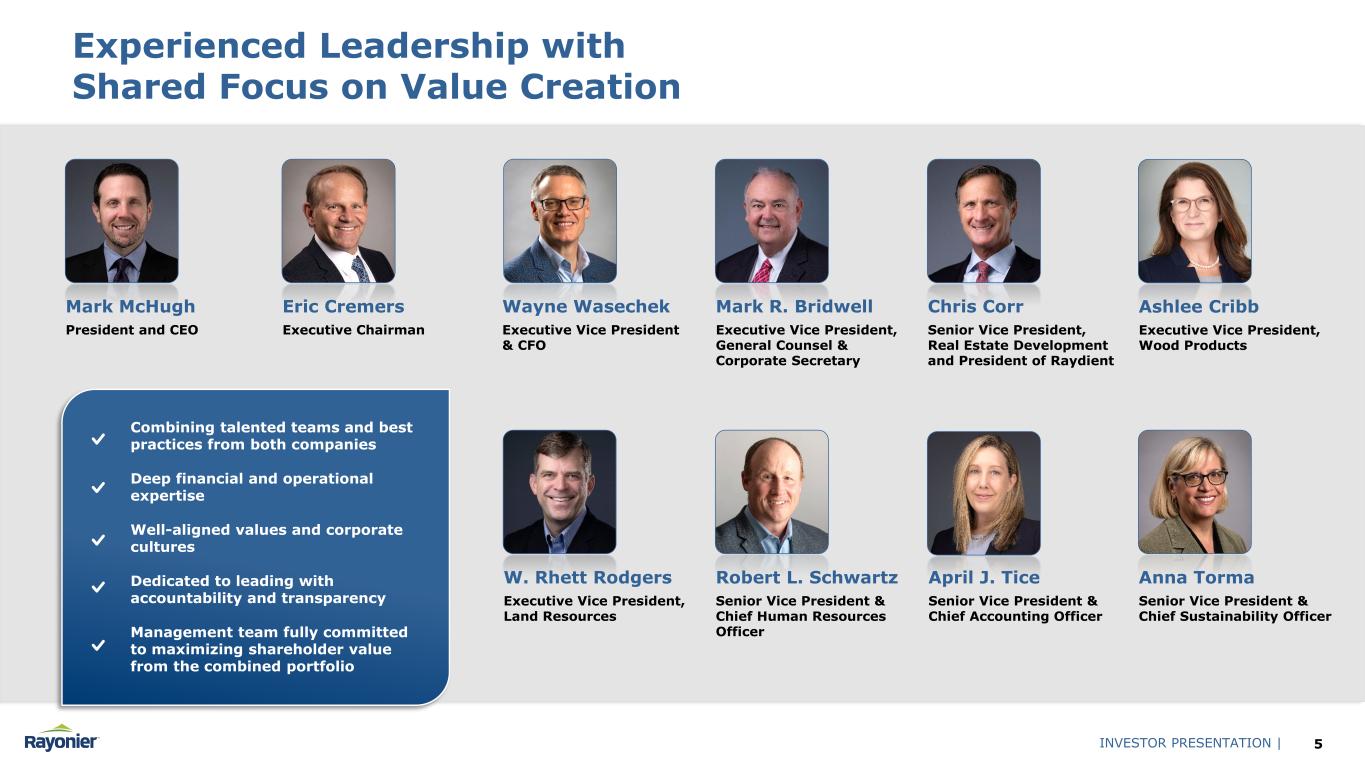
5 Mark McHugh President and CEO Wayne Wasechek Executive Vice President & CFO Mark R. Bridwell Executive Vice President, General Counsel & Corporate Secretary Chris Corr Senior Vice President, Real Estate Development and President of Raydient Ashlee Cribb Executive Vice President, Wood Products W. Rhett Rodgers Executive Vice President, Land Resources Robert L. Schwartz Senior Vice President & Chief Human Resources Officer April J. Tice Senior Vice President & Chief Accounting Officer Anna Torma Senior Vice President & Chief Sustainability Officer Combining talented teams and best practices from both companies Deep financial and operational expertise Well-aligned values and corporate cultures Dedicated to leading with accountability and transparency Management team fully committed to maximizing shareholder value from the combined portfolio Experienced Leadership with Shared Focus on Value Creation INVESTOR PRESENTATION | Eric Cremers Executive Chairman
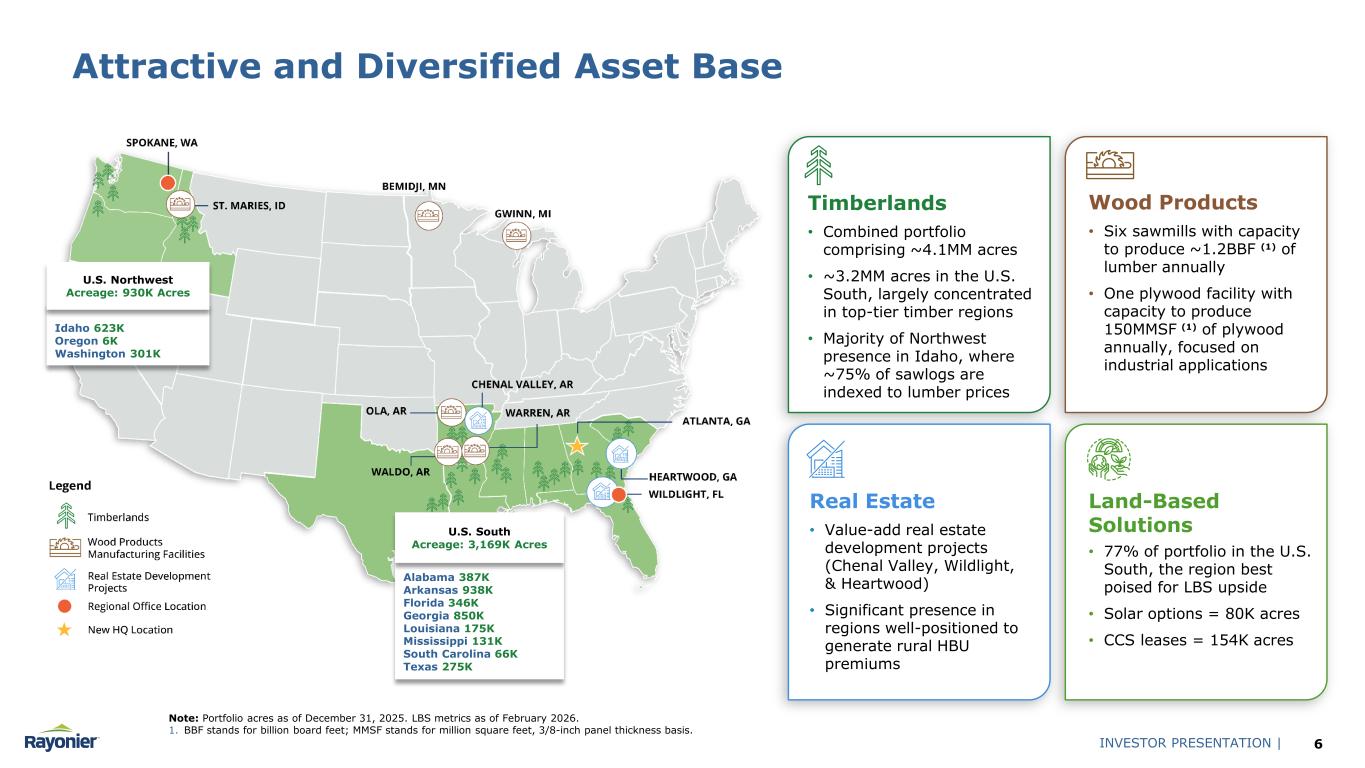
6 Real Estate • Value-add real estate development projects (Chenal Valley, Wildlight, & Heartwood) • Significant presence in regions well-positioned to generate rural HBU premiums Timberlands • Combined portfolio comprising ~4.1MM acres • ~3.2MM acres in the U.S. South, largely concentrated in top-tier timber regions • Majority of Northwest presence in Idaho, where ~75% of sawlogs are indexed to lumber prices Wood Products • Six sawmills with capacity to produce ~1.2BBF (1) of lumber annually • One plywood facility with capacity to produce 150MMSF (1) of plywood annually, focused on industrial applications Land-Based Solutions • 77% of portfolio in the U.S. South, the region best poised for LBS upside • Solar options = 80K acres • CCS leases = 154K acres Idaho 623K Oregon 6K Washington 301K U.S. Northwest Acreage: 930K Acres Alabama 387K Arkansas 938K Florida 346K Georgia 850K Louisiana 175K Mississippi 131K South Carolina 66K Texas 275K U.S. South Acreage: 3,169K Acres Note: Portfolio acres as of December 31, 2025. LBS metrics as of February 2026. 1. BBF stands for billion board feet; MMSF stands for million square feet, 3/8-inch panel thickness basis. Attractive and Diversified Asset Base INVESTOR PRESENTATION |
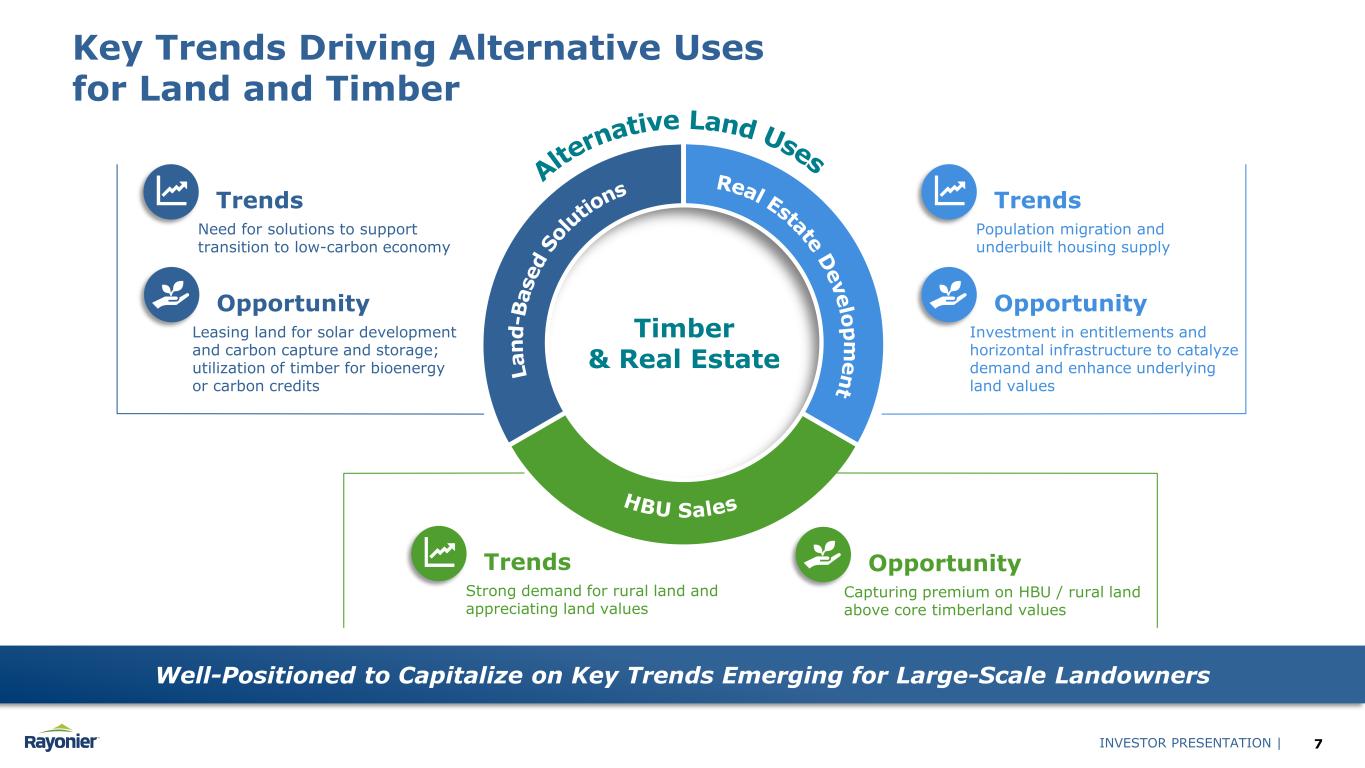
7 Key Trends Driving Alternative Uses for Land and Timber Well-Positioned to Capitalize on Key Trends Emerging for Large-Scale Landowners Timber & Real Estate Need for solutions to support transition to low-carbon economy Trends Leasing land for solar development and carbon capture and storage; utilization of timber for bioenergy or carbon credits Opportunity Population migration and underbuilt housing supply Trends Investment in entitlements and horizontal infrastructure to catalyze demand and enhance underlying land values Opportunity Strong demand for rural land and appreciating land values Trends Capturing premium on HBU / rural land above core timberland values Opportunity INVESTOR PRESENTATION |
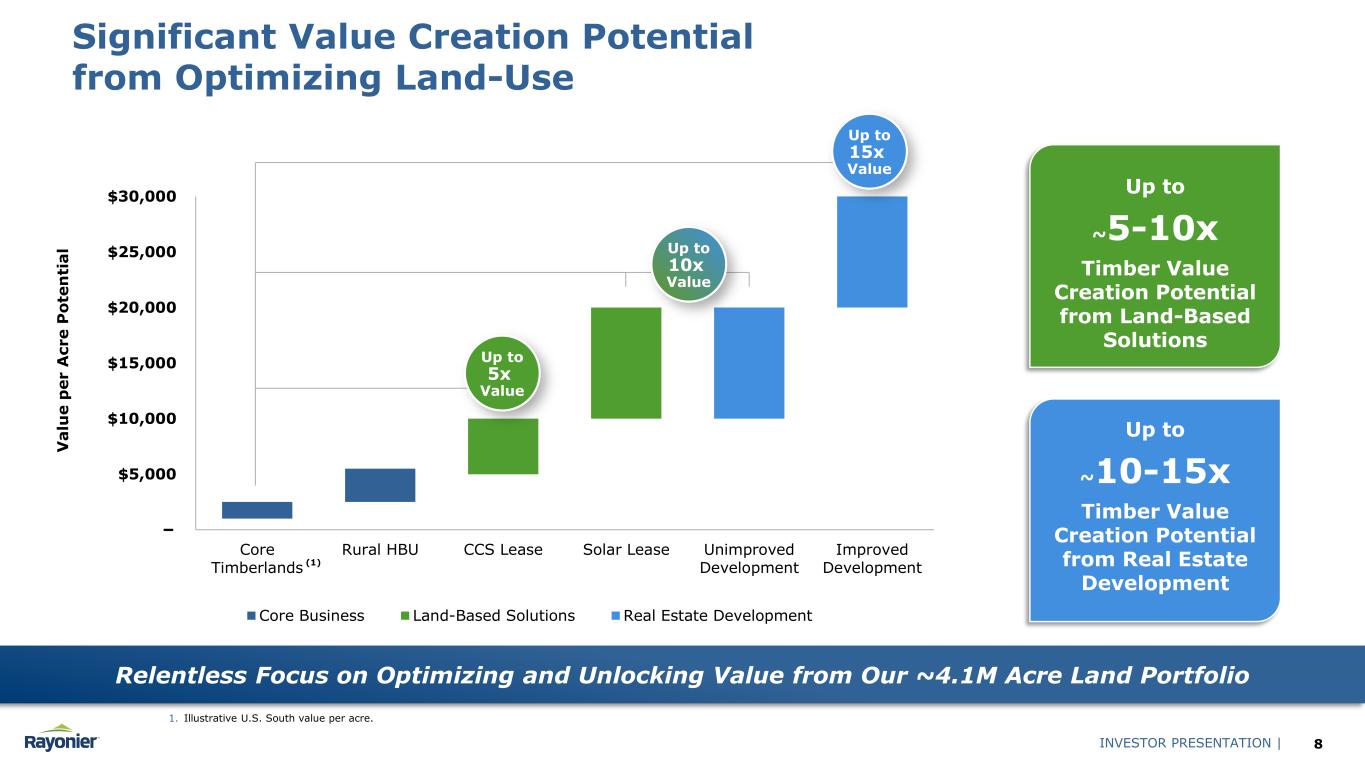
8 Significant Value Creation Potential from Optimizing Land-Use $0 $5,000 $10,000 $15,000 $20,000 $25,000 $30,000 Core Timberlands Rural HBU CCS Lease Solar Lease Unimproved Development Improved Development Core Business Land-Based Solutions Real Estate Development V al u e p er A cr e P ot en ti al Up to 10x Value Up to 5x Value – Up to 15x Value (1) Up to ~5-10x Timber Value Creation Potential from Land-Based Solutions Up to ~10-15x Timber Value Creation Potential from Real Estate Development Relentless Focus on Optimizing and Unlocking Value from Our ~4.1M Acre Land Portfolio 1. Illustrative U.S. South value per acre. INVESTOR PRESENTATION |
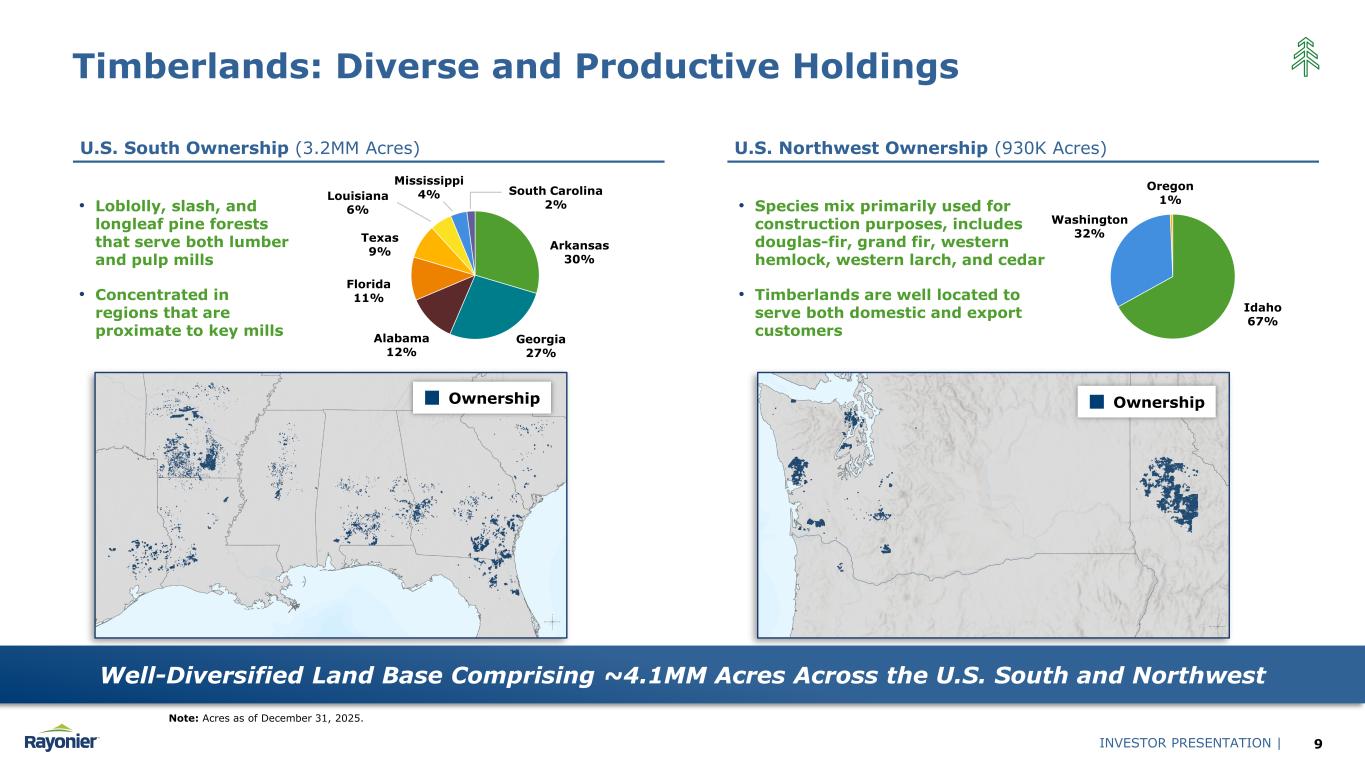
9 Idaho 67% Washington 32% Oregon 1%• Loblolly, slash, and longleaf pine forests that serve both lumber and pulp mills • Concentrated in regions that are proximate to key mills • Species mix primarily used for construction purposes, includes douglas-fir, grand fir, western hemlock, western larch, and cedar • Timberlands are well located to serve both domestic and export customers U.S. South Ownership (3.2MM Acres) U.S. Northwest Ownership (930K Acres) Ownership Ownership Well-Diversified Land Base Comprising ~4.1MM Acres Across the U.S. South and Northwest Timberlands: Diverse and Productive Holdings Arkansas 30% Georgia 27% Alabama 12% Florida 11% Texas 9% Louisiana 6% Mississippi 4% South Carolina 2% INVESTOR PRESENTATION | Note: Acres as of December 31, 2025.
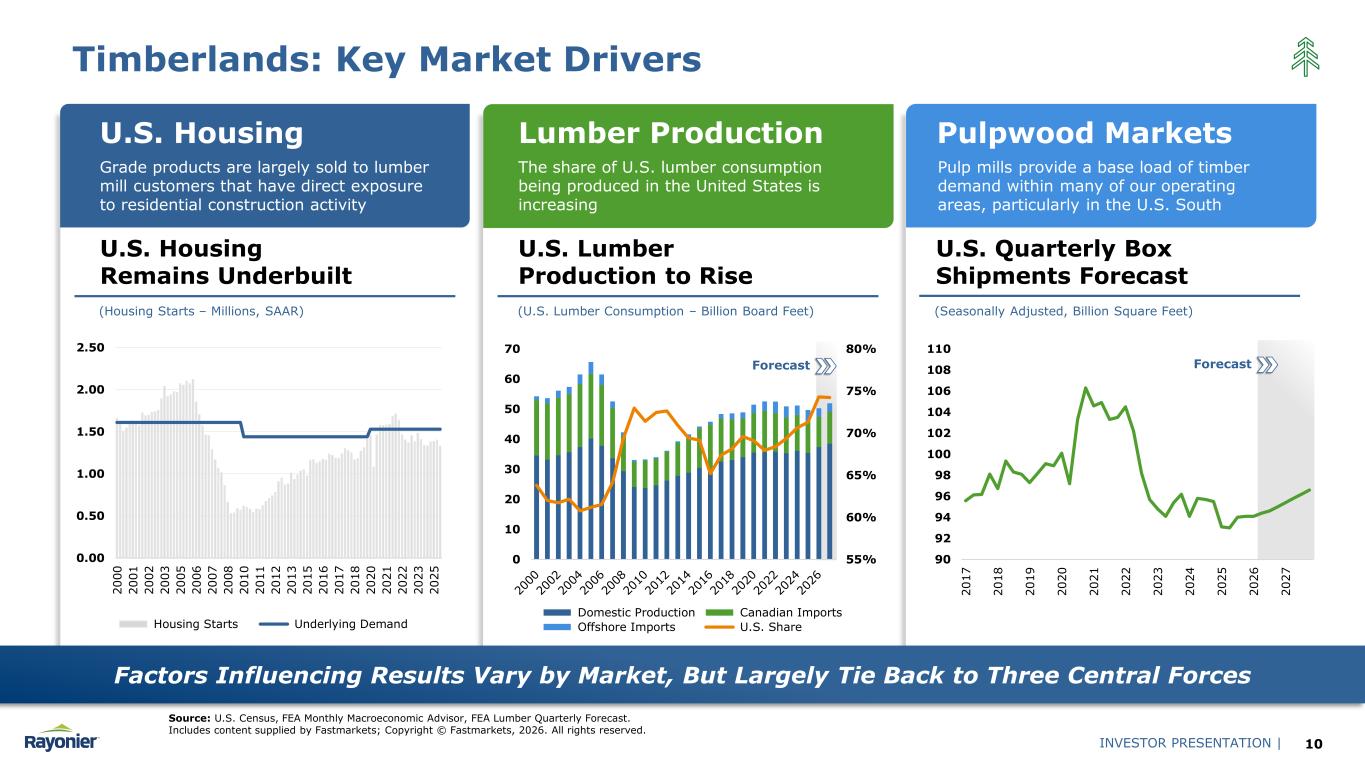
10 Forecast 90 92 94 96 98 100 102 104 106 108 110 20 17 20 18 20 19 20 20 20 21 20 22 20 23 20 24 20 25 20 26 20 27 (Housing Starts – Millions, SAAR) Lumber Production Grade products are largely sold to lumber mill customers that have direct exposure to residential construction activity U.S. Housing U.S. Housing Remains Underbuilt The share of U.S. lumber consumption being produced in the United States is increasing Pulp mills provide a base load of timber demand within many of our operating areas, particularly in the U.S. South U.S. Lumber Production to Rise U.S. Quarterly Box Shipments Forecast (U.S. Lumber Consumption – Billion Board Feet) (Seasonally Adjusted, Billion Square Feet) Pulpwood Markets Forecast Factors Influencing Results Vary by Market, But Largely Tie Back to Three Central Forces Timberlands: Key Market Drivers 0.00 0.50 1.00 1.50 2.00 2.50 20 00 20 01 20 02 20 03 20 05 20 06 20 07 20 08 20 10 20 11 20 12 20 13 20 15 20 16 20 17 20 18 20 20 20 21 20 22 20 23 20 25 Housing Starts Underlying Demand 55% 60% 65% 70% 75% 80% 0 10 20 30 40 50 60 70 Domestic Production Canadian Imports Offshore Imports U.S. Share Source: U.S. Census, FEA Monthly Macroeconomic Advisor, FEA Lumber Quarterly Forecast. Includes content supplied by Fastmarkets; Copyright © Fastmarkets, 2026. All rights reserved. INVESTOR PRESENTATION |
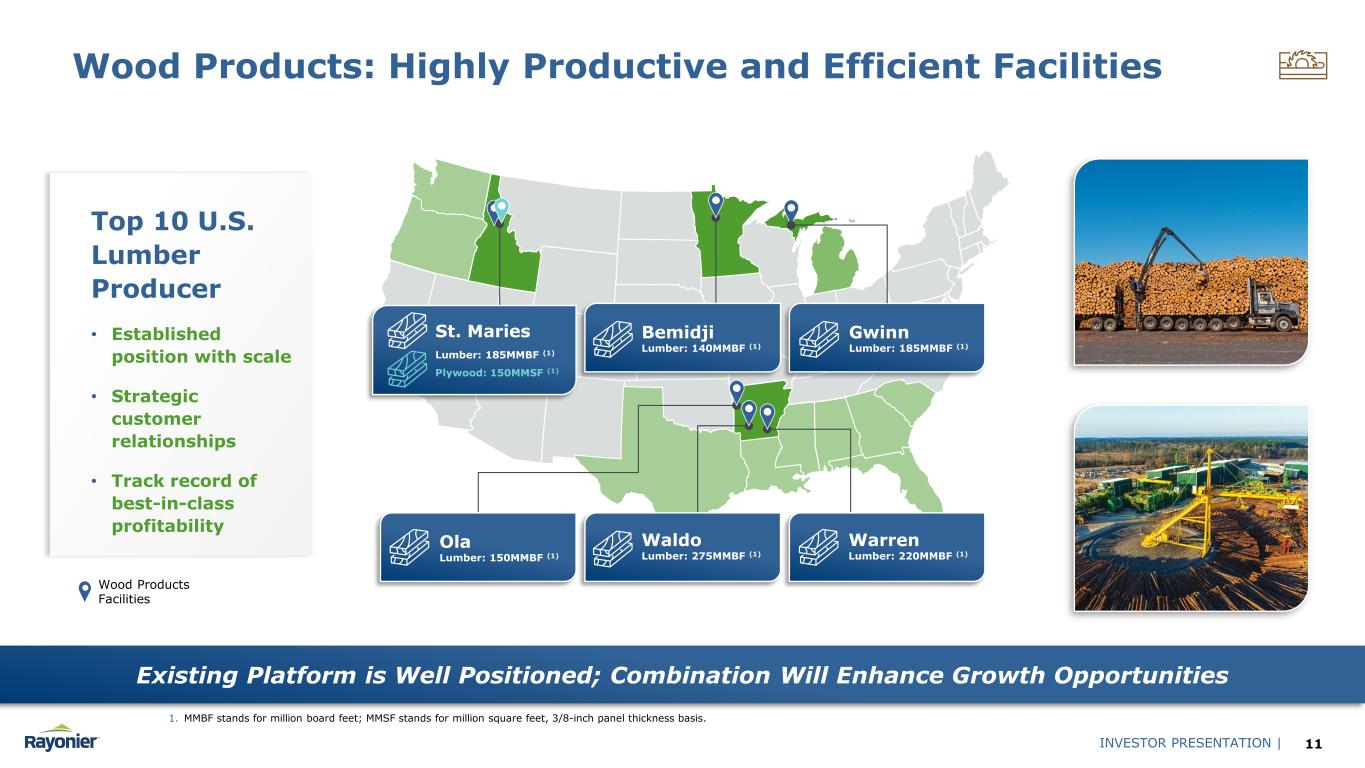
11 Wood Products Facilities Top 10 U.S. Lumber Producer • Established position with scale • Strategic customer relationships • Track record of best-in-class profitability Gwinn Lumber: 185MMBF (1) St. Maries Lumber: 185MMBF (1) Plywood: 150MMSF (1) Bemidji Lumber: 140MMBF (1) Waldo Lumber: 275MMBF (1) Warren Lumber: 220MMBF (1) Ola Lumber: 150MMBF (1) Existing Platform is Well Positioned; Combination Will Enhance Growth Opportunities Wood Products: Highly Productive and Efficient Facilities 1. MMBF stands for million board feet; MMSF stands for million square feet, 3/8-inch panel thickness basis. INVESTOR PRESENTATION |
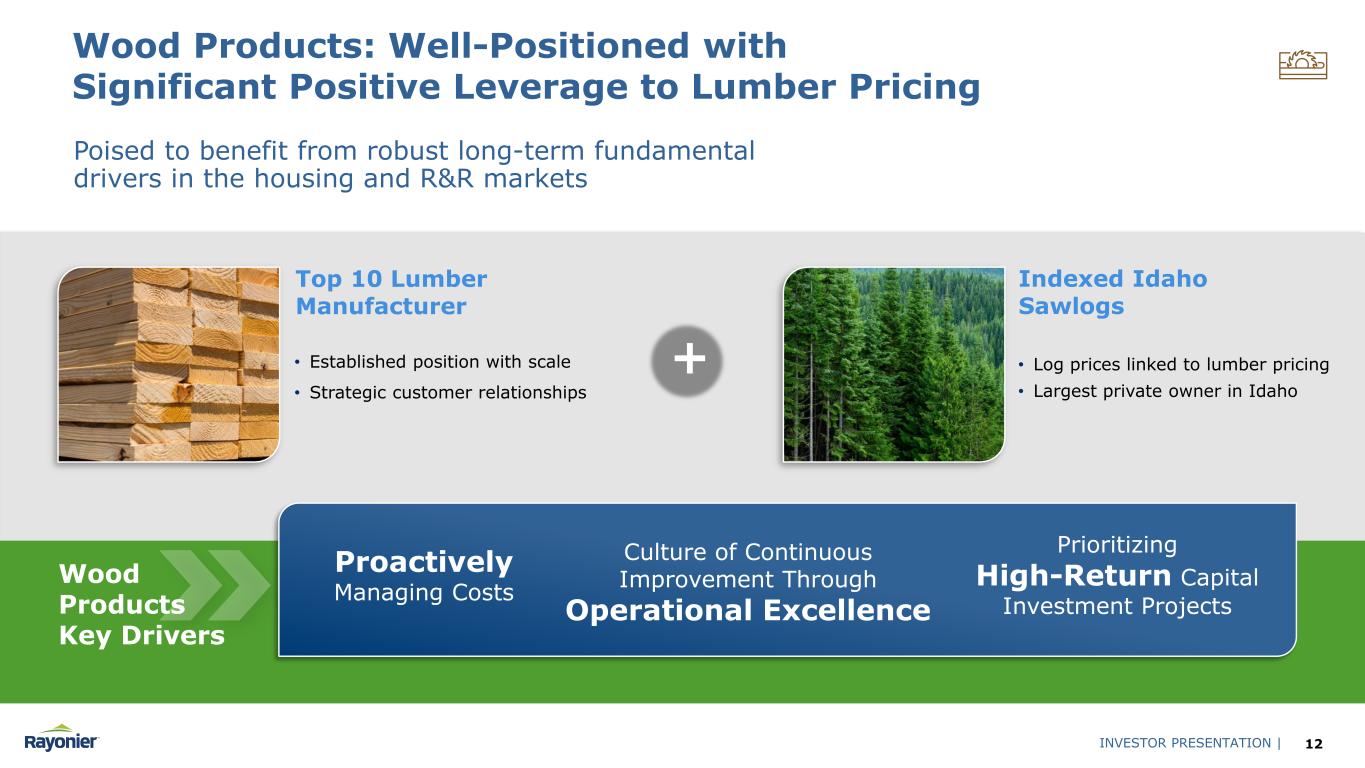
12 Proactively Managing Costs Culture of Continuous Improvement Through Operational Excellence Prioritizing High-Return Capital Investment Projects Wood Products Key Drivers Wood Products: Well-Positioned with Significant Positive Leverage to Lumber Pricing Indexed Idaho Sawlogs • Log prices linked to lumber pricing • Largest private owner in Idaho Top 10 Lumber Manufacturer • Established position with scale • Strategic customer relationships Poised to benefit from robust long-term fundamental drivers in the housing and R&R markets INVESTOR PRESENTATION |
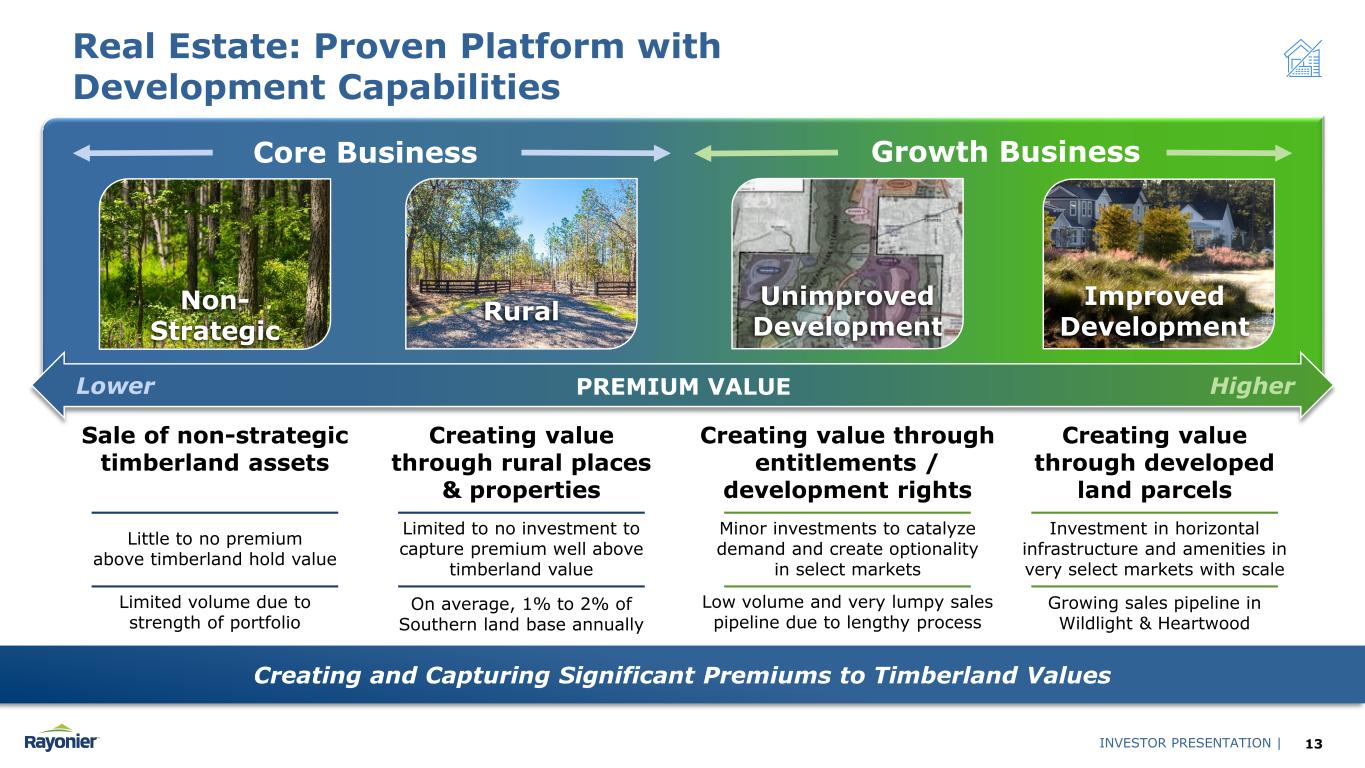
13 Real Estate: Proven Platform with Development Capabilities Little to no premium above timberland hold value Limited to no investment to capture premium well above timberland value On average, 1% to 2% of Southern land base annually Sale of non-strategic timberland assets Creating value through rural places & properties Core Business Creating value through entitlements / development rights Growth Business Minor investments to catalyze demand and create optionality in select markets Low volume and very lumpy sales pipeline due to lengthy process Investment in horizontal infrastructure and amenities in very select markets with scale Growing sales pipeline in Wildlight & Heartwood Creating value through developed land parcels Limited volume due to strength of portfolio PREMIUM VALUELower Higher Unimproved Development Improved DevelopmentRuralNon- Strategic Creating and Capturing Significant Premiums to Timberland Values INVESTOR PRESENTATION |
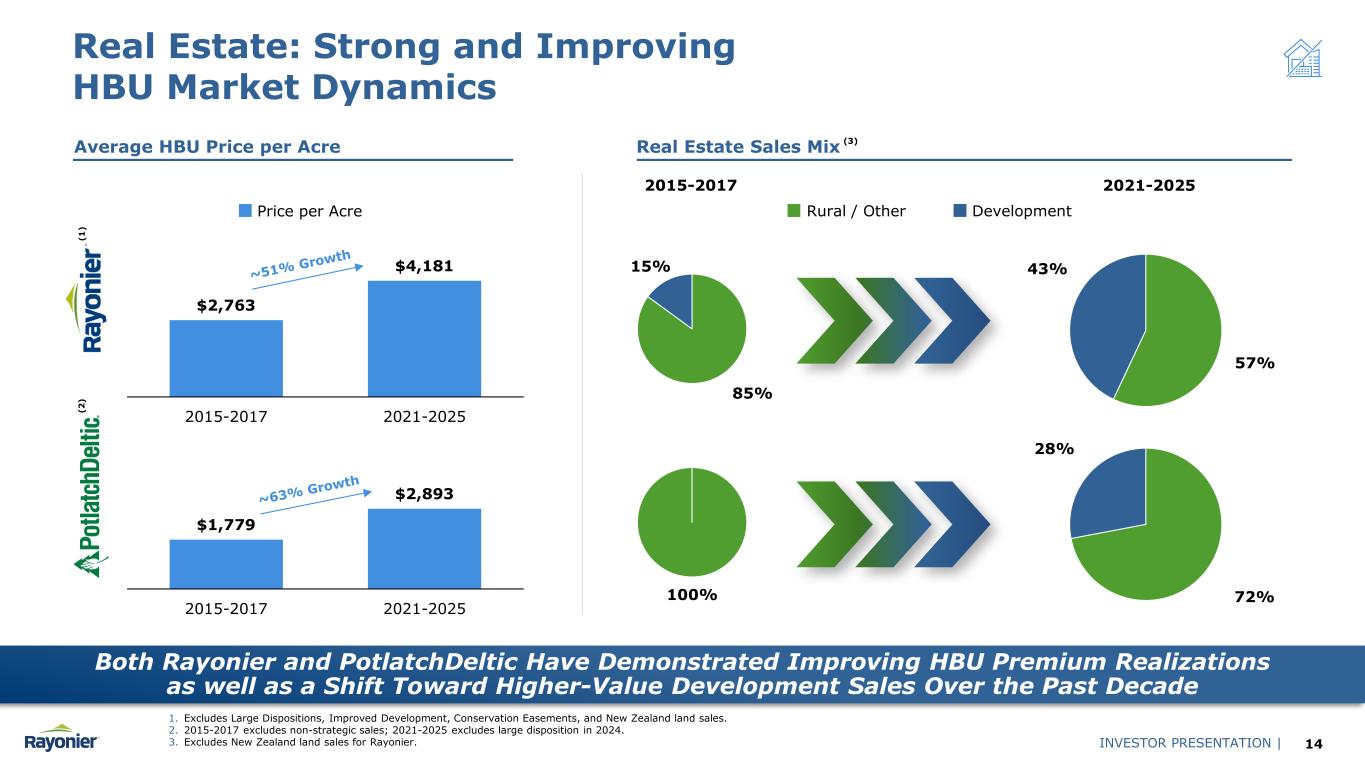
14 Average HBU Price per Acre Real Estate Sales Mix (3) 85% 15% $2,763 $4,181 2015-2017 2021-2025 $1,779 $2,893 2015-2017 2021-2025 Rural / Other Development 2015-2017 2021-2025 100% 57% 43% 72% 28% Price per Acre Both Rayonier and PotlatchDeltic Have Demonstrated Improving HBU Premium Realizations as well as a Shift Toward Higher-Value Development Sales Over the Past Decade Real Estate: Strong and Improving HBU Market Dynamics (1 ) (2 ) 1. Excludes Large Dispositions, Improved Development, Conservation Easements, and New Zealand land sales. 2. 2015-2017 excludes non-strategic sales; 2021-2025 excludes large disposition in 2024. 3. Excludes New Zealand land sales for Rayonier. INVESTOR PRESENTATION |
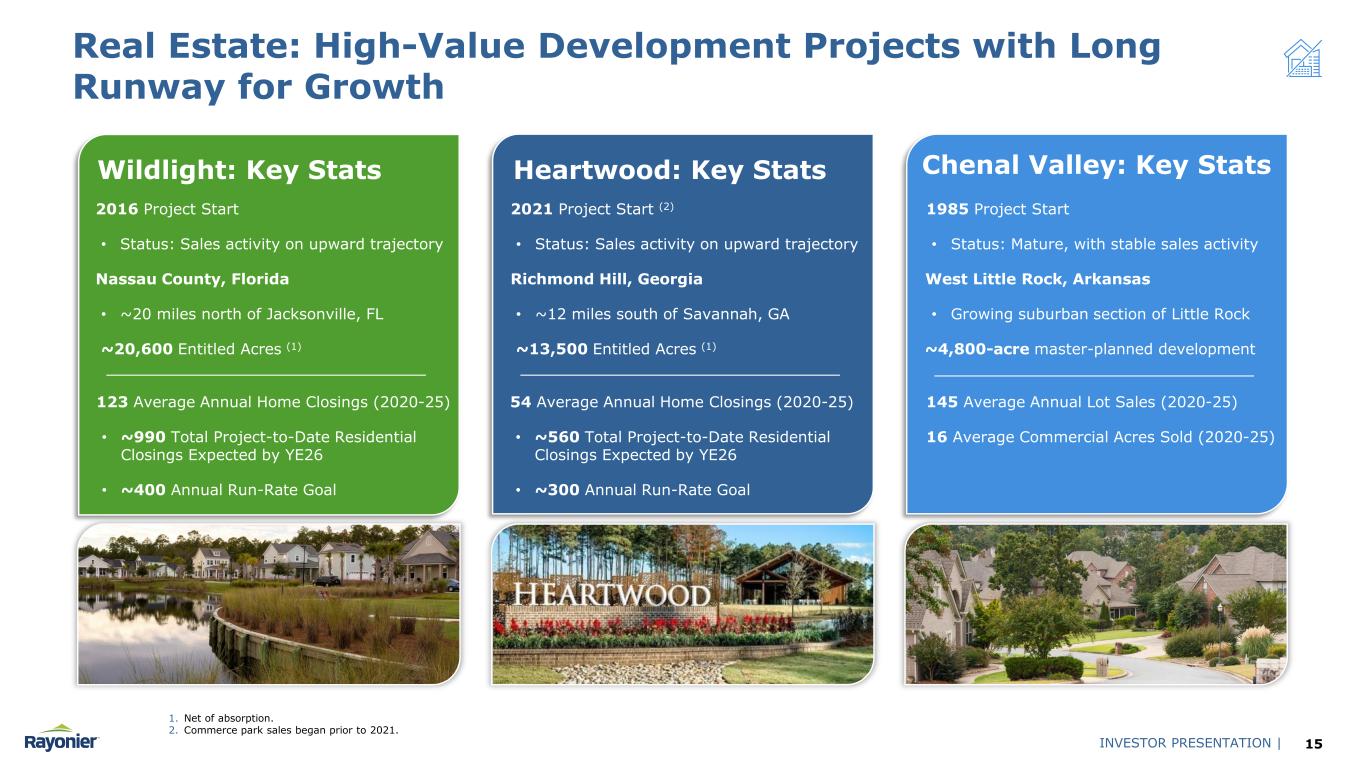
15 2016 Project Start • Status: Sales activity on upward trajectory Nassau County, Florida • ~20 miles north of Jacksonville, FL ~20,600 Entitled Acres (1) 123 Average Annual Home Closings (2020-25) • ~990 Total Project-to-Date Residential Closings Expected by YE26 • ~400 Annual Run-Rate Goal Wildlight: Key Stats 2021 Project Start (2) • Status: Sales activity on upward trajectory Richmond Hill, Georgia • ~12 miles south of Savannah, GA ~13,500 Entitled Acres (1) 54 Average Annual Home Closings (2020-25) • ~560 Total Project-to-Date Residential Closings Expected by YE26 • ~300 Annual Run-Rate Goal Heartwood: Key Stats Chenal Valley: Key Stats 145 Average Annual Lot Sales (2020-25) 16 Average Commercial Acres Sold (2020-25) 1985 Project Start • Status: Mature, with stable sales activity West Little Rock, Arkansas • Growing suburban section of Little Rock ~4,800-acre master-planned development Real Estate: High-Value Development Projects with Long Runway for Growth 1. Net of absorption. 2. Commerce park sales began prior to 2021. INVESTOR PRESENTATION |
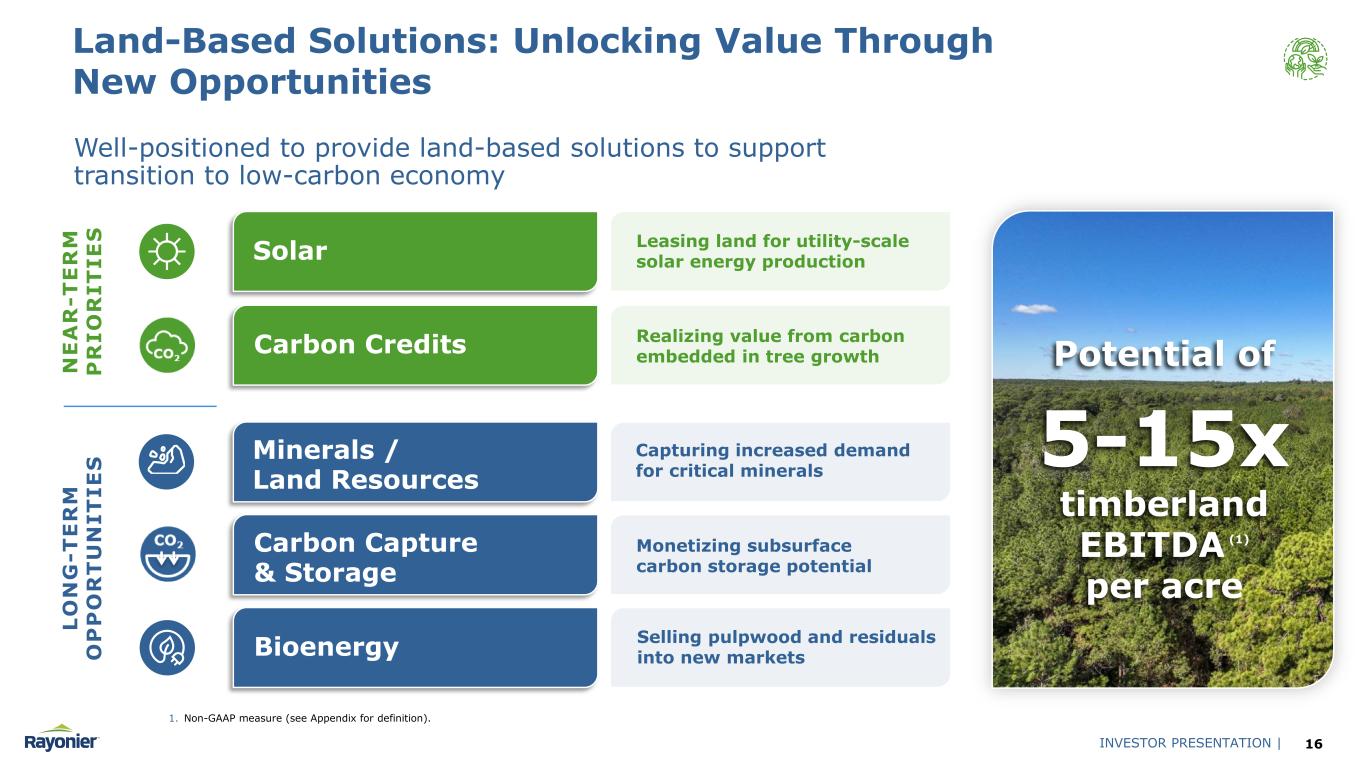
16 Land-Based Solutions: Unlocking Value Through New Opportunities Leasing land for utility-scale solar energy production N E A R -T E R M P R IO R IT IE S L O N G -T E R M O P P O R T U N IT IE S Solar Carbon Credits Minerals / Land Resources Carbon Capture & Storage Bioenergy Realizing value from carbon embedded in tree growth Capturing increased demand for critical minerals Monetizing subsurface carbon storage potential Selling pulpwood and residuals into new markets Potential of 5-15x timberland EBITDA (1) per acre Well-positioned to provide land-based solutions to support transition to low-carbon economy 1. Non-GAAP measure (see Appendix for definition). INVESTOR PRESENTATION |
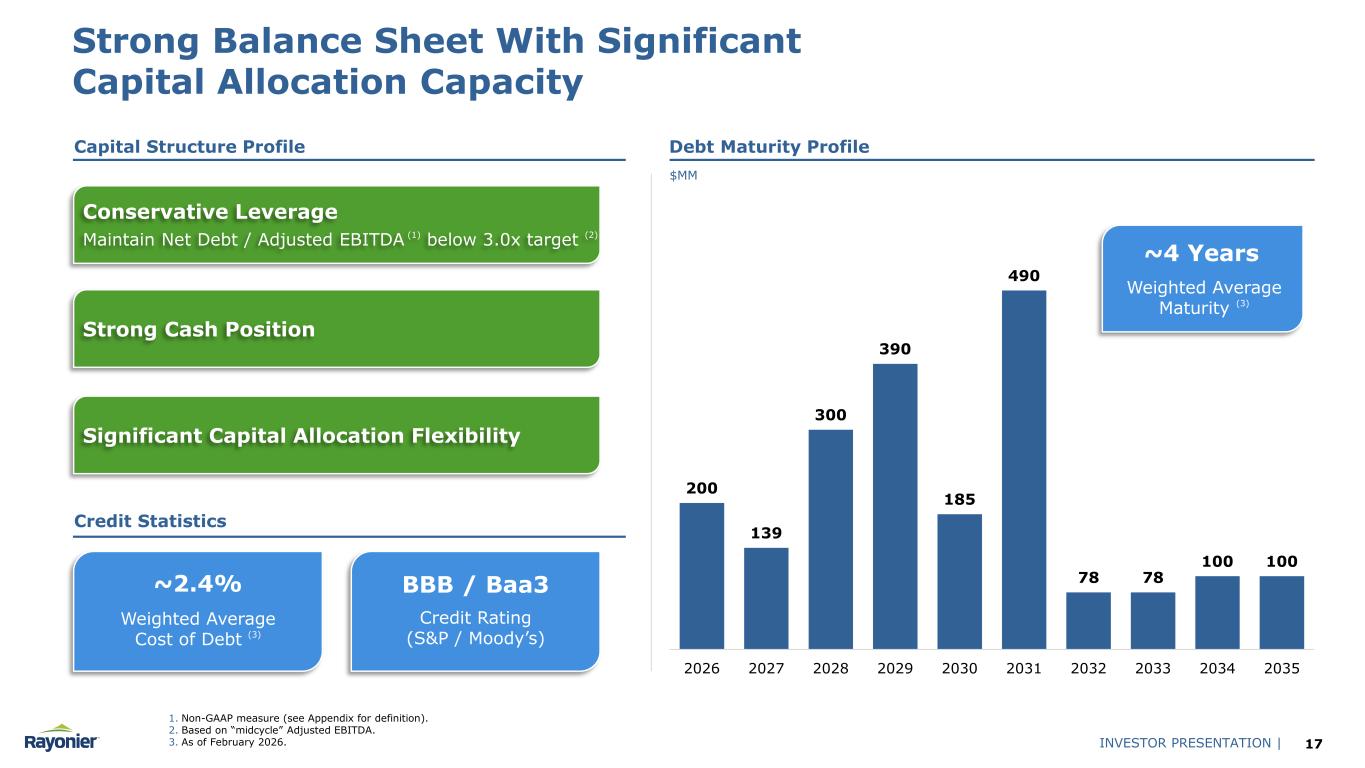
17 200 139 300 390 185 490 78 78 100 100 2026 2027 2028 2029 2030 2031 2032 2033 2034 2035 Strong Balance Sheet With Significant Capital Allocation Capacity Capital Structure Profile Debt Maturity Profile $MM Conservative Leverage Maintain Net Debt / Adjusted EBITDA (1) below 3.0x target (2) Credit Statistics ~2.4% Weighted Average Cost of Debt (3) 13% Net Debt / Enterprise Value (4) ~4 Years Weighted Average Maturity (3) Strong Cash Position Significant Capital Allocation Flexibility BBB / Baa3 Credit Rating (S&P / Moody’s) 1. Non-GAAP measure (see Appendix for definition). 2. Based on “midcycle” Adjusted EBITDA. 3. As of February 2026. INVESTOR PRESENTATION |
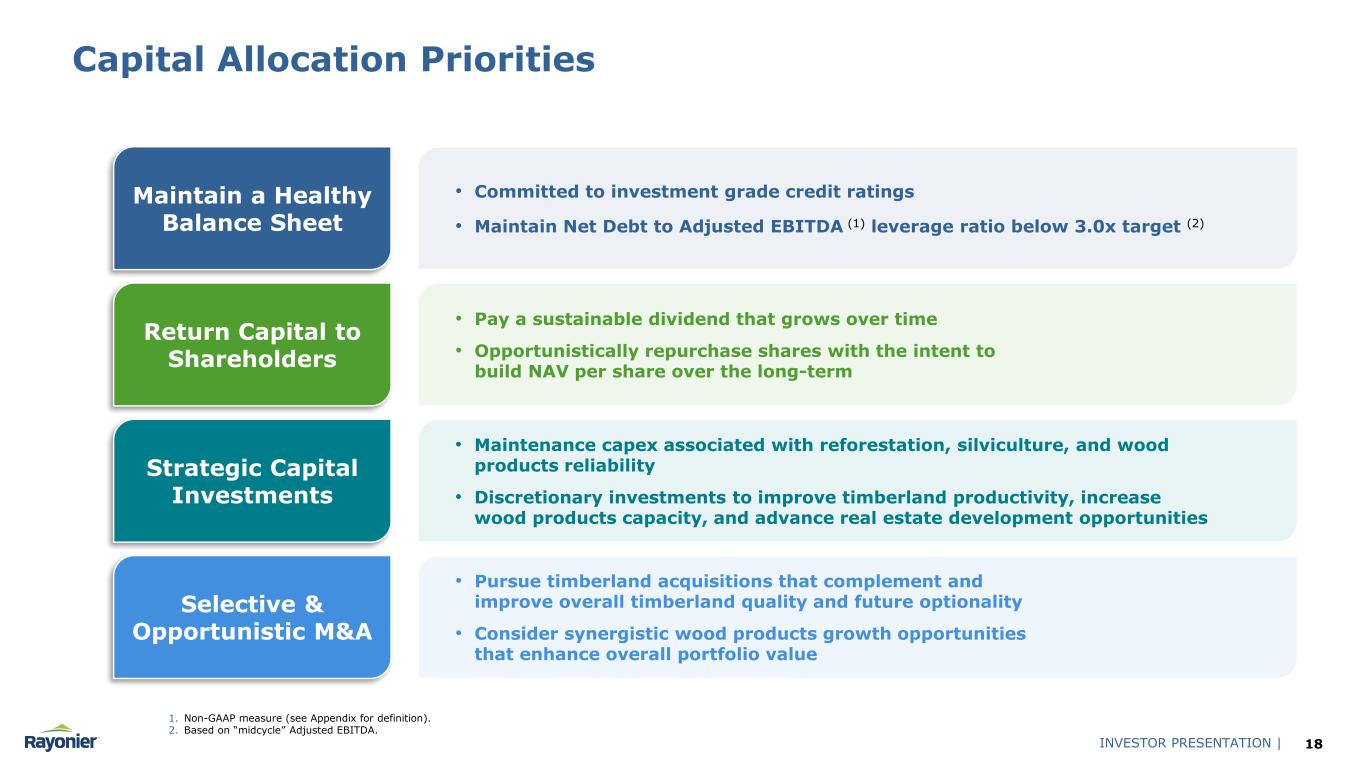
18 Maintain a Healthy Balance Sheet • Committed to investment grade credit ratings • Maintain Net Debt to Adjusted EBITDA (1) leverage ratio below 3.0x target (2) Return Capital to Shareholders • Pay a sustainable dividend that grows over time • Opportunistically repurchase shares with the intent to build NAV per share over the long-term Strategic Capital Investments • Maintenance capex associated with reforestation, silviculture, and wood products reliability • Discretionary investments to improve timberland productivity, increase wood products capacity, and advance real estate development opportunities Selective & Opportunistic M&A • Pursue timberland acquisitions that complement and improve overall timberland quality and future optionality • Consider synergistic wood products growth opportunities that enhance overall portfolio value Capital Allocation Priorities 1. Non-GAAP measure (see Appendix for definition). 2. Based on “midcycle” Adjusted EBITDA. INVESTOR PRESENTATION |
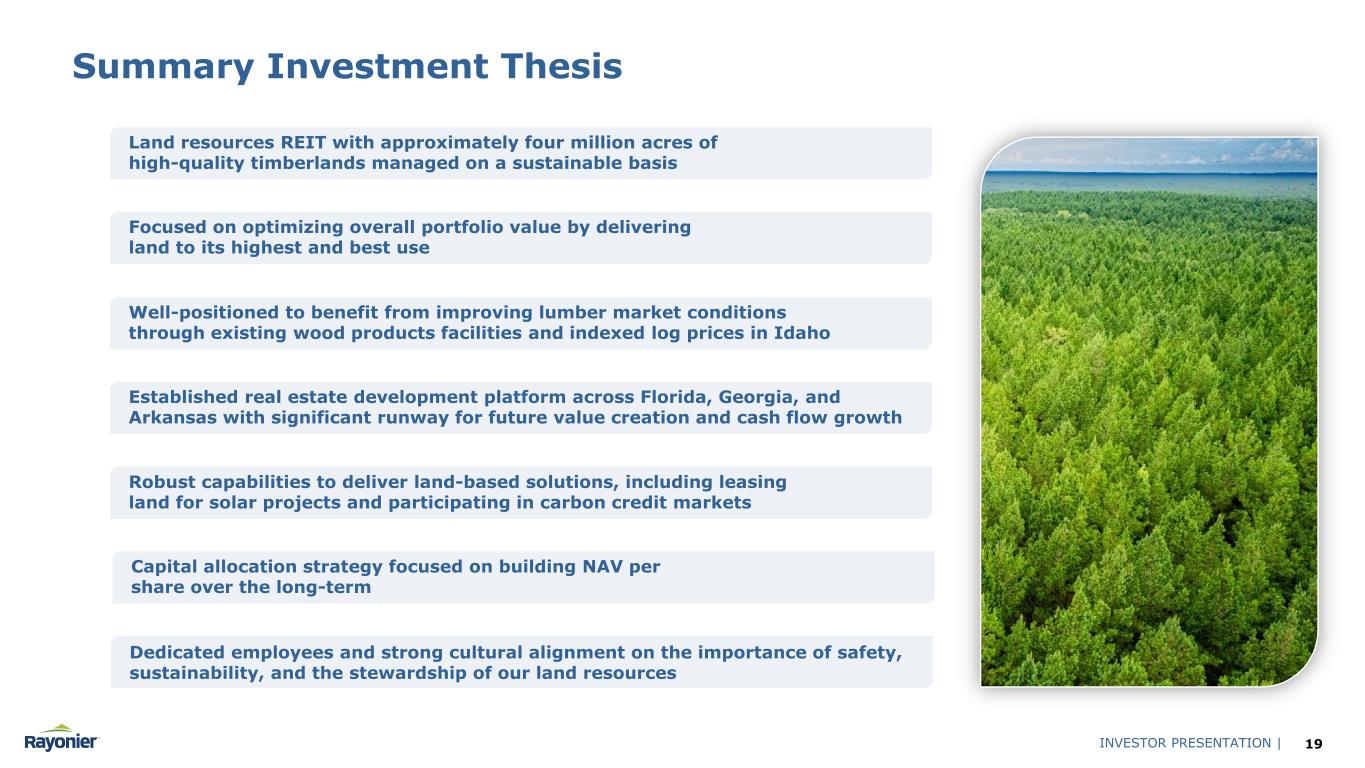
19 Summary Investment Thesis Land resources REIT with approximately four million acres of high-quality timberlands managed on a sustainable basis Focused on optimizing overall portfolio value by delivering land to its highest and best use Well-positioned to benefit from improving lumber market conditions through existing wood products facilities and indexed log prices in Idaho Established real estate development platform across Florida, Georgia, and Arkansas with significant runway for future value creation and cash flow growth Robust capabilities to deliver land-based solutions, including leasing land for solar projects and participating in carbon credit markets Capital allocation strategy focused on building NAV per share over the long-term Dedicated employees and strong cultural alignment on the importance of safety, sustainability, and the stewardship of our land resources INVESTOR PRESENTATION |
20INVESTOR PRESENTATION | Appendix
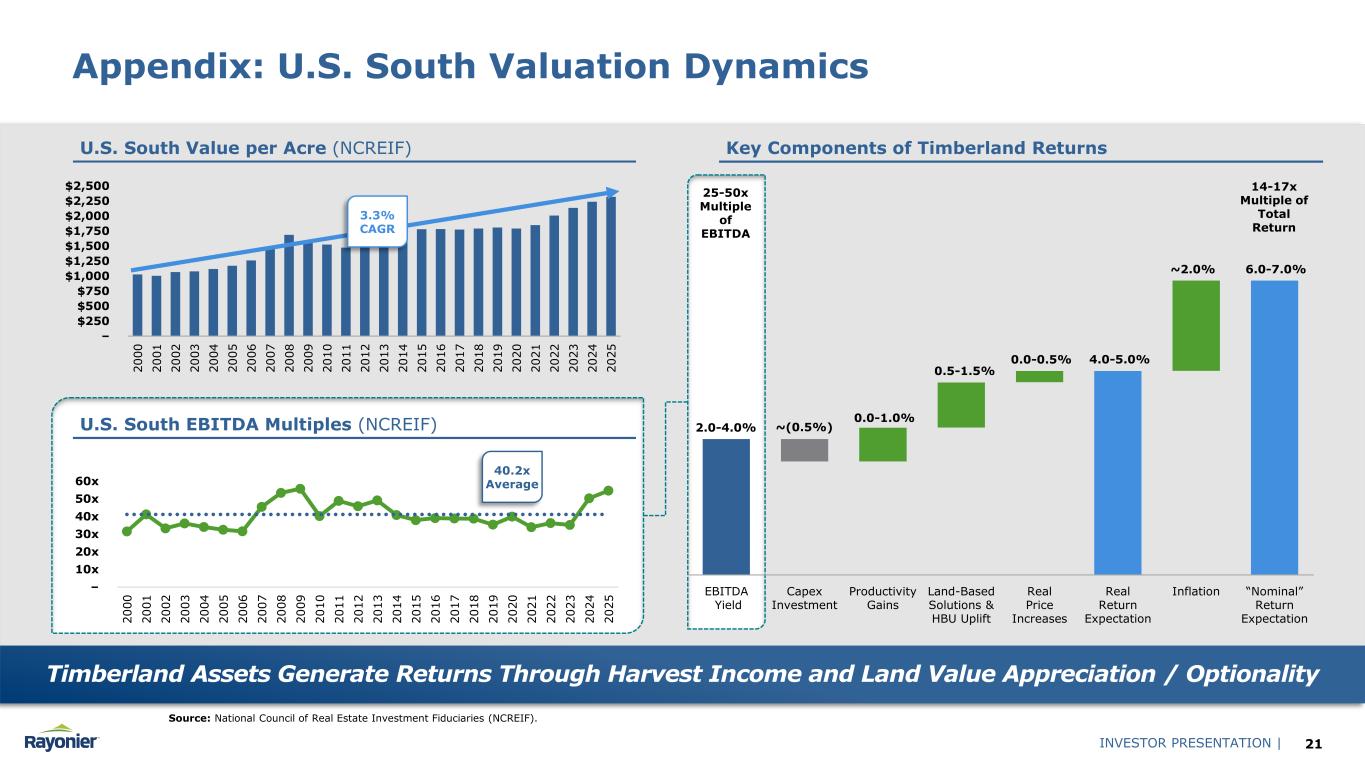
21 EBITDA Yield Capex Investment Productivity Gains Land-Based Solutions & HBU Uplift Real Price Increases Real Return Expectation Inflation “Nominal” Return Expectation Appendix: U.S. South Valuation Dynamics Timberland Assets Generate Returns Through Harvest Income and Land Value Appreciation / Optionality – 10x 20x 30x 40x 50x 60x 20 00 20 01 20 02 20 03 20 04 20 05 20 06 20 07 20 08 20 09 20 10 20 11 20 12 20 13 20 14 20 15 20 16 20 17 20 18 20 19 20 20 20 21 20 22 20 23 20 24 20 25 U.S. South Value per Acre (NCREIF) Key Components of Timberland Returns U.S. South EBITDA Multiples (NCREIF) – $250 $500 $750 $1,000 $1,250 $1,500 $1,750 $2,000 $2,250 $2,500 20 00 20 01 20 02 20 03 20 04 20 05 20 06 20 07 20 08 20 09 20 10 20 11 20 12 20 13 20 14 20 15 20 16 20 17 20 18 20 19 20 20 20 21 20 22 20 23 20 24 20 25 2.0-4.0% 4.0-5.0% 0.0-1.0% 0.5-1.5% ~2.0% ~(0.5%) 6.0-7.0% 0.0-0.5% 25-50x Multiple of EBITDA 14-17x Multiple of Total Return 3.3% CAGR 40.2x Average INVESTOR PRESENTATION | Source: National Council of Real Estate Investment Fiduciaries (NCREIF).
22INVESTOR PRESENTATION | Adjusted EBITDA is defined as earnings before interest, taxes, depreciation, depletion, amortization, the non-cash cost of land and improved development, non-operating expense (income), Large Dispositions, and other non-recurring pro forma items. Adjusted EBITDA is a non-GAAP measure that management uses to make strategic decisions about the business and that investors can use to evaluate the operational performance of the assets under management. It excludes specific items that management believes are not indicative of the Company's ongoing operating results. Appendix: Definition of Non-GAAP Measures