UNITED STATES
SECURITIES AND EXCHANGE COMMISSION
Washington, DC 20549
PROXY STATEMENT PURSUANT TO SECTION 14(a)
OF THE SECURITIES EXCHANGE ACT OF 1934
(Amendment No. )
 |
Filed by the Registrant |  |
Filed by a Party other than the Registrant |
| Check the appropriate box: | |
|
Preliminary Proxy Statement |
|
Confidential, for Use of the Commission Only (as permitted by Rule 14A-6(E)(2)) |
|
Definitive Proxy Statement |
|
Definitive Additional Materials |
|
Soliciting Material under ss.240.14a-12 |

(Name of Registrant as Specified in Its Charter)
(Name of Person(s) Filing Proxy Statement, if other than the Registrant)
| Payment of Filing Fee (Check all boxes that apply): | |
|
No fee required. |
|
Fee paid previously with preliminary materials. |
|
Fee computed on table in exhibit required by Item 25(b) per Exchange Act Rules 14a-6(i)(1) and 0-11. |
Our Ambition
To be America’s most trusted health care company
Our Purpose
To simplify health care one person, one family and one community at a time
Our Values
We care.
We show up with compassion and empathy for our customers and our colleagues.
We innovate with purpose.
We listen, adapt and collaborate to develop leading solutions.
We are accountable.
We operate with transparency and integrity to fulfill our commitments.
We prioritize safety and quality.
We set a high bar, with safety and quality at the center of all we do.
This proxy statement contains forward-looking statements as defined by the Private Securities Litigation Reform Act of 1995. Please see the “Cautionary Statement Concerning Forward-Looking Statements” in the Company’s Annual Report on Form 10-K for the fiscal year ended December 31, 2025, most recently filed Quarterly Report on Form 10-Q and Current Reports on Form 8-K, for a discussion on forward-looking statements.
Message from Our Chair of the Board and Our Lead Independent Director
Dear Fellow Stockholders:
The strength of our connected businesses, along with our experienced leadership team and dedicated colleagues serving approximately 185 million Americans, gives us confidence in our ability to reimagine health care.
In late 2025, we aligned around a new ambition, purpose and set of values to guide this important work. Our ambition is to be America’s most trusted health care company by delivering on our purpose to simplify health care — one person, one family and one community at a time.
Financial performance
Our momentum remains strong. We made significant progress on margin recovery at Aetna® and remain focused on restoring this business to its full potential. At the same time, CVS Caremark® continued to lead innovation in the PBM industry, we exceeded expectations across CVS Pharmacy® and we’ve taken actions to position our Health Care Delivery businesses for sustainable long-term growth. In 2025, CVS Health delivered $402.1 billion in revenue, generated $10.6 billion in operating cash flow and returned over $3.0 billion to stockholders.
Delivering connected experiences
We will continue to deliver better connected experiences to create value for customers, members, patients and stockholders. In 2025 we introduced bundled prior authorization (“PA”) for select conditions, aligning standard care pathways that previously required multiple PAs into a single PA. This approach reduces administrative burdens for providers, takes costs out of the system and makes it easier for members to get the care they need.
By leveraging AI-powered analytics, we’re able to identify members taking GLP-1 medications who may need dietary or support services. This positions us as a platform of choice and creates opportunities for us to deliver weight management solutions to the end consumer, helping achieve the best clinical outcomes at the lowest net cost. Complementing this effort, our formulary strategy continues to balance cost and coverage by prioritizing clinically effective therapies, delivering more than $1.5 billion in client savings through biosimilar adoption.
Investing in technology
Across the Enterprise, we’re investing in technology to improve engagement. Our CVS Health app gives millions of people the ability to manage care straight from their phones. At the time, we’re equipping our pharmacists with advanced AI tools to help identify patients with low medication adherence. With this information, our pharmacists can help reengage patients in their health. We’re also utilizing AI technologies to support our Aetna nurses, giving them back approximately 90 minutes each day, so they can spend more time with members and focus on closing critical care gaps. In our service operations, AI is helping us proactively resolve issues before members reach out, saving them time and delivering a more seamless experience. We are using AI to help reduce our overall call center volume and the time it takes to handle certain complex calls by 20-30%. These investments are helping us scale impact and simplify experiences for both colleagues and consumers.
Corporate governance and stockholder engagement
Over the course of the year, our management team and our Board of Directors work closely together on the advancement of the Company’s strategic plan. This year was no exception. We connected with stockholders throughout the year to hear directly from them and better understand their priorities and concerns, including those related to executive compensation. As we describe within this proxy statement, we believe in aligning executive compensation with performance. We will continue to be responsive as we enhance our understanding of your perspectives.
2026 Proxy Statement i
In 2025, we made important leadership updates to strengthen the focused execution of our strategy, including David’s appointment as Chair of the Board, beginning January 1, 2026, in addition to his role as President and CEO. David has driven meaningful operational, financial and cultural improvements across the Company. Mike continues to serve as the Board’s Lead Independent Director, providing leadership and strong independent oversight. Roger Farah, former Chair of the Board, has decided not to stand for re-election this year after nearly twenty years of distinguished service to the Company and its subsidiaries. His counsel has been highly valued. We thank Roger and wish him the best in the future.
Annual Meeting of Stockholders
We will host our Annual Meeting of Stockholders virtually at 8:00 AM ET on May 14, 2026 to allow our stockholders to participate regardless of location. As a stockholder, your vote is important to us and we encourage you to vote at your earliest convenience.
In 2026, we will continue to build on our momentum across the Company to advance our strategy and deliver on our financial commitments. Thank you for investing in CVS Health. Your support is essential as we reimagine health care in America.
 |
 | |
| J. David Joyner | Michael F. Mahoney | |
| President, Chief Executive Officer and Chair of the Board | Lead Independent Director |
ii CVS Health
Table of Contents


2026 Proxy Statement iii
Notice of Annual Meeting of Stockholders
Date and Time
May 14, 2026
8:00 a.m., Eastern Time
Eligibility to Vote
Stockholders of record at the close of business on March 16, 2026 may vote at the Annual Meeting.
Location
The Annual Meeting will be held exclusively online at www.virtualshareholdermeeting.com/ CVS2026
How to Vote
Your vote is important to the future of CVS Health. You are eligible to vote if you were a stockholder of record at the close of business on March 16, 2026. Even if you plan to attend the Annual Meeting virtually, please vote as soon as possible using one of the following methods. In all cases, you should have your proxy card in hand:
 |
Use the internet |
| www.proxyvote.com | |
 |
Use A Mobile Device |
| Scan this QR Code | |
 |
Call Toll-Free |
| 1-800-690-6903 | |
 |
Mail Your Proxy Card |
| Follow the instructions on your voting form |
Important Notice Regarding the Availability of Proxy Materials for the Annual Meeting to Be Held on May 14, 2026:
The proxy statement and 2025 Annual Report to Stockholders (the “2025 Annual Report”), which includes our Annual Report on Form 10-K and our audited financial statements, are available at www.proxyvote.com and at www.cvshealthannualmeeting.com.
Whether or not you plan to attend the virtual Annual Meeting, we urge you to vote and submit your proxy in advance of the meeting by one of the methods described in the proxy materials.
You are cordially invited to join our 2026 Annual Meeting of Stockholders, to be held on Thursday, May 14, 2026, at 8:00 a.m., Eastern Time. Our Annual Meeting will be conducted exclusively online.
| Items to be Voted | Board Recommendation | |||
| 1 | Elect the 13 director nominees named in this proxy statement; |  |
FOR Each director nominee | |
| 2 | Ratify the appointment of Ernst & Young LLP as the Company’s independent registered public accounting firm for 2026; | |
FOR | |
| 3 | Say on pay, an advisory vote to approve the Company’s executive compensation; | |
FOR | |
| 4 | Approve the Company’s 2026 Incentive Compensation Plan; | |
FOR | |
| 5 | Act on one stockholder proposal, if properly presented; and |  |
AGAINST | |
Conduct any other business properly brought before the Annual Meeting.
By Order of the Board of Directors,

Kristina V. Fink
Senior Vice President, Corporate Secretary and Chief Governance
Officer
CVS Health Corporation
One CVS Drive
Woonsocket, Rhode Island 02895
(principal executive office)
April 3, 2026
Your vote is important.
Our proxy statement and proxy card are being mailed or transmitted to stockholders entitled to vote at the Annual Meeting beginning on or about April 3, 2026. Whether or not you plan to attend the Annual Meeting, please vote your shares. In addition to voting by mail or during the Annual Meeting by following the instructions available on the Annual Meeting website, stockholders of record have the option of voting by telephone or via the Internet. If your shares are held in the name of a bank, broker or other holder of record (i.e., in “street name”), please read your voting instructions to see which of these options are available to you. Even if you are attending the Annual Meeting virtually, we strongly encourage you to vote in advance by Internet, phone or mail.
We are pleased to take advantage of the U.S. Securities and Exchange Commission (the “SEC”) rules that allow issuers to furnish proxy materials to their stockholders on the Internet. As a result, beginning on or about April 3, 2026, we are mailing a Notice of Internet Availability to many of our stockholders instead of paper copies of our proxy statement and our 2025 Annual Report. The notice contains instructions on how to access those documents over the Internet. The notice also contains instructions on how stockholders can receive a paper copy of our proxy materials, including the proxy statement, our 2025 Annual Report and proxy card.
The Annual Meeting will be accessible only at www.virtualshareholdermeeting.com/CVS2026 (the “Annual Meeting website”). We encourage you to access the Annual Meeting website prior to the start time and allow ample time to log into the Annual Meeting webcast and test your computer system. To be admitted to the Annual Meeting, you must enter the 16-digit control number found on the proxy card, Notice of Internet Availability or voting instruction form that accompanied your proxy materials when requested by the Annual Meeting website. You also may vote during the Annual Meeting by following the instructions available on the Annual Meeting website.
2026 Proxy Statement 1
Year-End 2025 Overview
Overall, 2025 was a strong year at CVS Health, highlighting our ability to successfully navigate unexpected challenges and deliver on our targets. We are building significant momentum by strengthening our operations, expanding our capabilities and improving our financial performance. By combining our unique set of enterprise capabilities, we can provide a connected solution for consumers that delivers better experiences and improved health outcomes at lower cost, which helps us achieve our ambition to be America’s most trusted health care company.
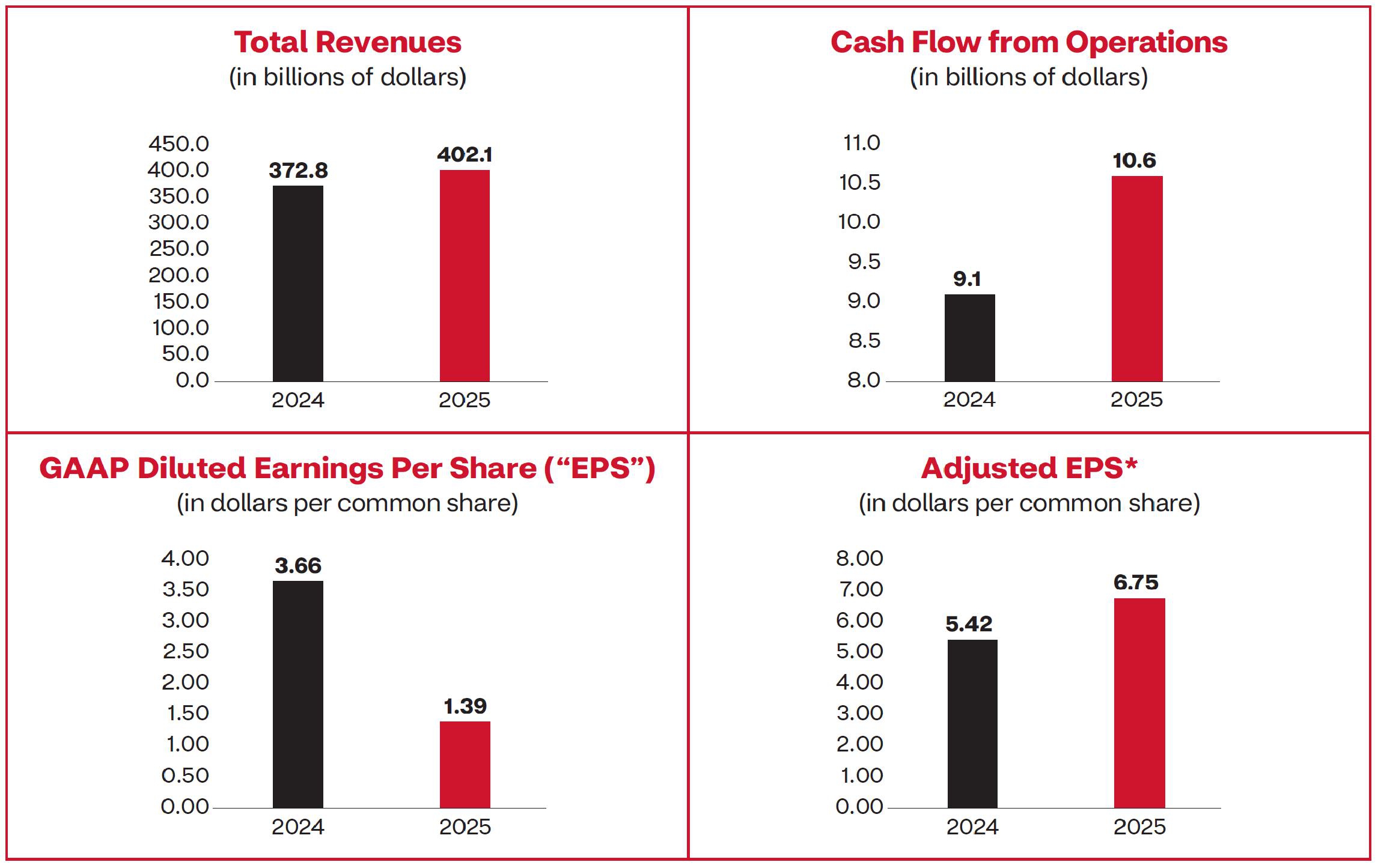
| * | Adjusted EPS is a non-GAAP financial measure. See Annex A to this proxy statement for an explanation and a reconciliation to the most comparable GAAP financial measure. |
|
Our Purpose
To simplify health care one person, one family and one community at a time |
Select Highlights from Our Best-in-Class Businesses
 |
$315B+ annual savings generated for our clients and members as a result of negotiations with providers and drug manufacturers by Aetna and Caremark: a great example of our commitment to advocacy on behalf of those we serve |  |
29%+ retail pharmacy script share as of year-end 2025, driven by superior customer experience at CVS Pharmacy | |
 |
95%+ of Aetna’s eligible prior authorization requests approved within 24 hours |  |
500K+ reconnections to care supported by Signify Health® clinicians throughout 2025 |
2 CVS Health
Proxy Statement Highlights
This summary highlights selected information in this proxy statement – please review the entire document before voting.
All of our Annual Meeting materials are available at www.cvshealthannualmeeting.com. There, you can download electronic copies of our 2025 Annual Report and proxy statement and use the link to vote.
Voting Items
| ITEM | ||||
1 |
Election of directors
Our 13 director nominees are seasoned leaders who bring a mix of skills and qualifications to our Board of Directors | |||
 |
FOR each director nominee |  See page 10 See page 10 | ||
| ITEM | ||||
2 |
Ratify the appointment of the Company’s independent registered public accounting firm for 2026
Based on its recent evaluation, our Audit Committee believes that the retention of Ernst & Young LLP is in the best interests of the Company and its stockholders | |||
|
FOR | See page 39 | ||
| ITEM | ||||
3 |
Say on pay - an advisory vote on the approval of the Company’s executive compensation
We believe our executive compensation program reflects our unwavering commitment to align pay with both short- and long-term performance and reflects feedback received from stockholder outreach | |||
|
FOR | See page 41 | ||
| ITEM | ||||
4 |
Approve the Company’s 2026 Incentive Compensation Plan
Approval of the Company’s 2026 Incentive Compensation Plan is needed due to the upcoming expiration of our 2017 Incentive Compensation Plan, to allow the Company to continue to grant equity awards, an important incentive tool to attract and retain quality executives and colleagues | |||
|
FOR | See page 97 | ||
| ITEM | ||||
5 |
Stockholder proposal
See the Board of Directors’ statement of opposition AGAINST the stockholder proposal | |||
 |
AGAINST | See page 107 | ||
2026 Proxy Statement 3
The CVS Health Board
Roger N. Farah, our former Chair of the Board, is retiring and will not stand for re-election at the 2026 Annual Meeting. John E. Gallina joined the Board in March 2026 and will be standing for re-election. At the time of Mr. Farah’s retirement at the Annual Meeting, the size of the Board will be reduced to 13 directors. You are asked to vote on the election of the following 13 nominees to serve on the Board of CVS Health Corporation (“CVS Health” or the “Company”). All directors are elected by a majority of votes cast, and all presently serve on the Board. The information below reflects the current leadership and expected membership of each of the Board’s committees after the Annual Meeting.
| Name | Principal Occupation | Age | Director Since |
Board Status and Roles |
Other Public Company Boards |
|||||
| Fernando Aguirre | Former Chairman, President and CEO of Chiquita Brands International, Inc. | 68 | 2018 | IND, A (Chair), MP&D | 2 | |||||
| Jeffrey R. Balser, M.D., Ph.D. | President and CEO of Vanderbilt University Medical Center | 64 | 2022 | IND, A, HS&T (Chair), E | None | |||||
| C. David Brown II | Partner and Former Member of Executive Committee of Nelson Mullins Riley & Scarborough LLP | 74 | 2007 | IND, MP&D (Chair), N&CG, PP&EA | None | |||||
| Alecia A. DeCoudreaux | President Emerita of Mills College at Northeastern University and Former Executive at Eli Lilly and Company | 71 | 2015 | IND, HS&T, N&CG | 1 | |||||
| Anne M. Finucane | Chair of the Board of Rubicon Carbon and Former Vice Chairman of Bank of America Corporation | 73 | 2011 | IND, MP&D, PP&EA (Chair), E | 1 | |||||
| John E. Gallina | Former Executive Vice President and Chief Financial Officer of Elevance Health, Inc. | 66 | 2026 | IND, A | 1 | |||||
| J. David Joyner | President, CEO and Chair of the Board of CVS Health Corporation | 61 | 2024 | PP&EA, E (Chair) | None | |||||
| J. Scott Kirby | CEO and a Member of the Board of United Airlines Holdings, Inc. | 58 | 2023 | IND, HS&T, N&CG | 1 | |||||
| Michael F. Mahoney | Chairman of the Board, President and CEO of Boston Scientific Corporation | 61 | 2023 | LID, MP&D, N&CG (Chair), E | 1 | |||||
| Leslie V. Norwalk | Strategic Counsel at Epstein Becker & Green P.C. | 60 | 2024 | HS&T, PP&EA | 3 | |||||
| Larry M. Robbins | Founder, CEO and Portfolio Manager of Glenview Capital Management, LLC | 56 | 2024 | IND, A, PP&EA | 1 | |||||
| Guy P. Sansone | Chairman and CEO of H2 Health | 61 | 2024 | IND, A, N&CG | 1 | |||||
| Douglas H. Shulman | Chairman and CEO of OneMain Holdings, Inc. | 58 | 2024 | IND, HS&T, MP&D | 1 |
|
IND - Independent LID - Lead Independent Director
|
A - Audit E - Executive HS&T - Health Services and Technology |
MP&D - Management Planning and Development | N&CG - Nominating and Corporate Governance | PP&EA - Public Policy and External Affairs |
4 CVS Health
Our Directors Nominated for Election at the Annual Meeting
The demographic information presented below is based on voluntary self-identification by each director nominee. Additional biographical information regarding each director nominee is set out starting on page 12.
| Financial Expertise | Tenure | CEO Experience | ||||
|
Financial Expertise
Qualified
to be
Financially Literate
All five nominees who are currently members of our Audit Committee are designated Audit Committee Financial Experts.
Five other nominees have qualifications to be financial experts, and the remaining three are financially literate. |
0-4 years
5-9 years
10+ years
Our directors bring a balance of experience and fresh perspective to our boardroom.
The average tenure of our director nominees is 5.3 years. |
Eight of our director nominees serve/have served in CEO roles; all of our nominees possess extensive leadership experience.
Age
50-59 years
60-69 years
70+ years |










Director Nominee Expertise, Skills and Experience
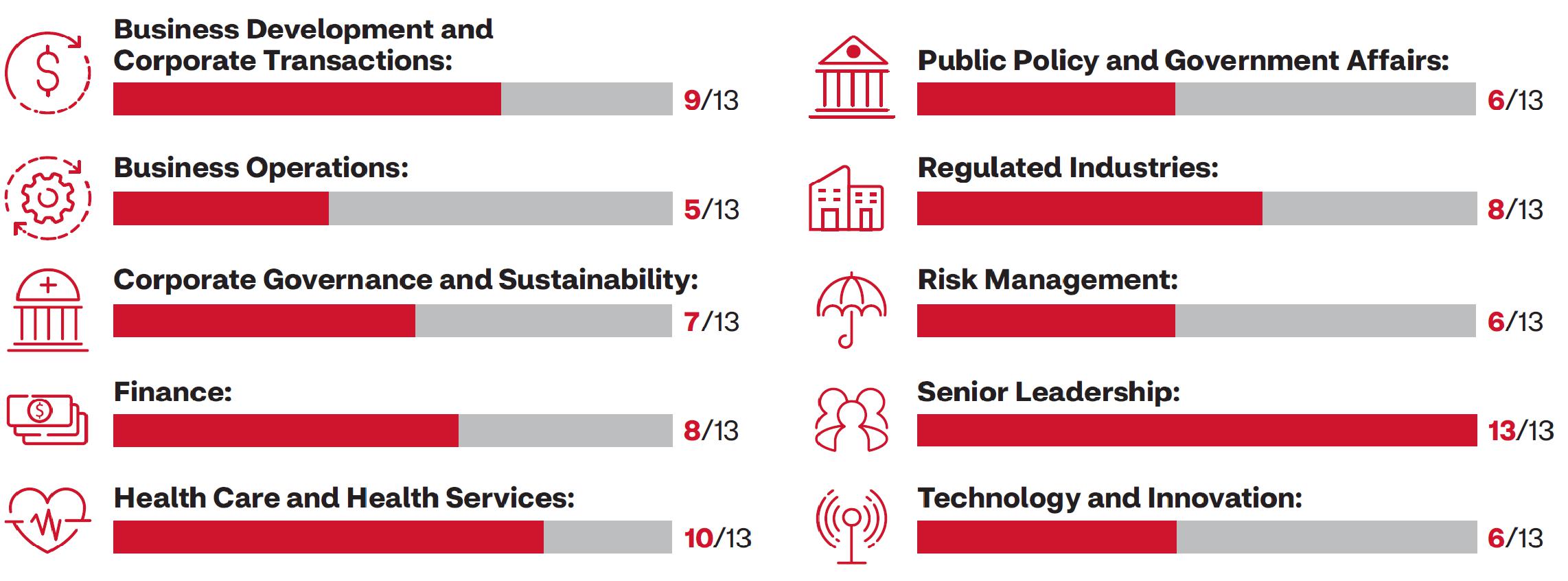
Our director nominees possess expertise, key skills and relevant experience in several different categories identified by the Board as important to effectively oversee the Company’s strategy, risks and management. While many of our nominees have skills and experience in most or all of these important categories, the following graphic identifies the five most relevant categories for each nominee (in addition to Senior Leadership, which all of them possess). See page 11 for an individual skills matrix, along with details as to how these skills and expertise link to the Company’s strategy.
2026 Proxy Statement 5
Board and Corporate Governance Highlights
The Board continually evaluates the Company’s corporate governance policies and practices to ensure that the right mix of individuals is present in our boardroom to best serve our stockholders through effective oversight of our strategy and management. We are committed to maintaining the highest standards of corporate governance and have established a strong and effective framework by which the Company is governed.
| 2025-2026 Board and Corporate Governance Developments | Further Information | ||
| • | On November 20, 2025, the Board elected President and Chief Executive Officer J. David Joyner to the additional role of Chair of the Board, effective January 1, 2026. Following the effective date of this appointment, Michael F. Mahoney continued to serve as the Board’s Lead Independent Director. | » pages 27-28 | |
| • | Roger N. Farah has decided to retire from our Board. Mr. Farah had previously served as our Executive Chair from October 2024 through December 2025 and was the Independent Chair of the Board from May 2022 to October 2024. He has served as a director of CVS Health since November 2018 and was a director of Aetna Inc. (“Aetna”) from 2007 until the closing of Aetna’s merger transaction with CVS Health in November 2018 (the “Aetna Transaction”). | » pages 22, 27-28 | |
| • | On March 18, 2026, the Board elected John E. Gallina to serve on the Board, effective March 19, 2026. Mr. Gallina is an accomplished health care and finance executive who brings to the Board valuable leadership experience and business acumen, as well as financial and accounting expertise. At the time of his election, Mr. Gallina was appointed to our Audit Committee. | » pages 4, 14 | |
| • | Upon the recommendation of the Nominating and Corporate Governance Committee (“N&CG Committee”), other than Mr. Brown, the Board approved a one-year waiver of the retirement age for Mr. Brown. The Board believes that Mr. Brown’s continued service is in the best interests of the Company and its stockholders to facilitate ongoing transfer of knowledge and ensure effective oversight, and in light of the skills and expertise he brings to the Board. | » page 20 | |
| • | In November 2025, the Board, at the recommendation of the N&CG Committee, approved a new standing committee, the Public Policy and External Affairs Committee (“PP&EA Committee”). With this committee addition, the Board reallocated some of the former responsibilities of the N&CG Committee to the PP&EA Committee. | » page 35 | |
| Board Communication and Stockholder Rights | |||
| • | Our Board supports and participates in our stockholder outreach program and has responded to stockholder input with changes in our compensation program and governance practices. | » pages 8-9, 48 | |
| • | See our Certificate of Incorporation, By-laws and Corporate Governance Guidelines at https://investors.cvshealth.com under “Governance Documents”. | ||
| Director Alignment with Stockholder Interests | |||
| • | At least 75% of our non-employee directors’ annual retainer is paid in shares of CVS Health common stock. | » pages 36-37 | |
| • | Non-employee directors must own at least 10,000 shares of CVS Health common stock within five years of election to our Board. | » pages 38, 111 | |
| • | Each director nominee attended at least 75% of the meetings of the Board and the committees of which he or she was a member. | » page 36 | |
| • | The Board is focused on ensuring it has the right skills in place to oversee execution of Company strategy as we navigate a challenging business environment. | » pages 5, 11, 12-18 | |
| • | Our overboarding policy generally limits service by our directors to a total of four public company boards and also restricts public company audit committee service. | » page 19 | |
6 CVS Health
| Board Oversight of Risk | |||
| • | Full Board and various committees focus on understanding and assessing Company risks. | » pages 23-26 | |
| • | Our President, CEO and Chair of the Board (“CEO/Chair”) and our Lead Independent Director are focused on the Company’s and the Board’s risk management efforts and ensure that enterprise risks are appropriately brought to the Board and/or its committees for review. | » pages 23-26, 27-28 | |
| • | The Board is actively involved in succession planning. The CEO and the Chief People Officer provide an annual report to the Board recommending potential successors, and the Board regularly reviews succession planning with respect to the Company’s key executives. | » page 23 | |
| • | The Board implements its risk oversight function both as a whole and through delegation to Board committees, which meet regularly and report back to the Board, as appropriate. Each of the Board’s standing committees is responsible for oversight of risk management practices for categories of risks relevant to their functions. Each of the Board committees can engage advisors and experts as each committee deems necessary in connection with its risk oversight responsibilities. | » pages 23-26 | |
2026 Proxy Statement 7
Stockholder Outreach – Governance and Compensation Actions
Stockholder Engagement
We have a long-standing stockholder outreach and engagement program, through which we discuss and seek feedback on our long-term strategy, corporate governance, executive compensation program, disclosure practices and sustainability and impact programs. Our outreach and engagement program helps us better understand stockholder priorities and perspectives, gives us an opportunity to elaborate upon our initiatives with relevant experts and fosters constructive dialogue. We share feedback and insights from our stockholder engagements with our Board, as appropriate, and take them into consideration as we review and evolve our practices and disclosures. In addition to this targeted engagement program, the Company seeks stockholder input throughout the year during events, including, but not limited to, quarterly earnings calls, industry presentations and conferences, Company-hosted events and presentations and securities analyst meetings. We held an Investor Day in December 2025, where stockholders had the opportunity to engage directly with members of our leadership team on key focus areas.
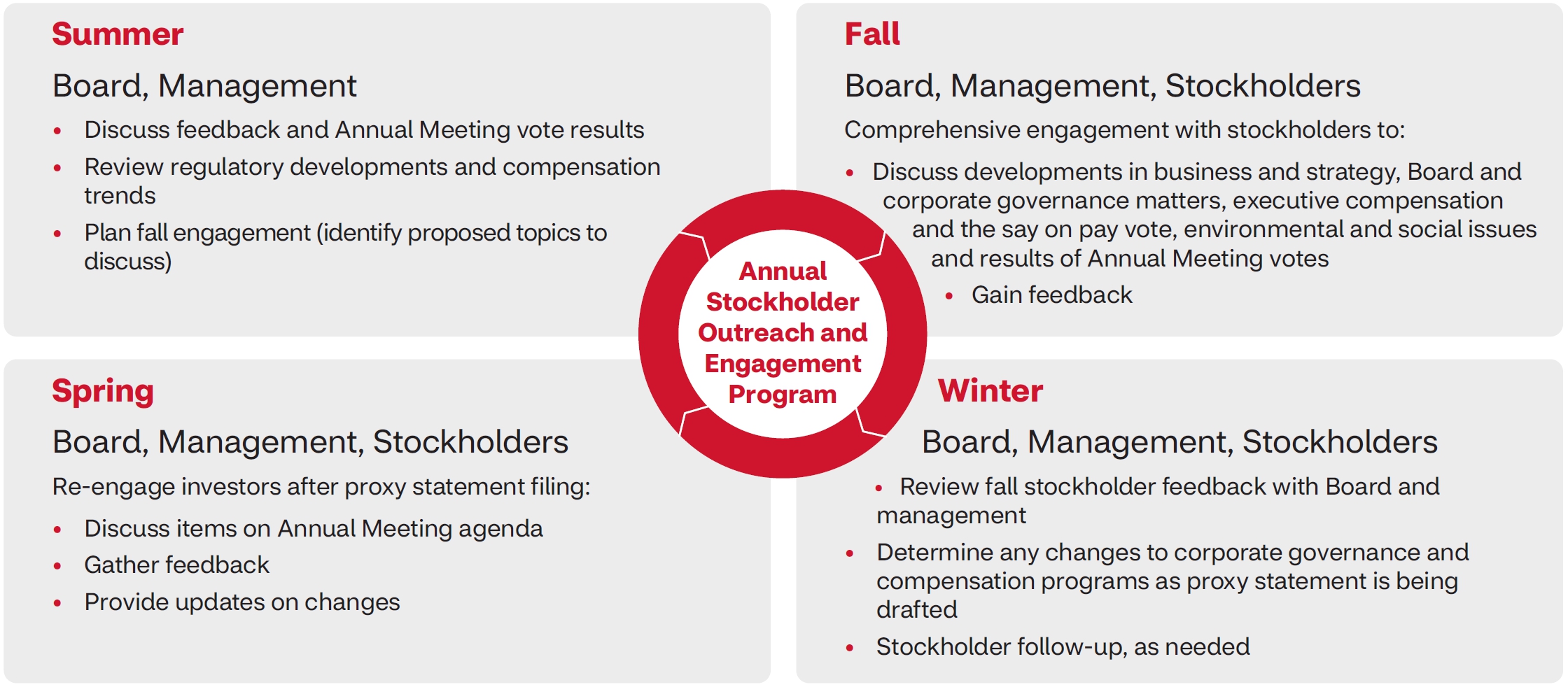
In late 2025 and early 2026, at the Board’s direction, management reached out to an expanded list of stockholders representing approximately 60% of our outstanding stock and ultimately held meetings with stockholders representing approximately 48% of our outstanding stock. This includes meetings with smaller stockholders and other investor organizations who proactively requested engagement with us. We also held calls with both leading proxy advisory firms. David Brown, Chair of the Management Planning and Development Committee (“MP&D Committee”), directly participated in engagements with stockholders representing approximately 35% of our outstanding stock, as well as the proxy advisory firms.
We also engaged with each of the stockholders who submitted proposals for inclusion in this proxy statement. As a result of productive discussions with a proponent, one stockholder proposal was withdrawn.
During our regular stockholder outreach program we were pleased to engage in productive conversations with our stockholders related to topics including, but not limited to, the Company’s strategy within the evolving health care industry, Board composition and oversight responsibilities, corporate governance practices and our impact strategy and initiatives. We also discussed our executive compensation program and steps we have taken in recent years to align the program with our dynamic business strategy and the stockholder experience, and to reflect stockholder feedback. In light of the outcome of our 2025 say on pay proposal vote, we sought to understand investor perspectives, and many engagements focused on decisions made by the MP&D Committee to support leadership changes that took place in late 2024. The Letter from the MP&D Committee and the Compensation Discussion and Analysis (“CD&A”) portions of this proxy statement provide more detail on the executive compensation topics that were addressed with stockholders, including changes to our compensation program that were informed by stockholder feedback.
8 CVS Health
The key issues we discussed with our stockholders are summarized below:
| Board Composition and Oversight; Corporate Governance |
• Board composition and the relevant qualifications and skillsets our directors possess to deliver on our strategy and exercise impactful oversight of the Company • Recent Board refreshment, including how new directors’ skills and experiences align with our strategic initiatives, and how the Board thinks about refreshment going forward • Board oversight of key risk areas, including artificial intelligence (“AI”) and cyber and information security • The Board’s role in, and oversight of, recent executive leadership changes • The evolution of the Board’s leadership structure and thoughtful allocation of responsibilities between the CEO, Chair and Lead Independent Director roles |
| Compensation Actions (see the CD&A beginning on page 44 for additional details) |
• Feedback on last year’s say on pay outcome and the factors influencing certain stockholders’ decisions to vote against the Company’s say on pay proposal • Rationale for compensation actions to support leadership changes that took place in late 2024 • Updates to and rationale for the long-term incentive compensation program effective for 2025, informed by careful deliberation and consideration of stockholder feedback • Considerations around our compensation program to ensure alignment with our long-term strategic and operational goals |
| Impact Strategy |
• Our Healthy 2030 strategy, which outlines our strategic framework for a more sustainable future through economic, environmental and social imperatives • Steps we have taken to support the well-being and development of our colleagues, and to improve the health of the people and communities we serve • Key initiatives and disclosures addressing AI, pay equity, regulatory considerations and supply chain dynamics, among other topics |
For more information on our executive compensation program, see the letter from the MP&D Committee on page 42, “Stockholder Outreach and Engagement” on page 48 and “Elements of Our Annual Executive Compensation Program” beginning on page 53.
For more information on corporate governance at CVS Health, please refer to pages 8-38 of this proxy statement and to the Corporate Governance pages of our Investor Relations website at https://investors.cvshealth.com.
2026 Proxy Statement 9
Corporate Governance and Related Matters
| ITEM | ||||
1 |
Election of Directors | |||
 |
The Board of Directors unanimously recommends a vote FOR the election of all director nominees. | |||
Our Board of Directors has nominated 13 candidates for election as directors at the Annual Meeting. All 13 nominees currently serve as directors. If elected, each nominee will hold office until the next annual meeting and until their respective successors have been duly elected and have qualified. All of the nominees are expected to attend the Annual Meeting.
The N&CG Committee believes that the Board is well-balanced and that it fully and effectively addresses the Company’s needs. Our nominees are seasoned leaders, all of whom hold or held senior executive leadership positions, who bring to the Board skills, qualifications and perspectives gained during their tenure at a wide array of public companies, private companies, non-profits, governmental and regulatory agencies and other organizations. We have indicated below for each nominee certain experience, qualifications, attributes and skills that led the N&CG Committee and the Board to conclude that the nominee should continue to serve as a director. Based on the N&CG Committee’s review of the nominees’ backgrounds and their past performance as CVS Health directors, the N&CG Committee and the Board believe that each of the nominees can and will devote an adequate amount of time to the effective execution of each nominee’s responsibilities as a director and member of their respective committees, and possesses the qualifications identified in this proxy statement.
Majority Voting
As discussed in this proxy statement on page 116 and elsewhere, directors are elected by a majority of the votes cast at the Annual Meeting (assuming that the election is uncontested). Under our By-laws, each nominee who is a current director is required to submit an irrevocable resignation, which resignation would become effective upon (1) that person not receiving a majority of the votes cast in an uncontested election, and (2) acceptance by the Board of that resignation in accordance with the policies and procedures adopted by the Board. The Board, acting on the recommendation of the N&CG Committee, will no later than at its first regularly scheduled meeting following certification of the stockholder vote, determine whether to accept the resignation of an unsuccessful incumbent. Absent a determination by the Board that a compelling reason exists for concluding that it is in the best interests of the Company for an unsuccessful incumbent to remain as a director, the Board will accept that person’s resignation. In the event any resignation is not accepted, the Board will disclose the rationale for its determination.
Board Skills and Attributes Matrix
We believe that our directors possess deep industry knowledge and expertise, are committed to representing the long-term interests of our stockholders and have the highest personal and professional ethics. Our Board is composed of directors with a broad range of perspectives and professional and personal experiences, which we believe is critical for achieving our strategic goals.
The following matrix displays the five primary skills that the Board and each nominee considered to be most relevant to each of our director nominees (in addition to the Senior Leadership skill, which each nominee possesses). This matrix is not intended to be an exhaustive list of each nominee’s skills, attributes or areas of principal contributions to the Board, and each possesses skills in addition to those presented in this matrix. More information about each director nominee can be found in the section entitled “Biographies of our Incumbent Board Nominees.”
10 CVS Health
| Skills and Experience and How They Link to the Company’s Strategy |
 |
 |
 |
 |
 |
 |
 |
 |
 |
 |
 |
 |
 | ||
 |
Business Development and Corporate Transactions Impart insight to advance growth agenda of our strategic initiatives |
 |
|
 |
|
|
|
|
|
| |||||
 |
Business Operations Provide guidance on the Company’s operations to help us to optimize our business strategy |
|
|
|
|
|
|||||||||
 |
Corporate Governance and Sustainability Help our Board fulfill its oversight function for environmental sustainability, community engagement and corporate social responsibility matters effectively |
|
|
|
|
|
|
|
|||||||
 |
Finance Particularly well-suited to overseeing the quality and integrity of our financial statements |
|
|
|
|
|
|
|
| ||||||
 |
Health Care and Health Services Possess deep knowledge of the business challenges and opportunities facing our Company in the health care industry |
|
|
|
|
|
|
|
|
|
|
||||
 |
Public Policy and Government Affairs Offer insight into the regulatory environment of the many jurisdictions in which we operate, their legislative and administrative priorities and the implications for our business |
|
|
|
|
|
| ||||||||
 |
Regulated Industries Has a valuable perspective on how an extensive regulatory framework intersects with strategic and operational planning, including outside the health care industry |
|
|
|
|
|
|
|
| ||||||
 |
Risk Management Are particularly adept at identifying and assessing the varied risks facing our Company, including the legal, regulatory and political environment and provide oversight of compliance standards |
|
|
|
|
|
|
||||||||
 |
Senior Leadership Have experience overseeing senior leadership, finance, marketing and execution of business strategy from a management, board or governance perspective |
|
|
|
|
|
|
|
|
|
|
|
|
| |
 |
Technology and Innovation Contribute expertise regarding product innovation and evolving customer, member and client expectations |
|
|
|
|
|
| ||||||||
| Attributes/Background | |||||||||||||||
| Independent | |
|
|
|
|
|
|
|
|
|
| ||||
| CVS Health Director Since | 11/18 | 9/22 | 3/07 | 3/15 | 1/11 | 3/26 | 10/24 | 10/23 | 11/23 | 11/24 | 11/24 | 11/24 | 11/24 | ||
| Age | 68 | 64 | 74 | 71 | 73 | 66 | 61 | 58 | 61 | 60 | 56 | 61 | 58 | ||
| Gender | M | M | M | F | F | M | M | M | M | F | M | M | M | ||
| Black or African American | |
||||||||||||||
| Hispanic/Latino | |
||||||||||||||
| White | |
|
|
|
|
|
|
|
|
|
|
| |||
2026 Proxy Statement 11
Biographies of our Incumbent Board Nominees
Fernando Aguirre, 68 |
|||||
| Independent Director | Director Qualification Highlights | ||||
Former Chairman, President and CEO of
CVS Health director since: November 2018 |
 |
Business Operations |  |
Health Care and Health Services | |
 |
Corporate Governance and Sustainability |  |
Regulated Industries | ||
 |
Finance |  |
Senior Leadership | ||
CVS Health Board Committees: Audit (Chair); Management Planning and Development
Other Public Boards: Barry Callebaut AG; Synchrony Financial
Education: B.S., Southern Illinois University, Edwardsville |
Biographical Information Mr. Aguirre is the former Chairman, President and Chief Executive Officer of Chiquita Brands International, Inc. (“Chiquita”), a global distributor of consumer products, having served as Chiquita’s President and Chief Executive Officer from January 2004 to October 2012 and its Chairman from May 2004 to October 2012. Prior to joining Chiquita, Mr. Aguirre worked for more than 23 years in brand management, general management and turnarounds at The Procter & Gamble Company (“P&G”), a manufacturer and distributor of consumer products. Mr. Aguirre began his P&G career in 1980, serving in various capacities including President and General Manager of P&G Brazil, President of P&G Mexico, Vice President of P&G’s global snacks and U.S. food products, and President of global feminine care. Mr. Aguirre was a member of the board of directors of Aetna from 2011 until the closing of the Aetna Transaction when he became a director of CVS Health. Mr. Aguirre also serves as a director of Barry Callebaut AG, a manufacturer of high-quality chocolate and cocoa products, and is chair of its nomination and compensation committee, and as a director of Synchrony Financial, a consumer financial services company, and is chair of Synchrony’s nominating and corporate governance committee.
Skills and Qualifications of Particular Relevance to CVS Health Mr. Aguirre brings to the Board extensive consumer products, global business and executive leadership experience. As a former Chairman and CEO of a large public company that produces and distributes consumer products worldwide, he has significant brand management and international experience that is valuable to the Board’s strategic and operational understanding of global markets. Mr. Aguirre’s experience and service on other large public company boards, where he has served as chair of various committees, positions him well as the Chair of our Audit Committee and member of our Management Planning and Development Committee. | ||||
Jeffrey R. Balser, M.D., Ph.D., 64 |
|||||
| Independent Director | Director Qualification Highlights | ||||
President and Chief Executive Officer
CVS Health director since: September 2022 |
|
Business Operations | |
Regulated Industries | |
|
Finance | |
Senior Leadership | ||
|
Health Care and Health Services |  |
Technology and Innovation | ||
CVS Health Board Committees: Health Services and Technology (Chair); Audit; Executive
Other Public Boards: None
Education: B.S., Tulane University; M.D. and Ph.D., Vanderbilt University |
Biographical Information Dr. Balser has served as the chief executive of Vanderbilt University Medical Center (“VUMC”) since 2009 and has been President and Chief Executive Officer since 2016, when VUMC became an independent health care company. He has also served as the Dean of the Vanderbilt University School of Medicine since 2008. Dr. Balser is an elected member of the National Academy of Medicine and served two terms on its governing council. He previously served on the board of Varian Medical Systems, Inc., an oncology treatment device and software maker that was publicly traded, from October 2018 until Varian was acquired by Siemens Healthineers AG in April 2021.
Skills and Qualifications of Particular Relevance to CVS Health Dr. Balser’s business experience includes large regional quaternary health delivery system leadership, human capital management, senior business management experience including a number of community hospital and medical practice acquisitions, overall risk management expertise through oversight of VUMC’s quality, compliance and corporate integrity activities, and financial expertise through management of its financial statements and VUMC’s separation from Vanderbilt University. His experience as a physician scientist includes leading NIH-funded research in various areas of pharmacogenomics and spearheading growth in personalized medicine at VUMC from research concepts to bedside care, integrating advances in informatics, discovery science and precision genomics. Under his leadership, VUMC has become an academic leader in health information technology. His education and experience as an M.D. with a Ph.D. in pharmacology are considered by the Board to be tremendous assets as the Company has expanded into health care delivery services. The Board believes that Dr. Balser’s deep health care knowledge and leadership bring great value to his role as the Chair of our Health Services and Technology Committee. | ||||
12 CVS Health
C. David Brown II, 74 |
|||||
| Independent Director | Director Qualification Highlights | ||||
Partner and Former Member of the
CVS Health director since: March 2007 |
 |
Business Development and Corporate Transactions |  |
Public Policy and Government Affairs | |
|
Corporate Governance and Sustainability |  |
Risk Management | ||
|
Health Care and Health Services | |
Senior Leadership | ||
CVS Health Board Committees: Management Planning and Development (Chair); Nominating and Corporate Governance; Public Policy and External Affairs
Other Public Boards: None
Education: B.S.B.A., University of Florida; J.D., University of Florida College of Law |
Biographical Information Mr. Brown has been a partner of Nelson Mullins Riley & Scarborough LLP (“Nelson Mullins”), a national law firm, since the August 2018 merger of Nelson Mullins and the Florida-based Broad and Cassel, of which Mr. Brown was Chairman from March 2000 through the time of the merger. He was also a member of the executive committee of Nelson Mullins until he rotated off the committee in December 2021. He served as the lead director of Rayonier Advanced Materials Inc., a leading specialty cellulose production company, until his retirement from that board in May 2020. Mr. Brown previously served on the board of Caremark Rx, Inc. from March 2001 until the closing of the merger transaction involving CVS Health and Caremark, when he became a director of CVS Health.
Skills and Qualifications of Particular Relevance to CVS Health Mr. Brown’s legal expertise and health care experience are highly valued by the Board, as is his ability to analyze and interpret complex issues and facilitate Board engagement. He has a broad background in large-scale corporate and real estate transactions, both domestically and internationally. Mr. Brown has significant health care experience, including through his oversight of UF Health while serving as Chairman of the Board of Trustees for the University of Florida and as a member of the board of directors and executive committee of Orlando Health, a not-for-profit health care network. The Board believes that Mr. Brown’s experience adds knowledge and leadership depth to the Board, and as a result, upon the recommendation of the Nominating and Corporate Governance Committee (other than Mr. Brown), the Board approved a waiver of the retirement age for one year for Mr. Brown to continue serving as a director until the Company’s 2027 Annual Meeting of Stockholders. | ||||
Alecia A. DeCoudreaux, 71 |
|||||
| Independent Director | Director Qualification Highlights | ||||
President Emerita of Mills College at
CVS Health director since: March 2015 |
|
Corporate Governance and Sustainability | |
Regulated Industries | |
|
Health Care and Health Services | |
Risk Management | ||
|
Public Policy and Government Affairs | |
Senior Leadership | ||
CVS Health Board Committees: Health Services and Technology; Nominating and Corporate Governance
Other Public Board: Parnassus Funds/Parnassus Income Funds
Education: B.A., Wellesley College; J.D., Maurer School of Law at Indiana University |
Biographical Information Ms. DeCoudreaux is President Emerita of the former Mills College, a liberal arts college for women with graduate programs for women and men, which is now known as Mills College at Northeastern University, having served a five-year term as President from July 2011 through June 2016. Previously, Ms. DeCoudreaux served in a number of leadership roles at Eli Lilly and Company, a global pharmaceutical manufacturer (“Eli Lilly”), including as Vice President and Deputy General Counsel, Specialty Legal Team, from 2010-2011, Vice President and General Counsel, Lilly USA, from 2005-2009, and Secretary and Deputy General Counsel of Eli Lilly from 1999-2005. During her 30-year career with Eli Lilly, Ms. DeCoudreaux also previously served as Executive Director of Lilly Research Laboratories, Director of Federal Government Relations, Director of State Government Relations and Director of Community Relations. In addition, Ms. DeCoudreaux has served on a number of charitable, educational, for profit and nonprofit boards, including as both a trustee and board chair at Wellesley College. She currently serves as Lead Independent Trustee and Chair of the Board of Trustees of Parnassus Funds/Parnassus Income Funds, a family of investment funds that integrates environmental, social and governance factors and fundamental investment principles.
Skills and Qualifications of Particular Relevance to CVS Health Ms. DeCoudreaux has more than 30 years of experience in the pharmaceutical industry, and her experience as an attorney in that field and in the area of corporate governance makes her a great asset to our Board. In addition, the Board values her experience and perspective on state and federal government relations in the highly regulated health care industry, as well as her focus on community relations given our approximately 9,000 retail locations across the U.S. | ||||
2026 Proxy Statement 13
Anne M. Finucane, 73 |
|||||
| Independent Director | Director Qualification Highlights | ||||
Chair of the Board of Rubicon Carbon
CVS Health director since: January 2011 |
|
Business Development and Corporate Transactions | |
Regulated Industries | |
|
Corporate Governance and Sustainability | |
Risk Management | ||
|
Public Policy and Government Affairs | |
Senior Leadership | ||
CVS Health Board Committees: Management Planning and Development; Public Policy and External Affairs (Chair); Executive
Other Public Board: Williams- Sonoma, Inc.
Education: B.A., University of New Hampshire |
Biographical Information Ms. Finucane has been a Senior Advisor of the TPG Climate Rise Fund (“TPG”), an investment fund focused on various climate sub-sectors, since September 2022 and the Chair of the Board of Rubicon Carbon, a carbon credit firm and a TPG portfolio company, since November 2022. Previously, Ms. Finucane served as Chairman of the Board of Bank of America Europe from July 2018 through December 2022. Ms. Finucane served as a Vice Chairman of Bank of America Corporation, an international financial services company, from July 2015 until her retirement in December 2021. From 2006 through July 2015, Ms. Finucane served as Global Chief Strategy and Marketing Officer for Bank of America and served as Northeast Market President from 2004 through July 2015. As a member of the executive management team, Ms. Finucane was responsible for the strategic positioning of Bank of America and led the company’s environmental, social and governance, sustainable finance, capital deployment and global public policy efforts. She established and co-chaired the company’s Sustainable Finance Committee, which included a $1 trillion environmental business initiative, deploying capital to help accelerate the transition to a low-carbon, sustainable economy, and was chair of Bank of America’s Environmental, Social and Governance Committee. She currently serves as a director of Williams-Sonoma, Inc., a retailer of kitchen and home products.
Skills and Qualifications of Particular Relevance to CVS Health Ms. Finucane’s experience in the highly regulated financial services industry, in consumer strategies and marketing given the Company’s consumer focus, and in public policy and government affairs throughout the U.S., provides our Board with valuable insight in those key areas as we execute our strategy. Her extensive leadership experience in corporate strategy and corporate social responsibility serves her well as Chair of the Public Policy and External Affairs Committee and her distinguished career in banking also makes her a valued member of the Management Planning and Development Committee. | ||||
John E. Gallina, 66 |
|||||
| Independent Director | Director Qualification Highlights | ||||
Former Executive Vice President and
CVS Health director since: March 2026
|
|
Business Development and Corporate Transactions | |
Health Care and Health Services | |
|
Corporate Governance and Sustainability | |
Risk Management | ||
|
Finance | |
Senior Leadership | ||
CVS Health Board Committee: Audit
Other Public Board: Arrive AI Inc.
Education: B.S., Business Administration, The Ohio State University |
Biographical Information Mr. Gallina is the former Executive Vice President and Chief Financial Officer of Elevance Health, Inc. (“Elevance”), a leading health benefits provider, a position he held from June 2016 through November 1, 2023. He then served as Executive Vice President and Advisor to the CEO from November 2023 until May 2024, when he retired from Elevance. Prior to serving as CFO, Mr. Gallina held various roles at Elevance in the Internal Audit, Accounting and Finance areas, having started with that company in 1994. Prior to that he was a senior audit manager at Coopers & Lybrand and a certified public accountant. Mr. Gallina currently serves as a director and chair of the audit committee of Arrive AI Inc., a developmental technology company with a focus on autonomous deliveries.
Skills and Qualifications of Particular Relevance to CVS Health Mr. Gallina has over 40 years of financial and business management experience in both a corporate and public accounting environment. At Elevance, he had extensive financial leadership experience, overseeing all finance and actuarial functions, inclusive of procurement and corporate real estate. At one point in his career he was also responsible for Elevance’s healthcare management organization, which included all health care, clinical and network operations. Mr. Gallina offers our Board a deep understanding of the health insurance industry, as well as financial, accounting and audit-related issues. The Board believes that Mr. Gallina’s experience positions him well to serve as a member of our Audit Committee. | ||||
14 CVS Health
J. David Joyner, 61 |
|||||
| Non-Independent Director | Director Qualification Highlights | ||||
President, Chief Executive Officer and
CVS Health director since: October 2024
|
|
Business Development and Corporate Transactions | |
Regulated Industries | |
|
Business Operations | |
Senior Leadership | ||
|
Health Care and Health Services | |
Technology and Innovation | ||
CVS Health Board Committee: Executive (Chair); Public Policy and External Affairs
Other Public Boards: None
Education: B.S., The Rawls College of Business at Texas Tech University |
Biographical Information Mr. Joyner has served as Chief Executive Officer and President of CVS Health since October 17, 2024 and was appointed Chair of the Board of CVS Health effective January 1, 2026. Prior to October 2024, Mr. Joyner had served as the Executive Vice President and President of Pharmacy Services of the Company since January 2023. From September 2020 to January 2023, Mr. Joyner served as an advisor to enterprises in the health care space. Mr. Joyner previously served in various roles at the Company and its predecessors, including as Executive Vice President – Sales and Account Services, CVS Caremark from 2004 through December 2019. Mr. Joyner began his career at Aetna in 1986 before joining Caremark Prescription Services in 1993. Mr. Joyner also has been a member of the Advisory Council of the Rawls College of Business of Texas Tech University since July 2020.
Skills and Qualifications of Particular Relevance to CVS Health Mr. Joyner has nearly 40 years of health care and pharmacy benefit management experience, primarily at CVS Health and predecessor organizations, and has also served on the boards of several private equity-backed health care companies. The Board believes that his deep understanding of our integrated business will help the Board oversee how CVS Health addresses the challenges our industry faces, more rapidly advance the operational improvements our Company requires and fully realize the value we can uniquely create. | ||||
J. Scott Kirby, 58 |
|||||
| Independent Director | Director Qualification Highlights | ||||
Chief Executive Officer and Member of
CVS Health director since: October 2023
|
|
Business Development and Corporate Transactions | |
Regulated Industries | |
|
Finance | |
Senior Leadership | ||
|
Public Policy and Government Affairs | |
Technology and Innovation | ||
CVS Health Board Committees: Health Services and Technology; Nominating and Corporate Governance
Other Public Board: United Airlines Holdings, Inc.
Education: B.S., U.S. Air Force Academy; M.S., George Washington University |
Biographical Information Mr. Kirby has been the Chief Executive Officer and a member of the Board of Directors of United Airlines Holdings, Inc. (“United Airlines”), an international air carrier, since May 2020. Mr. Kirby also serves on the Executive Committee and the Finance Committee of the United Airlines Board of Directors. From August 2016 until May 2020, Mr. Kirby was President of United Airlines and was responsible for its operations, marketing, sales, alliances, network planning and revenue management. Prior to joining United Airlines, he was President of American Airlines from December 2013 until August 2016 and was President of US Airways from September 2006 until December 2013, when US Airways merged with American Airlines. He started his career at the Pentagon and in the technology sector. He is former Chairman of the Star Alliance Chief Executive Board, a global alliance consisting of 25 member airlines, and is a member of the Board of Governors of the International Air Transport Association, a trade association comprised of 360 of the world’s airlines. Mr. Kirby is also a member of the Board of Directors of the U.S. Air Force Academy Foundation.
Skills and Qualifications of Particular Relevance to CVS Health Mr. Kirby is a well-known airline industry veteran, with a broad and accomplished three-decade-long career in significant leadership roles. Mr. Kirby brings valuable expertise to the Board from his experience with marketing, sales, alliances and network planning at United Airlines, as well as his education and background in technology. As CEO of a large public company who is responsible for its business and ongoing operations, he has experience and understanding of how to implement strategic priorities. These skills make him well-qualified to serve as a member of the Health Services and Technology Committee and the Nominating and Corporate Governance Committee. | ||||
2026 Proxy Statement 15
Michael F. Mahoney, 61 |
|||||
| Lead Independent Director since March 2025 | Director Qualification Highlights | ||||
Chairman, President and CEO of
CVS Health director since: November 2023
|
|
Business Development and Corporate Transactions | |
Health Care and Health Services | |
|
Business Operations | |
Senior Leadership | ||
|
Finance | |
Technology and Innovation | ||
CVS Health Board Committees: Management Planning and Development; Nominating and Corporate Governance (Chair); Executive
Other Public Board: Boston Scientific Corporation
Education: B.B.A., University of Iowa; M.B.A., Wake Forest University |
Biographical Information Mr. Mahoney has been the President of Boston Scientific Corporation (“Boston Scientific”), a global developer, manufacturer and marketer of medical devices, since October 2011, and has been Chief Executive Officer and a member of the Board of Directors of Boston Scientific since November 2012. He became Chairman of the Board of Directors of Boston Scientific in May 2016. Prior to joining Boston Scientific, Mr. Mahoney served as Worldwide Company Group Chairman of Johnson & Johnson’s DePuy franchise, an orthopedics and neurosciences business, from April 2007 through January 2011. From January 2001 through March 2007, he served as President and Chief Executive Officer of Global Healthcare Exchange, a leading medical supply chain solutions company. Mr. Mahoney began his career at General Electric Medical Systems, where he spent 12 years, culminating in the role of General Manager of the Healthcare Information Technology business. From October 2015 until September 2023, Mr. Mahoney served as a member of the Board of Directors of Baxter International Inc.
Skills and Qualifications of Particular Relevance to CVS Health Mr. Mahoney has extensive experience leading global medical products companies, including as Chairman, President and Chief Executive Officer of Boston Scientific. His management experience includes leading complex organizations in medical device and other health care-related businesses, expertise in building strong leadership teams, developing international markets and a proven ability to execute successful business strategies and drive operational excellence. Mr. Mahoney also has significant knowledge of the global medical products business and extensive experience leading and operating within global, multi-faceted medical products companies as a result of his roles at Boston Scientific and Johnson & Johnson, which provides the important qualifications to serve as our Lead Independent Director, and Chair of our Nominating and Corporate Governance Committee. | ||||
Leslie V. Norwalk, 60 |
|||||
| Non-Independent Director | Director Qualification Highlights | ||||
Strategic Counsel at
CVS Health director since: November 2024
|
|
Corporate Governance and Sustainability | |
Regulated Industries | |
|
Health Care and Health Services | |
Risk Management | ||
|
Public Policy and Government Affairs | |
Senior Leadership | ||
CVS Health Board Committee: Health Services and Technology; Public Policy and External Affairs
Other Public Boards: Arvinas, Inc., Neurocrine Biosciences, Inc. and Globus Medical, Inc.
Education: B.A., Wellesley College, J.D., George Mason University |
Biographical Information Ms. Norwalk has served as Strategic Counsel to health care companies at Epstein, Becker & Green, P.C., a national law firm, since 2007. She also advises companies through EBG Advisors, a national strategy and management consultancy, and National Health Advisors, an advocacy firm. She serves as an advisor to private equity investors, including three private equity firms, particularly on health care matters. Ms. Norwalk currently sits on the boards of directors of Arvinas, Inc., a biotechnology company, Neurocrine Biosciences, Inc., a biopharmaceutical company, and Globus Medical, Inc., a medical device company, and several privately held health care entities. She is also a member of APCO Worldwide’s International Advisory Council. Ms. Norwalk formerly sat on the boards of NuVasive, Magellan Health, Centene and Endologix, among others, and is the former Acting Administrator for the U.S. Centers for Medicare & Medicaid Services (“CMS”) under the George W. Bush administration.
Skills and Qualifications of Particular Relevance to CVS Health Ms. Norwalk has deep knowledge of, and experience with, the health care industry and related government regulations, as well as corporate governance, health care compliance and risk management, which the Board believes provides important skills to serve on our Board, the Health Services and Technology Committee and the Public Policy and External Affairs Committee. Ms. Norwalk’s deep knowledge of, and experience with, the health care industry and government regulations, as well as corporate governance and risk management, provide valuable guidance and insight to our Board. | ||||
16 CVS Health
Larry M. Robbins, 56 |
|||||
| Independent Director | Director Qualification Highlights | ||||
Founder and Chief Executive Officer of
CVS Health director since: November 2024
|
|
Business Development and Corporate Transactions | |
Health Care and Health Services | |
|
Corporate Governance and Sustainability | |
Risk Management | ||
|
Finance | |
Senior Leadership | ||
CVS Health Board Committee: Audit; Public Policy and External Affairs
Other Public Board: Butterfly Network, Inc.
Education: B.S., University of Pennsylvania |
Biographical Information Mr. Robbins is the Founder, Portfolio Manager and Chief Executive Officer of Glenview Capital Management, LLC. Prior to founding Glenview in 2000, Mr. Robbins spent six years as an analyst and partner at Omega Advisors on their U.S. equity long/short team. He joined Omega after three years at Gleacher & Company, a merger and acquisition advisory boutique in New York. For 30 years, Mr. Robbins has been a portfolio manager analyzing and advising leading publicly traded companies on financial reporting and controls, capital allocation and capital markets strategy and a broad range of governance, operational, communication and strategic issues. Mr. Robbins has been lead independent director and a member of the board of directors of Butterfly Network, Inc., a medical digital imaging company, since 2021. He is also an active supporter of education reform and serves as a board member of KIPP NYC, Relay Graduate School of Education and Zearn.
Skills and Qualifications of Particular Relevance to CVS Health Mr. Robbins is recognized as a seasoned investor with deep health care industry expertise. His leadership experience and success in advising companies throughout the health care sector and his extensive knowledge of financial accounting make him a valued member of the Board, as well as its Audit and Public Policy and External Affairs Committees. | ||||
Guy P. Sansone, 61 |
|||||
| Independent Director | Director Qualification Highlights | ||||
Co-Founder, Chairman and Chief
CVS Health director since: November 2024
|
|
Business Development and Corporate Transactions | |
Health Care and Health Services | |
|
Business Operations | |
Senior Leadership | ||
|
Finance | |
Technology and Innovation | ||
CVS Health Board Committee: Audit; Nominating and Corporate Governance
Other Public Board: Pediatrix Medical Group, Inc.
Education: B.S., University at Albany, SUNY |
Biographical Information Mr. Sansone has served as the Co-Founder, Chairman and Chief Executive Officer of H2 Health, a leading regional provider of physical rehabilitation services and clinician staffing solutions, since February 2020. Prior to that, he served as Managing Director at Alvarez & Marsal in New York, a financial advisory and consulting firm notable for its work in turnaround management and performance improvement of a number of large, high-profile businesses across the globe, where he served as Chairman of the firm’s Healthcare Industry Group, which he founded in 2004. Mr. Sansone is a member of the board of directors of several publicly traded and privately held health care companies, including Pediatrix Medical Group (formerly Mednax), a provider of physician services, Longevity Health Plans, a specialized Medicare Advantage health plan, Carisk Partners, a risk transfer, care coordination company, and ChenMed, an operator of medical centers. He formerly served on the board of directors of public company Magellan Healthcare and served on its audit and compliance committees.
Skills and Qualifications of Particular Relevance to CVS Health Over the past 25-plus years, Mr. Sansone has invested in, advised and consulted as an executive to numerous companies, particularly in the health care industry, focusing on developing and evaluating strategic and operating alternatives designed to enhance value. His experience and expertise in the health care industry, as a public company audit committee member and in finance make him an excellent addition to our Board and our Audit and Nominating and Corporate Governance Committees. | ||||
2026 Proxy Statement 17
Douglas H. Shulman, 58 |
|||||
| Independent Director | Director Qualification Highlights | ||||
Chairman and Chief Executive Officer of
CVS Health director since: November 2024
|
|
Business Development and Corporate Transactions | |
Regulated Industries | |
|
Finance | |
Senior Leadership | ||
|
Public Policy and Government Affairs | |
Technology and Innovation | ||
CVS Health Board Committee: Health Services and Technology; Management Planning and Development
Other Public Board: OneMain Holdings, Inc.
Education: B.A., Williams College, M.P.A., Harvard JFK School of Government, J.D., Georgetown University |
Biographical Information Mr. Shulman has served as Chief Executive Officer of OneMain Holdings, Inc., a consumer-focused financial services company that is a leader in offering nonprime customers responsible access to credit, since 2018, and has been Chairman of the Board of OneMain since 2021. Prior to joining OneMain, Mr. Shulman was Senior Executive Vice President, Global Head of Client Service Delivery and was a member of the Executive Committee at BNY Mellon, a global financial services firm. Prior to BNY Mellon, he was a Senior Advisor at McKinsey & Company, and from 2008 to 2012, he served as the Commissioner of the Internal Revenue Service, where he directed a transformation of the agency’s technology, drove customer service metrics to historic levels and led important breakthroughs in addressing international tax evasion. Previously, Mr. Shulman was Vice Chairman and, before that, President of Markets, Services and Information at FINRA and its predecessor company, NASD, when it owned the Nasdaq Stock Market and the American Stock Exchange.
Skills and Qualifications of Particular Relevance to CVS Health Mr. Shulman has significant experience managing large, complex organizations at the intersection of financial services, data and technology. The Board believes his background in technology and operations, financial and risk management expertise and regulatory and human capital management experience provide important skills and expertise for our Board and make him an excellent member of our Health Services and Technology and Management Planning and Development Committees. | ||||
18 CVS Health
Director Qualification Criteria
Recognizing that the selection of qualified directors is complex and crucial to the long-term success of the Company, the N&CG Committee has established in its charter guidelines for the identification and evaluation of candidates for membership on the Board. Under its charter, the N&CG Committee recommends to the Board criteria for Board membership and recommends individuals for membership on the Board. The N&CG Committee’s charter provides that candidates should be distinguished individuals who are prominent in their fields or otherwise possess exemplary qualities that will enable them to effectively function as directors, taking into account each candidate’s other formal commitments. The N&CG Committee charter provides the following qualities in identifying and evaluating candidates for Board membership: background; experience and skills; character; reputation and personal integrity; judgment; independence; viewpoint; commitment to the Company and service on the Board; and any other factors that the N&CG Committee may determine to be relevant and appropriate.
The N&CG Committee makes these determinations in the context of the existing composition of the Board so as to achieve an appropriate mix of characteristics. Consistent with this philosophy and pursuant to the Corporate Governance Guidelines, the N&CG Committee will initiate a search that includes individuals who reflect diverse backgrounds and experiences that align with the Company’s workforce strategies that support our strategic objectives. The N&CG Committee also takes into account all applicable legal, regulatory and stock exchange requirements concerning the composition of the Board and its committees. The N&CG Committee reviews these guidelines at least annually and modifies them as it deems appropriate.
Board Composition and Director Commitments Oversight
The N&CG Committee also reviews the composition of the Board in light of the current challenges and needs of the Board and the Company, and determines whether it may be appropriate to add or remove individuals after considering, among other things, the qualities mentioned above, the need for audit committee expertise, workload and corporate governance best practices. In evaluating the workload of nominees, our Corporate Governance Guidelines specify requirements relating to simultaneous service by directors on other public or private company boards or public company audit committees.
The Board believes that CVS Health and its stockholders have benefitted, and will continue to benefit, from the wide range of experience, knowledge and perspectives gained through our directors’ outside commitments. The Board also believes however, that it is critical for directors to dedicate sufficient time to their service on the Board and to its committees to which a director is appointed. Pursuant to the Corporate Governance Guidelines, every director must notify the Chair and the Chair of the N&CG Committee before accepting any invitation to serve on a public or private company board and/or another public company’s audit committee. The N&CG Committee’s approval is required for public company board or audit committee memberships, as well as for directorships for private companies that may compete with CVS Health or may generate revenue from operations in the same or similar business lines as CVS Health. The Board generally considers service on the board of directors of a total of four public companies, including the Company’s Board, as the maximum number of public company directorships for directors. The Board will consider service on private company boards on a case-by-case basis, since the workload and responsibilities of such boards vary widely.
Policies that limit the number of boards our directors serve on are generally intended to address concerns that directors on multiple boards may lack sufficient time to perform their board duties effectively. The Board believes additional factors should be considered in determining whether a director on multiple boards should continue to serve on the Company’s Board. Among other things, the Board considers (a) whether the director dedicates the appropriate time, attention and energy to his or her duties, (b) the skills and abilities that a director brings to our Board, and (c) how a director contributes to the overall mix of perspectives and backgrounds on the Board. The Board discusses these considerations generally in connection with its annual evaluation and assessment process.
Director Skills and Attributes
The N&CG Committee values a broad range of skills and attributes as factors when recommending members to serve on the Board. In addition, to ensure that it has access to a broad range of qualified and experienced candidates, the N&CG Committee uses the services of an independent search firm to help identify and assist in the sourcing of candidates.
2026 Proxy Statement 19
The N&CG Committee also maintains an ongoing list of potential candidates and considers recommendations made by the Board’s independent directors and by our stockholders, as discussed below. See “Stockholder Submission of Nominees” for more information. In addition, the N&CG Committee regularly reviews the Board skills matrix with the skills and experience most relevant to CVS Health and its business needs. These skills and attributes are presented in the Board Skills and Attributes Matrix on page 11 of this proxy statement.
Director Re-Nomination
The Board applies equal rigor to its director re-nomination process as it does to evaluating prospective directors to join the Board. Each year the N&CG Committee evaluates each director’s ability to continue his or her role on the Board in a number of categories, including:
| Attendance and Active Participation | Attendance and interactive contributions at Board and committee meetings | |
| Board and Director Evaluations | Feedback received during the annual Board evaluation and discussions between each individual director and the Chair, the N&CG Committee Chair and/or a third-party evaluator | |
| Skills, Qualifications and Experience | Possession of core competencies and command of contemporary insight into risks and opportunities facing the Company and the extent to which the director contributes to the overall range of skills of the Board | |
| Time Commitment and Outside Board Affiliations | Stringent evaluation of overboarding considerations, time commitment and potential conflicts of interest or independence concerns to assess a director’s capacity to serve on our Board | |
| Stockholder Feedback | Assessment of stockholder feedback, including voting results received during the most recent annual stockholder meeting |
Board Refreshment and Retirement Age
The N&CG Committee and the Board follow a thoughtful refreshment process to ensure the Board composition best reflects the most appropriate mix of skills and experiences to perform strong oversight of the Company’s strategic priorities. The N&CG Committee and the Board also strive to maintain a range of tenures on the Board. Longer-serving directors bring valuable experience and a deep understanding of our complex businesses and industry, along with a historical perspective of our past experiences and business cycles, and how these past experiences may inform our current strategy. Directors with shorter tenures are also critical to the advancement of our strategy, bringing different skills and experiences and contributing fresh perspectives.
The N&CG Committee and the Board believe that setting a retirement age for CVS Health directors is advisable to facilitate the addition of new directors. Accordingly, our Corporate Governance Guidelines provide that no director who is or would be over the age of 74 at the expiration of his or her current term may be nominated to a new term, unless the Board waives the retirement age for a specific director in exceptional circumstances. In the event any waiver is provided, the Board will disclose the rationale for its decision.
In March 2026, upon the recommendation of the N&CG Committee (other than Mr. Brown), the Board, as part of its director nomination process, approved a waiver of the retirement age for Mr. Brown, who is currently 74. This limited one-year exception to the current retirement age policy for Mr. Brown will allow him to continue serving as a director until the Company’s 2027 Annual Meeting of Stockholders. The Board granted the waiver because it believes that Mr. Brown’s continued service is in the best interests of the Company and its stockholders, and to help further ensure a more complete transfer of knowledge and effective oversight.
20 CVS Health
Board Evaluation Process
The Board recognizes that a robust and constructive evaluation process is an essential component of good corporate governance and Board effectiveness. The N&CG Committee oversees the Board’s annual evaluation process and periodically reviews the format to identify enhancements. This review led to the engagement of an independent third-party evaluator to conduct director interviews every few years, including this year, and the addition of a comprehensive questionnaire to the process beginning in 2021.
When considering current directors for re-nomination to the Board, the N&CG Committee takes into account the performance of each director, which is part of the N&CG Committee’s annual Board evaluation process.
Each Board committee Chair led their committee self-evaluation in executive session at the November 2025 meetings. The findings and recommendations that came out of the committee self-evaluation process were reported out by each Board committee Chair in their committee reports to the Board at its January 2026 meeting.
In addition, this year, we once again engaged an independent third-party evaluator to conduct the evaluation of the Board. The General Counsel, Corporate Secretary and Chief People Officer engaged with the evaluator and assisted with the process. The evaluation included questionnaires, individual interviews and a presentation by the independent evaluator at the Board’s January meeting.
All of these processes are in addition to the frequent touchpoints with our Chair and our Lead Independent Director throughout the year.
Over the years, the Board has taken a number of actions in response to the evaluation process including:
| • | Revised Board and committee meeting calendar to enhance in-person meeting time for discussion; |
| • | Modified Board committee structure and meeting cadence to enable a deeper focus on oversight of increasingly complex and changing business priorities and oversight needs; |
| • | Added new directors with skill sets and experience that align with the Company’s evolving business strategy; |
| • | Enhanced onboarding process for new directors and continued the practice of inviting current directors to those sessions; and |
| • | Enhanced process for overseeing talent development and succession planning across the Executive Leadership Team (“ELT”) with additional opportunities to interact with members of management with varying degrees of seniority. |
Stockholder Submission of Nominees
The N&CG Committee will consider any director candidates proposed by stockholders who submit a written request to our Corporate Secretary (including via our proxy access by-law, described below) in accordance with the procedures set out in the Company’s By-laws. All candidates should reflect the qualities discussed under “Director Qualification Criteria” on page 19. The N&CG Committee evaluates all director candidates and nominees in the same manner regardless of the source.
If a stockholder would like to nominate a person for election or re-election to the Board, he or she must provide notice to the Company as provided in our By-laws and described in this proxy statement. The notice must include, among other things, a written consent indicating that the candidate is willing to be named in the proxy statement for the meeting as a director nominee and to serve a full term as a director of the Company if elected, in addition to the information required by our By-laws and any other information that the SEC would require to be included in a proxy statement when a stockholder submits a proposal. To comply with the universal proxy rules, stockholders who intend to solicit proxies in support of director nominees other than the Company’s director nominees must also provide the Company with the notice and other information required by our By-laws and the universal proxy rules. The Company’s Corporate Governance Guidelines provide that the information required of a candidate nominated by a stockholder will be the same as the information required of a candidate nominated by the Board. The Company will follow the procedural and informational requirements for director candidates as set forth in the Corporate Governance Guidelines and the By-laws of the Company. The Board and the N&CG Committee believe that all candidates for the Board, including both candidates proposed by the Board and those proposed by stockholders, should be treated equitably with respect to administrative and evidentiary requirements. Therefore, all nominees will be subject to the same standards and informational requirements, which may include, among other requirements, the completion of the Company’s standard Directors and Officers Questionnaire and any
2026 Proxy Statement 21
biographical affidavit required by the National Association of Insurance Commissioners. In addition, in making recommendations for individuals to serve on the Board, the N&CG Committee shall determine the eligibility of candidates nominated by stockholders as permitted by the Company By-laws; provided that the N&CG Committee’s determination that the procedural requirements set forth in the By-laws have been met shall not be considered a recommendation of such candidate by the N&CG Committee, and shall only signify that the N&CG Committee is not aware of any information that would disqualify the candidate from serving on the Board. See “Other Information – Stockholder Proposals and Other Business for Our Annual Meeting in 2027” for additional information related to proposals, including any nominations, for our 2027 Annual Meeting.
CVS Health has had a proxy access by-law since January 2016. The key terms of our proxy access by-law are: a stockholder, or a group of up to 20 stockholders, owning at least 3% of the Company’s outstanding common stock continuously for at least three years may nominate and include in the Company’s proxy materials director nominees constituting up to the greater of two nominees or 20% of the Board provided that the stockholders and the nominees satisfy the requirements specified in the Company’s By-laws.
Independence Determinations for Directors
Under our Corporate Governance Guidelines, a substantial majority of our Board must be composed of directors who meet the director independence requirements set forth in the Corporate Governance Rules of the New York Stock Exchange (“NYSE”) Listed Company Manual. Under the NYSE Listed Company Manual, no director qualifies as “independent” unless the Board affirmatively determines that the director has no material relationship with the Company.
Our Board has adopted categorical standards to assist in making director independence determinations. Any relationship that falls within these standards or relationships will not, in itself, preclude a determination of independence. These categorical standards are set forth in Annex A to the Company’s Corporate Governance Guidelines, which are available on our website at https://investors.cvshealth.com/investors/corporate-governance/documents/default.aspx or upon request to our Corporate Secretary.
2026 Independence Determinations
The N&CG Committee undertook its annual review of director independence in March 2026. At the recommendation of the N&CG Committee, the Board determined that each of Mmes. DeCoudreaux and Finucane, Dr. Balser and each of Messrs. Aguirre, Brown, Gallina, Kirby, Mahoney, Robbins, Sansone and Shulman is independent. Mr. Joyner is not an independent director because of his employment as President and CEO of the Company, Mr. Farah is not independent due to his former role as Executive Chair and Ms. Norwalk is not currently independent in light of her past service as an expert witness in certain litigation involving the Company and its subsidiaries. As noted earlier, Mr. Farah is retiring and not standing for re-election at the Annual Meeting.
The Board’s Role and Activities in 2025
The Board acts as the ultimate decision-making body of the Company and advises and oversees management, which is responsible for the day-to-day operations of the Company. In carrying out its responsibilities, the Board reviews and assesses CVS Health’s long-term strategy, succession planning and its strategic, competitive and financial performance.
In 2025, the Board provided leadership and active oversight of management’s execution of our strategy as we successfully navigated macroeconomic, industry, regulatory and Company-specific challenges. The Board advised on and supported management’s actions to position CVS Health for sustainable growth to help meet our goal to become America’s most trusted health care company, delivering a simpler, connected experience that saves time, saves money and improves health.
22 CVS Health
The Board’s Role in Strategy and Succession Planning
As part of its review of the Company’s strategy, the Board:
| • | Reviews the Company’s financial performance on a regular basis at Board meetings and through regular updates from management; |
| • | Periodically reviews and assesses the Company’s short- and long-term strategy and performance, on both an absolute basis and in relation to the performance, practices and policies of its peers; |
| • | Receives updates regarding strategic matters throughout the year; |
| • | Receives reports from management and presentations by expert external speakers that are often invited to present to the Board; and |
| • | Provides input and oversight on short-term strategic goals and sets the long-term strategic direction of the Company at the annual strategy-focused meeting. |
The Board also reviews the Company’s succession planning, including in the case of the incapacitation, retirement or removal of the CEO. The Board has access to external consultants to advise on succession planning considerations, as needed. The CEO:
| • | Provides an annual report to the Board recommending and evaluating potential successors, along with a review of any development plans recommended for such individuals; and |
| • | Provides the Board on an ongoing basis with recommendations as to a successor in the event of an unexpected emergency. |
The Board also regularly reviews succession planning with respect to the Company’s other key executive officers and ensures that directors have substantial opportunities to engage with successor candidates, including emerging leaders.
The Board’s Role in Risk Oversight
The Board’s role in risk oversight involves both the full Board and its committees, as well as members of management.
The Board’s risk oversight function:
• The Board focuses on understanding Company-wide risks and ensuring that risk matters are appropriately brought to the Board and/or its committees for review.
• The Board ensures that the Corporate Governance Guidelines, the Board’s leadership structure and the Board’s practices facilitate the effective oversight of risk and communication with management.
• The Board received regular updates on specific risks in the course of its review of corporate strategy, business plans and reports to the Board by its respective committees. |
The Board considers its role in risk oversight when evaluating the Company’s Corporate Governance Guidelines and the Board’s leadership structure. Both the Corporate Governance Guidelines and the Board’s leadership structure facilitate the Board’s oversight of risk and communication with management. Our Chair and our Lead Independent Director are focused on CVS Health’s and the Board’s risk management efforts and ensure that risk matters are appropriately brought to the Board and/or its committees for their review.
2026 Proxy Statement 23
Risk Oversight Framework
 |
Full Board and Committees
The Company believes that its Board leadership structure supports the Board’s oversight function. The Board implements its risk oversight function both as a whole and through delegation to Board committees, which meet regularly and report back to the full Board, as appropriate. Each of the Board’s standing committees is responsible for oversight of risk management practices for categories of risks relevant to their functions, and each can engage advisors and experts as needed in connection with its risk oversight responsibilities. | |
 |
Audit Committee
The Audit Committee is the primary committee charged with carrying out risk oversight responsibilities on behalf of the Board, including reviewing financial, operational, compliance, reputational and strategic risks and developing steps to monitor, manage and mitigate those risks. The Audit Committee annually reviews the Company’s policies and practices with respect to risk assessment and risk management, including discussing with management, the Company’s independent registered public accounting firm and the Company’s internal auditors the Company’s major financial risk exposures and the steps that have been taken to monitor and mitigate such exposures. | |
 |
MP&D Committee
The MP&D Committee has oversight responsibility for the Company’s overall compensation structure, including review of its compensation practices, with a view to assessing associated risk. See “Compensation Risk Assessment” on page 33 for additional information. | |
 |
N&CG Committee
The N&CG Committee oversees the management of corporate governance-related risks and, prior to November 2025, public policy-related risks, for which oversight was transferred to the PP&EA Committee when it was formed. | |
 |
Health Services and Technology Committee (“HS&T Committee”)
The HS&T Committee reviews and assesses risks arising from the Company’s provision of health care services and the steps taken to identify, monitor and mitigate those risks. It also oversees matters concerning: advancing the quality of pharmacy and medical care; patient safety and experience; our health, safety and environment program; and technology investments and developments across the enterprise. | |
 |
PP&EA Committee
Since its formation in November 2025, the PP&EA Committee assists the Board in its oversight of risks related to public policy and the external environment. |

 |
Management
While the Board and its committees oversee risk management, Company management is charged with managing risk. The Company has robust internal processes and an effective internal control environment that facilitate the identification and management of risks and regular communication with the Board. Management communicates routinely with the Board, Board committees and individual directors on the significant risks identified and how they are being managed. Directors are free to, and indeed often do, communicate directly with senior management. |
ELT Oversight Business units and functional areas are responsible for identifying risks, assessing the likelihood and potential impact of significant risks, and reporting to the ELT, CVS Health’s most senior executive group, on actions to monitor, manage and mitigate significant risks.
The corporate risk management culture begins from the top with the ELT setting the tone on the importance of risk management with the support of the Board and its committees. The ELT oversees the management of identified risks through Risk Champions with guidance and oversight by the Company’s Enterprise Risk Management (“ERM”) function and support by the Risk Champions and the Chief Financial Officer (“CFO”).
|
Management Structure The CEO and ELT, along with other senior management including the Treasurer, Chief Compliance Officer (“CCO”), Chief Audit Executive, Chief Accounting Officer, Chief Privacy Officer (“CPO”), Chief Information Security Officer (“CISO”), Chief Sustainability Officer and Corporate Secretary & Chief Governance Officer, periodically report to relevant Board committees and to the full Board on the Company’s risk management policies and practices, including risk assessments and evaluation of compliance and legal risks.
To ensure connections at all levels for identification of risks, CVS Health utilizes a multi-tiered risk management structure composed of the delegates, risk owners, business unit reviewers and legal, then the Risk Champions, who support the ELT. The Audit Committee provides overall ERM program oversight and reviews management’s progress in managing risks. This structure allows for effective communication and information flow throughout the risk framework.
|
24 CVS Health
The Board’s Role in Oversight of Cybersecurity and Information Governance
Management has responsibility to manage risk and bring to the Board’s attention the most material near-term and long-term risks to the Company. The Company’s CISO and its CPO lead management’s assessment and efforts to address cybersecurity, information security, information governance and privacy risks. The CISO reports to the Company’s Chief Experience and Technology Officer (the “CETO”), who reports directly to the Company’s CEO. The CETO, CISO and CPO also regularly review cybersecurity and information governance matters with management.
The Board has generally delegated the responsibility for oversight of the Company’s cybersecurity and information security risk programs, as well as its privacy and information governance programs, to the Audit Committee. Pursuant to its oversight, the Audit Committee regularly reviews the Company’s information security-related risks, including those related to cybersecurity and AI, and its information governance and privacy programs. The Company’s CETO and CISO update the Audit Committee at least on a bi-annual basis, and update the full Board at least annually and more often as needed, on the Company’s cybersecurity programs, including with respect to particular threats, such as those related to AI, incidents or new developments in the Company’s risk profile. The CISO is a member of the Company’s Disclosure Committee, and the CPO advises the Disclosure Committee on information security- and information governance-related matters, including those related to cybersecurity and AI, on an as-needed basis.
In order to increase the Board’s fluency in cybersecurity and information governance matters, the directors participate in both internal and external programs on these subjects. During 2025, our directors attended informational management presentations on technology matters and AI.
For more information on the Company’s cybersecurity risk management and governance, see “Part 1. Item 1C. Cybersecurity” of CVS Health’s Annual Report on Form 10-K for the fiscal year ended December 31, 2025, as filed with the SEC on February 10, 2026 (the “2025 Form 10-K”).
The Board’s Role in Oversight of Environmental Sustainability, Community Engagement and Corporate Social Responsibility Matters
The N&CG Committee, pursuant to its charter, is formally charged with oversight of the Company’s environmental sustainability, community engagement and corporate social responsibility strategy and performance. The Company’s Chief Governance Officer, Chief People Officer and Chief Sustainability Officer regularly update the N&CG Committee on relevant risks and opportunities, and the N&CG Committee provides feedback and direction on the Company’s approach to key issues. The N&CG Committee also reviews the Company’s annual Impact Report prior to its publication. Additionally, the Audit Committee regularly reviews and discusses the key risks identified in the ERM process with management, their potential impact on us and our operations and our risk mitigation strategies and related disclosure matters. These risks may include risks related to climate change, sustainability and other related matters. Various matters under the purview of the Board’s other committees, such as the HS&T Committee and the MP&D Committee, also fall within sustainability or corporate social responsibility categories, for example the human capital and culture matters overseen by the MP&D Committee are discussed below. The 2025 Healthy 2030 Impact Report is available on the Company’s website at www.cvshealth.com/impact and highlights of our Healthy 2030 strategy and achievements are included at the end of this proxy statement.
The Board’s Role in Our Opioid Action Plan
Our Board is committed to supporting the Company’s efforts to reduce opioid misuse in our communities through expanded education, implementation of safe prescription drug disposal, utilization management, funding for treatment and recovery programs and advocating for legislative and regulatory changes. We include information on our website that describes CVS Health’s efforts and the Board’s role in overseeing our approach at https://www.cvshealth.com/impact/healthy-community/our-opioid-response/the-boards-role.html.
2026 Proxy Statement 25
The Board’s Role in Oversight of Human Capital and Culture
We believe engaged colleagues produce stronger business results and are more likely to build a career with CVS Health, and our ability to attract and retain talented employees and executives is a risk area that the Board and its MP&D Committee oversee. Each year, under the oversight of our Board, we conduct internal engagement surveys that provide colleagues with an opportunity to share their opinions and experiences with respect to their role, their team and the enterprise to help the Board and our management identify areas where we can improve colleague experience. These surveys cover a broad range of topics including development and opportunities, recognition, performance, belonging, well-being, compliance and continuous improvement. In 2025, we conducted engagement surveys in both April and September. More than 200,000 colleagues participated in each survey and overall engagement results improved across surveys.
Our Board and CEO also play a leading role in overseeing our human capital strategy, which consists of the following categories: workforce strategy; total rewards; colleague training and development; and health, safety and environment. Our MP&D Committee also reviews our broad-based compensation and benefits programs.
The Board is also regularly updated on key talent metrics for the overall workforce, including metrics related to our workforce, recruiting and talent development programs, and is updated on our human capital development strategy on an annual basis. For more information on the Company’s approach to talent development, engagement and our efforts in workforce strategy, please see our Impact Report at www.cvshealth.com/impact.
The Board’s Role in Oversight of Safety and Quality
The Board provides oversight regarding safety and quality efforts at CVS Health. The HS&T Committee (through its review of matters concerning efforts to advance the quality of pharmacy and medical care, as well as colleague and patient safety and experience) and N&CG Committee (through its oversight of environmental sustainability, community engagement and corporate social responsibility matters) receive regular updates on health and safety matters. Given the Company’s strategic move into providing a broader range of health care services, the Board and its committees have discussed with management the importance of safe and effective operations and quality delivery of care, as well as safety governance across the Company and the various third-party accreditations maintained by CVS Health to help ensure safety and the delivery of quality care. For more information regarding the Company’s safety and quality programs, safety governance and third-party accreditations, please see the “Safety and Quality” tab at https://www.cvshealth.com/impact/resource-library.html.
Contact with the Board, the Chair, the Lead Independent Director and Other Independent Directors
Stockholders and other parties interested in communicating directly with the Board, the Chair, the Lead Independent Director or with the independent directors as a group may do so by writing to CVS Health Corporation, One CVS Drive, MC 1160, Woonsocket, RI 02895, c/o the Corporate Secretary. The N&CG Committee has approved a process for handling letters received by the Company and addressed to the Board, the Chair, the Lead Independent Director or to independent directors as a group. Under that process, our Corporate Secretary reviews all such correspondence and regularly forwards to the relevant parties copies of all correspondence that deals with the functions of the Board or its committees or that she otherwise determines requires their attention.
Code of Conduct
CVS Health has adopted a Code of Conduct that applies to all of our directors, officers and employees, including our CEO, CFO and Chief Accounting Officer. Our Code of Conduct is available on our website at https://investors.cvshealth.com/governance/governance/documents/default.aspx and will be provided to stockholders without charge upon request to our Corporate Secretary. We intend to post amendments to, or waivers of, our Code of Conduct (to the extent applicable to our executive officers or directors) at that location on our website within the timeframe required by SEC rules.
26 CVS Health
Related Person Transaction Policy
In accordance with SEC rules, the Board has adopted a written Related Person Transaction Policy (the “RPT Policy”). The N&CG Committee has been designated as the Board committee responsible for reviewing, approving or ratifying any related person transactions under the RPT Policy, since the N&CG Committee already has responsibility for evaluating the impact of conflicts involving directors on independence. The N&CG Committee reviews the RPT Policy on an annual basis and will amend the RPT Policy as it deems appropriate.
Pursuant to the RPT Policy, all executive officers, directors and director nominees are required to notify our General Counsel or Corporate Secretary of any financial transaction, arrangement or relationship, or series of similar transactions, arrangements or relationships, involving the Company in which an executive officer, director, director nominee, five percent beneficial owner or any immediate family member of such a person has a direct or indirect material interest.
The General Counsel or the Corporate Secretary presents any newly reported related person transactions, and proposed transactions involving related persons that might be deemed to be related person transactions, to the N&CG Committee at its next regular meeting, or earlier if deemed necessary or appropriate. The General Counsel or Corporate Secretary provides the N&CG Committee with an analysis and recommendation regarding each reported transaction. The N&CG Committee reviews these transactions, including the analysis and recommendation. The N&CG Committee may conclude, upon review of all relevant information, that the transaction does not constitute a related person transaction, and thus that no further review is required under the RPT Policy. If after its review, the N&CG Committee determines not to approve or ratify a related person transaction, the transaction will not be entered into or continued, as the N&CG Committee shall direct. The N&CG Committee may ratify or approve a related person transaction if, upon consideration of all relevant information, the transaction is in, or not inconsistent with, the best interests of the Company and its stockholders.
In March 2026, the N&CG Committee reviewed the RPT Policy and determined that no 2025 transactions constituted reportable related person transactions under the RPT Policy.
Corporate Governance Guidelines
The Board has adopted Corporate Governance Guidelines, which are available on our investor relations website at https://investors.cvshealth.com/governance/governance/documents/default.aspx and are also available to stockholders at no charge upon request to our Corporate Secretary. These Guidelines meet the listing standards adopted by the NYSE, the exchange on which our common stock is listed.
Board Structure and Processes
The Board’s Leadership Structure
Our Corporate Governance Guidelines provide for the Board to retain its flexibility to select the appropriate leadership structure to allow the Board to effectively carry out its responsibilities, serve the long-term interests of CVS Health and best represent the interests of the Company, stockholders and other stakeholders. In accordance with the Corporate Governance Guidelines, the Board periodically reviews and makes a determination as to the appropriateness of its leadership structure. The Board takes into consideration its composition, including the tenure and skill sets of the individual directors and the Board as a whole, our specific business and long-term strategic needs, our operating and financial performance, industry conditions, the economic and regulatory environment, annual Board evaluations, the advantages and disadvantages of alternative leadership structures, stockholder perspectives and our corporate governance practices generally.
Conducting regular assessments, rather than having a fixed policy, allows our Board to deliberate the merits of our Board’s leadership structure to ensure that the most efficient and appropriate leadership structure is in place, which may evolve over time. We are committed to independent leadership on our Board. If at any time the Chair is not an independent director, our independent directors will appoint a Lead Independent Director.
In November 2025, our N&CG Committee conducted a review of our Board’s leadership structure. The review took into account a variety of factors, including our governance practices, Board evaluation and ongoing director feedback, stockholder feedback on our Board and its leadership structure, Mr. Joyner’s successful first full year as CEO and the productive working relationship forged between Mr. Joyner and Mr. Mahoney, our Lead Independent Director. As a result of this review, our N&CG Committee recommended that our Board appoint Mr. Joyner to
2026 Proxy Statement 27
the additional role of Chair of the Board, replacing Mr. Farah as Executive Chair (a role in which Mr. Farah had served since October 2024 and was not intended to be a permanent role) and to maintain Mr. Mahoney as its Lead Independent Director. Our Board believes Mr. Joyner’s combined role as CEO/Chair, together with a strong Lead Independent Director, is the most effective leadership structure for our Board at this time. The Board reviewed the appropriateness of this leadership structure, and appointed Mr. Joyner as Chair, effective January 1, 2026.
The Board believes that this revised leadership structure, together with strong governance practices, fosters an effective relationship between our Board and management, and ensures strong independent oversight that benefits our stockholders. We will continue to conduct periodic Board leadership assessments.
The responsibilities of the Lead Independent Director and the CEO/Chair are as follows (as designed there is overlap across the roles as they operate in coordination with each other):
| LEAD INDEPENDENT DIRECTOR RESPONSIBILITIES | |
| • | Preside over Board meetings when the Chair is not present |
| • | Call and preside over sessions of non-management directors and independent directors |
| • | Collaborate with the CEO/Chair to set the agenda for Board meetings |
| • | Review information and written materials to be provided to the Board in connection with meetings in collaboration with the Chair and Corporate Secretary |
| • | Provide feedback and perspectives to the CEO/Chair on discussions among independent directors |
| • | Facilitate communication and dialogue among the CEO/Chair, management and independent directors |
| • | Communicate with stockholders when requested by the CEO/Chair or by specific stockholders, when appropriate |
| • | In collaboration with the MP&D Committee, review the performance of the CEO/Chair |
| • | In collaboration with the N&CG Committee, lead the annual Board and committee evaluation process |
| • | Perform other duties as may be assigned from time to time by the Board |
| CEO/CHAIR RESPONSIBILITIES | |
| • | Management of the Board’s affairs, including ensuring the Board is organized properly and functions effectively |
| • | Direct the work of the Board and set the strategic priorities to be discussed by the Board |
| • | Call and preside over regular and special meetings of the Board |
| • | Call and preside over annual and special meetings of CVS Health’s stockholders |
| • | Determine the frequency and length of Board meetings |
| • | Set the schedule of Board meetings |
| • | Set the agenda for Board meetings in collaboration with the Lead Independent Director |
| • | Gather and distribute all information and written materials to be provided in anticipation of a Board or committee meeting, in coordination with the Corporate Secretary |
| • | Collaborate with Lead Independent Director to address the Board’s informational needs |
| • | Lead interactions with stockholders and other key constituents |
| • | Arrange meetings between directors and management as needed |
| • | Recommend to the Board the retention of legal, financial or other advisors |
| • | Lead day-to-day management and operation of CVS Health |
| • | General management and control over the policy, business and affairs of CVS Health and have such other authority and perform such other duties as usually appertain to a CEO of a business corporation |
| • | Speak on behalf of CVS Health |
| • | Assign duties and delegate powers to the Chief Financial Officer, Executive Vice Presidents, Senior Vice Presidents, Vice Presidents, Treasurer, Assistant Treasurers, Corporate Secretary and Assistant Secretaries |
| • | Advise the Board of the CEO’s recommendation as to a successor in case of an unexpected emergency |
The Board believes that Board independence and oversight of management will be maintained effectively through our new Board leadership structure and will continue to periodically evaluate its effectiveness.
28 CVS Health
Director Continuing Education and Orientation
CVS Health’s Corporate Governance Guidelines establish recommendations for director education and the program is overseen by our N&CG Committee. Our onboarding sessions are open to all directors and many take the opportunity to participate to hear the latest developments and engage with management in smaller groups. Our director orientation program familiarizes new directors with our businesses, strategies and policies, providing opportunities to directly engage with our ELT. We also pair new directors with more experienced directors to assist with the onboarding and orientation process and provide in-house director education sessions to educate Board members on emerging and evolving initiatives and strategies. Additional follow-up onboarding sessions are available on a variety of topics to individual directors upon request.
Our business is complex and dynamic and, as such, our Board relies on both internal and external programs to increase board fluency, particularly in emerging areas. All directors are encouraged to participate in external continuing education programs and are given access to educational publications and services, with any associated expenses to be reimbursed by the Company, in order to stay current and knowledgeable about the business of the Company. In addition, our directors receive frequent topic-specific educational deep-dive updates that relate to our business, strategy, industry and regulatory environment from internal and external speakers. The commitment of our directors extends well beyond preparation for, and participation at, regularly scheduled Board meetings. Engagement with management beyond the boardroom provides our directors with additional insights into the Company’s businesses and industry, as well as talent development.
Committees of the Board
CVS Health’s Board oversees and guides the Company’s management and its business. Committees support the role of the Board on issues that are better addressed by smaller, more focused subsets of directors.
For most of 2025, the Board utilized four standing committees and also maintained an Executive Committee. In November 2025, the Board established a fifth standing committee, the PP&EA Committee, further described on page 35.
The table below presents, as of December 31, 2025, the standing committees of the Board, the membership of such committees and the number of times each committee met in 2025. For further details regarding standing committee and Executive Committee membership, roles, responsibilities and activities, see pages 30-36.
2025 Committee Membership (as of December 31, 2025)
| Name | Audit Committee | Health Services and Technology Committee | Management Planning and Development Committee | Nominating and Corporate Governance Committee | Public Policy and External Affairs Committee(1) | Executive Committee | ||||||
| Fernando Aguirre |  |  | ||||||||||
| Jeffrey R. Balser, M.D, Ph.D. |  |  | | |||||||||
| C. David Brown II | | | | |||||||||
| Alecia A. DeCoudreaux | | | | |||||||||
| Roger N. Farah | | | ||||||||||
| Anne M. Finucane | | | | | ||||||||
| J. Scott Kirby | | | ||||||||||
| J. David Joyner | | | ||||||||||
| Michael F. Mahoney | | | | |||||||||
| Leslie V. Norwalk | | | ||||||||||
| Larry M. Robbins | | |||||||||||
| Guy P. Sansone | | |||||||||||
| Douglas H. Shulman | | | ||||||||||
| 2025 Meetings | 8 | 4 | 6 | 5 | 0 | 0 |
|
Committee Chair | * | Audit Committee Financial Expert |
| (1) | Standing committee newly formed in November 2025. |
2026 Proxy Statement 29
| Audit Committee | Meetings in 2025: 8 | ||
Current Committee Members* Fernando Aguirre (Chair)** Jeffrey Balser** John Gallina** Larry Robbins** Guy Sansone** |
|||
| * In March 2026 John Gallina joined the Audit Committee and Anne Finucane rotated off. | |||
| ** Audit Committee Financial Expert | |||
| Each member of the Audit Committee is financially literate and independent of the Company and management under applicable SEC rules and the Corporate Governance Standards of the NYSE Listed Company Manual. The Board designated each of Messrs. Aguirre, Gallina, Robbins and Sansone, and Dr. Balser as an Audit Committee Financial Expert, as defined under applicable SEC rules. The Board has approved a charter for the Audit Committee, which can be viewed on our website at https://investors.cvshealth.com/governance/governance-documents/default.aspx and also is available to stockholders without charge upon request to our Corporate Secretary. | |||
|
Audit Committee Activities in 2025 The Audit Committee met eight times in 2025. Except for one absence by one member of the Audit Committee due to an unavoidable conflict, each member of the Audit Committee attended all of its meetings while he or she was a member. Several of the Audit Committee’s meetings were focused primarily on our annual or quarterly financial reports, including our Form 10-K, Forms 10-Q and our related earnings releases. At each of these meetings, the Audit Committee reviewed the documents in depth with our CFO and our Chief Accounting Officer, as well as our CCO, Chief Audit Executive, General Counsel and other key members of management. The Audit Committee also received reports from our internal audit department and our independent registered public accounting firm, Ernst & Young LLP (“Ernst & Young”). The Audit Committee regularly met with Ernst & Young outside the presence of management, and also met individually with members of management, including the CCO and the Chief Audit Executive. In addition to its responsibilities related to our financial statements, the Audit Committee played a primary role in risk oversight, including multiple reviews of our enterprise risk management program. The Audit Committee also had responsibility for oversight of cybersecurity and information governance, including privacy and information security and received regular updates from the CETO and CISO. The Audit Committee also reviewed our legal and regulatory compliance program and received updates on a quarterly basis. In addition, the Audit Committee received updates on the Company’s investment and capital deployment. The Audit Committee also provided the report found on page 39 of this proxy statement, and recommended the inclusion of the Company’s audited financial statements in its 2025 Form 10-K. Primary Responsibilities Pursuant to its charter, the Audit Committee has responsibility for:
• the integrity of our financial statements; • the qualifications, independence and performance of our independent registered public accounting firm, for whose appointment the Audit Committee bears principal responsibility; • the performance of our internal audit function; • our policies and practices with respect to risk assessment and risk management, including discussing with management the Company’s major financial and cybersecurity risk exposures and the steps that have been taken to monitor and control such exposures; • compliance with, and approval of, our Code of Conduct; • the review of our business continuity and enterprise resiliency program; • the Company’s information governance framework, including the Company’s privacy program and the cybersecurity aspects of its information security program; • the Company’s regulated capital investment portfolio; and • our compliance with legal and regulatory requirements, including the review and oversight of matters related to compliance with federal health care program requirements. |
|||
30 CVS Health
| Health Services and Technology Committee | Meetings in 2025: 4 | ||
Current Committee Members* Jeffrey Balser (Chair) Alecia DeCoudreaux Scott Kirby Leslie Norwalk Douglas Shulman |
|||
| * In March 2026 Douglas Shulman joined the HS&T Committee. | |||
| Each member of the HS&T Committee, other than Ms. Norwalk, is independent of the Company and management under applicable SEC rules and the Corporate Governance Standards of the NYSE Listed Company Manual. Ms. Norwalk is not independent due to her past service as an expert witness in litigation involving the Company and its subsidiaries, which predates her election as a director of the Company in November 2024. Her extensive expertise in health care, including as a former Acting Administrator of CMS, enables her to provide valuable insight and advice to the HS&T Committee and management. The Board has approved a charter for the HS&T Committee, which can be viewed on our website at https://investors.cvshealth. com/governance/governance-documents/default.aspx and also is available to stockholders without charge upon request to our Corporate Secretary. | |||
|
HS&T Committee Activities in 2025 The HS&T Committee met four times in 2025, and each member of the HS&T Committee attended all of its meetings while he or she was a member. The HS&T Committee’s meetings focused on a wide variety of matters related to the Company’s provision of health care services across the enterprise, including retail, mail, specialty and health care benefits, the Company’s biosimilars programs, GLP-1 medications, mental health, the Company’s clinical workforce, quality scorecards, the Company’s culture of safety approach and employee safety matters. The HS&T Committee also reviewed matters related to the Company’s Enterprise Patient Safety Organization and received reports regarding various lines of business across the enterprise and other efforts to measure and improve patient safety and clinical effectiveness. Regarding technology and digital innovation strategies, the HS&T Committee received updates on the Company’s use of responsible AI for augmentation of care, accessibility of digital assets, CVS Health Ventures investments, digital engagement and customer experience, digital and technological updates and improvements, AI and machine-learning and the data cloud. Primary Responsibilities Pursuant to its charter, the HS&T Committee has responsibility for:
• reviewing significant pharmacy and health-related strategies and initiatives of the Company, and matters concerning efforts to (1) advance the quality of pharmacy and medical care, patient and colleague safety, patient experience and clinical practices and policies; (2) enhance access to cost-effective quality health care; and (3) promote member health and access to health care; • reviewing the Company’s pharmacy and health services strategies and initiatives designed to foster health care innovation, lower patient costs and improve the delivery of clinic, in-home and other health care solutions; • reviewing matters and receiving reports concerning (1) the Company’s pharmacy and health services practices, including quality, key clinical trends, priorities and risks; (2) patient and colleague safety and patient experience; (3) the Company’s health, safety and environment program; and (4) the Company’s technological and digital innovation and transformation strategies; • reviewing the competitive position of the Company’s technology and digital portfolio and the Company’s technological and digital asset procurement and/or development efforts, and receiving reports from management regarding significant developments in technologies that may be expected to advance the Company’s businesses and strategies; and • taking such other actions and performing such services as may be referred to it from time to time by the Board, including the conduct of special reviews as it may deem necessary or appropriate to fulfill its responsibilities. |
|||
2026 Proxy Statement 31
| Management Planning and Development Committee | Meetings in 2025: 6 | ||
Current Committee Members David Brown (Chair) Fernando Aguirre Anne Finucane Michael Mahoney Douglas Shulman |
|||
| Each member of the MP&D Committee is independent of the Company and management under applicable SEC rules and the Corporate Governance Standards of the NYSE Listed Company Manual. The Board has approved a charter for the MP&D Committee, which can be viewed on our website at https://investors.cvshealth.com/governance/governance-documents/default.aspx and also is available to stockholders without charge upon request to our Corporate Secretary. No MP&D Committee member participates in any of our employee compensation programs and none is a current or former officer or employee of CVS Health or its subsidiaries. At MP&D Committee meetings, non-members, such as the CEO, the CFO, the Chief Accounting Officer, the Chief People Officer, the Corporate Secretary and Chief Governance Officer, other senior human resources and legal officers, or external consultants, may be invited to provide information, respond to questions and provide general staff support. However, no CVS Health executive officer is permitted to be present during any discussion of his or her compensation or performance, and the MP&D Committee regularly exercises its prerogative to meet in executive session without management. | |||
|
Management Planning and Development Committee Activities in 2025 The MP&D Committee met six times in 2025. Except for one absence each by two different members of the MP&D Committee due to unavoidable conflicts, each member of the MP&D Committee attended all of its meetings while he or she was a member. In addition to reviewing the independence of its advisor as described on page 33, the MP&D Committee devoted substantial time to its oversight of the Company’s compensation and benefit programs as part of its annual governance process. This review was aimed at ensuring that the Company is providing its employees with compensation and benefit programs that are appropriate. The MP&D Committee received updates on programs and initiatives relating to the Company’s colleagues along with compensation trends and legislative and regulatory developments. The MP&D Committee devoted time to CVS Health’s stockholder outreach efforts and the feedback received from investors. The MP&D Committee also reviewed director compensation. The MP&D Committee’s review of executive compensation matters and its decisions, including changes made in response to input from our stockholders, is discussed in the CD&A beginning on page 44 of this proxy statement. Primary Responsibilities Pursuant to its charter, the MP&D Committee has responsibility for:
• overseeing our compensation and benefits policies and programs generally; • evaluating the performance of designated senior executives, including the CEO; • in consultation with our other independent directors, including the Lead Independent Director, if any, overseeing and setting compensation for the CEO; • overseeing and setting compensation for our designated officers; • reviewing the compensation arrangements for the Company’s non-employee directors and recommending changes in Board compensation to the Board; • approving, or recommending to the Board for approval, the creation or revision of any of our recoupment policies; • reviewing and assessing risks arising from our compensation and benefits policies and programs; • reviewing compliance with our stock ownership guidelines by our directors and executive officers; • reviewing the results of the Company’s say on pay votes and the frequency of the say on pay votes; • reviewing and discussing with management or other committees strategies, initiatives and programs relating to human capital management; and • preparing and recommending to the full Board the Compensation Committee Report found on page 43 of this proxy statement. The MP&D Committee may delegate its authority relating to employees other than executive officers and directors as it deems appropriate and may also delegate its authority relating to ministerial matters. |
|||
32 CVS Health
Compensation Risk Assessment
The MP&D Committee is responsible for reviewing and assessing potential risk arising from the Company’s compensation policies and practices. In 2025, the Company performed a risk assessment of its compensation policies and practices to ascertain any potential material risks that may be created by its compensation programs and did not identify any such policies or practices that are reasonably likely to have a material adverse effect on the Company. This assessment covered all major components of the Company’s compensation programs, including: the mix between annual and long-term compensation; short-term incentive program design; long-term incentive program performance measures; incentive plan performance criteria and corresponding objectives; a comparison of the Company’s programs with those of its peers; the Company’s change in control policies; its recoupment policies; its share retention requirements and ownership guidelines; and the internal audit department’s review of the controls regarding the Company’s long-term incentive program. The MP&D Committee considered the findings of the assessment, in addition to an assessment by its independent consultant, and concluded that the Company’s compensation programs are aligned with the interests of its stockholders, appropriately reward pay for performance, and do not promote excessive risk-taking.
Independent Compensation Consultant
Under its charter, the MP&D Committee has the authority to retain outside consultants or advisors it deems necessary to provide desired expertise and counsel.
Korn Ferry, the MP&D Committee’s independent compensation consultant, also provides services to management, including leadership development, executive searches and assessments. The Company also uses a proprietary Korn Ferry-licensed product. Fees paid to Korn Ferry in 2025 for all of these other services were $1,295,817. The MP&D Committee has determined that Korn Ferry is independent and its work for the Company does not raise any conflicts of interest. The MP&D Committee reached this determination by reviewing the fees paid to Korn Ferry and evaluating its work under applicable SEC and NYSE rules on conflicts of interest and independence. This evaluation included considering all of the services provided to the Company, the amount of fees received as a percentage of Korn Ferry’s annual revenue, the Company’s policies and procedures designed to prevent conflicts of interest and maintain independence, any business or personal relationships between Korn Ferry and the members of our MP&D Committee or executive officers and any ownership of our stock by Korn Ferry’s team that provided any executive and director compensation services. The MP&D Committee has implemented a process to approve fees for any non-compensation consulting in advance to ensure that Korn Ferry remains independent, and approved the use of the proprietary Korn Ferry-licensed competency product mentioned above. Fees paid for services in 2025 to Korn Ferry for compensation consulting to the MP&D Committee in respect of executive and director compensation were $453,000.
During 2025, the MP&D Committee’s independent compensation consultant:
| • | Provided guidance on our peer group and organized and presented quantitative competitive market data; |
| • | Provided an annual briefing on legislative and regulatory developments, trends and implications in executive compensation; |
| • | Advised the MP&D Committee on compensation matters related to various executive transitions; |
| • | Provided guidance related to the design of the Company’s long-term incentive program; and |
| • | Analyzed market data and provided recommendations for non-employee director compensation. |
The MP&D Committee believes that the advice it received from its independent compensation consultant is objective and not influenced by any other business relationship. The MP&D Committee and its independent compensation consultant have policies and procedures in place to preserve the objectivity and integrity of the compensation consulting advice.
Compensation Committee Interlocks and Insider Participation
As of March 16, 2026, the members of the MP&D Committee were Mr. Brown (Chair), Ms. Finucane, and Messrs. Aguirre, Mahoney and Shulman. None of the members of the MP&D Committee has ever been an officer or employee of the Company. There are no interlocking relationships between any of our executive officers and any MP&D Committee member.
2026 Proxy Statement 33
| Nominating and Corporate Governance Committee | Meetings in 2025: 5 | ||
Current Committee Members* Michael Mahoney (Chair) David Brown Alecia DeCoudreaux Scott Kirby Guy Sansone |
|||
| * In March 2026 Guy Sansone joined the N&CG Committee. | |||
| Each member of the N&CG Committee is independent of the Company and management under applicable SEC rules and the Corporate Governance Standards of the NYSE Listed Company Manual. The Board has approved a charter for the N&CG Committee, which can be viewed on our website at https://investors.cvshealth.com/governance/governance-documents/ default.aspx and also is available to stockholders without charge upon request to our Corporate Secretary. At its meetings, various members of management, including the General Counsel, the Corporate Secretary and Chief Governance Officer, the Senior Vice President of Government Affairs, the Chief Sustainability Officer and the Chief People Officer, provided the N&CG Committee with updates on areas of its responsibility. | |||
|
Nominating and Corporate Governance Committee Activities in 2025 The N&CG Committee met five times in 2025 and each member of the N&CG Committee attended all of its meetings while he or she was a member. Throughout the year, the N&CG Committee evaluated, and continues to evaluate, potential candidates for future election to the Board. In addition, the N&CG Committee reviewed the Company’s political activities and expenditures in depth, considered significant public policy issues and government affairs’ priorities and activities, reviewed the Company’s policies, practices and goals related to environmental sustainability, community engagement and corporate social responsibility and approved the Company’s charitable contribution budget. The N&CG Committee evaluated and made recommendations on the Board’s leadership structure. The N&CG Committee also oversaw the 2025 evaluation process for the Board and its committees, which included the use of a third-party facilitator as discussed on page 21. In addition, the N&CG Committee received updates about legal and regulatory developments concerning corporate governance, business and trends in the health care industry and our stockholder engagement strategy, as well as updates on the proxy season and stockholder communications. The N&CG Committee reviewed and approved our RPT Policy, and made recommendations regarding the director slate, committee composition, independence determinations and Audit Committee Financial Experts, including with respect to the review of the Board’s committee structure, membership and responsibilities. The N&CG Committee also reviewed and approved the Board skills and experience list and approved the continued use of a Board skills matrix. The N&CG Committee also considered suggestions regarding the Board committee responsibilities and make up, which resulted in the formation of the PP&EA Committee in late 2025. Primary Responsibilities in 2025 Pursuant to its charter, the N&CG Committee has responsibility for:
• identifying individuals qualified to become Board members consistent with criteria approved by the Board; • recommending to the Board director nominees for election at the next annual or special meeting of stockholders at which directors are to be elected or to fill any vacancies or newly-created directorships that may occur between such meetings; • recommending directors for appointment to Board committees; • making recommendations to the Board as to determinations of director independence, within the meaning of applicable rules and laws; • overseeing the evaluation of the performance of the Board and its committees; • reviewing and ratifying any related person transactions in accordance with our policy on such matters; • considering matters of corporate governance, reviewing, at least annually, our Corporate Governance Guidelines, and overseeing compliance with such Guidelines; • reviewing and considering the Company’s policies, practices and goals related to environmental sustainability, community engagement and significant issues of corporate social responsibility, including the review of the impact report issued by the Company; and • reviewing and considering our policies and practices on issues relating to charitable contributions, political spending practices and significant public policy issues. Note that the PP&EA Committee is now responsible for political spending and significant public policy issues; see page 35 for more details. |
|||
34 CVS Health
| Public Policy and External Affairs Committee | Meetings in 2025: 0 | ||
Current Committee Members* Anne Finucane (Chair) David Brown David Joyner Leslie Norwalk Larry Robbins |
|||
| * In March 2026 Roger Farah rotated off the PP&EA Committee. | |||
| In November 2025, the Board determined that it is in the best interests of the Company to establish the PP&EA Committee to oversee public policy- and reputation management-related matters. The Board has approved a charter for the PP&EA Committee, which can be viewed on our website at https://investors.cvshealth.com/investors/corporate-governance/ documents/default.aspx and also is available to stockholders without charge upon request to our Corporate Secretary. | |||
|
Public Policy and External Affairs Committee Activities in 2025 The PP&EA Committee did not have any activities in 2025. It began meeting in February 2026. Primary Responsibilities Pursuant to its charter, in addition to any other responsibilities that may be assigned from time to time by the Board, including the conduct of special reviews as may be necessary or appropriate to fulfill its responsibilities the PP&EA Committee has responsibility for the oversight and review of:
• the Company’s external positioning with respect to public policy-related matters, including material developments regarding the laws, rules and regulations that apply to the Company’s business, and political, economic and legal trends and public policy issues that affect or could affect the Company’s business activities, performance, public image, brand and reputation; • the Company’s policies and practices related to political activities and significant public policy issues, including political contributions and direct and indirect lobbying; • the Company’s policies and practices (including expenditures) regarding charitable contributions; and • the Company’s key reputation management initiatives, including with respect to the Company’s efforts to (i) simplify the health care experience and drive positive change in the health care industry; (ii) strengthen and protect a mission-oriented, healthy and valuable brand and reputation and (iii) advance alignment between public policy and the Company’s cultural values and character and business strategy. |
|||
2026 Proxy Statement 35
| Executive Committee | Meetings in 2025: 0 | ||
Current Committee Members* David Joyner (Chair) Jeffrey Balser Anne Finucane Michael Mahoney |
|||
| * In March 2026 Roger Farah rotated off the Executive Committee. | |||
At all times when the Board is not in session, the Executive Committee may exercise many of the powers of the Board, as permitted by applicable law. The Board has approved a charter for the Executive Committee which can be viewed on our website at https://investors.cvshealth.com/governance/governance-documents/default.aspx. The Executive Committee charter sets the minimum number of members at three and describes a periodic rotation of membership.
The Executive Committee meets as necessary and all actions by the Executive Committee are reported and ratified at the next succeeding Board meeting. Pursuant to its charter, the Executive Committee was created to act in the intervals between meetings of the Board when the Board is not in session, and there was no reason for a meeting in 2025. |
|||
Board Meetings and Attendance
The Board and its committees meet throughout the year on a set schedule and also hold special meetings, as appropriate. During 2025, the Board met ten times. Directors are expected to make every effort to attend the Annual Meeting of Stockholders, all Board meetings and the meetings of the committees on which they serve. No director attended fewer than 75% of the aggregate number of Board and committee meetings that he or she was eligible to attend. All of our directors then in office and standing for re-election attended the 2025 Annual Meeting of Stockholders.
The independent directors also regularly hold executive sessions during regularly scheduled Board meetings in which our management does not participate.
Non-Employee Director Compensation
CVS Health’s approach to compensating non-employee directors for Board service is to provide directors with an annual retainer comprised of at least 75% paid in shares of CVS Health common stock and 25% paid in cash (or up to 100% stock at the director’s election). The payment of a significant portion of the annual retainer, and additional retainers as outlined below, in our common stock is consistent with our policy of using equity compensation to better align directors’ interests with stockholders. Each retainer was paid in two equal installments, in May and November. Directors may elect to defer receipt of shares, and deferred shares are credited with dividend reinvestment shares to the extent dividends are paid to stockholders. This also enhances the non-employee directors’ ability to meet and continue to comply with our stock ownership guidelines, which are described below.
36 CVS Health
ANNUAL NON-EMPLOYEE DIRECTOR COMPENSATION (2025)
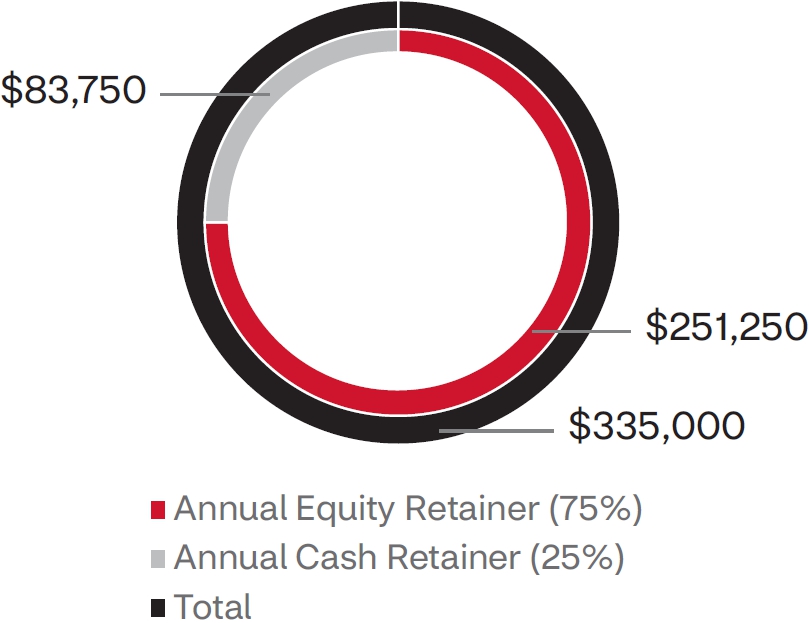
ADDITIONAL ANNUAL COMPENSATION (2025)
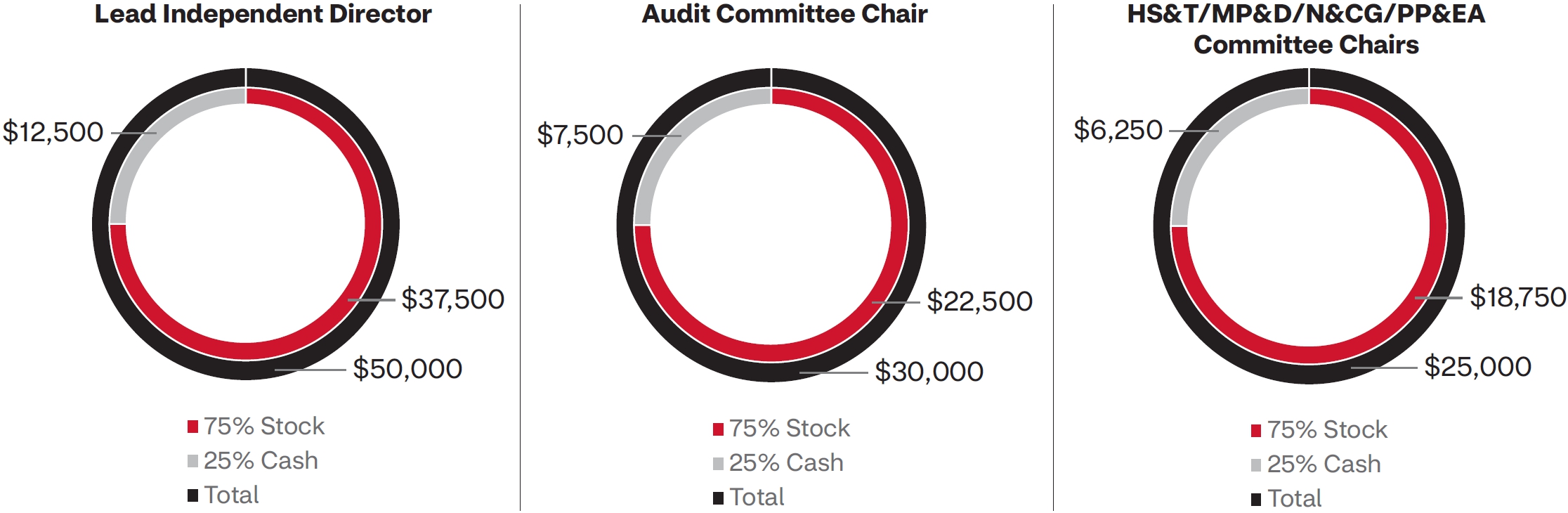
No additional compensation was paid for service on or chairing the Executive Committee or any special committee formed by the Board. There are no meeting fees.
A director who is not a non-employee director does not receive the compensation depicted above, but receives compensation as an employee and is reimbursed for expenses incurred in connection with services provided to the Company. As previously disclosed, in January 2025 the MP&D Committee and its independent compensation consultant, Korn Ferry, reviewed a non-employee director compensation study prepared by Korn Ferry and recommended to the Board updated Chair retainers, as well as a retainer for the Lead Independent Director, which were approved by the Board and are set forth in the graphics above. In January 2026, the MP&D Committee and Korn Ferry reviewed a non-employee director compensation study prepared by Korn Ferry and recommended to the Board updated non-employee director retainers. The Board then approved an annual retainer for non-employee directors for the 2026 – 2027 Board year in the amount of $375,000. Retainers for all Chair positions held by non-employee directors and for the Lead Independent Director role will remain unchanged. All retainers will consist of at least 75% stock-based compensation, with the remainder paid in cash or stock, as described above.
Ad hoc committees or special committees of the Board may be established from time to time to work on special projects and members may receive additional compensation for these services, as approved by the Board.
2026 Proxy Statement 37
Non-Employee Director Compensation – 2025
| Name | Fees Earned and Paid in Cash(1) ($) |
Cash Fees Elected to be Paid in Stock(2) ($) |
Stock Awards(2) ($) |
All Other Compensation ($) |
Total ($) | |||||
| Fernando Aguirre | 91,284 | — | 273,716 | — | 365,000 | |||||
| Jeffrey R. Balser, M.D, Ph.D. | 90,060 | — | 269,940 | — | 360,000 | |||||
| C. David Brown II | 90,060 | — | 269,940 | — | 360,000 | |||||
| Alecia A. DeCoudreaux | 83,750 | — | 251,250 | — | 335,000 | |||||
| Anne M. Finucane(3) | 90 | 86,785 | 260,625 | — | 347,500 | |||||
| J. Scott Kirby | 41,940 | 41,875 | 251,185 | — | 335,000 | |||||
| Michael F. Mahoney(4) | 105,459 | — | 316,208 | — | 421,667 | |||||
| Leslie V. Norwalk | 83,786 | — | 251,214 | — | 335,000 | |||||
| Larry M. Robbins | — | 83,750 | 251,250 | — | 335,000 | |||||
| Guy P. Sansone | 83,786 | — | 251,214 | — | 335,000 | |||||
| Douglas H. Shulman | 83,786 | — | 251,214 | — | 335,000 |
| (1) | The amounts shown include cash payments made in lieu of fractional shares to Mmes. Finucane and Norwalk, Dr. Balser and Messrs. Aguirre, Brown, Kirby, Mahoney, Sansone and Shulman. |
| (2) | These awards are fully vested at grant and the amounts shown represent both the fair market value and the full fair value at grant. During 2025, each director receiving a 12-month retainer received 3,729 shares of stock with a total value of approximately $251,250 on the date of grant; each director electing to receive the remaining portion of the annual retainer in stock also received 1,242 shares valued at approximately $83,750 on the date of grant. As of December 31, 2025, our directors had deferred balances of shares of Company common stock, including accrued dividend reinvestment shares, as follows: Mr. Brown, 83,746 shares; Ms. DeCoudreaux, 40,053 shares; Ms. Finucane, 16,530 shares; Mr. Mahoney, 4,613 shares; and Mr. Robbins, 8,080 shares. |
| (3) | Ms. Finucane received a pro-rata retainer in connection with her appointment as PP&EA Committee Chair in November 2025. |
| (4) | Mr. Mahoney received pro-rata retainers in March 2025 in connection with his appointments as Lead Independent Director and N&CG Committee Chair for the remainder of the 2024-25 Board year, and full retainers for those roles for the 2025-26 Board year. |
Non-Employee Director Stock Ownership Guidelines
The MP&D Committee oversees the Company’s stock ownership guidelines, which require the Company’s non-employee directors to maintain ownership of a minimum number of shares of CVS Health common stock. Specifically, all non-employee directors must own a minimum of 10,000 shares. All non-employee directors who joined the Board prior to January 1, 2021 are in compliance with the stock ownership guidelines and the remaining non-employee directors are on track to do so within the required time period. For additional details, see “Executive Officer and Director Stock Ownership Requirements” on page 111, as there are separate stock ownership guidelines that apply to Mr. Joyner as CEO.
38 CVS Health
Audit Committee Matters
| ITEM | ||||
2 |
Ratification of the Appointment of Our Independent Registered Public Accounting Firm for 2026 | |||
 |
The Board of Directors unanimously recommends a vote FOR this proposal. | |||
The Audit Committee of the Company’s Board of Directors has appointed Ernst & Young, an independent registered public accounting firm, to audit the financial statements of the Company for the fiscal year ending December 31, 2025 and recommended to our full Board that it ratify that appointment. We are submitting the appointment by the Audit Committee to you for your ratification.
Audit Committee Report
As of December 31, 2025, the Audit Committee was composed of five independent directors, whose signatures and report on the Audit Committee’s activities with respect to CVS Health’s audited financial statements for the fiscal year ended December 31, 2025 (the “audited financial statements”) are set forth below.
| • | The Audit Committee has reviewed and discussed the audited financial statements with management; |
| • | The Audit Committee has discussed with Ernst & Young, CVS Health’s independent registered public accounting firm, the matters required to be discussed under the applicable requirements of the Public Company Accounting Oversight Board (the “PCAOB”) and the SEC; |
| • | The Audit Committee has received the written disclosures and the letter from Ernst & Young pursuant to applicable requirements of the PCAOB regarding Ernst & Young’s communications with the Audit Committee concerning independence, and has discussed with Ernst & Young its independence from the Company; and |
| • | Based on the review and discussions referred to above and relying thereon, the Audit Committee recommended to the Board of Directors that the audited financial statements be included in CVS Health’s Annual Report on Form 10-K for the fiscal year ended December 31, 2025, for filing with the SEC. |
 |
 |
 |
 |
 | ||||
| Fernando Aguirre (Chair) |
Jeffrey R. Balser, M.D. | Anne M. Finucane | Larry M. Robbins | Guy P. Sansone |
Independent Registered Public Accounting Firm Independence and Fee Approval Policy
The Audit Committee is directly responsible for the appointment, compensation, retention and oversight of the independent registered public accounting firm. The Audit Committee has retained Ernst & Young as CVS Health’s external audit firm since September 2007. In order to assure continuing external auditor independence, the Audit Committee periodically considers whether there should be a rotation of the audit firm. Further, in conjunction with the mandated rotation of the external audit firm’s lead engagement partner, the Audit Committee and its Chair were directly involved in the selection of Ernst & Young’s lead engagement partner, who assumed her role in February 2022. Based on its most recent evaluation of Ernst & Young, the members of the Audit Committee believe that the continued retention of Ernst & Young to serve as the Company’s independent registered public accounting firm is in the best interests of the Company and its stockholders. Among the factors considered by the Audit Committee in reaching this recommendation are the following: the quality of Ernst & Young’s staff, work and quality control; its capability and technical expertise, given the complexity of the Company’s business; its independence from the Company; the quality and candor of its communications with the Company and the Audit Committee; and the benefits of its tenure as auditors, including enhanced audit quality and competitive fees.
2026 Proxy Statement 39
All audit services, audit-related services, tax services and other services provided to the Company by Ernst & Young were pre-approved by the Audit Committee, and the Audit Committee is ultimately responsible for audit fee negotiations associated with the retention of Ernst & Young. The Audit Committee has considered whether Ernst & Young’s provision of services is compatible with maintaining Ernst & Young’s independence. The Audit Committee’s charter requires pre-approval of the audit and non-audit services to be provided by the Company’s independent registered public accounting firm. The Audit Committee reviews and approves Ernst & Young’s services on an annual basis. During the year, Ernst & Young also may request pre-approval of additional services, and the Audit Committee considers such requests for approval and approves them as circumstances warrant. The Audit Committee charter authorizes the Audit Committee to delegate to one or more of its members authority to pre-approve permitted services, as long as such pre-approvals are reported to the full Audit Committee at its next meeting.
Representatives of Ernst & Young will be at the Annual Meeting to answer your questions and will have the opportunity to make a statement if they so desire.
If you do not ratify the appointment of Ernst & Young, the Audit Committee will reconsider the appointment of Ernst & Young, although in the event of reconsideration, the Audit Committee may determine that Ernst & Young should continue in its role. Even if you ratify the appointment of Ernst & Young, the Audit Committee retains its discretion to reconsider Ernst & Young’s appointment if it believes that reconsideration is necessary and in the best interest of the Company and its stockholders.
Fees of Independent Accounting Firm
The following table summarizes the fees paid to Ernst & Young for services rendered during fiscal 2025 and 2024.
| Fiscal Year Ended 12/31/25 ($) |
Fiscal Year Ended 12/31/24 ($) | |||
| Audit Fees(1) | 24,295,087 | 25,907,468 | ||
| Audit-Related Fees(2) | 5,973,875 | 4,895,015 | ||
| Tax Fees(3) | 999,203 | 1,301,915 | ||
| All Other Fees(4) | 110,000 | 70,000 |
| (1) | Represents the aggregate fees billed for the audit of our consolidated financial statements and the audit of our internal control over financial reporting, the reviews of the condensed consolidated financial statements included in our Quarterly Reports on Form 10-Q, services provided in connection with statutory audits, regulatory filings and other audits for the year, and consultations on technical matters. Ernst & Young billed $400,000 and $350,000 for out-of-pocket expenses for the years ended December 31, 2025 and 2024, respectively. |
| (2) | Represents the aggregate fees billed for audit and services that are typically performed by auditors, including audits of our employee benefit plans, services provided related to reports on the processing of transactions by servicing organizations, attest services related to financial reporting and compliance, controls assessments and certain agreed upon procedures reports. Certain agreed upon procedures reports are paid for by the recipient of the report who requested these services. These fees totaled $449,000 and $270,000 for the years ended December 31, 2025 and 2024, respectively, and are excluded from audit-related fees in the above table. |
| (3) | Represents the aggregate fees billed for services related to tax advice and tax planning. These services mainly relate to identifying and calculating tax credits and incentives, as well as review of transfer pricing arrangements. Ernst & Young did not provide any tax compliance or preparation services to the Company in either year. |
| (4) | Represents fees related to cybersecurity assessments and simulation exercises. |
40 CVS Health
Executive Compensation and Related Matters
| ITEM | ||||
3 |
Say on Pay, a Proposal to Approve, on an Advisory Basis, the Company’s Executive Compensation | |||
|
The Board of Directors unanimously recommends a vote FOR this proposal. | |||
Background
We are asking our stockholders to approve, on a non-binding, advisory basis, the 2025 compensation paid to our Named Executive Officers, as described in the Compensation Discussion and Analysis and the Executive Compensation sections of this proxy statement. Although the advisory vote is not binding upon the Company, the MP&D Committee (referred to in this Item 3 as the “Committee”), which is responsible for designing and administering our executive compensation program, values our stockholders’ views and will continue to consider the outcome of the vote in its ongoing evaluation of our executive compensation program.
At CVS Health, our executive compensation philosophy and practices reflect our commitment to aligning pay with both short- and long-term performance. We define performance as the achievement of results measured against challenging internal financial targets that take into account our results relative to those of our peer companies, as well as industry and market conditions. We believe that our multi-faceted executive compensation plans, with their integrated focus on short- and long-term metrics and features that enhance alignment to stockholders, provide an effective framework by which progress toward achieving our strategic goals may be appropriately measured and rewarded.
Following our 2025 Annual Meeting of Stockholders, the Committee considered the result of our stockholders’ say on pay vote and dedicated significant additional time and effort to its regular, comprehensive review of the Company’s executive compensation program. We received support of approximately 59% on the say on pay vote and sought feedback from stockholders to better understand what motivated their votes and what actions we could take to address their concerns. In the letter from the Committee on page 42 of this proxy statement and the Compensation Discussion and Analysis starting on page 44, we have provided detail on our stockholder outreach and engagement efforts, compensation decisions made in consideration of stockholder feedback and a description of our executive compensation program and outcomes for the 2025 program upon which stockholders are being asked to vote.
Resolution
The Committee and the Board believe that the policies and procedures articulated in the Compensation Discussion and Analysis are thoughtful and effective measures that will help the Company to achieve its goals and that the compensation of our Named Executive Officers reported in this proxy statement is important in attracting and retaining the talent critical to CVS Health’s long-term success. Additionally, we believe the 2025 pay outcomes demonstrate alignment between pay and performance and that our executive compensation program remains aligned to the Company’s growth strategy.
Stockholders are being asked to vote on the following resolution:
“RESOLVED, that the stockholders approve, on a non-binding, advisory basis, the compensation of the CVS Health Named Executive Officers named in the Summary Compensation Table, as disclosed pursuant to the SEC’s compensation disclosure rules (which disclosure includes the Compensation Discussion and Analysis, the compensation tables and other narrative executive compensation disclosures).”
2026 Proxy Statement 41
Letter from the Management Planning and Development Committee
Dear CVS Health Corporation Stockholder:

As the members of the Board’s Management Planning and Development Committee (for purposes of this letter, the “Committee”), we take seriously our responsibility to design, oversee and continuously refine an executive compensation program that drives meaningful alignment between leadership performance and long-term stockholder value creation. Our work is rooted in a pay-for-performance philosophy, rigorous oversight of succession planning and leadership development, and a commitment to ensuring our programs remain competitive, transparent and responsive to the Company’s evolving strategy.
2025 was a pivotal year for CVS Health, one in which the Company delivered strong stockholder value creation, advanced major strategic initiatives and further strengthened leadership to support the next phase of transformation. These results underscore the effectiveness of recent compensation decisions, particularly those made in late 2024 as the Company navigated significant changes in our executive leadership team. The Company entered 2025 with a focus on operational discipline, strengthening our businesses and measurable performance improvement. The sustained appreciation of CVS Health’s stock price throughout 2025 reflects growing confidence in our trajectory and validates the Committee’s belief that our compensation philosophy and decisions appropriately incentivized and supported the leadership team during a period of substantial change.
In addition to the continued momentum under Mr. Joyner’s leadership as CEO, 2025 saw important new additions to the senior management team. The appointment of Brian O. Newman as CFO effective in May 2025 brought to the organization a seasoned finance leader with deep experience managing complex businesses and strong alignment to the Company’s commitment to disciplined capital allocation and long-term financial health.
Overcoming the Company’s challenges in prior years, throughout 2025 CVS Health delivered strong performance, with revenue growth across all major segments and improved operating results that enabled the Company to meaningfully exceed our initial full-year adjusted EPS guidance. The year showcased strong execution across the Company. The Company’s executive compensation program is a critical component of the ongoing success of the business and 2025’s improvements illustrate how our executive compensation framework appropriately calibrates payouts based on results, promotes accountability and recognizes sustained progress toward long-term goals. For 2025, the Committee approved an additional metric to the Management Incentive Plan (“MIP”) to reinforce our focus on cost management and further strengthen the balance between financial performance and execution on strategic initiatives.
The Committee recognizes that our annual say on pay vote is an important mechanism for stockholders to express their perspective on our executive compensation program, and we take the result of this vote seriously. Our 2025 vote received approximately 59% support. To ensure we fully understood stockholder views that contributed to the vote outcome, the Board directed an expanded stockholder engagement program in late 2025 and early 2026, as detailed in the CD&A. David Brown, who serves as Chair of the Committee, participated in many of these conversations, allowing the Committee to hear perspectives firsthand and incorporate investor feedback into our 2026 executive compensation deliberations.
We acknowledge that the changes to our leadership team impacted certain aspects of our executive compensation program for 2024, and we understand that some of our stockholders expressed discontent with these impacts by opposing our 2025 say on pay vote. In our subsequent engagements, we heard that opposing votes were primarily driven by these now-historical 2024 actions, namely with regard to treatment of equity vesting for our outgoing CEO and stockholders did not convey concerns with the overall structure of our executive compensation program. Stockholders also expressed support for our continued use of performance-based compensation to align with the stockholder experience, and none suggested a go-forward commitment regarding treatment of equity awards. In light of the feedback we received, the Committee will not modify the treatment of CEO equity awards upon termination for the next three years absent exigent or extraordinary circumstances.
We believe constructive dialogue with our stockholders strengthens our compensation practices and enhances our ability to make informed, balanced decisions that support the Company’s strategy. We would like to thank our stockholders for their continued engagement, investment and partnership. The Committee remains focused on supporting CVS Health’s mission to deliver accessible, affordable and connected health care and on ensuring that our executive compensation program continues to serve the best interests of our stockholders.
42 CVS Health
Compensation Committee Report
MP&D Committee members as of the March 16, 2026 record date met with management to review and discuss the Compensation Discussion and Analysis. Based on that review and discussion, we recommended to the Board that the Compensation Discussion and Analysis be included in this proxy statement.
|
 |
|
 |
 | ||||
| Fernando Aguirre | C. David Brown II (Chair) |
Anne M. Finucane | Michael F. Mahoney | Douglas H. Shulman |
2026 Proxy Statement 43
Compensation Discussion and Analysis
The Compensation Discussion and Analysis explains how our executive compensation programs were designed and operated in 2025 with respect to our named executive officers (“NEOs” or “Named Executive Officers”).
Highlights for our current NEOs(1) are below:
J. David Joyner
President, Chief Executive Officer and Chair of the Board |
2025 Compensation | |||
| Current and Prior Roles Mr. Joyner has served as Chair of the Board since January 1, 2026, and as President and CEO since October 17, 2024. He brings nearly 40 years of experience in the health care and pharmacy benefit management industry, primarily through leadership roles at CVS Health and its predecessor organizations, including CVS Caremark and Aetna. |
Base Salary $1.5 million
Annual Cash Incentive (MIP)
2025 Granted Equity Compensation
Annual Awards ~$14.5 million grant date fair value, granted as 75% performance stock units (“PSUs”) and 25% restricted stock units (“RSUs”) |
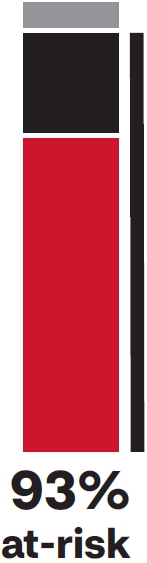 |
Brian O. Newman
Executive Vice President (“EVP”) and Chief Financial Officer |
2025 Compensation | |||
| Current and Prior Roles Mr. Newman has served as EVP and CFO since May 2025. Prior to joining CVS Health, Mr. Newman served as Executive Vice President and Chief Financial Officer of United Parcel Service, Inc. (“UPS”) from August 2019 through May 2024. Before joining UPS, Mr. Newman spent 26 years at PepsiCo, Inc., where he held a variety of senior finance leadership positions across Europe, Asia, and North and South America. |
Base Salary $1.0 million ($696,970 paidin 2025, based on April 2025 start date)
Annual Cash Incentive (MIP)
2025 Granted Equity Compensation
Annual Awards ~$7.0 million grant date fair value, granted as 60% PSUs, 20% RSUs and 20% stock options |
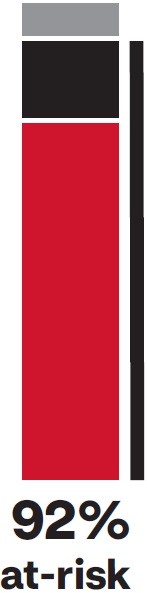 |
| (1) | Under SEC rules our 2025 NEOs also include Thomas F. Cowhey, our former EVP and CFO. |
44 CVS Health
Tilak Mandadi
EVP, Ventures and Chief Experience and Technology Officer |
2025 Compensation | |||
| Current and Prior Roles Mr. Mandadi has served as EVP, Ventures and Chief Experience and Technology Officer since March 2025. He previously served as EVP and Chief Digital, Data, Analytics and Technology Officer from July 2022 through February 2025. In 2024, Mr. Mandadi’s role expanded to include oversight of CVS Health Ventures, which invests in emerging health care technology and technology-enabled services companies. Prior to joining CVS Health, Mr. Mandadi held executive roles in technology and strategy for MGM Resorts International, The Walt Disney Company and American Express. |
Base Salary $1.0 million
Annual Cash Incentive (MIP)
2025 Granted Equity Compensation
Annual Awards ~$7.0 million grant date fair value, granted as 60% PSUs, 20% RSUs and 20% stock options |
 |
Steven H. Nelson
EVP and President, Aetna |
2025 Compensation | |||
| Current and Prior Roles Mr. Nelson has served as EVP and President, Aetna since November 2024. Prior to joining CVS Health, Mr. Nelson served as CEO of several managed care and health care organizations, including Duly Health and Care, JenCare and ChenMed. Mr. Nelson was previously CEO of UnitedHealthcare, a division of UnitedHealth Group, from 2017 until 2019. During his tenure at UnitedHealthcare, which began in 2007, he held several senior leadership roles and led the Commercial and Government businesses, driving improvements in growth, profitability, employee engagement and culture and customer satisfaction. |
Base Salary $1.0 million
Annual Cash Incentive (MIP)
2025 Granted Equity Compensation
Annual Awards ~$7.25 million grant date fair value, granted as 60% PSUs, 20% RSUs and 20% stock options |
|
2026 Proxy Statement 45
Prem S. Shah
EVP and Group President |
2025 Compensation | |||
| Current and Prior Roles Mr. Shah has served as EVP and Group President of CVS Health since November 2024, with responsibility for operational performance and integrated value creation across CVS Caremark, Pharmacy & Consumer Wellness, and the Company’s Health Care Delivery businesses. Prior to this appointment, Mr. Shah had served as EVP and Chief Pharmacy Officer beginning in November 2021. In September 2023, he was appointed President, Pharmacy & Consumer Wellness, after having served as Co-President of that segment since January 2022.Earlier in his tenure at CVS Health, Mr. Shah spent approximately 11 years in roles providing strategic oversight of key Specialty Pharmacy functions. |
Base Salary $1.1 million
Annual Cash Incentive (MIP)
2025 Granted Equity Compensation
Annual Awards ~$9.0 million grant date fair value, granted as 60% PSUs, 20% RSUs and 20% stock options |
|
CFO Transition in 2025
The Board appointed Brian O. Newman as Executive Vice President and Chief Financial Officer of CVS Health, effective May 12, 2025. The MP&D Committee approved Mr. Newman’s compensation arrangements, which are structured similarly to other non-CEO NEOs, after reviewing market data provided by the MP&D Committee’s independent compensation consultant. See “Agreements with Named Executive Officers” on page 68 for additional information. The MP&D Committee did not approve any cash sign-on awards or additional equity grants for Mr. Newman in connection with his appointment.
Thomas F. Cowhey served as Executive Vice President and Chief Financial Officer of CVS Health through May 12, 2025, and thereafter continued his employment with the Company in a non-executive capacity as Strategic Advisor to the President and CEO until June 2, 2025. Mr. Cowhey’s separation from the Company was treated as a termination of employment without cause and, accordingly, he was eligible for severance benefits. Mr. Cowhey received the standard severance benefits provided under the CVS Health Severance Plan for Non-Store Employees (the “Severance Plan”), the MIP, and his restrictive covenant agreement (“RCA”). Additional details are provided under “Agreements with Named Executive Officers” on page 68 and under “Payments/(Forfeitures) Under Termination Scenarios” beginning on page 86.
46 CVS Health
Summary
The CD&A is organized into the following sections:
Our Executive Compensation Core Principles
Although we consider numerous factors in our pay decisions, these five core principles drive our executive compensation philosophy:
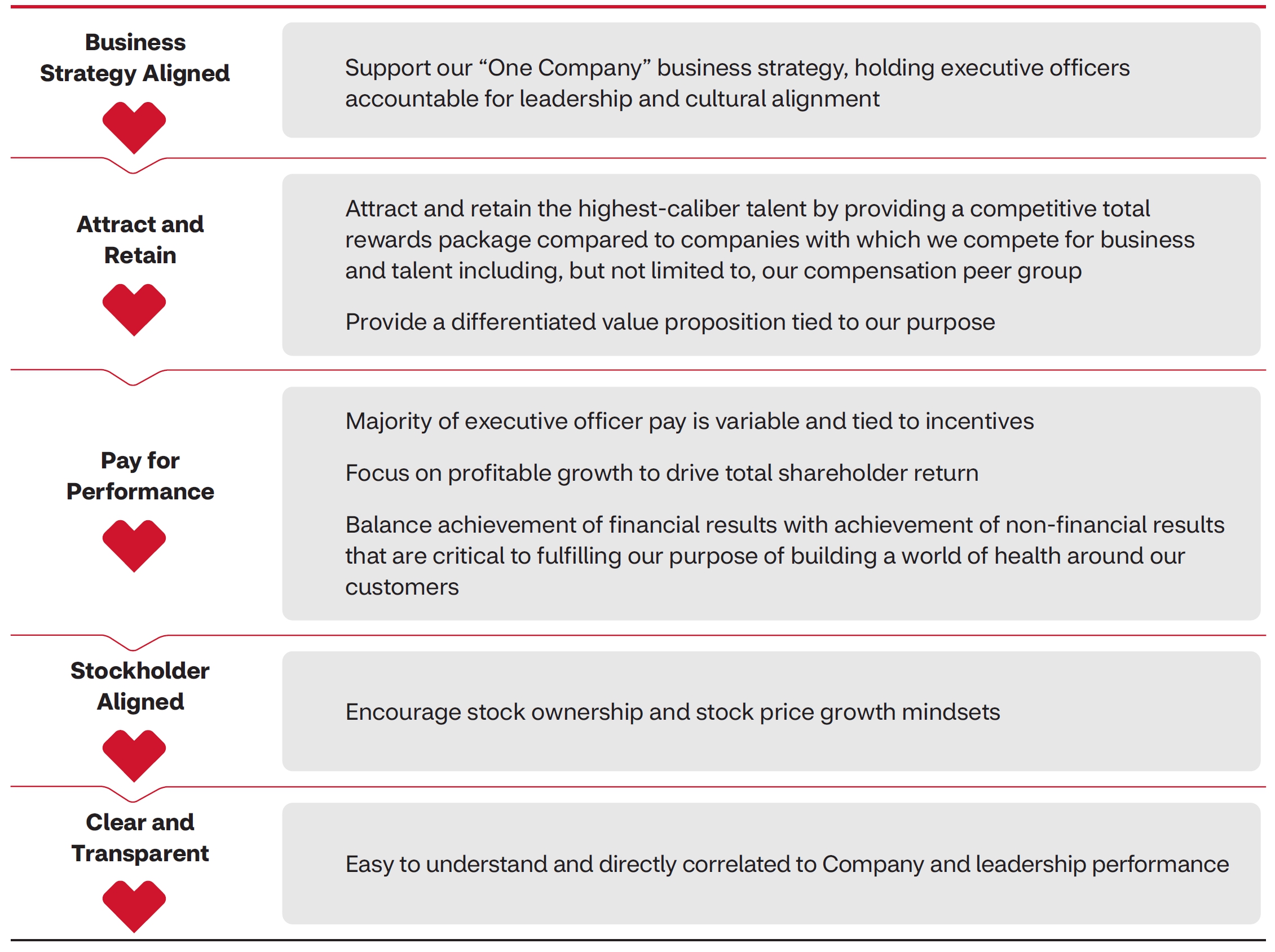
2026 Proxy Statement 47
Stockholder Outreach and Engagement
| ~60%1 Total Contacted | ~48%1 Total Engaged | ~35%1 Director Engaged |
| 1 | Source: Capital IQ; represents outreach efforts to stockholders as a percentage of outstanding shares as of March 16, 2026. |
We value an open dialogue with our stockholders and believe that regular communication with them and other stakeholders is a critical part of our long-term success. As discussed in detail on pages 8-9, this year, we held meetings with our stockholders in late 2025 and early 2026. The statistics above for our aggregate engagements show the percentage of stockholders’ outstanding shares held for 1) those initially contacted; 2) meetings held; and 3) MP&D Committee Chair participation. We also engaged with the leading proxy advisory firms. David Brown, the Chair of the MP&D Committee, played a meaningful role in conversations with certain stockholders, assisted by our legal, human resources and investor relations staff. Compensation-related feedback from these conversations was communicated to the MP&D Committee, along with the full Board, and used to inform its decision-making process.
2025 Say on Pay Vote and Engagement on Compensation Topics
Our annual say on pay vote provides an opportunity to receive feedback from stockholders regarding our executive compensation program, and the MP&D Committee takes the result of this vote into account when determining the compensation of the Company’s executive officers. Our 2025 stockholder advisory vote on executive compensation received approximately 59% of votes cast in favor of the proposal. In light of this vote outcome, we expanded our stockholder outreach from prior years and held engagements with a broader set of investors who voted both for and against the 2025 say on pay proposal.
In conversations with stockholders, compensation-related discussions focused on decisions made to support leadership changes that took place in late 2024, including factors considered by the MP&D Committee when setting compensation for our new executives and our then-departing CEO, and the context for one-time awards granted to certain executives. Feedback from such conversations indicated that investors generally understood the rationale for the decisions made and were largely supportive of the decision to grant one-time awards, recognizing that it was essential for the MP&D Committee to take actions that would ensure the stability and retention of leadership during this transition period. Stockholders we engaged with who voted against the 2025 say on pay proposal generally did not express concern with the core structure of our compensation program or standard practices. Instead, we consistently heard feedback that the primary reason for their negative vote was the elimination of partial vesting provisions for our outgoing CEO in late 2024. Stockholders acknowledged that the issue was largely backward looking, and none suggested a go-forward commitment regarding treatment of equity awards. Nonetheless, as a result of these discussions, the MP&D Committee confirms that it will not modify the treatment of CEO equity awards upon termination for the next three years absent exigent or extraordinary circumstances.
We were pleased that in our discussions most stockholders did not raise concerns with the overall design and structure of our executive compensation program and expressed support for our continued use of relative total shareholder return (“rTSR”) as a metric for determining achievement of PSUs to ensure alignment with the stockholder experience. They appreciated our commitment to transparency regarding the MP&D Committee’s rationale for recent compensation decisions and requested similar disclosure in this year’s CD&A, which we have provided.
The MP&D Committee regularly evaluates our executive compensation program and takes stockholder perspectives shared during engagements into consideration when enhancing our program. The stockholders we engaged with in late 2025 and early 2026 largely provided positive feedback on modifications made to our program for 2024 and 2025 and acknowledged the MP&D Committee’s consideration of and responsiveness to their input, as well as their understanding of the Committee’s goals to align our program to market standards and to attract and retain the best possible talent. Further disclosure regarding these modifications can be found on pages 50-51, 54-55 and 59-63.
Please see pages 8-9 of this proxy statement for additional information about broader stockholder engagement themes.
48 CVS Health
Leading Practices in Executive Compensation Programs
As detailed above, our stockholder outreach provides the Board with valuable insights into our stockholders’ perspectives on our executive compensation program and other matters of importance to them. Our pay practices align with our core compensation principles and facilitate our implementation of those principles. They also demonstrate our commitment to sound compensation and governance practices and reflect enhancements made to our executive compensation program in prior years, largely as a result of stockholder input.
We apply leading executive compensation practices
 |
Performance Metrics Aligned with Stockholder Interests | |
Recoupment Policies and Commitment to Disclose any Recoupment | |
|
Majority of Total Compensation Opportunity is Performance-Based | |
Limited Perquisites and Personal Benefits | |
|
Long-Term Incentive Award Payouts are Capped | |
No Excise Tax Gross-Ups | |
|
Post-vest Holding Period on Net Shares Resulting from PSUs for NEOs | |
Broad-Based Severance Plan Applies to Executives | |
|
No Upward Modifier to any Outstanding PSUs if Absolute TSR is Negative | |
Robust Stock Ownership Guidelines | |
|
Double Trigger Vesting of Equity Awards Upon a Change in Control | |
Broad Anti-Pledging and Anti-Hedging Policy | |
|
Dividend Equivalents on RSUs and PSUs Paid Only When Awards Vest | |
Reconciliation in Proxy Statement of any Non-GAAP Performance Metric to the Most Directly Comparable GAAP Financial Measure | |
|
No Option Repricing; No Recycling of Shares | |
Board Committee Oversight of Comprehensive Annual Compensation Program Risk Assessment | |
|
Cash Severance Policy Capped at 2.99x Base Plus Bonus | |
Workforce Modifier Metric in the MIP (downward-only) for Senior Executives |
2025 Business and Performance Highlights
In 2025, we advanced our strategy and achieved significant milestones that we believe will help us to achieve our ambition to be America’s most trusted health care company. Our integrated model uniquely allows us to deliver a simpler, connected experience, improving continuity of care and health for our customers, while also saving them time and money. We made progress in key areas of our business, while successfully navigating the industry-wide challenges that have impacted our Company. The Company’s efforts in enhancing our cross-enterprise processes and driving focused and deliberate execution strengthen our position for the future.
2025 Business and Performance Results
7.8% increase in full-year total |
$1.39 GAAP diluted EPS |
$6.75 (1)
Adjusted EPS |
||
$10.6 billion cash |
over $3.0 billion in dividends paid in 2025 |
117 consecutive quarters of dividends |
| (1) | Adjusted EPS is a non-GAAP financial measure. See Annex A to this proxy statement for a reconciliation of this and other non-GAAP financial measures to the most directly comparable GAAP financial measures. |
| For more information on our financial performance and strategy, please refer to our 2025 Annual Report mailed with this proxy statement and available at www.cvshealthannualmeeting.com. |
2026 Proxy Statement 49
Executive Compensation Program Discussion
Our executive compensation program supports our long-term strategy by tying the majority of pay for executives to performance-based metrics aligned to the Company’s growth strategy. For our 2025 annual executive compensation program, we provide three elements of total direct compensation: base salary, annual cash incentive and long-term incentive awards, which are described in detail beginning on page 54.
Executive Compensation 2025 Planning and Review Process
The annual cycle of reviewing and developing the Company’s executive compensation program and pay levels is a multi-step process that includes year-round engagement with our stockholders. It also incorporates consideration of our most recent say on pay results, compensation peer group, industry information, both short- and long-term Company results compared to objectives, and input and guidance from the MP&D Committee’s independent compensation consultant.
When evaluating pay reported in the 2025 Summary Compensation Table (“SCT”), it is important to consider the timing of the related compensation decisions and the periods in which they are reported.
| • | 2025 annual cash incentive award amounts were determined and approved by the MP&D Committee in February 2026 and reflect both Company performance and individual performance in 2025 against goals that were established in the first quarter of 2025. |
| • | Long-term incentive awards reflect individual performance and the future potential to drive our corporate strategy and growth, while delivering value to patients, members and consumers. Annual long-term incentive awards for NEOs were granted as PSUs, RSUs and stock options, other than Mr. Joyner, who was granted PSUs and RSUs (as detailed on pages 51, 59-63). Mr. Newman received his long-term incentive award in May 2025, shortly after he joined the Company. The performance goals for the 2025 PSUs were approved in March 2025 for the period January 1, 2025 – December 31, 2027. The MP&D Committee will determine the performance results for this cycle in February 2028; if performance criteria are met, PSUs will vest based on continued employment through April 1, 2028, and the net shares, if any, will be subject to a one-year post-vesting holding period. |
2025 Executive Compensation Program Summary
Management Incentive Plan or MIP
|
The MP&D Committee believes that performance indicators, including profitability, customer experience and employee belonging and engagement should continue to be included in our executive compensation program.
The MP&D Committee approved an additional financial metric for the 2025 MIP focused on cost management, alongside the existing financial and customer experience metrics. These metrics are designed to help empower NEOs and other colleagues to meet our Company objectives including delivering value to patients, members and consumers and enhancing the Company’s financial performance. The MP&D Committee also approved the continued use of a downward-only Workforce Modifier:
• Company Performance: » 60% Adjusted Operating Income » 20% Adjusted SG&A Ratio (Ratio of Adjusted Selling, General & Administrative Expenses to Adjusted Total Revenues) » 20% Customer Experience (determined based on Net Promoter Score (“NPS”)) » Workforce Modifier (downward-only, by as much as 10%) for senior leaders (Vice Presidents and above) based on the achievement of belonging / engagement goals reflecting the results of the colleague engagement survey • Individual Performance Modifier (0 to 120%) • Payouts capped at 200% of target after the application of any modifiers |
 See pages 54-59 for details
50 CVS Health
Long-Term Incentive Program
|
NEO (non-CEO): In 2025, the MP&D Committee maintained year-over-year consistency with the design of our NEO long-term incentive program and the equity mix, which consisted of 60% PSUs, 20% RSUs and 20% stock options. The program is designed to drive sustainable long-term growth by aligning directly to strategic priorities that will support delivering value to patients, members and consumers, while reflecting stockholder preference that a majority of long-term incentives be performance-based. It is also designed to attract and retain the best talent and closely aligns to competitive market practice.
CEO: For our CEO, the MP&D Committee approved, with input from the independent compensation consultant, a long-term incentive equity mix of 75% PSUs and 25% RSUs. The MP&D Committee considered the impact his promotional equity award granted in November 2024, which was in the form of premium-priced stock options and stock-settled stock appreciation rights (“SARs”), had on his outstanding long-term equity mix and modified the mix accordingly by not including stock options and including a greater percentage of PSUs. By awarding the majority of his long-term incentive award in PSUs, Mr. Joyner’s outstanding equity is balanced to ensure that performance goals are directly aligned with the Company’s operating and strategic plans. |
PSUs: The MP&D Committee maintained the Adjusted EPS metric, the rTSR modifier and one-year post-vesting holding period, while refining the Strategic Scorecard metrics.
• 70% Adjusted EPS: A three-year cumulative Adjusted EPS for the period of January 1, 2025 through December 31, 2027. The Adjusted EPS metric has a threshold of 85% of target (below which no payout is earned), and a maximum of 115% of target (above which no incremental payout is earned). • 30% Strategic Scorecard: Consists of three metrics, 10% weighting each, and each metric has independent threshold, target and maximum levels » Strategic Metric 1: Debt Pay-Down Ratio (Ratio of Adjusted Debt to Adjusted EBITDA at year-end 2027) (New for 2025) » Strategic Metric 2: Medicare Stars Performance (Percentage of Medicare members in 4+ Star-rated plans over a three-year period). (Refined for 2025: measured relative to a comparator group of Medicare companies, see details on page 59, 61-63) » Strategic Metric 3: Customer Engagement (Percentage of unique customers with 2+ CVS Health offerings at year-end 2027) • rTSR Modifier (+/- 25%): Based on CVS Health’s TSR relative to the TSR of selected comparator companies; no upward rTSR modifier will be applied if CVS Health’s absolute TSR is negative • Payout capped at 200% of target after the application of the rTSR modifier • Beginning with the 2025 awards, PSUs are eligible for dividend equivalents, which will accrue during the vesting period and will be paid in cash only when the underlying PSUs, if any, vest. Dividend equivalents are forfeited if the underlying PSUs do not vest. |
2026 Proxy Statement 51
Incentive Design, Payout and Goal-Setting Process and Timeline
For the annual and long-term incentive programs, the MP&D Committee oversees a rigorous and comprehensive goal-setting process. Below are highlights of the MP&D Committee’s review and decision-making process for 2025 executive compensation and incentive program target setting. The MP&D Committee structures the timing and process for determining individual NEO compensation so that compensation is appropriately aligned with the financial performance of the Company. On an ongoing basis, the MP&D Committee reviews our compensation philosophy and objectives considering Company strategy, goals, performance, stockholder feedback and external benchmarking, monitors compensation in comparison to actual and relative performance and ensures compliance with management equity ownership requirements.
| 1 | Set Targets | |||
| January – March 2025 | ||||
| • | Approved the following: | |||
| » | Individual incentive award target levels for the 2025 MIP and 2026 long-term incentive awards. | |||
| » | Financial metrics and targets for the 2025 MIP and the 2025 PSUs (2025-2027 performance period). | |||
| • | Reviewed rTSR peer group for 2025 PSUs with our independent compensation consultant. | |||
| • | Reviewed incentive compensation trends with our independent compensation consultant. | |||
| • | Performed annual risk assessment of executive compensation programs. | |||
| • | Reviewed overall compensation structure. | |||

| 2 | Monitor Plan Design and Key Metrics | ||
| September 2025 | |||
| • | Reviewed the compensation peer group with our independent compensation consultant, for executive compensation purposes in 2026. | ||
| • | Reviewed preliminary performance of the 2023 PSUs based on performance for the 2023-2025 performance period. | ||
| • | Reviewed preliminary performance of the 2025 MIP based on 2025 performance. | ||
| • | Reviewed results of say on pay vote and stockholder engagement strategy. | ||
| November 2025 – March 2026 | |||
| • | Reviewed stockholder feedback on our executive compensation program, including recent changes that were in effect for 2025. | ||
| • | Discussed 2026 Incentive design for MIP and PSUs and provided feedback to management. | ||
| • | Reviewed total executive compensation market data with our independent compensation consultant. | ||
| • | Reviewed preliminary performance of the 2023 PSUs based on performance for the 2023-2025 performance period. | ||
| • | Reviewed preliminary performance of the 2025 MIP based on 2025 performance. | ||
| 3 | Review Performance and Approve Compensation | ||
| January – March 2026 | |||
| • | Reviewed year-end performance and pay-for-performance alignment for the prior year, as well as independent directors’ assessment of individual contributions and performance (with respect to each continuing NEO) and CEO recommendations (with respect to each continuing NEO other than the CEO). | ||
| • | Certified 2023 PSU payouts for the completed 2023-2025 performance period. | ||
| • | Certified MIP payouts for the completed 2025 fiscal year and approved individual awards. | ||
| • | Performed annual risk assessment of executive compensation programs. | ||
| • | Discussed and approved say on pay responsiveness based on stockholder feedback. | ||
52 CVS Health
Elements of Our Annual Executive Compensation Program
Our pay-for-performance philosophy places the majority of our executive officers’ compensation at risk and emphasizes short- and long-term incentives tied to both individual and Company performance, as well as continued service. As a result, the only fixed compensation currently provided to our NEOs is base salary, which represents approximately 10% of our NEOs’ total target compensation in 2025.
The MP&D Committee believes that performance indicators, including profitability, customer experience, market comparability and stock price should be factored into our executive compensation program. By using a variety of pay vehicles and balancing short- and long-term awards, the MP&D Committee believes our executive compensation program supports executive focus on long-term growth creation because the metrics are measured independently, and no single factor impacts all elements of performance.
The table below outlines each element of our annual executive compensation program for 2025.
2025 Annual Executive Compensation Program Structure
| Performance-based or performance-aligned (~90%) | ||||||||||
| Near-Term | Long-Term | |||||||||
| Base Salary | Annual Cash Incentive (MIP) |
PSUs | RSUs | Stock Options | ||||||
| Performance/ Vesting Period | Ongoing | Annual | 3-year measurement plus 1-year holding period post vesting | 4-year ratable vest | 4-year ratable vest, with 10-year expiration | |||||
Performance Metrics |
• Adjusted Operating Income (60%) • Adjusted SG&A Ratio (20%) • Net Promoter Score or NPS (20%) • Individual Performance Modifier (0-120%) • Workforce Modifier for VPs and above (downward-only, by as much as 10%) |
• 3-year cumulative Adjusted EPS (70%) • Strategic Scorecard (30%) • rTSR Modifier (+/-25%); no upward modifier applied if our absolute TSR is negative |
Aligned to Company stock performance | Stock price appreciation | ||||||
| Link to Strategy and Performance | Attracts and compensates high-performing and experienced leaders, like our NEOs, at a competitive level of cash compensation. | Motivates and rewards executives, including our NEOs, for achieving annual corporate, business unit and functional goals in key areas of financial and operational performance. | Focuses NEOs on the achievement of specific long-term financial performance goals directly aligned with our operating and strategic plans. | Aligns to stock price, promotes retention, aligns NEOs’ interests with those of our stockholders and helps balance the equity package to attract and retain talent. | Directly aligns the interests of our NEOs with stockholders. Stock options only have value for NEOs if operating performance results in stock price appreciation. | |||||
| CEO Target Pay Mix | 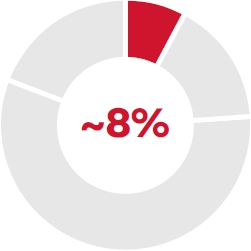 |
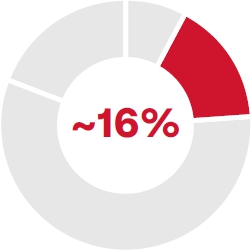 |
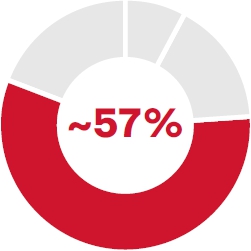 |
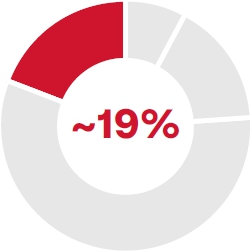 |
||||||
| NEO Target Pay Mix | 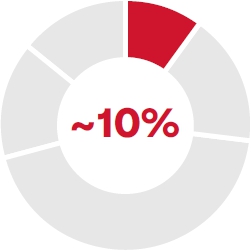 |
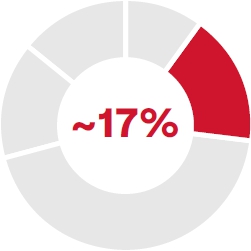 |
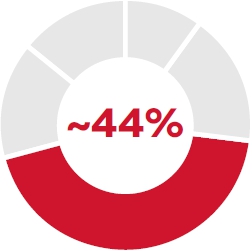 |
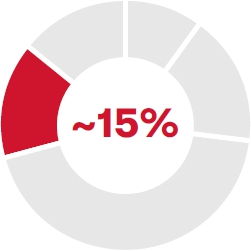 |
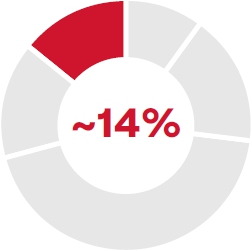 | |||||
2026 Proxy Statement 53
Base Salary
The MP&D Committee annually reviews the base salaries of all executive officers, including our NEOs, and adjusts them periodically by evaluating the evolving responsibilities of the position, the experience of the individual and the marketplace in which we compete for executive talent as defined by our compensation peer group. Informed by this review, and with input from its independent compensation consultant, the MP&D Committee did not increase NEO base salaries for 2025.
| FY 2025 Annual Base Salary ($) |
Percentage Increase vs. 2024 Base Salary | |||
| J. David Joyner | 1,500,000 | 0% | ||
| Brian O. Newman(1) | 1,000,000 | — | ||
| Tilak Mandadi | 1,000,000 | 0% | ||
| Steven H. Nelson(1) | 1,000,000 | — | ||
| Prem S. Shah | 1,100,000 | 0% | ||
| Thomas F. Cowhey | 1,000,000 | 0% |
| (1) | Messrs. Newman and Nelson were not NEOs in 2024. |
Annual Cash Incentive
Our NEOs participate in our annual cash incentive program, the MIP, under which they are eligible for a cash award based on the achievement of pre-established financial, operating and individual performance objectives. The NEOs’ annual target bonus is expressed as a percentage of their base salary, with target bonus opportunities approved by the MP&D Committee in the first quarter of each year. The current targets are set forth in the 2025 Annual Cash Incentive Award table on page 59. Awards are paid out, if earned, in the first quarter of the following year based on the following formula. The MP&D Committee reserves the discretion to reduce awards for any reason.
| NEO Target Annual Incentive % X Eligible Earnings(1) |
X | Corporate Performance Factor % |
X | Individual Performance Modifier (0 to 120%) |
X | Workforce Modifier (downward-only, by as much as 10%) |
= | Final Award Cannot Exceed 200% of Target |
| (1) | Eligible Earnings represent actual earnings paid during the performance year. |
Corporate Performance Factor
Rigorous Goal Setting
CVS Health is a performance-driven company, and the MP&D Committee believes there is a strong connection among our growth, the targets we communicate externally and our corresponding MIP goals. Our management and the MP&D Committee work collaboratively to set targets reflective of our ambitious performance goals and to drive long-term value creation for our stockholders. When setting these goals, the MP&D Committee considers factors relevant to the current fiscal year. Financial results from prior years are used for reference; however, the MP&D Committee focuses on setting annual goals that reflect current business conditions and expectations and that will result in an appropriate pay for performance outcome for the fiscal year. The MP&D Committee recognizes the importance of achieving an appropriate balance between rewarding executives for strong performance over both the short- and long-term and establishing realistic but rigorous targets that continue to attract, motivate and retain executives. The intent of the MIP targets and metrics is to drive the achievement of Company financial and operational goals and individual objectives.
The MP&D Committee, with input from our independent compensation consultant, established the following Company goals for the 2025 MIP: Adjusted Operating Income (60% weighting), Adjusted SG&A Ratio (20% weighting) and Net Promoter Score (20% weighting). Collectively, these goals emphasize and reinforce the business objectives of the Company, including the achievement of our operational goals, fostering positive experiences for our customers, stockholders and colleagues and effective expense management.
| • | Adjusted Operating Income*: The 2025 Adjusted Operating Income target of $13,400 million was set above the Company’s actual performance in 2024 of $11,976 million. | |
| * | Adjusted Operating Income is a non-GAAP financial measure. See Annex A to this proxy statement for a reconciliation of this and other non-GAAP financial measures to the most directly comparable GAAP financial measures. | |
54 CVS Health
| • | Adjusted SG&A Ratio: For 2025, the MP&D Committee, with input from its independent compensation consultant, introduced an Adjusted SG&A Ratio metric for the MIP to focus leaders on cost management and support the Company’s focus on its turnaround strategy. |
| The Adjusted SG&A Ratio is a percent calculated based on Adjusted SG&A Expenses to Adjusted Total Revenue, with a funding scale range of +/-50 bps. | |
| • | Net Promoter Score: For 2025, the MP&D Committee continued the use of NPS, a commonly used measurement of consumers’ willingness to recommend a company to others. NPS is focused on real-time data driven insights into what is important to our patients, members and consumers and enables us to measure comparable positioning more effectively and transparently. By measuring customer experience through the use of transaction-generated and random survey data, NPS helps us ensure excellent service, positioning the Company to retain and win new business by linking improvements in consumer loyalty to business outcomes. |
| The 2025 NPS baseline was set equal to 2024 actual results due to existing headwinds related to external sentiment focused on the health care industry. |
The established targets were designed to be both rigorous yet achievable, reflecting our internal forecasts and the challenging macroeconomic and industry environment present when goals were established in early March 2025.
2025 Corporate Performance Results
In determining the funding for Company performance under the 2025 MIP, the MP&D Committee reviewed the overall financial and operating results of the Company, evaluating them against the MIP performance targets approved by the MP&D Committee in March 2025.
The Company performance result was 142.3% for 2025 — based on 2025 Adjusted Operating Income (performance of 149.0% of target, weighted at 60%, resulting in funding of 89.4%), Adjusted SG&A Ratio (performance of 144.6% of target, weighted at 20%, resulting in funding of 28.9%), and NPS aggregate results (performance of 120.0% of target, weighted at 20%, resulting in funding of 24.0%).
The results for 2025 Adjusted Operating Income reflect outperformance in our Pharmacy & Consumer Wellness segment due to pharmacy volume, including contributions from the Rite Aid transaction, as well as overperformance in our Health Care Benefits segment, primarily due to favorable medical cost development. The favorable NPS was driven by strong performance across our businesses, delivering results that were above target. Adjusted SG&A Ratio’s positive results were driven by revenue outperformance across each of our business segments.
| Performance Metric | Threshold | Target | Maximum | Funding Level |
Performance Weighting Under Plan |
Final Approved Performance Result |
Adjusted Operating
% of Target |
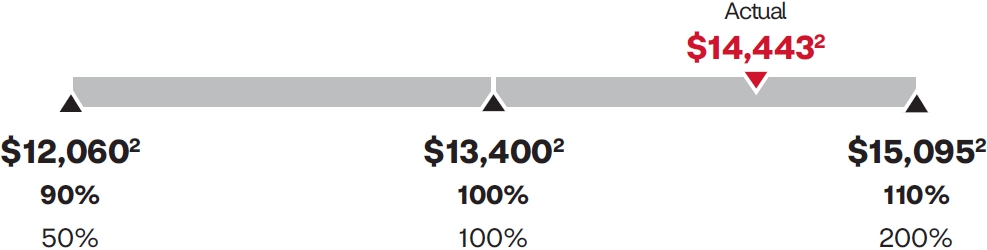 |
149.0% | 89.4% | 142.3% | ||
Adjusted SG&A
Result vs. Target |
 |
144.6% | 28.9% | |||
NPS(4) (20%)
Result vs. Target |
 |
120.0% | 24.0% | |||
| (1) | 2025 Adjusted Operating Income and 2025 Adjusted SG&A Ratio are non-GAAP financial measures. See Annex A to this proxy statement for a reconciliation of this and other non-GAAP financial measures to the most directly comparable GAAP financial measures. |
| (2) | Dollars in millions. The Threshold, Target, Maximum and Actual amounts for 2025 Adjusted Operating Income are all net of bonus-related expenses. |
| (3) | Adjusted SG&A Ratio uses a basis-point funding scale. Actual results are +/-50 bps from target. |
| (4) | NPS uses a point-based funding scale. Actual results are the weighted average performance versus target for the businesses, weighted equally for the Company’s primary operating businesses, with the Health Care Delivery business making up the balance. |
2026 Proxy Statement 55
Individual Performance Modifier
Each NEO’s individual performance was evaluated against previously set goals and assigned a value between 0% and 120%. The MP&D Committee did not assign specific weightings to any NEO’s goals but rather performance is intended to be evaluated holistically at the end of the period. The individual performance modifier cannot exceed 120%, or 20% above what would have been earned based solely on corporate performance. An individual performance modifier of less than 100% will reduce payouts below what would have been earned based solely on Company performance. In all cases, total payouts cannot exceed 200% of target when including Company performance, individual performance and the Workforce Modifier (downward-only, by as much as 10%).
2025 Individual Performance Modifier Results: For 2025, the MP&D Committee evaluated each current and eligible NEO’s performance relative to individual goals, the MIP funding at 142.3% and the impact of non-GAAP adjustments, as well as the CEO’s input on the performance of each current and eligible NEO (other than the CEO). In determining the annual cash incentive for Mr. Joyner, the MP&D Committee consulted with the other independent members of the Board. Mr. Cowhey was not eligible for an annual cash incentive award pursuant to the terms of the MIP.
With respect to financial performance, the MP&D Committee considered the following results for the NEOs, as more fully set forth below: GAAP diluted EPS of $1.39 and Adjusted EPS* of $6.75; consolidated operating income of approximately $4,660 million and consolidated Adjusted Operating Income* of $14,443 million.
The following table summarizes highlights of each continuing NEO’s individual performance achievements in 2025:
| J. David Joyner | |
| President and CEO | 2025 INDIVIDUAL PERFORMANCE ASSESSMENT |
| Leadership | • Represented CVS Health in engagements with federal policymakers and regulators during 2025, including providing testimony and participating in public forums on health care affordability, pharmacy benefit management and regulatory policy impacting the Company’s businesses • Appointed Chair of the CVS Health Board of Directors effective January 1, 2026, in addition to role as President and CEO | |
| Business Results | • Led significant operational stabilization and financial improvement across CVS Health’s diversified business portfolio in first full year as CEO • Generated full-year Adjusted EPS* of $6.75 for 2025, exceeding the Company’s initial expectations entering the year and delivered year-over-year increases in revenue and adjusted operating income while continuing to position the Company for sustainable, profitable long-term growth • Successfully completed transaction involving select Rite Aid assets, highlighting our commitment to maintaining and expanding access to convenient and trusted pharmacy care across the U.S. and demonstrating our focus on high value investments | |
| People | • Successfully led over 300,000 colleagues with a focus on leveraging our integrated capabilities to improve health care and health outcomes for the communities we serve • Strengthened colleagues’ alignment with the Company’s reinvigorated ambition, purpose and values |
| * | Adjusted EPS and Adjusted Operating Income are non-GAAP financial measures. See Annex A to this proxy statement for an explanation and a reconciliation to the most comparable GAAP financial measure. |
56 CVS Health
| Brian O. Newman | |
| EVP and CFO | 2025 INDIVIDUAL PERFORMANCE ASSESSMENT |
| Leadership | • Established a holistic Total Shareholder Return (“TSR”) framework to strengthen investor confidence, guide strategic decision-making and enable more balanced competitive benchmarking • Helped operationalize identified savings and delivered disciplined capital stewardship, enhancing external credibility | |
| Business Results | • Delivered over $402 billion in revenue and $14.4 billion in Adjusted Operating Income*, a 7.8% and 20.6% year-over-year increase from 2024, respectively, and $10.6 billion of cash flow from operations, meaningfully exceeding expectations • Returned over $3.0 billion to stockholders through quarterly cash dividend payments • Managed investment portfolio to outperform total return benchmarks on all asset classes | |
| People | • Reorganized the Finance leadership team and drove an 11% increase in colleague engagement, with recognized strengths in accountability, trust, ethical leadership and team support |
| * | Adjusted operating income is a non-GAAP financial measure. See Annex A to this proxy statement for an explanation and a reconciliation to the most comparable GAAP financial measure. |
| Tilak Mandadi EVP,
Ventures & |
|
| Technology Officer | 2025 INDIVIDUAL PERFORMANCE ASSESSMENT |
| Leadership | • Served as the joint lead on the launch of Health100™, a new health care consumer engagement platform and helped launch other tech-related new businesses • Established a focus on AI-native technology to reach best-in-class goals | |
| Business Results | • Led CVS Health Ventures in its top quartile financial performance • Met enterprise NPS target for 2025 and created enterprise value through improved customer and provider experiences • Sustained zero major cybersecurity incidents • Led major enterprise initiatives to unify digital experiences across the organization, including reducing Aetna credentialing turnaround time by 42.5% • Launched “Kiosk Reimagined” at MinuteClinic®, resulting in more than 140,000 additional patients receiving care | |
| People | • Integrated 12,000 colleagues across the enterprise into human resource systems • Launched our internal chat platform that supports more than 185,000 colleagues |
2026 Proxy Statement 57
| Steven H. Nelson | |
| EVP and President, Aetna | 2025 INDIVIDUAL PERFORMANCE ASSESSMENT |
| Leadership | • Made the strategically essential decision to exit the Individual Family Plan (“IFP”) market, overseeing a disciplined and financially responsible runout that protected Company performance and upheld commitments to members • Launched innovative new Aetna products—such as Aetna Informed ChoiceSM and Aetna Custom ConnectionsSM—leveraging advanced AI and digital capabilities to reduce friction and enhance member, provider and payor experiences | |
| Business Results | • Delivered full-year adjusted operating income of over $2.9 billion and delivered over 9% year-over-year total revenue growth in the Health Care Benefits segment • Executed strong cost management, resulting in a medical benefit ratio (“MBR”) of 91.2% and an operating expense ratio of 13.0%, an 80-basis-point improvement year-over-year • Outperformed established goals for NPS among Aetna members | |
| People | • Strengthened Aetna’s leadership bench by recruiting top external executives and promoting high-potential internal leaders, increasing mobility and depth • Drove meaningful improvements in employee engagement by elevating culture and reinforcing a high-performance, high-accountability environment |
| Prem S. Shah | |
| EVP and Group President | 2025 INDIVIDUAL PERFORMANCE ASSESSMENT |
| Leadership | • Developed a differentiated, improved consumer health care experience to drive engagement and lower consumer costs • Led through change in the PBM landscape with a focus on delivering lowest net cost and improving transparency • Took decisive action to exit underperforming Oak Street Health locations, while taking actions to improve performance and expand services provided by Signify Health • Collaborated with the administration, such as participation as a core partner in the TrumpRx fertility program, to lower costs and improve access and outcomes | |
| Business Results | • Successfully completed the transition to cost-based reimbursement across a number of CVS Pharmacy businesses and exceeded growth expectations in 2025; reset trajectory from negative to at least flat annual growth • Expanded CVS Pharmacy footprint in the Pacific Northwest, welcoming 9 million new patients and over 3,500 new colleagues, while maintaining uninterrupted access to care • Oversaw significant customer wins in CVS Caremark and continued to increase use of low-cost biosimilars | |
| People | • Established Group President structure, including naming three business unit presidents • Continued to invest in our colleagues, technology and AI to simplify the consumer experience and increase colleague engagement |
Workforce Modifier
In addition to our core metrics, a Workforce Modifier (downward-only) may be applied for leaders at the Vice President level and above, including our NEOs. This modifier assesses engagement and belonging, reinforcing CVS Health as an employer of choice while holding leadership accountable. The MP&D Committee measures relative progress against internal trends based on the colleague engagement survey results, aiming to maintain or improve scores from the prior year. The MP&D Committee evaluates colleague feedback on a measure of belonging at CVS Health and engagement index results. The modifier ranges from minus 10% to 0% (no change) and is applied to the final recommended MIP awards after Company performance and individual modifiers have been determined to ensure consistency of approach.
58 CVS Health
2025 Workforce Modifier Results: The MP&D Committee evaluated the Company’s 2025 progress using colleague engagement survey results. Following their review, the MP&D Committee determined the Company improved on prior year results and therefore a negative adjustment was not warranted. The results demonstrate that leaders, including our NEOs, foster a culture of inclusion and belonging that drives engagement and retention of our talent.
The actual payout of the 2025 annual cash incentive award, as approved by the MP&D Committee, is set forth in the table below.
2025 Annual Cash Incentive Award
| NEO(1) | 2025 Eligible Earnings | Target Annual Incentive | Full-Year Target Award | Company Perfor- mance | Individual Perfor- mance Modifier | Workforce Modifier | Final Payout as a % of Target | Final Award | ||||||||||||||||||||||||
| J. David Joyner | $ | 1,500,000 | 200% | $ | 3,000,000 | 142.3% | 110% | — | 156.5% | $ | 4,695,900 | |||||||||||||||||||||
| Brian O. Newman | $ | 696,970 | 150% | $ | 1,045,455 | 142.3% | 105% | — | 149.4% | $ | 1,562,000 | |||||||||||||||||||||
| Tilak Mandadi | $ | 1,000,000 | 150% | $ | 1,500,000 | 142.3% | 120% | — | 170.7% | $ | 2,561,000 | |||||||||||||||||||||
| Steven H. Nelson | $ | 1,000,000 | 175% | $ | 1,750,000 | 142.3% | 120% | — | 170.7% | $ | 2,988,000 | |||||||||||||||||||||
| Prem S. Shah | $ | 1,100,000 | 175% | $ | 1,925,000 | 142.3% | 110% | — | 156.5% | $ | 3,013,000 | |||||||||||||||||||||
| (1) | Mr. Cowhey did not receive a 2025 annual cash incentive award pursuant to the terms of the MIP, given his employment terminated in June 2025. |
Long-Term Incentive Compensation
On an annual basis, the MP&D Committee, with the assistance of its independent compensation consultant, evaluates individual long-term incentive target opportunities for each NEO in the first quarter, used for grants awarded the following year. Target opportunities are based on factors such as competitive practices of companies in our peer group (see “CVS Health 2025 Compensation Peer Group” beginning on page 65), the NEO’s position and scope of responsibility, the importance of retaining the services of the NEO, internal equity and the NEO’s opportunity to drive Company performance and contribute to the long-term success of the Company.
Following the MP&D Committee’s comprehensive review of our executive compensation program, and considering input from our stockholders, it approved maintaining metrics for 2025, with refinements made to the Strategic Scorecard for the PSUs as noted below. The Strategic Scorecard metrics are reviewed annually to align with our investor commitment and long-term strategic vision. Strong CVS CostVantage® performance and the Company’s commitment to deleveraging and stock price growth influenced the addition of the debt pay down metric for the 2025 PSU Strategic Scorecard.
The MP&D Committee approved the following long-term incentive components to the executive compensation program in 2025:
| • | Maintained the NEO long-term incentive mix of 60% PSUs, 20% RSUs and 20% stock options, other than for Mr. Joyner who received 75% PSUs and 25% RSUs (see pages 61-63 for details) |
| • | Maintained the one-year holding period following the vesting of the three-year PSUs |
| • | Retained three-year cumulative Adjusted EPS measurement for PSUs (70% weighting) |
| • | Modified the Strategic Scorecard metrics to support achievement of our long-term strategy (30% total weighting, each metric to be weighted 10%, with curves ranging from 50% payout at threshold and 200% at maximum performance): |
| » | Strategic Metric 1: Debt Pay Down Ratio (Ratio of Adjusted Debt to Adjusted EBITDA at year-end 2027) (New for 2025) | |
| » | Strategic Metric 2: Medicare Stars Performance (Percentage of Medicare members in 4+ Star-rated plans over a three-year period) (Refined for 2025: measured relative to a comparator group of Medicare companies) | |
| » | Strategic Metric 3: Customer Engagement (Percentage of unique customers with 2+ CVS Health offerings at year-end 2027) |
| • | Maintained rTSR modifier (+/- 25%) |
2026 Proxy Statement 59
The MP&D Committee approved long-term incentive compensation awards for employees, including the NEOs, and made annual grants of long-term equity-based incentives in April 2025 (other than for Mr. Newman, who received his grants in May 2025, shortly after he joined the Company) to focus executives on the Company’s long-term financial and strategic objectives and to align the interests of executives with those of our patients, members, consumers and stockholders. These awards are made under the terms and conditions of the Company’s 2017 Incentive Compensation Plan, as amended (the “2017 ICP”).
2025 Long-Term Incentive Target Mix
As noted above, for 2025, we continued the NEOs’ long-term incentive equity mix of 60% PSUs, 20% RSUs and 20% stock options (other than for Mr. Joyner, as noted below).
For our CEO, the MP&D Committee approved, with input from the independent compensation consultant, a long-term incentive equity mix of 75% PSUs and 25% RSUs. The MP&D Committee considered the impact that Mr. Joyner’s November 2024 promotional equity award, which was in the form of premium-priced stock options and stock-settled SARs, had on his outstanding long-term equity mix and modified the mix of his 2025 award accordingly to increase the portion of his awards granted as PSUs. By awarding the majority of his long-term incentive award in PSUs, Mr. Joyner’s outstanding equity is balanced to ensure that performance goals are aligned with the Company’s operating and strategic plans.
| Award Type | Weighting | Key Features and Performance Measures | ||
PSUs
Focus on sustained performance and profitable growth CEO MIX: Other NEO MIX: |
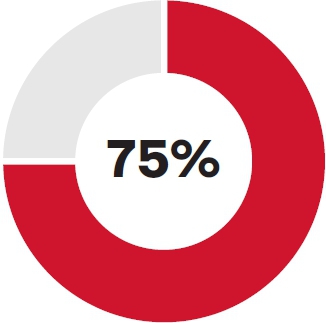
|
• Opportunity to earn between 0% to 200% of target PSUs based on performance against pre-established goals for the three-year performance period (2025-2027): cumulative Adjusted EPS (weighted 70%) and a Strategic Scorecard, based on three strategic metrics (weighted 10% each, for an overall weighting of 30%) | ||
|
• Threshold, Target and Maximum performance goals are anchored in the Company’s long-term growth commitment and strategic plan and are critically important for driving long-term success by rewarding improved patient, member and consumer continuity of care as well as top- and bottom-line growth •Reinforces our pay-for-performance culture and aligns to our external commitments •Includes commitment to drive ongoing operating efficiencies •Includes an rTSR modifier (+/-25%) that measures CVS Health’s TSR relative to the TSR of selected comparator companies (the “Relative TSR Peer Group for 2025-2027 PSU Awards” on page 76); the modifier is applied to the final performance of the core metrics. No upward rTSR modifier is applied if our absolute TSR is negative •Actual payout level to be determined by the MP&D Committee following completion of the 2025-2027 performance period •Dividend equivalents accrue during the vesting period and are paid in cash only when the underlying PSUs, if any, vest and are distributed. Dividend equivalents are forfeited if the underlying PSUs do not vest •Vesting will occur, if at all, in one installment on the third anniversary of the grant date and awards will be further subject to a one-year post-vest holding period which applies during and after employment •PSU award agreements include clawback/forfeiture in the event of detrimental conduct by the executive |
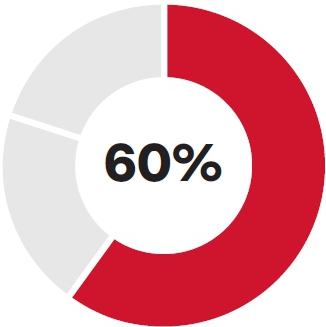
60 CVS Health
| Award Type | Weighting | Key Features and Performance Measures | ||
| RSUs
Focus on stock value and executive retention
CEO MIX:
Other NEO MIX: |
|
• Enables NEOs to build stock ownership and aligns their interests with our stockholders, while promoting retention and stability of our executive leadership team •Value directly linked to stock price, providing some value regardless of stock price volatility •Dividend equivalents accrue during the vesting period and are paid in cash only when the underlying RSUs vest and are distributed. Dividend equivalents are forfeited if the underlying RSUs do not vest •Vest in four equal annual installments, beginning on the first anniversary of the grant date | ||
| Stock Options
Focus on sustained stock price appreciation
Other NEO MIX: |
|
• Aligns the interests of NEOs with stockholders by placing emphasis on long-term value creation through growth in our stock price; options have a 10-year term •Promotes connectedness with the Company and its long-term strategy, reinforcing the financial success of the organization •Vest in four equal annual installments, beginning on the first anniversary of the grant date |
2025 PSU Awards
These awards feature formulaically-determined payouts based on performance goals established by the MP&D Committee in the first quarter of 2025; the three-year performance period is January 1, 2025 – December 31, 2027. The MP&D Committee approved a cumulative Adjusted EPS metric (70% weighting) and a Strategic Scorecard, based on three strategic metrics (weighted 10% each, for an overall weighting of 30%), all adjusted by an rTSR modifier.
In order to provide year-over-year consistency, the overall weightings and metrics were maintained to align focus on achieving growth and strategic goals. Where appropriate, the targets were based, in part, on publicly-stated financial guidance. In light of the Company’s ongoing turnaround efforts, as well as the challenging health care environment at the time the Adjusted EPS targets were established in March 2025, the MP&D Committee approved a revised methodology for setting the three-year cumulative Adjusted EPS target. Under this approach, the 2025 Adjusted EPS target was aligned to external guidance of $6.00. The 2026 target reflects 6.0% growth on 2025 actual results and the 2027 target will reflect 6.0% growth on 2026 actual results. The combined Adjusted EPS target for 2025, 2026 and 2027 together constitute the three-year cumulative target for the 2025-2027 performance cycle, which aligns with our long-term growth commitments in place when the 2025-2027 performance cycle was approved in March 2025. The final three-year cumulative Adjusted EPS target will be set in the first quarter of 2027. Payout determination by the MP&D Committee will be made in February 2028, and any vesting will occur on April 1, 2028. The Adjusted EPS threshold and maximum payout levels for each year are +/- 15%, to better align with competitive market practice, with a 50% payout at threshold performance, below which no payout will be made, and 200% payout at maximum performance.
The MP&D Committee approved the continued use of the Strategic Scorecard design for the PSUs and refined the Strategic Scorecard metrics to support achievement of our long-term strategy.
2026 Proxy Statement 61
| 2025-2027 PSU Awards | ||||||||
| Weighting | Threshold (50%) |
Target (100%) |
Maximum (200%) | |||||
| Financial Measure: Cumulative Adjusted EPS | 70% | 85% | 2025 target: $6.00 2026 target: $7.16 2027 target: TBD in Q1 2027 - based on 6% growth over 2026 year-end actual results(1) |
115% | ||||
| Weighting | Threshold (50%) |
Target (100%) |
Maximum (200%) | |||||
| Strategic Scorecard(2) | 30% | |||||||
1. Debt Pay Down Ratio (Adjusted Debt to Adjusted EBITDA at year-end 2027) (New for 2025) |
10% | 0%(3) | 100% | 200% | ||||
2. Medicare Stars Performance (Percentage of Medicare members in 4+ Star-rated plans over a three-year period relative to comparator group4) |
10% | 50% | 100% | 200% | ||||
3. Customer Engagement (Percentage of unique customers with 2+ CVS Health offerings at year-end 2027) |
10% | 50% | 100% | 200% | ||||
Modifier:
rTSR Modifier (continue to use the Relative TSR Peer Group)
|
The PSU total weighted funding percent of the core metrics outlined above is adjusted by an rTSR modifier, using the following scale:
• Between 0 and 25th percentile of peers, the rTSR modifier will be -25%
• Greater than 75th percentile of peers, the rTSR modifier will be +25%
• Between 25th and 75th percentile of peers, the rTSR modifier will be interpolated
No upward rTSR modifier will be applied if CVS Health’s absolute TSR over the 3-year performance period is negative. | |||||||
| (1) | Illustration of 2025 PSU Adjusted EPS Target below: |
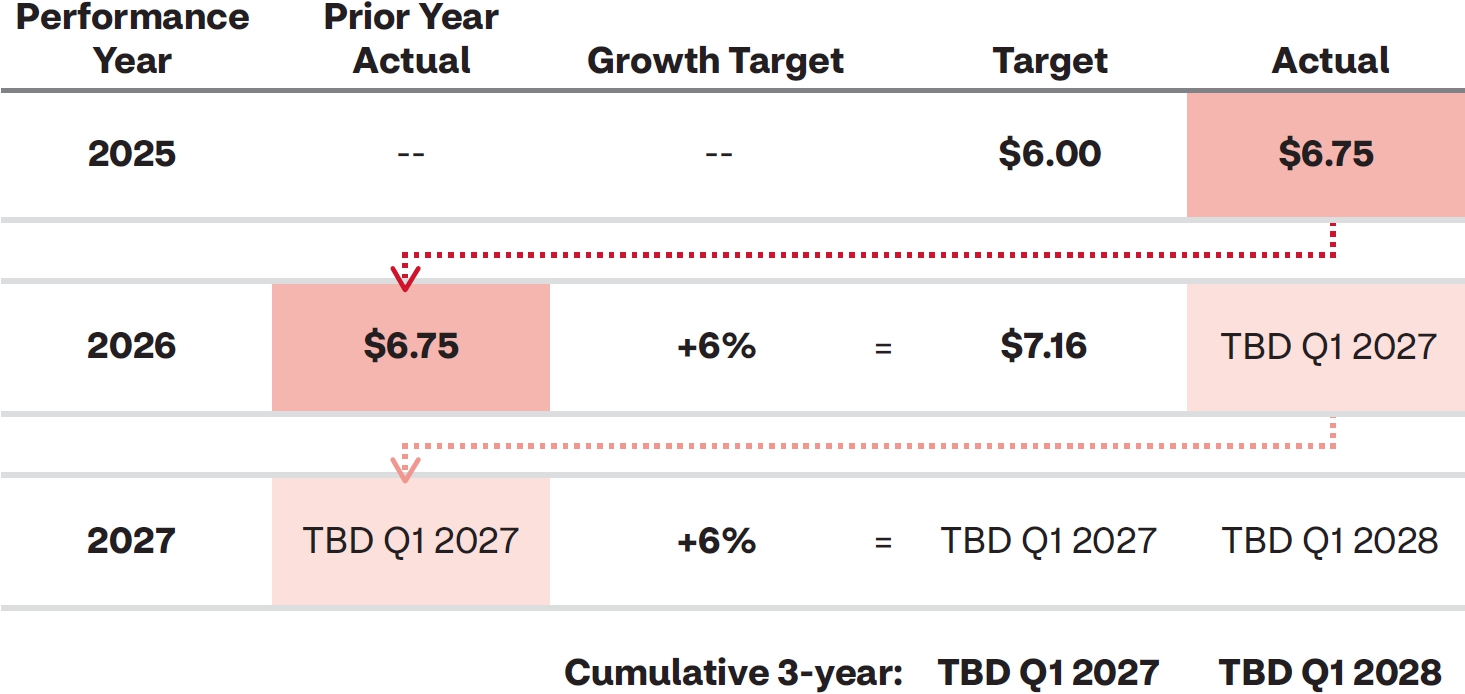
62 CVS Health
| (2) | Due to the potential for competitive harm during the open cycle, we are not disclosing our specific targets and performance curves for these metrics, as allowed by SEC rules. The targets and performance curves represent forward-looking, confidential and competitively sensitive information, the disclosure of which would result in competitive harm (i.e., by providing competitors insight into our strategy and business operations). |
| The MP&D Committee believes that the established targets are both rigorous and achievable, and drive better consumer health outcomes, business results, and stockholder value by furthering the Company’s strategic imperatives. | |
| Additional details regarding the targets and performance curves for these metrics will be provided in our 2028 Proxy Statement following the completion of the performance period. | |
| (3) | 0% payout if target is not achieved. |
| (4) | CVS Health Medicare Stars performance will be measured relative to a comparator group inclusive of the following companies: Centene Corporation, Elevance Health, Inc., Humana Inc. and UnitedHealth Group Incorporated. |
2025 RSU and Stock Option Awards
We use RSUs and stock options to focus our NEOs on delivering long-term value to our stockholders. In 2025, RSUs represented 25% of Mr. Joyner’s long-term incentive award and 20% for the other NEOs. These RSUs vest in four equal annual installments, beginning on the first anniversary of the grant date. RSUs reward and retain the NEOs by providing the opportunity to receive CVS Health stock if they remain employed by the Company on the award vest date(s).
Stock options represented the remaining 20% of the long-term incentive award for our NEOs other than for Mr. Joyner, who did not receive stock options in 2025 as part of his annual equity grants as described on pages 59, 61-63. Stock options are granted at fair market value and vest in four equal annual installments, beginning on the first anniversary of the grant date. Stock options have value only to the extent that the price of CVS Health stock rises above the stock price on the grant date.
2025 Equity Awards to NEOs
| NEO | PSUs | Annual RSUs | Annual Stock Options | |||||||||
| J. David Joyner(1) | $ | 10,874,965 | $ | 3,624,966 | $ | 0 | ||||||
| Brian O. Newman(2) | $ | 4,199,972 | $ | 1,399,978 | $ | 1,399,989 | ||||||
| Tilak Mandadi | $ | 4,199,985 | $ | 1,399,980 | $ | 1,399,996 | ||||||
| Steven H. Nelson | $ | 4,349,970 | $ | 1,449,945 | $ | 1,449,994 | ||||||
| Prem S. Shah | $ | 5,399,946 | $ | 1,799,974 | $ | 1,799,993 | ||||||
| Thomas F. Cowhey(3) | $ | 3,299,994 | $ | 1,099,984 | $ | 1,099,995 | ||||||
| (1) | Mr. Joyner did not receive stock options as part of his 2025 long-term incentive awards, as described above. |
| (2) | Mr. Newman received his annual equity award in May 2025, shortly after he joined the Company. See “Agreements with Named Executive Officers” for more details on Mr. Newman’s compensation. |
| (3) | Mr. Cowhey’s departure was treated as a termination without cause and his outstanding equity awards are subject to his severance agreement and the terms of his equity award agreements pursuant to the 2017 ICP for previously granted awards. See “Agreements with Named Executive Officers” and the table under “Payment/(Forfeitures) Under Termination Scenarios” on page 91 for details. |
2026 Equity Awards
Following the MP&D Committee’s annual review of our executive compensation program, based on market data and input from its independent compensation consultant and considering input from our stockholders, the MP&D Committee made the following adjustments to long-term incentive compensation for the 2026 performance year maintaining a program that remains focused on performance while addressing recruiting and retention and continuing to balance risk and reward:
| • | CEO Equity Mix: The MP&D Committee continued to consider the impact Mr. Joyner’s promotional equity award, granted in November 2024 in the form of premium-priced stock options and SARs, had on his outstanding long-term equity mix. As a result, his 2026 annual equity award was issued in 60% PSUs and 40% RSUs. The majority of Mr. Joyner’s 2026 equity continued to be issued in PSUs to ensure that his incentives are directly aligned with the Company’s operating and strategic plans. | |
| • | NEO Equity Mix: The MP&D Committee rebalanced the NEO equity mix by shifting 10% from PSUs to stock options to strengthen alignment with stock price appreciation, while still maintaining a strong emphasis on PSUs. As a result, the equity mix for the NEOs’ 2026 annual equity award was issued in 50% PSUs, 30% stock options and 20% RSUs. |
2026 Proxy Statement 63
The design of our PSUs for 2026 will be similar to 2025, maintaining:
| • | Adjusted EPS metric with a 70% weighting and a cumulative goal measured over the full three-year performance period; | |
| • | a strategic scorecard metric with a 30% weighting; objective targets are measurable over a three-year period and support the strategic initiatives of the Company and other strategic priorities; | |
| • | the rTSR modifier; and | |
| • | a one-year post-vesting holding period (for net shares). |
Additionally, beginning with RSU and stock option awards granted March 31, 2026, the vesting schedule will shift from four-year ratable vesting to three-year ratable vesting. This change is being made for all equity participants to align with the external market practice in support of attracting and retaining talent.
Prior PSU Performance Programs
2023 PSUs – Performance was certified by the MP&D Committee in February 2026, following the three-year performance period.
Based on results following the performance period, the MP&D Committee certified that there was no payout on the 2023 PSU awards granted to Messrs. Joyner, Mandadi, Shah and Cowhey. Messrs. Newman and Nelson were not employed by the Company at the time of the 2023 grant, and therefore did not receive 2023 PSUs:
| 2023 PSU SUMMARY | STATUS: | ||
• Three-Year Performance Period January 1, 2023 – December 31, 2025 |
• Adjusted EPS* of $6.75 in 2025 was below the threshold level required to achieve a payout ($9.00) | ||
• Based on 2025 Adjusted EPS* with target set at $9.90 – $10.10 in March 2023 and granted in April 2023 |
• rTSR performance was not applicable due to below-threshold Adjusted EPS results | ||
| CALCULATED PAYOUT = 0% | |||
• Subject to an rTSR modifier (+/- 25%) |
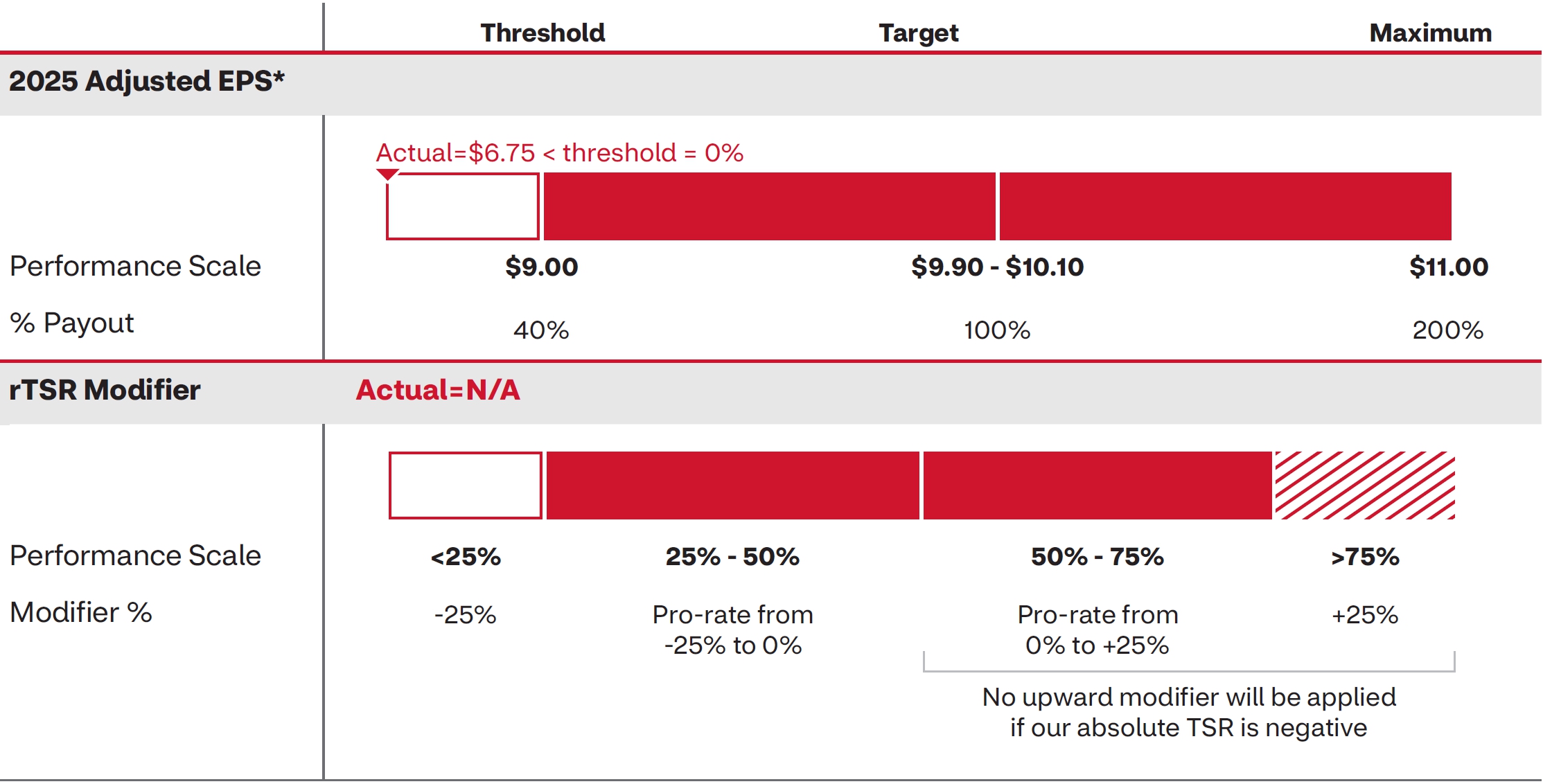
| * | Adjusted EPS is a non-GAAP financial measure. See Annex A to this proxy statement for a reconciliation of Adjusted EPS and other non-GAAP financial measures to the most directly comparable GAAP financial measures. |
64 CVS Health
2024 PSU Summary
Performance will be certified in February 2027, following the three-year performance period, January 1, 2024 –December 31, 2026. Net shares issued upon settlement, if any, will be subject to a one-year holding period. Maximum payout after calculation (including application of modifier) cannot exceed 200% of the PSUs awarded.
| 2024-2026 PSU Awards | ||||||||
| Weighting | Threshold (25%) |
Target (100%) |
Maximum (200%) | |||||
| Financial Measure: | 70% | $21.65 | $26.79 -$27.33 | $32.47 | ||||
| Cumulative Adjusted EPS | ||||||||
| Weighting | Threshold (40%) |
Target (100%) |
Maximum (200%) | |||||
| Strategic Scorecard | 30% | |||||||
| 1. Percentage of Medicare members in 4+ Star-rated plans over a three-year period |
10% |
Due to the potential for competitive harm during the open cycle, we are not disclosing our specific targets and performance curves for these metrics. (See footnote 2 on page 63 for an explanation of competitive harm). | ||||||
| 2. Percentage of Commercial members on CVS CostVantage by Year-End 2026 |
10% |
The MP&D Committee believes that the established targets are both rigorous and achievable, and drive business results and stockholder value by furthering the Company’s strategic imperatives. |
||||||
| 3. Percentage of unique customers with 2+ CVS Health offerings by Year-End 2026 |
10% |
Additional details regarding the targets and performance curves for these metrics will be provided in our 2027 Proxy Statement following the completion of the performance period. |
||||||
Modifier:
rTSR Modifier (continue to use the Relative TSR Peer Group)
|
The PSU total weighted funding percent of the core metrics outlined above is adjusted by an rTSR modifier, using the following scale:
• Between 0 and 25th percentile of peers, the rTSR modifier will be -25%
• Greater than 75th percentile of peers, the rTSR modifier will be +25%
• Between 25th and 75th percentile of peers, the rTSR modifier will be interpolated
No upward rTSR modifier will be applied if CVS Health’s absolute TSR over the 3-year performance period is negative. | |||||||
2025 Compensation Peer Group
2025 Selection Process: The MP&D Committee uses various data sources, including peer groups, to assess financial performance and compensation competitiveness. While peer groups represent a broad group of potential competitors for executive talent across various industries, peer group data serves as only one reference point for the MP&D Committee in evaluating our compensation program.
Annually, the MP&D Committee, with the assistance of its independent compensation consultant, completes a peer group review to determine the most relevant companies with which we compete for talent and capital. The criteria used to identify companies for the peer group include, but are not limited to, size, complexity, business scope, industry and business similarity. The diversified peer group, composed of 19 companies, remained unchanged in 2025 (the “2025 Compensation Peer Group”). The MP&D Committee considered the 2025 Compensation Peer Group when establishing 2025 compensation levels, along with other factors as discussed in “Pay Positioning” below on page 66. Full-year 2025 median revenues for the 2025 Compensation Peer Group were $162.3 billion. CVS Health’s full-year 2025 total revenues of $402.1 billion rank at the 91st percentile relative to the 2025 Compensation Peer Group.
2026 Proxy Statement 65
The MP&D Committee will continue to review the Company’s peer group annually.
CVS Health 2025 Compensation Peer Group
| • AbbVie Inc. | • HCA Healthcare, Inc. | • Microsoft Corporation | ||
| • Bristol-Myers Squibb Company | • Humana Inc. | • Pfizer Inc. | ||
| • Cardinal Health, Inc. | • International Business Machines Corporation | • Target Corporation | ||
| • Cencora, Inc. | • Johnson & Johnson | • UnitedHealth Group Incorporated | ||
| • Centene Corporation | • McKesson Corporation | • Walgreens Boots Alliance, Inc.(1) | ||
| • The Cigna Group | • Merck & Co., Inc. | • Walmart Inc. | ||
| • Elevance Health, Inc. |
| (1) | Walgreens Boots Alliance, Inc. was a publicly-traded company at the time of our 2025 incentive plan design and compensation review, but became a private company in August 2025. |
Pay Positioning
The MP&D Committee does not target NEOs’ pay to a specified percentile relative to the 2025 Compensation Peer Group but rather reviews peer group compensation data for each element of compensation, including base salary, target total cash (base salary plus target bonus) and target total direct compensation (target total cash plus target long-term incentive compensation). Where data is available, individual compensation positioning relative to comparable positions in the 2025 Compensation Peer Group varies by job, and the MP&D Committee considers a number of factors, including market competitiveness, specific duties and responsibilities of the NEO versus those in similar positions at the 2025 Compensation Peer Group companies, and succession planning. In addition to this assessment, the MP&D Committee considers Company and individual performance and internal pay equity among the Company’s executive officers in evaluating and determining executive compensation. The MP&D Committee believes it is appropriate to reward the Company’s executive officers with compensation above the competitive median if the rigorous financial targets associated with the Company’s variable pay programs are exceeded in a way that is consistent with the Company’s core values.
Other Compensation Topics
Other Compensation Arrangements and Benefits
The Company maintains broad-based medical and dental benefits, vision, life insurance and short- and long-term disability insurance programs for its full-time employees. Executive officers are eligible to participate in these programs on the same basis and with the same level of financial subsidy as our other salaried employees. Financial subsidies to these plans are tiered so that our highest paid colleagues pay the most.
Executive officers may participate in the CVS Health Future Fund 401(k) Plan (the “401(k) Plan”), which is our principal qualified defined contribution plan. An eligible CVS Health employee may defer up to 75% of his or her total eligible compensation, defined as salary plus annual cash incentive, to a maximum deferral limit defined by the Internal Revenue Service (“IRS”). In 2025, that maximum deferral limit was $23,500, plus an additional $7,500 for those age 50 and above and $11,250 for those 60-63. After the first full year of employment, CVS Health will match the employee’s deferrals dollar-for-dollar, each payroll period, up to a maximum of 5% of total eligible compensation, subject to IRS limits. CVS Health’s matching cash contributions into the 401(k) Plan for the NEOs who participated are included in the “All Other Compensation” column of the SCT and described in note 7 to the SCT beginning on page 77.
Deferred Compensation Plan and Deferred Stock Compensation Plan
Eligible executive officers may choose to defer earned and vested compensation into the Deferred Compensation Plan (the “DCP”) and the Deferred Stock Compensation Plan (the “DSP”), which are available to any U.S. employee meeting the plans’ eligibility criteria. The plans are intended to provide retirement savings in a tax-efficient manner and to enhance stock ownership. The DCP offers a variety of investment choices, none of which represent an above-market return. The individual contributions of each of our NEOs during fiscal year 2025 to the DCP and the DSP, including earnings on those contributions, any distributions during 2025 and their respective total account balances as of the end of 2025, are shown in the Nonqualified Deferred Compensation table on page 85.
66 CVS Health
Perquisites and Other Personal Benefits
The Company provides certain other compensation to the Named Executive Officers (see the “All Other Compensation” table in footnote 7 to the SCT beginning on page 77).
We provide the following personal benefits to our NEOs, which are reviewed annually by the MP&D Committee for consistency with our philosophy:
| • | Health and welfare benefits: To attract and retain employees at all levels, we offer a subsidized health and welfare benefits program that includes medical, dental, vision, life, accident, disability, vacation and severance benefits. Our subsidy for employee health benefits is graduated so that executives pay a higher contribution than more moderately paid employees. In addition, our NEOs are eligible to have an annual Company-paid health examination and assessment as part of the CVS Health Executive Health Program, the purpose of which is to provide a risk mitigation and business continuity initiative, in the interest of encouraging the long-term health of our NEOs. This benefit is also offered by several of our peer group companies. |
| • | Relocation benefits: The Company provides a relocation benefits program for eligible employees, including our NEOs, that enables CVS Health to attract and retain top talent and to select new executive hires from the broadest possible pool of qualified candidates. Providing comprehensive relocation support ensures that executives can transition seamlessly into their new roles, allowing them to focus on strategic leadership and driving long-term stockholder value. Included in this benefit are tax gross-ups, as described in the “All Other Compensation” footnote to the SCT on page 78. |
| • | Limited personal use of corporate aircraft: We maintain corporate aircraft and also have access to aircraft through a third-party company that may be used by our employees to conduct Company business (collectively, “Company Aircraft”). Under our Company Aircraft Policy, we regularly conduct security assessments and, as a result thereof, the Board or the MP&D Committee may determine that certain officers and their families pose “bona fide business-oriented security concerns” (as defined in IRS regulations). In such cases, CVS Health may require that these officers, including NEOs, and their families use the aircraft for some or all of their personal travel. Such use will be includible in the officers’ compensation, valued as provided in the Company Aircraft Policy. As a result of our latest assessment, we have determined that bona fide business-oriented security concerns exist with respect to the CEO, his spouse and dependents and, as a result, the CEO is required to use the aircraft for business and personal travel. Regardless of this requirement, the CEO (or any other executive determined to pose “bona fide business-oriented security concerns”) must, in accordance with the Aircraft Policy in 2025, reimburse CVS Health for any costs of personal air travel that exceed $250,000 per calendar year, valued in accordance with SEC disclosure rules and guidance. The cost of such personal use for applicable NEOs is included in “All Other Compensation” and described in the notes following the SCT. The value of these items is treated as income taxable to our NEOs. The aggregate incremental cost to the Company of providing these personal benefits to each of our NEOs during fiscal year 2025 is shown in footnote 7 of the SCT beginning on page 77. |
| • | Limited corporate ground transportation: Similar to our approach to aircraft, our CEO uses a corporate driver for travel as part of our executive security program in order to minimize and more efficiently use travel time, protect the confidentiality of travel and our business and enhance our CEO’s personal security. The use of trained drivers to enhance corporate security is consistent with the recommendations of internal and third-party security experts. The aggregate incremental cost to the Company of providing this benefit to our CEO and certain other NEOs during fiscal year 2025 is shown in footnote 7 of the SCT beginning on page 77. |
| • | Personal security benefits: The Company’s executive protection program was developed to manage the security and safety of the CEO and his direct reports, including our NEOs. The Company believes it is in the best interests of the Company and its stockholders to mitigate risk and protect the CEO and ELT, including our NEOs, against possible security threats. The program is regularly monitored and may be adjusted to account for changes in the external environment. Considering increased safety concerns, the executive protection program recommended enhanced security measures to include home security services and technology upgrades to certain ELT members which the Company paid to install. The Company requires that Mr. Joyner accept personal security protection while he serves as CEO. The Company believes that the costs of the security measures were appropriate and necessary, particularly considering the heightened risk environment in the health care industry and its senior leaders. |
| • | Financial planning: A benefit of up to $17,500 to cover the cost of a financial planner to assist with personal financial and estate planning and income tax preparation and to support the retention of senior leadership. We provide this benefit to our executives who are Senior Vice President and above, including our NEOs, so they can receive the professional expertise required to ensure that they maximize the efficiencies of our compensation |
2026 Proxy Statement 67
and benefit programs and are able to devote their full attention to the management of the Company. The MP&D Committee approved this benefit after considering the overall cost of the benefit, prevalence of the benefit in the market and benefit to the Company.
The Company considers its NEOs’ required use of corporate aircraft, car and driver for security purposes and upgrades to residential security to be a business necessity to protect our NEOs given our far-reaching brand presence and extensive footprint in which we operate. However, in compliance with the SEC rules, the Company has reported the costs related to the use of such benefits in footnote 7 of the SCT beginning on page 77.
Agreements with Named Executive Officers
The following sets forth a description of agreements with NEOs who joined the Company in 2025, with executives who became a NEO for the first time in 2025 or with NEOs who departed the Company in 2025. We do not have any individual employment agreements with any of our NEOs. The MP&D Committee approved 2025 compensation decisions for all of our NEOs.
Brian O. Newman
Mr. Newman joined the Company in April 2025. In accordance with his offer letter, Mr. Newman’s base salary is $1.0 million and his annual cash incentive target is 150% of his annual base salary, pro-rated based on his start date for the 2025 performance year. In addition, Mr. Newman’s target annual equity award compensation is $7.0 million, which for calendar year 2025 was comprised of 60% performance stock units, 20% RSUs and 20% stock options. Upon hire, Mr. Newman did not receive a sign-on cash award. Mr. Newman also received standard relocation benefits under the Company’s broad-based relocation program that included tax assistance. Mr. Newman entered into CVS Health’s customary Change in Control (“CIC”) Agreement for executives and an RCA that includes, among other things, non-competition and non-solicitation covenants for the 18-month period following his employment with CVS Health. See “Payments/(Forfeitures) Under Termination Scenarios” beginning on page 86.
Steven H. Nelson
Mr. Nelson joined the Company in November 2024. In accordance with his offer letter, Mr. Nelson’s base salary is $1.0 million and his annual cash incentive target is 175% of his annual base salary. In addition, Mr. Nelson’s target annual equity award compensation is $7.25 million, which for calendar year 2025 consisted of 60% performance stock units, 20% RSUs and 20% stock options. Upon his hire date, Mr. Nelson received a sign-on equity grant in the form of premium-priced stock options with a grant date value of $1.0 million, with an exercise price of 120% of the closing stock price on the grant date, which vests in three annual installments, pursuant to the terms of the award agreement. He also received a $1.3 million sign-on cash bonus paid in a lump sum within the first two pay periods of his date of hire. These sign-on awards were granted to align incentives given his role and provide a competitive offer to join the organization in a period of Company turnaround. If, within 24 months of the payment of his sign-on cash bonus: (1) he voluntarily terminates his employment, or (2) his employment is terminated by the Company for Cause (as defined in his offer letter), he agreed that he will promptly repay to the Company the full amount of the sign-on bonus that he was provided. Mr. Nelson also received standard relocation benefits under the Company’s broad-based relocation program that included tax assistance. Mr. Nelson entered into CVS Health’s customary CIC Agreement for executives and an RCA that includes, among other things, non-competition and non-solicitation covenants for the 18-month period following his employment with CVS Health. See “Payments/(Forfeitures) Under Termination Scenarios” beginning on page 86.
Thomas F. Cowhey
In connection with Mr. Newman’s appointment as CFO and Mr. Cowhey’s departure from the Company, Mr. Cowhey was entitled to standard compensation and benefits consistent with an involuntary termination without “cause” under the Severance Plan, MIP, his RCA and equity award agreements. See the last table under “Payments/(Forfeitures) Under Termination Scenarios” on page 91 for additional details. He did not receive any additional compensation or modifications to any agreements.
Change In Control Agreements with Current NEOs
As previously disclosed, we have CIC Agreements with each of our current NEOs.
The MP&D Committee believes that the interests of stockholders are best served by ensuring that the interests of our senior management are aligned with our stockholders. The CIC Agreements with our current NEOs are intended to eliminate, or at least reduce, the reluctance of senior management to pursue potential change in control transactions
68 CVS Health
that may be in stockholders’ best interests. The CIC Agreements serve to reduce or eliminate potential distraction caused by uncertainty about personal financial circumstances during a period in which CVS Health would require focused and thoughtful leadership to ensure a successful outcome. Accordingly, the CIC Agreements provide certain specified “double trigger” severance benefits to the covered executives in the event of their termination under certain circumstances following a change in control. The CIC Agreements are for a term of three years, with the possibility of subsequent one-year renewal periods, and if a change in control occurs during the term, the CIC Agreements will not expire earlier than two years after such change in control. The MP&D Committee believes a “double trigger” severance benefit provision is appropriate, as it provides an incentive for continuity in management following a change in control and no CIC Agreements provide for a “single trigger” severance benefit. “Double trigger” benefits require that two events occur in order for severance to be paid, i.e., a change in control of the Company followed by the executive’s involuntary termination of employment within two years, in which case our NEOs would be eligible to receive 1.5 times base salary plus target bonus and a pro-rated target bonus for the year of termination, payable as a lump sum, in addition to payment of certain unpaid and deferred amounts and “double-trigger” vesting and exercisability of outstanding equity awards, other than certain legacy equity awards. The 2010 or 2017 Incentive Compensation Plans that govern the terms of outstanding equity awards to all NEOs also require a “double trigger” for vesting of equity change in control benefits.
The MP&D Committee reviews these potential severance benefits annually with the assistance of its independent compensation consultant to evaluate both their effectiveness and competitiveness. The review for fiscal year 2025 found the current level of benefits to be within competitive norms for design. Details of payments made to the executives upon a change in control and various termination scenarios; provisions for the treatment of equity awards, and other benefits; and estimated payments that would be made to the executives whose employment terminates following a change in control may be found in the “Payments/(Forfeitures) Under Termination Scenarios” beginning on page 86.
Defined Benefit Pension Plans
Caremark Rx, Inc. maintained a Special Retirement Plan (“Caremark SRP”), a supplemental unfunded, non-qualified benefit plan that provided certain executive officers of Caremark with monthly benefits upon retirement, disability or a change in control of Caremark. Mr. Joyner is a participant in the Caremark SRP and, like all participants, was vested as of the change in control date when Caremark Rx, Inc. was acquired by the Company in March 2007. The benefit generally payable under the Caremark SRP is equal to the product of (1) 2.5% of the average annual base salary paid to a participant over the 36-month period preceding his retirement date and (2) the participant’s years of service, up to a maximum of 20 years of service. The Caremark SRP provides that a participant will continue to accrue years of service following completion of the merger, but the plan remains subject to amendment or termination.
Aetna Inc. maintained a tax-qualified frozen defined benefit pension plan at the time it was acquired by the Company in November 2018. Mr. Cowhey was a participant in that plan from 2007 until it was frozen in 2010 and has a deferred vested benefit under the plan that has continued to accrue interest.
No other NEOs participate in any defined benefit pension plan. See the Pension Benefits section and related table on page 84 of this proxy statement for further details.
Key Policies Related to Compensation
Policy on Forfeiture and Recoupment of Incentive Compensation
In September 2023, the Board adopted a clawback policy to comply with the requirements of Section 954 of the Dodd-Frank Act and the related rules and regulations promulgated by the SEC and NYSE (the “Dodd-Frank Clawback Policy”).
The Dodd-Frank Clawback Policy does not impact the Company’s existing Recoupment Policy, which was initially approved in 2009 and has been amended a number of times since then, most recently in 2019. The Dodd-Frank Clawback Policy is specifically intended to comply with the requirements of the Dodd-Frank Act. It generally sits “on top” of our existing Recoupment Policy, and in a similar manner the Dodd-Frank Clawback Policy is administered by the MP&D Committee, except that the Audit Committee makes the determination of whether a triggering “restatement” has occurred.
2026 Proxy Statement 69
We believe our Recoupment Policy, which exceeds the requirements of the Dodd-Frank Act and applies to all time-based and performance-based equity awards, further reduces the potential risk that an executive officer would intentionally misstate results to benefit under an incentive program. In addition, appropriate language regarding the policy has been included in applicable documents and award agreements, and our executive officers are required to acknowledge in writing that compensation we have awarded to them may be subject to reimbursement, clawback, or forfeiture pursuant to the terms of the policy and/or applicable law. Further, the equity forfeiture provisions in applicable award agreements would also apply in the event of specified detrimental activity in the absence of a restatement.
The MP&D Committee is empowered to recoup compensation paid to executive officers, and it expanded this capability to include other executives under its purview. In the event of employee misconduct that causes specified financial or reputational damage, a materially inaccurate performance calculation or an accounting restatement, the MP&D Committee may seek to clawback paid incentive compensation.
In addition to the Company’s Clawback Policy and Recoupment Policy, pursuant to the terms of the Company’s equity award agreements governing PSUs, the MP&D Committee may also cancel outstanding PSUs granted to any covered employee if that employee engages in conduct detrimental to the Company (as specified in the award agreements).
70 CVS Health
Below is a chart that provides an overview of the application of the Company’s various forfeiture and recoupment policies.
| Who | When | What | ||||
| Misconduct Cancellation/ Forfeiture Due to Termination for Cause | • Applies to all colleagues who receive equity-based awards as part of their incentive compensation. |
• A colleague is terminated for “Cause”: » willfully and materially breaches any of his or her obligations to the Company with respect to confidentiality, cooperation with regard to litigation, non-disparagement and non-solicitation; » is convicted of a felony involving moral turpitude; or » engages in conduct that constitutes willful gross neglect or willful gross misconduct in carrying out his or her duties to the Company, resulting, in either case, in material harm to the financial condition or reputation of the Company. |
• All unvested equity awards will be cancelled/forfeited on a termination for Cause. | |||
| Detrimental Conduct | • Applies to all colleagues who receive PSU awards as part of their incentive compensation. |
• Detrimental Conduct. During any period in which PSUs (and any related dividend equivalents) remain outstanding and payable, including the holding period, a participant may not engage in Detrimental Conduct. “Detrimental Conduct” means any one of the following: |
• Payment of PSUs is specifically conditioned on the requirement that at all times prior to the settlement date, the participant does not engage in Detrimental Conduct. • Releasing shares delivered after the holding period is also specifically conditioned on the requirement that at all times prior to such release, the participant does not engage in Detrimental Conduct. • If the MP&D Committee determines in its reasonable business judgment that the participant has failed to satisfy such requirements, then all or a portion of the PSUs, or all or a portion of any shares delivered in settlement thereof that are subject to the holding period, as of the date of such determination, shall be cancelled and forfeited as of such date of determination. All such determinations by the MP&D Committee will be final and binding. | |||
» any conduct that would constitute Cause; » the commission of a criminal act by the participant, whether or not performed in the workplace, that subjects, or if generally known, would subject the Company or its subsidiaries to public ridicule or embarrassment; » intentional misconduct or conduct not taken in good faith and causing significant reputational harm to the Company or its subsidiaries; » intentional violation, or negligent disregard, of the Company’s or its subsidiaries’ policies, rules and procedures, specifically including, but not limited to any of the participant’s obligations under the Company’s Code of Conduct and workplace policies; or » any violation of the participant’s restrictive covenant agreement. |
2026 Proxy Statement 71
| Who | When | What | ||||
| Incentive Compensation Recoupment Policy | • Applies to all of our colleagues who receive annual cash incentive or long-term incentive awards, including all time-based and performance- based equity awards. |
• When fraud or material financial misconduct by an employee meaningfully alters financial or operational results used to determine an award amount, as determined by our Board. • Applies to fraud or material financial misconduct committed during the performance period for the award amount that is discovered during the performance period or the three-year period following the performance period.
|
• Applies to all annual and long-term incentive awards, including time-based equity and performance-based awards. • Allows for recoupment of the entire award, not only excess amounts generated by the executive officer’s fraud or material financial misconduct. • Amended in March 2019 to require public disclosure of the circumstances of any recoupment from any executive officer (to the extent doing so would not violate any law or contractual obligations). | |||
| Compliance with Restrictive Covenant Agreement | • All colleagues receiving equity awards. |
• A colleague breaches the terms of their Restrictive Covenant Agreement. |
• The Company may recover profits from RSUs, PSUs and stock options that vested in the two-year period prior to the breach. | |||
| Dodd-Frank Clawback Policy | • Current or former Section 16 Officers regardless of fault. |
• Company required to prepare a Qualifying Restatement as defined in the Dodd-Frank Clawback Policy. |
• Provides for the recovery of compensation that is incentive-based, erroneously awarded and received by the officer within the three (3) years preceding the date that the restatement was needed; prohibits actual or de facto indemnification; and is publicly disclosed. |
Severance Plans and Cash Severance Policy
The Company maintains a broad-based severance plan that covers our NEOs. Details of potential payments under that plan can be found in the narrative and tables beginning on page 86. The MP&D Committee reviews the Company’s severance benefits annually with the assistance of its independent compensation consultant to evaluate both their effectiveness and competitiveness. The review for 2025 found the current level of benefits to be within competitive norms for design. Details of hypothetical payments that would have been made to our NEOs upon a change in control on December 31, 2025 and under various termination scenarios, provisions for the treatment of equity awards and other benefits, and estimated payments that would be made to the executives whose employment terminates following a change in control may be found in “Payments/(Forfeitures) Under Termination Scenarios” beginning on page 86. See “Agreements with Named Executive Officers” on page 68.
The MP&D Committee adopted an executive cash severance policy, the CVS Health Corporation Executive Officer Cash Severance Policy, effective in January 2024, which provides that the Company will not enter into any new employee agreement, severance agreement or separation agreement or establish any new severance plan or policy providing for cash severance to our Section 16 officers (including our NEOs) exceeding 2.99 times the sum of base salary and target bonus without stockholder approval. Since 2010, our severance plan covering executives,
72 CVS Health
the CVS Health Severance Plan for Non-Store Employees, has provided, and continues to provide, cash severance of 1.5 times base salary in addition to availability of COBRA assistance and outplacement services, and the CIC Agreements provide for 1.5 times base salary plus target bonus as well as payment of a pro-rata target bonus for the year of termination and such other payments and benefits as described above. The CVS Health Corporation Executive Officer Cash Severance Policy is available on our website: https://www.cvshealth.com/impact/resource-library.html.
Anti-Gross-Up Policy
CVS Health maintains a broad policy against tax gross-ups. The only current exception to our anti-gross-up policy is for tax payments that may be due under our broad-based relocation policy, which is applicable to a large number of employees, including our NEOs (i.e., those who must relocate upon hire, transfer or promotion), as described above on page 67.
Insider Trading Policy; Anti-Pledging and Anti-Hedging Policy
As a significant percentage of executive compensation has been
and continues to be payable in CVS Health common stock, the Board and executive management of CVS Health take seriously their responsibilities
and obligations to exhibit the highest standards of behavior relative to trading our stock. We have adopted a securities trading
policy (the “
In addition, our Insider Trading Policy provides that Insiders and all other employees may not engage in any of the following activities with respect to our securities:
| • | Trading in our securities on a short-term basis (stock purchased in the open market must be held for at least six months); |
| • | Purchasing stock on margin or pledging our stock or any stock incentive award as collateral for a loan or margin account; |
| • | Engaging in short sales or purchases of our securities; |
| • | Buying or selling puts, calls, exchange traded options or other derivative securities based on our securities (other than stock options granted by the Company); or |
| • | Engaging in any other hedging transactions with respect to our securities that are designed to offset any decrease in the market value of equity securities. |
Our most senior executives are permitted, but not required, to use 10b5-1 trading plans to sell our stock. A 10b5-1 trading plan is a contract that allows the individual to sell a pre-determined number of shares at a time in the future when pre-determined conditions in the plan are met. However, the Company has extensive guidelines that govern the use of 10b5-1 trading plans, including the timing of entry or modification of a plan, the price at which shares will be traded, a “cooling off” period after the plan is entered into during which no trades can take place, minimum and maximum terms, restrictions on the number of plans an individual can maintain, a prohibition on trading outside of a plan, and pre-approval of plans (and any modification of plans) by the General Counsel or Corporate Secretary.
A link to our Insider Trading Policy is included as exhibit 19.1 to our 2025 Annual Report.
Executive Stock Ownership Guidelines
The MP&D Committee oversees the Company’s stock ownership guidelines, which require the Company’s executive officers to obtain and maintain stock valued at a multiple of annual salary within five years of becoming an executive officer. Specifically, our NEOs must maintain ownership levels as follows: Mr. Joyner at 7x salary and all other current NEOs at 4x salary. The MP&D Committee reviews NEO stock ownership compliance annually. All current NEOs are either in compliance or on track to be in compliance with the stock ownership guidelines within the five-year requirement. For additional details, see “Executive Officer and Director Stock Ownership Requirements” on page 111.
2026 Proxy Statement 73
Equity Grant Processes
As discussed on page 52, the MP&D Committee follows a timeline for executive compensation decisions and approves and grants annual equity awards at approximately the same time every year so that compensation is appropriately aligned with the financial performance of the Company. Each year the MP&D Committee approves the dollar value of annual long-term incentive awards at its January/February meeting for grants on or about April 1. As discussed above, the 2025 equity mix for Mr. Joyner was 75% PSUs and 25% RSUs and our other NEOs had a mix of 60% PSUs, 20% RSUs and 20% stock options. Outside of the annual grant cycle, we may make equity awards in connection with a new hire package or retention grant, although no new hire or retention grants were made to NEOs in 2025. These new hire or retention grants are made on February 28, May 31, August 31 and November 30.
All awards are granted under the 2017 ICP, a stockholder-approved
plan, and stock options and SARs are granted at an exercise price at or above the closing market price of CVS Health common stock
on the date of grant.
Tax Considerations
CVS Health is considered a “covered health insurance provider” as defined in the Internal Revenue Code of 1986, as amended, and as such, the annual limitation on the deductibility of compensation paid to any of our employees, including our NEOs, as well as certain service providers, generally is limited to $500,000 per person. Although the MP&D Committee considers the impact of deductibility and “covered health insurance provider” status, it believes that stockholder interests are best served by not restricting the MP&D Committee’s discretion and flexibility in crafting the Company’s executive compensation program, even if non-deductible compensation expenses could result.
Non-GAAP Financial Measures Used in Compensation Discussion and Analysis
Throughout this CD&A, we refer to various financial measures. Certain of these financial measures are calculated in accordance with U.S. generally accepted accounting principles, or GAAP. However, there are some financial measures that management adjusts and uses to assess our year-over-year performance. These adjusted financial measures are commonly referred to as non-GAAP. An explanation of how we calculate these non-GAAP financial measures is included below. See Annex A to this proxy statement for reconciliations of these non-GAAP financial measures to the most directly comparable GAAP measures.
74 CVS Health
Adjusted EPS
Adjusted EPS is calculated by dividing adjusted income attributable to CVS Health by the Company’s weighted average diluted shares outstanding. The Company defines adjusted income attributable to CVS Health as net income attributable to CVS Health (GAAP measure) excluding the impact of amortization of intangible assets, net realized capital gains or losses and other items, if any, that neither relate to the ordinary course of the Company’s business nor reflect the Company’s underlying business performance, such as acquisition-related integration costs, goodwill impairment charges, Health Care Delivery clinic closure charges, opioid litigation charges, office real estate optimization charges, certain legacy litigation charges, losses on Accountable Care assets, restructuring charges, gains on early extinguishment of debt, the gain on deconsolidation of subsidiary, the tax benefit from a worthless stock deduction, as well as the corresponding income tax benefit or expense related to the items excluded from adjusted income attributable to CVS Health. The Company uses Adjusted EPS as a performance metric for its PSUs.
Adjusted Operating Income
Adjusted operating income is defined as operating income (GAAP measure) excluding the impact of amortization of intangible assets, net realized capital gains or losses and other items, if any, that neither relate to the ordinary course of the Company’s business nor reflect the Company’s underlying business performance, such as acquisition-related integration costs, goodwill impairment charges, Health Care Delivery clinic closure charges, opioid litigation charges, office real estate optimization charges, certain legacy litigation charges, losses on Accountable Care assets and restructuring charges. The Company uses adjusted operating income as a performance metric for its MIP.
Adjusted SG&A Ratio
The Company defines the adjusted SG&A ratio as adjusted operating expenses divided by adjusted total revenues. Adjusted operating expenses is defined as operating expenses (GAAP measure) excluding the impact of amortization of intangible assets and other items, if any, that neither relate to the ordinary course of the Company’s business nor reflect the Company’s underlying business performance, such as acquisition-related integration costs, Health Care Delivery clinic closure charges, opioid litigation charges, office real estate optimization charges, certain legacy litigation charges and losses on Accountable Care assets. Adjusted total revenues is defined as total revenues (GAAP measure) excluding net realized capital gains or losses. The Company uses the adjusted SG&A ratio as a performance metric for its MIP.
2026 Proxy Statement 75
Relative TSR Peer Group for 2025-2027 PSU Awards
S&P 500 Health Care Sector Index
• Abbott Laboratories
• AbbVie Inc.
• Agilent Technologies, Inc.
• Align Technology, Inc.
• Amgen Inc.
• Baxter International Inc.
• Becton, Dickinson and Company
• Biogen Inc.
• Bio-Techne Corporation
• Boston Scientific Corporation
• Bristol-Myers Squibb Company
• Cardinal Health, Inc.
• Cencora, Inc.
• Centene Corporation
• Charles River Laboratories International, Inc.
• The Cigna Group
• The Cooper Companies, Inc.
• Danaher Corporation
• DaVita Inc.
• DexCom, Inc. |
• Edwards Lifesciences Corporation
• Elevance Health, Inc.
• Eli Lilly and Company
• GE Healthcare Technologies Inc.
• Gilead Sciences, Inc.
• HCA Healthcare, Inc.
• Henry Schein, Inc.
• Hologic, Inc.
• Humana Inc.
• IDEXX Laboratories, Inc.
• Incyte Corporation
• Insulet Corp.
• Intuitive Surgical, Inc.
• IQVIA Holdings Inc.
• Johnson & Johnson
• Labcorp Holdings Inc.
• McKesson Corporation
• Medtronic plc
• Merck & Co., Inc.
• Mettler-Toledo International Inc.
• Moderna, Inc. |
• Molina Healthcare Inc.
• Pfizer Inc.
• Quest Diagnostics Incorporated
• Regeneron Pharmaceuticals, Inc.
• ResMed Inc.
• Revvity, Inc.
• Solventum Corporation
• STERIS plc
• Stryker Corporation
• Teleflex Incorporated
• Thermo Fisher Scientific Inc.
• UnitedHealth Group Incorporated
• Universal Health Services, Inc.
• Vertex Pharmaceuticals Incorporated
• Viatris Inc.
• Waters Corporation
• West Pharmaceutical Services, Inc.
• Zimmer Biomet Holdings, Inc.
• Zoetis Inc. | ||
76 CVS Health
Compensation of Named Executive Officers
Summary Compensation Table
The following Summary Compensation Table shows information about the compensation received by our CEO, our current and former CFOs and each of our three other most highly compensated executive officers for services rendered in all capacities during the 2025 fiscal year and the applicable comparable data for the 2024 and 2023 fiscal years.
| Name & Principal 2025 Positions(1) |
Year | Salary ($)(2) |
Bonus ($) |
Stock Awards ($)(3) |
Option Awards ($)(4) |
Non-Equity Incentive Plan Compensation ($)(5) |
Change In Pension Value and Nonqualified Deferred Compensation Earnings ($)(6) |
All Other Compensation ($)(7) |
Total ($) | |||||||||
J. David Joyner President and Chief Executive Officer |
2025 | 1,500,000 | — | 14,499,931 | 0 | 4,695,900 | 64,644 | 453,609 | 21,214,084 | |||||||||
| 2024 | 1,103,495 | — | 4,499,890 | 11,999,997 | 0 | 0 | 205,410 | 17,808,792 | ||||||||||
| Brian O. Newman Executive Vice President and Chief Financial Officer |
2025 | 696,970 | — | 5,599,950 | 1,399,989 | 1,562,000 | — | 161,599 | 9,420,508 | |||||||||
| Tilak Mandadi Executive Vice President, Ventures and Chief Experience and Technology Officer |
2025 | 1,000,000 | — | 5,599,965 | 1,399,996 | 2,561,000 | — | 416,755 | 10,977,716 | |||||||||
| 2024 | 1,000,000 | — | 8,199,843 | 1,299,989 | 583,000 | — | 278,511 | 11,361,343 | ||||||||||
| 2023 | 1,000,000 | — | 4,874,990 | 1,624,993 | 1,246,000 | — | 135,862 | 8,881,845 | ||||||||||
| Steven H. Nelson Executive Vice President and President, Aetna |
2025 | 1,000,000 | — | 5,799,915 | 1,449,994 | 2,988,000 | — | 349,201 | 11,587,110 | |||||||||
| Prem S. Shah Executive Vice President and Group President |
2025 | 1,100,000 | — | 7,199,920 | 1,799,993 | 3,013,000 | — | 266,297 | 13,379,210 | |||||||||
| 2024 | 972,917 | — | 4,799,848 | 7,199,977 | 0 | — | 293,113 | 13,265,855 | ||||||||||
| 2023 | 950,000 | — | 4,499,937 | 1,499,989 | 1,421,000 | — | 211,440 | 8,582,366 | ||||||||||
| Thomas F. Cowhey Former Executive Vice President and Chief Financial Officer |
2025 | 420,833 | — | 4,399,978 | 1,099,995 | 0 | 3,097 | 791,235 | 6,715,138 | |||||||||
| 2024 | 998,387 | — | 4,799,848 | 1,199,982 | 436,000 | 1,713 | 208,434 | 7,644,364 | ||||||||||
| 2023 | 771,250 | — | 2,187,397 | 562,490 | 788,000 | 2,095 | 268,705 | 4,579,937 |
| (1) | Principal positions as of December 31, 2025. On January 1, 2026, Mr. Joyner assumed the additional role of Chair of the Board, and he did not receive any additional compensation in connection with this appointment. Mr. Newman joined the Company on April 21, 2025 and, on May 12, 2025, Mr. Newman became EVP and CFO of CVS Health, replacing Mr. Cowhey, who continued his employment as Strategic Advisor to the President and CEO until June 2, 2025, when his employment was terminated without cause by the Company. Mr. Joyner was not a NEO in 2023. Messrs. Nelson and Newman were not NEOs in 2024 and 2023. |
| (2) | Amount of salary actually received in any year may differ from the annual base salary amount reported in other sections of this proxy statement due to the timing of payroll periods and the timing of changes in base salary, which typically occur in April or following a promotion or hire during the year. |
| (3) | Included in this column is the full grant date fair value of all RSU and PSU awards made to each NEO in the applicable year. The grant date fair value of each grant is computed in accordance with Financial Accounting Standards Board Accounting Standards Codification, Compensation – Stock Compensation, Topic 718 (“FASB ASC Topic 718”), excluding forfeiture estimates. The grant date fair values for PSU awards granted in 2025 are based upon the target levels of performance of the performance conditions associated with these PSU awards as of the grant date and is calculated using a Monte Carlo simulation in accordance with FASB ASC Topic 718. Additional details regarding the grants of stock awards can be found in the Grants of Plan-Based Awards table. Each PSU represents one share of our common stock and upon vesting, will settle in shares, if earned, of CVS Health common stock, net of applicable withholding taxes, and subject to a one-year post-vesting holding period. Vesting of the PSU awards granted to the applicable NEOs on April 1, 2025 and May 31, 2025 will occur, if at all, on April 1, 2028, and full vesting generally is subject to continued employment of the applicable NEO through April 1, 2028. In addition, included is the grant date fair value of each applicable NEO’s annual RSU award, which vests in four substantially equal installments beginning on April 1, 2026, other than |
2026 Proxy Statement 77
| Mr. Newman, who received his RSU award on May 31, 2025, shortly after joining the Company as CFO, and which vests in four substantially equal installments beginning on May 31, 2026. The grant date fair value of the PSU awards granted to the NEOs in 2025, assuming the maximum level of performance conditions associated with these PSUs, is as follows: | |
| Name | Grant Date | Grant Date Fair Value Assuming Maximum Level of Performance Conditions Achieved(a) ($) | |||
| J. David Joyner | April 1, 2025 | 21,749,930 | |||
| Brian O. Newman | May 31, 2025 | 8,399,944 | |||
| Tilak Mandadi | April 1, 2025 | 8,399,970 | |||
| Steven H. Nelson | April 1, 2025 | 8,699,940 | |||
| Prem S. Shah | April 1, 2025 | 10,799,893 | |||
| Thomas F. Cowhey(b) | April 1, 2025 | 1,099,892 |
| (a) | The maximum PSU payout for the 2025 PSU awards is 200% of target. | |
| (b) | Reflects the maximum value of pro-rated PSUs retained by Mr. Cowhey upon termination of his employment without cause. Pursuant to the PSU Award Agreement, Mr. Cowhey’s outstanding PSUs may vest on a pro-rated basis through the end of his severance date and will be settled, if earned, on the original vesting date based upon actual performance. | |
| (4) | These amounts represent the grant date fair value of stock option awards granted to each of the applicable NEOs on April 1, 2025, and for Mr. Newman on May 31, 2025, calculated in accordance with FASB ASC Topic 718. The April 1, 2025 options have an exercise price of $67.98 (the closing price of our common stock on April 1, 2025) and the May 31, 2025 options exercise price of $64.04 (the closing price of our common stock on May 30, 2025, the last trading day in May) and will vest in substantially equal installments on the first, second, third and fourth anniversaries of the grant date and expire ten years from the grant date. The option values were calculated using a modified, weighted Black-Scholes Model for pricing options. Refer to our 2025 Annual Report, Notes to Consolidated Financial Statements at Note 13, “Stock Incentive Plans,” for all relevant valuation assumptions used to determine the grant date fair value of these options. Additional details regarding the grants of stock option awards can be found under “2025 RSU and Stock Option Awards” on page 63 and in the Grants of Plan-Based Awards table. Mr. Joyner did not receive a stock option award in 2025. |
| (5) | The figures shown include amounts earned in 2025 as annual cash incentive awards under the MIP (see pages 54-59). Mr. Cowhey did not receive a 2025 annual cash incentive award pursuant to the terms of the MIP, given his employment was terminated by the Company without cause on June 2, 2025. |
| (6) | Amounts in this column only reflect pension values and do not include earnings on deferred compensation amounts because such earnings are neither above-market nor preferential. Refer to the “Nonqualified Deferred Compensation” section on page 85 for a discussion of deferred compensation. The amount in the column presents the change in present value of accumulated benefits (“PVAB”) under the Caremark SRP from December 31, 2024 through December 31, 2025 for Mr. Joyner and the Retirement Plan for Employees of Aetna Inc. (“Aetna Pension Plan”) from December 31, 2024 through December 31, 2025 for Mr. Cowhey. See “Pension Benefits” on page 84 for a discussion of pension benefits and the economic assumptions behind the figures in this table. No other NEOs participate in any defined benefit pension plan. |
| Increase/(Decrease) in PVAB, 12/31/2024 - 12/31/2025 | |||||
| Executive | Aetna Pension Plan | Caremark SRP | |||
| J. David Joyner | 0 | 64,644 | |||
| Thomas F. Cowhey | 3,097 | 0 | |||
| (7) | Set forth below is additional information regarding the amounts disclosed in the “All Other Compensation” column for 2025. |
78 CVS Health
All Other Compensation – 2025
| Name | Perquisites & Other Personal Benefits(A) ($) |
Company Contributions to Defined Contribution Plans(B) ($) |
Other(C) ($) | |||
| J. David Joyner | 318,786 | 75,000 | 59,823 | |||
| Brian O. Newman | 161,599 | 0 | 0 | |||
| Tilak Mandadi | 28,515 | 79,150 | 309,090 | |||
| Steven H. Nelson | 305,201 | 44,000 | 0 | |||
| Prem S. Shah | 30,799 | 55,000 | 180,498 | |||
| Thomas F. Cowhey | 590,483 | 17,500 | 183,252 |
| (A) | The amounts above reflect the following: for Mr. Joyner $250,000 associated with personal use of Company Aircraft, $40,050 associated with personal use of a Company car and driver, $14,096 associated with financial planning, and $7,490 associated with home security; for Mr. Newman $31,673 associated with personal use of Company Aircraft, $1,026 associated with personal use of a Company car and driver, costs associated with relocation expenses, including $50,000 for rent, $37,263 for a tax gross-up in respect of income from relocation payments provided under the Company’s broad-based relocation policy, a $12,000 relocation allowance (to cover house hunting, temporary living, return trips, final move and related costs), and program and license fees, and $17,500 for financial planning reimbursement; for Mr. Mandadi $15,269 associated with personal use of Company Aircraft, $1,091 associated with home security and $5,005 for financial planning services; for Mr. Nelson $197,900 associated with personal use of Company Aircraft; $12,842 associated with personal use of a Company car and driver, $1,951 associated with home security; costs associated with relocation expenses, including $33,802 for rent, $24,666 for a tax gross-up in respect of income from relocation payments provided under the Company’s broad-based relocation policy, $12,000 relocation allowance (to cover house hunting, temporary living, return trips, final move and miscellaneous expenses), and program fees, packing and delivery, interest and license fees, and $4,807 for financial planning services; for Mr. Shah $23,649 associated with personal use of Company Aircraft; and for Mr. Cowhey $583,333 for separation payments in connection with the termination of his employment by the Company without cause. The Company determines the amount associated with personal use of Company aircraft by calculating the incremental cost to the Company based on the cost of fuel, trip-related maintenance, deadhead flights, crew travel expenses, landing fees, trip-related hangar costs and smaller variable expenses. The Company determines the amount associated with personal use of a Company car by calculating the incremental cost to the Company based on mileage, lease fees, fuel and driver salary. Pursuant to an executive security program established by the Board upon the MP&D Committee’s recommendation, the CEO is required to use our aircraft for all air travel needs, including personal travel, in order to minimize and more efficiently use travel time, protect the confidentiality of our business, and enhance the CEO’s personal security. Under the Company’s Corporate Aircraft Policy, NEOs, on an extremely limited basis and with prior approval from the Chief People Officer, or the General Counsel or CCO in her absence, are permitted to use our Company Aircraft for personal travel. Please see the description of the exception for security concerns beginning on page 67. Similar to our approach to aircraft, our CEO uses a corporate driver for travel as part of our executive security program in order to minimize and more efficiently use travel time, protect the confidentiality of our business and enhance the CEO’s personal security. Also included for each NEO is $7,150 for costs associated with an executive physical through the CVS Health Executive Health Program. For health care privacy reasons, each NEO has been attributed with this amount regardless of whether such benefit was used. |
| (B) | The amounts in this column include Company matching contributions to the 401(k) Plan of $17,500 for Messrs. Joyner, Mandadi, Shah and Cowhey, and $4,000 for Mr. Nelson. It also includes Company matching contributions credited to notional accounts in the unfunded Deferred Compensation Plan equal to: for Mr. Joyner, $57,500; Mr. Nelson, $40,000; Mr. Mandadi, $61,650; and Mr. Shah, $37,500. The Company matching contributions also are reported in the “Cash” lines of the “Registrant Contributions in Last FY” column of the Nonqualified Deferred Compensation table on page 85. |
| (C) | For Messrs. Joyner, Mandadi, Shah and Cowhey the amounts in this column consist of cash dividend equivalents paid by the Company on certain vested RSUs. |
2026 Proxy Statement 79
Grants of Plan-Based Awards
This table reflects awards granted during 2025 to our Named Executive Officers under the 2017 ICP and under the MIP, in the respective amounts listed. The MP&D Committee approved all of the 2025 awards to our NEOs.
Grants of Plan-Based Awards – 2025
| Est.
Possible Payouts Under Non- Equity Incentive Plan Awards(2) |
Est.
Future Payouts Under Equity Incentive Plan Awards(3) |
All
Other Stock Awards: Number of Shares of Stock or Units (#) |
All
Other Option Awards: Number of Securities Underlying Options (#)(4) |
Grant Date Fair Value of Stock and Option Awards ($)(5) | ||||||||||||||||||||||
| Name | Award Type |
Date
of Committee Action(1) |
Grant Date | Threshold ($) |
Target ($) |
Maximum ($) |
Threshold (#) |
Target (#) |
Maximum (#) |
Exercise or Base Price of Option Awards ($ / Sh)(4) |
||||||||||||||||
| J. David Joyner | Stock Options | — | — | — | — | — | ||||||||||||||||||||
| PSUs(6) | 2/6/2025 | 4/1/2025 | 75,132 | 136,603 | 273,206 | 10,874,965 | ||||||||||||||||||||
| RSUs(7) | 2/6/2025 | 4/1/2025 | 53,324 | 3,624,966 | ||||||||||||||||||||||
| Annual Cash | 1/28/2025 | 1,500,000 | 3,000,000 | 6,000,000 | ||||||||||||||||||||||
| Brian O. Newman | Stock Options(8) | 4/1/2025 | 5/31/2025 | 94,786 | 64.04 | 1,399,989 | ||||||||||||||||||||
| PSUs(6) | 4/1/2025 | 5/31/2025 | 30,919 | 56,217 | 112,434 | 4,199,972 | ||||||||||||||||||||
| RSUs(7) | 4/1/2025 | 5/31/2025 | 21,861 | 1,399,978 | ||||||||||||||||||||||
| Annual Cash(9) | 1/28/2025 | 522,728 | 1,045,455 | 2,090,910 | ||||||||||||||||||||||
| Tilak Mandadi | Stock Options(8) | 2/6/2025 | 4/1/2025 | 87,336 | 67.98 | 1,399,996 | ||||||||||||||||||||
| PSUs(6) | 2/6/2025 | 4/1/2025 | 29,016 | 52,757 | 105,514 | 4,199,985 | ||||||||||||||||||||
| RSUs(7) | 2/6/2025 | 4/1/2025 | 20,594 | 1,399,980 | ||||||||||||||||||||||
| Annual Cash | 1/28/2025 | 750,000 | 1,500,000 | 3,000,000 | ||||||||||||||||||||||
| Steven H. Nelson | Stock Options(8) | 2/6/2025 | 4/1/2025 | 90,455 | 67.98 | 1,449,994 | ||||||||||||||||||||
| PSUs(6) | 2/6/2025 | 4/1/2025 | 30,053 | 54,641 | 109,282 | 4,349,970 | ||||||||||||||||||||
| RSUs(7) | 2/6/2025 | 4/1/2025 | 21,329 | 1,449,945 | ||||||||||||||||||||||
| Annual Cash | 1/28/2025 | 875,000 | 1,750,000 | 3,500,000 | ||||||||||||||||||||||
| Prem S. Shah | Stock Options(8) | 2/6/2025 | 4/1/2025 | 112,289 | 67.98 | 1,799,993 | ||||||||||||||||||||
| PSUs(6) | 2/6/2025 | 4/1/2025 | 37,307 | 67,830 | 135,660 | 5,399,946 | ||||||||||||||||||||
| RSUs(7) | 2/6/2025 | 4/1/2025 | 26,478 | 1,799,974 | ||||||||||||||||||||||
| Annual Cash | 1/28/2025 | 962,500 | 1,925,000 | 3,850,000 | ||||||||||||||||||||||
| Thomas F. Cowhey | Stock Options(8) | 2/6/2025 | 4/1/2025 | 68,621 | 67.98 | 1,099,995 | ||||||||||||||||||||
| PSUs(6) | 2/6/2025 | 4/1/2025 | 22,799 | 41,452 | 82,904 | 3,299,994 | ||||||||||||||||||||
| RSUs(7) | 2/6/2025 | 4/1/2025 | 16,181 | 1,099,984 | ||||||||||||||||||||||
| Annual Cash(10) | 1/28/2025 | — | — | — | ||||||||||||||||||||||
| (1) | Represents the date the MP&D Committee approved the 2025 grant values for stock options, PSU and RSU awards. Refer to “2025 PSU Awards” and “2025 RSU and Stock Option Awards” on page 63 for a detailed discussion of the annual equity awards granted in 2025. |
| (2) | Represents the Threshold, Target and Maximum payout levels of target annual cash incentive award granted under the 2025 MIP. Performance below the threshold level results in no payout. See “Annual Cash Incentive” beginning on page 54 for a discussion of the 2025 MIP metrics and payouts based on amounts earned under the MIP in 2025. |
80 CVS Health
| (3) | Represents the threshold, target and maximum achievement in order to receive a payout for the PSUs granted in 2025. Performance below the threshold results in no payout. Refer to Refer to “2025 PSU Awards” beginning on page 61 for a detailed discussion. The grant date fair value, based on an assumed target level of performance, is included in the “Stock Awards” column of the SCT. |
| (4) | All stock options were granted with an exercise price equal to the closing price of our common stock on the date of the grant. Included in this column is the full grant date fair value of the options granted on the date of the grant. The values of the stock options were calculated using a modified Black-Scholes Model for pricing options. |
| (5) | Refer to our 2025 Annual Report, Notes to Consolidated Financial Statements at Note 13, “Stock Incentive Plans” for all relevant valuation assumptions for all grants. Included in this column is the full grant date fair value of: a) the PSUs, RSUs and options granted on April 1, 2025; and b) the PSUs, RSUs and options granted on May 31, 2025. See footnote 4 of the SCT for valuation details. For PSUs, the grant date fair value is based on an assumed target level of performance. |
| (6) | Represents PSU awards granted under the 2017 ICP in the respective amounts and on the respective dates listed. For the 2025-2027 cycle, these PSU awards are based on the Company’s three-year Adjusted EPS measurement (January 1, 2025 – December 31, 2027) (70%) and a Strategic Scorecard (30%) and will be modified by up to +/- 25% based on CVS Health’s performance as measured by rTSR. The maximum PSU payout for the 2025 PSU awards under “Est. Future Payouts Under Equity Incentive Plan Awards” is capped at 200%, even with the maximum rTSR modifier of +25%. Each vested PSU represents one share of CVS Health common stock and will settle in shares, if earned, of CVS Health common stock, net of taxes, as a result of a determination by the MP&D Committee. The 2025 PSU awards earn dividend equivalents while unvested, that are paid only upon vesting, and have no voting rights while unvested. See the discussion of long-term incentive equity awards under “2025 PSU Awards” beginning on page 61 for a discussion of these awards. Refer to footnote 3 of the SCT beginning on page 77 for a discussion of how the number of vested PSUs will be determined. |
| (7) | Represents RSU awards granted under the 2017 ICP in the respective amounts and on the respective dates listed. These RSUs vest in four substantially equal installments beginning on the first anniversary of the date of the grant. The 2025 RSU awards earn dividend equivalents while unvested, that are paid only upon vesting, and have no voting rights while unvested. |
| (8) | Represents stock options granted under the 2017 ICP in the respective amounts and on the respective dates listed. These stock options vest on the first, second, third and fourth anniversaries of the grant date and expire ten years from the grant date. |
| (9) | Mr. Newman’s 2025 annual target bonus opportunity is lower to reflect his date of hire in April 2025. |
| (10) | Mr. Cowhey is not eligible for a 2025 annual bonus under the terms of the MIP, given that his employment was terminated by the Company without cause on June 2, 2025. |
2026 Proxy Statement 81
Outstanding Equity Awards at Fiscal Year-End
This table shows information regarding the outstanding equity awards held by each of our Named Executive Officers under the applicable plan that were outstanding as of December 31, 2025. The unearned PSU awards granted in 2025 and 2024 are shown at target performance, with no adjustment for the rTSR modifier performance. The 2023 PSUs are shown at threshold performance (40%) despite an actual payout of 0%, as explained in the footnotes below.
Outstanding Equity Awards at 2025 Year-End
| Stock Option Awards(1) | Stock Awards | ||||||||||||||||||||
| Name | Grant Date | Number of Securities Underlying Unexercised Options (#) Exercisable |
Number of Securities Underlying Unexercised Options (#) Unexercisable |
Option Exercise Price ($) |
Option Expiration Date |
Number of Shares or Units of Stock That Have Not Vested (#) |
Market Value of Shares or Units of Stock That Have Not Vested ($)(2) |
Equity Incentive Plan Awards: Number of Unearned Shares or Units of Stock that Have Not Vested (#) |
Equity Incentive Plan Awards: Market Value of Unearned Shares or Units of Stock that Have Not Vested ($)(2) | ||||||||||||
| J. David Joyner | 2/28/2023 | 7,981 | (8) | 633,372 | |||||||||||||||||
| 4/1/2023 | 25,979 | 25,980 | (3) | 74.31 | 4/1/2033 | 16,548 | (9) | 1,313,249 | |||||||||||||
| 4/1/2024 | 21,210 | (10) | 1,683,226 | 29,361 | (13) | 2,330,089 | |||||||||||||||
| 11/30/2024 | 497,507 | 995,030 | (4) | 71.82 | 11/30/2031 | ||||||||||||||||
| 4/1/2025 | 53,324 | (10) | 4,231,793 | 136,603 | (14) | 10,840,814 | |||||||||||||||
| Brian O. Newman | 5/31/2025 | 0 | 94,786 | (3) | 64.04 | 5/31/2035 | 21,861 | (10) | 1,734,889 | 56,217 | (14) | 4,461,381 | |||||||||
| Tilak Mandadi | 4/1/2023 | 48,248 | 48,248 | (3) | 74.31 | 4/1/2033 | 30,732 | (9) | 2,438,892 | ||||||||||||
| 4/1/2024 | 16,980 | 50,940 | (3) | 79.56 | 4/1/2034 | 12,255 | (10) | 972,557 | 50,893 | (13) | 4,038,868 | ||||||||||
| 11/30/2024 | 33,417 | (8) | 2,651,973 | ||||||||||||||||||
| 4/1/2025 | 0 | 87,336 | (3) | 67.98 | 4/1/2035 | 20,594 | (10) | 1,634,340 | 52,757 | (14) | 4,186,796 | ||||||||||
| Steven H. Nelson | 11/30/2024 | 41,458 | 82,920 | (5) | 71.82 | 11/30/2031 | |||||||||||||||
| 4/1/2025 | 90,455 | (3) | 67.98 | 4/1/2035 | 21,329 | (10) | 1,692,669 | 54,641 | (14) | 4,336,310 | |||||||||||
| Prem S. Shah | 8/31/2018 | 26,580 | 0 | (3) | 75.24 | 8/31/2028 | |||||||||||||||
| 4/1/2019 | 9,469 | 0 | (3) | 54.19 | 4/1/2029 | ||||||||||||||||
| 4/1/2020 | 28,596 | 0 | (3) | 58.34 | 4/1/2030 | ||||||||||||||||
| 4/1/2021 | 28,723 | 0 | (3) | 74.30 | 4/1/2031 | ||||||||||||||||
| 4/1/2022 | 31,185 | 10,395 | (3) | 101.09 | 4/1/2032 | ||||||||||||||||
| 4/1/2023 | 44,536 | 44,537 | (3) | 74.31 | 4/1/2033 | 28,368 | (9) | 2,251,284 | |||||||||||||
| 4/1/2024 | 15,673 | 47,022 | (3) | 79.56 | 4/1/2034 | 11,312 | (10) | 897,720 | 46,978 | (13) | 3,728,174 | ||||||||||
| 11/30/2024 | 248,753 | 497,515 | (5) | 71.82 | 11/30/2031 | ||||||||||||||||
| 4/1/2025 | 0 | 112,289 | (3) | 67.98 | 4/1/2035 | 26,478 | (10) | 2,101,294 | 67,830 | (14) | 5,382,989 | ||||||||||
| Thomas F. Cowhey(6) | 4/1/2022 | 15,592 | 5,198 | (7) | 101.09 | 2/28/2027 | 2,396 | (10) | 190,147 | ||||||||||||
| 4/1/2023 | 16,700 | 8,351 | (7) | 74.31 | 2/28/2027 | 7,739 | (11) | 614,167 | |||||||||||||
| 11/30/2023 | 7,108 | (12) | 564,091 | ||||||||||||||||||
| 4/1/2024 | 15,673 | 15,674 | (7) | 79.56 | 2/28/2027 | 3,640 | (10) | 288,870 | 23,489 | (13) | 1,864,087 | ||||||||||
| 4/1/2025 | 0 | 17,155 | (7) | 67.98 | 2/28/2027 | 3,896 | (10) | 309,187 | 6,908 | (14) | 548,219 | ||||||||||
| (1) | The Company had no equity incentive plan awards that were securities underlying unexercised, unearned options at fiscal year-end, so that column is intentionally omitted from this table. |
| (2) | The value of the RSUs and PSUs is based on a price of $79.36 per share, which was the closing price of the Company’s common stock on December 31, 2025, the last trading day of the Company’s fiscal year. Each vested RSU and PSU represents one share of the Company’s common stock and if vested (and if earned for PSUs) will settle in shares of Company common stock, net of taxes. |
| (3) | These stock options vest in one-quarter increments on each of the first, second, third and fourth anniversaries of the grant date and expire ten years from the date of the grant. |
82 CVS Health
| (4) | These premium-priced stock options and premium-priced SARs both vest in one-third increments on each of the first, second and third anniversaries of the grant date and expire seven years from the date of the grant. |
| (5) | These premium-priced stock options vest in one-third increments on each of the first, second and third anniversaries of the grant date and expire seven years from the date of the grant. |
| (6) | Mr. Cowhey’s employment was terminated by the Company without cause on June 2, 2025, and accordingly, Mr. Cowhey’s stock options, RSUs and PSUs are administered in accordance with the terms and conditions of the applicable plan and equity agreements’ termination of employment provisions, under which the stock options, RSUs and PSUs were granted. See “Payment/ (Forfeitures) Under Termination Scenarios” on page 91 for details. |
| (7) | These stock options vest in one-quarter increments on each of the first, second, third and fourth anniversaries of the grant date and expire pursuant to the standard termination of employment provisions of the award agreements. |
| (8) | RSUs vest in one-third increments on the first, second and third anniversary of the grant date. |
| (9) | Represents PSUs granted on April 1, 2023 that were eligible to have vested on April 1, 2026 and depended upon the attainment of specified performance goals over a period beginning on January 1, 2023 and ending on December 31, 2025. Pursuant to SEC requirements, the number of PSUs reported is based on achievement of threshold performance levels, with no rTSR modifier. However, following the end of the performance and vesting period, these PSUs were forfeited and cancelled due to the failure of the Company to achieve threshold performance and the calculated performance of the 2023 PSUs was 0% (with no rTSR modifier). Please see “Prior PSU Performance Programs” beginning on page 64 for a discussion of the MP&D Committee’s determination that the Company did not attain the applicable performance metrics. |
| (10) | Represents RSUs that vest in substantially equal installments on the first, second, third and fourth anniversaries of the grant date. |
| (11) | Represents a) 1,830 RSUs that vest on April 1, 2026 and that continue to vest during Mr. Cowhey’s severance period and b) 5,909 PSUs granted to Mr. Cowhey on April 1, 2023 that were eligible to vest on April 1, 2026 and depended upon the attainment of specified performance goals over a period beginning on January 1, 2023 and ending on December 31, 2025. Pursuant to SEC requirements, the number of PSUs reported is based on achievement of threshold performance levels, although actual performance level was 0%, see Note 9, above for details. |
| (12) | Represents RSUs that cliff vest on the third anniversary of the grant date. |
| (13) | Represents PSU awards granted on April 1, 2024, which may vest on April 1, 2027 subject to achievement of performance conditions. The performance period for these PSUs is January 1, 2024 to December 31, 2026. PSUs are disclosed assuming a target level of performance. |
| (14) | Represents PSU awards granted on April 1, 2025, or in the case of Mr. Newman, granted on May 31, 2025 shortly after he joined the Company, which may vest on April 1, 2028 subject to achievement of performance conditions. The performance period for these PSUs is January 1, 2025 to December 31, 2027. PSUs are disclosed assuming a target level of performance. |
Option Exercises and Stock Vested
The table below reflects information for the fiscal year ended December 31, 2025 concerning options exercised and the vesting of previously granted RSUs and PSUs(1) and non-transferable shares for each of the NEOs specified in the table. The value of the shares acquired upon exercise of the options and the shares represented by the vesting of RSUs and PSUs is based on the closing price of our common stock on the date of exercise and the date of vesting, respectively.
Option Exercises and Stock Vested – 2025
| Option Awards | Stock Awards(1) | |||||||
| Name | Number of Shares Acquired on Exercise (#) |
Value Realized on Exercise ($) |
Number of Shares Acquired on Vesting (#) |
Value Realized on Vesting ($) | ||||
| J. David Joyner | 0 | 0 | 15,050 | 1,005,064 | ||||
| Brian O. Newman | 0 | 0 | 0 | |||||
| Tilak Mandadi | 0 | 0 | 54,075 | 4,054,937 | ||||
| Steven H. Nelson | 0 | 0 | 0 | 0 | ||||
| Prem S. Shah | 846 | 3,756 | 25,745 | 1,855,489 | ||||
| Thomas F. Cowhey | 0 | 0 | 27,432 | 1,821,216 | ||||
| (1) | No PSUs vested in 2025 as the PSUs granted in 2022 did not meet the performance threshold. |
2026 Proxy Statement 83
Pension Benefits
Caremark Rx, Inc. maintained the Caremark SRP, a supplemental non-qualified benefit plan that provided certain executive officers of Caremark with monthly benefits upon retirement, disability or a change in control of Caremark (each, as defined for purposes of the Caremark SRP). Mr. Joyner is a participant in the Caremark SRP and, like all participants, was vested as of the change in control date when Caremark Rx, Inc. was acquired by the Company in 2007. The benefit generally payable under the Caremark SRP to participants, including Mr. Joyner, is equal to the product of (1) 2.5% of the average annual base salary paid to a participant over the 36-month period preceding the participant’s retirement date and (2) the participant’s years of service, up to a maximum of 20 years of service. The Caremark SRP provides that a participant would continue to accrue years of service following completion of a change in control (the merger in 2007). Mr. Joyner’s benefit is calculated as of his original retirement date from the Company.
Aetna Inc. maintained a tax-qualified frozen defined benefit pension plan, the Aetna Pension Plan, at the time it was acquired by the Company in 2018. Mr. Cowhey was a participant in the Aetna Pension Plan from 2007 until it was frozen in 2010 and he has a deferred vested benefit under the Aetna Pension Plan that has continued to accrue interest. No other NEOs participate in any defined benefit pension plan.
The following table sets forth information concerning the present value of Mr. Joyner and Mr. Cowhey’s accumulated benefits under the Caremark SRP and the Aetna Pension Plan, respectively. The present values shown below were determined based on Mr. Joyner and Mr. Cowhey’s accrued benefit as of December 31, 2025, the discount rates that the Caremark SRP and the Aetna Pension Plan used for its 2025 year-end pension disclosures and assumes Mr. Cowhey’s employment to age 65, without regard to Mr. Cowhey’s termination of employment prior to attaining age 65.
| Name | Plan Name | Number of Years Credited Service (#)(1) |
Present Value of Accumulated Benefit ($)(2) |
Payments During Last Fiscal Year ($) | ||||
| J. David Joyner | Caremark Rx, Inc. Special Retirement Plan | 20.0 | 2,477,793 | 0 | ||||
| Brian O. Newman | N/A | N/A | N/A | N/A | ||||
| Tilak Mandadi | N/A | N/A | N/A | N/A | ||||
| Steven H. Nelson | N/A | N/A | N/A | N/A | ||||
| Prem S. Shah | N/A | N/A | N/A | N/A | ||||
| Thomas F. Cowhey | Retirement Plan for Employees of Aetna Inc. | 3.8 | 28,592 | 0 |
| (1) | Mr. Cowhey’s credited years of service is limited to the time from his hire at Aetna in March 2007 to December 31, 2010, when the Aetna Pension Plan was frozen, so the years of credited service do not increase even though his actual term of service was longer at Aetna (11 years) and then at CVS Health (3.5 years). Mr. Joyner’s total service at Caremark was approximately 27 years when he left the Company in 2020, but the Caremark SRP capped service at 20 years. He has additional service from the date he rejoined the Company in January 2023, which does not affect the Caremark SRP years of service. |
| (2) | Refer to pages 146-151 of the 2025 Annual Report for a discussion of the valuation methods used to calculate the amounts in this column. In calculating the present value of the accumulated benefit under the Caremark SRP and the Aetna Pension Plan, the following economic assumptions were used: |
| Caremark SRP | Aetna Pension Plan | ||||
| Discount Rate | 4.72% | 5.33% | |||
| Future Cash Balance Interest Rate | N/A | 4.84% | |||
| 5-Year Average Cost of Living Adjustment | N/A | 2.30% |
84 CVS Health
Nonqualified Deferred Compensation
Executive officers and select members of management may participate in the DCP and the DSP. The DCP allows participants to defer payment of a portion of their salary and a portion of their annual cash incentive to facilitate their personal retirement or financial planning. For participants in the DCP, we provide a maximum match of up to 5% of the eligible compensation (base+bonus) that exceeds the IRS earnings limit that applies to 401(k) plans after completion of one year of service.
The investment crediting options for the DCP mirror those offered for the 401(k) Plan. Each year, the amount of a participant’s deferred compensation account increases or decreases based on the appreciation and/or depreciation in the value of the investment crediting alternatives selected by the participant. There are no vesting requirements on deferred compensation accounts, including on the Company matching contributions.
Under the DSP, participants may elect to defer settlement of RSUs and PSUs beyond the scheduled vesting date. Following vesting, dividends are reinvested during the deferral period.
The amounts shown in the table below for “Cash” and “Stock” were deferred pursuant to the DCP and the DSP, respectively.
Nonqualified Deferred Compensation – 2025
| Name | Type | Executive Contributions in Last FY ($) |
Registrant Contributions in Last FY ($)(1) |
Aggregate Earnings in Last FY ($)(2) |
Aggregate Withdrawals/ Distributions ($)(3) |
Aggregate Balance at Last FYE ($)(4) | ||||||
| J. David Joyner | Cash | 75,000 | 57,500 | 20,443 | — | 264,971 | ||||||
| Stock | — | — | — | — | — | |||||||
| Brain O. Newman | Cash | — | — | — | — | — | ||||||
| Stock | — | — | — | — | — | |||||||
| Tilak Mandadi | Cash | 67,490 | 61,650 | 51,719 | — | 473,977 | ||||||
| Stock | — | — | — | — | — | |||||||
| Steven H. Nelson | Cash | 40,000 | 40,000 | 634 | — | 80,634 | ||||||
| Stock | — | — | — | — | — | |||||||
| Prem S. Shah | Cash | 165,000 | 37,500 | 991,121 | (244,030) | 2,814,829 | ||||||
| Stock | — | — | 130,893 | — | 286,585 | |||||||
| Thomas F. Cowhey | Cash | 85,267 | — | 44,473 | (309,444) | — | ||||||
| Stock | — | — | — | — | — |
| (1) | All amounts shown are also disclosed in the SCT under All Other Compensation and reflect amounts credited and/or earned in 2025. |
| (2) | All earnings shown on the Stock line are attributable to dividend equivalents credited as additional deferred RSUs and the change in our common stock price since December 31, 2024. No amounts reported in this column are reported as compensation in the SCT. |
| (3) | All amounts reported are distributions of cash dividend equivalent payments from the DSP. |
| (4) | The following amounts included in this column have been previously reported as compensation to the NEOs in the SCTs of our prior proxy statements: |
| Cash | Stock | ||||||||
| Mr. Joyner | $ | 110,242 | — | ||||||
| Mr. Newman | — | — | |||||||
| Mr. Mandadi | 274,760 | — | |||||||
| Mr. Nelson | — | — | |||||||
| Mr. Shah | 1,752,442 | 180,160 | |||||||
| Mr. Cowhey | — | — | |||||||
2026 Proxy Statement 85
Payments/(Forfeitures) Under Termination Scenarios
The tables below show the amounts that would be received or forfeited by each NEO under various termination scenarios, assuming that the termination occurred on December 31, 2025. Amounts that have been paid or are payable in all events, such as the non-equity incentive plan amounts earned with respect to fiscal year 2025 and disclosed in the “Non-Equity Incentive Plan Compensation” column of the SCT on page 77, the amounts payable under the Caremark SRP (only for Mr. Joyner) and the Aetna Pension Plan (only for Mr. Cowhey) discussed beginning on page 84, and the amounts in the nonqualified deferred compensation plans discussed on page 85 are not included in the tables below, nor is any amount for stock options that are vested and exercisable as of December 31, 2025.
The following narrative summarizes potential payments and benefits that may be received by our NEOs pursuant to existing plans or equity award agreements (collectively, the “Agreements”), under various separation scenarios. All scenarios assume each NEO’s compliance with post-employment RCAs.
Benefits and Payments upon Death
In the event of death, NEOs are eligible under the MIP to receive a discretionary cash incentive award based on the NEO’s target bonus opportunity and accelerated vesting of their outstanding options, SARs, RSUs and PSU awards:
| • | Unvested options and SARs will immediately vest in full, and remain exercisable for a period of one year after the NEO’s death, or until the option’s expiration date, whichever occurs first, by the NEO’s beneficiary; |
| • | Unvested RSUs will become immediately vested, and the vesting date shall be the date of death and shall settle within 30 days of death; and |
| • | Unvested PSUs will become immediately vested based upon target performance as of the date of the NEO’s death, and shall become settled within 30 days of the NEO’s death. |
Termination for Cause
Generally, under the Agreements, “Cause” includes the NEO’s willful gross neglect or willful gross misconduct and, in any case, that results in material harm to the financial condition or reputation of the Company. The Severance Plan also defines “Cause” to include misconduct that could cause damage to the Company or its personnel. The specific consequences of such behavior are reflected in the Agreements. In the event of termination for Cause, all obligations or commitments under our incentive plans would be canceled or forfeited, including unvested equity grants and cash incentive awards.
Benefits and Payments upon Qualified Retirement or Voluntary Termination
In the event of “Qualified Retirement”, NEOs are eligible to receive a discretionary cash incentive award pursuant to the MIP. Under the MIP, “Qualified Retirement” means a termination of employment on or after attainment of age 55 with at least 10 years of continuous service, or attainment of age 60 with at least five years of continuous service.
In the event of voluntary termination, all unvested equity awards would be canceled unless the employee is eligible for “Qualified Retirement” treatment. Pursuant to the equity award agreements, “Qualified Retirement” is consistent with the definition in the MIP, described above, and typically requires that the NEO has provided the Company with at least 90 days advance notice of his retirement date. A NEO will also be deemed to have experienced a Qualified Retirement if the Company terminates his employment without Cause and he has met the age and service requirements set forth above prior to or during the severance period set forth in a severance agreement with the Company. For purposes of this termination scenario, we have assumed that if a NEO has met the age and years of continuous service requirements for Qualified Retirement treatment as of December 31, 2025, he has also met the advance notice requirement for Qualified Retirement treatment.
In the event a continuing NEO’s employment with the Company terminates by reason of a deemed Qualified Retirement, outstanding equity awards held by the NEO would be treated as follows:
| • | Unvested options and SARs would continue to vest during a three-year post-termination period. |
| • | RSUs would vest on a pro-rata basis as of the NEO’s termination of employment date and be settled in accordance with the original schedule. |
86 CVS Health
| • | PSUs would vest on a pro-rata basis as of the NEO’s termination of employment date, and be settled based on actual performance through the end of the relevant performance period. |
Based on age and tenure with the Company as of December 31, 2025, Messrs. Newman, Mandadi, Nelson, Shah and Cowhey were not retirement eligible as of December 31, 2025. Mr. Joyner was retirement eligible with respect to the 2023 and 2024 annual equity awards as he attained age 60 with at least two years of continuous service, per those agreements, but was not retirement eligible for the 2024 promotional or 2025 annual equity awards, per the applicable equity award agreements.
Benefits and Payments upon Termination without Cause or Constructive Termination without Cause Prior to a CIC
The Severance Plan, which covers executives, including the continuing NEOs, was approved by the MP&D Committee as described under “Other Compensation Arrangements and Benefits” beginning on page 66. With respect to each of the continuing NEOs, in the event of a termination without Cause or constructive termination prior to a CIC, pursuant to an RCA and the Severance Plan, the continuing NEOs would be eligible to receive up to 18 months of base salary as severance, paid in equal semi-monthly installments, as well as COBRA and outplacement benefits, provided that he executes a separation agreement with the Company and complies with post-employment restrictive covenants.
In the event of termination without cause or constructive termination without cause prior to a CIC, NEOs are eligible to receive a discretionary cash incentive award pursuant to the MIP.
In the event of a continuing NEO’s termination without Cause or constructive termination prior to a CIC, outstanding equity awards held by the continuing NEOs would be treated as follows:
| • | For Messrs. Newman, Mandadi, Nelson, Shah and Cowhey, unvested stock options would continue to vest through the end of the severance period, as they are not currently retirement eligible, with the exception of Messrs. Nelson and Shah’s premium-priced stock options. For Mr. Joyner’s 2023 and 2024 annual stock options, he would be entitled to Qualified Retirement treatment under the terms of the awards. For Mr. Joyner’s 2024 premium-priced option and SAR award, he would not be entitled to continued vesting during the severance period and the unvested portion of the award would be forfeited, pursuant to the terms of the equity award agreement. |
| • | If the NEO is entitled to severance, unvested RSUs will continue to vest during the applicable severance period, and be settled in accordance with the original schedule. |
| • | If the NEO is entitled to severance, PSUs would vest on a pro-rata basis as of the NEO’s termination of employment date, and be settled based on actual performance through the end of the relevant performance period. |
Benefits and Payments upon Termination without Cause or Constructive Termination without Cause After a CIC
As described above, the Severance Plan provides that for each of the continuing NEOs, in the event of a termination without Cause or constructive termination after a CIC would be eligible to receive up to 18 months of base salary as severance, paid in equal semi-monthly installments, as well as COBRA and outplacement benefits, provided that he executes a separation agreement with the Company and complies with post-employment restrictive covenants.
The CIC Agreements with the continuing NEOs provide that upon a CIC and subsequent qualifying termination of employment, all outstanding unvested stock options will vest in full and restrictions will lapse on all RSUs and PSUs (at actual performance).
In addition, each continuing NEO would receive a lump sum cash severance payment equal to 1.5 times annual base salary, 1.5 times the then-current annual cash incentive at target and a pro-rated cash incentive bonus at target for the year of termination. Each continuing NEO would continue to participate in the Company’s medical, health and life insurance plans at the same level as in effect prior to termination for up to 18 months (or receive cash payments in lieu thereof).
Under their CIC Agreements, any severance benefits would be reduced to avoid the excise tax under Section 280G of the Code if that would give the NEO a better after-tax result.
2026 Proxy Statement 87
With respect to the tables below for all continuing NEOs:
| • | The value of options and SARs is determined by multiplying the number of unvested options outstanding as of December 31, 2025 by the difference between the exercise price and $79.36, the closing price of our common stock on December 31, 2025. Generally, the option and SAR grant agreements provide for the following post-termination exercise periods, but in no case will the post-termination exercise period be longer than the original option or SAR term: |
| » | In the case of death, for up to one year or as of the expiration date if earlier; | |
| » | In the case of constructive termination without cause prior to a CIC, during the severance period and for 90 days thereafter; | |
| » | In the case of constructive termination without cause within two years after a CIC, during the remainder of the option term; | |
| » | In the case of a voluntary termination, awards include a 90-day post-termination option exercise period; | |
| » | In the case of termination for cause, generally there is no post-termination exercise period; and | |
| » | In the case of Qualified Retirement, during a three-year post-termination exercise period. |
| • | The value of RSUs is determined by multiplying the number of unvested RSUs as of December 31, 2025 by $79.36, the closing price of our common stock on December 31, 2025. |
| • | The value of unvested PSUs assumes (a) no pro-ration for the 2023 PSUs, pro-rated amounts for the outstanding 2024 PSUs (two-thirds) and 2025 PSUs (one-third); (b) a share price of $79.36, the closing price of our common stock on December 31, 2025; (c) all outstanding performance cycles are achieved and calculated at target; and (d) no adjustment for the applicable rTSR modifier for the 2023, 2024 and 2025 PSUs. The value of the 2023 PSUs is reported at target performance with no rTSR modifier. However, following the end of the performance and vesting period, these PSUs were forfeited and cancelled due to the Company not achieving the threshold performance. |
| J. David Joyner | Death ($) |
Termination for Cause ($) |
Qualified Retirement(1) or Voluntary Termination ($) |
Termination without Cause or Constructive Termination without Cause Prior to CIC or Good Reason ($) |
Termination without Cause or Constructive Termination without Cause After CIC ($) |
|||||
| Cash Severance Value | ||||||||||
| Base Salary | 0 | 0 | 0 | 2,250,000 | 2,250,000 | |||||
| Bonus(2) | — | (3) | 0 | 0 | (3) | — | (3) | 7,500,000 | ||
| Vesting (Forfeiture) of Equity | ||||||||||
| Value of Options/SARs(4) | 7,633,725 | (7,633,725) | 131,199 | 3,882,402 | 7,633,725 | |||||
| Value of RSUs | 6,548,390 | (6,548,390) | 1,001,364 | 3,871,419 | 6,548,390 | |||||
| Value of PSUs | 16,454,106 | (16,454,106) | 4,836,595 | 8,450,173 | 16,454,106 | |||||
| Benefits and Other(5) | ||||||||||
| Health Insurance | 0 | 0 | 0 | 25,949 | 25,949 | |||||
| Total | 30,636,221 | (30,636,221) | 5,969,158 | 18,479,943 | 40,412,170 |
| (1) | Based on his tenure with the Company as of December 31, 2025, Mr. Joyner is not eligible for Qualified Retirement treatment under the Company’s MIP; he is eligible for Qualified Retirement under the 2023 and 2024 annual equity grants (excluding his promotional award granted in 2024) but not the 2025 annual equity grants based on the terms of the equity award agreements. |
| (2) | Represents annual incentive cash bonus amount at target, calculated using Mr. Joyner’s base salary for the year ending December 31, 2025 and the applicable multiplier described above with no pro-ration. |
| (3) | Eligibility for annual cash bonus award in each scenario is governed by the MIP and subject to the Company’s discretion and approval by the MP&D Committee. |
| (4) | Represents value of both stock options and SARs. |
| (5) | May include benefits associated with outplacement services should they be utilized. |
88 CVS Health
| Brian O. Newman | Death ($) |
Termination for Cause ($) |
Qualified Retirement(1) or Voluntary Termination ($) |
Termination without Cause or Constructive Termination without Cause Prior to CIC ($) |
Termination without Cause or Constructive Termination without Cause After CIC ($) | |||||
| Cash Severance Value | ||||||||||
| Base Salary | 0 | 0 | 0 | 1,500,000 | 1,500,000 | |||||
| Bonus(2) | — | (3) | 0 | 0 | (3) | — | (3) | 3,750,000 | ||
| Vesting (Forfeiture) of Equity | ||||||||||
| Value of Options | 1,452,122 | (1,452,122) | 0 | 726,045 | 1,452,122 | |||||
| Value of RSUs | 1,734,889 | (1,734,889) | 0 | 867,405 | 1,734,889 | |||||
| Value of PSUs | 4,461,381 | (4,461,381) | 0 | 1,115,325 | 4,461,381 | |||||
| Benefits and Other(4) | ||||||||||
| Health Insurance | 0 | 0 | 0 | 19,854 | 19,854 | |||||
| Total | 7,648,392 | (7,648,392) | 0 | 4,228,629 | 12,918,246 |
| (1) | Based on his age and tenure with the Company as of December 31, 2025, Mr. Newman is not eligible for Qualified Retirement treatment under the Company’s equity program and MIP. |
| (2) | Represents annual incentive cash bonus amount at target, calculated using Mr. Newman’s base salary for the year ending December 31, 2025, and the applicable multiplier described above. |
| (3) | Eligibility for annual cash bonus award in each scenario is governed by the MIP and subject to the Company’s discretion and approval by the MP&D Committee. |
| (4) | May include benefits associated with outplacement services should they be utilized. |
| Tilak Mandadi | Death ($) |
Termination for Cause ($) |
Qualified Retirement(1) or Voluntary Termination ($) |
Termination without Cause or Constructive Termination without Cause Prior to CIC ($) |
Termination without Cause or Constructive Termination without Cause After CIC ($) | |||||
| Cash Severance Value | ||||||||||
| Base Salary | 0 | 0 | 0 | 1,500,000 | 1,500,000 | |||||
| Bonus(2) | — | (3) | 0 | 0 | (3) | — | (3) | 3,750,000 | ||
| Vesting (Forfeiture) of Equity | ||||||||||
| Value of Options | 1,237,536 | (1,237,536) | 0 | 740,594 | 1,237,536 | |||||
| Value of RSUs | 5,258,870 | (5,258,870) | 0 | 1,465,462 | 5,258,870 | |||||
| Value of PSUs | 14,323,052 | (14,323,052) | 0 | 10,185,459 | 14,323,052 | |||||
| Benefits and Other(4) | ||||||||||
| Health Insurance | 0 | 0 | 0 | 14,996 | 14,996 | |||||
| Total | 20,819,458 | (20,819,458) | 0 | 13,906,511 | 26,084,454 |
| (1) | Based on his tenure with the Company as of December 31, 2025, Mr. Mandadi is not eligible for Qualified Retirement treatment under the Company’s equity program and MIP. |
| (2) | Represents annual incentive cash bonus amount at target, calculated using Mr. Mandadi’s base salary for the year ending December 31, 2025 and the applicable multiplier described above. |
| (3) | Eligibility for annual cash bonus award in each scenario is governed by the MIP and subject to the Company’s discretion and approval by the MP&D Committee. |
| (4) | May include benefits associated with outplacement services should they be utilized. |
2026 Proxy Statement 89
| Steven H. Nelson | Death ($) |
Termination for Cause ($) |
Qualified Retirement(1) or Voluntary Termination ($) |
Termination without Cause or Constructive Termination without Cause Prior to CIC ($) |
Termination without Cause or Constructive Termination without Cause After CIC ($) | |||||
| Cash Severance Value | ||||||||||
| Base Salary | 0 | 0 | 0 | 1,500,000 | 1,500,000 | |||||
| Bonus(2) | — | (3) | 0 | 0 | (3) | — | (3) | 4,375,000 | ||
| Vesting (Forfeiture) of Equity | ||||||||||
| Value of Options | 1,654,595 | (1,654,595) | 0 | 514,683 | 1,654,595 | |||||
| Value of RSUs | 1,692,669 | (1,692,669) | 0 | 846,295 | 1,692,669 | |||||
| Value of PSUs | 4,336,310 | (4,336,310) | 0 | 1,445,384 | 4,336,310 | |||||
| Benefits and Other(4) | ||||||||||
| Health Insurance | 0 | 0 | 0 | 21,009 | 21,009 | |||||
| Total | 7,683,574 | (7,683,574) | 0 | 4,327,371 | 13,579,583 |
| (1) | Based on his tenure with the Company as of December 31, 2025, Mr. Nelson is not eligible for Qualified Retirement treatment under the Company’s equity program and MIP. |
| (2) | Represents annual incentive cash bonus amount at target, calculated using Mr. Nelson’s base salary for the year ending December 31, 2025 and the applicable multiplier described above. |
| (3) | Eligibility for annual cash bonus award in each scenario is governed by the MIP and subject to the Company’s discretion and approval by the MP&D Committee. |
| (4) | May include benefits associated with outplacement services should they be utilized. |
| Prem S. Shah | Death ($) |
Termination for Cause ($) |
Qualified Retirement(1) or Voluntary Termination ($) |
Termination without Cause or Constructive Termination without Cause Prior to CIC ($) |
Termination without Cause or Constructive Termination without Cause After CIC ($) | |||||
| Cash Severance Value | ||||||||||
| Base Salary | 0 | 0 | 0 | 1,650,000 | 1,650,000 | |||||
| Bonus(2) | — | (3) | 0 | 0 | (3) | — | (3) | 4,812,500 | ||
| Vesting (Forfeiture) of Equity | ||||||||||
| Value of Options | 5,254,024 | (5,254,024) | 0 | 863,831 | 5,254,024 | |||||
| Value of RSUs | 2,999,014 | (2,999,014) | 0 | 1,649,021 | 2,999,014 | |||||
| Value of PSUs | 14,739,453 | (14,739,453) | 0 | 9,908,017 | 14,739,453 | |||||
| Benefits and Other(4) | ||||||||||
| Health Insurance | 0 | 0 | 0 | 37,874 | 37,874 | |||||
| Total | 22,992,491 | (22,992,491) | 0 | 14,108,743 | 29,492,865 |
| (1) | Based on his age as of December 31, 2025, Mr. Shah is not eligible for Qualified Retirement treatment under the Company’s equity program and MIP. |
| (2) | Represents annual incentive cash bonus amount at target, calculated using Mr. Shah’s base salary for the year ending December 31, 2025 and the applicable multiplier described above, with no pro-ration. |
| (3) | Eligibility for annual cash bonus award in each scenario is governed by the MIP and subject to the Company’s discretion and approval by the MP&D Committee. |
| (4) | May include benefits associated with outplacement services should they be utilized. |
90 CVS Health
The following table reflects payments and benefits due to Mr. Cowhey upon his termination from the Company on June 2, 2025. The table below reflects the payments he will receive under the terms of the Company’s severance agreement and the terms of his equity award agreements pursuant to the 2017 ICP for previously granted awards. The equity awards have been valued at the closing stock price on December 31, 2025. The following table also reflects additional payments and benefits that have been made to Mr. Cowhey upon his departure from the Company and estimates of certain amounts that may be payable to Mr. Cowhey in the future, subject to his ongoing compliance with the terms of his CIC, RCA, severance and equity award agreements. Mr. Cowhey’s stock options, RSUs and PSUs are treated in accordance with the equity award agreements.
| Thomas F. Cowhey | Termination | |
| Cash Severance Value | ||
| Base Salary Continuation | 1,500,000 | |
| Bonus(1) | 0 | |
| Vesting (Forfeiture) of Equity | ||
| Value of Options(2) | 237,396 | |
| Value of RSUs(2) | 1,497,523 | |
| Value of PSUs(2) | 3,584,771 | |
| Benefits and Other(3) | ||
| Health Insurance | 0 | |
| Total | 6,819,690 |
| (1) | Mr. Cowhey is not eligible for a 2025 annual incentive cash bonus pursuant to the MIP given that his employment was terminated by the Company without cause on June 2, 2025. |
| (2) | Based on Mr. Cowhey’s age and tenure with the Company at the time of his termination, he was not eligible for Qualified Retirement treatment under the Company’s equity program. |
| (3) | Mr. Cowhey did not elect to receive COBRA benefits or outplacement services. |
2026 Proxy Statement 91
CEO Pay Ratio
At CVS Health, our ambition is to be America’s most trusted health care company, by delivering on our purpose to simplify health care, one person, one family and one community at a time. In the pursuit of this ambition, we devote significant time and attention to the attraction, development, and retention of talent to deliver high levels of service to our customers. Our commitment to our colleagues includes a competitive rewards package and programs that support our diverse range of colleagues in rewarding and fulfilling careers. We believe engaged colleagues produce stronger business results and are more likely to build a career with the Company. Each year we conduct engagement surveys that provide colleagues with an opportunity to share their opinions and experiences with respect to their role, their team, and the enterprise to help the Board and management identify areas where we can improve colleague experience. These surveys cover a broad range of topics including development and opportunities, recognition, performance, belonging, well-being, compliance, and continuous improvement. In 2025, we conducted engagement surveys in both April and September. More than 200,000 colleagues participated in each survey and overall engagement results improved across surveys.
We strive to invest in our colleagues at all levels of the Company by rewarding performance that balances risk and reward. We recognize how vital our colleagues are to our success and strive to offer comprehensive and competitive wages and benefits to meet the varying needs of our colleagues and their families. The benefits and programs include annual bonuses, 401(k) plans, stock awards, an employee stock purchase plan, health care and insurance benefits, paid time off, flexible work schedules, family leave, dependent care resources, colleague assistance programs and tuition assistance, among many others, depending on eligibility.
As required by current SEC rules, we are disclosing the ratio of compensation of Mr. Joyner, our CEO who served in that position on December 31, 2025, to that of the employee whose annual compensation is the median of all our employees.
For 2025, we used the same median employee identified in 2024, a full-time employee, as there were no changes in our employee population or compensation programs that we believe would materially affect the pay-ratio disclosure. We identified the median employee in 2024 by ranking the total compensation based on W-2 information for all employees, excluding the CEO, who were employed by the Company on December 31, 2024. As of December 31, 2024, we employed over 300,000 employees, which included approximately 73% of whom were full-time employees, and which included many part-time, temporary and seasonal workers. Adjustments were made to annualize the compensation of full-time and part-time employees who were not employed by the Company for the entire 2024 calendar year. We did not apply any cost-of-living adjustments as part of the calculation in determining the median employee.
As permitted under the SEC’s de minimis exemption, we excluded 189 employees located outside the United States, representing less than 5% of our total workforce as of December 31, 2025 (over 300,000 employees). These exclusions consisted of employees in Ireland (165), Spain (15), Canada (8), and Bermuda (1). Consistent with our historical methodology, we also excluded employees who joined CVS Health through acquisitions completed during 2025.
The annual total compensation of the median employee for 2025 was $63,262, calculated in accordance with the rules applicable to the SCT, which begins on page 77 of this proxy statement. The annual compensation for our median employee includes all elements of compensation that are disclosable in the SCT, which for our median employee is the Company-paid portion of health benefits and Company contributions to the 401(k) Plan. Mr. Joyner’s annual compensation was $21,232,392, which is $18,308 higher than the amount shown in our SCT because of the inclusion of Company-paid medical benefits, which is not reflected in the SCT in accordance with SEC rules.
CEO Pay Ratio
The ratio of Mr. Joyner’s annual compensation to that of our median employee for 2025 is 336-to-1.
Given the different methodologies that various public companies use to determine their estimates of pay ratio, including different methodologies, exclusions, estimates, and assumptions allowed under SEC rules, and different employment and compensation practices among companies, the ratio reported above should not be used as a basis for comparison between CVS Health and other companies.
92 CVS Health
Pay Versus Performance
For additional information about our performance-based pay philosophy and how we align executive compensation with CVS Health’s performance, refer to the CD&A beginning on page 44.
| SCT Total | SCT Total | SCT Total | Compensation Actually |
Compensation Actually |
Compensation Actually |
Average Summary Compensation Table Total |
Average Compensation Actually Paid |
Value of Initial Fixed $100 Investment based on:(5) |
||||||||||||||||
| Year | for
First PEO(1),(2) ($) |
for Second PEO(1),(2) ($) |
for Third PEO(1),(2) ($) |
Paid to First PEO(1),(2),(3),(4) ($) |
Paid to Second PEO(1),(2),(3) ($) |
Paid to Third PEO(1),(2),(3) ($) |
for Non-PEO NEOs(1),(2) ($) |
to Non-PEO NEOs(1),(2),(3),(4) ($) |
TSR ($) |
Peer Group TSR ($) |
Net Income ($ Millions) |
Adj. EPS ($)(6) | ||||||||||||
| (a) | (b) | (b) | (b) | (c) | (c) | (c) | (d) | (e) | (f) | (g) | (h) | (i) | ||||||||||||
| 2025 | — | — | — | — | ||||||||||||||||||||
| 2024 | — | ( |
— | |||||||||||||||||||||
| 2023 | — | — | — | — | ||||||||||||||||||||
| 2022 | — | — | — | — | ||||||||||||||||||||
| 2021 | — | — | ||||||||||||||||||||||
| (1) | First PEO refers to |
| 2025 | 2024 | 2023 | 2022 | 2021 | |
| Thomas F. Cowhey | Thomas F. Cowhey | Thomas F. Cowhey | Shawn M. Guertin | Shawn M. Guertin | |
| Tilak Mandadi | Heidi B. Capozzi | Samrat S. Khichi | Alan M. Lotvin | Troyen A. Brennan | |
| Steven Nelson | Tilak Mandadi | Tilak Mandadi | Tilak Mandadi | Alan M. Lotvin | |
| Brian Newman | Prem S. Shah | Prem S. Shah | Prem S. Shah | Jonathan C. Roberts | |
| Prem S. Shah | Shawn M. Guertin | Eva C. Boratto |
| (2) | The amounts reported in each of the columns (b) are the amounts of total compensation reported for the PEOs for each corresponding year in the “Total” column of the SCT. The amounts reported in column (d) represent the average of the amounts of total compensation reported for our non-PEO NEOs, as a group, for each corresponding year in the “Total” column of the SCT. |
| (3) | The amounts shown for Compensation Actually Paid have been calculated in accordance with Item 402(v) of Regulation S-K and do not reflect compensation actually earned, realized, or received by the Company’s NEOs. These amounts reflect the “Total” column of the SCT for the applicable year with certain adjustments per Item 402(v) of Regulation S-K, which are set forth below. |
| (4) | CAP reflects the exclusions and inclusions of certain amounts for the PEOs and the Non-PEO NEOs as set forth below. Equity values are calculated in accordance with FASB ASC Topic 718. Amounts in the “Exclusion of Stock Awards and Option Awards” column are the totals from the “Stock Awards” and “Option Awards” columns set forth in the SCT. Amounts in the “Exclusion of Change in Pension Value” column reflect the amounts attributable to the change in pension value reported in the SCT. Because the Aetna Pension Plan is frozen, there is no adjustment for the service cost for services rendered during the listed year. |
2026 Proxy Statement 93
| Year | Summary Compensation Table Total for First PEO ($) |
Exclusion of Change in Pension Value for First PEO ($) |
Exclusion of Stock Awards and Option Awards for First PEO ($) |
Inclusion of Pension Service Cost for First PEO ($) |
Inclusion of Equity Values for First PEO ($) |
Compensation Actually Paid to First PEO ($) | |||||||
| 2025 | ( |
( |
| Year | Average Summary Compensation Table Total for Non-PEO NEOs ($) |
Average Exclusion of Change in Pension Value for Non-PEO NEOs ($) |
Average Exclusion of Stock Awards and Option Awards for Non-PEO NEOs ($) |
Average Inclusion of Pension Service Cost for Non-PEO NEOs ($) |
Average Inclusion of Equity Values for Non-PEO NEOs ($) |
Average Compensation Actually Paid to Non-PEO NEOs ($) | |||||||
| 2025 | ( |
( |
The amounts in the Inclusion of Equity Values columns in the tables above are derived from the amounts set forth in the following tables:
| Year | Year-End Fair Value of Equity Awards Granted During Year That Remained Unvested as of Last Day of Year for First PEO ($) |
Change in Fair Value from Last Day of Prior Year to Last Day of Year of Unvested Equity Awards for First PEO ($) |
Vesting-Date Fair Value of Equity Awards Granted During Year that Vested During Year for First PEO ($) |
Change in Fair Value from Last Day of Prior Year to Vesting Date of Unvested Equity Awards that Vested During Year for First PEO ($) |
Fair Value at Last Day of Prior Year of Equity Awards Forfeited During Year for First PEO ($) |
Value of Dividends or Other Earnings Paid on Equity Awards Not Otherwise Included for First PEO ($) |
Total - Inclusion of Equity Values for First PEO ($) | ||||||||
| 2025 |
| Year | Average Year-End Fair Value of Equity Awards Granted During Year That Remained Unvested as of Last Day of Year for Non-PEO NEOs ($) |
Average Change in Fair Value from Last Day of Prior Year to Last Day of Year of Unvested Equity Awards for Non-PEO NEOs ($) |
Average Vesting- Date Fair Value of Equity Awards Granted During Year that Vested During Year for Non-PEO NEOs ($) |
Average Change in Fair Value from Last Day of Prior Year to Vesting Date of Unvested Equity Awards that Vested During Year for Non-PEO NEOs ($) |
Average Fair Value at Last Day of Prior Year of Equity Awards Forfeited During Year for Non-PEO NEOs ($) |
Average Value of Dividends or Other Earnings Paid on Equity Awards Not Otherwise Included for Non- PEO NEOs ($) |
Total - Average Inclusion of Equity Values for Non-PEO NEOs ($) | ||||||||
| 2025 |
| (5) |
| (6) |
94 CVS Health
Pay Versus Performance Relationship Disclosures
| 1. | CAP versus Company TSR and Peer Group TSR |
The graph below reflects the relationship between the CAP to the PEOs and Non-PEO NEOs, Company TSR and Peer Group TSR for the applicable reporting year.
PEOs and Average Non-PEO NEO CAP
Versus CVS Health Corporation TSR and Peer Group TSR
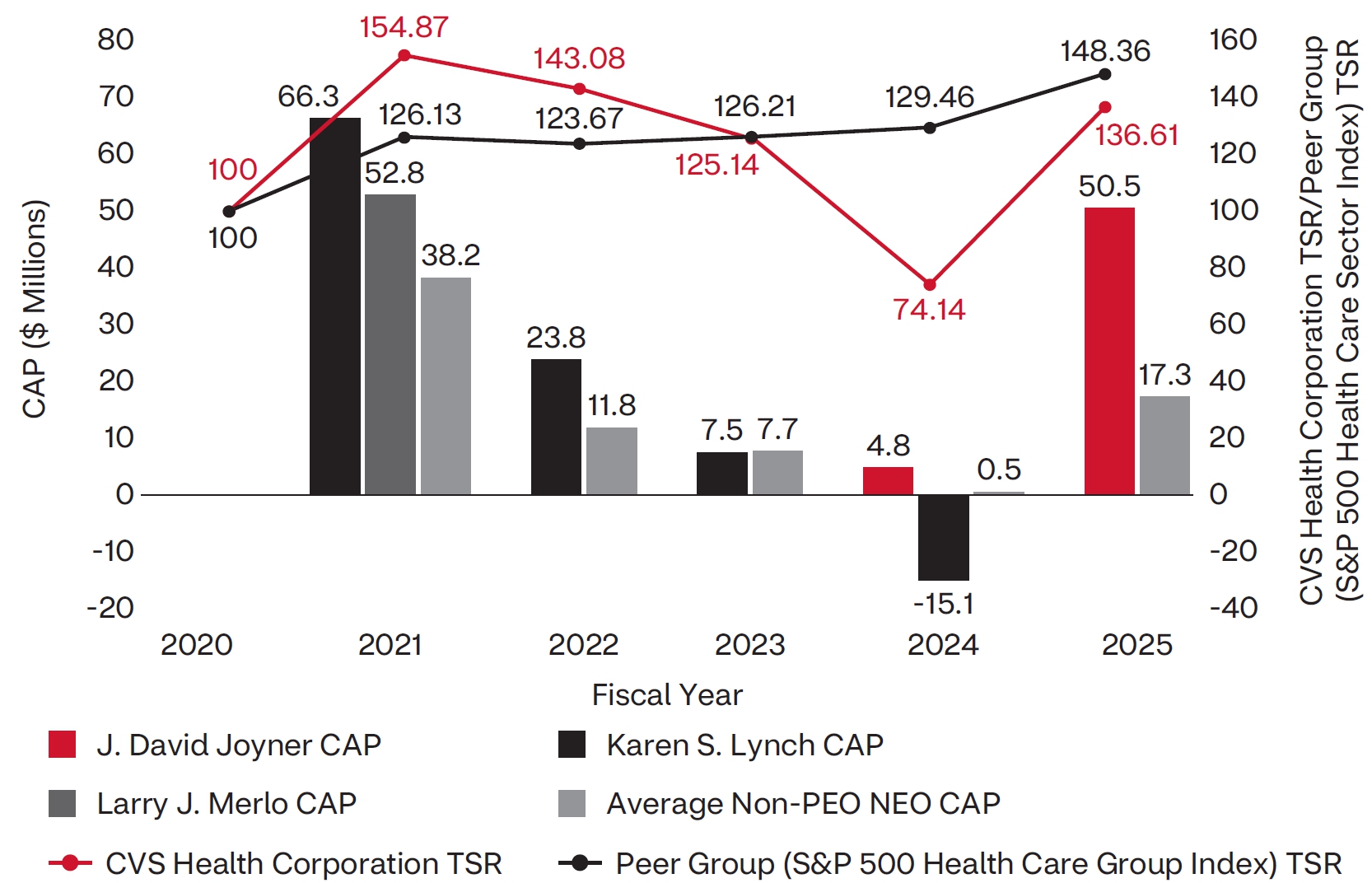
| 2. | CAP versus Net Income |
The graph below reflects the relationship between the CAP to the PEOs and Non-PEO NEOs and the Company’s GAAP Net Income for the applicable reporting year.
PEOs and Average Non-PEO NEO CAP
Versus Net Income
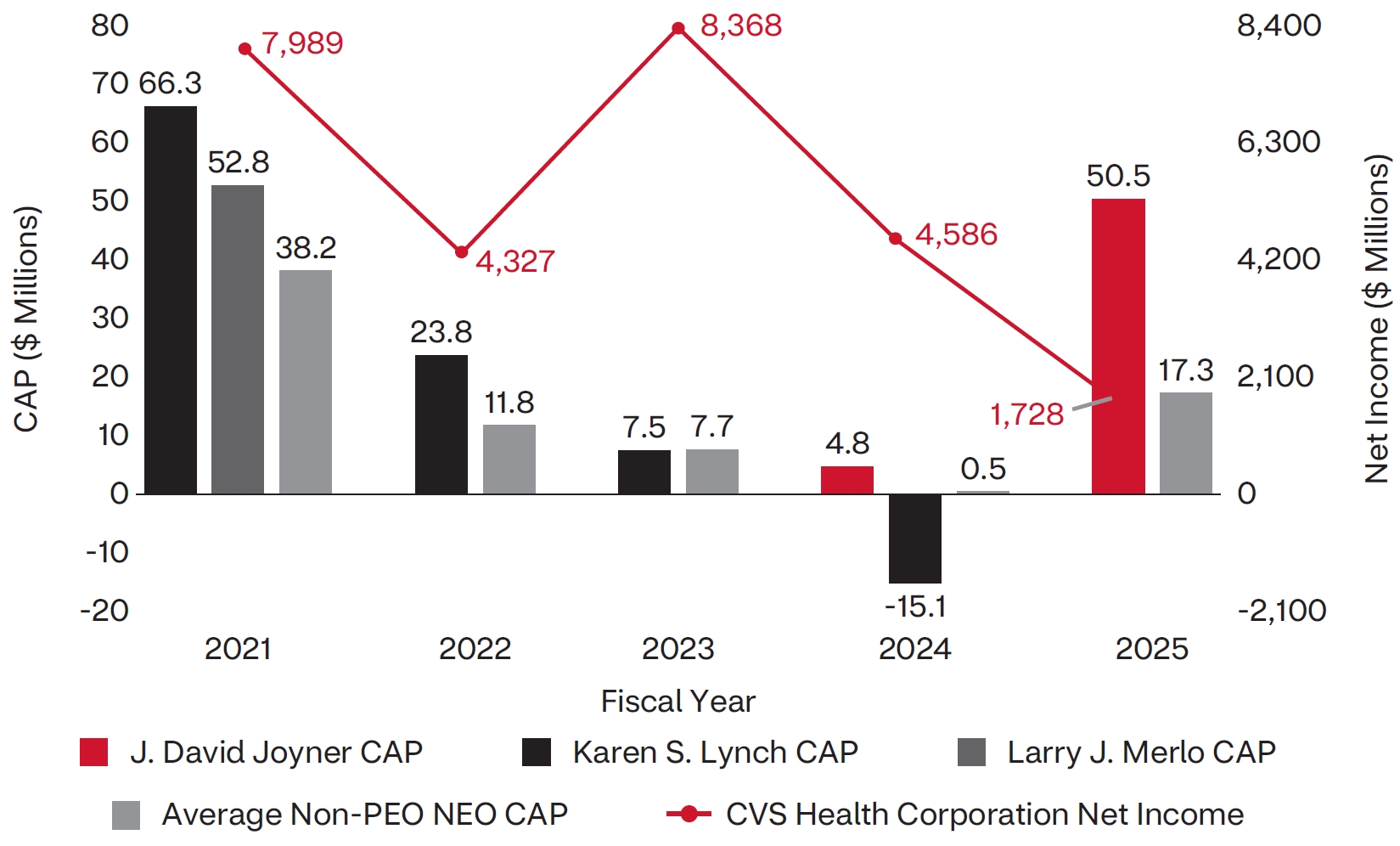
2026 Proxy Statement 95
| 3. | CAP versus Adjusted EPS* |
The graph below reflects the relationship between the CAP to the PEOs and Non-PEO NEOs and Adjusted EPS* for the applicable reporting year.
PEOs and Average Non-PEO NEO CAP
Versus Adjusted EPS*
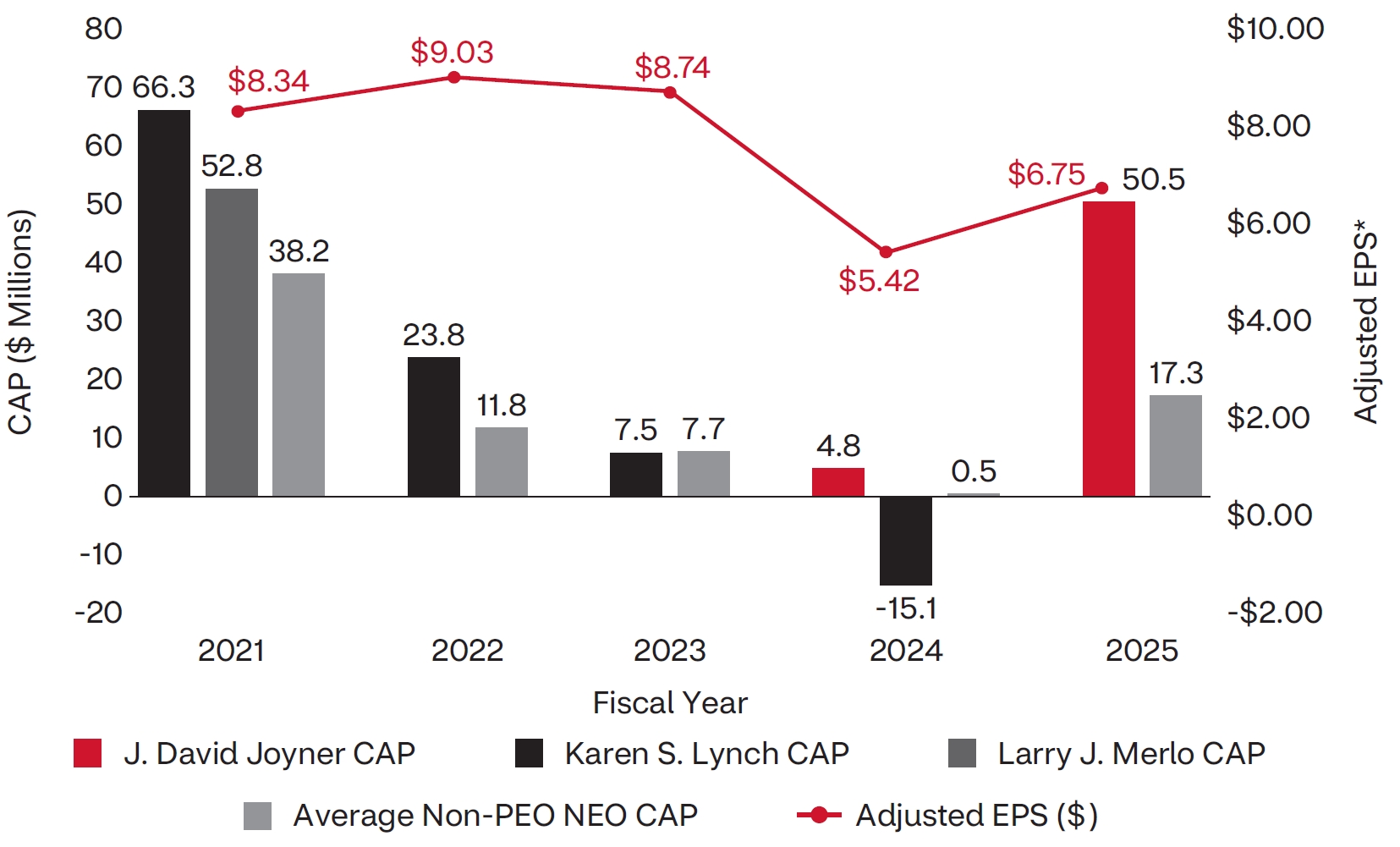
Most Important Measures to Determine FY2025 CAP
The Company’s executive compensation program supports our long-term strategy by tying the vast majority of pay for executives to performance-based compensation.
The three items listed below represent an unranked list of the most important performance metrics used by the Company for linking executive compensation actually paid to the NEOs for 2025 and Company performance, as further described in our CD&A within the sections titled “Elements of Our Executive Compensation Program,” “Long-Term Incentive Compensation” and “2025 Business and Performance Results.”
|
|
| * |
96 CVS Health
Management Proposal
| ITEM | ||||
4 |
Proposal to Approve the Company’s 2026 Incentive Compensation Plan | |||
|
The Board of Directors unanimously recommends a vote FOR this proposal. | |||
We are asking our stockholders to vote on a proposal to approve the 2026 Incentive Compensation Plan of CVS Health Corporation (the “2026 ICP”). This will allow us to continue to award equity compensation, which incentivizes a long-term perspective on the Company’s business by its employees and creates strong alignment with our stockholders.
In May 2024 and May 2020, our stockholders approved amendments to our 2017 Incentive Compensation Plan (the “2017 ICP”), to increase the shares available for issuance under the 2017 ICP, which was originally approved by our stockholders in May 2017. The 2026 ICP is intended to replace the 2017 ICP in its entirety, due to the impending expiration of the 2017 ICP that is described below. The purpose of the 2026 ICP, like the 2017 ICP, is to assist the Company in attracting, retaining and rewarding high-quality executives and employees, to enable them to acquire or increase a proprietary interest in the Company and provide them with compensation aimed at incentivizing maximum efforts in the creation of stockholder value.
Since the expiration of the 2017 ICP would occur prior to our 2027 stockholder meeting and in order to permit awards to be granted after the May 9, 2027 expiration date of the 2017 ICP, on March 18, 2026 the MP&D Committee approved the 2026 ICP and recommended that the full Board adopt the 2026 ICP. The Board then unanimously adopted the 2026 ICP and recommended it for your approval. The 2026 ICP will become effective on the date of its approval by stockholders (the “Effective Date”). The 2026 ICP will be the only compensation plan under which the Company grants stock options, stock appreciation rights (“SARs”), restricted stock units (“RSUs”), performance stock units (“PSUs”) and other equity-based awards (“Awards”) to its employees following the Effective Date. These Awards have enabled and will continue to enable CVS Health to attract and retain key employees and enable those employees to acquire and/or increase their proprietary interest in CVS Health, thereby aligning their interests with the interests of CVS Health’s stockholders.
In the event this proposal is approved by our stockholders, the shares that then remain available for issuance under the 2017 ICP will be transferred to the 2026 ICP and no further Awards will be made under the 2017 ICP. We presently anticipate that approximately 16.8 million shares will remain available from the 2017 ICP at the time of the 2026 Annual Meeting, and we are requesting an additional 14.2 million shares, for a total of 31.0 million shares in the 2026 ICP. As of March 16, 2026, the closing sale price of CVS Health’s common stock on the NYSE was $75.84. If the 2026 ICP is not approved by our stockholders, the 2017 ICP will remain in full force and effect in accordance with its terms.
Stockholders are requested in this proposal to approve the 2026 ICP in substantially the form attached hereto as Annex B.
Reasons the Board of Directors Recommends You Vote “FOR” This Proposal
The 2026 ICP will allow CVS Health to continue to grant equity awards, an important incentive tool for creating stockholder value.
The use of common stock as a component of the Company’s compensation program is critical to the future success of the Company. The Company believes that equity awards are a valuable incentive tool for employees at various levels throughout the organization, with approximately 12,000 employees receiving awards each year, including more than 11,700 below the Vice President level, which is approximately 3.8% of our total employees. An inability to grant equity awards to employees could be detrimental to stockholders. Equity incentive awards create an employee ownership culture that aligns the interests of employees with stockholders. Equity incentive compensation also
2026 Proxy Statement 97
focuses employees’ attention on creating long-term value, since the awards are subject to multi-year vesting and/ or performance conditions, and to that end, a portion of the equity compensation granted to senior executives in recent years has been awarded in the form of PSUs, which are earned contingent on the Company attaining specified operating and/or profitability levels and are subject to a post-vesting holding period.
CVS Health recognizes the importance of equity ownership as an effective link to stockholders and maintains stock ownership guidelines for all directors, as well as for the officers serving on the Company’s ELT, and all corporate-level Executive Vice Presidents and Senior Vice Presidents, which are further described on pages 73 and 111 of this proxy statement. Persons subject to the guidelines must achieve compliance with the applicable ownership requirements within five years of becoming subject to the requirements.
Equity awards are a critical recruiting and retention tool.
CVS Health’s future performance is dependent on its ability to recruit and retain high caliber employees, and a competitive compensation program that includes equity awards is essential for attracting and retaining such employees. The Company would be at a significant competitive disadvantage if it were not able to use stock-based awards to compensate employees. Without equity compensation, our recruiting efforts would be more challenging and, over time, executives would no longer have stock awards at risk of forfeiture, which could impact our ability to retain them.
CVS Health has demonstrated sound equity compensation practices that have historically received strong support from our stockholders.
The Company recognizes that equity compensation programs dilute stockholder equity and need to be used judiciously. Our compensation programs are designed to be consistent with competitive market practice, and we believe that our historical share utilization has been prudent and mindful of stockholder interests. This sentiment has been underscored by the strong support from stockholders on the prior approvals of the 2017 ICP and its amendments in 2020 and 2024, which exceeded 93% in each instance.
The MP&D Committee considered the potential stockholder dilution represented by outstanding equity awards and shares available for future grants as of December 31, 2025. Basic dilution is calculated as shown below.
| Total Potential Dilution = | (shares currently available under the 2017 ICP) + (shares underlying outstanding equity awards under the 2017 ICP) + (additional shares proposed to be authorized under the 2026 ICP) | |
| total number of issued and outstanding shares of common stock (excluding treasury shares) |
Prior to taking into account the additional 14.2 million shares authorized under the 2026 ICP, total potential dilution was 4.45% as of December 31, 2025. By adding the remaining approximately 16.8 million shares that remain available from the 2017 ICP to the 14.2 million proposed to be authorized under the 2026 ICP and pending stockholder approval, total potential dilution would increase to 4.76%, which is lower than the industry thresholds established by major proxy advisory firms and institutional investors.
In addition, a key equity metric utilized by the MP&D Committee in determining equity awards is our “burn rate,” which is generally the total number of shares underlying grants of stock options, SARs, RSUs and PSUs we award each year relative to our basic weighted average number of shares outstanding. Our Board considered our burn rate in determining the number of shares to reserve for issuance under the 2026 Incentive Plan, as discussed in the “Significant Historical Award Information” section below.
The 2026 ICP includes features designed to protect stockholder interests, including, but not limited to:
1. Administration of awards by the MP&D Committee, which consists entirely of independent directors;
2. Prohibition of granting stock options or SARs with an exercise price below the fair market value of a share of stock on the grant date;
3. Prohibition of the repricing of stock options and SARs, including through the exchange of stock options or SARs for cash or other awards, without stockholder approval;
4. Requirement of stockholder approval of material amendments; and
5. Company permission to credit and accrue, but prohibition of Company to pay out, dividends or dividend equivalents on unvested equity awards until such awards become vested.
98 CVS Health
If the 2026 ICP is not approved, the Company will be compelled to substantially increase the cash component of employee compensation to remain market competitive and to continue to attract and retain high caliber employees.
In order to provide competitive compensation opportunities to attract and retain employees without equity compensation, the Company would need to replace the compensation previously delivered in equity awards with cash awards or other vehicles. These alternative forms of compensation may not align employee interests with those of stockholders as efficiently as stock-based awards, and cash awards are generally subject to less favorable accounting treatment than stock-based awards.
Significant Historical Award Information
The following table provides information regarding the grant of equity awards under the 2017 ICP over the past three completed fiscal years. The additional shares proposed to be authorized under the 2026 ICP for future grants are not reflected below.
| Key Equity Metrics | 2025 | 2024 | 2023 | |
| Percentage of equity awards granted to NEOs(1) | 10.20% | 22.06% | 11.24% | |
| Equity burn rate(2) | 0.79% | 1.14% | 0.89% | (3) |
| Dilution(4) | 4.45% | 5.28% | 3.43% | |
| Overhang(5) | 2.33% | 2.66% | 2.55% |
| (1) | Percentage of equity awards granted to individuals who were NEOs in the applicable year is calculated by dividing the number of shares subject to equity awards that were granted to NEOs during such year by the number of shares subject to all equity awards granted during such year. |
| (2) | Equity burn rate for each year is calculated by dividing the number of shares subject to equity awards granted during the year by the weighted average basic number of shares outstanding during such year, as disclosed in our 2025 Form 10-K. |
| (3) | The equity burn rate for 2023 excludes replacement equity awards granted in connection with the Signify Health and Oak Street Health acquisitions in 2023. The awards excluded consist of the following: (i) approximately 1,400,000 stock options and approximately 1,800,000 restricted stock units granted pursuant to the Signify Health, Inc. 2021 Long-Term Incentive Plan (the “Signify Health Plan”) and (ii) approximately 2,600,000 shares of restricted stock and approximately 1,300,000 restricted stock units granted pursuant to the Oak Street Health, Inc. Omnibus Incentive Plan (“the Oak Street Health Plan”). |
| (4) | Dilution for each year is calculated by dividing the sum of (i) the number of shares subject to equity awards outstanding at the end of the fiscal year and (ii) the number of shares available under the 2017 ICP for future grants, by the number of shares outstanding at the end of such year as disclosed in our 2025 Form 10-K. |
| (5) | Overhang for each year is the sum of equity awards outstanding divided by common shares outstanding. |
Securities Authorized For Issuance Under CVS Health’s Equity Compensation Plans
The following table summarizes information about CVS Health’s outstanding options, warrants, rights and shares remaining available for future issuance under all of our equity compensation plans as of December 31, 2025:
| In thousands, except weighted average exercise price and weighted average remaining contractual term |
Number of securities underlying outstanding options, warrants and rights(1) |
Weighted average exercise price |
Weighted average remaining contractual term |
Number of securities remaining available for future issuance under equity compensation plans (excluding securities reflected in first column) |
||||||
| Equity compensation plans approved by stockholders(2) | 28,026 | $73.90 | 5.50 | 27,081 | (4) | |||||
| Equity compensation plans not approved by stockholders(3) | 1,404 | $52.46 | 2.85 | — | (5) | |||||
| Total | 29,430 | $72.05 | 5.25 | 27,081 | ||||||
| (1) | Consists of: (i) 10.0 million shares of common stock underlying outstanding options, (ii) 0.1 million shares of common stock issuable upon the exercise of outstanding SARs and (iii) 19.3 million shares of common stock issuable on the vesting of outstanding RSUs and PSUs, assuming target level performance in the case of performance stock units, and deferred stock units. The number of shares included with respect to outstanding SARs is the number of shares of CVS Health common stock that would have been issued had the SARs been exercised based on the closing price per share of CVS Health common stock on December 31, 2025, as reported on the NYSE, which was $79.36. |
2026 Proxy Statement 99
| (2) | Consists of the 2017 ICP. |
| (3) | Consists of shares of common stock underlying outstanding equity awards pursuant to equity compensation plans not approved by CVS Health’s stockholders, including the Amended Aetna Inc. 2010 Stock Incentive Plan, the Oak Street Health Plan, the Oak Street Health, Inc. Omnibus Incentive Plan, as amended, the Signify Health Plan and the Signify Health, Inc. 2021 Long-Term Incentive Plan, as amended. |
| (4) | Consists of shares of authorized and unissued common stock available for issuance under the 2017 ICP. |
| (5) | There are no securities available for future grants under any of the plans referenced in footnote 3. |
Following stockholder approval the 2026 ICP will be the only compensation plan under which the Company grants Awards.
Summary of the 2026 ICP
The principal features of the 2026 ICP are summarized below. The following description of the material features of the 2026 ICP is qualified in its entirety by reference to Annex B to this proxy statement, which contains the 2026 ICP as proposed. Stockholders should read the full text of the 2026 ICP provided in Annex B to this proxy statement for a complete description of its legal terms and conditions.
2026 ICP Features
Important policies that apply to the 2026 ICP
 |
Performance Measures Aligned with Stockholder Interests | |
Broad-based Plan that Benefits a Range of Employees | |
|
Stock Ownership Guidelines | |
Minimum Three-year Vesting of Time-based Awards | |
|
Post-Vesting Holding Period Requirement for PSUs | |
Minimum One-year Performance Period for Performance-based Awards | |
|
Broad Anti-Pledging and Anti-Hedging Policies | |
No Option or SAR Repricing or Cash Buyouts | |
|
Recoupment Policy for Clawback of Awards | |
No Discounted Options or SARs May be Granted | |
|
Double Trigger Vesting Upon a Change in Control | |
No Liberal Definition of Change in Control | |
|
No Payment of Dividends on Unvested Awards | |
No Liberal Share Counting or Recycling of Shares | |
|
No Excise Tax Gross-Ups | |
Limitations on Awards to Non-Employee Directors | |
|
Material Amendments Require Stockholder Approval |
Shares Subject to the 2026 ICP
Under the 2026 ICP, an additional 14.2 million shares of CVS Health common stock would be reserved and available for delivery to participants in connection with Awards, plus the number of shares remaining available for issuance under the 2017 ICP at the time the 2017 ICP is terminated. As of March 16, 2026, there were approximately 27.0 million shares available for grants under the 2017 ICP. The Company will have utilized approximately 10.2 million of the shares remaining under the 2017 ICP for its annual grants made in March 2026. Therefore, at the time of the 2026 Annual Meeting, the 2017 ICP will have approximately 16.8 million shares remaining and, upon approval, the 2026 ICP will have a total of 31.0 million shares available for issuance. We anticipate that number of shares under the 2026 ICP (together with the shares remaining available for issuance under the 2017 ICP) will be sufficient for approximately three years of grants, based on current grant practices and share price.
No Liberal Share Counting or Recycling of Shares
The 2026 ICP includes provisions that prohibit liberal share counting or “recycling”. For purposes of determining the number of shares of stock that remain available for issuance under the 2026 ICP, the number of shares corresponding to Awards (as defined in the 2026 ICP) that are forfeited or cancelled or otherwise expire for any reason without having been exercised or settled, or that are settled through the issuance of consideration other than shares of stock (including, without limitation, cash), will be added back to the Plan Limit (as defined in the 2026 ICP) and again be available for the grant of Awards. The following shares of stock, however, will not be available again for grant under the 2026 ICP:
100 CVS Health
| (i) | shares of CVS Health stock not issued or delivered as a result of net settlement to satisfy the withholding taxes owed with respect to an Award; | |
| (ii) | shares of CVS Health stock delivered or withheld by the Company to pay the exercise price or withholding taxes with respect to an outstanding Option or SAR; and | |
| (iii) | shares of CVS Health stock repurchased with proceeds from the payment of the exercise price of an option. |
The administrator of the 2026 ICP will have discretion to adopt reasonable counting procedures to ensure appropriate counting, avoid double counting (as, for example, in the case of tandem or substitute awards) and make adjustments if the number of shares of common stock actually delivered differs from the number of shares previously counted in connection with an Award.
Annual Per-Person Limitations
Under the 2026 ICP, the number of options, SARs, shares of restricted stock, RSUs, PSUs shares of deferred stock, shares of CVS Health stock issued as a bonus or in lieu of other obligations, and other stock-based Awards granted to any one participant will not exceed three million shares for each type of such Award during any fiscal year, subject to adjustment in certain circumstances.
Non-Employee Director Award Limits
The 2026 ICP limits the Awards that may be made to a non-employee director of the Company in any fiscal year to $750,000 per director, with an additional $500,000 for the independent chair or lead independent director, if any is so designated.
Eligibility
Executive officers and other officers and employees of any CVS Health subsidiary, and any person who is a non-employee director of CVS Health, will be eligible to be granted Awards under the 2026 ICP. Based on current grant practices, approximately 12,000 persons are eligible to receive Awards under the 2026 ICP.
Administration
The 2026 ICP is administered by the MP&D Committee, which presently consists of five independent directors, except to the extent the Board elects to administer the 2026 ICP. Subject to the terms and conditions of the 2026 ICP, the MP&D Committee is authorized to select participants, determine the type and number of Awards to be granted and the number of shares of CVS Health stock or dollar amounts to which Awards will relate, specify times at which Awards will vest (including performance conditions that may be required as a condition thereof), set other terms and conditions of such Awards, prescribe forms of Award agreements, interpret and specify rules and regulations relating to the 2026 ICP, and make all other determinations that may be necessary or advisable for the administration of the 2026 ICP.
Types of Awards
| • | Stock Options and SARs. The MP&D Committee is authorized to grant stock options, including both incentive stock options (“ISOs”) that can result in potentially favorable tax treatment to the participant and nonqualified stock options (i.e., options not qualifying as ISOs), and SARs entitling the participant to receive the excess of the fair market value of a share of CVS Health stock on the date of exercise over the grant price of the SAR. The exercise price per share subject to an option and the grant price of a SAR is determined by the MP&D Committee but must not be less than the fair market value, i.e., the closing price on the NYSE, of a share of CVS Health stock as of the grant date. If the grant date is a date on which the NYSE is not open, the closing NYSE sale price on the last day prior to the grant date that the NYSE is open is used. The maximum term of each option or SAR, the times at which each option or SAR will be exercisable, and provisions requiring forfeiture of unexercised options or SARs at or following termination of employment generally is fixed by the MP&D Committee, except no option or SAR may have a term exceeding ten years. Options may be exercised by payment of the exercise price in cash, CVS Health stock, outstanding Awards, or other property having a fair market value equal to the exercise price, as the MP&D Committee may determine from time to time. A participant shall not be entitled to delivery of shares of CVS Health stock pursuant to the exercise of an option until the exercise price therefore has been fully paid and applicable taxes have been satisfied. |
2026 Proxy Statement 101
| • | Restricted Stock, RSUs and Deferred Stock. The MP&D Committee is authorized to grant restricted stock, RSUs and deferred stock. Restricted stock is a grant of CVS Health stock which may not be sold or disposed of, and which may be forfeited in the event of certain terminations of employment and/or failure to meet certain performance requirements prior to the end of a restricted period specified by the MP&D Committee. Restricted stock and RSUs typically vest over a three- to five-year period, or if based on performance requirements, vest based on a minimum performance period of one year. A participant granted restricted stock generally has all of the rights of a stockholder of CVS Health, including the right to vote the shares and to receive dividends thereon upon vesting, unless otherwise determined by the MP&D Committee. A participant to whom RSUs are awarded shall have no rights as a stockholder with respect to the shares of CVS Health stock represented by the RSUs unless and until shares of CVS Health stock are actually delivered to the participant in settlement thereof. An RSU or an award of deferred stock confers upon a participant the right to receive shares at the end of a specified restricted or deferral period, subject to possible forfeiture of the Award in the event of certain terminations of employment and/or failure to meet certain performance requirements prior to the end of a specified restricted period (which restricted period need not extend for the entire duration of the deferral period). | |
| • | Dividends and Dividend Equivalents. With respect to Awards (other than stock options and SARs), the MP&D Committee is authorized to grant the right to dividends or dividend equivalents conferring on participants the right to receive cash, shares, or other property equal in value to dividends paid on a specific number of shares or other periodic payments. Dividend and dividend equivalents will be paid on an accrued basis only on the vesting of the Award, or may be deemed to have been reinvested in additional shares, Awards, or other investment vehicles specified by the MP&D Committee. In no event will dividends or dividend equivalents be paid or distributed prior to the vesting of an Award to which such right relates. Any reinvestment or payment of dividends or dividend equivalents, and the payment of CVS Health stock with respect to dividends, will only be permissible if sufficient shares are available under the 2026 ICP (taking into account then-outstanding awards). If sufficient shares are not available, reinvestment or payment will be in the form of a cash-settled RSU equal to the number of shares of CVS Health stock that would have been obtained by such payment or reinvestment. | |
| • | Bonus Stock and Awards in Lieu of Cash Obligations. The MP&D Committee is authorized to grant shares as a bonus free of restrictions, or to grant shares or other Awards in lieu of obligations to pay cash under other plans or compensatory arrangements, subject to such terms as the MP&D Committee may specify. | |
| • | Other Stock-Based Awards. The 2026 ICP authorizes the MP&D Committee to grant Awards that are denominated or payable in, valued by reference to, or otherwise based on or related to shares of CVS Health stock. Such Awards might include convertible or exchangeable debt securities, other rights convertible or exchangeable into shares, purchase rights for shares, Awards with value and payment contingent upon performance of CVS Health or any other factors designated by the MP&D Committee, and Awards valued by reference to the book value of shares or the value of securities of or the performance of specified subsidiaries. The MP&D Committee determines the terms and conditions of such Awards, including consideration to be paid to exercise Awards in the nature of purchase rights, the period during which Awards will be outstanding and forfeiture conditions and restrictions on Awards. Other stock-based awards vest over a minimum three-year period, or if based on performance requirements, vest based on a minimum performance period of one year. | |
| • | Performance Awards. The right of a participant to exercise or receive a grant or settlement of an Award, and the timing thereof, may be subject to such performance conditions as may be specified by the MP&D Committee. In addition, the 2026 ICP authorizes specific performance awards, which represent a conditional right to receive shares or other Awards upon achievement of pre-established performance goals during a specified period of at least one year and up to a ten year period. Subject to the requirements of the 2026 ICP, the MP&D Committee will determine other performance award terms, including the required levels of performance with respect to the business criteria, the corresponding amounts payable upon achievement of such levels of performance, termination and forfeiture provisions, and the form of settlement. |
No Option or SAR Repricing or Cash Buyouts
The MP&D Committee may not, without further approval of CVS Health stockholders, grant any Award under the 2026 ICP or make any payment or exchange that would constitute a “repricing” of any option or SAR granted under the 2026 ICP. The 2026 ICP also does not permit cash buyouts of stock options or SARs.
102 CVS Health
Other Terms of Awards
Awards may be settled in the form of cash, CVS Health stock, other Awards, or other property, in the discretion of the MP&D Committee. The MP&D Committee may require or permit participants to defer the settlement of all or part of an Award in accordance with such terms and conditions as the MP&D Committee may establish, including payment or crediting of interest or dividend equivalents on deferred amounts, and the crediting of earnings, gains and losses based on deemed investment of deferred amounts in specified investment vehicles, provided, however, that dividends or dividend equivalents may not be paid on unvested Awards. The MP&D Committee may condition any payment relating to an Award on the withholding of taxes and may provide that a portion of any shares or other property to be distributed will be withheld (or previously acquired shares or other property surrendered by the participant) to satisfy withholding and other tax obligations. Awards granted under the 2026 ICP generally may not be pledged or otherwise encumbered and are not transferable except by will or by the laws of descent and distribution, or to a designated beneficiary on the participant’s death, except that the MP&D Committee may, in its discretion, permit transfers for estate planning or other purposes.
Recoupment and Clawback Policies
Unless the Award agreement specifies otherwise, the MP&D Committee may, prior to a Change in Control, cancel or rescind Awards if the participant fails to comply with certain non-competition, confidentiality, intellectual property or other covenants. In addition, Awards under the 2026 ICP will be subject to the Recoupment Policy and the Dodd-Frank Clawback Policy as in effect from time to time (for more information see pages 69-72 of this proxy statement), as well as other recoupment policies or provisions as may be required under the terms of any agreement between the Company and any regulatory authority or as may be required under applicable law.
Double Trigger Change in Control
The MP&D Committee may, in its discretion, accelerate the exercisability, the lapsing of restrictions, or the expiration of deferral or vesting periods of any Award, and such accelerated exercisability, lapse, expiration and vesting will occur automatically in the case of an actual or constructive termination without cause within two years of a Change in Control, as defined in the 2026 ICP and described below. In addition, performance goals relating to any performance-based award will be deemed to have been met at the greater of the applicable target level and the actual level of performance achievement as determined by the MP&D Committee through the latest date preceding a Change in Control as to which performance can be determined as a practical matter.
No Liberal Definition of Change in Control
“Change in Control” is generally defined in the 2026 ICP to include the following events:
| • | changes in the stock ownership of the Company representing in excess of 30% of the voting power of the outstanding securities of the Company; | |
| • | changes of a majority of CVS Health’s Board of Directors during a 12-month period; | |
| • | consummation of a merger, consolidation, reorganization, statutory share exchange or similar transaction involving the Company, unless the outstanding shares or voting securities of the Company continue to represent more than 50% of the combined voting power of the surviving or resulting entity or its parent company, and in which such shares or voting securities remain held in substantially the same proportions; and | |
| • | sales or dispositions of all or substantially all of the consolidated assets of CVS Health, in a single transaction or series of transactions over a 12-month period. |
Amendment and Termination
The Board may amend, alter, suspend, discontinue or terminate the 2026 ICP or the MP&D Committee’s authority to grant Awards at any time without further stockholder approval, except stockholder approval must be obtained for any amendment or alteration if required by law or regulation or under the rules of any stock exchange or automated quotation system on which the shares are then listed or quoted. Stockholder approval will not be deemed to be required under laws or regulations, such as those relating to ISOs, that condition favorable tax treatment for participants on such approval, although the Board may, in its discretion, seek stockholder approval in any circumstance in which it deems such approval advisable. Thus, stockholder approval will not necessarily be required for amendments that might increase the cost of the 2026 ICP. Unless earlier terminated by the Board or extended by
2026 Proxy Statement 103
the stockholders, the term of the 2026 ICP will expire on May 14, 2036, after which no further Awards may be made, provided, however, that the provisions of the 2026 ICP will continue to apply to Awards made prior to such date. Additionally, the 2026 ICP will terminate at such time as no shares remain available for issuance under the 2026 ICP and CVS Health has no further rights or obligations with respect to outstanding Awards under the 2026 ICP.
Certain Federal Income Tax Implications
The following is a brief description of the regular federal income tax consequences generally arising with respect to Awards under the 2026 ICP. This summary does not address the effects of other federal taxes (including, but not limited to, the alternative minimum tax) or taxes imposed under state, local, or foreign tax laws or any changes to such laws. Because of the complexities of tax laws, interested parties are encouraged to consult their individual tax advisors regarding the tax consequences of any Award under the 2026 ICP.
The grant of an option will create no tax consequences for the participant or CVS Health. A participant will not recognize taxable income upon exercising an ISO. Upon exercising an option other than an ISO, the participant generally must recognize ordinary income equal to the difference between the exercise price and fair market value of the freely transferable and non-forfeitable shares acquired on the date of exercise.
Upon a disposition of shares acquired upon exercise of an ISO before the end of the applicable ISO holding periods, the participant generally must recognize ordinary income equal to the lesser of (i) the fair market value of the shares at the date of exercise of the ISO minus the exercise price, or (ii) the amount realized on the disposition of the ISO shares minus the exercise price. Otherwise, a participant’s disposition of shares acquired on the exercise of an option (including an ISO for which the ISO holding periods are met) generally will result in short-term or long-term capital gain or loss measured by the difference between the sale price and the participant’s tax basis in such shares (the tax basis generally being the exercise price plus any amount previously recognized as ordinary income in connection with the exercise of the option).
CVS Health generally will be entitled to a tax deduction equal to the amount recognized as ordinary income by the participant in connection with an option, subject to any applicable limitations under Section 162(m) of the Internal Revenue Code of 1986, as amended. CVS Health generally is not entitled to a tax deduction relating to amounts that represent a capital gain to a participant. Accordingly, CVS Health will not be entitled to any tax deduction with respect to an ISO if the participant holds the shares for the ISO holding periods prior to disposition of the shares.
With respect to Awards granted under the 2026 ICP that result in the payment or issuance of cash or shares or other property that is either not restricted as to transferability or not subject to a substantial risk of forfeiture, the participant generally must recognize ordinary income equal to the cash or the fair market value of shares or other property received. Thus, deferral of the time of payment or issuance generally will result in the deferral of the time the participant will be liable for income taxes with respect to such payment or issuance.
With respect to Awards involving the issuance of shares or other property that is restricted as to transferability and subject to a substantial risk of forfeiture, the participant generally must recognize ordinary income equal to the fair market value of the shares or other property received at the first time the shares or other property becomes transferable or is not subject to a substantial risk of forfeiture, whichever occurs earlier. A participant may elect to be taxed at the time of receipt of shares or other property rather than upon lapse of restrictions on transferability or substantial risk of forfeiture, but if the participant subsequently forfeits such shares or property, the participant would not be entitled to any tax deduction, including as a capital loss, for the value of the shares or property on which the participant previously paid tax. The participant must file such election with the Internal Revenue Service within 30 days of the receipt of the shares or other property.
New Plan Benefits
The value, number and type of awards granted or allocated under the 2026 ICP is subject to the discretion of the MP&D Committee and/or the Board and varies from year to year. It is therefore not possible to determine the benefits or amounts that in the future will be received by or allocated to individual employees or groups of employees under the 2026 ICP. For information on Awards made to the NEOs during 2025 under the 2017 ICP, see the Grants of Plan-Based Awards table on page 80 and the Outstanding Equity Awards at Fiscal Year-End table on page 82. For information on Awards made to directors during 2025 under the 2017 ICP, see the Non-Employee Director Compensation – 2025 table on page 38.
104 CVS Health
Result of Approval of Management Proposal
As of December 31, 2025, there were approximately 27.0 million shares available for grants under the 2017 ICP. The Company will have utilized approximately 10.2 million shares from the 2017 ICP in respect of annual equity grants in March 2026 and, therefore, immediately prior to the Annual Meeting, the 2017 ICP is expected to have approximately 16.8 million shares remaining.
If the 2026 ICP is approved by our stockholders:
| • | the 2026 ICP will be the only stockholder-approved compensation plan under which the Company grants Awards; and | |
| • | an additional 14.2 million shares of CVS Health common stock will be reserved and available for issuance pursuant to the 2026 ICP. |
Thus, if the 2026 ICP is approved by our stockholders, the 2026 ICP is expected to have a total of approximately 31.0 million shares available for issuance. We anticipate these shares will be sufficient for approximately three years of grants, based on current grant practices and share price.
2026 Proxy Statement 105
Stockholder Proposal
Each year, the Company receives proposals from stockholders pertaining to a variety of different matters that they wish to bring to a stockholder vote. We engage directly with stockholder proponents to discuss their respective proposals and better understand each request. This is in addition to our long-standing stockholder outreach program through which we discuss and seek feedback on our corporate governance practices, executive compensation program, disclosure practices and sustainability and impact programs and goals. For additional information regarding our stockholder engagement program, see “Stockholder Outreach – Governance and Compensation Actions, Stockholder Engagement” on pages 8-9, “Stockholder Outreach and Engagement” on page 48 and for more information on the stockholder proposal process, see “Stockholder Proposals and Other Business for Our Annual Meeting in 2027” on page 117.
Included in this proxy statement is one stockholder proposal that has been submitted by a proponent under Rule 14a-8 of the Exchange Act who notified the Company of his intention to present the proposal for voting at the Annual Meeting. Stockholders will vote on the following stockholder proposal (Item 5), if properly presented at the 2026 Annual Meeting and if not otherwise properly withdrawn or excluded. In accordance with SEC rules, we have set forth below the proposal, and the proponent’s supporting statement, as submitted to us by the proponent. The Board disclaims any responsibility for the content of the proposal and the proponent’s supporting statement. CVS Health’s opposition statement, as well as the Board’s voting recommendation, immediately follow the stockholder proposal and the proponent’s supporting statement.
In addition to the stockholder proposal included herewith, we received two other stockholder proposals. As a result of productive discussions with a proponent, one stockholder proposal was withdrawn. We excluded the other stockholder proposal in accordance with the SEC guidance for reasons described in our submission to the SEC.
Our Board and management have carefully reviewed the proposal and considered what is in the best interests of the Company, its stockholders and other stakeholders. Our Board recommends a vote AGAINST the stockholder proposal for the reasons set forth following the proposal.
106 CVS Health
| ITEM | ||||
5 |
Stockholder Proposal for Reducing the Threshold for Our Stockholder Right to Act By Written Consent | |||
 |
The Board unanimously recommends a vote AGAINST the Proposal. | |||
On or about November 23, 2025, the Company received the following proposal from John Chevedden, 2215 Nelson Avenue, No. 205, Redondo Beach, CA 90278. Mr. Chevedden (the “Proponent”) represents that he has held at least 83 shares of the Company’s stock for at least the past three years and intends to continue to hold such amount through the date of the Company’s next annual meeting. In accordance with SEC rules, we are reprinting the proposal and supporting statement (the “Proposal”) in this proxy statement as they were submitted to us:
|
Proposal 5 - Improve Shareholder Written Consent
Shareholders request that our board of directors take the steps necessary to enable 10% of shares to request a record date to initiate written consent.
Currently it takes the formal backing 35% of all the shares that normally cast ballots at the annual meeting to do so little ask for a record date for written consent.
Plus any action taken by written consent would still need more than 70% supermajority approval from the shares that normally cast ballots at the annual meeting. This 70% requirement gives almost overwhelming supermajority protection to CVS management that will remain unchanged.
Enabling 10% of shares to apply for a record date for written consent makes sense because scores of companies do not even require 01% of stock ownership to do so little as request a record date.
This proposal received understated 42% support at the 2025 CVS annual shareholder meeting when CVS was on a long-term climb to a $106 price in 2022. CVS stock is at only $78 in late 2025 in spite of a robust stock market.
This 42% support likely represented more than 50% support from the CVS shares that have access to independent proxy voting advice and are the most informed shareholders regarding CVS ballot items.
To guard against the CVS Board of Directors becoming complacent CVS shareholders need an improved ability to act by written consent to help the Board adopt new strategies when the need arises.
A shareholder ability to act by written consent would be a welcome incentive for CVS Directors to avoid more long-term declines in the CVS stock price since the continued service of certain CVS Directors could be terminated by CVS shareholders acting by written consent. This is a good incentive for the CVS Directors to have for the benefit of all shareholders.
The best strategies for turning around a company do not necessarily come from a company’s existing shareholders.
Please vote yes:
Proposal 5 - Improve Shareholder Written Consent
|

2026 Proxy Statement 107
Statement of the Board Recommending a Vote AGAINST the Proposal
The Board has considered the Proposal and the Company engaged in discussions with the Proponent. For the reasons described below, the Board believes that the Proposal is not in the best interests of the Company and its stockholders.
| • | The current 25% threshold for the right to initiate a stockholder written consent is appropriate. Two proposals from Mr. Chevedden substantially identical to the Proposal were rejected by our stockholders at our 2021 Annual Meeting of Stockholders and our 2025 Annual Meeting of Stockholders. | |
| • | The Proposal misidentifies the current threshold for the right to initiate written consent as 35%, rather than the correct threshold of 25%, and contains numerous other inaccurate and misleading statements that undermine the rationale for the request contained in the proposal. | |
| • | Our stockholders can take action and share feedback in a multitude of ways, including, but not limited to, by calling and acting at a special meeting (15% threshold), submitting matters for consideration at an annual or special meeting of stockholders pursuant to our by-laws, submitting stockholder proposals for consideration at an annual meeting of stockholders pursuant to Rule 14a-8 and directly engaging with management and the Board. | |
| • | CVS Health is strongly committed to and has demonstrated sound governance practices and is keenly interested in the views and concerns of our stockholders. |
Our Board Continues to Believe That 25% is the Appropriate Threshold for the Right to Request a Written Consent of Stockholders
CVS Health currently provides its stockholders with the ability to act by written consent that is less than unanimous. Under our governance documents a stockholder (or group of stockholders) must own 25% of the Company’s common stock to request that the Board establish a record date to initiate written consent. This provision was implemented in 2012, when 95% of stockholders voted to approve an amendment to the Company’s governing documents that strengthened the ability of stockholders to act by written consent.
In considering this Proposal, the Board has undertaken a thoughtful review of the Company’s stockholder base, the rights afforded to the Company’s stockholders under existing governance documents and the practices of other S&P 500 companies (most of which do not provide for any stockholder right act by written consent). After that review, the Board has concluded that the Company’s existing 25% ownership threshold balances and promotes the interests of all stockholders, especially when considered together with our other robust governance practices. As of our record date, four stockholders acting together could meet the 25% threshold, and the Board has determined that this ownership percentage is an appropriate minimum level of stockholder representation that should be obtained before initiating the extraordinary stockholder right of action by written consent. As referenced above, CVS Health is one of less than one-third of S&P 500 companies that provide for any kind of written consent right and, among the companies that do, the Company’s current 25% threshold is market standard. In contrast, the Proposal seeks to change the ownership threshold to 10%, which would enable as few as two stockholders acting together to initiate action by written consent. Reducing the threshold to 10% could allow a very small number of stockholders, including ones with narrow interests, to pursue matters that may not be in the best interest of CVS Health or its other stockholders. In such a scenario, the Company’s Board and management would have to dedicate attention and resources to respond to such a proposed stockholder action, rather than advancing the Company’s business in a manner that serves all stockholders.
Furthermore, the Board has taken into consideration that two proposals nearly identical to the Proposal, also submitted by Mr. Chevedden, were rejected by a majority of stockholder votes at our 2021 and 2025 Annual Meetings of Stockholders and, aside from the Proposal itself, management is unaware of any stockholder concerns related to the Company’s current threshold to initiate an action by written consent.
108 CVS Health
The Proposal Misidentifies the Applicable Stockholder Threshold and Contains Numerous Other Inaccurate and Misleading Statements
The Proposal, which recommends significantly reducing the threshold to initiate action by written consent from 25% to only 10% of the Company’s outstanding capital stock entitled to express consent on the relevant action, contains numerous inaccurate and misleading statements that undermine the rationale for the Proposal.
As an initial point, the Proposal is misleading with respect to the relevant existing ownership and voting requirements. The Proposal states that it “[c]urrently it takes the formal backing [sic] 35% of all the shares that normally cast ballots at the annual meeting to do so little [sic] ask for a record date for written consent.” The Proposal goes on to assert that “any action taken by written consent would still need more than 70% supermajority approval from the shares that normally cast ballots at the annual meeting.” These statements are inaccurate and mislead our stockholders to believe that the Company’s ownership and voting requirements are significantly higher than they actually are. Our governance documents provide that the ownership threshold to call a record date for action by written consent is at least 25% of the voting power of the outstanding capital stock of the Company entitled to express consent on the relevant action, and the voting standard for stockholder approval by written consent is 50%, or a simple majority vote.
The Proposal also misconstrues the voting results on the Proponent’s stockholder proposal at the 2025 Annual Meeting, to suggest that it received greater stockholder support than it in fact received. The Proposal states that the support received in 2025 “likely represented more than 50% support from the CVS shares that have access to independent proxy voting advice and are the most informed shareholders regarding CVS ballot items.” The Proponent provides no support for this misleading statement. In fact, the substantially similar 2025 proposal received support from approximately 42% of the shares that voted, which fell nearly 76 million votes short of the 50% threshold required for approval. In addition, the Proposal contains misleading statements regarding the Company’s recent stock price performance, citing a figure from nearly four years ago. By referencing a high historical stock price, the Proposal creates the misleading impression that there was a recent and precipitous decline in the Company’s stock price, when it actually increased by nearly 77% during calendar year 2025 alone.
Our Stockholders Can Take Action and Share Feedback in a Multitude of Ways
We believe the Proposal is unnecessary in light of our implementation of strong and effective corporate governance practices. Aside from the rights to act by written consent and to submit stockholder proposals for consideration at our annual stockholder meetings, stockholders have a number of ways to take action at CVS Health. As described elsewhere in this proxy statement, the Company maintains open lines of communication with our stockholders and deeply values stockholder engagement. Additionally, our stockholders have had the right to call a special meeting of stockholders since 2010. Our Board, and many of the Company’s major stockholders, believe that the right to call a special meeting is a valuable stockholder right because it provides a forum preferable to written consent for making key corporate decisions, by providing stockholders with an opportunity to hear from management and the Board, and to ask questions and express different viewpoints when voting on a matter.
Our stockholders have expressed their satisfaction with our current corporate governance practices, including our threshold for stockholders to call a special meeting of stockholders, which received the support of over 98% of stockholders who voted in favor of the related proposal in 2018. In addition, because we value open dialogue with our stockholders, we regularly solicit feedback regarding the governance provisions we have in place, which we believe is significantly more cost-effective and less disruptive to the Company’s operations than engaging stockholders in response to actions by written consent. We believe that the direct feedback received in dialogue with our stockholders, as well as their votes on stockholder proposals, reflect that our current corporate governance practices, including our current ownership threshold of 15% to call for a special meeting of stockholders and 25% to initiate action by written consent, align with their expectations.
2026 Proxy Statement 109
We are Committed to Good Corporate Governance Practices
CVS Health is strongly committed to good governance practices and is keenly interested in the views and concerns of our stockholders. Examples of our Board’s commitment to sound corporate governance principles include:
| • | comprehensive stockholder engagement throughout the year, |
| • | a lead independent director with robust responsibilities, |
| • | annual election of all directors, |
| • | majority voting in director elections, |
| • | proxy access by-law, |
| • | no supermajority voting requirements, |
| • | no stockholder rights plan (also known as a poison pill), |
| • | the right of stockholders to call special meetings at a 15% threshold, and |
| • | most importantly for purposes of this Proposal, the right of stockholders to act by written consent. |
The Board believes that CVS Health’s existing 25% ownership threshold for calling for an action by written consent strikes the appropriate balance between allowing stockholders to vote on important matters that arise between annual meetings and protecting against the risk that a very small group of stockholders could attempt to initiate an action by written consent that serves a narrow agenda not favored by a meaningful proportion of stockholders. We therefore continue to believe that the threshold to request an action by written consent should continue to be 25% of our stockholders.
For these reasons, the Board recommends a vote AGAINST the Proposal.
110 CVS Health
Ownership of and Trading in Our Stock
Executive Officer and Director Stock Ownership Requirements
CVS Health has long been mindful of the importance of equity ownership by directors and executive management as an effective link to stockholders and, as such, the Board maintains stock ownership guidelines for all directors, as well as for the officers serving on the Company’s ELT and all corporate-level executive vice presidents and senior vice presidents. Persons subject to the guidelines must achieve compliance with the applicable ownership requirements within five years of becoming subject to the requirements. Our NEOs, who appear in the SCT beginning on page 77, must maintain ownership levels as set forth in the table below. Shares included in the calculation to assess compliance with the guidelines include shares owned outright, unvested RSUs, shares held in the Deferred Stock Compensation Plan and shares purchased through our Employee Stock Purchase Plan. Unexercised stock options and unearned PSUs do not count toward satisfying the guidelines. The Board believes that these requirements emphasize the importance of equity ownership for the Board and executive management, which in turn reinforces alignment with stockholder interests. To further reinforce this commitment, the Board annually reviews this policy and compliance by directors and executives.
| Executive Name | Multiple of Salary Required |
In Compliance | ||
| J. David Joyner | 7x | Yes | ||
| Brian O. Newman | 4x | Yes | ||
| Tilak Mandadi | 4x | Yes | ||
| Steven H. Nelson | 4x | Yes | ||
| Prem S. Shah | 4x | Yes |
All non-employee directors must own a minimum of 10,000 shares of CVS Health common stock, which has a value of $758,400 based on the March 16, 2026 closing price of our common stock of $75.84 or approximately 9 times the amount of the annual cash retainer ($83,750). Directors must attain this minimum ownership level within five years of being elected to the Board and must retain this minimum ownership level for at least six months after leaving the Board. The current level of stock pay in the director’s mix of annual compensation is intended to facilitate the directors’ ability to meet the ownership level within this timeframe. Each of our directors has timely attained the minimum ownership level, Ms. Norwalk and Messrs. Gallina and Shulman, each of whom has five years from the date of her or his election to the Board to attain the ownership requirement, are on track to meet this requirement.
2026 Proxy Statement 111
Share Ownership of Directors and Certain Executive Officers
The following table shows the shares of our common stock beneficially owned, as of March 16, 2026, of each director, each Named Executive Officer appearing in the SCT and all directors and executive officers as a group, based on information provided by these individuals. Each individual beneficially owns less than 1% of our common stock and, except as described in the footnotes to the table, each person has sole investment and voting power over the shares. Except as indicated, none of the shares listed below has been pledged as collateral.
| Amount and Nature of Beneficial Ownership | ||||||||
| Name | Common Stock |
Percent of Common Stock |
Rights to Acquire Beneficial Ownership of Shares |
Total | ||||
| Fernando Aguirre | 41,618 | (1) | * | 0 | 41,618 | |||
| Jeffrey R. Balser, M.D., Ph.D. | 13,659 | * | 0 | 13,659 | ||||
| C. David Brown II | 127,772 | * | 85,432 | (8) | 213,204 | |||
| Thomas F. Cowhey | 0 | 106,105 | (9) | 106,105 | ||||
| Alecia A. DeCoudreaux | 2,970 | * | 40,407 | (10) | 43,377 | |||
| Roger N. Farah | 19,438 | * | 38,217 | (10) | 57,655 | |||
| Anne M. Finucane | 22,747 | (2) | * | 16,676 | (11) | 39,423 | ||
| John E. Gallina | 0 | 0 | 0 | |||||
| J. David Joyner | 57,977 | * | 556,877 | (12) | 614,854 | |||
| J. Scott Kirby | 12,987 | * | 0 | 12,987 | ||||
| Michael F. Mahoney | 45,911 | (3) | * | 4,654 | (13) | 50,565 | ||
| Tilak Mandadi | 74,085 | * | 137,399 | (14) | 211,484 | |||
| Steven H. Nelson | 24 | 69,403 | (15) | 69,427 | ||||
| Brian O. Newman | 51 | (4) | * | 0 | 51 | |||
| Leslie V. Norwalk | 5,929 | * | 0 | 5,929 | ||||
| Larry M. Robbins | 8,574,799 | (5) | * | 8,152 | (16) | 8,582,951 | ||
| Guy P. Sansone | 13,659 | * | 0 | 13,659 | ||||
| Prem S. Shah | 67,327 | (6) | * | 522,821 | (17) | 590,148 | ||
| Douglas H. Shulman | 5,929 | * | 0 | 5,929 | ||||
| All directors, executive officers and former executive officers as a group (23 persons) | 9,139,433 | (7) | * | 1,777,089 | (18) | 10,916,522 | ||
| * | Less than 1%. |
| (1) | Includes 668 shares held by Mr. Aguirre’s spouse and adult children as to which Mr. Aguirre disclaims beneficial ownership. |
| (2) | Consists of 2,747 shares held in a revocable trust of which Ms. Finucane and her spouse are co-trustees and 20,000 shares held in a grantor retained annuity trust, of which Ms. Finucane’s spouse is the sole trustee. |
| (3) | Includes 39,356 shares held in trusts for the benefit of Mr. Mahoney and his spouse of which he and his spouse are co-trustees; and 210 shares held in trusts for the benefit of Mr. Mahoney’s children, as to which Mr. Mahoney disclaims beneficial ownership. |
| (4) | Includes 22 shares held in trust for the benefit of Mr. Newman’s children and 8 shares held in a trust by Mr. Newman’s father, the beneficiaries are Mr. Newman and his siblings, as to which Mr. Newman disclaims beneficial ownership. |
| (5) | Consists of 8,196,799 shares held for the accounts of Glenview Capital Master Fund, Ltd., Glenview Offshore Opportunity Master Fund, Ltd. (the “GO Fund”), Glenview Healthcare Master Fund, L.P., and GCM Suggestivist I Master Fund, L.P. (the “Glenview Investment Funds”), of which Mr. Robbins serves as investment manager, and 378,000 shares that are subject to cash-settled swaps held in the accounts of the GO Fund. Mr. Robbins shares voting and dispositive power over the shares held by the Glenview Investment Funds and the swaps help by the GO Funds, and may be deemed to beneficially own such shares and swaps. Mr. Robbins has disclaimed beneficial ownership of the shares held by the Glenview Investment Funds, except to the extent of any pecuniary interest he may have therein. These shares are custodied at prime brokerage accounts and are subject to pledge, collateral and rehypothecation agreements pursuant to market-standard agreements with such custodians. |
| (6) | Includes 5,257 shares held through the 401(k) Plan by Mr. Shah and 38,120 shares held in a grantor retained annuity trust, of which Mr. Shah is the sole trustee. |
| (7) | Directors and executive officers as a group have sole voting and investment power over 458,102 shares, shared voting and investment power with respect to 8,302,423 shares (including 5,257 shares held through the 401(k) Plan by Mr. Shah and 38,120 shares held in Mr. Shah’s grantor retained annuity trust), and disclaim beneficial ownership of 378,908 shares. |
112 CVS Health
| (8) | Consists of 77,360 deferred stock units resulting from shares constituting deferred non-employee director compensation, which do not have current voting rights (“Deferred Director Units”) and are distributable in a lump sum on the date Mr. Brown retires or resigns and 8,072 Deferred Director Units that are distributable in installments beginning on the date Mr. Brown retires or resigns. |
| (9) | Includes 94,343 shares that Mr. Cowhey has the right to acquire currently or within 60 days of March 16, 2026, upon the exercise of options and 11,762 shares he will receive upon settlement of RSUs that will vest and settle within 60 days of March 16, 2026. |
| (10) | Consists of Deferred Director Units that are distributable in a lump sum on the date the director retires or resigns. |
| (11) | Consists of 13,128 Deferred Director Units that are distributable in a lump sum on the date Ms. Finucane retires or resigns and 3,548 Deferred Director Units that are distributable in installments beginning on the date Ms. Finucane retires or resigns. |
| (12) | Includes 536,476 shares that Mr. Joyner has the right to acquire currently or within 60 days of March 16, 2026, upon the exercise of options or SARs and 20,401 shares he will receive upon settlement of RSUs that will vest and settle within 60 days of March 16, 2026. |
| (13) | Consists of 4,654 Deferred Director Units that are distributable in installments beginning on the date Mr. Mahoney retires or resigns. |
| (14) | Includes 128,166 shares that Mr. Mandadi has the right to acquire currently or within 60 days of March 16, 2026, upon the exercise of options and 9,233 shares he will receive upon settlement of RSUs that will vest and settle within 60 days of March 16, 2026. |
| (15) | Includes 64,071 shares that Mr. Nelson has the right to acquire currently or within 60 days of March 16, 2026, upon the exercise of options and 5,332 shares he will receive upon settlement of RSUs that will vest and settle within 60 days of March 16, 2026. |
| (16) | Consists of 8,152 Deferred Director Units that are distributable in a lump sum on the date Mr. Robbins retires or resigns. |
| (17) | Includes 509,924 shares that Mr. Shah has the right to acquire currently or within 60 days of March 16, 2026, upon the exercise of options or SARs and 3,770 shares he will receive upon settlement of RSUs that will vest and settle within 60 days of March 16, 2026, 6,619 shares from RSUs that will vest and defer within 60 days of March 16, 2026 and 2,508 deferred stock units resulting from shares that were receivable upon the lapse of restrictions on RSUs or the exercise of options, but the actual receipt of which was deferred pursuant to the Company’s Deferred Stock Compensation Plan, and which do not have current voting rights (“Deferred Officer Units”). |
| (18) | Includes 1,581,044 shares that executive officers and a director have the right to acquire currently or within 60 days of March 16, 2026, upon the exercise of options or SARs or upon settlement of RSUs that will vest and settle or that vest and defer within 60 days of March 16 2026; 2,508 Deferred Officer Units; and 193,537 Deferred Director Units. |
Share Ownership of Principal Stockholders
We have been notified by the entities in the following table that each is the beneficial owner (as defined by the rules of the SEC) of more than five percent of CVS Health’s outstanding common stock as of the record date, March 16, 2026. According to the most recent Schedule 13G or Schedule 13G/A filed by each of these beneficial owners with the SEC, these shares were acquired in the ordinary course of business and were not acquired for the purpose of, and do not have the effect of, changing or influencing control over us.
| Title of Class | Name and Address of Beneficial Owner |
No. of Shares Beneficially Owned |
Percent of Class Owned |
||||
| Common Stock | The Vanguard Group, Inc.(1) 100 Vanguard Blvd. Malvern, PA 19355 |
117,681,195 | (1) | 9.14% | (1) | ||
| Common Stock | BlackRock, Inc.(2) 50 Hudson Yards New York, NY 10001 |
105,292,588 | (2) | 8.30% | (2) | ||
| Common Stock | Capital World Investors(3) 333 South Hope Street 55th Floor, Los Angeles, CA 90071 |
68,785,990 | (3) | 5.50% | (3) | ||
| Common Stock | Dodge & Cox(4) 555 California Street San Francisco, CA 94104 |
63,030,690 | (4) | 5.00% | (3) |
| (1) | Information based on a Schedule 13G/A filed February 13, 2024. The Vanguard Group, Inc. (“Vanguard”), directly or through its subsidiaries, holds CVS Health common stock for the benefit of various investors. Vanguard and/or its subsidiaries have sole voting power with respect to none of these shares, shared voting power with respect to 1,662,275 of these shares, sole dispositive power with respect to 111,954,367 of these shares and shared dispositive power with respect to 5,726,828 of these shares. |
| (2) | Information based on a Schedule 13G/A filed July 16, 2025. BlackRock, Inc. (“BlackRock”) is the parent holding company of a number of subsidiaries that hold CVS Health common stock for the benefit of various investors. BlackRock and/or its subsidiaries have sole voting power with respect to 95,632,723 of these shares, sole dispositive power with respect to all of these shares, and no shared voting or dispositive power with respect to these shares. |
| (3) | Information based on a Schedule 13G filed May 13, 2025. Capital World Investors (“CWI”), directly or through its subsidiaries, holds CVS Health common stock for the benefit of various investors; CWI is a division of Capital Research and Management Company (“CRMC”), as well as its investment management subsidiaries and affiliates Capital Bank and Trust Company, Capital International, Inc., Capital International Limited, Capital International Sarl, Capital International K.K., Capital Group Private Client Services, Inc., and Capital Group Investment Management Private Limited (together with CRMC, the “investment management entities”). CWI’s divisions of each of the investment management entities collectively provide investment management services under the name “Capital World Investors.” CWI is deemed to be the beneficial owner of 68,785,990 shares. CWI and/or its subsidiaries have sole voting power with respect to 68,208,572 of these shares, sole dispositive power with respect to all of these shares and no shared voting power or shared dispositive power with respect to these shares. |
| (4) | Information based on a Schedule 13G filed November 13, 2024. Dodge & Cox, directly or through its subsidiaries, holds CVS Health common stock for the benefit of various investors. Dodge & Cox and/or its subsidiaries have sole voting power with respect to 59,793,915 of these shares, sole dispositive power with respect to all of these shares and no shared voting power or shared dispositive power with respect to these shares. |
2026 Proxy Statement 113
Delinquent Section 16(a) Reports
Section 16(a) of the Securities Exchange Act of 1934, as amended, and related regulations require our directors, certain of our officers and persons who own more than 10% of our common stock, to file with the SEC reports regarding their initial ownership and changes in ownership of our common stock. To our knowledge, no person beneficially owns more than 10% of our common stock. Based solely on a review of reports filed with the SEC and written representations by our directors and officers, we believe that during 2025, all of our directors and officers subject to the reporting requirements of Section 16(a) filed the required reports on a timely basis, except for the following. One Form 4 report was filed late on behalf of Ms. Finucane, related to a sale of shares in August 2025 that was not reported timely due to an administrative error. In addition, due to errors on the part of their brokers in coding their accounts or those of their spouses, three of our executive officers, Mr. Nelson, Heidi Capozzi and Amy Compton-Phillips, filed amended Forms 3 and/or late Forms 4 to disclose immaterial holdings or transactions that occurred in 2024 or 2025.
Other Information
Information About the Annual Meeting and Voting
The Board of Directors of CVS Health is soliciting your proxy to vote at our Annual Meeting of Stockholders on May 14, 2026 (or at any adjournment of the meeting, referred to as the Annual Meeting). This proxy statement summarizes the information you need to know to vote at the Annual Meeting.
Our proxy statement and proxy card are being mailed or transmitted to stockholders entitled to vote at the Annual Meeting beginning on or about April 3, 2026.
Date, Time and Place of the Annual Meeting
 |
Date and Time May 14, 2026 8:00 a.m., Eastern Time |
The Annual Meeting will be held entirely online via live audio webcast, to allow our stockholders to more easily participate regardless of their geographic location. | ||
 |
Place The Annual Meeting will be held exclusively online at www. virtualshareholdermeeting. com/CVS2026 |
If you are a registered stockholder or beneficial owner of common stock holding shares at the close of business on March 16, 2026 (the record date), you may attend the Annual Meeting by visiting www.virtualshareholdermeeting.com/CVS2026 and logging in by entering the 16-digit control number found on your proxy card, Notice of Internet Availability, or voter instruction form, as applicable. | ||
 |
You are entitled to vote at the Annual Meeting and at any adjournment thereof if you were a holder of the Company’s common stock as of the close of business on March 16, 2026. | You may log into the virtual Annual Meeting beginning at 7:45 a.m., Eastern Time on May 14, 2026 and the Annual Meeting will begin promptly at 8:00 a.m., Eastern Time. If you experience any technical difficulties during the meeting, a toll-free number will be available on the Annual Meeting website for assistance.
As always, we strongly encourage you to vote your shares prior to the Annual Meeting. |
||
114 CVS Health
Shares Entitled to Vote
Stockholders entitled to vote are those who owned CVS Health common stock at the close of business on the record date, which is March 16, 2026. As of the record date, there were 1,281,604,403 shares of common stock outstanding. Each share of CVS Health common stock that you own entitles you to one vote.
The Bank of New York Mellon presently holds shares of common stock as Trustee under the 401(k) Plan. Each participant in the 401(k) Plan instructs the Trustee of the 401(k) Plan how to vote his or her shares. As to shares with respect to which the Trustee receive no timely voting instructions, the Trustee votes these shares in the same proportion as it votes all the shares as to which it has received timely voting instructions. The results of the voting will be held in strict confidence by the Trustee. Please note that the cut-off date by which participants of the 401(k) Plan must submit their vote to the tabulator in order to be counted is 11:59 p.m. Eastern Time on Monday, May 11, 2026.
Types of Ownership of Our Stock
If your shares are registered in your name with CVS Health’s transfer agent, EQ Shareowner Services, you are the “stockholder of record” of those shares. This proxy statement and any accompanying materials have been provided directly to you by CVS Health.
If your shares are held in a stock brokerage account or by a bank or other holder of record, you are considered the “beneficial owner” of those shares, and this proxy statement and any accompanying documents have been provided to you by your broker, bank or other holder of record, which is your “nominee.” As the beneficial owner, you have the right to direct your nominee how to vote your shares by using the voting instruction card provided by your nominee or by following the nominee’s instructions for voting by telephone or on the Internet.
Voting
Whether or not you plan to attend the Annual Meeting, we urge you to vote. Stockholders of record may vote by calling a toll-free telephone number, by using the Internet or by mailing your signed proxy card in the postage-paid envelope provided. If you vote by telephone or the Internet, you do NOT need to return your proxy card. Returning the proxy card by mail or voting by telephone or Internet will not affect your right to attend the Annual Meeting and change your vote, if desired.
If you are a beneficial owner, you will receive instructions from your nominee that you must follow in order for your shares to be voted. Many of the institutions that act as nominees offer telephone and Internet voting.
The enclosed proxy card indicates the number of shares that you owned as of the record date.
Voting instructions are included on your proxy card. If you properly fill in your proxy card and send it to us in time to vote, or vote by telephone or the Internet, one of the individuals named on your proxy card (your “proxy”) will vote your shares as you have directed. If you sign the proxy card but do not make specific choices, your proxy will vote your shares in accordance with the Board’s recommendations.
The Board and the Company’s management have not received notice of, and are not aware of, any business to come before the Annual Meeting other than the agenda items referred to in this proxy statement.
Revoking Your Proxy Card
If you are a stockholder of record, you may revoke your proxy card by:
| • | sending in another signed proxy card with a later date; |
| • | providing subsequent telephone or Internet voting instructions; |
| • | notifying our Corporate Secretary in writing before the Annual Meeting that you have revoked your proxy card; or |
| • | voting during the virtual Annual Meeting by following the instructions available on the Annual Meeting website. |
If you are a beneficial owner of shares, you may submit new voting instructions by contacting your nominee.
2026 Proxy Statement 115
Virtual Annual Meeting Rules of Conduct
The Rules of Conduct for the Annual Meeting will be available on the Annual Meeting website on the date of the Annual Meeting. These Rules of Conduct will provide information regarding the rules and procedures for participation in the Annual Meeting.
Proxy Solicitation
We are soliciting this proxy on behalf of our Board and will bear the solicitation expenses. We are making this solicitation by mail, but we may also solicit by telephone or e-mail. We have hired Okapi Partners LLC, 1212 Avenue of the Americas, 17th Floor, New York, NY 10036, for a fee of $30,000, plus out-of-pocket expenses, to provide customary assistance to us in the solicitation. We will reimburse banks, brokerage houses and other institutions, nominees and fiduciaries, if they so request, for their expenses in forwarding proxy materials to beneficial owners.
Householding
Under SEC rules, a single annual report and proxy statement or Notice of Internet Availability may be sent to any household at which two or more of our stockholders reside if they appear to be members of the same family. Each stockholder continues to receive a separate proxy card. This procedure, referred to as “householding,” reduces the volume of duplicate information stockholders receive, conserves natural resources and reduces mailing and printing expenses for the Company. Nominees with accountholders who are stockholders may be householding our proxy materials. As indicated in the notice previously provided by these nominees to our stockholders, a single annual report and proxy statement or Notice of Internet Availability will be delivered to multiple stockholders sharing an address unless contrary instructions have been received from an affected stockholder. Once you have received notice from your nominee that it will be householding communications to your address, householding will continue until you are notified otherwise or until you revoke your consent. If, at any time, you no longer wish to participate in householding and would prefer to receive a separate annual report and proxy statement or Notice of Internet Availability, please notify your nominee so that separate copies may be delivered to you. Beneficial owners who currently receive multiple copies of the annual report and proxy statement at their address who would prefer that their communications be householded should contact their nominee. Stockholders of record who currently receive multiple copies of the annual report and proxy statement or Notice of Internet Availability at their address and would prefer that their communications be householded, or stockholders of record who are currently participating in householding and would prefer to receive separate copies of our proxy materials, should contact our transfer agent, EQ Shareowner Services, by writing to P.O. Box 64874, St. Paul, MN 55164-0874; by calling toll-free, 877-287-7526; or by e-mailing to stocktransfer@eq-US.com.
Quorum Requirement
A quorum of stockholders is necessary to hold a valid meeting. The presence in person or by proxy at the Annual Meeting of holders of shares representing a majority of the shares entitled to vote constitutes a quorum. Abstentions and broker “non-votes” are counted as present for purposes of establishing a quorum. A broker non-vote occurs on an item when a broker is not permitted to vote on that item absent instruction from the beneficial owner of the shares and no instruction is given.
Vote Necessary to Approve Proposals
| Item 1: Election of Directors | Each director is elected by a majority of the votes cast with respect to that director’s election (at a meeting for the election of directors at which a quorum is present) by the holders of shares of common stock present in person or by proxy at the meeting and entitled to vote. A “majority of votes cast” means that the number of votes “for” a director’s election must exceed 50% of the votes cast with respect to that director’s election. Votes “against” a director’s election will count as votes cast, but “abstentions” and “broker non-votes” will not count as votes cast with respect to that director’s election and will have no effect on the vote. |
| All other Items | For Items 2, 3, 4 and 5 approval is by affirmative vote (at a meeting at which a quorum is present) of a majority of the votes represented by the shares of common stock present at the meeting in person or by proxy and entitled to vote. Abstentions are counted as shares present or represented and voting and have the effect of a vote against. Broker non-votes are not counted as shares present or represented and voting and have no effect on the vote. |
116 CVS Health
Broker Voting
Under the NYSE Listed Company Manual, if the record holder of your shares (usually a nominee) holds your shares in its name, your nominee is permitted to vote your shares on Item 2, Ratification of the Appointment of Our Independent Registered Public Accounting Firm, in its discretion, even if it does not receive voting instructions from you. On all other Items, your nominee is not permitted to vote your shares without your instructions and uninstructed shares are considered broker non-votes.
Stockholder Proposals and Other Business for Our Annual Meeting in 2027
If you want to submit a proposal for possible inclusion in our proxy statement for the 2027 Annual Meeting of Stockholders, you must ensure your proposal is received by us on or before Friday, December 4, 2026 and is otherwise in compliance with SEC rules.
Under our proxy access by-law, if a stockholder (or a group of up to 20 stockholders) who has owned at least 3% of our shares for at least three years and has complied with the other requirements set forth in CVS Health’s By-laws wants us to include director nominees (up to the greater of two nominees or 20% of the Board) in our proxy statement for the 2027 Annual Meeting of Stockholders, the nominations must be received by our Corporate Secretary and must arrive at the Company in a timely manner, between 120 and 150 days prior to the anniversary of the date our proxy statement was first sent to stockholders in connection with our last annual meeting, which would be no earlier than Wednesday, November 4, 2026 and no later than Friday, December 4, 2026.
In addition, if a stockholder would like to present business at an annual meeting of stockholders that is not to be included in our proxy statement, the stockholder must provide the Company with the notice and other information as required in its By-laws. To comply with the universal proxy rules, stockholders who intend to solicit proxies in support of director nominees other than the Company’s director nominees must also provide the Company with the notice and other information required by our By-laws and the universal proxy rules. Such notice, including all information required by our By-laws and the universal proxy rules, must be addressed to our Corporate Secretary and must arrive at the Company in a timely manner, between 90 and 120 days prior to the anniversary of our last annual meeting by 5:00 p.m., Eastern Time, which would be no earlier than Thursday, January 14, 2027 and no later than Friday, February 12, 2027 (since Saturday, February 13, 2027 is not a business day, the notice must be received no later than 5:00 p.m., Eastern Time on the immediately preceding business day).
Other Matters
We do not know of any matters to be acted upon at the Annual Meeting other than those discussed in this proxy statement. If any other matter is presented, your proxy will vote on the matter in his or her best judgment.
Website addresses, hyperlinks and QR codes are included for reference only. The information contained on websites referred to and/or linked to in this proxy statement (other than CVS Health’s website to the extent specifically referred to herein as required by the SEC’s rules) is not part of this proxy solicitation and is not incorporated by reference into this proxy statement or any other proxy materials. References to competitors and other companies throughout this proxy statement are for illustrative or comparison purposes only and do not indicate that these companies are CVS Health’s only competitors or are CVS Health’s closest competitors.
2026 Proxy Statement 117
Annex A
Reconciliation of Certain Amounts to the Most Directly Comparable GAAP Measure
The Company uses non-GAAP financial measures to analyze underlying business performance and trends. The Company believes that providing these non-GAAP financial measures enhances the Company’s and investors’ ability to compare the Company’s past financial performance with its current performance. These non-GAAP financial measures are provided as supplemental information to the financial measures the Company discloses that are calculated and presented in accordance with GAAP. Non-GAAP financial measures should not be considered a substitute for, or superior to, financial measures determined or calculated in accordance with GAAP. The Company’s definitions of its non-GAAP financial measures may not be comparable to similarly titled measures reported by other companies.
The MP&D Committee has elected to use adjusted operating income, adjusted selling, general and administrative (“SG&A”) ratio, and adjusted earnings per share (“Adjusted EPS”), which are non-GAAP financial measures, in connection with assessing and making determinations related to executive compensation matters. The MP&D Committee carefully selected these performance metrics taking into account feedback from our stockholder engagement efforts, and sets goals based on available information. These non-GAAP financial measures include adjustments, which are reviewed by the MP&D Committee, to the most comparable GAAP financial measures to exclude the impact of certain items when these items are not reflective of the Company’s underlying business performance.
Adjusted EPS
Adjusted EPS is calculated by dividing adjusted income attributable to CVS Health by the Company’s weighted average diluted shares outstanding. The Company defines adjusted income attributable to CVS Health as net income attributable to CVS Health (GAAP measure) excluding the impact of amortization of intangible assets, net realized capital gains or losses and other items, if any, that neither relate to the ordinary course of the Company’s business nor reflect the Company’s underlying business performance, such as acquisition-related integration costs, goodwill impairment charges, Health Care Delivery clinic closure charges, opioid litigation charges, office real estate optimization charges, certain legacy litigation charges, losses on Accountable Care assets, restructuring charges, gains on early extinguishment of debt, the gain on deconsolidation of subsidiary, the tax benefit from a worthless stock deduction, as well as the corresponding income tax benefit or expense related to the items excluded from adjusted income attributable to CVS Health.
A-1 CVS Health
The following are reconciliations of net income attributable to CVS Health to adjusted income attributable to CVS Health and calculations of GAAP diluted EPS and Adjusted EPS for the years ended December 31, 2025 and 2024:
| Year Ended December 31, 2025 | Year Ended December 31, 2024 | |||||||||||||||
| In millions, except for per share amounts | Total Company | Per Common Share | Total Company | Per Common Share | ||||||||||||
| Net income attributable to CVS Health (GAAP measure) | $ | 1,768 | $ | 1.39 | $ | 4,614 | $ | 3.66 | ||||||||
| Non-GAAP adjustments: | ||||||||||||||||
| Amortization of intangible assets(1) | 1,976 | 1.56 | 2,025 | 1.61 | ||||||||||||
| Net realized capital (gains) losses(2) | 44 | 0.03 | (117 | ) | (0.09 | ) | ||||||||||
| Acquisition-related integration costs(3) | 117 | 0.09 | 243 | 0.19 | ||||||||||||
| Goodwill impairment(4) | 5,725 | 4.50 | — | — | ||||||||||||
| Health Care Delivery clinic closure charge(5) | 83 | 0.07 | — | — | ||||||||||||
| Opioid litigation charges(6) | 320 | 0.25 | 100 | 0.08 | ||||||||||||
| Office real estate optimization charges(7) | 10 | 0.01 | 30 | 0.02 | ||||||||||||
| Legacy litigation charges(8) | 1,220 | 0.96 | — | — | ||||||||||||
| Loss on Accountable Care assets(9) | 288 | 0.23 | — | — | ||||||||||||
| Restructuring charges(10) | — | — | 1,179 | 0.93 | ||||||||||||
| Gain on early extinguishment of debt(11) | — | — | (491 | ) | (0.39 | ) | ||||||||||
| Gain on deconsolidation of subsidiary(12) | (483 | ) | (0.38 | ) | — | — | ||||||||||
| Tax benefit from worthless stock deduction(13) | (1,928 | ) | (1.51 | ) | — | — | ||||||||||
| Tax impact of other non-GAAP adjustments(14) | (568 | ) | (0.45 | ) | (745 | ) | (0.59 | ) | ||||||||
| Adjusted income attributable to CVS Health | $ | 8,572 | $ | 6.75 | $ | 6,838 | $ | 5.42 | ||||||||
| Weighted average diluted shares outstanding | 1,271 | 1,262 | ||||||||||||||
Adjusted Operating Income
The Company’s segments maintain separate financial information, and the Company’s chief operating decision maker (the “CODM”) evaluates the segments’ operating results on a regular basis in deciding how to allocate resources among the segments and in assessing segment performance. The CODM evaluates the performance of the Company’s segments based on adjusted operating income, which is defined as operating income (GAAP measure) excluding the impact of amortization of intangible assets, net realized capital gains or losses and other items, if any, that neither relate to the ordinary course of the Company’s business nor reflect the Company’s underlying business performance, such as acquisition-related integration costs, goodwill impairment charges, Health Care Delivery clinic closure charges, opioid litigation charges, office real estate optimization charges, certain legacy litigation charges, losses on Accountable Care assets and restructuring charges. The CODM uses adjusted operating income as its principal measure of segment performance as it enhances the CODM’s ability to compare past financial performance with current performance and analyze underlying business performance and trends. The consolidated measure is not determined in accordance with GAAP and should not be considered a substitute for, or superior to, the most directly comparable GAAP measure, consolidated operating income.
2026 Proxy Statement A-2
The following are reconciliations of consolidated operating income to adjusted operating income for the years ended December 31, 2025 and 2024:
| In millions | Year Ended December 31, 2025 | Year Ended December 31, 2024 | ||||||
| Operating income (GAAP measure) | $ | 4,660 | $ | 8,516 | ||||
| Non-GAAP adjustments: | ||||||||
| Amortization of intangible assets(1) | 1,976 | 2,025 | ||||||
| Net realized capital (gains) losses(2) | 44 | (117 | ) | |||||
| Acquisition-related integration costs(3) | 117 | 243 | ||||||
| Goodwill impairment(4) | 5,725 | — | ||||||
| Health Care Delivery clinic closure charge(5) | 83 | — | ||||||
| Opioid litigation charges(6) | 320 | 100 | ||||||
| Office real estate optimization charges(7) | 10 | 30 | ||||||
| Legacy litigation charges(8) | 1,220 | — | ||||||
| Loss on Accountable Care assets(9) | 288 | — | ||||||
| Restructuring charges(10) | — | 1,179 | ||||||
| Adjusted operating income | $ | 14,443 | $ | 11,976 | ||||
Adjusted SG&A Ratio
Adjusted SG&A Ratio is calculated by dividing adjusted operating expenses by adjusted total revenues. The Company defines adjusted operating expenses as operating expenses (GAAP measure) excluding the impact of amortization of intangible assets and other items, if any, that neither relate to the ordinary course of the Company’s business nor reflect the Company’s underlying business performance, such as acquisition-related integration costs, Health Care Delivery clinic closure charges, opioid litigation charges, office real estate optimization charges, certain legacy litigation charges and losses on Accountable Care assets. The Company defines adjusted total revenues as total revenues (GAAP measure) excluding net realized capital gains or losses.
The following are reconciliations of operating expenses to adjusted operating expenses and total revenues to adjusted total revenues as well as a calculation of the adjusted SG&A ratio for the year ended December 31, 2025:
| In millions | ||||
| Operating expenses (GAAP measure) | $ | 44,977 | ||
| Non-GAAP adjustments: | ||||
| Amortization of intangible assets(1) | (1,976 | ) | ||
| Acquisition-related integration costs(3) | (117 | ) | ||
| Health Care Delivery clinic closure charge(5) | (83 | ) | ||
| Opioid litigation charge(6) | (320 | ) | ||
| Office real estate optimization charges(7) | (10 | ) | ||
| Legacy litigation charges(8) | (1,220 | ) | ||
| Loss on Accountable Care assets(9) | (288 | ) | ||
| Adjusted operating expenses | $ | 40,963 | ||
| In millions | ||||
| Total revenues (GAAP measure) | $ | 402,067 | ||
| Non-GAAP adjustments: | ||||
| Net realized capital losses(2) | 44 | |||
| Adjusted total revenues | $ | 402,111 | ||
| In millions (except for adjusted SG&A ratio) | ||||
| Adjusted operating expenses | $ | 40,963 | ||
| Adjusted total revenues | $ | 402,111 | ||
| Adjusted SG&A Ratio | 10.19% |
A-3 CVS Health
End Notes
| (1) | The Company’s acquisition activities have resulted in the recognition of intangible assets as required under the acquisition method of accounting which consist primarily of trademarks, customer contracts/relationships, covenants not to compete, technology, provider networks and value of business acquired. Definite-lived intangible assets are amortized over their estimated useful lives and are tested for impairment when events indicate that the carrying value may not be recoverable. The amortization of intangible assets is reflected in operating expenses within each segment. Although intangible assets contribute to the Company’s revenue generation, the amortization of intangible assets does not directly relate to the underwriting of the Company’s insurance products, the services performed for the Company’s customers or the sale of the Company’s products or services. Additionally, intangible asset amortization expense typically fluctuates based on the size and timing of the Company’s acquisition activity. Accordingly, the Company believes excluding the amortization of intangible assets enhances the Company’s and investors’ ability to compare the Company’s past financial performance with its current performance and to analyze underlying business performance and trends. Intangible asset amortization excluded from the related non-GAAP financial measure represents the entire amount recorded within the Company’s GAAP financial statements, and the revenue generated by the associated intangible assets has not been excluded from the related non-GAAP financial measure. Intangible asset amortization is excluded from the related non-GAAP financial measure because the amortization, unlike the related revenue, is not affected by operations of any particular period unless an intangible asset becomes impaired or the estimated useful life of an intangible asset is revised. |
| (2) | The Company’s net realized capital gains and losses arise from various types of transactions, primarily in the course of managing a portfolio of assets that support the payment of insurance liabilities. Net realized capital gains and losses are reflected in net investment income (loss) within each segment. These capital gains and losses are the result of investment decisions, market conditions and other economic developments that are unrelated to the performance of the Company’s business, and the amount and timing of these capital gains and losses do not directly relate to the underwriting of the Company’s insurance products, the services performed for the Company’s customers or the sale of the Company’s products or services. Accordingly, the Company believes excluding net realized capital gains and losses enhances the Company’s and investors’ ability to compare the Company’s past financial performance with its current performance and to analyze underlying business performance and trends. |
| (3) | During the years ended December 31, 2025 and 2024, the acquisition-related integration costs relate to the acquisitions of Signify Health, Inc. and Oak Street Health, Inc. The acquisition-related integration costs are reflected in operating expenses within the Corporate/Other segment. |
| (4) | During the year ended December 31, 2025, the goodwill impairment charge relates to the Health Care Delivery reporting unit within the Health Services segment. |
| (5) | During the year ended December 31, 2025, the Health Care Delivery clinic closure charge primarily relates to the write down of long-lived assets in connection with the planned closure of certain existing Oak Street Health clinics in 2026, as well as associated severance and employee-related costs expected to be incurred. The Health Care Delivery clinic closure charge is reflected in operating expenses within the Health Services segment. |
| (6) | During the years ended December 31, 2025 and 2024, the opioid litigation charges relate to changes in the Company’s accrual related to ongoing opioid litigation matters. |
| (7) | During the years ended December 31, 2025 and 2024, the office real estate optimization charges primarily relate to the abandonment of leased real estate and the related right-of-use assets and property and equipment in connection with the Company’s evaluation of corporate office real estate space in response to its ongoing flexible work arrangement. The office real estate optimization charges are reflected in operating expenses within each segment. |
| (8) | During the year ended December 31, 2025, the Company recorded legacy litigation charges related to two court decisions associated with its past business practices. |
| In April 2025, a jury found Omnicare, LLC (“Omnicare”) and CVS Health Corporation liable in connection with alleged violations of the federal False Claims Act related to dispensing practices by Omnicare from 2010, prior to its acquisition by the Company in 2015, through 2018. Damages were found only with respect to Omnicare. Accordingly, the Company recorded a litigation charge of $387 million during the first quarter of 2025. During the second quarter of 2025, the Company recorded a charge of $542 million, reflecting penalties assessed under the False Claims Act. These litigation charges are reflected in operating expenses within the Pharmacy & Consumer Wellness segment. | |
| In June 2025, a court found certain subsidiaries of CVS Health Corporation liable for damages in connection with a complaint filed in February 2014, in which the government declined to intervene, related to PBM direct and indirect remuneration reporting practices for two clients from 2010 through 2016, which the Company has since modified. In connection with this court decision, the Company recorded a litigation charge of $291 million during the second quarter of 2025. This litigation charge is reflected in operating expenses within the Health Services segment. | |
| (9) | During the year ended December 31, 2025, the loss on the wind down and sale of Accountable Care assets represents the pre-tax loss on the divestiture of the Company’s Medicare Shared Savings Program (“MSSP”) operations, which the Company sold in March 2025, as well as costs incurred in connection with the process of winding down the Company’s Accountable Care Organization Realizing Equity, Access and Community Health (“ACO REACH”) operations. The loss on Accountable Care assets is reflected in operating expenses within the Health Services segment. |
| (10) | During the year ended December 31, 2024, the restructuring charges are primarily comprised of a store impairment charge, corporate workforce optimization costs, including severance and employee-related costs, a stock-based compensation charge and other asset impairment and related charges associated with the discontinuation of certain non-core assets. During the third quarter of 2024, the Company finalized an enterprise-wide restructuring plan intended to streamline and simplify the organization, improve efficiency and reduce costs. In connection with this restructuring plan, the Company completed a strategic review of its retail business and determined that it planned to close additional retail stores in 2025, and, accordingly, it recorded a store impairment charge to write down the associated lease right-of-use assets and property and equipment. In addition, during the third quarter of 2024, the Company also conducted a review of its various strategic assets and determined that it would discontinue the use of certain non-core assets, at which time impairment losses were recorded to write down the carrying value of these assets to the Company’s best estimate of their fair value. The restructuring charges associated with the store impairments are reflected within the Pharmacy & Consumer Wellness segment, other asset impairments and related charges are reflected within the Corporate/Other and Pharmacy & Consumer Wellness segments and corporate workforce optimization costs, including severance and employee-related costs, as well as the stock-based compensation charge, are reflected within the Corporate/Other segment. |
| (11) | During the year ended December 31, 2024, the gain on early extinguishment of debt relates to the Company’s repayment of approximately $2.6 billion of its outstanding senior notes in December 2024, pursuant to its tender offer for such senior notes. |
| (12) | During the year ended December 31, 2025, the gain on deconsolidation of subsidiary relates to Omnicare, a wholly-owned indirect subsidiary of CVS Health Corporation, and certain of its subsidiary entities (collectively, the “Omnicare Entities”). In September 2025, the Omnicare Entities voluntarily initiated Chapter 11 proceedings under the U.S. Bankruptcy Code, at which time the Company determined that it no longer retained control of the Omnicare Entities and deconsolidated the subsidiaries. |
| (13) | Following the voluntarily initiation of Chapter 11 proceedings described above, it was determined that the Company’s investment in a subsidiary became worthless in 2025. Consequently, the Company recognized a related net tax benefit of approximately $1.9 billion in the aggregate during the year ended December 31, 2025. |
| (14) | The corresponding tax benefit or expense related to the items excluded from adjusted income attributable to CVS Health and Adjusted EPS above. The nature of each non-GAAP adjustment is evaluated to determine whether a discrete adjustment should be made to the adjusted income tax provision. |
2026 Proxy Statement A-4
Annex B
2026 Incentive Compensation Plan of CVS Health Corporation
| 1. | Purpose |
The purpose of this 2026 Incentive Compensation Plan (the “Plan”) is to assist CVS Health Corporation, a Delaware corporation (the “Corporation”), and its subsidiaries in attracting, retaining and rewarding high-quality executives, employees, and other persons who provide services to the Corporation and/or its subsidiaries, to enable such persons to acquire or increase a proprietary interest in the Corporation in order to strengthen the mutuality of interests between such persons and the Corporation’s stockholders and to provide such persons with short- and long-term performance incentives to expend their maximum efforts in the creation of stockholder value.
| 2. | Definitions |
For purposes of the Plan, the following terms shall be defined as set forth below, in addition to such terms defined in Section 1 hereof:
| (a) | “Award” means any Option, Restricted Stock, Restricted Stock Unit, Stock Appreciation Right, Deferred Stock, Stock granted as a bonus or in lieu of another award, Stock awarded to a director pursuant to Section 8, Dividend Equivalent, Other Stock-Based Award or Performance Award, together with any other right or interest granted to a Participant under the Plan. |
| (b) | “Beneficial Owner” shall have the meaning ascribed to such term in Rule 13d-3 under the Exchange Act and any successor to such Rule. |
| (c) | “Beneficiary” means the person, persons, trust or trusts which have been designated by a Participant in his or her most recent written beneficiary designation filed with the Committee to receive the benefits specified under the Plan upon such Participant’s death or to which Awards or other rights are transferred if and to the extent permitted under Section 11(b) hereof. If, upon a Participant’s death, there is no designated Beneficiary or surviving designated Beneficiary, then the term Beneficiary means person, persons, trust or trusts entitled by will or the laws of descent and distribution to receive such benefits. |
| (d) | “Board” means the Corporation’s Board of Directors. |
| (e) | “Change in Control” means a Change in Control as defined with related terms in Section 10 of the Plan. |
| (f) | “Code” means the Internal Revenue Code of 1986, as amended from time to time, including regulations thereunder and successor provisions and regulations thereto. |
| (g) | “Committee” means a committee of two or more directors designated by the Board to administer the Plan. |
| (h) | “Constructive Termination Without Cause” shall have the meaning set forth in Section 10(c)(ii) hereof. |
| (i) | “Deferred Stock” means a right, granted to a Participant under Section 6(e) hereof, to receive Stock, cash or a combination thereof at the end of a specified deferral period. |
| (j) | “Dividend Equivalent” means a right, granted to a Participant under Section 6(g), to receive cash, Stock, other Awards or other property equal in value to dividends paid with respect to a specified number of shares of Stock, or other periodic payments. |
| (k) | “Eligible Director” means a member of the Board who is not an employee of the Corporation or any of its subsidiaries. |
| (l) | “Eligible Person” means each Executive Officer and other officers and employees of the Corporation or of any subsidiary, including such persons who may also be directors of the Corporation, and any Eligible Director. An employee on an approved leave of absence may be considered as still in the employ of the Corporation or a subsidiary for purposes of eligibility for participation in the Plan. |
| (m) | “Exchange Act” means the Securities Exchange Act of 1934, as amended from time to time, including rules thereunder and successor provisions and rules thereto. |
B-1 CVS Health
| (n) | “Executive Officer” means an executive officer of the Corporation as defined under the Exchange Act. |
| (o) | “Fair Market Value” means the fair market value of Stock, Awards or other property as determined by the Committee or under procedures established by the Committee. Unless otherwise determined by the Committee, the Fair Market Value of Stock shall be the closing price of a share of Stock, as quoted on the composite transactions table on the New York Stock Exchange, on the date on which the determination of fair market value is being made. In the event the date on which the determination is being made is a date on which the New York Stock Exchange is closed, then the closing price of a share of Stock, as quoted on the composite transactions table on the New York Stock Exchange on the last date prior to such date on which the New York Stock Exchange was open, shall be used. |
| (p) | “ISO” means any Option intended to be and designated in the applicable Award agreement as an incentive stock option within the meaning of Code Section 422 or any successor provision thereto; provided, however, that only an Eligible Person who is an employee within the meaning of Code Section 422 and the regulations thereunder shall be eligible to receive an ISO. |
| (q) | “Nonqualified Stock Option” means any Option that is not an ISO. |
| (r) | “Option” means a right, granted to a Participant under Section 6(b) hereof, to purchase Stock or other Awards at a specified price during specified time periods. |
| (s) | “Other Stock-Based Awards” means Awards granted to a Participant under Section 6(h) hereof. |
| (t) | “Participant” means a person who has been granted an Award under the Plan that remains outstanding, including a person who is no longer an Eligible Person. |
| (u) | “Performance Award” means a right, granted to a Participant under Section 9 hereof, to receive Awards based upon performance criteria specified by the Committee. |
| (v) | “Person” shall have the meaning ascribed to such term in Section 3(a)(9) of the Exchange Act and used in Sections 13(d) and 14(d) thereof, and shall include a “group” as defined in Section 13(d) thereof. |
| (w) | “Prior Plan” means the 2017 Incentive Compensation Plan of CVS Health Corporation, as amended through March 21, 2024. |
| (x) | “Plan Limit” means the maximum aggregate number of shares of Stock that may be issued for all purposes under the Plan as set forth in Section 4(a). |
| (y) | “Qualified Member” means a member of the Committee who is a “Non-Employee Director” within the meaning of Rule 16b-3(b)(3). |
| (z) | “Recoupment Policies” means, collectively, the CVS Health Corporation Recoupment Policy as amended and restated on March 6, 2019, and the CVS Health Corporation Dodd-Frank Clawback Policy, dated September 21, 2023, in each case, as may be amended from time to time. |
| (aa) | “Restricted Stock” means Stock granted to a Participant under Section 6(d) hereof that is subject to certain restrictions and to a risk of forfeiture. |
| (bb) | “Restricted Stock Unit” shall mean a contractual right granted under Section 6(d) hereof that represents a right to receive the value of a share of Stock upon the terms and conditions set forth in the Plan and the applicable Award agreement. |
| (cc) | “Rule 16b-3” means Rule 16b-3, as in effect from time to time and applicable to the Plan and Participants, promulgated by the Securities and Exchange Commission under Section 16 of the Exchange Act. |
| (dd) | “Stock” means the Corporation’s common stock, par value $0.01 per share, and such other securities as may be substituted (or resubstituted) for Stock pursuant to Section 11(c) hereof. |
| (ee) | “Stock Appreciation Rights” or “SAR” means a right granted to a Participant under Section 6(c) hereof. |
| (ff) | “Substitute Award” means an Award granted in assumption of, or in substitution for, outstanding awards previously granted by a company acquired by the Corporation or with which the Corporation combines. |
| (gg) | “Termination Without Cause” shall have the meaning set forth in Section 10(c)(i) hereof. |
2026 Proxy Statement B-2
| 3. | Administration |
| (a) | Authority of the Committee. The Plan shall be administered by the Committee, except to the extent the Board elects to administer the Plan, in which case references herein to the “Committee” shall be deemed to include references to the “Board”. The Committee shall have full and final authority, in each case subject to and consistent with the provisions of the Plan, to select Eligible Persons to become Participants, grant Awards, determine the type, number and other terms and conditions of, and all other matters relating to, Awards, prescribe Award agreements (which need not be identical for each Participant) and rules and regulations for the administration of the Plan, construe and interpret the Plan and Award agreements and correct defects, supply omissions or reconcile inconsistencies therein and to make all other decisions and determinations as the Committee may deem necessary or advisable for the administration of the Plan. Notwithstanding the general rule of this Section 3(a), following a Change in Control, any determination by the Committee as to whether “Cause,” “Constructive Termination Without Cause” or “Termination Without Cause” exists shall be subject to de novo review. |
| (b) | Manner of Exercise of Committee Authority. |
| (i) | The composition of the Committee shall be subject to such limitations as the Board deems appropriate to permit transactions pursuant to the Plan to be exempt (pursuant to Rule 16b-3) from Section 16(b) of the Exchange Act, and no delegation of authority by the Committee shall be permitted if such delegation would cause any such transaction to be subject to (and not exempt from) Section 16(b) of the Exchange Act. At any time that a member of the Committee is not a Qualified Member, any action of the Committee relating to an Award granted or to be granted to a Participant who is then subject to Section 16 of the Exchange Act in respect of the Corporation may be taken either (i) by a subcommittee, designated by the Committee, composed solely of two or more Qualified Members, or (ii) by the Committee but with each such member who is not a Qualified Member abstaining or recusing himself or herself from such action; provided, however, that, upon such abstention or recusal, the Committee remains composed solely of two or more Qualified Members. Such action, authorized by such a subcommittee or by the Committee upon the abstention or recusal of such non-Qualified Member(s), shall be the action of the Committee for purposes of the Plan. | |
| (ii) | Any action of the Committee shall be made in the sole discretion of the Committee and shall be final, conclusive and binding on all persons, including the Corporation, its subsidiaries, Participants, Beneficiaries, transferees under Section 11(b) hereof or other persons claiming rights from or through a Participant, and stockholders. The express grant of any specific power to the Committee, and the taking of any action by the Committee, shall not be construed as limiting any power or authority of the Committee. To the extent permitted by applicable law, the Committee may delegate to officers or managers of the Corporation or any subsidiary, or committees thereof, the authority, subject to such terms as the Committee shall determine, to perform such functions, including administrative functions, as the Committee may determine, to the extent that such delegation will not result in the loss of an exemption under Rule 16b-3(d)(1) for Awards granted to Participants subject to Section 16 of the Exchange Act in respect of the Corporation, and any action by such delegated officers or managers pursuant to the Plan shall be final, conclusive and binding on all persons to the same extent as if made by the Committee. The Committee may appoint agents to assist it in administering the Plan. Any determination made by the Committee or pursuant to delegated authority under the provisions of this Plan need not be the same for each Participant. |
| (c) | Limitation of Liability. The Committee and each member thereof, and the Committee’s designees, shall be entitled to rely or act upon in good faith any report or other information furnished to him or her by any executive officer, other officer or employee of the Corporation or a subsidiary, the Corporation’s independent auditors, consultants or any other agents assisting in the administration of the Plan. Members of the Committee and any officer or employee of the Corporation or a subsidiary acting at the direction or on behalf of the Committee shall not be personally liable for any action or determination taken or made in good faith with respect to the Plan and shall, to the extent permitted by law, be fully indemnified and protected by the Corporation with respect to any such action or determination. |
B-3 CVS Health
| 4. | Stock Subject to Plan |
| (a) | Overall Number of Shares Available for Delivery. Subject to adjustment as provided in Section 11(c) hereof, the total number of shares of Stock reserved and available for delivery in connection with Awards under the Plan shall be equal to 14,200,000 plus any shares remaining under the Prior Plan on the Plan Effective Date; provided, however, that the total number of shares of Stock with respect to which ISOs may be granted under the Plan shall not exceed three million (3,000,000). Any shares of Stock delivered under the Plan shall consist of authorized and unissued shares or treasury shares. On and after the Plan Effective Date, no new awards may be granted under the Prior Plan, it being understood that (i) awards outstanding under the Prior Plan as of the Plan Effective Date shall remain in full force and effect under the Prior Plan according to their respective terms, and (ii) to the extent that any such award is forfeited, terminates, expires or lapses without being exercised (to the extent applicable), or is settled for cash, the shares of Stock subject to such award not delivered as a result thereof shall be available for Awards under the Plan. |
| (b) | Application of Limitation to Grants of Awards. No Award may be granted if the number of shares of Stock to be delivered in connection with such Award exceeds the number of shares of Stock remaining available under the Plan after taking into account the number of shares issuable in settlement of Awards or relating to then-outstanding Awards. Notwithstanding the foregoing, Awards settleable only in cash shall not reduce the number of shares of Stock available under the Plan, and Stock issued for Substitute Awards shall not count against the limits of Section 4(a). Additionally, for purposes of determining the number of shares of Stock that remain available for issuance under the Plan, the number of shares of Stock corresponding to Awards under the Plan that are forfeited or cancelled or otherwise expire or lapse for any reason without having been exercised or settled, or that are settled through the issuance of consideration other than shares of Stock (including, without limitation, cash), shall be added back to the Plan Limit and again be available for the grant of Awards. The following shares of Stock, however, shall not be available again for grant under the Plan: |
| (i) | shares of Stock not issued or delivered as a result of net settlement or to otherwise pay the withholding taxes owed with respect to any outstanding Award; | |
| (ii) | shares of Stock delivered or withheld by the Corporation to pay the exercise price of or the withholding taxes with respect to an outstanding Option or SAR; and | |
| (iii) | shares of Stock repurchased with proceeds from the payment of the exercise price of an Option. |
The Committee has discretion to adopt reasonable counting procedures to ensure appropriate counting, avoid double counting (as, for example, in the case of tandem or substitute awards) and make adjustments if the number of shares of Stock actually delivered differs from the number of shares previously counted in connection with an Award.
| 5. | Eligibility; Per-Person Award Limitations |
Awards may be granted under the Plan only to Eligible Persons. In each fiscal year during any part of which the Plan is in effect, an Eligible Person may not be granted Awards relating to more than three million (3,000,000) shares of Stock, subject to adjustment as provided in Section 11(c), in respect of any particular Award type under any of Sections 6(b) through 6(h), 9(b) and 9(c).
| 6. | Specific Terms of Awards |
| (a) | General. Awards may be granted on the terms and conditions set forth in this Section 6, and with respect to directors of the Corporation, in Section 8. In addition, the Committee may impose on any Award or the exercise thereof, at the date of grant or thereafter (subject to Section 11(e)), such additional terms and conditions, not inconsistent with the provisions of the Plan, as the Committee shall determine, including terms requiring forfeiture of Awards in the event of termination of employment of the Participant and terms permitting a Participant to make elections relating to his or her Award. The Committee shall retain full power and discretion to accelerate, waive or modify, at any time, any term or condition of an Award that is not mandatory under the Plan. Except in cases in which the Committee is authorized to require other forms of consideration under the Plan, or to the extent other forms of consideration must be paid to satisfy the requirements of the Delaware General Corporation Law, no consideration other than services may be required for the grant of any Award. |
2026 Proxy Statement B-4
| (b) | Options. The Committee is authorized to grant Options to Participants on the following terms and conditions: |
| (i) | Exercise Price. The exercise price per share of Stock purchasable under an Option shall be determined by the Committee and set forth in the applicable Award agreement; provided that such exercise price shall be not less than the Fair Market Value of a share of Stock on the date of grant of such Option. A Participant shall not be entitled to delivery of shares of Stock pursuant to the exercise of an Option until the exercise price therefore has been fully paid and applicable taxes have been satisfied. | |
| (ii) | Time and Method of Exercise. The Committee shall determine the time or times at which or the circumstances under which an Option may be exercised in whole or in part (including based on achievement of performance goals and/or future service requirements), the methods by which such exercise price may be paid or deemed to be paid, the form of such payment, including, without limitation, cash, Stock, other Awards or awards granted under other plans of the Corporation or any subsidiary, or other property, and the methods by or forms in which Stock will be delivered or deemed to be delivered to Participants. | |
| (iii) | Prohibition on Repricing and Cash Buyouts. In no event may any Option granted under the Plan be amended, other than pursuant to Section 11(c), to decrease the exercise price thereof, be cancelled in exchange for cash or other Awards or in conjunction with the grant of any new Option with a lower exercise price, or otherwise be subject to any action that would be treated, under the applicable listing standards of any stock exchange or for accounting purposes, as a “repricing” of such Option, unless such amendment, cancellation, or action is approved by the Corporation’s stockholders. For the avoidance of doubt, in connection with a Change in Control or other extraordinary event relating to the Corporation or any of its subsidiaries, the Committee may grant an Option with an exercise price per share less than one hundred percent (100%) of the Fair Market Value of a share of Stock on the date of grant if such Option is granted in exchange for, or upon conversion of, options in respect of capital stock of any other entity which is a party to such Change in Control or other extraordinary event, and each such Option so granted does not enlarge the aggregate in-the-money value of the original award at the acquisition date. | |
| (iv) | Termination of Service. The effect of a Participant’s termination of service on any Award of Options then held by such Participant shall be set forth in the applicable Award agreement or any other document approved by the Committee and applicable to such Award. | |
| (v) | Dividends and Dividend Equivalents. Dividends (whether paid in cash or shares of Stock) and Dividend Equivalents may not be paid or accrued on Options; provided that Options may be adjusted under certain circumstances in accordance with the terms of Section 11(c). | |
| (vi) | ISOs. The terms of any ISO granted under the Plan shall comply in all respects with the provisions of Code Section 422. Anything in the Plan to the contrary notwithstanding, no term of the Plan relating to ISOs shall be interpreted, amended or altered, nor shall any discretion or authority granted under the Plan be exercised, so as to disqualify either the Plan or any ISO under Code Section 422. The Award agreement for an Option shall indicate whether such Option is intended to be an ISO or a Nonqualified Stock Option. |
| (c) | Stock Appreciation Rights. The Committee is authorized to grant SARs to Participants on the following terms and conditions: |
| (i) | Right to Payment. A SAR shall confer on the Participant to whom it is granted a right to receive, upon exercise thereof, the excess of (A) the Fair Market Value of one (1) share of Stock on the date of exercise over (B) the grant price of the SAR as determined by the Committee. | |
| (ii) | Terms Applicable to Options. The terms applicable to Options as set forth in Section 6(b)(i) through Section 6(b)(iv), above, shall apply to SARs, mutatis mutandis. | |
| (iii) | Other Terms. The Committee shall determine at the date of grant or thereafter, the time or times at which and the circumstances under which a SAR may be exercised in whole or in part (including based on achievement of performance goals and/or future service requirements), the method of exercise, method of settlement, form of consideration payable in settlement, method by or forms in which Stock will be delivered or deemed to be delivered to Participants, whether or not a SAR shall be in tandem or in combination with any other Award and any other terms and conditions of any SAR. The exercise price of a SAR shall be determined by the Committee; provided that such exercise price shall be not less than the Fair Market Value of a share of Stock on the date of grant of such SAR. SARs may be either freestanding or in tandem with other Awards. |
B-5 CVS Health
| (d) | Restricted Stock and Restricted Stock Units. The Committee is authorized to grant Restricted Stock or Restricted Stock Units to Participants on the following terms and conditions: |
| (i) | Grant and Restrictions. Restricted Stock and Restricted Stock Units shall be subject to such restrictions on transferability, risk of forfeiture and other restrictions, if any, as the Committee may impose, which restrictions may lapse separately or in combination at such times, under such circumstances (including based on achievement of performance goals and/or future service requirements), in such installments or otherwise, as the Committee may determine at the date of grant or thereafter. Except to the extent restricted under the terms of the Plan and any Award agreement relating to the Restricted Stock, a Participant granted Restricted Stock shall have all of the rights of a stockholder, including the right to vote the Restricted Stock and the right to receive dividends thereon; provided that dividends shall accrue and be paid only upon vesting, and may be subject to any mandatory reinvestment or any other requirement that may be imposed by the Committee, subject to Section 6(g) below. During the restricted period applicable to the Restricted Stock, subject to Section 11(b) below, the Restricted Stock may not be sold, transferred, pledged, hypothecated, margined or otherwise encumbered by the Participant. Restricted Stock Units may be settled in Stock, cash equal to the Fair Market Value of the specified number of shares of Stock covered by the Units, or a combination thereof, as determined by the Committee at the date of grant or thereafter. A Participant to whom Restricted Stock Units are awarded shall have no rights as a stockholder with respect to the shares of Stock represented by the Restricted Stock Units unless and until shares of Stock are actually delivered to the participant in settlement thereof. | |
| (ii) | Forfeiture. Except as otherwise determined by the Committee, upon termination of employment during the applicable restriction period, Restricted Stock and Restricted Stock Units that are at that time subject to restrictions shall be forfeited; provided that the Committee may provide, by rule or regulation or in any Award agreement, or may determine in any individual case, that restrictions or forfeiture conditions relating to Restricted Stock and Restricted Stock Units shall be waived in whole or in part in the event of terminations resulting from specified causes and the Committee may in other cases waive in whole or in part the forfeiture of Restricted Stock and Restricted Stock Units. | |
| (iii) | Certificates for Restricted Stock. Restricted Stock granted under the Plan may be evidenced in such manner as the Committee shall determine. If certificates representing Restricted Stock are registered in the name of the Participant, the Committee may require that such certificates bear an appropriate legend referring to the terms, conditions and restrictions applicable to such Restricted Stock, that the Corporation retain physical possession of the certificates and that the Participant deliver a stock power to the Corporation, endorsed in blank, relating to the Restricted Stock. | |
| (iv) | Termination of Service. The effect of a Participant’s termination of service on any Award of Restricted Stock or Restricted Stock Units then held by such Participant shall be set forth in the applicable Award agreement or any other document approved by the Committee and applicable to such Award. |
| (e) | Deferred Stock. The Committee is authorized to grant Deferred Stock to Participants, which are rights to receive Stock, cash, or a combination thereof at the end of a specified deferral period, subject to the following terms and conditions: |
| (i) | Award and Restrictions. Satisfaction of an Award of Deferred Stock shall occur upon expiration of the deferral period specified for such Deferred Stock by the Committee (or, if permitted by the Committee, as elected by the Participant). In addition, Deferred Stock shall be subject to such restrictions (which may include a risk of forfeiture) as the Committee may impose, if any, which restrictions may lapse at the expiration of the deferral period or at earlier specified times (including based on achievement of performance goals and/or future service requirements), separately or in combination, in installments or otherwise, as the Committee may determine. Deferred Stock may be satisfied by delivery of Stock, cash equal to the Fair Market Value of the specified number of shares of Stock covered by the Deferred Stock, or a combination thereof, as determined by the Committee at the date of grant or thereafter. | |
| (ii) | Termination of Service. Except as otherwise determined by the Committee, upon a Participant’s termination of service during the applicable deferral period or portion thereof to which forfeiture conditions apply (as provided in the Award agreement evidencing the Deferred Stock), all Deferred Stock that is at that time subject to deferral (other than a deferral at the election of the Participant) shall be forfeited; provided that the Committee may provide, by rule or regulation or in any Award agreement, or may determine in any individual case, that restrictions or forfeiture conditions relating to Deferred Stock shall be waived in whole or in part in the event of terminations resulting from specified causes, and the Committee may in other cases waive in whole or in part the forfeiture of Deferred Stock. |
2026 Proxy Statement B-6
| (f) | Bonus Stock and Awards in Lieu of Obligations. The Committee is authorized to grant Stock as a bonus, or to grant Stock or other Awards in lieu of obligations to pay cash or deliver other property under the Plan or under other plans or compensatory arrangements; provided that, in the case of Participants subject to Section 16 of the Exchange Act, the amount of such grants remains within the discretion of the Committee to the extent necessary to ensure that acquisitions of Stock or other Awards are exempt from liability under Section 16(b) of the Exchange Act. Stock or Awards granted hereunder shall be subject to such other terms as shall be determined by the Committee. In the case of any grant of Stock to an officer of the Corporation in lieu of salary or other cash compensation, the number of shares granted in place of such compensation shall be reasonable, as determined by the Committee. |
| (g) | Dividends and Dividend Equivalents. |
| (i) | Dividends. The Committee shall determine and specify in any Award for shares of Restricted Stock the effect, if any, of dividends paid on Stock during the period such Award is outstanding. As a condition to the grant of an Award of Restricted Stock, the Committee may require that any cash dividends paid on a share of Restricted Stock be accrued or automatically reinvested in additional shares of Restricted Stock; provided, however, that any dividends on such shares of Restricted Stock, including in connection with a Stock split or Stock dividend, and other property distributed as a dividend, or shares of Restricted Stock as a result of such reinvestment shall be subject to restrictions and a risk of forfeiture to the same extent as the Restricted Stock with respect to which such Stock or other property has been distributed. | |
| (ii) | Dividend Equivalents. Except with respect to Options and SARs, which shall not be eligible for Dividend Equivalents, the Committee is authorized to grant Dividend Equivalents to a Participant, entitling the Participant to receive cash, Stock, other Awards, or other property equal in value to dividends paid with respect to a specified number of shares of Stock, or other periodic payments. The Committee may determine and specify in any Award that Dividend Equivalents either may accrue and be paid or distributed upon the vesting of an Award or may be deemed to have been reinvested in additional Stock, Awards, or other investment vehicles and subject to such restrictions on transferability and risks of forfeiture as the Committee may specify; provided, however, that in no event shall Dividend Equivalents be paid or distributed prior to the vesting of an Award to which such Dividend Equivalents relate. | |
| (iii) | Limitation on Dividend Reinvestment and Dividend Equivalents. Reinvestment of dividends in additional Stock at the time of any dividend payment, and the payment of Stock with respect to dividends to Participants holding Awards, shall only be permissible if sufficient shares of Stock are available under Section 4(a) for such reinvestment or payment (taking into account then-outstanding Awards). If sufficient shares of Stock are not available for such reinvestment or payment, such reinvestment or payment shall be made in the form of a grant of Restricted Stock Units equal in number to the shares of Stock that would have been obtained by such payment or reinvestment, the terms of which Restricted Stock Units shall provide for settlement in cash and for dividend equivalent reinvestment in further Restricted Stock Units on the terms contemplated by this Section 6(g)((iii). Any dividends or dividend equivalents credited with respect to any Award shall be subject to the same time and/or performance-based vesting conditions applicable to such Award and shall, if vested, be delivered or paid at the same time as such Award. |
| (h) | Other Stock-Based or Cash Awards. The Committee is authorized, subject to limitations under applicable law, to grant to Participants such other Awards that may be denominated or payable in, valued in whole or in part by reference to, or otherwise based on, or related to, Stock, as deemed by the Committee to be consistent with the purposes of the Plan, including, without limitation, convertible or exchangeable debt securities, other rights convertible or exchangeable into Stock, purchase rights for Stock, Awards with value and payment contingent upon performance of the Corporation or any other factors designated by the Committee and Awards valued by reference to the book value of Stock or the value of securities of or the performance of specified subsidiaries. The Committee shall determine the terms and conditions of such Awards. Stock delivered pursuant to an Award in the nature of a purchase right granted under this Section 6(h) shall be purchased for such consideration, paid for at such times, by such methods, and in such forms, including, without limitation, cash, Stock, other Awards, or other property, as the Committee shall determine. Cash awards, as an element of or supplement to any other Award under the Plan, may also be granted pursuant to this Section 6(h). |
B-7 CVS Health
| 7. | Certain Provisions Applicable to Awards |
| (a) | Stand-Alone, Additional, Tandem and Substitute Awards. Subject to the terms of the Plan, including but not limited to Section 11(l), and any applicable Award agreement, Awards granted under the Plan may, in the discretion of the Committee, be granted at any time, either alone or in addition to, in tandem with, or in substitution or exchange for, any other Award or any award granted under another plan of the Corporation, any subsidiary, or any business entity to be acquired by the Corporation or a subsidiary, or any other right of a Participant to receive payment from the Corporation or any subsidiary, but if an Award is granted in substitution or exchange for another Award or an award granted under other plans of the Corporation or any subsidiary, the Committee shall require the surrender of such other Award or award in consideration for the grant of the new Award. In addition, Awards may be granted in lieu of cash compensation, including in lieu of cash amounts payable under other plans of the Corporation or any subsidiary, in which the value of Stock subject to the Award (for example, Deferred Stock or Restricted Stock) is equivalent in value to the cash compensation; provided, however, that any such Award that is an Option or SAR shall have an exercise price that is at least one hundred percent (100%) of the Fair Market Value of a share of Stock on the date of grant of such Option or SAR. |
| (b) | Term of Awards. The term of each Award shall be for such period as may be determined by the Committee; provided that in no event shall the term of any Option or SAR exceed a period of ten (10) years (or such shorter term as may be required in respect of an ISO under Code Section 422). |
| (c) | Form and Timing of Payment under Awards; Deferrals. Subject to the terms of the Plan, including but not limited to Section 11(l), and any applicable Award agreement, (i) payments to be made by the Corporation or a subsidiary upon the exercise of an Option or other Award or settlement of an Award may be made in such forms as the Committee shall determine, including, without limitation, cash, Stock, other Awards or other property, and may be made in a single payment or transfer, in installments, or on a deferred basis, (ii) the settlement of any Award may be accelerated, and cash paid in lieu of Stock in connection with such settlement, in the discretion of the Committee or upon occurrence of one (1) or more specified events (in addition to a Change in Control), (iii) installment or deferred payments may be required by the Committee (subject to Section 11(e) of the Plan, including the consent provisions thereof in the case of any deferral of an outstanding Award not provided for in the original Award agreement) or permitted at the election of the Participant on terms and conditions established by the Committee, and (iv) payments may include, without limitation, provisions for the payment or crediting of reasonable interest on installment or deferred payments or the grant or crediting of Dividend Equivalents or other amounts in respect of installment or deferred payments denominated in Stock. |
| (d) | Exemptions from Section 16(b) Liability. It is the intent of the Corporation that the grant of any Awards to or other transaction by a Participant who is subject to Section 16 of the Exchange Act shall be exempt under Rule 16b-3 (except for transactions acknowledged in writing to be non-exempt by such Participant). Accordingly, if any provision of the Plan or any Award agreement does not comply with the requirements of Rule 16b-3 as then applicable to any such transaction, such provision shall be construed or deemed amended to the extent necessary to conform to the applicable requirements of Rule 16b-3 so that such Participant shall avoid liability under Section 16(b). |
| (e) | Cancellation and Rescission of Awards. Unless the Award agreement specifies otherwise, the Committee may, prior to a Change in Control, cancel any Awards (including any unexpired, unpaid, or deferred Awards) at any time, and the Corporation shall have the additional rights set forth in Section 7(e)(iv) below, if the Participant is not in compliance with all applicable provisions of the Award agreement and the Plan including the following conditions: |
| (i) | While employed by the Corporation or one of its subsidiaries, a Participant shall not render services for any organization or engage directly or indirectly in any business that, in the judgment of the Chief Executive Officer of the Corporation or other senior officer designated by the Committee, is or becomes competitive with the Corporation. | |
| (ii) | A Participant shall not, without prior written authorization from the Corporation, disclose to anyone outside the Corporation, or use in other than the Corporation’s business, any confidential information or material relating to the business of the Corporation that is acquired by the Participant either during or after employment with the Corporation. |
2026 Proxy Statement B-8
| (iii) | A Participant shall disclose promptly and assign to the Corporation all right, title, and interest in any invention or idea, patentable or not, made or conceived by the Participant during employment by the Corporation, relating in any manner to the actual or anticipated business, research or development work of the Corporation and shall do anything reasonably necessary to enable the Corporation to secure a patent where appropriate in the United States and in foreign countries. | |
| (iv) | A Participant shall comply at all times with the policies and procedures of the Corporation and its subsidiaries as they exist from time to time. |
| (v) | (A) | Upon exercise, settlement, payment or delivery pursuant to an Award, the Participant shall, to the extent requested by the Committee, certify on a form acceptable to the Committee that he or she is in compliance with the terms and conditions of the Plan and any applicable Award agreement thereunder. Failure to comply with the provisions of this Section 7(e), to the extent applicable, prior to, or during the six (6) months after, any exercise, payment or delivery pursuant to an Award shall cause such exercise, payment or delivery to be rescinded. The Corporation shall notify the Participant in writing of any such rescission within two (2) years after such exercise, payment or delivery. Within ten (10) days after receiving such a notice from the Corporation, the Participant shall pay to the Corporation the amount of any gain realized or payment received as a result of the rescinded exercise, payment or delivery pursuant to an Award. Such payment shall be made either in cash or by returning to the Corporation the number of shares of Stock that the Participant received in connection with the rescinded exercise, payment or delivery. | |
| (B) | To the extent determined by the Committee, all Awards shall be subject to the terms and conditions of the Corporation’s Recoupment Policies as they exist from time to time. |
| (f) | Limitation of Vesting of Certain Awards. Notwithstanding anything in the Plan to the contrary, Options, SARs, Restricted Stock, Restricted Stock Units, Deferred Stock, Dividend Equivalents and Other Stock-Based Awards, as described in Sections 6(b), 6(c), 6(d), 6(e), 6(g) and 6(h) of the Plan, respectively, granted to employees, and Awards granted to directors as described in Section 8 of the Plan, will vest over a minimum period of three (3) years, except in the event of a Participant’s death or disability, or in the event of a Change in Control and (i) Options, SARs, Restricted Stock, Restricted Stock Units, Deferred Stock, Dividend Equivalents and Other Stock-Based Awards as to which either the grant or the vesting is based on the achievement of one (1) or more performance conditions will vest over a minimum period of one (1) year except in the event of a Participant’s death or disability, or in the event of a Change in Control, and (ii) up to five percent (5%) of the shares of Stock authorized under the Plan may be granted as Options, SARs, Restricted Stock, Restricted Stock Units, Deferred Stock, Dividend Equivalents or Other Stock-Based Awards without any minimum vesting requirements. For purposes of this Section 7(f), vesting over a three (3)-year period will include periodic vesting over such period if the rate of such vesting is proportional throughout such period and in no event shall Awards subject to a minimum vesting period vest any earlier than one (1) year from the date of grant. |
| 8. | Special Rules for Directors |
| (a) | Awards; Per-Director Award Limitation. Eligible Directors may receive Awards, including without limitation Awards in respect of their annual retainer and any additional retainers for chairing the board or a committee of the board, or serving as lead independent director.
The maximum number of shares of Stock subject to Awards granted under the Plan during any one fiscal year to any one Eligible Director, taken together with any cash fees or other compensation paid or Stock otherwise granted by the Corporation to such Eligible Director during such fiscal year for service as a non-employee director, will not exceed the following in total value (calculating the value of any such Awards based on the grant date fair value of such Awards for financial reporting purposes): (i) seven hundred and fifty thousand dollars ($750,000) for each Eligible Director, and (ii) an additional five hundred thousand dollars ($500,000) for the Eligible Director designated as independent chair of the board or as lead independent director, in each such case including the value of any Awards in Stock that are received in lieu of all or a portion of any annual board chair, committee chair, or lead independent director cash retainers or similar cash-based payments and excluding, for this purpose, the value of any dividend equivalent payments paid pursuant to any Awards granted in a previous year.
|
| (b) | Deferral of Shares by Directors. Subject to Section 11(l) of the Plan, each Eligible Director may elect to defer the receipt of shares otherwise currently payable to such Eligible Director under Section 8(a) of the Plan until such Eligible Director terminates service as a director or such other date or event as permitted under rules established |
B-9 CVS Health
| by the Board and uniformly applied. In that event, such Eligible Director shall be granted an award of share credits equal to the number of shares of Stock elected to be deferred, including fractional share credits to not less than three decimal places. | |
| (c) | Settlement. As soon as practicable after an Eligible Director has ceased being a Director of the Corporation or such other date or event elected by an Eligible Director under Section 8(b), all shares of Deferred Stock shall be paid to the Eligible Director or, in the case of the death of the Eligible Director, the Eligible Director’s designated beneficiary or beneficiaries, or in the absence of a designated beneficiary, to the estate of the Eligible Director, in a single payment or installments as elected by the Eligible Director. |
| (d) | Dividend Equivalents. In addition to the payment provided for in Section 8(c), each Eligible Director (or beneficiary) entitled to payment under this Section 8(d) may be eligible to receive dividends or Dividend Equivalents on Awards as set forth in Section 6(g). |
| (e) | Payment; Fractional Shares. Payments pursuant to Sections 8(c) and 8(d) above shall be made in shares of Stock, except that there shall be paid in cash the value of any fractional share, subject to Section 11(i). |
| 9. | Performance Awards |
| (a) | Performance Conditions. The right of a Participant to exercise or receive a grant or settlement of any Award, and the timing thereof, may be subject to such performance conditions as may be specified by the Committee. The Committee may use such business criteria and other measures of performance as it may deem appropriate in establishing any performance conditions and may exercise its discretion to reduce or increase the amounts payable under any Award subject to performance conditions. Performance goals may differ for Performance Awards granted to any one Participant or to different Participants. |
| (b) | Business Criteria. |
| (i) | In establishing performance criteria for Performance Awards, business criteria for the Corporation may be used by the Committee on a consolidated basis, and/ or for specified subsidiaries or business units of the Corporation (except with respect to the total stockholder return and earnings per share criteria), and one or more of the following business criteria (or such other criteria as the Committee may determine) may be used by the Committee in establishing performance goals for such Performance Awards: (1) earnings per share; (2) revenues; (3) cash flow; (4) cash flow return on investment; (5) return on net assets, return on assets, return on investment, return on capital, return on equity; (6) economic value added; (7) operating margin; (8) Common Knowledge Retail Customer Service score or a similar customer service measurement as measured by a third-party administrator; (9) Pharmacy Benefit Services Customer Satisfaction score; (10) net income; pretax earnings; pretax earnings before interest, depreciation and amortization; pretax operating earnings after interest expense and before incentives, service fees and extraordinary or special items; operating earnings; (11) total stockholder return; (12) any of the above goals as compared to the performance of a published or special index deemed applicable by the Committee including, but not limited to, the Standard & Poor’s 500 Stock Index or a group of comparator companies; or (13) any other objective or subjective business criteria. | |
| (ii) | Profit, earnings and revenues used for any performance goal measurement may exclude, without limitation,: gains or losses on operating asset sales or dispositions; asset write-downs; litigation or claim judgments or settlements; accruals for historic environmental obligations; effect of changes in tax law or rate on deferred tax assets and liabilities; accruals for reorganization and restructuring programs; uninsured catastrophic property losses; the effect of changes in accounting standards; the cumulative effect of changes in accounting principles; the effect of dispositions of companies or businesses; charges related to the acquisition and integration of companies or businesses; and any items excluded from the calculation of ordinary income (or loss) determined in accordance with generally accepted accounting principles (which may include, without limitation, extraordinary items or significant unusual or infrequently occurring items) and/or described in management’s discussion and analysis of financial performance appearing in the Corporation’s annual report to stockholders for the applicable year. |
| (c) | Performance Period. Achievement of performance goals in respect of such Performance Awards shall be measured over a performance period of at least one (1) year and up to ten (10) years, as specified by the Committee. |
2026 Proxy Statement B-10
| (d) | Settlement of Performance Awards; Other Terms. Settlement of such Performance Awards may be in cash, Stock, other Awards or other property, at the discretion of the Committee. The Committee may, in its discretion, reduce or increase the amount of a settlement otherwise to be made in connection with such Performance Awards. The Committee shall specify the circumstances in which such Performance Awards shall be paid or forfeited in the event of termination of employment of the Participant prior to the end of a performance period or settlement of Performance Awards. |
| 10. | Change in Control |
| (a) | Effect of “Change in Control”. In the event that a Participant experiences a Termination Without Cause or a Constructive Termination Without Cause within two (2) years following a “Change in Control,” the following provisions shall apply unless otherwise provided in the Award agreement: |
| (i) | Within two (2) years of a Change in Control, any Award carrying a right to exercise that was not previously exercisable and vested shall become fully exercisable and vested upon a Termination Without Cause or a Constructive Termination Without Cause and shall remain exercisable and vested for the balance of the stated term of such Award without regard to any termination of employment by the Participant, subject only to applicable restrictions set forth in Section 11(a) hereof; | |
| (ii) | Within two (2) years of a Change in Control, the restrictions, deferral of settlement and forfeiture conditions applicable to any other Award granted under the Plan shall lapse and such Awards shall be deemed fully vested upon a Termination Without Cause or a Constructive Termination Without Cause, except to the extent of any waiver by the Participant and subject to applicable restrictions set forth in Section 11(a) hereof; and | |
| (iii) | With respect to any outstanding Award subject to achievement of performance goals and conditions under the Plan, such performance goals and other conditions will be deemed to be met at the greater of (x) the applicable target level and (y) the actual level of performance achievement as determined by the Committee, taking into account performance through the latest date preceding the Change in Control as to which performance can, as a practical matter, be determined, which date shall not be later than the end of the applicable performance period. | |
| (b) | Definition of “Change in Control”. A “Change in Control” shall be deemed to have occurred if: | |
| (i) | any Person (other than (w) the Corporation or a Person that acquires Stock directly from the Corporation, (x) any trustee or other fiduciary holding securities under any employee benefit plan of the Corporation, (y) any corporation owned, directly or indirectly, by the stockholders of the Corporation immediately after the occurrence with respect to which the evaluation is being made in substantially the same proportions as their ownership of the Stock of the Corporation immediately prior to such occurrence, or (z) any surviving or resulting entity (or the parent company thereof) from a merger or consolidation referred to in clause (iii) below that does not constitute a Change in Control under clause (iii) below) becomes the Beneficial Owner (except that a Person shall be deemed to be the Beneficial Owner of all shares that any such Person has the right to acquire pursuant to any agreement or arrangement or upon exercise of conversion rights, warrants or options or otherwise, without regard to the sixty (60)-day period referred to in Rule 13d-3 under the Exchange Act), directly or indirectly, of securities of the Corporation representing thirty percent (30%) or more of the combined voting power of the Corporation’s then-outstanding securities; | |
| (ii) | during any period of twelve (12) consecutive months, individuals who at the beginning of such period constitute the Board, and any new director whose election by the Board or nomination for election by the Corporation’s stockholders was approved by a vote of at least a majority of the directors then still in office who either were directors at the beginning of the twelve (12)-month period or whose election or nomination for election was previously so approved, cease for any reason to constitute at least a majority of the Board; | |
| (iii) | the consummation of a merger, consolidation, reorganization, statutory share exchange or similar transaction involving the Corporation (a “Business Combination”) with any other entity, other than a Business Combination which would result in the shares of Stock or voting securities of the Corporation outstanding immediately prior thereto continuing to represent (either by remaining outstanding or by being converted into voting securities of the surviving or resulting entity or its parent company) more than fifty percent (50%) of the combined voting power of the surviving or resulting entity or its parent company outstanding immediately after such Business Combination, and in which such shares of Stock or voting securities are held in substantially the same proportions as their ownership immediately prior to such Business Combination; or |
B-11 CVS Health
| (iv) | the consummation of a transaction (or series of transactions within a twelve (12)-month period) which constitutes the sale or disposition of all or substantially all of the consolidated assets of the Corporation (other than such a sale or disposition immediately after which such assets will be owned directly or indirectly by the stockholders of the Corporation in substantially the same proportions as their ownership of the Stock of the Corporation immediately prior to such sale or disposition). |
Notwithstanding any other provision of the Plan or any Award agreement, with respect to any Award that constitutes “nonqualified deferred compensation” within the meaning of Code Section 409A, a Change in Control shall not constitute a settlement or distribution event with respect to such Award, or an event that otherwise changes the timing of settlement or distribution of such Award, unless the Change in Control also constitutes an event described in Section 409A(a)(2)(v) of the Code and the regulations thereto. For the avoidance of doubt, this paragraph shall have no bearing on whether an Award vests pursuant to the terms of the Plan or the applicable Award agreement.
| (c) | Definition of “Termination Without Cause” and “Constructive Termination Without Cause”. In each case, except as otherwise set forth in the Award agreement or as such term (or a term of similar import) is contained in an individual employment, consulting or similar agreement between any Participant and the Corporation or its subsidiaries: |
| (i) | “Termination Without Cause” shall mean the involuntary termination of a Participant’s employment by the Corporation or a subsidiary without Cause. | |
| (ii) | “Constructive Termination Without Cause” shall mean the Participant’s resignation of his or her employment following the occurrence, without the Participant’s written consent, of one or more of (A) an assignment of any duties to the Participant that are materially inconsistent with Participant’s position, (B) a material decrease in Participant’s annual base salary or target Annual Incentive Award opportunity, or (C) a relocation of Participant’s principal place of employment more than thirty-five (35) miles from Participant’s place of employment before such relocation, in each case from that in effect immediately prior to the Change in Control. In all cases, no Constructive Termination Without Cause shall be deemed to have occurred if any such event occurs as a result of a prior termination by the Corporation or a subsidiary. In addition, no Constructive Termination Without Cause shall be deemed to have occurred unless (a) the Participant provides written notice to the Corporation that any such event has occurred, which notice identifies the event and is provided within thirty (30) days of the initial occurrence of such event, (b) a cure period of forty-five (45) days following the Corporation’s receipt of such notice expires and the Corporation has not cured such event within such cure period, and (c) the Participant actually terminates his or her employment within thirty (30) days of the expiration of the cure period. | |
| (iii) | “Cause” shall be deemed to occur if the Participant (A) prior to the occurrence of a Change in Control, willfully and materially breaches any of his or her obligations to the Corporation with respect to confidentiality, cooperation with regard to litigation, non-disparagement and non-solicitation; (B) is convicted of a felony involving moral turpitude; or (C) engages in conduct that constitutes willful gross neglect or willful gross misconduct in carrying out Participant’s duties to the Corporation, resulting, in either case, in material harm to the financial condition or reputation of the Corporation. |
| 11. | General Provisions |
| (a) | Compliance with Legal and Other Requirements. The Corporation may, to the extent deemed necessary or advisable by the Committee, postpone the issuance or delivery of Stock or payment of other benefits under any Award until completion of such registration or qualification of such Stock or other required action under any federal or state law, rule or regulation, listing or other required action with respect to any stock exchange or automated quotation system upon which the Stock or other securities of the Corporation are listed or quoted, or compliance with any other obligation of the Corporation, as the Committee may consider appropriate, and may require any Participant to make such representations, furnish such information and comply with or be subject to such other conditions as it may consider appropriate in connection with the issuance or delivery of Stock or payment of other benefits in compliance with applicable laws, rules, and regulations, listing requirements, or other obligations. |
| (b) | Limits on Transferability; Beneficiaries. No Award or other right or interest of a Participant under the Plan shall be pledged, hypothecated or otherwise encumbered or subject to any lien, obligation or liability of such Participant to any party (other than the Corporation or a subsidiary), or assigned or transferred by such Participant otherwise than by will or the laws of descent and distribution or to a Beneficiary upon the death of a Participant, and such Awards or |
2026 Proxy Statement B-12
| rights that may be exercisable shall be exercised during the lifetime of the Participant only by the Participant or his or her guardian or legal representative, except that Awards and other rights (other than ISOs in tandem therewith) may be transferred (without receipt of value from the transferee) to one or more Beneficiaries, family members or other permitted transferees designated by the Committee during the lifetime of the Participant, and may be exercised by such transferees in accordance with the terms of such Award, but only if and to the extent such transfers are permitted by the Committee pursuant to the express terms of an Award agreement (subject to any terms and conditions which the Committee may impose thereon). A Beneficiary, transferee, or other person claiming any rights under the Plan from or through any Participant shall be subject to all terms and conditions of the Plan and any Award agreement applicable to such Participant, except as otherwise determined by the Committee, and to any additional terms and conditions deemed necessary or appropriate by the Committee. | |
| (c) | Adjustments. In the event that any dividend or other distribution (whether in the form of cash, Stock, or other property), recapitalization, forward or reverse split, reorganization, merger, consolidation, spin-off, combination, repurchase, share exchange, liquidation, dissolution or other similar corporate transaction or event affects the Stock such that an adjustment is determined by the Committee to be appropriate under the Plan, then the Committee shall, in such manner as it may deem equitable, adjust any or all of (i) the number and kind of shares of Stock which may be delivered in connection with Awards granted hereunder, (ii) the number and kind of shares of Stock by which annual per-person Award limitations are measured under Section 5 hereof, (iii) the number and kind of shares of Stock subject to or deliverable in respect of outstanding Awards, (iv) the applicable performance goals or other conditions related to Performance Awards or other Awards, and (v) the exercise price, grant price or purchase price relating to any Award and/or make provision for payment of cash or other property, or a combination thereof, in respect of any outstanding Award. In addition, the Committee is authorized to make adjustments in the terms and conditions of, and the criteria included in, Awards (including Performance Awards and performance goals) in recognition of unusual or nonrecurring events (including, without limitation, events described in the preceding sentence, as well as acquisitions and dispositions of businesses and assets) affecting the Corporation, any subsidiary or any business unit, or the financial statements of the Corporation or any subsidiary, or in response to changes in applicable laws, regulations, accounting principles, tax rates and regulations or business conditions or in view of the Committee’s assessment of the business strategy of the Corporation, any subsidiary or business unit thereof, performance of comparable organizations, economic and business conditions, personal performance of a Participant, and any other circumstances deemed relevant. |
| (d) | Taxes. The Corporation and any subsidiary is authorized to withhold from any Award granted, any payment relating to an Award under the Plan, including from a distribution of Stock, or any payroll or other payment to a Participant, amounts of withholding and other taxes required to be withheld by the applicable employment tax rules in connection with any transaction involving an Award, and to take such other action as the Committee may deem advisable to enable the Corporation to satisfy obligations for the payment of withholding taxes relating to any Award. To the extent permitted by applicable law, the Committee shall be entitled to deduct and withhold additional amounts so long as such additional deductions would not cause an Award classified as equity under applicable accounting principles and standards to be classified as a liability award under such principles and standards. The Committee’s authority shall also include authority to withhold or receive Stock or other property and to make cash payments in respect thereof in satisfaction of such withholding tax obligations. |
| (e) | Changes to the Plan and Awards. The Board may amend, alter, suspend, discontinue or terminate the Plan or the Committee’s authority to grant Awards under the Plan at any time and without the consent of stockholders or Participants, except that any amendment or alteration to the Plan shall be subject to the approval of the Corporation’s stockholders not later than the annual meeting next following such Board action if such stockholder approval is required by any federal or state law or regulation or the rules of any stock exchange or automated quotation system on which the Stock may then be listed or quoted, or if the amendment increases the number of shares of Stock reserved and available for delivery in connection with Awards, materially modifies the requirements as to eligibility for participation in the Plan, or materially increases the benefits accruing to Participants, and the Board may otherwise, in its discretion, determine to submit other such changes to the Plan to stockholders for approval; provided that, without the consent of an affected Participant, no such Board action may materially and adversely affect the rights of such Participant under any previously granted and outstanding Award, except to the extent the Committee considers such amendment necessary or advisable to comply with any law, regulation, ruling, judicial decision, accounting standards, regulatory guidance or other legal requirement. Subject to the provisions of Section 7(a), the Committee |
B-13 CVS Health
| may waive any conditions or rights under, or amend, alter, suspend, discontinue or terminate any Award theretofore granted and any Award agreement relating thereto, except as otherwise provided in the Plan; provided that, without the consent of an affected Participant, no such Committee action may materially and adversely affect the rights of such Participant under such Award. | |
| (f) | Limitation on Rights Conferred under Plan. Neither the Plan nor any action taken hereunder shall be construed as (i) giving any Eligible Person or Participant the right to continue as an Eligible Person or Participant or in the employ or service of the Corporation or a subsidiary, (ii) interfering in any way with the right of the Corporation or a subsidiary to terminate any Eligible Person’s or Participant’s employment or service at any time, (iii) giving an Eligible Person or Participant any claim to be granted any Award under the Plan or to be treated uniformly with other Participants and employees, or (iv) conferring on a Participant any of the rights of a stockholder of the Corporation unless and until the Participant is duly issued or transferred shares of Stock in accordance with the terms of an Award. |
| (g) | Unfunded Status of Awards; Creation of Trusts. The Plan is intended to constitute an “unfunded” plan for incentive and deferred compensation. With respect to any payments not yet made to a Participant or obligation to deliver Stock pursuant to an Award, nothing contained in the Plan or any Award shall give any such Participant any rights that are greater than those of a general creditor of the Corporation; provided that the Committee may authorize the creation of trusts and deposit therein cash, Stock, other Awards or other property, or make other arrangements to meet the Corporation’s obligations under the Plan. Such trusts or other arrangements shall be consistent with the “unfunded” status of the Plan unless the Committee otherwise determines with the consent of each affected Participant. The trustee of such trusts may be authorized to dispose of trust assets and reinvest the proceeds in alternative investments, subject to such terms and conditions as the Committee may specify and in accordance with applicable law. |
| (h) | Non-exclusivity of the Plan. Neither the adoption of the Plan by the Board nor its submission to the stockholders of the Corporation for approval shall be construed as creating any limitations on the power of the Board or a committee thereof to adopt such other incentive arrangements as it may deem desirable. |
| (i) | Payments in the Event of Forfeitures; Fractional Shares. Unless otherwise determined by the Committee, in the event of a forfeiture of an Award with respect to which a Participant paid cash or other consideration, the Participant shall be repaid the amount of such cash or other consideration. No fractional shares of Stock shall be issued or delivered pursuant to the Plan or any Award. The Committee may determine whether cash, other Awards or other property shall be issued or paid in lieu of such fractional shares or whether such fractional shares or any rights thereto shall be forfeited or otherwise eliminated. |
| (j) | Governing Law. The validity, construction and effect of the Plan, any rules and regulations under the Plan, and any Award agreement shall be determined in accordance with the Delaware General Corporation Law, without giving effect to principles of conflicts of laws, and applicable federal law. |
| (k) | Recoupment. Each Award under the Plan shall be subject to the terms of the Corporation’s Recoupment Policies, and to such other recoupment policies or provisions as may be required under the terms of any agreement between the Corporation and any regulatory authority or as may be required under applicable law. |
| (l) | Code Section 409A. |
| (i) | With respect to Awards subject to Code Section 409A and the regulations and guidance promulgated thereunder (collectively, “Code Section 409A”), the Plan is intended to comply with the requirements of Code Section 409A, and the provisions hereof shall be interpreted in a manner that satisfies the requirements of Code Section 409A and the related regulations, and the Plan shall be operated accordingly. If any provision of the Plan or any term or condition of any Award would otherwise frustrate or conflict with this intent, the provision, term or condition will be interpreted and deemed amended so as to avoid this conflict. In no event may a Participant, directly or indirectly, designate the calendar year of any payment to be made under any Award that constitutes nonqualified deferred compensation subject to Code Section 409A. The Committee may not accelerate the payment or settlement of any Award that constitutes a deferral of compensation for purposes of Code Section 409A except to the extent such acceleration would not result in the Participant incurring interest or additional tax under Code Section 409A. Each payment under any Award shall be treated as a separate payment for purposes of Code Section 409A. In no event may a Participant, directly or indirectly, designate the calendar year of any payment to be made under any Award that constitutes “nonqualified deferred compensation” within the meaning of Code Section 409A. |
2026 Proxy Statement B-14
| (ii) | Notwithstanding anything in the Plan to the contrary, if a Participant is determined under rules adopted by the Committee to be a “specified employee” within the meaning of Code Section 409A, payment under any Award hereunder of amounts that constitute “nonqualified deferred compensation” within the meaning of Code Section 409A that otherwise would be payable by reason of such Participant’s “separation from service” within the meaning of Code Section 409A during the six (6)-month period immediately following such “separation from service” shall instead be paid or provided on the first business day following the date that is six (6) months following the Participant’s “separation from service” or any earlier date permitted by Code Section 409A. If the Participant dies following such Participant’s “separation from service” and prior to the payment of any amounts delayed on account of Code Section 409A, such amounts shall be paid to the personal representative of the Participant’s estate within thirty (30) days following the date of the Participant’s death. | |
| (iii) | Notwithstanding anything in the Plan to the contrary, with respect to any Award that constitutes “nonqualified deferred compensation” within the meaning of Code Section 409A, a Participant shall not be considered to have experienced a termination of service (including any Termination Without Cause or Constructive Termination Without Cause) unless the Participant has experienced a “separation from service” within the meaning of Code Section 409A. |
| (m) | Plan Effective Date and Stockholder Approval; Expiration Date. The Plan has been initially adopted by the Board on March 18, 2026, subject to approval by the stockholders of the Corporation, in accordance with applicable law. The Plan will become effective on the date of such approval by the stockholders of the Corporation (the “Plan Effective Date”). Unless an extension is approved by the stockholders of the Corporation, the Plan shall have a term that expires on May 13, 2036, after which no further Awards may be made; provided, however, that the provisions of the Plan shall continue to apply to Awards made prior to such date. |
B-15 CVS Health
CVS Health’s Healthy 2030 Impact Report Highlights
Our Impact Strategy
Healthy 2030
Our Healthy 2030 impact strategy outlines how we are creating a healthier, more sustainable future for all as we work to simplify health care one person, one family, and one community at a time. Through four pillars – Healthy People, Healthy Business, Healthy Community and Healthy Planet – we focus on measurable actions that improve health outcomes, strengthen communities and protect the environment. Rooted in our purpose-driven culture, our impact strategy positions us to lead with integrity and innovation to deliver meaningful change while sustaining long-term business performance.
 |
 | ||
Healthy People
We put health at the center of everything we do. By elevating the experience of our customers, we are elevating the very essence of health care. We connect people to the care they need, advance affordability, simplify access, and ultimately help people live healthier lives. Our investments in health services and programs drive outcomes, reduce barriers to care and deliver innovative solutions that set new standards for accessible, high-quality care.
|
Healthy Business
Our greatest strength is our people. With a talented and diverse workforce of more than 300,000 colleagues, we uphold the highest standards of ethics and transparency while creating value and delivering on our promises. Through education, leadership development and workforce training, we empower colleagues and strengthen talent pipelines. At the same time, we embed strong governance and responsible practices across our business and supply chain to ensure integrity, sustainability and accountability across our operations.
| ||
 |
 | ||
Healthy Community
We work alongside communities to improve health outcomes and unlock opportunities for workforce readiness. From supporting heart health, mental health and healthy aging to addressing climate-related health impacts, we take a holistic approach to create a healthier future. Our programs tackle food insecurity, improve access to workforce training and provide educational opportunities nationwide. In times of crisis, we respond swiftly to meet evolving needs locally. Our colleagues amplify impact through volunteerism and collaboration in communities where we live and work. |
Healthy Planet
We advance initiatives to protect the health of people and the planet. We are strengthening our business to withstand extreme weather events, ensuring continuity of care and access for patients when it matters most. Our efforts include strengthening environmental health and resilience, reducing greenhouse gas emissions, sourcing renewable energy and driving packaging innovation to minimize waste and unnecessary plastics. We lead with purpose to build a healthier world for generations to come. |
To read more about our Healthy 2030 strategy and annual impact, please visit www.cvshealth.com/impact.
 Healthy 2030
Select 2025 Performance Highlights
Healthy People |
~16M care gaps impacted by Signify Health clinicians |
$1.5B+ in savings delivered to clients and their members through biosimilars adoption | |||
Healthy Business |
~16M hours spent by colleagues in learning and development courses |
64K+ positions filled by internal candidates | |||
Healthy Community |
$294M in community support through the CVS Health Foundation, corporate grants, in-kind donations and other initiatives |
383K+ screenings administered through Project Health events | |||
Healthy Planet |
~623K megawatt-hours of renewable energy utilized |
7K+ metric tonnes of plastic diverted through new pharmacy bottle recycling program since its launch in 2024 |






CVS HEALTH CORPORATION
C/O EQUINITI SHAREOWNER SERVICES
P.O. BOX 64945
ST. PAUL, MN 55164-0945
 |
SCAN
TO VIEW MATERIALS & VOTE |
 |
VOTE BY INTERNET
Use the Internet to transmit your voting instructions and for electronic delivery of information. Vote by 11:59 P.M. ET on May 13, 2026 for shares held directly and by 11:59 P.M. ET on May 11, 2026 for shares held in the 401(k) Plan. Have your proxy card in hand when you access the web site and follow the instructions to obtain your records and to create an electronic voting instruction form.
During The Meeting - Go to www.virtualshareholdermeeting.com/CVS2026
You may attend the meeting via the Internet and vote during the meeting. Have the information that is printed in the box marked by the arrow available and follow the instructions.
VOTE BY PHONE - 1-800-690-6903 Use any touch-tone telephone to transmit your voting instructions. Vote by 11:59 P.M. ET on May 13, 2026 for shares held directly and by 11:59 P.M. ET on May 11, 2026 for shares held in the 401(k) Plan. Have your proxy card in hand when you call and then follow the instructions. | |
VOTE BY MAIL Mark, sign and date your proxy card and return it in the postage-paid envelope we have provided or return it to Vote Processing, c/o Broadridge, 51 Mercedes Way, Edgewood, NY 11717. |
| TO VOTE, MARK BLOCKS BELOW IN BLUE OR BLACK INK AS FOLLOWS: | |
| V88950-P47890 | KEEP THIS PORTION FOR YOUR RECORDS |
| DETACH AND RETURN THIS PORTION ONLY |
THIS PROXY CARD IS VALID ONLY WHEN SIGNED AND DATED.
| CVS HEALTH CORPORATION | ||||||||||
| The Board of Directors recommends you vote FOR each of the Nominees: | ||||||||||
| 1. | Election of Directors | For | Against | Abstain | ||||||
| Nominees: | ||||||||||
| 1a. | Fernando Aguirre | o | o | o | ||||||
| 1b. | Jeffrey R. Balser, M.D., Ph.D. | o | o | o | ||||||
| 1c. | C. David Brown II | o | o | o | ||||||
| 1d. | Alecia A. DeCoudreaux | o | o | o | ||||||
| 1e. | Anne M. Finucane | o | o | o | ||||||
| 1f. | John E. Gallina | o | o | o | ||||||
| 1g. | J. David Joyner | o | o | o | ||||||
| 1h. | J. Scott Kirby | o | o | o | ||||||
| 1i. | Michael F. Mahoney | o | o | o | ||||||
| 1j. | Leslie V. Norwalk | o | o | o | ||||||
| 1k. | Larry M. Robbins | o | o | o | ||||||
| 1l. | Guy P. Sansone | o | o | o | ||||||
| 1m. | Douglas H. Shulman | o | o | o | ||||||
| Please sign exactly as your name(s) appear(s) hereon. When signing as attorney, executor, administrator, or other fiduciary, please give full title as such. Joint owners should each sign personally. All holders must sign. If a corporation or partnership, please sign in full corporate or partnership name by authorized officer. The signer hereby revokes all proxies heretofore given by the signer to vote at the 2026 Annual Meeting of Stockholders of CVS Health Corporation and any adjournment thereof. |
| The Board of Directors recommends you vote FOR the following proposals: | For | Against | Abstain | ||||||||||
| 2. | Ratification of the Appointment of Our Independent Registered Public Accounting Firm for 2026. | o | o | o | |||||||||
| 3. | Say on Pay, a Proposal to Approve, on an Advisory Basis, the Company’s Executive Compensation. | o | o | o | |||||||||
| 4. | Proposal to Approve the Company’s 2026 Incentive Compensation Plan. | o | o | o | |||||||||
| The Board of Directors recommends you vote AGAINST the following proposal: | For | Against | Abstain | ||||||||||
| 5. | Stockholder Proposal for Reducing the Threshold for Our Stockholder Right to Act By Written Consent. | o | o | o | |||||||||
| NOTE: In their discretion, the proxies may vote on such other business as may properly come before the meeting or any adjournment thereof. | |||||||||||||
| Signature [PLEASE SIGN WITHIN BOX] | Date | Signature (Joint Owners) | Date |
Important Notice Regarding the Availability of Proxy Materials for the Annual Meeting:
The Notice of 2026 Annual Meeting of Stockholders and Proxy Statement and the 2025 Annual Report to Stockholders are available at www.proxyvote.com and at www.cvshealthannualmeeting.com.
| V88951-P47890 | ||
CVS HEALTH CORPORATION
Annual Meeting of Stockholders
May 14, 2026 8:00 A.M., ET
This proxy is solicited by the Board of Directors
The stockholder(s) hereby appoint(s) J. David Joyner and Kristina V. Fink, or either of them, as proxies, each with the power to appoint his or her substitute, and hereby authorize(s) them to represent and to vote, as designated on the reverse side of this ballot, all of the shares of Common Stock of CVS HEALTH CORPORATION that the stockholder(s) is/are entitled to vote at the Annual Meeting of Stockholders to be held at 8:00 A.M., ET on May 14, 2026, virtually http://www.virtualshareholdermeeting.com/CVS2026 and any adjournment or postponement thereof.
Additional Voting Instructions for Certain CVS Health Employees: To the extent the undersigned is a participant in the CVS Health Future Fund 401(k) Plan (the “401(k) Plan”), the undersigned hereby instructs The Bank of New York Mellon, as trustee under the 401(k) Plan, to vote as indicated on the reverse side, all shares of CVS Health common stock held in the 401(k) Plan as to which the undersigned would be entitled to give voting instructions if present at the Annual Meeting. Shares held under the 401(k) Plan for which voting instructions are not properly completed, signed, or received in a timely manner (no later than 11:59 P.M., ET on May 11, 2026), will be voted in the same proportion as those shares for which voting instructions were properly completed and signed and received in a timely manner, as long as such vote is in accordance with the provisions of the Employee Retirement Income Security Act of 1974, as amended. All participant votes will be kept confidential by the trustee(s) of the 401(k) Plan.
This proxy, when properly executed, will be voted in the manner directed herein. If no such direction is made, this proxy will be voted in accordance with the Board of Directors’ recommendations.
Continued and to be signed on reverse side