☐ |
Preliminary Proxy Statement | |
☐ |
Confidential, for Use of the Commission Only (as permitted by Rule 14a-6(e)(2)) | |
☒ |
Definitive Proxy Statement | |
☐ |
Definitive Additional Materials | |
☐ |
Soliciting Material Pursuant to § 240.14a-12 | |
☒ |
No fee required. | |||
☐ |
Fee paid previously with preliminary materials. | |||
☐ |
Fee computed on table in exhibit required by Item 25(b) per Exchange Act Rules 14a-6(i)(1) and 0-11. | |||
March 23, 2026
Letter from our Chair and Chief Executive Officer

|
We are pleased to invite you to our 2026 annual meeting of shareholders. The meeting will be held virtually by webcast on May 4, 2026 at 10:00 a.m. Eastern time.
During the meeting, we will provide updates on how Responsible Growth helped us deliver for our shareholders and stakeholders in 2025—and how it positions us to deliver for shareholders and stakeholders in the future. You will also hear remarks from Lionel Nowell, our Lead Independent Director.
Your vote is important. For the tenth consecutive year, Bank of America will make a $1 charitable donation for every shareholder account that votes. Thanks to your participation, we’ve contributed more than $11.4 million under this program to the communities we serve. This year, as part of our ongoing commitment to support families and individuals experiencing food insecurity and to support military veterans and their families, voting donations made on your behalf will be shared equally among Cohen Veterans Network, The Global FoodBanking Network, and Soldiers’ Angels.
| |
| I encourage you to read our 2026 Proxy Statement, our 2025 Annual Report to Shareholders, our other proxy materials, and vote your shares by following the instructions provided on the following pages so your shares are represented at the meeting. These materials are also available on our annual meeting website at https://investor.bankofamerica.com/events-and-presentations/annual-shareholder-meeting. | ||
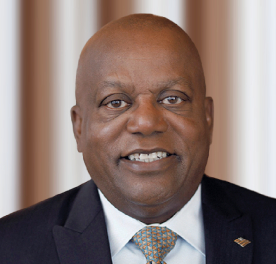
BRIAN T. MOYNIHAN
Chair and Chief Executive Officer
Letter from our Lead Independent Director

|
On behalf of the independent members of the Board of Directors, we thank you for your continued investment in and support of Bank of America, and we join Brian in inviting you to attend our 2026 Annual Meeting of Shareholders.
As independent directors, we are focused on representing the interests of shareholders and providing strong, effective, and independent oversight of management, and Bank of America’s long-term Responsible Growth strategy.
The Board is committed to maintaining high standards of corporate governance, accountability, and transparency. Over the past year, in connection with Board meetings, the independent directors met regularly in executive session and engaged constructively with management on matters critical to Bank of America’s performance, risk management, strategic direction, and corporate culture. We believe that open dialogue, constructive challenge, and independent judgment are fundamental to fulfilling our role.
| |
| Aligning executive compensation with long-term shareholder value creation remains a key focus of the Board. Through rigorous oversight, we evaluate Bank of America’s compensation programs to promote performance, reinforce appropriate risk-taking, and support strong pay-for-performance principles through a consistent evaluation framework that considers both quantitative outcomes and qualitative factors. | ||
|
In addition to our oversight responsibilities, the Board also places significant importance on shareholder engagement. As Lead Independent Director, I meet with shareholders throughout the year and value your input. We carefully consider investor perspectives when evaluating governance practices, Board composition, and other matters addressed in this proxy statement. Your insights help guide our ongoing efforts to enhance Board effectiveness and strengthen corporate governance, and we are committed to maintaining an open and constructive dialogue.
As we look ahead to the future, we thank retiring directors Pierre de Weck and Linda Hudson for their service and leadership in shaping our company. We continue to focus on thoughtful Board succession planning to maintain a complementary mix of skills, experience, and perspectives to effectively oversee our strategies to drive Responsible Growth.
Importantly, we thank you for your continued confidence in Bank of America. We look forward to your participation in the annual meeting and remain dedicated to acting in the best interests of all shareholders. | ||
LIONEL L. NOWELL III
Lead Independent Director
|
|
|
|
|
|
|
|
|
|
|
|
|
|
|
|
Notice of 2026 annual meeting of shareholders
| Date and time:
|
Live audio webcast:
| |||||
|
|
May 4, 2026 | 10:00 a.m., Eastern time
|
|
Our annual meeting will be conducted via live audio webcast. Visit www.virtualshareholdermeeting.com/BAC2026 to join the meeting
| |||
|
Matters to be voted on: | ||
|
• Electing the 12 directors named in the proxy statement
• A proposal approving our executive compensation (an advisory, non-binding “Say on Pay” resolution)
• A proposal ratifying the appointment of our independent registered public accounting firm for 2026
• Two shareholder proposals, if they are properly presented at our annual meeting
• Any other business that may properly come before our annual meeting
| ||
Your vote is important
Please submit your proxy as soon as possible online, by telephone, or by mail. Submitting your proxy by one of these methods will ensure your representation at the annual meeting, regardless of whether you attend the meeting.
We want to hear from you and all of our other shareholders. For every shareholder account that votes, Bank of America will make a $1 charitable donation in equal parts to three nonprofit organizations—Cohen Veterans Network, The Global FoodBanking Network, and Soldiers’ Angels—to support food security and veterans in the communities we serve.
Please refer to page 83 of this proxy statement for additional information on how to vote your shares and attend our annual meeting virtually.
Record date
Bank of America shareholders as of the close of business on March 13, 2026 will be entitled to vote at our annual meeting and any adjournments or postponements of the meeting.
Join the virtual meeting online to vote your shares electronically and submit questions during the meeting.
By order of the Board of Directors,
|
ROSS E. JEFFRIES, JR.
Deputy General Counsel and Corporate Secretary
March 23, 2026
IMPORTANT NOTICE REGARDING THE AVAILABILITY OF PROXY MATERIALS FOR THE ANNUAL MEETING OF SHAREHOLDERS TO BE HELD ON MAY 4, 2026: We commenced providing and making available our 2026 Proxy Statement on March 23, 2026. Our 2026 Proxy Statement and 2025 Annual Report to shareholders are available at https://investor.bankofamerica.com/events-and-presentations/annual-shareholder-meeting.
|
|
|
|
|
|
|
|
|
|
|
|
|
|
|
|
Table of contents
Cautionary information and forward-looking statements
This proxy statement contains certain statements regarding Responsible Growth and statements related to sustainability (collectively, the Sustainability Information). Such Sustainability Information may be based on current or historic opinions, strategies, aspirations, commitments, goals, targets, and objectives which continue to evolve and develop, and there is no promise or guarantee that such aspirations, commitments, goals, targets, and objectives will be met. The Sustainability Information is as of the date of this proxy statement and subject to change without notice.
Additionally, certain statements contained in this proxy statement may constitute “forward-looking statements” within the meaning of the Private Securities Litigation Reform Act of 1995, including statements about our business and the Sustainability Information. We use words such as “anticipates,” “targets,” “expects,” “hopes,” “estimates,” “intends,” “plans,” “goals,” “believes,” “continue” and other similar expressions or future or conditional verbs such as “will,” “may,” “might,” “should,” “would” and “could” to identify forward-looking statements. Forward-looking statements are not based on historical facts, but reflect management’s current expectations, plans or forecasts, are not guarantees of future results or performance, involve certain known and unknown risks, uncertainties and assumptions that are difficult to predict and often beyond our control and are inherently uncertain.
You should not place undue reliance on any forward-looking statement. Actual outcomes and results may differ materially from those expressed in, or implied by, any of these forward-looking statements due to a variety of factors. You should consider all of the precautionary statements, uncertainties and risks discussed in our filings with the U.S. Securities and Exchange Commission (SEC), including in our 2025 Annual Report on Form 10-K (2025 Form 10-K) and subsequent SEC filings. Forward- looking statements speak only as of the date they are made, and we undertake no obligation to update or revise any forward-looking statements.
References to our 2025 Annual Report to shareholders (2025 Annual Report) and Sustainability at Bank of America disclosure published in 2025, and any website references (including any hyperlinks) throughout this proxy statement are provided for convenience only, and the content of which is not incorporated by reference into this proxy statement.
| Proxy statement summary |
Proxy statement summary
Your vote is important
How to vote your shares
If you were a shareholder as of the close of business on March 13, 2026, vote your shares online, by phone or by mail before the meeting. You may also vote your shares online during the meeting.
|
|
Online before the meeting www.proxyvote.com or at the website indicated on the materials provided to you by your broker | |
|
|
By mail Complete, sign, date, and return your proxy card in the envelope provided | |
|
|
By phone Call the phone number located on the top of your proxy card | |
|
|
Online during the meeting Attend our virtual annual meeting by logging into the virtual meeting website and vote by following the instructions provided on the website | |
| Proposals for your vote |
Board voting recommendation |
Page | ||||
| 1. Electing directors |
|
|
6 | |||
|
2. Approving our executive compensation (an advisory, non-binding “Say on Pay” resolution) |
|
42 | ||||
|
3. Ratifying the appointment of our independent registered public accounting firm for 2026 |
|
75 | ||||
| 4.-5. Shareholder proposals |
|
|
77 | |||
We want to hear from you and all our other shareholders. For the tenth consecutive year, Bank of America will make a $1 charitable donation for every shareholder account that casts a vote. As part of our ongoing commitment to support families and individuals experiencing food insecurity and to support military veterans and their families, this year’s charitable donation will be distributed in equal parts to Cohen Veterans Network, The Global FoodBanking Network, and Soldiers’ Angels. Cohen Veterans Network improves quality of life for service members, veterans, and their families through an integrated national network of mental health clinics. The Global FoodBanking Network partners with food banks in more than 50 countries to get nutritious food to those who need it most, reduce food waste, and create stronger communities. Soldiers’ Angels provides resources to service members, veterans, and their families, including hunger relief and other support services.
For more information on how to attend our 2026 annual meeting, see “Attending the annual meeting” on page 85. To review our 2026 Proxy Statement, 2025 Annual Report, and other information relating to our 2026 annual meeting online, go to https://investor.bankofamerica.com/events-and-presentations/annual-shareholder-meeting.
| 2026 Proxy Statement |
1 |
| Proxy statement summary |
Our Company
Bank of America is one of the world’s largest financial institutions, serving people, companies, and institutions with a diversified range of banking and non-banking services and products. In approaching everything we do, we start with a simple, but powerful, question: What would you like the power to do?
| What would you like the power to do?®
At Bank of America, we ask this question every day of all those we serve. It is at the core of how we live our values, deliver our
| ||||||
|
Our values
• Deliver together
• Act responsibly
• Realize the power of
• Trust the team |
Our purpose
To help make financial lives |
Responsible Growth
• We must grow and win in the market — no excuses
• We must grow with our customer-focused strategy
• We must grow within our risk framework
• We must grow in a sustainable manner |
Eight lines of business
Serving the core financial needs of people, companies and institutional investors through eight lines of business | |||
Our eight lines of business
We go to market through our eight lines of business, each designed to serve specific client groups with tailored, differentiated models, enabling us to collaborate by sharing insights, coordinating strategies, and providing a seamless experience for both individuals and institutions.

Responsible Growth
At Bank of America, our commitment to Responsible Growth drives how we serve clients, manage risk, support our teammates and communities and deliver for you, our shareholders. We know we must grow and win in the market — no excuses, we must grow with our client-focused strategy, we must grow within our risk framework, and our growth must be sustainable. By focusing on the principles that drive Responsible Growth, we believe we’ve balanced risk and reward and managed costs appropriately to deliver strong earnings, capital returns, and support all who need us to help achieve their success. We invest in technology, which we believe is vital to delivering our capabilities across our eight lines of business and in enhancing the efficiency of our company. We are committed to our teammates’ success and helping them pursue opportunities to thrive as a vital part of being a Great Place to Work. We also remain deeply committed to investing in the communities in which we operate by building connections through the power of sport, creating economic opportunity, and being there for our stakeholders in times of crisis and those moments that matter most.
More information about us
See our 2025 Annual Report, including our Human Capital Management Update, for more information about our company, our eight lines of business, our investment in technology, and our commitment to being a Great Place to Work and to the communities in which we operate. (Available at: https://investor.bankofamerica.com/events-and-presentations/annual-shareholder-meeting.)
See the Sustainability at Bank of America disclosure published in 2025 for more information about our company’s approach to sustainability. (Available at: https://about.bankofamerica.com/content/dam/about/report-center/esg/2025/SustainabilityatBofA2025_WCAG2.2_121625.pdf)
| 2 |
Bank of America |
| Proxy statement summary |
Our 2025 company performance
| WE MUST GROW AND WIN IN THE MARKET |
WE MUST GROW WITH OUR CUSTOMER-FOCUSED STRATEGY |
WE MUST GROW WITHIN OUR RISK FRAMEWORK | ||||
| $113.1B Revenue, up 7% vs. 2024 |
$15.6B total assets under |
$82.0B asset under management |
11.4% common equity tier 1 | |||
| $30.5B Net Income, up 13% vs. 2024 |
$6.6B total Investment Banking fees, up 7% vs. 2024 |
~680K net new Consumer Checking accounts added |
$29.5B distributed to shareholders in common stock repurchases up 41% from 2024 | |||
| $3.81 Diluted Earnings Per Share, up 19% vs. 2024 |
$20.9B record Sales & |
64% of GWIM clients have a banking relationship |
$975B Average Global | |||
| $2.02T in Deposits as of 12/31/25, |
$27.9B Average Small Business loans, up 7% vs. 2024. #1 |
16.6B digital logins,(3) up 15% vs. 2024 |
0.50% Net charge-offs as a percent of loans and leases outstanding | |||
| $1.19T in Loans as of 12/31/25, up 8% vs. 2024 |
$4.5T total Consumer payments,(2) |
66% digitally-enabled sales |
Lowest stressed credit loss rates among peers in 12 of the past 13 Federal Reserve Comprehensive Capital Analysis and Review exams | |||
| WE MUST GROW IN A SUSTAINABLE MANNER | ||||||||
| More than | ||||||||
| $4B+ annual investment technology |
3.2B+ interactions with Erica®, our AI-driven virtual assistant, since its 2018 launch |
$289M philanthropic giving
|
~96% teammates recognized compensation awards |
~250 bps Operating leverage generated(5) | ||||
| __________ |
| (1) | Source: Federal Deposit Insurance Corporation, 3Q25. |
| (2) | Total payments represent payments made from Bank of America accounts using credit card, debit card, ACH, wires, billpay, person-to-person, cash, and checks. |
| (3) | Digital logins represents the total number of desktop and mobile banking sessions on the Consumer Banking platform. |
| (4) | As of fourth quarter of 2025. Global Liquidity Sources comprise assets that are readily available to the company and its subsidiaries. For more information, see “Global Liquidity Sources and Other Unencumbered Assets” in the section titled “Management’s Discussion and Analysis of Financial Condition and Results of Operations” of our 2025 Form 10-K. |
| (5) | Operating leverage calculated as the year-over-year percentage change in revenue, net of interest expense, less the percentage change in noninterest expense. |
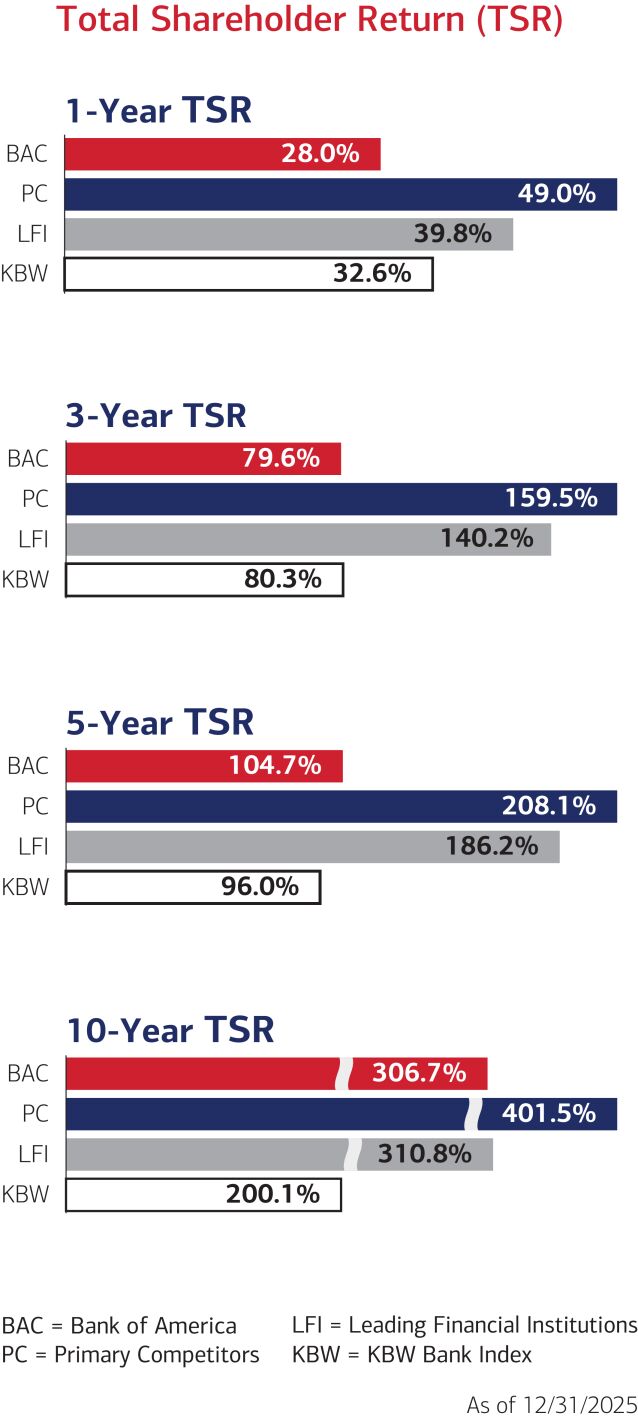
Total Shareholder Return (TSR)

BAC = Bank of America PC = Primary Competitors LFI = Leading Financial Institutions KBW = KBW Bank Index As of 12/31/2025
See раgе 59 for a list of our primary competitors and the leading financial institutions.
| 2026 Proxy Statement |
3 |
| Proxy statement summary |
Governance objectives
Our Board of Directors oversees the development and execution of our strategy. The Board has adopted thoughtful governance practices and processes consistent with our drive for Responsible Growth and implemented a number of measures that enrich its composition, enhance independent oversight, and increase its effectiveness. These measures align our corporate governance structure with achieving our strategic objectives, and facilitate our Board’s independent oversight of our company.
Thoughtful, interconnected governance processes
|
|
|
| ||||||||||
| ACTIVE INDEPENDENT
|
YEAR-ROUND
|
COMPREHENSIVE DIRECTOR SUCCESSION PLANNING AND RECRUITMENT
| ||||||||||
| __________
• Our Lead Independent Director has robust and well-defined duties set forth in our Corporate Governance Guidelines. See page 24.
• Our Board and its committees are independent—all of our Board members are independent, except for our CEO, and all of our Board committee members are independent.
• Our independent directors, including the Lead Independent Director and chairs of the Board’s committees, meet regularly with our company’s primary regulators.
• Our independent directors meet regularly in private executive sessions without our Chair and CEO or other members of management present.
• Our Board formally reviews CEO and senior management succession at least annually, and assesses candidates during Board and committee meetings and in less formal settings. See page 27.
• Our independent directors review the CEO’s annual performance and set his compensation. See page 31.
• Our Corporate Governance Committee regularly reviews the Board’s governance practices, including our Board’s policy on outside board service. See page 7. |
________
• Our Board and committees continue to conduct comprehensive and multifaceted self-evaluations with a formal annual process and on-going, year-round components. See page 25.
• In 2025, our directors conducted a formal written evaluation of Board effectiveness, with particular emphasis on key categories of Board effectiveness, including Board composition, focus, culture, process, and information and resources.
• In addition to the formal self-evaluation process, our Lead Independent Director speaks individually with each independent Board member at least quarterly, and directors are provided with opportunities throughout the year to provide input on Board and committee practices and processes and desired agenda topics and resources.
• The self-evaluations also help confirm that the Board has the appropriate mix of skills to oversee execution of our strategies and drive Responsible Growth.
• Our Board regularly assesses its leadership structure. See page 23.
• Our Board receives shareholder input on its governance practices through extensive, year-round outreach. See page 34.
|
________
• Our Board is committed to intentional and orderly succession planning and regular renewal of its composition across a diverse range of experiences, skills, backgrounds, perspectives, and tenure. See pages 7 and 8.
• Our Board has continued to enhance the director succession planning and selection process to identify candidates with complementary skills for nomination to serve on the Board. See pages 8 and 9.
• Our Board utilizes a deliberate process to assess candidates and nominees, including reviewing independence, skills, experience, service on other boards, other time commitments, and any potential conflicts of interest.
• Our Board’s onboarding and director education processes complement this enhanced recruitment process. See page 27.
• Our Board has adopted a formal Lead Independent Director and Chair emergency succession policy.
• Our Corporate Governance Committee has responsibility for our Lead Independent Director succession process, as part of overall Board leadership succession planning.
• The Board, in coordination with the Board committees, also regularly considers committee membership composition. | ||||||||||
| 4 |
Bank of America |
| Proxy statement summary |
Compensation highlights
Pay-for-performance compensation philosophy
Our compensation philosophy is to pay for performance over the long term, as well as on an annual basis. Our performance considerations encompass both financial and non-financial measures—including the manner in which results are achieved. These considerations are designed to reinforce and promote Responsible Growth and maintain alignment with our Risk Framework.
Our executive compensation program provides a mix of salary, incentives, and benefits paid over time to align executive officer and shareholder interests. A majority of variable compensation granted to named executive officers (NEOs) is in deferred equity-based awards, further encouraging long-term focus on generating sustainable growth.
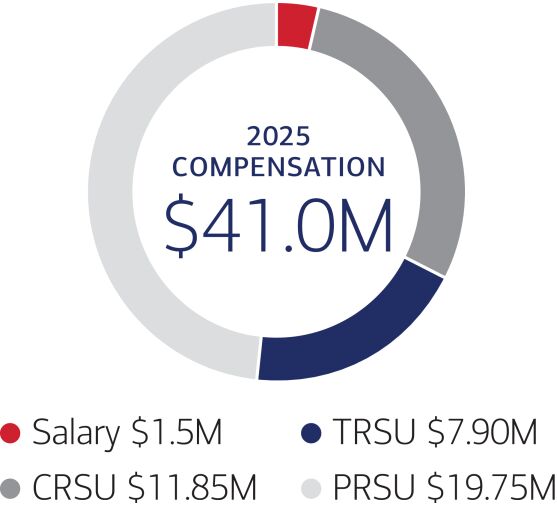
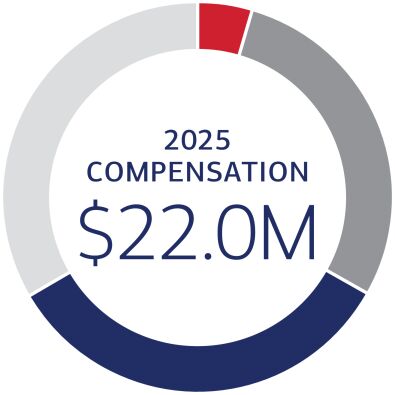
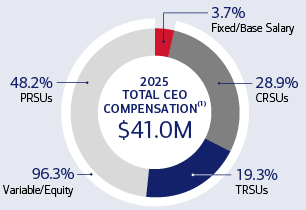
| Our Board’s Compensation and Human Capital Committee and our independent directors determined to award 2025 compensation of $41.0 million for our CEO: | ||||
• The Compensation and Human Capital Committee and independent Board members undertook a robust performance evaluation and decision process, which included a detailed review of performance results under the four tenets of Responsible Growth
• The performance evaluation considered the “What,” which includes a thorough evaluation of performance against scorecard metrics, and the “How,” which includes the manner in which results, both financial and non-financial, were achieved
• The final compensation determination reflected Mr. Moynihan’s strong individual performance and Responsible Growth across the company with an appropriate focus on risk management
• The Compensation and Human Capital Committee and Board also reviewed market compensation benchmarks which were considered in relation to the size, scope, complexity, and relative performance of our company
| ||||
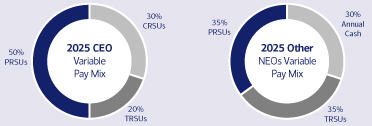
• Mr. Moynihan’s total compensation includes a fixed base salary (3.7% of total) and equity-based incentives (96.3%) which are variable and directly linked to company performance. All CEO variable compensation was delivered in equity-based awards (as it has been since 2010)
• Half of Mr. Moynihan’s variable compensation is performance restricted stock units (PRSUs) that must be earned based on sustained three-year average performance of key metrics (return on assets (tax-normalized) and growth in adjusted tangible book value); the Compensation and Human Capital Committee increased the performance standards required for a 100% payout and introduced a 150% maximum payout opportunity for exceptional performance
• The remainder of the CEO’s variable pay is 30% cash-settled restricted stock units (CRSUs) and 20% time-based restricted stock units (TRSUs) settled in shares
• 50% of net after-tax shares received from equity-based awards are retained until one year after retirement for our CEO
|
| |||
Shareholder engagement and “Say on Pay”
| We value the views of our shareholders. Input received from our shareholder engagement is critical to how we drive progress in our corporate governance practices, including our executive compensation program.
Input from our 2025 engagements, along with shareholders’ response to our 2025 “Say on Pay” proposal, show continued support for our compensation design and structure, its alignment with Responsible Growth, enhancements implemented in recent years, and reaffirmed the importance of linking pay to company and individual performance.
As a result, we have retained these enhancements and maintained a generally consistent executive compensation design and application of our pay-for-performance philosophy, reflecting our commitment to incorporate shareholder input into our disclosures and program design. |
See pages 34 and 43 for additional detail on our shareholder engagement practices.
| (1) | Total compensation pay components do not equal 100% due to rounding. For additional information, see “2025 performance year total compensation decisions” on page 53 |
| 2026 Proxy Statement |
5 |
| Proposal 1: Electing directors |
Proposal 1: Electing directors
Our Board is presenting 12 nominees for election as directors at our annual meeting. All nominees were elected by you at our 2025 annual meeting of shareholders and currently serve as directors on our Board. Each director elected at the 2026 annual meeting will serve until our 2027 annual meeting or until a successor is duly elected and qualified. Each nominee has consented to being named in this proxy statement and to serving as a director if elected. If any nominee is unable to stand for election for any reason, the shares represented at our annual meeting may be voted for another candidate proposed by our Board, or our Board may choose to reduce its size. See “Our director nominees” on page 9 for more information about the nominees and our Board’s composition.
| Nominee/age(1) |
Indep. | Director since |
Other U.S.- listed public company boards |
Committee service (C=chair) |
Key skills/qualifications | |||||||||||
|
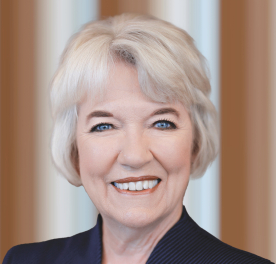
Sharon Allen, 74 Former Chairman, Deloitte |
|
Yes |
|
2012 |
|
1 |
|
AC (C) CGC |
• Financial Expertise, Audit/Financial Reporting • Risk Management • Strategic Planning | |||||||
|
Joe Almeida, 63 Former Chairman, President, and CEO, Baxter International |
|
Yes |
|
2022 |
|
None |
|
AC CHCC |
• Retired CEO; Public Company Board Leadership • Complex, Highly Regulated Businesses Strategic Planning • Global Operations | |||||||
|
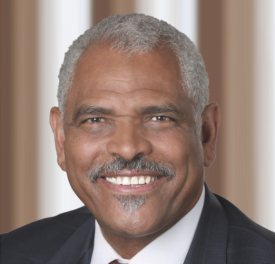
Arnold Donald, 71 Former President and CEO, Carnival |
|
Yes |
|
2013 |
|
3 |
|
AC CHCC |
• Retired CEO; Public Company Board Leadership • Strategic Planning; Global Operations • Consumer Businesses; Business Development and Marketing | |||||||
|
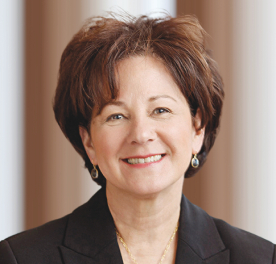
Monica Lozano, 69 Former CEO, College Futures Foundation; Former Chairman, U.S. Hispanic Media |
|
Yes |
|
2006 |
|
2 |
|
CHCC (C) ERC |
• Public Policy • Human Capital • Bank of America Institutional Knowledge; Public Company Board Leadership | |||||||
|
Maria Martinez, 68 Former EVP and Chief Operating Officer, Cisco Systems |
|
Yes |
|
2025 |
|
2 |
|
CGC ERC |
• Cybersecurity, Technology, and Information Security • Global Operations • Strategic Planning | |||||||
|
Brian Moynihan, 66 Chair and CEO, Bank of America |
|
No |
|
2010 |
|
None |
|
None |
• Public Company Board Leadership • Complex, Highly Regulated Businesses • Strategic Planning; Global Operations • Financial Services; Risk Management | |||||||
|
Lionel Nowell, 71 Lead Independent Director, Bank of America; Former Senior Vice President and Treasurer, Pepsi |
|
Yes |
|
2013 |
|
2 |
|
None |
• Public Company Board Leadership • Financial Expertise; Audit/Financial Reporting • Strategic Planning | |||||||
|
Denise Ramos, 69 Former CEO and President, ITT |
|
Yes |
|
2019 |
|
1 |
|
AC CHCC |
• Retired CEO; Public Company Board Leadership • Financial Expertise; Audit/Financial Reporting • Human Capital | |||||||
|
Clayton Rose, 67 Baker Foundation Professor of Management Practice, Harvard Business School |
|
Yes |
|
2018(2) |
|
None |
|
CHCC ERC (C) |
• Financial Services Experience; Consumer, Corporate, and Investment Businesses • Risk Expert • Public Policy | |||||||
|
Michael White, 74 Former Chairman, President, and CEO, DIRECTV |
|
Yes |
|
2016 |
|
None |
|
AC CGC (C) |
• Retired CEO; Public Company Board Leadership • Strategic Planning; Global Operations • Financial Expertise; Audit/Financial Reporting | |||||||
|
Thomas Woods, 73 Former Vice Chairman and SEVP, CIBC |
|
Yes |
|
2016 |
|
None |
|
CGC ERC |
• Financial Services Experience • Risk Management • Financial Expertise; Audit/Financial Reporting | |||||||
|
Maria Zuber, 67 Presidential Advisor for Science and Technology Policy and E.A. Griswold Professor of Geophysics, MIT |
|
Yes |
|
2017 |
|
1 |
|
CGC ERC |
• Cybersecurity, Technology, and Information Security • Risk Management • Strategic Planning | |||||||
| (1) Age as of annual meeting date. (2) Dr. Rose previously served as a member of our Board from 2013 to 2015. |
AC = Audit Committee CGC = Corporate Governance Committee CHCC = Compensation and Human Capital Committee ERC = Enterprise Risk Committee |
| 6 |
Bank of America |
| Proposal 1: Electing directors |
Identifying and evaluating director candidates
Our Board oversees the business and affairs of the company through active and independent oversight of management. To carry out its responsibilities and set the tone at the top, the Board regularly reviews its composition, and through its Corporate Governance Committee, identifies and recommends director candidates for nomination using a director selection process that has been reviewed with our primary bank regulators. The Board, in coordination with its committees, also regularly considers Board leadership, succession planning, and committee membership composition.
Board composition
Our Board believes directors should possess high personal integrity and character, demonstrated management and leadership ability, extensive experience within our industry or other sectors, and the ability to exercise sound and independent judgment in a collegial manner. Our Board:
| • | seeks directors whose complementary knowledge, experience, and skills provide a broad range of perspectives and leadership expertise in areas important to our company’s strategy and oversight |
| • | assesses directors’ age and tenure to provide for continuity in the boardroom and to achieve a balance between the perspectives of newer directors and those of longer-serving directors |
| • | evaluates whether directors are able to devote the time necessary to discharge their duties |
In addition, the Corporate Governance Committee follows applicable regulations in confirming that our Board includes members who are independent, possess financial literacy and expertise, understand risk management principles, policies, and practices, and have experience in identifying, assessing, and managing risk exposures.
Key considerations informing the Board’s approach
Director experience, skills, and expertise. When evaluating and identifying director candidates, the Corporate Governance Committee considers the experiences, skills, and expertise that are critical to the Board’s ability to provide effective oversight of the company and are directly relevant to our business, strategy, and operations. The Corporate Governance Committee seeks candidates with experiences, skills, and expertise in financial services and other global, highly complex and regulated industries, strategic planning and business development, business operations, marketing and distribution, technology, cybersecurity, risk management and financial reporting, human capital management, corporate governance, and public policy.
Our Board views its composition across a range of dimensions, including experiences, skills, backgrounds, perspectives, and tenure, as a priority. Through the Corporate Governance Committee, the Board regularly assesses its composition and seeks representation across a range of attributes when identifying and evaluating director candidates. The Corporate Governance Committee requests its third-party search firms to include a variety of candidates in its consideration of potential directors. (See information on the next page for the Corporate Governance Committee’s engagement with third-party search firms.) When evaluating director candidates, the Corporate Governance Committee reviews available information regarding each candidate, including, but not limited to, professional qualifications, experience, skills, expertise, references, backgrounds, and perspectives in the context of the Board’s overall composition, and our company’s strategy.
Director time commitment. Our Board understands the time involved in serving on the Board and its committees. Through the Corporate Governance Committee, the Board regularly evaluates whether candidates and serving directors are able to devote the time necessary to discharge their duties as directors, including prior to the annual renomination of currently serving directors. This evaluation takes into account their primary occupations, service on other boards, and additional other responsibilities.
The Corporate Governance Committee monitors and routinely reviews external perspectives and trends on the appropriate number of public company boards on which directors may serve. The Corporate Governance Committee considers the proxy voting guidelines of our major shareholders and input from shareholder engagement discussions, voting policies of the major proxy advisory firms, corporate governance guidelines adopted by other public companies, board trends at peers and other significant public companies, and advice from outside advisors. Based on this review, the Corporate Governance Committee recommends updates to our Corporate Governance Guidelines—which sets forth the Board’s policy regarding directors’ time commitment and service on other boards—to the Board for approval, when appropriate.
According to these Guidelines, directors are expected to seek Corporate Governance Committee approval before joining the board of another public company. Additionally, directors who change principal occupations must offer to resign from the Board, subject to evaluation by the Corporate Governance Committee and the Lead Independent Director. The Guidelines also limit the total number of public company boards on which a director may serve and address approval and notification expectations for directors’ service on private company boards.
| LIMITS ON PUBLIC COMPANY BOARD SERVICE | PRIVATE COMPANY BOARD SERVICE | |||
| All directors 4 total |
CEO directors 2 total |
Directors are expected to seek Corporate Governance Committee approval before joining the board of any private for-profit company and notify the company’s Corporate Secretary before joining the board of other types of private companies, such as not-for-profit companies, educational institutions, or family trusts. | ||
| All directors and nominees comply with our outside board service policy. | ||||
| 2026 Proxy Statement |
7 |
| Proposal 1: Electing directors |
Director retirement policy. Our Corporate Governance Guidelines provide that a director who would be age 75 as of the time of election shall not be nominated for initial election to the Board, provided that the Board may approve the nomination for reelection of a director who would be age 75 at the time of the election, if, in light of all the circumstances, the Board determines that it is in the best interests of our company and shareholders. Current directors Pierre de Weck and Linda Hudson, who have reached the retirement age of 75, are not standing for reelection and will retire at our annual meeting. In connection with these retirements, the size of our Board will be reduced to 12 as of the annual meeting.
Succession planning and the director recruitment process
|
ASSESS |
The Corporate Governance Committee regularly reviews the mix of individual directors on our Board to:
• assess the overall Board composition
• develop criteria for potential candidates that are additive to overall Board composition
In developing these criteria, the Corporate Governance Committee considers, among other things,
• our company’s strategy and needs
• our directors’ backgrounds, experiences, skills, expertise, tenure, and age relative to the Board’s retirement age of 75
• desired attributes and qualifications our Board identifies through its self-evaluation process
| |
|
IDENTIFY |
To drive effective Board renewal and director and Board leadership succession planning, the Corporate Governance Committee regularly develops and reviews a pool of potential director candidates.
The Corporate Governance Committee engages third-party search firms to identify potential candidates using the factors and criteria identified during the assessment phase.
The Corporate Governance Committee:
• considers and provides feedback on the potential candidates
• periodically requests updates to the list of potential candidates based on Corporate Governance Committee and Board input
The Corporate Governance Committee also considers candidates proposed by management and by our shareholders.
| |
|
EVALUATE |
The Corporate Governance Committee follows an established process for evaluating director candidates regardless of who recommends the candidate for consideration.
During this process, the Corporate Governance Committee reviews information regarding each candidate, including but not limited to, professional qualifications, experiences, skills, expertise, references, backgrounds, and perspectives.
The Corporate Governance Committee also reviews the candidate’s:
• independence and potential conflicts of interest
• time availability
• any reputational risk considerations
| |
|
RECOMMEND |
Following Corporate Governance Committee evaluation and Board review, the Board recommends director candidates to shareholders for election based on its assessment of which candidates have the experiences, skills, and expertise that, in the context of the Board’s overall composition, are best able to fulfill the Board’s role of providing effective oversight of the company’s business, strategy, and operations.
The composition of our Board reflects the Board’s commitment to identify, evaluate, and nominate candidates who possess personal qualities and a mixture of qualifications, skills, backgrounds, and tenures that, when taken together, are fit for purpose to best serve our company and our shareholders.
| |
|
For 2026, the Board selected our 12 director nominees based on their satisfaction of the core attributes and key considerations described on page 7 and above and the Board’s belief that each can continue making substantial contributions to our Board and company. The Board believes the nominees’ breadth of experience, broad mix of attributes, and range of perspectives strengthen its independent leadership and effective oversight of management and our long-term strategy.
See “Electing directors” on page 6 and “Our director nominees” on page 9. | ||
| 8 |
Bank of America |
| Proposal 1: Electing directors |
Our director nominees
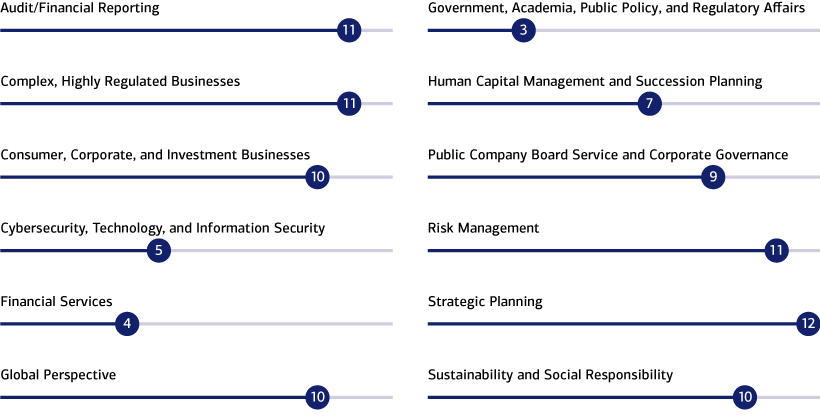
Our director nominees bring complementary backgrounds and viewpoints, and a broad range of skills and experiences that are critical to the Board’s ability to provide effective oversight of the company and directly relevant to our business, strategy, and operations. They are seasoned leaders from research academia, government service, private organizations, and global public companies that are subject to extensive regulations and operate in highly competitive environments. Most serve or have served as chief executive officers or C-suite executives leading business innovation and transformation, and they have expertise managing risk, operations, finance, technology, human capital, and other areas important to our business, strategy, and operations. Their varying tenure on the Board strengthens our Board’s oversight with a balance of historical insights about our company and new perspectives.
| INDEPENDENCE | CEO-LEVEL EXPERIENCE | RANGE OF TENURE | OUR BOARD’S MAKEUP | |||
| 92% | 58% | 10.3 yrs. average 2 - <5 years 5 - 5-10 years 5 - >10 years |
Men - 58% Women - 42% White - 58% Hispanic/Latino - 25% Black/African-American - 17%
| |||
| 2026 Proxy Statement |
9 |
| Proposal 1: Electing directors |

|
Our Board recommends a vote “FOR” each of the 12 nominees listed below for election as a director (Proposal 1). |
Set forth below are each nominee’s name, age as of our annual meeting date, principal occupation, business experience, and U.S.-listed public company directorships held during the past five years. We also discuss the qualifications, attributes, and skills that led our Board to nominate each for election as a Bank of America director.
|
Age: 74 Director since: August 2012
Ms. Allen is an experienced director
As a corporate leader, Ms. Allen has broad experience leading and working with large, complex businesses and brings an international perspective on risk management and strategic planning. During her nearly 40-year career with Deloitte, the largest professional services organization in the U.S. and member firm of Deloitte Touche Tohmatsu Limited (DTTL), she became the first woman elected to serve as Chairman of the Board and also served as a member of DTTL’s Global Board of Directors, the chair of its Global Risk Committee, and the U.S. representative of its Global Governance Committee. During her tenure at Deloitte, Ms. Allen oversaw relationships with major multinational corporations and provided oversight and guidance to management.
|
Sharon L. Allen
Former Chairman, Deloitte LLP (Deloitte)
Committee membership:
Audit Committee (chair) Corporate Governance Committee
Professional highlights: • Served as Chairman of Deloitte, a firm that provides audit, consulting, financial advisory, risk management, and tax services, as the U.S. member firm of DTTL, from 2003 to 2011. Held various leadership roles, including Partner and Regional Managing Partner during her 40 years at Deloitte; and responsible for audit and consulting services for a number of Fortune 500 and large private companies • Served on the Global Board of Directors, Chair of the Global Risk Committee, and U.S. Representative on the Global Governance Committee of DTTL, from 2003 to 2011 • Member of the Board of Directors of Albertsons Companies, Inc. and its Audit & Risk Committee, and Chair of its Compensation Committee • Served on the Board of Directors of First Solar, Inc.
Other leadership experience and service: • Appointed by President George W. Bush to the President’s Export Council, which advised the President on export enhancement
Other U.S.-listed company boards: • Albertsons Companies, Inc. • First Solar, Inc. (past five years) | |||||||||||
| 10 |
Bank of America |
| Proposal 1: Electing directors |
|
Age: 63 Director since: September 2022
Mr. Almeida is a former chief executive officer and public company director with experience leading large, global companies subject to regulatory oversight. His service as a board member for global companies in a variety of industries also brings additional perspective to our Board.
As former Chairman, President, and Chief Executive Officer of Baxter, Mr. Almeida led the company through a period of transformation driven by innovation, operational excellence, and strategic execution. Prior to joining Baxter, Mr. Almeida served as Chairman, President and Chief Executive Officer and on the Board of Directors of Covidien and served in leadership roles at Tyco Healthcare (Covidien’s predecessor), Wilson Greatbatch Technologies Inc., American Home Products’ Acufex Microsurgical division, and Johnson & Johnson’s Professional Products division. He began his career as a management consultant at Andersen Consulting (Accenture) and previously served on the Boards of Directors of Walgreens Boots Alliance, Inc., Analog Devices, Inc., EMC Corporation, and State Street Corporation.
|
José (Joe) E. Almeida
Former Chairman, President, and Chief Executive Officer,
Committee membership:
Audit Committee Compensation and Human Capital Committee
Professional highlights: • Served as Chairman of the Board, President and Chief Executive Officer of Baxter, a global medtech leader, from January 2016 to February 2025. Began serving as an executive officer of Baxter in October 2015 • Served as Senior Advisor with The Carlyle Group, a multinational private equity, alternative asset management and financial services corporation, from May 2015 to October 2015 • Served as Chairman, President and Chief Executive Officer and as President and Chief Executive Officer of Covidien, a global healthcare products company, from March 2012 to January 2015 and from July 2011 to March 2012 • Prior to becoming Covidien’s President and Chief Executive Officer, served in several leadership roles at Covidien, including President of its Worldwide Medical Devices business; also served as President of International and Vice President of Global Manufacturing for Covidien’s predecessor, Tyco Healthcare • Served on the Boards of Directors of: Baxter; Walgreens Boots Alliance, Inc.; State Street Corporation; Analog Devices, Inc.; and EMC Corporation
Other U.S.-listed company boards: • Baxter (past five years) • Walgreens Boots Alliance, Inc. (past five years) |
| 2026 Proxy Statement |
11 |
| Proposal 1: Electing directors |
|
Age: 71 Director since: January 2013
Mr. Donald has more than three decades of strategic planning, global operations, and risk management experience in regulated, consumer, retail, and distribution businesses.
He brings expertise in business transformation through his service as President and Chief Executive Officer of Carnival, one of the world’s largest leisure travel companies with operations worldwide and his leadership roles with global responsibilities at Monsanto. His role as a director on other public company boards provides him with experience overseeing strategic planning, risk management, global operations, compensation and human capital, and audit and financial services matters. Through his leadership of nonprofit organizations, including The Executive Leadership Council and the Juvenile Diabetes Research Foundation International, Mr. Donald also brings focus and perspective on our work to promote talent, inclusion, and opportunity for our employees and the communities we serve.
|
Arnold W. Donald
Former President and Chief Executive Officer, Carnival Corporation and Carnival plc (Carnival)
Committee membership:
Audit Committee Compensation and Human Capital Committee
Professional highlights: • Served as President, Chief Executive Officer, and Chief Climate Officer of Carnival, a cruise and vacation company, from July 2013 to November 2022; and on Carnival’s Board of Directors from 2001 to November 2022 • Served as President and Chief Executive Officer of The Executive Leadership Council, a nonprofit organization providing a professional network and business forum to African-American executives at major U.S. companies, from November 2010 to June 2012 • Served as President and Chief Executive Officer of the Juvenile Diabetes Research Foundation International, from January 2006 to February 2008 • Served as Chairman and Chief Executive Officer of Merisant, from 2000 to 2003, a privately held global manufacturer of tabletop sweeteners, and remained as Chairman until 2005 • Joined Monsanto in 1977 and held several senior leadership positions with global responsibilities, including President of its Agricultural Group and President of its Nutrition and Consumer Sector • Member of the Board of Directors of GE Vernova, Chair of its Compensation and Human Capital Committee and member of its Nominating and Governance Committee • Member of the Board of Directors of MP Materials Corp. and its Compensation Committee • Lead Independent Director of Salesforce, Inc., member of its Audit & Finance and Nominating & Corporate Governance Committees • Served on the Board of Directors of Carnival
Other leadership experience and service: • Appointed by President Clinton and re-appointed by President George W. Bush to the President’s Export Council
Other U.S.-listed company boards: • GE Vernova • MP Materials Corp. • Salesforce, Inc. • Carnival (past five years) | |||||||
| 12 |
Bank of America |
| Proposal 1: Electing directors |
|
Age: 69 Director since: April 2006
Ms. Lozano brings a broad range of leadership experience in the public and private sectors through her active participation in public service, her service as chief executive officer and as a public company director for large, complex companies. She also brings a track record as a champion for talent, inclusion, and opportunity.
As Chief Executive Officer of College Futures Foundation, a charitable foundation, she worked to increase the rate of college graduation and improve opportunity for low-income students and students of color in California. With 30 years at La Opinión, the largest Spanish-language newspaper in the U.S., including as editor and publisher, as Chairman and Chief Executive Officer of its parent company, ImpreMedia LLC, and as co-founder of the Aspen Institute Latinos and Society Program, Ms. Lozano possesses deep insights into the issues that impact the Hispanic-Latino community. As a director serving on the boards of large organizations with diversified international operations, including Apple Inc. and Target Corporation, and previously The Walt Disney Company, Ms. Lozano has long-standing experience overseeing matters ranging from corporate governance, human capital management, and executive compensation, to risk management and financial reporting. In addition, as a member of California’s Task Force on Jobs and Business Recovery, Ms. Lozano has valuable perspective on important public policy, societal, and economic issues.
|
Monica C. Lozano
Former Chief Executive Officer, College Futures Foundation
Former Chairman, U.S. Hispanic Media Inc.
Committee membership:
Compensation and Human Capital Committee (chair)
Professional highlights: • Served as Chief Executive Officer of College Futures Foundation, from December 2017 to July 2022 and a member of the Board of Directors, from December 2019 to July 2022 • Served as Chair of the Board of Directors of U.S. Hispanic Media Inc., the parent company of ImpreMedia, a leading Hispanic news and information company, from June 2014 to January 2016 • Served as Chairman of ImpreMedia, from July 2012 to January 2016; Chief Executive Officer, from May 2010 to May 2014; and Senior Vice President, from January 2004 to May 2010 • Served as Publisher of La Opinión, a subsidiary of ImpreMedia and the leading Spanish-language daily print and online newspaper in the U.S., from 2004 to May 2014; and Chief Executive Officer, from 2004 to July 2012 • Strategic advisor to multiple media companies • Member of the Board of Directors of Apple Inc. and its Audit and Finance Committee • Member of the Board of Directors of Target and its Governance & Sustainability Committee, Chair of its Compensation & Human Capital Management Committee, and former Lead Independent Director
Other leadership experience and service: • Member of California’s Task Force on Jobs and Business Recovery • Served as a member of President Obama’s Council on Jobs and Competitiveness and served on President Obama’s Economic Recovery Advisory Board • Member of the Board of Directors of the Weingart Foundation • Served as the Chair of the Board of Regents of the University of California; as a member of the Board of Trustees of The Rockefeller Foundation; as a member of the Board of Trustees of the University of Southern California; and as a member of the State of California Commission on the 21st Century Economy
Other U.S.-listed company boards: • Apple Inc. • Target Corporation |
| 2026 Proxy Statement |
13 |
| Proposal 1: Electing directors |
|
Age: 68 Director since: January 2025
Ms. Martinez is a seasoned technology executive who brings extensive technology, risk management, customer experience, and strategic planning experience for complex, global businesses to our Board.
With over thirty years of leadership experience at global technology firms Cisco Systems, Salesforce, and Microsoft, she offers deep insights into technology innovation and industry trends. She also brings a track record of driving global business transformation, operational excellence, and customer success, and addressing the challenges of operating in global and international business environments. Her history of executive leadership and her service on public company boards provides valuable perspective on governance, regulatory compliance, and oversight of large, complex organizations.
|
Maria N. Martinez
Former Executive Vice President and Chief Operating Officer,
Committee membership:
Corporate Governance Committee Enterprise Risk Committee
Professional highlights: • Served as Executive Vice President and Chief Operating Officer from 2021 to 2024, and as Executive Vice President and Chief Customer Experience Officer from 2018 until 2021 at Cisco Systems, Inc., a multinational digital communications technology company • Served in a variety of senior executive roles at Salesforce, Inc. between 2010 and 2018, including: President, Global Customer Success and Latin America; President, Sales and Customer Success; Executive Vice President and Chief Growth Officer; and Executive Vice President, Customers for Life • Managed the Global Services business for Microsoft Corporation, including professional services and customer support for all products during her tenure there from 2003 to 2007 • Member of the Board of Directors of McKesson Corporation and its Compliance Committee and Chair of its Governance and Sustainability Committee • Member of the Board of Directors of Tyson Foods, Inc. and its Governance and Nominating Committee and Chair of its Technology Committee • Served on the Board of Directors of Cue Health Inc.
Other U.S.-listed company boards: • McKesson Corporation • Tyson Foods, Inc. • Cue Health Inc. (past five years) | |||||||||||
| 14 |
Bank of America |
| Proposal 1: Electing directors |
|
Age: 66 Director since: January 2010
As our Chief Executive Officer, Mr. Moynihan leads a team of more than 213,000 employees focused on driving Responsible Growth for our teammates, clients, communities, and shareholders.
Under his leadership, the company provides core financial services to three client groups through our eight lines of business. This has delivered record earnings and significant capital return to shareholders. Mr. Moynihan has demonstrated leadership qualities, management capability, knowledge of our business and industry, and a long-term strategic perspective. In addition, he has many years of international and domestic financial services experience, including in the wholesale and retail businesses.
|
Brian T. Moynihan
Chair of the Board and Chief Executive Officer,
Committee membership:
Attends meetings of all the Board committees
Professional highlights: • Chair of the Board of Directors of Bank of America Corporation since October 2014, Chief Executive Officer since January 2010, and President from January 2010 to September 2025. Prior to becoming Chief Executive Officer, Mr. Moynihan led each of the company’s operating units • Member (and prior Chair) of the Board of Directors of Bank Policy Institute (Chair of the Global Regulatory Policy Committee) • Member (and prior Chair) of Financial Services Forum • Chair of the Supervisory Board of The Clearing House Association L.L.C.
Other leadership experience and service: • Chair of the Sustainable Markets Initiative • Member (and prior Chairman) of the World Economic Forum’s International Business Council (Chair of Stakeholder Capitalism Metrics Initiative) • Member of Business Roundtable • Chancellor (Chair) and current member of Board of Fellows of Brown University • Member of Advisory Council of Smithsonian’s National Museum of African American History and Culture • Member of Charlotte Executive Leadership Council • Member (and prior Chair) of Massachusetts Competitive Partnership • Served as Chair of the Board of The U.S. Council on Competitiveness
Other U.S.-listed company boards: • N/A | |||||||||||
| 2026 Proxy Statement |
15 |
| Proposal 1: Electing directors |
|
Age: 71 Director since: January 2013
Mr. Nowell is an active board leader with a deep range of corporate audit, financial expertise, risk management, operational, and strategic planning experience.
Mr. Nowell brings a robust corporate governance and board leadership perspective through his current and prior service on public company boards across varying industries and through his ongoing dialogue with institutional shareholders as our Board’s Lead Independent Director. In 2022, Mr. Nowell was named “Independent Director of the Year” by Corporate Board Member. He oversaw the worldwide corporate treasury functions, including debt and investment activities, capital markets strategies, and foreign exchange as Senior Vice President and Treasurer of Pepsi, finance functions as Chief Financial Officer of Pepsi Bottling Group, and held responsibilities for strategy and business development as a Senior Vice President at RJR Nabisco in a career spanning over 30 years.
|
Lionel L. Nowell III
Lead Independent Director, Bank of America Corporation
Former Senior Vice President and Treasurer, PepsiCo, Inc. (Pepsi)
Committee membership:
Attends meetings of all the Board committees
Professional highlights: • Served as Senior Vice President and Treasurer of Pepsi, a leading global food, snack, and beverage company, from 2001 to May 2009; and as Chief Financial Officer of The Pepsi Bottling Group and Controller of Pepsi • Served as Senior Vice President, Strategy and Business Development at RJR Nabisco, Inc., from 1998 to 1999 • Held various senior financial roles at the Pillsbury division of Diageo plc, including Chief Financial Officer of its Pillsbury North America, Pillsbury Foodservice, and Häagen-Dazs divisions; and also served as Controller and Vice President of Internal Audit of the Pillsbury Company • As our Board’s Lead Independent Director, Mr. Nowell has an extensive set of responsibilities that brings him into frequent communications with our primary regulators, institutional shareholders, other stakeholders, and our employees and customers. See page 24 • Lead Director of the Board of Directors of Textron Inc. and member of its Audit and Organization and Compensation Committees • Member of the Board of Directors of Ecolab Inc., Chair of its Audit Committee and member of its Finance Committee • Served as a member of the Board of Directors of American Electric Power Company, Inc., Chair of its Audit Committee, and as a member of its Directors and Corporate Governance, Policy, Executive, and Finance Committees • Served as Lead Director of the Board of Directors of Reynolds American, Inc. and as a Board member
Other U.S.-listed company boards: • Ecolab Inc. • Textron Inc. | |||||||
| 16 |
Bank of America |
| Proposal 1: Electing directors |
|
Age: 69 Director since: July 2019
Ms. Ramos is an experienced public company executive who brings global business leadership, financial expertise, and strategic planning experience to our Board.
She served as Chief Executive Officer of ITT, a diversified manufacturer of engineered components and customized technology solutions for the transportation, industrial, and energy markets, focusing on innovation and technology. She was Chief Financial Officer at ITT, Furniture Brands International, and the U.S. KFC division of Yum! Brands, and served as the corporate treasurer at Yum! Brands. Through her public company board service on the boards of Phillips 66 and RTX Corporation, Ms. Ramos brings board-level insights into issues facing complex, regulated global public companies and oversight experience in finance, audit, corporate governance, public policy, and sustainability.
|
Denise L. Ramos
Former Chief Executive Officer and President, ITT Inc. (ITT)
Committee membership:
Audit Committee Compensation and Human Capital Committee
Professional highlights: • Chief Executive Officer and President of ITT, a diversified manufacturer of critical components and customized technology solutions, from 2011 to 2019, and Senior Vice President and Chief Financial Officer of ITT, from 2007 to 2011 • Served as Chief Financial Officer for Furniture Brands International, a former home furnishings company, from 2005 to 2007 • Served in various roles at Yum! Brands Inc., an American fast-food company, from 2000 to 2005, including Chief Financial Officer of the U.S. Division of KFC Corporation and as Senior Vice President and Treasurer • Began her career at Atlantic Richfield Company, where she spent more than 20 years in a number of finance positions • Member of the Board of Directors of RTX Corporation and its Audit Committee and Governance and Public Policy Committee • Served on the Board of Directors of Phillips 66
Other U.S.-listed company boards: • RTX Corporation • Phillips 66 (past five years) |
| 2026 Proxy Statement |
17 |
| Proposal 1: Electing directors |
|
Age: 67 Director since: October 2018
Dr. Rose is an executive leader in academics and the private sector who brings risk management experience, public policy and social thought leadership, broad global financial services industry knowledge, and strategic planning experience to our Board.
As former President of Bowdoin College, Dr. Rose has a legacy of promoting intellectual engagement with a diverse set of ideas and issues; increasing access and opportunity for students; enhancing programs for postgraduate success; advancing inclusion; and addressing mental health challenges facing youth. As a Harvard Business School faculty member, Dr. Rose has taught and written on issues of leadership, ethics, the financial crisis, and the role of business in society. Dr. Rose spent the first 20 years of his career with JPMorgan Chase & Co. and its predecessor company, where he retired as Vice Chairman after leading the global investment banking and equities businesses, as well as holding leadership roles in securities, derivatives, and corporate finance in New York and London. Following retirement from JPMorgan Chase, Dr. Rose received a master’s degree and PhD with distinction in sociology from the University of Pennsylvania. Dr. Rose also holds an MBA from the University of Chicago. Dr. Rose has served on several financial institutions boards and currently serves as Chair of the Board of Trustees of the Howard Hughes Medical Institute, the U.S.’s largest private supporter of academic biomedical research.
|
Clayton S. Rose
Baker Foundation Professor of Management Practice, Harvard Business School
Committee membership:
Compensation and Human Capital Committee Enterprise Risk Committee (chair)
Professional highlights: • Baker Foundation Professor of Management Practice at Harvard Business School; served as a professor at Harvard Business School prior to his appointment as President of Bowdoin College • Served as President of Bowdoin College • Served as Vice Chairman, headed two lines of business–Global Investment Banking and Global Equities–and was a member of JPMorgan Chase’s senior management team during his approximately 20-year tenure at JPMorgan Chase • Served on the Boards of Directors of XL Group, plc, Federal Home Loan Mortgage Corporation (Freddie Mac), and Mercantile Bankshares Corp.
Other leadership experience and service: • Trustee and Chair of the Board of Trustees for Howard Hughes Medical Institute and formerly Chair of the Audit and Compensation Committee • Member of the Board of Directors of Pew Charitable Trusts • Served on the company’s Board of Directors, from 2013 to 2015
Other U.S.-listed company boards: • N/A |
| 18 |
Bank of America |
| Proposal 1: Electing directors |
|
Age: 74 Director since: June 2016
Mr. White is a seasoned executive and public company director with experience leading the global operations and strategic direction of complex and highly regulated multinational consumer retail and distribution businesses.
He possesses executive and board leadership experience and provides broad ranging operational and strategic insights, an international perspective, and financial expertise to our Board. Mr. White was President, Chief Executive Officer, and Chairman of the Board of Directors of DIRECTV, where he oversaw the operations and strategic direction of the company in the U.S. and in Latin America. Prior to joining DIRECTV, he served as the Chief Executive Officer of PepsiCo International, Frito-Lay’s Europe, Africa, and Middle East division, and Snack Ventures Europe, PepsiCo’s partnership with General Mills International. He also served as Chief Financial Officer of PepsiCo., Inc., Pepsi-Cola Company worldwide, and Frito-Lay International. Mr. White began his career as a management consultant at Bain & Company and Arthur Andersen & Co.
|
Michael D. White
Former Chairman, President, and Chief Executive Officer, DIRECTV
Committee membership:
Audit Committee Corporate Governance Committee (chair)
Professional highlights: • Served as Chairman, President, and Chief Executive Officer of DIRECTV, a leading provider of digital television entertainment services, from January 2010 to August 2015; and as a Director of the company, from November 2009 until August 2015 • Chief Executive Officer of PepsiCo International, from February 2003 until November 2009; and served as Vice Chairman and director of PepsiCo, from March 2006 to November 2009, after holding positions of increasing importance with PepsiCo since 1990 • Served as Senior Vice President at Avon Products, Inc. • Served as a Management Consultant at Bain & Company and Arthur Andersen & Co. • Served as Lead Director of the Board of Directors of Kimberly-Clark Corporation • Served on the Board of Directors of Whirlpool Corporation
Other leadership experience and service: • Chair of The Learning Alliance • Vice Chair of The Partnership to End Addiction
Other U.S.-listed company boards: • Kimberly-Clark Corporation (past five years) • Whirlpool Corporation (past five years) |
| 2026 Proxy Statement |
19 |
| Proposal 1: Electing directors |
|
Age: 73 Director since: April 2016
Mr. Woods is a veteran financial
He began his nearly 40-year tenure at CIBC and its predecessor firms in its investment banking department and later served as Head of Canadian Corporate Banking, Chief Financial Officer, and Chief Risk Officer, before retiring as Vice Chairman. As Senior Executive Vice President and Chief Risk Officer of CIBC during the financial crisis, Mr. Woods focused on risk management and CIBC’s risk culture. He chaired CIBC’s Asset Liability Committee, served as CIBC’s lead liaison with regulators, and was an active member of CIBC’s business strategy group. He brings international perspective, including to our European subsidiaries through his service on the Boards of Directors of Merrill Lynch International (MLI), our U.K. broker-dealer subsidiary, and BofA Securities Europe S.A. (BofASE), our French broker-dealer subsidiary.
|
Thomas D. Woods
Former Vice Chairman and Senior Executive Vice President, Canadian Imperial Bank of Commerce (CIBC)
Committee membership:
Corporate Governance Committee Enterprise Risk Committee
Professional highlights: • Served as Vice Chairman and Senior Executive Vice President of CIBC, a leading Canada-based global financial institution, from July 2013 until his retirement in December 2014 • Served as Senior Executive Vice President and Chief Risk Officer of CIBC, from 2008 to July 2013; and Senior Executive Vice President and Chief Financial Officer of CIBC, from 2000 to 2008 • Began his career at CIBC in 1977 through Wood Gundy, a predecessor firm; served in various senior leadership positions, including as Controller of CIBC; as Chief Financial Officer of CIBC World Markets (CIBC’s investment banking division); and as the Head of CIBC’s Canadian Corporate Banking division • Served as Chair of the Board of Directors of Hydro One Limited, an electricity transmission and distribution company serving the Canadian province of Ontario, and publicly traded and listed on the Toronto Stock Exchange, from August 2018 to July 2019 • Member of the Board of Directors of MLI; Chair of its Risk Committee; and member of its Governance Committee • Chair of the Board of Directors of BofASE and member of its Risk Committee
Other leadership experience and service: • Chair of Board of Directors of Institute of Corporate Directors (Institut des Administrateurs de Sociétés) • Member of the Boards of Directors of Catholic Health Sponsors of Ontario and St. Michael’s Hospital Foundation • Served on the advisory committee of Cordiant Capital Inc., a global infrastructure and real assets manager • Served on the Boards of Directors of: Alberta Investment Management Corporation, a Canadian institutional investment fund manager; Jarislowsky Fraser Limited, a global investment management firm; DBRS Limited and DBRS, Inc., an international credit rating agency; and TMX Group Inc., a Canada-based financial services company • Served on the University of Toronto College of Electors
Other U.S.-listed company boards: • N/A | |||||||
|
|
||||||||
| 20 |
Bank of America |
| Proposal 1: Electing directors |
|
Age: 67 Director since: December 2017
Dr. Zuber is a distinguished research scientist and academic leader who
Dr. Zuber is the first woman to lead a science department at MIT and the first woman to lead a NASA planetary mission. While serving as Vice President for Research at MIT, Dr. Zuber oversaw multiple interdisciplinary research laboratories and centers focusing on cancer research, energy and environmental solutions initiatives, plasma science and fusion, electronics, nanotechnology, and radio science and technology. She also led the development of MIT’s initial Climate Action Plan, and is responsible for intellectual property, research integrity and compliance, and research relationships with the federal government. Dr. Zuber has held leadership roles on 10 space exploratory missions with NASA. She also served on the National Science Board under President Obama and President Trump and was Co-Chair of President Biden’s Council of Advisors on Science and Technology.
|
Maria T. Zuber
Presidential Advisor for Science and Technology Policy and Massachusetts Institute of Technology (MIT)
Committee membership:
Corporate Governance Committee Enterprise Risk Committee
Professional highlights: • Presidential Advisor for Science and Technology Policy at MIT, a leading research institution, since 2023, where she tracks trends and seizes opportunities to inform and advance state and federal science and technology policy and provides strategic direction to campus labs, centers, and initiatives connected to defense or national security and represents MIT with external stakeholders • Served as Vice President for Research at MIT, from 2013 to 2024, where she oversaw MIT Lincoln Laboratory and more than a dozen interdisciplinary research laboratories and centers and led the development of MIT’s initial Climate Action Plan • Served as a Professor at MIT since 1995, and was Head of the Earth, Atmospheric, and Planetary Sciences Department, from 2003 to 2011 • Served in a number of positions at NASA, including as a Geophysicist, from 1986 to 1992, a Senior Research Scientist, from 1993 to 2010, and as Principal Investigator of the Gravity Recovery and Interior Laboratory (GRAIL) mission, from 2008 to 2017, which was designed to create the most accurate gravitational map of the moon to date and give scientists insight into the moon’s internal structure, composition, and evolution, and held leadership roles associated with scientific experiments or instrumentation on 10 NASA missions • Member of the Board of Directors of Textron Inc. and Chair of its Nominating and Corporate Governance Committee
Other leadership experience and service: • Appointed by President Biden in 2021 as Co-Chair of the President’s Council of Advisors on Science and Technology • Appointed by President Obama in 2013 and reappointed by President Trump in 2018 to the National Science Board, a 25-member panel that serves as the governing board of the National Science Foundation and as advisors to the President and Congress on policy matters relating to science and engineering; and served as Board Chair, from 2016 to 2018 • Co-Chair of the National Academies of Science, Engineering and Medicine’s National Science, Technology, and Security Roundtable • Chair of NASA’s Mars Sample Return Mission Standing Review Board • Board of Trustees of Brown University
Other U.S.-listed company boards: • Textron Inc. | |||||||
|
Accordingly, our Board recommends a vote “FOR” each of the 12 nominees listed above for election as a director (Proposal 1).
|
| 2026 Proxy Statement |
21 |
| Corporate governance |
Corporate governance
Our Board of Directors
Our Board oversees our company, our management, and our drive for Responsible Growth through comprehensive board governance and risk oversight practices that further the independent examination of our activities, processes, and strategies.
Our Board and its committees oversee:
| • | Management’s development and implementation of a multi-year strategic business plan and an annual financial operating plan, and tracking our progress to meet these plans |
| • | Our Risk Framework and management’s identification, measurement, monitoring, and control of our company’s key risks: strategic, credit, market, liquidity, operational (including third-party, model, conduct, technology, information security, and data risks), compliance (including financial crimes compliance risk), reputational, and other risks that span multiple key risk types |
| • | Our company’s maintenance of high ethical standards and effective policies and practices to protect our reputation, assets, and business |
| • | Our corporate audit function, our independent registered public accounting firm, the integrity of our consolidated financial statements, and compliance by our company with legal and regulatory requirements |
| • | Our company’s establishment, maintenance, and administration of appropriately designed compensation programs and plans |
Our Board and its committees are also responsible for:
| • | Evaluating the Board’s composition, leadership structure, and succession planning, including identifying and evaluating director candidates and nominating qualified individuals for election to our Board, and approving succession plans for our Board’s Chair and Lead Independent Director |
| • | Reviewing and monitoring succession plans for our CEO and other key executives to promote senior management continuity |
| • | Reviewing our CEO’s performance and approving the total annual compensation for our CEO and other executive officers |
| • | Reviewing our activities for driving Responsible Growth, including how we share success with our communities, our human capital management policies and practices to be a Great Place to Work, and Operational Excellence |
| • | Overseeing and participating in our shareholder engagement activities to ascertain perspectives and topics of interest from our shareholders |
| • | Conducting an annual, formal self-evaluation of our Board and its committees |
Director independence
The New York Stock Exchange (NYSE) listing standards require a majority of our directors and each member of our Audit Committee, Compensation and Human Capital Committee, and Corporate Governance Committee to be independent. The Federal Reserve Board’s Enhanced Prudential Standards require the chair of our Enterprise Risk Committee to be independent. In addition, our Corporate Governance Guidelines require a substantial majority of our directors to be independent. Our Board has adopted Director Independence Categorical Standards (Categorical Standards) as an annex to our Corporate Governance Guidelines to assist it in determining each director’s independence. Our Board considers directors and director nominees “independent” if they meet the criteria for independence in both the NYSE listing standards and our Categorical Standards.
In early 2026, our Board, in coordination with our Corporate Governance Committee, evaluated the relevant relationships between each director or director nominee and their immediate family members and affiliates, and Bank of America Corporation and its subsidiaries, and affirmatively determined that all of our directors and director nominees are independent, except for Mr. Moynihan due to his employment by our company. Specifically, the following directors and director nominees are independent under the NYSE listing standards and our Categorical Standards: Ms. Allen, Mr. Almeida, Mr. de Weck, Mr. Donald, Ms. Hudson, Ms. Martinez, Ms. Lozano, Mr. Nowell, Ms. Ramos, Dr. Rose, Mr. White, Mr. Woods, and Dr. Zuber.
In making its independence determinations, our Board considered the following ordinary course, non-preferential relationships that existed during the preceding three years and those applicable transactions reported under “Related person and certain other transactions” on page 36, and determined that none of the relationships for the directors and director nominees set forth below constituted a material relationship between the director or director nominee and our company:
| • | Our company or its subsidiaries provided ordinary course financial products and services to all of our directors and director nominees and some of their immediate family members, and to entities affiliated with some of them or their immediate family members, specifically those affiliated with the immediate family members of Mr. Almeida, Mr. de Weck, and Dr. Rose. In each case, the fees we received for these products and services were below the thresholds of the NYSE listing standards and our Categorical Standards, and, where applicable, were less than 2% of the consolidated gross annual revenues of our company and of the other entity. |
| • | Our company or its subsidiaries purchased products or services in the ordinary course from entities where some of our directors and director nominees are executive officers or employees or where their immediate family members, specifically those of Mr. Almeida, Ms. Martinez, and Dr. Rose, serve or served in the past three years as executive officers. In each case, the fees paid to each of these entities were below the thresholds of the NYSE listing standards and our Categorical Standards. |
| 22 |
Bank of America |
| Corporate governance |
Independent board leadership
Our Board is committed to objective, independent Board leadership. It believes that independent board oversight involves not only having properly defined independent board leadership, such as a strong Lead Independent Director when the Chair is not an independent director, but also having a robust governance framework that promotes active oversight. Our Board embraces multiple, interlinked practices that support the Board’s effective functioning as a whole and engender strong and objective Board oversight. These practices include:
| • | Regular reviews of our Board leadership structure and governance practices, taking into account contemporaneous shareholder and stakeholder perspectives; |
| • | A robust, well-defined, and transparent Lead Independent Director structure that applies when our Chair is not an independent director, which empowers the independent directors to appoint a Lead Independent Director from among its members and vests the Lead Independent Director with comprehensive authority and responsibilities, which are formalized in our Corporate Governance Guidelines and regularly reviewed. |
| • | Active leadership, involvement, and influence by the Lead Independent Director. The Lead Independent Director is conferred significant authority over the operation and functioning of the Board and directly engages with stakeholders, including regularly meeting with our primary bank regulators and playing a central role in overseeing and participating in our shareholder engagement efforts. See “Empowered and highly-engaged Lead Independent Director” for more details about the Lead Independent Director’s authorities. |
| • | A Board composed of experienced and skilled directors, all of whom stand for election annually and all of whom are independent aside from the CEO. Each standing committee of the Board is presided over by an independent chair and is comprised entirely of independent directors. Under this approach, independent directors are empowered and entrusted with oversight of critical issues under the committees’ purview; and |
| • | A robust Board and committee formal self-evaluation process and thoughtful director succession practices as described on pages 25 to 26 and 7 to 8, respectively, of this proxy statement. |
We believe these practices provide for strong, independent Board leadership and effective engagement with, and oversight of, management.
Our Board leadership structure
| Flexibility in Board Authority. Our Bylaws provide our Board with the flexibility to determine and adapt its leadership structure to best meet the company’s evolving needs, strategy, and operating environment. This flexibility also enables the Board to respond to shifts in its composition, shareholder perspectives, and corporate governance practices.
Annual Review and Current Board Leadership Structure. At least once a year, the Board, in coordination with the Corporate Governance Committee, evaluates the Board’s leadership structure to assess whether change is warranted. Should the Board determine that appointing an independent Chair best serves shareholders’ interests, it has the authority to do so.
Taking into consideration the needs and circumstances of our company and our Board, input from shareholders, and developments in corporate governance practices, the Board believes that the existing Board leadership structure—comprised of a Lead Independent Director and a Chair—remains appropriate at this time.
Our Lead Independent Director. Mr. Nowell, our Lead Independent Director, exemplifies strong independent Board leadership. He leads the other independent directors in providing objective oversight of management, evaluating the CEO’s performance, determining and approving CEO compensation, shaping our company’s long-term strategy and monitoring its execution, and serving the best interests of our company and our shareholders by overseeing management’s work to create long-term value.
Our Chair. Mr. Moynihan, our Chair and CEO, leads our company in the execution of our strategic vision and our focus on Responsible Growth. He is a global leader with extensive expertise in the financial services industry and deep knowledge of our company. Internationally recognized, Mr. Moynihan serves as chair of the Sustainable Markets Initiative, on the board of Bank Policy Institute, and as a member of the World Economic Forum’s International Business Council, the Business Roundtable, and the Financial Services Forum. |
Shareholder Endorsement
In 2015, our Board convened a special shareholders’ meeting solely to give shareholders a vote on whether or not they wanted to change the Bylaws of the company to require an independent Chair. Shareholders resoundingly said NO, as over 62% of votes cast favored allowing our Board the flexibility to determine its leadership structure, including appointing an independent Chair or appointing a Lead Independent Director when the Chair is not an independent director. And our shareholders continue to support that 2015 decision. At the annual meetings in each of 2017, 2018, 2023 and 2024, our shareholders overwhelmingly rejected proposals to require an independent Chair—all of which were submitted by the same few |
| 2026 Proxy Statement |
23 |
| Corporate governance |
Empowered and highly-engaged Lead Independent Director
Our Lead Independent Director, Mr. Nowell, is empowered with and exercises robust, well-defined duties formalized in our Corporate Governance Guidelines.(1)
|
Board leadership |
• Presiding at all meetings of our Board at which the Chair is not present, including at executive sessions of the independent directors
• Calling meetings of the independent directors, as appropriate
• Providing Board leadership if the CEO Chair’s role may be (or may be perceived to be) in conflict | |
| Board focus | • In consultation with our Board and executive management, providing that our Board focuses on key issues and tasks facing our company, and on topics of interest to our Board
• Assisting our Board, our Corporate Governance Committee, and management in complying with our Corporate Governance Guidelines and promoting corporate governance best practices
• Working with our Corporate Governance Committee, our Compensation and Human Capital Committee, and members of our Board, contributing to the annual performance review of the CEO, and participating in CEO succession planning | |
| Board meetings |
• In coordination with the CEO and the other members of our Board, (i) planning, reviewing, and approving meeting agendas for our Board, and (ii) approving meeting schedules to provide sufficient time for discussion of all agenda items
• Advising the CEO of the information needs of our Board and providing input on information sent to our Board
• Developing topics of discussion for executive sessions of our Board | |
| Board culture | • Serving as a liaison between the CEO and the independent directors
• Establishing a close relationship and trust with the CEO, providing support, advice, and feedback from our Board while respecting executive responsibility
• Acting as a “sounding board” and advisor to the CEO | |
| Board performance and development |
• Together with the CEO and the other members of our Board, promoting the efficient and effective performance and functioning of our Board
• Consulting with our Corporate Governance Committee on our Board’s annual formal self-evaluation
• Providing guidance on the ongoing development of directors
• With our Corporate Governance Committee and the CEO, consulting in the identification and evaluation of director candidates’ qualifications (including candidates recommended by directors, management, third-party search firms, and shareholders) and consulting on committee membership and committee chairs | |
| Shareholders and other stakeholders | • Being available for consultation and direct communication, to the extent requested by major shareholders
• Having regular communication with primary bank regulators (with or without management present) to discuss the appropriateness of our Board’s oversight of management and our company | |
In addition to his formalized responsibilities, Mr. Nowell takes an active role with our shareholders, regulators, Chair and CEO, independent directors, and management.
| Shareholders |
• Plays a leading role in our shareholder engagement process, representing our Board and independent directors in investor meetings and providing information from those investor meetings directly to our Board. See “Shareholder engagement” on page 34 | |
| Regulators | • Holds calls with our primary bank regulators to discuss any issues of concern, and attends conferences convened by our primary bank regulators with directors of other large financial institutions to discuss industry issues | |
| Directors | • Regularly speaks with our Chair and CEO; holding calls at least monthly to discuss Board meeting agendas and discussion topics, schedules, and other Board governance matters
• Speaks individually with each Board member at least quarterly to receive input on Board agendas, Board effectiveness, Board planning matters, and other related topics of management oversight
• Attends meetings of all Board committees | |
| Management | • Meets regularly with other management members, including our Chief People Officer and our Chief Risk Officer | |
| (1) | See our Corporate Governance Guidelines available at http://investor.bankofamerica.com under the heading “Governance.” |
| 24 |
Bank of America |
| Corporate governance |
Board leadership succession planning
Our Corporate Governance Guidelines include an emergency succession plan for our Lead Independent Director and Board Chair that provides for an interim succession process in the event of extraordinary circumstances. In addition, our Corporate Governance Committee has a process for implementing an orderly independent director leadership transition for our Lead Independent Director.
Board evaluation
Our Board and our Board committees regularly evaluate their own effectiveness through a comprehensive and multifaceted process. This process has two complementary components: an ongoing, year-round component and a formal, annual component. The ongoing year-round component of the process allows directors to provide real-time input and facilitates a continuous cycle of enhancement. The formal annual component, developed and administered under the direction of the Corporate Governance Committee, assesses the Board’s effectiveness against characteristics frequently identified with highly effective boards (see next page). Each year, the Corporate Governance Committee determines the scope, format, and areas of focus for the annual self-evaluation after engaging in reviews of industry trends, practices of peers, investors’ views, and regulatory requirements related to board and committee self-evaluations and considering the current operating and regulatory environment, input from shareholders, and prior self-evaluation results.
| Year-round evaluation
ONE-ON-ONE DISCUSSIONS WITH LEAD INDEPENDENT DIRECTOR Our Lead Independent Director speaks individually with each independent Board member at least quarterly and receives input regarding Board and committee practices and the Board’s oversight of the company and management.
DIRECT INPUT TO COMMITTEE CHAIRS AND MANAGEMENT Throughout the year, directors have regular opportunities to provide input directly to committee chairs and to management on meeting process enhancements, resources, and agenda topics for Board and committee meetings and strategic planning sessions.
EXECUTIVE SESSIONS The Board and each committee meet regularly in executive sessions without management present.
|
Annual self-evaluation
DETERMINE FOCUS AREAS, SCOPE, AND FORMAT The formal self-evaluation may be in the form of written and/or oral questionnaires administered by Board members, management, or third parties. Our Corporate Governance Committee reviews industry trends, practices of peers, investors’ views, and regulatory requirements related to board and committee self-assessments to determine the appropriate scope and format for soliciting feedback. Areas of focus for the self-evaluation are examined annually based on current operating environment, regulatory developments, input from shareholders, and results of prior years’ self-evaluations, including identified areas of opportunity. In 2025, the formal annual self-evaluation consisted of a written questionnaire followed by discussions of the directors’ responses in Board and committee executive sessions. The written questionnaire, as discussed on the next page, leveraged research that identified a broad set of characteristics across five key categories frequently identified with highly effective boards.
CONDUCT EVALUATION In 2025, members of our Board participated in the formal evaluation process by responding to a questionnaire that included a mix of questions soliciting ratings and written input to elicit information to be used in improving Board and committee effectiveness.
REVIEW RESULTS The Board and each committee review the results in executive session without management present. In 2025, the results incorporated aggregated data, including average ratings for rated questions and consolidated written responses for each of the five board effectiveness categories. Relevant results are shared with management, as appropriate, to assist the Board and its committees in making enhancements to address any opportunities identified.
RESPOND TO DIRECTOR INPUT In response to input from the multi-faceted evaluation process, our Lead Independent Director, committee chairs, and other directors work with management to take concrete steps to improve practices, processes, and procedures to enhance Board and committee effectiveness. Key actions taken in response to the 2025 and other recent self-evaluation results are described on the next page.
| |||||
| 2026 Proxy Statement |
25 |
| Corporate governance |
|
Characteristics of highly effective boards
Research previously commissioned by the Board identified a broad set of characteristics frequently identified with highly effective boards across the following five key categories:
Composition. Our Board assesses overall Board composition, including identifying desired attributes of potential director candidates that are consistent with the company’s current strategy and Responsible Growth, and that allow the Board to effectively perform its risk oversight responsibilities.
Board culture. Directors consider the overall culture of our Board and committees, including by evaluating interactions among directors and with members of management.
Focus. Our Board and committees consider their effectiveness in performing key oversight responsibilities in a number of areas, including strategy, risk, and management talent and succession planning. They also assess the sufficiency of reporting and time spent on risk oversight, including key risk focus areas such as risks arising from the geopolitical and macroeconomic environment.
Process. Directors review overall Board and committee structure, processes, and procedures used to manage meetings and director responsibilities.
Information and resources. Our Board and committees assess materials, education and training opportunities, and use of outside advisors and experts, including the quality of meeting materials and presentations. |
Areas of focus in 2025
The Board’s formal annual written self-evaluation for 2025 was organized around these five categories. In 2025, our Board:
• Assessed its composition, including its optimal size and its director succession planning practices.
• Reviewed its practices to enhance interactions among directors, between directors and management, and overall Board culture.
• Considered enhancements to the overall strategic planning sessions and additional information desired on specific topics such as artificial intelligence.
• Provided input on process enhancements to facilitate the Board’s oversight of strategic risk and other key oversight responsibilities as well as opportunities to provide input to management on strategic priorities, and materials and reporting received from management.
• Provided input on enhancements to presentations.
| |
|
Enhancements to Board and committee effectiveness
Our directors and management work together to respond to the Board and committees’ self-evaluation results. In response to the formal and informal components of the Board’s self-evaluation processes in recent years, including 2025, we:
Composition
• Enhanced the Board’s technology expertise through the addition of a new director in 2025; continued to support Board succession planning and respond to input on desired director candidate expertise and experiences.
Board culture
• Enhanced opportunities for director interaction, including through expanded executive sessions and opportunities for less formal engagements.
• Continued to provide direct and varied opportunities for our Board to interact with senior management and with emerging talent, both formally and informally, to strengthen relationships and support the Board’s talent and management succession planning responsibilities.
Focus
• Updated the frequency and cadence of the Board’s strategic planning discussions and enhanced the coverage and analysis of certain strategy-related topics, including key competitor analysis and artificial intelligence.
• Provided detailed reviews and discussions of the company’s enhanced quarterly Strategic Update Package.
• Collaborated with the Corporate Governance Committee to shape and update the annual agenda for environmental and sustainability topics, incorporating ongoing input from the Corporate Governance Committee throughout the year.
• Redeveloped the regulatory issues report and reporting process to provide for a more holistic review. Met with each director individually to discuss regulatory matters.
• Dedicated time for discussion of risk topics identified by directors during Board and Enterprise Risk Committee including regular updates on climate risk and technology and cybersecurity risks and more frequent discussions regarding impacts of the geopolitical and macroeconomic environment.
• Engaged internal and external subject matter experts to join Board discussions on the geopolitical and macroeconomic environment and artificial intelligence, among other topics.
Process
• Continued to adapt Board and committee meeting processes and practices to enhance opportunities for engagement and discussion, including by increasing the number and length of executive sessions, critically assessing number of management participants during meetings, and expanding the use of video conferencing when meetings are not held in person.
• Modified Board and committee meetings and agendas to prioritize strategic topics and provide ample discussion time and opportunities for directors to ask questions.
Information and resources
• Continued multi-year efforts to streamline meeting materials to improve clarity, focus on most critical information, highlight key takeaways, and avoid duplication.
• Continued to enhance presentation materials to better facilitate dialogue between directors and management.
|
| 26 |
Bank of America |
| Corporate governance |
Director education
Director education is vital to the ability of directors to fulfill their roles, and supports Board members in their continuous learning. The Board encourages directors to participate annually in external continuing director education programs, and our company reimburses directors for their expenses associated with this participation. Our directors also attend forums and conferences convened by our primary banking regulators.
Continuing director education is also provided during Board and committee meetings and other discussions as part of the formal meetings and as stand-alone information sessions outside of meetings. Among other topics, during 2025, our Board heard from our primary banking regulators, economists, investors and other experts on the macroeconomic and geopolitical environment and risks therein, artificial intelligence and artificial intelligence infrastructure, and from management on numerous subjects, including digital assets, generative artificial intelligence, cybersecurity, technology, global payments systems, the macroeconomic environment, risk management, and human capital management.
All new directors also participate in our director orientation program during their first six months on our Board. New directors have a series of meetings over time with management representatives from all of our business and staff areas to review and discuss, with increasing detail, information about our company, industry, and regulatory framework, as well as compliance training. Based on input from our directors, we believe this gradual on-boarding approach over the first six months of Board service, coupled with participation in regular Board and committee meetings, provides new directors with a strong foundation in our company’s businesses, connects directors with members of management with whom they will interact and oversee, and accelerates their effectiveness to engage fully in Board deliberations. Directors have access to additional orientation and educational opportunities upon acceptance of new or additional responsibilities on the Board and in committees.
CEO and senior management succession planning
Our Board oversees CEO and senior management succession planning, which is formally reviewed at least annually. Two such formal planning sessions were held in 2025. Our CEO and our Chief People Officer provide our Board with recommendations and evaluations of potential CEO successors, and review their development progress. Our Board reviews potential internal senior management candidates with our CEO and our Chief People Officer, including the qualifications, experience, and development priorities for these individuals. Directors engage with potential CEO and senior management successors at Board and committee meetings and in less formal settings to allow directors to personally assess candidates. Further, our Board periodically reviews the overall composition of our senior management’s qualifications, tenure, and experience.
Our Board also establishes steps to address emergency CEO succession planning in extraordinary circumstances. Our emergency CEO succession planning is intended to enable our company to respond to unexpected position vacancies, including those resulting from a major catastrophe, by continuing our company’s safe and sound operation and minimizing potential disruption or loss of continuity to our company’s business and operations.
Board meetings and attendance
Directors are expected to attend our annual meetings of shareholders and our Board and committee meetings. Each of our incumbent directors and nominees attended at least 75% of the aggregate meetings of our Board and the committees on which they served during 2025. In addition, all of our directors attended our 2025 annual meeting.
Our independent directors regularly meet privately in executive session without our Chair and CEO or other members of management present, and held 14 such executive sessions in connection with Board meetings in 2025. Our Lead Independent Director leads these Board executive sessions.
| 20 | 14 | 11 | 10 | 7 | ||||
| Board of Directors(1)(2) | Audit Committee | Enterprise Risk Committee |
Compensation and Human Capital Committee |
Corporate Governance Committee(2) | ||||
| (1) | The number of formal Board meetings reflected includes the Board’s standalone risk oversight meetings. |
| (2) | In addition to the number of formal meetings reflected, from time to time, the Board and the Corporate Governance Committee also held informational sessions. |
| 2026 Proxy Statement |
27 |
| Corporate governance |
Committees and membership
Our Board has four committees. Charters describing the responsibilities of each of the Audit Committee, Compensation and Human Capital Committee, Corporate Governance Committee, and Enterprise Risk Committee can be found at http://investor.bankofamerica.com, and their membership is set forth below.
Our Board committees regularly make recommendations and report on their activities to the entire Board. Each committee may obtain advice from internal or external financial, legal, accounting, or other advisors at their discretion. Our Board, in considering the recommendations of our Corporate Governance Committee, reviews our committee charters and committee membership at least annually.
| Audit Committee
|
No. of meetings in 2025: 14
| |||
| Members
Sharon L. Allen (Chair)
José (Joe) E. Almeida
Arnold W. Donald
Denise L. Ramos
Michael D. White |
Key responsibilities
• Oversees the qualifications, performance, independence, and appointment of our company’s independent registered public accounting firm
• Oversees the performance of our company’s corporate audit function
• Oversees the integrity of our company’s consolidated financial statements’ preparation
• Oversees our compliance with legal and regulatory requirements
• Makes inquiries of management or of the Chief Audit Executive to assess the scope and resources necessary for the corporate audit function to execute its responsibilities |
Independence / qualifications
All members are independent under the NYSE listing standards and our Categorical Standards and the heightened independence requirements applicable to audit committee members under SEC rules
All members are financially literate in accordance with NYSE listing standards and qualify as audit committee financial experts under SEC rules | ||
| Compensation and Human Capital Committee
|
No. of meetings in 2025: 10
| |||
| Members
Monica C. Lozano (Chair)
José (Joe) E. Almeida
Pierre J.P. de Weck
Arnold W. Donald
Denise L. Ramos
Clayton S. Rose |
Key responsibilities
• Oversees establishing, maintaining, and administering our compensation programs and employee benefit plans
• Approves and recommends our CEO’s compensation to the Board for further approval by the independent directors, and reviews and approves all of our other executive officers’ compensation
• Recommends director compensation for Board approval
• Reviews our human capital management practices
• Oversees the qualifications, performance, and independence of the Compensation and Human Capital Committee’s independent compensation consultant |
Independence / qualifications
All members are independent under the NYSE listing standards and our Categorical Standards and the independence requirements applicable to compensation committee members under NYSE rules and the heightened independence requirements (similar to those applicable to Audit Committee members) under SEC rules | ||
| Corporate Governance Committee
|
No. of meetings in 2025: 7
| |||
| Members
Michael D. White (Chair)
Sharon L. Allen
Linda P. Hudson
Maria N. Martinez
Thomas D. Woods
Maria T. Zuber |
Key responsibilities
• Oversees the Board’s governance processes
• Identifies and reviews the qualifications of potential Board members; recommends nominees for election to the Board
• Leads the Board in Board and committee succession planning
• Leads the Board and its committees in their formal annual self-evaluations
• Reviews and reports to the Board on our sustainability activities, other than human capital matters
• Reviews and assesses shareholder input and our shareholder engagement process |
Independence / qualifications
All members are independent under the NYSE listing standards and our Categorical Standards | ||
| Enterprise Risk Committee
|
No. of meetings in 2025: 11
| |||
| Members
Clayton S. Rose (Chair)
Pierre J.P. de Weck
Linda P. Hudson
Monica C. Lozano
Maria N. Martinez
Thomas D. Woods
Maria T. Zuber |
Key responsibilities
• Oversees our company’s management of key risks: strategic, credit, market, liquidity, operational, compliance, reputational, and other risks that span multiple key risk types
• Oversees the establishment and operation of our company’s Risk Framework and Risk Appetite Statement and approves and further recommends each to the Board for approval
• Oversees management’s alignment of our company’s risk profile to our strategic, capital, and financial plans and reviews and approves the Company’s key risk policies
• Provides oversight of management’s progress in developing our company’s Comprehensive Capital Analysis and Review submission to the Federal Reserve Board, and reviews and recommends our company’s Capital Plan to the Board for approval
• Reviews periodically with the Chief Risk Officer the adequacy of the resources of the company’s independent risk management function |
Independence / qualifications
All members are independent under the NYSE listing standards and our Categorical Standards
All members satisfy the risk expertise requirements for directors of a risk committee under the Federal Reserve Board’s Enhanced Prudential Standards | ||
| 28 |
Bank of America |
| Corporate governance |
Board oversight of risk
At Bank of America, we are guided by a common purpose to make financial lives better by connecting those we serve with the resources they need to be successful. Our purpose and values form the foundation of our culture—a culture that is rooted in accountability, disciplined risk management, and delivering together as a team to better serve our clients, strengthen our communities, and deliver value to our shareholders. This all comes together as an engine for Responsible Growth. Our culture comes from how we operate the company every day, by acting responsibly and managing risk well, which includes our commitment to ethical behavior, acting with integrity, and complying with laws, rules, regulations, and policies that reinforce such behavior. Managing risk is central to everything we do.
Conduct and culture
Our Board and its committees play a key role in establishing and maintaining our culture, setting the tone at the top, and holding management accountable for its maintenance of high ethical standards and effective policies and practices to protect our reputation, assets, and business. Our Board and its committees do this in a number of ways, including by:
| • | prioritizing the importance of the character, integrity, and qualifications of each director, and the overall Board and committee leadership structures and composition; |
| • | overseeing management’s identification, measurement, monitoring, and control of our material risks, including compliance risk and operational risk, a critical component of which is conduct risk; |
| • | regularly requesting and receiving briefings from senior management on matters relating to compliance risk and operational risk, including conduct risk; |
| • | holding management accountable for the timely escalation of issues for review with the Board and its committees; and |
| • | overseeing our incentive plan design and governance processes to provide for an appropriate balance of risk and compensation outcomes. |
Our risk governance documents
Risk is inherent in all of our business activities. One of the tenets of Responsible Growth is: “we must grow within our risk framework.” We execute on that mandate through our commitment and comprehensive approach to responsible and rigorous risk management that leverages a defined Risk Framework and an articulated Risk Appetite Statement, which are approved annually by the Enterprise Risk Committee and the Board. The Board and management review the Risk Framework and Risk Appetite Statement for enhancements and improvements at least annually. The Risk Framework serves as the foundation for consistent and effective risk management by setting forth clear roles, responsibilities, and accountability for the management of risk and describing how our Board oversees the establishment of our risk appetite, which indicates the amount of capital, earnings, or liquidity the Board and management believe appropriate to put at risk to achieve our strategic objectives and business plans, consistent with applicable regulatory requirements. This framework of objective, independent Board oversight and management’s robust risk management better enables us to serve our clients, deliver long-term value for our shareholders, achieve our strategic objectives, and make our company a Great Place to Work.

|
|
|||||||||||||||||||||||||||||||
| Our Risk Framework outlines the seven key types of risk that our company faces—strategic, credit, market, liquidity, operational, compliance, and reputational, and other risks that span multiple key risk types. The Risk Framework describes the components of our risk management approach, which include our culture of managing risk well, risk appetite, risk management processes, risk data management, aggregation, and reporting, and risk governance, including the role of the Board. It also highlights the responsibilities of all employees in managing risk and the roles of our front line units and control functions.
|
Our Risk Appetite Statement formally articulates our company’s risk appetite and includes both qualitative statements and quantitative limits. The qualitative statements describe our approach to managing risks throughout the company, including those that are difficult to quantify, in a manner consistent with Responsible Growth and the quantitative limits indicate the amount of risk our company is willing to take.
|
|||||||||||||||||||||||||||||||
| 2026 Proxy Statement |
29 |
| Corporate governance |
Our risk governance structure

|
||||||||||||||
| BOARD OF DIRECTORS ________
|
||||||||||||||
| Our Board provides objective, independent oversight of risk by: | ||||||||||||||
• Receiving regular updates from our Audit Committee and Enterprise Risk Committee that provide our Board with integrated, thorough insight about our company’s risk profile and how our company manages risk
• Receiving regular risk reporting from management, including a report that addresses and provides updates on key ongoing and emerging risks
• Regularly holding stand-alone sessions at Board meetings to discuss the risks that are considered prevailing or urgent, including those identified in management’s report on key risks
|
• Overseeing senior management’s development of our Risk Framework, our Risk Appetite Statement, and our capital, strategic, and financial operating plans, and approving each such policy and plan annually
• Overseeing directly and through committees our financial performance, execution against capital, strategic, and financial operating plans, performance against our risk appetite, and the adequacy of internal controls, each of which our management monitors
|
|||||||||||||

|

|

|
||||||||||||||||||||||||||||||||||||||||||||||||
| AUDIT COMMITTEE ________
|
ENTERPRISE RISK COMMITTEE ________
|
COMPENSATION & HUMAN CAPITAL COMMITTEE ________
|
||||||||||||||||||||||||||||||||||||||||||||||||
| Our Audit Committee provides additional risk management oversight for compliance risk and regularly receives updates from management on compliance risk-related matters. | Our Enterprise Risk Committee has primary responsibility for overseeing the Risk Framework, our overall risk appetite, and key risks facing our company. During Enterprise Risk Committee meetings, line of business and risk leadership provide regular risk management updates on key risks and deeper presentations on selected risk topics, including emerging risks. The Enterprise Risk Committee provides oversight of senior management’s development of our Risk Framework and Risk Appetite Statement, annually approves and recommends each to the Board for approval, and oversees management’s alignment of our risk profile to our capital, strategic, and financial plans. The Enterprise Risk Committee also approves key risk policies of the company.
|
Our Compensation and Human Capital Committee oversees the development of our compensation policies and practices, which are designed to balance risk and reward in a way that does not encourage unnecessary or excessive risk-taking by our employees.
|
||||||||||||||||||||||||||||||||||||||||||||||||
Our directors have relevant risk management oversight experience; see “Electing directors” and “Our director nominees” on pages 6 and 9. Our Chief Risk Officer, the company’s senior-most risk manager, who also oversees our Global Compliance and Operational Risk organization, reports jointly to the CEO and to the Enterprise Risk Committee, and participates in Board and Enterprise Risk Committee meetings, including meeting regularly in executive session with the Enterprise Risk Committee. In addition, our Lead Independent Director meets at least quarterly with our Chief Risk Officer. This governance structure is designed to complement our Board’s overall commitment to maintaining an objective, independent Board and committee leadership structure and fostering integrity over risk management throughout our company.
| 30 |
Bank of America |
| Corporate governance |
Board oversight of cybersecurity and information security risk
The Board is actively engaged in the oversight of our global information security (GIS) program and devotes considerable time and attention to the oversight and mitigation of cybersecurity risk. The Board, which includes members with technology and cybersecurity experience, oversees management’s approach to staffing, policies, processes, and practices to address cybersecurity risk. The Board receives regular presentations, memoranda, and reports throughout the year from our Chief Technology and Information Officer and our Chief Information Security Officer on internal and external cybersecurity developments, threats, and risks. The Enterprise Risk Committee reviews and approves the company’s Information Security Program and Policy at least annually and receives updates on cybersecurity from the Chief Technology and Information Officer. On a quarterly basis, GIS sends the Board a memorandum highlighting relevant cybersecurity developments and a document detailing the performance metrics for the GIS Program. Under the Board’s oversight, management works closely with key stakeholders, including regulators, government agencies, law enforcement, peer institutions and industry groups, and develops and invests in talent and innovative technology in order to better manage cybersecurity risk. Employees across the company also play a role in protecting the company from cybersecurity threats and receive periodic training and education on cybersecurity-related topics. Additional information about our company’s risk management policies and practices, including our Board’s oversight of cybersecurity and information security risk, is available under “Compliance and Operational Risk Management” in the section titled “Management’s Discussion and Analysis of Financial Condition and Results of Operations” of our 2025 Form 10-K.
We believe our holistic, ongoing Board and committee risk oversight process has been designed to provide for consistent and effective oversight of current and emerging risks facing our company and demonstrates our commitment to a culture of rigorous risk management and compliance.
Compensation governance and risk management
Key practices in compensation governance and risk management
| • | The independent members of the Board approve CEO compensation, and the Compensation and Human Capital Committee approves compensation for all other executive officers. |
| • | The Enterprise Risk Committee and Audit Committee further review and approve compensation for the Chief Risk Officer and Chief Audit Executive, respectively. |
| • | Independent control functions—including Corporate Audit, Risk and Compliance, Finance, Chief People Organization, and Legal—provide direct feedback to the Compensation and Human Capital Committee on executive officer performance and the pay-for-performance process. |
| • | Our incentive plan design and governance processes appropriately balance risks with compensation outcomes. |
| • | Senior management and independent control functions, including risk, annually review and certify our incentive plans. |
Compensation governance
Our Compensation and Human Capital Committee follows processes intended to promote strong governance of our pay-for-performance philosophy. The Committee regularly reviews: (i) company performance; (ii) our executive compensation strategy, approach, trends, and regulatory developments; and (iii) other related topics, as appropriate. Each year, the Committee reviews, and makes available to our Board, an executive compensation statement, or “tally sheet,” for each executive officer. The tally sheets reflect each executive officer’s total compensation, including base salary, cash, and equity-based incentive awards, the value of prior restricted stock unit awards (including the status of achieving any performance goals), qualified and nonqualified retirement and deferred compensation benefit accruals, and the incremental cost to our company of the executive’s perquisites. The Committee uses this information to evaluate all elements of compensation and benefits provided to an executive officer. The Committee also annually reviews market pay practices, including compensation benchmarks at our primary competitor group, to evaluate market trends and competitive pay levels for our executive officers. For additional information, see “2025 Competitor group” section on page 59.
Annually, the Committee reviews with our Board its compensation decisions (including cash and equity-based incentive awards, if applicable) for executives who report directly to our CEO. With respect to the CEO’s compensation, the Committee makes a recommendation that is further reviewed and approved by the independent members of the Board. The CEO does not participate in Committee or Board deliberations about his compensation. Additionally, for our Chief Risk Officer and Chief Audit Executive, the Committee’s pay recommendations are further reviewed and approved by our Board’s Enterprise Risk Committee and Audit Committee, respectively.
Executive officers do not engage with the Committee in setting the amount of their own individual compensation. During annual performance reviews for executive officers other than our CEO, the Committee considers our CEO’s perspective and incentive award recommendations before approving compensation for each of these executive officers. In addition, the Committee considers the performance of our various lines of business, business segments, and functions, as well as performance feedback from our Chief People Officer and our independent control functions (Corporate Audit, Risk and Compliance, Finance, Chief People Organization, and Legal).
The Committee has the sole authority and responsibility under its charter to approve engaging any compensation consultant it uses and the fees for those services. In 2025, the Committee retained Semler Brossy, as its independent compensation consultant to provide independent
| 2026 Proxy Statement |
31 |
| Corporate governance |
executive and director compensation consulting services. For 2025, Semler Brossy provided the Committee external market and performance comparisons, advised the Committee on senior executive, CEO, and director compensation, assisted in evaluating compensation program design, and assisted with other executive and director compensation-related matters. In performing these services, Semler Brossy met regularly with the Committee without management and privately with the Chair of the Committee.
The Committee may delegate to management certain duties and responsibilities regarding our benefit plans. Significant Committee delegations to management include authority to: (i) the Management Compensation Committee to direct the compensation for all of our employees except for our CEO and his direct reports; and (ii) the Corporate Benefits Committee to oversee substantially all of our employee benefit plans. See “Compensation governance structure” below.
Compensation risk management policies and practices
Our Compensation and Human Capital Committee is committed to a compensation governance structure that effectively contributes to our company’s overall risk management policies.
Compensation Governance Policy. The Committee has adopted and annually reviews our Compensation Governance Policy, which governs our incentive compensation decisions and defines the framework for oversight of enterprise-wide incentive compensation program design. Consistent with global regulatory initiatives, our Compensation Governance Policy requires that our incentive compensation plans do not encourage excessive risk-taking.
|
Our Compensation Governance Policy addresses: | ||||
• Definition and process for identifying “risk-taking” employees
• Key goals and process for incentive compensation plan design and governance to appropriately balance risks with compensation outcomes, including:
• funding incentive compensation pools
• determining individual incentive compensation awards
• use of discretion as part of those processes
|
• Policies on incentive compensation plan effectiveness through testing and monitoring to confirm that the plans appropriately balance risks with compensation outcomes, including developing processes to administer cancellations and clawbacks
• Policies that provide for the independence of our company’s independent control functions and their appropriate input to the Committee | |||
Compensation governance structure. Our compensation governance structure allocates responsibility so that our Board, Compensation and Human Capital Committee, or the appropriate management-level governing body makes compensation decisions with documented input from the independent control functions. This approach promotes effective oversight and review and facilitates the appropriate governance to balance risk and reward. Below is an illustration of our compensation governance structure, which is influenced by internal considerations and external factors:
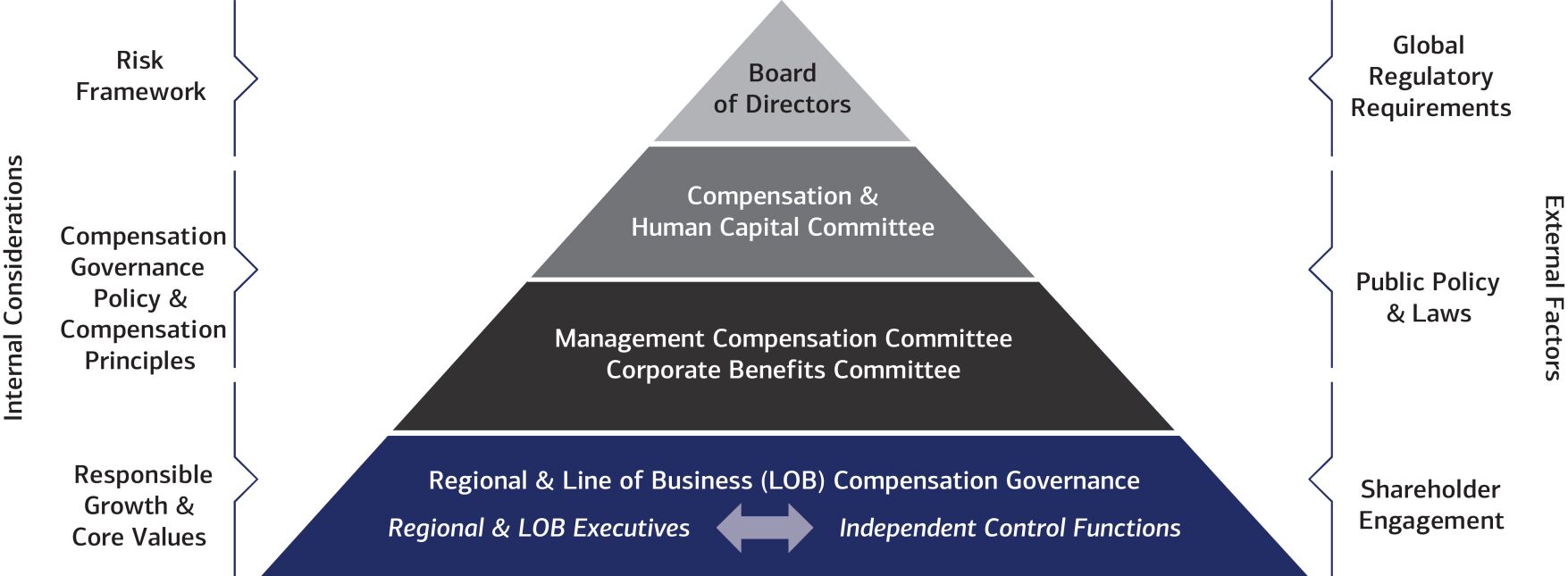
Incentive plan certification process. Pursuant to our Compensation Governance Policy, our annual incentive plan certification and review process provides for a comprehensive review, analysis, and discussion of incentive design and operation. As part of the governance for incentive plans, each of the CEO’s direct reports who is responsible for an incentive plan, along with their management teams and independent control functions (including their respective risk officers), meet periodically to discuss how business strategy, performance, and risk align to compensation. The relevant participants certify that the incentive programs they review: (i) are aligned with the applicable lines of business and our company’s business strategy and performance objectives; (ii) do not encourage excessive or imprudent risk-taking beyond our company’s ability to effectively identify and manage risk; (iii) are compatible with effective controls and risk management; and (iv) do not incentivize impermissible proprietary trading. Our Chief Risk Officer also certifies all incentive plans across our company as part of the Management Compensation Committee’s governance process. Semler Brossy and the Compensation and Human Capital Committee review these management certifications.
| 32 |
Bank of America |
Corporate governance |
2026 Proxy Statement |
33 |
| Shareholder engagement |
Shareholder engagement
Conversations with shareholders inform and contribute to the achievement of governance objectives
Our Corporate Governance Guidelines and Corporate Governance Committee’s charter codify our Board’s commitment to shareholder engagement. We value the views and input of our shareholders. Input received from our engagement with shareholders is critical to how we drive progress in our corporate governance practices, executive compensation program, and Responsible Growth. Our Board-driven engagement process complements Responsible Growth and guides us in achieving our strategic objectives, creating long-term shareholder value.

|
|

|

| |||||||||||||||
|
DELIBERATE, ASSESS & PREPARE |
OUTREACH & ENGAGE |
RESPOND |
EVALUATE | |||||||||||||||
|
____________
Our Board assesses and monitors investor sentiments, shareholder voting results, and trends in governance, executive compensation, human capital management, and sustainability matters. It then identifies and prioritizes potential topics for shareholder engagement. |
____________
Our independent directors and executive management regularly meet with shareholders to actively solicit input on a range of issues, and report shareholder views to our Board. Our management also engages with investors at conferences and other forums. A two-way dialogue is maintained to clarify and deepen our Board’s understanding of shareholder views and provide shareholders with insight into our Board’s processes.
|
____________
Our Board responds, as appropriate, through continued discussion with shareholders and enhancements to our policies, practices, and disclosures. |
____________
Conversations with shareholders inform our Board’s ongoing process of continually enhancing governance and other practices. Our Board and executive management review shareholder input to identify consistent themes, and research and evaluate any identified issues or concerns. | |||||||||||||||
2025 shareholder engagement initiatives
In addition to the year-round routine engagement conducted by our Investor Relations team, with participation by our Chair and CEO, Chief Financial Officer and other line of business leaders, we continued to proactively reach out to key stakeholders and shareholders and invite them to provide input on corporate governance, executive compensation, and other topics of interest to them. Through these engagements, we discussed shareholders’ views on the Board’s composition and ongoing commitment to orderly, thoughtful director succession planning. We also discussed shareholders’ views on the Board’s oversight of the company’s talent and management succession planning practices, executive compensation program, progress on sustainability matters, and the current regulatory environment among other topics.
Once again, our Board’s Lead Independent Director, Mr. Nowell, played a leading role in the shareholder engagement process and joined senior management on a majority of our shareholder engagement meetings, actively participating and seeking input from shareholders on topics of interest. Our Compensation and Human Capital Committee Chair, Ms. Lozano, also participated in numerous shareholder engagements. Mr. Nowell and Ms. Lozano regularly shared insights from these meetings directly with the Board and its committees.
| 34 |
Bank of America |
| Shareholder engagement |
| OUTREACH(1)
During 2025, we reached out to 74 shareholders, representing
~67%
of institutionally held shares _________________
ENGAGEMENT
We held 52 meetings with 31 shareholders, representing
~45%
of institutionally held shares
_________________
INDEPENDENT DIRECTOR PARTICIPATION
Mr. Nowell and Ms. Lozano played a leading role in the shareholder engagement process and one or both of them participated in 39 meetings with shareholders, representing
~42%
of institutionally held shares |
We continued to refine our shareholder engagement process to connect shareholders and key stakeholders with our Lead Independent Director, other independent directors, and executive management to ascertain their perspectives and discuss topics of interest.
In addition to the engagement efforts described above, in November 2025, we also held an Investor Day, providing shareholders and stakeholders an opportunity to engage with senior management on company strategy, operations and long-term priorities.
To further our engagement with all shareholders, including retail and employee shareholders, our dedicated retail shareholder annual meeting webpage provides shareholders with a platform to easily access information about our annual meeting, our director nominees, and the matters for shareholder vote.
Input from shareholders
Our ongoing dialogue with shareholders over the past decade has led to enhancements to our corporate governance, sustainability, and executive compensation practices that our Board believes are in the best interests of the company and our shareholders.
In meetings held during 2025, shareholders provided valuable insights regarding our corporate governance, sustainability, and executive compensation practices. We also spoke with shareholders about matters related to the proposals voted on at our 2025 annual meeting. Among other things, shareholders:
• are supportive of our approach to Board leadership, independent oversight, composition, and refreshment, including our deliberate process for director succession planning
• appreciate the efforts that Mr. Nowell and Ms. Lozano have taken to meet with them and the opportunity to hear directly from them on the Board’s priorities
• appreciate the responsiveness to shareholders on executive compensation, including the enhancements previously disclosed in our proxy statement to provide more transparency on the pay decision process
• support the changes previously made to our compensation peer group to better reflect our industry, size, and business characteristics
• appreciate the opportunity to engage on Board oversight of emerging technologies, including artificial intelligence, the current regulatory landscape, and other topics of interest
• appreciate the breadth and depth of our disclosures on how we seek to drive Responsible Growth, including through our Sustainability at Bank of America document
• are supportive of the Board’s position against shareholder proposals at the 2025 annual meeting
• are supportive of the Board maintaining flexibility and judgment to determine the most appropriate Board leadership structure depending on the facts and circumstances
| |
|
(1) Information based on stock ownership as of December 2025 and additional analysis. | ||
| 2026 Proxy Statement |
35 |
| Related person and certain other transactions |
Related person and certain other transactions
The related person transactions policy in our Corporate Governance Guidelines sets forth our policies and procedures for reviewing and approving or ratifying any transaction with related persons (directors, director nominees, executive officers, shareholders holding more than 5% of our voting securities, or any of their immediate family members or affiliated entities). Our policy covers any transactions where the aggregate amount involved will or may be expected to exceed $120,000 in any fiscal year, our company is a participant, and a related person has or will have a direct or indirect material interest.
Under our related person transactions policy, our Corporate Governance Committee must approve or ratify any related person transactions, and when doing so, consider: the related person’s interest in the transaction; whether the transaction involves arm’s-length bids or market prices and terms; the transaction’s materiality to each party; the availability of the product or services through other sources; the implications of our Code of Conduct or reputational risk; whether the transaction would impair a director’s or executive officer’s judgment to act in our company’s best interest; the transaction’s acceptability to our regulators; and in the case of an independent director, whether the transaction would impair his or her independence or status as an “outside” or “non-employee” director.
Our Board has determined that certain types of transactions do not create or involve a direct or indirect material interest on the part of the related person and therefore do not require review or approval under the policy. These include transactions involving financial services, including: loans and brokerage; banking, insurance, investment advisory, or asset management services; and other financial services we provide to any related person, if the services are provided in the ordinary course of business, on substantially the same terms as those prevailing at the time for comparable services provided to non-affiliates, and comply with applicable law, including the Sarbanes-Oxley Act of 2002 and Federal Reserve Board Regulation O.
A number of our directors, director nominees, and executive officers, their family members, and certain business organizations associated with them are or have been clients of our banking subsidiaries. All extensions of credit to these persons have been made in the ordinary course of business on substantially the same terms, including interest rates and collateral, as those prevailing at the time in comparable transactions with persons not related to our company and did not involve more than the normal risk of collectability.
Occasionally, we may have employees who are Immediate Family Members of our executive officers, directors, or director nominees. The son of Mr. D. Steve Boland, who retired from his role as an executive officer in 2025, and the brother of Dr. Zuber, a director and a nominee, are employed by the company in non-executive positions that do not involve company-wide policy or strategy decision making. They received compensation in 2025 of approximately $230,000 and $560,000, respectively. Dr. Zuber’s brother’s compensation is primarily commissions based. The methodology through which his compensation is calculated is consistent with that used for other financial advisors in similar roles. The compensation and other terms of employment of both Mr. Boland’s son and Dr. Zuber’s brother are determined on a basis consistent with the company’s human resources policies; neither Mr. Boland nor Dr. Zuber has a role in setting their compensation, their performance evaluations, or any other aspects of their employment.
Our company and Mr. Moynihan are parties to an aircraft time-sharing agreement, as disclosed in prior proxy statements and approved by our Corporate Governance Committee in December 2010. In addition, the company and each of our executive officers have entered into nonexclusive aircraft time-sharing agreements. These agreements provide a means under Federal Aviation Administration regulations for our executive officers to reimburse the company for incremental costs of permitted personal travel on our company’s aircraft. To the extent such aircraft usage exceeds the dollar threshold in our related person transactions policy, it will be reviewed for approval or ratification by our Corporate Governance Committee.
Based on information contained in separate Schedule 13G filings with the SEC, each of Warren E. Buffett/Berkshire Hathaway Inc. (Berkshire Hathaway), BlackRock, Inc. (BlackRock), and The Vanguard Group (Vanguard) reported that it beneficially owned more than 5% of the outstanding shares of our common stock as of December 31, 2025 (see “Stock ownership of directors, executive officers, and certain beneficial owners” on the next page). In the ordinary course of our business during 2025, our subsidiaries provided and are expected to continue to provide financial advisory, sales and trading, treasury, and other financial or administrative services to Berkshire Hathaway, BlackRock, and Vanguard and their subsidiaries.
These and other routine business transactions between the companies were entered into on an arm’s-length basis and contain customary terms and conditions. Our company and its subsidiaries may also, in the ordinary course, invest in BlackRock or Vanguard funds or other products or buy or sell assets to or from BlackRock or Vanguard funds and separate accounts.
| 36 |
Bank of America |
| Stock ownership of directors, executive officers, and certain beneficial owners |
Stock ownership of directors, executive officers, and certain beneficial owners
The following table shows the number of shares of our common stock beneficially owned as of March 13, 2026 (except to the extent indicated otherwise in the footnotes below) by: (i) each director; (ii) each named executive officer; (iii) all directors and executive officers as a group; and (iv) beneficial owners of more than 5% of any class of our voting securities (as determined under SEC rules). As of that date, none of our directors and executive officers owned any shares of any class of our voting securities or other preferred stock, other than as reported in the table below, or had any outstanding options or warrants for such shares. Each director, each named executive officer, and all directors and current executive officers as a group beneficially owned less than 1% of our outstanding common stock or other preferred stock. Unless otherwise noted, all shares of our common stock are subject to the sole voting and investment power of the directors and executive officers. The table below also contains information about other stock units that are not deemed beneficially owned under SEC rules.
|
|
Other stock units |
| ||||||||||||||||||
| Name |
Common stock beneficially owned |
Deferred director stock awards(1) |
Unvested restricted stock units(2) |
Total | ||||||||||||||||
| Directors |
||||||||||||||||||||
| Sharon L. Allen(3) |
99,927 | 39,754 | — | 139,681 | ||||||||||||||||
| José (Joe) E. Almeida |
28,241 | — | — | 28,241 | ||||||||||||||||
| Pierre J.P. de Weck |
101,418 | — | — | 101,418 | ||||||||||||||||
| Arnold W. Donald |
125,839 | 7,505 | — | 133,344 | ||||||||||||||||
| Linda P. Hudson |
19,507 | 128,492 | — | 147,999 | ||||||||||||||||
| Monica C. Lozano |
3,387 | 239,554 | — | 242,941 | ||||||||||||||||
| Maria N. Martinez(4) |
9,084 | — | — | 9,084 | ||||||||||||||||
| Lionel L. Nowell III |
3,930 | 191,734 | — | 195,664 | ||||||||||||||||
| Denise L. Ramos |
— | 78,838 | — | 78,838 | ||||||||||||||||
| Clayton S. Rose(5) |
25,515 | 68,530 | — | 94,045 | ||||||||||||||||
| Michael D. White(6) |
85,650 | 97,993 | — | 183,643 | ||||||||||||||||
| Thomas D. Woods(7) |
122,397 | — | — | 122,397 | ||||||||||||||||
| Maria T. Zuber |
67,740 | — | — | 67,740 | ||||||||||||||||
| Named Executive Officers |
||||||||||||||||||||
| Brian T. Moynihan(8) |
2,803,195 | — | 1,724,434 | 4,527,629 | ||||||||||||||||
| Alastair M. Borthwick(9) |
363,201 | — | 626,792 | 989,993 | ||||||||||||||||
| Dean C. Athanasia(10) |
558,541 | — | 782,977 | 1,341,518 | ||||||||||||||||
| James P. DeMare(11) |
307,240 | — | 1,140,023 | 1,447,263 | ||||||||||||||||
| Matthew M. Koder |
1,021,009 | — | 793,205 | 1,814,214 | ||||||||||||||||
| All directors and current executive officers as a group (25 persons)(12) |
9,523,597 | 852,400 | 8,587,594 | 18,963,591 | ||||||||||||||||
| Name |
Common stock |
Percent of class | ||||||||
| Certain Beneficial Owners |
||||||||||
| The Vanguard Group(13) |
651,058,822 | 9.1 | % | |||||||
| Warren E. Buffett/Berkshire Hathaway Inc.(14) |
568,070,012 | 7.9 | % | |||||||
| BlackRock, Inc.(15) |
494,523,426 | 6.9 | % | |||||||
| (1) | For non-management directors, includes stock units credited to their accounts pursuant to deferrals made under the terms of the Director Deferral Plan (DDP). These stock units do not have voting rights and are not considered beneficially owned under SEC rules. Each unit has a value equal to the fair market value of a share of our common stock. These units, which are held in individual accounts in each director’s name, will be paid in cash upon the director’s retirement if vested at that time. |
| 2026 Proxy Statement |
37 |
| Stock ownership of directors, executive officers, and certain beneficial owners |
| (2) | Includes the following stock units, which are not treated as beneficially owned under SEC rules because the holder does not have the right to acquire the underlying stock within 60 days of March 13, 2026 and/or the stock units will be paid in cash and therefore do not represent the right to acquire stock: |
| Name |
Time-based RSUs (TRSUs) |
Cash-settled RSUs (CRSUs) |
Performance RSUs (PRSUs) |
Total stock Units | ||||||||||||||||
| Brian T. Moynihan |
374,295 | 216,994 | 1,133,145 | 1,724,434 | ||||||||||||||||
| Alastair M. Borthwick |
280,776 | — | 346,016 | 626,792 | ||||||||||||||||
| Dean C. Athanasia |
353,490 | — | 429,487 | 782,977 | ||||||||||||||||
| James P. DeMare |
550,234 | — | 589,789 | 1,140,023 | ||||||||||||||||
| Matthew M. Koder |
353,343 | — | 439,862 | 793,205 | ||||||||||||||||
| All current executive officers as a group |
|
3,918,252 |
|
|
216,994 |
|
|
4,452,348 |
|
|
8,587,594 |
| ||||||||
Each stock unit has a value equal to the fair market value of a share of our common stock, but does not confer voting rights. TRSUs will be settled in shares of our common stock or cash at vesting or, in certain circumstances, after termination of employment, and may include the right to receive dividend equivalents. CRSUs do not include the right to receive dividend equivalents and will be paid in cash. PRSUs include the right to receive dividend equivalents and vest subject to attaining pre-established performance goals. To the extent earned, PRSUs will be settled 100% in shares of our common stock. For unearned PRSUs, the stock units shown include the number of PRSUs granted assuming 100% of the award will be earned; however, the actual number of stock units earned may vary depending upon achieving performance goals. Because they are economically comparable to owning shares of our common stock, certain of these stock units currently qualify for purposes of compliance with our stock ownership and retention requirements; PRSUs qualify only when earned. The reported stock units do not include any stock units held in the Bank of America Deferred Compensation Plan (formerly known as the Bank of America 401(k) Restoration Plan).
| (3) | Includes 1,000 shares of our common stock for which Ms. Allen shares voting and investment power with her spouse. |
| (4) | Includes 465 shares of our common stock for which Ms. Martinez shares voting and investment power with her account manager. |
| (5) | Includes 25,515 shares of our common stock for which Dr. Rose shares voting and investment power with his spouse. |
| (6) | Includes 77,000 shares of our common stock for which Mr. White shares voting and investment power with his spouse. |
| (7) | Includes 50,003 shares of our common stock for which Mr. Woods shares voting and investment power with his spouse and 25,000 of our shares of common stock for which Mr. Woods shares investment power with his spouse. |
| (8) | Includes 38,376 shares of our common stock for which Mr. Moynihan shares voting and investment power with his spouse. |
| (9) | Includes 363,201 shares of our common stock for which Mr. Borthwick shares voting and investment power with his spouse. |
| (10) | Includes 558,541 shares of our common stock for which Mr. Athanasia shares voting and investment power with his spouse. |
| (11) | Includes 307,240 shares of our common stock for which Mr. DeMare shares voting and investment power with his spouse. |
| (12) | Such persons have sole voting and investment power over 5,947,812 shares of our common stock and shared voting and investment power over 3,575,785 shares of our common stock. Also, as of March 13, 2026, an executive officer held 40,000 depositary shares of Non-Cumulative Preferred Stock, Series LL and 60,000 depositary shares of Non-Cumulative Preferred Stock, Series NN, with each depositary share representing a 1/1,000th interest in a share of such preferred stock. |
| (13) | Consists of common stock held by The Vanguard Group, 100 Vanguard Blvd., Malvern, PA 19355. According to a Schedule 13G/A filed with the SEC on January 30, 2026, The Vanguard Group had shared voting power with respect to 65,352,937 shares, and shared investment power with respect to 651,058,822 shares. |
| (14) | Consists of common stock held indirectly by Warren E. Buffett, Omaha, NE 68131 and Berkshire Hathaway Inc., 3555 Farnam St., Omaha, NE 68131 According to a Schedule 13G/A filed with the SEC on November 14, 2025, Mr. Buffett and Berkshire Hathaway Inc. had shared voting and investment power with respect to all 568,070,012 shares. National Indemnity Company, a subsidiary of Berkshire Hathaway Inc., had shared voting and investment power with respect to all 450,665,500 shares, representing 6.3% of our common stock. Information about other entities deemed to share beneficial ownership of the shares, including their voting and investment power, is disclosed in the Schedule 13G/A. |
| (15) | Consists of common stock held by BlackRock, Inc., 50 Hudson Yards, New York, NY 10001. According to a Schedule 13G/A filed with the SEC on January 29, 2024, BlackRock, Inc. had sole voting power with respect to 445,519,442 shares and sole investment power with respect to 494,523,426 shares. |
Delinquent Section 16(a) Reports
Section 16(a) of the Securities Exchange Act of 1934 (Exchange Act) requires our directors, executive officers, and anyone holding more than 10% of a registered class of our equity securities (reporting persons) to file reports with the SEC showing their holdings of, and transactions in, these securities. Based on a review of copies of such reports and written representations that no other reports are required, we believe that all reporting persons filed the required reports on a timely basis under Section 16(a) for 2025, except that one late Form 3 was filed for Ms. Martinez to correct her ownership disclosures in a previously filed Form 3 to report ownership of an additional 465 shares of the company’s common stock.
| 38 |
Bank of America |
| Director compensation |
Director compensation
Our director compensation philosophy is to appropriately compensate our non-management directors for the time, expertise, and effort required to serve as a director of a large, complex, and highly regulated global company, and to align the interests of directors and long-term shareholders.
Annual payments are made after the directors are elected by shareholders. Directors who begin their Board or committee chair service other than at the annual meeting of shareholders receive a prorated amount of annual compensation. Mr. Moynihan receives no compensation for his services as a management director.
2025 Director pay components
The primary elements of 2025 annual compensation and incremental awards for our non-management directors, all of whom are independent, are provided in the table below. Incremental awards recognize additional responsibilities and the time commitment of these critical Board leadership roles.
| Incremental awards for Board leadership | |||||||||||||||
| Annual award components |
Non- ($) |
Lead ($) |
Committee ($) | ||||||||||||
| Cash Award |
130,000 | 75,000 | 50,000 | ||||||||||||
| Restricted Stock Award |
280,000 | 175,000 | N/A | ||||||||||||
The annual restricted stock award in 2025 was made pursuant to the Bank of America Corporation Equity Plan (BACEP). The number of restricted shares awarded is equal to the dollar value of the award divided by the closing price of our common stock on the NYSE on the grant date, rounded down to the next whole share, with cash paid for any fractional share. The annual restricted stock award is subject to a one-year vesting requirement. Dividends accrue during the one-year vesting period and are paid when the award vests. If a director retires before the one-year vesting date, a prorated amount of the award vests based on the number of days the director served during the vesting period before retirement and any unvested amount of the award is forfeited.
Director compensation review
Our Compensation and Human Capital Committee annually reviews and periodically recommends updates to the director compensation program to our Board for approval. The Committee’s recommendation takes into account our director compensation philosophy, changes in market practices, and consultation with the Committee’s independent compensation consultant, Semler Brossy.
As disclosed in our 2025 proxy statement, following the Committee’s 2024 review, our Board approved: (i) for all non-management directors, a $10,000 annual cash award increase to $130,000 and a $10,000 annual restricted stock award increase to $280,000; (ii) for our Lead Independent Director, a $50,000 incremental annual restricted stock award increase to $175,000; and (iii) for our committee chairs, a $10,000 incremental annual cash award increase for our Audit & Enterprise Risk Committee chairs and a $20,000 incremental annual cash award increase for our Compensation and Human Capital & Corporate Governance Committee chairs, bringing all committee chair annual cash awards to $50,000. These changes took effect as of our 2025 annual meeting of shareholders and were payable to our director nominees who were successfully elected at that meeting. These changes are reflected in the table above. No changes were made to the form or amount of director compensation as part of the Committee’s 2025 review.
Director compensation limit
Effective April 22, 2025, the BACEP limits the maximum number of shares that may be awarded to a non-management director in a calendar year, together with any cash fees paid to that director, to $1 million in total value, with certain exceptions described in the BACEP.
Director deferral plan
Non-management directors may elect to defer all or a portion of their annual restricted stock or cash awards through the Bank of America Corporation Director Deferral Plan (Director Deferral Plan). When directors elect to defer their restricted stock award, their stock account is credited with stock units equal in value to the restricted stock award and subject to the same vesting requirement applicable to restricted stock awards granted to directors. Each stock unit is equal in value to a share of our common stock, but because it is not an actual share of our common stock, it does not have any voting rights. When directors elect to defer their cash award, they may choose to defer into either a stock
| 2026 Proxy Statement |
39 |
| Director compensation |
account or a cash account. Deferrals into a stock account are credited with dividend equivalents in the form of additional stock units, and deferrals into the cash account are credited with interest at a long-term U.S. Treasury bond rate. Following retirement from our Board and depending on the director’s selection, a non-management director may receive the stock account balance (to the extent vested) and cash account balance in a single lump-sum cash payment or in a series of cash installment payments.
Stock retention requirements and hedging prohibition for directors
| • | Under our stock retention requirements, non-management directors are required to hold and cannot sell the restricted stock they receive as compensation (except as necessary to pay taxes on taxable events such as vesting) until termination of their service. All non-management directors are in compliance with these requirements. |
| • | Our Code of Conduct prohibits our directors from hedging and speculative trading of company securities. |
| • | The BACEP prohibits our directors from pledging equity-based awards, including restricted stock awards. |
| • | See “Hedging policy” on page 33 for additional information about our hedging prohibition rules. |
2025 Director compensation
The following table shows the compensation paid for services in 2025 to our non-management directors, all of whom are independent:
| Director |
Fees earned or paid in cash ($)(1) |
Stock awards ($)(2) |
All other compensation ($)(3) |
Total ($) | ||||||||||||||||
| Sharon L. Allen |
180,000 | 280,000 | 5,000 | 465,000 | ||||||||||||||||
| José (Joe) E. Almeida |
130,000 | 280,000 | 0 | 410,000 | ||||||||||||||||
| Pierre J.P. de Weck |
130,000 | 280,000 | 326,056 | 736,056 | ||||||||||||||||
| Arnold W. Donald |
130,000 | 280,000 | 0 | 410,000 | ||||||||||||||||
| Linda P. Hudson |
130,000 | 280,000 | 0 | 410,000 | ||||||||||||||||
| Monica C. Lozano |
180,000 | 280,000 | 4,963 | 464,963 | ||||||||||||||||
| Maria N. Martinez(4) |
157,288 | 341,398 | 0 | 498,686 | ||||||||||||||||
| Lionel L. Nowell III |
205,000 | 455,000 | 0 | 660,000 | ||||||||||||||||
| Denise L. Ramos |
130,000 | 280,000 | 0 | 410,000 | ||||||||||||||||
| Clayton S. Rose |
180,000 | 280,000 | 0 | 460,000 | ||||||||||||||||
| Michael D. White |
180,000 | 280,000 | 0 | 460,000 | ||||||||||||||||
| Thomas D. Woods |
130,000 | 280,000 | 291,753 | 701,753 | ||||||||||||||||
| Maria T. Zuber |
130,000 | 280,000 | 0 | 410,000 | ||||||||||||||||
| (1) | The amounts in this column represent the annual cash award plus any Lead Independent Director or committee chair cash retainers paid in 2025, including amounts deferred under the Director Deferral Plan. |
| For 2025, no directors deferred cash awards into the stock account under the Director Deferral Plan. |
| 40 |
Bank of America |
| Director compensation |
| (2) | The amounts in this column represent the aggregate grant date fair value of restricted stock awards granted during 2025, whether or not those awards were deferred under the Director Deferral Plan. The grant date fair value is based on the closing price of our common stock on the NYSE on the grant date. As of December 31, 2025, our non-management directors held the number of unvested shares of restricted stock or, if deferred, unvested stock units shown in the table below: |
| Director |
Unvested shares of restricted stock or stock units (#) | ||||
| Sharon L. Allen |
|
7,307 |
|||
| José (Joe) E. Almeida |
|
7,306 |
|||
| Pierre J.P. de Weck |
|
7,306 |
|||
| Arnold W. Donald |
|
7,306 |
|||
| Linda P. Hudson |
|
7,307 |
|||
| Monica C. Lozano |
|
7,307 |
|||
| Maria N. Martinez |
|
7,306 |
|||
| Lionel L. Nowell III |
|
11,874 |
|||
| Denise L. Ramos |
|
7,307 |
|||
| Clayton S. Rose |
|
7,307 |
|||
| Michael D. White |
|
7,307 |
|||
| Thomas D. Woods |
|
3,937 |
|||
| Maria T. Zuber |
|
7,306 |
|||
| (3) | Our directors are eligible to participate in our matching gifts program, under which our charitable foundation matches up to $5,000 in donations made annually by our employees and active directors to approved charitable organizations. Eligibility for matching gifts is based on the year the charitable donation was made by the director although the match may be completed in a subsequent year. This program is also available to all U.S.-based, benefits-eligible employees. The values in this column reflect the amounts that were donated to charities in 2025 on behalf of directors under the matching gifts program. The following director match donations were made in 2025: Ms. Allen, $5,000; Ms. Lozano, $4,963. |
| Mr. de Weck is chair of the board of directors of Merrill Lynch International (MLI), a United Kingdom broker-dealer subsidiary of Bank of America. For his services as a non-management director of MLI and chair of the board of directors of MLI, Mr. de Weck received an annual cash retainer totaling £141,250. Mr. de Weck is also a member of the board of directors of BofA Securities Europe S.A. (BofASE), a French broker-dealer subsidiary of Bank of America, and served as chair of the board of directors of BofASE through July 31, 2025. For his services as a member and partial year chair of the board of directors of BofASE, Mr. de Weck received an annual cash retainer totaling €126,667. The retainers paid in 2025 are reported in the table above based on a weighted average exchange rate of approximately 0.76 pounds sterling to one dollar for his MLI service and approximately 0.90 euros to one dollar for his BofASE service. The exchange rate used for each payment was based on the average exchange rate for the month prior to the month of payment. |
| Mr. Woods is a member of the board of directors of MLI and chair of the MLI board risk committee. For his services as a non-management director of MLI and chair of the MLI board risk committee, Mr. Woods received an annual cash retainer totaling £116,250. In addition, Mr. Woods is also a member of the board of directors of BofASE and was appointed as chair of the board of directors of BofASE, effective August 1, 2025. For his services as a member and partial year chair of the board of directors of BofASE, Mr. Woods received an annual cash retainer totaling €123,333. The retainers paid in 2025 are reported in the table above based on a weighted average exchange rate of approximately 0.76 pounds sterling to one dollar for his MLI service and approximately 0.90 euros to one dollar for his BofASE service. The exchange rate used for each payment was based on the average exchange rate for the month prior to the month of payment. |
| Effective October 1, 2025, subsidiary board annual retainers were increased to €120,000 for service on the BofASE board (plus €70,000 for the board chair) and £100,000 for service on the MLI board (plus £60,000 for the board chair or £35,000 for a committee chair). These increases reflect the growing regulatory complexity, heightened accountability, and additional time commitments required to serve on these boards and were informed by market pay practice and benchmark data. |
| MLI and BofASE are both subject to extensive foreign regulatory requirements. In light of the regulated status of these subsidiaries and Mr. de Weck’s and Mr. Woods’ responsibilities on these boards of directors for these entities, we believe the annual cash retainers paid to Mr. de Weck and Mr. Woods are commensurate with their roles and responsibilities. |
| This column excludes the perquisites received by a director to the extent the total value of such perquisites was less than $10,000 in aggregate, as permitted under SEC rules. |
| (4) | Ms. Martinez was appointed to the Board on January 29, 2025, and received prorated compensation for her service through the 2025 annual meeting, consisting of $27,288 in cash and a prorated equity award of 1,313 shares of company restricted stock valued at $61,398. These amounts are reflected in the table above in addition to the standard $130,000 non-management director cash retainer and $280,000 in company restricted stock she received for service beginning after the 2025 annual meeting. |
| 2026 Proxy Statement |
41 |
| Proposal 2: Approving our executive compensation (an advisory, non-binding “Say on Pay” resolution) |
Proposal 2: Approving our executive compensation
(an advisory, non-binding “Say on Pay” resolution)
We are seeking an advisory vote to approve our executive compensation for 2025. At our 2023 annual meeting of shareholders, a majority of shareholders voted to have a “Say on Pay” vote each year. As a result, we will conduct an advisory vote on executive compensation annually at least until the next shareholder advisory vote on the frequency of such votes.
Although the “Say on Pay” vote is advisory and is not binding on our Board, our Compensation and Human Capital Committee will take into consideration the outcome of the vote when making future executive compensation decisions. At the 2025 annual meeting, 73.6% of the votes cast favored our “Say on Pay” proposal. The Committee considered this result and input from investors during our shareholder engagement process—which indicated strong support for our underlying approach to executive compensation and disclosure enhancements in recent years—leading the Committee to maintain a generally consistent approach for compensating named executive officers for 2025 full year performance.
Our Board has designed our current executive compensation program to appropriately link compensation realized by our executive officers to our performance and properly align the interests of our executive officers with those of our shareholders. The details of this compensation for 2025, and the reasons we awarded it, are described in “Compensation discussion and analysis,” starting below.
|
|
Our Board recommends a vote “FOR” approving our executive compensation (an advisory, non-binding “Say on Pay” resolution) (Proposal 2). | |
Our Board recommends that our shareholders vote in favor of the following resolution:
“Resolved, that our shareholders approve, on an advisory basis, the compensation of our company’s named executive officers, as disclosed pursuant to the compensation disclosure rules of the U.S. Securities and Exchange Commission, including the compensation discussion and analysis, the compensation tables, and the accompanying narrative discussion disclosed in this proxy statement.”
Compensation discussion and analysis
| 5. Executive compensation program features | 54 | ||||
| 54 | |||||
| 55 | |||||
| 56 | |||||
| 6. Other compensation topics | 58 | ||||
| 58 | |||||
| 59 | |||||
| 59 | |||||
| d. Health and welfare benefits, perquisites & executive security |
59 | ||||
| 60 | |||||
| 42 |
Bank of America |
| Compensation discussion and analysis |
1. Executive summary
a. Shareholder engagement & “Say on Pay” responsiveness
Robust shareholder engagement. We value the views and input of our shareholders. Shareholder input from engagement discussions is critical to how we drive progress in our corporate governance practices, including our executive compensation program. Generally, we engage with our shareholders year-round through targeted, active outreach and responsiveness to inbound inquiries.
During 2025, we reached out to 74 institutional shareholders, representing approximately 67% of institutionally held shares,(1) and held a total of 52 meetings with 31 shareholders. We also engaged with the two largest U.S. proxy advisory firms.
Our Lead Independent Director, Mr. Nowell, played a central role in these discussions and our Compensation and Human Capital Committee Chair, Ms. Lozano, participated in engagement meetings when compensation-related topics were anticipated. Mr. Nowell and/or Ms. Lozano actively led 39 of our shareholder engagement meetings, representing approximately 42% of institutionally held shares.
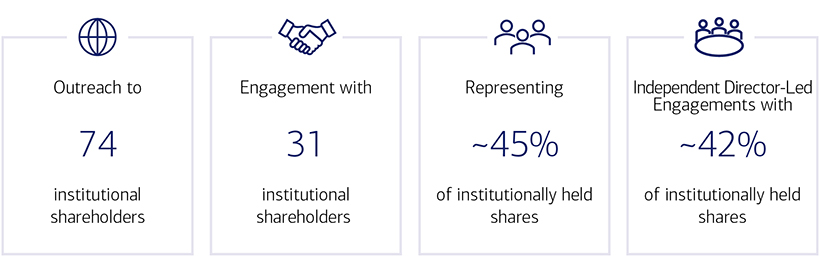
“Say on Pay” responsiveness. At our 2025 annual meeting, of the approximately 5.6 billion votes cast, 73.6% favored our “Say on Pay” proposal. Following our 2025 annual meeting, we continued our long-standing practice of engaging with our shareholders and used these discussions as an opportunity to seek shareholder input and gather perspectives on our compensation program and the enhanced disclosures made in recent years. Overall, investors expressed support for our compensation program and structure, its alignment with the four tenets of Responsible Growth, and the program enhancements implemented in recent years. Shareholder engagement, combined with an assessment of the drivers of the vote outcome, informed our Compensation and Human Capital Committee’s decision to maintain a generally consistent executive compensation design in applying our pay-for-performance philosophy.
The Committee has maintained prior enhancements and introduced new ones, as summarized below:
| • | Enhanced the performance restricted stock units program granted in February 2026 for performance year 2025, reflecting our focus on long-term Responsible Growth and the alignment of pay with successful achievement of growth for shareholders (see page 55): |
| • | Increased the performance standards necessary to achieve 100% payout |
| • | Provided the opportunity to earn up to 150% maximum payout for exceptional future performance |
| • | The increased performance standards and introduction of upside payout opportunity reflect the company’s and Board’s focus on long-term Responsible Growth and the alignment of pay with successful achievement of growth for shareholders, as discussed with our investors during our 2025 Investor Day. |
| • | Continued to provide pay rationale highlights for each named executive officer (NEO), including the CEO, in 2025, along with individual performance highlights to demonstrate the link between performance factors and compensation decisions (see page 50) |
| • | Enhanced disclosure of the performance year compensation table, which now includes five years of performance compensation determinations (see page 53) |
| (1) | Based on stock ownership as of December 2025 and additional analysis. |
| 2026 Proxy Statement |
43 |
| Compensation discussion and analysis |
b. Executive compensation philosophy
Our compensation philosophy is to pay for performance over the long-term, as well as on an annual basis. Our performance considerations include both financial and non-financial measures—including the manner in which results are achieved—for the company, the segment/line of business, and the individual.
The “Performance evaluation and pay decision process” section on page 46 presents the range of performance and governance considerations that the Compensation and Human Capital Committee considers as inputs into compensation decisions. These factors are evaluated each year and have remained generally consistent over time as part of a balanced and disciplined approach to the compensation decision process. Within that broader framework, the “Company performance” and “Segment performance” sections on pages 48 and 49 highlight key company and segment performance considerations for 2025, and the “Individual performance and pay rationale highlights” section beginning on page 50 focuses on performance for each of our NEOs.
As a highly regulated financial institution, the Compensation and Human Capital Committee employs an executive compensation philosophy that balances use of business judgment to promote long-term stability and prudent risk-taking. The use of business judgment remains a crucial part of the Committee’s performance evaluation and talent strategy in our industry, and combined with both quantitative and qualitative considerations, allows the Committee to appropriately account for risk management outcomes and regulatory matters. In accordance with applicable regulatory guidance, the Committee’s use of business judgment is informed by documented factors and feedback from our independent control functions, including Risk and Compliance, as governance mechanisms, to promote consistent decisions. This approach facilitates compensation decisions that do not encourage excessive or imprudent risk-taking, and supports alignment with long-term shareholder value rather than short-term volatility.
These considerations reinforce and promote Responsible Growth and maintain alignment with our Risk Framework. Our executive compensation program provides a mix of salary, incentives, and benefits paid over time to align executive officer and shareholder interests. Our Compensation and Human Capital Committee has the primary responsibility for approving our compensation strategy and philosophy, and the compensation programs applicable to our NEOs listed below. With respect to Mr. Moynihan’s compensation, our Compensation and Human Capital Committee makes a recommendation that is further reviewed and approved by the independent members of the Board.
c. Philosophy on one-time awards
The Compensation and Human Capital Committee believes that one-time awards should be used infrequently and in exceptional circumstances to achieve business objectives beyond that which could be achieved through annual performance year compensation. The Committee has demonstrated its belief in this philosophy through a history of limiting the grant of one-time awards to executive officers. The Compensation and Human Capital Committee did not grant any one-time awards to NEOs in 2025.
| 44 |
Bank of America |
| Compensation discussion and analysis |
d. 2025 Executive compensation highlights
Named executive officers (NEOs)
| Brian T. Moynihan | Chair of the Board and Chief Executive Officer | |
| Alastair M. Borthwick | Executive Vice President and Chief Financial Officer | |
| Dean C. Athanasia | Co-President, Bank of America | |
| James P. DeMare | Co-President, Bank of America | |
| Matthew M. Koder | President, Global Corporate & Investment Banking | |
| • | Our executive compensation design is aligned with our focus on Responsible Growth and has been generally consistent since 2013; it includes: |
| • | a mix of fixed and variable pay, |
| • | cancellation and clawback features in all equity-based incentives, |
| • | the deferral of a majority of variable pay through equity-based incentives, and |
| • | stock ownership and retention requirements. |
| • | See “Executive compensation program features” for additional details on page 54. |
| • | Total compensation awarded to Mr. Moynihan for 2025 is $41.0 million, compared to last year’s total compensation of $35.0 million. |
| • | The pay rationale for Mr. Moynihan’s compensation can be found on page 50. |
| • | 96.3% of Mr. Moynihan’s 2025 awarded total compensation is variable and directly linked to company performance. |
| • | Half of Mr. Moynihan’s 2025 variable pay is awarded as performance restricted stock units. |
| • | 50% of net after-tax shares Mr. Moynihan receives as compensation must be retained until one year after retirement. |
| • | Performance restricted stock units granted for 2025 performance must be earned based on the company’s 2026-2028 financial performance. The Compensation and Human Capital Committee increased the performance standards required for a 100% payout and introduced a 150% maximum payout opportunity for exceptional performance, as detailed on page 55. |
| • | The increased performance standards and introduction of upside payout opportunity reflect the company’s and Board’s focus on long-term Responsible Growth and the alignment of pay with successful achievement of growth for shareholders, as discussed with our investors during our 2025 Investor Day. |
| • | The variable pay mix for NEOs other than the CEO is 70% long-term equity and 30% cash. |
| • | 50% of net after-tax shares received from equity-based awards must be retained until retirement for executive officers other than the CEO |
| • | To determine 2025 compensation for NEOs, the Compensation and Human Capital Committee and Board undertook a robust performance evaluation and decision process, which included a detailed review of performance results under the four tenets of Responsible Growth. Disclosure of this step-by-step performance evaluation and pay decision process is on page 46. |
| • | The performance evaluation considered the “What,” which includes a thorough evaluation of performance against scorecard metrics, and the “How,” which includes the manner in which results, both financial and non-financial, were achieved. |
| • | The Compensation and Human Capital Committee and Board also reviewed market compensation benchmarks, which were considered in relation to the size, scope, complexity, and relative performance of our company and each NEO’s individual role. |
| 2026 Proxy Statement |
45 |
| Compensation discussion and analysis |
2. Performance evaluation and pay decision process
Each year, our Compensation and Human Capital Committee undertakes a structured and disciplined approach to evaluate our NEOs’ performance and determine compensation.

I. Performance Metrics and Scorecards
At the start of each year, goals aligned to the tenets of Responsible Growth are set for each executive officer and progress to meeting those goals is tracked on scorecards. Individual scorecards are tailored to each NEO and include enterprise-wide and line of business metrics. These scorecards and additional performance information are reviewed by the Board over the course of the year and evaluated at the conclusion of each performance year.
In addition to evaluation of the scorecards, the Committee’s compensation decision process includes a robust review of company and line of business performance as well as individual performance for each NEO. The Committee considers both absolute and relative metrics when evaluating performance, including relative rankings for company performance against our peers and market share for relevant business segments. For relative metrics considered in 2025, see the “2025 Company, segment, & individual performance” section on page 48.
Our performance framework for NEOs is aligned to qualitative and quantitative metrics associated with the four tenets of Responsible Growth. Below are examples of key metrics considered under each tenet of Responsible Growth that are tracked and evaluated across company, segment/line of business, and individual performance, as appropriate by role. These metrics are generally consistent from year to year and support the Committee in tracking and evaluating progress over time.
| Responsible Growth: Performance Metrics | ||||||||||||
|
Grow and win in
• Net income
• Revenue
• Total shareholder return
• Return on assets
• Return on tangible common equity
• Tangible book value |
Grow with our
• Customer satisfaction and
• Digital adoption
• Deposit growth
• Loan growth
• New accounts |
Grow within our
• Driving a strong risk management culture
• Asset quality/charge-offs
• Year-over-year |
Grow in a
• Focused sustainability leadership in support of
• Being a Great Place to Work
• Ongoing focus on Operational Excellence
• Supporting our communities | |||||||||
II. Market Pay Practice and Governance
The Committee considers market pay practices and conducts governance practices annually as part of the compensation decision process. Market pay practices considered include:
| • | CEO pay and compensation practices at our primary competitor and leading financial institution peer groups are reviewed at least annually for pay-for-performance analysis and perspectives on the global financial services industry. |
| • | A detailed review of market compensation benchmarks is conducted for our primary competitors for each NEO role. |
| • | Size, scope, and complexity of our company and each NEO’s individual role is considered when reviewing market compensation benchmarks. |
| • | While these detailed reviews provide the Committee with market context, there is no formulaic benchmarking. |
As part of its strong governance practices and over the course of multiple meetings, the Committee considers various inputs into the pay determination process:
| • | The Committee reviews the executive compensation program features to determine pay components, variable pay mix, standards for performance restricted stock units, and compensation risk management features. See “Executive compensation program features” on page 54. |
| • | The Committee reviews performance metrics and scorecards for the CEO and each NEO. The CEO also provides perspective on performance and pay for our other NEOs. |
| • | Performance achievement aligned with Responsible Growth will generally result in pay that is expected to be in line with primary competitors. |
| • | The Committee’s independent compensation consultant, Semler Brossy, provides perspectives on company performance, governance, and market pay practices for our NEOs as an input into the Committee’s and the Board’s compensation decisions. |
| 46 |
Bank of America |
| Compensation discussion and analysis |
| • | The Committee reviews feedback from our independent control functions (i.e., Corporate Audit, Risk and Compliance, Finance, Chief People Organization, Legal). |
| • | The Chief Financial Officer and Chief Risk Officer review full-year financial and risk performance with the Committee. |
| • | The Committee considers shareholder perspectives on compensation design, including a review of prior years’ “Say on Pay” results. |
III. Evaluation and Pay Decisions
Evaluation and pay decisions begin with a robust and detailed review of performance results aligned with the four tenets of Responsible Growth. The evaluation considers the “What,” which includes an evaluation of performance against scorecard metrics, and the “How,” which includes the manner in which results, both financial and non-financial, were achieved. Metrics are reviewed on an absolute basis against the scorecard and key metrics are also reviewed on a relative basis against primary competitors. This metric-driven evaluation drives the preliminary pay discussion.
After the Committee has completed its robust and metric-driven performance evaluation to determine preliminary pay, the Committee weighs additional considerations such as market and governance practices, scope of role, experience, and prior year compensation to help inform the final total compensation determination. The Committee believes its use of business judgment and discretion, structured within the framework and governance of the tenets of Responsible Growth, is in the best interests of our shareholders, customers and clients, employees, and the communities we serve. This enables the Committee to appropriately respond to the complexities of internal and external factors when determining performance year compensation, including the complexity of operating a business the size of Bank of America and the regulatory framework in which the company operates.
Compensation decisions are generally determined on a year-over-year basis without preset target levels of total compensation. Once performance year total compensation is determined for each NEO, the Committee applies the variable pay mix, which includes a majority of pay to be delivered over the long-term and subject to risk management features. See “Executive compensation program features” and “Compensation risk management features” on pages 54 and 56, respectively.
The Committee’s performance year total compensation recommendations are then subject to a multi-step review and approval process outlined below.
IV. Approval
During the final stage of the pay decision process, the Committee engages in a multi-step review and approval process involving our independent Board members and other Board committees.
| • | The Committee approves compensation for all NEOs, excluding the CEO. |
| • | For our Chief Risk Officer and Chief Audit Executive, the Committee’s pay recommendations are further reviewed and approved by our Board’s Enterprise Risk Committee and Audit Committee, respectively. |
| • | For the CEO, the Committee’s pay recommendations are further reviewed and approved by the independent members of our Board. |
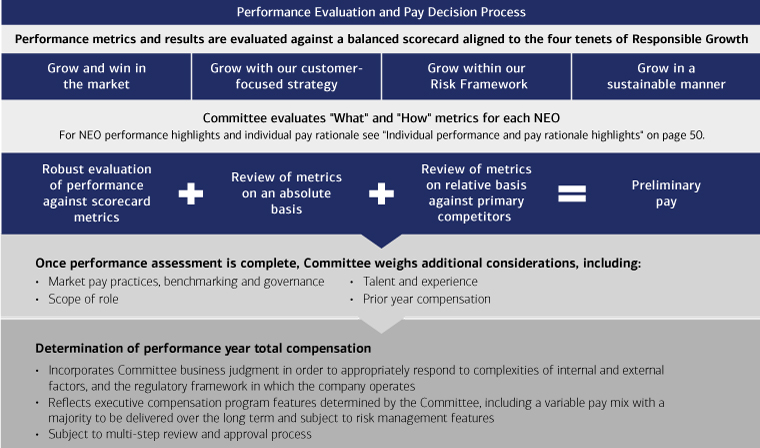
| 2026 Proxy Statement |
47 |
| Compensation discussion and analysis |
3. 2025 Company, segment, & individual performance
a. Company performance(1)
The following are financial highlights and key measures of company and line of business performance achieved in 2025. Our Compensation and Human Capital Committee and Board considered these metrics in evaluating the 2025 performance of our NEOs. In 2025, we delivered strong earnings growth and higher returns on equity with net income of more than $30 billion and diluted earnings per share (EPS) growth of 19% compared to 2024. These results reflected strong organic growth, operating leverage, and a 41% increase in the amount of capital returned to shareholders through common stock repurchases and dividends. We maintained our focus on Responsible Growth aided by our diverse operating model and risk management focus amid an evolving operating environment. See the “Performance evaluation and pay decision process” section on page 46 for more details on factors used in compensation decisions.

• Net income of $30.5 billion, or $3.81 diluted EPS, compared to $27.0 billion, $3.19 per diluted share in 2024. The increase in net income was primarily due to higher net interest income and noninterest income, and lower provision for credit losses, partially offset by higher noninterest expense.
• Revenue of $113.1 billion was up 7% driven by record net interest income of $60.1 billion and strong fee income reflecting organic growth across our business segments including record sales and trading revenue, double-digit growth in asset management fees, and higher investment banking fees.
• Noninterest expense of $69.7 billion, increased 4% compared to 2024; increase was primarily driven by continued investments in the business, including people, technology, and marketing, as well as higher revenue-related expenses, partially offset by lower Federal Deposit Insurance Corporation (FDIC) special assessment expense in 2025. Generated approximately 250 bps of operating leverage.(2)
• Provision for credit losses decreased $146 million to $5.7 billion in 2025 compared to 2024.
• Net charge-offs of $5.6 billion decreased from 2024, primarily driven by asset quality improvement in commercial real estate office.
• Deposits increased by $53.3 billion, or 3%, to $2.02 trillion, primarily driven by growth in commercial client balances.
• Loans increased by $89.9 billion, or 8%, to $1.19 trillion primarily driven by growth in commercial loans and a residential mortgage loan portfolio acquisition in the first quarter of 2025.
• Book value per share increased 8% to $38.44 in 2025.
• Return on average assets (ROA) of 0.89%, return on average common shareholders’ equity of 10.59%, and return on average tangible common shareholders’ equity of 14.22%.(3)
• $29.5 billion returned to shareholders in common stock repurchases and dividends representing a 41% increase from 2024.
• Common equity tier 1 capital ratio of 11.4% under the Standardized approach, well above our 10% regulatory minimum requirement.
|
| |
| (1) Company performance highlights are comparisons to 2024 unless otherwise noted. | ||
| (2) Operating leverage calculated as the year-over-year percentage change in revenue, net of interest expense, less the percentage change in noninterest expense. | ||
| (3) Represents a non-GAAP financial measure. See Appendix A for a reconciliation to the most directly comparable GAAP financial measure and additional information about non-GAAP financial measures. | ||
| Relative company performance
|
||
| In addition to absolute company performance, the Committee evaluated relative company performance on key metrics, comparing Bank of America to our five primary competitors, as part of the pay decisions for 2025. In its analysis of peer growth comparisons, the Committee also considered its peers’ public disclosures of significant items impacting their growth:
• Ranked #2 on Net Income and third on year-over-year growth
• Ranked #2 on Revenue and third on year-over-year growth
• Ranked #2 on Market Capitalization
• Ranked #3 on Diluted EPS growth
• 28% TSR in 2025, following 34% in 2024, ranked #6 of primary competitors |
2025 PERFORMANCE
Ranked #2
compared to our primary competitors on Net Income, Revenue and Market Capitalization ___________
1 of only 4
U.S. companies to have delivered over $15.0 billion in Net Income in each of the last eleven years
| |
| Similarly, each of our business segments generally had strong relative results and are believed to position the company for strong performance in 2026 (see “Segment performance” on the following page). |
Rankings were determined based on publicly reported information for the fiscal year ended 12/31/25.
| 48 |
Bank of America |
| Compensation discussion and analysis |
b. Segment performance(1)
The Compensation and Human Capital Committee and Board considered the 2025 company performance and segment performance highlights discussed below, as well as other company and business results, to confirm that management is delivering Responsible Growth, continuing to streamline and simplify our company, and driving Operational Excellence. The four reporting segments discussed below are comprised of our eight lines of business which are how we go to market to serve the core financial needs of people, companies, and institutions.
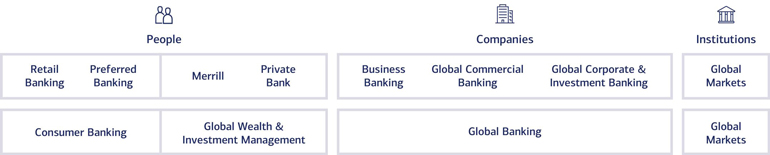
| Consumer Banking
Consumer Banking, comprised of Retail Banking and Preferred Banking lines of business, offers a diversified range of credit, banking, and investment products and services to more than |
$12.2B Net income | |
69 million consumers and small businesses.
| • | Net income increased 14% in 2025 primarily driven by higher revenue and lower provision for credit losses, partially offset by higher noninterest expense |
| • | Nationwide network of ~3,600 financial centers and ~15,000 ATMs, nationwide call centers, and leading digital banking platforms with ~49 million active users, including ~41 million active mobile users |
| • | Added 46 new financial centers across existing and expansion markets, including opening first financial center in Boise, Idaho in 2025 |
| • | Average deposits of $948.1 billion grew modestly in 2025; retained the #1 deposit market share position for U.S. Consumer deposits(2) |
| • | Average loans and leases increased 2% to $319.3 billion reflecting growth across all products, including Small Business loan growth of 7% |
| • | Grew net new consumer checking accounts every quarter in 2025 extending a streak of 28 consecutive quarters adding ~680,000 net new checking accounts in 2025 |
| • | 4.1 million consumer investment accounts with assets of $599 billion (+16%) and $19 billion net client flows in 2025 |
| • | 16.6 billion digital logins, digital sales represented 66% of total sales |
| • | Erica® users grew to more than 20 million and crossed over more than 3 billion interactions processed since inception in 2018 |
| • | 79% of overall households actively using digital platforms |
| • | #1 in Retail Banking Advice Satisfaction and Banking Mobile App Satisfaction by J.D. Power |
| Global Wealth & Investment Management
Global Wealth & Investment Management (GWIM) consists of two lines of businesses, Merrill and Private Bank, that provide |
$4.7B Net income
| |
investment and wealth management solutions to our affluent and ultra-high net worth clients.
| • | Net income increased 10% in 2025 primarily due to higher revenue, partially offset by higher noninterest expense |
| • | Revenue increased 9% to $24.9 billion across Merrill and Private Bank driven primarily by higher asset management fees (+12%) |
| • | Client balances increased 12% to $4.8 trillion, driven by the impact of higher market valuations and positive net client flows |
| • | Assets under management (AUM) flows of $82.0 billion in 2025 increased 3% primarily reflecting a deepening of existing relationships and new client acquisitions |
| • | Added ~21,000 net new relationships and opened ~114,000 new bank accounts across Merrill and Private Bank in 2025 |
| • | Average loans and leases of $243.1 billion increased 9% primarily driven by custom lending, securities-based lending and residential mortgage |
| • | Average deposits down 3% to $279.8 billion primarily driven by clients moving deposits to higher yielding investment cash alternatives, including offerings on our investment and brokerage platforms, as well as a higher level of client tax payments |
| • | 86% of Merrill households and 93% of Private Bank relationships digitally active across the enterprise |
| • | #1 in Forbes’ Top Women Wealth Advisors Best-in-State (2025), Best-in-State Wealth Management Teams (2025), Top Next Generation Advisors (2025), and Top Wealth Management Teams High Net Worth (2025) |
|
Global Banking
Global Banking provides a wide range of lending-related products and services, integrated working capital management and treasury solutions, and underwriting and advisory services— |
$7.8B Net income | |
includes the Global Corporate and Investment Banking, Global Commercial Banking, and Business Banking lines of business.
| • | Ranked #3 in investment banking fees(3); total corporation investment banking fees, excluding self-led deals, of $6.6 billion grew 7% from 2024 |
| • | Average loans and leases increased 3% to $385.4 billion |
| • | Average deposits grew 13% to $616.8 billion |
| • | Treasury service charges increased 13% |
| • | Named North America’s Most Innovative Bank by Global Finance and World’s Best Bank for Small to Medium-sized Enterprises by Euromoney |
| • | Named Bank of the Year for Customer Experience by Treasury Management International |
|
Global Markets
Global Markets offers sales and trading services, research services, and lending solutions to institutional clients across fixed-income, credit, currency, commodity, and equity |
$6.1B Net income
| |
businesses.
| • | Increased net income 9% in 2025 and earned 13% return on average allocated capital |
| • | Record sales and trading revenue of $20.9 billion ($20.9 billion excluding net debit valuation adjustment (DVA)(4)), up 11% year-over-year; 15 consecutive quarters of year-over-year sales and trading growth |
| • | Fixed Income Currencies and Commodities (FICC) revenue increased 8% to $12.3 billion; equities revenue increased 16% to $8.6 billion |
| • | Record average loan balances of $181.3 billion, up 29% from 2024 |
| • | Return on average allocated capital of 13%, increased modestly from 2024 |
| • | Named Global Derivatives House of the Year and CLO Trading Desk of the Year by GlobalCapital |
| • | Named #1 Municipal Bonds Underwriter by LSEG-Refinitiv and #2 Top Global Research Firm by Extel, 2025 |
| (1) | Segment highlights are comparisons to 2024 unless otherwise noted. |
| (2) | FFIEC Call Reports, 4Q25. |
| (3) | Source: Dealogic as of December 31, 2025. |
| (4) | Represents a non-GAAP financial measure. See Appendix A for a reconciliation to the most directly comparable GAAP financial measure and additional information about non-GAAP financial measures. |
| 2026 Proxy Statement |
49 |
| Compensation discussion and analysis |
c. Individual performance and pay rationale highlights(1)
Brian T. Moynihan
Chair of the Board and Chief Executive Officer
Mr. Moynihan has served as the Chief Executive Officer of Bank of America Corporation since January 2010 and as Chair of our Board since October 2014. He continues to be recognized globally as a leader in the financial services industry.
|
HIGHLIGHTS OF PAY RATIONALE AND PERFORMANCE
| ||
|
• Exceeded the Board approved financial plan with diluted EPS up 19%, net income up 13%, and generated approximately 250 bps of operating leverage vs. 2024
• Delivered strong operating and market-share performance - loan growth, deposit growth and fee growth generally met or exceeded the Board’s expectations
• Focus on growth as part of Responsible Growth and continued investments to make the company a Great Place to Work
• 28% Total Shareholder Return (TSR) in 2025, following 34% TSR in 2024
• Peer benchmark data and trends were considered, including relative size, scope, and complexity
• Total compensation of $41 million is up 17% vs. 2024
|
| |
GROW AND WIN IN THE MARKET
| • | Net income of $30.5 billion, increased 13% compared to 2024 |
| • | Reported revenue of $113.1 billion increased 7% compared to 2024 |
| • | 28% TSR in 2025, following 34% in 2024, outperformed S&P 500 |
| • | Recorded diluted EPS of $3.81, up 19% compared to 2024 |
| • | Generated approximately 250 bps of operating leverage |
| • | Return on average common shareholders’ equity of 10.6%, up 106 bps from 2024; return on average tangible common shareholders’ equity of 14.2%, up 128 bps(2) |
| • | Return on average assets of 0.89% increased from 0.82% in 2024 |
| • | Book value per share of $38.44 improved 8% from 4Q24 |
| • | Tangible book value per share of $28.73 improved 9% since 2024(2) |
GROW WITH OUR CUSTOMER-FOCUSED STRATEGY
| • | Added ~680,000 net new checking accounts and consumer investment accounts grew to over 4 million |
| • | Strong client engagement across digital platforms; 49 million active digital banking users, up from 48 million in 2024 |
| • | New Zelle® records with 25 million active users, up 5% from 2024 |
| • | Grew loans by $89.9 billion to $1.19 trillion |
| • | Deposits increased 3% year-over-year to $2.02 trillion |
GROW WITHIN OUR RISK FRAMEWORK
| • | Proactively managed risk, helping to enable us to continue to support our clients and be a source of strength for the economy and financial system |
| • | CET1 level of $201 billion, and CET1 ratio of 11.4%, remaining above new regulatory minimum of 10.0% |
| • | Demonstrated strong credit risk management and asset quality; net charge-off ratio of 0.50% |
| • | Maintained strong balance sheet, capital, and liquidity |
GROW IN A SUSTAINABLE MANNER
| • | Impact on local communities through more than $289 million in philanthropic giving and more than 2.5 million employee volunteer hours |
| • | Ongoing focus on Operational Excellence, allowing us to reinvest for growth |
| • | Continued focus on employee engagement, retention, and opportunity & inclusion |
| • | Strategically deployed generative artificial intelligence (AI) tools across the company with strong governance from internal AI council |
ADDITIONAL PERFORMANCE HIGHLIGHTS
| • | Hosted a detailed Investor Day to engage with our investors on our medium- and long-term financial targets |
| • | Increased our minimum hourly wage for U.S. employees to $25 per hour, meeting our goal of $25 per hour by 2025 |
| • | In 2026, announced the ninth year of Sharing Success awards with approximately 96% of teammates receiving an award—most receiving shares of the company’s common stock to further align interests with shareholders |
| • | Industry leader in being a Great Place to Work: |
| • | Named to Fortune’s 100 Best Companies to Work For list for the seventh consecutive year |
| • | Recognized by TIME on World’s Best Companies list and Best Companies for Future Leaders list. |
| • | Recognized by Forbes on the 2025 America’s Best Companies list, World’s Best Employers list, and Most Trusted Companies list, among others |
| • | Continued to demonstrate global leadership with industry groups including Financial Services Forum, The Clearing House Association (chair), the Business Roundtable, the AHA CEO Roundtable (co-chair), World Economic Forum’s International Business Council (chair of Stakeholder Capitalism Metrics Initiative), the Sustainable Markets Initiative (chair), and the Bank Policy Institute |
| (1) | Individual performance highlights are comparisons to 2024 unless otherwise noted. |
| (2) | Represents a non-GAAP financial measure. See Appendix A for a reconciliation to the most directly comparable GAAP financial measure and additional information about non-GAAP financial measures. |
| 50 |
Bank of America |
| Compensation discussion and analysis |
Alastair M. Borthwick
Executive Vice President & Chief Financial Officer
Mr. Borthwick has served as Chief Financial Officer for Bank of America since November 2021 and was recently elevated to Executive Vice President in September 2025. Mr. Borthwick serves as a strategic advisor to the CEO, the Management Team, and our Board of Directors in addition to being responsible for the overall financial management of the company, including accounting, balance sheet management, financial planning and analysis, corporate treasury, investor relations, corporate investments, and tax.
|
HIGHLIGHTS OF PAY RATIONALE AND PERFORMANCE
| ||
|
• Appointed Executive Vice President in September 2025
• As strategic advisor to the CEO, helped the company grow revenue and control expenses while investing in the franchise
• Disciplined management of capital and liquidity to support strong loan growth and increased capital returned to shareholders
• Peer benchmark data and trends were considered
• Total compensation of $20.0 million is up 29% vs. 2024
|
| |
| ● Salary $1.0M ● TRSU $6.65M
● Cash $5.7M ● PRSU $6.65M
| ||
GROW AND WIN IN THE MARKET
| • | Reported revenue of $113.1 billion, up 7% compared to 2024 |
| • | Reported $3.41 trillion in assets, compared to $3.26 trillion in 2024; grew deposits to $2.02 trillion, which were up 3% from 2024, and supported $1.19 trillion in loans, which were up 8% from 2024 |
| • | Maintained strong liquidity; $975 billion average Global Liquidity Sources in 4Q25 |
| • | Grew book value and tangible book value(1) per common share by 8% and 9% |
| • | Recorded diluted EPS of $3.81, up 19% from 2024 |
GROW WITH OUR CUSTOMER-FOCUSED STRATEGY
| • | Reported strong organic growth metrics, including generation of ~680,000 net new checking accounts and ~21,000 net new wealth management relationships |
| • | Supported business leaders with timely and transparent forecasts and insights to help grow revenue and control expenses while continuing to invest in the franchise |
| • | Appropriately managed capital and liquidity to support strong loan growth and an increased amount of capital returned to shareholders |
| • | Oversaw strong investor relations (IR) program, providing transparency and strengthening relationships with analyst and shareholder communities. Hosted a detailed Investor Day to engage with our investors on our medium- and long-term financial targets |
GROW WITHIN OUR RISK FRAMEWORK
| • | Demonstrated strong credit quality, with a net charge-off ratio of 0.50% |
| • | Managed capital effectively, supporting loan growth of $89.9 billion and CET1 capital of $201.4 billion; increased dividends per common share by 8% and returned $29.5 billion to shareholders through common stock repurchases and dividends |
| • | Enhanced CFO organization processes and controls through the company’s single process inventory, which documents key processes, potential risks and associated controls and performance metrics |
| • | Bank of America Corporation maintained strong credit ratings during 2025, with all three major rating agencies maintaining their ratings and stable outlooks |
GROW IN A SUSTAINABLE MANNER
| • | Drove operational excellence by strengthening process owner accountability and a focus on automation across finance processes. |
| • | Continued disciplined investment in people, technology, and process improvements to support long-term efficiency |
| • | Continued focus on employee engagement, retention, and opportunity & inclusion |
Dean C. Athanasia
Co-President, Bank of America
Mr. Athanasia was elevated to Co-President of Bank of America alongside Mr. DeMare in September 2025. In this role, Mr. Athanasia jointly oversees all eight lines of business across the company’s four segments: Consumer Banking, GWIM, Global Banking and Global Markets. These businesses serve the company’s more than 69 million clients globally. Mr. Athanasia has been an executive officer of the company since 2014.
Until September 2025, Mr. Athanasia had line of business responsibility for four of the company’s eight lines of business, including Retail Banking, Preferred Banking, Business Banking, and Global Commercial Banking and additional responsibility for Global Payments Solutions, Workplace Benefits, Marketing, Digital and Consumer Products and Analytics, and the Local Markets Organization for the company.
|
HIGHLIGHTS OF PAY RATIONALE AND PERFORMANCE
| ||
|
• Appointed Co-President of Bank of America in September 2025, driving growth across all eight lines of business
• Strong business performance across business lines; extensive industry recognition
• Maintained #1 position in U.S. Consumer Deposits with record high Consumer client experience. Record Business Banking relationships
• Peer benchmark data and trends were considered
• Total compensation of $26.0 million is up 44% vs. 2024 |
| |
| ● Salary $1.0M ● TRSU $8.75M
● Cash $7.5M ● PRSU $8.75M
| ||
Additional individual performance contributions from prior role in 2025 are highlighted below as considered by the Committee
GROW AND WIN IN THE MARKET
| • | Delivered $61.4 billion in revenue and $17.1 billion in net income in 2025 |
| • | Maintained #1 position in U.S. Consumer Deposits (FFIEC Call Reports, 4Q25), #1 Small Business Lender (FDIC, 3Q25), #1 Retail Banking Advice Satisfaction (J.D. Power 2025 U.S. Retail Banking Advice Satisfaction Study), #1 in Banking Mobile App Satisfaction (J.D. Power 2025 U.S. Mobile App Satisfaction Study), and Merrill Edge Self-Directed #1 for Bank Brokerage (StockBrokers.com 2025 Annual Awards) |
| • | Grew global banking average deposits to a record $616.8 billion, representing 13% growth year-over-year |
| • | Expanded partnerships including U.S. Soccer, FIFA Club World Cup, Authentic Brands Group with David Beckham |
GROW WITH OUR CUSTOMER-FOCUSED STRATEGY
| • | Achieved record high 89.4% Consumer client experience and 89.3% Business Banking client experience |
| • | Record 3.5 million Business Banking relationships, up 2% year-over-year |
| • | Received 700+ industry accolades and awards for Consumer and Small Business in 2025, including Best Bank in North America and Best Bank for Consumers in U.S. (Euromoney), and #1 Small Business Banker (Keynova) in addition to several Global Commercial Banking industry awards in 2025 including World’s Best and North America’s Best Bank for SMEs (Euromoney) |
GROW WITHIN OUR RISK FRAMEWORK
| • | Continued strong emphasis on effectively managing risk in a responsible manner across all business lines, including asset quality, regulatory requirements, employee conduct, and business controls |
| • | Bank of America outperformed key competitors in JD Power 2025 U.S. Financial Protection Satisfaction Study, improving 13 points year-over-year |
| • | Continued to address operating risk by investing in the integration and streamlining of operations |
GROW IN A SUSTAINABLE MANNER
| • | Opened 46 new financial center sites in 31 markets across the U.S. |
| • | $14.9 billion of $15 billion Community Homeownership Commitment lent-to-date |
| • | Record 74% of clients fully paperless, continuing to reduce expense and environmental impact |
| • | Continued focus on employee engagement, retention, and opportunity & inclusion |
| (1) | Represents a non-GAAP financial measure. See Appendix A for a reconciliation to the most directly comparable GAAP financial measure and additional information about non-GAAP financial measures. |
| 2026 Proxy Statement |
51 |
| Compensation discussion and analysis |
James P. DeMare
Co-President of Bank of America
Mr. DeMare was elevated to Co-President of Bank of America alongside Mr. Athanasia in September 2025. In this role, Mr. DeMare jointly oversees all eight lines of business across the company’s four segments: Consumer Banking, GWIM, Global Banking and Global Markets. These businesses serve the company’s more than 69 million clients globally. Mr. DeMare has been an executive officer of the company since 2021.
Until September 2025, Mr. DeMare served as President of Global Markets, where he oversaw all aspects of the company’s Global Markets business, including equity and fixed income sales and trading efforts, Global Markets client coverage on a global basis, Global Commercial Real Estate, and the Global Research division, which includes the Bank of America Institute.
|
HIGHLIGHTS OF PAY RATIONALE AND PERFORMANCE
| ||
|
• Appointed Co-President of Bank of America in September 2025, driving growth across all eight lines of business • Strong business performance across business lines; extensive industry recognition • Record year for sales and trading revenues with sustained growth year-over-year • Peer benchmark data and trends were considered • Total compensation of $31.0 million is up 19% vs. 2024
|
| |
| ● Salary $1.0M ● TRSU $10.5M
● Cash $9.0M ● PRSU $10.5M
| ||
Additional individual performance contributions from prior role in 2025 are highlighted below as considered by the Committee
GROW AND WIN IN THE MARKET
| • | Global Markets revenue increased $2.3 billion to $24.1 billion, primarily driven by higher sales and trading revenue |
| • | Record year for sales and trading revenues - sales and trading revenue increased $2.1 billion to $20.9 billion (and by $2.0 billion to $20.9 billion, excluding net DVA),(1) primarily driven by record revenue in Equities |
| • | Global Markets average total loans and leases increased $40.8 billion to $181.3 billion in 2025 |
GROW WITH OUR CUSTOMER-FOCUSED STRATEGY
| • | Sustained year-over-year growth in sales and trading revenues and net income, achieving 15 and 12 consecutive quarters year-over-year growth respectively |
| • | Many product-specific awards, accolades, and Top 3 rankings including Global Derivatives House of the Year (GlobalCapital), CLO Trading Desk of the Year (GlobalCapital), Currency Derivatives House of the Year (Risk Awards), Commodity Derivatives House of the Year (IFR), Equity Derivatives House of the Year (IFR), North America MBS House of the Year (IFR), Best Sell-Side Trading Desk (Global Markets Choice Awards), and #2 Top Global Research Firm (Extel) |
| • | Ranked #1 underwriter of municipal bonds with $93.5 billion underwriting volume (LSEG-Refinitiv) |
GROW WITHIN OUR RISK FRAMEWORK
| • | Continued focus on managing risk in a responsible manner, with no trading loss days in 2025(2) |
| • | Sustained focus on simplifying and improving the operating environment and addressing operational risk |
| • | Sustained focus on market conduct risk, by reinforcing importance of escalation, supervision, and formal training and leadership communications |
GROW IN A SUSTAINABLE MANNER
| • | Launched initiative to automate content summarization, financial information retrieval, client intelligence, and other processes using Generative AI |
| • | Continued to focus on reducing complexity and improving processes, with a focus on organizational health |
| • | Continued focus on employee engagement, retention, and opportunity & inclusion |
Matthew M. Koder
President, Global Corporate & Investment Banking
Mr. Koder is President of Global Corporate and Investment Banking (GCIB). In this role, he leads the day-to-day operations of the business and drives the firm’s strategy globally.
|
HIGHLIGHTS OF PAY RATIONALE AND PERFORMANCE
| ||
|
• Delivered strong results and industry recognition
• Maintained top three investment banking fee ranking for the fourth consecutive year
• Continued strong market share, leading top tier competitors in investment bank market share gains since 2018
• Peer benchmark data and trends were considered
• Total compensation of $22.0 million is up 10% vs. 2024
|
| |
| ● Salary $1.0M ● TRSU $7.35M
● Cash $6.3M ● PRSU $7.35M
| ||
GROW AND WIN IN THE MARKET
| • | Delivered $13.61 billion in revenue and $3.67 billion in net income, Return on Allocated Capital of 14.7% |
| • | Sustained strong, Responsible Growth, maintained top three investment banking fee ranking for the fourth consecutive year (Dealogic as of Dec 31, 2025) and average loan growth of 7% while growing average deposits by 16% |
| • | Continued strong market share, leading top tier competitors in investment bank market share gains since 2018 |
GROW WITH OUR CUSTOMER-FOCUSED STRATEGY
| • | Continued investment in Emerging Growth & Regional Coverage group to cover clients locally with ~200 bankers in 25 U.S. locations |
| • | Globally integrated platform serving a wide range of clients with 96% coverage of Fortune 1,000 companies |
| • | Recognized as Best Bank in Corporate Banking in the U.S (Coalition Greenwich); North America’s Most Innovative Bank (Global Finance); and Best M&A House in Europe and Best Equity House in Europe (EMEA Finance, 2024 - awarded in Mar/Apr 2025) |
| • | Remained focused on our vision to become the leading, most trusted, and respected financial advisory firm globally |
GROW WITHIN OUR RISK FRAMEWORK
| • | Sustained focus on regulatory requirements and risk management while driving growth in a responsible manner |
| • | Trained employees with a focus on risk, conduct and culture |
| • | Leveraged technology to digitize Investment Banking and Capital Markets to improve risk management |
GROW IN A SUSTAINABLE MANNER
| • | Drove robust onboarding, upskilling, and operational excellence through client-focused training, while refining and expanding engagement programs |
| • | Established strong talent pipelines and succession planning, enhanced mobility for niche skills, and refined performance and promotion processes |
| • | Continued focus on employee engagement, retention, and opportunity & inclusion |
| (1) | Represents a non-GAAP financial measure. See Appendix A for a reconciliation to the most directly comparable GAAP financial measure and additional information about non-GAAP financial measures. |
| (2) | Trading loss days refers to days where the subset of trading revenue had losses that exceeded our total covered portfolio value-at-risk (VaR), utilizing a one-day holding period. |
| 52 |
Bank of America |
| Compensation discussion and analysis |
4. 2025 Performance year total compensation decisions
The Compensation and Human Capital Committee determined performance year 2025 total compensation in January 2026, after completing its review of annual performance as described in “Performance evaluation and pay decision process” on page 46.
The table below summarizes the 2021-2025 performance year total compensation decisions for NEOs. This table aligns with the pay-for-performance decision made by the Committee and the Board each year. This table will vary from the “Summary compensation table” on page 61, which includes equity compensation in the year of grant and follows specific SEC rules.
| Performance Year Total Compensation | |||||||||||||||||||||||||||||||||||
| Name |
2021 ($) |
2022 ($) |
2023 ($) |
2024 ($) |
2025 ($) |
% Change 2024 to 2025 |
2025 Pay rationale | ||||||||||||||||||||||||||||
| Brian T. Moynihan |
32,000,000 | 30,000,000 | 29,000,000 | 35,000,000 | 41,000,000 | 17% | See page 50 | ||||||||||||||||||||||||||||
| Alastair M. Borthwick |
11,000,000 | 10,500,000 | 12,000,000 | 15,500,000 | 20,000,000 | 29% | See page 51 | ||||||||||||||||||||||||||||
| Dean C. Athanasia |
15,000,000 | 13,900,000 | 14,500,000 | 18,000,000 | 26,000,000 | 44% | See page 51 | ||||||||||||||||||||||||||||
| James P. DeMare |
18,000,000 | 19,000,000 | 21,000,000 | 26,000,000 | 31,000,000 | 19% | See page 52 | ||||||||||||||||||||||||||||
| Matthew M. Koder |
20,000,000 | 15,700,000 | 16,500,000 | 20,000,000 | 22,000,000 | 10% | See page 52 | ||||||||||||||||||||||||||||
Note: Performance year total compensation includes base salary delivered during the performance year and incentives awarded for the performance year.
The following table summarizes the pay components of the performance year 2025 compensation decisions for NEOs.
| Name |
Base salary ($) |
Annual cash incentive ($) |
Cash-settled restricted stock units ($) |
Performance restricted stock units ($) |
Time-based ($) |
Total 2025 compensation ($) | ||||||||||||||||||||||||
| Brian T. Moynihan |
1,500,000 | 0 | 11,850,000 | 19,750,000 | 7,900,000 | 41,000,000 | ||||||||||||||||||||||||
| Alastair M. Borthwick |
1,000,000 | 5,700,000 | 0 | 6,650,000 | 6,650,000 | 20,000,000 | ||||||||||||||||||||||||
| Dean C. Athanasia |
1,000,000 | 7,500,000 | 0 | 8,750,000 | 8,750,000 | 26,000,000 | ||||||||||||||||||||||||
| James P. DeMare |
1,000,000 | 9,000,000 | 0 | 10,500,000 | 10,500,000 | 31,000,000 | ||||||||||||||||||||||||
| Matthew M. Koder |
1,000,000 | 6,300,000 | 0 | 7,350,000 | 7,350,000 | 22,000,000 | ||||||||||||||||||||||||
Note: Some of the 2025 compensation above differs from the “Summary compensation table” on page 61 and/or the information in the “Pay versus performance table” on page 73. SEC rules require that the “Summary compensation table” include equity compensation in the year granted, while the Committee awards equity compensation after the performance year. Therefore, equity-based incentives granted in 2025 for the 2024 performance year are shown in the “Summary compensation table” as 2025 compensation, whereas the equity-based incentives as shown above were granted in 2026 for the 2025 performance year. The “Summary compensation table” also includes elements of compensation not shown above, including perquisites.
For a description of the pay components above, see “Executive pay components & variable pay mix” on page 54.
| 2026 Proxy Statement |
53 |
| Compensation discussion and analysis |
5. Executive compensation program features
a. Executive pay components & variable pay mix
Our Compensation and Human Capital Committee determines the pay for our NEOs for each performance year. Our pay-for-performance structure is designed to emphasize variable pay and help motivate our executives to deliver sustained shareholder value and Responsible Growth.
Consistent with prior years, restricted stock units are divided into the following components, which are unchanged from performance year 2024: annual cash-settled (CEO only), time-based, and performance-based. Certain of the time-based restricted stock units for NEOs other than Mr. Moynihan are cash-settled, as described below. The following charts provide an overview of the 2025 pay components and 2025 variable pay mix for our NEOs, including the vesting, performance, and settlement standards that provide a multi-year look back on 2025 achievements.
|
|
Performance Year 2025 Pay Components | |||
| Cash Pay Components | ||||
| Description | How it pays | |||
| Base Salary • Determined based on job scope, experience, and market comparable positions; provides fixed pay to attract and retain executives and balance risk-taking |
• Semi-monthly cash payment through 2025 | |||
| Annual cash incentive—except CEO • Provides short-term variable pay for the performance year for non-CEO executives |
• Single cash payment in February 2026 | |||
|
|
Restricted Stock Unit Pay Components | |||
| Description
|
How it pays | |||
| Annual cash-settled restricted stock units (CRSUs)—CEO only | ||||
• Track stock price performance over 1-year vesting period • Vest in 12 equal installments from March 2026 – February 2027 |
• Granted in February 2026 • Cash-settled upon vesting | |||
| Performance restricted stock units (PRSUs) | ||||
• Vest based on future achievement of specific tax-normalized return on assets (ROA) and growth in adjusted tangible book value (TBV) standards over 3-year performance period • Track company and stock price performance • Encourage sustained earnings during the performance period; future adverse performance below these standards will decrease the amount paid |
• Granted in February 2026 • If performance standards are achieved, grants will be earned at the end of the performance period (2028) • 150% is the maximum that can be earned; upside opportunity reinforces the company’s focus on long-term Responsible Growth • If both threshold standards are not achieved, the entire award is forfeited • Share-settled to the extent earned | |||
| See “Results for performance restricted stock units” on page 58 for the vesting and value of prior awards | ||||
| Time-based restricted stock units (TRSUs) | ||||
• Track stock price performance over 4-year vesting period • Align with sustained longer-term stock price performance |
• Granted in February 2026 • Vests in four annual installments beginning in February 2027 • 100% share-settled upon vesting for our CEO • 50% share-settled and 50% cash-settled upon vesting for other NEOs | |||
| Performance Year 2025 Variable Pay Mix | ||||
|
• A majority of variable pay is delivered as equity-based awards that reflect the balance between short-term and long-term results.
• The charts to the right illustrate the variable pay mix for our CEO and other NEOs. |
| |||
| Stock Retention Requirements |
|
• 50% of net after-tax shares received from equity-based awards are retained until one year after retirement for our CEO
• 50% of net after-tax shares received from equity-based awards are retained until retirement for other executive officers
|
| 54 |
Bank of America |
| Compensation discussion and analysis |
b. 2025 Performance year performance restricted stock units
| PRSUs granted in February 2026 (based on 2025 performance) require the company to meet average ROA and average adjusted TBV growth standards (tax-normalized and each metric equally weighted at 50%) over a three-year performance period from 2026-2028 with a 150% maximum that can be earned (up from 100% maximum for February 2025 PRSU grants). Our performance metrics remain aligned with our consistent business strategy of Responsible Growth. ROA promotes efficient use of the balance sheet, an accountability placed on executives since the inception of the PRSU program, and complements adjusted TBV growth, which promotes efficient use of capital.
Based on the Board’s ongoing evaluation and in consideration of input received from shareholders, the Board increased the performance standards necessary to achieve 100% payout and provided the opportunity to earn up to 150% maximum payout for exceptional future performance, as described in the table below. The increased performance standards and introduction of upside payout opportunity reflect the company’s and Board’s focus on long-term Responsible Growth and the alignment of pay with successful achievement of growth for shareholders, as discussed with our investors during our 2025 Investor Day.
Under a hypothetical scenario, if our 2025 full-year average assets of $3.4 trillion remained constant during the performance period, our company would need to earn $92 billion in aggregate net income from 2026-2028 to achieve the PRSU 90 bps ROA standard in order to earn 100% of target and we would need to earn $112 billion in aggregate net income from 2026-2028 to achieve the PRSU 110 bps ROA maximum standard in order to earn 150% payout. On an annualized basis, this equals approximately $31 billion in earnings to earn 100% of target and $37 billion in earnings to earn the maximum 150% payout, which is higher than any reported net income in our history. |
Key updates for performance year 2025 PRSUs:
• increased the performance standards necessary to achieve 100% payout
• provided the opportunity to earn up to 150% maximum payout for exceptional future performance _____________________________
To achieve the new ROA standards:
• $92 billion in aggregate 2026-2028 net income required to achieve 90 bps ROA (100% standard)
• $112 billion in aggregate 2026-2028 net income required to achieve 110 bps ROA (150% standard) | |
The increase in standards and the maximum payout for PRSUs from 100% to 150% is intended to strengthen the alignment between NEO compensation and shareholder value creation. This design change reflects the following considerations:
| • | Reinforces the company’s focus on growth, pay-for-performance philosophy, and alignment with shareholder interests |
| • | Consistent with market practice use of upside payout opportunity on performance restricted stock unit awards |
| • | Maintains robust governance safeguards, including clawback provisions and performance certification by the Compensation and Human Capital Committee |
| • | No adjustments to PRSU results for the impact of litigation, fines, and penalties or non-tax impairment charges |
These performance metrics and standards encourage the achievement of sustained shareholder value and Responsible Growth. PRSUs are forfeited if results are below both minimum standards. For any portion of the PRSU standards achieved, payment will be made after the end of the performance period. The performance year 2025 PRSU standards are outlined below:
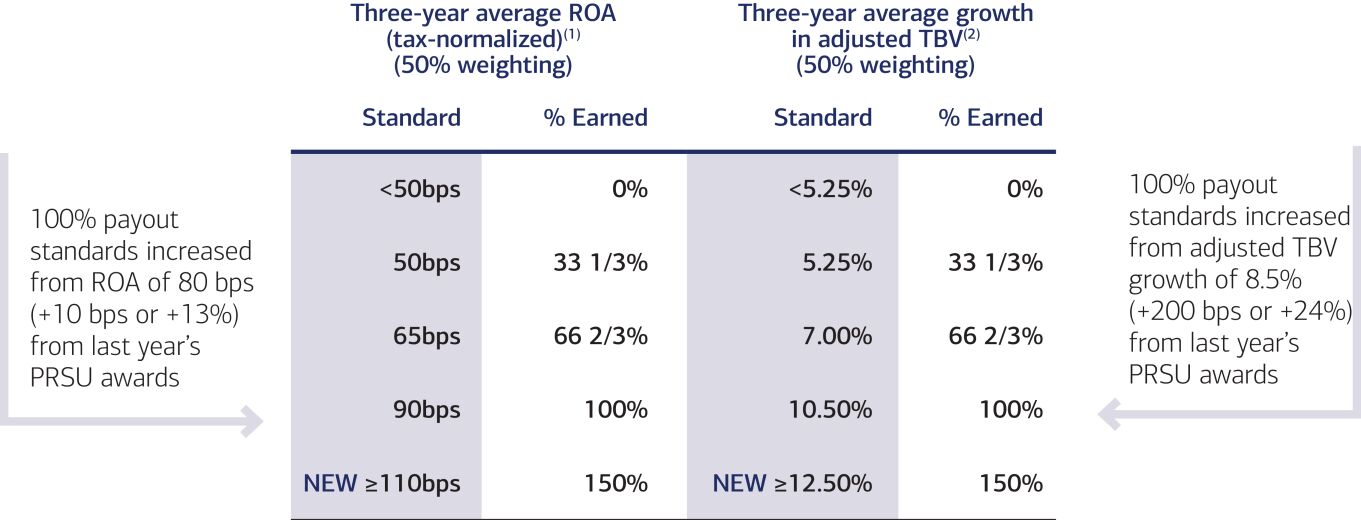
Note: Any results achieved above 33 1/3% will be interpolated on a straight-line basis between the two nearest standards.
| (1) | Three-year average ROA (tax-normalized) means the average “return on assets” for the three calendar years in the performance period. For this purpose, “return on assets” will be determined at the conclusion of each year based on the generally accepted accounting principles (GAAP) definition and, to the extent necessary, normalized to exclude the material effects of changes to the Internal Revenue Code of 1986 and related regulations adopted after the first day of the performance period. |
| (2) | Three-year average growth in adjusted TBV means the average year-over-year percentage change in “adjusted tangible book value” for the three calendar years in the performance period. For this purpose, “adjusted tangible book value” for each year will equal our total common shareholders’ equity, less (a) the cumulative impact of any capital actions approved by our company’s Board and completed by our company during the performance period, and less (b) the sum of the carrying value of: (i) goodwill and (ii) intangible assets excluding mortgage servicing rights; adjusted for (iii) deferred tax liabilities directly related to (i) and (ii). Each year-over-year percentage change is measured after the conclusion of each calendar year using the beginning balance as of January 1 and the ending balance as of December 31 of that year and, to the extent necessary, will be normalized to exclude the material effects of changes to the Internal Revenue Code of 1986 and related regulations adopted after the first day of the performance period. |
| 2026 Proxy Statement |
55 |
Compensation discussion and analysis |
 What We Do |
 |
Pay for performance and allocate individual awards based on actual results and how results were achieved | ||||
| |
Use balanced, risk-adjusted performance measures | |||||
| |
Review feedback from independent control functions in performance evaluations and compensation decisions | |||||
| |
Provide appropriate mix of fixed and variable pay to reward company, line of business, and individual performance | |||||
| |
Defer a majority of variable pay as equity-based awards | |||||
| |
Consistent with our fiduciary and regulatory obligations supporting the safety and soundness of our company, the Board applies informed business judgment and a balanced assessment of performance rather than relying solely on predetermined compensation formulas for determining NEO pay | |||||
| |
Apply robust clawback features to all executive officer variable pay | |||||
| |
Require stock ownership and retention to retirement of a significant portion of equity-based awards | |||||
| |
Engage with shareholders on governance and compensation | |||||
| |
Prohibit hedging and speculative trading of company securities | |||||
| |
Grant equity-based awards on a pre-established date to avoid any appearance of coordination with the release of material non-public information | |||||
| |
Prohibit pledging of equity-based awards | |||||
 What We Don’t Do |
 |
Change in control agreements for executive officers | ||||
| |
Severance agreements for executive officers | |||||
| |
Multi-year guaranteed incentive awards for executive officers | |||||
| |
Severance benefits to our executive officers exceeding two times base salary and bonus without shareholder approval per our policy | |||||
| |
Accrual of additional retirement benefits under any supplemental executive retirement plans | |||||
| |
Excise tax gross-ups upon change in control | |||||
| |
Discounting, reloading, or repricing stock options without shareholder approval | |||||
| |
Single-trigger vesting of equity-based awards upon change in control | |||||
| |
Adjust PRSU results for the impact of litigation, fines, and penalties or non-tax impairment charges | |||||
56 |
Bank of America |
| Compensation discussion and analysis |
ii. Multiple cancellation & clawback features
Our equity-based awards are subject to three separate and distinct features that can result in the awards being canceled or prior payments being clawed back in the event of certain detrimental conduct or financial losses. These features were designed to encourage appropriate behavior and manage risk in our compensation program.
Our NEOs are subject to all three cancellation and clawback features, which are described below.
|
|
Detrimental conduct cancellation & clawback |
Performance-based cancellation |
Incentive compensation recoupment policy | |||
| Who |
• Applies to approximately 20,300 employees who received equity-based awards as part of their 2025 incentive compensation, as well as all recipients of our Sharing Success equity-based awards granted in March 2025 |
• Applies to approximately 5,200 employees who are deemed to be “risk takers” and received equity- based awards as part of their 2025 compensation
• “Risk takers” defined according to banking regulations and company policies
|
• Applies to all our executive officers | |||
| When |
• An employee engages in certain “detrimental conduct,” including:
• illegal activity
• breach of a fiduciary duty
• intentional violation or grossly negligent disregard of our policies, rules, and procedures
• trading positions that result in a need for restatement or significant loss
• conduct constituting “cause”
|
• Our company, a line of business, a business unit, or an employee experiences a loss outside of the ordinary course of business and the employee is found to be accountable based on factors such as:
• the magnitude of the loss
• the decisions that may have led to the loss
• the employee’s overall performance
|
• Our company restates its financial statements | |||
| What |
• All unvested equity awards will be canceled
• Any previously vested award may be recouped, depending on the conduct |
• All or part of the outstanding award may be canceled |
• Any incentive compensation granted, earned, or vested based on the attainment of a financial reporting measure that exceeds the amount that would have been paid after giving effect to the restatement must be recouped as determined by the Board or a Board committee
• In addition, if the restatement is caused by an executive officer’s fraud or intentional misconduct, any action necessary to remedy the misconduct and prevent its recurrence may be taken
| |||
The Company’s Incentive Compensation Recoupment Policy reflects the SEC’s final rules and the NYSE’s listing standards implementing Section 954 of the Dodd-Frank Act. A copy of our Incentive Compensation Recoupment Policy is available as an exhibit to our 2025 Form 10-K.
Pursuant to our Incentive Compensation Forfeiture & Recoupment Disclosure Policy, we will disclose publicly the incentive-based compensation forfeited by or clawbacks recovered from certain senior executives in the aggregate pursuant to certain incentive compensation forfeitures or recoupments for detrimental conduct or pursuant to the Incentive Compensation Recoupment Policy described above, subject to certain privacy, privilege, and regulatory limitations. We will also disclose any clawbacks to the extent required by SEC rules and NYSE listing standards.
| 2026 Proxy Statement |
57 |
| Compensation discussion and analysis |
iii. Stock ownership & retention requirements
Our stock ownership and retention requirements align executive officer and shareholder interests by linking the value realized from equity-based awards to sustainable company performance. Our Corporate Governance Guidelines require:
| CHIEF EXECUTIVE OFFICER | OTHER EXECUTIVE OFFICERS | |
| 500,000 | 300,000 | |
| Minimum shares of common stock owned and | Minimum shares of common stock owned and | |
| 50% | 50% | |
| of net after-tax shares received from equity-based | of net after-tax shares received from equity-based | |
| awards retained until one year after retirement
|
awards retained until retirement
| |
In light of our policy, we expect new executive officers to be in compliance with these requirements within five years. Full-value shares and units owned, awarded, or deemed beneficially owned are included in the stock ownership calculations; PRSUs are included only when earned and stock options are not included. All NEOs are in compliance with their ownership requirements. Our Code of Conduct and other policies prohibit our executive officers from hedging and speculative trading of company securities. See the “Hedging policy” section on page 33 for more information on our hedging policy and rules.
6. Other compensation topics
a. Results for performance restricted stock units
PRSUs have been a component of our executive compensation program since 2011. PRSUs require recipients to earn awards over the performance period based on achievement of established performance standards and help align management with shareholder interests. Since 2013, PRSUs have been based 50% on three-year average ROA and 50% on three-year average growth in adjusted TBV standards. Our practice is not to make discretionary adjustments to PRSU results for the impact of legacy litigation, fines, and penalties, or impairment charges, which have contributed to outcomes for PRSU payouts since their introduction.
The 2023 PRSUs completed in 2025 achieved 100% of the target opportunity based on ROA results of 85 bps and adjusted TBV results of 14.69% (compared to 100% target opportunity based on 2023 PRSU performance standards set at ROA results of ≥ 80 bps and TBV results of ≥ 8.5%).(1) We did not adjust PRSU results for 2023 and 2024 in connection with the tax-related change to accounting methods.(2) See the description of the 2023 PRSUs and vesting terms following the “Grants of plan-based awards table” on page 76 of our 2024 proxy statement.
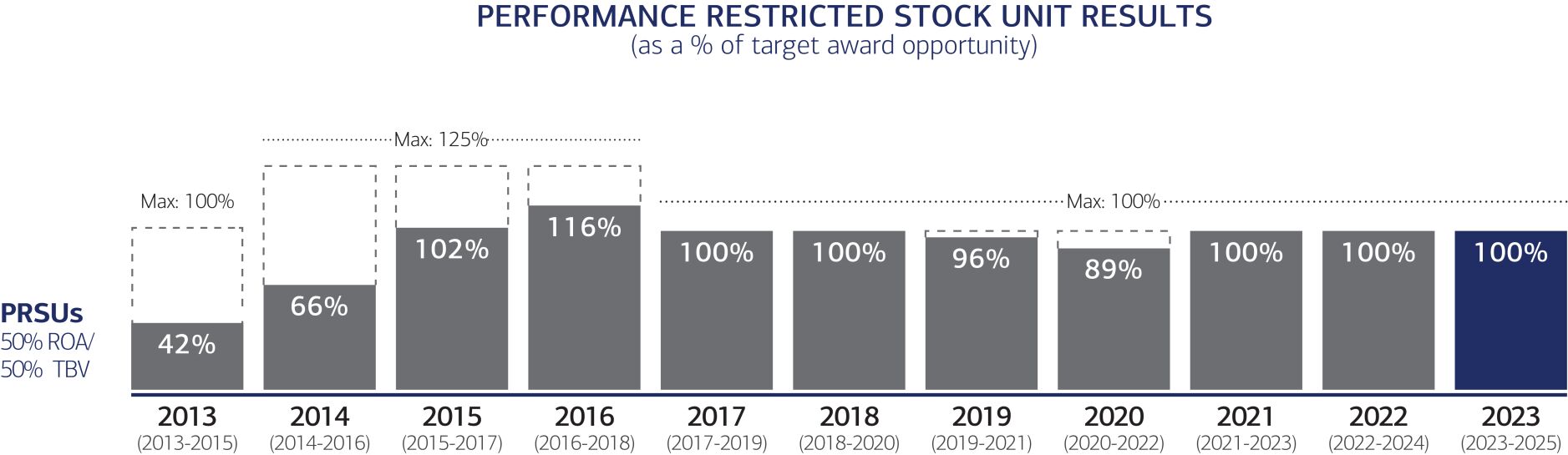
The award terms for these PRSUs provide for the calculation of performance results at the conclusion of each calendar year in the performance period. As a result, the performance results above may differ from the results reported under GAAP in our company’s audited financial statements.
| (1) | The three-year average ROA and three-year average growth in adjusted TBV results for the 2023 PRSUs were calculated as follows: |
Three-year Average ROA (tax-normalized) was the average “return on assets” for the three calendar years in the performance period. For this purpose, “return on assets” was determined at the conclusion of each year based on the generally accepted accounting principles (GAAP) definition and, to the extent necessary, normalized to exclude the material effects of changes in the Internal Revenue Code of 1986 and related regulations adopted after the first day of the performance period.
Three-year Average Growth in Adjusted TBV was the average year-over-year percentage change in “adjusted tangible book value” for the three calendar years in the performance period. For this purpose, “adjusted tangible book value” for each year equaled our total common shareholders’ equity, less (a) the impact of any capital actions approved by our company’s Board and completed by our Company, and less (b) the sum of the carrying value of: (i) goodwill and (ii) intangible assets excluding mortgage servicing rights; adjusted for (iii) deferred tax liabilities directly related to (i) and (ii). Each year-over-year percentage change was measured after the conclusion of each calendar year using the beginning balance as of January 1 and the ending balance as of December 31 of that year and, to the extent necessary, was normalized to exclude the material effects of changes in the Internal Revenue Code of 1986 and related regulations adopted after the first day of the performance period.
| (2) | Effective in the fourth quarter of 2025 and as previously disclosed in our Form 8-K dated January 6, 2026, the company elected to change its accounting methods related to its tax-related affordable housing, eligible wind renewable energy and solar renewable energy equity investments, which were applied on a retrospective basis. |
| 58 |
Bank of America |
| Compensation discussion and analysis |
b. 2025 Competitor group
Our Compensation and Human Capital Committee periodically reviews compensation practices of competitors to evaluate market trends, pay levels, and relative performance in executive compensation, but without any formulaic benchmarking. The Committee constructs a peer group that best reflects the unique complexity of our business. Given our size and scale, we consider five primary competitors and eleven other leading financial institutions. All U.S.-based peers are used for CEO pay-for-performance benchmarking analysis:
| • | Primary competitors: five leading U.S. financial institutions with which we compete directly for customers, employees, and investors, and which follow similar economic cycles to our own |
| • | Leading financial institutions: eleven other companies that reflect broader competitors in business segments that we operate, including seven U.S.-based companies utilized for CEO pay-for-performance benchmarking analysis |
The Committee did not make any changes to the primary competitors, leading financial institutions, or general industry peers for 2025. Our 2025 competitor group reflects the updates we implemented in 2023, when the Committee carefully selected and determined the appropriateness of companies from a competitive and strategic perspective, including evaluation of criteria such as industry, size, and business characteristics that would be relevant for pay-for-performance analysis. This peer group has been reaffirmed and supported by shareholders during engagement in 2025.
The 2025 competitor group is provided below.
|
|
2025 Competitor Group | |||||||||||
|
|
Primary competitors | Leading financial institutions | ||||||||||
|
|
• Citigroup |
• Morgan Stanley |
Global / Regional Banks | Money Managers | Credit Card / Payment | |||||||
|
|
• Goldman Sachs |
• Wells Fargo |
• Barclays |
• Truist |
• BlackRock |
• American Express | ||||||
|
|
• JPMorgan Chase |
|
• Deutsche Bank |
• UBS |
• Blackstone |
• Capital One | ||||||
|
|
|
|
• HSBC |
• U.S. Bancorp |
|
| ||||||
|
|
|
|
• PNC |
|
|
| ||||||
General industry peers. From time to time, the Committee also reviews executive compensation for a leading group of global companies headquartered in the U.S. spanning all industries to get a general perspective on compensation practices for companies of similar size and global scope. For 2025, these general industry peers were: Alphabet, Apple, Chevron, Cisco, Coca-Cola, Exxon Mobil, Home Depot, IBM, Intel, Johnson & Johnson, Meta Platforms, Microsoft, PepsiCo, Pfizer, Procter & Gamble, Verizon, and Walmart.
c. Retirement benefits
We provide our NEOs the opportunity to save for their retirement via employee and employer contributions to qualified and nonqualified defined contribution plans on the same terms as other U.S.-based salaried employees. These plans help us attract and retain key people by providing a means to save for retirement.
Certain NEOs also participate in various frozen qualified and nonqualified defined benefit pension plans. For more information about these plans, see “Pension benefits table” and “Nonqualified deferred compensation table” on pages 68 and 69, respectively.
d. Health and welfare benefits, perquisites & executive security
Our NEOs receive health and welfare benefits, such as medical, life, and long-term disability coverage, under plans generally available to all other U.S.-based salaried employees; in addition, our NEOs are eligible to receive an annual physical exam and enhanced health screening services. Because we have internal expertise on financial advisory matters, we do not charge fees to our NEOs for their use of our financial advisory services for personal needs. We also may provide certain NEOs with secured parking. For information security purposes and efficiency, NEOs are permitted to use a car service when commuting to and from our offices or business-related events; participating NEOs reimburse the company for incremental costs incurred. In limited circumstances, we may occasionally provide meals and allow spouses or guests to accompany NEOs traveling for a business-related purpose and pay for other incidental expenses. Our policy provides for the use of corporate aircraft by NEOs for approved travel. For reasons of security, personal safety, and efficiency, we require our CEO to use corporate aircraft for all business and personal air travel. Our NEOs other than our CEO, are permitted to use corporate aircraft for limited personal travel with reimbursement to the company for incremental costs, pursuant to their aircraft time-sharing agreements.
We maintain a risk-based corporate security program designed to protect our NEOs in connection with their roles, safeguard company operations, and mitigate identified security risks. The security measures provided under this program are related to business purposes, including at company facilities and while conducting company business. Where the company determines that a NEO faces security risks that support the use of protection, we authorize security coverage consistent with the program’s risk-based framework. We view this program as an important
| 2026 Proxy Statement |
59 |
| Compensation discussion and analysis |
component of the company’s enterprise risk management processes and continuity planning. Moreover, security measures provided to NEOs are based on internal expertise and independent evaluations from leading external advisors and are designed to enable NEOs to perform their duties safely and effectively. In accordance with applicable regulations, we have reported the aggregate incremental costs of personal security services in the “All other compensation” column of the “Summary compensation table” on page 61.
e. Tax deductibility of compensation
U.S. tax law limits a public company’s deductions to $1 million per year for compensation paid to its CEO, chief financial officer, and each of its three other most highly compensated executive officers, as well as to any individual who was subject to the $1 million deduction limitation in 2017 or any later year. The Committee continues to retain the discretion to make awards and pay amounts that do not qualify as deductible.
|
Accordingly, our Board recommends a vote “FOR” this proposal (Proposal 2).
|
Compensation and Human Capital Committee Report
Our Compensation and Human Capital Committee has reviewed and discussed with management the Compensation Discussion and Analysis that immediately precedes this report. Based on this review and discussion, our Compensation and Human Capital Committee has recommended to our Board that the Compensation Discussion and Analysis be included in this proxy statement and incorporated by reference into our annual report on Form 10-K for the year ended December 31, 2025.
| Submitted by the Compensation and Human Capital Committee of the Board: Monica C. Lozano, Chair José E. Almeida Pierre J.P. de Weck Arnold W. Donald Denise L. Ramos Clayton S. Rose |
| 60 |
Bank of America |
| Executive compensation |
Executive compensation
Summary compensation table
The following table shows compensation paid, accrued, or awarded with respect to our named executive officers (NEOs) during the years indicated:
2025 Summary compensation table(1)
| Name and principal position(2) |
Year |
Salary |
Bonus ($)(4) |
Stock awards ($)(5) |
Non-equity |
Change in ($)(6) |
All other |
Total ($) | ||||||||||||||||||||||||||||||||
| Brian T. Moynihan Chair and Chief Executive Officer |
2025 | 1,500,000 | 0 | 30,666,747 | 0 | 972,981 | 571,793 | 33,711,521 | ||||||||||||||||||||||||||||||||
| 2024 | 1,500,000 | 0 | 25,720,414 | 0 | 935,198 | 583,090 | 28,738,702 | |||||||||||||||||||||||||||||||||
| 2023 | 1,500,000 | 0 | 25,728,076 | 0 | 955,726 | 387,390 | 28,571,192 | |||||||||||||||||||||||||||||||||
| Alastair M. Borthwick Executive Vice President and Chief Financial Officer |
2025 | 1,000,000 | 5,700,000 | 9,227,999 | 0 | 3,612 | 50,273 | 15,981,884 | ||||||||||||||||||||||||||||||||
| 2024 | 1,000,000 | 4,350,000 | 7,152,418 | 0 | 2,917 | 49,466 | 12,554,801 | |||||||||||||||||||||||||||||||||
| 2023 | 1,000,000 | 3,300,000 | 4,939,890 | 0 | 2,671 | 53,413 | 9,295,974 | |||||||||||||||||||||||||||||||||
| Dean C. Athanasia Co-President, Bank of America |
2025 | 1,000,000 | 7,500,000 | 10,818,968 | 0 | 11,697 | 60,177 | 19,390,842 | ||||||||||||||||||||||||||||||||
| 2024 | 1,000,000 | 5,100,000 | 8,777,975 | 0 | 18,468 | 52,473 | 14,948,916 | |||||||||||||||||||||||||||||||||
| 2023 | 1,000,000 | 4,050,000 | 6,707,860 | 0 | 89,734 | 52,815 | 11,900,409 | |||||||||||||||||||||||||||||||||
| James P. DeMare Co-President, Bank of America |
2025 | 1,000,000 | 9,000,000 | 15,910,206 | 0 | 0 | 72,530 | 25,982,736 | ||||||||||||||||||||||||||||||||
| 2024 | 1,000,000 | 7,500,000 | 13,004,344 | 0 | 0 | 49,422 | 21,553,766 | |||||||||||||||||||||||||||||||||
| 2023 | 1,000,000 | 6,000,000 | 14,681,816 | 0 | 0 | 46,232 | 21,728,048 | |||||||||||||||||||||||||||||||||
| Matthew M. Koder President, Global Corporate & Investment Banking |
2025 | 1,000,000 | 6,300,000 | 12,091,778 | 0 | 0 | 49,082 | 19,440,860 | ||||||||||||||||||||||||||||||||
| 2024 | 1,000,000 | 5,700,000 | 10,078,348 | 0 | 0 | 76,087 | 16,854,435 | |||||||||||||||||||||||||||||||||
| 2023 | 1,000,000 | 4,650,000 | 7,643,866 | 0 | 0 | 323,362 | 13,617,228 | |||||||||||||||||||||||||||||||||
| (1) | SEC rules require the “Summary compensation table” to include in each year’s amount the aggregate grant date fair value of stock awards granted during the year. Typically, we grant stock awards early in the year as part of total year-end compensation awarded for prior year performance. As a result, the amounts for stock awards generally appear in the “Summary compensation table” for the year after the performance year upon which they were based, and therefore the “Summary compensation table” does not fully reflect our Compensation and Human Capital Committee’s view of its pay-for-performance executive compensation program for a particular performance year. For example, amounts shown as 2025 compensation in the “Stock awards” column include stock awards granted in February 2025 for 2024 performance, as well as any other stock awards granted during 2025 that are not part of performance year 2025 compensation. See “Compensation discussion and analysis” starting on page 42 for a discussion about how the Committee viewed its 2025 compensation decisions for the NEOs. |
| (2) | All listed NEO positions are those held as of December 31, 2025. |
| (3) | Includes any amounts voluntarily deferred under our qualified 401(k) plan and our nonqualified deferred compensation plan. See “Nonqualified deferred compensation table” on page 69. |
| (4) | Amounts reflect annual cash incentive awards received by the NEOs for performance in the applicable year. |
| (5) | Amounts shown are the aggregate grant date fair value of cash-settled restricted stock units (CRSUs), performance restricted stock units (PRSUs), and time-based restricted stock units (TRSUs) granted in the year indicated. Grants of stock-based awards (excluding CRSUs) include the right to receive cash dividends only if and when the underlying award becomes vested and payable. The grant date fair value is based on the closing price of our common stock on the applicable grant date ($46.96 on February 14, 2025). For the PRSUs granted in 2025, the actual number of PRSUs earned (0% up to the maximum level of 100%) will depend on our company’s future achievement of specific ROA and growth in adjusted TBV standards (tax-normalized) over a three-year performance period ending December 31, 2027. Values in the “Stock awards” column assume that 100% (the maximum level) of the PRSUs granted would vest as the probable outcome for purposes of determining the grant date fair value. For TRSUs granted in 2025, the award is settled 50% in shares and 50% in cash for all NEOs, except for Mr. Moynihan for whom the award is settled 100% in shares. The grant date fair value for PRSUs and share-settled TRSUs includes a discount rate to reflect the impact of post-vesting transfer restrictions on the value of these awards. The discount rate for each year is as follows: |
| • | 2025: 12.5% for PRSUs and share-settled TRSUs |
| • | 2024: 12.5% for PRSUs and share-settled TRSUs |
| • | 2023: ~12% for PRSUs and TRSUs |
The discount rate does not apply to CRSUs, the cash-settled portion of TRSUs granted in 2025 and 2024, or to the TRSUs granted to Mr. DeMare described in footnote 3 to the “Grants of plan-based awards table” in our 2024 proxy statement.
| 2026 Proxy Statement |
61 |
| Executive compensation |
| (6) | The following table shows the change in pension value and the amount of any above-market earnings on nonqualified deferred compensation for the NEOs: |
| Name |
Change in pension value ($) |
Above-market earnings on nonqualified deferred compensation ($) | ||||||||
| Brian T. Moynihan |
798,458 | 174,523 | ||||||||
| Alastair M. Borthwick |
3,612 | 0 | ||||||||
| Dean C. Athanasia |
11,697 | 0 | ||||||||
| James P. DeMare |
0 | 0 | ||||||||
| Matthew M. Koder |
0 | 0 | ||||||||
The “Change in pension value” equals the change in the actuarial present value of all pension benefits from December 31, 2024 to December 31, 2025. For this purpose, in accordance with SEC rules, the present value was determined using the same assumptions applicable for valuing pension benefits for purposes of our financial statements. See “Pension benefits table” on page 68.
Effective June 30, 2012, Bank of America froze pension plan accruals under all of its U.S. pension plans for all employees. As a result, the NEOs are not accruing any additional pension benefits with respect to any compensation or service after June 30, 2012.
For Mr. Moynihan, the amount reported above under “Change in pension value” is primarily the result of annuity benefits under a legacy supplemental retirement plan frozen since 2005. The monthly annuity benefit amount has not changed since the supplemental retirement plan was frozen. However, the present value of the benefit increases each year because he is one year older.
The above-market earnings on nonqualified deferred compensation result from Mr. Moynihan’s participation in a pre-1998 legacy FleetBoston deferred compensation plan. See “Nonqualified deferred compensation table” on page 69.
| (7) | The following table shows amounts included in the “All other compensation” column for each NEO in 2025. This column includes the perquisites received by a NEO to the extent the total value of such perquisites was equal to or exceeded $10,000, as required under SEC rules. |
2025 All other compensation table
| Name |
Benefit, tax, and financial advisory services ($) |
Use of corporate aircraft ($) |
Executive ($) |
Matching & other employer contributions to qualified plans ($) |
Executive ($) | ||||||||||||||||||||
| Brian T. Moynihan |
27,871 | 460,452 | 45,867 | 20,000 | 9,990 | ||||||||||||||||||||
| Alastair M. Borthwick |
27,871 | 0 | 0 | 20,000 | 0 | ||||||||||||||||||||
| Dean C. Athanasia |
27,871 | 0 | 0 | 20,000 | 9,990 | ||||||||||||||||||||
| James P. DeMare |
27,871 | 0 | 0 | 20,000 | 0 | ||||||||||||||||||||
| Matthew M. Koder |
40,371 | 0 | 0 | 7,500 | 0 | ||||||||||||||||||||
For certain amounts reported in the “Summary compensation table” and this table, the incremental cost to us in providing the benefits differs from the out-of-pocket cost and is determined as follows:
| Benefit |
Determination of incremental cost | |
| Benefit, tax, and financial advisory services |
Determined using a method that takes into account our actual direct expenses (such as rent, applicable compensation and benefits, and travel) paid with respect to our employees who provide benefit, tax, and financial advisory services to our NEOs and other eligible executives. For Mr. Koder, also included is the aggregate incremental cost to the company of tax preparation services provided by a third-party tax advisor to assist with personal income tax filings related to international tax matters. | |
| Use of corporate aircraft |
For corporate-owned or leased aircraft, determined using a method that takes into account variable costs such as landing fees, aircraft fuel expense, and plane repositioning costs. Since we use our aircraft primarily for business travel, we do not include the fixed costs that do not change based on usage, such as crew salaries and the acquisition costs of corporate-owned or -leased aircraft. For aircraft provided by a third-party vendor, determined using a method that takes into account the contracted per-hour costs, fuel charges, segment fees, and taxes. Aggregate incremental cost, if any, of travel by the NEO’s spouse or guest when accompanying the NEO also is included. | |
All use of our corporate aircraft by our NEOs in 2025 was consistent with our policy. In late 2017, we amended our policy to require Mr. Moynihan to use only corporate aircraft for all business and personal flights. We generally do not consider amounts related to business- and/or business-development related flights as compensation to Mr. Moynihan, and we consider the amounts related to Mr. Moynihan’s required personal use of our corporate aircraft to be necessary business expenses for reasons of security, personal safety, and efficiency. However, SEC rules require that we include in the “Summary compensation table” the value of certain flights or portions of certain flights as a perquisite.
Therefore, the amount shown for Mr. Moynihan for use of corporate aircraft primarily reflects the aggregate incremental cost to our company for: (i) elements of business- and/or business-development related flights and (ii) all personal flights taken for non-business purposes. Mr. Moynihan is responsible for his own taxes on any imputed income resulting from his personal use of our corporate aircraft.
| 62 |
Bank of America |
| Executive compensation |
We maintain a risk-based corporate security program designed to protect our NEOs in connection with their roles, safeguard company operations, and mitigate identified security risks. Where the company determines that a NEO faces security risks that support the use of protection, we authorize security coverage consistent with the program’s risk-based framework. The security measures provided under this program are related to business purposes and are integrally and directly related to the performance of a NEO’s duties, including at company facilities and while conducting company business. In addition to the comprehensive security measures maintained for business purposes, which help ensure that Mr. Moynihan is consistently protected in the performance of his duties, the company also evaluates security risks associated with his personal travel and determines the need for security coverage consistent with the program’s risk-based framework when appropriate. The amount shown for his executive security reflects the incremental costs incurred by the company to provide security during personal travel.
Executive health services include an annual physical exam and enhanced health screening.
Though included in the “Summary compensation table” as “All other compensation,” this table does not include any incremental cost to us for certain meals received by NEOs while working in the office, any travel expenses to attend company meetings by NEOs’ spouses or guests, cybersecurity benefits, or any other incidental event-related expenses incurred during the year.
Neither the amounts noted in the “Summary compensation table” nor those noted in this table include any amounts for personal benefits provided to our NEOs for which we believe there is no aggregate incremental cost to us, including assistance with travel arrangements and use of corporate-owned or -leased apartments and vehicles, and travel by spouses or guests on corporate or third-party vendor aircraft and the use of ground transportation and shared lodging when accompanying an executive traveling for a business-related purpose.
Grants of plan-based awards table
The following table shows additional information regarding CRSUs, PRSUs, and TRSUs granted to our NEOs in 2025. For information about equity-based awards granted to our NEOs in February 2026 for 2025 performance, see “Compensation discussion and analysis” beginning on page 42.
Grants of plan-based awards in 2025
| Name |
Award
|
Grant date
|
Approval date
|
Estimated future payouts under |
All other (#)
|
Grant date fair value of stock awards ($)(2)
| ||||||||||||||||||||||||||||||||||
| Threshold
|
Target (#)
|
Maximum
| ||||||||||||||||||||||||||||||||||||||
| Brian T. Moynihan |
CRSU | 2/14/2025 | 1/29/2025 | — | — | — | 214,698 | 10,082,218 | ||||||||||||||||||||||||||||||||
| PRSU | 2/14/2025 | 1/29/2025 | 119,276 | 357,830 | 357,830 | — | 14,703,235 | |||||||||||||||||||||||||||||||||
| TRSU | 2/14/2025 | 1/29/2025 | — | — | — | 143,132 | 5,881,294 | |||||||||||||||||||||||||||||||||
| Alastair M. Borthwick |
PRSU | 2/14/2025 | 1/28/2025 | 36,139 | 108,418 | 108,418 | — | 4,454,896 | ||||||||||||||||||||||||||||||||
| TRSU | 2/14/2025 | 1/28/2025 | — | — | — | 108,418 | 4,773,103 | |||||||||||||||||||||||||||||||||
| Dean C. Athanasia |
PRSU | 2/14/2025 | 1/28/2025 | 42,370 | 127,110 | 127,110 | — | 5,222,950 | ||||||||||||||||||||||||||||||||
| TRSU | 2/14/2025 | 1/28/2025 | — | — | — | 127,110 | 5,596,018 | |||||||||||||||||||||||||||||||||
| James P. DeMare |
PRSU | 2/14/2025 | 1/28/2025 | 62,308 | 186,926 | 186,926 | — | 7,680,789 | ||||||||||||||||||||||||||||||||
| TRSU | 2/14/2025 | 1/28/2025 | — | — | — | 186,926 | 8,229,417 | |||||||||||||||||||||||||||||||||
| Matthew M. Koder |
PRSU | 2/14/2025 | 1/28/2025 | 47,354 | 142,064 | 142,064 | — | 5,837,410 | ||||||||||||||||||||||||||||||||
| TRSU | 2/14/2025 | 1/28/2025 | — | — | — | 142,064 | 6,254,368 | |||||||||||||||||||||||||||||||||
| (1) | The number of PRSUs reported above assumes that the performance standard achieved is at threshold, target, or maximum for both the three-year average ROA, and average growth in adjusted TBV performance metrics; see “PRSUs” on page 64. There is no upside payout opportunity for this award: the target amount is the maximum that can be re-earned. |
| (2) | The number of CRSUs, PRSUs, and TRSUs granted in 2025 was calculated by dividing the original award value determined by our Compensation and Human Capital Committee by the average closing price of our common stock for the 10-day period ending on, and including, the grant date. For Messrs. Borthwick, Athanasia, DeMare, and Koder, 50% of the TRSUs are settled in shares and 50% are settled in cash. For Mr. Moynihan, 100% of the TRSUs are settled in shares. Because the grant date fair value for these awards is based on the closing price of our common stock on the grant date ($46.96) on February 14, 2025, the dollar amount of the grant date fair value will differ slightly from the original award value determined by our Compensation and Human Capital Committee. The grant date fair value of the PRSUs and the share-settled TRSUs granted in 2025 includes a discount of 12.5% to reflect the impact of post-vesting transfer restrictions on the value of these awards. The discount rate does not apply to the CRSUs or cash-settled portion of the TRSUs. For additional information about the applicable assumptions for determining the grant date fair value of restricted stock unit awards, see footnote 5 to the “Summary compensation table” on page 61. |
| 2026 Proxy Statement |
63 |
| Executive compensation |
Equity-based awards granted in 2025
The following describes the material terms of the CRSUs, PRSUs, and TRSUs granted to our NEOs in 2025 in recognition of their performance in 2024 and to encourage their long-term service to the company:
Clawbacks and covenants applicable to all equity-based awards
| • | Each equity-based award may be forfeited or recouped for detrimental conduct or a violation of anti-hedging/derivative transactions policies. |
| • | Awards also are subject to recoupment under our Incentive Compensation Recoupment Policy. |
CRSUs (only for Mr. Moynihan)
| • | The CRSU award granted in February 2025 vested and was paid monthly in cash over 12 months from March 2025 through February 2026, based on the closing price of our common stock as of the 15th day of each month. |
| • | Any unpaid portion of the award was subject to immediate full vesting and payment in case of termination of employment due to death or disability, and would have been forfeited for any other termination reason during the vesting period. |
PRSUs
| • | The PRSUs granted in February 2025 are re-earned based on average ROA and average adjusted TBV growth standards (tax-normalized and each metric equally weighted at 50%) over a three-year performance period from January 1, 2025 through December 31, 2027. The following highlights the performance metrics and standards of these PRSU awards: |
| • | “Three-year Average ROA (tax-normalized)” means the average “return on assets” for the three calendar years in the performance period. For this purpose, “return on assets” will be determined at the conclusion of each year based on the generally accepted accounting principles (GAAP) definition and, to the extent necessary, normalized to exclude the material effects of changes in the Internal Revenue Code of 1986 and related regulations adopted after the first day of the performance period. |
| • | “Three-year Average Growth in Adjusted TBV” means the average year-over-year percentage change in “adjusted tangible book value” for the three calendar years in the performance period. For this purpose, “adjusted tangible book value” for each year will equal our total common shareholders’ equity, less (a) the cumulative impact of any capital actions approved by our company’s Board and completed by Bank of America during the performance period, and less (b) the sum of the carrying value of: (i) goodwill and (ii) intangible assets excluding mortgage servicing rights; adjusted for (iii) deferred tax liabilities directly related to (i) and (ii). Each year-over-year percentage change is measured after the conclusion of each calendar year using the beginning balance as of January 1 and the ending balance as of December 31 of that year and, to the extent necessary, will be normalized to exclude the material effects of changes in the Internal Revenue Code of 1986 and related regulations adopted after the first day of the performance period. |
| • | The awards are equally weighted with 50% based on ROA standards (tax-normalized) and 50% based on adjusted TBV growth standards. The portion of the PRSUs earned for the performance period depends on the level of our average ROA and adjusted TBV growth. No PRSUs will be earned if results are below the minimum standards. Results above the 33 1/3% minimum standard will be interpolated on a straight-line basis between the two nearest standards. |
| Three-year average ROA (tax-normalized) (50% weighting) |
|
Three-year average growth in adjusted TBV (50% weighting) | |||||||||||||||
| Standard |
% Earned | Standard | % Earned | ||||||||||||||
| <50bps |
0 | % | <5.25% | 0 | % | ||||||||||||
| 50bps |
33 1⁄3 | % | 5.25% | 33 1⁄3 | % | ||||||||||||
| 65bps |
66 2⁄3 | % | 7.00% | 66 2⁄3 | % | ||||||||||||
| ≥80bps |
100 | % | ≥8.50% | 100 | % | ||||||||||||
| • | Any PRSUs earned for the performance period will be settled on March 1, 2028 in shares of our common stock, net of applicable taxes. There is no upside payout opportunity for this award: 100% is the maximum that can be re-earned. |
| • | Cash dividend equivalents, if any, are accrued and paid only if and when the underlying units become vested and payable. |
| • | To encourage sustainable, long-term performance, PRSUs are subject to performance-based cancellation, and payment on a settlement date is specifically conditioned on our company or the applicable segments remaining profitable over the performance period whereupon if a loss is determined to have occurred, our Compensation and Human Capital Committee, together with key control functions, will review losses and the executive officer’s accountability. The Committee will then make a final determination to either take no action or to cancel all or a portion of the part of the executive officer’s award otherwise payable as of the applicable settlement date. All such determinations will be final and binding. |
| 64 |
Bank of America |
| Executive compensation |
| • | The following chart shows how the PRSUs are treated if a NEO terminates employment: |
| Reason for termination |
Impact on vesting and payment date | |
| Death |
Full vesting at the maximum level; immediate payment | |
| Disability |
Continue to earn and pay per schedule, subject to ROA and growth in adjusted TBV performance, covenants,(1) and performance-based cancellation | |
| Involuntary for cause(2) |
Canceled | |
| Involuntary without cause or voluntary |
Canceled, unless eligible for Qualifying Termination | |
| Qualifying Termination(3) |
Continue to earn and pay per schedule, generally provided the executive officer does not subsequently work for a competitive business and annually provides a written certification of compliance and subject to ROA and growth in adjusted TBV performance, covenants,(1) and performance-based cancellation | |
| (1) | Covenants for vesting purposes are nonsolicitation, detrimental conduct, and compliance with anti-hedging/derivative transactions policies. Awards also are subject to recoupment: (i) under our Incentive Compensation Recoupment Policy, and (ii) in case of violation of covenants regarding detrimental conduct and anti-hedging/derivative transactions policies. |
| (2) | For purposes of these awards, “cause” is generally defined as a termination of an employee’s employment if it occurs in conjunction with a determination that the employee has: (i) committed an act of fraud or dishonesty in the course of his employment; (ii) been convicted of (or pleaded no contest with respect to) a crime constituting a felony or a crime of comparable magnitude under applicable law (as determined by Bank of America in its sole discretion); (iii) committed an act or omission which causes the employee or Bank of America or its subsidiaries to be in violation of federal or state securities laws, rules or regulations, and/or the rules of any exchange or association of which Bank of America or its subsidiaries is a member, including statutory disqualification; (iv) failed to perform job duties where such failure is injurious to Bank of America or any subsidiary, or to Bank of America’s or such subsidiary’s business interests or reputation; (v) materially breached any written policy applicable to employees of Bank of America Corporation and its subsidiaries, including, but not limited to, the Bank of America Corporation Code of Conduct and General Policy on Insider Trading; or (vi) made an unauthorized disclosure of any confidential or proprietary information of Bank of America Corporation or its subsidiaries or has committed any other material violation of Bank of America’s written policies regarding confidential and proprietary information. |
| (3) | A Qualifying Termination means any voluntary or involuntary termination (other than for death, disability, or “cause”) after the executive has met certain specified age and/or service requirements. For awards granted on or after February 15, 2022, but before February 15, 2024, the NEOs must have at least 10 years of service and reached at least age 50. For awards granted on or after February 15, 2024, the NEOs must have at least 10 years of service and reached at least age 55 or must have reached at least age 60. Pursuant to a March 4, 2019, letter agreement, Mr. Koder has a special eligibility standard. A November 9, 2021 letter agreement provides for continued vesting of Mr. DeMare’s restricted stock units upon his termination, subject to his compliance with certain covenants, including not working for named competitive businesses. |
TRSUs
| • | The TRSUs granted in February 2025 for performance in 2024 vest ratably over four years and are payable in shares of our common stock or cash, net of applicable taxes. |
| • | Cash dividend equivalents are accrued and paid only if and when the underlying units become vested and payable. |
| • | Treatment upon termination of employment is substantially the same as for the PRSUs noted above. |
| • | The TRSUs are subject to substantially the same performance-based cancellation as the PRSUs noted above in case of losses during the vesting period. |
| • | For TRSUs granted in February 2025, for Messrs. Borthwick, Athanasia, DeMare, and Koder, 50% of the TRSUs are share-settled and 50% are cash-settled. For Mr. Moynihan, 100% of the TRSUs granted in February 2025 are share-settled. |
Retention requirements applicable to executive officers
| • | 50% of the net after-tax shares received from PRSUs and TRSUs granted in February 2025 to the Chief Executive Officer must be retained until one year after retirement. |
| • | 50% of the net after-tax shares received from PRSUs and TRSUs granted in February 2025 to the other executive officers must be retained until retirement. |
| 2026 Proxy Statement |
65 |
| Executive compensation |
Year-end equity values and equity exercised or vested table
As of December 31, 2025, there were no outstanding stock options. The table below shows certain information about unvested restricted stock unit awards held by our NEOs as of December 31, 2025:
Outstanding equity awards as of December 31, 2025
|
|
Stock awards | |||||||||||||||||||
| Name |
Number (#) |
Market value of shares/ units of ($)(1) |
Equity incentive units of stock that have not vested (#) |
Equity incentive plan awards: units of stock that have not vested ($)(1) | ||||||||||||||||
| Brian T. Moynihan |
31,705 | (2) | 1,743,775 | — | — | |||||||||||||||
| 79,101 | (3) | 4,350,555 | — | — | ||||||||||||||||
| 395,504 | (4) | 21,752,720 | — | — | ||||||||||||||||
| 124,098 | (5) | 6,825,390 | 413,659 | (6) | 22,751,245 | |||||||||||||||
| 35,783 | (7) | 1,968,065 | — | — | ||||||||||||||||
| 143,132 | (8) | 7,872,260 | 357,830 | (9) | 19,680,650 | |||||||||||||||
| Alastair M. Borthwick |
16,113 | (2) | 886,215 | — | — | |||||||||||||||
| 25,000 | (10) | 1,375,000 | — | — | ||||||||||||||||
| 39,551 | (3) | 2,175,305 | — | — | ||||||||||||||||
| 79,101 | (4) | 4,350,555 | — | — | ||||||||||||||||
| 86,869 | (5) | 4,777,795 | 115,825 | (6) | 6,370,375 | |||||||||||||||
| 108,418 | (8) | 5,962,990 | 108,418 | (9) | 5,962,990 | |||||||||||||||
| Dean C. Athanasia |
21,830 | (2) | 1,200,650 | — | — | |||||||||||||||
| 75,000 | (10) | 4,125,000 | — | — | ||||||||||||||||
| 53,706 | (3) | 2,953,830 | — | — | ||||||||||||||||
| 107,411 | (4) | 5,907,605 | — | — | ||||||||||||||||
| 106,613 | (5) | 5,863,715 | 142,149 | (6) | 7,818,195 | |||||||||||||||
| 127,110 | (8) | 6,991,050 | 127,110 | (9) | 6,991,050 | |||||||||||||||
| James P. DeMare |
63,064 | (2) | 3,468,520 | — | — | |||||||||||||||
| 74,938 | (3) | 4,121,590 | — | — | ||||||||||||||||
| 149,876 | (4) | 8,243,180 | — | — | ||||||||||||||||
| 150,000 | (11) | 8,250,000 | — | — | ||||||||||||||||
| 157,944 | (5) | 8,686,920 | 210,590 | (6) | 11,582,450 | |||||||||||||||
| 186,926 | (8) | 10,280,930 | 186,926 | (9) | 10,280,930 | |||||||||||||||
| Matthew M. Koder |
70,340 | (2) | 3,868,700 | — | — | |||||||||||||||
| 61,200 | (3) | 3,366,000 | — | — | ||||||||||||||||
| 122,399 | (4) | 6,731,945 | — | — | ||||||||||||||||
| 122,406 | (5) | 6,732,330 | 163,207 | (6) | 8,976,385 | |||||||||||||||
| 142,064 | (8) | 7,813,520 | 142,064 | (9) | 7,813,520 | |||||||||||||||
| (1) | Value is based on the closing price of our common stock on December 31, 2025, which was $55.00 per share. |
| (2) | 2022 TRSUs. This award vested and was paid on February 15, 2026. |
| (3) | 2023 TRSUs. One-half of the outstanding award vested and was paid on February 15, 2026, and one-half is scheduled to vest and be paid on February 15, 2027. |
| (4) | 2023 PRSUs (Performance Period Complete). Represents restricted stock units re-earned at the conclusion of the performance period at 100% of the set performance standard and that were outstanding as of December 31, 2025. These restricted stock units vested and were paid on March 1, 2026. See the description of our company’s performance and satisfaction of the performance measures for the 2023 PRSUs in “Compensation discussion and analysis” beginning on page 42. See also the description of the 2023 PRSUs and vesting terms following “Grants of plan-based awards table” on page 76 of our 2024 proxy statement. |
| 66 |
Bank of America |
| Executive compensation |
| (5) | 2024 TRSUs. One-third of the outstanding award vested and was paid on February 15, 2026, one-third is scheduled to vest and be paid on February 15, 2027, and one-third is scheduled to vest and be paid on February 15, 2028. This award is settled 50% in shares and 50% in cash for all NEOs, except for Mr. Moynihan for whom the award is settled 100% in shares. |
| (6) | 2024 PRSUs (Performance Period Not Complete). Vesting is based on our company’s achievement of specific ROA and growth in adjusted TBV goals over a three-year performance period ending December 31, 2026. The number of PRSUs shown in the table above is based on achievement of maximum performance. See the description of the 2024 PRSUs and vesting terms following “Grants of plan-based awards table” on page 68 of our 2025 proxy statement. |
| (7) | 2025 CRSUs. These vested and were paid on January 15 and February 15, 2026. |
| (8) | 2025 TRSUs. One-fourth of the outstanding award vested and was paid on February 15, 2026, one-fourth is scheduled to vest and be paid on February 15, 2027, one-fourth is scheduled to vest and be paid on February 15, 2028, and one-fourth is scheduled to vest and be paid on February 15, 2029. This award is settled 50% in shares and 50% in cash for all NEOs, except for Mr. Moynihan for whom the award is settled 100% in shares. |
| (9) | 2025 PRSUs (Performance Period Not Complete). Vesting is based on our company’s achievement of specific ROA and growth in adjusted TBV goals over a three-year performance period ending December 31, 2027. The number of PRSUs shown in the table above is based on achievement of maximum performance. See the description of the 2025 PRSUs and vesting terms following “Grants of plan-based awards table” on page 64. |
| (10) | This award vested and was paid on February 15, 2026. |
| (11) | One-half of the outstanding award vested and was paid on February 15, 2026, and one-half is scheduled to vest and be paid on February 15, 2027. |
The following table shows information regarding the value of restricted stock units that vested during 2025:
Stock vested in 2025
|
|
Stock awards | |||||||||
| Name |
Number of shares acquired on vesting (#)(1) |
Value realized on vesting ($)(2) | ||||||||
| Brian T. Moynihan |
685,588 | 31,954,969 | ||||||||
| Alastair M. Borthwick |
218,610 | 10,210,499 | ||||||||
| Dean C. Athanasia |
271,174 | 12,659,237 | ||||||||
| James P. DeMare |
230,844 | 10,840,434 | ||||||||
| Matthew M. Koder |
234,368 | 11,005,921 | ||||||||
| (1) | This column includes the gross number of CRSUs (Mr. Moynihan only), PRSUs, and/or TRSUs that were settled and paid in cash or shares during 2025 and includes any amounts that were withheld for applicable taxes. Cash-settled units vested for the following NEOs: Mr. Moynihan, 220,281; Mr. Borthwick, 14,478; Mr. Athanasia, 17,768; Mr. DeMare, 26,323; and Mr. Koder, 20,400. |
| (2) | The value represents the gross number of shares or units that vested, multiplied by the closing price of our common stock on the applicable vesting date, including the value of shares withheld for applicable taxes. Shares acquired by our executive officers are subject to our stock ownership and retention requirements, as applicable. These requirements are discussed in “Stock ownership & retention requirements” on page 58. |
| 2026 Proxy Statement |
67 |
| Executive compensation |
Pension benefits table
The following table provides information regarding the retirement benefits our NEOs may receive under our defined benefit pension plans in which they participate, all of which have been frozen (meaning that benefits are no longer accruing for compensation or service after the plan freeze date).
Pension benefits in 2025
| Name |
Plan name | Number of years (#)(1) |
Present value of accumulated benefit ($)(2) | |||||||||
| Brian T. Moynihan |
Legacy Pension Plan(3) | 19.25 | 564,323 | |||||||||
| Legacy RIAP | 19.25 | 339,046 | ||||||||||
| Legacy Supplemental Retirement Plan | 12.75 | 12,930,449 | ||||||||||
| Alastair M. Borthwick |
Legacy Pension Plan(3) | 6.83 | 77,391 | |||||||||
| Legacy Pension Restoration Plan | 6.83 | 1,825 | ||||||||||
| Dean C. Athanasia |
Legacy Pension Plan(3) | 16.25 | 330,876 | |||||||||
| Legacy RIAP | 16.25 | 30,175 | ||||||||||
| James P. DeMare(4) |
N/A |
|
— |
|
— |
|||||||
| Matthew M. Koder(4) |
N/A |
|
— |
|
— |
|||||||
| (1) | The years of credited service for Messrs. Moynihan, Borthwick, and Athanasia are less than their actual service with us, which at December 31, 2025 was as follows for each NEO: 32.75 years for Mr. Moynihan, 20.33 years for Mr. Borthwick, 29.75 years for Mr. Athanasia, 17.17 years for Mr. DeMare, and 14.58 years for Mr. Koder. In addition, Mr. Moynihan’s years of credited service under the Legacy Supplemental Retirement Plan are less than his years of credited service under the pension plan because Mr. Moynihan requested his Legacy Supplemental Retirement Plan be frozen in 2005 (six and a half years before the pension plan was frozen). |
| (2) | The value of plan benefits reflects the actuarial present value of each NEO’s accumulated benefits under the pension plans in which the NEO participates. The present value was determined using the same assumptions applicable for valuing pension benefits in our financial statements. See Note 17—“Employee Benefit Plans” to the Consolidated Financial Statements for the 2025 fiscal year included in our 2025 Form 10-K. |
| (3) | The Bank of America Pension Plan includes the Fleet Legacy Pension Plan and the Bank of America Legacy Pension Plan as component plans. Messrs. Moynihan and Athanasia are participants in the legacy Fleet component plan. Mr. Borthwick is a participant in the legacy Bank of America component plan. |
| (4) | Messrs. DeMare and Koder do not participate in any tax-qualified pension plans or restoration or supplemental retirement plans. |
The following describes the material features of our pension plans in which the NEOs participate.
Qualified pension plan. During 2025, Messrs. Moynihan, Borthwick, and Athanasia each participated in one of the legacy components of The Bank of America Pension Plan (Legacy Pension Plan). The component plans are cash balance pension plans where notional cash balance accounts grow based on notional credits. As of June 30, 2012, participants no longer receive compensation credits or years of credited service under the Legacy Pension Plan.
Participants in the legacy Fleet component plan continue to receive notional interest credits based on the one-year U.S. Treasury Note yield, subject to a minimum annual rate of 3.25%. Participants in the legacy Bank of America component plan continue to receive notional interest credits based on the 10-year U.S. Treasury Note yield for their post-2007 accounts and notional investment credits based on selected investment choices for their pre-2008 accounts.
All participating NEOs are vested under the Legacy Pension Plan and can receive their cash balance account in a lump-sum, or an actuarial equivalent form of benefit.
Nonqualified pension plans. During 2025, certain NEOs held accounts in one or more of the following:
| • | The Bank of America Pension Restoration Plan (Legacy Pension Restoration Plan) |
| • | Retirement Income Assurance Plan for Legacy Fleet (Legacy RIAP) |
| • | FleetBoston Financial Corporation Supplemental Executive Retirement Plan (Legacy Supplemental Retirement Plan) |
The Legacy Pension Restoration Plan and Legacy RIAP provide benefits for qualified pension plan participants whose retirement benefits were reduced due to IRS limits on qualified plans. These plans were frozen, at the same time the qualified plan was frozen, effective June 30, 2012. Each participating NEO’s nonqualified pension plan benefits are fully vested and payable as either a lump-sum or annual installments over a period of up to 10 years beginning in a year after termination (other payment options may be available for legacy benefits).
Mr. Moynihan’s Legacy Supplemental Retirement Plan benefit is equal to a percentage of final average compensation (based on compensation previously frozen in 2005), reduced by benefits from the legacy Fleet component of the Legacy Pension Plan, and the Legacy RIAP. Mr. Moynihan’s participation in the Legacy Supplemental Retirement Plan was frozen at his request effective December 31, 2005, and he elected this benefit to be payable as a lump-sum payment determined using the actuarial assumptions in effect under the Legacy Pension Plan in 2005.
| 68 |
Bank of America |
| Executive compensation |
Nonqualified deferred compensation table
The following table shows information about the participation by each NEO in our nonqualified deferred compensation plans.
Nonqualified deferred compensation in 2025
| Name |
Plan name | Executive ($) |
Aggregate ($)(1) |
Aggregate ($) |
Aggregate ($)(2) |
|||||||||
| Brian T. Moynihan |
Deferred Compensation Plan | 0 | 172,663 | 0 | 1,254,180 | |||||||||
| Legacy Deferred Compensation Plan | 0 | 474,891 | 0 | 4,432,319 | ||||||||||
| Legacy Supplemental Plan | 0 | 361,429 | 0 | 2,570,027 | ||||||||||
| Alastair M. Borthwick |
Deferred Compensation Plan | 0 | 81,087 | 0 | 374,636 | |||||||||
| Dean C. Athanasia |
Deferred Compensation Plan | 0 | 1,245,937 | 0 | 8,577,784 | |||||||||
| Legacy Deferred Compensation Plan | 0 | 25,162 | 0 | 653,550 | ||||||||||
| Legacy Supplemental Plan | 0 | 5,916 | 0 | 49,461 | ||||||||||
| Legacy ESA Plan | 0 | 41,999 | 0 | 1,078,940 | ||||||||||
| James P. DeMare |
Deferred Compensation Plan | 0 | 0 | 0 | 0 | |||||||||
| Matthew M. Koder |
Deferred Compensation Plan |
0 |
|
0 |
|
0 |
|
0 |
| |||||
| (1) | The Deferred Compensation Plan allows participants to direct their deferrals among the same investment choices as available under The Bank of America 401(k) Plan. The Legacy Deferred Compensation Plan credits pre-1998 deferrals with interest at an annual rate of 12%, which cannot be changed due to the FleetBoston acquisition. Deferrals made under the plan between 1998 and 2001 are credited with interest at an annual rate of 4% and 2002 deferrals are credited with interest based on the return of the one-year U.S. Treasury Bill. The Legacy Supplemental Plan offered participants the following investment options, which posted the corresponding returns for 2025: Columbia Core Bond Fund, 8.01%; Columbia Large Cap Growth Fund, 16.40%; Invesco Equity & Income Fund, 12.81%; and Stable Value Fund, 3.02%. The Legacy ESA Plan credits plan accounts with interest at a rate equal to the prior month’s one-year constant maturity U.S. Treasury rate, as determined each month by the Federal Reserve Board, compounded daily. |
| (2) | The following table identifies amounts that have already been reported as compensation in our “Summary compensation table” for the current or prior years: |
| Name |
Amount of 2025 contributions and earnings reported as compensation in our “2025 Summary compensation table” ($) |
Amounts in “Aggregate balance at December 31, 2025” column reported as compensation in our “Summary compensation tables” for prior years ($) | ||||||||
| Brian T. Moynihan |
174,523 | 1,554,654 | ||||||||
| Alastair M. Borthwick |
0 | 0 | ||||||||
| Dean C. Athanasia |
0 | 220,000 | ||||||||
| James P. DeMare |
0 | 0 | ||||||||
| Matthew M. Koder |
|
0 |
|
0 |
||||||
The following describes the material features of our nonqualified deferred compensation plans in which the NEOs participate.
Deferred compensation plan. Each of our NEOs is eligible to participate in the Bank of America Deferred Compensation Plan (Deferred Compensation Plan), which is a nonqualified retirement savings plan that allows for deferrals above the IRS limits on qualified plans.
Participants may elect to defer up to 50% of base salary and up to 75% of certain eligible incentive awards. Employer contributions made under the plan, if any, when combined with the employer contributions under the 401(k) Plan, will not exceed the maximum employer contributions allowable under the 401(k) Plan—$12,500 for matching contributions and $7,500 for annual company contributions. Participants may generally elect to receive their distribution in a lump-sum payment or installments payable up to 15 years. Participants are not subject to U.S. federal income tax on amounts that they deferred or any notional investment earnings until those amounts are distributed to them, and we do not take a tax deduction on these amounts until they are distributed.
Legacy deferred compensation plan. Messrs. Moynihan and Athanasia each have an account under the FleetBoston Financial Corporation Executive Deferred Compensation Plan No. 2 (Legacy Deferred Compensation Plan), which is a nonqualified retirement savings plan. Prior to being closed to deferrals in 2002, participants could defer base salary and certain bonuses under the plan. Participants can elect payments in a lump-sum or up to 15 annual installments either on or after termination of employment, but not beyond the year in which the participant turns 65.
Legacy supplemental plan. Messrs. Moynihan and Athanasia each have an account under the FleetBoston Financial Corporation Executive Supplemental Plan (Legacy Supplemental Plan), which is a nonqualified retirement savings plan that allowed deferrals above the IRS limits on qualified plans. This plan was closed to contributions in 2004. Payments are made in a lump-sum or up to 15 annual installments beginning in the year of termination of employment or any later year elected by the participant, but not beyond the year in which the participant turns 65.
| 2026 Proxy Statement |
69 |
| Executive compensation |
Legacy ESA plan. Mr. Athanasia has a nonqualified deferred compensation account that was established prior to FleetBoston’s merger with Bank of America Corporation and funded by employer contributions (Legacy ESA Plan). This plan was closed to contributions in 2004. Upon his termination of employment, Mr. Athanasia will be paid in equal installments over a one-year restrictive covenant period, unless he terminates due to death or disability.
Potential payments upon termination or change in control
We do not have any agreements with our NEOs that provide for cash severance payments upon termination of employment or a change in control. In addition, since 2002, we have maintained the Bank of America Corporation Corporate Policy Regarding Seeking Stockholder Approval of Future Severance Agreements (the Severance Agreement Approval Policy). Under our Severance Agreement Approval Policy, we will not enter into employment or severance agreements with our executive officers that provide severance benefits exceeding two times base salary and bonus (as defined under the Severance Agreement Approval Policy), unless the agreement has been approved by our shareholders.
Potential payments from equity-based awards
Our equity-based awards to our NEOs include standard provisions that cause awards to vest or be forfeited upon termination of employment, depending on the reason for termination. These provisions for awards granted in 2025 are described in more detail on pages 64-65, and those details can be found for awards granted in prior years in our prior proxy statements.
In general, our awards provide for continued payments on the original schedule after certain types of termination of employment, subject to the following conditions, as applicable in individual award agreements:
| • | In case of a “Qualifying Termination”, the award continues to be paid according to the award’s payment schedule if the executive complies with certain covenants, including not working for a competitive business, as applicable. A Qualifying Termination means any voluntary or involuntary termination (other than for death, disability, or cause) after the executive has met certain specified age and/or service requirements. For awards granted on or after February 15, 2022, but before February 15, 2024, the NEOs must have at least 10 years of service and reached at least age 50. For awards granted on or after February 15, 2024, the NEOs must have at least 10 years of service and reached at least age 55 or must have reached at least age 60. Pursuant to a March 4, 2019, letter agreement, Mr. Koder has a special eligibility standard. Currently, each of the NEOs meets the applicable requirements for a Qualifying Termination. |
| • | Awards remain subject to performance-based cancellation prior to payment and may be canceled in whole or in part if losses occur. Awards also can be canceled or recouped if the executive engages in detrimental conduct. Further, under our Incentive Compensation Recoupment Policy, the Board can require reimbursement of any incentive compensation paid to an executive officer whose fraud or intentional misconduct causes our company to restate its financial statements and can claw back certain incentive compensation if an accounting restatement is required. |
Awards to our NEOs under the BACEP are generally designed to be paid per schedule if an executive’s employment is terminated without “cause” or for “good reason” within two years after a change in control. This change in control treatment is often referred to as “double trigger” vesting, because it requires both: (i) a change in control and (ii) a subsequent involuntary termination (either by our company without “cause” or by the executive for “good reason”). The BACEP does not provide our executive officers “single trigger” vesting upon a change in control.
If a NEO is terminated for “cause,” our equity-based awards provide that the awards will be forfeited.
The following table shows the value of equity awards that would have been payable, subject to the non-compete or compliance with covenants, as applicable, for a termination of employment as of December 31, 2025. For this purpose, restricted stock units were valued at our closing price as of December 31, 2025, which was $55.00 per share. Due to a number of factors that affect the nature and amount of any benefits provided upon termination of employment, any actual amounts paid or distributed may vary from the amounts listed below. Factors that could affect these amounts include the time during the year of any such event, any accrued but unpaid cash dividend equivalents and related interest, and the price of our common stock.
| 70 |
Bank of America |
| Executive compensation |
Potential payments from restricted stock units
|
|
Death | Disability | Termination with good reason or without cause within two years following change in control(2) |
All other terminations except for cause | |||||||||||||||||||||
| Name |
Payable ($) |
Payable ($) |
Payable per award ($)(1) |
Payable per award ($) |
Payable per award ($)(1) | ||||||||||||||||||||
| Brian T. Moynihan |
90,289,244 | 1,968,065 | 88,321,179 | 88,321,179 | 88,321,179 | ||||||||||||||||||||
| Alastair M. Borthwick |
33,077,437 | 0 | 33,077,437 | 33,077,437 | 31,602,798 | ||||||||||||||||||||
| Dean C. Athanasia |
43,564,737 | 0 | 43,564,737 | 43,564,737 | 39,140,822 | ||||||||||||||||||||
| James P. DeMare(3) |
67,562,329 | 0 | 67,562,329 | 67,562,329 | 58,835,722 | ||||||||||||||||||||
| Matthew M. Koder |
47,094,246 | 0 | 47,094,246 | 47,094,246 | 47,094,246 | ||||||||||||||||||||
| (1) | The conditions for payment include: (i) compliance with covenants regarding non-solicitation, detrimental conduct, and compliance with anti-hedging/derivative transactions policies; (ii) the performance-based cancellation described above; and (iii) compliance with the Qualifying Termination conditions described above (other than in case of disability), as provided in individual award agreements. Where applicable, the table includes the value of PRSUs granted in 2024 and 2025, assuming the maximum number of units are earned, although actual payout is dependent upon the future achievement of specified performance standards. The value of the portion of the 2023 PRSUs that were earned as of December 31, 2025 is also included, which was 100% of the units granted. |
| (2) | If, within two years following a change in control, the executive’s employment is terminated by our company without “cause” or by the executive for “good reason,” the executive’s PRSU awards will be immediately earned at the 100% standard level and paid per the original schedule. TRSUs will continue to be paid per the original schedule. Payment of the PRSUs is subject to performance-based cancellation. The definition of “cause” is described in more detail under the “Grants of plan-based awards table.” The definition of “good reason” for this purpose means: (i) a material diminution in the executive’s responsibility, authority, or duty; (ii) a material reduction in the executive’s base salary (with certain exceptions); or (iii) a relocation greater than 50 miles. Certain notice and cure requirements apply in order to claim “good reason.” |
| (3) | Pursuant to a November 2021 letter agreement between Mr. DeMare and the company, Mr. DeMare is entitled to an award of cash-settled TRSUs on the first business day following his termination. These cash-settled TRSUs will replace any restricted stock units that Mr. DeMare previously received but which lack Qualifying Termination provisions and therefore are forfeited upon his termination. The cash-settled TRSUs will vest on the same schedule as the restricted stock units that are forfeited upon Mr. DeMare’s termination, subject to Mr. DeMare’s compliance with certain covenants, including not engaging in detrimental conduct and not working for certain competitive businesses. However, this letter agreement does not provide for continued vesting of the management team stock award granted to Mr. DeMare on February 15, 2023, described in more detail in “Management team stock award” on page 66 of our 2024 proxy statement. |
Other potential payments
Following termination of employment, our NEOs receive payment of retirement benefits and nonqualified deferred compensation benefits under our various plans in which they participate. The value of those benefits as of December 31, 2025 is set forth in the sections above entitled “Pension benefits table” and “Nonqualified deferred compensation table.” There are no special or enhanced benefits under those plans for our NEOs, and all of our NEOs are fully vested in the benefits discussed in those sections.
We make tax and financial planning advisory services available to our NEOs during their employment with us. The standard form of this benefit continues through the end of the year in which the executive ceases employment, including preparation of that year’s tax returns. This benefit may continue for an extended term of up to five years if the executive meets the age and service standard for a Qualifying Termination and does not engage in any full-time employment. The benefit offered during the extended term will end during the calendar year any other full-time employment begins; the benefit, however, will end immediately following termination for cause, or if the executive engages in detrimental conduct or begins employment with a named competitor. The annual incremental cost to the company of these services is set forth in the section above entitled “2025 All other compensation table” under “Benefit, tax, and financial advisory services.”
Benefits-eligible Bank of America employees who retire with at least 10 years of service and their age plus years of service equal to at least 60 have access to continued coverage under our group health plan program, but the employee generally must pay for the full cost of that coverage on an after-tax basis without any employer subsidy.
| 2026 Proxy Statement |
71 |
| CEO pay ratio |
CEO pay ratio
Below is: (i) the 2025 annual total compensation of our CEO; (ii) the 2025 annual total compensation of our median employee; (iii) the ratio of the annual total compensation of our CEO to that of our median employee; and (iv) the methodology we used to calculate our CEO pay ratio:
| CEO pay ratio |
|||||
| CEO annual total compensation* |
$ | 33,720,446 | |||
| Median employee annual total compensation |
$ | 123,990 | |||
| CEO to median employee pay ratio |
272:1 | ||||
| * | This annual total compensation is the “Summary compensation table” amount, plus certain nondiscriminatory benefits (including health insurance). |
Methodology
Our CEO pay ratio is a reasonable estimate calculated in a manner consistent with SEC rules. Our methodology and process are explained below:
| • | Determined employee population. We began with our global employee population as of October 1, 2025, including full-time, part-time, and seasonal or temporary workers, employed by Bank of America or our consolidated subsidiaries, but excluding our CEO. |
| • | Identified the median employee. We calculated compensation for each employee using base salary as of October 1, 2025, and estimated overtime, plus performance year 2024 cash incentives paid and equity awards granted in 2025. We identified employees within $500 of the median compensation and removed those employees who had anomalous compensation characteristics. For each remaining employee, we estimated total compensation using a method similar to the “Summary compensation table” rules, but including employer health insurance contributions and the value of other benefits, and then identified the median employee. |
| • | Calculated CEO pay ratio. We calculated our median employee’s annual total compensation for 2025 according to the SEC’s instructions for preparing the “Summary compensation table,” including employer health insurance contributions and the value of other benefits. We then calculated our CEO’s annual total compensation using the same approach to determine the pay ratio shown above. |
We invest in our employees at all levels in the company by building a workplace where employees can build a career, recognizing and rewarding performance that balances risk and reward, and offering affordable, competitive, and flexible benefits that meet the diverse needs of our employees and their families. See our 2025 Annual Report for more information about our focus to being a Great Place to Work available at: https://investor.bankofamerica.com/events-and-presentations/annual-shareholder-meeting.
| 72 |
Bank of America |
Pay versus performance table |
“Summary compensation table” total for CEO (1) ($) |
Compensation actually paid to CEO (2) ($) |
Average “Summary compensation table” total for non-CEO NEOs (1) ($) |
Average compensation actually paid to non-CEO NEOs (2) ($) |
Company TSR (3) ($) |
Peer group TSR (3) ($) |
Net income ($ in millions) |
Revenue (4) ($ in millions) | |||||||||||||||||||||||||||||||||
2025 |
||||||||||||||||||||||||||||||||||||||||
2024 (5) |
||||||||||||||||||||||||||||||||||||||||
2023 (5) |
||||||||||||||||||||||||||||||||||||||||
2022 |
||||||||||||||||||||||||||||||||||||||||
2021 |
||||||||||||||||||||||||||||||||||||||||
| (1) | The CEO for each year reported was Non-CEO NEOs, for each year reported are as follows: |
• |
2025 & 2024 & 2023: Alastair M. Borthwick; Dean C. Athanasia; James P. DeMare; and Matthew M. Koder |
• |
2022: Alastair M. Borthwick; Dean C. Athanasia; Paul M. Donofrio; and Geoffrey S. Greener |
• |
2021: Alastair M. Borthwick; Paul M. Donofrio; James P. DeMare; Matthew M. Koder; and Thomas K. Montag |
| (2) | SEC rules require certain adjustments be made to the “Summary compensation table” totals to determine “compensation actually paid” as reported in the “Pay versus performance table” above. For purposes of the pension valuation adjustments shown below, there was no pension service or prior service cost. In addition, for purposes of the equity award adjustments shown below, no equity awards were canceled due to a failure to meet vesting conditions. The following table details the applicable adjustments that were made to determine “compensation actually paid” (all amounts are averages for the NEOs other than the CEO) for 2025. See the “Pay versus performance table” on page 78 in the 2025 proxy statement, page 86 in the 2024 proxy statement and page 80 in the 2023 proxy statement for the adjustments made to determine “compensation actually paid” for prior years: |
Year |
Executive(s) |
Summary compensation table total ($) |
Pension valuation adjustments |
Equity award adjustments |
||||||||||||||||||||||||||||||||||||||||||||||||
Deduct change in pension value ($) |
Deduct grant date value of stock awards granted in the year ($) |
Add year-end value of unvested equity awards granted in the year ($) |
Change in value of unvested equity awards granted in prior years ($) |
Change in value of equity awards granted in prior years which vested in year ($) |
Change in value of equity awards granted and vested in year ($) |
Add dividends & interest accrued ($) |
Compensation actually paid total ($) | |||||||||||||||||||||||||||||||||||||||||||||
2025 |
CEO |
( |
( |
|||||||||||||||||||||||||||||||||||||||||||||||||
Non-CEO NEOs |
( |
( |
||||||||||||||||||||||||||||||||||||||||||||||||||
| (3) |
| (4) | Represents total |
| (5) | Effective in the fourth quarter of 2025 and as previously disclosed in our Form 8-K dated January 6, 2026, the company elected to change its accounting methods related to its tax-related affordable housing, eligible wind renewable energy and solar renewable energy equity investments. This resulted in revisions to our reported revenue and net income for fiscal years 2024 and 2023 (there were no such revisions for fiscal years 2022 and 2021, as these periods were not presented in our fiscal year 2025 annual report on our Form 10-K). This 2025 Pay versus performance table and the chart below reflect revenue and net income for fiscal years 2024 and 2023 as reported in our fiscal year 2025 annual report on our Form 10-K. The company has not revised the compensation amounts previously reported for such years. |
2026 Proxy Statement |
73 |
Pay versus performance table |
• |
A majority of our NEOs’ variable pay is delivered as deferred equity-based awards. As a result, CEO and average Non-CEO NEO “compensation actually paid” each year increased when our TSR increased and correlates with our TSR performance and shareholder value creation over the applicable measurement periods. |
• |
Bank of America’s cumulative TSR exceeded the TSR of the KBW Bank Index for the five-year measurement period, which reflects our NEOs’ successful execution of Responsible Growth. |
• |
As discussed in the “Compensation discussion and analysis,” the Compensation and Human Capital Committee and Board consider a range of measures, including net income and revenue, in making annual awards. Accordingly, increases in net income and revenue generally have a positive impact on CEO and average Non-CEO NEO “compensation actually paid,” although the effect may be delayed due to the timing disconnect between performance year decisions and inclusion in “compensation actually paid.” Because the Committee and Board made the majority of such awards as deferred equity-based awards, changes in our TSR also impacted “compensation actually paid.” |
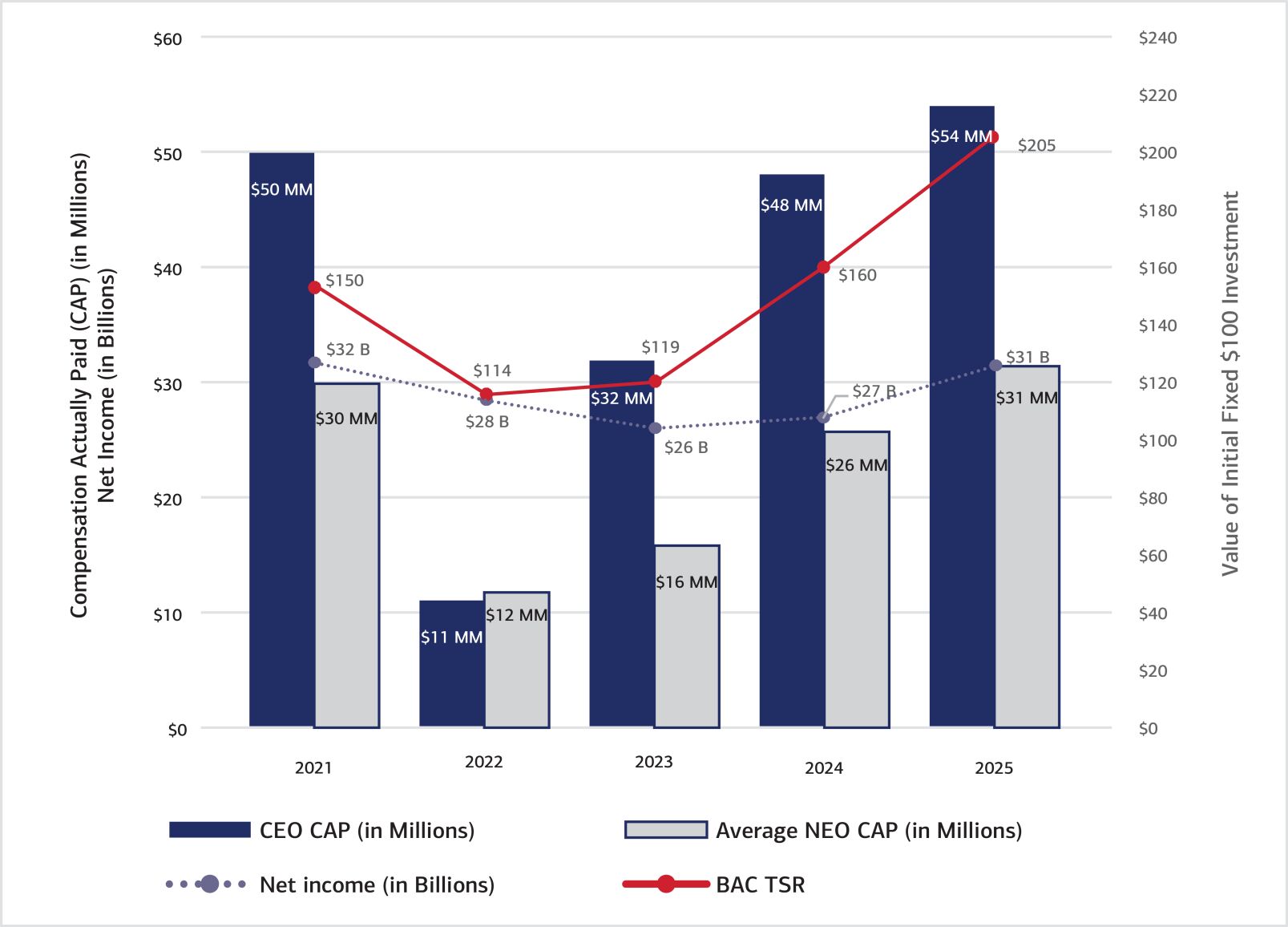
Performance Measures |
Other Considerations | |
In addition to the performance measures listed here, the Committee considers a range of factors in determining compensation aligned with the tenets of Responsible Growth based on (i) growing and winning in the market; (ii) growing with our customer-focused strategy; (iii) growing within our Risk Framework; and (iv) growing in a sustainable manner. For additional information regarding our NEOs’ 2025 performance and the role the performance measures play in our compensation program, see “Individual performance and pay rationale highlights” beginning on page 50 and “Performance evaluation and pay decision process” on page 46. | ||
| * | Tangible book value per common share represents ending tangible common shareholders’ equity divided by ending common shares outstanding. |
74 |
Bank of America |
| Proposal 3: Ratifying the appointment of our independent registered public accounting firm for 2026 |
Proposal 3: Ratifying the appointment of our independent registered public accounting firm for 2026
|
|
|
Our Board recommends a vote “FOR” ratifying the appointment of our independent registered public accounting firm for 2026 (Proposal 3). |
Our Audit Committee is directly responsible for the appointment, compensation, retention, and oversight of our independent registered public accounting firm, and is involved in the selection of the firm’s lead engagement partner who is subject to a mandatory, regular rotation and who may provide services to our company for a maximum of five consecutive years. In selecting and approving a lead engagement partner, the Committee relies on relevant succession criteria established by management and the Committee, interactions with prospective candidates, assessments of their professional experience, and input from our company’s independent registered public accounting firm. The Committee also engages in an annual evaluation of the independent registered public accounting firm. It considers, in particular, whether the retention of the firm is in the best interests of our company and its shareholders, taking into account the firm’s quality of service, institutional knowledge and experience, international capabilities, sufficiency of resources, the quality of its communication and interaction with our company, and its independence, objectivity, and professional skepticism. The Committee also considers the advisability and potential impact of selecting a different independent registered public accounting firm.
After assessing the qualifications, performance, and independence of PricewaterhouseCoopers LLP (PwC), which has served as our company’s independent registered public accounting firm since 1958, the Committee believes that retaining PwC is in the best interests of our company. The Committee has appointed PwC as our independent registered public accounting firm to audit the 2026 consolidated financial statements of Bank of America Corporation and its subsidiaries. Although it is not required to do so, our Board is asking shareholders to ratify PwC’s appointment. If our shareholders do not ratify PwC’s appointment, the Committee will consider changing our independent registered public accounting firm for 2027. Whether or not shareholders ratify PwC’s appointment, the Committee may appoint a different independent registered public accounting firm at any time if it determines that such a change is appropriate.
PwC has advised the Committee that it is an independent accounting firm with respect to our company and its affiliates in accordance with the requirements of the SEC and the Public Company Accounting Oversight Board.
Representatives of PwC are expected to be present at our annual meeting, will have an opportunity to make a statement if they choose, and are expected to be available to respond to appropriate shareholder questions.
PwC’s 2025 and 2024 fees. PwC’s aggregate fees for professional services rendered in or provided for 2025 and 2024, as applicable, were:
|
|
2025 | 2024 | ||||||||
| (in millions) | ||||||||||
| Audit fees |
65.8 | 59.8 | ||||||||
| Audit-Related fees |
6.5 | 6.7 | ||||||||
| Tax fees |
6.1 | 5.7 | ||||||||
| All other fees |
0.0 | 0.0 | ||||||||
| Total fees |
78.4 | 72.2 | ||||||||
Audit fees. Audit fees relate to the integrated audit of our consolidated financial statements, and internal control over financial reporting, including disclosures presented in the footnotes to our company’s financial statements (for example, segment reporting, among other disclosures). Audit fees also relate to the audit of domestic subsidiary financial statements and statutory audit of international subsidiary financial statements, the review of our interim consolidated financial statements, the issuance of comfort letters and SEC consents, and services provided in connection with certain agreed-upon procedures and other attestation reports. Audit fees are those billed or expected to be billed for audit services related to each fiscal year.
Audit-related fees. Audit-related fees cover other audit and attest services, services provided in connection with certain agreed-upon procedures and other attestation reports, financial accounting, reporting and compliance matters, benefit plan audits, and risk and control reviews. Fees for audit-related services are those billed or expected to be billed for services rendered during each fiscal year.
Tax fees. Tax fees cover tax compliance and planning services and are those billed or expected to be billed for services rendered during each fiscal year.
All other fees. During 2025 and 2024, all other fees consisted primarily of amounts billed or expected to be billed for the company’s engagement of PwC to provide technical subscription services rendered during each fiscal year.
| 2026 Proxy Statement |
75 |
| Audit Committee Report |
Audit committee pre-approval policies and procedures
Our Audit Committee annually pre-approves a list of services that PwC may provide without obtaining the Committee’s engagement-specific pre-approval and sets pre-approved fee levels for such services. The pre-approved list of services consists of audit services, audit-related services, tax services, and all other services. All requests or applications for PwC services must be submitted to members of our corporate audit function or tax function to determine if they are included within the Committee’s pre-approved list of services. The Committee or the Committee chair must specifically approve any type of service that has not been pre-approved. The Committee or the Committee chair must also approve any proposed service that has been pre-approved but has fees that will exceed the pre-approved level. All pre-approvals by the Committee chair must be presented to the full Committee at its next meeting. The Committee or the Committee chair pre-approved all of PwC’s 2025 fees and services.
Audit Committee Report
Our Audit Committee is composed of five Board members. Our Board has determined that all Committee members are independent under NYSE listing standards, our Director Independence Categorical Standards, and applicable SEC rules and regulations. Our Board has also determined that all Committee members are financially literate in accordance with NYSE listing standards and qualify as “audit committee financial experts” as defined by SEC rules. The Committee’s responsibilities are stated in a written charter adopted by our Board.
Management is responsible for preparing and the overall reporting process with respect to Bank of America Corporation’s consolidated financial statements, and, with the assistance of the company’s internal corporate auditors, for establishing, maintaining, and assessing the effectiveness of our internal control over financial reporting. PwC, the company’s independent registered public accounting firm, is responsible for planning and conducting an independent audit of the company’s consolidated financial statements in accordance with the standards of the United States Public Company Accounting Oversight Board (PCAOB) and for expressing an opinion as to the conformity of these financial statements with accounting principles generally accepted in the United States and as to the effectiveness of the company’s internal controls over financial reporting. The Committee’s responsibility is to monitor and oversee these processes.
The Committee annually evaluates PwC’s qualifications, performance, and independence. The Committee also oversees the performance of the corporate audit function managed by our Chief Audit Executive. The Committee has reviewed and discussed with management and with PwC the company’s audited financial statements for the year ended December 31, 2025, management’s assessment of the effectiveness of the company’s internal control over financial reporting, and PwC’s evaluation of our company’s internal control over financial reporting. In addition, the Committee has discussed with PwC the matters that independent registered public accounting firms must communicate to audit committees under applicable PCAOB standards.
The Committee has also discussed and confirmed with PwC its independence from our company, and received all required written disclosures and correspondence required by the PCAOB Ethics and Independence requirements. The Committee has evaluated and concluded the non-audit and all other services provided by PwC to our company do not impair PwC’s independence.
Based on the reviews and discussions referred to above, and discussions with the Committee’s independent disclosure counsel, the Committee recommended to our Board that the audited financial statements for the year ended December 31, 2025 and the related footnotes be included in our company’s annual report on Form 10-K for the year ended December 31, 2025.
Submitted by the Audit Committee of the Board:
Sharon L. Allen, Chair
José E. Almeida
Arnold W. Donald
Denise L. Ramos
Michael D. White
| 76 |
Bank of America |
| Proposals 4–5: Shareholder proposals |
Proposals 4–5: Shareholder proposals
|
|
Our Board recommends a vote “AGAINST” these shareholder proposals (proposals 4-5). |
Engagement with Shareholder Proponents
We engage with our investors year-round through targeted, active outreach and responsiveness to inbound inquiries. We recognize that the submission of proposals for inclusion in our proxy statement is one mechanism for shareholders to convey their priorities, perspectives, and concerns to us. We encourage shareholders contemplating a shareholder proposal submission to contact us to discuss their concerns before submitting the proposal. This allows us to better understand their perspective and objectives, to brief management and the Board or its committees on the input we receive, and to provide or direct shareholders to information on our existing policies, practices, and initiatives. For additional information regarding our active shareholder engagement program, see “Shareholder engagement” on page 34, and for more information on the shareholder proposal process, see “Shareholder proposals for our 2027 annual meeting” on page 86.
When we receive a shareholder proposal, we carefully assess and discuss it with internal subject matter experts who have familiarity and insight into the matters raised by the proposal, and we review the proposal with management and the Board. Where we have not already implemented the changes or prepared the requested reports, the Board considers their usefulness to shareholders, the costs involved, and the potential conflicts of such requests with our existing practices and disclosures. We also seek engagement with shareholder proponents or their representatives. These interactions frequently result in meaningful dialogue, providing an opportunity to discuss the rationale behind the proposals and our company’s perspective. As a result of the productive discussions we had with shareholder proponents and/or their representatives, several proposals submitted for inclusion in the proxy statement were withdrawn by the proponents.
Recent Developments
In November 2025, the SEC issued guidance indicating that it would not respond to most shareholder proposal exclusion requests under Rule 14a-8, but would provide companies with a “no-objection” letter on the exclusion of a shareholder proposal from their proxy statement if the company provides an unqualified representation to the SEC that it has a reasonable basis for exclusion under Rule 14a-8, prior SEC guidance, and/or judicial decisions. Based on our review of the provisions of Rule 14a-8 and the SEC’s recent guidance on its application, we determined that it was appropriate to exclude one shareholder proposal because it substantially duplicated another proposal that was submitted to us by another shareholder proponent earlier than the excluded proposal, and which is included in the proxy statement. We determined not to exclude the proposals set forth below as Proposals 4 and 5 after we evaluated them under Rule 14a-8 and SEC guidance, although we note that both are proposals that shareholders have previously rejected and at least one of them may not meet the requirements of Rule 14a-8, including on account of implicating our ordinary business operations in a way that seeks to micromanage our business and addressing a topic that is not economically relevant to our business. Our statements in opposition to each proposal set forth the reasons why the Board recommends that our shareholders vote against these proposals.
Shareholder Proposals for Your Vote
Our Board recommends a vote AGAINST each of the shareholder proposals submitted for your consideration this year. These proposals seek changes to our corporate governance practices, or changes to or reports on how we conduct our business in the ordinary course. All of them have been previously considered and rejected by our shareholders. Moreover, the Board continues to believe that their adoption would not be in shareholders’ best interests. Finally, it is important to note that the shareholder proposals below may contain claims that we believe are incorrect or misleading, although we have not attempted to refute or correct them.
| 2026 Proxy Statement |
77 |
| Proposals 4–5: Shareholder proposals |
Proposal 4: Shareholder proposal requesting independent board chair
The National Legal and Policy Center, 107 Park Washington Court, Falls Church, Virginia, 22046, the beneficial owner of 165 shares of the company’s common stock, has advised us that it intends to present the following resolution:
Request for Board of Directors to Adopt Policy for an Independent Chair
Resolved: Shareholders request the Board of Directors (“Board”) of Bank of America Corporation (“Company”) adopt as policy, and amend the governing documents as necessary, to require hereafter that that two separate people hold the office of Chairman of the Board (“Chair”) and the office of the Chief Executive Officer (“CEO”) as follows:
Selection of the Chair: The Board requires the separation of the offices of the Chair and the CEO.
Whenever possible, the Chair shall be an Independent Director.
The Board may select a temporary Chair who is not an Independent Director to serve while the Board seeks an Independent Chair.
The Chair should not be a former CEO of the company.
Selection of the Chair shall be consistent with applicable law and existing contracts.
Supporting Statement:
The CEO of the Company is also Board Chair. These roles—each with separate, different responsibilities that are critical to the health of a successful corporation—are greatly diminished when held by a singular company official, weakening its governance structure.
Expert perspectives substantiate our position:
| • | According to the 2024 Spencer Stuart Board Index survey, 60 percent of S&P 500 companies had separate CEOs and Board Chairs as of 2024, up from 47 percent in 2014. Meanwhile, 39% of companies had an independent chair as of 2024, up from 28% in 2014.(1) |
| • | Proxy adviser Institutional Shareholder Services contends that “the chair of the board should ideally be an independent director,” and generally encourages investors to vote for “shareholder proposals requiring that the board chair position be filled by an independent director.”(2) |
| • | Proxy adviser Glass Lewis wrote in 2024, “it can become difficult for a board to fulfill its role of overseer and policy setter when a CEO/chair controls the agenda and the boardroom discussion. Such control can allow a CEO to have an entrenched position, leading to longer-than-optimal terms, fewer checks on management, less scrutiny of the business operation, and limitations on independent, shareholder-focused goal-setting by the board.”(3) |
| • | According to the CFA Institute Research and Policy Center, “Combining [Chair and CEO] positions may give undue influence to executive board members and impair the ability and willingness of board members to exercise their independent judgment ... Many jurisdictions consider the separation of the chair and CEO positions a best practice because it ensures that the board agenda is set by an independent voice uninfluenced by the CEO.”(4) |
| • | Search firm Calibre One argues that “governance best practices increasingly recommend separating the roles of CEO from the Chair of the Board, especially in times of leadership transition or strategic inflection ... When one executive holds both titles, it can lead to ambiguity in oversight responsibilities. By contrast, separating the roles introduces a clearer distinction.”(5) |
Please vote yes:
Independent Board Chairman—Proposal 4
Our Board recommends a vote “against” Proposal 4 because:
| • | Since 2015, our shareholders have consistently rejected the proposal’s permanent, one-size-fits-all approach to Board leadership structure and affirmed that the Board should retain the flexibility to determine the most effective Board leadership structure based on current circumstances and needs. |
| • | Our current Board leadership structure and governance practices provide rigorous and effective independent Board oversight. |
| • | The Board evaluates and reviews the Board’s leadership structure at least annually, actively seeking and considering input from shareholders. |
| • | There is no conclusive evidence demonstrating that an independent Chair leads to superior governance or performance, and Board flexibility to determine the optimal leadership structure is the norm at other large companies. |
| (1) | https://www.spencerstuart.com/-/rnedia/2024/09/ssbi2024/2024 _us_ spencer stuart board index.pdf |
| (2) | https://www. issgovernance.com/file/policy /active/americas/US-Voting-Guidelines. Pdf |
| (3) | https://resources.glasslewis.com/hubfs/2024%20Guidelines/2024%20US%20Benchmark%20Policy%20Guidelines. pdf |
| (4) | https://rpc.cfainstitute.org/-/media/documents/article/position-paper/corporate-governance-of-listed-companies-3rd-edition.pdf |
| (5) | https://www.calibreone.com/a-thoughtful-look-at-ceo-chair-separation-what-boards-should-consider-in-2025/ |
| 78 |
Bank of America |
| Proposals 4–5: Shareholder proposals |
Since 2015, our shareholders have consistently rejected the proposal’s permanent, one-size-fits-all Board leadership structure and affirmed that the Board should retain flexibility to determine the most effective Board leadership structure based on current circumstances and needs. In 2015, our Board convened a special shareholders’ meeting solely to give shareholders a vote on whether or not they wanted to change the Bylaws of the company to require an independent Chair. Shareholders resoundingly said NO, as over 62% of votes cast favored allowing our Board the flexibility to determine its leadership structure, including appointing an independent Chair or appointing a Lead Independent Director when the Chair is not an independent director. And our shareholders continue to support that 2015 decision. At the annual meetings in each of 2017, 2018, 2023 and 2024, our shareholders overwhelmingly rejected proposals to require an independent Chair—all of which were submitted by the same few proponents, including the proponent of this proposal—each time by a more than two-to-one margin:
| Year |
Proponent / Representative | Votes Against | ||||
| 2017 |
Kenneth Steiner / John Chevedden | 67% | ||||
| 2018 |
Kenneth Steiner / John Chevedden | 69% | ||||
| 2023 |
National Legal and Policy Center | 73% | ||||
| 2024 |
John Chevedden | 68% | ||||
Through these votes, our shareholders have consistently communicated a clear preference: that the Board should retain the ability to determine the most appropriate and effective leadership structure that best serves the company’s needs and supports long-term shareholder value.
Our shareholders have repeatedly made themselves clear—shareholders are urged to reject the proposal’s attempt to reverse their prior decisions.
Preserving the Board’s discretion reflects the clear preference that our shareholders have expressed time and time again. Any rigid, permanent requirement to mandate the Board’s leadership structure, including to permanently separate the Chair and CEO roles, would impede the Board’s ability to fulfill its fiduciary duties and make informed decisions in the context of evolving business needs, opportunities, and challenges. The Board, in fulfilling its fiduciary duties, should not be prevented from selecting the individual it believes is most qualified and best positioned to act as Chair. Adopting this proposal would restrict the Board from exercising informed judgment and undermine the judgment our shareholders have entrusted to the Board.
Our current Board leadership structure and governance practices provide robust and effective independent Board oversight. Our Board is committed to objective, independent Board leadership and believes that independent board oversight involves having both a properly defined independent Board leader, such as a strong Lead Independent Director when the Chair is not independent, and a robust governance framework that promotes active oversight. Our Board embraces multiple, interlinked practices that support its effective functioning and provide meaningful independent oversight. These practices include: (1) annual reviews of our Board leadership structure and governance practices, as described in more detail below; (2) a robust, well-defined, and transparent Lead Independent Director position that is utilized when our Chair is not an independent director and empowers the independent directors to select and appoint a Lead Independent Director with extensive authority and responsibilities; (3) active leadership, involvement, and influence by the Lead Independent Director, including through developing discussion topics for, and leading, regular executive sessions of our independent directors without management present, holding regular discussions with our CEO, the other independent directors, and our primary bank regulators, and playing a central role in overseeing and participating in our shareholder engagement efforts; (4) a Board composed of experienced and skilled Board members, all of whom stand for election annually and are independent aside from the CEO; (5) standing Board committees that are each chaired by an independent director and composed entirely of independent directors; and (6) robust annual Board and committee self-evaluations and thoughtful director succession practices. Please see the “Independent Board Leadership” section on pages 23 and 24 of this proxy statement for more information about the authority and responsibilities of our Lead Independent Director and our current Board leadership and governance practices.
We believe these practices provide for strong, independent Board leadership and promote effective engagement with, and oversight of, management.
The Board evaluates and reviews the Board’s leadership structure at least annually, actively seeking and considering input from shareholders. The Board, in coordination with its Corporate Governance Committee, deliberates on and discusses the appropriate Board leadership structure at least annually to determine whether any changes are appropriate based on the Board’s and company’s circumstances and needs, and in light of input from our Board’s self-evaluation process, input from shareholders, and developments in corporate governance practices. Providing the Board with flexibility to make these leadership decisions empowers the Board to act in the best interests of the company and our shareholders. If at any time the Board’s review of its leadership structure results in the conclusion that an independent Chair is in the best interests of our shareholders based on the company’s circumstances and needs at that time, the Board is fully empowered to appoint an independent Chair to address those needs and circumstances. The Board’s leadership evaluation process is described in more detail on page 23 of this proxy statement.
| 2026 Proxy Statement |
79 |
| Proposals 4–5: Shareholder proposals |
Our Board and management also have a demonstrated record of engaging with shareholders and proactively soliciting their perspectives on key corporate governance matters, including their views regarding Board leadership. Since being named the Lead Independent Director at the end of 2020, Mr. Nowell has been an active and engaged participant in the company’s corporate governance processes and shareholder engagement meetings. In 2025 alone, Mr. Nowell led over 38 meetings with institutional shareholders representing over 32% of our outstanding shares. Shareholder input is then shared with our Board, its committees, and company management on a regular basis and informs and contributes to enhancements related to, among other things, our corporate governance practices, and executive compensation program. The Board’s shareholder engagement process is described in more detail on pages 34 and 35 of this proxy statement.
The Board recognizes that certain institutional shareholders prefer an independent Chair at all times, for all companies, and may therefore support this proposal as a matter of policy. Similarly, we recognize that the two largest U.S. proxy advisory firms have frequently supported proposals like this one on subjective criteria or on the disputed presumption that an independent Chair is an inherently better board leadership structure. In contrast, our extensive shareholder engagements over recent years have consistently confirmed that a significantly greater number of our shareholders endorse our Board leadership structure, support the independent leadership of our Lead Independent Director and affirm the importance of preserving the Board’s flexibility to determine the most effective leadership structure based on the company’s specific circumstances and needs.
There is no conclusive evidence demonstrating that an independent Chair ensures superior governance or performance, and Board flexibility to determine the optimal leadership structure continues to be the norm at other large companies. While the Board recognizes and respects different points of view and philosophies about which leadership structure supports the best operational or governance results, existing empirical data concerning the impact of board leadership on shareholder value do not conclusively establish any correlation between the presence of an independent chair and superior corporate governance or performance.
Even as the general empirical evidence remains inconclusive, under the current Board leadership structure, the Board has continued to sharpen its focus on corporate governance and established leading governance and disclosure practices (see “Corporate Governance” beginning on page 22 of this proxy statement). Additionally, our company continues to execute on our long-term strategy and focus on Responsible Growth—a strategy conceived under the vision of our current Chair and CEO and developed with the evaluation and unanimous support of the Board’s independent directors—to propel our company’s operating and financial performance and deliver for our clients, employees, and the communities we serve—and for our shareholders. For example, we are one of only four companies globally that has reported over $15 billion in net income for eleven years in a row (2015-2025), the full years coincident with the Board’s adoption of its current Board leadership structure. During this eleven-year period, our annual earnings increased 92% to $30.5 billion and diluted earnings per share increased 191%, while loans with our customers grew $289 billion to nearly $1.2 trillion and our deposits increased $821 billion to more than $2 trillion. The company increased all these measures while managing expenses well with an overall headcount at more than 213,000, down approximately 1.0% from 2015. Book value of the company is up 71% from 2015 and the stock price of the company is up 227% with a market capitalization of $397 billion. In addition, $208 billion in capital was returned to shareholders over this time in common stock dividends and repurchases.
The separation of the CEO and Chair roles may also impact CEO continuity and retention. Among S&P 500 companies, the average CEO tenure is 7.5 years, while average tenure for CEOs who do not also serve as Chair is only 4.4 years. The Board believes that stability and continuity in leadership is in the best interest of the company and our shareholders because it promotes talent recruitment and retention and further reinforces investor confidence. In addition, the company’s existing Board leadership structure is consistent with practices among our large U.S. bank peers and S&P 500 companies more broadly—none of our five large U.S. bank peers(a) currently have an independent board chair and, according to the most recent survey reported by the Spencer Stuart Board Index, only 41% of the chairs of S&P 500 companies are independent.
The Board believes that a one-size-fits-all policy mandating an independent Chair in perpetuity is not in the best interests of our shareholders or our company. Our shareholders supported our current Board leadership bylaw at the special meeting in 2015 and have consistently reaffirmed their support of this view at subsequent annual meetings of shareholders, including most recently in 2024, by voting overwhelmingly to maintain the Board’s flexibility to determine the most effective and appropriate leadership structure. Moreover, our shareholders continue to express support for this approach during our ongoing engagements. Although our shareholders continue to endorse the Board having the necessary flexibility, the Board is committed to regularly reviewing its leadership structure and Board practices and to responsibly determining its most appropriate structure based on then-current circumstances and needs. We urge shareholders to carefully evaluate this proposal in the context of the proven strength, independence, and active engagement of our Lead Independent Director, as well as the company’s sustained record of strong governance, meaningful shareholder engagement and consistent operational performance under our current flexible approach to board leadership.
|
Accordingly, our Board recommends a vote “AGAINST” this proposal (proposal 4)
|
| (a) | See list of primary competitors on page 59 of this proxy statement |
| 80 |
Bank of America |
| Proposals 4–5: Shareholder proposals |
Proposal 5: Shareholder proposal requesting report on board oversight of risks related to animal welfare
John C. Harrington, President and CEO of Harrington Investments, Inc., 1001 2nd Street, Suite 325, Napa, California 94559, has advised us that he intends to present the resolution below. The proponent confirmed that he is the beneficial owner of at least $2,000 in market value of the company’s common stock but did not provide the number of shares owned.
Whereas: Animal welfare issues present material financial, operational, and reputational risks for companies that receive financing from Bank of America (BAC), and to BAC as their financier.
Supporting Statement: BAC can face loss of goodwill or reputational damage from financing operations linked to inhumane treatment of animals (such as animal testing and habitat conditions) and credit risks if borrowers experience business disruptions associated with animal welfare issues that impair ability to repay loans.
According to American Banker, BAC is among the top financiers of factory farms, responsible for 20% of all loans and underwriting services to companies tied to factory farms.(1) Animal welfare concerns are linked to systemic and enterprise risks from factory farming such as food safety issues from diseases passed from animals to humans, and public health risks from overuse of antibiotics in livestock. Factory farms also contribute to biodiversity loss, deforestation, pollution, overuse of water, and soil degradation in addition to the major concerns regarding animal welfare.(2)
Openlnvest stated: “A company that does not disclose or prioritize its processes or impact on animal welfare raises questions for investors on how effective that company can be in managing potential risks or opportunities down the road. It is also impossible to assess future risk without the disclosure of the right information.”(3)
However, the topic of “animal welfare” is absent from BAC’s policies, governance documents, and reports. While BAC’s Environmental and Social Policy Framework asserts “...the importance of biodiversity and its environmental, cultural, religious and health contributions to societies”, the policy appears limited to certain “sensitive” or “fragile” ecosystems and conditions, without addressing the welfare of animals involved.(4)
Increasingly, banks are adopting exclusionary criteria to reduce exposure to animal cruelty and associated risks(5) and otherwise taking animal welfare issues into account as part of their lending due diligence practices. Yet BAC earns a score of “0” on BanksForAnimals.org, for apparent deficiencies in key areas regarding animal welfare.(6) Non-disclosure does not necessarily indicate lack of due diligence. However, neglecting to publicly acknowledge animal welfare oversight risks the perception of failure of oversight on critical issues. Publicly disclosing how BAC addresses animal welfare in financing decisions would increase transparency and strengthen BAC’s reputation.
Resolved: Shareholders request that Bank of America publish a report at reasonable expense and excluding proprietary and privileged information, disclosing whether and how the Board of Directors exercises oversight regarding material risks associated with animal welfare.
Our Board Recommends a vote “AGAINST” Proposal 5 because:
| • | Our Board’s Corporate Governance Committee oversees the management of our sustainability practices to support Responsible Growth, and our Board’s Enterprise Risk Committee oversees the key risks facing our company, including environmental and social risks. |
| • | Our company has robust mechanisms for managing environmental, social, and financial risks across our enterprise, including risks associated with animal welfare issues. |
| • | In light of our Board’s oversight of our sustainability practices and related risks, including risks related to animal welfare, and our existing disclosure about our approach to managing these risks, preparation of the requested report would not provide shareholders with meaningful additional information and would not be a productive use of company resources. |
Our Board’s Corporate Governance Committee oversees the management of our sustainability practices to support Responsible Growth, and our Board’s Enterprise Risk Committee oversees the key risks our company faces, including environmental and social risks. The Board, through its Corporate Governance Committee, oversees our company’s environmental and sustainability activities. As part of these oversight responsibilities, the Corporate Governance Committee regularly reviews the company’s environmental and sustainability strategy and initiatives, as well as related regulatory requirements, and company policies, disclosure, and voluntary goals. Pursuant to federal banking regulations and our Enterprise Risk Framework, which is annually approved by the Board and serves as the foundation for consistent and effective risk management, the Board, through its Enterprise Risk Committee, oversees our company’s Enterprise Risk Framework, risk appetite, and key risks to our company. In fulfilling its oversight responsibilities, the Enterprise Risk Committee receives regular reports from management on key environmental and social policy risks.
| (1) | https://www.americanbanker.com/news/activists-to-jpmorgan-chase-bofa-citi-stop-lending-to-factory-farms |
| (2) | https://www.w_orlqc;mimalprotection.org/globalassets/pdfs/reports/english/closing the financing-gap.pdf at 20. |
| (3) | https://www.openinvest.com/articles-insights/support-animal-welfare |
| (4) | https://about.bankofamerica.com/content/dam/about/pdfs/environmental-and-social-risk-policy-december-2023.pdf |
| (5) | https://banksforanimals.org/ranking-list/ |
| (6) | https://banksforanimals.org/institutions/bank-of-america/ |
| 2026 Proxy Statement |
81 |
| Proposals 4–5: Shareholder proposals |
Our company has robust mechanisms for managing environmental, social, and financial risks across our enterprise, including risks associated with animal welfare issues. As a global financial institution, we manage and mitigate many kinds of risks, including those that can arise indirectly as a result of our clients’ activities. Pursuant to our Enterprise Risk Framework, client transactions that carry specific heightened risk must go through an enhanced due diligence process and are escalated to the applicable line of business risk committee for review. The committee then undertakes a comprehensive analysis of potential risks in order to determine whether to approve the transaction.
More broadly, our Sustainability at Bank of America disclosure published in 2025 (the “2025 Sustainability Disclosure”) outlines our general approach to managing environmental and social risks and identifies environmental and social areas of heightened sensitivity as informed by our Enterprise Risk Framework. We incorporate internationally recognized environmental and social risk management frameworks into our approach, including International Finance Corporation (IFC) Performance Standards on Environmental and Social Sustainability, which address animal welfare by calling for sustainable and certified animal husbandry practices. The IFC Performance Standards are supported by a dedicated Good Practice Note offering guidance on animal welfare within livestock operations. Similarly, under our policies and procedures to address environmental and social risk across the business, certain agricultural commodities, including cattle rearing, fattening, and finishing in high-risk geographies, are recognized as an area of heightened sensitivity and require enhanced due diligence on a client-by-client basis to understand the associated risks across the key risks identified in our Enterprise Risk Framework.
In light of our Board’s oversight of our sustainability practices and related risks, including risks related to animal welfare, and our existing disclosure about our approach to managing these risks, preparation of the requested report would not provide shareholders with meaningful additional information and would not be a productive use of company resources. As discussed above, our Board and its Corporate Governance Committee and Enterprise Risk Committee provide robust oversight of our environmental and sustainability activities and practices and related risks. In addition, our company’s approach to addressing environmental and social risks, including environmental and social areas of heightened sensitivity, is discussed in our 2025 Sustainability Disclosure. As such, the Board believes that the preparation and production of the requested report would unnecessarily divert company resources and the attention of our Board and management without providing our shareholders with meaningful new information.
|
Accordingly, Our Board recommends a vote “AGAINST” this proposal (Proposal 5).
|
| 82 |
Bank of America |
| Voting and other information |
Voting, attending the annual meeting, and other information
Voting
Who may vote at the annual meeting?
You are entitled to vote at our annual meeting if, as of the close of business on March 13, 2026, you were a shareholder of record of the company’s common stock, Series B Preferred Stock, and Series 1, 2, 4, and 5 Preferred Stock (Series 1–5 Preferred Stock). As of March 13, 2026, the following shares were outstanding and entitled to vote:
| Shares |
Number of shares outstanding and entitled to vote |
| ||||||||
| Common Stock |
7,145,709,181 | |||||||||
| Series B Preferred Stock |
7,065 | |||||||||
| Series 1 Preferred Stock |
3,186 | |||||||||
| Series 2 Preferred Stock |
9,967 | |||||||||
| Series 4 Preferred Stock |
7,010 | |||||||||
| Series 5 Preferred Stock |
13,331 | |||||||||
Each share of our common stock and Series B Preferred Stock is entitled to one vote. Although each share of the Series 1–5 Preferred Stock is entitled to 150 votes, we do not have “dual-class” voting as all shareholders vote together without regard to class, except as otherwise required by law. Holders of the Series 1–5 Preferred Stock hold their shares through depositary receipts that each represent 1/1200th of a share of Series 1–5 Preferred Stock (or a vote representing 0.125 shares of our common stock). Therefore, the aggregate vote represented by the Series 1–5 Preferred Stock is de minimis. As of the record date, the Series 1–5 Preferred Stock represent 5,024,100 votes, or approximately 0.070% of the total eligible votes at the 2026 annual meeting of shareholders. We issued the Series 1–5 Preferred Stock as part of our merger with Merrill Lynch & Co., Inc. that became effective January 1, 2009, as required under Delaware law, to holders of respective outstanding shares of Merrill Lynch series 1–5 preferred stock. Since the issuance of the Series 1–5 Preferred Stock in 2009, our company has not issued any additional shares of Series 1–5 Preferred Stock, does not have any current plans to issue any additional shares of Series 1–5 Preferred Stock, and redeemed the Series 3 Preferred Stock in 2018.
In accordance with Delaware law, for the 10 days prior to our annual meeting, a list of registered holders entitled to vote at our annual meeting will be available for inspection in the Office of the Corporate Secretary, Bank of America Corporation, Bank of America Corporate Center, 100 North Tryon Street, NC1-007-56-06, Charlotte, North Carolina 28255.
When and how do I vote my shares?
You may vote prior to our annual meeting by submitting your proxy by internet, phone, or mail:
|
|
Go to www.proxyvote.com and follow the online instructions. You will need information from your Notice of Internet Availability, proxy card, or voting instruction form (VIF), as applicable, to submit your proxy | |
|
|
Call the phone number located on the top of your proxy card or VIF and follow the voice prompts. You will need information from your proxy card or VIF to submit your proxy | |
|
|
Mark your vote on your proxy card or VIF, sign your name exactly as it appears on your proxy card or VIF, date your proxy card or VIF, and return it in the envelope provided | |
You may also vote during our annual meeting by logging into the virtual annual meeting website and vote by following the instructions provided on the website. All shares represented by valid proxies that we receive through this solicitation, and that are not revoked, will be voted according to your voting instructions.
| • | Registered shareholders. If you are a registered shareholder and hold our stock directly (not through a bank, broker, or another nominee), your proxy must be received before the polls close at our annual meeting to be counted. If you properly submit a proxy without giving specific voting instructions, your shares will be voted in accordance with our Board’s recommendations. If other matters properly come before our annual meeting, the proxies will vote on these matters as they determine appropriate. You may revoke your proxy and change your vote at any time before the voting polls close at our annual meeting by submitting a properly executed proxy of a later date, by sending a written notice of revocation of your previously executed proxy to our Corporate Secretary, or by voting at our virtual annual meeting (however, attending the meeting virtually, without voting, will not revoke a proxy). In addition, you may vote by internet or phone no later than 11:59 p.m. Eastern time on May 3, 2026. |
| • | Beneficial shareholders. If you are a beneficial shareholder and hold our stock in the name of a bank, broker, or other nominee (commonly referred to as holding shares in “street name”), voting by telephone and internet ends at 11:59 p.m. Eastern time on May 3, 2026. In |
| 2026 Proxy Statement |
83 |
| Voting and other information |
| addition, if you receive a VIF from your bank, broker, or other nominee, you may vote by following the instructions provided by your bank, broker, or other nominee. Brokers, banks, and other nominees are not permitted to vote on certain proposals and may elect not to vote on any of the proposals unless you provide voting instructions. Therefore, as a beneficial shareholder, if you do not provide voting instructions to your bank, broker, or other nominee, your shares may not be voted at the meeting or may be voted on only a proposal for which discretionary voting is allowed (resulting in “broker non-votes” with respect to the other proposals). You may revoke any voting instructions you provided by following the specific directions from your bank, broker, or other nominee to change or revoke any voting instructions you have already provided. |
| Alternatively, you may also attend the virtual annual meeting and vote online during the meeting, which will replace any previous votes (however, attending the meeting virtually, without voting, will not revoke a proxy). If you have questions about voting your shares, please contact your bank, broker, or other nominee directly. |
| • | Employee shareholders. If you participate in The Bank of America 401(k) Plan or The Bank of America Transferred Savings Account Plan (collectively, the Plan), and your Plan account has investments in shares of our common stock, you must provide voting instructions by May 1, 2026, at 8:00 a.m., Eastern time, to allow the Plan trustee sufficient time to vote the Plan shares. The shares cannot be voted unless you provide voting instructions. Your voting instructions will be held in strict confidence. If you are an employee and you hold shares in multiple accounts, you may receive one proxy card covering all the shares in your accounts, including your Plan account. To vote all of your shares covered by this proxy card, you must provide your voting instructions by the May 1, 2026, 8:00 a.m. Eastern time deadline. |
Is it important for me to vote my shares?
Your vote is important—we want to hear from you and all of our other shareholders. To express our appreciation for your participation, Bank of America will make a $1 charitable donation on behalf of every shareholder account that votes. “Householded” accounts for beneficial owners will be administered as a single account. For more information on “householding,” see “Eliminating duplicative proxy materials through ‘householding’” on the next page.
What are the requirements for Bank of America to hold the annual meeting?
In order to hold our annual meeting, a quorum representing holders of a majority of the voting power of our common stock, the Series B Preferred Stock, and the Series 1–5 Preferred Stock must be present or represented by proxy at the meeting. We intend to include as present: shares present but not voting; shares for which we have received proxies but for which shareholders have abstained from voting; and shares represented by proxies returned by a bank, broker, or other nominee holding the shares.
What are the votes required to elect each director nominee and approve the other proposals?
| Proposals for your vote |
Votes required | Effect of abstentions |
Effect of broker non-votes | ||||||||||||
| Proposal 1: Electing directors |
Majority of votes cast | No effect | No effect | ||||||||||||
| Proposal 2: Approving our executive compensation (an advisory, non-binding “Say on Pay” resolution) |
Majority of votes cast | No effect | No effect | ||||||||||||
| Proposal 3: A proposal ratifying the appointment of our independent registered public accounting firm for 2026 |
Majority of votes cast | No effect | No effect | ||||||||||||
| Proposals 4–5: Shareholder proposals |
Majority of votes cast | No effect | No effect | ||||||||||||
| • | Proposal 1: Electing directors. Our Bylaws provide that a nominee for director in an uncontested election will be elected to our Board if the votes cast for the nominee’s election exceed the votes cast against his or her election. Abstentions from voting and broker non-votes are not treated as votes cast and are not counted for purposes of determining the election of directors. If a nominee does not receive the required votes for election at our annual meeting, our Board, with the assistance of our Corporate Governance Committee, will consider whether to accept the director’s offer of resignation, which is required to be tendered under our Corporate Governance Guidelines. Our Board will publicly disclose its decision regarding the resignation and the basis for its decision within 90 days after election results are certified. |
| • | Other proposals. Approval of Proposals 2 through 5 requires the votes cast in favor of each such proposal to exceed the votes cast against the proposal. Abstentions from voting and broker non-votes are not treated as votes cast and are not counted in determining the outcome of any of these proposals. |
| 84 |
Bank of America |
| Voting and other information |
What other information do I need to know?
Cost of proxy solicitation. We are providing or making available this proxy statement to solicit your proxy to vote on the matters presented at our annual meeting. We will pay the cost of soliciting proxies. In addition to soliciting proxies by mail or electronic delivery, we also may use our directors or employees to solicit proxies either personally or by telephone, mail, email, or other means. None of these directors or employees will receive any additional or special compensation for soliciting proxies. In addition, we have engaged Georgeson LLC and Sodali LLC to assist us in soliciting proxies from banks, brokers, and other nominees at an estimated cost of $19,500 and $22,500, respectively, plus expenses. We also will reimburse banks, brokers, and other nominees for their expenses in sending proxy materials to their customers who are beneficial owners of our stock.
Internet availability of proxy materials. We mailed or emailed to most of our shareholders a Notice of Internet Availability of our proxy materials with instructions on how to access our proxy materials online and how to vote. If you are a registered holder and would like to change the method of delivery of your proxy materials, please contact our transfer agent, Computershare Trust Company, N.A., P.O. Box 43078, Providence, RI 02940; toll free: 800-642-9855; or at www.computershare.com/bac. You may do the same as a beneficial owner by contacting the bank, broker, or other nominee where your shares are held.
Eliminating duplicative proxy materials through “householding.” We deliver a single set of our proxy statement and annual report to shareholders with separate proxy cards or separate Notices of Internet Availability to multiple registered holders who share an address, unless we receive other instructions. If (i) you and another registered holder share an address and each receive paper copies of our proxy materials and wish to receive only one paper copy, or (ii) you share an address with another registered holder, received a single set of our proxy materials, and would like to receive separate copies, you may request a change in delivery preferences by contacting our transfer agent, Computershare Trust Company, N.A., P.O. Box 43078, Providence, RI 02940; toll free: 800-642-9855; or at www.computershare.com/bac.
If you are a beneficial owner and receive multiple copies of our proxy materials and you would like to receive only one copy, or if you and another shareholder receive only one copy and would like to receive multiple copies, contact your bank, broker, or other nominee.
Attending the annual meeting
How can I participate in the meeting?
For the convenience of our shareholders and employees, our Board has determined to hold our annual meeting solely by means of remote communication via audio webcast. This is often referred to as a “virtual annual meeting.” The virtual annual meeting webcast, hosted by Broadridge, allows all shareholders to join the meeting, regardless of location. We aim to provide shareholders the same rights and comparable opportunities for participation that have been historically provided at our in-person annual meetings. As with an in-person meeting, you will be able to vote and ask questions during the meeting. In prior years, attendance at our virtual annual meetings has been greater than in-person meetings, so we believe the virtual format offers a greater number of our shareholders the opportunity to attend.
All holders of our common stock, Series B Preferred Stock, and Series 1–5 Preferred Stock as of the March 13, 2026 record date are invited to attend our annual meeting.
Join the annual meeting by accessing the meeting website at www.virtualshareholdermeeting.com/BAC2026. You must enter the 16-digit control number found in the email or on the Notice of Internet Availability of our proxy materials previously provided to notify you of the availability of our proxy materials, or on your proxy card or voting instruction form provided with our proxy materials. If the Notice of Internet Availability of our proxy materials or voting instruction form that you received does not indicate that you may vote your shares through the www.proxyvote.com website, you should contact your bank, broker, or other nominee (preferably at least five days before the meeting) and obtain your 16-digit control number that will allow you to attend, participate in, or vote at the meeting.
The annual meeting is scheduled to begin at 10:00 a.m., Eastern time, on May 4, 2026. Online access will begin at 9:45 a.m., Eastern time; we encourage you to access the meeting webcast prior to the start time. If you encounter difficulties joining or during the annual meeting webcast, please check your internet connectivity and contact our voting intermediary, Broadridge, at 844-983-0876 or 303-562-9303. Rules of conduct for the annual meeting will be available once you access the meeting webcast. A replay of the meeting will be posted on our Investor Relations website at http://investor.bankofamerica.com/ following the meeting.
Bank of America is committed to making our annual meeting accessible to all shareholders. If you require an accommodation in order to fully participate in the meeting, please call us at 800-521-3984 or send your request in writing to our Corporate Secretary at Bank of America Corporation, Bank of America Corporate Center, 100 North Tryon Street, NC1-007-56-06, Charlotte, North Carolina 28255, by April 9, 2026, so your request may receive appropriate attention.
How can I ask questions during the meeting?
You can ask questions during the virtual meeting by typing your questions into the text box under “Ask a Question” and clicking “Submit.” You must first join the meeting with your control number as described above in “How can I participate in the annual meeting?”
| 2026 Proxy Statement |
85 |
| Voting and other information |
We intend to answer questions pertinent to company matters as time allows during the meeting. Questions that are substantially similar may be grouped and answered once to avoid repetition. Shareholder questions related to personal or customer-related matters, that are not pertinent to annual meeting matters, or that contain derogatory references to individuals, use offensive language, or are otherwise out of order or not suitable for the conduct of the annual meeting will not be addressed during the meeting. Questions related to customer service will be referred to a customer service representative for a response. We encourage our clients to call 800-432-1000 for direct, personalized assistance or go to https://www.bankofamerica.com/customer-service/contact-us/ for additional ways to contact us.
Will I be able to vote my shares during the meeting?
Generally, you will be able to vote your shares electronically during the annual meeting, except if you hold shares through The Bank of America 401(k) Plan or The Bank of America Transferred Savings Account Plan. Voting instructions for those shares must be submitted by May 1, 2026, at 8:00 a.m., Eastern time. Please see “When and how do I vote my shares?” on page 83 and “What are the votes required to elect each director nominee and approve the other proposals?” on page 84 for additional information on voting. As always, we encourage you to vote your shares prior to the annual meeting.
Where can I find more information about the meeting?
To review our 2026 Proxy Statement, 2025 Annual Report, and other information pertaining to our 2026 annual meeting online, go to www.proxyvote.com or https://investor.bankofamerica.com/events-and-presentations/annual-shareholder-meeting.
Other information
Shareholder proposals for our 2027 annual meeting.
Shareholder proposals submitted for inclusion in the proxy statement for our 2027 annual meeting must comply with applicable requirements and conditions established by the SEC, including Rule 14a-8 of the Exchange Act, and must be received by our Corporate Secretary no later than the close of business on November 23, 2026.
Pursuant to our proxy access Bylaw provision, one, or a group of up to 20 shareholders who, in aggregate, own continuously for at least three years, shares of our company representing an aggregate of at least 3% of the voting power entitled to vote in the election of directors, may nominate and include in our proxy materials director nominees constituting up to 20% of our Board, provided that the shareholder(s) and the nominee(s) satisfy the requirements in our Bylaws. Notice of proxy access director nominees must be received by our Corporate Secretary at the address below no earlier than October 24, 2026 and no later than the close of business on November 23, 2026, assuming we do not change the date of our 2027 annual meeting by more than 30 days before or 70 days after the anniversary date of our 2026 annual meeting.
If you would like to submit a matter for consideration at our 2027 annual meeting (including any shareholder proposal not submitted under Rule 14a-8 or any director nomination) that will not be included in the proxy statement for that annual meeting, it must be received by our Corporate Secretary no earlier than the close of business on January 4, 2027 and no later than the close of business on February 18, 2027, assuming we do not change the date of our 2027 annual meeting by more than 30 days before or 70 days after the anniversary date of our 2026 annual meeting. Any matter must comply with our Bylaws, which includes information required under Rule 14a-19.
All shareholder proposals must be received by our Corporate Secretary at Bank of America Corporation, Bank of America Corporate Center, 100 North Tryon Street, NC1-007-56-06, Charlotte, North Carolina 28255 by the applicable dates specified above.
We encourage shareholders that are contemplating submitting a proposal for inclusion in our proxy statement to contact us beforehand at the address above to allow for a constructive discussion of their concerns and for additional information about our practices or policies.
Delivery of proxy materials for our 2027 annual meeting
Bank of America periodically reviews how it delivers proxy materials to shareholders. Beginning with the 2027 annual meeting we will update our delivery practices to reflect shareholder preferences and market practices. Fewer shareholders will automatically receive printed copies of the proxy statement and annual report by mail and, instead, receive an email notice or a Notice of Internet Availability of our proxy materials with instructions for accessing these materials online.
This planned change reflects how shareholders increasingly prefer to receive and review information, as well as practices widely adopted by other large U.S. public companies. Electronic delivery reduces paper consumption and supports the efficient distribution of materials while maintaining transparency and accessibility for shareholders. It will not affect shareholders’ ability to vote or participate in the annual meeting.
You may continue to receive printed copies of the proxy statement and annual report at no cost. To confirm or change the delivery method for your proxy materials, registered shareholders may contact our transfer agent, Computershare Trust Company, N.A., at P.O. Box 43078, Providence, RI 02940; toll-free at 800-642-9855 or visit www.computershare.com/bac; beneficial owners should contact their bank, broker, or nominee.
| 86 |
Bank of America |
| Appendix A: Reconciliation of GAAP and non-GAAP financial measures |
Appendix A: Reconciliation of GAAP and non-GAAP financial measures
Our company reports its financial results in accordance with accounting principles generally accepted in the United States of America (GAAP). However, we believe that certain non-GAAP financial measures provide additional clarity in understanding our results of operations and trends as follows:
| • | Certain results excluding debit valuation adjustment (DVA) losses provide additional information to assess the underlying operational performance and trends of our businesses and to allow better comparison of period-to-period operating performance. |
| • | Certain ratios that utilize tangible equity present measures of those assets that can generate income. Return on average tangible common shareholders’ equity measures our net income applicable to common shareholders as a percentage of adjusted average common shareholders’ equity. Tangible book value per common share represents ending tangible common shareholders’ equity divided by ending common shares outstanding. These measures are used to evaluate the company’s use of equity. In addition, profitability, relationship, and investment models all use return on average tangible shareholders’ equity as key measures to support our overall growth goals. |
Non-GAAP financial measures should be viewed in addition to, and not as an alternative for, our company’s reported results prepared in accordance with GAAP.
For additional information about non-GAAP financial measures, see “Supplemental Financial Data in Management’s Discussion and Analysis of the Financial Condition and Results of Operations” on page 31 of our 2025 Annual Report on Form 10-K filed with the SEC on February 25, 2026.
Below is a reconciliation of GAAP and non-GAAP financial measures found on pages 48—52.
| December 31 | ||||||||||
|
|
2025 | 2024 | ||||||||
|
|
(In millions) | (In millions) | ||||||||
| Net income applicable to common shareholders |
$ | 29,055 | $ | 25,344 | ||||||
| December 31 | ||||||||||
| 2025 | 2024 | |||||||||
| (In millions) | (In millions) | |||||||||
| Reconciliation of average shareholders’ equity to average tangible common shareholders’ equity |
||||||||||
| Shareholders’ equity |
$ | 298,474 | $ | 292,467 | ||||||
| Goodwill |
(69,021 | ) | (69,021 | ) | ||||||
| Intangible assets (excluding mortgage servicing rights) |
(1,883 | ) | (1,961 | ) | ||||||
| Related deferred tax liabilities |
841 | 866 | ||||||||
| Tangible shareholders’ equity |
228,411 | 222,351 | ||||||||
| Preferred stock |
(24,039 | ) | (26,487 | ) | ||||||
| Tangible common shareholders’ equity |
$ | 204,372 | $ | 195,864 | ||||||
| Reconciliation of year-end shareholders’ equity to year-end tangible common shareholders’ equity |
||||||||||
| Shareholders’ equity |
$ | 303,243 | $ | 293,963 | ||||||
| Goodwill |
(69,021 | ) | (69,021 | ) | ||||||
| Intangible assets (excluding mortgage servicing rights) |
(1,841 | ) | (1,919 | ) | ||||||
| Related deferred tax liabilities |
825 | 851 | ||||||||
| Tangible shareholders’ equity |
233,206 | 223,874 | ||||||||
| Preferred stock |
(25,992 | ) | (23,159 | ) | ||||||
| Tangible common shareholders’ equity |
$ | 207,214 | $ | 200,715 | ||||||
| Bank of America |
A-1 |
| Appendix A: Reconciliation of GAAP and non-GAAP financial measures |
| December 31 | ||||||||||
|
|
2025 | 2024 | ||||||||
| Ending common shares (in thousands) |
7,212,464 | 7,610,862 | ||||||||
| Book value per share |
$ | 38.44 | $ | 35.58 | ||||||
| Tangible book value per share |
28.73 | 26.37 | ||||||||
| December 31 | ||||||||||
|
|
2025 | 2024 | ||||||||
|
|
(In millions) | (In millions) | ||||||||
| Sales and trading revenue |
$ | 20,871 | $ | 18,807 | ||||||
| Net DVA losses |
35 | 113 | ||||||||
| Sales and trading revenue, excluding net DVA |
$ | 20,906 | $ | 18,920 | ||||||
| A-2 |
2026 Proxy Statement |

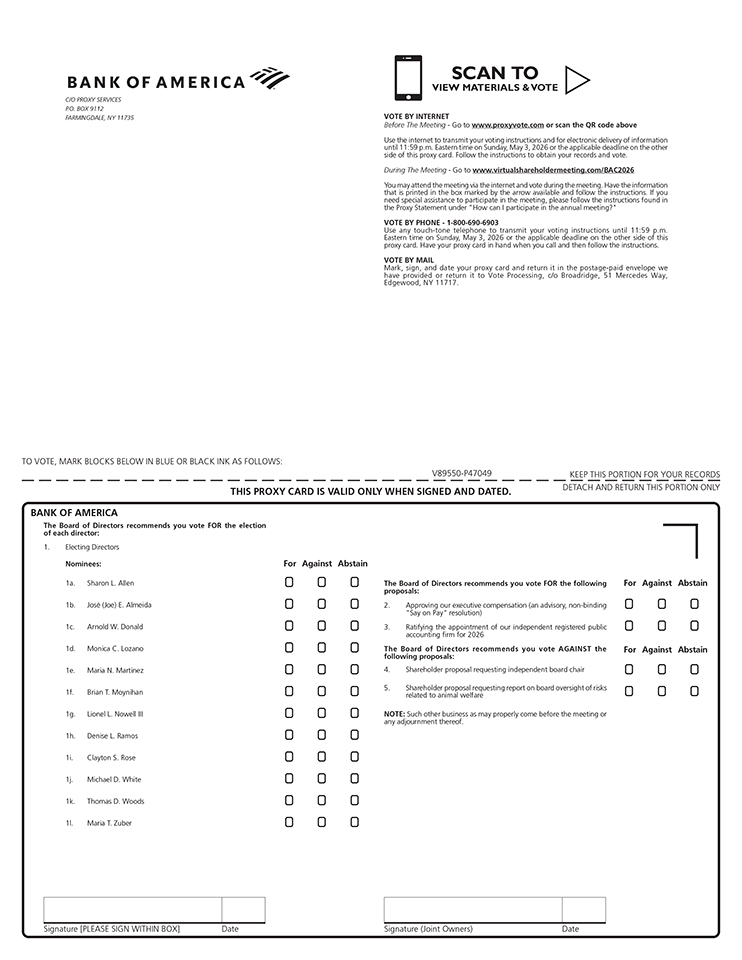
C/O PROXY SERVICES P.O. BOX 9112 FARMINGDALE, NY 11735 SCAN TO VIEW MATERIALS & VOTE VOTE BY INTERNET Before The Meeting - Go to www.proxyvote.com or scan the QR code above Use the internet to transmit your voting instructions and for electronic delivery of information until 11:59 p.m. Eastern time on Sunday, May 3, 2026 or the applicable deadline on the other side of this proxy card. Follow the instructions to obtain your records and vote. During The Meeting - Go to www.virtualshareholdermeeting.com/BAC2026 You may attend the meeting via the internet and vote during the meeting. Have the information that is printed in the box marked by the arrow available and follow the instructions. If you need special assistance to participate in the meeting, please follow the instructions found in the Proxy Statement under “How can I participate in the annual meeting?” VOTE BY PHONE - 1-800-690-6903 Use any touch-tone telephone to transmit your voting instructions until 11:59 p.m. Eastern time on Sunday, May 3, 2026 or the applicable deadline on the other side of this proxy card. Have your proxy card in hand when you call and then follow the instructions. VOTE BY MAIL Mark, sign, and date your proxy card and return it in the postage-paid envelope we have provided or return it to Vote Processing, c/o Broadridge, 51 Mercedes Way, Edgewood, NY 11717. TO VOTE, MARK BLOCKS BELOW IN BLUE OR BLACK INK AS FOLLOWS: V89550-P47049 KEEP THIS PORTION FOR YOUR RECORDS THIS PROXY CARD IS VALID ONLY WHEN SIGNED AND DATED. DETACH AND RETURN THIS PORTION ONLY BANK OF AMERICA The Board of Directors recommends you vote FOR the election of each director: 1. Electing Directors Nominees: For Against Abstain 1a. Sharon L. Allen 1b. José (Joe) E. Almeida 1c. Arnold W. Donald 1d. Monica C. Lozano 1e. Maria N. Martinez 1f. Brian T. Moynihan 1g. Lionel L. Nowell III 1h. Denise L. Ramos 1i. Clayton S. Rose 1j. Michael D. White 1k. Thomas D. Woods 1l. Maria T. Zuber The Board of Directors recommends you vote FOR the following proposals: 2. Approving our executive compensation (an advisory, non-binding “Say on Pay” resolution) 3. Ratifying the appointment of our independent registered public accounting firm for 2026 The Board of Directors recommends you vote AGAINST the following proposals: 4. Shareholder proposal requesting independent board chair 5. Shareholder proposal requesting report on board oversight of risks related to animal welfare NOTE: Such other business as may properly come before the meeting or any adjournment thereof. Signature [PLEASE SIGN WITHIN BOX] Date Signature (Joint Owners) Date
Bank of America Corporation 2026 Annual Meeting of Shareholders Monday, May 4, 2026 10:00 a.m., Eastern time Meeting live via internet - please visit www.virtualshareholdermeeting.com/BAC2026 Important Notice Regarding the Availability of Proxy Materials for the 2026 Annual Meeting of Shareholders to be held on May 4, 2026 The 2026 Notice of Annual Meeting and Proxy Statement, and the 2025 Annual Report to Shareholders are available at www.proxyvote.com. FOLD AND DETACH HERE FOLD AND DETACH HERE V89551-P47049 Bank of America Corporation Proxy/Voting Instructions This Proxy is Solicited on Behalf of the Board of Directors for the 2026 Annual Meeting of Shareholders to be held on Monday, May 4, 2026 You, the undersigned shareholder, appoint each of Sarang Gadkari and Brendan Hanley, as attorney-in-fact and proxy, with full power of substitution, to vote on your behalf and with all powers you would possess if personally present, all shares of Common Stock or Preferred Stock of Bank of America Corporation that you would be entitled to vote at the 2026 Annual Meeting of Shareholders and any adjournment or postponement thereof. The shares represented by this proxy will be voted as instructed by you and in the discretion of the proxies on all other matters that properly come before the 2026 Annual Meeting of Shareholders and any adjournment or postponement thereof. If not otherwise specified, shares will be voted in accordance with the recommendations of the Board of Directors. Employee shareholders. If you participate in The Bank of America 401(k) Plan or The Bank of America Transferred Savings Account Plan (collectively, the Plan), and your Plan account has investments in shares of our common stock, you must provide voting instructions by May 1, 2026, at 8:00 a.m., Eastern time, to allow the Plan trustee sufficient time to vote the Plan shares. The shares cannot be voted unless you provide voting instructions. Your voting instructions will be held in strict confidence. If you are an employee and you hold shares in multiple accounts, you may receive one proxy card covering all the shares in your accounts, including your Plan account. To vote all of your shares covered by this proxy card, you must provide your voting instructions by the May 1, 2026, 8:00 a.m. Eastern time deadline. (Continued and to be marked, dated and signed, on the other side)
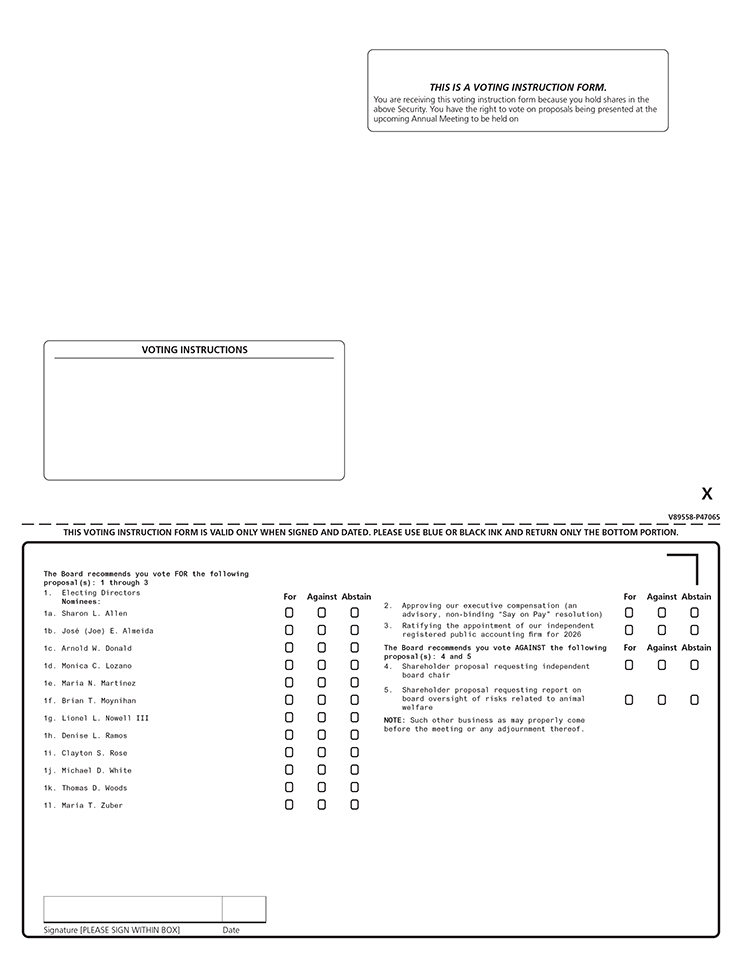
THIS IS A VOTING INSTRUCTION FORM. You are receiving this voting instruction form because you hold shares in the above Security. You have the right to vote on proposals being presented at the upcoming Annual Meeting to be held on VOTING INSTRUCTIONS X V89558-P47065 THIS VOTING INSTRUCTION FORM IS VALID ONLY WHEN SIGNED AND DATED. PLEASE USE BLUE OR BLACK INK AND RETURN ONLY THE BOTTOM PORTION. The Board recommends you vote FOR the following proposal(s): 1 through 3 1. Electing Directors Nominees: For Against Abstain 1a. Sharon L. Allen 1b. José (Joe) E. Almeida 1c. Arnold W. Donald 1d. Monica C. Lozano 1e. Maria N. Martinez 1f. Brian T. Moynihan 1g. Lionel L. Nowell III 1h. Denise L. Ramos 1i. Clayton S. Rose 1j. Michael D. White 1k. Thomas D. Woods 1l. Maria T. Zuber 2. Approving our executive compensation (an advisory, non-binding “Say on Pay” resolution) 3. Ratifying the appointment of our independent registered public accounting firm for 2026 The Board recommends you vote AGAINST the following proposal(s): 4 and 5 4. Shareholder proposal requesting independent board chair 5. Shareholder proposal requesting report on board oversight of risks related to animal welfare NOTE: Such other business as may properly come before the meeting or any adjournment thereof. Signature [PLEASE SIGN WITHIN BOX] Date