
© 2026 Wells Fargo Bank, N.A. All rights reserved. 4Q25 Financial Results January 14, 2026 .3
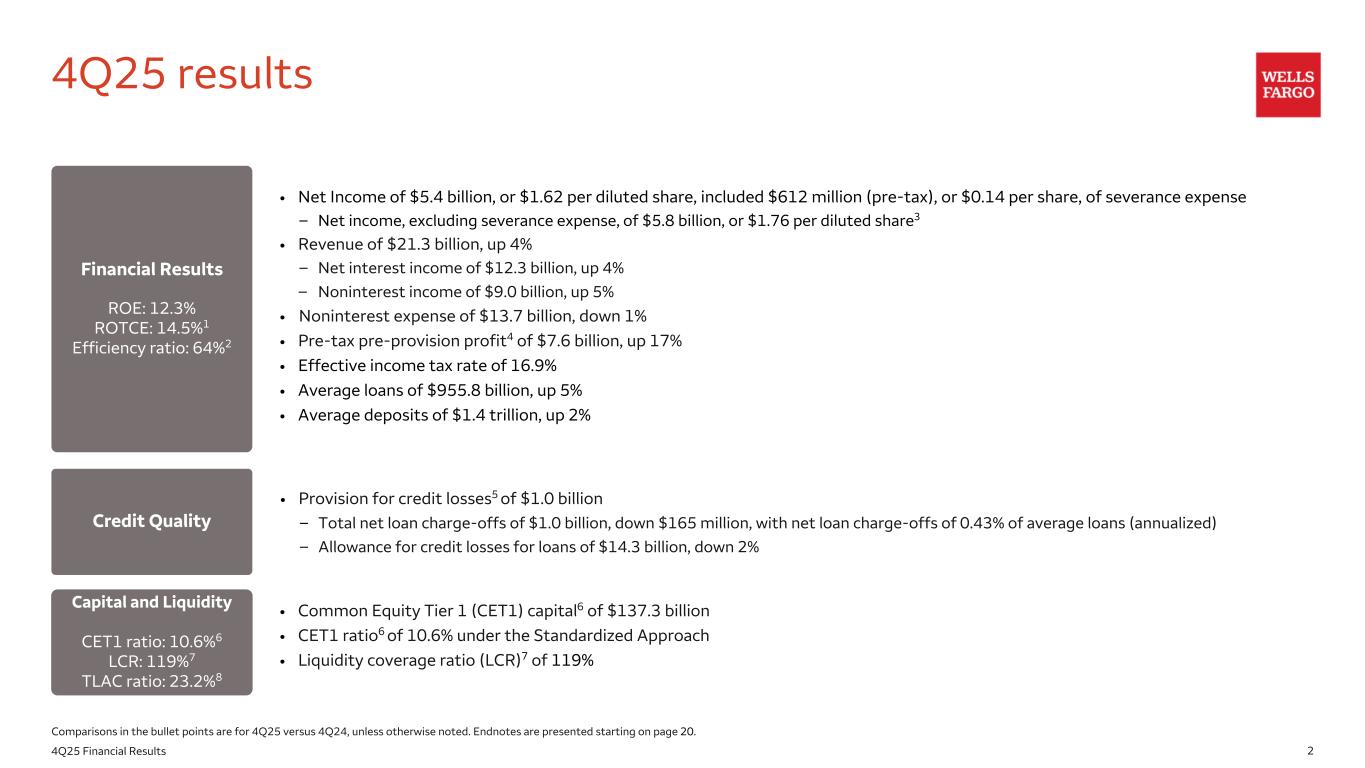
24Q25 Financial Results 4Q25 results Financial Results ROE: 12.3% ROTCE: 14.5%1 Efficiency ratio: 64%2 Credit Quality Capital and Liquidity CET1 ratio: 10.6%6 LCR: 119%7 TLAC ratio: 23.2%8 • Provision for credit losses5 of $1.0 billion – Total net loan charge-offs of $1.0 billion, down $165 million, with net loan charge-offs of 0.43% of average loans (annualized) – Allowance for credit losses for loans of $14.3 billion, down 2% • Common Equity Tier 1 (CET1) capital6 of $137.3 billion • CET1 ratio6 of 10.6% under the Standardized Approach • Liquidity coverage ratio (LCR)7 of 119% • Net Income of $5.4 billion, or $1.62 per diluted share, included $612 million (pre-tax), or $0.14 per share, of severance expense – Net income, excluding severance expense, of $5.8 billion, or $1.76 per diluted share3 • Revenue of $21.3 billion, up 4% – Net interest income of $12.3 billion, up 4% – Noninterest income of $9.0 billion, up 5% • Noninterest expense of $13.7 billion, down 1% • Pre-tax pre-provision profit4 of $7.6 billion, up 17% • Effective income tax rate of 16.9% • Average loans of $955.8 billion, up 5% • Average deposits of $1.4 trillion, up 2% Comparisons in the bullet points are for 4Q25 versus 4Q24, unless otherwise noted. Endnotes are presented starting on page 20.
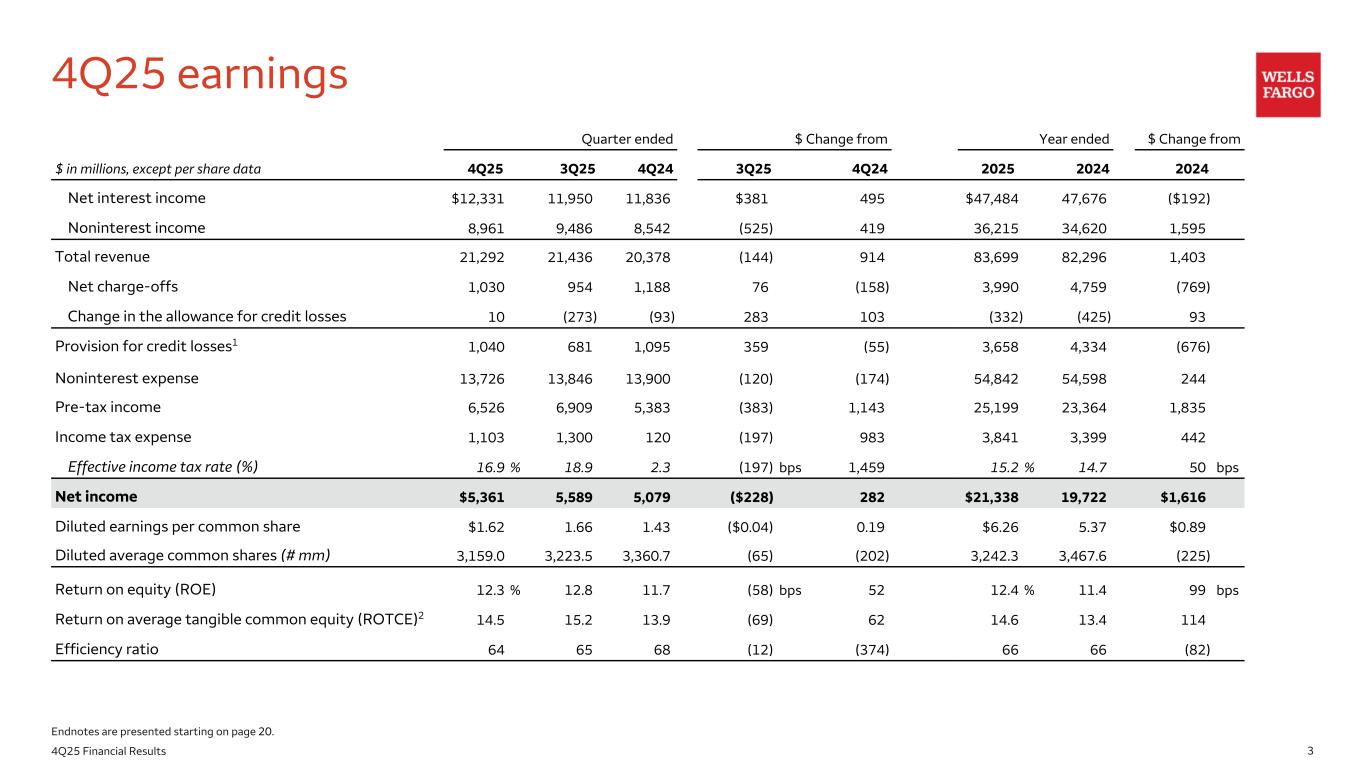
34Q25 Financial Results 4Q25 earnings Quarter ended $ Change from Year ended $ Change from $ in millions, except per share data 4Q25 3Q25 4Q24 3Q25 4Q24 2025 2024 2024 Net interest income $12,331 11,950 11,836 $381 495 $47,484 47,676 ($192) Noninterest income 8,961 9,486 8,542 (525) 419 36,215 34,620 1,595 Total revenue 21,292 21,436 20,378 (144) 914 83,699 82,296 1,403 Net charge-offs 1,030 954 1,188 76 (158) 3,990 4,759 (769) Change in the allowance for credit losses 10 (273) (93) 283 103 (332) (425) 93 Provision for credit losses1 1,040 681 1,095 359 (55) 3,658 4,334 (676) Noninterest expense 13,726 13,846 13,900 (120) (174) 54,842 54,598 244 Pre-tax income 6,526 6,909 5,383 (383) 1,143 25,199 23,364 1,835 Income tax expense 1,103 1,300 120 (197) 983 3,841 3,399 442 Effective income tax rate (%) 16.9 % 18.9 2.3 (197) bps 1,459 15.2 % 14.7 50 bps Net income $5,361 5,589 5,079 ($228) 282 $21,338 19,722 $1,616 Diluted earnings per common share $1.62 1.66 1.43 ($0.04) 0.19 $6.26 5.37 $0.89 Diluted average common shares (# mm) 3,159.0 3,223.5 3,360.7 (65) (202) 3,242.3 3,467.6 (225) Return on equity (ROE) 12.3 % 12.8 11.7 (58) bps 52 12.4 % 11.4 99 bps Return on average tangible common equity (ROTCE)2 14.5 15.2 13.9 (69) 62 14.6 13.4 114 Efficiency ratio 64 65 68 (12) (374) 66 66 (82) Endnotes are presented starting on page 20.
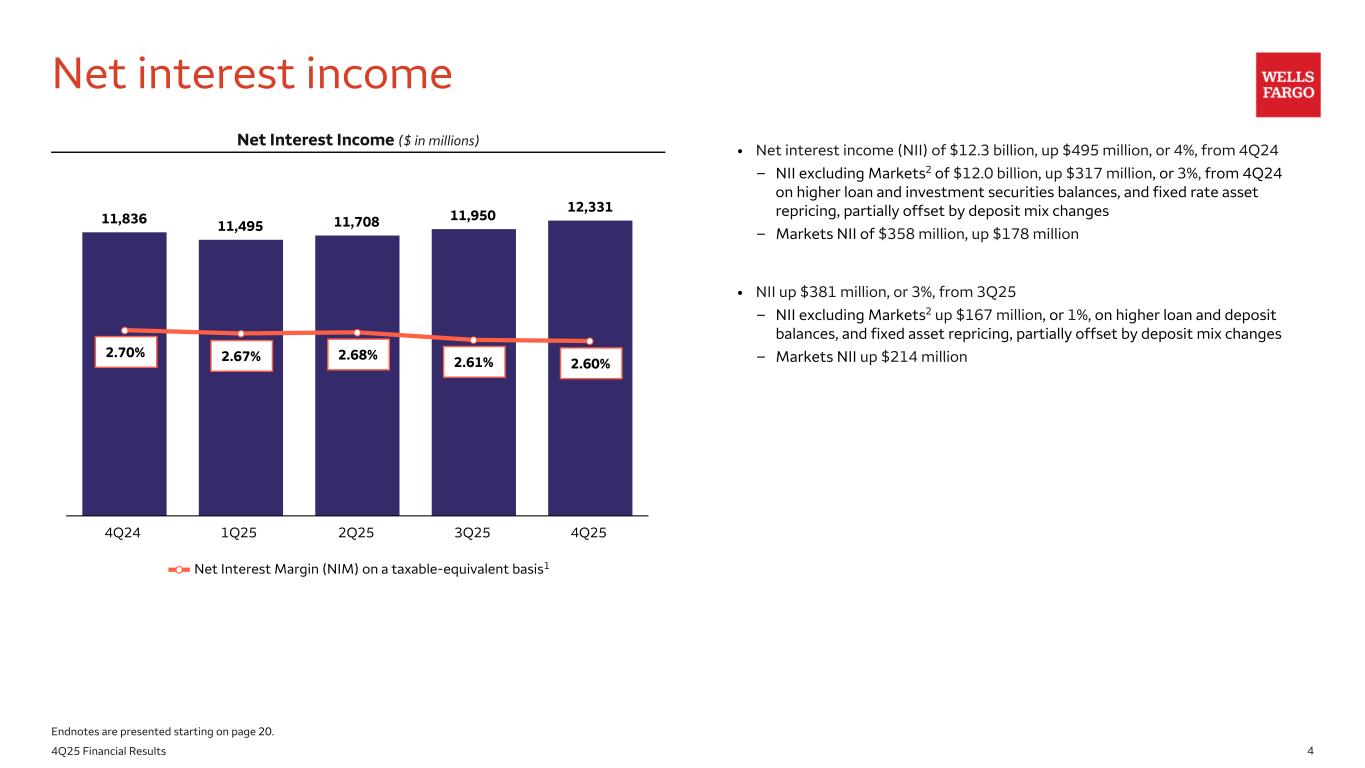
44Q25 Financial Results Net Interest Income ($ in millions) 11,836 11,495 11,708 11,950 12,331 Net Interest Margin (NIM) on a taxable-equivalent basis 4Q24 1Q25 2Q25 3Q25 4Q25 2.60% Net interest income • Net interest income (NII) of $12.3 billion, up $495 million, or 4%, from 4Q24 – NII excluding Markets2 of $12.0 billion, up $317 million, or 3%, from 4Q24 on higher loan and investment securities balances, and fixed rate asset repricing, partially offset by deposit mix changes – Markets NII of $358 million, up $178 million • NII up $381 million, or 3%, from 3Q25 – NII excluding Markets2 up $167 million, or 1%, on higher loan and deposit balances, and fixed asset repricing, partially offset by deposit mix changes – Markets NII up $214 million 2.70% 2.67% 2.68% 2.61% 1 Endnotes are presented starting on page 20.
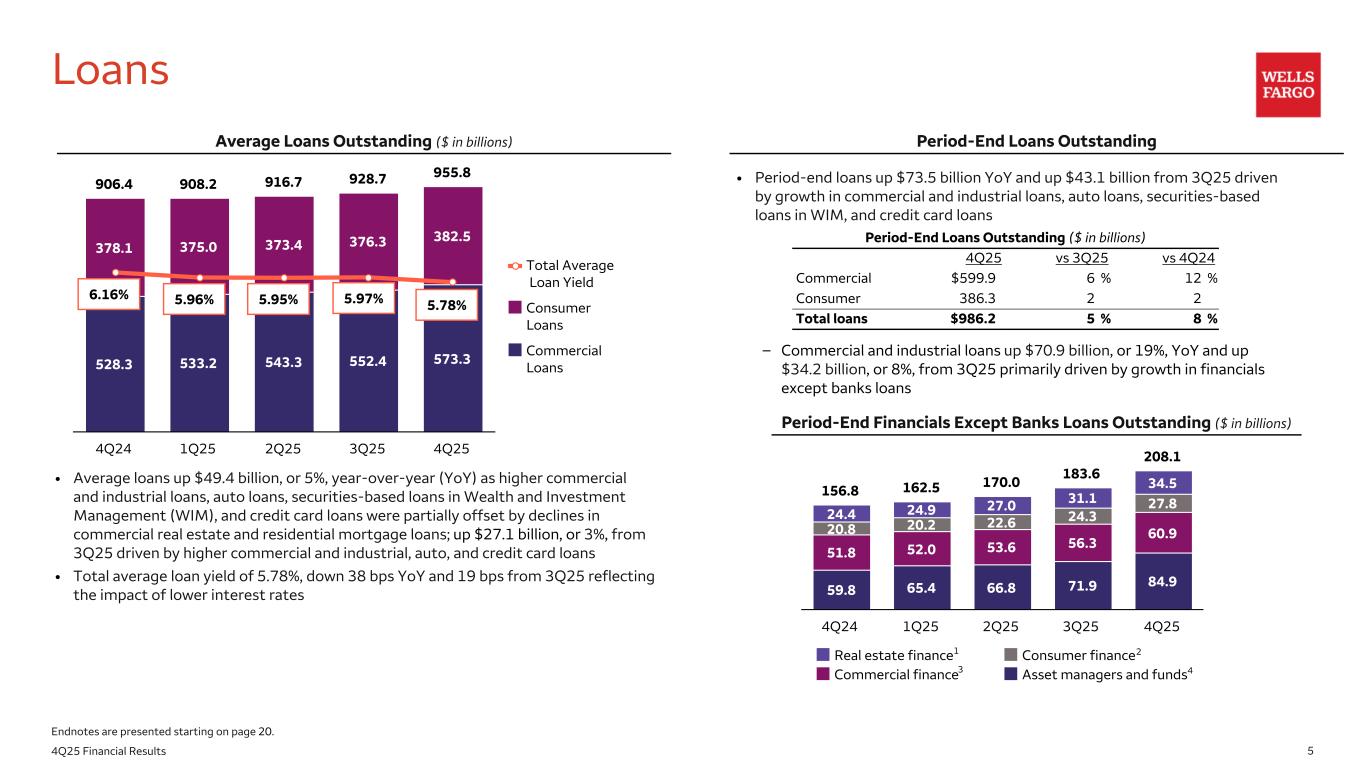
54Q25 Financial Results • Period-end loans up $73.5 billion YoY and up $43.1 billion from 3Q25 driven by growth in commercial and industrial loans, auto loans, securities-based loans in WIM, and credit card loans – Commercial and industrial loans up $70.9 billion, or 19%, YoY and up $34.2 billion, or 8%, from 3Q25 primarily driven by growth in financials except banks loans Loans • Average loans up $49.4 billion, or 5%, year-over-year (YoY) as higher commercial and industrial loans, auto loans, securities-based loans in Wealth and Investment Management (WIM), and credit card loans were partially offset by declines in commercial real estate and residential mortgage loans; up $27.1 billion, or 3%, from 3Q25 driven by higher commercial and industrial, auto, and credit card loans • Total average loan yield of 5.78%, down 38 bps YoY and 19 bps from 3Q25 reflecting the impact of lower interest rates Average Loans Outstanding ($ in billions) 906.4 908.2 916.7 928.7 955.8 528.3 533.2 543.3 552.4 573.3 378.1 375.0 373.4 376.3 382.5 Total Average Loan Yield Consumer Loans Commercial Loans 4Q24 1Q25 2Q25 3Q25 4Q25 6.16% 5.96% 5.95% 5.97% 5.78% Period-End Loans Outstanding ($ in billions) 4Q25 vs 3Q25 vs 4Q24 Commercial $599.9 6 % 12 % Consumer 386.3 2 2 Total loans $986.2 5 % 8 % 156.8 162.5 170.0 183.6 208.1 59.8 65.4 66.8 71.9 84.9 51.8 52.0 53.6 56.3 60.920.8 20.2 22.6 24.3 27.8 24.4 24.9 27.0 31.1 34.5 Real estate finance Consumer finance Commercial finance Asset managers and funds 4Q24 1Q25 2Q25 3Q25 4Q25 Period-End Loans Outstanding 3 1 2 4 Period-End Financials Except Banks Loans Outstanding ($ in billions) Endnotes are presented starting on page 20.
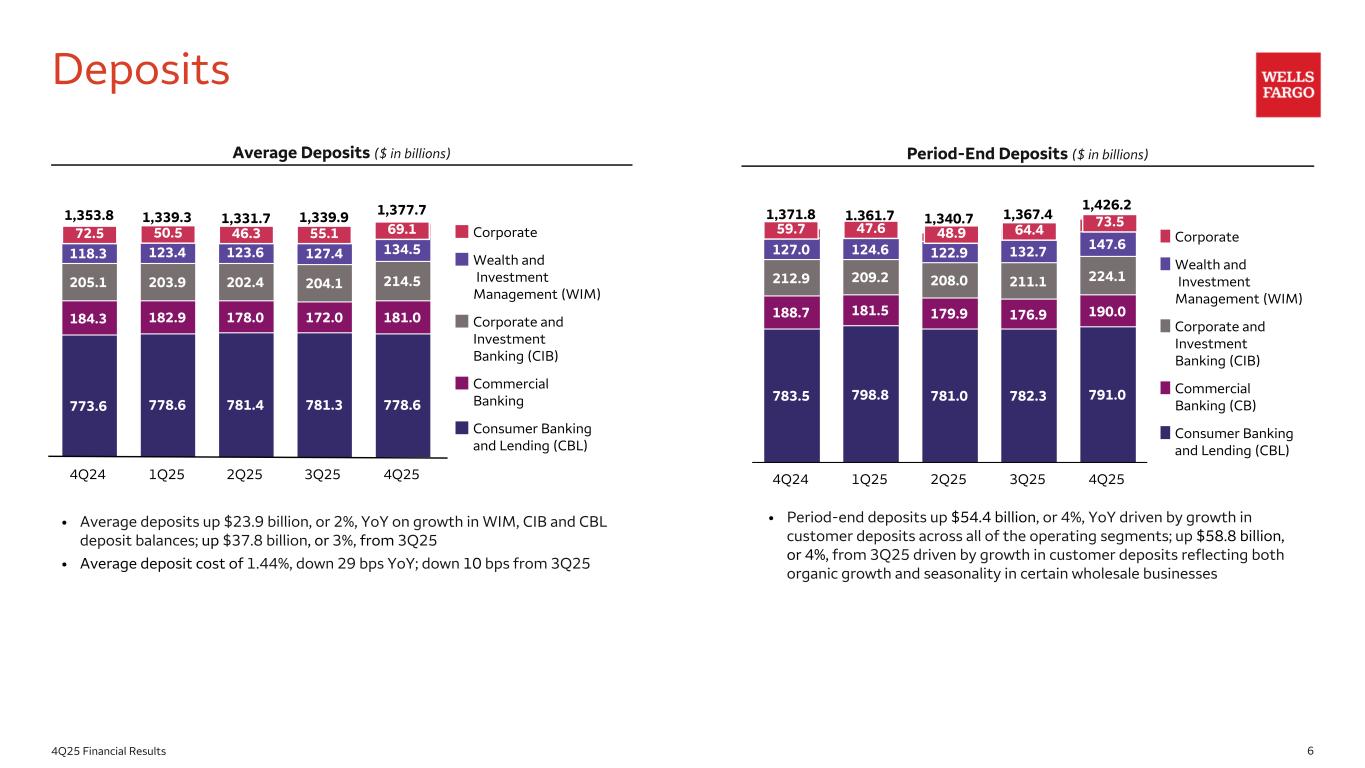
64Q25 Financial Results Deposits 1,353.8 1,339.3 1,331.7 1,339.9 1,377.7 773.6 778.6 781.4 781.3 778.6 184.3 182.9 178.0 172.0 181.0 205.1 203.9 202.4 204.1 214.5 118.3 123.4 123.6 127.4 134.5 Corporate Wealth and Investment Management (WIM) Corporate and Investment Banking (CIB) Commercial Banking Consumer Banking and Lending (CBL) 4Q24 1Q25 2Q25 3Q25 4Q25 Average Deposits ($ in billions) 69.155.146.350.5 • Average deposits up $23.9 billion, or 2%, YoY on growth in WIM, CIB and CBL deposit balances; up $37.8 billion, or 3%, from 3Q25 • Average deposit cost of 1.44%, down 29 bps YoY; down 10 bps from 3Q25 • Period-end deposits up $54.4 billion, or 4%, YoY driven by growth in customer deposits across all of the operating segments; up $58.8 billion, or 4%, from 3Q25 driven by growth in customer deposits reflecting both organic growth and seasonality in certain wholesale businesses 1,371.8 1,361.7 1,340.7 1,367.4 1,426.2 783.5 798.8 781.0 782.3 791.0 188.7 181.5 179.9 176.9 190.0 212.9 209.2 208.0 211.1 224.1 127.0 124.6 122.9 132.7 147.6 Corporate Wealth and Investment Management (WIM) Corporate and Investment Banking (CIB) Commercial Banking (CB) Consumer Banking and Lending (CBL) 4Q24 1Q25 2Q25 3Q25 4Q25 Period-End Deposits ($ in billions) 73.564.448.947.659.772.5
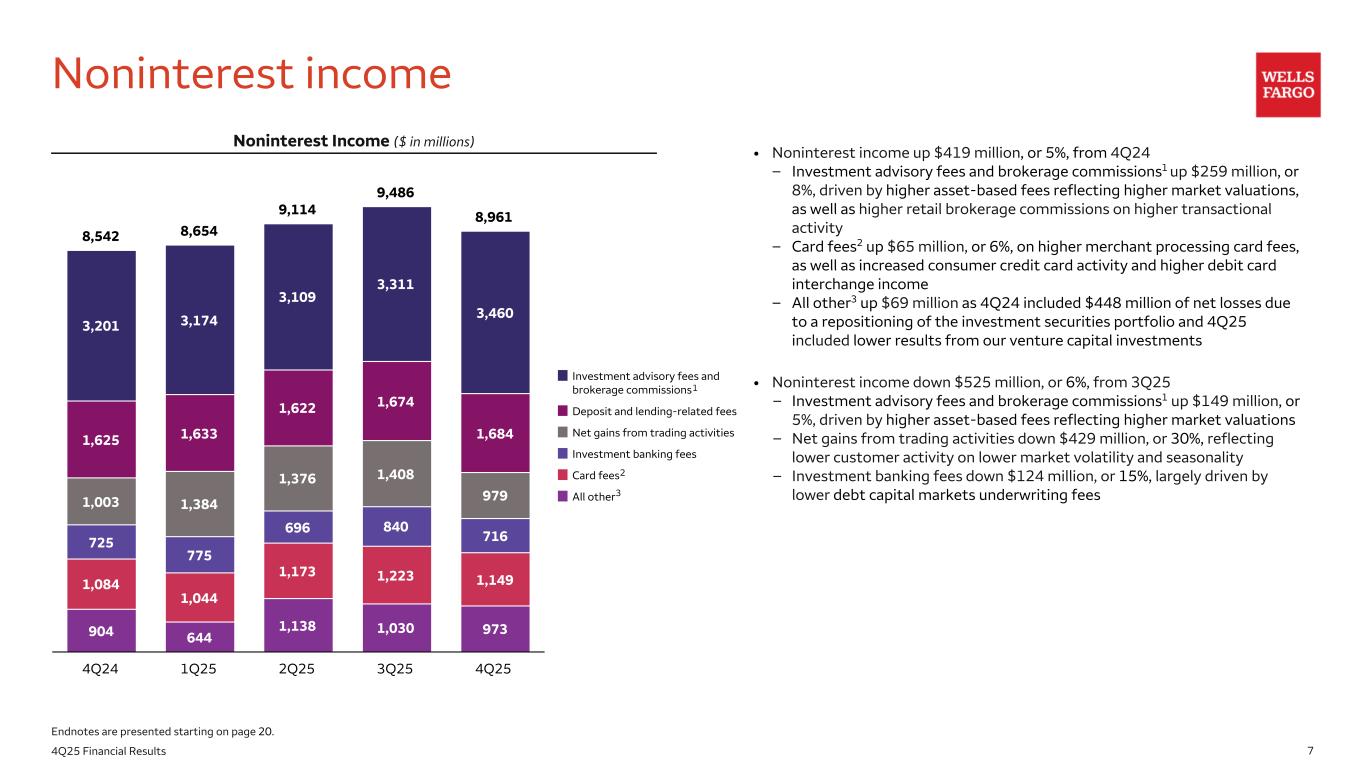
74Q25 Financial Results 8,542 8,654 9,114 9,486 8,961 904 644 1,138 1,030 973 1,084 1,044 1,173 1,223 1,149 725 775 696 840 716 1,003 1,384 1,376 1,408 979 1,625 1,633 1,622 1,674 1,684 3,201 3,174 3,109 3,311 3,460 Investment advisory fees and brokerage commissions Deposit and lending-related fees Net gains from trading activities Investment banking fees Card fees All other 4Q24 1Q25 2Q25 3Q25 4Q25 Noninterest Income ($ in millions) • Noninterest income up $419 million, or 5%, from 4Q24 – Investment advisory fees and brokerage commissions1 up $259 million, or 8%, driven by higher asset-based fees reflecting higher market valuations, as well as higher retail brokerage commissions on higher transactional activity – Card fees2 up $65 million, or 6%, on higher merchant processing card fees, as well as increased consumer credit card activity and higher debit card interchange income – All other3 up $69 million as 4Q24 included $448 million of net losses due to a repositioning of the investment securities portfolio and 4Q25 included lower results from our venture capital investments • Noninterest income down $525 million, or 6%, from 3Q25 – Investment advisory fees and brokerage commissions1 up $149 million, or 5%, driven by higher asset-based fees reflecting higher market valuations – Net gains from trading activities down $429 million, or 30%, reflecting lower customer activity on lower market volatility and seasonality – Investment banking fees down $124 million, or 15%, largely driven by lower debt capital markets underwriting fees Noninterest income 3 1 Endnotes are presented starting on page 20. 2
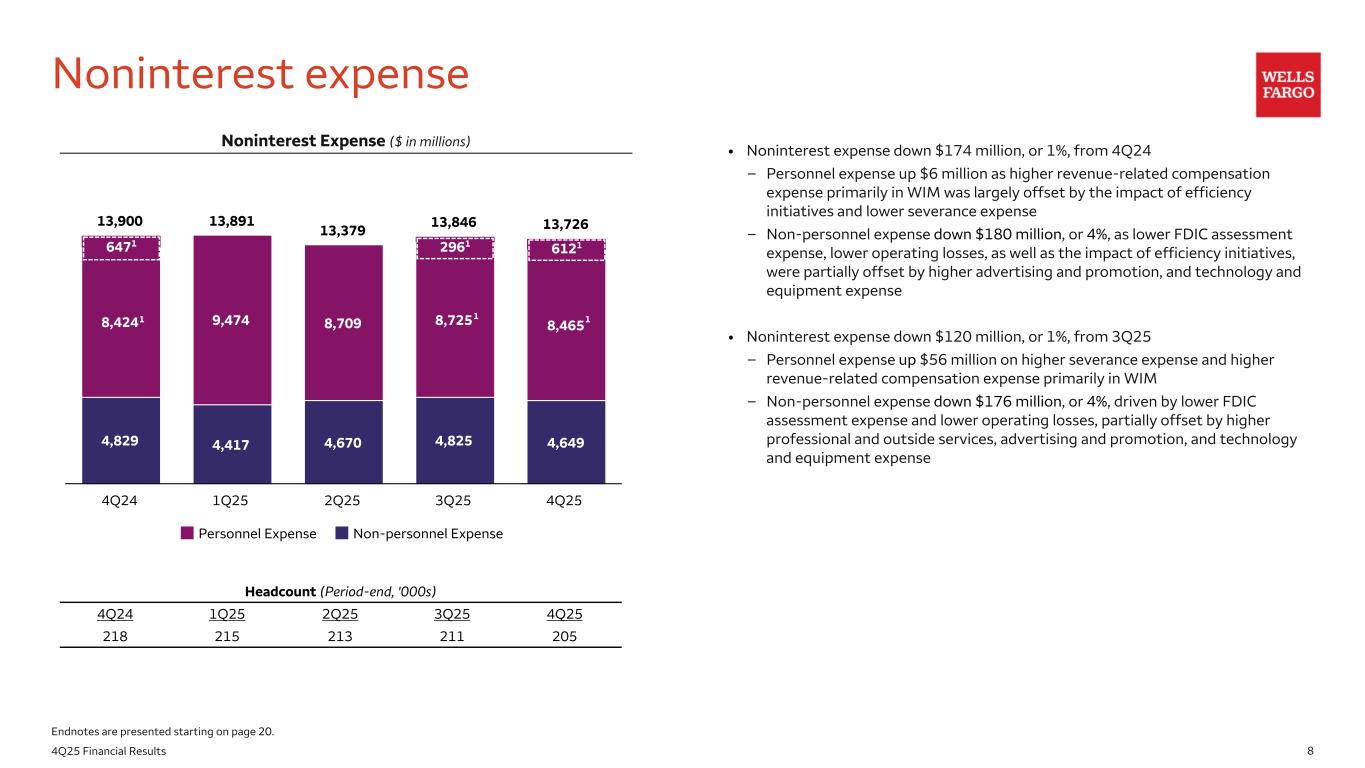
84Q25 Financial Results 13,900 13,891 13,379 13,846 13,726 4,829 4,417 4,670 4,825 4,649 8,424 9,474 8,709 8,725 8,465 Personnel Expense Non-personnel Expense 4Q24 1Q25 2Q25 3Q25 4Q25 Noninterest expense • Noninterest expense down $174 million, or 1%, from 4Q24 – Personnel expense up $6 million as higher revenue-related compensation expense primarily in WIM was largely offset by the impact of efficiency initiatives and lower severance expense – Non-personnel expense down $180 million, or 4%, as lower FDIC assessment expense, lower operating losses, as well as the impact of efficiency initiatives, were partially offset by higher advertising and promotion, and technology and equipment expense • Noninterest expense down $120 million, or 1%, from 3Q25 – Personnel expense up $56 million on higher severance expense and higher revenue-related compensation expense primarily in WIM – Non-personnel expense down $176 million, or 4%, driven by lower FDIC assessment expense and lower operating losses, partially offset by higher professional and outside services, advertising and promotion, and technology and equipment expense Noninterest Expense ($ in millions) Headcount (Period-end, '000s) 4Q24 1Q25 2Q25 3Q25 4Q25 218 215 213 211 205 Endnotes are presented starting on page 20. 6471 1 2961 11 6121
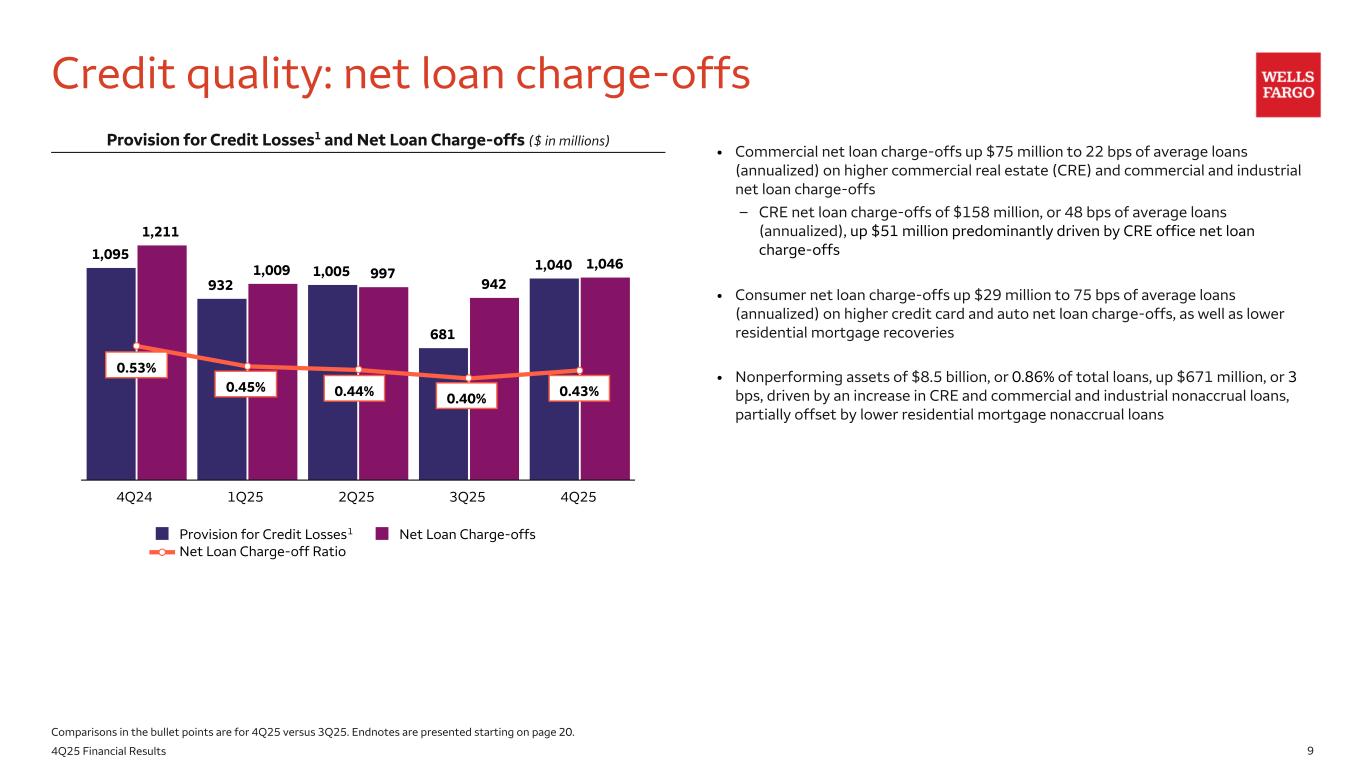
94Q25 Financial Results 1,095 932 1,005 681 1,040 1,211 1,009 997 942 1,046 Provision for Credit Losses Net Loan Charge-offs Net Loan Charge-off Ratio 4Q24 1Q25 2Q25 3Q25 4Q25 Credit quality: net loan charge-offs • Commercial net loan charge-offs up $75 million to 22 bps of average loans (annualized) on higher commercial real estate (CRE) and commercial and industrial net loan charge-offs – CRE net loan charge-offs of $158 million, or 48 bps of average loans (annualized), up $51 million predominantly driven by CRE office net loan charge-offs • Consumer net loan charge-offs up $29 million to 75 bps of average loans (annualized) on higher credit card and auto net loan charge-offs, as well as lower residential mortgage recoveries • Nonperforming assets of $8.5 billion, or 0.86% of total loans, up $671 million, or 3 bps, driven by an increase in CRE and commercial and industrial nonaccrual loans, partially offset by lower residential mortgage nonaccrual loans Provision for Credit Losses1 and Net Loan Charge-offs ($ in millions) Comparisons in the bullet points are for 4Q25 versus 3Q25. Endnotes are presented starting on page 20. 0.53% 0.45% 0.40%0.44% 1 0.43%
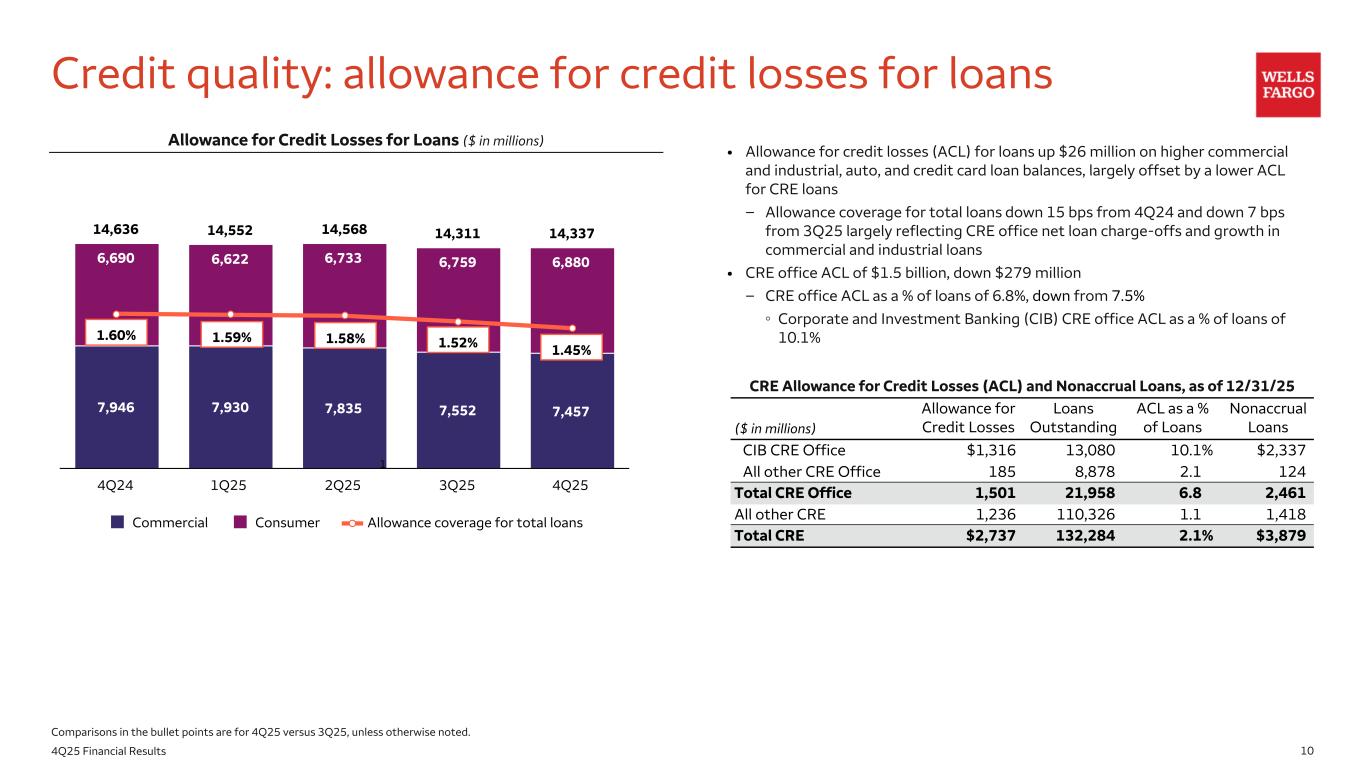
104Q25 Financial Results Credit quality: allowance for credit losses for loans Allowance for Credit Losses for Loans ($ in millions) • Allowance for credit losses (ACL) for loans up $26 million on higher commercial and industrial, auto, and credit card loan balances, largely offset by a lower ACL for CRE loans – Allowance coverage for total loans down 15 bps from 4Q24 and down 7 bps from 3Q25 largely reflecting CRE office net loan charge-offs and growth in commercial and industrial loans • CRE office ACL of $1.5 billion, down $279 million – CRE office ACL as a % of loans of 6.8%, down from 7.5% ◦ Corporate and Investment Banking (CIB) CRE office ACL as a % of loans of 10.1% 14,636 14,552 14,568 14,311 14,337 7,946 7,930 7,835 7,552 7,457 6,690 6,622 6,733 6,759 6,880 Commercial Consumer Allowance coverage for total loans 4Q24 1Q25 2Q25 3Q25 4Q25 1.59%1.60% 1.58% 1.52% 1.45% 1 CRE Allowance for Credit Losses (ACL) and Nonaccrual Loans, as of 12/31/25 ($ in millions) Allowance for Credit Losses Loans Outstanding ACL as a % of Loans Nonaccrual Loans CIB CRE Office $1,316 13,080 10.1% $2,337 All other CRE Office 185 8,878 2.1 124 Total CRE Office 1,501 21,958 6.8 2,461 All other CRE 1,236 110,326 1.1 1,418 Total CRE $2,737 132,284 2.1% $3,879 Comparisons in the bullet points are for 4Q25 versus 3Q25, unless otherwise noted.
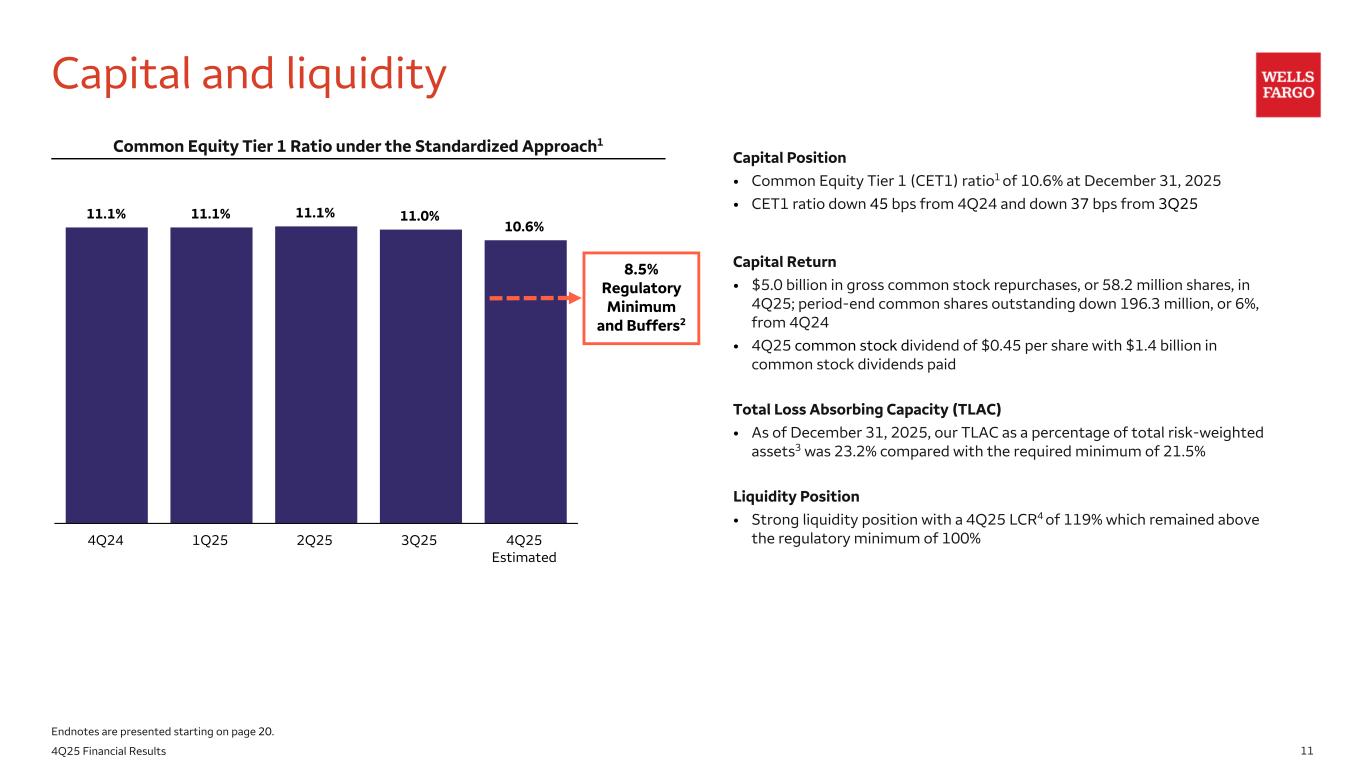
114Q25 Financial Results Capital and liquidity Capital Position • Common Equity Tier 1 (CET1) ratio1 of 10.6% at December 31, 2025 • CET1 ratio down 45 bps from 4Q24 and down 37 bps from 3Q25 Capital Return • $5.0 billion in gross common stock repurchases, or 58.2 million shares, in 4Q25; period-end common shares outstanding down 196.3 million, or 6%, from 4Q24 • 4Q25 common stock dividend of $0.45 per share with $1.4 billion in common stock dividends paid Total Loss Absorbing Capacity (TLAC) • As of December 31, 2025, our TLAC as a percentage of total risk-weighted assets3 was 23.2% compared with the required minimum of 21.5% Liquidity Position • Strong liquidity position with a 4Q25 LCR4 of 119% which remained above the regulatory minimum of 100% 11.1% 11.1% 11.1% 11.0% 10.6% 4Q24 1Q25 2Q25 3Q25 4Q25 Estimated 8.5% Regulatory Minimum and Buffers2 Common Equity Tier 1 Ratio under the Standardized Approach1 Endnotes are presented starting on page 20.
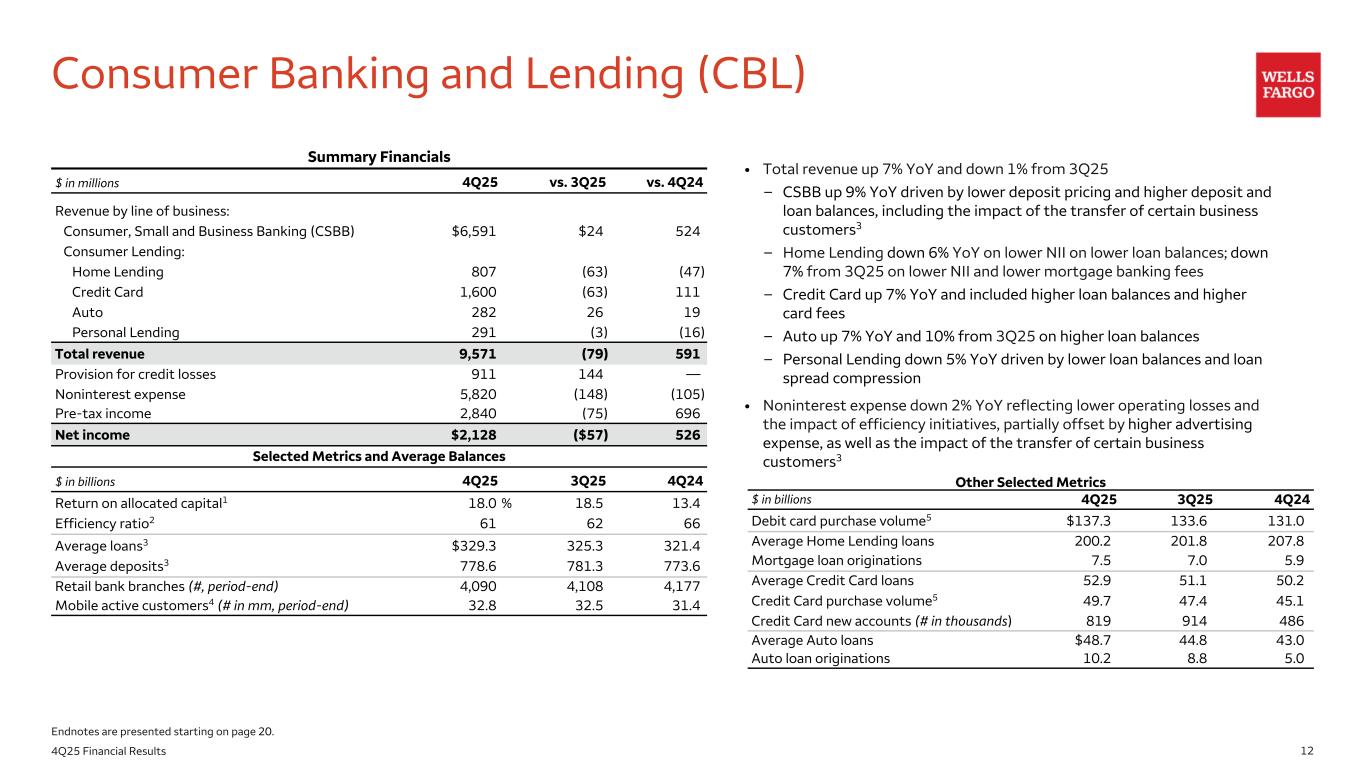
124Q25 Financial Results • Total revenue up 7% YoY and down 1% from 3Q25 – CSBB up 9% YoY driven by lower deposit pricing and higher deposit and loan balances, including the impact of the transfer of certain business customers3 – Home Lending down 6% YoY on lower NII on lower loan balances; down 7% from 3Q25 on lower NII and lower mortgage banking fees – Credit Card up 7% YoY and included higher loan balances and higher card fees – Auto up 7% YoY and 10% from 3Q25 on higher loan balances – Personal Lending down 5% YoY driven by lower loan balances and loan spread compression • Noninterest expense down 2% YoY reflecting lower operating losses and the impact of efficiency initiatives, partially offset by higher advertising expense, as well as the impact of the transfer of certain business customers3 Consumer Banking and Lending (CBL) Summary Financials $ in millions 4Q25 vs. 3Q25 vs. 4Q24 Revenue by line of business: Consumer, Small and Business Banking (CSBB) $6,591 $24 524 Consumer Lending: Home Lending 807 (63) (47) Credit Card 1,600 (63) 111 Auto 282 26 19 Personal Lending 291 (3) (16) Total revenue 9,571 (79) 591 Provision for credit losses 911 144 — Noninterest expense 5,820 (148) (105) Pre-tax income 2,840 (75) 696 Net income $2,128 ($57) 526 Selected Metrics and Average Balances $ in billions 4Q25 3Q25 4Q24 Return on allocated capital1 18.0 % 18.5 13.4 Efficiency ratio2 61 62 66 Average loans3 $329.3 325.3 321.4 Average deposits3 778.6 781.3 773.6 Retail bank branches (#, period-end) 4,090 4,108 4,177 Mobile active customers4 (# in mm, period-end) 32.8 32.5 31.4 Other Selected Metrics $ in billions 4Q25 3Q25 4Q24 Debit card purchase volume5 $137.3 133.6 131.0 Average Home Lending loans 200.2 201.8 207.8 Mortgage loan originations 7.5 7.0 5.9 Average Credit Card loans 52.9 51.1 50.2 Credit Card purchase volume5 49.7 47.4 45.1 Credit Card new accounts (# in thousands) 819 914 486 Average Auto loans $48.7 44.8 43.0 Auto loan originations 10.2 8.8 5.0 Endnotes are presented starting on page 20.
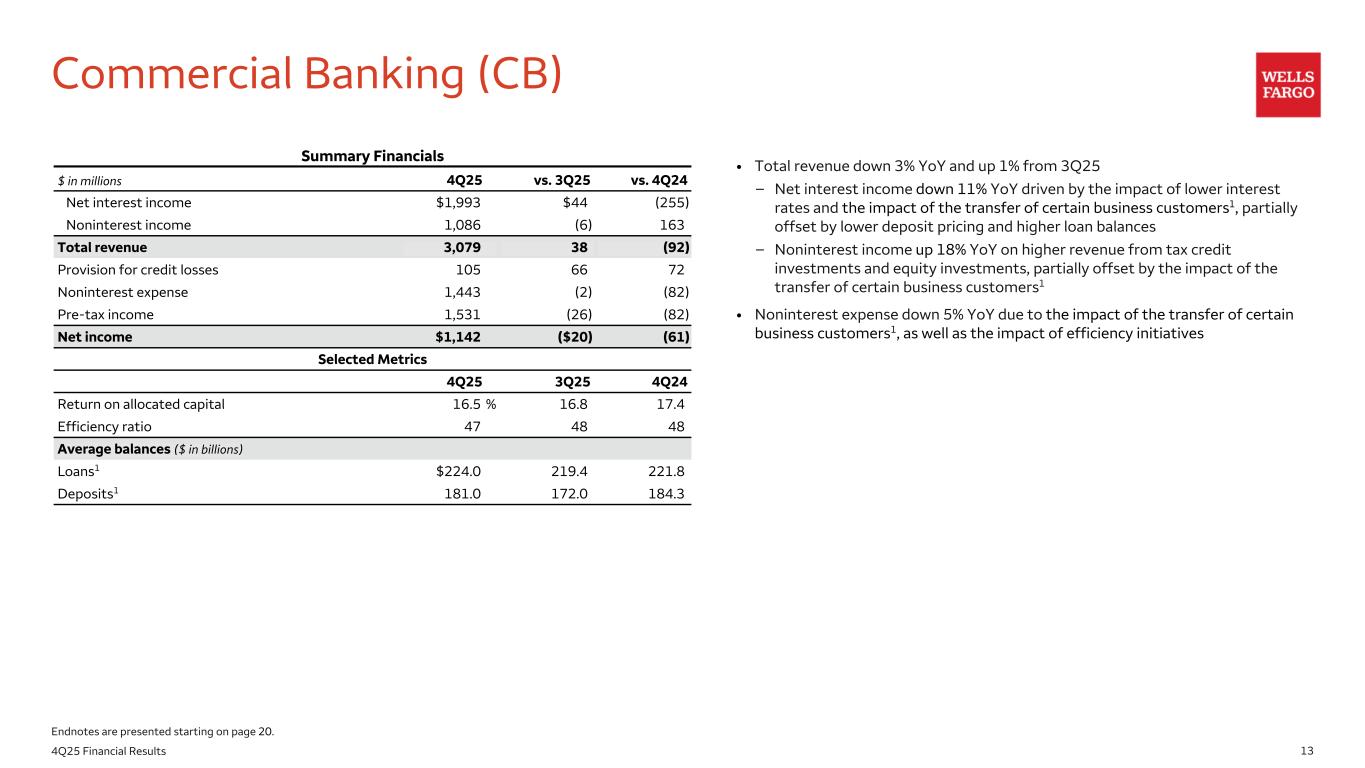
134Q25 Financial Results Commercial Banking (CB) • Total revenue down 3% YoY and up 1% from 3Q25 – Net interest income down 11% YoY driven by the impact of lower interest rates and the impact of the transfer of certain business customers1, partially offset by lower deposit pricing and higher loan balances – Noninterest income up 18% YoY on higher revenue from tax credit investments and equity investments, partially offset by the impact of the transfer of certain business customers1 • Noninterest expense down 5% YoY due to the impact of the transfer of certain business customers1, as well as the impact of efficiency initiatives Summary Financials $ in millions 4Q25 vs. 3Q25 vs. 4Q24 Net interest income $1,993 $44 (255) Noninterest income 1,086 (6) 163 Total revenue 3,079 38 (92) Provision for credit losses 105 66 72 Noninterest expense 1,443 (2) (82) Pre-tax income 1,531 (26) (82) Net income $1,142 ($20) (61) Selected Metrics 4Q25 3Q25 4Q24 Return on allocated capital 16.5 % 16.8 17.4 Efficiency ratio 47 48 48 Average balances ($ in billions) Loans1 $224.0 219.4 221.8 Deposits1 181.0 172.0 184.3 Endnotes are presented starting on page 20.
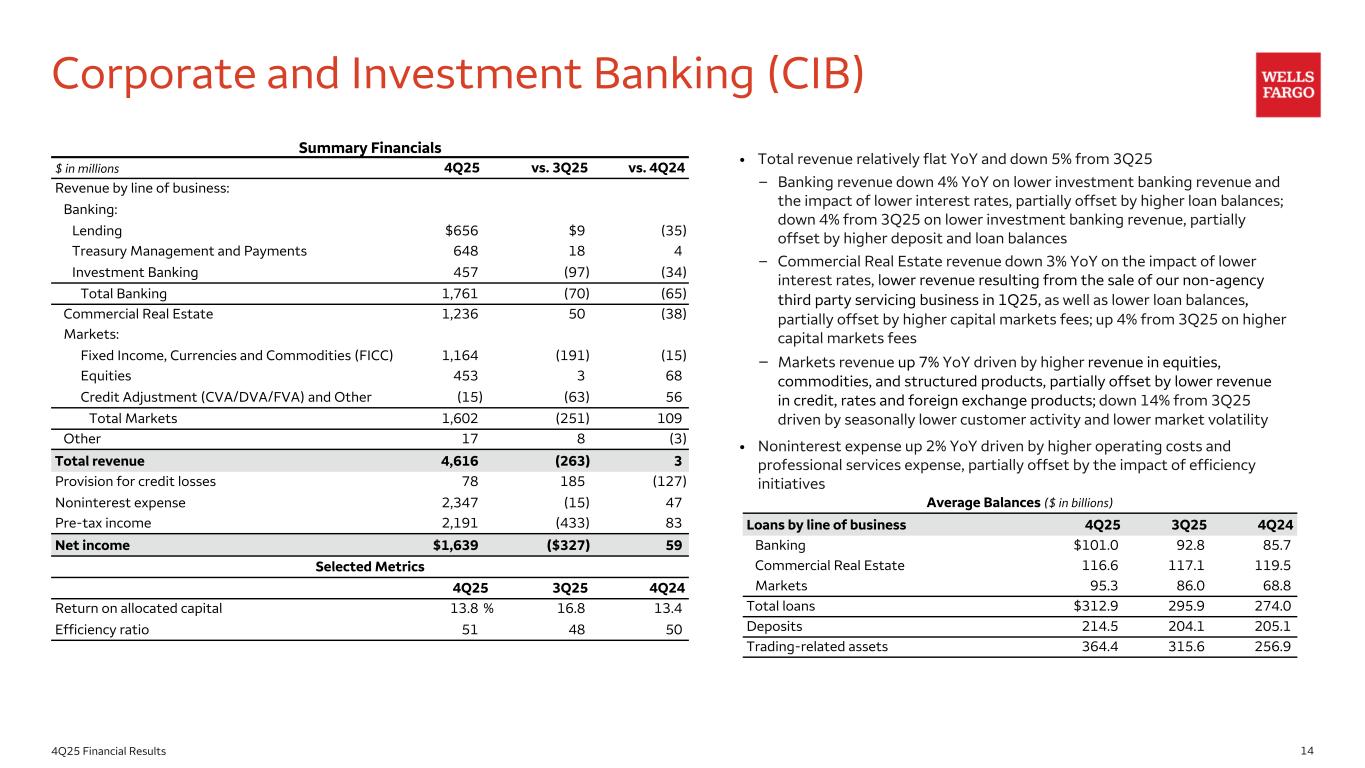
144Q25 Financial Results Corporate and Investment Banking (CIB) • Total revenue relatively flat YoY and down 5% from 3Q25 – Banking revenue down 4% YoY on lower investment banking revenue and the impact of lower interest rates, partially offset by higher loan balances; down 4% from 3Q25 on lower investment banking revenue, partially offset by higher deposit and loan balances – Commercial Real Estate revenue down 3% YoY on the impact of lower interest rates, lower revenue resulting from the sale of our non-agency third party servicing business in 1Q25, as well as lower loan balances, partially offset by higher capital markets fees; up 4% from 3Q25 on higher capital markets fees – Markets revenue up 7% YoY driven by higher revenue in equities, commodities, and structured products, partially offset by lower revenue in credit, rates and foreign exchange products; down 14% from 3Q25 driven by seasonally lower customer activity and lower market volatility • Noninterest expense up 2% YoY driven by higher operating costs and professional services expense, partially offset by the impact of efficiency initiatives Summary Financials $ in millions 4Q25 vs. 3Q25 vs. 4Q24 Revenue by line of business: Banking: Lending $656 $9 (35) Treasury Management and Payments 648 18 4 Investment Banking 457 (97) (34) Total Banking 1,761 (70) (65) Commercial Real Estate 1,236 50 (38) Markets: Fixed Income, Currencies and Commodities (FICC) 1,164 (191) (15) Equities 453 3 68 Credit Adjustment (CVA/DVA/FVA) and Other (15) (63) 56 Total Markets 1,602 (251) 109 Other 17 8 (3) Total revenue 4,616 (263) 3 Provision for credit losses 78 185 (127) Noninterest expense 2,347 (15) 47 Pre-tax income 2,191 (433) 83 Net income $1,639 ($327) 59 Selected Metrics 4Q25 3Q25 4Q24 Return on allocated capital 13.8 % 16.8 13.4 Efficiency ratio 51 48 50 Average Balances ($ in billions) Loans by line of business 4Q25 3Q25 4Q24 Banking $101.0 92.8 85.7 Commercial Real Estate 116.6 117.1 119.5 Markets 95.3 86.0 68.8 Total loans $312.9 295.9 274.0 Deposits 214.5 204.1 205.1 Trading-related assets 364.4 315.6 256.9
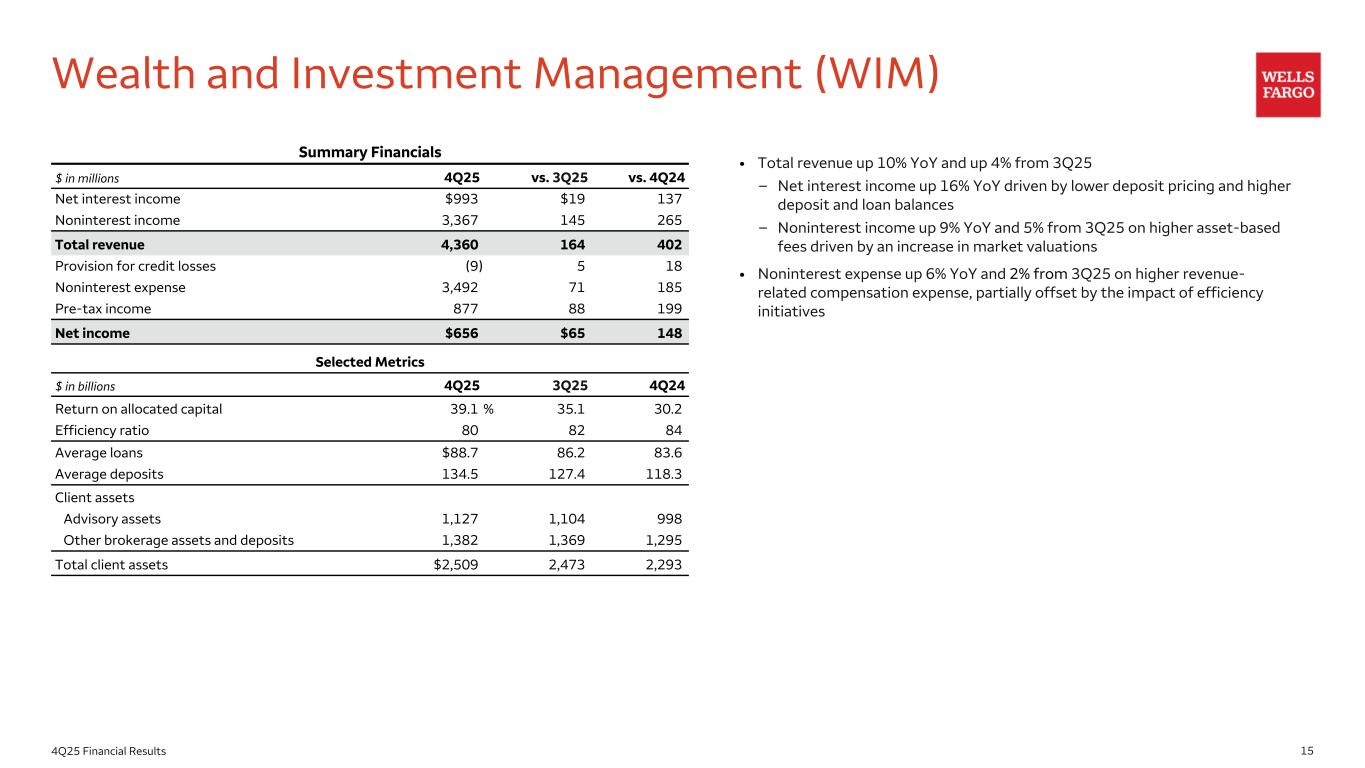
154Q25 Financial Results Wealth and Investment Management (WIM) Summary Financials $ in millions 4Q25 vs. 3Q25 vs. 4Q24 Net interest income $993 $19 137 Noninterest income 3,367 145 265 Total revenue 4,360 164 402 Provision for credit losses (9) 5 18 Noninterest expense 3,492 71 185 Pre-tax income 877 88 199 Net income $656 $65 148 Selected Metrics $ in billions 4Q25 3Q25 4Q24 Return on allocated capital 39.1 % 35.1 30.2 Efficiency ratio 80 82 84 Average loans $88.7 86.2 83.6 Average deposits 134.5 127.4 118.3 Client assets Advisory assets 1,127 1,104 998 Other brokerage assets and deposits 1,382 1,369 1,295 Total client assets $2,509 2,473 2,293 • Total revenue up 10% YoY and up 4% from 3Q25 – Net interest income up 16% YoY driven by lower deposit pricing and higher deposit and loan balances – Noninterest income up 9% YoY and 5% from 3Q25 on higher asset-based fees driven by an increase in market valuations • Noninterest expense up 6% YoY and 2% from 3Q25 on higher revenue- related compensation expense, partially offset by the impact of efficiency initiatives
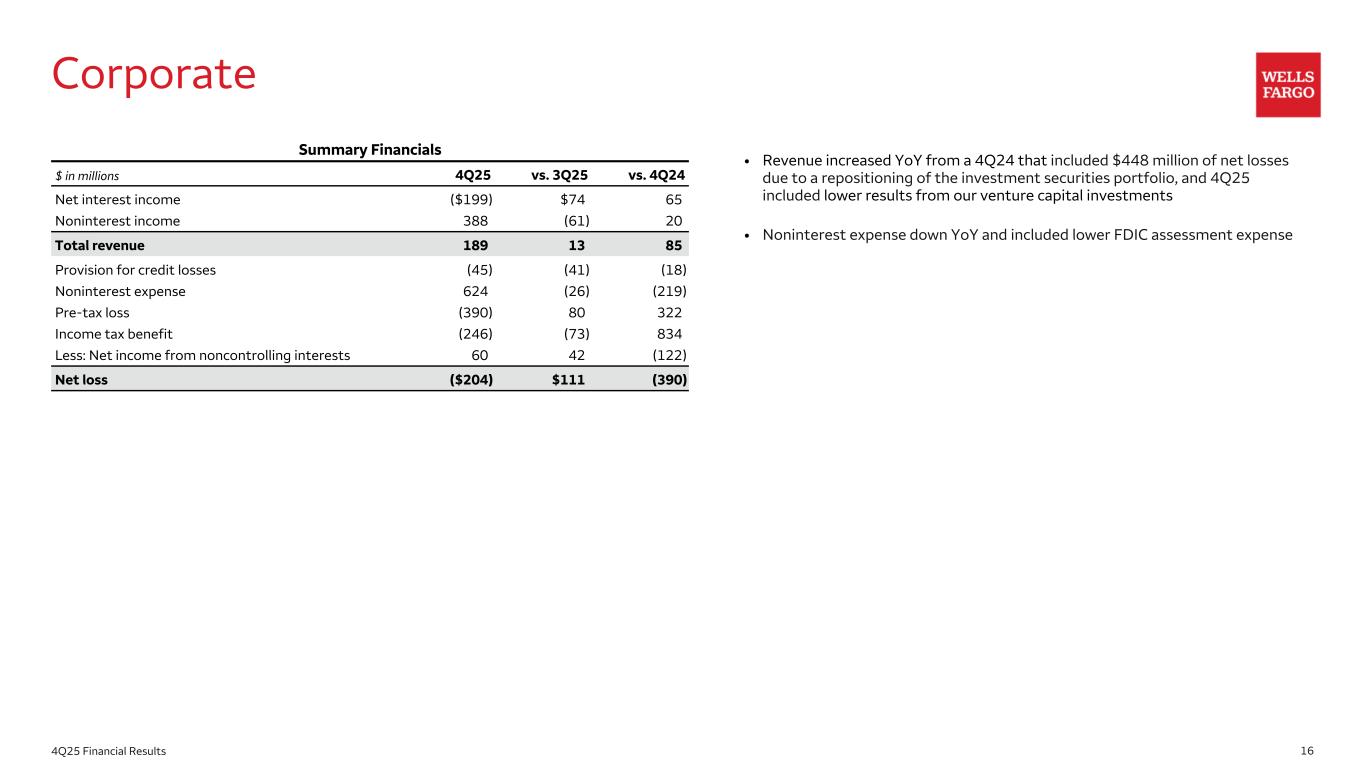
164Q25 Financial Results Corporate • Revenue increased YoY from a 4Q24 that included $448 million of net losses due to a repositioning of the investment securities portfolio, and 4Q25 included lower results from our venture capital investments • Noninterest expense down YoY and included lower FDIC assessment expense Summary Financials $ in millions 4Q25 vs. 3Q25 vs. 4Q24 Net interest income ($199) $74 65 Noninterest income 388 (61) 20 Total revenue 189 13 85 Provision for credit losses (45) (41) (18) Noninterest expense 624 (26) (219) Pre-tax loss (390) 80 322 Income tax benefit (246) (73) 834 Less: Net income from noncontrolling interests 60 42 (122) Net loss ($204) $111 (390)
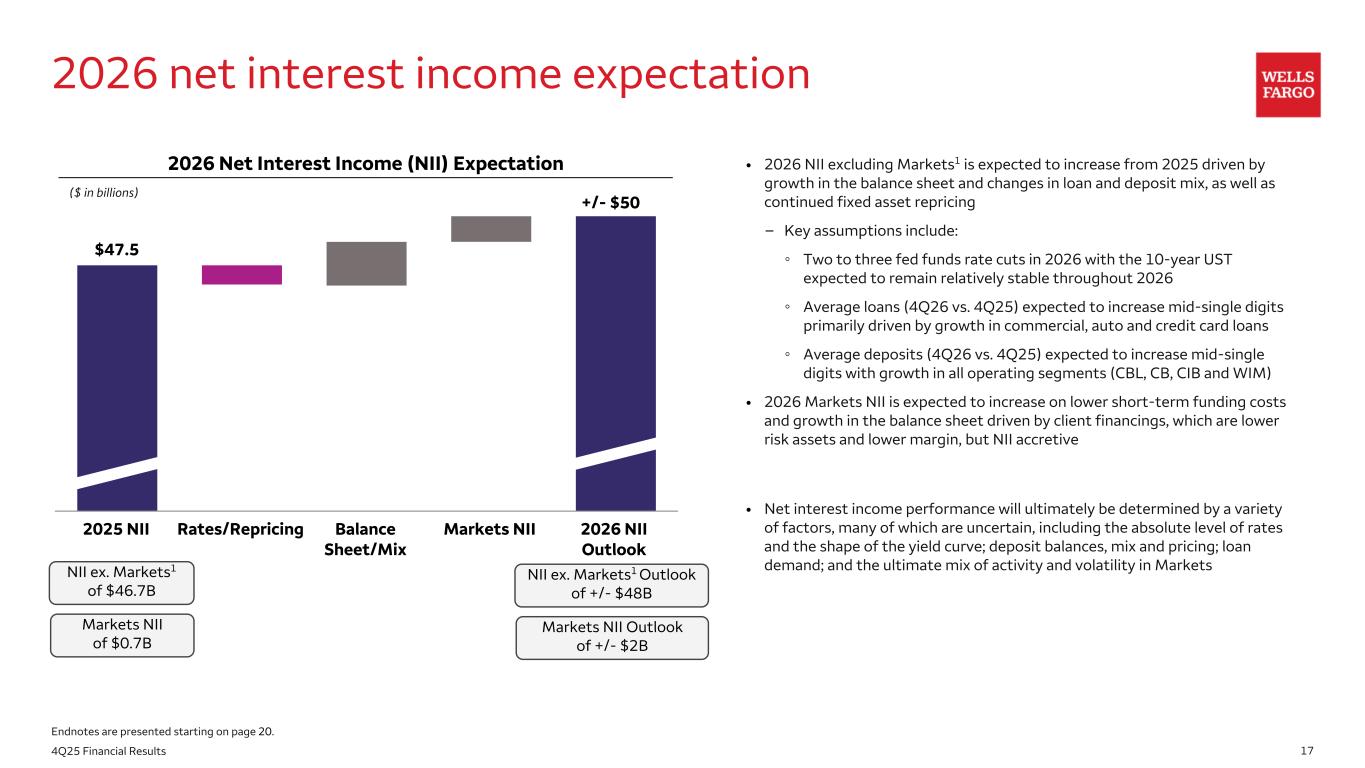
174Q25 Financial Results $47.5 2025 NII Rates/Repricing Balance Sheet/Mix Markets NII 2026 NII Outlook 2026 net interest income expectation 2026 Net Interest Income (NII) Expectation • 2026 NII excluding Markets1 is expected to increase from 2025 driven by growth in the balance sheet and changes in loan and deposit mix, as well as continued fixed asset repricing – Key assumptions include: ◦ Two to three fed funds rate cuts in 2026 with the 10-year UST expected to remain relatively stable throughout 2026 ◦ Average loans (4Q26 vs. 4Q25) expected to increase mid-single digits primarily driven by growth in commercial, auto and credit card loans ◦ Average deposits (4Q26 vs. 4Q25) expected to increase mid-single digits with growth in all operating segments (CBL, CB, CIB and WIM) • 2026 Markets NII is expected to increase on lower short-term funding costs and growth in the balance sheet driven by client financings, which are lower risk assets and lower margin, but NII accretive • Net interest income performance will ultimately be determined by a variety of factors, many of which are uncertain, including the absolute level of rates and the shape of the yield curve; deposit balances, mix and pricing; loan demand; and the ultimate mix of activity and volatility in Markets ($ in billions) +/- $50 Markets NII of $0.7B NII ex. Markets1 of $46.7B Markets NII Outlook of +/- $2B NII ex. Markets1 Outlook of +/- $48B Endnotes are presented starting on page 20.
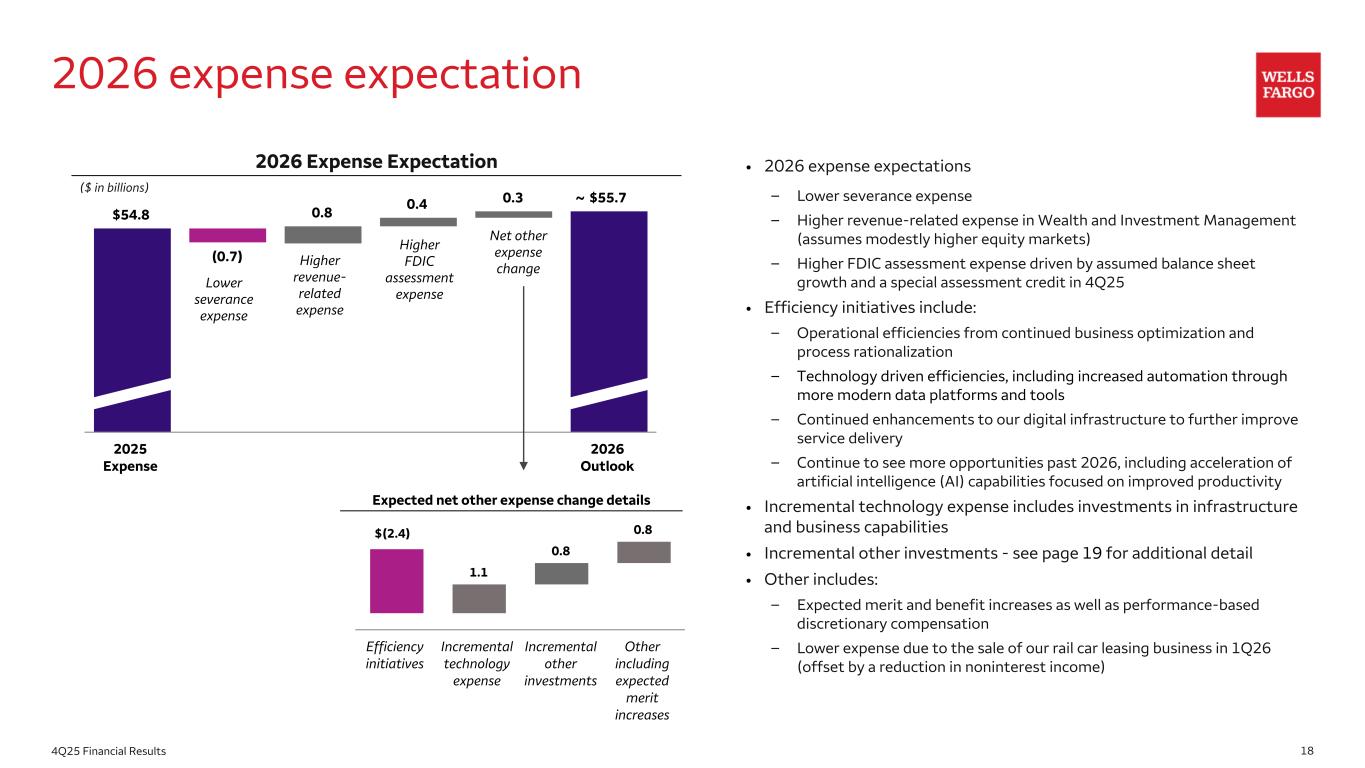
184Q25 Financial Results $54.8 (0.7) 0.8 0.4 0.3 $55.7 2025 Expense 2026 Outlook 1.1 0.8 0.8 Efficiency initiatives Incremental technology expense Incremental other investments Other including expected merit increases 2026 Expense Expectation ($ in billions) Expected net other expense change details Higher revenue- related expense Lower severance expense Higher FDIC assessment expense Net other expense change $(2.4) 2026 expense expectation • 2026 expense expectations – Lower severance expense – Higher revenue-related expense in Wealth and Investment Management (assumes modestly higher equity markets) – Higher FDIC assessment expense driven by assumed balance sheet growth and a special assessment credit in 4Q25 • Efficiency initiatives include: – Operational efficiencies from continued business optimization and process rationalization – Technology driven efficiencies, including increased automation through more modern data platforms and tools – Continued enhancements to our digital infrastructure to further improve service delivery – Continue to see more opportunities past 2026, including acceleration of artificial intelligence (AI) capabilities focused on improved productivity • Incremental technology expense includes investments in infrastructure and business capabilities • Incremental other investments - see page 19 for additional detail • Other includes: – Expected merit and benefit increases as well as performance-based discretionary compensation – Lower expense due to the sale of our rail car leasing business in 1Q26 (offset by a reduction in noninterest income) ~
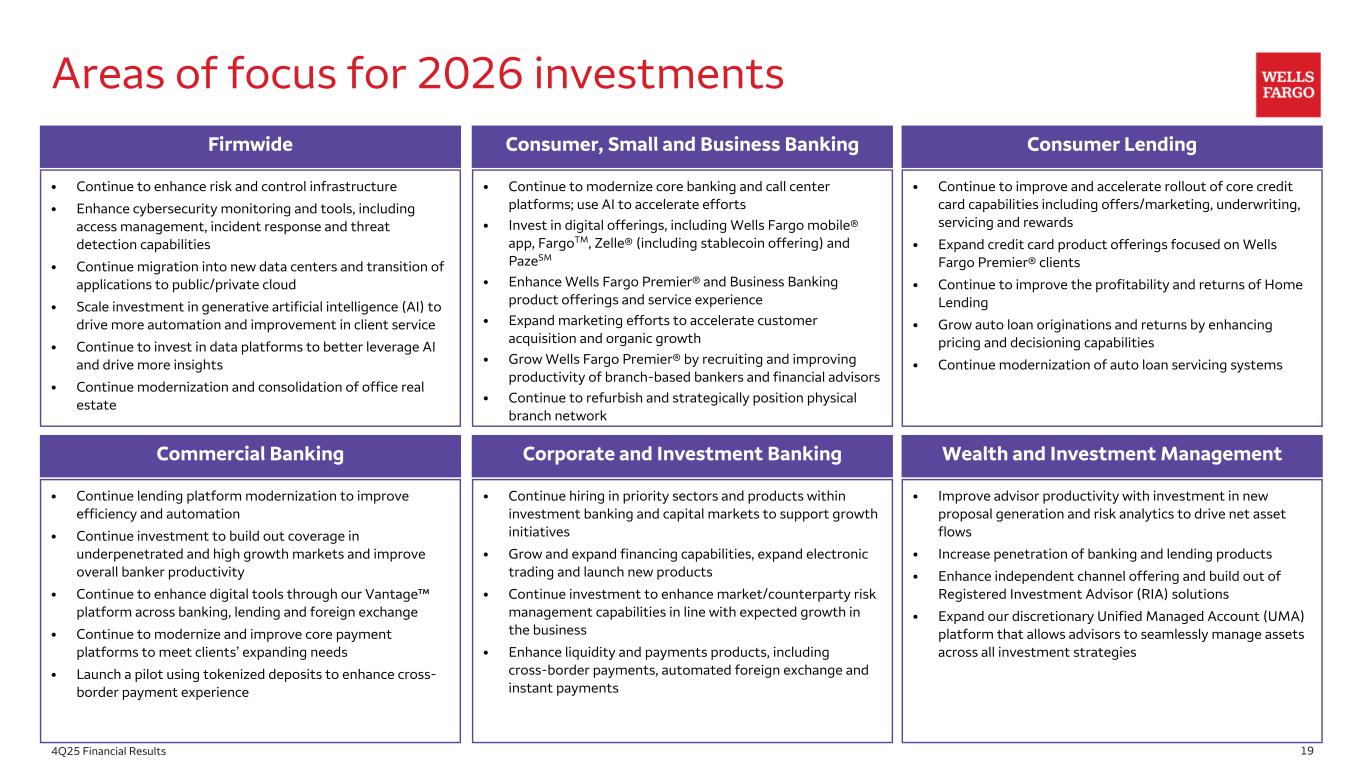
194Q25 Financial Results Areas of focus for 2026 investments Firmwide • Continue to enhance risk and control infrastructure • Enhance cybersecurity monitoring and tools, including access management, incident response and threat detection capabilities • Continue migration into new data centers and transition of applications to public/private cloud • Scale investment in generative artificial intelligence (AI) to drive more automation and improvement in client service • Continue to invest in data platforms to better leverage AI and drive more insights • Continue modernization and consolidation of office real estate Consumer, Small and Business Banking Consumer Lending • Continue to modernize core banking and call center platforms; use AI to accelerate efforts • Invest in digital offerings, including Wells Fargo mobile® app, FargoTM, Zelle® (including stablecoin offering) and PazeSM • Enhance Wells Fargo Premier® and Business Banking product offerings and service experience • Expand marketing efforts to accelerate customer acquisition and organic growth • Grow Wells Fargo Premier® by recruiting and improving productivity of branch-based bankers and financial advisors • Continue to refurbish and strategically position physical branch network • Continue to improve and accelerate rollout of core credit card capabilities including offers/marketing, underwriting, servicing and rewards • Expand credit card product offerings focused on Wells Fargo Premier® clients • Continue to improve the profitability and returns of Home Lending • Grow auto loan originations and returns by enhancing pricing and decisioning capabilities • Continue modernization of auto loan servicing systems Commercial Banking • Continue lending platform modernization to improve efficiency and automation • Continue investment to build out coverage in underpenetrated and high growth markets and improve overall banker productivity • Continue to enhance digital tools through our Vantage™ platform across banking, lending and foreign exchange • Continue to modernize and improve core payment platforms to meet clients’ expanding needs • Launch a pilot using tokenized deposits to enhance cross- border payment experience Corporate and Investment Banking Wealth and Investment Management • Continue hiring in priority sectors and products within investment banking and capital markets to support growth initiatives • Grow and expand financing capabilities, expand electronic trading and launch new products • Continue investment to enhance market/counterparty risk management capabilities in line with expected growth in the business • Enhance liquidity and payments products, including cross‑border payments, automated foreign exchange and instant payments • Improve advisor productivity with investment in new proposal generation and risk analytics to drive net asset flows • Increase penetration of banking and lending products • Enhance independent channel offering and build out of Registered Investment Advisor (RIA) solutions • Expand our discretionary Unified Managed Account (UMA) platform that allows advisors to seamlessly manage assets across all investment strategies
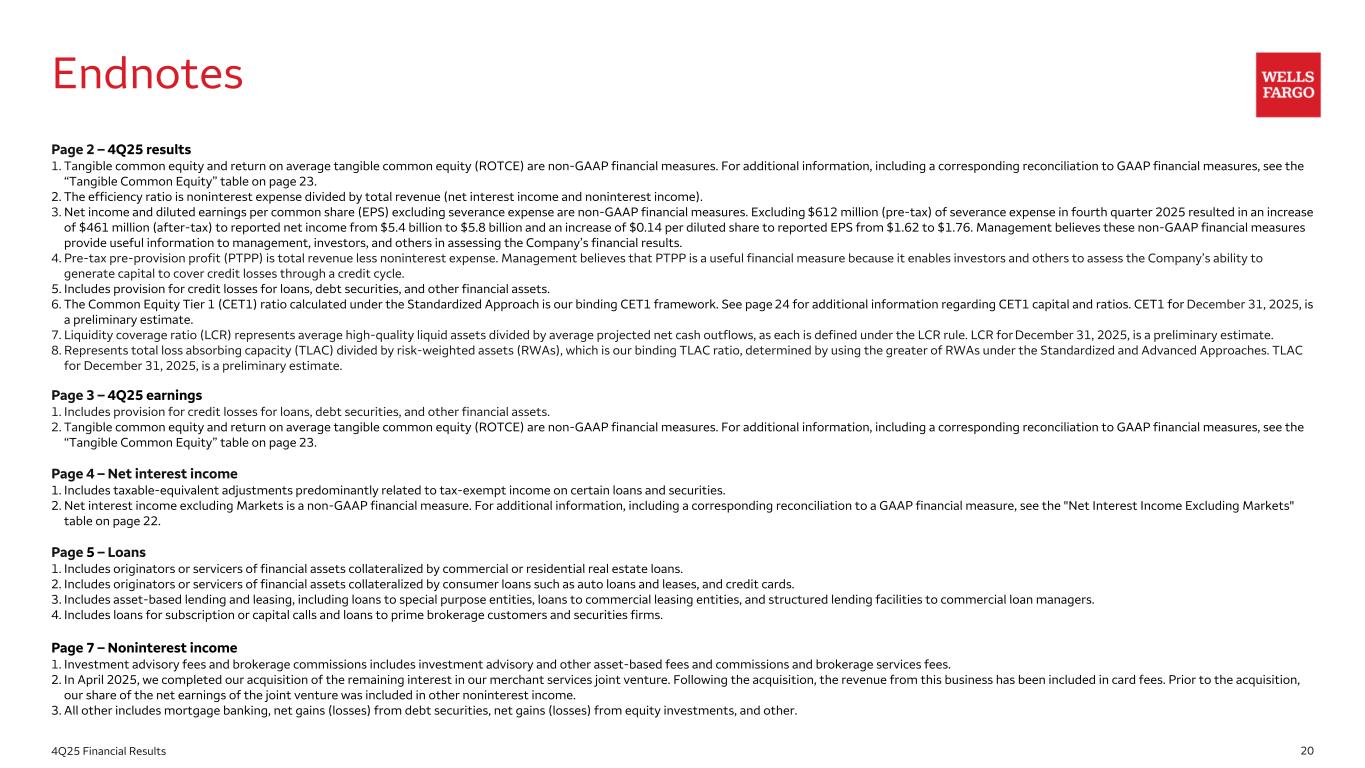
204Q25 Financial Results Endnotes Page 2 – 4Q25 results 1. Tangible common equity and return on average tangible common equity (ROTCE) are non-GAAP financial measures. For additional information, including a corresponding reconciliation to GAAP financial measures, see the “Tangible Common Equity” table on page 23. 2. The efficiency ratio is noninterest expense divided by total revenue (net interest income and noninterest income). 3. Net income and diluted earnings per common share (EPS) excluding severance expense are non-GAAP financial measures. Excluding $612 million (pre-tax) of severance expense in fourth quarter 2025 resulted in an increase of $461 million (after-tax) to reported net income from $5.4 billion to $5.8 billion and an increase of $0.14 per diluted share to reported EPS from $1.62 to $1.76. Management believes these non-GAAP financial measures provide useful information to management, investors, and others in assessing the Company’s financial results. 4. Pre-tax pre-provision profit (PTPP) is total revenue less noninterest expense. Management believes that PTPP is a useful financial measure because it enables investors and others to assess the Company’s ability to generate capital to cover credit losses through a credit cycle. 5. Includes provision for credit losses for loans, debt securities, and other financial assets. 6. The Common Equity Tier 1 (CET1) ratio calculated under the Standardized Approach is our binding CET1 framework. See page 24 for additional information regarding CET1 capital and ratios. CET1 for December 31, 2025, is a preliminary estimate. 7. Liquidity coverage ratio (LCR) represents average high-quality liquid assets divided by average projected net cash outflows, as each is defined under the LCR rule. LCR for December 31, 2025, is a preliminary estimate. 8. Represents total loss absorbing capacity (TLAC) divided by risk-weighted assets (RWAs), which is our binding TLAC ratio, determined by using the greater of RWAs under the Standardized and Advanced Approaches. TLAC for December 31, 2025, is a preliminary estimate. Page 3 – 4Q25 earnings 1. Includes provision for credit losses for loans, debt securities, and other financial assets. 2. Tangible common equity and return on average tangible common equity (ROTCE) are non-GAAP financial measures. For additional information, including a corresponding reconciliation to GAAP financial measures, see the “Tangible Common Equity” table on page 23. Page 4 – Net interest income 1. Includes taxable-equivalent adjustments predominantly related to tax-exempt income on certain loans and securities. 2. Net interest income excluding Markets is a non-GAAP financial measure. For additional information, including a corresponding reconciliation to a GAAP financial measure, see the "Net Interest Income Excluding Markets" table on page 22. Page 5 – Loans 1. Includes originators or servicers of financial assets collateralized by commercial or residential real estate loans. 2. Includes originators or servicers of financial assets collateralized by consumer loans such as auto loans and leases, and credit cards. 3. Includes asset-based lending and leasing, including loans to special purpose entities, loans to commercial leasing entities, and structured lending facilities to commercial loan managers. 4. Includes loans for subscription or capital calls and loans to prime brokerage customers and securities firms. Page 7 – Noninterest income 1. Investment advisory fees and brokerage commissions includes investment advisory and other asset-based fees and commissions and brokerage services fees. 2. In April 2025, we completed our acquisition of the remaining interest in our merchant services joint venture. Following the acquisition, the revenue from this business has been included in card fees. Prior to the acquisition, our share of the net earnings of the joint venture was included in other noninterest income. 3. All other includes mortgage banking, net gains (losses) from debt securities, net gains (losses) from equity investments, and other.
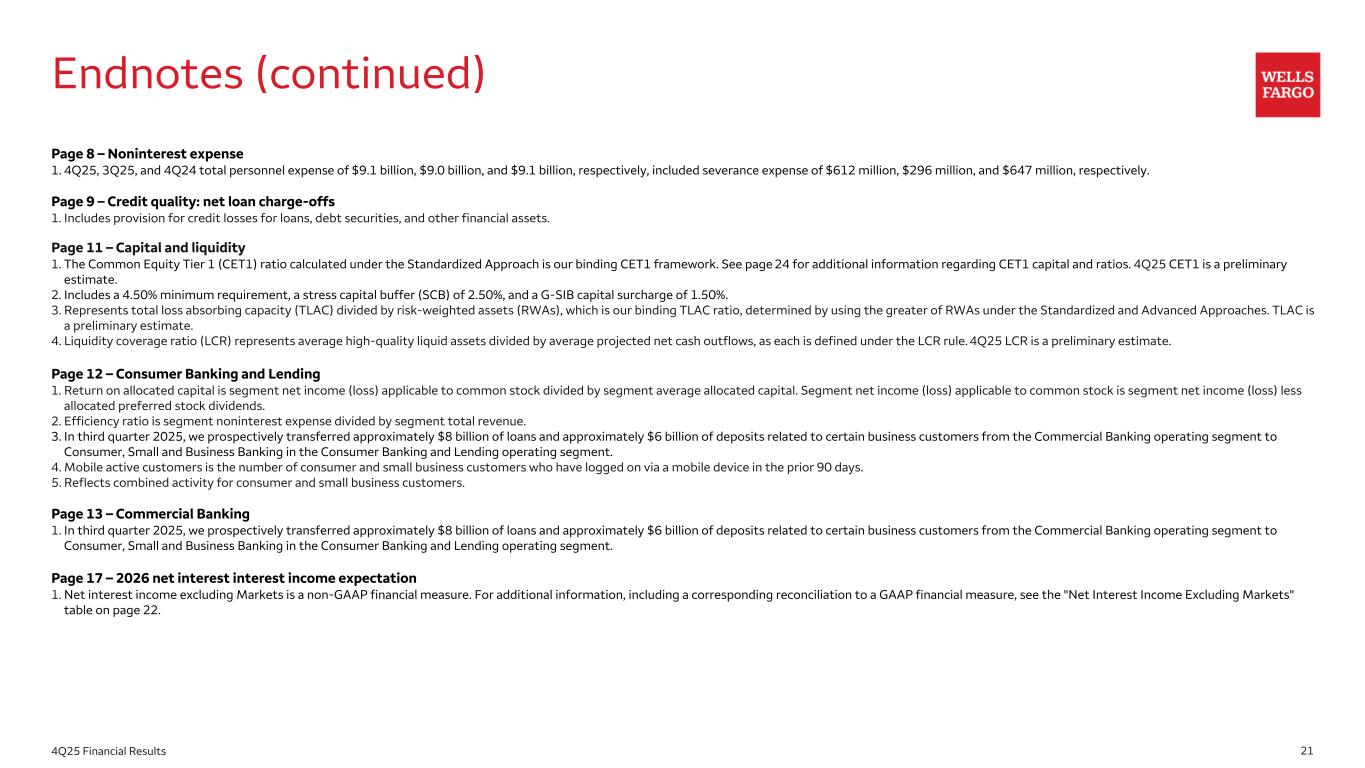
214Q25 Financial Results Page 8 – Noninterest expense 1. 4Q25, 3Q25, and 4Q24 total personnel expense of $9.1 billion, $9.0 billion, and $9.1 billion, respectively, included severance expense of $612 million, $296 million, and $647 million, respectively. Page 9 – Credit quality: net loan charge-offs 1. Includes provision for credit losses for loans, debt securities, and other financial assets. Page 11 – Capital and liquidity 1. The Common Equity Tier 1 (CET1) ratio calculated under the Standardized Approach is our binding CET1 framework. See page 24 for additional information regarding CET1 capital and ratios. 4Q25 CET1 is a preliminary estimate. 2. Includes a 4.50% minimum requirement, a stress capital buffer (SCB) of 2.50%, and a G-SIB capital surcharge of 1.50%. 3. Represents total loss absorbing capacity (TLAC) divided by risk-weighted assets (RWAs), which is our binding TLAC ratio, determined by using the greater of RWAs under the Standardized and Advanced Approaches. TLAC is a preliminary estimate. 4. Liquidity coverage ratio (LCR) represents average high-quality liquid assets divided by average projected net cash outflows, as each is defined under the LCR rule. 4Q25 LCR is a preliminary estimate. Page 12 – Consumer Banking and Lending 1. Return on allocated capital is segment net income (loss) applicable to common stock divided by segment average allocated capital. Segment net income (loss) applicable to common stock is segment net income (loss) less allocated preferred stock dividends. 2. Efficiency ratio is segment noninterest expense divided by segment total revenue. 3. In third quarter 2025, we prospectively transferred approximately $8 billion of loans and approximately $6 billion of deposits related to certain business customers from the Commercial Banking operating segment to Consumer, Small and Business Banking in the Consumer Banking and Lending operating segment. 4. Mobile active customers is the number of consumer and small business customers who have logged on via a mobile device in the prior 90 days. 5. Reflects combined activity for consumer and small business customers. Page 13 – Commercial Banking 1. In third quarter 2025, we prospectively transferred approximately $8 billion of loans and approximately $6 billion of deposits related to certain business customers from the Commercial Banking operating segment to Consumer, Small and Business Banking in the Consumer Banking and Lending operating segment. Page 17 – 2026 net interest interest income expectation 1. Net interest income excluding Markets is a non-GAAP financial measure. For additional information, including a corresponding reconciliation to a GAAP financial measure, see the "Net Interest Income Excluding Markets" table on page 22. Endnotes (continued)
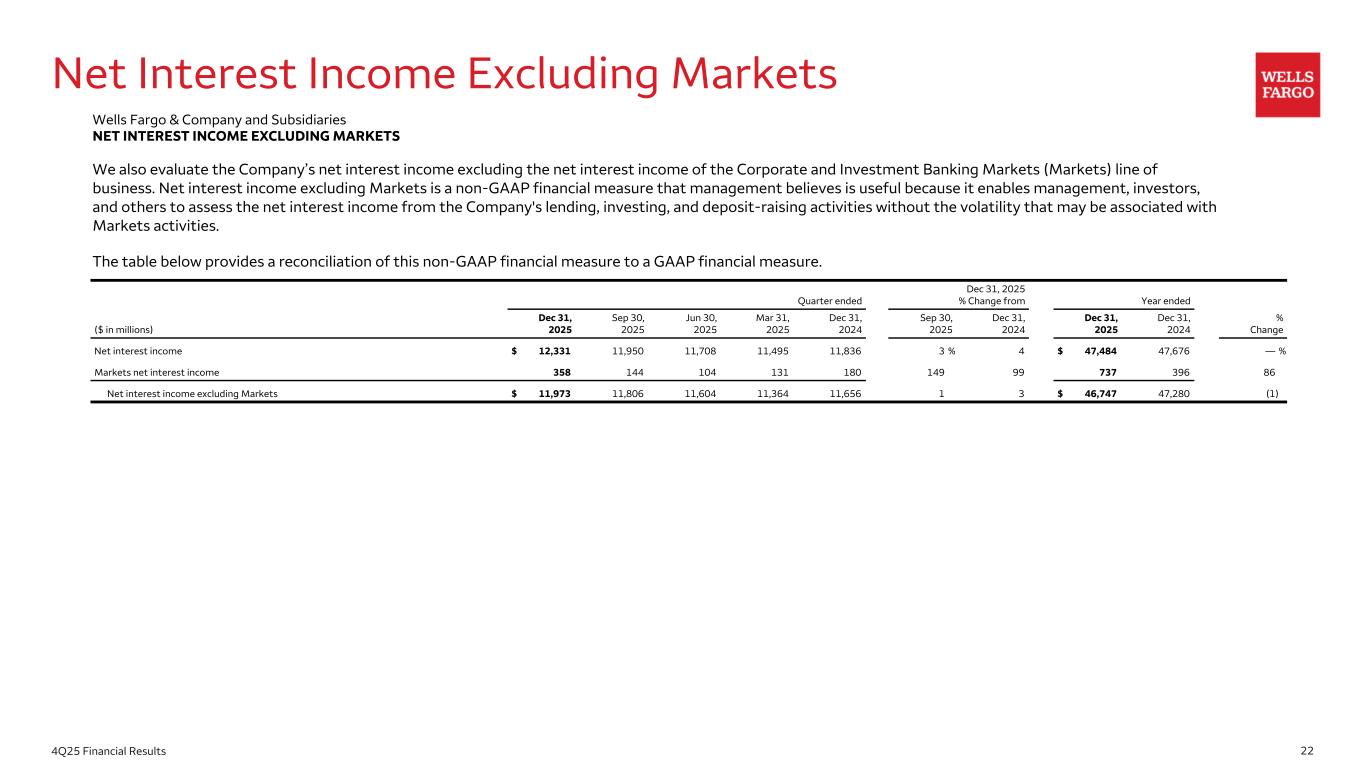
224Q25 Financial Results Net Interest Income Excluding Markets Quarter ended Dec 31, 2025 % Change from Year ended ($ in millions) Dec 31, 2025 Sep 30, 2025 Jun 30, 2025 Mar 31, 2025 Dec 31, 2024 Sep 30, 2025 Dec 31, 2024 Dec 31, 2025 Dec 31, 2024 % Change Net interest income $ 12,331 11,950 11,708 11,495 11,836 3 % 4 $ 47,484 47,676 — % Markets net interest income 358 144 104 131 180 149 99 737 396 86 Net interest income excluding Markets $ 11,973 11,806 11,604 11,364 11,656 1 3 $ 46,747 47,280 (1) Wells Fargo & Company and Subsidiaries NET INTEREST INCOME EXCLUDING MARKETS We also evaluate the Company’s net interest income excluding the net interest income of the Corporate and Investment Banking Markets (Markets) line of business. Net interest income excluding Markets is a non-GAAP financial measure that management believes is useful because it enables management, investors, and others to assess the net interest income from the Company's lending, investing, and deposit-raising activities without the volatility that may be associated with Markets activities. The table below provides a reconciliation of this non-GAAP financial measure to a GAAP financial measure.
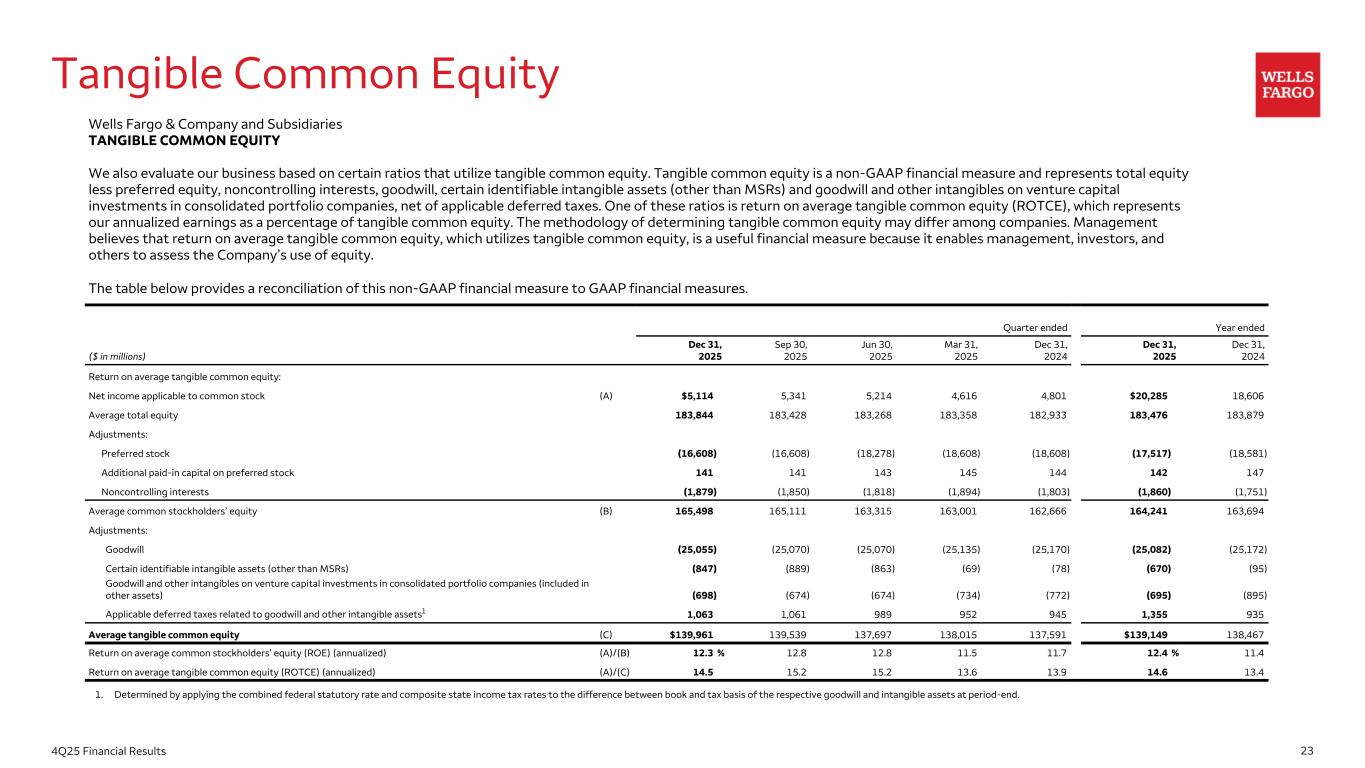
234Q25 Financial Results Tangible Common Equity Wells Fargo & Company and Subsidiaries TANGIBLE COMMON EQUITY We also evaluate our business based on certain ratios that utilize tangible common equity. Tangible common equity is a non-GAAP financial measure and represents total equity less preferred equity, noncontrolling interests, goodwill, certain identifiable intangible assets (other than MSRs) and goodwill and other intangibles on venture capital investments in consolidated portfolio companies, net of applicable deferred taxes. One of these ratios is return on average tangible common equity (ROTCE), which represents our annualized earnings as a percentage of tangible common equity. The methodology of determining tangible common equity may differ among companies. Management believes that return on average tangible common equity, which utilizes tangible common equity, is a useful financial measure because it enables management, investors, and others to assess the Company’s use of equity. The table below provides a reconciliation of this non-GAAP financial measure to GAAP financial measures. Quarter ended Year ended ($ in millions) Dec 31, 2025 Sep 30, 2025 Jun 30, 2025 Mar 31, 2025 Dec 31, 2024 Dec 31, 2025 Dec 31, 2024 Return on average tangible common equity: Net income applicable to common stock (A) $5,114 5,341 5,214 4,616 4,801 $20,285 18,606 Average total equity 183,844 183,428 183,268 183,358 182,933 183,476 183,879 Adjustments: Preferred stock (16,608) (16,608) (18,278) (18,608) (18,608) (17,517) (18,581) Additional paid-in capital on preferred stock 141 141 143 145 144 142 147 Noncontrolling interests (1,879) (1,850) (1,818) (1,894) (1,803) (1,860) (1,751) Average common stockholders’ equity (B) 165,498 165,111 163,315 163,001 162,666 164,241 163,694 Adjustments: Goodwill (25,055) (25,070) (25,070) (25,135) (25,170) (25,082) (25,172) Certain identifiable intangible assets (other than MSRs) (847) (889) (863) (69) (78) (670) (95) Goodwill and other intangibles on venture capital investments in consolidated portfolio companies (included in other assets) (698) (674) (674) (734) (772) (695) (895) Applicable deferred taxes related to goodwill and other intangible assets1 1,063 1,061 989 952 945 1,355 935 Average tangible common equity (C) $139,961 139,539 137,697 138,015 137,591 $139,149 138,467 Return on average common stockholders’ equity (ROE) (annualized) (A)/(B) 12.3 % 12.8 12.8 11.5 11.7 12.4 % 11.4 Return on average tangible common equity (ROTCE) (annualized) (A)/(C) 14.5 15.2 15.2 13.6 13.9 14.6 13.4 1. Determined by applying the combined federal statutory rate and composite state income tax rates to the difference between book and tax basis of the respective goodwill and intangible assets at period-end.
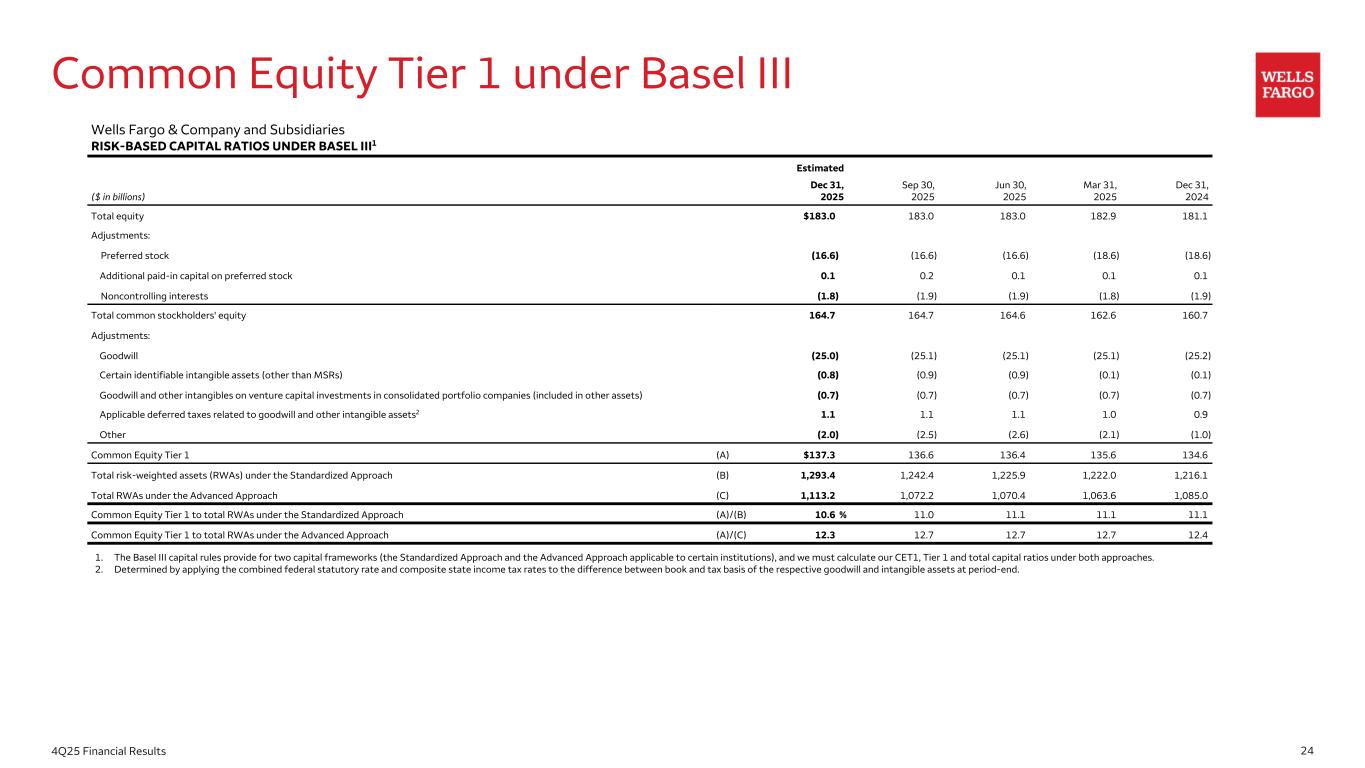
244Q25 Financial Results 1. The Basel III capital rules provide for two capital frameworks (the Standardized Approach and the Advanced Approach applicable to certain institutions), and we must calculate our CET1, Tier 1 and total capital ratios under both approaches. 2. Determined by applying the combined federal statutory rate and composite state income tax rates to the difference between book and tax basis of the respective goodwill and intangible assets at period-end. Common Equity Tier 1 under Basel III Wells Fargo & Company and Subsidiaries RISK-BASED CAPITAL RATIOS UNDER BASEL III1 Estimated ($ in billions) Dec 31, 2025 Sep 30, 2025 Jun 30, 2025 Mar 31, 2025 Dec 31, 2024 Total equity $183.0 183.0 183.0 182.9 181.1 Adjustments: Preferred stock (16.6) (16.6) (16.6) (18.6) (18.6) Additional paid-in capital on preferred stock 0.1 0.2 0.1 0.1 0.1 Noncontrolling interests (1.8) (1.9) (1.9) (1.8) (1.9) Total common stockholders' equity 164.7 164.7 164.6 162.6 160.7 Adjustments: Goodwill (25.0) (25.1) (25.1) (25.1) (25.2) Certain identifiable intangible assets (other than MSRs) (0.8) (0.9) (0.9) (0.1) (0.1) Goodwill and other intangibles on venture capital investments in consolidated portfolio companies (included in other assets) (0.7) (0.7) (0.7) (0.7) (0.7) Applicable deferred taxes related to goodwill and other intangible assets2 1.1 1.1 1.1 1.0 0.9 Other (2.0) (2.5) (2.6) (2.1) (1.0) Common Equity Tier 1 (A) $137.3 136.6 136.4 135.6 134.6 Total risk-weighted assets (RWAs) under the Standardized Approach (B) 1,293.4 1,242.4 1,225.9 1,222.0 1,216.1 Total RWAs under the Advanced Approach (C) 1,113.2 1,072.2 1,070.4 1,063.6 1,085.0 Common Equity Tier 1 to total RWAs under the Standardized Approach (A)/(B) 10.6 % 11.0 11.1 11.1 11.1 Common Equity Tier 1 to total RWAs under the Advanced Approach (A)/(C) 12.3 12.7 12.7 12.7 12.4
254Q25 Financial Results Disclaimer and forward-looking statements Financial results reported in this document are preliminary. Final financial results and other disclosures will be reported in our Annual Report on Form 10-K for the year ended December 31, 2025, and may differ materially from the results and disclosures in this document due to, among other things, the completion of final review procedures, the occurrence of subsequent events, or the discovery of additional information. This document contains forward-looking statements. In addition, we may make forward-looking statements in our other documents filed or furnished with the Securities and Exchange Commission, and our management may make forward-looking statements orally to analysts, investors, representatives of the media and others. Forward-looking statements can be identified by words such as “anticipates,” “intends,” “plans,” “seeks,” “believes,” “estimates,” “expects,” “target,” “projects,” “outlook,” “forecast,” “will,” “may,” “could,” “should,” “can” and similar references to future periods. In particular, forward-looking statements include, but are not limited to, statements we make about: (i) the future operating or financial performance of the Company or any of its businesses, including our outlook for future growth; (ii) our expectations regarding noninterest expense and our efficiency ratio; (iii) future credit quality and performance, including our expectations regarding future loan losses, our allowance for credit losses, and the economic scenarios considered to develop the allowance; (iv) our expectations regarding net interest income and net interest margin; (v) loan growth or the reduction or mitigation of risk in our loan portfolios; (vi) future capital or liquidity levels, ratios or targets; (vii) the expected outcome and impact of legal, regulatory and legislative developments, as well as our expectations regarding compliance therewith; (viii) future common stock dividends, common share repurchases and other uses of capital; (ix) our targeted range for return on assets, return on equity, and return on tangible common equity; (x) expectations regarding our effective income tax rate; (xi) the outcome of contingencies, such as legal actions; (xii) sustainability and governance related goals or commitments; and (xiii) the Company’s plans, objectives and strategies. Forward-looking statements are not based on historical facts but instead represent our current expectations and assumptions regarding our business, the economy and other future conditions. Investors are urged to not unduly rely on forward-looking statements as actual results may differ materially from expectations. Forward-looking statements speak only as of the date made, and we do not undertake to update them to reflect changes or events that occur after that date. For additional information about factors that could cause actual results to differ materially from our expectations, refer to the “Forward-Looking Statements” discussion in Wells Fargo’s press release announcing our fourth quarter 2025 results and in our most recent Quarterly Report on Form 10-Q, as well as to Wells Fargo’s other reports filed with the Securities and Exchange Commission, including the discussion under “Risk Factors” in our Annual Report on Form 10-K for the year ended December 31, 2024.