2025 Compensation Decisions:
Base Compensation
The base salaries for each of the NEOs as of December 31, 2025 (or, in the case of the NEOs who terminated employment prior to December 31, 2025, as of their termination date) are as follows: Mr. Wolf, $40,000; Mr. Evans, $600,000; Ms. Pfeiffer, $550,000; Ms. Freeman-Bosworth, $440,000; Mr. Everett, $600,000; Mr. Rosenzweig, $500,000; Mr. Gold, $600,000; Mr. Witek, $360,500; Mr. Fairweather, $605,690; and Ms. Nurmohamed, $636,000. For Ms. Pfeiffer this represented a 10% increase above her 2024 annual base salary, and for Ms. Nurmohamed, this represented a 6% increase above her 2024 base salary, all of which were consistent with the market median of the competitive data for these positions.
NEOs are eligible to earn annual incentives awarded under the Key Employees Incentive Plan (KEIP), primarily for achieving enterprise-wide financial objectives established at the beginning of each year, which are designed to be challenging to achieve. Individual performance and its impact on financial, strategic, unit, or individual objectives may be considered.
The target annual incentive opportunities for each of the NEOs for 2025 is as follows: Mr. Wolf, $500,000; Mr. Evans, $480,000 (80% of base salary); Ms. Pfeiffer, $440,000 (80% of base salary); Ms. Freeman-Bosworth, $264,000 (60% of base salary); Mr. Everett, $480,000 (80% of base salary); Mr. Rosenzweig, $500,000; Mr. Gold, $480,000 (80% of base salary); Mr. Witek, $180,250 (50% of base salary); Mr. Fairweather, $363,414 (60% of base salary); and Ms. Nurmohamed, $508,800 (80% of base salary).
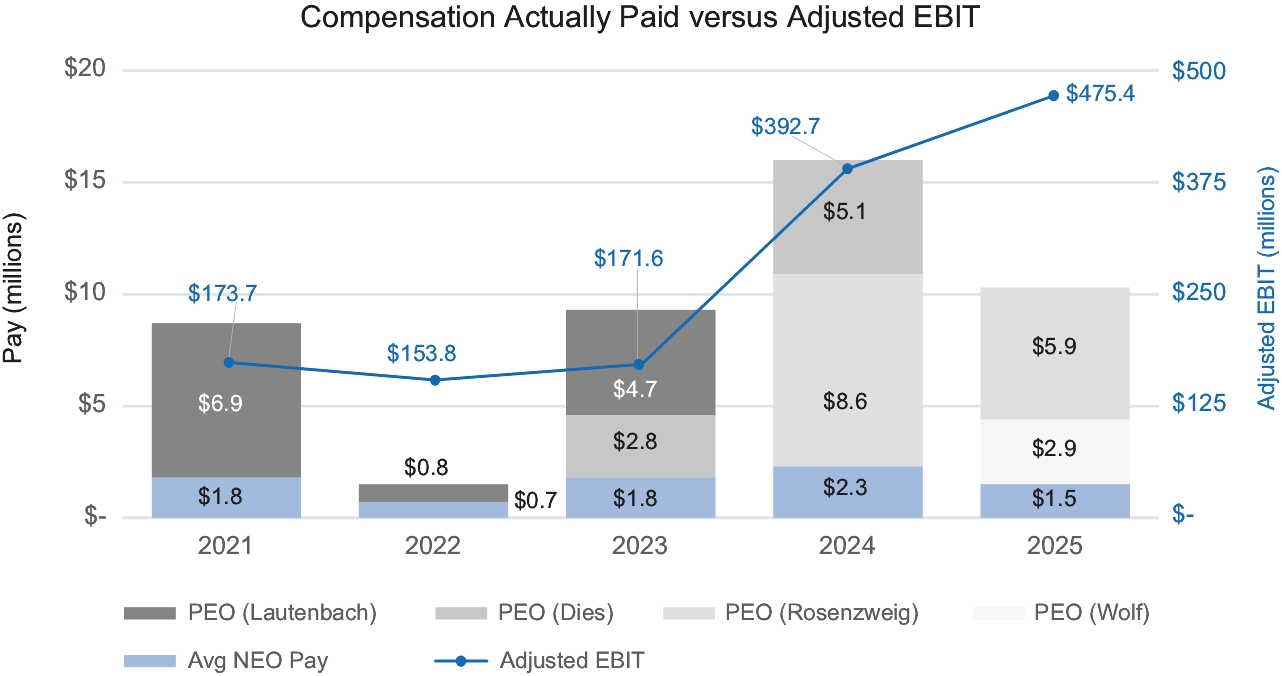
For 2025, the financial measures used to determine annual incentives for NEOs consisted of: Adjusted EBIT and Adjusted Revenue.
The Committee and the Board believe that basing the annual incentive plan entirely on quantifiable financial performance measures demonstrates our commitment to placing rigor and objectivity in establishing and measuring our compensation goals and results.
The following table contains the financial objectives used under the annual incentive plan for 2025 and describes why they are effective in measuring how our business is performing on a short-term basis:
| | | | | | | |
Adjusted EBIT | | | 75% | | | Focuses executive officers on driving Company profitability | |
Adjusted Revenue | | | 25% | | | Focuses executive officers on driving Company growth | |
| | | | | | | |
Both metrics exclude the impact of certain special items, both positive and negative, which could mask the underlying trend or performance within a business. The adjustments for special items are explained further under “Non-GAAP Measures” on page
88. For further explanation on objective setting, please see “Determining Compensation – The Decision Process” on page
57.
The 2025 performance year annual incentive plan design utilized a straight-line methodology interpolated between each performance level: threshold (50% potential payout), target (100% potential payout), exceeds (150% potential payout), and maximum (200% potential payout) objectives. The addition of the exceeds objective and increase to the maximum payout percentage better aligns the annual incentive design to market and further incentivizes employees to achieve the financial objectives.