OCTOBER 29, 2026 THIRD-QUARTER 2026 FINANCIAL RESULTS .3
1Edison International | Third-Quarter 2026 Earnings Call Forward-Looking Statements Statements contained in this presentation about future performance, including, without limitation, operating results, capital expenditures, rate base growth, dividend policy, financial outlook, and other statements that are not purely historical, are forward-looking statements. These forward-looking statements reflect our current expectations; however, such statements involve risks and uncertainties. Actual results could differ materially from current expectations. These forward-looking statements represent our expectations only as of the date of this presentation, and Edison International assumes no duty to update them to reflect new information, events or circumstances. Important factors that could cause different results include, but are not limited to the: • ability of SCE to recover its costs through regulated rates, timely or at all, including uninsured wildfire-related costs (including amounts paid for self-insured retention and co-insurance, and amounts not recoverable from the Wildfire Fund), and costs incurred for wildfire restoration efforts and to mitigate the risk of utility equipment causing future wildfires; • the cybersecurity of Edison International's and SCE's critical information technology systems for grid control and business, employee and customer data, and the physical security of Edison International's and SCE's critical assets and personnel; • risks associated with the construction, operation, and maintenance of electrical facilities, including worker, contractor, and public safety issues, the risk of utility assets causing or contributing to wildfires, failure, availability, efficiency, and output of equipment and facilities, and availability and cost of spare parts; • impact of affordability of customer rates on SCE's ability to execute its strategy, including the impact of lower-than-expected load growth and higher operating and capital costs (due to factors such as supply chain constraints, tariffs, inflation, and rising interest rates), which could affect SCE’s ability to obtain regulatory approval of, or cost recovery for, operations and maintenance expenses, proposed capital investment projects, and authorized returns on equity, as well as influence legislative actions; • ability of SCE to update its grid infrastructure to maintain system integrity and reliability, and meet electrification needs; • ability of SCE to implement its operational and strategic plans, including its Wildfire Mitigation Plan, its target energization times and capital investment program, including challenges related to project site identification, public opposition, environmental mitigation, construction, permitting, contractor performance, changes in the California Independent System Operator's (“CAISO”) transmission plans, and governmental approvals; • risks of regulatory or legislative restrictions that would limit SCE's ability to implement operational measures to mitigate wildfire risk, including Public Safety Power Shutoff (“PSPS”) and fast curve settings, when conditions warrant or would otherwise limit SCE's operational practices relative to wildfire risk mitigation; • ability of SCE to obtain safety certifications from the Office of Energy Infrastructure Safety of the California Natural Resources Agency (“OEIS“); • risk that the California Wildfire Legislation, together with any future legislation, does not effectively mitigate the significant exposure faced by California investor-owned utilities related to liability for damages arising from catastrophic wildfires where utility facilities are alleged to be a substantial or contributing cause, including the longevity of the Wildfire Fund and the California Public Utilities Commission (“CPUC”) interpretation of and actions under the California Wildfire Legislation, including its interpretation of the clarified prudency standard; • ability of Edison International and SCE to effectively attract, manage, develop and retain a skilled workforce, including its contract workers; • decisions and other actions by the CPUC, the Federal Energy Regulatory Commission, and the United States Nuclear Regulatory Commission, the California legislature and other governmental authorities, including decisions and actions related to nationwide or statewide crisis, approval of regulatory proceeding settlements, determinations of authorized rates of return or return on equity, prudency determinations for wildfire-related costs, the availability and sufficiency of the Wildfire Fund and related cost recovery mechanisms, issuance of SCE's wildfire safety certification, reforming wildfire-related liability protections available to California investor-owned utilities, wildfire mitigation efforts, approval and implementation of electrification programs, restrictions on the issuance of dividends, and delays in executive, regulatory and legislative actions; • governmental, statutory, regulatory, or administrative changes or initiatives affecting the electricity industry, including the market structure rules applicable to each market adopted by the North American Electric Reliability Corporation, CAISO, Western Electricity Coordinating Council, and similar regulatory bodies in adjoining regions, and changes in the United States' and California's environmental priorities that lessen the importance placed on greenhouse gas reduction and other climate related priorities; • potential for penalties or disallowances for non-compliance with applicable laws and regulations, including fines, penalties and disallowances related to customer notifications and to wildfires where SCE's equipment is alleged to be associated with ignition; • extreme weather-related incidents (including events caused, or exacerbated, by climate change), such as wildfires, debris flows, flooding, accelerated coastal erosion, droughts, high wind events and extreme heat events and other natural disasters (such as earthquakes), which could cause, among other things, worker and public safety issues, property damage, outages and other operational issues (such as issues due to damaged infrastructure), PSPS activations and unanticipated costs; • risks associated with the decommissioning of San Onofre, including those related to worker and public safety, public opposition, permitting, governmental approvals, on-site storage of spent nuclear fuel and other radioactive material, delays, contractual disputes, and cost overruns; • risks associated with cost allocation resulting in higher rates for utility bundled service customers because of possible customer bypass or departure for other electricity providers such as Community Choice Aggregators (“CCA,” which are cities, counties, and certain other public agencies with the authority to generate and/or purchase electricity for their local residents and businesses) and Electric Service Providers (entities that offer electric power and ancillary services to retail customers, other than electrical corporations (like SCE) and CCAs); • actions by credit rating agencies to downgrade Edison International or SCE’s credit ratings or to place those ratings on negative watch or negative outlook, including downgrades that may be made if the California legislature does not timely adopt legislation that effectively mitigates the significant wildfire-related risk faced by California investor-owned utilities; • ability of Edison International or SCE to borrow funds and access bank and capital markets on reasonable terms; • changes in tax laws and regulations, at both the state and federal levels, or changes in the application of those laws, that could affect recorded deferred tax assets and liabilities, effective tax rates and cash flows; • changes in rates of inflation (including whether inflation-related adjustments to SCE's authorized revenues allowed by the public utility regulators are commensurate with inflation rates), and changes in interest rates and potential future adjustments to SCE's ROE based on changes in Moody's utility bond rate index; • availability and creditworthiness of counterparties and the resulting effects on liquidity in the power and fuel markets and/or the ability of counterparties to pay amounts owed in excess of collateral provided in support of their obligations; and • cost of fuel for generating facilities and related transportation, which could be impacted by, among other things, disruption of natural gas storage facilities, to the extent not recovered, timely or at all, through regulated rate cost escalation provisions or balancing accounts. Other important factors are discussed under the headings “Forward-Looking Statements”, “Risk Factors” and “Management’s Discussion and Analysis” in Edison International’s Form 10-K and other reports filed with the Securities and Exchange Commission, which are available on our website: edisoninvestor.com. These filings also provide additional information on historical and other factual data contained in this presentation.
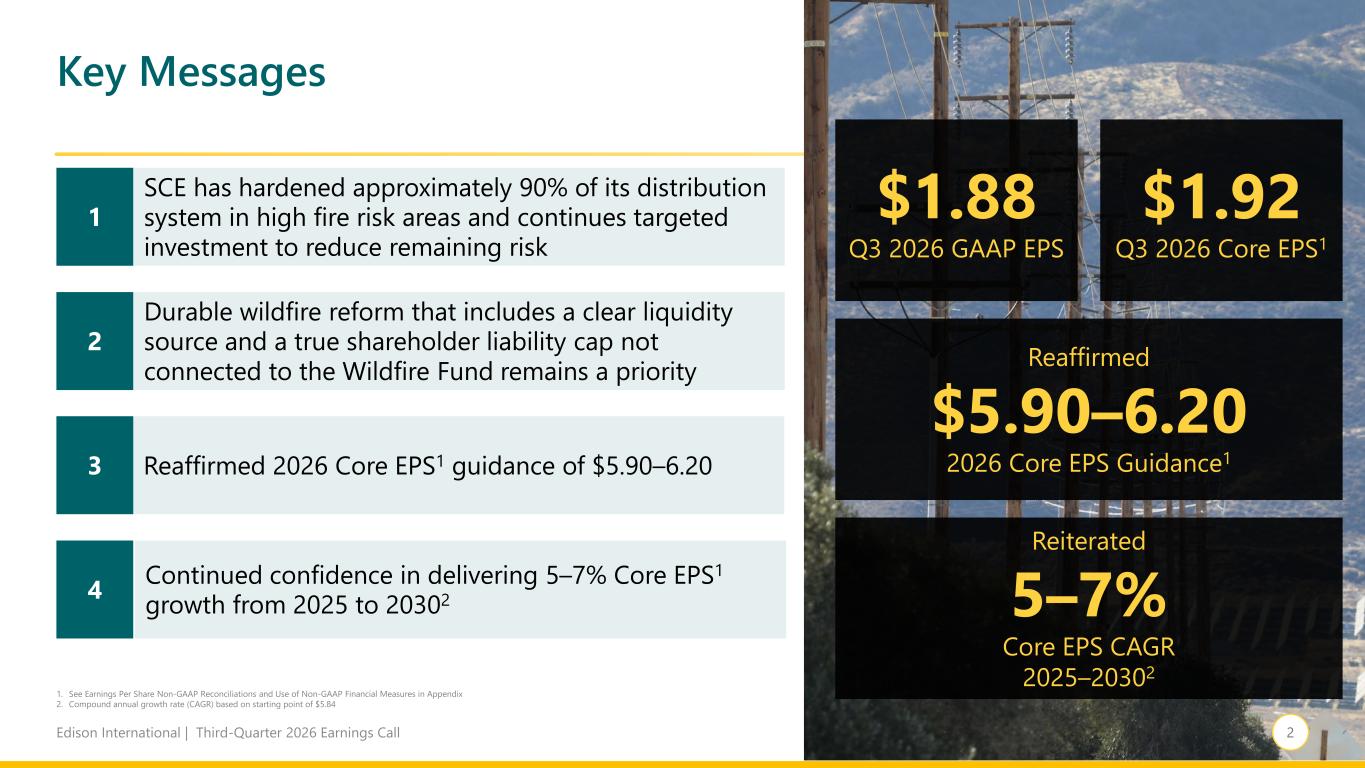
2Edison International | Third-Quarter 2026 Earnings Call Key Messages $1.88 Q3 2026 GAAP EPS $1.92 Q3 2026 Core EPS1 Reiterated 5–7% Core EPS CAGR 2025–20302 Reaffirmed $5.90–6.20 2026 Core EPS Guidance1 SCE has hardened approximately 90% of its distribution system in high fire risk areas and continues targeted investment to reduce remaining risk Durable wildfire reform that includes a clear liquidity source and a true shareholder liability cap not connected to the Wildfire Fund remains a priority 1. See Earnings Per Share Non-GAAP Reconciliations and Use of Non-GAAP Financial Measures in Appendix 2. Compound annual growth rate (CAGR) based on starting point of $5.84 2 1 Reaffirmed 2026 Core EPS1 guidance of $5.90–6.203 4 Continued confidence in delivering 5–7% Core EPS1 growth from 2025 to 20302
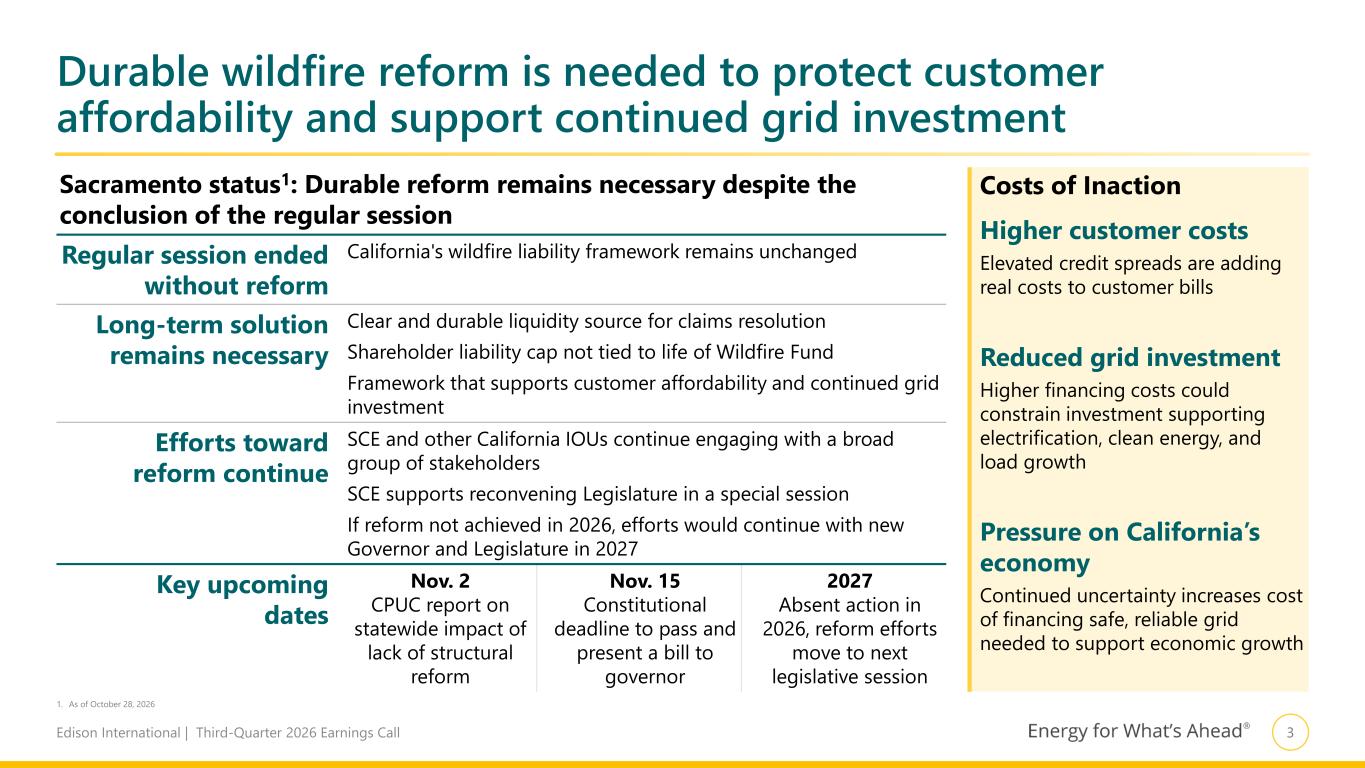
3Edison International | Third-Quarter 2026 Earnings Call Durable wildfire reform is needed to protect customer affordability and support continued grid investment Sacramento status1: Durable reform remains necessary despite the conclusion of the regular session Regular session ended without reform California's wildfire liability framework remains unchanged Long-term solution remains necessary Clear and durable liquidity source for claims resolution Shareholder liability cap not tied to life of Wildfire Fund Framework that supports customer affordability and continued grid investment Efforts toward reform continue SCE and other California IOUs continue engaging with a broad group of stakeholders SCE supports reconvening Legislature in a special session If reform not achieved in 2026, efforts would continue with new Governor and Legislature in 2027 Key upcoming dates Nov. 2 CPUC report on statewide impact of lack of structural reform Nov. 15 Constitutional deadline to pass and present a bill to governor 2027 Absent action in 2026, reform efforts move to next legislative session Costs of Inaction Higher customer costs Elevated credit spreads are adding real costs to customer bills Reduced grid investment Higher financing costs could constrain investment supporting electrification, clean energy, and load growth Pressure on California’s economy Continued uncertainty increases cost of financing safe, reliable grid needed to support economic growth 1. As of October 28, 2026
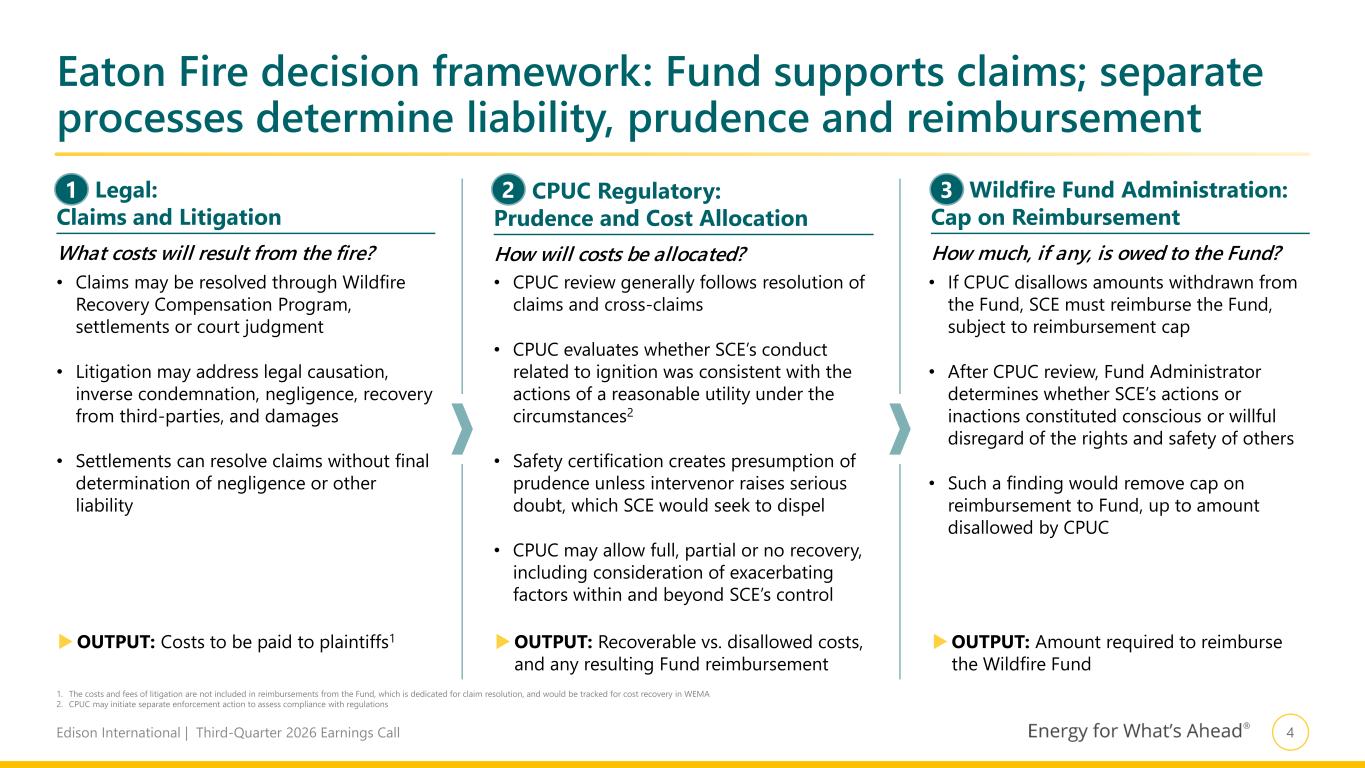
4Edison International | Third-Quarter 2026 Earnings Call Eaton Fire decision framework: Fund supports claims; separate processes determine liability, prudence and reimbursement 1. The costs and fees of litigation are not included in reimbursements from the Fund, which is dedicated for claim resolution, and would be tracked for cost recovery in WEMA 2. CPUC may initiate separate enforcement action to assess compliance with regulations Legal: Claims and Litigation CPUC Regulatory: Prudence and Cost Allocation Wildfire Fund Administration: Cap on Reimbursement What costs will result from the fire? How will costs be allocated? How much, if any, is owed to the Fund? • Claims may be resolved through Wildfire Recovery Compensation Program, settlements or court judgment • Litigation may address legal causation, inverse condemnation, negligence, recovery from third-parties, and damages • Settlements can resolve claims without final determination of negligence or other liability OUTPUT: Costs to be paid to plaintiffs1 • CPUC review generally follows resolution of claims and cross-claims • CPUC evaluates whether SCE’s conduct related to ignition was consistent with the actions of a reasonable utility under the circumstances2 • Safety certification creates presumption of prudence unless intervenor raises serious doubt, which SCE would seek to dispel • CPUC may allow full, partial or no recovery, including consideration of exacerbating factors within and beyond SCE’s control OUTPUT: Recoverable vs. disallowed costs, and any resulting Fund reimbursement • If CPUC disallows amounts withdrawn from the Fund, SCE must reimburse the Fund, subject to reimbursement cap • After CPUC review, Fund Administrator determines whether SCE’s actions or inactions constituted conscious or willful disregard of the rights and safety of others • Such a finding would remove cap on reimbursement to Fund, up to amount disallowed by CPUC OUTPUT: Amount required to reimburse the Wildfire Fund 1 2 3
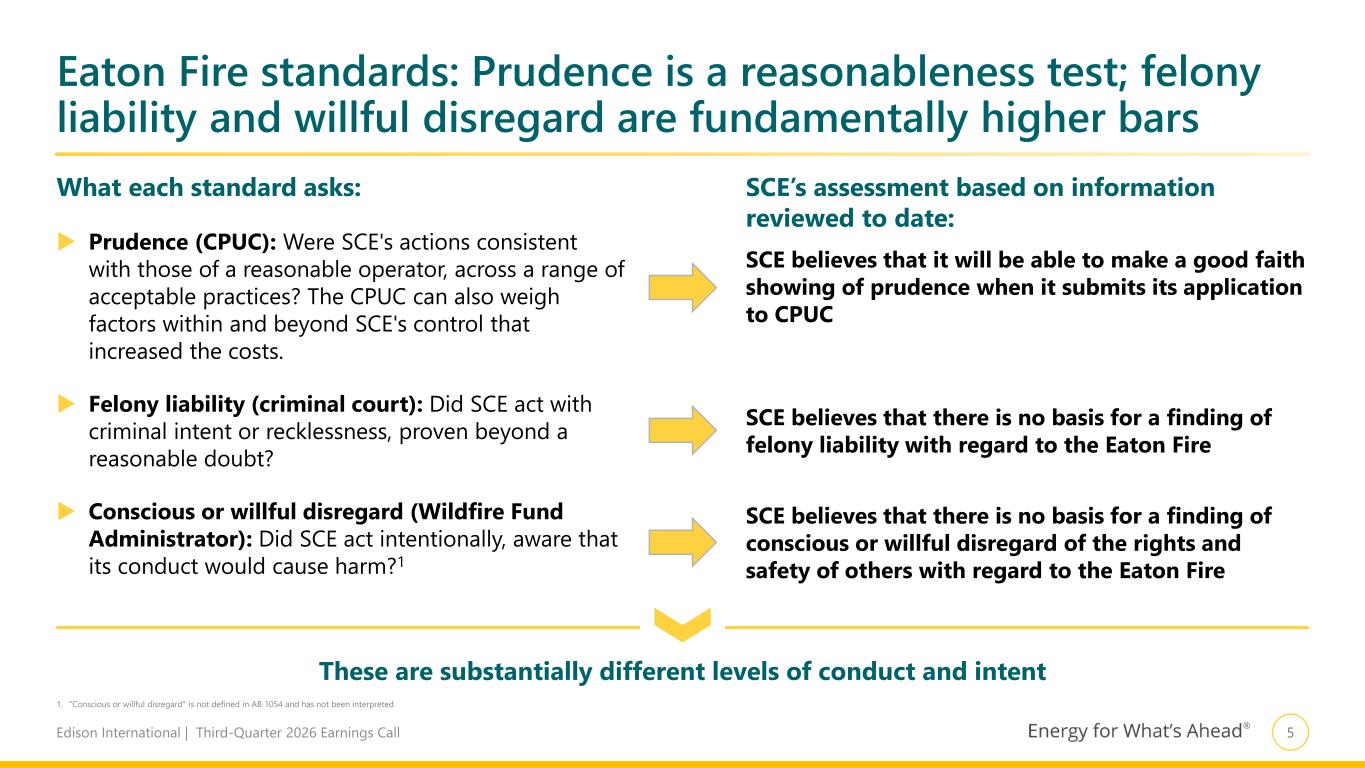
5Edison International | Third-Quarter 2026 Earnings Call Eaton Fire standards: Prudence is a reasonableness test; felony liability and willful disregard are fundamentally higher bars What each standard asks: Prudence (CPUC): Were SCE's actions consistent with those of a reasonable operator, across a range of acceptable practices? The CPUC can also weigh factors within and beyond SCE's control that increased the costs. Felony liability (criminal court): Did SCE act with criminal intent or recklessness, proven beyond a reasonable doubt? Conscious or willful disregard (Wildfire Fund Administrator): Did SCE act intentionally, aware that its conduct would cause harm?1 SCE’s assessment based on information reviewed to date: SCE believes that it will be able to make a good faith showing of prudence when it submits its application to CPUC SCE believes that there is no basis for a finding of conscious or willful disregard of the rights and safety of others with regard to the Eaton Fire SCE believes that there is no basis for a finding of felony liability with regard to the Eaton Fire These are substantially different levels of conduct and intent 1. "Conscious or willful disregard" is not defined in AB 1054 and has not been interpreted
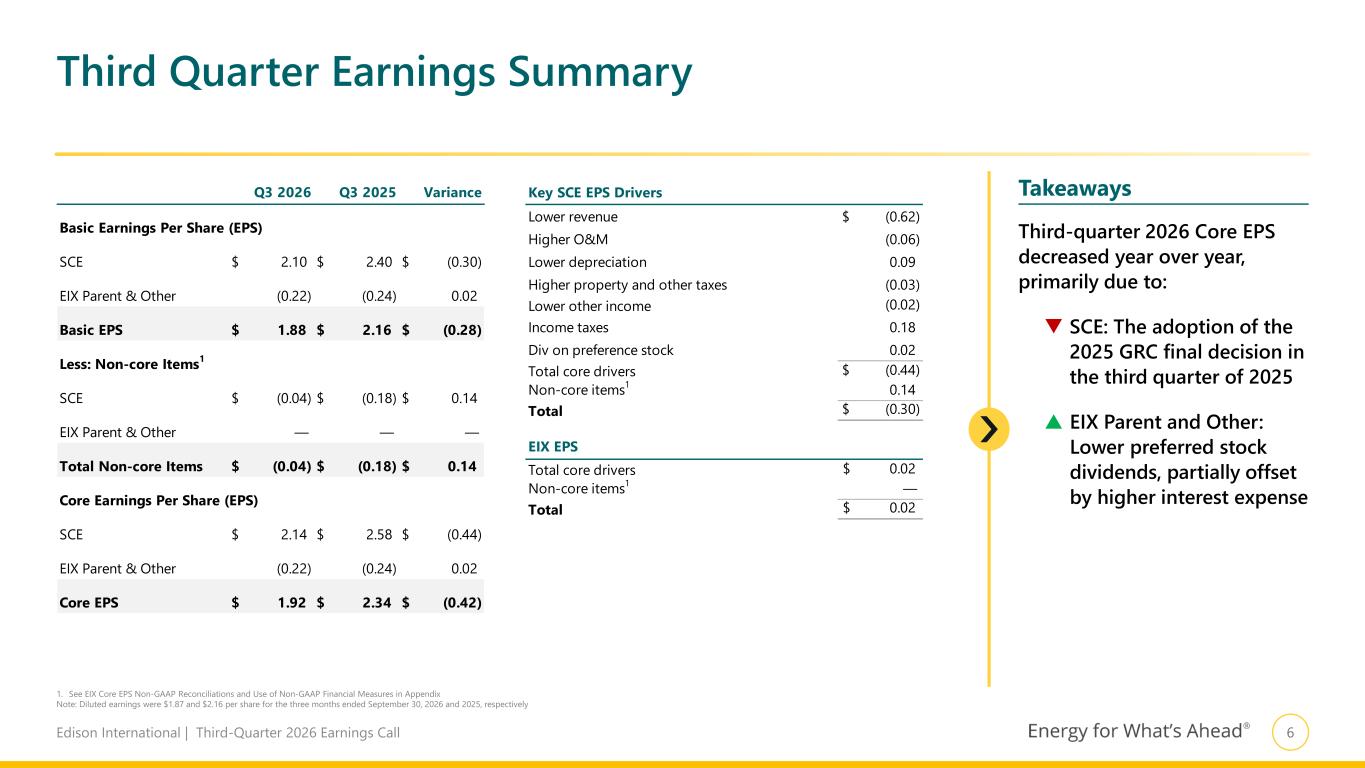
6Edison International | Third-Quarter 2026 Earnings Call Q3 2026 Q3 2025 Variance Basic Earnings Per Share (EPS) SCE 2.10$ 2.40$ (0.30)$ EIX Parent & Other (0.22) (0.24) 0.02 Basic EPS 1.88$ 2.16$ (0.28)$ Less: Non-core Items1 SCE (0.04)$ (0.18)$ 0.14$ EIX Parent & Other — — — Total Non-core Items (0.04)$ (0.18)$ 0.14$ Core Earnings Per Share (EPS) SCE 2.14$ 2.58$ (0.44)$ EIX Parent & Other (0.22) (0.24) 0.02 Core EPS 1.92$ 2.34$ (0.42)$ Key SCE EPS Drivers Lower revenue (0.62)$ Higher O&M (0.06) Lower depreciation 0.09 Higher property and other taxes (0.03) Lower other income (0.02) Income taxes 0.18 Div on preference stock 0.02 Total core drivers (0.44)$ Non-core items1 0.14 Total (0.30)$ Total core drivers 0.02$ Non-core items1 — Total 0.02$ EIX EPS Third Quarter Earnings Summary 1. See EIX Core EPS Non-GAAP Reconciliations and Use of Non-GAAP Financial Measures in Appendix Note: Diluted earnings were $1.87 and $2.16 per share for the three months ended September 30, 2026 and 2025, respectively Third-quarter 2026 Core EPS decreased year over year, primarily due to: SCE: The adoption of the 2025 GRC final decision in the third quarter of 2025 EIX Parent and Other: Lower preferred stock dividends, partially offset by higher interest expense Takeaways
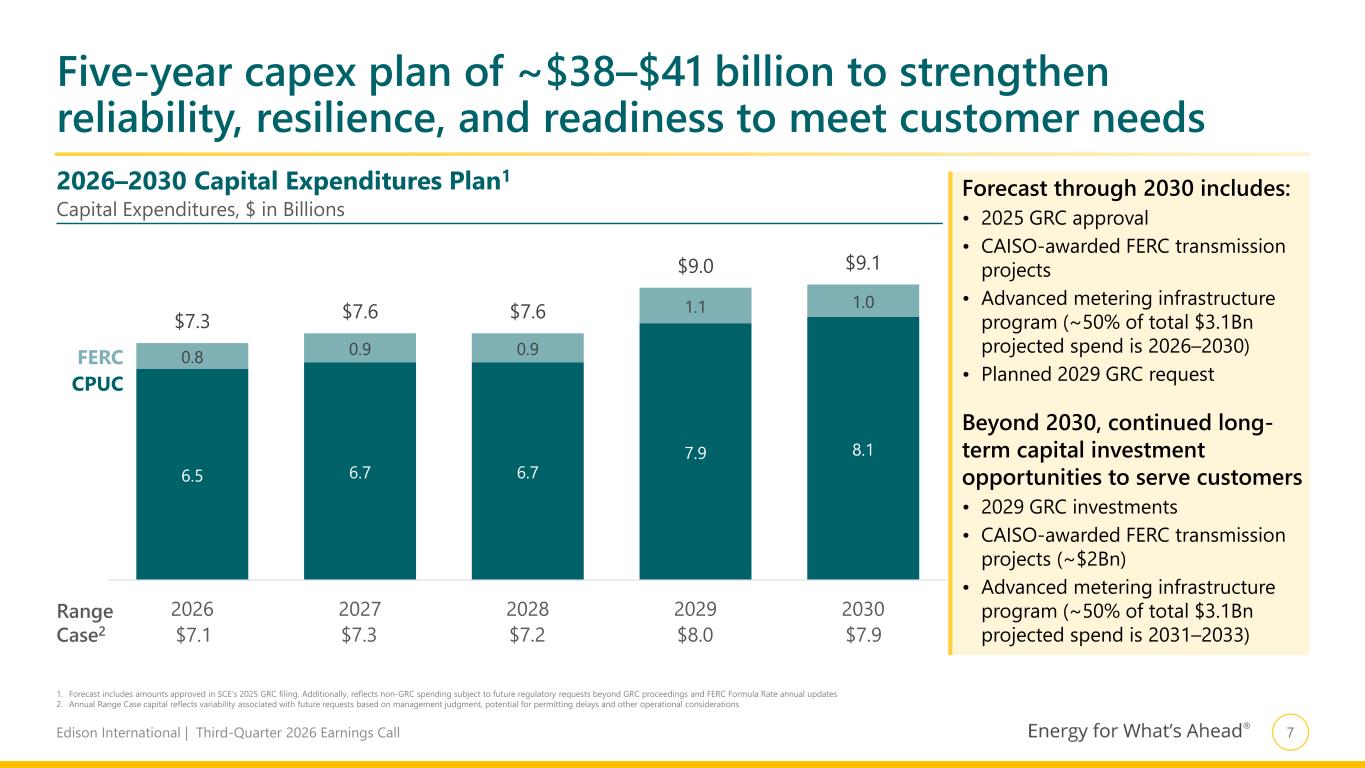
7Edison International | Third-Quarter 2026 Earnings Call 2026–2030 Capital Expenditures Plan1 Five-year capex plan of ~$38–$41 billion to strengthen reliability, resilience, and readiness to meet customer needs Capital Expenditures, $ in Billions 1. Forecast includes amounts approved in SCE’s 2025 GRC filing. Additionally, reflects non-GRC spending subject to future regulatory requests beyond GRC proceedings and FERC Formula Rate annual updates 2. Annual Range Case capital reflects variability associated with future requests based on management judgment, potential for permitting delays and other operational considerations 6.5 6.7 6.7 7.9 8.1 0.8 0.9 0.9 1.1 1.0 $7.3 $7.6 $7.6 $9.0 $9.1 2026 2027 2028 2029 2030 CPUC FERC Range Case2 $7.1 $7.3 $7.2 $8.0 $7.9 Forecast through 2030 includes: • 2025 GRC approval • CAISO-awarded FERC transmission projects • Advanced metering infrastructure program (~50% of total $3.1Bn projected spend is 2026–2030) • Planned 2029 GRC request Beyond 2030, continued long- term capital investment opportunities to serve customers • 2029 GRC investments • CAISO-awarded FERC transmission projects (~$2Bn) • Advanced metering infrastructure program (~50% of total $3.1Bn projected spend is 2031–2033)
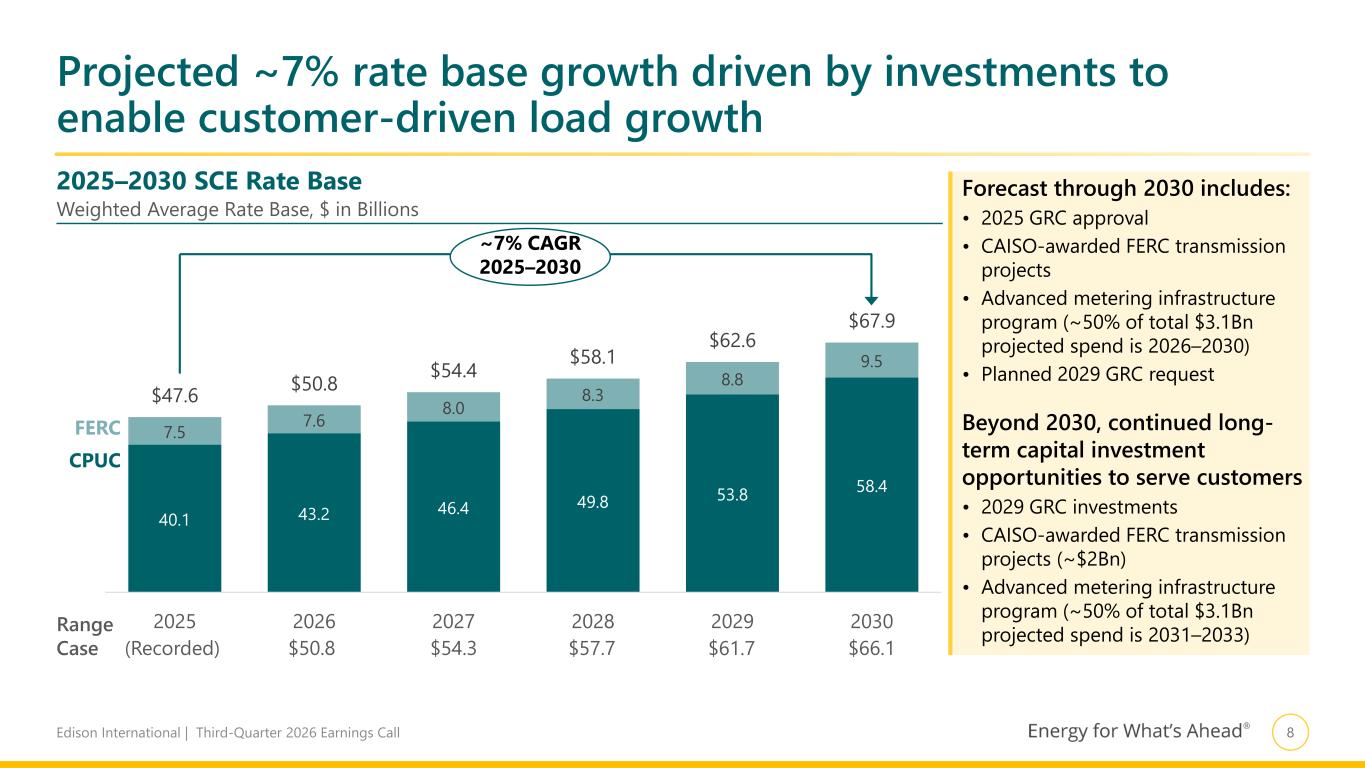
8Edison International | Third-Quarter 2026 Earnings Call 40.1 43.2 46.4 49.8 53.8 58.4 7.5 7.6 8.0 8.3 8.8 9.5 $47.6 $50.8 $54.4 $58.1 $62.6 $67.9 2025 2026 2027 2028 2029 2030 Projected ~7% rate base growth driven by investments to enable customer-driven load growth CPUC FERC ~7% CAGR 2025–2030 Range Case (Recorded) $50.8 $54.3 $57.7 $61.7 $66.1 2025–2030 SCE Rate Base Weighted Average Rate Base, $ in Billions Forecast through 2030 includes: • 2025 GRC approval • CAISO-awarded FERC transmission projects • Advanced metering infrastructure program (~50% of total $3.1Bn projected spend is 2026–2030) • Planned 2029 GRC request Beyond 2030, continued long- term capital investment opportunities to serve customers • 2029 GRC investments • CAISO-awarded FERC transmission projects (~$2Bn) • Advanced metering infrastructure program (~50% of total $3.1Bn projected spend is 2031–2033)
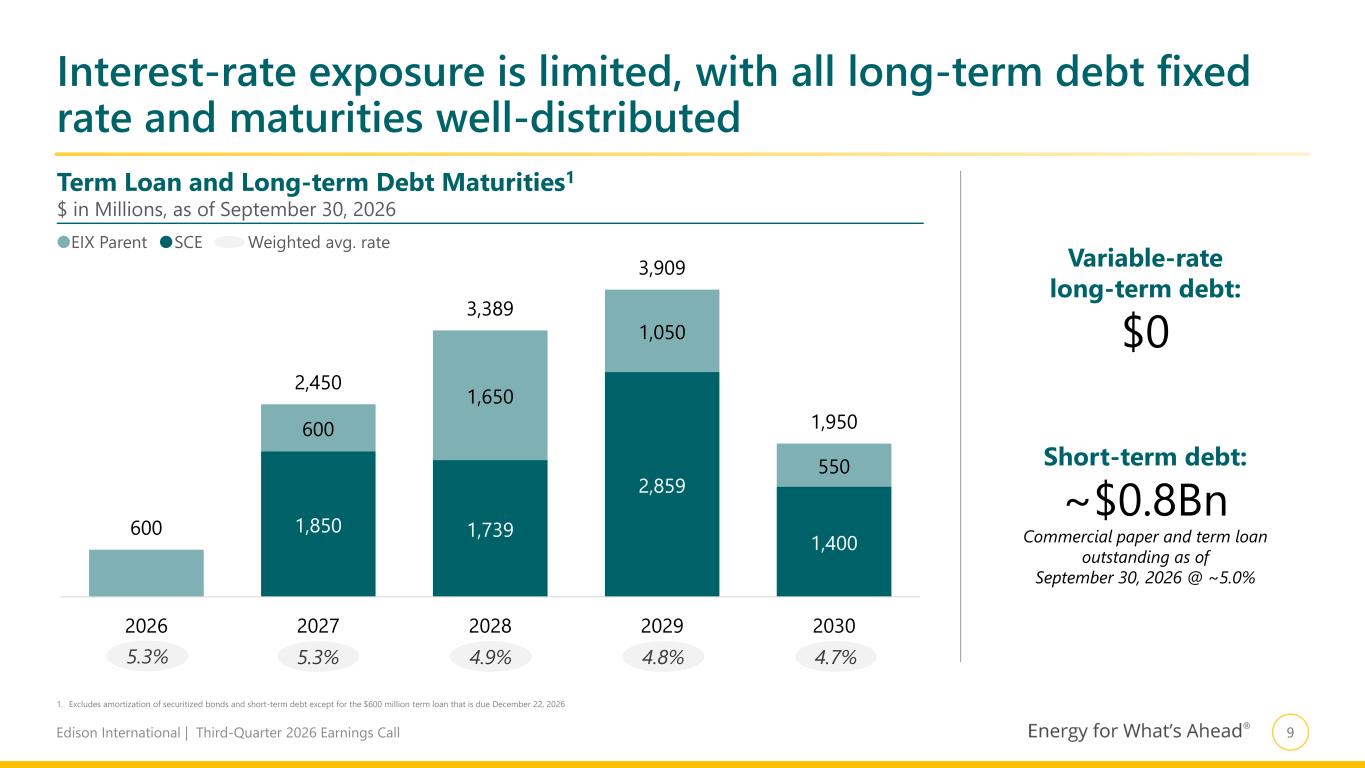
9Edison International | Third-Quarter 2026 Earnings Call 1,850 1,739 2,859 1,400 600 1,650 1,050 550 600 2,450 3,389 3,909 1,950 2026 2027 2028 2029 2030 Variable-rate long-term debt: $0 Short-term debt: ~$0.8Bn Commercial paper and term loan outstanding as of September 30, 2026 @ ~5.0% Interest-rate exposure is limited, with all long-term debt fixed rate and maturities well-distributed 1. Excludes amortization of securitized bonds and short-term debt except for the $600 million term loan that is due December 22, 2026 Term Loan and Long-term Debt Maturities1 $ in Millions, as of September 30, 2026 SCEEIX Parent 5.3% 4.9% 4.8% 4.7% Weighted avg. rate 5.3%
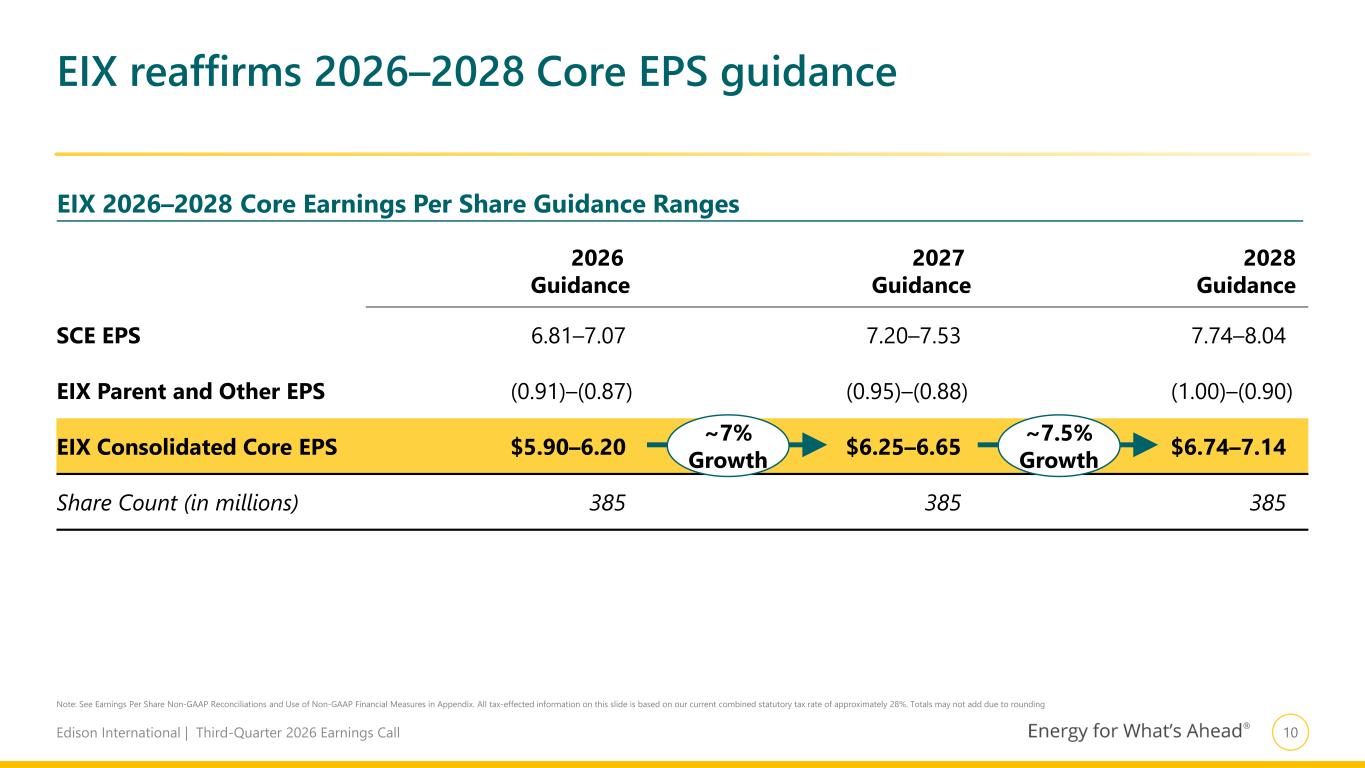
10Edison International | Third-Quarter 2026 Earnings Call 2026 Guidance 2027 Guidance 2028 Guidance SCE EPS 6.81–7.07 7.20–7.53 7.74–8.04 EIX Parent and Other EPS (0.91)–(0.87) (0.95)–(0.88) (1.00)–(0.90) EIX Consolidated Core EPS $5.90–6.20 $6.25–6.65 $6.74–7.14 Share Count (in millions) 385 385 385 Note: See Earnings Per Share Non-GAAP Reconciliations and Use of Non-GAAP Financial Measures in Appendix. All tax-effected information on this slide is based on our current combined statutory tax rate of approximately 28%. Totals may not add due to rounding EIX 2026–2028 Core Earnings Per Share Guidance Ranges EIX reaffirms 2026–2028 Core EPS guidance ~7% Growth ~7.5% Growth
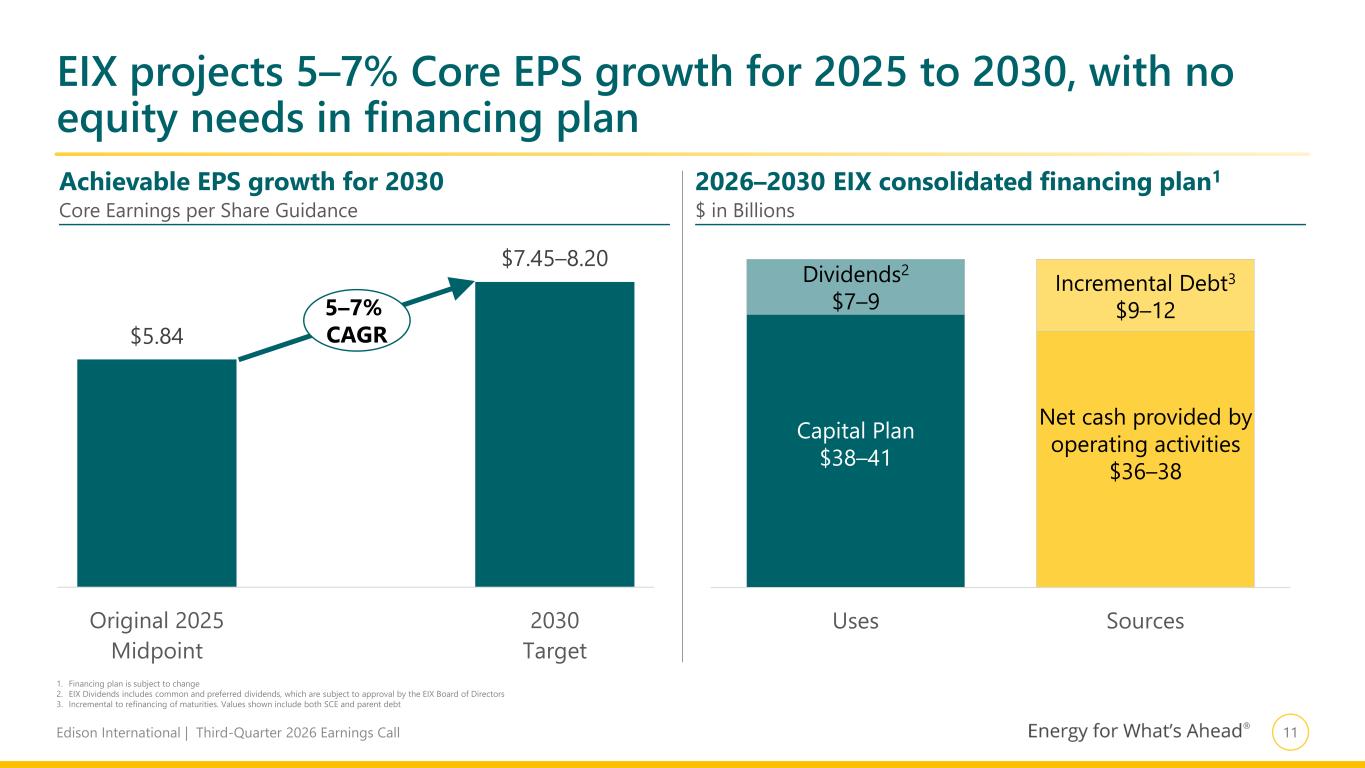
11Edison International | Third-Quarter 2026 Earnings Call EIX projects 5–7% Core EPS growth for 2025 to 2030, with no equity needs in financing plan 1. Financing plan is subject to change 2. EIX Dividends includes common and preferred dividends, which are subject to approval by the EIX Board of Directors 3. Incremental to refinancing of maturities. Values shown include both SCE and parent debt $5.84 $7.45–8.20 Original 2025 Midpoint 2030 Target Achievable EPS growth for 2030 Core Earnings per Share Guidance 5–7% CAGR 2026–2030 EIX consolidated financing plan1 $ in Billions Uses Sources Capital Plan $38–41 Dividends2 $7–9 Net cash provided by operating activities $36–38 Incremental Debt3 $9–12
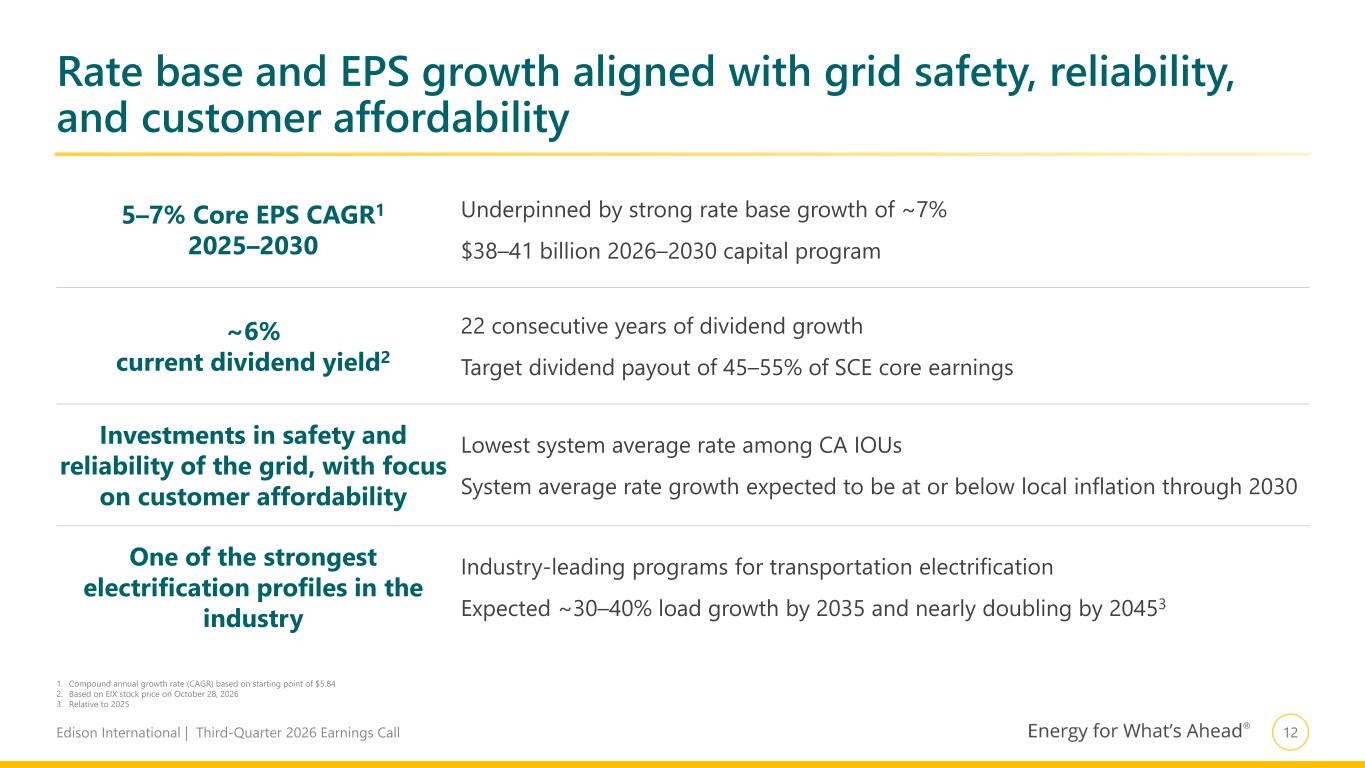
12Edison International | Third-Quarter 2026 Earnings Call Rate base and EPS growth aligned with grid safety, reliability, and customer affordability 1. Compound annual growth rate (CAGR) based on starting point of $5.84 2. Based on EIX stock price on October 28, 2026 3. Relative to 2025 5–7% Core EPS CAGR1 2025–2030 Underpinned by strong rate base growth of ~7% $38–41 billion 2026–2030 capital program ~6% current dividend yield2 22 consecutive years of dividend growth Target dividend payout of 45–55% of SCE core earnings Investments in safety and reliability of the grid, with focus on customer affordability Lowest system average rate among CA IOUs System average rate growth expected to be at or below local inflation through 2030 One of the strongest electrification profiles in the industry Industry-leading programs for transportation electrification Expected ~30–40% load growth by 2035 and nearly doubling by 20453
ADDITIONAL INFORMATION
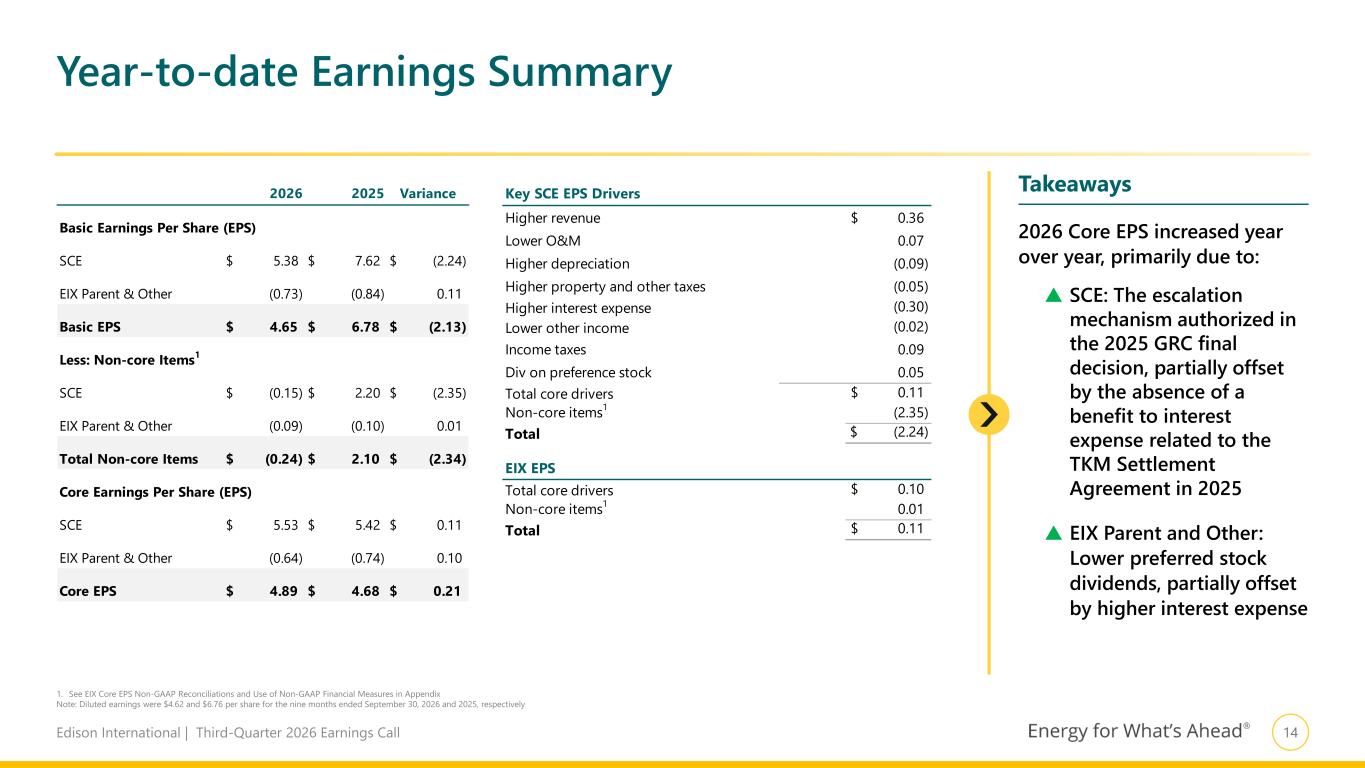
14Edison International | Third-Quarter 2026 Earnings Call Key SCE EPS Drivers Higher revenue 0.36$ Lower O&M 0.07 Higher depreciation (0.09) Higher property and other taxes (0.05) Higher interest expense (0.30) Lower other income (0.02) Income taxes 0.09 Div on preference stock 0.05 Total core drivers 0.11$ Non-core items1 (2.35) Total (2.24)$ Total core drivers 0.10$ Non-core items1 0.01 Total 0.11$ EIX EPS 2026 2025 Variance Basic Earnings Per Share (EPS) SCE 5.38$ 7.62$ (2.24)$ EIX Parent & Other (0.73) (0.84) 0.11 Basic EPS 4.65$ 6.78$ (2.13)$ Less: Non-core Items1 SCE (0.15)$ 2.20$ (2.35)$ EIX Parent & Other (0.09) (0.10) 0.01 Total Non-core Items (0.24)$ 2.10$ (2.34)$ Core Earnings Per Share (EPS) SCE 5.53$ 5.42$ 0.11$ EIX Parent & Other (0.64) (0.74) 0.10 Core EPS 4.89$ 4.68$ 0.21$ Year-to-date Earnings Summary 1. See EIX Core EPS Non-GAAP Reconciliations and Use of Non-GAAP Financial Measures in Appendix Note: Diluted earnings were $4.62 and $6.76 per share for the nine months ended September 30, 2026 and 2025, respectively 2026 Core EPS increased year over year, primarily due to: SCE: The escalation mechanism authorized in the 2025 GRC final decision, partially offset by the absence of a benefit to interest expense related to the TKM Settlement Agreement in 2025 EIX Parent and Other: Lower preferred stock dividends, partially offset by higher interest expense Takeaways
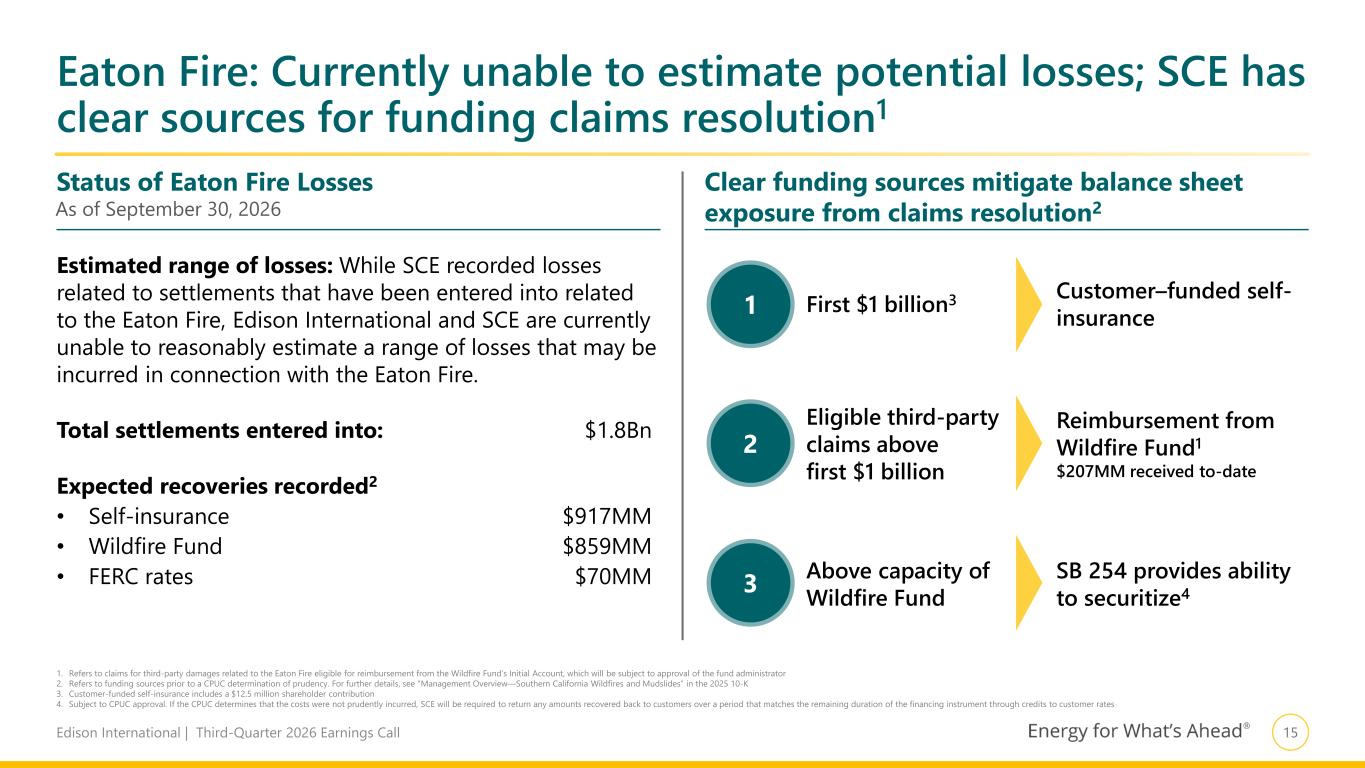
15Edison International | Third-Quarter 2026 Earnings Call 1 2 3 Eaton Fire: Currently unable to estimate potential losses; SCE has clear sources for funding claims resolution1 1. Refers to claims for third-party damages related to the Eaton Fire eligible for reimbursement from the Wildfire Fund’s Initial Account, which will be subject to approval of the fund administrator 2. Refers to funding sources prior to a CPUC determination of prudency. For further details, see "Management Overview—Southern California Wildfires and Mudslides” in the 2025 10-K 3. Customer-funded self-insurance includes a $12.5 million shareholder contribution 4. Subject to CPUC approval. If the CPUC determines that the costs were not prudently incurred, SCE will be required to return any amounts recovered back to customers over a period that matches the remaining duration of the financing instrument through credits to customer rates Clear funding sources mitigate balance sheet exposure from claims resolution2 Estimated range of losses: While SCE recorded losses related to settlements that have been entered into related to the Eaton Fire, Edison International and SCE are currently unable to reasonably estimate a range of losses that may be incurred in connection with the Eaton Fire. Total settlements entered into: $1.8Bn Expected recoveries recorded2 • Self-insurance $917MM • Wildfire Fund $859MM • FERC rates $70MM Status of Eaton Fire Losses First $1 billion3 Customer–funded self- insurance Eligible third-party claims above first $1 billion Reimbursement from Wildfire Fund1 $207MM received to-date Above capacity of Wildfire Fund SB 254 provides ability to securitize4 As of September 30, 2026
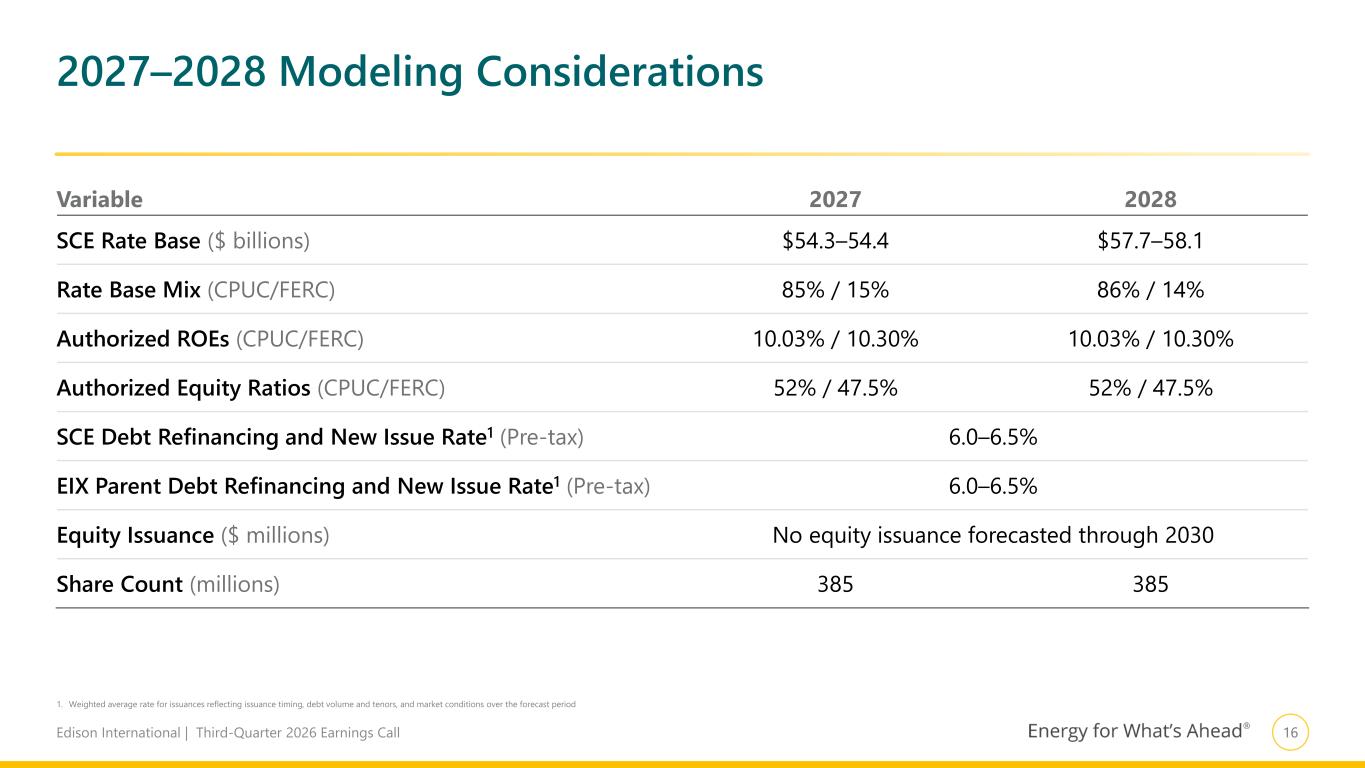
16Edison International | Third-Quarter 2026 Earnings Call 2027–2028 Modeling Considerations Variable 2027 2028 SCE Rate Base ($ billions) $54.3–54.4 $57.7–58.1 Rate Base Mix (CPUC/FERC) 85% / 15% 86% / 14% Authorized ROEs (CPUC/FERC) 10.03% / 10.30% 10.03% / 10.30% Authorized Equity Ratios (CPUC/FERC) 52% / 47.5% 52% / 47.5% SCE Debt Refinancing and New Issue Rate1 (Pre-tax) 6.0–6.5% EIX Parent Debt Refinancing and New Issue Rate1 (Pre-tax) 6.0–6.5% Equity Issuance ($ millions) No equity issuance forecasted through 2030 Share Count (millions) 385 385 1. Weighted average rate for issuances reflecting issuance timing, debt volume and tenors, and market conditions over the forecast period
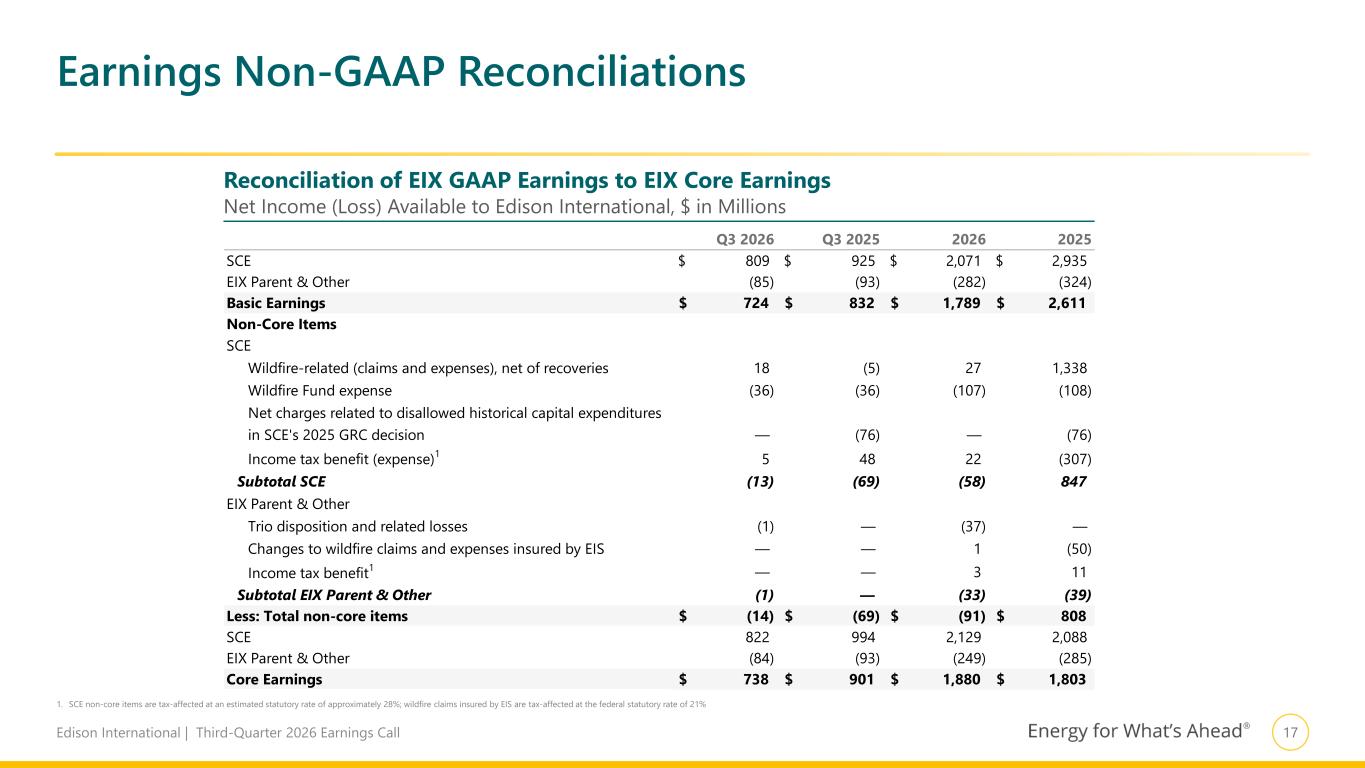
17Edison International | Third-Quarter 2026 Earnings Call Q3 2026 Q3 2025 2026 2025 SCE 809$ 925$ 2,071$ 2,935$ EIX Parent & Other (85) (93) (282) (324) Basic Earnings 724$ 832$ 1,789$ 2,611$ Non-Core Items SCE Wildfire-related (claims and expenses), net of recoveries 18 (5) 27 1,338 Wildfire Fund expense (36) (36) (107) (108) Net charges related to disallowed historical capital expenditures in SCE's 2025 GRC decision — (76) — (76) Income tax benefit (expense)1 5 48 22 (307) Subtotal SCE (13) (69) (58) 847 EIX Parent & Other Trio disposition and related losses (1) — (37) — Changes to wildfire claims and expenses insured by EIS — — 1 (50) Income tax benefit1 — — 3 11 Subtotal EIX Parent & Other (1) — (33) (39) Less: Total non-core items (14)$ (69)$ (91)$ 808$ SCE 822 994 2,129 2,088 EIX Parent & Other (84) (93) (249) (285) Core Earnings 738$ 901$ 1,880$ 1,803$ Earnings Non-GAAP Reconciliations 1. SCE non-core items are tax-affected at an estimated statutory rate of approximately 28%; wildfire claims insured by EIS are tax-affected at the federal statutory rate of 21% Reconciliation of EIX GAAP Earnings to EIX Core Earnings Net Income (Loss) Available to Edison International, $ in Millions
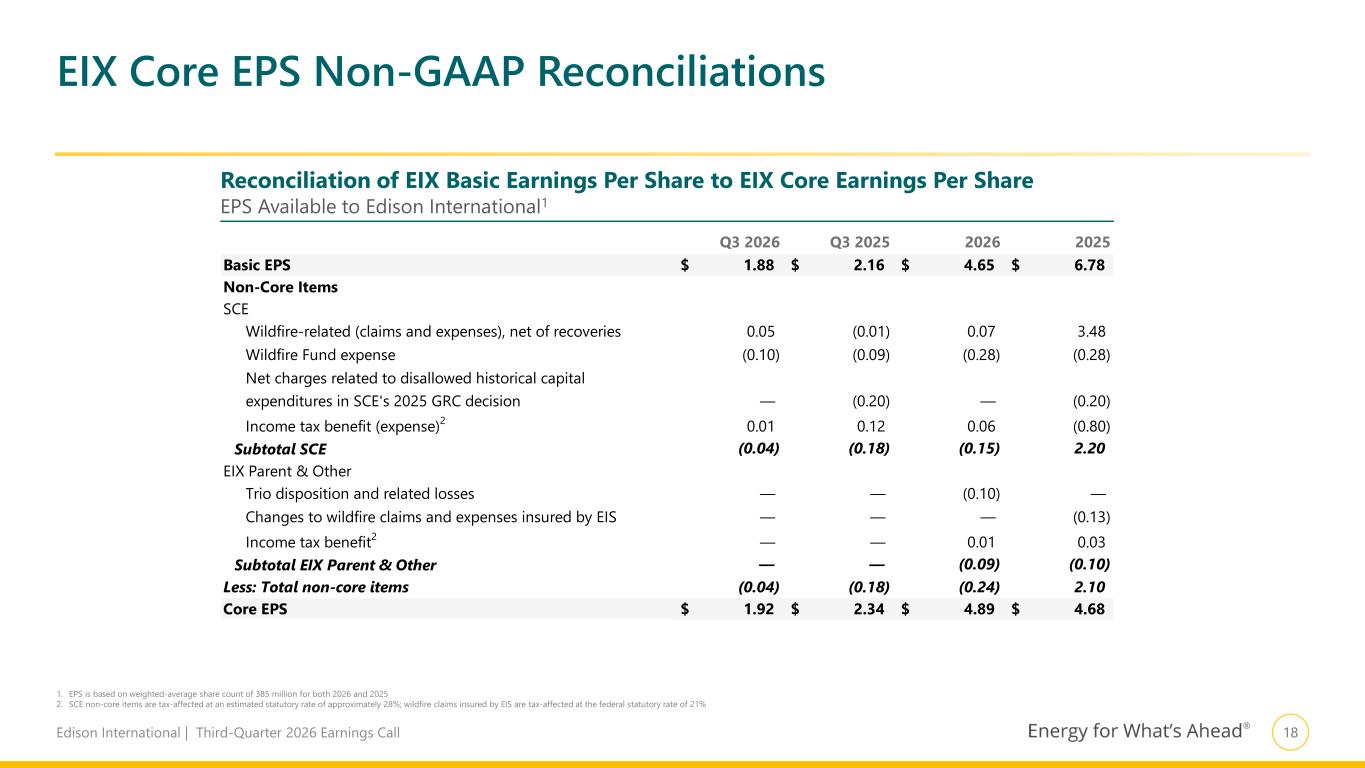
18Edison International | Third-Quarter 2026 Earnings Call Q3 2026 Q3 2025 2026 2025 Basic EPS 1.88$ 2.16$ 4.65$ 6.78$ Non-Core Items SCE Wildfire-related (claims and expenses), net of recoveries 0.05 (0.01) 0.07 3.48 Wildfire Fund expense (0.10) (0.09) (0.28) (0.28) Net charges related to disallowed historical capital expenditures in SCE's 2025 GRC decision — (0.20) — (0.20) Income tax benefit (expense)2 0.01 0.12 0.06 (0.80) Subtotal SCE (0.04) (0.18) (0.15) 2.20 EIX Parent & Other Trio disposition and related losses — — (0.10) — Changes to wildfire claims and expenses insured by EIS — — — (0.13) Income tax benefit2 — — 0.01 0.03 Subtotal EIX Parent & Other — — (0.09) (0.10) Less: Total non-core items (0.04) (0.18) (0.24) 2.10 Core EPS 1.92$ 2.34$ 4.89$ 4.68$ EIX Core EPS Non-GAAP Reconciliations 1. EPS is based on weighted-average share count of 385 million for both 2026 and 2025 2. SCE non-core items are tax-affected at an estimated statutory rate of approximately 28%; wildfire claims insured by EIS are tax-affected at the federal statutory rate of 21% Reconciliation of EIX Basic Earnings Per Share to EIX Core Earnings Per Share EPS Available to Edison International1
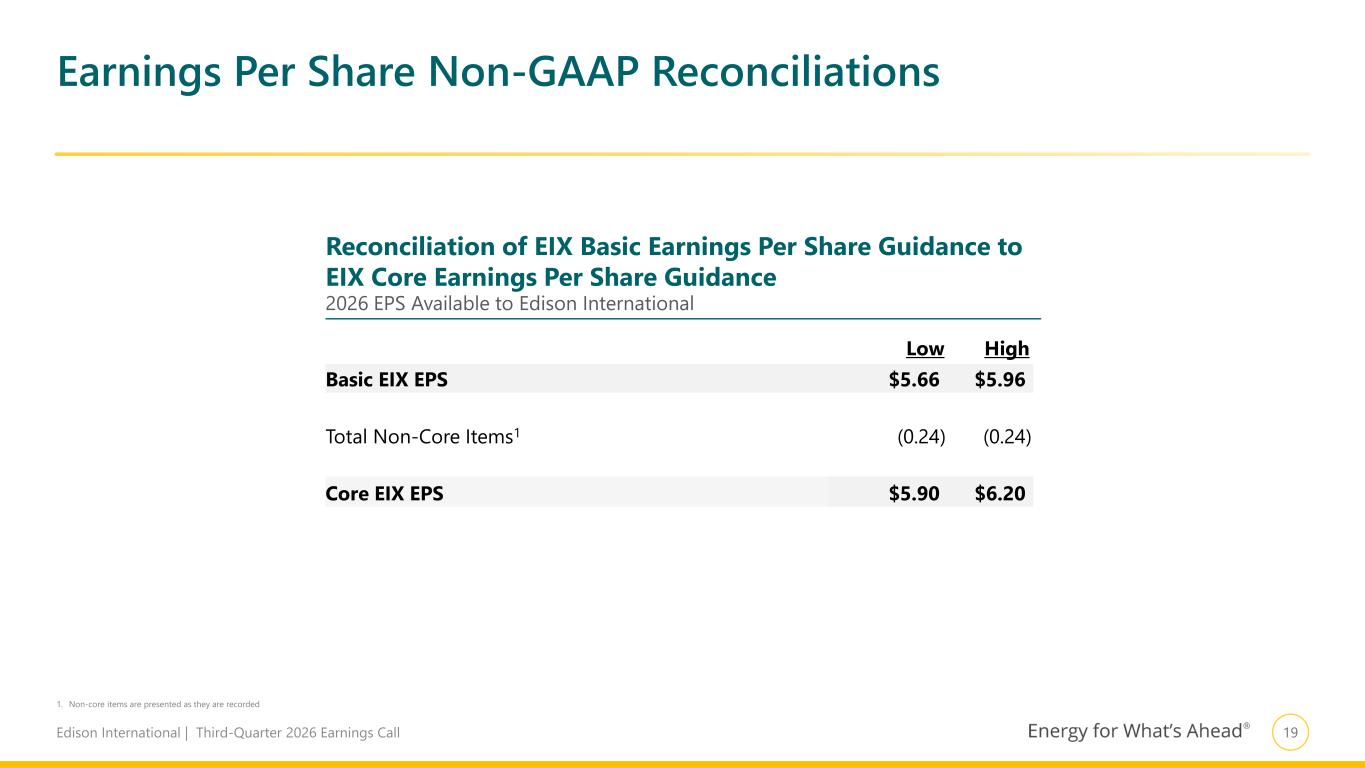
19Edison International | Third-Quarter 2026 Earnings Call Low High Basic EIX EPS $5.66 $5.96 Total Non-Core Items1 (0.24) (0.24) Core EIX EPS $5.90 $6.20 1. Non-core items are presented as they are recorded Earnings Per Share Non-GAAP Reconciliations Reconciliation of EIX Basic Earnings Per Share Guidance to EIX Core Earnings Per Share Guidance 2026 EPS Available to Edison International
20Edison International | Third-Quarter 2026 Earnings Call Use of Non-GAAP Financial Measures EIX Investor Relations Contact Sam Ramraj, Vice President Derek Matsushima, Principal Manager (626) 302-2540 (626) 302-3625 Sam.Ramraj@edisonintl.com Derek.Matsushima@edisonintl.com Edison International's earnings and basic earnings per share (EPS) are prepared in accordance with generally accepted accounting principles used in the United States. Management uses core earnings and core EPS internally for financial planning and for analysis of performance. Core earnings and core EPS are also used when communicating with investors and analysts regarding Edison International's earnings results to facilitate comparisons of the company's performance from period to period. Core earnings and core EPS are non-GAAP financial measures and may not be comparable to those of other companies. Core earnings and core EPS are defined as basic earnings and basic EPS attributable to Edison International shareholders less non-core items. Non-core items include income or loss from discontinued operations and income or loss from significant discrete items that management does not consider representative of ongoing earnings, such as write downs, asset impairments, wildfire-related claims, and other income and expense related to changes in law, outcomes in tax, regulatory or legal proceedings, and exit activities, including sale of certain assets and other activities that are no longer continuing. A reconciliation of Non-GAAP information to GAAP information is included either on the slide where the information appears or on another slide referenced in this presentation. The Company is unable to provide a reconciliation of forward-looking core EPS guidance for 2027, 2028, and 2030 to the most directly comparable GAAP measure because certain items affecting GAAP EPS, including but not limited to wildfire-related costs, regulatory outcomes, and other non-core items, are inherently unpredictable and cannot be estimated without unreasonable effort. The probable significance of these items is such that they could have a material impact on GAAP results in future periods.