| ALJ/RMD/hma/smt | Date of Issuance 5/23/2026 |
Decision 26-05-006 May 14, 2026
BEFORE THE PUBLIC UTILITIES COMMISSION OF THE STATE OF CALIFORNIA
| Application of Southern California Edison Company (U338E) for Woolsey Fire Recovery Bond Financing Order Pursuant to Public Utilities Code Section 850 et seq. | Application 26-01-007 |
FINANCING ORDER AUTHORIZING SOUTHERN CALIFORNIA EDISON COMPANY’S ISSUANCE OF RECOVERY BONDS FOR WOOLSEY FIRE COSTS PURSUANT TO ASSEMBLY BILL 1054
- 1 -
A.26-01-007 ALJ/RMD/hma/smt
TABLE OF CONTENTS
| Title |
Page | |||||
| FINANCING ORDER AUTHORIZING SOUTHERN CALIFORNIA EDISON COMPANY’S ISSUANCE OF RECOVERY BONDS FOR WOOLSEY FIRE COSTS PURSUANT TO ASSEMBLY BILL 1054 |
2 | |||||
| Summary |
2 | |||||
| 1. Background |
3 | |||||
| 1.1. |
Statutory Framework | 3 | ||||
| 1.2. |
SCE Application | 7 | ||||
| 1.3. |
Party Response | 8 | ||||
| 1.4. |
Scoping Memo and Ruling | 9 | ||||
| 1.5. |
Party Motions and Joint Stipulation | 10 | ||||
| 2. Jurisdiction |
10 | |||||
| 3. Standard of Review |
13 | |||||
| 3.1. |
Standard of Review for Financing Orders | 13 | ||||
| 3.2. |
Standard of Review for Settlements | 14 | ||||
| 4. SCE’s Proposed Financing Order |
14 | |||||
| 4.1. |
Overview | 14 | ||||
| 4.2. |
SCE’s Proposed Financing Order — Details | 20 | ||||
| 5. Discussion |
39 | |||||
| 5.1. |
The Recovery Costs Sought to Be Reimbursed Are Just and Reasonable | 39 | ||||
| 5.2. |
The Proposed Recovery Bonds Are Just and Reasonable | 40 | ||||
| 5.3. |
The Proposed Recovery Bonds Are Consistent with the Public Interest | 42 | ||||
| 5.4. |
The Proposed Recovery Bonds Reduce Consumer Rates on a Present Value Basis to the Maximum Extent Possible Compared to Traditional Utility Financing Mechanisms, With the Modifications Adopted Herein | 44 | ||||
| 6. Approval to Employ a Finance Team |
45 | |||||
| 7. Description and Approval of Specific Elements of the SCE Proposal, Subject to Changes |
49 | |||||
| 7.1. |
Over-Collateralization and Credit Enhancement | 49 | ||||
| 7.2. |
Upfront Financing Costs | 51 | ||||
| 7.3. |
Tax Questions | 53 | ||||
| 7.4. |
Underwriters | 54 | ||||
| 7.5. |
Status of Recovery Property | 55 | ||||
| 7.6. |
True-Up Mechanism | 58 | ||||
| 7.7. |
Flow Through of Benefits | 64 | ||||
| 7.8. |
Capital Structure Adjustments | 66 | ||||
| 7.9. |
Implications of Nonbypassable Charges for Departing Load | 66 | ||||
- i -
| 7.10. |
Billing | 68 | ||||
| 7.11. |
Billing, Collecting, and Remitting the Fixed Recovery Charges | 69 | ||||
| 7.12. |
Periodic Reporting | 73 | ||||
| 7.13. |
Number of Series | 73 | ||||
| 8. Fixed Recovery Charge Allocation |
74 | |||||
| 9. The Required Contents of the Financing Order |
75 | |||||
| 10. Continued Reporting Compliance |
76 | |||||
| 11. Fees |
76 | |||||
| 12. Irrevocable Financing Order |
77 | |||||
| 13. SCE’s Written Consent to Be Bound by Financing Order |
78 | |||||
| 14. Rehearing and Judicial Review |
78 | |||||
| 15. Disposition of Motions and Stipulation |
79 | |||||
| 15.1. |
Joint Motion to Admit Testimony and Exhibits into Evidence | 79 | ||||
| 15.2. |
The Joint Stipulation | 79 | ||||
| 15.2.1. |
Reasonable in Light of the Whole Record | 80 | ||||
| 15.2.2. |
Consistent with the Law | 82 | ||||
| 15.2.3. |
In the Public Interest | 82 | ||||
| 16. Comments on Proposed Decision |
82 | |||||
| 17. Assignment of Proceeding |
82 | |||||
| Findings of Fact |
83 | |||||
| Conclusions of Law |
92 | |||||
| ORDER |
108 | |||||
Attachment 1 Description of Cash Flow Model (Provided by SCE’s Application)
Attachment 2 Form of Issuance Advice Letter (Provided by SCE’s Application),
Attachment 3 Form of Routine True-Up Mechanism Advice Letter (Provided by SCE’s Application)
Attachment 4 Form of Non-Routine True-Up Mechanism Advice Letter (Provided by SCE’s Application)
Attachment 5 SCE Estimated Upfront Financing Costs (Provided by SCE’s Application)
Attachment 6 Joint Exhibit List (Provided by March 13, 2026 Joint Motion to Admit Testimony and Exhibits into Evidence)
- ii -
A.26-01-007 ALJ/RMD/hma/smt
FINANCING ORDER AUTHORIZING SOUTHERN CALIFORNIA EDISON
COMPANY’S ISSUANCE OF RECOVERY BONDS FOR WOOLSEY FIRE
COSTS PURSUANT TO ASSEMBLY BILL 1054
Summary
This Financing Order grants the request by Southern California Edison Company (SCE) for authority under Public Utilities Code (Pub. Util. Code) Sections 850 and 850.1 to issue Recovery Bonds. This Financing Order authorizes SCE to issue Recovery Bonds to recover approximately $1.951 billion of Wildfire Expense Memorandum Account (WEMA) costs related to the Woolsey Fire,1 resulting in a ratepayer savings of approximately $811 million compared to traditional utility financing mechanisms on a net present value basis, with the precise amount of savings depending on several factors not known at this time, such as the terms, the number and size of the tranches, and interest rates on the Recovery Bonds.
The Recovery Bonds will be issued by a legally separate special purpose entity, which will use the proceeds from the sale of the Recovery Bonds’ proceeds to purchase from SCE the current property right in and to the Recovery Property (which includes the rights, title, and interest in the Fixed Recovery Charge), the revenues of which will be used to repay the Recovery Bonds’ principal, interest, and related costs.
| 1 | Decision (D.) 25-12-023, Adopting Settlement on the Request by Southern California Edison Company for Cost Recovery Related to the 2018 Woolsey Fire Recorded in the Wildfire Expense Memorandum Account and Catastrophic Event Memorandum Account (December 18, 2025) at 43 (approving the Settlement Agreement between SCE, Cal Advocates, Energy Producers and Users Coalition, and Small Business Utility Advocates as just and reasonable and in the public interest). The Decision approves approximately $1.9 billion in WEMA cost recovery. |
- 2 -
A.26-01-007 ALJ/RMD/hma/smt
The Recovery Bonds’ principal, interest, and related costs will be recovered via a surcharge on customer bills called the Fixed Recovery Charge. All existing and future consumers of electricity in SCE’s service territory (as described in Pub. Util. Code Sections 850(b)(3) and 850.1(a)(2)) will be required to pay the Fixed Recovery Charge, except for those consumers exempt pursuant to Pub. Util. Code Section 850.1(i) (Exempt Fixed Recovery Charge Customer Classes). Pursuant to Pub. Util. Code Section 850.1(e), the provisions in this Financing Order authorizing the issuance of the Recovery Bonds and the recovery of Recovery Bond principal, interest, and certain other Recovery Bond-related costs from consumers are irrevocable.
This proceeding is closed.
| 1. | Background |
| 1.1. | Statutory Framework |
On September 21, 2018, Governor Jerry Brown signed into law Senate Bill 901 (SB 901) (Stats. 2018, Ch. 626), which established Public Utilities Code (Pub. Util.) Division 1, Part 1, Chapter 4, Article 5.8, commencing with Section 850.2 On July 12, 2019, Governor Gavin Newsom signed into law Assembly Bill 1054 (AB 1054) (Stats. 2019, Ch. 79), which amended Article 5.8. Article 5.8 was later amended by AB 913 (Stats. 2020, Ch. 253, Sec. 2) and SB 254 (Stats. 2025, Ch. 119, Sec. 34). Together, these laws authorize the issuance of recovery bonds to fund wildfire-related costs and expenses.
Section 850(a)(2) provides authorization for the Commission to issue a financing order authorizing the issuance of recovery bonds for catastrophic wildfire costs and expenses the Commission has found to be just and reasonable. Specifically, Section 850(a)(2) states:
“If an electrical corporation submits an application for recovery of costs and expenses related to catastrophic wildfires, including fire risk mitigation capital expenditures identified in subdivision (e) of Section 8386.3, in a proceeding to recover costs and expenses in rates and the commission finds that some or all of the costs and expenses identified in
| 2 | All Section or § references herein are to the Public Utilities Code unless otherwise noted. |
- 3 -
A.26-01-007 ALJ/RMD/hma/smt
the electrical corporation’s application are just and reasonable pursuant to Section 451, the electrical corporation may file an application requesting the commission to issue a financing order to authorize the recovery of those just and reasonable costs and expenses by means of a financing order, with those costs and expenses being recovered through a fixed charge pursuant to this article. The paragraph does not apply for costs and expenses incurred by the electrical corporation after December 31, 2035.”
Section 850.1(a) empowers the Commission to issue a financing order to authorize the recovery, through a “Fixed Recovery Charge”3 if “an electrical corporation files for recovery of recovery costs and the commission finds some or all of those costs and expenses to be just and reasonable pursuant to Section 451.”4 Pursuant to Section 850.1(a), the Commission shall issue a financing order authorizing recovery of these costs and expenses, if the Commission determines that the issuance of Recovery Bonds and the imposition and collection of Fixed Recovery Charges: (i) are just and reasonable; (ii) are consistent with the public interest; and (iii) the recovery of recovery costs through the designation of Fixed Recovery Charges, and the issuance of Recovery Bonds will reduce, to the maximum extent possible, the rates on a present value basis that Consumers5 will pay as compared to the use of traditional utility financing mechanisms.
| 3 | Section 850(b)(7). |
| 4 | Section 850(a). |
| 5 | Section 850(b)(3) states: “’Consumer’ means any individual, governmental body, trust, business entity, or nonprofit organization that consumes electricity that has been transmitted or distributed by means of electric transmission or distribution facilities, whether those electric transmission or distribution facilities are owned by the consumer, the electrical corporation, or any other party.” For purposes of this Financing Order, Consumer refers to those in Southern California Edison Company’s Service Territory as of the date of this Financing Order. |
- 4 -
A.26-01-007 ALJ/RMD/hma/smt
These specific costs and expenses can be funded by Recovery Bonds that are backed by nonbypassable ratepayer charges (except for those enrolled in the California Alternate Rates for Energy (CARE) or Family Electric Rate Assistance (FERA) programs).6 In this way, the costs are not part of the utilities’ rate base. Instead, potentially more favorable financing terms are available through the sale of Recovery Bonds in the financial market, which is intended to reduce, to the maximum extent possible, on a present value basis, the rates that Consumers would pay for such costs as compared to traditional utility financing mechanisms.
Previously, the Commission has issued four financing orders authorizing SCE’s issuance of Recovery Bonds pursuant to Article 5.8. On November 10, 2020 in Decision (D.) 20-11-007, the Commission issued a financing order for an initial series of approximately $337,141,000 in Recovery Bonds for SCE’s fire risk mitigation plan capital expenditures and related financing costs (Initial AB 1054 CapEx Financing Order).7
Subsequently, on October 26, 2021 in D.21-10-025, the Commission issued a second financing order for approximately $526,344,000 in Recovery Bonds for SCE’s additional fire risk mitigation plan capital expenditures and related financing costs (Second AB 1054 CapEx Financing Order).8
| 6 | Section 850.1(i) expressly provides that fixed recovery charges must not be imposed on CARE or FERA Consumers. |
| 7 | D.20-11-007, Financing Order Authorizing the Issuance of Recovery Bonds Pursuant to Assembly Bill 1054 (November 10, 2020) at Ordering Paragraph 1. The capital expenditures had been previously approved by the Commission in D.20-04-013, Decision Adopting Settlement (April 16, 2020). |
| 8 | D.21-10-025, Financing Order Authorizing Southern California Edison Company’s Second Issuance of Recovery Bonds Pursuant to Assembly Bill 1054 (October 26, 2021) at Ordering Paragraph 1. The capital expenditures had been previously approved by the Commission in D.21-08-036, Decision on Test Year 2021 General Rate Case for Southern California Edison Company (August 19, 2021) and D.21-01-012. |
- 5 -
A.26-01-007 ALJ/RMD/hma/smt
On March 1, 2023 in D.23-02-023, the Commission issued a third financing order for approximately $772,432,000 in Recovery Bonds for SCE’s additional fire risk mitigation plan capital expenditures and related financing costs (Third AB 1054 CapEx Financing Order and, collectively with the Initial AB 1054 CapEx Financing Order and the Second AB 1054 CapEx Financing Order, the AB 1054 CapEx Financing Orders).9
Most recently, on August 29, 2025 in D.25-08-033, the Commission issued a financing order for approximately $1,629,000,000 in Recovery Bonds for SCE’s costs associated with the Thomas fire and Montecito debris flow and related financing costs (Thomas Financing Order).10
| 9 | D.23-02-023, Financing Order Authorizing Southern California Edison Company’s Third Issuance of Recovery Bonds Pursuant to Assembly Bill 1054 (March 1, 2023) at Ordering Paragraph 1. The capital expenditures had been previously approved by the Commission in D.21-08-036, Decision on Test Year 2021 General Rate Case for Southern California Edison Company (August 19, 2021) and D.22-06-032, Decision Addressing Southern California Edison Company’s Track 3 Request for Recovery of Wildfire Mitigation Memorandum and Balancing Account Balances (June 23, 2022). |
| 10 | D.25-08-033, Decision Approving Financing Order Authorizing Southern California Edison Company’s Issuance of Recovery Bonds for Thomas Fire and Montecito Debris Flow (August 29, 2025) at Ordering Paragraph 1. The costs had been previously approved by the Commission in D.25-01-042. |
- 6 -
A.26-01-007 ALJ/RMD/hma/smt
| 1.2. | SCE Application |
On January 14, 2026, SCE filed another application seeking a financing order pursuant to Section 850 et seq., the Application for Woolsey Fire Recovery Bond Financing Order Pursuant to Public Utilities Code Section 850 et seq. and Request for Expedited Schedule Under Rule 2.9 (Application).11 In support of its Application, SCE submitted prepared opening testimony.12 In this proceeding, SCE seeks a total recovery of Authorized Amount of approximately $1.951 billion, and related costs, comprised of the following:
| 1. | $1.639 billion of Wildfire Expense Memorandum Account (WEMA) costs, as addressed in D.25-12-023 (the Woolsey Fire Settlement Decision), an amount that represents approximately 35% of the total amounts recorded in SCE’s WEMA through May 2025, which were net of about $1 billion received from insurance or other third parties, for the payments to satisfy claims (including any co-insurance, deductibles, and other insurance expenses paid by SCE), and outside legal expenses and costs; |
| 2. | $299.2 million in estimated Pre-Securitization Debt Financing Costs (this is the estimated cost of the debt that SCE is incurring on the authorized Claims-Related Costs until the Recovery Bonds are sold on the financial market); and |
| 3. | $12.7 million in estimated securitization bond Upfront Financing Costs (the cost of everything related to issuing the Recovery Bonds).13 SCE proposes that the final amount of Upfront Financing Costs be submitted for approval by the Commission pursuant to the SCE Issuance Advice Letter. |
To enable such transaction, SCE seeks permission to create a wholly-owned yet legally separate subsidiary, designated as a Special Purpose Entity (SPE), as described below, or to use the SPE created to finance the Initial AB 1054 CapEx (the Existing SPE), whichever course is determined to be the most appropriate approach for the Recovery Bonds. The SPE’s sole purpose is to hold Recovery Property and to issue Recovery Bonds.
| 11 | All documents filed in this proceeding are available on the Commission’s website at Docket Card by searching A2601007. SCE include the following with its Application: Appendix A SCE’s Balance Sheet; Appendix B Cities and Counties; Appendix C Summary of Earnings; Appendix D-1 Financing Order (Clean); Appendix D-2 Financing Order (Redline to D.25-08-033); Appendix D-3 Attachments to Financing Order (Clean); Appendix D-4 Attachments to Financing Order (Redline to D.25-08-033); Appendix E Detail of Utility Plant and Accumulated Provision for Depreciation By Class. |
| 12 | The prepared testimony submitted by parties is available on the Commission’s website at Commission’s E-Filed Documents Search Form under the drop-down menu at supporting documents. |
| 13 | The complete list of all possible costs that may be applicable in the sale of bonds is codified in Section 850(b)(4). |
- 7 -
A.26-01-007 ALJ/RMD/hma/smt
The Recovery Bonds would be secured by the Recovery Property, which is a statutory property right in the right, title, and interest in and to the Fixed Recovery Charge, all rights to obtain adjustments to the Fixed Recovery Charges, and all revenues, collections, claims, payments, moneys, or proceeds of or arising from the Fixed Recovery Charges. Payments of principal of, interest on, and other financing costs in connection with the Recovery Bonds will be funded by the Fixed Recovery Charges. The Recovery Property would be sold by SCE to the SPE. The Recovery Property would also include rights to a true-up advice letter mechanism, which would allow for a periodic adjustment of the Fixed Recovery Charges at least annually, and as otherwise required, to ensure that the SPE would have sufficient funds to be able to pay debt service on the Recovery Bonds and ongoing financing costs.
Pursuant to the statutory timeline in Pub. Util. Code Section 850.1(g), SCE also requested expedited 120-day approval of this Application.
On January 15, 2026, SCE filed a motion to shorten the time for protests and the time for reply to any such protest, citing Pub. Util. Code Section 850.1(g), which provides that the Commission issue a decision in response to a request for the issuance of a financing order under Section 850.1 within 120 days.
On January 27, 2026, the assigned Administrative Law Judge (ALJ) issued a ruling denying SCE’s motion.
| 1.3. | Party Response |
On February 17, 2026, the Public Advocates Office at the California Public Utilities Commission (Cal Advocates) filed a protest to the Application.
- 8 -
A.26-01-007 ALJ/RMD/hma/smt
On February 19, 2026, the parties appeared for the Prehearing Conference.
| 1.4. | Scoping Memo and Ruling |
On February 26, 2026, the assigned Commissioner issued the Assigned Commissioner’s Scoping Memo and Ruling and identified the following issues to be determined or otherwise considered:
| 1. | Have the costs that SCE seeks to collect been found just and reasonable, in compliance with Pub. Util. Code § 850.1(a)(1)(A)(i)? |
| 2. | Are the proposed Recovery Bonds just and reasonable, in compliance with Pub. Util. Code § 850.1(a)(1)(A)(ii)(I)? |
| 3. | Are the proposed Recovery Bonds consistent with the public interest, in compliance with Pub. Util. Code § 850.1(a)(1)(A)(ii)(II)? |
| 4. | Whether the public interest is served by Commission authorization of a financing order pursuant to Pub. Util. Code Section 850 et seq. for SCE to issue $1.951 billion in Recovery Bonds? |
| 5. | Whether SCE’s request for a financing order to securitize a Recovery Bond issuance of $1.951 billion under Pub. Util. Code Section 850 et seq. promotes affordability for its ratepayers and is consistent with a strategy to equitably minimize customer rates and bills? |
| 6. | Would the proposed Recovery Bonds reduce consumer rates to the maximum extent possible compared to traditional utility financing mechanisms, in compliance with Pub. Util. Code § 850.1(a)(1)(A)(ii)(III)? |
| 7. | If SCE is eligible for financing under Pub. Util. Code Section 850 et seq., what is the appropriate customer allocation for implementing a fixed recovery charge and the adjustment to SCE’s authorized revenue requirements, and should those adjustments be reflected in any calculation of customer rate impact? |
- 9 -
A.26-01-007 ALJ/RMD/hma/smt
| 8. | What are the required contents of a financing order? |
| 9. | What continued reporting compliance is required? |
No environmental and social justice issues were raised.
| 1.5. | Party Motions and Joint Stipulation |
On March 4, 2026, SCE and Cal Advocates advised the ALJ that work was progressing on a potential stipulation and requested a suspension of the upcoming procedural deadlines. On March 5, 2026, the ALJ suspended the schedule for submission of prepared testimony, evidentiary hearings, and other March 2026 filings set forth in the February 26, 2026, Assigned Commissioner’s Scoping Memo and Ruling.
On March 12, 2026, SCE submitted additional prepared testimony, Exhibit SCE-08, which is described as including SCE’s responses to Cal Advocates’ Data Request.
On March 13, 2026, SCE and Cal Advocates filed the following documents: (1) Joint Motion to Admit Testimony and Exhibits into Evidence; and (2) Joint Stipulation addressing the structure and tenor for the proposed transaction as well as all of the issues identified in the Scoping Memo Ruling, which are set forth above in Section 1.4. The Joint Stipulation is referred to as Exhibit SCE-09 in Attachment A (Joint Exhibit List) to the Joint Motion to Admit Testimony and Exhibits into Evidence.
This matter was submitted on March 13, 2026, upon receipt of the Joint Stipulation.
| 2. | Jurisdiction |
SCE seeks authority to issue bonds to securitize catastrophic wildfire claims payments and associated expenses. Sections 850 and 850.1 provide that utilities may seek approval from the Commission to securitize costs and expenses related to a catastrophic wildfire that are just and reasonable, in the public interest, and reduce, to the maximum extent possible, the rates that ratepayers would pay as compared to traditional utility financing mechanisms.14
| 14 | Section 850(a)(1)-(2) provide: “This article applies in any of the following circumstances: If an electrical corporation applies to the commission for recovery of costs and expenses related to a catastrophic wildfire and the commission finds some or all of the costs and expenses to be reasonable pursuant to Section 451.1, or for the amount of costs and expenses determined pursuant to subdivision (c) of Section 451.2, then the electrical corporation may file an application requesting the commission to issue a financing order to authorize these costs and expenses to be recovered through fixed recovery charges pursuant to this article. (2) If an electrical corporation submits an application for recovery of costs and expenses related to catastrophic wildfires, including fire risk mitigation capital expenditures identified in subdivision (e) of Section 8386.3 or subdivision (a) of Section 8386.10, in a proceeding to recover costs and expenses in rates and the commission finds that some or all of the costs and expenses identified in the electrical corporation’s application are just and reasonable pursuant to Section 451, the electrical corporation may file an application requesting the commission to issue a financing order to authorize the recovery of those just and reasonable costs and expenses by means of a financing order, with those costs and expenses being recovered through a fixed charge pursuant to this article. This paragraph does not apply for costs and expenses incurred by the electrical corporation after December 31, 2035.”; see also, Section 850.1(a). |
- 10 -
A.26-01-007 ALJ/RMD/hma/smt
To securitize eligible costs and expenses, the utility must receive authority to issue Recovery Bonds, a security whose purpose is for the utility to recover certain costs from issuing bonds.15 The Recovery Bonds are secured by Recovery Property,16 which, among other things, consists of a Fixed Recovery Charge17 (i.e., nonbypassable fee) that is approved in a Financing Order (this decision).18 The nonbypassable fee is assessed on customers within the utilities’ distribution service territory, except for Exempt Fixed Recovery Charge Customer Classes.
| 15 | Section 850(b)(9) provides that “’Recovery bonds’ means bonds, notes, certificates of participation or beneficial interest, or other evidences of indebtedness or ownership, issued pursuant to an executed indenture or other agreement of a financing entity, the proceeds of which are used, directly or indirectly, to recover, finance, or refinance recovery costs, and that are directly or indirectly secured by, or payable from, recovery property.” |
| 16 | Section 850(b)(11)(A) provides that “’Recovery property’ means the property right created pursuant to this article, including, without limitation, the right, title, and interest of the electrical corporation or its transferee: (i) In and to the fixed recovery charges established pursuant to a financing order, including all rights to obtain adjustments to the fixed recovery charges in accordance with Section 850.1 and the financing order. . . (C) ‘Recovery property’ shall constitute a current property right, notwithstanding the fact that the value of the property right will depend on consumers using electricity or, in those instances where consumers are customers of the electrical corporation, the electrical corporation performing certain services.” |
| 17 | Section 850(b)(7) provides that “’Fixed recovery charges’ means those nonbypassable rates and other charges, including, but not limited to, distribution, connection, disconnection, and termination rates and charges, that are authorized by the commission in a financing order . . .” |
| 18 | Section 850(b)(6) provides that “’Financing order’ means an order of the commission adopted in accordance with this article, which shall include, without limitation, a procedure to require the expeditious approval by the commission of periodic adjustments to fixed recovery charges and to any associated fixed recovery tax amounts included in that financing order to ensure recovery of all recovery costs and the costs associated with the proposed recovery, financing, or refinancing thereof, including the costs of servicing and retiring the recovery bonds contemplated by the financing order.” |
- 11 -
A.26-01-007 ALJ/RMD/hma/smt
The Fixed Recovery Charge is irrevocable19 and funds payments to bond holders and the costs to service the bonds (together, Bond Servicing Payment), among other expenses related to the securitization transaction. To ensure that the Fixed Recovery Charge is sufficient to cover the Bond Servicing Payment, Section 850 provides that a true-up adjustment should be performed periodically.20
| 19 | Section 850.1(b) provides that “[t]he commission may establish in a financing order an effective mechanism that ensures recovery of recovery costs through nonbypassable fixed recovery charges …. Fixed recovery charges shall be irrevocable, notwithstanding the true-up adjustment pursuant to subdivision (g).” |
| 20 | Section 850(b)(14) provides that “’True-up adjustment’ means a formulaic adjustment to the fixed recovery charges as they appear on customer bills that is necessary to correct for any overcollection or undercollection of the fixed recovery charges authorized by a financing order and to otherwise ensure the timely and complete payment and recovery of recovery costs over the authorized repayment term”; see also 850.1(g) “…. The commission shall, in any financing order, provide for a procedure for periodic true-up adjustments to fixed recovery charges, which shall be made at least annually and may be made more frequently. . .” |
- 12 -
A.26-01-007 ALJ/RMD/hma/smt
| 3. | Standard of Review |
| 3.1. | Standard of Review for Financing Orders |
Section 850.1 permits the Commission to issue a Financing Order if the Commission determines that (1) the Recovery Costs to be reimbursed from the Recovery Bonds are just and reasonable and (2) the issuance of the Recovery Bonds, including all material terms and conditions of the Recovery Bonds, including, without limitation, interest rates, ratings, amortization redemption and maturity, and the imposition and collection of fixed recovery charges:
| a. | Are just and reasonable; |
| b. | Are consistent with the public interest; and |
| c. | The recovery of recovery costs through the designation of fixed recovery charges, and the issuance of recovery bonds in connection with the fixed recovery charges, would reduce, to the maximum extent possible, the rates on a present value basis that consumers would pay as compared to the use of traditional utility financing mechanisms.21 |
| 21 | Section 850.1(a)(1)(A)(i) provides that “following application by an electrical corporation, the commission shall issue a financing order if the commission determines that both of the following conditions are satisfied: (I) The recovery cost to be reimbursed from the recovery bonds have been found to be just and reasonable pursuant to Section 451 or 451.1, as applicable, or are allocated to the ratepayers pursuant to subdivision (c) of Section 451.2. (II) The issuance of the recovery bonds, including all material terms and conditions of the recovery bonds, including, without limitation, interest rates, rating, amortization redemption, and maturity, and the imposition and collection of fixed recovery charges as set forth in an application satisfy all of the following conditions, as applicable: (ia) They are just and reasonable. (ib) They are consistent with the public interest. (ic) The recovery of recovery costs through the designation of the fixed recovery charges and any associated fixed recovery tax amounts, and the issuance of recovery bonds in connection with the fixed recovery charges, would reduce, to the maximum extent possible, the rates on a present value basis that consumers within the electrical corporation’s service territory would pay as compared to the use of traditional utility financing mechanisms, which shall be calculated using the electrical corporation’s corporate debt and equity in the ratio approved by the commission at the time of the financing order.” |
- 13 -
A.26-01-007 ALJ/RMD/hma/smt
| 3.2. | Standard of Review for Settlements |
The Commission may adopt a settlement after determining whether the settlement satisfies the three-prong test of Rule 12.1(d), which provides as follows: “The Commission will not approve settlements, whether contested or uncontested, unless the settlement is reasonable in light of the whole record, consistent with law, and in the public interest.”22 The stipulation filed in this proceeding is analogous to a settlement for purposes of Commission review under Rule 12.1(d).
| 4. | SCE’s Proposed Financing Order |
| 4.1. | Overview |
Pursuant to SCE’s proposed financing order, two structural requirements would apply to the issuance of the Recovery Bonds. First, property must be created that can be pledged to support the Recovery Bonds. Section 850.1 authorizes the establishment of Recovery Property, which principally consists of the right to receive revenues from a nonbypassable electric rate component called the Fixed Recovery Charge. Sections 850 and 850.1 provide that a financing order shall provide for a procedure for periodic true-up adjustments to the Fixed Recovery Charges, at least annually via a Commission-approved True Up Mechanism, so that they are consistently adjusted at a level that ensures timely recovery of amounts sufficient to pay the debt service on the Recovery Bonds and other Ongoing Financing Costs.
Second, the Recovery Property must be transferred to an entity that is bankruptcy remote from SCE, i.e., an SPE that is legally separate from SCE. This ensures that, in the event of a future SCE bankruptcy, the rights to the Recovery Property, including the rights to receive the revenues from the Fixed Recovery Charges would not be included in SCE’s bankruptcy estate, but rather would continue to be available to pay the Recovery Bonds. In other words, the transfer of the Recovery Property must be a “true sale” for bankruptcy law purposes.
| 22 | Rule 12.1(d) of the Commission’s Rules of Practice and Procedure. |
- 14 -
A.26-01-007 ALJ/RMD/hma/smt
In its prepared testimony, SCE proposes the issuance of the Recovery Bonds in the Authorized Amount by a Financing Order, to occur as soon as practicable in the third quarter of 2026. SCE attached its proposed securitization Financing Order as Exhibit D-1 to its Application. SCE also provided at Exhibit D-2 a redline to the Thomas Financing Order in D.25-08-033 upon which SCE’s Application was based.23
The securitization is described more fully in SCE’s Exhibits SCE-02 and SCE-03. To issue the Recovery Bonds, SCE proposes to use the Existing SPE, or to form another wholly owned but legally and fiscally independent SPE. In either case, the SPE would issue the Recovery Bonds in an amount equal to the Claims-Related Costs plus the Pre-Securitization Debt Financing Costs, plus the Upfront Financing Costs (Authorized Amount). The Recovery Bonds would be secured by Recovery Property, which would include the rights to the nonbypassable Fixed Recovery Charges, the periodic true-up adjustments, and the revenues and proceeds thereof.
SCE contends that because the Recovery Property would be transferred to the legally separate and “bankruptcy-remote” SPE, the transfer of the Recovery Property would be a “true sale” for bankruptcy law purposes in the event of a future SCE bankruptcy, and the Fixed Recovery Property would not be included in SCE’s bankruptcy estate (in this regard, a legal counsel opinion would be created for the rating agencies to rely upon). SCE also contends that, as per Section 850 et seq., the Fixed Recovery Charges would be adjusted at least annually via a Commission approved True-Up Mechanism, and that this would ensure timely recovery of sufficient debt service to repay the Recovery Bonds and ongoing financing costs.
| 23 | SCE included a summary of SCE’s Thomas Financing Transaction in Exhibit SCE-01. SCE’s Thomas Financing Order Application requested a total securitized amount of $1.629 billion. |
- 15 -
A.26-01-007 ALJ/RMD/hma/smt
To obtain the highest possible credit rating and thereby lower Consumer costs, SCE states that the nature of the transaction provides confidence to the market while making funds available to SCE for the Authorized Amount. SCE proposes to contribute equity (or additional equity in the event the Existing SPE is utilized) to the SPE in an amount equal to at least 0.50 percent of the initial aggregate principal amount of the Recovery Bonds. The SPE then would issue the Recovery Bonds, and the sale proceeds (net of Upfront Financing Costs) would be transferred from the SPE to SCE in payment for the Recovery Property, which would be used to secure the Recovery Bonds.
Regarding how the Fixed Recovery Charge would be allocated to SCE’s customers, SCE’s proposal includes a specific set of calculations.24 SCE seeks to impose Fixed Recovery Charges on all non-exempt customers based on the allocation methodology set forth in the Marginal Cost and Revenue Allocation Settlement Agreement.25 That settlement provides for a specific allocation methodology to be applied to existing and future Commission-
| 24 | Exhibit SCE-06 at 8. |
| 25 | D.22-08-001, Decision Adopting Five Uncontested Partial Settlements Resolving Most Issues for Southern California Edison Company’s Phase 2 General Rate Case (August 4, 2022) at 45 (Ordering Paragraph 1) (ordering SCE to implement terms of Marginal Cost and Revenue Allocation Settlement Agreement). See also Application (A.) 20-10-012, Joint Motion of SCE and Settling Parties for Adoption of Marginal Cost and Revenue Allocation Settlement Agreement, Attachment A (Marginal Cost and Revenue Allocation Settlement Agreement) at 23-24 (Section B(5)(j)(2)) (providing that “Special Allocator shall be used to establish the allocation of the securitized amount” for future wildfire-related securitizations). |
- 16 -
A.26-01-007 ALJ/RMD/hma/smt
authorized wildfire-related revenue requirements, including wildfire-related costs to be securitized and recovered through a Fixed Recovery Charge.26 Under this revenue allocation methodology, a special methodology and formula are applied to determine a composite weighted average allocator (Special Allocator) that combines the distribution allocator and System Average Percent allocator to be applied to allocate the wildfire-related revenue requirements among customer groups.27 Furthermore, SCE proposed that once set at the time of issuance, the allocation methodology for the Recovery Bonds should remain the same for the life of the Recovery Bonds, with adjustments for sales changes to collect the revenue requirement.28 Once the Recovery Bonds are paid in full, to the extent excess costs were collected, as well as any interest earnings on those amounts, these would be returned to Consumers through a credit in future rates.29
Regarding the handling of the Recovery Bond sale, Exhibit SCE-02 described the utility securitization market and explained that the credit rating assessed by rating agencies for its attendant risk is critical to obtaining the lowest possible interest rate for such securities sales.30
| 26 | See id.; see also D.22-08-001, Decision Adopting Five Uncontested Partial Settlements Resolving Most Issues for Southern California Edison Company’s Phase 2 General Rate Case (August 4, 2022) at 13-15 (describing methodology for allocation of wildfire-related revenue requirements). |
| 27 | The Marginal Cost and Revenue Allocation Settlement Agreement explicitly affirms that the existing revenue allocation methodologies adopted by the Commission in the Initial and Second AB 1054 CapEx Financing Orders decisions shall be retained and unaffected by the Special Allocator methodology set forth in the settlement. See A.20-10-012, Joint Motion of SCE and Settling Parties for Adoption of Marginal Cost and Revenue Allocation Settlement Agreement, Attachment A (Marginal Cost and Revenue Allocation Settlement Agreement) at 23 (Section B(5)(j)(2)). |
| 28 | The potential intra-class impacts for customers that pay for distribution service through a demand charge were resolved through SCE’s GRC Phase 2 proceeding and such impacts will be addressed consistent with that settlement. |
| 29 | Exhibit SCE-03 at 10. |
| 30 | Exhibit SCE-02 at 11-13. |
- 17 -
A.26-01-007 ALJ/RMD/hma/smt
SCE also identifies the sources of the Ongoing Financing Costs associated with the servicing of the Recovery Bonds, including servicing fees, ongoing administrative fees, bond trust fees, legal and accounting fees, rating agency fees, and SPE operating expenses (or the allocable share thereof).31
SCE’s Exhibits SCE-02 and SCE-03 explained that at this stage, certain features of the bond structure could not be finalized. For example, a preliminary bond structure is provided and is the basis of the customer benefit analysis, however, as noted, certain features, including maturity, the number and size of the tranches, and interest rates, would not be known until closer to the time of issuance and taking into account market conditions at that time. SCE and Cal Advocates agree that (i) the aggregate weighted average life among all tranches of recovery bonds for the transaction shall not exceed 22 years; and (ii) no individual tranche of recovery bonds shall have a maturity that exceeds 33 years (i.e., the transaction must have an expected maturity of 33 years or less).32
SCE proposed the highest possible credit rating for the Recovery Bonds is attained by including certain provisions in the Financing Order:
| 1. | Confirm that the transfer of the Recovery Property from SCE to the SPE constitutes a “true sale” for bankruptcy law purposes. |
| 2. | Confirm that the True-Up Mechanism will require the Fixed Recovery Charge to be adjusted at least annually, and more frequently if necessary, to correct for any overcollection or undercollection (in the manner described in Exhibit SCE-03 and Exhibit SCE-06). |
| 31 | Exhibit SCE-02 at 13-15. |
| 32 | Exhibit SCE-09, Joint Stipulation of SCE and Cal Advocates at 2-3. |
- 18 -
A.26-01-007 ALJ/RMD/hma/smt
| 3. | Confirm that there is flexibility in the Financing Order to provide credit enhancement should market conditions change, which would functionally mean |
| enabling SCE to over-collateralize the Recovery Bonds (i.e., secure the Recovery Bonds with Recovery Property or other assets in an amount larger than required) based upon input from the rating agencies made at the time the Recovery Bonds are marketed. |
| 4. | Confirm that, regarding the servicer’s financial strength and billing and collecting experience, and anticipating an event requiring a third-party to replace SCE as the servicer, the Commission would not approve a third-party servicer without first making a determination that the approval will not impair the credit rating of any outstanding Recovery Bonds. More specifically, SCE requested that the Commission maintain the current creditworthiness and other requirements set forth in SCE’s Electric Rules applicable to Third-Party Billers who bill and meter electric customers.33 |
| 5. | Confirm the nonbypassability of the Fixed Recovery Charge (as mandated by Sections 850(b)(7) and 850.1(b))to ensure compliance with Article 5.8 and to assure Recovery Bond investors that Recovery Bond payments will continue. More specifically, SCE requested that the Fixed Recovery Charge must be paid by all non-exempt existing or future Customers in SCE’s Service Territory as it exists as of the date of the Financing Order, regardless of where the Consumer buys electricity. SCE requested that in the event of a future municipalization of SCE’s facilities by an entity that does not set retail rates subject to the Commission’s regulation, the Commission would ensure continued payment of Fixed Recovery Charge by placing such conditions on the Commission’s approval of the transaction.34 |
| 33 | Exhibit SCE-03 at 25-26. |
| 34 | SCE cites SB 550 (2019) and Sections 851(a), 851(b)(1), and 854.2(b)(1)(F), which, taken together, require the Commission’s authorization for any sale or disposition of a utility’s system or property (via a transaction greater than $5 million), including for any “voluntary or involuntary change in ownership of assets from an electrical or gas corporation to ownership by a public entity.” |
- 19 -
A.26-01-007 ALJ/RMD/hma/smt
| 4.2. | SCE’s Proposed Financing Order - Details |
SCE’s Application provided a complete description of the proposed Recovery Bonds and a proposed Recovery Bond transaction structure.
As discussed below, SCE acknowledged that the details of the proposed structure are subject to modification, depending upon the marketing of the Recovery Bonds and negotiations with the rating agencies that will be asked to rate the Recovery Bonds. SCE proposes that the final structure and terms of the Recovery Bonds will be determined by SCE after marketing and input from the rating agencies, the Finance Team, and the underwriters, and that the final structure and terms will be described in an Issuance Advice Letter35 submitted to the Commission and subject to the Commission’s review and ability to stop the sale for a failure to adhere to the terms of this Financing Order, i.e., before noon on the fourth business day after pricing, the Commission may halt the sale through action of the Commission staff.
Another element of the transaction is added by Section 850.1(f), stating that the Recovery Bonds authorized by this Financing Order do not constitute a debt or liability of the State of California or any political subdivision thereof, nor do the Recovery Bonds constitute a pledge of the full faith and credit of the State or any political subdivisions.
In addition, pursuant to Section 850.1(f)(2), the issuance of the Recovery Bonds shall not directly, indirectly, or contingently obligate the State of California or any political subdivision thereof to levy or to pledge any form of taxation to pay any obligations associated with the Recovery Bonds or to make any appropriations for their payment.
| 35 | See Attachment 2, herein SCE’s Form of Issuance Advice Letter. |
- 20 -
A.26-01-007 ALJ/RMD/hma/smt
As required by Section 850.1(f)(1), any Recovery Bond shall have written on it a statement to the following effect: “Neither the full faith and credit nor the taxing power of the State of California is pledged to the payment of the principal of, or interest on, this bond.”
To attract a broad range of investors, SCE requests the flexibility to divide the Recovery Bonds authorized by this Financing Order into one or more tranches of bonds representing different maturities, which shall not in the aggregate exceed the Authorized Amount. Each tranche may have a different scheduled final payment date and final legal maturity date.
The Recovery Bonds may have an initial payment period shorter or longer than other payment periods to accommodate the time period between the close of the transaction and the implementation of the Fixed Recovery Charge in bills.36
In accordance with Section 850 et seq., SCE proposed that the Recovery Bonds would be issued by one or more SPEs that are owned by SCE in a transactional structure described below.37 The SPEs could include the Existing SPE, or newly formed SPEs, whichever course is determined to be the most appropriate. The Recovery Bonds will be secured by “Recovery Property” which Section 850(b)(11) defines as the property right created pursuant to Article 5.8, including, without limitation, the right, title and interest of SCE or its transferee: (i) in and to the Fixed Recovery Charges established pursuant to this Financing Order, including all rights to obtain adjustments to Fixed Recovery Charges in accordance with Section 850.1 and this Financing Order; and (ii) to be paid the amount that SCE or its transferee is lawfully entitled to receive pursuant to the provisions of Article 5.8 and the proceeds thereof, and in and to all revenues, collections, claims, payments,
| 36 | Exhibit SCE-03 at 28. |
| 37 | Exhibit SCE-03 at 7-9. |
- 21 -
A.26-01-007 ALJ/RMD/hma/smt
moneys, or proceeds of or arising from the Fixed Recovery Charge. If the Recovery Bonds are issued by the Existing SPE for this Financing Order, the Recovery Bonds would only be secured by the Recovery Property created pursuant to this Financing Order and not the recovery property created by any prior or subsequent financing order (e.g., D.20-11-007, Financing Order Authorizing the Issuance of Recovery Bonds Pursuant to Assembly Bill 1054 (November 10, 2020)).
SCE proposes to sell the Recovery Property via a true sale and absolute transfer to an SPE that is legally separate and bankruptcy remote from SCE. This ensures that if SCE were to enter bankruptcy, the Recovery Property will not be included in SCE’s bankruptcy estate. Rather, the revenues from the Recovery Property would continue to be available to pay the debt service on the Recovery Bonds and other Ongoing Financing Costs.
The Recovery Bonds would be issued under an indenture and administered by a Bond Trustee. The Recovery Property as well as all other rights and assets of the SPE (Bond Collateral) would be pledged to the Bond Trustee for the benefit of the holders of the Recovery Bonds and to secure payment of debt service on the Recovery Bonds and other Ongoing Financing Costs. If the Existing SPE is the issuer, none of the Bond Collateral would be available to pay any prior or subsequent recovery bonds. Holders of the Recovery Bonds secured by the Bond Collateral could exercise all remedies pursuant to the security interest in the event of a default.
SCE proposes to contribute equity (or in the case the Existing SPE is the issuer, additional equity) to the SPE equal to at least 0.50 percent of the initial aggregate principal amount of each series of Recovery Bonds. The SPE equity would be pledged as Bond Collateral to secure the Recovery Bonds and will be deposited into a capital subaccount (described below) held by the Bond Trustee. This equity contribution is a requirement of the Internal Revenue Service (IRS) in order to characterize the Recovery Bonds as obligations of SCE for Federal income tax purposes.
- 22 -
A.26-01-007 ALJ/RMD/hma/smt
To fund the acquisition of the Recovery Property, the SPE would issue the Recovery Bonds to investors. The proceeds (net of Upfront Financing Costs) from the Recovery Bonds will be transferred from the SPE to SCE as payment of the purchase price for the Recovery Property.
SCE requested the Commission approve a Financing Order with the Recovery Bond transaction structure shown in the following diagram:
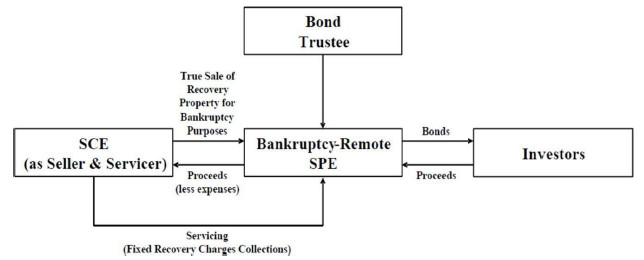
Recovery Bond Transaction Structure
The Bond Trustee would retain all Fixed Recovery Charge collections received from SCE in a collection account and distribute these funds to make scheduled principal and interest payments on the Recovery Bonds and to pay other Ongoing Financing Costs in accordance with the Recovery Bond indenture “waterfall” provisions. SCE anticipates that the collection account would include three subaccounts: (1) a general subaccount to hold revenues and investment earnings pending application under the indenture waterfall provisions; (2) a capital subaccount to hold the equity capital contribution made by SCE; and (3) an excess funds subaccount to hold revenues and investment earnings collected in excess of amounts necessary to pay principal,
- 23 -
A.26-01-007 ALJ/RMD/hma/smt
interest, and other Ongoing Financing Costs. The collection account may also contain additional accounts to accommodate any credit enhancements (including any over-collateralization subaccount) approved in an Issuance Advice Letter. The Bond Trustee would invest all Fixed Recovery Charge collections in investment grade short-term debt securities that mature on or before the next Recovery Bond payment date. Any investment earnings would be retained in the collection account to pay principal, interest, or other Ongoing Financing Costs. If any funds remain in the collection account after distributions are made on a Recovery Bond payment date, they would be credited to the excess funds subaccount. These amounts in the excess funds subaccount and the capital subaccount would be available to pay principal, interest, or other Ongoing Financing Costs as they come due. Any amounts in the excess funds subaccount would be used to offset and reduce the Fixed Recovery Charge on the next Fixed Recovery Charge true-up adjustment date.
Upon payment in full of the Recovery Bonds and the discharge of all Ongoing Financing Costs, amounts remaining with the Bond Trustee would be distributed in the following order of priority: first, an amount equal to SCE’s initial equity contribution into the capital subaccount, together with any required rate of return, would be paid to SCE. Second, all other amounts held by the Bond Trustee in any fund or account including any over-collateralization account would be returned to SCE. The amounts in this second category, together with any Fixed Recovery Charge revenues thereafter received by SCE, would be credited to Consumers through normal ratemaking processes.
- 24 -
A.26-01-007 ALJ/RMD/hma/smt
SCE proposed that the Commission would have full access to the books and records of the SPE. SCE stated that it would not make any profit from the SPE other than that it proposed to receive a return on its equity contribution to the SPE in an amount equal to the weighted average interest rate on the Recovery Bonds.38 That equity contribution would be deposited in the capital subaccount and the return owed to SCE would be payable as an Ongoing Financing Cost from Fixed Recovery Charge revenues after payment of debt service on the Recovery Bonds and all other Ongoing Financing Costs.39
In Exhibit SCE-03, SCE stated that to obtain the highest possible credit ratings for the Recovery Bonds, the SPE and the assets backing the Recovery Bonds must be legally separate from SCE’s bankruptcy estate.40 To ensure that the SPE is legally separate and bankruptcy remote from SCE, the SPE should be authorized to: (i) include restrictions in its organizational documents limiting the activities of the SPE to the issuance of the Recovery Bonds (which could include additional Recovery Bonds issued pursuant to Article 5.8) and related activities and eliminating the SPE’s ability to voluntarily file for bankruptcy; (ii) provide for the appointment of one or more independent directors to the SPE board; and (iii) provide for the payment of servicing and administration fees adequate to compensate the servicer and administrator for their costs of providing service and administration.
In connection with the transaction, SCE would provide the rating agencies an opinion from its legal counsel that: (1) the transfer of the Recovery Property from SCE to the SPE constitutes a “true sale” for bankruptcy purposes; and (2) the SPE is separate from SCE and could not be substantively consolidated with SCE for bankruptcy purposes. This legal opinion would provide assurance to the rating agencies that the SPE’s assets (including the Recovery Property) will not be part of SCE’s bankruptcy assets, and thus not be available to SCE creditors, should SCE subsequently commence bankruptcy.
| 38 | Exhibit SCE-03 at 10. |
| 39 | Exbibit SCE-03 at 7-8 |
| 40 | Exhibit SCE-03 at 17-29. |
- 25 -
A.26-01-007 ALJ/RMD/hma/smt
SCE further requested the Commission to authorize the SPE to obtain additional credit enhancements to ensure repayment of the Recovery Bonds, which could include an over-collateralization subaccount if required by the Rating Agencies to receive the highest possible credit rating on the Recovery Bonds, or if the all-in cost of the Recovery Bonds with the over-collateralization would be less than without the over-collateralization. Over-collateralization is a credit enhancement technique where the value of the collateral exceeds the value of the bonds to help ensure timely payment of investors.
The required amount of over-collateralization, if any, would be collected as an ongoing financing cost payable from the Fixed Recovery Charges. Any over-collateralization costs that could be collected from Consumers in excess of total debt service on the Recovery Bonds and other Ongoing Financing Costs would be the property of the SPE. Upon payment in full of the principal and interest on all Recovery Bonds and the discharge of all Financing Costs, the increase in the value of SCE’s equity interest in the SPE related to the balance in any over-collateralization subaccount or any other subaccount maintained by the SPE (other than the capital subaccount) would be returned to SCE and then credited to the Consumers through the normal ratemaking processes.
SCE also requested that the SPE be authorized to obtain Recovery Bond insurance, letters of credit, and similar credit-enhancing instruments, but only if required by the rating agencies to achieve the highest possible credit rating on the Recovery Bonds, or if the all-in cost of the Recovery Bonds with these other credit enhancements would be less than without the enhancements. In addition, Bond Collateral held by the Bond Trustee would be available as a credit enhancement.
- 26 -
A.26-01-007 ALJ/RMD/hma/smt
SCE claimed that it does not anticipate requiring any external credit enhancements described in the preceding paragraph.41 Further, based upon current market conditions, SCE does not anticipate being required by the Rating Agencies to establish an over-collateralization subaccount. However, if an account is required, the exact amount and timing of the Fixed Recovery Charge collection necessary to fund the over-collateralization account would be determined in consultation with the Finance Team before the Recovery Bonds are issued and approved through the Issuance Advice Letter process.
As provided in Section 850(b)(4), Financing Costs include costs associated with the issuance and credit support of the Recovery Bonds, including without limitation, underwriting fees and expenses, legal fees and expenses (including those associated with SCE’s financing application), rating agency fees, accounting fees and expenses, SCE’s financial advisory fee, servicer set-up costs, Securities and Exchange Commission (SEC) registration fees, Section 1904(b) fees, printing and EDGARizing expenses,42 trustee / trustee counsel fees and expenses, original issue discount, any Commission costs and expenses (including the costs and expenses of the Finance team), and other miscellaneous costs approved in this Financing Order (collectively, Upfront Financing Costs). Upfront Financing Costs include reimbursement to SCE for amounts advanced for payment of such costs. Upfront Financing Costs may also include the costs of credit enhancements including the cost of purchasing a letter of credit or bond insurance policy, if required.
| 41 | Exhibit SCE-03 at 24. |
| 42 | EDGARization is the process of converting original documents — Microsoft Word, Microsoft Excel, PDF, etc. — into acceptable SEC format for the Electronic Data Gathering, Analysis, and Retrieval (EDGAR) system. |
- 27 -
A.26-01-007 ALJ/RMD/hma/smt
SCE requested to recover the Upfront Financing Costs from the proceeds of the Recovery Bonds. SCE estimates the Upfront Financing Costs will total approximately $12.7 million.43
SCE estimates of the Upfront Financing Costs are subject to change, as the costs are dependent on the timing of issuance, market conditions at the time of issuance, the number of series issued, and other events outside SCE’s control, such as possible litigation, incremental legal fees resulting from protracted resolution of issues, possible review by the Commission, delays in the SEC registration process, and changes to third-party fee schedules or requirements. When each series of the Recovery Bonds are sized and priced, Upfront Financing Costs would be updated and included in the related Issuance Advice Letter.
SCE proposed that if the estimated Upfront Financing Costs included in any Issuance Advice Letter exceed actual Upfront Financing Costs, any excess amounts would be credited to the excess funds subaccount and used to offset the revenue requirement in the next routine Fixed Recovery Charge true-up calculation. In the event that the actual Upfront Financing Costs exceed the estimated amount included in the Issuance Advice Letter, the shortfall amount may be recovered in the next routine true-up adjustment for the Fixed Recovery Charge.
| 43 | Exhibit SCE-03 at 36. |
- 28 -
A.26-01-007 ALJ/RMD/hma/smt
SCE stated that the Recovery Bonds transaction will be structured to be a “Qualifying Securitization” pursuant to IRS Rev. Proc. 2005-62 to achieve three important tax objectives.44 First, to lower overall taxes, the SPE will be treated as part of SCE for federal income tax purposes, and not as a separate entity responsible for paying its own taxes. Second, to avoid recognition of taxable income upon receipt of a financing order that creates Recovery Property. Third, to avoid an immediate taxable gain when SCE transfers the Recovery Property to the SPE, the transfer will not be treated as a sale for federal income tax purposes, and instead the Recovery Bonds will be treated as SCE’s own debt for federal income tax purposes. As it relates to the Recovery Bond transaction, California income and franchise tax law currently conforms to U.S. federal income tax law, including but not limited to, IRS Rev. Proc. 2005-62.
SCE proposes that it be authorized to structure the Recovery Bond transaction to meet the elements of a “Qualifying Securitization” pursuant to IRS Rev. Proc. 2005-62 such that: (1) the SPE shall be a wholly-owned subsidiary of SCE and capitalized with an equity interest as deemed appropriate and legally necessary by the Finance Team; (2) the Recovery Bonds shall be secured by the Recovery Property; (3) the Fixed Recovery Charge shall be nonbypassable and payable by Consumers within SCE’s Service Territory; and (4) payments on the Recovery Bonds shall be on a semi-annual basis except for the initial payment period which may be shorter or longer.
In accordance with Article 5.8, the Commission may allow fixed recovery tax amounts for any portion of the SCE’s federal and State of California income and franchise taxes associated with the Fixed Recovery Charge, and not financed from proceeds of the Recovery Bonds.
| 44 | Rev. Proc. 2005-62 was amended by Rev. Proc. 2024-15, though the amendment did not alter the provisions of Rev. Proc. 2005-62 in a manner material to this proceeding. Nevertheless, references to Rev. Proc. 2005-62 herein refer to Rev. Proc. 2005-62 as amended by Rev. Proc. 2024-15. |
- 29 -
A.26-01-007 ALJ/RMD/hma/smt
SCE stated that it could receive a small accumulated deferred income tax savings.45 Therefore, SCE does not contemplate the need for a separate fixed recovery tax amount (as defined in § 850(b)(8)). As in the AB 1054 CapEx and Thomas Financing Orders, SCE proposes to track these tax implications outside of the securitization using standard ratemaking mechanisms. SCE proposed using a similar approach for other securitizations, with flexibility regarding implementation of incorporating taxes into future securitizations based on the facts and circumstances specific to those transactions.
SCE proposed an allocation methodology set forth in the Marginal Cost and Revenue Allocation Settlement Agreement with respect to all non-exempt customers.46 The Special Allocator methodology applicable to the wildfire-related revenue requirements shall apply to allocate the Fixed Recovery Charge and shall remain the same for the life of the bonds, with adjustments for sales changes to collect the revenue requirement.47,48
| 45 | Exhibit SCE-05 at 2. |
| 46 | Exhibit SCE-06 at 7-10, D.22-08-001, Decision Adopting Five Uncontested Partial Settlements Resolving Most Issues for Southern California Edison Company’s Phase 2 General Rate Case (August 4, 2022) at 45 (Ordering Paragraph 1) (ordering SCE to implement terms of Marginal Cost and Revenue Allocation Settlement Agreement). See also A.20-10-012, Joint Motion of SCE and Settling Parties for Adoption of Marginal Cost and Revenue Allocation Settlement Agreement, Attachment A (Marginal Cost and Revenue Allocation Settlement Agreement) at 23-24 (Section B(5)(j)(2)) (providing that “Special Allocator shall be used to establish the allocation of the securitized amount” for future wildfire-related securitizations). |
| 47 | Exhibit SCE-06 at 7-10; see also D.22-08-001, Decision Adopting Five Uncontested Partial Settlements Resolving Most Issues for Southern California Edison Company’s Phase 2 General Rate Case (August 4, 2022) at 13-15 (describing methodology for allocation of wildfire-related revenue requirements). |
| 48 | The Marginal Cost and Revenue Allocation Settlement Agreement explicitly affirms that the existing revenue allocation methodologies adopted by the Commission in the Initial and Second AB 1054 CapEx Financing Orders shall be retained and unaffected by the Special Allocator methodology set forth in the settlement. See A.20-10-012, Joint Motion of SCE and Settling Parties for Adoption of Marginal Cost and Revenue Allocation Settlement Agreement, Attachment A (Marginal Cost and Revenue Allocation Settlement Agreement) at 23 (Section B(5)(j)(2)). |
- 30 -
A.26-01-007 ALJ/RMD/hma/smt
Article 5.8 authorizes SCE to recover the Authorized Amount (together with Ongoing Financing Costs) via collection of revenues on the Fixed Recovery Charge. As described in Exhibit SCE-06, SCE proposed a methodology to allocate Recovery Costs among Customer Classes, and to calculate and adjust the Fixed Recovery Charge. In addition to the ratemaking treatment described above, SCE would also periodically credit back to customers through SCE’s Base Revenue Requirement Balancing Account (BRRBA) all periodic servicing and administration fees in excess of SCE’s incremental cost of performing the servicer and administration functions until the next General Rate Case when costs and revenues associated with the servicing fees will be included in the cost of service.
Section 850.1(b) permits the Commission to create an “effective mechanism” to ensure the recovery of all Recovery Costs through the imposition of the Fixed Recovery Charge, which must be paid by all Consumers until the Recovery Bonds and all other Ongoing Financing Costs are paid in full by the SPE. Section 850.1(g) requires the Commission to establish a procedure for periodic true-up adjustments to Fixed Recovery Charges at least annually, and may be made more frequently. SCE proposed a “True-Up Mechanism” that will allow the Fixed Recovery Charge to be
- 31 -
A.26-01-007 ALJ/RMD/hma/smt
adjusted (i) annually to correct any over-collection or under-collection of the Fixed Recovery Charge; and (ii) more frequently, if necessary, to ensure that the Fixed Recovery Charge provides sufficient funds to timely pay principal and interest on the Recovery Bonds and other Ongoing Financing Costs of the Recovery Bonds.
SCE requested Commission approval to use an advice letter process to implement these periodic true-up adjustments. This approach is well-established in connection with prior issuances of Recovery Bonds pursuant to the AB 1054 CapEx and Thomas Financing Orders, as well as prior Energy Recovery Bonds and Rate Reduction Bonds. It also will create efficiencies for the Commission and its staff. The Commission’s authority under Article 5.8 and Section 850.1(g) to authorize periodic true-up adjustments persists until the Recovery Bonds and all Ongoing Financing Costs are fully paid and discharged.
Pursuant to SCE’s proposed true-up mechanism, SCE, or any successor servicer, may submit annual, semi-annual, and interim “Routine True-Up Mechanism Advice Letters” until the Recovery Bonds and all other Ongoing Financing Costs are paid in full. These adjustments will correct for any over-collection or under-collection of the Fixed Recovery Charge authorized by this Financing Order and otherwise ensure that the revenues collected from the Fixed Recovery Charge will be sufficient for the timely provision and payment of all payments of principal (including, if any, prior scheduled but unpaid principal payments) and interest accrued and due on the Recovery Bonds, together with the timely provision and payment of all other Ongoing Financing Costs for each semi-annual payment period following the effective date of the initial or adjusted Fixed Recovery Charge. This revenue requirement is referred to as the “Periodic Payment Requirement.”
- 32 -
A.26-01-007 ALJ/RMD/hma/smt
True-up adjustment submissions will be based upon the cumulative differences between the Periodic Payment Requirement and the projected amount of kilowatt-hour (kWh) sales for each Customer Class for each payment period, with adjustments for projected write-offs. The servicer will compare the actual amount of Fixed Recovery Charge collections remitted to the Bond Trustee for the Recovery Bonds against the amount of expected Fixed Recovery Charge collections periodically during each payment period and may submit an interim true-up adjustment advice letter if it is expected that there will not be sufficient collections from the Fixed Recovery Charge to meet the Periodic Payment Requirement. The routine and interim true-up adjustment submissions will result in adjustments to the Fixed Recovery Charges to correct for over-collections or under-collections.
SCE proposed to submit annual Routine True-Up Mechanism Advice Letters with a complete accounting of the historical over-collection and under-collection of the Fixed Recovery Charge at least 50 days before the annual adjustment date specified in the Issuance Advice Letter (the Fixed Recovery Charge Annual Adjustment Date) until the Recovery Bonds and all other Ongoing Financing Costs have been paid in full. These submissions are intended to ensure that the actual Fixed Recovery Charge collections are the accurate and correct amount required to meet the Periodic Payment Requirement. Because the revised Fixed Recovery Charges in the Routine True-Up Mechanism Advice Letters should be ministerial, SCE proposed they should be categorized as Tier 1 Advice Letters to enable SCE’s revision to the annual Routine True-Up to go into effect on the Fixed Recovery Charge annual adjustment date.
- 33 -
A.26-01-007 ALJ/RMD/hma/smt
SCE requested that both Routine and Non-Routine True-Up Mechanism Advice Letters would be used to calculate a revised Fixed Recovery Charge for the Recovery Bonds. The cash flow model described in an attachment to the Application would be utilized (or a revised cash flow model as described in a Non-Routine True-Up Mechanism Advice Letter as may be applicable) that would reflect the following adjustments:
| • | An adjustment would be made for the amount of any funds held by the Bond Trustee in the general subaccount or the excess funds subaccount as of date no earlier than fifteen business days prior to the calculation date (the “Calculation Cut-Off Date”). |
| • | Forecasted sales for the remainder of the current year and for the subsequent year, if applicable, to reflect SCE’s most-recently approved sales forecast, as available, and SCE’s pending sales forecast for any period not covered by the most recently- approved sales forecast. |
| • | Estimated Ongoing Financing Costs would be modified to reflect actual costs. |
| • | An adjustment would be made to reflect any change in the write-off policy. |
| • | An adjustment would be made to reflect any anticipated delay or acceleration of the collection of Consumer bills. |
| • | An adjustment would be made to reflect Fixed Recovery Charge collections that would be received at the existing tariff rate after the Calculation Cut-Off Date. |
SCE’s prepared testimony described costs and benefits associated with the Recovery Bonds that will flow through to Consumers of electricity via other ratemaking processes (as discussed in detail further below).49
SCE proposed to remove the securitized debt from SCE’s ratemaking capital structure as the SPE will have the legal obligation to repay the Recovery Bonds from Fixed Recovery Charge collections and because D.25-12-023 provides that SCE is authorized to permanently exclude from its
| 49 | Exhibit SCE-03 and Exhibit SCE-06. |
- 34 -
A.26-01-007 ALJ/RMD/hma/smt
ratemaking capital structure the debt issued to finance the WEMA costs.50 However, for financial reporting purposes, the securitized debt will be consolidated and recorded as a liability on SCE’s consolidated financial statements. Accordingly, SCE proposes to exclude from SCE’s ratemaking capital structure the securitized debt.
Pursuant to Sections 850(b)(7) and 850.1(b), the Fixed Recovery Charge shall be nonbypassable and recovered from existing and future Consumers in SCE’s Service Territory other than Consumers in Exempt Fixed Recovery Charge Customer Classes. In addition, Consumers that reduce or cease to take transmission and distribution retail service from SCE after the date of this Financing Order, or that meet relevant criteria in applicable tariffs, should be treated as departing load (DL) Consumers using applicable tariffs for DL Consumers, including Customer Generation Departing Load Cost Responsibility Surcharge (CGDL-CRS), Transferred Municipal Departing Load (TMDL), and New Municipal Departing Load (NMDL). DL Consumers will be subject to pay the Fixed Recovery Charges. For the purpose of determining applicability of the Fixed Recovery Charges to DL customers, SCE proposed to calculate the Fixed Recovery Charges that would need to be paid using an approach that is consistent with the applicable tariff if the tariffs address the treatment of DL with respect to the fixed recovery charges relating to prior AB 1054 and Thomas Financing Orders.
In compliance with the requirements of Article 5.8 (Section 850.2), SCE proposes to act as the initial servicer for the Recovery Bonds.
| 50 | Exhibit SCE-01 at 7-8. |
- 35 -
A.26-01-007 ALJ/RMD/hma/smt
The servicer would be responsible for determining Consumers’ electricity usage, billing, collecting, and remitting the Fixed Recovery Charge collections to the Bond Trustee, and submitting Routine True-Up Mechanism Advice Letters and Non-Routine True-Up Mechanism Advice Letters as described above. In the event that Consumers of electricity in SCE’s Service Territory are billed by Electric Service Providers (ESP) or another utility or entity (collectively, Third-Party Billers), SCE proposes to bill these Third-Party Billers, as the case may be, for the Fixed Recovery Charge, and the Third-Party Billers will be obligated to remit Fixed Recovery Charge collections to SCE. The servicer will remit actual Fixed Recovery Charge collections, on behalf of the SPE, to the Bond Trustee.
The Bond Trustee will be responsible to make principal and interest payments to Recovery Bond holders and pay other Ongoing Financing Costs, and will hold and apply such amounts as described in the “Recovery Bond Transaction Structure” above. The servicer will remit Fixed Recovery Charge collections in accordance with the servicing agreement to the Bond Trustee. The SPE would own legal title to, and all equitable interest in, the Recovery Property, including the Fixed Recovery Charges, and SCE will be legally obligated to remit all Fixed Recovery Charge collections to the Bond Trustee.
SCE anticipates that the rating agencies will require SCE to remit Fixed Recovery Charges collections to the Bond Trustee daily to avoid an adverse impact on the Recovery Bonds credit ratings. SCE expects to remit actual Fixed Recovery Charge collections to the Bond Trustee on a daily basis and within two business days of receipt to avoid an adverse impact on the credit ratings for the Recovery Bonds.
Over the life of the Recovery Bonds, SCE proposes that it will prepare a monthly servicing report for the Bond Trustee that shows the actual Fixed Recovery Charge collections by month. The SPE will only have a legal right to the actual amount of Fixed Recovery Charge collections.
- 36 -
A.26-01-007 ALJ/RMD/hma/smt
SCE also proposed that the amounts collected that represent partial payments of a Consumer’s bill will be allocated between the Bond Trustee and SCE based on the ratio of the billed amount for the Fixed Recovery Charge to the total billed amount. SCE stated that this reconciliation and allocation methodology is an important bankruptcy consideration in determining the true sale nature of the transaction. In the event of any default by the Servicer, the Bond Trustee (on behalf of the SPE) will be entitled to receive a reconciliation of collections and remittances (described above), including an allocation of partial payments based upon this pro-rata allocation methodology.
For as long as multiple series of Recovery Bonds are outstanding and unpaid, the Fixed Recovery Charges received should be allocated pro rata between the Bond Trustees for each series, consistent with the requirements of the AB 1054 CapEx and Thomas Financing Orders.
SCE proposed to charge an annual servicing fee of 0.05 percent of the initial principal Recovery Bond amount, plus out-of-pocket expenses (e.g., legal fees, accounting fees), to cover SCE’s incremental costs and expenses in servicing the Recovery Bonds.
In the event that SCE fails to perform its servicing functions satisfactorily, as set forth in the Servicing Agreement, or is required to discontinue its billing and collecting functions, it would be replaced by a successor servicer acceptable to the Bond Trustee, acting on behalf of the Recovery Bond holders, and approved by the Commission. SCE highlighted that the credit quality and expertise in performing servicing functions will be important considerations when appointing a successor servicer to ensure the credit ratings for the Recovery Bonds are maintained. SCE’s position is that the remedy of allowing the Commission to sequester the Fixed Recovery
- 37 -
A.26-01-007 ALJ/RMD/hma/smt
Charge in the cases of certain events of default under the Servicing Agreement upon the application of the Bond Trustee, as permitted by Section 850.3(e), will also enhance the credit quality of the Recovery Bonds. SCE will periodically credit back to customers through the BRRBA all periodic servicing and administration fees in excess of SCE’s incremental cost of performing the servicer and administration functions until the next GRC when costs and revenues associated with the servicing fees will be included in the cost of service. In each base rate case, SCE will include a revenue credit of the administration and servicing fees that SCE collects as the servicer/administrator of the Recovery Bonds (to the extent not previously credited back through the BRRBA). In the base rate case, SCE will also request revenue for all costs of providing servicing and administration services. SCE’s failure to provide any such credit to ratepayers shall in no way affect the Recovery Property, the Fixed Recovery Charge, or the rights of SCE, the Bond Trustee, and the Recovery Bondholders under the Financing Order, but could be addressed by the Commission through other proceedings.
Although SCE will act as initial servicer, it is possible that Third-Party Billers will bill and collect the Fixed Recovery Charges from some Consumers. If SCE’s Consumers of electricity are billed by Third-Party Billers, SCE proposed to bill these Third-Party Billers for the Fixed Recovery Charge, with the Third-Party Billers being obligated to remit Fixed Recovery Charge collections to SCE. SCE would remit Fixed Recovery Charge collections to date, on behalf of the applicable SPE, to the Bond Trustee. These Third-Party Billers must meet minimum billing and collection experience standards and creditworthiness criteria. Otherwise, the rating agencies could impose additional credit enhancement requirements or assign lower credit ratings to the Recovery Bonds. Therefore, SCE requests that Third-Party Billers that bill and collect the Fixed Recovery Charge satisfy the creditworthiness and other requirements applicable to ESPs that meter and bill electric Consumers as set forth in SCE’s Electric Rule 22.P. (Credit Requirements).
- 38 -
A.26-01-007 ALJ/RMD/hma/smt
| 5. | Discussion |
| 5.1. | The Recovery Costs Sought to Be Reimbursed Are Just and Reasonable |
The first requirement for approval of SCE’s Application is a finding that “[t]he recovery cost to be reimbursed from the recovery bonds have been found to be just and reasonable pursuant to Section 451…” This is a requirement set forth in Section 850.1(a)(1)(A)(i)(I). Here, that requirement is considered in light of the findings in D.25-12-023.51
In D.25-12-023, the Commission adopted a settlement agreement authorizing SCE to recover 35% of the WEMA balance through May 31, 2025 (about $1.972 billion52 of the approximately $5.635 billion total requested), which represents all payments to satisfy claims, including any co-insurance, deductibles, and other insurance expenses paid by SCE net of $1 billion received from insurance and other parties, outside legal expenses and costs, and financing costs.53 The remaining 65% is permanently disallowed (about $3.663 billion).54 The Commission found the authorization of SCE’s partial recovery of recorded WEMA costs, along with the related permanent disallowances, consistent with the just and reasonable requirements of Section 451.55
| 51 | D.25-12-023, Decision Adopting Settlement on the Request by Southern California Edison Company for Cost Recovery Related to the 2018 Woolsey Fire Recorded in the Wildfire Expense Memorandum Account and Catastrophic Event Memorandum Account (December 18, 2025). |
| 52 | The $1.972 billion estimate included in D.25-12-023 (Decision Adopting Settlement on the Request by Southern California Edison Company for Cost Recovery Related to the 2018 Woolsey Fire Recorded in the Wildfire Expense Memorandum Account and Catastrophic Event Memorandum Account) did not include upfront financing costs and reflected an estimate of pre-securitization financing costs through December 31, 2026, while the $1.951 billion included in this Application includes estimates of $12.7 million in upfront financing costs and pre-securitization financing costs through July 31, 2026. |
| 53 | D.25-12-023, Decision Adopting Settlement on the Request by Southern California Edison Company for Cost Recovery Related to the 2018 Woolsey Fire Recorded in the Wildfire Expense Memorandum Account and Catastrophic Event Memorandum Account (December 18, 2025) at Ordering Paragraph 1. |
| 54 | D.25-12-023, Decision Adopting Settlement on the Request by Southern California Edison Company for Cost Recovery Related to the 2018 Woolsey Fire Recorded in the Wildfire Expense Memorandum Account and Catastrophic Event Memorandum Account (December 18, 2025) at 24. |
| 55 | D.25-12-023, Decision Adopting Settlement on the Request by Southern California Edison Company for Cost Recovery Related to the 2018 Woolsey Fire Recorded in the Wildfire Expense Memorandum Account and Catastrophic Event Memorandum Account (December 18, 2025) at 43, Finding of Fact 10. When reviewing settlement agreements, the Commission “considers whether a settlement is just and reasonable based on the proposed settlement agreement as a whole, not on individual provisions.” Id. at 8-9, citing to D.25-01-042, Decision Regarding Settlement Agreement Authorizing [SCE] Cost Recovery for 2017 Thomas Fire and 2018 Montecito Debris Flow (January 30, 2025) at 9. The Commission’s “duty to fix just and reasonable rates requires that the final responsibility to support and interpret the decision rests with us” even where the parties have reached a settlement. D.20-04-013, Decision Adopting Settlement (April 24, 2020) at 27. This is because “all matters decided by the Commission must meet the overall ‘just and reasonable’ standard of the Public Utilities Code.” D.25-12-023, Decision Adopting Settlement on the Request by Southern California Edison Company for Cost Recovery Related to the 2018 Woolsey Fire Recorded in the Wildfire Expense Memorandum Account and Catastrophic Event Memorandum Account (December 18, 2025) at 8. Thus, the Commission’s approval of a settlement agreement necessarily involves a finding that the contents of the settlement, when taken as a whole, are just and reasonable. |
- 39 -
A.26-01-007 ALJ/RMD/hma/smt
The WEMA costs SCE seeks to securitize here are costs and expenses arising from, and related to, a catastrophic wildfire that have not been previously recovered by SCE. The WEMA costs have been found consistent with the just and reasonable requirements of Section 451 and approved for recovery in D.25-12-023, the Woolsey Fire Settlement Decision.56
| 5.2. | The Proposed Recovery Bonds Are Just and Reasonable |
The second requirement for approval of SCE’s Application is a finding that “[t]he issuance of the recovery bonds, including all material terms and
| 56 | D.25-12-023, Decision Adopting Settlement on the Request by Southern California Edison Company for Cost Recovery Related to the 2018 Woolsey Fire Recorded in the Wildfire Expense Memorandum Account and Catastrophic Event Memorandum Account (December 18, 2025) |
- 40 -
A.26-01-007 ALJ/RMD/hma/smt
conditions of the recovery bonds… and the imposition and collection of fixed recovery charges…are just and reasonable.” This requirement is set forth in Section 850.1(a)(1)(A)(i)(II)(ia). Here, that requirement is met through a general finding of the inherent value of Recovery Bonds in this context, and a discussion of the details of the Recovery Bonds at issue will be conducted below in Section 5.3 (to enable a complete review of all Recovery Bond details in a single discussion section in a thorough and organized manner).57
“Just and reasonable” is the criterion long familiar to the Commission in its application of the standard set forth by the Legislature in Section 451. In pertinent part, that statute reads as follows:
“All charges demanded or received by any public utility… for any product or commodity furnished… or any service rendered… shall be just and reasonable…
Every public utility shall furnish and maintain such adequate, efficient, just, and reasonable service, instrumentalities, equipment, and facilities… as are necessary to promote the safety, health, comfort, and convenience of its patrons, employees, and the public.
All rules made by a public utility affecting or pertaining to its charges or service to the public shall be just and reasonable.”
Here, the broader issue concerns the Legislature directing the Commission to address the value of Recovery Bonds as compared to “traditional utility financing mechanisms,” as that term is found in § 850.1(a)(1)(A)(i)(II)(ic). While reserving the analysis of the Application’s details below, the Commission can conclude that in concept, and in
| 57 | Section 850.1(a)(1)(A)(i)(II) articulates some of the aspects of the Recovery Bonds to be reviewed and considered, including “interest rates, rating, amortization redemption, and maturity, and the imposition and collection of fixed recovery charges…” Because these, and other Recovery Bond aspects, must be effectively reviewed under the more encompassing umbrella of Section 850.1(a)(1)(A)(i)(II)(ic), it is more logical to address all such financial issues in that section. |
- 41 -
A.26-01-007 ALJ/RMD/hma/smt
consideration of the legislative mandate to enable such Recovery Bonds, the issuance of the Recovery Bonds is just and reasonable, in that it clearly enhances utility safety and reliability, and SCE has made a showing that it will reduce rates compared to traditional utility financing mechanisms.
While the Commission will adopt an appropriate mechanism to provide for review of the specifics of the Application’s proposed Recovery Bonds, we can find that the nature of the Application’s proposed Recovery Bonds is just and reasonable.
| 5.3. | The Proposed Recovery Bonds Are Consistent with the Public Interest |
The third requirement for approval of SCE’s Application is a finding that “The issuance of the recovery bonds, including all material terms and conditions of the recovery bonds…and the imposition and collection of fixed recovery charges… are consistent with the public interest.” This requirement is set forth in Section 850.1(a)(1)(A)(i)(II)(ib). Here, that requirement is met through the determination in D.25-12-023 that the Woolsey Settlement Agreement is in the public interest58 and a general finding of the inherent value of the Recovery Bonds in this context, and a discussion of the details of the Recovery Bonds at issue.
“Consistent with the public interest” is tantamount to a finding that a proposed transaction is in the public interest, and the Commission has considerable experience applying this test in furtherance of certain statutory provisions.59 Applying the standards found in those provisions, the
| 58 | D.25-12-023, Decision Adopting Settlement on the Request by Southern California Edison Company for Cost Recovery Related to the 2018 Woolsey Fire Recorded in the Wildfire Expense Memorandum Account and Catastrophic Event Memorandum Account (December 18, 2025) at 33. |
| 59 | The phrase “public interest” is language that appears in Sections 852, 853(b), and 854(a), regarding proposed public utility transactions. |
- 42 -
A.26-01-007 ALJ/RMD/hma/smt
Commission can review whether proposed transactions “provide short-term and long-term economic benefits to ratepayers,” “maintain the safe and reliable operation of the utility assets,” “maintain or improve the financial condition of the… utility,” and “maintain or improve the quality of service to public utility ratepayers.”60
Here, the broader issue concerns the Legislature directing the Commission to address the value of Recovery Bonds as compared to “traditional utility financing mechanisms,” as that term is found in Section 850.1(a)(1)(A)(i)(II)(ic). The Commission can conclude that in concept, and in consideration of the legislative mandate to enable such Recovery Bonds, the Application is generally consistent with the public interest, in that it clearly works to provide economic benefit to ratepayers, maintain and improve the utility’s safety and reliability, maintains or improves the financial condition of the utility, and maintains or improves the quality of service to the ratepayers, while reducing costs compared to traditional utility financing mechanisms, as demonstrated in the next section.
Therefore, while the Commission will adopt an appropriate mechanism that will provide for a review of the specifics of the Application’s proposed Recovery Bonds, we can find that the nature of the Application’s proposed Recovery Bonds is consistent with the public interest.
| 60 | Applying descriptions found in Sections 854(b)(1), 854(b)(4), 854(c)(1), and 854(c)(2), respectively. |
- 43 -
A.26-01-007 ALJ/RMD/hma/smt
| 5.4. | The Proposed Recovery Bonds Reduce Consumer Rates on a Present Value Basis to the Maximum Extent Possible Compared to Traditional Utility Financing Mechanisms, With the Modifications Adopted Herein |
The fourth requirement for approval of SCE’s Application is a finding that “[t]he issuance of the recovery bonds, including all material terms and
conditions of the recovery bonds…and the imposition and collection of fixed recovery charges… would reduce, to the maximum extent possible, the rates on a present value basis that consumers within the electrical corporation’s service territory would pay as compared to the use of traditional utility financing mechanisms, which shall be calculated using the electrical corporation’s corporate debt and equity in the ratio approved by the commission at the time of the financing order.” This requirement is set forth in Section 850.1(a)(1)(A)(i)(II)(ic).
SCE estimates that the savings to Consumers would total $811 million in net present value when comparing the $1.951 billion Recovery Bond financing costs to the cost to Consumers when using the traditional financing approach for SCE’s rate base financing, given SCE’s current 7.59 percent Commission-authorized return on rate base. The present value of the net revenue requirement reductions as compared with five-year amortization is approximately $304 million, using the same 7.59 percent discount rate. While the precise amount Consumers would save is uncertain, the Commission accepts that the issuance of the Recovery Bonds would reduce the rates on a present value basis that Consumers would pay as compared to a traditional utility financing mechanism.
Additionally, as described in more detail below, the Commission is directing a Finance Team to be created and, at the appropriate time (necessarily after this Financing Order has issued), it will be responsible for review and approval of the structure of the Recovery Bonds as described in this Financing Order. The Finance Team’s approval of a series of Recovery Bonds would be evidenced by a letter from the Finance Team to SCE. The creation of a Finance Team to review the totality of the Recovery Bond processes, including costs associated with the Recovery Bonds’ creation and
- 44 -
A.26-01-007 ALJ/RMD/hma/smt
optimization, etc., as well as Recovery Bond terms, rates, and marketing, etc., is an appropriate tool for the Commission to adopt in this Financing Order to ensure that that statutory requirement for Consumer rate reduction “to the maximum extent possible” is met. SCE has been transparent about the possible structures for the transaction and the marketing approaches it can use for the Recovery Bonds, and it submits that its approach will achieve the best combination of factors such as interest rate and term. The Commission acknowledges that not all variables can be known in this proceeding prior to the preparation and actual sale of the Recovery Bonds.
Accordingly, the Commission finds that SCE’s proposal to issue Recovery Bonds to recover its Claims-Related Costs satisfies the present value benefits requirement in Section 850.1.
| 6. | Approval to Employ a Finance Team |
The task of ensuring the sale of Recovery Bonds issued pursuant to this Financing Order to reduce rates on a present value basis to the maximum extent possible, as compared to the use of traditional utility financing mechanisms requires a process that is optimized for transparency and in line with best practices. For these reasons, the Commission approves the creation of a Finance Team.
Prior to the issuance of each series of Recovery Bonds, such Recovery Bond series and associated Recovery Bond transactions would be reviewed and approved by the Commission’s Finance Team consisting of the Commission’s General Counsel, the Deputy Executive Director for Energy and Climate Policy, other Commission staff, and any other outside experts that the Finance Team deems necessary. The other outside expertise may include, for example, independent legal counsel and an independent financial advisor to assist the Finance Team in overseeing and reviewing the issuance
- 45 -
A.26-01-007 ALJ/RMD/hma/smt
of a series of Recovery Bonds. Any costs incurred by the Finance Team (including the fees and expenses of any outside experts) in connection with its review and approval of a series of Recovery Bonds would be treated as an Upfront Financing Cost. The purpose of the Finance Team is to provide oversight over the structuring, marketing, pricing, and issuance of each Recovery Bond transaction and to review and approve the material terms of such transaction in light of the goal to reduce, to the maximum extent possible, rates that Consumers within the SCE’s service territory would pay as compared to the use of traditional utility financing mechanisms pursuant to Section 850.1(a)(1)(A)(i)(II)(ic).
In a pre-issuance review process, the Finance Team will have the right to review and approve all material terms of each series of Recovery Bonds and any other items the Finance Team determines are appropriate to perform its role, which may include, without limitation: (1) the selection process for the underwriters, which shall include a request for proposals for the selection of the lead underwriters and shall include any and all other requests for proposals conducted by SCE (including, for the avoidance of doubt, (x) the responses received to any request for proposals received in connection with SCE’s Application whether received before or after the date of this Financing Order) and (y) any supplemental, reopened, or rerun request for proposals requested by the Finance Team), syndication group size, participants, diverse bank inclusion, allocations, and economics; (2) the structure of each series of Recovery Bonds, including the aggregate principal amount of Recovery Bonds to be issued in such series; (3) such series of Recovery Bonds’ credit rating agency application; (4) the underwriters’ preparation, marketing, and syndication of such series of Recovery Bonds; (5) the pricing of such a series of Recovery Bonds and certifications provided by SCE and the lead
- 46 -
A.26-01-007 ALJ/RMD/hma/smt
underwriter(s) as described in this Financing Order; (6) all associated Recovery Bond costs (including Upfront Financing Costs and other Financing Costs), servicing and administrative fees and associated crediting; (7) maturities; (8) reporting templates; (9) the amount of SCE’s equity contribution to the related SPE; (10) overcollateralization and other credit enhancements; and (11) the initial calculation of the related Fixed Recovery Charges. The foregoing and any other items requested by the Finance Team may be reviewed during the entire course of the Finance Team’s process.
The Commission expects SCE will timely provide the foregoing in advance giving due consideration to the anticipated timing of the transaction process with sufficient time for the Finance Team to review and will resolve all material terms and structuring issues with the Finance Team prior to commencing marketing (subject to any modifications required as a result of such marketing process). This pre-issuance review process is intended to create Recovery Bonds with material terms that can meet the statutory requirements; in particular, that each series of Recovery Bonds reduce on a present value basis, to the maximum extent possible, the rates that Consumers would pay as compared to the use of traditional utility financing mechanisms. The Finance Team’s review will continue until the related Issuance Advice Letter becomes effective as described below. The Finance Team has the right to be included and invited to participate in all calls, meetings, e-mails, and other communications relating to the structuring, marketing, pricing, and issuance of each series of Recovery Bonds.
- 47 -
A.26-01-007 ALJ/RMD/hma/smt
The Finance Team’s pre-issuance review and approval of the material terms and the structuring, marketing and pricing of each series of Recovery Bonds will be evidenced by a letter from the Finance Team to SCE delivered on the date on which pricing of the relevant Recovery Bonds occurs. Since the Finance Team has the right to review and approve the marketing and pricing of each series of Recovery Bonds, it is necessary that the letter from the Finance Team be delivered following the time at which such series of Recovery Bonds have been priced. SCE should also be required to include such letter as an attachment to the Issuance Advice Letter relating to such series of Recovery Bonds. Such approval letter should be a condition precedent to the issuance of such series of the Recovery Bonds.
However, this approach does not obviate the requirement for SCE to describe the final structure and terms of each series of Recovery Bonds in an Issuance Advice Letter submitted to the Commission and subject to the Commission staff’s review and ability to reject the Issuance Advice Letter, i.e., before noon on the fourth business day after pricing, Commission staff may reject the Issuance Advice Letter. While the Finance Team will review the process by which SCE determines the final structure and terms of each series of Recovery Bonds preceding and during its marketing efforts and consultations with rating agencies, the final structure and terms of the Recovery Bonds should be described in detail in the respective Issuance Advice Letter submitted to the Commission and subject to the Commission staff’s review and ability to reject such Issuance Advice Letter before noon on the fourth business day after pricing, and otherwise the sale would automatically proceed.
- 48 -
A.26-01-007 ALJ/RMD/hma/smt
| 7. | Description and Approval of Specific Elements of the SCE Proposal, Subject to Changes |
| 7.1. | Over-Collateralization and Credit Enhancement |
In its prepared testimony, SCE requested that the SPE be authorized to obtain additional credit enhancements to ensure repayment of the Recovery Bonds in the form of an over-collateralization subaccount if the rating agencies require over-collateralization to receive the highest possible credit rating on the Recovery Bonds, or if the all-in cost of the Recovery Bonds with the over-collateralization would be less than without the over-collateralization.61
Over-collateralization is a credit enhancement technique in which the expected cashflows collectible from the revenue-generating assets supporting a financial security exceed the required payments on the financial security, to ensure that sufficient proceeds will be available to make timely payments on the financial security. The required amount of over-collateralization, if any, would be collected as an Ongoing Financing Cost payable from the Fixed Recovery Charges.
The over-collateralization requirement, if any, would be sized based upon input from the rating agencies indicating the amount necessary to achieve the highest-possible credit ratings. Any over-collateralization that would be collected from Consumers in excess of total debt service and other Ongoing Financing Costs, would, given the nature of the Recovery Property, be deposited into a replenishable over-collateralization subaccount and would be the property of the SPE, subject to the discussion below. Upon payment of the principal amount of all Recovery Bonds and all Financing Costs, the balance in any over-collateralization subaccount, or any other subaccount maintained by the SPE (other than the capital subaccount) shall be returned to SCE and then credited to Consumers through normal ratemaking processes.
| 61 | Exhibit SCE-03 at 23-24. |
- 49 -
A.26-01-007 ALJ/RMD/hma/smt
In addition, SCE testified that the equity contribution held in the capital subaccount by the Bond Trustee would be available as a credit enhancement. SCE also requested that the SPE be authorized to obtain bond insurance, letters
of credit, and similar credit-enhancing instruments, but only if required by the rating agencies to achieve the highest possible credit ratings on the Recovery Bonds, or if the all-in cost of the Recovery Bonds with these other credit enhancements would be less than without these enhancements.
SCE has testified that it does not anticipate requiring any credit enhancements described in the preceding paragraph (other than equity contribution held in the capital subaccount). Further, based upon current market conditions, SCE does not anticipate being required by the rating agencies to establish an over-collateralization subaccount, but to the extent such an account is required, the exact amount and timing of the Fixed Recovery Charge collection necessary to fund the over-collateralization account would be determined before the Recovery Bonds are issued, subject to the review and approval of the Finance Team, and approved through the Issuance Advice Letter process.
In addition, SCE asserts that the Bond Collateral held by the Bond Trustee would be available as a credit enhancement. This Bond Collateral would include, as mentioned above, an equity contribution in an amount required to obtain favorable IRS tax treatment for the transaction (for example, 0.50 percent of the initial aggregate principal amount of the Recovery Bonds issued, or another amount approved by the Finance Team). If the equity contributed to the capital subaccount is drawn upon, it will be replenished from future Fixed Recovery Charges. SCE has also requested that it be entitled to receive a return on its equity contribution, equal to the weighted average interest rate on the Recovery Bonds. This equity return is requested to be paid as an Ongoing Financing Cost from the Fixed Recovery Charge collections and would be distributed to SCE on an annual basis, after payment of debt service on the Recovery Bonds and other Ongoing Financing Costs.
- 50 -
A.26-01-007 ALJ/RMD/hma/smt
The Commission finds that granting the SPE the flexibility to obtain credit enhancements as described in this Section 7.1 is both appropriate and in the public interest and should be approved subject to Finance Team review and approval and Commission review and approval of the Issuance Advice Letter.
| 7.2. | Upfront Financing Costs |
As provided in Section 850(b)(4), Financing Costs include costs associated with the issuance of the Recovery Bonds, including without limitation, underwriting fees and expenses, legal fees and expenses (including those associated with SCE’s Application), rating agency fees, accounting fees and expenses, advisory fees, servicer set-up costs, SEC registration fees, § 1904 fees, printing and EDGARizing expenses, trustee / trustee counsel fees and expenses, original issue discount, any Commission costs and expenses (including the fees and expenses of the Finance team), and other costs approved in this Financing Order (collectively, Upfront Financing Costs). Upfront Financing Costs include reimbursement to SCE for amounts advanced for payment of such costs. Upfront Financing Costs may also include the costs of credit enhancements including the cost of purchasing a letter of credit or bond insurance policy; however, SCE does not anticipate that any such credit enhancement will be cost effective or required.
SCE proposes to recover the Upfront Financing Costs from the proceeds of the Recovery Bonds. In Exhibit SCE-03, SCE estimates the Upfront Financing Costs to be approximately $12.7 million. A list of SCE’s estimated Upfront Financing Costs is provided in Attachment 5, hereto.
SCE testified that its estimates of the Upfront Financing Costs are subject to change, as the costs are dependent on the timing of the issuance,
- 51 -
A.26-01-007 ALJ/RMD/hma/smt
market conditions at the time of issuance, the number of series issued, and other events outside of SCE’s control, such as possible litigation, incremental legal fees resulting from protracted resolution of issues, possible review by the Commission, delays in the SEC registration process, and changes to third-party fee schedules or requirements. When each series of the Recovery Bonds are sized and priced, Upfront Financing Costs would be updated and included in the related Issuance Advice Letter. There would be a financial propriety safeguard, in that for each proposed Recovery Bond issuance, the Finance Team would analyze the Upfront Financing Costs and all other elements of the proposed Recovery Bond issuance through its review of the transaction, and the Commission would have the authority to deny SCE and/or the SPE the authority to proceed to Recovery Bond issuance if any element of the Issuance Advice Letter is not compliant with the terms of this financing order.
In its prepared testimony, SCE proposed that if the estimated Upfront Financing Costs included in any Issuance Advice Letter exceed actual Upfront Financing Costs, any excess amounts would be credited to the excess funds subaccount and used to offset the revenue requirement in the next routine Fixed Recovery Charge true-up calculation. Further, in the event that the actual Upfront Financing Costs exceed the estimated amount included in any Issuance Advice Letter, the shortfall amount may be recovered in the next routine true-up adjustment for the Fixed Recovery Charges.
The Commission finds the Upfront Financing Costs estimates reasonable and appropriate, and subject to Finance Team review and approval and the Commission review and approval of the Issuance Advice Letter.
- 52 -
A.26-01-007 ALJ/RMD/hma/smt
| 7.3. | Tax Questions |
In its prepared testimony, SCE asserts that the Recovery Bond transaction will be structured to be a “Qualifying Securitization” pursuant to IRS Rev. Proc. 2005-62 to achieve three important tax objectives.62 First, to lower overall taxes, the SPE will be treated as part of SCE for Federal income tax purposes, and not as a separate entity responsible for paying its own taxes. Second, this transaction structure will allow avoidance of recognition of taxable income upon the receipt of the financing order that creates the Recovery Property. Third, to avoid an immediate taxable gain when SCE transfers the Recovery Property to the SPE, the transfer will not be treated as a sale for federal income tax purposes. Instead, SCE contends that the Recovery Bonds will be treated as SCE’s own debt for federal income tax purposes, because as materially relevant to the Recovery Bond transaction, California income and franchise tax law currently conforms to U.S. federal income tax law, including but not limited to, IRS Rev. Proc. 2005-62.
The Commission will authorize SCE to structure the Recovery Bond transaction to meet the elements of a “Qualifying Securitization” pursuant to IRS Rev. Proc. 2005-62 such that: (1) the SPE will be a wholly owned subsidiary of SCE and capitalized with an equity contribution; (2) the Recovery Bonds shall be secured by the Recovery Property; (3) the Fixed Recovery Charges shall be nonbypassable and payable by Consumers within SCE’s service territory; and (4) payments on the Recovery Bonds shall be on a semi-annual basis except for the initial payment period which may be shorter or longer.
| 62 | Exhibit SCE-03 at 28. |
- 53 -
A.26-01-007 ALJ/RMD/hma/smt
Article 5.8 provides that the Commission may allow fixed recovery tax amounts for any portion of SCE’s federal and State of California income and franchise taxes associated with the Fixed Recovery Charge and not financed from proceeds of the Recovery Bonds. SCE testified that it anticipates
receiving a small accumulated deferred income tax savings.63 Therefore, SCE does not contemplate the need for a separate fixed recovery tax amount (as defined in § 850(a)(8)). Moreover, because this accumulated deferred income tax savings will be small and may be eliminated by net cash flow deficits in later years, SCE proposes to track these tax implications outside of the securitization using standard ratemaking mechanisms. This approach was approved in the AB 1054 CapEx and Thomas Financing Orders.
The Commission also approves SCE’s proposal to address tax implications, if any, outside of the securitization using standard ratemaking mechanisms, as addressed herein. In Exhibit SCE-03, SCE proposes to use the proceeds from the sale of the Recovery Bonds to offset the Claims-Related Costs, which are currently being tracked in the WEMA. The Commission finds such use consistent with Article 5.8 and approves such use.
| 7.4. | Underwriters |
SCE has proposed that the Recovery Bonds be sold pursuant to an underwriting agreement with one or more underwriters in a negotiated offering.64 The Commission finds that authorizing negotiated sales with additional flexibility is consistent with achieving the lowest long-term cost to Consumers and thus consistent with Article 5.8, and approves these negotiated offering and sale mechanisms, subject to this Financing Order’s discussions regarding the Finance Team and Issuance Advice Letter.
| 63 | Exhibit SCE-05 at 3. |
| 64 | Exhibit SCE-01 at 11-15 (describing SCE’s Thomas Securitization); Exhibit SCE-02 at 34-37; and Exhibit SCE-03 at 12, 36, 38, and 39. |
- 54 -
A.26-01-007 ALJ/RMD/hma/smt
SCE and the lead underwriter(s) for each series of Recovery Bonds shall provide a written certificate to the Finance Team and the Commission certifying as to the matters set forth in Section 7.5 below. Such certificates shall be a condition precedent to the issuance of such Recovery Bonds and all associated Commission staff and Finance Team approvals. SCE may request that such certificates be provided on a confidential basis.
| 7.5. | Status of Recovery Property |
The recovery of all Upfront Financing Costs and Ongoing Financing Costs, as well as the initial Fixed Recovery Charges, shall automatically be approved and become effective at noon on the fourth business day after pricing unless before noon on the fourth business day after pricing the Commission rejects the Issuance Advice Letter. In this Financing Order, the Commission approves SCE’s proposal to approve the final terms and structure of each series of Recovery Bonds, including recovery of the Upfront Financing Costs and all Ongoing Financing Costs for the life of such Recovery Bonds, as well as the initial Fixed Recovery Charges, through an Issuance Advice Letter process.
Article 5.8 authorizes SCE to recover the Authorized Amount (together with Ongoing Financing Costs) via collection of revenues on the Fixed Recovery Charges. As described in its prepared testimony, SCE proposed a methodology to allocate Recovery Costs among Customer Classes.
In this Financing Order, and in a manner consistent with Article 5.8 of the Pub. Util. Code, the Commission assigns a methodology to allocate costs and to calculate the Fixed Recovery Charge, and the Commission authorizes SCE to impose and collect the Fixed Recovery Charges in accordance with this Financing Order. The Commission does so in accordance with SCE’s proposal.
- 55 -
A.26-01-007 ALJ/RMD/hma/smt
The Fixed Recovery Charges authorized here must be calculated and adjusted from time to time in a manner sufficient to ensure the timely and complete payment of principal of and interest on the Recovery Bonds, together with other Ongoing Financing Costs associated with the servicing of the Recovery Bonds and supporting the operations of the SPE. Ongoing Financing Costs are defined as amounts payable to SCE as initial servicer, or any successor servicer, to service the Recovery Property; the amounts (or allocable amounts) payable to SCE as administrator of the SPE; bond trustee fees and expenses; allocated independent director fees, legal fees, and expenses; accounting fees; rating agency surveillance fees; a return on SCE’s equity contribution to the SPE; and other costs and expenses associated with servicing of the Recovery Bonds and approved in this Financing Order. Ongoing Financing Costs also include any amount required to fund or replenish any reserve or over-collateralization account supporting the credit of the Recovery Bonds, as well as any amounts required to replenish any drawdown of the SPE’s equity contribution held in the capital subaccount.
Except for those Consumers exempt pursuant to Section 850.1(i), the Fixed Recovery Charges will be paid by existing and future electric Consumers in SCE’s service territory as of the date of this Financing Order. Pursuant to Article 5.8, the Fixed Recovery Charges will be both irrevocable and nonbypassable, which assures Recovery Bond investors that the Fixed Recovery Charges will not be interrupted, eliminated, or avoided by Consumers in SCE’s service territory.
To establish the initial Fixed Recovery Charges, SCE will submit an Issuance Advice Letter which should use the Cash Flow Model described in Attachment 1, hereto, (and as it may need to be revised from time to time in connection with the submission of a Non-Routine True-Up Mechanism Advice Letter), along with the most recent SCE sales forecast available prior to the pricing date for the Recovery Bonds, all in accordance with direction approved in this Financing Order.
- 56 -
A.26-01-007 ALJ/RMD/hma/smt
On the date of the pricing of each series of the Recovery Bonds (x) SCE shall provide a written certificate to the Finance Team and the Commission certifying that the issuance of the Recovery Bonds (i) complies with this Financing Order; (ii) complies with all other applicable legal requirements (including the requirements of Article 5.8); and (iii) would reduce, to the maximum extent possible, the rates on a present value basis that Consumers within SCE’s service territory would pay as compared with traditional utility financing mechanisms; and (y) the lead underwriter(s) for the Recovery Bond shall provide written certificates to the Finance Team and the Commission certifying that the structuring, marketing, and pricing of the Recovery Bonds, as proposed in the Issuance Advice Letter, would reduce, to the maximum extent possible, the rates on a present value basis that Consumers within SCE’s service territory would pay as compared with traditional utility financing mechanisms. Each certificate from SCE and the lead underwriter(s) shall also contain a certification as to the related series of Recovery Bond’s final Authorized Amount, including that the final calculation of the Upfront Financing Costs has been approved by the Finance Team. Such certificates shall be a condition precedent to the issuance of such Recovery Bonds and all associated Commission staff and Finance Team approvals. SCE may request that such certificates be provided on a confidential basis.
As described in Exhibit SCE-06, the Authorized Amount represents distribution-related costs and expenses that would, but for securitization, be allocated to Consumers based on the methodology described by SCE. SCE will provide the Finance Team a pre-issuance proposal that forecasts the described Consumer allocation basis consistent with this Financing Order, based upon forecasted sales for the remainder of the then-current year and of the subsequent year, if applicable, and as available, a pending forecast for any period not covered by the most recently-approved sales forecast. The Commission will review SCE’s calculation of the initial Fixed Recovery Charges through the Issuance Advice Letter process.
- 57 -
A.26-01-007 ALJ/RMD/hma/smt
| 7.6. | True-Up Mechanism |
Section 850.1(g) requires that a financing order “provide for a procedure for periodic true-up adjustments to fixed recovery charges, which shall be made at least annually and may be made more frequently. The electrical corporation shall file an application with the commission to implement any true-up adjustment.”
Article 5.8 permits the Commission to create an “effective mechanism” to ensure the recovery of all Recovery Costs through the imposition of the Fixed Recovery Charges, which must be paid by all Consumers until the Recovery Bonds and all other Financing Costs are paid in full by the SPE. To create this “effective mechanism,” SCE proposed a “True-Up Mechanism” that will allow the Fixed Recovery Charge to be adjusted (i) annually to correct any overcollection or undercollection of the Fixed Recovery Charge and (ii) more frequently, if necessary, to ensure that the Fixed Recovery Charge provides sufficient funds to timely pay principal of and interest on the Recovery Bonds and other Ongoing Financing Costs of the Recovery Bonds.
To satisfy these statutory requirements for a periodic true-up adjustment of the Fixed Recovery Charges, this Financing Order adopts the True-Up Mechanism proposed by SCE.
SCE requested that the Commission approve the use of an Advice Letter process to implement these periodic true-up adjustments. This well-established approach has been used in connection with prior issuances of Energy Recovery Bonds, Rate Reduction Bonds, and in the Thomas and AB 1054 CapEx Financing Orders.
- 58 -
A.26-01-007 ALJ/RMD/hma/smt
The Commission approves and authorizes the True-Up Mechanism as described in SCE’s prepared testimony and summarized below, provided that SCE’s advice letters provide a complete accounting of the historical over-collection and under-collection of the Fixed Recovery Charges. For the avoidance of doubt, the Commission’s authority under Article 5.8 and pursuant to Section 850.1(g) to authorize periodic true-up adjustments continues until the Recovery Bonds and all Financing Costs are fully paid and discharged and does not expire like the Commission’s authority to issue financing orders in the first instance under Section 850.6.
SCE, or any successor servicer, may submit annual, semi-annual, and interim Routine True-Up Mechanism Advice Letters until the Recovery Bonds and all other Ongoing Financing Costs are paid in full. All true-up adjustments to the Fixed Recovery Charges will ensure the billing of Fixed Recovery Charges necessary to correct for any over-collection or under-collection of the Fixed Recovery Charges authorized by this Financing Order and to ensure that the revenues collected from the Fixed Recovery Charges will be sufficient for the timely provision and payment of all payments of principal (including, if any, prior scheduled but unpaid principal payments), interest and other Ongoing Financing Costs for each semi-annual payment period following the effective date of the initial or adjusted Fixed Recovery Charge. Such amounts are referred to as the Periodic Payment Requirement. A Periodic Payment should be based on the pro forma example identified as the Periodic Payment Requirement Form in Exhibit 2 of Attachment 2, hereto, (Form of Issuance Advice Letter) of this Financing Order (this decision).
- 59 -
A.26-01-007 ALJ/RMD/hma/smt
True-up adjustment submissions will be based upon the cumulative differences between the Periodic Payment Requirement and projected amount of kWh sales for each Customer Class for each payment period, with adjustments for projected write-offs. The servicer will compare the actual amount of Fixed Recovery Charge collections remitted to the Bond Trustee for the series of Recovery Bonds against the amount of expected Fixed Recovery Charge collections periodically during each payment period and may submit a semi-annual or an interim Routine True-up Mechanism Advice Letter if it is expected that there will not be sufficient collections from the Fixed Recovery Charge to meet the Periodic Payment Requirement. The routine and interim true-up adjustment submissions will result in adjustments to the Fixed Recovery Charges to correct for over-collections or under-collections. SCE or any successor servicer will submit annual, semi-annual, and interim Routine True-Up Mechanism Advice Letters until the Recovery Bonds and all other Ongoing Financing Costs are paid in full.
SCE, or any successor servicer, should submit annual Routine True-Up Mechanism Advice Letters with a complete accounting of the historical over collection and under-collection of the Fixed Recovery Charges at least 50 days before the annual adjustment date specified in the Issuance Advice Letter (the Fixed Recovery Charge Annual Adjustment Date) until the Recovery Bonds and all other Ongoing Financing Costs have been paid in full. These submissions are intended to ensure that the actual Fixed Recovery Charge collections are the accurate and correct amount required to meet the Period Payment Requirement for each payment period until the recovery Bonds and all other Financing Costs have been paid in full.
Because the revised Fixed Recovery Charges in the annual Routine True Up Mechanism Advice Letters should be ministerial, they may be Tier 1 Advice Letters. These annual Routine True-Up Mechanism Advice Letters should be based on the pro forma example in Attachment 3 of this Financing Order. These advice letters are meant to ensure that the actual Fixed Recovery Charge collections are neither more nor less than required to pay the Periodic Payment requirements for each payment period.
- 60 -
A.26-01-007 ALJ/RMD/hma/smt
These Tier 1 Advice Letters are to receive a Commission Energy Division negative or affirmative response within 20 days of submission. In the absence of a Commission Energy Division negative response, SCE’s, or any successor servicer’s, timely revision to the Fixed Recovery Charges should automatically go into effect in accordance with General Order (GO) 96-B65 and the Advice Letter’s proposed schedule.
SCE, or any successor servicer must also submit semi-annual Routine True-Up Mechanism Advice Letters with a complete accounting of the historical over-collection and under-collection of the Fixed Recovery Charges if it forecasts that Fixed Recovery Charge collections will be insufficient to pay the Periodic Payment Requirement on a timely basis during the current or next succeeding payment period or to replenish any draws upon the capital subaccount or any over-collateralization subaccount, if any. If SCE, or any successor servicer, determines a semi-annual true-up is required, SCE, or any successor servicer, should submit a semi-annual Routine True-Up Mechanism Advice Letter at least 50 days before the semi-annual adjustment date which should be six months after the Fixed Recovery Charge Annual Adjustment Date.
Because the revised Fixed Recovery Charges in the semi-annual Routine True-Up Mechanism Advice Letters should be ministerial, they may be Tier 1 Advice Letters. These semi-annual Routine True-Up Mechanism Advice Letters should be based on the pro forma example in Attachment 3 of this Financing Order. These advice letters are meant to ensure that the actual
| 65 | See GO 96-B, Rule 7.6.1. |
- 61 -
A.26-01-007 ALJ/RMD/hma/smt
Fixed Recovery Charge collections are neither more nor less than required to pay the Periodic Payment Requirement for each payment period. These Tier 1 Advice Letters are to receive a Commission Energy Division negative or affirmative response within 20 days of submission. In the absence of a Commission Energy Division negative response, SCE’s, or any successor servicer’s, timely revision to the Fixed Recovery Charges should automatically go into effect in accordance with the Advice Letter’s proposed schedule.
SCE or any successor servicer may also submit interim Routine True-Up Mechanism Advice Letters at such other times as SCE, or any successor servicer, deems necessary. The interim true-up adjustment would be used if SCE, or any successor servicer, forecasts that Fixed Recovery Charge collections may be insufficient to pay the Periodic Payment Requirement on a timely basis during the current or next succeeding payment period.
Because the revised Fixed Recovery Charges in the interim Routine True-Up Mechanism Advice Letters should be ministerial, they may be Tier 1 Advice Letters. These interim Routine True-Up Mechanism Advice Letters should be based on the pro forma example in Attachment 3 of this Financing Order. These advice letters are intended to ensure that the actual Fixed Recovery Charge collections are neither more nor less than required to pay the Periodic Payment Requirement. These Tier 1 Advice Letters are to receive a Commission Energy Division negative or affirmative response within 20 days of submission. In the absence of a Commission Energy Division negative response, SCE’s, or any successor servicer’s, timely revision to the Fixed Recovery Charges should automatically go into effect in accordance with the interim Routine True-Up Mechanism Advice Letter’s proposed schedule.
- 62 -
A.26-01-007 ALJ/RMD/hma/smt
All Fixed Recovery Charge-related annual, semi-annual, and interim Routine True-Up Mechanism Advice Letters would be subject to protest, review, and correction to the fullest extent allowed by Section 850.1(e). However, any protest, review, and correction will be limited to the correction of mathematical errors in the Routine True-Up Mechanism Advice Letters. No protest, review or required modification to correct an error in a Routine True-Up Mechanism Advice Letter would delay its effective date, and any correction or modification which could not be made prior to the effective date would be made in the next Routine True-Up Mechanism Advice Letter.
SCE, or any successor servicer, may also submit “Non-Routine True-Up Mechanism Advice Letters” to propose revisions to the logic, structure and components of the Cash Flow Model described in Attachment 1 or as adjusted in a subsequent Non-Routine True-Up Mechanism Advice Letter. Non-Routine True-Up Mechanism Advice Letters should be Tier 2 Advice Letters and submitted at least 90 days before the date when the proposed changes would become effective, with the resulting changes effective on the effective date identified in the Non-Routine True-Up Mechanism Advice Letter. The Energy Division should prepare for the Commission’s consideration a resolution that adopts, modifies, or rejects the proposed revisions to the Cash Flow Model. The public will have an opportunity to review and protest a Non-Routine True-Up Mechanism Advice Letter in accordance with Commission procedures to the fullest extent allowed by Section 850.1(e). Absent a Commission resolution that adopts, modifies, or rejects the Non-Routine True-Up Mechanism Advice Letter, SCE, or any successor servicer, may implement the Fixed Recovery Charge adjustments proposed in a Non-Routine True-Up Mechanism Advice Letter on the effective date identified in the letter. The Non-Routine True-Up Mechanism Advice Letters should be based on the pro forma example in Attachment 4 of this Financing Order.
- 63 -
A.26-01-007 ALJ/RMD/hma/smt
The Routine True-Up Mechanism Advice Letters and Non-Routine True-Up Mechanism Advice Letters should calculate a revised Fixed Recovery Charge for each series of Recovery Bonds using the initial allocation factors that will be updated to reflect any changes in sales and SCE’s Cash Flow Model described in Attachment 1, hereto, or as subsequently modified in a Non-Routine True-Up Mechanism Advice Letter, as applicable.
The Commission finds the True-Up Mechanism proposed by SCE, including the Cash Flow Model, as discussed and integrated here, to be consistent with and to satisfy the requirement of Article 5.8 for an effective adjustment mechanism to ensure payment of all Recovery Costs and approves its use. In this Financing Order, we also find that the Routine True-Up Mechanism Advice Letters and Non- Routine True-Up Mechanism Advice Letters described above constitute “applications” within the meaning of Section 850.1(g) and authorize SCE to submit these Advice Letters to implement true-up adjustments to the Fixed Recovery Charges.
| 7.7. | Flow Through of Benefits |
As set forth in SCE’s prepared testimony, SCE has described numerous costs and benefits associated with the Recovery Bonds that will be flowed through to Consumers of electricity via other ratemaking processes.66 The specific costs and benefits that will be addressed in other ratemaking proceedings will be:
| 1. | The cost of franchise fees assessed by the cities and counties. The Fixed Recovery Charges will be subject to franchise fees levied by cities and counties associated with the Fixed Recovery Charges. SCE proposes to record these amounts in the distribution sub-account of SCE’s BRRBA for recovery from or credit to Consumers. These franchise fees will be recorded as costs of service by SCE through normal ratemaking processes. |
| 66 | Exhibit SCE-01 at 6-7; Exhibit SCE-03 at 4 and at 29-37; and Exhibit SCE-04 at 1-12. |
- 64 -
A.26-01-007 ALJ/RMD/hma/smt
| 2. | The benefit of servicing and administration fees paid to SCE. SCE will be the initial servicer for the Recovery Bonds. That means that SCE will bill and collect the Fixed Recovery Charges from Consumers and remit the Fixed Recovery Charge collections to the Bond Trustee. In addition, SCE will be the administrator for the SPE. The SPE will pay SCE for these servicing and administration services. The servicing and administration fees collected by SCE, as the servicer under the Servicing Agreement or administrator under the Administration Agreement, will be reflected in SCE’s ongoing cost of such service such that any amounts in excess of SCE’s incremental costs of servicing and administrating the Recovery Bonds should be returned to SCE’s retail Consumers through normal ratemaking processes. The expenses incurred by SCE or such affiliate to perform obligations under the Servicing Agreement and Administration Agreement not otherwise recovered through the Fixed Recovery Charges will likewise be included in SCE’s cost of service to be recovered by SCE through normal ratemaking processes. |
| 3. | The benefit of any surplus funds held by the Bond Trustee. The Bond Trustee will hold the Fixed Recovery Charge collections used to repay the Recovery Bonds and all Financing Costs. To the extent the amounts held by the Bond Trustee earns interest in excess of the payment obligations of the SPE under the transaction documents, that interest will be held in the excess funds subaccount and used to reduce future Fixed Recovery Charge requirements. Upon repayment of the Recovery Bonds and all Ongoing Financing Costs, if a balance remains in the collection account, or any subaccount (other than the capital subaccount), that balance will be returned to Consumers by SCE through normal ratemaking processes. |
- 65 -
A.26-01-007 ALJ/RMD/hma/smt
| 7.8. | Capital Structure Adjustments |
Consistent with the Commission’s past decisions concerning Article 5.8 electric utility recovery bonds and D.25-12-023,67 SCE proposes to remove all Recovery Bond securitized debt from SCE’s ratemaking capital structure, as the SPE will have the legal obligation to repay the Recovery Bonds from Fixed Recovery Charge collections. In this way, the securitized debt is not to be considered SCE debt as part of its ratemaking capital structure. However, for financial reporting purposes and federal tax purposes, the securitized debt may be recorded as a liability on SCE’s consolidated financial statements.
Consistent with such past decisions, the Commission approves of these adjustments as necessary for both SCE’s capital structure and for these reporting and tax purposes.68
| 7.9. | Implications of Nonbypassable Charges for Departing Load |
As required by Article 5.8, the Fixed Recovery Charges shall be nonbypassable and recovered from existing and future Consumers (other than Consumers in Exempt Fixed Recovery Charge Customer Classes) in SCE’s service territory as of the date of this Financing Order.
| 67 | D.25-12-023, Decision Adopting Settlement on the Request by Southern California Edison Company for Cost Recovery Related to the 2018 Woolsey Fire Recorded in the Wildfire Expense Memorandum Account and Catastrophic Event Memorandum Account (December 18, 2025). |
| 68 | See D.20-11-007, Financing Order Authorizing the Issuance of Recovery Bonds Pursuant to Assembly Bill 1054 (November 10, 2020) at 68 and 126 (Ordering Paragraph 51); D.21-10-025, Financing Order Authorizing Southern California Edison Company’s Second Issuance of Recovery Bonds Pursuant to Assembly Bill 1054 (October 21, 2021) at 54 and 108 (Ordering Paragraph 44); and D.23-02-023, Financing Order Authorizing Southern California Edison Company’s Third Issuance of Recovery Bonds Pursuant to Assembly Bill 1054 (February 23, 2023) at 64 and 118 (Ordering Paragraph 44); D.25-08-033, Decision Approving Financing Order Authorizing Southern California Edison Company’s Issuance of Recovery Bonds for Thomas Fire and Montecito Debris Flow (August 29, 2025) at 57 and 106 (Ordering Paragraph 44). |
- 66 -
A.26-01-007 ALJ/RMD/hma/smt
In addition, Consumers in SCE’s service territory that no longer take transmission and distribution retail service, or that depart or reduce SCE service after the date of this Financing Order, or that meet relevant criteria in the applicable tariff after the date of this Financing Order, should be treated as DL customers using applicable tariffs for DL Consumers, including CGDL-CRS. DL Consumers will be subject to pay the Fixed Recovery Charges. The Fixed Recovery Charge is applicable to current SCE Consumers that become DL Consumers after the date of the Financing Order. For these DL Consumers on TMDL or NMDL schedules, SCE proposes to calculate the Fixed Recovery Charge amounts that would need to be paid, using an approach that is consistent with the method currently in place for calculation of TMDL and NMDL obligations.
The Commission notes that Section 850.1(b) states “[t]he commission may establish… an effective mechanism that ensures recovery of recovery costs through nonbypassable fixed recovery charges and any associated fixed recovery tax amounts from existing and future consumers in the service territory.…” The Commission has clearly applied these nonbypassable charges to all departing load customers in all such financing orders.69
The Commission makes it clear that, in accordance with the statute, we direct the nonbypassable fixed recovery charges to apply to existing and future Consumers in the service territory, regardless of possible future municipalization or possible future asset transfers, other than those in Exempt Fixed Recovery Charge Customer Classes. The Commission does this to properly apply the plain language of the statute. The Commission also does this to ensure the confidence of potential Recovery Bond purchasers who understandably need to expect that there is an effective mechanism to ensure recovery of recovery costs through Fixed Recovery Charges to repay the Recovery Bonds.
| 69 | See D.20-04-030; D.20-11-007, Financing Order Authorizing the Issuance of Recovery Bonds Pursuant to Assembly Bill 1054 (November 10, 2020); D.21-05-015; D.21-10-025; and D.25-08-033, Decision Approving Financing Order Authorizing Southern California Edison Company’s Issuance of Recovery Bonds for Thomas Fire and Montecito Debris Flow (August 29, 2025). |
- 67 -
A.26-01-007 ALJ/RMD/hma/smt
| 7.10. | Billing |
As provided by Section 850.1(g), the Fixed Recovery Charge must appear on the Consumer’s bill. That billing information must be provided as described below in this Financing Order. The Billing Commencement Date will be identified in the Issuance Advice Letter. SCE may structure a shorter or longer first interest payment period to allow adequate time for collections of Fixed Recovery Charges.
SCE proposes to include the Fixed Recovery Charge as a single line item for billing and accounting purposes. This line item would include the fixed recovery charges relating to the recovery bonds issued pursuant to the AB 1054 CapEx and Thomas Financing Orders, the Fixed Recovery Charges authorized pursuant to this Financing Order, and any future fixed recovery charges authorized by the Commission.
SCE proposes to provide Customers the following explanation of the Fixed Recovery Charge in the “Things You Should Know” section of each Consumer’s bill:
“Fixed Recovery Charge: SCE has been permitted to issue bonds that enable it to recover more quickly certain costs related to catastrophic wildfires. Your bill for electric service includes a Fixed Recovery Charge that has been approved by the CPUC to repay those bonds.
The right to recover the Fixed Recovery Charge has been transferred to a separate entity (called the Special Purpose Entity) that issued the bonds and does not belong to SCE. SCE is collecting the Fixed Recovery Charge on behalf of the Special Purpose Entity.”
The Commission approves the bill presentation and implementation of the Fixed Recovery Charge on Consumer Bills, as described herein.
- 68 -
A.26-01-007 ALJ/RMD/hma/smt
| 7.11. | Billing, Collecting, and Remitting the Fixed Recovery Charges |
SCE, or any successor servicer, would be responsible for determining Consumers’ electricity usage, billing, collecting, and remitting the Fixed Recovery Charge to the Bond Trustee, and submitting Routine True-Up Mechanism Advice Letters and Non-Routine True-Up Mechanism Advice Letters as described above. To the extent Consumers of electricity in SCE’s service territory are billed by ESPs or another utility or entity (collectively, Third-Party Billers), SCE, or any successor servicer, will bill these Third-Party Billers, as the case may be, for the Fixed Recovery Charge, and the Third-Party Billers will be obligated to remit Fixed Recovery Charge collections to SCE.
Given billing system enhancements made by SCE providing for a dedicated line-item for the Fixed Recovery Charge, SCE will remit actual Fixed Recovery Charge collections, on behalf of the SPE, to the Bond Trustee. The Bond Trustee will be responsible for making principal and interest payments to Recovery Bond holders and paying other Ongoing Financing Costs, and will hold and apply such amounts as described under “Recovery Bond Transaction Structure” in Section 4.2 above. SCE, or any successor servicer, will remit Fixed Recovery Charge collections in accordance with the servicing agreement to the Bond Trustee. The SPE will own legal title to, and all equitable interest in, the Recovery Property, including the Fixed Recovery Charge, and SCE will be legally obligated to remit all Fixed Recovery Charge collections to the Bond Trustee for the benefit of the holders of Recovery Bonds secured by such Recovery Property.
SCE expects the rating agencies to require SCE, or any successor servicer, to remit the Fixed Recovery Charge collections to the Bond Trustee on a daily basis to avoid an adverse impact on the Recovery Bond credit ratings. Using a dedicated Fixed Recovery Charge line item on Consumers bills, SCE expects to remit actual Fixed Recovery Charge collections to the Bond Trustee on a daily basis and within two business days of receipt to satisfy rating agency requirements.
- 69 -
A.26-01-007 ALJ/RMD/hma/smt
Over the life of the Recovery Bonds, SCE, or any successor servicer, will prepare a monthly servicing report for the Bond Trustee that shows the actual Fixed Recovery Charge collections by month. The SPE will have a legal right to only the amount of actual Fixed Recovery Charge collections.
SCE has also proposed that amounts collected that represent partial payments of a Consumer’s bill will be allocated between the Bond Trustee and SCE based on the ratio of the billed amount for the Fixed Recovery Charge to the total billed amount. SCE states that this reconciliation and allocation methodology is an important bankruptcy consideration in determining the true sale nature of the transaction.
Consistent with the AB 1054 CapEx and Thomas Financing Orders, so long as multiple series of Recovery Bonds issued pursuant to Article 5.8 are outstanding and unpaid, the Fixed Recovery Charge should be allocated pro rata between the Bond Trustees for each series of Recovery Bonds. As contemplated by Article 5.8 (Sections 850.1(b), 850.1(e), and 850.2), SCE will act as the initial servicer for the Recovery Bonds, and the Recovery Property (including the rights and interest in and to the Fixed Recovery Charge) will be pledged to secure the Recovery Bonds. The Commission finds these servicing arrangements as well as the billing, collecting, and remittance procedures described above to be consistent with Article 5.8 and consistent with seeking to achieve the lowest cost on the Recovery Bonds, and the Commission approves these arrangements and procedures.
- 70 -
A.26-01-007 ALJ/RMD/hma/smt
SCE has represented that in order to obtain the necessary true sale and bankruptcy opinions, the SPE must pay a servicing fee to SCE that is set at a level that constitutes fair and adequate consideration sufficient to obtain the true sale and bankruptcy opinions required for the Securitization. SCE proposes to charge an annual servicing fee of 0.05 percent of the initial principal amount of the Recovery Bond, plus out-of-pocket expenses (e.g., legal fees, accounting fees), to cover SCE’s incremental costs and expenses in servicing the Recovery Bonds.
In this Financing Order, the Commission finds the proposed servicing fee to be reasonable subject to review by the Finance Team to examine the support and logic of this SCE charge as an annual servicing fee that is set at a level that constitutes fair and adequate consideration sufficient to obtain the true sale and bankruptcy opinions required for the Securitization.
In the event that SCE fails to perform its servicing functions satisfactorily, as set forth in the Servicing Agreement, or is required to discontinue its billing and collecting functions, a successor servicer acceptable to the Bond Trustee, acting on behalf of the Recovery Bond holders, and approved by the Commission will replace SCE. SCE is prohibited from rejecting any of the duties, obligations, or responsibilities directed by the Financing Order. In the event SCE fails to perform its servicing functions satisfactorily, we task the Commission’s Energy Division with determining the appropriate annual fees to be paid to the new servicer, and any such fee agreement with the new servicer must be approved by the Commission through a resolution.
In the case of certain types of events resulting in default under the Servicing Agreement upon the application of the Bond Trustee, as permitted by Section 850.3(e), the Commission may sequester Fixed Recovery Charges necessary to enhance the credit quality of the Recovery Bonds.
- 71 -
A.26-01-007 ALJ/RMD/hma/smt
The credit quality and expertise in performing servicing functions will be important considerations when appointing a successor servicer to ensure the credit ratings for the Recovery Bonds are maintained. Therefore, the Commission does not intend to approve a new servicer without first determining that the appointment of the selected servicer will not cause the then-current rating of any then outstanding Recovery Bonds to be withdrawn or downgraded. This will provide assurance to the rating agencies that the credit quality and expertise in performing servicing functions of the servicer with respect to the Recovery Bond will not be undermined in the future because of a successor servicer.
Although SCE will act as initial servicer, it is possible that Third-Party Billers will bill and collect the Fixed Recovery Charges from some Consumers. To the extent SCE’s Consumers of electricity are billed by Third-Party Billers, SCE proposes to bill these Third-Party Billers for the Fixed Recovery Charge, with the Third-Party Billers being obligated to remit Fixed Recovery Charge collections to SCE. SCE would remit Fixed Recovery Charge collections to date, on behalf of the applicable SPE, to the Bond Trustee. These Third-Party Billers should meet minimum billing and collection experience standards and creditworthiness criteria (to seek to prevent the rating agencies from imposing additional credit enhancement requirements or assigning lower credit ratings to the Recovery Bonds). Therefore, SCE requests that Third-Party Billers that bill and collect the Fixed Recovery Charge satisfy the creditworthiness and other requirements applicable to ESPs that meter and bill electric Consumers as set forth in SCE’s Electric Rule 22.P., “Credit Requirements.”
- 72 -
A.26-01-007 ALJ/RMD/hma/smt
| 7.12. | Periodic Reporting |
GO 24-C requires utilities to submit a periodic report to the Commission that contains, among other things, the following information: (1) the amount of debt issued by the utility at the end of the period; (2) the total amount of debt outstanding at the end of the prior period; and (3) the Commission’s paid and total proceeds received from debt issued during the prior period. The Commission’s Financing Rule adopted in D.12-06-015 (as amended in D.12-07-003) likewise imposes certain requirements and reporting obligations in connection with the issuance of debt securities and use of swaps and hedges. SCE states that it will comply with the Financing Rule and GO 24-C with respect to the Recovery Bonds and the Commission authorizes SCE, on behalf of the SPE, to provide periodic reports pursuant to GO 24-C and the Financing Rule regarding the Recovery Bonds to the Commission staff. Failure of SCE to comply with any such reporting requirement will not adversely affect or impair the Fixed Recovery Charges, the Recovery Property, or the payment of the Recovery Bonds and all Ongoing Financing Costs.
| 7.13. | Number of Series |
SCE has proposed in its prepared testimony that the Recovery Bonds be issued in a single series absent market disruption limiting the ability to sell the Recovery Bonds to investors. The Commission has authorized the issuance of recovery bonds in multiple previous financing orders, including the Thomas Financing Order which authorized recovery costs in an amount lower than this Financing Order. While the Commission agrees with SCE that it is not in Consumers’ best interest to speculate about future interest rate environments, the Commission also finds that it would be speculative to assume that the interest rate environment and market conditions at the time of a proposed issuance could support a single series of Recovery Bonds in the Authorized Amount. The number of series of the Recovery Bonds to be issued and the principal amount of Recovery Bonds issued with respect to each such series would be dependent on the timing of the issuance and market conditions at the time of each such issuance.
- 73 -
A.26-01-007 ALJ/RMD/hma/smt
Accordingly, the Commission finds that it is appropriate that the Recovery Bonds may be issued in one to three series on or prior to December 31, 2027, with the number of series of Recovery Bonds issued and the principal amount of Recovery Bonds issued in each such series subject to the review and approval of the Finance Team. Each series of Recovery Bonds will be subject to a separate issuance approval process, including a separate Issuance Advice Letter, separate Finance Team review and approval process and separate SCE and lead underwriter(s) certification requirement.
| 8. | Fixed Recovery Charge Allocation |
This Financing Order must determine the allocation of the Fixed Recovery Charge among SCE’s customers. There is no statutory provision that directs the Commission’s determination regarding the Customer Class allocation of the nonbypassable Fixed Recovery Charges. Therefore, the Commission must review the relevant facts and party positions to determine the appropriate Fixed Recovery Charge allocation. The Commission approves three aspects of the allocation.
First, as required by Article 5.8, the Fixed Recovery Charges shall be nonbypassable and recovered from existing and future Consumers (other than Consumer in Exempt Fixed Recovery Charge Customer classes) in SCE’s service territory as of the date of this Financing Order.
Second, for the Authorized Amount, SCE proposes the allocation methodology set forth in the Marginal Cost and Revenue Allocation Settlement Agreement adopted by the Commission in D.22-08-001.70 Consistent with that settlement, the Special Allocator methodology applicable to wildfire-related revenue requirements shall apply to allocate the Fixed Recovery Charge for the Recovery Bonds and shall remain the same for the life of the bonds, with adjustments for sales changes to collect the revenue requirement.
| 70 | D.22-08-001, Decision Adopting Five Uncontested Partial Settlements Resolving Most Issues for Southern California Edison Company’s Phase 2 General Rate Case (August 4, 2022). |
- 74 -
A.26-01-007 ALJ/RMD/hma/smt
Third, the treatment of Exempt Fixed Recovery Charge Customer Classes shall be in accord with Sections 739.1(c) and 739.12(b).71
| 9. | The Required Contents of the Financing Order |
The required contents of the Financing Order must encompass direction for SCE to follow in executing all steps to implement the Recovery Bonds sale with all reasonable transparency and safeguards and optimal Consumer results. The Commission has previously directed similar Financing Orders. Here, the Financing Order must be effected so as to enable a Finance Team (as determined above). Therefore, this Financing Order is directing the formation of a Finance Team, and such other conditions as are imposed herein.
| 71 | Pub. Util. Code Section 739.1(c)(1) states that “[t]he average effective CARE discount shall not be less than 30 percent or more than 35 percent of the revenues that would have been produced for the same billed usage by non-CARE program customers”, and Section 739.12(b) states that “[t]he FERA program discount shall be an 18 percent line-item discount applied to an eligible customer’s bill calculated at the applicable rate for the billing period.” Assembly Bill 205 (AB 205), among other things, amended Section 739.1(c) with respect to determination of the average effective CARE discount. AB 205 does not directly impact implementation of the Fixed Recovery Charges because customers enrolled in the CARE program are exempt from the Fixed Recovery Charges. AB 205 impacts the determination of the average effective CARE discount. Specifically, Section 739.1(c) now provides that “[t]he average effective discount determined by the commission shall not reflect any charges for which CARE customers are exempted, discounts to fixed charges or other rates paid by non-CARE customers, or bill savings resulting from participation in other programs, including the medical baseline allowance pursuant to subdivision (c) of Section 739.” The methodology for calculating the average effective CARE discount is set forth in D.24-05-028 of the Demand Flexibility OIR proceeding. For CARE and FERA, SCE proposes to remove the Fixed Recovery Charges from the otherwise applicable bill before applying the statutory line item CARE and FERA discounts, in accordance with this decision. |
- 75 -
A.26-01-007 ALJ/RMD/hma/smt
| 10. | Continued Reporting Compliance |
The requirement for SCE to provide continued reporting compliance to the Commission can be implemented by instructing SCE to provide the Commission with information regarding the results of the sale of the Recovery Bonds, and by SCE’s Fixed Recovery Charge true-up efforts to inform Commission staff, and by such additional reporting direction as is found in this Financing Order. SCE acknowledges that it must continue to provide the Commission with GO 24-C Reporting relevant to this Financing Order. To the extent necessary, the Finance Team may review and participate in the development of information to be reported.
| 11. | Fees |
Whenever the Commission authorizes a utility to issue debt, the Commission is required to charge and collect a fee in accordance with Pub. Util. Code Section 1904(b), which states, in relevant part, as follows:
“For a certificate authorizing an issue of bonds, or other evidences of indebtedness, two dollars ($2) for each one thousand dollars ($1,000) of the face value of the authorized issue or fraction thereof up to one million dollars ($1,000,000), one dollar ($1) for each one thousand dollars ($1,000) over one million dollars ($1,000,000) and up to ten million dollars ($10,000,000), and fifty cents ($0.50) for each one thousand dollars ($1,000) over ten million dollars ($10,000,000), with a minimum fee in any case of fifty dollars ($50). No fee need be paid on such portion of any such issue as may be used to guarantee, take over, refund, discharge, or retire any stock, bond, note, or other evidence of indebtedness on which a fee has theretofore been paid to the commission.” (Emphasis added.)
The Commission concludes that Section 1904(b) applies to the Recovery Bonds, as there is nothing in Article 5.8 that exempts the Recovery Bonds from Section 1904(b).
The following table shows the calculation of the fee required by Section 1904(b):
- 76 -
A.26-01-007 ALJ/RMD/hma/smt
Computation of Fee ($)
| Recovery Bonds Authorized |
1,951,037,000 | |||
| Fee on First $1 Million |
2,000 | |||
| Fee on $1 Million - $10 Million |
9,000 | |||
| Fee on Amount over $10 Millio |
970,028 | |||
|
|
|
|||
| Total Fee |
981,028 |
SCE should remit the required fee of $981,028, which amount is subject to change based on the final principal amount of Recovery Bonds to be issued pursuant to this Financing Order as set forth in the Issuance Advice Letter, to the Commission’s Fiscal Office no later than 10 days after all conditions precedent for the issuance of the Recovery Bonds have been satisfied and, in any event, prior to the first issuance of the Recovery Bonds.
SCE is permitted to pay its application fees through wire transfer, notwithstanding Rule 1.16 of the Commission’s Rules of Practice and Procedure. The SPE should reimburse SCE for this fee. This fee will be an Upfront Financing Cost.
| 12. | Irrevocable Financing Order |
This Financing Order is irrevocable to the extent set forth in Section 850.1(e). Pursuant to Section 850.1(e), the State of California through this Financing Order pledges and agrees with SCE, owners of Recovery Property, the SPE(s), and holders of the Recovery Bonds, that the State shall neither limit nor alter, except with respect to the True-Up Mechanism, the Fixed Recovery Charges, the Recovery Property, this Financing Order, or any rights thereunder until the Recovery Bonds, together with the interest thereon and associated Financing Costs, are fully paid and discharged or, in the alternative, have been refinanced through an additional issue of recovery bonds. However, nothing shall preclude the limitation or alteration if and when adequate provision shall be made by law for the protection of SCE and the owners and holders of Recovery Bonds. The SPE is authorized to include this pledge and undertaking for the State in such Recovery Bonds.
- 77 -
A.26-01-007 ALJ/RMD/hma/smt
| 13. | SCE’s Written Consent to Be Bound by Financing Order |
In accordance with Section 850.1(d), the Financing Order adopted herein shall become effective only after SCE files its written consent to all the terms and conditions of this Financing Order. Within 10 days from the issuance date of this Financing Order, SCE should file and serve a written statement that provides notice of whether or not SCE consents to all terms and conditions of this Financing Order. If SCE declines to provide its consent, SCE’s written statement should identify the specific terms and conditions it finds objectionable and explain why it does not consent to these terms and conditions.
| 14. | Rehearing and Judicial Review |
This Financing Order construes, applies, implements, and interprets the provisions of Article 5.8. Therefore, applications for rehearing and judicial review of this Financing Order are subject to Sections 1731 and 1756. These laws provide that any application for rehearing of this Financing Order must be filed within 10 days after the date of issuance of this Financing Order. The Commission must issue its decision on any application for rehearing within 210 days of the filing of the application for rehearing. Within 30 days after the Commission issues its decision denying the application for a rehearing, or, if the application was granted, then within 30 days after the Commission issues its decision on rehearing, or at least 120 days after the application for rehearing is granted if no decision on rehearing has been issued, any aggrieved party may petition for a writ of review in the court of appeal or the Supreme Court for the purpose of having the lawfulness of the Financing Order or decision on rehearing inquired into and determined. If the writ issues, it shall be made returnable at a time and place specified by court order and shall direct the Commission to certify its record in the case to the court within the time specified.
- 78 -
A.26-01-007 ALJ/RMD/hma/smt
| 15. | Disposition of Motions and Stipulation |
| 15.1. | Joint Motion to Admit Testimony and Exhibits into Evidence |
Pursuant to Rule 13.8(c) of the Commission’s Rule of Practice and Procedure, SCE and Cal Advocates filed a Joint Motion to admit exhibits into evidence. Attachment A to the Joint Motion contains the list of the Parties’ proposed exhibits, which are identified by party, exhibit number, title, and date served.
The Joint Motion is granted, and the identified exhibits are moved into evidence. The Joint Exhibit List is attached hereto as Attachment 6.
| 15.2. | The Joint Stipulation |
SCE’s and Cal Advocates’ Joint Stipulation filed on March 13, 2026 addresses the issues identified in the Assigned Commissioner’s Scoping Memo and Ruling and explains how these Parties agree that (1) the recovery costs sought to be reimbursed have been found to be just and reasonable; (2) the proposed Recovery Bonds with the stipulated structure and tenor are just and reasonable; (3) the proposed Recovery Bonds are consistent with the public interest; (4) the public interest is served by authorization of a financing order; (5) a financing order promotes affordability for SCE’s ratepayers and is consistent with a strategy to equitably minimize customer rates and bills; (6) the proposed recovery Bonds would reduce consumer rates to the maximum extent possible; (7) the customer allocation is appropriate for implementing the fixed recovery charge; (8) the required contents of the financing order are set forth in the proposed decision; and (9) the continued reporting compliance is set forth in the proposed decision.
- 79 -
A.26-01-007 ALJ/RMD/hma/smt
The Commission finds that the Joint Stipulation is reasonable in light of the whole record, consistent with law, and in the public interest.72 Accordingly, as the content of this decision tracks the terms of the Joint Stipulation, it is adopted.
| 15.2.1. | Reasonable in Light of the Whole Record |
The Commission has consistently reiterated that there is “a strong public policy favoring settlement of disputes if they are fair and reasonable in light of the whole record.”73 The Commission recognizes that settlement supports a number of worthwhile policy goals including, for example, reducing the expense and uncertainty of litigation and conserving valuable Commission resources.74
In assessing whether a settlement should be approved, the Commission has considered various factors including: (1) the risk, expense, complexity and likely duration of further litigation; (2) whether the settlement fairly and reasonably resolves the disputed issues and conserves public and private resources; (3) whether the agreed-upon terms fall clearly within the range of possible outcomes had the parties fully litigated; (4) whether the settlement negotiations were at arms-length and without collusion; (5) whether major issues were addressed; (6) the presence of a governmental participant; and (7) whether the parties were adequately represented. In this proceeding and as discussed further below, each of those factors supports approval of the Joint Stipulation as reasonable in light of the whole record.75
| 72 | Rule 12.1(d) of the Commission’s Rules of Practice and Procedure. |
| 73 | See, e.g., D.07-11-018, Order Denying Rehearing of Decision 07-03-044 (November 1, 2007) at 6 (original italics omitted, citations omitted). |
| 74 | See, e.g., D.19-10-003 at 6, D.14-11-040 at 21-22. |
| 75 | See, e.g., D.00-11-041 at 6; D.96-05-070 (66 CPUC 2d 314, 317); D.91-05-029 (40 CPUC 2d 301, 326); D.88-12-083 (30 CPUC 2d 189, 221-223). |
- 80 -
A.26-01-007 ALJ/RMD/hma/smt
First, further administrative litigation, such as an evidentiary hearing and subsequent briefing, will necessarily be complex, expensive, and time consuming, and will require resolution of complicated factual disputes. Second, the compromises negotiated by the Parties reflected in the Joint Stipulation reasonably resolve the disputed issues in this proceeding and, by allowing the parties and the Commission to avoid continued complex administrative litigation, the Joint Stipulation conserves public and private resources. Third, in light of the positions of the Parties and the record developed in this proceeding, the Joint Stipulation falls within the range of potential outcomes had this proceeding been litigated to conclusion. Fourth, the Joint Stipulation is the result of extensive good faith negotiations, aggressive bargaining and exchanges of positions grounded in the factual record, and, ultimately, compromise by each Party in order to reach consensus. Fifth, the Joint Stipulation adequately addresses each of the issues identified in the February 26, 2026, Assigned Commissioner’s Scoping Memo and Ruling. Sixth, one of the Parties, Cal Advocates, is a governmental organization independently positioned within the Commission and statutorily mandated to advocate on behalf of public utility customers. Finally, the Parties are each well-versed in California regulatory law and are represented by experienced Commission practitioners.
Based on the analysis in this decision, the adoption of the Joint Stipulation and the issuance of Recovery Bonds in accordance with this Financing Order will result in, among other benefits, a reduction in Consumer rates by approximately $811 million on a present value basis as compared to the recovery of the Authorized Amount approved in this Financing Order through traditional utility financing mechanisms. The Commission finds that, in light of the whole record, the adoption of the Joint Stipulation is reasonable.
- 81 -
A.26-01-007 ALJ/RMD/hma/smt
| 15.2.2. | Consistent with the Law |
Based on the Commission’s review of the Joint Stipulation and the record of this proceeding, the Commission finds that the Joint Stipulation is consistent with the Pub. Util. Code, Commission decisions, all other applicable laws, and promotes state policy goals.
“With respect to whether a settlement agreement is consistent with the law, the Commission must be assured that no term of the settlement agreement contravenes statutory provisions or prior Commission decisions. A settlement that implements or promotes state and Commission policy goals embodied in statutes or Commission decisions would be consistent with the law.”76
Based on our analysis in Section 5 above, the Commission finds that the structure and tenor of this transaction as proposed in the Joint Stipulation is consistent with the law.
| 15.2.3. | In the Public Interest |
Based on our review of the Joint Stipulation, and as explained in our analysis in Section 5 above, the Commission finds the Joint Stipulation is in the public interest.
| 16. | Comments on Proposed Decision |
The proposed decision of ALJ Regina DeAngelis in this matter was mailed to the parties in accordance with Pub. Util. Code Section 311 of the Pub. Util. Code and comments were allowed under Rule 14.3 of the Commission’s Rules of Practice and Procedure. Comments were filed on April 30, 2026 by SCE. No reply comments were filed. Revisions have been made to the proposed decision consistent with the law.
| 17. | Assignment of Proceeding |
Matthew Baker is the assigned Commissioner and Regina DeAngelis is the assigned Administrative Law Judge in this proceeding.
| 76 | D.10-12-035, Decision Adopting Proposed Settlement (December 16, 2010) at 26; see also, e.g., D.12-03-015, Decision Approving Settlement Regarding Pacific Gas and Electric Company Revised Customer Energy Statement (March 8, 2012) at 19-20. |
- 82 -
A.26-01-007 ALJ/RMD/hma/smt
Findings of Fact
1. The Recovery Bonds proposed by SCE possess all of the characteristics required or authorized by Article 5.8 including:
| (a) | The Recovery Bonds will be secured by the Recovery Property, which includes the right to receive revenues from irrevocable and nonbypassable Fixed Recovery Charges designed to provide timely and sufficient funds to pay for Recovery Bond principal, interest, and all other Financing Costs. |
| (b) | The SPE will use the proceeds of the Recovery Bonds to purchase the Recovery Property from SCE and SCE will use the proceeds of the sale of the Recovery Property to pay or reimburse SCE for the cost of paying Recovery Costs, which includes the Claims Related Costs, the Pre-Securitization Debt Financing Costs, and Upfront Financing Costs. |
| (c) | SCE will not issue the Recovery Bonds. The Recovery Bonds will be issued by one or more bankruptcy remote SPEs that are (a) formed and wholly owned by SCE; and (b) legally separate from SCE. The SPE will purchase the Recovery Property in an absolute transfer and true sale and own the Recovery Property, including the right to receive Fixed Recovery Charge collections. |
| (d) | The issuance of the Recovery Bonds will result in savings to Consumers, when compared to traditional recovery methods for the Authorized Amount. |
| (e) | The Recovery Bonds will be issued pursuant to enacted legislation (i.e., Article 5.8) that is satisfactory to SCE and to the Commission, and the proposed transaction structure for issuing the Recovery Bonds is consistent with structure generally used in the utility sector. |
2. SCE has demonstrated, using SCE’s current authorized rate of return of 7.59%, that issuance of the Recovery Bonds will reduce Consumer rates by approximately $811 million on a present value basis as compared to the recovery of the approximately $1.951 billion Authorized Amount approved in this Financing Order through traditional utility financing mechanism of that amount.
- 83 -
A.26-01-007 ALJ/RMD/hma/smt
3. SCE has demonstrated that the recovery of the Authorized Amount through the designation of Fixed Recovery Charges and the issuance of the Recovery Bonds employing the review and approval of the Finance Team, and in conformance with the requirements set forth in this Financing Order, is expected to reduce, to the maximum extent possible, the rates to Consumers on a present value basis compared to traditional utility financing mechanisms, and the proposed recovery bond term is consistent with the estimated useful life of SCE’s distribution assets.
4. The Recovery Bonds will be issued by an SPE, and not by SCE, and the SPE will be a wholly-owned separate subsidiary of SCE, either the existing SPE or one or more SPEs that will be established for the purpose of carrying out this Financing Order.
5. The purpose of the Finance Team is to provide oversight over the structuring, marketing, pricing and issuance of each Recovery Bond transaction and to review and approve the material terms of the transaction in light of the goal to reduce rates on a present value basis to the maximum extent possible pursuant to statutory directives.
6. The Finance Team’s pre-issuance review and approval of the material terms and the structuring, marketing and pricing of a series of Recovery Bonds will be evidenced by a letter from the Finance Team to SCE delivered on the date on which pricing of such series of Recovery Bonds occurs. Since the Finance Team has the right to review and approve the marketing and pricing of each series of Recovery Bonds, it is necessary that the letter from the Finance Team be delivered following the time at which such series of
- 84 -
A.26-01-007 ALJ/RMD/hma/smt
Recovery Bonds have been priced. SCE will be required to include such letter as an attachment to the Issuance Advice Letter relating to such series of Recovery Bonds. Such letter from the Finance Team to SCE will be a condition precedent to the issuance of such series of Recovery Bonds, as will be the certifications to the Commission and the Finance Team from SCE and from the lead underwriter(s) to be delivered on the dates specified and certifying as to the matters set forth herein.
7. The Commission will, through its staff, review and approve the final terms and structure of each series of Recovery Bonds through the Issuance Advice Letter process to ensure the terms and structure are consistent with the Financing Order.
8. As provided in Section 850(b)(11), the Recovery Property, which will be established by this Financing Order and further identified in the Issuance Advice Letter, includes (i) the right, title, and interest in and to the Fixed Recovery Charges, including the right to obtain adjustments of such charges as authorized in this Financing Order; and (ii) the right to be paid the Fixed Recovery Charges, as well as all revenues, collections, claims, payments, moneys, or proceeds of or arising from the Fixed Recovery Charges.
9. Pursuant to Section 850.2(d), the Recovery Property established by this Financing Order will continue to exist until the date on which the Recovery Bonds and all of its associated Ongoing Financing Costs are paid in full.
10. The owners of Recovery Property are entitled to recover Fixed Recovery Charges in the aggregate amount sufficient to pay on a timely basis the principal of and interest on the Recovery Bonds together with all other Financing Costs associated with the Recovery Bonds until all such costs are paid in full.
- 85 -
A.26-01-007 ALJ/RMD/hma/smt
11. Fixing the interest rate of the Recovery Bonds and the full amortization term is reasonably expected to ensure the maximum possible Consumer savings.
12. Dividing the Recovery Bonds into one to three series consisting of one or more tranches of bonds representing different legal maturities, with the final number, type, and size of Recovery Bond tranches to be approved by the Finance Team, will support reducing, to the maximum extent possible, the rates on a present value basis that Consumers will pay compared to traditional utility financing mechanisms.
13. The credit quality of the Recovery Bonds will be enhanced by ordering the sequestration and payment of the Fixed Recovery Charges to the Bond Trustee for the benefit of the SPE in the event that SCE defaults on its role as servicer of the Recovery Bonds.
14. To achieve the highest possible credit ratings for the Recovery Bonds, rating agencies may require over-collateralization by the SPE.
15. The SPE will have the legal obligation to repay the Recovery Bonds from Fixed Recovery Charge collections.
16. It is reasonable for the SPE, as the owner of the Recovery Property, to pledge the Recovery Property as collateral to the Bond Trustee to secure payments of the principal and interest on the Recovery Bond and all other Ongoing Financing Costs.
17. SCE’s estimates that total Upfront Financing Costs (assuming one issuance and no credit enhancements) would be approximately $12.7 million are reasonable and appropriate.
18. An equity contribution toward the initial principal amount of the Recovery Bonds is required in order to assure that the issuance of the Recovery Bonds will be treated as a Qualifying Securitization and obtain favorable debt-for-tax treatment for Federal income tax purposes.
- 86 -
A.26-01-007 ALJ/RMD/hma/smt
19. Establishment, and adjustment from time to time, of the Fixed Recovery Charges is required to ensure the collection of sufficient revenue to pay, on a timely basis and in full, the principal of and interest on the Recovery Bonds as scheduled, together with all other Financing Costs.
20. Recovery of the Ongoing Financing Costs associated with servicing the Recovery Bonds and supporting the operations of the SPE, including without limitation, servicing fees, administration fees, and Bond Trustee fees, and credit enhancement costs, if required, through the Fixed Recovery Charges, is necessary in order to ensure the bankruptcy remoteness of the SPE and obtain the highest possible rating on the Recovery Bonds.
21. It is reasonable for SCE to recover the cost or credit amounts that are needed to address any federal and State of California income and franchise taxes associated with the Fixed Recovery Charges but not approved as Financing Costs to be financed from the proceeds of the Recovery Bonds, and for SCE to record these amounts in the distribution sub-account of SCE’s BRRBA for recovery from or credit to Consumers.
22. The ratemaking mechanisms described in this Financing Order to determine the Fixed Recovery Charges, including the allocation of the Recovery Costs through the Fixed Recovery Charges, the True-Up Mechanism, and submission of the Routine True-Up Mechanism Advice Letters and Non-Routine True-Up Mechanism Advice Letters pursuant thereto, are reasonable and ensure the timely payment of the Recovery Bonds and all other Ongoing Financing Costs and secure for the Recovery Bonds the highest possible credit ratings resulting in the lowest cost to Consumers.
- 87 -
A.26-01-007 ALJ/RMD/hma/smt
23. Subject to the Finance Team’s review and approval, it is reasonable for the Recovery Bonds to be issued using an offering through a negotiated sale with underwriters because of the complex nature of the highly structured transaction and to minimize its annual debt service costs, principal, and interest costs.
24. In its capacity as servicer, it is reasonable for SCE to be responsible for determining Consumers’ electricity usage and billing, collecting, and remitting the Fixed Recovery Charges to the Bond Trustee, and submitting Routine True-Up Mechanism Advice Letters and Non-Routine True-Up Mechanism Advice Letters.
25. Subject to the review and approval of the Finance Team of the servicing fee through the Issuance Advice Letter process, it is reasonable for the SPE to pay an annual servicing fee charged by SCE, together with out-of-pocket expenses (e.g., legal fees, accounting fees). Furthermore, subject to review and approval of the Commission, it is reasonable for the SPE to pay a servicing fee at a level sufficient to induce another entity to take over the servicing function from SCE should this become necessary. In the event that an unaffiliated third-party servicer takes over the servicing function from SCE, it is reasonable, subject to the review and approval of the Finance Team and the Commission, that the unaffiliated third-party servicer receives a reasonable servicing fee from the SPE. The fees and expenses received by SCE or such affiliate to perform obligations under the Servicing Agreement in excess of the incremental cost of billing and collecting the Fixed Recovery Charges and servicing the Recovery Bonds will be returned to Consumers by SCE through normal ratemaking processes.
- 88 -
A.26-01-007 ALJ/RMD/hma/smt
26. Subject to the review and approval of the Finance Team of the administration fee through the Issuance Advice Letter process, it is reasonable for the SPE to pay an administration fee to support the operations of the SPE, which will have no staff. The fees and expenses received by SCE to perform obligations under the Administration Agreement in excess of the incremental cost of administering the SPE should be returned to Consumers by SCE through normal ratemaking processes using the BRRBA.
27. The credit quality and expertise in performing servicing functions will be important considerations should it be necessary to approve the appointment of a successor servicer in order to ensure the credit ratings for the Recovery Bonds are maintained.
28. It is reasonable that the Bond Trustee’s collection account has at least three subaccounts: (i) the general subaccount to hold Fixed Recovery Charge collections; (ii) the capital subaccount to hold the capital contribution made by SCE; and (iii) the excess funds subaccount to hold investment earnings and funds collected in excess of amounts necessary to pay principal, interest, and other Ongoing Financing Costs on a periodic payment date.
29. Establishment of an over-collateralization sub-account is reasonable if required by the rating agencies to provide credit enhancement for the Recovery Bonds and lower costs to Consumers and if such account is approved by the Finance Team pre-issuance and the Commission through the Issuance Advice Letter process.
30. Sections 850.1(e) and 850.1(g) require the Commission to establish procedures to adjust the Fixed Recovery Charges at least annually, and more frequently, if necessary, to ensure timely recovery of the amounts identified in Finding of Fact 41. The Commission’s authority under Article 5.8 and pursuant to Section 850.1(g) to authorize periodic true-up adjustments continues until the Recovery Bonds and all other Financing Costs are fully paid and discharged, and does not expire like the Commission’s authority to issue financing orders
- 89 -
A.26-01-007 ALJ/RMD/hma/smt
in the first instance under Section 850.6. It is therefore appropriate for SCE to submit Routine True-Up Mechanism Advice Letters and Non-Routine True-Up Mechanism Advice Letters and use an advice letter process to implement the periodic true-up adjustment described in the Application and this Financing Order, all subject to the review and approval by the Commission as set forth in this Financing Order, as these Advice Letters constitute “application[s] . . . to implement a true-up adjustment” pursuant to Section 850.1(g).
31. It is possible that Third-Party Billers will bill and collect the Fixed Recovery Charges from some Consumers.
32. It is reasonable that Consumers in SCE’s service territory that no longer take transmission or distribution retail service, or that depart or reduce SCE service after the date of this Financing Order, be treated as DL Consumers, using applicable tariffs for DL Consumers, and will be subject to pay the Fixed Recovery Charges. DL Consumers are obligated to pay Fixed Recovery Charges using applicable language under existing tariffs for DL Consumers based on an approach that is consistent with the method currently in place for recovery of nonbypassable charges.
33. Sections 851 and 854 empower the Commission to review for authorization any possible future voluntary or involuntary change in ownership of assets from an electrical or gas corporation to a public entity (pursuant to Sections 851(a), (b)(1) and 854.2(b)(1)(F)).
34. If a Third-Party Biller meters and bills for the Fixed Recovery Charges, SCE requires access to information on kWh billing and usage by Consumers to provide for proper reporting to the SPE and to perform its obligations as servicer.
- 90 -
A.26-01-007 ALJ/RMD/hma/smt
35. The Fixed Recovery Charges will be nonbypassable and payable by all existing and future Consumers in SCE’s service territory as of the date of this Financing Order, except for those Consumers participating in the California Alternate Rates for Energy or Family Electric Rate Assistance programs pursuant to Section 850.1(i). The Fixed Recovery Charges will appear on the electric bill of each such Consumer in SCE’s service territory as electric charges as soon as practicable following the issuance of the first series of Recovery Bonds, but in all events no later than necessary to bill and collect funds sufficient to pay principal, interest, and Ongoing Financing Costs payable on the first payment date of the Recovery Bonds.
36. It is reasonable that, if electric Consumers in SCE’s Service Territory fail to pay their electric utility bills in full, any partial payments of a Consumer’s bill be allocated on a pro rata basis between the Bond Trustee and SCE based on the ratio of the billed amount for the Fixed Recovery Charges, and other rates and charges to the total billed amount, including charges relating to the AB 1054 CapEx and Thomas Financing Orders and any future securitization charges, to avoid SCE favoring its own interests and to support the “bankruptcy remote” status of the SPE.
37. The SPE will have a legal right to only the amount of actual Fixed Recovery Charge cash collections. As servicer, SCE will be legally obligated to remit Fixed Recovery Charge collections, on behalf of the SPE, to the Bond Trustee.
38. It is reasonable for SCE to request the issuance of Recovery Bonds through the Existing SPE or additional SPEs by submitting an application showing that the relevant amounts or costs are recovery costs within the meaning of Section 850(b)(10) and identifying the Commission decision(s) or determination(s) regarding the reasonableness of those amounts or costs, consistent with Section 850(a)(2).
- 91 -
A.26-01-007 ALJ/RMD/hma/smt
39. The Recovery Bonds approved by this Financing Order comply with Sections 817(b), (c), (g) and (h), even if those provisions did apply.
40. It is reasonable to establish a Finance Team, as set forth in this Financing Order, for this issuance of Recovery Bonds at issue here and for additional recovery bond applications.
41. The Authorized Amount has previously been determined to be consistent with the just and reasonable requirement under Section 451 and in the public interest in D.25-12-023, and therefore are Recovery Costs pursuant to Section 850(b)(10).
42. It is reasonable for SCE to be permitted to pay its Application fees through wire transfer, notwithstanding Rule 1.16 of the Commission’s Rules of Practice and Procedure.
Conclusions of Law
1. The Recovery Bonds and the imposition and collection of the Fixed Recovery Charge in this Financing Order satisfy all the conditions established by Pub. Util. Code Article 5.8. The issuance of the Recovery Bonds is just and reasonable and consistent with the public interest, because the material terms and conditions of the Recovery Bonds, as set forth in this Financing Order and with the oversight of the Finance Team, are designed in conformance with industry standards to ensure the lowest-cost, highest-rated bonds, and to provide substantial benefits to Consumers. Further, SCE has demonstrated that the recovery of the Claims-Related Costs, their related Pre-Securitization Debt Financing Costs, and Upfront Financing Costs relating to the Recovery Bonds through the designation of Fixed Recovery Charges and the issuance of the Recovery Bonds employing the review and approval of the Finance Team, and in conformance with the requirements set forth in this Financing Order, should reduce, to the maximum extent possible, the rates to Consumers on a present value basis as compared to the use of traditional utility financing mechanisms.
- 92 -
A.26-01-007 ALJ/RMD/hma/smt
2. Prior to the issuance of each series of Recovery Bonds, each Recovery Bond series and the associated Recovery Bond transaction should be reviewed and approved by the Commission’s Finance Team consisting of the Commission’s General Counsel, the Deputy Executive Director for Energy and Climate Policy, other Commission staff, and any other outside experts that the Finance Team deems necessary. The other outside expertise may include, for example, independent legal counsel and an independent financial advisor to assist the Finance Team in overseeing and reviewing the issuance of a series of Recovery Bonds. Any costs incurred by the Finance Team (including the fees and expenses of any outside experts) in connection with its review and approval of a series of Recovery Bonds should be treated as an Upfront Financing Cost.
3. The Upfront Financing Costs and the estimated Ongoing Financing Costs should be reviewed and approved by the Finance Team to help ensure the Fixed Recovery Charges reduce, to the maximum extent possible, Consumer rates on a present value basis as compared to the use of traditional utility financing mechanisms.
4. As provided in Section 850(b)(11), the Recovery Property, which should be established by this Financing Order and further identified in the Issuance Advice Letter, includes (i) the right, title and interest in and to the Fixed Recovery Charges, including the right to obtain adjustments of such charges as authorized in this Financing Order; and (ii) the right to be paid the Fixed Recovery Charges, as well as all revenues, collections, claims, payments, moneys, or proceeds of or arising from the Fixed Recovery Charges.
- 93 -
A.26-01-007 ALJ/RMD/hma/smt
5. Pursuant to Section 850.1(h), the Recovery Property established by this Financing Order should be created simultaneously with the sale of such Recovery Property to the SPE and should constitute a current property right and will thereafter continuously exist as property for all purposes.
6. The Ongoing Financing Costs described in this Financing Order constitute “financing costs” under Section 850(b)(4) and as reviewed and approved by the Finance Team should be recoverable from the Fixed Recovery Charges.
7. The Recovery Bonds authorized by this Financing Order should not: (i) constitute a debt or liability of the State of California or any political subdivision thereof; (ii) constitute a pledge of the full faith and credit of the State or any political subdivision; or (iii) directly, indirectly, or contingently obligate the State or any political subdivision thereof to levy or to pledge any form of taxation to pay any obligations associated with the Recovery Bonds or to make any appropriations for their payment.
8. The Recovery Bonds should not require the Commission’s approval pursuant to Section 701.5 because SCE will not “issue any bond, note, lien, guarantee, or indebtedness of any kind pledging the utility assets or credit for or on behalf of any subsidiary or affiliate” under that provision.
9. The Recovery Bonds should not require approval pursuant to Sections 817 and 818 since the SPE, not SCE as a public utility, will be the issuer. Even if Sections 817 and 818 were to apply, issuance of the Recovery Bonds is consistent with those provisions.
10. The Commission should have full access to the books and records of the SPE. SCE should not make any profit from the SPE, except for an authorized return on SCE’s capital contribution to the SPE, in an amount equal to the weighted average interest rate on the Recovery Bonds.
- 94 -
A.26-01-007 ALJ/RMD/hma/smt
11. Upon the issuance of the Recovery Bonds, SCE should contribute equity to the SPE, as necessary, to satisfy the conditions for a Qualifying Securitization under IRS Rev. Proc. 2005-62.
12. SCE should sell the Recovery Property identified in the Issuance Advice Letter to the SPE identified in such Issuance Advice Letter. The SPE identified in the Issuance Advice Letter should constitute a financing entity for all purposes of Article 5.8.
13. The transfer of the Recovery Property by SCE to an SPE should be in accordance with Section 850.4, and should be treated as an absolute transfer of all of SCE’s right, title, and interest, as in a true sale, and not as a pledge or other financing, of the Recovery Property, other than for federal and state income tax and franchise tax purposes.
14. Once the Recovery Property is established as provided in this Financing Order, any protest, review, or correction should be limited as provided in the description of the True-Up Mechanism in this Financing Order.
15. The Recovery Bonds should be secured by the Recovery Property, SPE equity held by the Bond Trustee, and other Bond Collateral held by the Bond Trustee.
16. The SPE should transfer the Recovery Bond proceeds (net of Upfront Financing Costs) to SCE to purchase the Recovery Property.
17. The following should occur or exist as a matter of law upon the sale by SCE of Recovery Property to the SPE: (i) the SPE should have all of the rights originally held by SCE with respect to the Recovery Property, including the right to exercise any and all rights and remedies to collect any amounts payable by any Consumer in respect of the Recovery Property, including the Fixed Recovery Charges, notwithstanding any objection or direction to the contrary by SCE; (ii) any payment by any Consumer of owed Fixed Recovery
- 95 -
A.26-01-007 ALJ/RMD/hma/smt
Charges should discharge such Consumer’s obligations in respect of the Recovery Property to the extent of such payment, notwithstanding any objection or direction to the contrary by SCE; and (iii) SCE should not be entitled to collect the Fixed Recovery Charge associated with the Recovery Property other than for the benefit of the SPE or of holders of the associated Recovery Bonds in accordance with SCE’s duties as servicer with respect to such Recovery Bonds.
18. A separate and distinct statutory lien described in § 850.3(g) should exist on the Recovery Property then existing or thereafter arising that is described in an Issuance Advice Letter and should secure all obligations, then existing or subsequently arising, to the holders of the Recovery Bond described in such Issuance Advice Letter and the Bond Trustee for such holders. There should be no statutory liens of the type described in Section 850.3(g) except as provided in this Conclusion of Law section.
19. To ensure that the SPE is legally separate and bankruptcy remote from SCE the SPE should be authorized to: (i) include restrictions in its organizational documents limiting the activities of the SPE to the issuance of the Recovery Bonds and related activities and limiting the SPE’s ability to voluntarily file for bankruptcy; (ii) provide for the appointment of one or more independent directors to the SPE board; and (iii) provide for the payment of servicing and administration fees adequate to compensate SCE or any successor servicer for their costs of providing service.
20. Any default under the documents relating to the Recovery Bonds will entitle the holders of Recovery Bonds, or the Bond Trustees on behalf of such holders or representatives for such holders, to exercise the rights or remedies such holders or such Bond Trustee on behalf of such holders or representatives therefore may have pursuant to any statutory or other lien on the Recovery Property.
- 96 -
A.26-01-007 ALJ/RMD/hma/smt
21. The SPE should be authorized to provide credit enhancements for the Recovery Bonds as reviewed and approved by the Finance Team in addition to the True-Up Mechanism, but only if such credit enhancements are required by the rating agencies to receive the highest investment-grade rating or the all-in cost of the Recovery Bonds with the credit enhancements is less than without the credit enhancements. Such credit enhancements, if any, should be described in the Issuance Advice Letter.
22. Any revenue for credit enhancements that is collected as part of the Fixed Recovery Charges, in excess of total debt service on the Recovery Bonds and other Recovery Costs, should be the property of the SPE.
23. After the Recovery Bonds and all Ongoing Financing Costs are repaid, if a balance remains in the collection account, or any subaccount, that balance should be returned in the following order of priority: first, an amount equal to SCE’s initial equity contribution into the capital subaccount, together with the rate of return in Conclusion of Law 10 should be paid to SCE, and second, all other amounts held by the Bond Trustee in any fund or account (including any over-collateralization account) should be returned to SCE, and such amounts, together with any Fixed Recovery Charges revenues thereafter received by SCE, should be credited to Consumers, as defined in Section 850(b)(3), through normal ratemaking processes.
24. The Upfront Financing Costs described in this Financing Order, including, inter alia, underwriters’ fees and expenses, rating agency fees, Section 1904 fees, accounting fees and expenses, SEC registration fees, printing/EDGARizing costs expenses, legal fees and expenses, Bond Trustee’s fees and expenses, original issue discount, costs and expenses of the
- 97 -
A.26-01-007 ALJ/RMD/hma/smt
Commission (including fees and expenses of the Finance team), and other Upfront Financing Costs, as reviewed and approved by the Finance Team, are “financing costs” as defined in Section 850(b)(4) and should be treated as Recovery Costs for purposes of Section 850(b)(10) and recoverable from Recovery Bond proceeds or the Fixed Recovery Charges.
25. When the SPE issues the Recovery Bonds, the SPE should estimate the Upfront Financing Costs and provide that information to the Finance Team for its review and approval. After all Upfront Financing Costs are paid by the SPE, any Recovery Bond proceeds not used to purchase the Recovery Property or for the payment of Upfront Financing Costs should be used to offset the revenue requirement in the next Fixed Recovery Charge true-up calculation. In the event that the actual Upfront Financing Costs exceed the estimated amount, the short-fall amount may be recovered in the next Fixed Recovery Charge true-up calculation.
26. The SPE, not SCE, should “issue any bond, note, lien, guarantee, or indebtedness of any kind pledging the utility assets or credit for or on behalf of any subsidiary or affiliate” under Section 701.5.
27. All Recovery Bonds should contain a legend to the following effect: “Neither the full faith and credit nor the taxing power of the State of California is pledged to the payment of the principal of, or interest on, this bond.”
28. SCE should be authorized to use the proceeds from its sale of the Recovery Property to the SPE to reimburse itself for Claims-Related Costs, Pre-Securitization Debt Financing Costs, and Upfront Financing Costs paid by, or on behalf of, SCE, as reviewed and approved by the Finance Team.
29. SCE should be authorized pursuant to Article 5.8 to bill and collect Fixed Recovery Charges that are designed to ensure the recovery of sufficient revenue to pay, on a timely basis, the principal of and interest on the Recovery Bonds (as scheduled) together with all other Ongoing Financing Costs until all such costs are paid in full.
- 98 -
A.26-01-007 ALJ/RMD/hma/smt
30. To implement the Fixed Recovery Charges for the Recovery Bonds, SCE should submit an Issuance Advice Letter based on the pro forma example contained in Attachment 2 to this Financing Order not later than one business day after the Recovery Bonds are priced. The Issuance Advice Letter should use the Cash Flow Model, described in Attachment 1 to this Financing Order along with the most-recent SCE sales forecast, to develop the initial Fixed Recovery Charges for the Recovery Bonds.
31. The initial Fixed Recovery Charges, as well as the Upfront Financing Costs and all Ongoing Financing Costs for the life of the Recovery Bonds, and the final terms of the Recovery Bonds set forth in the applicable Issuance Advice Letter should automatically be approved and become effective at noon on the fourth business day after pricing unless before noon on the fourth business day after pricing the Commission rejects the Issuance Advice Letter. Once established, the Fixed Recovery Charge will constitute “fixed recovery charges” subject to Section 850.1(e).
32. The characterization of the sale, assignment, or transfer as an absolute transfer and true sale and the corresponding characterization of the property interest of the SPE should not be affected or impaired by, among other things: (i) commingling of Fixed Recovery Charge collections with other amounts; (ii) the retention by SCE of either of the following: (a) a partial or residual interest, including an equity interest, in the SPE or the Recovery Property, whether direct or indirect, subordinate or otherwise or (b) the right to Recovery Costs associated with taxes, franchise fees, or license fees imposed on the collection of Fixed Recovery Charges; (iii) any recourse the SPE may have against SCE; (iv) any indemnification rights, obligations, or repurchase rights made or provided
- 99 -
A.26-01-007 ALJ/RMD/hma/smt
by SCE; (v) the obligation of SCE to collect Fixed Recovery Charges, as servicer, on behalf of the SPE; (vi) the treatment of the sale, assignment or transfer for tax, financial reporting, or other purposes; or (vii) the True-Up Mechanism as provided in this Financing Order.
33. The True-Up Mechanism to be used to establish and adjust the Fixed Recovery Charges, as set forth in this Financing Order as required by Section 850.1(b), is an “effective mechanism” that should help ensure the timely payment of the principal of and interest on the Recovery Bonds and all associated Financing Costs.
34. The advice letters submitted as part of the True-Up Mechanism to adjust the Fixed Recovery Charges, as described in the body of this Financing Order, constitute “application[s] . . . to implement a true-up adjustment” pursuant to Section 850.1(g).
35. The adjustments to the Fixed Recovery Charges in annual Routine True-Up Mechanism Advice Letters, semi-annual Routine True-Up Mechanism Advice Letters and more frequent interim Routine True-Up Mechanism Advice Letters should be acted upon within 20 days of submission provided that such Routine True-Up Mechanism Advice Letters should be submitted no later than 50 days before the Fixed Recovery Charge Annual Adjustment Date, in the case of annual Routine True-Up Mechanism Advice Letters and no later than 50 days before the proposed effective date, in the case of semi-annual Routine True-Up Mechanism Advice Letters and interim Routine True-Up Mechanism Advice Letters. These advice letters should be based on the pro forma example contained in Attachment 3 to this Financing Order.
- 100 -
A.26-01-007 ALJ/RMD/hma/smt
36. The Routine True-Up Mechanism Advice Letters should calculate a revised Fixed Recovery Charge using (i) the Cash Flow Model described in Attachment 1 of this Financing Order, as may be modified as described in the body of this Financing Order; (ii) the adjustments to the Cash Flow Model as described in the body of this Financing Order; and (iii) the sales adjustments to the initial allocation factors. Protests, review, or correction to a Routine True-Up Mechanism Advice Letter should only address mathematical errors.
37. SCE should be allowed to submit Non-Routine True-Up Mechanism Advice Letters based on the pro forma example contained in Attachment 4 to this Financing Order to revise the Cash Flow Model most recently approved by this Commission, subject to the terms found in the body of this Financing Order, to meet payments of principal of and interest on the Recovery Bonds and all other Ongoing Costs. Such Non-Routine True-Up Mechanism Advice Letter should be Tier 2 Advice Letters submitted no less than 90 days before the proposed effective date and will be acted upon within 60 days. Absent a Commission resolution modifying or rejecting proposed changes to the Cash Flow Model, SCE or a successor servicer may implement Fixed Recovery Charge Adjustments proposed in a Non-Routine True-Up Mechanism Advice Letter on the effective date identified in the Non-Routine True-Up Mechanism Advice Letter if that date is at least 90 days after the date of submission.
38. Subject to the review and approval of the Finance Team, SCE’s proposed mechanisms for establishing and adjusting the Fixed Recovery Charges, including the True-Up Mechanism, the Routine True-Up Mechanism Advice Letters, and the Non-Routine True-Up Mechanism Advice Letters, all as described in this Financing Order, will constitute a “periodic true-up adjustment” for purposes of Section 850.1(g).
39. SCE’s proposal to address any potential tax implications through the recovery of the cost or credit as described in this Financing Order is consistent with Article 5.8.
- 101 -
A.26-01-007 ALJ/RMD/hma/smt
40. The Fixed Recovery Charges should be: (i) nonbypassable; (ii) set for each Fixed Recovery Charge Consumer Class in accordance with the Cash Flow Model and in accordance with this Financing Order; and (iii) recovered from all existing and future Consumers in SCE’s service territory as of the date of this Financing Order, except for those Consumers participating in the California Alternate Rates for Energy or Family Electric Rate Assistance programs pursuant to Section 850.1(i). The Commission continues to have sole authority over Fixed Recovery Charge Consumer Class allocation issues and reserves the opportunity and intention to revisit the allocation methodology for future Fixed Recovery Charges related to additional recovery bonds that may be reviewed and approved in future proceedings.
41. SCE’s monthly Consumer electric bill should disclose the amount of the Fixed Recovery Charges in a single line item identified on each Consumers’ monthly bill as electric charges. A description of the Fixed Recovery Charge should contain the billing language found in the body of this Financing Order, and this description should appear in the “Things You Should Know” section at the bottom of each Consumer’s bill. SCE should also include the descriptions in an annual bill insert. Such bill presentation as described herein is consistent with the requirement of Section 850.1(g) that the Fixed Recovery Charge “appear on consumer bills”.
42. SCE and the SPE should account for Fixed Recovery Charges in the manner described in the body of this Financing Order.
43. SCE should act as the initial servicer for Fixed Recovery Charges on behalf of the SPE.
44. To the extent Consumers of electricity in SCE’s Service Territory are billed by Third-Party Billers, SCE (as servicer for the Recovery Property) should bill such Consumers directly or may require these Third-Party Billers to bill for the Fixed Recovery Charges and to remit the Fixed Recovery Charge collections to SCE on behalf of such Consumers.
- 102 -
A.26-01-007 ALJ/RMD/hma/smt
45. Third-Party Billers that bill and collect the Fixed Recovery Charges from SCE’s Consumers should satisfy the creditworthiness and other requirements applicable to ESPs that meter and bill electric Consumers as set forth in SCE’s Electric Rule 22.P., “Credit Requirements.”.
46. In the event that the Commission authorizes any future voluntary or involuntary change in ownership of assets from an electrical or gas corporation to a public entity (pursuant to Sections 851(a), (b)(1) and 854.2(b)(1)(F)) and such an ownership change affects the payment of rates to SCE by any Consumers in SCE’s service territory, the new asset owner should either (a) continue to bill and collect Fixed Recovery Charges from Consumers and remit such collections to SCE or a new servicer for the Recovery Bonds or (b) ensure the upfront funding of the Fixed Recovery Charges that would otherwise be paid by Consumers whose rate payment would be affected by the ownership change. The Commission’s authorization of ownership terms will effectuate the State’s pledge and agreement that the State should not limit nor alter the Fixed Recovery Charges, the Recovery Property, this Financing Order, or any rights under a financing order until the Recovery Bonds are fully paid and discharged (pursuant to Section 850.1(e)).
47. SCE should remit the Fixed Recovery Charge collections in accordance with the procedures described in the body of this Financing Order and the following two Conclusions of Law.
48. The servicer should remit actual Fixed Recovery Charge collections to the Bond Trustee on a daily basis to avoid an adverse impact on the Recovery Bond credit ratings. Over the life of the Recovery Bond, SCE should prepare a monthly servicing report for the Bond Trustee that shows the actual Fixed Recovery Charge collections by month over the life of the Recovery Bond.
- 103 -
A.26-01-007 ALJ/RMD/hma/smt
49. Amounts collected that represent partial payments of a Consumer’s bill should be allocated on a pro rata basis between the Bond Trustee and SCE based on the ratio of the billed amount for the Fixed Recovery Charges to the total billed amount (including fixed recovery charges relating to the Thomas Financing Order and AB 1054 CapEx Financing Orders and similar charges relating to any future securitization charges). This allocation is an important bankruptcy consideration in determining the true sale nature of the transaction.
50. In the event of any default by the Servicer, the Bond Trustee should be entitled to receive a reconciliation of collections and remittances to the Bond Trustee (described above) and actual collections of the Fixed Recovery Charges, including an allocation of partial payments based upon this pro rata allocation methodology.
51. In the event additional recovery bonds or other similar bonds are issued by the SPE or additional SPEs for recovery of costs or expenses under Section 850(a)(2), the Fixed Recovery Charges or other similar charges should be allocated pro rata between the Bond Trustees for each additional series and any existing series.
52. The Bond Trustee should hold all Fixed Recovery Charge collections received from SCE in a collection account. The Bond Trustee should use the funds held in the collection account to pay the principal and interest on the Recovery Bonds and all other Financing Costs on a timely basis.
53. The Bond Trustee should invest all funds held in the collection account in investment-grade short-term securities that mature on or before the next Recovery Bond payment date. Investment earnings should be retained in the collection account to pay debt service and all other Financing Costs on a
- 104 -
A.26-01-007 ALJ/RMD/hma/smt
timely basis. If any funds remain in the collection account after distributions are made on a Recovery Bond payment date, they should be credited to the excess funds subaccount and used to offset and reduce the Fixed Recovery Charge on the next Fixed Recovery Charge true-up adjustment date.
54. Subject to the review and approval of the Finance Team, SCE should be permitted to receive a rate of return on its equity contribution equal to the weighted average interest rate on the Recovery Bonds, which should be payable as an Ongoing Financing Cost from the Fixed Recovery Charge collections and be distributed to SCE on an annual basis, after payment of debt service on the Recovery Bonds and all other Financing Costs.
55. If funds remain in the collection account on any periodic payment date, they should be credited to the excess funds subaccount. All subaccount funds should be available to pay debt service on the Recovery Bonds or other Financing Costs. At the time of the submission of the next Routine True-Up Mechanism Advice Letter, the excess funds subaccount balance should be used to offset the revenue requirement for the Fixed Recovery Charges, including but not limited to replenishing the balance of the capital subaccount or any over-collateralization account.
56. Upon payment in full of the principal of and interest on the Recovery Bonds and all other Financing Costs, all remaining monies held by the Bond Trustee should be returned to Consumers in the following order of priority: first, an amount equal to SCE’s initial equity contribution into the capital subaccount, together with any required rate of return should be paid to SCE, and second, all other amounts held by the Bond Trustee in any fund or account (including any over-collateralization account) would be returned to SCE, and such amounts, together with any Fixed Recovery Charge collections thereafter received by SCE, should be credited to Consumers through normal ratemaking processes.
- 105 -
A.26-01-007 ALJ/RMD/hma/smt
57. Subject to the review and approval of the Finance Team of the servicing fee in the Issuance Advice Letter, SCE should be authorized to charge an annual servicing fee.
58. Subject to the review and approval of the Finance Team of the administration fee in the Issuance Advice Letter, SCE should be authorized to charge an annual administration fee.
59. SCE should not resign as servicer without prior Commission approval.
60. If SCE fails to perform its servicing functions satisfactorily, as set forth in the Servicing Agreement, or is required to discontinue its billing and collecting functions, an alternate servicer nominated by the Bond Trustee and approved by the Commission should replace SCE. The fees paid to the new servicer should be determined by the Commission’s Energy Division and subject to the approval of the Commission.
61. An alternative third-party servicer should not cause the then-current rating of any then outstanding Recovery Bonds to be withdrawn or downgraded.
62. SCE should serve a copy of the advice letters authorized by this Financing Order on this proceeding’s Service List and on any entity that requests service.
63. SCE should remit to the Commission’s Fiscal Office the required Section 1904(b) fee of $981,028, which amount is subject to change based on the final principal amount of Recovery Bonds to be issued pursuant to this Financing Order as set forth in the Issuance Advice Letter, at the time and in the manner described in Ordering Paragraph 53. The SPE should reimburse SCE for this fee as an Upfront Financing Cost.
- 106 -
A.26-01-007 ALJ/RMD/hma/smt
64. Notwithstanding § 1708 or any other provision of law, any requirement under Article 5.8 or this Financing Order that the Commission take action with respect to the subject matter of this Financing Order should be binding on any successor agency exercising functions similar to the Commission, and the Commission should have no authority to rescind, alter, or amend that requirement in this Financing Order.
65. The Recovery Bonds should be excluded from SCE’s ratemaking capital structure as the SPE will have the legal obligation to repay the Recovery Bonds from Fixed Recovery Charge collections.
66. This Financing Order should be irrevocable to the extent specified in Section 850.1(e).
67. This Financing Order should be able to be supplemented upon the Commission’s own motion or a petition by a party to this proceeding, so long as such supplements are not inconsistent with the terms and provisions herein.
68. SCE should be allowed to set its electric rates and charges excluding the Fixed Recovery Charges, at levels designed to allow SCE to recover franchise fees associated with, or imposed on the Fixed Recovery Charges, and SCE should pay such franchise fees.
69. GO 24-C and the Commission’s Financing Rule should be applied to the Recovery Bonds.
70. SCE should be authorized to report, on behalf of the SPE, all information required by GO 24-C and the Commission’s Financing Rule regarding the Recovery Bonds.
71. Pursuant to Section 824 and GO 24-C, SCE should maintain records that: (i) identify the specific Recovery Bonds issued pursuant to this Financing Order; and (ii) demonstrate that the proceeds from the Recovery Bonds have been used only for the purposes authorized by this Financing Order.
- 107 -
A.26-01-007 ALJ/RMD/hma/smt
72. Pursuant to Section 850.1(d), this Financing Order should become effective in accordance with its terms only after SCE provides the Commission with SCE’s written consent to all the terms and conditions of this Financing Order.
73. There is no need for an evidentiary hearing in this proceeding.
74. This Financing Order complies with the provisions of Article 5.8 of the Pub. Util. Code.
75. This Financing Order construes, applies, implements, and interprets the provisions of Article 5.8. Therefore, applications for rehearing and judicial review of this Financing Order are subject to Sections 1731 and 1756. These laws provide that any application for rehearing of this Financing Order must be filed within 10 days after the date of issuance of this Financing Order. The Commission must issue its decision on any application for rehearing within 210 days of the filing of the application for rehearing.
76. The following order should be effective immediately in order to comply with statutory deadlines mandated by Article 5.8.
77. It is reasonable to conclude that the Joint Motion to Admit Testimony and Exhibits into Evidence should be granted.
78. It is reasonable to conclude that the Joint Stipulation should be adopted.
79. It is reasonable to conclude that this proceeding should be closed.
ORDER
IT IS ORDERED that:
1. Southern California Edison Company (SCE) is granted authority pursuant to Division 1, Part 1, Chapter 4, Article 5.8 of the Public Utilities Code (Pub. Util. Code), subject to the terms and conditions in this Financing Order, to do the following:
- 108 -
A.26-01-007 ALJ/RMD/hma/smt
| (a) | Arrange for the issuance of Recovery Bonds as defined by Pub. Util. Code Section 850(b)(9) in one to three series. The total principal amount of the Recovery Bonds shall be equal to the sum of: (i) $1.639 billion, which reflects Section 850.1(a) costs and expenses related to the Woolsey Fire included in the Issuance Advice Letter for such Recovery Bonds submitted in accordance with Ordering Paragraph 3, plus (ii) Pre-Securitization Debt Financing Costs in an amount estimated to be $299.2 million, plus (iii) Upfront Financing Costs, in an estimated amount of $12.7 million (in total, approximately $1.951 billion, the Authorized Amount). The final Authorized Amount, including the final calculation of the Pre-Securitization Debt Financing Costs and of the Upfront Financing Costs, will be calculated by SCE and reviewed and approved by the Finance Team (described below), certified to by SCE and the lead underwriter(s) as described in this Financing Order, and approved by the Commission pursuant to the Issuance Advice Letter process as described in this Financing Order. Each series of Recovery Bonds will be subject to a separate Issuance Advice Letter, separate Finance Team review and approval process, and separate SCE and lead underwriter(s) certification requirement. |
| (b) | Arrange for the issuance of the Recovery Bonds through one or more Financing Entities, as that term is defined by Section 850(b)(5). The Financing Entity shall be a Special Purpose Entity (SPE) that is formed and wholly owned by SCE. The SPE may be the Existing SPE or one or more new SPEs as provided in this Financing Order. |
| (c) | Apply the Recovery Bond proceeds to recover, finance, or refinance Recovery Costs as that term is defined by Pub. Util. Code Section 850(b)(10) consisting of the Claims-Related Costs, the Pre-Securitization Debt Financing Costs, and the Upfront Financing Costs. |
- 109 -
A.26-01-007 ALJ/RMD/hma/smt
| (d) | Arrange for the recovery, via nonbypassable rates and charges, of Fixed Recovery Charges as that term is defined by Section 850(b)(7), and in accordance with the Consumer allocation described in the body of this Financing Order. |
| (e) | Impose and collect amounts sufficient to pay federal and State of California income and franchise taxes associated with the Fixed Recovery Charges but not approved as Financing Costs financed from the proceeds of the Recovery Bonds, the Fixed Recovery Charge, and establish a distribution sub-account in its Base Revenue Requirement Balancing Account to record costs and benefits for subsequent recovery from or credit to Consumers related to amounts needed to pay any taxes imposed on the Fixed Recovery Charges or the tax implications associated with the assets financed with the Recovery Bonds, as described in the body of this Financing Order. |
2. Prior to the issuance of each series of Recovery Bonds, each Recovery Bond series and the associated Recovery Bond transactions shall be reviewed and approved by the Commission’s Finance Team consisting of the Commission’s General Counsel, the Deputy Executive Director for Energy and Climate Policy, other Commission staff, and any outside experts that the Finance Team deems necessary. The other outside expertise may include, for example, independent legal counsel and an independent financial advisor to assist the Finance Team in overseeing and reviewing the issuance of a series of Recovery Bonds. Any costs incurred by the Finance Team (including the fees and expenses of any outside experts) in connection with its review and approval of a series of Recovery Bonds shall be treated as an Upfront Financing Cost. The purpose of the Finance Team is to provide oversight over the structuring, marketing, pricing and issuance of each Recovery Bond transaction and to review and approve the material terms of such transaction in light of the goal to reduce rates on a present value basis, to the maximum extent possible as compared to traditional utility financing mechanisms pursuant to Public Utilities Code Section 850.1(a)(1)(A)(i)(II)(ic).
- 110 -
A.26-01-007 ALJ/RMD/hma/smt
3. In a pre-issuance review process, the Finance Team shall have the right to review and approve all material terms of each series of Recovery Bonds and any other items the Finance Team determines are appropriate to perform its role, which may include, without limitation: (1) the selection process for the underwriters, which shall include a request for proposals for the selection of the lead underwriters and shall include any and all other requests for proposals conducted by Southern California Edison Company (including, for the avoidance of doubt, (x) the responses received to any request for proposals received in connection with SCE’s Application, whether received before or after the date of this Financing Order, and (y) any supplemental, reopened, or rerun request for proposals requested by the Finance Team), syndication group size, participants, diverse bank inclusion, allocations, and economics; (2) the structure of each series of Recovery Bonds, including the aggregate principal amount of Recovery Bonds to be issued in such series; (3) each series of Recovery Bonds’ credit rating agency application; (4) the underwriters’ preparation, marketing, and syndication of each series of Recovery Bonds; (5) the pricing of each series of Recovery Bonds and certifications provided by Southern California Edison Company (SCE) and the lead underwriter(s) as described in this Financing Order; (6) all associated Recovery Bond costs (including Upfront Financing Costs and other Financing Costs), servicing and administrative fees and associated crediting; (7) maturities; (8) reporting templates; (9) the amount of SCE’s equity contribution to the related Special Purpose Entity; (10) overcollateralization and other credit enhancements; and (11) the initial calculation of the related Fixed Recovery Charges. The foregoing and any other items requested by the
- 111 -
A.26-01-007 ALJ/RMD/hma/smt
Finance Team may be reviewed during the entire course of the Finance Team’s process. SCE shall timely provide the foregoing in advance giving due consideration to the anticipated timing of the transaction process with sufficient time for the Finance Team to review and shall resolve all material terms and structuring issues with the Finance Team prior to commencing marketing (subject to any modifications required as a result of such marketing process). This pre-issuance review process is intended to create Recovery Bonds with material terms that can meet the statutory requirements; in particular, that each series of Recovery Bonds reduce on a present value basis to the maximum extent possible, the rates that Consumers would pay as compared to the use of traditional utility financing mechanisms. The Finance Team’s review shall continue until the related Issuance Advice Letter becomes effective as described in Ordering Paragraph 14. The Finance Team shall have the right to be included and invited to participate in all calls, meetings, e-mails, and other communications relating to the structuring, marketing, pricing, and issuance of each series of Recovery Bonds.
4. The Finance Team’s pre-issuance review and approval of the material terms and the structuring, marketing and pricing of a series of Recovery Bonds shall be evidenced by an approval letter from the Finance Team to Southern California Edison Company (SCE) delivered on the date on which pricing of such series of Recovery Bonds occurs. Since the Finance Team has the right to review and approve the marketing and pricing of each series of Recovery Bonds, it is necessary that the letter from the Finance Team be delivered following the time at which such series of Recovery Bonds have been priced. SCE shall be required to include such letter as an attachment to the Issuance Advice Letter relating to such series of Recovery Bonds. Such approval letter from the Finance Team to SCE shall be a condition precedent to the issuance of such a series of Recovery Bonds, as will be the certifications to the Commission and the Finance Team from SCE and from the lead underwriter(s) to be delivered on the dates specified and certifying as to the matters set forth herein.
- 112 -
A.26-01-007 ALJ/RMD/hma/smt
5. The Recovery Bonds may be amortized on a level, mortgage-style basis, while allowing for a reduction in first payment period principal amortization to reduce customer rate impacts, to be determined at the time of issuance in the Issuance Advice Letter. The scheduled final payment date of the latest maturing tranche of the Recovery Bonds shall be as reviewed and approved by the Finance Team as described in the body of this Financing Order.
6. Each offering of Recovery Bonds shall be structured to be a “Qualifying Securitization” under Internal Revenue Service (IRS) Rev. Proc. 2005-62.
7. The Recovery Bonds issued pursuant to this Financing Order shall contain a legend to the following effect: “Neither the full faith and credit nor the taxing power of the State of California is pledged to the payment of principal of, or interest on, this bond.”
8. In accordance with Public Utilities Code Section 850.1(h), Recovery Property established by this Financing Order and further identified in the Issuance Advice Letter shall be created simultaneously with the sale of such Recovery Property to the Special Purpose Entity, shall constitute a current property right, and shall thereafter continuously exist as property for all purposes.
- 113 -
A.26-01-007 ALJ/RMD/hma/smt
9. Southern California Edison Company (SCE) shall sell the Recovery Property to the Special Purpose Entity (SPE), and upon such sale, the SPE shall have all of the rights originally held by SCE with respect to the Recovery Property, including the right to exercise any and all rights and remedies to collect any amounts payable by any Consumer in respect of the Recovery Property, including the Fixed Recovery Charges, and to obtain true-up adjustments to the Fixed Recovery Charges pursuant to the True-Up Mechanism, notwithstanding any objection or direction to the contrary by SCE.
10. Acting as initial servicer for the Recovery Property, Southern California Edison Company shall collect the Fixed Recovery Charges on behalf of the Special Purpose Entity.
11. The Fixed Recovery Charges shall be nonbypassable and recovered from existing and future Consumers, as defined in Public Utilities Code (Pub. Util. Code) Section 850(b)(3), in Southern California Edison Company’s service territory as of the date of this Financing Order, except for those Consumers participating in the California Alternate Rates for Energy or Family Electric Rate Assistance programs pursuant to Pub. Util. Code Section 850.1(i). The Fixed Recovery Charges shall be imposed on all non-exempt Fixed Recovery Charge Customer Classes in accordance with the Cash Flow Model as set forth in the body of this Financing Order.
12. Consumers who no longer take transmission and distribution retail service or that depart or reduce Southern California Edison Company (SCE) service after the date of the issuance of this Financing Order, or that meet the relevant criteria in the applicable tariff, shall be treated as departing load (DL) Consumers using applicable tariffs for DL Consumers, and shall be subject to pay the Fixed Recovery Charges. The Fixed Recovery Charges shall be applicable to current SCE Consumers that become DL Consumers after the date of the issuance of this Financing Order. These DL Consumers shall pay the Fixed Recovery Charge based on an approach that is consistent with the method currently in place for recovery of nonbypassable charges for DL customers.
- 114 -
A.26-01-007 ALJ/RMD/hma/smt
13. In the course of authorizing any future change in ownership of assets from Southern California Edison Company (SCE) to a public entity as described in Conclusion of Law 46, the California Public Utilities Commission shall establish conditions which either: (i) ensure the up-front funding of the Fixed Recovery Charges that would otherwise be paid by those Consumers whose rate payment would be affected by the ownership change; or (ii) establish procedures to ensure the continued billing and collection of Fixed Recovery Charges from Consumers and remittance of such collections to SCE on behalf of a Special Purpose Entity.
14. To implement the Fixed Recovery Charges for the Recovery Bonds, Southern California Edison Company shall submit an Issuance Advice Letter in the form, timeframe, and manner described in the body of this Financing Order. The Issuance Advice Letter form identified in Attachment 2 to this Financing Order is approved. California Public Utilities Commission (Commission) staff is given authority to reject the Issuance Advice Letter and stop the sale for a failure to adhere to the terms of this Financing Order. The Issuance Advice Letter and the Fixed Recovery Charges established by such Issuance Advice Letter shall become effective at noon on the fourth business day after pricing unless before noon on the fourth business day after pricing the Commission staff rejects the Issuance Advice Letter. The Commission staff’s review of each Issuance Advice Letter shall include compliance with: (i) Public Utilities Code Article 5.8; (ii) this Financing Order; and (iii) the requirements of the Issuance Advice Letter set forth in the body of this Financing Order (including the attached Finance Team letter).
- 115 -
A.26-01-007 ALJ/RMD/hma/smt
15. The Special Purpose Entity identified in the Issuance Advice Letter
shall constitute a Financing Entity for all purposes of Public Utilities Code Article 5.8.
16. Once Recovery Property is established pursuant to this Financing Order, the Recovery Property, Fixed Recovery Charges, and other terms and conditions as set in the Financing Order, shall not be amended or modified in response to protests to the Issuance Advice Letter.
17. The Special Purpose Entity may obtain credit enhancement (including in the form of an over-collateralization account for the Recovery Bonds), but only if: (i) the credit enhancements are required by the rating agencies; or (ii) the all-in cost of the Recovery Bonds with the credit enhancements is expected to be less than without the credit enhancements. The over-collateralization amount, if required by the rating agencies, shall be subject to the review and approval of the Finance Team and: (i) set forth in the Issuance Advice Letter; and (ii) funded in equal amounts on each debt service payment date, or in other such amounts and in such a manner as required by the rating agencies. Any other credit enhancements shall be decided with the review and approval of the Finance Team.
18. Any credit enhancement costs collected through the Fixed Recovery Charges, in excess of total debt service on the Recovery Bonds and other Financing Costs, shall be the property of the Special Purpose Entity, subject to the terms set forth in the body of this Financing Order.
19. After the Recovery Bonds are repaid, if a balance remains in the collection account, or any subaccount, that balance shall be returned to Consumers in the following order of priority: first, an amount equal to Southern California Edison Company’s (SCE) initial equity contribution into the capital subaccount, together with the required rate of return, would be
- 116 -
A.26-01-007 ALJ/RMD/hma/smt
paid to SCE, and second, all other amounts held by the Bond Trustee in any fund or account (including any over-collateralization account), would be returned to SCE, and such amounts, together with any Fixed Recovery Charge collections thereafter received by SCE, would be credited to Consumers through normal ratemaking processes.
20. Subject to compliance with the specific requirements of this Financing Order, including those requirements set forth in the body of this Financing Order and the accompanying Conclusions of Law, including Finance Team review and approval, and California Public Utilities Commission staff review of the Issuance Advice Letter, Southern California Edison Company and the Special Purpose Entity may establish the terms and conditions of the Recovery Bonds, including repayment schedules, interest rates, number of tranches, scheduled and final maturity dates, payment dates, collateral, credit enhancement, and other Recovery Bond terms, and other Financing Costs.
21. The Special Purpose Entity shall transfer the Recovery Bond proceeds (net of Upfront Financing Costs) to Southern California Edison Company as payment of the purchase price of the Recovery Property.
22. The Special Purpose Entity, as the owner of the Recovery Property, shall pledge the Recovery Property as collateral to the Bond Trustee to secure payments of principal and interest on the Recovery Bonds and all other Ongoing Financing Costs payable under an indenture pursuant to which the Recovery Bonds are issued.
23. The Special Purpose Entity (SPE) shall: (i) include restrictions in its organizational documents limiting the activities of the SPE to the issuance of the Recovery Bonds and related activities and limiting the SPE’s ability to voluntarily file for bankruptcy; (ii) provide for the appointment of one or more independent directors to the SPE board; and (iii) provide for the payment of servicing and administration fees adequate to compensate Southern California Edison Company or any successor servicer for their costs of providing service.
- 117 -
A.26-01-007 ALJ/RMD/hma/smt
24. After Southern California Edison Company (SCE) has sold, assigned, or otherwise transferred its interest in Recovery Property to the Special Purpose Entity (SPE), SCE shall: (i) operate its system to provide service to its Consumers; (ii) act as initial servicer under the transaction documents associated with the related Recovery Bonds; and (iii) as initial servicer, bill and collect amounts in respect of the Fixed Recovery Charges for the benefit and account of the SPE and account for and remit these amounts to or for the account of the SPE.
25. Southern California Edison Company (SCE) may contribute equity to the Special Purpose Entity (SPE). The SPE equity shall be pledged to secure the Recovery Bonds and shall be deposited into an account held by the Bond Trustee. After payment of principal of and interest on the Recovery Bonds and other Financing Costs for a particular payment period, SCE shall be permitted to receive a rate of return on its equity contribution equal to the weighted average interest rate on the Recovery Bonds.
26. The California Public Utilities Commission shall have full access to the books and records of the Special Purpose Entity (SPE). Southern California Edison Company (SCE) should not make any profit from the SPE, except for an authorized return on SCE’s equity investment in the SPE in an amount equal to the weighted average interest rate on the Recovery Bonds. If the equity capital is drawn upon, it may be replenished via the Fixed Recovery Charges.
27. Southern California Edison Company shall use the amounts that it derives from the net Recovery Bond proceeds to pay or reimburse itself for the Claims-Related Costs and the Pre-Securitization Debt Financing Costs.
- 118 -
A.26-01-007 ALJ/RMD/hma/smt
28. Because the Recovery Bonds do not require the Commission’s approval pursuant to Public Utilities Code Sections 701.5 or 817, as those provisions apply to the issuance of debt by a public utility, and the Special Purpose Entity, and not Southern California Edison Company (SCE), will issue the Recovery Bonds, therefore SCE need not file any application for Commission approval pursuant to those Code sections.
29. The Fixed Recovery Charges shall be presented on the electric bill of each Consumer in Southern California Edison Company’s service territory as electric charges as soon as practicable following the issuance of the first series of Recovery Bonds, but in all events no later than necessary to collect funds sufficient to pay principal, interest, and Ongoing Financing Costs payable on the first payment date of the Recovery Bonds.
30. Southern California Edison Company’s (SCE) monthly Consumer electric bill shall disclose the amount of the Fixed Recovery Charges (together with charges relating to the Recovery Bonds issued pursuant to the AB 1054 CapEx Financing Orders and Thomas Financing Order and any future securitization charges) in a single line item identified on each Consumers’ monthly bill (except for those customers participating in the California Alternate Rates for Energy or Family Electric Rate Assistance programs pursuant to Public Utilities Code (Pub. Util. Code) Section 850.1(i)) as electric charges titled “Fixed Recovery Charge.” A description of the Fixed Recovery Charges should reflect that the Fixed Recovery Charges, which do not belong to SCE, have been transferred to the Special Purpose Entity (SPE), and that SCE is collecting the Fixed Recovery Charges on behalf of the SPE, all in accordance with the body of this Financing Order, and this description shall appear in the “Things You Should Know” section at the bottom of each Consumer’s bill. SCE shall also include the descriptions in an annual insert. Such bill presentation as described herein is consistent with the requirement of Pub. Util. Code Section 850.1(g) that the Fixed Recovery Charge “appear on the Consumer bills” as further described in the body of this Financing Order and Conclusion of Law 41.
- 119 -
A.26-01-007 ALJ/RMD/hma/smt
31. In the event of any default by the servicer, the Bond Trustee shall be entitled to receive a reconciliation of actual collections of the Fixed Recovery Charge, including an allocation of partial payments, which allocates any partial payments by Consumers based upon a pro rata allocation methodology among the Fixed Recovery Charges, and other rates and charges as described in Conclusion of Law 50.
32. If a Southern California Edison Company (SCE) Consumer fails to pay the Fixed Recovery Charge, SCE may shut-off power to such Consumer in accordance with shut-off policies approved by the California Public Utilities Commission; provided, that temporary changes in utility shut-off procedures due to emergencies shall be permitted in accordance with state law.
33. The True-Up Mechanism for adjusting the Fixed Recovery Charge that is described in the body of this Financing Order and the accompanying Conclusions of Law, including the use of an advice letter process, is approved. Southern California Edison Company is authorized to and shall submit annual Routine True-Up Mechanism Advice Letters (and at least quarterly beginning 12 months prior to the last scheduled final payment date of the last maturing tranche of a series of Recovery Bonds) and more frequent, if necessary, semi-annual and interim Routine True-Up Mechanism Advice Letters in the form, timeframe, and manner described in the body of this Financing Order and the accompanying Conclusions of Law, until all Recovery Bonds and all associated Financing Costs are paid in full. The adjustments to the Fixed Recovery Charges specified in these advice letters shall go into effect automatically in the timeframes addressed in this Financing Order and the advice letter(s).
- 120 -
A.26-01-007 ALJ/RMD/hma/smt
34. Southern California Edison Company may submit Non-Routine True-Up Mechanism Advice Letters in the manner described in the body of this Financing Order and the accompanying Conclusions of Law based on the pro forma example contained in Attachment 4 to this Financing Order to reflect any revisions to the Cash Flow Model most recently approved by this Commission, subject to the terms found in the body of this Financing Order.
35. Southern California Edison Company shall not resign as servicer without prior approval from the California Public Utilities Commission.
36. Subject to the review and approval of the Finance Team in the pre-issuance approval letter described in Ordering Paragraph 4, the Special Purpose Entity shall pay an annual servicing fee to Southern California Edison Company or any successor servicer.
37. Subject to the review and approval of the Finance Team in the pre-issuance approval letter described in Ordering Paragraph 4, the Special Purpose Entity shall pay an annual administration fee to Southern California Edison Company as administrator of the Special Purpose Entity.
38. If Consumers of electricity in Southern California Edison Company’s (SCE) Service Territory are billed by Third-Party Billers, SCE or a successor servicer shall bill the Consumer directly or may require these Third-Party Billers to bill for the Fixed Recovery Charges and to remit the Fixed Recovery Charge collections on behalf of such Consumers.
39. Third-Party Billers that bill and collect the Fixed Recovery Charges from Southern California Edison Company’s (SCE) Consumers shall satisfy the requirements set forth in SCE’s tariffs applicable to Third-Party Billers who bill and meter electric customers and be consistent with rating agency requirements.
- 121 -
A.26-01-007 ALJ/RMD/hma/smt
40. The appointment of any third-party servicer of Recovery Property shall not be approved without first determining that: (i) such approval will not cause any then-current credit rating of any then outstanding Recovery Bonds to be withdrawn or downgraded; and (ii) the servicing fee paid to the third-party servicer is reasonable. A servicing fee payable to a third-party Servicer shall be as reviewed and approved by the California Public Utilities Commission.
41. Southern California Edison Company shall remit Fixed Recovery Charge collections to the Bond Trustee, on behalf of the Special Purpose Entity, in accordance with the procedures described in the body of this Financing Order and the accompanying Conclusions of Law.
42. The Bond Trustee shall: (i) account for all funds as described in the body of this Financing Order and the associated Conclusions of Law; (ii) invest all funds in investment-grade short-term debt securities; and (iii) make principal and interest payments to Recovery Bond investors and pay other Financing Costs.
43. In the event of a default by Southern California Edison Company in transferring the Fixed Recovery Charge collections to the Bond Trustee, on behalf of the Special Purpose Entity (SPE), the following parties may petition the California Public Utilities Commission to order the sequestration and payment to the Bond Trustee for the benefit of the SPE of revenues arising from the Recovery Property: (a) the holders of the Recovery Bond(s) and the Bond Trustees or representatives thereof as beneficiaries of any statutory or other lien permitted by the Public Utilities Code; (b) the SPE or its assignees; and (c) pledgees or transferees, including transferees under Public Utilities Code Section 850.4, of the Recovery Property.
- 122 -
A.26-01-007 ALJ/RMD/hma/smt
44. Recovery Bonds shall be excluded from Southern California Edison Company’s ratemaking capital structure.
45. Southern California Edison Company shall establish the Fixed Recovery Charge and a distribution sub-account in its Base Revenue Requirement Balancing Account to record costs and benefits for subsequent recovery from or credit to Consumers as described in the body of this Financing Order and the accompanying Conclusions of Law.
46. All regulatory approvals within the jurisdiction of the California Public Utilities Commission that are necessary for the securitization of the Fixed Recovery Charges associated with Recovery Costs that are the subject of the Application, and the issuance of the Recovery Bonds and all related transactions contemplated in the Application, are hereby granted.
47. Pursuant to Public Utilities Code Section 824 and General Order 24-C, Southern California Edison Company shall maintain records that: (i) identify the specific Recovery Bonds issued pursuant to this Financing Order; and (ii) demonstrate that the proceeds from the Recovery Bonds have been used only for the purposes authorized by this Financing Order.
48. Southern California Edison Company shall report on behalf of the Special Purpose Entity, all information required by General Order 24-C and the California Public Utility Commission’s Financing Rule regarding all Recovery Bonds.
49. This Financing Order shall become effective in accordance with its terms and conditions only when Southern California Edison Company (SCE) provides its written consent to all terms and conditions of this Financing Order. This Financing Order shall be void and of no force or effect if SCE does not provide its written consent to all terms and conditions of this Financing Order.
- 123 -
A.26-01-007 ALJ/RMD/hma/smt
50. Southern California Edison Company (SCE) shall file and serve within 10 days from the date the Financing Order is mailed a written statement that either: (i) SCE consents to all terms and conditions of this Financing Order; or (ii) SCE does not consent to all terms and conditions of this Financing Order. If the latter, SCE’s written statement shall identify the specific terms and conditions it does not consent to and explain why it does not consent to these terms and conditions.
51. Following Southern California Edison Company’s (SCE) written consent, this Financing Order, together with the Fixed Recovery Charges authorized by this Financing Order, shall become irrevocable to the extent specified in Public Utilities Code Section 850.1(e) and binding upon SCE and any successor to SCE that provides electric distribution service directly to Consumers of electricity within SCE’s Service Territory.
52. On or after the effective date of this Financing Order, upon the request of Southern California Edison Company (SCE), the Special Purpose Entity (SPE), the Bond Trustee, or all of them, the California Public Utilities Commission’s (Commission) General Counsel shall execute and deliver the following to SCE, the SPE, and/or the Bond Trustee: (i) a certificate that attaches a true, correct, and complete copy of this Financing Order and certifies such copy to be the act and deed of this Commission; (ii) a certificate that states this Financing Order has not been altered, rescinded, amended, modified, revoked, or supplemented as of the date of the closing of the Recovery Bonds authorized by the Financing Order; and (if timely) (iii) a certificate that states the California Public Utilities Commission has reviewed and approved the Recovery Bonds in accordance with the Financing Order.
- 124 -
A.26-01-007 ALJ/RMD/hma/smt
53. Within 10 days from the date when all conditions precedent to the issuance of the Recovery Bonds have been satisfied, and in any event prior to the issuance of the first series of Recovery Bonds, Southern California Edison Company (SCE) shall remit by wire transfer to the Commission’s Fiscal Office the Public Utilities Code Section 1904 fee amount of $981,028, which amount is subject to change based on the final principal amount of Recovery Bonds to be issued pursuant to this Financing Order as set forth in the Issuance Advice Letter, and the Special Purpose Entity shall reimburse SCE for such payment. This Financing Order decision number shall be referenced in connection with the wire transfer.
54. Southern California Edison Company (SCE) will periodically credit back to customers through SCE’s Base Revenue Requirement Balancing Account all periodic servicing and administration fees in excess of SCE’s incremental cost of performing the servicer and administration functions until its next general rate case when the costs and revenues associated with the servicing and administrative fees will be included in the cost of service.
55. The Application is granted and denied to the extent set forth in the previous Ordering Paragraphs.
56. Application 26-01-007 is closed.
This order is effective today
Dated May 14, 2026, at San Francisco, California.
| JOHN REYNOLDS | ||||
| President | ||||
| DARCIE L. HOUCK | ||||
| KAREN DOUGLAS | ||||
| MATTHEW BAKER | ||||
| CHRISTINE HARADA | ||||
| Commissioners |
- 125 -
A.26-01-007 ALJ/RMD/hma/smt
ATTACHMENTS (1-6)
Attachment 1 Description of Cash Flow Model (Provided by SCE’s Application)
Attachment 2 Form of Issuance Advice Letter (Provided by SCE’s Application)
Attachment 3 Form of Routine True-Up Mechanism Advice Letter (Provided by SCE’s Application)
Attachment 4 Form of Non-Routine True-Up Mechanism Advice Letter (Provided by SCE’s Application)
Attachment 5 SCE Estimated Upfront Financing Costs (Provided by SCE’s Application)
Attachment 6 Joint Exhibit List (Provided by March 13, 2026 Joint Motion to Admit Testimony and Exhibits into Evidence
A.26-01-007 ALJ/RMD/hma/smt
GLOSSARY OF TERMS
SB 901: Senate Bill No. 901, enacted in September 21, 2018, provides authorization for the Commission to permit recovery, including through issuance of recovery bonds, of 2017 catastrophic wildfire costs and expenses.
AB 1054: Assembly Bill No. 1054, enacted in 2019 to address fire risks.
SB 254: Senate Bill No. 254, enacted in 2025 to address fire risks.
Authorized Amount: The total of the Claims-Related Costs, the Pre-Securitization Debt Financing Costs, and the Upfront Financing Costs (i.e., the total amount of the Recovery Bonds).
Bond Collateral: The Recovery Property as well as all other rights and assets of the SPE related or allocable to such series of Recovery Bonds.
CARE: California Alternate Rates for Energy program.
Claims-Related Costs: the amounts tracked in Wildfire Expense Memorandum Account (WEMA) that were approved as just and reasonable in the Woolsey Fire Settlement Decision, excluding the Pre-Securitization Debt Financing Costs.
CGDL-CRS: Customer Generation Departing Load Cost Responsibility Surcharge.
Consumers: Electricity customers in SCE’s Service Territory.
DL Consumers: Departing Load Consumers.
EDGARization is the process of converting original documents — MS Word, MS Excel, PDF, etc. — into acceptable SEC format.
Exempt Fixed Recovery Charge Customer Classes: This collectively refers to customers enrolled in the CARE and FERA programs. § 850.1(i) expressly provides that fixed recovery charges shall not be imposed on customers that receive either the CARE or the FERA programs discount pursuant to § 739.1.
FERA: Family Electric Rate Assistance program.
Fixed Recovery Charge: The nonbypassable charge allocated to Consumers to pay for the Recovery Bonds’ debt service and other Ongoing Financing Costs.
- 1 -
A.26-01-007 ALJ/RMD/hma/smt
Initial AB 1054 CapEx: SCE’s Application’s initial tranche of its Total AB 1054 CapEx, which is $326,981,000 in fire risk mitigation capital expenditures and wildfire-related costs and expenditures approved in D.20-11-007, Financing Order Authorizing the Issuance of Recovery Bonds Pursuant to Assembly Bill 1054 (November 10, 2020).
Issuance Advice Letter: Document detailing the final proposed terms for the Recovery Bonds.
NMDL: New Municipal Departing Load.
Ongoing Financing Costs: Financing Costs, defined in Section 850(b)(4), that are associated with servicing the Recovery Bonds and supporting the operations of the SPE.
Pre-Securitization Debt Financing Costs: The cost of the debt that SCE is incurring on the Claims-Related Costs, until the Recovery Bonds are sold on the financial market.
Recovery Bonds: Financial instrument approved in Public Utilities Code Section 850 for securitizing approved fire risk mitigation plan capital expenditures and wildfire-related costs and expenditures.
Recovery Property: The nonbypassable Fixed Recovery Charge.
Second AB 1054 CapEx: SCE’s Application’s second tranche of its Total AB 1054 CapEx, which is $517,581,000 in fire risk mitigation capital expenditures and wildfire-related costs and expenditures approved in D.21-10-025.
Special Purpose Entity (SPE): SCE’s proposed wholly owned yet legally separate subsidiary, which would exist solely to issue Recovery Bonds.
Third-Party Billers: Electric Service Providers (ESPs) or other utilities in SCE’s Service Territory.
TMDL: Transferred Municipal Departing Load.
Total AB 1054 CapEx: SCE’s $1.575 billion share of fire risk mitigation capital expenditures and wildfire-related costs and expenditures subject to Equity Rate Base Exclusion.
- 2 -
A.26-01-007 ALJ/RMD/hma/smt
True-Up Mechanism: The various adjustments that can be made to the Fixed Recovery Charge to ensure adequate recovery to support the Recovery Bonds.
Upfront Financing Costs: The cost of all acts and services related to issuing the Bonds.
WEMA: Wildfire Expense Memorandum Account.
Woolsey Fire Settlement Decision: D.25-12-023, approving the Woolsey Settlement.
- 3 -
Attachment 1
Description of Cash Flow Model
SOUTHERN CALIFORNIA EDISON COMPANY
DESCRIPTION OF THE TRUE-UP ADJUSTMENT MECHANISM AND
IMPLEMENTING CASH FLOW MODEL
Introduction
The purpose of this attachment is to describe the cash flow model which reflects and implements the True-Up Adjustment Mechanism to be used to calculate the Fixed Recovery Charge (“FRC”) for Consumers. The FRC will be established sufficient, in the aggregate amount, to pay, on a timely basis, the scheduled principal and interest on the Recovery Bonds together with all other Ongoing Financing Costs associated with the Recovery Bonds.
The FRCs will be imposed on all non-exempted Consumers based on Consumer class (each a, “FRC Consumer Class”). For the Woolsey Securitization, the Fixed Recovery Charge will be based on the allocation methodology set forth in the Marginal Cost and Revenue Allocation Settlement Agreement (“GRC Allocation Factor”). The FRC will be a consumption-based (kWh) charge for each FRC Consumer Class.
The FRC will be calculated separately for the Recovery Bonds and any series of Additional Recovery Bonds (collectively, the “Bonds”) issued.
The FRC established under any True-Up Mechanism Advice Letter will remain in effect until changed pursuant to the filing of a subsequent True-Up Mechanism Advice Letter.
The remainder of this attachment is organized as follows:
| • | Overview of the Bond Cash Flow Model; and |
| • | FRC rate calculation. |
Overview of the Bond Cash Flow Model
The Bond cash flow model is based upon three basic steps: first, determine the revenue requirement necessary to pay the Recovery Bonds on a payment date; second, allocate this revenue requirement among each FRC Consumer Class based upon the GRC Allocation Factors, and third, determine the FRC for each FRC Consumer Class based upon forecasted consumption by such class during the related payment period (a “Payment Period”), using the most recent sales forecasts.
Each True-Up Mechanism Advice Letter will show the revenue requirement and resulting FRC for each of the next two Payment Periods following the proposed adjustment date. The first Payment Period means the period commencing on an adjustment date (or, in the case of the initial charge calculations, the Closing Date) and ending on (and including) the first Payment Date following the adjustment date (the “First Payment Period”); the second payment period means the period commencing on the day after the first Payment Date following the adjustment date and ending on (and including) the next Payment Date (the “Second Payment Period”).
The revenue requirement for each Payment Period will include all scheduled (or legally due) payments of principal (including, if any, prior scheduled but unpaid principal payments) and interest on the Recovery Bonds and all other Ongoing Financing Costs payable on such related Payment Date (collectively, the “Periodic Payment Requirement”). The cash flow model adjusts the Periodic Payment Requirement, using billing uncollectibles and average days sales outstanding data, to determine the “Periodic Billing Requirement” for such Payment Period, which is the amount of FRC revenue that must be billed during the Payment Period to ensure that sufficient FRC revenues will be received on or prior to the Collection Cut-Off Date to satisfy the Periodic Payment Requirement for such Payment Date. The Collection Cut-Off Date is the last day of the calendar month immediately preceding the Payment Date.
Excess funds from prior payment periods will be held in an excess funds subaccount.
To take into account cash flow from existing Fixed Recovery Charges and any excess funds held under the bond indenture from prior FRC collections, the Periodic Payment Requirement for the First Payment Period (other than the First Payment Period following the Closing Date) is adjusted in two steps:
First, the Periodic Payment Requirement for the First Payment Period will be decreased by the amount of any funds held by the Trustee in the general subaccount or the excess funds subaccount as of date no earlier than fifteen business days prior to the calculation date (the “Calculation Cut-Off Date”).
Second, the Periodic Payment Requirement will be further decreased by the amount of FRC collections projected to be collected under the then-current FRC rates after the Calculation Cut-Off Date.
FRC Rate Calculation
The Bond cash flow model, which reflects the True-Up Adjustment Mechanism, will be used to calculate the FRC for each FRC Consumer Class.
| Step 1: | Determine the Periodic Payment Requirement for the First Payment Period, as adjusted as described in the Overview section, as well as the Periodic Billing Requirement for such First Payment Period. |
| Step 2: | Allocate the Periodic Billing Requirement for the First Payment Period using the GRC Allocation Factors with the exempt FRC Consumer Classes (“CARE/FERA”) and non- exempt FRC Consumer Classes identified separately. For purposes hereof, the Periodic Billing Requirement allocated to each FRC Consumer Class will be derived by multiplying the Periodic Billing Requirement for the First Payment Period by the applicable GRC Allocation Factor. |
| Step 3: | Allocate the CARE/FERA Periodic Billing Requirement for the First Payment Period to all non-exempt FRC Consumer Classes using an allocation factor equivalent to the existing CARE discount allocation. |
| Step 4: | Determine a rate per kWh for each FRC Consumer Class for the First Payment Period (a “Clearing Rate”) by dividing each non-Exempt FRC Consumer Classes’ respective portion of the Periodic Billing Requirement for the First Payment Period by their respective forecasted sales for the First Payment Period. |
| Step 5: | Determine the Periodic Payment Requirement for the Second Payment Period as well as the Periodic Billing Requirement for the Second Payment Period. |
| Step 6: | Repeat Steps 2-4 to allocate the Periodic Billing Requirement and determine the FRC Clearing Rate for each FRC Consumer Class. |
| Step 7: | Compare the Clearing Rates for each FRC Consumer Class in each Payment Period, and the highest Clearing Rate will be the FRC Rate for the Consumer Class effective upon the next adjustment date. Any excess funds collected in the First or Second Payment Period will be taken into account in the next True-Up Mechanism Advice Letter as described in the Overview section above. |
Attachment 2
Form of Issuance Advice Letter
[date]
Advice -E
(Southern California Edison Company ID [ ])
Public Utilities Commission of the State of California
| Subject: | Issuance Advice Filing for Recovery Bonds |
Pursuant to California Public Utilities Commission (CPUC) Decision, Southern California Edison Company (SCE) hereby transmits for filing, one day after the pricing date of this series of Recovery Bonds, the initial Fixed Recovery Charges for the series. This Issuance Advice Filing is for the Recovery Bonds series , tranche(s) (Recovery Bonds).
Purpose:
This filing establishes initial Fixed Recovery Charges for rate schedules for Consumers. This filing also establishes the Recovery Property to be sold to the Recovery Property Owner (Special Purpose Entity or SPE), including the Billing Commencement Date. Finally, this filing sets forth the final terms of the Recovery Bonds, including a final estimate of Upfront Financing Costs and estimated Ongoing Financing Costs for the 12-month period following the Closing Date.
Background:
In the Decision, the Commission authorized SCE to submit Issuance Advice Letters when final terms and pricing for Recovery Bonds have been established. Issuance Advice Letter filings are those in which SCE uses the cost allocation and rate design methodology and Fixed Recovery Charge cash flow formula (the “adjustment mechanism”) found reasonable by the Commission in the Decision to establish initial Fixed Recovery Charges for a series of Recovery Bonds. Using this methodology and formula approved by the Commission in the Decision, this filing establishes the initial Fixed Recovery Charges.
Issuance Information:
The Decision requires SCE to provide the following information.
Recovery Bond Name:
Recovery Property Owner (SPE):
Bond Trustee(s):
Closing Date:
Bond Rating(s):
Principal Amount Issued (Authorized Amount): (See Table 1 below)
Upfront Financing Costs: (See Table 2 below)
Upfront Financing Costs as a Percent of Principal Amount Issued:
Coupon Rate(s): See Exhibit 1 Call Features:
Expected Principal Amortization Schedule: See Exhibit 1
Scheduled Final Payment Date(s): See Exhibit 1
Legal Maturity Date(s): See Exhibit 1
Payment Dates (semi-annually):
Annual Servicing Fee as a percent of the issuance amount:
Annual Administration Fee: __________
Overcollateralization amount for the series, if any:
FRC Annual Adjustment Date: __________
Semi-Annual Adjustment Dates: __________[insert if mandatory adjustments required by Servicing Agreement]
Billing Commencement Date: __________
First Payment Period: [Closing Date through and including first Payment Date]__________
Second Payment Period: [Day following First Payment Date through and including second Payment Date]__________
Authorized Amount:
The following table sets for the computation of the final Authorized Amount (i.e., the principal amount of the Recovery Bonds).
| Table 1: Authorized Amount |
||||
| Claims-Related Costs: |
$ | |||
| Estimated Pre-Securitization Debt Financing Costs of Claims-Related Costs1 |
||||
| Upfront Financing Costs (See Table 2 below) |
||||
|
|
|
|||
| Total Authorized Amount (rounded to nearest $1,000) |
$ | |||
| 1 | Updated financing costs will reflect the interest expense up to the Closing Date (assumes a Closing Date of [ , 2026]). |
Upfront Financing Costs:
The following table includes actual or estimated (as noted) Upfront Financing Costs to be incurred in connection with the issuance of the Recovery Bonds:
| Table 2: Upfront Financing Costs |
||||
| Underwriters’ Fees and Expenses |
$ | |||
| Legal Fees and Expenses (estimated) |
||||
| Rating Agency Fees |
||||
| Accounting Fees and Expenses |
||||
| Company’s Advisory Fee |
||||
| Servicer Set-up Costs (estimated) |
||||
| SEC Registration Fees |
||||
| Section 1904 Fees |
||||
| Printing / EDGARizing Expenses (estimated) |
||||
| Trustee / Trustee Counsel Fee and Expenses (estimated) |
||||
| Original Issue Discount |
||||
| Commission’s Costs and Expenses (estimated) |
||||
| Deal Road Show / Road Show Costs (estimated) |
||||
| Intex Costs (estimated) |
||||
| Miscellaneous (estimated) |
||||
|
|
|
|||
| Total |
$ | |||
|
|
|
|||
True-Up Mechanism:
Changes to the Fixed Recovery Charges will be requested through the filing of Routine True-Up Mechanism Advice Letter and Non-Routine True-Up Mechanism Advice Letters in accordance with the Decision. Annually before each FRC Annual Adjustment Date and more often as deemed necessary by the servicer the servicer will submit Routine True-Up Mechanism Advice Letter in the form of Attachment 3 to the Financing Order to ensure that Fixed Recovery Charges collections be sufficient to make all scheduled payments of bond principal, interest, and other Ongoing Financing Costs on a timely basis during each of the two payment periods. The first payment period means the period commencing on the Closing Date and ending (and including) the first Payment Date following the Closing Date (the “First Payment Period”); the second payment period means the period commencing on the day following the first Payment Date following the adjustment date and ending on (and including) the next Payment Date (the “Second Payment Period”). The servicer may also submit Non-Routine True-Up Mechanism Advice Letters in the form of Attachment 4 to the Financing Order.
Ongoing Financing Costs:
The following table includes estimated Ongoing Financing Costs for the First and Second Payment periods following Closing Date to be recovered through Fixed Recovery Charges in accordance with the Financing Order.
| TABLE 3: Estimated Ongoing Financing Costs |
||||||||
| First Payment Period2 |
Second Payment Period |
|||||||
| Servicing Fee (SCE as Servicer) (0.05 % of the initial Recovery Bond principal amount)1 |
$ | $ | ||||||
| Administration Fee1 |
||||||||
| Accounting Fees and Expenses |
||||||||
| Legal Fees and Expenses |
||||||||
| Rating Agency Surveillance Fees |
||||||||
| Trustee Fees and Expenses |
||||||||
| Independent Director Fees |
||||||||
| Printing / EDGARizing Expenses |
||||||||
| Return on Equity 3 |
||||||||
| 17g.5 Maintainence |
||||||||
| Miscellaneous Fees and Expenses |
||||||||
|
|
|
|
|
|||||
| TOTAL ONGOING FINANCING COSTS (with SCE as Servicer) |
$ | $ | ||||||
|
|
|
|
|
|||||
| Ongoing Servicers Fee (Third Party as Servicer) (____% of initial principal amount) |
||||||||
|
|
|
|
|
|||||
| TOTAL ONGOING FINANCING COSTS (Third Party as Servicer) |
$ | $ | ||||||
|
|
|
|
|
|||||
| (1) | SCE will periodically credit back to customers through the BRRBA all periodic servicing and administration fees in excess of SCE’s incremental cost of performing the servicer and administration functions until the next general rate case (GRC) when costs and revenues associated with the servicing fees will be included in the cost of service. In each base rate case, SCE will include a revenue credit of the administration and servicing fees that SCE collects as the servicer/administrator of the Recovery Bonds (to the extent not previously credited back through the BRRBA). In the base rate case, SCE will also request revenue for all costs of providing servicing and administration services. The failure on the part of SCE to provide any such credit to ratepayers will in no way affect the Recovery Property, the Fixed Recovery Charge or the rights of SCE, the Trustee and the Recovery Bondholders under the Financing Order, but may be addressed by the Commission through other proceedings. |
| (2) | Represents payments for approximately [ ] months. |
| (3) | Assumes a weighted average interest cost of [ ]%. |
Fixed Recovery Charges:
Table 4 below shows the inputs and current assumptions for each of the variables used in calculating the Fixed Recovery Charges:
| TABLE 4: Input Values For Fixed Recovery Charges |
||||||||
| First Payment Period |
Second Payment Period |
|||||||
| Allocation Factors for each Customer Class (see Exhibit 3) |
||||||||
| Projected kWh sales for each Customer Class for payment period (See Exhibit 3) |
||||||||
| Percent of Consumers’ revenue written off |
||||||||
| Average Days Sales Outstanding |
||||||||
| Ongoing Financing Costs for the applicable payment period (See Table 3 above) |
||||||||
| Recovery Bond Principal |
||||||||
| Recovery Bond Interest |
||||||||
| Periodic Payment Requirement (See Exhibit 2) |
||||||||
Table 5 shows the initial Fixed Recovery Charges for each FRC Consumer Class:
| TABLE 5: Fixed Recovery Charges | ||||
| Rate Group |
Fixed Recovery Charges |
¢/kWh | ||
| Residential Domestic |
Non-CARE |
|||
| Residential Domestic |
FERA |
|||
| Res/Dom Income Qualified |
CARE |
|||
| Small C&I (<20kW) |
GS-1 |
|||
| Traffic Control |
TC-1 |
|||
| Medium C&I (20 kW – 200 kW) |
GS-2 |
|||
| Medium C&I (200 kW – 500 kW) |
GS-3 |
|||
| Large C&I (Sec) includes standby customers |
TOU-8-Sec |
|||
| Large C&I (Pri) includes standby customers |
TOU-8-Pri |
|||
| Large C&I (Sub) includes standby customers |
TOU-8-Sub |
|||
| Small AG& Pump (< 200 kw) |
TOU-PA-2 AG&P < 200 KW |
|||
| Large Ag& Pump (≥ 200 kw) |
TOU-PA-3 AG&P >= 200 KW |
|||
| Street/Area Lighting |
Street Light |
|||
Recovery Property:
Recovery Property is the property described in Public Utilities Code Section 850(b)(11) relating to the Fixed Recovery Charges set forth herein, including, without limitation, all of the following:
| (1) | The right, title and interest in and to the Fixed Recovery Charges set forth herein, as adjusted from time to time. |
| (2) | The right to be paid the principal amount of the Recovery Bonds, together with interest thereon as the same become due as shown on Exhibit 2, together with all Ongoing Financing Costs as the same become due. |
| (3) | The right, title and interest in and to all revenues, collections, claims, payments, money, or proceeds of or arising from the Fixed Recovery Charges, as set forth herein. |
| (4) | All rights to obtain adjustments to the Fixed Recovery Charges under the True-Up Mechanism. |
These Fixed Recovery Charges, as adjusted from time to time, shall remain in place until the total amounts in Exhibit 2 are paid in full to the owner of the Recovery Property, or its assignee(s).
Proposed Tariff Changes:
[If Fixed Recovery Charge rate change is being implemented as a standalone rate change]: Attachment A provides all applicable tariff sheets reflecting the revised Fixed Recovery Charges shown in Table 5.
[If Fixed Recovery Charge rate change is being consolidated with other rate changes]: SCE will submit all tariff sheets reflecting the revised Fixed Recovery Charges shown in Table 5 in the consolidated revenue requirement and rate change advice letter for rates effective in [date].
Effective Date:
In accordance with the Decision, unless before noon on the fourth business day after pricing the Commission issues an order finding that the proposed Recovery Bond issuance does not comply with the Financing Order, the Issuance Advice Letter and the Fixed Recovery Charges established by this Issuance Advice Letter will be effective automatically at noon on the fourth business day after pricing, and pursuant to Section 850.1(h), the Recovery Property established by the Financing Order, will come into being simultaneously with the sale of the Recovery Property to the SPE. The Fixed Recovery Charges will continue to be effective, unless they are changed by a subsequent True-Up Mechanism Advice Letter. All of the Recovery Property identified herein constitutes a current property right and will continuously exist as property for all purposes. Further all Upfront Financing Costs and Ongoing Financing Costs shall be recoverable as provided in the Financing Order.
Description of Exhibits:
Exhibit 1 presents the debt service schedule for the Recovery Bonds, including expected principal amortization, scheduled final payment dates and final legal maturity dates, interest rates, and aggregate scheduled debt service per payment date.
Exhibit 2 presents the Periodic Payment Requirements related to the Recovery Bonds for the two payment periods following the Closing Date.
Exhibit 3 presents the Fixed Recovery Charges calculations.
Notice:
In accordance with General Order 96-B, Section 4.4, a copy of this advice letter is being sent electronically and via U.S. mail to parties shown on the attached list. Address changes should be directed to [ ] at (626) [ ]. Advice letter filings can also be accessed electronically at: [https://www.sce.com/regulatory/advice-letters]
Attachments
cc: Service List for A.[ ].
Exhibit 1
Recovery Bond Terms and Debt Service Schedule
Exhibit 2
Periodic Payment Requirements
The total amount payable to the owner of the Recovery Property, or its assignee(s), pursuant to this issuance advice letter is a $ principal amount, plus interest on such principal amount, plus Ongoing Financing Costs, to be obtained from Fixed Recovery Charges calculated in accordance with the Decision.
The Fixed Recovery Charges shall be adjusted from time to time, at least annually, via the Routine True-Up Mechanism Advice Letter and Non-Routine True-Up Mechanism Advice Letter in accordance with the Decision.
The following amounts are scheduled to be paid by the Bond Trustee from Fixed Recovery Charges it has received during the two Payment Periods following the Closing Date. These payment amounts include principal plus interest and plus other Ongoing Financing Costs.
| Payment Period |
Recovery Bond Payments (See Exhibit 1) |
Ongoing Financing Costs (See Table 3) |
Periodic Payment Requirement |
|||||||||
| First Payment Period |
$ | $ | $ | |||||||||
| Second Payment Period |
$ | $ | $ | |||||||||
Exhibit 3
Fixed Recovery Charges Calculations
Attachment 3
Form of Routine True-Up Mechanism Advice Letter
[date]
Application -E
(Southern California Edison Company ID [ ])
Public Utilities Commission of the State of California
| Subject: | Routine [Annual] [Interim] Advice Filing for Fixed Recovery Charges True- up Mechanism |
Pursuant to California Public Utilities Commission (CPUC) Decision, Southern California Edison Company (SCE), as servicer of the Recovery Bonds (Recovery Bonds) and on behalf of the Special Purpose Entity, hereby applies for adjustment to the Fixed Recovery Charge for series , Tranche(s) of the Recovery Bonds.
Purpose:
This filing establishes revised Fixed Recovery Charges for rate schedules for Consumers, as set forth in the Decision.
Background:
In the Decision, the Commission granted SCE authority to issue Recovery Bonds to finance certain costs and expenses related to catastrophic wildfires and associated financing costs.
Recovery Bonds are securities that are backed by the cash flows generated by a specific asset that has been be sold by SCE to a Special Purpose Entity that issued the Recovery Bonds secured by this asset. The asset sold is Recovery Property, a current property right that was created by Article 5.8 as the right, title and interest in and to all (i) Fixed Recovery Charges established pursuant to the Financing Order, including all rights to obtain adjustments, and (ii) revenues, collections, claims, payments, monies, or proceeds of or arising from the Fixed Recovery Charges that will cover debt service and all Ongoing Financing Cost, including any draws on the capital subaccount, as authorized in the Decision.
In the Decision, the Commission authorized SCE to submit Routine True-up Mechanism Advice Letters at least annually, before each [insert FRC Annual Adjustment Date] and more frequently as permitted in the Financing Order and deemed necessary by the servicer. These filings are intended to ensure that the actual revenues collected under the Fixed Recovery Charges will be
sufficient to make all scheduled payments of Bond principal and interest as well as to pay all other Ongoing Financing Costs on a timely basis during each of the two payment periods following the date of adjustment. The first payment period means the period commencing on an adjustment date and ending (and including) the first Payment Date following the adjustment (the “First Payment Period”); the second payment period means the period commencing on the day following the first Payment Date following the adjustment date and ending on (and including) the next Payment Date (the “Second Payment Period”). Routine True-up Mechanism Advice Letter filings are those where SCE uses the cost allocation and rate design methodology and Fixed Recovery Charge and cash flow method (collectively, the “adjustment mechanism”) found reasonable by the Commission in the Decision to revise existing Fixed Recovery Charges.
Using the adjustment mechanism approved by the Commission in the Decision, this filing modifies the variables used in the Fixed Recovery Charge calculations and provides the resulting modified Fixed Recovery Charges.
Table 1 shows estimated Ongoing Financing Costs for the next two payment periods to be recovered through Fixed Recovery Charges in accordance with the Financing Order.
| TABLE 1: Estimated Ongoing Financing Costs |
||||||||
| First Payment Period |
Second Payment Period |
|||||||
| Servicing Fee (SCE as Servicer) ([ ]% of the initial Recovery Bond principal amount) |
$ | $ | ||||||
| Administration Fee |
||||||||
| Accounting Fees and Expenses |
||||||||
| Legal Fees and Expenses |
||||||||
| Rating Agency Surveillance Fees |
||||||||
| Trustee Fees and Expenses |
||||||||
| Independent Director Fees |
||||||||
| Printing / EDGARizing Expenses |
||||||||
| Return on Equity |
||||||||
| 17g.5 Maintainence |
||||||||
| Miscellaneous Fees and Expenses |
||||||||
| Deposit to the Capital Subaccount (if any) |
||||||||
|
|
|
|
|
|||||
| TOTAL ONGOING FINANCING COSTS (with SCE as Servicer) |
$ | $ | ||||||
|
|
|
|
|
|||||
| Ongoing Servicers Fee (Third Party as Servicer) ([___]_% of initial principal amount) |
||||||||
|
|
|
|
|
|||||
| TOTAL ONGOING FINANCING COSTS (Third Party as Servicer) |
$ | $ | ||||||
|
|
|
|
|
|||||
Table 2 shows assumptions for each of the variables used in calculating the Fixed Recovery Charges.
| TABLE 2: Input Values For Fixed Recovery Charges |
||||||||
| Period 1 | Period 2 | |||||||
| Allocation Factors for each Customer Class (see Exhibit 3) |
||||||||
| Projected MWh sales for each Customer Class for payment period (See Exhibit 3) |
||||||||
| Percent of Consumers’ revenue written off |
||||||||
| Average Days Sales Outstanding |
||||||||
| Ongoing Financing Costs for the applicable payment period (See Table 1 above) |
||||||||
| Balance of Collection Account (Net of Capital Subaccount)(As of xx/xx, which is the Calculation Cut-off Date) |
N/A | |||||||
| Recovery Bond Principal |
||||||||
| Recovery Bond Interest |
||||||||
| Periodic Payment Requirement (See Exhibit 2) |
||||||||
| Periodic Billing Requirement (See Exhibit 3) |
||||||||
Table 3 shows the revised Fixed Recovery Charges to be effective for Consumers. The Fixed Recovery Charge calculations are shown in Exhibit 3.
| TABLE 3: Fixed Recovery Charges |
||||||
| Rate Group |
Fixed Recovery Charges | ¢/kWh | ||||
| Residential Domestic |
Non-CARE | |||||
| Residential Domestic |
FERA | |||||
| Res/Dom Income Qualified |
CARE | |||||
| Small C&I (<20kW) |
GS-1 | |||||
| Traffic Control |
TC-1 | |||||
| Medium C&I (20 kW – 200 kW) |
GS-2 | |||||
| Medium C&I (200 kW – 500 kW) |
GS-3 | |||||
| Large C&I (Sec) includes standby customers |
Tou-8-Sec | |||||
| Large C&I (Pri) includes standby customers |
Tou-8-Pri | |||||
| Large C&I (Sub) includes standby customers |
Tou-8-Sub | |||||
| Small AG& Pump (< 200 kw) |
TOU-PA-2 AG&P < 200 KW | |||||
| Large Ag& Pump (≥ 200 kw) |
TOU-PA-3 AG&P >= 200 KW | |||||
| Street/Area Lighting |
Street Light | |||||
Proposed Tariff Changes:
[If Fixed Recovery Charge rate change is being implemented as a standalone rate change]: Attachment A provides all applicable tariff sheets reflecting the revised Fixed Recovery Charges shown in Table3.
[If Fixed Recovery Charge rate change is being consolidated with other rate changes]: SCE will submit all tariff sheets reflecting the revised Fixed Recovery Charges shown in Table 3 in the consolidated revenue requirement and rate change advice letter for rates effective in [date].
Effective Date1:
[If annual Routine True-Up Mechanism Advice Letter]
In accordance with the Decision, Routine True-Up Mechanism Advice Letters for required annual Fixed Recovery Charge adjustments shall be submitted at least 50 days before [insert the FRC Annual Adjustment Date] and these adjustments to Fixed Recovery Charges shall be effective on [insert the FRC Annual Adjustment Date]. No Commission resolution is required. Therefore, these Fixed Recovery Charges shall be effective [insert the FRC Annual Adjustment Date] through until they are changed by the next annual Routine True-Up Mechanism Advice Letters or, if earlier by an interim Routine True-Up Mechanism or Non-Routine True-Up Mechanism adjustment.
[If interim Routine True-Up Mechanism Advice Letter]
In accordance with the Decision, interim Routine True-Up Mechanism Advice Letters for interim Fixed Recovery Charge adjustments shall be submitted at least 50 days before the proposed effective day of the adjustment, which shall be the first day of a month. No Commission resolution is required. Therefore, these Fixed Recovery Charges shall be effective until they are changed by the next annual Routine True-Up Mechanism Advice Letters or, if earlier by an interim Routine True-Up Mechanism or Non-Routine True-Up Mechanism adjustment.
Description of Exhibits:
Exhibit 1 to this advice filing presents the revised principal amortization schedule for the Recovery Bonds.
Exhibit 2 presents the revised Periodic Payment Requirements related to the Recovery Bonds for the two payment periods following the adjustment date. These Periodic Payment Requirements will be adjusted based upon the Cash Flow Model to determine the Periodic Billing Requirement, as shown in Exhibit 3.
Exhibit 3 presents the revised Fixed Recovery Charge calculations.
Notice:
In accordance with General Order 96-B Section 4.4, a copy of this advice letter is being sent electronically and via U.S. mail to parties shown on the attached list. Address changes should be directed to [ ] at (626) [ ]. Advice letter filings can also be accessed electronically at: [https://www.sce.com/regulatory/advice-letters]
Attachments
cc: Service List for A.[ ].
| 1 | Mandatory Semi-Annual Routine True-Up Mechanism Advice Letters may be submitted if included by SCE in the Issuance Advice Letter. |
Exhibit 1
Revised Principal Amortization
Exhibit 2
Periodic Payment Requirements
The total amount payable to the owner of the Recovery Property, or its assignee(s), pursuant to this issuance advice letter is a $ principal amount, plus interest on such principal amount, plus Ongoing Financing Costs, to be obtained from Fixed Recovery Charges calculated in accordance with the Decision.
The Fixed Recovery Charges shall be adjusted from time to time, at least annually, via the Routine True-Up Mechanism Advice Letter and Non-Routine True-Up Mechanism Advice Letter in accordance with the Decision.
[The following amounts are scheduled to be paid by the Bond Trustee from Fixed Recovery Charges it has received during the payment period. These payment amounts include principal plus interest and plus other Ongoing Financing Costs.]
| Payment Period |
RecoveryBond | Ongoing Financing | PeriodicPayment | |||||||||
| Payments | Costs (See Table 1) | Requirement | ||||||||||
| First Payment Period |
$ | $ | $ | |||||||||
| Second Payment Period |
$ | $ | $ | |||||||||
Exhibit 3
Fixed Recovery Charge Calculations
Attachment 4
Form of Non-Routine True-Up Mechanism Advice Letter
[date]
Application -E
(Southern California Edison Company ID [ ])
Public Utilities Commission of the State of California
| Subject: | Non-Routine True-Up Mechanism Advice Letter |
Pursuant to California Public Utilities Commission (CPUC) Decision, Southern California Edison Company (SCE), as servicer of the Recovery Bonds (Recovery Bonds) and on behalf of the Special Purpose Entity, hereby applies for adjustment to the Fixed Recovery Charge for series , Tranche(s) of the Recovery Bonds.
Purpose
This filing establishes revised Fixed Recovery Charges for rate schedules for Consumers, as set forth in the Decision.
Background
In the Decision, the Commission granted SCE authority to issue Recovery Bonds to finance certain costs and expenses related to catastrophic wildfires, and associated financing costs.
Recovery Bonds are securities that are backed by the cash flows generated by a specific asset that will be sold by SCE to a Special Purpose Entity that issued the Recovery Bonds secured by this asset. The asset sold is Recovery Property, a current property right that was created by Article 5.8 as the right, title and interest in and to all (i) Fixed Recovery Charges established pursuant to the Financing Order, including all rights to obtain adjustments, and (ii) revenues, collections, claims, payments, monies, or proceeds of or arising from the Fixed Recovery Charges that will cover debt service and all related Recovery Bond costs.
In the Decision, the Commission authorized SCE to submit Non-Routine True-up Mechanism Advice Letters to propose revisions to the logic, structure and components of the cash flow model adopted by the Financing Order. These filings are intended to ensure that the actual revenues collected under the Fixed Recovery Charges will be sufficient to make all scheduled payments of Bond principal, interest, and other Ongoing Financing Costs on a timely basis during the current or next succeeding payment period, including the replenishment of any draws upon the capital subaccount. Non-Routine True-up Mechanism Advice Letter filings are those where SCE uses the method found reasonable by the Commission in the Decision to revise existing Fixed Recovery Charges.
Using the cash flow model attached to this Non-Routine True-Up Mechanism Advice Letter as Exhibit 1, this filing modifies the logic, structure and/or variables used in the Fixed Recovery Charge calculations and provides the resulting modified Fixed Recovery Charges.
Table 1 shows estimated Ongoing Financing Costs for the next two payment periods to be recovered through Fixed Recovery Charges in accordance with the Financing Order.
| TABLE 1: Estimated Ongoing Financing Costs |
||||||||
| First Payment Period |
Second Payment Period |
|||||||
| Servicing Fee (SCE as Servicer) ([##]% of the initial Recovery Bond principal amount) |
$ | $ | ||||||
| Administration Fee |
||||||||
| Accounting Fees and Expenses |
||||||||
| Legal Fees and Expenses |
||||||||
| Rating Agency Surveillance Fees |
||||||||
| Trustee Fees and Expenses |
||||||||
| Independent Director Fees |
||||||||
| Printing / EDGARizing Expenses |
||||||||
| Return on Equity |
||||||||
| 17g.5 Maintainence |
||||||||
| Miscellaneous Fees and Expenses |
||||||||
| Deposit to the Capital Subaccount (if any) |
||||||||
|
|
|
|
|
|||||
| TOTAL ONGOING FINANCING COSTS (with SCE as Servicer) |
$ | $ | ||||||
|
|
|
|
|
|||||
| Ongoing Servicers Fee (Third Party as Servicer) (____% of initial principal amount) |
||||||||
|
|
|
|
|
|||||
| TOTAL ONGOING FINANCING COSTS (Third Party as Servicer) |
$ | $ | ||||||
|
|
|
|
|
|||||
Table 2 shows assumptions for each of the variables used in calculating the Fixed Recovery Charges for the payment period. Exhibit 1 shows the revised payment schedule shows the revised payment schedule.
| TABLE 2: Input Values For Fixed Recovery Charges |
||||||||
| First Payment Period |
Second Payment Period |
|||||||
| Allocation Factors for each Customer Class (see Exhibit 3) |
||||||||
| Projected kWh sales for each Customer Class for payment period (See Exhibit 3) |
||||||||
| Percent of Consumers’ revenue written off |
||||||||
| Average Days Sales Outstanding |
||||||||
| Ongoing Financing Costs for the applicable payment period (See Table 1 above) |
||||||||
| Balance of Collection Account (Net of Capital Subaccount)(As of xx/xx, which is the Calculation Cut-off Date) |
||||||||
| Recovery Bond Principal |
||||||||
| Recovery Bond Interest |
||||||||
| Periodic Payment Requirement (See Exhibit 3) |
||||||||
| Periodic Billing Requirement (See Exhibit 4) |
||||||||
Table 3 shows the revised Fixed Recovery Charges calculated for Consumers. The Fixed Recovery Charge calculations are shown in Exhibit 3.
| TABLE 3: Fixed Recovery Charges for Period Ending [ ] |
||||||
| FRC Consumer Class |
|
¢/kWh | ||||
| Residential Domestic |
Non-CARE | |||||
| Residential Domestic |
FERA | |||||
| Res/Dom Income Qualified |
CARE | |||||
| Small C&I (<20kW) |
GS-1 | |||||
| Traffic Control |
TC-1 | |||||
| Medium C&I (20 kW – 200 kW) |
GS-2 | |||||
| Medium C&I (200 kW – 500 kW) |
GS-3 | |||||
| Large C&I (Sec) includes standby customers |
Tou-8-Sec | |||||
| Large C&I (Pri) includes standby customers |
Tou-8-Pri | |||||
| Large C&I (Sub) includes standby customers |
Tou-8-Sub | |||||
| Small AG& Pump (< 200 kw) |
TOU-PA-2 AG&P < 200 KW | |||||
| Large Ag& Pump (≥ 200 kw) |
TOU-PA-3 AG&P >= 200 KW |
|||||
| Street/Area Lighting |
Street Light | |||||
Proposed Tariff Changes:
[If Fixed Recovery Charge rate change is being implemented as a standalone rate change]: Attachment A provides all applicable tariff sheets reflecting the revised Fixed Recovery Charges shown in Table 4.
[If Fixed Recovery Charge rate change is being consolidated with other rate changes]: SCE will submit all tariff sheets reflecting the revised Fixed Recovery Charges shown in Table 4 in the consolidated revenue requirement and rate change advice letter for rates effective in [date].
Effective Date
In accordance with the Decision, Non-Routine True-Up Mechanism Advice Letter for Fixed Recovery Charge adjustments shall be submitted at least 90 days prior to the effective date proposed therein. The proposed effective date in this Non-Routine True-up Mechanism Advice Letter is [Effective Date]. Absent a Commission resolution that adopts, modifies, or rejects the proposed in this Non-Routine True-Up Mechanism Advice Letter, it shall become effective on the [Effective Date], provided the public will have an opportunity to review and protest an Non-Routine True-Up Mechanism Advice Letter in accordance with Commission procedures to the extent allowed by Section 850.1(e) of the Public Utilities Code.
Description of Exhibits
Exhibit 1 to this advice filing presents the new cash flow model for the Fixed Recovery Charges. Exhibit 2 to this advice filing presents the revised debt service schedule for the Recovery Bonds.
Exhibit 3 to this advice filing presents the revised Periodic Payment Requirements and Fixed Recovery Charge Revenue Projections, based upon the new cash flow model.
Exhibit 4 to this advice filing presents the revised Fixed Recovery Charge calculations.
Notice
In accordance with General Order 96-B Section 4.4, a copy of this advice letter is being sent electronically and via U.S. mail to parties shown on the attached list. Address changes should be directed to [ ] at (626) [ ]. Advice letter filings can also be accessed electronically at: [https://www.sce.com/regulatory/advice-letters]
Attachments
cc: Service List for A.[ ].
Exhibit 1
New Cash Flow Model Description for the Fixed Recovery Charges
Exhibit 2
Revised Principal Amortization
Exhibit 3
Revised Periodic Payment Requirements and Fixed Recovery Charge Revenue Projections
The total amount payable to the owner of the Recovery Property, or its assignee(s), pursuant to this issuance advice letter is a $ principal amount, plus interest on such principal amount, plus Ongoing Financing Costs, to be obtained from Fixed Recovery Charges calculated in accordance with the Decision.
The Fixed Recovery Charges shall be adjusted from time to time, at least annually, via the Routine True-Up Mechanism Advice Letter and Non-Routine True-Up Mechanism Advice Letter in accordance with the Decision.
[The following amounts are scheduled to be paid by the Bond Trustee from Fixed Recovery Charges it has received during the payment period. These payment amounts include principal plus interest and plus other Ongoing Financing Costs.]
| Payment Period |
Recovery Bond Payments (See Exhibit 1) |
Ongoing Financing Costs (See Table 1) |
Periodic Payment Requirement | |||
| First Payment Period |
$ | $ | $ | |||
| Second Payment Period |
$ | $ | $ |
Exhibit 4
Fixed Recovery Charge Calculations
Attachment 5
Estimated Upfront Financing Costs
| Estimated Upfront Financing Costs |
Amount | |||
| Underwriters’ Fees and Expenses |
||||
| Legal Fees and Expenses |
||||
| Rating Agency Fees |
||||
| Accounting Fees and Expenses |
||||
| Company’s Advisory |
||||
| Fee Servicer Set-up Costs |
||||
| SEC Registration Fees (1) |
||||
| Section 1904 Fees |
||||
| Printing / EDGARizing Expenses |
||||
| Trustee / Trustee Counsel Fee and Expenses |
||||
| Original Issue Discount |
||||
| Commission’s Costs and Expenses |
||||
| Deal Road Show / Road Show Costs (estimated) |
||||
| Intex Costs (estimated) |
||||
| Miscellaneous |
||||
|
|
|
|||
| TOTAL ESTIMATED UPFRONT FINANCING COSTS |
||||
|
|
|
|||
| (1) | Current fee rate is $[138.10] per $1,000,000 offered |