
Fourth Quarter 2024 Earnings Conference Call Bill Rogers – Chairman & CEO Mike Maguire – CFO January 21, 2026 Fourth Quarter 2025 Earnings Conference Call Bill Rog rs - Chairman & CEO Mike Maguire - CFO January 21, 2026
2 From time to time we have made, and in the future will make, forward-looking statements within the meaning of the Private Securities Litigation Reform Act of 1995. These statements can be identified by the fact that they do not relate strictly to historical or current facts. Forward-looking statements often use words such as “believe,” “expect,” “anticipate,” “intend,” “pursue,” “seek,” “continue,” “estimate,” “project,” “outlook,” “forecast,” “potential,” “target,” “objective,” “trend,” “plan,” “goal,” “initiative,” “priorities,” or other words of comparable meaning or future-tense or conditional verbs such as “may,” “will,” “should,” “would,” or “could.” Forward-looking statements convey our expectations, intentions, or forecasts about future events, circumstances, or results. In particular, forward-looking statements include statements we make about: (i) Truist’s ability to accelerate growth and improve profitability in 2026, (ii) Truist’s ability to meet its top business and profitability objectives, including objectives for its Consumer & Small Business Banking and Wholesale Banking segments, (iii) guidance with respect to financial performance metrics in future periods, including future levels of net interest income, taxable equivalent revenue, noninterest expense, and net charge-off ratio, (iv) Truist’s effective tax rate in future periods, (v) projections of common stock repurchases and preferred stock dividends, (vi) Truist’s goal of achieving a 15% ROTCE in 2027, and (vii) the expected amount of runoff of investment securities and fixed rate loans in 2026 and the run-on rate for new fixed rate loans. This presentation, including any information incorporated by reference in this presentation, contains forward-looking statements. We also may make forward-looking statements in other documents that are filed or furnished with the SEC. In addition, we may make forward-looking statements orally or in writing to investors, analysts, members of the media, and others. All forward- looking statements, by their nature, are subject to assumptions, risks, and uncertainties, which may change over time and many of which are beyond our control. You should not rely on any forward-looking statement as a prediction or guarantee about the future. Actual future objectives, strategies, plans, prospects, performance, conditions, and results may differ materially from those set forth in any forward-looking statement. While no list of assumptions, risks, and uncertainties could be complete, some of the factors that may cause actual results or other future events or circumstances to differ from those in forward-looking statements include: • evolving political, geopolitical, business, social, economic, and market conditions at local, regional, national, and international levels; • monetary, fiscal, and trade laws or policies, including tariffs or changes in interest rates; • the legal, regulatory, and supervisory environment, including changes in financial-services legislation, regulation, policies, or government officials or other personnel; • our ability to address heightened scrutiny and expectations from supervisory or other governmental authorities and to timely and credibly remediate related concerns or deficiencies; • judicial, regulatory, and administrative inquiries, examinations, investigations, proceedings, disputes, or rulings that create uncertainty for or are adverse to us or the financial-services industry; • the outcomes of judicial, regulatory, and administrative inquiries, examinations, investigations, proceedings, disputes, or rulings to which we are or may be subject (either directly or indirectly through our ownership interests in other entities) and our ability to absorb and address any damages or other remedies that are sought or awarded and any collateral consequences; • evolving accounting standards and policies; • the adequacy of our corporate governance, risk-management framework, compliance programs, and internal controls over financial reporting, including our ability to control lapses or deficiencies in financial reporting, to make appropriate estimates, or to effectively mitigate or manage operational risk; • any instability or breakdown in the financial system, including as a result of the actual or perceived soundness of another financial institution or another participant in the financial system; • disruptions and shifts in investor sentiment or behavior in the securities, capital, or other financial markets, including financial or systemic shocks and volatility or changes in market liquidity, interest or currency rates, or valuations; • our ability to cost-effectively fund our businesses and operations, including by accessing long- and short-term funding and liquidity and by retaining and growing client deposits; • changes in any of our credit ratings; • our ability to manage any unexpected outflows of uninsured deposits and avoid selling investment securities or other assets at an unfavorable time or at a loss; • negative market perceptions of our investment portfolio or its value; • adverse publicity or other reputational harm to us, our service providers, or our senior officers; • business and consumer sentiment, preferences, or behavior, including spending, borrowing, or saving by businesses or households; • our ability to execute on strategic and operational plans, including accelerating growth, improving profitability, investing in talent, technology, and risk infrastructure, maintaining expense, credit, and risk discipline, and returning capital to shareholders; • changes in our corporate and business strategies, the composition of our assets, or the way in which we fund those assets; • our ability to successfully make and integrate acquisitions and to effect divestitures; • our ability to develop, maintain, and market our products or services or to absorb unanticipated costs or liabilities associated with those products or services; • our ability to innovate, to anticipate the needs of current or future clients, to successfully compete, to increase or hold market share in changing competitive environments, or to deal with pricing or other competitive pressures; • our ability to maintain secure and functional financial, accounting, technology, data processing, or other operating systems or infrastructure, including those that safeguard personal and other sensitive information; • our ability to appropriately underwrite loans that we originate or purchase and to otherwise manage credit risk; • our ability to satisfactorily and profitably perform loan servicing and similar obligations; • the credit, liquidity, or other financial condition of our clients, counterparties, service providers, or competitors; • our ability to effectively deal with economic, business, or market slowdowns or disruptions; • the efficacy of our methods or models in assessing business strategies or opportunities or in valuing, measuring, estimating, monitoring, or managing positions or risk; • our ability to keep pace with changes in technology that affect us or our clients, counterparties, service providers, or competitors or to maintain rights or interests in associated intellectual property; • our ability to attract, hire, and retain key teammates and to engage in adequate succession planning; • the performance and availability of third-party service providers on whom we rely in delivering products and services to our clients and otherwise in conducting our business and operations; • our ability to detect, prevent, mitigate, and otherwise manage the risk of fraud or misconduct by internal or external parties; • our ability to manage and mitigate physical-security and cybersecurity risks, including denial-of-service attacks, hacking, phishing, social-engineering attacks, malware intrusion, data-corruption attempts, system breaches, identity theft, ransomware attacks, environmental conditions, and intentional acts of destruction; • natural or other disasters, calamities, and conflicts, including terrorist events, cyber-warfare, and pandemics; • widespread outages of operational, communication, and other systems; • our ability to maintain appropriate corporate responsibility practices, oversight, and disclosures; • policies and other actions of governments to manage and mitigate climate and related environmental risks, and the effects of climate change or the transition to a lower-carbon economy on our business, operations, and reputation; and • other assumptions, risks, or uncertainties described in the Risk Factors (Item 1A), Management’s Discussion and Analysis of Financial Condition and Results of Operations (Item 7), or the Notes to the Consolidated Financial Statements (Item 8) in our Annual Report on Form 10-K or described in any of the Company’s subsequent quarterly or current reports. Any forward-looking statement made by us or on our behalf speaks only as of the date that it was made. We do not undertake to update any forward-looking statement to reflect the impact of events, circumstances, or results that arise after the date that the statement was made, except as required by applicable securities laws. You, however, should consult further disclosures (including disclosures of a forward-looking nature) that we may make in any subsequent Annual Report on Form 10-K, Quarterly Report on Form 10-Q, or Current Report on Form 8-K. Forward-looking statements
3 Non-GAAP financial information This presentation contains financial information and performance measures determined by methods other than in accordance with accounting principles generally accepted in the United States of America ("GAAP"). Truist’s management uses these “non-GAAP” measures in their analysis of Truist’s performance and the efficiency of its operations. Management believes these non-GAAP measures are useful to investors because they provide a greater understanding of ongoing operations, enhance comparability of results with prior periods and demonstrate the effects of significant items in the current period. Truist believes a meaningful analysis of its financial performance requires an understanding of the factors underlying that performance. These disclosures should not be viewed as a substitute for financial measures determined in accordance with GAAP, nor are they necessarily comparable to non-GAAP performance measures that may be presented by other companies. Below is a listing of the types of non-GAAP measures used in this presentation: Adjusted efficiency ratio, adjusted fee income, and related measures - The adjusted efficiency ratio is non-GAAP in that it excludes securities gains and losses, amortization of intangible assets, restructuring charges, and other selected items. Adjusted revenue and adjusted noninterest expense are related measures used to calculate the adjusted efficiency ratio. Taxable equivalent revenue and taxable equivalent net interest income include a taxable equivalent adjustment utilizing the federal income tax rate of 21% for certain tax-exempt instruments. Adjusted revenue and adjusted noninterest income excludes securities gains and losses, and adjusted revenue includes a taxable equivalent adjustment. Adjusted noninterest expense excludes restructuring charges and other selected items. Truist’s management calculated these measures based on Truist’s continuing operations. Truist’s management uses these measures in their analysis of Truist’s performance. Truist’s management believes these measures provide a greater understanding of ongoing operations and enhance comparability of results with prior periods, as well as demonstrate the effects of significant gains and charges. Pre-provision net revenue (PPNR) - Pre-provision net revenue is a non-GAAP measure that adjusts net income determined in accordance with GAAP to exclude the impact of the provision for credit losses and provision for income taxes. Truist’s management calculated this measure based on Truist’s continuing operations. Truist’s management believes this measure provides a greater understanding of ongoing operations and enhances comparability of results with prior periods. Tangible common equity and related measures - Tangible common equity and related measures, including ROTCE, are non-GAAP measures that exclude the impact of intangible assets, net of deferred taxes, and their related amortization. Further, the adjusted return on average tangible common shareholders’ equity is non-GAAP in that it excludes selected items. These measures are useful for evaluating the performance of a business consistently, whether acquired or developed internally. Truist’s management uses these measures to assess profitability, returns relative to balance sheet risk, and shareholder value. Adjusted operating leverage - Adjusted operating leverage is non-GAAP in that it excludes securities gains and losses, restructuring charges, and other selected items. Truist’s management uses this measure in their analysis of Truist’s performance. Truist’s management believes this measure provides a greater understanding of ongoing operations and enhances comparability of results with prior periods, as well as demonstrates the effects of significant gains and charges. CET1, including AOCI adjustments - CET1, including AOCI adjustments is a non-GAAP regulatory capital measure that adjusts for the impact of accumulated other comprehensive income related to securities and pension, as well as related changes to deferred tax. This measure is useful for evaluating the performance of a business consistently, whether acquired or developed internally. Truist’s management uses this measure to assess balance sheet risk and demonstrate the impact of proposed updates to the regulatory capital framework. Truist does not provide reconciliations for forward-looking non-GAAP financial measures because it is unable to provide a meaningful or accurate calculation or estimation of reconciling items and the information is not available without unreasonable effort. This is due to the difficulty of forecasting the occurrence and the financial impact of various items that have not yet occurred, are out of Truist’s control, or cannot be reasonably predicted. For the same reasons, Truist is unable to address the probable significance of the unavailable information. A copy of this presentation is available on the Truist Investor Relations website, ir.truist.com.
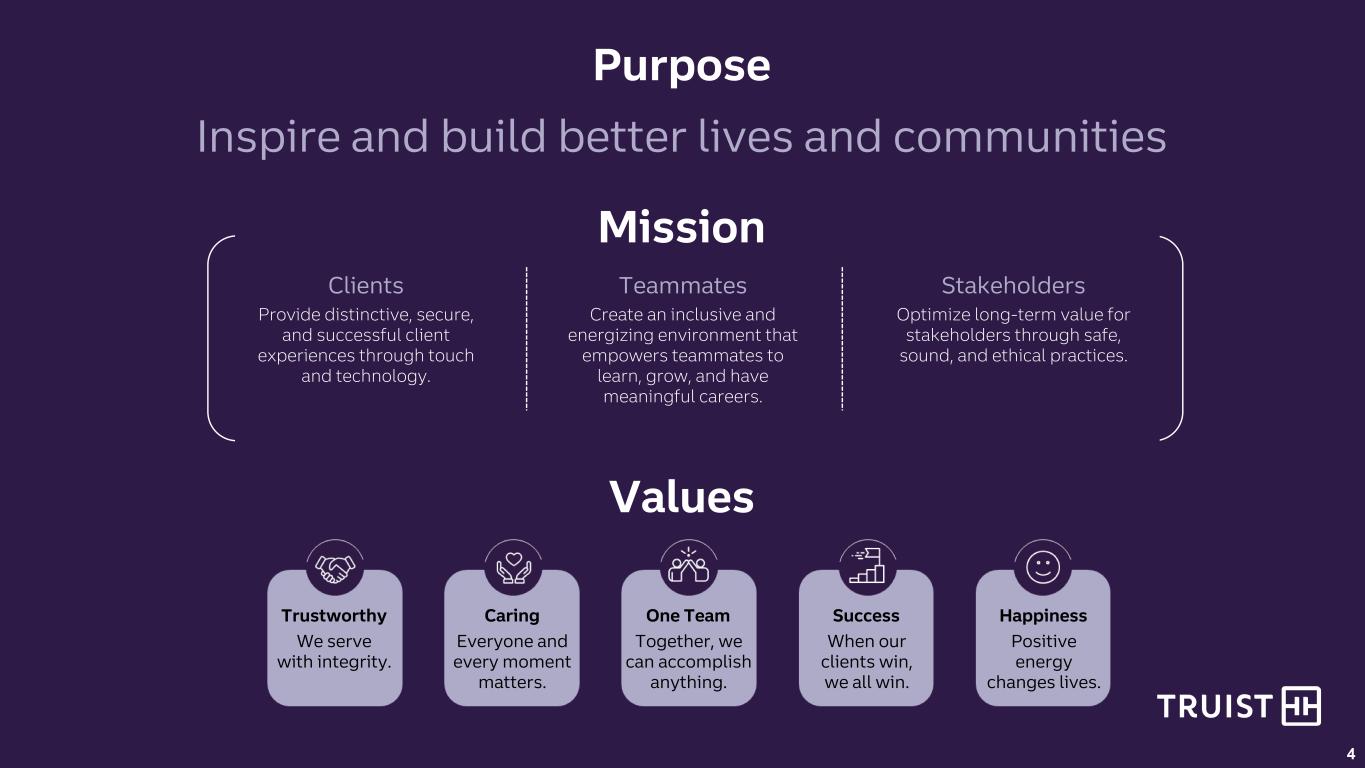
4 Purpose Inspire and build better lives and communities Mission Clients Provide distinctive, secure, and successful client experiences through touch and technology. Teammates Create an inclusive and energizing environment that empowers teammates to learn, grow, and have meaningful careers. Stakeholders Optimize long-term value for stakeholders through safe, sound, and ethical practices. Values Trustworthy We serve with integrity. Caring Everyone and every moment matters. One Team Together, we can accomplish anything. Success When our clients win, we all win. Happiness Positive energy changes lives.
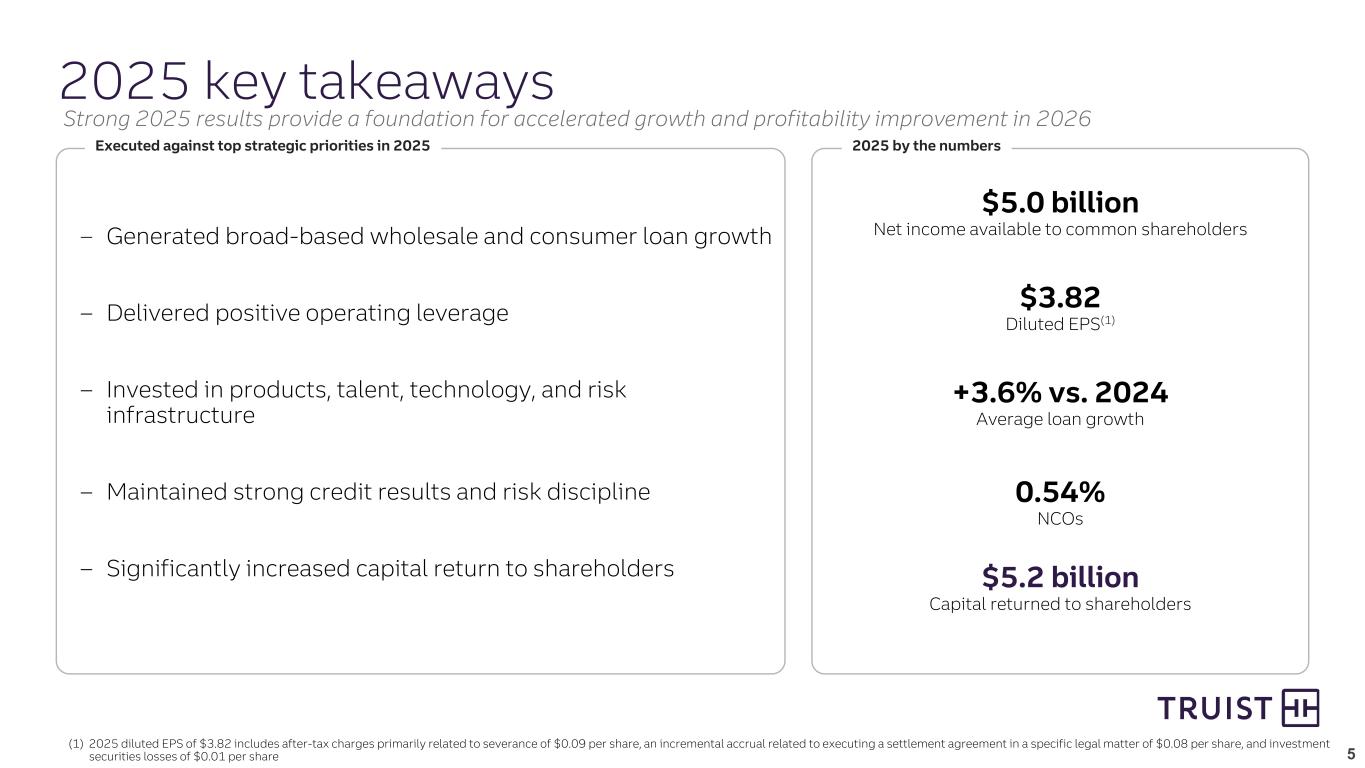
5 2025 key takeaways 2025 by the numbers $5.0 billion Net income available to common shareholders $3.82 Diluted EPS(1) +3.6% vs. 2024 Average loan growth 0.54% NCOs – Generated broad-based wholesale and consumer loan growth – Delivered positive operating leverage – Invested in products, talent, technology, and risk infrastructure – Maintained strong credit results and risk discipline – Significantly increased capital return to shareholders Executed against top strategic priorities in 2025 (1) 2025 diluted EPS of $3.82 includes after-tax charges primarily related to severance of $0.09 per share, an incremental accrual related to executing a settlement agreement in a specific legal matter of $0.08 per share, and investment securities losses of $0.01 per share $5.2 billion Capital returned to shareholders Strong 2025 results provide a foundation for accelerated growth and profitability improvement in 2026
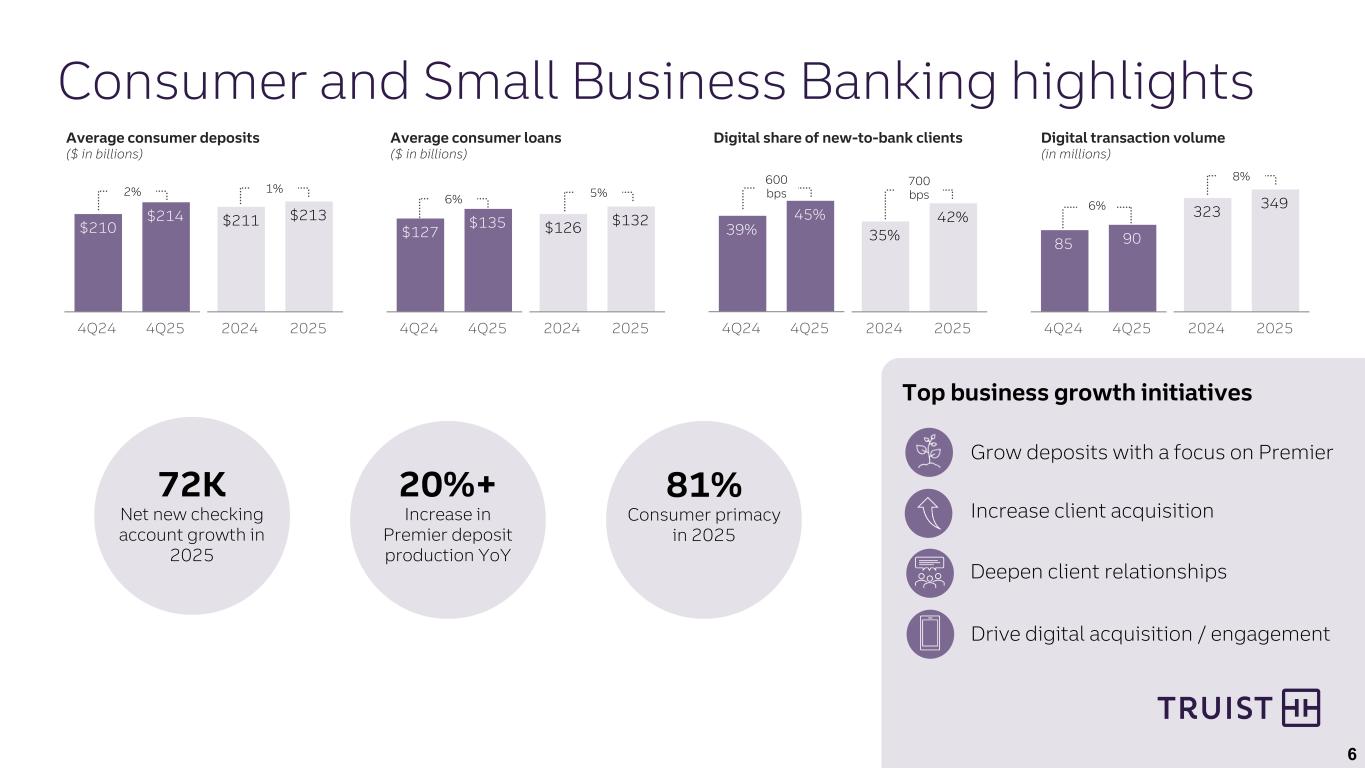
6 $126 $132 2024 2025 35% 42% 2024 2025 39% 45% 4Q24 4Q25 $210 $214 4Q24 4Q25 Consumer and Small Business Banking highlights Top business growth initiatives Increase client acquisition Grow deposits with a focus on Premier Drive digital acquisition / engagement Deepen client relationships Average consumer deposits ($ in billions) Average consumer loans ($ in billions) Digital share of new-to-bank clients Digital transaction volume (in millions) 20%+ Increase in Premier deposit production YoY 72K Net new checking account growth in 2025 $211 $213 2024 2025 $127 $135 4Q24 4Q25 323 349 2024 2025 85 90 4Q24 4Q25 600 bps 6%6% 2% 5% 700 bps 8% 81% Consumer primacy in 2025 1%
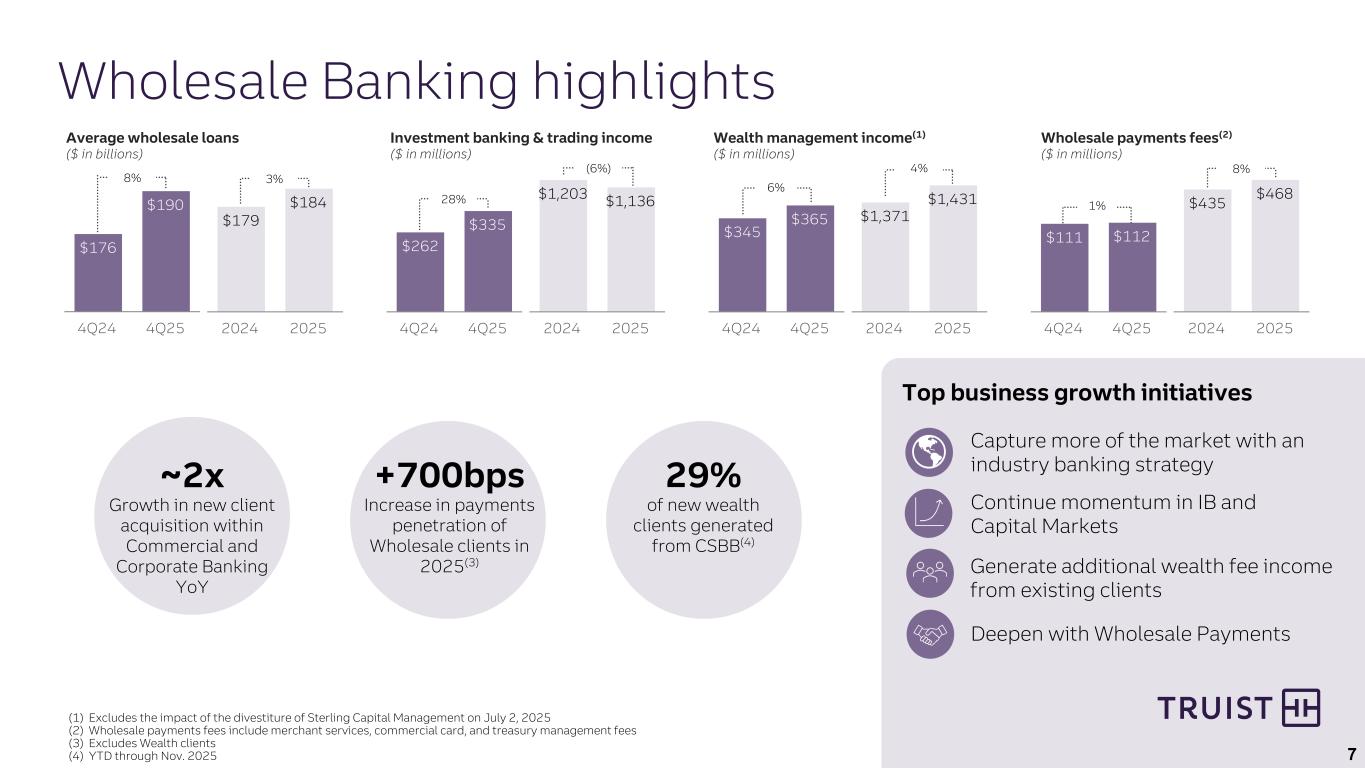
7 Wholesale Banking highlights Top business growth initiatives Continue momentum in IB and Capital Markets Capture more of the market with an industry banking strategy Deepen with Wholesale Payments Generate additional wealth fee income from existing clients +700bps Increase in payments penetration of Wholesale clients in 2025(3) ~2x Growth in new client acquisition within Commercial and Corporate Banking YoY 29% of new wealth clients generated from CSBB(4) (1) Excludes the impact of the divestiture of Sterling Capital Management on July 2, 2025 (2) Wholesale payments fees include merchant services, commercial card, and treasury management fees (3) Excludes Wealth clients (4) YTD through Nov. 2025 $1,203 $1,136 2024 2025 $1,371 $1,431 2024 2025 $345 $365 4Q24 4Q25 $176 $190 4Q24 4Q25 $179 $184 2024 2025 $262 $335 4Q24 4Q25 $435 $468 2024 2025 $111 $112 4Q24 4Q25 6% 1%28% 8% 4% 8% 3% (6%) Average wholesale loans ($ in billions) Investment banking & trading income ($ in millions) Wealth management income(1) ($ in millions) Wholesale payments fees(2) ($ in millions)
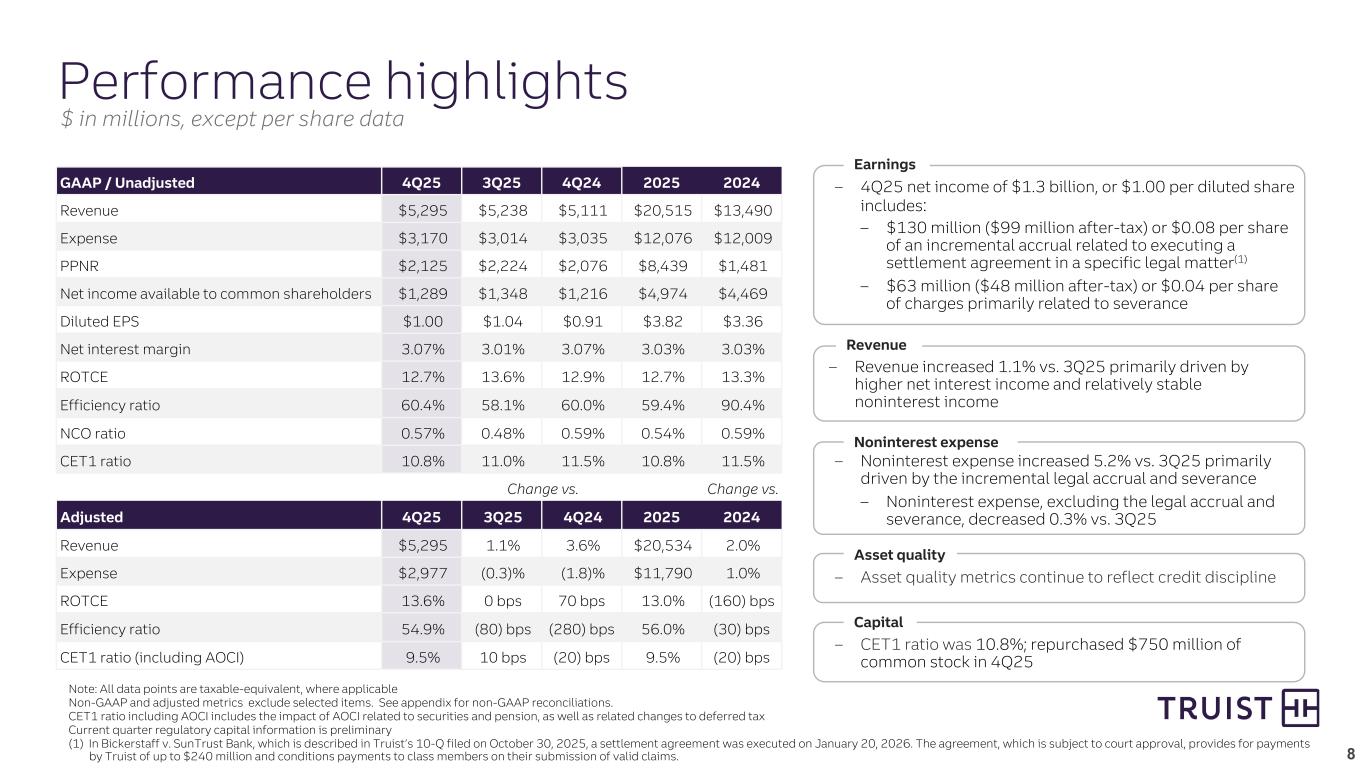
8 Note: All data points are taxable-equivalent, where applicable Non-GAAP and adjusted metrics exclude selected items. See appendix for non-GAAP reconciliations. CET1 ratio including AOCI includes the impact of AOCI related to securities and pension, as well as related changes to deferred tax Current quarter regulatory capital information is preliminary (1) In Bickerstaff v. SunTrust Bank, which is described in Truist’s 10-Q filed on October 30, 2025, a settlement agreement was executed on January 20, 2026. The agreement, which is subject to court approval, provides for payments by Truist of up to $240 million and conditions payments to class members on their submission of valid claims. $ in millions, except per share data GAAP / Unadjusted 4Q25 3Q25 4Q24 2025 2024 Revenue $5,295 $5,238 $5,111 $20,515 $13,490 Expense $3,170 $3,014 $3,035 $12,076 $12,009 PPNR $2,125 $2,224 $2,076 $8,439 $1,481 Net income available to common shareholders $1,289 $1,348 $1,216 $4,974 $4,469 Diluted EPS $1.00 $1.04 $0.91 $3.82 $3.36 Net interest margin 3.07% 3.01% 3.07% 3.03% 3.03% ROTCE 12.7% 13.6% 12.9% 12.7% 13.3% Efficiency ratio 60.4% 58.1% 60.0% 59.4% 90.4% NCO ratio 0.57% 0.48% 0.59% 0.54% 0.59% CET1 ratio 10.8% 11.0% 11.5% 10.8% 11.5% Change vs. Change vs. Adjusted 4Q25 3Q25 4Q24 2025 2024 Revenue $5,295 1.1% 3.6% $20,534 2.0% Expense $2,977 (0.3)% (1.8)% $11,790 1.0% ROTCE 13.6% 0 bps 70 bps 13.0% (160) bps Efficiency ratio 54.9% (80) bps (280) bps 56.0% (30) bps CET1 ratio (including AOCI) 9.5% 10 bps (20) bps 9.5% (20) bps Performance highlights – CET1 ratio was 10.8%; repurchased $750 million of common stock in 4Q25 – Noninterest expense increased 5.2% vs. 3Q25 primarily driven by the incremental legal accrual and severance – Noninterest expense, excluding the legal accrual and severance, decreased 0.3% vs. 3Q25 – Revenue increased 1.1% vs. 3Q25 primarily driven by higher net interest income and relatively stable noninterest income Capital Noninterest expense – 4Q25 net income of $1.3 billion, or $1.00 per diluted share includes: – $130 million ($99 million after-tax) or $0.08 per share of an incremental accrual related to executing a settlement agreement in a specific legal matter(1) – $63 million ($48 million after-tax) or $0.04 per share of charges primarily related to severance Earnings Revenue – Asset quality metrics continue to reflect credit discipline Asset quality
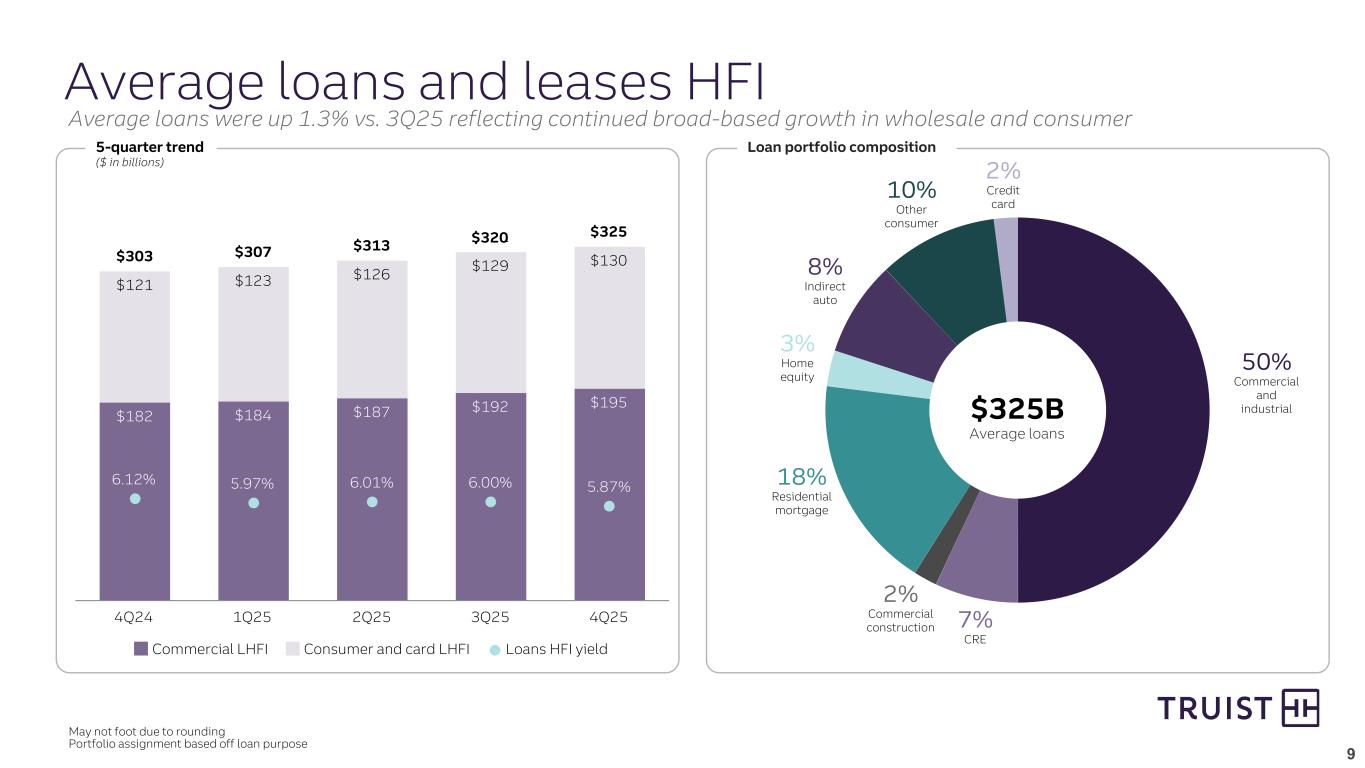
9 May not foot due to rounding Portfolio assignment based off loan purpose 5-quarter trend ($ in billions) Loan portfolio composition $325B Average loans 50% Commercial and industrial 7% CRE 2% Commercial construction 18% Residential mortgage 3% Home equity 8% Indirect auto 10% Other consumer 2% Credit card Average loans and leases HFI Average loans were up 1.3% vs. 3Q25 reflecting continued broad-based growth in wholesale and consumer $303 $307 $313 $321 $325 $182 $184 $187 $192 $195 $121 $123 $126 $129 $130 6.12% 5.97% 6.01% 6.00% 5.87% Commercial LHFI Consumer and card LHFI Loans HFI yield 4Q24 1Q25 2Q25 3Q25 4Q25 0
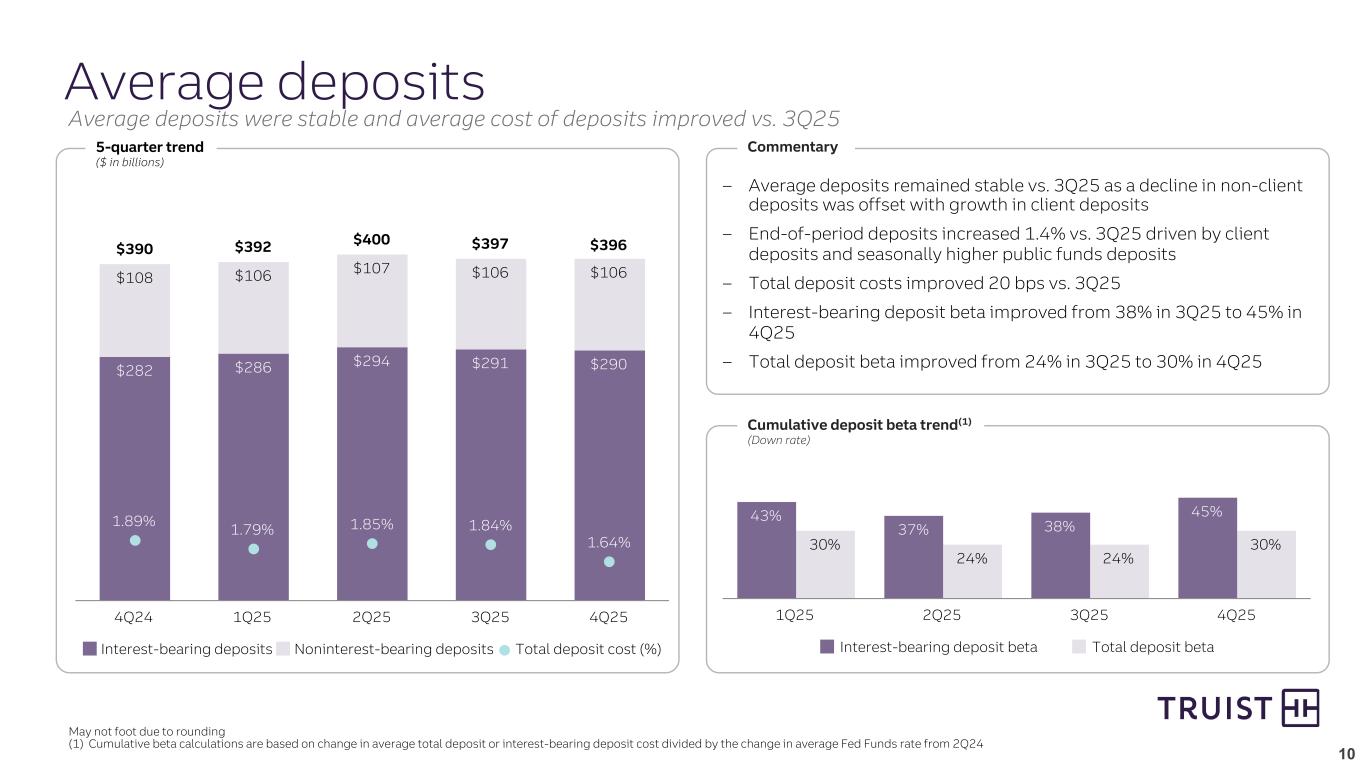
10 43% 37% 38% 45% 30% 24% 24% 30% Interest-bearing deposit beta Total deposit beta 1Q25 2Q25 3Q25 4Q25 Average deposits $390 $392 $400 $397 $282 $286 $294 $291 $290 $108 $106 $107 $106 $106 1.89% 1.79% 1.85% 1.84% 1.64% Interest-bearing deposits Noninterest-bearing deposits Total deposit cost (%) 4Q24 1Q25 2Q25 3Q25 4Q25 May not foot due to rounding (1) Cumulative beta calculations are based on change in average total deposit or interest-bearing deposit cost divided by the change in average Fed Funds rate from 2Q24 Commentary Cumulative deposit beta trend(1) (Down rate) 5-quarter trend ($ in billions) $396 Average deposits were stable and average cost of deposits improved vs. 3Q25 – Average deposits remained stable vs. 3Q25 as a decline in non-client deposits was offset with growth in client deposits – End-of-period deposits increased 1.4% vs. 3Q25 driven by client deposits and seasonally higher public funds deposits – Total deposit costs improved 20 bps vs. 3Q25 – Interest-bearing deposit beta improved from 38% in 3Q25 to 45% in 4Q25 – Total deposit beta improved from 24% in 3Q25 to 30% in 4Q25
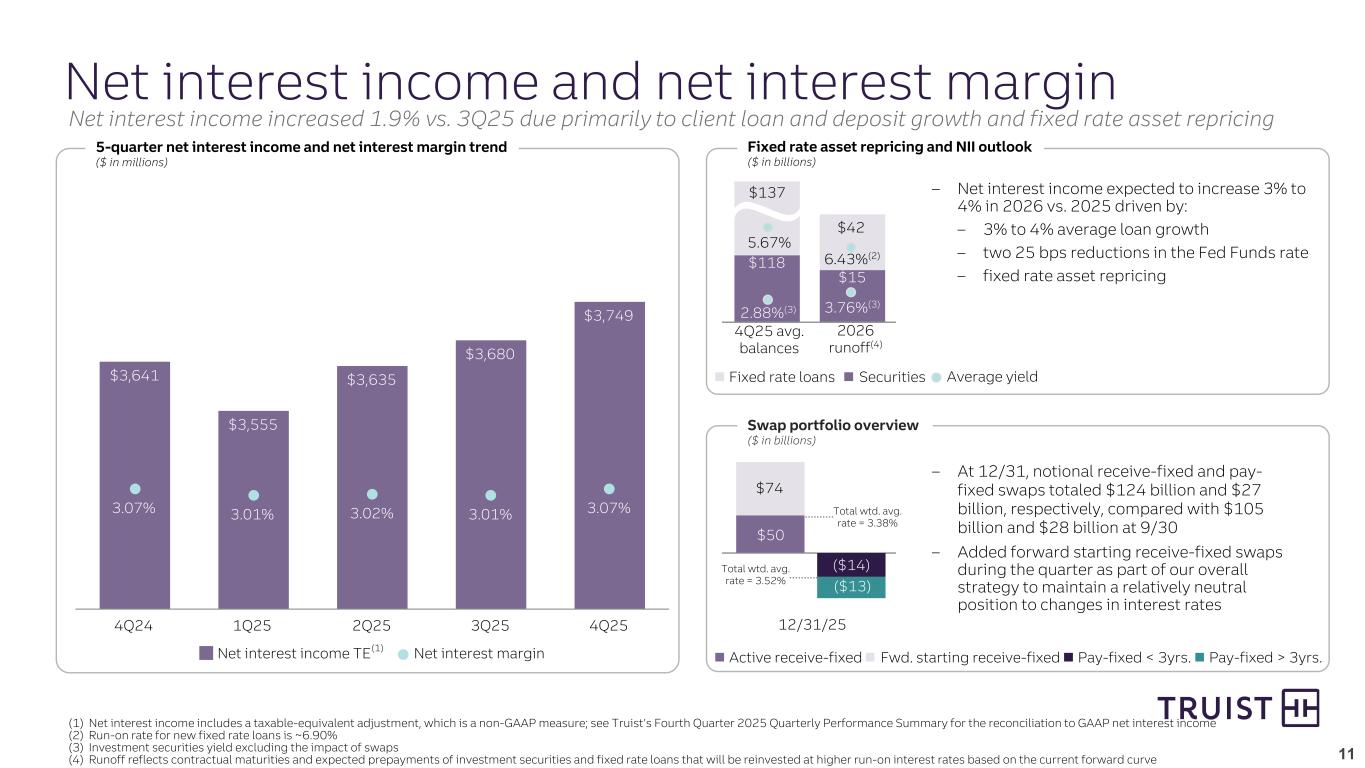
11 Active receive-fixed $3,641 $3,555 $3,635 $3,680 $3,749 3.07% 3.01% 3.02% 3.01% 3.07% Net interest income TE Net interest margin 4Q24 1Q25 2Q25 3Q25 4Q25 Fwd. starting receive-fixed Pay-fixed < 3yrs. – At 12/31, notional receive-fixed and pay- fixed swaps totaled $124 billion and $27 billion, respectively, compared with $105 billion and $28 billion at 9/30 – Added forward starting receive-fixed swaps during the quarter as part of our overall strategy to maintain a relatively neutral position to changes in interest rates Net interest income and net interest margin Fixed rate asset repricing and NII outlook ($ in billions) Swap portfolio overview ($ in billions) (1) Net interest income includes a taxable-equivalent adjustment, which is a non-GAAP measure; see Truist’s Fourth Quarter 2025 Quarterly Performance Summary for the reconciliation to GAAP net interest income (2) Run-on rate for new fixed rate loans is ~6.90% (3) Investment securities yield excluding the impact of swaps (4) Runoff reflects contractual maturities and expected prepayments of investment securities and fixed rate loans that will be reinvested at higher run-on interest rates based on the current forward curve 12/31/25 Pay-fixed > 3yrs. 5-quarter net interest income and net interest margin trend ($ in millions) (1) $50 $74 Total wtd. avg. rate = 3.38% ($14)Total wtd. avg. rate = 3.52% ($13) $137 Fixed rate loans Securities Average yield $15 $42 2.88%(3) 3.76%(3) 6.43%(2) 2026 runoff(4) ~ 4Q25 avg. balances $137 5.67% $118 – Net interest income expected to increase 3% to 4% in 2026 vs. 2025 driven by: – 3% to 4% average loan growth – two 25 bps reductions in the Fed Funds rate – fixed rate asset repricing Net interest income increased 1.9% vs. 3Q25 due primarily to client loan and deposit growth and fixed rate asset repricing
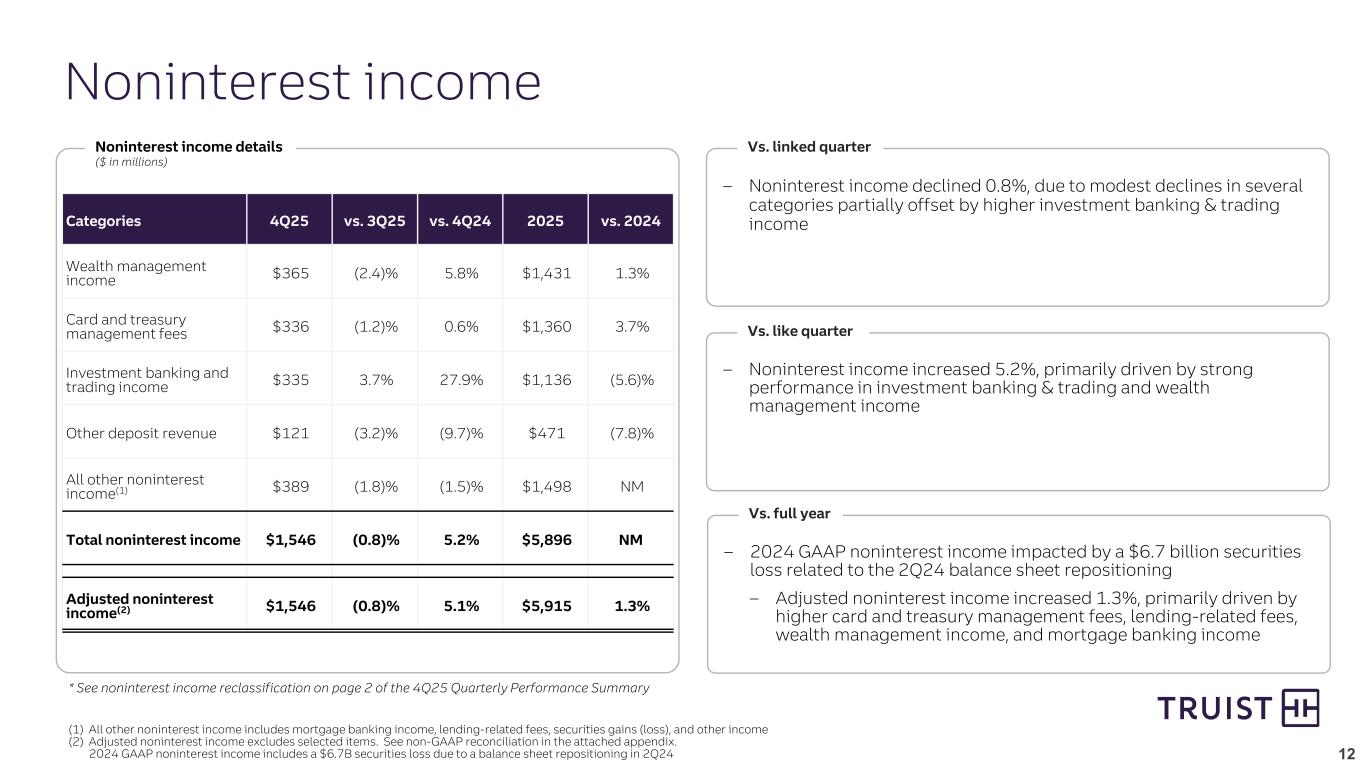
12 Noninterest income Noninterest income details ($ in millions) (1) All other noninterest income includes mortgage banking income, lending-related fees, securities gains (loss), and other income (2) Adjusted noninterest income excludes selected items. See non-GAAP reconciliation in the attached appendix. 2024 GAAP noninterest income includes a $6.7B securities loss due to a balance sheet repositioning in 2Q24 Vs. linked quarter Vs. like quarter ($5,212) – Noninterest income increased 5.2%, primarily driven by strong performance in investment banking & trading and wealth management income – Noninterest income declined 0.8%, due to modest declines in several categories partially offset by higher investment banking & trading income Vs. full year – 2024 GAAP noninterest income impacted by a $6.7 billion securities loss related to the 2Q24 balance sheet repositioning – Adjusted noninterest income increased 1.3%, primarily driven by higher card and treasury management fees, lending-related fees, wealth management income, and mortgage banking income Categories 4Q25 vs. 3Q25 vs. 4Q24 2025 vs. 2024 Wealth management income $365 (2.4)% 5.8% $1,431 1.3% Card and treasury management fees $336 (1.2)% 0.6% $1,360 3.7% Investment banking and trading income $335 3.7% 27.9% $1,136 (5.6)% Other deposit revenue $121 (3.2)% (9.7)% $471 (7.8)% All other noninterest income(1) $389 (1.8)% (1.5)% $1,498 NM Total noninterest income $1,546 (0.8)% 5.2% $5,896 NM Adjusted noninterest income(2) $1,546 (0.8)% 5.1% $5,915 1.3% * See noninterest income reclassification on page 2 of the 4Q25 Quarterly Performance Summary
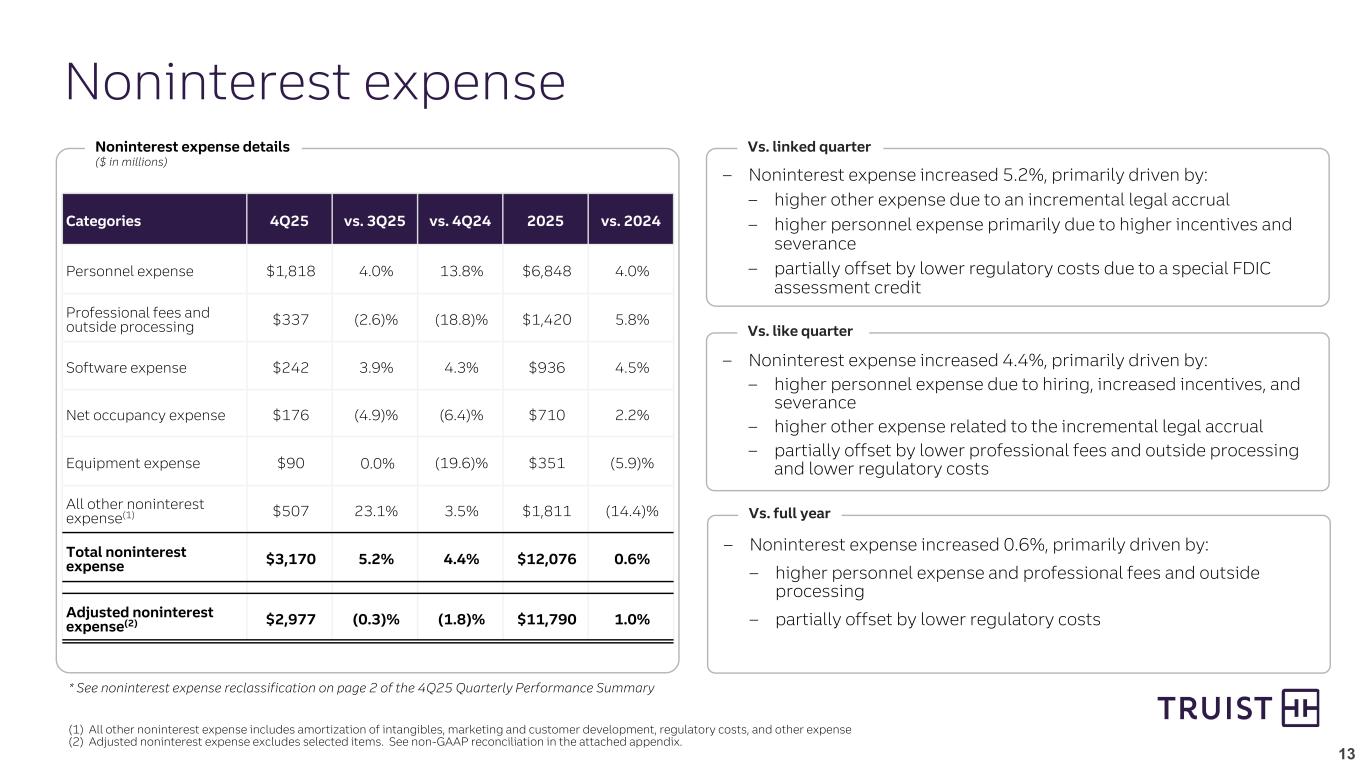
13 – Noninterest expense increased 4.4%, primarily driven by: – higher personnel expense due to hiring, increased incentives, and severance – higher other expense related to the incremental legal accrual – partially offset by lower professional fees and outside processing and lower regulatory costs Noninterest expense Noninterest expense details ($ in millions) (1) All other noninterest expense includes amortization of intangibles, marketing and customer development, regulatory costs, and other expense (2) Adjusted noninterest expense excludes selected items. See non-GAAP reconciliation in the attached appendix. Vs. linked quarter Vs. like quarter ($5,212) – Noninterest expense increased 5.2%, primarily driven by: – higher other expense due to an incremental legal accrual – higher personnel expense primarily due to higher incentives and severance – partially offset by lower regulatory costs due to a special FDIC assessment credit Vs. full year – Noninterest expense increased 0.6%, primarily driven by: – higher personnel expense and professional fees and outside processing – partially offset by lower regulatory costs Categories 4Q25 vs. 3Q25 vs. 4Q24 2025 vs. 2024 Personnel expense $1,818 4.0% 13.8% $6,848 4.0% Professional fees and outside processing $337 (2.6)% (18.8)% $1,420 5.8% Software expense $242 3.9% 4.3% $936 4.5% Net occupancy expense $176 (4.9)% (6.4)% $710 2.2% Equipment expense $90 —% (19.6)% $351 (5.9)% All other noninterest expense(1) $507 23.1% 3.5% $1,811 (14.4)% Total noninterest expense $3,170 5.2% 4.4% $12,076 0.6% Adjusted noninterest expense(2) $2,977 (0.3)% (1.8)% $11,790 1.0% * See noninterest expense reclassification on page 2 of the 4Q25 Quarterly Performance Summary 0.0%
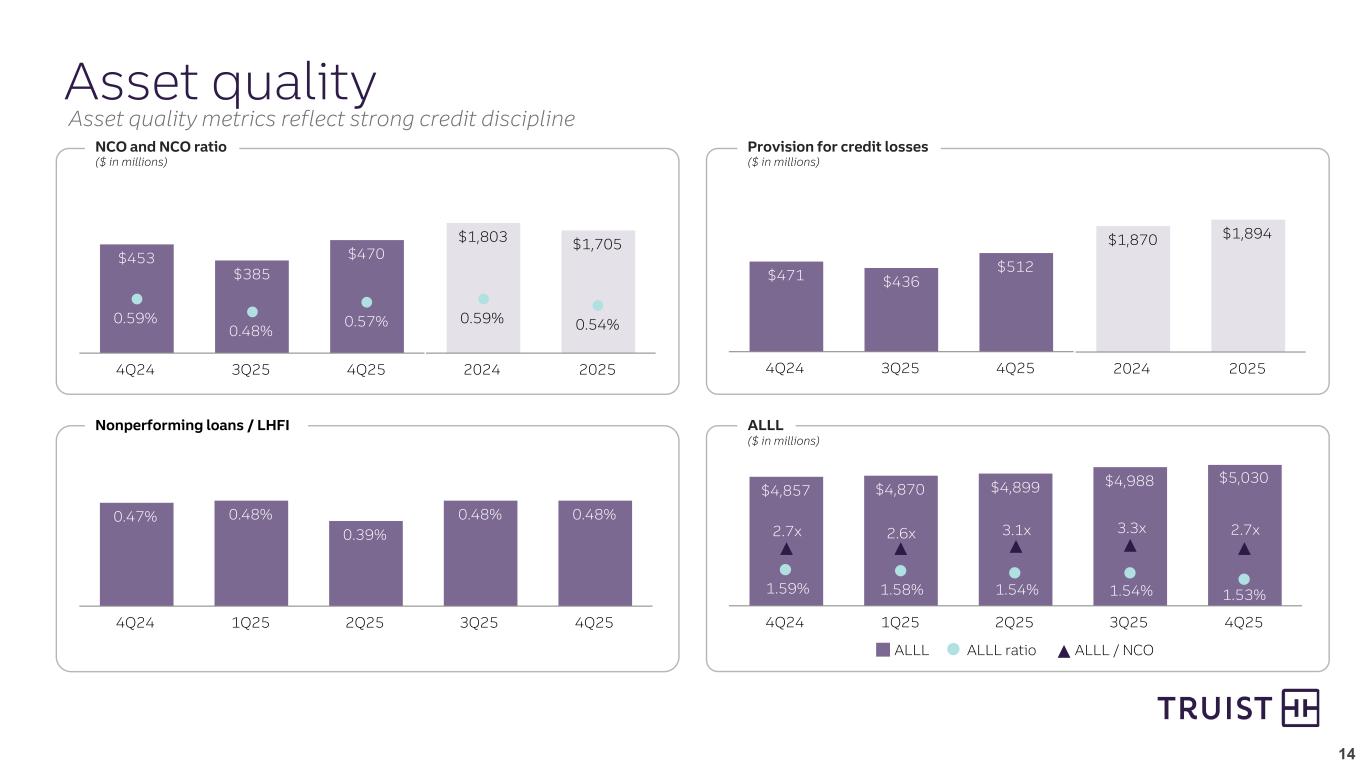
14 0.47% 0.48% 0.39% 0.48% 0.48% 4Q24 1Q25 2Q25 3Q25 4Q25 $471 $436 $512 4Q24 3Q25 4Q25 $453 $385 $470 0.59% 0.48% 0.57% 4Q24 3Q25 4Q25 Asset quality NCO and NCO ratio ($ in millions) Nonperforming loans / LHFI ALLL Provision for credit losses ($ in millions) $4,857 $4,870 $4,899 $4,988 $5,030 ALLL ALLL ratio ALLL / NCO 4Q24 1Q25 2Q25 3Q25 4Q25 2.7x 1.59% 2.6x 1.58% 3.1x 1.54% 3.3x ($ in millions) 1.54% 2.7x 1.53% $1,803 $1,705 0.59% 0.54% 2024 2025 Asset quality metrics reflect strong credit discipline $1,870 $1,894 2024 2025
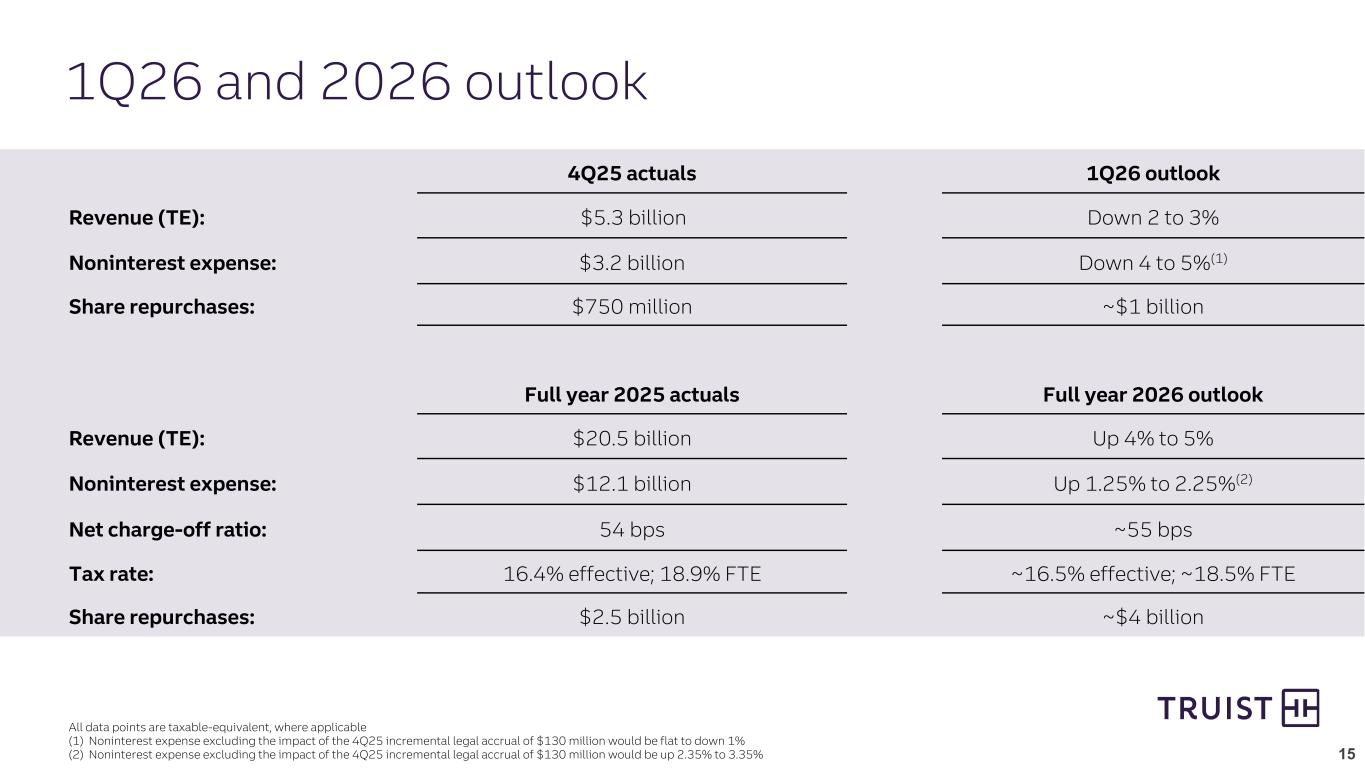
15 13.9% 1Q26 and 2026 outlook All data points are taxable-equivalent, where applicable (1) Noninterest expense excluding the impact of the 4Q25 incremental legal accrual of $130 million would be flat to down 1% (2) Noninterest expense excluding the impact of the 4Q25 incremental legal accrual of $130 million would be up 2.35% to 3.35% 4Q25 actuals 1Q26 outlook Revenue (TE): $5.3 billion Down 2 to 3% Noninterest expense: $3.2 billion Down 4 to 5%(1) Share repurchases: $750 million ~$1 billion Full year 2025 actuals Full year 2026 outlook Revenue (TE): $20.5 billion Up 4% to 5% Noninterest expense: $12.1 billion Up 1.25% to 2.25%(2) Net charge-off ratio: 54 bps ~55 bps Tax rate: 16.4% effective; 18.9% FTE ~16.5% effective; ~18.5% FTE Share repurchases: $2.5 billion ~$4 billion
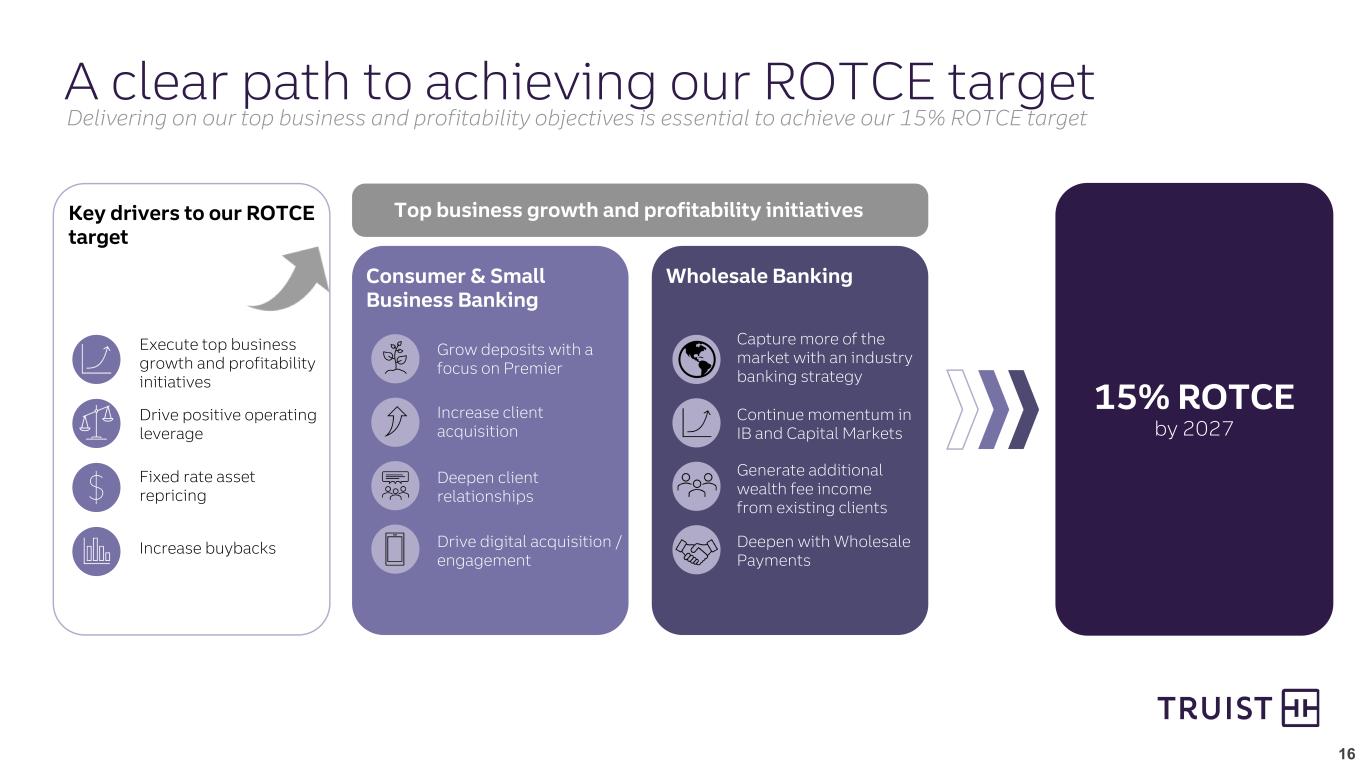
16 A clear path to achieving our ROTCE target Delivering on our top business and profitability objectives is essential to achieve our 15% ROTCE target Key drivers to our ROTCE target Consumer & Small Business Banking Wholesale Banking 15% ROTCE by 2027 Execute top business growth and profitability initiatives Drive positive operating leverage Fixed rate asset repricing Increase buybacks Grow deposits with a focus on Premier Increase client acquisition Deepen client relationships Drive digital acquisition / engagement Capture more of the market with an industry banking strategy Continue momentum in IB and Capital Markets Generate additional wealth fee income from existing clients Deepen with Wholesale Payments Top business growth and profitability initiatives

Appendix
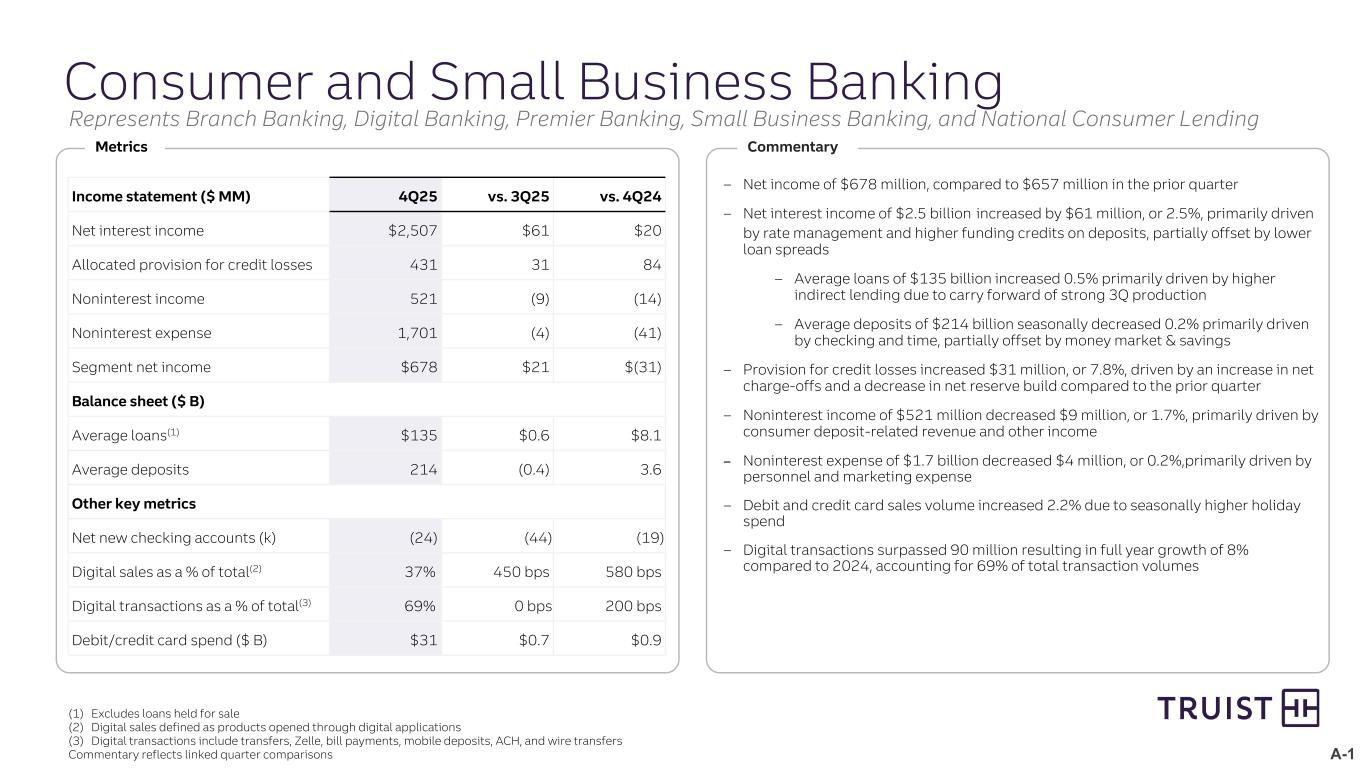
A-1 – Net income of $678 million, compared to $657 million in the prior quarter – Net interest income of $2.5 billion increased by $61 million, or 2.5%, primarily driven by rate management and higher funding credits on deposits, partially offset by lower loan spreads – Average loans of $135 billion increased 0.5% primarily driven by higher indirect lending due to carry forward of strong 3Q production – Average deposits of $214 billion seasonally decreased 0.2% primarily driven by checking and time, partially offset by money market & savings – Provision for credit losses increased $31 million, or 7.8%, driven by an increase in net charge-offs and a decrease in net reserve build compared to the prior quarter – Noninterest income of $521 million decreased $9 million, or 1.7%, primarily driven by consumer deposit-related revenue and other income – Noninterest expense of $1.7 billion decreased $4 million, or 0.2%,primarily driven by personnel and marketing expense – Debit and credit card sales volume increased 2.2% due to seasonally higher holiday spend – Digital transactions surpassed 90 million resulting in full year growth of 8% compared to 2024, accounting for 69% of total transaction volumes Consumer and Small Business Banking (1) Excludes loans held for sale (2) Digital sales defined as products opened through digital applications (3) Digital transactions include transfers, Zelle, bill payments, mobile deposits, ACH, and wire transfers Commentary reflects linked quarter comparisons Metrics Commentary Income statement ($ MM) 4Q25 vs. 3Q25 vs. 4Q24 Net interest income $2,507 $61 $20 Allocated provision for credit losses 431 31 84 Noninterest income 521 (9) (14) Noninterest expense 1,701 (4) (41) Segment net income $678 $21 $(31) Balance sheet ($ B) Average loans(1) $135 $0.6 $8.1 Average deposits 214 (0.4) 3.6 Other key metrics Net new checking accounts (k) (24) (44) (19) Digital sales as a % of total(2) 37% 450 bps 580 bps Digital transactions as a % of total(3) 69% 0 bps 200 bps Debit/credit card spend ($ B) $31 $0.7 $0.9 Represents Branch Banking, Digital Banking, Premier Banking, Small Business Banking, and National Consumer Lending
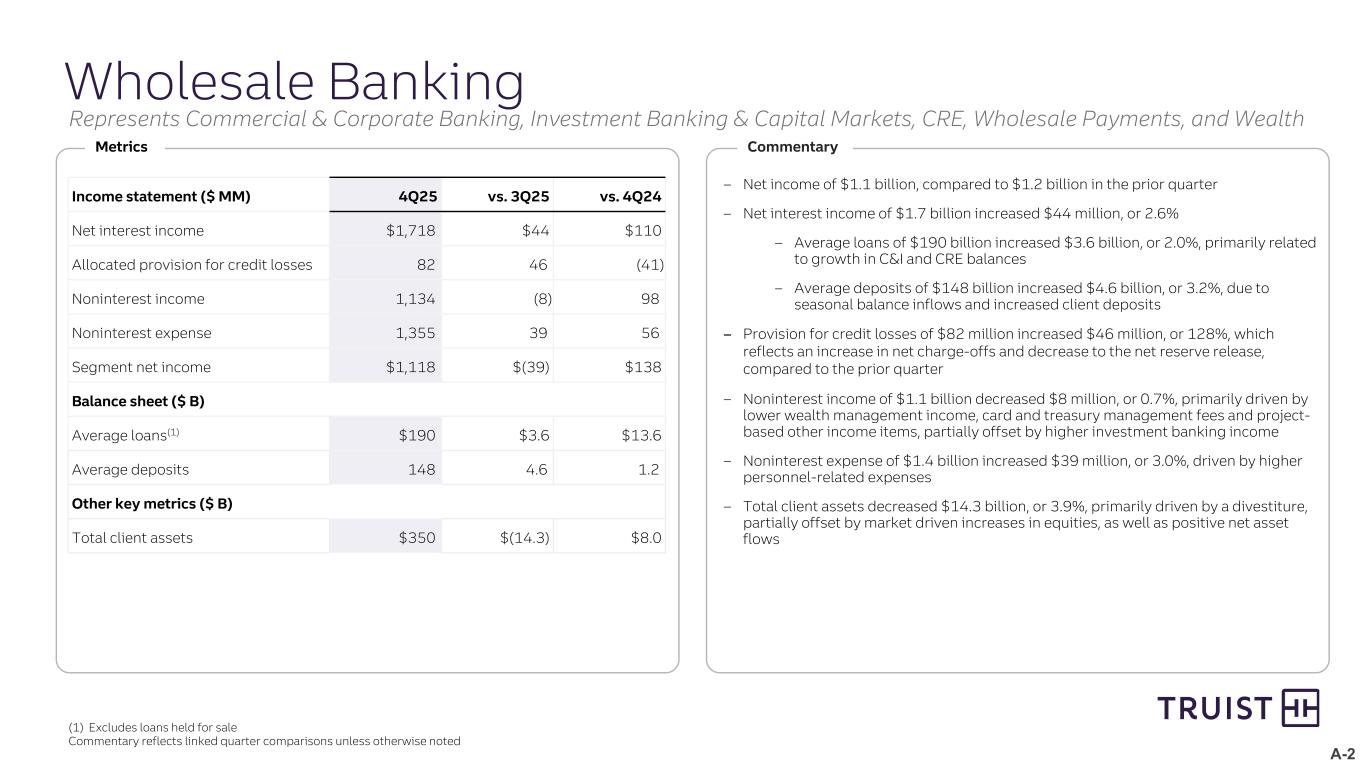
A-2 Wholesale Banking (1) Excludes loans held for sale Commentary reflects linked quarter comparisons unless otherwise noted – Net income of $1.1 billion, compared to $1.2 billion in the prior quarter – Net interest income of $1.7 billion increased $44 million, or 2.6% – Average loans of $190 billion increased $3.6 billion, or 2.0%, primarily related to growth in C&I and CRE balances – Average deposits of $148 billion increased $4.6 billion, or 3.2%, due to seasonal balance inflows and increased client deposits – Provision for credit losses of $82 million increased $46 million, or 128%, which reflects an increase in net charge-offs and decrease to the net reserve release, compared to the prior quarter – Noninterest income of $1.1 billion decreased $8 million, or 0.7%, primarily driven by lower wealth management income, card and treasury management fees and project- based other income items, partially offset by higher investment banking income – Noninterest expense of $1.4 billion increased $39 million, or 3.0%, driven by higher personnel-related expenses – Total client assets decreased $14.3 billion, or 3.9%, primarily driven by a divestiture, partially offset by market driven increases in equities, as well as positive net asset flows Metrics Commentary Income statement ($ MM) 4Q25 vs. 3Q25 vs. 4Q24 Net interest income $1,718 $44 $110 Allocated provision for credit losses 82 46 (41) Noninterest income 1,134 (8) 98 Noninterest expense 1,355 39 56 Segment net income $1,118 $(39) $138 Balance sheet ($ B) Average loans(1) $190 $3.6 $13.6 Average deposits 148 4.6 1.2 Other key metrics ($ B) Total client assets $350 $(14.3) $8.0 Represents Commercial & Corporate Banking, Investment Banking & Capital Markets, CRE, Wholesale Payments, and Wealth
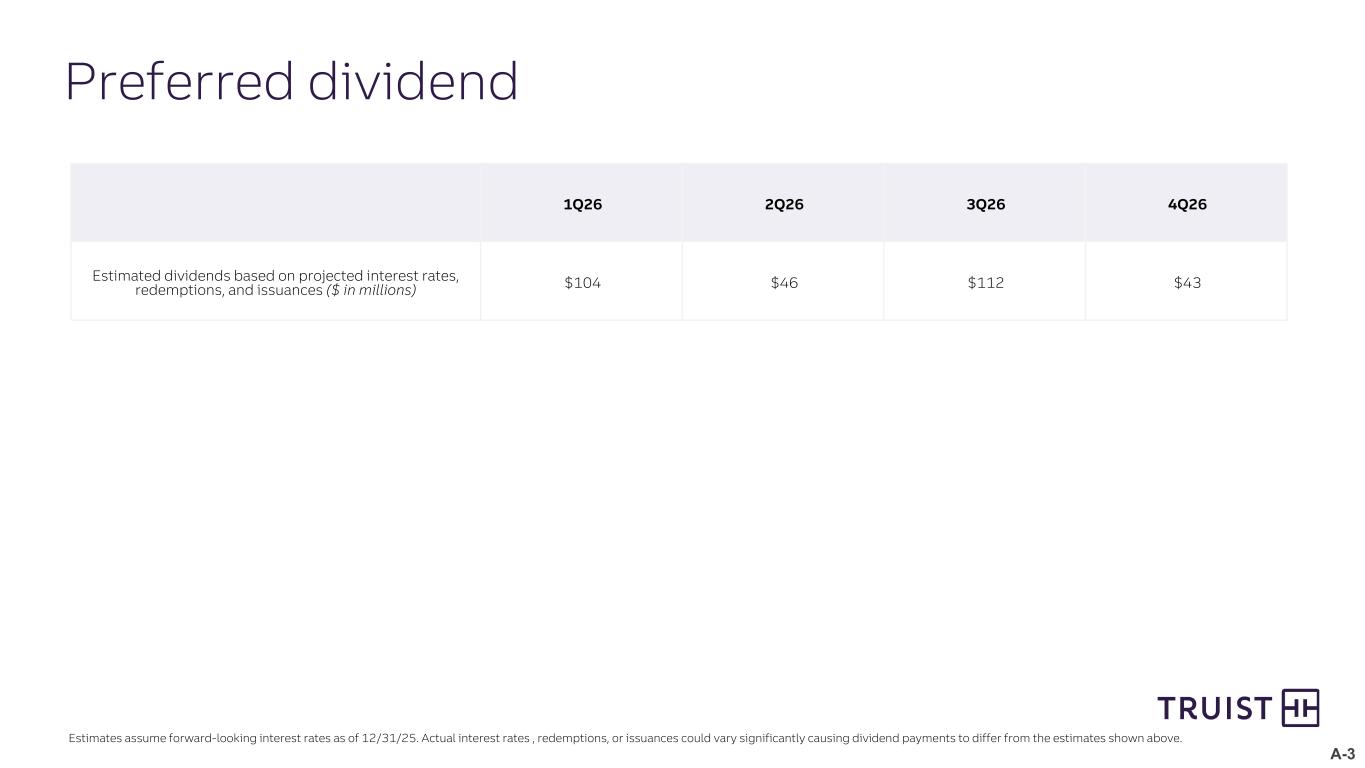
A-3 Preferred dividend 1Q26 2Q26 3Q26 4Q26 Estimated dividends based on projected interest rates, redemptions, and issuances ($ in millions) $104 $46 $112 $43 Estimates assume forward-looking interest rates as of 12/31/25. Actual interest rates , redemptions, or issuances could vary significantly causing dividend payments to differ from the estimates shown above.
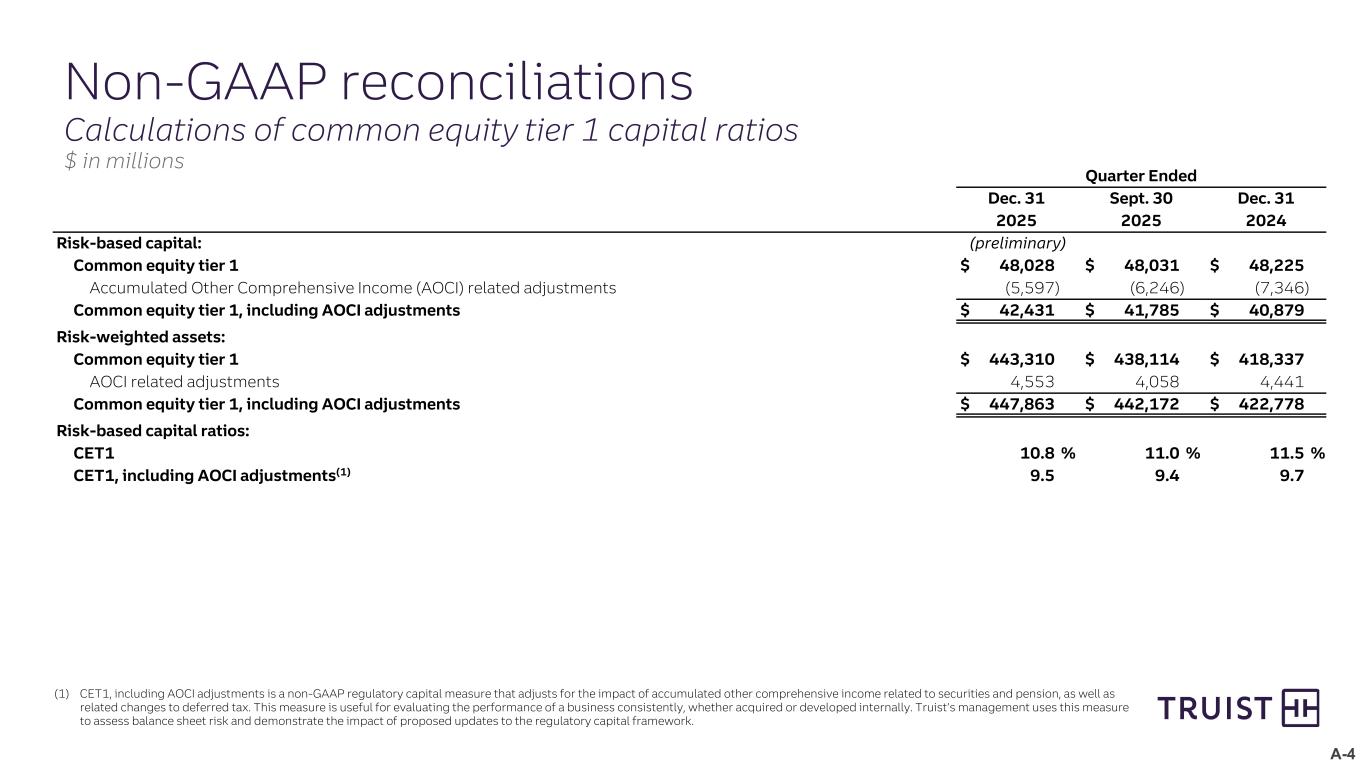
A-4 Non-GAAP reconciliations Calculations of common equity tier 1 capital ratios $ in millions (1) CET1, including AOCI adjustments is a non-GAAP regulatory capital measure that adjusts for the impact of accumulated other comprehensive income related to securities and pension, as well as related changes to deferred tax. This measure is useful for evaluating the performance of a business consistently, whether acquired or developed internally. Truist’s management uses this measure to assess balance sheet risk and demonstrate the impact of proposed updates to the regulatory capital framework. Quarter Ended Dec. 31 Sept. 30 Dec. 31 2025 2025 2024 Risk-based capital: (preliminary) Common equity tier 1 $ 48,028 $ 48,031 $ 48,225 Accumulated Other Comprehensive Income (AOCI) related adjustments (5,597) (6,246) (7,346) Common equity tier 1, including AOCI adjustments $ 42,431 $ 41,785 $ 40,879 Risk-weighted assets: Common equity tier 1 $ 443,310 $ 438,114 $ 418,337 AOCI related adjustments 4,553 4,058 4,441 Common equity tier 1, including AOCI adjustments $ 447,863 $ 442,172 $ 422,778 Risk-based capital ratios: CET1 10.8 % 11.0 % 11.5 % CET1, including AOCI adjustments(1) 9.5 9.4 9.7
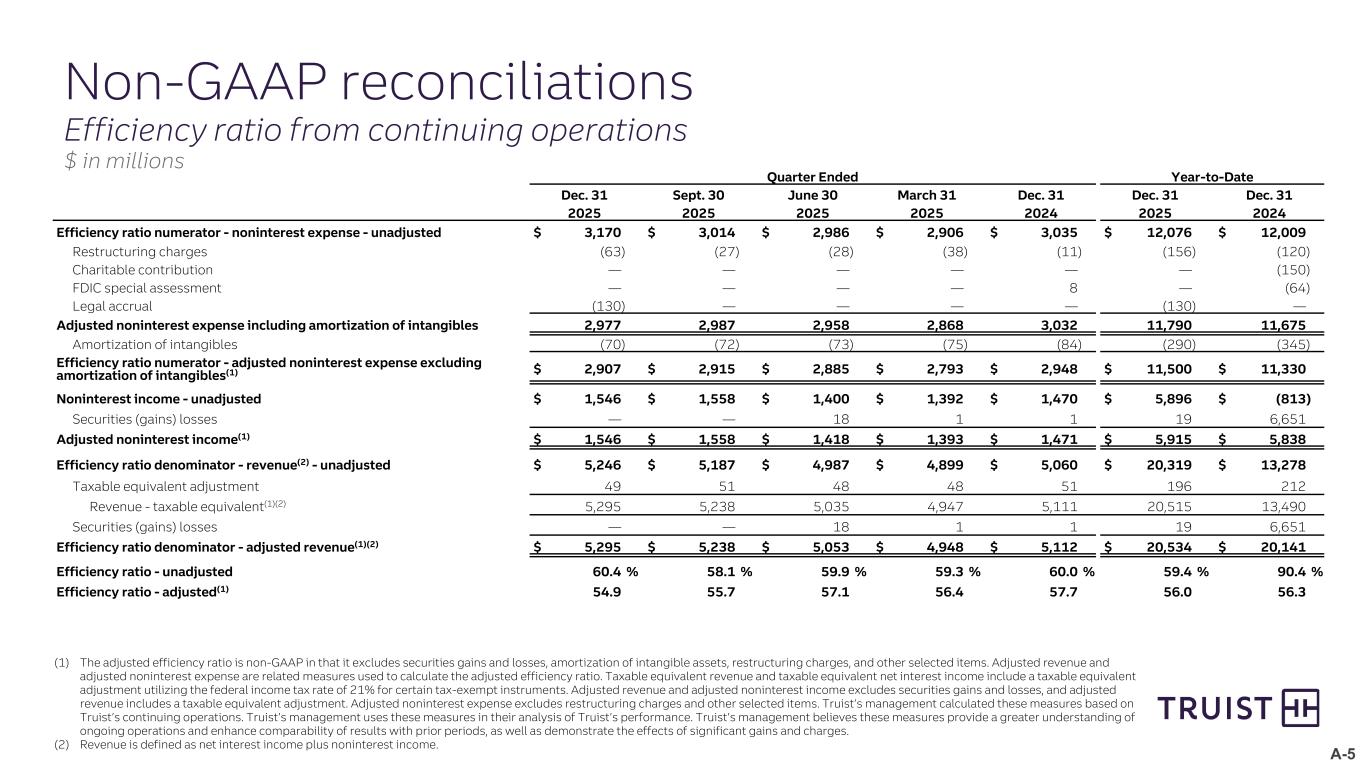
A-5 Non-GAAP reconciliations Efficiency ratio from continuing operations $ in millions (1) The adjusted efficiency ratio is non-GAAP in that it excludes securities gains and losses, amortization of intangible assets, restructuring charges, and other selected items. Adjusted revenue and adjusted noninterest expense are related measures used to calculate the adjusted efficiency ratio. Taxable equivalent revenue and taxable equivalent net interest income include a taxable equivalent adjustment utilizing the federal income tax rate of 21% for certain tax-exempt instruments. Adjusted revenue and adjusted noninterest income excludes securities gains and losses, and adjusted revenue includes a taxable equivalent adjustment. Adjusted noninterest expense excludes restructuring charges and other selected items. Truist’s management calculated these measures based on Truist’s continuing operations. Truist’s management uses these measures in their analysis of Truist’s performance. Truist’s management believes these measures provide a greater understanding of ongoing operations and enhance comparability of results with prior periods, as well as demonstrate the effects of significant gains and charges. (2) Revenue is defined as net interest income plus noninterest income. Quarter Ended Year-to-Date Dec. 31 Sept. 30 June 30 March 31 Dec. 31 Dec. 31 Dec. 31 2025 2025 2025 2025 2024 2025 2024 Efficiency ratio numerator - noninterest expense - unadjusted $ 3,170 $ 3,014 $ 2,986 $ 2,906 $ 3,035 $ 12,076 $ 12,009 Restructuring charges (63) (27) (28) (38) (11) (156) (120) Charitable contribution — — — — — — (150) FDIC special assessment — — — — 8 — (64) Legal accrual (130) — — — — (130) — Adjusted noninterest expense including amortization of intangibles 2,977 2,987 2,958 2,868 3,032 11,790 11,675 Amortization of intangibles (70) (72) (73) (75) (84) (290) (345) Efficiency ratio numerator - adjusted noninterest expense excluding amortization of intangibles(1) $ 2,907 $ 2,915 $ 2,885 $ 2,793 $ 2,948 $ 11,500 $ 11,330 Noninterest income - unadjusted $ 1,546 $ 1,558 $ 1,400 $ 1,392 $ 1,470 $ 5,896 $ (813) Securities (gains) losses — — 18 1 1 19 6,651 Adjusted noninterest income(1) $ 1,546 $ 1,558 $ 1,418 $ 1,393 $ 1,471 $ 5,915 $ 5,838 Efficiency ratio denominator - revenue(2) - unadjusted $ 5,246 $ 5,187 $ 4,987 $ 4,899 $ 5,060 $ 20,319 $ 13,278 Taxable equivalent adjustment 49 51 48 48 51 196 212 Revenue - taxable equivalent(1)(2) 5,295 5,238 5,035 4,947 5,111 20,515 13,490 Securities (gains) losses — — 18 1 1 19 6,651 Efficiency ratio denominator - adjusted revenue(1)(2) $ 5,295 $ 5,238 $ 5,053 $ 4,948 $ 5,112 $ 20,534 $ 20,141 Efficiency ratio - unadjusted 60.4 % 58.1 % 59.9 % 59.3 % 60.0 % 59.4 % 90.4 % Efficiency ratio - adjusted(1) 54.9 55.7 57.1 56.4 57.7 56.0 56.3
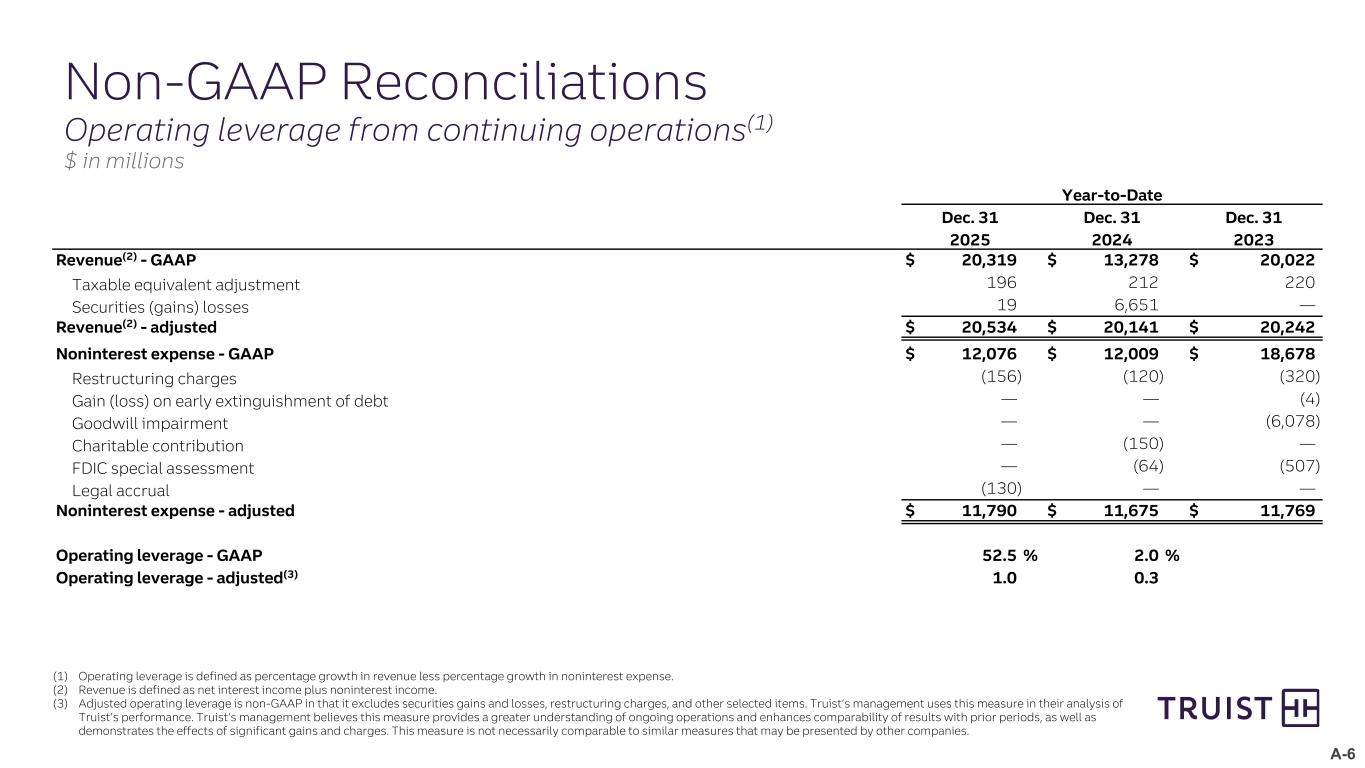
A-6 Non-GAAP Reconciliations Operating leverage from continuing operations(1) $ in millions Year-to-Date Dec. 31 Dec. 31 Dec. 31 2025 2024 2023 Revenue(2) - GAAP $ 20,319 $ 13,278 $ 20,022 Taxable equivalent adjustment 196 212 220 Securities (gains) losses 19 6,651 — Revenue(2) - adjusted $ 20,534 $ 20,141 $ 20,242 Noninterest expense - GAAP $ 12,076 $ 12,009 $ 18,678 Restructuring charges (156) (120) (320) Gain (loss) on early extinguishment of debt — — (4) Goodwill impairment — — (6,078) Charitable contribution — (150) — FDIC special assessment — (64) (507) Legal accrual (130) — — Noninterest expense - adjusted $ 11,790 $ 11,675 $ 11,769 Operating leverage - GAAP 52.5 % 2.0 % Operating leverage - adjusted(3) 1.0 0.3 (1) Operating leverage is defined as percentage growth in revenue less percentage growth in noninterest expense. (2) Revenue is defined as net interest income plus noninterest income. (3) Adjusted operating leverage is non-GAAP in that it excludes securities gains and losses, restructuring charges, and other selected items. Truist’s management uses this measure in their analysis of Truist’s performance. Truist’s management believes this measure provides a greater understanding of ongoing operations and enhances comparability of results with prior periods, as well as demonstrates the effects of significant gains and charges. This measure is not necessarily comparable to similar measures that may be presented by other companies.
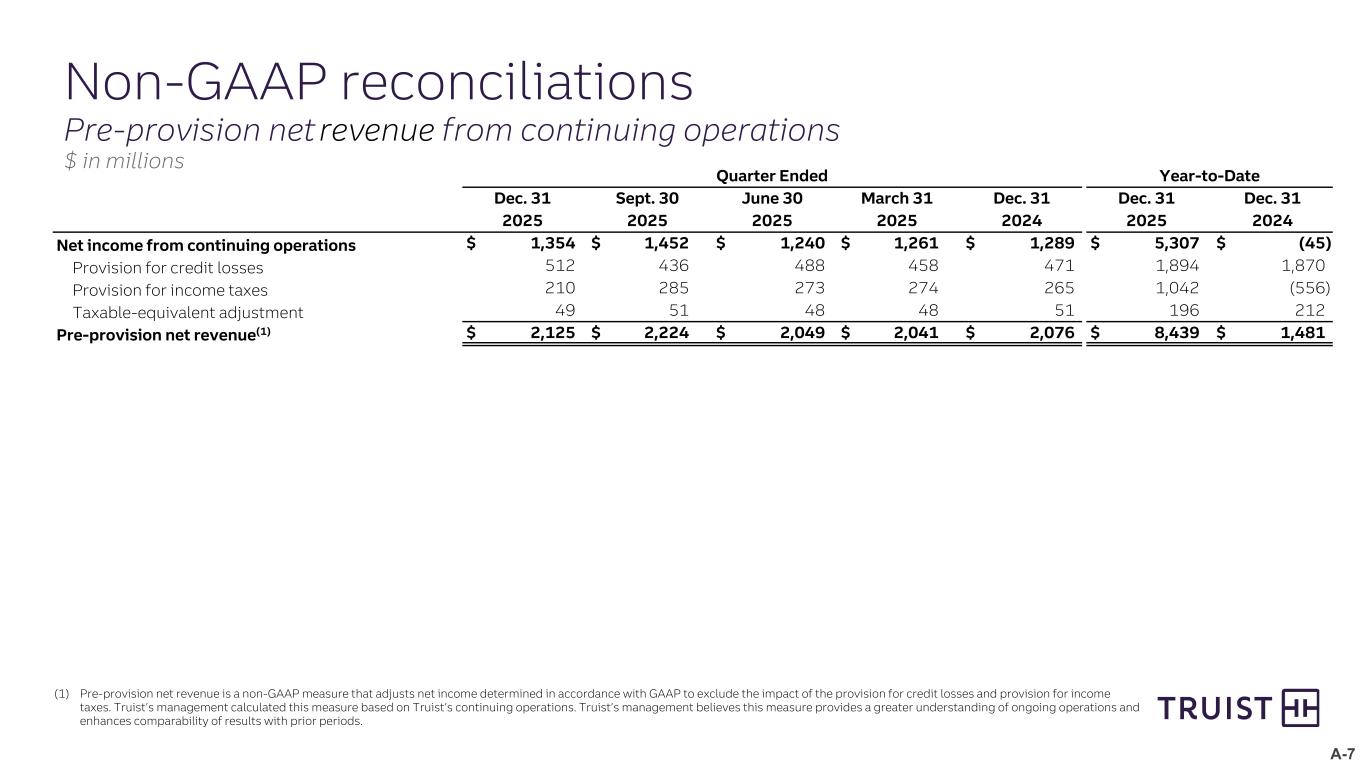
A-7 Non-GAAP reconciliations Pre-provision net revenue from continuing operations $ in millions (1) Pre-provision net revenue is a non-GAAP measure that adjusts net income determined in accordance with GAAP to exclude the impact of the provision for credit losses and provision for income taxes. Truist’s management calculated this measure based on Truist’s continuing operations. Truist’s management believes this measure provides a greater understanding of ongoing operations and enhances comparability of results with prior periods. Quarter Ended Year-to-Date Dec. 31 Sept. 30 June 30 March 31 Dec. 31 Dec. 31 Dec. 31 2025 2025 2025 2025 2024 2025 2024 Net income from continuing operations $ 1,354 $ 1,452 $ 1,240 $ 1,261 $ 1,289 $ 5,307 $ (45) Provision for credit losses 512 436 488 458 471 1,894 1,870 Provision for income taxes 210 285 273 274 265 1,042 (556) Taxable-equivalent adjustment 49 51 48 48 51 196 212 Pre-provision net revenue(1) $ 2,125 $ 2,224 $ 2,049 $ 2,041 $ 2,076 $ 8,439 $ 1,481
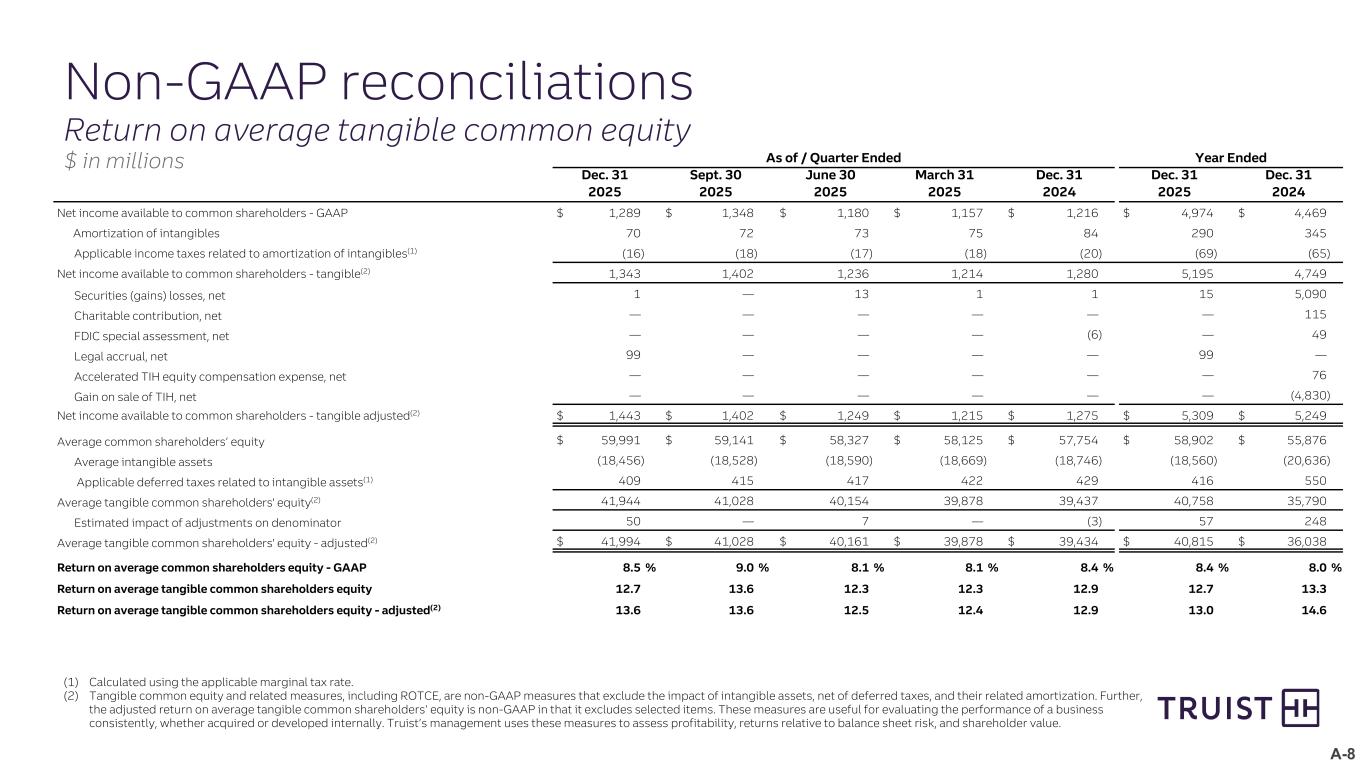
A-8 Non-GAAP reconciliations Return on average tangible common equity $ in millions As of / Quarter Ended Year Ended Dec. 31 Sept. 30 June 30 March 31 Dec. 31 Dec. 31 Dec. 31 2025 2025 2025 2025 2024 2025 2024 Net income available to common shareholders - GAAP $ 1,289 $ 1,348 $ 1,180 $ 1,157 $ 1,216 $ 4,974 $ 4,469 Amortization of intangibles 70 72 73 75 84 290 345 Applicable income taxes related to amortization of intangibles(1) (16) (18) (17) (18) (20) (69) (65) Net income available to common shareholders - tangible(2) 1,343 1,402 1,236 1,214 1,280 5,195 4,749 Securities (gains) losses, net 1 — 13 1 1 15 5,090 Charitable contribution, net — — — — — — 115 FDIC special assessment, net — — — — (6) — 49 Legal accrual, net 99 — — — — 99 — Accelerated TIH equity compensation expense, net — — — — — — 76 Gain on sale of TIH, net — — — — — — (4,830) Net income available to common shareholders - tangible adjusted(2) $ 1,443 $ 1,402 $ 1,249 $ 1,215 $ 1,275 $ 5,309 $ 5,249 Average common shareholders’ equity $ 59,991 $ 59,141 $ 58,327 $ 58,125 $ 57,754 $ 58,902 $ 55,876 Average intangible assets (18,456) (18,528) (18,590) (18,669) (18,746) (18,560) (20,636) Applicable deferred taxes related to intangible assets(1) 409 415 417 422 429 416 550 Average tangible common shareholders' equity(2) 41,944 41,028 40,154 39,878 39,437 40,758 35,790 Estimated impact of adjustments on denominator 50 — 7 — (3) 57 248 Average tangible common shareholders' equity - adjusted(2) $ 41,994 $ 41,028 $ 40,161 $ 39,878 $ 39,434 $ 40,815 $ 36,038 Return on average common shareholders equity - GAAP 8.5 % 9.0 % 8.1 % 8.1 % 8.4 % 8.4 % 8.0 % Return on average tangible common shareholders equity 12.7 13.6 12.3 12.3 12.9 12.7 13.3 Return on average tangible common shareholders equity - adjusted(2) 13.6 13.6 12.5 12.4 12.9 13.0 14.6 (1) Calculated using the applicable marginal tax rate. (2) Tangible common equity and related measures, including ROTCE, are non-GAAP measures that exclude the impact of intangible assets, net of deferred taxes, and their related amortization. Further, the adjusted return on average tangible common shareholders’ equity is non-GAAP in that it excludes selected items. These measures are useful for evaluating the performance of a business consistently, whether acquired or developed internally. Truist’s management uses these measures to assess profitability, returns relative to balance sheet risk, and shareholder value.