Filed Pursuant to Rule 424(b)(2)
Registration number: 333-283053
Registration
number: 333-283053-01
The information contained in this preliminary prospectus supplement is not complete and may be changed. A registration statement relating to these securities has been declared effective by the Securities and Exchange Commission. This preliminary prospectus supplement and the accompanying prospectus are not an offer to sell these securities and they are not soliciting an offer to buy these securities in any jurisdiction where the offer or sale of these securities is not permitted.
SUBJECT TO COMPLETION, DATED DECEMBER 1, 2025
PROSPECTUS SUPPLEMENT TO PROSPECTUS DATED NOVEMBER 7, 2024
$
Chevron U.S.A. Inc.
Floating Rate Notes due 2075
Fully and unconditionally guaranteed by
Chevron Corporation
Chevron U.S.A. Inc. (exclusive of its subsidiaries, the “Issuer” or “CUSA”) is offering $ aggregate principal amount of notes due 2075 (the “notes”).
The obligations under the notes will be fully and unconditionally guaranteed by Chevron Corporation, the parent company of the Issuer (exclusive of its subsidiaries, the “Guarantor”), on an unsecured and unsubordinated basis and will rank equally to any other unsecured and unsubordinated indebtedness of the Guarantor that is currently outstanding or that the Guarantor may issue in the future.
The notes will mature on December 15, 2075. The Issuer will pay interest on the notes quarterly in arrears on March 15, June 15, September 15 and December 15 of each year starting on March 15, 2026. The notes will bear interest at a floating rate equal to Compounded SOFR (as defined herein) minus 0.450%, subject to the provisions set forth under “Description of the Notes”; provided, however, that the minimum interest rate on the notes shall not be less than 0.000%. The Issuer will have the right to redeem the notes in whole or in part beginning on December 15, 2055 and at any time thereafter at the redemption prices listed in this prospectus supplement, plus accrued and unpaid interest on the notes to the date the Issuer redeems the notes. The holders of the notes may require the Issuer to repurchase all or a portion of the notes beginning on December 15, 2026, and on each June 15 and December 15 thereafter through and including December 15, 2036, and thereafter on each December 15 of every subsequent second year through and including December 15, 2075, at the repayment prices listed in this prospectus supplement, plus accrued and unpaid interest on the notes to the date the Issuer repurchases the notes.
If there is a “tax event” (as defined herein), the Issuer has the right to shorten the maturity of the notes to the extent needed, so that the interest paid on the notes will be deductible for United States federal income tax purposes. On the new maturity date, the Issuer will pay 100.000% of the principal amount of the notes, plus accrued and unpaid interest on the notes to the new maturity date.
| Price to Public(1) | Underwriting Discount | Proceeds Before Expenses to the Issuer |
||||||||||
| Per note |
$ | % | $ | |||||||||
| (1) | Plus accrued interest, if any, from December , 2025. |
Neither the Securities and Exchange Commission (the “Commission”) nor any state securities commission has approved or disapproved of these securities or determined that this prospectus supplement or the accompanying prospectus to which it relates is truthful or complete. Any representation to the contrary is a criminal offense.
Investing in the notes involves risks. See “Part I, Item 1A. Risk Factors” in Chevron Corporation’s Annual Report on Form 10-K, filed with the Commission on February 21, 2025, “Part II, Item 1A. Risk Factors” in Chevron Corporation’s Quarterly Report on Form 10-Q for the quarterly period ended March 31, 2025, filed with the Commission on May 8, 2025, “Part II, Item 1A. Risk Factors” in Chevron Corporation’s Quarterly Report on Form 10-Q for the quarterly period ended June 30, 2025, filed with the Commission on August 7, 2025, and “Part II, Item 1A. Risk Factors” in Chevron Corporation’s Quarterly Report on Form 10-Q for the quarterly period ended September 30, 2025, filed with the Commission on November 6, 2025, each of which is incorporated by reference herein, and the “Risk Factors” section beginning on page S-3 of this prospectus supplement for a discussion of factors you should consider carefully before investing in the notes.
We expect that delivery of the notes will be made to investors through the facilities of The Depository Trust Company against payment in New York, New York on or about December , 2025.
Joint Book-Running Managers
| MORGAN STANLEY | J.P. MORGAN | RBC CAPITAL MARKETS |
The date of this prospectus supplement is December , 2025.
Prospectus Supplement
| Page | ||||
| S-1 | ||||
| S-2 | ||||
| S-3 | ||||
| S-7 | ||||
| S-8 | ||||
| S-10 | ||||
| S-23 | ||||
| S-27 | ||||
| S-29 | ||||
| S-29 | ||||
Prospectus
| Page | ||||
| 1 | ||||
| CAUTIONARY STATEMENTS RELEVANT TO FORWARD-LOOKING STATEMENTS |
2 | |||
| 4 | ||||
| 5 | ||||
| 6 | ||||
| 7 | ||||
| 18 | ||||
| 19 | ||||
| 20 | ||||
| 22 | ||||
| 23 | ||||
We are responsible for the information contained in or incorporated by reference in this prospectus supplement and the accompanying prospectus or any free writing prospectus prepared by or on behalf of us or to which we have referred you. Neither Chevron Corporation nor CUSA has, and the underwriters have not, authorized anyone to provide you with different information. The information contained or incorporated by reference in this prospectus supplement and the accompanying prospectus is current only as to the date appearing at the bottom of the cover of those respective documents.
The distribution of this prospectus supplement and the accompanying prospectus and the offering of the notes and guarantees in some jurisdictions may be restricted by law. If you possess this prospectus supplement and the accompanying prospectus, you should find out about and observe these restrictions. This prospectus supplement and the accompanying prospectus are not an offer to sell these securities and are not soliciting an offer to buy these securities in any jurisdiction where the offer or sale is not permitted or where the person making the offer or sale is not qualified to do so or to any person to whom it is not permitted to make such offer or sale. See “Underwriting” beginning on page S-27 of this prospectus supplement for more information.
S-i
CHEVRON CORPORATION AND CHEVRON U.S.A. INC.
Chevron Corporation, a Delaware corporation and the indirect parent company of Chevron U.S.A. Inc., a Pennsylvania corporation, manages its investments in subsidiaries and affiliates and provides administrative, financial, management and technology support to U.S. and international subsidiaries that engage in integrated energy and chemicals operations. Upstream operations consist primarily of exploring for, developing, producing and transporting crude oil and natural gas; processing, liquefaction, transportation and regasification associated with liquefied natural gas; transporting crude oil by major international oil export pipelines; transporting, storage and marketing of natural gas; carbon capture and storage; and a gas-to-liquids plant. Downstream operations consist primarily of refining crude oil into petroleum products; marketing of crude oil, refined products and lubricants; manufacturing and marketing of renewable fuels; transporting crude oil and refined products by pipeline, marine vessel, motor equipment and rail car; and manufacturing and marketing of commodity petrochemicals, plastics for industrial uses and fuel and lubricant additives.
Chevron U.S.A. Inc., a Pennsylvania corporation and a wholly-owned subsidiary of Chevron Corporation, and its subsidiaries manage and operate most of Chevron’s U.S. businesses, with assets including those related to the exploration and production of crude oil, natural gas and natural gas liquids and those associated with the refining, marketing, supply and distribution of products derived from petroleum, excluding most of the regulated pipeline operations of Chevron. See Note 6 to our Consolidated Financial Statements in our Annual Report on Form 10-K for the year ended December 31, 2024, Note 6 to our Consolidated Financial Statements in our Quarterly Report on Form 10-Q for the quarter ended September 30, 2025 and “Summarized Financial Information” in the accompanying prospectus.
Except as otherwise indicated or the context otherwise requires, references to “Chevron,” “we,” “us” and “our” refer to Chevron Corporation and its consolidated subsidiaries, including CUSA. The terms “Issuer” and “CUSA” mean Chevron U.S.A. Inc., exclusive of its subsidiaries. The term “Guarantor” means Chevron Corporation, exclusive of its subsidiaries, as guarantor of the notes.
Chevron Corporation’s executive offices are located at 1400 Smith Street, Houston, Texas 77002 (telephone: (832) 854-1000). CUSA’s executive offices are located at 5001 Executive Parkway, Suite 200, San Ramon, California 94583 (telephone: (925) 842-1000).
S-1
WHERE YOU CAN FIND MORE INFORMATION
Chevron is subject to the informational requirements of the Securities Exchange Act of 1934, as amended (the “Exchange Act”), and in accordance therewith files reports, proxy statements, and other information with the Commission. Chevron’s filings are available to the public over the Internet at its website (www.chevron.com) or at the Commission’s website (www.sec.gov). Except for the documents specifically incorporated by reference into this prospectus supplement and the accompanying prospectus, information contained on Chevron’s website or that of the Commission that can be accessed through such websites does not constitute a part of this prospectus supplement and the accompanying prospectus. Chevron has included its and the Commission’s website address only as an inactive textual reference and does not intend it to be an active link to such websites. Chevron is not required to, and does not, provide annual reports to holders of its debt securities unless specifically requested to do so.
Chevron Corporation and CUSA have filed a registration statement on Form S-3 with the Commission under the Securities Act of 1933, as amended (the “Securities Act”), relating to the debt securities and guarantees offered by this prospectus supplement and the accompanying prospectus. This prospectus supplement and the accompanying prospectus do not contain all of the information set forth in the registration statement. Some information has been omitted in accordance with the rules and regulations of the Commission. For further information, please refer to the registration statement and the exhibits and schedules filed with it.
The Commission allows Chevron to “incorporate by reference” into this prospectus supplement and the accompanying prospectus the information in documents that we file with it. This means that we can disclose important information to you by referring you to other documents which have been filed separately with the Commission. The information incorporated by reference is an important part of this prospectus supplement and the accompanying prospectus, and the information that Chevron files with the Commission after the date hereof will automatically update and may supersede this information. We incorporate by reference the documents listed below and any future filings which Chevron makes with the Commission under sections 13(a), 13(c), 14 or 15(d) of the Exchange Act until the termination of the offering of securities by this prospectus supplement and the accompanying prospectus; provided, however, that we are not incorporating, in each case, any documents or information deemed to have been furnished and not filed in accordance with the Commission’s rules.
| • | Chevron’s Annual Report on Form 10-K for the year ended December 31, 2024. |
| • | Chevron’s Quarterly Reports on Form 10-Q for the quarters ended March 31, 2025, June 30, 2025 and September 30, 2025. |
| • | The information specifically incorporated by reference into Chevron’s Annual Report on Form 10-K for the year ended December 31, 2024 from Chevron’s Definitive Proxy Statement on Schedule 14A filed with the Commission on April 9, 2025. |
| • | Chevron’s Current Reports on Form 8-K filed with the Commission on January 31, 2025, February 26, 2025, March 17, 2025, May 30, 2025, July 18, 2025, July 29, 2025, August 13, 2025 and November 3, 2025 (other than information furnished pursuant to Item 2.02 or Item 7.01 of any Current Report on Form 8-K, unless expressly stated otherwise therein). |
Upon written or oral request, we will provide, without charge, to each person to whom a copy of this prospectus supplement and the accompanying prospectus has been delivered, a copy of any or all of the documents described above which have been or may be incorporated by reference in this prospectus supplement and the accompanying prospectus but not delivered with this prospectus supplement and the accompanying prospectus. Requests for copies should be directed to:
Chevron Corporation
1400 Smith Street
Houston, Texas 77002
Attention: Corporation Treasury (Corporate Finance Division)
Telephone: (832) 854-1000
S-2
Investing in the notes involves risks. Before making a decision to invest in the notes, you should carefully consider the risks described under “Part I, Item 1A. Risk Factors” in Chevron’s Annual Report on Form 10-K, filed with the Commission on February 21, 2025, “Part II, Item 1A. Risk Factors” in Chevron’s Quarterly Report on Form 10-Q for the quarterly period ended March 31, 2025, filed with the Commission on May 8, 2025, “Part II, Item 1A. Risk Factors” in Chevron’s Quarterly Report on Form 10-Q for the quarterly period ended June 30, 2025, filed with the Commission on August 7, 2025 and “Part II, Item 1A. Risk Factors” in Chevron’s Quarterly Report on Form 10-Q for the quarterly period ended September 30, 2025, filed with the Commission on November 6, 2025, each of which is incorporated by reference herein, as well as the risks set forth below.
The Secured Overnight Financing Rate (“SOFR”) has a limited history and its composition and characteristics are not the same as the London Inter-Bank Offered Rate (“LIBOR”).
On June 22, 2017, the Alternative Reference Rates Committee (the “ARRC”) convened by the Board of Governors of the Federal Reserve System and the Federal Reserve Bank of New York identified SOFR as the rate that, in the consensus view of the ARRC, represented best practice for use in certain new U.S. dollar derivatives and other financial contracts. SOFR is a broad measure of the cost of borrowing cash overnight collateralized by U.S. Treasury securities and has been published by the Federal Reserve Bank of New York since April 2018. The Federal Reserve Bank of New York also began publishing historical indicative Secured Overnight Financing Rates from 2014. Investors should not rely on any historical changes or trends in SOFR as an indicator of future changes in SOFR.
The composition and characteristics of SOFR are not the same as those of LIBOR, and SOFR is fundamentally different from LIBOR for two key reasons. First, SOFR is a secured rate, while LIBOR was an unsecured rate. Second, SOFR is an overnight rate, while LIBOR was a forward-looking rate that represented interbank funding over different maturities (e.g., three months). As a result, there can be no assurance that SOFR (including Compounded SOFR) will perform in the same way as LIBOR would have at any time, including, without limitation, as a result of changes in interest and yield rates in the market, market volatility or global or regional economic, financial, political, regulatory, judicial or other events.
SOFR may be more volatile than other benchmark or market rates.
Since the initial publication of SOFR, daily changes in SOFR have, on occasion, been more volatile than daily changes in other benchmark or market rates, such as U.S. dollar (“USD”) LIBOR before it was discontinued. Although changes in Compounded SOFR generally are not expected to be as volatile as changes in daily levels of SOFR, the return on and value of the notes may fluctuate more than floating rate debt securities that are linked to less volatile rates. In addition, the volatility of SOFR has reflected the underlying volatility of the overnight U.S. Treasury repo market. The Federal Reserve Bank of New York has at times conducted operations in the overnight U.S. Treasury repo market in order to help maintain the federal funds rate within a target range. There can be no assurance that the Federal Reserve Bank of New York will continue to conduct such operations in the future, and the duration and extent of any such operations is inherently uncertain. The effect of any such operations, or of the cessation of such operations to the extent they are commenced, is uncertain and could be materially adverse to investors in the notes.
Any failure of SOFR to maintain market acceptance could adversely affect the notes.
According to the ARRC, SOFR was developed for use in certain U.S. dollar derivatives and other financial contracts as an alternative to USD LIBOR in part because it is considered a good representation of general funding conditions in the overnight U.S. Treasury repo market. However, as a rate based on transactions secured by U.S. Treasury securities, it does not measure bank-specific credit risk and, as a result, is less likely to correlate
S-3
with the unsecured short-term funding costs of banks. This may mean that market participants would not consider SOFR a suitable replacement or successor for all of the purposes for which USD LIBOR historically has been used (including, without limitation, as a representation of the unsecured short-term funding costs of banks), which may, in turn, lessen market acceptance of SOFR. Any failure of SOFR to maintain market acceptance could adversely affect the return on and value of the notes and the price at which investors can sell the notes in the secondary market.
In addition, if SOFR does not continue to be widely used as a benchmark in securities that are similar or comparable to the notes, the trading price of the notes may be lower than those of securities that are linked to rates that are more widely used. Similarly, market terms for floating-rate debt securities linked to SOFR, such as the spread over the base rate reflected in interest rate provisions or the manner of compounding the base rate, may evolve over time, and trading prices of the notes may be lower than those of later-issued SOFR-based debt securities as a result. Investors in the notes may not be able to sell the notes at all or may not be able to sell the notes at prices that will provide them with a yield comparable to similar investments that have a developed secondary market, and may consequently suffer from increased pricing volatility and market risk.
The interest rate on the notes is based on a Compounded SOFR rate and the SOFR Index, both of which have a limited history in the marketplace.
For each interest period (as defined herein), the interest rate on the notes is based on Compounded SOFR, which is calculated using the SOFR Index (as defined herein) published by the Federal Reserve Bank of New York according to the specific formula described under “Description of the Notes—Interest—Compounded SOFR,” not the SOFR rate published on or in respect of a particular date during such interest period or an arithmetic average of SOFR rates during such period. For this and other reasons, the interest rate on the notes during any interest period will not necessarily be the same as the interest rate on other SOFR-linked investments that use an alternative basis to determine the applicable interest rate. Further, if the SOFR rate in respect of a particular date during an interest period is negative, its contribution to the SOFR Index will be less than one, resulting in a reduction to Compounded SOFR used to calculate the interest payable on the notes on the interest payment date for such interest period.
Limited market precedent exists for securities that use SOFR as the interest rate and the method for calculating an interest rate based upon SOFR in those precedents varies. In addition, the Federal Reserve Bank of New York only began publishing the SOFR Index on March 2, 2020. Accordingly, the use of the SOFR Index or the specific formula for the Compounded SOFR rate used in the notes may not continue to be widely adopted by other market participants. If the market adopts a different calculation method, that would likely adversely affect the liquidity and market value of the notes.
Compounded SOFR with respect to a particular interest period will only be capable of being determined near the end of the relevant interest period.
The level of Compounded SOFR applicable to a particular interest period and, therefore, the amount of interest payable with respect to such interest period will be determined on the Interest Determination Date (as defined herein) for such interest period. Because each such date is near the end of such interest period, you will not know the amount of interest payable with respect to a particular interest period until shortly prior to the related interest payment date and it may be difficult for you to reliably estimate the amount of interest that will be payable on each such interest payment date. In addition, some investors may be unwilling or unable to trade the notes without changes to their information technology systems, both of which could adversely impact the liquidity and trading price of the notes.
The SOFR Index may be modified or discontinued and the notes may bear interest by reference to a rate other than Compounded SOFR, which could adversely affect the value of the notes.
The SOFR Index is published by the Federal Reserve Bank of New York based on data received by it from sources other than us, and we have no control over its methods of calculation, publication schedule, rate revision
S-4
practices or availability of the SOFR Index at any time. There can be no guarantee, particularly given its relatively limited history, that the SOFR Index will not be discontinued or fundamentally altered in a manner that is materially adverse to the interests of investors in the notes. If the manner in which the SOFR Index is calculated, including the manner in which SOFR is calculated, is changed, that change may result in a reduction in the amount of interest payable on the notes and the trading prices of the notes. In addition, the Federal Reserve Bank of New York may withdraw, modify or amend the published SOFR Index or SOFR data in its sole discretion and without notice. The interest rate for any interest period will not be adjusted for any modifications or amendments to the SOFR Index or SOFR data that the Federal Reserve Bank of New York may publish after the interest rate for that interest period has been determined.
If we or our designee determines that a Benchmark Transition Event (as defined herein) and its related Benchmark Replacement Date (as defined herein) have occurred in respect of the SOFR Index, then the interest rate on the notes will no longer be determined by reference to the SOFR Index, but instead will be determined by reference to a different rate, plus a spread adjustment (which may be a positive or negative value or zero), which we refer to as a “Benchmark Replacement,” as further described under “Description of the Notes—Interest—Compounded SOFR.”
If a particular Benchmark Replacement (as defined herein) or Benchmark Replacement Adjustment (as defined herein) cannot be determined, then the next-available Benchmark Replacement or Benchmark Replacement Adjustment will apply. These replacement rates and adjustments may be selected, recommended or formulated by (i) the Relevant Governmental Body (as defined herein), such as the ARRC, (ii) the International Swaps and Derivatives Association (“ISDA”) or (iii) in certain circumstances, us or our designee. In addition, the terms of the notes expressly authorize us or our designee to make Benchmark Replacement Conforming Changes (as defined herein) with respect to, among other things, changes to the definition of “interest period,” the timing and frequency of determining rates and making payments of interest, the rounding of amounts or tenors and other administrative matters. The determination of a Benchmark Replacement, the calculation of the interest rate on the notes by reference to a Benchmark Replacement (including the application of a Benchmark Replacement Adjustment), any implementation of Benchmark Replacement Conforming Changes and any other determinations, decisions or elections that may be made under the terms of the notes in connection with a Benchmark Transition Event, could adversely affect the value of the notes, the return on the notes and the price at which you can sell such notes.
In addition, (i) the composition and characteristics of the Benchmark Replacement may not be the same as those of Compounded SOFR, the Benchmark Replacement may not be the economic equivalent of Compounded SOFR, there can be no assurance that the Benchmark Replacement will perform in the same way as Compounded SOFR would have at any time and there is no guarantee that the Benchmark Replacement will be a comparable substitute for Compounded SOFR (each of which means that a Benchmark Transition Event could adversely affect the value of the notes, the return on the notes and the price at which you can sell the notes), (ii) any failure of the Benchmark Replacement to gain market acceptance could adversely affect the notes, (iii) the Benchmark Replacement may have a very limited history and the future performance of the Benchmark Replacement may not be predicted based on historical performance, (iv) the secondary trading market for the notes linked to the Benchmark Replacement may be limited and (v) the administrator of the Benchmark Replacement may make changes that could change the value of the Benchmark Replacement or discontinue the Benchmark Replacement and has no obligation to consider your interests in doing so.
We or our designee will make certain determinations with respect to the notes, which determinations may adversely affect the notes.
We or our designee will make certain determinations with respect to the notes as further described under “Description of the Notes.” For example, if a Benchmark Transition Event and its related Benchmark Replacement Date have occurred, we or our designee will make certain determinations with respect to the notes in our or our designee’s sole discretion as further described under “Description of the Notes—Interest—Compounded SOFR.” Any determination, decision or election pursuant to the benchmark
S-5
replacement provisions not made by our designee will be made by us. Any of these determinations may adversely affect the value of the notes, the return on the notes and the price at which you can sell such notes. Moreover, certain determinations may require the exercise of discretion and the making of subjective judgments, such as with respect to Compounded SOFR or the occurrence or non-occurrence of a Benchmark Transition Event and any Benchmark Replacement Conforming Changes. These potentially subjective determinations may adversely affect the value of the notes, the return on the notes and the price at which you can sell such notes. For further information regarding these types of determinations, see “Description of the Notes—Interest—Compounded SOFR.”
The notes will not be listed on any securities exchange and secondary trading may be limited.
The notes are a new issue of securities and there are currently no established trading markets for the notes. We do not intend to apply for listings of the notes on any securities exchange or for quotation on an automated dealer quotation system. Accordingly, there can be no assurance as to the development or liquidity of any markets for the notes. The development of a trading market for the notes will depend on our financial performance and other factors. The number of potential buyers of the notes in any secondary market may be limited. Certain of the underwriters have advised us that they currently intend to make a market in the notes. However, they are not obligated to do so, and any market making with respect to the notes may be discontinued at any time without notice. See “Underwriting.” The availability and liquidity of a trading market for the notes may also be affected to the extent purchasers treat the notes as “qualified replacement property.” See “Description of the Notes—Notes Used as Qualified Replacement Property.”
There are additional risks for investors who seek to treat the notes as “qualified replacement property.”
Prospective investors seeking to treat the notes as “qualified replacement property” for purposes of deferring gain upon the investors’ sale of “qualified securities” under Section 1042 of the Internal Revenue Code of 1986, as amended (“Section 1042” and the “Code,” respectively), should be aware that Section 1042 requires the issuer to meet certain requirements, including to qualify as a domestic operating corporation and meet the Passive Income Test (each as defined herein), in order for the notes to constitute qualified replacement property, as more fully discussed under “Description of the Notes—Notes Used as Qualified Replacement Property.” We cannot give any assurance as to whether we currently do, or in the future will, meet such requirements. In particular, it is possible that the Internal Revenue Service may disagree with the manner in which we determined whether we meet the Passive Income Test for the taxable year ended December 31, 2024, the manner in which we determined our status as a domestic operating corporation within the meaning of Section 1042, or other conclusions reached in connection with such determinations. Prospective purchasers of the notes should consult with their own tax advisors with respect to these and other tax matters relating to the notes.
S-6
We estimate that the net proceeds to us from the sale of the notes will be approximately $ , after deducting underwriting discounts and commissions and estimated offering expenses payable by us. We intend to use the net proceeds from the sale of the notes for general corporate purposes.
S-7
CAUTIONARY STATEMENT RELEVANT TO FORWARD-LOOKING INFORMATION
FOR THE PURPOSE OF “SAFE HARBOR” PROVISIONS OF THE
PRIVATE SECURITIES LITIGATION REFORM ACT OF 1995
This prospectus supplement and the accompanying prospectus, including the documents incorporated by reference herein and therein, contain forward-looking statements relating to Chevron’s operations, assets, and strategy that are based on management’s current expectations, estimates and projections about the petroleum, chemicals and other energy-related industries. Words or phrases such as “anticipates,” “expects,” “intends,” “plans,” “targets,” “advances,” “commits,” “drives,” “aims,” “forecasts,” “projects,” “believes,” “approaches,” “seeks,” “schedules,” “estimates,” “positions,” “pursues,” “progress,” “design,” “enable,” “may,” “can,” “could,” “should,” “will,” “budgets,” “outlook,” “trends,” “guidance,” “focus,” “on track,” “trajectory,” “goals,” “objectives,” “strategies,” “opportunities,” “poised,” “potential,” “ambitions,” “future,” “aspires” and similar expressions, and variations or negatives of these words, are intended to identify such forward-looking statements, but not all forward-looking statements include such words. These statements are not guarantees of future performance and are subject to numerous risks, uncertainties and other factors, many of which are beyond Chevron’s control and are difficult to predict. Therefore, actual outcomes and results may differ materially from what is expressed or forecasted in such forward-looking statements. The reader should not place undue reliance on these forward-looking statements, which speak only as of the date of any such statement. Unless legally required, Chevron undertakes no obligation to update publicly any forward-looking statements, whether as a result of new information, future events or otherwise.
Among the important factors that could cause actual results to differ materially from those in the forward-looking statements are: changing crude oil and natural gas prices and demand for Chevron’s products, and production curtailments due to market conditions; crude oil production quotas or other actions that might be imposed by the Organization of Petroleum Exporting Countries and other producing countries; technological advancements; changes to government policies in the countries in which Chevron operates; public health crises, such as pandemics and epidemics, and any related government policies and actions; disruptions in Chevron’s global supply chain, including supply chain constraints and escalation of the cost of goods and services; changing economic, regulatory and political environments in the various countries in which Chevron operates; general domestic and international economic, market and political conditions, including the conflict between Russia and Ukraine, the conflict in the Middle East and the global response to these hostilities; changing refining, marketing and chemicals margins; Chevron’s ability to realize anticipated cost savings and efficiencies associated with enterprise structural cost reduction initiatives; actions of competitors or regulators; timing of exploration expenses; changes in projected future cash flows; timing of crude oil liftings; uncertainties about the estimated quantities of crude oil, natural gas liquids and natural gas reserves; the competitiveness of alternate-energy sources or product substitutes; pace and scale of the development of large carbon capture and offset markets; the results of operations and financial condition of Chevron’s suppliers, vendors, partners and equity affiliates; the inability or failure of Chevron’s joint-venture partners to fund their share of operations and development activities; the potential failure to achieve expected net production from existing and future crude oil and natural gas development projects; potential delays in the development, construction or start-up of planned projects; the potential disruption or interruption of Chevron’s operations due to war, accidents, political events, civil unrest, severe weather, cyber threats, terrorist acts, or other natural or human causes beyond Chevron’s control; the potential liability for remedial actions or assessments under existing or future environmental regulations and litigation; significant operational, investment or product changes undertaken or required by existing or future environmental statutes and regulations, including international agreements and national or regional legislation and regulatory measures related to greenhouse gas emissions and climate change; the potential liability resulting from pending or future litigation; Chevron’s ability to successfully integrate the operations of Chevron and Hess Corporation and achieve the anticipated benefits and projected synergies from the transaction; Chevron’s future acquisitions or dispositions of assets or shares or the delay or failure of such transactions to close based on required closing conditions; the potential for gains and losses from asset dispositions or impairments; government mandated sales, divestitures, recapitalizations, taxes and tax audits, tariffs, sanctions, changes in fiscal terms or restrictions on scope of company operations; foreign currency movements compared with the
S-8
U.S. dollar; higher inflation and related impacts; material reductions in corporate liquidity and access to debt markets; changes to Chevron’s capital allocation strategies; the effects of changed accounting rules under generally accepted accounting principles promulgated by rule-setting bodies; Chevron’s ability to identify and mitigate the risks and hazards inherent in operating in the global energy industry; and the factors set forth under the heading “Risk Factors” beginning on page S-3 of this prospectus supplement, under the headings “Risk Factors” in Chevron’s 2024 Annual Report on Form 10-K, in Chevron’s Quarterly Reports on Form 10-Q for the quarters ended March 31, 2025, June 30, 2025 and September 30, 2025, and in Chevron’s subsequent filings with the Commission. Other unpredictable or unknown factors not discussed in this prospectus supplement, the accompanying prospectus, and the documents incorporated herein and therein by reference could also have material adverse effects on forward-looking statements.
S-9
General
The Issuer will issue the notes in a single series with a floating interest rate.
The notes are being issued under an indenture dated as of August 12, 2020 (the “indenture”), as supplemented by the fifth supplemental indenture dated as of December , 2025 (the “supplemental indenture”), each among CUSA, as issuer, Chevron Corporation, as guarantor, and Deutsche Bank Trust Company Americas, as trustee. Provisions of the indenture are more fully described under “Description of the Debt Securities and Guarantees,” beginning on page 7 of the accompanying prospectus. The notes originally will be issued in fully registered book-entry form and the notes will be represented by one global note registered in the name of The Depository Trust Company (“DTC”), as depositary, or its nominee. Upon any exchange under the provisions of the indenture of the global note for the notes in definitive form, such definitive notes shall be issued in authorized denominations of $1,000 or integral multiples of $1,000 in excess thereof.
The notes will mature on December 15, 2075. However, the Issuer will have the right to shorten the maturity of the notes under certain circumstances. For additional information, see “— Conditional Right to Shorten Maturity.”
Guaranty
The notes shall be fully and unconditionally guaranteed by Chevron Corporation (the “Guaranty”) as to (i) the prompt payment by CUSA of the outstanding principal of notes when and as the same shall become due, whether at the stated maturity thereof, by acceleration or otherwise, (ii) the prompt payment by CUSA of any interest and any premium payable with respect to the outstanding principal of all notes when and as the same shall become due, whether at the stated maturity thereof, by acceleration or otherwise and (iii) the payment of all other sums owing from CUSA under the notes when and as the same shall become due (the payment obligations by Chevron Corporation identified in subparagraphs (i) through (iii) being collectively referred to as the “Guaranteed Obligations”). All payments by Chevron Corporation shall be made in lawful money of the United States of America. The Guaranty shall be unsecured and unsubordinated indebtedness of Chevron Corporation and rank equally with other unsecured and unsubordinated indebtedness for borrowed money of Chevron Corporation.
The Guaranty shall terminate and be of no further force and effect upon the earliest of (i) subject to customary contingent restatement provisions, upon payment in full by Chevron Corporation of its obligations pursuant to the Guaranty and all other Guaranteed Obligations of Chevron Corporation then due and owing or (ii) upon legal or covenant defeasance of CUSA’s obligations under the indenture or the full satisfaction and discharge of the indenture with respect to all notes that may be issued under the indenture; provided that all Guaranteed Obligations incurred to the date of such satisfaction and discharge have been paid in full.
In the event of a default in the payment of principal of and any interest and any premium which may be payable by CUSA in respect of the notes, the holder of such notes may institute legal proceedings directly against Chevron Corporation to enforce the Guaranty without proceeding first against CUSA.
Interest
The notes will bear interest at a variable rate. The interest rate for the notes for a particular interest period will be a per annum rate equal to the greater of (i) Compounded SOFR as determined on the applicable Interest Determination Date by the calculation agent appointed by the Issuer (“Calculation Agent”), which initially will be the trustee, minus 0.450% and (ii) 0.000%.
The notes will bear interest from December , 2025. Interest on the notes will be payable quarterly in arrears on March 15, June 15, September 15 and December 15 of each year, beginning March 15, 2026. An interest period is (i) the period from and including any interest payment date (or, with respect to the initial
S-10
interest period only, from and including December , 2025) to but excluding the next succeeding interest payment date, (ii) in the case of the last such period, the period from and including the interest payment date immediately preceding the maturity date to but excluding the maturity date, or (iii) in the event of any redemption or repayment of the notes, the period from and including the interest payment date immediately preceding the applicable redemption or repayment date to but excluding such date. The initial interest period is December , 2025 through March 15, 2026. The Interest Determination Date for the initial interest period will be March 12, 2026. Payments of interest and principal on the notes will be made to the persons in whose name the notes are registered on the date which is fifteen days prior to the relevant interest payment date.
Interest on the notes will be computed on the basis of a 360-day year and the actual number of days in the Observation Period (as defined herein). If any interest payment date falls on a day that is not a business day, the Issuer will make the interest payment on the next succeeding business day unless that business day is in the next succeeding calendar month, in which case (other than in the case of the maturity date or any redemption or repayment date) the Issuer will make the interest payment on the immediately preceding business day. If an interest payment is made on the next succeeding business day, no interest will accrue as a result of the delay in payment. If the maturity date or any redemption or repayment date of the notes falls on a day that is not a business day, the payment due on such date will be postponed to the next succeeding business day, and no further interest will accrue in respect of such postponement. A “business day” is any day, other than a Saturday or a Sunday, which is not a day on which banking institutions are authorized or obligated by law or executive order to close in The City of New York. As long as the notes are in the form of a global note, all payments of principal and interest on the notes will be made by the trustee to the depositary or its nominee in immediately available funds.
As further described herein, on each Interest Determination Date relating to the applicable interest payment date, the Calculation Agent will calculate the amount of accrued interest payable on the notes by multiplying (i) the outstanding principal amount of the notes by (ii) the product of (a) the interest rate for the relevant interest period multiplied by (b) the quotient of the actual number of calendar days in such Observation Period divided by 360. In no event will the interest rate on the notes be less than zero.
All percentages resulting from any calculation of any interest rate for the notes will be rounded, if necessary, to the nearest one-hundred thousandth of a percentage point, with five one-millionths of a percentage point being rounded upwards (e.g., 8.986865% (or 0.08986865) being rounded to 8.98687% (or 0.0898687)) and all dollar amounts used in or resulting from such calculations will be rounded to the nearest cent (with one-half cent being rounded upwards). The Calculation Agent will, upon the request of any holder of the notes, provide the interest rate then in effect with respect to the notes.
Secured Overnight Financing Rate and the SOFR Index
SOFR is published by the Federal Reserve Bank of New York and is intended to be a broad measure of the cost of borrowing cash overnight collateralized by U.S. Treasury securities.
The SOFR Index is published by the Federal Reserve Bank of New York and measures the cumulative impact of compounding SOFR on a unit of investment over time, with the initial value set to 1.00000000 on April 2, 2018, the first value date of SOFR. The SOFR Index value reflects the effect of compounding SOFR each business day and allows the calculation of Compounded SOFR averages over custom time periods.
The Federal Reserve Bank of New York notes on its publication page for the SOFR Index that use of the SOFR Index is subject to important limitations, indemnification obligations and disclaimers, including that the Federal Reserve Bank of New York may alter the methods of calculation, publication schedule, rate revision practices or availability of the SOFR Index at any time without notice. The interest rate for any interest period will not be adjusted for any modifications or amendments to the SOFR Index or SOFR data that the Federal Reserve Bank of New York may publish after the interest rate for that interest period has been determined.
S-11
Compounded SOFR
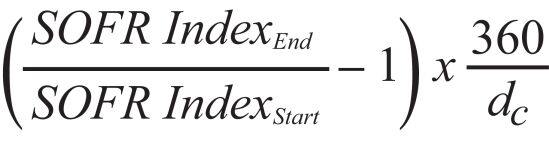
“Compounded SOFR” will be determined by the Calculation Agent in accordance with the following formula (and the resulting percentage will be rounded, if necessary, to the nearest one hundred-thousandth of a percentage point):
where:
“SOFR IndexStart” = For periods other than the initial interest period, the SOFR Index value on the preceding Interest Determination Date, and, for the initial interest period, the SOFR Index value on December , 2025;
“SOFR IndexEnd” = The SOFR Index value on the Interest Determination Date relating to the applicable interest payment date (or, in the final interest period, relating to the maturity date, or in the case of a redemption or repayment of the notes, relating to the applicable redemption or repayment date); and
“dc” is the number of calendar days in the relevant Observation Period.
For purposes of determining Compounded SOFR:
“Interest Determination Date” means the date that is two U.S. Government Securities Business Days before each interest payment date (or, in the final interest period, before the maturity date or, in the case of a redemption or repayment of the notes, before the applicable redemption or repayment date).
“Observation Period” means, in respect of each interest period, the period from and including the date that is two U.S. Government Securities Business Days preceding the first date in such interest period to but excluding the date that is two U.S. Government Securities Business Days preceding the interest payment date for such interest period (or, in the final interest period, preceding the maturity date or, in the case of a redemption or repayment of the notes, preceding the applicable redemption or repayment date).
“SOFR Index” means, with respect to any U.S. Government Securities Business Day, the SOFR Index value as published by the SOFR Administrator (as defined herein) as such index appears on the SOFR Administrator’s Website at 3:00 p.m. (New York time) on such U.S. Government Securities Business Day (the “SOFR Index Determination Time”); provided that if a SOFR Index value does not so appear as specified above at the SOFR Index Determination Time, then: (i) if a Benchmark Transition Event and its related Benchmark Replacement Date have not occurred with respect to SOFR, then Compounded SOFR shall be the rate determined pursuant to the “SOFR Index Unavailable Provisions” described below, or (ii) if a Benchmark Transition Event and its related Benchmark Replacement Date have occurred with respect to SOFR, then Compounded SOFR shall be the rate determined pursuant to the “Effect of Benchmark Transition Event” provisions described below.
“SOFR” means the daily secured overnight financing rate as provided by the SOFR Administrator on the SOFR Administrator’s Website.
“SOFR Administrator” means the Federal Reserve Bank of New York (or a successor administrator of SOFR).
“SOFR Administrator’s Website” means the website of the Federal Reserve Bank of New York, currently at http://www.newyorkfed.org, or any successor source.
“U.S. Government Securities Business Day” means any day except for a Saturday, a Sunday or a day on which the Securities Industry and Financial Markets Association recommends that the fixed income departments of its members be closed for the entire day for purposes of trading in U.S. government securities.
S-12
SOFR Index Unavailable Provisions
If a SOFR IndexStart or SOFR IndexEnd is not published on the associated Interest Determination Date and a Benchmark Transition Event and its related Benchmark Replacement Date have not occurred with respect to SOFR, “Compounded SOFR” means, for the applicable interest period for which such index is not available, the rate of return on a daily compounded interest investment calculated in accordance with the formula for SOFR averages, and definitions required for such formula, published on the SOFR Administrator’s Website, initially located at https://www.newyorkfed.org/markets/treasury-repo-reference-rates-information. For the purposes of this provision, references in the SOFR averages compounding formula and related definitions to “calculation period” shall be replaced with “Observation Period” and the words “that is, 30-, 90-, or 180-calendar days” shall be removed. If SOFR does not so appear for any day “i” in the Observation Period, SOFRi for such day “i” shall be SOFR published in respect of the first preceding U.S. Government Securities Business Day for which SOFR was published on the SOFR Administrator’s Website.
Notwithstanding anything to the contrary in the documentation relating to the notes, if the Issuer or its designee determine on or prior to the relevant Reference Time (as defined herein) that a Benchmark Transition Event and its related Benchmark Replacement Date have occurred with respect to determining Compounded SOFR, then the benchmark replacement provisions set forth below under “—Effect of Benchmark Transition Event” will thereafter apply to all determinations of the rate of interest payable on the notes.
For the avoidance of doubt, in accordance with the benchmark replacement provisions, after a Benchmark Transition Event and its related Benchmark Replacement Date have occurred, the interest rate for each interest period on the notes will be an annual rate equal to the sum of the Benchmark Replacement and the margin specified for the notes in this prospectus supplement; provided, however, that the minimum interest rate on the notes shall not be less than 0.000%. The interest rate on the notes will in no event be higher than the maximum rate permitted by New York law as the same may be modified by United States laws of general application.
Effect of Benchmark Transition Event
Benchmark Replacement. If the Issuer or its designee determine that a Benchmark Transition Event and its related Benchmark Replacement Date have occurred prior to the Reference Time in respect of any determination of the Benchmark (as defined herein) on any date, the Benchmark Replacement will replace the then-current Benchmark for all purposes relating to the notes in respect of such determination on such date and all determinations on all subsequent dates.
Benchmark Replacement Conforming Changes. In connection with the implementation of a Benchmark Replacement, the Issuer or its designee will have the right to make Benchmark Replacement Conforming Changes from time to time.
Decisions and Determinations. Any determination, decision, election or calculation that may be made by the Issuer or its designee pursuant to the benchmark replacement provisions described herein, including any determination with respect to a tenor, rate or adjustment or of the occurrence or non-occurrence of an event, circumstance or date and any decision to take or refrain from taking any action or any selection, will be conclusive and binding absent manifest error, will be made in the Issuer’s or its designee’s sole discretion and notwithstanding anything to the contrary in any documentation relating to the notes, shall become effective without consent from the holders of the notes or any other party.
Certain Defined Terms. As used herein:
“Benchmark” means, initially, Compounded SOFR, as such term is defined above; provided that if a Benchmark Transition Event and its related Benchmark Replacement Date have occurred with respect to Compounded SOFR (or the published SOFR Index used in the calculation thereof) or the then-current Benchmark, then “Benchmark” means the applicable Benchmark Replacement.
S-13
“Benchmark Replacement” means the first alternative set forth in the order below that can be determined by us (or our designee) as of the Benchmark Replacement Date:
| (1) | the sum of (a) the alternate rate of interest that has been selected or recommended by the Relevant Governmental Body as the replacement for the then-current Benchmark for the applicable Corresponding Tenor and (b) the Benchmark Replacement Adjustment; |
| (2) | the sum of (a) the ISDA Fallback Rate and (b) the Benchmark Replacement Adjustment; and |
| (3) | the sum of (a) the alternate rate of interest that has been selected by the Issuer or its designee as the replacement for the then-current Benchmark for the applicable Corresponding Tenor giving due consideration to any industry-accepted rate of interest as a replacement for the then-current Benchmark for U.S. dollar-denominated floating rate notes at such time and (b) the Benchmark Replacement Adjustment. |
“Benchmark Replacement Adjustment” means the first alternative set forth in the order below that can be determined by the Issuer or its designee as of the Benchmark Replacement Date:
| (1) | the spread adjustment, or method for calculating or determining such spread adjustment (which may be a positive or negative value or zero), that has been selected or recommended by the Relevant Governmental Body for the applicable Unadjusted Benchmark Replacement; |
| (2) | if the applicable Unadjusted Benchmark Replacement is equivalent to the ISDA Fallback Rate, then the ISDA Fallback Adjustment; and |
| (3) | the spread adjustment (which may be a positive or negative value or zero) that has been selected by the Issuer or its designee giving due consideration to any industry-accepted spread adjustment, or method for calculating or determining such spread adjustment, for the replacement of the then-current Benchmark with the applicable Unadjusted Benchmark Replacement for U.S. dollar-denominated floating rate notes at such time. |
The Benchmark Replacement Adjustment shall not include the margin specified for the notes in this prospectus supplement, and such margin shall be applied to the Benchmark Replacement to determine the interest payable on the notes.
“Benchmark Replacement Conforming Changes” means, with respect to any Benchmark Replacement, any technical, administrative or operational changes (including changes to the definition or interpretation of “interest period,” timing and frequency of determining rates and making payments of interest, rounding of amounts or tenors, changes to the definition of “Corresponding Tenor” solely when such tenor is longer than the interest period and other administrative matters) that the Issuer or its designee decide may be appropriate to reflect the adoption of such Benchmark Replacement in a manner substantially consistent with market practice (or, if the Issuer or its designee decide that adoption of any portion of such market practice is not administratively feasible or if the Issuer or its designee determine that no market practice for use of the Benchmark Replacement exists, in such other manner as the Issuer or its designee determine is reasonably necessary or practicable).
“Benchmark Replacement Date” means the earliest to occur of the following events with respect to the then-current Benchmark:
| (1) | in the case of clause (1) or (2) of the definition of “Benchmark Transition Event,” the later of (a) the date of the public statement or publication of information referenced therein and (b) the date on which the administrator of the Benchmark permanently or indefinitely ceases to provide the Benchmark; and |
| (2) | in the case of clause (3) of the definition of “Benchmark Transition Event,” the date of the public statement or publication of information referenced therein. |
S-14
For the avoidance of doubt, if the event giving rise to the Benchmark Replacement Date occurs on the same day as, but earlier than, the Reference Time in respect of any determination, the Benchmark Replacement Date will be deemed to have occurred prior to the Reference Time for such determination.
“Benchmark Transition Event” means the occurrence of one or more of the following events with respect to the then-current Benchmark:
| (1) | a public statement or publication of information by or on behalf of the administrator of the Benchmark announcing that such administrator has ceased or will cease to provide the Benchmark, permanently or indefinitely; provided that, at the time of such statement or publication, there is no successor administrator that will continue to provide the Benchmark; |
| (2) | a public statement or publication of information by the regulatory supervisor for the administrator of the Benchmark, the central bank for the currency of the Benchmark, an insolvency official with jurisdiction over the administrator for the Benchmark, a resolution authority with jurisdiction over the administrator for the Benchmark or a court or an entity with similar insolvency or resolution authority over the administrator for the Benchmark, which states that the administrator of the Benchmark has ceased or will cease to provide the Benchmark permanently or indefinitely; provided that, at the time of such statement or publication, there is no successor administrator that will continue to provide the Benchmark; or |
| (3) | a public statement or publication of information by the regulatory supervisor for the administrator of the Benchmark announcing that the Benchmark is no longer representative. |
“Corresponding Tenor” with respect to a Benchmark Replacement means a tenor (including overnight) having approximately the same length (disregarding business day adjustment) as the applicable tenor for the then-current Benchmark.
“ISDA Definitions” means the 2021 ISDA Definitions published by the International Swaps and Derivatives Association, Inc. or any successor thereto, as amended or supplemented from time to time, or any successor definitional booklet for interest rate derivatives published from time to time.
“ISDA Fallback Adjustment” means the spread adjustment (which may be a positive or negative value or zero) that would apply for derivatives transactions referencing the ISDA Definitions to be determined upon the occurrence of an index cessation event with respect to the Benchmark for the applicable tenor.
“ISDA Fallback Rate” means the rate that would apply for derivatives transactions referencing the ISDA Definitions to be effective upon the occurrence of an index cessation date with respect to the Benchmark for the applicable tenor, excluding the applicable ISDA Fallback Adjustment.
“Reference Time” with respect to any determination of the Benchmark means (1) if the Benchmark is Compounded SOFR, the SOFR Index Determination Time, as such time is defined above, and (2) if the Benchmark is not Compounded SOFR, the time determined by us (or our designee) in accordance with the Benchmark Replacement Conforming Changes.
“Relevant Governmental Body” means the Board of Governors of the Federal Reserve System and/or the Federal Reserve Bank of New York, or a committee officially endorsed or convened by the Board of Governors of the Federal Reserve System and/or the Federal Reserve Bank of New York or any successor thereto.
“Unadjusted Benchmark Replacement” means the Benchmark Replacement, excluding the Benchmark Replacement Adjustment.
S-15
Optional Redemption
Any or all of the notes may be redeemed at the Issuer’s option at any time or from time to time, in amounts of $1,000 or any multiple of $1,000 in excess thereof, at the following redemption prices (in each case expressed as a percentage of the principal amount), if redeemed during the twelve-month periods beginning on December 15 of any of the following years:
| Year | Redemption Price |
|||
| 2055 |
105.000% | |||
| 2056 |
104.500% | |||
| 2057 |
104.000% | |||
| 2058 |
103.500% | |||
| 2059 |
103.000% | |||
| 2060 |
102.500% | |||
| 2061 |
102.000% | |||
| 2062 |
101.500% | |||
| 2063 |
101.000% | |||
| 2064 |
100.500% | |||
| 2065 |
100.000% | |||
and thereafter at 100.000% of the principal amount, in each case, together with any accrued and unpaid interest to, but excluding, the redemption date (subject to the right of holders of record on relevant record dates to receive interest due on an interest payment date).
Notice of any redemption will be mailed or electronically delivered (or otherwise transmitted in accordance with the depositary’s procedures) at least 10 days but not more than 60 days before the redemption date to each holder of the notes to be redeemed. Unless we default in the payment of the redemption price, on and after the redemption date, interest will cease to accrue on the notes or portions of the notes called for redemption.
In the case of a partial redemption, selection of the notes for redemption will be made pro rata, by lot or by such other method as the Trustee in its sole discretion deems appropriate and fair. No notes of a principal amount of $1,000 or less will be redeemed in part. If any note is to be redeemed in part only, the notice of redemption that relates to the note will state the portion of the principal amount of the note to be redeemed. A new note in a principal amount equal to the unredeemed portion of the note will be issued in the name of the holder of the note upon surrender for cancellation of the original note. For so long as the notes are held by DTC the redemption of the notes shall be done in accordance with the policies and procedures of the depositary.
Any notice of redemption of the notes to be redeemed at the Issuer’s or its designee’s option may state that such redemption shall be conditional, in the Issuer’s or its designee’s discretion, on one or more conditions precedent, and that the redemption date may (but shall not be required to) be delayed until such time as any or all of such conditions have been satisfied, and that such conditional notice of redemption may be rescinded by the Issuer or its designee if the Issuer or its designee determines that any or all such conditions will not be satisfied by the redemption date, and that in such event, such redemption notice shall be of no further force or effect and the Issuer or its designee shall not be required to redeem the notes on the redemption date or otherwise.
S-16
Repayment at Option of Holder
The notes will be repayable at the option of a holder of the notes, in whole or in part, on the repayment dates and at the repayment prices (in each case expressed as a percentage of the principal amount) as set forth in the following table:
| Repayment Date | Repayment Price |
|||
| December 15, 2026 |
98.000% | |||
| June 15, 2027 |
98.000% | |||
| December 15, 2027 |
98.000% | |||
| June 15, 2028 |
98.000% | |||
| December 15, 2028 |
98.000% | |||
| June 15, 2029 |
98.000% | |||
| December 15, 2029 |
98.000% | |||
| June 15, 2030 |
98.000% | |||
| December 15, 2030 |
98.000% | |||
| June 15, 2031 |
98.000% | |||
| December 15, 2031 |
99.000% | |||
| June 15, 2032 |
99.000% | |||
| December 15, 2032 |
99.000% | |||
| June 15, 2033 |
99.000% | |||
| December 15, 2033 |
99.000% | |||
| June 15, 2034 |
99.000% | |||
| December 15, 2034 |
99.000% | |||
| June 15, 2035 |
99.000% | |||
| December 15, 2035 |
99.000% | |||
| June 15, 2036 |
99.000% | |||
| December 15, 2036 |
100.000% | |||
and on December 15 of every second year thereafter, through and including December 15, 2075, at 100.000% of the principal amount, in each case, together with any accrued and unpaid interest thereon to but excluding the repayment date.
In order for a note to be repaid, at least 30 but not more than 60 calendar days before the optional repayment date:
| (1) | for notes in definitive form, the paying agent must receive (i) the note with the form entitled “Option to Elect Repayment” on the reverse of the note duly completed or (ii) a facsimile transmission or a letter from a member of a national securities exchange or a member of the Financial Industry Regulatory Authority, Inc. or a commercial bank or trust company in the United States which must set forth: |
| • | the name of the holder of the note; |
| • | the principal amount of the note; |
| • | the principal amount of the note to be repaid; |
| • | the certificate number, CUSIP number or a description of the tenor and terms of the note; |
| • | a statement that the option to elect repayment is being exercised; and |
| • | a guaranty that the note is to be repaid. |
These items, together with the duly completed form entitled “Option to Elect Repayment” on the reverse of the note, must be received by the Paying Agent not later than the fifth business day after the date of that facsimile transmission or letter; and
S-17
| (2) | for notes in book-entry form, notes may be tendered for optional repayment electronically in accordance with DTC’s processes and procedures. |
The repayment option may be exercised by the holder of a note for less than the entire principal amount of the note but, in that event, the principal amount of the note remaining outstanding after repayment must be in an authorized denomination. Exercise of the repayment by the holder of a note shall be irrevocable.
Conditional Right to Shorten Maturity
We intend to deduct interest paid on the notes for United States federal income tax purposes. However, there have been proposed tax law changes in the past that, among other things, would have prohibited an issuer from deducting interest payments on debt instruments such as the notes. We cannot assure you that similar legislation affecting our ability to deduct interest paid on the notes will not be enacted in the future or that any such legislation would not have a retroactive effective date. As a result, we cannot assure you that a tax event (as defined below) will not occur.
If a tax event occurs, the Issuer will have the right to shorten the maturity of the notes, without the consent of the holders of the notes, to the minimum extent required, in the opinion of nationally recognized independent tax counsel, so that, after shortening the maturity, interest paid on the notes will be deductible for United States federal income tax purposes or, if that counsel cannot opine definitively as to such a minimum period, the minimum extent so required to maintain our interest deduction to the extent deductible under current law as determined in good faith by the Issuer’s board of directors, after receipt of an opinion of that counsel regarding the applicable legal standards. In that case, the amount payable on the notes on that new maturity date will be equal to 100% of the principal amount of the notes plus interest accrued thereon to but excluding that new maturity date. The Issuer cannot assure you that the Issuer would not exercise its right to shorten the maturity of the notes if a tax event occurs or as to the period that the maturity would be shortened. If the Issuer elects to exercise the right to shorten the maturity of the notes when a tax event occurs, the Issuer will give notice to each holder of the notes not more than 60 days after the occurrence of the tax event, stating the new maturity date of the notes. This notice shall be effective immediately upon mailing or other delivery.
We believe that the notes should constitute indebtedness for United States federal income tax purposes under current law and, in that case, an exercise of the Issuer’s right to shorten the maturity of the notes upon a tax event should not be a taxable event to holders for those purposes. Prospective investors should be aware, however, that the Issuer’s exercise of its right to shorten the maturity of the notes would be a taxable exchange to holders for United States federal income tax purposes if the notes are treated as equity for United States federal income tax purposes before the maturity is shortened, assuming that the notes of shortened maturity are treated as debt for those purposes. Prospective purchasers of the notes should consult with their own tax advisors with respect to these and other tax matters relating to the notes.
“Tax event” means that the Issuer shall have received an opinion of nationally recognized independent tax counsel to the effect that, as a result of:
| • | any amendment to, clarification of, or change (including any announced prospective amendment, clarification or change) in any law, or any regulation thereunder, of the United States; |
| • | any judicial decision, official administrative pronouncement, ruling, regulatory procedure, regulation, notice or announcement; |
| • | including any notice or announcement of intent to adopt or promulgate any ruling, regulatory procedure or regulation (any of the foregoing, an “administrative or judicial action”); or |
| • | any amendment to, clarification of, or change in any official position with respect to, or any interpretation of, an administrative or judicial action or a law or regulation of the United States that differs from the previously generally accepted position or interpretation, |
S-18
in each case, occurring on or after December , 2025, there is more than an insubstantial increase in the risk that interest paid by the Issuer on the notes is not, or will not be, deductible, in whole or in part, by us for United States federal income tax purposes.
For the avoidance of doubt, following the exercise by the Issuer of its right to shorten the maturity of the notes when a tax event occurs, any references to “maturity date” herein shall refer to the new maturity date.
Notes Used as Qualified Replacement Property
Prospective investors seeking to treat the notes as “qualified replacement property” for purposes of Section 1042, should be aware that Section 1042 requires the Issuer to meet certain requirements in order for the notes to constitute qualified replacement property. In general, qualified replacement property is a security issued by a “domestic operating corporation” that did not, for the taxable year preceding the taxable year in which such security was purchased, have “passive investment income” in excess of 25 percent of the gross receipts of such corporation for such preceding taxable year (the “Passive Income Test”).
For purposes of Section 1042, a domestic operating corporation is generally a domestic corporation more than 50% of the assets of which were, at or before certain times, used in the active conduct of the corporation’s trade or business.
For purposes of the Passive Income Test, where the issuing corporation is in control of one or more corporations, all such corporations are treated as one corporation (the “Affiliated Group”) for the purposes of computing the amount of passive investment income for purposes of Section 1042.
We believe that we qualify as a domestic operating corporation within the meaning of Section 1042 and that less than 25 percent of our Affiliated Group’s gross receipts is passive investment income for the taxable year ended December 31, 2024. In making this determination, we have made certain assumptions and used procedures which we believe are reasonable. We cannot give any assurance as to whether we currently do, or will continue to, qualify as a domestic operating corporation or meet the Passive Income Test. It is, in addition, possible that the Internal Revenue Service (the “IRS”) may disagree with the manner in which we have calculated our Affiliated Group’s gross receipts (including the characterization of those gross receipts) and passive investment income, the manner in which we determined our status as a domestic operating corporation within the meaning of Section 1042, and the conclusions reached in this discussion. Prospective purchasers of the notes should consult with their own tax advisors with respect to these and other tax matters relating to the notes.
Further Issues
The Issuer may from time to time, without notice to or the consent of the registered holders of notes, create and issue further notes ranking equally with the notes in all respects. Such further notes may be consolidated and form a single series with the notes and have the same terms as to status, redemption or repayment or otherwise as the notes (other than the issue date of such further notes and first payment of interest following the issue date of such further notes); provided that if such additional notes are not fungible with the then-outstanding notes for U.S. federal income tax purposes, the additional notes will have a separate CUSIP number.
Covenants of CUSA
The indenture sets forth limited covenants that will apply to the notes, as further described in the accompanying prospectus. However, these covenants do not, among other things:
| • | limit the Issuer or the Guarantor’s ability or that of their respective subsidiaries to issue, assume or guarantee debt secured by liens (including in connection with any consolidation or merger); or |
| • | place any restrictions on sale and leaseback transactions. |
S-19
Certain other debt securities of the Issuer or the Guarantor currently outstanding benefit from the covenants noted above. Unlike holders of those other debt securities, holders of the notes will not have the benefit of those covenants noted above.
Book-Entry System
The notes will be issued in the form of one fully registered global note which will be deposited with, or on behalf of, DTC and registered in the name of a nominee of DTC. Except as hereinafter set forth, the notes will be available for purchase in book-entry form only. The term “depositary” as used in this prospectus supplement refers to DTC or any successor depositary.
None of the Issuer, the Guarantor or the trustee will have any responsibility, obligation or liability to any participant, to any indirect participant or to any beneficial owner with respect to:
| • | the accuracy of any records maintained by DTC, Cede & Co., any participant or any indirect participant, |
| • | the payment by DTC or any participant or indirect participant of any amount with respect to the principal of or interest on the notes, |
| • | any notice which is permitted or required to be given to registered owners of notes under the indenture, or |
| • | any consent given or other action taken by DTC as the registered owner of the notes, or by participants as assignees of DTC as the registered owner of each issue of notes. |
The Depository Trust Company
DTC has advised the Issuer and the Guarantor as follows: DTC is a limited-purpose trust company organized under the New York Banking Law, a “banking organization” within the meaning of the New York Banking Law, a member of the Federal Reserve System, a “clearing corporation” within the meaning of the New York Uniform Commercial Code and a “clearing agency” registered under Section 17A of the Exchange Act. DTC holds securities that its participants deposit with DTC and facilitates the settlement among participants of securities transactions, such as transfers and pledges, in deposited securities through electronic computerized book-entry changes in participants’ accounts, thereby eliminating the need for physical movement of securities certificates. Direct participants include securities brokers and dealers, banks, trust companies, clearing corporations and other organizations. DTC is a wholly-owned subsidiary of The Depository Trust & Clearing Corporation (“DTCC”). DTCC is the holding company for DTC, National Securities Clearing Corporation and Fixed Income Clearing Corporation, all of which are registered agencies. DTCC is owned by the users of its regulated subsidiaries. Access to the DTC system is also available to others such as securities brokers and dealers, banks and trust companies that clear through or maintain a custodial relationship with a direct participant, either directly or indirectly. Persons who are not participants may beneficially own securities held by the depositary only through direct or indirect participants.
DTC also advises that pursuant to procedures established by it, upon deposit by the Issuer of the global note with DTC or its custodian, DTC or its nominee will credit, on its internal system, the respective principal amounts of the notes represented by such global note to the accounts of direct participants. The accounts to be credited will be designated by the underwriters. Ownership of beneficial interests in notes represented by the global note will be limited to participants or persons that hold interests through participants. Ownership of such beneficial interests in notes will be shown on, and the transfer of that ownership will be effected only through, records maintained by the depositary (with respect to interests of direct participants), or by direct and indirect participants or persons that may hold interests through such participants (with respect to persons other than participants).
S-20
So long as the depositary or its nominee is the registered owner of the global note, the depositary or its nominee, as the case may be, will be considered the sole owner or holder of the notes represented thereby for all purposes under the indenture. Except as hereinafter provided, owners of beneficial interests in the global note will not be entitled to have the notes represented by a global note registered in their names, will not receive or be entitled to receive physical delivery of such notes in definitive form and will not be considered the owners or holders thereof under the indenture. Unless and until the global note is exchanged in whole or in part for individual certificates evidencing the notes represented thereby, the global note may not be transferred except as a whole by the depositary to a nominee of the depositary or by a nominee of the depositary to the depositary or another nominee of the depositary or by the depositary or any nominee of the depositary to a successor depositary or any nominee of such successor depositary.
Payments of principal of and interest on the notes represented by the global note will be made to the depositary or its nominee, as the case may be, as the registered owner of the notes. The Issuer and the Guarantor have been informed by DTC that, upon receipt of any payment on the global note, DTC’s practice is to credit participants’ accounts on the payment date therefor with payments in amounts proportionate to their respective beneficial interests in the notes represented by the global note as shown on the records of DTC or its nominee. Payments by participants to owners of beneficial interests in the notes will be governed by standing instructions and customary practices, as is now the case with securities held for the accounts of customers in bearer form or registered in “street name.” Such payments will be the responsibility of such participants.
Because DTC can only act on behalf of participants, who in turn act on behalf of indirect participants and certain banks, the ability of a person having a beneficial interest in notes represented by the global note to pledge such interest to persons or entities that do not participate in the DTC system, or otherwise take actions in respect of such interest, may be affected by the lack of a physical certificate evidencing such interest.
The Issuer will recognize DTC or its nominee as the sole registered owner of the notes for all purposes, including notices and consents. Conveyance of notices and other communications by DTC to participants, by participants to indirect participants, and by participants and indirect participants to beneficial owners will be governed by arrangements among them, subject to any statutory and regulatory requirements as may be in effect from time to time.
So long as the notes are outstanding in the form of the global note registered in the name of DTC or its nominee Cede & Co.:
| • | all payments of interest on and principal of the notes shall be delivered only to DTC or Cede & Co.; |
| • | all notices delivered by the Issuer or the trustee pursuant to the indenture shall be delivered only to DTC or Cede & Co.; and |
| • | all rights of the registered owners of notes under the indenture, including, without limitation, voting rights, rights to approve, waive or consent, and rights to transfer and exchange notes, shall be rights of DTC or Cede & Co. |
The beneficial owners of the notes must rely on the participants or indirect participants for timely payments and notices and for otherwise making available to the beneficial owner rights of a registered owner. No assurance can be provided that in the event of bankruptcy or insolvency of DTC, a participant or an indirect participant through which a beneficial owner holds interests in the notes, payment will be made by DTC, such participant or such indirect participant on a timely basis.
The DTC rules applicable to its participants are on file with the Commission. More information about DTC can be found at www.dtcc.com. Except for the documents specifically incorporated by reference into this prospectus supplement or the accompanying prospectus, information contained on DTC’s website or that can be accessed through the website does not constitute a part of this prospectus supplement or the accompanying prospectus. The Issuer has included this website address only as an inactive textual reference and does not intend it to be an active link to the website.
S-21
If the depositary is at any time unwilling or unable to continue as depositary and a successor depositary is not appointed by the Issuer within 90 days, the Issuer will issue individual notes in definitive form in exchange for the global note. In addition, the Issuer may at any time and in its sole discretion determine not to have the notes in the form of a global security, and, in such event, the Issuer will issue individual notes in definitive form in exchange for the global note. In either instance, the Issuer will issue notes in definitive form, equal in aggregate principal amount to the global note, in such names and in such principal amounts as the depositary shall direct. Notes so issued in definitive form will be issued as fully registered notes in denominations of $1,000 or any amount in excess thereof which is an integral multiple of $1,000.
Clearance and Settlement Procedures
Settlement for the notes will be made by the underwriters in immediately available funds.
DTC has advised the Issuer and the Guarantor as follows: Secondary market trading in the notes between DTC participants will occur in the ordinary way in accordance with DTC rules and will be settled in immediately available funds using DTC’s Same-Day Funds Settlement System. No assurance can be given as to the effect, if any, of settlement in immediately available funds on trading activity (if any) in the notes.
S-22
CERTAIN UNITED STATES FEDERAL INCOME TAX CONSIDERATIONS
This section describes the material United States federal income tax consequences of owning the notes the Issuer is offering. It applies to you only if you acquire notes at the offering price and you hold your notes as capital assets for tax purposes. This section addresses only United States federal income taxation and does not discuss all of the tax consequences that may be relevant to you in light of your individual circumstances, including foreign, state or local tax consequences, and tax consequences arising under the Medicare contribution tax on net investment income or the alternative minimum tax. This section does not apply to you if you are a member of a class of holders subject to special rules, such as:
| • | a dealer in securities, |
| • | a trader in securities that elects to use a mark-to-market method of accounting for your securities holdings, |
| • | a bank, |
| • | a life insurance company, |
| • | a tax-exempt organization, |
| • | a person that owns notes that are a hedge or that are hedged against interest rate risks, |
| • | a person that owns notes as part of a straddle or conversion transaction for tax purposes, |
| • | a person that purchases or sells notes as part of a wash sale for tax purposes, or |
| • | a United States holder (as defined below) whose functional currency for tax purposes is not the U.S. dollar. |
This section is based on the Code, its legislative history, existing and proposed regulations under the Code, published rulings and court decisions, all as currently in effect. These laws are subject to change, possibly on a retroactive basis.
If an entity or arrangement that is treated as a partnership for United States federal income tax purpose holds the notes, the United States federal income tax treatment of a partner will generally depend on the status of the partner and the tax treatment of the partnership. A partner in a partnership holding the notes should consult its tax advisor with regard to the United States federal income tax treatment of an investment in the notes.
Please consult your own tax advisor concerning the consequences of owning these notes in your particular circumstances under the Code and the laws of any other taxing jurisdiction.
United States Holders
This subsection describes the tax consequences to a United States holder. You are a United States holder if you are a beneficial owner of a note and you are, for United States federal income tax purposes:
| • | a citizen or resident of the United States, |
| • | a domestic corporation, |
| • | an estate whose income is subject to United States federal income tax regardless of its source, or |
| • | a trust if a United States court can exercise primary supervision over the trust’s administration and one or more United States persons are authorized to control all substantial decisions of the trust. |
If you are not a United States holder, this subsection does not apply to you and you should refer to “Non-United States Holders” below.
S-23
Payments of Interest. You will be taxed on interest on your note as ordinary income at the time you receive the interest or when it accrues, depending on your method of accounting for tax purposes.
Sale, Retirement and Other Disposition of the Notes. Your tax basis in your note generally will be its cost. You will generally recognize capital gain or loss on the sale exchange, redemption retirement, or other taxable disposition of your note equal to the difference between the amount you realize on the disposition, excluding any amounts attributable to accrued but unpaid interest (which will be treated as interest payments), and your tax basis in your note. Capital gain of a noncorporate United States holder is generally taxed at preferential rates where the property is held for more than one year.
Non-United States Holders
This subsection describes the tax consequences to a Non-United States holder. You are a Non-United States holder if you are a beneficial owner of a note and you are, for United States federal income tax purposes:
| • | a nonresident alien individual, |
| • | a foreign corporation or |
| • | an estate or trust that in either case is not subject to United States federal income tax on a net income basis on income or gain from a note. |
If you are a United States holder, this subsection does not apply to you.
Payments of Interest. Subject to the discussion below under “Backup Withholding and Information Reporting” and “FATCA Withholding,” interest on the notes that is not effectively connected with your conduct of a trade or business in the United States will generally be exempt from United States federal income and withholding tax under the “portfolio interest exemption,” provided that:
| • | you do not own, actually or constructively, 10% or more of the total combined voting power of all classes of the Issuer’s stock entitled to vote; |
| • | you are not a controlled foreign corporation related to us, actually or constructively; and |
| • | either (a) you submit to the applicable withholding agent a properly executed IRS Form W-8BEN or W-8BEN-E (or other applicable form), that includes your name and address and upon which you certify, under penalties of perjury, your non-United States status in compliance with applicable law and regulations, or (b) a securities clearing organization, bank or other financial institution that holds customers’ securities in the ordinary course of its trade or business provides a statement to the applicable withholding agent under penalties of perjury on which it certifies that an applicable IRS Form W-8BEN or W-8BEN-E (or other applicable form) has been received by it from you or a qualifying intermediary and furnishes a copy to the applicable withholding agent. |
This certification requirement may be satisfied with other documentary evidence in the case of a note held in an offshore account or through certain foreign intermediaries. The applicable withholding agent for purposes of the certification requirement described above is generally the last United States payor (or a non-U.S. payor that is a qualified intermediary or a United States branch of a foreign person) in the chain of payment before payment to you.
If you cannot satisfy the requirements of the portfolio interest exemption described above, then payments of interest on the notes made to you generally will be subject to United States federal withholding tax at the rate of 30%, unless either (i) you provide the applicable withholding agent with a properly executed IRS Form W-8BEN or W-8BEN-E establishing an exemption from or reduction of the withholding tax under the benefit of an applicable income tax treaty or (ii) the interest is effectively connected with your conduct of a trade or business in the United States (or attributable to a permanent establishment in the United States if so required under an applicable income tax treaty) and you provide an appropriate statement to that effect on a properly completed and duly executed IRS Form W-8ECI.
S-24
If you are engaged in a trade or business in the United States and interest on a note is effectively connected with the conduct of that trade or business, you will be subject to United States federal income tax on such interest on a net income basis in generally the same manner as a United States holder, unless an applicable income tax treaty provides otherwise. If you are a Non-United States holder that is treated as a foreign corporation for United States federal income tax purposes, you may also be subject to a branch profits tax at a 30% rate (or lower applicable treaty rate) on your effectively connected earnings and profits, subject to adjustments.
Sale, Retirement and Other Disposition of the Notes. Subject to the discussion below under “Backup Withholding and Information Reporting,” you generally will not be subject to United States federal income or withholding tax on gain realized on a sale, exchange, redemption retirement, or other taxable disposition of the notes (other than any amount representing accrued but unpaid interest, which will be treated as interest and will generally be subject to the rules discussed above under “Payments of Interest”), unless:
| • | you are an individual, you are present in the United States for 183 or more days during the taxable year in which the gain is realized and certain other conditions exist; or |
| • | the gain is effectively connected with your conduct of a trade or business in the United States. |
If you are described in the first bullet point above, you generally will be subject to United States federal income tax at a flat rate of 30% (unless a lower treaty rate applies) on your gain from the disposition, which may be offset by certain United States-source capital losses. If you are described in the second bullet point above, you will be subject to United States federal income tax on such gain on a net income basis in generally the same manner as a United States holder, unless an applicable income tax treaty provides otherwise. If you are a Non-United States holder that is treated as a foreign corporation for United States federal income tax purposes, you may also be subject to a branch profits tax at a 30% rate (or lower applicable treaty rate) on your effectively connected earnings and profits, subject to adjustments.
Estate Tax. A note held by an individual who at death is not a citizen or resident of the United States would not be includible in the individual’s gross estate for United States federal estate tax purposes if:
| • | the decedent did not actually or constructively own 10% or more of the total combined voting power of all classes of the Issuer’s stock entitled to vote at the time of death; and |
| • | the income on the note would not have been effectively connected with a United States trade or business of the decedent at the same time. |
Backup Withholding and Information Reporting
If you are a noncorporate United States holder, the applicable withholding agent will be required to report to the IRS all payments of principal and interest on your note (unless you are an exempt recipient). In addition, the applicable withholding agent will be required to report to the IRS any payment of proceeds of the sale of your note before maturity within the United States (unless you are an exempt recipient). Additionally, backup withholding may apply to such payments if you fail to comply with applicable certification requirements or (in the case of interest payments) are notified by the IRS that you have failed to report all interest and dividends required to be shown on your federal income tax returns.
If you are a Non-United States holder, the applicable withholding agent will be required to report payments of interest on your notes on IRS Form 1042-S. Payments of principal or interest on the notes would otherwise not be subject to information reporting and backup withholding, provided that the certification requirements described above under “— Non-United States Holders—Payments of Interest” are satisfied or you otherwise establish an exemption. In addition, payment of the proceeds from the sale of notes effected at a United States office of a broker will not be subject to backup withholding and information reporting if you have furnished to the applicable withholding agent an appropriate IRS Form W-8, an acceptable substitute form or other documentation upon which it may rely to treat the payment as made to a non-United States person.
S-25
Payment of the proceeds from the sale of a note effected at a foreign office of a broker generally will not be subject to information reporting or backup withholding. However, a sale effected at a foreign office of a broker could be subject to information reporting in the same manner as a sale within the United States (and in certain cases may be subject to backup withholding as well) if (i) the broker has certain connections to the United States, (ii) the proceeds or confirmation are sent to the United States or (iii) the sale has certain other specified connections with the United States.
You generally may obtain a refund of any amounts withheld under the backup withholding rules that exceed your income tax liability by filing a refund claim with the IRS.
FATCA Withholding
Pursuant to sections 1471 through 1474 of the Code, commonly known as the Foreign Account Tax Compliance Act (“FATCA”), a 30% withholding tax (“FATCA withholding”) may be imposed on certain payments to you or to certain foreign financial institutions, investment funds and other non-United States persons receiving payments on your behalf if you or such persons fail to comply with certain information reporting requirements. Payments of interest that you receive in respect of the notes could be affected by this withholding if you are subject to the FATCA information reporting requirements and fail to comply with them or if you hold notes through a non-United States person (e.g., a foreign bank or broker) that fails to comply with these requirements (even if payments to you would not otherwise have been subject to FATCA withholding). These requirements may be modified by the adoption or implementation of an intergovernmental agreement between the United States and another country or by future United States Treasury Regulations. Documentation that you provide in order to be treated as FATCA compliant may be reported to the IRS and other tax authorities. You should consult your own tax advisors regarding the relevant United States law and other official guidance on FATCA withholding.
Depending on your circumstances, you may be entitled to a refund or credit in respect of some or all of this withholding. However, even if you are entitled to have any such withholding refunded, the required procedures could be cumbersome and significantly delay the holder’s receipt of any amounts withheld.
S-26
Under the terms and subject to the conditions contained in the underwriting agreement, the Issuer has agreed to sell to each of the underwriters named below, for whom Morgan Stanley & Co. LLC, J.P. Morgan Securities LLC and RBC Capital Markets, LLC are acting as representatives, and each of them has severally agreed to purchase the principal amount of the notes set forth opposite its name at the public offering price less the underwriting discounts set forth on the cover page of this prospectus supplement.
| Underwriters |
Principal Amount of Notes | |
| Morgan Stanley & Co. LLC |
$ | |
| J.P. Morgan Securities LLC |
||
| RBC Capital Markets, LLC |
||
|
| ||
| Total |
$ | |
|
|
The underwriting agreement provides that the underwriters are obligated to purchase and pay for all of the notes if any are purchased. The underwriting agreement also provides that if an underwriter defaults, the purchase commitments of the non-defaulting underwriters may be increased or the offering of the notes may be terminated.
The Issuer and the Guarantor have been advised by the underwriters that they propose to offer the notes initially directly to the public at the respective public offering price set forth on the cover page of this prospectus supplement. After the initial public offering of the notes is completed, the public offering price may change. The offering of the notes by the underwriters is subject to receipt and acceptance and subject to the underwriters’ right to reject any order in whole or in part.
The notes are new issues of securities with no established trading market. The Issuer and the Guarantor have been advised by the underwriters that one or more of the underwriters intend to make as applicable, a secondary market in the notes; however, they are not obligated to do so and may discontinue secondary market making for the notes at any time without notice. No assurance can be given as to the liquidity of the trading markets for the notes. The Issuer has no intention to list the notes on any securities exchange or quotation system.
The Issuer and the Guarantor have agreed to indemnify the several underwriters against certain liabilities, including liabilities under the Securities Act, or to contribute to payments which the several underwriters may be required to make in respect of such liabilities.
Certain of the underwriters or their affiliates have in the past and may in the future provide investment and commercial banking and other related services to Chevron and its affiliated companies in the ordinary course of business for which such underwriters or their affiliates have received or may receive customary fees and reimbursement of their out-of-pocket expenses.
In addition, in the ordinary course of their business activities, the underwriters and their affiliates may make or hold a broad array of investments and actively trade debt and equity securities (or related derivative securities) and financial instruments (including bank loans) for their own account and for the accounts of their customers. Such investments and securities activities may involve securities and/or instruments of the Guarantor, the Issuer, or their respective affiliates. If any of the underwriters or their affiliates have a lending relationship with Chevron, certain of those underwriters or their affiliates routinely hedge, and certain other of those underwriters or their affiliates may hedge, their credit exposure to Chevron consistent with their customary risk management policies. Typically, these underwriters and their affiliates would hedge such exposure by entering into transactions which consist of either the purchase of credit default swaps or the creation of short positions in the securities of the Guarantor or the Issuer, including potentially the notes offered hereby. Any such credit default swaps or short positions could adversely affect future trading prices of the notes offered hereby. The underwriters
S-27
and their affiliates may also make investment recommendations and/or publish or express independent research views in respect of such securities or financial instruments and may hold, or recommend to clients that they acquire, long and/or short positions in such securities and instruments.
Chevron estimates that its out-of-pocket expenses for this offering, excluding the underwriting discounts, will not exceed $0.75 million.
We expect that delivery of the notes will be made to investors on or about December , 2025, which will be the third business day following the time of sale (this settlement cycle being referred to as “T+3”). Under Rule 15c6-1 under the Exchange Act, trades in the secondary market generally are required to settle in one business day unless the parties to any such trade expressly agree otherwise. Accordingly, purchasers who wish to trade the notes prior to one business day before delivery of the notes hereunder will be required, by virtue of the fact that the notes initially will settle in T+3, to specify an alternative settlement cycle at the time of any such trade to prevent a failed settlement. Purchasers of the notes who wish to trade the notes prior to one business day before delivery of the notes hereunder should consult their own advisors.
In connection with the offering, the representatives, on behalf of the underwriters, may purchase and sell the notes in the open market. These transactions may include over-allotment, syndicate covering transactions and stabilizing transactions.
| • | Over-allotment involves syndicate sales of the notes in excess of the principal amount of the notes to be purchased by the underwriters in the offering, which creates a syndicate short position. |
| • | Syndicate covering transactions involve purchases of the notes in the open market after the distribution has been completed in order to cover syndicate short positions. |
| • | Stabilizing transactions consist of certain bids or purchases of the notes made for the purpose of preventing or retarding a decline in the market price of the notes while the offering is in progress. |
The representatives, on behalf of the underwriters, may also impose a penalty bid. Penalty bids permit the representatives to reclaim a selling concession from a syndicate member when the representatives, in covering syndicate short positions or making stabilizing purchases, repurchases of the notes originally sold by that syndicate member.
Any of these activities may cause the price of the notes to be higher than the price that otherwise would exist in the open market in the absence of such transactions. These transactions may be effected in the over-the-counter market or otherwise, and, if commenced, may be discontinued at any time.
S-28
The validity of the notes offered by CUSA will be passed upon by Morgan, Lewis & Bockius LLP, Pittsburgh, Pennsylvania. The validity of the Guaranty issued by Chevron Corporation will be passed upon by Sullivan & Cromwell LLP, New York, New York. Certain legal matters will be passed upon for the underwriters by Cleary Gottlieb Steen & Hamilton LLP, New York, New York.
The consolidated financial statements and management’s assessment of the effectiveness of internal control over financial reporting (which is included in Management’s Report on Internal Control over Financial Reporting) incorporated in this prospectus by reference to the Annual Report on Form 10-K for the year ended December 31, 2024 have been so incorporated in reliance on the report of PricewaterhouseCoopers LLP, an independent registered public accounting firm, given on the authority of said firm as experts in auditing and accounting.
S-29
PROSPECTUS
| Chevron Corporation | Chevron U.S.A. Inc. | |
| DEBT SECURITIES GUARANTEES |
DEBT SECURITIES | |
Chevron Corporation and Chevron U.S.A. Inc. (“CUSA”) may offer debt securities from time to time. Market conditions at the time of sale will determine the terms of any securities offered. Debt securities sold by CUSA will be fully and unconditionally guaranteed on an unsecured basis by Chevron Corporation.
Chevron Corporation and CUSA may issue debt securities in one or more series with the same or various maturities, at par, at a premium or with an original issue discount. The debt securities may be offered through underwriters or agents, or directly to investors or dealers. At the applicable issuer’s option and as described in the relevant prospectus supplement, the debt securities may be denominated in U.S. dollars or in any other currency.
This prospectus describes generally the terms of the debt securities and the guarantees. A supplement or supplements to this prospectus will describe the specific terms of each issuance of debt securities and the guarantees. If any offering involves underwriters, dealers or agents, arrangements with them will be described in the prospectus supplement that relates to that offering.
Investing in the debt securities of Chevron Corporation and CUSA involves risks. See the section entitled “Risk Factors” on page 5 of this prospectus, in any accompanying prospectus supplement and in any documents incorporated by reference in this prospectus.
Neither the Securities and Exchange Commission nor any state securities commission has approved or disapproved of these securities or determined if this prospectus is truthful or complete. Any representation to the contrary is a criminal offense.
The date of this prospectus is November 7, 2024
TABLE OF CONTENTS
| 1 | ||||
| 2 | ||||
| 4 | ||||
| 5 | ||||
| 6 | ||||
| 7 | ||||
| 18 | ||||
| 19 | ||||
| 20 | ||||
| 22 | ||||
| 23 |
i
This prospectus is part of a “shelf” registration statement that Chevron Corporation and CUSA have filed with the United States Securities and Exchange Commission (the “Commission” or the “SEC”). By using a shelf registration statement, Chevron Corporation may issue debt securities and guarantees or CUSA may issue debt securities in one or more offerings. This prospectus only provides a general description of the debt securities and guarantees that may be offered. Each time Chevron Corporation or CUSA sells debt securities and, in the case of Chevron Corporation, guarantees under the shelf registration, a supplement to this prospectus containing specific information about the terms of the debt securities and guarantees will be provided. Any prospectus supplement may also add, update or change information contained in this prospectus. Before purchasing any debt securities, you should read carefully both this prospectus and any prospectus supplement, together with the additional information described under the heading “Where You Can Find More Information.”
Except as otherwise indicated or the context otherwise requires, references to “Chevron” or the “company” refer to Chevron Corporation and its consolidated subsidiaries, including CUSA. Each of Chevron Corporation and CUSA, exclusive of their respective subsidiaries, is referred to as a “registrant,” and together as the “registrants.” With respect to debt securities, the term “issuer” means either Chevron Corporation or CUSA, exclusive of their respective subsidiaries, depending on which registrant is offering the debt securities. The term “issuers” is a collective reference to Chevron Corporation and CUSA. With respect to the guarantees, the term “Guarantor” means Chevron Corporation, exclusive of its subsidiaries, as guarantor of debt securities offered by CUSA.
1
CAUTIONARY STATEMENT REGARDING FORWARD-LOOKING STATEMENTS
This prospectus and any accompanying prospectus supplement, including the documents incorporated by reference herein and therein, contain forward-looking statements relating to Chevron’s operations and energy transition plans that are based on management’s current expectations, estimates and projections about the petroleum, chemicals and other energy-related industries. Words or phrases such as “anticipates,” “expects,” “intends,” “plans,” “targets,” “advances,” “commits,” “drives,” “aims,” “forecasts,” “projects,” “believes,” “approaches,” “seeks,” “schedules,” “estimates,” “positions,” “pursues,” “progress,” “may,” “can,” “could,” “should,” “will,” “budgets,” “outlook,” “trends,” “guidance,” “focus,” “on track,” “goals,” “objectives,” “strategies,” “opportunities,” “poised,” “potential,” “ambitions,” “aspires” and similar expressions, and variations or negatives of these words, are intended to identify such forward-looking statements, but not all forward-looking statements include such words. These statements are not guarantees of future performance and are subject to numerous risks, uncertainties and other factors, many of which are beyond Chevron’s control and are difficult to predict. Therefore, actual outcomes and results may differ materially from what is expressed or forecasted in such forward-looking statements. The reader should not place undue reliance on these forward-looking statements, which speak only as of the date of any such statement. Unless legally required, Chevron undertakes no obligation to update publicly any forward-looking statements, whether as a result of new information, future events or otherwise.
Among the important factors that could cause actual results to differ materially from those in the forward-looking statements are: changing crude oil and natural gas prices and demand for the company’s products, and production curtailments due to market conditions; crude oil production quotas or other actions that might be imposed by the Organization of Petroleum Exporting Countries and other producing countries; technological advancements; changes to government policies in the countries in which the company operates; public health crises, such as pandemics and epidemics, and any related government policies and actions; disruptions in the company’s global supply chain, including supply chain constraints and escalation of the cost of goods and services; changing economic, regulatory and political environments in the various countries in which the company operates; general domestic and international economic, market and political conditions, including the military conflict between Russia and Ukraine, the conflict in Israel and the global response to these hostilities; changing refining, marketing and chemicals margins; the company’s ability to realize anticipated cost savings and efficiencies associated with enterprise structural cost reduction initiatives; actions of competitors or regulators; timing of exploration expenses; timing of crude oil liftings; the competitiveness of alternate-energy sources or product substitutes; development of large carbon capture and offset markets; the results of operations and financial condition of the company’s suppliers, vendors, partners and equity affiliates; the inability or failure of the company’s joint-venture partners to fund their share of operations and development activities; the potential failure to achieve expected net production from existing and future crude oil and natural gas development projects; potential delays in the development, construction or start-up of planned projects; the potential disruption or interruption of the company’s operations due to war, accidents, political events, civil unrest, severe weather, cyber threats, terrorist acts, or other natural or human causes beyond the company’s control; the potential liability for remedial actions or assessments under existing or future environmental regulations and litigation; significant operational, investment or product changes undertaken or required by existing or future environmental statutes and regulations, including international agreements and national or regional legislation and regulatory measures related to greenhouse gas emissions and climate change; the potential liability resulting from pending or future litigation; the risk that regulatory approvals and clearances related to the Hess Corporation (“Hess”) transaction are not obtained or are obtained subject to conditions that are not anticipated by the company and Hess; potential delays in consummating the Hess transaction, including as a result of the ongoing arbitration proceedings regarding preemptive rights in the Stabroek Block joint operating agreement; risks that such ongoing arbitration is not satisfactorily resolved and the potential transaction fails to be consummated; uncertainties as to whether the potential transaction, if consummated, will achieve its anticipated economic benefits, including as a result of risks associated with third party contracts containing material consent, anti-assignment, transfer or other provisions that may be related to the potential transaction that are not waived or otherwise satisfactorily resolved; the company’s ability to integrate Hess’ operations in a successful manner and in the expected time period; the
2
possibility that any of the anticipated benefits and projected synergies of the potential transaction will not be realized or will not be realized within the expected time period; the company’s future acquisitions or dispositions of assets or shares or the delay or failure of such transactions to close based on required closing conditions; the potential for gains and losses from asset dispositions or impairments; government mandated sales, divestitures, recapitalizations, taxes and tax audits, tariffs, sanctions, changes in fiscal terms or restrictions on scope of company operations; foreign currency movements compared with the U.S. dollar; higher inflation and related impacts; material reductions in corporate liquidity and access to debt markets; changes to the company’s capital allocation strategies; the effects of changed accounting rules under generally accepted accounting principles promulgated by rule-setting bodies; the company’s ability to identify and mitigate the risks and hazards inherent in operating in the global energy industry; and the factors set forth under the heading “Risk Factors” in any accompanying prospectus supplement and in any documents incorporated by reference in this prospectus or such accompanying prospectus supplement. Other unpredictable or unknown factors not discussed in any accompanying prospectus supplement and in any documents incorporated by reference in this prospectus or such accompanying prospectus supplement could also have material adverse effects on forward-looking statements.
3
CHEVRON CORPORATION AND CHEVRON U.S.A. INC.
Chevron Corporation, a Delaware corporation, manages its investments in subsidiaries and affiliates and provides administrative, financial, management and technology support to U.S. and international subsidiaries that engage in integrated energy and chemicals operations. Upstream operations consist primarily of exploring for, developing, producing and transporting crude oil and natural gas; processing, liquefaction, transportation and regasification associated with liquefied natural gas; transporting crude oil by major international oil export pipelines; transporting, storage and marketing of natural gas; carbon capture and storage, and a gas-to-liquids plant. Downstream operations consist primarily of refining crude oil into petroleum products; marketing of crude oil, refined products, and lubricants; manufacturing and marketing of renewable fuels; transporting crude oil and refined products by pipeline, marine vessel, motor equipment and rail car; and manufacturing and marketing of commodity petrochemicals, plastics for industrial uses and fuel and lubricant additives.
Chevron U.S.A. Inc., a Pennsylvania corporation and a wholly-owned subsidiary of Chevron Corporation, and its subsidiaries manage and operate most of Chevron’s U.S. businesses, with assets including those related to the exploration and production of crude oil, natural gas and natural gas liquids and those associated with the refining, marketing, supply and distribution of products derived from petroleum, excluding most of the regulated pipeline operations of Chevron.
Chevron Corporation and CUSA’s executive offices are located at 5001 Executive Parkway, Suite 200, San Ramon, California 94583 (telephone: (925) 842-1000).
4
Investing in our securities involves risks. Before you decide whether to invest in any of our debt securities, you should carefully review the information contained, incorporated, or deemed to be incorporated by reference in this prospectus and any prospectus supplement, including, without limitation, the risks and uncertainties discussed in this prospectus under the section entitled “Cautionary Statement Regarding Forward-Looking Statements,” under the caption “Risk Factors” in our Annual Report on Form 10-K for the fiscal year ended December 31, 2023, and under the caption “Risk Factors” or any similar caption in any other documents that we will subsequently file with the Commission that are incorporated or deemed to be incorporated by reference in this prospectus and any prospectus supplement as described in this prospectus under the section entitled “Where You Can Find More Information.” These risks and uncertainties could materially and adversely affect our business, financial condition, liquidity and results of operations and the market price of our debt securities. Additional risks and uncertainties not currently known to us or that we currently deem immaterial may also adversely affect our business and operations.
5
Except as any accompanying prospectus supplement may state, the net proceeds from the sale of debt securities are expected to be used for general corporate purposes, including refinancing a portion of the existing commercial paper borrowings or long-term or short-term debt of Chevron Corporation or its subsidiaries, including, without limitation, CUSA, or financing capital programs of Chevron Corporation or its subsidiaries, including, without limitation, CUSA.
6
DESCRIPTION OF DEBT SECURITIES AND GUARANTEES
Please note that in this section entitled “Description of Debt Securities and Guarantees,” references to Chevron Corporation refer only to Chevron Corporation and not to any of its subsidiaries. References to CUSA refer only to CUSA and not to any of its subsidiaries or any other subsidiaries of Chevron Corporation. The term “issuer” means either Chevron Corporation or CUSA, exclusive of their respective subsidiaries, depending on which registrant is offering the debt securities, and the term “issuers” is a collective reference to Chevron Corporation and CUSA, exclusive of their respective subsidiaries. The term “Guarantor” means Chevron Corporation, exclusive of its subsidiaries, as guarantor of debt securities that may be issued by CUSA.
Chevron Corporation may issue debt securities. The debt securities will be Chevron Corporation’s unsubordinated and, unless otherwise expressly stated in the applicable prospectus supplement, unsecured obligations and may be issued in one or more series. CUSA may also issue debt securities. The debt securities will be CUSA’s unsubordinated and, unless otherwise expressly stated in the applicable prospectus supplement, unsecured obligations and may be issued in one or more series. The debt securities of any series of CUSA will have the benefit of a guaranty by Chevron Corporation (each, a “Guaranty” and, collectively, the “Guarantees”). The Guarantees will be the unsubordinated and, unless otherwise expressly stated in the applicable prospectus supplement, unsecured obligations of the Guarantor. Unless otherwise expressly stated or the context otherwise requires, as used in this section, the term “guaranteed debt securities” means any debt securities that, as described in the prospectus supplement relating thereto, are guaranteed by the Guarantor pursuant to the CUSA Indenture (as defined below).
The debt securities issued by Chevron Corporation may be issued under an indenture dated as of May 11, 2020, as supplemented by the First Supplemental Indenture, dated as of May 11, 2020 (the “Chevron Indenture”), between Chevron Corporation, as the issuer, and Deutsche Bank Trust Company Americas, as trustee, as may be further supplemented from time to time by one or more supplemental indentures thereto, to be entered into by Chevron Corporation, a trustee, registrar, paying agent and transfer agent, as applicable. The debt securities issued by CUSA may be issued under an indenture dated August 12, 2020, as supplemented by the First Supplemental Indenture, dated as of August 12, 2020, as supplemented by the Second Supplemental Indenture, dated as of January 6, 2021 (the “CUSA Indenture”), among CUSA, as the issuer, Chevron Corporation, as the Guarantor, and Deutsche Bank Trust Company Americas, as trustee, as may be further supplemented from time to time by one or more supplemental indentures thereto, to be entered into by CUSA, Chevron Corporation, a trustee, registrar, paying agent and transfer agent, as applicable. The Chevron Indenture and the CUSA Indenture are incorporated by reference as exhibits to the registration statement of which this prospectus is a part. If a different trustee, registrar, paying agent, transfer agent or a different indenture for a series of debt securities is used, those details will be provided in a prospectus supplement and the forms of any other indentures will be filed with the Commission at the time they are used. The terms of any series of debt securities and, if applicable, any Guarantees of the debt securities of such series will be those specified in or pursuant to the applicable indenture and in the certificates evidencing that series of debt securities and those made part of the applicable indenture by the Trust Indenture Act of 1939, as amended, referred to herein as the “Trust Indenture Act.”
The following is a general description of the debt securities and, if applicable, the Guarantees of the debt securities that may be offered by this prospectus. This summary is not meant to be a complete description of the debt securities and any applicable Guarantees. The accompanying prospectus supplement will contain the material terms and conditions of the debt securities and, if applicable, the Guarantees of the debt securities offered by such prospectus supplement. For each series of debt securities, the applicable prospectus supplement for the series may change and supplement the summary below.
General
The applicable indenture provides for the issuance of debt securities without limitation as to aggregate principal amount. The debt securities may be issued from time to time in one or more series. Unless otherwise indicated in
7
the prospectus supplement relating thereto, the debt securities will be unsecured and will rank pari passu with all other existing and future unsecured and unsubordinated indebtedness of the applicable issuer. Accordingly, your ownership of debt securities means you are one of the applicable issuer’s unsecured creditors. The respective indenture does not limit the amount of other indebtedness or securities that may be issued by the applicable issuer or its respective subsidiaries. Current outstanding and additional debt securities of Chevron Corporation will be structurally subordinated to any debt securities issued by CUSA (or any other subsidiaries) and any other indebtedness and liabilities of CUSA (or any other subsidiaries). Debt securities of CUSA will be structurally subordinated to any debt securities issued by its subsidiaries and any other indebtedness and liabilities of its subsidiaries.
Debt securities of a series may be issued in whole or in part in the form of one or more global securities registered in the name of a depository or its nominee and, in such case, beneficial interests in the global securities will be shown on, and transfers thereof will be effected only through, records maintained by the designated depository and its participants. Alternatively, debt securities of a series will be issued in registered form as specified in the terms of the series.
Provisions of the Applicable Indenture
The applicable indenture provides that debt securities may be issued under them from time to time in one or more series. For each series of debt securities, this prospectus and the applicable prospectus supplement will describe the following terms and conditions of that series of debt securities:
| • | the title of the series; |
| • | the maximum aggregate principal amount, if any, established for debt securities of the series, provided, however, that such amount may from time to time be increased by a certified resolution; |
| • | the price or prices at which the debt securities will be sold; |
| • | the person to whom any interest on a debt security of the series will be payable, if other than the person in whose name that debt security (or one or more predecessor debt securities) is registered at the close of business on the regular record date for such interest; |
| • | the date or dates (which may be fixed or floating) on which the principal and premium, if any, of any debt securities of the series will be payable or the method used to determine or extend those dates; |
| • | the rate or rates at which any debt securities of the series will bear interest, if any, or the method by which such rate or rates shall be determined, the date or dates from which any such interest will accrue, or the method by which such date or dates shall be determined, the interest payment dates on which any such interest will be payable and the regular record date, if any, for any such interest payable on any interest payment date, or the method by which such date or dates shall be determined, and the basis upon which interest shall be calculated if other than that of a 360-day year of twelve 30-day months, the right, if any, to extend or defer interest payments and the duration of such extension or deferral; |
| • | the place or places where the principal of and any premium and interest on any debt securities of the series will be payable, the place or places where the debt securities of such series may be presented for registration of transfer or exchange, the place or places where notices and demands to or upon the applicable issuer in respect of the debt securities of such series may be made and the manner in which any payment may be made; |
| • | the period or periods within which or the date or dates on which, the price or prices at which, the currency or currency units in which, and the terms and conditions upon which any debt securities of the series may be redeemed, in whole or in part, at the applicable issuer’s option and, if other than by a certified resolution, the manner in which any election by such issuer to redeem the debt securities will be evidenced; |
8
| • | the applicable issuer’s obligation or right, if any, to redeem or purchase any debt securities of the series pursuant to any sinking fund, amortization or analogous provisions and the period or periods within which, the price or prices at which, the currency or currency units in which, and the terms and conditions upon which any debt securities of the series will be redeemed or purchased, in whole or in part, pursuant to such obligation; |
| • | if other than denominations of $2,000 and any integral multiple of $1,000 in excess thereof, the denominations in which any debt securities of the series will be issuable; |
| • | the name of the applicable trustee under the applicable indenture, if other than as specified above; |
| • | if other than the applicable trustee, the identity of each security registrar and/or paying agent; |
| • | if the amount of principal of or premium, if any, or interest on any debt securities of the series may be determined with reference to a financial or economic measure or index or pursuant to a formula, the manner in which such amounts will be determined; |
| • | if other than U.S. dollars, the currency, currencies or currency units in which the principal of or premium, if any, or interest on any debt securities of the series or amount payable under the Guaranty, if applicable, will be payable and the manner of determining the equivalent thereof in U.S. dollars for any purpose; |
| • | if the principal of or premium, if any, or interest on any debt securities of the series is to be payable, at the applicable issuer’s election or the election of the holder thereof or of the Guaranty, if applicable, in one or more currencies or currency units other than that or those in which such debt securities are stated to be payable, the currency, currencies or currency units in which the principal of or premium, if any, or interest on such debt securities as to which such election is made will be payable, the periods within which or the dates on which and the terms and conditions upon which such election is to be made and the amount so payable (or the manner in which such amount will be determined); |
| • | if provisions for the satisfaction and discharge of the applicable indenture other than as set forth therein shall apply to the debt securities of that series; |
| • | if other than the entire principal amount thereof, the portion of the principal amount of any debt securities of the series which will be payable upon declaration of acceleration of the maturity thereof pursuant to the applicable indenture or the method by which such portion shall be determined; |
| • | if the principal amount payable at the stated maturity of any debt securities of the series will not be determinable as of any one or more dates prior to the stated maturity, the amount which will be deemed to be the principal amount of such debt securities as of any such date for any purpose thereunder or hereunder, including the principal amount thereof which will be due and payable upon any maturity other than the stated maturity or which will be deemed to be outstanding as of any date prior to the stated maturity (or, in any such case, the manner in which such amount deemed to be the principal amount will be determined); |
| • | if other than by a certified resolution, the manner in which any election by the applicable issuer to defease any debt securities of the series pursuant to the applicable indenture will be evidenced; whether any debt securities of the series other than debt securities denominated in U.S. dollars and bearing interest at a fixed rate are to be subject to the defeasance provisions of the applicable indenture; or, in the case of debt securities denominated in U.S. dollars and bearing interest at a fixed rate, if applicable, that the debt securities of the series, in whole or any specified part, will not be defeasible pursuant to the applicable indenture; |
| • | if applicable, that any debt securities of the series shall be issuable in whole or in part in the form of one or more global securities and, in such case, the respective depositories for such global securities, the form of any legend or legends which shall be borne by any such global security in addition to or in lieu of that set forth in the applicable indenture and any circumstances in which any such global |
9
| security may be exchanged in whole or in part for debt securities registered, and any transfer of such global security in whole or in part may be registered, in the name or names of persons other than the depository for such global security or a nominee thereof; |
| • | any addition to, deletion from or change in the events of default applicable to any debt securities of the series and any change in the right of the applicable trustee or the requisite holders of such debt securities to declare the principal amount thereof due and payable; |
| • | any addition to, deletion from or change in the covenants applicable to debt securities of the series; |
| • | in the case of debt securities issued by CUSA, the terms and conditions upon which such debt securities will be guaranteed and, if applicable, the terms and conditions upon which such Guaranty may be subordinated to other indebtedness of the Guarantor; |
| • | whether the debt securities of the series will be secured by any collateral and, if so, the terms and conditions upon which such debt securities will be secured and, if applicable, upon which such liens may be subordinated to other liens securing other indebtedness of the applicable issuer or of the Guarantor; |
| • | the exchanges or automated quotation systems, if any, on which the debt securities may be listed or traded; and |
| • | any other terms of the debt securities of the series (which terms will not be inconsistent with the provisions of the applicable indenture, except as permitted thereunder). |
Interest and Interest Rates
In the applicable prospectus supplement, the applicable issuer will designate the debt securities of a series as being either debt securities bearing interest at a fixed rate of interest or debt securities bearing interest at a floating rate of interest. Each debt security will begin to accrue interest from the date on which it is originally issued. Interest on each such debt security will be payable in arrears on the interest payment dates set forth in the applicable prospectus supplement and at maturity or, if earlier, the applicable redemption date. Interest will be payable to the holder of record of the debt securities at the close of business on the record date for each interest payment date, which record dates will be specified in such prospectus supplement.
Guaranty
The debt securities of any series of CUSA will be guaranteed by Chevron Corporation. Unless otherwise provided in the prospectus supplement relating to debt securities of any series of CUSA, each series of such debt securities shall be fully and unconditionally guaranteed by the Guarantor as to (i) the prompt payment by CUSA of the outstanding principal of such debt securities when and as the same shall become due, whether at the stated maturity thereof, by acceleration or otherwise, (ii) the prompt payment by CUSA of any interest and any premium payable with respect to the outstanding principal of all such debt securities when and as the same shall become due, whether at the stated maturity thereof, by acceleration or otherwise and (iii) the payment of all other sums owing from CUSA under such debt securities when and as the same shall become due, all in accordance with the terms of such debt securities and the CUSA Indenture (the payment obligations by Chevron Corporation identified in subparagraphs (i) through (iii) being collectively referred to herein as the “Guaranteed Obligations”). All payments by the Guarantor shall be made in lawful money of the United States of America. Each Guaranty shall be unsecured and unsubordinated indebtedness of the Guarantor and rank equally with other unsecured and unsubordinated indebtedness for borrowed money of the Guarantor.
Each Guaranty shall terminate and be of no further force and effect (i) subject to customary contingent restatement provisions, upon payment in full of the aggregate principal amount of all applicable debt securities then outstanding and all other Guaranteed Obligations of the Guarantor then due and owing or (ii) upon legal or covenant defeasance of the issuer’s obligations in accordance with the terms of the CUSA Indenture or the full
10
satisfaction and discharge of the CUSA Indenture with respect to all series of debt securities issued thereunder; provided that all Guaranteed Obligations incurred to the date of such satisfaction and discharge have been paid in full.
Under the CUSA Indenture, the Guarantor covenants that so long as it has any outstanding obligations under a Guaranty, it will maintain its corporate existence, will not dissolve, sell or otherwise dispose of all or substantially all of its assets and will not consolidate with or merge into another corporation or permit one or more other corporations to consolidate with or merge into it; provided that the Guarantor may, without violating such covenants, consolidate with or merge into another corporation or permit one or more other corporations to consolidate with or merge into it, or sell or otherwise transfer to another corporation all or substantially all of its assets as an entirety and thereafter dissolve, if (i) the surviving corporation shall be incorporated and existing under the laws of one of the States of the United States of America, (ii) the surviving corporation assumes, if such corporation is not the Guarantor, all of the obligations of the Guarantor under the applicable Guaranty, (iii) the surviving corporation and issuer are not, after such transaction, otherwise in default under any provisions of the CUSA Indenture and (iv) the trustee receives from the Guarantor an officers’ certificate and an opinion of counsel that the transaction and any supplemental indenture, as the case may be, complies with the applicable provisions of the CUSA Indenture.
Each Guaranty shall provide that in the event of a default in the payment of principal of and any interest and any premium which may be payable by CUSA in respect of the debt securities issued by CUSA, the holder of such debt securities may institute legal proceedings directly against the Guarantor to enforce the Guaranty without proceeding first against CUSA.
Redemption
If specified in the applicable prospectus supplement, the applicable issuer may elect to redeem all or part of the outstanding debt securities of a series from time to time before the maturity date of the debt securities of that series. Upon such election, the applicable issuer will notify the applicable trustee of the redemption date and the principal amount of debt securities of the series to be redeemed. If less than all the debt securities of the series are to be redeemed, the particular debt securities of that series to be redeemed will be selected by the applicable trustee in accordance with the depository’s procedures, in the case of notes represented by a global note, or by lot, in the case of notes that are not represented by a global note. The applicable prospectus supplement will specify the redemption price for the debt securities to be redeemed (or the method of calculating such price), in each case in accordance with the terms and conditions of those debt securities.
Unless otherwise specified in a supplemental indenture, notice of redemption will be given to each holder of the debt securities to be redeemed not less than 10 nor more than 60 days prior to the date set for such redemption (or within such period as otherwise specified or as contemplated by the applicable indenture for debt securities of a series). This notice will identify the debt securities to be redeemed and will include the following information: the redemption date; the redemption price (or the method of calculating such price); if less than all of the outstanding debt securities of such series are to be redeemed, the identification (and, in the case of partial redemption, the respective principal amounts) of the particular debt securities to be redeemed; the place or places where such debt securities are to be surrendered for payment of the redemption price; and, if applicable, the CUSIP number of the debt securities to be redeemed.
By no later than 11:59 a.m. (New York City time) on the redemption date, the applicable issuer will deposit or cause to be deposited with the applicable trustee or with a paying agent (or, if such issuer is acting as its own paying agent with respect to the debt securities being redeemed, the applicable issuer will segregate and hold in trust as provided in the applicable indenture) an amount of money sufficient to pay the aggregate redemption price of, and (except if the redemption date shall be an interest payment date or the debt securities of such series provide otherwise) accrued interest on, all of the debt securities or the part thereof to be redeemed on that date. On the redemption date, the redemption price will become due and payable upon all of the debt securities to be
11
redeemed, and interest, if any, on the debt securities to be redeemed will cease to accrue from and after that date. Upon surrender of any such debt securities for redemption, the applicable issuer will pay those debt securities surrendered at the redemption price together, if applicable, with accrued interest to the redemption date. If the redemption date is after a regular record date and on or prior to the applicable interest payment date, the accrued and unpaid interest shall be payable to the holder of the redeemed securities registered on the relevant regular record date, subject to the applicable procedures of the depository.
Any debt securities to be redeemed only in part must be surrendered at the office or agency established by the applicable issuer for such purpose, and such issuer will execute, and the applicable trustee will authenticate and deliver to a holder without service charge, new debt securities of the same series and of like tenor, of any authorized denominations as requested by such holder, in a principal amount equal to and in exchange for the unredeemed portion of the debt securities that such holder surrenders.
Covenants of the Applicable Issuer
The respective indenture sets forth limited covenants that will apply to each series of debt securities issued by the applicable issuer under the applicable indenture, unless otherwise specified in the applicable prospectus supplement. However, these covenants do not, among other things:
| • | limit the amount of indebtedness or lease obligations that may be incurred by such issuer or the Guarantor, if applicable, and their respective subsidiaries; |
| • | limit such issuer’s or the Guarantor’s, if applicable, ability or that of their respective subsidiaries to issue, assume or guarantee debt secured by liens (including in connection with any consolidation or merger); |
| • | restrict such issuer or the Guarantor, if applicable, from paying dividends or making distributions on its capital stock or purchasing or redeeming its capital stock; or |
| • | place any restrictions on sale and leaseback transactions. |
Certain other debt securities of Chevron Corporation or CUSA outstanding at any time may benefit from one or more of the type of covenants noted above.
The holders of at least a majority in aggregate principal amount of the outstanding debt securities of any series may, on behalf of the holders of all debt securities of that series, waive compliance by the applicable issuer with certain restrictive provisions of the applicable indenture.
Consolidation, Merger and Sale of Assets
The respective indenture provides that the applicable issuer may consolidate with or merge with or into any other person, and may sell, transfer, or lease or convey all or substantially all of its properties and assets to another person; provided that the following conditions are satisfied:
| • | The applicable issuer is the continuing entity, or in the case of the applicable issuer, the resulting, surviving or transferee person (the “Successor”) is a person (if such person is not a corporation, then the Successor will include a corporate co-issuer of the debt securities) organized and existing under the laws of the United States of America, any state thereof or the District of Columbia and the Successor (if not the applicable issuer) will expressly assume, by supplemental indenture, all of the applicable issuer’s obligations under the debt securities and the applicable indenture; |
| • | immediately after giving effect to such transaction, no default or event of default under the applicable indenture has occurred and is continuing; |
12
| • | the Guarantor, if applicable, unless it is the other party to the transactions described above, shall have by supplemental indenture confirmed that its Guaranty shall apply to such Successor’s obligations under the Securities and the applicable indenture; and |
| • | the applicable trustee receives from the applicable issuer an officers’ certificate and an opinion of counsel that the transaction and such supplemental indenture, as the case may be, complies with the applicable provisions of the applicable indenture. |
If the applicable issuer consolidates or merges with or into any other person or sells, transfers, leases or conveys all or substantially all of its properties and assets in accordance with the applicable indenture, the Successor will be substituted for such issuer in the applicable indenture, with the same effect as if it had been an original party to such indenture. As a result, the Successor may exercise such issuer’s rights and powers under the applicable indenture, as applicable, and such issuer will be released from all its liabilities and obligations under such indenture and under the debt securities.
For purposes of this covenant, “person” means any individual, corporation, partnership, limited liability company, joint venture, association, joint-stock company, trust, unincorporated organization or government or any agency or political subdivision thereof or any other entity.
Events of Default
The respective indenture defines an event of default with respect to any particular series of debt securities as any one of the following events:
| • | default in the payment of interest on any debt securities of a series issued under the applicable indenture for 30 days after becoming due; |
| • | default in the payment of the principal of or any premium, if any, on any debt securities of a series issued under the applicable indenture at its stated maturity date; |
| • | default in the deposit of any sinking fund payment when and as due by the terms of any series of securities issued under the applicable indenture; |
| • | default in the performance or breach of any other covenant or warranty in the applicable indenture (other than a covenant included in the applicable indenture solely for the benefit of any series of debt securities other than that series) for 90 days after notice to the applicable issuer by the applicable trustee or to such issuer and such trustee by the holders of at least twenty-five percent (25%) in principal amount of the debt securities of all series affected; |
| • | particular events of bankruptcy, insolvency or similar reorganization of the applicable issuer or the Guarantor, if applicable; or |
| • | any other event of default provided with respect to debt securities of that series. |
An event of default with respect to one series of debt securities will not necessarily constitute an event of default with respect to any other series of debt securities. If an event of default with respect to the debt securities of any one or more series occurs and is continuing, the applicable trustee or the holders of not less than twenty-five percent (25%) in aggregate principal amount of the debt securities of each such series may declare the principal amount (or such portion thereof as may be specified in the prospectus supplement relating to any such series) of all of the debt securities of that series, together with any accrued interest, to be immediately due and payable. Under certain conditions, such a declaration may be annulled. Notwithstanding the foregoing, if an event of default pursuant to events of bankruptcy, insolvency or similar reorganization of the applicable issuer or the Guarantor, if applicable, occurs, the unpaid principal of, premium, if any, and any accrued and unpaid interest on all the debt securities shall become and be immediately due and payable without further action or notice on the part of the applicable trustee or any holder.
13
The respective indenture provides that the applicable trustee shall, within 90 days after the occurrence of a default actually known to such trustee, give the holders of debt securities notice of all uncured defaults actually known to one of its responsible officers (the term “default” to mean the events specified above without grace periods); provided, however, that, except in the case of default in the payment of principal of, premium, if any, or interest on any debt security, such trustee shall be fully protected in withholding such notice if it in good faith determines the withholding of such notice is in the interest of the holders of debt securities.
The applicable issuer will be required to furnish to the applicable trustee annually a statement by the principal financial officer, the principal executive officer, or the principal accounting officer of the applicable issuer stating whether or not, to the best of his or her knowledge, such issuer is in default in the performance and observance of any of the terms, provisions and conditions under the applicable indenture and, if such issuer is in default, specifying each such default and what actions have been taken to cure such default.
The holders of a majority in principal amount of the outstanding debt securities of all series affected will have the right, subject to certain limitations, to direct the time, method and place of conducting any proceeding for any remedy available to the applicable trustee or exercising any trust or power conferred on such trustee with respect to the debt securities of such series, and to waive certain defaults with respect thereto. The applicable indenture provides that in case an event of default shall occur and be continuing, such trustee shall exercise such of its rights and powers under the applicable indenture, and use the same degree of care and skill in their exercise as a prudent person would exercise or use under the circumstances in the conduct of his or her own affairs. Subject to such provisions, the applicable trustee will be under no obligation to exercise any of its rights or powers under the applicable indenture at the request of any of the holders of debt securities unless they shall have offered to the trustee security or indemnity satisfactory to it against the costs, expenses and liabilities which might be incurred by it in compliance with such request.
The holders of not less than a majority in aggregate principal amount of the outstanding debt securities of a series may, on behalf of the holders of all debt securities of that series, waive any past default and its consequences under the applicable indenture with respect to the debt securities of that series, except a default (1) in the payment of principal or premium, if any, or interest on debt securities of that series or (2) in respect of a covenant or provision of such indenture that cannot be modified or amended without the consent of the holder of each debt security of that series. Upon any such waiver, such default will cease to exist, and any event of default arising therefrom will be deemed to have been cured, for every purpose of the applicable indenture; however, no such waiver will extend to any subsequent or other default or event of default or impair any rights consequent thereon.
Modifications and Waivers
Modification and amendments of the applicable indenture and the debt securities of any series may be made by the applicable issuer, the Guarantor, if applicable, and the applicable trustee with the consent of the holders of not less than a majority in aggregate principal amount of the outstanding debt securities of that series affected thereby; provided, however, that no such modification or amendment may, without the consent of the holder of each outstanding debt security of that series affected thereby:
| • | change the stated maturity of the principal of, premium, if any, or installment of interest on, any debt security; |
| • | reduce the principal amount of any debt security or reduce the amount of the principal of any debt security which would be due and payable upon a declaration of acceleration of the maturity thereof or reduce the rate of interest on any debt security; |
| • | reduce any premium payable on the redemption of any debt security or change the date on which any debt security may or must be redeemed; |
| • | change the coin or currency in which the principal of, premium, if any, or interest on any debt security is payable; |
14
| • | impair the right of any holder to institute suit for the enforcement of any payment on or after the stated maturity of any debt security (or, in the case of redemption, on or after the redemption date); |
| • | reduce the percentage in principal amount of the outstanding debt securities, the consent of whose holders is required in order to take certain actions; |
| • | reduce the requirements for quorum or voting by holders of debt securities in the applicable indenture or the debt security; |
| • | modify any of the provisions in the applicable indenture regarding the waiver of past defaults and the waiver of certain covenants by the holders of debt securities except to increase any percentage vote required or to provide that certain other provisions of the applicable indenture cannot be modified or waived without the consent of the holder of each debt security affected thereby; or |
| • | modify any of the above provisions. |
The applicable issuer, the Guarantor, if applicable, and the applicable trustee may, without the consent of any holders, modify or amend the terms of the applicable indenture and the debt securities of any series with respect to the following:
| • | to add to the applicable issuer’s covenants for the benefit of holders of the debt securities of all or any series or to surrender any right or power conferred upon such issuer; |
| • | to evidence the succession of another person to, and the assumption by the successor of the applicable issuer’s covenants, agreements and obligations under, the applicable indenture pursuant to the covenant described under “—Covenants—Consolidation, Merger and Sale of Assets”; |
| • | in the case of the CUSA Indenture, to evidence the succession of another corporation to, and the assumption by the successor of the Guarantor’s covenants, agreements and obligations under, the CUSA Indenture pursuant to the covenant described under “—Guaranty”; |
| • | to add any additional events of default for the benefit of holders of the debt securities of all or any series; |
| • | to add one or more guarantees or co-obligors for the benefit of holders of the debt securities; |
| • | to evidence and provide for the acceptance of appointment hereunder by a successor trustee with respect to the debt securities of one or more series and/or to add to or change any of the provisions of the applicable indenture as shall be necessary to provide for or facilitate the administration of the trusts under the applicable indenture by more than one trustee; |
| • | to provide for the issuance of additional debt securities of any series; |
| • | to establish the form or terms of debt securities of any series as permitted by the applicable indenture; |
| • | to comply with the roles of any depository; |
| • | to secure the debt securities; |
| • | to add or change any of the provisions of the applicable indenture as necessary to permit the issuance of debt securities in uncertificated form; |
| • | to add to, change or eliminate any of the provisions of the applicable indenture in respect of one or more series of debt securities; provided that any such addition, change or elimination (a) shall neither (1) apply to any debt security of any series created prior to the execution of such supplemental indenture and entitled to the benefit of such provision nor (2) modify the rights of the holder of any such debt security with respect to such provision or (b) shall become effective only when there is no debt security described in clause (a)(1) outstanding; |
| • | to cure any ambiguity, omission, defect or inconsistency; |
15
| • | to change any other provision; provided that the change does not adversely affect the interests of the holders of debt securities of any series in any material respect; |
| • | to supplement any of the provisions of the applicable indenture to such extent as shall be necessary to permit or facilitate the defeasance and discharge of any series of debt securities pursuant to the applicable indenture; provided that any such action shall not adversely affect the interests of the holders of debt securities of such series or any other series of debt securities in any material respect; |
| • | to comply with the rules or regulations of any securities exchange or automated quotation system on which any of the debt securities may be listed or traded; or |
| • | to add to, change or eliminate any of the provisions of the applicable indenture as shall be necessary or desirable in accordance with any amendments to the Trust Indenture Act, provided that such action does not adversely affect the rights or interests of any holder of debt securities in any material respect. |
Defeasance and Discharge
The applicable issuer may discharge certain obligations to holders of the debt securities of a series bearing interest at a fixed rate of interest that have not already been delivered to the applicable trustee for cancellation and that either have become due and payable or will become due and payable within one year (or scheduled for redemption within one year) by depositing with the trustee, in trust, funds in U.S. dollars in an amount sufficient to pay the entire indebtedness including, but not limited to, the principal and premium, if any, and interest to the date of such deposit (if the debt securities have become due and payable) or to the maturity thereof or the redemption date of the debt securities of that series, as the case may be. The applicable issuer may direct the applicable trustee to invest such funds in U.S. Treasury securities with a maturity of one year or less or in a money market fund that invests solely in short-term U.S. Treasury securities.
The applicable indenture provides that the applicable issuer may elect either (1) to defease and be discharged from any and all obligations with respect to the debt securities of a series (except for, among other things, obligations to register the transfer or exchange of the debt securities, to replace temporary or mutilated, destroyed, lost or stolen debt securities, to maintain an office or agency with respect to the debt securities and to hold moneys for payment in trust) (“legal defeasance”) or (2) to be released from the applicable issuer’s obligations to comply with the restrictive covenants under the applicable indenture, and any omission to comply with such obligations will not constitute a default or an event of default with respect to the debt securities of a series and the fourth and sixth bulleted provision under “—Events of Default” will no longer be applied (“covenant defeasance”). Legal defeasance or covenant defeasance, as the case may be, will be conditioned upon, among other things, the irrevocable deposit by the applicable issuer with the applicable trustee, in trust, of an amount in U.S. dollars, or U.S. government obligations, or both, applicable to the debt securities of that series which through the scheduled payment of principal and interest in accordance with their terms will provide money in an amount sufficient, in the opinion of a nationally recognized firm of independent accountants, to pay the principal or premium, if any, and interest on the debt securities on the scheduled due dates therefor.
If the applicable issuer effects covenant defeasance with respect to the debt securities of any series, the amount in U.S. dollars, or U.S. government obligations, or both, on deposit with the applicable trustee will be sufficient, in the opinion of a nationally recognized firm of independent accountants, to pay amounts due on the debt securities of that series at the time of the stated maturity but may not be sufficient to pay amounts due on the debt securities of that series at the time of the acceleration resulting from such event of default. However, the applicable issuer would remain liable to make payment of such amounts due at the time of acceleration.
The applicable issuer will be required to deliver to the applicable trustee an opinion of counsel that the deposit and related defeasance will not cause the holders and beneficial owners of the debt securities of that series to recognize income, gain or loss for federal income tax purposes. If the applicable issuer elects legal defeasance, that opinion of counsel must be based upon a ruling from the U.S. Internal Revenue Service or a change in law to that effect.
16
The applicable issuer may exercise its legal defeasance option notwithstanding its prior exercise of its covenant defeasance option.
Governing Law
The indentures, the debt securities and associated Guarantees will be governed by, and construed in accordance with, the laws of the State of New York.
Concerning the Trustee
Deutsche Bank Trust Company Americas shall serve as the initial trustee under each of the indentures.
The applicable indenture provides that there may be more than one trustee under such indenture, each for one or more series of debt securities. If there are different trustees for different series of debt securities, each trustee will be a trustee of a trust under the applicable indenture separate and apart from the trust administered by any other trustee under that indenture. Except as otherwise indicated in this prospectus or any prospectus supplement, any action permitted to be taken by a trustee may be taken by such trustee only on the one or more series of debt securities for which it is the trustee under the applicable indenture.
In certain instances, the applicable issuer or the holders of a majority of the then-outstanding principal amount of a series of debt securities may remove a trustee from one or more series of debt securities for which it is a trustee under that indenture and appoint a successor trustee to such series of debt securities.
From time to time, a trustee may also serve as trustee under other indentures relating to debt securities issued by the issuers, the Guarantor or affiliated companies and may engage in commercial transactions with the issuers, the Guarantor and affiliated companies. Further, a trustee may become the owner or pledgee of any of the debt securities for which it is a trustee under the applicable indenture with the same rights and powers it would have if it were not the trustee.
17
Debt securities may be sold in any one or more of the following ways:
| • | directly to purchasers or a single purchaser; |
| • | through agents; |
| • | through dealers; or |
| • | through one or more underwriters acting alone or through underwriting syndicates led by one or more managing underwriters; |
each as may be identified in a prospectus supplement relating to an issuance of debt securities.
If debt securities described in a prospectus supplement are underwritten, the prospectus supplement will name each underwriter of the securities. Only underwriters named in a prospectus supplement will be deemed to be underwriters of the securities offered by that prospectus supplement. Prospectus supplements relating to underwritten offerings of securities will also describe:
| • | the discounts and commissions to be allowed or paid to the underwriters; |
| • | all other items constituting underwriting compensation; |
| • | the discounts or concessions to be allowed or reallowed or paid to dealers, if any; and |
| • | the exchanges, if any, on which the securities will be listed. |
Debt securities may be sold directly by the applicable issuer through agents designated by such issuer from time to time. Any agent involved in the offer or sale of securities, and any commission payable by the applicable issuer, as applicable, to such agent, will be set forth in the applicable prospectus supplement. Unless otherwise indicated in the prospectus supplement, any agent involved in the offer or sale of securities will be acting on a best efforts basis for the period of its appointment.
If indicated in a prospectus supplement, the obligations of the underwriters will be subject to conditions precedent. With respect to a sale of debt securities, the underwriters will be obligated to purchase all securities offered if any are purchased.
The applicable issuer and the Guarantor, if a Guaranty is issued, will indemnify any underwriters and agents against, and contribute toward, various civil liabilities, including liabilities under the Securities Act of 1933, as amended (the “Securities Act”). Underwriters and agents may engage in transactions with or perform services for Chevron and its affiliated companies in the ordinary course of business.
18
WHERE YOU CAN FIND MORE INFORMATION
Chevron files annual, quarterly and current reports, proxy statements and other information with the Commission. Chevron’s filings are available to the public over the Internet at its web site (www.chevron.com) or at the Commission’s website (www.sec.gov). Except for the documents specifically incorporated by reference into this prospectus, information contained on Chevron’s website or that of the Commission or that can be accessed through such websites does not constitute a part of this prospectus. Chevron has included its and the Commission’s website address only as an inactive textual reference and does not intend it to be an active link to such websites. Chevron is not required to, and does not, provide annual reports to holders of its debt securities unless specifically requested to do so.
The issuers have filed a registration statement on Form S-3 with the Commission under the Securities Act, relating to the debt securities and guarantees offered by this prospectus. This prospectus does not contain all of the information set forth in the registration statement. Some information has been omitted in accordance with the rules and regulations of the Commission. For further information, please refer to the registration statement and the exhibits and schedules filed with it.
The Commission allows Chevron to “incorporate by reference” into this prospectus the information in documents that the Chevron files with it. This means that the issuers can disclose important information to you by referring you to other documents that they have filed separately with the Commission. The information incorporated by reference is an important part of this prospectus, and the information that Chevron files with the Commission after the date hereof will automatically update and may supersede this information. Chevron incorporates by reference the documents listed below and any future filings that Chevron makes with the Commission under sections 13(a), 13(c), 14 or 15(d) of the Securities Exchange Act of 1934, as amended (the “Exchange Act”), until the termination of the offering of securities by this prospectus, provided, however, that the issuers are not incorporating, in each case, any documents or information deemed to have been furnished and not filed in accordance with SEC rules.
| • | Chevron’s Annual Report on Form 10-K for the year ended December 31, 2023; |
| • | Chevron’s Quarterly Reports on Form 10-Q for the quarters ended March 31, 2024, June 30, 2024 and September 30, 2024; |
| • | The information contained in Chevron’s Definitive Proxy Statement on Schedule 14A filed with the Commission on April 10, 2024, as supplemented and amended on April 22, 2024, and incorporated into Part III of Chevron’s Annual Report on Form 10-K for the year ended December 31, 2023; and |
| • | Chevron’s Current Reports on Form 8-K filed with the Commission on February 2, 2024, May 31, 2024, July 31, 2024, August 2, 2024, September 30, 2024, and October 7, 2024 (other than information furnished pursuant to Item 2.02 or Item 7.01 of any Current Report on Form 8-K, unless expressly stated otherwise therein). |
Chevron makes available free of charge most of its SEC filings through its Internet website (www.chevron.com) as soon as reasonably practical after they are filed with the SEC. The information contained on Chevron’s website is not part of this prospectus. You may access these SEC filings on Chevron’s website. Upon written or oral request, the issuers will provide, without charge, to each person to whom a copy of this prospectus has been delivered, a copy of any or all of the documents described above that have been or may be incorporated by reference in this prospectus but not delivered with this prospectus. You may request a copy of these filings at no cost, by writing to or telephoning us at:
Chevron Corporation
5001 Executive Parkway, Suite 200
San Ramon, California 94583
Attention: Corporation Treasury (Corporate Finance Division)
Telephone: (925) 842-1000
19
SUMMARIZED FINANCIAL INFORMATION
The following tables, in respect of debt securities to be issued by CUSA and guaranteed by Chevron Corporation, present summarized financial information for Chevron Corporation, as Guarantor, excluding its consolidated subsidiaries, and CUSA, as the issuer, excluding its consolidated subsidiaries (Chevron Corporation and CUSA, with each of its respective consolidated subsidiaries excluded, are herein collectively referred to as the “obligor group”). The summarized financial information is provided in accordance with the reporting requirements of Rule 13-01 of Regulation S-X under the Securities Act for the obligor group and is not intended to present the financial position or results of operations of the obligor group in accordance with generally accepted accounting principles as such principles are in effect in the United States.
Both Chevron Corporation and CUSA manage substantially all of their operations through divisions, branches and/or their respective investments in subsidiaries and affiliates for which they provide administrative, financial, management and technology support. Accordingly, the ability of each of Chevron Corporation and CUSA to service their respective debt or guarantee obligations is also dependent upon the earnings of their respective subsidiaries, affiliates, branches and divisions, whether by dividends, distributions, loans or otherwise.
Please refer to the consolidated financial statements of Chevron Corporation in Chevron’s Annual Reports on Form 10-K and Quarterly Reports on Form 10-Q as filed with the Commission and incorporated by reference into this prospectus and any accompanying prospectus supplement for further financial information regarding Chevron Corporation and its consolidated subsidiaries. Please refer to footnotes 6 of the consolidated financial statements of Chevron Corporation in Chevron’s Annual Report on Form 10-K for the year ended December 31, 2023, and Chevron’s Quarterly Reports on Form 10-Q for the quarters ended March 31, 2024, June 30, 2024 and September 30, 2024, as filed with the Commission and incorporated by reference into this prospectus and any accompanying prospectus supplement for further financial information regarding CUSA and its consolidated subsidiaries.
The following summary financial information of Chevron Corporation and CUSA is presented on a combined basis and transactions between the combining entities have been eliminated. Financial information for non-guarantor entities has been excluded.
| Nine months ended September 30, 2024 |
Year ended December 31, 2023 |
|||||||
| (Millions of dollars) (unaudited) | ||||||||
| Sales and other operating revenues |
$ | 72,362 | $ | 100,405 | ||||
| Sales and other operating revenues—related party |
32,438 | 44,553 | ||||||
| Total costs and other deductions |
74,815 | 102,773 | ||||||
| Total costs and other deductions—related party |
26,610 | 35,781 | ||||||
| Net income (loss) |
$ | 45,620 | $ | 12,190 | ||||
| At September 30, 2024 |
At December 31, 2023 |
|||||||
| (Millions of dollars) (unaudited) | ||||||||
| Current assets |
$ | 16,467 | $ | 19,006 | ||||
| Current assets—related party |
1,735 | 18,375 | ||||||
| Other assets |
57,991 | 54,558 | ||||||
| Current liabilities |
29,269 | 20,512 | ||||||
| Current liabilities—related party |
40,997 | 132,474 | ||||||
| Other liabilities |
24,512 | 28,849 | ||||||
| Total net equity (deficit) |
$ | (18,585 | ) | $ | (89,896 | ) | ||
20
For reference, the following summary financial information of Chevron Corporation and its consolidated
subsidiaries, including non-guarantor entities, is presented below:
| Nine months ended September 30, 2024 |
Year ended December 31, 2023 |
|||||||
| (Millions of dollars) (unaudited) | ||||||||
| Sales and other operating revenues |
$ | 145,080 | $ | 196,913 | ||||
| Costs and other deductions |
129,119 | 171,365 | ||||||
| Net income (loss) attributable to Chevron Corporation |
$ | 14,422 | $ | 21,369 | ||||
| At September 30, 2024 |
At December 31, 2023 |
|||||||
| (Millions of dollars) (unaudited) | ||||||||
| Current assets |
$ | 38,187 | $ | 41,128 | ||||
| Other assets |
221,045 | 220,504 | ||||||
| Current liabilities |
35,718 | 32,258 | ||||||
| Other liabilities |
66,484 | 67,445 | ||||||
| Total Chevron Corporation net equity |
$ | 156,202 | $ | 160,957 | ||||
For additional information, see the respective consolidated audited and unaudited financial statements of Chevron Corporation referenced above.
21
The validity of any debt securities and Guaranty offered by Chevron Corporation under this prospectus will be passed upon by Pillsbury Winthrop Shaw Pittman LLP, San Francisco, California. The validity of any debt securities offered by CUSA under this prospectus will be passed upon by Morgan, Lewis & Bockius LLP, Pittsburgh, Pennsylvania. Unless otherwise indicated in the applicable prospectus supplement, Cleary Gottlieb Steen & Hamilton LLP, New York, New York, will pass on certain legal matters for any underwriters, agents or dealers.
22
The financial statements and management’s assessment of the effectiveness of internal control over financial reporting (which is included in Management’s Report on Internal Control over Financial Reporting) incorporated in this prospectus by reference to the Annual Report on Form 10-K for the year ended December 31, 2023 have been so incorporated in reliance on the report of PricewaterhouseCoopers LLP, an independent registered public accounting firm, given on the authority of said firm as experts in auditing and accounting.
23
$
Chevron U.S.A. Inc.
Floating Rate Notes due 2075
Fully and unconditionally guaranteed by
Chevron Corporation
Prospectus Supplement
December , 2025
Joint Book-Running Managers
| MORGAN STANLEY | J.P. MORGAN | RBC CAPITAL MARKETS |