Filed pursuant to Rule 424(b)(2)
Registration No. 333-295759
Registration No. 333-295759
PRICING SUPPLEMENT ADDENDUM
(to Pricing Supplement dated April 30, 2026, Product Supplement no. 5, dated May 11, 2026,
Prospectus Supplement dated May 11, 2026
and Prospectus dated May 11, 2026)
$8,783,000
Jefferies
Jefferies Financial Group Inc.
Senior Autocallable Contingent Coupon Barrier Notes due May 5, 2031
Linked to the Worst-Performing of the Dow Jones Industrial Average®, the Russell 2000® Index and the S&P 500® Index
|
This pricing supplement addendum relates to $850,000 principal amount of notes, which we call the “Reopened Notes,” which are being
initially offered on the date of this pricing supplement addendum (August 24, 2026). The Original Issue Date for the Reopened Notes will be August 26, 2026. $7,933,000 principal amount of the notes, which we call the “Original Notes,”
were issued on May 5, 2026, as described in the accompanying pricing supplement dated April 30, 2026. The Original Notes and the Reopened Notes have identical terms and conditions and have the same CUSIP (47233Y2L8) and ISIN (US47233Y2L89) numbers. In this pricing supplement addendum, the term “Notes” means, collectively, the Reopened Notes and the Original Notes.
The following information supplements, and should be read with, the accompanying pricing supplement dated April 30, 2026, the
accompanying product supplement no. 5 dated May 11, 2026, the accompanying prospectus supplement dated May 11, 2026 and the accompanying prospectus dated May 11, 2026.
You should read the additional disclosure in the accompanying pricing supplement dated April 30,
2026 so that you may better understand the terms and risks of your investment, including our credit risk. See page PS-6 of the accompanying pricing supplement dated April 30, 2026.
The Stated Principal Amount of each Reopened Note is $1,000. The Issue Price for each Reopened Note will equal 99.625% of the Stated
Principal Amount per Reopened Note. This price includes costs associated with issuing, selling, structuring and hedging the Reopened Notes, which are borne by you. We estimate that the value of each Reopened Note on August 24, 2026 is
$998.40 per Reopened Note. For further information on the calculation of the estimated value of the Reopened Notes, see “The Notes—Valuation of the Notes” in the accompanying pricing supplement dated April 30, 2026.
We may decide to sell additional notes after the date the Reopened Notes were traded at Issue Prices and with Underwriting Discounts and
Commissions and Proceeds to Jefferies Financial Group Inc. (Before Expenses) that differ from the amounts set forth below. The return (whether positive or negative) on your investment in the Reopened Notes will depend in part on the issue
price you pay for such Reopened Notes.
We may use this prospectus in the initial sale of the Reopened Notes. In addition, Jefferies LLC or any other subsidiary of ours may use
this prospectus in a market-making transaction in a Reopened Note after its initial sale. Unless we or our agent informs the purchaser otherwise in
the confirmation of sale, this prospectus is being used in a market-making transaction.
|
|
PER REOPENED NOTE
|
TOTAL
|
||
|
Public Offering Price
|
99.625%
|
$846,812.50
|
|
|
Underwriting Discounts and Commissions
|
0.000%
|
$0.00
|
|
|
Proceeds to Jefferies Financial Group Inc. (Before Expenses)
|
99.625%
|
$846,812.50
|
Neither the Securities and Exchange Commission nor any state securities commission has approved or disapproved of these securities or determined
if this pricing supplement addendum or the accompanying pricing supplement dated April 30, 2026, product supplement, prospectus or prospectus supplement is truthful or complete. Any representation to the contrary is a criminal offense.
As used in this pricing supplement addendum, “we,” “us” and “our” refer to Jefferies Financial Group Inc., unless the context requires otherwise.
We will deliver the Reopened Notes in book-entry form only through The Depository Trust Company on or about August 26, 2026 against payment in immediately available funds.
Jefferies
Pricing supplement addendum dated August 24, 2026.
You should read this pricing supplement addendum together with the related pricing supplement dated April 30, 2026, product supplement, prospectus and
prospectus supplement, each of which can be accessed via the hyperlinks below, before you decide to invest.
Pricing Supplement dated April 30, 2026 Product Supplement No. 5 dated May 11, 2026 Prospectus Supplement dated May 11, 2026 and Prospectus dated May 11, 2026
SPECIAL NOTE ON FORWARD-LOOKING STATEMENTS
This pricing supplement addendum and the accompanying pricing supplement dated April 30, 2026, product supplement, prospectus and prospectus supplement contain or incorporate by
reference “forward-looking statements” within the meaning of the safe harbor provisions of Section 27A of the Securities Act of 1933 (the “Securities Act”) and Section 21E of the Securities Exchange Act of 1934. These forward-looking statements
are not statements of historical fact and represent only our belief as of the date such statements are made. There are a variety of factors, many of which are beyond our control, which affect our operations, performance, business strategy and
results and could cause actual reported results and performance to differ materially from the performance and expectations expressed in these forward-looking statements. These factors include, but are not limited to, financial market
volatility, actions and initiatives by current and future competitors, general economic conditions, controls and procedures relating to the close of the quarter, the effects of current, pending and future legislation or rulemaking by regulatory
or self-regulatory bodies, regulatory actions, and the other risks and uncertainties that are outlined in our Annual Report on Form 10-K for the fiscal year ended November 30, 2025 filed with the U.S. Securities and Exchange Commission, or the
SEC, on January 28, 2026 (the “Annual Report on Form 10-K”) and in our Quarterly Reports on Form 10-Q for the quarterly periods ended February 28, 2026 and May 31, 2026 filed with the SEC on April 7, 2026 and July 9, 2026, respectively. You are
cautioned not to place undue reliance on forward-looking statements, which speak only as of the date they are made. We do not undertake to update forward-looking statements to reflect the impact of circumstances or events that arise after the
date of the forward-looking statements.
PS-1
THE UNDERLYINGS
All disclosures contained in this pricing supplement addendum regarding the Underlyings, including, without limitation, their make-up, method of calculation, and changes in their
components, have been derived from publicly available sources. The information reflects the policies of, and is subject to change by, S&P Dow Jones Indices LLC (“SPDJI”), the Index Publisher of each of the Dow Jones Industrial Average®,
and the S&P 500® Index, and FTSE Russell, the Index Publisher of the Russell 2000® Index. The Index Publishers, which license the copyright and all other rights to the Underlyings, have no obligation to continue to
publish, and may discontinue publication of, the Underlyings. The consequences of the Index Publishers discontinuing publication of the Underlyings are discussed in “Description of the Notes—Discontinuance of Any Index or ETF; Alteration of
Method of Calculation” in the accompanying product supplement. None of us, the Calculation Agent, or Jefferies LLC accepts any responsibility for the calculation, maintenance or publication of the Underlyings or any successor index. None of us,
the Calculation Agent, Jefferies LLC or any of our other affiliates makes any representation to you as to the future performance of the Underlyings. You should make your own investigation into the Underlyings.
The Dow Jones Industrial Average®
Unless otherwise stated, all information on the Dow Jones Industrial Average® (the “INDU”) provided in this pricing supplement
addendum is derived from Dow Jones Indexes, the marketing name and a licensed trademark of CME Group Index Services, LLC. The INDU is a price-weighted index, which means an underlying stock’s weight in the INDU is based on its price per share
rather than the total market capitalization of the issuer. The INDU is designed to provide an indication of the composite performance of 30 common stocks of corporations representing a broad cross-section of U.S. industry. The corporations
represented in the INDU tend to be market leaders in their respective industries and their stocks are typically widely held by individuals and institutional investors.
The INDU is maintained by an Averages Committee comprised of the Managing Editor of The Wall Street Journal (“WSJ”), the head of Dow Jones
Indexes research and the head of CME Group Inc. research. The Averages Committee was created in March 2010, when Dow Jones Indexes became part of CME Group Index Services, LLC, a joint venture company owned 90% by CME Group Inc. and 10% by Dow
Jones & Company. Generally, composition changes occur only after mergers, corporate acquisitions or other dramatic shifts in a component's core business. When such an event necessitates that one component be replaced, the entire INDU is
reviewed. As a result, when changes are made they typically involve more than one component. While there are no rules for component selection, a stock typically is added only if it has an excellent reputation, demonstrates sustained growth, is
of interest to a large number of investors and accurately represents the sector(s) covered by the average.
Changes in the composition of the INDU are made entirely by the Averages Committee without consultation with the corporations represented
in the INDU, any stock exchange, any official agency or us. Unlike most other indices, which are reconstituted according to a fixed review schedule, constituents of the INDU are reviewed on an as-needed basis. Changes to the common stocks
included in the INDU tend to be made infrequently, and the underlying stocks of the INDU may be changed at any time for any reason. The companies currently represented in the INDU are incorporated in the United States and its territories and
their stocks are listed on the New York Stock Exchange and The Nasdaq Stock Market.
The INDU initially consisted of 12 common stocks and was first published in the WSJ in 1896. The INDU was increased to include 20 common
stocks in 1916 and to include 30 common stocks in 1928. The number of common stocks in the INDU has remained at 30 since 1928, and, in an effort to maintain continuity, the constituent corporations represented in the INDU have been changed on a
relatively infrequent basis. The INDU includes companies from nine main groups: Basic Materials; Consumer Goods; Consumer Services; Financials; Healthcare; Industrials; Oil & Gas; Technology; and Telecommunications.
Computation of the INDU
The level of the INDU is the sum of the primary exchange prices of each of the 30 component stocks included in the INDU, divided by a
divisor that is designed to provide a meaningful continuity in the level of the INDU. Because the INDU is price-weighted, stock splits or changes in the component stocks could result in distortions in the INDU level. In order to prevent these
distortions related to extrinsic factors, the divisor is periodically changed in accordance with a mathematical formula that reflects adjusted proportions within the INDU. The current divisor of the INDU is published daily in the WSJ and other
publications. In addition, other statistics based on the INDU may be found in a variety of publicly available sources.
Historical Performance of the Dow Jones Industrial Average®
PS-2
The following graph sets forth the daily historical performance of the Dow Jones Industrial Average® in the period from January 1, 2019 through
August 24, 2026. We obtained this historical data from Bloomberg L.P. We have not independently verified the accuracy or completeness of the information obtained from Bloomberg L.P.
|
INDU Index Daily Closing Levels
|
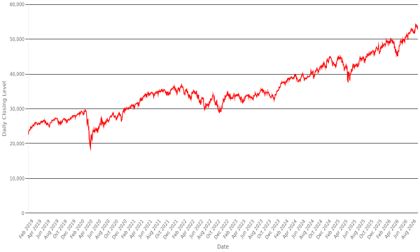 |
This historical data on the Underlying is not necessarily indicative of the future performance of the Underlying or what the value of the
Notes may be. Any historical upward or downward trend in the level of the Underlying during any period set forth above is not an indication that the level of the Underlying is more or less likely to increase or decrease at any time over the
term of the Notes.
Before investing in the Notes, you should consult publicly available sources for the levels of the Dow Jones Industrial Average®.
License Agreement
The Dow Jones Industrial Average® is a product of S&P Dow Jones Indices LLC or its affiliates (“SPDJI”) and has been
licensed for use by Jefferies Financial Group Inc. (the “Issuer”). Standard & Poor’s® and S&P® are registered trademarks of Standard & Poor’s Financial Services LLC (“S&P”) and Dow Jones® is a
registered trademark of Dow Jones Trademark Holdings LLC (“Dow Jones”) and these trademarks have been licensed to SPDJI and have been sublicensed for use for certain purposes by the Issuer. The Issuer’s notes are not sponsored, endorsed, sold
or promoted by SPDJI, Dow Jones, S&P, any of their respective affiliates (collectively, “S&P Dow Jones Indices”). S&P Dow Jones Indices makes no representation or warranty, express or implied, to the owners of the notes or any
member of the public regarding the advisability of investing in securities generally or in the notes particularly or the ability of the Dow Jones Industrial Average® to track general market performance. S&P Dow Jones Indices only
relationship to the Issuer with respect to the Dow Jones Industrial Average® is the licensing of the Index and certain trademarks, service marks and/or trade names of S&P Dow Jones Indices and/or its licensors. The Dow Jones
Industrial Average® is determined, composed and calculated by S&P Dow Jones Indices without regard to the Issuer or the notes. S&P Dow Jones Indices has no obligation to take the needs of the Issuer or the owners of the notes
into consideration in determining, composing or calculating the Dow Jones Industrial Average®. S&P Dow Jones Indices is not responsible for and has not participated in the determination of the prices, and amount of the notes or
the timing of the issuance or sale of the notes or in the determination or calculation of the equation by which the notes are to be converted into cash, surrendered or redeemed, as the case may be. S&P Dow Jones Indices has no obligation or
liability in connection with the administration, marketing or trading of the notes. There is no assurance that investment products based on the Dow Jones Industrial Average® will accurately track index performance or provide positive
investment returns. S&P Dow Jones Indices LLC is not an investment advisor. Inclusion of a security within an index is not a recommendation by S&P Dow Jones Indices to buy, sell, or hold such security, nor is it considered to be
investment advice.
S&P DOW JONES INDICES DOES NOT GUARANTEE THE ADEQUACY, ACCURACY, TIMELINESS AND/OR THE COMPLETENESS OF THE DOW JONES INDUSTRIAL AVERAGE® OR
ANY DATA RELATED THERETO OR ANY COMMUNICATION, INCLUDING BUT NOT LIMITED TO, ORAL OR WRITTEN COMMUNICATION (INCLUDING ELECTRONIC COMMUNICATIONS) WITH RESPECT THERETO. S&P DOW JONES INDICES SHALL NOT BE SUBJECT TO ANY DAMAGES OR LIABILITY
FOR ANY ERRORS, OMISSIONS, OR DELAYS THEREIN. S&P DOW JONES INDICES MAKES NO EXPRESS OR IMPLIED WARRANTIES, AND EXPRESSLY DISCLAIMS ALL
PS-3
WARRANTIES, OF MERCHANTABILITY OR FITNESS FOR A PARTICULAR PURPOSE OR USE OR AS TO RESULTS TO BE OBTAINED BY THE ISSUER, OWNERS OF THE
NOTES OR ANY OTHER PERSON OR ENTITY FROM THE USE OF THE DOW JONES INDUSTRIAL AVERAGE® OR WITH RESPECT TO ANY DATA RELATED THERETO. WITHOUT LIMITING ANY OF THE FOREGOING, IN NO EVENT WHATSOEVER SHALL S&P DOW JONES INDICES BE
LIABLE FOR ANY INDIRECT, SPECIAL, INCIDENTAL, PUNITIVE, OR CONSEQUENTIAL DAMAGES INCLUDING BUT NOT LIMITED TO, LOSS OF PROFITS, TRADING LOSSES, LOST TIME OR GOODWILL, EVEN IF THEY HAVE BEEN ADVISED OF THE POSSIBILITY OF SUCH DAMAGES, WHETHER IN
CONTRACT, TORT, STRICT LIABILITY, OR OTHERWISE. THERE ARE NO THIRD PARTY BENEFICIARIES OF ANY AGREEMENTS OR ARRANGEMENTS BETWEEN S&P DOW JONES INDICES AND THE ISSUER, OTHER THAN THE LICENSORS OF S&P DOW JONES INDICES.
The Russell 2000® Index
The Russell 2000® Index (the “RTY”) was developed by Russell Investments (“Russell”) before FTSE International Limited and
Russell combined in 2015 to create FTSE Russell, which is wholly owned by London Stock Exchange Group. Additional information on the RTY is available at the following website: http://www.ftserussell.com. No information on that website is deemed
to be included or incorporated by reference in this pricing supplement addendum.
Russell began dissemination of the RTY (Bloomberg L.P. index symbol “RTY”) on January 1 , 1984. FTSE Russell calculates and publishes the
RTY. The RTY was set to 135 as of the close of business on December 31 , 1986. The RTY is designed to track the performance of the small capitalization segment of the U.S. equity market. As a subset of the Russell 3000® Index, the
RTY consists of the smallest 2,000 companies included in the Russell 3000® Index. The Russell 3000® Index measures the performance of the largest 3,000 U.S. companies, representing approximately 98% of the investable U.S.
equity market. The RTY is determined, comprised, and calculated by FTSE Russell without regard to the securities.
Selection of Stocks Comprising the RTY
Each company eligible for inclusion in the RTY must be classified as a U.S. company under FTSE Russell’s country-assignment methodology.
If a company is incorporated, has a stated headquarters location, and trades in the same country (American Depositary Receipts and American Depositary Shares are not eligible), then the company is assigned to its country of incorporation. If
any of the three factors are not the same, FTSE Russell defines three Home Country Indicators (“HCIs”): country of incorporation, country of headquarters, and country of the most liquid exchange (as defined by a two-year average daily dollar
trading volume) (“ADDTV”) from all exchanges within a country. Using the HCIs, FTSE Russell compares the primary location of the company’s assets with the three HCIs. If the primary location of its assets matches any of the HCIs, then the
company is assigned to the primary location of its assets. If there is insufficient information to determine the country in which the company’s assets are primarily located, FTSE Russell will use the country from which the company’s revenues
are primarily derived for the comparison with the three HCIs in a similar manner. FTSE Russell uses the average of two years of assets or revenues data to reduce potential turnover. If conclusive country details cannot be derived from assets or
revenues data, FTSE Russell will assign the company to the country of its headquarters, which is defined as the address of the company’s principal executive offices, unless that country is a Benefit Driven Incorporation “BDI” country, in which
case the company will be assigned to the country of its most liquid stock exchange. BDI countries include: Anguilla, Antigua and Barbuda, Bahamas, Barbados, Belize, Bermuda, Bonaire, British Virgin Islands, Cayman Islands, Channel Islands, Cook
Islands, Curacao, Faroe Islands, Gibraltar, Guernsey, Isle of Man, Jersey, Liberia, Marshall Islands, Panama, Saba, Sint Eustatius, Sint Maarten, and Turks and Caicos Islands. For any companies incorporated or headquartered in a U.S. territory,
including Puerto Rico, Guam, and U.S. Virgin Islands, a U.S. HCI is assigned.
All securities eligible for inclusion in the RTY must trade on a major U.S. exchange. Stocks must have a closing price at or above $1.00
on their primary exchange on the last trading day in May to be eligible for inclusion during annual reconstitution. However, in order to reduce unnecessary turnover, if an existing member’s closing price is less than $1.00 on the last day of
May, it will be considered eligible if the average of the daily closing prices (from its primary exchange) during the month of May is equal to or greater than $1.00. Initial public offerings are added each quarter and must have a closing price
at or above $1.00 on the last day of their eligibility period in order to qualify for index inclusion. If an existing stock does not trade on the “rank day” (typically the last trading day in May but a confirmed timetable is announced each
spring) but does have a closing price at or above $1.00 on another eligible U.S. exchange, that stock will be eligible for inclusion.
An important criterion used to determine the list of securities eligible for the RTY is total market capitalization, which is defined as the market price as
of the last trading day in May for those securities being considered at annual reconstitution times the total number of shares outstanding. Where applicable, common stock, non-restricted exchangeable shares and partnership units/membership
interests are used to determine market capitalization. Any other form of shares such as preferred stock, convertible preferred stock, redeemable shares, participating preferred stock, warrants and rights, installment receipts or trust receipts,
are excluded from the calculation. If multiple share classes of common stock exist,
PS-4
they are combined. In cases where the common stock share classes act independently of each other (e.g., tracking stocks), each class is
considered for inclusion separately. If multiple share classes exist, the pricing vehicle will be designated as the share class with the highest two-year trading volume as of the rank day in May.
Companies with a total market capitalization of less than $30 million are not eligible for the RTY. Similarly, companies with only 5% or
less of their shares available in the marketplace are not eligible for the RTY. Royalty trusts, limited liability companies, closed-end investment companies (companies that are required to report Acquired Fund Fees and Expenses, as defined by
the SEC, including business development companies), blank check companies, special purpose acquisition companies, and limited partnerships are also ineligible for inclusion. Bulletin board, pink sheets, and over-the-counter traded securities
are not eligible for inclusion. Exchange traded funds and mutual funds are also excluded.
Annual reconstitution is a process by which the RTY is completely rebuilt. Based on closing levels of the company’s common stock on its
primary exchange on the rank day of May of each year, FTSE Russell reconstitutes the composition of the RTY using the then existing market capitalizations of eligible companies. Reconstitution of the RTY occurs on the last Friday in June or,
when the last Friday in June is the 29th or 30th, reconstitution occurs on the prior Friday. In addition, FTSE Russell adds initial public offerings to the RTY on a quarterly basis based on total market capitalization ranking within the
market-adjusted capitalization breaks established during the most recent reconstitution. After membership is determined, a security’s shares are adjusted to include only those shares available to the public. This is often referred to as “free
float.” The purpose of the adjustment is to exclude from market calculations the capitalization that is not available for purchase and is not part of the investable opportunity set.
Historical Performance of the Russell 2000® Index
The following graph sets forth the daily historical performance of the Russell 2000® Index in the period from January 1, 2019 through August 24,
2026. We obtained this historical data from Bloomberg L.P. We have not independently verified the accuracy or completeness of the information obtained from Bloomberg L.P.
|
RTY Index Daily Closing Levels
|
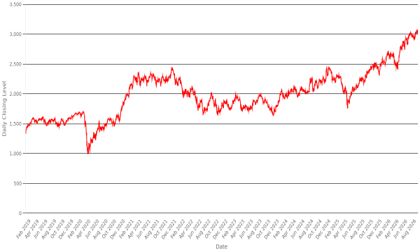 |
This historical data on the Underlying is not necessarily indicative of the future performance of the Underlying or what the value of the
Notes may be. Any historical upward or downward trend in the level of the Underlying during any period set forth above is not an indication that the level of the Underlying is more or less likely to increase or decrease at any time over the
term of the Notes.
Before investing in the Notes, you should consult publicly available sources for the levels of the Russell 2000® Index.
License Agreement
“Russell 2000®” and “Russell 3000®” are trademarks of FTSE Russell and have been licensed for use by Jefferies
Financial Group Inc. (the “Issuer”). The securities are not sponsored, endorsed, sold, or promoted by FTSE Russell, and FTSE Russell makes no representation regarding the advisability of investing in the securities.
FTSE Russell and the Issuer have entered into a non-exclusive license agreement providing for the license to the Issuer and its affiliates in exchange for a
fee, of the right to use indices owned and published by FTSE Russell in connection with
PS-5
some securities, including the securities. The license agreement provides that the following language must be stated in this pricing
supplement addendum:
The securities are not sponsored, endorsed, sold, or promoted by FTSE Russell. FTSE Russell makes no representation or warranty, express
or implied, to the holders of the securities or any member of the public regarding the advisability of investing in securities generally or in the securities particularly or the ability of the RTY to track general stock market performance or a
segment of the same. FTSE Russell’s publication of the RTY in no way suggests or implies an opinion by FTSE Russell as to the advisability of investment in any or all of the securities upon which the RTY is based. FTSE Russell’s only
relationship to the Issuers is the licensing of certain trademarks and trade names of FTSE Russell and of the RTY, which is determined, composed, and calculated by FTSE Russell without regard to the Issuer or the securities. FTSE Russell is not
responsible for and has not reviewed the securities nor any associated literature or publications and FTSE Russell makes no representation or warranty express or implied as to their accuracy or completeness, or otherwise. FTSE Russell reserves
the right, at any time and without notice, to alter, amend, terminate, or in any way change the RTY. FTSE Russell has no obligation or liability in connection with the administration, marketing, or trading of the securities.
FTSE RUSSELL DOES NOT GUARANTEE THE ACCURACY AND/OR THE COMPLETENESS OF THE RTY OR ANY DATA INCLUDED THEREIN AND FTSE RUSSELL SHALL HAVE
NO LIABILITY FOR ANY ERRORS, OMISSIONS, OR INTERRUPTIONS THEREIN. FTSE RUSSELL MAKES NO WARRANTY, EXPRESS OR IMPLIED, AS TO RESULTS TO BE OBTAINED BY THE ISSUER, HOLDERS OF THE SECURITIES, OR ANY OTHER PERSON OR ENTITY FROM THE USE OF THE RTY
OR ANY DATA INCLUDED THEREIN. FTSE RUSSELL MAKES NO EXPRESS OR IMPLIED WARRANTIES, AND EXPRESSLY DISCLAIMS ALL WARRANTIES OF MERCHANTABILITY OR FITNESS FOR A PARTICULAR PURPOSE OR USE WITH RESPECT TO THE RTY OR ANY DATA INCLUDED THEREIN.
WITHOUT LIMITING ANY OF THE FOREGOING, IN NO EVENT SHALL FTSE RUSSELL HAVE ANY LIABILITY FOR ANY SPECIAL, PUNITIVE, INDIRECT, OR CONSEQUENTIAL DAMAGES (INCLUDING LOST PROFITS), EVEN IF NOTIFIED OF THE POSSIBILITY OF SUCH DAMAGES.
The S&P 500® Index
The S&P 500® Index (the “SPX”) includes a representative sample of 500 companies in leading industries of the U.S.
economy. The SPX is intended to provide an indication of the pattern of common stock price movement. The calculation of the level of the SPX is based on the relative value of the aggregate market value of the common stocks of 500 companies as
of a particular time compared to the aggregate average market value of the common stocks of 500 similar companies during the base period of the years 1941 through 1943.
The SPX includes companies from eleven main groups: Communication Services; Consumer Discretionary; Consumer Staples; Energy; Financials;
Health Care; Industrials; Information Technology; Real Estate; Materials; and Utilities. SPDJI may from time to time, in its sole discretion, add companies to, or delete companies from, the SPX to achieve the objectives stated above.
SPDJI calculates the SPX by reference to the prices of the constituent stocks of the SPX without taking account of the value of dividends
paid on those stocks. As a result, the return on the Notes will not reflect the return you would realize if you actually owned the SPX constituent stocks and received the dividends paid on those stocks.
Computation of the SPX
While SPDJI currently employs the following methodology to calculate the SPX, no assurance can be given that SPDJI will not modify or
change this methodology in a manner that may affect payment on the notes.
Historically, the market value of any component stock of the SPX was calculated as the product of the market price per share and the
number of then outstanding shares of such component stock. In March 2005, SPDJI began shifting the SPX halfway from a market capitalization weighted formula to a float-adjusted formula, before moving the SPX to full float adjustment on
September 16, 2005. SPDJI’s criteria for selecting stocks for the SPX did not change with the shift to float adjustment. However, the adjustment affects each company’s weight in the SPX.
Under float adjustment, the share counts used in calculating the SPX reflect only those shares that are available to investors, not all of
a company’s outstanding shares. Float adjustment excludes shares that are closely held by control groups, other publicly traded companies or government agencies.
In September 2012, all shareholdings representing more than 5% of a stock’s outstanding shares, other than holdings by “block owners,” were removed from the
float for purposes of calculating the SPX. Generally, these “control holders” will include officers and directors, private equity, venture capital and special equity firms, other publicly traded companies that hold shares for control, strategic
partners, holders of restricted shares, ESOPs, employee and family trusts, foundations associated with the company, holders of unlisted share classes of stock, government entities at all levels (other than government retirement/pension funds)
and any individual person who controls a 5% or greater stake in a company as reported in regulatory filings. However, holdings by block owners, such as depositary banks, pension funds, mutual funds
PS-6
and ETF providers, 401(k) plans of the company, government retirement/pension funds, investment funds of insurance companies, asset
managers and investment funds, independent foundations and savings and investment plans, will ordinarily be considered part of the float.
Treasury stock, stock options, restricted shares, equity participation units, warrants, preferred stock, convertible stock, and rights are
not part of the float. Shares held in a trust to allow investors in countries outside the country of domicile, such as depositary shares and Canadian exchangeable shares are normally part of the float unless those shares form a control block.
If a company has multiple classes of stock outstanding, shares in an unlisted or non-traded class are treated as a control block.
For each stock, an investable weight factor (“IWF”) is calculated by dividing the available float shares by the total shares outstanding.
Available float shares are defined as the total shares outstanding less shares held by control holders. This calculation is subject to a 5% minimum threshold for control blocks. For example, if a company’s officers and directors hold 3% of the
company’s shares, and no other control group holds 5% of the company’s shares, SPDJI would assign that company an IWF of 1.00, as no control group meets the 5% threshold. However, if a company’s officers and directors hold 3% of the company’s
shares and another control group holds 20% of the company’s shares, SPDJI would assign an IWF of 0.77, reflecting the fact that 23% of the company’s outstanding shares are considered to be held for control. As of July 31, 2017, companies with
multiple share class lines are no longer eligible for inclusion in the SPX. Constituents of the SPX prior to July 31, 2017 with multiple share class lines will be grandfathered in and continue to be included in the SPX. If a constituent company
of the SPX reorganizes into a multiple share class line structure, that company will remain in the SPX at the discretion of the S&P Index Committee in order to minimize turnover.
The SPX is calculated using a base-weighted aggregate methodology. The level of the SPX reflects the total market value of all component
stocks relative to the base period of the years 1941 through 1943. An indexed number is used to represent the results of this calculation in order to make the level easier to work with and track over time. The actual total market value of the
component stocks during the base period of the years 1941 through 1943 has been set to an indexed level of 10. This is often indicated by the notation 1941- 43 = 10. In practice, the daily calculation of the SPX is computed by dividing the
total market value of the component stocks by the “index divisor.” By itself, the index divisor is an arbitrary number. However, in the context of the calculation of the SPX, it serves as a link to the original base period level of the SPX. The
index divisor keeps the SPX comparable over time and is the manipulation point for all adjustments to the SPX, which is index maintenance.
Index Maintenance
Index maintenance includes monitoring and completing the adjustments for company additions and deletions, share changes, stock splits,
stock dividends, and stock price adjustments due to company restructuring or spinoffs. Some corporate actions, such as stock splits and stock dividends, require changes in the common shares outstanding and the stock prices of the companies in
the SPX, and do not require index divisor adjustments.
To prevent the level of the SPX from changing due to corporate actions, corporate actions which affect the total market value of the SPX
require an index divisor adjustment. By adjusting the index divisor for the change in market value, the level of the SPX remains constant and does not reflect the corporate actions of individual companies in the SPX. Index divisor adjustments
are made after the close of trading and after the calculation of the SPX closing level.
Changes in a company’s shares outstanding of 5.00% or more due to mergers, acquisitions, public offerings, tender offers, Dutch auctions,
or exchange offers are made as soon as reasonably possible. Share changes due to mergers or acquisitions of publicly held companies that trade on a major exchange are implemented when the transaction occurs, even if both of the companies are
not in the same headline index, and regardless of the size of the change. All other changes of 5.00% or more (due to, for example, company stock repurchases, private placements, redemptions, exercise of options, warrants, conversion of
preferred stock, Notes, debt, equity participation units, at-the-market offerings, or other recapitalizations) are made weekly and are announced on Fridays for implementation after the close of trading on the following Friday.
Changes of less than 5.00% are accumulated and made quarterly on the third Friday of March, June, September, and December, and are usually
announced two to five days prior.
If a change in a company’s shares outstanding of 5.00% or more causes a company’s IWF to change by five percentage points or more, the IWF
is updated at the same time as the share change. IWF changes resulting from partial tender offers are considered on a case by case basis.
Historical Performance of the S&P 500® Index
The following graph sets forth the daily historical performance of the S&P 500® Index in the period from January 1, 2019 through August 24, 2026. We obtained this
historical data from Bloomberg L.P. We have not independently verified the accuracy or completeness of the information obtained from Bloomberg L.P.
PS-7
|
SPX Index Daily Closing Levels
|
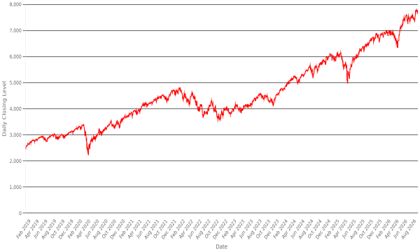 |
This historical data on the Underlying is not necessarily indicative of the future performance of the Underlying or what the value of the
Notes may be. Any historical upward or downward trend in the level of the Underlying during any period set forth above is not an indication that the level of the Underlying is more or less likely to increase or decrease at any time over the
term of the Notes.
Before investing in the Notes, you should consult publicly available sources for the levels of the S&P 500® Index.
License Agreement
The S&P 500® Index is a product of S&P Dow Jones Indices LLC or its affiliates (“SPDJI”) and has been licensed for use
by Jefferies Financial Group Inc. (the “Issuer”). Standard & Poor’s® and S&P® are registered trademarks of Standard & Poor’s Financial Services LLC (“S&P”) and Dow Jones® is a registered
trademark of Dow Jones Trademark Holdings LLC (“Dow Jones”) and these trademarks have been licensed to SPDJI and have been sublicensed for use for certain purposes by the Issuer. The Issuer’s notes are not sponsored, endorsed, sold or promoted
by SPDJI, Dow Jones, S&P, any of their respective affiliates (collectively, “S&P Dow Jones Indices”). S&P Dow Jones Indices makes no representation or warranty, express or implied, to the owners of the notes or any member of the
public regarding the advisability of investing in securities generally or in the notes particularly or the ability of the S&P 500® Index to track general market performance. S&P Dow Jones Indices only relationship to the
Issuer with respect to the S&P 500® Index is the licensing of the Index and certain trademarks, service marks and/or trade names of S&P Dow Jones Indices and/or its licensors. The S&P 500® Index is determined,
composed and calculated by S&P Dow Jones Indices without regard to the Issuer or the notes. S&P Dow Jones Indices has no obligation to take the needs of the Issuer or the owners of the notes into consideration in determining, composing
or calculating the S&P 500® Index. S&P Dow Jones Indices is not responsible for and has not participated in the determination of the prices, and amount of the notes or the timing of the issuance or sale of the notes or in the
determination or calculation of the equation by which the notes are to be converted into cash, surrendered or redeemed, as the case may be. S&P Dow Jones Indices has no obligation or liability in connection with the administration,
marketing or trading of the notes. There is no assurance that investment products based on the S&P 500® Index will accurately track index performance or provide positive investment returns. S&P Dow Jones Indices LLC is not an
investment advisor. Inclusion of a security within an index is not a recommendation by S&P Dow Jones Indices to buy, sell, or hold such security, nor is it considered to be investment advice.
S&P DOW JONES INDICES DOES NOT GUARANTEE THE ADEQUACY, ACCURACY, TIMELINESS AND/OR THE COMPLETENESS OF THE S&P 500® INDEX OR ANY DATA
RELATED THERETO OR ANY COMMUNICATION, INCLUDING BUT NOT LIMITED TO, ORAL OR WRITTEN COMMUNICATION (INCLUDING ELECTRONIC COMMUNICATIONS) WITH RESPECT THERETO. S&P DOW JONES INDICES SHALL NOT BE SUBJECT TO ANY DAMAGES OR LIABILITY FOR ANY
ERRORS, OMISSIONS, OR DELAYS THEREIN. S&P DOW JONES INDICES MAKES NO EXPRESS OR IMPLIED WARRANTIES, AND EXPRESSLY DISCLAIMS ALL WARRANTIES, OF MERCHANTABILITY OR FITNESS FOR A PARTICULAR PURPOSE OR USE OR AS TO RESULTS TO BE OBTAINED BY THE
ISSUER, OWNERS OF THE NOTES OR ANY OTHER PERSON OR ENTITY FROM THE USE OF THE S&P 500® INDEX OR WITH RESPECT TO ANY DATA RELATED THERETO. WITHOUT LIMITING ANY OF THE FOREGOING, IN NO EVENT WHATSOEVER SHALL S&P DOW JONES
INDICES BE LIABLE FOR ANY INDIRECT, SPECIAL, INCIDENTAL, PUNITIVE, OR CONSEQUENTIAL DAMAGES INCLUDING BUT NOT LIMITED TO, LOSS OF PROFITS, TRADING LOSSES, LOST TIME OR GOODWILL, EVEN IF THEY HAVE BEEN ADVISED OF THE
PS-8
POSSIBILITY OF SUCH DAMAGES, WHETHER IN CONTRACT, TORT, STRICT LIABILITY, OR OTHERWISE. THERE ARE NO THIRD PARTY BENEFICIARIES OF ANY AGREEMENTS OR
ARRANGEMENTS BETWEEN S&P DOW JONES INDICES AND THE ISSUER, OTHER THAN THE LICENSORS OF S&P DOW JONES INDICES.
PS-9
SUPPLEMENTAL PLAN OF DISTRIBUTION
See “Supplemental Plan of Distribution” on page PS-25 of the accompanying pricing supplement dated April 30, 2026.
Jefferies LLC, the broker-dealer subsidiary of Jefferies Financial Group Inc., will act as our Agent in connection with the offering of
the Reopened Notes. Subject to the terms and conditions contained in a distribution agreement between us and Jefferies LLC, the Agent has agreed to use its reasonable efforts to solicit purchases of the Reopened Notes. We have the right to
accept offers to purchase Reopened Notes and may reject any proposed purchase of the Reopened Notes. The Agent may also reject any offer to purchase Reopened Notes.
We may also sell Reopened Notes to the Agent who will purchase the Reopened Notes as principal for its own account. In that case, the
Agent will purchase the Reopened Notes at a price equal to the issue price specified on the cover page of this pricing supplement addendum, less a discount. The discount will equal the applicable commission on an agency sale of the Reopened
Notes.
The Agent may resell any Reopened Notes it purchases as principal to other brokers or dealers at a discount, which may include all or part
of the discount the Agent received from us. If all the Reopened Notes are not sold at the initial offering price, the Agent may change the offering price and the other selling terms.
The Agent will sell any unsold allotment pursuant to this pricing supplement addendum from time to time in one or more transactions in the
over-the-counter market, through negotiated transactions or otherwise at market prices prevailing at the time of time of sale, prices relating to the prevailing market prices or negotiated prices.
We may also sell Reopened Notes directly to investors. We will not pay commissions on Reopened Notes we sell directly.
The Agent, whether acting as agent or principal, may be deemed to be an “underwriter” within the meaning of the Securities Act. We have
agreed to indemnify the Agent against certain liabilities, including liabilities under the Securities Act.
If the Agent sells Reopened Notes to dealers who resell to investors and the Agent pays the dealers all or part of the discount or
commission it receives from us, those dealers may also be deemed to be “underwriters” within the meaning of the Securities Act.
The Agent is offering the Reopened Notes, subject to prior sale, when, as and if issued to and accepted by it, subject to approval of
legal matters by its counsel, including the validity of the Reopened Notes, and other conditions contained in the distribution agreement, such as the receipt by the Agent of officers’ certificates and legal opinions. The Agent reserves the
right to withdraw, cancel or modify offers to the public and to reject orders in whole or in part.
The Agent is a member of the Financial Industry Regulatory Authority, Inc. (“FINRA”). Accordingly, the offering of the Reopened Notes will
conform to the requirements of FINRA Rule 5121. See “Conflict of Interest” below.
The Agent is not acting as your fiduciary or advisor solely as a result of the offering of the Reopened Notes, and you should not rely
upon any communication from the Agent in connection with the Reopened Notes as investment advice or a recommendation to purchase the Reopened Notes. You should make your own investment decision regarding the Reopened Notes after consulting with
your legal, tax, and other advisors.
We expect to deliver the Reopened Notes against payment therefor in New York, New York on August 26, 2026, which will be the second
scheduled business day following the initial pricing date. Under Rule 15c6-1 of the Securities Exchange Act of 1934, trades in the secondary market generally are required to settle in one business day, unless the parties to any such trade
expressly agree otherwise. Accordingly, if the initial settlement of the Reopened Notes occurs more than one business day from a pricing date, purchasers who wish to trade the Reopened Notes more than one business day prior to the Original
Issue Date will be required to specify alternative settlement arrangements to prevent a failed settlement.
Jefferies LLC and any of our other broker-dealer subsidiaries may use this pricing supplement addendum, the prospectus and the prospectus
supplements for offers and sales in secondary market transactions and market-making transactions in the Reopened Notes. However, they are not obligated to engage in such secondary market transactions and/or market-making transactions. Our
subsidiaries may act as principal or agent in these transactions, and any such sales will be made at prices related to prevailing market prices at the time of the sale.
Notice to Prospective Investors in the European Economic Area
This pricing supplement addendum and the accompanying pricing supplement dated April 30, 2026, product supplement, prospectus and prospectus supplement is
not a prospectus for the purposes of Regulation (EU) 2017/1129, as amended (the “Prospectus Regulation”). This pricing supplement addendum and the accompanying pricing supplement dated April 30, 2026, product supplement, prospectus and
prospectus supplement have been prepared on the basis that any offer of
PS-10
Reopened Notes in any Member State of the European Economic Area (the “EEA”) will only be made to a legal entity which is a qualified
investor under the Prospectus Regulation (“EEA Qualified Investors”). Accordingly any person making or intending to make an offer in that Member State of Reopened Notes which are the subject of the offering contemplated in this pricing
supplement addendum and the accompanying pricing supplement dated April 30, 2026, product supplement, prospectus and prospectus supplement may only do so with respect to EEA Qualified Investors. Neither the Issuer nor the Agent have authorized,
nor do they authorize, the making of any offer of Reopened Notes other than to EEA Qualified Investors.
PROHIBITION OF SALES TO EEA RETAIL INVESTORS — The Reopened
Notes are not intended to be offered, sold or otherwise made available to and should not be offered, sold or otherwise made available to any retail investor in the EEA. For these purposes, (a) a retail investor means a person who is one (or
more) of: (i) a retail client as defined in point (11) of Article 4(1) of Directive 2014/65/EU (as amended, “MiFID II”); (ii) a customer within the meaning of Directive (EU) 2016/97 (as amended, the “Insurance Distribution Directive”), where
that customer would not qualify as a professional client as defined in point (10) of Article 4(1) of MiFID II; or (iii) not a qualified investor as defined in the Prospectus Regulation and (b) the expression “offer” includes the communication
in any form and by any means of sufficient information on the terms of the offer and the Reopened Notes to be offered so as to enable an investor to decide to purchase or subscribe for the Reopened Notes. Consequently no key information
document required by Regulation (EU) No 1286/2014 (as amended, the “PRIIPs Regulation”) for offering or selling the Reopened Notes or otherwise making them available to retail investors in the EEA has been prepared and therefore offering or
selling the Reopened Notes or otherwise making them available to any retail investor in the EEA may be unlawful under the PRIIPs Regulation.
Notice to Prospective Investors in the United Kingdom
This pricing supplement addendum and the accompanying pricing supplement dated April 30, 2026, product supplement, prospectus supplement
and prospectus have been prepared on the basis that any offer of Reopened Notes in the United Kingdom will be made pursuant to one or more of the exceptions set out in Part 1 of Schedule 1 to the Public Offers and Admissions to Trading
Regulations 2024 (the “POATR”). Neither the Issuer nor the Agent have authorized, nor do they authorize, the making of any offer of Reopened Notes in circumstances in which an obligation arises for the Issuer or the Agent to publish a
prospectus for such offer.
PROHIBITION OF SALES TO UK RETAIL INVESTORS — The Reopened
Notes are not intended to be offered, sold, distributed or otherwise made available to and should not be offered, sold, distributed or otherwise made available to any retail investor in the United Kingdom. For these purposes, a “retail
investor” means a person who is either one (or both) of the following: (i) not a professional client, as defined in point (8) of Article 2(1) of Regulation (EU) No 600/2014 as it forms part of domestic law in the United Kingdom (“UK MiFIR”); or
(ii) not a qualified investor under paragraph 15 of Schedule 1 to the POATR. Consequently no disclosure document required by the FCA Product Disclosure Sourcebook (“DISC”) for offering, selling or distributing the Reopened Notes or otherwise
making them available to retail investors in the United Kingdom has been prepared and therefore offering, selling or distributing the Reopened Notes or otherwise making them available to any retail investor in the United Kingdom may be unlawful
under the DISC and the Consumer Composite Investments (Designated Activities) Regulations 2024.
Other Regulatory Restrictions in the United Kingdom
The communication of this pricing supplement addendum and the accompanying pricing supplement dated April 30, 2026, product supplement,
prospectus and prospectus supplement relating to the issue of the Reopened Notes offered hereby is not being made, and such documents and/or materials have not been approved, by an authorized person for the purposes of Section 21 of the United
Kingdom’s Financial Services and Markets Act 2000, as amended (the “FSMA”). Accordingly, such documents and/or materials are not being distributed to, and must not be passed on to, the general public in the United Kingdom. The communication of
such documents and/or materials as a financial promotion is only being made to those persons in the United Kingdom who have professional experience in matters relating to investments and who fall within the definition of investment
professionals (as defined in Article 19(5) of the Financial Services and Markets Act 2000 (Financial Promotion) Order 2005, as amended (the “Financial Promotion Order”)) or who fall within Article 49(2)(a) to (d) of the Financial Promotion
Order, or who are any other persons to whom it may otherwise lawfully be communicated or distributed under the Financial Promotion Order (all such persons together being referred to as “relevant persons”). In the United Kingdom the Reopened
Notes offered hereby are only available to, and any investment or investment activity to which this pricing supplement addendum and the accompanying pricing supplement dated April 30, 2026, product supplement, prospectus and prospectus
supplement relates will be engaged in only with, relevant persons. Any person in the United Kingdom that is not a relevant person should not act or rely on this pricing supplement addendum and the accompanying pricing supplement dated April 30,
2026, product supplement, prospectus and prospectus supplement or any of their contents.
Any invitation or inducement to engage in investment activity (within the meaning of Section 21 of the FSMA) in connection with the issue or sale of the
Reopened Notes may only be communicated or caused to be communicated in circumstances in which Section 21(1) of the FSMA does not apply to the Issuer.
PS-11
All applicable provisions of the FSMA must be complied with in respect to anything done by any person in relation to the Reopened Notes
in, from or otherwise involving the United Kingdom.
Notice to Prospective Investors in China
This pricing supplement addendum and the accompanying prospectus supplement and prospectus do not constitute a public offer of the
Reopened Notes, whether by sale or subscription, in the People's Republic of China (the “PRC”). The Reopened Notes are not being offered or sold directly or indirectly in the PRC to or for the benefit of, legal or natural persons of the PRC.
Further, no legal or natural persons of the PRC may directly or indirectly purchase any of the Reopened Notes without obtaining all prior PRC’s governmental approvals that are required, whether statutorily or otherwise. Persons who come into
possession of this document are required by the issuer and its representatives to observe these restrictions.
Notice to Prospective Investors in Hong Kong
None of the Reopened Notes (except for Reopened Notes which are a “structured product” as defined in the Securities and Futures Ordinance
(Cap. 571 of the laws of Hong Kong)) (the “SFO”) have been offered or sold and will be offered or sold in Hong Kong, by means of any document, other than (i) to “professional investors” as defined in the SFO and any rules made under the SFO or
(ii) in other circumstances which do not result in the document being a “prospectus” as defined in the Companies (Winding Up and Miscellaneous Provisions) Ordinance (Cap. 32 of the laws of Hong Kong) (the “C(WUMP)O”) or which do not constitute
an offer to the public within the meaning of the C(WUMP)O. No person has issued or had in its possession for the purposes of issue, and will not issue or have in its possession for the purposes of issue, whether in Hong Kong or elsewhere, any
advertisement, invitation or document relating to the Reopened Notes, which is directed at, or the contents of which are likely to be accessed or read by, the public of Hong Kong (except if permitted to do so under the securities laws of Hong
Kong) other than with respect to the Reopened Notes which are or are intended to be disposed of only to persons outside Hong Kong or only to “professional investors” as defined in the SFO and any rules made under the SFO.
Notice to Prospective Investors in Indonesia
This pricing supplement addendum and the accompanying prospectus supplement and prospectus do not constitute an offer to sell nor a
solicitation to buy securities in Indonesia.
Notice to Prospective Investors in Japan
The Reopened Notes have not been and will not be registered pursuant to Article 4, Paragraph 1 of the Financial Instruments and Exchange
Law of Japan (Law no. 25 of 1948, as amended) (“FIEL”) and, accordingly, none of the Reopened Notes nor any interest therein may be offered or sold, directly or indirectly, in Japan or to, or for the benefit, of any Japanese person or to others
for re-offering or resale, directly or indirectly, in Japan or to any Japanese person except under circumstances which will result in compliance with all applicable laws, regulations and guidelines promulgated by the relevant Japanese
governmental and regulatory authorities and in effect at the relevant time. For this purpose, a “Japanese person” means any person resident in Japan, including any corporation or other entity organized under the laws of Japan.
Notice to Prospective Investors in Malaysia
No action has been, or will be, taken to comply with Malaysian laws for making available, offering for subscription or purchase, or
issuing any invitation to subscribe for or purchase or sale of the Reopened Notes in Malaysia or to persons in Malaysia as the Reopened Notes are not intended by the issuer to be made available, or made the subject of any offer or invitation to
subscribe or purchase, in Malaysia. Neither this document nor any document or other material in connection with the Reopened Notes should be distributed, caused to be distributed or circulated in Malaysia. No person should make available or
make any invitation or offer or invitation to sell or purchase the Reopened Notes in Malaysia unless such person takes the necessary action to comply with Malaysian laws.
Notice to Prospective Investors in the Philippines
Any person claiming an exemption under Section 10.1 of the Securities Regulation Code (“SRC”) (or the exempt transactions) must provide to
any party to whom it offers or sells securities in reliance on such exemption a written disclosure containing the following information: (1) The specific provision of Section 10.1 of the SRC on which the exemption from registration is claimed;
and (2) The following statement must be made in bold face, prominent type: THE SECURITIES BEING OFFERED OR SOLD HEREIN HAVE NOT BEEN REGISTERED WITH THE SECURITIES AND EXCHANGE COMMISSION UNDER THE SECURITIES REGULATION CODE OF THE PHILIPPINES.
ANY FUTURE OFFER OR SALE THEREOF IS SUBJECT TO REGISTRATION REQUIREMENTS UNDER THE CODE UNLESS SUCH OFFER OR SALE QUALIFIES AS AN EXEMPT TRANSACTION.
Notice to Prospective Investors in Singapore
PS-12
This pricing supplement addendum and the accompanying prospectus supplement and prospectus has not been and will not be registered as a
prospectus under the Securities and Futures Act 2001, as amended (the “SFA”) by the Monetary Authority of Singapore, and the offer of the Reopened Notes in Singapore is made primarily pursuant to the exemptions under Sections 274 and 275 of the
SFA. Accordingly, none of this pricing supplement addendum nor the accompanying prospectus supplement, prospectus or any other document or material in connection with the offer or sale, or invitation for subscription or purchase, of any
Reopened Notes may be circulated or distributed, nor may any Reopened Notes be offered or sold, or be made the subject of an invitation for subscription or purchase, whether directly or indirectly, to persons in Singapore other than (i) to an
institutional investor as defined in Section 4A of the SFA (an “Institutional Investor”) pursuant to Section 274 of the SFA, (ii) to an accredited investor as defined in Section 4A of the SFA (an “Accredited Investor”) or other relevant person
as defined in Section 275(2) of the SFA (a “Relevant Person”) and pursuant to Section 275(1) of the SFA, or to any person pursuant to an offer referred to in Section 275(1A) of the SFA, in accordance with the conditions specified in Section 275
of the SFA and (where applicable) Regulation 3 of the Securities and Futures (Classes of Investors) Regulations 2018, or (iii) otherwise pursuant to, and in accordance with, the conditions of any other applicable exemption or provision of the
SFA.
It is a condition of the offer that where the Reopened Notes are subscribed for or acquired pursuant to an offer made in reliance on
Section 275 of the SFA by a Relevant Person which is:
| (i) |
a corporation (which is not an Accredited Investor), the sole business of which is to hold investments and the entire share capital of which is owned by one or more individuals, each of
whom is an Accredited Investor; or
|
| (ii) |
a trust (where the trustee is not an Accredited Investor), the sole purpose of which is to hold investments and each beneficiary of the trust is an individual who is an Accredited Investor,
|
securities or securities-based derivatives contracts (each as defined in Section 2(1) of the SFA) of that corporation and the
beneficiaries’ rights and interests (howsoever described) in that trust shall not be transferred within six months after that corporation or that trust has subscribed for or acquired the Reopened Notes except:
| (A) |
to an Institutional Investor, an Accredited Investor, a Relevant Person, or which arises from an offer referred to in Section 275(1A) of the SFA (in the case of that corporation) or Section
276(4)(c)(ii) of the SFA (in the case of that trust);
|
| (B) |
where no consideration is or will be given for the transfer;
|
| (C) |
where the transfer is by operation of law; or
|
| (D) |
as specified in Section 276(7) of the SFA
|
Notification under Section 309B(1) of the Securities and Futures Act
2001 of Singapore (“SFA”): For the purposes of the Issuer’s obligations pursuant to sections 309B(1)(a) and 309B(1)(c) of the SFA, the Issuer has determined, and hereby notifies all relevant persons (as defined in Section 309A(1) of
the SFA), that the Reopened Notes are capital markets products other than prescribed capital markets products (as defined in the Securities and Futures (Capital Markets Products) Regulations 2018) and Specified Investment Products (as defined
in Monetary Authority of Singapore (“MAS”) Notice SFA 04-N12: Notice on the Sale of Investment Products and MAS Notice FAA-N16: Notice on Recommendations on Investment Products).
Notice to Prospective Investors in South Korea
The Reopened Notes have not been registered with the Financial Services Commission of Korea for a public offering in Korea. The Reopened
Notes have not been and will not be offered, sold or delivered directly or indirectly, or offered, sold or delivered to any person for re-offering or resale, directly or indirectly, in Korea or to any resident of Korea, except as otherwise
permitted under applicable Korean laws and regulations, including the Financial Investment Services and Capital Markets Act and the Foreign Exchange Transaction Law and the decrees and regulations thereunder. By the purchase of the Reopened
Notes, the relevant holder thereof will be deemed to represent and warrant that if it is in Korea or is a resident of Korea, it purchased the Reopened Notes pursuant to the applicable laws and regulations of Korea.
Notice to Prospective Investors in Taiwan
The Reopened Notes may be made available outside Taiwan for purchase outside Taiwan by Taiwan resident investors, but may not be offered
or sold in Taiwan.
Notice to Prospective Investors in Thailand
PS-13
The pricing supplement addendum and the accompanying prospectus supplement and prospectus have not been approved by the Thailand Securities and Exchange
Commission which takes no responsibility for its contents. Nothing in this pricing supplement addendum and the accompanying prospectus supplement and prospectus nor any action of Jefferies Financial Group Inc. or any of its affiliates
constitutes or shall be construed as an offer for sale of any securities, or a solicitation to make an offer for sale of any securities in Thailand or a provision of any securities business requiring license under the SEC Act. This pricing
supplement addendum and the accompanying prospectus supplement and prospectus is intended to be read by the addressee only and must not be passed to, issued to, or shown to the public generally.
PS-14
CONFLICT OF INTEREST
Jefferies LLC, the broker-dealer subsidiary of Jefferies Financial Group Inc., is a member of FINRA and will participate in the distribution of the Reopened
Notes. Accordingly, the offering is subject to the provisions of FINRA Rule 5121 relating to conflicts of interests and will be conducted in accordance with the requirements of Rule 5121. Jefferies LLC will not confirm sales of the Reopened
Notes to any account over which it exercises discretionary authority without the prior written specific approval of the customer.
PS-15
LEGAL MATTERS
In the opinion of Sidley Austin LLP, as counsel to Jefferies Financial Group Inc., when the Reopened Notes offered by this pricing supplement addendum have
been executed and issued by Jefferies Financial Group Inc. and authenticated by the trustee pursuant to the indenture, and the Reopened Notes have been delivered against payment as contemplated herein, such Reopened Notes will be valid and
binding obligations of Jefferies Financial Group Inc., subject to applicable bankruptcy, insolvency and similar laws affecting creditors’ rights generally, concepts of reasonableness and equitable principles of general applicability (including,
without limitation, concepts of good faith, fair dealing and the lack of bad faith), provided that such counsel expresses no opinion as to the effect of fraudulent conveyance, fraudulent transfer or similar provision of applicable law on the
conclusions expressed above. This opinion is given as of the date hereof and is limited to the laws of the State of New York as in effect on the date hereof. In addition, this opinion is subject to customary assumptions about the trustee’s
authorization, execution and delivery of the indenture and due authentication of the Reopened Notes and the genuineness of signatures and certain factual matters, all as stated in the letter of such counsel dated May 11, 2026, which has been
filed as Exhibit 5.1 to Jefferies Financial Group Inc.’s Registration Statement on Form S-3 filed with the Securities and Exchange Commission on May 11, 2026.
PS-16
EXPERTS
The financial statements of Jefferies Financial Group Inc. as of November 30, 2025 and 2024, and for each of the three years in the period ended November
30, 2025, incorporated by reference in this prospectus supplement from Jefferies Financial Group Inc.’s Annual Report on Form 10-K, and the effectiveness of the Jefferies Financial Group Inc.’s internal control over financial reporting have
been audited by Deloitte & Touche LLP, an independent registered public accounting firm, as stated in their reports. Such financial statements are incorporated by reference in reliance upon the reports of such firm given their authority as
experts in accounting and auditing.
PS-17
$8,783,000
Jefferies
Jefferies Financial Group Inc.
Senior Autocallable Contingent Coupon Barrier Notes due May 5, 2031
Linked to the Worst-Performing of the Dow Jones Industrial Average®,
the Russell 2000® Index and the S&P 500® Index
PRICING SUPPLEMENT ADDENDUM
August 24, 2026