Please wait
| | |
|
MANAGEMENT INFORMATION CIRCULAR March 5, 2026 Notice of annual meeting of shareholders to be held May 7, 2026 TC Energy Energy. Connected. Solid growth. Low risk. Repeatable performance.
|
| | |
|
About TC Energy We are a leader in North American energy infrastructure For almost 75 years, we have been building and operating the backbone of North America’s energy system. Since our founding, we have built a solid foundation of exemplary assets, a talented workforce and valued stakeholder relationships, all guided by our commitment to safety and operational excellence. Every day, our dedicated team proudly connects the world to the energy it needs, moving over 30 per cent of the cleaner-burning natural gas used across the continent. Complemented by strategic ownership and low-risk investments in power generation, our infrastructure fuels industries and generates affordable, reliable and sustainable power across North America, while enabling liquefied natural gas (LNG) exports to global markets. Our business is based on the connections we make. We partner with communities, businesses and leaders across our extensive energy network to unlock opportunity today and for generations to come. Guided by our values—safety in every step, personal accountability, one team and active learning—we deliver energy that powers lives and livelihoods, while positioning North America as a global energy leader. TC Energy’s common shares trade on the Toronto (TSX) and New York (NYSE) stock exchanges under the symbol TRP. To learn more, visit us at TCEnergy.com. Letter to Shareholders 1 Notice of 2026 Annual Meeting 2 Management Information Circular 3 Summary 4 About the Shareholder Meeting 7 Delivery of Meeting Materials 7 Attending and Participating in the Meeting 8 Voting 10 Business of the Meeting 13 Governance 34 About our Governance Practices 34 Board Characteristics 34 Governance Philosophy 38 Role and Responsibilities of the Board 41 Orientation and Education 52 Board Effectiveness and Director Assessment 54 Sustainability and Environmental, Social and Governance Matters 62 Board Committees 66 Compensation 71 Compensation Governance 71 Director Compensation Discussion and Analysis 78 Director Compensation – 2025 Details 81 Human Resources Committee Letter to Shareholders 86 Executive Compensation Discussion and Analysis 88 Executive Compensation – 2025 Details 113 Other Information 126 Schedules 127 We encourage you to sign up for electronic delivery of all future proxy materials. Registered shareholders 1. Go to www.investorcentre.com/tcenergy. 2. Landing page should open to “Canada (English)” or “Canada (French)” in the top right corner. If not, please select one or the other. 3. Under “Welcome, Investor”, select “Sign up”. 4. Complete “Register your details” section and click on “Confirm Details”. 5. Locate your holdings and link them to your account to gain digital access. Non-registered shareholders Go to www.investordelivery.com using the control number found on your voting instruction form, click on “Enrollment or Reactivation”, and follow the instructions. If you vote online, go to www.proxyvote.com, click on “Delivery Settings”, and follow the instructions.
|
Letter to Shareholders
March 5, 2026
Dear Shareholder:
On behalf of the Board of Directors of TC Energy Corporation, we are pleased to invite you to our annual meeting of common shareholders on May 7, 2026 at 10 a.m. Mountain Daylight Time (MDT). The meeting will be held virtually,
using a live audio webcast available at https://meetings.lumiconnect.com/400-652-715-564, password "tc2026"
(case sensitive).
In 2025, we demonstrated the strength of our strategy and our differentiated position in the fastest-growing segments
of the energy market: natural gas and power generation. As we turn to 2026, we intend to build on our momentum leveraging our natural gas and power portfolio to meet forecasted growing demand, strengthen our position as a global energy leader and deliver sustainable value for our shareholders.
Attending the meeting is your opportunity to hear from me and our Chief Executive Officer, François L. Poirier, to learn more about our performance in 2025, our strategy for the future and vote on the items of business. If you are unable
to attend the meeting, you can still vote by proxy prior to the meeting and following the meeting. A recording of the meeting will be available on our website at www.tcenergy.com.
The virtual-only meeting format provides all shareholders an equal opportunity to participate at the meeting regardless
of their geographic location or any particular constraints or circumstances they may face relating to attendance at an
in-person event. It also is a more cost-efficient and environmentally friendly way to engage with shareholders. At this virtual meeting, shareholders who attend online will have the opportunity to participate, ask questions and vote in
real-time, provided they comply with the applicable procedures set out in this management information circular.
The attached management information circular includes important information about the meeting and how to vote. Please read the document and remember to vote. You can find more information about TC Energy in our 2025 Annual Report and on our website.
Thank you for your continued trust and partnership in TC Energy. Mr. Poirier and I look forward to your participation
in the meeting on May 7.
Sincerely,
| | |
|
| John E. Lowe |
| Chair of the Board of Directors |
TC Energy Management Information Circular 2026 | 1
| | | | | | | | | | | |
Notice of 2026 Annual Meeting You are invited to our 2026 annual meeting of common shareholders:
WHEN
Thursday, May 7, 2026 10 a.m. Mountain Daylight Time (MDT)
WHERE Virtual-only meeting via live audio webcast online at https://meetings.lumiconnect.com/400-652-715-564 password "tc2026" (case sensitive)
YOUR VOTE IS IMPORTANT If you are a holder of record of TC Energy Corporation (TC Energy) common shares on March 20, 2026, you are entitled to receive notice of, attend and vote at this meeting. Please read the attached Management Information Circular. It contains important information about the meeting and explains who can vote and how to vote. By order of the Board of Directors, | | | |
| | |
| Five items of business 1.Receive our audited consolidated financial statements for the year ended December 31, 2025, and the auditor's report. 2.Elect the directors. 3.Appoint the auditor and authorize the directors to fix their remuneration. 4.Participate in the advisory vote on our approach to executive compensation (say on pay). 5.Consider other business that is properly brought before the meeting or any meeting that is reconvened if the meeting is adjourned. | |
| |
| | |
| | | |
Jane M. Brindle
Vice-President, Law and Corporate Secretary
TC Energy Corporation
Calgary, Alberta
March 5, 2026 | | | |
2 | TC Energy Management Information Circular 2026
| | | | | | | | | | | |
Management Information Circular We are sending you this management information circular (Circular) because you were a holder of record of common shares of TC Energy on March 20, 2026. You have the right to participate in our 2026 annual meeting of shareholders (the meeting) and to vote your shares online at the meeting or by proxy. The meeting can be accessed at https://meetings.lumiconnect.com/400-652-715-564, password "tc2026" (case sensitive). Following the meeting, a webcast in English, including the live question and answer session, will be available for viewing on our website (www.tcenergy.com). Management is soliciting your proxy for the meeting, and we pay all costs for doing so. TC Energy may utilize the Broadridge QuickVoteTM system to assist non-registered (beneficial) shareholders with voting their TC Energy common shares. Broadridge then tabulates the results of all the instructions received and provides the appropriate instructions respecting the shares to be represented at the meeting. | | | |
| | |
| In this document, • you, your and shareholder mean a holder of common shares of TC Energy Corporation, • we, us, our, the company and TC Energy mean TC Energy Corporation, and • TC Energy shares and shares mean common shares of TC Energy Corporation, unless stated otherwise. | |
| | |
| | |
| Our principal corporate and executive offices are located at 450 - 1 Street S.W., Calgary, AB Canada T2P 5H1 | |
| | |
| | | |
We will start mailing the proxy materials on March 31, 2026, and will also provide the materials to brokers, custodians, nominees and other fiduciaries to forward them to shareholders. A TC Energy employee may also contact you by phone or email to encourage you to vote. |
The Board of Directors of TC Energy (Board) has approved the contents of this Circular and has authorized us to send it to you. We have also sent a copy to each member of our Board and to our auditors, and will file copies with the appropriate government regulatory agencies. If you have questions about any of the information contained within the attached Circular please contact our Investor Relations team by telephone at 403-920-7911 or 1-800-361-6522 or by email at investor_relations@tcenergy.com. If you have questions about deciding how to vote, you should contact your own legal, tax, financial or other professional advisor. Unless stated otherwise, information in this document is as of March 5, 2026, and all dollar amounts are in Canadian dollars. |
| | | | | | | | | | | |
| | | |
| About shareholder mailings | | | |
In March 2025, we asked all registered shareholders to advise us if they did not want to receive our Annual Reports when they became available. If you are a registered shareholder who replied that you no longer want to receive the report, or a beneficial shareholder who did not request a copy, you will not receive one. If you purchased TC Energy shares after March 20, 2026, you also may not receive a copy of our 2025 Annual Report. We are using notice and access to deliver this Circular and 2025 Annual Report. | | Our 2025 Annual Report is available on our website (www.tcenergy.com) and on SEDAR+ (www.sedarplus.ca), or you can request a free copy from our transfer agent: Computershare Investor Services, Inc. |
| Tel: | 1-800-340-5024 (toll-free within North America) 1-514-982-7959 (outside North America) |
| Online: | Go to www.investorcentre.com/tcenergy Note: Top right corner of the web page must be set to "Canada (English)" or "Canada (French)", click on "Contact Us" in the bottom banner, click on "Contact information for a specific company", and type ticker symbol "TRP" to view communication options. |
TC Energy Management Information Circular 2026 | 3
Summary
The following pages are key points of information you will find in this Circular. You should read the entire Circular before voting.
VOTING
You will be asked to vote on three items at the meeting:
| | | | | | | | |
| Item | Board recommendation | More information (pages) |
Elect 13 directors | For | |
| Appoint KPMG LLP, Chartered Professional Accountants as auditor | For | |
| Advisory vote on executive compensation (say on pay) | For | |
NOMINATED DIRECTORS
| | | | | | | | | | | | | | | | | | | | | | | | | | | | | | | | | | | |
Name | Occupation | Age | | Independent | % Votes in favour
at 2025
ASM | | | 2025 Meeting attendance | | Number
of other public boards |
2025 Committees | Board meetings | All meetings1 |
Scott Bonham Atherton, CA Director since 2024 | Corporate Director | 64 | | Yes | 99.84 | | Audit
Human Resources | 100% | 100% | | 1 |
Cheryl F. Campbell Monument, CO Director since 2022 | Corporate Director | 66 | | Yes | 99.28 | | Audit
HSSE | 100% | 100% | | 1 |
Michael R. Culbert Calgary, AB Director since 2020 | Corporate Director | 68 | | Yes | 99.31 | | Audit
HSSE | 100% | 100% | | 1 |
William D. Johnson Knoxville, TN Director since 2021 | Corporate Director | 72 | | Yes | 98.10 | | Audit
Governance
Human Resources (Chair)2 | 100% | 100% | | 2 |
Susan C. Jones Calgary, AB Director since 2020 | Corporate Director | 56 | | Yes | 99.30 | | Audit
Human Resources | 100% | 92% | | 1 |
John E. Lowe Houston, TX Director since 2015 | Corporate Director | 67 | | Yes | 97.81 | | Board Chair
Governance
Human Resources | 100% | 100% | | 0 |
Dawn Madahbee Leach Little Current, ON Director since 2024 | General Manager, Waubetek Business Corporation | 69 | | Yes | 99.85 | | Audit
HSSE | 100% | 100% | | 0 |
François L. Poirier Calgary, AB Director since 2021 | President and CEO,
TC Energy | 59 | | No | 99.35 | | — | 100% | 100% | | 1 |
Una Power Vancouver, BC Director since 2019 | Corporate Director | 61 | | Yes | 98.35 | | Audit (Chair)
HSSE | 100% | 100% | | 2 |
Mary Pat Salomone Naples, FL Director since 2013 | Corporate Director | 65 | | Yes | 98.70 | | Governance
HSSE (Chair) | 100% | 100% | | 1 |
Siim A. Vanaselja Toronto, ON Director since 2014 | Corporate Director | 69 | | Yes | 98.07 | | Governance
Human Resources | 100% | 100% | | 3 |
Thierry Vandal Mamaroneck, NY Director since 2017 | President, Axium Infrastructure US, Inc. | 65 | | Yes | 98.64 | | Governance (Chair)
HSSE | 100% | 100% | | 1 |
Dheeraj "D" Verma Houston, TX Director since 2022 | Senior Advisor,
Quantum Energy Partners | 48 | | Yes | 98.98 | | Governance
Human Resources | 100% | 100% | | 0 |
1 This reflects aggregate attendance at all Board meetings and each director's respective Board Committee meetings.
2 Mr. Johnson was a member of the Audit Committee until May 8, 2025 when he became a member of the Governance Committee.
4 | TC Energy Management Information Circular 2026
GOVERNANCE
We believe that strong corporate governance improves corporate performance and benefits all stakeholders. Based on the current directorship, our governance highlights are noted below.
| | | | | |
Size of Board | 13 |
Independent Directors | 92% |
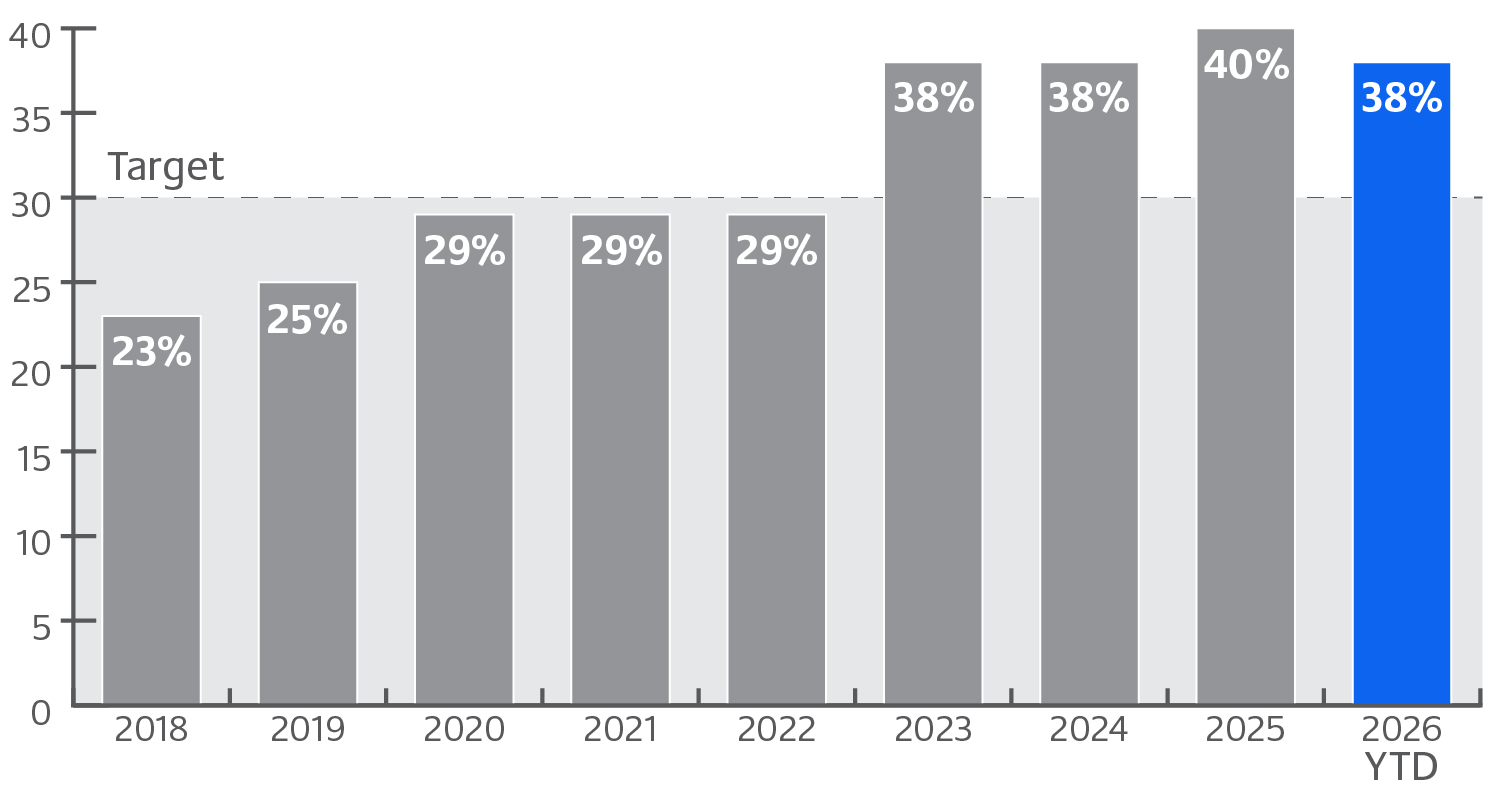
Gender diversity on Board | 38% |
Board Diversity Policy | Yes – target of 30% women and at least one racially or ethnically diverse director |
Number of board interlocks | 0 |
External board service limits for independent directors | 4 public company boards in total. Board chair positions count as two board seats. |
Average director age | 64 |
All committees independent | Yes |
Annual director elections | Yes |
Individual director elections | Yes |
Majority Voting Policy | Yes |
Independent executive compensation consultant | Yes |
Clawback policies | Yes – a policy triggered by financial restatements and a policy triggered by misconduct |
Double-trigger vesting on change of control | Yes |
Separate chair and CEO | Yes |
Director retirement age/term limit | The earlier of a director turning 75 or attaining 15 years of service. Notwithstanding age limits, a director is eligible to serve a term of 8 years. |
Director share ownership requirements | 4x retainer |
CEO share ownership post-retirement hold period | 1 year |
In-camera sessions at every Board and Committee meeting | Yes |
Code of business ethics | Yes |
Board, committee and director evaluations annually | Yes |
Board orientation and education program | Yes |
| Artificial intelligence governance framework | Yes |
| Cybersecurity programs, training and strategy | Yes |
TC Energy Management Information Circular 2026 | 5
COMPENSATION
TC Energy's compensation programs are designed to 'pay for performance' by rewarding employees, including our executives, for delivering results that meet or exceed our corporate objectives and support our overall strategy.
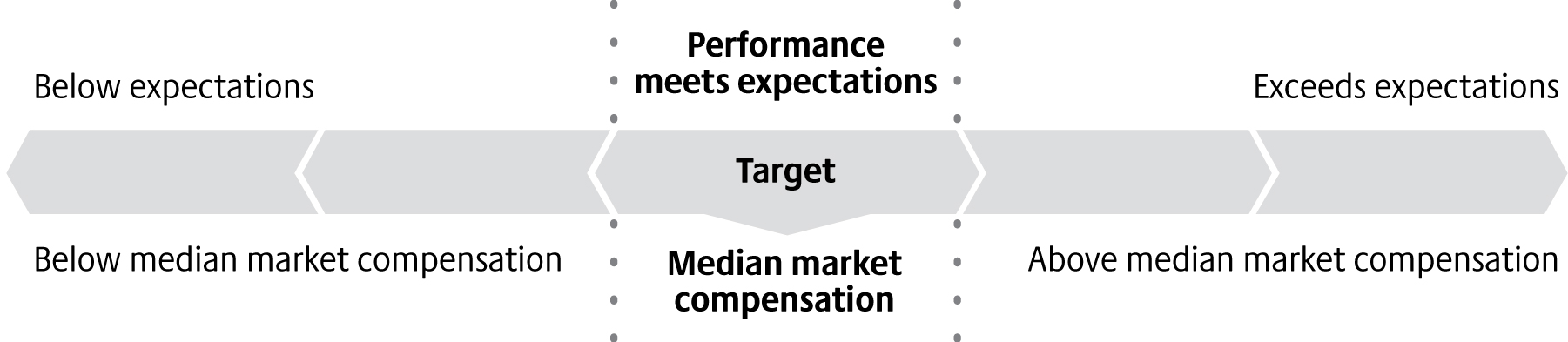
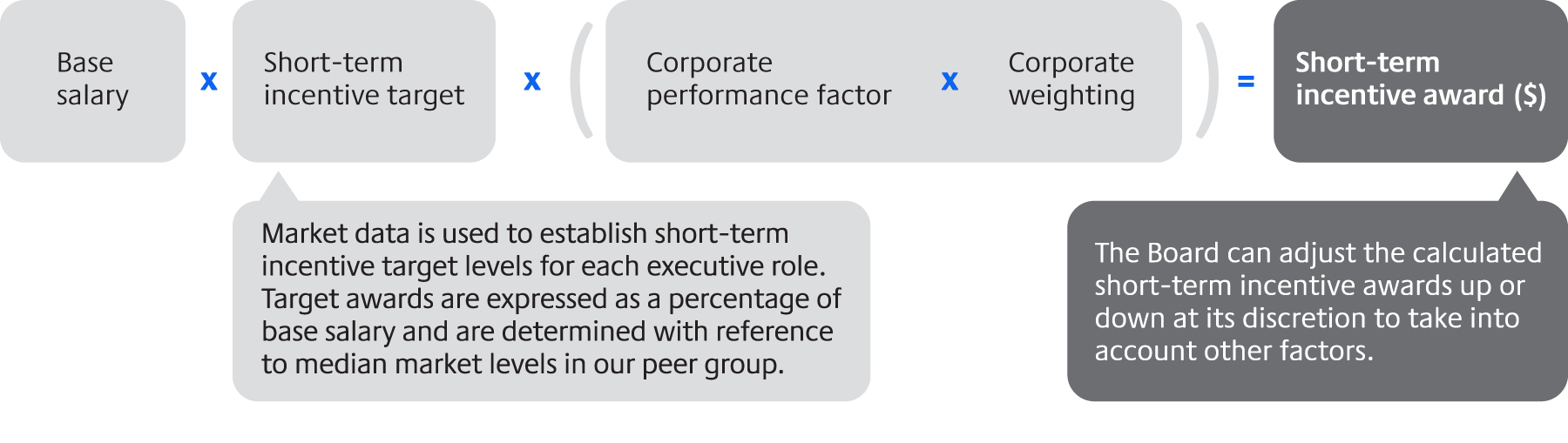
In order to attract, engage and retain high-performing employees, we review our programs each year to ensure we offer compensation that is market competitive. Our target compensation levels are determined with reference to median levels in our peer group. Actual performance that exceeds expectations can result in compensation above market median levels.
Our compensation programs are intended to align the executives' interests with those of our various stakeholders.
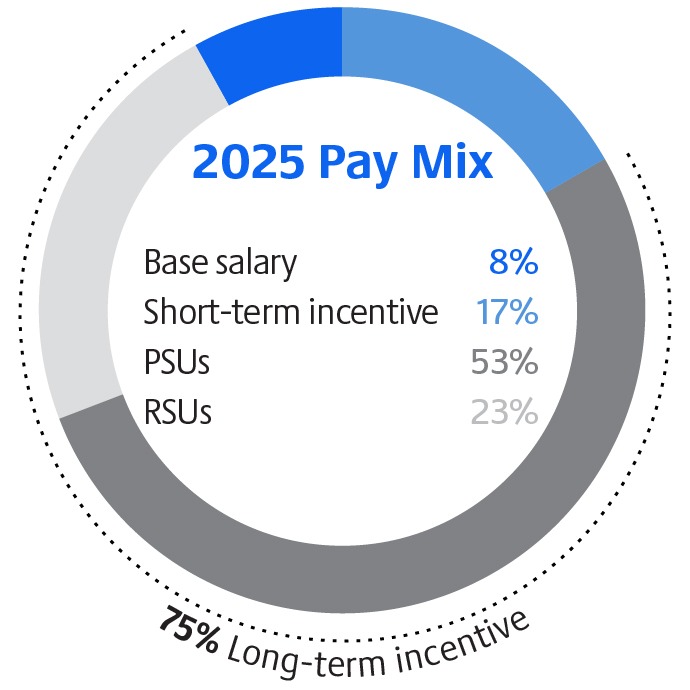
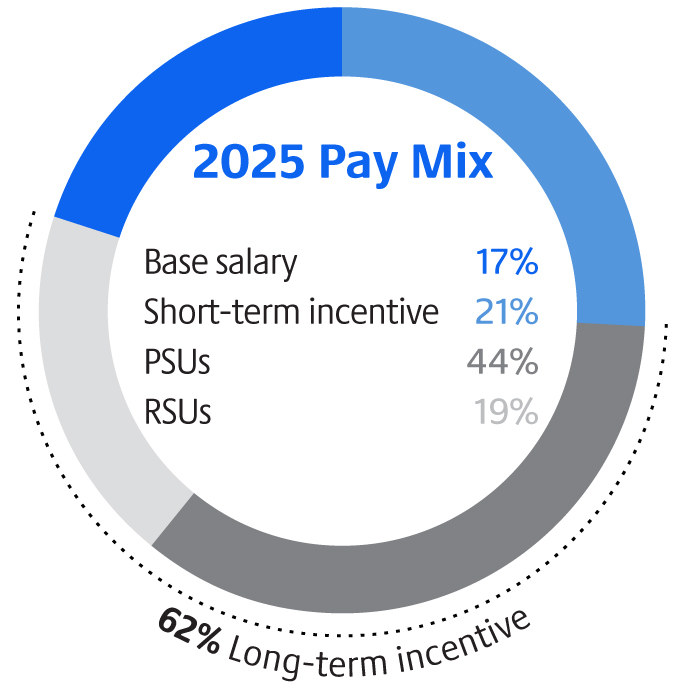
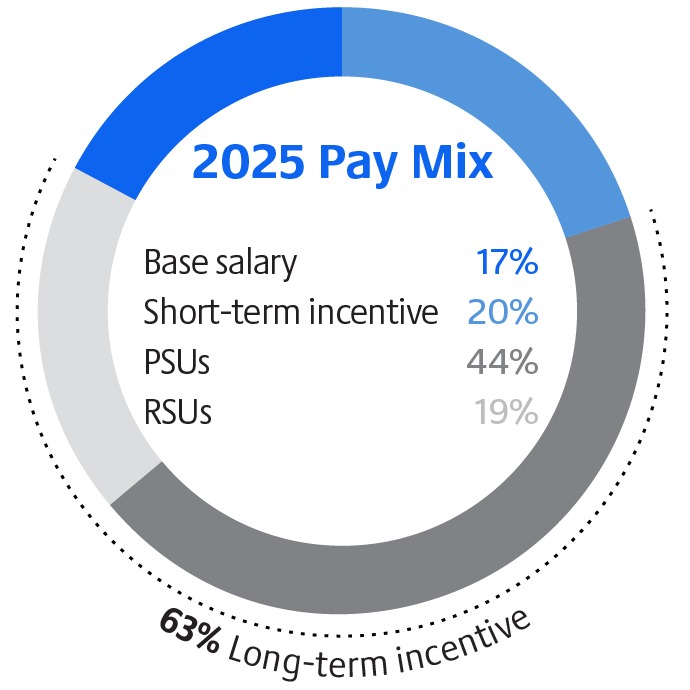
The Human Resources Committee and the Board place a significant emphasis on variable compensation, particularly
long-term incentives, when determining the total direct compensation for our executives.
A summary of our best practices include:
| | | | | | | | |
Annual board, committee and director evaluations | | Yes |
Benchmarking director and executive compensation against size appropriate peer groups to assess competitiveness and fairness | | Yes |
Maximums on variable compensation payments | | Yes |
Incentive Compensation Reimbursement and Holdback Policy (Clawback Policy), Recoupment and Holdback Policy for Detrimental Misconduct and Anti-Hedging Policy | | Yes |
Executive share ownership requirements | | 6x (CEO) 3x (Executive Vice-Presidents) 2x (Presidents and Senior Vice-Presidents) 1x (Vice-Presidents) |
| CEO realizable pay disclosure | | |
| Executive compensation tied to environmental, social and governance (ESG) targets | | Yes |
Annual say on pay vote | | Yes - averaging 96 per cent approval for the last three years. |
SUSTAINABILITY AND ESG
TC Energy remains committed to supporting global efforts to address climate change and managing the risks and opportunities associated with the transition to a lower-carbon economy. You can find more information about our sustainability and ESG initiatives starting on page 62. | | | | | | | | |
| Board and Committee oversight of ESG initiatives, including matters related to Indigenous relations, climate change, human capital management, diversity, stakeholder relations, and health, safety & environment | | Yes |
| Greenhouse gas (GHG) emissions targets | | Yes - a methane intensity reduction goal1 and a commitment to position to achieve zero emissions from our operations, on a net basis2 |
| Use of climate-related scenario analysis | | Yes |
| Reconciliation Action Plan | | Yes |
| Indigenous Advisory Council | | Yes |
1 This target addresses Scope 1 methane emissions associated with our natural gas transmission and gas storage assets, expressed in tonnes of CH4 per Bcf. For planning purposes, target progress is measured under the operational control reporting boundary, relative to a 2019 baseline year.
2 This target addresses Scope 1 and Scope 2 GHG emissions quantified under our operational boundary.
6 | TC Energy Management Information Circular 2026
About the Shareholder Meeting
| | | | | | | | | | | | | | | | | | | | |
As a shareholder of record, you are entitled to vote your TC Energy shares at the annual meeting. The meeting will cover five items of business, three of which require your vote, which are discussed in more detail starting on page 13. TC Energy will be holding the meeting via a virtual-only format, using a live audio webcast available online at https://meetings.lumiconnect.com/400-652-715-564, password "tc2026" (case sensitive). The next section discusses delivery of the meeting materials, attending and participating in the meeting, the voting process and submitting questions during the meeting. | | | | | | |
| | | WHERE TO FIND IT | | |
| | | | | |
| | > | About the Shareholder Meeting | | |
| | > | Delivery of Meeting Materials | | |
| | > | Attending and Participating in the Meeting | | |
| | > | Voting | | |
| | | Who Can Vote | | |
| | | How to Vote | | |
| | | Changing Your Vote | | |
| | | How the Votes are Counted | | |
| | > | Business of the Meeting | | |
| | | Director Profiles | | |
| | | | | | |
Delivery of Meeting Materials | |
| | | | | | |
We are using notice and access to deliver this Circular and 2025 Annual Report to both our registered and beneficial shareholders. This means that TC Energy will post this Circular and 2025 Annual Report online for our shareholders to access electronically. You will receive a package in the mail with a notice (Notice) explaining how to access and review this Circular and/or 2025 Annual Report electronically and how to request a paper copy of either at no charge. You will also receive a form of proxy or a voting instruction form in the mail so you can vote your shares. Notice and access is an environmentally friendly and cost effective way to distribute this Circular and the 2025 Annual Report because it reduces printing, paper and postage. The following beneficial shareholders will receive a paper copy of this Circular: •those who have already provided instructions that they prefer to receive a paper copy, •employees of our U.S. affiliate who own TC Energy shares through our U.S. affiliate's 401(k) retirement plans, and •those whose brokers receive materials through Computershare Investor Services, Inc. (Computershare). This Circular is available on SEDAR+ (www.sedarplus.ca) and on our website (www.tcenergy.com/notice-and-access). How to request a paper copy of this Circular Starting March 31, 2026, shareholders can request a paper copy of this Circular and/or 2025 Annual Report for up to one year. This Circular and/or 2025 Annual Report will be sent to you at no charge. If you would like to receive a paper copy of this Circular and/or 2025 Annual Report, please follow the instructions provided in the Notice. Requests by shareholders must be made by 3 p.m. MDT, Tuesday, April 21, 2026 in order for you to receive a paper copy of this Circular and/or 2025 Annual Report before the annual meeting on May 7, 2026. If you request a paper copy of this Circular and/or 2025 Annual Report you will not receive a new form of proxy (for registered shareholders) or voting instruction form (for beneficial shareholders), so you should keep the original form sent to you in order to vote. If you have questions about notice and access, you can call our Investor Relations line at 403-920-7911 or 1-800-361-6522. |
TC Energy Management Information Circular 2026 | 7
Attending and Participating in the Meeting
TC Energy is holding its 2026 annual meeting via a virtual-only format using a live audio webcast available online at https://meetings.lumiconnect.com/400-652-715-564, password "tc2026" (case sensitive). A physical or in-person meeting will not be held.
If you participate in the virtual meeting, it is important that you are connected to the internet at all times during the meeting. It is your responsibility to ensure connectivity for the duration of the virtual meeting.
You should allow ample time to log into the virtual meeting and complete the below procedure.
All meeting participants must use the latest versions
of Chrome, Safari, Edge, or Firefox. TC Energy recommends that you log in at least 30-60 minutes before the meeting starts as this will allow you to check compatibility and complete the related procedures required to log in to the meeting.
Additional information on how to access the virtual meeting is also available on our website (www.tcenergy.com).
WHO CAN ATTEND THE MEETING
Registered shareholders and duly appointed proxyholders will be able to attend and ask questions at the meeting.
Registered shareholders and duly appointed proxyholders can also vote in real-time at the meeting by completing
a ballot online during the meeting, provided that they complete the instructions outlined in this Circular.
If you are a registered shareholder and you wish to attend the meeting, you may still find it more convenient to complete a form of proxy and register your vote in advance of the meeting. If you vote by proxy in advance of the meeting, you are still entitled to attend and ask questions at the meeting, as well as to vote at the meeting if you decide you want to change your vote.
Beneficial shareholders who appoint themselves as proxyholders can also attend the meeting, ask questions and vote. Beneficial shareholders can also appoint someone else to attend the meeting and vote on
their behalf by following the directions on pages 11 and 12 of this Circular. Beneficial shareholders who have not appointed themselves as proxyholder will be able to listen to the meeting as a guest but will not be able to ask questions or vote.
Attending the meeting as a registered shareholder
If you hold your shares directly and have a share certificate or DRS Advice in your name, you may attend the meeting by following the instructions below:
1.Log in online at https://meetings.lumiconnect.com/400-652-715-564 using
a web browser on a smartphone, tablet or computer.
2.Click "I have a login" and then enter your control number located on the form of proxy or in the email notification you received from Computershare, and password "tc2026" (case sensitive).
Attending the meeting as a beneficial shareholder
If you hold your shares beneficially through a broker, nominee or intermediary, you may attend the meeting by following the instructions below:
1.Appoint yourself as a duly appointed proxyholder, by following the instructions on page 11 of this Circular. 2.Visit https://www.computershare.com/TCEnergyAGM to register to attend the meeting. To register, enter your account number located on your voting instruction form, your name and email address.
After the proxy deadline, Computershare will send
you via email a username that will be required to
log into the meeting.
3.Log in online at https://meetings.lumiconnect.com/400-652-715-564 using
a web browser on a smartphone, tablet or computer.
4.Click "I have a login" and then enter the four letter username provided to you by Computershare, and password "tc2026" (case sensitive).
You may also appoint someone else to attend and vote
at the meeting on your behalf by following steps 1 and 2 above (appointing such person as your proxyholder), and such person should follow steps 3 and 4 above in order
to attend the meeting.
Attending the meeting as a guest
If you are not a registered shareholder, a duly appointed proxyholder, or a beneficial shareholder who has appointed themselves as a proxyholder, you can still attend the meeting and listen by following the instructions below:
1.Log in online at https://meetings.lumiconnect.com/400-652-715-564 using
a web browser on a smartphone, tablet or computer.
2.Select "Guest" and complete the information requested in the form.
8 | TC Energy Management Information Circular 2026
Submitting questions at the meeting
We will hold a live question and answer session to answer the questions submitted during the meeting. The following attendees will be able to submit questions:
•registered shareholders,
•beneficial shareholders who have appointed themselves proxyholder as outlined on pages 11 and 12
of this Circular, and •other duly appointed proxyholders.
Guests will not be able to submit questions during
the meeting.
To ask a question, type your question into the chat function. Additional instructions on how to ask questions will be provided at least one week before the meeting
on our website (www.tcenergy.com) and explained during the meeting.
We encourage you to submit your questions in advance of the meeting to Investor Relations by emailing investor_relations@tcenergy.com.
Following the meeting, a webcast in English of the meeting, including the question and answer session,
will be available for viewing on our website (www.tcenergy.com).
We are committed to transparent communication at the meeting. Questions asked related to the business of the meeting will not be curated and will be presented as submitted, unedited and uncensored. Questions will be answered in the order received for each item of business.
We will respond in writing as soon as practicable after the meeting to any questions that were not answered during the meeting.
| | |
|
Technical difficulties: If you experience technical difficulties logging into the meeting or during the meeting, please contact 403-920-2050. |
|
TC Energy Management Information Circular 2026 | 9
Voting
WHO CAN VOTE
Shareholders of record on March 20, 2026 are entitled
to receive Notice of our 2026 annual meeting of common shareholders and vote their shares. Our Board set this date to comply with legal requirements and allow enough time for shareholders to receive and review the materials, make their voting decisions and send in their voting instructions before the deadline.
As of March 5, 2026, we had 1,041,736,317 common shares outstanding. Each common share carries the right to one vote on any item of business that properly comes before the meeting and any meeting that is reconvened if the meeting is adjourned. Subject to our Majority Voting Policy for director elections (see Governance – Governance Philosophy – Majority Voting), a simple majority of votes (50 per cent plus one vote) is required for each item to be approved by shareholders.
As of March 5, 2026, TC Energy had eight series of preferred shares outstanding. The holders of these shares do not have voting rights at the meeting.
Registered shareholders
You are a registered shareholder if you have a share certificate or DRS Advice in your name.
We will prepare a list of the registered shareholders as
of March 20, 2026, showing the names of all shareholders who are entitled to vote at the meeting
and the number of shares each owns. Our transfer agent, Computershare, will have a copy of the list at their Calgary office if you want to check it during regular business hours. If you would like to view this list, please call 403-267-6800 to set up an appointment. Computershare is located at Suite 800, 324 8th Avenue S.W., Calgary, Alberta T2P 2Z2.
Beneficial shareholders
You are a beneficial shareholder (i.e. a non-registered shareholder) if your securities broker, financial institution, clearing agency, trustee or custodian
(your nominee) holds your shares for you in a
nominee account.
Principal shareholders
Our directors and executives are not aware of any
person or corporation that beneficially owns, directly
or indirectly, or exercises control or direction over,
more than ten per cent of our outstanding shares.
HOW TO VOTE
You have two ways to vote:
• by proxy, or
• by virtually attending the meeting and voting.
Voting by proxy
Voting by proxy means you are giving someone else
the authority to attend the meeting and vote for you (your proxyholder).
Registered shareholders
We mail the Notice directly to you, and your package includes a proxy form.
You may request a paper copy of this Circular and/or 2025 Annual Report by following the instructions in
the Notice that was mailed to you.
If you are a registered shareholder, you must return your signed proxy form in order to vote by proxy.
The securities represented by your proxy will be voted or withheld from voting in accordance with the instructions provided in your proxy on any ballot that may be called for. If you appoint the TC Energy representatives named in the proxy form and specify your voting instructions, your shares will be voted, or withheld from voting, accordingly. If you do not specify how you want to vote your shares, your shares will be voted for you as follows:
• for the nominated directors listed on the proxy form and in this Circular,
• for the appointment of KPMG LLP, Chartered Professional Accountants (KPMG) as TC Energy’s auditor, and authorizing the directors to fix their remuneration, and
• for our approach to executive compensation, as described in this Circular.
Take some time to read about the items of business (see pages 13 to 18), then complete the proxy form mailed to you, sign and date it, and mail it in the envelope provided. Computershare must receive the completed form by 10 a.m. MDT on Tuesday, May 5, 2026 (or, if the meeting is adjourned or postponed, 48 hours, excluding Saturdays, Sundays and statutory holidays in the Province of Alberta, prior
to the commencement of the reconvened meeting). 10 | TC Energy Management Information Circular 2026
If your package is missing an envelope, use a blank
one and address it to:
Computershare Investor Services, Inc.
Stock Transfer Services
320 Bay Street, 14th Floor
Toronto, ON, Canada, M5H 4A6
If you want to submit your voting instructions by phone or on the internet, you must do so by 10 a.m. MDT
on Tuesday, May 5, 2026 (or, if the meeting is adjourned or postponed, 48 hours, excluding Saturdays, Sundays and statutory holidays in the Province of Alberta, prior to the commencement
of the reconvened meeting). See the instructions
on your proxy form.
If you appoint someone else as your proxyholder, but
do not specify how you want them to vote your shares, the person can vote as they see fit.
If there are any amendments to the items of business
or any other matters that properly come before the meeting (including where the meeting will be reconvened if it was adjourned), your proxyholder has the discretion to vote as they see fit, in each instance,
to the extent permitted by law whether the amendment or other matter of business that properly comes before the meeting is routine or contested.
Late proxies may be accepted or rejected by the chair
of the meeting at their discretion and the chair of the meeting is under no obligation to accept or reject any particular late proxy. The chair of the meeting may
waive or extend the proxy cut-off without notice.
You can choose anyone to be your proxyholder –
the person does not need to be a TC Energy shareholder or the TC Energy representatives named in the proxy form. You must write the person's name on your proxy form, and return the signed proxy form to Computershare to appoint someone as your proxyholder. In addition, you must go to
https://www.computershare.com/TCEnergyAGM and provide Computershare with the name and email address of your appointee so that Computershare may provide the appointee with a username via email to log into the meeting.
You should tell this person that you have appointed them as your proxyholder and that they need to attend the meeting and vote on your behalf. Your proxyholder must vote your shares according to your instructions. Your shares will not be voted if your proxyholder does not attend the meeting to vote for you.
If you have returned your signed proxy form and you do not appoint anyone to be your proxyholder, John E. Lowe, Chair of the Board, François L. Poirier, President and Chief Executive Officer or Jane M. Brindle, Vice-President, Law and Corporate Secretary (TC Energy Proxyholders) will be appointed to act as your proxyholder to vote your shares at the meeting according to your instructions.
Participating in the meeting and voting
If you want to attend the meeting and vote, do not complete the proxy form. Just log into the virtual meeting using the instructions provided on pages 8 and 9 and vote online at the meeting. TC Energy Management Information Circular 2026 | 11
Non-registered (beneficial) shareholders
Your broker, its agent or its nominee can only vote your TC Energy shares if they have received proper voting instructions from you. If you are a beneficial shareholder, your package includes a voting instruction form. Complete the form and follow the return instructions on the form.
The voting instruction form is similar to a proxy form, however it can only instruct the registered shareholder how to vote your shares. You cannot use the form to vote your shares directly.
Your broker is required by law to receive voting instructions from you before voting your shares. Every broker has their own mailing procedures and instructions for returning the completed voting instruction form, so be sure to follow the instructions provided on the form which may require you to take action earlier than the deadline for voting by proxy.
Most brokers delegate responsibility for obtaining instructions from their clients to Broadridge Investor Communications Corporation (Broadridge). Broadridge, or any other intermediary as applicable, mails the proxy materials and voting instruction form to beneficial shareholders, at our expense.
The voting instruction form will name the same TC Energy representatives listed on page 11 to act as TC Energy Proxyholders. You may request a paper copy of the circular and/or 2025 Annual Report by following the instructions in the Notice that was mailed to you.
Participating in the meeting and voting
You can attend the virtual meeting and vote, or you
can appoint someone else to attend the meeting and give them your voting instructions by following the directions on pages 8 and 9 of this circular. In order
to submit your voting instructions, print your name,
or the name of the person you are appointing, in the blank space provided on the voting instruction form. Complete the rest of the form and then mail it to Broadridge (or to your broker, as instructed on your voting instruction form) as soon as possible. Your package also includes instructions for submitting your voting instructions by phone or on the internet if
you prefer either of these methods. Broadridge tabulates the results of all the instructions
it receives from beneficial shareholders, and provides appropriate voting instructions to our transfer agent.
CHANGING YOUR VOTE
Registered shareholders
If you change your mind and want to revoke your proxy, you may revoke it by:
•completing and signing a proxy bearing a later date (see page 10) and delivering such proxy to Computershare by 10 a.m. MDT on Tuesday, May 5, 2026 (or, if the meeting is adjourned or postponed, 48 hours, excluding Saturdays, Sundays and statutory holidays in the Province
of Alberta, prior to the commencement of the reconvened meeting), •sending a signed written statement (or have your attorney sign a statement with your written authorization) to:
Corporate Secretary
TC Energy Corporation
450 - 1 Street S.W. Calgary, AB
Canada T2P 5H1
corporate_secretary@tcenergy.com
We must receive your written statement prior to 5 p.m. MDT on Wednesday, May 6, 2026 or 5 p.m. MDT on the last business day prior to the day the meeting is reconvened if it is adjourned, or
•any other manner permitted by law.
If you have followed the instructions for attending and voting at the meeting, voting at the meeting will revoke any previous proxy.
Non-registered (beneficial) shareholders
If you change your mind, contact your broker
or nominee.
HOW THE VOTES ARE COUNTED
As transfer agent, Computershare counts and tabulates the votes on our behalf to ensure the votes are kept confidential. They only show us the ballot or proxy
form if:
• it is required by law,
• there is a proxy contest, or
• there are written comments on the proxy form.
12 | TC Energy Management Information Circular 2026
Business of the Meeting
| | | | | | | | | | | |
The meeting will cover five items of business, three of which require your vote: FINANCIAL STATEMENTS We will place before shareholders at the meeting our consolidated financial statements for the year ended December 31, 2025, and the auditor's reports thereon. These documents have been filed with the appropriate government regulatory agencies and are included in our 2025 Annual Report. We deliver the Annual report using notice and access (see page 7). We mail you a paper copy of the Annual Report if you have provided instructions that you prefer to receive a paper copy, or you may request a paper copy as described in the Notice (see page 7). Our 2025 Annual Report is also available in English and French on our website (www.tcenergy.com), or you can request a copy from our Corporate Secretary or Investor Relations. | | | |
| About quorum We must have a quorum for the meeting to proceed. Quorum constitutes two people present at the meeting who are entitled to vote at the meeting and represent at least 25 per cent of the issued and outstanding TC Energy common shares. The two people are entitled to vote in their own right, by proxy or as a duly authorized representative of a shareholder. | |
| | |
| | |
ELECTION OF DIRECTORS You will be asked to vote on electing 13 directors to the Board. The nominated director profiles starting on page 20 give important information about each nominated director, including their background, experience and memberships on other public company boards they serve on. All of the nominated directors currently serve on our Board, and we have included in their profiles their 2025 attendance, the value of TC Energy shares or Deferred Share Units (DSUs) they currently hold (their at-risk investment) and their election results from the 2025 annual meeting. You can find more information about their at-risk investment on pages 83 and 84. | |
All directors are elected for a one-year term.
| | | | | | | | | | | | | | | | | |
| 1. | Scott Bonham | 6. | John E. Lowe | 11. | Siim A. Vanaselja |
| 2. | Cheryl F. Campbell | 7. | Dawn Madahbee Leach | 12. | Thierry Vandal |
| 3. | Michael R. Culbert | 8. | François L. Poirier | 13. | Dheeraj "D" Verma |
| 4. | William D. Johnson | 9. | Una Power | | |
| 5. | Susan C. Jones | 10. | Mary Pat Salomone | | |
The Board recommends you vote for the nominated directors:
RESOLVE to elect the directors listed in TC Energy’s Circular dated March 5, 2026 to hold office until the next annual meeting of shareholders or until their successors are earlier elected or appointed.
TC Energy Management Information Circular 2026 | 13
AUDITOR
You will be asked to vote on appointing the external auditor. The auditor will hold office until the close of our next annual meeting of shareholders.
You will also vote on authorizing the directors to fix the auditor’s remuneration.
The Board recommends you vote for appointing KPMG as auditor of TC Energy and authorizing the directors to fix their remuneration:
RESOLVE to appoint KPMG as auditor of TC Energy until the close of our next annual meeting of shareholders, and authorize the directors to fix their remuneration.
Through the processes described in the Auditor Independence section we have confirmed KPMG is independent with respect to TC Energy within the meaning of the relevant rules and related interpretations prescribed by all relevant professional bodies in Canada and applicable legal requirements and also that they are independent accountants with respect to TC Energy under all relevant U.S. professional and regulatory standards.
Representatives of KPMG will attend the meeting, have an opportunity to make a statement and respond to any questions.
Stakeholder engagement
In 2022 and 2023, TC Energy conducted a comprehensive stakeholder engagement program on auditor independence and tenure, including outreach to our largest investors and those investors whose voting guidelines highlighted concerns with extended auditor tenure.
Following this engagement program, TC Energy has continued to actively engage with stakeholders on the topic of auditor independence and tenure. In 2025, TC Energy's CEO, CFO, other members of management and Investor Relations participated in over 500 meetings with shareholders and bondholders, including over 40 meetings on ESG-specific topics, some focused on how the Audit Committee satisfies itself of ongoing auditor independence and tenure considerations.
Our auditor support in recent years has been strong and reflects our commitment to engagement:
| | | | | | | | |
Year | Votes in favour | Votes withheld |
2025 | 637,619,923 (91.40%) | 60,028,125 (8.60%) |
2024 | 640,326,854 (93.24%) | 46,460,250 (6.76%) |
2023 | 613,576,171 (89.00%) | 75,802,855 (11.00%) |
For more information on TC Energy’s overall shareholder engagement strategy, please see page 60 and for more information on the comprehensive review of the external auditor, please see page 18. 14 | TC Energy Management Information Circular 2026
Auditor fees
The table below shows the services KPMG provided during the last two fiscal years and the fees they invoiced us:
| | | | | | | | |
($ millions) | 2025 | 2024 |
Audit fees | 18.7 | 19.4 |
•audit of the annual consolidated financial statements | | |
•services related to statutory and regulatory filings or engagements | | |
•review of interim consolidated financial statements and information contained in various prospectuses and other securities offering documents | | |
Audit-related fees | 0.1 | 1.4 |
•services related to the audit of the financial statements of TC Energy pipeline abandonment trusts and certain post-retirement plans, and certain special purpose audits | | |
Tax fees | 1.0 | 1.5 |
•Canadian and international tax planning and tax compliance matters, including the review of income tax returns and other tax filings | | |
| All other fees | 0.4 | 0.5 |
•fees for other products and services provided by the auditors and not described above, which included fees related to advice and assistance with ESG services, and French and Spanish translation services | | |
Total fees | 20.2 | 22.8 |
Note
•2024 total fees are higher than 2025 due to increased audit work related to the spinoff of our Liquids Pipeline business, including additional financial statements required in connection with debt financings of certain Liquids subsidiaries and additional securities work.
Pre-Approval Policy for Audit and Non-Audit Services
The Audit Committee maintains a Pre-Approval Policy with respect to permitted non-audit services and audit services.
For non-audit service engagements of up to $250,000, approval of the Audit Committee chair is required, and the
Audit Committee is to be informed of the engagement at the next scheduled Audit Committee meeting. For all
non-audit service engagements of $250,000 or more, pre-approval of the Audit Committee is required.
As required under professional standards, KPMG is required to have any proposed non-audit services pre-approved
by the Audit Committee or the Chair of the Audit Committee. The pre-approval process for non-audit services requires
that KPMG provide a written description of the service, an assessment of the independence considerations related to the service and a description of the nature and magnitude of the proposed fees. Prior to pre-approving any non-audit services, the Audit Committee and/or Audit Committee Chair considers the following factors:
•the independence assessment provided by KPMG,
•the process under which management has assessed that KPMG is best suited to perform the non-audit services, and
•the magnitude of the fees relative to total fees paid to KPMG.
TC Energy Management Information Circular 2026 | 15
Auditor independence
TC Energy recognizes that auditor independence is critical to the integrity of our financial information. As such, TC Energy’s auditor selection process is designed to maintain auditor independence while balancing a need for continuity of knowledge in order to ensure a high quality audit provided by an audit firm with the depth and breadth of experience to effectively and efficiently audit a multi-national company with complex operations.
The Audit Committee continuously assesses the external auditor and, on an annual basis, reviews audit quality, auditor tenure and appropriateness of audit fees, including the benefits and risks of having a long-tenured auditor and the controls and processes that ensure their independence. This assessment also considers the nature, extent and permissibility of any proposed non-audit services and adherence to the mandatory partner rotation requirements.
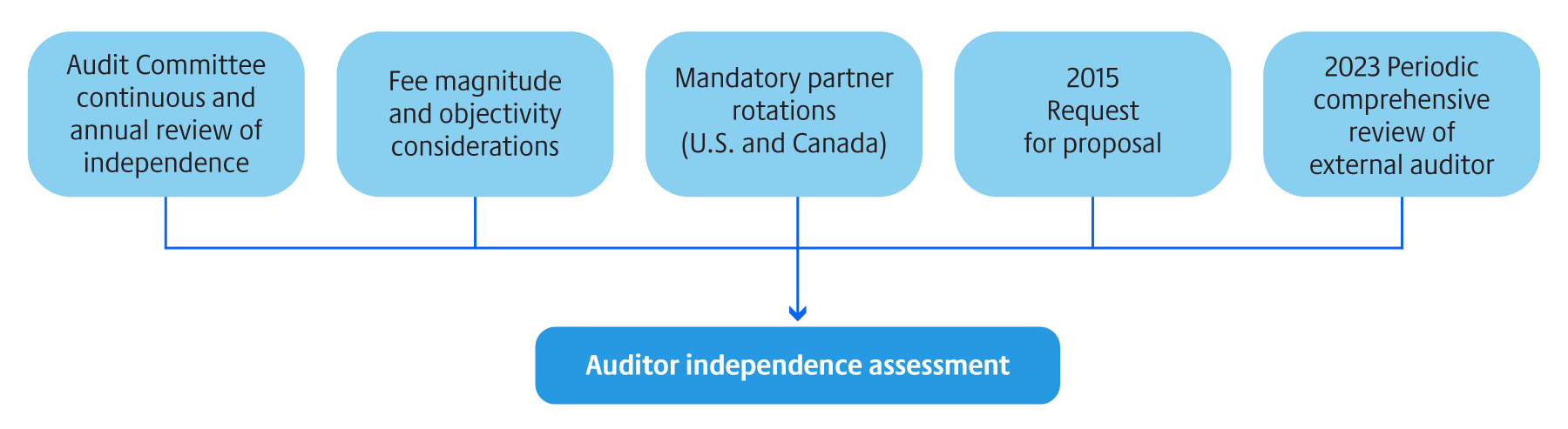
Below are additional details regarding factors the Audit Committee considered when assessing independence.
| | |
Audit Committee continuous and annual review of independence
Fee magnitude and objectivity considerations
Mandatory partner rotations (U.S. and Canada)
2015 Request for proposal
2023 Periodic comprehensive review of external auditor
Auditor independence assessment
|
Audit Committee expertise and independence reviews
All members of the Audit Committee are independent and financially literate. One member of the Audit Committee
is a designated financial expert under New York Stock Exchange (NYSE) rules.
As part of its annual assessment on independence, the Audit Committee receives and reviews the auditor’s reports regarding independence. The committee also considers whether any factors are present that may impair the independence of the auditor at each meeting of the committee. The auditor maintains an open and direct line of communication with both the Chair of the Audit Committee and the Audit Committee.
Our Annual Information Form (AIF) includes more information about the Audit Committee, including the committee charter, starting on page 31 of the AIF. The 2025 AIF is available on our website (www.tcenergy.com) and on SEDAR+ (www.sedarplus.ca).
Fee magnitude and objectivity considerations
The Audit Committee understands that the magnitude of fees paid to an auditor could negatively impact auditor independence if a financial interest will inappropriately influence an auditor’s judgment or behaviour. In reaching the conclusion to recommend the re-appointment of KPMG as our external auditor, the Audit Committee considered the magnitude of the fees that TC Energy pays to KPMG LLP (Canada) and KPMG LLP (US) in context of the size of their respective firms. For 2025, KPMG has confirmed to the Audit Committee that the fees payable to KPMG are not material to KPMG LLP (Canada) or KPMG LLP (US).
Similarly, there is a threat to independence if an auditor will be deterred from acting objectively because of actual or perceived pressures. We consider safeguards that KPMG has implemented to manage this threat as an important element
of our assessment of audit quality. The safeguards against this risk include:
•the assignment of an engagement quality control review partner to the audit engagement by a risk management partner,
•the involvement of experienced national office professionals outside of the engagement team when dealing with complex or judgmental matters,
•the structure of the respective firms, and
•compensation policies in place.
Given the Audit Committee’s understanding of the relative magnitude of fees paid to each respective firm, as well as
the Audit Committee’s observations of safeguards that have been implemented by KPMG, the Audit Committee is satisfied these threats to auditor independence have been appropriately managed.
16 | TC Energy Management Information Circular 2026
Canadian and U.S. partner rotations and partner qualifications
As part of the annual review of auditor independence, the Audit Committee assesses KPMG’s ongoing compliance with mandatory rotation requirements. This means that the lead audit partner and quality control review partner may serve
a maximum of five years, followed by a five-year period without any involvement in the TC Energy audit, before they
can be re-considered for a partner role. For other audit partners of KPMG involved in the TC Energy audit, which includes
the lead partner and quality control review partner from KPMG's Houston team, the mandatory rotation occurs after
a maximum of seven years of service followed by a two-year period without any involvement in the TC Energy audit.
This rotation helps ensure auditor independence is maintained by changing the key personnel working on TC Energy’s
audits after a set period of time.
In addition to the partner rotations described above, all lead partners and quality control review partners must satisfy
the following minimum requirements:
•Chartered Professional Accountant, in good standing,
•industry-specific experience,
•completion of relevant professional development and accreditation training,
•knowledge of, and experience with, the applicable financial reporting framework and auditing standards, and
•knowledge of, and experience with, the SEC rules and regulations.
The Audit Committee is satisfied with KPMG’s on-going compliance with the regulatory mandated rotation requirements (five and seven years as applicable in the circumstances) as well as the transition plans that have been followed to on-board qualified engagement partners who are new to providing audit services to TC Energy.
2015 Request for proposal
In 2015, it was determined that a request for proposal (RFP) process would further strengthen the external audit process
and auditor independence. The Audit Committee oversaw this RFP for TC Energy’s external audit engagement and conducted a detailed assessment of the submissions from large multi-national firms, including interviews with each firm.
A limited number of potential audit firms had the breadth of capabilities required to provide high-quality, independent audit services to a company of TC Energy’s scope, geographic presence and complexity of operations.
Requirements and factors which determined the successful candidate included:
•the experience, qualifications and ability to audit a large-scale, energy-focused, public company, headquartered
in Canada with significant operations in the U.S. and Mexico,
•familiarity with complex rate-regulated accounting,
•no conflicts with TC Energy through existing non-audit services provided to TC Energy nor close relationships with competitor companies in the industry,
•availability of resources and local access to U.S. GAAP expertise,
•audit quality and auditor tenure, and
•appropriateness of fees.
Based on the results of this process, the Audit Committee and Board recommended KPMG continue as TC Energy's
external auditor, subject to its annual review of auditor performance, including audit quality and independence considerations. The Audit Committee made its recommendation based on KPMG's qualifications, experience and other decision criteria, including KPMG's ability to provide a quality audit that met the requirements of TC Energy and its shareholders, taking into account the scope, geographic presence and complexity of TC Energy's business.
TC Energy Management Information Circular 2026 | 17
Periodic comprehensive review of auditor
In order to further enhance the governance processes relating to assessing auditor independence and audit quality, in November 2022, the Audit Committee approved amendments to the Audit Committee’s charter to mandate the completion of a comprehensive review of the external auditor at least every five years. Such a review is contained as a recommendation of the Enhancing Audit Quality initiative of the Chartered Professional Accountants of Canada, the Canadian Public Accountability Board and the Institute of Corporate Directors. The comprehensive review is intended to enhance audit quality through a deeper and broader analysis of the external auditor than in the annual assessment.
This fulsome and detailed review is intended to provide the Audit Committee data on three indicia of audit quality:
•independence, objectivity and professional skepticism,
•quality of engagement team, and
•quality of communications and interactions with the external auditor.
The Audit Committee reviews the results of the comprehensive review and uses it to assess whether a fulsome request
for proposal process is required.
This comprehensive review was completed in 2023 and supported the recommendation to appoint KPMG as TC Energy’s external auditor.
Audit Committee independence recommendation
In reaching the conclusion to recommend KPMG as external auditor to serve for the 2025 financial year, the Audit Committee reviewed the above factors relating to auditor independence and confirmed it was satisfied that KPMG
is independent within the meaning of applicable Canadian and U.S. securities rules.
ADVISORY VOTE ON OUR APPROACH TO EXECUTIVE COMPENSATION
You will have an opportunity to have a say on pay by participating in the advisory vote on our approach to executive compensation. The Board believes the vote is beneficial because it holds directors accountable to shareholders for their decisions on executive compensation and provides valuable feedback.
While the vote is non-binding, the Board will take the results into consideration when it considers compensation policies, procedures and decisions in the future. We will disclose the results of the advisory vote in our report on voting results for
the meeting, which will be posted on our website (www.tcenergy.com) and on SEDAR+ (www.sedarplus.ca).
Since 2010, we have held annual say on pay votes at our annual shareholder meetings. Over the last three years, these advisory votes were approved by a significant majority of shareholders.
| | | | | | | | |
Year | Votes in favour | Votes against |
2025 | 657,530,688 (96.97%) | 20,547,941 (3.03%) |
2024 | 640,895,659 (96.37%) | 24,130,789 (3.63%) |
2023 | 634,750,021 (94.20%) | 39,104,279 (5.80%) |
The Board recommends you vote for our approach to executive compensation:
RESOLVE on an advisory basis, without diminishing the role and responsibilities of TC Energy's Board, that the shareholders accept the approach to executive compensation disclosed in TC Energy’s Circular dated March 5, 2026.
OTHER BUSINESS
We did not receive any shareholder proposals for the meeting. The Board and management are not aware of any other items to be properly brought before the meeting.
18 | TC Energy Management Information Circular 2026
| | | | | | | | | | | |
ELECTION OF DIRECTORS | | | |
| | | |
Our articles currently state that the Board must have a minimum of eight and a maximum of 15 directors. The Board has determined that 13 directors will be elected at the meeting. The Board believes this size is appropriate based on the scope of our business, the skills and experience of the nominated directors and the four standing committees and to achieve effective decision-making. It believes that all of the nominated directors are well qualified to serve on the Board. | | Each nominated director has expressed their willingness to serve on our Board until our next annual meeting of shareholders. If elected, they will also serve on the Board of TransCanada PipeLines Limited (TCPL), our main operating subsidiary. | |
| | |
| | | |
Twelve of the 13 nominated directors (92 per cent) are independent within the meaning of Canadian and applicable U.S. securities laws, regulations and policies and the applicable rules of the Toronto Stock Exchange (TSX) and New York Stock Exchange (NYSE). The only exception is Mr. Poirier because of his role as President and CEO. The profiles on the following pages show each director’s holdings in TC Energy shares at March 14, 2025 and as of the date of this Circular. DSUs are calculated on the basis of retainer fees paid in 2025 and dividend equivalents credited up to January 31, 2025 and January 30, 2026. The profiles also indicate the year the director joined the Board and has continually served as a director of TC Energy. All of the nominated directors are Canadian residents except for Mr. Bonham, Ms. Campbell, Mr. Johnson, Mr. Lowe, Ms. Salomone, Mr. Vandal and Mr. Verma who are U.S. residents. Mr. Bonham and Mr. Vandal also hold Canadian citizenship. We have share ownership requirements for our directors and executives to align their interests with those of our shareholders. As of the date of this Circular, all of our directors are in compliance with our director Share Ownership Policy or are not yet required to meet the requirements given the length of their tenure on the Board, see Director Compensation Discussion and Analysis - Approach - Aligning the interests of directors and shareholders on page 79 for more information. The at-risk investment reflects the total market value of the director’s TC Energy shares and DSUs based on the closing share price on the TSX of $87.24 on March 5, 2026. See At-Risk Investment on pages 83 and 84 for more information. |
TC Energy Management Information Circular 2026 | 19
| | | | | | | | | | | | | | | | | | | | | | | | | | | | | |
| | | Scott Bonham AGE 64, ATHERTON, CA, U.S.A. | DIRECTOR SINCE 2024 |
| | |
| | Scott Bonham is a corporate director. Since 2016 he has served on the board of Loblaw Companies Limited (retail grocery). He also previously served on the boards of The Bank of Nova Scotia (chartered bank) from January 2016 until April 2025 and Magna International Inc. (manufacturing, auto parts) from May 2012 until May 2021. He is a co-founder of Intentional Capital Real Estate (Canada), a privately-held real estate asset management company. From 2000 to 2015, he was co-founder of GGV Capital, an expansion stage venture capital firm with investments in the U.S. and China. Prior to GGV Capital, he served as a Vice President of the Capital Group Companies (financial services) and previously held marketing roles at Silicon Graphics (technology). Mr. Bonham is also a board member of the Canadian Institute for Advanced Research and the DenmarkBridge, an initiative connecting Danish companies to Silicon Valley. Mr. Bonham has a Bachelor of Science in electrical engineering from Queen’s University and a Masters of Business Administration from Harvard Business School. |
| |
Independent Skills and experience •Accounting/Audit •Capital Markets/Mergers & Acquisitions •Electric Power & Electrification Value Chain •Enterprise Risk Management •Governance •Major Projects •Operations/Health, Safety, Sustainability & Environment •Strategy & Leading Growth At-risk investment $601,345 TC Energy Board/Committees 2025 meeting attendance •Board of Directors 5/5 meetings (100%) •Audit Committee 4/4 meetings (100%) •Human Resources Committee 4/4 meetings (100%) | |
| | | | | | |
| | Annual meeting voting results | | Votes in favour | | Votes against |
| | 2025 | | 677,017,619 (99.84%) | | 1,061,492.00 (0.16%) |
| | 2024 | | — | | — |
| | 2023 | | — | | — |
| | Other public company boards and date | Stock exchange | | Board committees |
| | Loblaw Companies Limited (retail) (since October 2016) | TSX | | Audit
Governance, Talent and Compensation |
| | TC Energy securities held | | 2026 | | 2025 | | Meets share ownership requirements |
| | Shares | | — | | — | | Mr. Bonham has until November 4, 2029 to meet the requirements. |
| | DSUs | | 6,893 | | 1,010 |
| | |
20 | TC Energy Management Information Circular 2026
| | | | | | | | | | | | | | | | | | | | | | | | | | | | | |
| | | Cheryl F. Campbell AGE 66, MONUMENT, CO, U.S.A. | DIRECTOR SINCE 2022 |
| | |
| | Ms. Campbell is a corporate director and has 35 years of energy experience in midstream, interstate pipelines and utilities. She currently serves on the board of PG&E Corporation (PG&E) (utilities), where she is Chair of the Safety & Nuclear Oversight Committee as well as a member of its Sustainability & Governance Committee. She also serves on the boards of Summit Utilities (natural gas distribution), as Chair, and JANA Corporation (infrastructure service provider). She is involved in non-profit board work serving on the National Association of Corporate Directors (NACD), Colorado chapter board. Ms. Campbell previously served as a Senior Vice President, Gas, with Xcel Energy, Inc. (utility supplier). During her 13-year tenure there, she developed industry leading gas integrity and risk management programs, improving regulatory returns and overall operating, environmental and safety metrics. Ms. Campbell also served on the U.S. Department of Transportation's Gas Pipeline Advisory Committee providing guidance to the Secretary of Transportation on pipeline safety regulations, and testified before a congressional subcommittee on pipeline infrastructure safety. In 2019, Ms. Campbell was awarded the Natural Gas Leadership Award from the American Gas Association and was named one of the Top Women in Energy by the Denver Business Journal in 2014. Ms. Campbell holds a Master of Science degree in finance, with a minor in management, from the University of Colorado at Denver, as well as Bachelor of Science degrees in chemical engineering and business from the University of Colorado at Boulder. |
| |
Independent Skills and experience •Accounting/Audit •Energy, Pipelines & Midstream •Enterprise Risk Management •Governance •Government, Regulatory & Stakeholder Relations •Major Projects •Operations/Health, Safety, Sustainability & Environment •Strategy & Leading Growth At-risk investment $2,263,704 TC Energy Board/Committees 2025 meeting attendance •Board of Directors 5/5 meetings (100%) •Audit Committee 4/4 meetings (100%) •Health, Safety, Sustainability and Environment Committee 4/4 meetings (100%) | |
| | | | | | |
| | Annual meeting voting results | | Votes in favour | | Votes against |
| | 2025 | | 673,225,982 (99.28%) | | 4,853,157 (0.72%) |
| | 2024 | | 658,934,044 (99.08%) | | 6,091,745 (0.92%) |
| | 2023 | | 671,097,465 (99.59%) | | 2,756,843 (0.41%) |
| | Other public company boards and date | Stock exchange | | Board committees |
| | PG&E Corporation (utilities) (since April 2019) | NYSE | | Safety and Nuclear Oversight (Chair)
Sustainability and Governance |
| | TC Energy securities held | | 2026 | | 2025 | | Meets share ownership requirements |
| | Shares | | 6,231 | | 5,921 | | Yes |
| | DSUs | | 19,717 | | 15,449 | | |
| | |
| | | PG&E filed for bankruptcy under Chapter 11 of the United States Bankruptcy Code in January 2019 as a result of claims arising from fires caused by PG&E's electrical equipment. Ms. Campbell joined the board of directors of PG&E in April 2019, after PG&E filed for bankruptcy under Chapter 11 of the United States Bankruptcy Code in January 2019 and prior to its emergence from Chapter 11 bankruptcy in July 2020. Ms. Campbell continues to be a director of PG&E. |
TC Energy Management Information Circular 2026 | 21
| | | | | | | | | | | | | | | | | | | | | | | | | | | | | |
| | | Michael R. Culbert AGE 68, CALGARY, AB, CANADA | DIRECTOR SINCE 2020 |
| | |
| | Mr. Culbert is a corporate director. He currently serves on the board of directors for ARC Resources Ltd. (oil and gas production) since May 2024. Mr. Culbert previously served as a director of Precision Drilling Corporation (oil and gas services) from 2017 to 2024, and as director and Vice Chair of PETRONAS Canada Ltd. (oil and gas, exploration and production) from 2016 to 2020. He has also previously served as a director and President of Pacific NorthWest LNG LP (natural gas services) (2013 to 2017). He is a former co-founder, director, President and Chief Executive Officer of Progress Energy Ltd. (oil and gas, exploration and production) from 2004 to 2016 and, prior to that, he was the Vice-President, Marketing and Business Development from 2001 to 2004. He has also held senior leadership positions in marketing and business development throughout his career. Mr. Culbert is a patron of the Rogers Charity Classic, which since its inception in 2013 has successfully raised approximately $165 million for children and youth charities in Alberta. He is also a founding member of the Creative Destruction Lab Energy stream at the University of Calgary, Haskayne School of Business. In 2019, Mr. Culbert was awarded the 2019 Distinguished Business Leader – Recognizing Ethical Leadership from the University of Calgary Haskayne School of Business and the Calgary Chamber of Commerce. In 2025, Mr. Culbert was inducted into the Southern Alberta Business Hall of Fame. Mr. Culbert holds a Bachelor of Science Business Administration degree from Emmanuel College in Boston, Massachusetts. |
| |
Independent Skills and experience •Accounting/Audit •Capital Markets/Mergers & Acquisitions •CEO •Energy, Pipelines & Midstream •Governance •Government, Regulatory & Stakeholder Relations •Operations/Health, Safety, Sustainability & Environment •Strategy & Leading Growth At-risk investment $4,027,522 TC Energy Board/Committees 2025 meeting attendance •Board of Directors 5/5 meetings (100%) •Audit Committee 4/4 meetings (100%) •Health, Safety, Sustainability and Environment Committee 4/4 meetings (100%) | |
| | | | | | |
| | Annual meeting voting results | | Votes in favour | | Votes against |
| | 2025 | | 673,422,055 (99.31%) | | 4,657,086 (0.69%) |
| | 2024 | | 659,109,877 (99.11%) | | 5,915,912 (0.89%) |
| | 2023 | | 670,063,432 (99.44%) | | 3,790,876 (0.56%) |
| | Other public company boards and date | Stock exchange | | Board committees |
| | ARC Resources Ltd. (oil and gas production) (since May 2024) | TSX | | Human Resources & Compensation Policy and Board Governance |
| | TC Energy securities held | | 2026 | | 2025 | | Meets share ownership requirements |
| | Shares | | 10,500 | | 10,500 | | Yes |
| | DSUs | | 35,666 | | 29,580 | | |
| | |
22 | TC Energy Management Information Circular 2026
| | | | | | | | | | | | | | | | | | | | | | | | | | | | | |
| | | William D. Johnson AGE 72, KNOXVILLE, TN, U.S.A. | DIRECTOR SINCE 2021 |
| | |
| | Mr. Johnson is a corporate director. He is currently a director of NiSource Inc. (utilities) since March 2022. He also serves on the boards of Strata Clean Energy (renewable power) since January 2025, Terrestrial Energy Inc. (nuclear power) since February 2023 and BrightNight LLC (renewable energy) since December 2021. Mr. Johnson most recently served as President and Chief Executive Officer of PG&E from May 2019 through June 2020. Mr. Johnson also served as President and Chief Executive Officer of Tennessee Valley Authority (electricity) from January 2013 to May 2019. Prior to joining Tennessee Valley Authority, Mr. Johnson held the positions of Chairman, President and CEO of Progress Energy, Inc. (Progress) (oil and gas) from October 2007 to July 2012 and previously to that, served as President and Chief Operating Officer (2005 to 2007). His career at Progress included leadership roles of increasing responsibility including as President, Energy Delivery (2004 to 2005) and President and Chief Executive Officer (2002 to 2003) and Executive Vice President and General Counsel (2000 to 2002) of Progress Energy Service Company. Mr. Johnson's career began in 1992 at Carolina Power & Light Company (predecessor to Progress) where he held increasing senior management roles of Associate General Counsel and Manager, Legal Department; Vice President, Senior Counsel and Corporate Secretary and Senior Vice President and Corporate Secretary. Mr. Johnson has served on the boards of the following utility industry groups or associations: Edison Electric Institute (Vice Chair), Nuclear Energy Institute (Chair), Institute of Nuclear Power Operations, World Association of Nuclear Operators (Governor) and Nuclear Electric Insurance Limited. Mr. Johnson holds a Juris Doctor degree (high honors) from the University of North Carolina School of Law and a Bachelor of Arts degree (history, summa cum laude) from Duke University in North Carolina. |
|
Independent Skills and experience •Accounting/Audit •CEO •Electric Power & Electrification Value Chain •Governance •Government, Regulatory & Stakeholder Relations •Human Resources & Compensation •Operations/Health, Safety, Sustainability & Environment •Strategy & Leading Growth At-risk investment $3,004,284 TC Energy Board/Committees 2025 meeting attendance •Board of Directors 5/5 meetings (100%) •Audit Committee 2/2 meetings (100%) •Governance Committee 2/2 meetings (100%) •Human Resources Committee (Chair) 4/4 meetings (100%) |
| | | | | |
| | Annual meeting voting results | | Votes in favour | Votes against |
| | 2025 | | 665,190,544 (98.10%) | 12,887,833 (1.90%) |
| | 2024 | | 647,343,103 (97.34%) | 17,682,684 (2.66%) |
| | 2023 | | 670,426,693 (99.49%) | 3,427,614 (0.51%) |
| | Other public company boards and date | Stock exchange | Board committees |
| | NiSource Inc. (utilities) (since March 2022) | TSX, NYSE | Safety, Operations, Regulatory and Policy (Chair) Environmental, Social, Nominating and Governance Executive |
| | Terrestrial Energy Inc. (nuclear power) (since February 2023) | NASDAQ | Audit Nominating and Corporate Governance (Chair) |
| | TC Energy securities held | | 2026 | | 2025 | | Meets share ownership requirements |
| | Shares | | — | | — | | Yes |
| | DSUs | | 34,437 | | 26,892 | | |
| | | | | | | | |
| | PG&E filed for bankruptcy under Chapter 11 of the United States Bankruptcy Code in January 2019 as a result of claims arising from fires caused by PG&E’s electrical equipment. Following discussions initiated by the PG&E board of directors, Mr. Johnson agreed to serve as President and CEO throughout PG&E’s bankruptcy process, beginning May 2, 2019, with the understanding that upon PG&E’s emergence from bankruptcy he would resign from PG&E. On July 1, 2020, PG&E emerged from Chapter 11 bankruptcy, upon completing a restructuring process that was confirmed by the United States Bankruptcy Court on June 20, 2020. Mr. Johnson resigned as President and CEO of PG&E on June 30, 2020. |
TC Energy Management Information Circular 2026 | 23
| | | | | | | | | | | | | | | | | | | | | | | | | | | | | |
| | | Susan C. Jones AGE 56, CALGARY, AB, CANADA | DIRECTOR SINCE 2020 |
| | |
| | Ms. Jones is a corporate director. She is currently a director of Canadian National Railway Company (freight railway) since May 2022. Ms. Jones retired from her executive leadership role at Nutrien Ltd. (Nutrien) (agriculture) at the end of 2019 after 15 years with the company. While at Nutrien, she held a variety of roles between September 2004 to December 2019, including: Executive Vice-President and CEO of the Potash Business Unit of Nutrien (largest global underground soft-rock miner), Executive Vice-President and President of the Phosphate Business Unit; Chief Legal Officer; Business Development and Strategy; Managing Director of the European Distribution Business; and Vice-President of Wholesale Sales, Marketing and Logistics. Ms. Jones served on the boards of Piedmont Lithium Limited (emerging lithium company) from June 2021 until June 2023, ARC Resources Ltd. (and predecessor company) (oil and gas, exploration and production) from May 2020 until February 2023, and Gibson Energy Inc. (mid-stream oil-focused infrastructure) from December 2018 until February 2020. Ms. Jones was named the Osler Purdy Crawford Deal Maker of the Year 2017 at the Canadian General Counsel Awards for her role in the merger of Agrium Inc. and Potash Corporation of Saskatchewan Inc. She has served on the United Way and the Canadian Bar Association. Ms. Jones holds a Bachelor of Arts degree in Political Science and Hispanic Studies from the University of Victoria as well as a Bachelor of Laws degree from the University of Ottawa. She also earned a Leadership Diploma from the University of Oxford and holds a Director Certificate from Harvard University. |
| |
Independent Skills and experience •Capital markets/mergers & acquisitions •CEO •Enterprise Risk Management •Governance •Government, Regulatory & Stakeholder Relations •Human Resources & Compensation •Operations/Health, Safety, Sustainability & Environment •Strategy & Leading Growth At-risk investment $6,755,604 TC Energy Board/Committees 2025 meeting attendance •Board of Directors 5/5 meetings (100%) •Audit Committee 4/4 meetings (100%) •Human Resources Committee 3/4 meetings (75%) | |
| | | | | | |
| | Annual meeting voting results | | Votes in favour | | Votes against |
| | 2025 | | 673,349,772 (99.30%) | | 4,729,368 (0.70%) |
| | 2024 | | 659,081,705 (99.11%) | | 5,944,056 (0.89%) |
| | 2023 | | 670,291,004 (99.47%) | | 3,563,305 (0.53%) |
| | Other public company boards and date | Stock exchange | | Board committees |
| | Canadian National Railway Company (freight railway) (since May 2022) | TSX, NYSE | | Audit, Finance and Risk
Safety and Environment (Chair) |
| | TC Energy securities held | | 2026 | | 2025 | | Meets share ownership requirements |
| | Shares | | 34,576 | | 14,166 | | Yes |
| | DSUs | | 42,861 | | 35,337 | | |
| | |
24 | TC Energy Management Information Circular 2026
| | | | | | | | | | | | | | | | | | | | | | | | | | | | | |
| | | John E. Lowe AGE 67, HOUSTON, TX, U.S.A. | BOARD CHAIR SINCE 2024 | DIRECTOR SINCE 2015 |
| | |
| | Mr. Lowe is a corporate director. He is currently the Chair of the Board. Mr. Lowe has previously served on the board of directors for Phillips 66 Company (oil and gas) from May 2012 to May 2025. He has also previously served as the non-executive Chair of Apache Corporation's (oil and gas) board of directors from August 2013 to September 2022, and served as a director of Agrium Inc. (agricultural) from May 2010 to August 2015, DCP Midstream LLC (oil and gas, exploration and production) and its wholly-owned subsidiary, DCP Midstream GP, LLC (oil and gas, exploration and production), the general partner of DCP Midstream Partners, LP (oil and gas, exploration and production), from October 2008 to April 2012 and Chevron Phillips Chemical Co. LLC (oil and gas refining) from October 2008 to January 2011. He has also held various executive and management positions with ConocoPhillips Co. (oil and gas) for more than 25 years, including Assistant to the Chief Executive Officer of ConocoPhillips Co., Executive Vice-President of Exploration & Production and Executive Vice-President of Commercial. Mr. Lowe is on the Board of Advisors of Horizon Engage, a global intelligence platform, and is also on the Board of Advisors of the Kelce College of Business at Pittsburg State University. He has also previously served as a Senior Executive Advisor at Tudor, Pickering, Holt & Co. LLC (energy investment and merchant banking) from September 2012 to August 2021 and also served on the Texas Children's Hospital West Campus Advisory Council. He is a former director of the National Association of Manufacturers. Mr. Lowe holds a Bachelor of Science degree in Finance and Accounting from Pittsburg State University in Pittsburg, Kansas and is a Certified Public Accountant (inactive). |
| |
Independent Skills and experience •Accounting/Audit •Capital Markets/Mergers & Acquisitions •Energy, Pipelines & Midstream •Enterprise Risk Management •Governance •Government, Regulatory & Stakeholder Relations •Operations/Health, Safety, Sustainability & Environment •Strategy & Leading Growth At-risk investment $7,754,153 TC Energy Board/Committees 2025 meeting attendance •Board of Directors (Chair) 5/5 meetings (100%) •Governance Committee 4/4 meetings (100%) •Human Resources Committee 4/4 meetings (100%) | |
| | | | | | |
| | Annual meeting voting results | | Votes in favour | | Votes against |
| | 2025 | | 663,231,215 (97.81%) | | 14,847,922 (2.19%) |
| | 2024 | | 657,370,876 (98.85%) | | 7,654,409 (1.15%) |
| | 2023 | | 667,990,495 (99.13%) | | 5,863,813 (0.87%) |
| | Other public company boards and date | Stock exchange | | Board committees |
| | — | — | | — |
| | TC Energy securities held | | 2026 | | 2025 | | Meets share ownership requirements |
| | Shares | | 30,000 | | 30,000 | | Yes |
| | DSUs | | 58,883 | | 50,582 | | |
| | |
TC Energy Management Information Circular 2026 | 25
| | | | | | | | | | | | | | | | | | | | | | | | | | | | | |
| | | Dawn Madahbee Leach AGE 69, LITTLE CURRENT, ON, CANADA | DIRECTOR SINCE 2024 |
| | |
| | Ms. Madahbee Leach, an Anishinabe-Kwe and member of the Aundeck Omni Kaning First Nation, is currently the General Manager of the Waubetek Business Corporation, a leading Indigenous financial institution, providing financial services to Indigenous entrepreneurs across Northeast Ontario in Canada. She is also the founder, President and Chief Executive Officer of Indigenous Business International, which assists Indigenous people and companies internationally with various economic sector strategies and project reviews. Ms. Madahbee Leach is the Chair of the National Indigenous Economic Development Board and has been part of this federally appointed board since 2000, providing advice and guidance to the federal government on issues related to Indigenous economic policies and programming. In collaboration with more than 20 national Indigenous organizations, she chaired the development of the first ever National Indigenous Economic Strategy for Canada, published in June 2022. Ms. Madahbee Leach also currently serves on the boards of Peace Hills Trust (financial services) since 2012 and English River First Nation’s Des Nedhe Group, to which she was appointed in November 2024. She has also served on her First Nation’s elected Council and as Chair of the Northern Ontario Policy Institute. She previously served on the boards of Niobay Metals Inc. (mining) from 2018 to 2025, the Local Health Integration Network for Northeast Ontario from 2012-2017, the Northern Ontario Development Corporation from 1992 to 1996, the Ontario Development Corporation from 1994 to 1996, and Innovations Ontario from 1994 to 1997. She also serves on Indigenous Advisory Committees for companies in the manufacturing, mining and energy sectors. Ms. Madahbee Leach has an extensive network across Canada and has spoken and promoted Indigenous businesses internationally in Australia, Chile, New Zealand, Sweden, Germany, the United States and the United Kingdom. Ms. Madahbee Leach is the recipient of a 2023 Business Lifetime Achievement Award from the Canadian Council of Indigenous Business as well as the 2020 Indspire Award for Business and Commerce, one of the highest honours amongst Indigenous Peoples in Canada. She was also recognized as one of Canada’s Most Powerful Women in 2018. Ms. Madahbee Leach graduated from the University of Waterloo’s Economic Developers Program and has a Bachelor of Arts Degree in Political Science and Law from Laurentian University, with a part of her studies for this degree at York University. |
| |
Independent Skills and experience •Accounting/Audit •CEO •Enterprise Risk Management •Government, Regulatory & Stakeholder Relations •Governance •Major Projects •Operations/Health, Safety, Sustainability & Environment •Strategy & Leading Growth At-risk investment $483,135 TC Energy Board/Committees 2025 meeting attendance •Board of Directors 5/5 meetings (100%) •Audit Committee 4/4 meetings (100%) •Health, Safety, Sustainability and Environment Committee 4/4 meetings (100%) | |
| | | | | | |
| | Annual meeting voting results | | Votes in favour | | Votes against |
| | 2025 | | 677,045,840 (99.85%) | | 1,033,300 (0.15%) |
| | 2024 | | — | | — |
| | 2023 | | — | | — |
| | Other public company boards and date | Stock exchange | | Board committees |
| | — | — | | — |
| | TC Energy securities held | | 2026 | | 2025 | | Meets share ownership requirements |
| | Shares | | — | | — | | Ms. Madahbee Leach has until November 4, 2029 to meet the requirements. |
| | DSUs | | 5,538 | | 800 | |
| | |
26 | TC Energy Management Information Circular 2026
| | | | | | | | | | | | | | | | | | | | | | | | | | | | | |
| | | François L. Poirier AGE 59, CALGARY, AB, CANADA | CHIEF EXECUTIVE OFFICER | DIRECTOR SINCE 2021 |
| | |
| | Mr. Poirier has been President and Chief Executive Officer (CEO) of TC Energy since January 2021. He joined the company in 2014 as President, Energy East Pipeline and has held several roles within the company since, including the role of Chief Operating Officer and President, Power & Storage, prior to being appointed as CEO. In his role as CEO, Mr. Poirier oversaw the spinoff of TC Energy's Liquids Pipelines business, advanced major energy projects such as Southeast Gateway and Coastal GasLink and has championed initiatives such as the Build Canada Now letter, which sought regulatory change to unlock Canada's energy potential and economic sovereignty. Before joining TC Energy, Mr. Poirier spent 25 years in investment banking, consulting and as a corporate director. Since 2024, Mr. Poirier has served as a corporate director of the Canadian Imperial Bank of Commerce (chartered bank). He is also a director of both the Business Council of Canada and the American Petroleum Institute, roles he has held since January 2021. Mr. Poirier was named Business Leader of the Year for 2026 by the Canadian Chamber of Commerce. He also served as co-chair of the Special Olympics Canada Winter Games 2024. Mr. Poirier holds a Master of Business Administration from the Schulich School of Business at York University and graduated Magna Cum Laude with a Bachelor of Operations Research from the University of Ottawa. |
| |
Not Independent (President and Chief Executive Officer of TC Energy) Skills and experience •Accounting/Audit •Capital Markets/Mergers & Acquisitions •CEO •Electric Power & Electrification Value Chain •Energy, Pipelines & Midstream •Enterprise Risk Management •Governance •Strategy & Leading Growth At-risk investment $10,397,176 TC Energy Board/Committees 2025 meeting attendance •Board of Directors 5/5 meetings (100%) | |
| | | | | | |
| | Annual meeting voting results | | Votes in favour | | Votes against |
| | 2025 | | 673,662,897 (99.35%) | | 4,415,592 (0.65%) |
| | 2024 | | 659,677,771 (99.20%) | | 5,347,675 (0.80%) |
| | 2023 | | 671,309,028 (99.62%) | | 2,539,979 (0.38%) |
| | Other public company boards and date | Stock exchange | | Board committees |
| | Canadian Imperial Bank of Commerce (chartered bank) (since September 2024) | TSX, NYSE | | Risk Management |
| | TC Energy securities held | | 2026 | | 2025 | | Meets share ownership requirements |
| | Shares | | 119,179 | | 118,529 | | Yes |
| | DSUs | | — | | — | | |
| | |
TC Energy Management Information Circular 2026 | 27
| | | | | | | | | | | | | | | | | | | | | | | | | | | | | |
| | | Una Power AGE 61, VANCOUVER, BC, CANADA | DIRECTOR SINCE 2019 |
| | |
| | Ms. Power is a corporate director. She has served on the boards of directors of The Bank of Nova Scotia (Scotiabank) (chartered bank) since April 2016 and Teck Resources Limited (diversified mining company) since April 2017. She previously served as a director of Kinross Gold Corporation (gold producer) from April 2013 to May 2019. Ms. Power was the Chief Financial Officer of Nexen Energy ULC (Nexen) (oil and gas exploration) from February 2013 to March 2016, a former publicly-traded energy company that is now a wholly-owned subsidiary of CNOOC Limited. During her 24-year career with Nexen, Ms. Power held various executive positions with responsibility for financial and risk management, strategic planning and budgeting, business development, energy marketing and trading, information technology and capital investment. Ms. Power holds a Bachelor of Commerce (Honours) degree from Memorial University and holds Chartered Professional Accountant, Chartered Accountant and Chartered Financial Analyst designations. She has completed executive development programs at Wharton Business School and INSEAD. |
|
Independent Skills and experience •Accounting/Audit •Capital Markets/Mergers & Acquisitions •Energy, Pipelines & Midstream •Enterprise Risk Management •Governance •Human Resources & Compensation •Operations/Health, Safety, Sustainability & Environment •Strategy & Leading Growth At-risk investment $5,183,714 TC Energy Board/Committees 2025 meeting attendance •Board of Directors 5/5 meetings (100%) •Audit Committee (Chair) 4/4 meetings (100%) •Health, Safety, Sustainability and Environment Committee 4/4 meetings (100%) |
| | | | | | |
| | Annual meeting voting results | | Votes in favour | | Votes against |
| | 2025 | | 666,886,403 (98.35%) | | 11,192,739 (1.65%) |
| | 2024 | | 655,905,364 (98.63%) | | 9,120,083 (1.37%) |
| | 2023 | | 667,185,991 (99.01%) | | 6,668,317 (0.99%) |
| | Other public company boards and date | Stock exchange | | Board committees |
| | The Bank of Nova Scotia (chartered bank) (since April 2016) | TSX, NYSE | | Human Capital and Compensation Risk |
| | Teck Resources Limited (diversified mining company) (since April 2017) | TSX, NYSE | | Audit (Chair) Compensation & Talent |
| | TC Energy securities held | | 2026 | | 2025 | | Meets share ownership requirements |
| | Shares | | 6,360 | | 6,360 | | Yes |
| | DSUs | | 53,059 | | 44,555 | | |
| | |
28 | TC Energy Management Information Circular 2026
| | | | | | | | | | | | | | | | | | | | | | | | | | | | | |
| | | Mary Pat Salomone AGE 65, NAPLES, FL, U.S.A. | DIRECTOR SINCE 2013 |
| | |
| | Ms. Salomone is a corporate director. She is currently a director of South Bow Corporation (energy infrastructure) since October 2024. She previously served as a director of Intertape Polymer Group (manufacturing) from November 2015 to June 2022 as well as Herc Rentals (rental equipment) from July 2016 to December 2021. Ms. Salomone was the Senior Vice-President and Chief Operating Officer of The Babcock & Wilcox Company (energy infrastructure) from January 2010 to June 30, 2013. Prior to that, she served as Manager of Business Development from 2009 to 2010 and Manager of Strategic Acquisitions from 2008 to 2009 for Babcock & Wilcox Nuclear Operations Group, Inc. From 1998 through December 2007, Ms. Salomone served as an officer of Marine Mechanical Corporation, which B&W acquired in 2007, including her term as President and Chief Executive Officer from 2001 through 2007. Ms. Salomone served as a trustee of the Youngstown State University Foundation from 2013 through 2019. Ms. Salomone previously served on the board of directors of United States Enrichment Corporation (basic materials, nuclear) from December 2011 to October 2012 and on the Naval Submarine League from 2007 to 2013. She was formerly a member of the Governor's Workforce Policy Advisory Board in Ohio and the Ohio Employee Ownership Center, and served on the board of directors of Cleveland's Manufacturing Advocacy & Growth Network. Ms. Salomone has a Bachelor of Engineering in Civil Engineering from Youngstown State University and a Master of Business Administration from Baldwin Wallace College. She completed the Advanced Management Program at Duke University's Fuqua School of Business in 2011. |
| |
Independent Skills and experience •Electric Power & Electrification Value Chain •Enterprise Risk Management •Governance •Human Resources & Compensation •Major Projects •Operations/Health, Safety, Sustainability & Environment •Strategy & Leading Growth At-risk investment $5,554,571 TC Energy Board/Committees 2025 meeting attendance •Board of Directors 5/5 meetings (100%) •Governance Committee 4/4 meetings (100%) •Health, Safety, Sustainability and Environment Committee (Chair) 4/4 meetings (100%) | |
| | | | | | |
| | Annual meeting voting results | | Votes in favour | | Votes against |
| | 2025 | | 669,245,147 (98.70%) | | 8,833,994 (1.30%) |
| | 2024 | | 652,193,177 (98.07%) | | 12,832,269 (1.93%) |
| | 2023 | | 632,553,811 (93.87%) | | 41,300,496 (6.13%) |
| | Other public company boards and date | Stock exchange | | Board committees |
| | South Bow Corporation (energy infrastructure) (since October 2024) | TSX; NYSE | | Human Resources
Safety, Environment and Operations |
| | TC Energy securities held | | 2026 | | 2025 | | Meets share ownership requirements |
| | Shares | | 4,500 | | 4,500 | | Yes |
| | DSUs | | 59,170 | | 53,162 | | |
| | |
TC Energy Management Information Circular 2026 | 29
| | | | | | | | | | | | | | | | | | | | | | | | | | | | | |
| | | Siim A. Vanaselja AGE 69, TORONTO, ON, CANADA | DIRECTOR SINCE 2014 |
| | |
| | Mr. Vanaselja is a corporate director. He served as the Chair of TC Energy's Board from May 2017 until December 2023. He currently serves on the board of directors of Great-West Lifeco Inc. (financial services) since May 2014, Power Corporation of Canada (financial services) since May 2020 and RioCan Real Estate Investment Trust (real estate) since May 2017. Mr. Vanaselja was the Executive Vice-President and Chief Financial Officer of BCE Inc. and Bell Canada (telecommunications and media) from January 2001 to June 2015. Prior to joining BCE Inc., he was a partner at the accounting firm KPMG Canada in Toronto. Mr. Vanaselja previously served as a member of the Conference Board of Canada's National Council of Financial Executives, the Corporate Executive Board's working council for Chief Financial Officers and Moody's Council of Chief Financial Officers. During the period of the 2008 global financial crisis, he was a member of the Minister of Finance's Special Advisory Committee to address the continued functioning of financial and credit markets in Canada. He is a member of the Institute of Corporate Directors and a fellow of the Chartered Professional Accountants of Ontario. He holds an Honours Bachelor of Business degree from the Schulich School of Business. His community involvement has included work with Big Brothers Big Sisters of Toronto, St. Mary's Hospital, the Heart and Stroke Foundation of Québec and the annual Walk for Kids Help Phone. |
| |
Independent Skills and experience •Accounting/Audit •Capital Markets/Mergers & Acquisitions •Enterprise Risk Management •Governance •Government, Regulatory & Stakeholder Relations •Human Resources & Compensation •Major Projects •Strategy & Leading Growth At-risk investment $12,791,739 TC Energy Board/Committees 2025 meeting attendance •Board of Directors 5/5 meetings (100%) •Governance Committee 4/4 meetings (100%) •Human Resources Committee 4/4 meetings (100%) | |
| | | | | | |
| | Annual meeting voting results | | Votes in favour | | Votes against |
| | 2025 | | 665,004,883 (98.07%) | | 13,074,258 (1.93%) |
| | 2024 | | 655,011,540 (98.49%) | | 10,013,404 (1.51%) |
| | 2023 | | 608,256,198 (90.27%) | | 65,597,334 (9.73%) |
| | Other public company boards and date | Stock exchange | | Board committees |
| | Great-West Lifeco Inc. (financial services) (since May 2014) | TSX | | Audit (Chair) Risk |
| | Power Corporation of Canada (financial services) (since May 2020) | TSX | | Audit (Chair) |
| | RioCan Real Estate Investment Trust (real estate) (since May 2017) | TSX | | Nominating, Environmental, Social and Governance (Chair) Audit People, Culture and Compensation |
| | TC Energy securities held | | 2026 | | 2025 | | Meets share ownership requirements |
| | Shares | | 12,000 | | 52,000 | | Yes |
| | DSUs | | 134,627 | | 122,824 | | |
| | |
30 | TC Energy Management Information Circular 2026
| | | | | | | | | | | | | | | | | | | | | | | | | | | | | |
| | | Thierry Vandal AGE 65, MAMARONECK, NY, U.S.A | DIRECTOR SINCE 2017 |
| | |
| | Mr. Vandal is the President of Axium Infrastructure U.S., Inc. (independent infrastructure fund management firm) and currently serves on the board of directors for Axium Infrastructure Inc. (infrastructure fund management) since August 2015 and The Royal Bank of Canada (chartered bank) since August 2015. He is also Governor Emeritus at McGill University. Mr. Vandal previously served as President and Chief Executive Officer for Hydro-Québec (electric utility) from 2005 to May 2015. He has also served as a director for École des Hautes Etudes Commerciales de Montréal (HEC Montréal) from 2006 to October 2017, director for Veresen Inc. (energy infrastructure) from 2015 to July 2017, Chairman of BioFuelNet Canada (biofuels industry) from 2013 to 2015, Chairman of the Conference Board of Canada from 2009 to 2010 and was a McGill University Governor from 2006 to 2017 as well as Chair of its Finance Committee from 2010 to 2017. He also served on the international advisory boards of HEC Montréal from 2017 to 2022 and McGill University from 2019 to 2022. Mr. Vandal holds a Bachelor of Engineering degree from École Polytechnique de Montréal and a Master of Business Administration in finance from HEC Montréal. In 2012, he was named Canadian Energy Person of the Year by the Canadian Energy Council. He was also awarded an honorary doctorate by the Université de Montréal in 2007. |
| |
Independent Skills and experience •Accounting/Audit •CEO •Electric Power & Electrification Value Chain •Energy, Pipelines & Midstream •Governance •Human Resources & Compensation •Major Projects •Strategy & Leading Growth At-risk investment $5,923,858 TC Energy Board/Committees 2025 meeting attendance •Board of Directors 5/5 meetings (100%) •Governance Committee (Chair) 4/4 meetings (100%) •Health, Safety, Sustainability and Environment Committee 4/4 meetings (100%) | |
| | | | | | |
| | Annual meeting voting results | | Votes in favour | | Votes against |
| | 2025 | | 668,886,158 (98.64%) | | 9,192,983 (1.36%) |
| | 2024 | | 656,168,396 (98.67%) | | 8,857,229 (1.33%) |
| | 2023 | | 667,078,800 (98.99%) | | 6,774,508 (1.01%) |
| | Other public company boards and date | Stock exchange | | Board committees |
| | The Royal Bank of Canada (chartered bank) (since August 2015) | TSX, NYSE | | Human Resources (Chair) Risk |
| | TC Energy securities held | | 2026 | | 2025 | | Meets share ownership requirements |
| | Shares | | 316 | | 296 | | Yes |
| | DSUs | | 67,587 | | 58,506 | | |
| | |
TC Energy Management Information Circular 2026 | 31
| | | | | | | | | | | | | | | | | | | | | | | | | | | | | |
| | | Dheeraj "D" Verma AGE 48, HOUSTON, TX, U.S.A. | DIRECTOR SINCE 2022 |
| | |
| | Mr. Verma is currently a Senior Advisor to Quantum Energy Partners (Quantum), a private equity firm focused on the global energy sector. He served on the Executive and Investment Committees of the firm from 2008 until 2021 and was also the President of the firm from 2017 through 2021. As part of his responsibilities, Mr. Verma also served as a director on several boards of private energy companies controlled by Quantum. During his time with Quantum, Mr. Verma was responsible for investing and then stewarding significant institutional equity capital across the energy value chain, including in the upstream, midstream, oilfield services, power generation, renewables, technology and energy transition segments of the industry. He was also actively involved in investing in and helping build some of the largest private equity backed energy companies in North America. Among many other responsibilities, he was also one of the key architects of the firm's ESG strategy and oversaw the firm's operational efforts and reporting in this regard. Prior to joining Quantum, Mr. Verma was a senior member of J.P. Morgan's Mergers and Acquisitions group in New York from 2001 through 2008 and advised various public and private companies (including electric and gas utilities, renewable/conventional power generators) on strategic and financial transactions. Mr. Verma has a B.A./B.S. in Mathematics and Finance from Ithaca College and a Masters in International Management from Thunderbird School of Global Management. |
|
Independent Skills and experience •Capital Markets/Mergers & Acquisitions •CEO •Electric Power & Electrification Value Chain •Energy, Pipelines & Midstream •Governance •Human Resources & Compensation •Operations/Health, Safety, Sustainability & Environment •Strategy & Leading Growth At-risk investment $9,792,952 TC Energy Board/Committees 2025 meeting attendance •Board of Directors 5/5 meetings (100%) •Governance Committee 4/4 meetings (100%) •Human Resources Committee 4/4 meetings (100%) |
| | | | | | |
| | Annual meeting voting results | | Votes in favour | | Votes against |
| | 2025 | | 671,156,491 (98.98%) | | 6,922,648 (1.02%) |
| | 2024 | | 657,340,753 (98.84%) | | 7,684,873 (1.16%) |
| | 2023 | | 670,577,149 (99.51%) | | 3,277,158 (0.49%) |
| | Other public company boards and date | Stock exchange | | Board committees |
| | — | — | | — |
| | TC Energy securities held | | 2026 | | 2025 | | Meets share ownership requirements |
| | Shares | | 85,000 | | 85,000 | | Yes |
| | DSUs | | 27,253 | | 20,457 | | |
| | |
32 | TC Energy Management Information Circular 2026
SERVING TOGETHER ON OTHER BOARDS
While the Board does not prohibit directors having common membership on other boards, the Board reviews potential common membership on other boards as they arise to determine whether it affects the ability of those directors to exercise independent judgment as members of TC Energy's Board.
Currently, none of our directors serve together on another board. Accordingly, there are no board interlocks.
We also place limits on the number of public company boards that our directors may serve on. See Governance - Serving on other boards on page 37. MEETING ATTENDANCE
We expect our directors to demonstrate a strong commitment to their roles and responsibilities while serving on our Board. The table below shows each director's 2025 attendance record, which averaged 98 per cent for all Board and Committee meetings. The Board also held its annual strategic planning session, along with one in-depth educational session in 2025.
| | | | | | | | | | | | | | | | | | | | | | | | | | | | | | | | | | | | | | | | | |
| | | Board Committees | |
| Board of Directors | | Audit | Governance | Health, Safety, Sustainability and Environment | Human
Resources | | Overall
attendance |
| # | % | | # | % | # | % | # | % | # | % | | % |
| Scott Bonham | 5/5 | 100 | | 4/4 | 100 | — | — | — | — | 4/4 | 100 | | 100 |
| Cheryl F. Campbell | 5/5 | 100 | | 4/4 | 100 | — | — | 4/4 | 100 | — | — | | 100 |
| Michael R. Culbert | 5/5 | 100 | | 4/4 | 100 | — | — | 4/4 | 100 | — | — | | 100 |
William D. Johnson1 | 5/5 | 100 | | 2/2 | 100 | 2/2 | 100 | — | — | 4/4 | 100 | | 100 |
| Susan C. Jones | 5/5 | 100 | | 4/4 | 100 | — | — | — | — | 3/4 | 75 | | 92 |
John E. Lowe | 5/5 | 100 | | — | — | 4/4 | 100 | — | — | 4/4 | 100 | | 100 |
David MacNaughton2 | 2/2 | 100 | | — | — | 2/2 | 100 | 2/2 | 100 | — | — | | 100 |
Dawn Madahbee Leach | 5/5 | 100 | | 4/4 | 100 | — | — | 4/4 | 100 | — | — | | 100 |
François L. Poirier3 | 5/5 | 100 | | — | — | 4/4 | 100 | — | — | 4/4 | 100 | | 100 |
Una Power | 5/5 | 100 | | 4/4 | 100 | — | — | 4/4 | 100 | — | — | | 100 |
Mary Pat Salomone | 5/5 | 100 | | — | — | 4/4 | 100 | 4/4 | 100 | — | — | | 100 |
Indira Samarasekera2 | 2/2 | 100 | | — | — | 1/2 | 50 | — | — | 1/1 | 100 | | 80 |
Siim A. Vanaselja | 5/5 | 100 | | — | — | 4/4 | 100 | — | — | 4/4 | 100 | | 100 |
Thierry Vandal | 5/5 | 100 | | — | — | 4/4 | 100 | 4/4 | 100 | — | — | | 100 |
Dheeraj "D" Verma | 5/5 | 100 | | — | — | 4/4 | 100 | — | — | 4/4 | 100 | | 100 |
1 Mr. Johnson was a member of the Audit Committee until May 8, 2025 when he became a member of the Governance Committee.
2 Mr. MacNaughton and Dr. Samarasekera retired from the Board on May 8, 2025.
3 Mr. Poirier was not a member of any committees but was invited to attend Committee meetings as required.
TC Energy Management Information Circular 2026 | 33
Governance
| | | | | | | | | | | | | | | | | | | | |
We believe that strong governance improves corporate performance and benefits all stakeholders. This section discusses our approach to governance and describes our Board and how it works. About our Governance Practices Our Board and management are committed to the highest standards of ethical conduct and corporate governance. TC Energy is a public company listed on the TSX and the NYSE, and we recognize and respect rules and regulations in both Canada and the U.S. Our corporate governance practices comply with the Canadian governance guidelines, which include the governance rules of the Canada Business Corporations Act (CBCA), TSX and Canadian Securities Administrators (CSA), including: •National Instrument 52-110, Audit Committees, •National Policy 58-201, Corporate Governance Guidelines, and •National Instrument 58-101, Disclosure of Corporate Governance Practices. | | | | | | |
| | | WHERE TO FIND IT | | |
| | | | | |
| | > | Governance | | |
| | | About our Governance Practices | | |
| | | Board Characteristics | | |
| | | Governance Philosophy | | |
| | | Role and Responsibilities of
the Board | | |
| | | Orientation and Education | | |
| | | Board Effectiveness and Director Assessment | | |
| | | Engagement | | |
| | | Communicating with the Board | | |
| | | Shareholder Proposals | | |
| | | Advance Notice Bylaw | | |
| | | Sustainability and Environmental, Social and Governance Matters | | |
| | | Board Committees | | |
| | | | | |
|
We also comply with the governance listing standards of the NYSE and the governance rules of the U.S. Securities
and Exchange Commission (SEC) that apply, in each case, to foreign private issuers.
Our governance practices comply with the NYSE standards for U.S. companies in all significant respects. As a non-U.S. company, we are not required to comply with most of the governance listing standards of the NYSE. As a foreign private issuer, however, we must disclose how our governance practices differ from those followed by U.S. companies
that are subject to the NYSE standards. Our corporate governance practices do not significantly differ from those required to be followed by U.S. domestic issuers under the NYSE's listing standards. A summary of our governance practices compared to U.S. standards can be found on our website (www.tcenergy.com).
We benchmark our policies and procedures against major North American companies to assess our standards and we adopt best practices as appropriate. Some of our best practices are derived from the NYSE rules and comply with applicable rules adopted by the SEC to meet the requirements of the Sarbanes-Oxley Act of 2002 and the Dodd-Frank Wall Street Reform and Consumer Protection Act.
Board Characteristics
Our Board and its members exemplify strong principles of corporate governance:
•an independent, non-executive Chair,
•all directors except our CEO are independent,
•knowledgeable and experienced directors who ensure that we promote ethical behaviour throughout TC Energy,
•qualified directors who can make a meaningful contribution to the Board, the development of our strategy and business and oversight of our risk management processes,
•significant share ownership requirements to align the directors’ interests with those of our shareholders,
•annual assessments of Board, Chair, committee and director effectiveness, and
•an effective board size.
Based on the current Board composition, 12 of 13 or 92 per cent of our directors are independent. Assuming all director nominees are elected, 12 of 13 or 92 per cent of our directors will be independent.
34 | TC Energy Management Information Circular 2026
SIZE AND COMPOSITION
TC Energy's articles state that the Board must have a minimum of eight and a maximum of 15 directors. The Board has determined that 13 directors will be elected this year at the annual meeting. The Board believes this size is appropriate based on the scope of our business, the skills and experience of the nominated directors, the four standing committees, and to achieve effective decision making. It believes that all of the nominated directors are well qualified to serve on the Board.
We believe our Board must consist of qualified, experienced and knowledgeable directors, and include directors with direct experience in the oil and gas, pipelines and energy sectors.
BOARD DIVERSITY
TC Energy has long been committed to promoting diversity on our Board. In 1999, we revised our Corporate Governance Guidelines to include a variety of diversity criteria for Board membership. Under these guidelines, when selecting new members for nomination to the Board, the Governance Committee takes fully into account the desirability of maintaining
a balanced diversity of backgrounds, skills and experience, and personal characteristics such as age, gender and the geographic residence of directors.
In addition to our Corporate Governance Guidelines, as a further commitment to promoting Board diversity, in February 2018, the Board adopted and endorsed a Board Diversity Policy, which relates to the identification and nomination of directors generally. The objective of the policy is to increase Board diversity by seeking qualified director nominees, while considering diversity criteria. The diversity criteria includes skills, expertise, industry experience and personal characteristics such as age, gender, ethnicity and other distinctions of potential director nominees.
As part of its ongoing process of seeking potential Board candidates for future consideration and nomination, TC Energy's search consultant is asked to ensure that candidates with salient industry experience who identify as women, members
of visible minorities, Aboriginal peoples and persons with disabilities (each as defined in the Employment Equity Act)
are considered.
Pursuant to the Board Diversity Policy, the Board has a target of at least 30 per cent women and at least one racially
and/or ethnically diverse member on our Board. Further, if the Board composition falls below the target of 30 per cent women or one racially and/or ethnically diverse member on the Board, the Governance Committee will commit to increasing the gender diversity and/or racial or ethnic diversity representation to the applicable target by the next annual meeting of shareholders. Assuming all the director nominees are elected this year, we will exceed our targets with
38 per cent of the Board being comprised of women and two members of the Board being visible minorities representing racial and/or ethnic diversity on the Board.
In addition, each year, the Governance Committee will:
•assess the effectiveness of the Board Diversity Policy, including receiving updates on TC Energy's board diversity statistics, peer diversity policies and shareholder expectations on diversity,
•monitor and review our progress in achieving the target for gender diversity,
•monitor the implementation of the Board Diversity Policy, and
•report to the Board and recommend any revisions to the Board Diversity Policy that may be necessary.
TC Energy has a director Term Limit and Retirement Policy that stipulates once a director turns 75 or has served more
than 15 years on the Board, whichever comes first, such director will not stand for re-election at the next annual meeting. Notwithstanding age limits, a director will be eligible to serve on the Board for at least eight years in order to ensure a robust level of Board continuity and to permit onboarded directors to serve a sufficient term to meaningfully contribute to the Board. For more information, please see our Governance - Board Effectiveness and Director Assessment - Director Tenure,
on pages 58 and 59. TC Energy Management Information Circular 2026 | 35
Women on the Board
Currently, five of 13, or 38 per cent of the Board is composed of women. After the annual meeting, if all the nominated directors are elected, five of 13, or approximately 38 per cent of the Board will be composed of women, which continues
to exceed our target of 30 per cent women on the Board.
| | | | | |
| 2018 23% 2019 25% 2020 29% 2021 29% 2022 29% 2023 38% 2024 38% 2025 40% 2026 YTD 38% Target 30% 0 5 10 15 20 25 30 35 40 |
Racial and Ethnic Diversity on the Board
Currently, two of 13, or 15 per cent of the Board is composed of racially and/or ethnically diverse members, of which one
is a visible minority and one is Aboriginal. After the annual meeting, if all the nominated directors are elected, two of 13,
or 15 per cent of the Board will be composed of racially and/or ethnically diverse members, with one of 13, or eight per cent of the Board composed of visible minorities and one of 13, or eight per cent of the Board composed of Aboriginal peoples. Racially and/or ethnically diverse members includes both Aboriginal peoples and members of visible minorities.
| | | | | |
| 0 2024 2 members 2025 3 members 2026 YTD 2 members Target 2 members |
As such, the Board will have two members who identify as racially and/or ethnically diverse members, which exceeds the target of at least one racially and/or ethnically diverse member on the Board.
Persons with disabilities
There are no persons with disabilities currently serving on the Board. After the meeting, if all of the nominated directors
are elected, zero of 13, or zero per cent of the Board will be composed of persons with disabilities.
Although we do not have specific targets regarding Board membership for persons with disabilities, as described above,
the Governance Committee does specifically consider the representation of women, Aboriginal peoples, visible minorities and persons with disabilities in its nomination of potential director candidates. In addition, we believe that our Board Diversity Policy and Corporate Governance Guidelines sufficiently encourage our Governance Committee to consider all forms of diversity, including with respect to women, racial or ethnic diversity, such as Aboriginal peoples and visible minorities, and persons with disabilities when selecting director candidates.
36 | TC Energy Management Information Circular 2026
INDEPENDENCE
An independent board is a fundamental principle of governance. We believe that the majority of our directors are independent in accordance with applicable Canadian legal requirements and guidelines, and consistent with the applicable independence criteria of the regulations of the SEC and rules of the NYSE.
The Governance Committee and the Board review the independence of each Board member and nominated director against these criteria once a year. The Governance Committee also reviews family relationships and associations with companies that have relationships with TC Energy when it reviews director independence.
The Board has determined that 12 of 13 or 92 per cent of the nominated directors are independent. Mr. Poirier is not independent because of his role as President and CEO.
Other than as described above, none of the directors have a direct or indirect material relationship with TC Energy that could reasonably be expected to interfere with the exercise of their independent judgment.
Independent Chair
The Chair is appointed by the Board, and serves in a non-executive capacity. We have had separate Chair and CEO positions since our incorporation in 2003 and at our predecessor company since 1994. Mr. Lowe has served as the independent
non-executive Chair since January 1, 2024.
Independent advice
The Board and each of its four standing committees can retain independent advisors to assist in carrying out their duties
and responsibilities.
Serving on other boards
To ensure we do not have overboarding or interlocking relationships that would conflict with a director’s independence
or interfere with fulfilling their Board duties and responsibilities, we have the following policy:
•outside directors may not serve on more than four public company boards in total (including TC Energy), with each
non-executive board chair role counting as two board seats,
•the CEO may not serve on more than two public company boards in total (including TC Energy), and
•Audit Committee members may not serve on more than three audit committees in total (including TC Energy).
All of our directors meet our overboarding policy requirements.
We discuss the time commitment and duties and responsibilities with every candidate so they have a full understanding
of the role and our expectations of directors. The Governance Committee monitors director relationships to ensure their business associations do not hinder their role as a TC Energy director or Board performance overall.
The Board believes that it is important for it to be composed of qualified and knowledgeable directors. As a result,
due to the specialized nature of the energy infrastructure business, some of the nominated directors are associated with
or sit on the boards of companies that ship natural gas through our pipeline systems. Transmission services on most of TC Energy’s pipeline systems in Canada and the U.S. are subject to regulation and, accordingly, we generally cannot deny transportation services to a creditworthy shipper. As discussed in Conflicts of interest and related party transactions, the Governance Committee monitors relationships among directors to ensure that business associations do not affect the Board’s performance.
See the director profiles starting on page 20 for the other public company boards each nominated director serves on. Independent of management
Our Corporate Governance Guidelines stipulate that the Board must meet at the end of each Board meeting, in-camera, without management present. In 2025, the independent directors met separately at each regularly scheduled Board meeting. Our Board has adopted the policy of holding in-camera sessions at each meeting of its Committees without management. Members of management meet with the independent directors upon request.
TC Energy Management Information Circular 2026 | 37
Governance Philosophy
We believe that effective corporate governance improves corporate performance and benefits all shareholders and that honesty and integrity are vital to ensuring good corporate governance.
The Board has formally adopted the Corporate Governance Guidelines recommended by the Governance Committee.
These guidelines address the structure and composition of the Board and its Committees and clarify the responsibilities
of the Board and management.
ETHICAL BUSINESS CONDUCT
Our Code of Business Ethics (the Code) incorporates principles of good conduct and ethical and responsible behaviour
to guide our decisions and actions and the way we conduct business.
The Code applies to all employees, officers and directors as well as contract workers of TC Energy and its wholly-owned subsidiaries and operated entities in countries where we conduct business. All employees (including executive officers)
and directors must certify their compliance with the Code.
Any unusual behaviour or suspected violations of the Code must be reported immediately. Employees can report a concern to their supervisor, Corporate Compliance, Internal Audit, their Compliance coordinator or to our ethics help-line. The ethics help-line allows anyone – employees, contractors, consultants, other stakeholders and the general public – to report a concern, confidentially and anonymously, about any perceived accounting irregularities, legal or ethical violations or other suspected breaches of the Code. The telephone number is published on our website and employee intranet, in other employee communications and in our Annual Report. Our policy strictly prohibits reprisals or retaliation against anyone
who files an ethics concern or complaint in good faith.
Internal Audit handles most investigations, including any concerns about directors and senior management. Human resources professionals handle any concerns relating to human resource matters such as harassment.
The Audit Committee monitors compliance with the Code and reports any significant violations to the Board. The Audit Committee oversees the procedures for receiving and reviewing complaints and determining a course of action. It also oversees the operation of the ethics help-line and reviews the Internal Audit Charter as needed as part of its responsibilities.
Any waiver of the Code for our executive officers and directors must be approved by the Board, or the appropriate committee. There were no such waivers or material departures from the Code in 2025.
The Code is posted on our website (www.tcenergy.com).
In order to promote a culture of ethical business conduct across the company, TC Energy also maintains additional
internal corporate policies with respect to gift giving and conflicts of interest that apply to our personnel.
38 | TC Energy Management Information Circular 2026
Conflicts of interest and related party transactions
The Code covers potential conflicts of interest and requires that all employees, officers, directors and contract workers
of TC Energy avoid situations that may result in a potential conflict.
In the event an employee, officer, director or contract worker finds themselves in a potential conflict situation, the Code stipulates that:
•the conflict should be reported, and
•the person should refrain from participation in any decision or action where there is a real or perceived conflict.
The Code also notes that employees and officers of TC Energy may not engage in outside business activities that are in conflict with or detrimental to the interests of TC Energy. The CEO and the Executive Leadership Team must receive consent from the Chair of the Governance Committee for all outside business activities.
Under the Code, directors must also declare any material interest that they may have in a material contract or transaction and recuse themselves from related deliberations and approvals.
In addition to the Code, the directors and corporate officers of TC Energy are required to disclose any related parties and related party transactions in their annual directors and officers questionnaires. These questionnaires assist TC Energy in identifying and monitoring material related party transactions.
The Governance Committee reviews and approves any material related party transactions prior to the transaction occurring, and maintains oversight over material related party transactions following such approval.
Related party transactions include any transactions between TC Energy (or any of its subsidiaries) and a related party that are material to TC Energy or the related party or are unusual in their nature or conditions and are inconsistent with the interests of TC Energy and its shareholders.
For this purpose, related parties include:
•key management personnel, such as TC Energy's directors and Executive Leadership Team and their immediate family members,
•individuals and their immediate family members who exercise significant influence over TC Energy,
•entities where the individuals, including their immediate family members, noted above have substantial voting power
or are able to exercise significant influence, and
•entities directly controlled by TC Energy.
There were no material conflicts of interests or related party transactions reported by the Board, CEO or the corporate officers, including the Executive Leadership Team, in 2025.
Serving on other boards
The Board considers whether directors serving on the boards of, or acting as officers or in another similar capacity, for other entities including public and private companies, Crown corporations and other state-owned entities, and non-profit organizations pose any potential conflict. The Board reviews these relationships annually to determine that they do not interfere with any of our directors' ability to act in our best interests. If a director declares a material interest in any material contract or material transaction being considered at a meeting, the director is not present during the discussion and does not vote on the matter.
Our Code requires employees to receive consent before accepting a directorship with an entity that is not an affiliate.
The CEO and executive vice-presidents must receive the consent of the Chair of the Governance Committee. All other employees must receive the consent of the Corporate Secretary or their delegate.
Affiliates
The Board oversees relationships between TC Energy and any affiliates to avoid any potential conflicts of interest.
TC Energy Management Information Circular 2026 | 39
MAJORITY VOTING
Our Majority Voting Policy aligns with the majority voting requirements under the CBCA and provides that, in director elections where the number of nominated directors is the same as the number of director positions available (an uncontested election), each candidate is elected only if the number of votes cast in their favour represents a majority
(50 per cent plus one vote) of the votes cast for and against them by the shareholders who are present in person or represented by proxy at the meeting and voted on the election of directors. Unelected incumbent directors who fail
to achieve a majority vote may continue in office until the earlier of: (a) the 90th day after the election; and (b) the
day on which their successor is appointed or elected. This policy does not apply if there is a proxy contest over the election
of directors. Majority voting will not apply in the case of a contested election of directors, in which case the directors
will be elected by a plurality of votes of the shares represented in person or by proxy at the meeting and voted on the election of directors.
SHARE OWNERSHIP
We have share ownership requirements for our directors and executives to align their interests with those of our shareholders. Ownership levels are significant, and directors and executives must meet the requirements within five years
of assuming their position.
As of March 5, 2026, all of our directors are in compliance with our director Share Ownership Policy, which provides that directors must hold at least four times their annual retainer in shares or DSUs within five years of joining the Board. Certain directors are still within the five year period from their election to the Board.
See Aligning the interests of directors and shareholders on page 79 and Aligning the interests of executives and shareholders
on page 93 for more information. 40 | TC Energy Management Information Circular 2026
Role and Responsibilities of the Board
The Board’s primary responsibilities are to foster TC Energy’s long-term success and sustainability, oversee our business affairs and management and to act honestly, in good faith and in the best interests of TC Energy.
The Board’s main objective is to promote our best interests, to maximize long-term shareholder value and to enhance shareholder returns.
The Board has key duties and responsibilities, delegates some duties to its four standing committees and discharges others to management for managing the day-to-day affairs of the business.
The Chair of the Board is responsible for ensuring that the Board is organized properly, functions effectively and meets its obligations and responsibilities. The Chair’s role includes coordinating the affairs of the Board, working with management (primarily the CEO) and ensuring effective relations with Board members, shareholders, other stakeholders and the public.
CHARTERS AND POSITION DESCRIPTIONS
The Board and each standing Committee have adopted a charter that outlines its principal responsibilities.
The charters are reviewed every year to ensure that they reflect current developments in corporate governance and corporate best practices, and the Board approves any necessary changes.
The Board charter describes the:
•composition and organization of the Board,
•duties and responsibilities for managing the affairs of the Board, and
•oversight responsibilities for:
•management and human resources,
•strategy and planning,
•financial and corporate issues,
•business and risk management, including compensation risk,
•policies and procedures,
•compliance reporting and corporate communications, and
•general legal obligations, including its ability to use independent advisors as necessary.
The Board has also developed position descriptions for the Chair of the Board, each Committee Chair and the CEO.
The position descriptions for the Chair of the Board and the CEO are part of their respective terms of reference.
The position descriptions for the Chair of each Committee are contained in the Committee charters.
See Schedule A for a copy of the Board charter. The Board charter, Committee charters and position terms of reference
for the Chair of the Board and the CEO are posted on our website (www.tcenergy.com).
TC Energy Management Information Circular 2026 | 41
STRATEGIC PLANNING
The Board provides oversight and direction in the strategic planning process to ensure we have a robust strategy that supports our vision to be the trusted leader in North America’s energy infrastructure, committed to excellence in safety, performance and stakeholder relationships.
Our business consists of natural gas transportation and storage, as well as power generation assets:
• we deliver natural gas to Canada, the U.S. and Mexico, including to export terminals that ship LNG globally
• we generate electricity in Canada and the U.S., primarily from nuclear energy, but also from natural gas,
wind and solar energy
• we store natural gas in Canada and the U.S. through regulated and non-regulated businesses.
Our mission is to safely and efficiently move, generate and store the critical energy that North America and the world
rely on. To achieve this, we have a strategic plan which we reaffirm or update regularly. Additionally, we hold strategic issues sessions with the Board throughout the year to consider specific and emerging issues. The Governance Committee
is accountable for overseeing the strategy development process and works with management to identify and discuss emerging issues, elevating topics for discussion with the entire Board as necessary. Guidance is also provided relative
to the annual strategy cycle.
As part of our annual strategic plan review, management includes an assessment of energy fundamentals, the competitive environment and the stakeholder landscape to identify opportunities and threats to our business strategy. This process informs our annual strategic priorities and executive performance measures. We also stress-test our strategy against a range of energy supply and demand outlooks to confirm its resilience.
Throughout the year, the Board monitors management's progress toward achieving our strategic priorities. At each regularly scheduled Board meeting, management also provides updates on the resources required to implement our strategy, which may include human, safety, technological and capital resources along with any issues that may impact our strategy.
| | | | | |
| Board oversees our overall strategy / Governance Committee oversees strategic process / Management validates or revises the strategic plan to reflect changes to our business / Management establishes annual strategic priorities to work on as part of the plan / Management implements the strategic plan / The Board reviews management's progress at regular Board meetings / Strategic issues sessions are conducted on key topics / Management incorporates Board feedback into the strategic plan update |
See Election of Directors - Meeting Attendance on page 33 for more information about the meetings held in 2025 and Orientation and Education on pages 52 and 53 for more information about the strategic issues and planning sessions attended by Board members in 2025. 42 | TC Energy Management Information Circular 2026
RISK OVERSIGHT AND ENTERPRISE RISK MANAGEMENT
Risk management is embedded in all activities at TC Energy and is integral to the successful operation of our business.
Our strategy is designed to ensure that risks and related exposures are aligned with our business objectives and risk tolerances. We achieve this through a centralized Enterprise Risk Management (ERM) program, which systematically identifies and assesses risks that could materially impact the achievement of our strategic objectives.
The ERM program addresses risks related to executing our business strategies and supports practices for identifying and monitoring emerging risks. Specifically, the ERM framework offers a comprehensive process for risk identification, analysis, evaluation and mitigation. It also ensures ongoing monitoring and reporting to the Board of Directors, CEO and Executive Vice-Presidents, and the Chief Risk Officer.
Board and Committee Oversight
Our Board of Directors retains general oversight over all enterprise risks. Annually, the Board reviews the enterprise risk register and receives quarterly updates on emerging risks and their management and mitigation in accordance with TC Energy’s risk appetite and tolerances. Additionally, the Board receives detailed presentations on enterprise risks quarterly, with specific themes addressed during regular financial updates and strategic meetings. Special presentations
are also delivered as needed or upon request.
The Governance Committee of our Board oversees the ERM program, ensuring comprehensive oversight of our risk management activities. In addition, other Board committees oversee specific risk types within their mandates:
•the Human Resources Committee oversees executive resourcing, organizational capabilities and compensation risk
to ensure human and labour policies and remuneration practices align with our overall business strategy,
•the HSSE Committee oversees operational, major project execution, health, safety, sustainability and environmental risks, including climate-related risks,
•the Audit Committee oversees management's role in mitigating financial risk, including market risk, counterparty credit risk and cybersecurity risk.
Executive Leadership and Risk Management
Our Executive Leadership Team is responsible for developing and implementing risk management plans and actions,
with effective risk management reflected in their compensation. Each identified enterprise risk has a governance owner from the Executive Leadership Team. Risk management execution is overseen by an accountable Business Unit President
or Senior Vice-President. These risk owners provide in-depth risk reviews to the Board annually.
Segment-specific Risks
Key segment-specific financial, health, safety, and environment-related risks are covered in their respective sections
of our Management's Discussion & Analysis (MD&A). Further, our Report on Sustainability provides information on our approach to sustainability, including the oversight of sustainability-related risks and opportunities.
Enterprise Risk Monitoring and Key Risk Indicators
Risks related to our key enterprise risk themes are continuously monitored through our ERM program. The program includes a network of emerging risk liaisons strategically positioned across the organization, responsible for identifying potential enterprise-level risks and reporting them quarterly to the Board.
Additionally, as part of our ongoing commitment to enhancing the ERM program, we use Key Risk and Performance Indicators (KRIs) to monitor risk events that could impact our strategic objectives. These KRIs provide quantifiable metrics, objective rationale and meaningful trends for each enterprise risk, helping to inform the annual in-depth review of enterprise risks conducted by the Board.
TC Energy Management Information Circular 2026 | 43
The enterprise risk register establishes clear accountabilities of the Board, committees and executives responsible for specific oversight of each enterprise risk. The following is a list of enterprise risks with the potential to affect our operations and the Board committee responsible for overseeing each enterprise risk. These are being continuously monitored through the ERM program and its framework.
| | | | | |
| Enterprise Risk | Board Committee/Board Oversight |
| Operational Risk | HSSE |
| Regulatory Risk | Board |
| Access to capital at a competitive cost | Audit/Board |
| Capital Allocation | Board |
| Capital Recovery Risk | Board |
| Project Execution | HSSE/Board |
| Talent Risk | Human Resources |
| Enterprise Security (Physical and Cyber security) | Audit/HSSE |
In addition, all projects and opportunities recommended by management to the Board for approval include specific descriptions of the associated risks. The risk discussion associated with each project forms a part of the Board’s determination of whether to approve projects or pursue opportunities.
Our process ensures that the Board is fully informed of the interrelationship between the business environment and its associated risks, and is intended to facilitate and stimulate discussion of our key business risks.
Our AIF and Annual Report include more information about the risks applicable to TC Energy. The 2025 AIF and the 2025 Annual Report are available on our website (www.tcenergy.com) and on SEDAR+ (www.sedarplus.ca).
Information security/cyber security programs
TC Energy maintains an enterprise security program, reporting to our Chief Security Officer, covering cyber and physical security reporting. Our program is based on standards, assurance, risk management and prevention and mitigation activities, including compliance with requirements and best practices under the Transportation Security Administration, Canada Energy Regulator (CER), North American Electric Reliability Corporation and National Institute of Standards
and Technology.
Our cyber and physical security risk preventative efforts include deploying security technology, defining secure
processes, enhanced security measures for high-risk staff or facilities, and cyber and physical security awareness programs. Our mitigative activities include proactive monitoring for and responding to potential security incidents.
44 | TC Energy Management Information Circular 2026
The cyber related security program includes the following key components:
| | | | | |
| Training and policies | All employees and contractors are required to complete mandatory cyber security awareness training annually. This training covers identifying and reporting cyber security related incidents and threats, such as suspicious emails. Enterprise Security promotes awareness using safety moments, company-wide communications and periodic presentations across the organization. TC Energy also maintains Acceptable Use and Cyber Security Policies designed to ensure the safe, reliable, and confidential usage of TC Energy’s digital assets. These policies outline TC Energy’s required cyber security standards and reporting regimes for safeguarding TC Energy’s digital assets. In order to protect confidential information, the Code was recently amended to include provisions prohibiting the transmission and storage of TC Energy’s confidential information on non-approved generative artificial intelligence (AI) programs. |
| Monitoring, response and mitigation | TC Energy continuously monitors our networks for threats to the organization and maintains comprehensive incident response plans/processes to respond to the detection of cyber security incidents, including information security breaches. We also collaborate with government security agencies, law enforcement and industry to stay informed on evolving threats. TC Energy regularly tests incident response plans to manage and mitigate the impact of potential security incidents, such as cyberattacks. |
| External assessments/security audits | TC Energy engages third parties to conduct regular external assessments, audits and cyber security exercises (for example, penetration tests and red team exercises). |
| Insurance | TC Energy maintains a comprehensive insurance program that includes policies that would respond to physical loss or damage to assets and/or third-party property damage or bodily harm that result from a cyber incident. |
| Governance and risk management | Our cyber security strategy is regularly reviewed and updated, and the status of our cyber security program, through reports on the enterprise security program, is reported to the Audit Committee on a quarterly basis. The Audit Committee maintains oversight over cyber security risks. Reports on cyber security are also received by both senior management and the Board as part of our enterprise risk management program. |
Members of the Board also periodically attend cyber and physical security related training seminars. In 2024, TC Energy hosted a cybersecurity education session for the Board covering topics such as TC Energy's cyber security strategy, threat trends, national security, phishing and email defences and detection and response overviews. In 2025, TC Energy presented a Technology Showcase to the Board which included its Threat, Response, Analysis and Communication Centre (TRAC).
This presentation highlighted how TRAC enhances field safety through 24/7 monitoring and response. For more information on the Board's education programs, please refer to Orientation and Education - 2025 Director Education Program on
pages 52 and 53. TC Energy has not experienced a material information security breach in the last three years.
TC Energy Management Information Circular 2026 | 45
Artificial Intelligence Risk Management
Over the past year, TC Energy has continued to advance and formalize its approach to artificial intelligence (AI) risk management, reflecting both the growing importance of AI technologies in our business and the evolving regulatory
and stakeholder landscape. As part of this process, TC Energy has established a robust AI Governance Framework providing
a structured, enterprise-wide approach to managing AI risk and ensuring responsible adoption.
Our framework includes:
•Internal Review Processes: TC Energy has implemented a robust internal review process for adoption of all AI solutions, which includes risk, cybersecurity, compliance, privacy and data governance assessments, including specific risk based assessments to determine whether an AI solution meets TC Energy's responsible AI principles and whether any risk mitigation plans are required.
•Reporting and Oversight: TC Energy has formalized a reporting process on AI integration to senior management, executive leadership and the Board in order to ensure strategic oversight and independent review of AI risk. Senior management receives regular reports on TC Energy's progress regarding AI integration and adoption.
•Formalized AI Policy: We have adopted a comprehensive Artificial Intelligence Policy, which sets out clear expectations and requirements for the trustworthy, ethical, and responsible development and use of AI solutions across the organization. It includes restrictions on use of non-approved third party AI software, as well as reporting mechanisms
for non-compliance.
•Education: As part of AI integration within TC Energy, we launched an AI Learning Hub and training programs to ensure that employees and contractors understand their responsibilities under the AI Policy and are equipped to use AI solutions responsibly. In 2025, TC Energy also delivered AI foundations training to its executives and the Board, ensuring that leadership is well-versed in the fundamentals of AI, its opportunities, and its associated risks.
As we recognize that AI can impact many facets of the company, the Board of Directors maintains ultimate oversight of
TC Energy’s AI strategy, risk management, and implementation. The Board receives updates on AI risk and governance effectiveness. At least one Board member brings direct experience in AI and technology governance, further strengthening oversight capabilities.
With the rapid evolution of AI capabilities and regulatory expectations, TC Energy remains committed to continuous improvement of its AI governance and risk management practices. TC Energy will continue to refine our policies, standards, and processes to ensure that AI-specific risks are proactively managed and that the adoption of AI technologies delivers value in a safe, ethical, and responsible manner.
46 | TC Energy Management Information Circular 2026
Committee responsibilities
The various standing Board committees are also involved in risk oversight in their respective areas to ensure a robust risk management process with appropriate expertise, attention and diligence given to each key business risk. The chart below includes the risk focus area of each Committee, and information on each risk focus area. The Committees receive updates regularly from management on these areas, and update the Board on their risk oversight activities regularly. In addition
to its specific focus area, each Committee maintains an overall awareness of risk management for TC Energy, and includes other issues in its reports to the Board as appropriate.
| | | | | | | | |
| Committee | Risk focus | Description |
Audit | Financial and cyber security risk | Oversees management’s role in monitoring compliance with financial risk management policies and procedures and reviewing the adequacy of our financial risk management. Ensures that: •our financial risk management strategies, policies and limits are designed to ensure our risks and related exposures are in line with our business objectives and risk tolerance, and •risks are managed within limits that are ultimately established by the Board, implemented by senior management and monitored by our risk management and internal audit groups. Oversees cyber security and its related risks to TC Energy. |
Governance | Enterprise risk management process and management allocation of enterprise risks | Oversees the ERM program and framework and meets with management annually to ensure there is proper Board and Committee oversight according to the terms of their charters. Recommends, along with the respective committee (or executive) assigned responsibility for specific enterprise risks, any enhancements to the risk management program and policies to the Board. |
Health, Safety, Sustainability and Environment | Operational risk, major project execution risk, occupational and process safety, sustainability, security of personnel, environmental and climate change-related risks | Monitors compliance with our health, safety, sustainability and environment corporate policies through regular reporting from management, within the framework of our integrated HSSE management system that is used to capture, organize and document our related policies, programs and procedures. See the next section for more details. Monitors risk management for risks related to health, safety, sustainability and environment, including climate change related risks. Outside of formal committee meetings, throughout 2025 the Committee received monthly updates on significant and complex capital projects. |
Human Resources | Human resources and compensation risk | Oversees the compensation policies and practices to effectively identify and mitigate compensation risks and discourage the CEO, executive vice-presidents or others from taking inappropriate or excessive risks and to ensure our compensation policies are not reasonably likely to have a material adverse effect on TC Energy. See Compensation Governance starting on page 71 for more information about how we manage our compensation risk. |
TC Energy Management Information Circular 2026 | 47
HSSE risk management system
The HSSE Committee of the Board oversees operational risk, major project execution risk, occupational and process safety, sustainability, security of personnel, environmental and climate change-related risks, as well as monitoring development and implementation of systems, programs and policies relating to HSSE matters through regular reporting from management. We use an integrated management system that establishes a framework for managing these risks and is used to capture, organize, document, monitor and improve our related policies, standards and procedures.
TC Energy's Operational Management System, TOMS, leverages industry best practices and standards and incorporates applicable regulatory requirements. TOMS governs health, safety, environment and operational integrity matters at TC Energy. It is applicable across Canada, the U.S. and Mexico throughout the lifecycle of our assets and employs a continuous improvement cycle. The TOMS framework leverages continuous improvement through an annual management review process. This ensures the ongoing effectiveness of our overarching management system and supports a tiered assurance structure across all business units. The TC Energy assurance model is designed to provide effective management of health, safety, environmental and operational integrity risks. Lessons learned are consistently shared and applied across our system where applicable. Additionally, any findings or insights from periodic audits conducted by our external regulators are also shared across the elements of our management system to ensure continuous improvement.
The HSSE Committee reviews performance and operational risk management. It receives updates and reports on:
•overall HSSE corporate governance,
•operational performance,
•asset integrity,
•significant occupational safety and process safety incidents,
•occupational and process safety performance metrics,
•occupational health, safety and industrial hygiene, which includes physical and mental health, as well as
psychological safety,
•emergency preparedness, incident response and evaluation,
•environment, including biodiversity and land reclamation,
•developments in and compliance with applicable legislation and regulations, including those related to climate and the environment,
•prevention, mitigation and management of risks related to HSSE matters, including climate policy or business interruption risks, such as pandemics, which may adversely impact TC Energy,
•sustainability matters, including social, environmental and climate-related risks and opportunities, as well as related
non-regulatory public disclosures such as our annual Report on Sustainability, our Reconciliation Action Plan and updates on the progression of our commitments.
The HSSE Committee also maintains oversight of significant or complex capital projects, including the monitoring of prescribed performance criteria. This includes, when deemed necessary by the Committee, holding regular sessions outside formal meetings or receiving additional periodic written updates from management on certain material capital projects.
The HSSE Committee also receives updates on any specific areas of operational and construction risk management review being conducted by management and the results and corrective action plans flowing from internal and third-party audits.
Generally, each year the HSSE Committee or the HSSE Committee Chair tours one of our existing assets or projects under development as part of its responsibility to monitor and review our HSSE practices. All Board members are invited to attend our site tours.
The safety of our employees, contractors and the public, the integrity of our pipelines, and our power and energy solutions infrastructure, are a top priority. All assets are designed, constructed, commissioned, operated and maintained with full consideration given to safety and integrity, and are placed in service only after all necessary requirements, both regulatory and internal, have been satisfied.
48 | TC Energy Management Information Circular 2026
HSSE expertise
The HSSE Committee consists of six independent directors who have a mix of skills and expertise in health, safety, sustainability, security and environmental matters, including oversight over operational risk, major project execution risk, occupational and process safety, sustainability, security of personnel, environmental and climate change-related risks. Four of the members currently are or have been members of HSSE Committees of other public companies. Four members have CEO or COO experience, which has provided them experience in oversight of operations.
You can find specific details about each director's background, skills and experience in the director profiles starting on page 20 and the skills matrix on page 57, and more information about the HSSE Committee's oversight and responsibilities on pages 47, 48 and 69. SUCCESSION PLANNING
The Board is responsible for succession planning at the executive level including the development of the CEO succession plan. Succession planning for the CEO position is an ongoing process that includes analysis of each potential candidate’s performance, skills and experience, assessment of the personal attributes and characteristics that the Board believes are necessary for the role and assessment of developmental opportunities to increase senior executive bench strength.
The CEO prepares an overview of the executive vice-president roles, noting the required skills and expertise for each position and the current executive's areas of strength. He also prepares development plans for each executive and presents them to the Board. The CEO meets formally with each executive at least twice a year, and more frequently as necessary, to discuss progress on their development plan.
The CEO identifies potential future candidates for the executive vice-president positions and presents them to the Board
for discussion. Each candidate is assessed based on their skills and experience and the competencies that are required for promotion to the senior executive level. Development opportunities are also identified so each candidate can receive additional or varied management experience, training, development and educational opportunities. The Board reviews
each position and the performance assessment and competencies of potential successors at least once a year and makes decisions as appropriate.
ACCESS TO MANAGEMENT
The Board has complete access to management, but gives reasonable advance notice to avoid disrupting the business and operations. The Chair of the Board and Committee Chairs also connect with the CEO and relevant executives as needed.
The Board encourages the CEO and executives to include key managers in Board and Committee meetings so they can share their expertise on specific matters. This approach gives the Board an opportunity to meet individuals who have the potential to assume more senior positions in the future, and for these individuals to gain exposure to the Board.
TC Energy Management Information Circular 2026 | 49
MANAGEMENT DIVERSITY
Our inclusion and belonging vision
At TC Energy, we are committed to fostering a culture of inclusion, where everyone is respected, valued, and has the opportunity to contribute to their full potential.
Our strategic intent
We believe employees are most engaged in their work when they feel included, valued, and supported. Engaged employees drive performance and enhance corporate innovation and resilience.
Our foundation and approach
Our Executive Leadership Team, which includes our CEO, five executive vice-presidents and one senior vice-president, annually evaluates progress against specific talent objectives including enterprise-wide inclusion goals. Based off these enterprise goals, our Inclusion Leadership Council and Inclusion and Belonging team, align their priorities and actions
to be executed within the business units throughout the year.
Our Executive Leadership Team is actively engaged with succession assessment and planning to ensure we have the right diversity in our leadership group with the capability to develop and execute our corporate strategy. This is further shared with our Board to ensure we have a healthy and sustainable talent pipeline for the future.
To help advance our inclusion and belonging priorities, we have developed the following approach and actions:
•an integrated approach which includes Board and executive oversight,
•an executive sponsored Inclusion Leadership Council and Chief Inclusion Officer,
•an Indigenous Advisory Council, comprised of leaders representing Indigenous interests across Canada,
•corporate policies and compliance programs to support consistent standards across TC Energy,
• enterprise communications promoting inclusion and belonging priorities and rationale and highlighting diverse voices and stories from within our teams,
•mandatory Inclusion and Unconscious Bias training for all employees and mandatory psychological safety training for
all people leaders,
•an Inclusion and Belonging Champion program comprised of employees and supported by the Inclusion and Leadership Council,
•Employee Inclusion Networks to create networking, education and development opportunities for underrepresented groups and allies,
•talent development strategies aimed at attracting, retaining, and developing more diverse talent pools, and
•aligned community partnerships and social impact investment.
Our goals
In 2025, TC Energy transitioned from diversity targets for women and visible minorities towards a comprehensive approach to people and culture strategies. By focusing on the overall wellbeing of employees, we recognize that true inclusivity encompasses the holistic wellness of our workforce.
Our key focus areas are:
•fostering an inclusive and equal-opportunity workplace,
•promoting employee wellbeing, and
•providing opportunities for personal and professional development.
The Executive Leadership Team has established people and culture goals that align with our values and build an engaged and high-performing team.
50 | TC Energy Management Information Circular 2026
Our objectives are to:
•develop a framework to assess TC Energy's Employee Value Proposition (EVP) that evaluates the effectiveness of
our current people and culture strategies for attraction and retention and their alignment with our corporate purpose, mission, vision and values, and
•track the effectiveness of our comprehensive wellbeing plan and measure employee engagement by the end of 2026.
While we do not have specific goals for designated groups under the CBCA at this time, we consider each of these groups
an integral part of continuing to grow our culture of inclusion.
•We support women's and visible minority networking and development through our inclusion and leadership networks, offering mentorship, skill-building, access to senior leaders, and community events. By fostering diverse talent and a leadership pipeline, we promote equitable opportunities and continue to foster a culture of inclusion. Since 2018, we have increased the representation of women in leadership positions (i.e. manager and above) at our Calgary, Charleston, Houston and Mexico City corporate locations from 32 per cent to 39 per cent at the end of 2025. In the same timeframe, have also increased the representation of visible minorities holding leadership positions across our Canadian and U.S. workforce from 11 per cent to 18 per cent.
•As part of our Reconciliation Action Plan commitments, we established an Indigenous Advisory Council to advise our Executive Leadership Team and advance our vision to build and sustain support for Indigenous Groups through early
and honest communication, by mitigating impacts, and mutually beneficial partnerships. We are focused on improving attraction and retention of Indigenous talent, development of stronger relationships and partnerships with Indigenous Groups, and expanding our hiring and contracting efforts through Indigenous participation and supply chain activities.
•We are also dedicated to engaging fully with our employees, applicants, and customers. Our Accessibility Plan ensures
we can identify, prevent and remove barriers for people with disabilities.
CBCA Disclosure
The CBCA requires diversity disclosure for our senior management team, which includes the Chair of our Board and our Executive Leadership Team, for four designated groups being women, members of visible minorities, Aboriginal peoples, and persons with disabilities.
38 per cent, or three of eight, of our senior management team are women. When we exclude the Chair of the Board,
43 percent, or three of seven, of our senior management team are women.
Members of visible minorities hold 18 per cent of all leadership positions in the Canadian and U.S. workforce. Currently one out of eight or 13 per cent of the senior management team identify as members of visible minorities. When we exclude the Chair of the Board, 14 per cent, or one of seven, of our senior management team identify as members of visible minorities.
Persons with disabilities hold two per cent of all leadership positions in our Canadian and U.S. workforce. Currently zero out of eight, or zero per cent of the senior management team identify as persons with disabilities.
Aboriginal peoples hold three per cent of all leadership positions within the Canadian workforce. Currently zero out of eight members, or zero per cent of members of the senior management team identify as Aboriginal peoples.
Data requirements for the designated groups vary in the geographic areas in which TC Energy operates, as per the prescribed definitions and governing laws of such jurisdictions. Self-disclosure is voluntary for members of visible minorities, persons with disabilities and Aboriginal peoples and as a result, representation may be under-reported.
As at December 31, 2025, over 98 per cent of our workforce completed the Inclusion and Unconscious Bias training. We maintain an ongoing commitment to expanding education within this space.
TC Energy Management Information Circular 2026 | 51
Orientation and Education
New directors participate in an orientation program featuring sessions on corporate strategy, our main business issues
and historical and financial information about TC Energy. They also typically have an opportunity to visit and tour our facilities and project sites and meet with the CEO, executive vice-presidents and other directors.
We tailor the sessions for each director based on individual needs and their specific areas of interest. New directors also meet one-on-one with the CEO and each executive vice-president for an overview of the different areas of our business
and operations and a discussion of key areas of interest. Briefing sessions are also held for new Board Committee members.
Directors receive a reference manual with:
•details about their duties and obligations as a member of the Board,
•information about our business and operations,
•copies of the Board and Committee charters,
•copies of recent public disclosure filings,
•documents from recent Board meetings, and
•a copy of the current year's strategic plan.
The Governance Committee reviews the orientation program and reference manual every year so they continue to meet
our needs and those of new directors.
The Governance Committee also develops the continuing education program every year based on current and emerging issues, our corporate objectives and input from other directors. Our 2025 education program included a number of educational sessions covering topics such as natural gas pipeline fundamentals, AI implementation, new technologies, natural gas demand and data centers.
Continuing education helps strengthen a director’s knowledge and understanding of the business, industry, governance and other issues. Senior management and external experts make presentations to the Board and Committees from time to time on various topics related to the business, including changes to legal, regulatory and industry requirements. Continuing education is also conducted on an informal basis and our directors are provided with articles and publications of interest.
We suggest seminars and education programs for our directors that may be relevant, and pay the registration fee and travel expenses as appropriate. We also offer to pay annual fees for memberships with organizations that are appropriate and provide relevant publications and educational opportunities to our directors.
2025 DIRECTOR EDUCATION PROGRAM
| | | | | | | | | | | |
| Date | Topic | Presented/hosted by | Attended by |
| January 9 | AI and Cybersecurity in the Boardroom -
A Strategic Imperative | National Association of Corporate Directors | Cheryl F. Campbell |
| January 14 | Governance Outlook 2025 - Navigating Emerging Trends and Challenges | National Association of Corporate Directors | Cheryl F. Campbell |
| January 15 | Considerations for CEO Succession | Women Corporate Directors | Cheryl F. Campbell |
| January 22 | Energy Outlook, Oil & Gas Markets in 2025 | Scotiabank | Michael R. Culbert |
| January 28 | A Discussion with Geopolitical Expert | Scotiabank | Michael R. Culbert |
| January 29 | Board Oversight in Building a Resilient Corporate Culture | National Association of Corporate Directors | Cheryl F. Campbell |
| January 30 | DeepSeek and Stargate: Implications Across the Power Sector | Morgan Stanley | Cheryl F. Campbell |
| February 6 | Climate and Sustainability: Risks and Opportunities | National Association of Corporate Directors | Cheryl F. Campbell |
| February 27 | Boardroom Financials Essentials | Institute of Corporate Directors | Susan C. Jones |
| April 10 and 11 | Spring WEDNET (Women Energy Directors Network) Meeting | Morgan Stanley | Cheryl F. Campbell |
| April 15 | Tariff War + OPEC Production Increase | Scotiabank | Michael R. Culbert |
52 | TC Energy Management Information Circular 2026
| | | | | | | | | | | |
| Date | Topic | Presented/hosted by | Attended by |
| April 22 | Board Resolutions Series | Tudor, Pickering, Holt & Co. | Michael R. Culbert |
| April 24 | Technology Leadership in the Boardroom | National Association of Corporate Directors | Cheryl F. Campbell |
| May 8 | Board Room Strategies - Evolving DE&I | Board Ready Women | Michael R. Culbert |
| May 22 | Board Oversight of Artificial Intelligence | Institute of Corporate Directors | Susan C. Jones |
| May 27 | Navigating US Policy Shifts - The Implications for Canadian Boards | Institute of Corporate Directors | Susan C. Jones |
May 28 | Natural Gas Pipelines Fundamentals and TC's Strategic Position | TC Energy | All directors except Una Power, Thierry Vandal, Dheeraj "D" Verma |
| May 29 | Is the US the new Energy Superpower? | NY Energy Forum | Michael R. Culbert |
| June 3 | How Business Governance is Changing | National Association of Corporate Directors | Mary Pat Salomone |
| June 4 | Enhancing Board Performance - Key Considerations | Deloitte | Susan C. Jones |
June 10 | Integrated Utility | Emil Avram, Dominion Energy | All directors |
June 11 | AI Implementation | Barak Turovsky, General Motors | All directors |
| Technology Showcase | TC Energy | All directors |
| June 25 | Impacts of the Iran-Israel Conflict with David Petraeus | World 50 | Cheryl F. Campbell |
| June 26 | Financing Canada's Future - Growth & Infrastructure | Scotiabank | Michael R. Culbert |
| July 23 | Generative AI for Directors | National Association of Corporate Directors | Cheryl F. Campbell |
August
(three part series) | A Director’s Guide to Artificial Intelligence: Strategy, Governance & Value Creation | National Association of Corporate Directors | Susan C. Jones |
| September 24 | A discussion with Mary C. Daley, San Francisco Federal Reserve | National Association of Corporate Directors | Cheryl F. Campbell |
| September 25 | Commodities Review | Tudor, Pickering, Holt & Co. | Michael R. Culbert |
| October 15 | How Boards and CEO's can impact business
transformation | Women Corporate Directors | Cheryl F. Campbell |
| October 25 | Short & Medium Term Outlooks | Scotiabank | Michael R. Culbert |
| October 29 | Aligning Succession Planning and Executive Pay | National Association of Corporate Directors | Cheryl F. Campbell |
| November 13 | Demystifying Upstream Scope 3 Emissions | Wood Mackenzie | Michael R. Culbert |
| November 17 | Chairing the Board - Vision, Strategy & Culture | Board Ready Women | Michael R. Culbert |
| November 24 | Western Canadian Energy - The Grand Bargain | Scotiabank | Michael R. Culbert |
| December 3 | Proxy Season - Trends/Preparing for 2026 | Women Corporate Directors | Mary Pat Salomone |
| December 4 | Technology Governance and the AI Savvy Boardroom | National Association of Corporate Directors | Cheryl F. Campbell |
| Board Oversight in the Age of AI | National Association of Corporate Directors | Mary Pat Salomone |
TC Energy Management Information Circular 2026 | 53
Board Effectiveness and Director Assessment
The Governance Committee oversees an assessment of the performance of the Board, the Chair, Board Committees and individual directors annually and reports the results to the Board.
The assessment process involves both the Chair of the Board and Chair of the Governance Committee meeting separately with each director individually for the individual director assessment. The individual director assessment also includes a discussion of expectations for directors serving on our Board, and providing specific feedback to each director on their performance as a member of the Board.
Interviews include questions about effectiveness, communication, personal and individual peer performance and soliciting input from directors about areas for potential improvement. The interviews are open-ended to encourage discussion and seek specific input on topics such as risk, strategy and governance. To supplement these interviews, directors also complete evaluation questionnaires on committee performance.
The Governance Committee believes this approach is the most effective way for directors to give feedback that can be reviewed by the entire Board. The Governance Committee also monitors developments in board governance and evolving best practices in corporate governance.
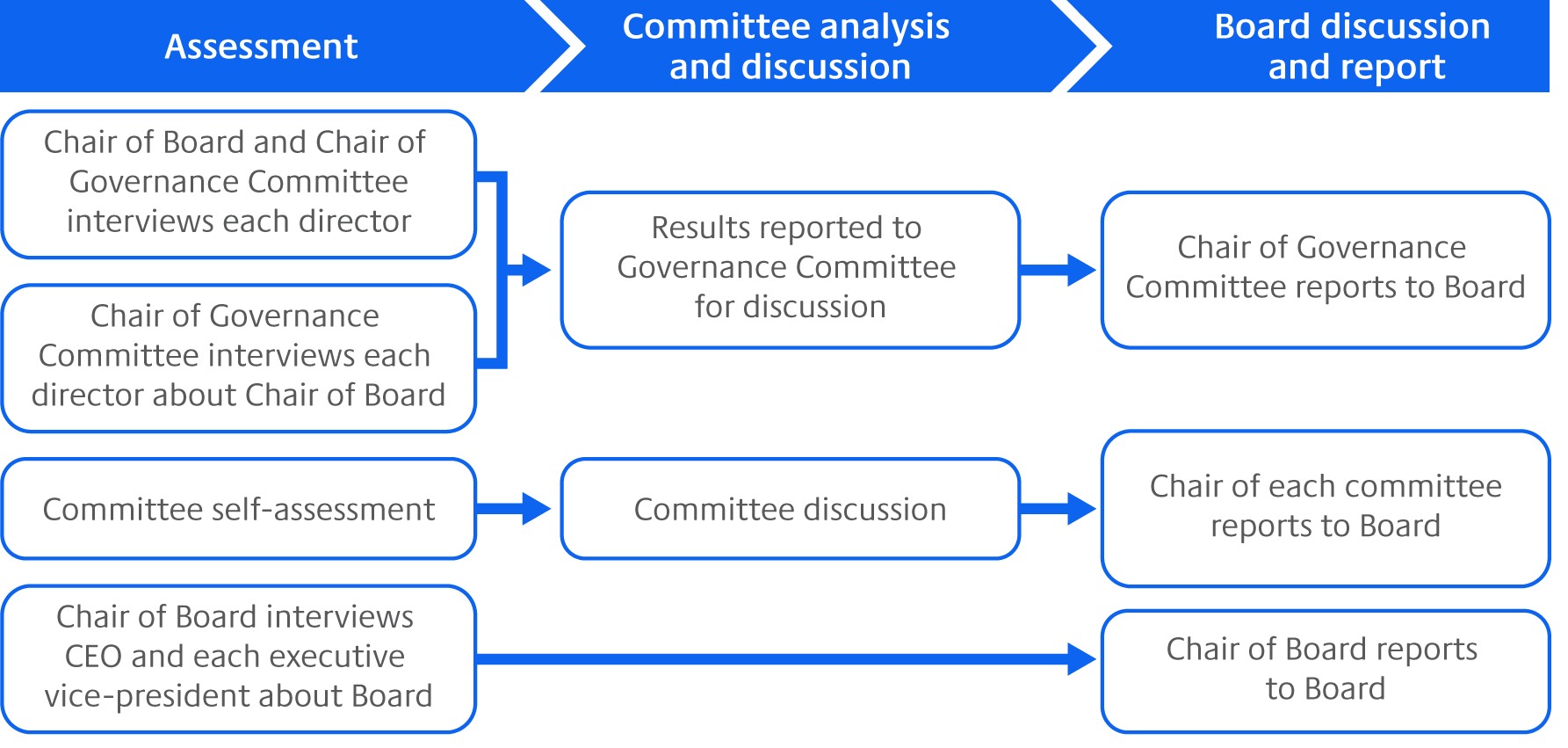
| | | | | | | | | | | | | | |
Assessment / Committee analysis and discussion / Board discussion and report
Chair of Board and Chair of Governance Committee interviews each director / Results reported to Governance Committee for discussion / Chair of Governance Committee reports to Board
Chair of Governance Committee interviews each director about Chair of Board
Committee self-assessment / Committee discussion / Chair of each committee reports to Board
Chair of Board interviews CEO and each executive vice-president about Board / Chair of Board reports to Board
|
In 2025, the assessment process showed that the Chair of the Board, each director, and all Committees are functioning effectively and fulfilling the mandates set out in the Board and Committee charters.
FINANCIAL LITERACY
The Board has determined that all members of the Audit Committee are financially literate, which means each member can read and understand a set of financial statements that are generally comparable to ours in terms of breadth and complexity of accounting issues. You can find more information about their education and financial experience in the director profiles starting on page 20, in the Audit Committee report on page 67 and in the AIF which is available on our website (www.tcenergy.com) and on SEDAR+ (www.sedarplus.ca). 54 | TC Energy Management Information Circular 2026
BOARD RENEWAL
The Governance Committee regularly assesses the skill set of each director, and reviews it against the director retirement schedule, their ages and the composition of each Committee. The review also takes into account the desirability of maintaining a reasonable variety of backgrounds, and character and behavioural qualities.
The Governance Committee, with input from the Chair of the Board and the CEO, is responsible for identifying suitable director candidates and canvasses the entire Board for potential nominees. From time to time, the Governance Committee uses a third party recruitment specialist to identify potential director candidates. The Governance Committee is responsible for assessing the individuals and proposing the strongest candidates for nomination. An evolving roster of suitable director candidates is maintained by the Governance Committee.
The Governance Committee looks for a mix of skills and experience required for overseeing our business and affairs. While candidates are nominated as directors based on their background and ability to contribute to the Board and Committee meetings, the Board also specifically considers diversity factors. The Board considers personal characteristics such as gender, ethnic background, geographic residence and other distinctions when looking at diversity. Board diversity is discussed under the section Governance - Board Characteristics - Board Diversity on pages 35 and 36. Candidates who are being nominated for the first time must have experience in industries similar to ours or experience
in general business management or with corporations or organizations that are similar in size and scope. Candidates must also be willing to serve on the Board and able to devote the necessary time to fulfill their duties and responsibilities.
The Governance Committee recommends potential candidates based on their qualifications and independence and how these qualities balance with the skill set of the current Board, the structure and composition of the Committees and the director retirement schedule. This assessment helps the Board determine the best mix of skills and experience to guide
our business operations and our long-term strategy.
The Committee ensures that the Board seeks expertise in the following key areas:
| | | | | | | | |
| Area of expertise | | Definition |
| Accounting/Audit | | Expertise with financial statements and financial reporting matters, and an understanding of critical accounting policies and issues relevant to internal and external audit. |
| Capital Markets/Mergers & Acquisitions | | Expertise in debt and equity markets, banking and investor relations. Expertise with complex M&A transactions. |
| CEO | | CEO of a large public company or a large, complex organization. |
| Electric Power & Electrification Value Chain | | Expertise in the electric power generation, transmission and distribution space including nuclear, hydro, wind, solar and natural gas-fired generation; emerging power generation and storage technologies; and the North American electric utilities sector and electric power markets. |
| Energy, Pipelines & Midstream | | Expertise in midstream energy infrastructure including natural gas pipelines, natural gas storage, LNG and natural gas markets. |
| Enterprise Risk Management | | Expertise in enterprise risk management frameworks, systems, processes and tools used to identify, assess and manage enterprise risks and opportunities; includes cyber security, artificial intelligence and other technology risk oversight. |
| Governance | | In-depth understanding of corporate governance best practices. |
| Government, Regulatory & Stakeholder Relations | | Government and Public Policy acumen, including the legal and regulatory environments in North America. Experience with stakeholder management and engagement. |
| Human Resources & Compensation | | A thorough understanding of succession planning, talent management, organizational development and compensation programs, including experience with implementing inclusion and diversity initiatives. |
| Major Projects | | Expertise in managing large, complex projects. |
| Operations/Health, Safety, Sustainability & Environment | | Expertise with operating assets in a cost effective, reliable and efficient manner with a mindset of continuous improvement, including expertise in assessing and managing health, safety and environmental compliance obligations. Experience in overseeing sustainability in operations. |
| Strategy & Leading Growth | | Expertise in driving strategic insight and direction, encouraging innovation and conceptualizing strategic risks, including the ability to assess emerging technologies and related potential for innovation. |
TC Energy Management Information Circular 2026 | 55
SKILLS ANALYSIS
While all of our directors possess an extensive list of skills and experience, the Governance Committee has determined
that focusing on each director's top key expertise areas is a more effective way to assess director candidates and to ensure that our Board has a deep knowledge base available in each key expertise area.
Based on a review of the current and nominated board composition, and as informed by interviews conducted by an independent third party recruitment specialist, each of our directors have been assessed to have expertise in the skills areas of Governance and Strategy & Leading Growth. In addition to these two areas, the image on the next page shows the top five to six key expertise areas in addition to Governance and Strategy & Leading Growth of each of our director nominees and current directors.
The Governance Committee considers these factors and others when discussing Board renewal.
56 | TC Energy Management Information Circular 2026
| | |
|
Accounting/Audit / Scott Bonham / Cheryl F. Campbell / Michael R. Culbert / William D. Johnson / John E. Lowe / Dawn Madahbee Leach / François L. Poirier / Una Power / Siim A. Vanaselja / Thierry Vandal
Enterprise Risk Management / Scott Bonham / Cheryl F. Campbell / Susan C. Jones / John E. Lowe / Dawn Madahbee Leach / François L. Poirier / Una Power / Mary Pat Salomone / Siim A. Vanaselja
Capital Markets/Mergers & Acquisitions / Scott Bonham / Michael R. Culbert / Susan C. Jones / John E. Lowe / François L. Poirier / Una Power / Siim A. Vanaselja / Dheeraj “D” Verma
Government, Regulatory & Stakeholder Relations / Cheryl F. Campbell / Michael R. Culbert / William D. Johnson / Susan C. Jones / John E. Lowe / Dawn Madahbee Leach / Siim A. Vanaselja
CEO / Michael R. Culbert / William D. Johnson / Susan C. Jones / Dawn Madahbee Leach / François L. Poirier / Thierry Vandal / Dheeraj “D” Verma
Human Resources & Compensation / William D. Johnson / Susan C. Jones / Una Power / Mary Pat Salomone / Siim A. Vanaselja / Thierry Vandal / Dheeraj “D” Verma
Electric Power & Electrification Value Chain / Scott Bonham / William D. Johnson / François L. Poirier / Mary Pat Salomone / Thierry Vandal / Dheeraj “D” Verma
Major Projects / Scott Bonham / Cheryl F. Campbell / Dawn Madahbee Leach / Mary Pat Salomone / Siim A. Vanaselja / Thierry Vandal
Energy, Pipelines & Midstream / Cheryl F. Campbell / Michael R. Culbert / John E. Lowe / François L. Poirier / Una Power / Thierry Vandal / Dheeraj “D” Verma
Operations/Health, Safety, Sustainability & Environment / Scott Bonham / Cheryl F. Campbell / Michael R. Culbert / William D. Johnson / Susan C. Jones / John E. Lowe / Dawn Madahbee Leach / Una Power / Mary Pat Salomone / Dheeraj “D” Verma
Governance / All directors and director nominees
Strategy & Leading Growth / All directors and director nominees
Legend: / Director with expertise / Director with expertise + retiring within three years
|
TC Energy Management Information Circular 2026 | 57
EXPECTED RETIREMENT YEARS
This table provides the expected retirement year for each of the current non-executive directors.
| | | | | | | | | | | | | | | | | | | | |
| Year director(s) expected to retire |
| 2028 | | Mary Pat Salomone | | 2033 | | Michael R. Culbert, Dawn Madahbee Leach |
| 2029 | | Siim A. Vanaselja | | 2034 | | Una Power |
| 2030 | | William D. Johnson, John E. Lowe | | 2035 | | Cheryl F. Campbell, Susan C. Jones |
| 2032 | | Thierry Vandal | | 2037 | | Scott Bonham, Dheeraj "D" Verma |
DIRECTOR TENURE
Throughout 2025, the Governance committee reviewed best practices, conducted a peer review and engaged with shareholders on the topic of director tenure and appropriate term and/or age limits. As a result of this review, in November 2025, the Board revised its age and term limits contained with TC Energy's Corporate Governance Guidelines. These changes to director retirement age and term limits were made in order to facilitate future Board succession planning
and encourage Board renewal into the future.
Under TC Energy's amended Corporate Governance Guidelines, once a director turns 75 or has served more than 15 years
on the Board, whichever comes first, such director will not stand for re-election at the next annual meeting. Notwithstanding age limits, a director will be eligible to serve on the Board for at least eight years in order to ensure a robust level of Board continuity and to permit onboarded directors to serve a sufficient term to meaningfully contribute
to the Board. In addition, to ensure continuity of leadership, the Board may permit the Chair to complete a full Chair term (whether initial or renewal) regardless of age or term limits, provided that the Governance Committee annually reviews
and recommends such chair continuation to the Board.
The Board, upon recommendation of the Governance Committee, may apply discretion to permit a director or director nominee to stand for election outside of the terms of our retirement age or term limit if it is in the best interests
of the company.
The Governance Committee continues to review factors like changes in principal occupation, consistently poor attendance, poor performance, board interlocks and other relevant circumstances that may trigger the resignation or retirement of a director.
There has been substantial Board refreshment over the past few years, with three new non-executive directors joining
in 2020, one new non-executive director joining in 2021, two new non-executive directors joining in 2022 and two new non-executive directors joining in 2024.
58 | TC Energy Management Information Circular 2026
The graphs below show the composition of our Board by years of service as of the date of this Circular and after the annual meeting, assuming all of the nominated directors are elected.
The lines below the tenure chart depict the shortest and longest tenured directors, and the average tenure of the directors.
The lines below the director age chart depict the age range of the directors and the average age of the directors.
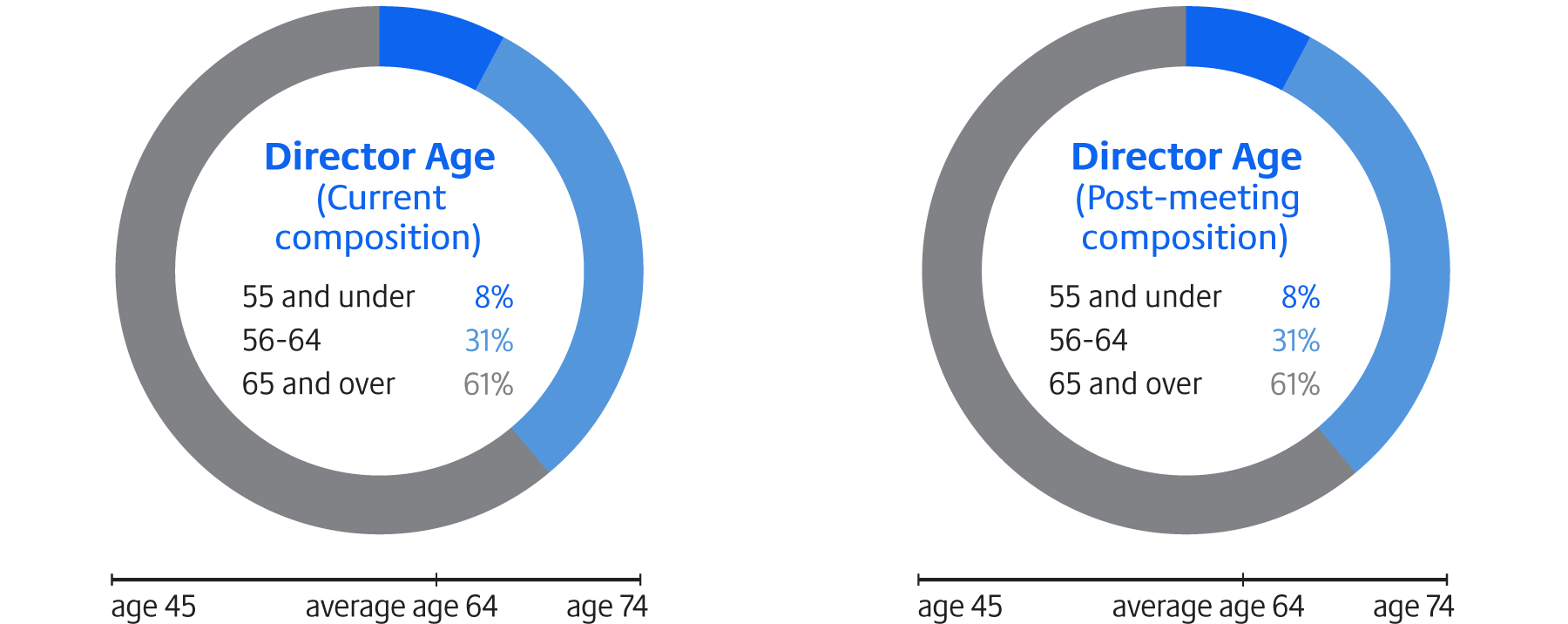
| | | | | |
Tenure (Current composition) 0-3 years 31% 4-7 years 38% 8+ years 31%
<1 year average 6 years 10 years
Tenure (Post-meeting composition) 0-3 years 31% 4-7 years 38% 8+ years 31%
<1 year average 6 years 10 years
Director Age (Current composition) 55 and under 8% 56-64 31% 65 and over 61%
age 45 average age 64 age 74
Director Age (Post-meeting composition) 55 and under 8% 56-64 31% 65 and over 61%
age 45 average age 64 age 74
|
TC Energy Management Information Circular 2026 | 59
ENGAGEMENT
We believe it is important to engage with our stakeholders.
TC Energy has comprehensive programs, policies and guidelines with executive oversight to regularly engage with Indigenous Groups and other stakeholders, including landowners, community groups, employees and shareholders. TC Energy participates in an open and transparent political process and supports public policies that promote the
safe and environmentally responsible development of North American energy infrastructure.
Members of our Board engage with governance organizations and shareholder advocacy groups to discuss emerging
best practices and provide commentary on how we maintain our high standard of corporate governance.
Some of the ways we engage with shareholders include:
•Our annual meeting offers shareholders the opportunity to receive an update on our business and vote on items
of business.
•We issue news releases to announce material company developments and to report our quarterly financial results.
•Our CEO, CFO and executive vice-presidents host teleconferences and webcasts to discuss our quarterly financial
and operating results, as well as significant company developments.
•Our CEO, CFO and executive vice-presidents host an annual update to share our strategy, recent developments
and the longer-term outlook for the business.
•Our teleconferences and annual investor day are webcast and available to analysts, shareholders, media and the
general public on our website.
•Our CEO, executive vice-presidents and senior management participate in investor and industry conferences.
The company also meets with investors in one-on-one meetings as part of our regular shareholder engagement.
•Our Board Chair and members of the Board meet and speak with shareholders.
•Our Investor Relations department is available for meetings and calls to address shareholder questions and concerns,
and to provide public information on TC Energy in a timely and responsive manner.
•We conduct proactive shareholder outreach to share ESG-related company developments and we engage with ESG
ratings agencies.
In 2025, TC Energy's CEO, CFO, other members of management and Investor Relations participated in over 500 meetings with shareholders and bondholders, including over 40 meetings on ESG-specific topics. TC Energy's Board Chair and members of the Board also participated in 11 meetings with shareholders.
In addition, TC Energy's Investor Relations Team engages and responds to any shareholder inquiries received regarding
the virtual only format of our annual meeting.
News releases, corporate information, frequently asked questions, our ESG reporting and details of past and upcoming investor events and presentations are available on our website (www.tcenergy.com).
Investor Relations welcomes opportunities to engage with our shareholders, potential investors and other stakeholders.
You may contact our Investor Relations department directly by phone, email or regular mail at:
Investor Relations
TC Energy Corporation
450 - 1 Street S.W. Calgary, AB
Canada T2P 5H1
investor_relations@tcenergy.com
1-800-361-6522
60 | TC Energy Management Information Circular 2026
COMMUNICATING WITH THE BOARD
Shareholder engagement allows us to hear directly from shareholders and other important stakeholders about any issues or concerns.
Shareholders can contact the Board directly by writing to:
Chair of the Board of Directors
c/o Corporate Secretary
TC Energy Corporation
450 - 1 Street S.W. Calgary, AB
Canada T2P 5H1
SHAREHOLDER PROPOSALS
Under Canadian law, shareholder proposals can only be considered for the annual meeting of common shareholders
if they are submitted by a specific date. Pursuant to the Canada Business Corporations Act, shareholder proposals must
be submitted to the corporation between 90 and 150 days before the anniversary date of the previous annual meeting.
As such, the period during which our Corporate Secretary must receive shareholder proposals in order for them to be considered for inclusion in the circular for the 2027 annual meeting of common shareholders is Tuesday, December 8, 2026 to Monday, February 8, 2027.
ADVANCE NOTICE BYLAW
Shareholders who wish to nominate a director for the 2026 annual meeting of common shareholders, other than by
a shareholder proposal, must:
•notify the Corporate Secretary in writing, and
•provide the information required in our By-law Number 1, which can be found on our website (www.tcenergy.com)
or on SEDAR+ (www.sedarplus.ca).
Any notices of director nominees must be received by our Corporate Secretary before 5 p.m. MDT on Friday, March 27, 2026 to be considered valid and for an individual to be included in our list of director nominees for our 2026 annual meeting of common shareholders.
The chart below explains when advance notice of director nominations is required for annual meetings and special meetings:
| | | | | | | | |
| Type of meeting | Announcement timing | Advance notice deadline |
Annual meeting to elect directors
(using notice and access) | Public announcement more than 50 days before meeting | Not less than 40 days before meeting |
| Public announcement 50 days or less before meeting | Not less than ten days following the first public announcement of the meeting |
Special meeting to elect directors
(using notice and access) | Public announcement more than 50 days before meeting | Not less than 40 days before meeting
|
| Public announcement 50 days or less before meeting | Not less than 15 days following the first public announcement of the meeting |
TC Energy Management Information Circular 2026 | 61
Sustainability and Environmental, Social and Governance Matters
SUSTAINABILITY STRATEGY,COMMITMENTS AND REPORTING
TC Energy continues to meet the growing demand for safe, reliable and affordable energy with a focus on operational excellence and a commitment to health, safety, sustainability and the environment . Our approach to sustainability is integral to our strategic priorities. In alignment with the UN Sustainable Development Goals (SDGs), we have established eight sustainability commitments that form the foundation of our sustainability strategy. These commitments are based on our material sustainability topics and supported by tangible metrics and targets to track and measure performance. Each year, we provide balanced and transparent disclosure of our progress against these targets in our Report on Sustainability.
TC Energy’s Sustainability Commitments
| | | | | | | | | | | | | | |
| Enable the energy transition Contribute to global efforts to address climate change and manage the risks and opportunities of a shift to a lower carbon economy. | | | Leaving the environment as we found it Safeguard habitat and biodiversity and minimize land use impacts, including restoring the environment to a condition equal to or better than we found it. |
| | | | |
| Committed to safe, reliable, sustainable operations Systematically manage risk to continuously improve the integrity and safety of our assets and operations. | | | Continuous safety improvement Continuously improve our systems to protect people and consistently demonstrate safety as our number one value. |
| | | | |
| Advancing an empowered workplace Deliver people and culture workplace strategies that reflect our values and emphasize wellbeing, inclusion, belonging and respectful collaboration. | | | Fostering mutually beneficial relationships Promote wellbeing for our communities and maintain mutually beneficial external relationships. |
| | | | |
| Fostering enduring, mutually beneficial relationships with Indigenous Groups Be the partner of choice for Indigenous Groups. | | | Further integrate and contribute to sustainability Advance sustainability and innovation across our business and value chain, including our strategic planning and decision-making. |
To better align with the evolving priorities of rights holders and stakeholders, we continue to refresh and refine our sustainability strategy. This may involve introducing or refining definitions, metrics, targets, sustainability commitments, policies and initiatives. These updates are guided by jurisdictional priorities and informed by assessments of both the current performance and emerging trends of each topic. We aim to conduct a comprehensive sustainability materiality assessment every two to three years, supplemented by annual internal updates. This allows us to improve our approach and identify the sustainability topics that matter most to our rights holders, stakeholders and our business.
To hold ourselves accountable, we link sustainability performance to our corporate scorecard and executive compensation. Our 2025 corporate scorecard includes a 50 per cent weighting to achieving safety and operational excellence. TC Energy’s 2024 and 2025 grant of three-year vesting performance share units (PSUs) also includes a 10 per cent weighted methane intensity reduction metric, which aligns with our corporate interim goal of reducing methane intensity by 40-55 per cent reduction from 2019 levels by 2035.
As part of our commitment to transparent and reliable sustainability reporting, TC Energy publishes annually our Report
on Sustainability which details our progress towards achieving our sustainability commitments and targets. Our Report on Sustainability includes performance data tables and alignment tables to internationally recognized sustainability reporting frameworks, standards and recommendations such as the UN SDGs, the Global Reporting Initiative (GRI) Standards, the IFRS S2 Climate-related Disclosures Standard (which integrates the Taskforce on Climate-related Financial Disclosures (TCFD) recommendations), the Taskforce on Nature-related Financial Disclosures (TNFD), and the Sustainability Accounting Standards Board (SASB) Standards. The Report on Sustainability is available at TCEnergy.com/ReportOnSustainability.
62 | TC Energy Management Information Circular 2026
TC Energy’s sustainability publications and website content are not incorporated by reference and are not part
of this Circular.
We actively monitor for new sustainability-related disclosure requirements, including those related to climate‑related risks and opportunities and continue to progress our sustainability disclosure in alignment with any such requirements.
MANAGING CLIMATE-RELATED RISKS AND OPPORTUNITIES
TC Energy remains committed to supporting global efforts to address climate change and managing the risks and opportunities associated with the transition to a lower-carbon economy. Our approach aims to strike a balance between meeting global energy demand and addressing rising global emissions through focusing on three areas: reducing operational emissions, investing in lower-carbon energy solutions, and supporting broader decarbonization efforts.
Our annual Report on Sustainability provides details on our approach to managing the potential physical risks and transition risks and opportunities created by climate change, as well as a summary of our recent climate scenario analysis.
In 2025, we introduced a methane intensity reduction target of 40 to 55 per cent reduction below our 2019 baseline by 2035 and incorporated this metric into our long-term incentive for executive compensation. While we remain committed
to our long-term objective of positioning to achieve net-zero emissions from our operations, we have adjusted our pace to align with technological readiness, policy frameworks and market conditions necessary to deliver a pragmatic and financially disciplined path toward a lower-carbon energy system. We continue to evaluate decarbonization pathways in light of these evolving external drivers, and expect to provide additional details on our assessments, including progress on our methane target implementation plan in our 2026 Report on Sustainability.
We aim to continually improve the accuracy and reliability of our GHG emissions data. In 2025, for the fourth consecutive year, we voluntarily obtained limited assurance on 100 per cent of our corporate GHG emissions inventory. In addition,
we published a Roadmap to Reasonable Assurance on GHG Emissions report that outlines TC Energy’s current capabilities and planned enhancements to strengthen GHG emissions data quality. We also published an OGMP (Oil & Gas Methane Partnership) 2.0 Reassessment Report that outlines our methane measurement and quantification practices and reinforces our ability to pursue cost-effective methane management while preserving commercial competitiveness. While we support OGMP's guiding principles that promote accuracy and transparency of methane emissions data, we have decided not to join OGMP 2.0 at this time. Additional information can be found in our OGMP 2.0 Reassessment Report.
INDIGENOUS RELATIONS
For more than 40 years, TC Energy has been engaging with Indigenous Groups. We recognize Indigenous Groups as rightsholders who have a distinct relationship to the land and we understand that our business activities have the potential to affect these groups in tangible ways.
Accordingly, key components of our Indigenous relations governance and strategy include:
Board Oversight of Indigenous Relations
TC Energy's Board recognizes the vital role Indigenous relationships and partnerships have to our business. The HSSE Committee receives verbal and written reports from management on various significant matters relating to Indigenous rights and relationships. In addition, the Board maintains oversight of Indigenous rights and relationship matters that
may be material to TC Energy's operations or the development and construction of projects across all business lines
and jurisdictions.
Indigenous Relations Policy & Training
TC Energy maintains an Indigenous Relations Policy, which was reviewed in October 2025. The Policy sets expectations
and guides the Company's collaborative approach to relationships with Indigenous Groups aimed at achieving regulatory certainty and maintaining access to land, while supporting Indigenous Group's capacity building initiatives and participation in economic opportunities. The policy supports the spirit and intent of the United Nations Declaration of the Rights of Indigenous Peoples and its guiding principles, including Free, Prior and Informed Consent (FPIC). The Indigenous Relations team reviews project plans to ensure we adhere to our Indigenous Relations Policy.
In addition, TC Energy has implemented corporate-wide mandatory Indigenous Awareness Training for employees and contractors in Canada and the U.S., with a view to increasing understanding of Indigenous history and culture.
TC Energy Management Information Circular 2026 | 63
Meaningful Engagement and Consultation
We are committed to respecting Indigenous peoples' rights and the principles of FPIC, striving to achieve consent among Indigenous Groups potentially affected by our work. We have built strong relationships and gained support from most communities we work with; however, to achieve unanimous alignment and support from every constituent across any long, linear infrastructure project is not reasonable nor feasible. We strive for consensus by identifying and resolving issues collaboratively and sharing benefits.
We adhere to the engagement and consultation processes in the jurisdictions where we work and seek to meet or exceed requirements while prioritizing respectful engagement and building relationships and partnerships.
In Canada, where the Crown has a duty to consult Indigenous Peoples on projects that impact their treaty and Indigenous rights and delegates aspects of the duty to consult to companies, we engage early and often on new projects. We offer capacity funding to support participation in the regulatory process, as well as funding for traditional knowledge and land use studies. Additionally, we have created construction and post-construction monitoring programs to increase Indigenous participation and enhance knowledge in the planning and execution of our work.
In the U.S. and Mexico, where Indigenous consultation is led by the federal governments, we work with government bodies to comply with effective Indigenous consultation processes, both structurally and in practice, and to foster community relationships through various social responsibility initiatives.
In 2025, we engaged with over 300 Indigenous communities across North America, focusing on building relationships and identifying areas for improvement.
Indigenous Advisory Council
As part of our commitment to reconciliation, TC Energy established an Indigenous Advisory Council (IAC) in 2021. As of January 2026, the IAC is comprised of four Indigenous leaders. The IAC meets in-person with the Executive Leadership Team twice annually to discuss TC Energy’s efforts to advance reconciliation both internally and within the organization’s purview externally. Additionally, the Council meets with leaders across TC Energy whose responsibilities directly or indirectly affect TC Energy’s commitment to reconciliation. The Council’s advice has been considered and incorporated into the development of internal and external reconciliation efforts. For example, we have implemented changes to our approach
to Indigenous and local hiring and contracting, launched an Indigenous Business Advisory Forum, expanded and adjusted the use of co-developed Relationship Agreements to provide clarity for how we work with communities in support of mutually beneficial goals, and developed a purpose-built Indigenous cultural space at our head office to build a sense
of belonging for Indigenous members of our workforce.
64 | TC Energy Management Information Circular 2026
BOARD OVERSIGHT OF ESG INITIATIVES
TC Energy has established a clear governance structure to communicate and respond to existing and emerging sustainability-related risks and opportunities. The full Board maintains ultimate oversight over TC Energy's sustainability matters, including climate-related risks and opportunities, political and regulatory uncertainty, material capital project decisions and reputation and relationships with Indigenous communities. For more information on the responsibility and oversight provided by the HSSE Committee, see Roles and Responsibilities of the Board – Risk Oversight and Enterprise Risk Management – HSSE risk management system on page 48. | | | | | | | | | | | |
| Board of Directors |
Maintains oversight of business strategy alignment, progress against our most significant sustainability objectives and commitments and our overall sustainability communications strategy. On approvals for material projects, the Board receives reports on climate risks and impacts from the project, including expected GHG emission impacts. Maintains oversight of Indigenous engagement strategy and risks and opportunities associated with material projects, including Indigenous equity opportunities. Maintains oversight of TC Energy’s AI strategy, risk management, and implementation, including receiving updates on AI risk and governance effectiveness.. |
| HSSE Committee | Audit Committee | Governance Committee | Human Resources Committee |
Receives updates to TC Energy's environmental management program, including biodiversity and land management, climate- related risks and opportunities and GHG emission targets. Reviews TC Energy's implementation of a safety conscious culture, including emergency preparedness plans, landowner and community relationships, mental health and psychological safety initiatives. Reviews and receives reports on Indigenous engagement and relationships. Reviews the operational risk management matrix and voluntary ESG reporting and disclosure and corporate security updates. | Reviews sustainability-related disclosures in financial disclosure documents and monitors regulatory developments affecting the financial disclosure landscape. Oversees financial risk management, financial reporting, auditor independence and the implementation of internal and external audits. Reviews cybersecurity related risks and the effectiveness of the corporate compliance program, including reviews of the internal audit charter. | Monitors TC Energy's Board diversity targets and policy, oversees our forced labour in supply chain risks and related disclosures, lobbying policies, activities and expenditures, shareholder proposals, external governance assessments, and voting trends. Monitors updates to securities law and proxy advisor policies, reviews Board skills matrices and Board effectiveness and ERM program and activities. | Oversees TC Energy's Inclusion and Belonging targets and action plan and employee engagement levels. Reviews executive compensation levels, employee compensation and benefits programs, leadership development and succession planning programs, clawback policies and reviews the targets under the annual scorecard. |
TC Energy Management Information Circular 2026 | 65
Board Committees
The Board has four standing committees:
•Audit Committee,
•Governance Committee,
•Health, Safety, Sustainability and Environment Committee, and
•Human Resources Committee.
Each of the committees is comprised entirely of independent directors.
The Governance Committee is responsible for reviewing the composition of each committee and recommending any changes once new directors are appointed or elected to the Board. Each committee must consist entirely of independent directors, except for the HSSE Committee, which must have a majority of independent directors. As of the date of this Circular, all members of the HSSE Committee are independent. Each committee has the authority to retain advisors to
help it carry out its responsibilities. The Board does not have an executive committee.
Each standing Committee reviews its charter at least once a year, and recommends any changes to the Governance Committee and the Board. You can find the Committee charters on our website (www.tcenergy.com).
The Audit and the Governance Committees hold meetings concurrently, as do the Human Resources and HSSE Committees, so each committee has sufficient time to focus on its responsibilities. As a result, Mr. Lowe, the independent non-executive Chair of the Board, is a voting member of the Governance Committee and the Human Resources Committee, and is not
a member of the Audit Committee nor the HSSE Committee.
Each meeting has time set aside for members to discuss the committee operations and responsibilities without
management present.
66 | TC Energy Management Information Circular 2026
| | | | | | | | |
Audit Committee |
| | |
Current members Una Power (Chair) Scott Bonham Cheryl F. Campbell Michael R. Culbert Susan C. Jones Dawn Madahbee Leach
Other members that served during the year William D. Johnson (until May 8, 2025) | | Meetings |
| 4 regularly scheduled meetings (February, April, July, November) |
| Independence |
| 6 independent directors, 100 per cent independent and financially literate. In 2025, Ms. Power was an "Audit Committee financial expert", as defined by the SEC in the U.S., and had the accounting or related financial management experience required under the NYSE rules. |
|
| Mandate |
| The Audit Committee is responsible for assisting the Board in overseeing the integrity of our financial statements and our compliance with legal and regulatory requirements. It is also responsible for overseeing and monitoring the accounting and reporting process and the process, performance and independence of our internal and external auditors. |
|
|
|
The Audit Committee meets in-camera with the CFO at the beginning of each meeting, and meets separately with the external auditors and Vice-President, Corporate Compliance and Internal Audit. The Audit Committee also meets in-camera at the end of each meeting.
2025 highlights
| | | | | | | | |
Auditor Independence and Appointment •Reviewed and approved the audit plans of the internal and external auditors and pre-approved the non-audit services performed by KPMG. •Recommended updates to the Audit Committee charter, adding approval of internal audit charter. •Received the external auditor’s formal written statement of independence (which sets out all of its relationships with TC Energy) and its comments to management about our internal controls and procedures. •Reviewed and recommended the re-appointment of the external auditor after assessing audit quality, auditor tenure, appropriateness of estimated fees, and feedback received from shareholder engagement on auditor independence. •Approved non-audit services and audit services pursuant to TC Energy's Pre-Approval Policy. Continuous Disclosure •Reviewed our 2025 annual disclosure documents including the audited annual consolidated financial statements and related MD&A and AIF and recommended them for approval. •Approved our 2025 unaudited interim consolidated financial statements and related MD&A. •Reviewed the major accounting policies and estimates. •Reviewed adequacy of staff complements in accounting and tax. | | Risk and Compliance Oversight •Oversaw our financial reporting risks including issues relating to materiality and risk assessment. •Monitored financial reporting, legal and regulatory developments affecting our financial reporting process, controls and disclosure. •Reviewed and recommended changes to the suite of risk management policies. •Received regular reports from management on counterparty insurance and market risks, finance and liquidity, treasury, pensions, tax, compliance, material litigation and cyber security controls, plans and initiatives. •Oversaw the corporate compliance program requirements, structure and results, including foreign corrupt practices and anti-bribery statutes and policies. •Received regular reports from Internal Audit and reviewed the adequacy of the resources of the internal auditor. Pension and Benefits Oversight •Approved appointment of the external auditor for 401(k) employee retirement plans. •Reviewed and approved the Statement of Investment Beliefs relating to the funding of the registered pension plan and supplemental pension plan. |
Our AIF includes more information about the Audit Committee, including the Audit Committee charter, oversight responsibilities, each member’s education and experience, and policies and procedures for pre-approving permitted non-audit services. The 2025 AIF is available on our website (www.tcenergy.com) and on SEDAR+ (www.sedarplus.ca). | |
TC Energy Management Information Circular 2026 | 67
| | | | | | | | |
Governance Committee |
| | |
Current members Thierry Vandal (Chair) William D. Johnson (as of May 8, 2025) John E. Lowe Mary Pat Salomone Siim A. Vanaselja Dheeraj "D" Verma
Other members that served during the year David MacNaughton (retired May 8, 2025) Indira Samarasekera (retired May 8, 2025) | | Meetings |
| 4 regularly scheduled meetings (February, April, September, November) |
| Independence |
| 6 independent directors, 100 per cent independent |
| Mandate |
| The Governance Committee is responsible for assisting the Board with maintaining strong governance policies and practices at TC Energy, reviewing the independence and financial literacy of directors, managing director compensation and the Board assessment process and overseeing our strategic planning process and enterprise risk management activities. It monitors the relationship between management and the Board, directors' share ownership levels, governance developments and emerging best practices. It is also responsible for identifying qualified candidates for the Board to consider as potential directors. It also recommends the meeting schedule for Board and Committee meetings, site visits and oversees matters related to the timing of our annual meeting. |
|
|
|
|
| |
| | |
The Governance Committee meets in-camera at the beginning and end of each meeting.
2025 highlights
| | | | | | | | |
Board Composition and Succession •Oversaw Board renewal in light of retirement calendar, board size, composition and skills matrix. Risk Management •Oversaw planning for ERM deep dive sessions. •Oversaw our enterprise risk management program and activities, including receiving the emerging risk report and 2025 key focus areas and key risk indicators. •Reviewed the identified principal enterprise risks with management to ensure we have proper Board and Committee oversight and management programs in place to mitigate risks. Board Effectiveness and Independence •Reviewed the independence of each director according to our written criteria and applicable legislation to give the Board guidance in its annual assessment of independence, the structure and composition of each Committee and the other directorships held by Board members. •Oversaw the annual assessment of the Board, Committees and Chair. Continuous Disclosure •Reviewed and recommended the Report on Forced Labour and Child Labour and the Governance sections of the 2025 Management Information Circular to the Board. Director Compensation •Reviewed a report from the independent compensation consultant and recommended changes to director compensation to the Board to be effective in 2026.
| | Shareholder Engagement and Annual Meeting Results •Reviewed the voting results from the 2025 annual shareholders' meeting. •Reviewed say on pay updates and voting trends. •Reviewed information on climate-related management and shareholder proposals and voting trends. Governance Policies and Strategic Oversight •Oversaw our strategic planning process, including strategic issues to be considered throughout the year and at the annual strategic planning meeting. •Monitored director share ownership requirements. •Received a report on director attendance at meetings. •Reviewed our lobbying policies, activities and expenditures. •Reviewed and recommended amendments to our Corporate Governance Guidelines and Committee charters, including changes to the director retirement age and term limits after review of peer practices and feedback from investors. •Monitored updates to securities regulations and governance reforms (regulation and legal updates affecting our policies, procedures and disclosure practices). •Reviewed the Board Diversity Policy and targets based on investor expectations, proxy advisor firm guidance and peer practices. •Reviewed external governance assessments and made recommendations for revisions to governance practices to the Board as appropriate. |
68 | TC Energy Management Information Circular 2026
| | | | | | | | |
Health, Safety, Sustainability and Environment Committee |
| | |
Current members Mary Pat Salomone (Chair) Cheryl F. Campbell Michael R. Culbert Dawn Madahbee Leach Una Power Thierry Vandal
Other members that served during the year David MacNaughton (retired May 8, 2025) | | Meetings |
| 4 regularly scheduled meetings (February, April, July, November) |
| Independence |
| 6 independent directors, 100 per cent independent |
| Mandate |
| The HSSE Committee oversees operational, major project execution, health, safety, sustainability and environmental risk, including climate change related risks. The HSSE Committee reviews and monitors the performance and activities of TC Energy's HSSE matters including compliance with applicable and proposed legislation, conformance with industry standards and best practices. It also monitors the performance of actions and initiatives undertaken by TC Energy to prevent, mitigate and manage risks related to HSSE matters, including climate change-related risks and any critical incidents respecting our assets, operations, personnel and public safety. The HSSE Committee also maintains oversight of significant or complex capital projects, including the monitoring of prescribed performance criteria. |
|
|
|
|
| |
The HSSE Committee met separately with representatives from senior management responsible for Safety and Technical Services at the end of each meeting. The Committee also meets in-camera at the end of each meeting.
2025 highlights
| | | | | | | | |
Safety and Operational Oversight •Received and reviewed regular reports on HSSE related activities, performance and compliance. •Received regular reports on operational risk management, occupational and process safety and regulatory compliance matters related to asset integrity. •Reviewed the status of critical incidents, root cause analysis and incident follow-up. •Monitored management's response and the status of corrective action plans to audits from the CER, Pipeline and Hazardous Materials Safety Administration and other regulatory agencies. •Monitored the effectiveness of HSSE policies, management systems, programs, procedures and practices through the receipt of reports on ongoing improvement and simplification initiatives, including improvements to TC Energy's Operational Management System (TOMS). •Received updates on various projects, including Cedar Link and the Southeast Gateway project. •Reviewed the Southeast Gateway project strategic performance look back, which outlined key deliverables and insights across safety performance, management practices, planning, cost outcomes and overall execution to inform current and future projects. •Received and reviewed regular reports on the operational and HSSE performance at Bruce Power, including status updates regarding the major component replacement. •Received the People Health Trends and Industrial Hygiene annual reviews. •Received updates on a review of aviation operations. | | Policy and Standards Review •Reviewed the HSSE Committee charter. •Received and reviewed updates on TC Energy's Safety Culture Plan. Operational Risk Management and Emergency Preparedness •Received an update on TC Energy's Emergency Management Program, including the review of 2025 areas of focus. •Oversaw our risk management activities related to HSSE, and reported to the Board as appropriate. •Attended a LNG Canada site visit in Kitimat, British Columbia. Sustainability Oversight •Monitored developments in Canadian, U.S. and Mexico legislation on air emissions, greenhouse gas legislation, climate change initiatives and related compliance matters for impacts to TC Energy. •Received and reviewed regular updates on the progression of TC Energy's sustainability commitments and oversaw TC Energy's voluntary disclosure on HSSE sustainability matters, including the Report on Sustainability. •Received an overview of current engagement, relationships and participation with Indigenous Groups and received an update on the Reconciliation Action Plan. |
TC Energy Management Information Circular 2026 | 69
| | | | | | | | |
Human Resources Committee |
| | |
Current members William D. Johnson (Chair) Scott Bonham Susan C. Jones John E. Lowe Siim A. Vanaselja Dheeraj "D" Verma
Other members that served during the year Indira Samarasekera (retired May 8, 2025) | | Meetings |
| 4 regularly scheduled meetings (February, September, November, December) |
| Independence |
| 6 independent directors, 100 per cent independent |
| Mandate |
| The Human Resources Committee is responsible for assisting the Board with developing strong human resources policies and plans, overseeing the compensation programs and assessing the performance of the CEO and each executive vice-president against pre-established objectives and recommending their compensation to the Board. It approves and, as applicable, recommends to the Board executive incentive awards, and any major changes to the compensation programs and benefits plans for employees. It also reviews the benefits under our Canadian pension plans and share ownership requirements for executives. |
|
|
|
|
|
The Human Resources Committee meets in-camera at the beginning and end of each meeting.
2025 highlights
| | | | | | | | |
Compensation Governance and Strategy •Reappointed Meridian as the independent compensation advisor to the Human Resources Committee after determining that Meridian is independent under NYSE criteria. •Reviewed the external governance assessments and the outcome of its say on pay vote from the 2025 annual meeting. •Reviewed the alignment of actual compensation earned with performance over the applicable measurement periods. Long-Term Incentive Plans and Benefits •Reviewed the governance for the Canadian Pension Plan. Executive Compensation and Succession Planning •Approved changes to share ownership requirements. •Reviewed and recommended 2025 management priorities and Executive Leadership Team individual objectives. •Assessed the performance of the CEO and each executive vice-president and recommended the 2025 executive compensation awards to the Board for approval. | | Executive Compensation and Succession Planning cont. •Reviewed the risks associated with its compensation programs. •Reviewed and approved the named executive officer compensation peer group, including amendments to the peer group for 2025. •Approved the performance measures under the PSU Plan. •Reviewed and recommended the targets under the annual corporate scorecard. •Reviewed leadership development and succession planning programs at the executive level. •Approved long-term incentive grant awards and recommended payout of the 2022 grants. •Reviewed out of cycle RSU and PSU grants from the previous year. •Reviewed and recommended compensation package for new Executive Vice-President. |
70 | TC Energy Management Information Circular 2026
Compensation
| | | | | | | | | | | | | | | | | | | | | | | |
We are committed to high standards of corporate governance, including compensation governance. This section tells you how the Board makes director and executive compensation decisions at TC Energy, and explains its decisions for 2025. Compensation Governance The Board, the Human Resources Committee and the Governance Committee are responsible for the integrity of our compensation governance practices. Human Resources Committee
William D. Johnson (Chair) Scott Bonham Susan C. Jones John E. Lowe Indira Samarasekera (retired May 8, 2025) Siim A. Vanaselja Dheeraj "D" Verma | | |
| | | WHERE TO FIND IT | | |
| | | | | |
| | > | Compensation Governance | | |
| | | Expertise | | |
| | | Compensation oversight | | |
| | | Independent consultant | | |
| | > | Director Compensation Discussion and Analysis | | |
| | | 2025 Details | | |
| | > | Human Resources Committee Letter to Shareholders | | |
| | > | Executive Compensation Discussion and Analysis | | |
| | | 2025 Details | | |
| | | | | |
| | | | | |
| | | | | | |
Governance Committee
Thierry Vandal (Chair) William D. Johnson (as of May 8, 2025) John E. Lowe David MacNaughton (retired May 8, 2025) Mary Pat Salomone
Indira Samarasekera (retired May 8, 2025) Siim A. Vanaselja Dheeraj "D" Verma
The Board approves all matters related to executive and director compensation. The committees are responsible for reviewing compensation matters and making any recommendations. Both committees are comprised of entirely independent directors. Each Human Resources Committee member is independent under the NYSE Compensation committee independence requirements. |
TC Energy Management Information Circular 2026 | 71
EXPERTISE
Human resources and executive compensation expertise
The Human Resources Committee is responsible for executive compensation. As of March 5, 2026, it consists of six independent directors who have an appropriate mix of skills and experience in management, business, industry, human resources, executive compensation and public accountability for carrying out their responsibilities.
| | | | | | | | | | | | | | | | | | | | |
Name | Accounting/Audit | Capital Markets/Mergers & Acquisitions | CEO | Enterprise Risk Management | Human Resources & Compensation | Governance |
William D. Johnson (Chair) | ü | ü | ü | | ü | ü |
| Scott Bonham | ü | ü | | ü | | ü |
| Susan C. Jones | | ü | ü | ü | ü | ü |
| John E. Lowe | ü | ü | | ü | ü | ü |
| Siim A. Vanaselja | ü | ü | | ü | ü | ü |
| Dheeraj "D" Verma | | ü | ü | | ü | ü |
A majority of members have experience as members of human resources or compensation committees of other public companies.
Mr. Johnson, the Committee Chair has served as President and Chief Executive Officer of two large public utility corporations as well as the largest publicly-owned utility in the United States, and is experienced in the administration of compensation programs.
Mr. Bonham is currently a member of the board of directors of a national retailer and previously held a board position with a chartered bank. He is a co-founder of Intentional Capital, a privately-held real estate asset management company.
Ms. Jones ran three distinct businesses of a publicly-traded company and was the Chair of the Compensation Committee of another publicly-traded company. She is a director of two public companies including TC Energy and has served on the Compensation Committee and Human Resources Committee of both of them. Ms. Jones is experienced in the administration of compensation programs.
Mr. Lowe was previously a member of the board of directors of a multinational public energy company. He has many years of experience in the administration of compensation programs, having served on the human resources, management development compensation and stock plan committees of two public companies. Mr. Lowe was also previously a member of executive management at two other public companies.
Mr. Vanaselja was the Executive Vice-President and Chief Financial Officer of a publicly-traded company. He has also served on the Management Resources and Compensation Committees of one publicly-traded company and various private corporations, and has experience in the implementation, administration and management of executive compensation programs and plans.
Mr. Verma is currently a Senior Advisor to a private energy investment company, previously serving as President, and was
on the Executive and Investment Committees of the firm during his tenure. Prior to this, Mr. Verma was a senior member
of a large financial services company's Mergers and Acquisitions group for seven years. He has experience in overseeing
and administering compensation programs.
In addition to the Human Resources Committee's collective experience in compensation matters, all of the
members stay actively informed of trends and developments in compensation matters and the applicable legal
and regulatory frameworks.
72 | TC Energy Management Information Circular 2026
Governance expertise
You can find specific details about each director’s background, skills and experience in the director profiles starting
on page 20 and the skills matrix on page 57, and more information about the Committees starting on page 66. The Governance Committee is responsible for corporate governance, director compensation, governance and strategic planning and risk oversight. It consists of six independent directors who have a mix of skills and experience in business, risk, governance, human resources and compensation. Four of the members currently are or have been members of Governance Committees of other public companies. One of the members has experience as a CEO of one or more public companies, which has provided each of them with experience in oversight of and direct involvement in compensation matters.
COMPENSATION OVERSIGHT
The purpose of the Board’s compensation oversight is to ensure that executives and directors are compensated fairly
with respect to market in a way that does not lead to undue risk in TC Energy's business and operations.
The Board reviews our compensation policies and practices every year, considers the possibility of risks and makes any adjustments it deems necessary to ensure that our compensation policies are not reasonably likely to have a material adverse effect on TC Energy. It carries out this work directly or through the Human Resources Committee and the Governance Committee.
The Board has approved various compensation policies and practices to effectively identify and mitigate compensation
risks and discourage the CEO, executive vice-presidents or others from taking inappropriate or excessive risks.
Multi-year strategic plan
We have a multi-year strategic plan that identifies our core strategies to achieve our vision of being the leading energy infrastructure company in North America. Our core strategies include:
•maximizing the full-life value of our infrastructure assets and commercial positions,
•commercially developing and building new asset investment programs,
•cultivating a focused portfolio of high quality development options, and
•maximizing our competitive strengths.
Executive compensation is closely linked to the strategic plan. Our annual corporate objectives support the strategic plan and are integrated into our compensation decision-making process. At the end of each year, the Board assesses our performance against the corporate objectives to determine the corporate factor that is used in calculating short-term incentive awards for the CEO, executive vice-presidents and all other employees. The Board also ensures that the annual individual performance objectives for the CEO and each executive vice-president align with our corporate objectives and reflect performance areas that are specific to each role when it determines total direct compensation for each executive.
Compensation philosophy
Our compensation philosophy guides all compensation program design and decisions. Our approach to compensation
is structured to meet four key objectives: pay for performance, be market competitive, align executives’ interests with
those of our various stakeholders, and attract, engage and retain our executives. In setting compensation levels, each component – base salary, short-term and long-term incentives – as well as total direct compensation are determined
with reference to median levels in our peer group. See pages 91 to 101 for details. Executive compensation is designed to pay for performance, as a significant portion of total direct compensation is variable or at-risk compensation. See pages 108 to 112 for the pay mix for each named executive. TC Energy Management Information Circular 2026 | 73
Executive compensation structured to manage risk
The Human Resources Committee and the Board have structured the executive compensation program to ensure that executives are compensated fairly and in a way that does not present undue risk to TC Energy or encourage executives
to take inappropriate risks. The Human Resources Committee is committed to continuous improvement of executive compensation practices, and reviews prevalent best practices on a regular basis.
•Structured process: The Human Resources Committee has implemented a formal decision-making process that involves management, the Human Resources Committee and the Board. The Human Resources Committee uses a multi-step review process for all compensation matters, first adopting goals and metrics of performance, reviewing how performance compares to the pre-established metrics and then seeking Board input as to the reasonableness of the results.
•Benchmarking to ensure fairness: Executive compensation is reviewed every year. Executive compensation is benchmarked against size appropriate peer groups to assess competitiveness and fairness, and the appropriateness of the composition of the applicable peer groups is reviewed.
•Modelling and stress testing: The Human Resources Committee uses modelling to stress test different compensation scenarios and potential future executive compensation. This includes an analysis of the potential effect of different corporate performance scenarios on previously awarded and outstanding compensation to assess whether the results
are reasonable. The Human Resources Committee also uses modelling to assess the payments under the terms of the executives’ employment agreements for severance and change of control situations.
•Independent advice: The Human Resources Committee uses an independent external compensation consultant to
provide advice in connection with executive pay benchmarking, incentive plan design, compensation governance
and pay for performance.
•Alignment with shareholders: The Human Resources Committee and the Board place a significant emphasis on long-term incentives when determining the total direct compensation for the CEO and each executive vice-president. Our long-term incentives include performance share units (referred to as PSUs) and restricted share units (referred to as RSUs) – both of which encourage value creation over the long-term and align executives’ interests with our shareholders. TC Energy stopped granting stock options in 2024.
•Pre-established objectives: Each year the Board approves corporate, business unit and individual objectives that are aligned with the overall business plan for the CEO and each executive vice-president. These objectives are used to assess performance and determine compensation.
•Multi-year performance-based compensation: Awards under the PSU Plan are paid out based on our performance against objectives set for the three-year vesting period.
•Limits on variable compensation payments: Short-term incentive awards are subject to a minimum of a zero payout up
to a maximum payout of two times target. Long-term incentive awards under the PSU Plan are subject to a minimum of
a zero payout up to a maximum payout of two times the final number of units accrued at the end of the vesting period.
•Discretion: The Board completes a formal assessment annually, and can then use its discretion to increase or decrease any compensation awards if it deems it appropriate based on market factors or other extenuating circumstances. However,
to maintain the integrity of the metrics-based framework, the Board exercises its discretion sparingly.
74 | TC Energy Management Information Circular 2026
Policies and guidelines to manage risk
The Governance Committee, the Human Resources Committee and the Board have instituted several policies to ensure that compensation risk is appropriately managed and that the interests of both directors and executives are aligned with those
of our shareholders. These policies are derived from best practices in governance and legal requirements.
•Corporate objectives: We adopt corporate objectives consistent with our approved strategic plan so that the Board can monitor how compensation influences business decisions.
•Share ownership requirements: We have share ownership requirements for both directors and executives, reflecting the Board’s view that directors and executives can represent the interests of shareholders more effectively if they have a significant investment in TC Energy.
•Post-retirement share ownership requirement: The CEO is required to maintain the required ownership level for one year post-retirement.
•Prohibition on hedging: Our Trading Policy includes an Anti-Hedging Policy preventing directors and officers from using derivatives or other instruments to insulate them from movements in our share price. This includes prepaid variable forward contracts, equity swaps, collars, units of exchange funds and other hedging vehicles.
•Reimbursement: We maintain both an Incentive Compensation Recoupment and Holdback Policy and a Recoupment
and Holdback Policy for Detrimental Conduct.
•The Incentive Compensation Recoupment and Holdback Policy requires covered executives to repay erroneously awarded incentive compensation, including vested and unvested short and long-term incentive compensation (including proceeds realized from the exercise of stock options) received in the three completed fiscal years prior
to the determination that a restatement of financial results is required due to material non-compliance with any financial reporting requirement under U.S. securities laws. This policy meets the requirements of the NYSE Listing Standards and Rule 10D-1 as adopted by the SEC to implement Section 954 of the Dodd-Frank Wall Street Reform
and Consumer Protection Act of 2010.
•The Recoupment and Holdback Policy for Detrimental Conduct operates in conjunction with the Incentive Compensation Recoupment and Holdback Policy. Pursuant to the Recoupment Policy for Detrimental Misconduct,
in cases where an employee at the vice president level and above has engaged in detrimental conduct, such as gross negligence, intentional misconduct or fraud, the employee will be required to reimburse incentive compensation.
In addition, this policy may also be triggered in the event of a financial restatement due to a material non-compliance with securities laws if the Committee determines such restatement led to an overpayment of incentive compensation to employees at the vice president level and above. The amount of incentive compensation subject to recoupment
or holdback will be determined by the Human Resources Committee and recommended to the Board for approval. Methods of recoupment may include, but are not limited to, reimbursement of cash incentive compensation previously paid, recovery of gains realized on vesting, exercise or disposition of any equity based awards, offsets of amounts from any compensation otherwise owed, cancellation of vested or unvested equity awards or other remedial or recovery actions permitted by law.
TC Energy Management Information Circular 2026 | 75
To date, neither of these policies have been triggered, and no reimbursement of incentive compensation or related profits has been paid under either of these Policies.
•Say on pay: We implemented a non-binding advisory shareholder vote on our approach to executive compensation starting in 2010. The results shown in the table below confirm that a significant majority of shareholders have accepted our approach to executive compensation. The approval vote as a percentage of shares voted in favour of our approach to executive compensation for the last three years are as follows:
| | | | | |
| Year | Approval vote (%) |
2025 | 96.97 |
2024 | 96.37 |
2023 | 94.20 |
•Code of business ethics: Our Code applies to employees, contract workers, independent consultants, directors and officers. The Code incorporates principles of good conduct and ethical and responsible behaviour to guide our decisions and actions and the way we conduct business.
After considering the implications associated with our compensation policies and practices, completing a review of our policies and practices described above, and with advice from the independent consultant to the Human Resources Committee, the Board believes that:
•we have the proper practices in place to effectively identify and mitigate potential risk, and
•TC Energy's compensation policies and practices do not encourage the CEO, executive vice-presidents, or any employee to take inappropriate or excessive risks, and are not reasonably likely to have a material adverse effect on our company.
In addition to our compensation policies and practices, our corporate values – safety, innovation, responsibility, collaboration and integrity – also guide director, officer and employee behaviour, underpin our company culture and define the character of the organization we share and work in every day.
76 | TC Energy Management Information Circular 2026
INDEPENDENT CONSULTANT
The Human Resources Committee retains an independent compensation consultant to provide advice on compensation-related matters.
The Human Resources Committee created a mandate for the consultant that includes:
•advising on compensation levels for the CEO and named executives,
•assessing the CEO’s recommendations on the compensation of the other named executives,
•attending all of its Human Resources Committee meetings (unless otherwise requested by the Human Resources Committee Chair),
•providing data, analysis or opinions on compensation-related matters requested by the Human Resources Committee
or its Chair, and
•reporting to the Human Resources Committee on any matters that may arise related to executive compensation.
Meridian has been the independent compensation consultant since September 2014. The Human Resources Committee obtains independent advice from the consultant who provides a neutral source of data and information on compensation practices and trends. While the consultant’s advice is an important tool in the Human Resources Committee’s processes, the Human Resources Committee remains wholly responsible for making its own decisions and recommendations to the Board.
Meridian provides advice to the Human Resources Committee on matters relating to executive and director compensation. It does not provide consulting or other services to TC Energy, and is not permitted to provide services to management. Before engaging Meridian, and each year after considering all factors bearing on the consultant’s independence, including those factors enumerated by the NYSE, the Human Resources Committee determined that Meridian is independent.
The table below shows the executive and director compensation-related fees paid in 2024 and 2025:
Executive and director compensation-related fees
($ in millions)
| | | | | | | | |
| Meridian | 2025 | 2024 |
| Consulting to the Human Resources Committee | 0.19 | 0.26 |
| Consulting to the Governance Committee | 0.02 | — |
| All other fees | — | 0.03 |
| Total fees | 0.21 | 0.29 |
Note
•Amounts included in "All other fees" in 2024 represent fees paid to Meridian for services performed in connection with advisory work for the Special Committee relating to the spinoff of the Liquids Pipelines business.
TC Energy Management Information Circular 2026 | 77
| | | | | | | | | | | | | | | | | | | | | | | |
Director Compensation Discussion and Analysis |
APPROACH Our director compensation program reflects our size and complexity, and reinforces the importance we place on delivering shareholder value. Director compensation includes annual retainers and travel fees that are paid in cash and DSUs to link a significant portion of their compensation to the value of our shares. See Deferred share units below for more information about the DSU Plan. The Board follows a formal performance assessment process to ensure directors are engaged and make meaningful contributions to the Board and Committees they serve on. | | | | | | | |
| | | | WHERE TO FIND IT | | |
| | | | | | |
| | | > | Director Compensation
Discussion and Analysis | | |
| | | | Approach | | |
| | | | Components | | |
| | | > | 2025 Details | | |
| | | | Director Compensation Table | | |
| | | | At-Risk Investment | | |
| | | | Incentive Plan Awards | | |
| | | | | | |
| | | | | | |
The Governance Committee typically reviews director compensation at least every two years, based on independent advice respecting compensation paid by our peer companies, and makes compensation recommendations to the Board for its review and approval. Recommendations take into consideration the directors’ time commitment, duties and responsibilities and director compensation practices at comparable companies. Directors of TC Energy also serve as directors of TCPL. Board and Committee meetings of TC Energy and TCPL run concurrently, and the director compensation described below is for serving on both boards. TC Energy does not hold any material assets directly, other than TCPL common shares and receivables from some of our subsidiaries. As a result, TCPL assumes all directors’ costs according to a management services agreement between the two companies. |
Benchmarking
Director compensation is benchmarked against a peer group of companies reviewed by the Governance Committee. The companies in our 2025 peer group are consistent with the group of Canadian and U.S. publicly-traded companies included in the executive compensation peer group. Total compensation is determined with reference to our peer group, so we can attract and retain qualified directors.
The Governance Committee generally reviews director compensation every two years and recommendations are based
on independent advice respecting compensation paid by our peer companies. In accordance with this, in 2025, the Governance Committee retained Meridian as its independent consultant to prepare a report on director compensation for the 2025 compensation year. The Governance Committee refers to the report when conducting its compensation review. The Governance Committee is next expected to review director compensation and the peer group in 2027.
The 2025 peer group is listed below and mirrors the companies included in the executive compensation peer group
for 2025.
| | | | | | | | |
2025 Peer Group | |
| Canadian Natural Resources Limited | Imperial Oil Limited | |
| Cenovus Energy Inc. | Kinder Morgan, Inc. | |
Cheniere Energy, Inc. | NextEra Energy, Inc. | |
| Dominion Energy, Inc. | Occidental Petroleum Corporation | |
| Duke Energy Corporation | ONEOK, Inc. | |
Emera Incorporated | Pembina Pipeline Corporation | |
| Enbridge Inc. | Sempra | |
Energy Transfer LP | Suncor Energy Inc. | |
Enterprise Products Partners L.P. | Targa Resources Corp. | |
| Exelon Corporation | The Southern Company | |
| Fortis Inc. | The Williams Companies, Inc. | |
78 | TC Energy Management Information Circular 2026
Aligning the interests of directors and shareholders
The Board believes that directors can represent the interests of shareholders more effectively if they have a significant investment in TC Energy. Directors must hold at least four times their annual retainer in shares or DSUs within five years
of joining the Board.
Directors can meet the requirements by purchasing TC Energy shares, participating in our dividend reinvestment plan (DRP) or by directing all or a portion of their compensation to be paid in DSUs. We recalibrate the required ownership values if the retainer is increased.
If their holdings fall below the minimum level because of fluctuations in our share price, we expect directors to attain the minimum threshold within a reasonable amount of time set by the Governance Committee.
As President and CEO, Mr. Poirier must instead meet our CEO share ownership requirement which is six times his base salary. Mr. Poirier has met his share ownership requirements as of December 31, 2025.
As of March 5, 2026, all of our non-executive directors are in compliance with our Director Share Ownership Policy.
Mr. Bonham and Ms. Madahbee Leach each have five years from the date they were appointed to meet the director
share ownership requirements.
| | | | | | | | |
Non-Executive Director | Date appointed | Share ownership date |
| Mr. Bonham | November 4, 2024 | November 4, 2029 |
| Ms. Madahbee Leach | November 4, 2024 | November 4, 2029 |
Deferred share units
DSUs are notional shares that have the same value as TC Energy shares. DSUs earn dividend equivalents as additional units
at the same rate as dividends paid on TC Energy shares.
The DSU Plan allows directors to choose to receive all or a portion of their retainers and travel fees in DSUs instead of cash. The plan also allows the Governance Committee to use discretion to grant DSUs to directors as additional compensation (excluding employee directors such as our President and CEO). No discretionary grants of DSUs were made to directors in 2025, nor are any discretionary grants expected to be granted in 2026.
Directors redeem their DSUs when they leave the Board. Directors can redeem their DSUs for cash or shares of TC Energy purchased on the open market.
TC Energy Management Information Circular 2026 | 79
COMPONENTS
Directors receive annual retainers and travel fees when applicable. They are also reimbursed for out-of-pocket expenses they incur while attending meetings and other Board activities. Beginning January 1, 2020, director compensation was determined in U.S. dollars based on a decision to align compensation practices with peers and to ensure equitable treatment between our U.S. and Canadian directors.
Mr. Poirier is compensated in his role as President and CEO, and does not receive any director compensation. Both the annual Board retainer and the separate retainer for the Chair of the Board are paid in cash and DSUs according to the
fee schedule below:
| | | | | | | | | | | |
2025 compensation (presented in U.S. dollars) |
Retainers
paid quarterly from the date the director is appointed to the Board and Committees |
Board
paid to each director except the Chair of the Board flat fee (no meeting fees paid) | $285,000 per year ($115,000 cash + $170,000 in DSUs) | represented 3,324 DSUs for directors in 2025 |
Chair of the Board
receives a higher retainer because of his level of responsibility flat fee (no meeting fees paid) | $491,000 per year ($201,000 in cash + $290,000 in DSUs) | represented 5,670 DSUs in 2025 |
Committee Chairs
receive a higher committee retainer for additional duties and responsibilities | $25,000 per year | Audit | |
$20,000 per year | Human Resources | |
$20,000 per year | Governance | |
| $20,000 per year | Health, Safety, Sustainability and Environment | |
Travel fees
if round trip travel is more than three hours | $1,500 per round trip | |
DSUs are credited quarterly, in arrears, using the closing price of TC Energy shares on the TSX at the end of each quarter.
Following the 2025 director compensation review conducted by the Governance Committee, effective January 1, 2026, the annual cash portion of the retainer for directors (excluding the Chair) will be increased by U.S.$10,000, resulting in a total cash retainer of U.S.$125,000 and the retainer paid to the chair of each committee of the Board (excluding the Chair) be increased by U.S.$5,000. These changes are intended to align director compensation with current market practices and enhance our ability to attract and retain directors globally.
80 | TC Energy Management Information Circular 2026
Director Compensation – 2025 Details
The table below shows total director compensation awarded, credited or paid in 2025.
DIRECTOR COMPENSATION TABLE
| | | | | | | | | | | | | | | | | | | | | | | |
Name | Fees
earned
($) | Share-
based
awards
($) | Option-
based
awards
($) | Non-equity
incentive plan
compensation
($) | Pension
value
($) | All other
compensation
($) | Total
($) |
| Scott Bonham | 166,241 | | 236,496 | | — | | — | | — | | — | | 402,737 | |
| Cheryl F. Campbell | 166,241 | | 236,496 | | — | | — | | — | | — | | 402,737 | |
| Michael R. Culbert | 164,185 | | 236,496 | | — | | — | | — | | — | | 400,681 | |
William D. Johnson | 194,064 | | 236,496 | | — | | — | | — | | — | | 430,560 | |
| Susan C. Jones | 164,185 | | 236,496 | | — | | — | | — | | — | | 400,681 | |
John Lowe | 285,770 | | 403,434 | | — | | — | | — | | — | | 689,204 | |
David MacNaughton (retired May 8, 2025) | 59,866 | | 85,311 | | — | | — | | — | | — | | 145,177 | |
| Dawn Madahbee Leach | 166,241 | | 236,496 | | — | | — | | — | | — | | 402,737 | |
| Una Power | 201,020 | | 236,496 | | — | | — | | — | | — | | 437,516 | |
Mary Pat Salomone | 194,064 | | 236,496 | | — | | — | | — | | — | | 430,560 | |
Indira Samarasekera (retired May 8, 2025) | 59,866 | | 85,311 | | — | | — | | — | | — | | 145,177 | |
Siim A. Vanaselja | 166,241 | | 236,496 | | — | | — | | — | | — | | 402,737 | |
Thierry Vandal | 192,008 | | 236,496 | | — | | — | | — | | — | | 428,504 | |
| Dheeraj "D" Verma | 164,085 | | 236,496 | | — | | — | | — | | — | | 400,581 | |
Notes
•The directors' share-based awards, retainers and travel fees are determined in U.S. dollars. The values presented in this table are in Canadian dollars and reflect a U.S./Canadian foreign exchange rate of 1.4376 as at March 31, 2025, 1.3643 as at June 30, 2025, 1.3921 as at September 29, 2025 and 1.3706 as
at December 31, 2025.
•In 2025, Mr. Poirier was compensated in his role as President and CEO and did not receive any director compensation.
•Fees earned includes Board and Committee chair retainers and travel fees paid in cash, including the portion directors chose to receive as DSUs.
•Share-based awards include the portion of the Board retainer (U.S.$170,000) and the Chair of the Board retainer (U.S.$290,000) that we automatically pay
in DSUs. There were no additional grants of DSUs in 2025.
TC Energy Management Information Circular 2026 | 81
The table below is a breakdown of director compensation by component. It includes the total fees paid in cash and the DSUs credited as at the grant date, unless stated otherwise. DSUs credited includes the minimum portion of the Board retainer paid in DSUs and the retainers, meeting and travel fees that directors chose to receive as DSUs in 2025.
| | | | | | | | | | | | | | | | | | | | |
| Retainers | Travel | Totals |
| Name | Board
($) | Committee
chair
($) | Travel
fee
($) | Fees
paid in
cash
($) | DSUs
credited
($) | Total cash &
DSUs
credited
($) |
Scott Bonham | 159,982 | | — | | 6,259 | | — | | 402,737 | | 402,737 | |
| Cheryl F. Campbell | 159,982 | | — | | 6,259 | | 159,982 | | 242,755 | | 402,737 | |
| Michael R. Culbert | 159,982 | | — | | 4,203 | | 79,991 | | 320,690 | | 400,681 | |
| William D. Johnson | 159,982 | | 27,823 | | 6,259 | | — | | 430,560 | | 430,560 | |
| Susan C. Jones | 159,982 | | — | | 4,203 | | — | | 400,681 | | 400,681 | |
John E. Lowe | 279,621 | | — | | 6,149 | | 285,770 | | 403,434 | | 689,204 | |
David MacNaughton (retired May 8, 2025) | 57,710 | | — | | 2,156 | | — | | 145,177 | | 145,177 | |
Dawn Madahbee Leach | 159,982 | | — | | 6,259 | | 78,251 | | 324,486 | | 402,737 | |
| Una Power | 159,982 | | 34,779 | | 6,259 | | — | | 437,516 | | 437,516 | |
Mary Pat Salomone | 159,982 | | 27,823 | | 6,259 | | 194,064 | | 236,496 | | 430,560 | |
Indira Samarasekera (retired May 8, 2025) | 57,710 | | — | | 2,156 | | 59,866 | | 85,311 | | 145,177 | |
Siim A. Vanaselja | 159,982 | | — | | 6,259 | | — | | 402,737 | | 402,737 | |
Thierry Vandal | 159,982 | | 27,823 | | 4,203 | | — | | 428,504 | | 428,504 | |
Dheeraj "D" Verma | 159,982 | | — | | 4,102 | | — | | 400,581 | | 400,581 | |
Notes
•The Board received their share-based awards, retainers and travel fees in U.S. dollars. The values presented in this table are in Canadian dollars and reflect
a U.S./Canadian foreign exchange rate of 1.4376 as at March 31, 2025, 1.3643 as at June 30, 2025, 1.3921 as at September 29, 2025 and 1.3706 as at December 31, 2025.
•DSUs credited include all share-based awards vested or earned by the directors in 2025. The minimum portion of the Board retainer paid in DSUs in 2025
was U.S.$290,000 for the Chair and U.S.$170,000 for the other directors. DSUs credited also includes the portion of the retainers and travel fees directors chose to receive in DSUs in 2025.
•Total cash and DSUs credited is the total dollar amount paid for duties performed on the TC Energy and TCPL boards.
•DSUs were paid quarterly based on share prices of $67.96, $66.48, $75.67 and $75.58, the closing prices of TC Energy shares on the TSX at the end of each quarter in 2025, respectively. Directors are able to redeem their DSUs when they leave the Board.
•In 2025, Mr. Poirier was compensated in his role as President and CEO and did not receive any director compensation.
82 | TC Energy Management Information Circular 2026
AT-RISK INVESTMENT
The table on the next page shows:
•the total value of each director’s shares and DSUs or shares of our affiliates, including the DSUs credited as dividend equivalents up to January 30, 2026,
•their holdings as a percentage of their 2025 annual retainer, and
•the minimum equity investment required, as a multiple of their annual retainer.
The change in value represents the value of DSUs received in 2025, including dividend equivalents credited up to January 30, 2026, plus any additional TC Energy shares acquired in 2025. The change in value also includes increases and decreases in market value.
Mr. Poirier's at-risk investment is not included in this section due to his role as an executive officer. For more information on Mr. Poirier's at-risk investment, see Mr. Poirier's director profile in Business of the Meeting - Election of Directors on page 27. As of the date of this Circular, all of our directors are in compliance with our Director Share Ownership Policy. See pages 79 and 93 for more information about our share ownership requirements for directors and executives. None of the nominated directors (or all of our directors and executives as a group) own more than one per cent of TC Energy shares, or any class of shares of its subsidiaries and affiliates.
In the table:
•DSUs include DSUs credited as dividend equivalents up to January 30, 2026.
•Total market value is the market value of TC Energy shares and DSUs, calculated using a closing share price on the
TSX of $67.71 on March 14, 2025 and $87.24 on March 5, 2026. It includes DSUs credited as dividend equivalents up to January 30, 2026.
•The values presented in As a multiple of annual retainer and Total value of minimum investment reflect an annual retainer value using a U.S./Canadian foreign exchange rate of 1.4388 as at March 14, 2025 and 1.3677 as at March 5, 2026.
TC Energy Management Information Circular 2026 | 83
At-risk investment
| | | | | | | | | | | | | | | | | | | | | | | | | | | | | | | | |
| | At-risk investment | | Minimum investment required |
Name | Date | Common
shares | DSUs | Total
common
shares
and DSUs | | Total
market
value
($) | As a
multiple of
annual
retainer | | Total value
of minimum
investment
($) | Multiple of
retainer |
Scott Bonham | 2026 | — | | 6,893 | | 6,893 | | | 601,345 | | 1.54 | | | 1,559,178 | | 4x |
| 2025 | — | | 1,010 | | 1,010 | | | 68,387 | | 0.17 | | | 1,640,232 | | 4x |
Change | — | | 5,883 | | 5,883 | | | 532,958 | 1.37 | | | |
Cheryl F. Campbell | 2026 | 6,231 | | 19,717 | | 25,948 | | | 2,263,704 | | 5.81 | | | 1,559,178 | | 4x |
| 2025 | 5,921 | | 15,449 | | 21,370 | | | 1,446,963 | | 3.53 | | | 1,640,232 | | 4x |
Change | 310 | | 4,268 | | 4,578 | | | 816,741 | 2.28 | | | |
Michael R. Culbert | 2026 | 10,500 | | 35,666 | | 46,166 | | | 4,027,522 | | 10.33 | | | 1,559,178 | | 4x |
| 2025 | 10,500 | | 29,580 | | 40,080 | | | 2,713,817 | | 6.62 | | | 1,640,232 | | 4x |
Change | — | | 6,086 | | 6,086 | | | 1,313,705 | 3.71 | | | |
William D. Johnson | 2026 | — | | 34,437 | | 34,437 | | | 3,004,284 | | 7.71 | | | 1,559,178 | | 4x |
| 2025 | — | | 26,892 | | 26,892 | | | 1,820,857 | | 4.44 | | | 1,640,232 | | 4x |
Change | — | | 7,545 | | 7,545 | | | 1,183,427 | 3.27 | | | |
Susan C. Jones | 2026 | 34,576 | | 42,861 | | 77,437 | | | 6,755,604 | | 17.33 | | | 1,559,178 | | 4x |
| 2025 | 14,166 | | 35,337 | | 49,503 | | | 3,351,848 | | 8.17 | | | 1,640,232 | | 4x |
Change | 20,410 | | 7,524 | | 27,934 | | | 3,403,756 | 9.16 | | | |
John E. Lowe | 2026 | 30,000 | | 58,883 | | 88,883 | | | 7,754,153 | | 11.55 | | | 2,686,163 | | 4x |
| 2025 | 30,000 | | 50,582 | | 80,582 | | | 5,456,207 | | 7.72 | | | 2,825,803 | | 4x |
Change | — | | 8,301 | | 8,301 | | | 2,297,946 | 3.83 | | | |
Dawn Madahbee Leach | 2026 | — | | 5,538 | | 5,538 | | | 483,135 | | 1.24 | | | 1,559,178 | | 4x |
| 2025 | — | | 800 | | 800 | | | 54,168 | | 0.13 | | | 1,640,232 | | 4x |
Change | — | | 4,738 | | 4,738 | | | 428,967 | 1.11 | | | |
Una Power | 2026 | 6,360 | | 53,059 | | 59,419 | | | 5,183,714 | | 13.30 | | | 1,559,178 | | 4x |
| 2025 | 6,360 | | 44,555 | | 50,915 | | | 3,447,455 | | 8.41 | | | 1,640,232 | | 4x |
Change | — | | 8,504 | | 8,504 | | | 1,736,259 | 4.89 | | | |
Mary Pat Salomone | 2026 | 4,500 | | 59,170 | | 63,670 | | | 5,554,571 | | 14.25 | | | 1,559,178 | | 4x |
| 2025 | 4,500 | | 53,162 | | 57,662 | | | 3,904,294 | | 9.52 | | | 1,640,232 | | 4x |
Change | — | | 6,008 | | 6,008 | | | 1,650,277 | 4.73 | | | |
Siim A. Vanaselja | 2026 | 12,000 | | 134,627 | | 146,627 | | | 12,791,739 | | 32.82 | | | 1,559,178 | | 4x |
| 2025 | 52,000 | | 122,824 | | 174,824 | | | 11,837,333 | | 28.87 | | | 1,640,232 | | 4x |
Change | (40,000) | | 11,803 | | (28,197) | | | 954,406 | 3.95 | | | |
Thierry Vandal | 2026 | 316 | | 67,587 | | 67,903 | | | 5,923,858 | | 15.20 | | | 1,559,178 | | 4x |
| 2025 | 296 | | 58,506 | | 58,802 | | | 3,981,483 | | 9.71 | | | 1,640,232 | | 4x |
Change | 20 | | 9,081 | | 9,101 | | | 1,942,375 | 5.49 | | | |
Dheeraj "D" Verma | 2026 | 85,000 | | 27,253 | | 112,253 | | | 9,792,952 | | 25.12 | | | 1,559,178 | | 4x |
| 2025 | 85,000 | | 20,457 | | 105,457 | | | 7,140,493 | | 17.41 | | | 1,640,232 | | 4x |
Change | — | | 6,796 | | 6,796 | | | 2,652,459 | 7.71 | | | |
Total | 2026 | 189,483 | | 545,691 | | 735,174 | | | 64,136,581 | | | | | |
| 2025 | 208,743 | | 459,154 | | 667,897 | | | 45,223,305 | | | | | |
Change | (19,260) | | 86,537 | | 67,277 | | | 18,913,276 | | | | | |
84 | TC Energy Management Information Circular 2026
INCENTIVE PLAN AWARDS
Outstanding option-based and share-based awards
The table below shows all outstanding share-based awards previously granted to the directors that were outstanding at the end of 2025. Year-end values are based on $75.58 being the closing price of TC Energy shares on the TSX at December 31, 2025. Non-executive directors are not eligible to participate in the Stock Option Plan and, accordingly, none of our non-executive directors have outstanding option-based awards.
| | | | | | | | | | | | | | | | | | | | |
Name | Number of shares
or units of share-
based awards
that have not vested
(#) | Market or payout value
of share-based awards
that have not vested
($) | Number of shares
or units of vested
share-based
awards not paid
out or distributed
(#) | Market or payout
value of vested
share-based
awards not paid
out or distributed
($) | Number of share-based awards vested during 2025
(#) | Share-based awards- value vested during 2025 ($) |
Scott Bonham | 72 | | 5,488 | 6,820 | | 515,498 | 5,823 | | 440,142 |
Cheryl F. Campbell | 207 | | 15,698 | 19,509 | | 1,474,547 | 4,252 | | 321,391 |
| Michael R. Culbert | 375 | | 28,396 | 35,290 | | 2,667,223 | 6,077 | | 459,320 |
| William D. Johnson | 362 | | 27,418 | 34,074 | | 2,575,320 | 7,515 | | 628,170 |
| Susan C. Jones | 451 | | 34,125 | 42,409 | | 3,205,321 | 7,511 | | 567,690 |
John E. Lowe | 620 | | 46,881 | 58,262 | | 4,403,502 | 8,307 | | 627,910 |
David MacNaughton (retired May 8, 2025) | 386 | | 29,211 | 36,303 | | 2,743,799 | 3,863 | | 292,006 |
Dawn Madahbee Leach | 58 | | 4,409 | 5,479 | | 414,129 | 4,689 | | 354,449 |
| Una Power | 558 | | 42,244 | 52,499 | | 3,967,943 | 8,497 | | 642,217 |
Mary Pat Salomone | 623 | | 47,110 | 58,546 | | 4,424,979 | 6,044 | | 456,849 |
Indira Samarasekera (retired May 8, 2025) | 573 | | 43,311 | 53,826 | | 4,068,209 | 2,194 | | 165,859 |
Siim A. Vanaselja | 1,418 | | 107,186 | 133,208 | | 10,067,934 | 11,908 | | 900,057 |
Thierry Vandal | 711 | | 53,811 | 66,875 | | 5,054,417 | 9,094 | | 687,357 |
| Dheeraj "D" Verma | 287 | | 21,698 | 26,965 | | 2,038,050 | 6,762 | | 511,078 |
Notes
•The dollar values presented in this table are in Canadian dollars based on the closing price of TC Energy shares on the TSX at December 31, 2025.
•All share-based awards in this chart are DSUs.
•The total Market or payout value of share-based awards that have not vested is $506,986 at December 31, 2025.
•Shares or units not vested are dividends declared at December 31, 2025, but not payable until January 30, 2026. Number of shares or units of share based awards that have not vested is calculated using the closing price of TC Energy shares on the TSX at January 30, 2026 of $79.84.
TC Energy Management Information Circular 2026 | 85
Human Resources Committee Letter to Shareholders
| | | | | | | | | | | | | | | | | | | | |
Dear Shareholder: The Board is holding its 17th consecutive say-on-pay advisory vote regarding our approach to executive compensation. We appreciate the strong shareholder support we have received in the past and hope you will support our deliberations once again this year. This letter and the accompanying compensation discussion and analysis will explain the approach taken by the Human Resources Committee and the Board to assess 2025 performance and the basis on which we reached compensation decisions for each of our Named Executive Officers (NEOs). TC Energy's approach to compensation Our vision is to be the trusted leader in North America’s energy infrastructure committed to excellence in safety, performance and stakeholder relationships. Our unique and strategic portfolio of North American gas and power infrastructure features critical, long-life energy assets with approximately 98 per cent underpinned by long-term contracts and/or regulated business models. Our compensation plans are designed to encourage disciplined decision-making in the balanced pursuit of sustainable financial performance and the responsible long-term development of critical North American infrastructure.
| | | | | | |
| | | WHERE TO FIND IT | | |
| | | | | |
| | > | Human Resources Committee Letter to Shareholders | | |
| | > | Executive Compensation Discussion and Analysis | | |
| | | Introduction | | |
| | | Approach | | |
| | | Components | | |
| | | Corporate Performance | | |
| | | Payout of 2023 PSU Award | | |
| | | Grant of 2026 PSU Award | | |
| | | Executive Profiles | | |
| | > | 2025 Details | | |
| | | Summary Compensation Table | | |
| | | Incentive Plan Awards | | |
| | | Equity Compensation Plan Information | | |
| | | Retirement Benefits | | |
| | | Termination and Change of Control | | |
| | | | | |
| | | | | |
The Human Resources Committee periodically conducts a comprehensive review of our compensation program design to ensure it supports our strategy, aligns well to market practice and there is a strong link between performance achieved and compensation delivered. Annually, we review changes in market practice to ensure our programs remain consistent with emerging governance and peer group best practices. As always, we evaluate executive compensation levels relative to market to ensure they are competitive to attract and enable the retention of the critical talent required to run our business now and into the future. 2025 performance and compensation The 2025 corporate scorecard was approved by the Board early in the year, consistent with our regular practice. The scorecard focused on achieving strong financial results alongside safety and operational excellence. Overall, 2025 was a strong year – we delivered strong financial performance, operated reliably with very strong safety performance and large projects were placed into service including Southeast Gateway pipeline. We achieved comparable EBITDA of $10.95 billion (segmented earnings of $8.04 billion) and comparable EPS of $3.51 (Net income per share of $3.27) in 2025, while delivering our 25th consecutive year of dividend growth. We placed approximately $8.3 billion of assets into service during the year, including the Southeast Gateway pipeline project in Mexico, and are on or ahead of schedule in 23 out of 25 sanctioned projects while tracking 15 per cent under budget in project costs. We sanctioned $5 billion in new growth projects while delivering an above target Debt-to-EBITDA metric. The Focus Project made significant progress in 2025 and implemented initiatives to improve safety, productivity and cost-effectiveness across all areas of the company. In addition to improving performance across all of our safety metrics, the program delivered over $1.5 billion of value creation that provided financial benefit for the company and our customers. As 2025 concluded, the Focus Project came to a close. The overall corporate payout factor for the annual incentive plan was 1.5. For our long-term compensation program, the Board approved a performance multiplier of 1.79 for the 2023 TC Energy PSUs that vested in 2026. The multiplier reflects cumulative three-year distributable cash flow per share performance, our Debt-to-EBITDA ratio, and total shareholder return performance relative to both our industry peer group and a high-yield subset of the TSX 60. Overall, the Board concluded the payout levels under both the annual and long-term plan were aligned with TC Energy's performance. |
86 | TC Energy Management Information Circular 2026
| | | | | | | | | | | | | | |
Conclusion The Board is keenly aware of our responsibility to ensure that our approach to executive compensation supports our strategy and aligns with the interests of our shareholders. The Board and the Human Resources Committee are also aware that our decisions must be logical and understandable to our employees, shareholders and other stakeholders. To this end, this Circular includes significant detail in the compensation discussion and analysis starting on the next page. We respond to shareholder questions on an individual basis, take input from stakeholders and continue to revisit our approach to ensure that our program remains appropriate. We thank you for your continued confidence in TC Energy and welcome your comments or questions. You can contact the Human Resources Committee or the Board through the Corporate Secretary, TC Energy Corporation, 450 – 1 Street S.W., Calgary, AB, Canada T2P 5H1. Sincerely, |
| |
William D. Johnson Chair, Human Resources Committee | John E. Lowe Chair of the Board of Directors |
TC Energy Management Information Circular 2026 | 87
Executive Compensation Discussion and Analysis
INTRODUCTION
This compensation discussion and analysis explains our executive compensation program, our 2025 performance, the performance assessment by the Human Resources Committee and the Board, and their compensation decisions for our named executives:
•François Poirier, President and Chief Executive Officer
•Sean O'Donnell, Executive Vice-President, Strategy and Corporate Development and Chief Financial Officer
•Tina Faraca, Executive Vice-President and Chief Operating Officer, Natural Gas Pipelines
•Anita Dusevic Oliva, Executive Vice-President and General Counsel
•Stanley Chapman III, Executive Vice-President and Executive Advisor
Sean O'Donnell's title was changed to Executive Vice-President, Strategy and Corporate Development and Chief Financial Officer effective February 1, 2025 to better reflect his responsibilities. Tina Faraca succeeded Stanley Chapman III as Executive Vice-President and Chief Operating Officer, Natural Gas Pipelines effective February 1, 2025, at which time Mr. Chapman became an executive advisor until his retirement date of June 30, 2025. The succession and transition plan relating to Mr. Chapman's retirement, including the appointment and compensation terms for Ms. Faraca were reviewed and approved by the Board. Anita Dusevic Oliva joined the organization and the Executive Leadership Team as Executive Vice-President and General Counsel on April 1, 2025.
At the end of 2025, our Executive Leadership Team consisted of the named executives excluding Mr. Chapman, two other executive vice-presidents and one senior vice-president. In our compensation discussion, references to our executive compensation include our CEO and the named executive vice-presidents listed above.
Compensation highlights
The Human Resources Committee and the Board made the following executive compensation decisions in 2026:
| | | | | |
| Program component | Decision/rationale |
Base salary adjustments | •To maintain competitiveness within our peer group, recognize sustained proficiency in roles, and reflect increases in scope of responsibility. Increases are effective March 1, 2026. |
2025 Annual incentive payments | •Reflect a corporate factor of 1.5. |
2023 PSUs | •Reflect a performance multiplier of 1.79, based on Total Shareholder Return (TSR) performance relative to peers and cumulative Distributable Cash Flow per share (DCF) over the three-year period ended December 31, 2025. Debt/EBITDA ratio is measured as at December 31, 2025. •The performance multiplier, combined with the change in share price and dividend reinvestment, results in a payout that is 344 per cent of the original award value. •See Payout of 2023 PSU Award starting on page 104. |
2026 PSUs | •Approved three-year targets for Debt/EBITDA ratio, Distributable Cash Flow per share (DCF) and Methane Intensity Reduction goal. •Continued 50 per cent weighting on relative TSR performance against two peer groups. •The relative TSR dividend subset of the TSX 60 is unchanged apart from one minor adjustment and the industry peer group remains the same for the 2026 PSU grant. •See Grant of 2026 PSU Award on page 107. |
2026 Corporate scorecard | •The Human Resources Committee recommended, and the Board approved, the 2026 corporate scorecard that will apply to the named executives. |
88 | TC Energy Management Information Circular 2026
Compensation vs. total shareholder return
The chart below illustrates TSR, assuming an initial investment of $100 in TC Energy shares at year end 2020, and compares
it to the return of the S&P/TSX Composite Total Returns Index and the trend in total direct compensation (TDC) awarded to our named executives over the same period. In both cases, the chart assumes that all dividends are reinvested on the ex-dividend date (in accordance with our DRP in place at the time).
TSR is only one of the performance measures the Board considers when assessing performance and determining compensation for our named executives. Consequently, we do not necessarily expect there to be a direct correlation between TSR and total direct compensation awarded in any given period. The value of long-term compensation awarded
in any given year is not guaranteed, it is equity-based, and the value ultimately realized by our executives is directly
affected by the performance factor applied to the PSU and changes in our share price, which creates strong alignment
with shareholder experience.
| | |
|
Total shareholder return
Total direct compensation awarded to the named executives
2021 $24.1 2022 $26.1 2023 $32.0 2024 $37.5 2025 $39.9 $0 $50 $100 $150 $200 $250 $0 $10 $20 $30 $40 $50 $60
TC Energy (TRP) S&P/TSX Composite Total Returns Index (TSX) Total direct compensation awarded to the named executives ($ millions)
|
| | | | | | | | | | | | | | | | | | | | | | | |
| At year end | Compound
annual return |
| 2020 | 2021 | 2022 | 2023 | 2024 | 2025 |
| TRP | $100.00 | | $120.43 | | $117.12 | | $120.75 | | $182.78 | | $216.29 | | 16.7 | % |
| TSX | $100.00 | | $125.09 | | $117.78 | | $131.62 | | $160.12 | | $210.85 | | 16.1 | % |
Note
•Total shareholder return calculation reflects a hypothetical TC Energy $5.81 share dividend for the value of South Bow Corporation shares issued as a result of the spinoff transaction on October 1, 2024.
TC Energy Management Information Circular 2026 | 89
CEO Realizable Pay
A significant portion (75 per cent) of Mr. Poirier’s 2025 CEO compensation consists of at-risk long-term incentives (the LTI mix is 70 per cent PSUs and 30 per cent RSUs), which are designed to focus the CEO on TC Energy’s long-term success.
LTI is directly affected by the performance of TC Energy’s share price:
•The value of RSUs are directly aligned with share price performance.
•The value of PSUs are directly aligned with share price and performance of PSU targets.
The table below is a look back comparing grant date total direct compensation for Mr. Poirier to the realizable value of this compensation during the last three years, compared to shareholder return on investment. The analysis is based on the return of a $100 investment by a shareholder at the start of a period, and the reinvestment of dividends over the period, compared to $100 of total direct compensation for the CEO for each year. Returns to shareholders are well aligned with the incremental realizable CEO compensation value. As CEO compensation is performance leveraged, the CEO's returns are higher than shareholders in strong performance years and lower than shareholders in weak performance years.
| | | | | | | | | | | | | | | | | | | | |
| Total Target
Direct Pay | Realizable Pay | From | To | Value of $100 |
| CEO | Shareholder |
| 2023 | $12,090,000 | $29,194,566 | January 1, 2023 | December 31, 2025 | $241 | $185 |
| 2024 | $13,380,000 | $21,378,514 | January 1, 2024 | $160 | $179 |
| 2025 | $14,625,000 | $17,964,669 | January 1, 2025 | $123 | $118 |
Notes
•Total target direct pay includes salary, target bonus, long-term incentive grant of PSUs, RSUs, and stock options (where applicable) as reported in the Summary Compensation Table. Excludes pension and all other compensation value.
•Realizable pay includes salary, actual bonus paid, value of stock options that are in-the-money, and the market value of unvested PSUs and RSUs including dividend equivalents (assuming PSUs vest at target for 2024 and 2025 grants, actual for 2023 cycle). Equity valued as at December 31, 2025 close stock price. Excludes pension and all other compensation value.
•Total shareholder return calculation reflects a hypothetical TC Energy $5.81 share dividend for the value of South Bow Corporation shares issued as a result
of the spinoff transaction on October 1, 2024.
The table below compares target and realizable CEO compensation value.
| | |
|
Total Direct Compensation ($, thousands)
0 5,000 10,000 15,000 20,000 25,000 30,000 35,000
$12,090 +141% $29,195 2023 Target Realizable
$13,380 +60% $21,379 2024 Target Realizable
$14,625 +23% $17,965 2025 Target Realizable
Salary Bonus PSUs Stock Options RSUs
|
For more information on TC Energy's long-term incentive programs, see Components starting on page 94 and for more information on CEO compensation, see Executive Profiles on page 108. 90 | TC Energy Management Information Circular 2026
APPROACH
TC Energy’s executive compensation program is designed to meet four key objectives:
•provide a compensation package that 'pays for performance' by rewarding executives for delivering on our corporate objectives and achieving our overall strategy,
•offer levels and types of compensation that are competitive with the market,
•align executives’ interests with those of our various stakeholders, and
•attract, engage and retain our executives.
Compensation is also aligned with our risk management processes to ensure there is an appropriate balance between
risk and reward. See pages 74 to 76 for more information. Decision-making process
We follow a comprehensive decision-making process that involves management, the Human Resources Committee
and the Board, and takes into account market data, input from the CEO and advice from the Human Resources Committee’s independent consultant.
The Board makes all decisions affecting CEO and executive vice-president compensation based on the Human Resources Committee’s recommendations.
| | |
Assessment Recommendation Approval
Independent consultant
Research, analyze and provide competitive market data for the executive leadership team, including the CEO and other NEOs
Human resources management
Research, analyze and provide competitive market data for other executives. While using the benchmarks as a guideline, being mindful of the broader environment as it considers adjustments
Compile corporate and business unit or functional area performance data
Human Resources Committee
Review compensation analysis from independent consultant and human resources management
Review corporate and business unit or functional area performance and CEO recommendations for the relevant performance period. Review historical information on previously awarded compensation. The committee does not make adjustments to any performance-related measures based on the number, term or current value of any outstanding compensation previously awarded or gains an executive may have realized in prior years
CEO
Assess corporate and business unit or functional area performance, with input from the Board, and make compensation recommendations for executive vice-presidents (excluding the CEO)
Provide CEO self-assessment
Independent consultant
Review and provide opinion on the CEO’s recommendations and CEO pay
Human Resources Committee
Approve and recommend compensation for the CEO and all executive vice-presidents
Board
Approve compensation for the CEO and all executive vice-presidents
|
TC Energy Management Information Circular 2026 | 91
Independent consultant
The Human Resources Committee is advised by Meridian as its independent consultant on all executive compensation matters. The consultant's mandate includes providing advice on compensation for the named executives and other members of the Executive Leadership Team, incentive design, compensation governance, attending all Human Resources Committee meetings and providing data, analysis or advice on compensation-related matters. While the Human Resources Committee is ultimately responsible for making its own decisions and recommendations to the Board, the consultant brings expertise, experience, independence and objectivity to the Human Resources Committee's deliberations. The Human Resources Committee meets routinely in-camera and with the consultant, thereby ensuring that the discussions regarding compensation are substantive and unconstrained. You can find additional information on the independent consultant on page 77. Benchmarking
We benchmark our executive compensation against a peer group of companies to assess the competitive market. Each year, the Human Resources Committee reviews the companies with its independent consultant, makes adjustments as it deems appropriate, and approves the peer group.
The peer group for the named executives reflects:
•the size of TC Energy relative to the peer companies,
•a broad sample size, which reduces potential volatility in the data,
•the scope of TC Energy’s North American business activities, geographical locations and
•the broad market from which TC Energy competes for executive talent.
The 2025 peer group for our named executives is listed below.
| | | | | |
Named executive peer group | |
| Canadian Natural Resources Limited | Imperial Oil Limited |
Cenovus Energy Inc. | Kinder Morgan Inc. |
| Cheniere Energy Inc. | NextEra Energy Inc. |
Dominion Energy Inc. | Occidental Petroleum Corporation |
Duke Energy Corporation | ONEOK Inc. |
| Emera Incorporated | Pembina Pipeline Corporation |
Enbridge Inc. | Sempra |
| Energy Transfer LP | Suncor Energy Inc. |
| Enterprise Products Partners LP | Targa Resources Corporation |
Exelon Corporation | The Southern Company |
| Fortis Inc. | The Williams Companies Inc. |
For 2025, the Human Resources Committee, informed by its independent consultant, Meridian, reviewed and approved changes to the named executive peer group to remove American Electric Power Company, Inc., BCE Inc., Canadian National Railway Company and Teck Resources Limited and to add Cheniere Energy, Inc., Emera Incorporated, Energy Transfer LP, Enterprise Products Partners L.P., ONEOK, Inc. and Targa Resources Corp. These changes were made to better align with
TC Energy's increased utility focus moving forward, following the spinoff of the Liquids Pipelines business, and to enhance relative positioning on assets, revenue and enterprise value. There are no proposed changes to the named executive peer group for 2026.
We benchmark each named executive position against similar positions in the peer group and target total direct compensation is generally set within a competitive range of the market median. The Human Resources Committee exercises judgment and is guided by the independent consultant in the interpretation of the market data. Competitive market data for the peer group provides an initial reference point for determining executive compensation.
92 | TC Energy Management Information Circular 2026
| | | | | | | | | | | |
Profiles | TC Energy | Named executive peer group |
Median | 75th percentile |
Assets | $118.2 billion | $93.8 billion | $145.8 billion |
Revenue | $13.8 billion | $32.7 billion | $48.3 billion |
Market capitalization at December 31, 2025 (Monthly closing price of shares × shares outstanding for the most recent quarter) | $78.7 billion | $71.6 billion | $96.9 billion |
Employees | 6,774 | 10,787 | 15,939 |
Notes
•Named executive peer group scope information reflects 2024 data, unless otherwise noted, as this was the most current information available at the time the analysis was performed. For comparability, the TC Energy scope information also reflects 2024 data.
•Values reflect a U.S./Canadian foreign exchange rate of 1.3978 for 2025 and 1.3698 for 2024.
Target total direct compensation is generally set within a competitive range of the market median. Actual compensation will be above or below median, depending on performance.
| | |
Below expectations Performance meets expectations Exceeds expectations
Target
Below median market compensation Median market compensation Above median market compensation
|
See Components on page 94 for more information about total direct and indirect compensation. Aligning the interests of executives and shareholders
We have share ownership requirements to align the interests of our executives and shareholders. The minimum requirements are significant and vary by executive level. As at December 31, 2025 the ownership requirements were:
| | | | | |
Executive level | Required ownership
(multiple of base salary) |
CEO | 6x |
Executive Vice-President | 3x |
President & Senior Vice-President | 2x |
Vice-President | 1x |
The CEO is required to maintain the required ownership level for one year after retirement.
Executives have five years to meet the requirement and must buy and hold TC Energy shares with a value of 50 per cent
of the net proceeds of all long-term incentive payments until they meet their share ownership requirement. As of
January 1, 2024, outstanding unvested RSUs granted to executives started counting towards share ownership holdings.
The Human Resources Committee reviews share ownership levels for each executive annually and uses its discretion in assessing compliance if ownership levels fall below the minimum because of fluctuations in share price.
See Executive Profiles starting on page 108 for share ownership levels. TC Energy Management Information Circular 2026 | 93
COMPONENTS
Total direct compensation includes fixed and variable pay. Base salary is the only form of fixed compensation. Variable compensation includes our short and long-term incentive plans. We also offer indirect compensation which includes retirement benefits, other benefits and perquisites.
| | | | | | | | | | | |
Element | Form | Performance period | Objective |
Base salary (fixed) | Cash | •One year | •Provide base compensation commensurate with the role •Attract and retain executives |
Short-term incentive
(variable) | Cash | •One year | •Motivate executives to achieve key annual business and financial objectives •Reward executives for contribution to TC Energy •Align interests of executives and stakeholders •Attract and retain executives |
Long-term incentive (variable) | PSUs | •Three-year term •Vesting at the end of the term •Awards subject to a performance multiplier based on pre-established targets | •Motivate executives to achieve medium-term business objectives •Align interests of executives and shareholders •Attract and retain executives |
RSUs | •Three-year term •Vesting at the end of the term |
Stock Options | •Seven-year term •One third vest each year beginning on the first anniversary of the grant date | •Motivate executives to achieve long-term shareholder value creation •Align interests of executives and shareholders •Attract and retain executives |
Retirement benefits | Defined Benefit (DB) Plan and Supplemental DB Plan for Canadian executives | •To be realized during retirement | •Provide a source of income at retirement •Attract and retain executives |
401(k) Plan and Non-Qualified Plan for U.S. executives |
Traditional health and welfare programs | Benefit plans | •One year | •Support the health and well-being of executives •Attract and retain executives |
Perquisites | Flexible perquisite allowance, club memberships, reserved parking space and a car allowance | •One year | •Attract and retain executives |
Note
•Starting in 2024, Stock Options were no longer granted, and RSUs were granted to executives along with PSUs.
Fixed compensation
Base salary
Base salaries for executive positions are generally aligned within a competitive range of median base salary levels in our peer group. The independent consultant to the Human Resources Committee analyzes and provides relevant market data to the Human Resources Committee and the Board.
Increases in base salary for the named executives are based on their performance, competitive market data, experience in and scope of the role, and compensation relative to other executives at TC Energy. Base salary adjustments are typically effective March 1.
94 | TC Energy Management Information Circular 2026
Variable or at-risk compensation
Variable compensation accounts for a significant portion of executive pay, and increases in proportion by executive level.
Short-term incentive
The short-term incentive plan is principally designed to motivate employees to achieve key annual business objectives.
It rewards individuals for their contributions and aligns the interests of employees and shareholders. In doing so, it offers
the opportunity for higher compensation in strong performance scenarios, which is a factor in attracting and retaining highly-qualified and motivated talent. Short-term incentive awards are paid as a lump sum cash payment in March following the performance year.
Annual cash awards are made to the named executives based on a formula that takes into account:
| | | | | |
| Base salary X Short-term incentive target X (Corporate performance factor X Corporate weighting) = Short-term incentive award ($)
Market data is used to establish short-term incentive target levels for each executive role. Target awards are expressed as a percentage of base salary and are determined with reference to median market levels in our peer group.
The Board can adjust the calculated short-term incentive awards up or down at its discretion to take into account other factors.
|
Awards are based on the following target levels and performance measure relative weightings.
| | | | | | | | | | | | | | |
| At December 31, 2025 | Short-term incentive target
(% of base salary) | Payout range (% of target) | 2025 Performance measure relative weighting |
| Corporate | Individual |
President and Chief Executive Officer (François Poirier) | 140% | 0 - 200% | 100% | — |
Executive Vice-President, Strategy and Corporate Development and Chief Financial Officer (Sean O'Donnell) | 80% | 0 - 200% | 100% | — |
Executive Vice-President and Chief Operating Officer, Natural Gas Pipelines
(Tina Faraca) | 80% | 0 - 200% | 100% | — |
Executive Vice-President and General Counsel (Anita Dusevic Oliva) | 80% | 0 - 200% | 100% | — |
Executive Vice-President and Executive Advisor
(Stanley Chapman III) | 100% | 0 - 200% | 100% | — |
As with base pay, targets are set relative to market median, with actual ranges reflecting TC Energy's size and complexity compared to other peers as well as the scope and experience of the executive in the role.
Anita Dusevic Oliva joined TC Energy as Executive Vice-President and General Counsel on April 1, 2025, with a short-term incentive target of 80 per cent of base salary.
TC Energy Management Information Circular 2026 | 95
Long-term incentive
Each year, the Human Resources Committee and the Board grant long-term incentive awards to the named executives considering median market levels, previous grants and potential to contribute to TC Energy's future success.
The long-term incentive awards for our CEO and executive vice-presidents are awarded as 70 per cent PSUs and 30 per cent RSUs. Beginning in 2024, long-term incentive awards for eligible U.S. participants were granted in U.S. dollars based on
TC Energy's share price on the New York Stock Exchange (NYSE). Stock Options are no longer granted.
Performance share units
These are notional share units awarded under the PSU Plan. PSUs accrue dividend equivalents and vest at the end of a three-year grant term. The performance period is measured over three calendar years. PSUs (and dividend equivalents) can vest at zero per cent to 200 per cent, depending on performance against targets established at the beginning of the period.
PSUs, if earned, are paid out in a lump sum cash payment in the first quarter following the end of the performance period.

| | | | | | | | | | | | | | |
| Number of PSUs vesting X Valuation price on the grant term end date X Performance multiplier = PSU payout ($) |
Notes
•Number of PSUs vesting is the number of PSUs originally granted plus PSUs earned as dividend equivalents (reinvested in accordance with our DRP in place
at the time, if applicable) during the three-year grant term. Dividends and PSUs vest at the same time and only to the same extent that the underlying PSUs vest.
•Valuation price on the grant term end date is the volume-weighted average closing price of TC Energy shares for the five trading days immediately prior
to and including the grant term end date.
Out-of-cycle PSU grants may be made to newly hired executives and to executives promoted part way through the year. Out-of-cycle PSU grants will vest on the same schedule as the standard grants that year and will be subject to the same valuation methodology and performance multiplier, however, they will be granted based on the five-day volume weighted average share price at the time of award and accrue fewer dividends than the standard grant.
Restricted share units
These are notional time vested units awarded under the RSU Plan and starting in 2024, became a part of the executive
long-term incentive mix. RSUs cliff vest over a three-year period. During the vesting period, the notional share units accrue notional dividend equivalents that are reinvested, increasing the total number of share units each quarter. RSU awards,
if earned, are paid out at in a lump sum cash payment in the first quarter following the end of the vesting period.
Out-of-cycle RSU grants may be made to newly hired executives and to executives promoted part way through the year. Out-of-cycle RSUs can be granted with a one-year, two-year, or three-year term, all of which cliff vest based on the grant date anniversary.
Treatment of PSUs and RSUs pursuant to the spinoff of the Liquids Pipelines business
In connection with the spinoff of the Liquids Pipelines business, PSU and RSU units held by TC Energy employees and former TC Energy employees were adjusted such that the number of units held equaled the number of units held immediately prior to closing of the spinoff on October 1, 2024, multiplied by the Non-Transferred Employee exchange ratio.
The Non-Transferred Employee exchange ratio was the quotient of (a) the volume weighted average trading price of
the TC Energy Common Shares on the TSX for the five trading days preceding October 1, 2024, divided by (b) the volume weighted average trading price of the TC Energy Common Shares on the TSX for the first five trading days commencing
on October 1, 2024. The Non-Transferred Employee exchange ratio applied to the grants was $63.49/$60.60.
This adjustment was intended to provide grant holders with the same aggregate value of PSUs and RSUs before and after October 1, 2024, the closing date of the transaction.
96 | TC Energy Management Information Circular 2026
Stock options
Beginning in 2024, the Human Resources Committee approved the decision to no longer offer stock options as part
of executive long-term incentive awards. Under the terms of the plan, the Human Resources Committee determined
which employees were eligible to participate. Only employees at the vice-president level or above were eligible to
receive Stock Options.
Vesting
Stock options vest one third each year, beginning on the first anniversary of the grant date and have a seven-year term.
Executives who hold options are limited to trading TC Energy shares in four windows (open trading windows), which
are designated quarterly. The open trading windows relate to the completion and disclosure of quarterly and annual financial reports.
Executives who hold options are not permitted to trade when they are in possession of material, non-public information.
If the expiry date of a stock option does not fall during an open trading window, or falls within the first five days of an open trading window, the expiry date is extended to ten trading days after the next window opens. Similar extensions apply when there is a special trading blackout imposed during one of the four open trading windows and stock options expire during the trading blackout.
Exercise price
The exercise price of stock option is the closing price of TC Energy shares on the TSX on the last trading day immediately preceding the grant date. Stock option holders only benefit if the price of TC Energy shares exceeds the exercise price at
the time they exercise the stock options. We do not provide financial assistance to plan participants in connection with
the exercise of stock options.
Adjustments
The number of shares subject to an stock option will be adjusted under the terms of the plan when exercised, if,
before the exercise of any stock option:
•the TC Energy shares are consolidated, subdivided, converted, exchanged, reclassified or in any way substituted, or
•a stock dividend that is not in place of an ordinary course cash dividend is paid on TC Energy shares.
More about the Stock Option Plan
Stock options cannot be transferred or assigned to another person. A personal representative can exercise options on behalf of the holder if they die or are incapacitated.
The Human Resources Committee has the authority to suspend or discontinue the plan at any time without shareholder approval. Management does not have this right and cannot make changes to the plan. The Human Resources Committee can recommend to the Board for approval certain amendments to the plan, or any stock option grant without shareholder approval, provided they are to:
•clarify an item,
•correct an error or omission,
•change the vesting date of an existing grant, or
•change the expiry date of an outstanding option to an earlier date.
The Human Resources Committee cannot make any amendments to the plan that adversely affect the holders’ rights relating to any previously granted options without their consent.
The plan requires the following amendments to be approved by shareholders:
•increasing the number of TC Energy shares available for issue under the plan,
•lowering the exercise price of a previously granted option,
•canceling and reissuing an option,
•permitting options to be transferable or assignable other than for normal estate settlement purposes,
•changing the categories of individuals eligible to participate in the plan,
•providing financial assistance to a participant in connection with the exercise of options,
•extending the expiry date of an option, and
•changing the types of amendments that require shareholder approval.
Beginning in 2024, stock options are no longer granted.
TC Energy Management Information Circular 2026 | 97
Treatment of Outstanding Stock Options pursuant to the spinoff of the Liquids Pipelines business
For stock options held as of immediately prior to closing of the spinoff on October 1, 2024 by TC Energy employees
and former TC Energy employees:
•each stock option was exchanged for one new stock option, and
•the exercise price of each new stock option was set equal to the original exercise price of the stock option exchanged
less the fair market value reduction of a TC Energy common share (rounded up to the nearest whole cent).
The fair market value reduction of a TC Energy common share was calculated based on the volume weighted average trading price of the TC Energy common shares on the TSX for the five trading days preceding October 1, 2024 minus the volume weighted average trading price of the TC Energy common shares on the TSX for the first five trading days commencing October 1, 2024, which resulted in a reduction to each exercise price of $2.89. The adjustment was designed to provide option holders with the same value before and after the spinoff.
For more details on stock options, see Equity Compensation Plan Information on page 118. See the Compensation on termination table starting on page 122 for the effect of certain employment events on participants’ entitlements under the plan.
98 | TC Energy Management Information Circular 2026
Retirement benefits
Defined benefit plan
Our Canadian defined benefit plans include the DB Plan and the Supplemental DB Plan for eligible employees.
For employees hired before January 1, 2024, participation in the DB Plan is mandatory once a Canadian employee has
ten years of continuous service. Mr. Poirier participates in the DB Plan. Mr. O'Donnell, Ms. Faraca, and Mr. Chapman
are U.S. employees and participate in the 401(k) Plan and the Non-Qualified Plan.
For employees hired before January 1, 2019, normal retirement for participants is when they turn 60, or between 55 and 60 if their age and years of continuous service add up to 85 points. These retirement benefit provisions apply to Mr. Poirier.
The retirement benefit at normal retirement age is calculated as follows:

| | |
| (1.25% of employee’s highest average earnings (up to the final average YMPE) + 1.75% of employee’s highest average earnings (above the final average YMPE) X Credited service = Annual retirement benefit ($) |
Participants can retire between 55 and 60, but the benefit is reduced by 4.8 per cent per year for each year until they reach age 60 or 85 points, whichever is earlier. They can retire ten years prior to normal retirement age, however, the benefit is reduced by an actuarial equivalence from age 55.
For employees hired on or after January 1, 2019, normal retirement for participants is age 60. This retirement benefit provision does not apply to any named executives. The retirement benefit at normal retirement age is calculated as follows:
| | |
| 1.50% of employee’s highest average earnings X Credited service = Annual retirement benefit ($) |
Participants can retire as early as age 50, but the benefit is reduced by five per cent per year for each year until they
reach age 60.
Notes
•Highest average earnings is the average of an employee’s best 36 consecutive months for employees hired before January 1, 2019 or 60 consecutive months for employees hired on or after January 1, 2019 of pensionable earnings in their last 15 years of employment. Pensionable earnings means an employee’s base salary plus the annual short-term incentive award up to a pre-established maximum, expressed as a percentage of base salary. For 2025, this was 100 per cent for Mr. Poirier. Pensionable earnings do not include any other forms of compensation.
•YMPE is the Year’s Maximum Pensionable Earnings under the Canada/Québec Pension Plan.
•Final average YMPE is the average of the YMPE in effect for the latest calendar year from which earnings are included in the Employee's highest average earnings calculation plus the two previous years.
•Credited service is the employee’s years of credited pensionable service in the plan. Registered defined benefit plans are subject to a maximum annual benefit accrual under the Income Tax Act which is currently $3,932 for each year of credited service. Participants therefore cannot earn benefits in the registered plan on any compensation that is higher than approximately $246,000 per year for employees hired before January 1, 2019 or $262,000 per year for employees hired on or after January 1, 2019.
Although our DB Plan and Supplemental DB Plan are non-contributory, participants can make pension contributions to an enhancement account to buy ancillary or "add-on" benefits within the registered pension plan. The DB Plan and Supplemental DB Plan are integrated with the Canada/Québec Pension Plan benefits.
Defined contribution plan
Our Canadian defined contribution plans include the DC Plan and the Supplemental DC Plan for eligible employees.
Employees hired on or after January 1, 2024 participate in the DC Plan and the Savings Plan. Ms. Dusevic Oliva participates
in the DC Plan and Savings Plan. The employer contribution to the DC Plan is nine per cent of base salary and TC Energy
will match up to three per cent of an employee's voluntary contributions to the Savings Plan.
Normal retirement age for participants is age 60. Participants can retire and begin receiving a benefit up to ten years preceding normal retirement. At retirement, participants may elect to purchase an annuity or transfer their account balance to a locked in retirement vehicle.
The DC Plan offers a number of investment options to help participants meet their saving goals. The TCPL Pension Committee monitors and measures the performance of the investment funds offered in the DC Plan in relation to established performance guidelines and occasionally makes changes to the choice of investment funds where necessary.
TC Energy Management Information Circular 2026 | 99
Supplemental defined benefit plan
Our Canadian defined benefit plans use a hold harmless approach, where the maximum amount allowed under the Income Tax Act (Canada) is paid from the DB Plan and the remainder is paid from the Supplemental DB Plan. The Supplemental
DB Plan is funded through a retirement compensation arrangement under the Income Tax Act (Canada). Currently, there
are 970 participants in the Supplemental DB Plan including Mr. Poirier. All DB Plan participants with pensionable earnings exceeding approximately $246,000 per year for those hired before January 1, 2019 and $262,000 for those hired on or
after January 1, 2019 are eligible to participate in the Supplemental DB Plan.
Contributions to the plan are subject to Board approval and are based on an actuarial valuation of the Supplemental DB Plan obligations each year.
At the discretion of the Board, annual funding for the Supplemental DB Plan approximates current year service cost accruals and the five-year amortization of deficits. This funding practice is aligned with the approach utilized under our DB Plan.
All DB Plan and Supplemental DB Plan participants, including Mr. Poirier, receive the normal form of pension when they retire:
•monthly pension for life, and 60 per cent is paid to the spouse after the employee dies, or
•if the employee is not married, the monthly pension is paid to the employee’s beneficiary or estate for the balance
of the ten years, if the employee dies within ten years of retirement.
Participants can choose a different form of payment, but must complete waivers, as required by law. Options include:
•increasing the percentage of the pension value that continues after they die,
•adding a guarantee period to the pension, or
•transferring the lump sum commuted value of the registered pension plan to a locked-in retirement account up to certain tax limits and the excess is paid in cash. Subject to company discretion, the supplemental pension plan commuted value may also be transferred and paid in cash.
Supplemental defined contribution plan
Contributions up to the money purchase limit under the Income Tax Act (Canada) are made to the DC Plan, and any company contributions above that limit are credited to the Supplemental DC Plan. The Supplemental DC Plan is unfunded and contributions are notionally invested, per the directions provided by the participant. Currently, Ms. Dusevic Oliva
is the only participant in the Supplemental DC Plan. All DC Plan participants with a base salary exceeding approximately $393,000 per year are eligible to participate in the Supplemental DC Plan.
All Supplemental DC Plan participants, including Ms. Dusevic Oliva, receive a cash payment equal to their notional Supplemental DC Plan account balance paid from general revenues when they retire. The investment options and monitoring align to the DC Plan.
TransCanada 401(k) and Savings Plan
The 401(k) Plan provides a company contribution in addition to a voluntary employee contribution with a company match. Mr. O'Donnell, Ms. Faraca and Mr. Chapman participate in the 401(k) Plan.
The company contributes seven per cent of each participant's base salary (up to IRS contribution limits) to a 401(k) account. Participants can also make voluntary contributions and receive a company match equal to 100 per cent up to the first five per cent of eligible earnings. All Company contributions vest immediately. For 2026, the IRS annual compensation limit is U.S.$360,000 while the annual employee 401(k) contribution limit is U.S.$24,500 with an additional U.S.$8,000 of contribution room for employees age 50 and older.
The 401(k) Plan offers a number of investment options to help participants meet their saving goals. The TC USA Investment Committee monitors and measures the performance of the investment funds offered in the 401(k) Plan in relation to established performance guidelines and occasionally makes changes to the choice of investment funds where necessary.
100 | TC Energy Management Information Circular 2026
TC USA Non-Qualified Plan
The Non-Qualified Plan is offered to employees with earnings in excess of the annual compensation limit imposed by
the IRS on qualified retirement plans. Employee contributions are voluntary and eligible employees must enroll annually.
Mr. O'Donnell, Ms. Faraca and Mr. Chapman participate in the Non-Qualified Plan.
The Company provides employer matching contributions to eligible participants using the same formula as the 401(k) Plan offset by the maximum amount allowed in the 401(k) Plan. The company will also contribute seven per cent of base pay less what is contributed in the 401(k) Plan. The investment options and monitoring align to the 401(k) Plan.
Other benefits
All employees, including the named executives, receive other benefits such as traditional health and welfare programs
that are based on competitive market practices in the country in which they work. These benefits help to attract and retain talent.
Perquisites
Named executives receive a limited number of perquisites, including:
•a flexible perquisite allowance to use at their discretion,
•club memberships,
•a reserved parking space, and
•an annual car allowance.
TC Energy Management Information Circular 2026 | 101
CORPORATE PERFORMANCE
The following summarizes our 2025 corporate performance against annual objectives.
You can find definitions of these terms and more information about our financial and business performance in the TC Energy 2025 Annual MD&A on our website (www.tcenergy.com) and on SEDAR+ (www.sedarplus.ca).
The Board approved a corporate factor of 1.5 to determine the 2025 annual incentive awards for all non-union employees. The Board did not exercise discretion in assessing annual incentive performance in 2025.
Our 2026 corporate scorecard continues to include a 50 per cent weighting to achieving safety and operational excellence and 50 per cent weighting toward delivering financial results.
| | | | | | | | | | | | | | | | | | | | | | | |
| Objective | Goals | 2025
Target | 2025
Result | Rating
(0-2.0) | Weighting | Factor | Highlights |
1.Safety and Operational Excellence | Personal safety: Achieve top personal safety, making sure everyone goes home safe every day. | Serious Injury and Fatality (SIF) rate of ≤ 11 per 100M hours | Exceeded | 2.0 | 10% | 0.20 | HSIF rolling rate decreased (improved) by 64% compared to 2024. |
Process safety: Maintain safe, reliable and efficient operations through robust asset integrity. | Number of major, critical and catastrophic process safety events ≤ 2 | Exceeded | 2.0 | 10% | 0.20 | Zero events in 2025 versus one event in 2024. |
Reliable operations: Optimize our operations. | Percentage of asset availability
> 97.1% | Exceeded | 1.7 | 10% | 0.17 | Gas pipeline utilization increased 0.9% compared to 2024. |
Project execution: Execute our capital program, delivering our largest projects safely. | Various targets | Exceeded | 1.3 | 20% | 0.26 | Largest projects, including Southeast Gateway Pipeline, 14% under budget and ahead of schedule. |
2. Financial results | Financial performance: Optimize financial performance through EBITDA growth. | Comparable EBITDA of $10,800M | Exceeded | 1.5 | 20% | 0.30 | 2025 Comparable EBITDA of $10,952M. Strong performance across the business with increased earnings from NGTL System, mainline, Coastal GasLink and Columbia Gas and earnings after completion of Southeast Gateway pipeline. |
Financial strength: Deliver consistent value for our shareholders. | Comparable EPS of $3.55 | Below Target | 0.9 | 10% | 0.09 | 2025 Comparable EPS of $3.51. Continued reliability and strong asset performance, however AFUDC was lower than expected. |
Balance sheet: Strengthen our balance sheet to create additional financial flexibility. | Debt to EBITDA
< 4.90x | Exceeded | 1.2 | 10% | 0.12 | 2025 Debt to EBITDA for compensation purposes of 4.87x. Higher Comparable EBITDA, reduced capital expenditures, and disciplined execution across the capital program. |
| Focus financial value: Deliver maximum value and efficiency for every dollar. | Cost savings
> $1.2 billion | Exceeded | 2.0 | 10% | 0.20 | Exceeded target of over $1.5 billion of value in 2025 achieved through approximately 55% capital savings, 22% revenue enhancements and 23% OM&A reductions. |
Overall corporate factor | | 100% | 1.5 | |
102 | TC Energy Management Information Circular 2026
Notes
•Comparable EPS is calculated by adjusting Net income per share for specific items, such as unrealized gains/losses, which are believed to be significant but not reflective of TC Energy's underlying operations in the period. We calculate comparable EPS based on the weighted average number of our common shares outstanding (1,038 million in 2025).
•Comparable EBITDA represents segmented earnings (losses) adjusted for certain specific items, excluding charges for depreciation and amortization.
•Comparable EPS and Comparable EBITDA are non-GAAP measures and do not have any standardized meaning under U.S. GAAP and therefore they may not be comparable to similar measures presented by other entities. The most directly comparable U.S. GAAP measure to comparable EPS is Net income per common share and the most directly comparable U.S. GAAP measure to comparable EBITDA is segmented earnings (losses). Refer to Non-GAAP Measures in this Circular for additional information and to the About this document – Non-GAAP measures section of the Annual MD&A for more information about the non-GAAP measures we use and a reconciliation to their U.S. GAAP equivalents, which section of the Annual MD&A is incorporated by reference herein. The specific reconciliation for comparable EPS and EBITDA can be found on pages 22 to 29 in the Annual MD&A.
•Debt-to-EBITDA and Debt-to-EBITDA for compensation purposes are non-GAAP ratios. Adjusted debt and adjusted comparable EBITDA are the non-GAAP measures used to calculate Debt-to-EBITDA. Adjusted debt normalized for average foreign exchange and adjusted comparable EBITDA are the non-GAAP measures used to calculate Debt-to-EBITDA for compensation purposes. These ratios and measures do not have any standardized meaning under GAAP and therefore are unlikely to be comparable to similar ratios and measures presented by other companies.
•Debt-to-EBITDA for 2025 was 4.8x, calculated after applying the U.S./Canadian foreign exchange rate as at December 31, 2025 of 1.37 to the outstanding amounts of our U.S. dollar-denominated notes payable, long-term debt, current portion of long-term debt, junior subordinated notes, and cash and cash equivalents included in adjusted debt. For the purposes of the corporate scorecard and PSU payouts, we normalize for significant volatility in the U.S./Canadian foreign exchange rate which is beyond the company's control and does not reflect our ability to service our debt over the long-run. Accordingly, the outstanding amounts of our U.S. dollar-denominated notes payable, long-term debt, current portion of long-term debt, junior subordinated notes, and cash and cash equivalents included in the calculation of adjusted debt were translated into Canadian dollars using the average foreign exchange rate for 2025 of 1.40. This results in an adjusted debt normalized for average foreign exchange that is $713 million higher than adjusted debt, making 2025 Debt-to-EBITDA for compensation purposes referenced in the 2025 Results and Highlights section above 4.87x.
•Refer to Non-GAAP Measures - Reconciliation of Debt-to-EBITDA in this Circular for additional information and a reconciliation of adjusted debt to debt and adjusted comparable EBITDA to comparable EBITDA. An additional reconciliation from comparable EBITDA to segmented earnings (losses) can be found on pages 22 to 29 of in the Annual MD&A, which is incorporated by reference herein.
TC Energy Management Information Circular 2026 | 103
PAYOUT OF 2023 PSU AWARD
Performance multiplier
The PSUs granted in 2023 vested on February 22, 2026, and will be paid in March 2026. The performance multiplier
for this award was determined based on the guidelines in the table below.
| | | | | | | | |
| If TC Energy’s performance is | Then the performance multiplier is |
Below threshold | 0 | We calculate the performance multiplier using a straight-line interpolation if performance is: •between threshold and target, or •between target and maximum |
At threshold | 0.50 |
At target | 1.00 |
At or above maximum | 2.00 |
This award provided for a performance multiplier from zero to 2.00 based on the Board’s assessment of how the company performed in terms of relative TSR and cumulative DCF per share over the course of the three-year period. Debt-to-EBITDA
is calculated as at December 31, 2025. PSU payouts were calculated using a performance multiplier of 1.79, based on the following result:
| | | | | | | | | | | | | | | | | | | | | | | | | | |
Measure | Period | Performance level targets for
2023 PSU award | Actual performance | Multiplier | Weighting | Weighted multiplier |
Threshold | Target | Maximum |
Relative TSR against a dividend subset of the TSX 60 Index | January 1, 2023 to December 31, 2025 | at least the 25th
percentile | at least the 50th
percentile | at least the
75th
percentile | P72 | 1.86 | 25% | 0.47 |
Relative TSR against the PSU industry peer group | at least the 25th
percentile | at least the 50th
percentile | at least the
75th
percentile | P87 | 2.00 | 25% | 0.50 |
| Comparable Distributable cash flow (DCF) per share for compensation purposes | 18.60 | 19.65 | 20.69 | 20.42 | 1.74 | 25% | 0.44 |
| Debt/EBITDA for compensation purposes | At December 31, 2025 | 5.2x | 5.0x | 4.75x | 4.87x | 1.52 | 25% | 0.38 |
| Performance multiplier | 1.79 |
Notes
•Comparable DCF per share and Comparable DCF per share for compensation purposes represent comparable funds generated from operations, adjusted to reflect non-controlling interest distributions before capex contributions and debt recapitalization, returns of capital from equity investments (including loans from affiliate), non-recoverable maintenance capital, preferred share dividends paid, capitalized interest and the debt component of Allowance
for funds used during construction. We calculate comparable DCF per share and comparable DCF per share for compensation purposes based on the weighted average number of our common shares outstanding (1,038 million in 2025).
•Comparable DCF per share and Comparable DCF per share for compensation purposes are non-GAAP measures that do not have any standardized meaning under U.S. GAAP and therefore may not be comparable to similar measures presented by other entities.
•Comparable DCF per share was $6.64 in 2025, $6.21 in 2024 and $6.81 in 2023. No adjustments were applied to 2025 Comparable DCF per share making
2025 Comparable DCF per share for compensation purposes $6.64. 2024 Comparable DCF per share was adjusted by $0.64 for the following impacts (rounded): $0.15 for the spinoff of the Liquids Pipelines business, $0.46 for the sale of a 40 per cent non-controlling equity interest in Columbia Gas and Columbia Gulf to Global Infrastructure Partners (Columbia sale), $0.02 for the PNGTS divestiture, -$0.02 for Transportadora de Gas Natural de la Huasteca non-controlling interest sale and $0.02 for the Texas Wind Farms acquisition, making 2024 Comparable DCF per share for compensation purposes $6.85 (rounded).
2023 Comparable DCF per share was adjusted by $0.12 for the for the impact of the Columbia sale making 2023 Comparable DCF per share for compensation purposes $6.93.
•The 2025 Comparable DCF per share for compensation purposes of $6.64, along with the 2024 Comparable DCF per share for compensation purposes of $6.85 and the 2023 Comparable DCF per share for compensation purposes of $6.93, result in a cumulative three year combined Comparable DCF per share for compensation purposes of $20.42.
•The most directly comparable U.S. GAAP measure to Comparable DCF per share and Comparable DCF per share for compensation purposes is net cash provided by operations. Refer to Schedule B - Non-GAAP Measures - Reconciliation of DCF per share in this Circular for additional information and reconciliations of comparable DCF and comparable DCF per share to Comparable funds generated from operations for the years ended December 31, 2023, 2024 and 2025.
For a reconciliation of Comparable funds generated from operations to net cash generated from operations, refer to page 76 and the Non-GAAP measures section of our 2025 Annual MD&A, which is incorporated by reference.
•Debt-to-EBITDA and Debt-to-EBITDA for compensation purposes are non-GAAP ratios. Adjusted debt and adjusted comparable EBITDA are the non-GAAP measures used to calculate Debt-to-EBITDA. Adjusted debt normalized for average foreign exchange and adjusted comparable EBITDA are the non-GAAP measures used to calculate Debt-to-EBITDA for compensation purposes. These ratios and measures do not have any standardized meaning under GAAP
and therefore are unlikely to be comparable to similar ratios and measures presented by other companies.
104 | TC Energy Management Information Circular 2026
•Debt-to-EBITDA for 2025 was 4.8x, calculated after applying the U.S./Canadian foreign exchange rate as at December 31, 2025 of 1.37 to the outstanding amounts of our U.S. dollar-denominated notes payable, long-term debt, current portion of long-term debt, junior subordinated notes, and cash and cash equivalents included in adjusted debt. For the purposes of the corporate scorecard and PSU payouts, we normalize for significant volatility in the U.S./Canadian foreign exchange rate which is beyond the company's control and does not reflect our ability to service our debt over the long-run. Accordingly, the outstanding amounts of our U.S. dollar-denominated notes payable, long-term debt, current portion of long-term debt, junior subordinated notes,
and cash and cash equivalents included in the calculation of adjusted debt were translated into Canadian dollars using the average foreign exchange rate
for 2025 of 1.40. This results in an adjusted debt normalized for average foreign exchange that is $713 million higher than adjusted debt, making 2025 Debt-to-EBITDA for compensation purposes referenced in the 2025 Results and Highlights section above 4.87x.
•Refer to Schedule B - Non-GAAP Measures - Reconciliation of Debt-to-EBITDA in this Circular for additional information and a reconciliation of adjusted debt
to debt and adjusted comparable EBITDA to comparable EBITDA. An additional reconciliation from comparable EBITDA to segmented earnings (losses) can be found on pages 24 to 30 of in the Annual MD&A, which is incorporated by reference herein.
•Relative TSR is calculated using $76.52, the 5-day volume-weighted average closing price of TC Energy shares on the TSX at December 31, 2025. Our absolute TSR performance was 85.8 per cent over the three year performance period.
We used two peer groups for measuring relative TSR for the 2023 PSUs. The first group for relative TSR was a subset of the TSX 60 Index, which included publicly-traded peer companies that represent dividend subset competitors for shareholder investment. The second group consisted of a group of publicly-traded companies that are in the same or similar business
to TC Energy and which represented investment opportunities for equity investors seeking exposure to the North American pipeline, power and utility sector.
| | | | | | | | |
2023 PSUs – dividend subset of the TSX 60 Index for relative TSR |
Agnico Eagle Mines Limited | Emera Inc. | Restaurant Brands International Inc. |
| Algonquin Power & Utilities Corp. | Enbridge Inc. | Rogers Communications Inc. |
| Bank of Montreal | Fortis Inc. | Royal Bank of Canada |
| Barrick Gold Corporation | Hydro One Limited | Sun Life Financial Inc. |
| BCE Inc. | Kinross Gold Corporation | Suncor Energy Inc. |
| Brookfield Infrastructure Partners L.P. | Magna International Inc. | TELUS Corporation |
| Canadian Apartment Properties REIT | Manulife Financial Corporation | The Bank of Nova Scotia |
| Canadian Imperial Bank of Commerce | National Bank of Canada | The Toronto-Dominion Bank |
| Canadian Natural Resources Limited | Pembina Pipeline Corporation | Tourmaline Oil Corp. |
| Canadian Tire Corporation, Limited | Power Corporation of Canada | |
| | | | | |
2023 PSUs - industry peer group for relative TSR |
| AltaGas Ltd. | Enterprise Products Partners L.P. |
| Canadian Utilities Limited | Fortis Inc. |
| CenterPoint Energy Inc. | Kinder Morgan, Inc. |
| Dominion Energy, Inc. | ONEOK, Inc. |
Emera Inc. | Pembina Pipeline Corp. |
| Enbridge Inc. | Sempra Energy |
| Energy Transfer LP | The Williams Companies, Inc. |
TC Energy Management Information Circular 2026 | 105
Awards to named executives
The table below is a summary of the details of the original 2023 PSUs and the amount payable to each named executive upon vesting on February 22, 2026.
| | | | | | | | | | | | | | | | | | | | | | | |
| 2023 PSUs | | 2023 PSUs payout |
| Number
of PSUs
awarded | Value of
PSU award
($) | | Number of PSUs vesting | Performance
multiplier | Value
of PSU
payout
($) | % of
original
award |
| François Poirier | 99,177.984 | 5,550,000 | | | 124,980.650 | 1.79 | 19,087,395 | | 344 | % |
Sean O'Donnell | 20,736.863 | 1,390,191 | | | 24,701.392 | 5,273,153 | | 366 | % |
Tina Faraca | 11,019.782 | 832,315 | | | 13,886.746 | 2,964,486 | | 344 | % |
| Anita Dusevic Oliva | N/A | N/A | | N/A | N/A | N/A |
| Stanley Chapman III | 37,272.159 | 2,815,137 | | | 46,969.080 | 10,026,768 | | 344 | % |
Notes
•Number of PSUs awarded is the value of the PSUs divided by the valuation price of $55.96 (the volume-weighted average closing price of TC Energy shares
on the TSX for the five trading days immediately prior to the grant date (February 23, 2023)). The number of grants shown in the table above are prior
to the adjustment for the spinoff of the Liquids Pipelines business on October 1, 2024 as detailed on page 96.
•Number of PSUs vesting is the adjusted number of grants based on the treatment after the spinoff of the Liquids Pipelines business on October 1, 2024
as detailed on page 96. Dividends are subject to any DRP in place during the grant term.
•Value of PSU payout is calculated using the valuation price of $85.32 (the volume-weighted average closing price of TC Energy shares on the TSX for the
five trading days immediately prior to and including the vesting date (February 22, 2026)).
•Ms. Dusevic Oliva joined TC Energy on April 1, 2025 and did not receive a 2023 PSU grant.
•The Value of PSU award for Mr. O'Donnell, Ms. Faraca and Mr. Chapman is expressed in Canadian dollars based on a U.S./Canadian foreign exchange rate of 1.3497 for 2023. The Value of PSU payout for Mr. O'Donnell, Ms. Faraca and Mr. Chapman reflects a U.S./Canadian foreign exchange rate of 1.3978 for 2025.
•Mr. O'Donnell's % of original award for his 2023 PSU payout is based on a lower original grant price compared to Mr. Poirier, Ms. Faraca and Mr. Chapman as a result of an out-of-cycle PSU grant awarded shortly after his hire date.
•Mr. Chapman's Value of PSU payout represents the full value of his vested 2023 PSU units without proration, consistent with retirement treatment approved by the Board.
106 | TC Energy Management Information Circular 2026
GRANT OF 2026 PSU AWARD
The Human Resources Committee and the Board approved a 2026 PSU award as follows:
| | | | | | | | |
| Performance measure | Weighting | Measurement period |
Relative TSR against the dividend subset of the TSX 60 Index | 25% | January 1, 2026 to December 31, 2028 |
Relative TSR against the PSU industry peer group | 25% |
| Distributable Cash Flow per share (DCF) | 25% |
| Debt/EBITDA | 15% | At December 31, 2028 |
| Methane Intensity Reduction | 10% | January 1, 2025 to December 31, 2027 |
Notes
•Starting with our 2023 PSUs, the grant price was adjusted from a 20-day volume-weighted-average closing price preceding the grant date, to a 5-day volume-weighted-average closing price preceding the grant date.
•For the 2026 PSU grant, the methane intensity reduction metric reflects our announced target of a 40% to 55% reduction in methane intensity below 2019 baseline by 2035. The metric was set using 2024 performance and forecast as reference, assuming a 3-year rolling intensity reduction (to normalize performance). The measurement period is January 1, 2025 to December 31, 2027 as 2028 data is not available until Q2 2028.
We have two peer groups for assessing relative TSR. The first group is a dividend subset of the TSX 60 Index. This group includes publicly-traded peer companies that represent competitors for shareholder investment in large, high-yield Canadian companies. For the 2026 performance year, the Human Resources Committee, informed by its independent consultant, Meridian, reviewed and approved changes to the dividend subset of the TSX 60 Index peer group to remove Hydro One Limited and to add Cenovus Energy Inc.
| | | | | | | | |
2026 PSU award - dividend subset of the TSX 60 Index for relative TSR |
| Algonquin Power & Utilities Corp. | Emera Incorporated | Restaurant Brands International Inc. |
| Bank of Montreal | Enbridge Inc. | Rogers Communications Inc. |
| BCE Inc. | Fortis Inc. | Royal Bank of Canada |
| Brookfield Asset Management Ltd. | Magna International Inc. | Sun Life Financial Inc. |
| Brookfield Infrastructure Partners L.P. | Manulife Financial Corporation | Suncor Energy Inc. |
Canadian Apartment Properties REIT | National Bank of Canada | TELUS Corporation |
| Canadian Imperial Bank of Commerce | Nutrien Ltd. | The Bank of Nova Scotia |
| Canadian Natural Resources Limited | Open Text Corporation | The Toronto-Dominion Bank |
| Canadian Tire Corporation, Limited | Pembina Pipeline Corporation | Tourmaline Oil Corp. |
| Cenovus Energy Inc. | Power Corporation of Canada | |
The second group is the PSU industry peer group, consisting of specific business competitors as shown below.
| | | | | | | | |
2026 PSU award - industry peer group for relative TSR |
AltaGas Ltd. | Enbridge Inc. | NiSource Inc. |
Atmos Energy Corporation | Energy Transfer LP | ONEOK, Inc. |
Canadian Utilities Limited | Entergy Corporation | Pembina Pipeline Corporation |
CenterPoint Energy, Inc. | Enterprise Products Partners L.P. | PPL Corporation |
Dominion Energy, Inc. | Fortis Inc. | Sempra |
DTE Energy Company | Kinder Morgan, Inc. | Targa Resource Corp |
Emera Incorporated | MPLX LP | The Williams Companies, Inc. |
DCF is a cash-based metric that reflects our focus on growing earnings and cash flows to create sustainable value. DCF will be adjusted on a pro-forma basis for divestitures that occur during the three-year period.
The Debt/EBITDA metric is aligned with our ongoing commitment to maintain a strong balance sheet and ensure we remain competitively positioned to capitalize on future opportunities.
The Methane Intensity Reduction metric continues to evolve and support our current decarbonization targets.
TC Energy Management Information Circular 2026 | 107
EXECUTIVE PROFILES
This next section profiles each of the named executives, including their key results in 2025, details of their compensation
for 2025 and the two previous fiscal years, and their share ownership as at December 31, 2025.
| | | | | | | | | | | | | | | | | | | | | | | |
| | | François Poirier PRESIDENT AND CHIEF EXECUTIVE OFFICER |
| | Mr. Poirier is responsible for our overall leadership and vision in developing with the Board our strategic direction, values and business plans. He is accountable for driving growth and profitability to ensure long-term success. Mr. Poirier was appointed President and Chief Executive Officer on January 1, 2021. |
| | | | | | |
2025 key results •Trended at 5-year lows in key safety metrics demonstrating uncompromising commitment to safety •Placed $8.3 billion of assets into service on time and 15 per cent under budget, including Southeast Gateway in Mexico •Sanctioned $5 billion of highly contracted, in-corridor growth projects with strong risk-adjusted returns showing our disciplined approach to capital allocation •Set 15 flow records across our natural gas portfolio leading to record Comparable EBITDA •Maximized the value of our assets with the approval of the Columbia Gas rate settlement and filing of Section 4 rate cases on ANR and GLGT •Supported the first Canadian LNG shipment to global markets - made possible by Coastal GasLink pipeline, which entered service in November 2024
| | | •Mr. Poirier’s short-term incentive award was entirely based on corporate performance (100 per cent). •The short-term incentive award for 2025 performance was based on Mr. Poirier’s target of 140 per cent of base salary. •Mr. Poirier’s 2025 short-term and long-term incentive awards as a percentage of 2025 base salary were 209 per cent and 938 per cent, respectively.
|
| | |
| | Compensation (as at December 31)1 | 2025 | 2024 | 2023 |
| | Fixed | | | |
| | Base salary | $1,242,000 | $1,200,000 | $1,200,000 |
| | Variable | | | |
| | Short-term incentive | 2,593,944 | 3,024,000 | 2,154,581 |
| | Long-term incentive | | | |
| | PSUs | 8,150,940 | 7,350,000 | 5,550,000 |
| | RSUs | 3,493,260 | 3,150,000 | — |
| | Stock options | — | — | 3,700,000 |
| | Total direct compensation | $15,480,144 | $14,724,000 | $12,604,581 |
| | Change from last year | 5 | % | 17 | % | — | |
| | |
| |
Short-term incentive is attributed to the noted financial year, and is paid by March 15 of the following year. Share ownership is based on the 5-day volume-weighted average closing price on the TSX of $76.52 for TC Energy shares at December 31, 2025. | | |
| | Share ownership |
| | Minimum level of ownership | Minimum
value | Ownership under the guidelines2 |
| | TC Energy
shares | Total ownership as a multiple
of base salary |
| | 6x | $7,452,000 | $18,608,107 | 15.0x |
| | | 2025 Pay Mix
Base salary 8% Short-term incentive 17% PSUs 53% RSUs 23% 75% Long-term incentive
|
1 Long-term incentive displayed at 75% in 2025 Pay Mix chart due to rounding. 2 Mr. Poirier has met his share ownership requirements in 2025. |
108 | TC Energy Management Information Circular 2026
| | | | | | | | | | | | | | | | | | | | | | | |
| | | Sean O'Donnell EXECUTIVE VICE-PRESIDENT, STRATEGY AND CORPORATE DEVELOPMENT AND CHIEF FINANCIAL OFFICER |
| | Mr. O'Donnell is responsible for leading and executing the development of corporate strategy, corporate development activities and the capital allocation process, as well as financial reporting, taxation, finance, treasury, risk management and investor relations for TC Energy Corporation. Mr. O'Donnell was appointed Executive Vice-President and Chief Financial Officer on May 15, 2024, with Strategy and Corporate Development added to his portfolio on February 1, 2025. |
| |
| |
| |
| | | | | | | |
2025 key results •Received a revised outlook from S&P to stable while affirming our BBB+ rating •Issued $8 billion of long-term investment-grade debt and junior subordinated notes, achieving historically tight spreads while extending the maturity profile •Oversaw, supported and contributed to TC Energy's investor engagement strategy, which included over 500 meetings with shareholders and bondholders and over 40 meetings focused on ESG-specific topics •Established an enterprise-wide methane intensity reduction target which strengthens and aligns the metric tied to long-term executive compensation
| | | •Mr. O'Donnell's short-term incentive award was entirely based on corporate performance (100 per cent). •The short-term incentive award for 2025 performance was based on Mr. O'Donnell's target of 80 per cent of base salary. •Mr. O'Donnell's 2025 short-term and long-term incentive awards as a percentage of 2025 base salary were 119 per cent and 362 per cent, respectively. |
| | |
| | Compensation (as at December 31)1, 2 | 2025 | 2024 | 2023 |
| | Fixed | | | |
| | Base salary | $1,027,383 | $972,558 | $695,096 |
| | Variable | | | |
| | Short-term incentive | 1,226,082 | 1,234,027 | 417,057 |
| | Long-term incentive | | | |
| | PSUs | 2,605,150 | 1,680,642 | 1,390,191 |
| | RSUs | 1,116,493 | 896,637 | 2,699,400 |
| | Total direct compensation | $5,975,108 | $4,783,864 | $5,201,744 |
| | Change from last year | 25 | % | -8 | % | — | |
| | |
| |
| |
| |
Short-term incentive is attributed to the noted financial year, and is paid by March 15 of the following year. Share ownership is based on the 5-day volume-weighted average closing price on the TSX of $76.52 for TC Energy shares at December 31, 2025. | | |
| | Share ownership |
| | Minimum level of ownership | Minimum
value | Ownership under the guidelines3 |
| | TC Energy
shares | Total ownership as a multiple
of base salary |
| | 3x | $3,082,149 | $3,987,565 | 3.9x |
| | | 2025 Pay Mix
Base salary 17% Short-term incentive 21% PSUs 44% RSUs 19% 62% Long-term incentive
|
1 Values reflect a U.S./Canada foreign exchange rate of 1.3978 in 2025, 1.3698 for 2024 and 1.3497 for 2023. 2 Long-term incentive displayed at 62% in 2025 Pay Mix chart due to rounding. 3 Mr. O'Donnell has met his share ownership requirements in 2025. |
TC Energy Management Information Circular 2026 | 109
| | | | | | | | | | | | | | | | | | | | | | | |
| | | Tina Faraca EXECUTIVE VICE-PRESIDENT AND CHIEF OPERATING OFFICER, NATURAL GAS PIPELINES |
| | Ms. Faraca is responsible for all commercial and operational matters across the company’s North American natural gas transmission and regulated storage business. Ms. Faraca provides strategic direction and oversight to the unified natural gas team, while driving synergies and creating alignment across the organization. Ms. Faraca was appointed Executive Vice-President and Chief Operating Officer, Natural Gas Pipelines on February 1, 2025. |
| |
| |
| | | | | | | |
2025 key results •Achieved record EBITDA1 of $9.958 billion for the North American Natural Gas Pipelines business through operational and commercial excellence •Delivered record throughput of 75.16 bcf/d on gas assets with a focus on safety and reliability •Placed approximately $8 billion of growth projects in-service including Southeast Gateway, 15% under budget and on or ahead of schedule •Secured approximately $3 billion in new growth projects including ANR Northwoods, TCO Connector, Midwest Connector and Multiyear Growth Plan •Reached a successful resolution on the Columbia Gas rate case •Supported the first Canadian LNG shipment to global markets—made possible by our Coastal GasLink pipeline, which entered service in November 2024
| | | •Ms. Faraca's base salary was increased by 10.5 per cent based on U.S. dollars effective February 1, 2025 to reflect her transition to Executive Vice-President and Chief Operating Officer, Natural Gas Pipelines. •Ms. Faraca's short-term incentive award was entirely based on corporate performance (100 per cent). •The short-term incentive award for 2025 performance was based on Ms. Faraca's target of 80 per cent of base salary. •Ms. Faraca’s 2025 short-term and long-term incentive awards as a percentage of 2025 base salary were 119 per cent and 375 per cent, respectively. |
| |
| |
| |
| |
| |
| | | | | | |
| | Compensation (as at December 31)2 | 2025 | 2024 | 2023 |
| | Fixed | | | |
| | Base salary | $1,027,383 | $910,917 | $776,078 |
| | Variable | | | |
| | Short-term incentive | 1,222,888 | 1,266,450 | 715,426 |
| | Long-term incentive | | | |
| | PSUs | 2,696,880 | 1,516,197 | 832,315 |
| | RSUs | 1,155,806 | 649,799 | 404,910 |
| | Stock options | — | — | 416,157 |
| | Total direct compensation | $6,102,957 | $4,343,363 | $3,144,886 |
| | Change from last year | 41 | % | 38 | % | — | |
| | |
| |
| |
| |
| |
| |
Short-term incentive is attributed to the noted financial year, and is paid by March 15 of the following year. Share ownership is based on the 5-day volume-weighted average closing price on the TSX of $76.52 for TC Energy shares at December 31, 2025. | | |
| | Share ownership |
| | | | |
| | | |
| | | | | |
| | Minimum level of ownership | Minimum
value | Ownership under the guidelines3 |
| | TC Energy
shares | Total ownership as a multiple
of base salary |
| | 3x | $3,082,149 | $3,854,863 | 3.8x |
| | | 2025 Pay Mix
Base salary 17% Short-term incentive 20% PSUs 44% RSUs 19% 63% Long-term incentive
|
1 Comparable EBITDA is a non-GAAP measure and does not have any standardized meaning under U.S. GAAP and therefore it may not be comparable to similar measures presented by other entities. The most directly comparable U.S. GAAP measure to Comparable EBITDA is segmented earnings. Refer to the Non-GAAP measures section of the Annual MD&A on pages 22 to 29 for more information about the non-GAAP measures we use and a reconciliation to their U.S. GAAP equivalents, which section of the Annual MD&A is incorporated by reference herein. 2 Values reflect a U.S./Canada foreign exchange rate of 1.3978 in 2025, 1.3698 for 2024 and 1.3497 for 2023. 3 Ms. Faraca has met her share ownership requirements in 2025. |
110 | TC Energy Management Information Circular 2026
| | | | | | | | | | | | | | | | | | | | | | | |
| | | Anita Dusevic Oliva EXECUTIVE VICE-PRESIDENT AND GENERAL COUNSEL |
| | Ms. Dusevic Oliva is responsible for overseeing the company's legal, compliance, ethics and corporate secretarial functions, as well as providing strategic counsel on enterprise-wide initiatives, major transactions and risk management. Ms. Dusevic Oliva joined TC Energy as Executive Vice-President and General Counsel on April 1, 2025. |
| |
| |
| | | | | | | |
2025 key results •Successfully onboarded into the role of General Counsel •Provided strategic legal support on: growth project portfolio (including Southeast Gateway and $3 billion of new growth projects), Columbia, ANR and Great Lakes Gas Transmission gas rate cases, Coastal GasLink pipeline matters, litigation resolutions and financing •Concluded the Focus Project delivering over $1.5 billion in enterprise value creation in 2025, above target figures and delivered ahead of schedule •Stood up the AI Accelerator focusing on AI driven initiatives to drive incremental EBITDA
| | | •Ms. Dusevic Oliva's short-term incentive award was entirely based on corporate performance (100 per cent). •The short-term incentive award for 2025 performance was based on Ms. Dusevic Oliva's target of 80 per cent of base salary and was prorated based on hire date. •Ms. Dusevic Oliva received a $1,312,500 out-of-cycle PSU grant and a $2,762,500 out-of-cycle RSU grant upon hire.
|
| |
| |
| |
| |
| |
| | | | | | |
| | Compensation (as at December 31) | 2025 | 2024 | 2023 |
| | Fixed | | | |
| | Base salary | $625,000 | — | — |
| | Variable | | | |
| | Short-term incentive | 565,069 | — | — |
| | Long-term incentive | | | |
| | PSUs | 1,312,500 | — | — |
| | RSUs | 2,762,500 | — | — |
| | Total direct compensation | $5,265,069 | — | | — | |
| | Change from last year | — | | — | | — | |
| | |
| |
| |
| |
| |
| |
Short-term incentive is attributed to the noted financial year, and is paid by March 15 of the following year. Share ownership is based on the 5-day volume-weighted average closing price on the TSX of $76.52 for TC Energy shares at December 31, 2025. | | |
| | Share ownership |
| | | | |
| | | |
| | | | | |
| | Minimum level of ownership | Minimum
value | Ownership under the guidelines1 |
| | TC Energy
shares | Total ownership as a multiple
of base salary |
| | 3x | $1,875,000 | $4,188,056 | 6.7x |
| | | 2025 Pay Mix
Base salary 12% Short-term incentive 11% PSUs 25% RSUs 52% 77% Long-term incentive
|
1 Ms. Dusevic Oliva has met her share ownership requirements in 2025. |
TC Energy Management Information Circular 2026 | 111
| | | | | | | | | | | | | | | | | | | | | | | |
| | | Stanley Chapman III EXECUTIVE VICE-PRESIDENT AND EXECUTIVE ADVISOR (Executive Vice-President and Chief Operating Officer, Natural Gas Pipelines until January 31, 2025) |
| | Mr. Chapman acted as Executive Vice-President and Chief Operating Officer, Natural Gas Pipelines until January 31, 2025, with his role as Executive Vice-President and Chief Operating Officer, Natural Gas Pipelines transitioning to his successor effective February 1, 2025. Mr. Chapman was an Executive Vice-President and Executive Advisor until his departure from TC Energy effective June 30, 2025. See pages 124 and 125 for a description of the compensation arrangements applicable to departing executives. |
2025 key results •Guided Southeast Gateway Project into service on time and 13 per cent below initial budget estimates •Generated over $1.5 billion of enterprise value creation from our Focus Project initiative which was above target figures and delivered ahead of schedule •Successfully transitioned his Chief Operating Officer (COO) role to Tina Faraca
| | | | | | | |
| | •The short-term incentive award for 2025 was based on Mr. Chapman’s average short-term incentive award for the three years preceding his retirement date prorated by the number of days worked in 2025. •Mr. Chapman’s 2025 short-term and long-term incentive awards as a percentage of 2025 base salary were 70 per cent and 450 per cent, respectively. |
| | |
| | Compensation (as at December 31)1, 2 | 2025 | 2024 | 2023 |
| | Fixed | | | |
| | Base salary | $1,149,691 | $1,126,661 | $1,110,128 |
| | Variable | | | |
| | Short-term incentive | 801,823 | 2,027,989 | 1,413,630 |
| | Long-term incentive | | | |
| | PSUs | 3,621,525 | 3,548,981 | 2,815,137 |
| | RSUs | 1,552,082 | 1,520,992 | — |
| | Stock options | — | — | 1,876,758 |
| | Total direct compensation | $7,125,121 | $8,224,623 | $7,215,653 |
| | Change from last year | -13 | % | 14 | % | — | |
| | |
| | |
| | Share ownership |
| | Mr. Chapman departed from TC Energy on June 30, 2025 and no longer has Share Ownership requirements. |
| |
| |
| | | 2025 Pay Mix
Base salary 16% Short-term incentive 11% PSUs 51% RSUs 22% 73% Long-term incentive
|
1 Values reflect a U.S./Canada foreign exchange rate of 1.3978 in 2025, 1.3698 for 2024 and 1.3497 for 2023. 2 Mr. Chapman's 2025 base salary is displayed based on the latest salary held as of his departure date on June 30, 2025. |
112 | TC Energy Management Information Circular 2026
Executive Compensation – 2025 Details
All amounts are in Canadian dollars, unless otherwise indicated.
SUMMARY COMPENSATION TABLE
The table below is a summary of the compensation awarded to our named executives for the last three fiscal years ended December 31, 2025, 2024 and 2023.
| | | | | | | | | | | | | | | | | | | | | | | | | | | | | |
| | | | | Non-equity incentive
plan compensation | | | |
Name and principal position | Year | Salary
($) | Share-
based
awards
($) | Option-
based
awards
($) | Annual
incentive
plans
($) | Long-term
incentive
plans
($) | Pension
value
($) | All other
compensation
($) | Total
compensation
($) |
| François Poirier | 2025 | 1,235,000 | | 11,644,200 | | — | | 2,593,944 | | — | | 594,000 | | 122,895 | | 16,190,039 | |
| President and Chief Executive Officer | 2024 | 1,200,000 | | 10,500,000 | | — | | 3,024,000 | | — | | 370,000 | | 84,187 | | 15,178,187 | |
| 2023 | 1,183,333 | | 5,550,000 | | 3,700,000 | | 2,154,581 | | — | | 697,000 | | 5,917 | | 13,290,831 | |
Sean O'Donnell | 2025 | 1,020,663 | | 3,721,643 | | — | | 1,226,082 | | — | | 132,103 | | — | | 6,100,491 | |
| Executive Vice-President, Strategy and Corporate Development and Chief Financial Officer | 2024 | 895,507 | | 2,577,279 | | — | | 1,234,027 | | — | | 43,392 | | 2,093,027 | | 6,843,232 | |
| 2023 | 88,224 | | 4,089,591 | | — | | 417,057 | | — | | 10,186 | | 2,024,550 | | 6,629,608 | |
| | | | | | | | |
| Tina Faraca | 2025 | 1,016,093 | | 3,852,686 | | — | | 1,222,888 | | — | | 162,689 | | 349,450 | | 6,603,806 | |
| Executive Vice-President and Chief Operation Officer, Natural Gas Pipelines | 2024 | 876,514 | | 2,165,996 | | — | | 1,266,450 | | — | | 112,717 | | — | | 4,421,677 | |
| 2023 | 729,487 | | 1,237,225 | | 416,157 | | 715,426 | | — | | 83,661 | | 337,425 | | 3,519,381 | |
| Anita Dusevic Oliva | 2025 | 468,750 | | 4,075,000 | | — | | 565,069 | | — | | 42,188 | | 763,281 | | 5,914,288 | |
| Executive Vice-President and General Counsel | 2024 | — | | — | | — | | — | | — | | — | | — | | — | |
| 2023 | — | | — | | — | | — | | — | | — | | — | | — | |
| Stanley Chapman III | 2025 | 667,152 | | 5,173,607 | | — | | 801,823 | | — | | 123,950 | | 18,451 | | 6,784,983 | |
| Executive Vice-President and Executive Advisor | 2024 | 1,126,660 | | 5,069,972 | | — | | 2,027,989 | | — | | 119,550 | | — | | 8,344,171 | |
| 2023 | 1,069,637 | | 2,815,137 | | 1,876,758 | | 1,413,630 | | — | | 111,010 | | — | | 7,286,172 | |
Notes
•Salary is the actual base salary earned during each of the three years.
•Share-based awards is the long-term incentive compensation that was awarded as PSUs and RSUs. The number of PSUs/RSUs granted is the value of the
PSUs/RSUs divided by the volume-weighted average closing price of TC Energy shares for the 5 trading days immediately prior to the grant date: $64.72 in 2025, $53.57 in 2024, and $55.96 in 2023 for Canadian employees and $45.44 in 2025 and $39.71 in 2024 for U.S. employees. Beginning in 2024, the number of PSUs/RSUs awarded to U.S. employees is based on the value of the PSUs/RSUs divided by the volume-weighted average closing price of TC Energy shares on the NYSE for the five trading days immediately prior to the grant date. In 2023, the number of PSUs/RSUs awarded to U.S. employees was based on the value of the PSUs/RSUs divided by the volume-weighted average closing price of TC Energy shares on the TSX for the five trading days immediately prior to the grant date.
•Option-based awards is the long-term incentive compensation that was awarded as Stock Options. The exercise price is the closing market price of TC Energy shares on the TSX on the trading day immediately prior to the grant date: $56.66 in 2023. See Stock Option valuation below for more information. The exercise prices were adjusted after October 1, 2024 to reflect the Liquids Pipelines business spinoff transaction as described on page 98.
•Annual incentive plans is the short-term incentive award, paid as an annual cash bonus and attributable to the noted financial year. Payments are made in
the first quarter of the following year.
•There are no long-term non-equity incentive plans.
•Pension value for Mr. Poirier includes the annual compensatory value from the DB Plan and the Supplemental DB Plan. The annual compensatory value is the compensatory change in the accrued obligation and includes the service cost to TC Energy in 2025, plus compensation changes that were higher or lower than the base salary assumptions and plan changes. Pension value for Ms. Dusevic Oliva is the value of the annual employer contributions to the DC Plan and the Supplemental DC Plan. Pension value for Mr. O'Donnell, Ms. Faraca, and Mr. Chapman is the value of the annual employer contribution to the 401(k) Plan and to the Non-Qualified Plan. See Retirement benefits on page 119 for more information. •Values provided to Mr. O'Donnell, Ms. Faraca, and Mr. Chapman reflect a U.S./Canada foreign exchange rate of 1.3978 in 2025, 1.3698 for 2024 and 1.3497 for 2023.
•Mr. O'Donnell joined TC Energy on November 8, 2023 and was ineligible to receive a Stock Option grant that year.
•Upon hire, Mr. O'Donnell received a $1,390,191 out-of-cycle PSU and a $2,699,400 out-of-cycle RSU grant, These amounts are reflected in share-based awards.
•Mr. O'Donnell's 2023 annual incentive was paid at target and his 2024 annual incentive plan was prorated based on the effective date of compensation terms for his appointment as Executive Vice-President and Chief Financial Officer.
•Mr. O'Donnell was appointed Executive Vice-President and Chief Financial Officer on May 15, 2024. Amounts shown in 2024 include compensation earned for the period April 8 to December 31 in his new position and for the period January 1 to April 7 in his previous position as Senior Vice-President, Capital Markets and Corporate Planning.
•Mr. O'Donnell received a $939,922 out-of-cycle PSU grant and a $402,824 out-of-cycle RSU grant upon his promotion to Executive Vice-President and
Chief Financial Officer in 2024. These amounts are reflected in share-based awards.
TC Energy Management Information Circular 2026 | 113
•Ms. Faraca was appointed Executive Vice-President and Chief Operating Officer, Natural Gas Pipelines on February 1, 2025. Amounts shown in 2025
include compensation earned for the period February 1 to December 31 in her new position and for the period January 1 to January 31 in her previous
position as Executive Vice-President, U.S. Natural Gas Pipelines.
•Ms. Faraca received a $349,450 special cash payment in 2025 related to her appointment as President, U.S. Natural Gas Pipelines in September 2022.
This deferred payment was awarded for recognition and retention purposes.
•Ms. Dusevic Oliva received a $1,875,000 out-of-cycle PSU grant and a $2,200,000 out-of-cycle RSU grant upon hire. These amounts are reflected in
share-based awards.
•Mr. Chapman was appointed Executive Vice-President and Chief Operating Officer, Natural Gas Pipelines on August 1, 2023. Amounts shown in 2023
include compensation earned in all of the positions he held in 2023.
•Mr. Chapman's amounts reflect his departure date of June 30, 2025 and were prorated pursuant to the terms of his retirement. Please refer to the
Departure of Chief Operating Officer section on page 124 for more information. •All other compensation includes other compensation not reported in any other column for each named executive and includes:
•matching contributions we made on behalf of the named executives under the Canadian employee stock purchase plan:
| | | | | | | | | | | |
| 2025 | 2024 | 2023 |
| Mr. Poirier | $6,175 | $6,000 | $5,917 |
•matching contributions we made on behalf of the named executives under the Canadian Savings Plan:
| | | | | | | | | | | |
| 2025 | 2024 | 2023 |
| Ms. Dusevic Oliva | $13,281 | — | | — | |
•cash payments in lieu of forgone share-based awards from previous employers upon hire at TC Energy:
| | | | | | | | | | | |
| 2025 | 2024 | 2023 |
Mr. O'Donnell | — | | $2,057,440 | $2,024,550 |
| Ms. Dusevic Oliva | $750,000 | — | | — | |
•cash payments in accordance with appointments for retention of key executives:
| | | | | | | | | | | |
| 2025 | 2024 | 2023 |
Ms. Faraca | $349,450 | — | | $337,425 |
•cash payments in accordance with retirement agreements of key executives:
| | | | | | | | | | | |
| 2025 | 2024 | 2023 |
| Mr. Chapman | $18,451 | — | | — | |
•gross-ups or other amounts reimbursed for the payment of taxes:
| | | | | | | | | | | |
| 2025 | 2024 | 2023 |
Mr. O'Donnell | — | | $35,587 | — | |
•In 2025, Mr. Poirier received perquisites totaling $116,720. Perquisites exceeding 25 per cent of his total included a $79,068 charge for the personal use
of the corporate aircraft. The perquisites for all other named executives for 2025 are not included because they were less than $50,000 and ten per cent of each individual's respective base salary.
•In 2024, Mr. Poirier received perquisites totaling $78,187. Perquisites exceeding 25 per cent of his total included a $41,234 one-time charge for the personal use of the corporate aircraft. The perquisites for all other named executives for 2024 are not included because they were less than $50,000
and ten per cent of each individual's respective base salary.
•Perquisites in 2023 are not included because they were less than $50,000 and ten per cent of each named executive's total base salary.
114 | TC Energy Management Information Circular 2026
Additional notes to the summary compensation table
Stock option valuation
The amount under Option-based awards is calculated using the grant date fair value of the stock options, as determined
by the Human Resources Committee.
The Human Resources Committee and Board have approved the Binomial valuation model, a generally accepted valuation method, as the methodology to determine stock option awards. The Compensation Binomial valuation model used
to calculate stock option fair value differs from the Accounting Binomial valuation model. The Compensation Binomial valuation model bases the stock option term on the full award term and volatility on a seven-year historical volatility
while the Accounting Binomial valuation model uses expected life and a blend of historical and implied volatility.
The Compensation Binomial valuation model yields per unit valuations that were $0.96 higher in 2023 and $2.13 higher
in 2022. Stock Options are no longer granted starting in 2024.
The table below is a summary of the grant date compensation value for the Stock Option awards granted in 2023 and 2022:
| | | | | | | | | | | |
Grant date | Original Exercise price ($) | Post Spinoff Exercise price ($) | Original Compensation value of
each Stock Option ($) |
| February 16, 2023 | 56.66 | 53.77 | 8.84 |
| February 17, 2022 | 66.49 | 63.60 | 10.37 |
Total Stock Options exercises in 2025 (supplemental table)
The table below shows for each named executive:
•the number of Stock Options exercised in 2025, and
•the total value realized when the options were exercised.
| | | | | | | | |
Name | Total stock options exercised (#) | Total value realized ($) |
| François Poirier | 208,946 | | 3,818,007 | |
Sean O'Donnell | — | | — | |
Tina Faraca | 90,080 | | 895,128 | |
Anita Dusevic Oliva | — | | — | |
Stanley Chapman III | 363,119 | | 2,449,391 | |
TC Energy Management Information Circular 2026 | 115
INCENTIVE PLAN AWARDS
Outstanding option-based and share-based awards
The table below shows all outstanding option-based awards previously granted to the named executives that were still outstanding at the end of 2025 and all outstanding share-based awards previously granted to the named executives that were still outstanding as of December 31, 2025. Year-end values are based on $75.58 and U.S.$55.01, the closing price
of TC Energy shares on the TSX and NYSE, respectively, at December 31, 2025.
| | | | | | | | | | | | | | | | | | | | | | | | | | |
| Option-based awards | Share-based awards |
Name | Number of
securities
underlying
unexercised
options
(#) | Original Option exercise price ($) | Post Spinoff Option exercise price ($) | Option
expiration
date | Value of unexercised in-the-money
options
($) | Number of shares or units of shares that have not vested
(#) | Market or
payout
value of
share-based
awards that
have not
vested
($) | Market or
payout value of
vested share-based
awards not paid
out or distributed
($) |
François Poirier | 145,786 | | 75.06 | 72.17 | Feb 19, 2027 | 497,130 | | 543,189 | | 25,268,329 | | — | |
| 205,732 | | 56.86 | 53.97 | Feb 23, 2028 | 4,445,869 | | | | |
| 270,010 | | 66.49 | 63.60 | Feb 17, 2029 | 3,234,720 | | | | |
| 418,601 | | 56.66 | 53.77 | Feb 16, 2030 | 9,129,688 | | | | |
| Sean O'Donnell | — | | — | | — | | — | | — | | 142,389 | | 7,289,085 | | — | |
| Tina Faraca | 15,594 | | 56.66 | 53.77 | Feb 16, 2030 | 340,105 | | 131,778 | | 6,831,321 | | — | |
| Anita Dusevic Oliva | — | | — | | — | | — | | — | | 60,735 | | 3,851,130 | | — | |
| Stanley Chapman III | 70,325 | | 56.66 | 53.77 | Jun 30, 2028 | 1,533,788 | | 241,560 | | 12,206,801 | | — | |
Notes
•Value of unexercised in-the-money options is based on outstanding vested and unvested Stock Options and the difference between the option exercise price and year-end closing price of our shares.
•Number of shares or units of shares that have not vested includes the amount of the grant plus reinvested units earned as dividend equivalents (reinvested
in accordance with any DRP in place at the time) of all outstanding PSUs and RSUs as at December 31, 2025. Beginning in 2025, three years' worth of PSUs and RSUs are displayed as having not vested due to the Board approved change in vesting period for TC Energy PSU and RSU grants awarded in 2023 and after.
•Market or payout value of share-based awards that have not vested is the value of all outstanding RSUs and the minimum payout value of all outstanding PSUs as at December 31, 2025. Beginning in 2025, the value of three years' worth of PSUs and RSUs are displayed as having not vested due to the Board approved change in vesting period for TC Energy PSU and RSU grants awarded in 2023 and after. The outstanding minimum PSU value is calculated by multiplying 50 per cent of the number of units that have not vested by the year-end closing price of our common shares.
•Beginning in 2024, long-term incentive awards for eligible U.S. employees were granted in U.S. dollars based on TC Energy's share price on the NYSE.
The amounts for 2025 under Market or payout value of share-based awards that have not vested for Mr. O'Donnell, Ms. Faraca, and Mr. Chapman were calculated using TC Energy's year-end closing price on the NYSE ($55.01). The values for Mr. O'Donnell, Ms. Faraca, and Mr. Chapman reflect a U.S./Canada foreign exchange rate of 1.3978 for 2025.
•No value is shown for Market or payout value of vested share-based awards not paid out or distributed. The PSUs granted in 2023 vested on February 22, 2026, and will be paid in March 2026. Refer to the Payout of 2023 PSU Award section on page 104 for more information on 2023 PSU payout values for the
named executives. •Beginning with 2023 TC Energy PSU and RSU grants, the Board approved a change to amend the grant term and vesting period from a January 1 - December 31 calendar-based schedule to a February grant-date vesting schedule extending through the third anniversary of the grant date, consistent with the timing of Board-approved long-term incentive award grants and TC Energy's stock price on the grant date.
•Mr. Chapman departed TC Energy on June 30, 2025, with his role as Executive Vice-President and Chief Operating Officer transitioned to Ms. Faraca effective February 1, 2025. His stock option expiration dates for Stock Options granted in 2023 were adjusted pursuant to the terms of his retirement. Please refer to the Departure of Chief Operating Officer section on page 124 for more information. 116 | TC Energy Management Information Circular 2026
Incentive plan awards – value vested during the year
The table below shows the total value of all option-based and share-based awards previously granted to the named executives that vested in 2025. It also shows the total amount they earned from non-equity incentive plan awards in 2025.
| | | | | | | | | | | |
Name | Option-based awards –
value vested during
the year
($) | Share-based awards –
value vested during
the year
($) | Non-equity incentive plan
compensation – value
earned during the year
($) |
| François Poirier | 1,725,107 | | — | | 2,593,944 | |
Sean O'Donnell | — | | — | | 1,226,082 | |
Tina Faraca | 193,788 | | — | | 1,222,888 | |
| Anita Dusevic Oliva | — | | — | | 565,069 | |
| Stanley Chapman III | 886,916 | | — | | 801,823 | |
Notes
•Option-based awards is the total value the named executives would have realized if they had exercised the Stock Options on the vesting date.
•No Share-based awards vested during the 2025 reporting year for the named executives. Beginning with 2023 TC Energy PSU and RSU grants, the Board approved a change to amend the grant term and vesting period from a January 1 - December 31 calendar-based schedule to a February grant-date
vesting schedule extending through the third anniversary of the grant date, consistent with the timing of Board-approved long-term incentive award
grants and TC Energy's stock price on the grant date. Refer to the Payout of 2023 PSU Award section on page 104 for more information on 2023 PSU payout values for the named executives. •Non-equity incentive plan compensation is the short-term incentive award for 2025. This amount is shown under Annual incentive plans in the
Summary compensation table on page 113. •Mr. Chapman's amount under non-equity incentive plan compensation reflects his departure date of June 30, 2025 and was prorated pursuant
to the terms of his retirement. Please refer to the Departure of Chief Operating Officer section on page 124 for more information.
TC Energy Management Information Circular 2026 | 117
EQUITY COMPENSATION PLAN INFORMATION
Securities authorized for issue under equity compensation plans
The table below shows the:
•number of TC Energy shares to be issued under the Stock Option Plan when outstanding Stock Options are exercised,
•weighted average exercise price of the outstanding Stock Options, and
•number of TC Energy shares available for future issue under the Existing Stock Option Plan.
| | | | | | | | | | | |
| Number of securities to
be issued upon exercise
of outstanding options
(#) | Weighted-average
exercise price of
outstanding options
($) | Number of securities remaining
available for future issuance under
equity compensation plans
(excluding securities reflected
in the first column)
(#) |
Equity compensation plans approved by security holders | 2,361,365 | 61.37 | | 3,994,688 |
Equity compensation plans not approved by security holders | N/A | N/A | N/A |
| Total | 2,361,365 | 61.37 | | 3,994,688 |
Stock Option grants as a percentage of outstanding shares
| | | | | | | | | | | | | | | | | | | | | | | |
| | | | | Dilution | Overhang | Burn rate |
Effective date | Total number
of shares
outstanding
(A) | Total number
of options
outstanding
(B) | Total
reserve
(C) | Total options
granted
during year
(D) | Options
outstanding
as a %
of shares
outstanding
(B / A) | % of
Stock Options
outstanding
plus total reserve
divided by
total shares
outstanding
((B + C) / A) | Grant as a %
of shares
outstanding
(D / A) |
| Dec 31, 2023 | 1,037,487,829 | | 7,435,521 | | 2,267,871 | | 1,932,549 | | 0.72 | 0.94 | 0.19 |
| Dec 31, 2024 | 1,039,095,489 | | 4,474,389 | | 3,621,343 | | — | | 0.43 | | 0.78 | | — | |
| Dec 31, 2025 | 1,040,835,168 | | 2,361,365 | | 3,994,688 | | — | | 0.23 | | 0.61 | | — | |
Note
•Starting in 2024, Stock Options were no longer granted.
118 | TC Energy Management Information Circular 2026
RETIREMENT BENEFITS
Mr. Poirier participates in our DB Plan and Supplemental DB Plan. Ms. Dusevic Oliva participates in our DC Plan and Supplemental DC Plan. Mr. O'Donnell, Ms. Faraca, and Mr. Chapman participate in the 401(k) Plan and the Non-Qualified Plan. The tables below show their benefits under the respective plans.
Defined benefit pension plan
| | | | | | | | | | | | | | | | | | | | | | | |
at December 31, 2025 | Annual benefits payable | | | | |
Name | Number of
years of
credited
service | At
year end
($) | At
age 65
($) | Opening
present value of
defined benefit
obligation
($) | Compensatory
change
($) | Non-
compensatory
change
($) | Closing
present value of
defined benefit
obligation
($) |
| François Poirier | 11.67 | 480,000 | | 709,000 | | 6,721,000 | | 594,000 | | 328,000 | | 7,643,000 | |
Notes
•Annual benefits payable at year end is the annual lifetime benefit payable at age 60, based on the years of credited service and the actual pensionable earnings history, as of December 31, 2025.
•Annual benefits payable at age 65 is the annual lifetime benefit payable at age 65, based on the years of credited service at age 65 and the actual pensionable earnings history, as of December 31, 2025.
•Opening and closing present value of defined benefit obligation is at December 31, 2024 and December 31, 2025, respectively. It represents actuarial assumptions and methods that are consistent with those used for calculating the pension obligations disclosed in our 2024 and 2025 consolidated financial statements. These assumptions reflect our best estimate of future events, and the values in the above table may not be directly comparable to similar estimates of pension obligations that may be disclosed by other corporations.
•Compensatory change includes the service cost to TC Energy in 2025, plus the impact on the obligation due to actual compensation changes that were
higher or lower than assumed, and plan changes.
•Non-compensatory change includes the interest on the accrued obligation at the start of the year and changes in assumptions in the year.
DC Plan
| | | | | | | | | | | |
at December 31, 2025 | |
Name | Accumulated value at start of year ($) | Compensatory value ($) | Accumulated value at year end ($) |
| Anita Dusevic Oliva | — | | 33,810 | | 37,108 | |
Notes
•Accumulated value at start of year is the beginning of year value of the DC Plan funded by employer contributions.
•Compensatory value is the annual employer contribution to the DC Plan.
•Accumulated value at year end is the end of year value of the Plan funded by employer contributions and includes investment earnings.
Supplemental DC Plan
| | | | | | | | | | | |
at December 31, 2025 | |
Name | Accumulated value at start of year ($) | Compensatory value ($) | Accumulated value at year end ($) |
Anita Dusevic Oliva | — | | 8,378 | | 8,396 | |
Notes
•Accumulated value at start of year is the beginning of year value of the Supplemental DC Plan funded by notional employer contributions.
•Compensatory value is the annual notional employer contribution to the Supplemental DC Plan.
•Accumulated value at year end is the end of year value of the Supplemental DC Plan funded by notional employer contributions and includes
notional investment earnings.
TC Energy Management Information Circular 2026 | 119
401(k) Plan
| | | | | | | | | | | |
at December 31, 2025 | |
Name | Accumulated value at start of year ($) | Compensatory value ($) | Accumulated value at year end ($) |
Sean O'Donnell | 58,204 | | 50,549 | | 125,248 | |
Tina Faraca | 319,519 | | 58,708 | | 448,194 | |
| Stanley Chapman III | 1,766,726 | | 58,708 | | — | |
Notes
•Accumulated value at start of year is the beginning of year value of the 401(k) account funded by employer contributions.
•Compensatory value is the annual employer contribution to the 401(k) Plan.
•Accumulated value at year end is the end of year value of the 401(k) account funded by employer contributions and includes investment earnings.
•Values reflect a U.S./Canada foreign exchange rate of 1.3978 for 2025.
Non-Qualified Plan
| | | | | | | | | | | |
at December 31, 2025 | |
Name | Accumulated value at start of year ($) | Compensatory value ($) | Accumulated value at year end ($) |
Sean O'Donnell | — | | 81,554 | | 94,694 | |
Tina Faraca | 138,851 | | 103,981 | | 283,714 | |
| Stanley Chapman III | 322,630 | | 65,242 | | — | |
Notes
•Accumulated value at start of year is the beginning of year value of the Non-Qualified account funded by employer contributions.
•Compensatory value is the annual employer contribution to the Non-Qualified account.
•Accumulated value at year end is the end of year value of the Non-Qualified account funded by employer contributions and includes investment earnings.
•Values reflect a U.S./Canada foreign exchange rate of 1.3978 for 2025.
120 | TC Energy Management Information Circular 2026
TERMINATION AND CHANGE OF CONTROL
Termination
We have an executive employment agreement with each named executive that outlines the terms and conditions that apply if the executive leaves TC Energy. The table on the following page is a summary of the material terms and provisions if the executive resigns, is terminated, retires or dies. These do not apply when there is a change of control.
The general terms and provisions of PSUs and RSUs are discussed under each event, however, pursuant to the provisions
of the PSU Plan and the RSU Plan, the Human Resources Committee can use its discretion to decide how to treat unvested PSUs and RSUs upon termination for executives who have an executive employment agreement. Each executive employment agreement includes a non-competition provision that applies for 12 months following the executive's separation date.
Like all other Canadian employees, all of the Canadian named executives are eligible for retiree benefits if they are
55 or older with ten or more years of continuous service on the separation date. Retiree benefits include:
•a health spending account that can be used to pay for eligible health and dental expenses and/or to purchase private health insurance up to age 65.
Mr. Chapman is eligible for retiree benefits under the U.S. retiree benefit program including:
•access to medical plans that provide a wide range of coverage, and
•life insurance that provides a death benefit of $10,000 to a designated beneficiary.
Mr. O'Donnell and Ms. Faraca are not eligible for retiree benefits.
The Canadian employee stock purchase plan, the U.S. employee stock purchase plan, Canadian DC Plan, Canadian Supplemental DC Plan, Canadian Savings Plan, 401(k) Plan, the Non-Qualified Plan, spousal and dependent life insurance, accident insurance and disability insurance end at the separation date.
TC Energy Management Information Circular 2026 | 121
Compensation on termination
The table below shows how each named executive’s compensation is treated if they leave TC Energy as at
December 31, 2025.
| | | | | | | | |
| Base salary | Resignation | Payments end. |
| Termination without cause | Severance allowance includes a lump-sum payment equal to 24 months of their annual base salary as of the separation date. |
| Termination with cause | Payments end. |
| Retirement |
| Death |
| Short-term incentive | Resignation | Board discretion. |
| Termination without cause | Equals the average short-term incentive award paid to the named executive for the three years, or such lesser time, as applicable, preceding the separation date. |
| Termination with cause | Not paid. |
| Retirement | Equals the average short-term incentive award paid to the named executive for the three years, or such lesser time, as applicable, preceding the separation date. |
| Death |
PSUs | Resignation | Vested units are paid out; unvested units are forfeited. |
| Termination without cause | Vested units are paid out. Unvested units are forfeited, however the original grant value is generally paid out on a pro rata basis. |
| Termination with cause | Vested units are paid out, unvested units are forfeited. |
| Retirement | Vested units are paid out. Unvested units continue to vest and the value is assessed at the end of the term. The award is generally pro-rated for the period of employment up to the retirement date. |
| Death | Vested units are paid out. Unvested units are forfeited, however, the original grant value is generally paid out on a pro rata basis. |
RSUs | Resignation | Vested units are paid out; unvested units are forfeited. |
| Termination without cause | Vested units are paid out. Unvested units are forfeited, however the original grant value is generally paid out on a pro rata basis. |
| Termination with cause | Vested units are paid out, unvested units are forfeited. |
| Retirement | Vested units are paid out. Unvested units continue to vest and the value is assessed at the end of the term. The award is generally pro-rated for the period of employment up to the retirement date. |
| Death | Vested units are paid out. Unvested units are forfeited, however, the original grant value is generally paid out on a pro rata basis. |
Stock Options | Resignation | Vested Stock Options must be exercised by their expiry date or six months from the separation date (whichever is earlier). No Stock Options vest after the last day of employment. |
| Termination without cause | Vested Stock Options must be exercised by the earlier of i) their expiry date or ii) the later of a) the end of the notice period, and b) six months following the separation date. No Stock Options vest after the separation date. |
| Termination with cause | Vested Stock Options must be exercised by their expiry date or six months from the separation date (whichever is earlier). No Stock Options vest after the last day of employment. |
| Retirement | Outstanding Stock Options continue to vest and must be exercised by their expiry date or three years from the separation date (whichever is earlier). If there is less than six months between the vesting date and the expiry date, the expiry date is extended for six months from the final vesting date of the Stock Options. |
| Death | Outstanding Stock Options vest immediately and must be exercised by their expiry date or the first anniversary of death (whichever is earlier). |
122 | TC Energy Management Information Circular 2026
| | | | | | | | |
| Canadian Pension Plan | Resignation | Paid as a commuted value or monthly benefit according to the applicable DB Plan and Supplemental DB Plan provisions. Annuity purchase or locked-in transfer for the DC Plan and a lump sum payment for the Supplemental DC Plan. For termination without cause, credited service is provided for the notice period in the DB Plan and a lump sum payment equal to 9 per cent of base salary over the notice period for the DC Plan. |
| Termination without cause |
| Termination with cause |
| Retirement |
| Death |
| 401(k) Plan | Resignation | Account balance is available to take as a lump sum, partial, or periodic distribution.
For termination without cause, a non-elective contribution to the Non-Qualified Plan equal to 7 per cent of base salary over the notice period. |
| Termination without cause |
| Termination with cause |
| Retirement |
| Death | Account balance is transferred to an account in the name of the participant's beneficiary. |
| Non-Qualified Plan | Resignation | Account balance is available to take in accordance with employee distribution elections after a six month delay. Participant can choose a lump sum or annual installations from two to ten years.
For termination without cause, a non-elective contribution to the Non-Qualified Plan equal to 7 per cent of base salary over the notice period. |
| Termination without cause |
| Termination with cause |
| Retirement |
| Death | Account balance is transferred to an account in the name of the participant's beneficiary and distributed immediately as a lump sum payment. |
| Benefits | Resignation | Coverage ends, or retiree benefits begin if eligible. |
| Termination without cause | Coverage ends. Severance allowance includes a lump sum cash payment equal to 15 per cent of base salary over the notice period in recognition of loss of benefits and perquisites. |
| Termination with cause | Coverage ends, or retiree benefits begin if eligible. |
| Retirement | Coverage ends, or retiree benefits begin if eligible. |
| Death | Coverage continues to eligible dependents for a specified period of time after death. |
| Perquisites | Resignation | Payments end. |
| Termination without cause | Payment indicated in Benefits above. Severance allowance includes a lump-sum cash payment equal to 15 per cent of base salary over the notice period in recognition of loss of benefits and perquisites. |
| Termination with cause | Payments end. |
| Retirement |
| Death |
| Other | Resignation | |
| Termination without cause | Outplacement services. |
| Termination with cause | |
| Retirement | |
| Death | |
Notes
•Resignation includes voluntary resignation but not resignation as a result of constructive dismissal. If a named executive resigns because of constructive dismissal, it is treated as termination without cause.
•The short-term incentive award is not paid on resignation unless the Board uses its discretion.
•The notice period is currently two years for each named executive.
•Benefits on termination without cause is paid as an equivalent lump-sum for Mr. Chapman, and retiree benefits eligibility for Mr. Chapman would be determined on the termination date.
•For Mr. O'Donnell, Ms. Faraca, and Mr. Chapman there are certain differences due to U.S. tax law. These differences are:
•to the extent any of Mr. O'Donnell's, Ms. Faraca's, or Mr. Chapman's payments are subject to section 409A of the U.S. Internal Revenue Code of 1986, these payments may be deferred for a period of six months following the date of termination, and
•certain payments will be reduced in a specific order to the extent excise tax applies.
TC Energy Management Information Circular 2026 | 123
Departure of Chief Operating Officer
Mr. Chapman retired from TC Energy effective June 30, 2025. His role as Executive Vice-President and Chief Operating Officer, Natural Gas Pipelines transitioned to Tina Faraca effective February 1, 2025, at which point Mr. Chapman assumed the role of Executive Vice-President and Executive Advisor until his date of departure. The following arrangements applied for Mr. Chapman:
•the payment of a prorated 2025 short-term incentive was equal to the average short term incentive award for the three years preceding his departure prorated for the actual period between the start of the calendar year and the departure date,
•pursuant to the PSU and the RSU Plan, vested units will be paid out without proration and outstanding grants will continue to vest and will be paid out in the normal course without proration, consistent with retirement treatment approved by the Board,
•pursuant to the Stock Option Plan, the expiry date of each tranche of Stock Options held by Mr. Chapman was revised to the earlier of the original expiry of each respective award or three years from the separation date. There is no change in the value of Mr. Chapman's unexercised in-the-money options as disclosed in the Incentive plan awards on page 116, and •pension benefits as disclosed in the Retirement benefits section on page 99. Other than as outlined in the Summary Compensation Table under "All other compensation" in 2025, no additional allowance, severance or other compensation was paid to Mr. Chapman upon his departure.
Pursuant to Mr. Chapman's executive employment agreement, the above is subject to his compliance with 12-month non-competition and 12-month non-solicitation provisions, as well as compliance with his fiduciary obligations, confidentiality, non-disclosed, non-disparagement and cooperation provisions, which are not limited in time.
Change of control
Under the terms of the employment agreements, the Stock Option Plan, the RSU and the PSU Plan, a change of control includes an event where another entity becomes the beneficial owner of:
•more than 50 per cent of the voting shares of TC Energy, or
•more than 50 per cent of the voting shares of TCPL (not including the voting shares held by TC Energy).
Other events can also constitute a change of control, including a merger where TC Energy is not the surviving entity,
a sale of all, or substantially all, of TCPL’s assets or if the incumbent board ceases to be a majority of the Board.
The following is a summary of the terms and provisions that apply to the compensation of all of the Canadian named executives if there is a change of control and there has been a termination without cause or a constructive dismissal within two years of the change of control (double trigger). Upon a double trigger for the named executives, a 24 month notice period applies, which provides for:
•payment of a severance allowance equal to the annual compensation during the notice period where annual compensation is composed of base salary and an average of annual incentive compensation over three years, or such lesser time, as applicable,
•for retirement benefits, a pensionable service credit of two years under the Supplemental DB Plan or a lump sum payment equal to 9 per cent of base salary for the notice period under the Supplemental DC Plan,
•a lump sum cash payment equal to 15 per cent of base salary over the notice period,
•professional outplacement services to a maximum of $25,000,
•accelerated vesting and payment of PSUs and RSUs at the Human Resources Committee's discretion, and
•accelerated vesting of Stock Options.
If, for any reason, we are unable to implement accelerated vesting (for example, our common shares stop trading), we will pay the named executive a cash amount. This would be equal to the net amount of the compensation the named executive would have received if, on the date of a change of control, such named executive had exercised all vested options and unvested options that would have had accelerated vesting.
124 | TC Energy Management Information Circular 2026
For Mr. O'Donnell, Ms. Faraca, and Mr. Chapman, the same terms and provisions apply, with the following differences:
•to the extent any of Mr. O'Donnell, Ms. Faraca or Mr. Chapman's payments are subject to section 409A of the
U.S. Internal Revenue Code of 1986, the payments may be deferred for a period of six months following the date
of termination,
•for retirement benefits, a non-elective contribution to the Non-Qualified Plan equal to 7 per cent of base salary
for the notice period,
•certain payments will be reduced in a specific order to the extent excise tax applies,
•Mr. O'Donnell and Mr. Chapman have elected to receive lump sum cash payments with respect to benefits during
the notice period, and
•Ms. Faraca has elected to receive two equal installments with respect to benefits during the notice period.
Separation and other payments
The table below is a summary of the incremental payments that would be made to each named executive under the different separation events, with and without a deemed change of control. All payments have been calculated using December 31, 2025 as the separation date and the date of a change of control as if it applies. These amounts would
be paid under the terms of the employment agreements.
These amounts do not include certain amounts that would be provided under normal course, such as the value of:
•any Stock Options, PSUs and RSUs vesting as part of normal employment,
•pension benefits that would normally be provided following resignation, or
•retiree benefits.
| | | | | | | | | | | | | | | | | | | | |
| Without a change of control | With a change of control |
Name | Resignation
($) | Termination
with cause
($) | Termination
without cause
($) | Retirement
($) | Death
($) | Termination
without cause
($) |
| François Poirier | — | | — | | 13,057,419 | | 2,210,194 | | 21,500,296 | | 55,514,223 | |
Sean O'Donnell | — | | — | | 10,662,418 | | — | | 5,602,155 | | 18,129,389 | |
Tina Faraca | — | | — | | 5,487,353 | | 823,398 | | 5,205,795 | | 16,378,268 | |
| Anita Dusevic Oliva | — | | — | | 4,737,500 | | — | | 2,162,500 | | 7,722,469 | |
| Stanley Chapman III | — | | — | | — | | 801,823 | | — | | — | |
Notes
•Termination without cause following a change of control also applies if the named executive resigns because of constructive dismissal and the separation
date is within two years of the date of a change of control.
•There are no incremental payments that would be made to each named executive in the event of a change of control without termination.
•PSUs, RSUs and Stock Options continue to vest under the Retirement scenario, provided the named executive is age 55 or over.
•Mr. O'Donnell and Ms. Dusevic Oliva were not eligible for retirement as of December 31, 2025.
•Values provided to Mr. O'Donnell, Ms. Faraca and Mr. Chapman reflect a U.S./Canada foreign exchange rate of 1.3978 in 2025.
•Mr. Chapman departed TC Energy on June 30, 2025. Figures noted above reflect Mr. Chapman's actual payout value. Please refer to the Outstanding
option-based and share-based awards section on page 116 and Departure of Chief Operating Officer on page 124 for more information.
The Human Resources Committee reviews the severance amounts calculated for each named executive under their employment agreement. The data represents the total value to be paid to the executive if they are terminated without cause and with and without a deemed change of control.
TC Energy Management Information Circular 2026 | 125
Other Information
INTEREST OF CERTAIN PERSONS IN MATTERS TO BE ACTED UPON
To the knowledge of TC Energy, other than as disclosed elsewhere in this Circular and other than as a result of any direct
or indirect ownership of TC Energy securities, as of the date of this Circular, no person who has been a director or officer
of TC Energy at any time since the commencement of TC Energy's last financial year, or any associate or affiliate of any
of the foregoing, has any material interest, direct or indirect, by way of beneficial ownership of securities or otherwise,
in any matter to be acted upon at the meeting other than the election of directors or the appointment of auditors.
INTEREST OF INFORMED PERSONS IN MATERIAL TRANSACTIONS
Since January 1, 2025, except as described in this Circular, no informed person, proposed director or any associate
or affiliate of any informed person or proposed director, had a material interest, direct or indirect, in any transaction
or proposed transaction which materially affected or would materially affect TC Energy or any of its subsidiaries.
INDEBTEDNESS OF DIRECTORS AND EXECUTIVES
As of the date of this Circular, none of our directors, executives or employees had any loans from TC Energy or any
of our subsidiaries. This is also true for:
•former executives, directors or employees of TC Energy or any of our subsidiaries,
•this year’s nominated directors, and
•any associate of a director, executive officer or nominated director.
None of the above owe money to another entity that is the subject of a guarantee, support agreement, letter of credit
or other similar arrangement or understanding provided by TC Energy or any of our subsidiaries.
DIRECTORS’ AND OFFICERS’ LIABILITY INSURANCE
TC Energy has purchased liability insurance to protect its directors and officers (or their heirs and legal representatives) against liabilities they may incur while performing their duties as directors and officers of TC Energy and/or its subsidiaries, subject to the limitations set out in the Canada Business Corporations Act.
ADDITIONAL INFORMATION
Shareholders can request a free copy of this Circular, the 2025 AIF and 2025 Annual Report from our Corporate Secretary:
TC Energy Corporation
450 - 1 Street S.W. Calgary, AB
Canada T2P 5H1
Tel: 1-800-661-3805
For financial information about TC Energy, see our most recent annual audited consolidated financial statements and MD&A. Copies of these documents and materials related to corporate governance are available on our website (www.tcenergy.com).
You can find more information about TC Energy on our website (www.tcenergy.com) and on SEDAR+ (www.sedarplus.ca).
126 | TC Energy Management Information Circular 2026
Schedule A – Charter of the Board of Directors
I. INTRODUCTION
A.The Board's primary responsibility is to foster the long-term success and sustainability of the Company consistent with the Board's responsibility to act honestly and in good faith with a view to the best interests of the Company.
B.The Board of Directors has plenary power. Any responsibility not delegated to management or a committee
of the Board remains with the Board. This Charter is prepared to assist the Board and management in clarifying responsibilities and ensuring effective communication between the Board and management.
II. COMPOSITION AND BOARD ORGANIZATION
A.Nominees for directors are initially considered and recommended by the Governance Committee of the Board, approved by the entire Board and elected annually by the shareholders of the Company.
B.The Board must be comprised of a majority of members who have been determined by the Board to be independent. A member is independent if the member has no direct or indirect relationship which could, in the view of the Board, be reasonably expected to interfere with the exercise of a member’s independent judgment.
C.Directors who are not members of management will meet on a regular basis to discuss matters of interest independent of any influence from management.
D.Certain of the responsibilities of the Board referred to herein may be delegated to committees of the Board.
The responsibilities of those committees will be as set forth in their Charter, as amended from time to time.
III. DUTIES AND RESPONSIBILITIES
A. Managing the Affairs of the Board
The Board operates by delegating certain of its authorities, including spending authorizations, to management
and by reserving certain powers to itself. Certain of the legal obligations of the Board are described in detail in Section IV. Subject to these legal obligations and to the Articles and By-laws of the Company, the Board retains
the responsibility for managing its own affairs, including:
i)planning its composition and size;
ii)selecting its Chair;
iii)nominating candidates for election to the Board;
iv)determining independence of Board members;
v)approving committees of the Board and membership of directors thereon;
vi)determining director compensation; and
vii)assessing the effectiveness of the Board, Committees and directors in fulfilling their responsibilities.
B. Management and Human Resources
The Board has the responsibility for:
i)the appointment and succession of the Chief Executive Officer (CEO) and monitoring CEO performance, approving CEO compensation and providing advice and counsel to the CEO in the execution of the
CEO's duties;
ii)approving a position description for the CEO;
iii)reviewing CEO performance at least annually, against agreed-upon written objectives;
iv)approving decisions relating to senior management, including the:
a)appointment of officers of the Company and members of the Executive Leadership Team;
b)compensation and benefits for senior executive officers1; and
1 Senior executive officers are the members of the executive leadership team (ELT) other than ELT members with the title of Senior Vice President.
TC Energy Management Information Circular 2026 | 127
c)employment contracts and other special arrangements with senior executive officers, or with other employee groups if such action is likely to have a subsequent material2 impact on the Company or
its basic human resource and compensation policies.
v)taking all reasonable steps to ensure succession planning programs are in place, including programs to train and develop management;
vi) the overall oversight of the Company sponsored Canadian pension plans and ensuring that processes are in place to properly oversee the administration and management of such pension plans either directly or through delegation of the duties and responsibilities to one or more Board Committees; and
vii) approving certain matters relating to all employees, including:
a)the Annual Salary Policy/Program for employees;
b)new benefit programs or changes to existing programs that would create a change in cost to the Company in excess of $10,000,000 annually; and
c)material benefits granted to retiring employees outside of benefits received under approved pension
and other benefit programs.
C. Strategy and Plans
The Board has the responsibility to:
i)participate in strategic planning sessions to ensure that management develops, corporate strategic priorities and objectives and approve the resulting strategic plan;
ii)approve capital commitment and expenditure budgets and related operating plans;
iii)approve financial and operating objectives used in determining compensation;
iv)approve the entering into, or withdrawing from, lines of business that are, or are likely to be, material to
the Company;
v)approve material divestitures and acquisitions; and
vi)monitor management's achievements in implementing major corporate strategies and objectives, in light
of changing circumstances.
D. Financial and Corporate Issues
The Board has the responsibility to:
i)take reasonable steps to ensure the implementation and integrity of the Company's internal control and management information systems;
ii)monitor operational and financial results;
iii)approve annual financial statements, related Management’s Discussion and Analysis and the release thereof by management;
iv)approve the Management Information Circular, Annual Information Form and documents incorporated by reference therein;
v)declare dividends;
vi)approve financings, changes in authorized capital, issue and repurchase of shares, issue and redemption
of debt securities, listing of shares and other securities, issue of commercial paper, and related prospectuses
and trust indentures;
vii)recommend appointment of external auditors and approve auditors' fees;
viii)approve banking resolutions and significant changes in banking relationships;
ix)approve appointments, or material changes in relationships with corporate trustees;
x)approve contracts, leases and other arrangements or commitments that may have a material impact
on the Company;
2 For purposes of this Charter, the term "material" includes a transaction or a series of related transactions that would, using reasonable business judgment and assumptions, have a meaningful impact on the Corporation. The impact could be relative to the Corporation's financial performance and liabilities as well as its reputation.
128 | TC Energy Management Information Circular 2026
xi)approve spending authority guidelines; and
xii)approve the commencement or settlement of litigation that may have a material impact on the Company.
E. Business and Risk Management
The Board has the responsibility to:
i)take reasonable steps to ensure that management has identified the enterprise risks of the Company's businesses and implemented appropriate strategies to manage these risks, understands the enterprise risks and achieves a proper balance between risks and benefits;
ii)review reports on capital commitments and expenditures relative to approved budgets;
iii)review operating and financial performance relative to budgets or objectives;
iv)oversee environmental and social issues and receive, on a regular basis, reports on matters relating to,
among others, ethical conduct, environmental management, employee and contractor health and safety, human rights, relationships with Indigenous communities and related party transactions; and
v)assess and monitor management control systems by evaluating and assessing information provided by management and others (e.g. internal and external auditors) about the effectiveness of management
control systems.
F. Policies and Procedures
The Board has responsibility to:
i)monitor compliance with all significant policies and procedures by which the Company is operated;
ii)direct management to ensure the Company operates at all times within applicable laws and regulations
and to the highest ethical and moral standards;
iii)provide policy direction to management while respecting its responsibility for day-to-day management
of the Company's businesses; and
iv)review significant new corporate policies or material amendments to existing policies (including, for example, policies regarding business conduct, conflict of interest and the environment).
G. Compliance Reporting and Corporate Communications
The Board has the responsibility to:
i)take all reasonable steps to ensure the Company has in place effective disclosure and communication processes with shareholders and other stakeholders and financial, regulatory and other recipients;
ii)approve interaction with shareholders on all items requiring shareholder response or approval;
iii)take all reasonable steps to ensure that the financial performance of the Company is adequately reported
to shareholders, other security holders and regulators on a timely and regular basis;
iv)take all reasonable steps to ensure that financial results are reported fairly and in accordance with generally accepted accounting principles;
v)take all reasonable steps to ensure the timely reporting of any other developments that have significant
and material impact on the Company; and
vi)report annually to shareholders on the Board's stewardship for the preceding year (the Annual Report).
IV. GENERAL LEGAL OBLIGATIONS OF THE BOARD OF DIRECTORS
A. The Board is responsible for:
i)directing management to ensure legal requirements have been met and documents and records have
been properly prepared, approved and maintained;
ii)approving changes in the By-laws and Articles of Incorporation, matters requiring shareholder approval,
and agendas for shareholder meetings;
iii)approving the Company's legal structure, name, logo, mission statement and vision statement; and
iv)performing such functions as it reserves to itself or which cannot, by law, be delegated to Committees
of the Board or to management.
TC Energy Management Information Circular 2026 | 129
Schedule B – Non‑GAAP measures
In our disclosure, we use the following non-GAAP measures:
•comparable earnings before interest, taxes, depreciation and amortization (comparable EBITDA)
•comparable earnings before interest and taxes (comparable EBIT)
•comparable earnings per common share (comparable EPS)
•Debt-to-EBITDA /Debt-to-EBITDA for compensation purposes
•distributable cash flow per share (DCF per share) / distributable cash flow per share for compensation purposes (DCF per share for compensation purposes)
•funds generated from operations and comparable funds generated from operations
These measures do not have any standardized meaning as prescribed by GAAP and therefore may not be comparable to similar measures presented by other entities. These measures are reviewed regularly by our President and Chief Executive Officer, management and the Board of Directors in assessing our performance and making decisions regarding the ongoing operations of our business and its ability to generate cash flows. Some or all of these measures may also be used by investors and other external users of our financial statements as a supplemental measure to provide decision-useful information regarding our period-over-period performance and ability to generate earnings that are core to our ongoing operations. Discussions throughout this Circular on the factors impacting comparable EBITDA and comparable EBIT are consistent with the factors that impact segmented earnings, except where noted otherwise.
Comparable measures
We calculate comparable measures by adjusting certain GAAP measures for specific items we believe are significant but not reflective of our underlying operations in the period. Except as otherwise described herein, these comparable measures are calculated on a consistent basis from period to period and are adjusted for specific items in each period, as applicable.
Our decision to adjust for a specific item in reporting comparable measures is subjective and made after careful consideration. We maintain a consistent approach to adjustments, which generally fall into the categories described below:
•by their nature are unusual, infrequent and separately identifiable from our normal business operations and in our view are not reflective of our underlying operations in the period and generally include the following:
▪gains or losses on sales of assets or assets held for sale; impairment of goodwill, plant, property and equipment, equity investments and other assets; legal, contractual and other infrequent settlements; acquisition, integration and restructuring costs; expected credit loss provisions on net investment in leases and certain contract assets in Mexico; impacts resulting from changes in legislation and enacted tax rates and unusual tax refunds/payments and valuation allowance adjustments
•unrealized gains and losses related to fair value adjustments that do not reflect realized earnings or losses or cash impacts incurred in the current period from our underlying operations and generally include the following:
•unrealized gains and losses from changes in the fair value of derivatives related to financial and commodity price risk management activities; unrealized fair value adjustments related to our proportionate share of Bruce Power’s risk management activities and its funds invested for post-retirement benefits; unrealized foreign exchange gains and losses on intercompany loans that impact consolidated earnings.
130 | TC Energy Management Information Circular 2026
The following table identifies our non-GAAP measures against their most directly comparable GAAP measures. These measures are applicable to each of our continuing operations and discontinued operations. For quantitative reconciliations of our comparable measures to their GAAP measures and a discussion of specific adjustments made for 2025 and comparative periods can be found in the Annual MD&A on pages 22 to 29 and 76, the Financial results section in each business segment, and the Financial condition section. Non-GAAP measures for discontinued operations are found in the Discontinued operations section on page 88 of the Annual MD&A.
| | | | | | | | |
| Comparable measure | GAAP measure | |
| comparable EBITDA | segmented earnings (losses) | |
| comparable EBIT | segmented earnings (loses) | |
| comparable earnings | net income (loss) attributable to common shares | |
| comparable earnings per common share | net income (loss) per common share | |
| adjusted debt / adjusted debt normalized for foreign exchange | debt | |
| funds generated from operations | net cash provided by operations | |
| comparable funds generated from operations | net cash provided by operations | |
comparable distributable cash flow per share /
distributable cash flow per share for compensation purposes | net cash provided by operations | |
Comparable EBITDA and comparable EBIT
Comparable EBITDA represents segmented earnings (losses) adjusted for specific items described in the Comparable measures section, excluding charges for depreciation and amortization. We use comparable EBITDA as a measure of our earnings from ongoing operations as it is a useful indicator of our performance and is also presented on a consolidated basis. Comparable EBIT represents segmented earnings (losses) adjusted for specific items and is an effective tool for evaluating trends in each segment. Refer to each business segment and the Discontinued operations section of the Annual MD&A for a reconciliation to segmented earnings (losses).
Comparable earnings and comparable earnings per common share
Comparable earnings represents earnings attributable to common shareholders on a consolidated basis, adjusted for specific items described in the Comparable measures section. Comparable earnings is comprised of segmented earnings (losses), Interest expense, AFUDC, Foreign exchange (gains) losses, net, Interest income and other, Income tax expense (recovery), Net income (loss) attributable to non-controlling interests and Preferred share dividends on our Consolidated statement of income, adjusted for specific items. We use comparable earnings as a measure of our earnings from ongoing operations as it is a useful indicator of our performance and is also presented on a consolidated basis. Refer to page 25 and the Discontinued operations section of the Annual MD&A for reconciliations to Net income (loss) attributable to common shares and Net income (loss) per common share for our continuing operations and discontinued operations.
Funds generated from operations and comparable funds generated from operations
Funds generated from operations reflects net cash provided by operations before changes in operating working capital. The components of changes in working capital are disclosed in Note 28 Changes in operating working capital of our 2025 Consolidated financial statements. Comparable funds generated from operations is adjusted for the cash impact of specific items described in the Comparable measures section of our Annual MD&A. We believe funds generated from operations and comparable funds generated from operations are useful measures of our consolidated operating cash flows because they exclude fluctuations from working capital balances, which do not necessarily reflect underlying operations in the same period, and are used to provide a consistent measure of the cash-generating ability of our businesses. Refer to the Financial condition section for a reconciliation to Net cash provided by operations.
TC Energy Management Information Circular 2026 | 131
Reconciliation of Debt to EBITDA
With respect to non-GAAP measures used in the calculation of debt-to-EBITDA, adjusted debt is defined as the sum of Reported total debt, including Notes payable, Long-term debt, Current portion of long-term debt and Junior subordinated notes, as reported on our Consolidated balance sheet as well as Operating lease liabilities recognized on our Consolidated balance sheet and 50 per cent of Preferred shares as reported on our Consolidated balance sheet due to the debt-like nature of their contractual and financial obligations, less Cash and cash equivalents as reported on our Consolidated balance sheet and 50 per cent of Junior subordinated notes as reported on our Consolidated balance sheet due to the equity-like nature of their contractual and financial obligations. Adjusted comparable EBITDA is calculated as the sum of Comparable EBITDA from continuing operations and Comparable EBITDA from discontinued operations excluding operating lease costs recorded in Plant operating costs and other in our Consolidated statement of income and adjusted for Distributions received in excess
of (income) loss from equity investments and a Loan from affiliate as reported in our Consolidated statement of cash flows which we believe is more reflective of the cash flows available to TC Energy to service our debt and other long-term commitments. Beginning in 2025, we entered into a subordinated demand revolving credit facility to borrow funds from the Sur de Texas joint venture and received proceeds totaling $111 million during the year. We believe that debt-to-EBITDA provides investors with useful information as it reflects our ability to service our debt and other long-term commitments. See below for reconciliations of adjusted debt to debt and adjusted comparable EBITDA to comparable EBITDA for the years ended December 31, 2023, 2024 and 2025. For a reconciliation of comparable EBITDA to segmented earnings (losses), refer to the Non-GAAP measures section of our 2025 Annual MD&A, which is incorporated by reference.
The following is a reconciliation of adjusted debt and adjusted comparable EBITDA1.
| | | | | | | | | | | | | | | | | | | | |
| | year ended December 31 |
(millions of Canadian $) | | 2025 | | 2024 | | 2023 |
| | | | | | |
| Reported total debt | | 60,086 | | | 59,366 | | | 63,201 | |
| Management adjustments: | | | | | | |
Debt treatment of preferred shares2 | | 1,128 | | | 1,250 | | | 1,250 | |
Equity treatment of junior subordinated notes3 | | (6,047) | | | (5,524) | | | (5,144) | |
| Cash and cash equivalents | | (168) | | | (801) | | | (3,678) | |
| Operating lease liabilities | | 431 | | | 511 | | | 457 | |
| Adjusted debt | | 55,430 | | | 54,802 | | | 56,086 | |
| | | | | | |
Comparable EBITDA from continuing operations4 | | 10,952 | | | 10,049 | | | 9,472 | |
Comparable EBITDA from discontinued operations4 | | — | | | 1,145 | | | 1,516 | |
| Operating lease cost | | 112 | | | 117 | | | 105 | |
Distributions received in excess of (income) loss from equity investments | | 342 | | | 67 | | | (123) | |
| Loan from affiliate | | 111 | | | — | | | — | |
| Adjusted Comparable EBITDA | | 11,517 | | | 11,378 | | | 10,970 | |
Adjusted Debt/Adjusted Comparable EBITDA1 | | 4.8 | | | 4.8 | | | 5.1 | |
1 Adjusted debt and adjusted comparable EBITDA are non-GAAP measures. The calculations are based on management methodology. Individual
rating agency calculations will differ.
2 50 per cent debt treatment on $2.3 billion of preferred shares as of December 31, 2025.
3 50 per cent equity treatment on $12.1 billion of junior subordinated notes as of December 31, 2025. U.S. dollar-denominated notes translated
at December 31, 2024, U.S./Canada foreign exchange rate of 1.37.
4 Comparable EBITDA from continuing operations and Comparable EBITDA from discontinued operations are non-GAAP financial measures. See the
Forward-looking information and Non-GAAP measures sections for more information.
132 | TC Energy Management Information Circular 2026
Reconciliation of Comparable Distributable Cash Flow (DCF) per Share
Comparable DCF or “comparable distributable cash flow” represents comparable funds generated from operations, adjusted to reflect non-controlling interest distributions before capex contributions and debt recapitalization, returns of capital from equity investments (including loans from affiliate), non-recoverable maintenance capital, preferred share dividends paid, capitalized interest (IDC) and the debt component of Allowance for funds used during construction (Debt AFUDC). Comparable DCF and comparable DCF per share are non-GAAP measures which do not have any standardized meaning under U.S. GAAP and are therefore unlikely to be comparable to similar measures presented by other companies. The most directly comparable measure is net cash provided by operations presented in our financial statements. Our 2024 and 2023 DCF are presented including the results of our Liquids Pipelines business segment.
We believe comparable DCF and comparable DCF per share are useful measures of our consolidated operating cash flows because they exclude fluctuations from working capital balances, which do not necessarily reflect underlying operations in the same period and is used to provide a consistent measure of the cash-generating ability of our businesses. We calculate comparable DCF and comparable DCF per share to exclude expected non-controlling interest (NCI) distributions before capex contributions and debt recapitalization related primarily to our disposition of a 40 per cent interest in Columbia Gas and Columbia Gulf assets to provide a measure of the cash-generating ability of our businesses following the completion
of the sale of this interest.
See below for reconciliations of comparable DCF and comparable DCF per share to comparable funds generated from operations for the years ended December 31, 2023, 2024 and 2025. For a reconciliation of comparable funds generated from operations to net cash generated from operations, refer to page 76 and the Non-GAAP measures section of our 2025 Annual MD&A, which is incorporated by reference.
| | | | | | | | | | | | | | | | | |
| | year ended December 31 |
(millions of Canadian $) | | 2025 | | 2024 | 2023 |
| | | | | |
| Comparable funds generated from operations | | 7,996 | | | 7,890 | | 7,980 | |
| NCI distributions (pre-capex and debt recap) | | (825) | | | (771) | | (295) | |
| Return of capital on equity investments | | 5 | | | 31 | | 23 | |
| Loan from affiliate | | 111 | | | — | | — | |
| Non-recoverable maintenance capital | | (120) | | | (143) | | (202) | |
| Preferred share dividends | | (114) | | | (99) | | (92) | |
| IDC + Debt AFUDC | | (143) | | | (463) | | (395) | |
| Comparable distributable cash flow | | 6,910 | | | 6,445 | | 7,019 | |
| Weighted Average # of common shares (basic)- millions | | 1,040 | | | 1,038 | | 1,030 | |
| Comparable DCF per share | | 6.64 | | | 6.21 | | 6.81 | |
TC Energy Management Information Circular 2026 | 133
Schedule C – Forward-Looking Information
This Circular, including the MD&A disclosure incorporated by reference herein, contains certain information that is forward-looking and is subject to important risks and uncertainties. This Circular contains certain information that is forward-looking and is subject to important risks and uncertainties (such statements are usually accompanied by words like anticipate, expect, believe, may, will, should, estimate, intend or other similar words). Forward-looking statements in this document are intended to provide TC Energy security holders and potential investors with information regarding TC Energy and its subsidiaries, including management's assessment of TC Energy's and its subsidiaries' future plans and financial outlook.
Our forward-looking statements included or incorporated by reference in this document include, but are not limited to:
•statements regarding the business of and procedure for the annual meeting and solicitation of proxies;
•the belief that virtual meetings and notice-and-access delivery are a more environmentally friendly and cost-effective methods of shareholder engagement;
•statements regarding our expected strategic focus on natural gas and power generation and forecasted energy demand levels;
•future composition of our Board and senior management, including statements regarding our targets and inclusion initiatives;
•statements regarding our risk management strategy, including cybersecurity and AI related expectations;
•statements related to TC Energy’s sustainability commitments, including methane reduction targets, safety, Indigenous relations, and integration of sustainability into strategy;
•statements relating to our financial and operating performance, including the performance of our subsidiaries;
•statements relating to capital expenditures, contractual obligations, commitments and contingent liabilities;
•statements relating to our intended benchmarking peer groups;
•the intended aims of our compensation for directors and named executive officers;
•estimated compensation awards;
•estimated annual retirement and pension benefits for the named executive officers, including estimated amounts for retired executives; and
•potential payments and benefits for the named executive officers upon specified triggering events.
Forward-looking statements do not guarantee future performance. Actual events and results could be significantly different because of assumptions, risks or uncertainties related to our business or events that happen after the date of this Circular.
Our forward-looking information is based on certain key assumptions and is subject to risks and uncertainties, including but not limited to:
Assumptions
•realization of expected impacts from acquisitions and divestitures;
•regulatory decisions and outcomes;
•planned and unplanned outages and the utilization of our pipelines, power and storage assets;
•integrity and reliability of our assets;
•anticipated construction costs, schedules and completion dates;
•access to capital markets, including portfolio management;
•expected industry, market and economic conditions, including the impact of these on our customers and suppliers;
•inflation rates, commodity and labour prices;
•interest, tax and foreign exchange rates; and
•nature and scope of hedging.
134 | TC Energy Management Information Circular 2026
Risks and Uncertainties
•realization of expected impacts from acquisitions and divestitures;
•our ability to successfully implement our strategic priorities, and whether they will yield the expected benefits;
•our ability to implement a capital allocation strategy aligned with maximizing shareholder value;
•operating performance of our pipelines, power generation and storage assets;
•amount of capacity sold and rates achieved in our pipeline businesses;
•amount of capacity payments and revenues from power generation assets due to plant availability;
•production levels within supply basins;
•construction and completion of capital projects;
•cost, availability of, and inflationary pressures on, labour, equipment and materials;
•availability and market prices of commodities;
•access to capital markets on competitive terms;
•interest, tax and foreign exchange rates;
•performance and credit risk of our counterparties;
•regulatory decisions and outcomes of legal proceedings, including arbitration and insurance claims;
•our ability to effectively anticipate and assess changes to government policies and regulations, including those related
to the environment;
•our ability to realize the value of tangible assets and contractual recoveries;
•competition in the businesses in which we operate;
•unexpected or unusual weather;
•acts of civil disobedience;
•cybersecurity and technological developments;
•sustainability-related risks including climate-related risks and the impact of energy transition on our business;
•economic and political conditions, and ongoing trade negotiations in North America, as well as globally; and
•global health crises, such as pandemics and epidemics, and the impacts relate thereto.
For additional information about the assumptions made, and the risks and uncertainties which could cause actual results
to differ from the anticipated results, refer to the most recent Quarterly Report to Shareholders and Annual Report filed under TC Energy’s profile on SEDAR+ (www.sedarplus.ca) and with the SEC (www.sec.gov). As actual results could vary significantly from the forward-looking information, you should not put undue reliance on forward-looking information and should not use future-oriented information or financial outlooks for anything other than their intended purpose. We do not update our forward-looking statements due to new information or future events, unless we are required to by law.
TC Energy Management Information Circular 2026 | 135
| | |
|
SHAREHOLDER INFORMATION
TC Energy welcomes questions from shareholders and investors. Please contact:
Gavin Wylie
Vice-President, Investor Relations
Phone: 1-403-920-7911
Toll free: 1-800-361-6522
Email: investor_relations@tcenergy.com
Website: TCEnergy.com/Investors
BOARD OF DIRECTORS
You may contact the Board directly by writing to:
Chair of the Board of Directors
c/o Corporate Secretary
TC Energy Corporation
450 – 1st Street S.W. Calgary, AB
Canada, T2P 5H1
TRANSFER AGENT
Computershare Investor Services, Inc.
320 Bay Street, 14th Floor Toronto, ON, Canada, M5H 4A6
Phone: 1-514-982-7959
Toll free: 1-800-340-5024
Fax: 1-888-453-0330
Email: tcenergy@computershare.com
CORPORATE HEAD OFFICE
TC Energy Corporation
450 – 1st Street S.W. Calgary, AB
Canada, T2P 5H1
Please recycle.
|
| | |
|
CDP
Discloser
2025
FSC
www.fsc.org
MIX
Paper │ Supporting responsible forestry
FSC C132107
Visit our website for more information:
TCEnergy.com
Find our annual report online:
TCEnergy.com/AnnualReport
March 2026
TC Energy
Energy.
Connected.
|