|
o
|
Preliminary Proxy Statement
|
|
o
|
Confidential, for Use of the Commission Only (as permitted by Rule 14a-6(e)(2))
|
|
x
|
Definitive Proxy Statement
|
|
o
|
Definitive Additional Materials
|
|
o
|
Soliciting Material Under §240.14a-12
|
|
x
|
No fee required.
|
|
o
|
Fee computed on table below per Exchange Act Rules 14a-6(i)(1) and 0-11.
|
|
1.
|
Title of each class of securities to which transaction applies:
|
|
2.
|
Aggregate number of securities to which transaction applies:
|
|
3.
|
Per unit price or other underlying value of transaction computed pursuant to Exchange Act Rule 0-11 (Set forth the amount on which the filing fee is calculated and state how it was determined):
|
|
4.
|
Proposed maximum aggregate value of transaction:
|
|
5.
|
Total fee paid:
|
|
o
|
Fee paid previously with preliminary materials.
|
|
o
|
Check box if any part of the fee is offset as provided by Exchange Act Rule 0-11(a)(2) and identify the filing for which the offsetting fee was paid previously. Identify the previous filing by registration statement number, or the form or schedule and the date of its filing.
|
|
6.
|
Amount Previously Paid:
|
|
7.
|
Form, Schedule or Registration Statement No.:
|
|
8.
|
Filing Party:
|
|
9.
|
Date Filed:
|
|
TIME:
|
8:30 A.M., Pacific Daylight Time, on May 24, 2012
|
|
PLACE:
|
Offices of Cooley LLP
|
|
|
101 California Street, 5th Floor
|
|
|
San Francisco, CA 94111-5800
|
|
ITEMS OF BUSINESS:
|
(1) To elect our Board’s nominees for director to serve until their successors are elected.
|
|
|
(2) To ratify the selection by the Audit Committee of PricewaterhouseCoopers LLP as our independent registered public accounting firm for fiscal year 2012.
|
|
|
(3) To approve, on an advisory basis, the compensation of our named executive officers, as disclosed in this proxy statement.
|
|
|
(4) To consider and act upon a stockholder proposal, if properly presented at the Annual Meeting.
|
|
|
(5) To consider any other matters that may properly come before the Annual Meeting.
|
|
|
These items of business are more fully described in the proxy statement accompanying this Notice.
|
|
RECORD DATE:
|
Only holders of record of URS common stock at the close of business on April 2, 2012 may vote at the Annual Meeting or any postponement or adjournment of the Annual Meeting.
|
|
|
Important Notice Regarding the Availability of Proxy Materials for the Stockholders’ Meeting to Be Held at 8:30 A.M. on May 24, 2012 at the Offices of Cooley LLP at 101 California Street, 5th Floor, San Francisco, CA 94111-5800
The proxy statement, annual report to stockholders and annual report on Form 10-K are available at http://www.urs.com/proxy.
Stockholders are cordially invited to attend the Annual Meeting in person. Whether or not you expect to attend the meeting, please complete, date, sign and return the enclosed proxy as promptly as possible in order to ensure your representation at the Annual Meeting. A return envelope (which is postage prepaid if mailed in the United States) has been provided for that purpose. Even if you have given your proxy, you may still vote in person if you attend the Annual Meeting. Please note that if your shares are held of record by a broker, bank or other nominee and you wish to vote at the Annual Meeting, you must obtain a proxy card issued in your name from the record holder.
|
|
Q:What is the purpose of the Annual Meeting?
|
A: At the Annual Meeting, stockholders will vote on the following matters:
· Election of the Board’s nominees for director to serve for the ensuing year and until their successors are elected;
· Ratification of the selection by our Audit Committee of PricewaterhouseCoopers LLP as our independent registered public accounting firm for fiscal year 2012;
· Advisory approval of the compensation of our named executive officers, as disclosed in this proxy statement in accordance with SEC rules; and
· Stockholder Proposal, if properly presented at the Annual Meeting.
|
|
Q: Who is entitled to vote at the Annual Meeting?
|
A: Only stockholders of record at the close of business on April 2, 2012, the record date for the Annual Meeting, are entitled to receive notice of and to participate in the Annual Meeting. If you were a stockholder of record on that date, you will be entitled to vote all of the shares that you held on that date at the Annual Meeting, or at a subsequent date if the Annual Meeting were adjourned or postponed. If, on April 2, 2012, your shares were held, not in your name, but rather in an account at a brokerage firm, bank, dealer, or other similar organization, then you are the beneficial owner of shares held in “street name” and these proxy materials are being forwarded to you by that organization. The organization holding your account is considered the stockholder of
|
|
record for purposes of voting at the Annual Meeting. As a beneficial owner, you have the right to direct your broker or other agent regarding how to vote the shares in your account. You are also invited to attend the Annual Meeting in person. However, since you are not the stockholder of record, you may not vote your shares in person at the meeting unless you request and obtain a valid proxy from your broker or other agent.
|
|
|
Q: What are the voting rights of the holders of common stock?
|
A: Each outstanding share of our common stock will be entitled to one vote on each matter to be voted upon at the Annual Meeting.
|
|
Q: How is a quorum determined?
|
A: Holders of at least a majority of the outstanding shares of common stock entitled to vote must be present in person or represented by proxy at the Annual Meeting to achieve the required quorum for the transaction of business. As of the record date, 75,766,517 shares of our common stock, representing the same number of votes, were outstanding and entitled to vote. Therefore, the presence in person or by proxy of the holders of at least 37,883,259 shares of our common stock will be required to establish a quorum. Your shares will be counted towards the quorum only if you submit a valid proxy (or one is submitted on your behalf by your broker, bank or other nominee) or if you vote in person at the meeting. Abstentions and broker non-votes will be counted towards the quorum requirement. If a quorum is not achieved, holders of at least a majority of the shares present in person or represented by proxy may adjourn the Annual Meeting to another date.
All votes will be tabulated by an independent inspector of elections who will separately count affirmative and negative votes, abstentions and broker non-votes.
|
|
Q: What are broker non-votes?
|
A: Broker non-votes occur when a beneficial owner of shares held in “street shares as to how to vote on matters deemed “non-routine.” Generally, if shares are held in “street name,” the beneficial owner of the shares is entitled to give voting instructions to the broker or nominee holding the shares. If the beneficial owner does not provide voting instructions, the broker or nominee can still vote the shares with respect to matters that are considered to be “routine,” but not with respect to “non-routine” matters. Under the rules and interpretations of the New York Stock Exchange (“NYSE”), “non-routine” matters are matters that may substantially affect the rights or privileges of stockholders, such as mergers, stockholder proposals, elections of
|
|
directors (even if not contested) and advisory stockholder votes on executive compensation. Therefore, brokers and other nominees will not be able to vote on those matters unless they receive instructions from the beneficial owners of the shares. Because three of the four proposals to be acted on at the Annual Meeting are deemed “non-routine” matters by the NYSE, it is particularly important that beneficial owners instruct their brokers how they wish to vote their shares.
|
|
|
Q: How do I vote?
|
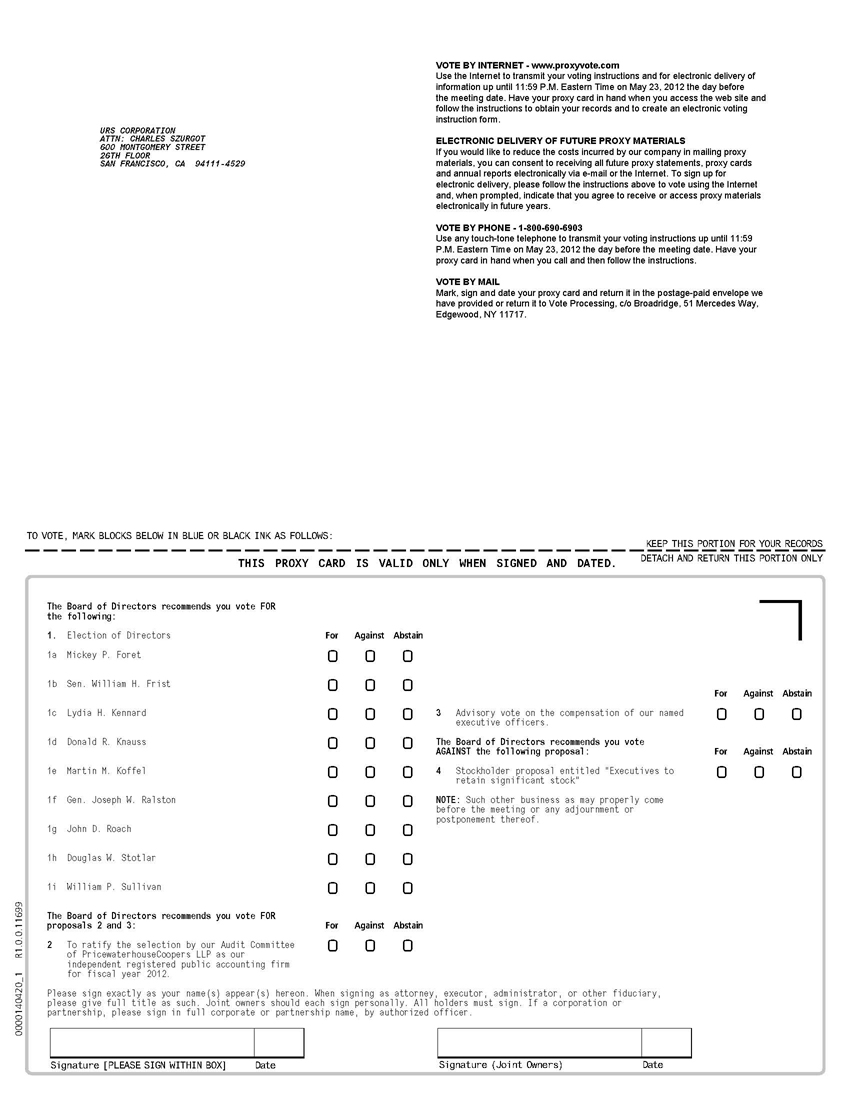
A: You may vote FOR, AGAINST or ABSTAIN from voting for all or any of the nominees in Proposal 1 and FOR, AGAINST or ABSTAIN from voting on Proposal 2, Proposal 3 and Proposal 4. If you complete and sign the accompanying proxy card and return it to us before the Annual Meeting, it will be voted as you direct. Simply complete and mail the proxy card to ensure that your vote is counted. If you are a registered stockholder on the record date and attend the Annual Meeting, you may deliver your completed proxy card in person. Alternatively, if you are a record holder, you can vote over the telephone, by dialing toll-free 1-800-690-6903 using a touch-tone phone and following the recorded instructions. You will be asked to provide the company number and control number from the enclosed proxy card. To be counted, your vote must be received by 11:59 P.M., Eastern Time, on May 23, 2012, the day prior to the Annual Meeting.
To vote over the internet, if you are a record holder, go to http://proxyvote.com. You will be asked to provide the company number and control number from the enclosed proxy card. To be counted, your vote must be received by 11:59 P.M., Eastern Time, on May 23, 2012, the day prior to the Annual Meeting.
If you are a beneficial owner of shares registered in the name of your broker, bank, or other agent, you should have received a proxy card and voting instructions with these proxy materials from that organization rather than from us. Simply complete and mail the proxy card to ensure that your vote is counted. Alternatively, you may vote by telephone or via the internet as instructed by your broker or bank. “Street name” stockholders who wish to vote in person at the Annual Meeting will need to obtain proxy cards issued in their names from the institutions that hold their shares.
|
|
Q: Can I revoke my proxy later?
|
A: Yes. You have the right to revoke your proxy at any time before the Annual Meeting by:
· Filing a timely written notice of revocation with our Corporate Secretary at our principal executive office (600 Montgomery
|
| Street, 26th Floor, San Francisco, CA 94111-2728);
· Filing another properly executed proxy showing a later date with our Corporate Secretary at our principal executive office (see address immediately above);
· Granting a subsequent proxy by telephone or through the internet; or
· Attending the Annual Meeting and voting in person, although if your shares are held of record by a broker, bank or other nominee and you wish to vote at the Annual Meeting, you must obtain from the record holder a proxy card issued in your name. Attendance at the Annual Meeting will not, by itself, revoke your proxy.
|
|
|
Q: How does the Board recommend I vote on the proposals?
|
A: Our Board recommends a vote:
· FOR each of our director nominees;
· FOR the ratification of the selection of PricewaterhouseCoopers LLP as our independent registered public accounting firm for fiscal year 2012;
· FOR advisory approval of the compensation of our named executive officers; and
· AGAINST the stockholder proposal.
|
|
Q: What is the vote required to approve the proposals?
|
A: Once a quorum has been established,
· For Proposal 1, directors will be elected by a majority of the votes cast by holders of shares entitled to vote at the Annual Meeting. This means that the number of votes cast FOR a director must exceed the number of votes cast AGAINST that director. Under our Bylaws, abstentions are not “votes cast” in the election of directors and will have no effect. Likewise, broker non-votes will have no effect and will not be counted as “votes cast” for purposes of this proposal.
· To be approved, Proposal 2 must receive FOR votes from the holders of a majority of shares present in person or represented by proxy and entitled to vote at the Annual Meeting. Abstentions will be counted toward the tabulation of votes cast on the proposal and will have the same effect as AGAINST votes. Broker non-votes will have no effect.
· Proposal 3, advisory approval of the compensation of our named executive officers, will be considered to be approved if it receives FOR votes from the holders of a majority of shares
|
| present in person or represented by proxy and entitled to vote at the Annual Meeting. Abstentions will have the same effect as AGAINST votes. Broker non-votes will have no effect.
· Proposal 4, stockholder proposal, will be considered to be approved if it receives FOR votes from the holders of a majority of shares present in person or represented by proxy and entitled to vote at the Annual Meeting. Abstentions will have the same effect as AGAINST votes. Broker non-votes will have no effect. However, Proposal 4 will not be submitted for a vote at the Annual Meeting unless the proposal is properly presented at the meeting. To be properly brought before the Annual Meeting, the stockholder proposing Proposal 4 (or a representative who is qualified under state law to present the proposal on his behalf) must attend the meeting to present the proposal.
|
|
|
Q: How will my shares be voted if I return a blank, but signed and dated, proxy card?
|
A: If you sign and send in your proxy card and do not indicate how you want to vote, the persons named as proxies will vote as the Board recommends on each proposal, that is, FOR each of the director nominees named in this proxy statement in Proposal 1, FOR Proposals 2 and 3 and AGAINST Proposal 4.
|
|
Q: How will voting on any other business be conducted?
|
A: Although we do not know of any business to be conducted at the Annual Meeting other than the proposals described in this proxy statement, if any other business comes before the Annual Meeting, your signed proxy card gives authority to the proxyholders, H. Thomas Hicks and Joseph Masters, to vote on those matters in their discretion.
|
|
Q: Who will bear the costs of this solicitation?
|
A: We will bear the entire cost of solicitation of proxies, including preparation, assembly, printing and mailing of this proxy statement, the proxy card and any additional information furnished to stockholders. Copies of solicitation materials will be furnished to banks, brokerage houses, fiduciaries and custodians holding in their names shares of common stock beneficially owned by others to forward to the beneficial owners. We may reimburse persons representing beneficial owners of common stock for their costs of forwarding solicitation materials to the beneficial owners. Original solicitation of proxies by mail may be supplemented by telephone, facsimile or personal solicitation by our directors, officers or other regular employees. We have also engaged D.F. King as our proxy solicitation firm. Directors and employees will not be paid any additional compensation for soliciting proxies, but D.F. King will be paid approximately $25,000, plus reimbursement for out-of-pocket expenses.
|
|
Q: What proxy materials are available on the internet?
|
A: Our proxy statement, annual report to stockholders and annual report on Form 10-K are available at http://www.urs.com/proxy.
|
|
Q: How can I find out the results of the voting at the Annual Meeting?
|
A: Preliminary voting results will be announced at the Annual Meeting. In addition, we expect to report our preliminary voting results or, if available to us on a timely basis, our final voting results on a current report on Form 8-K to be filed with the SEC within four business days after the end of the Annual Meeting. If not reported earlier, we expect to report our final voting results in an amendment to our Form 8-K within four business days after the final results are known to us.
|
|
Q: When are stockholder proposals due for next year’s Annual Meeting?
|
A: The deadline for submitting a stockholder proposal to us for inclusion in our proxy statement and form of proxy for our 2013 Annual Meeting of Stockholders pursuant to Rule 14a-8 of the Securities and Exchange Commission (the “SEC”) is December 20, 2012. A stockholder who wishes to nominate persons for election to the Board or propose other proper business before the stockholders at our 2013 Annual Meeting of Stockholders must notify us of that matter not later than the close of business on February 23, 2013 nor earlier than the close of business on January 24, 2013. You should also review our Bylaws, which contain additional requirements about advance notice of nominees and stockholder proposals, and the section, “Information About The Board of Directors - Director Nominees,” in this proxy statement.
|
|
Householding of Proxy Materials
|
A single proxy statement may be delivered to multiple stockholders sharing an address unless contrary instructions have been received from the affected stockholders. This process, which is commonly referred to as “householding,” potentially means extra convenience for stockholders and cost savings for companies.
If, at any time, you no longer wish to participate in “householding” and would prefer to receive a separate proxy statement and annual report, please notify your broker or direct your written request to our Corporate Secretary, Joseph Masters, at our principal executive office (600 Montgomery Street, 26th Floor, San Francisco, CA 94111-2728, (415) 774-2700). Stockholders who currently receive multiple copies of the proxy statement at their addresses and would like to request “householding” of their communications should contact their brokers.
|
|
Annual Report and Available Information
|
Our annual report to stockholders and our annual report on Form 10-K for the fiscal year ended December 30, 2011 accompany this proxy statement, but do not constitute a part of the proxy soliciting materials. Additional copies of our Annual Report on Form 10-K for the fiscal year ended December 30, 2011, including financial statements, but without exhibits, are available without charge to any person whose vote is solicited by this proxy statement upon written request to our Corporate Secretary, Joseph Masters, at our principal executive office (600 Montgomery Street, 26th Floor, San Francisco, CA 94111-2728). In addition, copies of our Corporate Governance Guidelines, our Audit Committee Charter, our Compensation Committee Charter, our Board Affairs Committee Charter, and our Code of Business Conduct and Ethics are available without charge upon written request to the above address. Copies also may be obtained without charge through our website at www.urs.com and, with respect to our Annual Report on Form 10-K, on the SEC’s website at www.sec.gov.
|
|
Board Meetings and Attendance
|
During our fiscal year 2011, the Board held seven board meetings: six board meetings and one joint meeting with the Audit Committee. Each director attended at least 75% of the aggregate of (1) the total number of meetings of the Board (held during the portion of the last fiscal year for which he or she served as a director) and (2) the total number of meetings of all the Committees of the Board on which he or she served (held during the portion of the last fiscal year that he or she served as a Committee member). Our non-management directors met in executive session at five meetings of the Board during fiscal year 2011.
It is our policy to invite the members of the Board to attend our annual stockholders’ meeting. All members of the Board attended our 2011 annual stockholders’ meeting.
|
|
Majority Vote Standard in Uncontested Board Elections
|
Our Bylaws include a majority vote standard for the election of directors in uncontested elections. Under this standard, the number of shares voted FOR a director must exceed the number of votes cast AGAINST that director; for this purpose, abstentions are not considered “votes cast.” However, in a contested election where the number of nominees for director exceeds the number of directors being elected, each director will be elected by plurality voting. Any incumbent director nominated for reelection who does not receive a majority of the votes cast in an uncontested election is required to tender his or her resignation to the Board. In that event, the Board Affairs Committee will consider the vote and recommend whether to accept or reject the resignation or whether other action should be taken. The Board will act on the Board Affairs Committee’s recommendation, taking into account any factors or other information that it considers appropriate and relevant, and will publicly disclose its decision within 90 days from the date of the certification of the election results. If the incumbent director’s resignation is not accepted by the Board, then the incumbent director will continue to serve until the next annual meeting or until his or her successor is duly elected, or his or her earlier resignation or removal.
|
|
Board Committees
|
The Board has standing Audit, Board Affairs and Compensation Committees. For our current directors, the following table provides membership information for fiscal year 2011 for each of the Board committees:
|
|||
|
Name
|
Audit
|
Board Affairs
|
Compensation
|
|
|
Mr. Mickey P. Foret
|
X*
|
|||
|
Senator William H. Frist, M.D.
|
X
|
|||
|
Ms. Lydia H. Kennard
|
X*
|
|||
| Mr. Donald R. Knauss |
X
|
|||
|
Mr. Martin M. Koffel
|
||||
| General Joseph W. Ralston, USAF (Ret.)# |
X
|
X
|
X*
|
|
| Mr. John D. Roach |
X
|
X
|
||
| Mr. Douglas W. Stotlar |
X
|
|||
|
Mr. William P. Sullivan
|
X
|
X
|
||
| *Committee Chairman
# Lead Independent Director
|
||||
|
The Audit Committee is currently composed of four non-management directors, Mr. Mickey P. Foret (Chairman), General Joseph W. Ralston, Mr. John D. Roach and Mr. William P. Sullivan. The Audit Committee met six times during fiscal year 2011. A copy of the Audit Committee Charter is available on our website at www.urs.com. The Audit Committee has responsibility, under delegated authority from the Board, for providing independent, objective oversight of our accounting functions, the audits of our financial statements and our internal control over financial reporting. The Audit Committee also oversees our financial reporting process on behalf of the Board. Management has the primary responsibility for the financial statements and the reporting process, including developing, maintaining and monitoring our systems of internal control over financial reporting. Our independent registered public accounting firm, PricewaterhouseCoopers LLP, is responsible for performing an independent audit of our financial statements and on our internal control over financial reporting, as well as expressing an opinion on the conformity of those financial statements with generally accepted accounting principles (“GAAP”) and the effectiveness of our internal control over financial reporting.
The primary responsibilities of the Audit Committee include the following:
· Reviewing annual and interim financial reports, earnings releases and other financial information and earnings guidance provided to analysts and rating agencies;
|
||||
|
· Overseeing our internal auditors' efforts to detect fraud and regulatory noncompliance;
· Overseeing our independent registered public accounting firm’s audit to obtain reasonable, but not absolute, assurance of detecting errors or fraud that would have a material effect on our financial statements;
· Reviewing the audit plan of our internal auditors and independent registered public accounting firm;
· Discussing our guidelines and policies to govern the process by which risk assessment and management is undertaken;
· Reviewing other financial reports, changes in accounting principles, conflicts with the independent registered public accounting firm and other regulatory or legal matters; and
· Establishing procedures for the receipt, retention and treatment of complaints regarding accounting, internal accounting controls or auditing matters and the confidential and anonymous submission by employees of concerns regarding questionable accounting or auditing matters.
The Board has determined that all members of the Audit Committee are independent within the meaning of SEC regulations, the listing standards of the NYSE and our Corporate Governance Guidelines. In addition, the Board has determined that all members of the Audit Committee are qualified as “audit committee financial experts” within the meaning of SEC regulations and have accounting and related financial management expertise within the meaning of the listing standards of the NYSE.
In fiscal year 2011, the Audit Committee completed a self-assessment of its performance, which was reported to the Board.
|
||||
|
The Board Affairs Committee is currently composed of four non-management directors, Ms. Lydia H. Kennard (Chairman), Senator William H. Frist, M.D., Mr. Donald R. Knauss and General Ralston, and the Board Affairs Committee met three times during fiscal year 2011. A copy of the Board Affairs Committee Charter is available on our website at www.urs.com. The primary responsibilities of the Board Affairs Committee include the following:
· Identifying, reviewing and recommending director candidates to serve on the Board and its Committees;
· Reviewing director education and orientation programs;
· Reviewing the compensation paid to non-management directors and recommending any appropriate changes to the Board; and
· Reviewing our Corporate Governance Guidelines and overseeing the Board’s periodic self-assessments.
The Board has determined that all members of the Board Affairs Committee are independent within the meaning of the listing standards of the NYSE and our Corporate Governance Guidelines.
In fiscal year 2011, the Board Affairs Committee completed a self-assessment of its performance, which was reported to the Board.
|
||||
|
The Compensation Committee currently is composed of four non-management directors, General Ralston (Chairman), Mr. John D. Roach, Mr. Douglas W. Stotlar and Mr. William P. Sullivan, and the Compensation Committee met four times during fiscal year 2011. A copy of the Compensation Committee Charter is available on our website at www.urs.com. The primary responsibilities of the Compensation Committee include the following:
· Establishing the overall compensation strategy affecting our Chief Executive Officer (the “CEO”), the executive officers required to file reports under Section 16 (the “Section 16 Officers”) of the Securities Exchange Act of 1934, as amended (the “Exchange Act”) and other senior management;
· Assessing the performance and determining the compensation of our Section 16 Officers;
· Overseeing the administration of our incentive, executive compensation and benefits plans and programs;
· Assessing and monitoring whether any of our compensation policies and programs has the potential to encourage excessive risk-taking;
|
||||
|
· Development and periodic review of our executive succession planning efforts; and
· Reviewing with management our Compensation Discussion and Analysis proxy disclosure.
The Board has determined that all members of the Compensation Committee are independent within the meaning of the listing standards of the NYSE and our Corporate Governance Guidelines.
In fiscal year 2011, the Compensation Committee completed a self-assessment of its performance, which was reported to the Board.
|
||||
|
Compensation Committee Processes and Procedures
|
Pursuant to its charter, the Compensation Committee regularly reviews and approves our overall compensation strategy and policies, and also reviews and approves the specific components of the Total Compensation (as defined below) paid to the CEO, each of the executive officers listed on our “Summary Compensation” table (including the CEO, the “Named Executives”) and Section 16 Officers.
Historically, the Compensation Committee has made adjustments to annual compensation, determined bonus and equity awards and established new performance objectives at one or more meetings held during the year. In addition, at various meetings throughout the year, the Compensation Committee may consider matters related to individual compensation, such as compensation for new executive hires, as well as high-level strategic issues, such as the efficacy of our compensation strategy, potential modifications to that strategy and new trends, plans or approaches to compensation and benefits.
The appointment, termination and removal of the CEO is solely reserved to the Board. Under its charter, the Compensation Committee has the responsibility and authority for reviewing and approving the compensation (including salary, bonuses, equity incentives, perquisites, severance payments and other benefits) and other terms of employment of the CEO. However, in practice, the Compensation Committee typically has reviewed and approved the CEO’s employment and compensation arrangements subject to final review and approval of the material terms of these arrangements by the full Board. In fulfilling its responsibility, the Compensation Committee typically evaluates the CEO's performance in light of relevant corporate performance goals and objectives, reviews and approves the CEO’s performance metrics and targets typically near the beginning of the performance cycle, and then reviews and confirms the extent to which the performance targets have been attained and the performance-based compensation has been earned once the performance cycle has been completed. In determining the equity incentive component
|
|||
| of the CEO's compensation, the Compensation Committee considers our performance and relative stockholder return, the value of similar incentive awards given to chief executive officers of comparable companies, and awards given to the CEO in past years. This year, the Compensation Committee negotiated and approved a new two-year extension of our employment agreement with Mr. Martin M. Koffel, our CEO, which extension was then approved by the full Board.
The Compensation Committee also reviews and approves, in its discretion (without the need for further approval by the Board), but with the input and recommendations of the CEO, the compensation (including salary, bonuses, equity awards, perquisites, severance payments and other benefits) and other terms of employment of all other Section 16 Officers, except that the hiring, appointment or promotion of an individual into a position as a Section 16 Officer, and the conferring of the titles of the Section 16 Officers, are reserved to the Board. The Compensation Committee reviews and approves the performance metrics of our Section 16 Officers that typically are set at or near the beginning of the applicable performance cycle, and then reviews and confirms the extent to which the performance targets have been attained and the performance-based compensation has been earned once the performance cycle has been completed. With the assistance of the CEO, the Compensation Committee also reviews the overall performance of the other Section 16 Officers in conjunction with a regular assessment of our executive succession planning.
While the CEO has been delegated the authority to determine the compensation (including salary, bonuses, perquisites, severance payments and other benefits) and other terms of employment of all other officers and employees of URS and its subsidiaries who are not Section 16 Officers, the Compensation Committee periodically reviews and discusses with the CEO and other senior executives the compensation and other terms of employment of such other more junior officers and managers.
The Compensation Committee reviews and approves, or to the extent required or deemed appropriate, makes recommendations to the Board regarding, the adoption of, amendment to, or termination of incentive compensation, stock, bonus and other similar plans and programs established by the Board from time to time. The Compensation Committee administers these plans, as and to the extent provided in the plan documents and upon the recommendation of the CEO, as appropriate, including without limitation establishing guidelines, interpreting plan documents, selecting participants, approving grants and awards, delegating authority to the CEO to make grants and awards to non-Section
|
||||
|
16 Officers, and making all other decisions required to be made by the plan administrator under such plans.
The Compensation Committee agenda for each meeting is usually developed by the Chairman of the Compensation Committee, in consultation with the CEO, the Chief Financial Officer (“CFO”) and our outside advisors. The Compensation Committee meets regularly in executive session, although the CEO, the CFO and occasionally various other members of senior management, as well as our outside advisors or consultants, typically are invited by the Compensation Committee to make presentations, provide financial or other background information or advice or otherwise participate in Compensation Committee meetings, as appropriate. The CEO does not participate in and is not present during any deliberations or determinations of the Compensation Committee regarding his own compensation or individual performance objectives, but generally is present and assists the Compensation Committee in its deliberations regarding all other officers.
For all executives, as part of its deliberations, the Compensation Committee may review and consider, as appropriate, materials such as financial reports and projections, operational data, tax and accounting information, tally sheets that set forth the total compensation that may become payable to executives in various hypothetical scenarios, executive stock ownership information, URS stock performance data, analyses of historical executive compensation levels and current company-wide compensation levels, and recommendations of the Compensation Committee’s compensation consultants, including analyses of executive compensation paid at other companies identified as appropriate peers. The Compensation Committee uses these comparative market data and other materials to inform and shape the Committee’s decision-making, but does not strictly adhere to quantitative benchmarks. Ultimately, in determining the amounts of compensation to be awarded, the Compensation Committee relies on its collective business judgment and discretion. In setting executive compensation for the Named Executives, the Compensation Committee takes into account both objective and subjective information, including general economic conditions, industry conditions, our company-wide performance, challenges confronting us, advice from its compensation consultant, information provided by management (including the recommendations of the CEO with regard to other executives), as well as the executive’s credentials, length of service, experience and past and expected future abilities to contribute to our financial and operational performance and the development and execution of our strategic plans.
The specific determinations of the Compensation Committee with respect
|
||||
|
to executive compensation for fiscal year 2011 are described in greater detail in the Compensation Discussion and Analysis section of this proxy statement.
|
||||
|
Compensation Consultants; Other Advisors
|
The charter of the Compensation Committee grants the Compensation Committee the full authority to obtain, at our expense, advice and assistance from internal and external legal, accounting or other advisors and consultants and other external resources that the Compensation Committee considers necessary or appropriate in the performance of its duties, as well as access to all of our books, records, facilities and personnel. In particular, the Compensation Committee has the authority to retain compensation consultants in its discretion to assist in its evaluation of executive compensation, including the authority to approve the consultant’s reasonable fees and other retention terms.
The Compensation Committee has designated Towers Watson & Co. (which, together with its other affiliated entities, is referred to in this proxy statement as “Towers Watson”) as its primary compensation consultant to assist the Compensation Committee in performing its functions and fulfilling its responsibilities. The predecessor to Towers Watson was first recommended to the Compensation Committee by our management in 2004 in connection with a survey of competitive executive compensation practices undertaken at that time. The Compensation Committee considered management’s recommendation and directly engaged that firm.
Since that time, Towers Watson (or its predecessor) has annually provided the Compensation Committee with information and analyses regarding industry and peer group pay practices and other trends that contribute to the Committee’s understanding and help to shape its determinations regarding the amount and form of various components of the total compensation of our CEO and other Named Executives and other Section 16 Officers, including determinations of base salary levels, cash incentive compensation, and the size of equity grants under our equity incentive plans. Towers Watson again provided these services for the Compensation Committee in connection with compensation awarded for 2011, and also helped the Compensation Committee to evaluate the efficacy of our existing executive compensation strategies and practices in supporting and reinforcing our long-term strategic goals. In 2011, Towers Watson assisted the Compensation Committee in contract negotiations conducted with the CEO by providing relevant market and data analyses. In March 2011, in connection with our adoption of executive stock ownership guidelines, Towers Watson also provided the Committee with comparative data regarding industry and peer group practices and trends and advised the Committee regarding appropriate structures and levels of ownership for
|
|||
| the guidelines. In 2010, Towers Watson assisted the Compensation Committee by performing a detailed assessment designed to help the Committee determine whether any of our strategies or practices had the potential to encourage excessive risk-taking. To assist the Committee in its evaluation for 2012, Towers Watson discussed with the Committee updates to the information underlying the 2010 assessment and the potential implications of those updates on our risk profile (as Towers Watson had done in 2011).
The Board Affairs Committee periodically retains Towers Watson to provide that Committee with advice and comparative data regarding the form and amount of compensation paid to our directors. In 2011, Towers Watson provided the Board Affairs Committee with information regarding industry and peer group director equity compensation structures and practices.
Although the predecessor to Towers Watson was initially introduced to the Compensation Committee by management, the Committee is confident, based on policies and procedures implemented by the Committee and Towers Watson (such as frequent participation by Towers Watson in Committee meetings, including executive sessions, of the Committee), that Towers Watson is able to provide the Compensation Committee with direct and independent advice and recommendations regarding our compensation policies and decisions. In addition, during fiscal year 2011, Towers Watson provided additional consulting services to a number of our other affiliates and joint ventures, including advice regarding our United Kingdom pension plan.
The Compensation Committee periodically approves the fee schedule for executive compensation consulting fees, and the Board Affairs Committee periodically approves the fee schedule for director compensation consulting fees. Neither the Board nor the Compensation Committee reviewed or approved the other additional services provided by Towers Watson to us or our affiliates, as those services are approved by our management in the normal course of business. The aggregate fees for consulting services provided to the Compensation Committee and the Board Affairs Committee during our 2011 fiscal year by Towers Watson with regard to services related to determining or recommending the amount or form of executive and director compensation were $305,547. The aggregate fees for additional services provided to us, including our affiliates, during our 2011 fiscal year by Towers Watson were $1,069,813.
In addition to Towers Watson, the Compensation Committee has also relied upon Cooley LLP (“Cooley”), our general outside corporate and
|
||||
|
securities counsel, to advise the Committee regarding its role and responsibilities and legal developments that may relate to executive compensation issues, and to assist the Compensation Committee regarding the structuring and implementation of its decisions and strategies. A partner of Cooley typically attends the meetings of the Compensation Committee. However, while the Compensation Committee believes that the advice provided by Cooley is useful, appropriate and competent, Cooley is not regarded as independent of our management due to the range of other services they provide to us and management regarding corporate, securities, corporate governance, employment, transactional, government contract and other matters.
|
||||
|
Equity Award Grant Practices
|
Our Compensation Committee may grant equity awards under our 2008 Equity Incentive Plan (“2008 Incentive Plan”), which was approved and adopted by our stockholders on May 22, 2008, to the Named Executives and other employees as incentive compensation. The Compensation Committee meeting schedule is determined several months in advance, and, therefore, proximity of any award date to a material news announcement or a change in our stock price is coincidental. We do not backdate equity awards or make equity awards retroactively. In addition, we do not coordinate our equity grants to precede announcements of favorable information or follow announcements of unfavorable information. The Compensation Committee believes that, for purposes of determining the fair market value of our common stock, the use of the closing price on the NYSE on the last market trading day before the Committee meets to approve equity grants allows the Committee to make more informed decisions, since the fair market value is known to the Committee at the time of each meeting, regardless of whether the meeting occurs prior to, during or after the close of the market.
|
|||
|
Delegation of Limited Authority to the CEO for Equity Awards under the 2008 Incentive Plan
|
The Board has delegated to the Compensation Committee the authority and responsibility for approving all awards of equity to our executives and other participants under the 2008 Incentive Plan. As permitted by its charter and the terms of the 2008 Incentive Plan, as well as Delaware corporate law, the Compensation Committee has delegated limited authority to our CEO to grant equity awards under the 2008 Incentive Plan to eligible participants other than Section 16 Officers. The purpose of this delegation is to facilitate the process of making equity grants, both annually, when large numbers of equity awards are granted, and from time to time between scheduled meetings. With respect to annual grants, the delegation is designed to allow the Compensation Committee to focus primarily on approving the specific grants being made to the individual Section 16 Officers, while authorizing by category, rather than by individual name and amount, an aggregate pool of grants to be made to the hundreds of more junior officers and managers with whom the
|
|||
|
Compensation Committee may not be directly familiar. Out of this pool, the CEO may then specifically allocate awards within the limits established by the Compensation Committee. The delegation is also intended to facilitate the timely grant of stock awards to non-Section 16 Officers, particularly new employees and promoted employees, in interim periods between scheduled meetings of the Compensation Committee. The authority delegated to the CEO regarding interim period grants is limited as to both the number of stock awards that may be granted to any individual and the aggregate number of these stock awards that may be granted in any year. The CEO did not exercise this limited delegated authority during 2011.
|
||||
|
Director Independence
|
Our Corporate Governance Guidelines contain standards for determining director independence that meet the listing standards adopted by the NYSE. Accordingly, Section B.2 of our Corporate Governance Guidelines contains the following paragraph related to director independence, which is consistent with the NYSE standards for independence:
"It is the policy of the Board that at least a majority of its members be independent. An ‘independent’ Director is one who (i) the Board has affirmatively determined not to have a material relationship with the Company (either directly or as a partner, stockholder or officer of an organization that has a relationship with the Company); (ii) is not a member of management or an employee of the Company and has not been a member of management or an employee of the Company within the past three years; (iii) is not, and within the past three years has not been, affiliated with or employed by a (present or former) internal or external auditor of the Company (or of an affiliate); (iv) is not, and within the past three years has not been, part of an interlocking directorate in which an executive officer of the Company serves on the compensation committee of another company that concurrently employs the Director; (v) has no immediate family members meeting the descriptions set forth in (ii) through (iv) above; and (vi) to the extent applicable with respect to membership on the Board or any specific Committees, satisfies additional requirements for ‘independence’ promulgated from time to time by the New York Stock Exchange (the ‘NYSE’) and the Securities and Exchange Commission (the ‘SEC’). Consideration should also be given to all other relevant facts and circumstances, including issues that may arise as a result of any director compensation (whether direct or indirect), any charitable contributions by the Company to organizations with which a Director is affiliated and any consulting arrangement between the Company and a Director.”
The full text of the Corporate Governance Guidelines, which also set forth the practices our Board intends to follow with respect to Board and Committee responsibilities, composition and selection, Board access to management and advisors, Board education and compensation, Board and
|
|||
| CEO performance evaluations and succession planning, is available on our website at www.urs.com. In addition, a copy of the Corporate Governance Guidelines is available upon written request to our Corporate Secretary at our principal executive office (600 Montgomery Street, 26th Floor, San Francisco, CA 94111-2728).
The Board Affairs Committee and the Board undertook their annual reviews of director independence on March 28 and 29, 2012, respectively. During these reviews, the Board Affairs Committee and the Board considered the director independence categories contained in the Corporate Governance Guidelines to assess the relevant, identified business transactions and relationships between each director or any member of his or her immediate family, and us (including our subsidiaries and affiliates). As provided in the Corporate Governance Guidelines, the purpose of this review was to determine whether any of these transactions or relationships were inconsistent with a determination that a director is independent. Transactions and relationships involving less than $120,000 in direct payments from us (other than standard director compensation and expense reimbursements) during any 12-month period within the last three years to a director or a member of the director’s immediate family are not regarded as compromising a director’s independence. Similarly, transactions and relationships within the last three fiscal years involving payments to or from a company for which a director serves as a current employee, or an immediate family member is a current executive officer, also are not regarded as compromising a director’s independence if such payments, in any single fiscal year, do not exceed the greater of $1 million or 2% of the other company’s consolidated gross revenues. Based on this review, the Board Affairs Committee and the Board affirmatively determined that all of the directors nominated for election at the Annual Meeting are independent under the standards set forth in the Corporate Governance Guidelines and applicable NYSE rules, with the exception of Mr. Koffel. Mr. Koffel is considered an inside director because he is one of our senior executives.
|
||||
|
Executive Sessions
|
Pursuant to NYSE rules and our Corporate Governance Guidelines, our non-management directors are required to meet in executive sessions without the presence of management at least annually. All of our non-management directors are also independent under the rules of the NYSE. Since May 2010, General Ralston has presided as the Board’s lead independent director (the “Lead Independent Director”), with responsibility for chairing all non-management director executive sessions. In fiscal year 2011, General Ralston served as the Lead Independent Director at five executive sessions.
|
|||
|
Board Leadership Structure
|
Under our corporate governance framework, our Board has the flexibility to determine whether the roles of Chairman and CEO should be combined or separated, based upon our circumstances and needs at any given time, while providing independent oversight designed to ensure that management acts in our stockholders’ best interests. Our Bylaws give the Board the authority to appoint as Chairman either a management or non-management director and provide for either the Chairman or, if the Chairman is not an independent director, one of our independent directors, to be designated by the Board as the Lead Independent Director. Accordingly, if the Board determines that the advantages of having a CEO/Chairman outweigh any potential disadvantages, then our Bylaws require the Board to appoint a non-management Lead Independent Director with a defined role and responsibilities.
The Board of Directors is currently chaired by our CEO, Martin Koffel. In addition, in accordance with our Bylaws, the Board has appointed General Ralston as its Lead Independent Director.
We believe that combining the positions of CEO and Chairman is, at the present time, the most effective leadership structure for us in promoting sound decision-making and vigorous execution of our strategic initiatives and business plans. As the individual with primary responsibility for managing our day-to-day operations, Mr. Koffel has served as CEO (and Chairman) since 1989 and is most familiar with our business and the complex challenges we face in the current environment. As a result, we believe that he is best positioned at this time to identify strategic priorities and to lead discussions and decision-making regarding key business and strategic issues, as well as to oversee the execution of important strategic initiatives. In addition, we believe that a combined CEO/Chairman is better positioned to act as a bridge between management and the Board, facilitating the regular flow of information.
We established the position of Lead Independent Director to help reinforce the independence of the Board as a whole. The position of Lead Independent Director has been structured to serve as an effective balance to a CEO/Chairman and is empowered under our Bylaws to perform the following:
· approve the agenda for regular Board meetings;
· serve as chairman of Board meetings in the absence of the Chairman;
· establish and approve the agenda for meetings of the independent directors;
· approve Board meeting schedules to assure there is sufficient time for discussion of all agenda items;
|
|||
|
· approve information sent to the Board;
· coordinate with the Committee chairs regarding meeting agendas and informational requirements;
· have authority to call meetings of the independent directors;
· preside over meetings of the independent directors;
· preside over any portions of Board meetings at which the evaluation or compensation of the CEO is presented or discussed;
· preside over any portions of Board meetings at which the performance of the Board is presented or discussed;
· serve as a liaison between the Chairman and the independent directors;
· coordinate the activities of the other independent directors; and
· if requested by major stockholders of the corporation, ensure that he or she is available for consultation and direct communication with such stockholders.
In light of this substantial delegation of authority and responsibility, we believe that a Lead Independent Director can help ensure the effective independent functioning of the Board in fulfilling its oversight role. General Ralston has served as a director since 2003 and currently serves on our Board Affairs, Audit and Compensation Committees. We believe that General Ralston, as Lead Independent Director, has built consensus among directors and served as a conduit between other independent directors and the Chairman, for example, by facilitating the inclusion on meeting agendas of matters of concern to the independent directors. In light of Mr. Koffel’s extensive history with and knowledge of URS, and because the Lead Independent Director is empowered to play a significant role in the Board’s leadership and in reinforcing the independence of the Board, we believe that it is advantageous to combine the positions of CEO and Chairman at this time.
|
||||
|
Board’s Risk Oversight Role
|
One of the Board’s key functions is oversight of our risk management process. The Board administers its oversight function directly through the Board as a whole, which has the ultimate oversight responsibility for the risk management process, as well as through the standing Audit, Board Affairs and Compensation Committees that address risks inherent in their respective areas of oversight. Our Audit Committee considers and discusses our major financial risk exposures and the steps our management has taken to monitor and control these exposures, including guidelines and
|
|||
| policies to govern the process by which risk assessment, risk management and our insurance program is undertaken. The Audit Committee also monitors compliance with legal and regulatory requirements, in addition to oversight of the performance of our internal audit function and independent registered public accounting firm’s audits. Our Board Affairs Committee monitors the effectiveness of our Corporate Governance Guidelines, including whether they are successful in preventing wrongful conduct, and risks associated with the independence of the Board, potential conflicts of interest and succession planning. Our Compensation Committee administers our incentive compensation, stock, bonus and other similar plans and arrangements and assesses and monitors whether any of our compensation policies and programs has the potential to encourage excessive risk-taking. See “Board Committees” for a more detailed description of these Committees and their respective areas of oversight. Senior management reports on enterprise risks issues, including operational, financial, legal and regulatory, and strategic and reputational risks, to the appropriate Committee or the Board.
The entire Board and the Committees receive reports on areas of material risk and, for each Committee, the Committee’s area of oversight, from senior management, internal auditors, our independent registered public accounting firm, compensation consultants, internal and outside counsel, and other members of management and professional advisors. When a Committee receives such reports, the chairman of the Committee reports on the discussion to the full Board at the next Board meeting. This process enables the Board and its Committees to coordinate the risk oversight role, particularly with respect to risk interrelationships.
|
||||
|
The Board’s Role in Succession Planning
|
As reflected in our Corporate Governance Guidelines, succession planning for both directors and executive officers is one of the primary responsibilities of the Board. With respect to Board succession planning, the Board Affairs Committee regularly evaluates the size and composition of the Board, giving consideration to our changing circumstances, the Board’s diversity policy and the then-current Board membership. The Board Affairs Committee and the Board of Directors also regularly consider succession plans for membership of the Board committees and committee chairmen. With respect to executive succession planning, the Board’s goal is to have a long-term and continuing program to plan for CEO succession and to monitor and advise on management’s senior leadership development program and succession planning for other executive officers. The Board, through the Lead Independent Director and his communication with the CEO, also has short-term contingency plans in place for emergencies or unplanned events, such as the departure, death, or disability of the CEO or other executive officers.
|
|||
|
Executive succession planning is one of the topics discussed during most regular executive sessions of the Board, and additional executive sessions have been held in recent years, devoted primarily to executive succession planning and professional development. We have engaged outside consultants to help the Board and the CEO identify and evaluate the skills and capabilities of potential internal CEO succession candidates, and to plan and implement professional development programs tailored to each candidate that are designed to help them maximize their potential regarding leadership, strategy and execution. During the additional executive sessions focused on succession planning, the Board meets with the outside consultants and the CEO to monitor and assess the progress of the internal succession candidates towards their professional development goals, and to become more familiar with other senior executives with high potential as well as potential external succession candidates. To enable the directors to become more familiar with succession candidates and other high potential executives, Board meetings are planned to specifically include presentations and attendance by active succession candidates and other senior executives. Board members also have direct access to all of our employees and are encouraged to make site visits on a worldwide basis to meet with local management.
|
||||
|
Director Nominees
|
Our Board Affairs Committee seeks to assemble a Board that, as a whole, possesses the appropriate balance of professional and industry knowledge and has the diversity of skills, experience and perspectives with respect to management and leadership, vision and strategy, accounting and finance, business operations, business judgment, industry background, and corporate governance necessary to oversee and direct our business. When the Board Affairs Committee identifies and evaluates candidates recommended by management or stockholders, the Board Affairs Committee looks specifically at the candidate’s qualifications in the broader context of the Board’s overall composition and in light of our needs given the then current mix of director attributes. The Board Affairs Committee’s goal is to recruit directors who complement and reinforce the skills of other directors.
In accordance with the Board Affairs Committee Charter, a qualified candidate for director nominee must possess the highest personal and professional integrity, have demonstrated exceptional ability and judgment, have the ability to work effectively with other members of the Board, and provide the skills and expertise appropriate to best serve the long-term interests of our stockholders. In accordance with the Board’s diversity policy, the Board Affairs Committee seeks nominees with a broad diversity of experience, professions, skills, geographic representation and backgrounds. The Board Affairs Committee ensures that diversity
|
|||
| considerations are discussed in connection with each potential nominee, as well as on a periodic basis in connection with the composition of the Board as a whole. The Board assesses the effectiveness of the Board’s diversity policy in connection with its periodic self-assessment process. Candidates are not discriminated against on the basis of race, religion, national origin, sexual orientation, disability or any other basis proscribed by law.
In the case of incumbent directors whose terms of office are set to expire, the Board Affairs Committee reviews these directors’ overall service to us during their terms, including the number of meetings attended, level of participation, quality of performance, and any other relationships and transactions that might impair these directors’ independence. In the case of new director candidates, the Board Affairs Committee also determines whether the nominee is independent for NYSE purposes, which determination is based upon applicable listing standards, applicable SEC rules and regulations and the advice of counsel, if necessary.
The Board Affairs Committee conducts any appropriate and necessary inquiries into the backgrounds and qualifications of possible candidates after considering the function and needs of the Board. The Board Affairs Committee meets to discuss and consider the candidates’ qualifications and then selects a nominee for recommendation to the Board by majority vote. From time to time, the Board Affairs Committee has engaged outside professional search firms, such as Korn/Ferry International, to assist with the identification and evaluation of director candidates.
The policy of our Board Affairs Committee is to consider Board candidates who are recommended by stockholders in the same manner as candidates recommended by members of the Board or senior management. Any stockholder wishing to recommend a candidate for nomination as a director should submit in writing the candidate’s name, biographical information and business qualifications to Chairman, Board Affairs Committee, URS Corporation, 600 Montgomery Street, 26th Floor, San Francisco, CA 94111-2728. All qualified submissions are reviewed by our Board Affairs Committee at the next appropriate meeting. If a stockholder wishes the Board Affairs Committee to consider a director candidate for nomination at our next annual meeting, the Committee’s policy requires that written recommendations be received by us no sooner than 120 days and no later than 90 days prior to the first anniversary of the preceding year’s annual meeting. Our Board Affairs Committee has not received a candidate recommendation from any stockholder (or group of stockholders) that beneficially owns more than five percent of our voting common stock.
|
||||
|
Communications with the Board
|
Stockholders and other interested parties may communicate directly with any of our senior managers or members of our Board by writing directly to those individuals at our principal executive office (600 Montgomery Street, 26th Floor, San Francisco, CA 94111-2728). Communications related to director candidate recommendations should be directed to the Chairman of the Board Affairs Committee. In addition, we encourage communicating any concerns related to our financial or accounting practices directly to the Chairman of the Audit Committee. Stockholders may also send communications to General Ralston, the Board’s Lead Independent Director. The non-management directors have instructed us to review all mail and other direct communications and have directed us to exercise discretion in determining whether to forward to members of the Board correspondence or other communications that are inappropriate, such as business solicitations, frivolous communications and advertising. Directors may at any time request that we forward to them all communications received by us. Information about how to contact our Board is also available on our website at www.urs.com.
|
|||
|
Code of Business Conduct and Ethics
|
All of our employees, including our principal executive officer, principal financial officer and principal accounting officer, and directors are required by our Code of Business Conduct and Ethics to conduct our business consistent with the highest legal and ethical standards. The full text of our Code of Business Conduct and Ethics is available on our website at www.urs.com. If we amend or waive a provision of our Code of Business Conduct and Ethics, we would then post such amendment or waiver on our website, as required by applicable rules.
Our employees are required to report any conduct that they believe in good faith to be an actual or apparent violation of the Code of Business Conduct and Ethics. The Audit Committee has established procedures to receive, retain and address complaints regarding accounting, internal accounting controls or auditing matters and to allow for the confidential and anonymous submission by employees of related concerns.
|
|||
|
Compensation of Non-Management Directors
|
The following table sets forth information regarding non-management directors’ compensation for fiscal year 2011.
|
|||
|
Non-Management Director
|
Fees Earned or Paid in Cash ($) (1)
|
Stock Awards ($) (2)
|
All Other Compensation ($) (3)
|
Total ($)
|
|||||||||||||
|
Armen Der Marderosian (4)
|
$ | 49,750 | $ | 57,438 | — | $ | 107,188 | ||||||||||
|
Mickey P. Foret
|
$ | 86,250 | $ | 114,920 | — | $ | 201,170 | ||||||||||
|
Senator William H. Frist
|
$ | 74,000 | $ | 114,920 | — | $ | 188,920 | ||||||||||
|
Lydia H. Kennard
|
$ | 84,250 | $ | 114,920 | — | $ | 199,170 | ||||||||||
|
Donald R. Knauss
|
$ | 69,000 | $ | 114,920 | — | $ | 183,920 | ||||||||||
|
Joseph W. Ralston
|
$ | 119,000 | $ | 114,920 | — | $ | 233,920 | ||||||||||
|
John D. Roach
|
$ | 81,500 | $ | 114,920 | — | $ | 196,420 | ||||||||||
|
Sabrina L. Simmons (5)
|
$ | 20,500 | $ | 28,727 | — | $ | 49,227 | ||||||||||
|
Douglas W. Stotlar
|
$ | 74,750 | $ | 114,920 | — | $ | 189,670 | ||||||||||
|
William P. Sullivan
|
$ | 77,750 | $ | 114,920 | — | $ | 192,670 | ||||||||||
|
William D. Walsh (4)
|
$ | 40,250 | $ | 57,438 | $ | 4,771 | $ | 102,459 | |||||||||
| (1) |
Includes cash compensation, such as retainers and meeting fees, earned in fiscal year 2011 for Board and Committee services.
|
| (2) |
Represents the compensation cost, which is equivalent to the aggregate grant date fair value computed in accordance with FASB ASC Topic 718. Both quarterly and deferred stock awards are fully vested upon grant; however, deferred stock awards are not issued until six months after the date the director’s Board service has terminated. We calculate fair value based on the closing sales price of a share of our common stock on the last market-trading day prior to the date of grant.
Each non-management director received the following stock awards in fiscal year 2011, except for Messrs. Der Marderosian and Walsh who did not stand for re-election in 2011 and received stock awards only on January 1, 2011 and April 2, 2011, and Ms. Simmons who resigned from the Board on June 28, 2011 and received a stock award only on April 2, 2011.
|
|
Grant Date
|
Grant Price
|
Quarterly Stock Award Shares
|
Deferred Stock Award Shares
|
Quarterly Stock Award Grant Date Fair Value ($)
|
Deferred Stock Award Grant Date
Fair Value ($)
|
||||||||||||||||||
|
January 1, 2011
|
$ | 41.61 | 345 | 345 | $ | 14,355 | $ | 14,355 | |||||||||||||||
|
April 2, 2011
|
$ | 45.89 | 313 | 313 | $ | 14,364 | $ | 14,364 | |||||||||||||||
|
July 2, 2011
|
$ | 45.12 | 637 | - | $ | 28,741 | - | ||||||||||||||||
|
October 1, 2011
|
$ | 29.66 | 969 | - | $ | 28,741 | - | ||||||||||||||||
| (3) |
Represents a medical benefit expense under a medical benefit plan provided to non-management directors who were elected prior to December 17, 1996.
|
| (4) |
Messrs. Der Marderosian and Walsh served on the Board until May 26, 2011.
|
| (5) | Ms. Simmons served on the Board from January 26, 2011 until her resignation on June 28, 2011. |
|
Deferred Stock Awards (1)
|
|||||||||
|
Non-Management Director
|
Number of Shares of Stock That Have Not Been Issued (#)
|
Market Value of Shares of Stock That Have Not been Issued ($)
|
|||||||
|
Mickey P. Foret
|
8,778 | $ | 308,283 | ||||||
|
Senator William H. Frist
|
1,969 | $ | 69,151 | ||||||
|
Lydia H. Kennard
|
4,532 | $ | 159,164 | ||||||
|
Donald R. Knauss
|
1,414 | $ | 49,660 | ||||||
|
Joseph W. Ralston
|
8,778 | $ | 308,283 | ||||||
|
John D. Roach
|
8,778 | $ | 308,283 | ||||||
|
Douglas W. Stotlar
|
4,999 | $ | 175,565 | ||||||
|
William P. Sullivan
|
5,741 | $ | 201,624 | ||||||
| (1) |
The market value of the deferred stock awards is calculated by multiplying the number of shares by the closing market price of our common stock as of the last trading day of fiscal year 2011, which was $35.12. Although these deferred stock awards are fully vested immediately upon grant, the number of notional shares attributed to deferred stock awards accumulate and are not issued to the director until six months after the date he or she terminates service on the Board.
|
|
Description of Non-Management Director Compensation
|
Quarterly Cash Retainer: Each non-management director serving on the Board on the first business day of each fiscal quarter receives a retainer of $15,000, for an aggregate of $60,000 annually. In addition, the Chairman of the Audit Committee receives an additional $3,750 payable on the first business day of each fiscal quarter for an aggregate of $15,000 annually. Also, the Chairmen of the Board Affairs and Compensation Committees each receives an additional $1,250 payable on the first business day of each fiscal quarter for an aggregate of $5,000 annually. Finally, the Lead Independent Director receives an additional $6,250 payable on the first business day of each fiscal quarter for an aggregate of $25,000 annually.
|
|
Board Attendance Fees: Each non-management director receives $2,000 for each Board meeting attended in person and $750 for each Board meeting attended by telephone.
|
|
|
Committee Attendance Fees: Committee members who are not serving as Chairman receive $1,500 for each Committee meeting attended in person and $750 for each Committee meeting attended by telephone.
|
|
|
Committee Chairman Fees: The Chairman of the Audit Committee receives $4,000 for each meeting chaired in person and $750 for each meeting chaired by telephone. The Chairs of the Board Affairs and Compensation Committees each receive $3,000 for every meeting chaired in person and $750 for every meeting chaired by telephone.
|
|
|
Quarterly Stock Award: At the start of fiscal year 2011, each non-management director serving on the Board on the first day of each fiscal quarter received a stock award under the 2008 Incentive Plan, consisting of the number of shares of our common stock equal to $14,375 divided by the Fair Market Value (as defined below) of our common stock on that day, rounded down to the nearest whole share. Effective May 26, 2011, the Board decided to eliminate the quarterly deferred stock award (discussed below) and increase the quarterly stock award from shares equal to $14,375 to shares equal to $28,750. The stock awards vest immediately upon grant. As defined in our 2008 Incentive Plan, “Fair Market Value” means the closing sales price of a share of our common stock on the last market-trading day prior to the day of determination, as reported in The Wall Street Journal or such other source as the Board deems reliable.
|
|
Deferred Stock Award: At the start of fiscal year 2011, each non-management director serving on the Board on the first day of each fiscal quarter received a deferred stock award consisting of a number of notional shares equal to $14,375 divided by the Fair Market Value (as defined above) of our common stock on that day, rounded down to the nearest whole share. Effective May 26, 2011, the Board decided to eliminate the quarterly deferred stock award and increase the quarterly stock award from shares equal to $14,375 to shares equal to $28,750. Deferred stock awards vested immediately upon grant; however, the number of notional shares attributed to deferred stock awards accumulate and are not issued to the non-management director until six months after the date the non-management director terminates his or her service on the Board.
|
|
|
Medical Benefit Plan: Only non-management directors elected prior to December 17, 1996 were entitled to participate, at our expense, in our medical benefit plan, as a decision was made to grandfather any non-management director who previously had this benefit made available to him. Mr. Walsh, who retired from the Board in May 2011, was the only non-management director to receive this benefit in fiscal year 2011.
|
|
|
Consulting Fees: We also maintain a policy under which non-management directors may be engaged on an as-needed basis from time to time as consultants for special projects at the rate of up to $3,000 per day (plus reasonable expenses) upon the recommendation of the Chairman of the Board or any officer designated by the Chairman of the Board. No consulting fees were paid to non-management directors during fiscal year 2011. If consulting fees are paid in the future to a non-management director, the Board will determine whether the special projects affect the independence of the non-management director.
|
|
Director
|
Share Ownership (1)
|
Share Ownership Value (1)
|
2012 Annual Cash Retainer
|
Equity Ownership as Multiple of Fiscal Year 2012 Annual Cash Retainer
|
|||||||||||||
|
Mickey P. Foret
|
37,398 | $ | 1,592,033 | $ | 75,000 | 21.2 | |||||||||||
|
Senator William H. Frist
|
7,038 | $ | 299,608 | $ | 60,000 | 5.0 | |||||||||||
|
Lydia H. Kennard
|
12,164 | $ | 517,821 | $ | 65,000 | 8.0 | |||||||||||
|
Donald R. Knauss
|
5,928 | $ | 252,355 | $ | 60,000 | 4.2 | |||||||||||
|
Joseph W. Ralston
|
15,770 | $ | 671,329 | $ | 90,000 | 7.5 | |||||||||||
|
John D. Roach
|
15,845 | $ | 674,522 | $ | 60,000 | 11.2 | |||||||||||
|
Douglas W. Stotlar
|
13,098 | $ | 557,582 | $ | 60,000 | 9.3 | |||||||||||
|
William P. Sullivan
|
14,582 | $ | 620,756 | $ | 60,000 | 10.3 | |||||||||||
| (1) |
Based on an April 2, 2012 share ownership date and closing share price of $42.57.
|
|
Nominee and Current
Committee Service
|
Principal Occupation, Business Experience,
Other Directorships Held and Age
|
|
Mickey P. Foret
(Audit Committee)
|
Mr. Foret has served as one of our directors since March 2003. He served until 2002 as Executive Vice President and Chief Financial Officer of Northwest Airlines, Inc., an airline company, and Chairman and Chief Executive Officer of Northwest Airlines Cargo, Inc., a transportation and logistics company. Mr. Foret was employed in various management positions at Northwest Airlines from 1992 until 1996 as well as from 1998 until 2002. Mr. Foret previously served as President and Chief Operating Officer of Atlas Air Cargo, Inc. and as President and Chief Operating Officer as well as in other management positions at Continental Airlines, Inc. Mr. Foret has served as a director of Delta Air Lines, Inc. since November 2008, as a director of the Nash Finch Company since May 2005 and as a director of ADC Telecommunications, Inc. from February 2003 until December 2010. Mr. Foret has previously served as a director for NorAm Energy Corp., as a director of MAIR Holdings, Inc., as a director of First American Funds, as a director of Champion Airlines, Inc., as a director of Worldspan L.P., and as a director of Northwest Airlines. He is 66 years old.
As the former chief financial officer and senior executive of a multinational public company, Mr. Foret contributes to the Board his considerable operational experience in and knowledge of the transportation and logistics industry, an industry that represents a significant portion of our business. Mr. Foret’s service on a number of boards of other public companies enables him to share his experience of beneficial governance practices employed at other public companies. We view accurate financial reporting and robust auditing to be critical to our success and, with his executive experience in capital-intensive industries and his experience as a director of financial funds, Mr. Foret is well positioned to contribute his extensive financial expertise to the Board. He also qualifies as an audit committee financial expert under the SEC guidelines.
|
|
Senator William H. Frist, M.D.
(Board Affairs Committee)
|
Senator Frist has served as one of our directors since November 2009. He has served as a partner at Cressey & Company LP, a private investment firm, since 2007, and as Distinguished University Professor at Vanderbilt University from 2008 until 2010. He served as a United States Senator for Tennessee from 1995 until 2007 and was Majority Leader of the United States Senate from 2003 until 2007. Senator Frist has served as a director of Select Medical Corporation since May 2010. Senator Frist serves on the boards of several other organizations, including the Center for Strategic and International Studies, the Kaiser
|
| Family Foundation, the Smithsonian Museum of Natural History, Aegis Laboratories, Accolade LLC and the Harvard Medical School Board of Fellows. He is 60 years old.
Senator Frist’s experience as a legislator, including numerous committee memberships and chairmanships and, most notably, as former Majority Leader of the United States Senate, gives him the leadership and consensus-building skills to assist the Board in a range of its activities. He has extensive knowledge of the workings of government and, as a former member of the Senate Finance Committee, of the federal budgeting process, which we view as especially significant given that a large proportion of our business activities are heavily regulated and directly affected by governmental actions. The Board also benefits from the considerable investment and finance experience he has gained from his tenure as a partner in a private investment firm. His service on the board of the Center for Strategic and International Studies enables him to contribute his perspective on our international operations.
|
|
|
Lydia H. Kennard (Board Affairs Committee)
|
Ms. Kennard has served as one of our directors since August 2007. She has served as a Principal of Airport Property Ventures, a developer and operator of aviation facilities, since March 2007. She served as the Executive Director of Los Angeles World Airports, the airport oversight and operations department for the City of Los Angeles, from 1999 to 2003, and again from 2005 to January 2007. Ms. Kennard has served as a director of Prologis, Inc. since 2004 and as a director of Intermec Corporation since 2003. She served as a director of IndyMac Bank from 2002 to 2008. Ms. Kennard has served on the Board of Trustees of Rand Corporation since 2002. She is 57 years old.
Ms. Kennard’s prior executive and operational experience, including oversight of such diverse activities as airfield operations, airport retail and restaurant concession management, construction, maintenance, property and asset management, business operations, and police and security activities positions her to contribute to the Board her leadership skills, her critical insights into the operational requirements of a large company and her expertise in industries in which we participate, such as infrastructure, construction and project management. As a result of her involvement with the California Air Resources Board, she is able to share her understanding of air quality management and regulation, which is valuable in enhancing the Board’s insight into our environmental management and pollution control and other environmental programs. The Board also benefits from her knowledge of the conduct and governance of public
|
|
companies based on her experience as a director of several public companies.
|
|
|
Donald R. Knauss (Board Affairs Committee)
|
Mr. Knauss has served as one of our directors since June 21, 2010. He has served as chairman and chief executive officer of The Clorox Company, a manufacturer and marketer of consumer products, since October 2006. He served as Executive Vice President of The Coca-Cola Company (a marketer and distributor of non-alcoholic beverages) and President and Chief Operating Officer for Coca-Cola North America from February 2004 until August 2006. Mr. Knauss has also served as a director of the Kellogg Company since November 2007 and The Clorox Company since October 2006. He is 61 years old.
With his substantial experience in executive positions at large multi-national corporations, Mr. Knauss brings to the Board substantial leadership skills. The Board also benefits from his expertise in corporate governance practices gained from his service on the boards of two large public companies. His experiences serving as a chairman, chief executive officer and chief operating officer allow him to contribute to the Board his critical knowledge and expertise related to the operations of large public companies, particularly in connection with international expansion, development and evaluation of strategic growth opportunities and consideration of the impact of corporate investment on stockholder value.
|
|
Martin M. Koffel
|
Mr. Koffel has served as our Chairman of the Board, Chief Executive Officer, President and as one of our directors since 1989. He is 73 years old.
Mr. Koffel’s long tenure as our CEO and Chairman positions him to contribute to the Board his extensive knowledge of our business, history and development, and to provide critical Board leadership and continuity. As CEO, he has developed substantial operational and industry expertise, as well as executive leadership skills that are important to us and to our Board. Mr. Koffel has previously served on the boards of several international policy institutes, which have given him substantial experience and perspective regarding economic and geopolitical trends, the development and execution of business strategies and evolving views regarding corporate governance best practices.
|
|
General Joseph W. Ralston, USAF (Ret.)
(Audit, Board Affairs and Compensation Committees)
|
General Ralston has served as one of our directors since October 2003. He has served as Vice Chairman of The Cohen Group, an international business consulting firm, since 2003; as a director of Lockheed Martin since 2003; and as a director of The Timken Company since 2003. General Ralston’s military career began in 1965 and concluded in 2003, when he retired from active duty. General Ralston’s military career was highlighted by his service as Vice Chairman of the Joint Chiefs of Staff in Washington, D.C. from 1996 to 2000 and Commander, U.S. European Command and Supreme Allied Commander Europe, NATO from 2000 to 2003. He is 68 years old.
General Ralston’s distinguished career in the armed forces has provided him with extensive experience in executive management, logistics and military procurement. During his service as a senior military officer, including Vice Chairman of the Joint Chiefs of Staff, General Ralston maintained the highest security clearances and performed a variety of responsibilities, including reviewing the requirements of the armed forces for goods and services; assessing the personnel, equipment, cyber, financial and reputational risks of military operations; and overseeing substantial military budgeting and expenditures.
Consequently, he has developed a deep understanding of the organization that has historically been among our most important clients, including critical insights into the needs of the armed forces for our services and the federal government procurement processes. The Board also benefits from his advice regarding our classified activities and his insights into our enterprise risk management. In addition, in serving as Chairman of the Nominating and Corporate Governance Committee of the Board of The Timken Company, General Ralston has gained valuable experience dealing with relevant rules and regulations and generally overseeing corporate governance matters.
|
|
John D. Roach
(Audit and Compensation Committees)
|
Mr. Roach has served as one of our directors since February 2003. He has served as Chairman of the Board and Chief Executive Officer of Stonegate International, a private investment and advisory services firm, since 1997; as a director of the PMI Group, Inc. since 1997; as a director of Ply Gem Holdings (a private company) since 2004, and as a director of VeriSign, Inc. since August 2007. He previously served as the Executive Chairman and Chief Executive Officer of Unidare U.S., Inc., an industrial welding and safety supplier, from 2002 to 2006; the founder, Chairman of the Board and Chief Executive Officer of Builders First Source, Inc. from 1998 to 2001; the Chairman of the Board, President, and Chief Executive Officer of Fibreboard Corp.
|
| from 1991 to 1997; a director of Kaiser Aluminum Corporation and its subsidiary Kaiser Aluminum & Chemical Corporation from 2002 to 2006; a director of Material Sciences Corporation from 2003 to 2006; and a director of Washington Group (formerly Morrison Knudsen Corporation) from 1997 to 2002. He is 68 years old.
With his prior extensive service as a chief executive officer of a multinational public company and a private investment firm, Mr. Roach brings to the Board his considerable business leadership and strategic consulting skills. Mr. Roach has served as a senior executive or director of a variety of companies in the construction and industrial production industries, which positions him to contribute his knowledge in the construction industry, one of the businesses we serve, and a variety of other industries, many of which are relevant to our Industrial and Commercial market sector. The Board also benefits from his executive experience in financial services, as well as his expertise in corporate governance and finance gained as a director of several public companies. Mr. Roach qualifies as an audit committee financial expert under the SEC guidelines.
|
|
|
Douglas W. Stotlar (Compensation Committee)
|
Mr. Stotlar has served as one of our directors since March 2007. He has served as President, Chief Executive Officer, and director of Con-way Inc., a transportation and logistics company (previously known as CNF Inc.) since April 2005. He served as President and Chief Executive Officer of Con-way Transportation Services, Inc., a regional trucking subsidiary (“CTS”), from 2004 until 2005. He also served as CTS’ Executive Vice President and Chief Operating Officer from 2002 until 2004, and as CTS’ Executive Vice President of Operations from 1997 until 2002. Mr. Stotlar serves as vice president at large and is a member of the executive committee of the American Trucking Associations. He is also a member of the Board of Directors of the American Transportation Research Institute and serves on the executive committee of the Transportation Research Board. He is 51 years old.
Mr. Stotlar’s executive experience has provided him with substantial knowledge of the transportation and logistics sector, an industry in which we participate. As the Chief Executive Officer of Con-way, Inc., he gained a significant understanding of public policy issues and supply chain systems in the transportation and logistics sector, which are relevant to our business activities. In addition, as a currently serving chief executive officer of a public company, Mr. Stotlar can contribute his valuable experience with contemporary corporate governance practices, labor and stockholder relations matters, and
|
|
current legal and regulatory requirements and trends. He also serves on the boards of several not-for-profit organizations.
|
|
|
William P. Sullivan (Audit and Compensation Committee)
|
Mr. Sullivan has served as one of our directors since August 2006. He has served as the President and Chief Executive Officer of Agilent Technologies, Inc., a provider of scientific and technical instruments, since March 2005. He served as Executive Vice President and Chief Operating Officer of Agilent, from March 2002 until March 2005, and as its Senior Vice President and General Manager of its Semiconductor Products Group from August 1999 until March 2002. Mr. Sullivan has served as a director of Agilent since March 2005 and as director of Avnet, Inc. since July 2008. He is 62 years old.
As one of the three non-executive directors on the Board who are currently serving as chief executive officers of public companies, Mr. Sullivan brings to the Board his significant executive and operational experience addressing contemporary issues facing public companies today. His experience as a senior executive of a multinational public company with global operations allows him to provide insight into a variety of international issues, which is especially important to us given that a significant portion of our business is conducted overseas. We believe that our exposure to new technologies and access to new ideas in this field are important to our future success, and Mr. Sullivan’s experience in the high technology industry positions him to contribute to the Board his considerable knowledge of developments in the technology sector. The Board also benefits from his knowledge of finance, as well as of the most current issues in the conduct and governance of public companies. He also qualifies as an audit committee financial expert under SEC guidelines.
|
|
Required Vote
|
Directors are elected by a majority of the votes cast for and against by holders of shares entitled to vote at the Annual Meeting, whether present in person or represented by proxy, which means that, for each director, the number of votes cast for the director must exceed the number of votes cast against that director. Abstentions and broker non-votes will not be considered votes cast.
|
|
Independent Registered Public Accounting Firm’s Fees
|
The following table presents aggregate fees for professional audit services rendered by PricewaterhouseCoopers LLP for the audit of our financial statements for the fiscal years ended December 30, 2011 and December 31, 2010, and fees for other services rendered by PricewaterhouseCoopers LLP during these periods.
|
||||
|
(In millions)
|
Fiscal Year 2011
|
Fiscal Year 2010
|
|||
|
Audit Fees
|
$9.0
|
$9.6
|
|||
|
Audit-Related Fees
|
0.2
|
0.1
|
|||
|
Tax Fees
|
-
|
-
|
|||
|
All Other Fees
|
0.3
|
0.1
|
|||
|
Total Fees
|
$9.5
|
$9.8
|
|||
|
Audit Fees. Audit fees include fees for services rendered in connection with the annual audit of our consolidated financial statements. This category also includes fees for audits and reviews provided in connection with statutory and regulatory filings and engagements or services that generally only independent registered public accounting firms reasonably can provide to a client, such as state overhead audits, statutory audits, attest services, consents and assistance with and review of documents filed with the SEC.
Audit-Related Fees. Audit-related fees include fees paid for audit-related services, which included audits of pension and other employee benefit plans, consultations regarding GAAP, reviews and evaluations of the impact of regulatory pronouncements, and audit services not required by statute or regulation.
Tax Fees. Tax fees include all services performed by professional staff in our independent registered public accounting firm’s tax division (except those relating to audit or audit-related services), including fees associated with tax compliance, tax planning and tax consultation services.
|
|||||
|
All Other Fees. All other fees primarily include fees associated with consulting, technical accounting training and an annual license fee on software in assisting management in performing technical research and reviewing the design or procedures regarding our internal control, close process and reporting structure.
|
|||||
|
All audit-related services, tax services and other services were pre-approved by the Audit Committee, which concluded that the provision of those services by PricewaterhouseCoopers LLP was compatible with the maintenance of that firm’s independence in the conduct of its auditing functions.
|
|||||
|
Policy on Audit Committee Pre-Approval
|
The Audit Committee is responsible for appointing, setting compensation and overseeing the work of the independent registered public accounting firm. The Audit Committee has established a policy regarding pre-approval of all audit and non-audit services provided by the independent registered public accounting firm.
On an on-going basis, management communicates specific projects and categories of service for which the advance approval of the Audit Committee is requested. The Audit Committee reviews these requests and advises management if the Audit Committee approves the engagement of the independent registered public accounting firm. On a periodic basis, management reports to the Audit Committee regarding the actual spending for such projects and services compared to the approved amounts. The Audit Committee also has delegated the ability to pre-approve audit and permitted non-audit services to the Chairman of the Audit Committee provided that any pre-approvals by the Chairman are reported to the Audit Committee at the subsequent scheduled Audit Committee meeting.
|
||||
|
Required Vote
|
Stockholder ratification of the selection of PricewaterhouseCoopers LLP as our independent registered public accounting firm is not required by our Bylaws or otherwise. The Audit Committee is, however, submitting the selection of PricewaterhouseCoopers LLP to the stockholders for ratification as a matter of good corporate practice. If the stockholders fail to ratify the selection, the Audit Committee will reconsider whether or not to retain that firm. Even if the selection is ratified, the Audit Committee, in its discretion, may direct the appointment of a different independent registered public accounting firm at any time during the year if it determines that such a change would be in our best interests and those of our stockholders.
The affirmative vote of the holders of a majority of the shares present in person or represented by proxy and entitled to vote at the Annual Meeting will be required to ratify the selection of PricewaterhouseCoopers LLP. Abstentions will be counted toward the tabulation of votes cast on the proposal and will have the same effect as negative votes. Broker non-votes are not counted for any purpose in determining whether this matter has been approved.
|
|
·
|
Revenues for fiscal year 2011 grew by 4.0% as revenues increased from our work in the power, federal and industrial and commercial market sectors, while we experienced a decline in revenues from our work in the infrastructure market sector. While we experienced a net loss for the year of $465.8 million, this loss reflected several non-cash charges, including a non-cash, after-tax goodwill impairment charge of $732.2 million driven by adverse equity market conditions during the 2011 fiscal year. These conditions caused a decline in our stock price and market capitalization. The charge had no effect on our business operations, cash balances or operating cash flows.
|
|
·
|
In 2011, we completed the acquisitions of Apptis Holdings, Inc. and CATI Training Systems, which expanded our federal government information technology services, as well as B.P. Barber & Associates, Inc., which expanded our engineering services in the southeastern states.
|
|
·
|
Strong Pay-for-Performance Principles. Our compensation policies and decisions are focused on pay-for-performance principles. Annual performance-based bonuses are determined using objective financial performance measures that are designed to correlate closely with the creation of long-term stockholder value. Our long-term equity incentives are based on the market price of our stock; typically, half of these equity incentives are subject to a performance test based on achievement of our annual budgeted corporate net income target.
|
|
·
|
The Right Compensation Mix. A substantial portion of the total compensation of our Named Executives is variable and tied to performance measures that correlate with the creation of stockholder value. The Compensation Committee believes that, as executives assume greater responsibility, their compensation should be more heavily weighted toward variable elements of compensation because the performance of these officers is expected to drive achievement of strategic and financial goals that are most likely to affect stockholder value. A substantial portion of our Named Executives’ compensation is at risk through performance goals that, if achieved, are expected to increase stockholder value and contribute to our long-term prosperity.
|
|
·
|
The Right Types of Equity Compensation. For the last several years, including 2011, the Compensation Committee decided not to grant any stock options and instead to grant only restricted stock because the value of these awards increases and decreases with increases and decreases in stock price after the grant date and thus ties compensation more closely to changes in stockholder value at all stock prices compared to stock options, the economic value of which changes with stockholder value only when the stock price is above the exercise price. The amounts disclosed in the executive compensation tables generally reflect the grant-date fair values of equity awards, but the actual economic value of these awards will depend directly on the performance of our stock price over the period during which the restricted stock vests (normally four years) and, with respect to performance-based restricted stock, whether the performance tests for vesting are met. The value realized by an executive for performance-based restricted stock could be as little as zero if the performance goals were not met.
|
|
|
The Right Performance Metrics. We continue to believe that executive compensation should be tied to financial performance metrics, not stock price metrics. Our Compensation Committee believes that financial performance metrics, such as net income, drive value and contribute to our long-term prosperity, while stock price metrics can unnecessarily promote excessive short-term risk-taking and encourage relative volatility during arbitrary periods.
|
|
·
|
Stock Ownership Guidelines. We maintain stock ownership guidelines for our executive officers, including the Named Executives, determined as a multiple of each
|
|
|
executive’s annual base salary. These guidelines are designed to encourage our executives to maintain a reasonable level of personal share ownership to demonstrate their personal commitment to our long-term success and to continue to align their own interests with the interests of our stockholders, consistent with our commitment to sound corporate governance.
|
|
·
|
No Excessive Perquisites. We do not provide personal lifestyle perquisites, such as country club memberships, vacation units, personal use of aircraft, personal entertainment accounts, or similar perquisites, nor do we provide tax gross-ups for executive perquisites.
|
|
·
|
Parachute Payment Excise Tax Provisions. Some executive employment agreements, entered into a number of years ago, contain excise tax gross-up provisions. However, in 2009, in light of trends and evolving best practices, the Compensation Committee reviewed its policy related to excise tax gross-ups and committed not to enter into any future employment or similar compensatory agreements that obligate us to provide tax gross-up payments intended to offset the cost of excise taxes that could be imposed if any severance payments provided to Section 16 Officers are considered “excess parachute payments” subject to excise tax under Section 4999 of the Internal Revenue Code of 1986, as amended (the “IRC”). Accordingly, consistent with that policy, our recently amended employment arrangements with Mr. Koffel eliminate prior provisions for tax gross-ups in connection with excise taxes on payments and benefits deemed to be “parachute payments” under Section 280G of the IRC and instead substitute a “best after-tax provision,” under which the payments to Mr. Koffel would be reduced in the event that any excise tax would otherwise be payable by Mr. Koffel on any “parachute payments.” See “Compensation Arrangements With Martin M. Koffel.”
|
|
·
|
No Repricing Without Stockholder Approval. Our equity plans do not permit repricing of underwater stock options held by executives or other employees without stockholder approval and, historically, we have not repriced any stock options.
|
|
Audit Committee Report
|
The Audit Committee has reviewed and discussed with management of the Company the audited financial statements for the fiscal year ended December 30, 2011. The Audit Committee has discussed with the Company's independent registered public accounting firm, PricewaterhouseCoopers LLP, the matters required to be discussed by Statement on Auditing Standards No. 61, as amended (AICPA, Professional Standards, Vol. 1. AU section 380), as adopted by the Public Company Accounting Oversight Board (“PCAOB”) in Rule 3200T. The Audit Committee has also received the written disclosures and the letter from the independent registered public accounting firm required by applicable requirements of the PCAOB regarding the independent registered public accounting firm's communications with the Audit Committee concerning independence, and has discussed with the independent registered public accounting firm its independence. Based on the foregoing, the Audit Committee has recommended to the Board of Directors that the audited financial statements be included in the Company’s Annual Report on Form 10-K for the fiscal year ended December 30, 2011, for filing with the Securities and Exchange Commission.
|
| (1) |
The material in this report is not “soliciting material,” is not deemed filed with the SEC and is not to be incorporated by reference in any of our filings under the Securities Act of 1933, as amended (the “Securities Act”), or the Exchange Act, whether made before or after the date of this proxy statement and irrespective of any general incorporation language included in any such filing.
|
|
Common Stock Beneficially Owned (1)
|
|||||||||
|
Beneficial Owner
|
Number
|
Percentage
|
|||||||
|
Janus Capital Management LLC (2)
151 Detroit Street
Denver, Colorado 80206
|
7,031,173 | 9.28 | % | ||||||
|
BlackRock, Inc. (3)
40 East 52nd Street
New York, New York 10022
|
5,827,826 | 7.69 | % | ||||||
|
Mickey P. Foret (4)
|
37,398 | * | |||||||
|
Senator William H. Frist, M.D. (4)
|
7,038 | * | |||||||
|
H. Thomas Hicks
|
103,702 | * | |||||||
|
Gary V. Jandegian
|
132,405 | * | |||||||
|
Lydia H. Kennard (4)
|
12,164 | * | |||||||
|
Donald R. Knauss (4)
|
5,928 | * | |||||||
|
Martin M. Koffel (4)
|
572,710 | * | |||||||
|
General Joseph W. Ralston, USAF (Ret.) (4)
|
15,770 | * | |||||||
|
John D. Roach (4)
|
15,845 | * | |||||||
|
Douglas W. Stotlar (4)
|
13,098 | * | |||||||
|
William P. Sullivan (4)
|
14,582 | * | |||||||
|
Randall A. Wotring
|
140,765 | * | |||||||
|
Thomas H. Zarges
|
53,092 | * | |||||||
|
All executive officers and directors as a group
(19 persons) (5)
|
1,392,615 | 1.84 | % | ||||||
| (1) |
There were 75,766,517 shares of our common stock outstanding as of April 2, 2012. All stock options held by our employees and directors are currently exercisable. Therefore, option shares are deemed to be outstanding for purposes of computing the percentage beneficial ownership of the holder, but as required by the SEC rules, not for purposes of computing the percentage beneficial ownership of any other person.
|
| (2) |
As stated in the Schedule 13G/A filed with the SEC on February 14, 2012, Janus Capital Management LLC. is deemed to be the beneficial owner of all of these shares of our common stock. Amount shown includes any shares held via its direct 94.8% ownership stake in INTECH Investment Management and its direct 77.8% ownership stake in Perkins Investment Management LLC. Of the shares reported as beneficially owned by Janus Capital Management LLC, Perkins Mid Cap Value reported sole voting power and sole dispositive power over 4,600,000 shares, or 5.8%, of our common stock.
|
| (3) |
As stated in the Schedule 13G/A filed with the SEC on February 10, 2012, BlackRock, Inc. is deemed to be the beneficial owner of all of these shares of our common stock and has sole voting and sole dispositive power over all of the shares.
|
| (4) |
Includes the following deferred equity awards: 8,778 deferred shares for Mr. Foret; 1,969 deferred shares for Senator Frist; 4,532 deferred shares for Ms. Kennard; 1,414 deferred shares for Mr. Knauss; 50,000 shares of deferred restricted stock units for Mr. Koffel; 8,778 deferred shares for General Ralston; 8,778 deferred shares for Mr. Roach; 4,999 deferred shares for Mr. Stotlar; and 5,741 deferred shares for Mr. Sullivan.
|
| (5) |
Executive officer shares consist of shares owned by the Named Executives, Thomas W. Bishop, Hugh Blackwood, Reed N. Brimhall, Susan B. Kilgannon, Joseph Masters and Robert W. Zaist. Includes shares subject to options that the executive officers have the right to acquire within 60 days. The executive officers do not have the right to dispose of any unvested restricted shares.
|
| (1) |
The material in this report is not “soliciting material,” is not deemed “filed” with the SEC and is not to be incorporated by reference in any of our filings under the Securities Act or the Exchange Act, other than our Annual Report on Form 10-K, where it shall be deemed to be “furnished,” whether made before or after the date of this proxy statement and irrespective of any general incorporation language included in any such filing.
|
|
Accenture plc
|
AECOM
|
Booz Allen Hamilton, Inc.
|
||
|
CACI International, Inc.
|
Computer Sciences Corporation
|
Emcor Group, Inc.
|
||
|
Fluor Corporation
|
Foster Wheeler AG
|
General Dynamics Corporation
|
||
|
Jacobs Engineering Group
|
KBR, Inc.
|
L-3 Communications Holdings, Inc.
|
||
|
McDermott International Inc.
|
Raytheon Corporation
|
Science Application International Corporation
|
||
|
Shaw Group Inc.
|
|
·
|
Compared to the Towers Watson’s 2010 report on Total Compensation, the peer group was updated to add Booz Allen Hamilton, Inc., an international professional consulting firm. Data for Booz Allen Hamilton was not publicly available prior to its initial public offering in the second half of 2010. Booz Allen Hamilton, Inc. was considered to be an appropriate peer because its size and its business as a defense and civil contractor for the federal government were considered similar to our own.
|
|
·
|
the qualifications of the Named Executive;
|
|
·
|
the relative importance of the strategic and operational goals for which the Named Executive has responsibility;
|
|
·
|
whether the Named Executive’s responsibilities changed during the preceding 12 months or were expected to change going forward;
|
|
·
|
the past and present individual performance and contributions of the Named Executive with respect to his job functions and responsibilities, and his near- and longer-term contribution potential;
|
|
·
|
the anticipated level of difficulty of replacing that Named Executive with someone of comparable experience and skill;
|
|
·
|
the base salaries, target bonuses and equity grants made in prior years to the Named Executives, as indicators of the compensation trends applicable to the Named Executives and the nature of the current adjustments that may be appropriate relative to each Named Executive’s current job performance and potential;
|
|
·
|
with respect to equity grants, the current equity holdings of the Named Executive and the value of and total gain related to prior grants, with a particular focus on the value of unvested awards, as indicators of current and prospective retention incentives;
|
|
·
|
the potential of that Named Executive to assume increased responsibilities and roles of greater significance in connection with our succession planning; and
|
|
·
|
with respect to Named Executives other than the CEO, the recommendations of the CEO.
|
|
Name
|
Title
|
Fiscal Year 2010 Base Salary
|
Fiscal Year 2011 Base Salary
|
||||||||
|
Martin M. Koffel
|
Chairman, Chief Executive Officer and President
|
$ | 1,000,000 |
Unchanged*
|
|||||||
|
H. Thomas Hicks
|
Vice President and Chief Financial Officer
|
$ | 565,000 | $ | 620,000 | ||||||
|
Gary V. Jandegian
|
Vice President, President – Infrastructure & Environment
|
$ | 615,000 | $ | 630,000 | ||||||
|
Randall A. Wotring
|
Vice President, President – Federal Services
|
$ | 540,000 | $ | 560,000 | ||||||
|
Thomas H. Zarges**
|
Vice President, Chairman – Energy & Construction
|
$ | 715,000 |
Unchanged
|
|||||||
|
Name
|
Title
|
2011 Bonus Plan – Performance Target and Weighting
|
2011 Target Bonus as Percent of 2011 Base Salary
|
|||||
|
Martin M. Koffel
|
Chairman, Chief Executive Officer and President
|
· Corporate Net Income of $280 million (after bonus accrual) = 100%
|
125% | |||||
|
H. Thomas Hicks
|
Vice President and Chief Financial Officer
|
· Corporate Net Income of $280 million (after bonus accrual) = 100%
|
100% | |||||
|
Gary V. Jandegian
|
Vice President, President – Infrastructure & Environment
|
· Corporate Net Income of $280 million (after bonus accrual) = 20%
· Infrastructure & Environment Operating Profit Contribution of $278 million (after bonus accrual) = 80%
|
100% | |||||
|
Randall A. Wotring
|
Vice President, President – Federal Services
|
· Corporate Net Income of $280 million (after bonus accrual) = 20%
· Federal Services Operating Profit Contribution of $190 million (after bonus accrual) = 80%
|
100% | |||||
|
Thomas H. Zarges
|
Vice President, Chairman – Energy & Construction
|
· Corporate Net Income of $280 million (after bonus accrual) = 20%
· Energy & Construction Operating Profit Contribution of $180 million (after bonus accrual) = 80%
|
100% |
|
Percentage Achievement of Performance Target
|
Eligible Percentage of Target Bonus
|
|||||
|
115% of Performance Target
|
200% of Target Bonus
|
|||||
|
100% of Performance Target
|
100% of Target Bonus
|
|||||
|
85% or less of Performance Target
|
0% of Target Bonus
|
|
Percentage Achievement of Performance Target
|
Eligible Percentage of Target Bonus
|
|||||
|
115% of Performance Target
|
150% of Target Bonus
|
|||||
|
100% of Performance Target
|
100% of Target Bonus
|
|||||
|
85% of Performance Target
|
50% of Target Bonus
|
|||||
|
70% or less of Performance Target
|
0% of Target Bonus
|
|
·
|
goodwill impairment charge (+$732.2 million);
|
|
·
|
acquisition expenses and overseas restructuring charges (+$6.1 million);
|
|
·
|
budgeted targets for businesses divested or terminated in connection with the overseas restructuring (+$5.9 million);
|
|
·
|
unbudgeted legal settlements and pension adjustments (+$9.7 million); and
|
|
·
|
charges from extinguishment of debt in connection with the refinancing of our senior credit facility (+$1.7 million).
|
|
Division
|
Pre-adjustment profit contribution (before bonus accrual)
|
Post-adjustment profit contribution (before bonus accrual)
|
Post-adjustment profit contribution (after bonus accrual)
|
|||||
|
Infrastructure & Environment
|
$268.3 million
|
$293.2 million
|
$278 million
|
|||||
|
Federal Services
|
$(117.5) million
|
$230.8 million
|
$218.8 million
|
|||||
|
Energy & Construction
|
$(270.4) million
|
$207.1 million
|
$189.3 million
|
|
·
|
Messrs. Koffel and Hicks each earned bonuses equal to 108% of their Target Bonuses determined as follows: after accrual for bonuses as required under the Plan, adjusted Corporate net income of $289.8 million exceeded the $280 million net income Performance Target by $9.8 million, which amounted to 23% of the upside ramp between 100% and 115% of the Performance Target. This calculation would have entitled Messrs. Koffel and Hicks, as well as other participants whose bonuses were measured by the net income Performance Target, to bonuses equal to 123% of their Target Bonuses. However, the Compensation Committee then exercised its negative discretion under the Bonus Plan to reduce the results to 108% of the Target Bonus, a reduction of 15%, to reflect its views that the lower percentage resulted in appropriate bonus levels in light of the reported GAAP results and the nature of the unbudgeted items that resulted in the adjustments to the reported GAAP results for purposes of the Bonus Plan.
|
|
·
|
Mr. Jandegian had earned a bonus equal to approximately 101% of his Target Bonus determined as follows: the Infrastructure & Environmental Division’s adjusted operating profit contribution of $278.2 million, after accrual for bonuses as required under the Plan, was substantially equivalent to the $278 million Performance Target. This 100% achievement of the Performance Target for the 80% of Mr. Jandegian’s bonus weighted to this division operating profit Performance Metric, together with the 8% of his upside ramp (100% to 200% of Target Bonus) for the 20% of his bonus weighted to achievement of the adjusted company-wide net income Performance Target (determined as described above), resulted in an actual bonus of 101% of Mr. Jandegian’s Target Bonus.
|
|
·
|
Mr. Wotring had earned a bonus equal to approximately 182% of his Target Bonus determined as follows: the Federal Service Division’s adjusted operating profit contribution of $218.8 million, after accrual for bonuses as required under the Bonus Plan, exceeded the $190 million Performance Target by $28.8 million, which in turn exceeded the full upside ramp between 100% and 115% of the Performance Target. Earning the maximum upside ramp (100% to 200% of Target Bonus) of the Performance Target for the 80% of Mr. Wotring’s bonus weighted to this division operating profit Performance Metric, together with the 8% of his upside ramp for the 20% of his bonus weighted to achievement of the company-wide adjusted net income Performance Target (determined as described above), resulted in an actual bonus of 182% of Mr. Wotring’s Target Bonus.
|
|
·
|
Mr. Zarges had earned a bonus equal to approximately 115% of his Target Bonus determined as follows: the Energy & Construction Division’s adjusted operating profit contribution of $189.3 million, after accrual for bonuses as required under the Bonus Plan, exceeded the $180 million Performance Target by $9.3 million, which amounted to 34% of the upside ramp between 100% and 115% of the Performance Target. Earning 34% of the upside ramp of the Performance Target for the 80% of Mr. Zarges’ bonus weighted to this division operating profit Performance Metric, together with the 8% of his upside ramp for the 20% of his bonus weighted to achievement of the company-wide adjusted net income Performance Target (determined as described above), earned Mr. Zarges an aggregate of
|
|
|
30% of his upside ramp (100% to 150% of Target Bonus), which resulted in an actual bonus of 115% of Mr. Zarges’ Target Bonus.
|
|
Name
|
Title
|
Restricted Shares Awarded
|
||||
|
Martin M. Koffel
|
Chairman, Chief Executive Officer and President
|
—*
|
||||
|
H. Thomas Hicks
|
Vice President and Chief Financial Officer
|
20,000
|
||||
|
Gary V. Jandegian
|
Vice President, President – Infrastructure & Environment
|
20,000
|
||||
|
Randall A. Wotring
|
Vice President, President – Federal Services
|
20,000
|
||||
|
Thomas H. Zarges
|
Vice President, Chairman – Energy & Construction
|
18,000
|
|
·
|
Modified Annual Cash Compensation Arrangements. In connection with the extension of Mr. Koffel’s retirement date and as an incentive for his continued performance, commencing
|
|
|
with the first day of fiscal 2012, Mr. Koffel’s annual base salary was increased from $1 million to $1.1 million, and his target annual cash performance bonus (payable upon achievement of predefined financial performance targets established by the Compensation Committee at the beginning of the fiscal year) was increased from 125% to 150% of his annual base salary.
|
|
·
|
New Equity Grant. As of April 1, 2012, none of Mr. Koffel’s previous equity awards would be subject to further vesting. To provide further retention and performance incentives, Mr. Koffel was granted a restricted stock award of 200,000 shares of URS common stock under our 2008 Equity Incentive Plan on January 2, 2012. These restricted shares will vest as follows:
|
|
o
|
On each of May 1, 2013 and May 1, 2014, 50,000 shares of restricted stock will vest, provided in each case that Mr. Koffel’s continuous service has not terminated prior to the vesting date. Vesting of any of these shares that remain unvested will accelerate, and the shares will vest in full, in the event of Mr. Koffel’s retirement, his death or disability, his termination by us without cause before June 1, 2014, or his resignation for good reason or termination by us without cause within two years following a change in control (as such events are described in the Amendment).
|
|
o
|
On each of May 1, 2013 and May 1, 2014, 50,000 shares of restricted stock will vest, provided in each case that Mr. Koffel’s continuous service has not terminated prior to the vesting date and we have met our net income goal for the preceding fiscal year, as established by the Compensation Committee during the first quarter of that fiscal year, and as confirmed by the Compensation Committee after the audited financial results for the fiscal year have been prepared. Vesting of any of these shares that remain unvested (and have not been canceled due to failure to achieve the net income goal for the preceding fiscal year) will accelerate, and the shares will vest in full, in the event of Mr. Koffel’s termination by us without cause or his resignation for good reason within two years following a change in control, or his death or disability. However, no accelerated vesting of these shares will occur in the event of Mr. Koffel’s retirement, or his termination by us without cause in the absence of a change in control.
|
|
·
|
Elimination of Tax Gross-ups. Consistent with the Compensation Committee’s policy, the Amendment eliminated prior provisions for tax gross-ups in connection with payment of all income and employment taxes on disability and life insurance reimbursement payments and for excise taxes on payments and benefits deemed to be “parachute payments” under the IRC. The Amendment also provides that, in the event that any excise tax would otherwise be payable by Mr. Koffel on any “parachute payments,” then the amount of those parachute payments to Mr. Koffel may instead be reduced to eliminate or minimize any required excise tax payment in the manner specified, a provision known as a “best after tax provision.”
|
|
·
|
Imposition of “Double Trigger” in Connection with Change-in-Control Severance Benefits. Consistent with the Compensation Committee’s policy, the Amendment imposed
|
|
|
additional conditions on Mr. Koffel’s eligibility to receive change-in-control severance benefits. Prior to the Amendment, Mr. Koffel was eligible to receive specified severance benefits upon the occurrence of a “single trigger” event, that is, in the event of his departure for any reason within two years following a change in control. The Amendment provides that these change-in-control severance benefits will now become payable to Mr. Koffel only in the event that within two years following a change in control he resigns for “good reason” (as defined in the Amendment) or his employment is terminated by us without “cause,” in each case as defined in the Amended Agreement.
|
|
·
|
Modified Severance Arrangements. As consideration for the elimination of Mr. Koffel’s tax gross-up benefits and the imposition of the “double trigger” requirement for change-in-control severance benefits, the Amendment increased from $5 million to $6.75 million the cash amount payable to Mr. Koffel upon his retirement, resignation, death, disability or termination without cause (not in connection with a change in control).
|
|
·
|
We will not enter into any future employment or similar compensatory agreements that obligate us to provide tax gross-up payments intended to offset the cost of excise taxes that could be imposed if any severance payments provided to Section 16 Officers are considered “excess parachute payments” subject to excise tax under Section 4999 of the IRC.
|
|
·
|
We will not provide future tax gross-up payments in connection with perquisites provided to the Named Executives.
|
|
·
|
it is payable solely on account of the attainment of pre-established, objective performance goals;
|
|
·
|
the performance goals are established by a compensation committee comprised solely of two or more “outside directors”;
|
|
·
|
the material terms of the performance goals under which the compensation is to be paid are disclosed to and approved by stockholders before payment; and
|
|
·
|
the Compensation Committee certifies that the performance goals have been satisfied before payment.
|
|
Title
|
Multiple of Base Salary
|
|||
|
Chief Executive Officer
|
5 times
|
|||
|
Chief Financial Officer, General Counsel and Divisional Presidents
|
3 times
|
|||
|
Other Executive Officers
|
2 times
|
|
Named Executive
|
Share Ownership (1)
|
Share Ownership Value (1)
|
2012 Base Salary
|
Equity Ownership Value as of Multiple of Fiscal Year 2012 Base Salary
|
||||||
|
Martin M. Koffel
|
572,710
|
$24,380,265
|
$1,100,000
|
22.2
|
||||||
|
H. Thomas Hicks
|
103,702
|
$4,414,594
|
$657,000
|
6.7
|
||||||
|
Gary V. Jandegian
|
132,405
|
$5,636,481
|
$668,000
|
8.4
|
||||||
|
Randall A. Wotring
|
140,765
|
$5,992,366
|
$594,000
|
10.1
|
||||||
|
Thomas H. Zarges
|
53,092
|
$2,260,126
|
$715,000
|
3.2
|
|
Name and Principal Position
|
Year
|
Salary
($)
|
Bonus
($)
|
Stock Awards
($) (1)
|
Option Awards
($) (2)
|
Non-Equity Incentive Plan Compensation
($) (3)
|
Change in Pension Value and Nonqualified Deferred Compensation Earnings
($)
|
All Other Compensation
($) (4)
|
Total
($)
|
||||||||||||||||||||||||||
|
Martin M. Koffel; Chairman of the Board; Chief Executive Officer; President
|
2011
|
$ | 1,000,002 | — | $ | 2,263,500 | — | $ | 1,348,752 | $ | 987,674 | (5) | $ | 799,212 | $ | 6,399,140 | |||||||||||||||||||
|
2010
|
$ | 1,000,002 | — | $ | 2,470,000 | — | $ | 1,862,503 | $ | 547,808 | $ | 823,161 | $ | 6,703,474 | |||||||||||||||||||||
|
2009
|
$ | 1,000,002 | — | $ | 2,033,500 | — | $ | 2,500,004 | — | $ | 1,043,393 | $ | 6,576,899 | ||||||||||||||||||||||
|
H. Thomas Hicks; Chief Financial Officer; Vice President
|
2011
|
$ | 606,258 | — | $ | 888,383 | — | $ | 654,152 | — | $ | 25,400 | $ | 2,174,193 | |||||||||||||||||||||
|
2010
|
$ | 561,262 | — | $ | 938,135 | — | $ | 836,280 | — | $ | 21,975 | $ | 2,357,652 | ||||||||||||||||||||||
|
2009
|
$ | 550,014 | — | $ | 897,227 | — | $ | 1,100,029 | — | $ | 21,045 | $ | 2,568,315 | ||||||||||||||||||||||
|
Gary V. Jandegian; Vice President; President, Infrastructure & Environment
|
2011
|
$ | 626,262 | — | $ | 888,383 | — | $ | 633,486 | — | $ | 13,001 | $ | 2,161,132 | |||||||||||||||||||||
|
2010
|
$ | 611,265 | — | $ | 938,135 | — | $ | 176,886 | — | $ | 13,098 | $ | 1,739,384 | ||||||||||||||||||||||
|
2009
|
$ | 600,018 | — | $ | 927,729 | — | $ | 582,017 | — | $ | 11,758 | $ | 2,121,522 | ||||||||||||||||||||||
|
Randall A. Wotring; Vice President; President, Federal Services
|
2011
|
$ | 555,017 | — | $ | 873,127 | — | $ | 1,007,911 | $ | 77,409 | (5) | $ | 25,230 | $ | 2,538,694 | |||||||||||||||||||
|
2010
|
$ | 536,260 | — | $ | 890,563 | — | $ | 895,555 | $ | 86,870 | $ | 25,333 | $ | 2,434,581 | |||||||||||||||||||||
|
2009
|
$ | 525,013 | — | $ | 873,353 | — | $ | 754,969 | $ | 58,395 | $ | 25,619 | $ | 2,237,349 | |||||||||||||||||||||
|
Thomas H. Zarges; Vice President; Chairman, Energy & Construction
|
2011
|
$ | 715,000 | — | $ | 835,308 | — | $ | 819,468 | $ | 14,558 | (7) | $ | 106,778 | $ | 2,491,112 | |||||||||||||||||||
|
2010
|
$ | 711,250 | — | $ | 814,635 | — | $ | 542,219 | $ | 19,072 | $ | 131,120 | $ | 2,218,296 | |||||||||||||||||||||
|
2009
|
$ | 700,000 | $ | 2,400,000 | (6) | $ | 854,523 | — | $ | 961,568 | $ | 21,892 | $ | 285,857 | $ | 5,223,840 | |||||||||||||||||||
| (1) |
Represents the aggregate grant date fair value of restricted stock awarded. The grant date of an award is determined in accordance with FASB ASC Topic 718. Performance-based awards are accounted for as if they were fully vested. See the “Grants of Plan-Based Awards In Fiscal Year 2011” table for further information regarding the fair value of restricted stock awards granted in 2011.
|
| (2) |
No stock options were granted in fiscal years 2011, 2010 or 2009.
|
| (3) |
Reflects cash awards to the Named Executives under our fiscal years 2011, 2010 and 2009 Bonus Plans as discussed in further detail under the heading, “Executive Compensation—Compensation Discussion and Analysis — Bonus Plan; Fiscal Year 2011 Target Bonuses and Performance Targets.”
|
| (4) |
The following table reflects the incremental costs of perquisites and other benefits for fiscal year 2011 included in the All Other Compensation column in the “Summary Compensation” table for Messrs. Koffel, Hicks, Jandegian, Wotring and Zarges.
|
|
Name of Executive
|
Year
|
Auto, Parking & Misc. Expenses
|
Security and Personal Protection (a)
|
Company-Paid Life and Disability Insurance Premiums
|
Legal Expenses & Financial Planning
|
Company Contributions to 401(k) Defined Contribution Plan
|
Company Contributions to Restoration Plan (b)
|
Total
($)
|
|||||||||||||||||||||||||
|
Martin M. Koffel
|
2011
|
$ | 26,400 | $ | 702,706 | $ | 58,120 | (c) | $ | 7,086 | $ | 4,900 | - | $ | 799,212 | ||||||||||||||||||
|
H. Thomas Hicks
|
2011
|
$ | 19,128 | - | $ | 1,372 | (d) | - | $ | 4,900 | - | $ | 25,400 | ||||||||||||||||||||
|
Gary V. Jandegian
|
2011
|
$ | 6,701 | - | $ | 1,400 | (d) | - | $ | 4,900 | - | $ | 13,001 | ||||||||||||||||||||
|
Randall A. Wotring
|
2011
|
$ | 15,577 | - | $ | 1,568 | (d) | - | $ | 8,085 | - | $ | 25,230 | ||||||||||||||||||||
|
Thomas H. Zarges
|
2011
|
- | - | $ | 14,200 | (e) | $ | 17,145 | $ | 14,700 | $ | 60,733 | $ | 106,778 | |||||||||||||||||||
| (a) |
For Mr. Koffel, this amount represents the expense needed to maintain personal security services to ensure the safety, security and accessibility of Mr. Koffel and the safety and security of his family where appropriate, as required by the Board in light of business-related security incidents and threats. See “Perquisites and Other Employee Benefits” above.
|
| (b) |
The Restoration Plan allowed Mr. Zarges to receive matching contributions (from the former Washington Group) that he would not have been eligible to receive under our defined contribution plan because of IRC limits on the type and amount of compensation that are considered for purposes of the match. We credited to the Restoration Plan account any amounts that would otherwise have been contributed to our defined contribution plan matching account if matching contributions were not limited under that plan. Restoration Plan accounts are 100% vested and are payable following the participant’s termination of employment. Restoration Plan accounts are part of our general assets and are not secured.
|
| (c) |
Consists of life and disability insurance premiums. Tax gross-up payments on perquisites for Mr. Koffel were terminated in April 2009.
|
| (d) |
Amount paid for group term life and disability insurance premiums.
|
| (e) |
Consists of group term life, long-term and supplemental disability insurance premiums. Tax gross-up payments on perquisites for Mr. Zarges were terminated in April 2009.
|
| (5) |
Represents the aggregate annual change in the actuarial present pension value of the accumulated benefit for Messrs. Koffel and Wotring for fiscal year 2011 as discussed in further detail under the “Pension Benefits In Fiscal Year 2011” table.
|
| (6) |
The Zarges Employment Agreement included a one-time retention bonus paid out in January 2009. This agreement was entered into in 2008 in connection with his promotion to President of the Energy & Construction business, following the resignation of the former executive who previously held Mr. Zarges’ position and to encourage him to continue his employment in light of the special skills and knowledge Mr. Zarges brought to the position.
|
| (7) |
The amounts reflected are above-market earnings on non-qualified deferred compensation and were calculated as the difference between the Moody’s rate of 5.05% compared to 120% of the Applicable Federal Rate of 3.72%, or 4.46%.
|
|
Name
|
Approval Date (1)
|
Grant Date (1)
|
Estimated Possible Payouts Under Non-Equity Incentive Plan Awards (2)
|
Estimated Future Payouts Under Equity Incentive Plan Awards Target
(#) (3)
|
All Other Stock Awards: Number of Shares of Stock
(#) (4)
|
Grant Date Fair Value of Stock Awards (5)
|
|||||||||||||||||||||||
|
Threshold
($)
|
Target
($)
|
Maximum
($)
|
|||||||||||||||||||||||||||
|
Martin M. Koffel
|
3/30/2011
|
$ | 8,334 | (6) | $ | 1,250,000 | $ | 2,500,000 | — | — | — | ||||||||||||||||||
|
12/10/2008
|
3/30/2011
|
— | — | — | 50,000 | — | $ | 2,263,500 | |||||||||||||||||||||
|
H. Thomas Hicks
|
3/30/2011
|
$ | 4,133 | (6) | $ | 620,000 | $ | 1,240,000 | — | — | — | ||||||||||||||||||
|
5/25/2011
|
5/25/2011
|
— | — | — | — | 10,000 | $ | 424,600 | |||||||||||||||||||||
|
3/26/2008
|
3/30/2011
|
— | — | — | 2,700 | — | $ | 122,229 | |||||||||||||||||||||
|
5/21/2009
|
3/30/2011
|
— | — | — | 2,700 | — | $ | 122,229 | |||||||||||||||||||||
|
5/26/2010
|
3/30/2011
|
— | — | — | 2,500 | — | $ | 113,175 | |||||||||||||||||||||
|
5/25/2011
|
5/25/2011
|
— | — | — | 2,500 | — | $ | 106,150 | |||||||||||||||||||||
|
Gary V. Jandegian
|
3/30/2011
|
$ | 4,200 | (6) | $ | 630,000 | $ | 1,260,000 | — | — | — | ||||||||||||||||||
|
5/25/2011
|
5/25/2011
|
— | — | — | — | 10,000 | $ | 424,600 | |||||||||||||||||||||
|
3/26/2008
|
3/30/2011
|
— | — | — | 2,700 | — | $ | 122,229 | |||||||||||||||||||||
|
5/21/2009
|
3/30/2011
|
— | — | — | 2,700 | — | $ | 122,229 | |||||||||||||||||||||
|
5/26/2010
|
3/30/2011
|
— | — | — | 2,500 | — | $ | 113,175 | |||||||||||||||||||||
|
5/25/2011
|
5/25/2011
|
— | — | — | 2,500 | — | $ | 106,150 | |||||||||||||||||||||
|
Randall A. Wotring
|
3/30/2011
|
$ | 3,733 | (6) | $ | 560,000 | $ | 1,120,000 | — | — | — | ||||||||||||||||||
|
5/25/2011
|
5/25/2011
|
— | — | — | — | 10,000 | $ | 424,600 | |||||||||||||||||||||
|
3/26/2008
|
3/30/2011
|
— | — | — | 2,363 | — | $ | 106,973 | |||||||||||||||||||||
|
5/21/2009
|
3/30/2011
|
— | — | — | 2,700 | — | $ | 122,229 | |||||||||||||||||||||
|
5/26/2010
|
3/30/2011
|
— | — | — | 2,500 | — | $ | 113,175 | |||||||||||||||||||||
|
5/25/2011
|
5/25/2011
|
— | — | — | 2,500 | — | $ | 106,150 | |||||||||||||||||||||
|
Thomas H. Zarges
|
3/30/2011
|
$ | 2,383 | (7) | $ | 715,000 | $ | 1,072,500 | — | — | — | ||||||||||||||||||
|
5/25/2011
|
5/25/2011
|
— | — | — | — | 9,000 | $ | 382,140 | |||||||||||||||||||||
|
3/26/2008
|
3/30/2011
|
— | — | — | 2,700 | — | $ | 122,229 | |||||||||||||||||||||
|
5/21/2009
|
3/30/2011
|
— | — | — | 2,700 | — | $ | 122,229 | |||||||||||||||||||||
|
5/26/2010
|
3/30/2011
|
— | — | — | 2,500 | — | $ | 113,175 | |||||||||||||||||||||
|
5/25/2011
|
5/25/2011
|
— | — | — | 2,250 | — | $ | 95,535 | |||||||||||||||||||||
| (1) |
The Approval Date reflects the Board or Compensation Committee authorization date, while the Grant Date reflects the date determined for financial reporting purposes under FASB ASC Topic 718.
|
| (2) |
These columns show the potential cash payouts for fiscal year 2011 for our Named Executives if they fulfilled their individual performance targets established by our 2011 Bonus Plan, which is discussed in further detail under the heading, “Executive Compensation — Compensation Discussion and Analysis — Bonus Plan; Fiscal Year 2011 Target Bonuses and Performance Targets.” Actual payouts were dependent on fulfilling pre-established annual performance goals and thus were completely at risk. The actual 2011 Bonus Plan payouts for each Named Executive ranged from approximately 101% to 182% of his Target Bonus as disclosed in the “Summary Compensation” table in the column entitled “Non-Equity Incentive Plan Compensation.”
|
| (3) |
This column shows the single-year performance-based tranche of a multi-year restricted stock award calculated under FASB ASC Topic 718 subject to the fiscal year 2011 net income performance target as established for these shares on the Grant Date. These shares vest if the Named Executive is still employed by us on the vesting date and the Compensation Committee has determined that we met our performance target for the fiscal year preceding such vesting date. The Compensation Committee determined in March 2012 that the fiscal year 2011 net income performance target for these awards was met, which determination is discussed in further detail under the heading, “Executive Compensation — Compensation Discussion and Analysis — Bonus Plan; Fiscal Year 2011 Target Bonuses and Performance Targets” and, as a result, the performance vesting requirements for these shares were satisfied. The awards did not include threshold or maximum amounts.
|
| (4) |
This column shows the aggregate time-based portion of a multi-year restricted stock award calculated under FASB ASC Topic 718. The aggregate number of shares of restricted stock will vest if the Named Executive is still employed by us over four years, with one-fourth of the original shares scheduled to vest on each of May 1, 2012, 2013, 2014 and 2015.
|
| (5) |
Represents the full grant date fair value as calculated under FASB ASC Topic 718 for financial reporting purposes and assumes the vesting of all time-based and performance-based shares granted.
|
| (6) |
Based on exceeding a minimum threshold of 85% of the Performance Target by 0.1%.
|
| (7) |
Based on exceeding a minimum threshold of 70% of the Performance Target by 0.1%.
|
|
Option Awards
|
Stock Awards
|
||||||||||||||||||||||||||||||||
|
Named
|
Number of Securities Underlying Unexercised Options (#) Exercisable
|
Number of Securities Underlying Unexercised Options (#) Unexercisable
|
Option Exercise Price ($) (1)
|
Option Expiration Date
|
Number of Shares or Units of Stock That Have Not Vested (#)
|
Market Value of Shares or Units of Stock That Have Not Vested
($) (2)
|
Equity Incentive Plan Awards: Number of Unearned Shares, Units or Other Rights That Have Not Vested (#)
|
Equity Incentive Plan Awards: Market or Payout Value of Unearned Shares, Units or Other Rights That Have Not Vested ($) (2)
|
|||||||||||||||||||||||||
|
Martin M. Koffel(3)
|
— | — | — | — | 50,000 | (3) | $ | 1,756,000 | 50,000 | (3) | $ | 1,756,000 | |||||||||||||||||||||
|
H. Thomas Hicks
|
— | — | — | — | 2,700 | (4) | $ | 94,824 | 2,700 | (4) | $ | 94,824 | |||||||||||||||||||||
| — | — | — | — | 5,400 | (5) | $ | 189,648 | 5,400 | (5) | $ | 189,648 | ||||||||||||||||||||||
| — | — | — | — | 7,500 | (6) | $ | 263,400 | 7,500 | (6) | $ | 263,400 | ||||||||||||||||||||||
| — | — | — | — | 10,000 | (7) | $ | 351,200 | 10,000 | (7) | $ | 351,200 | ||||||||||||||||||||||
|
Gary V. Jandegian
|
25,000 | — | $ | 24.05 |
7/15/2012
|
— | — | — | — | ||||||||||||||||||||||||
| 30,000 | — | $ | 18.78 |
6/12/2013
|
— | — | — | — | |||||||||||||||||||||||||
| 15,000 | — | $ | 25.97 |
7/12/2014
|
— | — | — | — | |||||||||||||||||||||||||
| — | — | — | — | 2,700 | (4) | $ | 94,824 | 2,700 | (4) | $ | 94,824 | ||||||||||||||||||||||
| — | — | — | — | 5,400 | (5) | $ | 189,648 | 5,400 | (5) | $ | 189,648 | ||||||||||||||||||||||
| — | — | — | — | 7,500 | (6) | $ | 263,400 | 7,500 | (6) | $ | 263,400 | ||||||||||||||||||||||
| — | — | — | — | 10,000 | (7) | $ | 351,200 | 10,000 | (7) | $ | 351,200 | ||||||||||||||||||||||
|
Randall A. Wotring
|
2,500 | — | $ | 13.16 |
3/24/2013
|
— | — | — | — | ||||||||||||||||||||||||
| 4,000 | — | $ | 22.00 |
11/17/2013
|
— | — | — | — | |||||||||||||||||||||||||
| 6,666 | — | $ | 25.97 |
7/12/2014
|
— | — | — | — | |||||||||||||||||||||||||
| 25,000 | — | $ | 29.12 |
11/19/2014
|
— | — | — | — | |||||||||||||||||||||||||
| — | — | — | — | 2,363 | (4) | $ | 82,989 | 2,362 | (4) | $ | 82,953 | ||||||||||||||||||||||
| — | — | — | — | 5,400 | (5) | $ | 189,648 | 5,400 | (5) | $ | 189,648 | ||||||||||||||||||||||
| — | — | — | — | 7,500 | (6) | $ | 263,400 | 7,500 | (6) | $ | 263,400 | ||||||||||||||||||||||
| — | — | — | — | 10,000 | (7) | $ | 351,200 | 10,000 | (7) | $ | 351,200 | ||||||||||||||||||||||
|
Thomas H. Zarges
|
— | — | — | — | 2,700 | (4) | $ | 94,824 | 2,700 | (4) | $ | 94,824 | |||||||||||||||||||||
| — | — | — | — | 5,400 | (5) | $ | 189,648 | 5,400 | (5) | $ | 189,648 | ||||||||||||||||||||||
| — | — | — | — | 7,500 | (6) | $ | 263,400 | 7,500 | (6) | $ | 263,400 | ||||||||||||||||||||||
| — | — | — | — | 9,000 | (7) | $ | 316,080 | 9,000 | (7) | $ | 316,080 | ||||||||||||||||||||||
| (1) |
The option exercise price is the closing sales price of a share of our common stock on the last market-trading day prior to the grant date.
|
| (2) |
The market value of the stock awards is calculated by multiplying the closing market price of our common stock as of the last day of fiscal year 2011, which was $35.12, by the number of shares subject to the awards that have not vested.
|
| (3) |
Amount reported represents restricted stock with fifty percent time-based and fifty percent time-and-performance-based vesting, with one-third of the original 300,000 shares scheduled to vest on April 1, 2012. Performance-based shares vest only to the extent that specified performance criteria have been met. Does not include Mr. Koffel’s fully vested deferred restricted stock unit award of 50,000 shares, disclosed in the “NonQualified Deferred Compensation In Fiscal Year 2011” table.
|
| (4) |
Amount reported represents restricted stock with fifty percent time-based and fifty percent time-and-performance-based vesting over four years, with one-fourth of the original shares scheduled to vest on April 1, 2012. Performance-based shares vest only to the extent that specified performance criteria have been met. The original grant share amounts were 18,900 for Mr. Wotring, and 21,600 for each of Mr. Hicks, Mr. Jandegian and Mr. Zarges.
|
| (5) |
Amount reported represents restricted stock with fifty percent time-based and fifty percent time-and-performance-based vesting over four years, with one-fourth of the original shares scheduled to vest on each of April 1, 2012 and 2013. Performance-based shares vest only to the extent that specified performance criteria have been met. The original grant share amounts were 21,600 for each of Mr. Hicks, Mr. Jandegian, Mr. Wotring, and Mr. Zarges.
|
| (6) |
Amount reported represents restricted stock with fifty percent time-based and fifty percent time-and-performance-based vesting over four years, with one-fourth of the original shares scheduled to vest on each of April 1, 2012, 2013 and 2014. Performance-based shares vest only to the extent that specified performance criteria have been met. The original grant share amounts were 20,000 for each of Mr. Hicks, Mr. Jandegian, Mr. Wotring, and Mr. Zarges.
|
| (7) |
Amount reported represents restricted stock with fifty percent time-based and fifty percent time-and-performance-based vesting over four years, with one-fourth of the original shares scheduled to vest on each of May 1, 2012, 2013, 2014 and 2015. Performance-based shares vest only to the extent that specified performance criteria have been met. The original grant share amounts were 20,000 each for Mr. Hicks, Mr. Jandegian, and Mr. Wotring, and 18,000 for Mr. Zarges.
|
|
Option Awards
|
Stock Awards
|
||||||||||||||||
|
Name
|
Number of
Shares Acquired on Exercise (#)
|
Value Realized on Exercise ($) (1)
|
Number of
Shares Acquired on Vesting (#) (2)
|
Value Realized
on Vesting ($) (3)
|
|||||||||||||
|
Martin M. Koffel (4)
|
— | — | 100,000 | $ | 4,605,000 | ||||||||||||
|
H. Thomas Hicks (5)
|
— | — | 5,000 | $ | 231,300 | ||||||||||||
| — | — | 15,800 | $ | 727,590 | |||||||||||||
|
Gary V. Jandegian (6)
|
2,500 | $ | 27,475 | 5,000 | $ | 231,300 | |||||||||||
| — | — | 15,800 | $ | 727,590 | |||||||||||||
|
Randall A. Wotring (7)
|
— | — | 3,750 | $ | 173,475 | ||||||||||||
| — | — | 15,124 | $ | 696,460 | |||||||||||||
|
Thomas H. Zarges (8)
|
— | — | 15,800 | $ | 727,590 | ||||||||||||
| (1) |
Amount reflects the product of the number of shares acquired upon exercise of options multiplied by the difference between the market value of the stock and the option exercise price. Pursuant to the terms of the equity plans, market value is based on the closing price on the business day preceding exercise, as reported on the NYSE.
|
| (2) |
Reflects the number of shares vested prior to fulfilling tax withholding obligations.
|
| (3) |
Amount reflects the product of the number of shares vested multiplied by the market value of the stock, based on the closing price for the date prior to vesting as reported on the NYSE.
|
| (4) |
On April 1, 2011, Mr. Koffel became vested under his stock awards in 100,000 shares of common stock with a market price of $46.05.
|
| (5) |
On March 22, 2011, Mr. Hicks became vested under his stock awards in 5,000 shares of common stock with a market price of $46.26, and on April 1, 2011, in 15,800 shares of common stock with a market price of $46.05.
|
| (6) |
On October 13, 2011, Mr. Jandegian exercised his options to acquire 2,500 shares of common stock at an exercise price of $23.03. In addition, on March 22, 2011, Mr. Jandegian became vested under his stock awards in 5,000 shares of common stock with a market price of $46.26, and on April 1, 2011, in 15,800 shares of common stock with a market price of $46.05.
|
| (7) |
On March 22, 2011, Mr. Wotring became vested under his stock awards in 3,750 shares of common stock with a market price of $46.26, and on April 1, 2011, in 15,124 shares of common stock with a market price of $46.05.
|
| (8) |
On April 1, 2011, Mr. Zarges became vested under his stock awards in 15,800 shares of common stock with a market price of $46.05.
|
|
Name
|
Plan Name
|
Number of Years Credited Service (#)
|
Present Value
of Accumulated Benefit ($)
|
Payments During Last Fiscal Year ($)
|
||||||||||
|
Martin M. Koffel
|
Supplemental Executive Retirement Agreement
|
Not Applicable (1)
|
$ | 16,904,101 | — | |||||||||
|
H. Thomas Hicks
|
— | — | — | — | ||||||||||
|
Gary V. Jandegian
|
— | — | — | — | ||||||||||
|
Randall A. Wotring
|
URS Federal Services Defined Benefit Plan
|
31.9 | $ | 519,904 | — | |||||||||
|
Thomas H. Zarges
|
— | — | — | — | ||||||||||
| (1) |
Per the terms of the supplemental executive retirement agreement, referenced below, the benefit is equal to 60% of his average annual compensation, not to exceed a base compensation of $950,000 and a target bonus of 120%, and is not directly related to credited service.
|
|
Name
|
Plan
|
Executive Contributions in Last FY
($)
|
Registrant Contributions in Last FY
($)
|
Aggregate Earnings in Last FY
($)
|
Aggregate Withdrawals/
Distributions
($)
|
Aggregate Balance at Last FYE
($)
|
||||||||||||||||
|
Martin M. Koffel
|
· URS Selected Executives Deferred Compensation Plan
|
— | — | $ | 2,915 | (1) | — | $ | 115,017 | |||||||||||||
|
· URS Restricted Stock Unit Award (2)
|
— | — | — | — | $ | 1,756,000 | ||||||||||||||||
|
H. Thomas Hicks
|
— | — | — | — | — | — | ||||||||||||||||
|
Gary V. Jandegian
|
— | — | — | — | — | — | ||||||||||||||||
|
Randall A. Wotring
|
— | — | — | — | — | — | ||||||||||||||||
|
Thomas H. Zarges
|
· Washington Group Voluntary Deferred Compensation Plan
|
— | — | $ | 78,922 | (3) | — | $ | 1,614,558 | |||||||||||||
|
· Washington Group Restoration Plan
|
— | $ | 60,733 | (4) | $ | 43,191 | (3) | — | $ | 944,321 | ||||||||||||
|
· Interest In Former Washington Group Deferred Shares (5)
|
— | — | $ | 31,781 | — | $ | 751,659 | |||||||||||||||
| (1) |
Earnings did not constitute above-market earnings for Mr. Koffel and were not included in the “Summary Compensation” table.
|
| (2) |
Represents a fully vested deferred restricted stock unit award of 50,000 shares. Reflects the market value of the stock award calculated by multiplying the number of share by the closing market price of our common stock, $35.12, as of the last trading day of fiscal year 2011.
|
| (3) |
Earnings were calculated using Moody’s rate of 5.05% and were considered to be above-market earnings. Earnings above the Applicable Federal Rate were included in the “Summary Compensation” table.
|
| (4) |
Contribution amount disclosed as our contribution to the Restoration Plan in the All Other Compensation column of the “Summary Compensation” table.
|
| (5) |
Upon our acquisition of the Washington Group, 6,324 Washington Group deferred stock shares were converted at a value of $97.89 per share into a deferred cash balance that accrues interest at 120% of the monthly Applicable Federal Rate.
|
|
Voluntary Termination
|
Termination Upon Death or Disability
|
Involuntary Termination Not For Cause; Retirement Date Termination
|
Involuntary Termination For Cause
|
Voluntary Termination for Good Reason or Involuntary Termination Upon Change in Control
|
|||||||||||||||||
|
Executive Benefits and Payments Upon Termination (1,2)
|
|||||||||||||||||||||
|
Cash Severance
|
$ | 6,750,000 | (3) | $ | 6,750,000 | (3) | $ | 6,750,000 | (3) | — | $ | 6,750,000 | (4) | ||||||||
|
Equity Awards that Vest in Full Upon Triggering Event (5)
|
— | $ | 3,512,000 | $ | 1,756,000 | — | $ | 3,512,000 | |||||||||||||
|
Supplemental Executive Retirement Agreement (SERP) (6)
|
$ | 16,904,101 | $ | 16,904,101 | $ | 16,904,101 | $ | 16,904,101 | $ | 16,904,101 | |||||||||||
|
Healthcare (7)
|
$ | 477,749 | $ | 477,749 | $ | 477,749 | $ | 477,749 | $ | 477,749 | |||||||||||
|
URS Deferred Plan (8)
|
$ | 115,017 | $ | 115,017 | $ | 115,017 | $ | 115,017 | $ | 115,017 | |||||||||||
|
Tax Gross-Up
|
— | — | — | — | — | ||||||||||||||||
|
Total:
|
$ | 24,246,867 | $ | 27,758,867 | $ | 26,002,867 | $ | 17,496,867 | $ | 27,758,867 | |||||||||||
| (1) |
For purposes of this analysis, as required under SEC rules, we assumed that the triggering events took place on the last business day of our fiscal year (except as set forth in footnote 6), As of December 30, 2011, Mr. Koffel’s base salary was equal to $1,000,000 and his target bonus was equal to 125% of his base salary. Under our new employment arrangements with Mr. Koffel, changes to Mr. Koffel’s compensation became effective in fiscal year 2012, including a base salary increase to $1,100,000, a target bonus increase to 150% of his base salary, an additional award of 200,000 shares of restricted stock. See “Compensation Arrangements With Martin M. Koffel.” We are obligated to make payments to Mr. Koffel in connection with the termination of his employment pursuant to (a) the Amended and Restated Employment Agreement, dated September 5, 2003, as amended on December 7, 2006, December 10, 2008, and December 13, 2011, between us and Mr. Koffel (the “Koffel Employment Agreement”); and (b) the SERP. Mr. Koffel has agreed that, during the term of the Koffel Employment Agreement and thereafter, he will not disclose any confidential information of URS, subject to exceptions set forth in the Koffel Employment Agreement.
|
| (2) |
For purposes of the Koffel Employment Agreement, (a) “disability” means the performance of none of his duties for a period of at least 180 consecutive days as a result of incapacity due to his physical or mental illness; (b) “cause” means a willful failure to substantially perform his duties, or a willful act (or failure to act) by Mr. Koffel that constitutes gross misconduct or fraud and which is materially injurious to URS; (c) “change in control” means: (i) a change in control required to be reported pursuant to Item 6(e) of Schedule 14A of Regulation 14A under the Exchange Act; (ii) more than one-third of our incumbent directors not having served on the Board for 24 months prior to the change in control (or not having been elected or nominated by at least a majority of directors who served as directors 24 months prior to the change and were in office at the time of election or nomination); or (iii) any person acquiring 20% or more of our voting power
|
|
(subject to exceptions as set forth in the Koffel Employment Agreement), and (d) “good reason” means there is (i) a material reduction in his base compensation or target bonus percentage; (ii) a material diminution in his authority, duties, or responsibilities; (iii) a material diminution in the budget over which he retains authority; (iv) relocation of his principal place of employment to a place that increases his one-way commute by more than 50 miles as compared to his then-current principal place of employment immediately prior to such relocation; or (v) any other action or inaction that constitutes a material breach by URS of the Koffel Employment Agreement.
|
| (3) |
The Koffel Employment Agreement provides for a severance payment of $6,750,000 if he voluntarily resigns before June 1, 2014 (the “Retirement Date”), if his employment terminates due to his death or disability (as defined in footnote 2), if we terminate his employment for any reason other than cause (as defined in summary in footnote 2) prior to the Retirement Date, or if his employment terminates on the Retirement Date. This amount is payable as a lump sum or, at the election of Mr. Koffel, in installments.
|
| (4) |
If Mr. Koffel voluntarily resigns for “good reason” or is terminated by us for any reason other than “cause” within two years following a “change in control” (all as defined in summary in footnote 2), we will pay Mr. Koffel a severance payment equal to three times the sum of his current base salary plus the product of his current annual target bonus percentage multiplied by his base salary. This amount is payable as a lump sum or, at the election of Mr. Koffel, in installments.
|
| (5) |
Upon the termination of Mr. Koffel’s employment by us without “cause” (as defined in summary in footnote 2), or Mr. Koffel’s termination on the Retirement Date, 50,000 restricted shares granted would vest. All outstanding restricted stock awards would vest upon termination for death or disability or his voluntary resignation for good reason or termination by us for a reason other than cause within two years following a change in control. Information was calculated by multiplying the number of shares subject to the accelerated awards by the closing price of our common stock on December 30, 2011.
|
| (6) |
Reflects payment pursuant to the SERP, assuming that Mr. Koffel elects a lump sum payment. Based upon limitations set forth in the SERP, this calculation assumes, for this purpose, a base salary of $950,000 and target bonus equal to 120% of the base salary as discussed in further detail under the “Pension Benefits In Fiscal Year 2011” table.
|
| (7) |
Pursuant to the SERP, Mr. Koffel and his dependents are entitled, during the 18-month period beginning on the date of termination of his employment, to continue, at our expense, to participate in our life, disability and health insurance programs. Following such 18-month period, Mr. Koffel and his dependents will be entitled to continue to participate in our health insurance programs at our active group rates, but at Mr. Koffel’s expense. This benefit will be extended to Mr. Koffel’s wife during her lifetime following Mr. Koffel’s death. For purposes of the table, we have calculated this additional spousal benefit based on a reasonable estimate of mortality at an assumed value of $295,943.
|
| (8) |
See “NonQualified Deferred Compensation In Fiscal Year 2011” above.
|
|
Voluntary Termination For Good Reason
|
Involuntary Termination Not For Cause or Termination Upon Disability
|
Termination Upon Change in Control
|
|||||||||||
|
Executive Benefits and Payments Upon Termination (1,2)
|
|||||||||||||
|
Cash Severance
|
$ | 620,000 | (3) | $ | 620,000 | (3) | $ | 2,480,000 | (4) | ||||
|
Equity Awards that Vest in Full Upon Triggering Event (5)
|
— | — | $ | 1,798,144 | |||||||||
|
Healthcare (6)
|
$ | 12,171 | $ | 12,171 | $ | 12,171 | |||||||
|
Tax Gross-Up
|
— | — | $ | 0 | (7) | ||||||||
|
Total:
|
$ | 632,171 | $ | 632,171 | $ | 4,290,315 | |||||||
| (1) |
For purposes of this analysis, as required under SEC rules, we assumed that the triggering events took place on the last business day of our fiscal year, As of December 30, 2011, Mr. Hicks’s base salary was equal to $620,000, and his target bonus was equal to 100% of his base salary. We are obligated to make payments to Mr. Hicks in connection with the termination of his employment pursuant to the Employment Agreement, dated May 31, 2005, and amended as of August 1, 2008, between Mr. Hicks and us (the “Hicks Employment Agreement”). We and Mr. Hicks have agreed that any such obligation is conditioned on Mr. Hicks providing an effective release of claims. Mr. Hicks has also agreed that, during the term of the Hicks Employment Agreement and thereafter, he will not disclose any confidential information of URS, subject to exceptions set forth in the Hicks Employment Agreement.
|
| (2) |
For purposes of the Hicks Employment Agreement, (a) “cause” means a willful failure or omission to substantially perform his duties, other than as a result of his death or disability, a willful act that constitutes gross misconduct or fraud, Mr. Hicks’s conviction of, or plea of “guilty” or “no contest” to a felony or any misdemeanor involving dishonesty, Mr. Hicks’s disobedience of lawful orders or directions of certain senior officers or the Board or a Committee thereof, or the breach of any agreement with us; (b) “disability” means non-performance of his duties for at least 180 consecutive days as a result of any physical or mental injury or illness; (c) “good reason” means a reduction in his base compensation or annual target bonus, a substantial reduction in his responsibilities and authority, or his principal office is changed without his consent by greater than 25 miles; and (d) “change in control” means any person becomes the beneficial owner of greater than 50% of the voting power of our outstanding securities.
|
| (3) |
The Hicks Employment Agreement provides for a lump sum severance payment equal to 100% of Mr. Hicks’s base salary if we terminate his employment for any reason other than “cause” (as defined in footnote 2) or “disability” (as defined in footnote 2), or if Mr. Hicks resigns for “good reason” (as defined in footnote 2).
|
| (4) |
If, within one year after a “change in control” (as defined in footnote 2) of URS, we terminate Mr. Hicks’s employment for any reason other than cause or disability, or if Mr. Hicks resigns for good reason (as defined in footnote 2), we would make a lump sum payment to Mr. Hicks in an amount equal to 200% of the sum of (a) his base salary plus (b) his base salary multiplied by his annual target bonus percentage.
|
| (5) |
Upon a change in control while Mr. Hicks is employed with us, all unvested equity awards then held by him will fully vest. Information was calculated by multiplying the number of shares subject to the accelerated awards by the closing price of our common stock on December 30, 2011.
|
| (6) |
For one year following the termination of Mr. Hicks’ employment by us for any reason other than cause or disability, or Mr. Hicks’ resignation for good reason, or such termination within one year after a change in control, we will reimburse Mr. Hicks for payments of health insurance coverage under COBRA and continue coverage for long-term disability insurance and basic term life insurance then provided to Mr. Hicks.
|
| (7) |
The Hicks Employment Agreement provides for a tax gross-up payment to offset the cost of taxes that could be imposed if any severance payments are considered to be “excess parachute payments” subject to excise tax under Section 4999 of the IRC.
|
|
Voluntary Termination For Good Reason
|
Involuntary Termination Not For Cause or Disability
|
Termination Upon Change in Control
|
|||||||||||
|
Executive Benefits and Payments Upon Termination (1,2)
|
|||||||||||||
|
Cash Severance
|
$ | 630,000 | (3) | $ | 630,000 | (3) | $ | 1,260,000 | (4) | ||||
|
Equity Awards that Vest in Full Upon Triggering Event (5)
|
— | — | $ | 1,798,144 | |||||||||
|
Healthcare (6)
|
$ | 17,445 | $ | 17,445 | $ | 17,445 | |||||||
|
Tax-Gross-Up
|
— | — | $ | 0 | (7) | ||||||||
|
Total:
|
$ | 647,445 | $ | 647,445 | $ | 3,075,589 | |||||||
| (1) |
For purposes of this analysis, as required under SEC rules, we assumed that the triggering events took place on the last business day of our fiscal year, As of December 30, 2011, Mr. Jandegian’s base salary was equal to $630, 000, and his target bonus was equal to 100% of his base salary. We are obligated to make payments to Mr. Jandegian in connection with the termination of his employment pursuant to the Employment Agreement, dated January 29, 2004, and amended August 1, 2008, between us and Mr. Jandegian (the “Jandegian Employment Agreement”). We and Mr. Jandegian have agreed that any such obligation is conditioned on Mr. Jandegian providing an effective release of claims. Mr. Jandegian has also agreed that during the term of the Jandegian Employment Agreement and thereafter, he will not disclose any confidential information of URS, subject to exceptions set forth in the Jandegian Employment Agreement.
|
| (2) |
For purposes of the Jandegian Employment Agreement, (a) “cause” means a willful failure or omission to substantially perform his duties, other than as a result of his death or disability, a willful act that constitutes gross misconduct or fraud, Mr. Jandegian’s conviction of, or plea of “guilty” or “no contest” to a felony or misdemeanor involving dishonesty, or Mr. Jandegian’s disobedience of lawful orders or directions of certain senior officers or the Board or a Committee thereof, or the breach of any agreement with us; (b) “disability” means non-performance of his duties for at least 180 consecutive days as a result of any physical or mental injury or illness; (c) “good reason” means a reduction in his base compensation or annual target bonus; and (d) “change in control” means any person becomes the beneficial owner of greater than 50% of the voting power of our outstanding securities.
|
| (3) |
The Jandegian Employment Agreement provides for a severance payment (lump sum or installments, at our election) equal to 100% of Mr. Jandegian’s base salary if we terminate his employment for any reason other than “cause” (as defined in footnote 2) or “disability” (as defined in footnote 2), or Mr. Jandegian resigns for “good reason” (as defined in footnote 2).
|
| (4) |
If within one year after a “change in control” (as defined in footnote 2) of URS, we terminate Mr. Jandegian’s employment for any reason other than cause or disability, or if Mr. Jandegian resigns for good reason (as defined in footnote 2), we would make a lump sum payment to Mr. Jandegian in an amount equal to 200% of his base salary.
|
| (5) |
Upon a change in control while Mr. Jandegian is employed with us, all unvested equity awards then held by him would fully vest. Information was calculated by multiplying the number of shares subject to the accelerated awards by the closing price of our common stock on December 30, 2011.
|
| (6) |
For one year following our termination of Mr. Jandegian for any reason other than cause or disability, or Mr. Jandegian’s resignation for good reason, or such termination within one year after a change in control, we will reimburse Mr. Jandegian for payments of health insurance coverage under COBRA and continue coverage for long-term disability and basic term life insurance then provided to Mr. Jandegian.
|
| (7) |
The Jandegian Employment Agreement provides for a tax gross-up payment to offset the cost of taxes that could be imposed if any severance payments are considered to be “excess parachute payments” subject to excise tax under Section 4999 of the IRC.
|
|
Retirement
|
Voluntary Termination For Good Reason
|
Involuntary Termination Not For Cause or Disability
|
Termination Upon Change in Control
|
||||||||||||||
|
Executive Benefits and Payments Upon Termination (1,2)
|
|||||||||||||||||
|
Cash Severance
|
— | $ | 560,000 | (3) | $ | 560,000 | (3) | $ | 1,120,000 | (4) | |||||||
|
Equity Awards that Vest in Full Upon Triggering Event (5)
|
— | — | — | $ | 1,774,438 | ||||||||||||
|
Healthcare (6)
|
$ | 21,135 | $ | 21,135 | $ | 21,135 | $ | 21,135 | |||||||||
|
URS Federal Services Defined Benefit Plan (7)
|
$ | 519,904 | $ | 519,904 | $ | 519,904 | $ | 519,904 | |||||||||
|
Tax-Gross-Up
|
— | — | — | $ | 0 | (8) | |||||||||||
|
Total:
|
$ | 541,039 | $ | 1,101,039 | $ | 1,101,039 | $ | 3,435,477 | |||||||||
| (1) |
For purposes of this analysis, as required under SEC rules, we assumed that the triggering events took place on the last business day of our fiscal year, As of December 30, 2011, Mr. Wotring’s base salary was equal to $560,000, and his target bonus was equal to 100% of his base salary. We are obligated to make payments to Mr. Wotring in connection with the termination of his employment pursuant to the Employment Agreement, dated November 19, 2004, and amended as of August 1, 2008, between us and Mr. Wotring (the “Wotring Employment Agreement”). We and Mr. Wotring have agreed that any such obligation is conditioned on Mr. Wotring providing an effective release of claims. Mr. Wotring has also agreed that during the term of the Wotring Employment Agreement and thereafter, he will not disclose any confidential information of URS, subject to exceptions set forth in the Wotring Employment Agreement.
|
| (2) |
For purposes of the Wotring Employment Agreement, (a) “cause” means a willful failure or omission to substantially perform his duties, other than as a result of his death or disability, a willful act that constitutes gross misconduct or fraud, Mr. Wotring’s conviction of, or plea of “guilty” or “no contest” to a felony or any misdemeanor involving dishonesty, or Mr. Wotring’s disobedience of lawful orders or directions of certain senior officers or the Board or a Committee thereof, or the breach of any agreement with us; (b) “disability” means non-performance of his duties for at least 180 consecutive days as a result of any physical or mental injury or illness; (c) “good reason” means a reduction in his base compensation or annual target bonus; and (d) “change in control” means any person becomes the beneficial owner of greater than 50% of the voting power of our outstanding securities.
|
| (3) |
The Wotring Employment Agreement provides for a severance payment (lump sum or installments, at our election) equal to 100% of Mr. Wotring’s base salary if we terminate his employment for any reason other than “cause” (as defined in footnote 2) or “disability” (as defined in footnote 2), or Mr. Wotring resigns for “good reason” (as defined in footnote 2).
|
| (4) |
If within one year after a “change in control” (as defined in footnote 2) of URS, we terminate Mr. Wotring’s employment for any reason other than cause or disability, or if Mr. Wotring resigns for good reason, we will make a lump sum payment to Mr. Wotring in an amount equal to 200% of his base salary.
|
| (5) |
Upon a change in control while Mr. Wotring is employed with us, all unvested equity awards then held by him shall fully vest. Information was calculated by multiplying the number of shares subject to the accelerated awards by the closing price of our common stock on December 30, 2011.
|
| (6) |
For one year following our termination of Mr. Wotring for any reason other than cause or disability, or Mr. Wotring’s resignation for good reason, or such termination within one year after a change in control, we will reimburse Mr. Wotring for payments of health insurance coverage under COBRA and continue coverage for long-term disability insurance and basic term life insurance then provided to Mr. Wotring.
|
| (7) |
Reflects present value of the accumulated benefit pursuant to the URS Federal Services Defined Benefit Plan as discussed in further detail under the “Pension Benefits In Fiscal Year 2011” table.
|
| (8) |
The Wotring Employment Agreement provides for a tax gross-up payment to offset the cost of taxes that could be imposed if any severance payments are considered to be “excess parachute payments” subject to excise tax under Section 4999 of the IRC.
|
|
Voluntary Termination For Good Reason
|
Involuntary Termination Not For Cause
|
Involuntary Termination For Cause
|
Termination Upon Change in Control
|
||||||||||||||
|
Executive Benefits and Payments Upon Termination (1,2)
|
|||||||||||||||||
|
Cash Severance (3)
|
$ | 50,000 | $ | 50,000 | — | $ | 50,000 | ||||||||||
|
Equity Awards that Vest in Full Upon Triggering Event (4)
|
— | — | — | $ | 1,727,904 | ||||||||||||
|
Healthcare (5)
|
$ | 22,708 | $ | 22,708 | — | $ | 22,708 | ||||||||||
|
Washington Group Voluntary Deferred Compensation Plan
|
$ | 1,614,558 | $ | 1,614,558 | $ | 1,614,558 | $ | 1,614,558 | |||||||||
|
Washington Group Restoration Plan
|
$ | 944,321 | $ | 944,321 | $ | 944,321 | $ | 944,321 | |||||||||
|
Interest in Former Washington Group Deferred Shares
|
$ | 751,659 | $ | 751,659 | $ | 751,659 | $ | 751,659 | |||||||||
|
Tax-Gross-Up
|
— | — | — | $ | 0 | (6) | |||||||||||
|
Total:
|
$ | 3,383,246 | $ | 3,383,246 | $ | 3,310,538 | $ | 5,111,150 | |||||||||
| (1) |
For purposes of this analysis, as required under SEC rules, we assumed that the triggering events took place on the last business day of our fiscal year, As of December 30, 2011, Mr. Zarges’ base salary was equal to $715,000, and his target bonus was equal to 100% of his base salary. We are obligated to make payments to Mr. Zarges in connection with the termination of his employment pursuant to the Employment Agreement, dated August 7, 2008, between us and Mr. Zarges (the “Zarges Employment Agreement”). We and Mr. Zarges have agreed that any such obligation is conditioned on Mr. Zarges providing an effective release of claims. Mr. Zarges has also agreed that during the term of the Zarges Employment Agreement and thereafter, he will not disclose any confidential information of URS, subject to exceptions set forth in the Zarges Employment Agreement.
|
| (2) |
For purposes of the Zarges Employment Agreement, (a) “cause” means a willful failure or omission to substantially perform his duties, other than as a result of his death or disability, a willful act that constitutes gross misconduct or fraud, Mr. Zarges’ conviction of, or plea of “guilty” or “no contest” to a felony or any misdemeanor involving dishonesty, or Mr. Zarges’ disobedience of lawful orders or directions of certain senior officers or the Board or a Committee thereof, or the material breach of any agreement with us; (b) “disability” means non-performance of his duties for at least 180 consecutive days as a result of any physical or mental injury or illness; (c) “good reason” means a reduction in his base compensation or annual target bonus; and (d) “change in control” means any person becomes the beneficial owner of greater than 50% of the voting power of our outstanding securities.
|
| (3) |
The Zarges Employment Agreement provides for a severance payment equal to $50,000 if we terminate his employment for any reason other than “cause” (as defined in footnote 2) or Mr. Zarges resigns for good reason.
|
| (4) |
Upon a change in control while Mr. Zarges is employed with us, all unvested equity awards then held by him will fully vest. Information was calculated by multiplying the number of shares subject to the accelerated awards by the closing price of our common stock on December 30, 2011.
|
| (5) |
For 18 months following our termination of Mr. Zarges for any reason other than cause, or Mr. Zarges’ resignation for any reason, we will reimburse Mr. Zarges for payments of health insurance coverage under COBRA and pay to Mr. Zarges 150% of the amount of premiums we would have incurred to continue coverage for long-term disability insurance and basic term life insurance coverage absent the termination.
|
| (6) |
The Zarges Employment Agreement provides for a tax gross-up payment to offset the cost of taxes that could be imposed if any severance payments are considered to be “excess parachute payments” subject to excise tax under Section 4999 of the IRC.
|
|
Plan Category
|
Number of Securities to be Issued Upon Exercise of Outstanding Options, Warrants and Rights
(in thousands)
(a)
|
Weighted-Average Exercise Price of Outstanding Options, Warrants and Rights
(b)
|
Number of Securities Remaining Available for Issuance Under Equity Compensation Plans (excluding securities
reflected in column (a))
(in thousands)
(c)
|
||||||||||
|
Equity compensation plans approved by security holders
|
788 | $ | 23.55 | 10,115 | |||||||||
|
Equity compensation plans not approved by security holders
|
— | — | — | ||||||||||
|
Total
|
788 | 10,115 | |||||||||||
|
Other Matters
|
The Board knows of no other matters that will be presented for consideration at the Annual Meeting. If any other matters are properly brought before the meeting, it is the intention of the persons named in the accompanying proxy to vote on these matters in accordance with their best judgment.
|