
Walmart Q1 FY27 Financial presentation
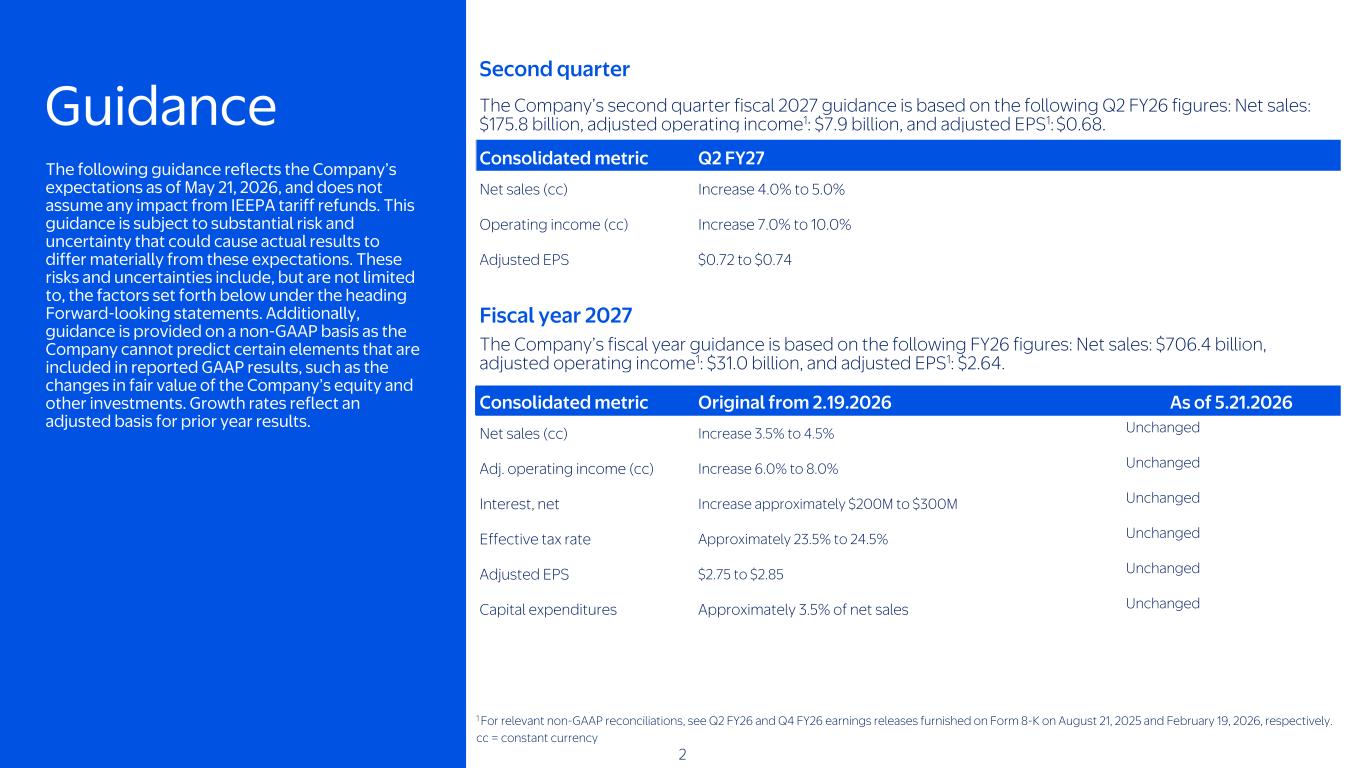
Second quarter The Company’s second quarter fiscal 2027 guidance is based on the following Q2 FY26 figures: Net sales: $175.8 billion, adjusted operating income1: $7.9 billion, and adjusted EPS1: $0.68. Consolidated metric Q2 FY27 Net sales (cc) Increase 4.0% to 5.0% Operating income (cc) Increase 7.0% to 10.0% Adjusted EPS $0.72 to $0.74 Fiscal year 2027 The Company’s fiscal year guidance is based on the following FY26 figures: Net sales: $706.4 billion, adjusted operating income1: $31.0 billion, and adjusted EPS1: $2.64. Consolidated metric Original from 2.19.2026 As of 5.21.2026 Net sales (cc) Increase 3.5% to 4.5% Unchanged Adj. operating income (cc) Increase 6.0% to 8.0% Unchanged Interest, net Increase approximately $200M to $300M Unchanged Effective tax rate Approximately 23.5% to 24.5% Unchanged Adjusted EPS $2.75 to $2.85 Unchanged Capital expenditures Approximately 3.5% of net sales Unchanged 1 For relevant non-GAAP reconciliations, see Q2 FY26 and Q4 FY26 earnings releases furnished on Form 8-K on August 21, 2025 and February 19, 2026, respectively. cc = constant currency Guidance 2 The following guidance reflects the Company’s expectations as of May 21, 2026, and does not assume any impact from IEEPA tariff refunds. This guidance is subject to substantial risk and uncertainty that could cause actual results to differ materially from these expectations. These risks and uncertainties include, but are not limited to, the factors set forth below under the heading Forward-looking statements. Additionally, guidance is provided on a non-GAAP basis as the Company cannot predict certain elements that are included in reported GAAP results, such as the changes in fair value of the Company’s equity and other investments. Growth rates reflect an adjusted basis for prior year results.
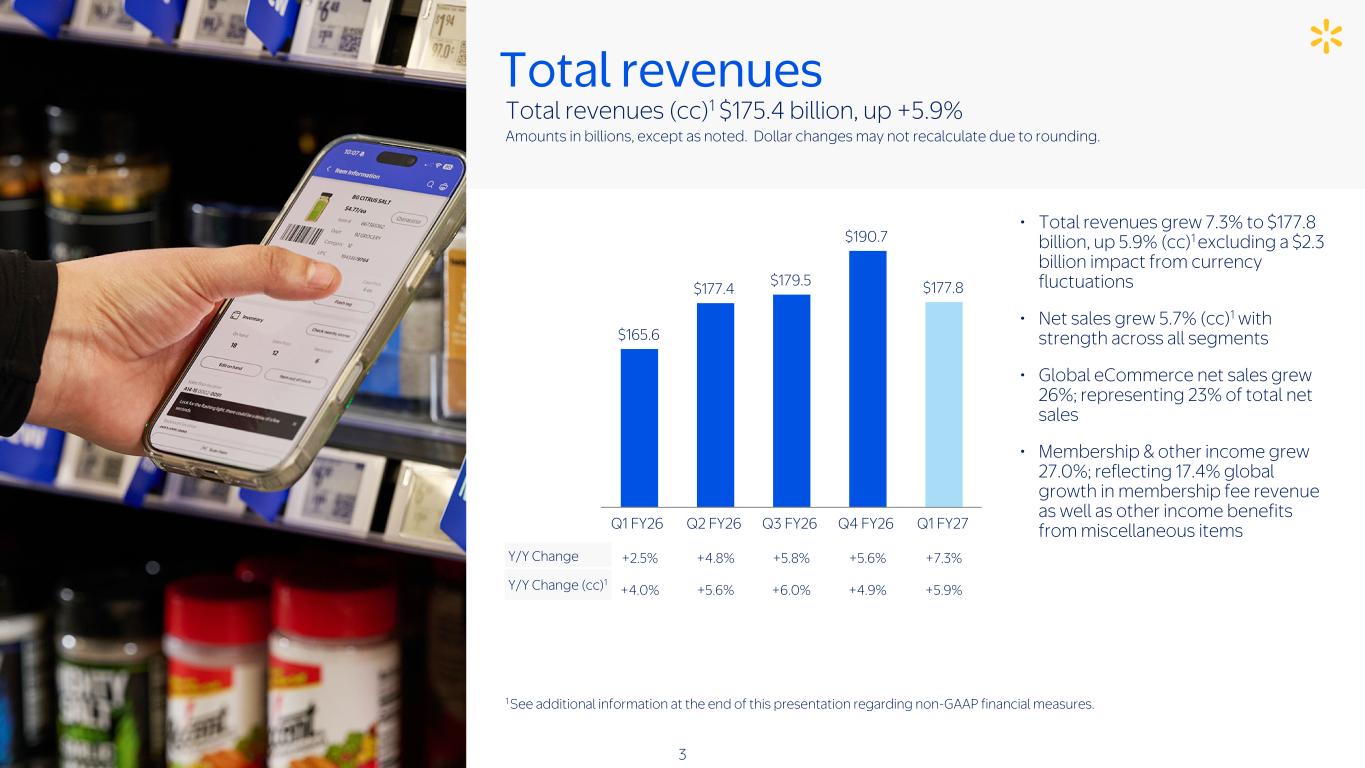
Total revenues (cc)1 $175.4 billion, up +5.9% Amounts in billions, except as noted. Dollar changes may not recalculate due to rounding. • Total revenues grew 7.3% to $177.8 billion, up 5.9% (cc)1 excluding a $2.3 billion impact from currency fluctuations • Net sales grew 5.7% (cc)1 with strength across all segments • Global eCommerce net sales grew 26%; representing 23% of total net sales • Membership & other income grew 27.0%; reflecting 17.4% global growth in membership fee revenue as well as other income benefits from miscellaneous items Y/Y Change +2.5% +4.8% +5.8% +5.6% +7.3% Y/Y Change (cc)1 +4.0% +5.6% +6.0% +4.9% +5.9% 1 See additional information at the end of this presentation regarding non-GAAP financial measures. Total revenues $165.6 $177.4 $179.5 $190.7 $177.8 Q1 FY26 Q2 FY26 Q3 FY26 Q4 FY26 Q1 FY27 3
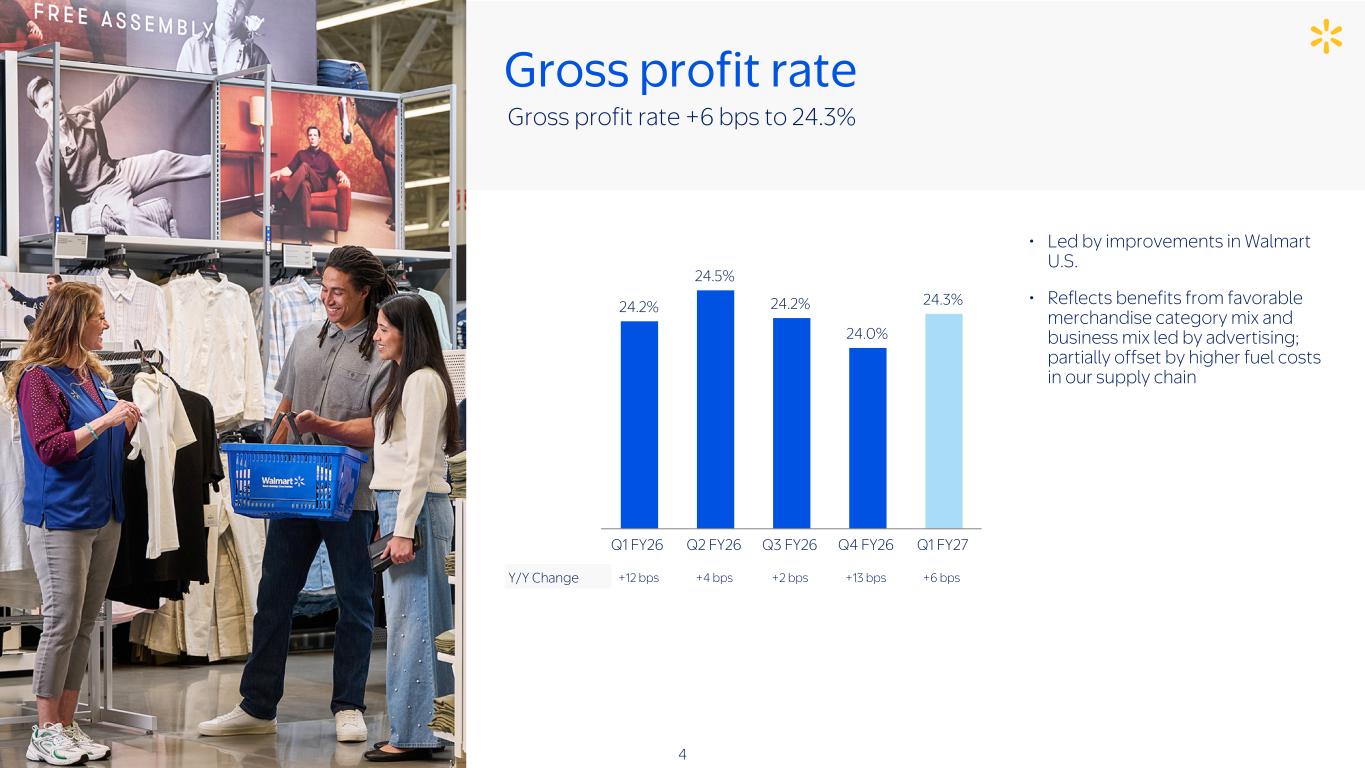
• Led by improvements in Walmart U.S. • Reflects benefits from favorable merchandise category mix and business mix led by advertising; partially offset by higher fuel costs in our supply chain Y/Y Change +12 bps +4 bps +2 bps +13 bps +6 bps Gross profit rate 24.2% 24.5% 24.2% 24.0% 24.3% Q1 FY26 Q2 FY26 Q3 FY26 Q4 FY26 Q1 FY27 Gross profit rate +6 bps to 24.3% 4
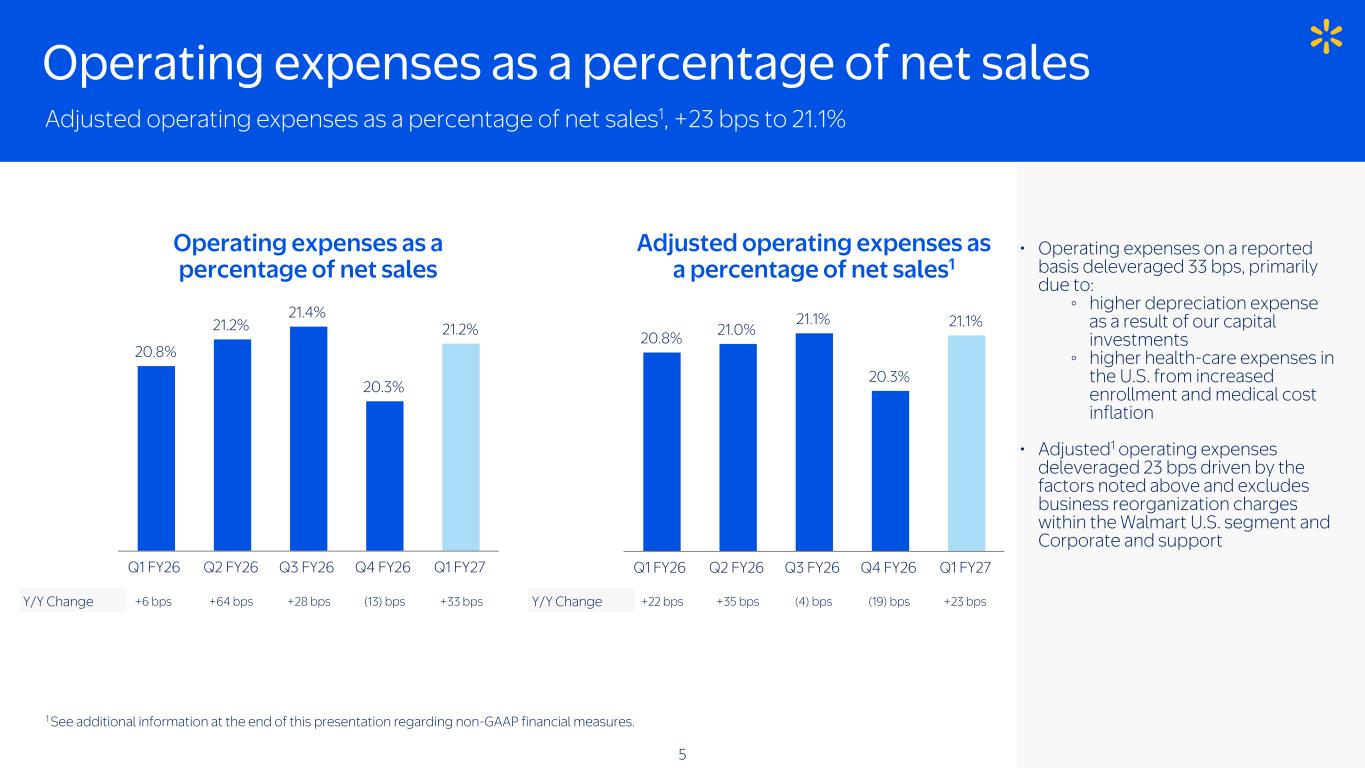
Adjusted operating expenses as a percentage of net sales1, +23 bps to 21.1% • Operating expenses on a reported basis deleveraged 33 bps, primarily due to: ◦ higher depreciation expense as a result of our capital investments ◦ higher health-care expenses in the U.S. from increased enrollment and medical cost inflation • Adjusted1 operating expenses deleveraged 23 bps driven by the factors noted above and excludes business reorganization charges within the Walmart U.S. segment and Corporate and support Y/Y Change +22 bps +35 bps (4) bps (19) bps +23 bps 20.8% 21.0% 21.1% 20.3% 21.1% Q1 FY26 Q2 FY26 Q3 FY26 Q4 FY26 Q1 FY27 Operating expenses as a percentage of net sales 20.8% 21.2% 21.4% 20.3% 21.2% Q1 FY26 Q2 FY26 Q3 FY26 Q4 FY26 Q1 FY27 Y/Y Change +6 bps +64 bps +28 bps (13) bps +33 bps Operating expenses as a percentage of net sales Adjusted operating expenses as a percentage of net sales1 1 See additional information at the end of this presentation regarding non-GAAP financial measures. 5
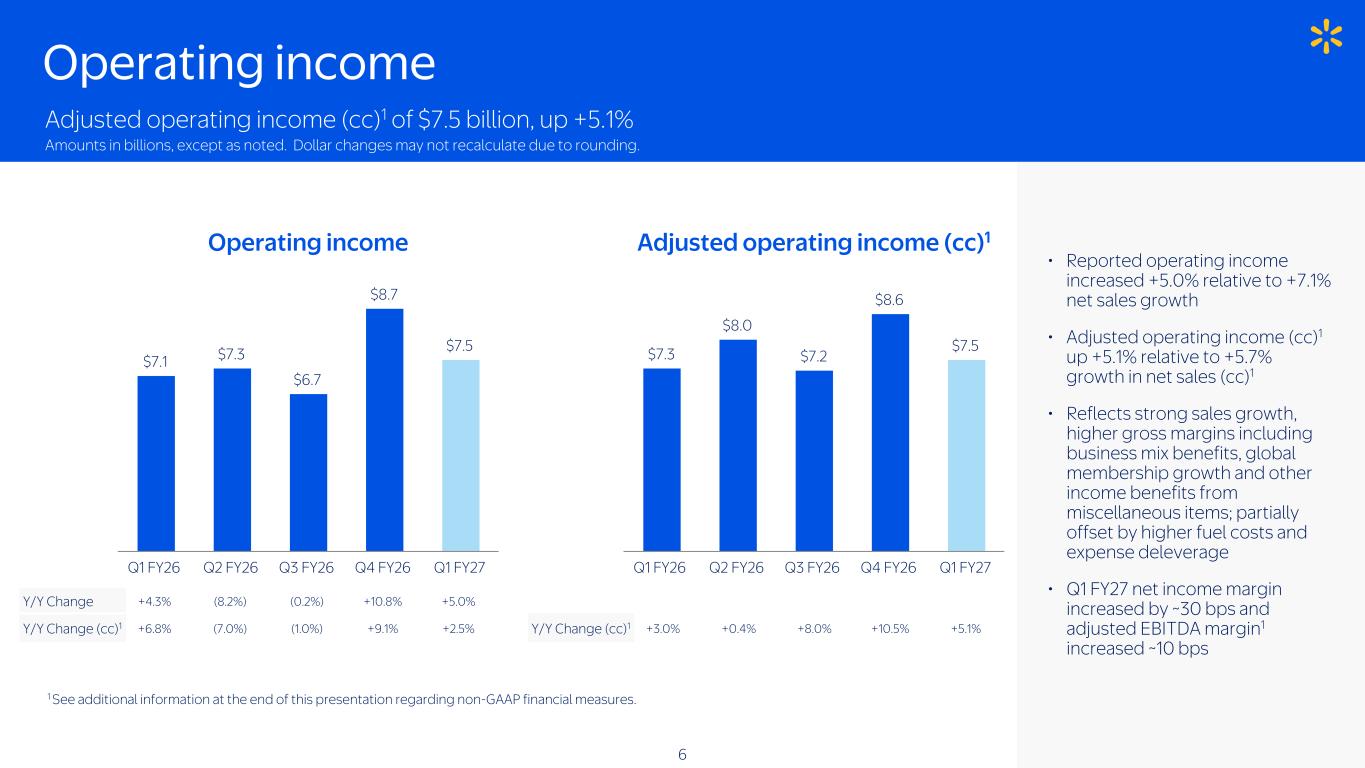
• Reported operating income increased +5.0% relative to +7.1% net sales growth • Adjusted operating income (cc)1 up +5.1% relative to +5.7% growth in net sales (cc)1 • Reflects strong sales growth, higher gross margins including business mix benefits, global membership growth and other income benefits from miscellaneous items; partially offset by higher fuel costs and expense deleverage • Q1 FY27 net income margin increased by ~30 bps and adjusted EBITDA margin1 increased ~10 bps 1 See additional information at the end of this presentation regarding non-GAAP financial measures. Operating income Operating income Adjusted operating income (cc)1 $7.1 $7.3 $6.7 $8.7 $7.5 Q1 FY26 Q2 FY26 Q3 FY26 Q4 FY26 Q1 FY27 Y/Y Change (cc)1 +3.0% +0.4% +8.0% +10.5% +5.1% Y/Y Change +4.3% (8.2%) (0.2%) +10.8% +5.0% Y/Y Change (cc)1 +6.8% (7.0%) (1.0%) +9.1% +2.5% $7.3 $8.0 $7.2 $8.6 $7.5 Q1 FY26 Q2 FY26 Q3 FY26 Q4 FY26 Q1 FY27 Adjusted operating income (cc)1 of $7.5 billion, up +5.1% Amounts in billions, except as noted. Dollar changes may not recalculate due to rounding. 6
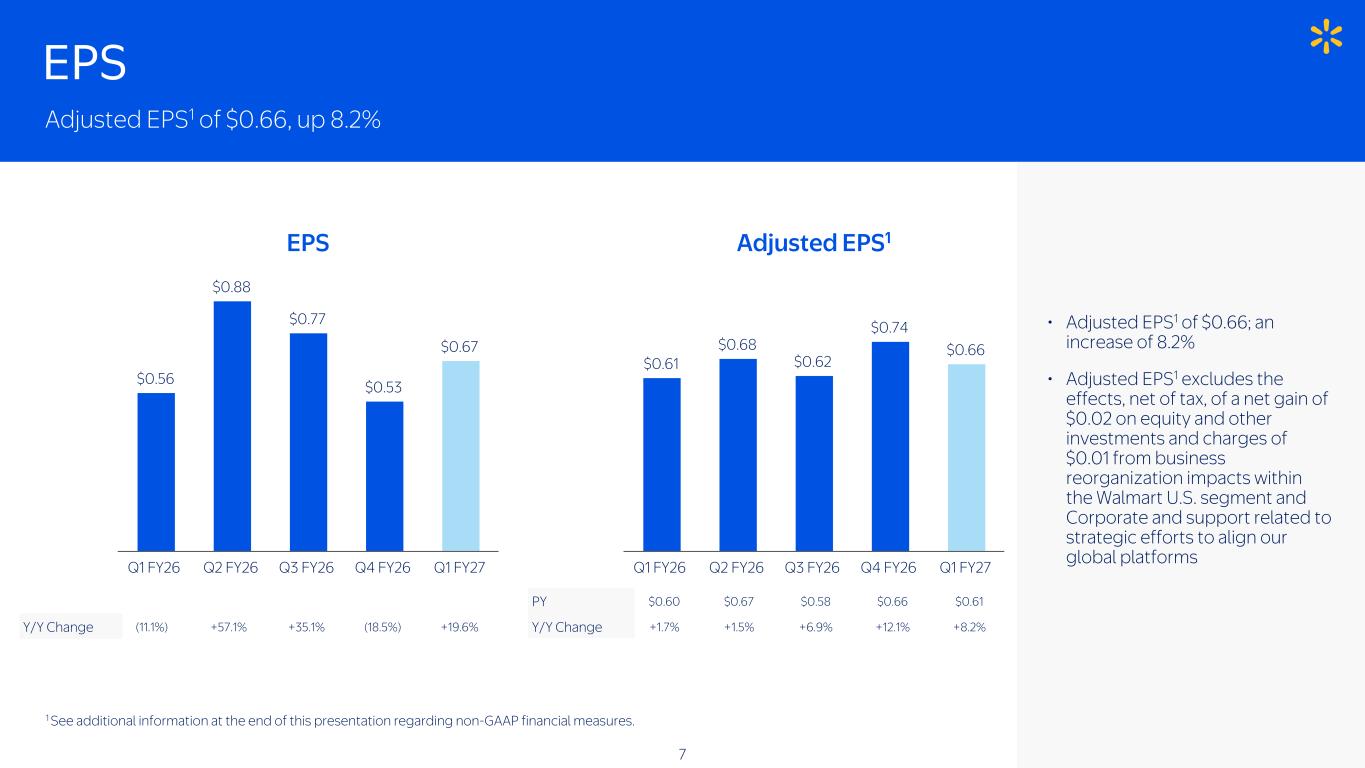
1 See additional information at the end of this presentation regarding non-GAAP financial measures. Adjusted EPS1 of $0.66, up 8.2% EPS PY $0.60 $0.67 $0.58 $0.66 $0.61 Y/Y Change +1.7% +1.5% +6.9% +12.1% +8.2% • Adjusted EPS1 of $0.66; an increase of 8.2% • Adjusted EPS1 excludes the effects, net of tax, of a net gain of $0.02 on equity and other investments and charges of $0.01 from business reorganization impacts within the Walmart U.S. segment and Corporate and support related to strategic efforts to align our global platforms Y/Y Change (11.1%) +57.1% +35.1% (18.5%) +19.6% EPS $0.61 $0.68 $0.62 $0.74 $0.66 Q1 FY26 Q2 FY26 Q3 FY26 Q4 FY26 Q1 FY27 $0.56 $0.88 $0.77 $0.53 $0.67 Q1 FY26 Q2 FY26 Q3 FY26 Q4 FY26 Q1 FY27 7 Adjusted EPS1
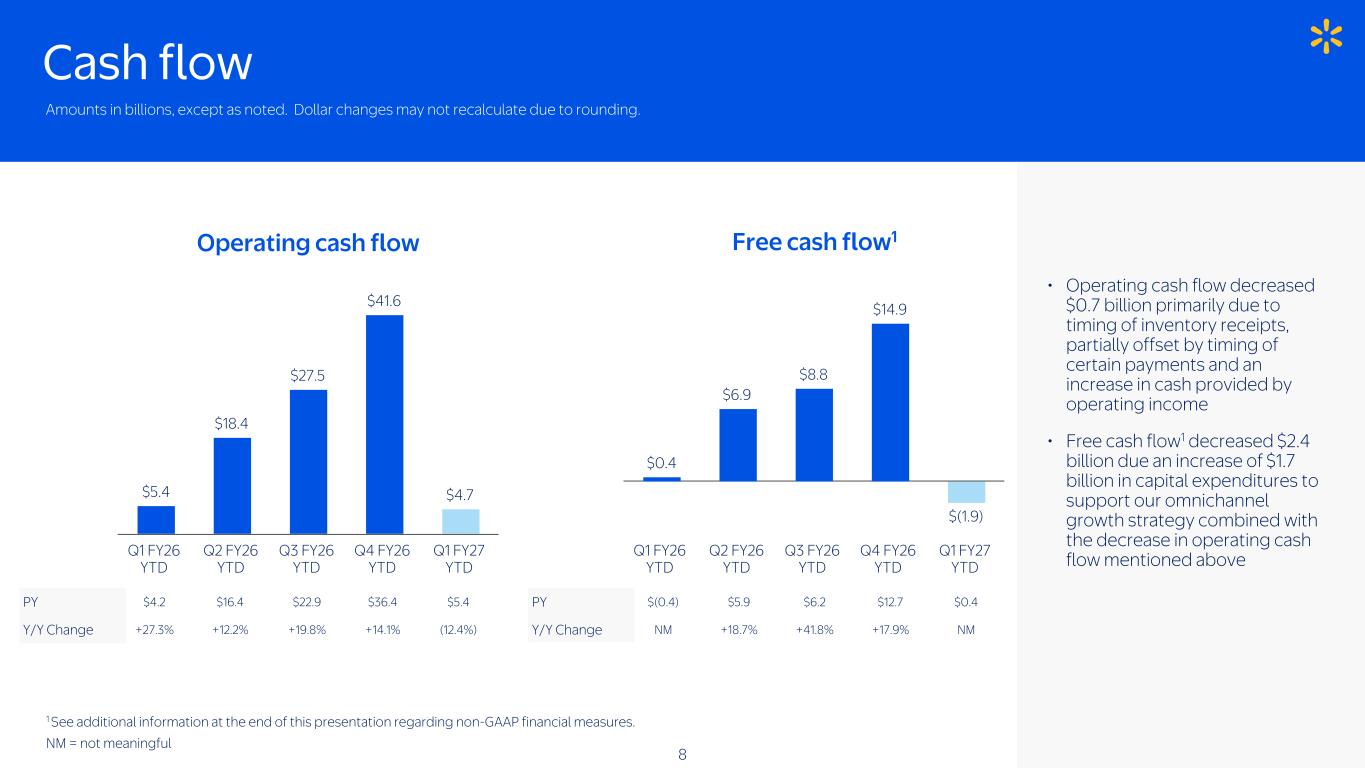
PY $(0.4) $5.9 $6.2 $12.7 $0.4 Y/Y Change NM +18.7% +41.8% +17.9% NM • Operating cash flow decreased $0.7 billion primarily due to timing of inventory receipts, partially offset by timing of certain payments and an increase in cash provided by operating income • Free cash flow1 decreased $2.4 billion due an increase of $1.7 billion in capital expenditures to support our omnichannel growth strategy combined with the decrease in operating cash flow mentioned above 1 See additional information at the end of this presentation regarding non-GAAP financial measures. NM = not meaningful PY $4.2 $16.4 $22.9 $36.4 $5.4 Y/Y Change +27.3% +12.2% +19.8% +14.1% (12.4%) Operating cash flow Free cash flow1 Cash flow $0.4 $6.9 $8.8 $14.9 $(1.9) Q1 FY26 YTD Q2 FY26 YTD Q3 FY26 YTD Q4 FY26 YTD Q1 FY27 YTD $5.4 $18.4 $27.5 $41.6 $4.7 Q1 FY26 YTD Q2 FY26 YTD Q3 FY26 YTD Q4 FY26 YTD Q1 FY27 YTD Amounts in billions, except as noted. Dollar changes may not recalculate due to rounding. 8
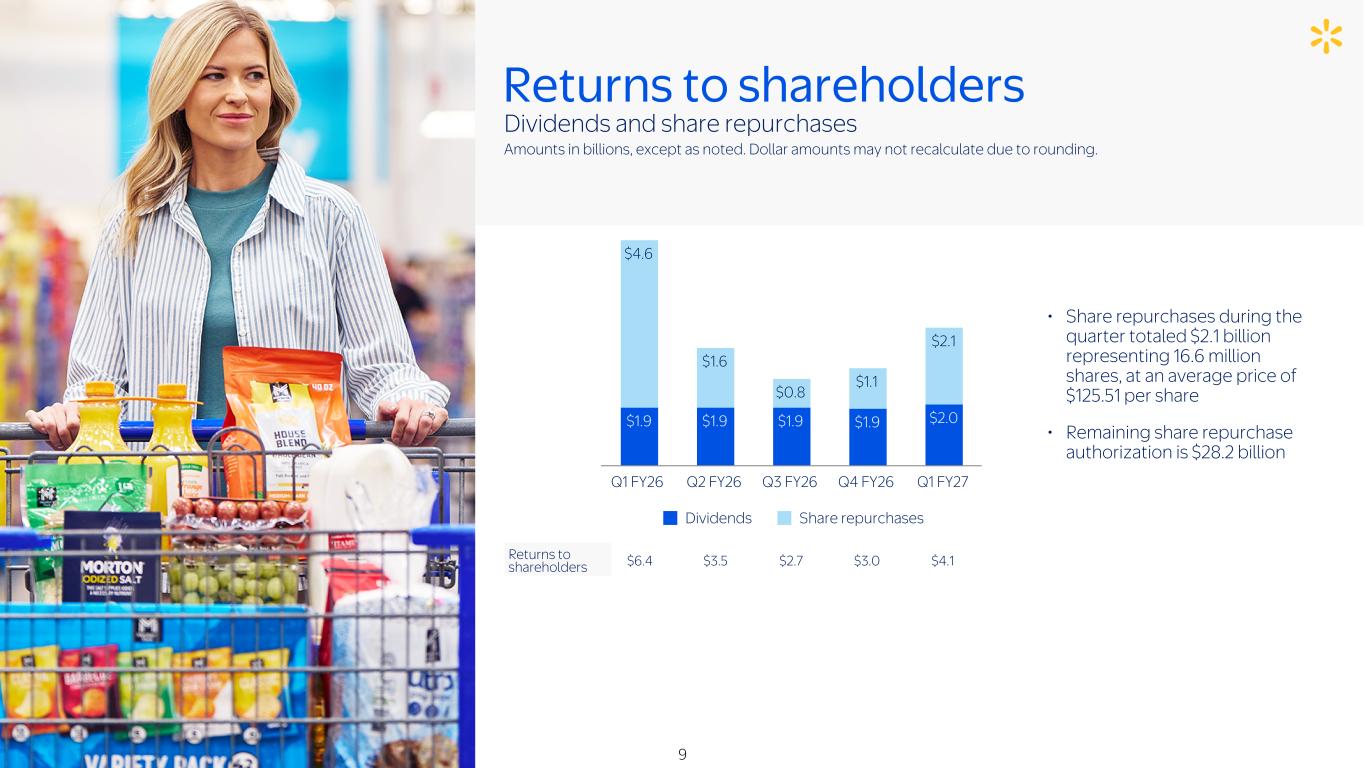
Dividends and share repurchases Amounts in billions, except as noted. Dollar amounts may not recalculate due to rounding. • Share repurchases during the quarter totaled $2.1 billion representing 16.6 million shares, at an average price of $125.51 per share • Remaining share repurchase authorization is $28.2 billion Returns to shareholders $6.4 $3.5 $2.7 $3.0 $4.1 Returns to shareholders $1.9 $1.9 $1.9 $1.9 $2.0 $4.6 $1.6 $0.8 $1.1 $2.1 Dividends Share repurchases Q1 FY26 Q2 FY26 Q3 FY26 Q4 FY26 Q1 FY27 9
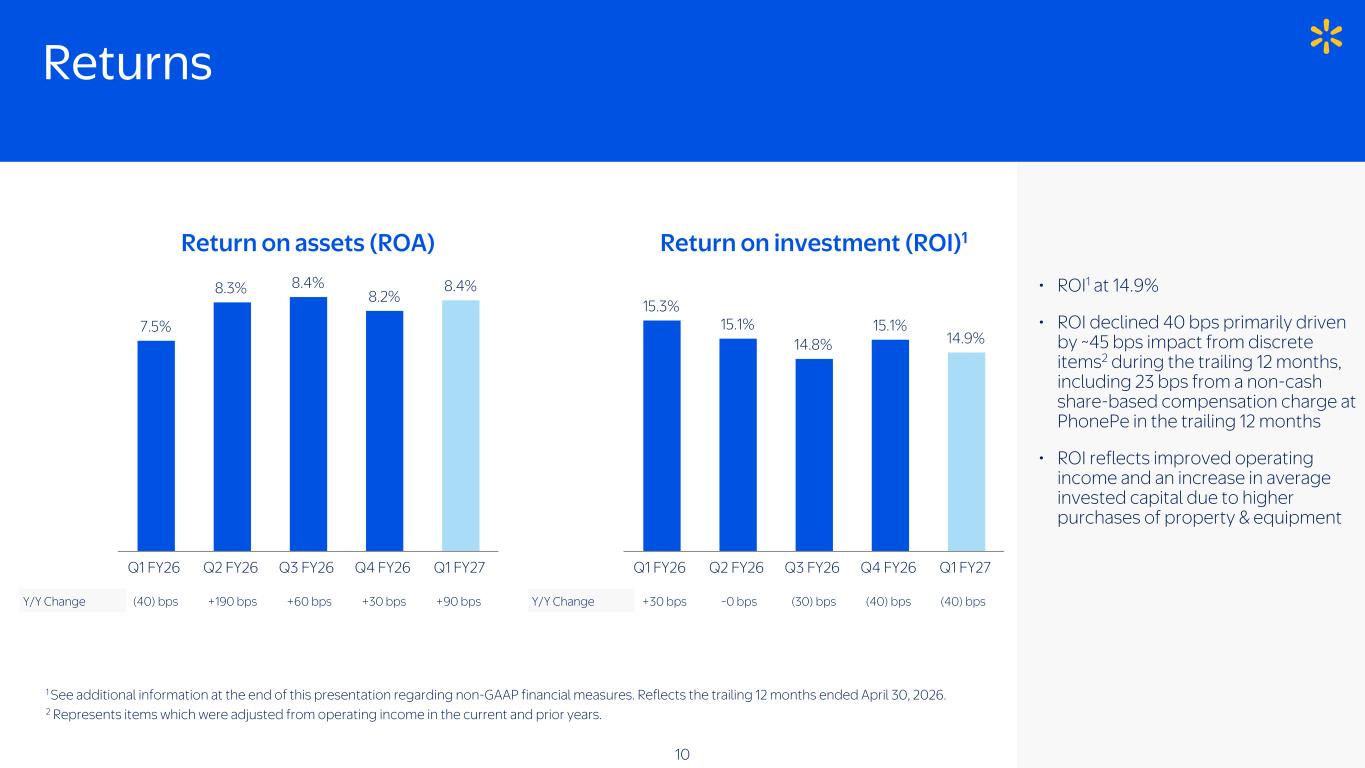
Y/Y Change +30 bps ~0 bps (30) bps (40) bps (40) bps 1 See additional information at the end of this presentation regarding non-GAAP financial measures. Reflects the trailing 12 months ended April 30, 2026. 2 Represents items which were adjusted from operating income in the current and prior years. Return on assets (ROA) Return on investment (ROI)1 Returns Y/Y Change (40) bps +190 bps +60 bps +30 bps +90 bps 7.5% 8.3% 8.4% 8.2% 8.4% Q1 FY26 Q2 FY26 Q3 FY26 Q4 FY26 Q1 FY27 15.3% 15.1% 14.8% 15.1% 14.9% Q1 FY26 Q2 FY26 Q3 FY26 Q4 FY26 Q1 FY27 10 • ROI1 at 14.9% • ROI declined 40 bps primarily driven by ~45 bps impact from discrete items2 during the trailing 12 months, including 23 bps from a non-cash share-based compensation charge at PhonePe in the trailing 12 months • ROI reflects improved operating income and an increase in average invested capital due to higher purchases of property & equipment
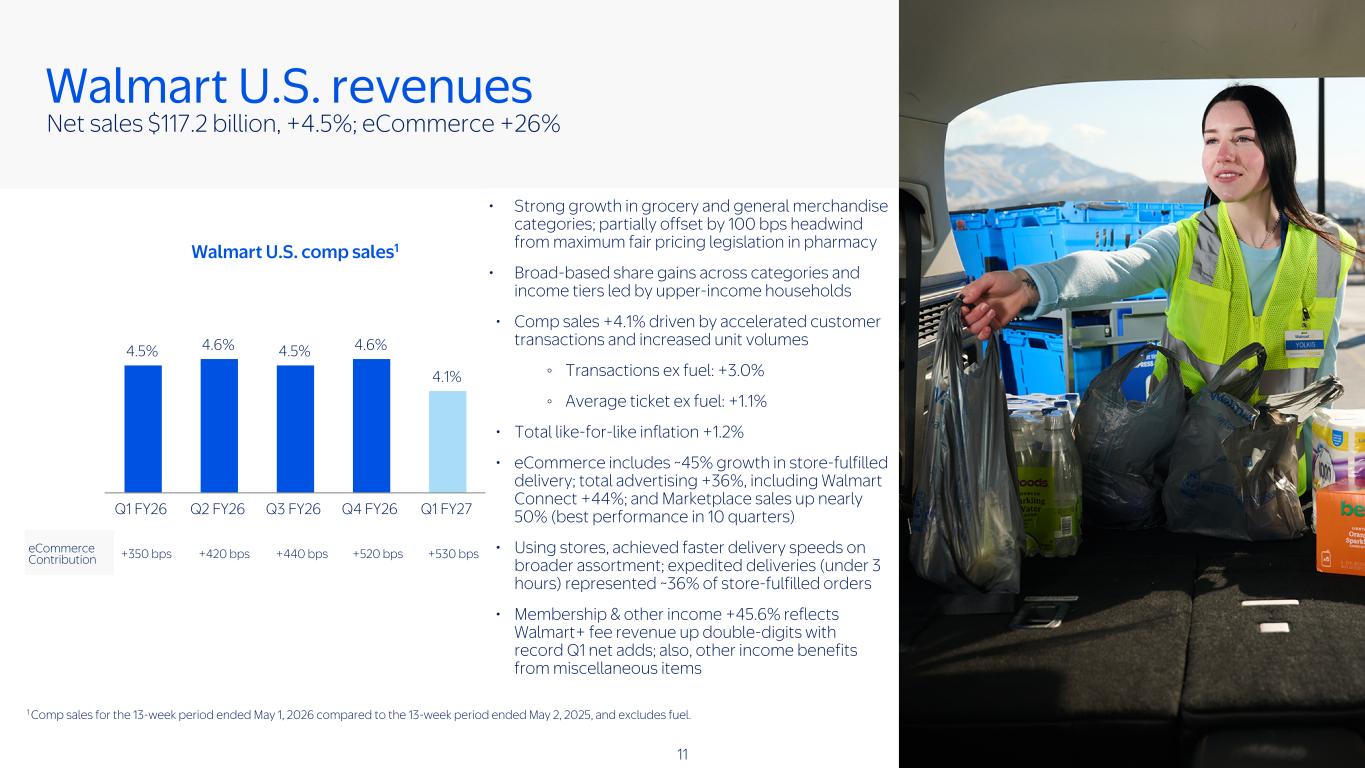
Net sales $117.2 billion, +4.5%; eCommerce +26% • Strong growth in grocery and general merchandise categories; partially offset by 100 bps headwind from maximum fair pricing legislation in pharmacy • Broad-based share gains across categories and income tiers led by upper-income households • Comp sales +4.1% driven by accelerated customer transactions and increased unit volumes ◦ Transactions ex fuel: +3.0% ◦ Average ticket ex fuel: +1.1% • Total like-for-like inflation +1.2% • eCommerce includes ~45% growth in store-fulfilled delivery; total advertising +36%, including Walmart Connect +44%; and Marketplace sales up nearly 50% (best performance in 10 quarters) • Using stores, achieved faster delivery speeds on broader assortment; expedited deliveries (under 3 hours) represented ~36% of store-fulfilled orders • Membership & other income +45.6% reflects Walmart+ fee revenue up double-digits with record Q1 net adds; also, other income benefits from miscellaneous items eCommerce Contribution +350 bps +420 bps +440 bps +520 bps +530 bps Walmart U.S. revenues 4.5% 4.6% 4.5% 4.6% 4.1% Q1 FY26 Q2 FY26 Q3 FY26 Q4 FY26 Q1 FY27 1 Comp sales for the 13-week period ended May 1, 2026 compared to the 13-week period ended May 2, 2025, and excludes fuel. 11 Walmart U.S. comp sales1
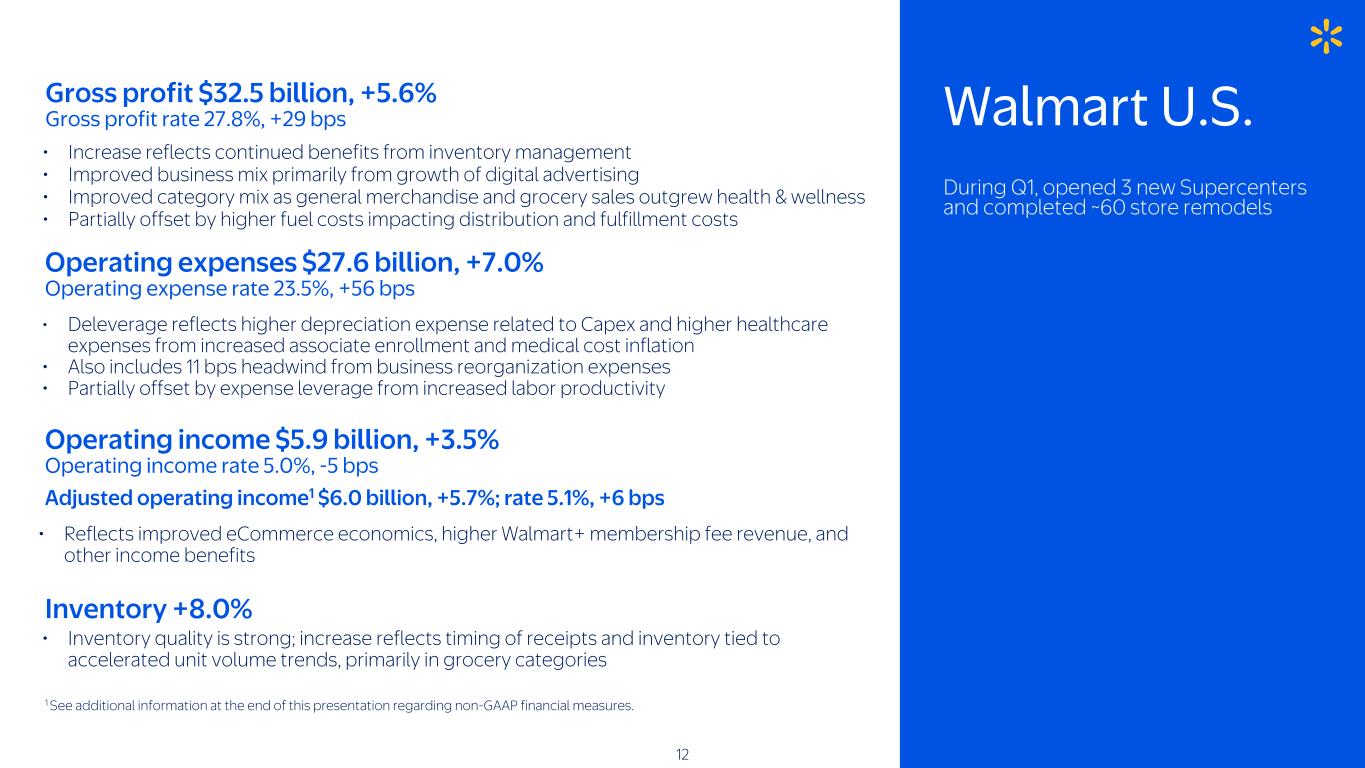
During Q1, opened 3 new Supercenters and completed ~60 store remodels • Increase reflects continued benefits from inventory management • Improved business mix primarily from growth of digital advertising • Improved category mix as general merchandise and grocery sales outgrew health & wellness • Partially offset by higher fuel costs impacting distribution and fulfillment costs Gross profit $32.5 billion, +5.6% Gross profit rate 27.8%, +29 bps • Deleverage reflects higher depreciation expense related to Capex and higher healthcare expenses from increased associate enrollment and medical cost inflation • Also includes 11 bps headwind from business reorganization expenses • Partially offset by expense leverage from increased labor productivity Operating expenses $27.6 billion, +7.0% Operating expense rate 23.5%, +56 bps Operating income $5.9 billion, +3.5% Operating income rate 5.0%, -5 bps Adjusted operating income1 $6.0 billion, +5.7%; rate 5.1%, +6 bps • Reflects improved eCommerce economics, higher Walmart+ membership fee revenue, and other income benefits • Inventory quality is strong; increase reflects timing of receipts and inventory tied to accelerated unit volume trends, primarily in grocery categories Inventory +8.0% Walmart U.S. 12 1 See additional information at the end of this presentation regarding non-GAAP financial measures.
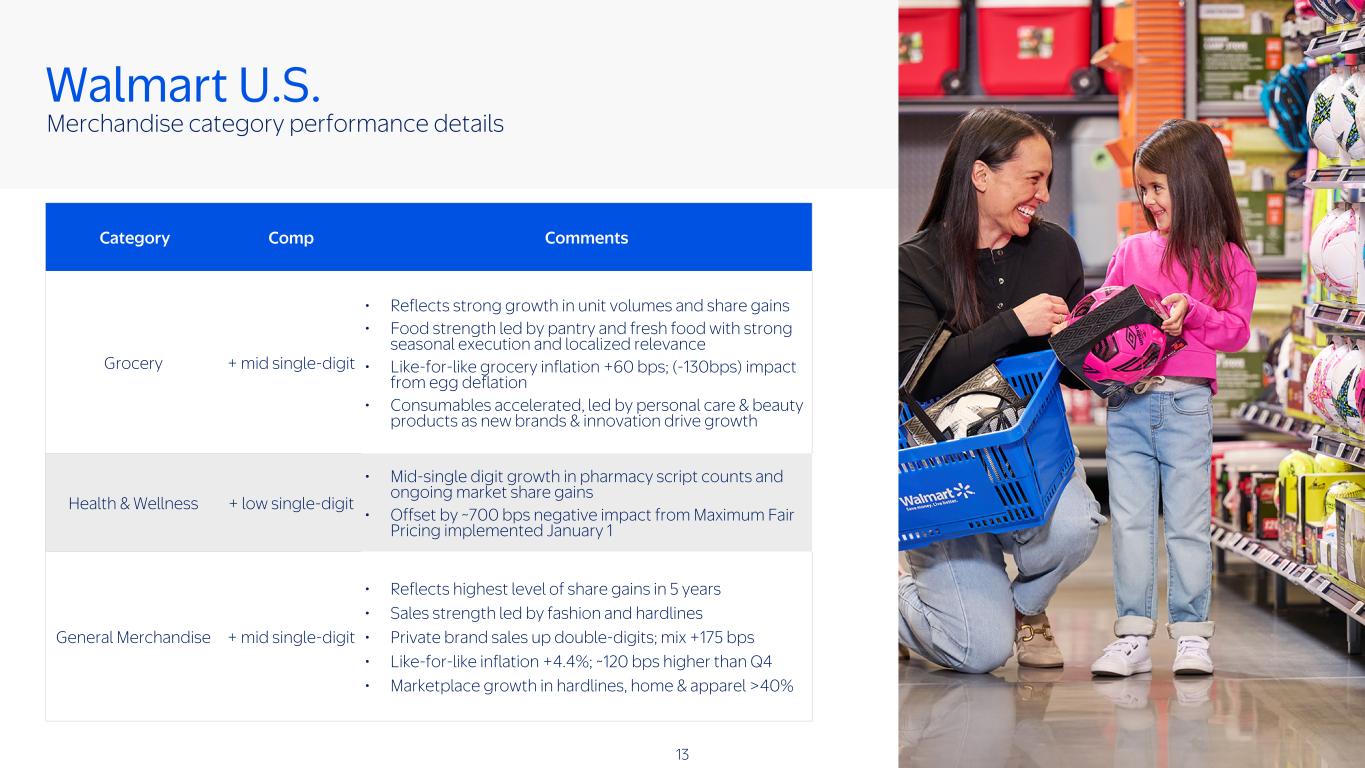
Merchandise category performance details Walmart U.S. Category Comp Comments Grocery + mid single-digit • Reflects strong growth in unit volumes and share gains • Food strength led by pantry and fresh food with strong seasonal execution and localized relevance • Like-for-like grocery inflation +60 bps; (-130bps) impact from egg deflation • Consumables accelerated, led by personal care & beauty products as new brands & innovation drive growth Health & Wellness + low single-digit • Mid-single digit growth in pharmacy script counts and ongoing market share gains • Offset by ~700 bps negative impact from Maximum Fair Pricing implemented January 1 General Merchandise + mid single-digit • Reflects highest level of share gains in 5 years • Sales strength led by fashion and hardlines • Private brand sales up double-digits; mix +175 bps • Like-for-like inflation +4.4%; ~120 bps higher than Q4 • Marketplace growth in hardlines, home & apparel >40% 13
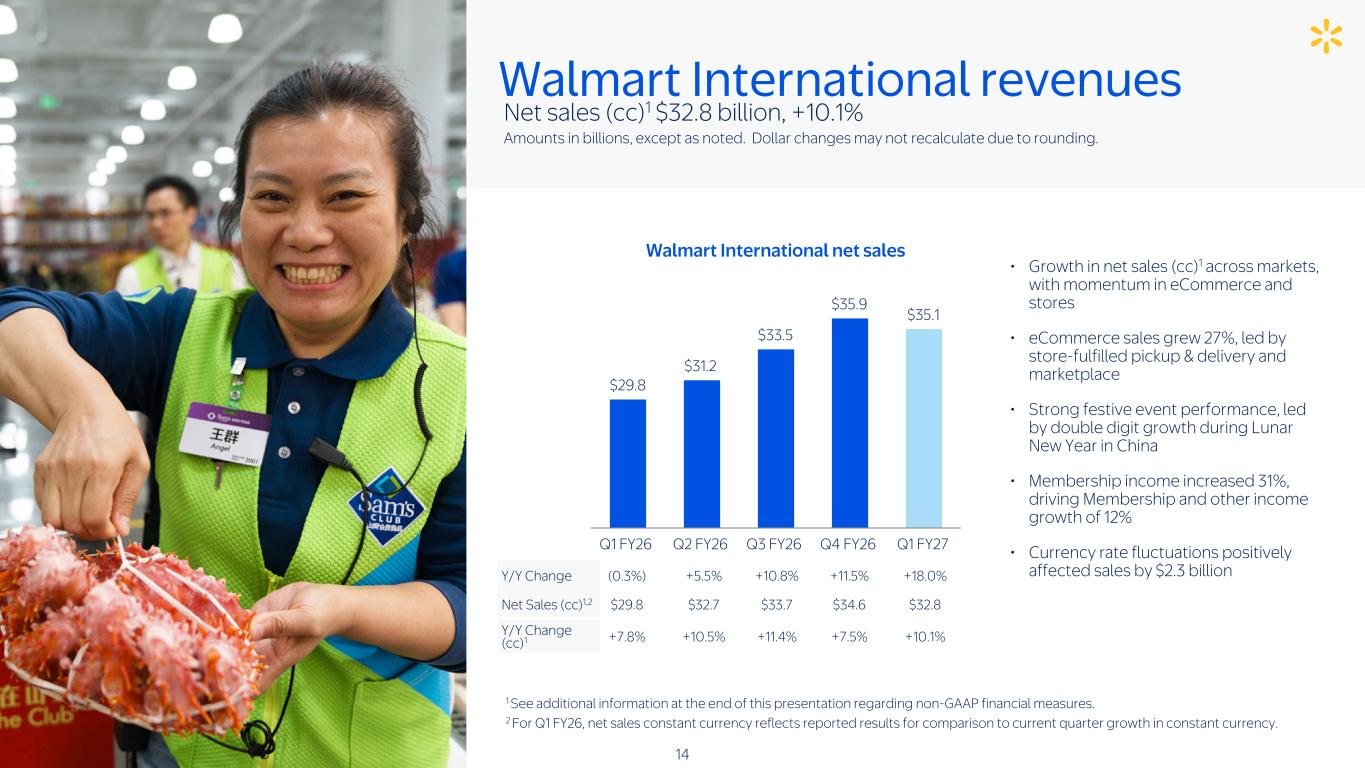
Net sales (cc)1 $32.8 billion, +10.1% Amounts in billions, except as noted. Dollar changes may not recalculate due to rounding. Y/Y Change (0.3%) +5.5% +10.8% +11.5% +18.0% Net Sales (cc)1,2 $29.8 $32.7 $33.7 $34.6 $32.8 Y/Y Change (cc)1 +7.8% +10.5% +11.4% +7.5% +10.1% Walmart International revenues $29.8 $31.2 $33.5 $35.9 $35.1 Q1 FY26 Q2 FY26 Q3 FY26 Q4 FY26 Q1 FY27 1 See additional information at the end of this presentation regarding non-GAAP financial measures. 2 For Q1 FY26, net sales constant currency reflects reported results for comparison to current quarter growth in constant currency. 14 Walmart International net sales • Growth in net sales (cc)1 across markets, with momentum in eCommerce and stores • eCommerce sales grew 27%, led by store-fulfilled pickup & delivery and marketplace • Strong festive event performance, led by double digit growth during Lunar New Year in China • Membership income increased 31%, driving Membership and other income growth of 12% • Currency rate fluctuations positively affected sales by $2.3 billion
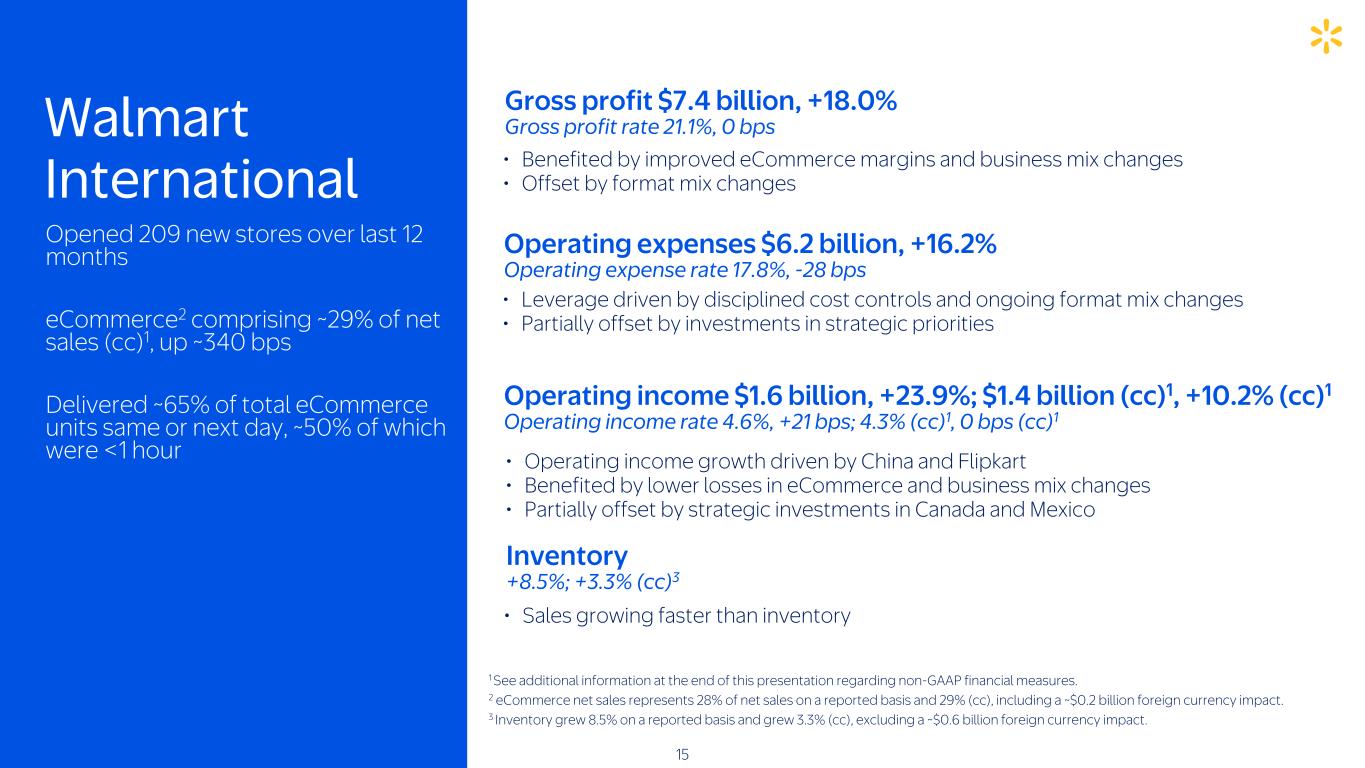
• Operating income growth driven by China and Flipkart • Benefited by lower losses in eCommerce and business mix changes • Partially offset by strategic investments in Canada and Mexico • Leverage driven by disciplined cost controls and ongoing format mix changes • Partially offset by investments in strategic priorities • Benefited by improved eCommerce margins and business mix changes • Offset by format mix changes Opened 128 new stores during Q4 eCommerce comprising 28% of net sales, up ~230 bps Delivered ~40% of eCommerce units same day, 70% of which delivered in under 1 hour Operating expenses $6.2 billion, +16.2% Operating expense rate 17.8%, -28 bps Operating income $1.6 billion, +23.9%; $1.4 billion (cc)1, +10.2% (cc)1 Operating income rate 4.6%, +21 bps; 4.3% (cc)1, 0 bps (cc)1 1 See additional information at the end of this presentation regarding non-GAAP financial measures. 2 eCommerce net sales represents 28% of net sales on a reported basis and 29% (cc), including a ~$0.2 billion foreign currency impact. 3 Inventory grew 8.5% on a reported basis and grew 3.3% (cc), excluding a ~$0.6 billion foreign currency impact. Walmart International 15 Gross profit $7.4 billion, +18.0% Gross profit rate 21.1%, 0 bps • Sales growing faster than inventory Inventory +8.5%; +3.3% (cc)3 ned 09 new stores over last 12 months eCommerce2 comprising ~29% of net sales (cc)1, up ~340 bps Delivered ~65% of total eCommerce units same or next day, ~50% of which were <1 hour
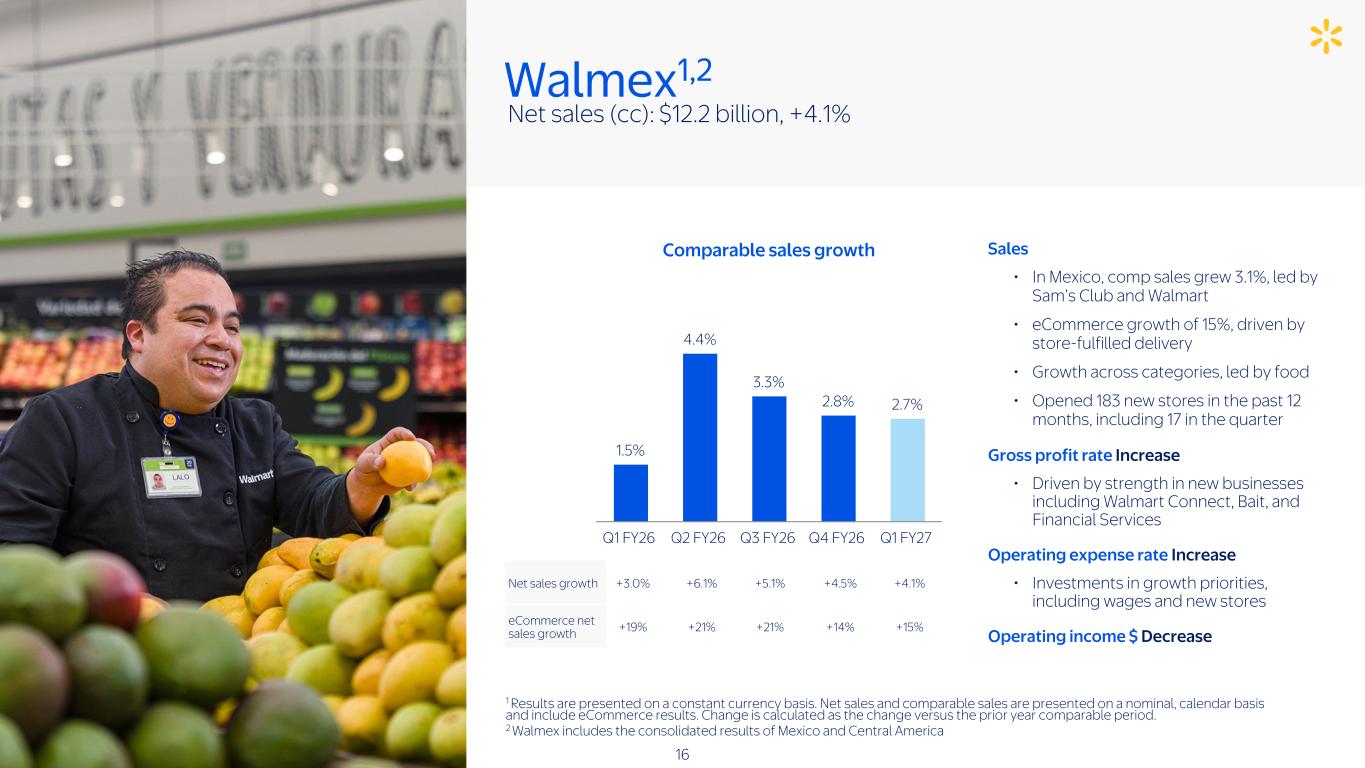
Net sales growth +3.0% +6.1% +5.1% +4.5% +4.1% eCommerce net sales growth +19% +21% +21% +14% +15% 1 Results are presented on a constant currency basis. Net sales and comparable sales are presented on a nominal, calendar basis and include eCommerce results. Change is calculated as the change versus the prior year comparable period. 2 Walmex includes the consolidated results of Mexico and Central America Walmex1,2 Net sales (cc): $12.2 billion, +4.1% 1.5% 4.4% 3.3% 2.8% 2.7% Q1 FY26 Q2 FY26 Q3 FY26 Q4 FY26 Q1 FY27 16 Comparable sales growth Sales • In Mexico, comp sales grew 3.1%, led by Sam’s Club and Walmart • eCommerce growth of 15%, driven by store-fulfilled delivery • Growth across categories, led by food • Opened 183 new stores in the past 12 months, including 17 in the quarter Gross profit rate Increase • Driven by strength in new businesses including Walmart Connect, Bait, and Financial Services Operating expense rate Increase • Investments in growth priorities, including wages and new stores Operating income $ Decrease
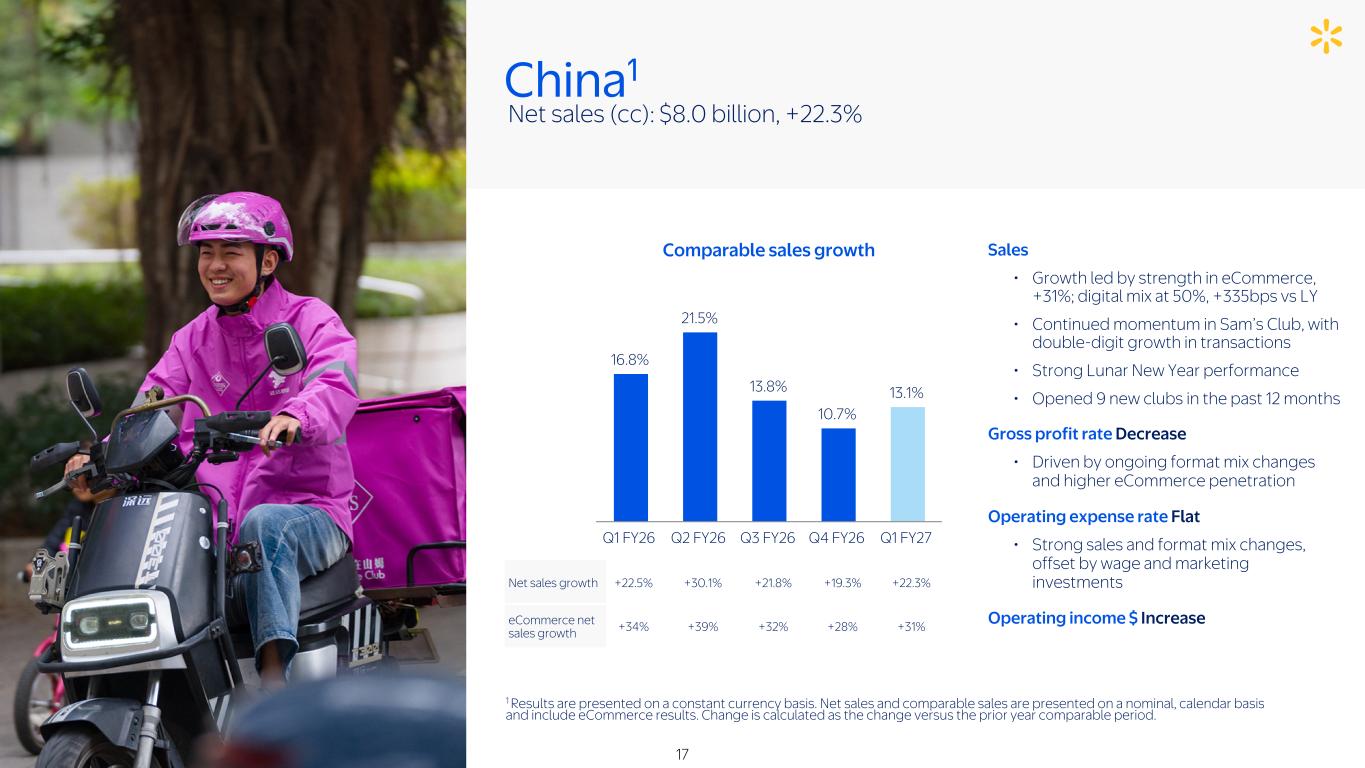
Sales • Growth led by strength in eCommerce, +31%; digital mix at 50%, +335bps vs LY • Continued momentum in Sam’s Club, with double-digit growth in transactions • Strong Lunar New Year performance • Opened 9 new clubs in the past 12 months Gross profit rate Decrease • Driven by ongoing format mix changes and higher eCommerce penetration Operating expense rate Flat • Strong sales and format mix changes, offset by wage and marketing investments Operating income $ Increase Net sales growth +22.5% +30.1% +21.8% +19.3% +22.3% eCommerce net sales growth +34% +39% +32% +28% +31% 1 Results are presented on a constant currency basis. Net sales and comparable sales are presented on a nominal, calendar basis and include eCommerce results. Change is calculated as the change versus the prior year comparable period. China1 Net sales (cc): $8.0 billion, +22.3% 16.8% 21.5% 13.8% 10.7% 13.1% Q1 FY26 Q2 FY26 Q3 FY26 Q4 FY26 Q1 FY27 17 Comparable sales growth
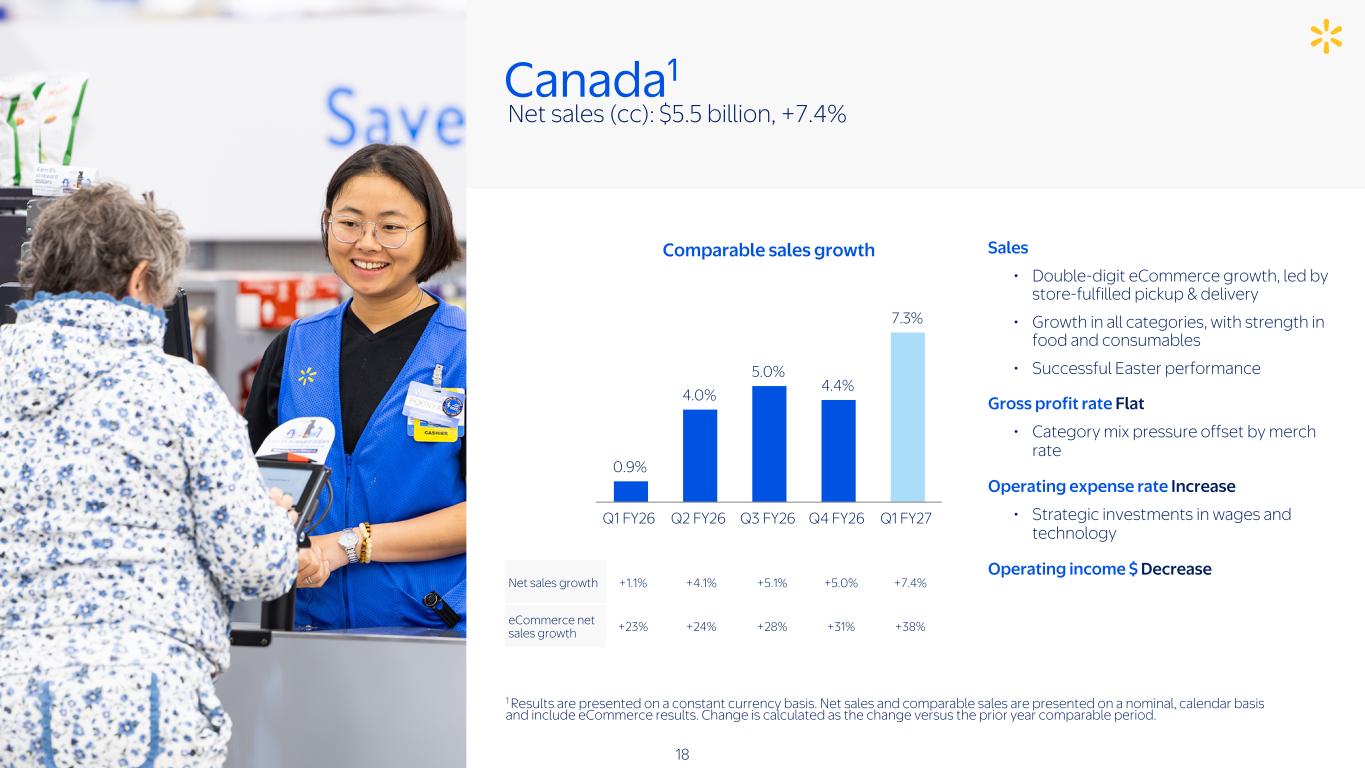
Net sales growth +1.1% +4.1% +5.1% +5.0% +7.4% eCommerce net sales growth +23% +24% +28% +31% +38% 1 Results are presented on a constant currency basis. Net sales and comparable sales are presented on a nominal, calendar basis and include eCommerce results. Change is calculated as the change versus the prior year comparable period. Canada1 Net sales (cc): $5.5 billion, +7.4% 0.9% 4.0% 5.0% 4.4% 7.3% Q1 FY26 Q2 FY26 Q3 FY26 Q4 FY26 Q1 FY27 18 Comparable sales growth Sales • Double-digit eCommerce growth, led by store-fulfilled pickup & delivery • Growth in all categories, with strength in food and consumables • Successful Easter performance Gross profit rate Flat • Category mix pressure offset by merch rate Operating expense rate Increase • Strategic investments in wages and technology Operating income $ Decrease
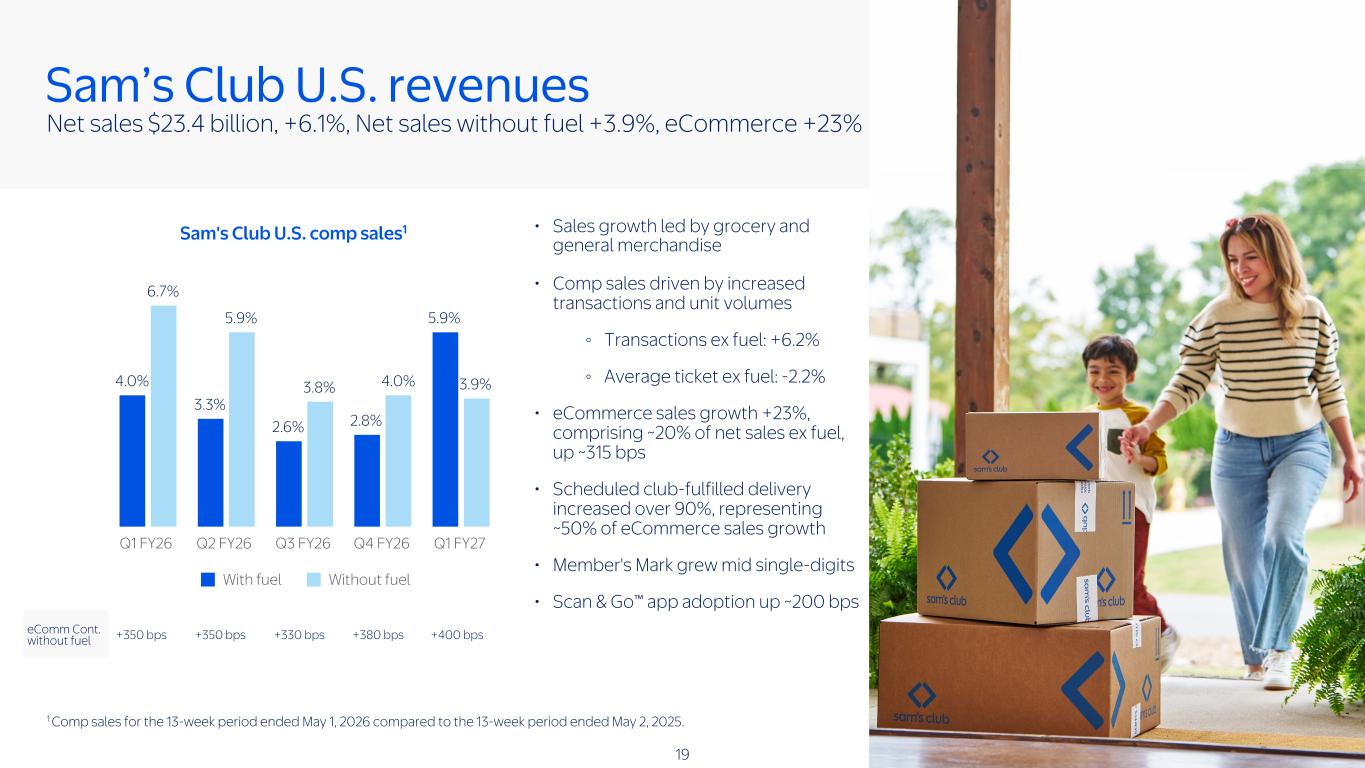
Net sales $23.4 billion, +6.1%, Net sales without fuel +3.9%, eCommerce +23% • Sales growth led by grocery and general merchandise • Comp sales driven by increased transactions and unit volumes ◦ Transactions ex fuel: +6.2% ◦ Average ticket ex fuel: -2.2% • eCommerce sales growth +23%, comprising ~20% of net sales ex fuel, up ~315 bps • Scheduled club-fulfilled delivery increased over 90%, representing ~50% of eCommerce sales growth • Member's Mark grew mid single-digits • Scan & Go™ app adoption up ~200 bps eComm Cont. without fuel +350 bps +350 bps +330 bps +380 bps +400 bps 1 Comp sales for the 13-week period ended May 1, 2026 compared to the 13-week period ended May 2, 2025. Sam’s Club U.S. revenues 4.0% 3.3% 2.6% 2.8% 5.9% 6.7% 5.9% 3.8% 4.0% 3.9% With fuel Without fuel Q1 FY26 Q2 FY26 Q3 FY26 Q4 FY26 Q1 FY27 19 Sam's Club U.S. comp sales1
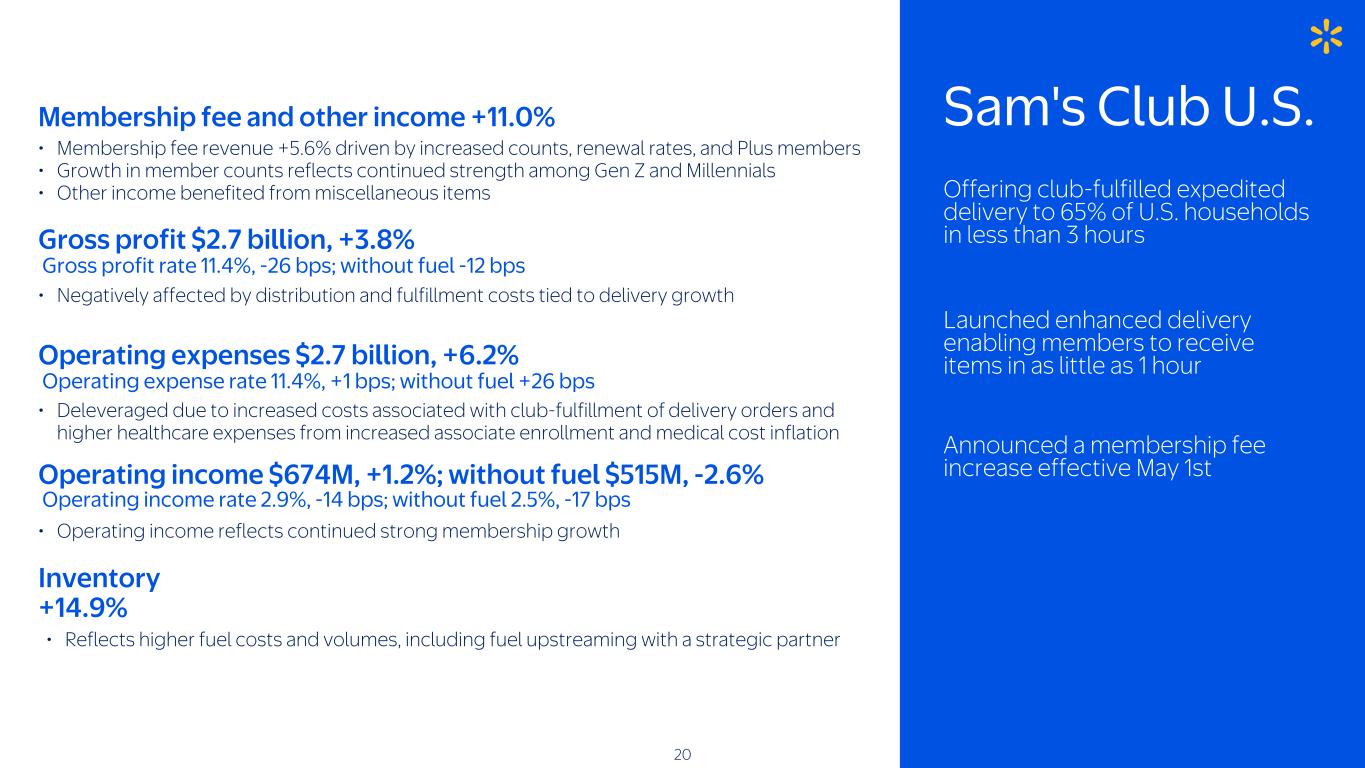
• Deleveraged due to increased costs associated with club-fulfillment of delivery orders and higher healthcare expenses from increased associate enrollment and medical cost inflation Operating expenses $2.7 billion, +6.2% Operating expense rate 11.4%, +1 bps; without fuel +26 bps Gross profit $2.7 billion, +3.8% Gross profit rate 11.4%, -26 bps; without fuel -12 bps • Membership fee revenue +5.6% driven by increased counts, renewal rates, and Plus members • Growth in member counts reflects continued strength among Gen Z and Millennials • Other income benefited from miscellaneous items Membership fee and other income +11.0% Operating income $674M, +1.2%; without fuel $515M, -2.6% • Operating income reflects continued strong membership growth 20 Inventory +14.9% • Reflects higher fuel costs and volumes, including fuel upstreaming with a strategic partner Sam's Club U.S. Operating income rate 2.9%, -14 bps; without fuel 2.5%, -17 bps • Negatively affected by distribution and fulfillment costs tied to delivery growth Offering club-fulfilled expedited delivery to 65% of U.S. households in less than 3 hours Launched enhanced delivery enabling members to receive items in as little as 1 hour Announced a membership fee increase effective May 1st
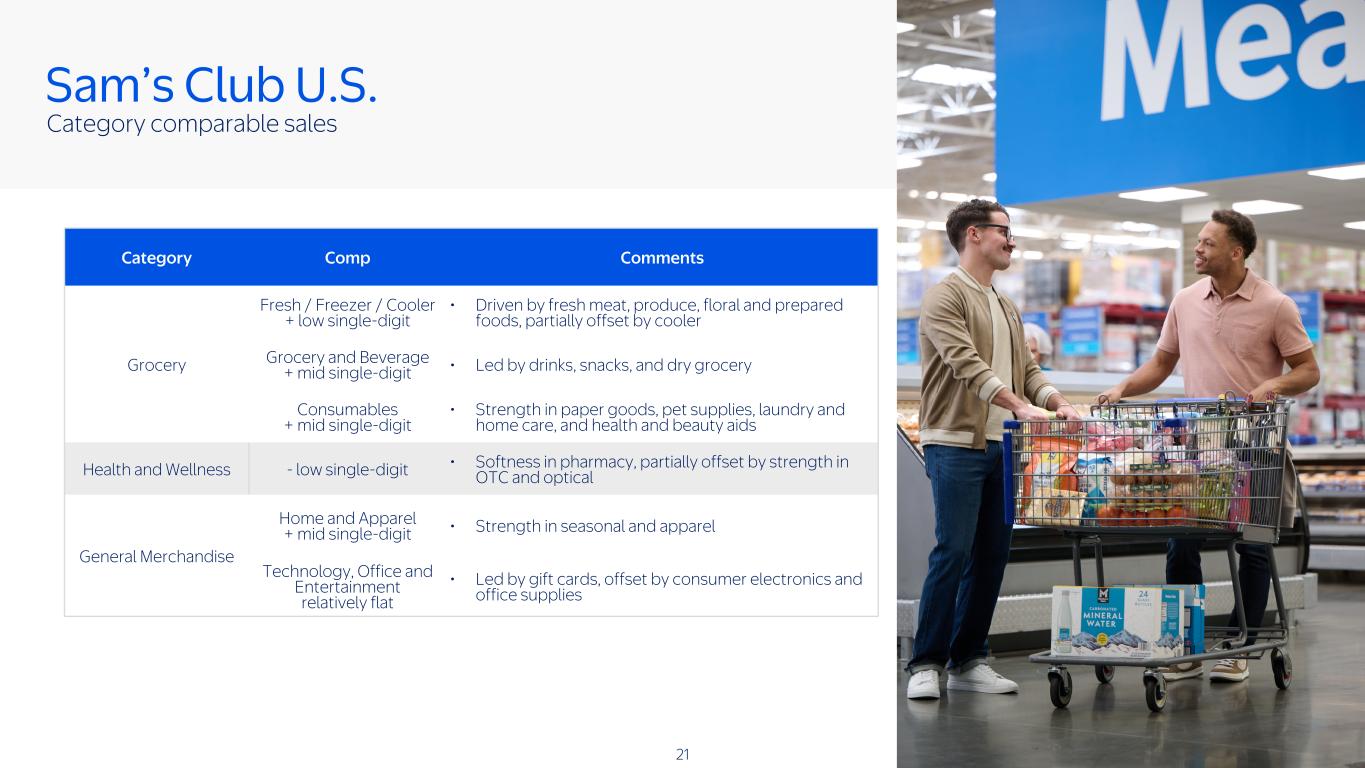
Category comparable sales Sam’s Club U.S. Category Comp Comments Grocery Fresh / Freezer / Cooler + low single-digit • Driven by fresh meat, produce, floral and prepared foods, partially offset by cooler Grocery and Beverage + mid single-digit • Led by drinks, snacks, and dry grocery Consumables + mid single-digit • Strength in paper goods, pet supplies, laundry and home care, and health and beauty aids Health and Wellness - low single-digit • Softness in pharmacy, partially offset by strength in OTC and optical General Merchandise Home and Apparel + mid single-digit • Strength in seasonal and apparel Technology, Office and Entertainment relatively flat • Led by gift cards, offset by consumer electronics and office supplies 21
Forward-looking statements This presentation and related management commentary contains statements that may be "forward-looking statements" as defined in, and are intended to enjoy the protection of the safe harbor for forward-looking statements within the meaning of Section 21E of the Securities Exchange Act of 1934, as amended. Assumptions on which such forward-looking statements are based are also forward-looking statements. Statements of our guidance, projections, estimates, expectations, plans, and objectives for fiscal 2027 in this presentation and related management commentary are forward-looking statements. Assumptions on which such forward-looking statements are based are also forward-looking statements. Such forward-looking statements are not statements of historical facts, but instead express our estimates or expectations for our consolidated economic performance or results of operations for future periods or as of future dates or events or developments that may occur in the future or discuss our plans, objectives or goals. These forward- looking statements can be identified by their use of words or phrases such as “anticipate,” “could,” “could be,” “believe,” “expect,” “forecast,” “plan,” “projected,” “will be” “will improve,” variations of such words or phrases or similar words and phrases denoting anticipated or expected occurrences or results. The forward-looking statements that we make are based on our knowledge of our business and our operating environment and assumptions that we believe to be or will believe to be reasonable when such forward-looking statements were or are made. Our actual results may differ materially from those expressed in or implied by any of these forward-looking statements as a result of changes in circumstances, assumptions not being realized or other risks, uncertainties and factors including: economic, capital markets and business conditions; trends and events around the world and in the markets in which we operate; currency exchange rate fluctuations, changes in market interest rates and market levels of wages; changes in the size of various markets, including eCommerce markets; unemployment levels; inflation or deflation, generally and in particular product categories; consumer confidence, disposable income, credit availability, spending levels, shopping patterns, debt levels and demand for certain merchandise; the effectiveness of the implementation and operation of our strategies, plans, programs and initiatives; unexpected changes in our objectives and plans; the impact of acquisitions, investments, divestitures, store or club closures, and other strategic decisions; our ability to successfully integrate acquired businesses, including within the eCommerce space; changes in the trading prices of certain equity investments we hold; initiatives of competitors, competitors' entry into and expansion in our markets, and competitive pressures (including pressures arising from the development and deployment of artificial intelligence technologies); customer traffic and average ticket in our stores and clubs and on our eCommerce websites; the mix of merchandise we sell, the cost of goods we sell and the shrinkage we experience; trends in consumer shopping habits around the world and in the markets in which we operate; our gross profit margins; the financial performance of Walmart and each of its segments, including the amounts of our cash flow during various periods; transportation, energy and utility costs; commodity prices and the price of gasoline and diesel fuel; supply chain disruptions and disruptions in seasonal buying patterns; the availability of goods from suppliers and the cost of goods acquired from suppliers; consumer acceptance of and response to our stores, clubs, eCommerce, digital, and agentic platforms, programs, merchandise offerings and delivery methods; cyber security events affecting us and related costs and impact to the business; developments in, outcomes of, and costs incurred in legal or regulatory proceedings to which we are a party or are subject, and the liabilities, obligations and expenses, if any, that we may incur in connection therewith; expenses pertaining to general liability claims, for which we self-insure, and insurance costs; consumer enrollment in health and drug insurance programs and such programs’ reimbursement rates and drug formularies; our effective tax rate and the factors affecting our effective tax rate, including assessments of certain tax contingencies, valuation allowances, changes in law, administrative audit outcomes, impact of discrete items and the mix of earnings between the U.S. and Walmart's international operations; changes in existing tax, labor and other laws and regulations and changes in tax rates including the enactment of laws and the adoption and interpretation of administrative rules and regulations; the imposition of new taxes on imports, new tariffs and changes in existing tariff rates; the imposition of new trade restrictions and changes in existing trade restrictions; adoption or creation of new, and modification of existing, governmental policies, programs, initiatives and actions in the markets in which Walmart operates and elsewhere and actions with respect to such policies, programs and initiatives; changes in accounting estimates or judgments; the level of public assistance payments; natural disasters, changes in climate, pandemics or other crises, geopolitical events and catastrophic events; and changes in generally accepted accounting principles in the United States. Our most recent annual report on Form 10-K filed with the SEC discusses other risks and factors that could cause actual results to differ materially from those expressed or implied by any forward-looking statement in the presentation and related management commentary. We urge you to consider all of the risks, uncertainties and factors identified above or discussed in such reports carefully in evaluating the forward-looking statements in this release. Walmart cannot assure you that the results reflected in or implied by any forward-looking statement will be realized or, even if substantially realized, that those results will have the forecasted or expected consequences and effects for or on our operations or financial performance. The forward-looking statements made in the presentation are as of the date of this presentation. Walmart undertakes no obligation to update these forward-looking statements to reflect subsequent events or circumstances. This presentation and related management commentary references certain non-GAAP measures as defined under SEC rules, including net sales and operating income on a constant currency basis, adjusted operating income, free cash flow, and return on investment. Information about the non-GAAP measures as required by Regulation G and Item 10(e) of Regulation S-K regarding non-GAAP measures for the applicable periods can be found in our previously filed reports on Form 10-K and earnings presentations furnished via Form 8-K with the SEC, which are available at stock.walmart.com. 22
Non-GAAP measures – ROI We include return on assets ("ROA") and return on investment (“ROI”) as metrics to assess our return on capital. ROA is the most directly comparable measure based on our financial statements presented in accordance with GAAP, while ROI is considered a non-GAAP financial measure. Management believes ROI is a meaningful metric to share with investors because it helps investors assess how effectively Walmart is deploying its assets. Trends in ROI can fluctuate over time as management balances long-term strategic initiatives with possible short-term impacts. Our calculation of ROI is considered a non-GAAP financial measure because it uses financial measures that differ from those used in ROA, the most directly comparable GAAP financial measure. ROA is consolidated net income for the period divided by average total assets for the period. We define ROI as operating income plus interest income, depreciation and amortization, and rent expense for the trailing 12 months divided by average invested capital during that period. We consider average invested capital to be the average of our beginning and ending total assets, plus average accumulated depreciation and amortization, less average accounts payable and average accrued liabilities for that period. Although ROI is a standard financial measure, numerous methods exist for calculating a company's ROI. As a result, the method used by management to calculate our ROI may differ from the methods used by other companies to calculate their ROI. ROA was 8.4 percent and 7.5 percent for the trailing 12 months ended April 30, 2026 and 2025, respectively. The increase in ROA was primarily due to an increase in net income as a result of net increases in the fair value of our equity and other investments combined with higher operating income, partially offset by an increase in average total assets due to higher purchases of property and equipment. ROI was 14.9 percent and 15.3 percent for the trailing 12 months ended April 30, 2026 and 2025, respectively. The decrease in ROI was primarily due to an increase in average invested capital due to higher purchases of property and equipment. ROI benefited from increased operating income due to improved business performance, which was partially offset by the non-cash share-based compensation charge at PhonePe in the trailing 12 months as well as business reorganization charges and certain legal matters. 23
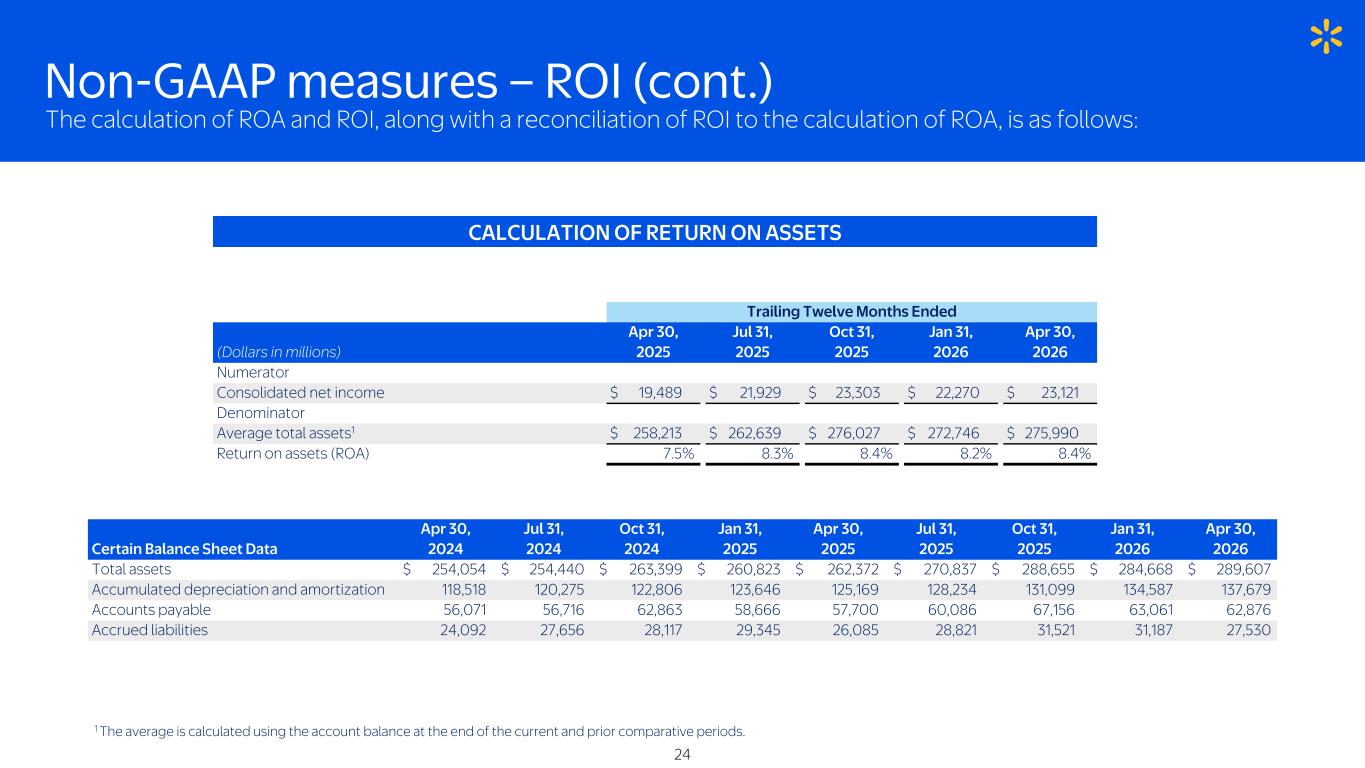
The calculation of ROA and ROI, along with a reconciliation of ROI to the calculation of ROA, is as follows: Non-GAAP measures – ROI (cont.) Trailing Twelve Months Ended Apr 30, Jul 31, Oct 31, Jan 31, Apr 30, (Dollars in millions) 2025 2025 2025 2026 2026 Numerator Consolidated net income $ 19,489 $ 21,929 $ 23,303 $ 22,270 $ 23,121 Denominator Average total assets1 $ 258,213 $ 262,639 $ 276,027 $ 272,746 $ 275,990 Return on assets (ROA) 7.5% 8.3% 8.4% 8.2% 8.4% 1 The average is calculated using the account balance at the end of the current and prior comparative periods. 24 Apr 30, Jul 31, Oct 31, Jan 31, Apr 30, Jul 31, Oct 31, Jan 31, Apr 30, Certain Balance Sheet Data 2024 2024 2024 2025 2025 2025 2025 2026 2026 Total assets $ 254,054 $ 254,440 $ 263,399 $ 260,823 $ 262,372 $ 270,837 $ 288,655 $ 284,668 $ 289,607 Accumulated depreciation and amortization 118,518 120,275 122,806 123,646 125,169 128,234 131,099 134,587 137,679 Accounts payable 56,071 56,716 62,863 58,666 57,700 60,086 67,156 63,061 62,876 Accrued liabilities 24,092 27,656 28,117 29,345 26,085 28,821 31,521 31,187 27,530 CALCULATION OF RETURN ON ASSETS
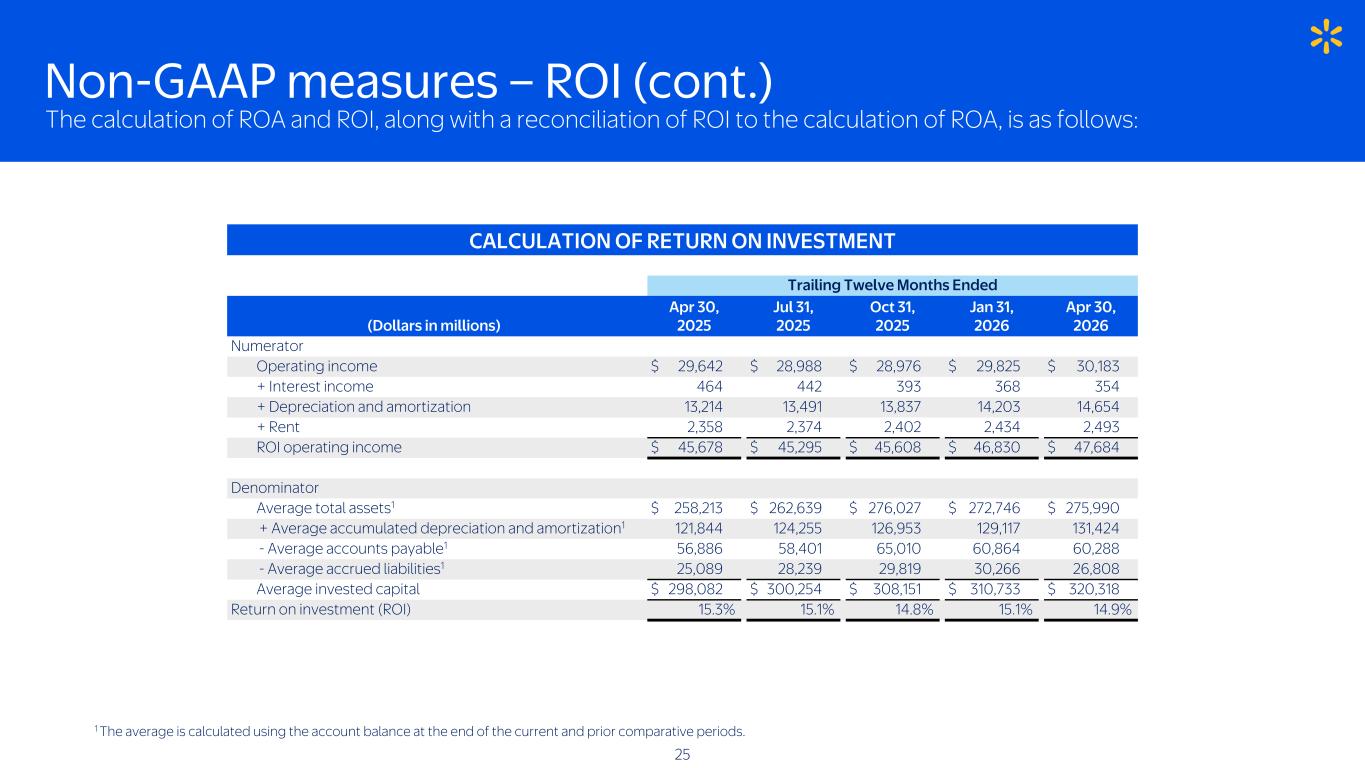
The calculation of ROA and ROI, along with a reconciliation of ROI to the calculation of ROA, is as follows: Non-GAAP measures – ROI (cont.) CALCULATION OF RETURN ON INVESTMENT Trailing Twelve Months Ended Apr 30, Jul 31, Oct 31, Jan 31, Apr 30, (Dollars in millions) 2025 2025 2025 2026 2026 Numerator Operating income $ 29,642 $ 28,988 $ 28,976 $ 29,825 $ 30,183 + Interest income 464 442 393 368 354 + Depreciation and amortization 13,214 13,491 13,837 14,203 14,654 + Rent 2,358 2,374 2,402 2,434 2,493 ROI operating income $ 45,678 $ 45,295 $ 45,608 $ 46,830 $ 47,684 Denominator Average total assets1 $ 258,213 $ 262,639 $ 276,027 $ 272,746 $ 275,990 '+ Average accumulated depreciation and amortization1 121,844 124,255 126,953 129,117 131,424 '- Average accounts payable1 56,886 58,401 65,010 60,864 60,288 '- Average accrued liabilities1 25,089 28,239 29,819 30,266 26,808 Average invested capital $ 298,082 $ 300,254 $ 308,151 $ 310,733 $ 320,318 Return on investment (ROI) 15.3% 15.1% 14.8% 15.1% 14.9% 1 The average is calculated using the account balance at the end of the current and prior comparative periods. 25
Non-GAAP measures – free cash flow We define free cash flow as net cash provided by operating activities in a period minus payments for property and equipment made in that period. Net cash provided by operating activities was $4.7 billion for the three months ended April 30, 2026, which represents a decrease of $0.7 billion when compared to the same period in the prior year. The decrease was primarily due to timing of inventory receipts, partially offset by timing of certain payments and an increase in cash provided by operating income. Free cash flow for the three months ended April 30, 2026 was negative $1.9 billion, which represents a decrease of $2.4 billion when compared to the same period in the prior year. The decrease in free cash flow was due to an increase of $1.7 billion in capital expenditures to support our omnichannel growth strategy combined with the decrease in net cash provided by operating activities described above. Free cash flow is considered a non-GAAP financial measure. Management believes, however, that free cash flow, which measures our ability to generate additional cash from our business operations, is an important financial measure for use in evaluating the Company's financial performance. Free cash flow should be considered in addition to, rather than as a substitute for, consolidated net income as a measure of our performance and net cash provided by operating activities as a measure of our liquidity. Walmart’s definition of free cash flow is limited, in that it does not represent residual cash flows available for discretionary expenditures, due to the fact that the measure does not deduct the payments required for debt service and other contractual obligations or payments made for business acquisitions. Therefore, we believe it is important to view free cash flow as a measure that provides supplemental information to our Consolidated Statements of Cash Flows. Although other companies report their free cash flow, numerous methods may exist for calculating a company’s free cash flow. As a result, the method used by Walmart’s management to calculate our free cash flow may differ from the methods used by other companies to calculate their free cash flow. 26
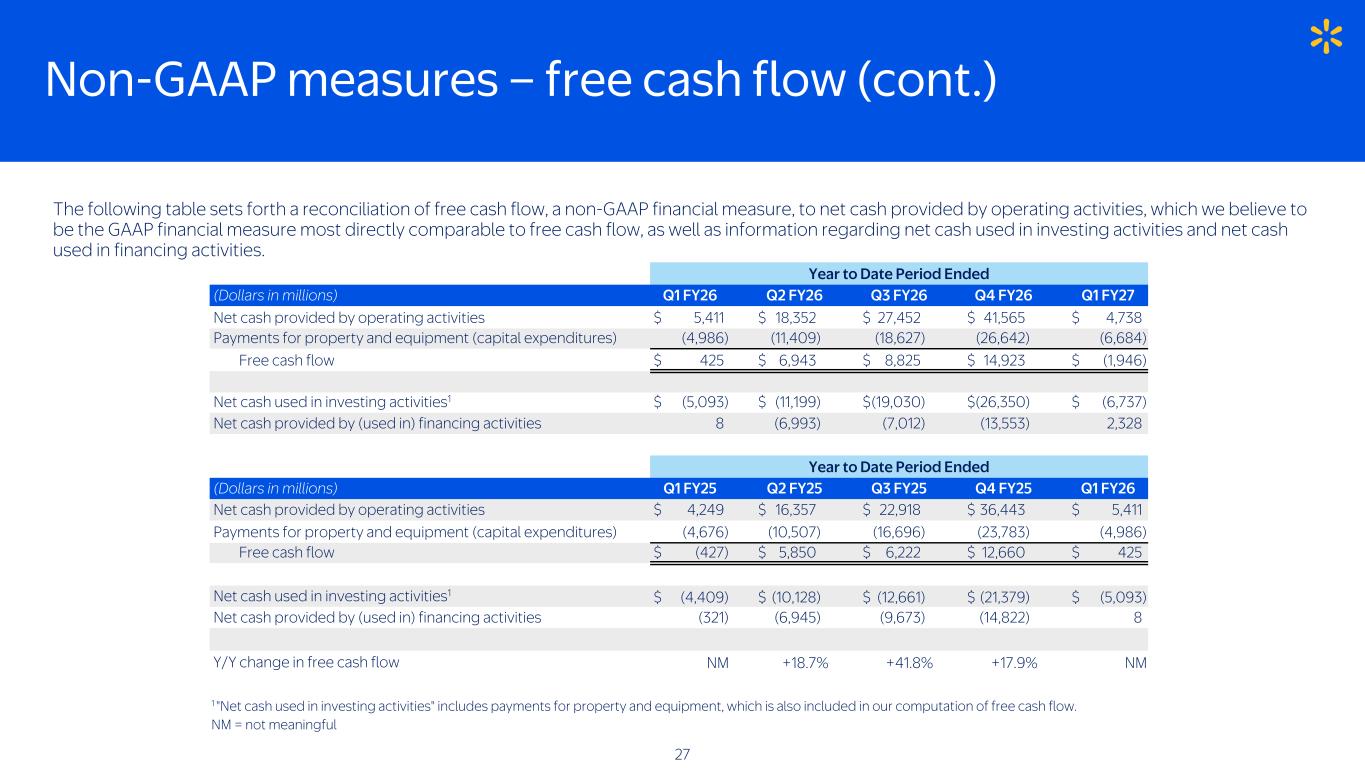
Non-GAAP measures – free cash flow (cont.) The following table sets forth a reconciliation of free cash flow, a non-GAAP financial measure, to net cash provided by operating activities, which we believe to be the GAAP financial measure most directly comparable to free cash flow, as well as information regarding net cash used in investing activities and net cash used in financing activities. Year to Date Period Ended (Dollars in millions) Q1 FY26 Q2 FY26 Q3 FY26 Q4 FY26 Q1 FY27 Net cash provided by operating activities $ 5,411 $ 18,352 $ 27,452 $ 41,565 $ 4,738 Payments for property and equipment (capital expenditures) (4,986) (11,409) (18,627) (26,642) (6,684) Free cash flow $ 425 $ 6,943 $ 8,825 $ 14,923 $ (1,946) Net cash used in investing activities1 $ (5,093) $ (11,199) $ (19,030) $ (26,350) $ (6,737) Net cash provided by (used in) financing activities 8 (6,993) (7,012) (13,553) 2,328 Year to Date Period Ended (Dollars in millions) Q1 FY25 Q2 FY25 Q3 FY25 Q4 FY25 Q1 FY26 Net cash provided by operating activities $ 4,249 $ 16,357 $ 22,918 $ 36,443 $ 5,411 Payments for property and equipment (capital expenditures) (4,676) (10,507) (16,696) (23,783) (4,986) Free cash flow $ (427) $ 5,850 $ 6,222 $ 12,660 $ 425 Net cash used in investing activities1 $ (4,409) $ (10,128) $ (12,661) $ (21,379) $ (5,093) Net cash provided by (used in) financing activities (321) (6,945) (9,673) (14,822) 8 Y/Y change in free cash flow NM +18.7% +41.8% +17.9% NM 1 "Net cash used in investing activities" includes payments for property and equipment, which is also included in our computation of free cash flow. NM = not meaningful 27
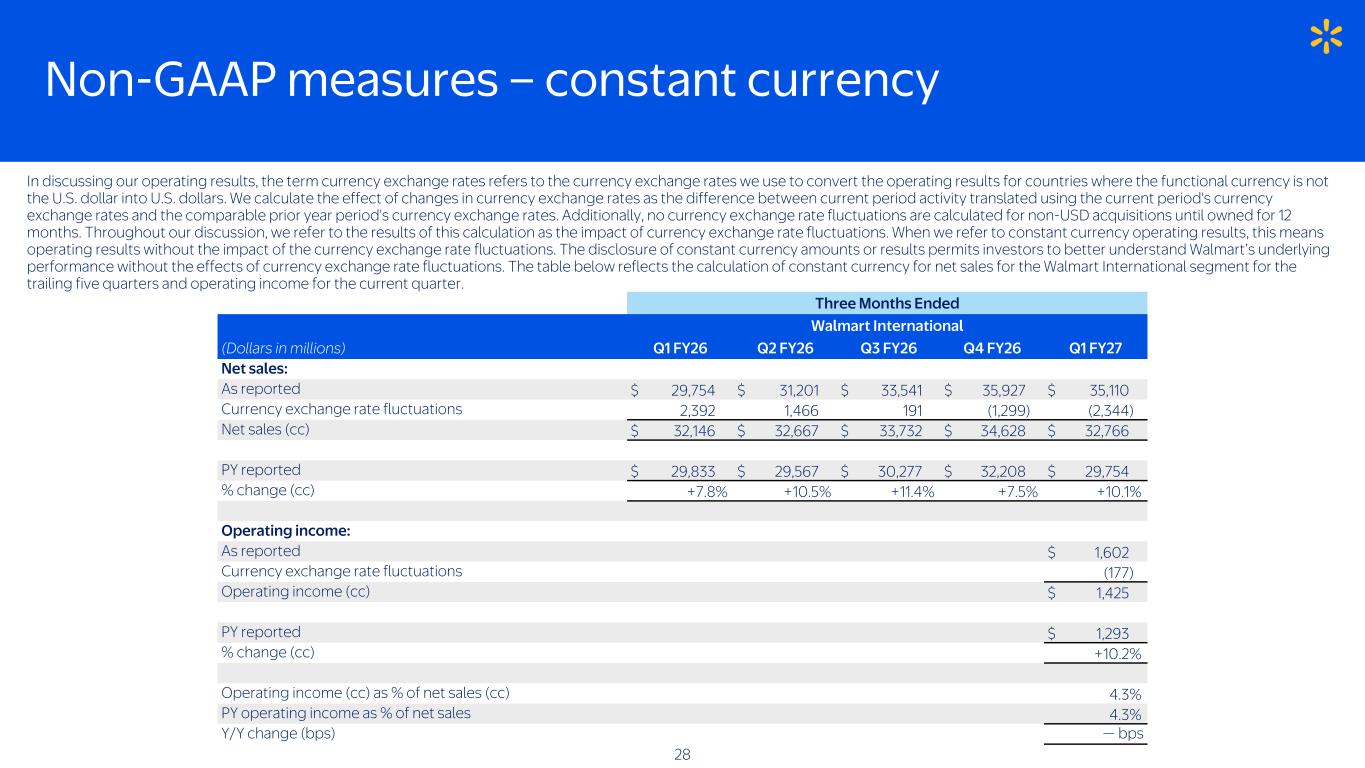
Non-GAAP measures – constant currency In discussing our operating results, the term currency exchange rates refers to the currency exchange rates we use to convert the operating results for countries where the functional currency is not the U.S. dollar into U.S. dollars. We calculate the effect of changes in currency exchange rates as the difference between current period activity translated using the current period's currency exchange rates and the comparable prior year period's currency exchange rates. Additionally, no currency exchange rate fluctuations are calculated for non-USD acquisitions until owned for 12 months. Throughout our discussion, we refer to the results of this calculation as the impact of currency exchange rate fluctuations. When we refer to constant currency operating results, this means operating results without the impact of the currency exchange rate fluctuations. The disclosure of constant currency amounts or results permits investors to better understand Walmart’s underlying performance without the effects of currency exchange rate fluctuations. The table below reflects the calculation of constant currency for net sales for the Walmart International segment for the trailing five quarters and operating income for the current quarter. Three Months Ended Walmart International (Dollars in millions) Q1 FY26 Q2 FY26 Q3 FY26 Q4 FY26 Q1 FY27 Net sales: As reported $ 29,754 $ 31,201 $ 33,541 $ 35,927 $ 35,110 Currency exchange rate fluctuations 2,392 1,466 191 (1,299) (2,344) Net sales (cc) $ 32,146 $ 32,667 $ 33,732 $ 34,628 $ 32,766 PY reported $ 29,833 $ 29,567 $ 30,277 $ 32,208 $ 29,754 % change (cc) +7.8% +10.5% +11.4% +7.5% +10.1% Operating income: As reported $ 1,602 Currency exchange rate fluctuations (177) Operating income (cc) $ 1,425 PY reported $ 1,293 % change (cc) +10.2% Operating income (cc) as % of net sales (cc) 4.3% PY operating income as % of net sales 4.3% Y/Y change (bps) — bps 28 1Q4 FY24 reflects reported results for comparison to current quarter growth in constant currency.
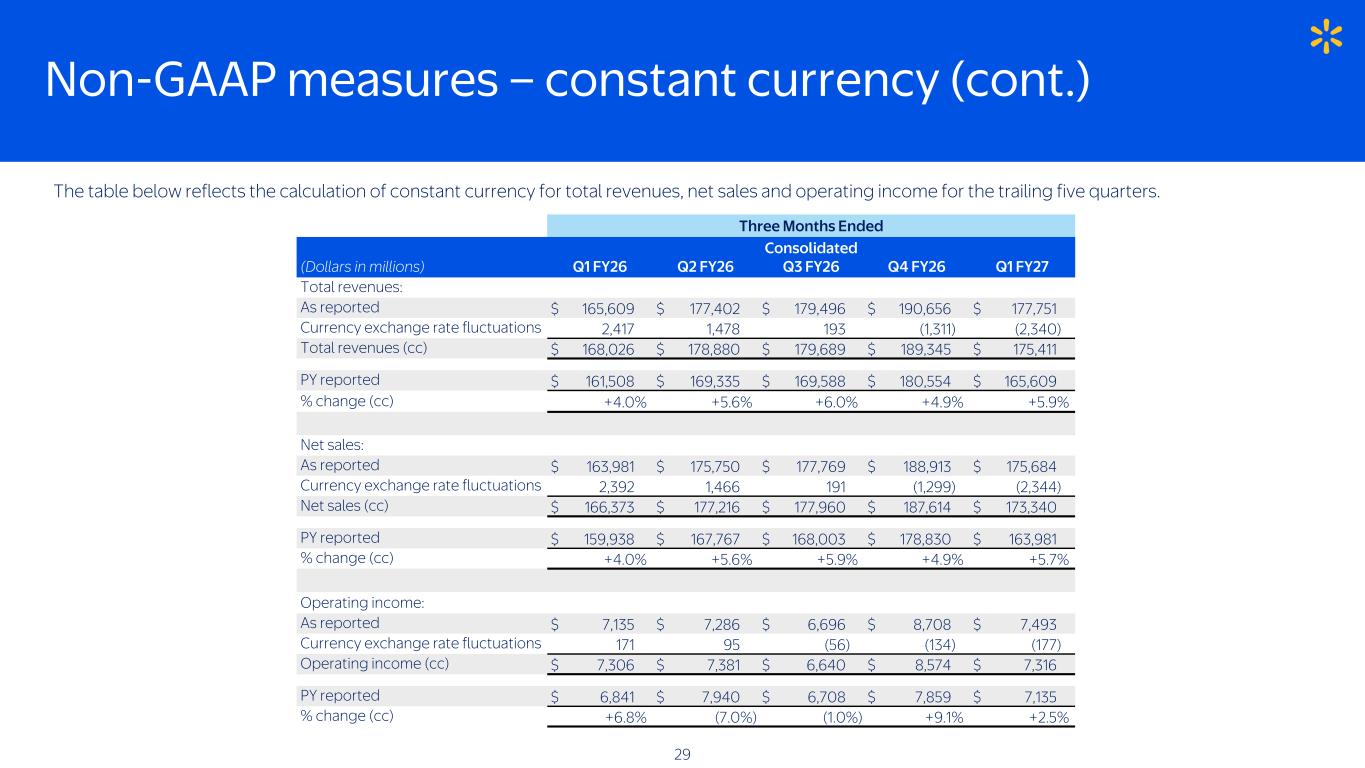
Non-GAAP measures – constant currency (cont.) Three Months Ended Consolidated (Dollars in millions) Q1 FY26 Q2 FY26 Q3 FY26 Q4 FY26 Q1 FY27 Total revenues: As reported $ 165,609 $ 177,402 $ 179,496 $ 190,656 $ 177,751 Currency exchange rate fluctuations 2,417 1,478 193 (1,311) (2,340) Total revenues (cc) $ 168,026 $ 178,880 $ 179,689 $ 189,345 $ 175,411 PY reported $ 161,508 $ 169,335 $ 169,588 $ 180,554 $ 165,609 % change (cc) +4.0% +5.6% +6.0% +4.9% +5.9% Net sales: As reported $ 163,981 $ 175,750 $ 177,769 $ 188,913 $ 175,684 Currency exchange rate fluctuations 2,392 1,466 191 (1,299) (2,344) Net sales (cc) $ 166,373 $ 177,216 $ 177,960 $ 187,614 $ 173,340 PY reported $ 159,938 $ 167,767 $ 168,003 $ 178,830 $ 163,981 % change (cc) +4.0% +5.6% +5.9% +4.9% +5.7% Operating income: As reported $ 7,135 $ 7,286 $ 6,696 $ 8,708 $ 7,493 Currency exchange rate fluctuations 171 95 (56) (134) (177) Operating income (cc) $ 7,306 $ 7,381 $ 6,640 $ 8,574 $ 7,316 PY reported $ 6,841 $ 7,940 $ 6,708 $ 7,859 $ 7,135 % change (cc) +6.8% (7.0%) (1.0%) +9.1% +2.5% The table below reflects the calculation of constant currency for total revenues, net sales and operating income for the trailing five quarters. 29
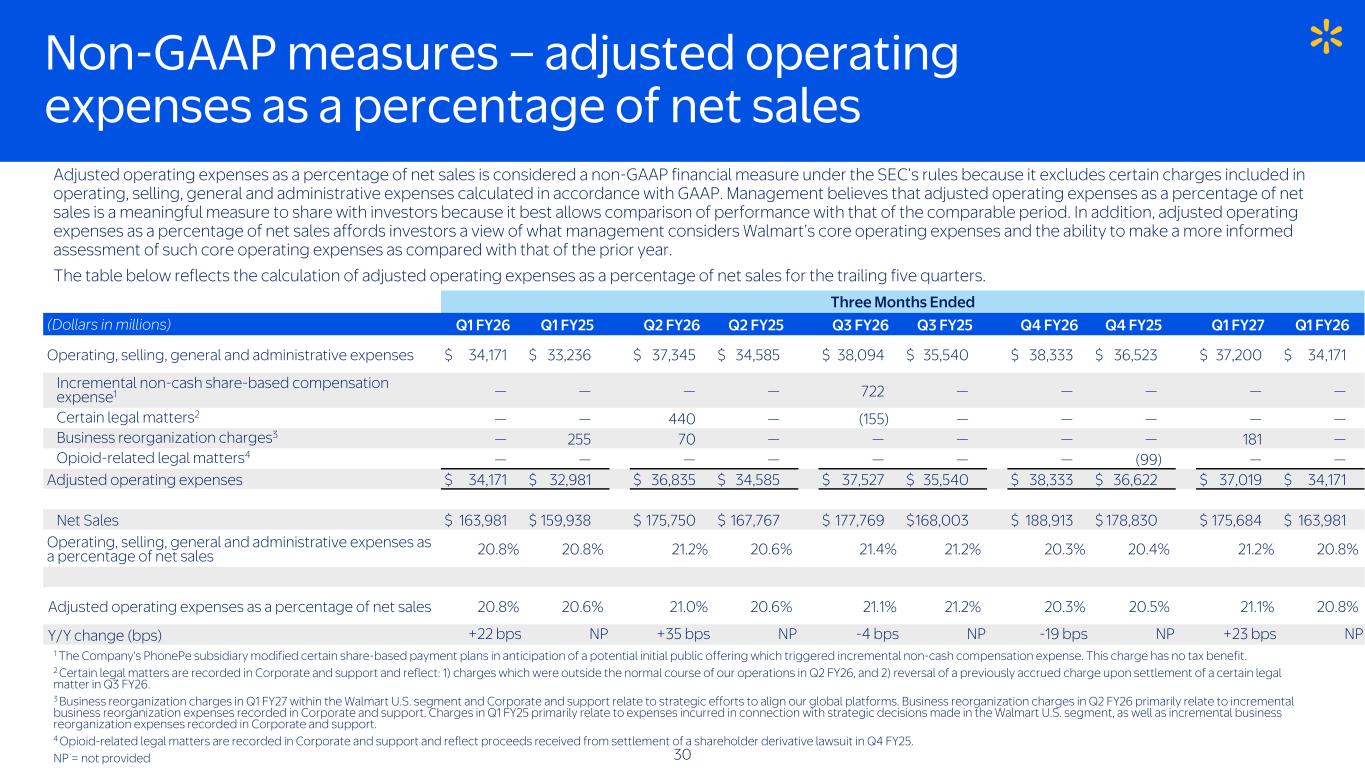
Non-GAAP measures – adjusted operating expenses as a percentage of net sales 1 The Company's PhonePe subsidiary modified certain share-based payment plans in anticipation of a potential initial public offering which triggered incremental non-cash compensation expense. This charge has no tax benefit. 2 Certain legal matters are recorded in Corporate and support and reflect: 1) charges which were outside the normal course of our operations in Q2 FY26, and 2) reversal of a previously accrued charge upon settlement of a certain legal matter in Q3 FY26. 3 Business reorganization charges in Q1 FY27 within the Walmart U.S. segment and Corporate and support relate to strategic efforts to align our global platforms. Business reorganization charges in Q2 FY26 primarily relate to incremental business reorganization expenses recorded in Corporate and support. Charges in Q1 FY25 primarily relate to expenses incurred in connection with strategic decisions made in the Walmart U.S. segment, as well as incremental business reorganization expenses recorded in Corporate and support. 4 Opioid-related legal matters are recorded in Corporate and support and reflect proceeds received from settlement of a shareholder derivative lawsuit in Q4 FY25. NP = not provided Adjusted operating expenses as a percentage of net sales is considered a non-GAAP financial measure under the SEC’s rules because it excludes certain charges included in operating, selling, general and administrative expenses calculated in accordance with GAAP. Management believes that adjusted operating expenses as a percentage of net sales is a meaningful measure to share with investors because it best allows comparison of performance with that of the comparable period. In addition, adjusted operating expenses as a percentage of net sales affords investors a view of what management considers Walmart’s core operating expenses and the ability to make a more informed assessment of such core operating expenses as compared with that of the prior year. The table below reflects the calculation of adjusted operating expenses as a percentage of net sales for the trailing five quarters. 30 Three Months Ended (Dollars in millions) Q1 FY26 Q1 FY25 Q2 FY26 Q2 FY25 Q3 FY26 Q3 FY25 Q4 FY26 Q4 FY25 Q1 FY27 Q1 FY26 Operating, selling, general and administrative expenses $ 34,171 $ 33,236 $ 37,345 $ 34,585 $ 38,094 $ 35,540 $ 38,333 $ 36,523 $ 37,200 $ 34,171 Incremental non-cash share-based compensation expense1 — — — — 722 — — — — — Certain legal matters2 — — 440 — (155) — — — — — Business reorganization charges3 — 255 70 — — — — — 181 — Opioid-related legal matters4 — — — — — — — (99) — — Adjusted operating expenses $ 34,171 $ 32,981 $ 36,835 $ 34,585 $ 37,527 $ 35,540 $ 38,333 $ 36,622 $ 37,019 $ 34,171 Net Sales $ 163,981 $ 159,938 $ 175,750 $ 167,767 $ 177,769 $ 168,003 $ 188,913 $ 178,830 $ 175,684 $ 163,981 Operating, selling, general and administrative expenses as a percentage of net sales 20.8% 20.8% 21.2% 20.6% 21.4% 21.2% 20.3% 20.4% 21.2% 20.8% Adjusted operating expenses as a percentage of net sales 20.8% 20.6% 21.0% 20.6% 21.1% 21.2% 20.3% 20.5% 21.1% 20.8% Y/Y change (bps) +22 bps NP +35 bps NP -4 bps NP -19 bps NP +23 bps NP
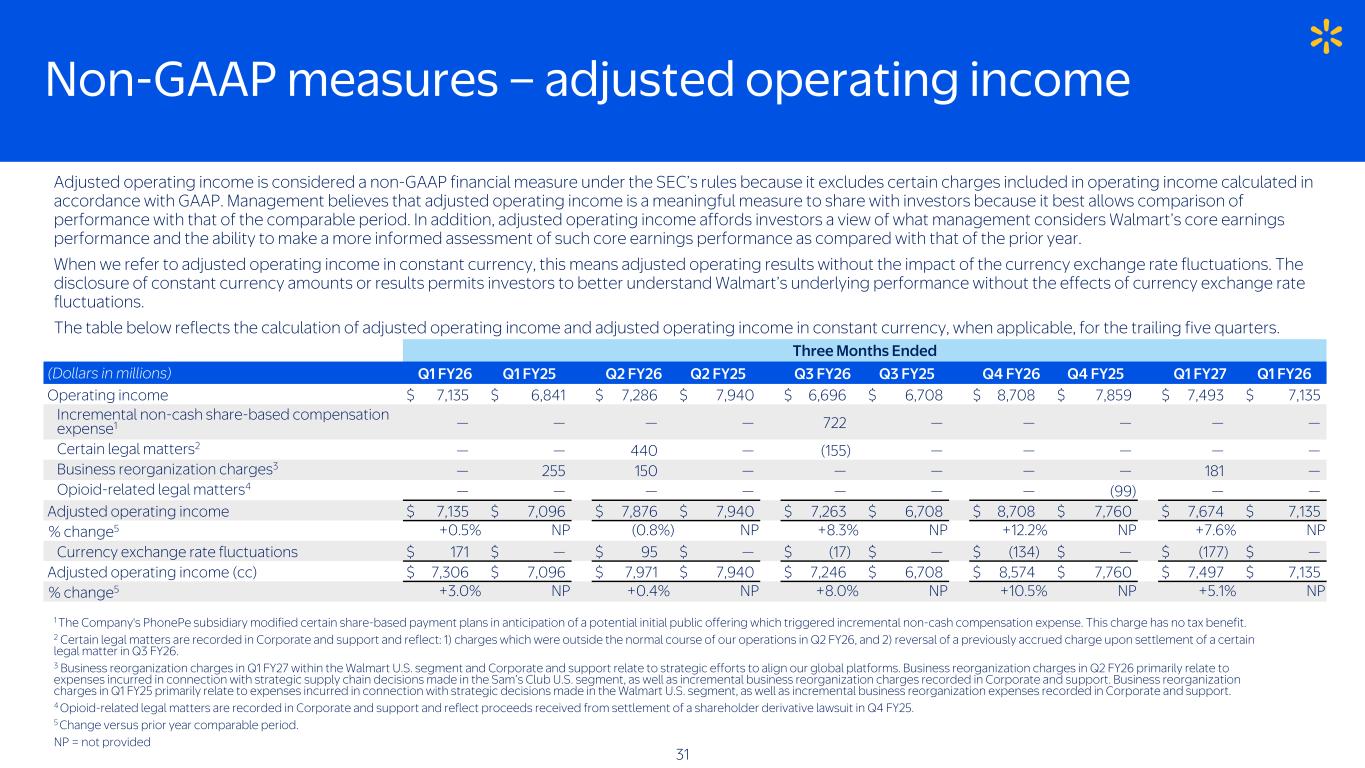
Non-GAAP measures – adjusted operating income Three Months Ended (Dollars in millions) Q1 FY26 Q1 FY25 Q2 FY26 Q2 FY25 Q3 FY26 Q3 FY25 Q4 FY26 Q4 FY25 Q1 FY27 Q1 FY26 Operating income $ 7,135 $ 6,841 $ 7,286 $ 7,940 $ 6,696 $ 6,708 $ 8,708 $ 7,859 $ 7,493 $ 7,135 Incremental non-cash share-based compensation expense1 — — — — 722 — — — — — Certain legal matters2 — — 440 — (155) — — — — — Business reorganization charges3 — 255 150 — — — — — 181 — Opioid-related legal matters4 — — — — — — — (99) — — Adjusted operating income $ 7,135 $ 7,096 $ 7,876 $ 7,940 $ 7,263 $ 6,708 $ 8,708 $ 7,760 $ 7,674 $ 7,135 % change5 +0.5% NP (0.8%) NP +8.3% NP +12.2% NP +7.6% NP Currency exchange rate fluctuations $ 171 $ — $ 95 $ — $ (17) $ — $ (134) $ — $ (177) $ — Adjusted operating income (cc) $ 7,306 $ 7,096 $ 7,971 $ 7,940 $ 7,246 $ 6,708 $ 8,574 $ 7,760 $ 7,497 $ 7,135 % change5 +3.0% NP +0.4% NP +8.0% NP +10.5% NP +5.1% NP Adjusted operating income is considered a non-GAAP financial measure under the SEC’s rules because it excludes certain charges included in operating income calculated in accordance with GAAP. Management believes that adjusted operating income is a meaningful measure to share with investors because it best allows comparison of performance with that of the comparable period. In addition, adjusted operating income affords investors a view of what management considers Walmart’s core earnings performance and the ability to make a more informed assessment of such core earnings performance as compared with that of the prior year. When we refer to adjusted operating income in constant currency, this means adjusted operating results without the impact of the currency exchange rate fluctuations. The disclosure of constant currency amounts or results permits investors to better understand Walmart’s underlying performance without the effects of currency exchange rate fluctuations. The table below reflects the calculation of adjusted operating income and adjusted operating income in constant currency, when applicable, for the trailing five quarters. 1 The Company's PhonePe subsidiary modified certain share-based payment plans in anticipation of a potential initial public offering which triggered incremental non-cash compensation expense. This charge has no tax benefit. 2 Certain legal matters are recorded in Corporate and support and reflect: 1) charges which were outside the normal course of our operations in Q2 FY26, and 2) reversal of a previously accrued charge upon settlement of a certain legal matter in Q3 FY26. 3 Business reorganization charges in Q1 FY27 within the Walmart U.S. segment and Corporate and support relate to strategic efforts to align our global platforms. Business reorganization charges in Q2 FY26 primarily relate to expenses incurred in connection with strategic supply chain decisions made in the Sam’s Club U.S. segment, as well as incremental business reorganization charges recorded in Corporate and support. Business reorganization charges in Q1 FY25 primarily relate to expenses incurred in connection with strategic decisions made in the Walmart U.S. segment, as well as incremental business reorganization expenses recorded in Corporate and support. 4 Opioid-related legal matters are recorded in Corporate and support and reflect proceeds received from settlement of a shareholder derivative lawsuit in Q4 FY25. 5 Change versus prior year comparable period. NP = not provided 31
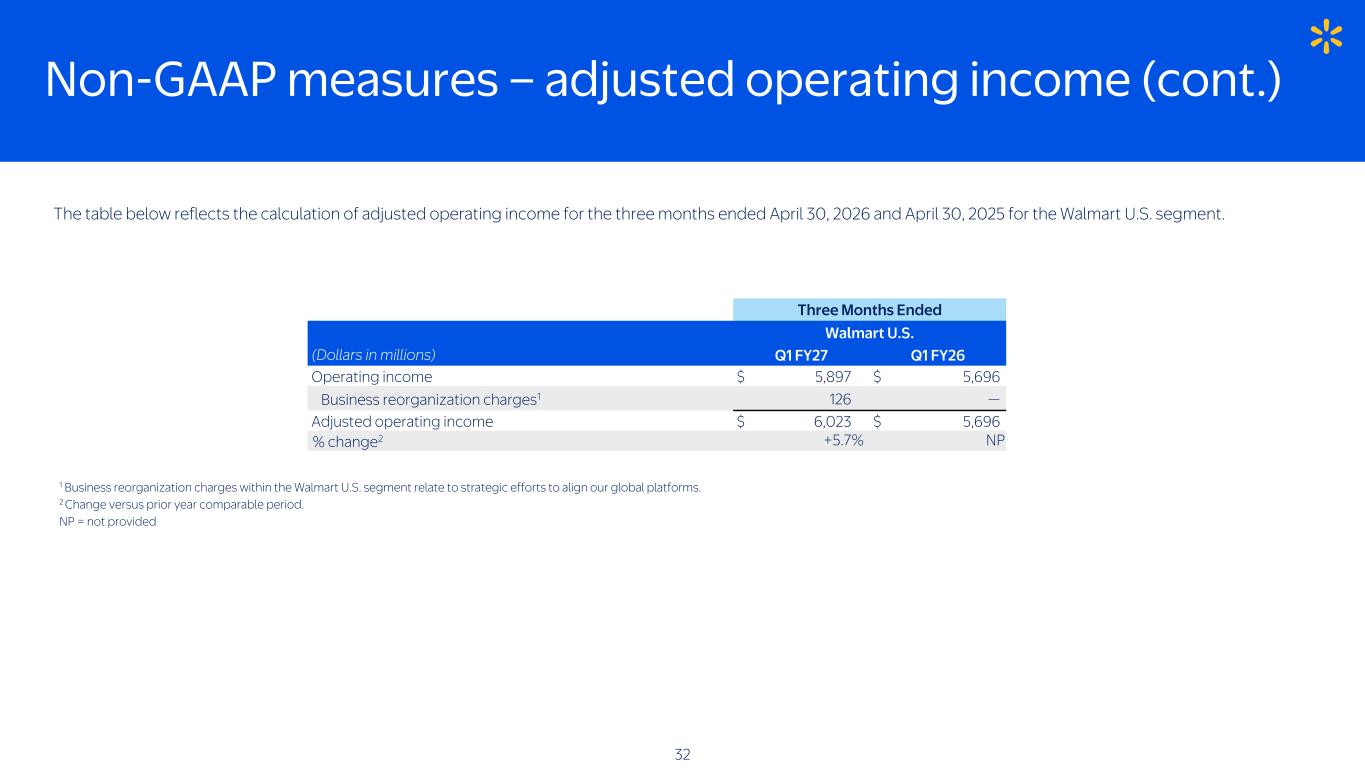
Non-GAAP measures – adjusted operating income (cont.) Three Months Ended Walmart U.S. (Dollars in millions) Q1 FY27 Q1 FY26 Operating income $ 5,897 $ 5,696 Business reorganization charges1 126 — Adjusted operating income $ 6,023 $ 5,696 % change2 +5.7% NP The table below reflects the calculation of adjusted operating income for the three months ended April 30, 2026 and April 30, 2025 for the Walmart U.S. segment. 1 Business reorganization charges within the Walmart U.S. segment relate to strategic efforts to align our global platforms. 2 Change versus prior year comparable period. NP = not provided 32
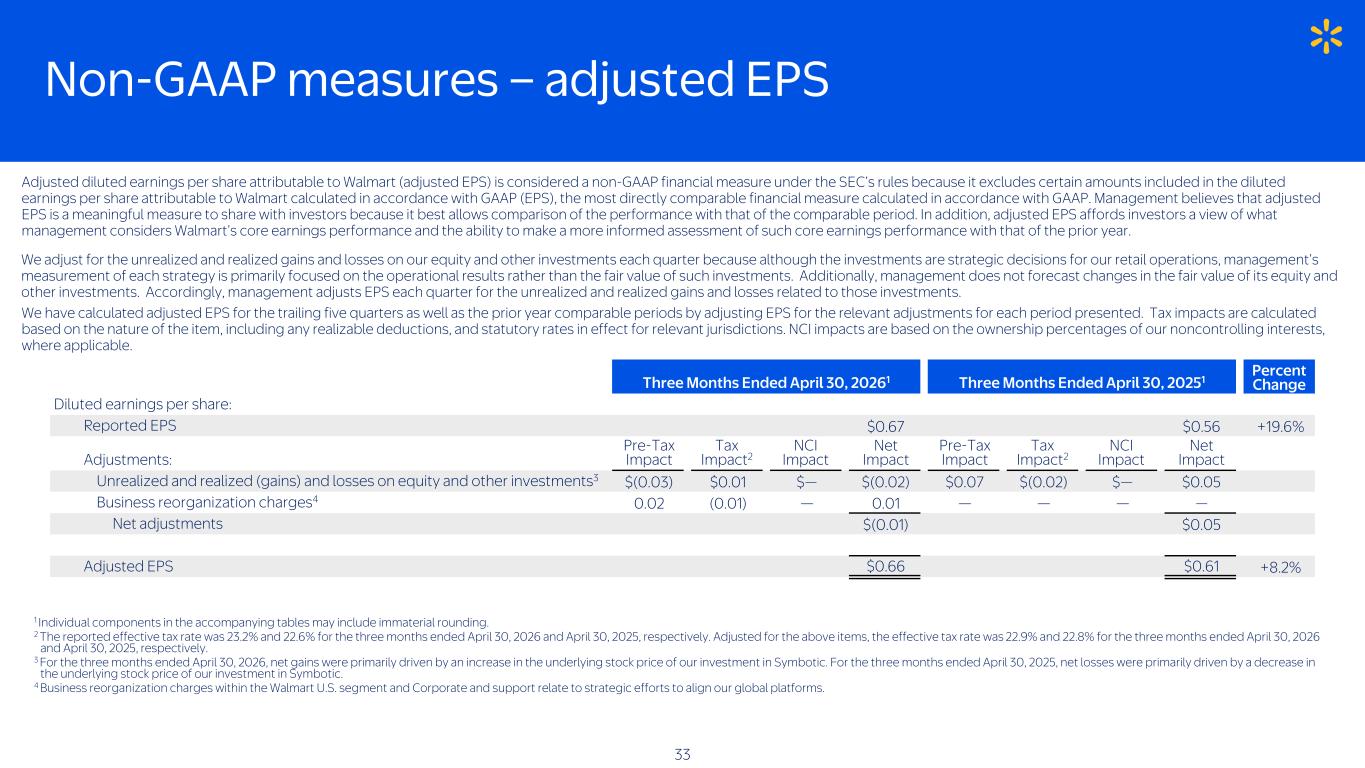
Non-GAAP measures – adjusted EPS Adjusted diluted earnings per share attributable to Walmart (adjusted EPS) is considered a non-GAAP financial measure under the SEC’s rules because it excludes certain amounts included in the diluted earnings per share attributable to Walmart calculated in accordance with GAAP (EPS), the most directly comparable financial measure calculated in accordance with GAAP. Management believes that adjusted EPS is a meaningful measure to share with investors because it best allows comparison of the performance with that of the comparable period. In addition, adjusted EPS affords investors a view of what management considers Walmart’s core earnings performance and the ability to make a more informed assessment of such core earnings performance with that of the prior year. We adjust for the unrealized and realized gains and losses on our equity and other investments each quarter because although the investments are strategic decisions for our retail operations, management’s measurement of each strategy is primarily focused on the operational results rather than the fair value of such investments. Additionally, management does not forecast changes in the fair value of its equity and other investments. Accordingly, management adjusts EPS each quarter for the unrealized and realized gains and losses related to those investments. We have calculated adjusted EPS for the trailing five quarters as well as the prior year comparable periods by adjusting EPS for the relevant adjustments for each period presented. Tax impacts are calculated based on the nature of the item, including any realizable deductions, and statutory rates in effect for relevant jurisdictions. NCI impacts are based on the ownership percentages of our noncontrolling interests, where applicable. Three Months Ended April 30, 20261 Three Months Ended April 30, 20251 Percent Change Diluted earnings per share: Reported EPS $0.67 $0.56 +19.6% Adjustments: Pre-Tax Impact Tax Impact2 NCI Impact Net Impact Pre-Tax Impact Tax Impact2 NCI Impact Net Impact Unrealized and realized (gains) and losses on equity and other investments3 $(0.03) $0.01 $— $(0.02) $0.07 $(0.02) $— $0.05 Business reorganization charges4 0.02 (0.01) — 0.01 — — — — Net adjustments $(0.01) $0.05 Adjusted EPS $0.66 $0.61 +8.2% 1 Individual components in the accompanying tables may include immaterial rounding. 2 The reported effective tax rate was 23.2% and 22.6% for the three months ended April 30, 2026 and April 30, 2025, respectively. Adjusted for the above items, the effective tax rate was 22.9% and 22.8% for the three months ended April 30, 2026 and April 30, 2025, respectively. 3 For the three months ended April 30, 2026, net gains were primarily driven by an increase in the underlying stock price of our investment in Symbotic. For the three months ended April 30, 2025, net losses were primarily driven by a decrease in the underlying stock price of our investment in Symbotic. 4 Business reorganization charges within the Walmart U.S. segment and Corporate and support relate to strategic efforts to align our global platforms. 33
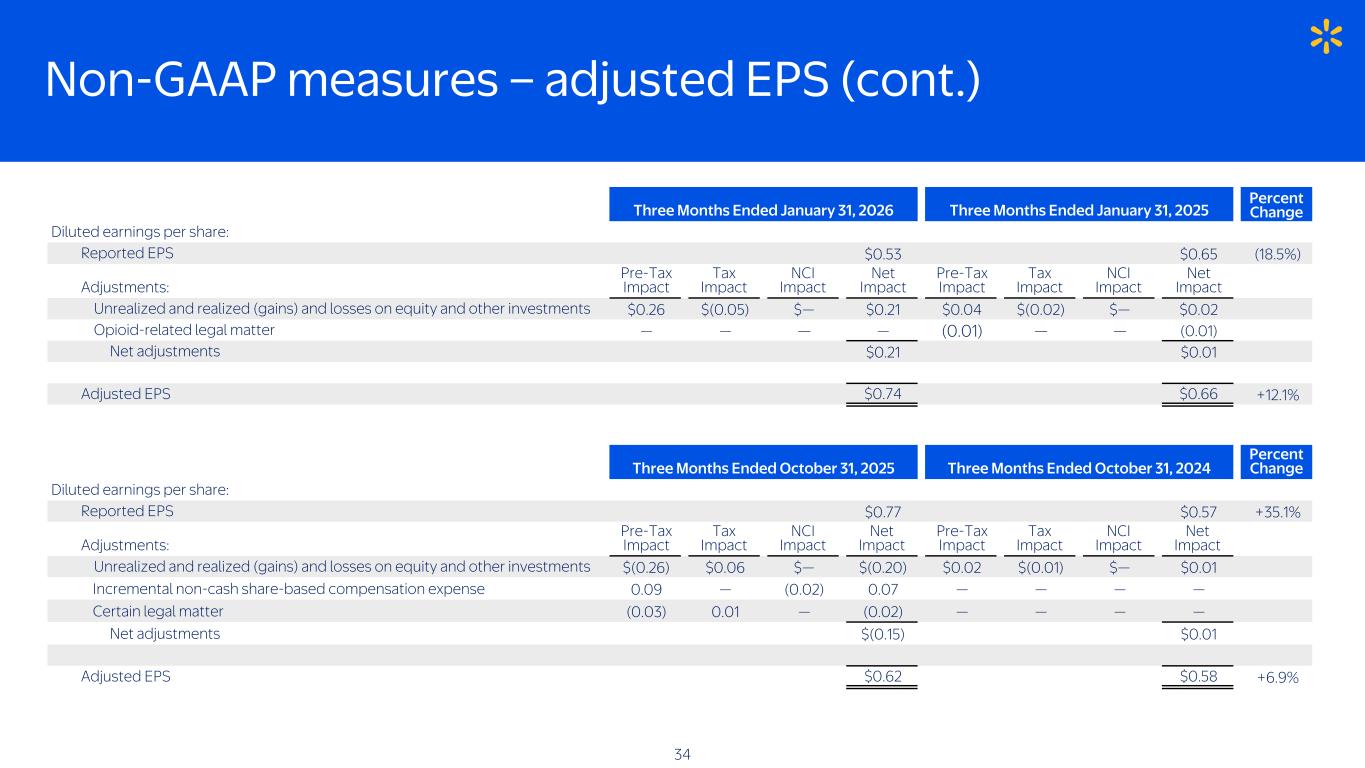
Non-GAAP measures – adjusted EPS (cont.) Three Months Ended October 31, 2025 Three Months Ended October 31, 2024 Percent Change Diluted earnings per share: Reported EPS $0.77 $0.57 +35.1% Adjustments: Pre-Tax Impact Tax Impact NCI Impact Net Impact Pre-Tax Impact Tax Impact NCI Impact Net Impact Unrealized and realized (gains) and losses on equity and other investments $(0.26) $0.06 $— $(0.20) $0.02 $(0.01) $— $0.01 Incremental non-cash share-based compensation expense 0.09 — (0.02) 0.07 — — — — Certain legal matter (0.03) 0.01 — (0.02) — — — — Net adjustments $(0.15) $0.01 Adjusted EPS $0.62 $0.58 +6.9% 34 Three Months Ended January 31, 2026 Three Months Ended January 31, 2025 Percent Change Diluted earnings per share: Reported EPS $0.53 $0.65 (18.5%) Adjustments: Pre-Tax Impact Tax Impact NCI Impact Net Impact Pre-Tax Impact Tax Impact NCI Impact Net Impact Unrealized and realized (gains) and losses on equity and other investments $0.26 $(0.05) $— $0.21 $0.04 $(0.02) $— $0.02 Opioid-related legal matter — — — — (0.01) — — (0.01) Net adjustments $0.21 $0.01 Adjusted EPS $0.74 $0.66 +12.1%
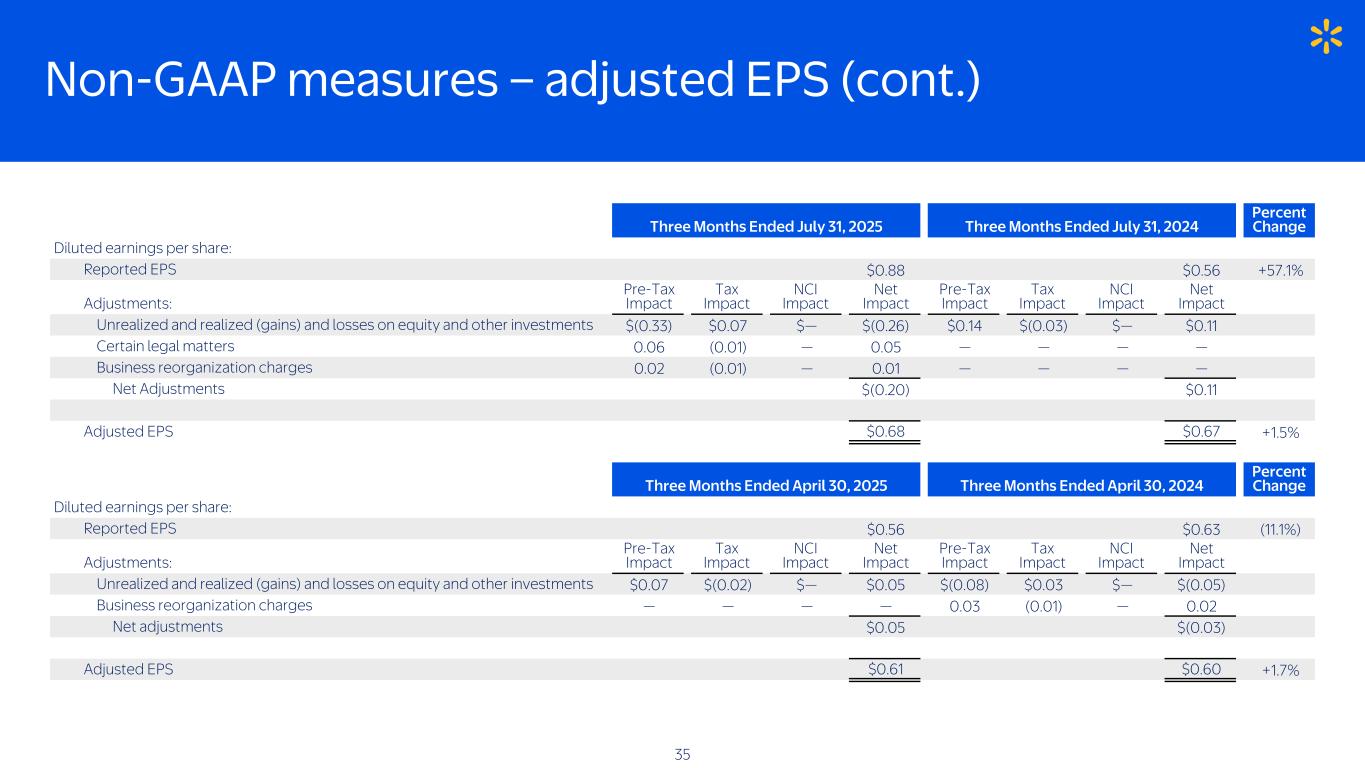
Non-GAAP measures – adjusted EPS (cont.) Three Months Ended April 30, 2025 Three Months Ended April 30, 2024 Percent Change Diluted earnings per share: Reported EPS $0.56 $0.63 (11.1%) Adjustments: Pre-Tax Impact Tax Impact NCI Impact Net Impact Pre-Tax Impact Tax Impact NCI Impact Net Impact Unrealized and realized (gains) and losses on equity and other investments $0.07 $(0.02) $— $0.05 $(0.08) $0.03 $— $(0.05) Business reorganization charges — — — — 0.03 (0.01) — 0.02 Net adjustments $0.05 $(0.03) Adjusted EPS $0.61 $0.60 +1.7% 35 Three Months Ended July 31, 2025 Three Months Ended July 31, 2024 Percent Change Diluted earnings per share: Reported EPS $0.88 $0.56 +57.1% Adjustments: Pre-Tax Impact Tax Impact NCI Impact Net Impact Pre-Tax Impact Tax Impact NCI Impact Net Impact Unrealized and realized (gains) and losses on equity and other investments $(0.33) $0.07 $— $(0.26) $0.14 $(0.03) $— $0.11 Certain legal matters 0.06 (0.01) — 0.05 — — — — Business reorganization charges 0.02 (0.01) — 0.01 — — — — Net Adjustments $(0.20) $0.11 Adjusted EPS $0.68 $0.67 +1.5%
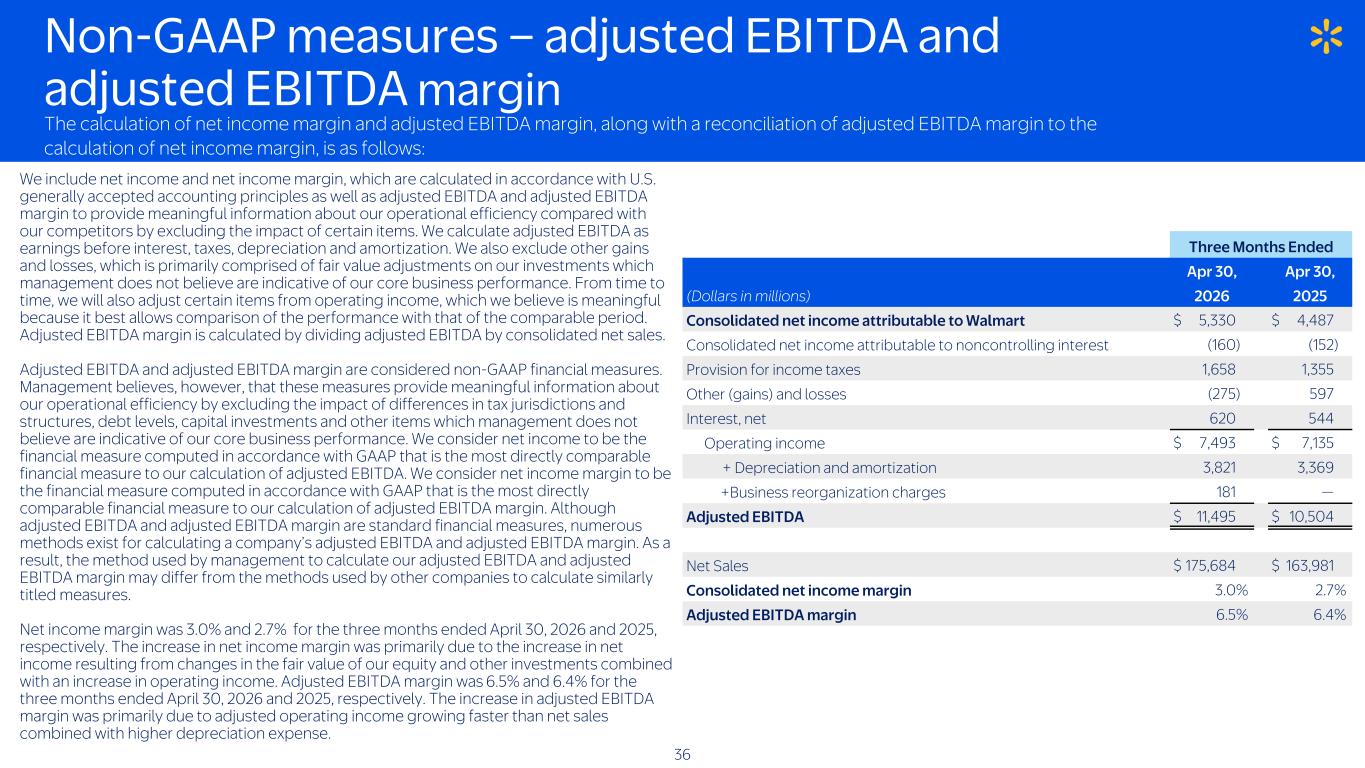
Non-GAAP measures – adjusted EBITDA and adjusted EBITDA margin The calculation of net income margin and adjusted EBITDA margin, along with a reconciliation of adjusted EBITDA margin to the calculation of net income margin, is as follows: Three Months Ended Apr 30, Apr 30, (Dollars in millions) 2026 2025 Consolidated net income attributable to Walmart $ 5,330 $ 4,487 Consolidated net income attributable to noncontrolling interest (160) (152) Provision for income taxes 1,658 1,355 Other (gains) and losses (275) 597 Interest, net 620 544 Operating income $ 7,493 $ 7,135 + Depreciation and amortization 3,821 3,369 +Business reorganization charges 181 — Adjusted EBITDA $ 11,495 $ 10,504 Net Sales $ 175,684 $ 163,981 Consolidated net income margin 3.0% 2.7% Adjusted EBITDA margin 6.5% 6.4% We include net income and net income margin, which are calculated in accordance with U.S. generally accepted accounting principles as well as adjusted EBITDA and adjusted EBITDA margin to provide meaningful information about our operational efficiency compared with our competitors by excluding the impact of certain items. We calculate adjusted EBITDA as earnings before interest, taxes, depreciation and amortization. We also exclude other gains and losses, which is primarily comprised of fair value adjustments on our investments which management does not believe are indicative of our core business performance. From time to time, we will also adjust certain items from operating income, which we believe is meaningful because it best allows comparison of the performance with that of the comparable period. Adjusted EBITDA margin is calculated by dividing adjusted EBITDA by consolidated net sales. Adjusted EBITDA and adjusted EBITDA margin are considered non-GAAP financial measures. Management believes, however, that these measures provide meaningful information about our operational efficiency by excluding the impact of differences in tax jurisdictions and structures, debt levels, capital investments and other items which management does not believe are indicative of our core business performance. We consider net income to be the financial measure computed in accordance with GAAP that is the most directly comparable financial measure to our calculation of adjusted EBITDA. We consider net income margin to be the financial measure computed in accordance with GAAP that is the most directly comparable financial measure to our calculation of adjusted EBITDA margin. Although adjusted EBITDA and adjusted EBITDA margin are standard financial measures, numerous methods exist for calculating a company’s adjusted EBITDA and adjusted EBITDA margin. As a result, the method used by management to calculate our adjusted EBITDA and adjusted EBITDA margin may differ from the methods used by other companies to calculate similarly titled measures. Net income margin was 3.0% and 2.7% for the three months ended April 30, 2026 and 2025, respectively. The increase in net income margin was primarily due to the increase in net income resulting from changes in the fair value of our equity and other investments combined with an increase in operating income. Adjusted EBITDA margin was 6.5% and 6.4% for the three months ended April 30, 2026 and 2025, respectively. The increase in adjusted EBITDA margin was primarily due to adjusted operating income growing faster than net sales combined with higher depreciation expense. 36