
ZIONSFOURTH QUARTER 2025 J a n u a r y 2 0 , 2 0 2 6 Financial Review
FORWARD-LOOKING STATEMENTS; USE OF NON-GAAP FINANCIAL MEASURES 2 Forward-Looking Information This presentation contains “forward-looking statements” as defined under the Private Securities Litigation Reform Act of 1995. These statements reflect management’s current expectations and assumptions regarding future events and outcomes. However, they are inherently subject to known and unknown risks, uncertainties, and other factors that could cause actual results, performances, achievements, industry developments, or regulatory outcomes to differ materially from those expressed or implied. Forward-looking statements may include, among others: Statements concerning the beliefs, plans, objectives, goals, targets, commitments, designs, guidelines, expectations, anticipations, and future financial condition, operating results, and performance of Zions Bancorporation, National Association and its subsidiaries (collectively “Zions Bancorporation, N.A.,” “the Bank,” “we,” “our,” “us”); and statements preceded or followed by, or that include, terminology such as “may,” “might,” “can,” “continue,” “could,” “should,” “would,” “believe,” “anticipate,” “estimate,” “forecasts,” “expect,” “intend,” “target,” “commit,” “design,” “plan,” “projects,” “will,” or similar words and expressions, including their negative forms. Forward-looking statements are not guarantees and should not be relied upon as representing management’s views as of any subsequent date. Actual results and outcomes may differ materially from those presented. Although the following list is not comprehensive, key factors that may cause material differences include: The quality and composition of our loan and investment securities portfolios and the quality and composition of our deposits; Changes in general industry, political, and economic conditions, including increases in the national debt, elevated inflation, economic slowdowns or recessions, and other macroeconomic challenges; changes in interest and reference rates, which could negatively impact our revenues and expenses, the valuation and performance of our assets and liabilities, and the availability and cost of capital and liquidity; Political developments, including government shutdowns and other significant disruptions and changes in the funding, size, scope, and effectiveness of the government, its agencies and services; The effects of newly enacted and proposed regulations affecting us and the banking industry, as well as changes and uncertainties in the interpretation, enforcement, and applicability of laws and fiscal, monetary, regulatory, trade, and tax policies; Actions taken by governments, agencies, central banks, and similar organizations, including those that result in decreases in revenue, increases in regulatory bank fees, insurance assessments, and capital standards; and other regulatory requirements; Evolving trade policies and disputes, such as proposed and implemented tariffs and resulting market volatility and uncertainty, including the effects on supply chains, expenses and revenues for both us and our customers; Judicial, regulatory and administrative inquiries, investigations, examinations or proceedings and the outcomes thereof that create uncertainty for, or are adverse to, us or the banking industry; Changes in our credit ratings; Our ability to innovate and otherwise address competitive pressures and other factors that may affect aspects of our business, such as pricing, relevance of, and demand for, our products and services, and our ability to recruit and retain talent; The potential for both positive and disruptive impacts of emerging technologies, including stablecoins and other digital currencies, tokenized deposits, blockchain, artificial intelligence, quantum computing, and related innovations affecting both us and the banking industry; Our ability to complete projects and initiatives and execute our strategic plans, manage our risks, control compensation and other expenses, and achieve our business objectives; Our ability to develop and maintain technology and information security systems, along with effective controls designed to guard against fraud, cybersecurity, and privacy risks and related incidents, particularly given the accelerating pace at which threat actors are developing and deploying increasingly sophisticated and targeted tactics against the financial services industry; Our ability to provide adequate oversight of our suppliers to help us prevent or mitigate effects upon us and our customers of inadequate performance, systems failures, or cyber and other incidents by, or affecting, third parties upon whom we rely for the delivery of various products and services; The effects of wars, geopolitical conflicts, and other local, national, or international disasters, crises, or conflicts that may occur in the future; Natural disasters, pandemics, wildfires, catastrophic events, and other emergencies and incidents, and their impact on our and our customers’ operations, business, and communities, including the increasing difficulty in, and the expense of, obtaining property, auto, business, and other insurance products; Governmental and social responses to environmental, social, and governance issues, including those with respect to climate change and diversity; Securities and capital markets behavior, including volatility and changes in market liquidity and our ability to raise capital; The possibility that our recorded goodwill could become impaired, which may have an adverse impact on our earnings and shareholders’ equity; The impact of bank closures or adverse developments at other banks on general investor sentiment regarding the stability and liquidity of banks; Adverse news and other expressions of negative public opinion whether directed at us, other banks, the banking industry, or otherwise that may adversely affect our reputation and that of the banking industry generally; and Other assumptions, risks, or uncertainties described in this earnings release, and other SEC filings. We caution against the undue reliance on forward-looking statements, which reflect our views only as of their date of issuance. Except as required by law, we specifically disclaim any obligation to update any factors or publicly announce revisions to forward-looking statements to reflect future events or developments. Use of Non-GAAP Financial Measures: This document contains several references to non-GAAP measures, including but not limited to, pre-provision net revenue and the “efficiency ratio,” which are common industry terms used by investors and financial services analysts. Certain of these non-GAAP measures are key inputs into Zions’ management compensation and are used in Zions’ strategic goals that have been and may continue to be articulated to investors. Therefore, the use of such non-GAAP measures are believed by management to be of substantial interest to the consumers of these financial disclosures and are used prominently throughout the disclosures. A reconciliation of the difference between such measures and GAAP financials is provided within the document, and users of this document are encouraged to carefully review this reconciliation.
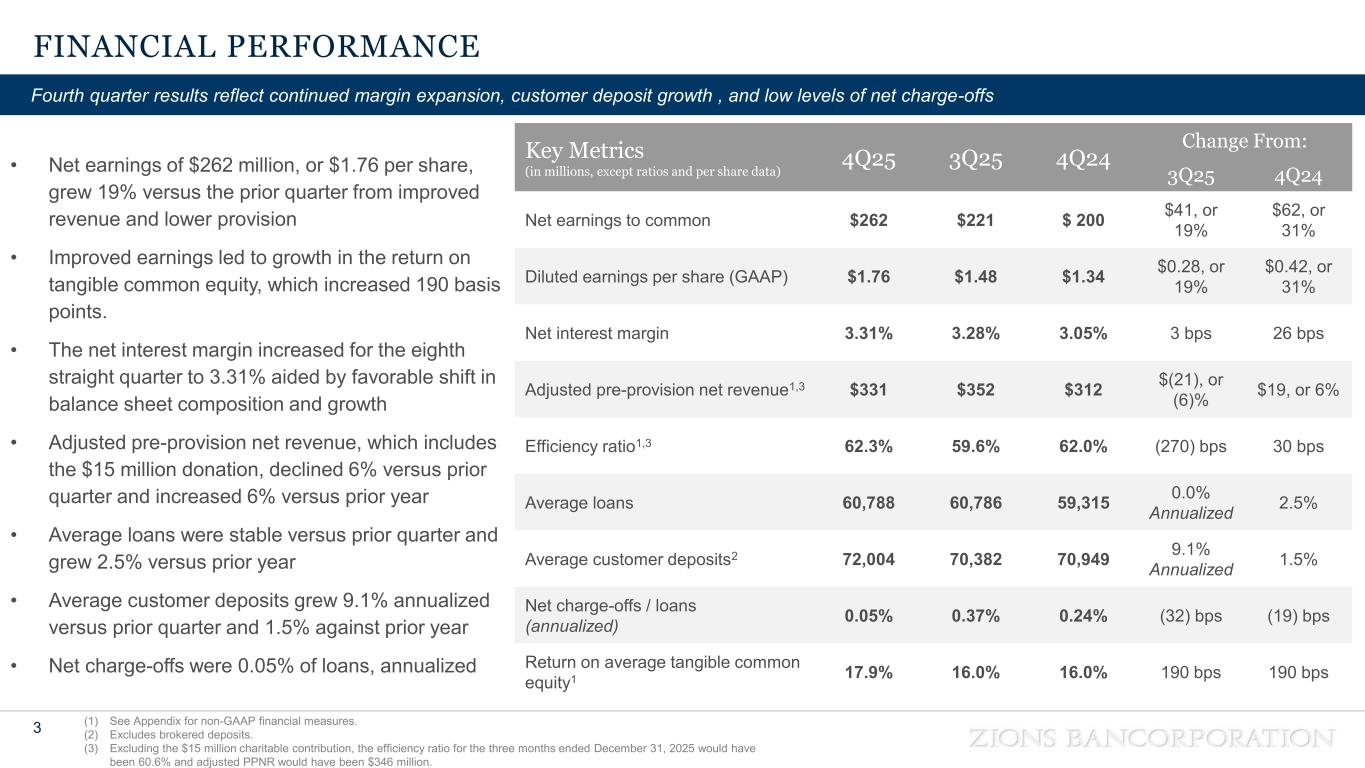
Fourth quarter results reflect continued margin expansion, customer deposit growth , and low levels of net charge-offs FINANCIAL PERFORMANCE 3 (1) See Appendix for non-GAAP financial measures. (2) Excludes brokered deposits. (3) Excluding the $15 million charitable contribution, the efficiency ratio for the three months ended December 31, 2025 would have been 60.6% and adjusted PPNR would have been $346 million. • Net earnings of $262 million, or $1.76 per share, grew 19% versus the prior quarter from improved revenue and lower provision • Improved earnings led to growth in the return on tangible common equity, which increased 190 basis points. • The net interest margin increased for the eighth straight quarter to 3.31% aided by favorable shift in balance sheet composition and growth • Adjusted pre-provision net revenue, which includes the $15 million donation, declined 6% versus prior quarter and increased 6% versus prior year • Average loans were stable versus prior quarter and grew 2.5% versus prior year • Average customer deposits grew 9.1% annualized versus prior quarter and 1.5% against prior year • Net charge-offs were 0.05% of loans, annualized Key Metrics (in millions, except ratios and per share data) 4Q25 3Q25 4Q24 Change From: 3Q25 4Q24 Net earnings to common $262 $221 $ 200 $41, or 19% $62, or 31% Diluted earnings per share (GAAP) $1.76 $1.48 $1.34 $0.28, or 19% $0.42, or 31% Net interest margin 3.31% 3.28% 3.05% 3 bps 26 bps Adjusted pre-provision net revenue1,3 $331 $352 $312 $(21), or (6)% $19, or 6% Efficiency ratio1,3 62.3% 59.6% 62.0% (270) bps 30 bps Average loans 60,788 60,786 59,315 0.0% Annualized 2.5% Average customer deposits2 72,004 70,382 70,949 9.1% Annualized 1.5% Net charge-offs / loans (annualized) 0.05% 0.37% 0.24% (32) bps (19) bps Return on average tangible common equity1 17.9% 16.0% 16.0% 190 bps 190 bps
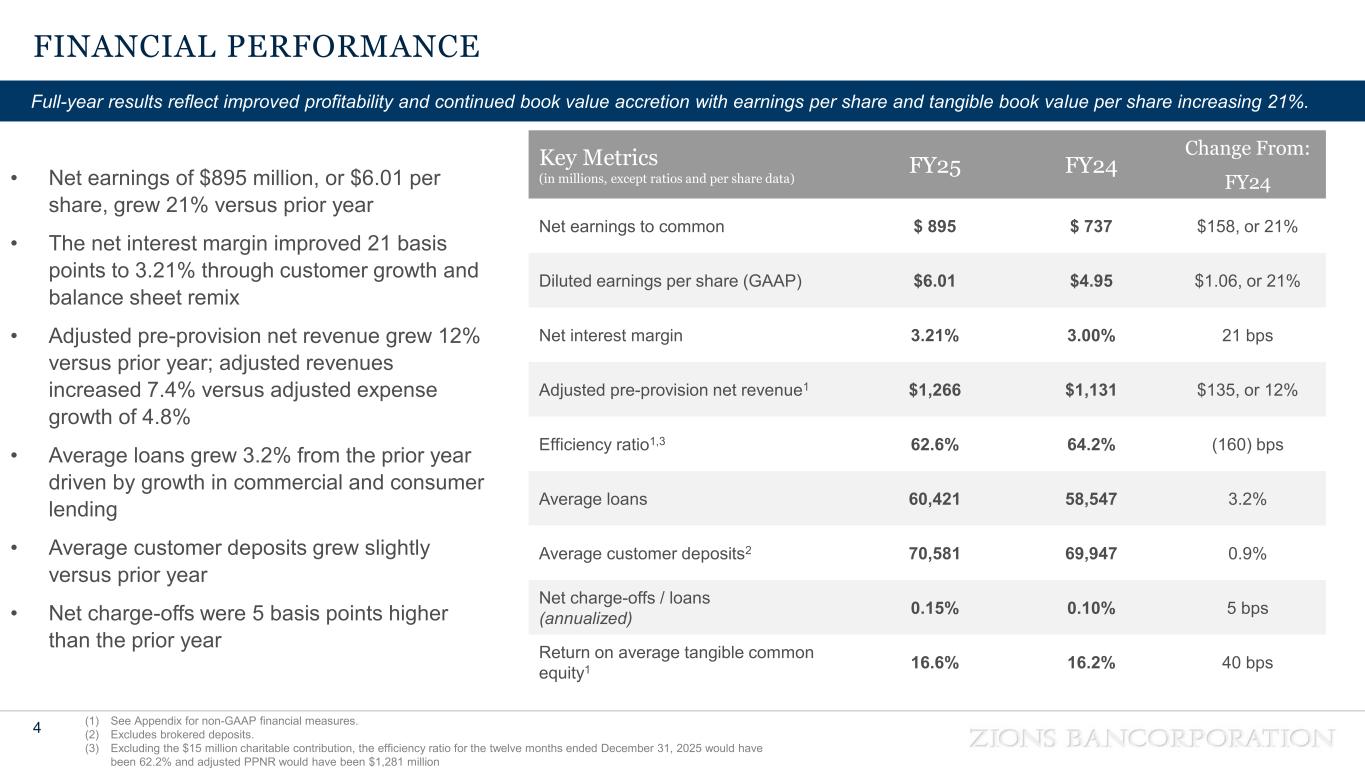
Full-year results reflect improved profitability and continued book value accretion with earnings per share and tangible book value per share increasing 21%. FINANCIAL PERFORMANCE 4 (1) See Appendix for non-GAAP financial measures. (2) Excludes brokered deposits. (3) Excluding the $15 million charitable contribution, the efficiency ratio for the twelve months ended December 31, 2025 would have been 62.2% and adjusted PPNR would have been $1,281 million • Net earnings of $895 million, or $6.01 per share, grew 21% versus prior year • The net interest margin improved 21 basis points to 3.21% through customer growth and balance sheet remix • Adjusted pre-provision net revenue grew 12% versus prior year; adjusted revenues increased 7.4% versus adjusted expense growth of 4.8% • Average loans grew 3.2% from the prior year driven by growth in commercial and consumer lending • Average customer deposits grew slightly versus prior year • Net charge-offs were 5 basis points higher than the prior year Key Metrics (in millions, except ratios and per share data) FY25 FY24 Change From: FY24 Net earnings to common $ 895 $ 737 $158, or 21% Diluted earnings per share (GAAP) $6.01 $4.95 $1.06, or 21% Net interest margin 3.21% 3.00% 21 bps Adjusted pre-provision net revenue1 $1,266 $1,131 $135, or 12% Efficiency ratio1,3 62.6% 64.2% (160) bps Average loans 60,421 58,547 3.2% Average customer deposits2 70,581 69,947 0.9% Net charge-offs / loans (annualized) 0.15% 0.10% 5 bps Return on average tangible common equity1 16.6% 16.2% 40 bps
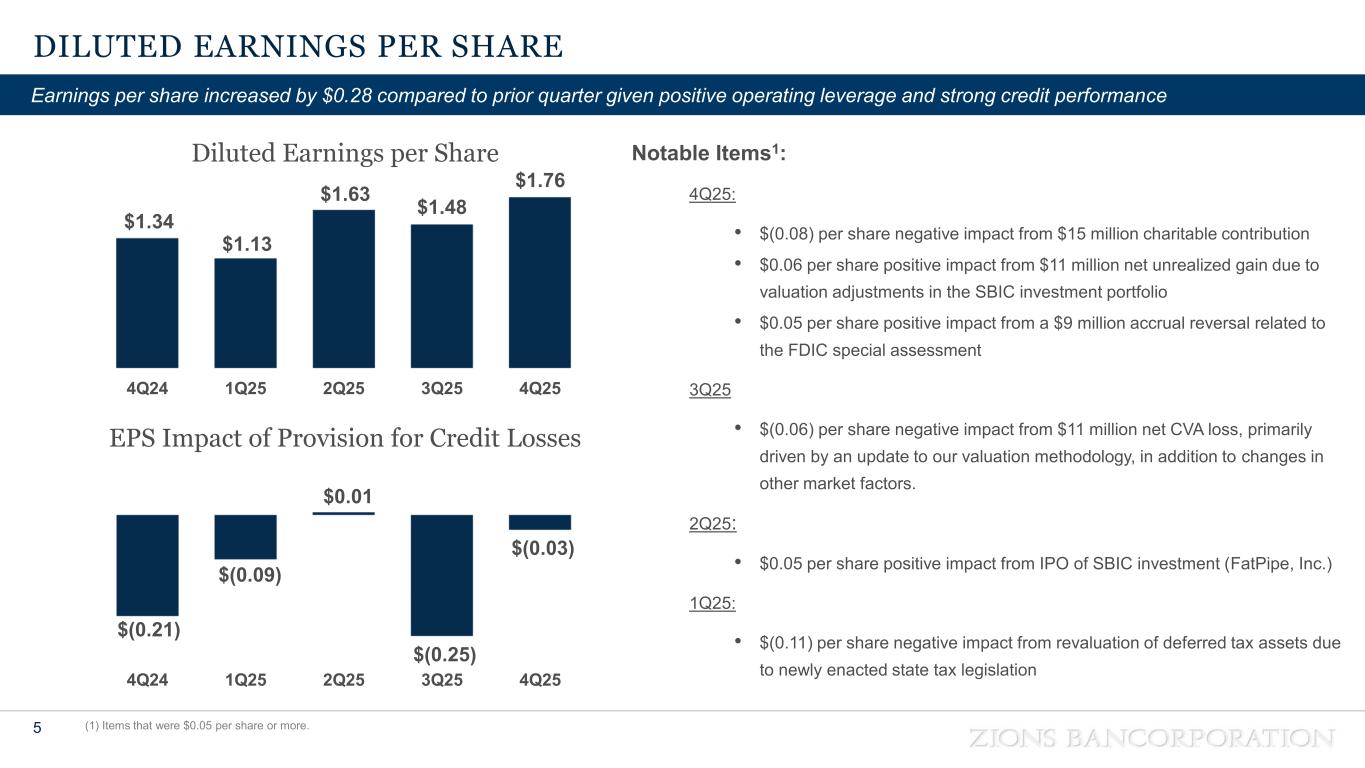
DILUTED EARNINGS PER SHARE 5 (1) Items that were $0.05 per share or more. Earnings per share increased by $0.28 compared to prior quarter given positive operating leverage and strong credit performance Diluted Earnings per Share EPS Impact of Provision for Credit Losses Notable Items1: 4Q25: • $(0.08) per share negative impact from $15 million charitable contribution • $0.06 per share positive impact from $11 million net unrealized gain due to valuation adjustments in the SBIC investment portfolio • $0.05 per share positive impact from a $9 million accrual reversal related to the FDIC special assessment 3Q25 • $(0.06) per share negative impact from $11 million net CVA loss, primarily driven by an update to our valuation methodology, in addition to changes in other market factors. 2Q25: • $0.05 per share positive impact from IPO of SBIC investment (FatPipe, Inc.) 1Q25: • $(0.11) per share negative impact from revaluation of deferred tax assets due to newly enacted state tax legislation $1.34 $1.13 $1.63 $1.48 $1.76 4Q24 1Q25 2Q25 3Q25 4Q25 $(0.21) $(0.09) $0.01 $(0.25) $(0.03) 4Q24 1Q25 2Q25 3Q25 4Q25
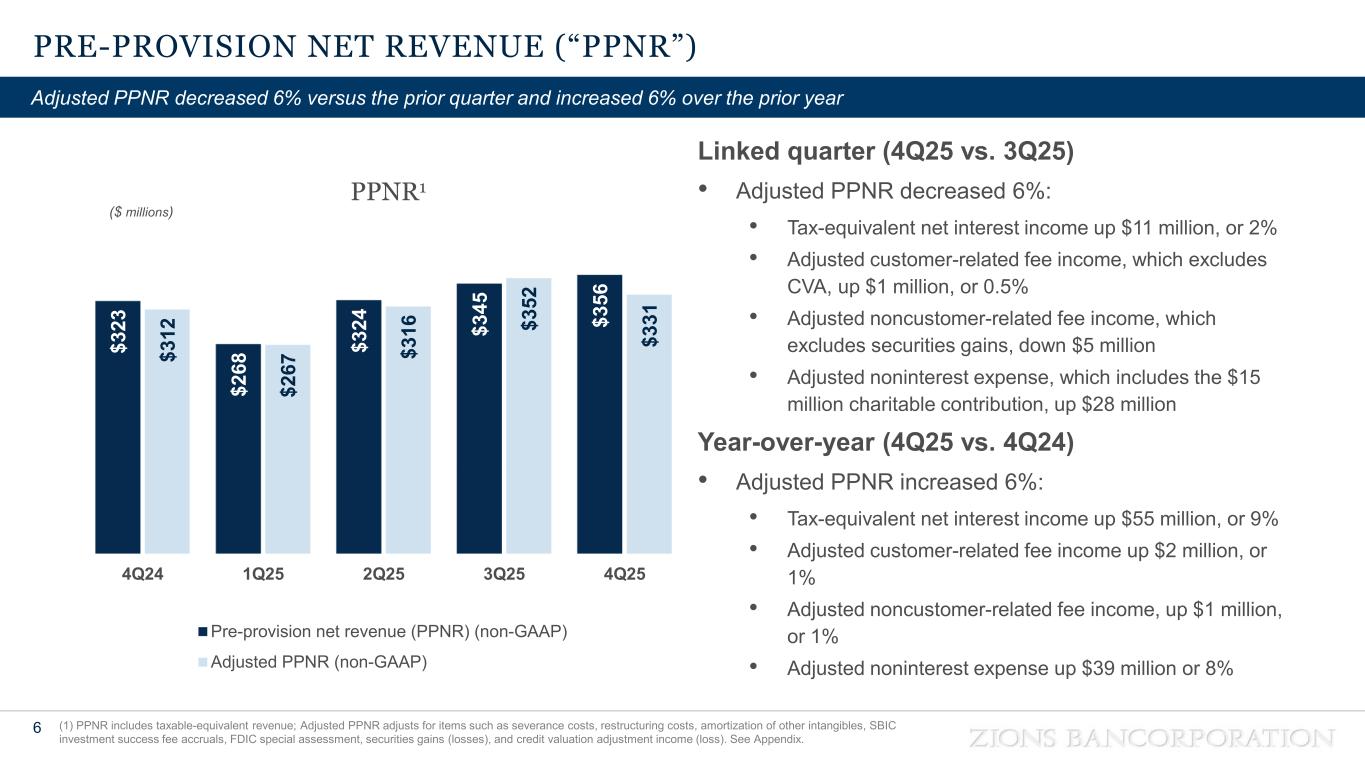
PRE-PROVISION NET REVENUE (“PPNR”) 6 (1) PPNR includes taxable-equivalent revenue; Adjusted PPNR adjusts for items such as severance costs, restructuring costs, amortization of other intangibles, SBIC investment success fee accruals, FDIC special assessment, securities gains (losses), and credit valuation adjustment income (loss). See Appendix. Adjusted PPNR decreased 6% versus the prior quarter and increased 6% over the prior year Linked quarter (4Q25 vs. 3Q25) • Adjusted PPNR decreased 6%: • Tax-equivalent net interest income up $11 million, or 2% • Adjusted customer-related fee income, which excludes CVA, up $1 million, or 0.5% • Adjusted noncustomer-related fee income, which excludes securities gains, down $5 million • Adjusted noninterest expense, which includes the $15 million charitable contribution, up $28 million Year-over-year (4Q25 vs. 4Q24) • Adjusted PPNR increased 6%: • Tax-equivalent net interest income up $55 million, or 9% • Adjusted customer-related fee income up $2 million, or 1% • Adjusted noncustomer-related fee income, up $1 million, or 1% • Adjusted noninterest expense up $39 million or 8% $ 3 2 3 $ 2 6 8 $ 3 2 4 $ 3 4 5 $ 3 5 6 $ 3 1 2 $ 2 6 7 $ 3 1 6 $ 3 5 2 $ 3 3 1 4Q24 1Q25 2Q25 3Q25 4Q25 Pre-provision net revenue (PPNR) (non-GAAP) Adjusted PPNR (non-GAAP) PPNR1 ($ millions)
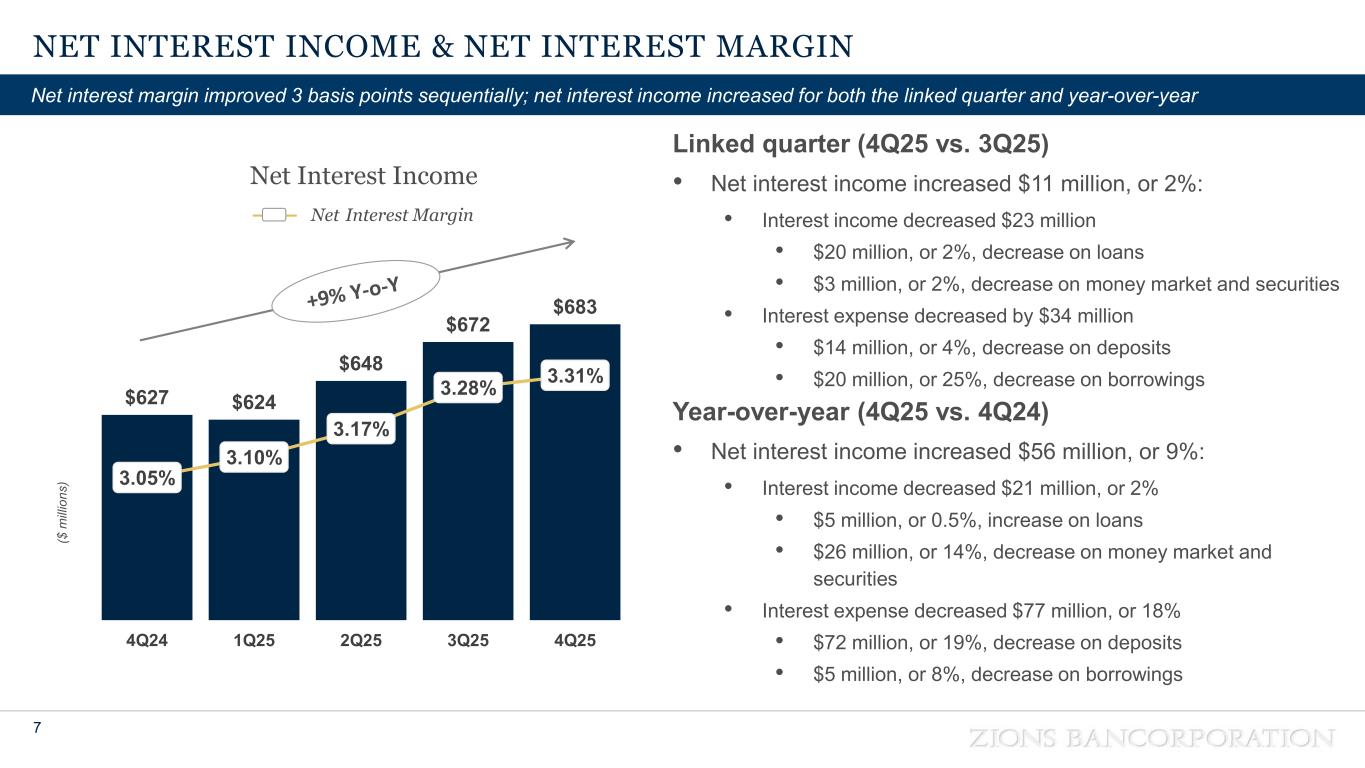
NET INTEREST INCOME & NET INTEREST MARGIN 7 Net interest margin improved 3 basis points sequentially; net interest income increased for both the linked quarter and year-over-year $627 $624 $648 $672 $683 3.05% 3.10% 3.17% 3.28% 3.31% 2.70% 2.80% 2.90% 3.00% 3.10% 3.20% 3.30% 3.40% 3.50% $500 4Q24 1Q25 2Q25 3Q25 4Q25 Net Interest Income Net Interest Margin ($ m ill io n s ) Linked quarter (4Q25 vs. 3Q25) • Net interest income increased $11 million, or 2%: • Interest income decreased $23 million • $20 million, or 2%, decrease on loans • $3 million, or 2%, decrease on money market and securities • Interest expense decreased by $34 million • $14 million, or 4%, decrease on deposits • $20 million, or 25%, decrease on borrowings Year-over-year (4Q25 vs. 4Q24) • Net interest income increased $56 million, or 9%: • Interest income decreased $21 million, or 2% • $5 million, or 0.5%, increase on loans • $26 million, or 14%, decrease on money market and securities • Interest expense decreased $77 million, or 18% • $72 million, or 19%, decrease on deposits • $5 million, or 8%, decrease on borrowings
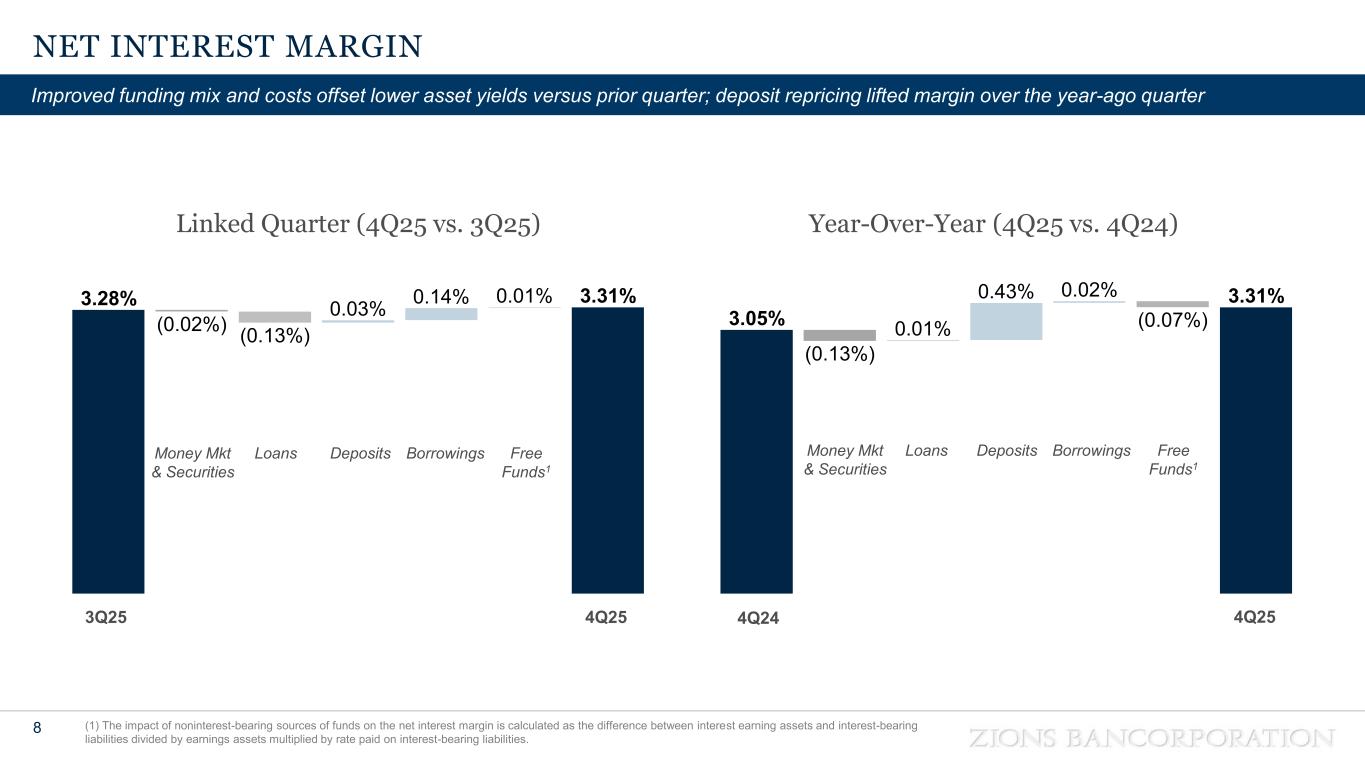
(0.13%) 0.01% 0.43% 0.02% (0.07%)3.05% 3.31% (0.02%) (0.13%) 0.03% 0.14% 0.01% 3.28% 3.31% NET INTEREST MARGIN 8 (1) The impact of noninterest-bearing sources of funds on the net interest margin is calculated as the difference between interest earning assets and interest-bearing liabilities divided by earnings assets multiplied by rate paid on interest-bearing liabilities. Improved funding mix and costs offset lower asset yields versus prior quarter; deposit repricing lifted margin over the year-ago quarter Year-Over-Year (4Q25 vs. 4Q24)Linked Quarter (4Q25 vs. 3Q25) Loans DepositsMoney Mkt & Securities Borrowings Free Funds1 Loans DepositsMoney Mkt & Securities Borrowings Free Funds1 4Q24 4Q253Q25 4Q25
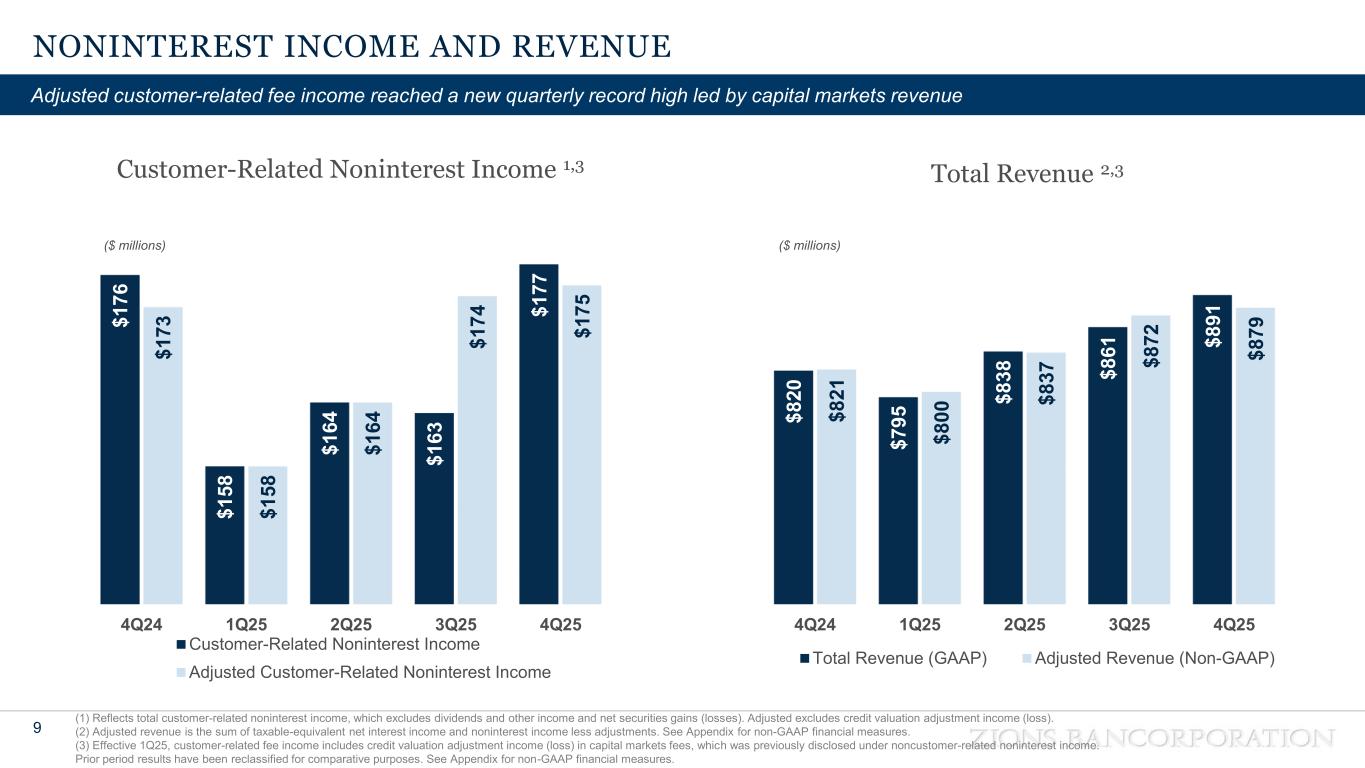
NONINTEREST INCOME AND REVENUE 9 (1) Reflects total customer-related noninterest income, which excludes dividends and other income and net securities gains (losses). Adjusted excludes credit valuation adjustment income (loss). (2) Adjusted revenue is the sum of taxable-equivalent net interest income and noninterest income less adjustments. See Appendix for non-GAAP financial measures. (3) Effective 1Q25, customer-related fee income includes credit valuation adjustment income (loss) in capital markets fees, which was previously disclosed under noncustomer-related noninterest income. Prior period results have been reclassified for comparative purposes. See Appendix for non-GAAP financial measures. Adjusted customer-related fee income reached a new quarterly record high led by capital markets revenue Customer-Related Noninterest Income 1,3 ($ millions) $ 8 2 0 $ 7 9 5 $ 8 3 8 $ 8 6 1 $ 8 9 1 $ 8 2 1 $ 8 0 0 $ 8 3 7 $ 8 7 2 $ 8 7 9 4Q24 1Q25 2Q25 3Q25 4Q25 Total Revenue (GAAP) Adjusted Revenue (Non-GAAP) Total Revenue 2,3 ($ millions) $ 1 7 6 $ 1 5 8 $ 1 6 4 $ 1 6 3 $ 1 7 7 $ 1 7 3 $ 1 5 8 $ 1 6 4 $ 1 7 4 $ 1 7 5 4Q24 1Q25 2Q25 3Q25 4Q25 Customer-Related Noninterest Income Adjusted Customer-Related Noninterest Income
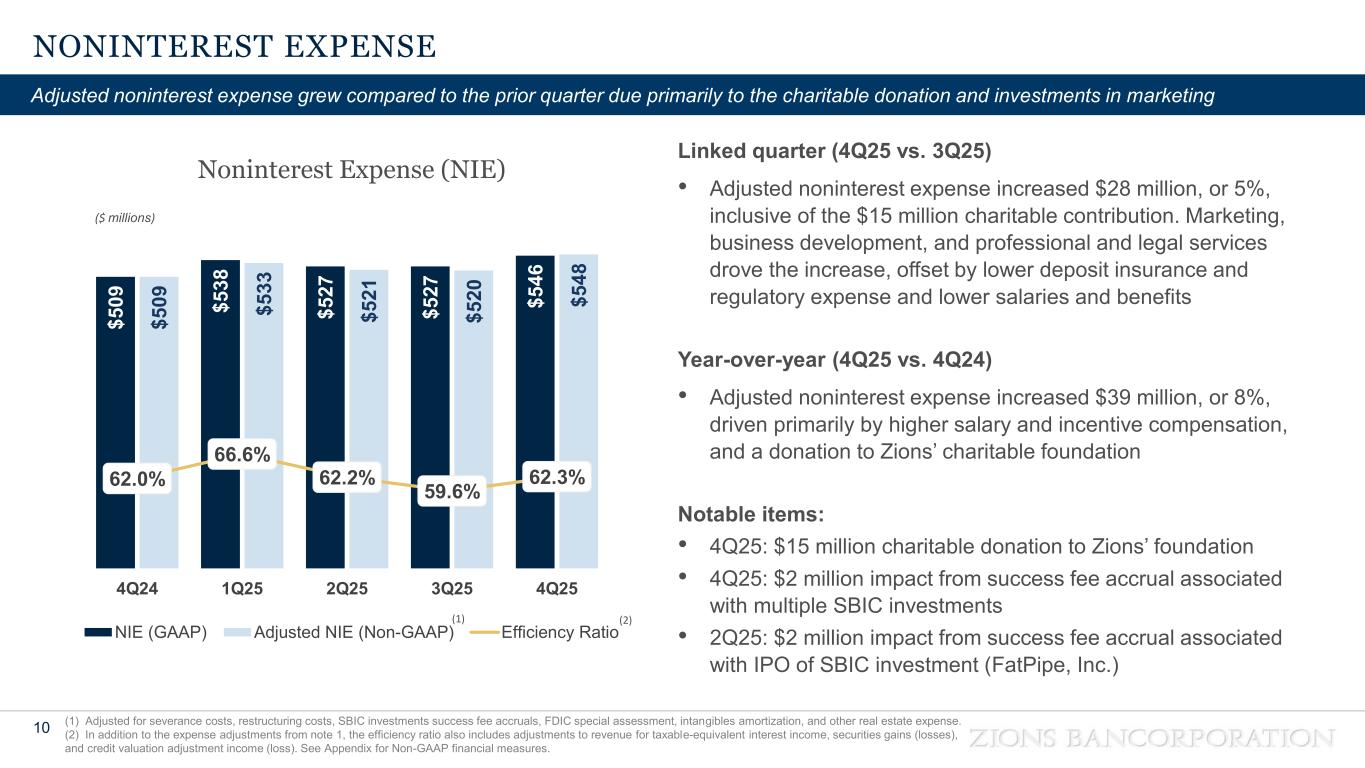
NONINTEREST EXPENSE 10 (1) Adjusted for severance costs, restructuring costs, SBIC investments success fee accruals, FDIC special assessment, intangibles amortization, and other real estate expense. (2) In addition to the expense adjustments from note 1, the efficiency ratio also includes adjustments to revenue for taxable-equivalent interest income, securities gains (losses), and credit valuation adjustment income (loss). See Appendix for Non-GAAP financial measures. Adjusted noninterest expense grew compared to the prior quarter due primarily to the charitable donation and investments in marketing Linked quarter (4Q25 vs. 3Q25) • Adjusted noninterest expense increased $28 million, or 5%, inclusive of the $15 million charitable contribution. Marketing, business development, and professional and legal services drove the increase, offset by lower deposit insurance and regulatory expense and lower salaries and benefits Year-over-year (4Q25 vs. 4Q24) • Adjusted noninterest expense increased $39 million, or 8%, driven primarily by higher salary and incentive compensation, and a donation to Zions’ charitable foundation Notable items: • 4Q25: $15 million charitable donation to Zions’ foundation • 4Q25: $2 million impact from success fee accrual associated with multiple SBIC investments • 2Q25: $2 million impact from success fee accrual associated with IPO of SBIC investment (FatPipe, Inc.) $ 5 0 9 $ 5 3 8 $ 5 2 7 $ 5 2 7 $ 5 4 6 $ 5 0 9 $ 5 3 3 $ 5 2 1 $ 5 2 0 $ 5 4 8 62.0% 66.6% 62.2% 59.6% 62.3% 4Q24 1Q25 2Q25 3Q25 4Q25 NIE (GAAP) Adjusted NIE (Non-GAAP) Efficiency Ratio ($ millions) Noninterest Expense (NIE) (1) (2)
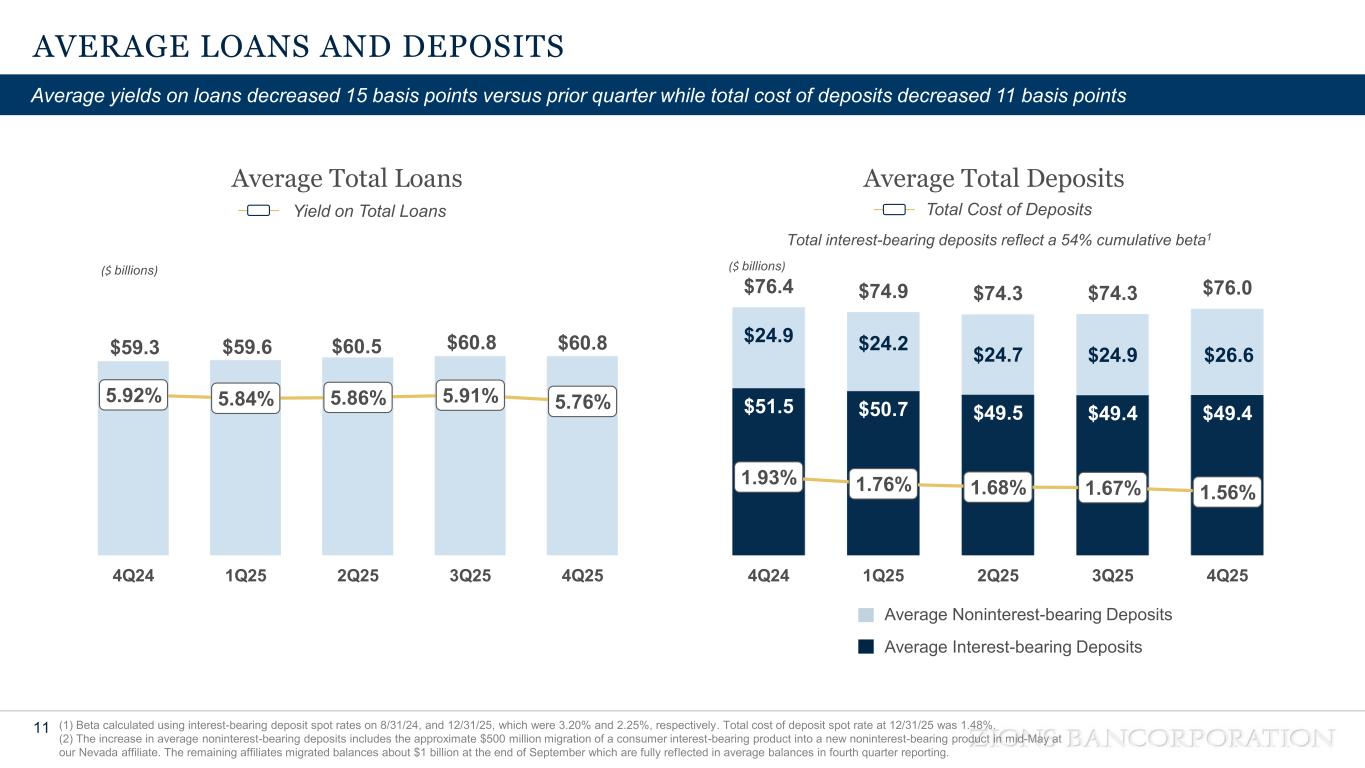
$59.3 $59.6 $60.5 $60.8 $60.8 5.92% 5.84% 5.86% 5.91% 5.76% 4Q24 1Q25 2Q25 3Q25 4Q25 ($ billions) AVERAGE LOANS AND DEPOSITS 11 (1) Beta calculated using interest-bearing deposit spot rates on 8/31/24, and 12/31/25, which were 3.20% and 2.25%, respectively. Total cost of deposit spot rate at 12/31/25 was 1.48%. (2) The increase in average noninterest-bearing deposits includes the approximate $500 million migration of a consumer interest-bearing product into a new noninterest-bearing product in mid-May at our Nevada affiliate. The remaining affiliates migrated balances about $1 billion at the end of September which are fully reflected in average balances in fourth quarter reporting. Average yields on loans decreased 15 basis points versus prior quarter while total cost of deposits decreased 11 basis points Average Total Loans Yield on Total Loans Average Total Deposits Total Cost of Deposits $51.5 $50.7 $49.5 $49.4 $49.4 $24.9 $24.2 $24.7 $24.9 $26.6 $76.4 $74.9 $74.3 $74.3 $76.0 1.93% 1.76% 1.68% 1.67% 1.56% 4Q24 1Q25 2Q25 3Q25 4Q25 ($ billions) Average Noninterest-bearing Deposits Average Interest-bearing Deposits Total interest-bearing deposits reflect a 54% cumulative beta1
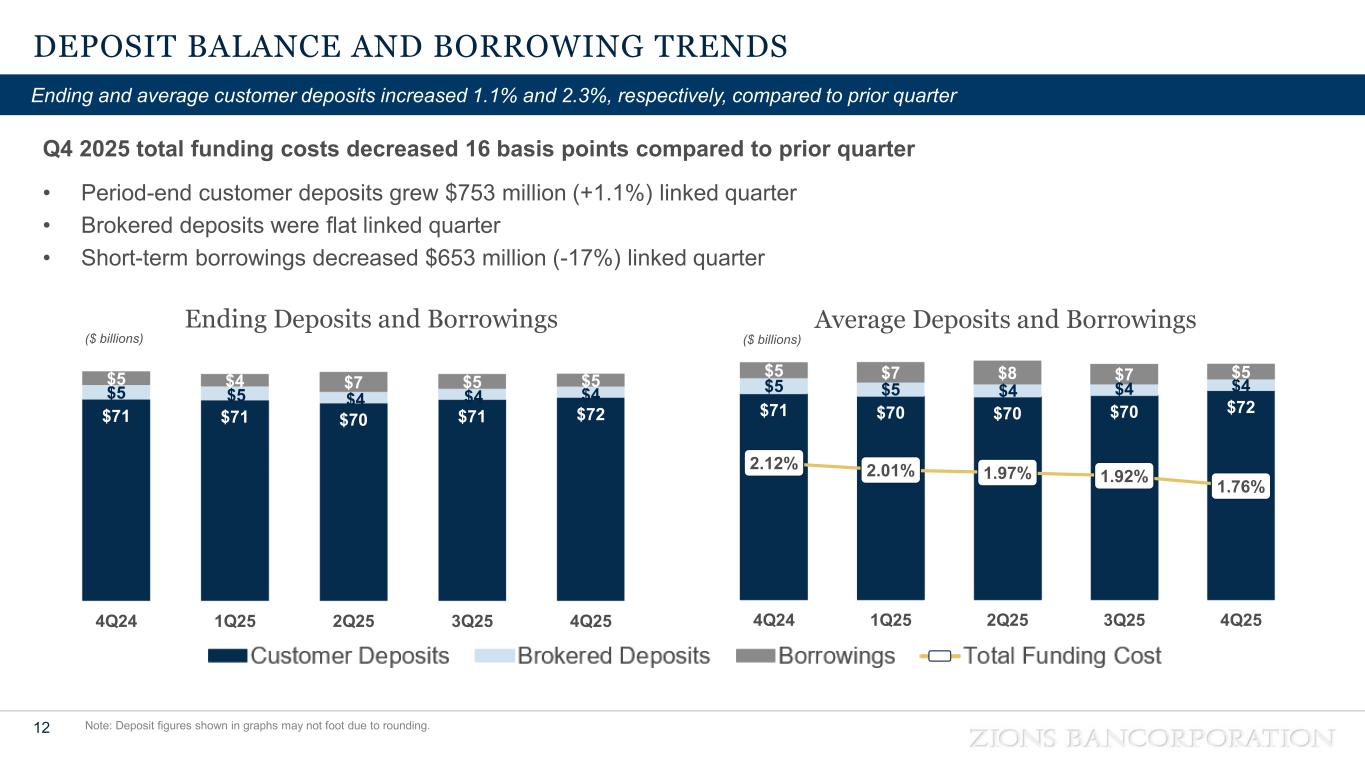
$71 $71 $70 $71 $72 $5 $5 $4 $4 $4 $5 $4 $7 $5 $5 - 10 20 30 40 50 60 70 80 90 100 4Q24 1Q25 2Q25 3Q25 4Q25 $71 $70 $70 $70 $72 $5 $5 $4 $4 $4 $5 $7 $8 $7 $5 2.12% 2.01% 1.97% 1.92% 1.76% 0.00% 0.50% 1.00% 1.50% 2.00% 2.50% 3.00% 3.50% 4.00% 4.50% - 10 20 30 40 50 60 70 80 90 100 4Q24 1Q25 2Q25 3Q25 4Q25 DEPOSIT BALANCE AND BORROWING TRENDS 12 Note: Deposit figures shown in graphs may not foot due to rounding. Ending and average customer deposits increased 1.1% and 2.3%, respectively, compared to prior quarter Q4 2025 total funding costs decreased 16 basis points compared to prior quarter • Period-end customer deposits grew $753 million (+1.1%) linked quarter • Brokered deposits were flat linked quarter • Short-term borrowings decreased $653 million (-17%) linked quarter Average Deposits and Borrowings ($ billions) Ending Deposits and Borrowings ($ billions)
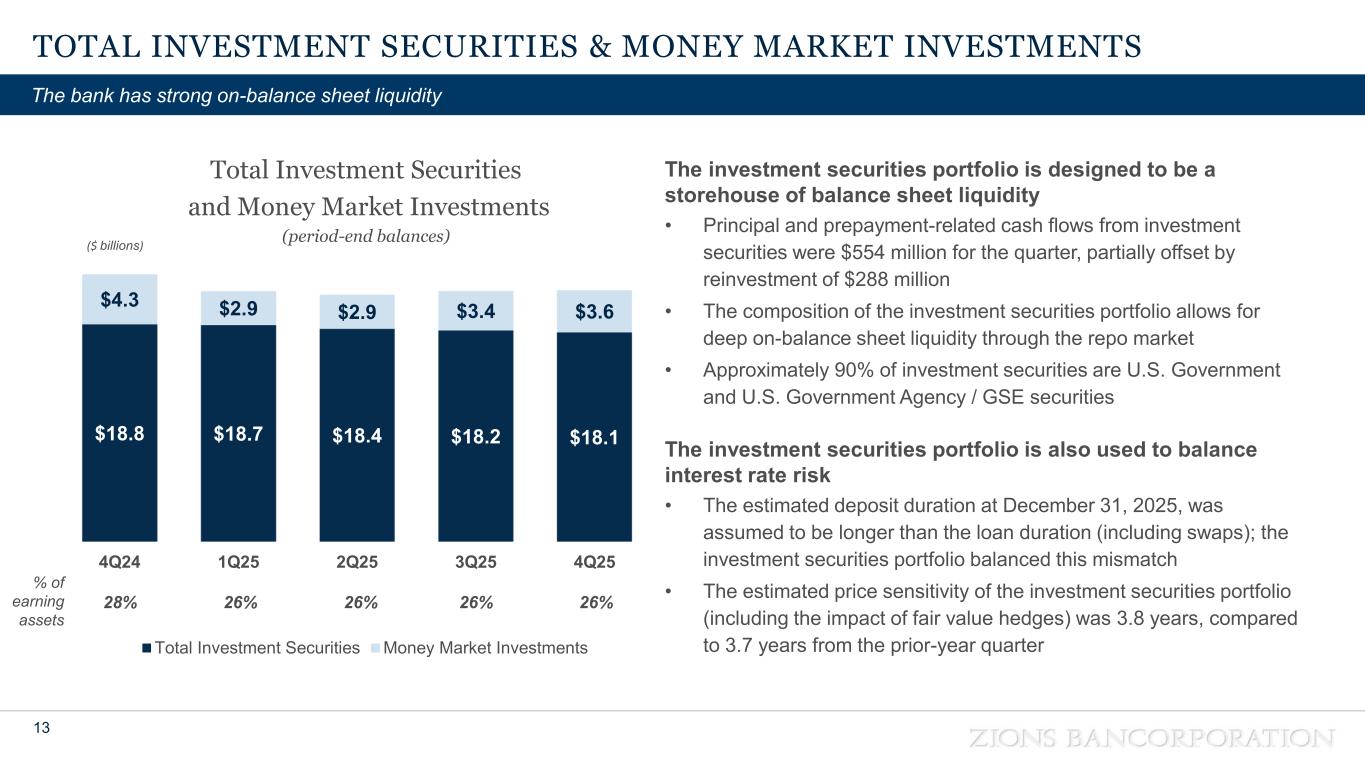
TOTAL INVESTMENT SECURITIES & MONEY MARKET INVESTMENTS 13 The bank has strong on-balance sheet liquidity The investment securities portfolio is designed to be a storehouse of balance sheet liquidity • Principal and prepayment-related cash flows from investment securities were $554 million for the quarter, partially offset by reinvestment of $288 million • The composition of the investment securities portfolio allows for deep on-balance sheet liquidity through the repo market • Approximately 90% of investment securities are U.S. Government and U.S. Government Agency / GSE securities The investment securities portfolio is also used to balance interest rate risk • The estimated deposit duration at December 31, 2025, was assumed to be longer than the loan duration (including swaps); the investment securities portfolio balanced this mismatch • The estimated price sensitivity of the investment securities portfolio (including the impact of fair value hedges) was 3.8 years, compared to 3.7 years from the prior-year quarter Total Investment Securities and Money Market Investments (period-end balances) $18.8 $18.7 $18.4 $18.2 $18.1 $4.3 $2.9 $2.9 $3.4 $3.6 4Q24 1Q25 2Q25 3Q25 4Q25 Total Investment Securities Money Market Investments 28% 26% 26% 26% 26% % of earning assets ($ billions)
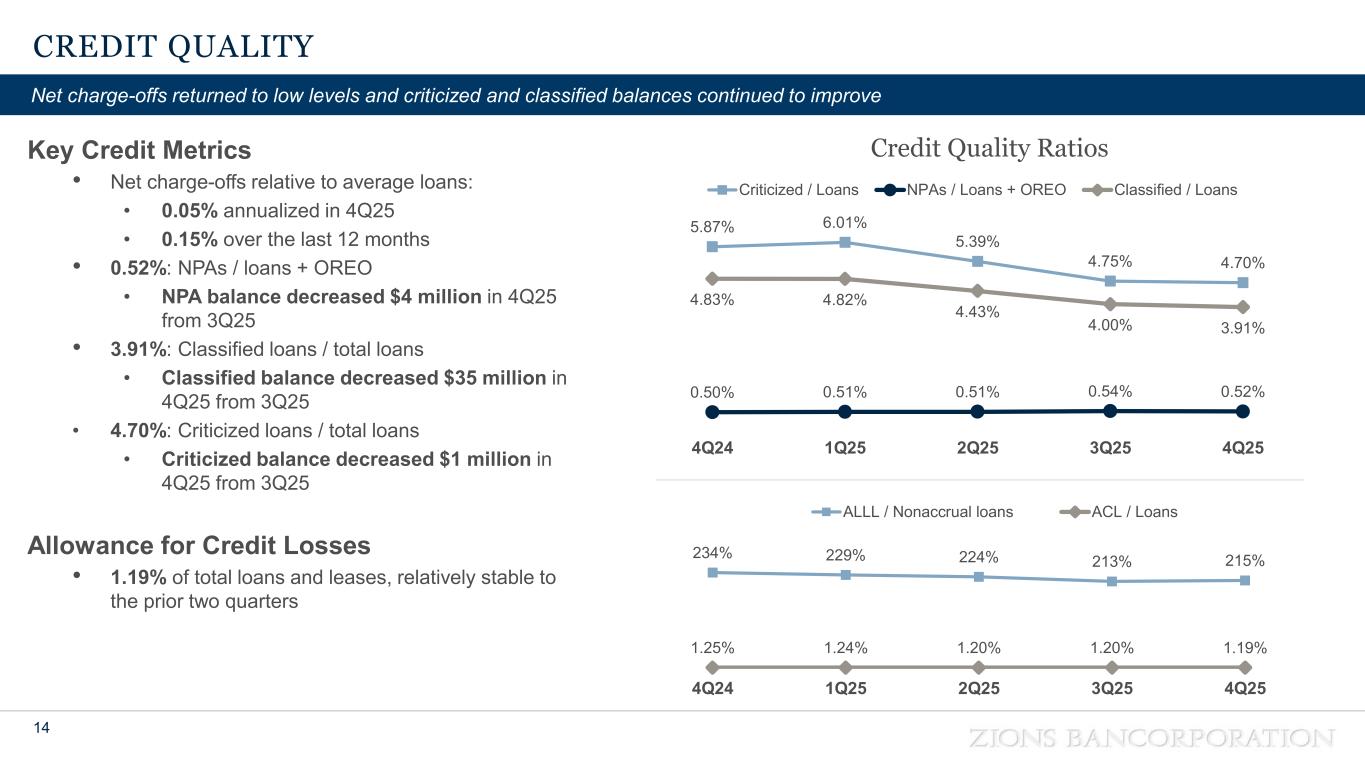
CREDIT QUALITY 14 Net charge-offs returned to low levels and criticized and classified balances continued to improve Key Credit Metrics • Net charge-offs relative to average loans: • 0.05% annualized in 4Q25 • 0.15% over the last 12 months • 0.52%: NPAs / loans + OREO • NPA balance decreased $4 million in 4Q25 from 3Q25 • 3.91%: Classified loans / total loans • Classified balance decreased $35 million in 4Q25 from 3Q25 • 4.70%: Criticized loans / total loans • Criticized balance decreased $1 million in 4Q25 from 3Q25 Allowance for Credit Losses • 1.19% of total loans and leases, relatively stable to the prior two quarters Credit Quality Ratios 5.87% 6.01% 5.39% 4.75% 4.70% 0.50% 0.51% 0.51% 0.54% 0.52% 4.83% 4.82% 4.43% 4.00% 3.91% 4Q24 1Q25 2Q25 3Q25 4Q25 Criticized / Loans NPAs / Loans + OREO Classified / Loans 234% 229% 224% 213% 215% 1.25% 1.24% 1.20% 1.20% 1.19% 4Q24 1Q25 2Q25 3Q25 4Q25 ALLL / Nonaccrual loans ACL / Loans
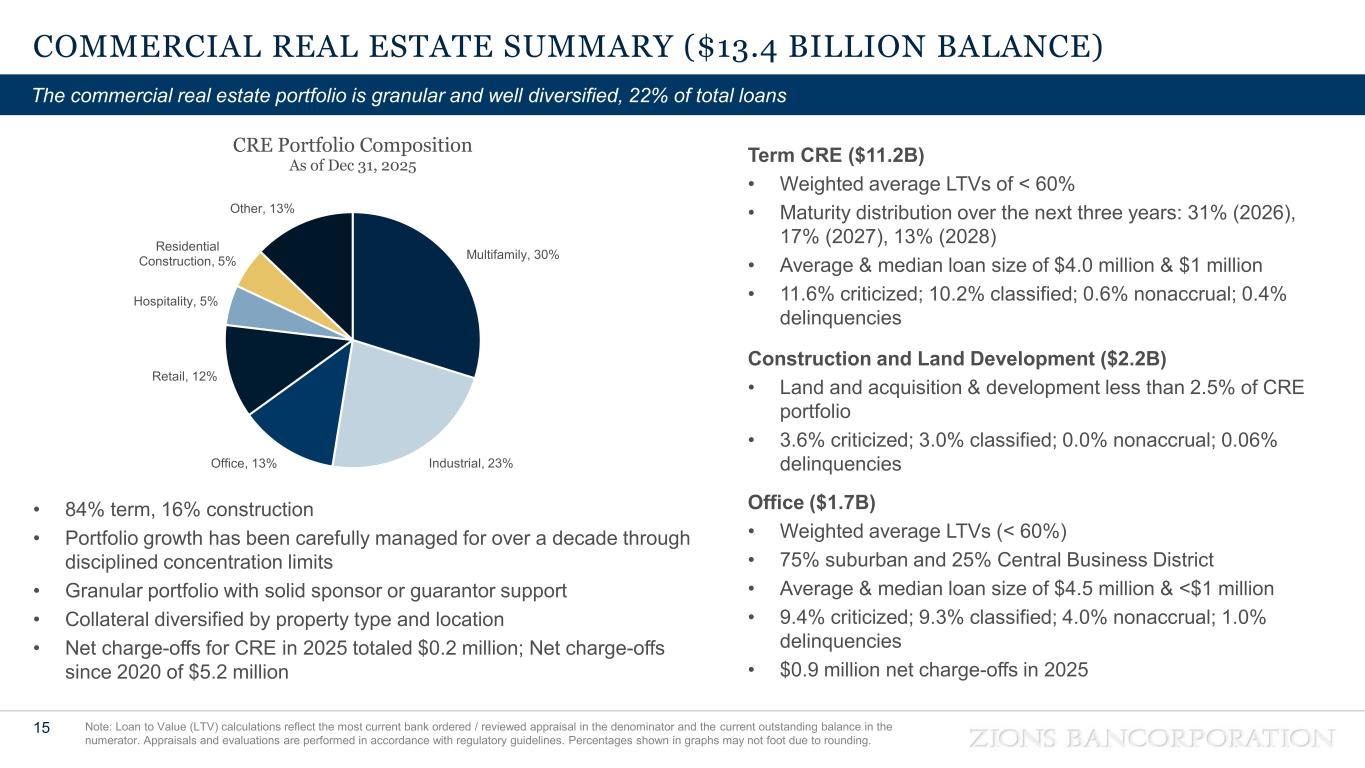
COMMERCIAL REAL ESTATE SUMMARY ($13.4 BILLION BALANCE) 15 Note: Loan to Value (LTV) calculations reflect the most current bank ordered / reviewed appraisal in the denominator and the current outstanding balance in the numerator. Appraisals and evaluations are performed in accordance with regulatory guidelines. Percentages shown in graphs may not foot due to rounding. The commercial real estate portfolio is granular and well diversified, 22% of total loans Term CRE ($11.2B) • Weighted average LTVs of < 60% • Maturity distribution over the next three years: 31% (2026), 17% (2027), 13% (2028) • Average & median loan size of $4.0 million & $1 million • 11.6% criticized; 10.2% classified; 0.6% nonaccrual; 0.4% delinquencies Construction and Land Development ($2.2B) • Land and acquisition & development less than 2.5% of CRE portfolio • 3.6% criticized; 3.0% classified; 0.0% nonaccrual; 0.06% delinquencies Office ($1.7B) • Weighted average LTVs (< 60%) • 75% suburban and 25% Central Business District • Average & median loan size of $4.5 million & <$1 million • 9.4% criticized; 9.3% classified; 4.0% nonaccrual; 1.0% delinquencies • $0.9 million net charge-offs in 2025 • 84% term, 16% construction • Portfolio growth has been carefully managed for over a decade through disciplined concentration limits • Granular portfolio with solid sponsor or guarantor support • Collateral diversified by property type and location • Net charge-offs for CRE in 2025 totaled $0.2 million; Net charge-offs since 2020 of $5.2 million Multifamily, 30% Industrial, 23%Office, 13% Retail, 12% Hospitality, 5% Residential Construction, 5% Other, 13% CRE Portfolio Composition As of Dec 31, 2025
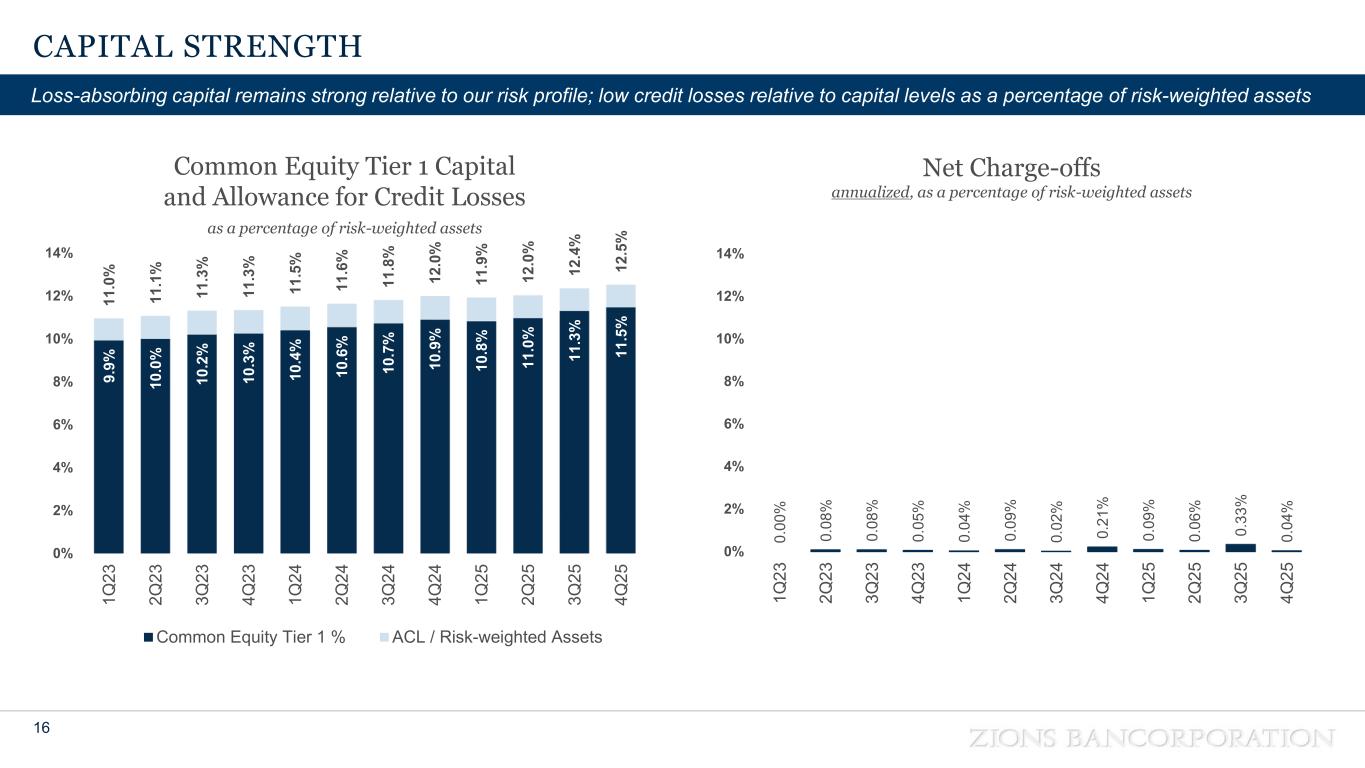
9 .9 % 1 0 .0 % 1 0 .2 % 1 0 .3 % 1 0 .4 % 1 0 .6 % 1 0 .7 % 1 0 .9 % 1 0 .8 % 1 1 .0 % 1 1 .3 % 1 1 .5 % 1 1 .0 % 1 1 .1 % 1 1 .3 % 1 1 .3 % 1 1 .5 % 1 1 .6 % 1 1 .8 % 1 2 .0 % 1 1 .9 % 1 2 .0 % 1 2 .4 % 1 2 .5 % 0% 2% 4% 6% 8% 10% 12% 14% 1 Q 2 3 2 Q 2 3 3 Q 2 3 4 Q 2 3 1 Q 2 4 2 Q 2 4 3 Q 2 4 4 Q 2 4 1 Q 2 5 2 Q 2 5 3 Q 2 5 4 Q 2 5 Common Equity Tier 1 % ACL / Risk-weighted Assets CAPITAL STRENGTH 16 Loss-absorbing capital remains strong relative to our risk profile; low credit losses relative to capital levels as a percentage of risk-weighted assets Net Charge-offs annualized, as a percentage of risk-weighted assets 0 .0 0 % 0 .0 8 % 0 .0 8 % 0 .0 5 % 0 .0 4 % 0 .0 9 % 0 .0 2 % 0 .2 1 % 0 .0 9 % 0 .0 6 % 0 .3 3 % 0 .0 4 % 0% 2% 4% 6% 8% 10% 12% 14% 1 Q 2 3 2 Q 2 3 3 Q 2 3 4 Q 2 3 1 Q 2 4 2 Q 2 4 3 Q 2 4 4 Q 2 4 1 Q 2 5 2 Q 2 5 3 Q 2 5 4 Q 2 5 Common Equity Tier 1 Capital and Allowance for Credit Losses as a percentage of risk-weighted assets
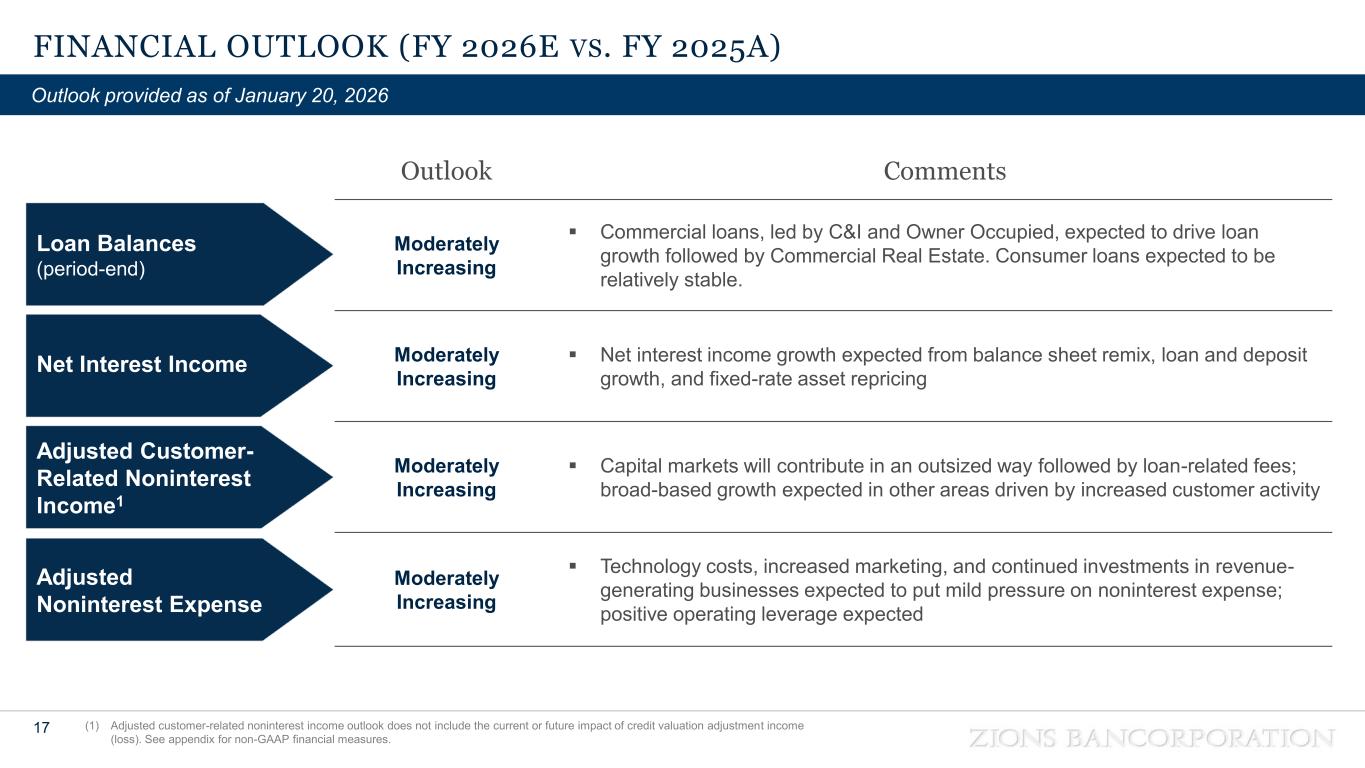
FINANCIAL OUTLOOK (FY 2026E VS. FY 2025A) 17 Outlook provided as of January 20, 2026 Outlook Comments Moderately Increasing ▪ Commercial loans, led by C&I and Owner Occupied, expected to drive loan growth followed by Commercial Real Estate. Consumer loans expected to be relatively stable. Moderately Increasing ▪ Net interest income growth expected from balance sheet remix, loan and deposit growth, and fixed-rate asset repricing Moderately Increasing ▪ Capital markets will contribute in an outsized way followed by loan-related fees; broad-based growth expected in other areas driven by increased customer activity Moderately Increasing ▪ Technology costs, increased marketing, and continued investments in revenue- generating businesses expected to put mild pressure on noninterest expense; positive operating leverage expected Adjusted Customer- Related Noninterest Income1 Loan Balances (period-end) Net Interest Income Adjusted Noninterest Expense (1) Adjusted customer-related noninterest income outlook does not include the current or future impact of credit valuation adjustment income (loss). See appendix for non-GAAP financial measures.
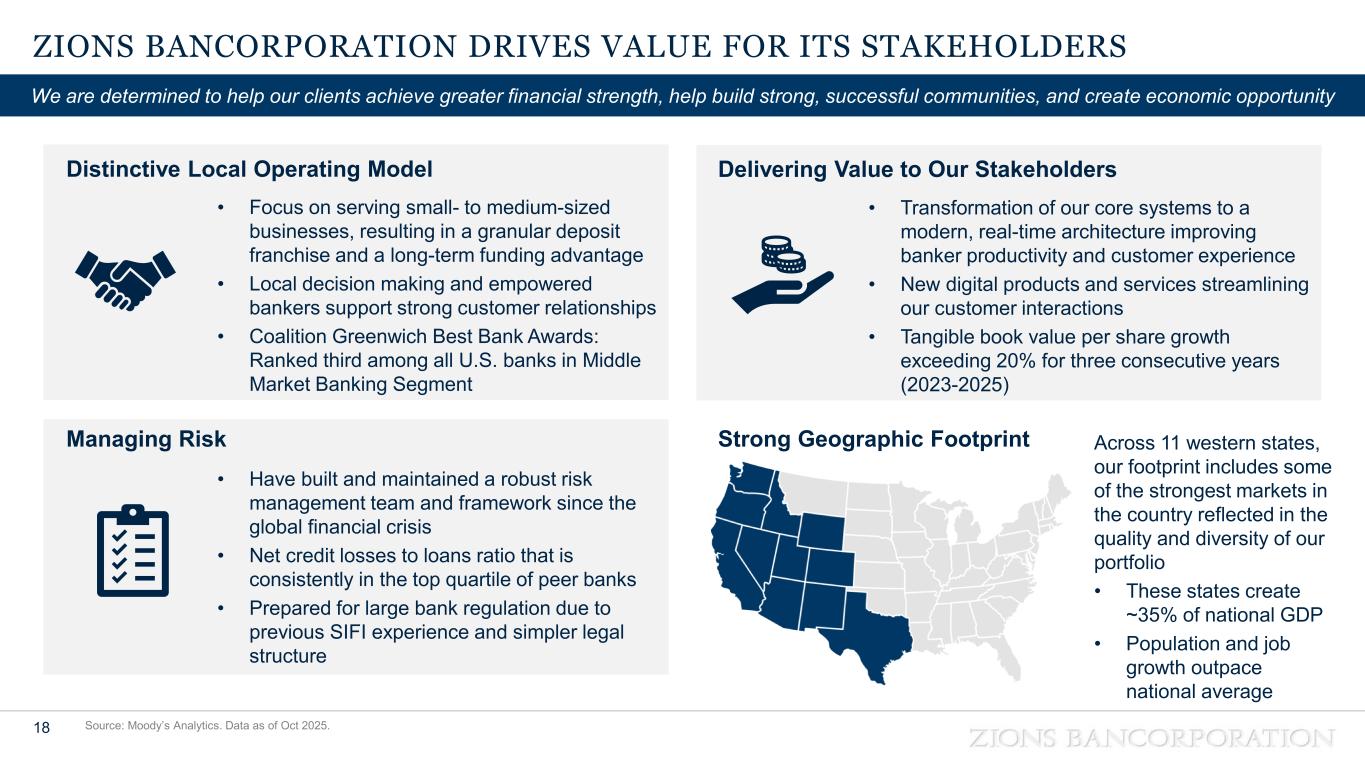
ZIONS BANCORPORATION DRIVES VALUE FOR ITS STAKEHOLDERS 18 Source: Moody’s Analytics. Data as of Oct 2025. We are determined to help our clients achieve greater financial strength, help build strong, successful communities, and create economic opportunity Distinctive Local Operating Model Managing Risk Delivering Value to Our Stakeholders • Transformation of our core systems to a modern, real-time architecture improving banker productivity and customer experience • New digital products and services streamlining our customer interactions • Tangible book value per share growth exceeding 20% for three consecutive years (2023-2025) • Focus on serving small- to medium-sized businesses, resulting in a granular deposit franchise and a long-term funding advantage • Local decision making and empowered bankers support strong customer relationships • Coalition Greenwich Best Bank Awards: Ranked third among all U.S. banks in Middle Market Banking Segment • Have built and maintained a robust risk management team and framework since the global financial crisis • Net credit losses to loans ratio that is consistently in the top quartile of peer banks • Prepared for large bank regulation due to previous SIFI experience and simpler legal structure Across 11 western states, our footprint includes some of the strongest markets in the country reflected in the quality and diversity of our portfolio • These states create ~35% of national GDP • Population and job growth outpace national average Strong Geographic Footprint
APPENDIX 19 • Financial Results Summary • Accumulated Other Comprehensive Income (AOCI) • Balance Sheet Profitability • Loan Growth by Bank Brand and Loan Type • Allowance and Credit Metrics • Earning Asset Repricing • Interest Rate Swaps • Interest Rate Sensitivity • Credit Quality Trends • Loan Loss Severity (NCOs as a percentage of nonaccrual loans) • Credit Metrics: Commercial Real Estate • Loans to Non-Depository Financial Institutions • Non-GAAP Financial Measures
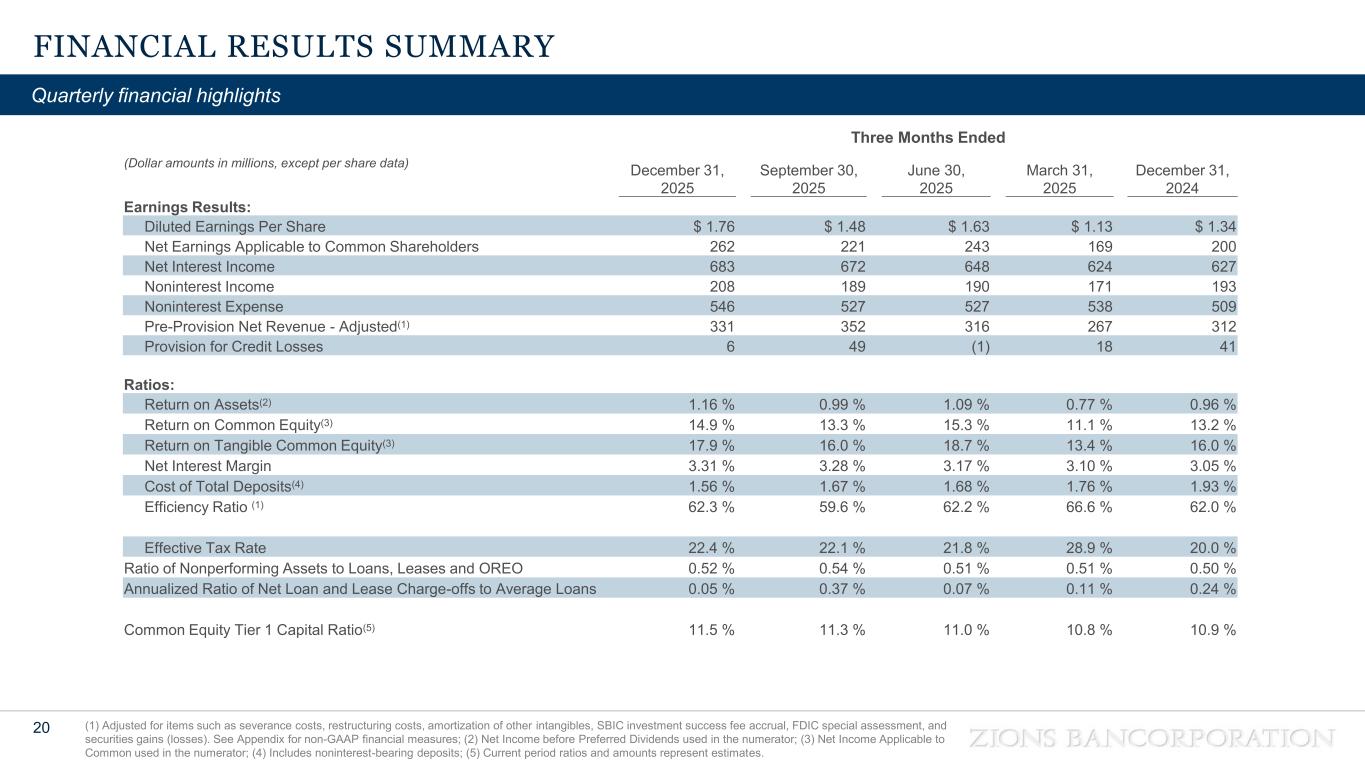
FINANCIAL RESULTS SUMMARY 20 (1) Adjusted for items such as severance costs, restructuring costs, amortization of other intangibles, SBIC investment success fee accrual, FDIC special assessment, and securities gains (losses). See Appendix for non-GAAP financial measures; (2) Net Income before Preferred Dividends used in the numerator; (3) Net Income Applicable to Common used in the numerator; (4) Includes noninterest-bearing deposits; (5) Current period ratios and amounts represent estimates. Quarterly financial highlights Three Months Ended (Dollar amounts in millions, except per share data) December 31, 2025 September 30, 2025 June 30, 2025 March 31, 2025 December 31, 2024 Earnings Results: Diluted Earnings Per Share $ 1.76 $ 1.48 $ 1.63 $ 1.13 $ 1.34 Net Earnings Applicable to Common Shareholders 262 221 243 169 200 Net Interest Income 683 672 648 624 627 Noninterest Income 208 189 190 171 193 Noninterest Expense 546 527 527 538 509 Pre-Provision Net Revenue - Adjusted(1) 331 352 316 267 312 Provision for Credit Losses 6 49 (1) 18 41 Ratios: Return on Assets(2) 1.16 % 0.99 % 1.09 % 0.77 % 0.96 % Return on Common Equity(3) 14.9 % 13.3 % 15.3 % 11.1 % 13.2 % Return on Tangible Common Equity(3) 17.9 % 16.0 % 18.7 % 13.4 % 16.0 % Net Interest Margin 3.31 % 3.28 % 3.17 % 3.10 % 3.05 % Cost of Total Deposits(4) 1.56 % 1.67 % 1.68 % 1.76 % 1.93 % Efficiency Ratio (1) 62.3 % 59.6 % 62.2 % 66.6 % 62.0 % Effective Tax Rate 22.4 % 22.1 % 21.8 % 28.9 % 20.0 % Ratio of Nonperforming Assets to Loans, Leases and OREO 0.52 % 0.54 % 0.51 % 0.51 % 0.50 % Annualized Ratio of Net Loan and Lease Charge-offs to Average Loans 0.05 % 0.37 % 0.07 % 0.11 % 0.24 % Common Equity Tier 1 Capital Ratio(5) 11.5 % 11.3 % 11.0 % 10.8 % 10.9 %
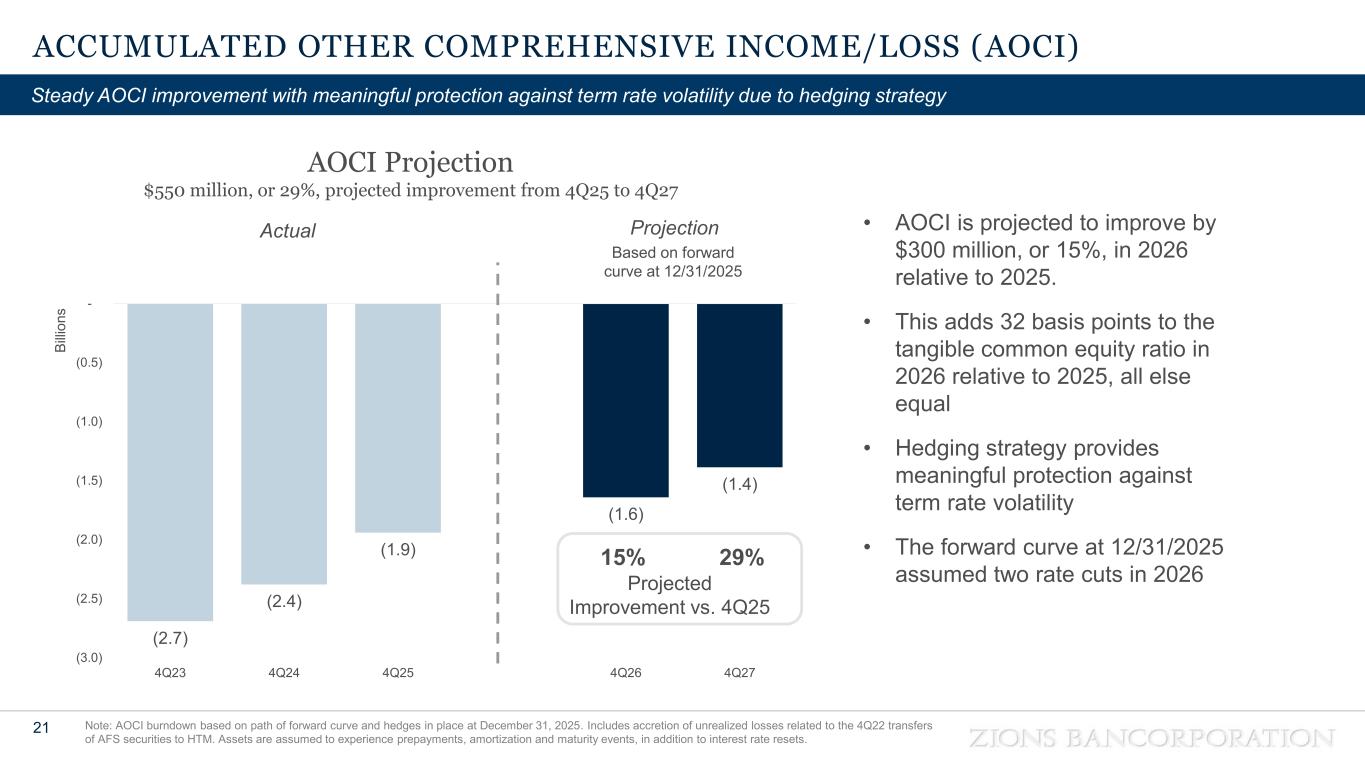
(2.7) (2.4) (1.9) (1.6) (1.4) (3.0) (2.5) (2.0) (1.5) (1.0) (0.5) - 4Q23 4Q24 4Q25 4Q26 4Q27 B ill io n s ACCUMULATED OTHER COMPREHENSIVE INCOME/LOSS (AOCI) 21 Note: AOCI burndown based on path of forward curve and hedges in place at December 31, 2025. Includes accretion of unrealized losses related to the 4Q22 transfers of AFS securities to HTM. Assets are assumed to experience prepayments, amortization and maturity events, in addition to interest rate resets. Steady AOCI improvement with meaningful protection against term rate volatility due to hedging strategy • AOCI is projected to improve by $300 million, or 15%, in 2026 relative to 2025. • This adds 32 basis points to the tangible common equity ratio in 2026 relative to 2025, all else equal • Hedging strategy provides meaningful protection against term rate volatility • The forward curve at 12/31/2025 assumed two rate cuts in 2026 Actual Projection Based on forward curve at 12/31/2025 AOCI Projection $550 million, or 29%, projected improvement from 4Q25 to 4Q27 15% 29% Projected Improvement vs. 4Q25
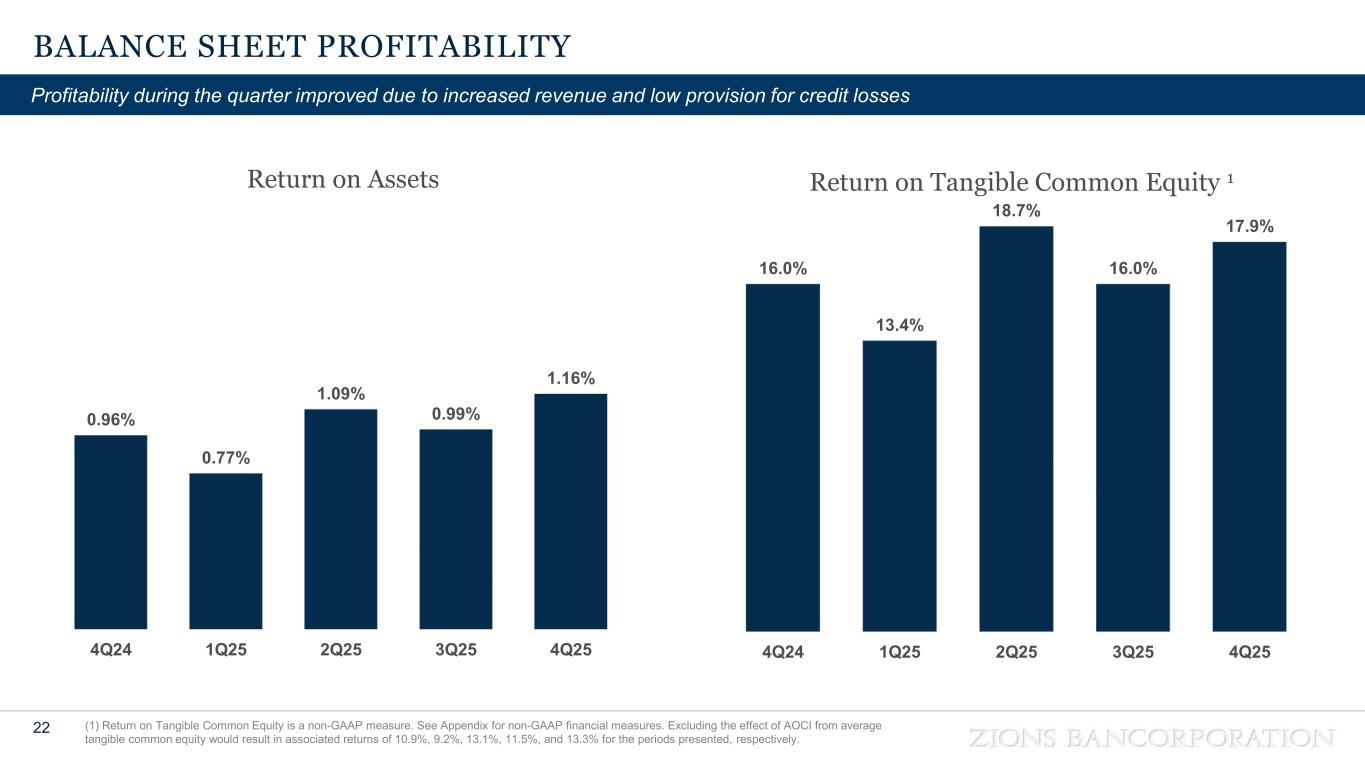
BALANCE SHEET PROFITABILITY 22 (1) Return on Tangible Common Equity is a non-GAAP measure. See Appendix for non-GAAP financial measures. Excluding the effect of AOCI from average tangible common equity would result in associated returns of 10.9%, 9.2%, 13.1%, 11.5%, and 13.3% for the periods presented, respectively. Profitability during the quarter improved due to increased revenue and low provision for credit losses 0.96% 0.77% 1.09% 0.99% 1.16% 4Q24 1Q25 2Q25 3Q25 4Q25 16.0% 13.4% 18.7% 16.0% 17.9% 4Q24 1Q25 2Q25 3Q25 4Q25 Return on Assets Return on Tangible Common Equity 1
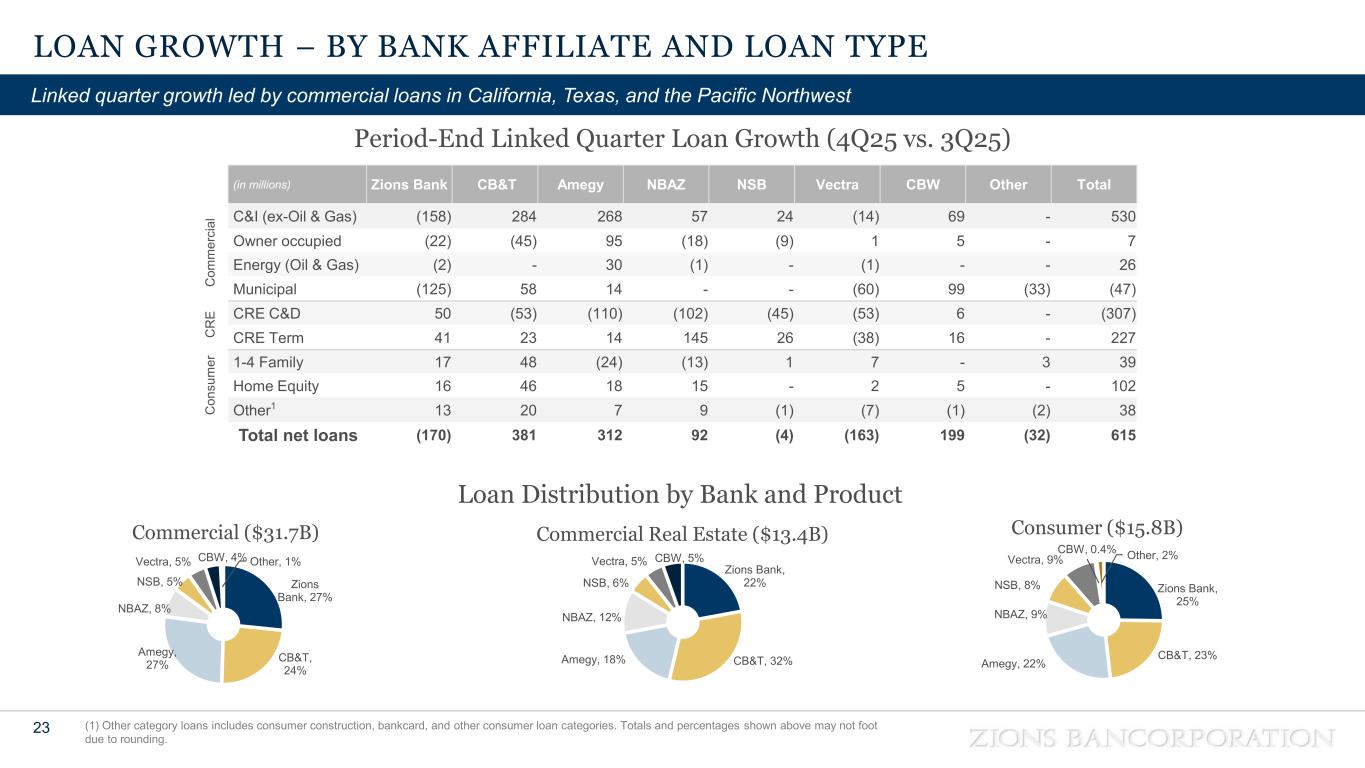
LOAN GROWTH – BY BANK AFFILIATE AND LOAN TYPE 23 (1) Other category loans includes consumer construction, bankcard, and other consumer loan categories. Totals and percentages shown above may not foot due to rounding. Linked quarter growth led by commercial loans in California, Texas, and the Pacific Northwest Zions Bank, 27% CB&T, 24% Amegy, 27% NBAZ, 8% NSB, 5% Vectra, 5% CBW, 4% Other, 1% Commercial ($31.7B) Zions Bank, 22% CB&T, 32%Amegy, 18% NBAZ, 12% NSB, 6% Vectra, 5% CBW, 5% Commercial Real Estate ($13.4B) Consumer ($15.8B) Zions Bank, 25% CB&T, 23% Amegy, 22% NBAZ, 9% NSB, 8% Vectra, 9% CBW, 0.4% Other, 2% Period-End Linked Quarter Loan Growth (4Q25 vs. 3Q25) C o m m e rc ia l C R E C o n s u m e r Loan Distribution by Bank and Product (in millions) Zions Bank CB&T Amegy NBAZ NSB Vectra CBW Other Total C&I (ex-Oil & Gas) (158) 284 268 57 24 (14) 69 - 530 Owner occupied (22) (45) 95 (18) (9) 1 5 - 7 Energy (Oil & Gas) (2) - 30 (1) - (1) - - 26 Municipal (125) 58 14 - - (60) 99 (33) (47) CRE C&D 50 (53) (110) (102) (45) (53) 6 - (307) CRE Term 41 23 14 145 26 (38) 16 - 227 1-4 Family 17 48 (24) (13) 1 7 - 3 39 Home Equity 16 46 18 15 - 2 5 - 102 Other1 13 20 7 9 (1) (7) (1) (2) 38 Total net loans (170) 381 312 92 (4) (163) 199 (32) 615
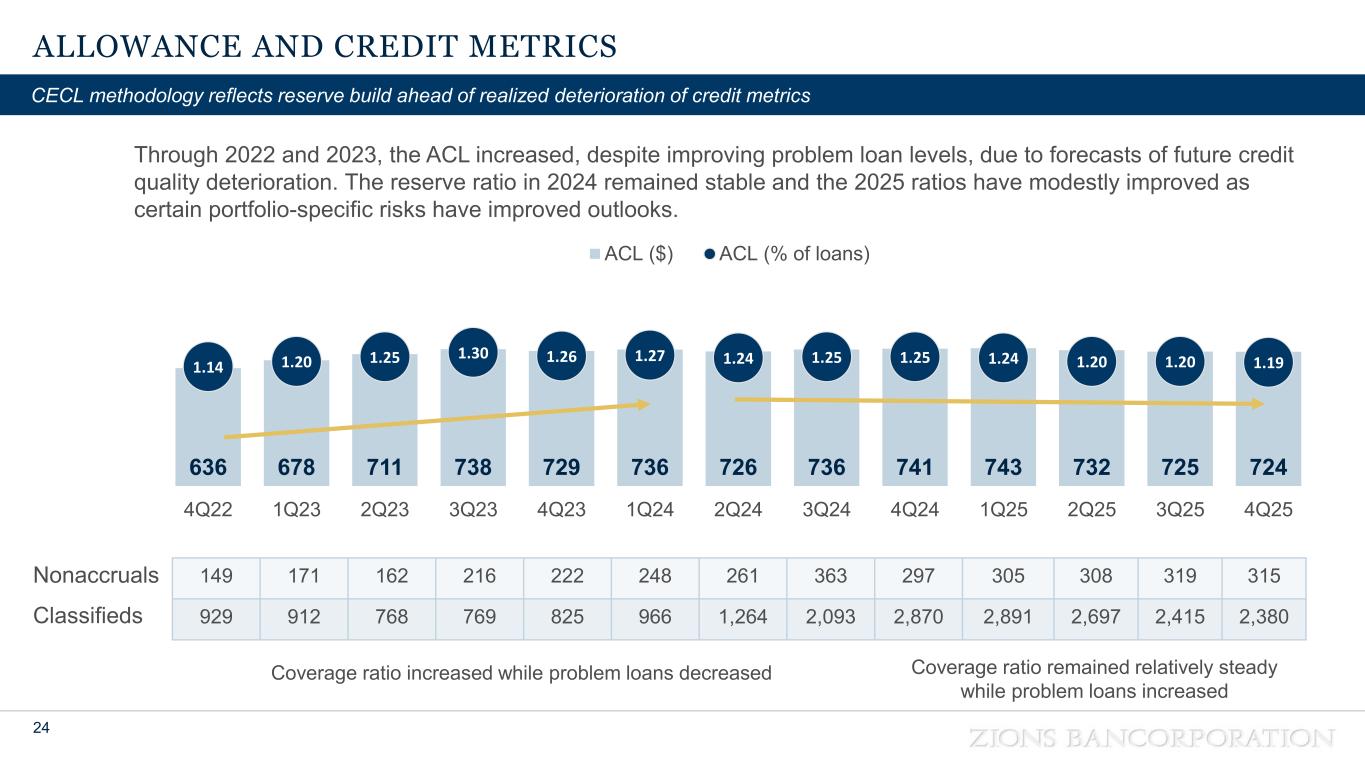
ALLOWANCE AND CREDIT METRICS 24 CECL methodology reflects reserve build ahead of realized deterioration of credit metrics 636 678 711 738 729 736 726 736 741 743 732 725 724 1.14 1.20 1.25 1.30 1.26 1.27 1.24 1.25 1.25 1.24 1.20 1.20 1.19 4Q22 1Q23 2Q23 3Q23 4Q23 1Q24 2Q24 3Q24 4Q24 1Q25 2Q25 3Q25 4Q25 ACL ($) ACL (% of loans) Through 2022 and 2023, the ACL increased, despite improving problem loan levels, due to forecasts of future credit quality deterioration. The reserve ratio in 2024 remained stable and the 2025 ratios have modestly improved as certain portfolio-specific risks have improved outlooks. 149 171 162 216 222 248 261 363 297 305 308 319 315 929 912 768 769 825 966 1,264 2,093 2,870 2,891 2,697 2,415 2,380 Nonaccruals Classifieds Coverage ratio remained relatively steady while problem loans increased Coverage ratio increased while problem loans decreased
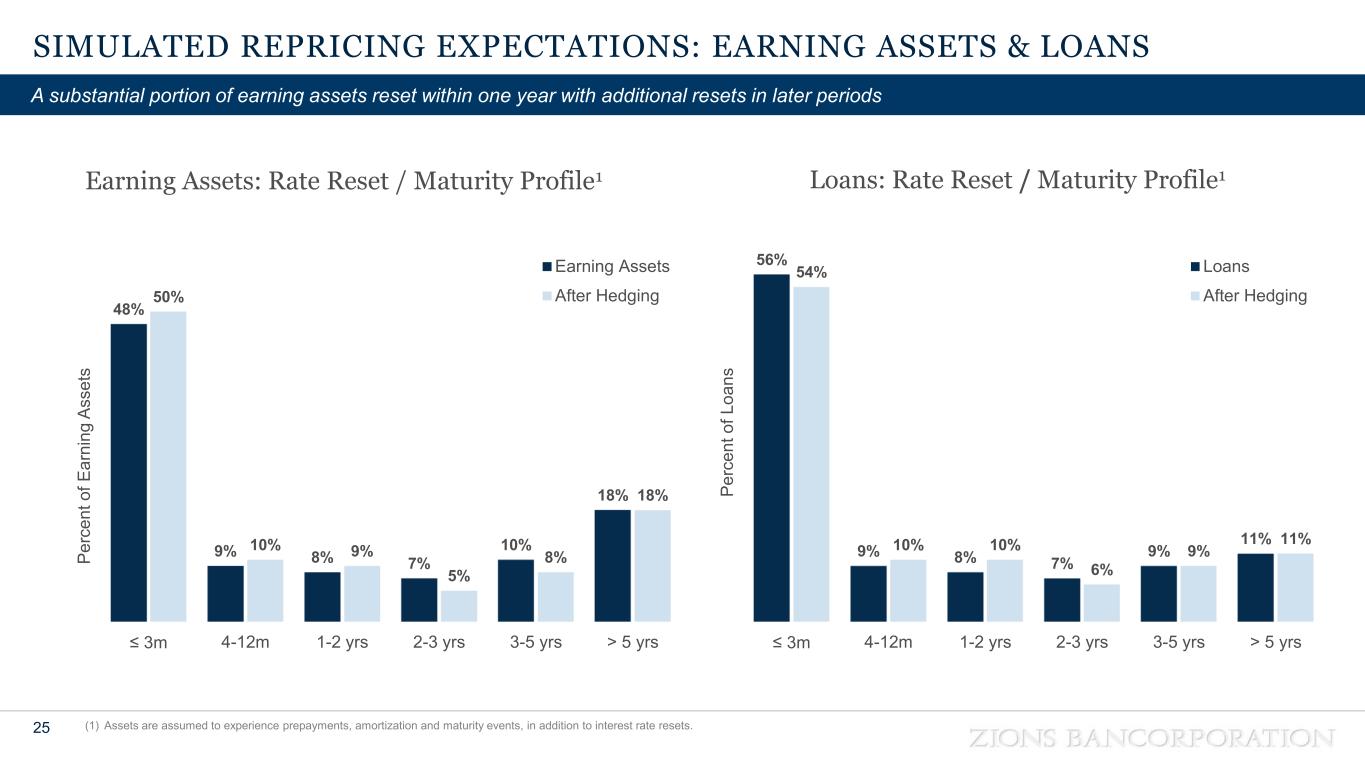
SIMULATED REPRICING EXPECTATIONS: EARNING ASSETS & LOANS 25 (1) Assets are assumed to experience prepayments, amortization and maturity events, in addition to interest rate resets. A substantial portion of earning assets reset within one year with additional resets in later periods 56% 9% 8% 7% 9% 11% 54% 10% 10% 6% 9% 11% ≤ 3m 4-12m 1-2 yrs 2-3 yrs 3-5 yrs > 5 yrs P e rc e n t o f L o a n s Loans: Rate Reset / Maturity Profile1 Loans After Hedging Earning Assets: Rate Reset / Maturity Profile1 48% 9% 8% 7% 10% 18% 50% 10% 9% 5% 8% 18% ≤ 3m 4-12m 1-2 yrs 2-3 yrs 3-5 yrs > 5 yrs P e rc e n t o f E a rn in g A s s e ts Earning Assets After Hedging
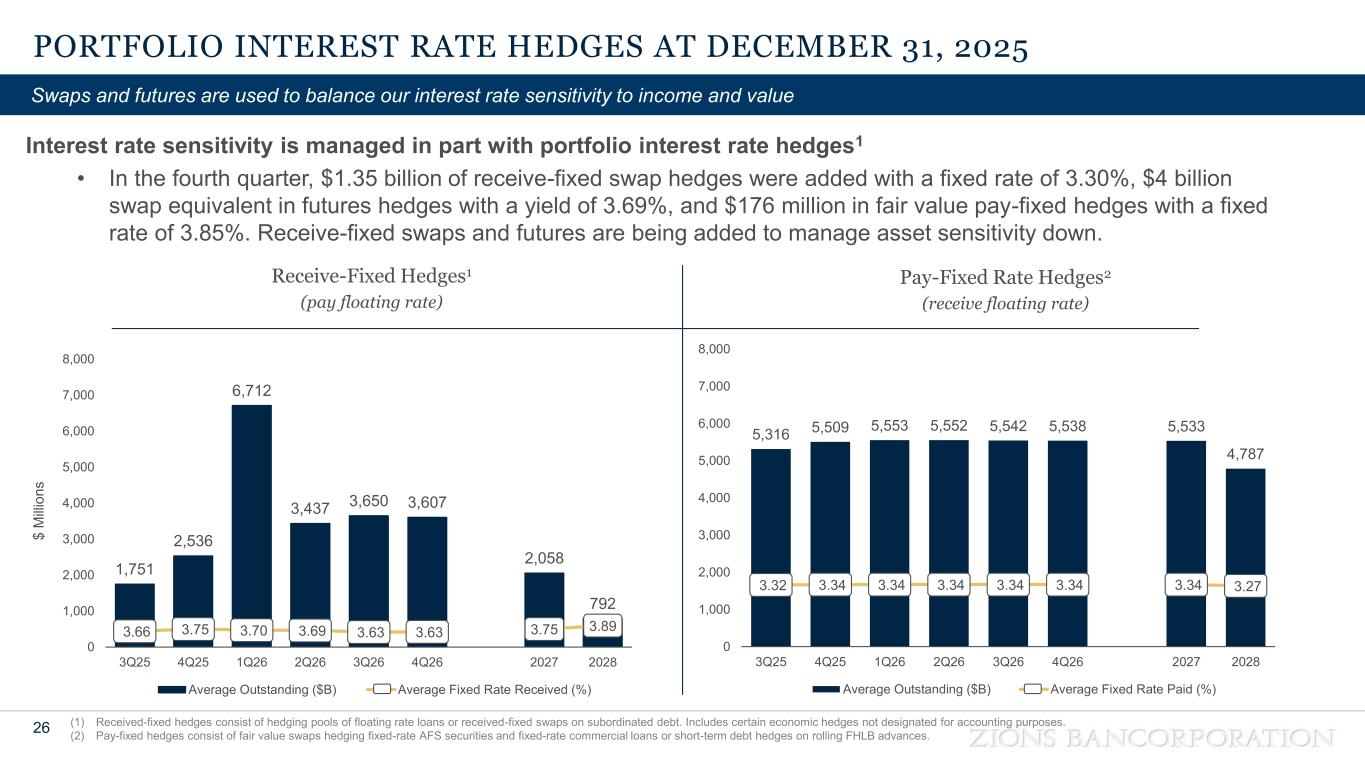
5,316 5,509 5,553 5,552 5,542 5,538 5,533 4,787 3.32 3.34 3.34 3.34 3.34 3.34 3.34 3.27 0 1,000 2,000 3,000 4,000 5,000 6,000 7,000 8,000 3Q25 4Q25 1Q26 2Q26 3Q26 4Q26 2027 2028 Average Outstanding ($B) Average Fixed Rate Paid (%) 1,751 2,536 6,712 3,437 3,650 3,607 2,058 792 3.66 3.75 3.70 3.69 3.63 3.63 3.75 3.89 0 1,000 2,000 3,000 4,000 5,000 6,000 7,000 8,000 3Q25 4Q25 1Q26 2Q26 3Q26 4Q26 2027 2028 Average Outstanding ($B) Average Fixed Rate Received (%) PORTFOLIO INTEREST RATE HEDGES AT DECEMBER 31, 2025 26 Swaps and futures are used to balance our interest rate sensitivity to income and value Receive-Fixed Hedges1 (pay floating rate) Pay-Fixed Rate Hedges2 (receive floating rate) (1) Received-fixed hedges consist of hedging pools of floating rate loans or received-fixed swaps on subordinated debt. Includes certain economic hedges not designated for accounting purposes. (2) Pay-fixed hedges consist of fair value swaps hedging fixed-rate AFS securities and fixed-rate commercial loans or short-term debt hedges on rolling FHLB advances. Interest rate sensitivity is managed in part with portfolio interest rate hedges1 • In the fourth quarter, $1.35 billion of receive-fixed swap hedges were added with a fixed rate of 3.30%, $4 billion swap equivalent in futures hedges with a yield of 3.69%, and $176 million in fair value pay-fixed hedges with a fixed rate of 3.85%. Receive-fixed swaps and futures are being added to manage asset sensitivity down. $ M ill io n s
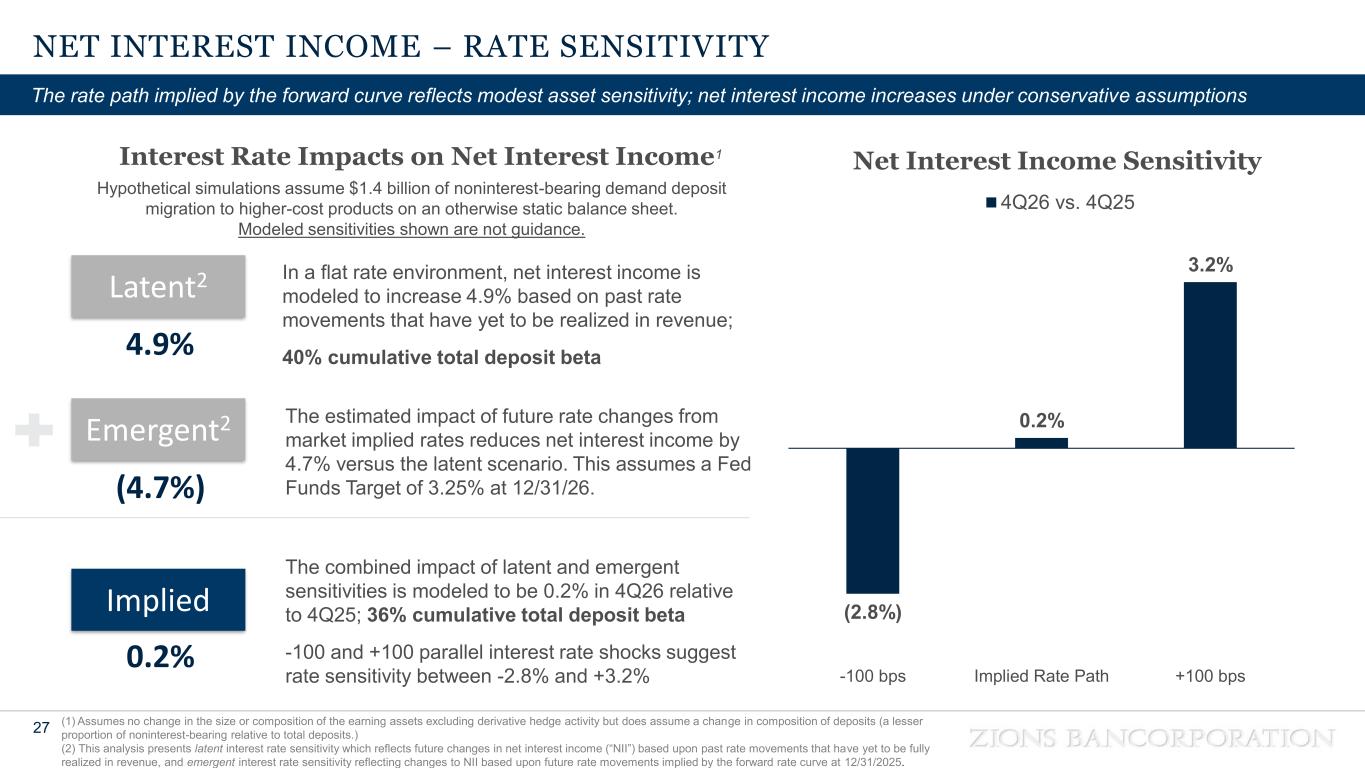
NET INTEREST INCOME – RATE SENSITIVITY 27 The rate path implied by the forward curve reflects modest asset sensitivity; net interest income increases under conservative assumptions Interest Rate Impacts on Net Interest Income1 (1) Assumes no change in the size or composition of the earning assets excluding derivative hedge activity but does assume a change in composition of deposits (a lesser proportion of noninterest-bearing relative to total deposits.) (2) This analysis presents latent interest rate sensitivity which reflects future changes in net interest income (“NII”) based upon past rate movements that have yet to be fully realized in revenue, and emergent interest rate sensitivity reflecting changes to NII based upon future rate movements implied by the forward rate curve at 12/31/2025. Net Interest Income Sensitivity (2.8%) 0.2% 3.2% -100 bps Implied Rate Path +100 bps 4Q26 vs. 4Q25 In a flat rate environment, net interest income is modeled to increase 4.9% based on past rate movements that have yet to be realized in revenue; 40% cumulative total deposit beta Latent2 Emergent2 Implied The estimated impact of future rate changes from market implied rates reduces net interest income by 4.7% versus the latent scenario. This assumes a Fed Funds Target of 3.25% at 12/31/26. 4.9% (4.7%) 0.2% The combined impact of latent and emergent sensitivities is modeled to be 0.2% in 4Q26 relative to 4Q25; 36% cumulative total deposit beta -100 and +100 parallel interest rate shocks suggest rate sensitivity between -2.8% and +3.2% Hypothetical simulations assume $1.4 billion of noninterest-bearing demand deposit migration to higher-cost products on an otherwise static balance sheet. Modeled sensitivities shown are not guidance.
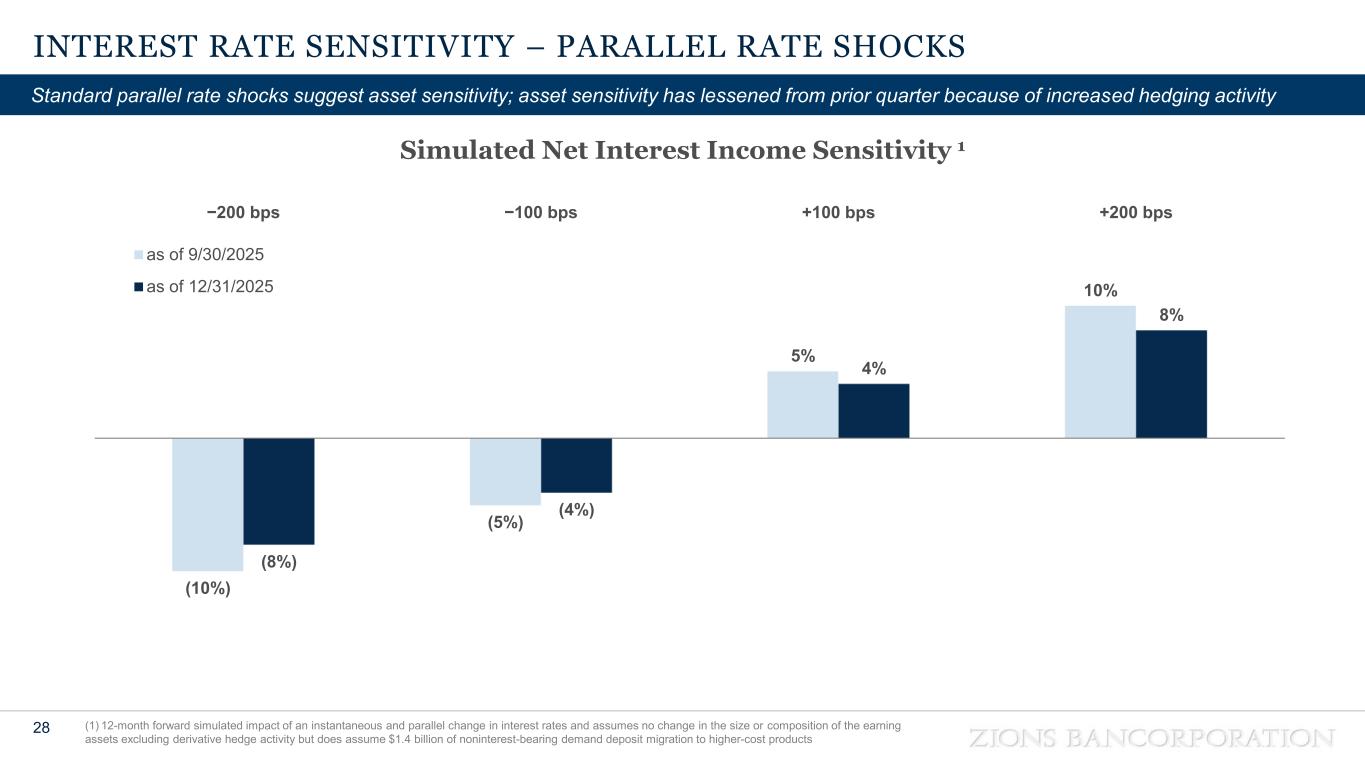
INTEREST RATE SENSITIVITY – PARALLEL RATE SHOCKS 28 (1) 12-month forward simulated impact of an instantaneous and parallel change in interest rates and assumes no change in the size or composition of the earning assets excluding derivative hedge activity but does assume $1.4 billion of noninterest-bearing demand deposit migration to higher-cost products Standard parallel rate shocks suggest asset sensitivity; asset sensitivity has lessened from prior quarter because of increased hedging activity (10%) (5%) 5% 10% (8%) (4%) 4% 8% −200 bps −100 bps +100 bps +200 bps Simulated Net Interest Income Sensitivity 1 as of 9/30/2025 as of 12/31/2025
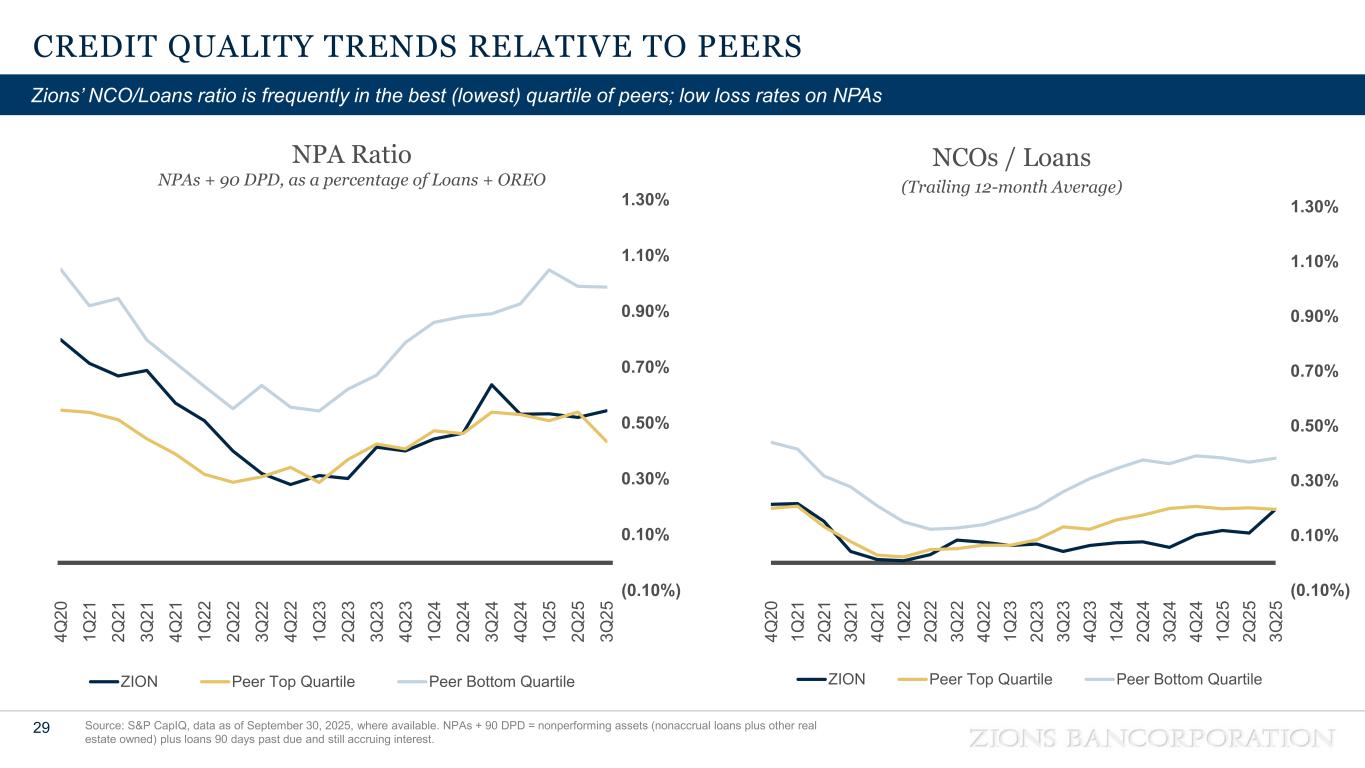
CREDIT QUALITY TRENDS RELATIVE TO PEERS 29 Source: S&P CapIQ, data as of September 30, 2025, where available. NPAs + 90 DPD = nonperforming assets (nonaccrual loans plus other real estate owned) plus loans 90 days past due and still accruing interest. Zions’ NCO/Loans ratio is frequently in the best (lowest) quartile of peers; low loss rates on NPAs NPA Ratio NPAs + 90 DPD, as a percentage of Loans + OREO NCOs / Loans (Trailing 12-month Average) (0.10%) 0.10% 0.30% 0.50% 0.70% 0.90% 1.10% 1.30% 4 Q 2 0 1 Q 2 1 2 Q 2 1 3 Q 2 1 4 Q 2 1 1 Q 2 2 2 Q 2 2 3 Q 2 2 4 Q 2 2 1 Q 2 3 2 Q 2 3 3 Q 2 3 4 Q 2 3 1 Q 2 4 2 Q 2 4 3 Q 2 4 4 Q 2 4 1 Q 2 5 2 Q 2 5 3 Q 2 5 ZION Peer Top Quartile Peer Bottom Quartile (0.10%) 0.10% 0.30% 0.50% 0.70% 0.90% 1.10% 1.30% 4 Q 2 0 1 Q 2 1 2 Q 2 1 3 Q 2 1 4 Q 2 1 1 Q 2 2 2 Q 2 2 3 Q 2 2 4 Q 2 2 1 Q 2 3 2 Q 2 3 3 Q 2 3 4 Q 2 3 1 Q 2 4 2 Q 2 4 3 Q 2 4 4 Q 2 4 1 Q 2 5 2 Q 2 5 3 Q 2 5 ZION Peer Top Quartile Peer Bottom Quartile
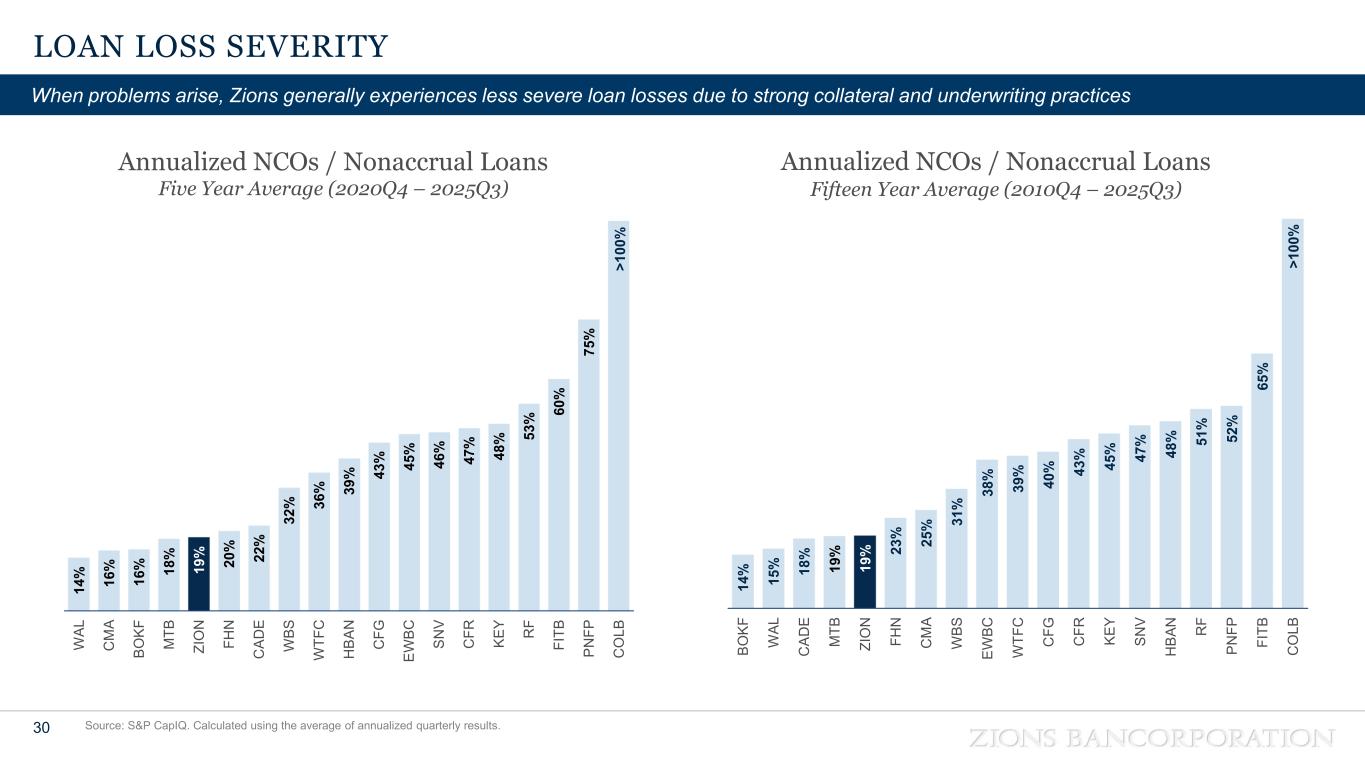
LOAN LOSS SEVERITY 30 Source: S&P CapIQ. Calculated using the average of annualized quarterly results. When problems arise, Zions generally experiences less severe loan losses due to strong collateral and underwriting practices 1 4 % 1 6 % 1 6 % 1 8 % 1 9 % 2 0 % 2 2 % 3 2 % 3 6 % 3 9 % 4 3 % 4 5 % 4 6 % 4 7 % 4 8 % 5 3 % 6 0 % 7 5 % W A L C M A B O K F M T B Z IO N F H N C A D E W B S W T F C H B A N C F G E W B C S N V C F R K E Y R F F IT B P N F P C O L B Annualized NCOs / Nonaccrual Loans Five Year Average (2020Q4 – 2025Q3) Annualized NCOs / Nonaccrual Loans Fifteen Year Average (2010Q4 – 2025Q3) 1 4 % 1 5 % 1 8 % 1 9 % 1 9 % 2 3 % 2 5 % 3 1 % 3 8 % 3 9 % 4 0 % 4 3 % 4 5 % 4 7 % 4 8 % 5 1 % 5 2 % 6 5 % B O K F W A L C A D E M T B Z IO N F H N C M A W B S E W B C W T F C C F G C F R K E Y S N V H B A N R F P N F P F IT B C O L B > 1 0 0 % > 1 0 0 %
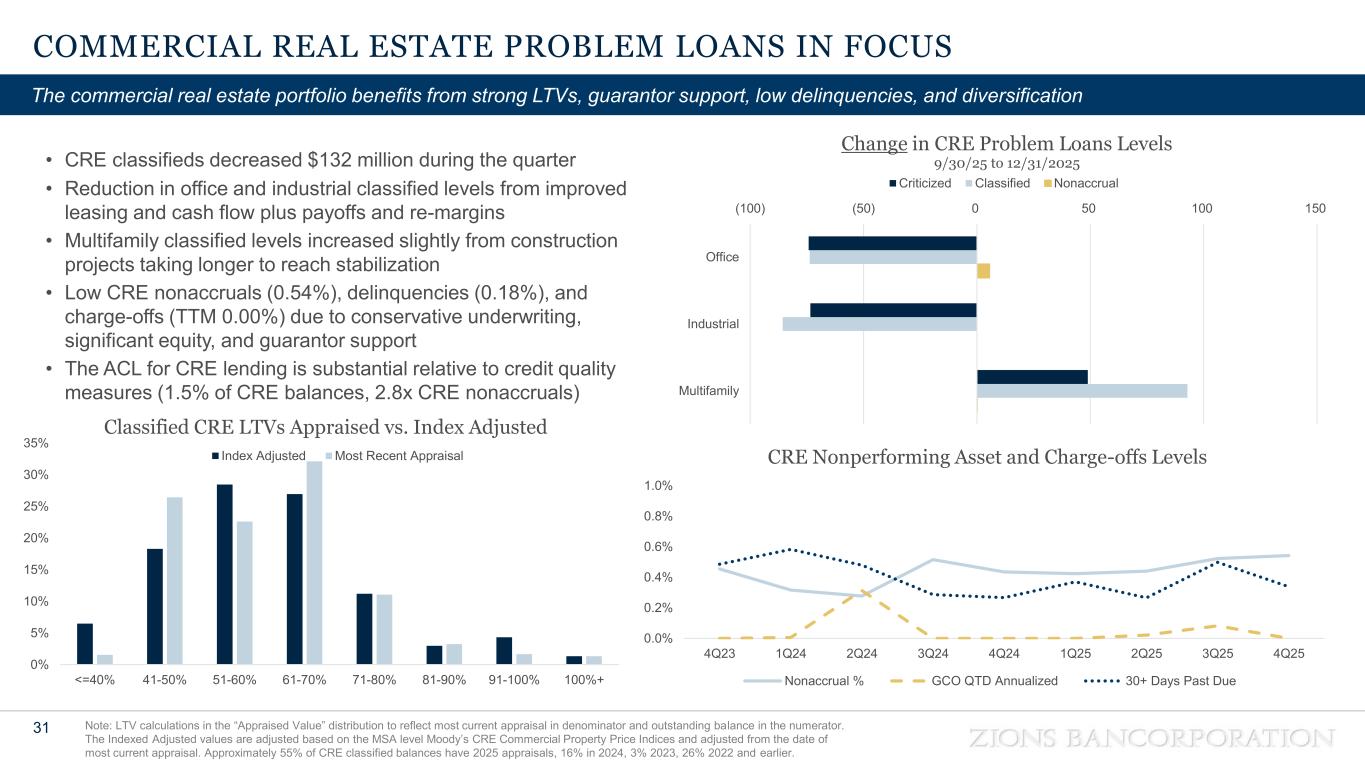
COMMERCIAL REAL ESTATE PROBLEM LOANS IN FOCUS 31 Note: LTV calculations in the “Appraised Value” distribution to reflect most current appraisal in denominator and outstanding balance in the numerator. The Indexed Adjusted values are adjusted based on the MSA level Moody’s CRE Commercial Property Price Indices and adjusted from the date of most current appraisal. Approximately 55% of CRE classified balances have 2025 appraisals, 16% in 2024, 3% 2023, 26% 2022 and earlier. The commercial real estate portfolio benefits from strong LTVs, guarantor support, low delinquencies, and diversification • CRE classifieds decreased $132 million during the quarter • Reduction in office and industrial classified levels from improved leasing and cash flow plus payoffs and re-margins • Multifamily classified levels increased slightly from construction projects taking longer to reach stabilization • Low CRE nonaccruals (0.54%), delinquencies (0.18%), and charge-offs (TTM 0.00%) due to conservative underwriting, significant equity, and guarantor support • The ACL for CRE lending is substantial relative to credit quality measures (1.5% of CRE balances, 2.8x CRE nonaccruals) 0% 5% 10% 15% 20% 25% 30% 35% <=40% 41-50% 51-60% 61-70% 71-80% 81-90% 91-100% 100%+ Classified CRE LTVs Appraised vs. Index Adjusted Index Adjusted Most Recent Appraisal 0.0% 0.2% 0.4% 0.6% 0.8% 1.0% 4Q23 1Q24 2Q24 3Q24 4Q24 1Q25 2Q25 3Q25 4Q25 CRE Nonperforming Asset and Charge-offs Levels Nonaccrual % GCO QTD Annualized 30+ Days Past Due (100) (50) 0 50 100 150 Office Industrial Multifamily Change in CRE Problem Loans Levels 9/30/25 to 12/31/2025 Criticized Classified Nonaccrual
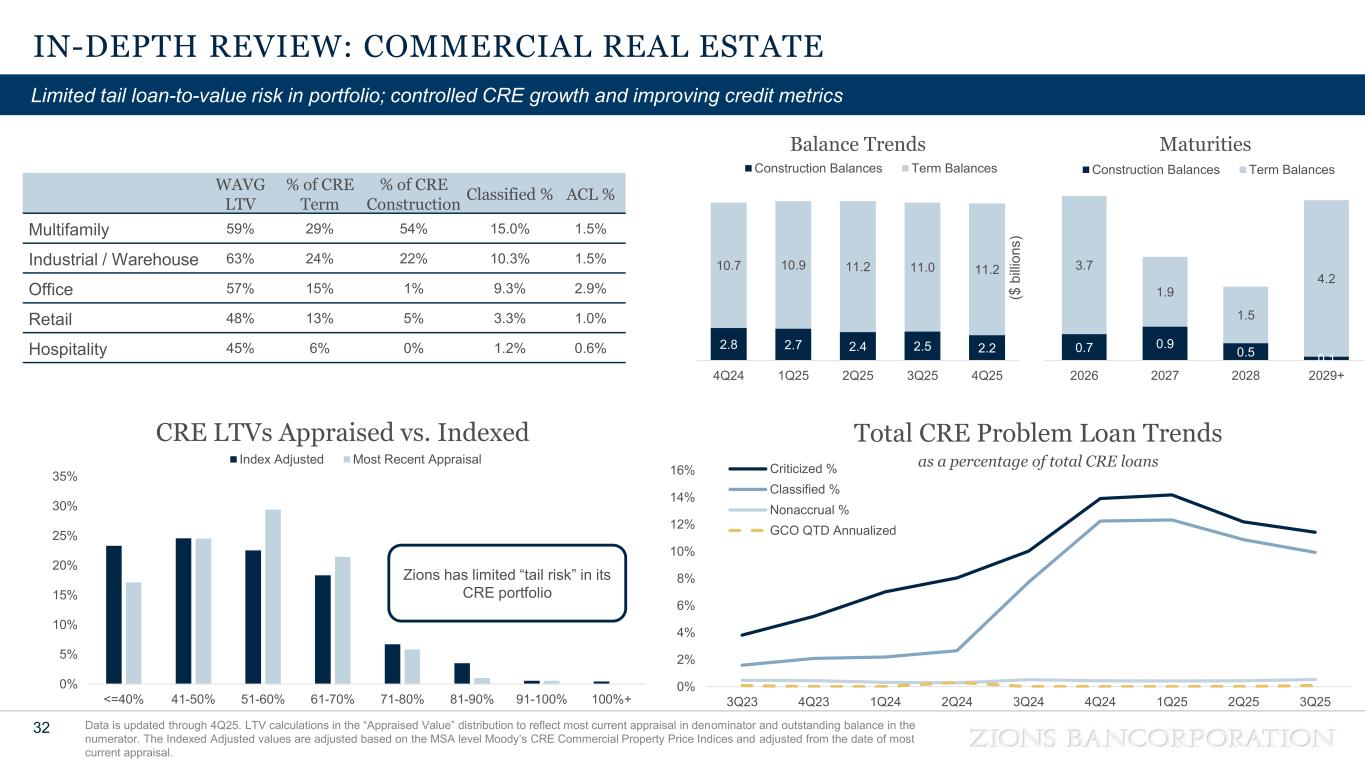
IN-DEPTH REVIEW: COMMERCIAL REAL ESTATE 32 Data is updated through 4Q25. LTV calculations in the “Appraised Value” distribution to reflect most current appraisal in denominator and outstanding balance in the numerator. The Indexed Adjusted values are adjusted based on the MSA level Moody’s CRE Commercial Property Price Indices and adjusted from the date of most current appraisal. Limited tail loan-to-value risk in portfolio; controlled CRE growth and improving credit metrics WAVG LTV % of CRE Term % of CRE Construction Classified % ACL % Multifamily 59% 29% 54% 15.0% 1.5% Industrial / Warehouse 63% 24% 22% 10.3% 1.5% Office 57% 15% 1% 9.3% 2.9% Retail 48% 13% 5% 3.3% 1.0% Hospitality 45% 6% 0% 1.2% 0.6% Zions has limited “tail risk” in its CRE portfolio Total CRE Problem Loan Trends as a percentage of total CRE loans ($ b ill io n s ) CRE LTVs Appraised vs. Indexed 0% 5% 10% 15% 20% 25% 30% 35% <=40% 41-50% 51-60% 61-70% 71-80% 81-90% 91-100% 100%+ Index Adjusted Most Recent Appraisal 0% 2% 4% 6% 8% 10% 12% 14% 16% 3Q23 4Q23 1Q24 2Q24 3Q24 4Q24 1Q25 2Q25 3Q25 Criticized % Classified % Nonaccrual % GCO QTD Annualized 0.7 0.9 0.5 0.1 3.7 1.9 1.5 4.2 2026 2027 2028 2029+ Maturities Construction Balances Term Balances 2.8 2.7 2.4 2.5 2.2 10.7 10.9 11.2 11.0 11.2 4Q24 1Q25 2Q25 3Q25 4Q25 Balance Trends Construction Balances Term Balances
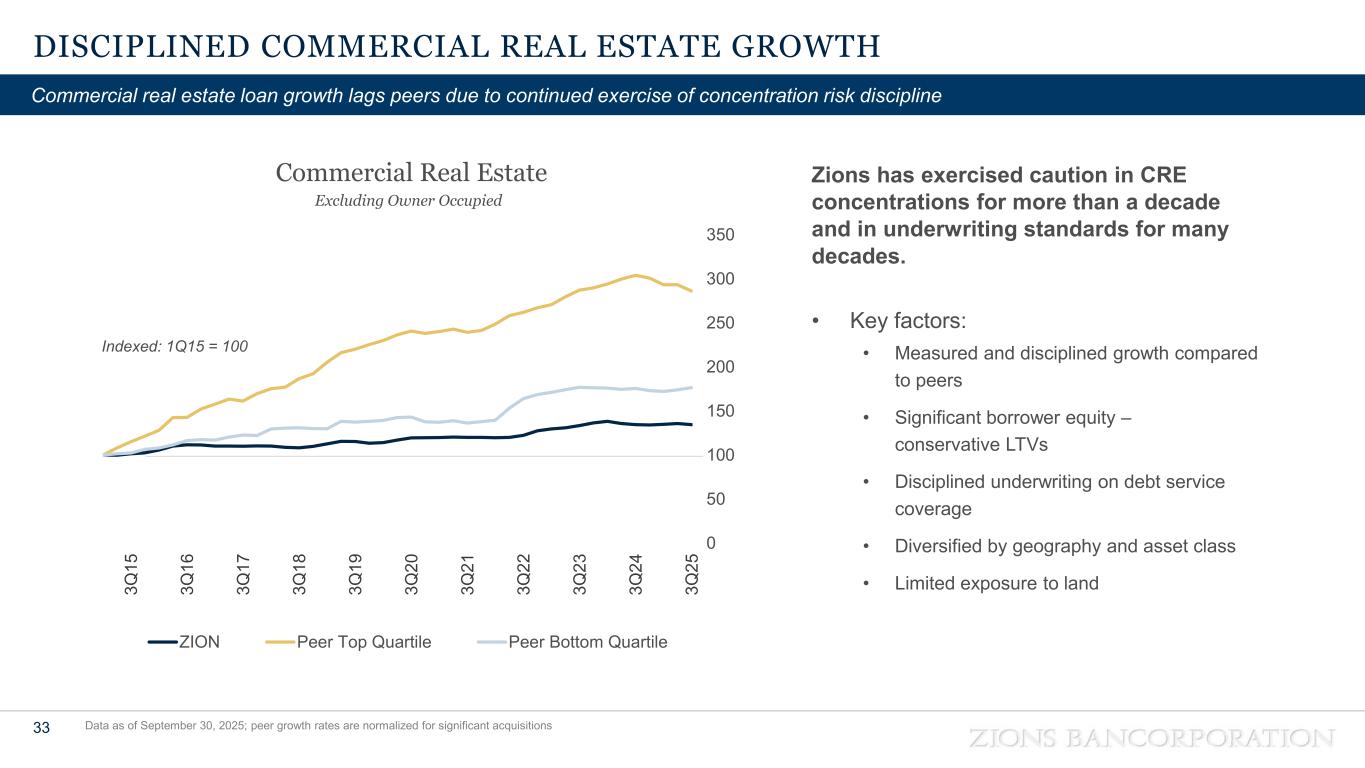
DISCIPLINED COMMERCIAL REAL ESTATE GROWTH 33 Data as of September 30, 2025; peer growth rates are normalized for significant acquisitions Commercial real estate loan growth lags peers due to continued exercise of concentration risk discipline Zions has exercised caution in CRE concentrations for more than a decade and in underwriting standards for many decades. • Key factors: • Measured and disciplined growth compared to peers • Significant borrower equity – conservative LTVs • Disciplined underwriting on debt service coverage • Diversified by geography and asset class • Limited exposure to land 0 50 100 150 200 250 300 350 3 Q 1 5 3 Q 1 6 3 Q 1 7 3 Q 1 8 3 Q 1 9 3 Q 2 0 3 Q 2 1 3 Q 2 2 3 Q 2 3 3 Q 2 4 3 Q 2 5 ZION Peer Top Quartile Peer Bottom Quartile Indexed: 1Q15 = 100 Commercial Real Estate Excluding Owner Occupied
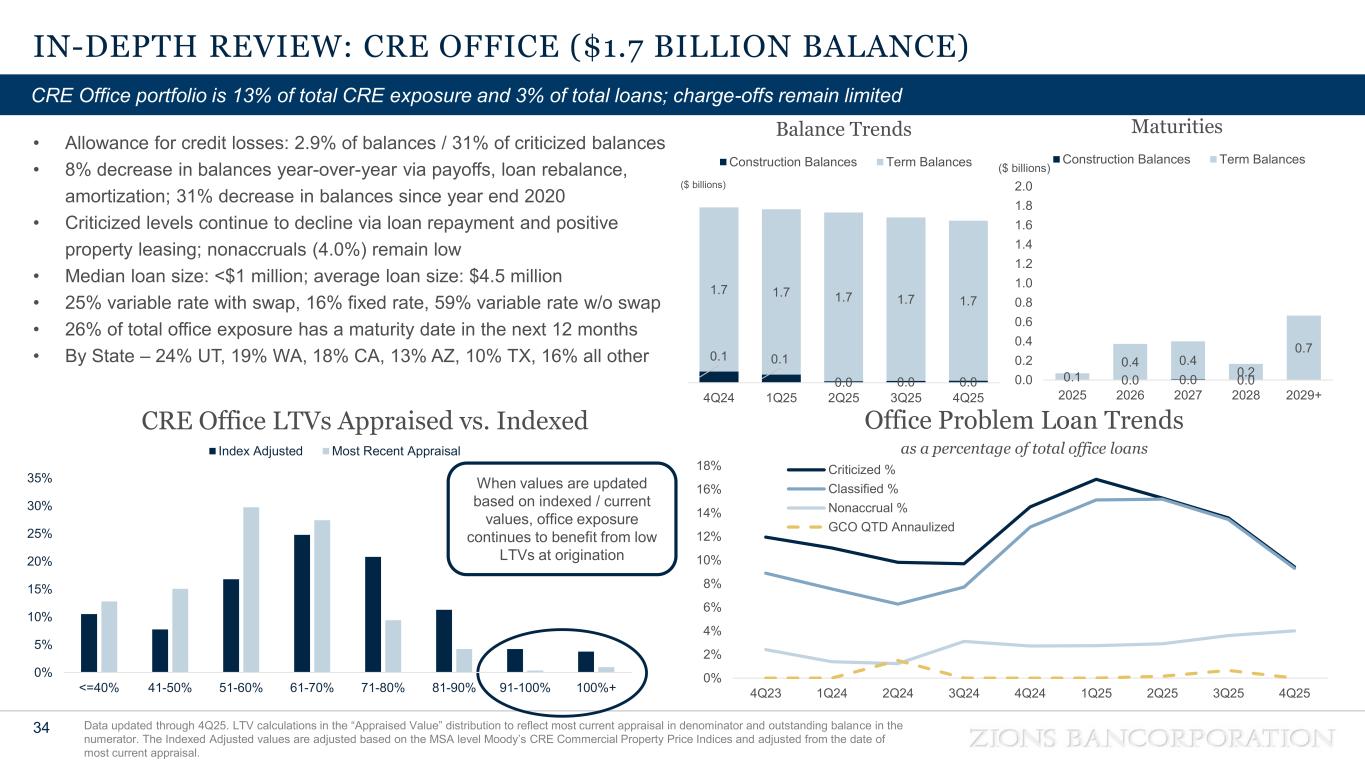
0.0 0.0 0.00.1 0.4 0.4 0.2 0.7 0.0 0.2 0.4 0.6 0.8 1.0 1.2 1.4 1.6 1.8 2.0 2025 2026 2027 2028 2029+ Maturities Construction Balances Term Balances 0.1 0.1 0.0 0.0 0.0 1.7 1.7 1.7 1.7 1.7 4Q24 1Q25 2Q25 3Q25 4Q25 Balance Trends Construction Balances Term Balances IN-DEPTH REVIEW: CRE OFFICE ($1.7 BILLION BALANCE) 34 Data updated through 4Q25. LTV calculations in the “Appraised Value” distribution to reflect most current appraisal in denominator and outstanding balance in the numerator. The Indexed Adjusted values are adjusted based on the MSA level Moody’s CRE Commercial Property Price Indices and adjusted from the date of most current appraisal. CRE Office portfolio is 13% of total CRE exposure and 3% of total loans; charge-offs remain limited • Allowance for credit losses: 2.9% of balances / 31% of criticized balances • 8% decrease in balances year-over-year via payoffs, loan rebalance, amortization; 31% decrease in balances since year end 2020 • Criticized levels continue to decline via loan repayment and positive property leasing; nonaccruals (4.0%) remain low • Median loan size: <$1 million; average loan size: $4.5 million • 25% variable rate with swap, 16% fixed rate, 59% variable rate w/o swap • 26% of total office exposure has a maturity date in the next 12 months • By State – 24% UT, 19% WA, 18% CA, 13% AZ, 10% TX, 16% all other Office Problem Loan Trends as a percentage of total office loans ($ billions) When values are updated based on indexed / current values, office exposure continues to benefit from low LTVs at origination CRE Office LTVs Appraised vs. Indexed ($ billions) 0% 5% 10% 15% 20% 25% 30% 35% <=40% 41-50% 51-60% 61-70% 71-80% 81-90% 91-100% 100%+ Index Adjusted Most Recent Appraisal 0% 2% 4% 6% 8% 10% 12% 14% 16% 18% 4Q23 1Q24 2Q24 3Q24 4Q24 1Q25 2Q25 3Q25 4Q25 Criticized % Classified % Nonaccrual % GCO QTD Annaulized
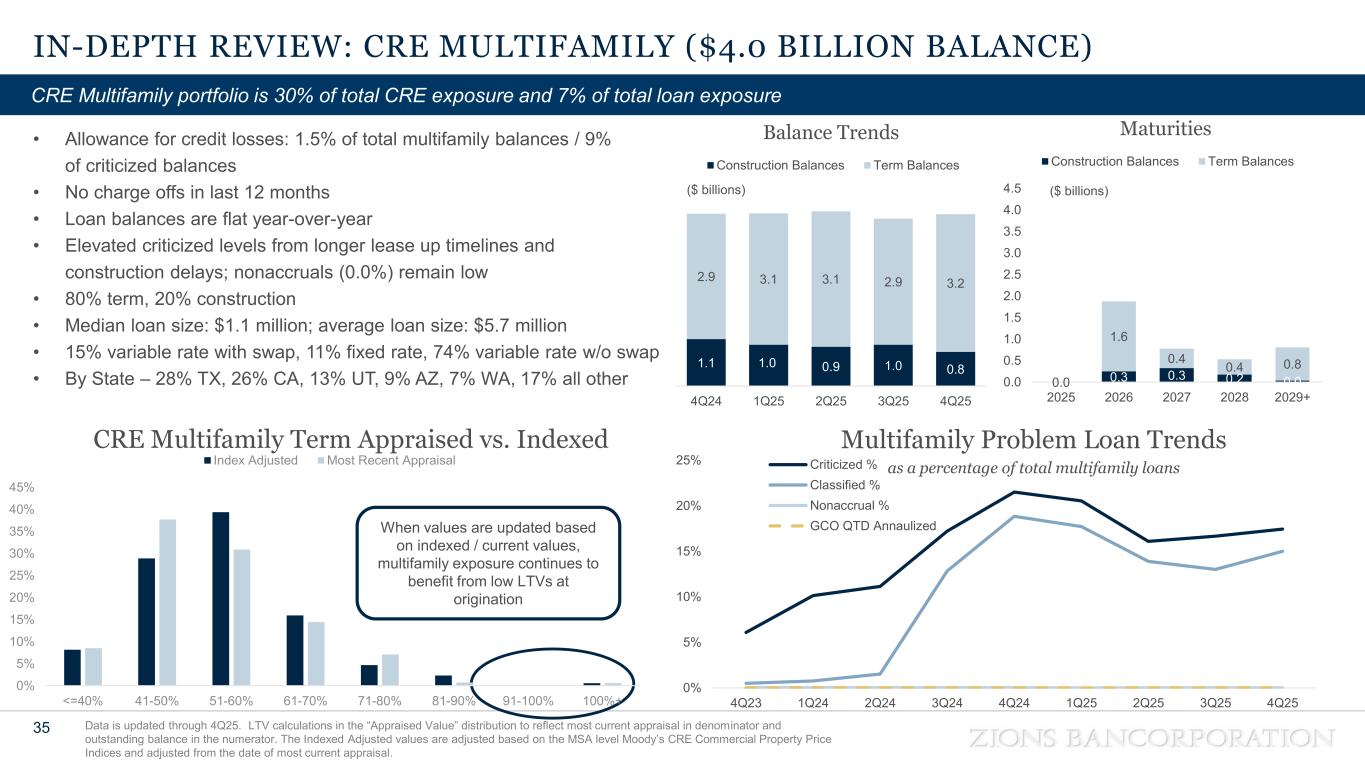
0% 5% 10% 15% 20% 25% 4Q23 1Q24 2Q24 3Q24 4Q24 1Q25 2Q25 3Q25 4Q25 Criticized % Classified % Nonaccrual % GCO QTD Annaulized CRE Multifamily Term Appraised vs. Indexed IN-DEPTH REVIEW: CRE MULTIFAMILY ($4.0 BILLION BALANCE) 35 Data is updated through 4Q25. LTV calculations in the “Appraised Value” distribution to reflect most current appraisal in denominator and outstanding balance in the numerator. The Indexed Adjusted values are adjusted based on the MSA level Moody’s CRE Commercial Property Price Indices and adjusted from the date of most current appraisal. CRE Multifamily portfolio is 30% of total CRE exposure and 7% of total loan exposure • Allowance for credit losses: 1.5% of total multifamily balances / 9% of criticized balances • No charge offs in last 12 months • Loan balances are flat year-over-year • Elevated criticized levels from longer lease up timelines and construction delays; nonaccruals (0.0%) remain low • 80% term, 20% construction • Median loan size: $1.1 million; average loan size: $5.7 million • 15% variable rate with swap, 11% fixed rate, 74% variable rate w/o swap • By State – 28% TX, 26% CA, 13% UT, 9% AZ, 7% WA, 17% all other Multifamily Problem Loan Trends as a percentage of total multifamily loans When values are updated based on indexed / current values, multifamily exposure continues to benefit from low LTVs at origination ($ billions)($ billions) 0% 5% 10% 15% 20% 25% 30% 35% 40% 45% <=40% 41-50% 51-60% 61-70% 71-80% 81-90% 91-100% 100%+ Index Adjusted Most Recent Appraisal 0.0 0.3 0.3 0.2 0.0 1.6 0.4 0.4 0.8 0.0 0.5 1.0 1.5 2.0 2.5 3.0 3.5 4.0 4.5 2025 2026 2027 2028 2029+ Maturities Construction Balances Term Balances 1.1 1.0 0.9 1.0 0.8 2.9 3.1 3.1 2.9 3.2 4Q24 1Q25 2Q25 3Q25 4Q25 Balance Trends Construction Balances Term Balances
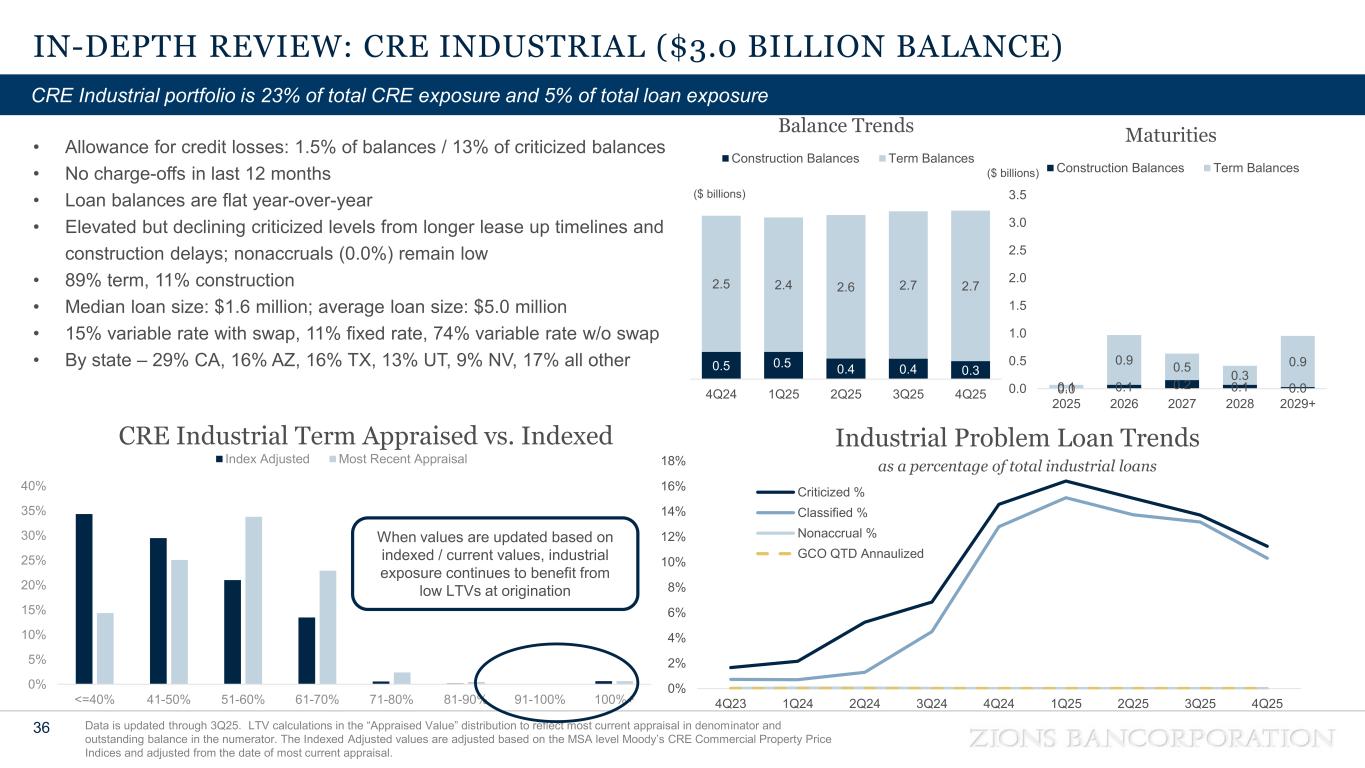
0.0 0.1 0.2 0.1 0.0.1 0.9 0.5 0.3 0.9 0.0 0.5 1.0 1.5 2.0 2.5 3.0 3.5 2025 2026 2027 2028 2029+ Maturities Construction Balances Term Balances 0% 5% 10% 15% 20% 25% 30% 35% 40% <=40% 41-50% 51-60% 61-70% 71-80% 81-90% 91-100% 100%+ Index Adjusted Most Recent Appraisal IN-DEPTH REVIEW: CRE INDUSTRIAL ($3.0 BILLION BALANCE) 36 Data is updated through 3Q25. LTV calculations in the “Appraised Value” distribution to reflect most current appraisal in denominator and outstanding balance in the numerator. The Indexed Adjusted values are adjusted based on the MSA level Moody’s CRE Commercial Property Price Indices and adjusted from the date of most current appraisal. CRE Industrial portfolio is 23% of total CRE exposure and 5% of total loan exposure • Allowance for credit losses: 1.5% of balances / 13% of criticized balances • No charge-offs in last 12 months • Loan balances are flat year-over-year • Elevated but declining criticized levels from longer lease up timelines and construction delays; nonaccruals (0.0%) remain low • 89% term, 11% construction • Median loan size: $1.6 million; average loan size: $5.0 million • 15% variable rate with swap, 11% fixed rate, 74% variable rate w/o swap • By state – 29% CA, 16% AZ, 16% TX, 13% UT, 9% NV, 17% all other Industrial Problem Loan Trends as a percentage of total industrial loans ($ billions) When values are updated based on indexed / current values, industrial exposure continues to benefit from low LTVs at origination CRE Industrial Term Appraised vs. Indexed ($ billions) 0.5 0.5 0.4 0.4 0.3 2.5 2.4 2.6 2.7 2.7 4Q24 1Q25 2Q25 3Q25 4Q25 Balance Trends Construction Balances Term Balances 0% 2% 4% 6% 8% 10% 12% 14% 16% 18% 4Q23 1Q24 2Q24 3Q24 4Q24 1Q25 2Q25 3Q25 4Q25 Criticized % Classified % Nonaccrual % GCO QTD Annaulized
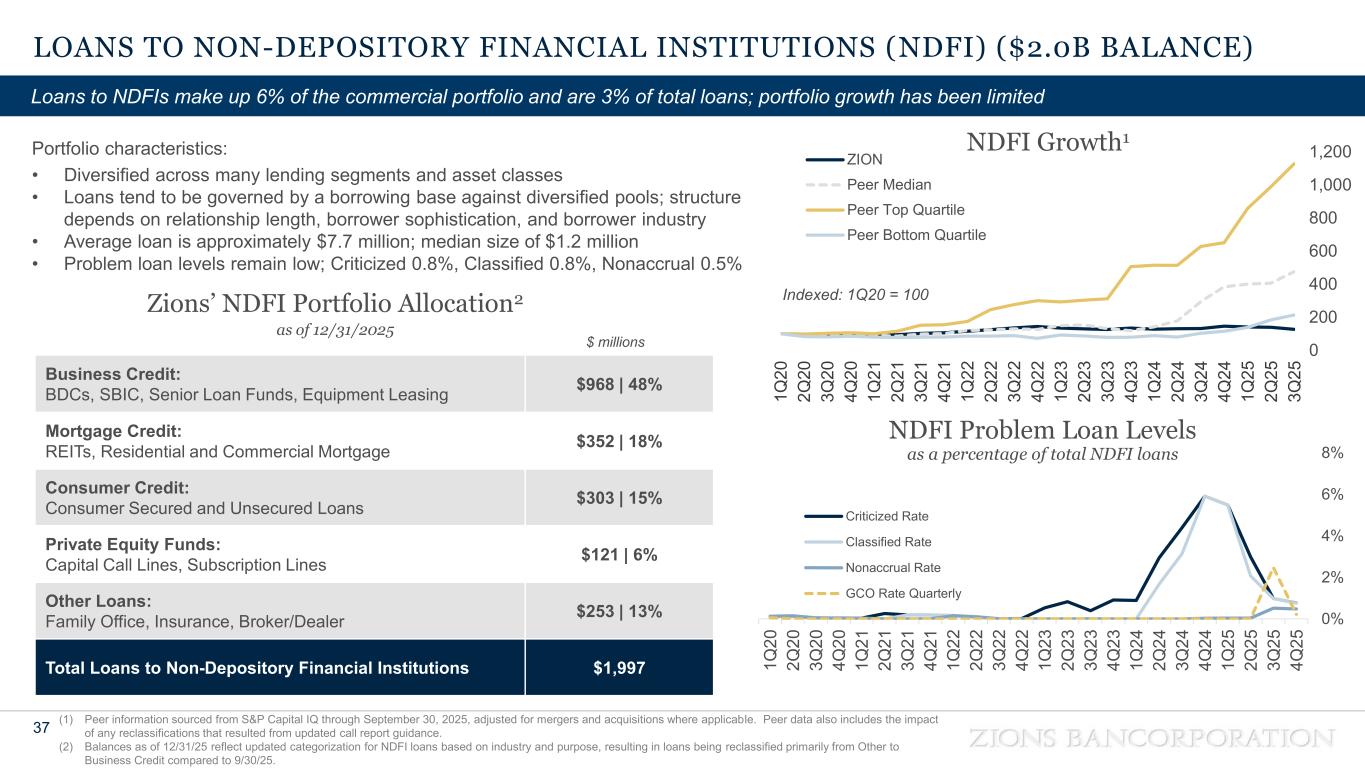
LOANS TO NON-DEPOSITORY FINANCIAL INSTITUTIONS (NDFI) ($2.0B BALANCE) 37 (1) Peer information sourced from S&P Capital IQ through September 30, 2025, adjusted for mergers and acquisitions where applicable. Peer data also includes the impact of any reclassifications that resulted from updated call report guidance. (2) Balances as of 12/31/25 reflect updated categorization for NDFI loans based on industry and purpose, resulting in loans being reclassified primarily from Other to Business Credit compared to 9/30/25. Loans to NDFIs make up 6% of the commercial portfolio and are 3% of total loans; portfolio growth has been limited Zions’ NDFI Portfolio Allocation2 as of 12/31/2025 Business Credit: BDCs, SBIC, Senior Loan Funds, Equipment Leasing $968 | 48% Mortgage Credit: REITs, Residential and Commercial Mortgage $352 | 18% Consumer Credit: Consumer Secured and Unsecured Loans $303 | 15% Private Equity Funds: Capital Call Lines, Subscription Lines $121 | 6% Other Loans: Family Office, Insurance, Broker/Dealer $253 | 13% Total Loans to Non-Depository Financial Institutions $1,997 Portfolio characteristics: • Diversified across many lending segments and asset classes • Loans tend to be governed by a borrowing base against diversified pools; structure depends on relationship length, borrower sophistication, and borrower industry • Average loan is approximately $7.7 million; median size of $1.2 million • Problem loan levels remain low; Criticized 0.8%, Classified 0.8%, Nonaccrual 0.5% 0 200 400 600 800 1,000 1,200 1 Q 2 0 2 Q 2 0 3 Q 2 0 4 Q 2 0 1 Q 2 1 2 Q 2 1 3 Q 2 1 4 Q 2 1 1 Q 2 2 2 Q 2 2 3 Q 2 2 4 Q 2 2 1 Q 2 3 2 Q 2 3 3 Q 2 3 4 Q 2 3 1 Q 2 4 2 Q 2 4 3 Q 2 4 4 Q 2 4 1 Q 2 5 2 Q 2 5 3 Q 2 5 ZION Peer Median Peer Top Quartile Peer Bottom Quartile Indexed: 1Q20 = 100 NDFI Growth1 $ millions 0% 2% 4% 6% 8% 1 Q 2 0 2 Q 2 0 3 Q 2 0 4 Q 2 0 1 Q 2 1 2 Q 2 1 3 Q 2 1 4 Q 2 1 1 Q 2 2 2 Q 2 2 3 Q 2 2 4 Q 2 2 1 Q 2 3 2 Q 2 3 3 Q 2 3 4 Q 2 3 1 Q 2 4 2 Q 2 4 3 Q 2 4 4 Q 2 4 1 Q 2 5 2 Q 2 5 3 Q 2 5 4 Q 2 5 NDFI Problem Loan Levels as a percentage of total NDFI loans Criticized Rate Classified Rate Nonaccrual Rate GCO Rate Quarterly
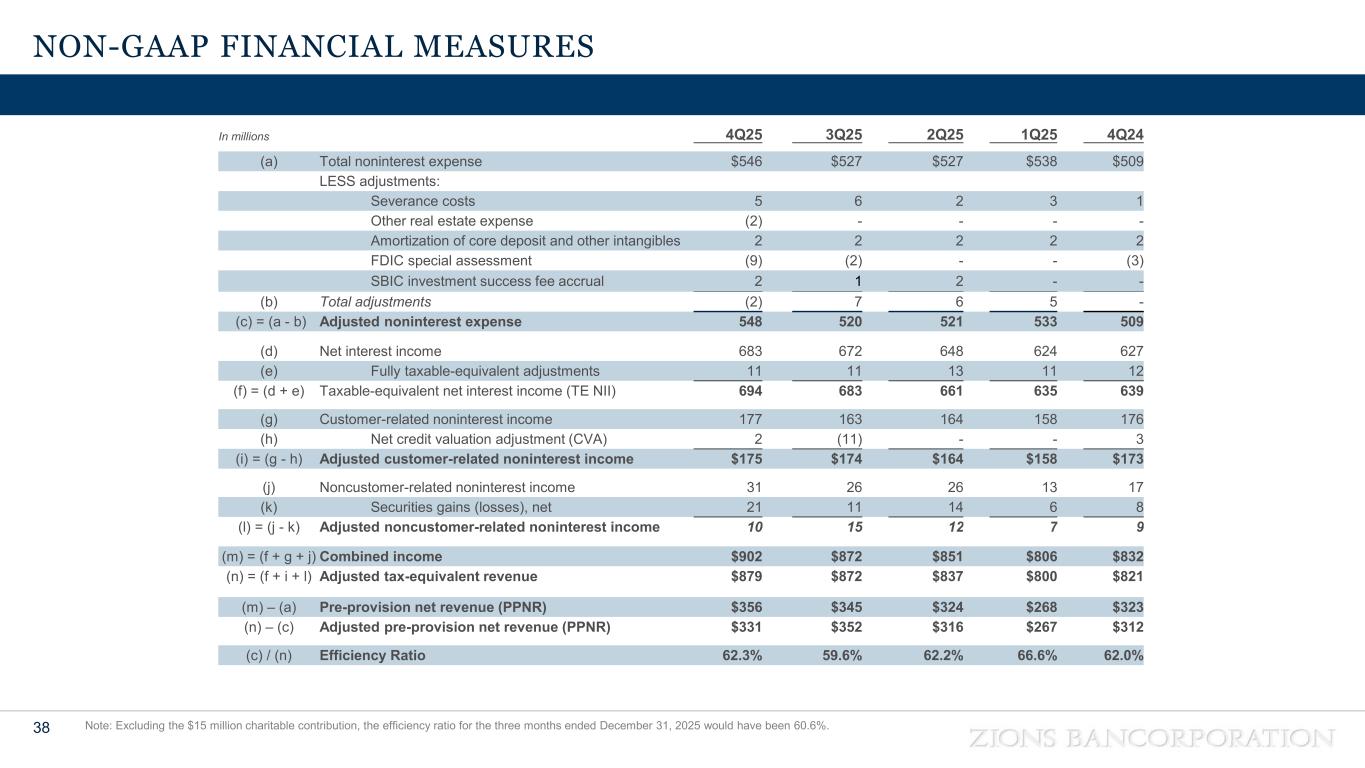
NON-GAAP FINANCIAL MEASURES 38 Note: Excluding the $15 million charitable contribution, the efficiency ratio for the three months ended December 31, 2025 would have been 60.6%. In millions 4Q25 3Q25 2Q25 1Q25 4Q24 (a) Total noninterest expense $546 $527 $527 $538 $509 LESS adjustments: Severance costs 5 6 2 3 1 Other real estate expense (2) - - - - Amortization of core deposit and other intangibles 2 2 2 2 2 FDIC special assessment (9) (2) - - (3) SBIC investment success fee accrual 2 1 2 - - (b) Total adjustments (2) 7 6 5 - (c) = (a - b) Adjusted noninterest expense 548 520 521 533 509 (d) Net interest income 683 672 648 624 627 (e) Fully taxable-equivalent adjustments 11 11 13 11 12 (f) = (d + e) Taxable-equivalent net interest income (TE NII) 694 683 661 635 639 (g) Customer-related noninterest income 177 163 164 158 176 (h) Net credit valuation adjustment (CVA) 2 (11) - - 3 (i) = (g - h) Adjusted customer-related noninterest income $175 $174 $164 $158 $173 (j) Noncustomer-related noninterest income 31 26 26 13 17 (k) Securities gains (losses), net 21 11 14 6 8 (l) = (j - k) Adjusted noncustomer-related noninterest income 10 15 12 7 9 (m) = (f + g + j) Combined income $902 $872 $851 $806 $832 (n) = (f + i + l) Adjusted tax-equivalent revenue $879 $872 $837 $800 $821 (m) – (a) Pre-provision net revenue (PPNR) $356 $345 $324 $268 $323 (n) – (c) Adjusted pre-provision net revenue (PPNR) $331 $352 $316 $267 $312 (c) / (n) Efficiency Ratio 62.3% 59.6% 62.2% 66.6% 62.0%
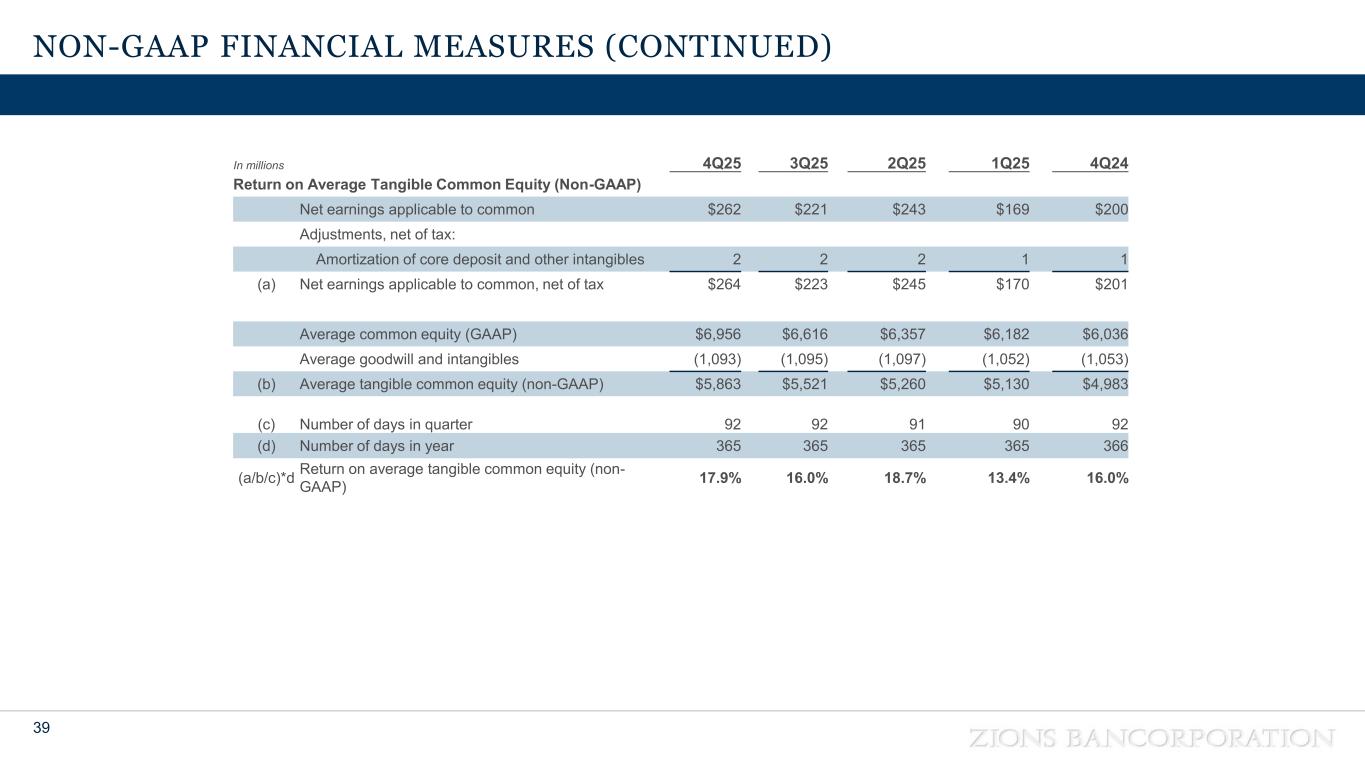
NON-GAAP FINANCIAL MEASURES (CONTINUED) 39 In millions 4Q25 3Q25 2Q25 1Q25 4Q24 Return on Average Tangible Common Equity (Non-GAAP) Net earnings applicable to common $262 $221 $243 $169 $200 Adjustments, net of tax: Amortization of core deposit and other intangibles 2 2 2 1 1 (a) Net earnings applicable to common, net of tax $264 $223 $245 $170 $201 Average common equity (GAAP) $6,956 $6,616 $6,357 $6,182 $6,036 Average goodwill and intangibles (1,093) (1,095) (1,097) (1,052) (1,053) (b) Average tangible common equity (non-GAAP) $5,863 $5,521 $5,260 $5,130 $4,983 (c) Number of days in quarter 92 92 91 90 92 (d) Number of days in year 365 365 365 365 366 (a/b/c)*d Return on average tangible common equity (non- GAAP) 17.9% 16.0% 18.7% 13.4% 16.0%

z i o n s b a n c o r p o ra t i o n . c o m