Management’s Discussion
and Analysis
February 25, 2026
This Management’s Discussion and Analysis (MD&A) should be read in conjunction with Suncor’s December 31, 2025 audited Consolidated Financial Statements and the accompanying notes. Additional information about Suncor filed with Canadian securities regulatory authorities and the United States Securities and Exchange Commission (SEC), including quarterly and annual reports and Suncor’s Annual Information Form dated February 25, 2026 (the 2025 AIF), which is also filed with the SEC under cover of Form 40-F, is available online at www.sedarplus.ca, www.sec.gov and on our website at www.suncor.com. Information contained in or otherwise accessible through our website, even if referred to in this MD&A, does not constitute part of this MD&A and is not incorporated by reference into this MD&A.
References to “we”, “our”, “Suncor” or “the company” means Suncor Energy Inc., its subsidiaries, partnerships and joint arrangements, unless otherwise specified or the context otherwise requires. For a list of abbreviations that may be used in this MD&A, refer to the Advisories – Common Abbreviations section of this MD&A.
10 Annual Report 2025 Suncor Energy Inc. |
MD&A – Table of Contents | |
12 | |
15 | |
17 | |
21 | |
32 | |
33 | |
36 | |
38 | |
40 | |
45 | Material Accounting Policies and Critical Accounting Estimates |
47 | |
54 | |
55 | |
Basis of Presentation
Unless otherwise noted, all financial information contained herein has been prepared in accordance with International Financial Reporting Standards (IFRS) as issued by the International Accounting Standards Board (IASB).
All financial information is reported in Canadian dollars, unless otherwise noted. Production volumes are presented on a working-interest basis, before royalties, except for production volumes from the company’s Libya operations, which are presented on an economic basis.
References to Oil Sands operations exclude Suncor’s ownership of Fort Hills and interests in Syncrude.
Annual Report 2025 Suncor Energy Inc. 11 |
1. Consolidated Financial and Operating Summary
Financial Summary
Year ended December 31 ($ millions, except per share amounts) | | 2025 | | 2024 | | 2023 |
Gross revenues |
| 52 377 |
| 54 881 |
| 52 206 |
Net earnings |
| 5 918 |
| 6 016 |
| 8 295 |
Per common share – basic (dollars) |
| 4.85 |
| 4.72 |
| 6.34 |
Per common share – diluted (dollars) |
| 4.85 | | 4.72 | | 6.33 |
Adjusted operating earnings(1) |
| 5 621 |
| 6 884 |
| 6 677 |
Per common share(1)(2) |
| 4.61 |
| 5.40 |
| 5.10 |
Adjusted funds from operations(1) |
| 12 783 |
| 13 846 |
| 13 325 |
Per common share(1)(2) |
| 10.49 |
| 10.87 |
| 10.19 |
Cash flow provided by operating activities |
| 12 781 |
| 15 960 |
| 12 344 |
Per common share(2) |
| 10.48 |
| 12.53 |
| 9.44 |
Dividends paid on common shares |
| 2 809 |
| 2 803 |
| 2 749 |
Per common share(2) |
| 2.31 |
| 2.22 |
| 2.11 |
Share repurchases |
| 3 025 | | 2 908 | | 2 233 |
Per common share(2) |
| 2.48 | | 2.28 | | 1.71 |
Returns to shareholders(3) |
| 5 834 | | 5 711 | | 4 982 |
Weighted average number of common shares in millions – basic |
| 1 219 |
| 1 274 |
| 1 308 |
Weighted average number of common shares in millions – diluted |
| 1 220 |
| 1 276 |
| 1 310 |
Capital expenditures(4)(5) |
| 5 658 |
| 6 166 |
| 5 573 |
Asset sustainment and maintenance |
| 3 162 |
| 3 185 |
| 3 543 |
Economic investment |
| 2 496 |
| 2 981 |
| 2 030 |
Free funds flow(1) |
| 6 927 |
| 7 363 |
| 7 497 |
Balance sheet (at December 31) |
| |
| |
| |
Total assets |
| 89 913 |
| 89 784 |
| 88 539 |
Net debt(1)(6) |
| 6 337 |
| 6 861 |
| 9 852 |
Total long-term liabilities(7) |
| 34 579 |
| 34 523 |
| 35 663 |
| (1) | Non-GAAP financial measures or contains non-GAAP financial measures. See the Advisories – Non-GAAP and Other Financial Measures section of this MD&A. |
| (2) | Presented on a basic per share basis. |
| (3) | Includes dividends paid on common shares and repurchases of common shares; excludes taxes paid on common share repurchases. |
| (4) | Excludes capitalized interest of $198 million in 2025, $317 million in 2024 and $255 million in 2023. |
| (5) | Excludes capital expenditures related to assets previously held for sale of nil in 2025 and 2024 and $108 million in 2023. |
| (6) | Beginning in 2024, the company revised the definition of net debt to exclude lease liabilities to better align with how management and industry monitor capital structure. Prior period comparatives have been restated to reflect this change. |
| (7) | Includes long-term debt, long-term lease liabilities, other long-term liabilities, provisions and deferred income taxes. |
12 Annual Report 2025 Suncor Energy Inc. |
Operating Summary
Year ended December 31 | | 2025 | | 2024 | | 2023 |
Upstream |
| | | | | |
Production volumes |
| |
| |
| |
Oil Sands – Total bitumen production |
| 937.5 | | 907.0 | | 819.8 |
Oil Sands – Upgraded – net SCO and diesel (mbbls/d) |
| 519.1 |
| 516.1 |
| 487.0 |
Oil Sands – Non-upgraded bitumen (mbbls/d) |
| 280.3 | | 257.7 | | 202.6 |
Total Oil Sands production volumes (mbbls/d) |
| 799.4 | | 773.8 | | 689.6 |
Exploration and Production (bbls/d) |
| 60.8 |
| 53.8 |
| 56.1 |
Total upstream production (bbls/d) |
| 860.2 |
| 827.6 |
| 745.7 |
Combined upgrader utilization (%) |
| 99 | | 98 | | 92 |
Average price realizations(1)(2) ($/bbl) |
| |
| |
| |
Upgraded – net SCO and diesel |
| 87.79 | | 97.91 | | 99.40 |
Non-upgraded bitumen |
| 62.02 | | 72.65 | | 67.97 |
Oil Sands weighted average crude |
| 78.80 | | 89.41 | | 90.27 |
Exploration and Production Canada |
| 92.70 | | 107.38 | | 107.62 |
Exploration and Production International(3) |
| — | | — | | 109.00 |
Downstream |
| | | | | |
Refinery crude oil processed (mbbls/d) |
| 480.3 |
| 465.0 |
| 420.7 |
Refinery utilization(4) (%) |
| 103 |
| 100 |
| 90 |
Refining and marketing gross margin – FIFO(1) ($/bbl) |
| 37.60 |
| 36.40 |
| 45.00 |
Refining and marketing gross margin – LIFO(1) ($/bbl) |
| 39.50 |
| 37.00 |
| 47.00 |
| (1) | Contains non-GAAP financial measures. See the Advisories – Non-GAAP and Other Financial Measures section of this MD&A. |
| (2) | Net of transportation costs, but before royalties. |
| (3) | Exploration and Production (E&P) International price realizations exclude Libya for all periods presented. |
| (4) | Refinery utilization is the amount of crude oil and natural gas liquids processed by crude distillation units, expressed as a percentage of the nameplate capacity of these units. |
Annual Report 2025 Suncor Energy Inc. 13 |
Consolidated Financial and Operating Summary
Segment Summary
Year ended December 31 ($ millions) | | 2025 | | 2024 | | 2023 |
Earnings (loss) before income taxes |
| |
| |
| |
Oil Sands |
| 5 277 |
| 6 607 |
| 6 811 |
Exploration and Production |
| 526 |
| 867 |
| 1 691 |
Refining and Marketing |
| 2 822 |
| 2 596 |
| 3 383 |
Corporate and Eliminations |
| (677) |
| (1 883) |
| (1 296) |
Income tax expense |
| (2 030) | | (2 171) | | (2 294) |
Net earnings |
| 5 918 |
| 6 016 |
| 8 295 |
Adjusted operating earnings (loss)(1) |
| |
| |
| |
Oil Sands |
| 5 302 |
| 6 505 |
| 5 967 |
Exploration and Production |
| 526 |
| 867 |
| 1 084 |
Refining and Marketing |
| 2 858 |
| 2 600 |
| 3 367 |
Corporate and Eliminations |
| (1 051) |
| (813) |
| (1 349) |
Income tax expense included in adjusted operating earnings |
| (2 014) | | (2 275) | | (2 392) |
Total |
| 5 621 |
| 6 884 |
| 6 677 |
Adjusted funds from (used in) operations(1) |
| |
| |
| |
Oil Sands |
| 10 515 |
| 11 842 |
| 10 725 |
Exploration and Production |
| 1 195 |
| 1 610 |
| 1 612 |
Refining and Marketing |
| 3 907 |
| 3 538 |
| 4 268 |
Corporate and Eliminations |
| (894) |
| (679) |
| (1 546) |
Current income tax expense |
| (1 940) | | (2 465) | | (1 734) |
Total |
| 12 783 |
| 13 846 |
| 13 325 |
Change in non-cash working capital |
| (2) | | 2 114 | | (981) |
Cash flow provided by operating activities |
| 12 781 |
| 15 960 |
| 12 344 |
| (1) | Non-GAAP financial measures. See the Advisories – Non-GAAP and Other Financial Measures section of this MD&A. |
14 Annual Report 2025 Suncor Energy Inc. |
Suncor Energy is Canada’s leading integrated energy company. Suncor’s operations span the full energy value chain, including oil sands mining and in situ operations, upgrading, offshore production, petroleum refining in Canada and the U.S., marketing and trading, and nationwide Petro-Canada™ retail and wholesale networks – delivering reliable energy that fuels economic growth and meets the needs of customers across Canada and globally. With an unwavering focus on safety, operational excellence, and profitability, Suncor is committed to delivering industry-leading performance and long-term shareholder value. Suncor’s common shares (symbol: SU) are listed on the Toronto and New York stock exchanges.
For a description of Suncor’s business segments, refer to the Segment Results and Analysis section of this MD&A.
Suncor’s Strategy
Suncor aims to be Canada’s leading energy provider, respected for its people, performance, sustainability and relationships that together create value-added contributions to society, communities, customers and shareholders. Suncor is well positioned to execute on its strategy through the company’s competitive advantages that include its unparalleled, integrated upstream and downstream asset base and business model, underpinned by its large-scale, long-life oil sands resources.
Key components of Suncor’s strategy include the following:
| ● | Deliver industry-leading performance in safety, operational excellence and reliability: Suncor is focused on driving industry-leading safe and reliable performance through operational excellence and aligning its asset base with its competencies and competitive advantages to maximize value. |
| ● | Achieve a cost structure that provides financial resiliency in a less than $45 US WTI business environment: At Suncor, every barrel and every dollar matters, and the company remains focused on driving down costs, increasing product margins and growing production while maintaining its commitment to capital discipline. |
| ● | Leverage integration to maximize value from upstream production to downstream customers: From the ground to the gas station, Suncor seeks to maximize profit along each step of the value chain through its unparalleled asset integration. This includes Suncor’s unique, extensive, low decline resource base, regionally integrated industrial asset complex of Oil Sands assets and structurally advantaged downstream assets. |
| ● | Decarbonize base business and capture new opportunities to reduce greenhouse gas (GHG) emissions: The company is taking tangible actions to decarbonize its existing hydrocarbon business, while investing in other areas aligned with its core competencies, including operating lower-carbon intensity power production through cogeneration and investing in renewable fuels. |
| ● | Grow free cash flow per share and deliver industry-leading financial returns to investors: The execution of Suncor’s strategy and key priorities is expected to continue to grow free funds flow per share and enable the company to deliver industry-leading shareholder returns. |
2025 Highlights
Record personnel and process safety performance for the third consecutive year.
| ● | Delivered record safety performance for the third consecutive year, with lost time and process safety events down 70% over the last three years. |
Generated adjusted funds from operations(1) of $12.8 billion and adjusted operating earnings(1) of $5.6 billion.
| ● | Generated $12.783 billion in adjusted funds from operations(1) in 2025, or $10.49 per common share, compared to $13.846 billion, or $10.87 per common share, in the prior year. Cash flow provided by operating activities, which includes changes in non-cash working capital, was $12.781 billion, or $10.48 per common share in 2025, compared to $15.960 billion, or $12.53 per common share, in the prior year. |
| ● | Generated annual adjusted operating earnings(1) of $5.621 billion in 2025, or $4.61 per common share, compared to $6.884 billion, or $5.40 per common share, in the prior year. Net earnings were $5.918 billion in 2025, or $4.85 per common share, compared to $6.016 billion, or $4.72 per common share in the prior year. |
| ● | Operating, selling and corporate costs remained flat compared to 2024 despite higher production and sales volumes in both upstream and downstream. |
Returned over $5.8 billion to shareholders in 2025, which included a quarterly dividend increase of approximately 5% in the fourth quarter and a 10% increase to share repurchases beginning in December of 2025.
| ● | Returned $5.834 billion of value to shareholders in 2025, through $3.025 billion in share repurchases and $2.809 billion of dividends paid. In 2025, the company repurchased 55.3 million common shares at an average price of $54.68 per common share, or 4.4% of its outstanding shares as at December 31, 2024. |
(1) Contains non-GAAP financial measures. See the Advisories – Non-GAAP and Other Financial Measures section of this MD&A.
Annual Report 2025 Suncor Energy Inc. 15 |
Suncor Overview
| ● | Leveraging the strength of Suncor’s integrated model, the company is targeting stable and predictable share repurchases of $275 million per month in 2026, a 10% increase from $250 million per month in 2025. |
| ● | Suncor increased its dividend per share by approximately 5% to $0.60 per common share in the fourth quarter of 2025. |
Record production achieved in the upstream, where the company unlocked incremental capacity and leveraged its unique regional integration to maximize value
| ● | Delivered record upstream production of 860,200 bbls/d in 2025, compared to 827,600 bbls/d in 2024. |
| ● | The company leveraged its regional physical integration and continued strong reliability to maximize upgrader throughput, resulting in record synthetic crude oil (SCO) production of 519,100 bbls/d and upgrader utilization(1) of 99% in 2025, compared to 516,100 bbls/d and 98% in 2024. |
| ● | Achieved record non-upgraded bitumen production of 280,300 bbls/d in 2025 compared to 257,700 bbls/d in 2024, supported by record Firebag production following a series of incremental capacity additions, and record Fort Hills production, which achieved 90% of nameplate capacity in 2025. |
| ● | Suncor successfully completed the Upgrader 1 coke drum replacement project and turnaround. |
| ● | Syncrude reached a significant milestone at the Mildred Lake Mine Extension West by achieving first ore extraction, the extension is expected to sustain existing bitumen production levels. |
Record production and sales in the downstream, as refinery reliability and premium branded sales channels continue to drive value.
| ● | The addition of incremental throughput capacity and strong, reliable operating performance delivered record refinery crude throughput of 480,300 bbls/d and refinery utilization of 103% in 2025, compared to 465,000 bbls/d and 100% in 2024. |
| ● | Achieved record refined product sales of 623,300 bbls/d in 2025, compared to 600,400 bbls/d in 2024 as the company’s continued investment in retail growth and strategic partnerships generated higher value volume uplift. |
| ● | Suncor generated industry leading margins across the value chain, leveraging its supply and trading capabilities to adjust refinery production mix and capture the highest value regional demand, resulting in refining and marketing margin capture(2) of 96% relative to Suncor’s 5-2-2-1 index. |
Suncor achieved its ambitious 2024 Investor Day three-year targets a full year ahead of schedule.
| ● | Suncor’s ability to meet its ambitious three-year targets in just two years is a testament to the company’s renewed focus, disciplined execution, and commitment to delivering value. |
(1) Upgrader utilization is calculated using gross upgraded production, inclusive of internally consumed products and inter-asset transfers, and gross upgrader nameplate capacities, on an average basis of Oil Sands Base and Syncrude.
(2) Contains non-GAAP financial measures. See the Advisories – Non-GAAP and Other Financial Measures section of this MD&A.
16 Annual Report 2025 Suncor Energy Inc. |
Net Earnings and Adjusted Operating Earnings
Consolidated Adjusted Operating Earnings Reconciliation(1)
Year ended December 31 ($ millions) | | 2025 | | 2024 | | 2023 |
Net earnings |
| 5 918 |
| 6 016 |
| 8 295 |
Unrealized foreign exchange (gain) loss on U.S. dollar denominated debt |
| (403) |
| 714 |
| (184) |
Unrealized loss (gain) on risk management activities |
| 20 | | (98) | | 12 |
Net write-down of equity investments | | 70 | | 212 | | 158 |
Loss on early repayment of long-term debt |
| — | | 144 | | — |
Asset derecognition |
| — | | — | | 253 |
Gain on significant disposals and acquisitions |
| — | | — | | (2 034) |
Restructuring charge |
| — | | — | | 275 |
Income tax expense (recovery) on adjusted operating earnings adjustments |
| 16 |
| (104) |
| (98) |
Adjusted operating earnings(1) |
| 5 621 |
| 6 884 |
| 6 677 |
| (1) | Non-GAAP financial measure. All reconciling items are presented on a before-tax basis and adjusted for income taxes in the income tax expense (recovery) on adjusted operating earnings adjustments line. See the Advisories – Non-GAAP and Other Financial Measures section of this MD&A. |
Suncor’s net earnings in 2025 were $5.918 billion, compared to $6.016 billion in 2024. Net earnings were impacted by the same factors that influenced adjusted operating earnings discussed below. Other items affecting net earnings in 2025 and 2024 included:
| ● | An unrealized foreign exchange gain on the revaluation of U.S. dollar denominated debt of $403 million recorded in financing expenses in the Corporate and Eliminations segment in 2025, compared to a loss of $714 million in 2024. |
| ● | An unrealized loss on risk management activities of $20 million recorded in other income in 2025, compared to an unrealized gain of $98 million in 2024. |
| ● | In 2025, Suncor recorded equity investment write‑downs of $41 million in the R&M segment and $95 million, partially offset by a $66 million provision reversal related to the write-down of an equity investment, in Corporate and Eliminations. |
| ● | In 2024, Suncor recorded a write-down of an equity investment of $212 million in the Corporate and Eliminations segment. |
| ● | In 2024, the company recorded a loss on extinguishment of long-term debt of $144 million in the Corporate and Eliminations segment as a result of the early repayment of a series of its outstanding notes. |
| ● | An income tax expense related to the items noted above of $16 million in 2025, compared to a recovery of $104 million in 2024. |
| ● | In 2023, Suncor recorded a write-down of an equity investment of $158 million in the Corporate and Eliminations segment. |
| ● | In 2023, the company recorded derecognition charges of $253 million on its development properties in the Oil Sands segment. |
| ● | In 2023, Suncor recorded a gain of $607 million on the sale of its U.K. E&P portfolio and a gain of $302 million on the sale of its wind and solar assets in the Corporate and Eliminations segment. Also in 2023, the company recorded a non-cash gain of $1.125 billion in the Oil Sands segment as a result of acquiring the remaining working interest in Fort Hills, via the purchase of TotalEnergies EP Canada Ltd. (TotalEnergies Canada). |
| ● | In 2023, the company recorded a restructuring charge of $275 million in operating, selling and general (OS&G) expenses in the Corporate and Eliminations segment related to the company’s workforce reductions. |
Annual Report 2025 Suncor Energy Inc. 17 |
Financial Information
Bridge Analysis of Adjusted Operating Earnings ($ millions)(1)

| (1) | For an explanation of this bridge analysis, see the Advisories – Non-GAAP and Other Financial Measures section of this MD&A. |
Suncor’s consolidated adjusted operating earnings were $5.621 billion in 2025, compared to $6.884 billion in the prior year. The decrease in adjusted operating earnings in 2025 was primarily due to lower upstream price realizations net of decreased royalties, in line with the decrease in benchmark crude oil pricing, a foreign exchange loss on working capital items compared to a gain in the prior year and increased operating and transportation expenses, partially offset by increased upstream and downstream production and sales volumes, and increased downstream refinery margins.
Adjusted Funds from Operations and Cash Flow Provided by Operating Activities
Adjusted funds from operations were $12.783 billion in 2025, compared to $13.846 billion in 2024, and were primarily influenced by the same factors impacting adjusted operating earnings in 2025 compared to 2024.
Cash flow provided by operating activities, which includes changes in non-cash working capital, was $12.781 billion in 2025, compared to $15.960 billion in 2024. Working capital is subject to fluctuations based on commodity prices, the timing of transactions and seasonal factors. In 2025, the change in non-cash working capital did not materially impact cash flow, as a decrease in accounts payable and accrued liabilities, which includes the timing impact of commodity tax payable, largely offset a decrease in accounts receivable balances and the timing of tax instalment payments.
Results for 2024 Compared with 2023
Suncor’s consolidated adjusted operating earnings were $6.884 billion in 2024, compared to $6.677 billion in the prior year. The increase in adjusted operating earnings in 2024 was primarily due to increased sales volumes in Oil Sands and E&P and increased production in R&M, partially offset by lower benchmark crack spreads and lower SCO realizations, increased royalties due to higher heavy crude price realizations and increased DD&A expense.
Adjusted funds from operations increased to $13.846 billion in 2024, compared to $13.325 billion in 2023, and were primarily influenced by the same factors impacting adjusted operating earnings in 2024 compared to 2023, excluding DD&A expenses. The increase was partially offset by a larger tax benefit relating to the acquisition of TotalEnergies Canada in the prior year compared to the current year.
Cash flow provided by operating activities, which includes changes in non-cash working capital, was $15.960 billion in 2024, compared to $12.344 billion in 2023. In addition to the factors discussed above, cash flow provided by operating activities was impacted by a source of cash associated with the company’s working capital balances in 2024, compared to a use of cash in 2023. The source of cash in 2024 was primarily due to an increase in accounts payable and accrued liabilities, which includes the timing impact of commodity tax payable, a decrease in accounts receivable balances, in line with the decrease in benchmark commodity prices in 2024, and a draw on inventory due to increased sales volumes.
18 Annual Report 2025 Suncor Energy Inc. |
Business Environment
Commodity prices, refining crack spreads and foreign exchange rates are important factors that affect the results of Suncor’s operations.
Average for the year ended December 31 | | 2025 | | 2024 | | 2023 |
WTI crude oil at Cushing (US$/bbl) |
| 64.75 | | 75.70 | | 77.60 |
Dated Brent Crude (US$/bbl) |
| 69.05 | | 80.75 | | 82.60 |
Dated Brent/Maya crude oil FOB price differential (US$/bbl) |
| 9.90 | | 12.95 | | 14.19 |
MSW at Edmonton (Cdn$/bbl) |
| 85.60 | | 97.60 | | 100.45 |
WCS at Hardisty (US$/bbl) |
| 53.65 | | 61.00 | | 59.00 |
WCS-WTI light/heavy differential (US$/bbl) |
| (11.10) | | (14.70) | | (18.60) |
SYN-WTI (differential) premium (US$/bbl) |
| (0.30) | | (0.60) | | 2.00 |
Condensate at Edmonton (US$/bbl) |
| 63.35 | | 72.95 | | 76.60 |
Natural gas (Alberta spot) at AECO (Cdn$/GJ) |
| 1.60 | | 1.35 | | 2.50 |
Alberta Power Pool Price (Cdn$/MWh) |
| 43.65 | | 62.80 | | 133.65 |
New York Harbor 2-1-1 crack(1) (US$/bbl) |
| 26.75 | | 22.90 | | 34.40 |
Chicago 2-1-1 crack(1) (US$/bbl) |
| 21.15 | | 17.95 | | 26.15 |
Portland 2-1-1 crack(1) (US$/bbl) |
| 33.60 | | 24.35 | | 40.00 |
Gulf Coast 2-1-1 crack(1) (US$/bbl) |
| 24.60 | | 21.45 | | 32.20 |
U.S. Renewable Volume Obligation (US$/bbl) |
| 5.85 | | 3.75 | | 7.00 |
Suncor custom 5-2-2-1 index(2) (US$/bbl) |
| 29.45 | | 28.20 | | 36.60 |
Exchange rate (average) (US$/Cdn$) |
| 0.72 | | 0.73 | | 0.74 |
Exchange rate (end of period) (US$/Cdn$) |
| 0.72 | | 0.69 | | 0.76 |
| (1) | 2-1-1 crack spreads are indicators of the refining margin generated by converting two barrels of WTI into one barrel of gasoline and one barrel of diesel. The crack spreads presented here generally approximate the regions into which the company sells refined products through retail and wholesale channels. |
| (2) | Suncor has developed an indicative 5-2-2-1 index based on publicly available pricing data to more accurately reflect the company’s realized refining and marketing gross margin. |
Suncor’s sweet SCO price realizations are influenced primarily by the price of WTI at Cushing and by the supply and demand for sweet SCO from Western Canada. Sweet SCO price realizations in 2025 reflected a decrease in WTI at Cushing, partially offset by narrowing SYN-WTI differentials.
Suncor also produces sour SCO, the price of which is influenced by various crude benchmarks, including, but not limited to, MSW at Edmonton and WCS at Hardisty. Prices for MSW at Edmonton and WCS at Hardisty both decreased in 2025 compared to 2024.
Non-upgraded bitumen is blended with diluent or SCO to facilitate delivery through pipeline systems. Net bitumen price realizations are therefore influenced by both prices for Canadian heavy crude oil (WCS at Hardisty is a common reference), prices for diluent (condensate at Edmonton) and SCO.
Suncor’s price realizations for production from E&P Canada and E&P International assets are influenced primarily by the price for Brent crude, which decreased in 2025 compared to 2024.
Suncor’s margins are primarily influenced by 2-1-1 benchmark crack spreads, which are industry indicators approximating the gross margin on a barrel of crude oil that is refined to produce gasoline and distillates at a specific location. Market crack spreads are based on quoted near-month contracts for WTI and spot prices for gasoline and diesel, and do not necessarily reflect the margins at a specific refinery. Suncor’s realized refining and marketing gross margins are influenced by crude mix, actual crude oil feedstock costs, refinery configuration, product mix and realized market prices unique to Suncor’s refining and marketing (R&M) business. In addition, U.S. regulatory renewable blending obligations influence the benchmark cracks, which may increase their volatility. The cost of regulatory compliance is not deducted in calculating the benchmark cracks.
Suncor has developed an indicative 5-2-2-1 index based on publicly available pricing data to reflect the company’s refining and marketing gross margin more accurately. This custom index is a single value representing a notional five barrels of crude oil of varying grades refined to produce two barrels each of gasoline and distillate and one barrel of secondary product to approximate Suncor’s unique set of refinery configurations, overall crude slate and product mix, location, quality and grade differentials, and the benefits of its marketing margins. The custom index is calculated by taking the product value of refined products less the crude value of refinery feedstock excluding the impact of FIFO inventory accounting methodology. The product value incorporates the New York Harbor 2-1-1 crack, Chicago 2-1-1 crack, WTI benchmarks and a seasonal factor. The seasonal factor applies an incremental US$6.50/bbl in the first and fourth quarters and US$5.00/bbl in the second and third quarters. The crude value incorporates the SYN, WCS and WTI benchmarks.
Crack spreads are based on current crude feedstock prices, whereas actual earnings are accounted for on a FIFO basis in accordance with IFRS where a delay exists between the time that feedstock is purchased to when it is processed and when products are sold to a third party. A FIFO loss normally reflects a declining price environment for crude oil and finished products, whereas FIFO gains reflect an increasing price environment for crude oil and finished products. The company’s realized refining and marketing gross margins are also presented on a last-in,
Annual Report 2025 Suncor Energy Inc. 19 |
Financial Information
first-out (LIFO) basis, which is consistent with how industry benchmarks and the Suncor 5-2-2-1 index are calculated and with how management evaluates performance.
In 2025, 2-1-1 benchmark crack spreads increased compared to 2024 and the Suncor 5-2-2-1 index was US$29.45/bbl in 2025 compared to US$28.20/bbl in 2024.
The cost of natural gas used in Suncor’s Oil Sands and Refining operations is primarily referenced to Alberta spot prices at AECO. The average AECO benchmark increased in 2025 compared to the prior year.
Excess electricity produced at Suncor’s Oil Sands assets is sold to the Alberta Electric System Operator, with the proceeds netted against the applicable cash operating cost per barrel metric. The Alberta power pool price decreased in 2025 compared to the prior year.
The majority of Suncor’s revenues from the sale of commodities are based on prices that are determined by or referenced to U.S. dollar benchmark prices, while the majority of Suncor’s expenditures are realized in Canadian dollars, therefore a decrease in the value of the Canadian dollar relative to the U.S. dollar will increase revenues. In 2025, the Canadian dollar weakened in relation to the U.S. dollar. Suncor also has assets and liabilities, including approximately 54% of the company’s debt, that are denominated in U.S. dollars and translated to Suncor’s reporting currency (Canadian dollars) at each balance sheet date.
Economic Sensitivities(1)(2)
The following table illustrates the estimated effects that changes in certain factors would have had on 2025 net earnings and adjusted funds from operations(3) if the listed changes had occurred.
| | Impact on 2025 | | Impact on 2025 |
(Estimated change, in $ millions) | | Net Earnings | | Adjusted Funds from Operations(3) |
Crude oil +US$1.00/bbl |
| 210 | | 210 |
Natural gas +Cdn$1.00/GJ(4) |
| (230) | | (230) |
Alberta Power +Cdn$20/MWh |
| 135 | | 135 |
2-1-1 crack spreads +US$1.00/bbl |
| 170 | | 170 |
Foreign exchange +$0.01 US$/Cdn$ related to operating activities(5) |
| (240) | | (240) |
Foreign exchange on U.S. dollar denominated debt +$0.01 US$/Cdn$ |
| 100 | | — |
| (1) | Each line item in this table shows the effects of a change in that variable only, with other variables being held consistent. |
| (2) | Changes for a variable imply that all such similar variables are impacted, such that Suncor’s average price realizations increase uniformly. For instance, “Crude oil +US$1.00/bbl” implies that price realizations influenced by WTI, Brent, SCO, WCS, par crude at Edmonton and condensate all increase by US$1.00/bbl. |
| (3) | Non-GAAP financial measure. See the Advisories – Non-GAAP and Other Financial Measures section of this MD&A. |
| (4) | The company’s exposure to natural gas costs is partially mitigated by revenue from power sales. |
| (5) | Excludes the foreign exchange impact on U.S. dollar denominated debt. |
20 Annual Report 2025 Suncor Energy Inc. |
4. Segment Results and Analysis
Oil Sands
Suncor’s Oil Sands segment produces bitumen from mining and in situ operations in northern Alberta. Bitumen is either upgraded into SCO or blended with diluent for refinery feedstock or direct sale to market. The segment includes the marketing, supply, transportation and risk management of crude oil, power and byproducts.
The Oil Sands segment includes:
| ● | Oil Sands operations refer to Suncor’s owned and operated mining, extraction, upgrading, in situ and related logistics, blending and storage assets. Oil Sands operations consist of: Oil Sands Base operations, which include the Millennium and North Steepbank mines, integrated upgrading facilities Upgrader 1 and Upgrader 2, and the associated infrastructure for these assets, as well as interests in future mining development opportunities; and In Situ operations, which include oil sands bitumen production from Firebag and MacKay River and supporting infrastructure, as well as development opportunities that may support future in situ production. |
| ● | Fort Hills includes Suncor’s wholly owned and operated Fort Hills mining and extraction operation, and the East Tank Farm Development, which Suncor operates and holds a 51% interest. In 2023, Suncor completed two separate acquisitions of additional working interests in the Fort Hills mining and extraction operation, increasing its ownership from 54.11% to 100%. |
| ● | Syncrude refers to Suncor’s 58.74% operated working interest in Syncrude’s two producing oil sands mines, Mildred Lake, including the Mildred Lake Mine Extension West, and Aurora North, and integrated upgrading facilities. Syncrude also includes development opportunities that may support future production, including the Mildred Lake Mine Extension East. |
Exploration and Production
Suncor’s E&P segment consists of offshore operations off the East Coast of Canada, and onshore assets in Libya and Syria. This segment also includes the marketing and risk management of crude oil.
| ● | E&P Canada operations include Suncor’s 48% working interest in Terra Nova, which Suncor operates, and non-operated interests in the White Rose assets (40% in the base project and 38.6% in the extensions), Hibernia (20% in the base project and 19.485% in the Hibernia Southern Extension Unit) and Hebron (21.034%). In addition, the company holds interests in several exploration licences and significant discovery licences offshore Newfoundland and Labrador. |
| ● | E&P International operations include Suncor’s working interests in the exploration and development of oilfields in the Sirte Basin in Libya, pursuant to exploration and production sharing agreements. Suncor also owns, pursuant to a production sharing contract, an interest in the Ebla gas development in Syria, which has been suspended indefinitely since 2011 due to political unrest in the country. E&P International previously included Suncor’s U.K. portfolio which was divested in 2023. |
Refining and Marketing
Suncor’s R&M segment consists of two primary operations, discussed below. This segment also includes the trading of crude oil, refined products, natural gas and power.
| ● | Refining and Supply operations refine crude oil and intermediate feedstock into a wide range of petroleum and petrochemical products. Refining and Supply consists of: Eastern North America operations, which include a refinery located in Montreal, Quebec, and a refinery located in Sarnia, Ontario; and Western North America operations, which include a refinery located in Edmonton, Alberta, and two refineries in Commerce City, Colorado. Other Refining and Supply assets include product pipelines and terminals throughout Canada and the U.S., and the St. Clair ethanol plant in Ontario. |
| ● | Marketing operations sell refined petroleum products to retail customers primarily through a combination of company-owned Petro-Canada™ locations, branded dealers in Canada and company-owned locations in the U.S. marketed under other international brands. This includes Canada’s Electric Highway™, a coast-to-coast network of fast-charging electric vehicle stations. The company’s marketing operations also sells refined petroleum products through a nationwide commercial road transportation network in Canada, and to other commercial and industrial customers, including other retail sellers, in Canada and the U.S. |
Corporate and Eliminations
The Corporate and Eliminations segment includes activities not directly attributable to any other operating segment. This segment previously included Suncor’s renewable energy assets, which were sold in the first quarter of 2023.
| ● | Corporate activities include Suncor’s debt and borrowing costs, expenses not allocated to the company’s businesses, and investments in certain clean energy technologies. |
| ● | Intersegment revenues and expenses are removed from consolidated results in Eliminations. Intersegment activity includes the sale of product between the company’s segments, primarily relating to crude refining feedstock sold from Oil Sands to R&M. |
Annual Report 2025 Suncor Energy Inc. 21 |
Segment Results and Analysis
Oil Sands
Strategy and Investment Updates
| ● | The company will continue to drive higher upgrader utilization and unlock incremental capacity through the following initiatives. |
| o | The company-wide application of an industrial engineering mindset, supported by key initiatives like Suncor’s enhanced Operational Excellence Management System (OEMS), will continue to unlock incremental processing capacity and advance reliability and productivity in 2026 and beyond. |
| o | Suncor continues to progress the phased implementation of Autonomous Haulage Systems (AHS) at its mines to lower costs and improve productivity and safety performance. AHS has been deployed at Oil Sands Base mine and is expected to be deployed at Syncrude Mildred Lake in 2026, with Fort Hills to follow. |
| o | As a result of improved maintenance and turnaround practices, Suncor has increased reliability and extended future turnaround intervals. Interval extensions translate into lower costs, higher utilization rates and more production between turnarounds and Suncor intends to replicate this successful initiative by implementing interval extensions at additional assets in 2026. |
| ● | The three-year mine plan at Fort Hills has been completed, achieving 90% of nameplate capacity in 2025. The company will continue to work towards increasing plant capacity. |
| ● | Suncor will continue the Mildred Lake Mine Extension East (MLX-E) project in 2026. |
Financial Highlights
Year ended December 31 ($ millions) | | 2025 | | 2024 | | 2023 |
Operating revenues |
| 27 324 |
| 29 260 |
| 26 035 |
Less: Royalties |
| (2 911) |
| (3 645) |
| (2 623) |
Operating revenues, net of royalties |
| 24 413 |
| 25 615 |
| 23 412 |
Earnings before income taxes |
| 5 277 |
| 6 607 |
| 6 811 |
Adjusted for: |
| |
| |
| |
Unrealized loss (gain) on risk management activities |
| 25 | | (102) | | 28 |
Gain on significant acquisition(1) |
| — | | — | | (1 125) |
Asset derecognition(2) |
| — | | — | | 253 |
Adjusted operating earnings(3) |
| 5 302 |
| 6 505 |
| 5 967 |
Adjusted funds from operations(3) |
| 10 515 |
| 11 842 |
| 10 725 |
Free funds flow(3) |
| 6 646 | | 7 502 | | 6 629 |
| (1) | In 2023, a non-cash gain of $1.125 billion as a result of the acquisition of the remaining working interest in Fort Hills, via the purchase of TotalEnergies Canada. |
| (2) | In 2023, derecognition charges of $253 million on the company’s development properties. |
| (3) | Non-GAAP financial measures. See the Advisories – Non-GAAP and Other Financial Measures section of this MD&A. |
22 Annual Report 2025 Suncor Energy Inc. |
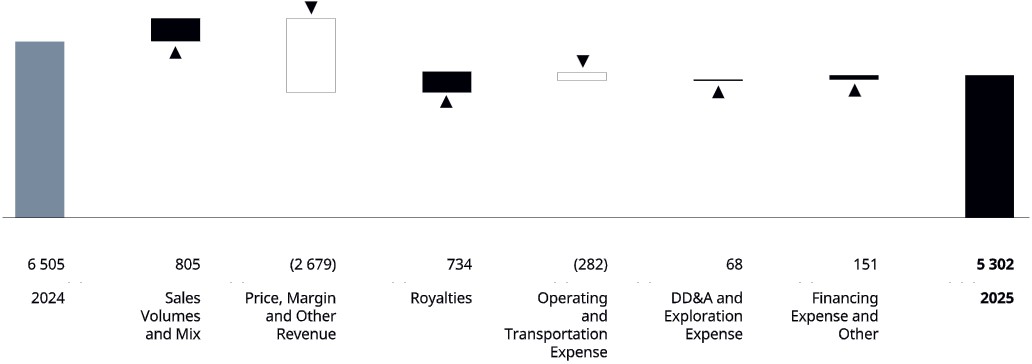
Bridge Analysis of Adjusted Operating Earnings ($ millions)(1)

| (1) | For an explanation of this bridge analysis, see the Advisories – Non-GAAP and Other Financial Measures section of this MD&A. |
The Oil Sands segment had adjusted operating earnings of $5.302 billion in 2025, compared to $6.505 billion in 2024. The decrease was primarily due to lower crude oil price realizations as a result of lower benchmark pricing, net of decreased royalties, partially offset by increased sales volumes net of the associated increase in operating and transportation expenses.
Oil Sands earnings before income taxes were $5.277 billion in 2025, compared to $6.607 billion in 2024. In addition to the factors impacting adjusted operating earnings, earnings before income taxes in 2025 were impacted by an unrealized loss on risk management activities, compared to a gain in 2024.
Adjusted funds from operations for the Oil Sands segment were $10.515 billion in 2025, compared to $11.842 billion in 2024, and were influenced by the same factors that impacted adjusted operating earnings, excluding DD&A expenses.
Production Volumes(1)
Year ended December 31 | | | | | | |
(mbbls/d) | | 2025 | | 2024 | | 2023 |
Total Oil Sands bitumen production |
| 937.5 | | 907.0 | | 819.8 |
Upgraded – net SCO and diesel |
| | | | | |
Oil Sands operations(1)(2) |
| 343.7 | | 345.8 | | 314.9 |
Syncrude(1)(2) |
| 204.8 | | 198.4 | | 190.9 |
Inter-asset transfers and consumption(3)(4) |
| (29.4) | | (28.1) | | (18.8) |
Upgraded – net SCO and diesel production |
| 519.1 | | 516.1 | | 487.0 |
Non-upgraded bitumen |
| | | | | |
Oil Sands operations |
| 160.9 | | 141.8 | | 123.4 |
Fort Hills |
| 175.4 | | 168.0 | | 106.4 |
Syncrude |
| 2.3 | | 1.1 | | 1.7 |
Inter-asset transfers(5) |
| (58.3) | | (53.2) | | (28.9) |
Non-upgraded bitumen production |
| 280.3 | | 257.7 | | 202.6 |
Oil Sands production volumes to market |
| | | | | |
Upgraded – net SCO and diesel |
| 519.1 | | 516.1 | | 487.0 |
Non-upgraded bitumen |
| 280.3 | | 257.7 | | 202.6 |
Total Oil Sands production volumes |
| 799.4 | | 773.8 | | 689.6 |
| (1) | Oil Sands Base upgrader yields are approximately 80% of bitumen throughput and Syncrude upgrader yield is approximately 85% of bitumen throughput. |
| (2) | Upgrader utilization rates are calculated using total upgraded production, inclusive of internally consumed products and inter-asset transfers. |
| (3) | Both Oil Sands operations and Syncrude produce diesel and other products, which are internally consumed in operations. In 2025, Oil Sands operations production volumes included 16,000 bbls/d of internally consumed products, of which 8,300 bbls/d was consumed at Oil Sands operations, 6,500 bbls/d was consumed at Fort Hills and 1,200 bbls/d was consumed at Syncrude. Syncrude production volumes included 3,700 bbls/d of internally consumed products. |
| (4) | In 2025, upgraded inter-asset transfers consist of 9,700 bbls/d of sour SCO that was transferred from Oil Sands operations to Syncrude. |
| (5) | In 2025, non-upgraded inter-asset transfers consist of 46,500 bbls/d of bitumen that was transferred from Fort Hills to Oil Sands Base, 9,500 bbls/d of bitumen that was transferred from Firebag to Syncrude and 2,300 bbls/d of bitumen that was transferred from Syncrude to Oil Sands operations. |
Annual Report 2025 Suncor Energy Inc. 23 |
Segment Results and Analysis
Total Oil Sands bitumen production increased to a record 937,500 bbls/d in 2025 compared to 907,000 bbls/d in 2024, primarily due to strong mining performance, including record production at Fort Hills, which achieved 90% of nameplate capacity in 2025 delivering on the three-year mine improvement plan, and record production at Firebag.
The company’s net SCO production increased to a record 519,100 bbls/d in 2025, compared to 516,100 bbls/d in 2024 and included record upgrader utilization at Syncrude of 100%, compared to 97% in the prior year, and second highest ever utilization at Oil Sands Base of 98%, compared to 99% in the prior year. The increase in net SCO production was primarily due to fewer maintenance activities in 2025 and continued strong upgrader reliability.
Non-upgraded bitumen production increased to 280,300 bbls/d in 2025, compared to 257,700 bbls/d in 2024. The increase was primarily due to record bitumen production in 2025, partially offset by higher upgrader availability in the current year compared to the prior year.
Sales Volumes
Year ended December 31 | | | | | | |
(mbbls/d) | | 2025 | | 2024 | | 2023 |
Upgraded – net SCO and diesel |
| 520.4 | | 513.2 | | 486.6 |
Non-upgraded bitumen |
| 278.6 | | 260.8 | | 199.4 |
Total |
| 799.0 | | 774.0 | | 686.0 |
SCO and diesel sales volumes increased to 520,400 bbls/d in 2025, compared to 513,200 bbls/d in 2024, primarily due to the increase in production.
Non-upgraded bitumen sales volumes increased to 278,600 bbls/d in 2025, from 260,800 bbls/d in 2024, primarily due to the increase in production, partially offset by a build of inventory in 2025 compared to a draw in 2024.
Price Realizations(1)
Year ended December 31 | | | | | | |
Net of transportation costs, but before royalties ($/bbl) | | 2025 | | 2024 | | 2023 |
Upgraded – net SCO and diesel |
| 87.79 |
| 97.91 |
| 99.40 |
Non-upgraded bitumen |
| 62.02 | | 72.65 | | 67.97 |
Weighted average |
| 78.80 | | 89.41 | | 90.27 |
Weighted average crude, relative to WTI |
| (11.67) | | (14.28) | | (14.44) |
| (1) | Contains non-GAAP financial measures. See the Advisories – Non-GAAP and Other Financial Measures section of this MD&A. |
Oil Sands price realizations decreased in 2025 compared to 2024, primarily due to weaker crude oil benchmark prices, partially offset by narrower heavy crude oil and SYN-WTI differentials.
Royalties
Royalties for the Oil Sands segment decreased in 2025 compared to 2024, primarily due to lower bitumen pricing.
Expenses and Other Factors
Total Oil Sands operating expenses increased in 2025 compared to 2024, primarily due to higher commodity input costs, increased mining activities and higher sales volumes. See the Cash Operating Costs section below for additional details regarding cash operating costs and a breakdown of non-production costs by asset.
Transportation expenses increased in 2025 compared to 2024, primarily due to increased sales volumes, which included increased exports to the U.S. Gulf Coast.
In 2025, DD&A expenses were lower than 2024, primarily due to decreased depreciation related to the company’s asset retirement obligation asset, partially offset by commissioning of new assets and new leases entered into during 2025.
Financing expense and other, which includes other income, decreased in 2025 compared to 2024, primarily due to an increase in other income and decreased accretion expense resulting from asset retirement obligations.
24 Annual Report 2025 Suncor Energy Inc. |
Cash Operating Costs
Year ended December 31 | | 2025 | | 2024 | | 2023 |
Oil Sands OS&G(1) |
| 9 625 | | 9 428 | | 9 329 |
Oil Sands operations cash operating costs reconciliation |
| | | | | |
Oil Sands operations OS&G |
| 4 929 | | 4 797 | | 5 174 |
Non-production costs(3) |
| 302 | | 246 | | (35) |
Excess power capacity and other(4) |
| (339) | | (245) | | (388) |
Oil Sands operations cash operating costs(2) ($ millions) |
| 4 892 | | 4 798 | | 4 751 |
Oil Sands operations production volumes (mbbls/d) |
| 504.6 | | 487.6 | | 438.3 |
Oil Sands operations cash operating costs(2) ($/bbl) |
| 26.55 | | 26.90 | | 29.70 |
Fort Hills cash operating costs reconciliation |
| | | | | |
Fort Hills OS&G |
| 2 505 | | 2 315 | | 1 607 |
Non-production costs(3) |
| (360) | | (267) | | (220) |
Excess power capacity(4) |
| (25) | | (32) | | (52) |
Fort Hills cash operating costs(2) ($ millions) |
| 2 120 | | 2 016 | | 1 335 |
Fort Hills production volumes (mbbls/d) |
| 175.4 | | 168.0 | | 106.4 |
Fort Hills cash operating costs(2) ($/bbl) |
| 33.10 | | 32.80 | | 34.40 |
Syncrude cash operating costs reconciliation |
| | | | | |
Syncrude OS&G |
| 2 601 | | 2 604 | | 2 837 |
Non-production costs(3) |
| (43) | | (22) | | (202) |
Excess power capacity(4) |
| (12) | | (17) | | (24) |
Syncrude cash operating costs(2) ($ millions) |
| 2 546 | | 2 565 | | 2 611 |
Syncrude production volumes (mbbls/d) |
| 207.1 | | 199.5 | | 192.6 |
Syncrude cash operating costs(2) ($/bbl) |
| 33.70 | | 35.15 | | 37.15 |
| (1) | Oil Sands inventory changes and internal transfers are presented on an aggregate basis and reflect: i) the impacts of changes in inventory levels and valuations, such that the company is able to present cost information based on production volumes; and ii) adjustments for internal diesel sales between assets. In 2025, Oil Sands OS&G included ($410) million of inventory changes and internal transfers. In 2024, Oil Sands OS&G included ($288) million of inventory changes and internal transfers. In 2023, Oil Sands OS&G included ($289) million of inventory changes and internal transfers. |
| (2) | Non-GAAP financial measures. Related per barrel amounts contain non-GAAP financial measures. See the Advisories – Non-GAAP and Other Financial Measures section of this MD&A |
| (3) | Non-production costs include, but are not limited to, share-based compensation adjustments, research costs, project startup costs and adjustments to reflect the cost of internal transfers in the receiving asset at the cost of production versus the cost of purchase. Non-production costs at Fort Hills and Syncrude also include, but are not limited to, an adjustment to reflect internally produced diesel from Oil Sands operations at the cost of production. |
| (4) | Represents excess power revenue from cogeneration units that is recorded in operating revenues. Oil Sands operations excess power capacity and other also includes, but is not limited to, the natural gas expense recorded as part of a non-monetary arrangement involving a third-party processor. |
Oil Sands operations cash operating costs per barrel(1) decreased to $26.55 in 2025 compared to $26.90 in 2024, primarily due to increased production volumes and increased power sales volumes, partially offset by higher natural gas volumes related to increased consumption at the new co-generation facility, higher natural gas prices and a higher proportion of Fort Hills bitumen being directed to upgrading at Oil Sands Base.
Fort Hills cash operating costs per barrel(1) increased to $33.10 in 2025 compared to $32.80 in 2024, primarily due to increased mining activities and higher commodity input costs, partially offset by increased production volumes.
Syncrude cash operating costs per barrel(1) decreased to $33.70 in 2025 compared to $35.15 in 2024, primarily due to increased production volumes and a lower proportion of Oil Sands Base sour SCO and Firebag bitumen being directed to upgrading at Syncrude, partially offset by increased maintenance costs and higher commodity input costs.
(1) Contains non-GAAP financial measures. See the Advisories – Non-GAAP and Other Financial Measures section of this MD&A.
Annual Report 2025 Suncor Energy Inc. 25 |
Segment Results and Analysis
Planned Maintenance
The anticipated impact of these maintenance activities has been reflected in the company’s 2026 guidance.
| ● | Planned maintenance at Firebag is commencing in the first quarter. A planned turnaround is scheduled in the second quarter with completion expected in the third quarter. |
| ● | Planned maintenance at the Oil Sands Base Plant is commencing in the first quarter. Planned maintenance is also scheduled in the second quarter with completion expected in the third quarter, with an additional event scheduled in the fourth quarter. |
| ● | Planned maintenance at the Oil Sands Base Mine is commencing in the first quarter, with completion expected in the second quarter. Additional planned maintenance is scheduled in the fourth quarter. |
| ● | Planned maintenance at the Syncrude Plant is commencing in the first quarter, with completion expected in the second quarter. |
| ● | Planned maintenance at the Syncrude Mine is commencing in the first quarter and the second quarter. |
| ● | Planned maintenance at Fort Hills is scheduled in the second quarter. |
| ● | Planned maintenance at MacKay River is scheduled in the third quarter. |
Exploration and Production
Strategy and Investment Updates
| ● | Suncor will continue investment in development drilling and other activities expected to extend the productive life of the existing fields at Hebron and Hibernia in 2026. |
| ● | Production at White Rose returned to normal operations in 2025 and investment will continue in the West White Rose Extension Project, with production expected to commence in 2026. |
Financial Highlights
Year ended December 31 ($ millions) | | 2025 | | 2024 | | 2023 |
Operating revenues(1) |
| 2 509 |
| 2 798 |
| 2 689 |
Less: Royalties(1) |
| (558) |
| (547) |
| (491) |
Operating revenues, net of royalties |
| 1 951 |
| 2 251 |
| 2 198 |
Earnings before income taxes |
| 526 |
| 867 |
| 1 691 |
Adjusted for: |
| |
| |
| |
Gain on significant disposals(2) |
| — |
| — |
| (607) |
Adjusted operating earnings(3) |
| 526 |
| 867 |
| 1 084 |
Adjusted funds from operations(3) |
| 1 195 |
| 1 610 |
| 1 612 |
Free funds flow(3) |
| 398 | | 703 | | 944 |
| (1) | Production from the company’s Libya operations has been presented on an economic basis. In the Financial Statements, revenue and royalties from the company’s Libya operations are presented on a working-interest basis, which is required for presentation purposes. See the E&P price realizations table in the Advisories – Non-GAAP and Other Financial Measures section of this MD&A. |
| (2) | In 2023, a gain of $607 million on the sale of the company’s U.K. E&P portfolio. |
| (3) | Non-GAAP financial measures. See the Advisories – Non-GAAP and Other Financial Measures section of this MD&A. |
26 Annual Report 2025 Suncor Energy Inc. |
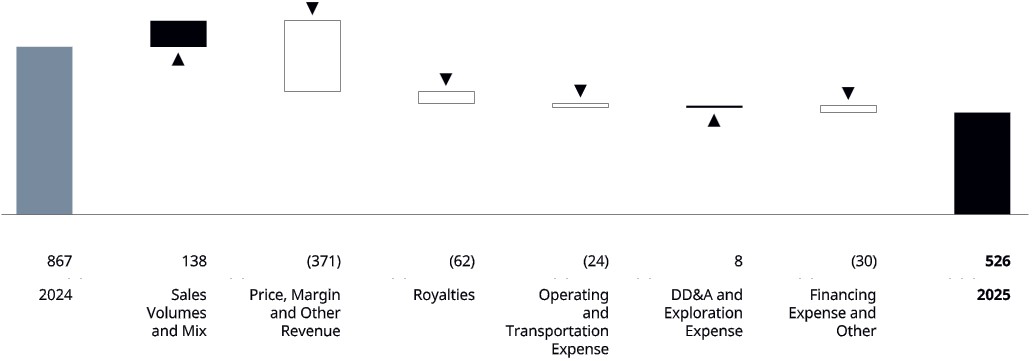
Bridge Analysis of Operating Earnings ($ millions)(1)

| (1) | For an explanation of this bridge analysis, see the Advisories – Non-GAAP and Other Financial Measures section of this MD&A. |
Adjusted operating earnings were $526 million for E&P in 2025, compared to $867 million in 2024, with the decrease primarily due to lower price realizations, as a result of lower benchmark pricing, and increased royalties, partially offset by increased sales volumes.
Earnings before income taxes for E&P were $526 million in 2025, compared to $867 million in 2024.
Adjusted funds from operations were $1.195 billion in 2025, compared to $1.610 billion in 2024, and were influenced by the same factors that impacted adjusted operating earnings.
Volumes
Year ended December 31 | | 2025 | | 2024 | | 2023 |
E&P Canada (mbbls/d) |
| 57.5 | | 49.7 | | 44.4 |
E&P International (mbbls/d) |
| 3.3 | | 4.1 | | 11.7 |
Total production (mbbls/d) |
| 60.8 | | 53.8 | | 56.1 |
Total sales volumes (mbbls/d) |
| 59.8 | | 56.2 | | 52.9 |
E&P production volumes averaged 60,800 bbls/d in 2025, compared to 53,800 bbls/d the prior year, with the increase primarily due to higher production at Hebron and the addition of production at White Rose, which restarted in the first quarter of 2025. Production was comparable between 2025 and 2024 at Terra Nova, which returned to normal operations following the completion of its asset life extension project.
E&P sales volumes averaged 59,800 bbls/d in 2025, compared to 56,200 bbls/d in the prior year, with the increase primarily due to the increase in production volumes.
Price Realizations(1)
Year ended December 31 | | | | | | |
Net of transportation costs, but before royalties | | 2025 | | 2024 | | 2023 |
E&P Canada ($/bbl) |
| 92.70 |
| 107.38 |
| 107.62 |
E&P International(2) ($/bbl) |
| — |
| — |
| 109.00 |
| (1) | Contains non-GAAP financial measures. See the Advisories – Non-GAAP and Other Financial Measures section of this MD&A. |
| (2) | E&P International price realizations exclude Libya for all periods presented. |
E&P price realizations decreased in 2025 compared to 2024, reflecting the decrease in benchmark prices for Brent crude.
Royalties
E&P royalties, excluding the impact of Libya, were higher in 2025 than the prior year primarily due to higher royalty rates and increased sales volumes.
Expenses and Other Factors
Operating and transportation expenses for 2025 increased slightly compared to the prior year, primarily due to increased sales volumes.
DD&A and exploration expenses for 2025 were comparable to the prior year.
Annual Report 2025 Suncor Energy Inc. 27 |
Segment Results and Analysis
Planned Maintenance of Operated Assets
There are no planned maintenance activities scheduled for Suncor’s operated E&P assets in 2026.
Refining and Marketing
Strategy and Investment Updates
| ● | 2025 refinery utilization rates averaged over 100%, demonstrating Suncor’s ability to add low-cost incremental throughput capacity at its refineries, and the company anticipates continuing with this strategy in 2026. |
| ● | Suncor has increased reliability and extended future turnaround intervals by improving maintenance and turnaround practices. Interval extensions translate into lower costs, higher utilization rates and more production between turnarounds and Suncor intends to replicate this successful initiative by implementing interval extensions at additional assets in 2026. |
| ● | Suncor plans to further grow market share of its branded retail and wholesale network in 2026 by leveraging strategic partnerships and the value of its premium Petro-CanadaTM brand. This includes rebranding partner sites and enhancing select company‑owned locations to drive higher‑value sales. |
Financial Highlights
Year ended December 31 ($ millions) | | 2025 | | 2024 | | 2023 |
Operating revenues |
| 30 671 |
| 31 341 |
| 31 068 |
Earnings before income taxes |
| 2 822 |
| 2 596 |
| 3 383 |
Adjusted for: |
| |
| |
| |
Unrealized (gain) loss on risk management activities |
| (5) | | 4 | | (16) |
Write-down of equity investment(1) |
| 41 | | — | | — |
Adjusted operating earnings(2) |
| 2 858 |
| 2 600 |
| 3 367 |
Adjusted funds from operations(2) |
| 3 907 |
| 3 538 |
| 4 268 |
Free funds flow(2) |
| 2 759 | | 2 348 | | 3 266 |
| (1) | In 2025, Suncor recorded a write-down of an equity investment of $41 million. |
| (2) | Non-GAAP financial measures. See the Advisories – Non-GAAP and Other Financial Measures section of this MD&A. |
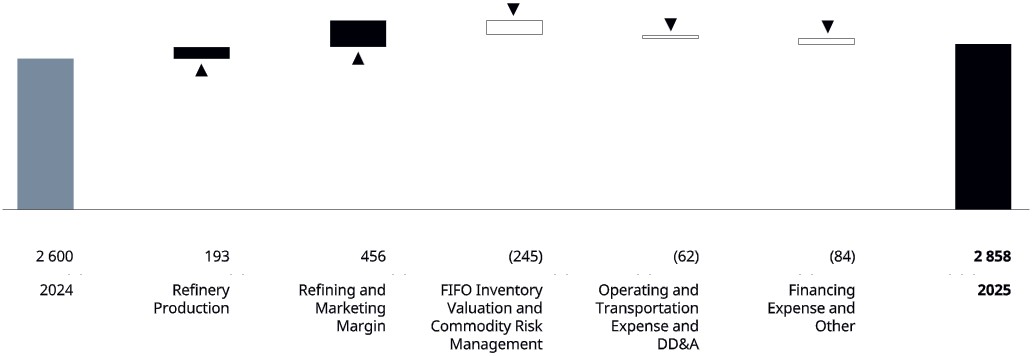
Bridge Analysis of Adjusted Operating Earnings ($ millions)(1)

| (1) | For an explanation of this bridge analysis, see the Advisories – Non-GAAP and Other Financial Measures section of this MD&A. |
R&M adjusted operating earnings were $2.858 billion in 2025, compared with $2.600 billion in 2024. The increase in adjusted operating earnings was primarily due to higher benchmark crack spreads and increased refinery production volumes, partially offset by a larger FIFO inventory valuation loss in 2025 compared to 2024 as benchmark crude prices weakened in the fourth quarter of 2025.
R&M earnings before income taxes in 2025 were $2.822 billion compared to $2.596 billion in 2024. In addition to the factors impacting adjusted operating earnings, earnings before income taxes in 2025 were impacted by an unrealized gain on risk management activities, compared to a loss in 2024. Earnings before income taxes in 2025 were also impacted by a write-down of an equity investment of $41 million.
28 Annual Report 2025 Suncor Energy Inc. |
R&M achieved annual adjusted funds from operations of $3.907 billion in 2025, compared to $3.538 billion in 2024, with the increase primarily due to the same factors that impacted adjusted operating earnings, excluding DD&A expenses.
Volumes
Year ended December 31 | | 2025 | | 2024 | | 2023 |
Crude oil processed (mbbls/d) |
| |
| |
| |
Eastern North America |
| 238.5 |
| 213.6 |
| 212.4 |
Western North America |
| 241.8 |
| 251.4 |
| 208.3 |
Total |
| 480.3 |
| 465.0 |
| 420.7 |
Refinery utilization(1) (%) |
| |
| |
| |
Eastern North America |
| 107 |
| 96 |
| 96 |
Western North America |
| 99 |
| 103 |
| 85 |
Average |
| 103 |
| 100 |
| 90 |
Refined product sales (mbbls/d) |
| |
| |
| |
Gasoline |
| 262.5 |
| 253.3 |
| 228.0 |
Distillate |
| 273.8 |
| 261.9 |
| 243.9 |
Other |
| 87.0 |
| 85.2 |
| 81.2 |
Total |
| 623.3 |
| 600.4 |
| 553.1 |
Refinery production(2) (mbbls) |
| 185 497 | | 180 356 | | 163 895 |
Refining and marketing gross margin – First-in, first-out (FIFO)(3) ($/bbl) |
| 37.60 |
| 36.40 |
| 45.00 |
Refining and marketing gross margin – Last-in, first-out (LIFO)(3) ($/bbl) |
| 39.50 | | 37.00 | | 47.00 |
Refining operating expense(3) ($/bbl) |
| 6.50 |
| 6.60 |
| 7.45 |
| (1) | Refinery utilization is the amount of crude oil and natural gas liquids processed by crude distillation units, expressed as a percentage of the nameplate capacity of these units. |
| (2) | Refinery production is the output of the refining process and differs from crude oil processed as a result of volumetric adjustments for non-crude feedstock, volumetric gain associated with the refining process and changes in unfinished product inventories. |
| (3) | Contains non-GAAP financial measures. See the Advisories – Non-GAAP and Other Financial Measures section of this MD&A. |
Refinery crude throughput was a record 480,300 bbls/d and refinery utilization averaged 103% in 2025, compared to refinery crude throughput of 465,000 bbls/d and refinery utilization of 100% in 2024. The increase was primarily due to incremental capacity additions and strong, reliable operating performance in 2025.
Total refined product sales were a record 623,300 bbls/d in 2025, compared to 600,400 bbls/d in 2024, with the increase primarily due to higher refinery production and continued investment in retail growth and strategic partnerships.
Annual Report 2025 Suncor Energy Inc. 29 |
Segment Results and Analysis
Refining and Marketing Gross Margins(1)
Refining and marketing gross margins were influenced by the following:
| ● | On a LIFO(2) basis, Suncor’s refining and marketing gross margin increased to $39.50/bbl in 2025 from $37.00/bbl in 2024. The increase was primarily due to higher benchmark crack spreads compared to the prior year and higher location differentials associated with the company’s regional markets. On a LIFO basis, Suncor’s refining and marketing margin capture(1) was 96% of Suncor’s 5-2-2-1 index in 2025, compared to 96% in 2024. |
| ● | On a FIFO basis, Suncor’s refining and marketing gross margin increased to $37.60/bbl in 2025, from $36.40/bbl in 2024 due to the same factors discussed above, in addition to FIFO inventory valuation impacts. In 2025, the impact of the FIFO method of inventory valuation, relative to an estimated LIFO(2) method, resulted in a loss of $352 million. In 2024, the FIFO method resulted in a loss of $107 million, for an overall unfavourable year-over-year impact of $245 million. |
Expenses and Other Factors
R&M operating expenses, decreased in 2025 compared to the prior year due to lower maintenance costs, partially offset by higher commodity input costs.
DD&A expenses increased in 2025 compared to the prior year, primarily due to the commissioning of assets and new leases entered into in 2025.
R&M transportation expenses in 2025 were comparable to the prior year period.
Refining operating expense per barrel(1) of $6.50 in 2025 was comparable to $6.60 in the prior year, as increased production and decreased maintenance costs offset higher commodity input costs.
Planned Maintenance
The anticipated impact of these maintenance activities has been reflected in the company’s 2026 guidance.
| ● | Planned maintenance at the Commerce City refinery commencing in the first quarter, with completion expected in the second quarter. |
| ● | Planned maintenance at the Sarnia refinery in the second quarter. |
| ● | Planned maintenance at the Montreal refinery in the third quarter. |
| ● | Planned maintenance at the Edmonton refinery in the third quarter. |
Corporate and Eliminations
Strategy and Investment Updates
| ● | The company remains committed to its capital allocation framework, managing its balance sheet at current debt levels and returning 100% of excess funds to shareholders. |
| ● | The company remains focused on continuing to execute organizational efficiency improvements and generating structural cost savings. |
(1) Contains non-GAAP financial measures. See the Advisories – Non-GAAP and Other Financial Measures section of this MD&A.
(2) The estimated impact of the LIFO method is a non-GAAP financial measure. The impact of the FIFO method of inventory valuation, relative to an estimated LIFO accounting method, also includes the impact of the realized portion of commodity risk management activities. See the Advisories – Non-GAAP and Other Financial Measures section of this MD&A.
30 Annual Report 2025 Suncor Energy Inc. |
Financial Highlights
Year ended December 31 ($ millions) | | 2025 | | 2024 | | 2023 |
Loss before income taxes |
| (677) |
| (1 883) |
| (1 296) |
Adjusted for: |
| |
| |
| |
Unrealized foreign exchange (gain) loss on U.S. dollar denominated debt |
| (403) |
| 714 |
| (184) |
Write-down of equity investment(1) | | 29 | | 212 | | 158 |
Loss on early repayment of long-term debt(2) |
| — | | 144 | | — |
Restructuring charge(3) |
| — | | — | | 275 |
Gain on significant disposal(4) |
| — | | — | | (302) |
Adjusted operating loss(5) |
| (1 051) |
| (813) |
| (1 349) |
Corporate and Renewables |
| (1 236) |
| (695) |
| (1 405) |
Eliminations – Intersegment profit realized (eliminated) |
| 185 |
| (118) |
| 56 |
Adjusted funds used in operations(5) |
| (894) |
| (679) |
| (1 546) |
Free funds deficit(5) |
| (936) | | (725) | | (1 608) |
| (1) | Net write-down of equity investments of $29 million in 2025, $212 million in 2024 and $158 million in 2023. |
| (2) | In 2024, a loss on extinguishment of long-term debt of $144 million as a result of the early repayment of certain series of the company’s outstanding notes. |
| (3) | In 2023, a restructuring charge of $275 million in OS&G expenses related to the company’s workforce reductions. |
| (4) | In 2023, a gain of $302 million on the sale of the company’s wind and solar assets. |
| (5) | Non-GAAP financial measures. See the Advisories – Non-GAAP and Other Financial Measures section of this MD&A. |
Corporate
The adjusted operating loss for Corporate was $1.236 billion in 2025, compared to $695 million in 2024. The increase in adjusted operating loss was primarily due to an operational foreign exchange loss in 2025, compared to a gain in 2024, partially offset by a decrease in share-based compensation expense in 2025.
Eliminations – Intersegment Profit
Eliminations reflect the deferral or realization of profit or loss on crude oil sales from Oil Sands to Suncor’s refineries. Consolidated profits and losses are only realized when the refined products produced from internal purchases of crude feedstock have been sold to third parties. In 2025, the company realized $185 million of intersegment profit, compared to a deferral of profit of $118 million in the prior year. The realization of profit in 2025 was primarily driven by a weakening in crude benchmark pricing compared to the prior year.
Adjusted funds used in operations for the Corporate and Eliminations segment were $894 million in 2025, compared to $679 million in 2024, and were influenced by the same factors that impacted adjusted operating loss, excluding the impact of the non-cash component of share-based compensation expense.
Annual Report 2025 Suncor Energy Inc. 31 |
Year ended December 31 | | | | | | |
($ millions) | | 2025 | | 2024 | | 2023 |
Current income tax expense |
| 1 940 |
| 2 465 |
| 1 734 |
Deferred income tax expense (recovery) |
| 90 |
| (294) |
| 560 |
Income tax expense included in net earnings |
| 2 030 |
| 2 171 |
| 2 294 |
Less: Income tax expense (recovery) on adjusted operating earnings adjustments |
| 16 | | (104) | | (98) |
Income tax expense included in adjusted operating earnings |
| 2 014 | | 2 275 | | 2 392 |
Effective tax rate |
| 25.5% | | 26.5% | | 21.7% |
The provision for income taxes in 2025 decreased to $2.030 billion, compared to $2.171 billion in 2024, primarily due to lower taxable earnings. In 2025, the company's effective tax rate on net earnings decreased compared to 2024, primarily due to the impact of non-taxable foreign exchange gains on the revaluation of U.S. dollar denominated debt and other permanent items impacting total tax expense in the current year.
32 Annual Report 2025 Suncor Energy Inc. |
6. Fourth Quarter 2025 Analysis
Financial and Operational Highlights
Three months ended December 31 | | | | |
($ millions, except as noted) | | 2025 | | 2024 |
Earnings (loss) before income taxes |
| |
| |
Oil Sands |
| 1 120 |
| 1 625 |
Exploration and Production |
| 61 |
| 125 |
Refining and Marketing |
| 895 |
| 410 |
Corporate and Eliminations |
| (69) |
| (1 070) |
Income tax expense |
| (531) | | (272) |
Net earnings |
| 1 476 |
| 818 |
Adjusted operating earnings (loss)(1) |
| |
| |
Oil Sands |
| 1 129 |
| 1 609 |
Exploration and Production |
| 61 |
| 125 |
Refining and Marketing |
| 893 |
| 410 |
Corporate and Eliminations |
| (249) |
| (200) |
Income tax expense included in adjusted operating earnings |
| (509) | | (378) |
Total |
| 1 325 |
| 1 566 |
Adjusted funds from (used in) operations(1) |
| |
| |
Oil Sands |
| 2 406 |
| 3 126 |
Exploration and Production |
| 214 |
| 274 |
Refining and Marketing |
| 1 174 |
| 638 |
Corporate and Eliminations |
| (108) |
| (131) |
Current income tax expense |
| (468) | | (414) |
Total adjusted funds from operations |
| 3 218 |
| 3 493 |
Changes in non-cash working capital |
| 703 | | 1 590 |
Cash flow provided by operating activities |
| 3 921 | | 5 083 |
Free funds flow(1) |
| 1 699 | | 1 923 |
Upstream production volumes |
| |
| |
Oil Sands – Upgraded – net SCO and diesel (mbbls/d) |
| 557.0 |
| 543.6 |
Oil Sands – Non-upgraded bitumen (mbbls/d) |
| 288.4 | | 273.9 |
Total Oil Sands production volumes (mbbls/d) |
| 845.4 | | 817.5 |
Exploration and Production (mbbls/d) |
| 63.6 |
| 57.5 |
Total upstream production (mbbls/d) |
| 909.0 |
| 875.0 |
Downstream volumes |
| |
| |
Refinery crude oil processed (mbbls/d) |
| 504.2 |
| 486.2 |
Refinery utilization (%) | | 108 | | 104 |
Refined product sales |
| 640.4 | | 613.3 |
| (1) | Non-GAAP financial measures. See the Advisories – Non-GAAP and Other Financial Measures section of this MD&A. |
Net Earnings
Suncor’s consolidated net earnings for the fourth quarter of 2025 were $1.476 billion, compared to $818 million in the prior year quarter. Net earnings were primarily influenced by the same factors that impacted adjusted operating earnings discussed below.
Other items affecting net earnings over these periods include:
| Ÿ | An unrealized foreign exchange gain on the revaluation of U.S. dollar denominated debt of $114 million recorded in financing expenses in the Corporate and Eliminations segment in the fourth quarter of 2025, compared to a loss of $514 million in the fourth quarter of 2024. |
Annual Report 2025 Suncor Energy Inc. 33 |
Fourth Quarter 2025 Analysis
| Ÿ | An unrealized loss on risk management activities of $7 million recorded in other income in the fourth quarter of 2025, compared to an unrealized gain of $16 million in the fourth quarter of 2024. |
| Ÿ | During the fourth quarter of 2025, the company reversed a provision related to an equity investment of $66 million in the Corporate and Eliminations segment, compared to a write-down of an equity investment of $212 million in the Corporate and Eliminations segment in the fourth quarter of 2024. |
| Ÿ | During the fourth quarter of 2024, the company recorded a loss on extinguishment of long-term debt of $144 million in the Corporate and Eliminations segment as a result of the early repayment of certain series of its outstanding notes. |
| Ÿ | An income tax expense related to the items noted above of $22 million in the fourth quarter of 2025, compared to a recovery of $106 million in the fourth quarter of 2024. |
Adjusted Operating Earnings
Suncor’s adjusted operating earnings were $1.325 billion ($1.10 per common share) in the fourth quarter of 2025, compared to $1.566 billion ($1.25 per common share) in the prior year quarter, with the decrease primarily due to lower upstream price realizations net of decreased royalties, and a foreign exchange loss on working capital items compared to a gain in the prior year quarter, partially offset by increased refinery margins and increased upstream production, downstream throughput and sales volumes.
Adjusted Funds from Operations and Cash Flow Provided by Operating Activities
Adjusted funds from operations were $3.218 billion ($2.68 per common share) in the fourth quarter of 2025, compared to $3.493 billion ($2.78 per common share) in the prior year quarter, and were primarily influenced by the same factors impacting adjusted operating earnings discussed above.
Cash flow provided by operating activities, which includes changes in non-cash working capital, was $3.921 billion ($3.27 per common share) in the fourth quarter of 2025, compared to $5.083 billion ($4.05 per common share) in the prior year quarter. In addition to the factors impacting adjusted funds from operations, cash flow provided by operating activities was impacted by a smaller source of cash associated with the company’s working capital balances in the fourth quarter of 2025, compared to the prior year quarter. Working capital is subject to fluctuations based on commodity prices, the timing of transactions and seasonal factors. The source of cash in the fourth quarter of 2025 was primarily due to an increase in accounts payable and accrued liabilities and the timing of tax instalment payments.
Segmented Analysis
Oil Sands
Oil Sands segment adjusted operating earnings were $1.129 billion in the fourth quarter of 2025, compared to $1.609 billion in the prior year quarter, with the decrease primarily due to lower crude oil price realizations as a result of lower benchmark pricing, net of decreased royalties, partially offset by increased sales volumes.
Total Oil Sands bitumen production increased to a quarterly record of 992,700 bbls/d, compared to 951,500 bbls/d in the prior year quarter, primarily due to strong mining performance, and included record fourth quarter production at Fort Hills.
The company’s net SCO production increased to a quarterly record of 557,000 bbls/d, compared to 543,600 bbls/d in the prior year quarter. The increase in net SCO production was primarily due to higher upgrader availability in the current period related to decreased planned maintenance activities in the current quarter and continued strong upgrader reliability.
Non-upgraded bitumen production increased to 288,400 bbls/d in the fourth quarter of 2025, compared to 273,900 bbls/d in the prior year quarter, primarily due to record bitumen production, partially offset by increased upgrader availability.
Exploration and Production
Adjusted operating earnings for the E&P segment in the fourth quarter of 2025 were $61 million, compared to $125 million in the prior year quarter, with the decrease primarily due to lower price realizations as a result of lower benchmark pricing, net of decreased royalties, partially offset by increased sales volumes.
E&P production increased to 63,600 bbls/d in the fourth quarter of 2025 compared to 57,500 bbls/d in the prior year quarter, and included increased production at Hebron and the addition of production at White Rose, which restarted in the first quarter of 2025.
Total E&P sales volumes increased to 51,500 bbls/d in the fourth quarter of 2025, compared to 44,800 bbls/d in the prior year quarter, primarily due to the timing of cargo sales in E&P Canada.
Refining and Marketing
R&M adjusted operating earnings in the fourth quarter of 2025 increased to $893 million, compared to $410 million in the prior year quarter. The increase in adjusted operating earnings was primarily due to higher benchmark crack spreads and increased refinery production, partially offset by an increased first-in, first-out (FIFO) inventory valuation loss in the fourth quarter of 2025 compared to the prior year quarter.
Refining throughput increased to a quarterly record of 504,200 bbls/d with refinery utilization of 108%, compared to 486,200 bbls/d and 104%, respectively in the prior year quarter. The increase was primarily due to continued strong operating performance through the current quarter, which saw all four refineries exceed 100% utilization.
34 Annual Report 2025 Suncor Energy Inc. |
Refined product sales increased to a fourth quarter record of 640,400 bbls/d, compared to 613,300 bbls/d in the prior year quarter, primarily due to higher refinery production and continued investment in retail growth, as well as leveraging strategic partnerships.
Corporate and Eliminations
Corporate incurred an adjusted operating loss of $307 million in the fourth quarter of 2025, compared to an adjusted operating loss of $92 million in the prior year quarter. The increased loss was primarily attributable to an operational foreign exchange loss in the current quarter compared to a gain in the prior year quarter, partially offset by a decrease in share-based compensation expense in the current quarter compared to the prior year quarter.
Eliminations reflect the deferral or realization of profit or loss on crude oil sales from Oil Sands to Suncor’s refineries. Consolidated profits and losses are only realized when the refined products from internal purchases have been sold to third parties. During the fourth quarter of 2025, the company realized $58 million of intersegment profit compared to a deferral of $108 million in the prior year quarter. The realization of intersegment profit in the fourth quarter of 2025 was primarily driven by lower refinery feedstock costs in the quarter.
Annual Report 2025 Suncor Energy Inc. 35 |
Financial Summary
Three months ended | | Dec 31 | | Sept 30 | | June 30 | | Mar 31 | | Dec 31 | | Sept 30 | | June 30 | | Mar 31 |
($ millions, unless otherwise noted) | | 2025 | | 2025 | | 2025 | | 2025 | | 2024 | | 2024 | | 2024 | | 2024 |
Total production (mbbls/d) |
| | | | | | | |
| |
| |
| |
| |
Oil Sands |
| 845.4 | | 812.2 | | 748.4 | | 790.9 | | 817.5 | | 776.0 | | 716.0 | | 785.0 |
Exploration and Production |
| 63.6 | | 57.8 | | 59.7 | | 62.3 | | 57.5 | | 52.6 | | 54.6 | | 50.3 |
Total upstream production |
| 909.0 |
| 870.0 |
| 808.1 |
| 853.2 |
| 875.0 |
| 828.6 |
| 770.6 |
| 835.3 |
Revenues and other income |
| |
| |
| |
| |
| |
| |
| |
| |
Operating revenues, net of royalties |
| 12 042 | | 12 552 | | 11 991 | | 12 323 | | 12 531 | | 12 888 | | 12 889 | | 12 381 |
Other income (loss) |
| 254 | | 115 | | (97) | | 130 | | (28) | | 174 | | 151 | | 148 |
|
| 12 296 |
| 12 667 |
| 11 894 |
| 12 453 |
| 12 503 |
| 13 062 |
| 13 040 |
| 12 529 |
Net earnings |
| 1 476 | | 1 619 | | 1 134 | | 1 689 | | 818 | | 2 020 | | 1 568 | | 1 610 |
Per common share – basic (dollars) |
| 1.23 | | 1.34 | | 0.93 | | 1.36 | | 0.65 | | 1.59 | | 1.22 | | 1.25 |
Adjusted operating earnings(1) |
| 1 325 | | 1 794 | | 873 | | 1 629 | | 1 566 | | 1 875 | | 1 626 | | 1 817 |
Per common share(1)(2) (dollars) |
| 1.10 | | 1.48 | | 0.71 | | 1.31 | | 1.25 | | 1.48 | | 1.27 | | 1.41 |
Adjusted funds from operations(1) |
| 3 218 | | 3 831 | | 2 689 | | 3 045 | | 3 493 | | 3 787 | | 3 397 | | 3 169 |
Per common share(1)(2) (dollars) |
| 2.68 | | 3.16 | | 2.20 | | 2.46 | | 2.78 | | 2.98 | | 2.65 | | 2.46 |
Cash flow provided by operating activities |
| 3 921 | | 3 785 | | 2 919 | | 2 156 | | 5 083 | | 4 261 | | 3 829 | | 2 787 |
Per common share(2) (dollars) |
| 3.27 | | 3.13 | | 2.38 | | 1.74 | | 4.05 | | 3.36 | | 2.98 | | 2.16 |
Free funds flow(1) |
| 1 699 | | 2 347 | | 981 | | 1 900 | | 1 923 | | 2 232 | | 1 350 | | 1 858 |
Per common share(1)(2) (dollars) |
| 1.42 | | 1.94 | | 0.80 | | 1.53 | | 1.53 | | 1.76 | | 1.05 | | 1.44 |
Return on Capital Employed (ROCE)(1)(3) (%) for the twelve months ended |
| 11.3 | | 11.0 | | 11.1 | | 12.8 | | 13.0 | | 15.6 | | 15.6 | | 15.7 |
Net debt(1)(4) |
| 6 337 | | 7 147 | | 7 673 | | 7 559 | | 6 861 | | 7 968 | | 9 054 | | 9 552 |
Common share information (dollars) |
| | | | | | | | | | | | | | | |
Dividend per common share(2) |
| 0.60 | | 0.57 | | 0.57 | | 0.57 | | 0.57 | | 0.55 | | 0.55 | | 0.55 |
Share price at the end of trading |
| | | | | | | | | | | | | | | |
Toronto Stock Exchange (Cdn$) |
| 60.92 | | 58.24 | | 51.01 | | 55.72 | | 51.31 | | 49.92 | | 52.15 | | 49.99 |
New York Stock Exchange (US$) |
| 44.36 | | 41.81 | | 37.45 | | 38.72 | | 35.68 | | 36.92 | | 38.10 | | 36.91 |
| (1) | Such financial measure is a non-GAAP financial measure or contains a non-GAAP financial measure. See the Advisories Non-GAAP and Other Financial Measures section of this MD&A. Adjusted operating earnings, adjusted funds from operations, net debt, free funds flow and ROCE are defined in the Advisories- Non-GAAP and Other Financial Measures section and reconciled to GAAP measures in the Consolidated Financial Information and the Segment Results and Analysis section in the respective Management’s Discussion & Analysis for such quarter or year end (Applicable MD&A), which information is incorporated by reference herein and available on SEDAR+ at www.sedarplus.ca. |
| (2) | Presented on a basic per share basis. |
| (3) | Beginning in the second quarter of 2024, the company revised the definition of ROCE to exclude lease liabilities from the calculation of average capital employed and interest on lease liabilities from net interest expense to better align with how management and industry monitor capital structure. Prior period comparatives have been restated to reflect this change. |
| (4) | Beginning in the second quarter of 2024, the company revised the definition of net debt to exclude lease liabilities to better align with how management and industry monitor capital structure. Prior period comparatives have been restated to reflect this change. |
36 Annual Report 2025 Suncor Energy Inc. |
Business Environment
Three months ended | | |
| Dec 31 |
| Sept 30 |
| June 30 |
| Mar 31 |
| Dec 31 |
| Sept 30 |
| June 30 |
| Mar 31 |
(average for the period ended, except as noted) | | | | 2025 | | 2025 | | 2025 | | 2025 | | 2024 | | 2024 | | 2024 | | 2024 |
WTI crude oil at Cushing |
| US$/bbl |
| 59.15 | | 64.95 | | 63.70 | | 71.40 | | 70.30 | | 75.15 | | 80.55 | | 76.95 |
Dated Brent crude |
| US$/bbl |
| 63.70 | | 69.10 | | 67.80 | | 75.70 | | 74.70 | | 80.25 | | 84.90 | | 83.25 |
Dated Brent/Maya FOB price differential |
| US$/bbl |
| 9.70 | | 8.80 | | 10.10 | | 11.10 | | 11.85 | | 13.90 | | 12.05 | | 14.10 |
MSW at Edmonton |
| Cdn$/bbl |
| 76.55 | | 86.40 | | 84.25 | | 95.30 | | 94.95 | | 98.00 | | 105.25 | | 92.20 |
WCS at Hardisty |
| US$/bbl |
| 47.95 | | 54.55 | | 53.50 | | 58.75 | | 57.75 | | 61.65 | | 67.00 | | 57.60 |
WCS-WTI light/heavy differential |
| US$/bbl |
| (11.20) | | (10.40) | | (10.20) | | (12.65) | | (12.55) | | (13.50) | | (13.55) | | (19.35) |
SYN-WTI (differential) premium |
| US$/bbl | | (1.30) | | 1.35 | | 1.00 | | (2.35) | | 0.85 | | 1.30 | | 2.80 | | (7.40) |
Condensate at Edmonton |
| US$/bbl |
| 57.00 | | 63.10 | | 63.50 | | 69.90 | | 70.65 | | 71.30 | | 77.15 | | 72.80 |
Natural gas (Alberta spot) at AECO |
| Cdn$/GJ |
| 2.20 | | 0.60 | | 1.65 | | 2.05 | | 1.45 | | 0.65 | | 1.10 | | 2.20 |
Alberta Power Pool Price |
| Cdn$/MWh |
| 43.00 | | 51.30 | | 40.50 | | 39.80 | | 51.50 | | 55.35 | | 45.15 | | 99.30 |
New York Harbor 2-1-1 crack(1) |
| US$/bbl |
| 29.90 | | 29.95 | | 25.90 | | 21.05 | | 18.80 | | 21.05 | | 24.75 | | 27.05 |
Chicago 2-1-1 crack(1) |
| US$/bbl |
| 21.50 | | 26.40 | | 22.05 | | 14.65 | | 13.85 | | 19.35 | | 18.85 | | 19.80 |
Portland 2-1-1 crack(1) |
| US$/bbl |
| 31.75 | | 42.05 | | 38.20 | | 22.30 | | 20.95 | | 20.35 | | 29.30 | | 26.85 |
Gulf Coast 2-1-1 crack(1) |
| US$/bbl |
| 27.15 | | 27.10 | | 23.20 | | 20.85 | | 17.00 | | 18.90 | | 22.10 | | 27.95 |
U.S. Renewable Volume Obligation |
| US$/bbl | | 6.10 | | 6.40 | | 6.15 | | 4.75 | | 4.05 | | 3.90 | | 3.40 | | 3.70 |
Suncor custom 5-2-2-1 index(2) |
| US$/bbl | | 32.00 | | 31.20 | | 27.85 | | 26.80 | | 24.25 | | 26.05 | | 26.70 | | 35.95 |
Exchange rate (average) |
| US$/Cdn$ |
| 0.72 | | 0.73 | | 0.72 | | 0.70 | | 0.71 | | 0.73 | | 0.73 | | 0.74 |
Exchange rate (end of period) |
| US$/Cdn$ |
| 0.72 | | 0.72 | | 0.73 | | 0.69 | | 0.69 | | 0.74 | | 0.73 | | 0.74 |
| (1) | 2-1-1 crack spreads are indicators of the refining margin generated by converting two barrels of WTI into one barrel of gasoline and one barrel of diesel. The crack spreads presented here generally approximate the regions into which the company sells refined products through retail and wholesale channels. |
| (2) | Suncor has developed an indicative 5-2-2-1 index based on publicly available pricing data to more accurately reflect the company’s realized refining and marketing gross margin. |
Significant or Unusual Items Impacting Net Earnings
Trends in Suncor’s quarterly revenue, net earnings and adjusted funds from operations are driven primarily by production volumes, which can be impacted by major maintenance events, changes in commodity prices and crude differentials, refining crack spreads and foreign exchange rates. Trends in Suncor’s quarterly net earnings and adjusted funds from operations are also affected by other significant events impacting operations, such as operational incidents.
In addition to the impacts of changes in production volumes and business environment, net earnings over the last eight quarters were affected by the following events or significant adjustments:
| ● | During the fourth quarter of 2025, the company reversed a provision related to an equity investment of $66 million in the Corporate and Eliminations segment. |
| ● | During the second quarter of 2025, Suncor recorded a write-down of an equity investment of $95 million in the Corporate and Eliminations segment and $41 million in the R&M segment. |
| ● | During the fourth quarter of 2024, the company recorded a loss on extinguishment of long-term debt of $144 million in the Corporate and Eliminations segment as a result of the early repayment of certain series of its outstanding notes. |
| ● | During the fourth quarter of 2024, Suncor recorded a write-down of an equity investment of $212 million in the Corporate and Eliminations segment. |
Annual Report 2025 Suncor Energy Inc. 37 |
Capital Expenditures by Type, Excluding Capitalized Interest
| | Year ended | ||||||
| | December 31, 2025 | | December 31, 2024 | ||||
| | Asset Sustainment | | Economic | | | | |
($ millions) | | and Maintenance(1) | | Investment(2) | | Total | | Total |
Oil Sands |
| | | |
| | | |
Oil Sands Base |
| 919 | | 444 |
| 1 363 | | 1 852 |
In Situ |
| 200 | | 373 |
| 573 | | 498 |
Fort Hills |
| 296 | | 456 |
| 752 | | 760 |
Syncrude |
| 820 | | 237 |
| 1 057 | | 962 |
E&P |
| — | | 723 |
| 723 | | 862 |
R&M |
| 887 | | 261 |
| 1 148 | | 1 186 |
Corporate and Eliminations |
| 40 | | 2 |
| 42 | | 46 |
|
| 3 162 |
| 2 496 |
| 5 658 | | 6 166 |
Capitalized interest on debt |
| | | | | 198 | | 317 |
Total capital expenditures |
| | | | | 5 856 | | 6 483 |
| (1) | Asset sustainment and maintenance capital expenditures include capital investments that are intended to deliver on existing value by ensuring compliance or maintaining relations with regulators and other stakeholders and maintaining current processing capacity. |
| (2) | Economic investment capital expenditures include capital investments that are expected to result in an increase in value by adding reserves or improving processing capacity, utilization, cost or margin, including associated infrastructure. |
Capital activity in 2025:
During 2025, the company incurred $5.658 billion of capital expenditures, excluding capitalized interest, compared to $6.166 billion in the prior year. Suncor capitalized $198 million of its borrowing costs in 2025 as part of the cost of major development assets and construction projects in progress, compared to $317 million in the prior year.
Economic investment capital expenditures in 2025 were primarily related to:
| ● | The completion of the Upgrader 1 coke drum replacement project at Oil Sands Base. |
| ● | The ongoing design and construction of well pads to develop additional reserves that are intended to maintain existing production and initiatives to add incremental capacity at In Situ. |
| ● | Mine equipment purchases and commencing the second opening at the Fort Hills North Pit mine. |
| ● | The completion of the Mildred Lake Mine Extension West project and the progression of the Mildred Lake Mine Extension East project, as well as preparation for autonomous haul system conversion at Syncrude. |
| ● | Progressing the West White Rose project within the E&P segment. |
| ● | Enhancing the R&M sales and marketing business, including continued strategic investment in specific company-owned retail sites and rebranding partner sites. |
Asset sustainment and maintenance capital expenditures in 2025 were primarily related to:
| ● | Planned turnaround and maintenance activity, mine and tailings development to support ongoing operations, and other maintenance projects within the Oil Sands segment. |
| ● | Planned turnaround and maintenance activity and sustainment of refinery, retail and logistics assets within the R&M segment. |
38 Annual Report 2025 Suncor Energy Inc. |
Planned activity in 2026:
Planned economic investment capital expenditures in 2026 primarily relate to:
| ● | The ongoing design and construction of well pads to develop additional reserves that are intended to maintain existing production and initiatives to add incremental capacity at In Situ. |
| ● | Mine equipment purchases and advancing the second opening at the Fort Hills North Pit mine. |
| ● | Progressing the Mildred Lake Mine Extension East project and the implementation of autonomous haul system conversion at Syncrude. |
| ● | Completing the West White Rose project within the E&P segment. |
| ● | Enhancing R&M sales and marketing business, including continued strategic investment in specific company-owned retail sites and rebranding partner sites. |
Planned asset sustainment and maintenance capital expenditures in 2026 primarily relate to:
| ● | Planned turnaround and maintenance activity, mine and tailings development to support ongoing operations, and other maintenance projects within the Oil Sands segment. |
| ● | Planned maintenance and sustainment of refinery, retail and logistics assets within the R&M segment. |
Annual Report 2025 Suncor Energy Inc. 39 |
9. Financial Condition and Liquidity
Liquidity and Capital Resources
At December 31 ($ millions, except as noted) | | 2025 | | 2024 | | 2023 |
Cash flow provided by (used in) |
| |
| |
| |
Operating activities |
| 12 781 |
| 15 960 |
| 12 344 |
Investing activities |
| (6 022) |
| (6 472) |
| (6 511) |
Financing activities |
| (6 468) |
| (7 882) |
| (5 990) |
Foreign exchange (gain) loss on cash and cash equivalents |
| (125) |
| 149 |
| (94) |
Increase (decrease) in cash and cash equivalents |
| 166 |
| 1 755 |
| (251) |
Cash and cash equivalents, end of year |
| 3 650 |
| 3 484 |
| 1 729 |
ROCE(1)(2)(3) (%) |
| 11.3 |
| 13.0 |
| 16.3 |
Net debt to adjusted funds from operations(1)(4) (times) |
| 0.5 |
| 0.5 |
| 0.7 |
Total debt to total debt plus shareholders’ equity(1)(4) (%) |
| 18.1 |
| 18.9 |
| 21.1 |
Net debt to net debt plus shareholders’ equity(1)(4) (%) |
| 12.3 |
| 13.4 |
| 18.5 |
| (1) | Non-GAAP financial measures or contains non-GAAP financial measures. See the Advisories – Non-GAAP and Other Financial Measures section of this MD&A. |
| (2) | For the twelve months ended December 31, 2025, the twelve months ended December 31, 2024, and the twelve months ended December 31, 2023 there were no impairments or impairment reversals. As a result, ROCE excluding impairments was equal to ROCE. ROCE would have been 13.6% for the twelve months ended December 31, 2023, excluding the impact of the $1.125 billion non-cash gain on acquisition of TotalEnergies Canada. |
| (3) | Beginning in 2024, the company revised the definition of ROCE to exclude lease liabilities from the calculation of average capital employed and interest on lease liabilities from net interest expense to better align with how management and industry monitor capital structure. Prior period comparatives have been restated to reflect this change. |
| (4) | Beginning in 2024, the company revised the definition of net debt and total debt to exclude lease liabilities to better align with how management and industry monitor capital structure. Prior period comparatives have been restated to reflect this change. |
Cash Flow Provided by Operating Activities
Cash flow provided by operating activities was $12.781 billion in 2025, compared to $15.960 billion in 2024. The decrease was primarily due to lower upstream price realizations net of decreased royalties, in line with the decrease in benchmark crude oil pricing, a foreign exchange loss on working capital items compared to a gain in the prior year and increased operating and transportation expenses, partially offset by increased upstream and downstream production and sales volumes, and increased downstream refinery margins.
The current period cash flow provided by operating activities was not impacted by a material change in non-cash working capital, as a decrease in accounts payable and accrued liabilities, which includes the timing impact of commodity tax payable, largely offset a decrease in accounts receivable balances and the timing of tax instalment payments. The prior period cash flow provided by operating activities reflects a source of cash in working capital, primarily due to an increase in accounts payable and accrued liabilities, which includes the timing impact of commodity tax payable, a decrease in accounts receivable balances, in line with the decrease in benchmark commodity prices in 2024, and a draw on inventory due to increased sales volumes.
Cash Flow Used in Investing Activities
Cash flow used in investing activities was $6.022 billion in 2025, compared to $6.472 billion in 2024. The decrease was primarily due to decreased capital expenditures in 2025, partially offset by an increase in non-cash investing working capital in 2025 compared to a decrease in 2024.
Cash Flow Used in Financing Activities
Cash flow used in financing activities was $6.468 billion in 2025, compared to $7.882 billion in 2024. The decrease was primarily due to the repayment of long-term debt and a decrease in short-term debt in the prior year, partially offset by an increase in share repurchases and lease principal payments in 2025.
Capital Resources
Suncor’s capital resources consist primarily of cash flow provided by operating activities, cash and cash equivalents, and available credit facilities, including commercial paper. Suncor’s management believes the company will have the capital resources required to fund its planned 2026 capital spending program of $5.6 billion to $5.8 billion, and to meet current and future working capital requirements through cash and cash equivalents balances, cash flow provided by operating activities, available committed credit facilities, issuing commercial paper and, if needed, accessing capital markets. The company’s cash flow provided by operating activities depends on several factors, including commodity prices, production, sales volumes, refining and marketing margins, operating expenses, taxes, royalties and foreign exchange rates.
40 Annual Report 2025 Suncor Energy Inc. |
The company has invested cash in short-term financial instruments that are presented as cash and cash equivalents. The objectives of the company’s short-term investment portfolio are to ensure the preservation of capital, maintain adequate liquidity to meet Suncor’s cash flow requirements and deliver competitive returns derived from the quality and diversification of investments within acceptable risk parameters. The maximum weighted average term to maturity of the short-term investment portfolio is not expected to exceed six months, and all investments are with counterparties with investment grade debt ratings.
Available Sources of Liquidity
Cash and Cash Equivalents
Included in cash and cash equivalents of $3.650 billion at December 31, 2025, are short-term investments with weighted average days to maturity of approximately 12 days. In 2025, the company earned approximately $10.5 million of interest income on these investments.
Financing Activities
Suncor’s interest on debt and lease liabilities (before capitalized interest) in 2025 was $896 million, compared to $940 million in 2024, with interest expense on debt decreasing as a result of debt repayments made in 2024, offset by an increase in interest on leases.
Available lines of credit at December 31, 2025, decreased to $5.219 billion compared to $5.475 billion as at December 31, 2024. In the fourth quarter of 2025, the company extended the maturity of its syndicated credit facilities from October 2027 and October 2028 to December 2028 and December 2029, respectively.
A summary of total and unutilized credit facilities at December 31, 2025, is as follows:
($ millions) | | 2025 |
Fully revolving and expiring in 2029 |
| 2 750 |
Fully revolving and expiring in 2028 |
| 2 469 |
Can be terminated at any time at the option of the lenders |
| 1 070 |
Total credit facilities |
| 6 289 |
Credit facilities supporting standby letters of credit |
| (725) |
Total unutilized credit facilities(1) |
| 5 564 |
| (1) | Available credit facilities for liquidity purposes were $5.219 billion at December 31, 2025 (December 31, 2024 – $5.475 billion). |
Total Debt to Total Debt Plus Shareholders’ Equity
Suncor is subject to financial and operating covenants related to its bank debt and public market debt. Failure to meet the terms of one or more of these covenants may constitute an “event of default” as defined in the respective debt agreements, potentially resulting in accelerated repayment of one or more of the debt obligations. The company is in compliance with its financial covenant that requires total debt and lease liabilities to not exceed 65% of its total debt and lease liabilities plus shareholders’ equity. At December 31, 2025, total debt and lease liabilities to total debt and lease liabilities plus shareholders’ equity was 24.3% (December 31, 2024 – 24.8%), a decrease from the prior year primarily due to higher shareholders’ equity and a decrease in long-term debt. The company is currently in compliance with all operating covenants as at December 31, 2025.
Change in Debt
($ millions) | | 2025 |
Total debt(1) – December 31, 2024 |
| 10 345 |
Decrease in long-term debt |
| (4) |
Decrease in short-term debt |
| — |
Foreign exchange on debt, and other |
| (354) |
Total debt(1) – December 31, 2025 |
| 9 987 |
Less: Cash and cash equivalents – December 31, 2025 |
| 3 650 |
Net debt(1) – December 31, 2025 |
| 6 337 |
| (1) | Non-GAAP financial measures. See the Advisories – Non-GAAP and Other Financial Measures section of this MD&A. |
The company’s total debt decreased in the twelve months ended December 31, 2025, primarily due to favourable foreign exchange rates on U.S. dollar denominated debt compared to December 31, 2024.
In the fourth quarter of 2025, the company issued $1.0 billion in aggregate principal of senior unsecured notes, consisting of $500 million principal amount of Series 11 Medium Term Notes due on November 14, 2027, having a coupon of 2.95% and $500 million principal amount of Series 12 Medium Term Notes due on November 14, 2030, having a coupon of 3.55%. Debt issuance costs were $4 million and were netted against the
Annual Report 2025 Suncor Energy Inc. 41 |
Financial Condition and Liquidity
carrying amount of the debt and amortized using the effective interest method. Net proceeds of approximately $1 billion from the issuance were utilized to repay the 5.60% Series 9 Medium Term Notes, due 2025, with a principal amount of $1 billion.
As at December 31, 2025, Suncor’s net debt was $6.337 billion, compared to $6.861 billion at December 31, 2024. The change in net debt was primarily due to the factors discussed above, and an increase in cash and cash equivalents.
For the year ended December 31, 2025, the company’s net debt to adjusted funds from operations measure was 0.5 times.
Credit Ratings
The company’s credit ratings affect its cost of funds and liquidity. In particular, the company’s ability to access unsecured funding markets and to engage in certain activities on a cost-effective basis is primarily dependent upon maintaining a strong credit rating. A lowering of the company’s credit rating may also have potentially adverse consequences for the company’s funding capacity or access to the capital markets, may affect the company’s ability, and the cost, to enter into normal course derivative or hedging transactions, and may require the company to post additional collateral under certain contracts.
For a description of Suncor’s current credit ratings refer to the Description of Capital Structure – Credit Ratings section of Suncor’s 2025 AIF.
Common Shares
Outstanding Shares
(thousands) | | December 31, 2025 |
Common shares |
| 1 193 520 |
Common share options – exercisable |
| 2 577 |
Common share options – non-exercisable |
| 2 177 |
As at February 24, 2026, the total number of common shares outstanding was 1,186,910,947 and the total number of exercisable and non-exercisable common share options outstanding was 3,579,577. Once vested, each outstanding common share option is exercisable for one common share.
Share Repurchases
(thousands of common shares) |
| Commencement Date | | Expiry | | Maximum Shares for Repurchase | | Maximum Shares for Repurchase (%) | | Number of Shares Repurchased |
2023 NCIB |
| February 17, 2023 | | February 16, 2024 | | 132 900 | | 10 | | 47 107 |
2024 NCIB |
| February 26, 2024 | | February 25, 2025 | | 128 700 | | 10 | | 61 066 |
2025 NCIB |
| March 3, 2025 | | March 2, 2026 | | 123 800 | | 10 | | 54 151 |
2026 NCIB |
| March 3, 2026 | | March 2, 2027 | | 118 700 | | 10 | | — |
The TSX has accepted a notice filed by Suncor to renew its NCIB to purchase the company's common shares through the facilities of the TSX, NYSE and/or alternative trading systems. The notice provides that, beginning March 3, 2026, and ending March 2, 2027, Suncor may purchase for cancellation up to 118,700,000 common shares, which is equal to approximately 10% of Suncor's public float as of February 18, 2026.
Between March 3, 2025, and February 24, 2026, pursuant to Suncor’s previous NCIB, Suncor repurchased 54,150,911 common shares on the open market, representing the equivalent of 4.4% of its common shares as at February 18, 2025, for $3.075 billion, at a weighted average price of $56.79 per share.
The actual number of common shares that may be repurchased under the NCIB and the timing of any such purchases will be determined by Suncor. The company believes that, depending on the trading price of its common shares and other relevant factors, repurchasing its common shares represents an attractive investment opportunity and is in the best interests of the company and its shareholders. The company does not expect that the decision to allocate cash to repurchase its common shares will affect its long-term strategy.
At December 31 | | | | | | |
($ millions, except as noted) | | 2025 | | 2024 | | 2023 |
Share repurchase activities (thousands of common shares) |
| 55 322 |
| 55 564 |
| 51 982 |
Weighted average repurchase price per share (dollars per share) |
| 54.68 |
| 52.33 |
| 42.96 |
Share repurchase cost |
| 3 025 |
| 2 908 |
| 2 233 |
42 Annual Report 2025 Suncor Energy Inc. |
Contractual Obligations, Commitments, Guarantees and Off-Balance Sheet Arrangements
In addition to the enforceable and legally binding obligations in the table below, Suncor has other obligations for goods and services that were entered into in the normal course of business, which may terminate on short notice, including commitments for the purchase of commodities for which an active, highly liquid market exists, and which are expected to be resold shortly after purchase.
The company does not believe it has any guarantees or off-balance sheet arrangements that have, or are reasonably likely to have, a current or future material effect on the company’s financial condition or financial performance, including liquidity and capital resources.
In the normal course of business, the company is obligated to make future payments, including contractual obligations and non-cancellable commitments.
| | Payment due by period | ||||||||||||
| | | | | | | | | | | | | | |
($ millions) | | 2026 | | 2027 | | 2028 | | 2029 | | 2030 | | Thereafter | | Total |
Product transportation and storage |
| 1 855 |
| 1 658 | | 1 600 |
| 1 493 |
| 1 346 |
| 9 971 |
| 17 923 |
Energy services & other long term contracts |
| 393 |
| 280 |
| 185 |
| 172 |
| 173 |
| 150 |
| 1 353 |
Exploration work commitments |
| — |
| — |
| — |
| — |
| — |
| 477 |
| 477 |
Total commitments |
| 2 248 |
| 1 938 |
| 1 785 |
| 1 665 |
| 1 519 |
| 10 598 |
| 19 753 |
Long term debt(1) |
| 1 500 | | 1 040 | | 806 | | 504 | | 1 087 | | 11 355 | | 16 292 |
Lease obligations(2) |
| 888 | | 721 | | 625 | | 538 | | 400 | | 3 871 | | 7 043 |
Decommissioning and restoration costs(3) |
| 624 | | 658 | | 491 | | 468 | | 497 | | 19 507 | | 22 245 |
Total commitments and obligations |
| 7 508 |
| 6 295 |
| 5 492 |
| 4 840 | | 5 022 | | 55 929 |
| 65 333 |
| (1) | Includes long-term debt and interest payments on long-term debt. Refer to note 20 and note 26 of Suncor’s 2025 audited Consolidated Financial Statements. |
| (2) | Includes interest payments on lease liabilities. |
| (3) | Represents the undiscounted and uninflated amount of decommissioning and restoration costs. Refer to note 23 of Suncor’s 2025 audited Consolidated Financial Statements. |
Transactions with Related Parties
Suncor enters into transactions with related parties in the normal course of business, which includes purchases of feedstock, distribution of refined products and the sale of refined products and byproducts. These transactions are with joint ventures and associated entities in the company’s R&M operations, including pipeline, refined product and petrochemical companies. For more information on these transactions and for a summary of Compensation of Key Management Personnel, refer to note 30 of the 2025 audited Consolidated Financial Statements.
Financial Instruments
The company uses derivative financial instruments, such as physical and financial contracts, to manage certain exposures to fluctuations in interest rates, commodity prices and foreign currency exchange rates as part of its overall risk management program, as well as for trading purposes. For the year ended December 31, 2025, the pre-tax earnings impact of risk management and trading activities was $161 million (2024 – pre-tax earnings of $114 million).
Gains or losses related to derivatives are recorded as Other Income in the Consolidated Statements of Comprehensive Income.
| | | | |
($ millions) | | 2025 | | 2024 |
Fair value outstanding, beginning of year |
| 82 |
| (20) |
Changes in fair value recognized in earnings during the year |
| 161 | | 114 |
Cash settlements – received during the year |
| (50) | | (12) |
Fair value outstanding, end of year |
| 193 |
| 82 |
The fair value of derivative financial instruments is recorded on the Consolidated Balance Sheets.
Fair value of derivative contracts at | | | | |
December 31 ($ millions) | | 2025 | | 2024 |
Accounts receivable |
| 267 |
| 153 |
Accounts payable |
| (74) |
| (71) |
|
| 193 |
| 82 |
Annual Report 2025 Suncor Energy Inc. 43 |
Financial Condition and Liquidity
Risks Associated with Derivative Financial Instruments
Suncor may be exposed to certain losses in the event that counterparties to derivative financial instruments are unable to fulfil their obligations under these contracts. The company minimizes this risk by entering into agreements with investment grade counterparties. Risk is also minimized through regular management review of the potential exposure to and credit ratings of such counterparties. Suncor’s exposure is limited to those counterparties holding derivative contracts with net positive fair values at a reporting date.
Suncor’s risk management activities are subject to periodic reviews by management to determine appropriate hedging requirements based on the company’s tolerance for exposure to market volatility, as well as the need for stable cash flow to finance future growth. Commodity risk management and trading activities are governed by a separate risk management group that reviews and monitors practices and policies and provides independent verification and valuation of these activities.
For further details on our derivative financial instruments, including assumptions made in the calculation of fair value, a sensitivity analysis of the effect of changes in commodity prices on our derivative financial instruments, and additional discussion of exposure to risks and mitigation activities, refer to note 26 of the company’s 2025 audited Consolidated Financial Statements.
44 Annual Report 2025 Suncor Energy Inc. |
10. Material Accounting Policies and Critical Accounting Estimates
Suncor’s material accounting policies are described in note 3 of the audited Consolidated Financial Statements for the year ended December 31, 2025.
Recently Announced Accounting Pronouncements
The standards, amendments and interpretations that are issued, but not yet effective up to the date of authorization of the company’s consolidated financial statements, and that may have an impact on the disclosures and financial position of the company, are disclosed below. The company intends to adopt these standards, amendments and interpretations when they become effective.
In April 2024, the IASB issued IFRS 18 Presentation and Disclosure in Financial Statements, which will replace IAS 1 Presentation of Financial Statements. The new standard introduces two new mandatory subtotals and defined categories of income and expenses in the consolidated statements of comprehensive income, along with enhanced requirements for the grouping of information in the consolidated financial statements. Management-defined performance measures will also be required to be disclosed within the notes to the consolidated financial statements.
As a result of the new standards and other amendments, a new operating profit subtotal is required under IFRS 18, to be used as the starting point for determining cash flows provided by operating activities under the indirect method. The new standard and amendments are effective for annual periods beginning on or after January 1, 2027, and will be applied retrospectively, with certain transition provisions. The company is currently evaluating the impact of adopting IFRS 18 and other amendments on the consolidated financial statements.
In May 2024, the IASB issued amendments to IFRS 9 Financial Instruments and IFRS 7 Financial Instruments: Disclosures to clarify the date of recognition and derecognition of some financial assets and liabilities, with a new exception for some financial liabilities settled using an electronic payment system. The amendments are effective January 1, 2026, with early adoption permitted. The company does not anticipate any significant impact from these amendments on the consolidated financial statements as a result of the initial application.
Significant and Other Accounting Estimates and Judgments
The preparation of financial statements in accordance with IFRS requires management to make estimates and judgments that affect reported assets, liabilities, revenues, expenses, gains, losses and disclosures of contingencies. These estimates and judgments are subject to change based on experience and new information.
Oil and Gas Reserves
The company’s estimate of oil and gas reserves is considered in the measurement of depletion, depreciation, impairment, decommissioning and restoration obligations and business combinations. The estimation of proved and probable reserves is an inherently complex process and involves professional judgment. All reserves have been evaluated at December 31, 2025, by independent qualified reserves evaluators. Oil and gas reserves estimates are based on a range of geological, technical and economic factors, including projected future rates of production, projected future commodity prices, engineering data, and the timing and amount of future expenditures, all of which are subject to uncertainty. Estimates reflect market and regulatory conditions existing at December 31, 2025, which could differ significantly from future periods.
Exploration and Evaluation Costs
Certain exploration and evaluation costs are initially capitalized with the intent to establish commercially viable reserves. The company is required to make judgments about future events and circumstances and applies estimates to assess the economic viability of extracting the underlying resources. The costs are subject to technical, commercial and management review to confirm the continued intent to develop the project. The level of drilling success or changes to project economics, resource quantities, expected production techniques, production costs and required capital expenditures are important judgments when making this determination. Management uses judgment to determine when these costs are reclassified to Property, Plant and Equipment based on several factors, including the existence of reserves, appropriate approvals from regulatory bodies, joint arrangement partners and the company’s internal project approval process.
Determination of Cash Generating Units (CGUs)
A CGU is the lowest grouping of integrated assets that generates identifiable cash inflows that are largely independent of the cash inflows of other assets or groups of assets. The allocation of assets into CGUs requires significant judgment and interpretations with respect to the integration between assets, the existence of active markets, similar exposure to market risks, shared infrastructure and the way in which management monitors the operations.
Asset Impairment
Management applies judgment in assessing the existence of impairment and impairment reversal indicators based on various internal and external factors, such as significant increases or decreases in forecasted production volumes, commodity prices, capital expenditures and operating costs, and impacts of energy transition.
The recoverable amount of CGUs and individual assets is determined based on the higher of fair value less costs of disposal or value-in-use calculations. The key estimates the company applies to determine the recoverable amount normally include estimated future commodity prices, discount rates, expected production volumes, future operating costs, including greenhouse gas (GHG) costs and development costs, income taxes and refining margins. In determining the recoverable amount, management may also be required to make judgments regarding the likelihood of occurrence of a future event. Changes to these estimates and judgments will affect the recoverable amounts of CGUs and individual assets and may then require a material adjustment to their related carrying value.
Annual Report 2025 Suncor Energy Inc. 45 |
Material Accounting Policies and Critical Accounting Estimates
Decommissioning and Restoration Costs
For decommissioning and restoration provisions, management applies judgment in assessing the future regulatory requirements, the existence and extent as well as the expected method of reclamation of the company’s decommissioning and restoration obligations at the end of each reporting period. Management also uses judgment to determine whether the nature of the activities performed is related to decommissioning and restoration activities or normal operating activities.
Actual costs are uncertain, and estimates may vary as a result of changes to relevant laws and regulations, the emergence of new technology, operating experience, prices and closure plans. The estimated timing of future decommissioning and restoration may change due to certain factors, including reserves life. Changes to estimates related to future expected costs, discount rates, inflation assumptions and timing may have a material impact on the amounts presented. Payments to settle the decommissioning and restoration provisions are aligned with the estimated life of the underlying asset, with energy transition considerations discussed below.
Climate Change
Climate change, global energy demand, and the transition to a low-emissions economy were considered in preparing these consolidated financial statements. These factors primarily affect assumptions for commodity prices, asset valuation, reserves estimates, and the timing of reclamation activities. They may also influence future assets and liabilities. Suncor incorporates estimated GHG emissions costs into its operational planning and project evaluations, and these estimates are continuously monitored and updated as required.
Tariffs
The government of the United States of America has continued to either implement or propose tariffs on various Canadian products. The company is closely monitoring these developments and will continue to assess the impacts of such tariffs and measures. To date, the implemented and proposed tariff changes have not had a material impact to the company’s input costs. The impact of potential future tariffs on the company’s financial results is subject to significant uncertainty, as such the impact cannot be quantified at this time.
Employee Future Benefits
The company provides benefits to employees, including pensions and other post retirement benefits. The cost of defined benefit pension plans and other post retirement benefits received by employees is estimated based on actuarial valuation methods that require professional judgment. Estimates typically used in determining these amounts include, as applicable, rates of employee turnover, future claim costs, discount rates, future salary and benefit levels, the return on plan assets, mortality rates and future medical costs. Changes to these estimates may have a material impact on the amounts presented.
46 Annual Report 2025 Suncor Energy Inc. |
Suncor is committed to a proactive program of enterprise risk management intended to enable decision making through consistent identification and assessment of the risks inherent to its assets, activities and operations. Some of these risks are common to operations in the oil and gas industry as a whole, while some are unique to Suncor. The realization of any of the following risks could have a material adverse effect on Suncor’s business, financial condition, reserves and results of operations.
Financial Risk Factors
Commodity Price Exposure
Suncor’s financial results are sensitive to prices for crude oil, refined petroleum products and, to a lesser extent, natural gas and electricity prices. These are driven by global and regional supply and demand factors which are beyond the company’s control. Prolonged low or volatile prices or transportation/storage constraints could reduce production and refinery utilization rates, impair assets and delay growth projects.
Crude oil prices are also affected by, among other things, global economic health (particularly in emerging markets), market access constraints, regional and international supply and demand imbalances, political developments and government action, geopolitical conflict, decisions by OPEC+ regarding quotas on its members, compliance or non-compliance with quotas agreed upon by OPEC+ members and other countries, the impact of changes to U.S. government economic policy (including the imposition of additional tariffs) and weather. These factors impact the various types of crude oil and refined products differently and can impact differentials between light and heavy grades of crude oil (including blended bitumen) and between conventional oil and SCO.
Refined petroleum product prices and refining margins are also affected by, among other things, crude oil prices, the availability of crude oil and other feedstock, levels of refined product inventories, regional refinery availability, market access, marketplace competitiveness, regulatory compliance costs and other local market factors. Natural gas prices in North America are affected by, among other things, supply and demand, inventory levels, weather and prices for alternative energy sources.
In addition, oil producers in North America, and particularly in Canada, may receive discounted prices for their production relative to certain international prices, due in part to constraints on the ability to transport and sell such products to international markets. A failure to resolve such constraints may result in continued discounted or reduced commodity prices realized by oil producers. Suncor’s production from Oil Sands includes significant quantities of bitumen and SCO that may trade at a discount to light and medium crude oil. Bitumen and SCO are typically more expensive to produce and process. In addition, the market prices for these products may differ from the established market indices for light and medium grades of crude oil. As a result, the price received for bitumen and SCO may differ from the benchmark they are priced against.
All commodity prices discussed above could also be adversely affected by a prolonged period of decreased demand caused by the outbreak of epidemics, pandemics and other public health crises in geographic areas in which Suncor has operations, suppliers, customers or employees.
Access to Capital
Suncor expects that future capital expenditures will be financed out of cash flow, credit facilities and, if needed, accessing capital markets. Access depends on commodity prices, market conditions, and investor sentiment toward the energy industry generally, and the company’s securities in particular. Stricter decarbonization policies could limit financing availability or raise costs. Higher debt levels may impair flexibility and credit ratings. Suncor is required to comply with financial and operating covenants under existing credit facilities and debt securities, and if Suncor does not comply with such covenants there is a risk that repayment could be accelerated and/or the company’s access to capital could be restricted or only be available on unfavourable terms.
Rating agencies regularly evaluate the company, including its subsidiaries. Their ratings of Suncor’s long-term and short-term debt are based on a number of factors, including factors not entirely within the company’s control. There is a risk that one or more of Suncor’s credit ratings could be downgraded, which could potentially limit its access to private and public credit markets and increase the company’s cost of borrowing.
Inflation
Persistent inflation can raise structural costs and impact business plans. Governmental action, such as the imposition of higher interest rates, an increase or imposition of tariffs on goods imported from or exported to the U.S., could further increase costs and amplify other risks identified in this Risk Factors section of the MD&A.
Interest Rate Risk
The company is exposed to fluctuations in short-term Canadian and U.S. interest rates as Suncor maintains a portion of its debt capacity in revolving and floating rate credit facilities and commercial paper and invests surplus cash in short-term debt instruments and money market instruments, which are off-setting exposures to some degree. Suncor may also be exposed to higher interest rates when debt instruments are maturing and require refinancing, or when new debt capital needs to be raised. The company is also exposed to changes in interest rates if derivative instruments are used to manage the debt portfolio.
Exchange Rate Fluctuations
The majority of Suncor’s revenues from the sale of oil and natural gas commodities are based on prices that are determined by, or referenced to, U.S. dollar benchmark prices, while the majority of Suncor’s expenditures are realized in Canadian dollars. Suncor also has assets and liabilities, that are denominated in U.S. dollars and translated (Canadian dollars) at each balance sheet date. Suncor’s financial results, therefore, can be affected significantly by the exchange rates between the Canadian dollar and the U.S. dollar.
Royalties, Taxes and Tariffs
Suncor is subject to royalties and taxes imposed by governments in numerous jurisdictions and the potential for increased tariffs. Royalties may vary with changes in crude oil and natural gas prices, production, volumes, and capital and operating costs; and amendments to legislation or
Annual Report 2025 Suncor Energy Inc. 47 |
Risk Factors
production sharing contracts. In addition, regulatory audits of prior year filings may affect the final determination of royalties payable and could result in material impact on the company’s royalties expense.
A failure to fully realize anticipated tax benefits, including the expected tax benefit relating to the acquisition of TotalEnergies Canada, income taxes, property taxes, carbon taxes, levies, tariffs, duties, quotas, border taxes, other taxes and other government-imposed compliance costs could adversely affect the company’s cost structure, cash flows and overall financial performance.
In February 2025, the U.S. government announced plans for new tariffs on, among other things, Canadian imports to the United States. In response, the Canadian government indicated it would implement retaliatory tariffs on certain goods imported from the U.S. A portion of the company’s crude oil is exported to the U.S. and tariffs could have a negative impact on commodity prices and increase volatility, which could have an adverse effect on the company's business, financial condition, results of operations and cash flows from operations. Additionally, certain goods used by the company in its operations are procured from the U.S. and the tariffs proposed by the Canadian government could increase certain costs of the company, which could have an adverse effect on the company's business, financial condition and cash flows from operations.
The timing and scope of the U.S. and Canadian tariffs remain subject to significant uncertainty and the associated financial impacts cannot be reliably quantified at this time. Suncor continues to monitor proposed tariffs and will assess potential implications as further information becomes available.
Energy Trading and Risk Management Activities and the Exposure to Counterparties
The nature of Suncor’s energy trading and risk management activities, which may make use of derivative financial instruments or other physical positions to create incremental value to Suncor and to manage its exposure to commodity price and other market risks, creates exposure to financial risks, which include, but are not limited to, unfavourable movements in commodity prices, interest rates or foreign exchange that could result in a financial or opportunity loss to the company; a lack of counterparties, due to market conditions or other circumstances that could leave the company unable to liquidate or offset a position, or unable to do so at or near the previous market price; and counterparty default risk.
Dividends and Share Repurchases
Suncor’s payment of future dividends on its common shares and future share repurchases by Suncor of its common shares depends on, among other things, legislative and stock exchange requirements, the prevailing business environment, the company’s financial condition, results of operations, cash flow, the need for funds to finance ongoing operations and growth projects, debt covenants and other business considerations that the Board considers relevant. There can be no assurance that Suncor will continue to pay dividends or repurchase shares in the future.
Control Environment
Based on their inherent limitations, disclosure controls and procedures and internal controls over financial reporting may not prevent or detect misstatements, and even those controls determined to be effective can provide only reasonable assurance with respect to financial statement preparation and presentation. Failure to adequately prevent, detect and correct misstatements could have an impact on how Suncor’s business, financial condition and results of operations are reported.
Insurance Coverage
Suncor maintains insurance coverage as part of its risk management program. However, such insurance may not provide comprehensive coverage in all circumstances, nor are all such risks insurable. The company self-insures some risks, and the company’s insurance coverage does not cover all the costs arising out of the allocation of liabilities and risk of loss arising from Suncor operations.
In some instances, certain insurance may become unavailable or offer limited coverage. Significantly increased costs could lead the company to reduce, or possibly eliminate, coverage. In addition, insurance is purchased from a number of third-party insurers, often in layered insurance arrangements, some of whom may discontinue providing insurance coverage. Should any of these insurers refuse to continue to provide insurance coverage, the company’s overall risk exposure could be increased.
Government and Regulatory Risk Factors
Suncor operates within a complex framework of federal, provincial, territorial, state, municipal and international laws and regulations. The company’s activities are subject to regulation and intervention by governments in oil and gas industry matters, such as land tenure; royalties; taxes (including income taxes); production rates; environmental protection; health and safety; emissions reduction; approval of infrastructure; the imposition of specific drilling obligations; control over the development, reclamation and abandonment of fields and mine sites; Mine Financial Security Program requirements; and export activities. As part of ongoing operations, the company is also required to comply with a significant number of environmental, health and safety regulations under a variety of Canadian, U.S. and other foreign, federal, provincial, territorial, state and municipal laws and regulations. Non-compliance with applicable laws and regulations may result in fines and penalties, operational disruptions or shutdowns, reputational damage, delays, increased costs, permit or licence denials or losses and potential legal liabilities.
Suncor must obtain and maintain numerous permits, regulatory approvals and licences to operate its assets and advance projects. These processes can involve Indigenous and stakeholder consultation, environmental impact assessments, public hearings and ongoing compliance obligations such as financial securities and reclamation commitments. Failure to comply with existing processes or obtain regulatory approval for future projects could impact future growth opportunities and production rates. Compliance can be affected by external factors, including the actions of third parties operating shared or interdependent infrastructure.
Failure to obtain, maintain or comply with required approvals or conditions could result fines, penalties, operational delays, shutdowns, reputational damage, increased costs, or loss of licences and permits. Changes in government policies, laws, or regulatory interpretations could materially affect the company’s operations, profitability and future growth opportunities.
Tailings Management and Water Release
Fluid tailings management plans must be approved by the Alberta Energy Regulator. If a Suncor mine fails to meet a condition of its approved plan, the company could be subject to enforcement actions, including production curtailment and other financial consequences, such as compliance levies or being required to post additional security under the Mine Financial Security Program. Certain associated policy and regulation reviews and updates are still under development. Such updates could impact the technologies that the company plans to employ for
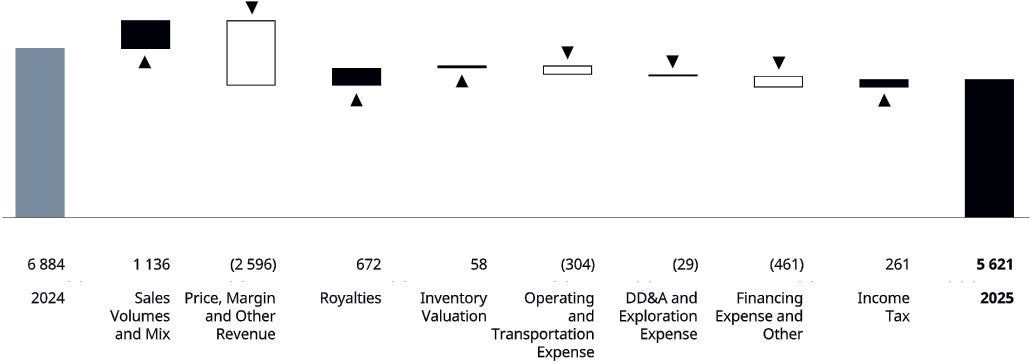
48 Annual Report 2025 Suncor Energy Inc. |
tailings management and reclamation, which could adversely impact the company’s business plans. There could also be risks if the company’s tailings management operations fail to operate as anticipated.
Suncor uses an integrated mine water, tailings and closure management approach for effective operations, successful reclamation and mine closure. The inability to release treated mine water to the environment and the lack of an approval mechanism for pit lakes with tailings continues to result in an increase to both water quality concerns and water containment concerns at Suncor mine sites. This impacts current operations, and reclamation and closure plans. The absence of an effective regulatory framework in this area could adversely impact operations and the success and timing of closure and reclamation plans.
Carbon Regulations
Existing and future laws and regulations in support of a transition to lower carbon intensity energy and climate change action may impose significant constraints on fossil fuel development. Concerns over climate change, fossil fuel extraction, GHG emissions, and water and land-use practices could lead governments to enact additional or more stringent laws and regulations applicable to Suncor and other companies in the energy industry in general, and in the oil sands industry in particular.
Changes to environmental regulations, including regulations relating to climate change and uncertainty relating to the ability of the company to report on climate-related matters, could impact the demand for the company’s products or could require increased capital expenditures, operating expenses, abandonment and reclamation obligations, and distribution costs. These potential added costs may not be recoverable in the marketplace and may result in some current operations or growth projects becoming less profitable or uneconomic. Such regulatory changes could require significant Suncor investment into the development of technologies or other energy products. Suncor continues to monitor international and domestic efforts to address climate change.
These developments and future developments could adversely impact the demand for Suncor’s products, the ability of Suncor to maintain and grow its production and reserves, and Suncor’s reputation.
Decarbonizing Suncor’s base business could require significant capital expenditures and resources, with the potential that the costs required to lower Suncor’s carbon intensity may materially differ from our original estimates and expectations negatively impacting operating results.
Greenhouse Gas Emissions and Targets
Suncor’s ability to meet its objective to decarbonize its base business and reduce GHG emissions is subject to numerous risks and uncertainties. Actions taken to meet these objectives may also expose Suncor to certain additional and/or heightened financial and operational risks.
Reduction in GHG intensity relies on, among other things, Suncor’s ability to implement and improve energy efficiency at its facilities, future development and growth opportunities, development and deployment of new technologies, ability to sequester and capture carbon and investment in lower carbon intensity power, as well as a transition to lower carbon intensity fuels. Inability to deliver on these strategies and technologies, or in the event that such strategies or technologies do not perform as expected, Suncor may be unable to decarbonize its base business.
As GHG regulations and targets become more stringent, the absolute operational GHG emissions of the company may rise as a result of growth, merger and acquisition activities, and changes in the operation of assets by Suncor or affiliates. Increases in GHG emissions may impact the profitability of the company’s projects, as Suncor will be subject to incremental levies and taxes. There is also a risk that Suncor could face litigation initiated by third parties relating to climate change, including litigation pertaining to GHG emissions, the production, sale, or promotion of fossil fuels and petroleum products, and/or climate related disclosure.
Alberta’s Land Use Framework
The implementation of, and compliance with, the terms of Alberta’s Land-Use Framework through the Lower Athabasca Regional Plan (LARP) and ongoing development of sub-regional plans within it may adversely impact Suncor’s current properties and projects in northern Alberta due to, among other things, environmental limits and thresholds. The impact of the LARP on Suncor’s operations may be outside of the control of the company, as Suncor’s operations could be impacted as a result of restrictions imposed due to the cumulative impact of development by the other operators in the area and not solely in relation to Suncor’s direct impact.
Water Management Regulations
Suncor’s operations depend on water obtained under licences and permits issued by government and regulatory authorities. There can be no assurance that the licences to withdraw and use water will not be rescinded or restricted, or that additional conditions will not be added. It is also possible that regional water management approaches may require water-sharing agreements between stakeholders. In addition, any changes or expansions of the company’s projects may rely on securing licences and permits for additional water withdrawal and use, and there can be no assurance that these licences will be granted in a timely manner or that they will be granted on terms favourable to Suncor. There is also a risk that future laws or changes to existing laws or regulations relating to water access or water management could cause capital expenditures and operating expenses relating to water licence compliance to increase.
Biodiversity
Species at risk exist in the areas where Suncor conducts its operations. Current or future regulations to manage at risk species may impact Suncor’s operations. The development and implementation of sub-regional plans may have an impact on the pace and amount of development in these areas and could potentially increase costs due to restoration or offsetting requirements.
Pursuant to the Alberta Wetland Policy, future development that removes wetlands may be obligated to pay in lieu fees based on the hectares of wetlands removed; fees could total in the tens to hundreds of millions per site. Suncor operations and growth projects without established regulatory boundaries (e.g., Water Act) prior to 2016 will be affected. Wetland replacement costs are based on wetland value and may be especially high for future oil sands projects and expansions due to the limited opportunity to avoid or minimize impacts to wetlands.
Air and Water Quality Management
A number of air and water quality regulations and frameworks are currently in place and continue to be developed, amended, and implemented that impact the company. These measures could affect the company’s existing operations and planned projects by requiring additional capital
Annual Report 2025 Suncor Energy Inc. 49 |
Risk Factors
investments or increased operating and compliance expenditures, and potentially requiring the company to retrofit equipment to meet new requirements and increase monitoring and mitigation plans. The full impact of these evolving regulations and frameworks is not yet known.
Operational Execution Risk Factors
Each of Suncor’s primary operating businesses carries economic risk associated with operating safety and reliably or enduring a protracted operational outage. The breadth and level of integration of Suncor’s operations adds complexity.
The company’s businesses also carry the risks associated with poor or substandard environmental and safety performance, which is closely scrutinized by governments, the public and the media, and could result in a suspension of or inability to obtain regulatory approvals and permits, or, in the case of a major environmental or safety incident, could result in delays in resuming normal operations, fines, civil suits or criminal charges against the company.
In general, Suncor’s operations are subject to operational hazards and risks such as, among others, fires (including forest fires), explosions, blow-outs, power outages, prolonged periods of extreme cold or extreme heat, severe winter climate conditions, flooding, droughts and other extreme weather conditions, railcar incidents or derailments, the migration of harmful substances such as, among others, oil spills, gaseous leaks or a release of deleterious substances, loss of tailings dam integrity, pollution and other environmental risks, and accidents, any of which can interrupt operations or cause personal injury or death, or damage to property, equipment (including information technology and related data and controls systems), and the environment.
The reliable operation of production and processing facilities at planned levels and Suncor’s ability to produce higher-value products can also be impacted by, among other things, failure to follow the company’s policies, standards and operating procedures or operate within established operating parameters, equipment failure through inadequate maintenance, unanticipated erosion or corrosion of facilities, manufacturing and engineering flaws, and labour shortage or interruption. The company is also subject to operational risks such as sabotage, terrorism, trespass, theft, and malicious software, network or cyberattacks.
In addition to the foregoing factors that affect Suncor’s business generally, each business unit is susceptible to additional risks due to the nature of its business, including, among others, the following:
| ● | Suncor’s Oil Sands business is susceptible to loss of production, slowdowns, shutdowns or restrictions on its ability to produce higher-value products, due to the failure of any one or more interdependent component systems, potential penalties, litigation or reputation damage related to an unintended release or a failure to contain tailings produced in operations, and other risks inherent to oil sands operations; |
| ● | Suncor’s E&P businesses face risks and uncertainties associated with drilling for oil and natural gas to replace reserves, the operation and development of such properties and wells (including encountering unexpected formations, pressures or the presence of hydrogen sulphide), premature declines of reservoirs, sour gas releases, uncontrollable flows of crude oil, natural gas or well fluids. Additionally, offshore operations occur in the areas subject to extreme weather conditions, such as hurricanes, winter storms, pack ice, icebergs and fog. The occurrence of any of these events could result in production shut-ins, the suspension of drilling operations and damage to or destruction of the equipment involved. Harsh weather conditions, particularly in the winter season, may also impact the successful execution of maintenance and startup of operations. Offshore operations could be indirectly affected by catastrophic events occurring at other third-party offshore operations, including off-loading terminals, which could give rise to liability, damage to the company’s equipment, harm to individuals, force a shutdown of facilities or operations, a curtailment of production, or result in a shortage of appropriate equipment or specialists required to perform planned operations; and |
| ● | Suncor’s R&M operations are subject to all of the risks normally inherent in the operation of refineries, terminals, pipelines and other distribution facilities and service stations, including, among others, loss of production, slowdowns or shutdowns due to equipment failures, unavailability of feedstock, price and quality of feedstock, or other incidents. |
Suncor is also subject to risks relating to the health and safety of its people, and the potential for a slowdown or temporary suspension of its operations in locations impacted by an outbreak of an epidemic, pandemic or other public health crisis. This could negatively impact Suncor’s production or refined product volumes and refinery utilization rates for a sustained period of time.
Security and Terrorist Threats
Security threats and terrorist or activist activities may impact Suncor’s personnel, which could result in injury, death, extortion, hostage situations and/or kidnapping, including unlawful confinement. A security threat, terrorist attack or activist incident targeted at a facility or office owned or operated by Suncor could also result in the interruption or cessation of key elements of Suncor's operations and may result in property damage.
Information Technology
The efficient operation of Suncor’s business is dependent on computer hardware, software and a large and complex information framework, including the systems of cloud providers and third parties with which Suncor conducts business. Digital transformation continues to increase the number of, and complexity of, such systems. In the ordinary course of Suncor’s business, Suncor collects and stores sensitive data, including intellectual property, proprietary business information and personal information of the company’s employees and retail customers. Suncor relies on industry-accepted security measures, controls and technology to protect Suncor’s information systems and securely maintain confidential and proprietary information stored on the company’s information systems, and has adopted a continuous process to identify, assess and manage threats to the company’s information systems.
As a result of the critical nature of the energy supply chain and Suncor’s use of information systems and other digital technologies to control its assets, Suncor faces a heightened risk of cyber-attacks. Additionally, the increasing adoption and use of artificial intelligence (AI) systems by Suncor and/or by third parties may increase the prevalence and efficacy of cyberattacks. Suncor has an information and cybersecurity program in place, however, the measures, controls and technology on which the company relies are constantly evolving, and therefore they may not be adequate due to the increasing volume, sophistication and rapidly evolving nature of cyber threats. Suncor’s information technology and infrastructure, including process control systems, has and will likely continue to face attacks by malicious persons or entities motivated by, among other things, geopolitical, financial or activist reasons, or may be breached due to employee error or malfeasance, or otherwise vulnerable due to other disruptions. The company maintains a risk management program, which includes an insurance component that may provide coverage for the operational impacts from an attack to, or breach of, Suncor’s information technology and infrastructure, including process control systems,
50 Annual Report 2025 Suncor Energy Inc. |
however, the company does not maintain standalone cyber insurance. Furthermore, not all cyber risks are insurable. As a result, Suncor’s existing insurance may not provide adequate coverage for losses stemming from a cyberattack to, or breach of, its information technology and infrastructure.
A cyber attack or breach could compromise Suncor’s networks, and the information Suncor stores could be accessed, publicly disclosed, lost, stolen or compromised. Any such attack, breach, access, disclosure or loss of information could result in legal claims or proceedings, liability under laws that protect the privacy of personal information, regulatory penalties, disruptions to Suncor’s operations, decreased performance and production, increased costs, damage to Suncor’s reputation, physical harm to people or the environment or other negative consequences to Suncor or third parties.
General Risk Factors
Competition
The global petroleum industry is highly competitive in many aspects, including the exploration for and the development of new sources of supply, the acquisition of crude oil and natural gas interests, and the refining, distribution and marketing of refined petroleum products. Suncor competes in virtually every aspect of its business with other energy companies. The petroleum industry also competes with other industries in supplying energy, fuel and related products to consumers. The increasing volatility of the political and social landscape adds complexity.
For Suncor’s Oil Sands and E&P businesses, it is difficult to assess the number, level of production and ultimate timing of all potential new projects or when existing production levels of competitors may increase. An increase in the level of activity may have an impact on regional infrastructure, including pipelines, and could place stress on the availability and cost of all resources required to build and run new and existing oil sands operations.
For Suncor’s R&M business, management expects that fluctuations in demand for refined products, margin volatility and overall marketplace competitiveness will continue.
There is a risk that increased competition could cause costs to increase, put further strain on existing infrastructure, cause margins for refined and unrefined products to be volatile, and impact demand for Suncor’s products.
Technology Risk
There are risks associated with sustainability, growth and capital projects that rely largely or partly on new technologies and the incorporation of such technologies into new or existing operations, including that the results of the application of new technologies may differ from simulated, test or pilot environments, or that third-party intellectual property protections may impede the development and implementation of new technology. The success of projects incorporating new technologies cannot be assured and advantages accrue to companies that can develop and adopt emerging technologies in advance of competitors. The inability to develop, implement and monitor new technologies may impact the company’s ability to develop its new or existing operations in a profitable manner or comply with regulatory requirements.
The increasing use of AI systems both by Suncor and third parties presents risks associated with the company’s adoption, development and incorporation of AI systems. AI systems provided with incorrect or incomplete data may generate erroneous insights leading to flawed decisions that potentially compromise safety, productivity and profitability. The amount of data and the speed of AI systems can create privacy, governance and accountability risks with respect to the use of AI and protection of confidential information. Successful use of AI systems can provide the company with competitive advantages but cannot be assured, and the inability to successfully adopt, develop and/or incorporate AI systems may impact the company’s profitability, and ability to compete with peers.
Skills, Resource Shortage and Reliance on Key Personnel
The successful operation of Suncor’s businesses depends on the availability of, and competition for, skilled labour and materials supply. There is a risk that the company may have difficulty sourcing and retaining the skilled labour in certain talent segments for current and future operations. The availability of competent and skilled contractors for current and future operations is also a risk depending on market conditions and continued cost reduction initiatives. Suncor’s ability to operate safely and effectively and complete all projects on time and on budget has the potential to be adversely impacted by a shortage of skilled labour and material supply risks. The company’s success also depends in large measure on certain key personnel.
Labour Relations
Hourly employees at certain of Suncor’s oil sands facilities, the company’s refineries and the majority of the company’s terminal and distribution operations and certain of the company’s E&P operations are represented by labour unions or employee associations. Any work interruptions involving the company’s employees, contract trades utilized in the company’s projects or operations, or any jointly owned facilities operated by another entity present a risk to the continued operations of the areas of the company that are affected by such interruptions.
Joint Arrangement Risk
Suncor has entered into joint arrangements and other contractual arrangements with third parties, including arrangements where other entities operate assets in which Suncor has ownership or other interests and arrangements where Suncor operates assets in which other entities have ownership or other interests. The success and timing of activities relating to assets and projects operated by others, or developed jointly with others, depend upon a number of factors that are outside of Suncor’s control, including, among others, the timing and amount of capital expenditures, operational and maintenance expenditures; misalignment of partner interests, the operator’s expertise, financial resources and risk management practices; the approval of other participants; and the selection of technology.
E&P Reserves Replacement
Suncor’s future E&P production, and therefore its cash flows and results of operations from E&P, are highly dependent upon success in exploiting its current reserves base and acquiring or discovering additional reserves. Without additions to its E&P reserves through exploration, acquisition or development activities, Suncor’s production from its E&P assets will decline over time as reserves are depleted. The business of exploring for, developing or acquiring reserves is capital intensive. To the extent Suncor’s cash flows are insufficient to fund capital expenditures and external
Annual Report 2025 Suncor Energy Inc. 51 |
Risk Factors
sources of capital become limited or unavailable, Suncor’s ability to make the necessary capital investments to maintain and expand its reserves will be impaired. In addition, Suncor may be unable to develop or acquire additional reserves to replace its crude oil production at acceptable costs.
Uncertainties Affecting Reserves Estimates
There are numerous uncertainties inherent in estimating quantities of reserves, including many factors beyond the company’s control. Suncor’s actual production, revenues, royalties, taxes and development and operating expenditures will vary from its reserves estimates, and such variances could be material.
Reserves evaluation is subject to revisions based on newly acquired technical data, technology improvements or changes in performance, pricing, economic conditions, market availability or regulatory requirements. Geological and engineering assessments – including additional technical information regarding geology, hydrogeology, reservoir properties and reservoir fluid properties is obtained through seismic programs, drilling programs, updated reservoir performance studies and analysis and production history, and may result in revisions to reserves.
Reserves estimates depend on numerous assumptions, including production forecasts, pricing, regulatory regimes, capital and operating costs, royalties, and reclamation obligations. These assumptions involve interpretation and judgment and may vary among evaluators or over time. Changes in economic conditions, political events, technological advances or regulatory developments can affect the classification or profitability of reserves.
Reserves evaluations are based in part on the assumed success of activities the company intends to undertake in future years. Estimated reserves and associated cash flows may change to the extent that such activities do or do not achieve the level of success assumed in the reserves evaluations.
Third-Party Service Providers
Suncor’s businesses are reliant on the operational integrity of a large number of third party service providers, including input and output commodity transport (pipelines, rail, trucking, marine) and utilities associated with various Suncor and jointly owned facilities. A disruption in service or limited availability by one of these third parties can have a dramatic impact on Suncor’s operations and growth plans. Pipeline constraints that affect takeaway capacity or supply of inputs, such as hydrogen and power, could impact the company’s ability to produce at capacity levels. Disruptions in pipeline service could adversely affect commodity prices, Suncor’s price realizations, refining operations and sales volumes, or limit the company’s ability to produce and deliver production.
Foreign Operations
The company has operations in countries with different political, economic and social systems. As a result, the company’s operations and related assets are subject to a number of risks and other uncertainties arising from foreign government sovereignty over the company’s international operations, which may include, among other things, currency restrictions and restrictions on repatriation of funds; loss of revenue, property and equipment as a result of expropriation, nationalization, terrorism, war, insurrection, and geopolitical and other political risks; increases in taxes, tariffs and government royalties; compliance with existing and emerging anti-corruption laws, including the Corruption of Foreign Public Officials Act (Canada) and the Foreign Corrupt Practices Act (United States); renegotiation of contracts with government entities and quasi-government agencies; changes in laws and policies governing operations of foreign-based companies; and economic and legal sanctions (such as restrictions against countries experiencing political violence, or countries that other governments may deem to sponsor terrorism).
If a dispute arises in the company’s foreign operations, the company may be subject to the exclusive jurisdiction of foreign courts or may not be able to subject foreign persons to the jurisdiction of a court in Canada or the U.S. In addition, as a result of activities in these areas and a continuing evolution of an international framework for corporate responsibility and accountability for international crimes, there is a risk the company could be exposed to potential claims for alleged breaches of international or local law. The inability of Suncor to fulfil its exploration commitments and other contractual obligations in Libya due to ongoing political instability, civil unrest and security concerns could result in significant expenses and/or the payment of penalties, and the quantum of such could have an adverse effect on the company’s financial condition.
The impact that future potential terrorist attacks, regional hostilities or political violence, may have on, and on Suncor’s operations, is not known. Suncor may be required to incur significant costs in the future to safeguard its assets against terrorist activities or to remediate potential damage to its facilities. There can be no assurance that Suncor will be successful in protecting itself against these risks and the related safety and financial consequences.
Despite Suncor’s training and policies around bribery and other forms of corruption, there is a risk that Suncor, or some of its employees or contractors, could be charged with bribery or corruption. Any of these violations could result in onerous penalties. Even allegations of such behaviour could impair Suncor’s ability to work with governments or non government organizations and could result in the formal exclusion of Suncor from a country or area, sanctions, fines, project cancellations or delays, the inability to raise or borrow capital, reputational impacts and increased investor concern.
Land Claims and Indigenous Consultation
Indigenous Peoples have claimed Indigenous title and rights to portions of Western Canada. In addition, Indigenous Peoples have filed claims against industry participants relating in part to land claims, which may affect the company’s business.
Consulting requirements with Indigenous Peoples in respect of oil and gas projects and related infrastructure have increased in recent years, and the Canadian federal government and the provincial government in Alberta have committed to renew their relationships with the Indigenous Peoples of Canada. In particular, on June 21, 2021, Canada’s United Nations Declaration on the Rights of Indigenous Peoples Act (the UNDRIP Act) received Royal Assent and came into force. It is unknown how the UNDRIP Act will ultimately be implemented and interpreted as a part of Canadian law, and it therefore also remains unclear what its corresponding impact will be on the Crown’s duty to consult with and accommodate Indigenous Peoples.
At this point Suncor is unable to assess the effect, if any, that any such land claims, consultation requirements with Indigenous Peoples or the implementation of the UNDRIP Act may have on Suncor’s business.
52 Annual Report 2025 Suncor Energy Inc. |
Litigation Risk
There is a risk that Suncor or entities in which it has an interest may be subject to litigation and claims under such litigation may be material. Various types of claims may be raised in these proceedings, including, but not limited to, environmental damage, climate change and the impacts thereof, breach of contract, common law duties, product liability, antitrust, bribery and other forms of corruption, tax, regulatory enforcement actions, Competition Act enforcement actions, patent infringement, disclosure, employment matters and in relation to an attack, breach or unauthorized access to Suncor’s information technology and infrastructure. Litigation is subject to uncertainty, and it is possible that there could be adverse developments in pending or future cases. Unfavourable outcomes or settlements of litigation could encourage the commencement of additional litigation. Suncor may also be subject to adverse publicity and reputational impacts associated with such matters, regardless of whether Suncor is ultimately found liable or at fault. There is a risk that the outcome of such litigation may be adverse to the company and/or the company may be required to incur significant expenses or devote significant resources in defence against such litigation, the success of which cannot be guaranteed.
Annual Report 2025 Suncor Energy Inc. 53 |
Control Environment
Based on their evaluation as of December 31, 2025, Suncor’s Chief Executive Officer and Chief Financial Officer concluded that the company’s disclosure controls and procedures (as defined in Rules 13a-15(e) and 15d-15(e) under the United States Securities Exchange Act of 1934, as amended (the Exchange Act)), are effective to ensure that information required to be disclosed by the company in reports that are filed or submitted to Canadian and U.S. securities authorities is recorded, processed, summarized and reported within the time periods specified in Canadian and U.S. securities laws. There were no changes in the internal control over financial reporting (as defined in Exchange Act Rules 13a-15(f) and 15d-15(f)) that occurred during the period ended December 31, 2025, that have materially affected, or are reasonably likely to materially affect, the company’s internal control over financial reporting. Management will continue to periodically evaluate the company’s disclosure controls and procedures and internal control over financial reporting and will make any modifications from time to time as deemed necessary.
The effectiveness of our internal control over financial reporting as at December 31, 2025, was audited by KPMG LLP, an independent registered public accounting firm, as stated in their report, which is included in our audited Consolidated Financial Statements for the year ended December 31, 2025.
Based on their inherent limitations, disclosure controls and procedures and internal control over financial reporting may not prevent or detect misstatements, and even those controls determined to be effective can provide only reasonable assurance with respect to financial statement preparation and presentation.
Corporate Guidance
There have been no changes to the corporate guidance ranges previously issued on December 11, 2025. For further details and advisories regarding Suncor’s 2026 corporate guidance, see www.suncor.com/guidance.
54 Annual Report 2025 Suncor Energy Inc. |
Non-GAAP and Other Financial Measures
Certain financial measures in this MD&A – namely adjusted operating earnings (loss), adjusted funds from (used in) operations, measures contained in ROCE and ROCE excluding impairments and impairment reversals, price realizations, free funds flow, Oil Sands operations cash operating costs, Fort Hills cash operating costs, Syncrude cash operating costs, refining and marketing margin, refining and marketing margin capture, refining operating expense, net debt, total debt, LIFO inventory valuation methodology and related per share or per barrel amounts or metrics that contain such measures – are not prescribed by GAAP. These non-GAAP financial measures are included because management uses the information to analyze business performance, leverage and liquidity, and it may be useful to investors on the same basis. These non-GAAP financial measures do not have any standardized meaning and, therefore, are unlikely to be comparable to similar measures presented by other companies. Therefore, these non-GAAP financial measures should not be considered in isolation or as a substitute for measures of performance prepared in accordance with GAAP. Except as otherwise indicated, these non-GAAP financial measures are calculated and disclosed on a consistent basis from period to period. Specific adjusting items may only be relevant in certain periods.
| (a) | Adjusted Operating Earnings (Loss) |
Adjusted operating earnings (loss) is a non-GAAP financial measure that adjusts net earnings (loss) for significant items that are not indicative of operating performance. Management uses adjusted operating earnings (loss) to evaluate operating performance because management believes it provides better comparability between periods. For the years ended December 31, 2025, December 31, 2024, and December 31, 2023, consolidated adjusted operating earnings (loss) are reconciled to net earnings (loss) in the Financial Information section of this MD&A and adjusted operating earnings (loss) for each segment are reconciled to net earnings (loss) in the Segment Results and Analysis section of this MD&A. Adjusted operating earnings (loss) for the three months ended December 31, 2025, and December 31, 2024, are reconciled to net earnings (loss) in the Applicable MD&A, which is incorporated by reference herein and available on SEDAR+ at www.sedarplus.ca.
| (b) | Bridge Analyses of Adjusted Operating Earnings (Loss) |
Throughout this MD&A, the company presents charts that illustrate the change in adjusted operating earnings (loss) from the comparative period through key variance factors. These factors are analyzed in the Adjusted Operating Earnings (Loss) narratives following the bridge analyses in specific sections of this MD&A. These bridge analyses are presented because management uses this presentation to evaluate performance. All reconciling items are presented on a before-tax basis and adjusted for income taxes in the Income Tax bridge factor.
| ● | The factor for Sales Volumes and Mix is calculated based on sales volumes and mix for the Oil Sands and E&P segments and refinery production volumes for the R&M segment. |
| ● | The factor for Price, Margin and Other Revenue includes upstream price realizations before royalties, except for Libya, which is net of royalties, and upstream marketing and logistics. Also included are refining and marketing margins, other operating revenue, and the net impacts of sales and purchases of third-party crude, including product purchased for use as diluent in the company’s Oil Sands operations and subsequently sold as part of diluted bitumen. |
| ● | The factor for Royalties excludes the impact of Libya, as royalties in Libya are taken into account in Price, Margin and Other Revenue as described above. |
| ● | The factor for Inventory Valuation is comprised of changes in the FIFO inventory valuation and the realized portion of commodity risk management activities reported in the R&M segment, as well as the impact of the deferral or realization of profit or loss on crude oil sales from the Oil Sands segment to Suncor’s refineries reported in the Corporate and Eliminations segment. |
| ● | The factor for Operating and Transportation Expense includes project startup costs, OS&G expense and transportation expense. |
| ● | The factor for Financing Expense and Other includes financing expenses, other income, operational foreign exchange gains and losses, and changes in gains and losses on disposal of assets that are not adjusted operating earnings (loss) adjustments. |
| ● | The factor for DD&A and Exploration Expense includes depreciation, depletion and amortization expense, and exploration expense. |
| ● | The factor for Income Tax includes the company’s current and deferred income tax expense on adjusted operating earnings, changes in statutory income tax rates and other income tax adjustments. |
Annual Report 2025 Suncor Energy Inc. 55 |
Advisories
| (c) | Return on Capital Employed (ROCE) and ROCE Excluding Impairments and Impairment Reversals |
ROCE is a non-GAAP ratio that management uses to analyze operating performance and the efficiency of Suncor’s capital allocation process. ROCE is calculated using the non-GAAP financial measures adjusted net earnings and average capital employed. Adjusted net earnings is calculated by taking net earnings (loss) and adjusting after-tax amounts for unrealized foreign exchange on U.S. dollar denominated debt and net interest expense. Average capital employed is calculated as a twelve-month average of the capital employed balance at the beginning of the twelve-month period and the month-end capital employed balances throughout the remainder of the twelve-month period. Figures for capital employed at the beginning and end of the twelve-month period are presented to show the changes in the components of the calculation over the twelve-month period.
Year ended December 31 | | | | | | | | |
($ millions, except as noted) | | | | 2025 | | 2024 | | 2023 |
Adjustments to net earnings |
| |
| |
| |
| |
Net earnings |
| |
| 5 918 |
| 6 016 |
| 8 295 |
(Deduct) add after-tax amounts for: |
| |
| |
| |
| |
Unrealized foreign exchange (gain) loss on U.S. dollar denominated debt |
| |
| (353) |
| 615 |
| (179) |
Net interest expense |
| |
| 327 |
| 279 |
| 401 |
Adjusted net earnings(1) |
| A |
| 5 892 |
| 6 910 |
| 8 517 |
Capital employed – beginning of twelve-month period |
| |
| |
| |
| |
Net debt(2)(4) |
| |
| 6 861 |
| 9 852 |
| 10 627 |
Shareholders’ equity |
| |
| 44 514 |
| 43 279 |
| 39 367 |
|
| |
| 51 375 |
| 53 131 |
| 49 994 |
Capital employed – end of twelve-month period |
| |
| |
| |
| |
Net debt(2)(4) |
| |
| 6 337 |
| 6 861 |
| 9 852 |
Shareholders’ equity |
| |
| 45 124 |
| 44 514 |
| 43 279 |
|
| |
| 51 461 |
| 51 375 |
| 53 131 |
Average capital employed |
| B |
| 52 048 |
| 52 972 |
| 52 119 |
ROCE (%)(3)(5) |
| A/B |
| 11.3 |
| 13.0 |
| 16.3 |
| (1) | Total before-tax impact of adjustments is $61 million for the year ended December 31, 2025, $1.042 billion for the year ended December 31, 2024, and $344 million for the year ended December 31, 2023. |
| (2) | Net debt is a non-GAAP financial measure. |
| (3) | For the twelve months ended December 31, 2025, the twelve months ended December 31, 2024, and the twelve months ended December 31, 2023 there were no impairments or impairment reversals. As a result, ROCE excluding impairments was equal to ROCE. ROCE would have been 13.6% for the twelve months ended December 31, 2023, excluding the impact of the $1.125 billion non-cash gain on acquisition of TotalEnergies Canada. |
| (4) | Beginning in 2024, the company revised the definition of net debt to exclude lease liabilities to better align with how management and industry monitor capital structure. Prior period comparatives have been restated to reflect this change. |
| (5) | Beginning in 2024, the company revised the definition of ROCE to exclude lease liabilities from the calculation of average capital employed and interest on lease liabilities from net interest expense to better align with how management and industry monitor capital structure. Prior period comparatives have been restated to reflect this change. |
56 Annual Report 2025 Suncor Energy Inc. |
| (d) | Adjusted Funds from (Used in) Operations |
Adjusted funds from (used in) operations is a non-GAAP financial measure that adjusts a GAAP measure – cash flow provided by operating activities – for changes in non-cash working capital, which management uses to analyze operating performance and liquidity. Changes to non-cash working capital can be impacted by, among other factors, the timing of offshore feedstock purchases and payments for commodity and income taxes, the timing of cash flows related to accounts receivable and accounts payable, and changes in inventory that management believe reduces comparability between periods.
| | | | | | | | Exploration and | | | | | | | ||||
| | Oil Sands | | Production | | Refining and Marketing | ||||||||||||
Year ended December 31 ($ millions) | | 2025 | | 2024 | | 2023 | | 2025 | | 2024 | | 2023 | | 2025 | | 2024 | | 2023 |
Earnings (loss) before income taxes |
| 5 277 |
| 6 607 |
| 6 811 |
| 526 |
| 867 |
| 1 691 |
| 2 822 |
| 2 596 |
| 3 383 |
Adjustments for: |
| | | | | | | | | | | | | | | | | |
Depreciation, depletion and amortization |
| 5 047 |
| 5 134 |
| 4 902 |
| 649 |
| 707 |
| 483 |
| 1 082 |
| 996 |
| 934 |
Accretion |
| 498 |
| 514 |
| 460 |
| 65 |
| 67 |
| 64 |
| 13 |
| 11 |
| 8 |
Unrealized foreign exchange (gain) loss on U.S. dollar denominated debt |
| — |
| — |
| — |
| — |
| — |
| — |
| — |
| — |
| — |
Change in fair value of financial instruments and trading inventory |
| (111) |
| (117) |
| 27 |
| (3) |
| 3 |
| (3) |
| 8 |
| (8) |
| (29) |
Bargain purchase gain and revaluations |
| — | | — | | (1 125) | | — | | — | | — | | — | | — | | — |
Gain on disposal of assets |
| (36) |
| (15) |
| (39) |
| — |
| — |
| (600) |
| (19) |
| (8) |
| (28) |
Loss on extinguishment of long-term debt |
| — | | — | | — | | — | | — | | — | | — | | — | | — |
Share-based compensation |
| 37 |
| (47) |
| 71 |
| 1 |
| 12 |
| 12 |
| 17 |
| (20) |
| 25 |
Settlement of decommissioning and restoration liabilities |
| (385) |
| (385) |
| (326) |
| (47) |
| (47) |
| (29) |
| (73) |
| (56) |
| (35) |
Other |
| 188 |
| 151 |
| (56) |
| 4 |
| 1 |
| (6) |
| 57 |
| 27 |
| 10 |
Current income tax expense |
| — | | — | | — | | — | | — | | — | | — | | — | | — |
Adjusted funds from (used in) operations |
| 10 515 |
| 11 842 |
| 10 725 |
| 1 195 |
| 1 610 |
| 1 612 |
| 3 907 |
| 3 538 |
| 4 268 |
Change in non-cash working capital |
| | | | | | | | | | | | | | | | | |
Cash flow provided by operating activities |
| | | | | | | | | | | | | | | | | |
| | Corporate | | | | | | | | | | | | | ||||
| | and Eliminations | | Income Taxes | | Total | ||||||||||||
Year ended December 31 ($ millions) | | 2025 | | 2024 | | 2023 | | 2025 | | 2024 | | 2023 | | 2025 | | 2024 | | 2023 |
Earnings (loss) before income taxes |
| (677) |
| (1 883) |
| (1 296) |
| — |
| — |
| — |
| 7 948 |
| 8 187 |
| 10 589 |
Adjustments for: |
| | | | | | | | | | | | | | | | | |
Depreciation, depletion and amortization |
| 138 |
| 117 |
| 116 |
| — |
| — |
| — |
| 6 916 |
| 6 954 |
| 6 435 |
Accretion |
| — |
| — |
| — |
| — |
| — |
| — |
| 576 |
| 592 |
| 532 |
Unrealized foreign exchange (gain) loss on U.S. dollar denominated debt |
| (403) |
| 714 |
| (184) |
| — |
| — |
| — |
| (403) |
| 714 |
| (184) |
Change in fair value of financial instruments and trading inventory |
| — |
| — |
| — |
| — |
| — |
| — |
| (106) |
| (122) |
| (5) |
Bargain purchase gain and revaluations |
| — | | — | | — | | — | | — | | — | | — | | — | | (1 125) |
Gain on disposal of assets |
| — |
| (2) |
| (325) |
| — |
| — |
| — |
| (55) |
| (25) |
| (992) |
Loss on extinguishment of long-term debt |
| — | | 170 | | — | | — | | — | | — | | — | | 170 | | — |
Share-based compensation |
| (47) |
| (2) |
| — |
| — |
| — |
| — |
| 8 |
| (57) |
| 108 |
Settlement of decommissioning and restoration liabilities |
| — |
| — |
| — |
| — |
| — |
| — |
| (505) |
| (488) |
| (390) |
Other |
| 95 |
| 207 |
| 143 |
| — |
| — |
| — |
| 344 |
| 386 |
| 91 |
Current income tax expense |
| — | | — | | — | | (1 940) | | (2 465) | | (1 734) | | (1 940) | | (2 465) | | (1 734) |
Adjusted funds from (used in) operations |
| (894) |
| (679) |
| (1 546) |
| (1 940) |
| (2 465) |
| (1 734) |
| 12 783 |
| 13 846 |
| 13 325 |
Change in in non-cash working capital |
| | | | | | | |
| |
| | | (2) |
| 2 114 |
| (981) |
Cash flow provided by operating activities |
| | | | | | | |
| |
| | | 12 781 |
| 15 960 |
| 12 344 |
Annual Report 2025 Suncor Energy Inc. 57 |
Advisories
| (e) | Free Funds Flow |
Free funds flow is a non-GAAP financial measure that is calculated by taking adjusted funds from operations and subtracting capital expenditures, including capitalized interest. Free funds flow reflects cash available for increasing distributions to shareholders and reducing debt. Management uses free funds flow to measure the capacity of the company to increase returns to shareholders and to grow Suncor’s business.
| | | | | | | | Exploration and | | | | | | | ||||
| | Oil Sands | | Production | | Refining and Marketing | ||||||||||||
Year ended December 31 ($ millions) | | 2025 | | 2024 | | 2023 | | 2025 | | 2024 | | 2023 | | 2025 | | 2024 | | 2023 |
Adjusted funds from (used in) operations |
| 10 515 |
| 11 842 |
| 10 725 |
| 1 195 |
| 1 610 |
| 1 612 |
| 3 907 |
| 3 538 |
| 4 268 |
Capital expenditures including capitalized interest(1) |
| (3 869) | | (4 340) | | (4 096) | | (797) | | (907) | | (668) | | (1 148) | | (1 190) | | (1 002) |
Free funds flow (deficit) |
| 6 646 | | 7 502 | | 6 629 | | 398 | | 703 | | 944 | | 2 759 | | 2 348 | | 3 266 |
| | Corporate | | | | | | | | | | | | | ||||
| | and Eliminations | | Income Taxes | | Total | ||||||||||||
Year ended December 31 ($ millions) | | 2025 | | 2024 | | 2023 | | 2025 | | 2024 | | 2023 | | 2025 | | 2024 | | 2023 |
Adjusted funds from (used in) operations |
| (894) |
| (679) |
| (1 546) |
| (1 940) |
| (2 465) |
| (1 734) |
| 12 783 |
| 13 846 |
| 13 325 |
Capital expenditures including capitalized interest(1) |
| (42) | | (46) | | (62) | | — | | — | | — | | (5 856) | | (6 483) | | (5 828) |
Free funds flow (deficit) |
| (936) | | (725) | | (1 608) | | (1 940) | | (2 465) | | (1 734) | | 6 927 | | 7 363 | | 7 497 |
| (1) | Excludes capital expenditures related to assets previously held for sale of nil in 2025, nil in 2024 and $108 million in 2023. |
| (f) | Oil Sands Operations, Fort Hills and Syncrude Cash Operating Costs |
Cash operating costs are calculated by adjusting Oil Sands segment OS&G expense for non-production costs and excess power capacity. Significant non-production costs include, but are not limited to, share based compensation adjustments, research costs, project startup costs and adjustments to reflect the cost of internal transfers in the receiving asset at the cost of production versus the cost of purchase. Non-production costs at Fort Hills and Syncrude also include, but are not limited to, an adjustment to reflect internally produced diesel from Oil Sands operations at the cost of production. Excess power capacity represents excess power revenue from cogeneration units that is recorded in operating revenues. Oil Sands operations excess power capacity and other also includes, but is not limited to, the natural gas expense recorded as part of a non-monetary arrangement involving a third-party processor. Oil Sands operations, Fort Hills and Syncrude production volumes are gross of internally consumed diesel and feedstock transfers between assets. Oil Sands operations, Fort Hills and Syncrude cash operating costs are reconciled in the Segment Results and Analysis – Oil Sands – Cash Operating Costs section of this MD&A. Management uses cash operating costs to measure operating performance.
| (g) | Refining and Marketing Gross Margin, Refining Operating Expense, and Refining and Marketing Margin Capture |
Refining and marketing gross margins, refining operating expense and refining and marketing margin capture are non-GAAP financial measures. Refining and marketing gross margin, on a FIFO basis, is calculated by adjusting R&M segment operating revenue, other income and purchases of crude oil and products (all of which are GAAP measures) for intersegment marketing fees recorded in intersegment revenues and the impact of inventory write-downs recorded in purchases of crude oil and products. Refining and marketing gross margin, on a LIFO basis, is further adjusted for the impacts of FIFO inventory valuation recorded in purchases of crude oil and products and short-term risk management activities recorded in other income (loss). Refinery operating expense is calculated by adjusting R&M segment OS&G for i) non-refining costs pertaining to the company’s supply, marketing and ethanol businesses; and ii) non-refining costs that management believes do not relate to the production of refined products, including, but not limited to, share-based compensation and enterprise shared service allocations. Refining and marketing margin capture is calculated by dividing refining and marketing gross margin, on a LIFO basis, by the Suncor custom 5-2-2-1 index. Management uses refining and marketing gross margin, refining operating expense and margin capture to measure operating performance on a production barrel basis.
58 Annual Report 2025 Suncor Energy Inc. |
Year ended December 31 | | | | | | |
($ millions, except as noted) | | 2025 | | 2024 | | 2023 |
Refining and marketing gross margin reconciliation |
| |
| |
| |
Operating revenues |
| 30 671 |
| 31 341 |
| 31 068 |
Purchases of crude oil and products |
| (23 756) | | (24 915) | | (23 867) |
|
| 6 915 | | 6 426 | | 7 201 |
Other income |
| 56 |
| 255 |
| 224 |
Non-refining and marketing margin |
| — |
| (112) |
| (50) |
Refining and marketing gross margin – FIFO |
| 6 971 |
| 6 569 |
| 7 375 |
Refinery production(1) (mbbls) |
| 185 497 |
| 180 356 |
| 163 895 |
Refining and marketing gross margin – FIFO ($/bbl) |
| 37.60 |
| 36.40 |
| 45.00 |
FIFO and risk management activities adjustment |
| 352 | | 107 | | 330 |
Refining and marketing gross margin – LIFO |
| 7 323 | | 6 676 | | 7 705 |
Refining and marketing gross margin – LIFO ($/bbl) |
| 39.50 | | 37.00 | | 47.00 |
Refining operating expense reconciliation |
| | | | | |
Operating, selling and general expense |
| 2 439 |
| 2 466 |
| 2 558 |
Non-refining costs |
| (1 231) |
| (1 277) |
| (1 340) |
Refining operating expense |
| 1 208 |
| 1 189 |
| 1 218 |
Refinery production(1) |
| 185 497 |
| 180 356 |
| 163 895 |
Refining operating expense ($/bbl) |
| 6.50 |
| 6.60 |
| 7.45 |
Refining and Marketing margin capture reconciliation |
| | | | | |
Refining and marketing gross margin – LIFO ($/bbl) | | 39.50 | | 37.00 | | 47.00 |
Suncor custom 5-2-2-1 index ($/bbl) | | 41.15 | | 38.65 | | 49.40 |
Refining and marketing margin capture (%) | | 96 |
| 96 |
| 95 |
| (1) | Refinery production is the output of the refining process and differs from crude oil processed as a result of volumetric adjustments for non-crude feedstock, volumetric gain associated with the refining process and changes in unfinished product inventories. |
| (h) | Impact of FIFO Inventory Valuation on Refining and Marketing Net Earnings |
GAAP requires the use of a FIFO inventory valuation methodology. For Suncor, this results in a disconnect between the sales prices for refined products, which reflect current market conditions, and the amount recorded as the cost of sale for the related refinery feedstock, which reflects market conditions at the time when the feedstock was purchased. This lag between purchase and sale can be anywhere from several weeks to several months and is influenced by the time to receive crude after purchase, regional crude inventory levels, the completion of refining processes, transportation time to distribution channels and regional refined product inventory levels.
Suncor prepares and presents an estimate of the impact of using a FIFO inventory valuation methodology compared to a LIFO methodology, because management uses the information to analyze operating performance and compare itself against refining peers that are permitted to use LIFO inventory valuation under U.S. GAAP.
The company’s estimate is not derived from a standardized calculation and, therefore, may not be directly comparable to similar measures presented by other companies, and should not be considered in isolation or as a substitute for measures of performance prepared in accordance with GAAP or U.S. GAAP.
Annual Report 2025 Suncor Energy Inc. 59 |
Advisories
| (i) | Net Debt and Total Debt |
Net debt and total debt are non-GAAP financial measures that management uses to analyze the financial condition of the company. Total debt includes short-term debt, current portion of long-term debt and long-term debt (all of which are GAAP measures). Net debt is equal to total debt less cash and cash equivalents (a GAAP measure).
At December 31 | | | | | | |
($ millions, except as noted) | | 2025 | | 2024 | | 2023 |
Short-term debt |
| — |
| — |
| 494 |
Current portion of long-term debt |
| 973 |
| 997 |
| — |
Long-term debt |
| 9 014 |
| 9 348 |
| 11 087 |
Total debt(1) |
| 9 987 |
| 10 345 | | 11 581 |
Less: Cash and cash equivalents |
| 3 650 |
| 3 484 |
| 1 729 |
Net debt(1) |
| 6 337 |
| 6 861 |
| 9 852 |
Shareholders’ equity |
| 45 124 |
| 44 514 |
| 43 279 |
Total debt plus shareholders’ equity(1) |
| 55 111 |
| 54 859 |
| 54 860 |
Total debt to total debt plus shareholders’ equity (%)(1) |
| 18.1 |
| 18.9 |
| 21.1 |
Net debt to net debt plus shareholders’ equity (%)(1) |
| 12.3 |
| 13.4 | | 18.5 |
| (1) | Beginning in 2024, the company revised the definition of net debt and total debt to exclude lease liabilities to better align with how management and industry monitor capital structure. Prior period comparatives have been restated to reflect this change. |
| (j) | Price Realizations |
Price realizations are a non-GAAP measure used by management to measure profitability. Oil Sands price realizations are presented on a crude product basis and are derived from the Oil Sands segmented statement of net earnings (loss), after adjusting for items not directly attributable to the revenues associated with production. E&P price realizations are presented on an asset location basis and are derived from the E&P segmented statement of net earnings (loss), after adjusting for other E&P assets, such as Libya, for which price realizations are not provided.
60 Annual Report 2025 Suncor Energy Inc. |
Oil Sands Price Realizations
| | December 31, 2025 | | December 31, 2024 | ||||||||||
| | Non- | | Upgraded – | | | | | Non- | | Upgraded – | | | |
| | Upgraded | | Net SCO and | | Average | | | Upgraded | | Net SCO and | | Average | |
For the year ended ($ millions, except as noted) | | Bitumen | | Diesel | | Crude | | | Bitumen | | Diesel | | Crude | |
Operating revenues |
| 9 521 | | 17 803 | | 27 324 | | | 9 924 | | 19 336 | | 29 260 | |
Other income |
| 80 | | 143 | | 223 | | | 142 | | 34 | | 176 | |
Purchases of crude oil and products |
| (2 412) | | (158) | | (2 570) | | | (2 371) | | (188) | | (2 559) | |
Gross realization adjustment(1) |
| (211) | | (475) | | (686) | | | (130) | | (199) | | (329) | |
Gross realizations |
| 6 978 | | 17 313 | | 24 291 | | | 7 565 | | 18 983 | | 26 548 | |
Transportation and distribution |
| (670) | | (640) | | (1 310) | | | (636) | | (589) | | (1 225) | |
Price realization |
| 6 308 | | 16 673 | | 22 981 | | | 6 929 | | 18 394 | | 25 323 | |
Sales volumes (mbbls) |
| 101 699 | | 189 950 | | 291 649 | | | 95 447 | | 187 844 | | 283 291 | |
Price realization per barrel |
| 62.02 | | 87.79 | | 78.80 | | | 72.65 | | 97.91 | | 89.41 | |
| | | | | | | | | | | | | | |
| | | | | | | | | December 31, 2023 | |||||
| | | | | | | | | Non- | | Upgraded – | | | |
| | | | | | | | | Upgraded | | Net SCO and | | Average | |
For the year ended ($ millions, except as noted) | | | | | | | | | Bitumen | | Diesel | | Crude | |
Operating revenues |
| | | | | | | | 7 218 | | 18 817 | | 26 035 | |
Other income (loss) |
| | | | | | | | 1 519 | | (50) | | 1 469 | |
Purchases of crude oil and products |
| | | | | | | | (1 758) | | (177) | | (1 935) | |
Gross realization adjustment(1) |
| | | | | | | | (1 463) | | (294) | | (1 757) | |
Gross realizations |
| | | | | | | | 5 516 | | 18 296 | | 23 812 | |
Transportation and distribution |
| | | | | | | | (567) | | (646) | | (1 213) | |
Price realization |
| | | | | | | | 4 949 | | 17 650 | | 22 599 | |
Sales volumes (mbbls) |
| | | | | | | | 72 795 | | 177 601 | | 250 396 | |
Price realization per barrel |
| | | | | | | | 67.97 | | 99.40 | | 90.27 | |
| (1) | Reflects the items not directly attributed to revenues received from the sale of proprietary crude and net non-proprietary activity at its deemed point of sale. |
E&P Price Realizations
| | December 31, 2025 | | December 31, 2024 | ||||||||||||
| | E&P | | E&P | | | | E&P | | E&P | | E&P | | | | E&P |
For the year ended ($ millions, except as noted) | | International | | Canada | | Other(1)(2) | | Segment | | International | | Canada | | Other(1)(2) | | Segment |
Operating revenues |
| — | | 2 018 | | 491 | | 2 509 | | — | | 2 127 | | 671 | | 2 798 |
Transportation and distribution |
| — | | (107) | | (11) | | (118) | | — | | (81) | | (8) | | (89) |
Price realization |
| — | | 1 911 | | 480 | | | | — | | 2 046 | | 663 | | |
Sales volumes (mbbls) |
| — | | 20 603 | | | | | | — | | 19 095 | | | | |
Price realization per barrel |
| — | | 92.70 | | | | | | — | | 107.38 | | | | |
| | | | | | | | | | | | | | | | |
| | | | December 31, 2023 | ||||||||||||
| | | | | | | | | | E&P | | E&P | | | | E&P |
For the year ended ($ millions, except as noted) | | | | | | | | | | International | | Canada | | Other(1)(2) | | Segment |
Operating revenues |
| | | | | | | | | 306 | | 1 689 | | 694 | | 2 689 |
Transportation and distribution |
| | | | | | | | | (9) | | (58) | | (9) | | (76) |
Price realization |
| | | | | | | | | 297 | | 1 631 | | 685 | | |
Sales volumes (mbbls) |
| | | | | | | | | 2 729 | | 15 149 | | | | |
Price realization per barrel |
| | | | | | | | | 109.00 | | 107.62 | | | | |
| (1) | Reflects other E&P assets, such as Libya, for which price realizations are not provided. |
Annual Report 2025 Suncor Energy Inc. 61 |
Advisories
| (2) | Production from the company’s Libya operations has been presented on an economic basis. In the Financial Statements, revenue and royalties from the company’s Libya operations are presented on a working-interest basis, which is required for presentation purposes. In 2025, revenue included a gross-up amount of $374 million, with an offsetting amount of $220 million in royalties in the E&P segment and $154 million in income tax expense recorded at the consolidated level. In 2024, revenue included a gross-up amount of $510 million (2023 – $528 million), with an offsetting amount of $271 million (2023 – $282 million) in royalties and $239 million (2023 – $246 million) in income tax expense recorded at the consolidated level. |
| (k) | Adjusted Operating Earnings (Loss) Reconciliations – Fourth Quarter 2025 and 2024 |
| | | | | | Exploration and | | Refining and | | Corporate | | | | | | | | | ||||||
For the quarter ended December 31 | | Oil Sands | | Production | | Marketing | | and Eliminations | | Income Taxes | | Total | ||||||||||||
($ millions) | | 2025 | | 2024 | | 2025 | | 2024 | | 2025 | | 2024 | | 2025 | | 2024 | | 2025 | | 2024 | | 2025 | | 2024 |
Net earnings (loss) | | 1 120 |
| 1 625 |
| 61 |
| 125 |
| 895 |
| 410 |
| (69) |
| (1 070) | | (531) | | (272) |
| 1 476 |
| 818 |
Unrealized foreign exchange (gain) loss on U.S. dollar denominated debt | | — |
| — |
| — |
| — |
| — |
| — |
| (114) |
| 514 | | — |
| — |
| (114) |
| 514 |
Unrealized loss (gain) on risk management activities | | 9 | | (16) | | — | | — | | (2) | | — | | — | | — | | — |
| — | | 7 | | (16) |
(Provision reversal) and write-down of equity investment | | — | | — | | — | | — | | — | | — | | (66) | | 212 | | — | | — | | (66) | | 212 |
Loss on repayment of long-term debt | | — | | — | | — | | — | | — | | — | | — | | 144 | | — | | — | | — | | 144 |
Income tax expense (recovery) on adjusted operating earnings adjustments | | — | | — | | — | | — | | — | | — | | — | | — | | 22 |
| (106) | | 22 | | (106) |
Adjusted operating earnings (loss) | | 1 129 |
| 1 609 |
| 61 |
| 125 |
| 893 |
| 410 |
| (249) |
| (200) | | (509) |
| (378) |
| 1 325 |
| 1 566 |
| (l) | Adjusted Funds from (Used in) Operations Reconciliations – Fourth Quarter 2025 and 2024 |
| | | | | | Exploration and | | Refining and | | Corporate | | | | | | | | | ||||||
For the quarter ended December 31 | | Oil Sands | | Production | | Marketing | | and Eliminations | | Income Taxes | | Total | ||||||||||||
($ millions) | | 2025 | | 2024 | | 2025 | | 2024 | | 2025 | | 2024 | | 2025 | | 2024 | | 2025 | | 2024 | | 2025 | | 2024 |
Earnings (loss) before income taxes |
| 1 120 |
| 1 625 |
| 61 |
| 125 |
| 895 |
| 410 |
| (69) |
| (1 070) | | — | | — |
| 2 007 |
| 1 090 |
Adjustments for: |
| |
| |
| |
| |
| |
| |
| |
| | | | | | | |
| |
Depreciation, depletion and amortization |
| 1 339 |
| 1 390 |
| 150 |
| 162 |
| 290 |
| 269 |
| 34 |
| 30 | | — | | — |
| 1 813 |
| 1 851 |
Accretion |
| 124 |
| 128 |
| 17 |
| 17 |
| 3 |
| 3 |
| — |
| — | | — | | — |
| 144 |
| 148 |
Unrealized foreign exchange (gain) loss on U.S. dollar denominated debt |
| — |
| — |
| — |
| — |
| — |
| — |
| (114) |
| 514 | | — | | — |
| (114) |
| 514 |
Change in fair value of financial instruments and trading inventory |
| (136) |
| 1 |
| (1) |
| (7) |
| (9) |
| (53) |
| — |
| — | | — | | — |
| (146) |
| (59) |
(Gain) loss on disposal of assets |
| (36) |
| (6) |
| — |
| — |
| (3) |
| (5) |
| 1 |
| (1) | | — | | — |
| (38) |
| (12) |
Loss on extinguishment of long-term debt |
| — | | — | | — | | — | | — | | — | | — | | 144 | | — | | — | | — | | 144 |
Share-based compensation |
| 57 |
| 55 |
| 3 |
| 4 |
| 23 |
| 26 |
| 41 |
| 69 | | — | | — |
| 124 |
| 154 |
Settlement of decommissioning and restoration liabilities |
| (113) |
| (95) |
| (17) |
| (24) |
| (22) |
| (20) |
| — |
| — | | — | | — |
| (152) |
| (139) |
Other |
| 51 |
| 28 |
| 1 |
| (3) |
| (3) |
| 8 |
| (1) |
| 183 | | — | | — |
| 48 |
| 216 |
Current income tax expense |
| — | | — | | — | | — | | — | | — | | — | | — | | (468) | | (414) | | (468) | | (414) |
Adjusted funds from (used in) operations |
| 2 406 |
| 3 126 |
| 214 |
| 274 |
| 1 174 |
| 638 |
| (108) |
| (131) | | (468) | | (414) |
| 3 218 |
| 3 493 |
Change in non-cash working capital |
| |
| |
| |
| |
| |
| |
| |
| | | | | |
| 703 |
| 1 590 |
Cash flow provided by operating activities |
| |
| |
| |
| |
| |
| |
| |
| | | | | |
| 3 921 |
| 5 083 |
62 Annual Report 2025 Suncor Energy Inc. |
Measurement Conversions
Certain crude oil and natural gas liquids volumes have been converted to mcfe or mmcfe on the basis of one bbl to six mcf. Also, certain natural gas volumes have been converted to boe or mboe on the same basis. Any figure presented in mcfe, mmcfe, boe or mboe may be misleading, particularly if used in isolation. A conversion ratio of one bbl of crude oil or natural gas liquids to six mcf of natural gas is based on an energy-equivalency conversion method primarily applicable at the burner tip and does not necessarily represent value equivalency at the wellhead. Given that the value ratio based on the current price of crude oil as compared to natural gas is significantly different from the energy equivalency of 6:1, conversion on a 6:1 basis may be misleading as an indication of value.
Common Abbreviations
The following is a list of abbreviations that may be used in this MD&A:
Measurement | |
| |
bbl | barrel |
bbls/d | barrels per day |
mbbls/d | thousands of barrels per day |
boe | barrels of oil equivalent |
boe/d | barrels of oil equivalent per day |
| |
mboe | thousands of barrels of oil equivalent |
mboe/d | thousands of barrels of oil equivalent per day |
mcf | thousands of cubic feet of natural gas |
mcfe | thousands of cubic feet of natural gas equivalent |
mmcf | millions of cubic feet of natural gas |
mmcf/d | millions of cubic feet of natural gas per day |
mmcfe | millions of cubic feet of natural gas equivalent |
mmcfe/d | millions of cubic feet of natural gas equivalent per day |
m3 | cubic metres |
| |
MW | megawatt |
MWh | megawatt hour |
| |
Places and Currencies | |
| |
U.S. | United States |
U.K. | United Kingdom |
B.C. | British Columbia |
| |
$ or Cdn$ | Canadian dollars |
US$ | United States dollars |
£ | Pounds sterling |
€ | Euros |
| |
Financial and Business Environment | |
| |
DD&A | Depreciation, depletion and amortization |
| |
WTI | West Texas Intermediate |
WCS | Western Canadian Select |
SCO | Synthetic crude oil |
SYN MSW | Synthetic crude oil benchmark Mixed Sweet Blend |
NYMEX | New York Mercantile Exchange |
Annual Report 2025 Suncor Energy Inc. 63 |
Advisories
Forward-Looking Statements
This MD&A contains certain forward-looking statements and forward-looking information (collectively, forward-looking statements) within the meaning of applicable Canadian and U.S. securities laws and other information based on Suncor’s current expectations, estimates, projections and assumptions that were made by the company in light of information available at the time the statement was made and consider Suncor’s experience and its perception of historical trends, including expectations and assumptions concerning: the accuracy of reserves estimates; commodity prices and interest and foreign exchange rates; the performance of assets and equipment; capital efficiencies and cost savings; applicable laws and government policies; future production rates; the sufficiency of budgeted capital expenditures in carrying out planned activities; the availability and cost of labour, services and infrastructure; the satisfaction by third parties of their obligations to Suncor; the development and execution of projects; and the receipt, in a timely manner, of regulatory and third-party approvals. All statements and information that address expectations or projections about the future, and statements and information about Suncor’s strategy for growth, expected and future expenditures or investment decisions, commodity prices, costs, schedules, production volumes, operating and financial results, future financing and capital activities, and the expected impact of future commitments are forward-looking statements. Some of the forward-looking statements may be identified by words like “expects”, “anticipates”, “will”, “estimates”, “plans”, “scheduled”, “intends”, “believes”, “projects”, “indicates”, “could”, “focus”, “vision”, “goal”, “outlook”, “proposed”, “target”, “objective”, “continue”, “should”, “may”, “potential”, “future”, “opportunity”, “would”, “priority” and similar expressions.
Forward-looking statements in this MD&A include references to:
| ● | Suncor's strategy, including the key components thereof, its plans on how to achieve this strategy, and its expectation that execution of the company’s strategy and key priorities will grow free cash flow per share and enable the delivery of industry-leading financial returns; |
| ● | Suncor’s Oil Sands strategy and investments in 2026, including the strategy to continue to drive higher upgrader utilization and unlock incremental capacity through the application of an industrial engineering mindset, supported by key initiatives like Suncor’s enhanced OEMS, phased implementation of AHS in its mines, including at Syncrude Mildred Lake in 2026 with Fort Hills to follow, and to replicate the initiative of improving turnarounds by implementing interval extensions at additional assets in 2026; |
| ● | the expectation that MLX-W will sustain existing bitumen production levels; |
| ● | Suncor’s targeting of stable and predictive share repurchases of $275 million per month in 2026; |
| ● | the expectation that the company will continue to work towards increasing plant capacity at Fort Hills; |
| ● | the intended progression of the Mildred Lake Mine Extension East (MLX-E) project and the expectation that the project may support future production; |
| ● | Suncor’s E&P investments in 2026, including the expectation of continued investment in development drilling and other activities at Hebron and Hibernia and the expectation that such activities will extend the production life of the existing fields, continued investment in the West White Rose Extension Project and the expectations that production from the West White Rose Extension Project will commence in 2026; |
| ● | Suncor’s R&M strategy and investments in 2026 including, the replication of the initiative to extend future turnaround intervals by implementing internal extensions at additional assets, the expansion of Suncor’s retail business by leveraging partnerships and the value of its premium Petro-CanadaTM brand, including rebranding partner sites and enhancing select company owned locations; |
| ● | the commitment to execute its capital allocation framework, manage its balance sheet at current debt levels and return 100% of excess funds to shareholders; and |
| ● | the anticipated timing, duration and impact of planned maintenance events at Oil Sands Base, Firebag, Syncrude, Fort Hills and MacKay River as well as the refineries in Commerce City, Sarnia, Montreal and Edmonton and the turnaround at Firebag. |
Also:
| ● | economic sensitivities; |
| ● | Suncor’s belief that its indicative 5-2-2-1 index will continue to be an appropriate measure against Suncor’s actual results; |
| ● | statements about Suncor's share repurchase program, including its belief that, depending on the trading price of its common shares and other relevant factors, purchasing its own shares represents an attractive investment opportunity and is in the best interests of the company and its shareholders, and Suncor's expectation that the decision to allocate cash to repurchase shares will not affect its long-term strategy; |
| ● | Suncor's expectations as to how its 2026 capital expenditures will be directed and the expected benefits therefrom; |
| ● | Suncor’s planned 2026 capital spending program of $5.6 billion to $5.8 billion and the belief that the company will have the capital resources to fund its planned 2026 capital spending program and to meet current and future working capital requirements through cash and cash equivalents balances, cash flow provided by operating activities, available committed credit facilities, issuing commercial paper and accessing capital markets; |
| ● | the objectives of the company’s short-term investment portfolio and the expectation that the maximum weighted average term to maturity of the company’s short-term investment portfolio will not exceed six months, and all investments will be with counterparties with investment grade debt ratings; |
| ● | the company’s belief that it does not have any guarantees or off-balance sheet arrangements that have, or are reasonably likely to have, a current or future material effect on the company’s financial condition or financial performance, including liquidity and capital resources; |
| ● | Suncor's intention to adopt certain accounting standards, amendments and interpretations when they become effective; and |
| ● | expectations with respect to changes to law and government policy. |
Forward-looking statements are not guarantees of future performance and involve a number of risks and uncertainties, some that are similar to other oil and gas companies and some that are unique to Suncor. Suncor’s actual results may differ materially from those expressed or implied by its forward-looking statements, so readers are cautioned not to place undue reliance on them.
64 Annual Report 2025 Suncor Energy Inc. |
The financial and operating performance of the company’s reportable operating segments, specifically Oil Sands, E&P and R&M, may be affected by a number of factors.
Factors that affect Suncor’s Oil Sands segment include, but are not limited to, volatility in the prices for crude oil and other production, and the related impacts of fluctuating light/heavy and sweet/sour crude oil differentials; changes in the demand for refinery feedstock and diesel fuel, including the possibility that refiners that process the company’s proprietary production will be closed, experience equipment failure or other accidents; Suncor’s ability to operate its Oil Sands facilities reliably in order to meet production targets; the output of newly commissioned facilities, the performance of which may be difficult to predict during initial operations; Suncor’s dependence on pipeline capacity and other logistical constraints, which may affect the company’s ability to distribute products to market and which may cause the company to delay or cancel planned growth projects in the event of insufficient takeaway capacity; Suncor’s ability to finance Oil Sands economic investment and asset sustainment and maintenance capital expenditures; the availability of bitumen feedstock for upgrading operations, which can be negatively affected by poor ore grade quality, unplanned mine equipment and extraction plant maintenance, tailings storage, and in situ reservoir and equipment performance, or the unavailability of third-party bitumen; changes in operating costs, including the cost of labour, natural gas and other energy sources used in oil sands processes; and the company’s ability to complete projects, including planned maintenance events, both on time and on budget, which could be impacted by competition from other projects (including other oil sands projects) for goods and services and demands on infrastructure in Alberta’s Wood Buffalo region and the surrounding area (including housing, roads and schools).
Factors that affect Suncor’s E&P segment include, but are not limited to, volatility in crude oil and natural gas prices; operational risks and uncertainties associated with oil and gas activities, including unexpected formations or pressures, premature declines of reservoirs, fires, blow-outs, equipment failures and other accidents, uncontrollable flows of crude oil, natural gas or well fluids, and pollution and other environmental risks; adverse weather conditions, which could disrupt output from producing assets or impact drilling programs, resulting in increased costs and/or delays in bringing on new production; political, economic and socio-economic risks associated with Suncor’s foreign operations, including the unpredictability of operating in Libya due to ongoing political unrest; and market demand for mineral rights and producing properties, potentially leading to losses on disposition or increased property acquisition costs.
Factors that affect Suncor’s R&M segment include, but are not limited to, fluctuations in demand and supply for refined products that impact the company’s margins; market competition, including potential new market entrants; the company’s ability to reliably operate refining and marketing facilities in order to meet production or sales targets; and risks and uncertainties affecting construction or planned maintenance schedules, including the availability of labour and other impacts of competing projects drawing on the same resources during the same time period.
Additional risks, uncertainties and other factors that could influence the financial and operating performance of all of Suncor’s operating segments and activities include, but are not limited to, changes in general economic, market and business conditions, such as commodity prices, interest rates and currency exchange rates (including as a result of demand and supply effects resulting from the actions of OPEC+ or the impact of changes to U.S. government economic policy); fluctuations in supply and demand for Suncor’s products; the successful and timely implementation of capital projects, including growth projects and regulatory projects; risks associated with the development and execution of Suncor’s projects and the commissioning and integration of new facilities; the possibility that completed maintenance activities may not improve operational performance or the output of related facilities; the risk that projects and initiatives intended to achieve cash flow growth and/or reductions in operating costs may not achieve the expected results in the time anticipated or at all; competitive actions of other companies, including increased competition from other oil and gas companies or from companies that provide alternative sources of energy; labour and material shortages; actions by government authorities, including the imposition or reassessment of, or changes to, taxes, fees, royalties, duties, tariffs, quotas and other government-imposed compliance costs, and mandatory production curtailment orders and changes thereto; changes to laws and government policies that could impact the company’s business, including environmental (including climate change), royalty, tariff and tax laws and policies; the ability and willingness of parties with whom Suncor has material relationships to perform their obligations to the company; the unavailability of, or outages to, third-party infrastructure that could cause disruptions to production or prevent the company from being able to transport its products; the occurrence of a protracted operational outage, a major safety or environmental incident, or unexpected events such as fires (including forest fires), equipment failures and other similar events affecting Suncor or other parties whose operations or assets directly or indirectly affect Suncor; the potential for security breaches of Suncor’s information technology and infrastructure by malicious persons or entities, and the unavailability or failure of such systems to perform as anticipated as a result of such breaches; security threats and terrorist or activist activities; the risk that competing business objectives may exceed Suncor’s capacity to adopt and implement change; risks and uncertainties associated with obtaining regulatory, third-party and stakeholder approvals outside of Suncor’s control for the company’s operations, projects, initiatives, and exploration and development activities and the satisfaction of any conditions to approvals; the potential for disruptions to operations and construction projects as a result of Suncor’s relationships with labour unions that represent employees at the company’s facilities; the company’s ability to find new reserves that can be developed economically; the accuracy of Suncor’s reserves and future production estimates; Suncor’s ability to access capital markets at acceptable rates or to issue other securities at acceptable prices; maintaining an optimal debt to cash flow ratio; the success of the company’s risk management activities using derivatives and other financial instruments; the cost of compliance with current and future environmental laws, including climate change laws; risks relating to increased activism and public opposition to fossil fuels and oil sands; risks and uncertainties associated with closing a transaction for the purchase or sale of a business, asset or oil and gas property, including estimates of the final consideration to be paid or received; the ability of counterparties to comply with their obligations in a timely manner; risks associated with joint arrangements in which the company has an interest; risks associated with land claims and Indigenous consultation requirements; the risk that the company may be subject to litigation; the impact of technology and risks associated with developing and implementing new technologies; and the accuracy of cost estimates, some of which are provided at the conceptual or other preliminary stage of projects and prior to commencement or conception of the detailed engineering that is needed to reduce the margin of error and increase the level of accuracy. The foregoing important factors are not exhaustive.
Many of these risk factors and other assumptions related to Suncor’s forward-looking statements are discussed in further detail throughout this MD&A, including under the heading Risk Factors, and the company’s 2025 AIF and Form 40-F on file with Canadian securities commissions at www.sedarplus.ca and the United States Securities and Exchange Commission at www.sec.gov. Readers are also referred to the risk factors and assumptions described in other documents that Suncor files from time to time with securities regulatory authorities. Copies of these documents are available without charge from the company.
The forward-looking statements contained in this MD&A are made as of the date of this MD&A. Except as required by applicable securities laws, we assume no obligation to update publicly or otherwise revise any forward-looking statements or the foregoing risks and assumptions affecting such forward-looking statements, whether as a result of new information, future events or otherwise.
Annual Report 2025 Suncor Energy Inc. 65 |