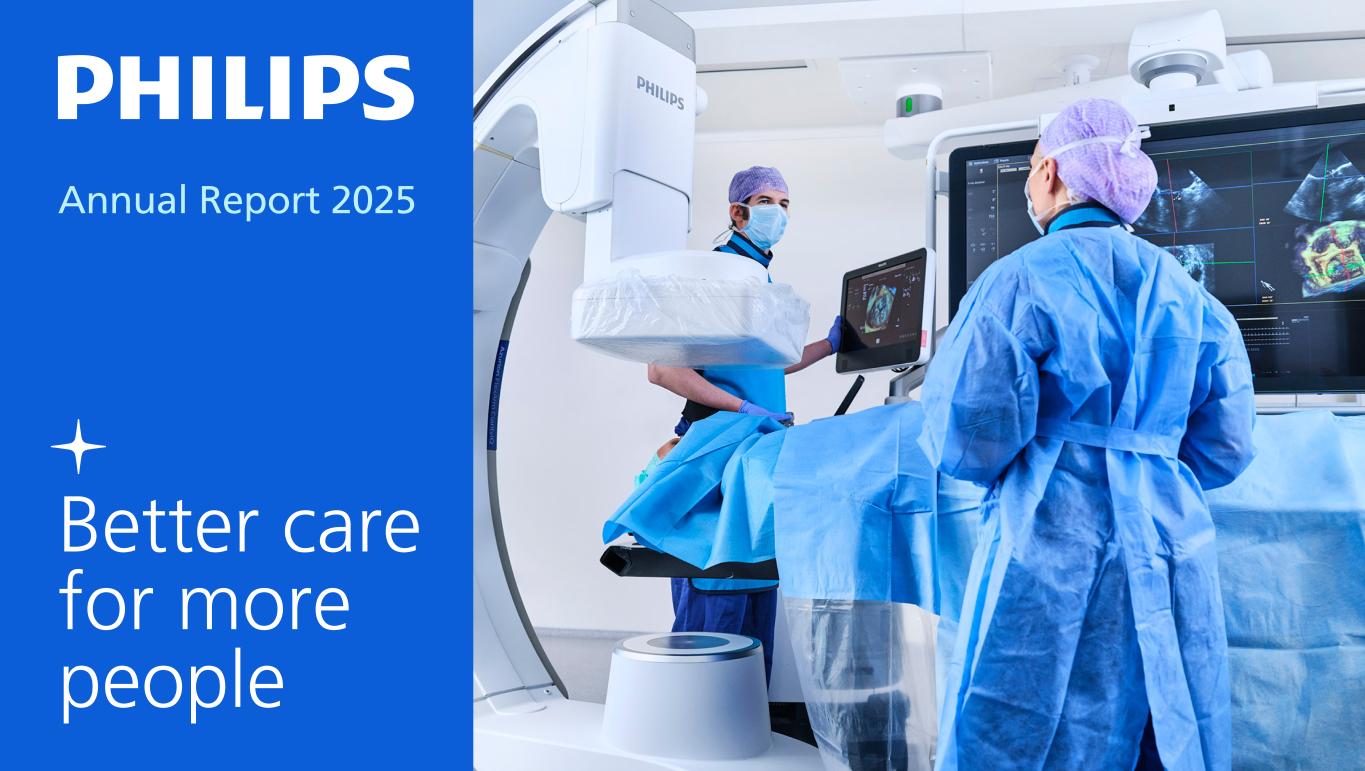
Annual Report 2025 Better care for more people
PDF/printed version This document is the PDF/printed version of the 2025 Annual Report of Royal Philips and has been prepared for ease of use. The 2025 Annual Report was made publicly available pursuant to section 5:25c of the Dutch Financial Supervision Act (Wet op het financieel toezicht) and was filed with Netherlands Authority for the Financial Markets in European single electronic reporting format (the ESEF package) on February 19, 2026. The ESEF package is available on the company’s website at https://www.results.philips.com/downloadcenter#ar25 and includes a human readable XHTML version of the 2025 Annual Report. In any case of discrepancies between this PDF version and the ESEF package, the latter prevails. IFRS basis of presentation The financial information included in this document is based on IFRS, as explained in General information to the Consolidated financial statements, unless otherwise indicated. Forward-looking statements This document contains certain forward-looking statements. By their nature, these statements involve risk and uncertainty. For more information, please refer to Forward-looking statements and other information. References to Philips References to the company, to Philips or the (Philips) Group or group, relate to Koninklijke Philips N.V. and its subsidiaries, as the context requires. Royal Philips refers to Koninklijke Philips N.V. Dutch Financial Markets Supervision Act This document comprises regulated information within the meaning of the Dutch Financial Markets Supervision Act (Wet op het financieel toezicht). Statutory financial statements and management report The chapters Group financial statements and Company financial statements contain the statutory financial statements of the company. Under ’Management report’ in section References to the content of this Annual Report we set out which parts of this Annual Report form the Management report within the meaning of Section 2:391 of the Dutch Civil Code. Due to rounding, amounts may not add up precisely to the totals provided in this report. ______ 2025 at a glance Our management Strategy Financial performance Environmental, Social and Governance Supervisory Board Group financial statements Company financial statements Sustainability statement Further information 2
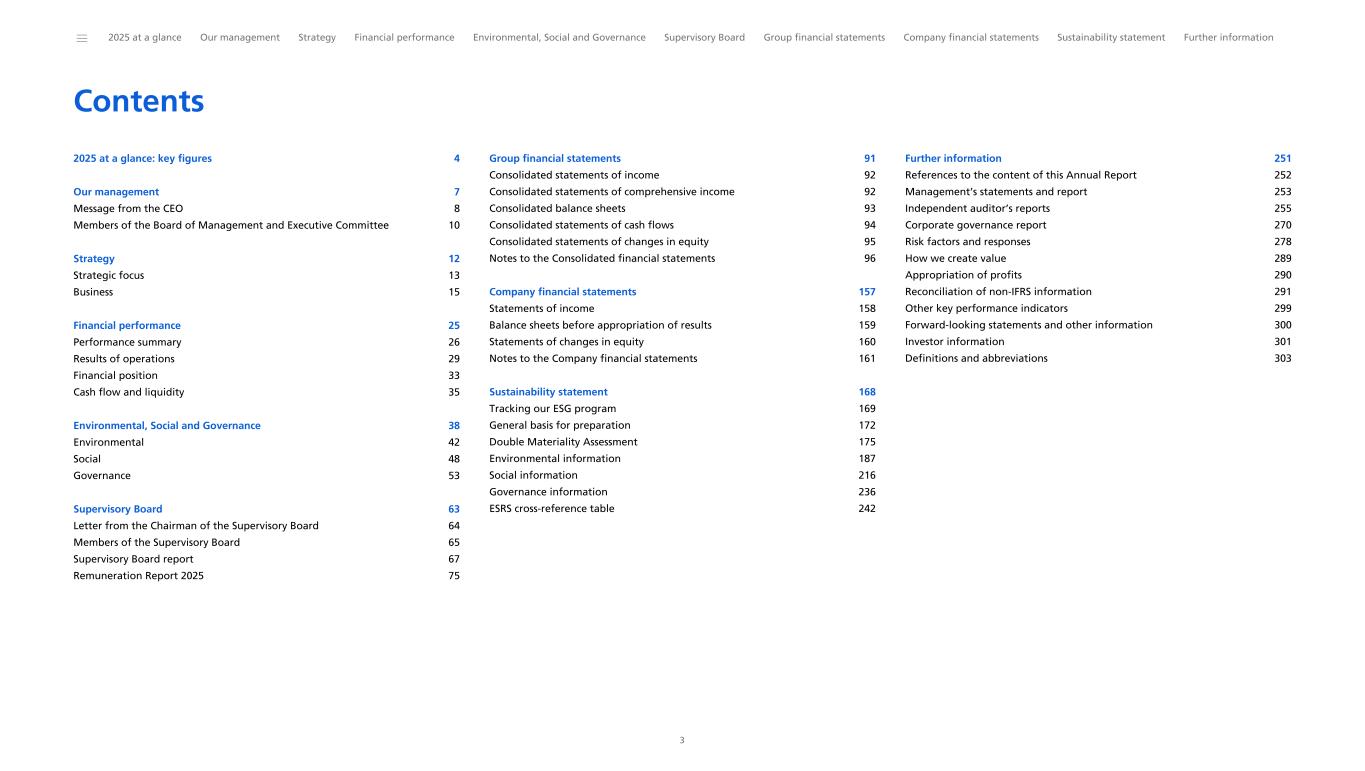
Contents 2025 at a glance: key figures 4 Our management 7 Message from the CEO 8 Members of the Board of Management and Executive Committee 10 Strategy 12 Strategic focus 13 Business 15 Financial performance 25 Performance summary 26 Results of operations 29 Financial position 33 Cash flow and liquidity 35 Environmental, Social and Governance 38 Environmental 42 Social 48 Governance 53 Supervisory Board 63 Letter from the Chairman of the Supervisory Board 64 Members of the Supervisory Board 65 Supervisory Board report 67 Remuneration Report 2025 75 Group financial statements 91 Consolidated statements of income 92 Consolidated statements of comprehensive income 92 Consolidated balance sheets 93 Consolidated statements of cash flows 94 Consolidated statements of changes in equity 95 Notes to the Consolidated financial statements 96 Company financial statements 157 Statements of income 158 Balance sheets before appropriation of results 159 Statements of changes in equity 160 Notes to the Company financial statements 161 Sustainability statement 168 Tracking our ESG program 169 General basis for preparation 172 Double Materiality Assessment 175 Environmental information 187 Social information 216 Governance information 236 ESRS cross-reference table 242 Further information 251 References to the content of this Annual Report 252 Management’s statements and report 253 Independent auditor’s reports 255 Corporate governance report 270 Risk factors and responses 278 How we create value 289 Appropriation of profits 290 Reconciliation of non-IFRS information 291 Other key performance indicators 299 Forward-looking statements and other information 300 Investor information 301 Definitions and abbreviations 303 ______ 2025 at a glance Our management Strategy Financial performance Environmental, Social and Governance Supervisory Board Group financial statements Company financial statements Sustainability statement Further information 3
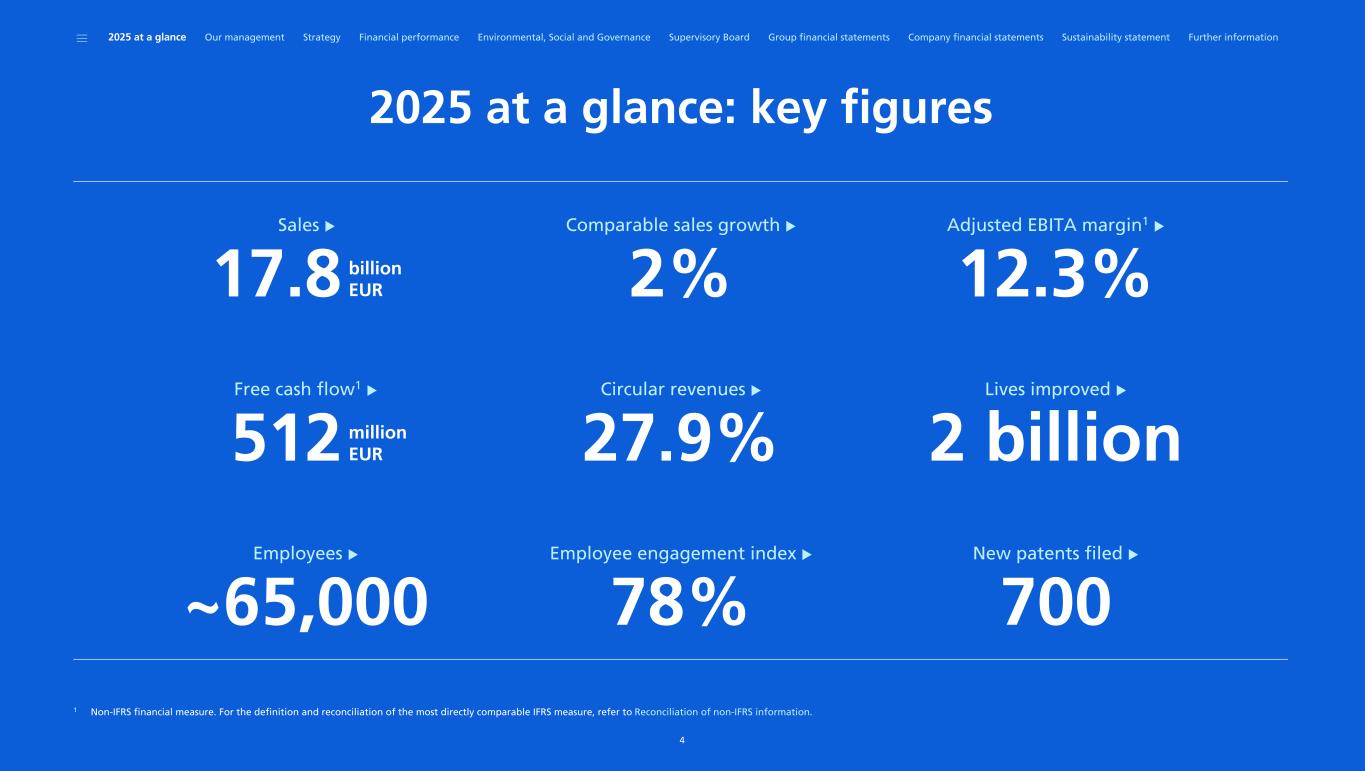
2025 at a glance: key figures1 Sales u Comparable sales growth u Adjusted EBITA margin1 u 17.8 billion EUR 2% 12.3% Free cash flow1 u Circular revenues u Lives improved u 512 million EUR 27.9% 2 billion Employees u Employee engagement index u New patents filed u ~65,000 78% 700 ______ 2025 at a glance Our management Strategy Financial performance Environmental, Social and Governance Supervisory Board Group financial statements Company financial statements Sustainability statement Further information 4 1 Non-IFRS financial measure. For the definition and reconciliation of the most directly comparable IFRS measure, refer to Reconciliation of non-IFRS information.
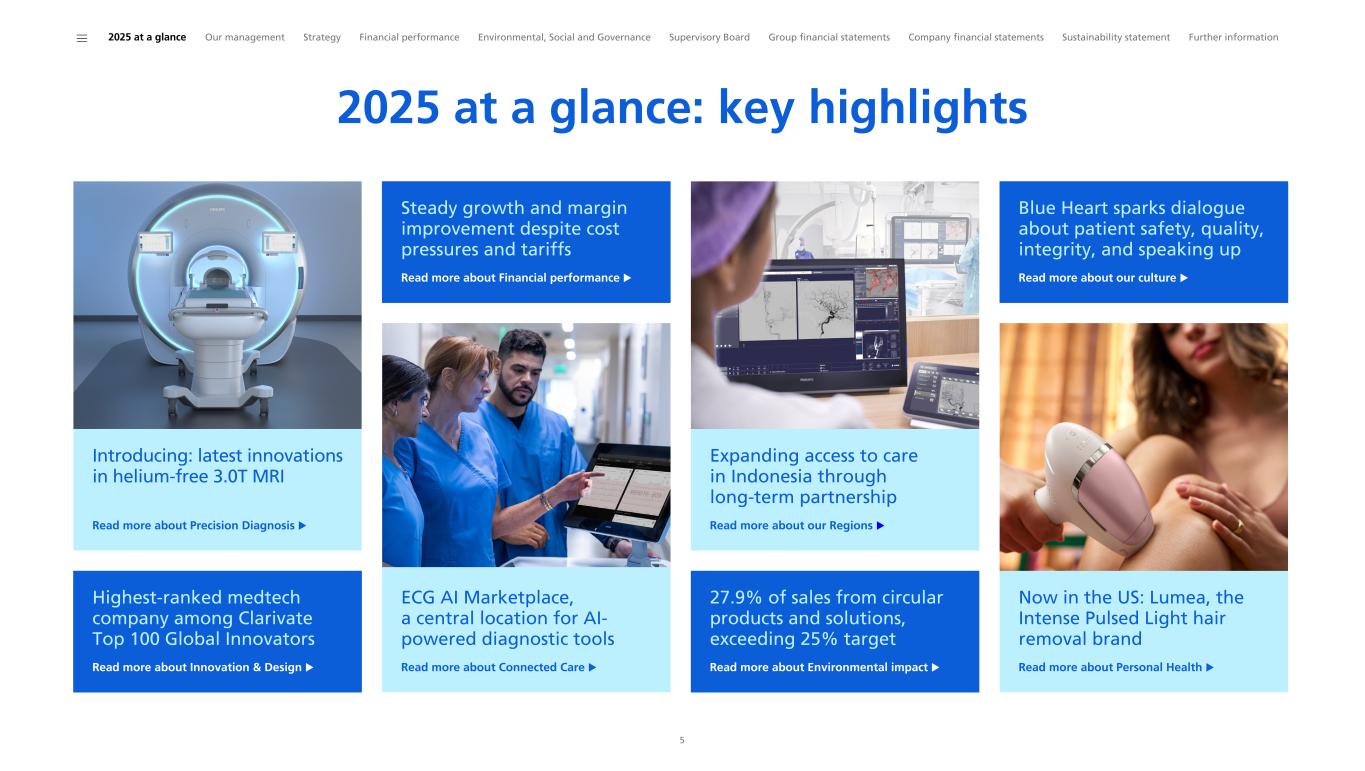
2025 at a glance: key highlights Steady growth and margin improvement despite cost pressures and tariffs Read more about Financial performance u Blue Heart sparks dialogue about patient safety, quality, integrity, and speaking up Read more about our culture u Introducing: latest innovations in helium-free 3.0T MRI Read more about Precision Diagnosis u Expanding access to care in Indonesia through long-term partnership Read more about our Regions u Highest-ranked medtech company among Clarivate Top 100 Global Innovators Read more about Innovation & Design u ECG AI Marketplace, a central location for AI- powered diagnostic tools Read more about Connected Care u 27.9% of sales from circular products and solutions, exceeding 25% target Read more about Environmental impact u Now in the US: Lumea, the Intense Pulsed Light hair removal brand Read more about Personal Health u ______ 2025 at a glance Our management Strategy Financial performance Environmental, Social and Governance Supervisory Board Group financial statements Company financial statements Sustainability statement Further information 5
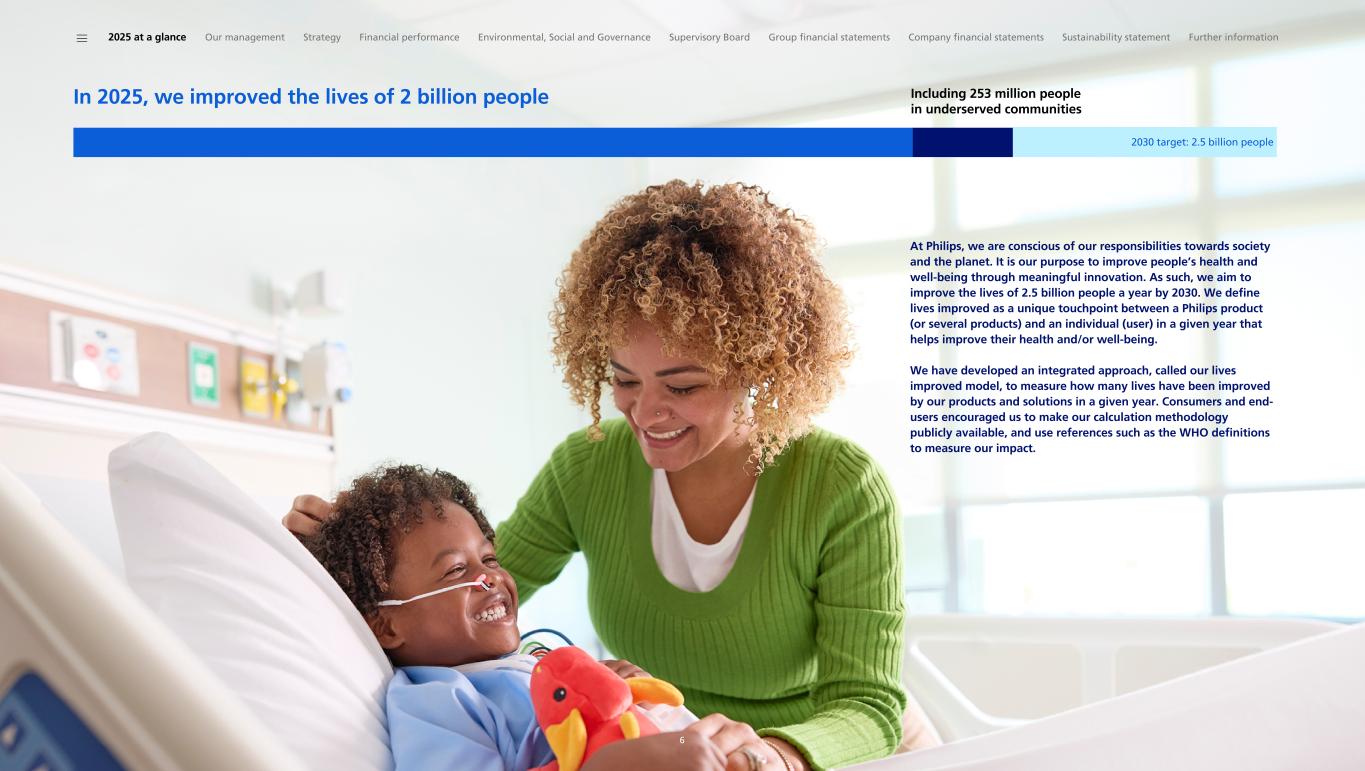
In 2025, we improved the lives of 2 billion people Including 253 million people in underserved communities 2030 target: 2.5 billion people At Philips, we are conscious of our responsibilities towards society and the planet. It is our purpose to improve people’s health and well-being through meaningful innovation. As such, we aim to improve the lives of 2.5 billion people a year by 2030. We define lives improved as a unique touchpoint between a Philips product (or several products) and an individual (user) in a given year that helps improve their health and/or well-being. We have developed an integrated approach, called our lives improved model, to measure how many lives have been improved by our products and solutions in a given year. Consumers and end- users encouraged us to make our calculation methodology publicly available, and use references such as the WHO definitions to measure our impact. ______ 2025 at a glance Our management Strategy Financial performance Environmental, Social and Governance Supervisory Board Group financial statements Company financial statements Sustainability statement Further information 6
Our management ______ 2025 at a glance Our management Strategy Financial performance Environmental, Social and Governance Supervisory Board Group financial statements Company financial statements Sustainability statement Further information 7
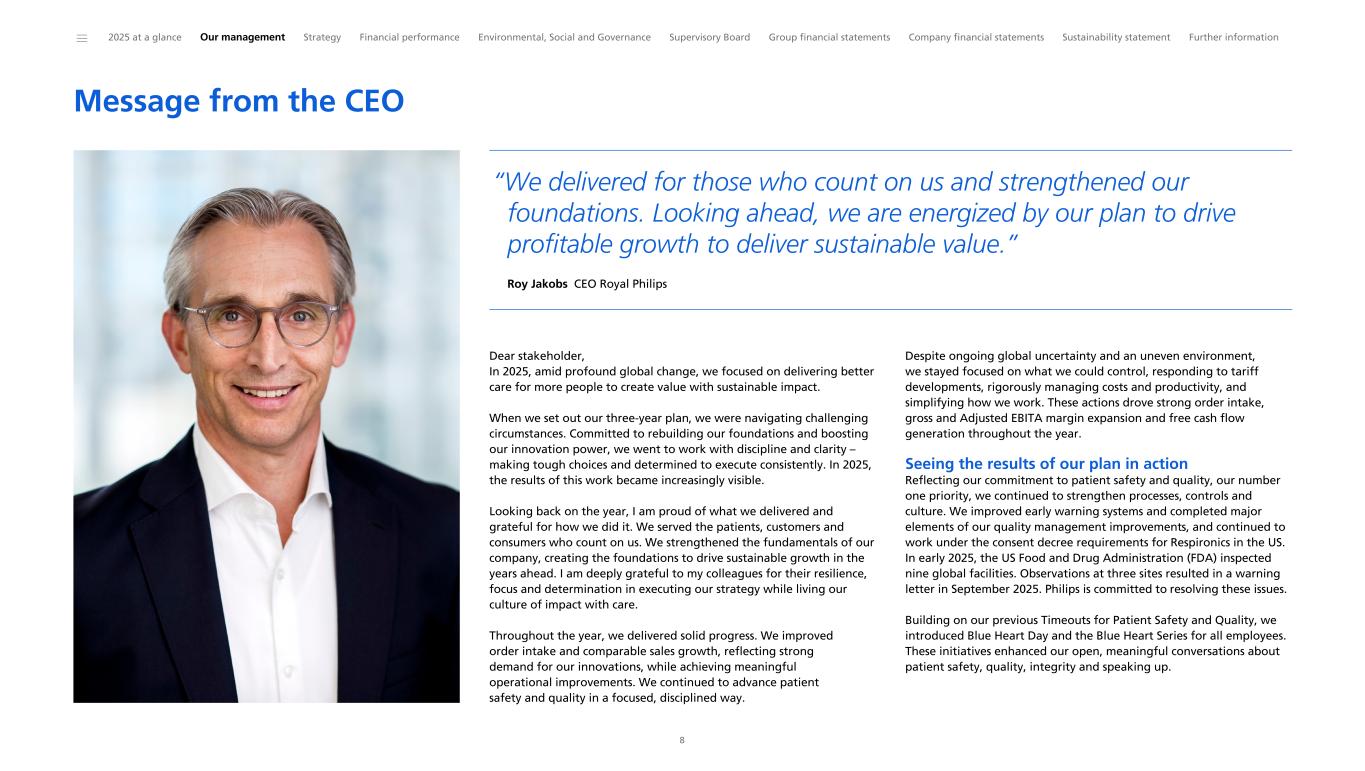
Message from the CEO “We delivered for those who count on us and strengthened our foundations. Looking ahead, we are energized by our plan to drive profitable growth to deliver sustainable value.” Roy Jakobs CEO Royal Philips Dear stakeholder, In 2025, amid profound global change, we focused on delivering better care for more people to create value with sustainable impact. When we set out our three-year plan, we were navigating challenging circumstances. Committed to rebuilding our foundations and boosting our innovation power, we went to work with discipline and clarity – making tough choices and determined to execute consistently. In 2025, the results of this work became increasingly visible. Looking back on the year, I am proud of what we delivered and grateful for how we did it. We served the patients, customers and consumers who count on us. We strengthened the fundamentals of our company, creating the foundations to drive sustainable growth in the years ahead. I am deeply grateful to my colleagues for their resilience, focus and determination in executing our strategy while living our culture of impact with care. Throughout the year, we delivered solid progress. We improved order intake and comparable sales growth, reflecting strong demand for our innovations, while achieving meaningful operational improvements. We continued to advance patient safety and quality in a focused, disciplined way. Despite ongoing global uncertainty and an uneven environment, we stayed focused on what we could control, responding to tariff developments, rigorously managing costs and productivity, and simplifying how we work. These actions drove strong order intake, gross and Adjusted EBITA margin expansion and free cash flow generation throughout the year. Seeing the results of our plan in action Reflecting our commitment to patient safety and quality, our number one priority, we continued to strengthen processes, controls and culture. We improved early warning systems and completed major elements of our quality management improvements, and continued to work under the consent decree requirements for Respironics in the US. In early 2025, the US Food and Drug Administration (FDA) inspected nine global facilities. Observations at three sites resulted in a warning letter in September 2025. Philips is committed to resolving these issues. Building on our previous Timeouts for Patient Safety and Quality, we introduced Blue Heart Day and the Blue Heart Series for all employees. These initiatives enhanced our open, meaningful conversations about patient safety, quality, integrity and speaking up. ______ 2025 at a glance Our management Strategy Financial performance Environmental, Social and Governance Supervisory Board Group financial statements Company financial statements Sustainability statement Further information 8
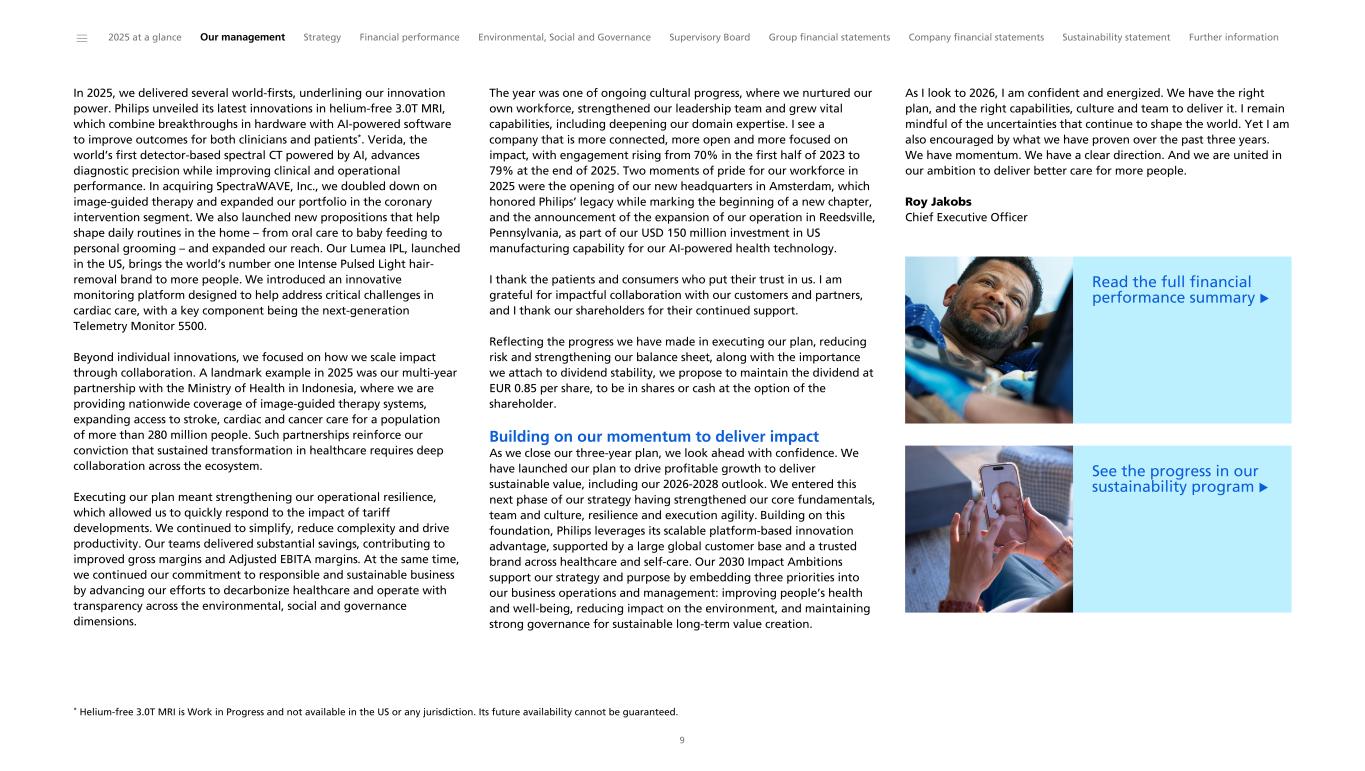
In 2025, we delivered several world-firsts, underlining our innovation power. Philips unveiled its latest innovations in helium-free 3.0T MRI, which combine breakthroughs in hardware with AI-powered software to improve outcomes for both clinicians and patients*. Verida, the world’s first detector-based spectral CT powered by AI, advances diagnostic precision while improving clinical and operational performance. In acquiring SpectraWAVE, Inc., we doubled down on image-guided therapy and expanded our portfolio in the coronary intervention segment. We also launched new propositions that help shape daily routines in the home – from oral care to baby feeding to personal grooming – and expanded our reach. Our Lumea IPL, launched in the US, brings the world’s number one Intense Pulsed Light hair- removal brand to more people. We introduced an innovative monitoring platform designed to help address critical challenges in cardiac care, with a key component being the next-generation Telemetry Monitor 5500. Beyond individual innovations, we focused on how we scale impact through collaboration. A landmark example in 2025 was our multi-year partnership with the Ministry of Health in Indonesia, where we are providing nationwide coverage of image-guided therapy systems, expanding access to stroke, cardiac and cancer care for a population of more than 280 million people. Such partnerships reinforce our conviction that sustained transformation in healthcare requires deep collaboration across the ecosystem. Executing our plan meant strengthening our operational resilience, which allowed us to quickly respond to the impact of tariff developments. We continued to simplify, reduce complexity and drive productivity. Our teams delivered substantial savings, contributing to improved gross margins and Adjusted EBITA margins. At the same time, we continued our commitment to responsible and sustainable business by advancing our efforts to decarbonize healthcare and operate with transparency across the environmental, social and governance dimensions. The year was one of ongoing cultural progress, where we nurtured our own workforce, strengthened our leadership team and grew vital capabilities, including deepening our domain expertise. I see a company that is more connected, more open and more focused on impact, with engagement rising from 70% in the first half of 2023 to 79% at the end of 2025. Two moments of pride for our workforce in 2025 were the opening of our new headquarters in Amsterdam, which honored Philips’ legacy while marking the beginning of a new chapter, and the announcement of the expansion of our operation in Reedsville, Pennsylvania, as part of our USD 150 million investment in US manufacturing capability for our AI-powered health technology. I thank the patients and consumers who put their trust in us. I am grateful for impactful collaboration with our customers and partners, and I thank our shareholders for their continued support. Reflecting the progress we have made in executing our plan, reducing risk and strengthening our balance sheet, along with the importance we attach to dividend stability, we propose to maintain the dividend at EUR 0.85 per share, to be in shares or cash at the option of the shareholder. Building on our momentum to deliver impact As we close our three-year plan, we look ahead with confidence. We have launched our plan to drive profitable growth to deliver sustainable value, including our 2026-2028 outlook. We entered this next phase of our strategy having strengthened our core fundamentals, team and culture, resilience and execution agility. Building on this foundation, Philips leverages its scalable platform-based innovation advantage, supported by a large global customer base and a trusted brand across healthcare and self-care. Our 2030 Impact Ambitions support our strategy and purpose by embedding three priorities into our business operations and management: improving people’s health and well-being, reducing impact on the environment, and maintaining strong governance for sustainable long-term value creation. As I look to 2026, I am confident and energized. We have the right plan, and the right capabilities, culture and team to deliver it. I remain mindful of the uncertainties that continue to shape the world. Yet I am also encouraged by what we have proven over the past three years. We have momentum. We have a clear direction. And we are united in our ambition to deliver better care for more people. Roy Jakobs Chief Executive Officer Read the full financial performance summary u See the progress in our sustainability program u ______ 2025 at a glance Our management Strategy Financial performance Environmental, Social and Governance Supervisory Board Group financial statements Company financial statements Sustainability statement Further information 9 * Helium-free 3.0T MRI is Work in Progress and not available in the US or any jurisdiction. Its future availability cannot be guaranteed.
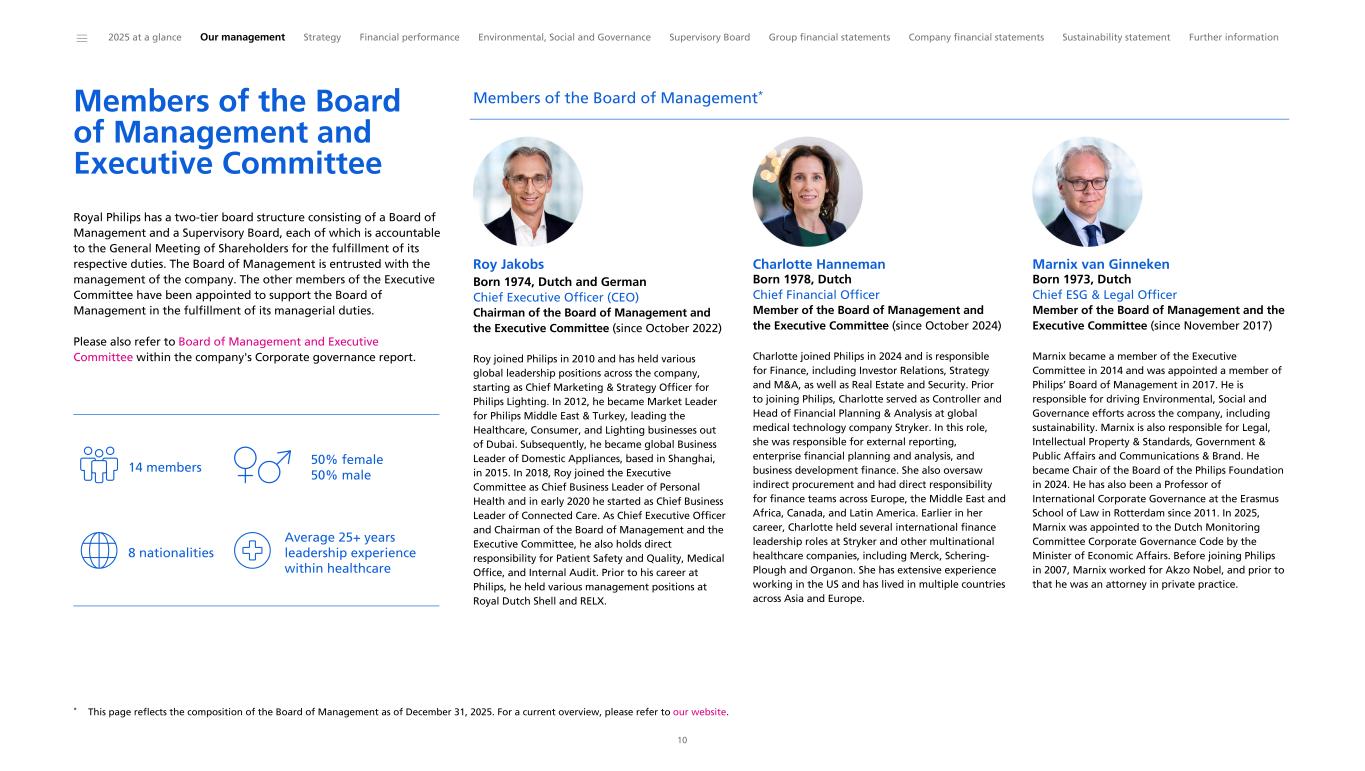
Members of the Board of Management and Executive Committee Royal Philips has a two-tier board structure consisting of a Board of Management and a Supervisory Board, each of which is accountable to the General Meeting of Shareholders for the fulfillment of its respective duties. The Board of Management is entrusted with the management of the company. The other members of the Executive Committee have been appointed to support the Board of Management in the fulfillment of its managerial duties. Please also refer to Board of Management and Executive Committee within the company's Corporate governance report. 14 members 50% female 50% male 8 nationalities Average 25+ years leadership experience within healthcare Members of the Board of Management* Roy Jakobs Born 1974, Dutch and German Chief Executive Officer (CEO) Chairman of the Board of Management and the Executive Committee (since October 2022) Roy joined Philips in 2010 and has held various global leadership positions across the company, starting as Chief Marketing & Strategy Officer for Philips Lighting. In 2012, he became Market Leader for Philips Middle East & Turkey, leading the Healthcare, Consumer, and Lighting businesses out of Dubai. Subsequently, he became global Business Leader of Domestic Appliances, based in Shanghai, in 2015. In 2018, Roy joined the Executive Committee as Chief Business Leader of Personal Health and in early 2020 he started as Chief Business Leader of Connected Care. As Chief Executive Officer and Chairman of the Board of Management and the Executive Committee, he also holds direct responsibility for Patient Safety and Quality, Medical Office, and Internal Audit. Prior to his career at Philips, he held various management positions at Royal Dutch Shell and RELX. Charlotte Hanneman Born 1978, Dutch Chief Financial Officer Member of the Board of Management and the Executive Committee (since October 2024) Charlotte joined Philips in 2024 and is responsible for Finance, including Investor Relations, Strategy and M&A, as well as Real Estate and Security. Prior to joining Philips, Charlotte served as Controller and Head of Financial Planning & Analysis at global medical technology company Stryker. In this role, she was responsible for external reporting, enterprise financial planning and analysis, and business development finance. She also oversaw indirect procurement and had direct responsibility for finance teams across Europe, the Middle East and Africa, Canada, and Latin America. Earlier in her career, Charlotte held several international finance leadership roles at Stryker and other multinational healthcare companies, including Merck, Schering- Plough and Organon. She has extensive experience working in the US and has lived in multiple countries across Asia and Europe. Marnix van Ginneken Born 1973, Dutch Chief ESG & Legal Officer Member of the Board of Management and the Executive Committee (since November 2017) Marnix became a member of the Executive Committee in 2014 and was appointed a member of Philips’ Board of Management in 2017. He is responsible for driving Environmental, Social and Governance efforts across the company, including sustainability. Marnix is also responsible for Legal, Intellectual Property & Standards, Government & Public Affairs and Communications & Brand. He became Chair of the Board of the Philips Foundation in 2024. He has also been a Professor of International Corporate Governance at the Erasmus School of Law in Rotterdam since 2011. In 2025, Marnix was appointed to the Dutch Monitoring Committee Corporate Governance Code by the Minister of Economic Affairs. Before joining Philips in 2007, Marnix worked for Akzo Nobel, and prior to that he was an attorney in private practice. ______ 2025 at a glance Our management Strategy Financial performance Environmental, Social and Governance Supervisory Board Group financial statements Company financial statements Sustainability statement Further information 10 * This page reflects the composition of the Board of Management as of December 31, 2025. For a current overview, please refer to our website.
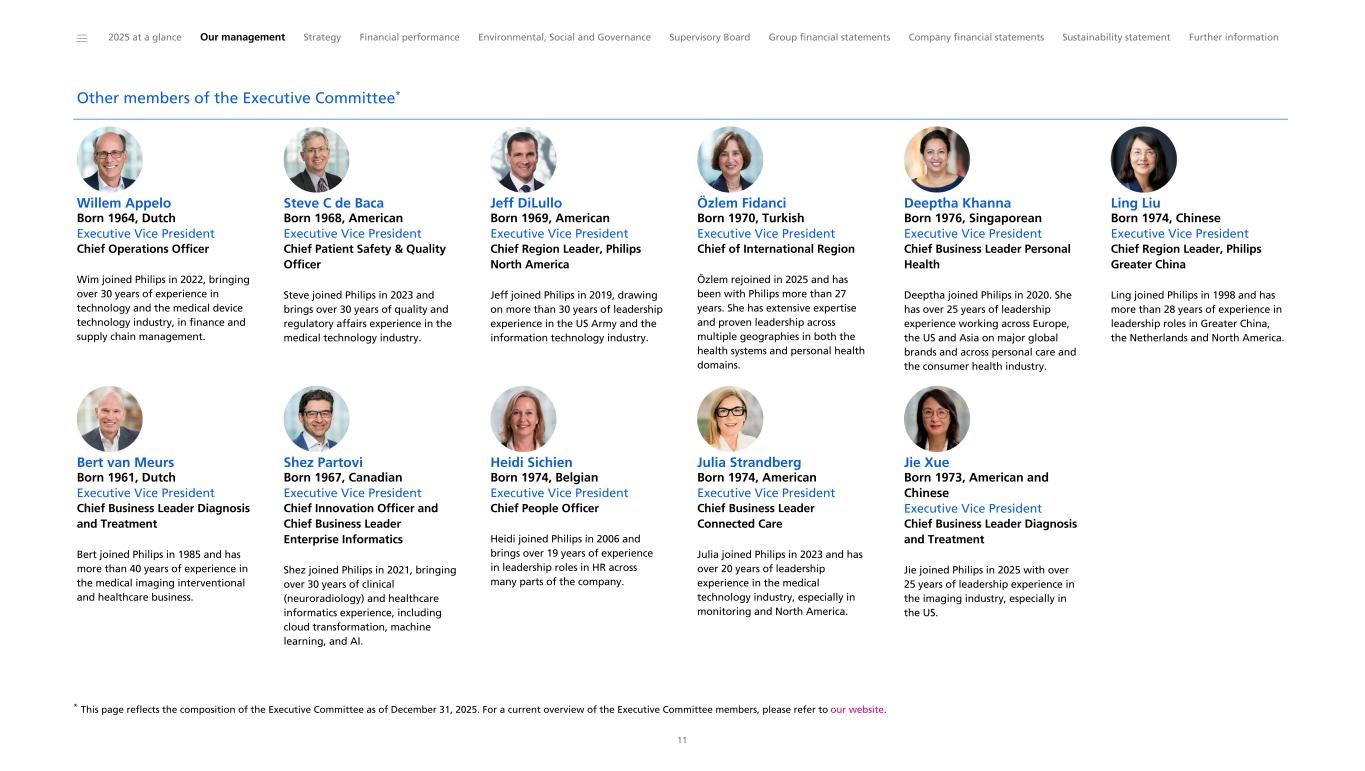
Other members of the Executive Committee* Willem Appelo Born 1964, Dutch Executive Vice President Chief Operations Officer Wim joined Philips in 2022, bringing over 30 years of experience in technology and the medical device technology industry, in finance and supply chain management. Steve C de Baca Born 1968, American Executive Vice President Chief Patient Safety & Quality Officer Steve joined Philips in 2023 and brings over 30 years of quality and regulatory affairs experience in the medical technology industry. Jeff DiLullo Born 1969, American Executive Vice President Chief Region Leader, Philips North America Jeff joined Philips in 2019, drawing on more than 30 years of leadership experience in the US Army and the information technology industry. Özlem Fidanci Born 1970, Turkish Executive Vice President Chief of International Region Özlem rejoined in 2025 and has been with Philips more than 27 years. She has extensive expertise and proven leadership across multiple geographies in both the health systems and personal health domains. Deeptha Khanna Born 1976, Singaporean Executive Vice President Chief Business Leader Personal Health Deeptha joined Philips in 2020. She has over 25 years of leadership experience working across Europe, the US and Asia on major global brands and across personal care and the consumer health industry. Ling Liu Born 1974, Chinese Executive Vice President Chief Region Leader, Philips Greater China Ling joined Philips in 1998 and has more than 28 years of experience in leadership roles in Greater China, the Netherlands and North America. Bert van Meurs Born 1961, Dutch Executive Vice President Chief Business Leader Diagnosis and Treatment Bert joined Philips in 1985 and has more than 40 years of experience in the medical imaging interventional and healthcare business. Shez Partovi Born 1967, Canadian Executive Vice President Chief Innovation Officer and Chief Business Leader Enterprise Informatics Shez joined Philips in 2021, bringing over 30 years of clinical (neuroradiology) and healthcare informatics experience, including cloud transformation, machine learning, and AI. Heidi Sichien Born 1974, Belgian Executive Vice President Chief People Officer Heidi joined Philips in 2006 and brings over 19 years of experience in leadership roles in HR across many parts of the company. Julia Strandberg Born 1974, American Executive Vice President Chief Business Leader Connected Care Julia joined Philips in 2023 and has over 20 years of leadership experience in the medical technology industry, especially in monitoring and North America. Jie Xue Born 1973, American and Chinese Executive Vice President Chief Business Leader Diagnosis and Treatment Jie joined Philips in 2025 with over 25 years of leadership experience in the imaging industry, especially in the US. ______ 2025 at a glance Our management Strategy Financial performance Environmental, Social and Governance Supervisory Board Group financial statements Company financial statements Sustainability statement Further information 11 * This page reflects the composition of the Executive Committee as of December 31, 2025. For a current overview of the Executive Committee members, please refer to our website.

Strategy ______ 2025 at a glance Our management Strategy Financial performance Environmental, Social and Governance Supervisory Board Group financial statements Company financial statements Sustainability statement Further information 12
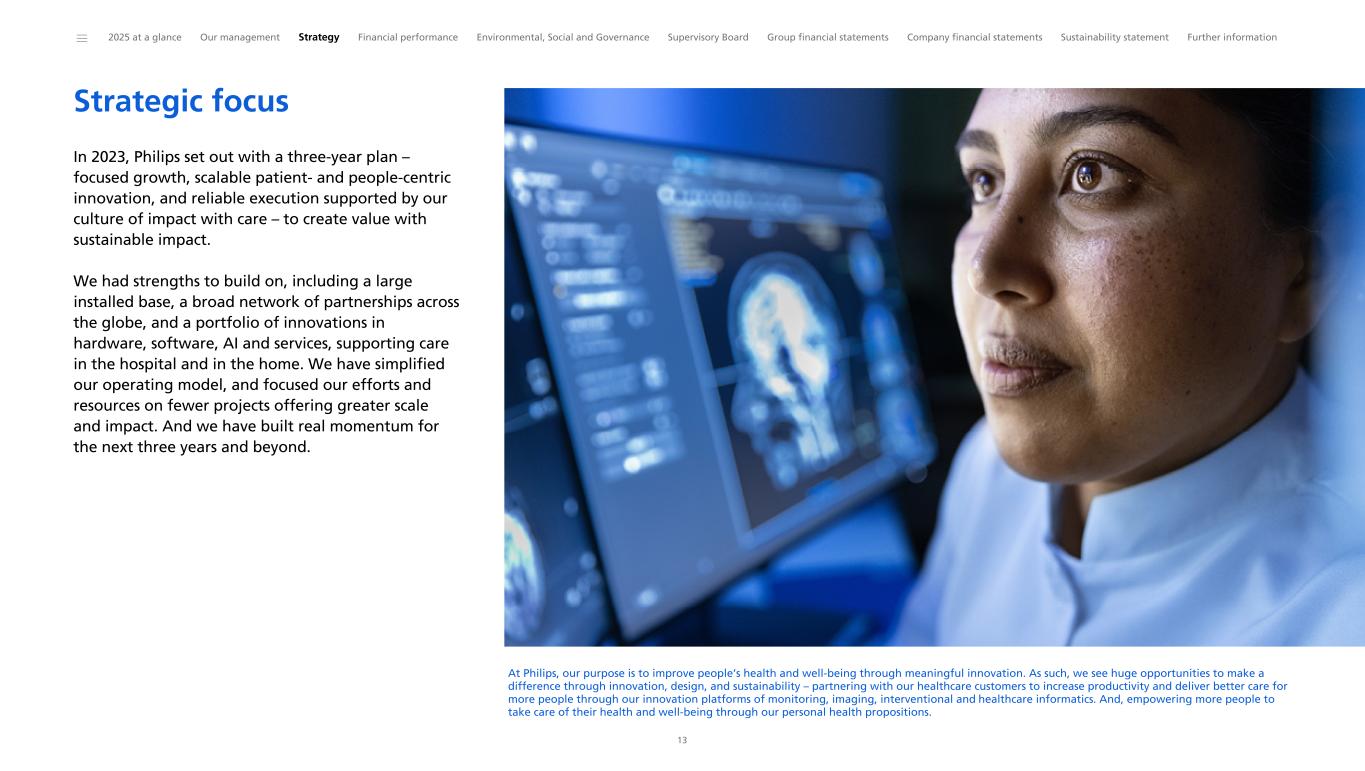
Strategic focus In 2023, Philips set out with a three-year plan – focused growth, scalable patient- and people-centric innovation, and reliable execution supported by our culture of impact with care – to create value with sustainable impact. We had strengths to build on, including a large installed base, a broad network of partnerships across the globe, and a portfolio of innovations in hardware, software, AI and services, supporting care in the hospital and in the home. We have simplified our operating model, and focused our efforts and resources on fewer projects offering greater scale and impact. And we have built real momentum for the next three years and beyond. At Philips, our purpose is to improve people’s health and well-being through meaningful innovation. As such, we see huge opportunities to make a difference through innovation, design, and sustainability – partnering with our healthcare customers to increase productivity and deliver better care for more people through our innovation platforms of monitoring, imaging, interventional and healthcare informatics. And, empowering more people to take care of their health and well-being through our personal health propositions. ______ 2025 at a glance Our management Strategy Financial performance Environmental, Social and Governance Supervisory Board Group financial statements Company financial statements Sustainability statement Further information 13
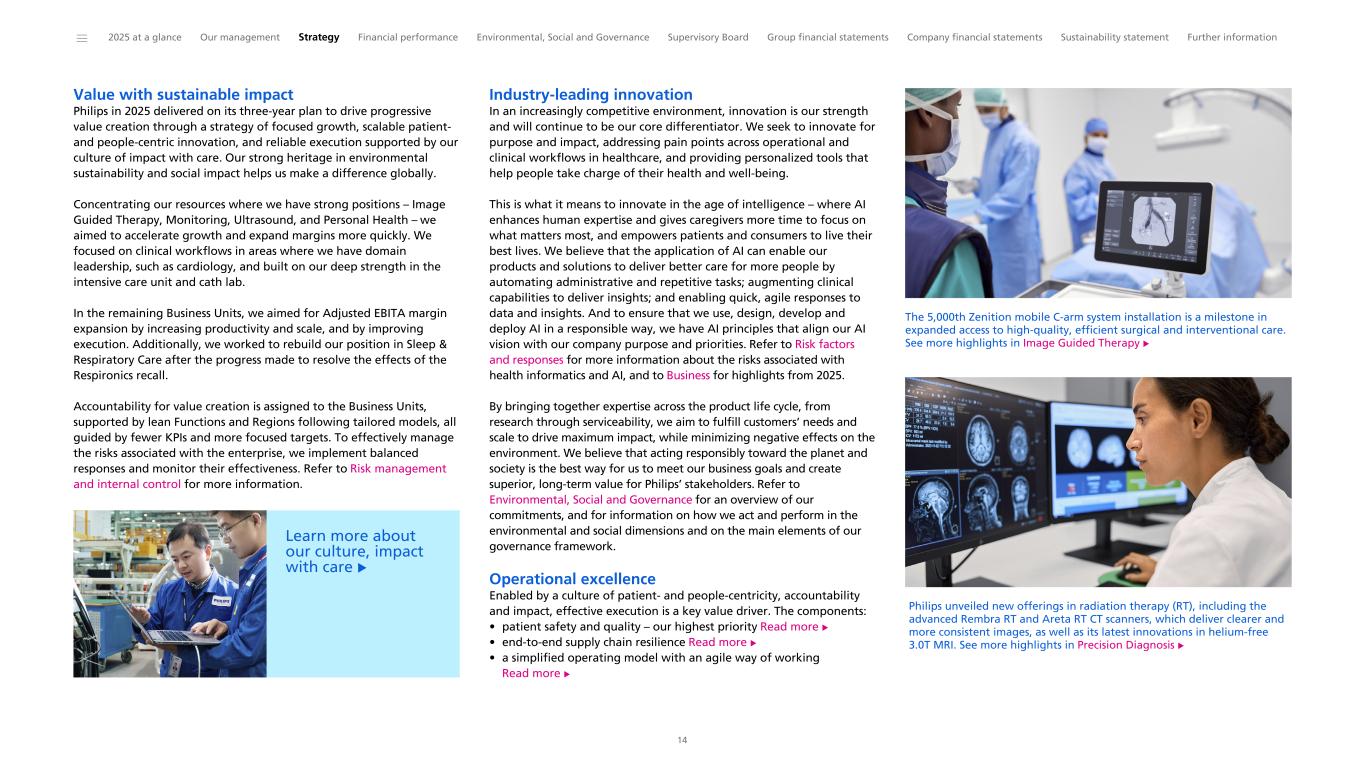
Value with sustainable impact Philips in 2025 delivered on its three-year plan to drive progressive value creation through a strategy of focused growth, scalable patient- and people-centric innovation, and reliable execution supported by our culture of impact with care. Our strong heritage in environmental sustainability and social impact helps us make a difference globally. Concentrating our resources where we have strong positions – Image Guided Therapy, Monitoring, Ultrasound, and Personal Health – we aimed to accelerate growth and expand margins more quickly. We focused on clinical workflows in areas where we have domain leadership, such as cardiology, and built on our deep strength in the intensive care unit and cath lab. In the remaining Business Units, we aimed for Adjusted EBITA margin expansion by increasing productivity and scale, and by improving execution. Additionally, we worked to rebuild our position in Sleep & Respiratory Care after the progress made to resolve the effects of the Respironics recall. Accountability for value creation is assigned to the Business Units, supported by lean Functions and Regions following tailored models, all guided by fewer KPIs and more focused targets. To effectively manage the risks associated with the enterprise, we implement balanced responses and monitor their effectiveness. Refer to Risk management and internal control for more information. Learn more about our culture, impact with care u Industry-leading innovation In an increasingly competitive environment, innovation is our strength and will continue to be our core differentiator. We seek to innovate for purpose and impact, addressing pain points across operational and clinical workflows in healthcare, and providing personalized tools that help people take charge of their health and well-being. This is what it means to innovate in the age of intelligence – where AI enhances human expertise and gives caregivers more time to focus on what matters most, and empowers patients and consumers to live their best lives. We believe that the application of AI can enable our products and solutions to deliver better care for more people by automating administrative and repetitive tasks; augmenting clinical capabilities to deliver insights; and enabling quick, agile responses to data and insights. And to ensure that we use, design, develop and deploy AI in a responsible way, we have AI principles that align our AI vision with our company purpose and priorities. Refer to Risk factors and responses for more information about the risks associated with health informatics and AI, and to Business for highlights from 2025. By bringing together expertise across the product life cycle, from research through serviceability, we aim to fulfill customers’ needs and scale to drive maximum impact, while minimizing negative effects on the environment. We believe that acting responsibly toward the planet and society is the best way for us to meet our business goals and create superior, long-term value for Philips’ stakeholders. Refer to Environmental, Social and Governance for an overview of our commitments, and for information on how we act and perform in the environmental and social dimensions and on the main elements of our governance framework. Operational excellence Enabled by a culture of patient- and people-centricity, accountability and impact, effective execution is a key value driver. The components: • patient safety and quality – our highest priority Read more u • end-to-end supply chain resilience Read more u • a simplified operating model with an agile way of working Read more u The 5,000th Zenition mobile C-arm system installation is a milestone in expanded access to high-quality, efficient surgical and interventional care. See more highlights in Image Guided Therapy u Philips unveiled new offerings in radiation therapy (RT), including the advanced Rembra RT and Areta RT CT scanners, which deliver clearer and more consistent images, as well as its latest innovations in helium-free 3.0T MRI. See more highlights in Precision Diagnosis u ______ 2025 at a glance Our management Strategy Financial performance Environmental, Social and Governance Supervisory Board Group financial statements Company financial statements Sustainability statement Further information 14
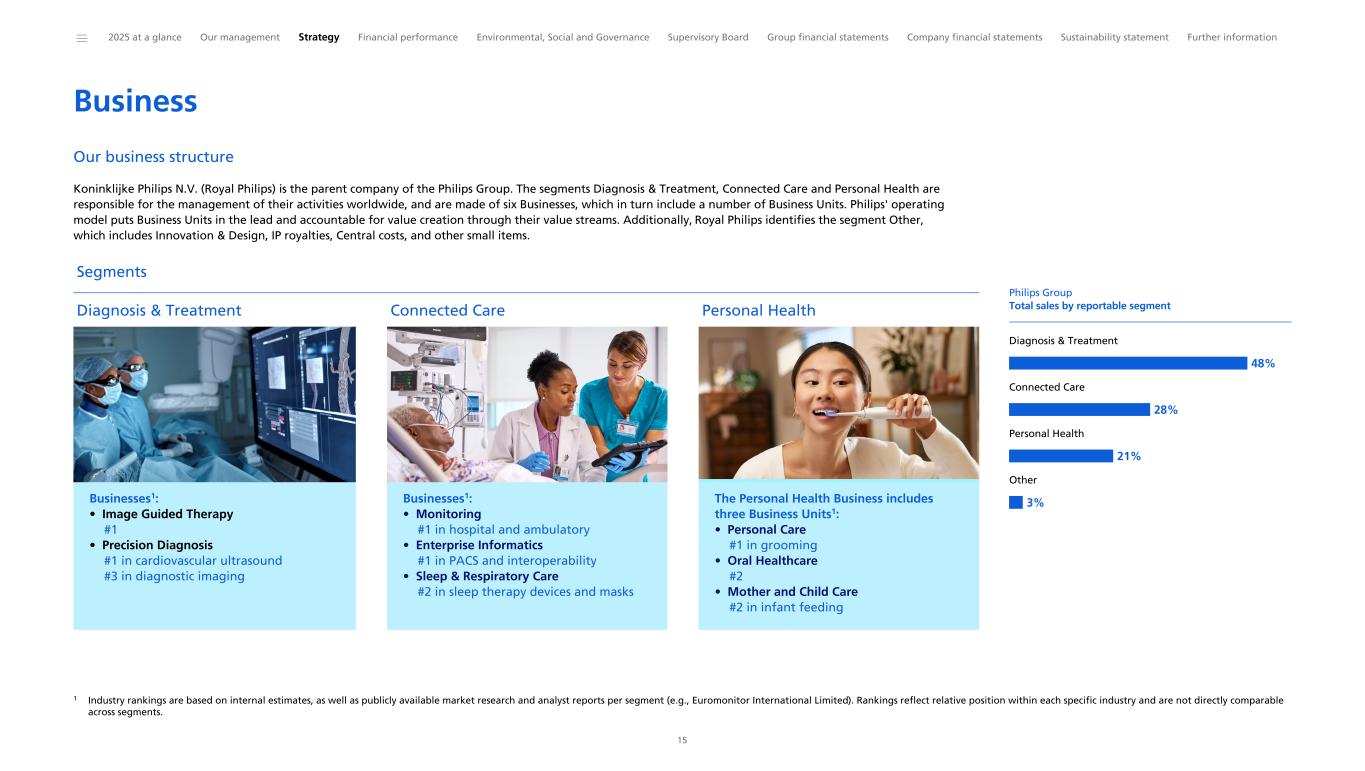
Business Our business structure Koninklijke Philips N.V. (Royal Philips) is the parent company of the Philips Group. The segments Diagnosis & Treatment, Connected Care and Personal Health are responsible for the management of their activities worldwide, and are made of six Businesses, which in turn include a number of Business Units. Philips' operating model puts Business Units in the lead and accountable for value creation through their value streams. Additionally, Royal Philips identifies the segment Other, which includes Innovation & Design, IP royalties, Central costs, and other small items.1 Segments Diagnosis & Treatment Connected Care Personal Health Businesses1: • Image Guided Therapy #1 • Precision Diagnosis #1 in cardiovascular ultrasound #3 in diagnostic imaging Businesses1: • Monitoring #1 in hospital and ambulatory • Enterprise Informatics #1 in PACS and interoperability • Sleep & Respiratory Care #2 in sleep therapy devices and masks The Personal Health Business includes three Business Units1: • Personal Care #1 in grooming • Oral Healthcare #2 • Mother and Child Care #2 in infant feeding Philips Group Total sales by reportable segment Diagnosis & Treatment 48% Connected Care 28% Personal Health 21% Other 3% ______ 2025 at a glance Our management Strategy Financial performance Environmental, Social and Governance Supervisory Board Group financial statements Company financial statements Sustainability statement Further information 15 1 Industry rankings are based on internal estimates, as well as publicly available market research and analyst reports per segment (e.g., Euromonitor International Limited). Rankings reflect relative position within each specific industry and are not directly comparable across segments.
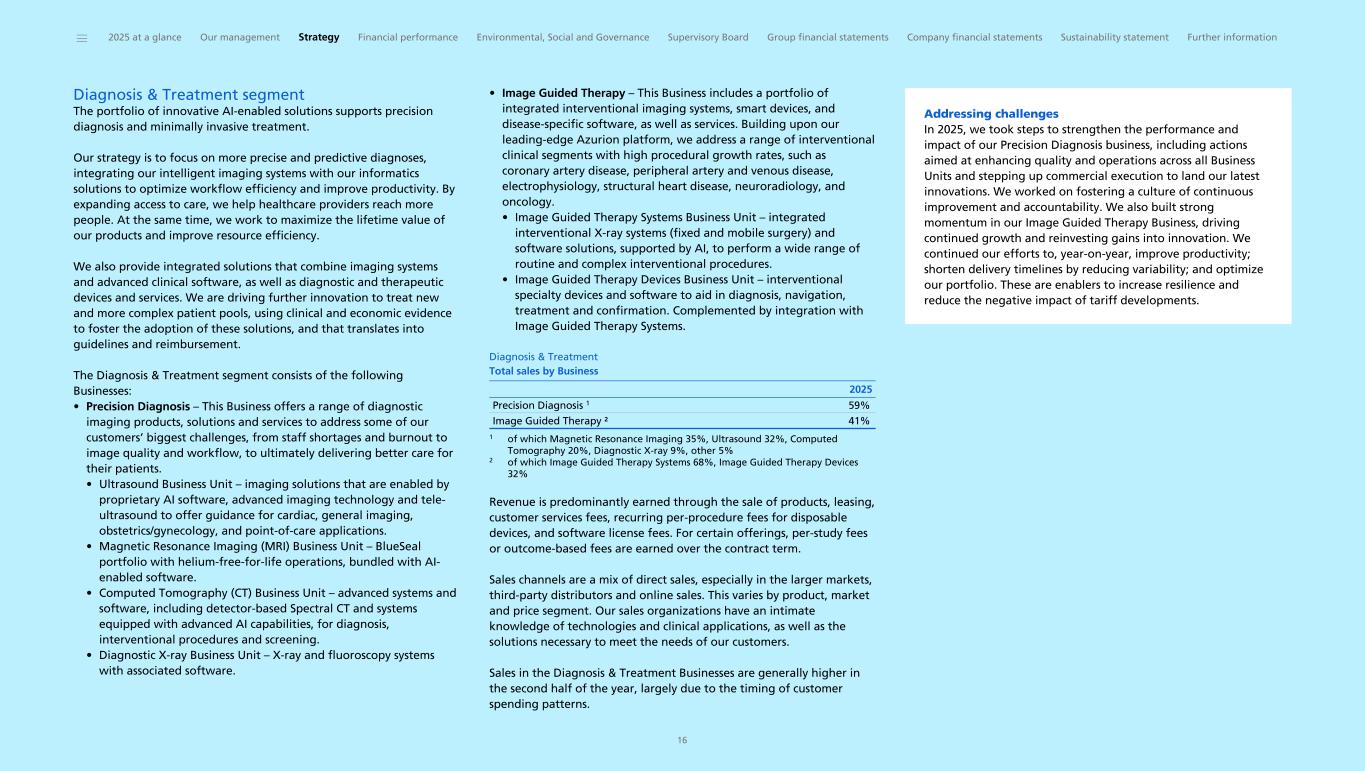
Diagnosis & Treatment segment The portfolio of innovative AI-enabled solutions supports precision diagnosis and minimally invasive treatment. Our strategy is to focus on more precise and predictive diagnoses, integrating our intelligent imaging systems with our informatics solutions to optimize workflow efficiency and improve productivity. By expanding access to care, we help healthcare providers reach more people. At the same time, we work to maximize the lifetime value of our products and improve resource efficiency. We also provide integrated solutions that combine imaging systems and advanced clinical software, as well as diagnostic and therapeutic devices and services. We are driving further innovation to treat new and more complex patient pools, using clinical and economic evidence to foster the adoption of these solutions, and that translates into guidelines and reimbursement. The Diagnosis & Treatment segment consists of the following Businesses: • Precision Diagnosis – This Business offers a range of diagnostic imaging products, solutions and services to address some of our customers’ biggest challenges, from staff shortages and burnout to image quality and workflow, to ultimately delivering better care for their patients. • Ultrasound Business Unit – imaging solutions that are enabled by proprietary AI software, advanced imaging technology and tele- ultrasound to offer guidance for cardiac, general imaging, obstetrics/gynecology, and point-of-care applications. • Magnetic Resonance Imaging (MRI) Business Unit – BlueSeal portfolio with helium-free-for-life operations, bundled with AI- enabled software. • Computed Tomography (CT) Business Unit – advanced systems and software, including detector-based Spectral CT and systems equipped with advanced AI capabilities, for diagnosis, interventional procedures and screening. • Diagnostic X-ray Business Unit – X-ray and fluoroscopy systems with associated software. • Image Guided Therapy – This Business includes a portfolio of integrated interventional imaging systems, smart devices, and disease-specific software, as well as services. Building upon our leading-edge Azurion platform, we address a range of interventional clinical segments with high procedural growth rates, such as coronary artery disease, peripheral artery and venous disease, electrophysiology, structural heart disease, neuroradiology, and oncology. • Image Guided Therapy Systems Business Unit – integrated interventional X-ray systems (fixed and mobile surgery) and software solutions, supported by AI, to perform a wide range of routine and complex interventional procedures. • Image Guided Therapy Devices Business Unit – interventional specialty devices and software to aid in diagnosis, navigation, treatment and confirmation. Complemented by integration with Image Guided Therapy Systems. Diagnosis & Treatment Total sales by Business Precision Diagnosis 1 59% Image Guided Therapy ² 41% 2025 1 of which Magnetic Resonance Imaging 35%, Ultrasound 32%, Computed Tomography 20%, Diagnostic X-ray 9%, other 5% 2 of which Image Guided Therapy Systems 68%, Image Guided Therapy Devices 32% Revenue is predominantly earned through the sale of products, leasing, customer services fees, recurring per-procedure fees for disposable devices, and software license fees. For certain offerings, per-study fees or outcome-based fees are earned over the contract term. Sales channels are a mix of direct sales, especially in the larger markets, third-party distributors and online sales. This varies by product, market and price segment. Our sales organizations have an intimate knowledge of technologies and clinical applications, as well as the solutions necessary to meet the needs of our customers. Sales in the Diagnosis & Treatment Businesses are generally higher in the second half of the year, largely due to the timing of customer spending patterns. Addressing challenges In 2025, we took steps to strengthen the performance and impact of our Precision Diagnosis business, including actions aimed at enhancing quality and operations across all Business Units and stepping up commercial execution to land our latest innovations. We worked on fostering a culture of continuous improvement and accountability. We also built strong momentum in our Image Guided Therapy Business, driving continued growth and reinvesting gains into innovation. We continued our efforts to, year-on-year, improve productivity; shorten delivery timelines by reducing variability; and optimize our portfolio. These are enablers to increase resilience and reduce the negative impact of tariff developments. ______ 2025 at a glance Our management Strategy Financial performance Environmental, Social and Governance Supervisory Board Group financial statements Company financial statements Sustainability statement Further information 16
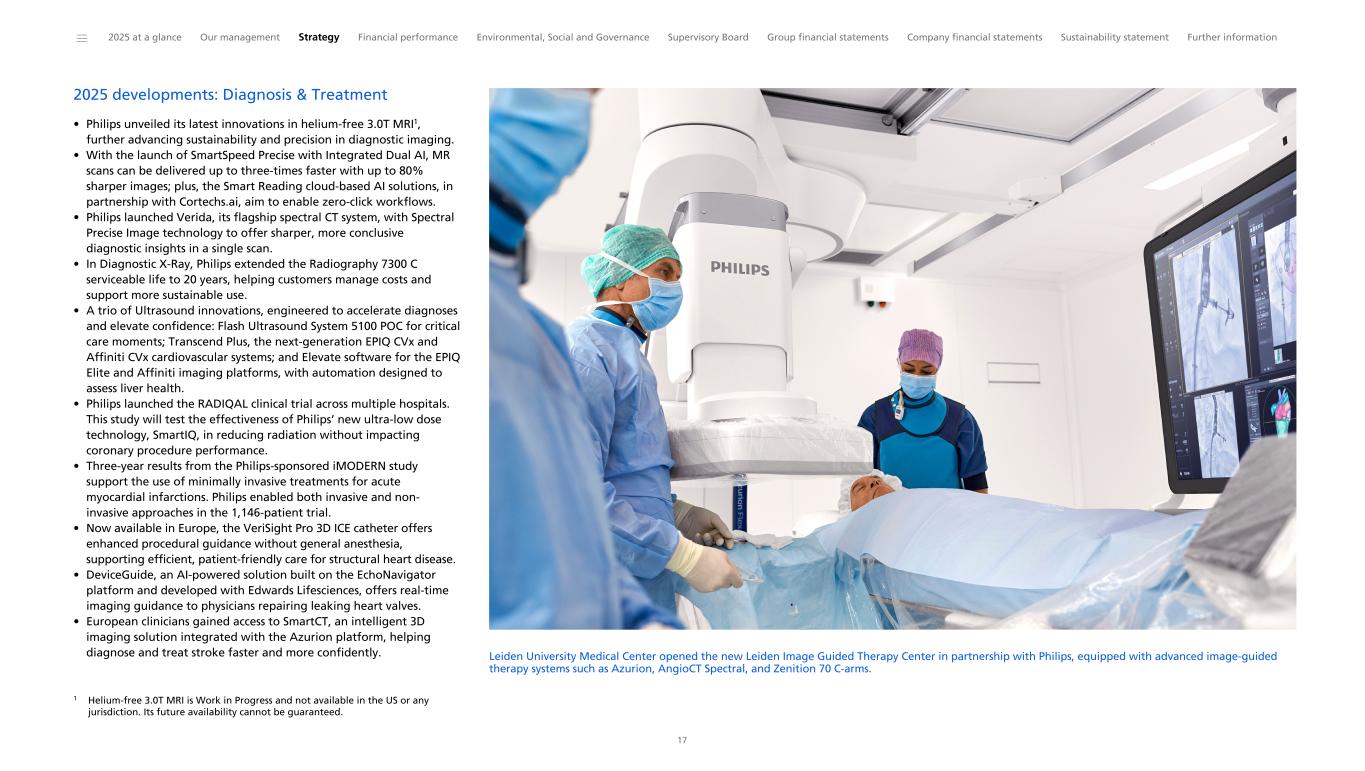
2025 developments: Diagnosis & Treatment • Philips unveiled its latest innovations in helium-free 3.0T MRI1, further advancing sustainability and precision in diagnostic imaging. • With the launch of SmartSpeed Precise with Integrated Dual AI, MR scans can be delivered up to three-times faster with up to 80% sharper images; plus, the Smart Reading cloud-based AI solutions, in partnership with Cortechs.ai, aim to enable zero-click workflows. • Philips launched Verida, its flagship spectral CT system, with Spectral Precise Image technology to offer sharper, more conclusive diagnostic insights in a single scan. • In Diagnostic X-Ray, Philips extended the Radiography 7300 C serviceable life to 20 years, helping customers manage costs and support more sustainable use. • A trio of Ultrasound innovations, engineered to accelerate diagnoses and elevate confidence: Flash Ultrasound System 5100 POC for critical care moments; Transcend Plus, the next-generation EPIQ CVx and Affiniti CVx cardiovascular systems; and Elevate software for the EPIQ Elite and Affiniti imaging platforms, with automation designed to assess liver health. • Philips launched the RADIQAL clinical trial across multiple hospitals. This study will test the effectiveness of Philips’ new ultra-low dose technology, SmartIQ, in reducing radiation without impacting coronary procedure performance. • Three-year results from the Philips-sponsored iMODERN study support the use of minimally invasive treatments for acute myocardial infarctions. Philips enabled both invasive and non- invasive approaches in the 1,146-patient trial. • Now available in Europe, the VeriSight Pro 3D ICE catheter offers enhanced procedural guidance without general anesthesia, supporting efficient, patient-friendly care for structural heart disease. • DeviceGuide, an AI-powered solution built on the EchoNavigator platform and developed with Edwards Lifesciences, offers real-time imaging guidance to physicians repairing leaking heart valves. • European clinicians gained access to SmartCT, an intelligent 3D imaging solution integrated with the Azurion platform, helping diagnose and treat stroke faster and more confidently. Leiden University Medical Center opened the new Leiden Image Guided Therapy Center in partnership with Philips, equipped with advanced image-guided therapy systems such as Azurion, AngioCT Spectral, and Zenition 70 C-arms. ______ 2025 at a glance Our management Strategy Financial performance Environmental, Social and Governance Supervisory Board Group financial statements Company financial statements Sustainability statement Further information 17 1 Helium-free 3.0T MRI is Work in Progress and not available in the US or any jurisdiction. Its future availability cannot be guaranteed.
Connected Care segment Connected Care supports healthcare providers across hospital, ambulatory and home settings with advanced monitoring, diagnostics, informatics and sleep therapy solutions that connect data and insights across the care continuum. At the core of this portfolio is Philips’ informatics and data platform, which provides a complete and continuous view of patient conditions. This foundation enables clinical algorithms and operational analytics that enhance diagnostics, workflow efficiency and system performance across the enterprise. This platform also helps Connected Care increase access to care in medically underserved communities. Philips continues to deploy AI at scale – including through our ECG AI Marketplace, which brings cardiac diagnostic algorithms directly to the point of care. Connected Care also drives sustainable value propositions through its EcoDesigned new product introductions that are more energy- and material-efficient, helping customers do more with less environmental impact. We believe that by combining data, devices, intelligence and more sustainable solutions, Connected Care is a differentiated platform partner. The Connected Care segment consists of the following Businesses. Monitoring – Monitoring delivers patient monitoring and diagnostic solutions across care settings. In 2025, the Business advanced its role as a key partner to health systems by strengthening continuous monitoring capabilities that improve patient visibility and operational efficiency. • Hospital Patient Monitoring Business Unit – includes monitoring devices (e.g., bedside and transport monitors, fetal and maternal monitors), central monitoring systems, software solutions and mobile apps, with option for flexible subscription models such as Enterprise Monitoring as-a-service (EMaaS). • Ambulatory Monitoring & Diagnostics Business Unit – provides remote cardiac monitoring and diagnostic services that connect care from hospital to home. Through this service, Philips helps support on- time discharge from hospitals with companion at-home monitoring. • Emergency Care Business Unit – focuses on acute-care management, including automated external defibrillators and emergency response devices for professional and consumer use. On January 28, 2025, Philips announced an agreement to sell this Business Unit, and the transaction was completed by the end of the year. It is now operating as an independent company under the name Heartstream. Enterprise Informatics – Our portfolio delivers AI-enabled, cloud-based, and interoperable solutions that streamline workflows and deliver actionable insights. By connecting data across specialties and care settings, we help healthcare providers increase efficiency, improve collaboration, and deliver better patient outcomes. • Imaging Informatics Business Unit – offers solutions for radiology and cardiology, including enterprise imaging, PACS, workflow orchestration, cardiology workflow applications and reporting. • Clinical Informatics Business Unit – provides solutions for acute and virtual care, radiology, pathology, and urology. Sleep & Respiratory Care – Working with clinical partners and home medical equipment providers, Philips delivers integrated solutions for sleep and respiratory care – spanning diagnostics and therapy for sleep apnea and chronic respiratory conditions. Philips is a leader in the global sleep therapy market, supported by a strong masks and accessories portfolio and an established international presence (including sleep therapy and respiratory solutions) across the portfolio. Under the consent decree with the US Department of Justice and the US Food and Drug Administration (FDA), Philips continues to execute a defined plan to meet the regulators’ requirements and restore the business. As of December 2025, more than 99% of registered CPAP and BiPAP devices affected by the 2021 voluntary recall have been remediated globally, with field-safety closures completed in 31 countries and the remainder expected through 2026. Ventilator remediation continues in coordination with the relevant authorities. In the US, Respironics will continue to service sleep and respiratory care devices already with healthcare providers and patients. Philips Respironics will also supply accessories, consumables, and replacement parts. Until the relevant requirements of the consent decree are met, Respironics will not sell new CPAP or BiPAP sleep therapy devices or other respiratory care devices in the US. Outside the US, Respironics will continue to provide new sleep and respiratory care devices, accessories, consumables, replacement parts, and services, subject to certain requirements. Connected Care Total sales by Business Monitoring 1 59% Enterprise Informatics 2 22% Sleep & Respiratory Care 19% 2025 1 of which Hospital Patient Monitoring 78%, Ambulatory Monitoring & Diagnostics 13%, Emergency Care 8% 2 of which Imaging Informatics 53%, Clinical Informatics 47% In most of the Connected Care Businesses and Business Units, revenue is earned through the sale of products and solutions, as well as services and software licenses. Some commercial models (including as-a-service offerings) result in usage-based earnings models and re-occurring revenue streams. In the area of patient care management (Ambulatory Monitoring & Diagnostics Business Unit and Sleep & Respiratory Care Business), revenue is generated through clinical services, product sales and rental models, whereby revenue is generated over time. Sales channels include a mix of direct sales, partly paired with an online sales portal and distributors. Sales in the Connected Care Businesses are generally higher in the second half of the year, largely due to customer spending patterns. Addressing challenges In 2025, we took action to address geopolitical risks impacting health systems directly. Tariff developments globally led to a focus on cost predictability. This was compounded by changes in healthcare funding in the US and the EU, which led to Medicaid, rural and home-based care initiatives. We positioned Philips as a partner in driving productivity improvements, reducing vendor complexity, and supporting financial predictability – through Enterprise Monitoring as-a-service and productivity-driving software solutions. We also worked with government agencies, industry partners and providers to mitigate cybersecurity threats by closing security gaps and by strengthening digital resilience. ______ 2025 at a glance Our management Strategy Financial performance Environmental, Social and Governance Supervisory Board Group financial statements Company financial statements Sustainability statement Further information 18
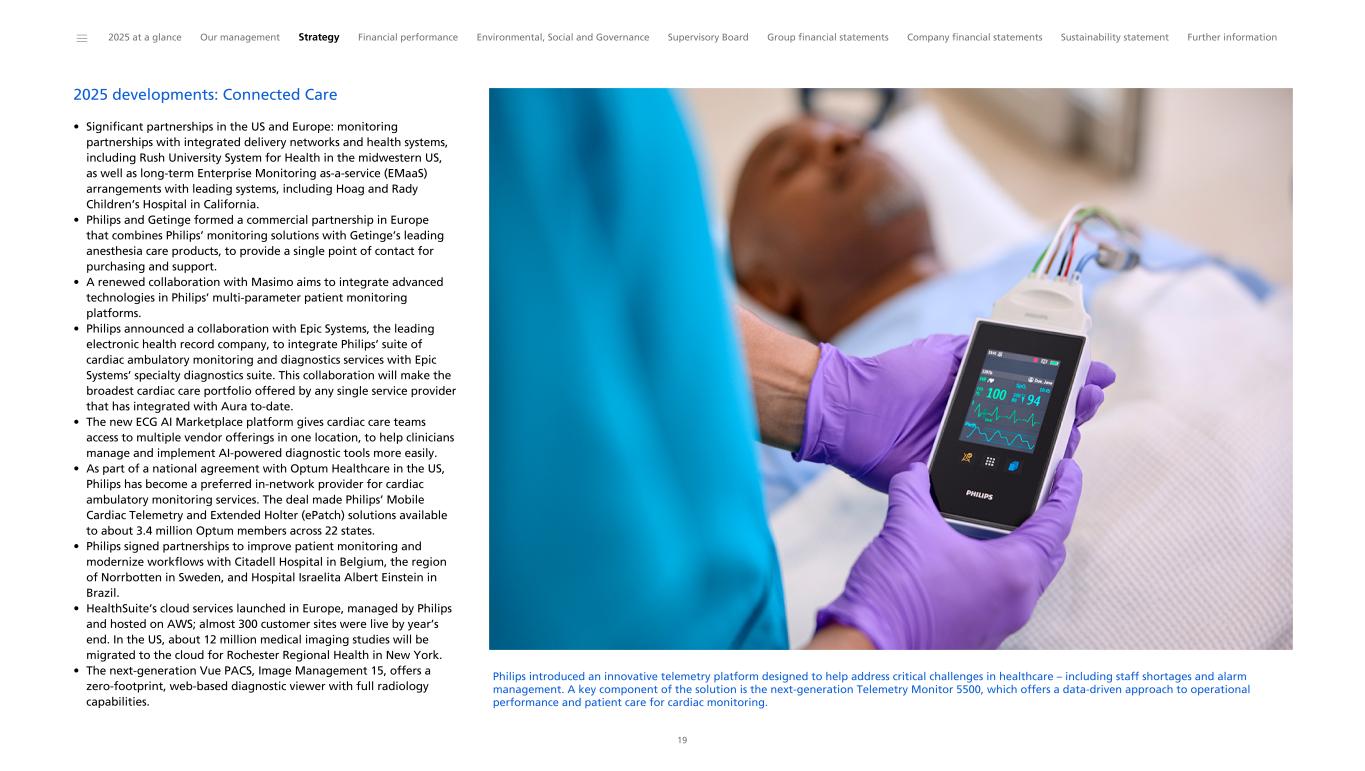
2025 developments: Connected Care • Significant partnerships in the US and Europe: monitoring partnerships with integrated delivery networks and health systems, including Rush University System for Health in the midwestern US, as well as long-term Enterprise Monitoring as-a-service (EMaaS) arrangements with leading systems, including Hoag and Rady Children’s Hospital in California. • Philips and Getinge formed a commercial partnership in Europe that combines Philips’ monitoring solutions with Getinge’s leading anesthesia care products, to provide a single point of contact for purchasing and support. • A renewed collaboration with Masimo aims to integrate advanced technologies in Philips’ multi-parameter patient monitoring platforms. • Philips announced a collaboration with Epic Systems, the leading electronic health record company, to integrate Philips’ suite of cardiac ambulatory monitoring and diagnostics services with Epic Systems’ specialty diagnostics suite. This collaboration will make the broadest cardiac care portfolio offered by any single service provider that has integrated with Aura to-date. • The new ECG AI Marketplace platform gives cardiac care teams access to multiple vendor offerings in one location, to help clinicians manage and implement AI-powered diagnostic tools more easily. • As part of a national agreement with Optum Healthcare in the US, Philips has become a preferred in-network provider for cardiac ambulatory monitoring services. The deal made Philips’ Mobile Cardiac Telemetry and Extended Holter (ePatch) solutions available to about 3.4 million Optum members across 22 states. • Philips signed partnerships to improve patient monitoring and modernize workflows with Citadell Hospital in Belgium, the region of Norrbotten in Sweden, and Hospital Israelita Albert Einstein in Brazil. • HealthSuite’s cloud services launched in Europe, managed by Philips and hosted on AWS; almost 300 customer sites were live by year’s end. In the US, about 12 million medical imaging studies will be migrated to the cloud for Rochester Regional Health in New York. • The next-generation Vue PACS, Image Management 15, offers a zero-footprint, web-based diagnostic viewer with full radiology capabilities. Philips introduced an innovative telemetry platform designed to help address critical challenges in healthcare – including staff shortages and alarm management. A key component of the solution is the next-generation Telemetry Monitor 5500, which offers a data-driven approach to operational performance and patient care for cardiac monitoring. ______ 2025 at a glance Our management Strategy Financial performance Environmental, Social and Governance Supervisory Board Group financial statements Company financial statements Sustainability statement Further information 19
Personal Health segment Our Personal Health segment enables individual care routines with technology and solutions that support people’s long-term health and well-being. Through our Personal Health Business, we offer a broad range of solutions in various consumer price segments, with locally relevant innovations in some markets. We aim to drive profitable growth through a focus on innovation across three key areas: • reaching more people through consumer-driven innovation of products and solutions • ensuring the highest quality of consumer experience from pre- purchase consideration through to purchase and unboxing, all the way to end-of-use recycling • expanding our ecosystem through partnerships with leading retailers and scaling new business models, such as try-and-buy and subscription services A notable aspect of our commercial strategy is driving direct-to- consumer relationships and sales through consumer communities and our online store. We are also leveraging connectivity, partnering with key players in the health ecosystem, such as insurance companies and healthcare professionals, and – through social media and digital innovation – engaging consumers in their health journey in new and impactful ways. In Personal Health, improving lives also means caring for the planet, with a key focus on environmental sustainability. In 2025, product launches continued to reflect the brand’s efforts to reduce usage of virgin fossil-based plastics. For example, with the Philips Avent Ultra Soother range, pacifiers and sterilizer cases are now made using 80% plant-based materials*, and Philips Sonicare brush heads are now made from 70% bio-based plastic, with packaging that is made from 50% recycled materials and is 100% recyclable. The Personal Health segment consists of a single Business, with three Business Units. Personal Health – To help people take greater control of their personal health and well-being, we deliver sustainable, meaningful solutions that help them to take care of themselves and their families, for happier, healthier lives, today and tomorrow. • Personal Care Business Unit – grooming and beauty products ranging from entry-level to premium. The grooming portfolio includes shavers, OneBlade, groomers, trimmers, and hair clippers, as well as premium solutions with SenseIQ Pro technology, powered by AI, in- app coaching for a personalized shave, and blade subscriptions. The beauty portfolio includes devices to support skin care, hair care and hair removal, including Lumea premium Intense Pulsed Light hair removal devices and solutions with the latest SenseIQ technology that sense and adapt for personalized care; these are also available through subscription models. • Oral Healthcare Business Unit – power toothbrushes for a range of price segments, from entry-level, battery-operated toothbrushes for a young audience to premium power toothbrushes connected to the Sonicare app with in-app coaching; brush heads, which are also available as a subscription service; and products for interdental cleaning and for in-office and take-home teeth whitening. • Mother and Child Care Business Unit – products to support parents and babies in the first 1,000 days, including infant feeding (breast pumps, baby bottles and sterilizers), connected baby monitors powered by AI, and digital parental and women’s health solutions (Pregnancy+ and Baby+ apps). Personal Health Total sales by Business Personal Health 1 100% 2025 1 of which Personal Care 55%, Oral Healthcare 33%, Mother and Child Care 11% The revenue model is mainly based on product sales at the point in time the products are delivered to retailers and online platforms. We continue to increase revenue model diversity by expanding our business models, including direct-to-consumer, subscriptions, and try-and-buy offerings and services. The Personal Health Business experiences seasonality, with higher sales around key events and holidays. Addressing challenges In 2025, we took action to address the cost-management challenges posed by tariff developments in various jurisdictions. Through close planning with key retail and distribution partners, we adjusted supply chain strategies, improved forecasting, and adapted pricing structures. This disciplined approach helped us manage volatility in our operating environment while maintaining supply continuity and supporting long-term customer relationships. ______ 2025 at a glance Our management Strategy Financial performance Environmental, Social and Governance Supervisory Board Group financial statements Company financial statements Sustainability statement Further information 20 * Hard plastic parts excluding silicone nipple (mass balance approach).
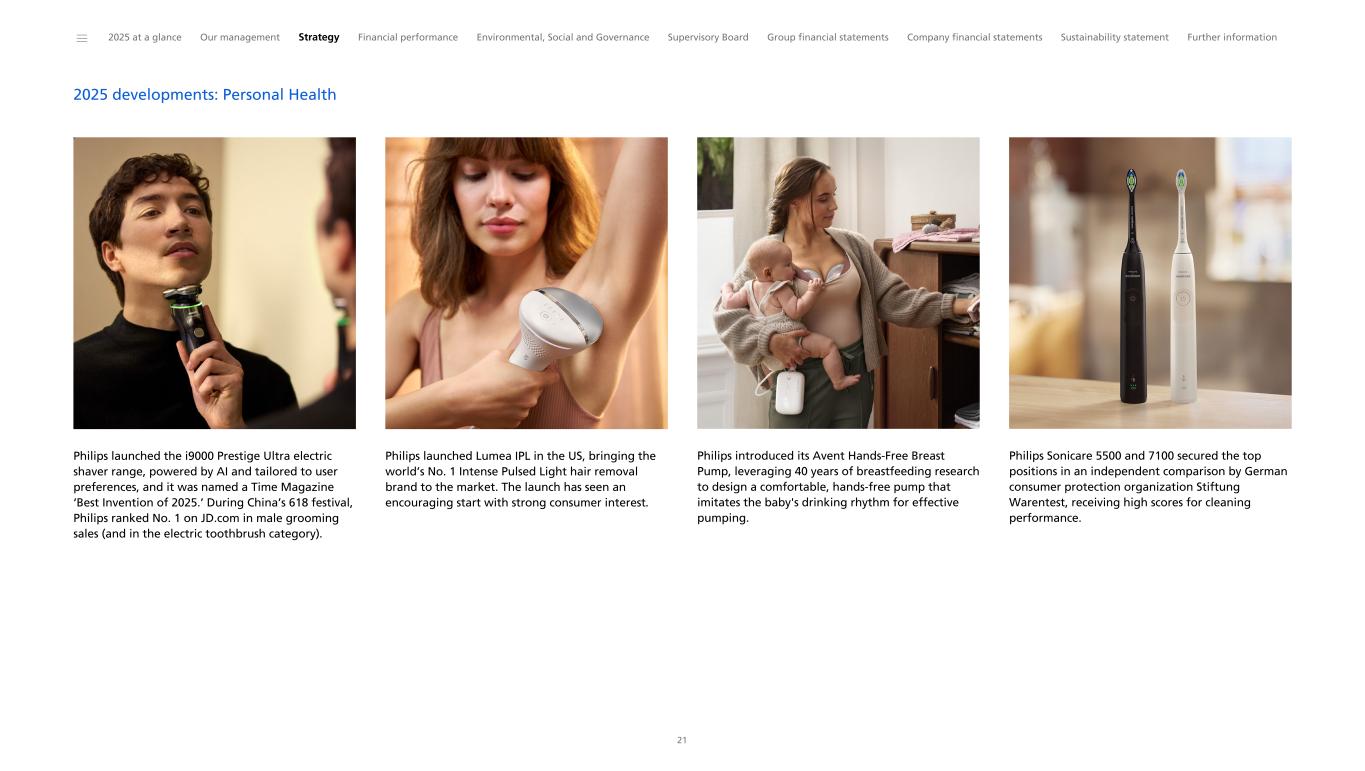
2025 developments: Personal Health Philips launched the i9000 Prestige Ultra electric shaver range, powered by AI and tailored to user preferences, and it was named a Time Magazine ‘Best Invention of 2025.’ During China’s 618 festival, Philips ranked No. 1 on JD.com in male grooming sales (and in the electric toothbrush category). Philips launched Lumea IPL in the US, bringing the world’s No. 1 Intense Pulsed Light hair removal brand to the market. The launch has seen an encouraging start with strong consumer interest. Philips introduced its Avent Hands-Free Breast Pump, leveraging 40 years of breastfeeding research to design a comfortable, hands-free pump that imitates the baby's drinking rhythm for effective pumping. Philips Sonicare 5500 and 7100 secured the top positions in an independent comparison by German consumer protection organization Stiftung Warentest, receiving high scores for cleaning performance. ______ 2025 at a glance Our management Strategy Financial performance Environmental, Social and Governance Supervisory Board Group financial statements Company financial statements Sustainability statement Further information 21
Segment Other In Other we report on the items Innovation & Design, IP royalties, Central costs, and other small items. Innovation & Design At Philips, we aim to ensure that innovation happens where it matters most: close to our customers and consumers. By working backward from their needs and co-creating with clinicians through long-term partnerships, we aim to ensure our innovations are truly people- and patient-centric. Our Innovation & Design organization supports our businesses by providing capabilities in software and systems engineering for proprietary software and systems, as well as for licensed software and systems. We advance breakthrough and exploratory innovation programs, working on a consistent, trusted user experience through strong design principles. We are also accelerating the responsible and sustainable application of AI, embedding AI into solutions designed to improve care delivery and operational efficiency. Philips is committed to use, design, develop and deploy AI in a responsible way. At enterprise level, an AI policy is in force, guiding the company with a revised set of eight AI principles that align our AI vision with our company purpose and values. AI processes are being integrated in the existing development and quality management processes, with the aim of meeting international regulations. Guidelines and guardrails for AI usage by employees are being developed and deployed. A Responsible AI Office has been established, orchestrating the enterprise level policies, standards, guidelines and guardrails. Our R&D and innovation operations focus on four major sites – Eindhoven (the Netherlands), Cambridge (US), Bengaluru (India), and Beijing (China, where we established our Greater China R&D Headquarters in 2025) – with smaller innovation and research sites in the Regions. This global footprint allows us to stay close to customers, understand diverse healthcare needs, and anticipate emerging trends everywhere Philips operates. Philips was the leading applicant in medical technology at the European Patent Office in 2024, and Clarivate recognized Philips as the top-ranked medical technology company in its list of the Top 100 Global Innovators 2025. The Philips brand also received 160 design awards in 2025. IP royalties Philips Intellectual Property & Standards (IP&S) proactively pursues the creation of new intellectual property (IP) in close cooperation with Philips’ operating Businesses and Innovation & Design. IP&S is a leading industrial IP organization providing world-class IP solutions to Philips Businesses to support their growth, competitiveness and profitability. Royal Philips’ IP portfolio currently consists of approximately 53,000 patent rights, 31,500 trademarks, 159,000 design rights and 3,100 domain names. Philips filed 700 new patents in 2025, with a strong focus on the growth areas in health technology services and solutions. Of those 700, 57 involve AI, spread across our Businesses. Philips earns substantial annual income from license fees and royalties to third parties. Philips believes its business as a whole is not materially dependent on any particular third-party patent or license, or any particular group of third-party patents and licenses. Central costs Philips is present in 71 countries globally and has its corporate headquarters in Amsterdam, the Netherlands. Our real estate locations are spread around the globe, with key manufacturing and R&D sites in Europe, the Americas and Asia. The project to move the Philips headquarters to a new location in Amsterdam in 2025 has been completed. We recharge the directly attributable part of the Functional costs to the Businesses. The remaining part is accounted for as ’central costs’, and includes costs related to the Executive Committee and Group Functions such as Legal & ESG and Internal Audit. Other small items Other small items refer to remaining items for intra-group services and legacy items relating to previously disposed businesses. ______ 2025 at a glance Our management Strategy Financial performance Environmental, Social and Governance Supervisory Board Group financial statements Company financial statements Sustainability statement Further information 22
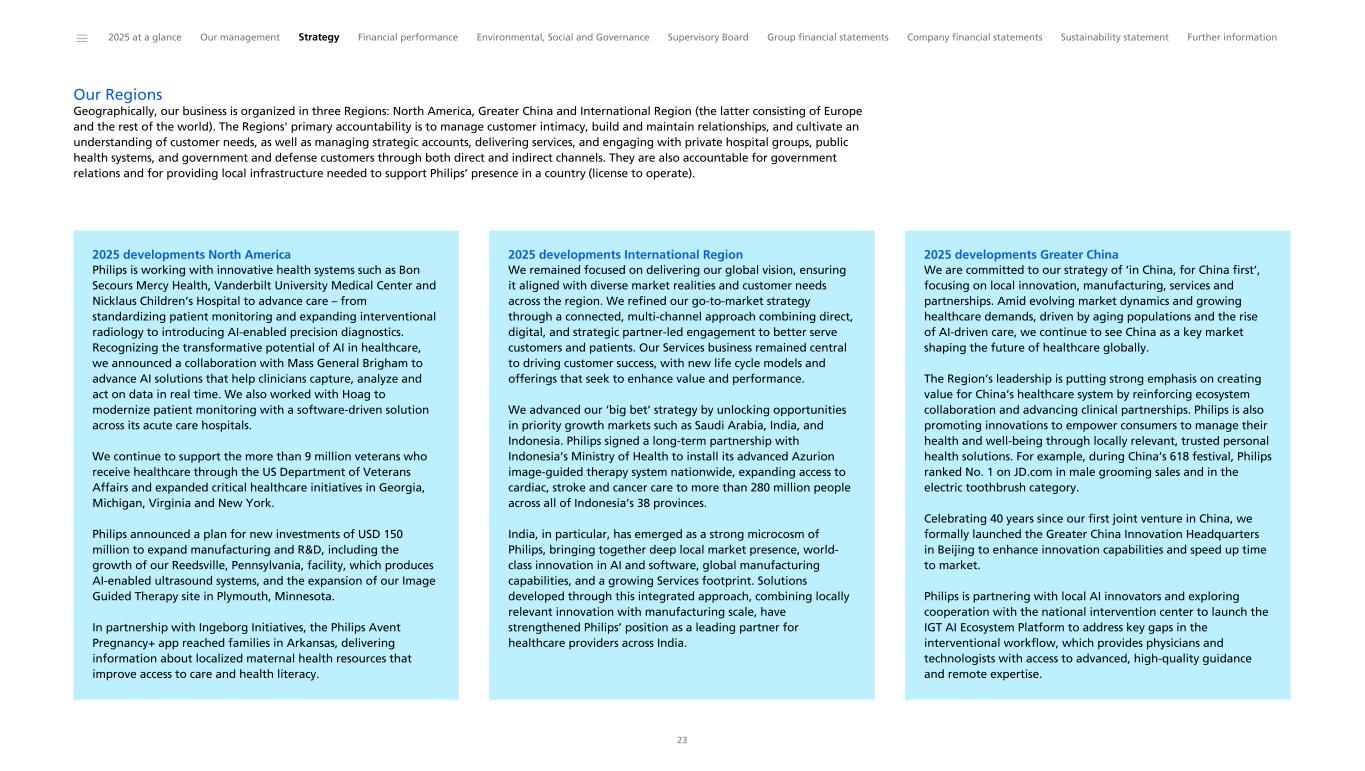
Our Regions Geographically, our business is organized in three Regions: North America, Greater China and International Region (the latter consisting of Europe and the rest of the world). The Regions' primary accountability is to manage customer intimacy, build and maintain relationships, and cultivate an understanding of customer needs, as well as managing strategic accounts, delivering services, and engaging with private hospital groups, public health systems, and government and defense customers through both direct and indirect channels. They are also accountable for government relations and for providing local infrastructure needed to support Philips’ presence in a country (license to operate). 2025 developments North America Philips is working with innovative health systems such as Bon Secours Mercy Health, Vanderbilt University Medical Center and Nicklaus Children’s Hospital to advance care – from standardizing patient monitoring and expanding interventional radiology to introducing AI-enabled precision diagnostics. Recognizing the transformative potential of AI in healthcare, we announced a collaboration with Mass General Brigham to advance AI solutions that help clinicians capture, analyze and act on data in real time. We also worked with Hoag to modernize patient monitoring with a software-driven solution across its acute care hospitals. We continue to support the more than 9 million veterans who receive healthcare through the US Department of Veterans Affairs and expanded critical healthcare initiatives in Georgia, Michigan, Virginia and New York. Philips announced a plan for new investments of USD 150 million to expand manufacturing and R&D, including the growth of our Reedsville, Pennsylvania, facility, which produces AI-enabled ultrasound systems, and the expansion of our Image Guided Therapy site in Plymouth, Minnesota. In partnership with Ingeborg Initiatives, the Philips Avent Pregnancy+ app reached families in Arkansas, delivering information about localized maternal health resources that improve access to care and health literacy. 2025 developments International Region We remained focused on delivering our global vision, ensuring it aligned with diverse market realities and customer needs across the region. We refined our go-to-market strategy through a connected, multi-channel approach combining direct, digital, and strategic partner-led engagement to better serve customers and patients. Our Services business remained central to driving customer success, with new life cycle models and offerings that seek to enhance value and performance. We advanced our ‘big bet’ strategy by unlocking opportunities in priority growth markets such as Saudi Arabia, India, and Indonesia. Philips signed a long-term partnership with Indonesia’s Ministry of Health to install its advanced Azurion image-guided therapy system nationwide, expanding access to cardiac, stroke and cancer care to more than 280 million people across all of Indonesia’s 38 provinces. India, in particular, has emerged as a strong microcosm of Philips, bringing together deep local market presence, world- class innovation in AI and software, global manufacturing capabilities, and a growing Services footprint. Solutions developed through this integrated approach, combining locally relevant innovation with manufacturing scale, have strengthened Philips’ position as a leading partner for healthcare providers across India. 2025 developments Greater China We are committed to our strategy of ‘in China, for China first’, focusing on local innovation, manufacturing, services and partnerships. Amid evolving market dynamics and growing healthcare demands, driven by aging populations and the rise of AI-driven care, we continue to see China as a key market shaping the future of healthcare globally. The Region’s leadership is putting strong emphasis on creating value for China’s healthcare system by reinforcing ecosystem collaboration and advancing clinical partnerships. Philips is also promoting innovations to empower consumers to manage their health and well-being through locally relevant, trusted personal health solutions. For example, during China’s 618 festival, Philips ranked No. 1 on JD.com in male grooming sales and in the electric toothbrush category. Celebrating 40 years since our first joint venture in China, we formally launched the Greater China Innovation Headquarters in Beijing to enhance innovation capabilities and speed up time to market. Philips is partnering with local AI innovators and exploring cooperation with the national intervention center to launch the IGT AI Ecosystem Platform to address key gaps in the interventional workflow, which provides physicians and technologists with access to advanced, high-quality guidance and remote expertise. ______ 2025 at a glance Our management Strategy Financial performance Environmental, Social and Governance Supervisory Board Group financial statements Company financial statements Sustainability statement Further information 23
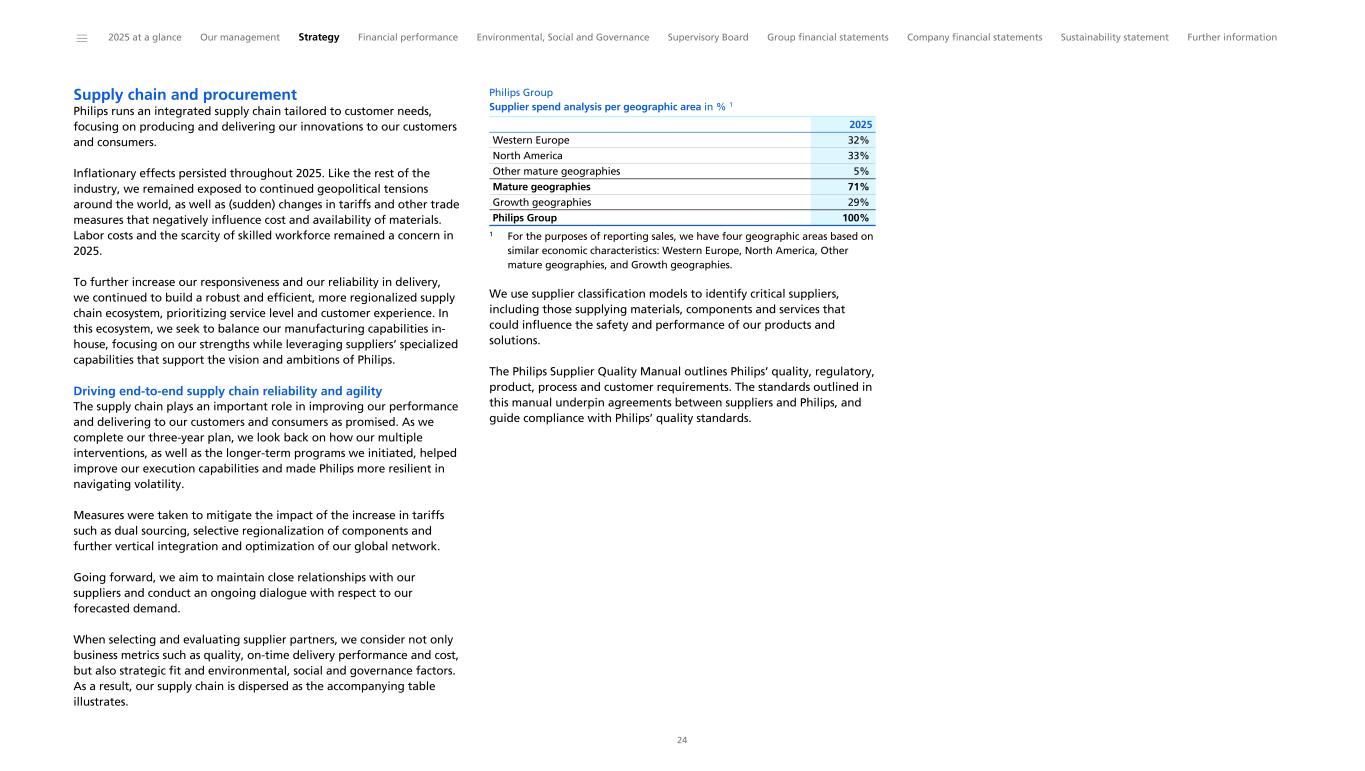
Supply chain and procurement Philips runs an integrated supply chain tailored to customer needs, focusing on producing and delivering our innovations to our customers and consumers. Inflationary effects persisted throughout 2025. Like the rest of the industry, we remained exposed to continued geopolitical tensions around the world, as well as (sudden) changes in tariffs and other trade measures that negatively influence cost and availability of materials. Labor costs and the scarcity of skilled workforce remained a concern in 2025. To further increase our responsiveness and our reliability in delivery, we continued to build a robust and efficient, more regionalized supply chain ecosystem, prioritizing service level and customer experience. In this ecosystem, we seek to balance our manufacturing capabilities in- house, focusing on our strengths while leveraging suppliers’ specialized capabilities that support the vision and ambitions of Philips. Driving end-to-end supply chain reliability and agility The supply chain plays an important role in improving our performance and delivering to our customers and consumers as promised. As we complete our three-year plan, we look back on how our multiple interventions, as well as the longer-term programs we initiated, helped improve our execution capabilities and made Philips more resilient in navigating volatility. Measures were taken to mitigate the impact of the increase in tariffs such as dual sourcing, selective regionalization of components and further vertical integration and optimization of our global network. Going forward, we aim to maintain close relationships with our suppliers and conduct an ongoing dialogue with respect to our forecasted demand. When selecting and evaluating supplier partners, we consider not only business metrics such as quality, on-time delivery performance and cost, but also strategic fit and environmental, social and governance factors. As a result, our supply chain is dispersed as the accompanying table illustrates. Philips Group Supplier spend analysis per geographic area in % 1 Western Europe 32% North America 33% Other mature geographies 5% Mature geographies 71% Growth geographies 29% Philips Group 100% 2025 1 For the purposes of reporting sales, we have four geographic areas based on similar economic characteristics: Western Europe, North America, Other mature geographies, and Growth geographies. We use supplier classification models to identify critical suppliers, including those supplying materials, components and services that could influence the safety and performance of our products and solutions. The Philips Supplier Quality Manual outlines Philips’ quality, regulatory, product, process and customer requirements. The standards outlined in this manual underpin agreements between suppliers and Philips, and guide compliance with Philips’ quality standards. ______ 2025 at a glance Our management Strategy Financial performance Environmental, Social and Governance Supervisory Board Group financial statements Company financial statements Sustainability statement Further information 24
Financial performance ______ 2025 at a glance Our management Strategy Financial performance Environmental, Social and Governance Supervisory Board Group financial statements Company financial statements Sustainability statement Further information 25
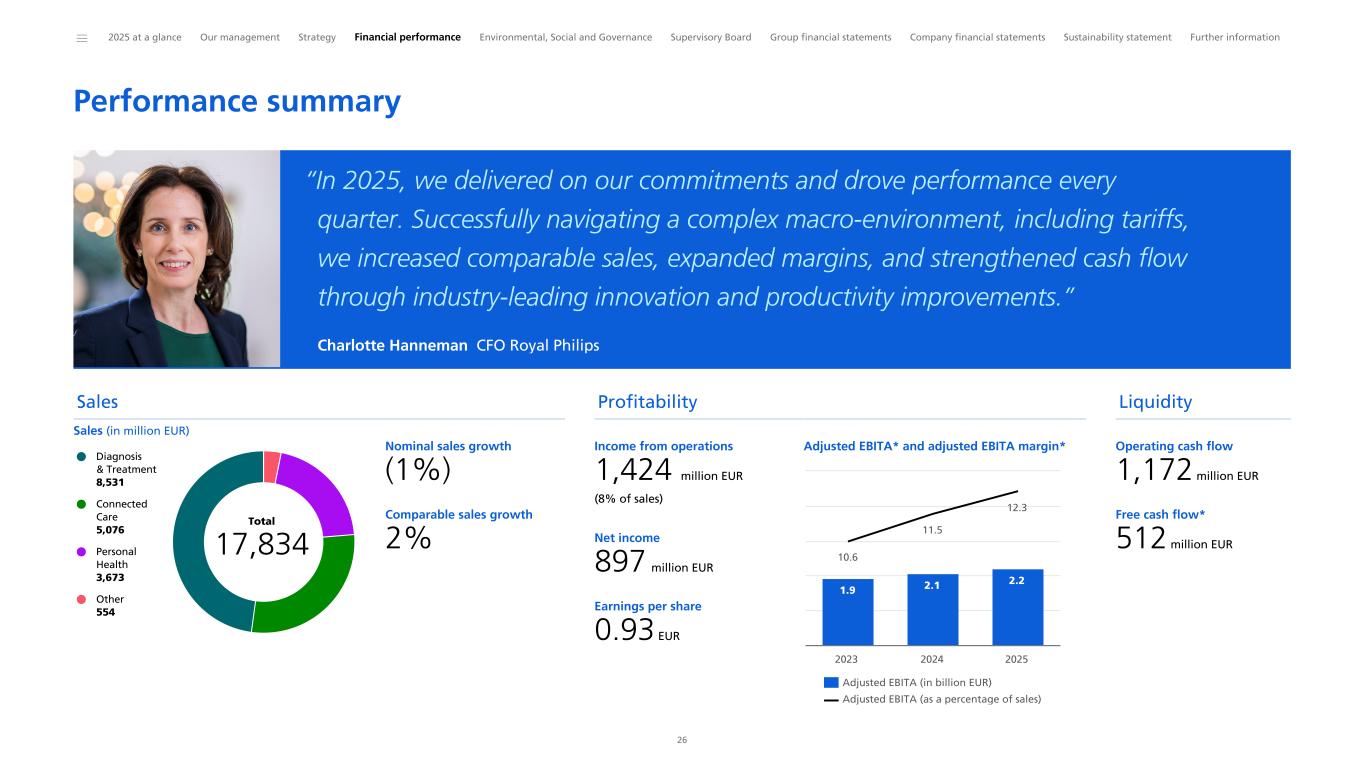
Performance summary “In 2025, we delivered on our commitments and drove performance every quarter. Successfully navigating a complex macro-environment, including tariffs, we increased comparable sales, expanded margins, and strengthened cash flow through industry-leading innovation and productivity improvements.” Charlotte Hanneman CFO Royal Philips Sales Sales (in million EUR) n Diagnosis & Treatment 8,531 n Connected Care 5,076 n Personal Health 3,673 n Other 554 Nominal sales growth (1%) Comparable sales growth 2% Profitability Income from operations 1,424 million EUR (8% of sales) Net income 897 million EUR Earnings per share 0.93 EUR Adjusted EBITA* and adjusted EBITA margin* 1.9 2.1 2.2 10.6 11.5 12.3 Adjusted EBITA (in billion EUR) Adjusted EBITA (as a percentage of sales) 2023 2024 2025 Liquidity Operating cash flow 1,172 million EUR Free cash flow* 512 million EUR ______ 2025 at a glance Our management Strategy Financial performance Environmental, Social and Governance Supervisory Board Group financial statements Company financial statements Sustainability statement Further information 26 Total 17,834
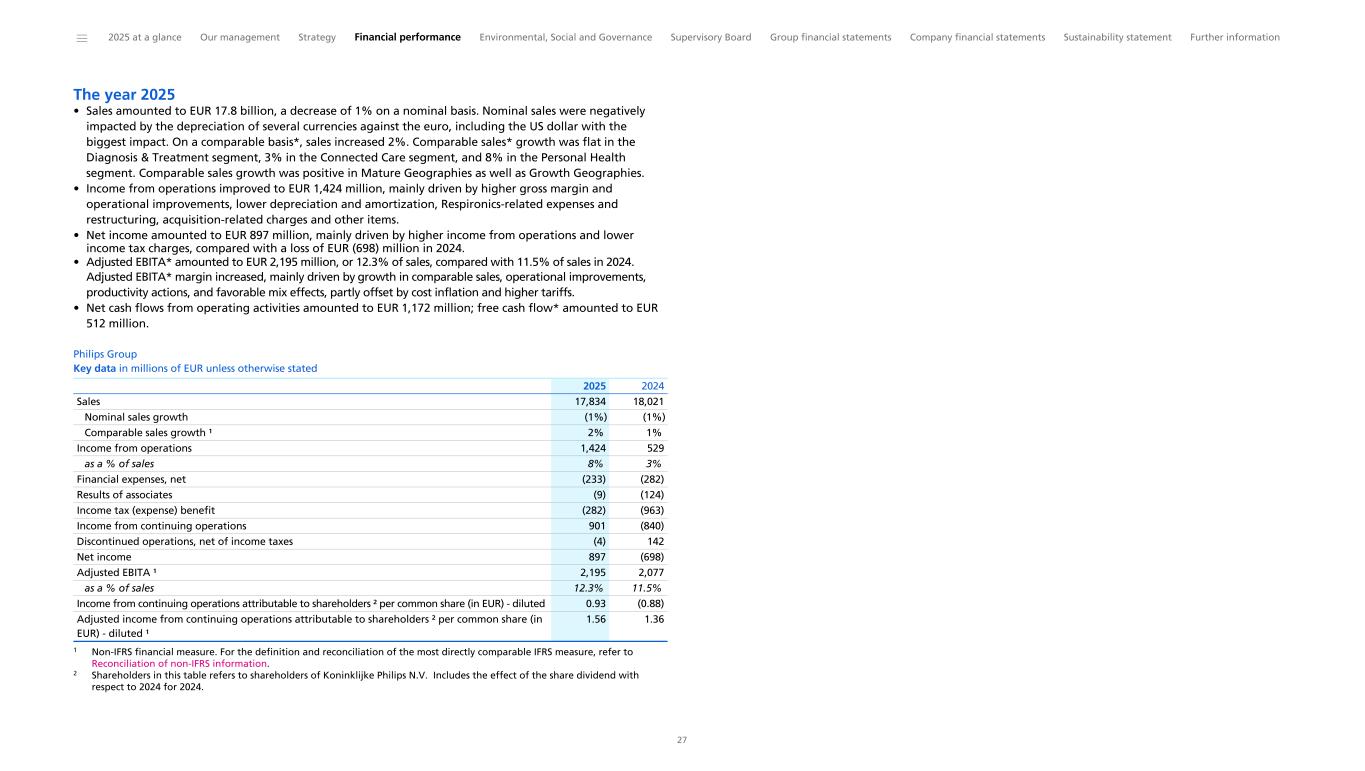
The year 2025 • Sales amounted to EUR 17.8 billion, a decrease of 1% on a nominal basis. Nominal sales were negatively impacted by the depreciation of several currencies against the euro, including the US dollar with the biggest impact. On a comparable basis*, sales increased 2%. Comparable sales* growth was flat in the Diagnosis & Treatment segment, 3% in the Connected Care segment, and 8% in the Personal Health segment. Comparable sales growth was positive in Mature Geographies as well as Growth Geographies. • Income from operations improved to EUR 1,424 million, mainly driven by higher gross margin and operational improvements, lower depreciation and amortization, Respironics-related expenses and restructuring, acquisition-related charges and other items. • Net income amounted to EUR 897 million, mainly driven by higher income from operations and lower income tax charges, compared with a loss of EUR (698) million in 2024. • Adjusted EBITA* amounted to EUR 2,195 million, or 12.3% of sales, compared with 11.5% of sales in 2024. Adjusted EBITA* margin increased, mainly driven by growth in comparable sales, operational improvements, productivity actions, and favorable mix effects, partly offset by cost inflation and higher tariffs. • Net cash flows from operating activities amounted to EUR 1,172 million; free cash flow* amounted to EUR 512 million. Philips Group Key data in millions of EUR unless otherwise stated Sales 17,834 18,021 Nominal sales growth (1%) (1%) Comparable sales growth ¹ 2% 1% Income from operations 1,424 529 as a % of sales 8% 3% Financial expenses, net (233) (282) Results of associates (9) (124) Income tax (expense) benefit (282) (963) Income from continuing operations 901 (840) Discontinued operations, net of income taxes (4) 142 Net income 897 (698) Adjusted EBITA ¹ 2,195 2,077 as a % of sales 12.3% 11.5% Income from continuing operations attributable to shareholders ² per common share (in EUR) - diluted 0.93 (0.88) Adjusted income from continuing operations attributable to shareholders ² per common share (in EUR) - diluted ¹ 1.56 1.36 2025 2024 1 Non-IFRS financial measure. For the definition and reconciliation of the most directly comparable IFRS measure, refer to Reconciliation of non-IFRS information. 2 Shareholders in this table refers to shareholders of Koninklijke Philips N.V. Includes the effect of the share dividend with respect to 2024 for 2024. ______ 2025 at a glance Our management Strategy Financial performance Environmental, Social and Governance Supervisory Board Group financial statements Company financial statements Sustainability statement Further information 27
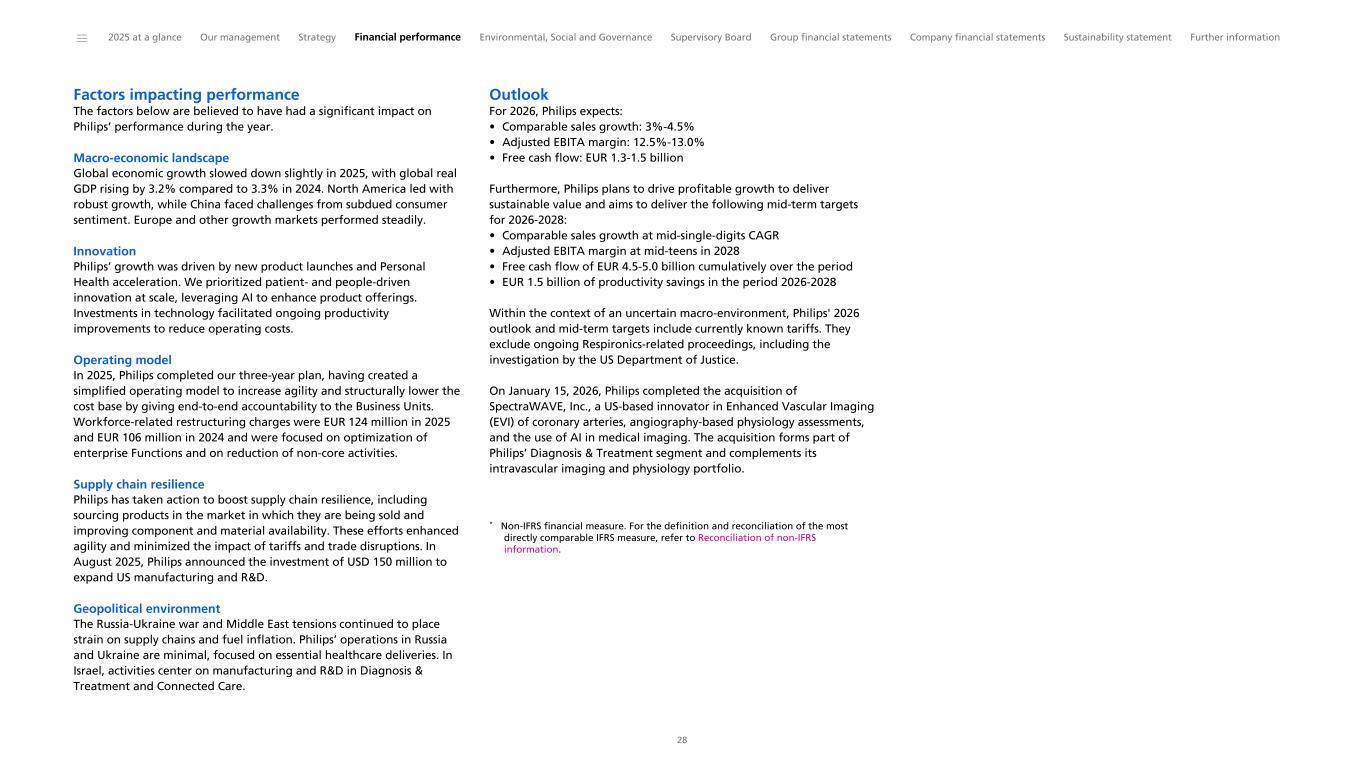
Factors impacting performance The factors below are believed to have had a significant impact on Philips’ performance during the year. Macro-economic landscape Global economic growth slowed down slightly in 2025, with global real GDP rising by 3.2% compared to 3.3% in 2024. North America led with robust growth, while China faced challenges from subdued consumer sentiment. Europe and other growth markets performed steadily. Innovation Philips’ growth was driven by new product launches and Personal Health acceleration. We prioritized patient- and people-driven innovation at scale, leveraging AI to enhance product offerings. Investments in technology facilitated ongoing productivity improvements to reduce operating costs. Operating model In 2025, Philips completed our three-year plan, having created a simplified operating model to increase agility and structurally lower the cost base by giving end-to-end accountability to the Business Units. Workforce-related restructuring charges were EUR 124 million in 2025 and EUR 106 million in 2024 and were focused on optimization of enterprise Functions and on reduction of non-core activities. Supply chain resilience Philips has taken action to boost supply chain resilience, including sourcing products in the market in which they are being sold and improving component and material availability. These efforts enhanced agility and minimized the impact of tariffs and trade disruptions. In August 2025, Philips announced the investment of USD 150 million to expand US manufacturing and R&D. Geopolitical environment The Russia-Ukraine war and Middle East tensions continued to place strain on supply chains and fuel inflation. Philips’ operations in Russia and Ukraine are minimal, focused on essential healthcare deliveries. In Israel, activities center on manufacturing and R&D in Diagnosis & Treatment and Connected Care. Outlook For 2026, Philips expects: • Comparable sales growth: 3%-4.5% • Adjusted EBITA margin: 12.5%-13.0% • Free cash flow: EUR 1.3-1.5 billion Furthermore, Philips plans to drive profitable growth to deliver sustainable value and aims to deliver the following mid-term targets for 2026-2028: • Comparable sales growth at mid-single-digits CAGR • Adjusted EBITA margin at mid-teens in 2028 • Free cash flow of EUR 4.5-5.0 billion cumulatively over the period • EUR 1.5 billion of productivity savings in the period 2026-2028 Within the context of an uncertain macro-environment, Philips' 2026 outlook and mid-term targets include currently known tariffs. They exclude ongoing Respironics-related proceedings, including the investigation by the US Department of Justice. On January 15, 2026, Philips completed the acquisition of SpectraWAVE, Inc., a US-based innovator in Enhanced Vascular Imaging (EVI) of coronary arteries, angiography-based physiology assessments, and the use of AI in medical imaging. The acquisition forms part of Philips’ Diagnosis & Treatment segment and complements its intravascular imaging and physiology portfolio. * Non-IFRS financial measure. For the definition and reconciliation of the most directly comparable IFRS measure, refer to Reconciliation of non-IFRS information. ______ 2025 at a glance Our management Strategy Financial performance Environmental, Social and Governance Supervisory Board Group financial statements Company financial statements Sustainability statement Further information 28
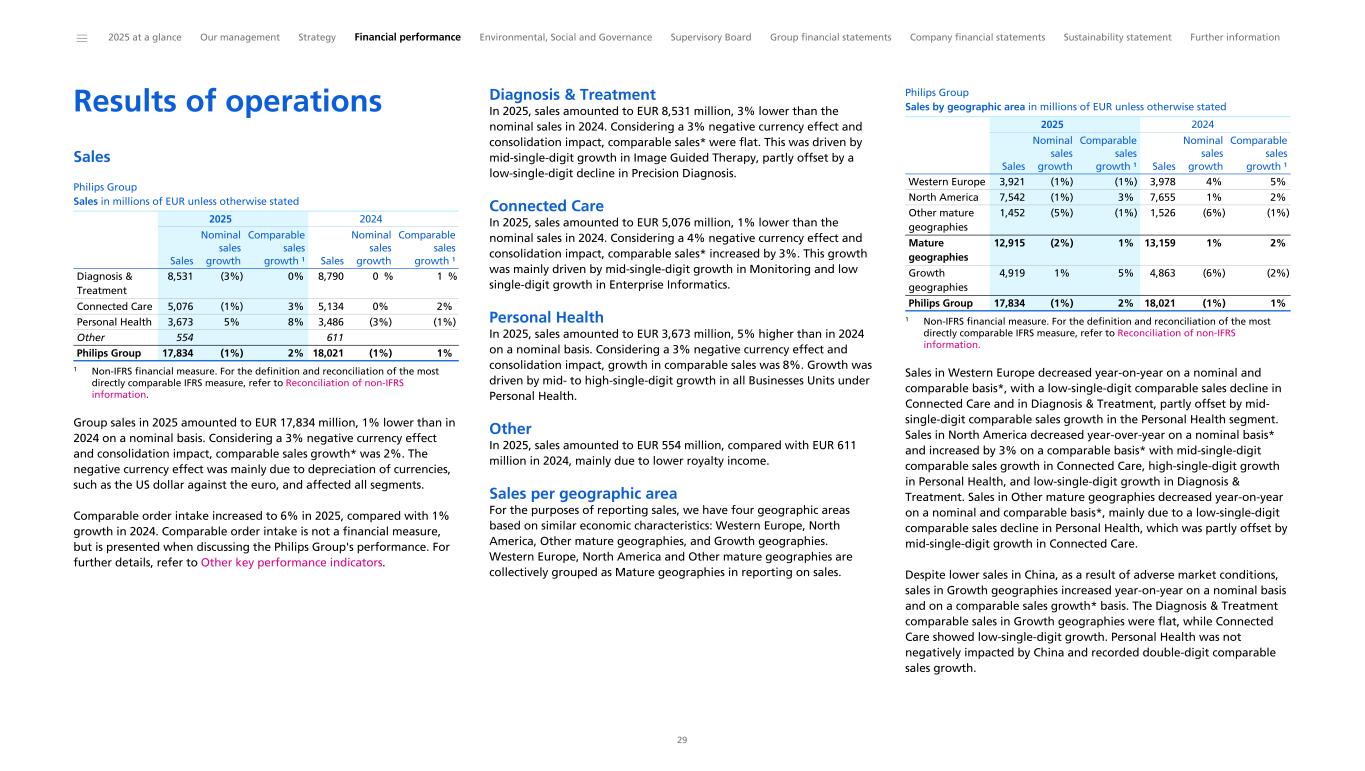
Results of operations Sales Philips Group Sales in millions of EUR unless otherwise stated Diagnosis & Treatment 8,531 (3%) 0% 8,790 0 % 1 % Connected Care 5,076 (1%) 3% 5,134 0% 2% Personal Health 3,673 5% 8% 3,486 (3%) (1%) Other 554 611 Philips Group 17,834 (1%) 2% 18,021 (1%) 1% 2025 2024 Sales Nominal sales growth Comparable sales growth ¹ Sales Nominal sales growth Comparable sales growth ¹ 1 Non-IFRS financial measure. For the definition and reconciliation of the most directly comparable IFRS measure, refer to Reconciliation of non-IFRS information. Group sales in 2025 amounted to EUR 17,834 million, 1% lower than in 2024 on a nominal basis. Considering a 3% negative currency effect and consolidation impact, comparable sales growth* was 2%. The negative currency effect was mainly due to depreciation of currencies, such as the US dollar against the euro, and affected all segments. Comparable order intake increased to 6% in 2025, compared with 1% growth in 2024. Comparable order intake is not a financial measure, but is presented when discussing the Philips Group's performance. For further details, refer to Other key performance indicators. Diagnosis & Treatment In 2025, sales amounted to EUR 8,531 million, 3% lower than the nominal sales in 2024. Considering a 3% negative currency effect and consolidation impact, comparable sales* were flat. This was driven by mid-single-digit growth in Image Guided Therapy, partly offset by a low-single-digit decline in Precision Diagnosis. Connected Care In 2025, sales amounted to EUR 5,076 million, 1% lower than the nominal sales in 2024. Considering a 4% negative currency effect and consolidation impact, comparable sales* increased by 3%. This growth was mainly driven by mid-single-digit growth in Monitoring and low single-digit growth in Enterprise Informatics. Personal Health In 2025, sales amounted to EUR 3,673 million, 5% higher than in 2024 on a nominal basis. Considering a 3% negative currency effect and consolidation impact, growth in comparable sales was 8%. Growth was driven by mid- to high-single-digit growth in all Businesses Units under Personal Health. Other In 2025, sales amounted to EUR 554 million, compared with EUR 611 million in 2024, mainly due to lower royalty income. Sales per geographic area For the purposes of reporting sales, we have four geographic areas based on similar economic characteristics: Western Europe, North America, Other mature geographies, and Growth geographies. Western Europe, North America and Other mature geographies are collectively grouped as Mature geographies in reporting on sales. Philips Group Sales by geographic area in millions of EUR unless otherwise stated Western Europe 3,921 (1%) (1%) 3,978 4% 5% North America 7,542 (1%) 3% 7,655 1% 2% Other mature geographies 1,452 (5%) (1%) 1,526 (6%) (1%) Mature geographies 12,915 (2%) 1% 13,159 1% 2% Growth geographies 4,919 1% 5% 4,863 (6%) (2%) Philips Group 17,834 (1%) 2% 18,021 (1%) 1% 2025 2024 Sales Nominal sales growth Comparable sales growth ¹ Sales Nominal sales growth Comparable sales growth ¹ 1 Non-IFRS financial measure. For the definition and reconciliation of the most directly comparable IFRS measure, refer to Reconciliation of non-IFRS information. Sales in Western Europe decreased year-on-year on a nominal and comparable basis*, with a low-single-digit comparable sales decline in Connected Care and in Diagnosis & Treatment, partly offset by mid- single-digit comparable sales growth in the Personal Health segment. Sales in North America decreased year-over-year on a nominal basis* and increased by 3% on a comparable basis* with mid-single-digit comparable sales growth in Connected Care, high-single-digit growth in Personal Health, and low-single-digit growth in Diagnosis & Treatment. Sales in Other mature geographies decreased year-on-year on a nominal and comparable basis*, mainly due to a low-single-digit comparable sales decline in Personal Health, which was partly offset by mid-single-digit growth in Connected Care. Despite lower sales in China, as a result of adverse market conditions, sales in Growth geographies increased year-on-year on a nominal basis and on a comparable sales growth* basis. The Diagnosis & Treatment comparable sales in Growth geographies were flat, while Connected Care showed low-single-digit growth. Personal Health was not negatively impacted by China and recorded double-digit comparable sales growth. ______ 2025 at a glance Our management Strategy Financial performance Environmental, Social and Governance Supervisory Board Group financial statements Company financial statements Sustainability statement Further information 29
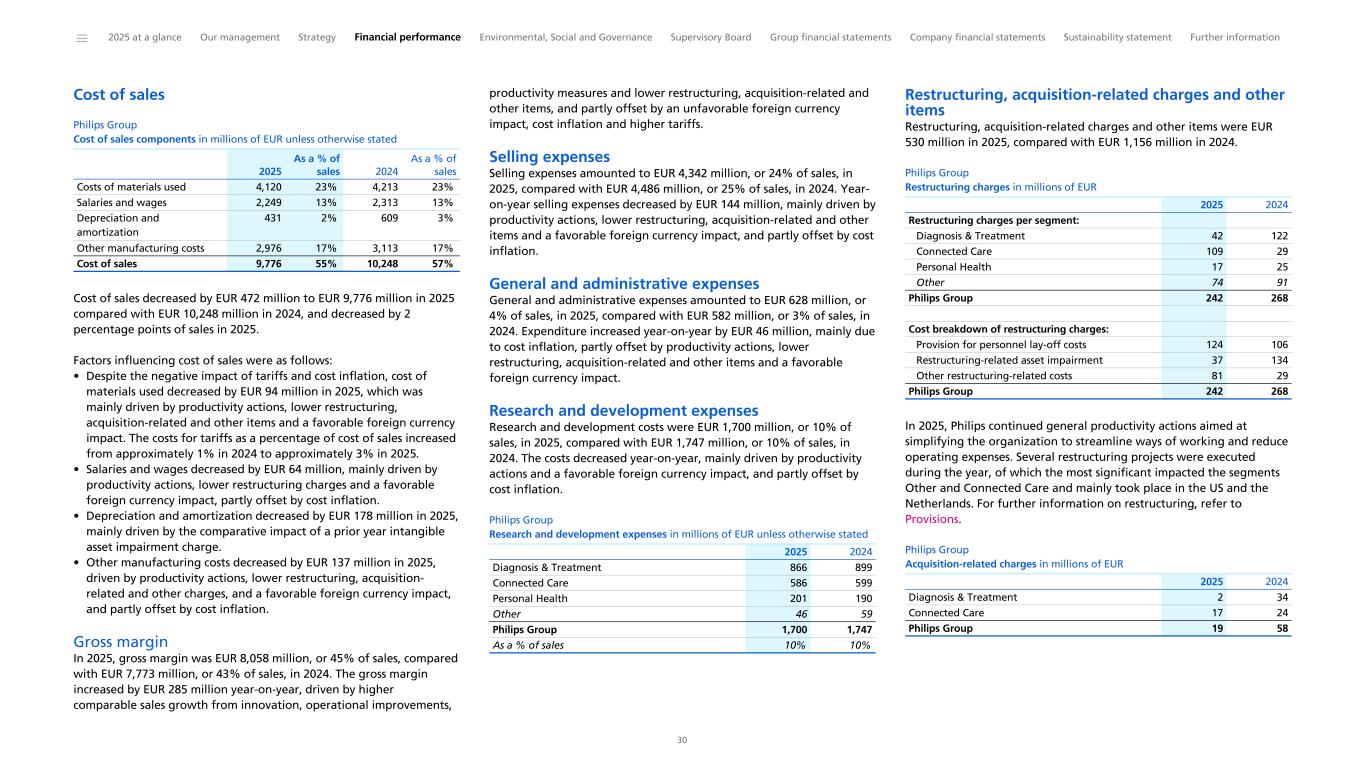
Cost of sales Philips Group Cost of sales components in millions of EUR unless otherwise stated Costs of materials used 4,120 23% 4,213 23% Salaries and wages 2,249 13% 2,313 13% Depreciation and amortization 431 2% 609 3% Other manufacturing costs 2,976 17% 3,113 17% Cost of sales 9,776 55% 10,248 57% 2025 As a % of sales 2024 As a % of sales Cost of sales decreased by EUR 472 million to EUR 9,776 million in 2025 compared with EUR 10,248 million in 2024, and decreased by 2 percentage points of sales in 2025. Factors influencing cost of sales were as follows: • Despite the negative impact of tariffs and cost inflation, cost of materials used decreased by EUR 94 million in 2025, which was mainly driven by productivity actions, lower restructuring, acquisition-related and other items and a favorable foreign currency impact. The costs for tariffs as a percentage of cost of sales increased from approximately 1% in 2024 to approximately 3% in 2025. • Salaries and wages decreased by EUR 64 million, mainly driven by productivity actions, lower restructuring charges and a favorable foreign currency impact, partly offset by cost inflation. • Depreciation and amortization decreased by EUR 178 million in 2025, mainly driven by the comparative impact of a prior year intangible asset impairment charge. • Other manufacturing costs decreased by EUR 137 million in 2025, driven by productivity actions, lower restructuring, acquisition- related and other charges, and a favorable foreign currency impact, and partly offset by cost inflation. Gross margin In 2025, gross margin was EUR 8,058 million, or 45% of sales, compared with EUR 7,773 million, or 43% of sales, in 2024. The gross margin increased by EUR 285 million year-on-year, driven by higher comparable sales growth from innovation, operational improvements, productivity measures and lower restructuring, acquisition-related and other items, and partly offset by an unfavorable foreign currency impact, cost inflation and higher tariffs. Selling expenses Selling expenses amounted to EUR 4,342 million, or 24% of sales, in 2025, compared with EUR 4,486 million, or 25% of sales, in 2024. Year- on-year selling expenses decreased by EUR 144 million, mainly driven by productivity actions, lower restructuring, acquisition-related and other items and a favorable foreign currency impact, and partly offset by cost inflation. General and administrative expenses General and administrative expenses amounted to EUR 628 million, or 4% of sales, in 2025, compared with EUR 582 million, or 3% of sales, in 2024. Expenditure increased year-on-year by EUR 46 million, mainly due to cost inflation, partly offset by productivity actions, lower restructuring, acquisition-related and other items and a favorable foreign currency impact. Research and development expenses Research and development costs were EUR 1,700 million, or 10% of sales, in 2025, compared with EUR 1,747 million, or 10% of sales, in 2024. The costs decreased year-on-year, mainly driven by productivity actions and a favorable foreign currency impact, and partly offset by cost inflation. Philips Group Research and development expenses in millions of EUR unless otherwise stated Diagnosis & Treatment 866 899 Connected Care 586 599 Personal Health 201 190 Other 46 59 Philips Group 1,700 1,747 As a % of sales 10% 10% 2025 2024 Restructuring, acquisition-related charges and other items Restructuring, acquisition-related charges and other items were EUR 530 million in 2025, compared with EUR 1,156 million in 2024. Philips Group Restructuring charges in millions of EUR Restructuring charges per segment: Diagnosis & Treatment 42 122 Connected Care 109 29 Personal Health 17 25 Other 74 91 Philips Group 242 268 Cost breakdown of restructuring charges: Provision for personnel lay-off costs 124 106 Restructuring-related asset impairment 37 134 Other restructuring-related costs 81 29 Philips Group 242 268 2025 2024 In 2025, Philips continued general productivity actions aimed at simplifying the organization to streamline ways of working and reduce operating expenses. Several restructuring projects were executed during the year, of which the most significant impacted the segments Other and Connected Care and mainly took place in the US and the Netherlands. For further information on restructuring, refer to Provisions. Philips Group Acquisition-related charges in millions of EUR Diagnosis & Treatment 2 34 Connected Care 17 24 Philips Group 19 58 2025 2024 ______ 2025 at a glance Our management Strategy Financial performance Environmental, Social and Governance Supervisory Board Group financial statements Company financial statements Sustainability statement Further information 30
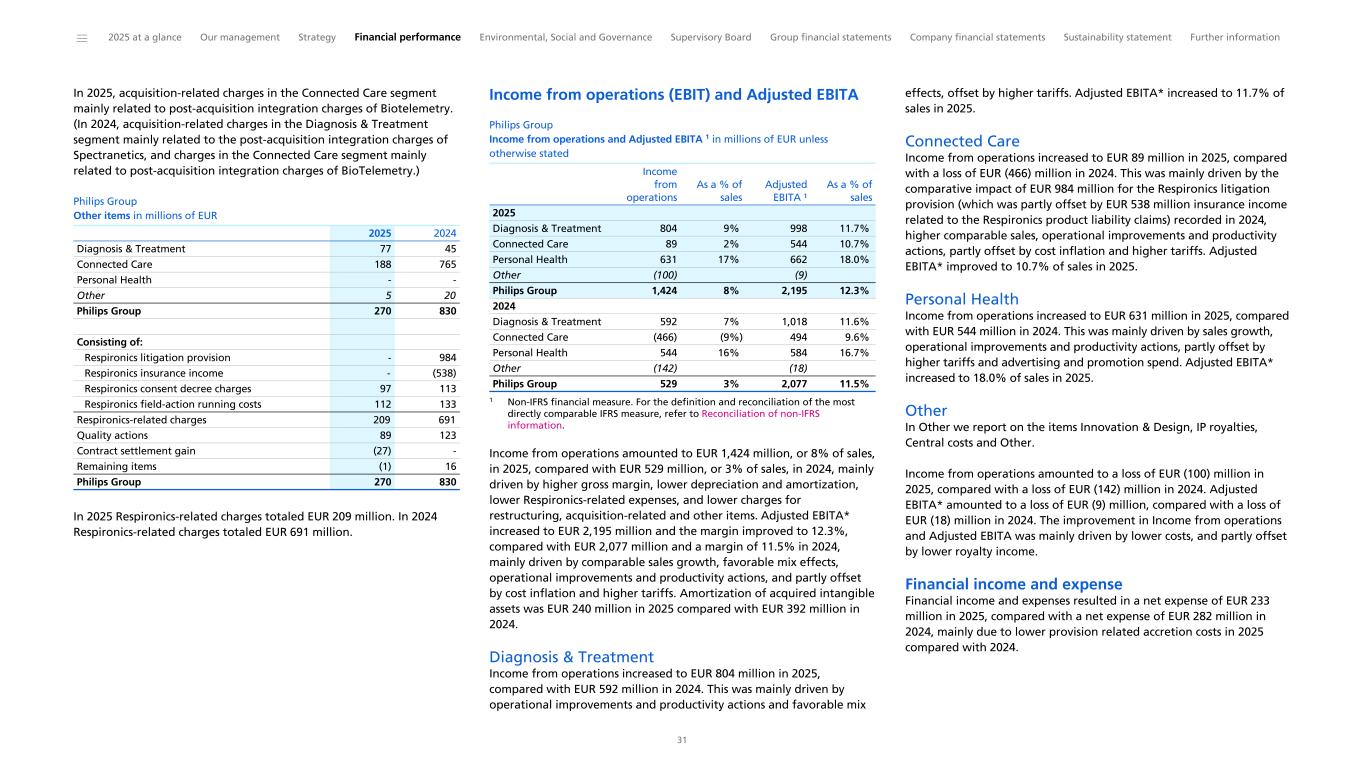
In 2025, acquisition-related charges in the Connected Care segment mainly related to post-acquisition integration charges of Biotelemetry. (In 2024, acquisition-related charges in the Diagnosis & Treatment segment mainly related to the post-acquisition integration charges of Spectranetics, and charges in the Connected Care segment mainly related to post-acquisition integration charges of BioTelemetry.) Philips Group Other items in millions of EUR Diagnosis & Treatment 77 45 Connected Care 188 765 Personal Health - - Other 5 20 Philips Group 270 830 Consisting of: Respironics litigation provision - 984 Respironics insurance income - (538) Respironics consent decree charges 97 113 Respironics field-action running costs 112 133 Respironics-related charges 209 691 Quality actions 89 123 Contract settlement gain (27) - Remaining items (1) 16 Philips Group 270 830 2025 2024 In 2025 Respironics-related charges totaled EUR 209 million. In 2024 Respironics-related charges totaled EUR 691 million. Income from operations (EBIT) and Adjusted EBITA Philips Group Income from operations and Adjusted EBITA 1 in millions of EUR unless otherwise stated 2025 Diagnosis & Treatment 804 9% 998 11.7% Connected Care 89 2% 544 10.7% Personal Health 631 17% 662 18.0% Other (100) (9) Philips Group 1,424 8% 2,195 12.3% 2024 Diagnosis & Treatment 592 7% 1,018 11.6% Connected Care (466) (9%) 494 9.6% Personal Health 544 16% 584 16.7% Other (142) (18) Philips Group 529 3% 2,077 11.5% Income from operations As a % of sales Adjusted EBITA ¹ As a % of sales 1 Non-IFRS financial measure. For the definition and reconciliation of the most directly comparable IFRS measure, refer to Reconciliation of non-IFRS information. Income from operations amounted to EUR 1,424 million, or 8% of sales, in 2025, compared with EUR 529 million, or 3% of sales, in 2024, mainly driven by higher gross margin, lower depreciation and amortization, lower Respironics-related expenses, and lower charges for restructuring, acquisition-related and other items. Adjusted EBITA* increased to EUR 2,195 million and the margin improved to 12.3%, compared with EUR 2,077 million and a margin of 11.5% in 2024, mainly driven by comparable sales growth, favorable mix effects, operational improvements and productivity actions, and partly offset by cost inflation and higher tariffs. Amortization of acquired intangible assets was EUR 240 million in 2025 compared with EUR 392 million in 2024. Diagnosis & Treatment Income from operations increased to EUR 804 million in 2025, compared with EUR 592 million in 2024. This was mainly driven by operational improvements and productivity actions and favorable mix effects, offset by higher tariffs. Adjusted EBITA* increased to 11.7% of sales in 2025. Connected Care Income from operations increased to EUR 89 million in 2025, compared with a loss of EUR (466) million in 2024. This was mainly driven by the comparative impact of EUR 984 million for the Respironics litigation provision (which was partly offset by EUR 538 million insurance income related to the Respironics product liability claims) recorded in 2024, higher comparable sales, operational improvements and productivity actions, partly offset by cost inflation and higher tariffs. Adjusted EBITA* improved to 10.7% of sales in 2025. Personal Health Income from operations increased to EUR 631 million in 2025, compared with EUR 544 million in 2024. This was mainly driven by sales growth, operational improvements and productivity actions, partly offset by higher tariffs and advertising and promotion spend. Adjusted EBITA* increased to 18.0% of sales in 2025. Other In Other we report on the items Innovation & Design, IP royalties, Central costs and Other. Income from operations amounted to a loss of EUR (100) million in 2025, compared with a loss of EUR (142) million in 2024. Adjusted EBITA* amounted to a loss of EUR (9) million, compared with a loss of EUR (18) million in 2024. The improvement in Income from operations and Adjusted EBITA was mainly driven by lower costs, and partly offset by lower royalty income. Financial income and expense Financial income and expenses resulted in a net expense of EUR 233 million in 2025, compared with a net expense of EUR 282 million in 2024, mainly due to lower provision related accretion costs in 2025 compared with 2024. ______ 2025 at a glance Our management Strategy Financial performance Environmental, Social and Governance Supervisory Board Group financial statements Company financial statements Sustainability statement Further information 31
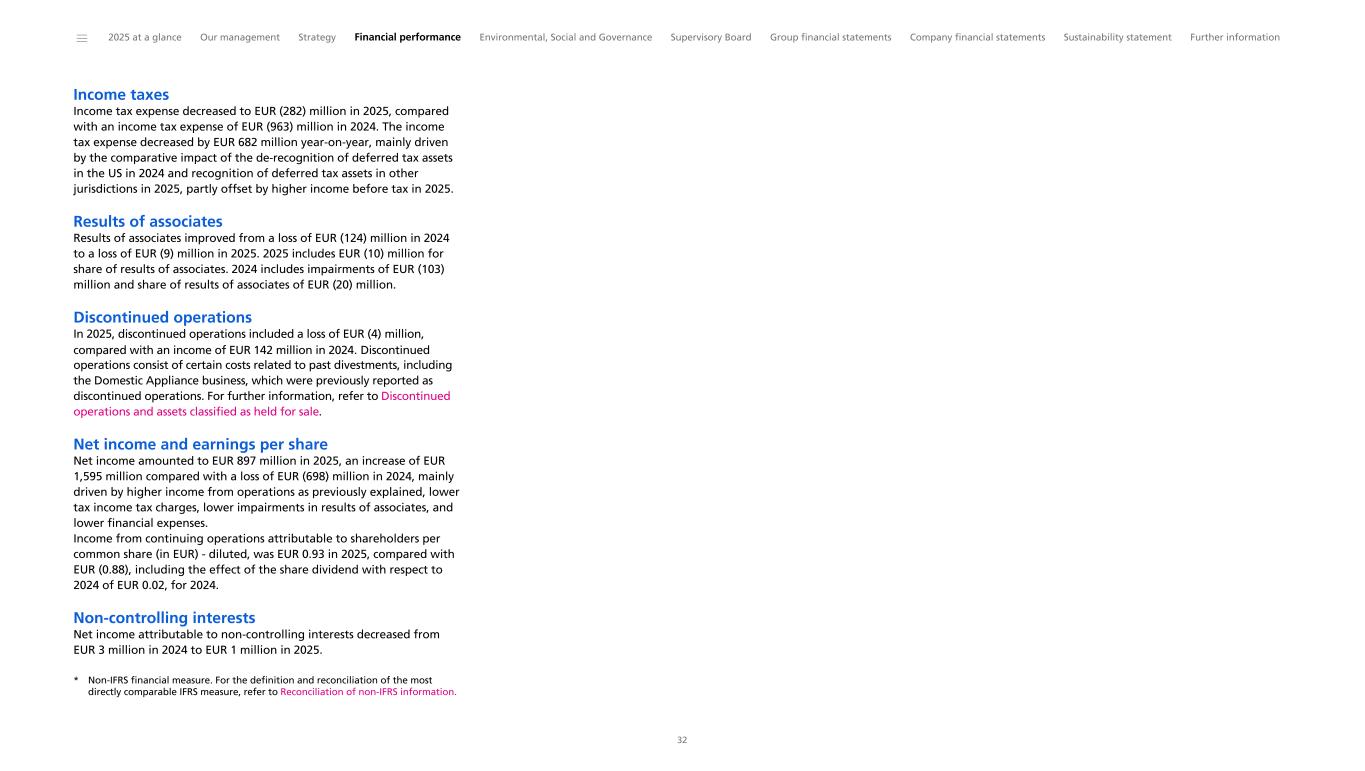
Income taxes Income tax expense decreased to EUR (282) million in 2025, compared with an income tax expense of EUR (963) million in 2024. The income tax expense decreased by EUR 682 million year-on-year, mainly driven by the comparative impact of the de-recognition of deferred tax assets in the US in 2024 and recognition of deferred tax assets in other jurisdictions in 2025, partly offset by higher income before tax in 2025. Results of associates Results of associates improved from a loss of EUR (124) million in 2024 to a loss of EUR (9) million in 2025. 2025 includes EUR (10) million for share of results of associates. 2024 includes impairments of EUR (103) million and share of results of associates of EUR (20) million. Discontinued operations In 2025, discontinued operations included a loss of EUR (4) million, compared with an income of EUR 142 million in 2024. Discontinued operations consist of certain costs related to past divestments, including the Domestic Appliance business, which were previously reported as discontinued operations. For further information, refer to Discontinued operations and assets classified as held for sale. Net income and earnings per share Net income amounted to EUR 897 million in 2025, an increase of EUR 1,595 million compared with a loss of EUR (698) million in 2024, mainly driven by higher income from operations as previously explained, lower tax income tax charges, lower impairments in results of associates, and lower financial expenses. Income from continuing operations attributable to shareholders per common share (in EUR) - diluted, was EUR 0.93 in 2025, compared with EUR (0.88), including the effect of the share dividend with respect to 2024 of EUR 0.02, for 2024. Non-controlling interests Net income attributable to non-controlling interests decreased from EUR 3 million in 2024 to EUR 1 million in 2025. * Non-IFRS financial measure. For the definition and reconciliation of the most directly comparable IFRS measure, refer to Reconciliation of non-IFRS information. ______ 2025 at a glance Our management Strategy Financial performance Environmental, Social and Governance Supervisory Board Group financial statements Company financial statements Sustainability statement Further information 32
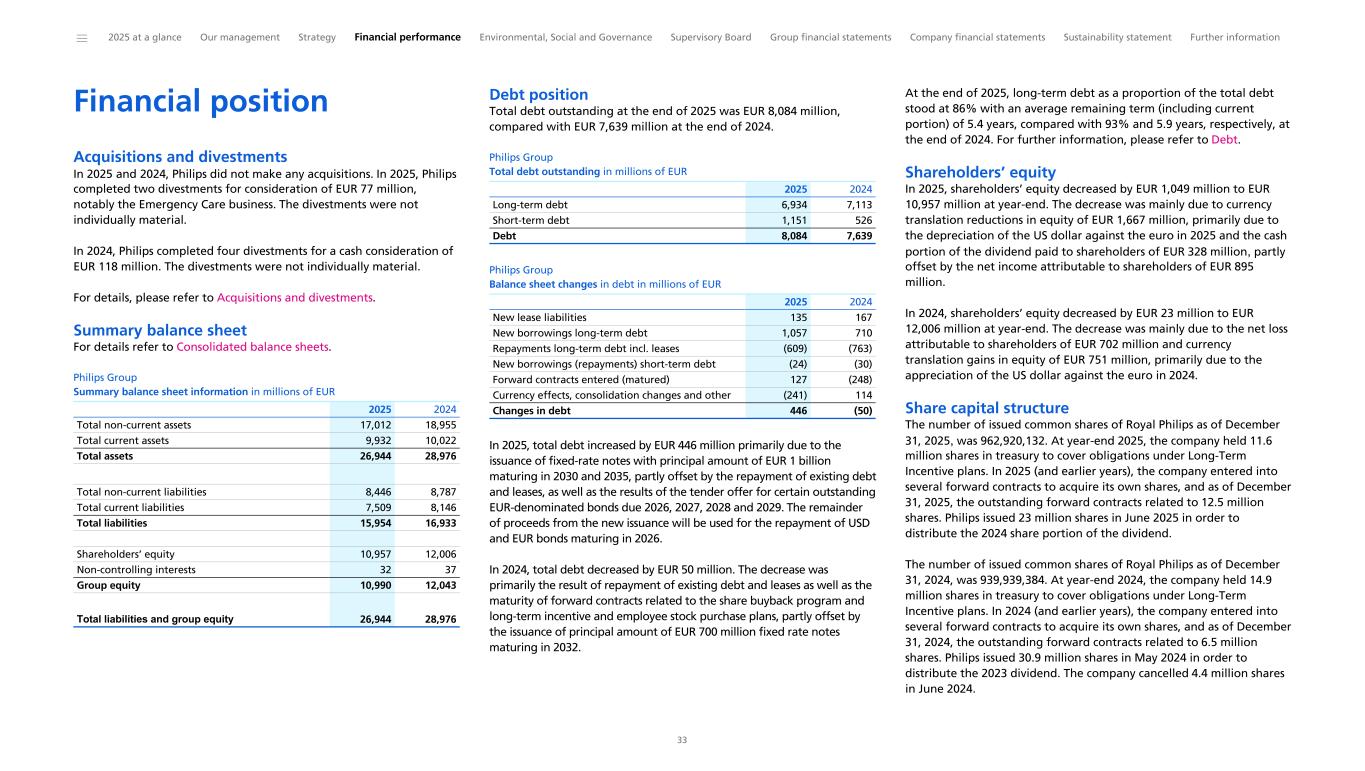
Financial position Acquisitions and divestments In 2025 and 2024, Philips did not make any acquisitions. In 2025, Philips completed two divestments for consideration of EUR 77 million, notably the Emergency Care business. The divestments were not individually material. In 2024, Philips completed four divestments for a cash consideration of EUR 118 million. The divestments were not individually material. For details, please refer to Acquisitions and divestments. Summary balance sheet For details refer to Consolidated balance sheets. Philips Group Summary balance sheet information in millions of EUR Total non-current assets 17,012 18,955 Total current assets 9,932 10,022 Total assets 26,944 28,976 Total non-current liabilities 8,446 8,787 Total current liabilities 7,509 8,146 Total liabilities 15,954 16,933 Shareholders’ equity 10,957 12,006 Non-controlling interests 32 37 Group equity 10,990 12,043 Total liabilities and group equity 26,944 28,976 2025 2024 Debt position Total debt outstanding at the end of 2025 was EUR 8,084 million, compared with EUR 7,639 million at the end of 2024. Philips Group Total debt outstanding in millions of EUR Long-term debt 6,934 7,113 Short-term debt 1,151 526 Debt 8,084 7,639 2025 2024 Philips Group Balance sheet changes in debt in millions of EUR New lease liabilities 135 167 New borrowings long-term debt 1,057 710 Repayments long-term debt incl. leases (609) (763) New borrowings (repayments) short-term debt (24) (30) Forward contracts entered (matured) 127 (248) Currency effects, consolidation changes and other (241) 114 Changes in debt 446 (50) 2025 2024 In 2025, total debt increased by EUR 446 million primarily due to the issuance of fixed-rate notes with principal amount of EUR 1 billion maturing in 2030 and 2035, partly offset by the repayment of existing debt and leases, as well as the results of the tender offer for certain outstanding EUR-denominated bonds due 2026, 2027, 2028 and 2029. The remainder of proceeds from the new issuance will be used for the repayment of USD and EUR bonds maturing in 2026. In 2024, total debt decreased by EUR 50 million. The decrease was primarily the result of repayment of existing debt and leases as well as the maturity of forward contracts related to the share buyback program and long-term incentive and employee stock purchase plans, partly offset by the issuance of principal amount of EUR 700 million fixed rate notes maturing in 2032. At the end of 2025, long-term debt as a proportion of the total debt stood at 86% with an average remaining term (including current portion) of 5.4 years, compared with 93% and 5.9 years, respectively, at the end of 2024. For further information, please refer to Debt. Shareholders’ equity In 2025, shareholders’ equity decreased by EUR 1,049 million to EUR 10,957 million at year-end. The decrease was mainly due to currency translation reductions in equity of EUR 1,667 million, primarily due to the depreciation of the US dollar against the euro in 2025 and the cash portion of the dividend paid to shareholders of EUR 328 million, partly offset by the net income attributable to shareholders of EUR 895 million. In 2024, shareholders’ equity decreased by EUR 23 million to EUR 12,006 million at year-end. The decrease was mainly due to the net loss attributable to shareholders of EUR 702 million and currency translation gains in equity of EUR 751 million, primarily due to the appreciation of the US dollar against the euro in 2024. Share capital structure The number of issued common shares of Royal Philips as of December 31, 2025, was 962,920,132. At year-end 2025, the company held 11.6 million shares in treasury to cover obligations under Long-Term Incentive plans. In 2025 (and earlier years), the company entered into several forward contracts to acquire its own shares, and as of December 31, 2025, the outstanding forward contracts related to 12.5 million shares. Philips issued 23 million shares in June 2025 in order to distribute the 2024 share portion of the dividend. The number of issued common shares of Royal Philips as of December 31, 2024, was 939,939,384. At year-end 2024, the company held 14.9 million shares in treasury to cover obligations under Long-Term Incentive plans. In 2024 (and earlier years), the company entered into several forward contracts to acquire its own shares, and as of December 31, 2024, the outstanding forward contracts related to 6.5 million shares. Philips issued 30.9 million shares in May 2024 in order to distribute the 2023 dividend. The company cancelled 4.4 million shares in June 2024. ______ 2025 at a glance Our management Strategy Financial performance Environmental, Social and Governance Supervisory Board Group financial statements Company financial statements Sustainability statement Further information 33
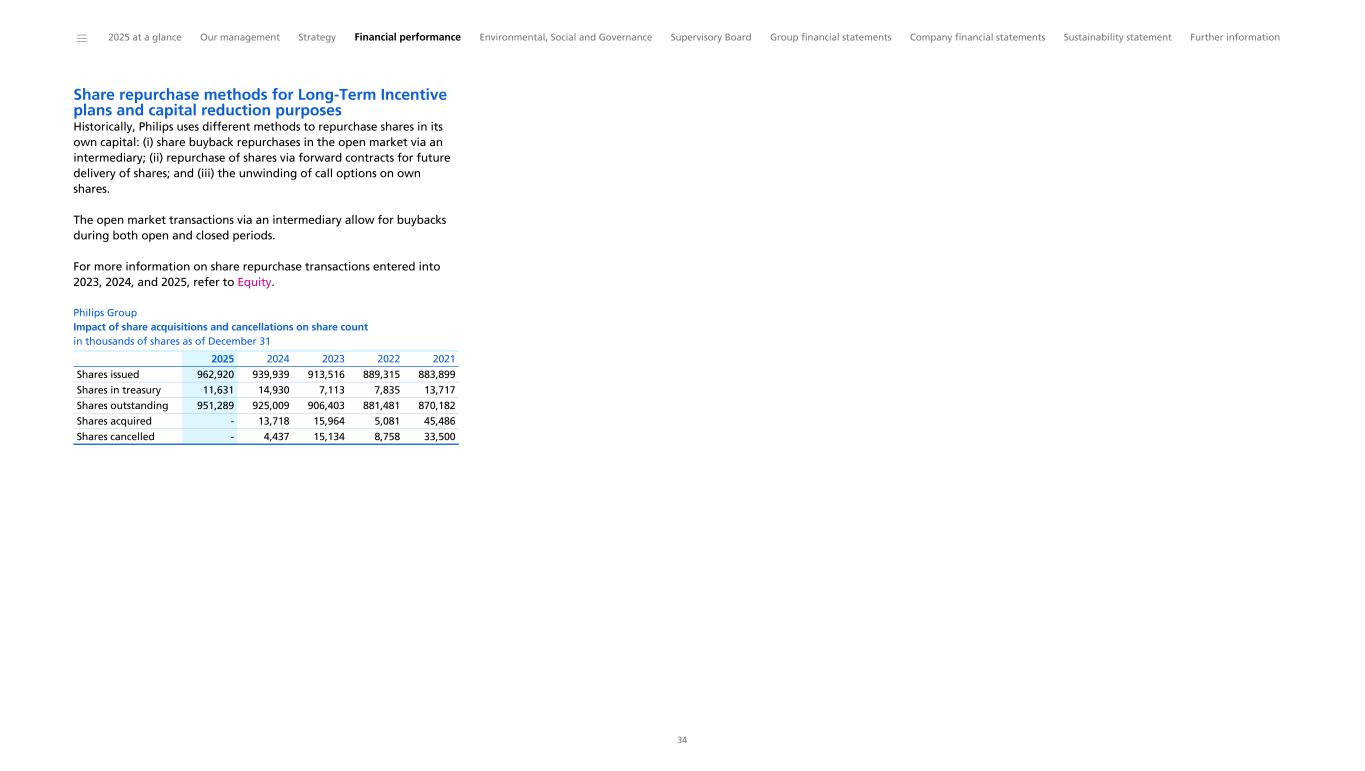
Share repurchase methods for Long-Term Incentive plans and capital reduction purposes Historically, Philips uses different methods to repurchase shares in its own capital: (i) share buyback repurchases in the open market via an intermediary; (ii) repurchase of shares via forward contracts for future delivery of shares; and (iii) the unwinding of call options on own shares. The open market transactions via an intermediary allow for buybacks during both open and closed periods. For more information on share repurchase transactions entered into 2023, 2024, and 2025, refer to Equity. Philips Group Impact of share acquisitions and cancellations on share count in thousands of shares as of December 31 Shares issued 962,920 939,939 913,516 889,315 883,899 Shares in treasury 11,631 14,930 7,113 7,835 13,717 Shares outstanding 951,289 925,009 906,403 881,481 870,182 Shares acquired - 13,718 15,964 5,081 45,486 Shares cancelled - 4,437 15,134 8,758 33,500 2025 2024 2023 2022 2021 ______ 2025 at a glance Our management Strategy Financial performance Environmental, Social and Governance Supervisory Board Group financial statements Company financial statements Sustainability statement Further information 34
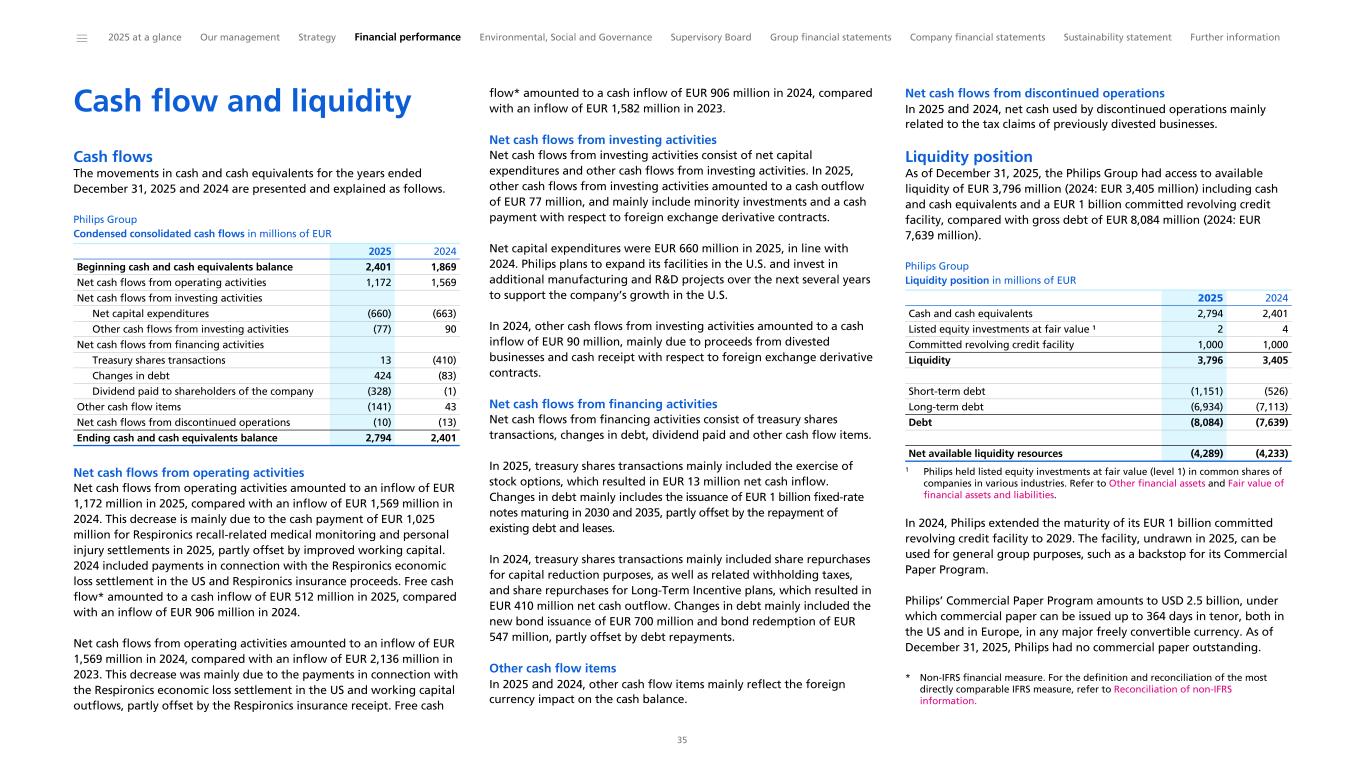
Cash flow and liquidity Cash flows The movements in cash and cash equivalents for the years ended December 31, 2025 and 2024 are presented and explained as follows. Philips Group Condensed consolidated cash flows in millions of EUR Beginning cash and cash equivalents balance 2,401 1,869 Net cash flows from operating activities 1,172 1,569 Net cash flows from investing activities Net capital expenditures (660) (663) Other cash flows from investing activities (77) 90 Net cash flows from financing activities Treasury shares transactions 13 (410) Changes in debt 424 (83) Dividend paid to shareholders of the company (328) (1) Other cash flow items (141) 43 Net cash flows from discontinued operations (10) (13) Ending cash and cash equivalents balance 2,794 2,401 2025 2024 Net cash flows from operating activities Net cash flows from operating activities amounted to an inflow of EUR 1,172 million in 2025, compared with an inflow of EUR 1,569 million in 2024. This decrease is mainly due to the cash payment of EUR 1,025 million for Respironics recall-related medical monitoring and personal injury settlements in 2025, partly offset by improved working capital. 2024 included payments in connection with the Respironics economic loss settlement in the US and Respironics insurance proceeds. Free cash flow* amounted to a cash inflow of EUR 512 million in 2025, compared with an inflow of EUR 906 million in 2024. Net cash flows from operating activities amounted to an inflow of EUR 1,569 million in 2024, compared with an inflow of EUR 2,136 million in 2023. This decrease was mainly due to the payments in connection with the Respironics economic loss settlement in the US and working capital outflows, partly offset by the Respironics insurance receipt. Free cash flow* amounted to a cash inflow of EUR 906 million in 2024, compared with an inflow of EUR 1,582 million in 2023. Net cash flows from investing activities Net cash flows from investing activities consist of net capital expenditures and other cash flows from investing activities. In 2025, other cash flows from investing activities amounted to a cash outflow of EUR 77 million, and mainly include minority investments and a cash payment with respect to foreign exchange derivative contracts. Net capital expenditures were EUR 660 million in 2025, in line with 2024. Philips plans to expand its facilities in the U.S. and invest in additional manufacturing and R&D projects over the next several years to support the company’s growth in the U.S. In 2024, other cash flows from investing activities amounted to a cash inflow of EUR 90 million, mainly due to proceeds from divested businesses and cash receipt with respect to foreign exchange derivative contracts. Net cash flows from financing activities Net cash flows from financing activities consist of treasury shares transactions, changes in debt, dividend paid and other cash flow items. In 2025, treasury shares transactions mainly included the exercise of stock options, which resulted in EUR 13 million net cash inflow. Changes in debt mainly includes the issuance of EUR 1 billion fixed-rate notes maturing in 2030 and 2035, partly offset by the repayment of existing debt and leases. In 2024, treasury shares transactions mainly included share repurchases for capital reduction purposes, as well as related withholding taxes, and share repurchases for Long-Term Incentive plans, which resulted in EUR 410 million net cash outflow. Changes in debt mainly included the new bond issuance of EUR 700 million and bond redemption of EUR 547 million, partly offset by debt repayments. Other cash flow items In 2025 and 2024, other cash flow items mainly reflect the foreign currency impact on the cash balance. Net cash flows from discontinued operations In 2025 and 2024, net cash used by discontinued operations mainly related to the tax claims of previously divested businesses. Liquidity position As of December 31, 2025, the Philips Group had access to available liquidity of EUR 3,796 million (2024: EUR 3,405 million) including cash and cash equivalents and a EUR 1 billion committed revolving credit facility, compared with gross debt of EUR 8,084 million (2024: EUR 7,639 million). Philips Group Liquidity position in millions of EUR Cash and cash equivalents 2,794 2,401 Listed equity investments at fair value ¹ 2 4 Committed revolving credit facility 1,000 1,000 Liquidity 3,796 3,405 Short-term debt (1,151) (526) Long-term debt (6,934) (7,113) Debt (8,084) (7,639) Net available liquidity resources (4,289) (4,233) 2025 2024 1 Philips held listed equity investments at fair value (level 1) in common shares of companies in various industries. Refer to Other financial assets and Fair value of financial assets and liabilities. In 2024, Philips extended the maturity of its EUR 1 billion committed revolving credit facility to 2029. The facility, undrawn in 2025, can be used for general group purposes, such as a backstop for its Commercial Paper Program. Philips’ Commercial Paper Program amounts to USD 2.5 billion, under which commercial paper can be issued up to 364 days in tenor, both in the US and in Europe, in any major freely convertible currency. As of December 31, 2025, Philips had no commercial paper outstanding. * Non-IFRS financial measure. For the definition and reconciliation of the most directly comparable IFRS measure, refer to Reconciliation of non-IFRS information. ______ 2025 at a glance Our management Strategy Financial performance Environmental, Social and Governance Supervisory Board Group financial statements Company financial statements Sustainability statement Further information 35
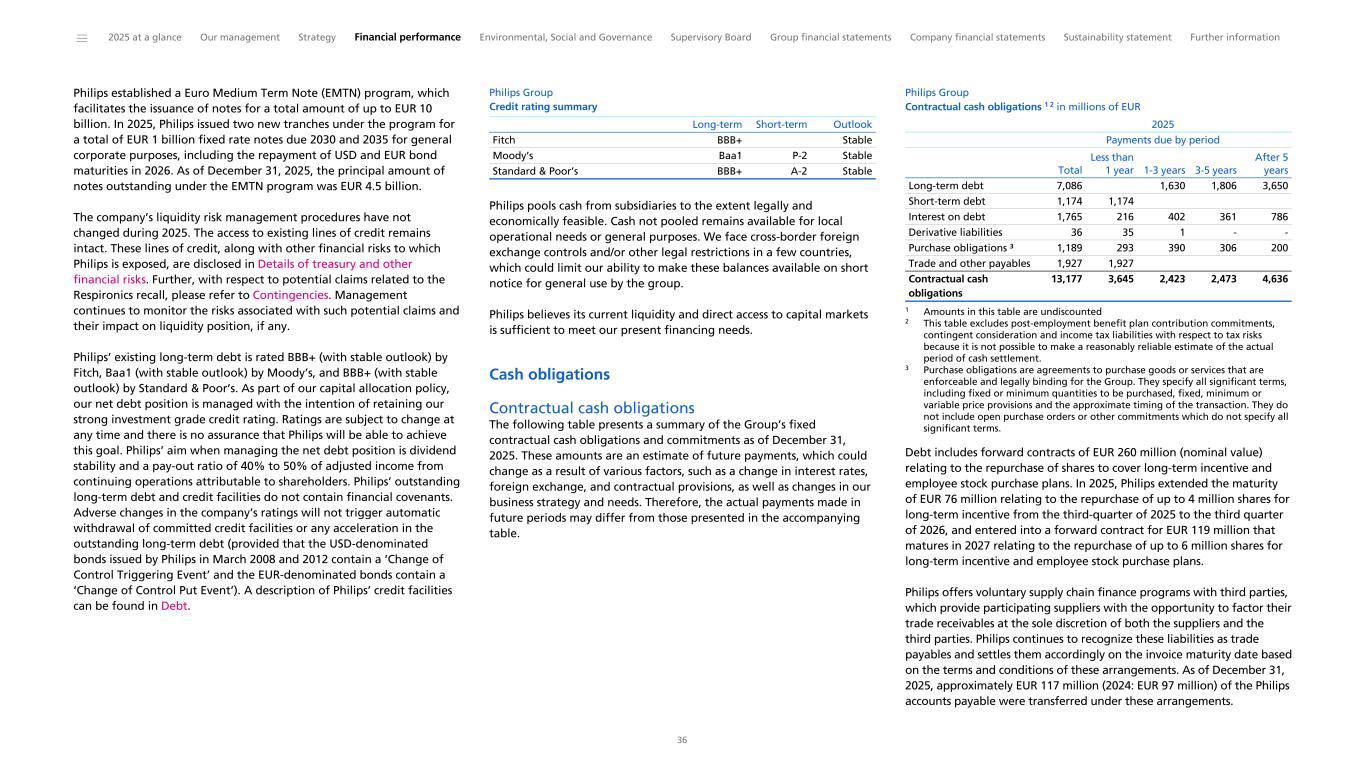
Philips established a Euro Medium Term Note (EMTN) program, which facilitates the issuance of notes for a total amount of up to EUR 10 billion. In 2025, Philips issued two new tranches under the program for a total of EUR 1 billion fixed rate notes due 2030 and 2035 for general corporate purposes, including the repayment of USD and EUR bond maturities in 2026. As of December 31, 2025, the principal amount of notes outstanding under the EMTN program was EUR 4.5 billion. The company’s liquidity risk management procedures have not changed during 2025. The access to existing lines of credit remains intact. These lines of credit, along with other financial risks to which Philips is exposed, are disclosed in Details of treasury and other financial risks. Further, with respect to potential claims related to the Respironics recall, please refer to Contingencies. Management continues to monitor the risks associated with such potential claims and their impact on liquidity position, if any. Philips’ existing long-term debt is rated BBB+ (with stable outlook) by Fitch, Baa1 (with stable outlook) by Moody’s, and BBB+ (with stable outlook) by Standard & Poor’s. As part of our capital allocation policy, our net debt position is managed with the intention of retaining our strong investment grade credit rating. Ratings are subject to change at any time and there is no assurance that Philips will be able to achieve this goal. Philips’ aim when managing the net debt position is dividend stability and a pay-out ratio of 40% to 50% of adjusted income from continuing operations attributable to shareholders. Philips’ outstanding long-term debt and credit facilities do not contain financial covenants. Adverse changes in the company’s ratings will not trigger automatic withdrawal of committed credit facilities or any acceleration in the outstanding long-term debt (provided that the USD-denominated bonds issued by Philips in March 2008 and 2012 contain a ‘Change of Control Triggering Event’ and the EUR-denominated bonds contain a ‘Change of Control Put Event’). A description of Philips’ credit facilities can be found in Debt. Philips Group Credit rating summary Fitch BBB+ Stable Moody’s Baa1 P-2 Stable Standard & Poor’s BBB+ A-2 Stable Long-term Short-term Outlook Philips pools cash from subsidiaries to the extent legally and economically feasible. Cash not pooled remains available for local operational needs or general purposes. We face cross-border foreign exchange controls and/or other legal restrictions in a few countries, which could limit our ability to make these balances available on short notice for general use by the group. Philips believes its current liquidity and direct access to capital markets is sufficient to meet our present financing needs. Cash obligations Contractual cash obligations The following table presents a summary of the Group’s fixed contractual cash obligations and commitments as of December 31, 2025. These amounts are an estimate of future payments, which could change as a result of various factors, such as a change in interest rates, foreign exchange, and contractual provisions, as well as changes in our business strategy and needs. Therefore, the actual payments made in future periods may differ from those presented in the accompanying table. Philips Group Contractual cash obligations 1 2 in millions of EUR Total Less than 1 year 1-3 years 3-5 years After 5 years Long-term debt 7,086 1,630 1,806 3,650 Short-term debt 1,174 1,174 Interest on debt 1,765 216 402 361 786 Derivative liabilities 36 35 1 - - Purchase obligations ³ 1,189 293 390 306 200 Trade and other payables 1,927 1,927 Contractual cash obligations 13,177 3,645 2,423 2,473 4,636 2025 Payments due by period 1 Amounts in this table are undiscounted 2 This table excludes post-employment benefit plan contribution commitments, contingent consideration and income tax liabilities with respect to tax risks because it is not possible to make a reasonably reliable estimate of the actual period of cash settlement. 3 Purchase obligations are agreements to purchase goods or services that are enforceable and legally binding for the Group. They specify all significant terms, including fixed or minimum quantities to be purchased, fixed, minimum or variable price provisions and the approximate timing of the transaction. They do not include open purchase orders or other commitments which do not specify all significant terms. Debt includes forward contracts of EUR 260 million (nominal value) relating to the repurchase of shares to cover long-term incentive and employee stock purchase plans. In 2025, Philips extended the maturity of EUR 76 million relating to the repurchase of up to 4 million shares for long-term incentive from the third-quarter of 2025 to the third quarter of 2026, and entered into a forward contract for EUR 119 million that matures in 2027 relating to the repurchase of up to 6 million shares for long-term incentive and employee stock purchase plans. Philips offers voluntary supply chain finance programs with third parties, which provide participating suppliers with the opportunity to factor their trade receivables at the sole discretion of both the suppliers and the third parties. Philips continues to recognize these liabilities as trade payables and settles them accordingly on the invoice maturity date based on the terms and conditions of these arrangements. As of December 31, 2025, approximately EUR 117 million (2024: EUR 97 million) of the Philips accounts payable were transferred under these arrangements. ______ 2025 at a glance Our management Strategy Financial performance Environmental, Social and Governance Supervisory Board Group financial statements Company financial statements Sustainability statement Further information 36
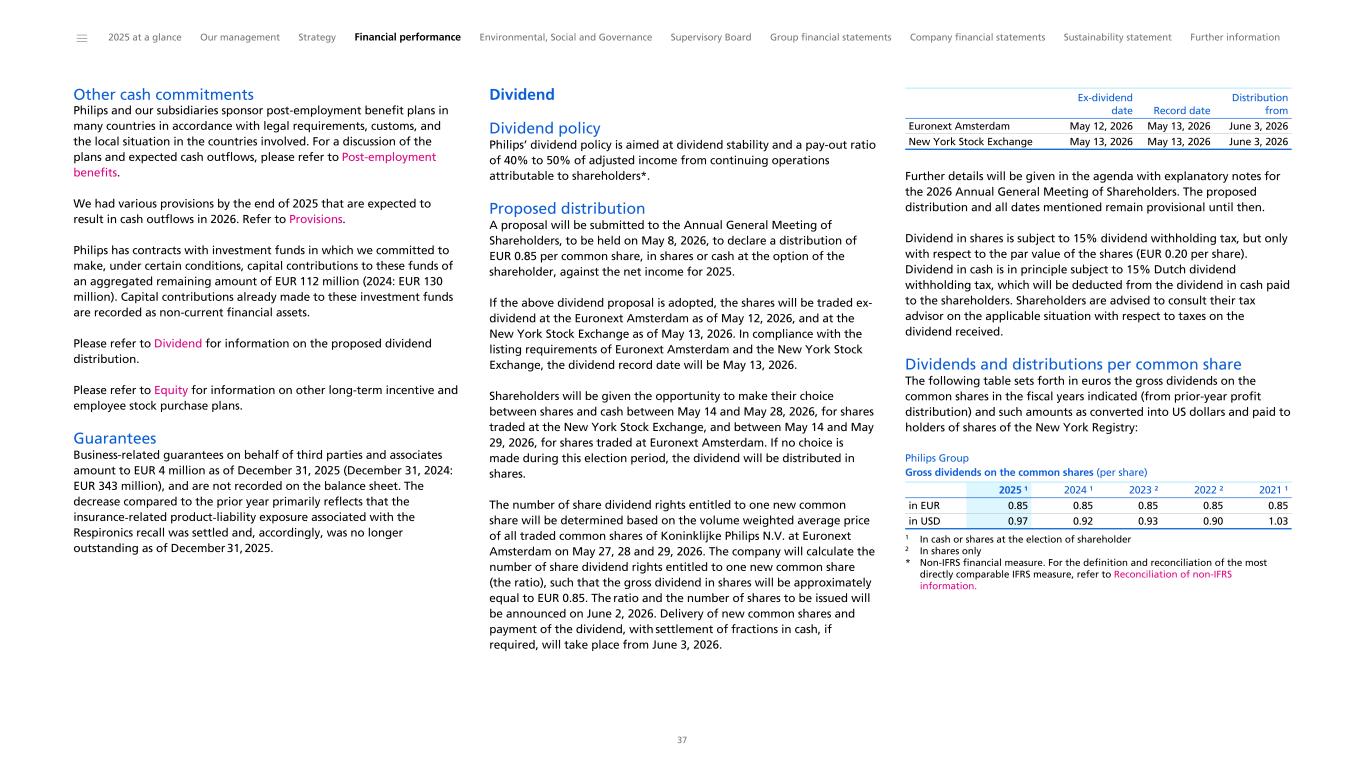
Other cash commitments Philips and our subsidiaries sponsor post-employment benefit plans in many countries in accordance with legal requirements, customs, and the local situation in the countries involved. For a discussion of the plans and expected cash outflows, please refer to Post-employment benefits. We had various provisions by the end of 2025 that are expected to result in cash outflows in 2026. Refer to Provisions. Philips has contracts with investment funds in which we committed to make, under certain conditions, capital contributions to these funds of an aggregated remaining amount of EUR 112 million (2024: EUR 130 million). Capital contributions already made to these investment funds are recorded as non-current financial assets. Please refer to Dividend for information on the proposed dividend distribution. Please refer to Equity for information on other long-term incentive and employee stock purchase plans. Guarantees Business-related guarantees on behalf of third parties and associates amount to EUR 4 million as of December 31, 2025 (December 31, 2024: EUR 343 million), and are not recorded on the balance sheet. The decrease compared to the prior year primarily reflects that the insurance-related product-liability exposure associated with the Respironics recall was settled and, accordingly, was no longer outstanding as of December 31, 2025. Dividend Dividend policy Philips’ dividend policy is aimed at dividend stability and a pay-out ratio of 40% to 50% of adjusted income from continuing operations attributable to shareholders*. Proposed distribution A proposal will be submitted to the Annual General Meeting of Shareholders, to be held on May 8, 2026, to declare a distribution of EUR 0.85 per common share, in shares or cash at the option of the shareholder, against the net income for 2025. If the above dividend proposal is adopted, the shares will be traded ex- dividend at the Euronext Amsterdam as of May 12, 2026, and at the New York Stock Exchange as of May 13, 2026. In compliance with the listing requirements of Euronext Amsterdam and the New York Stock Exchange, the dividend record date will be May 13, 2026. Shareholders will be given the opportunity to make their choice between shares and cash between May 14 and May 28, 2026, for shares traded at the New York Stock Exchange, and between May 14 and May 29, 2026, for shares traded at Euronext Amsterdam. If no choice is made during this election period, the dividend will be distributed in shares. The number of share dividend rights entitled to one new common share will be determined based on the volume weighted average price of all traded common shares of Koninklijke Philips N.V. at Euronext Amsterdam on May 27, 28 and 29, 2026. The company will calculate the number of share dividend rights entitled to one new common share (the ratio), such that the gross dividend in shares will be approximately equal to EUR 0.85. The ratio and the number of shares to be issued will be announced on June 2, 2026. Delivery of new common shares and payment of the dividend, with settlement of fractions in cash, if required, will take place from June 3, 2026. Euronext Amsterdam May 12, 2026 May 13, 2026 June 3, 2026 New York Stock Exchange May 13, 2026 May 13, 2026 June 3, 2026 Ex-dividend date Record date Distribution from Further details will be given in the agenda with explanatory notes for the 2026 Annual General Meeting of Shareholders. The proposed distribution and all dates mentioned remain provisional until then. Dividend in shares is subject to 15% dividend withholding tax, but only with respect to the par value of the shares (EUR 0.20 per share). Dividend in cash is in principle subject to 15% Dutch dividend withholding tax, which will be deducted from the dividend in cash paid to the shareholders. Shareholders are advised to consult their tax advisor on the applicable situation with respect to taxes on the dividend received. Dividends and distributions per common share The following table sets forth in euros the gross dividends on the common shares in the fiscal years indicated (from prior-year profit distribution) and such amounts as converted into US dollars and paid to holders of shares of the New York Registry: Philips Group Gross dividends on the common shares (per share) in EUR 0.85 0.85 0.85 0.85 0.85 in USD 0.97 0.92 0.93 0.90 1.03 2025 ¹ 2024 ¹ 2023 ² 2022 ² 2021 ¹ 1 In cash or shares at the election of shareholder 2 In shares only * Non-IFRS financial measure. For the definition and reconciliation of the most directly comparable IFRS measure, refer to Reconciliation of non-IFRS information. ______ 2025 at a glance Our management Strategy Financial performance Environmental, Social and Governance Supervisory Board Group financial statements Company financial statements Sustainability statement Further information 37
Environmental, Social and Governance ______ 2025 at a glance Our management Strategy Financial performance Environmental, Social and Governance Supervisory Board Group financial statements Company financial statements Sustainability statement Further information 38
“We are proud of the results achieved in 2025, as we delivered on our 2020-2025 program. Our new 2030 Impact Ambitions are a next step in delivering better care for more people and creating sustainable long-term value for our stakeholders.” Marnix van Ginneken Chief ESG & Legal Officer Royal Philips Philips has a long history of doing business responsibly and sustainably. It drives everything we do: our business performance, innovation and collaboration. Our efforts are a great source of pride for employees and contribute to the adoption and scaling of business practices across industries, for example, in climate action, circularity, tax transparency, supplier sustainability and sustainability reporting. We started our environmental programs in the 1980s and these were focused on reducing the environmental impact of our sites. This was later enhanced by our EcoDesign program, through which we aimed to reduce the environmental impact of our products, with a focus on circularity, reduced materials usage and energy consumption. After that, we included the impact of our value chain, first through our supplier sustainability program, followed by engagements with our customers. This culminated in our Science Based Targets. We are proud to be the first healthcare company that had its value chain emission reduction plan validated and approved by the Science Based Target initiative – toward achieving net zero greenhouse gas emissions by 2045 – and to have been included in the Carbon Disclosure Project's ‘A- list’ for 13 years in a row. Philips has a strong social track record, having been a pioneer with its pension plan and health insurance for its employees in the previous century, paying at least a living wage to its employees, and being recognized as an employer of choice. We also expanded our programs to include employees in our supply chain more than 10 years ago. In addition, we can build on a tradition of sustainability reporting, beginning with our first Environmental Annual Report published in 1999. This Annual Report is our 18th annual integrated financial and sustainability report. Although the Corporate Sustainability Reporting Directive((EU) 2022/2464) has not been implemented into Dutch law yet, the sustainability report included herein has been written to comply with disclosure requirements of the underlying European Sustainability Reporting Standards (ESRS). Refer to General basis for preparation to see which chapters and sections together constitute our sustainability statement. In this chapter, we explain how we act and perform in the environmental and social dimensions, and we describe the main elements of our governance framework. The ESG information in this chapter is further explained and underpinned in greater detail in the Sustainability statement. Following our Double Materiality Assessment, we report in this chapter on these material topics on which ESRS have been published: • Climate change (ESRS E1) • Resource use and circular economy (ESRS E5) • Own workforce (ESRS S1) • Workers in the value chain (ESRS S2) • Consumers and end-users (ESRS S4) • Business conduct (ESRS G1) The sustainability report included herein is aligned with the comprehensive and integrated ESG commitments we had adopted for the period 2020-2025. Marking a step-up from these commitments, on February 10, 2026, we announced our 2030 Impact Ambitions as an integral part of our 2026-2028 strategic plan. Key elements are included in this report, and our next Annual Report will be fully aligned with the 2030 Impact Ambitions. ______ 2025 at a glance Our management Strategy Financial performance Environmental, Social and Governance Supervisory Board Group financial statements Company financial statements Sustainability statement Further information 39
Key 2020-2025 ESG commitments Environmental We act responsibly toward our planet in line with UN SDGs 12 and 13. Social Our purpose is to improve people’s health and well-being through meaningful innovation, in line with UN SDG 3. We act responsibly toward society and partner with our stakeholders. Governance We aim to deliver superior long-term value for our customers and shareholders, and seek to live up to the highest standards of ethics and governance in our culture and practices. • We will maintain carbon neutrality and use 75% renewable energy in our operations by 2025. We have set ambitious targets to reduce CO₂ emissions in our entire value chain in line with a 1.5 °C global warming scenario (based on Science Based Targets). • We will generate 25% of our revenue from products, services and solutions contributing to circularity, and offer responsible take-back on all professional medical equipment by 2025. • We will embed circular practices at our sites and put zero waste to landfill by 2025. • We will design all new product introductions in line with our EcoDesign requirements by 2025, with ‘EcoHeroes’ accounting for 25% of hardware revenues. • We work with our suppliers to reduce the environmental footprint of our supply chain in line with a 1.5 °C global warming scenario (based on Science Based Targets). • We engage with our stakeholders and other companies to drive sustainability efforts addressing the United Nations Sustainable Development Goals. • We aim to improve the health and well-being of 2.5 billion people per year by 2030, including 400 million people in underserved communities. • It is our strategy to lead with innovative solutions to deliver real change – helping our customers achieve better health outcomes, a better experience for patients and staff, and lower cost of care, as well as helping people take better care of their health. • We aim to be the best place to work for our employees, providing opportunities for learning and development, promoting an inclusive workplace that reflects the diversity of our community through fair hiring and promotion practices, and assuring a safe and healthy work environment. We pay at least a living wage and aim for employee engagement above the high-performance norm. • Through our supplier development program we will improve the lives of 1 million workers in our supply chain by 2025. • We actively engage with and support the communities in which we operate, e.g., through volunteering, internships, and STEM (Science, Technology, Engineering, Mathematics) initiatives. • We contribute to the Philips Foundation, an independent foundation (stichting) organized under Dutch law, which enables access to quality healthcare for underserved communities. • We consider our tax payments as a contribution to the communities in which we operate, as part of our social value creation. • Our management structure and governance combine responsible leadership and independent supervision. • Our integrated operating model defines how we work together to delight our customers and achieve our company goals, leveraging our global scale and capabilities. • Enabling the delivery of patient-centric, safe, and high-quality care – the essence of patient safety and quality – is foundational to Philips’ purpose to improve the health and well-being of people through meaningful innovation. • Our remuneration policy is designed to focus employees throughout the Philips Group on pursuing our purpose and delivering on our strategy, and to motivate them to create superior, long-term stakeholder value. Our executive annual incentives and long-term incentive plan are partly based on ESG objectives. • Our General Business Principles set the minimum standard for our business conduct as a health technology company, for our individual employees and for our subsidiaries, and serve as a reference for the business conduct we expect from all our business partners. • Our risk management is designed to provide an appropriate level of assurance that strategic and operational objectives are met, legal requirements complied with, and the integrity of the company’s reporting and related disclosures are safeguarded. • We are transparent about our plans, activities, results and contributions to society (e.g., tax reporting, and engaging with shareholders, customers, business partners, governments and regulators through a variety of platforms). ______ 2025 at a glance Our management Strategy Financial performance Environmental, Social and Governance Supervisory Board Group financial statements Company financial statements Sustainability statement Further information 40
Our 2030 Impact Ambitions After our 2020-2025 Environmental Social Governance (ESG) program ended in December 2025, we announced our 2030 Impact Ambitions as an integral part of the next phase of Philips’ strategy. These ambitions announced in February 2026 mark a step-up from our previous commitments, and they underpin the company’s global strategy and purpose to improve people’s health and well-being through meaningful innovation while acting responsibly towards society and the planet. To help drive long-term value creation the ambitions have been embedded in Business strategies, performance management and incentives, and include roadmaps per Business. They bring an increase in focus, simplification, measurability and accountability. Importantly, the ambitions are aligned with globally recognized, science-based frameworks, where available. Ambitions for lives improved and carbon emission reductions (as part of its Science Based Targets) have been carried over from the previous ESG program. Through our 2030 Impact Ambitions, we aim to: Improve health and well-being • 2.5 billion lives improved, including 400 million in underserved communities • best place to work for our employees • 1.5 million supply chain workers with improved working conditions Reduce absolute environmental impact • 90% reduction in Scope 1 and 2 CO2-e emissions and remain carbon neutral in our own operations 1 • 42% reduction in Scope 3 CO2-e emissions 2 • net zero by 2045 • reduce virgin non-renewable materials use and restore land Governance and enablers • ambitions embedded in design, business models, AI and operations • EcoDesign applied to new product introductions • regulatory compliance More information on the 2030 Impact Ambitions can be found on our website 2030 Impact Ambitions. ESG governance Our previous ESG commitments were operationalized by the underlying business strategies, roadmaps, goals, targets and metrics, and that will be the case for the 2030 Impact Ambitions. The Board of Management is responsible for the design and management of our ambitions, and it typically convenes the Group Sustainability team and (where relevant) Business, Region or Function leaders four times per year on ESG matters. During these meetings, the Board of Management defines Philips’ ESG strategy, ambitions, programs, action plans and policies, as well as oversees major transactions, monitors progress on ESG priorities, and takes corrective action where needed. Progress on our social and environmental performance is communicated internally and externally on our website on a quarterly basis and at least annually to the Executive Committee and the Supervisory Board. The oversight of the ESG dimensions, and their integration into our overarching strategy, is a responsibility of the Supervisory Board as a whole because of the significance of ESG matters. While retaining this overall responsibility, the Supervisory Board is supported by the Audit Committee, which meets quarterly to discuss significant developments in impacts, risks and opportunities, developments in sustainability reporting, and other relevant topics. Please refer to the Supervisory Board report for the Supervisory Board members with specific ESG and sustainability expertise, and the Supervisory Board's ESG-related activities during the year. The Supervisory Board as a whole has sufficient ESG and sustainability-related expertise relevant to the sector in which Philips is operating, also considering the way we address impacts, risks and opportunities with respect to the material topics identified through our Double Materiality Assessment. Furthermore, both our Board of Management and our Supervisory Board leverage all relevant expertise through their direct access to the Group Sustainability team and (where relevant) external experts. In our Sustainability statement we explain the progress made in the execution of our previous ESG program. However, nothing in our statement or other statements in respect of our 2030 Impact Ambitions should be read or construed to represent or imply a guarantee or any other legally enforceable obligation vis-à-vis our stakeholders. We do what is reasonable and practical, and we actively partner with our stakeholders to achieve our aspirational ambitions, goals and targets, while acknowledging and weighing economic and practical constraints and other external factors that may limit our ability to control environmental and social impacts, in particular beyond our own operations. It is furthermore noted that our social and environmental efforts and our globally applying aspirational ambitions, goals and targets, including but not limited to those related to diversity, inclusion and well-being, are subject to our compliance with local rules and regulations, some of which may conflict across jurisdictions. ______ 2025 at a glance Our management Strategy Financial performance Environmental, Social and Governance Supervisory Board Group financial statements Company financial statements Sustainability statement Further information 41 1 Compared to the 2015 baseline 2 Compared to the 2020 baseline
Environmental This section provides an overview of key environmental indicators relevant to our ESG commitments. We explain how we measure our environmental impact through our yearly Environmental Profit & Loss (EP&L) statement. Our environmental disclosures then focus on the material topics identified through our Double Materiality Assessment – climate change and resource use and circular economy. We also address biodiversity and ecosystem services to meet expectations from certain rating agencies. Measuring our environmental impact Philips has been performing Life Cycle Assessments (LCAs) since 1990. These LCAs provide insight into the lifetime environmental impact of our products. They are used to steer our EcoDesign efforts by reducing the environmental impact during the lifetime of our products and to grow our green/EcoDesigned/EcoHero and circular portfolio. Beyond that, for the ninth year, we have measured our environmental impact on society at large via an Environmental Profit & Loss (EP&L) statement, which includes the hidden environmental costs associated with our activities and products. It provides insights into the main environmental hotspots and innovation areas to reduce the environmental impact of our products and solutions. The EP&L statement is based on LCA methodology, in which the environmental impacts are expressed in monetary terms using conversion factors developed by CE Delft (Handbook 2024 v 1.1). As we gain new insights and retrieve more and better data in the future, we will be able to enhance the methodology, use-cases and accuracy of results. For more information and details refer to our Methodology for calculating the Environmental Profit & Loss statement and Material Flow. Environmental Profit & Loss statement 2025 Philips maintained its EP&L impact in 2025 to EUR 3.82 billion (2024: EUR 3.82 billion). The differences in sales mix and the reporting process for S&RC rentals had a lower impact in 2025 than 2024. In 2025, our S&RC rental methodology was updated to account for monthly invoices (instead of annual invoices). The energy consumption of one year of rental and a one-year allocation of materials are included in the 2025 EP&L calculation. However, there was an approximate 6% increase in the total EP&L from the transition from using data related to reference product averages to more granular data per trade item. In 2025, about 10% of the EP&L impact is associated with these trade items. While overall weight is not significantly impacted, the types of materials were updated to more granular actual materials per trade item, resulting in an increase in purchased goods impact and emissions. Philips will continue this transition in 2026, which may result in a similar or slightly higher EP&L impact. Our Manufacturing Product and Packaging life cycle stages, including raw materials supply and processing for products and packaging, have the largest environmental impact at approximately EUR 1.83 billion, which is 48% of our total environmental impact. The main contributors are the electronic components (including printed circuit boards), cables and metals used in our products. Through our Circular Economy and Supplier Sustainability programs we continue to focus on reducing the environmental impact caused by the materials we source and apply in our products. With the insights gained through the EP&L, we aim to reduce our climate impact by providing our Businesses with actionable insights. The second most significant environmental impact, 42% of the total, is related to the use of sold products, which is due to electricity consumption. Human toxicity (mainly linked to electricity generation), particulate matter formation, and climate change are the key environmental impact categories contributing to this result. The environmental costs include the environmental impact of the lifetime of the products that we put on the market in 2025, e.g., 10 years in the case of an MRI machine or five years in the case of a Sonicare toothbrush. Products identified as rentals are the only exception, with an energy consumption of one year. As we transition to more granular data and phase out legacy products, we expect to report more accurately on the environmental impact in the years to come. Of the total 2025 impact, EUR 213 million (6%) is directly related to Philips’ own logistics, mainly driven by outbound logistics, followed by business travel, while EUR 139 million (4%) is related to Philips’ own operations, mainly driven by waste. The EP&L visual below shows Philips’ impact in 2025 in line with our life cycle stages, which align with external LCA standards (in more detail than the EP&L visual in the 2024 sustainability statement). ______ 2025 at a glance Our management Strategy Financial performance Environmental, Social and Governance Supervisory Board Group financial statements Company financial statements Sustainability statement Further information 42
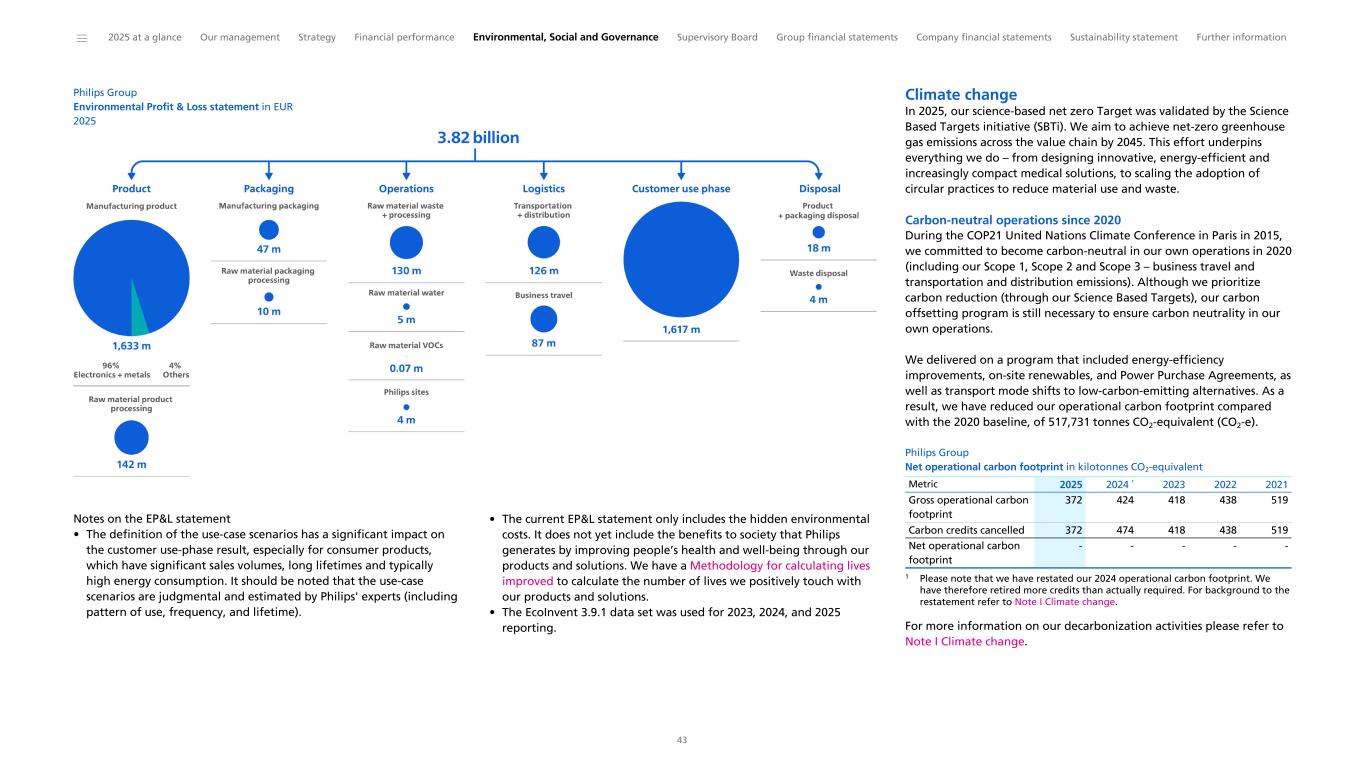
Philips Group Environmental Profit & Loss statement in EUR 2025 Notes on the EP&L statement • The definition of the use-case scenarios has a significant impact on the customer use-phase result, especially for consumer products, which have significant sales volumes, long lifetimes and typically high energy consumption. It should be noted that the use-case scenarios are judgmental and estimated by Philips' experts (including pattern of use, frequency, and lifetime). • The current EP&L statement only includes the hidden environmental costs. It does not yet include the benefits to society that Philips generates by improving people’s health and well-being through our products and solutions. We have a Methodology for calculating lives improved to calculate the number of lives we positively touch with our products and solutions. • The EcoInvent 3.9.1 data set was used for 2023, 2024, and 2025 reporting. Climate change In 2025, our science-based net zero Target was validated by the Science Based Targets initiative (SBTi). We aim to achieve net-zero greenhouse gas emissions across the value chain by 2045. This effort underpins everything we do – from designing innovative, energy-efficient and increasingly compact medical solutions, to scaling the adoption of circular practices to reduce material use and waste. Carbon-neutral operations since 2020 During the COP21 United Nations Climate Conference in Paris in 2015, we committed to become carbon-neutral in our own operations in 2020 (including our Scope 1, Scope 2 and Scope 3 – business travel and transportation and distribution emissions). Although we prioritize carbon reduction (through our Science Based Targets), our carbon offsetting program is still necessary to ensure carbon neutrality in our own operations. We delivered on a program that included energy-efficiency improvements, on-site renewables, and Power Purchase Agreements, as well as transport mode shifts to low-carbon-emitting alternatives. As a result, we have reduced our operational carbon footprint compared with the 2020 baseline, of 517,731 tonnes CO2-equivalent (CO2-e). Philips Group Net operational carbon footprint in kilotonnes CO2-equivalent Gross operational carbon footprint 372 424 418 438 519 Carbon credits cancelled 372 474 418 438 519 Net operational carbon footprint - - - - - Metric 2025 2024 ¹ 2023 2022 2021 1 Please note that we have restated our 2024 operational carbon footprint. We have therefore retired more credits than actually required. For background to the restatement refer to Note I Climate change. For more information on our decarbonization activities please refer to Note I Climate change. ______ 2025 at a glance Our management Strategy Financial performance Environmental, Social and Governance Supervisory Board Group financial statements Company financial statements Sustainability statement Further information 43
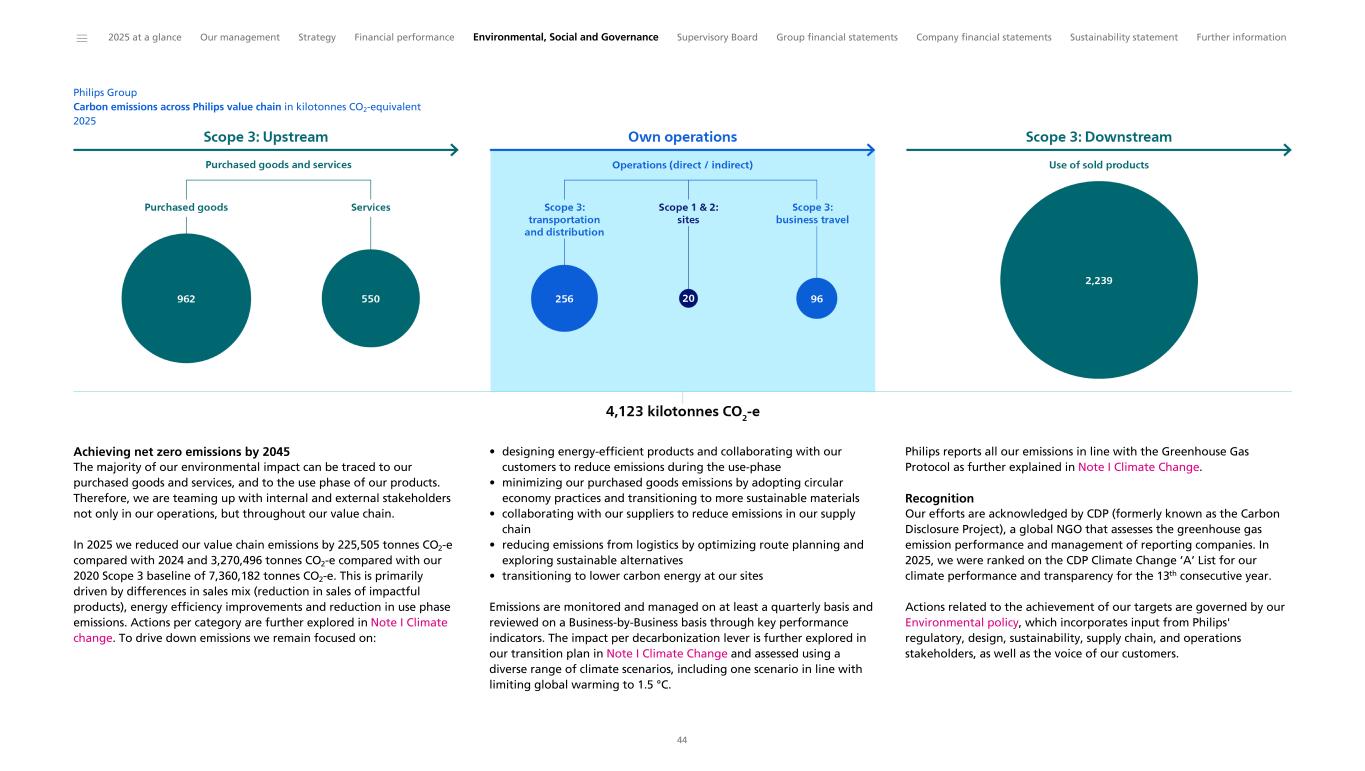
Philips Group Carbon emissions across Philips value chain in kilotonnes CO2-equivalent 2025 Achieving net zero emissions by 2045 The majority of our environmental impact can be traced to our purchased goods and services, and to the use phase of our products. Therefore, we are teaming up with internal and external stakeholders not only in our operations, but throughout our value chain. In 2025 we reduced our value chain emissions by 225,505 tonnes CO2-e compared with 2024 and 3,270,496 tonnes CO2-e compared with our 2020 Scope 3 baseline of 7,360,182 tonnes CO2-e. This is primarily driven by differences in sales mix (reduction in sales of impactful products), energy efficiency improvements and reduction in use phase emissions. Actions per category are further explored in Note I Climate change. To drive down emissions we remain focused on: • designing energy-efficient products and collaborating with our customers to reduce emissions during the use-phase • minimizing our purchased goods emissions by adopting circular economy practices and transitioning to more sustainable materials • collaborating with our suppliers to reduce emissions in our supply chain • reducing emissions from logistics by optimizing route planning and exploring sustainable alternatives • transitioning to lower carbon energy at our sites Emissions are monitored and managed on at least a quarterly basis and reviewed on a Business-by-Business basis through key performance indicators. The impact per decarbonization lever is further explored in our transition plan in Note I Climate Change and assessed using a diverse range of climate scenarios, including one scenario in line with limiting global warming to 1.5 °C. Philips reports all our emissions in line with the Greenhouse Gas Protocol as further explained in Note I Climate Change. Recognition Our efforts are acknowledged by CDP (formerly known as the Carbon Disclosure Project), a global NGO that assesses the greenhouse gas emission performance and management of reporting companies. In 2025, we were ranked on the CDP Climate Change ’A’ List for our climate performance and transparency for the 13th consecutive year. Actions related to the achievement of our targets are governed by our Environmental policy, which incorporates input from Philips' regulatory, design, sustainability, supply chain, and operations stakeholders, as well as the voice of our customers. ______ 2025 at a glance Our management Strategy Financial performance Environmental, Social and Governance Supervisory Board Group financial statements Company financial statements Sustainability statement Further information 44
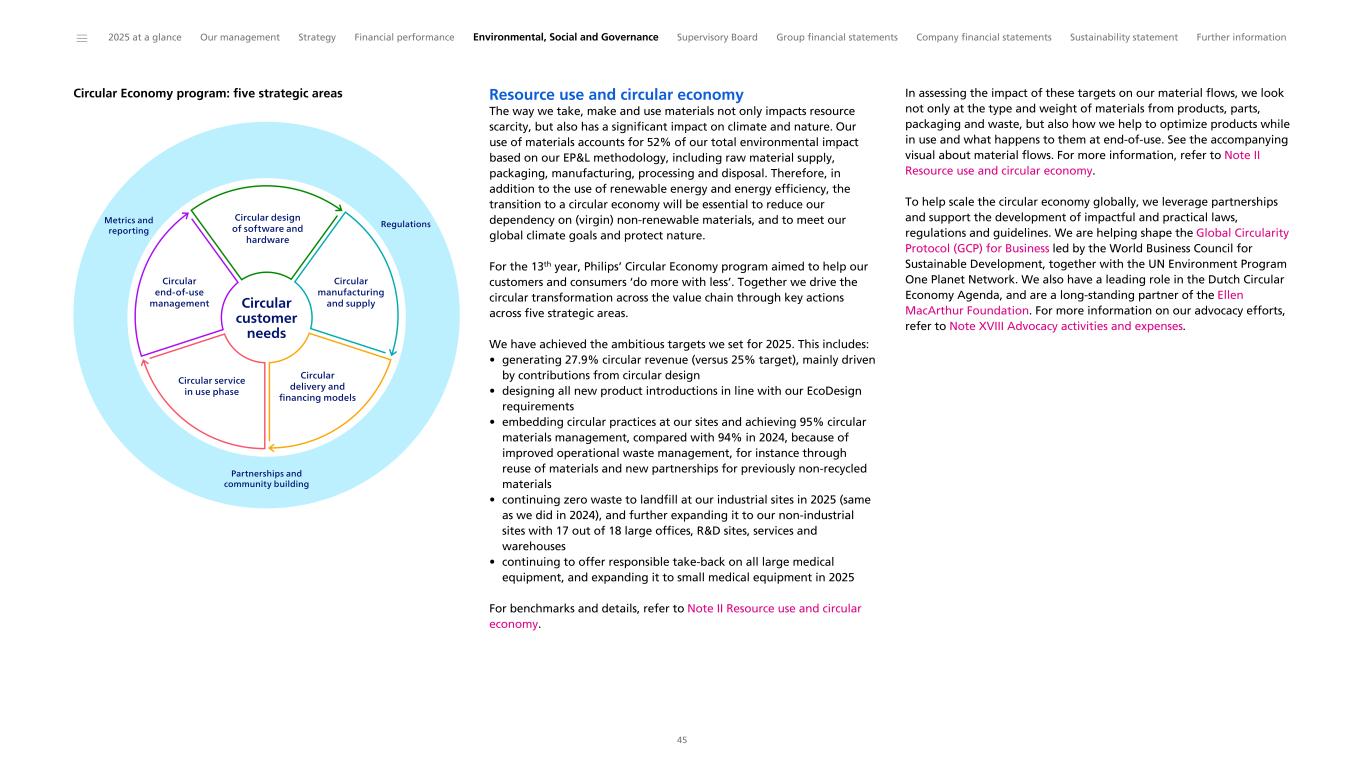
Circular Economy program: five strategic areas Resource use and circular economy The way we take, make and use materials not only impacts resource scarcity, but also has a significant impact on climate and nature. Our use of materials accounts for 52% of our total environmental impact based on our EP&L methodology, including raw material supply, packaging, manufacturing, processing and disposal. Therefore, in addition to the use of renewable energy and energy efficiency, the transition to a circular economy will be essential to reduce our dependency on (virgin) non-renewable materials, and to meet our global climate goals and protect nature. For the 13th year, Philips’ Circular Economy program aimed to help our customers and consumers ‘do more with less’. Together we drive the circular transformation across the value chain through key actions across five strategic areas. We have achieved the ambitious targets we set for 2025. This includes: • generating 27.9% circular revenue (versus 25% target), mainly driven by contributions from circular design • designing all new product introductions in line with our EcoDesign requirements • embedding circular practices at our sites and achieving 95% circular materials management, compared with 94% in 2024, because of improved operational waste management, for instance through reuse of materials and new partnerships for previously non-recycled materials • continuing zero waste to landfill at our industrial sites in 2025 (same as we did in 2024), and further expanding it to our non-industrial sites with 17 out of 18 large offices, R&D sites, services and warehouses • continuing to offer responsible take-back on all large medical equipment, and expanding it to small medical equipment in 2025 For benchmarks and details, refer to Note II Resource use and circular economy. In assessing the impact of these targets on our material flows, we look not only at the type and weight of materials from products, parts, packaging and waste, but also how we help to optimize products while in use and what happens to them at end-of-use. See the accompanying visual about material flows. For more information, refer to Note II Resource use and circular economy. To help scale the circular economy globally, we leverage partnerships and support the development of impactful and practical laws, regulations and guidelines. We are helping shape the Global Circularity Protocol (GCP) for Business led by the World Business Council for Sustainable Development, together with the UN Environment Program One Planet Network. We also have a leading role in the Dutch Circular Economy Agenda, and are a long-standing partner of the Ellen MacArthur Foundation. For more information on our advocacy efforts, refer to Note XVIII Advocacy activities and expenses. ______ 2025 at a glance Our management Strategy Financial performance Environmental, Social and Governance Supervisory Board Group financial statements Company financial statements Sustainability statement Further information 45
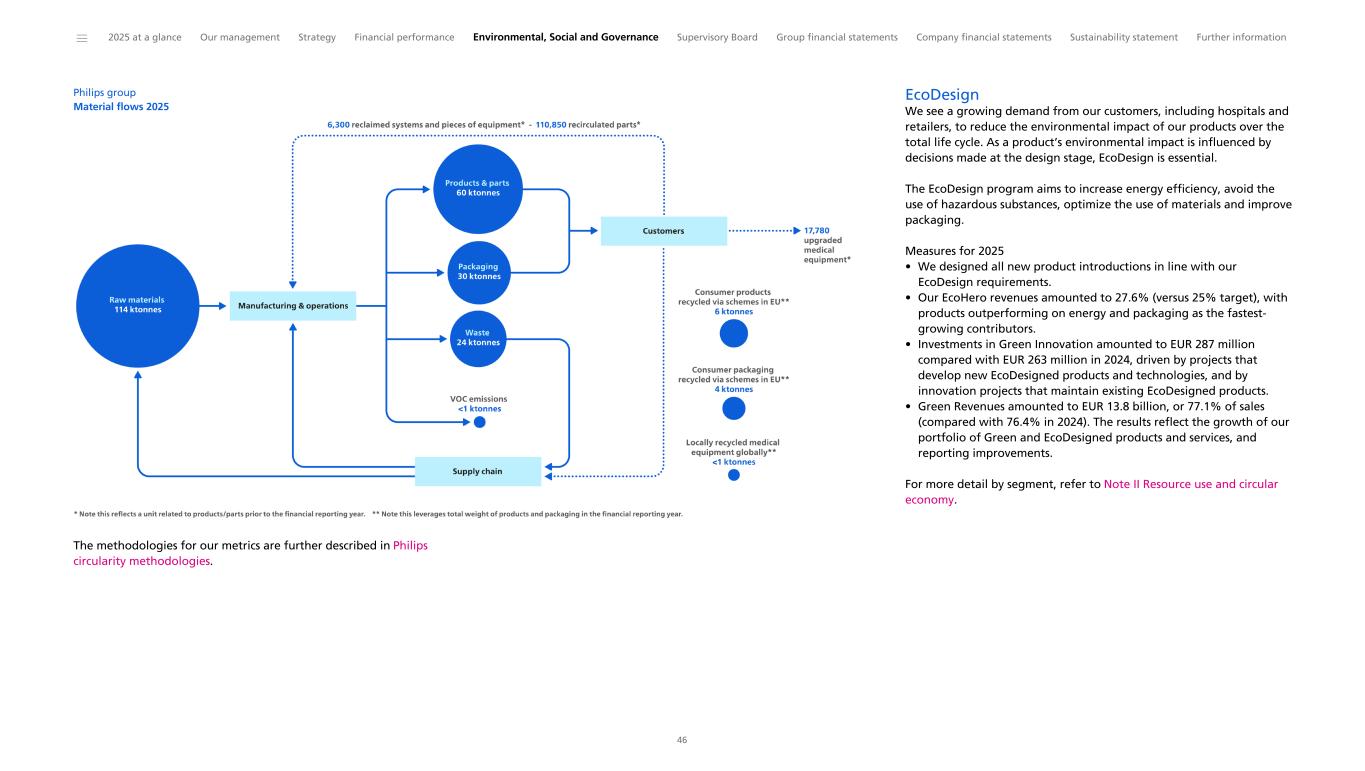
Philips group Material flows 2025 The methodologies for our metrics are further described in Philips circularity methodologies. EcoDesign We see a growing demand from our customers, including hospitals and retailers, to reduce the environmental impact of our products over the total life cycle. As a product’s environmental impact is influenced by decisions made at the design stage, EcoDesign is essential. The EcoDesign program aims to increase energy efficiency, avoid the use of hazardous substances, optimize the use of materials and improve packaging. Measures for 2025 • We designed all new product introductions in line with our EcoDesign requirements. • Our EcoHero revenues amounted to 27.6% (versus 25% target), with products outperforming on energy and packaging as the fastest- growing contributors. • Investments in Green Innovation amounted to EUR 287 million compared with EUR 263 million in 2024, driven by projects that develop new EcoDesigned products and technologies, and by innovation projects that maintain existing EcoDesigned products. • Green Revenues amounted to EUR 13.8 billion, or 77.1% of sales (compared with 76.4% in 2024). The results reflect the growth of our portfolio of Green and EcoDesigned products and services, and reporting improvements. For more detail by segment, refer to Note II Resource use and circular economy. ______ 2025 at a glance Our management Strategy Financial performance Environmental, Social and Governance Supervisory Board Group financial statements Company financial statements Sustainability statement Further information 46
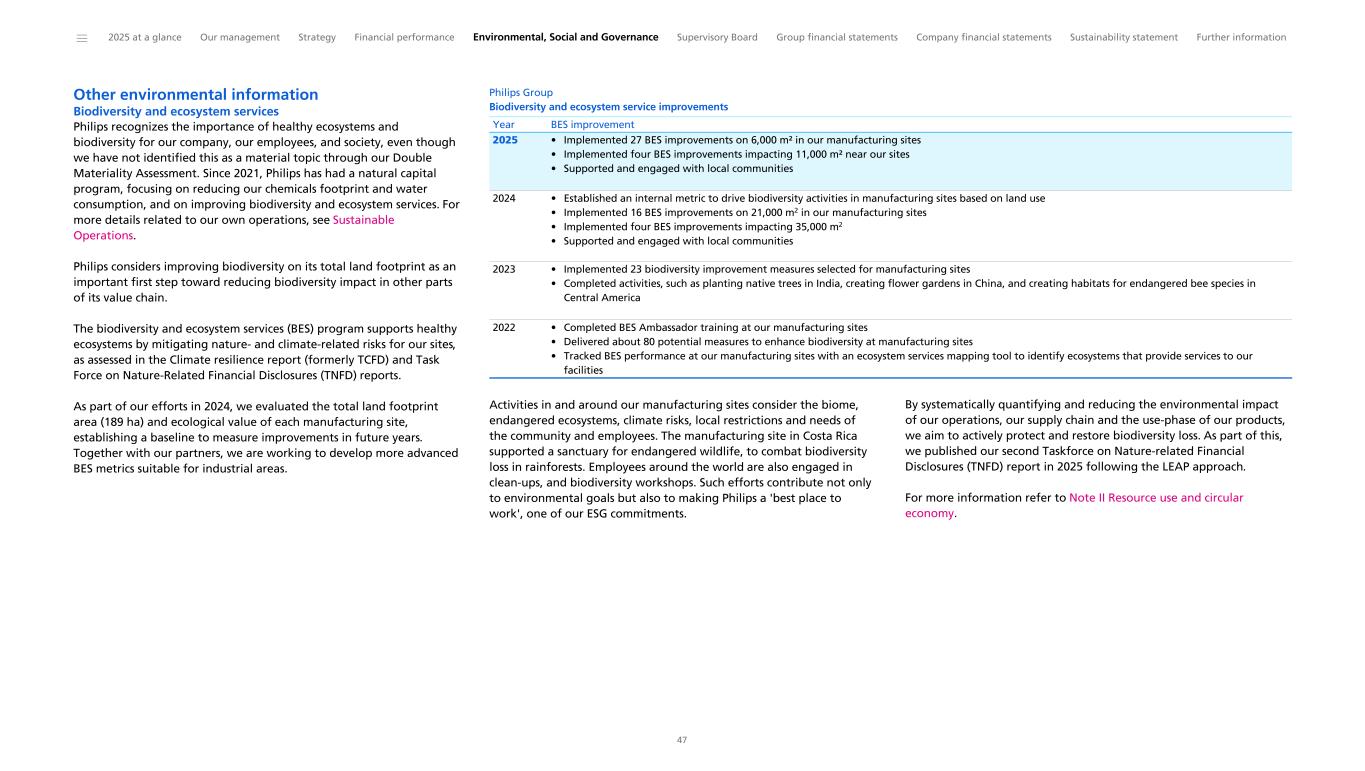
Other environmental information Biodiversity and ecosystem services Philips recognizes the importance of healthy ecosystems and biodiversity for our company, our employees, and society, even though we have not identified this as a material topic through our Double Materiality Assessment. Since 2021, Philips has had a natural capital program, focusing on reducing our chemicals footprint and water consumption, and on improving biodiversity and ecosystem services. For more details related to our own operations, see Sustainable Operations. Philips considers improving biodiversity on its total land footprint as an important first step toward reducing biodiversity impact in other parts of its value chain. The biodiversity and ecosystem services (BES) program supports healthy ecosystems by mitigating nature- and climate-related risks for our sites, as assessed in the Climate resilience report (formerly TCFD) and Task Force on Nature-Related Financial Disclosures (TNFD) reports. As part of our efforts in 2024, we evaluated the total land footprint area (189 ha) and ecological value of each manufacturing site, establishing a baseline to measure improvements in future years. Together with our partners, we are working to develop more advanced BES metrics suitable for industrial areas. Philips Group Biodiversity and ecosystem service improvements 2025 • Implemented 27 BES improvements on 6,000 m² in our manufacturing sites • Implemented four BES improvements impacting 11,000 m² near our sites • Supported and engaged with local communities 2024 • Established an internal metric to drive biodiversity activities in manufacturing sites based on land use • Implemented 16 BES improvements on 21,000 m2 in our manufacturing sites • Implemented four BES improvements impacting 35,000 m2 • Supported and engaged with local communities 2023 • Implemented 23 biodiversity improvement measures selected for manufacturing sites • Completed activities, such as planting native trees in India, creating flower gardens in China, and creating habitats for endangered bee species in Central America 2022 • Completed BES Ambassador training at our manufacturing sites • Delivered about 80 potential measures to enhance biodiversity at manufacturing sites • Tracked BES performance at our manufacturing sites with an ecosystem services mapping tool to identify ecosystems that provide services to our facilities Year BES improvement Activities in and around our manufacturing sites consider the biome, endangered ecosystems, climate risks, local restrictions and needs of the community and employees. The manufacturing site in Costa Rica supported a sanctuary for endangered wildlife, to combat biodiversity loss in rainforests. Employees around the world are also engaged in clean-ups, and biodiversity workshops. Such efforts contribute not only to environmental goals but also to making Philips a 'best place to work', one of our ESG commitments. By systematically quantifying and reducing the environmental impact of our operations, our supply chain and the use-phase of our products, we aim to actively protect and restore biodiversity loss. As part of this, we published our second Taskforce on Nature-related Financial Disclosures (TNFD) report in 2025 following the LEAP approach. For more information refer to Note II Resource use and circular economy. ______ 2025 at a glance Our management Strategy Financial performance Environmental, Social and Governance Supervisory Board Group financial statements Company financial statements Sustainability statement Further information 47
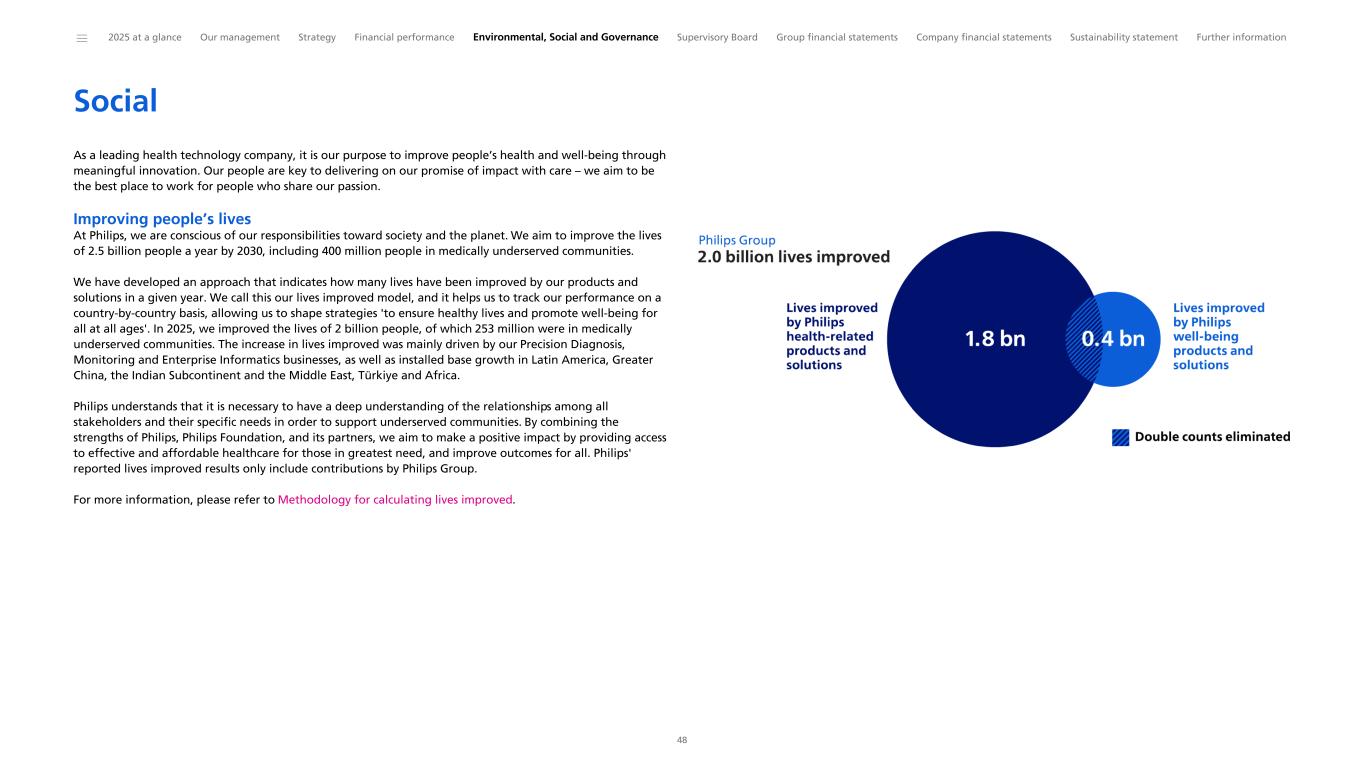
Social As a leading health technology company, it is our purpose to improve people’s health and well-being through meaningful innovation. Our people are key to delivering on our promise of impact with care – we aim to be the best place to work for people who share our passion. Improving people’s lives At Philips, we are conscious of our responsibilities toward society and the planet. We aim to improve the lives of 2.5 billion people a year by 2030, including 400 million people in medically underserved communities. We have developed an approach that indicates how many lives have been improved by our products and solutions in a given year. We call this our lives improved model, and it helps us to track our performance on a country-by-country basis, allowing us to shape strategies 'to ensure healthy lives and promote well-being for all at all ages'. In 2025, we improved the lives of 2 billion people, of which 253 million were in medically underserved communities. The increase in lives improved was mainly driven by our Precision Diagnosis, Monitoring and Enterprise Informatics businesses, as well as installed base growth in Latin America, Greater China, the Indian Subcontinent and the Middle East, Türkiye and Africa. Philips understands that it is necessary to have a deep understanding of the relationships among all stakeholders and their specific needs in order to support underserved communities. By combining the strengths of Philips, Philips Foundation, and its partners, we aim to make a positive impact by providing access to effective and affordable healthcare for those in greatest need, and improve outcomes for all. Philips' reported lives improved results only include contributions by Philips Group. For more information, please refer to Methodology for calculating lives improved. ______ 2025 at a glance Our management Strategy Financial performance Environmental, Social and Governance Supervisory Board Group financial statements Company financial statements Sustainability statement Further information 48
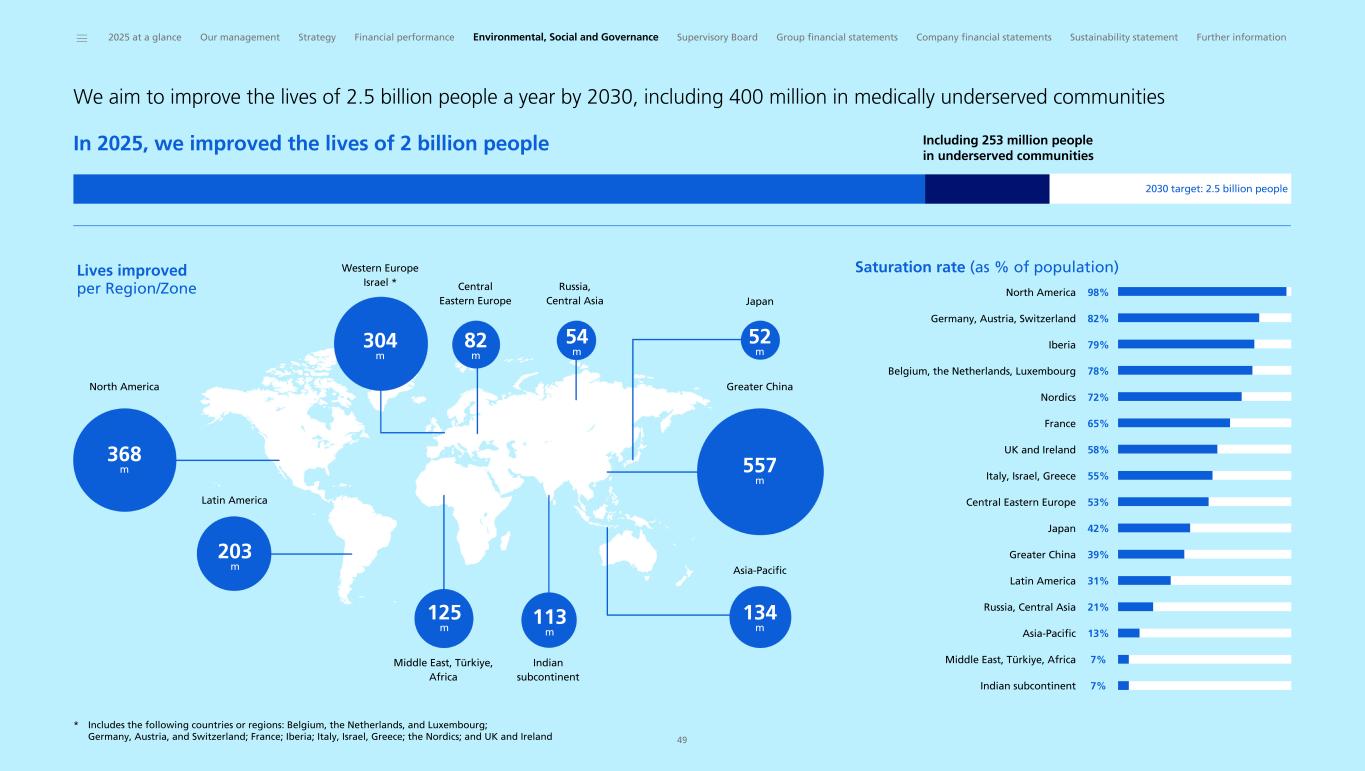
We aim to improve the lives of 2.5 billion people a year by 2030, including 400 million in medically underserved communities In 2025, we improved the lives of 2 billion people Including 253 million people in underserved communities 2030 target: 2.5 billion people Lives improved per Region/Zone Western Europe Israel * Central Eastern Europe Russia, Central Asia Japan 304 m 54 m 52 m 82 m North America Greater China 368 m 557 m Latin America 203 m Asia-Pacific 125 m 134 m 113 m Middle East, Türkiye, Africa Indian subcontinent Saturation rate (as % of population) North America 98% Germany, Austria, Switzerland 82% Iberia 79% Belgium, the Netherlands, Luxembourg 78% Nordics 72% France 65% UK and Ireland 58% Italy, Israel, Greece 55% Central Eastern Europe 53% Japan 42% Greater China 39% Latin America 31% Russia, Central Asia 21% Asia-Pacific 13% Middle East, Türkiye, Africa 7% Indian subcontinent 7% * Includes the following countries or regions: Belgium, the Netherlands, and Luxembourg; Germany, Austria, and Switzerland; France; Iberia; Italy, Israel, Greece; the Nordics; and UK and Ireland ______ 2025 at a glance Our management Strategy Financial performance Environmental, Social and Governance Supervisory Board Group financial statements Company financial statements Sustainability statement Further information 49
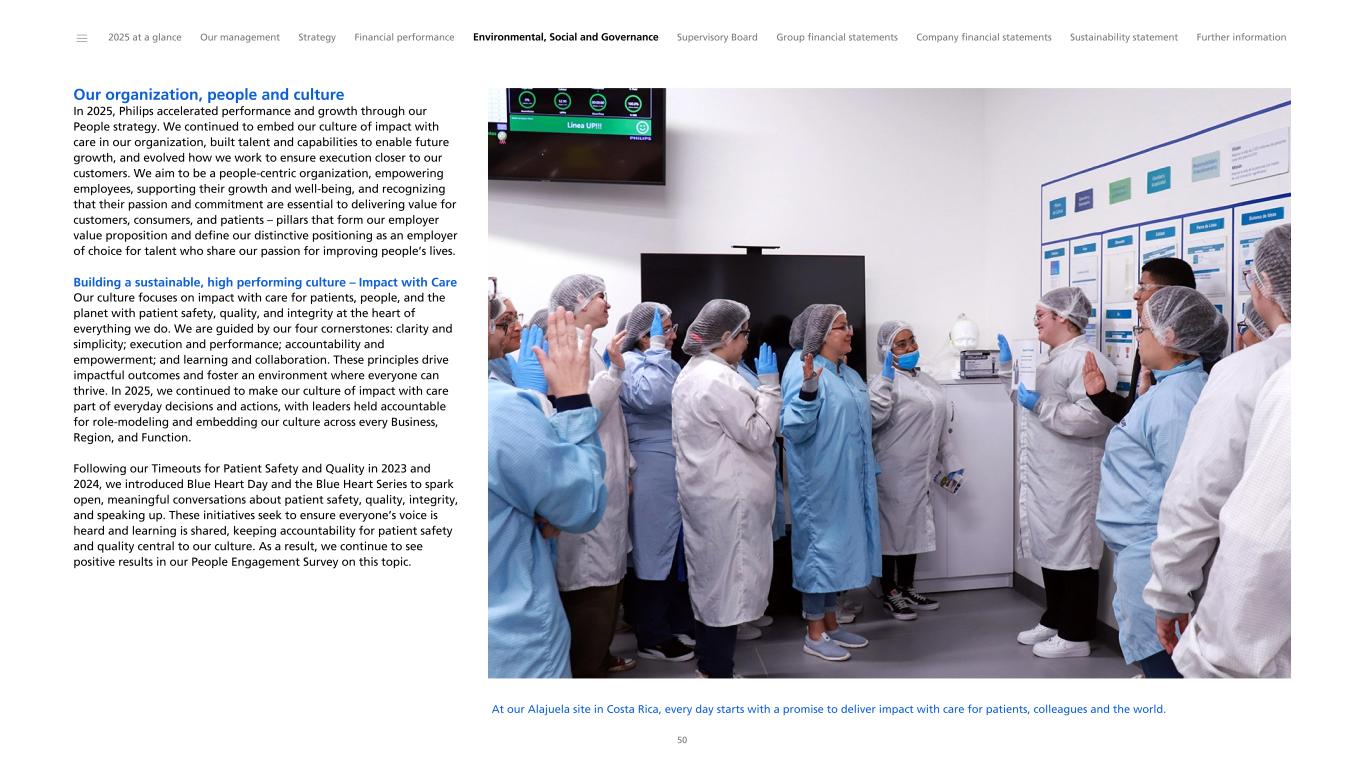
Our organization, people and culture In 2025, Philips accelerated performance and growth through our People strategy. We continued to embed our culture of impact with care in our organization, built talent and capabilities to enable future growth, and evolved how we work to ensure execution closer to our customers. We aim to be a people-centric organization, empowering employees, supporting their growth and well-being, and recognizing that their passion and commitment are essential to delivering value for customers, consumers, and patients – pillars that form our employer value proposition and define our distinctive positioning as an employer of choice for talent who share our passion for improving people’s lives. Building a sustainable, high performing culture – Impact with Care Our culture focuses on impact with care for patients, people, and the planet with patient safety, quality, and integrity at the heart of everything we do. We are guided by our four cornerstones: clarity and simplicity; execution and performance; accountability and empowerment; and learning and collaboration. These principles drive impactful outcomes and foster an environment where everyone can thrive. In 2025, we continued to make our culture of impact with care part of everyday decisions and actions, with leaders held accountable for role-modeling and embedding our culture across every Business, Region, and Function. Following our Timeouts for Patient Safety and Quality in 2023 and 2024, we introduced Blue Heart Day and the Blue Heart Series to spark open, meaningful conversations about patient safety, quality, integrity, and speaking up. These initiatives seek to ensure everyone’s voice is heard and learning is shared, keeping accountability for patient safety and quality central to our culture. As a result, we continue to see positive results in our People Engagement Survey on this topic. At our Alajuela site in Costa Rica, every day starts with a promise to deliver impact with care for patients, colleagues and the world. ______ 2025 at a glance Our management Strategy Financial performance Environmental, Social and Governance Supervisory Board Group financial statements Company financial statements Sustainability statement Further information 50
Positively impacting our workforce 65,340 78% 33% Employees Employee engagement index Women in leadership 46 0.23 100% Average annual learning hours per employee Total recordable case rate Employees paid at least a living wage We further embedded our culture into employee experiences by refining our approach to hiring and onboarding and will continue to expand this throughout our development and performance management practices. We completed our first year of goal-setting and performance and development reviews aligned with our culture framework, integrating our culture deeply into performance and development processes. We also strengthened in-person collaboration in our offices to spark creativity, accelerate decision-making, and deepen relationships, thereby fueling innovation. People Engagement Survey feedback indicates employees view team collaboration as a strength. We remain committed to supporting the health and well-being of our employees and to creating a safe, fair and inclusive environment. We are proud of our diverse workforce, which reflects the societies we serve and contributes to impactful innovation and sustainable value creation for all stakeholders. The results of our People Engagement Survey show that employees feel like they belong and can be themselves at Philips, and that their work-life rhythm is well-supported. The percentage of women in leadership remains on par with 2024 and our safety indicators remain at healthy levels. Please refer to Note V Diversity, Inclusion & Well-being and Note IX Health & Safety for more information. Our employees remain highly engaged, as reflected in strong People Engagement Survey participation (85%) and an engagement result of 78%. Engagement remains a key focus for all leaders in Philips and globally we strive to recognize team members who live our culture – formally, through performance management, and informally, such as our Times Square employee gratitude campaign. Leadership and people capabilities This year, we strengthened talent management and succession planning by prioritizing critical roles and targeted interventions, ensuring business continuity and maximizing performance impact. We see the results of these focused efforts in the performance of our Business Units. Amid continued scarcity of skilled employees, Internal mobility is at 28% (2024: 30%) and voluntary employee turnover is at 7.3% (2024: 7.6%) demonstrating our commitment to nurturing our own talent and growing critical capabilities, which includes hiring for medtech talent. We continued to strengthen our leadership pipeline through targeted development programs for high-potential executives and senior leaders in critical succession roles. In addition, we refreshed our Leaders as Coaches program and launched Conversations that Matter to build stronger coaching and feedback capabilities across all levels. Peer learning among senior leaders was enhanced, with best practice exchanges on key topics, such as AI and business growth to drive execution and performance. Building leadership capability will remain a key priority next year as we continue to focus on strengthening our leaders as the primary drivers of our culture and performance. Supporting the growth of all our employees remains a focus, with high- quality learning resources being offered, as well as ongoing development conversations and development programs on key capabilities such as AI, quality, and clinical and medical knowledge, further embedding a growth and innovation mindset across Philips. For more information, please refer to Note IV Workforce of the future. Simplifying how we work This year, we have taken meaningful steps to stabilize and further evolve our operating model, placing a strong emphasis on caring for our people while ensuring we are well-positioned to win in the market. We remain focused on simplifying the way we work by clarifying decision-making processes, eliminating duplicate activities, and embedding teams closer to our customers. To support these goals, we have streamlined a range of activities within our Functions, aligning teams more closely with our Businesses and driving shifts in services, product management, and commercial teams. These changes aim to ensure clear end-to-end ownership, enable best practice sharing across the enterprise, and empower our teams to deliver even more value to customers. By continuously refining our ways of working, we are building an agile, productive and responsive organization that supports both our employees and our long-term success. Looking ahead, we will keep advancing our People strategy by focusing on our performance and reward approach and building strong leadership. By investing in our people and nurturing a high-performing culture, we will continue to transform our organization to stay agile, resilient, and ready for change. For further details and supporting data, see Social information and related Notes. ______ 2025 at a glance Our management Strategy Financial performance Environmental, Social and Governance Supervisory Board Group financial statements Company financial statements Sustainability statement Further information 51
Human rights Philips believes that companies have both the responsibility to respect human rights and the ability to protect them. Philips’ Human Rights Policy, General Business Principles, Supplier Sustainability Declaration and other relevant policies guide our actions, in line with the International Bill of Human Rights and the International Labor Organization’s Declaration on Fundamental Principles and Rights at Work. Philips also operates in line with the UN Guiding Principles on Business and Human Rights and the Organization for Economic Co-operation and Development (OECD) Guidelines for Multinational Enterprises. We have a cross-functional project team, with a human rights manager and professionals from several functions. It is driving initiatives with oversight from the Human Rights Steering Committee, consisting of senior leaders from Integrated Supply Chain, Legal, People, and Group Sustainability. In 2025, we continued to develop our due diligence strategy by conducting Human Rights Impact Assessments (HRIAs). Philips’ site in Indonesia has been assessed as part of the commitment to conduct, at least every three years, HRIAs at 100% of its at-risk sites. Philips monitors the progress and findings from at-risk sites, taking them on a continuous improvement journey regarding human rights topics. Although the HRIA of selected sites is primarily focused on Philips' own operations, a derived supplier sustainability approach for selected suppliers has been established since 2022. These suppliers are invited to a focused assessment on human rights, in 2025 nine suppliers participated. More information on supplier assessments can be found in Note XI Supplier sustainability & Workers in the value chain. Philips’ Human Rights Report 2025 outlines our approach to human rights and management of salient human rights impacts, including non- discrimination, respectful treatment, freedom from child, forced and bonded labor, equal and fair treatment, remuneration, working hours, the right to organize and collective bargaining, workplace health and safety, privacy and data protection, product safety, business integrity, and environmental impacts. Going forward, Philips will no longer publish a standalone Human Rights Report and will continue to provide updates on its website, in addition to the human rights disclosures in its sustainability statements. Supplier sustainability Sustainability is a focus for the Integrated Supply Chain Function, which is actively collaborating with our partners, whether these be component suppliers or energy or logistics providers. Close cooperation with our suppliers not only helps us deliver health technology innovations, but it also supports new approaches that help us minimize our environmental impact and maximize the social and economic value we create. In 2025, our programs focused specifically on improving supplier sustainability performance, advancing human rights, responsibly sourcing minerals, and reducing the environmental footprint in our supply chain by driving the adoption of Science Based Targets. The sustainability performance of our suppliers is fully embedded in our procurement strategy and ways of working. We have a direct (tier 1) business relationship with approximately 4,100 product and component suppliers and 14,200 service suppliers. Social and environmental impacts deeper in our supply chain also require us to intervene beyond tier 1 suppliers. We want to make a difference through sustainable supply management and responsible sourcing. This is more than just managing compliance – it is about collaborating with our supply partners to make a positive and lasting impact. Through the Supplier Sustainability Performance program, our maturity-based approach to drive continuous improvement, the lives improved in the supply chain increased to approximately 1.072 million workers in our supply chain in 2025 (2024: 936,000). Collaborating with our strategic partners, we increased the number of deep-dives at tier 2 suppliers, actively supporting them to become more effective in their own sustainability engagement approaches toward their suppliers. Detailed information on our supplier sustainability programs is available in Note XI Supplier sustainability & Workers in the value chain. Philips Foundation Stichting Philips Foundation, an independent foundation organized under Dutch law, is a registered charity established in 2014. In 2025, Royal Philips supported Philips Foundation with a contribution of EUR 6.7 million and by providing dedicated staff capacity, as well as the expert assistance of skilled volunteers in the execution of Philips Foundation’s initiatives. Philips Foundation’s mission is to enable access to quality healthcare for underserved communities through meaningful innovation, strategic partnerships, and catalytic funding. It does this through the provision and application of Philips’ healthcare expertise, innovation power, talent and resources, as well as through financial support. Together with key partners around the globe (e.g., nonprofit organizations, ventures, and other like-minded organizations), Philips Foundation seeks to identify challenges where a combination of healthcare technology expertise and partner experience can be used to create meaningful solutions that have a positive impact on people’s lives. Philips Foundation operates along a continuum of capital, from grant- based projects to impact investments. Grants are typically used to test and strengthen new healthcare models in underserved settings, while impact investments, through its impact investments entity, are used when solutions have proven their value and show potential to scale sustainably. For more information on the Philips Foundation, please refer to Philips Foundation. ______ 2025 at a glance Our management Strategy Financial performance Environmental, Social and Governance Supervisory Board Group financial statements Company financial statements Sustainability statement Further information 52
Governance This section describes the governance framework that enables us to operationalize our purpose by adopting a fully integrated approach to doing business responsibly and sustainably. Corporate governance Management and oversight responsibilities and accountability within our company are ultimately guided by the corporate governance of the parent company of the Philips Group, Koninklijke Philips N.V. (Royal Philips). Royal Philips is a company organized under Dutch law and its shares have been listed on the Amsterdam stock exchange (Euronext Amsterdam) since 1912. In addition, Royal Philips’ shares have been traded in the United States since 1962 and have been listed on the New York Stock Exchange since 1987. Royal Philips has a two-tier board structure consisting of a Board of Management and a Supervisory Board, each of which is accountable to the General Meeting of Shareholders for the fulfillment of its respective duties. The members of the Board of Management, supported by the other members of the Executive Committee, drive the company’s management agenda and share responsibility for the continuity of the Philips Group, focusing on sustainable long-term value creation. The independent Supervisory Board supervises the Board of Management and the Executive Committee and advises them on general policies related to the activities of the company, including setting and executing the strategy of the Philips Group. These responsibilities include the oversight of the Environmental, Social and Governance (ESG) dimensions and their integration into the company’s overarching strategy, which is a responsibility of the Supervisory Board as a whole because of their significance. Philips is governed by Dutch corporate and securities laws, its Articles of Association, and the Rules of Procedure of the Board of Management and the Executive Committee and of the Supervisory Board, respectively. Our corporate governance framework is also based on the Dutch Corporate Governance Code (dated March 20, 2025) and US laws and regulations applicable to Foreign Private Issuers. In the Corporate governance report, we address the main elements of our corporate governance structure, report on how we apply the principles and best practices of the Dutch Corporate Governance Code, and provide the information required by the Dutch governmental Decree on Corporate Governance (Besluit inhoud bestuursverslag) and governmental Decree on Article 10 Takeover Directive (Besluit artikel 10 overnamerichtlijn). When deemed necessary in the interests of the company, we may deviate from aspects of the corporate governance structure, and any such deviations will be disclosed in the Corporate governance report. The Philips integrated operating model Our operating model is designed to enable us to deliver on our purpose, driving impact and creating value for our stakeholders. And to do so responsibly and sustainably, ensuring patient safety, quality, compliance and integrity. The model is intended to promote accountability and agility, based on the following fundamentals: • We serve our customers and consumers with patient safety and quality at the core of everything we do. • Our Business Units are in the lead and accountable for value creation through their value streams. • Our Regions and Functions enable value stream execution. • Our leaders and teams are empowered to prioritize and allocate their resources for impact. Our operating model integrates five organizational elements. We ensure alignment of the elements to deliver on our strategic objectives, with clear accountability to drive flawless execution. • Strategy • Structure & Governance • People & Culture • Performance Management • Policies, Processes, Systems & Data More information on our strategic focus, as well as our approach to people and culture, can be found in Strategic focus and Our Organization, people and culture, respectively. Structure and governance In order to meet the needs of patients, customers and consumers, our empowered Business Units are supported by the Regions and Functions. Business Units, Businesses and segments Our Business Units are in the lead, accountable for value creation through their value streams. Our Business Unit leaders have full accountability for meeting customer needs and their end-to-end P&L, including patient safety and quality and supply chain performance. Business Units are broken down into business categories, where relevant. The Businesses are lean, and their leaders ensure consistent alignment among the Business Units’ strategies and goals. They also execute performance management toward the Business Units, including target setting. Our segment leaders ensure strategic execution and focus cross- Business, and they are held accountable by the Board of Management for the results of their underlying Businesses/Business Units. The three segments are Diagnosis & Treatment, Connected Care, and Personal Health, as also disclosed in our external reporting. Regions We are organized in three Regions: North America, Greater China and International Region (the latter consisting of Europe and Growth areas). The Regions’ primary accountability is to manage customer intimacy, build and maintain relationships, and cultivate understanding of their needs, as well as carry out (strategic) account management, service delivery, and indirect partner management. They are also accountable for government relations and for providing the local infrastructure needed to support Philips’ presence in a country (license to operate). Functions Our Functions’ core objective is to drive excellence (for reasons of skill, scope and scale) across the organization. Functions deliver cost- effective services, ensure legal and regulatory requirements are met, and propose enterprise policies, standards, guidance and infrastructure, as well as build and share capabilities and expertise. ______ 2025 at a glance Our management Strategy Financial performance Environmental, Social and Governance Supervisory Board Group financial statements Company financial statements Sustainability statement Further information 53
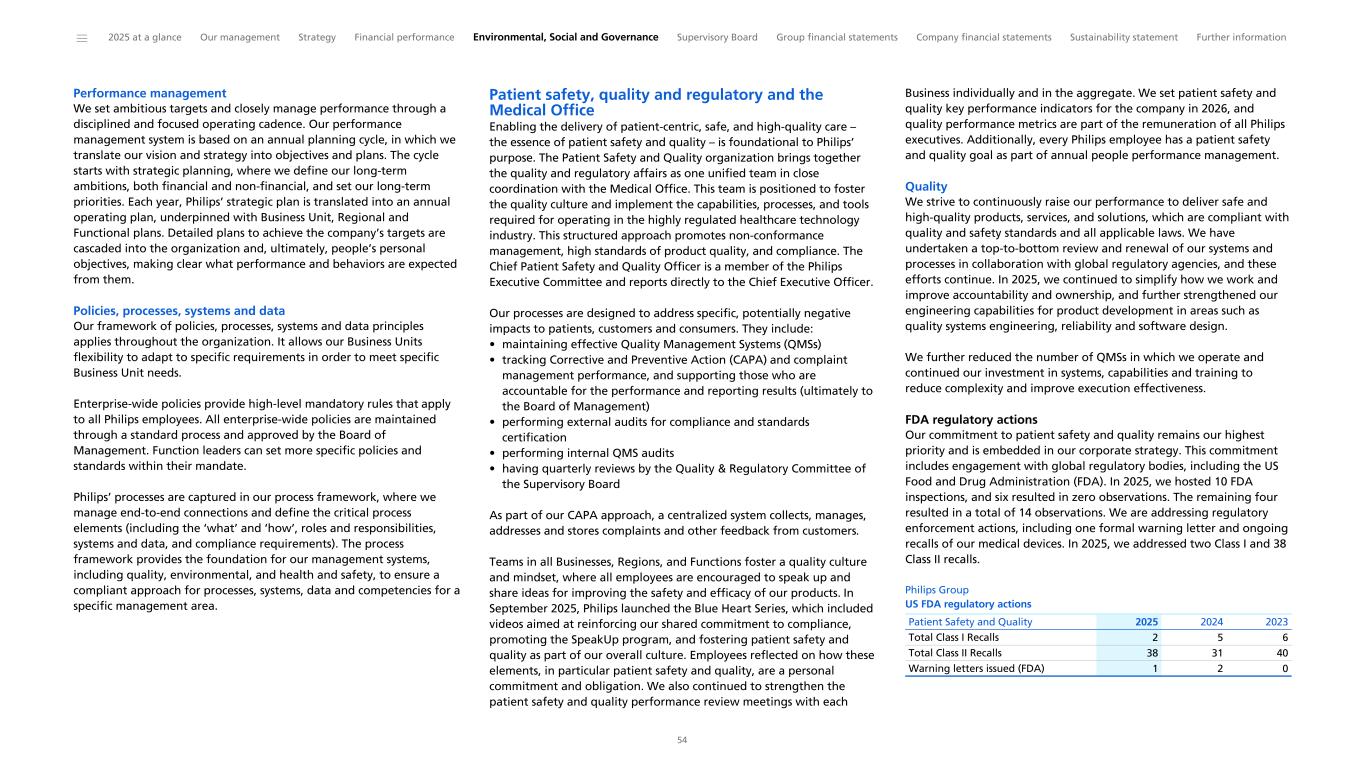
Performance management We set ambitious targets and closely manage performance through a disciplined and focused operating cadence. Our performance management system is based on an annual planning cycle, in which we translate our vision and strategy into objectives and plans. The cycle starts with strategic planning, where we define our long-term ambitions, both financial and non-financial, and set our long-term priorities. Each year, Philips’ strategic plan is translated into an annual operating plan, underpinned with Business Unit, Regional and Functional plans. Detailed plans to achieve the company’s targets are cascaded into the organization and, ultimately, people’s personal objectives, making clear what performance and behaviors are expected from them. Policies, processes, systems and data Our framework of policies, processes, systems and data principles applies throughout the organization. It allows our Business Units flexibility to adapt to specific requirements in order to meet specific Business Unit needs. Enterprise-wide policies provide high-level mandatory rules that apply to all Philips employees. All enterprise-wide policies are maintained through a standard process and approved by the Board of Management. Function leaders can set more specific policies and standards within their mandate. Philips’ processes are captured in our process framework, where we manage end-to-end connections and define the critical process elements (including the ‘what’ and ‘how’, roles and responsibilities, systems and data, and compliance requirements). The process framework provides the foundation for our management systems, including quality, environmental, and health and safety, to ensure a compliant approach for processes, systems, data and competencies for a specific management area. Patient safety, quality and regulatory and the Medical Office Enabling the delivery of patient-centric, safe, and high-quality care – the essence of patient safety and quality – is foundational to Philips’ purpose. The Patient Safety and Quality organization brings together the quality and regulatory affairs as one unified team in close coordination with the Medical Office. This team is positioned to foster the quality culture and implement the capabilities, processes, and tools required for operating in the highly regulated healthcare technology industry. This structured approach promotes non-conformance management, high standards of product quality, and compliance. The Chief Patient Safety and Quality Officer is a member of the Philips Executive Committee and reports directly to the Chief Executive Officer. Our processes are designed to address specific, potentially negative impacts to patients, customers and consumers. They include: • maintaining effective Quality Management Systems (QMSs) • tracking Corrective and Preventive Action (CAPA) and complaint management performance, and supporting those who are accountable for the performance and reporting results (ultimately to the Board of Management) • performing external audits for compliance and standards certification • performing internal QMS audits • having quarterly reviews by the Quality & Regulatory Committee of the Supervisory Board As part of our CAPA approach, a centralized system collects, manages, addresses and stores complaints and other feedback from customers. Teams in all Businesses, Regions, and Functions foster a quality culture and mindset, where all employees are encouraged to speak up and share ideas for improving the safety and efficacy of our products. In September 2025, Philips launched the Blue Heart Series, which included videos aimed at reinforcing our shared commitment to compliance, promoting the SpeakUp program, and fostering patient safety and quality as part of our overall culture. Employees reflected on how these elements, in particular patient safety and quality, are a personal commitment and obligation. We also continued to strengthen the patient safety and quality performance review meetings with each Business individually and in the aggregate. We set patient safety and quality key performance indicators for the company in 2026, and quality performance metrics are part of the remuneration of all Philips executives. Additionally, every Philips employee has a patient safety and quality goal as part of annual people performance management. Quality We strive to continuously raise our performance to deliver safe and high-quality products, services, and solutions, which are compliant with quality and safety standards and all applicable laws. We have undertaken a top-to-bottom review and renewal of our systems and processes in collaboration with global regulatory agencies, and these efforts continue. In 2025, we continued to simplify how we work and improve accountability and ownership, and further strengthened our engineering capabilities for product development in areas such as quality systems engineering, reliability and software design. We further reduced the number of QMSs in which we operate and continued our investment in systems, capabilities and training to reduce complexity and improve execution effectiveness. FDA regulatory actions Our commitment to patient safety and quality remains our highest priority and is embedded in our corporate strategy. This commitment includes engagement with global regulatory bodies, including the US Food and Drug Administration (FDA). In 2025, we hosted 10 FDA inspections, and six resulted in zero observations. The remaining four resulted in a total of 14 observations. We are addressing regulatory enforcement actions, including one formal warning letter and ongoing recalls of our medical devices. In 2025, we addressed two Class I and 38 Class II recalls. Philips Group US FDA regulatory actions Patient Safety and Quality 2025 2024 2023 Total Class I Recalls 2 5 6 Total Class II Recalls 38 31 40 Warning letters issued (FDA) 1 2 0 ______ 2025 at a glance Our management Strategy Financial performance Environmental, Social and Governance Supervisory Board Group financial statements Company financial statements Sustainability statement Further information 54
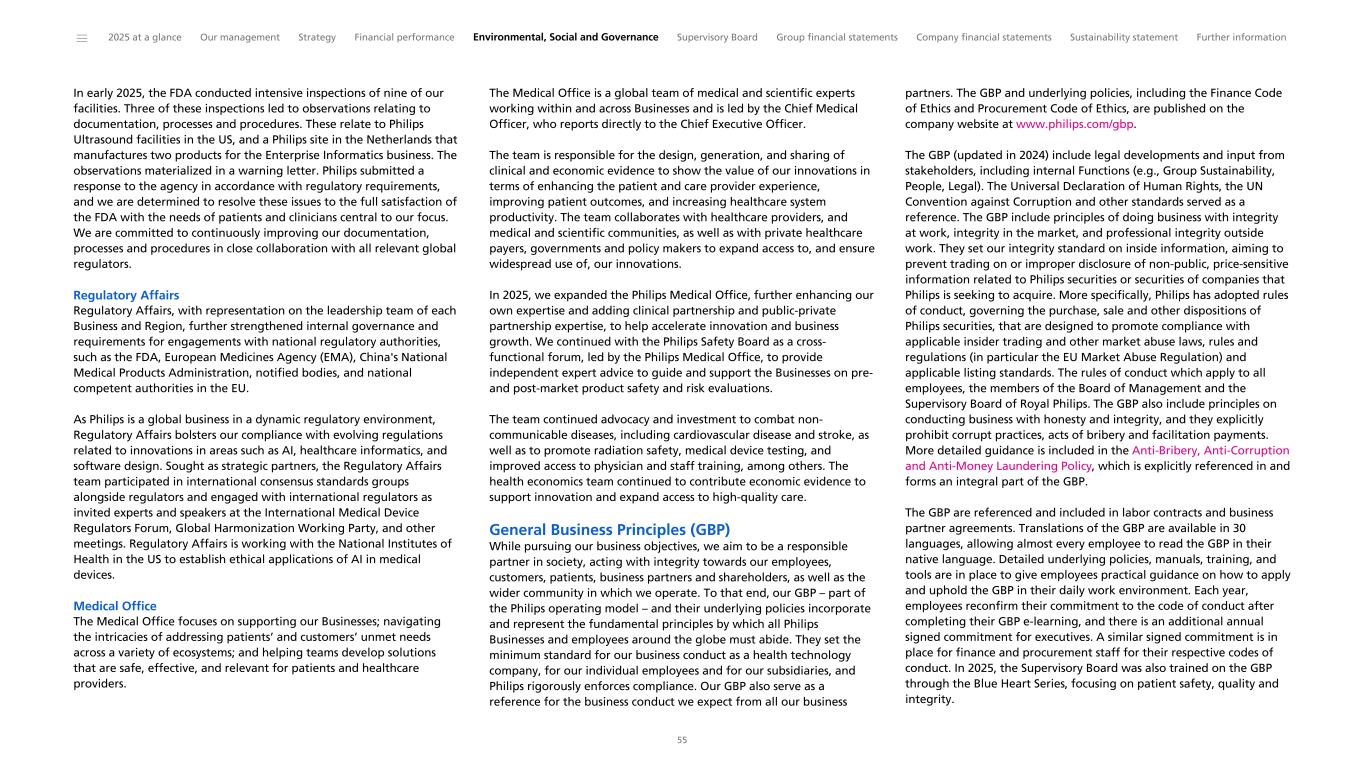
In early 2025, the FDA conducted intensive inspections of nine of our facilities. Three of these inspections led to observations relating to documentation, processes and procedures. These relate to Philips Ultrasound facilities in the US, and a Philips site in the Netherlands that manufactures two products for the Enterprise Informatics business. The observations materialized in a warning letter. Philips submitted a response to the agency in accordance with regulatory requirements, and we are determined to resolve these issues to the full satisfaction of the FDA with the needs of patients and clinicians central to our focus. We are committed to continuously improving our documentation, processes and procedures in close collaboration with all relevant global regulators. Regulatory Affairs Regulatory Affairs, with representation on the leadership team of each Business and Region, further strengthened internal governance and requirements for engagements with national regulatory authorities, such as the FDA, European Medicines Agency (EMA), China's National Medical Products Administration, notified bodies, and national competent authorities in the EU. As Philips is a global business in a dynamic regulatory environment, Regulatory Affairs bolsters our compliance with evolving regulations related to innovations in areas such as AI, healthcare informatics, and software design. Sought as strategic partners, the Regulatory Affairs team participated in international consensus standards groups alongside regulators and engaged with international regulators as invited experts and speakers at the International Medical Device Regulators Forum, Global Harmonization Working Party, and other meetings. Regulatory Affairs is working with the National Institutes of Health in the US to establish ethical applications of AI in medical devices. Medical Office The Medical Office focuses on supporting our Businesses; navigating the intricacies of addressing patients’ and customers’ unmet needs across a variety of ecosystems; and helping teams develop solutions that are safe, effective, and relevant for patients and healthcare providers. The Medical Office is a global team of medical and scientific experts working within and across Businesses and is led by the Chief Medical Officer, who reports directly to the Chief Executive Officer. The team is responsible for the design, generation, and sharing of clinical and economic evidence to show the value of our innovations in terms of enhancing the patient and care provider experience, improving patient outcomes, and increasing healthcare system productivity. The team collaborates with healthcare providers, and medical and scientific communities, as well as with private healthcare payers, governments and policy makers to expand access to, and ensure widespread use of, our innovations. In 2025, we expanded the Philips Medical Office, further enhancing our own expertise and adding clinical partnership and public-private partnership expertise, to help accelerate innovation and business growth. We continued with the Philips Safety Board as a cross- functional forum, led by the Philips Medical Office, to provide independent expert advice to guide and support the Businesses on pre- and post-market product safety and risk evaluations. The team continued advocacy and investment to combat non- communicable diseases, including cardiovascular disease and stroke, as well as to promote radiation safety, medical device testing, and improved access to physician and staff training, among others. The health economics team continued to contribute economic evidence to support innovation and expand access to high-quality care. General Business Principles (GBP) While pursuing our business objectives, we aim to be a responsible partner in society, acting with integrity towards our employees, customers, patients, business partners and shareholders, as well as the wider community in which we operate. To that end, our GBP – part of the Philips operating model – and their underlying policies incorporate and represent the fundamental principles by which all Philips Businesses and employees around the globe must abide. They set the minimum standard for our business conduct as a health technology company, for our individual employees and for our subsidiaries, and Philips rigorously enforces compliance. Our GBP also serve as a reference for the business conduct we expect from all our business partners. The GBP and underlying policies, including the Finance Code of Ethics and Procurement Code of Ethics, are published on the company website at www.philips.com/gbp. The GBP (updated in 2024) include legal developments and input from stakeholders, including internal Functions (e.g., Group Sustainability, People, Legal). The Universal Declaration of Human Rights, the UN Convention against Corruption and other standards served as a reference. The GBP include principles of doing business with integrity at work, integrity in the market, and professional integrity outside work. They set our integrity standard on inside information, aiming to prevent trading on or improper disclosure of non-public, price-sensitive information related to Philips securities or securities of companies that Philips is seeking to acquire. More specifically, Philips has adopted rules of conduct, governing the purchase, sale and other dispositions of Philips securities, that are designed to promote compliance with applicable insider trading and other market abuse laws, rules and regulations (in particular the EU Market Abuse Regulation) and applicable listing standards. The rules of conduct which apply to all employees, the members of the Board of Management and the Supervisory Board of Royal Philips. The GBP also include principles on conducting business with honesty and integrity, and they explicitly prohibit corrupt practices, acts of bribery and facilitation payments. More detailed guidance is included in the Anti-Bribery, Anti-Corruption and Anti-Money Laundering Policy, which is explicitly referenced in and forms an integral part of the GBP. The GBP are referenced and included in labor contracts and business partner agreements. Translations of the GBP are available in 30 languages, allowing almost every employee to read the GBP in their native language. Detailed underlying policies, manuals, training, and tools are in place to give employees practical guidance on how to apply and uphold the GBP in their daily work environment. Each year, employees reconfirm their commitment to the code of conduct after completing their GBP e-learning, and there is an additional annual signed commitment for executives. A similar signed commitment is in place for finance and procurement staff for their respective codes of conduct. In 2025, the Supervisory Board was also trained on the GBP through the Blue Heart Series, focusing on patient safety, quality and integrity. ______ 2025 at a glance Our management Strategy Financial performance Environmental, Social and Governance Supervisory Board Group financial statements Company financial statements Sustainability statement Further information 55
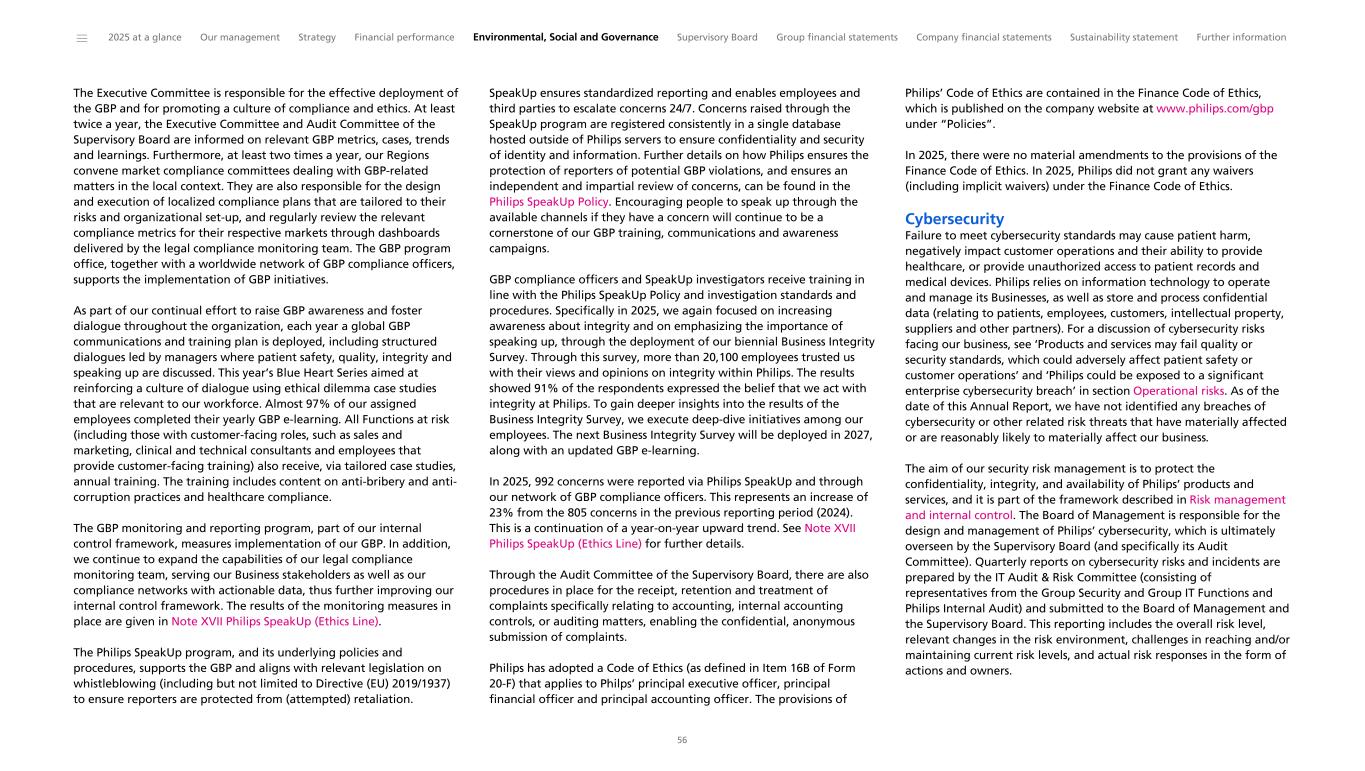
The Executive Committee is responsible for the effective deployment of the GBP and for promoting a culture of compliance and ethics. At least twice a year, the Executive Committee and Audit Committee of the Supervisory Board are informed on relevant GBP metrics, cases, trends and learnings. Furthermore, at least two times a year, our Regions convene market compliance committees dealing with GBP-related matters in the local context. They are also responsible for the design and execution of localized compliance plans that are tailored to their risks and organizational set-up, and regularly review the relevant compliance metrics for their respective markets through dashboards delivered by the legal compliance monitoring team. The GBP program office, together with a worldwide network of GBP compliance officers, supports the implementation of GBP initiatives. As part of our continual effort to raise GBP awareness and foster dialogue throughout the organization, each year a global GBP communications and training plan is deployed, including structured dialogues led by managers where patient safety, quality, integrity and speaking up are discussed. This year’s Blue Heart Series aimed at reinforcing a culture of dialogue using ethical dilemma case studies that are relevant to our workforce. Almost 97% of our assigned employees completed their yearly GBP e-learning. All Functions at risk (including those with customer-facing roles, such as sales and marketing, clinical and technical consultants and employees that provide customer-facing training) also receive, via tailored case studies, annual training. The training includes content on anti-bribery and anti- corruption practices and healthcare compliance. The GBP monitoring and reporting program, part of our internal control framework, measures implementation of our GBP. In addition, we continue to expand the capabilities of our legal compliance monitoring team, serving our Business stakeholders as well as our compliance networks with actionable data, thus further improving our internal control framework. The results of the monitoring measures in place are given in Note XVII Philips SpeakUp (Ethics Line). The Philips SpeakUp program, and its underlying policies and procedures, supports the GBP and aligns with relevant legislation on whistleblowing (including but not limited to Directive (EU) 2019/1937) to ensure reporters are protected from (attempted) retaliation. SpeakUp ensures standardized reporting and enables employees and third parties to escalate concerns 24/7. Concerns raised through the SpeakUp program are registered consistently in a single database hosted outside of Philips servers to ensure confidentiality and security of identity and information. Further details on how Philips ensures the protection of reporters of potential GBP violations, and ensures an independent and impartial review of concerns, can be found in the Philips SpeakUp Policy. Encouraging people to speak up through the available channels if they have a concern will continue to be a cornerstone of our GBP training, communications and awareness campaigns. GBP compliance officers and SpeakUp investigators receive training in line with the Philips SpeakUp Policy and investigation standards and procedures. Specifically in 2025, we again focused on increasing awareness about integrity and on emphasizing the importance of speaking up, through the deployment of our biennial Business Integrity Survey. Through this survey, more than 20,100 employees trusted us with their views and opinions on integrity within Philips. The results showed 91% of the respondents expressed the belief that we act with integrity at Philips. To gain deeper insights into the results of the Business Integrity Survey, we execute deep-dive initiatives among our employees. The next Business Integrity Survey will be deployed in 2027, along with an updated GBP e-learning. In 2025, 992 concerns were reported via Philips SpeakUp and through our network of GBP compliance officers. This represents an increase of 23% from the 805 concerns in the previous reporting period (2024). This is a continuation of a year-on-year upward trend. See Note XVII Philips SpeakUp (Ethics Line) for further details. Through the Audit Committee of the Supervisory Board, there are also procedures in place for the receipt, retention and treatment of complaints specifically relating to accounting, internal accounting controls, or auditing matters, enabling the confidential, anonymous submission of complaints. Philips has adopted a Code of Ethics (as defined in Item 16B of Form 20-F) that applies to Philps’ principal executive officer, principal financial officer and principal accounting officer. The provisions of Philips’ Code of Ethics are contained in the Finance Code of Ethics, which is published on the company website at www.philips.com/gbp under “Policies”. In 2025, there were no material amendments to the provisions of the Finance Code of Ethics. In 2025, Philips did not grant any waivers (including implicit waivers) under the Finance Code of Ethics. Cybersecurity Failure to meet cybersecurity standards may cause patient harm, negatively impact customer operations and their ability to provide healthcare, or provide unauthorized access to patient records and medical devices. Philips relies on information technology to operate and manage its Businesses, as well as store and process confidential data (relating to patients, employees, customers, intellectual property, suppliers and other partners). For a discussion of cybersecurity risks facing our business, see ‘Products and services may fail quality or security standards, which could adversely affect patient safety or customer operations’ and ‘Philips could be exposed to a significant enterprise cybersecurity breach’ in section Operational risks. As of the date of this Annual Report, we have not identified any breaches of cybersecurity or other related risk threats that have materially affected or are reasonably likely to materially affect our business. The aim of our security risk management is to protect the confidentiality, integrity, and availability of Philips’ products and services, and it is part of the framework described in Risk management and internal control. The Board of Management is responsible for the design and management of Philips’ cybersecurity, which is ultimately overseen by the Supervisory Board (and specifically its Audit Committee). Quarterly reports on cybersecurity risks and incidents are prepared by the IT Audit & Risk Committee (consisting of representatives from the Group Security and Group IT Functions and Philips Internal Audit) and submitted to the Board of Management and the Supervisory Board. This reporting includes the overall risk level, relevant changes in the risk environment, challenges in reaching and/or maintaining current risk levels, and actual risk responses in the form of actions and owners. ______ 2025 at a glance Our management Strategy Financial performance Environmental, Social and Governance Supervisory Board Group financial statements Company financial statements Sustainability statement Further information 56
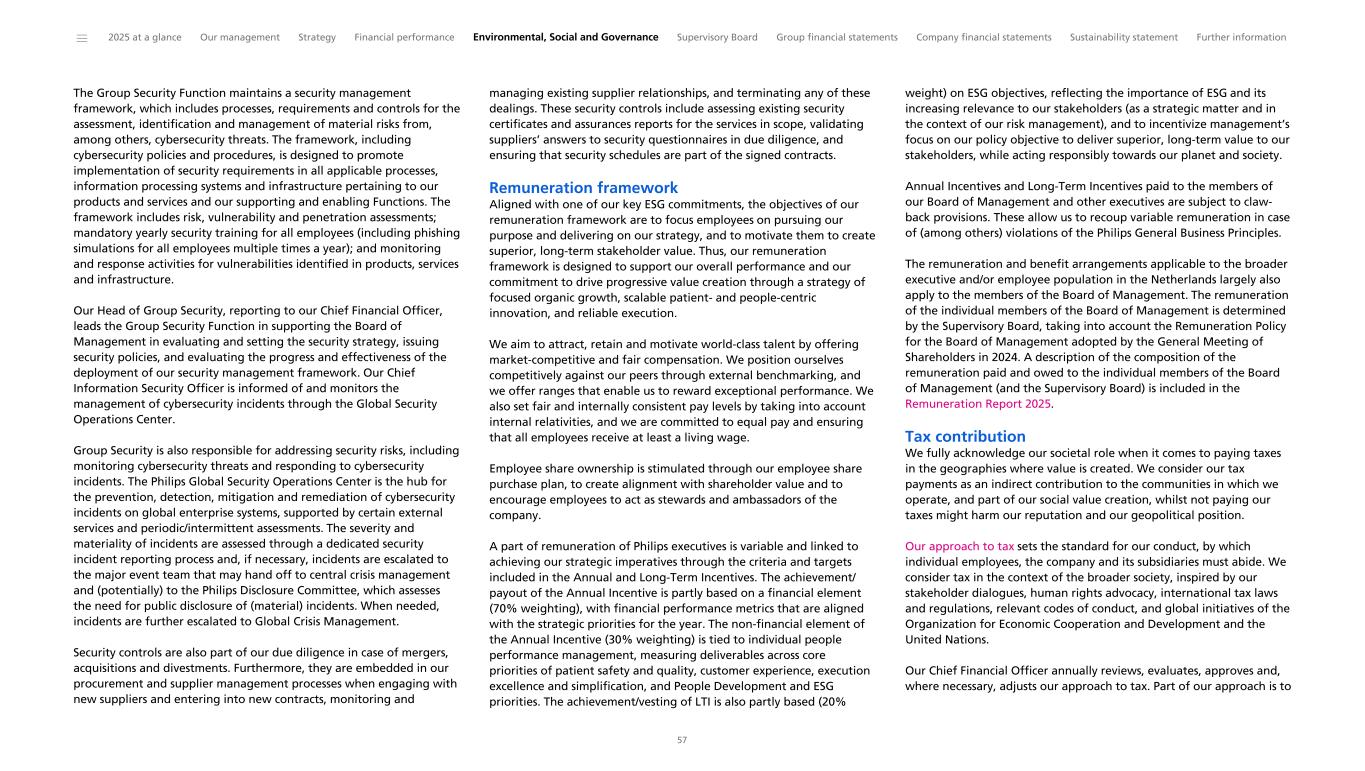
The Group Security Function maintains a security management framework, which includes processes, requirements and controls for the assessment, identification and management of material risks from, among others, cybersecurity threats. The framework, including cybersecurity policies and procedures, is designed to promote implementation of security requirements in all applicable processes, information processing systems and infrastructure pertaining to our products and services and our supporting and enabling Functions. The framework includes risk, vulnerability and penetration assessments; mandatory yearly security training for all employees (including phishing simulations for all employees multiple times a year); and monitoring and response activities for vulnerabilities identified in products, services and infrastructure. Our Head of Group Security, reporting to our Chief Financial Officer, leads the Group Security Function in supporting the Board of Management in evaluating and setting the security strategy, issuing security policies, and evaluating the progress and effectiveness of the deployment of our security management framework. Our Chief Information Security Officer is informed of and monitors the management of cybersecurity incidents through the Global Security Operations Center. Group Security is also responsible for addressing security risks, including monitoring cybersecurity threats and responding to cybersecurity incidents. The Philips Global Security Operations Center is the hub for the prevention, detection, mitigation and remediation of cybersecurity incidents on global enterprise systems, supported by certain external services and periodic/intermittent assessments. The severity and materiality of incidents are assessed through a dedicated security incident reporting process and, if necessary, incidents are escalated to the major event team that may hand off to central crisis management and (potentially) to the Philips Disclosure Committee, which assesses the need for public disclosure of (material) incidents. When needed, incidents are further escalated to Global Crisis Management. Security controls are also part of our due diligence in case of mergers, acquisitions and divestments. Furthermore, they are embedded in our procurement and supplier management processes when engaging with new suppliers and entering into new contracts, monitoring and managing existing supplier relationships, and terminating any of these dealings. These security controls include assessing existing security certificates and assurances reports for the services in scope, validating suppliers’ answers to security questionnaires in due diligence, and ensuring that security schedules are part of the signed contracts. Remuneration framework Aligned with one of our key ESG commitments, the objectives of our remuneration framework are to focus employees on pursuing our purpose and delivering on our strategy, and to motivate them to create superior, long-term stakeholder value. Thus, our remuneration framework is designed to support our overall performance and our commitment to drive progressive value creation through a strategy of focused organic growth, scalable patient- and people-centric innovation, and reliable execution. We aim to attract, retain and motivate world-class talent by offering market-competitive and fair compensation. We position ourselves competitively against our peers through external benchmarking, and we offer ranges that enable us to reward exceptional performance. We also set fair and internally consistent pay levels by taking into account internal relativities, and we are committed to equal pay and ensuring that all employees receive at least a living wage. Employee share ownership is stimulated through our employee share purchase plan, to create alignment with shareholder value and to encourage employees to act as stewards and ambassadors of the company. A part of remuneration of Philips executives is variable and linked to achieving our strategic imperatives through the criteria and targets included in the Annual and Long-Term Incentives. The achievement/ payout of the Annual Incentive is partly based on a financial element (70% weighting), with financial performance metrics that are aligned with the strategic priorities for the year. The non-financial element of the Annual Incentive (30% weighting) is tied to individual people performance management, measuring deliverables across core priorities of patient safety and quality, customer experience, execution excellence and simplification, and People Development and ESG priorities. The achievement/vesting of LTI is also partly based (20% weight) on ESG objectives, reflecting the importance of ESG and its increasing relevance to our stakeholders (as a strategic matter and in the context of our risk management), and to incentivize management’s focus on our policy objective to deliver superior, long-term value to our stakeholders, while acting responsibly towards our planet and society. Annual Incentives and Long-Term Incentives paid to the members of our Board of Management and other executives are subject to claw- back provisions. These allow us to recoup variable remuneration in case of (among others) violations of the Philips General Business Principles. The remuneration and benefit arrangements applicable to the broader executive and/or employee population in the Netherlands largely also apply to the members of the Board of Management. The remuneration of the individual members of the Board of Management is determined by the Supervisory Board, taking into account the Remuneration Policy for the Board of Management adopted by the General Meeting of Shareholders in 2024. A description of the composition of the remuneration paid and owed to the individual members of the Board of Management (and the Supervisory Board) is included in the Remuneration Report 2025. Tax contribution We fully acknowledge our societal role when it comes to paying taxes in the geographies where value is created. We consider our tax payments as an indirect contribution to the communities in which we operate, and part of our social value creation, whilst not paying our taxes might harm our reputation and our geopolitical position. Our approach to tax sets the standard for our conduct, by which individual employees, the company and its subsidiaries must abide. We consider tax in the context of the broader society, inspired by our stakeholder dialogues, human rights advocacy, international tax laws and regulations, relevant codes of conduct, and global initiatives of the Organization for Economic Cooperation and Development and the United Nations. Our Chief Financial Officer annually reviews, evaluates, approves and, where necessary, adjusts our approach to tax. Part of our approach is to ______ 2025 at a glance Our management Strategy Financial performance Environmental, Social and Governance Supervisory Board Group financial statements Company financial statements Sustainability statement Further information 57
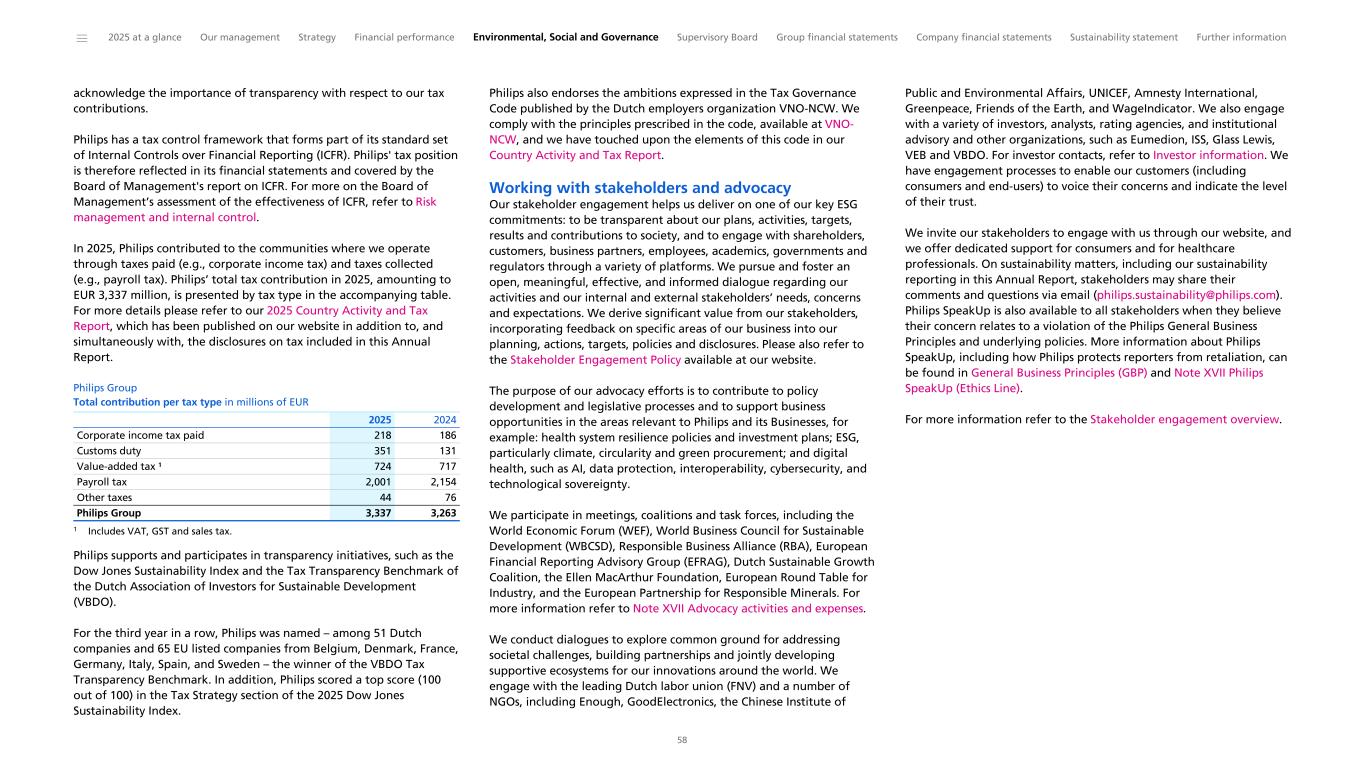
acknowledge the importance of transparency with respect to our tax contributions. Philips has a tax control framework that forms part of its standard set of Internal Controls over Financial Reporting (ICFR). Philips' tax position is therefore reflected in its financial statements and covered by the Board of Management's report on ICFR. For more on the Board of Management’s assessment of the effectiveness of ICFR, refer to Risk management and internal control. In 2025, Philips contributed to the communities where we operate through taxes paid (e.g., corporate income tax) and taxes collected (e.g., payroll tax). Philips’ total tax contribution in 2025, amounting to EUR 3,337 million, is presented by tax type in the accompanying table. For more details please refer to our 2025 Country Activity and Tax Report, which has been published on our website in addition to, and simultaneously with, the disclosures on tax included in this Annual Report. Philips Group Total contribution per tax type in millions of EUR 2025 2024 Corporate income tax paid 218 186 Customs duty 351 131 Value-added tax ¹ 724 717 Payroll tax 2,001 2,154 Other taxes 44 76 Philips Group 3,337 3,263 1 Includes VAT, GST and sales tax. Philips supports and participates in transparency initiatives, such as the Dow Jones Sustainability Index and the Tax Transparency Benchmark of the Dutch Association of Investors for Sustainable Development (VBDO). For the third year in a row, Philips was named – among 51 Dutch companies and 65 EU listed companies from Belgium, Denmark, France, Germany, Italy, Spain, and Sweden – the winner of the VBDO Tax Transparency Benchmark. In addition, Philips scored a top score (100 out of 100) in the Tax Strategy section of the 2025 Dow Jones Sustainability Index. Philips also endorses the ambitions expressed in the Tax Governance Code published by the Dutch employers organization VNO-NCW. We comply with the principles prescribed in the code, available at VNO- NCW, and we have touched upon the elements of this code in our Country Activity and Tax Report. Working with stakeholders and advocacy Our stakeholder engagement helps us deliver on one of our key ESG commitments: to be transparent about our plans, activities, targets, results and contributions to society, and to engage with shareholders, customers, business partners, employees, academics, governments and regulators through a variety of platforms. We pursue and foster an open, meaningful, effective, and informed dialogue regarding our activities and our internal and external stakeholders’ needs, concerns and expectations. We derive significant value from our stakeholders, incorporating feedback on specific areas of our business into our planning, actions, targets, policies and disclosures. Please also refer to the Stakeholder Engagement Policy available at our website. The purpose of our advocacy efforts is to contribute to policy development and legislative processes and to support business opportunities in the areas relevant to Philips and its Businesses, for example: health system resilience policies and investment plans; ESG, particularly climate, circularity and green procurement; and digital health, such as AI, data protection, interoperability, cybersecurity, and technological sovereignty. We participate in meetings, coalitions and task forces, including the World Economic Forum (WEF), World Business Council for Sustainable Development (WBCSD), Responsible Business Alliance (RBA), European Financial Reporting Advisory Group (EFRAG), Dutch Sustainable Growth Coalition, the Ellen MacArthur Foundation, European Round Table for Industry, and the European Partnership for Responsible Minerals. For more information refer to Note XVII Advocacy activities and expenses. We conduct dialogues to explore common ground for addressing societal challenges, building partnerships and jointly developing supportive ecosystems for our innovations around the world. We engage with the leading Dutch labor union (FNV) and a number of NGOs, including Enough, GoodElectronics, the Chinese Institute of Public and Environmental Affairs, UNICEF, Amnesty International, Greenpeace, Friends of the Earth, and WageIndicator. We also engage with a variety of investors, analysts, rating agencies, and institutional advisory and other organizations, such as Eumedion, ISS, Glass Lewis, VEB and VBDO. For investor contacts, refer to Investor information. We have engagement processes to enable our customers (including consumers and end-users) to voice their concerns and indicate the level of their trust. We invite our stakeholders to engage with us through our website, and we offer dedicated support for consumers and for healthcare professionals. On sustainability matters, including our sustainability reporting in this Annual Report, stakeholders may share their comments and questions via email (philips.sustainability@philips.com). Philips SpeakUp is also available to all stakeholders when they believe their concern relates to a violation of the Philips General Business Principles and underlying policies. More information about Philips SpeakUp, including how Philips protects reporters from retaliation, can be found in General Business Principles (GBP) and Note XVII Philips SpeakUp (Ethics Line). For more information refer to the Stakeholder engagement overview. ______ 2025 at a glance Our management Strategy Financial performance Environmental, Social and Governance Supervisory Board Group financial statements Company financial statements Sustainability statement Further information 58
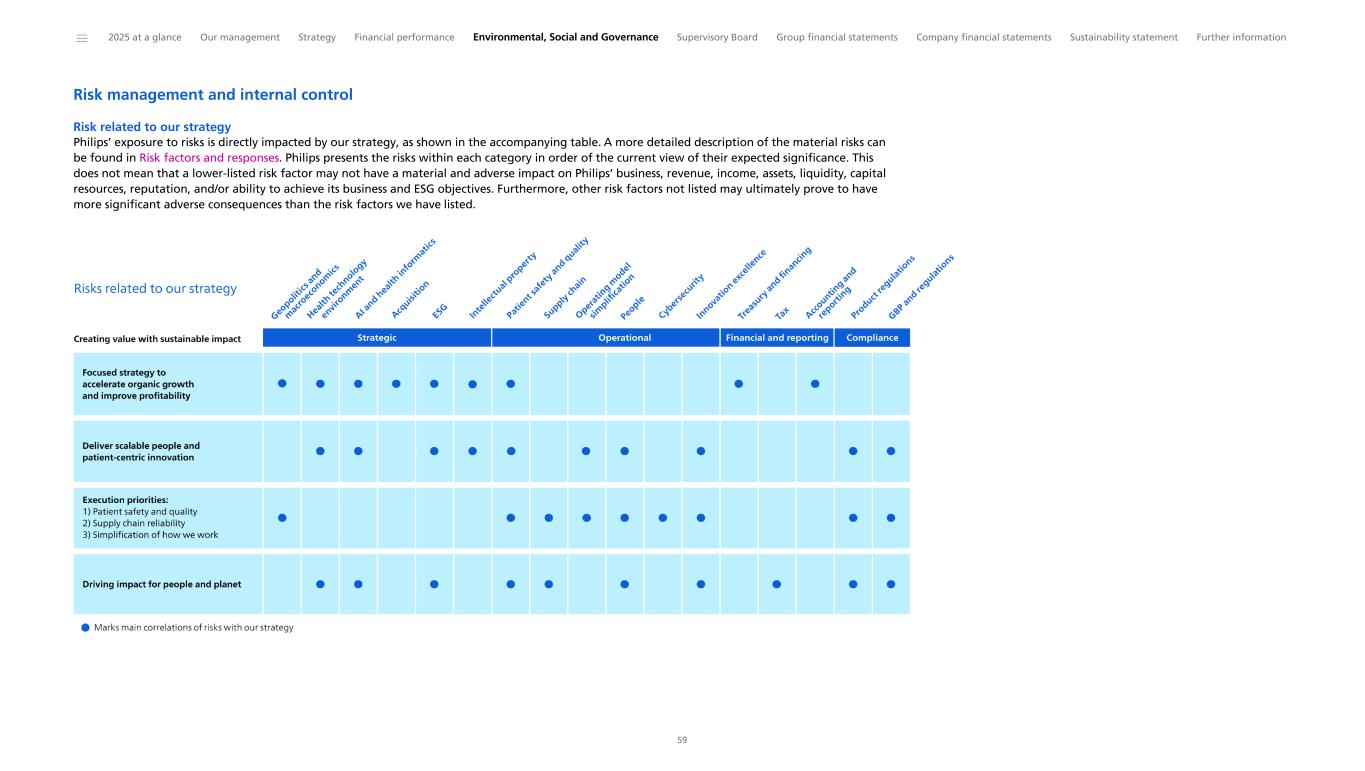
Risk management and internal control Risk related to our strategy Philips’ exposure to risks is directly impacted by our strategy, as shown in the accompanying table. A more detailed description of the material risks can be found in Risk factors and responses. Philips presents the risks within each category in order of the current view of their expected significance. This does not mean that a lower-listed risk factor may not have a material and adverse impact on Philips’ business, revenue, income, assets, liquidity, capital resources, reputation, and/or ability to achieve its business and ESG objectives. Furthermore, other risk factors not listed may ultimately prove to have more significant adverse consequences than the risk factors we have listed. ______ 2025 at a glance Our management Strategy Financial performance Environmental, Social and Governance Supervisory Board Group financial statements Company financial statements Sustainability statement Further information 59
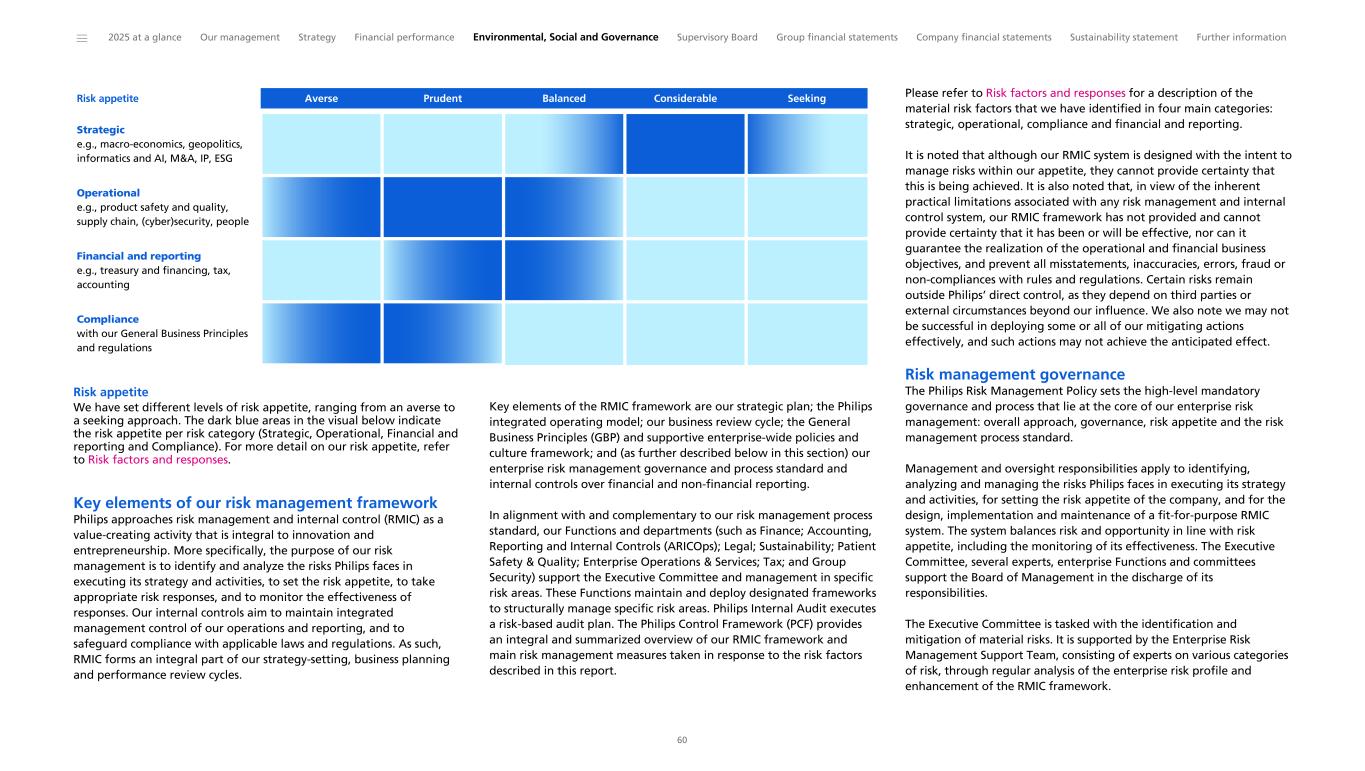
Risk appetite Averse Prudent Balanced Considerable Seeking Strategic e.g., macro-economics, geopolitics, informatics and AI, M&A, IP, ESG Operational e.g., product safety and quality, supply chain, (cyber)security, people Financial and reporting e.g., treasury and financing, tax, accounting Compliance with our General Business Principles and regulations Risk appetite We have set different levels of risk appetite, ranging from an averse to a seeking approach. The dark blue areas in the visual below indicate the risk appetite per risk category (Strategic, Operational, Financial and reporting and Compliance). For more detail on our risk appetite, refer to Risk factors and responses. Key elements of our risk management framework Philips approaches risk management and internal control (RMIC) as a value-creating activity that is integral to innovation and entrepreneurship. More specifically, the purpose of our risk management is to identify and analyze the risks Philips faces in executing its strategy and activities, to set the risk appetite, to take appropriate risk responses, and to monitor the effectiveness of responses. Our internal controls aim to maintain integrated management control of our operations and reporting, and to safeguard compliance with applicable laws and regulations. As such, RMIC forms an integral part of our strategy-setting, business planning and performance review cycles. Key elements of the RMIC framework are our strategic plan; the Philips integrated operating model; our business review cycle; the General Business Principles (GBP) and supportive enterprise-wide policies and culture framework; and (as further described below in this section) our enterprise risk management governance and process standard and internal controls over financial and non-financial reporting. In alignment with and complementary to our risk management process standard, our Functions and departments (such as Finance; Accounting, Reporting and Internal Controls (ARICOps); Legal; Sustainability; Patient Safety & Quality; Enterprise Operations & Services; Tax; and Group Security) support the Executive Committee and management in specific risk areas. These Functions maintain and deploy designated frameworks to structurally manage specific risk areas. Philips Internal Audit executes a risk-based audit plan. The Philips Control Framework (PCF) provides an integral and summarized overview of our RMIC framework and main risk management measures taken in response to the risk factors described in this report. Please refer to Risk factors and responses for a description of the material risk factors that we have identified in four main categories: strategic, operational, compliance and financial and reporting. It is noted that although our RMIC system is designed with the intent to manage risks within our appetite, they cannot provide certainty that this is being achieved. It is also noted that, in view of the inherent practical limitations associated with any risk management and internal control system, our RMIC framework has not provided and cannot provide certainty that it has been or will be effective, nor can it guarantee the realization of the operational and financial business objectives, and prevent all misstatements, inaccuracies, errors, fraud or non-compliances with rules and regulations. Certain risks remain outside Philips’ direct control, as they depend on third parties or external circumstances beyond our influence. We also note we may not be successful in deploying some or all of our mitigating actions effectively, and such actions may not achieve the anticipated effect. Risk management governance The Philips Risk Management Policy sets the high-level mandatory governance and process that lie at the core of our enterprise risk management: overall approach, governance, risk appetite and the risk management process standard. Management and oversight responsibilities apply to identifying, analyzing and managing the risks Philips faces in executing its strategy and activities, for setting the risk appetite of the company, and for the design, implementation and maintenance of a fit-for-purpose RMIC system. The system balances risk and opportunity in line with risk appetite, including the monitoring of its effectiveness. The Executive Committee, several experts, enterprise Functions and committees support the Board of Management in the discharge of its responsibilities. The Executive Committee is tasked with the identification and mitigation of material risks. It is supported by the Enterprise Risk Management Support Team, consisting of experts on various categories of risk, through regular analysis of the enterprise risk profile and enhancement of the RMIC framework. ______ 2025 at a glance Our management Strategy Financial performance Environmental, Social and Governance Supervisory Board Group financial statements Company financial statements Sustainability statement Further information 60
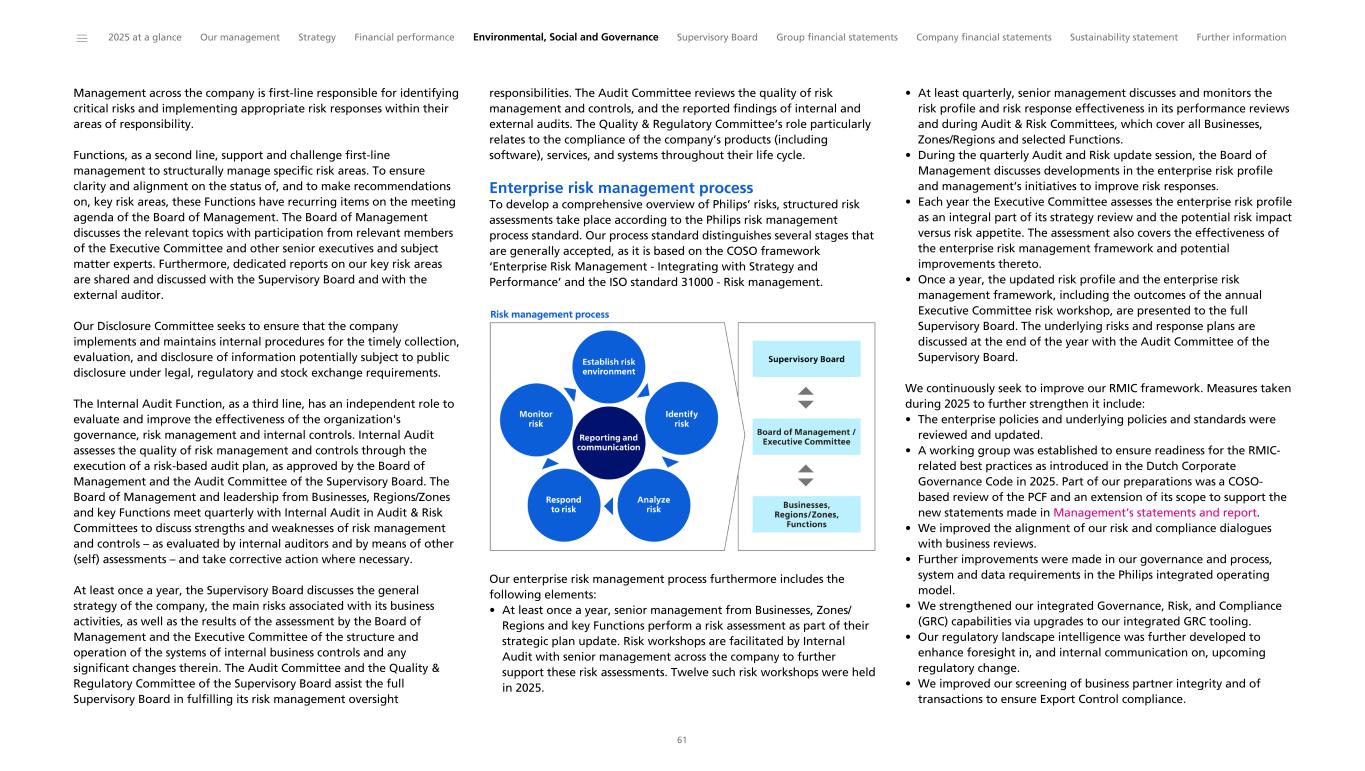
Management across the company is first-line responsible for identifying critical risks and implementing appropriate risk responses within their areas of responsibility. Functions, as a second line, support and challenge first-line management to structurally manage specific risk areas. To ensure clarity and alignment on the status of, and to make recommendations on, key risk areas, these Functions have recurring items on the meeting agenda of the Board of Management. The Board of Management discusses the relevant topics with participation from relevant members of the Executive Committee and other senior executives and subject matter experts. Furthermore, dedicated reports on our key risk areas are shared and discussed with the Supervisory Board and with the external auditor. Our Disclosure Committee seeks to ensure that the company implements and maintains internal procedures for the timely collection, evaluation, and disclosure of information potentially subject to public disclosure under legal, regulatory and stock exchange requirements. The Internal Audit Function, as a third line, has an independent role to evaluate and improve the effectiveness of the organization's governance, risk management and internal controls. Internal Audit assesses the quality of risk management and controls through the execution of a risk-based audit plan, as approved by the Board of Management and the Audit Committee of the Supervisory Board. The Board of Management and leadership from Businesses, Regions/Zones and key Functions meet quarterly with Internal Audit in Audit & Risk Committees to discuss strengths and weaknesses of risk management and controls – as evaluated by internal auditors and by means of other (self) assessments – and take corrective action where necessary. At least once a year, the Supervisory Board discusses the general strategy of the company, the main risks associated with its business activities, as well as the results of the assessment by the Board of Management and the Executive Committee of the structure and operation of the systems of internal business controls and any significant changes therein. The Audit Committee and the Quality & Regulatory Committee of the Supervisory Board assist the full Supervisory Board in fulfilling its risk management oversight responsibilities. The Audit Committee reviews the quality of risk management and controls, and the reported findings of internal and external audits. The Quality & Regulatory Committee’s role particularly relates to the compliance of the company’s products (including software), services, and systems throughout their life cycle. Enterprise risk management process To develop a comprehensive overview of Philips’ risks, structured risk assessments take place according to the Philips risk management process standard. Our process standard distinguishes several stages that are generally accepted, as it is based on the COSO framework ‘Enterprise Risk Management - Integrating with Strategy and Performance’ and the ISO standard 31000 - Risk management. Our enterprise risk management process furthermore includes the following elements: • At least once a year, senior management from Businesses, Zones/ Regions and key Functions perform a risk assessment as part of their strategic plan update. Risk workshops are facilitated by Internal Audit with senior management across the company to further support these risk assessments. Twelve such risk workshops were held in 2025. • At least quarterly, senior management discusses and monitors the risk profile and risk response effectiveness in its performance reviews and during Audit & Risk Committees, which cover all Businesses, Zones/Regions and selected Functions. • During the quarterly Audit and Risk update session, the Board of Management discusses developments in the enterprise risk profile and management’s initiatives to improve risk responses. • Each year the Executive Committee assesses the enterprise risk profile as an integral part of its strategy review and the potential risk impact versus risk appetite. The assessment also covers the effectiveness of the enterprise risk management framework and potential improvements thereto. • Once a year, the updated risk profile and the enterprise risk management framework, including the outcomes of the annual Executive Committee risk workshop, are presented to the full Supervisory Board. The underlying risks and response plans are discussed at the end of the year with the Audit Committee of the Supervisory Board. We continuously seek to improve our RMIC framework. Measures taken during 2025 to further strengthen it include: • The enterprise policies and underlying policies and standards were reviewed and updated. • A working group was established to ensure readiness for the RMIC- related best practices as introduced in the Dutch Corporate Governance Code in 2025. Part of our preparations was a COSO- based review of the PCF and an extension of its scope to support the new statements made in Management’s statements and report. • We improved the alignment of our risk and compliance dialogues with business reviews. • Further improvements were made in our governance and process, system and data requirements in the Philips integrated operating model. • We strengthened our integrated Governance, Risk, and Compliance (GRC) capabilities via upgrades to our integrated GRC tooling. • Our regulatory landscape intelligence was further developed to enhance foresight in, and internal communication on, upcoming regulatory change. • We improved our screening of business partner integrity and of transactions to ensure Export Control compliance. ______ 2025 at a glance Our management Strategy Financial performance Environmental, Social and Governance Supervisory Board Group financial statements Company financial statements Sustainability statement Further information 61
• Improved master data facilitated sustainability reporting and several other types of data automation, relating to (among others) VAT and customs, and product regulations. • We continued our analysis of global warming and weather scenarios against the geographical footprint of our facilities as well as suppliers’ base, in line with the recommendations of the Task Force on Climate-Related Financial Disclosures. Financial reporting and sustainability reporting As part of its RMIC framework, Philips has implemented a standard set of Internal Controls over Financial Reporting (ICFR). Philips has designed its ICFR framework based on the COSO Internal Control- Integrated Framework (2013). Together with Philips' established accounting procedures, this standard control framework is designed to provide reasonable assurance that assets are safeguarded, that the books and records properly reflect transactions necessary to permit preparation of financial statements, that policies and procedures are carried out by qualified personnel, and that published financial statements are properly prepared and do not contain any material misstatements. Since 2012, we have been engaging external auditors to issue reports on our sustainability information. Originally, the sustainability reporting and the audit thereof were referencing GRI Universal Standards and Philips-specific criteria. This is the second year that the sustainability statement included in our Annual Report has been written to comply with disclosure requirements of the European Sustainability Reporting Standards (ESRS), although the Corporate Sustainability Reporting Directive ((EU) 2022/2464) has not been implemented into Dutch law yet. To develop our controls for sustainability reporting we are leveraging the established ICFR framework and processes. Philips continued further development of an Internal Control over Sustainability Reporting (ICSR) framework and included sustainability-related risks in our risk management processes. New sustainability-related controls continue to be deployed for internal and external sustainability reporting. A structured monitoring process is deployed company-wide to assess, document, review and monitor compliance within ICFR and (as it continues to evolve and mature) ICSR. Management of each relevant reporting unit is responsible for assessing the effectiveness of controls applicable to their business, risk profile, and operations. Where required by the governance framework, this includes completing an in- control statement or equivalent certification process. Deficiencies noted in the design and/or operating effectiveness of ICFR that were not remediated at year-end are reviewed by the Board of Management and the outcome is reported to the Supervisory Board. The Board of Management’s statements, including its conclusions regarding the effectiveness of our RMIC framework and its report on ICFR, can be found in Management’s statements and report. ______ 2025 at a glance Our management Strategy Financial performance Environmental, Social and Governance Supervisory Board Group financial statements Company financial statements Sustainability statement Further information 62
Supervisory Board ______ 2025 at a glance Our management Strategy Financial performance Environmental, Social and Governance Supervisory Board Group financial statements Company financial statements Sustainability statement Further information 63
Letter from the Chairman of the Supervisory Board Dear stakeholder, Philips has much to look forward to, but for the moment, I would like to look back. Look back at the past three years of Philips’ plan to create value with sustainable impact. And reflect on the evolution of a company that has, in recent years, taken its place among the leaders in the healthcare industry across the globe. Philips has built on its strengths in innovation, to develop and expand a portfolio of patient- and people-centric innovations in hardware, software, AI and services, supporting care in the hospital and in the home. It has also made significant progress on its execution priorities – patient safety and quality, supply chain resilience, and operational simplification. This period has not been without its challenges: not only a competitive healthtech landscape but also the Respironics recall and litigation in the US. And of course there is the volatile geopolitical environment, particularly in the past year. Philips has a strong presence in both the US and China, two places where local-first policies can have a large impact on supply chains and our manufacturing footprint. And conflicts and political climates make logistics difficult in other locations. That’s why Philips has supported global trade in a multilateral framework that allows operating as efficiently as possible. On the Supervisory Board, we have witnessed how the company's leadership has been carefully monitoring these challenges, and actively addressing them through collaboration and advocacy, as well as strategic planning. In this challenging climate, Philips has delivered on its plan to create value out of its portfolio of leadership positions by driving operational improvements and scaling innovation leadership. As we close the book on the three-year plan, it is notable that Philips: • Developed a stronger leadership team with deeper medtech experience • Established a culture shift to ‘impact with care’ • Reduced its operational carbon footprint compared to the baseline 2020 • Made significant progress on simplification to increase efficiency • Announced innovations in AI-enabled technology and acquired SpectraWAVE, helping deliver better care for more people Learn more in Strategy u and Business u The Supervisory Board sees accompanying improvements in the financial results. For example, Philips’ sales and order intake grew consistently, and the company achieved margin expansion throughout the year, reflecting strong demand for its innovations and operational discipline. Read more in Financial performance u As explained in more detail in the Supervisory Board report, our focus in 2025 was on patient safety and quality, performance and outlook, value acceleration and succession planning. Of note is that the Remuneration Committee of the Supervisory Board has been monitoring the target levels for the Long-Term Incentive for the Board of Management. More broadly, the Remuneration Committee intends to evaluate the Remuneration Policy for the Board of Management in the course of 2026, which may result in proposals to revise the Remuneration Policy. At the Annual General Meeting of Shareholders in May 2025, the Supervisory Board took the opportunity to thank David Pyott for his commitment and service to the board for the past 10 years, and we welcomed our new member, Bob White. Now, looking to the future. The Supervisory Board remains fully committed to its responsibilities to supervise and advise management in leading the company toward a future of progressive value creation with sustainable impact. Together with my fellow members of the board, I express my full confidence in CEO Roy Jakobs and the rest of the Philips Executive Committee. We will propose Roy’s reappointment as our CEO at the upcoming Annual General Meeting of Shareholders 2026. Under his leadership, the company enters the next phase of its strategy, aiming to deliver on the 2026-2028 outlook and pursuing the 2030 Impact Ambitions. Together we can build upon the company’s strong foundation, and the Supervisory Board looks forward to providing continued oversight as Philips delivers on its purpose of improving people’s health and well- being through meaningful innovation. Thank you to our shareholders and key partners for your support. Feike Sijbesma Chairman of the Supervisory Board ______ 2025 at a glance Our management Strategy Financial performance Environmental, Social and Governance Supervisory Board Group financial statements Company financial statements Sustainability statement Further information 64
Members of the Supervisory Board In the two-tier corporate structure under Dutch law, the Supervisory Board is a separate body that is independent of the Board of Management and the company. The Supervisory Board supervises the policies, management and general affairs of Philips, and assists the Board of Management and the Executive Committee with advice where required or requested. Please also refer to Supervisory Board within the company's Corporate governance report. Feike Sijbesma 2 3 Born 1959, Dutch Chairman of the Supervisory Board since May 2021 Chairman of the Corporate Governance and Nomination & Selection Committee Member of the Supervisory Board since 2020; second term expires in 2028 Former CEO of Koninklijke DSM N.V. (Honorary Chairman), non- executive Director of Unilever N.V., member of the Supervisory Board of Dutch Central Bank and of Utrecht University. Currently Co-Chair of the Global Climate Adaptation Center and Member of the Board of Trustees of the World Economic Forum. 1 Member of the Audit Committee 2 Member of the Remuneration Committee 3 Member of the Corporate Governance and Nomination & Selection Committee 4 Member of the Quality & Regulatory Committee Chua Sock Koong 1 Born 1957, Singaporean Member of the Supervisory Board since 2021; second term expires in 2029 Former Group CEO of Singapore Telecommunications Limited and currently member of the Board of Directors of Prudential plc, Bharti Airtel Limited, Bharti Telecom Limited and Ayala Corporation. Member of the Council of Presidential Advisors of Singapore, the Securities Industry Council and the Dubai Financial Services Authority, Deputy Chairman of the Public Service Commission of Singapore. Liz Doherty 1 Born 1957, British/Irish Chairwoman of the Audit Committee Member of the Supervisory Board since 2019; second term expires in 2027 Member of the Supervisory Board and Chairwoman of the audit committee of Novartis AG and of Corbion N.V. Member of the advisory committee of Freya Holdco S.à r.l. Fellow of the Chartered Institute of Management Accountants. Former CFO and board member of Reckitt Benckiser Group PLC, former CFO of Brambles Ltd, former non-executive director and audit committee member at Delhaize Group, Nokia Corp., SABMiller PLC and Dunelm Group PLC. Former non-executive board member of the UK Ministry of Justice and of Her Majesty’s Courts and Tribunals Service (UK) and advisor to GBfoods SA and Affinity Petcare SA (subsidiaries of Agrolimen SA). Marc Harrison 4 Born 1964, American Member of the Supervisory Board since 2018; second term expires in 2026 Former President and Chief Executive Officer of Intermountain Healthcare, former Chief of International Business Development for Cleveland Clinic, former Chief Executive Officer of Cleveland Clinic Abu Dhabi, and co-Founder and former CEO of HATCo (Health Assurance Transformation Company) at General Catalyst. Currently Chair of TowerBrook Healthcare Institute, Senior Advisor of TowerBrook Capital Partners and Strategic Advisor of General Catalyst. Peter Löscher 1 4 Born 1957, Austrian Member of the Supervisory Board since 2020; second term expires in 2028 Former President and CEO of Siemens AG, President of Global Human Health and Member of the Executive Board of Merck & Co., President and CEO of GE Healthcare Bio-Sciences and member of GE’s Corporate Executive Council, CEO and Delegate of the Board of Directors of Renova Management AG. Currently member of the Board of Directors of Telefónica S.A. and CaixaBank S.A. and Chairman of the Supervisory Board of Telefónica Deutschland Holding AG, Non- Executive Director of Thyssen-Bornemisza Group AG. ______ 2025 at a glance Our management Strategy Financial performance Environmental, Social and Governance Supervisory Board Group financial statements Company financial statements Sustainability statement Further information 65
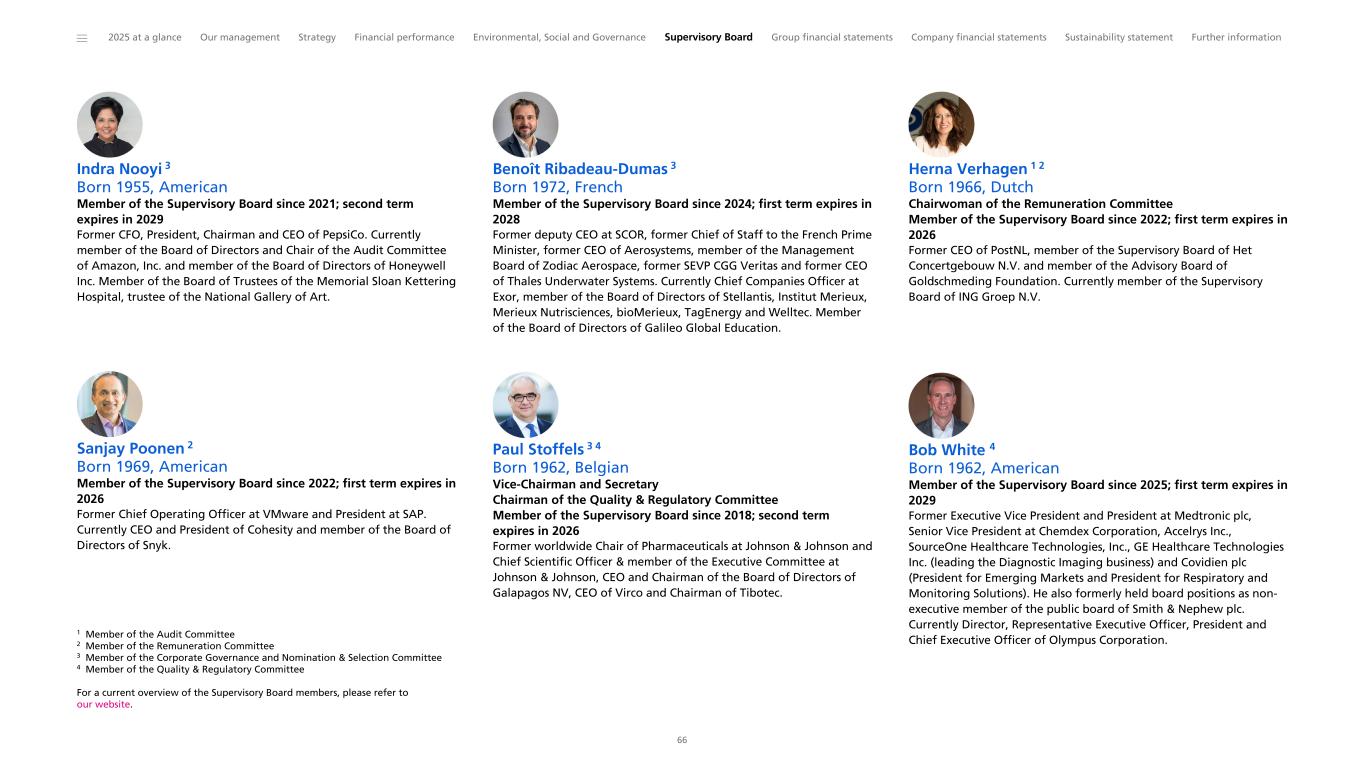
Indra Nooyi 3 Born 1955, American Member of the Supervisory Board since 2021; second term expires in 2029 Former CFO, President, Chairman and CEO of PepsiCo. Currently member of the Board of Directors and Chair of the Audit Committee of Amazon, Inc. and member of the Board of Directors of Honeywell Inc. Member of the Board of Trustees of the Memorial Sloan Kettering Hospital, trustee of the National Gallery of Art. Sanjay Poonen 2 Born 1969, American Member of the Supervisory Board since 2022; first term expires in 2026 Former Chief Operating Officer at VMware and President at SAP. Currently CEO and President of Cohesity and member of the Board of Directors of Snyk. 1 Member of the Audit Committee 2 Member of the Remuneration Committee 3 Member of the Corporate Governance and Nomination & Selection Committee 4 Member of the Quality & Regulatory Committee For a current overview of the Supervisory Board members, please refer to our website. Benoît Ribadeau-Dumas 3 Born 1972, French Member of the Supervisory Board since 2024; first term expires in 2028 Former deputy CEO at SCOR, former Chief of Staff to the French Prime Minister, former CEO of Aerosystems, member of the Management Board of Zodiac Aerospace, former SEVP CGG Veritas and former CEO of Thales Underwater Systems. Currently Chief Companies Officer at Exor, member of the Board of Directors of Stellantis, Institut Merieux, Merieux Nutrisciences, bioMerieux, TagEnergy and Welltec. Member of the Board of Directors of Galileo Global Education. Paul Stoffels 3 4 Born 1962, Belgian Vice-Chairman and Secretary Chairman of the Quality & Regulatory Committee Member of the Supervisory Board since 2018; second term expires in 2026 Former worldwide Chair of Pharmaceuticals at Johnson & Johnson and Chief Scientific Officer & member of the Executive Committee at Johnson & Johnson, CEO and Chairman of the Board of Directors of Galapagos NV, CEO of Virco and Chairman of Tibotec. Herna Verhagen 1 2 Born 1966, Dutch Chairwoman of the Remuneration Committee Member of the Supervisory Board since 2022; first term expires in 2026 Former CEO of PostNL, member of the Supervisory Board of Het Concertgebouw N.V. and member of the Advisory Board of Goldschmeding Foundation. Currently member of the Supervisory Board of ING Groep N.V. Bob White 4 Born 1962, American Member of the Supervisory Board since 2025; first term expires in 2029 Former Executive Vice President and President at Medtronic plc, Senior Vice President at Chemdex Corporation, Accelrys Inc., SourceOne Healthcare Technologies, Inc., GE Healthcare Technologies Inc. (leading the Diagnostic Imaging business) and Covidien plc (President for Emerging Markets and President for Respiratory and Monitoring Solutions). He also formerly held board positions as non- executive member of the public board of Smith & Nephew plc. Currently Director, Representative Executive Officer, President and Chief Executive Officer of Olympus Corporation. ______ 2025 at a glance Our management Strategy Financial performance Environmental, Social and Governance Supervisory Board Group financial statements Company financial statements Sustainability statement Further information 66
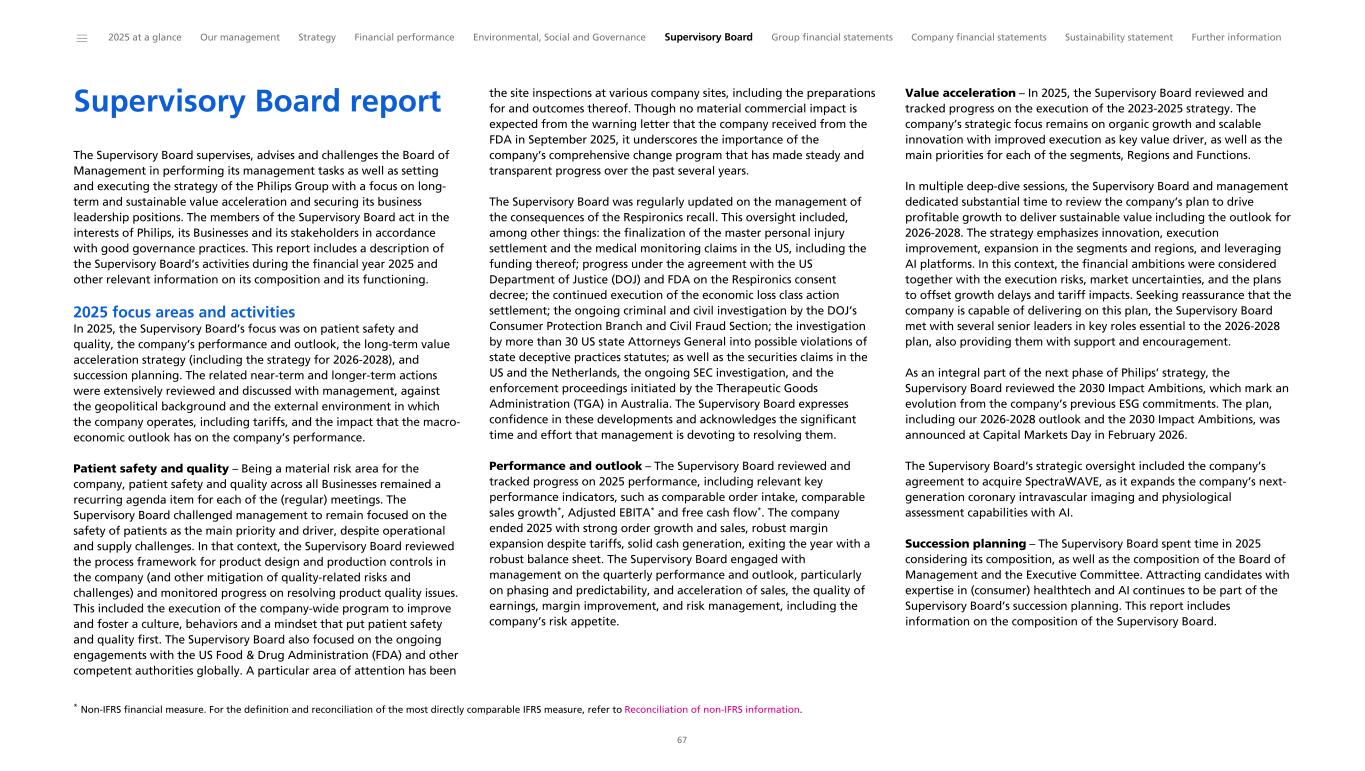
Supervisory Board report The Supervisory Board supervises, advises and challenges the Board of Management in performing its management tasks as well as setting and executing the strategy of the Philips Group with a focus on long- term and sustainable value acceleration and securing its business leadership positions. The members of the Supervisory Board act in the interests of Philips, its Businesses and its stakeholders in accordance with good governance practices. This report includes a description of the Supervisory Board’s activities during the financial year 2025 and other relevant information on its composition and its functioning. 2025 focus areas and activities In 2025, the Supervisory Board’s focus was on patient safety and quality, the company’s performance and outlook, the long-term value acceleration strategy (including the strategy for 2026-2028), and succession planning. The related near-term and longer-term actions were extensively reviewed and discussed with management, against the geopolitical background and the external environment in which the company operates, including tariffs, and the impact that the macro- economic outlook has on the company’s performance. Patient safety and quality – Being a material risk area for the company, patient safety and quality across all Businesses remained a recurring agenda item for each of the (regular) meetings. The Supervisory Board challenged management to remain focused on the safety of patients as the main priority and driver, despite operational and supply challenges. In that context, the Supervisory Board reviewed the process framework for product design and production controls in the company (and other mitigation of quality-related risks and challenges) and monitored progress on resolving product quality issues. This included the execution of the company-wide program to improve and foster a culture, behaviors and a mindset that put patient safety and quality first. The Supervisory Board also focused on the ongoing engagements with the US Food & Drug Administration (FDA) and other competent authorities globally. A particular area of attention has been the site inspections at various company sites, including the preparations for and outcomes thereof. Though no material commercial impact is expected from the warning letter that the company received from the FDA in September 2025, it underscores the importance of the company’s comprehensive change program that has made steady and transparent progress over the past several years. The Supervisory Board was regularly updated on the management of the consequences of the Respironics recall. This oversight included, among other things: the finalization of the master personal injury settlement and the medical monitoring claims in the US, including the funding thereof; progress under the agreement with the US Department of Justice (DOJ) and FDA on the Respironics consent decree; the continued execution of the economic loss class action settlement; the ongoing criminal and civil investigation by the DOJ’s Consumer Protection Branch and Civil Fraud Section; the investigation by more than 30 US state Attorneys General into possible violations of state deceptive practices statutes; as well as the securities claims in the US and the Netherlands, the ongoing SEC investigation, and the enforcement proceedings initiated by the Therapeutic Goods Administration (TGA) in Australia. The Supervisory Board expresses confidence in these developments and acknowledges the significant time and effort that management is devoting to resolving them. Performance and outlook – The Supervisory Board reviewed and tracked progress on 2025 performance, including relevant key performance indicators, such as comparable order intake, comparable sales growth*, Adjusted EBITA* and free cash flow*. The company ended 2025 with strong order growth and sales, robust margin expansion despite tariffs, solid cash generation, exiting the year with a robust balance sheet. The Supervisory Board engaged with management on the quarterly performance and outlook, particularly on phasing and predictability, and acceleration of sales, the quality of earnings, margin improvement, and risk management, including the company’s risk appetite. Value acceleration – In 2025, the Supervisory Board reviewed and tracked progress on the execution of the 2023-2025 strategy. The company’s strategic focus remains on organic growth and scalable innovation with improved execution as key value driver, as well as the main priorities for each of the segments, Regions and Functions. In multiple deep-dive sessions, the Supervisory Board and management dedicated substantial time to review the company’s plan to drive profitable growth to deliver sustainable value including the outlook for 2026-2028. The strategy emphasizes innovation, execution improvement, expansion in the segments and regions, and leveraging AI platforms. In this context, the financial ambitions were considered together with the execution risks, market uncertainties, and the plans to offset growth delays and tariff impacts. Seeking reassurance that the company is capable of delivering on this plan, the Supervisory Board met with several senior leaders in key roles essential to the 2026-2028 plan, also providing them with support and encouragement. As an integral part of the next phase of Philips’ strategy, the Supervisory Board reviewed the 2030 Impact Ambitions, which mark an evolution from the company’s previous ESG commitments. The plan, including our 2026-2028 outlook and the 2030 Impact Ambitions, was announced at Capital Markets Day in February 2026. The Supervisory Board’s strategic oversight included the company’s agreement to acquire SpectraWAVE, as it expands the company’s next- generation coronary intravascular imaging and physiological assessment capabilities with AI. Succession planning – The Supervisory Board spent time in 2025 considering its composition, as well as the composition of the Board of Management and the Executive Committee. Attracting candidates with expertise in (consumer) healthtech and AI continues to be part of the Supervisory Board’s succession planning. This report includes information on the composition of the Supervisory Board. ______ 2025 at a glance Our management Strategy Financial performance Environmental, Social and Governance Supervisory Board Group financial statements Company financial statements Sustainability statement Further information 67 * Non-IFRS financial measure. For the definition and reconciliation of the most directly comparable IFRS measure, refer to Reconciliation of non-IFRS information.
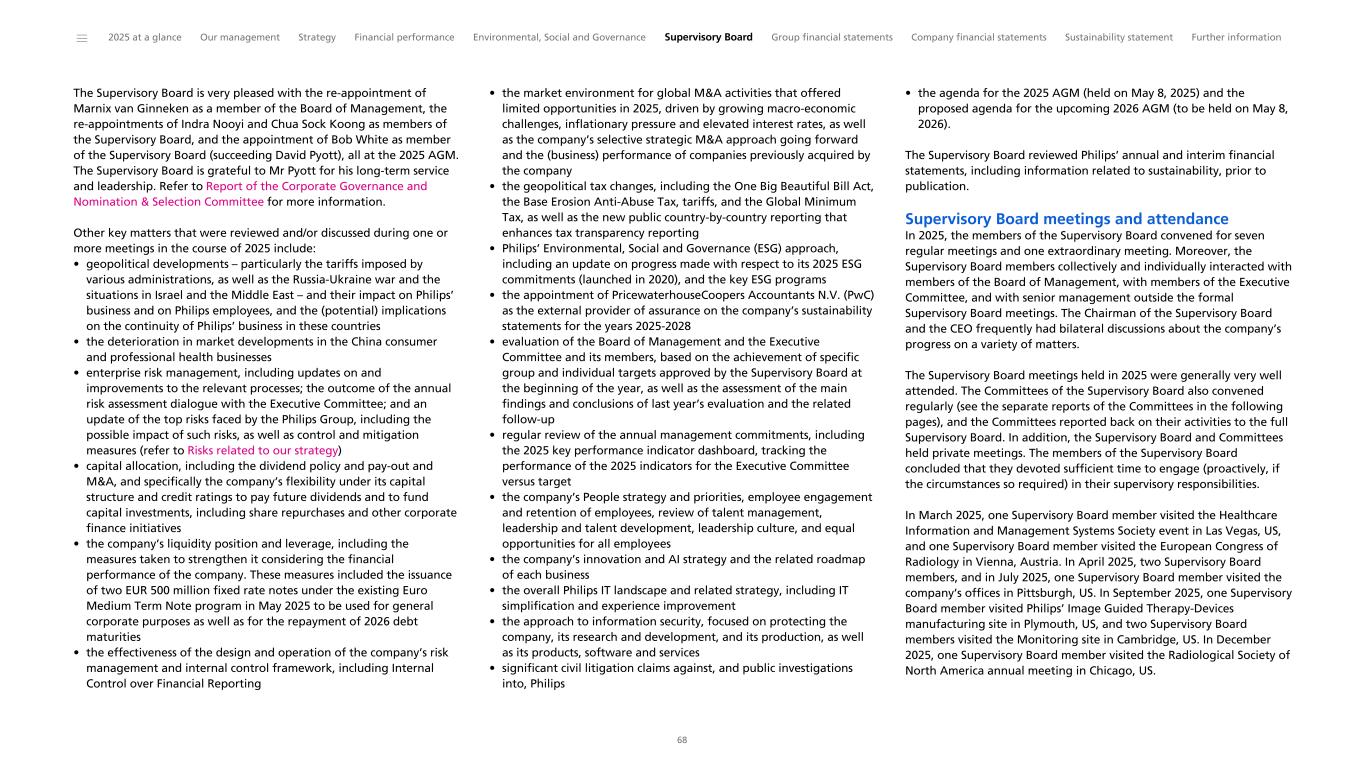
The Supervisory Board is very pleased with the re-appointment of Marnix van Ginneken as a member of the Board of Management, the re-appointments of Indra Nooyi and Chua Sock Koong as members of the Supervisory Board, and the appointment of Bob White as member of the Supervisory Board (succeeding David Pyott), all at the 2025 AGM. The Supervisory Board is grateful to Mr Pyott for his long-term service and leadership. Refer to Report of the Corporate Governance and Nomination & Selection Committee for more information. Other key matters that were reviewed and/or discussed during one or more meetings in the course of 2025 include: • geopolitical developments – particularly the tariffs imposed by various administrations, as well as the Russia-Ukraine war and the situations in Israel and the Middle East – and their impact on Philips’ business and on Philips employees, and the (potential) implications on the continuity of Philips’ business in these countries • the deterioration in market developments in the China consumer and professional health businesses • enterprise risk management, including updates on and improvements to the relevant processes; the outcome of the annual risk assessment dialogue with the Executive Committee; and an update of the top risks faced by the Philips Group, including the possible impact of such risks, as well as control and mitigation measures (refer to Risks related to our strategy) • capital allocation, including the dividend policy and pay-out and M&A, and specifically the company’s flexibility under its capital structure and credit ratings to pay future dividends and to fund capital investments, including share repurchases and other corporate finance initiatives • the company’s liquidity position and leverage, including the measures taken to strengthen it considering the financial performance of the company. These measures included the issuance of two EUR 500 million fixed rate notes under the existing Euro Medium Term Note program in May 2025 to be used for general corporate purposes as well as for the repayment of 2026 debt maturities • the effectiveness of the design and operation of the company’s risk management and internal control framework, including Internal Control over Financial Reporting • the market environment for global M&A activities that offered limited opportunities in 2025, driven by growing macro-economic challenges, inflationary pressure and elevated interest rates, as well as the company’s selective strategic M&A approach going forward and the (business) performance of companies previously acquired by the company • the geopolitical tax changes, including the One Big Beautiful Bill Act, the Base Erosion Anti-Abuse Tax, tariffs, and the Global Minimum Tax, as well as the new public country-by-country reporting that enhances tax transparency reporting • Philips’ Environmental, Social and Governance (ESG) approach, including an update on progress made with respect to its 2025 ESG commitments (launched in 2020), and the key ESG programs • the appointment of PricewaterhouseCoopers Accountants N.V. (PwC) as the external provider of assurance on the company’s sustainability statements for the years 2025-2028 • evaluation of the Board of Management and the Executive Committee and its members, based on the achievement of specific group and individual targets approved by the Supervisory Board at the beginning of the year, as well as the assessment of the main findings and conclusions of last year’s evaluation and the related follow-up • regular review of the annual management commitments, including the 2025 key performance indicator dashboard, tracking the performance of the 2025 indicators for the Executive Committee versus target • the company’s People strategy and priorities, employee engagement and retention of employees, review of talent management, leadership and talent development, leadership culture, and equal opportunities for all employees • the company’s innovation and AI strategy and the related roadmap of each business • the overall Philips IT landscape and related strategy, including IT simplification and experience improvement • the approach to information security, focused on protecting the company, its research and development, and its production, as well as its products, software and services • significant civil litigation claims against, and public investigations into, Philips • the agenda for the 2025 AGM (held on May 8, 2025) and the proposed agenda for the upcoming 2026 AGM (to be held on May 8, 2026). The Supervisory Board reviewed Philips’ annual and interim financial statements, including information related to sustainability, prior to publication. Supervisory Board meetings and attendance In 2025, the members of the Supervisory Board convened for seven regular meetings and one extraordinary meeting. Moreover, the Supervisory Board members collectively and individually interacted with members of the Board of Management, with members of the Executive Committee, and with senior management outside the formal Supervisory Board meetings. The Chairman of the Supervisory Board and the CEO frequently had bilateral discussions about the company’s progress on a variety of matters. The Supervisory Board meetings held in 2025 were generally very well attended. The Committees of the Supervisory Board also convened regularly (see the separate reports of the Committees in the following pages), and the Committees reported back on their activities to the full Supervisory Board. In addition, the Supervisory Board and Committees held private meetings. The members of the Supervisory Board concluded that they devoted sufficient time to engage (proactively, if the circumstances so required) in their supervisory responsibilities. In March 2025, one Supervisory Board member visited the Healthcare Information and Management Systems Society event in Las Vegas, US, and one Supervisory Board member visited the European Congress of Radiology in Vienna, Austria. In April 2025, two Supervisory Board members, and in July 2025, one Supervisory Board member visited the company’s offices in Pittsburgh, US. In September 2025, one Supervisory Board member visited Philips’ Image Guided Therapy-Devices manufacturing site in Plymouth, US, and two Supervisory Board members visited the Monitoring site in Cambridge, US. In December 2025, one Supervisory Board member visited the Radiological Society of North America annual meeting in Chicago, US. ______ 2025 at a glance Our management Strategy Financial performance Environmental, Social and Governance Supervisory Board Group financial statements Company financial statements Sustainability statement Further information 68
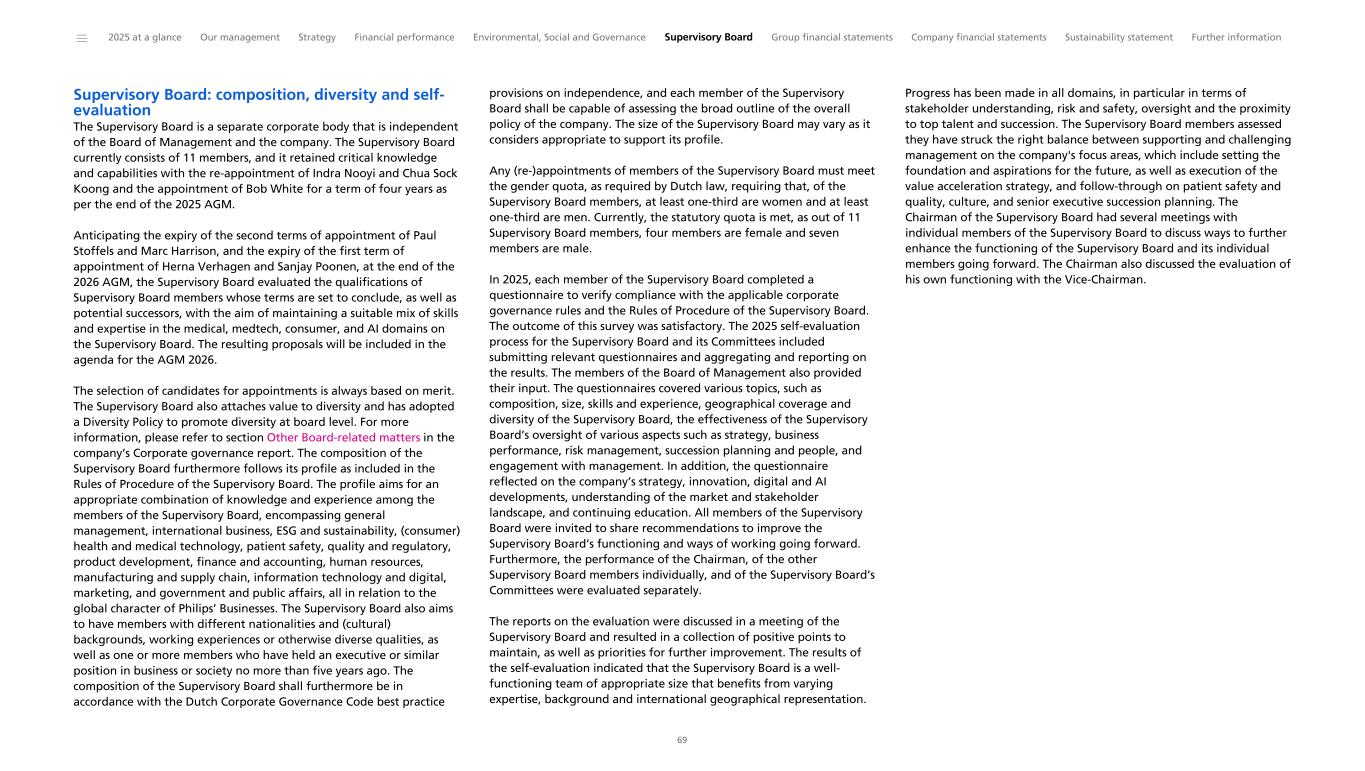
Supervisory Board: composition, diversity and self- evaluation The Supervisory Board is a separate corporate body that is independent of the Board of Management and the company. The Supervisory Board currently consists of 11 members, and it retained critical knowledge and capabilities with the re-appointment of Indra Nooyi and Chua Sock Koong and the appointment of Bob White for a term of four years as per the end of the 2025 AGM. Anticipating the expiry of the second terms of appointment of Paul Stoffels and Marc Harrison, and the expiry of the first term of appointment of Herna Verhagen and Sanjay Poonen, at the end of the 2026 AGM, the Supervisory Board evaluated the qualifications of Supervisory Board members whose terms are set to conclude, as well as potential successors, with the aim of maintaining a suitable mix of skills and expertise in the medical, medtech, consumer, and AI domains on the Supervisory Board. The resulting proposals will be included in the agenda for the AGM 2026. The selection of candidates for appointments is always based on merit. The Supervisory Board also attaches value to diversity and has adopted a Diversity Policy to promote diversity at board level. For more information, please refer to section Other Board-related matters in the company’s Corporate governance report. The composition of the Supervisory Board furthermore follows its profile as included in the Rules of Procedure of the Supervisory Board. The profile aims for an appropriate combination of knowledge and experience among the members of the Supervisory Board, encompassing general management, international business, ESG and sustainability, (consumer) health and medical technology, patient safety, quality and regulatory, product development, finance and accounting, human resources, manufacturing and supply chain, information technology and digital, marketing, and government and public affairs, all in relation to the global character of Philips’ Businesses. The Supervisory Board also aims to have members with different nationalities and (cultural) backgrounds, working experiences or otherwise diverse qualities, as well as one or more members who have held an executive or similar position in business or society no more than five years ago. The composition of the Supervisory Board shall furthermore be in accordance with the Dutch Corporate Governance Code best practice provisions on independence, and each member of the Supervisory Board shall be capable of assessing the broad outline of the overall policy of the company. The size of the Supervisory Board may vary as it considers appropriate to support its profile. Any (re-)appointments of members of the Supervisory Board must meet the gender quota, as required by Dutch law, requiring that, of the Supervisory Board members, at least one-third are women and at least one-third are men. Currently, the statutory quota is met, as out of 11 Supervisory Board members, four members are female and seven members are male. In 2025, each member of the Supervisory Board completed a questionnaire to verify compliance with the applicable corporate governance rules and the Rules of Procedure of the Supervisory Board. The outcome of this survey was satisfactory. The 2025 self-evaluation process for the Supervisory Board and its Committees included submitting relevant questionnaires and aggregating and reporting on the results. The members of the Board of Management also provided their input. The questionnaires covered various topics, such as composition, size, skills and experience, geographical coverage and diversity of the Supervisory Board, the effectiveness of the Supervisory Board’s oversight of various aspects such as strategy, business performance, risk management, succession planning and people, and engagement with management. In addition, the questionnaire reflected on the company’s strategy, innovation, digital and AI developments, understanding of the market and stakeholder landscape, and continuing education. All members of the Supervisory Board were invited to share recommendations to improve the Supervisory Board’s functioning and ways of working going forward. Furthermore, the performance of the Chairman, of the other Supervisory Board members individually, and of the Supervisory Board’s Committees were evaluated separately. The reports on the evaluation were discussed in a meeting of the Supervisory Board and resulted in a collection of positive points to maintain, as well as priorities for further improvement. The results of the self-evaluation indicated that the Supervisory Board is a well- functioning team of appropriate size that benefits from varying expertise, background and international geographical representation. Progress has been made in all domains, in particular in terms of stakeholder understanding, risk and safety, oversight and the proximity to top talent and succession. The Supervisory Board members assessed they have struck the right balance between supporting and challenging management on the company's focus areas, which include setting the foundation and aspirations for the future, as well as execution of the value acceleration strategy, and follow-through on patient safety and quality, culture, and senior executive succession planning. The Chairman of the Supervisory Board had several meetings with individual members of the Supervisory Board to discuss ways to further enhance the functioning of the Supervisory Board and its individual members going forward. The Chairman also discussed the evaluation of his own functioning with the Vice-Chairman. ______ 2025 at a glance Our management Strategy Financial performance Environmental, Social and Governance Supervisory Board Group financial statements Company financial statements Sustainability statement Further information 69
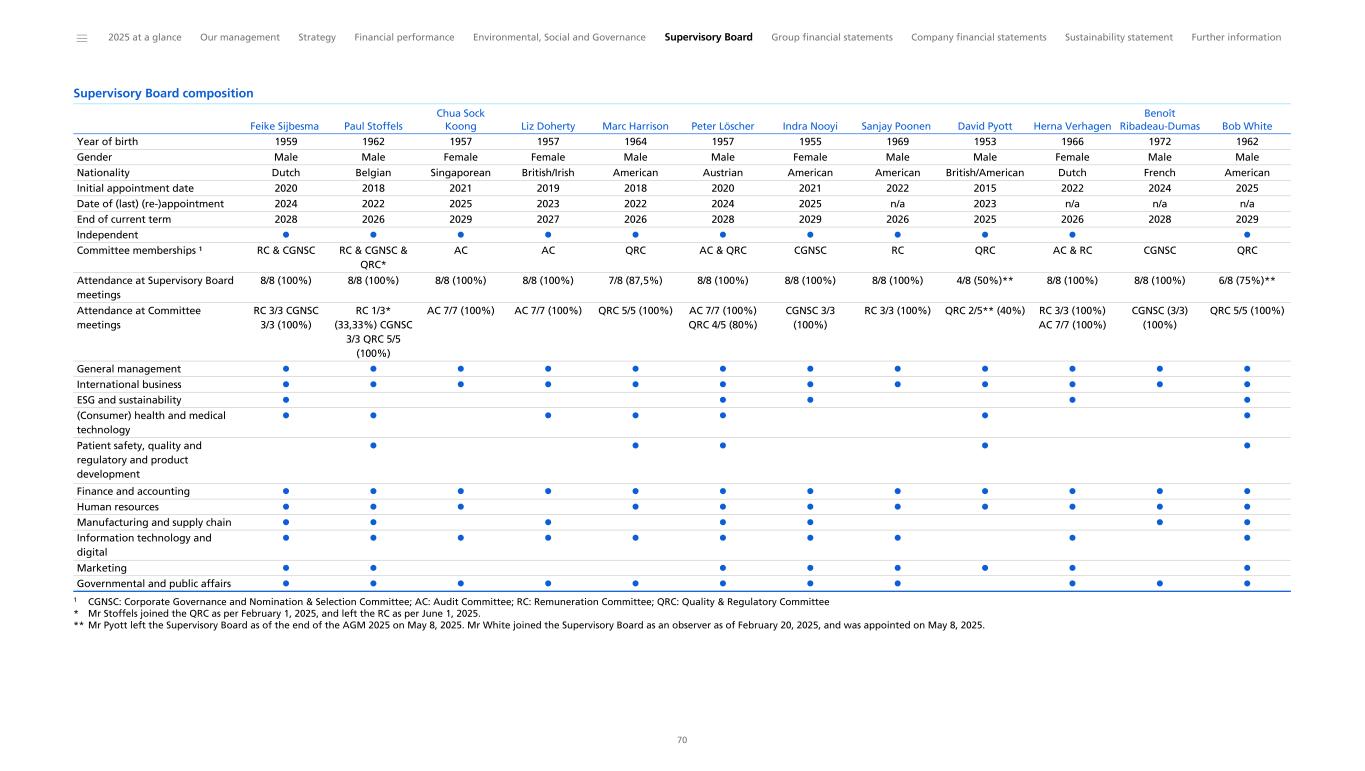
Supervisory Board composition Year of birth 1959 1962 1957 1957 1964 1957 1955 1969 1953 1966 1972 1962 Gender Male Male Female Female Male Male Female Male Male Female Male Male Nationality Dutch Belgian Singaporean British/Irish American Austrian American American British/American Dutch French American Initial appointment date 2020 2018 2021 2019 2018 2020 2021 2022 2015 2022 2024 2025 Date of (last) (re-)appointment 2024 2022 2025 2023 2022 2024 2025 n/a 2023 n/a n/a n/a End of current term 2028 2026 2029 2027 2026 2028 2029 2026 2025 2026 2028 2029 Independent l l l l l l l l l l l Committee memberships ¹ RC & CGNSC RC & CGNSC & QRC* AC AC QRC AC & QRC CGNSC RC QRC AC & RC CGNSC QRC Attendance at Supervisory Board meetings 8/8 (100%) 8/8 (100%) 8/8 (100%) 8/8 (100%) 7/8 (87,5%) 8/8 (100%) 8/8 (100%) 8/8 (100%) 4/8 (50%)** 8/8 (100%) 8/8 (100%) 6/8 (75%)** Attendance at Committee meetings RC 3/3 CGNSC 3/3 (100%) RC 1/3* (33,33%) CGNSC 3/3 QRC 5/5 (100%) AC 7/7 (100%) AC 7/7 (100%) QRC 5/5 (100%) AC 7/7 (100%) QRC 4/5 (80%) CGNSC 3/3 (100%) RC 3/3 (100%) QRC 2/5** (40%) RC 3/3 (100%) AC 7/7 (100%) CGNSC (3/3) (100%) QRC 5/5 (100%) General management l l l l l l l l l l l l International business l l l l l l l l l l l l ESG and sustainability l l l l l (Consumer) health and medical technology l l l l l l l Patient safety, quality and regulatory and product development l l l l l Finance and accounting l l l l l l l l l l l l Human resources l l l l l l l l l l l Manufacturing and supply chain l l l l l l l Information technology and digital l l l l l l l l l l Marketing l l l l l l l l Governmental and public affairs l l l l l l l l l l l Feike Sijbesma Paul Stoffels Chua Sock Koong Liz Doherty Marc Harrison Peter Löscher Indra Nooyi Sanjay Poonen David Pyott Herna Verhagen Benoît Ribadeau-Dumas Bob White 1 CGNSC: Corporate Governance and Nomination & Selection Committee; AC: Audit Committee; RC: Remuneration Committee; QRC: Quality & Regulatory Committee * Mr Stoffels joined the QRC as per February 1, 2025, and left the RC as per June 1, 2025. ** Mr Pyott left the Supervisory Board as of the end of the AGM 2025 on May 8, 2025. Mr White joined the Supervisory Board as an observer as of February 20, 2025, and was appointed on May 8, 2025. ______ 2025 at a glance Our management Strategy Financial performance Environmental, Social and Governance Supervisory Board Group financial statements Company financial statements Sustainability statement Further information 70
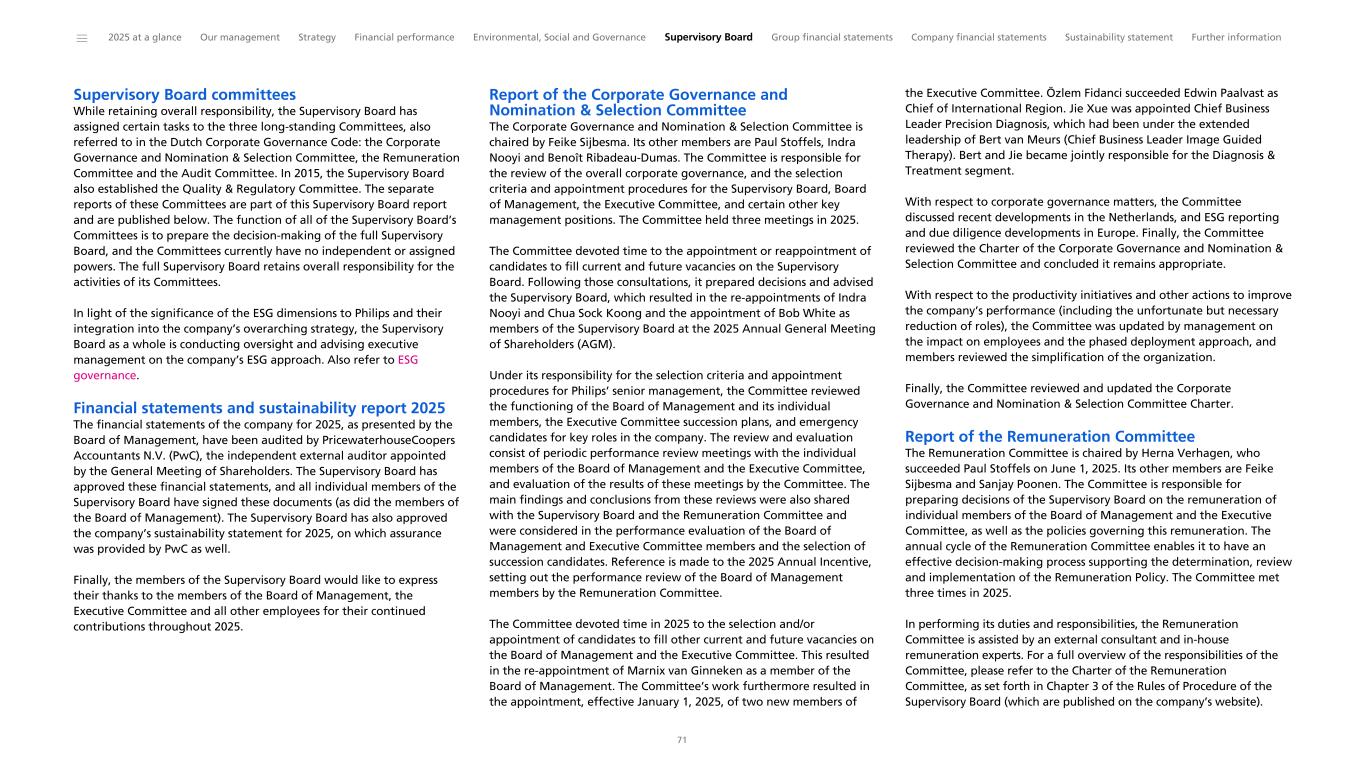
Supervisory Board committees While retaining overall responsibility, the Supervisory Board has assigned certain tasks to the three long-standing Committees, also referred to in the Dutch Corporate Governance Code: the Corporate Governance and Nomination & Selection Committee, the Remuneration Committee and the Audit Committee. In 2015, the Supervisory Board also established the Quality & Regulatory Committee. The separate reports of these Committees are part of this Supervisory Board report and are published below. The function of all of the Supervisory Board’s Committees is to prepare the decision-making of the full Supervisory Board, and the Committees currently have no independent or assigned powers. The full Supervisory Board retains overall responsibility for the activities of its Committees. In light of the significance of the ESG dimensions to Philips and their integration into the company’s overarching strategy, the Supervisory Board as a whole is conducting oversight and advising executive management on the company’s ESG approach. Also refer to ESG governance. Financial statements and sustainability report 2025 The financial statements of the company for 2025, as presented by the Board of Management, have been audited by PricewaterhouseCoopers Accountants N.V. (PwC), the independent external auditor appointed by the General Meeting of Shareholders. The Supervisory Board has approved these financial statements, and all individual members of the Supervisory Board have signed these documents (as did the members of the Board of Management). The Supervisory Board has also approved the company’s sustainability statement for 2025, on which assurance was provided by PwC as well. Finally, the members of the Supervisory Board would like to express their thanks to the members of the Board of Management, the Executive Committee and all other employees for their continued contributions throughout 2025. Report of the Corporate Governance and Nomination & Selection Committee The Corporate Governance and Nomination & Selection Committee is chaired by Feike Sijbesma. Its other members are Paul Stoffels, Indra Nooyi and Benoît Ribadeau-Dumas. The Committee is responsible for the review of the overall corporate governance, and the selection criteria and appointment procedures for the Supervisory Board, Board of Management, the Executive Committee, and certain other key management positions. The Committee held three meetings in 2025. The Committee devoted time to the appointment or reappointment of candidates to fill current and future vacancies on the Supervisory Board. Following those consultations, it prepared decisions and advised the Supervisory Board, which resulted in the re-appointments of Indra Nooyi and Chua Sock Koong and the appointment of Bob White as members of the Supervisory Board at the 2025 Annual General Meeting of Shareholders (AGM). Under its responsibility for the selection criteria and appointment procedures for Philips’ senior management, the Committee reviewed the functioning of the Board of Management and its individual members, the Executive Committee succession plans, and emergency candidates for key roles in the company. The review and evaluation consist of periodic performance review meetings with the individual members of the Board of Management and the Executive Committee, and evaluation of the results of these meetings by the Committee. The main findings and conclusions from these reviews were also shared with the Supervisory Board and the Remuneration Committee and were considered in the performance evaluation of the Board of Management and Executive Committee members and the selection of succession candidates. Reference is made to the 2025 Annual Incentive, setting out the performance review of the Board of Management members by the Remuneration Committee. The Committee devoted time in 2025 to the selection and/or appointment of candidates to fill other current and future vacancies on the Board of Management and the Executive Committee. This resulted in the re-appointment of Marnix van Ginneken as a member of the Board of Management. The Committee’s work furthermore resulted in the appointment, effective January 1, 2025, of two new members of the Executive Committee. Özlem Fidanci succeeded Edwin Paalvast as Chief of International Region. Jie Xue was appointed Chief Business Leader Precision Diagnosis, which had been under the extended leadership of Bert van Meurs (Chief Business Leader Image Guided Therapy). Bert and Jie became jointly responsible for the Diagnosis & Treatment segment. With respect to corporate governance matters, the Committee discussed recent developments in the Netherlands, and ESG reporting and due diligence developments in Europe. Finally, the Committee reviewed the Charter of the Corporate Governance and Nomination & Selection Committee and concluded it remains appropriate. With respect to the productivity initiatives and other actions to improve the company’s performance (including the unfortunate but necessary reduction of roles), the Committee was updated by management on the impact on employees and the phased deployment approach, and members reviewed the simplification of the organization. Finally, the Committee reviewed and updated the Corporate Governance and Nomination & Selection Committee Charter. Report of the Remuneration Committee The Remuneration Committee is chaired by Herna Verhagen, who succeeded Paul Stoffels on June 1, 2025. Its other members are Feike Sijbesma and Sanjay Poonen. The Committee is responsible for preparing decisions of the Supervisory Board on the remuneration of individual members of the Board of Management and the Executive Committee, as well as the policies governing this remuneration. The annual cycle of the Remuneration Committee enables it to have an effective decision-making process supporting the determination, review and implementation of the Remuneration Policy. The Committee met three times in 2025. In performing its duties and responsibilities, the Remuneration Committee is assisted by an external consultant and in-house remuneration experts. For a full overview of the responsibilities of the Committee, please refer to the Charter of the Remuneration Committee, as set forth in Chapter 3 of the Rules of Procedure of the Supervisory Board (which are published on the company’s website). ______ 2025 at a glance Our management Strategy Financial performance Environmental, Social and Governance Supervisory Board Group financial statements Company financial statements Sustainability statement Further information 71
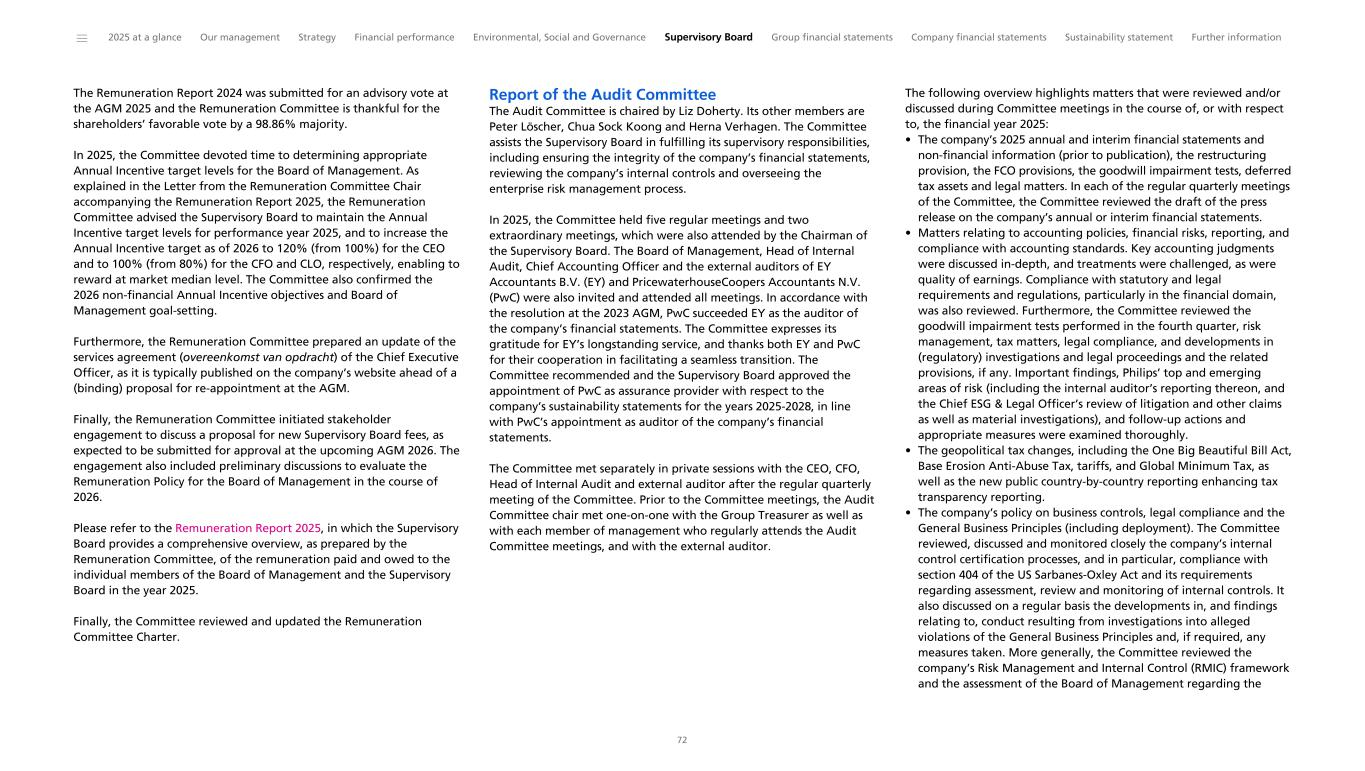
The Remuneration Report 2024 was submitted for an advisory vote at the AGM 2025 and the Remuneration Committee is thankful for the shareholders’ favorable vote by a 98.86% majority. In 2025, the Committee devoted time to determining appropriate Annual Incentive target levels for the Board of Management. As explained in the Letter from the Remuneration Committee Chair accompanying the Remuneration Report 2025, the Remuneration Committee advised the Supervisory Board to maintain the Annual Incentive target levels for performance year 2025, and to increase the Annual Incentive target as of 2026 to 120% (from 100%) for the CEO and to 100% (from 80%) for the CFO and CLO, respectively, enabling to reward at market median level. The Committee also confirmed the 2026 non-financial Annual Incentive objectives and Board of Management goal-setting. Furthermore, the Remuneration Committee prepared an update of the services agreement (overeenkomst van opdracht) of the Chief Executive Officer, as it is typically published on the company’s website ahead of a (binding) proposal for re-appointment at the AGM. Finally, the Remuneration Committee initiated stakeholder engagement to discuss a proposal for new Supervisory Board fees, as expected to be submitted for approval at the upcoming AGM 2026. The engagement also included preliminary discussions to evaluate the Remuneration Policy for the Board of Management in the course of 2026. Please refer to the Remuneration Report 2025, in which the Supervisory Board provides a comprehensive overview, as prepared by the Remuneration Committee, of the remuneration paid and owed to the individual members of the Board of Management and the Supervisory Board in the year 2025. Finally, the Committee reviewed and updated the Remuneration Committee Charter. Report of the Audit Committee The Audit Committee is chaired by Liz Doherty. Its other members are Peter Löscher, Chua Sock Koong and Herna Verhagen. The Committee assists the Supervisory Board in fulfilling its supervisory responsibilities, including ensuring the integrity of the company’s financial statements, reviewing the company’s internal controls and overseeing the enterprise risk management process. In 2025, the Committee held five regular meetings and two extraordinary meetings, which were also attended by the Chairman of the Supervisory Board. The Board of Management, Head of Internal Audit, Chief Accounting Officer and the external auditors of EY Accountants B.V. (EY) and PricewaterhouseCoopers Accountants N.V. (PwC) were also invited and attended all meetings. In accordance with the resolution at the 2023 AGM, PwC succeeded EY as the auditor of the company’s financial statements. The Committee expresses its gratitude for EY’s longstanding service, and thanks both EY and PwC for their cooperation in facilitating a seamless transition. The Committee recommended and the Supervisory Board approved the appointment of PwC as assurance provider with respect to the company’s sustainability statements for the years 2025-2028, in line with PwC’s appointment as auditor of the company’s financial statements. The Committee met separately in private sessions with the CEO, CFO, Head of Internal Audit and external auditor after the regular quarterly meeting of the Committee. Prior to the Committee meetings, the Audit Committee chair met one-on-one with the Group Treasurer as well as with each member of management who regularly attends the Audit Committee meetings, and with the external auditor. The following overview highlights matters that were reviewed and/or discussed during Committee meetings in the course of, or with respect to, the financial year 2025: • The company’s 2025 annual and interim financial statements and non-financial information (prior to publication), the restructuring provision, the FCO provisions, the goodwill impairment tests, deferred tax assets and legal matters. In each of the regular quarterly meetings of the Committee, the Committee reviewed the draft of the press release on the company’s annual or interim financial statements. • Matters relating to accounting policies, financial risks, reporting, and compliance with accounting standards. Key accounting judgments were discussed in-depth, and treatments were challenged, as were quality of earnings. Compliance with statutory and legal requirements and regulations, particularly in the financial domain, was also reviewed. Furthermore, the Committee reviewed the goodwill impairment tests performed in the fourth quarter, risk management, tax matters, legal compliance, and developments in (regulatory) investigations and legal proceedings and the related provisions, if any. Important findings, Philips’ top and emerging areas of risk (including the internal auditor’s reporting thereon, and the Chief ESG & Legal Officer’s review of litigation and other claims as well as material investigations), and follow-up actions and appropriate measures were examined thoroughly. • The geopolitical tax changes, including the One Big Beautiful Bill Act, Base Erosion Anti-Abuse Tax, tariffs, and Global Minimum Tax, as well as the new public country-by-country reporting enhancing tax transparency reporting. • The company’s policy on business controls, legal compliance and the General Business Principles (including deployment). The Committee reviewed, discussed and monitored closely the company’s internal control certification processes, and in particular, compliance with section 404 of the US Sarbanes-Oxley Act and its requirements regarding assessment, review and monitoring of internal controls. It also discussed on a regular basis the developments in, and findings relating to, conduct resulting from investigations into alleged violations of the General Business Principles and, if required, any measures taken. More generally, the Committee reviewed the company’s Risk Management and Internal Control (RMIC) framework and the assessment of the Board of Management regarding the ______ 2025 at a glance Our management Strategy Financial performance Environmental, Social and Governance Supervisory Board Group financial statements Company financial statements Sustainability statement Further information 72
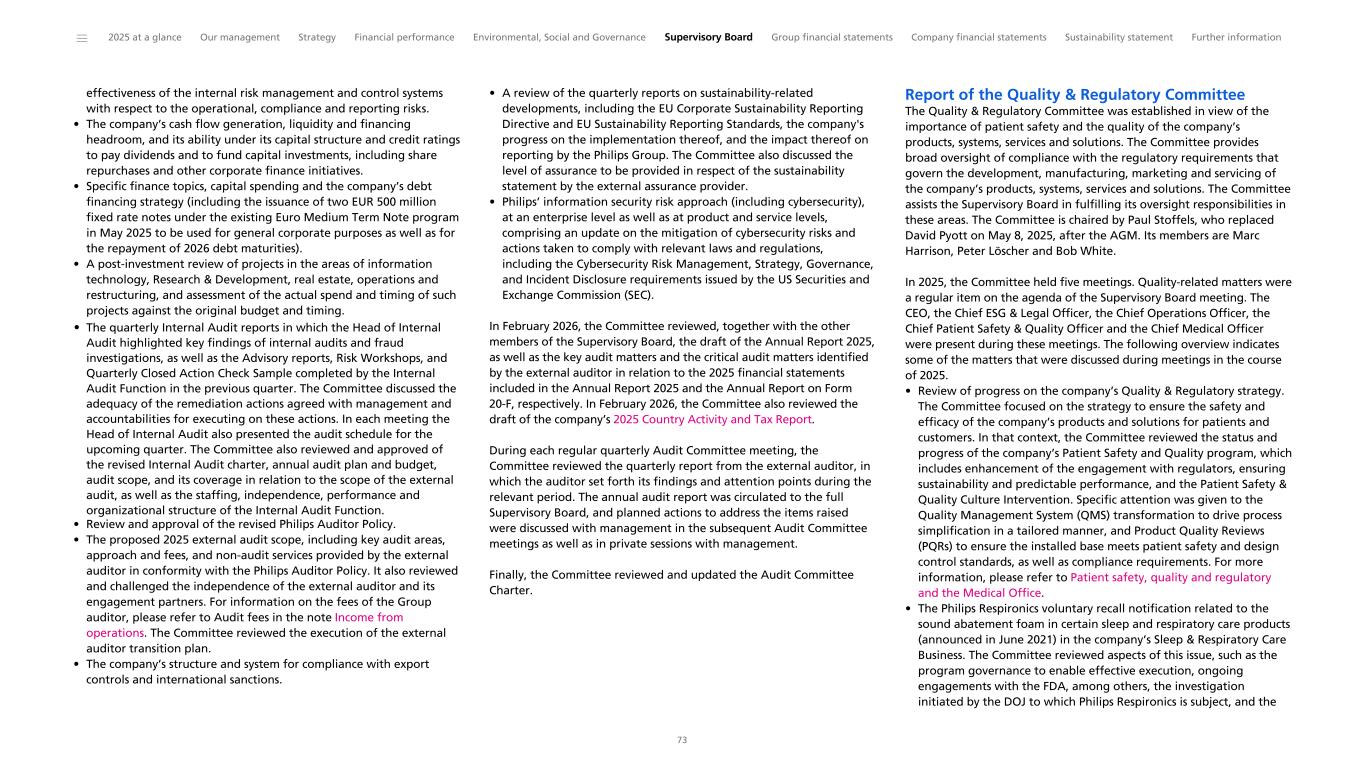
effectiveness of the internal risk management and control systems with respect to the operational, compliance and reporting risks. • The company’s cash flow generation, liquidity and financing headroom, and its ability under its capital structure and credit ratings to pay dividends and to fund capital investments, including share repurchases and other corporate finance initiatives. • Specific finance topics, capital spending and the company’s debt financing strategy (including the issuance of two EUR 500 million fixed rate notes under the existing Euro Medium Term Note program in May 2025 to be used for general corporate purposes as well as for the repayment of 2026 debt maturities). • A post-investment review of projects in the areas of information technology, Research & Development, real estate, operations and restructuring, and assessment of the actual spend and timing of such projects against the original budget and timing. • The quarterly Internal Audit reports in which the Head of Internal Audit highlighted key findings of internal audits and fraud investigations, as well as the Advisory reports, Risk Workshops, and Quarterly Closed Action Check Sample completed by the Internal Audit Function in the previous quarter. The Committee discussed the adequacy of the remediation actions agreed with management and accountabilities for executing on these actions. In each meeting the Head of Internal Audit also presented the audit schedule for the upcoming quarter. The Committee also reviewed and approved of the revised Internal Audit charter, annual audit plan and budget, audit scope, and its coverage in relation to the scope of the external audit, as well as the staffing, independence, performance and organizational structure of the Internal Audit Function. • Review and approval of the revised Philips Auditor Policy. • The proposed 2025 external audit scope, including key audit areas, approach and fees, and non-audit services provided by the external auditor in conformity with the Philips Auditor Policy. It also reviewed and challenged the independence of the external auditor and its engagement partners. For information on the fees of the Group auditor, please refer to Audit fees in the note Income from operations. The Committee reviewed the execution of the external auditor transition plan. • The company’s structure and system for compliance with export controls and international sanctions. • A review of the quarterly reports on sustainability-related developments, including the EU Corporate Sustainability Reporting Directive and EU Sustainability Reporting Standards, the company's progress on the implementation thereof, and the impact thereof on reporting by the Philips Group. The Committee also discussed the level of assurance to be provided in respect of the sustainability statement by the external assurance provider. • Philips’ information security risk approach (including cybersecurity), at an enterprise level as well as at product and service levels, comprising an update on the mitigation of cybersecurity risks and actions taken to comply with relevant laws and regulations, including the Cybersecurity Risk Management, Strategy, Governance, and Incident Disclosure requirements issued by the US Securities and Exchange Commission (SEC). In February 2026, the Committee reviewed, together with the other members of the Supervisory Board, the draft of the Annual Report 2025, as well as the key audit matters and the critical audit matters identified by the external auditor in relation to the 2025 financial statements included in the Annual Report 2025 and the Annual Report on Form 20-F, respectively. In February 2026, the Committee also reviewed the draft of the company’s 2025 Country Activity and Tax Report. During each regular quarterly Audit Committee meeting, the Committee reviewed the quarterly report from the external auditor, in which the auditor set forth its findings and attention points during the relevant period. The annual audit report was circulated to the full Supervisory Board, and planned actions to address the items raised were discussed with management in the subsequent Audit Committee meetings as well as in private sessions with management. Finally, the Committee reviewed and updated the Audit Committee Charter. Report of the Quality & Regulatory Committee The Quality & Regulatory Committee was established in view of the importance of patient safety and the quality of the company’s products, systems, services and solutions. The Committee provides broad oversight of compliance with the regulatory requirements that govern the development, manufacturing, marketing and servicing of the company’s products, systems, services and solutions. The Committee assists the Supervisory Board in fulfilling its oversight responsibilities in these areas. The Committee is chaired by Paul Stoffels, who replaced David Pyott on May 8, 2025, after the AGM. Its members are Marc Harrison, Peter Löscher and Bob White. In 2025, the Committee held five meetings. Quality-related matters were a regular item on the agenda of the Supervisory Board meeting. The CEO, the Chief ESG & Legal Officer, the Chief Operations Officer, the Chief Patient Safety & Quality Officer and the Chief Medical Officer were present during these meetings. The following overview indicates some of the matters that were discussed during meetings in the course of 2025. • Review of progress on the company’s Quality & Regulatory strategy. The Committee focused on the strategy to ensure the safety and efficacy of the company’s products and solutions for patients and customers. In that context, the Committee reviewed the status and progress of the company’s Patient Safety and Quality program, which includes enhancement of the engagement with regulators, ensuring sustainability and predictable performance, and the Patient Safety & Quality Culture Intervention. Specific attention was given to the Quality Management System (QMS) transformation to drive process simplification in a tailored manner, and Product Quality Reviews (PQRs) to ensure the installed base meets patient safety and design control standards, as well as compliance requirements. For more information, please refer to Patient safety, quality and regulatory and the Medical Office. • The Philips Respironics voluntary recall notification related to the sound abatement foam in certain sleep and respiratory care products (announced in June 2021) in the company’s Sleep & Respiratory Care Business. The Committee reviewed aspects of this issue, such as the program governance to enable effective execution, ongoing engagements with the FDA, among others, the investigation initiated by the DOJ to which Philips Respironics is subject, and the ______ 2025 at a glance Our management Strategy Financial performance Environmental, Social and Governance Supervisory Board Group financial statements Company financial statements Sustainability statement Further information 73
execution of the agreed consent decree. The Committee reviewed the engagements with other regulatory authorities globally. Furthermore, the Committee reviewed and discussed with management the engagement with and communication efforts to patients, physicians, customers and durable medical equipment providers; the testing program and its outcomes; and health hazard evaluations. The Committee also discussed the level of related field action provisions, as set out in more detail in the report of the Audit Committee (see previous section). • Review of other quality issues (other than the Philips Respironics voluntary recall), including site inspections and warning letters, and the progress made with resolving and closing such other issues. • Review of progress in the transformation of the company’s Patient Safety & Quality Function, aimed at further strengthening expertise and capabilities within the Function, including upscaling Patient Safety & Quality talent at mid-level leadership positions. • Review of the progress made with global initiatives around the transformation, standardization and simplification of the company’s structure and organizational processes relating to QMSs (the reduction of the current QMSs to one quarter versus the baseline), management systems, regulated manufacturing sites (legal manufacturers), Corrective and Preventive Action (CAPA) and complaint management. • Review of the implementation of a Patient Safety & Quality IT roadmap and adoption of the IT and data enhancements. • The status and outcome of quality- and regulatory-related investigations and inspections by regulatory authorities and notified bodies globally across the organization. Management also regularly provided the Committee with an overview of upcoming scheduled inspections across company sites by the FDA, as well as other regulatory authorities and notified bodies, and the actions taken to prepare for such inspections. • Review of the product risk per Business based on a product assessment approach and remediation across the company, including findings resulting from internal audits. • Review of the 2025 dashboard of quality and regulatory key performance indicators, showing the trend of performance. The Committee also reviewed the key performance indicators for 2026. ______ 2025 at a glance Our management Strategy Financial performance Environmental, Social and Governance Supervisory Board Group financial statements Company financial statements Sustainability statement Further information 74
Remuneration Report 2025 Letter from the Remuneration Committee Chair Dear stakeholder, On behalf of the Remuneration Committee, I am pleased to present the 2025 Remuneration Report, providing an overview of the remuneration paid and owed to the individual members of the Board of Management and the Supervisory Board. The 2024 Remuneration Report was approved at the Annual General Meeting of Shareholders (AGM) held in May 2025, with a majority of 94.21% of the votes cast. We did not receive any substantive comments on this report. For transparency purposes we have added the voting outcome percentages for the Remuneration Policies and Remuneration Report, as well as a visualization in the Board of Management remuneration overview. Company performance in 2025 and incentive plan realization Over the past year, the geopolitical environment remained volatile. Philips has significant presence in both the US and China, where local- first politics continue to influence global supply chains and our manufacturing footprint. In several other regions, conflicts and political tensions added further complexity to logistics and operations. Despite these headwinds, Philips’ sales and order intake grew consistently during 2025. The company achieved margin expansion throughout the year, reflecting strong demand for its innovations and operational discipline. In this challenging climate, Philips has delivered on its plan to create value out of its portfolio of leadership positions by driving operational improvements and scaling innovation leadership. Significant progress was made on its execution priorities including patient safety and quality. For the awards granted under our Long-Term Incentive (LTI) plan in 2023, the company performance resulted in a realization above target for the relative Total Shareholder Return (TSR) and adjusted Earnings Per Share (EPS) metrics. For the sustainability objectives there was also an above target performance. With respect to the financial metrics of the 2025 Annual Incentive, performance was at target for the Adjusted EBITA metric, and above target for the free cash flow and comparable sales growth metrics. Please refer to the subsequent pages of the report for more details. Other matters prepared by the Remuneration Committee During the AGM 2025, our Chief ESG & Legal Officer Marnix van Ginneken was re-appointed, adding a four-year term to his membership of the Board of Management that started in 2017. The company and Mr Van Ginneken entered into a new services agreement that was prepared by the Remuneration Committee and published on the company’s website. Looking ahead As included in the 2024 Remuneration Policy for the Board of Management, the Annual Incentive target levels could be increased as of 2025. The Supervisory Board noted that in 2024, the company delivered on its commitments regarding profitability, free cash flow and ESG. Nevertheless, the Supervisory Board decided to maintain the current target levels for another year. Now, at the close of the company's three-year plan 2023-2025, the Supervisory Board assessed the progress that was made on the company's performance trajectory. The Supervisory Board notes that the company delivered on its commitments also in 2025. Therefore it decided that as of performance year 2026 the Annual Incentive target will be increased to 120% (from 100%) for the CEO, and to 100% (from 80%) for the CFO and CLO, enabling to reward at market median level for the Annual Incentive. The Remuneration Policy (including fee levels) for the Supervisory Board, is reviewed in principle every two years. The current fee levels were adopted at the AGM 2024. The Remuneration Policy is aimed at attracting and retaining Supervisory Board members internationally, of the highest caliber and with relevant expertise and experience. Therefore the Supervisory Board intends to submit a proposal for new Supervisory Board fees to the upcoming AGM 2026. Building on our stakeholder engagements during the past years, we took a careful approach and engaged with relevant stakeholders to solicit their feedback on, and support for the proposal. The Remuneration Committee will evaluate the Remuneration Policy for the Board of Management in the course of 2026, which may result in proposals to revise the Remuneration Policy to the Supervisory Board and ultimately to our shareholders. The Remuneration Committee notes that, since the current Long-Term Incentive target levels for the Board of Management were set in 2024, the median LTI target levels continued to increase within our Quantum Peer Group, widening the gap with Philips’ target levels. I look forward to presenting our Remuneration Report 2025 and the 2026 Supervisory Board Remuneration Policy at the AGM 2026. Furthermore I would like to extend my gratitude to Paul Stoffels, who concluded his tenure as Chair of the Remuneration Committee this year. Herna Verhagen Chair of the Remuneration Committee ______ 2025 at a glance Our management Strategy Financial performance Environmental, Social and Governance Supervisory Board Group financial statements Company financial statements Sustainability statement Further information 75
Introduction In this Remuneration Report, the Supervisory Board provides a comprehensive overview, in accordance with article 2:135b of the Dutch Civil Code, of the remuneration paid and owed to the individual members of the Board of Management and the Supervisory Board, respectively, in the financial year 2025. The report will also be published as a stand-alone document on the company’s website after the AGM 2026, the agenda of which will include an advisory vote on this Remuneration Report. Board of Management Summary of Remuneration Policy The Remuneration Policy for the Board of Management (BoM), which includes a Long-Term Incentive plan, was adopted at the AGM 2024 with a majority of 96.07% of the votes cast. The objectives of the Remuneration Policy for members of the Board of Management are in line with those for Philips executives throughout the Philips Group: to focus them on pursuing our purpose to improve people’s health and well-being through meaningful innovation, and on delivering on our strategy, as well as to motivate and retain them to create superior, long-term stakeholder value. ______ 2025 at a glance Our management Strategy Financial performance Environmental, Social and Governance Supervisory Board Group financial statements Company financial statements Sustainability statement Further information 76
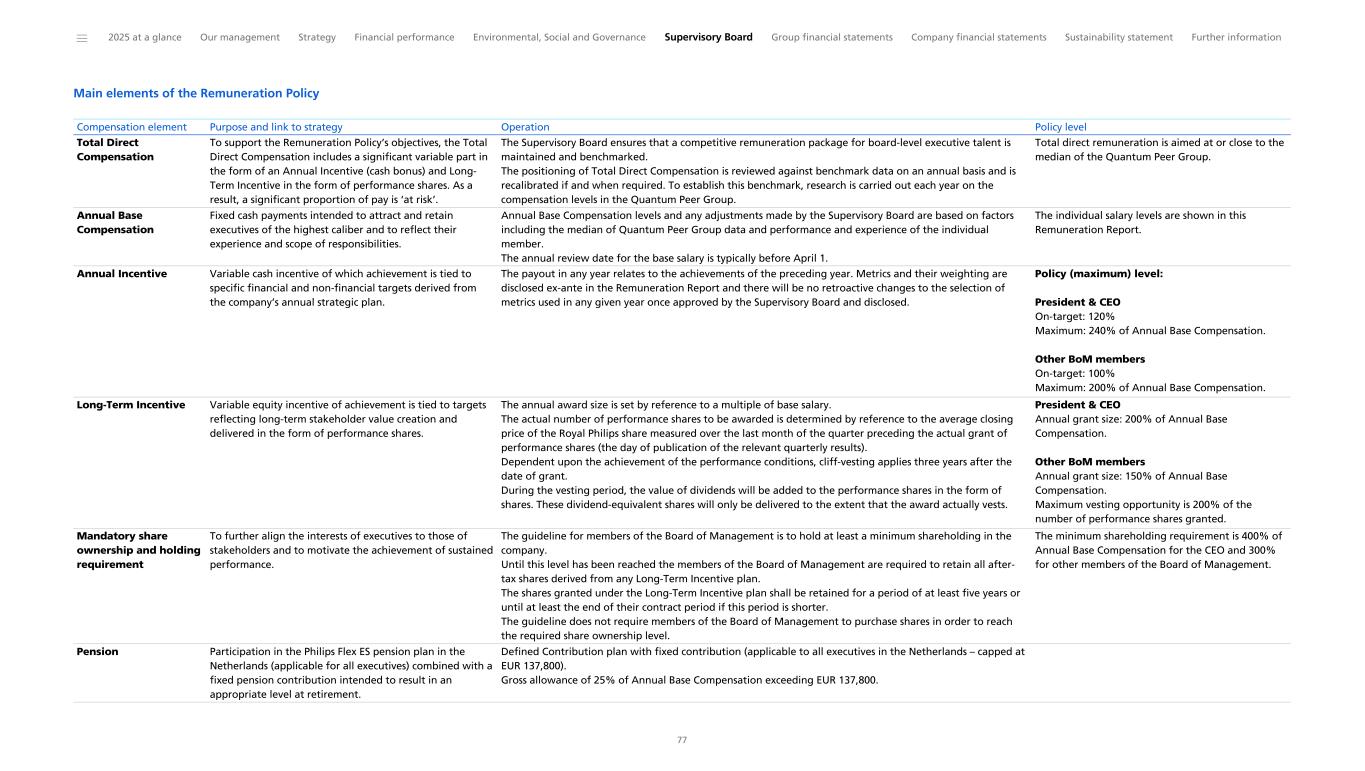
Main elements of the Remuneration Policy Total Direct Compensation To support the Remuneration Policy’s objectives, the Total Direct Compensation includes a significant variable part in the form of an Annual Incentive (cash bonus) and Long- Term Incentive in the form of performance shares. As a result, a significant proportion of pay is ‘at risk’. The Supervisory Board ensures that a competitive remuneration package for board-level executive talent is maintained and benchmarked. The positioning of Total Direct Compensation is reviewed against benchmark data on an annual basis and is recalibrated if and when required. To establish this benchmark, research is carried out each year on the compensation levels in the Quantum Peer Group. Total direct remuneration is aimed at or close to the median of the Quantum Peer Group. Annual Base Compensation Fixed cash payments intended to attract and retain executives of the highest caliber and to reflect their experience and scope of responsibilities. Annual Base Compensation levels and any adjustments made by the Supervisory Board are based on factors including the median of Quantum Peer Group data and performance and experience of the individual member. The annual review date for the base salary is typically before April 1. The individual salary levels are shown in this Remuneration Report. Annual Incentive Variable cash incentive of which achievement is tied to specific financial and non-financial targets derived from the company’s annual strategic plan. The payout in any year relates to the achievements of the preceding year. Metrics and their weighting are disclosed ex-ante in the Remuneration Report and there will be no retroactive changes to the selection of metrics used in any given year once approved by the Supervisory Board and disclosed. Policy (maximum) level: President & CEO On-target: 120% Maximum: 240% of Annual Base Compensation. Other BoM members On-target: 100% Maximum: 200% of Annual Base Compensation. Long-Term Incentive Variable equity incentive of achievement is tied to targets reflecting long-term stakeholder value creation and delivered in the form of performance shares. The annual award size is set by reference to a multiple of base salary. The actual number of performance shares to be awarded is determined by reference to the average closing price of the Royal Philips share measured over the last month of the quarter preceding the actual grant of performance shares (the day of publication of the relevant quarterly results). Dependent upon the achievement of the performance conditions, cliff-vesting applies three years after the date of grant. During the vesting period, the value of dividends will be added to the performance shares in the form of shares. These dividend-equivalent shares will only be delivered to the extent that the award actually vests. President & CEO Annual grant size: 200% of Annual Base Compensation. Other BoM members Annual grant size: 150% of Annual Base Compensation. Maximum vesting opportunity is 200% of the number of performance shares granted. Mandatory share ownership and holding requirement To further align the interests of executives to those of stakeholders and to motivate the achievement of sustained performance. The guideline for members of the Board of Management is to hold at least a minimum shareholding in the company. Until this level has been reached the members of the Board of Management are required to retain all after- tax shares derived from any Long-Term Incentive plan. The shares granted under the Long-Term Incentive plan shall be retained for a period of at least five years or until at least the end of their contract period if this period is shorter. The guideline does not require members of the Board of Management to purchase shares in order to reach the required share ownership level. The minimum shareholding requirement is 400% of Annual Base Compensation for the CEO and 300% for other members of the Board of Management. Pension Participation in the Philips Flex ES pension plan in the Netherlands (applicable for all executives) combined with a fixed pension contribution intended to result in an appropriate level at retirement. Defined Contribution plan with fixed contribution (applicable to all executives in the Netherlands – capped at EUR 137,800). Gross allowance of 25% of Annual Base Compensation exceeding EUR 137,800. Compensation element Purpose and link to strategy Operation Policy level ______ 2025 at a glance Our management Strategy Financial performance Environmental, Social and Governance Supervisory Board Group financial statements Company financial statements Sustainability statement Further information 77
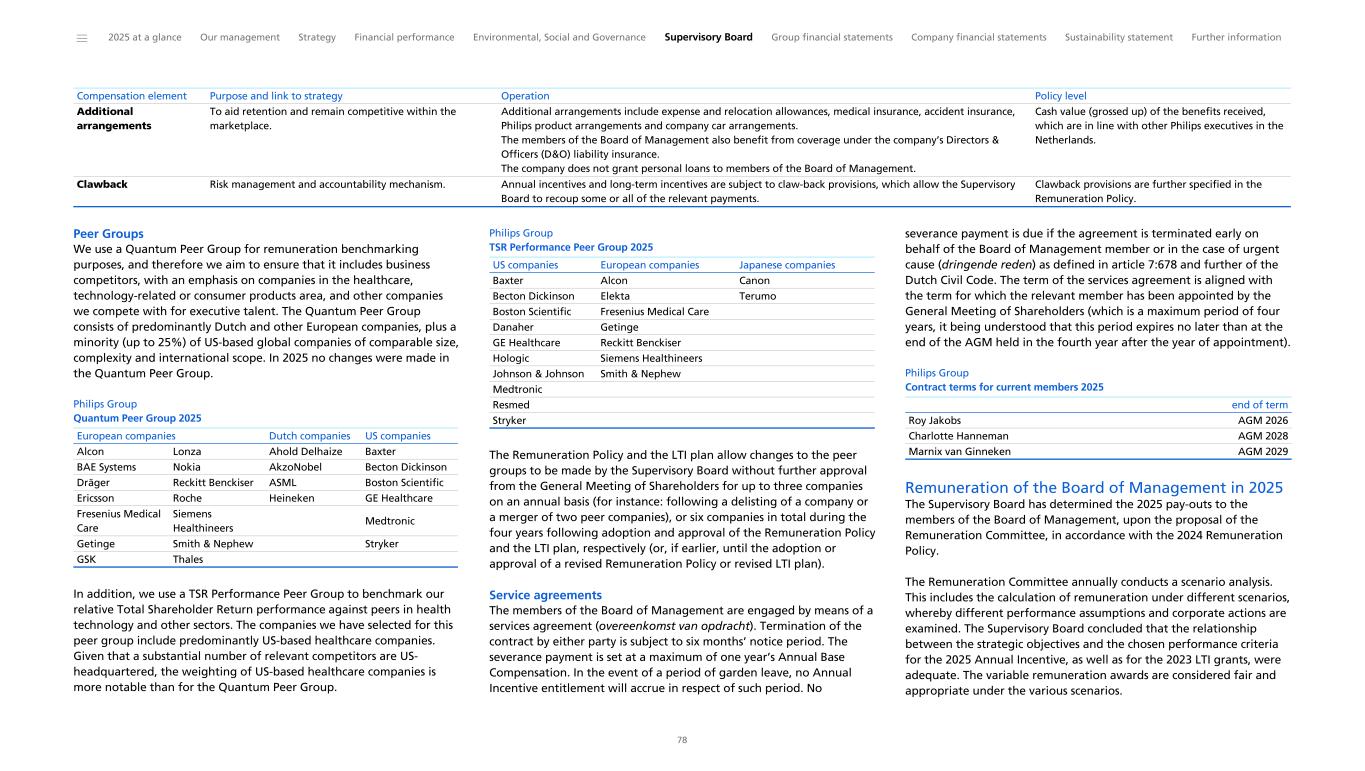
Additional arrangements To aid retention and remain competitive within the marketplace. Additional arrangements include expense and relocation allowances, medical insurance, accident insurance, Philips product arrangements and company car arrangements. The members of the Board of Management also benefit from coverage under the company’s Directors & Officers (D&O) liability insurance. The company does not grant personal loans to members of the Board of Management. Cash value (grossed up) of the benefits received, which are in line with other Philips executives in the Netherlands. Clawback Risk management and accountability mechanism. Annual incentives and long-term incentives are subject to claw-back provisions, which allow the Supervisory Board to recoup some or all of the relevant payments. Clawback provisions are further specified in the Remuneration Policy. Compensation element Purpose and link to strategy Operation Policy level Peer Groups We use a Quantum Peer Group for remuneration benchmarking purposes, and therefore we aim to ensure that it includes business competitors, with an emphasis on companies in the healthcare, technology-related or consumer products area, and other companies we compete with for executive talent. The Quantum Peer Group consists of predominantly Dutch and other European companies, plus a minority (up to 25%) of US-based global companies of comparable size, complexity and international scope. In 2025 no changes were made in the Quantum Peer Group. Philips Group Quantum Peer Group 2025 Alcon Lonza Ahold Delhaize Baxter BAE Systems Nokia AkzoNobel Becton Dickinson Dräger Reckitt Benckiser ASML Boston Scientific Ericsson Roche Heineken GE Healthcare Fresenius Medical Care Siemens Healthineers Medtronic Getinge Smith & Nephew Stryker GSK Thales European companies Dutch companies US companies In addition, we use a TSR Performance Peer Group to benchmark our relative Total Shareholder Return performance against peers in health technology and other sectors. The companies we have selected for this peer group include predominantly US-based healthcare companies. Given that a substantial number of relevant competitors are US- headquartered, the weighting of US-based healthcare companies is more notable than for the Quantum Peer Group. Philips Group TSR Performance Peer Group 2025 Baxter Alcon Canon Becton Dickinson Elekta Terumo Boston Scientific Fresenius Medical Care Danaher Getinge GE Healthcare Reckitt Benckiser Hologic Siemens Healthineers Johnson & Johnson Smith & Nephew Medtronic Resmed Stryker US companies European companies Japanese companies The Remuneration Policy and the LTI plan allow changes to the peer groups to be made by the Supervisory Board without further approval from the General Meeting of Shareholders for up to three companies on an annual basis (for instance: following a delisting of a company or a merger of two peer companies), or six companies in total during the four years following adoption and approval of the Remuneration Policy and the LTI plan, respectively (or, if earlier, until the adoption or approval of a revised Remuneration Policy or revised LTI plan). Service agreements The members of the Board of Management are engaged by means of a services agreement (overeenkomst van opdracht). Termination of the contract by either party is subject to six months’ notice period. The severance payment is set at a maximum of one year’s Annual Base Compensation. In the event of a period of garden leave, no Annual Incentive entitlement will accrue in respect of such period. No severance payment is due if the agreement is terminated early on behalf of the Board of Management member or in the case of urgent cause (dringende reden) as defined in article 7:678 and further of the Dutch Civil Code. The term of the services agreement is aligned with the term for which the relevant member has been appointed by the General Meeting of Shareholders (which is a maximum period of four years, it being understood that this period expires no later than at the end of the AGM held in the fourth year after the year of appointment). Philips Group Contract terms for current members 2025 Roy Jakobs AGM 2026 Charlotte Hanneman AGM 2028 Marnix van Ginneken AGM 2029 end of term Remuneration of the Board of Management in 2025 The Supervisory Board has determined the 2025 pay-outs to the members of the Board of Management, upon the proposal of the Remuneration Committee, in accordance with the 2024 Remuneration Policy. The Remuneration Committee annually conducts a scenario analysis. This includes the calculation of remuneration under different scenarios, whereby different performance assumptions and corporate actions are examined. The Supervisory Board concluded that the relationship between the strategic objectives and the chosen performance criteria for the 2025 Annual Incentive, as well as for the 2023 LTI grants, were adequate. The variable remuneration awards are considered fair and appropriate under the various scenarios. ______ 2025 at a glance Our management Strategy Financial performance Environmental, Social and Governance Supervisory Board Group financial statements Company financial statements Sustainability statement Further information 78
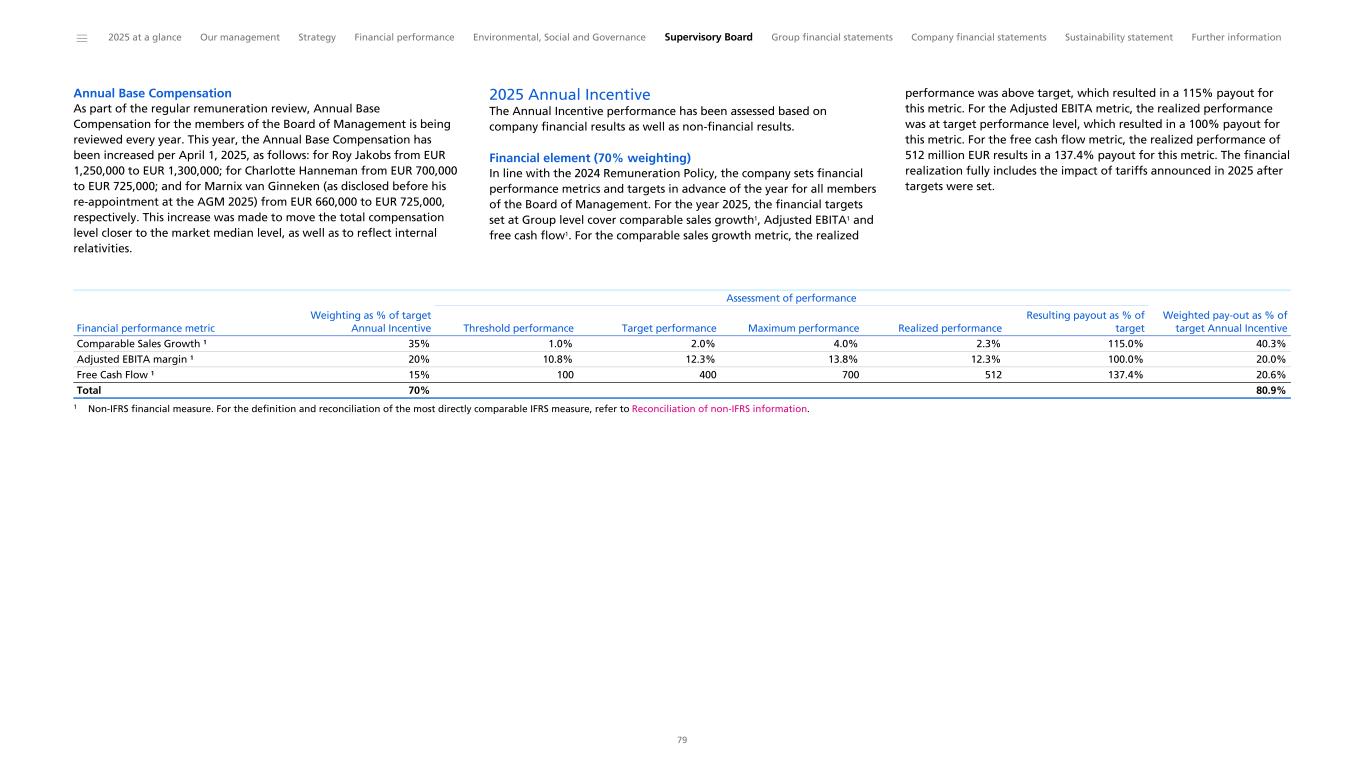
Annual Base Compensation As part of the regular remuneration review, Annual Base Compensation for the members of the Board of Management is being reviewed every year. This year, the Annual Base Compensation has been increased per April 1, 2025, as follows: for Roy Jakobs from EUR 1,250,000 to EUR 1,300,000; for Charlotte Hanneman from EUR 700,000 to EUR 725,000; and for Marnix van Ginneken (as disclosed before his re-appointment at the AGM 2025) from EUR 660,000 to EUR 725,000, respectively. This increase was made to move the total compensation level closer to the market median level, as well as to reflect internal relativities. 2025 Annual Incentive The Annual Incentive performance has been assessed based on company financial results as well as non-financial results. Financial element (70% weighting) In line with the 2024 Remuneration Policy, the company sets financial performance metrics and targets in advance of the year for all members of the Board of Management. For the year 2025, the financial targets set at Group level cover comparable sales growth1, Adjusted EBITA1 and free cash flow1. For the comparable sales growth metric, the realized performance was above target, which resulted in a 115% payout for this metric. For the Adjusted EBITA metric, the realized performance was at target performance level, which resulted in a 100% payout for this metric. For the free cash flow metric, the realized performance of 512 million EUR results in a 137.4% payout for this metric. The financial realization fully includes the impact of tariffs announced in 2025 after targets were set. Comparable Sales Growth ¹ 35% 1.0% 2.0% 4.0% 2.3% 115.0% 40.3% Adjusted EBITA margin ¹ 20% 10.8% 12.3% 13.8% 12.3% 100.0% 20.0% Free Cash Flow ¹ 15% 100 400 700 512 137.4% 20.6% Total 70% 80.9% Financial performance metric Weighting as % of target Annual Incentive Assessment of performance Weighted pay-out as % of target Annual IncentiveThreshold performance Target performance Maximum performance Realized performance Resulting payout as % of target 1 Non-IFRS financial measure. For the definition and reconciliation of the most directly comparable IFRS measure, refer to Reconciliation of non-IFRS information. ______ 2025 at a glance Our management Strategy Financial performance Environmental, Social and Governance Supervisory Board Group financial statements Company financial statements Sustainability statement Further information 79
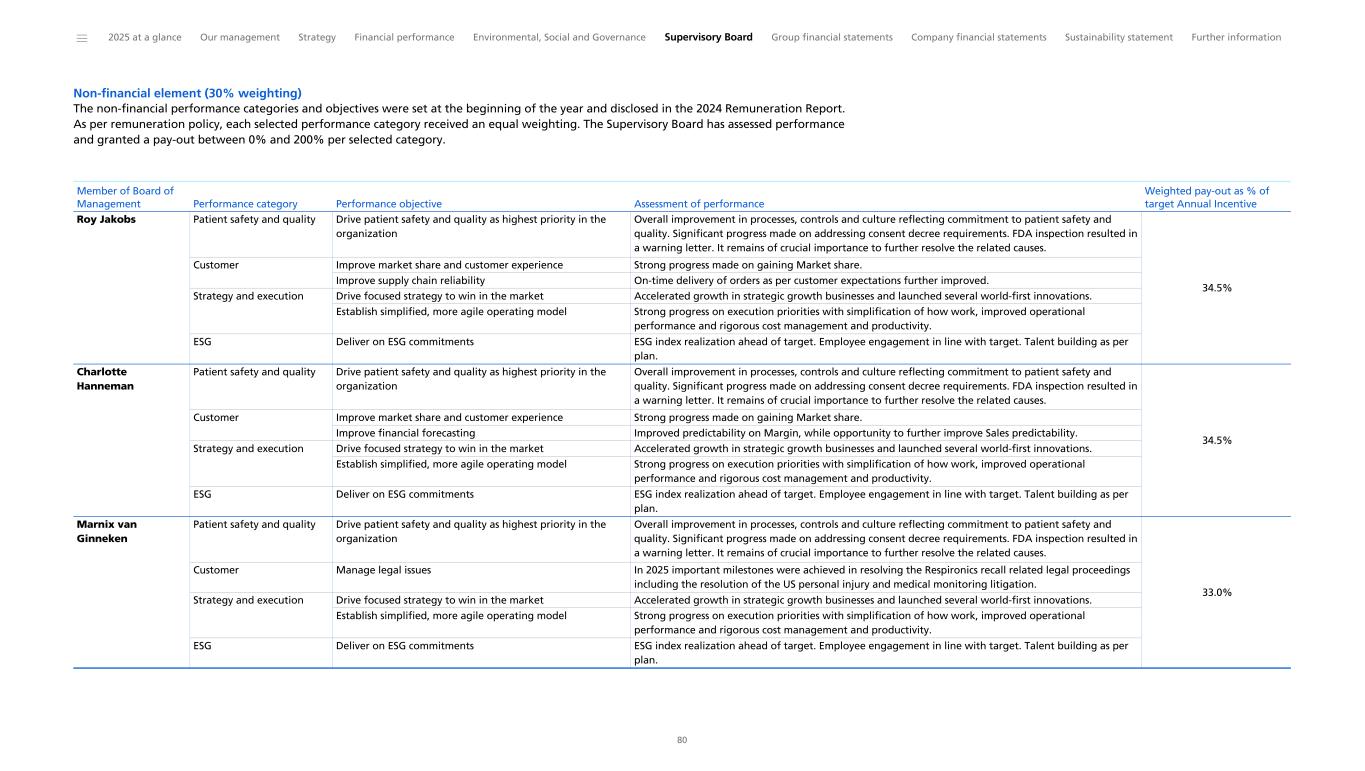
Non-financial element (30% weighting) The non-financial performance categories and objectives were set at the beginning of the year and disclosed in the 2024 Remuneration Report. As per remuneration policy, each selected performance category received an equal weighting. The Supervisory Board has assessed performance and granted a pay-out between 0% and 200% per selected category. Roy Jakobs Patient safety and quality Drive patient safety and quality as highest priority in the organization Overall improvement in processes, controls and culture reflecting commitment to patient safety and quality. Significant progress made on addressing consent decree requirements. FDA inspection resulted in a warning letter. It remains of crucial importance to further resolve the related causes. 34.5% Customer Improve market share and customer experience Strong progress made on gaining Market share. Improve supply chain reliability On-time delivery of orders as per customer expectations further improved. Strategy and execution Drive focused strategy to win in the market Accelerated growth in strategic growth businesses and launched several world-first innovations. Establish simplified, more agile operating model Strong progress on execution priorities with simplification of how work, improved operational performance and rigorous cost management and productivity. ESG Deliver on ESG commitments ESG index realization ahead of target. Employee engagement in line with target. Talent building as per plan. Charlotte Hanneman Patient safety and quality Drive patient safety and quality as highest priority in the organization Overall improvement in processes, controls and culture reflecting commitment to patient safety and quality. Significant progress made on addressing consent decree requirements. FDA inspection resulted in a warning letter. It remains of crucial importance to further resolve the related causes. 34.5% Customer Improve market share and customer experience Strong progress made on gaining Market share. Improve financial forecasting Improved predictability on Margin, while opportunity to further improve Sales predictability. Strategy and execution Drive focused strategy to win in the market Accelerated growth in strategic growth businesses and launched several world-first innovations. Establish simplified, more agile operating model Strong progress on execution priorities with simplification of how work, improved operational performance and rigorous cost management and productivity. ESG Deliver on ESG commitments ESG index realization ahead of target. Employee engagement in line with target. Talent building as per plan. Marnix van Ginneken Patient safety and quality Drive patient safety and quality as highest priority in the organization Overall improvement in processes, controls and culture reflecting commitment to patient safety and quality. Significant progress made on addressing consent decree requirements. FDA inspection resulted in a warning letter. It remains of crucial importance to further resolve the related causes. 33.0% Customer Manage legal issues In 2025 important milestones were achieved in resolving the Respironics recall related legal proceedings including the resolution of the US personal injury and medical monitoring litigation. Strategy and execution Drive focused strategy to win in the market Accelerated growth in strategic growth businesses and launched several world-first innovations. Establish simplified, more agile operating model Strong progress on execution priorities with simplification of how work, improved operational performance and rigorous cost management and productivity. ESG Deliver on ESG commitments ESG index realization ahead of target. Employee engagement in line with target. Talent building as per plan. Member of Board of Management Performance category Performance objective Assessment of performance Weighted pay-out as % of target Annual Incentive ______ 2025 at a glance Our management Strategy Financial performance Environmental, Social and Governance Supervisory Board Group financial statements Company financial statements Sustainability statement Further information 80
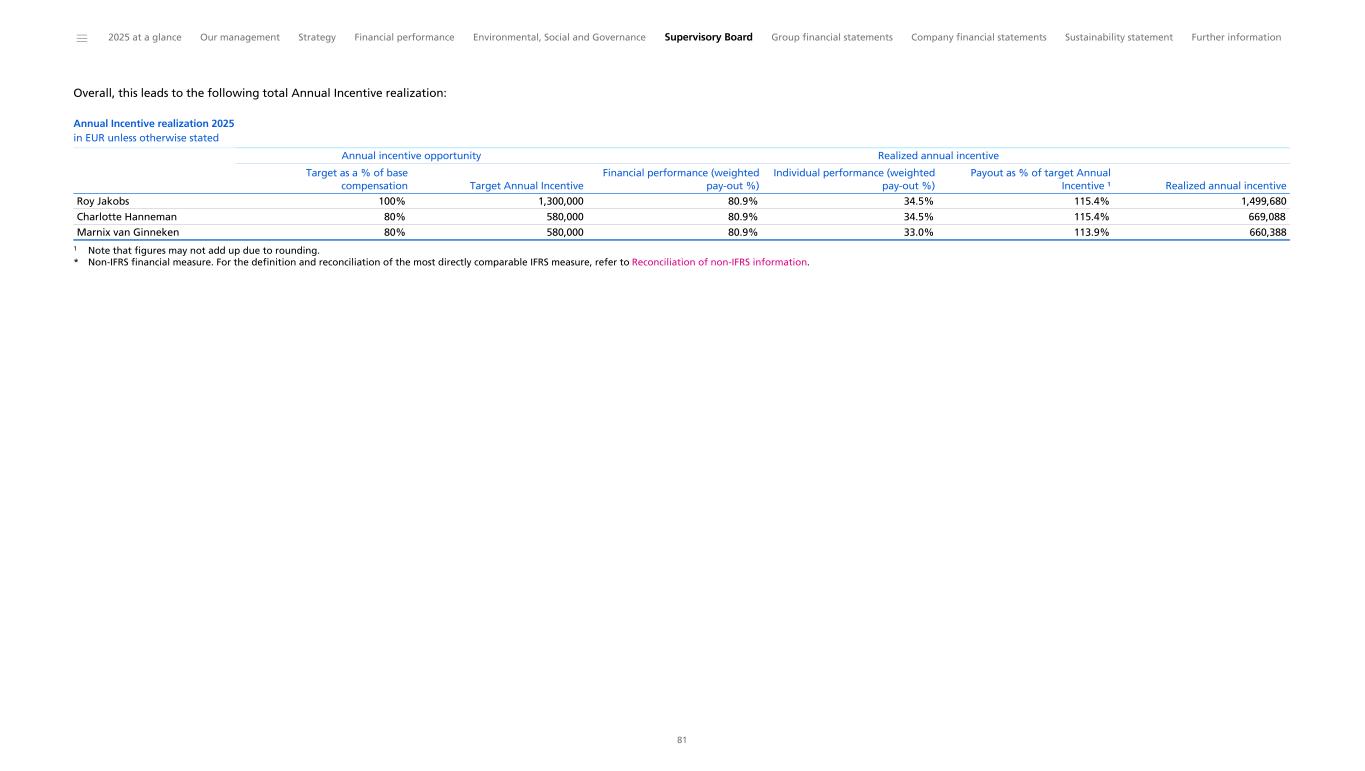
Overall, this leads to the following total Annual Incentive realization: Annual Incentive realization 2025 in EUR unless otherwise stated Roy Jakobs 100% 1,300,000 80.9% 34.5% 115.4% 1,499,680 Charlotte Hanneman 80% 580,000 80.9% 34.5% 115.4% 669,088 Marnix van Ginneken 80% 580,000 80.9% 33.0% 113.9% 660,388 Annual incentive opportunity Realized annual incentive Target as a % of base compensation Target Annual Incentive Financial performance (weighted pay-out %) Individual performance (weighted pay-out %) Payout as % of target Annual Incentive ¹ Realized annual incentive 1 Note that figures may not add up due to rounding. * Non-IFRS financial measure. For the definition and reconciliation of the most directly comparable IFRS measure, refer to Reconciliation of non-IFRS information. ______ 2025 at a glance Our management Strategy Financial performance Environmental, Social and Governance Supervisory Board Group financial statements Company financial statements Sustainability statement Further information 81
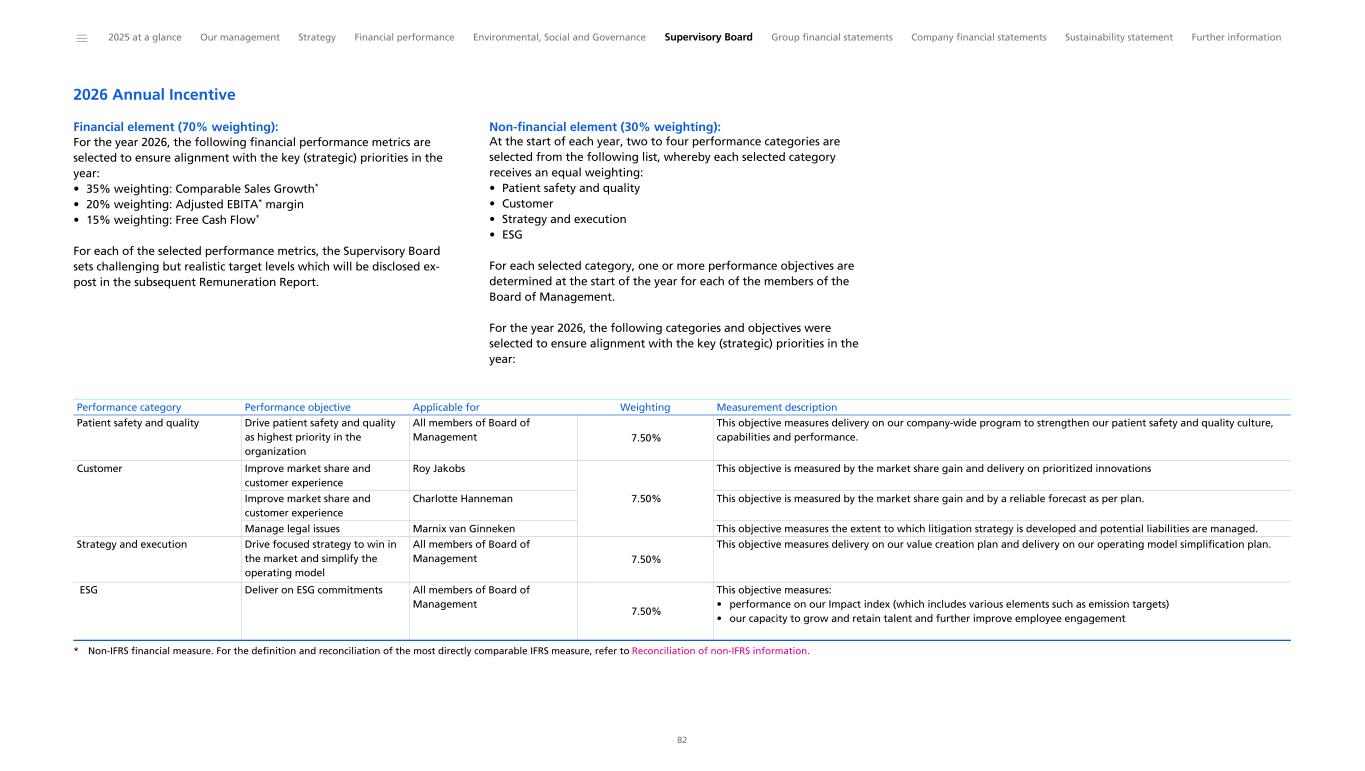
2026 Annual Incentive Financial element (70% weighting): For the year 2026, the following financial performance metrics are selected to ensure alignment with the key (strategic) priorities in the year: • 35% weighting: Comparable Sales Growth* • 20% weighting: Adjusted EBITA* margin • 15% weighting: Free Cash Flow* For each of the selected performance metrics, the Supervisory Board sets challenging but realistic target levels which will be disclosed ex- post in the subsequent Remuneration Report. Non-financial element (30% weighting): At the start of each year, two to four performance categories are selected from the following list, whereby each selected category receives an equal weighting: • Patient safety and quality • Customer • Strategy and execution • ESG For each selected category, one or more performance objectives are determined at the start of the year for each of the members of the Board of Management. For the year 2026, the following categories and objectives were selected to ensure alignment with the key (strategic) priorities in the year: Patient safety and quality Drive patient safety and quality as highest priority in the organization All members of Board of Management 7.50% This objective measures delivery on our company-wide program to strengthen our patient safety and quality culture, capabilities and performance. Customer Improve market share and customer experience Roy Jakobs 7.50% This objective is measured by the market share gain and delivery on prioritized innovations Improve market share and customer experience Charlotte Hanneman This objective is measured by the market share gain and by a reliable forecast as per plan. Manage legal issues Marnix van Ginneken This objective measures the extent to which litigation strategy is developed and potential liabilities are managed. Strategy and execution Drive focused strategy to win in the market and simplify the operating model All members of Board of Management 7.50% This objective measures delivery on our value creation plan and delivery on our operating model simplification plan. ESG Deliver on ESG commitments All members of Board of Management 7.50% This objective measures: • performance on our Impact index (which includes various elements such as emission targets) • our capacity to grow and retain talent and further improve employee engagement Performance category Performance objective Applicable for Weighting Measurement description * Non-IFRS financial measure. For the definition and reconciliation of the most directly comparable IFRS measure, refer to Reconciliation of non-IFRS information. ______ 2025 at a glance Our management Strategy Financial performance Environmental, Social and Governance Supervisory Board Group financial statements Company financial statements Sustainability statement Further information 82
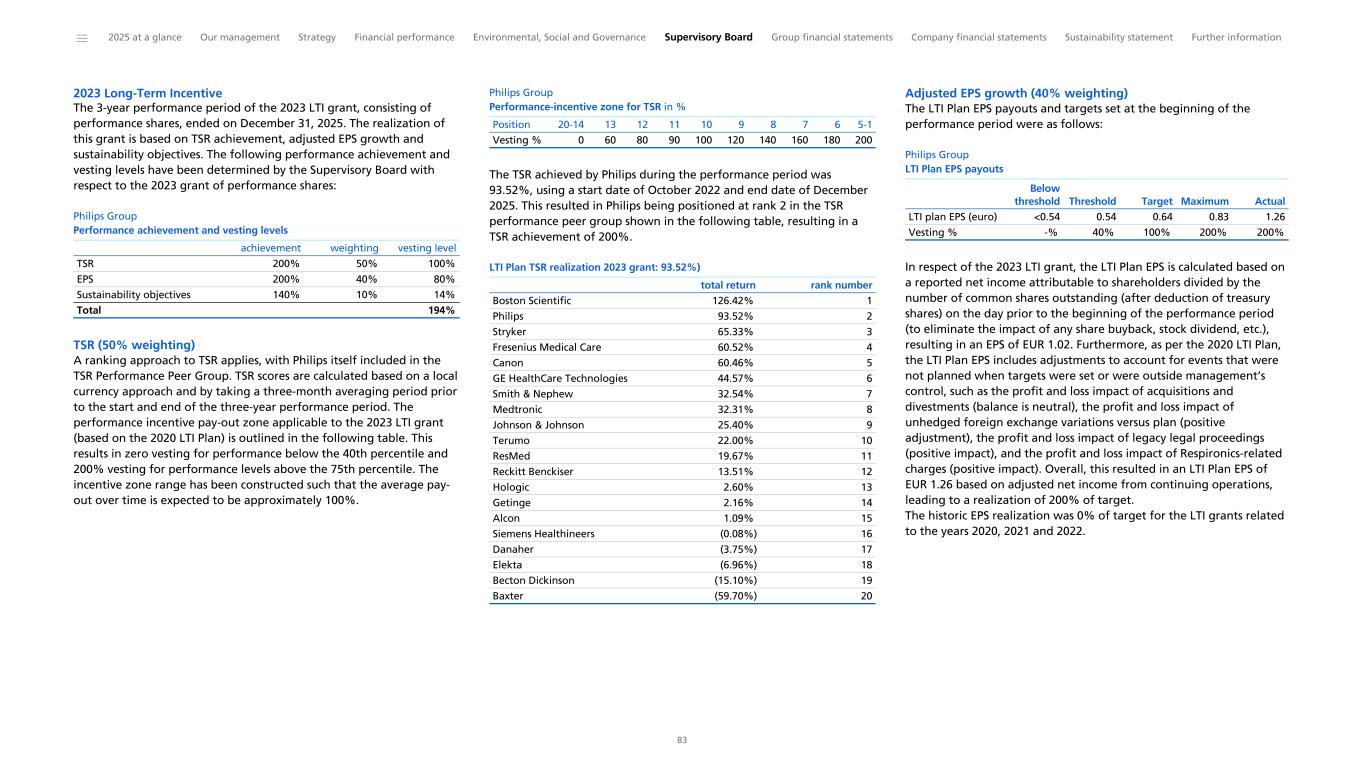
2023 Long-Term Incentive The 3-year performance period of the 2023 LTI grant, consisting of performance shares, ended on December 31, 2025. The realization of this grant is based on TSR achievement, adjusted EPS growth and sustainability objectives. The following performance achievement and vesting levels have been determined by the Supervisory Board with respect to the 2023 grant of performance shares: Philips Group Performance achievement and vesting levels TSR 200% 50% 100% EPS 200% 40% 80% Sustainability objectives 140% 10% 14% Total 194% achievement weighting vesting level TSR (50% weighting) A ranking approach to TSR applies, with Philips itself included in the TSR Performance Peer Group. TSR scores are calculated based on a local currency approach and by taking a three-month averaging period prior to the start and end of the three-year performance period. The performance incentive pay-out zone applicable to the 2023 LTI grant (based on the 2020 LTI Plan) is outlined in the following table. This results in zero vesting for performance below the 40th percentile and 200% vesting for performance levels above the 75th percentile. The incentive zone range has been constructed such that the average pay- out over time is expected to be approximately 100%. Philips Group Performance-incentive zone for TSR in % Position 20-14 13 12 11 10 9 8 7 6 5-1 Vesting % 0 60 80 90 100 120 140 160 180 200 The TSR achieved by Philips during the performance period was 93.52%, using a start date of October 2022 and end date of December 2025. This resulted in Philips being positioned at rank 2 in the TSR performance peer group shown in the following table, resulting in a TSR achievement of 200%. LTI Plan TSR realization 2023 grant: 93.52%) Boston Scientific 126.42% 1 Philips 93.52% 2 Stryker 65.33% 3 Fresenius Medical Care 60.52% 4 Canon 60.46% 5 GE HealthCare Technologies 44.57% 6 Smith & Nephew 32.54% 7 Medtronic 32.31% 8 Johnson & Johnson 25.40% 9 Terumo 22.00% 10 ResMed 19.67% 11 Reckitt Benckiser 13.51% 12 Hologic 2.60% 13 Getinge 2.16% 14 Alcon 1.09% 15 Siemens Healthineers (0.08%) 16 Danaher (3.75%) 17 Elekta (6.96%) 18 Becton Dickinson (15.10%) 19 Baxter (59.70%) 20 total return rank number Adjusted EPS growth (40% weighting) The LTI Plan EPS payouts and targets set at the beginning of the performance period were as follows: Philips Group LTI Plan EPS payouts LTI plan EPS (euro) <0.54 0.54 0.64 0.83 1.26 Vesting % -% 40% 100% 200% 200% Below threshold Threshold Target Maximum Actual In respect of the 2023 LTI grant, the LTI Plan EPS is calculated based on a reported net income attributable to shareholders divided by the number of common shares outstanding (after deduction of treasury shares) on the day prior to the beginning of the performance period (to eliminate the impact of any share buyback, stock dividend, etc.), resulting in an EPS of EUR 1.02. Furthermore, as per the 2020 LTI Plan, the LTI Plan EPS includes adjustments to account for events that were not planned when targets were set or were outside management’s control, such as the profit and loss impact of acquisitions and divestments (balance is neutral), the profit and loss impact of unhedged foreign exchange variations versus plan (positive adjustment), the profit and loss impact of legacy legal proceedings (positive impact), and the profit and loss impact of Respironics-related charges (positive impact). Overall, this resulted in an LTI Plan EPS of EUR 1.26 based on adjusted net income from continuing operations, leading to a realization of 200% of target. The historic EPS realization was 0% of target for the LTI grants related to the years 2020, 2021 and 2022. ______ 2025 at a glance Our management Strategy Financial performance Environmental, Social and Governance Supervisory Board Group financial statements Company financial statements Sustainability statement Further information 83
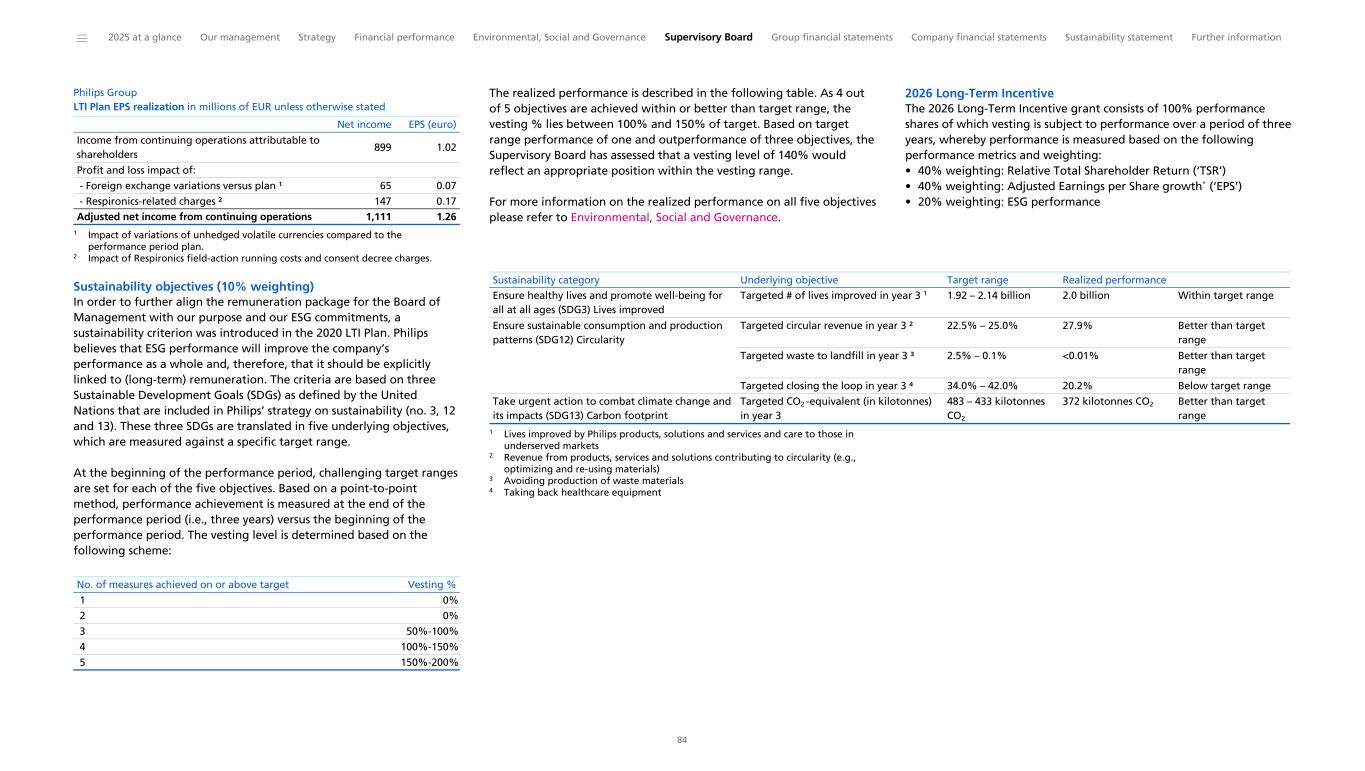
Philips Group LTI Plan EPS realization in millions of EUR unless otherwise stated Income from continuing operations attributable to shareholders 899 1.02 Profit and loss impact of: - Foreign exchange variations versus plan ¹ 65 0.07 - Respironics-related charges ² 147 0.17 Adjusted net income from continuing operations 1,111 1.26 Net income EPS (euro) 1 Impact of variations of unhedged volatile currencies compared to the performance period plan. 2 Impact of Respironics field-action running costs and consent decree charges. Sustainability objectives (10% weighting) In order to further align the remuneration package for the Board of Management with our purpose and our ESG commitments, a sustainability criterion was introduced in the 2020 LTI Plan. Philips believes that ESG performance will improve the company’s performance as a whole and, therefore, that it should be explicitly linked to (long-term) remuneration. The criteria are based on three Sustainable Development Goals (SDGs) as defined by the United Nations that are included in Philips’ strategy on sustainability (no. 3, 12 and 13). These three SDGs are translated in five underlying objectives, which are measured against a specific target range. At the beginning of the performance period, challenging target ranges are set for each of the five objectives. Based on a point-to-point method, performance achievement is measured at the end of the performance period (i.e., three years) versus the beginning of the performance period. The vesting level is determined based on the following scheme: 1 0% 2 0% 3 50%-100% 4 100%-150% 5 150%-200% No. of measures achieved on or above target Vesting % The realized performance is described in the following table. As 4 out of 5 objectives are achieved within or better than target range, the vesting % lies between 100% and 150% of target. Based on target range performance of one and outperformance of three objectives, the Supervisory Board has assessed that a vesting level of 140% would reflect an appropriate position within the vesting range. For more information on the realized performance on all five objectives please refer to Environmental, Social and Governance. Ensure healthy lives and promote well-being for all at all ages (SDG3) Lives improved Targeted # of lives improved in year 3 1 1.92 – 2.14 billion 2.0 billion Within target range Ensure sustainable consumption and production patterns (SDG12) Circularity Targeted circular revenue in year 3 ² 22.5% – 25.0% 27.9% Better than target range Targeted waste to landfill in year 3 ³ 2.5% – 0.1% <0.01% Better than target range Targeted closing the loop in year 3 ⁴ 34.0% – 42.0% 20.2% Below target range Take urgent action to combat climate change and its impacts (SDG13) Carbon footprint Targeted CO2 -equivalent (in kilotonnes) in year 3 483 – 433 kilotonnes CO2 372 kilotonnes CO2 Better than target range Sustainability category Underlying objective Target range Realized performance 1 Lives improved by Philips products, solutions and services and care to those in underserved markets 2 Revenue from products, services and solutions contributing to circularity (e.g., optimizing and re-using materials) 3 Avoiding production of waste materials 4 Taking back healthcare equipment 2026 Long-Term Incentive The 2026 Long-Term Incentive grant consists of 100% performance shares of which vesting is subject to performance over a period of three years, whereby performance is measured based on the following performance metrics and weighting: • 40% weighting: Relative Total Shareholder Return (‘TSR’) • 40% weighting: Adjusted Earnings per Share growth* (‘EPS’) • 20% weighting: ESG performance ______ 2025 at a glance Our management Strategy Financial performance Environmental, Social and Governance Supervisory Board Group financial statements Company financial statements Sustainability statement Further information 84
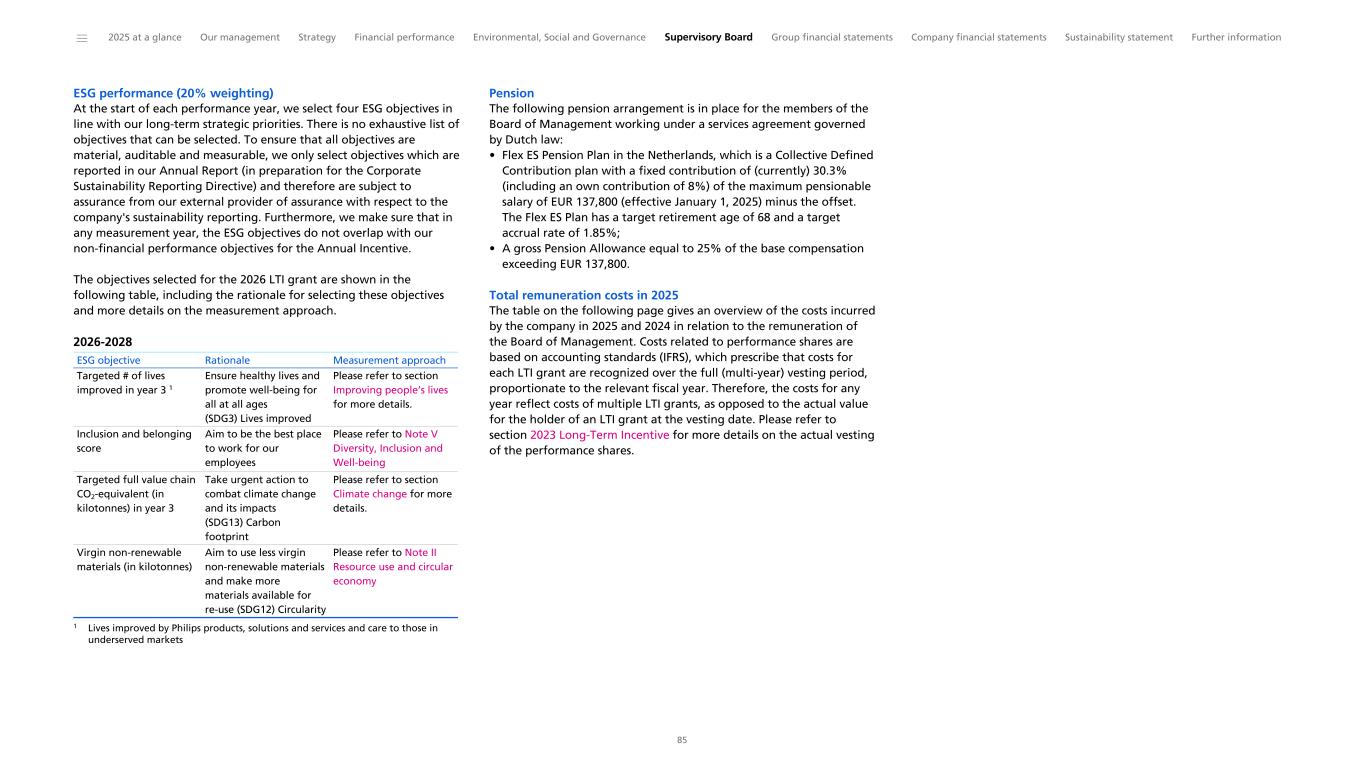
ESG performance (20% weighting) At the start of each performance year, we select four ESG objectives in line with our long-term strategic priorities. There is no exhaustive list of objectives that can be selected. To ensure that all objectives are material, auditable and measurable, we only select objectives which are reported in our Annual Report (in preparation for the Corporate Sustainability Reporting Directive) and therefore are subject to assurance from our external provider of assurance with respect to the company's sustainability reporting. Furthermore, we make sure that in any measurement year, the ESG objectives do not overlap with our non-financial performance objectives for the Annual Incentive. The objectives selected for the 2026 LTI grant are shown in the following table, including the rationale for selecting these objectives and more details on the measurement approach. 2026-2028 Targeted # of lives improved in year 3 1 Ensure healthy lives and promote well-being for all at all ages (SDG3) Lives improved Please refer to section Improving people’s lives for more details. Inclusion and belonging score Aim to be the best place to work for our employees Please refer to Note V Diversity, Inclusion and Well-being Targeted full value chain CO2-equivalent (in kilotonnes) in year 3 Take urgent action to combat climate change and its impacts (SDG13) Carbon footprint Please refer to section Climate change for more details. Virgin non-renewable materials (in kilotonnes) Aim to use less virgin non-renewable materials and make more materials available for re-use (SDG12) Circularity Please refer to Note II Resource use and circular economy ESG objective Rationale Measurement approach 1 Lives improved by Philips products, solutions and services and care to those in underserved markets Pension The following pension arrangement is in place for the members of the Board of Management working under a services agreement governed by Dutch law: • Flex ES Pension Plan in the Netherlands, which is a Collective Defined Contribution plan with a fixed contribution of (currently) 30.3% (including an own contribution of 8%) of the maximum pensionable salary of EUR 137,800 (effective January 1, 2025) minus the offset. The Flex ES Plan has a target retirement age of 68 and a target accrual rate of 1.85%; • A gross Pension Allowance equal to 25% of the base compensation exceeding EUR 137,800. Total remuneration costs in 2025 The table on the following page gives an overview of the costs incurred by the company in 2025 and 2024 in relation to the remuneration of the Board of Management. Costs related to performance shares are based on accounting standards (IFRS), which prescribe that costs for each LTI grant are recognized over the full (multi-year) vesting period, proportionate to the relevant fiscal year. Therefore, the costs for any year reflect costs of multiple LTI grants, as opposed to the actual value for the holder of an LTI grant at the vesting date. Please refer to section 2023 Long-Term Incentive for more details on the actual vesting of the performance shares. ______ 2025 at a glance Our management Strategy Financial performance Environmental, Social and Governance Supervisory Board Group financial statements Company financial statements Sustainability statement Further information 85
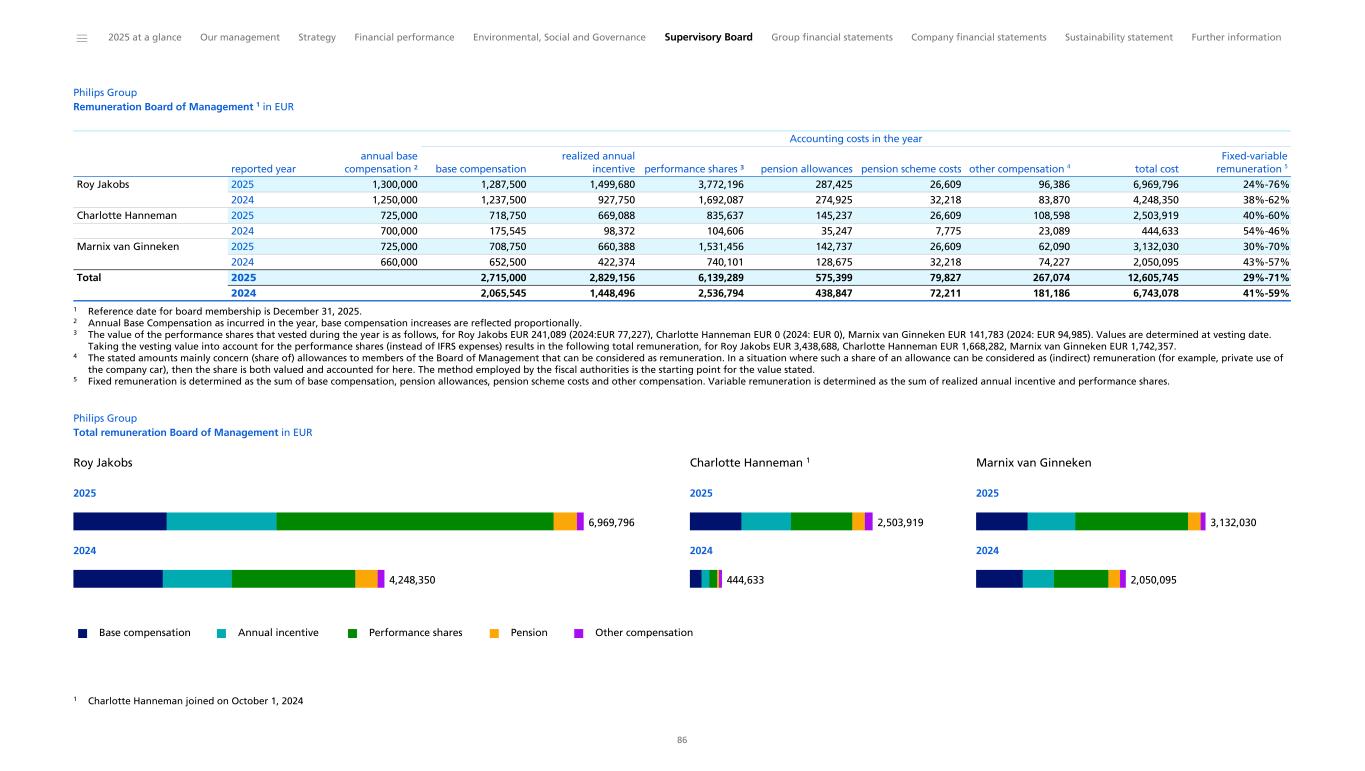
Philips Group Remuneration Board of Management 1 in EUR Roy Jakobs 2025 1,300,000 1,287,500 1,499,680 3,772,196 287,425 26,609 96,386 6,969,796 24%-76% 2024 1,250,000 1,237,500 927,750 1,692,087 274,925 32,218 83,870 4,248,350 38%-62% Charlotte Hanneman 2025 725,000 718,750 669,088 835,637 145,237 26,609 108,598 2,503,919 40%-60% 2024 700,000 175,545 98,372 104,606 35,247 7,775 23,089 444,633 54%-46% Marnix van Ginneken 2025 725,000 708,750 660,388 1,531,456 142,737 26,609 62,090 3,132,030 30%-70% 2024 660,000 652,500 422,374 740,101 128,675 32,218 74,227 2,050,095 43%-57% Total 2025 2,715,000 2,829,156 6,139,289 575,399 79,827 267,074 12,605,745 29%-71% 2024 2,065,545 1,448,496 2,536,794 438,847 72,211 181,186 6,743,078 41%-59% Accounting costs in the year reported year annual base compensation ² base compensation realized annual incentive performance shares ³ pension allowances pension scheme costs other compensation ⁴ total cost Fixed-variable remuneration ⁵ 1 Reference date for board membership is December 31, 2025. 2 Annual Base Compensation as incurred in the year, base compensation increases are reflected proportionally. 3 The value of the performance shares that vested during the year is as follows, for Roy Jakobs EUR 241,089 (2024:EUR 77,227), Charlotte Hanneman EUR 0 (2024: EUR 0), Marnix van Ginneken EUR 141,783 (2024: EUR 94,985). Values are determined at vesting date. Taking the vesting value into account for the performance shares (instead of IFRS expenses) results in the following total remuneration, for Roy Jakobs EUR 3,438,688, Charlotte Hanneman EUR 1,668,282, Marnix van Ginneken EUR 1,742,357. 4 The stated amounts mainly concern (share of) allowances to members of the Board of Management that can be considered as remuneration. In a situation where such a share of an allowance can be considered as (indirect) remuneration (for example, private use of the company car), then the share is both valued and accounted for here. The method employed by the fiscal authorities is the starting point for the value stated. 5 Fixed remuneration is determined as the sum of base compensation, pension allowances, pension scheme costs and other compensation. Variable remuneration is determined as the sum of realized annual incentive and performance shares. Philips Group Total remuneration Board of Management in EUR Roy Jakobs 2025 6,969,796 2024 4,248,350 Charlotte Hanneman 1 2025 2,503,919 2024 444,633 Marnix van Ginneken 2025 3,132,030 2024 2,050,095 n Base compensation n Annual incentive n Performance shares n Pension n Other compensation ______ 2025 at a glance Our management Strategy Financial performance Environmental, Social and Governance Supervisory Board Group financial statements Company financial statements Sustainability statement Further information 86 1 Charlotte Hanneman joined on October 1, 2024
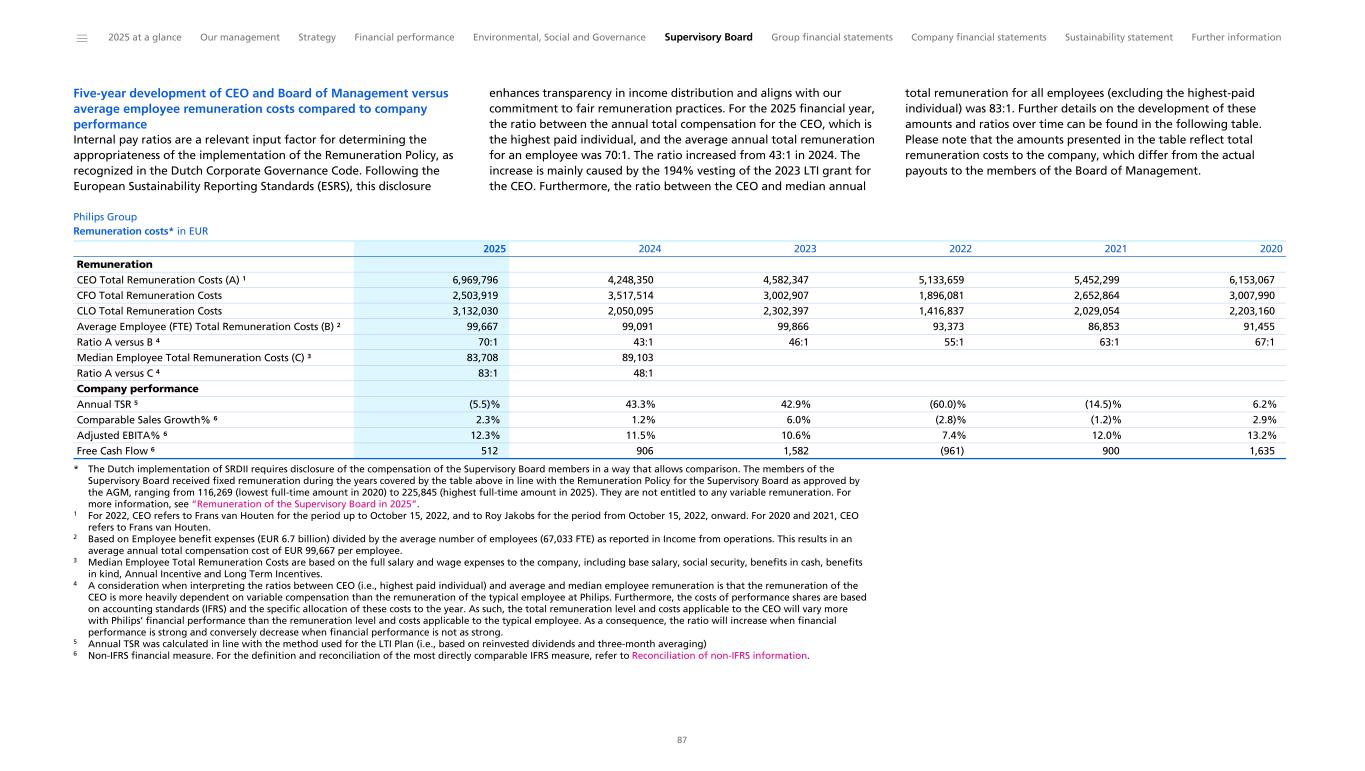
Five-year development of CEO and Board of Management versus average employee remuneration costs compared to company performance Internal pay ratios are a relevant input factor for determining the appropriateness of the implementation of the Remuneration Policy, as recognized in the Dutch Corporate Governance Code. Following the European Sustainability Reporting Standards (ESRS), this disclosure enhances transparency in income distribution and aligns with our commitment to fair remuneration practices. For the 2025 financial year, the ratio between the annual total compensation for the CEO, which is the highest paid individual, and the average annual total remuneration for an employee was 70:1. The ratio increased from 43:1 in 2024. The increase is mainly caused by the 194% vesting of the 2023 LTI grant for the CEO. Furthermore, the ratio between the CEO and median annual total remuneration for all employees (excluding the highest-paid individual) was 83:1. Further details on the development of these amounts and ratios over time can be found in the following table. Please note that the amounts presented in the table reflect total remuneration costs to the company, which differ from the actual payouts to the members of the Board of Management. Philips Group Remuneration costs* in EUR Remuneration CEO Total Remuneration Costs (A) ¹ 6,969,796 4,248,350 4,582,347 5,133,659 5,452,299 6,153,067 CFO Total Remuneration Costs 2,503,919 3,517,514 3,002,907 1,896,081 2,652,864 3,007,990 CLO Total Remuneration Costs 3,132,030 2,050,095 2,302,397 1,416,837 2,029,054 2,203,160 Average Employee (FTE) Total Remuneration Costs (B) ² 99,667 99,091 99,866 93,373 86,853 91,455 Ratio A versus B ⁴ 70:1 43:1 46:1 55:1 63:1 67:1 Median Employee Total Remuneration Costs (C) ³ 83,708 89,103 Ratio A versus C ⁴ 83:1 48:1 Company performance Annual TSR ⁵ (5.5) % 43.3 % 42.9 % (60.0) % (14.5) % 6.2 % Comparable Sales Growth% ⁶ 2.3 % 1.2 % 6.0 % (2.8) % (1.2) % 2.9 % Adjusted EBITA% ⁶ 12.3 % 11.5 % 10.6 % 7.4 % 12.0 % 13.2 % Free Cash Flow ⁶ 512 906 1,582 (961) 900 1,635 2025 2024 2023 2022 2021 2020 * The Dutch implementation of SRDII requires disclosure of the compensation of the Supervisory Board members in a way that allows comparison. The members of the Supervisory Board received fixed remuneration during the years covered by the table above in line with the Remuneration Policy for the Supervisory Board as approved by the AGM, ranging from 116,269 (lowest full-time amount in 2020) to 225,845 (highest full-time amount in 2025). They are not entitled to any variable remuneration. For more information, see “Remuneration of the Supervisory Board in 2025”. 1 For 2022, CEO refers to Frans van Houten for the period up to October 15, 2022, and to Roy Jakobs for the period from October 15, 2022, onward. For 2020 and 2021, CEO refers to Frans van Houten. 2 Based on Employee benefit expenses (EUR 6.7 billion) divided by the average number of employees (67,033 FTE) as reported in Income from operations. This results in an average annual total compensation cost of EUR 99,667 per employee. 3 Median Employee Total Remuneration Costs are based on the full salary and wage expenses to the company, including base salary, social security, benefits in cash, benefits in kind, Annual Incentive and Long Term Incentives. 4 A consideration when interpreting the ratios between CEO (i.e., highest paid individual) and average and median employee remuneration is that the remuneration of the CEO is more heavily dependent on variable compensation than the remuneration of the typical employee at Philips. Furthermore, the costs of performance shares are based on accounting standards (IFRS) and the specific allocation of these costs to the year. As such, the total remuneration level and costs applicable to the CEO will vary more with Philips’ financial performance than the remuneration level and costs applicable to the typical employee. As a consequence, the ratio will increase when financial performance is strong and conversely decrease when financial performance is not as strong. 5 Annual TSR was calculated in line with the method used for the LTI Plan (i.e., based on reinvested dividends and three-month averaging) 6 Non-IFRS financial measure. For the definition and reconciliation of the most directly comparable IFRS measure, refer to Reconciliation of non-IFRS information. ______ 2025 at a glance Our management Strategy Financial performance Environmental, Social and Governance Supervisory Board Group financial statements Company financial statements Sustainability statement Further information 87
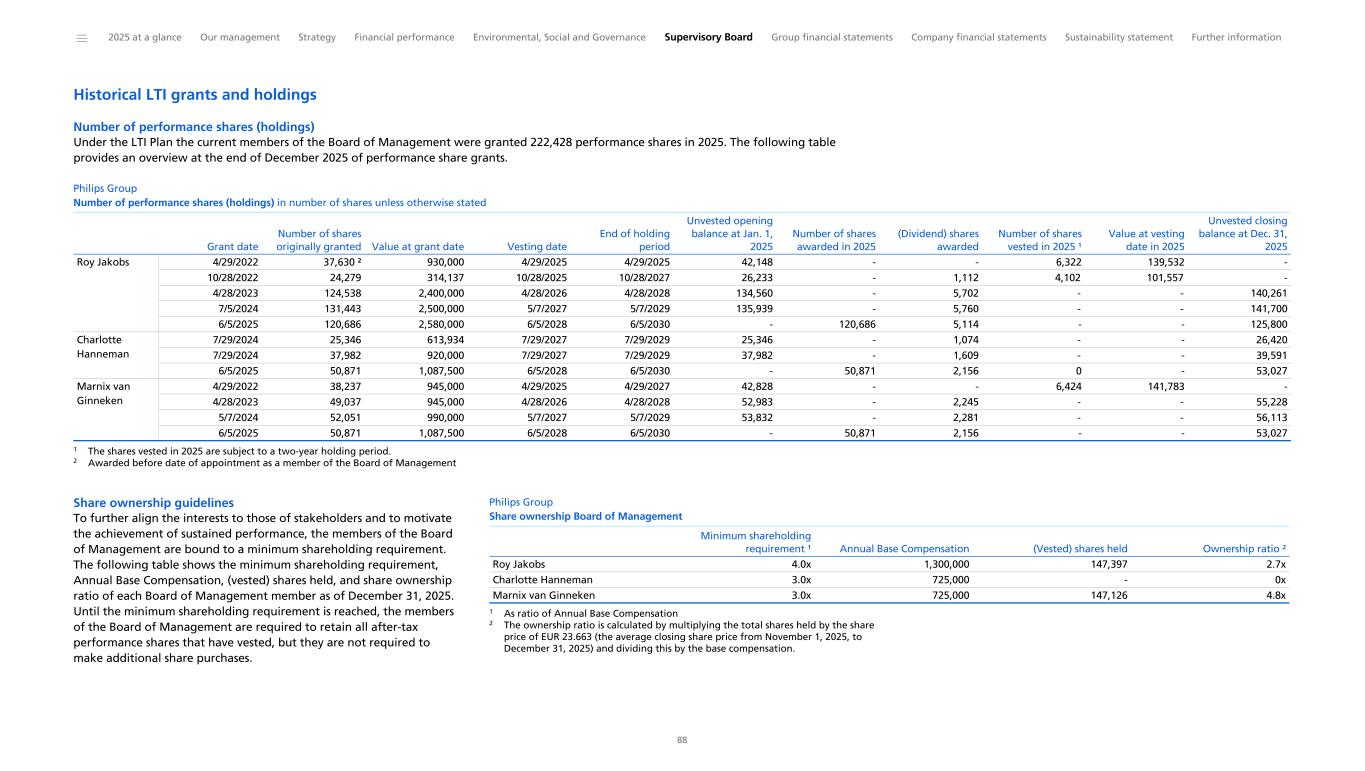
Historical LTI grants and holdings Number of performance shares (holdings) Under the LTI Plan the current members of the Board of Management were granted 222,428 performance shares in 2025. The following table provides an overview at the end of December 2025 of performance share grants. Philips Group Number of performance shares (holdings) in number of shares unless otherwise stated Roy Jakobs 4/29/2022 37,630 ² 930,000 4/29/2025 4/29/2025 42,148 - - 6,322 139,532 - 10/28/2022 24,279 314,137 10/28/2025 10/28/2027 26,233 - 1,112 4,102 101,557 - 4/28/2023 124,538 2,400,000 4/28/2026 4/28/2028 134,560 - 5,702 - - 140,261 7/5/2024 131,443 2,500,000 5/7/2027 5/7/2029 135,939 - 5,760 - - 141,700 6/5/2025 120,686 2,580,000 6/5/2028 6/5/2030 - 120,686 5,114 - - 125,800 Charlotte Hanneman 7/29/2024 25,346 613,934 7/29/2027 7/29/2029 25,346 - 1,074 - - 26,420 7/29/2024 37,982 920,000 7/29/2027 7/29/2029 37,982 - 1,609 - - 39,591 6/5/2025 50,871 1,087,500 6/5/2028 6/5/2030 - 50,871 2,156 0 - 53,027 Marnix van Ginneken 4/29/2022 38,237 945,000 4/29/2025 4/29/2027 42,828 - - 6,424 141,783 - 4/28/2023 49,037 945,000 4/28/2026 4/28/2028 52,983 - 2,245 - - 55,228 5/7/2024 52,051 990,000 5/7/2027 5/7/2029 53,832 - 2,281 - - 56,113 6/5/2025 50,871 1,087,500 6/5/2028 6/5/2030 - 50,871 2,156 - - 53,027 Grant date Number of shares originally granted Value at grant date Vesting date End of holding period Unvested opening balance at Jan. 1, 2025 Number of shares awarded in 2025 (Dividend) shares awarded Number of shares vested in 2025 ¹ Value at vesting date in 2025 Unvested closing balance at Dec. 31, 2025 1 The shares vested in 2025 are subject to a two-year holding period. 2 Awarded before date of appointment as a member of the Board of Management Share ownership guidelines To further align the interests to those of stakeholders and to motivate the achievement of sustained performance, the members of the Board of Management are bound to a minimum shareholding requirement. The following table shows the minimum shareholding requirement, Annual Base Compensation, (vested) shares held, and share ownership ratio of each Board of Management member as of December 31, 2025. Until the minimum shareholding requirement is reached, the members of the Board of Management are required to retain all after-tax performance shares that have vested, but they are not required to make additional share purchases. Philips Group Share ownership Board of Management Roy Jakobs 4.0x 1,300,000 147,397 2.7x Charlotte Hanneman 3.0x 725,000 - 0x Marnix van Ginneken 3.0x 725,000 147,126 4.8x Minimum shareholding requirement ¹ Annual Base Compensation (Vested) shares held Ownership ratio ² 1 As ratio of Annual Base Compensation 2 The ownership ratio is calculated by multiplying the total shares held by the share price of EUR 23.663 (the average closing share price from November 1, 2025, to December 31, 2025) and dividing this by the base compensation. ______ 2025 at a glance Our management Strategy Financial performance Environmental, Social and Governance Supervisory Board Group financial statements Company financial statements Sustainability statement Further information 88
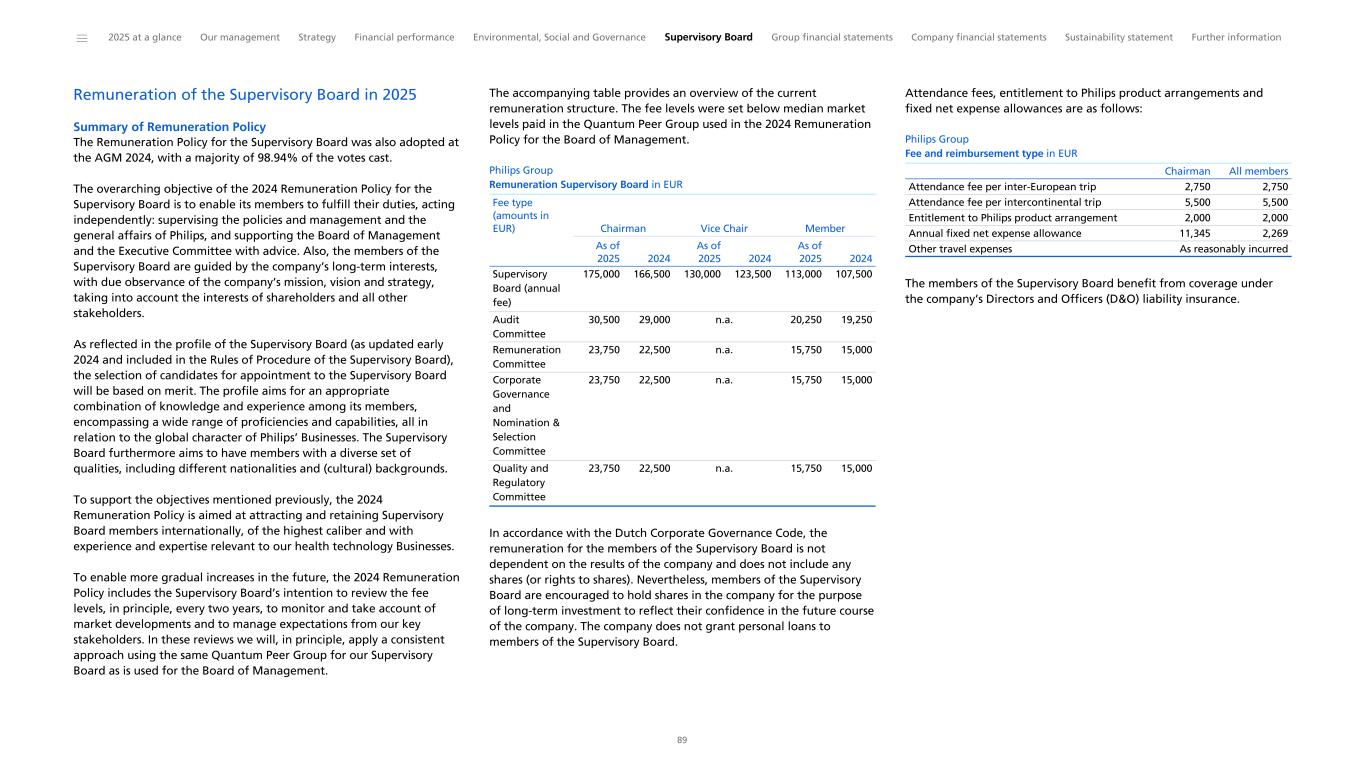
Remuneration of the Supervisory Board in 2025 Summary of Remuneration Policy The Remuneration Policy for the Supervisory Board was also adopted at the AGM 2024, with a majority of 98.94% of the votes cast. The overarching objective of the 2024 Remuneration Policy for the Supervisory Board is to enable its members to fulfill their duties, acting independently: supervising the policies and management and the general affairs of Philips, and supporting the Board of Management and the Executive Committee with advice. Also, the members of the Supervisory Board are guided by the company’s long-term interests, with due observance of the company’s mission, vision and strategy, taking into account the interests of shareholders and all other stakeholders. As reflected in the profile of the Supervisory Board (as updated early 2024 and included in the Rules of Procedure of the Supervisory Board), the selection of candidates for appointment to the Supervisory Board will be based on merit. The profile aims for an appropriate combination of knowledge and experience among its members, encompassing a wide range of proficiencies and capabilities, all in relation to the global character of Philips’ Businesses. The Supervisory Board furthermore aims to have members with a diverse set of qualities, including different nationalities and (cultural) backgrounds. To support the objectives mentioned previously, the 2024 Remuneration Policy is aimed at attracting and retaining Supervisory Board members internationally, of the highest caliber and with experience and expertise relevant to our health technology Businesses. To enable more gradual increases in the future, the 2024 Remuneration Policy includes the Supervisory Board’s intention to review the fee levels, in principle, every two years, to monitor and take account of market developments and to manage expectations from our key stakeholders. In these reviews we will, in principle, apply a consistent approach using the same Quantum Peer Group for our Supervisory Board as is used for the Board of Management. The accompanying table provides an overview of the current remuneration structure. The fee levels were set below median market levels paid in the Quantum Peer Group used in the 2024 Remuneration Policy for the Board of Management. Philips Group Remuneration Supervisory Board in EUR Supervisory Board (annual fee) 175,000 166,500 130,000 123,500 113,000 107,500 Audit Committee 30,500 29,000 n.a. 20,250 19,250 Remuneration Committee 23,750 22,500 n.a. 15,750 15,000 Corporate Governance and Nomination & Selection Committee 23,750 22,500 n.a. 15,750 15,000 Quality and Regulatory Committee 23,750 22,500 n.a. 15,750 15,000 Fee type (amounts in EUR) Chairman Vice Chair Member As of 2025 2024 As of 2025 2024 As of 2025 2024 In accordance with the Dutch Corporate Governance Code, the remuneration for the members of the Supervisory Board is not dependent on the results of the company and does not include any shares (or rights to shares). Nevertheless, members of the Supervisory Board are encouraged to hold shares in the company for the purpose of long-term investment to reflect their confidence in the future course of the company. The company does not grant personal loans to members of the Supervisory Board. Attendance fees, entitlement to Philips product arrangements and fixed net expense allowances are as follows: Philips Group Fee and reimbursement type in EUR Attendance fee per inter-European trip 2,750 2,750 Attendance fee per intercontinental trip 5,500 5,500 Entitlement to Philips product arrangement 2,000 2,000 Annual fixed net expense allowance 11,345 2,269 Other travel expenses As reasonably incurred Chairman All members The members of the Supervisory Board benefit from coverage under the company’s Directors and Officers (D&O) liability insurance. ______ 2025 at a glance Our management Strategy Financial performance Environmental, Social and Governance Supervisory Board Group financial statements Company financial statements Sustainability statement Further information 89
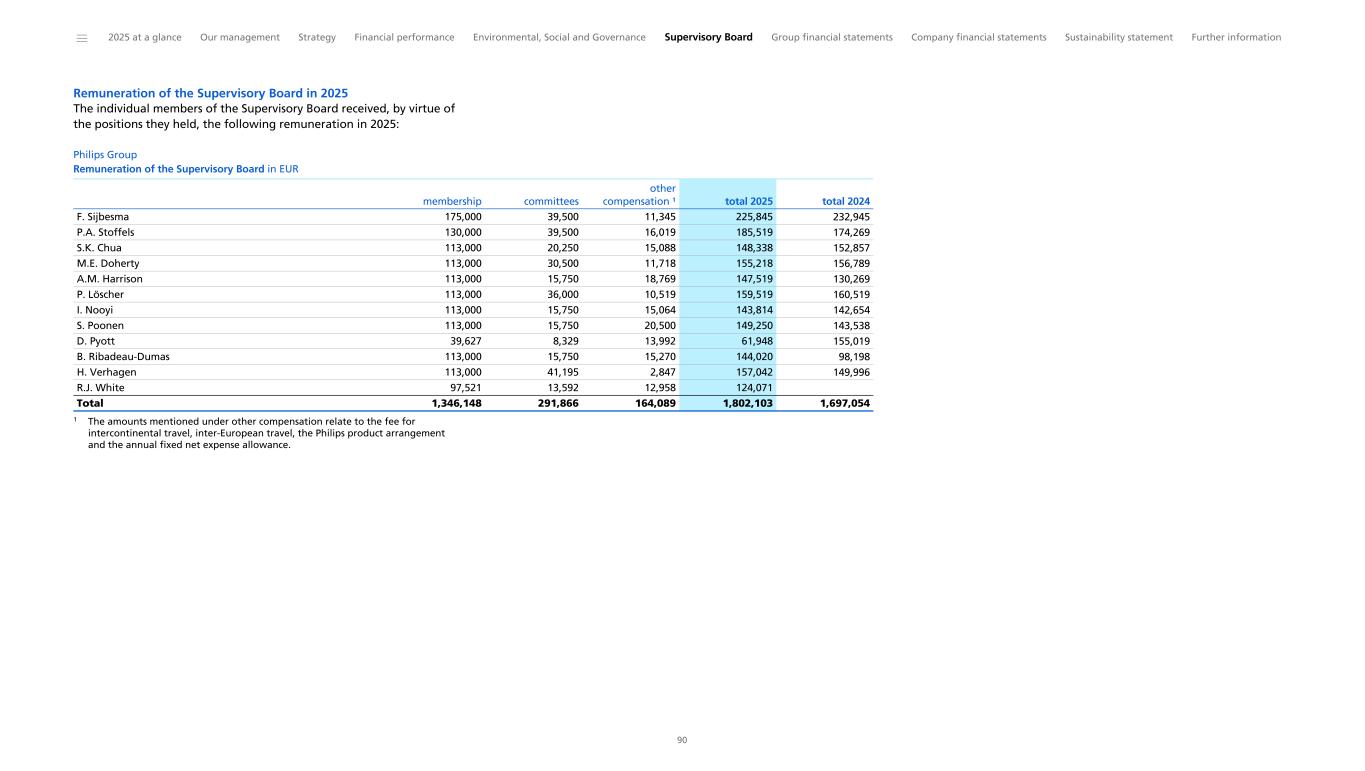
Remuneration of the Supervisory Board in 2025 The individual members of the Supervisory Board received, by virtue of the positions they held, the following remuneration in 2025: Philips Group Remuneration of the Supervisory Board in EUR F. Sijbesma 175,000 39,500 11,345 225,845 232,945 P.A. Stoffels 130,000 39,500 16,019 185,519 174,269 S.K. Chua 113,000 20,250 15,088 148,338 152,857 M.E. Doherty 113,000 30,500 11,718 155,218 156,789 A.M. Harrison 113,000 15,750 18,769 147,519 130,269 P. Löscher 113,000 36,000 10,519 159,519 160,519 I. Nooyi 113,000 15,750 15,064 143,814 142,654 S. Poonen 113,000 15,750 20,500 149,250 143,538 D. Pyott 39,627 8,329 13,992 61,948 155,019 B. Ribadeau-Dumas 113,000 15,750 15,270 144,020 98,198 H. Verhagen 113,000 41,195 2,847 157,042 149,996 R.J. White 97,521 13,592 12,958 124,071 Total 1,346,148 291,866 164,089 1,802,103 1,697,054 membership committees other compensation ¹ total 2025 total 2024 1 The amounts mentioned under other compensation relate to the fee for intercontinental travel, inter-European travel, the Philips product arrangement and the annual fixed net expense allowance. ______ 2025 at a glance Our management Strategy Financial performance Environmental, Social and Governance Supervisory Board Group financial statements Company financial statements Sustainability statement Further information 90
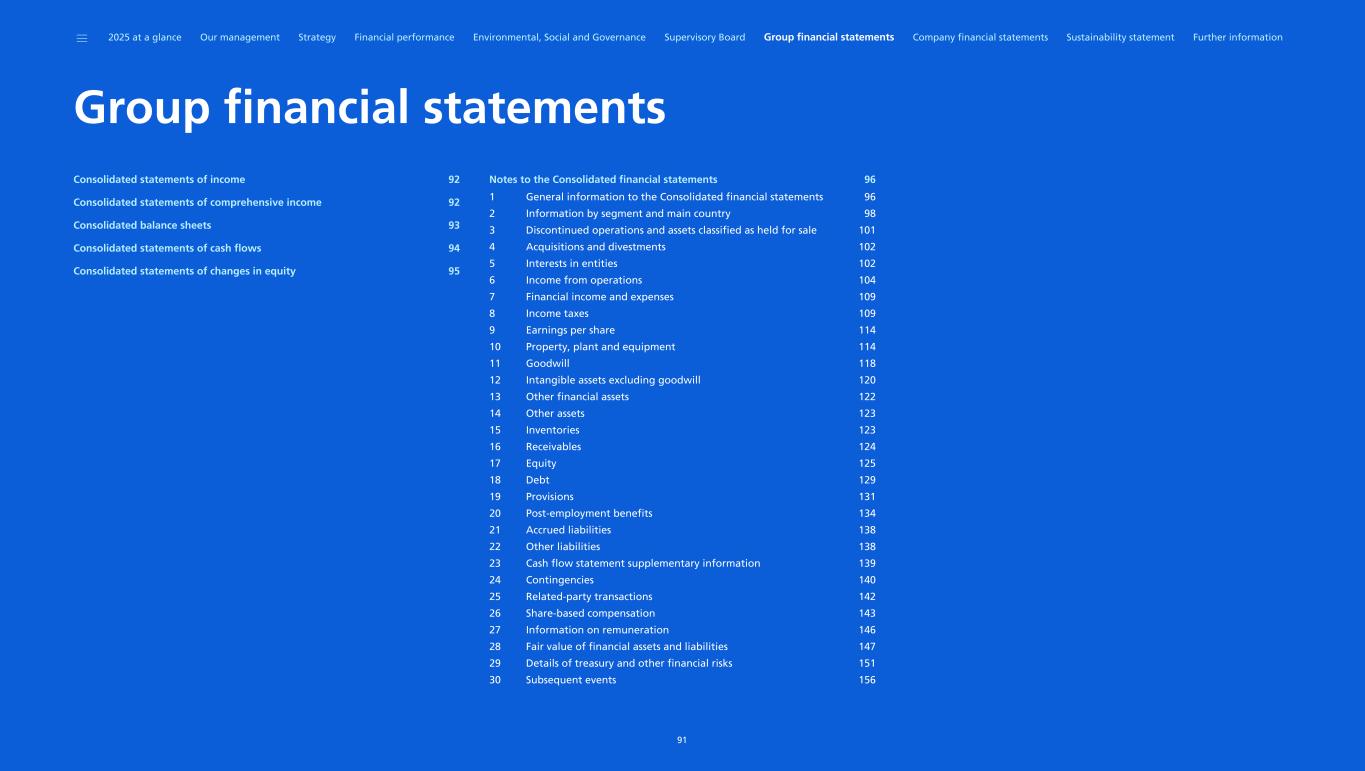
Group financial statements Consolidated statements of income 92 Consolidated statements of comprehensive income 92 Consolidated balance sheets 93 Consolidated statements of cash flows 94 Consolidated statements of changes in equity 95 Notes to the Consolidated financial statements 96 1 General information to the Consolidated financial statements 96 2 Information by segment and main country 98 3 Discontinued operations and assets classified as held for sale 101 4 Acquisitions and divestments 102 5 Interests in entities 102 6 Income from operations 104 7 Financial income and expenses 109 8 Income taxes 109 9 Earnings per share 114 10 Property, plant and equipment 114 11 Goodwill 118 12 Intangible assets excluding goodwill 120 13 Other financial assets 122 14 Other assets 123 15 Inventories 123 16 Receivables 124 17 Equity 125 18 Debt 129 19 Provisions 131 20 Post-employment benefits 134 21 Accrued liabilities 138 22 Other liabilities 138 23 Cash flow statement supplementary information 139 24 Contingencies 140 25 Related-party transactions 142 26 Share-based compensation 143 27 Information on remuneration 146 28 Fair value of financial assets and liabilities 147 29 Details of treasury and other financial risks 151 30 Subsequent events 156 ______ 2025 at a glance Our management Strategy Financial performance Environmental, Social and Governance Supervisory Board Group financial statements Company financial statements Sustainability statement Further information 91
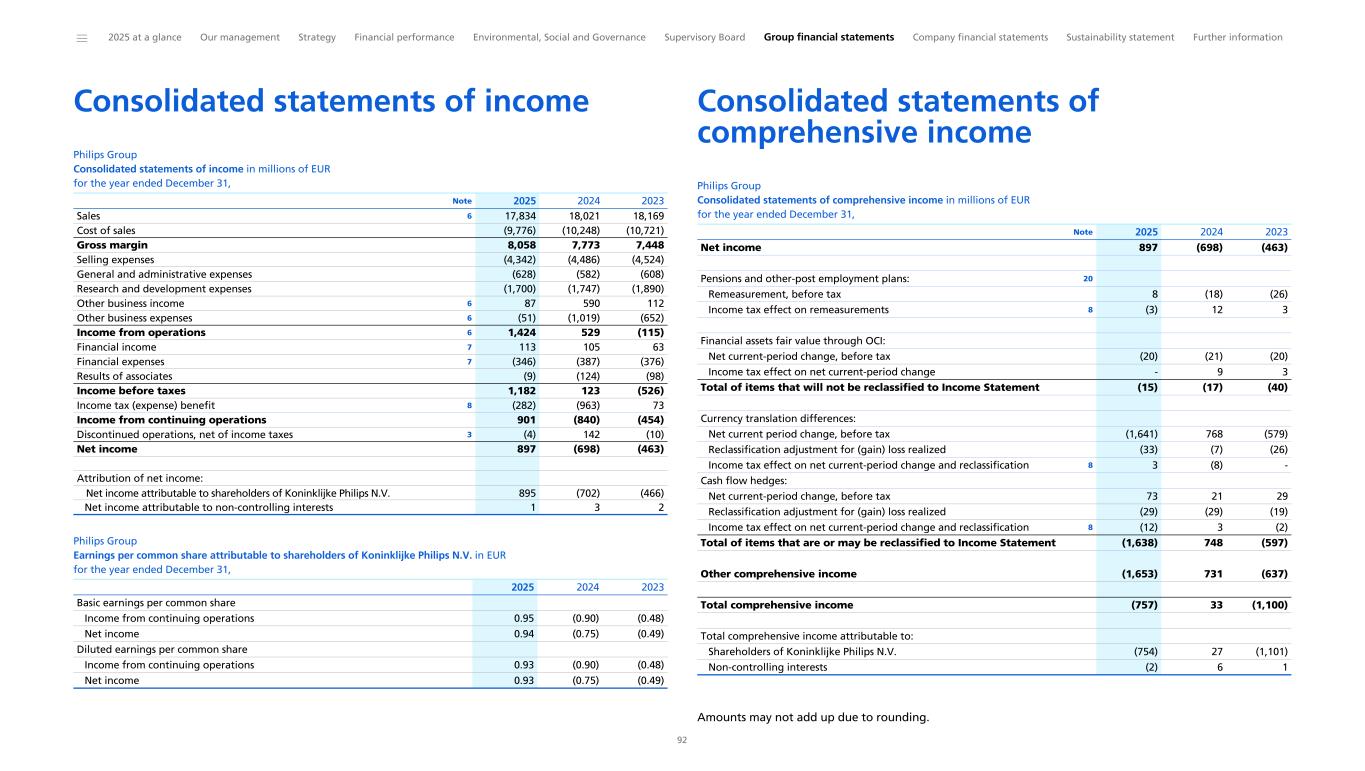
Consolidated statements of income Philips Group Consolidated statements of income in millions of EUR for the year ended December 31, Sales 6 17,834 18,021 18,169 Cost of sales (9,776) (10,248) (10,721) Gross margin 8,058 7,773 7,448 Selling expenses (4,342) (4,486) (4,524) General and administrative expenses (628) (582) (608) Research and development expenses (1,700) (1,747) (1,890) Other business income 6 87 590 112 Other business expenses 6 (51) (1,019) (652) Income from operations 6 1,424 529 (115) Financial income 7 113 105 63 Financial expenses 7 (346) (387) (376) Results of associates (9) (124) (98) Income before taxes 1,182 123 (526) Income tax (expense) benefit 8 (282) (963) 73 Income from continuing operations 901 (840) (454) Discontinued operations, net of income taxes 3 (4) 142 (10) Net income 897 (698) (463) Attribution of net income: Net income attributable to shareholders of Koninklijke Philips N.V. 895 (702) (466) Net income attributable to non-controlling interests 1 3 2 Note 2025 2024 2023 Philips Group Earnings per common share attributable to shareholders of Koninklijke Philips N.V. in EUR for the year ended December 31, Basic earnings per common share Income from continuing operations 0.95 (0.90) (0.48) Net income 0.94 (0.75) (0.49) Diluted earnings per common share Income from continuing operations 0.93 (0.90) (0.48) Net income 0.93 (0.75) (0.49) 2025 2024 2023 Consolidated statements of comprehensive income Philips Group Consolidated statements of comprehensive income in millions of EUR for the year ended December 31, Net income 897 (698) (463) Pensions and other-post employment plans: 20 Remeasurement, before tax 8 (18) (26) Income tax effect on remeasurements 8 (3) 12 3 Financial assets fair value through OCI: Net current-period change, before tax (20) (21) (20) Income tax effect on net current-period change - 9 3 Total of items that will not be reclassified to Income Statement (15) (17) (40) Currency translation differences: Net current period change, before tax (1,641) 768 (579) Reclassification adjustment for (gain) loss realized (33) (7) (26) Income tax effect on net current-period change and reclassification 8 3 (8) - Cash flow hedges: Net current-period change, before tax 73 21 29 Reclassification adjustment for (gain) loss realized (29) (29) (19) Income tax effect on net current-period change and reclassification 8 (12) 3 (2) Total of items that are or may be reclassified to Income Statement (1,638) 748 (597) Other comprehensive income (1,653) 731 (637) Total comprehensive income (757) 33 (1,100) Total comprehensive income attributable to: Shareholders of Koninklijke Philips N.V. (754) 27 (1,101) Non-controlling interests (2) 6 1 Note 2025 2024 2023 Amounts may not add up due to rounding. ______ 2025 at a glance Our management Strategy Financial performance Environmental, Social and Governance Supervisory Board Group financial statements Company financial statements Sustainability statement Further information 92
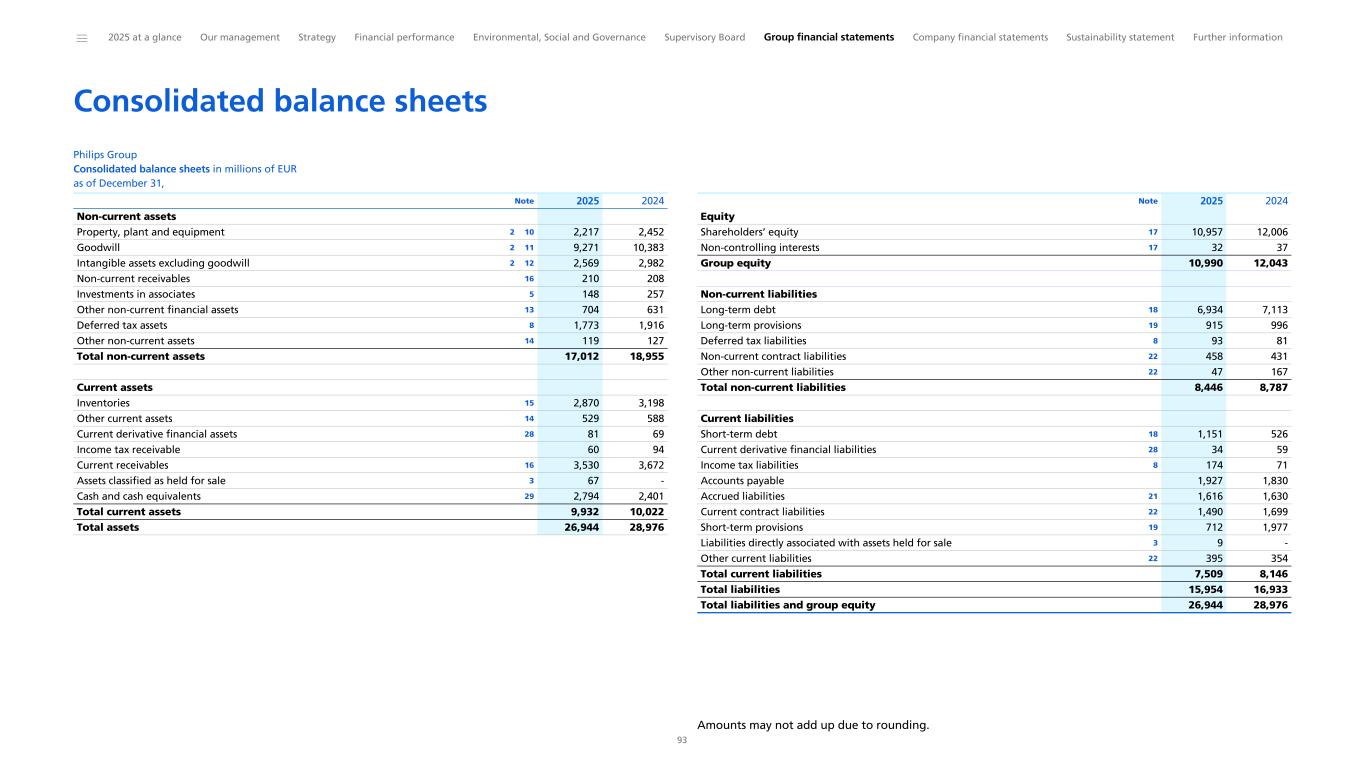
Consolidated balance sheets Philips Group Consolidated balance sheets in millions of EUR as of December 31, Non-current assets Property, plant and equipment 2 10 2,217 2,452 Goodwill 2 11 9,271 10,383 Intangible assets excluding goodwill 2 12 2,569 2,982 Non-current receivables 16 210 208 Investments in associates 5 148 257 Other non-current financial assets 13 704 631 Deferred tax assets 8 1,773 1,916 Other non-current assets 14 119 127 Total non-current assets 17,012 18,955 Current assets Inventories 15 2,870 3,198 Other current assets 14 529 588 Current derivative financial assets 28 81 69 Income tax receivable 60 94 Current receivables 16 3,530 3,672 Assets classified as held for sale 3 67 - Cash and cash equivalents 29 2,794 2,401 Total current assets 9,932 10,022 Total assets 26,944 28,976 Note 2025 2024 Equity Shareholders’ equity 17 10,957 12,006 Non-controlling interests 17 32 37 Group equity 10,990 12,043 Non-current liabilities Long-term debt 18 6,934 7,113 Long-term provisions 19 915 996 Deferred tax liabilities 8 93 81 Non-current contract liabilities 22 458 431 Other non-current liabilities 22 47 167 Total non-current liabilities 8,446 8,787 Current liabilities Short-term debt 18 1,151 526 Current derivative financial liabilities 28 34 59 Income tax liabilities 8 174 71 Accounts payable 1,927 1,830 Accrued liabilities 21 1,616 1,630 Current contract liabilities 22 1,490 1,699 Short-term provisions 19 712 1,977 Liabilities directly associated with assets held for sale 3 9 - Other current liabilities 22 395 354 Total current liabilities 7,509 8,146 Total liabilities 15,954 16,933 Total liabilities and group equity 26,944 28,976 Note 2025 2024 Amounts may not add up due to rounding. ______ 2025 at a glance Our management Strategy Financial performance Environmental, Social and Governance Supervisory Board Group financial statements Company financial statements Sustainability statement Further information 93
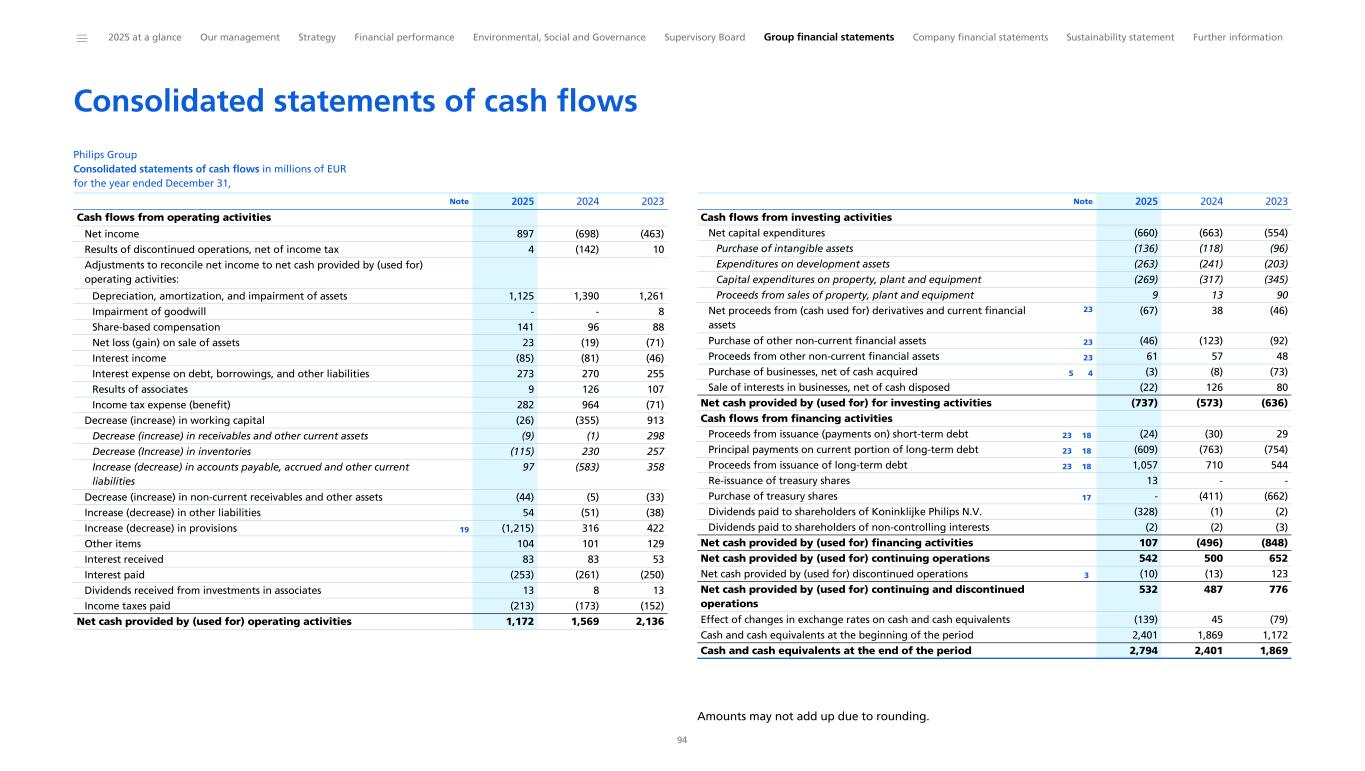
Consolidated statements of cash flows Philips Group Consolidated statements of cash flows in millions of EUR for the year ended December 31, Cash flows from operating activities Net income 897 (698) (463) Results of discontinued operations, net of income tax 4 (142) 10 Adjustments to reconcile net income to net cash provided by (used for) operating activities: Depreciation, amortization, and impairment of assets 1,125 1,390 1,261 Impairment of goodwill - - 8 Share-based compensation 141 96 88 Net loss (gain) on sale of assets 23 (19) (71) Interest income (85) (81) (46) Interest expense on debt, borrowings, and other liabilities 273 270 255 Results of associates 9 126 107 Income tax expense (benefit) 282 964 (71) Decrease (increase) in working capital (26) (355) 913 Decrease (increase) in receivables and other current assets (9) (1) 298 Decrease (Increase) in inventories (115) 230 257 Increase (decrease) in accounts payable, accrued and other current liabilities 97 (583) 358 Decrease (increase) in non-current receivables and other assets (44) (5) (33) Increase (decrease) in other liabilities 54 (51) (38) Increase (decrease) in provisions 19 (1,215) 316 422 Other items 104 101 129 Interest received 83 83 53 Interest paid (253) (261) (250) Dividends received from investments in associates 13 8 13 Income taxes paid (213) (173) (152) Net cash provided by (used for) operating activities 1,172 1,569 2,136 Note 2025 2024 2023 Cash flows from investing activities Net capital expenditures (660) (663) (554) Purchase of intangible assets (136) (118) (96) Expenditures on development assets (263) (241) (203) Capital expenditures on property, plant and equipment (269) (317) (345) Proceeds from sales of property, plant and equipment 9 13 90 Net proceeds from (cash used for) derivatives and current financial assets 23 (67) 38 (46) Purchase of other non-current financial assets 23 (46) (123) (92) Proceeds from other non-current financial assets 23 61 57 48 Purchase of businesses, net of cash acquired 5 4 (3) (8) (73) Sale of interests in businesses, net of cash disposed (22) 126 80 Net cash provided by (used for) for investing activities (737) (573) (636) Cash flows from financing activities Proceeds from issuance (payments on) short-term debt 23 18 (24) (30) 29 Principal payments on current portion of long-term debt 23 18 (609) (763) (754) Proceeds from issuance of long-term debt 23 18 1,057 710 544 Re-issuance of treasury shares 13 - - Purchase of treasury shares 17 - (411) (662) Dividends paid to shareholders of Koninklijke Philips N.V. (328) (1) (2) Dividends paid to shareholders of non-controlling interests (2) (2) (3) Net cash provided by (used for) financing activities 107 (496) (848) Net cash provided by (used for) continuing operations 542 500 652 Net cash provided by (used for) discontinued operations 3 (10) (13) 123 Net cash provided by (used for) continuing and discontinued operations 532 487 776 Effect of changes in exchange rates on cash and cash equivalents (139) 45 (79) Cash and cash equivalents at the beginning of the period 2,401 1,869 1,172 Cash and cash equivalents at the end of the period 2,794 2,401 1,869 Note 2025 2024 2023 Amounts may not add up due to rounding. ______ 2025 at a glance Our management Strategy Financial performance Environmental, Social and Governance Supervisory Board Group financial statements Company financial statements Sustainability statement Further information 94
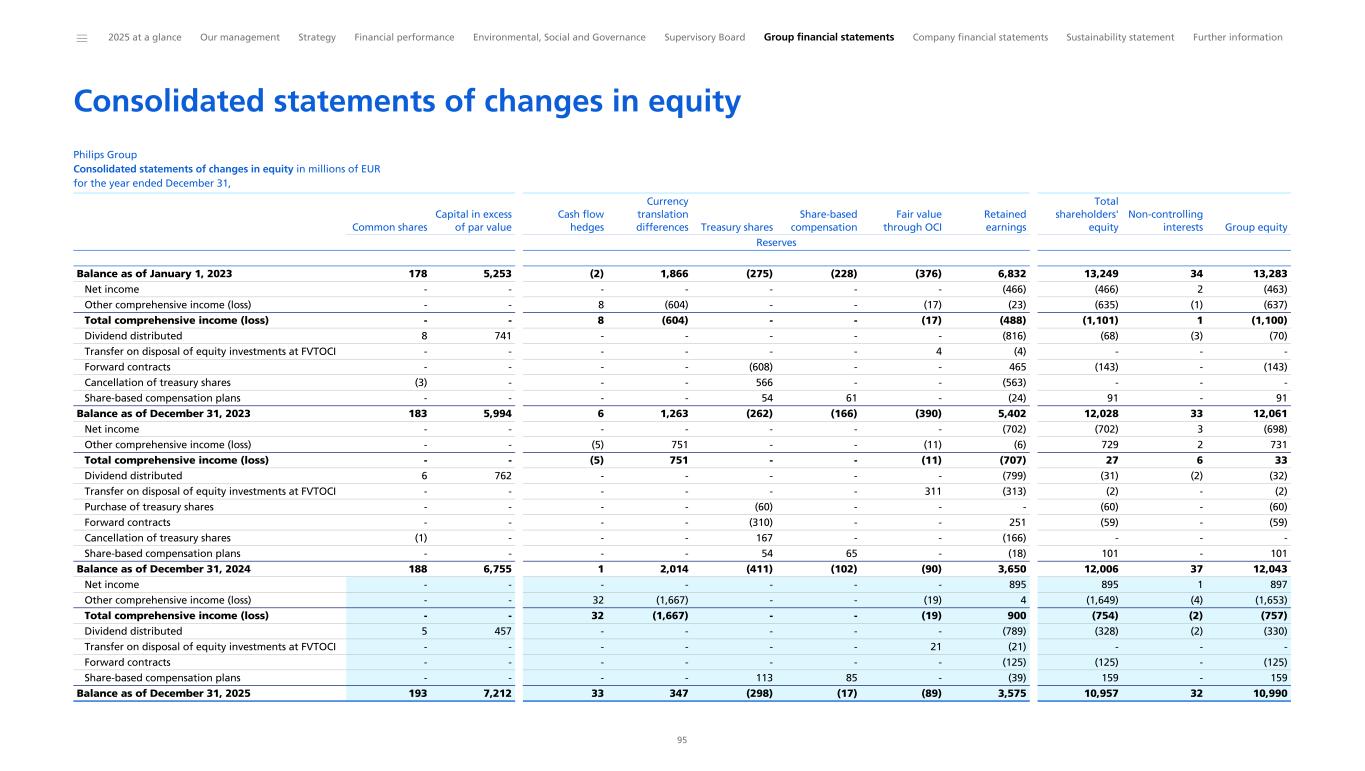
Consolidated statements of changes in equity Philips Group Consolidated statements of changes in equity in millions of EUR for the year ended December 31, Balance as of January 1, 2023 178 5,253 (2) 1,866 (275) (228) (376) 6,832 13,249 34 13,283 Net income - - - - - - - (466) (466) 2 (463) Other comprehensive income (loss) - - 8 (604) - - (17) (23) (635) (1) (637) Total comprehensive income (loss) - - 8 (604) - - (17) (488) (1,101) 1 (1,100) Dividend distributed 8 741 - - - - - (816) (68) (3) (70) Transfer on disposal of equity investments at FVTOCI - - - - - - 4 (4) - - - Forward contracts - - - - (608) - - 465 (143) - (143) Cancellation of treasury shares (3) - - - 566 - - (563) - - - Share-based compensation plans - - - - 54 61 - (24) 91 - 91 Balance as of December 31, 2023 183 5,994 6 1,263 (262) (166) (390) 5,402 12,028 33 12,061 Net income - - - - - - - (702) (702) 3 (698) Other comprehensive income (loss) - - (5) 751 - - (11) (6) 729 2 731 Total comprehensive income (loss) - - (5) 751 - - (11) (707) 27 6 33 Dividend distributed 6 762 - - - - - (799) (31) (2) (32) Transfer on disposal of equity investments at FVTOCI - - - - - - 311 (313) (2) - (2) Purchase of treasury shares - - - - (60) - - - (60) - (60) Forward contracts - - - - (310) - - 251 (59) - (59) Cancellation of treasury shares (1) - - - 167 - - (166) - - - Share-based compensation plans - - - - 54 65 - (18) 101 - 101 Balance as of December 31, 2024 188 6,755 1 2,014 (411) (102) (90) 3,650 12,006 37 12,043 Net income - - - - - - - 895 895 1 897 Other comprehensive income (loss) - - 32 (1,667) - - (19) 4 (1,649) (4) (1,653) Total comprehensive income (loss) - - 32 (1,667) - - (19) 900 (754) (2) (757) Dividend distributed 5 457 - - - - - (789) (328) (2) (330) Transfer on disposal of equity investments at FVTOCI - - - - - - 21 (21) - - - Forward contracts - - - - - - - (125) (125) - (125) Share-based compensation plans - - - - 113 85 - (39) 159 - 159 Balance as of December 31, 2025 193 7,212 33 347 (298) (17) (89) 3,575 10,957 32 10,990 Common shares Capital in excess of par value Cash flow hedges Currency translation differences Treasury shares Share-based compensation Fair value through OCI Retained earnings Total shareholders' equity Non-controlling interests Group equity Reserves ______ 2025 at a glance Our management Strategy Financial performance Environmental, Social and Governance Supervisory Board Group financial statements Company financial statements Sustainability statement Further information 95
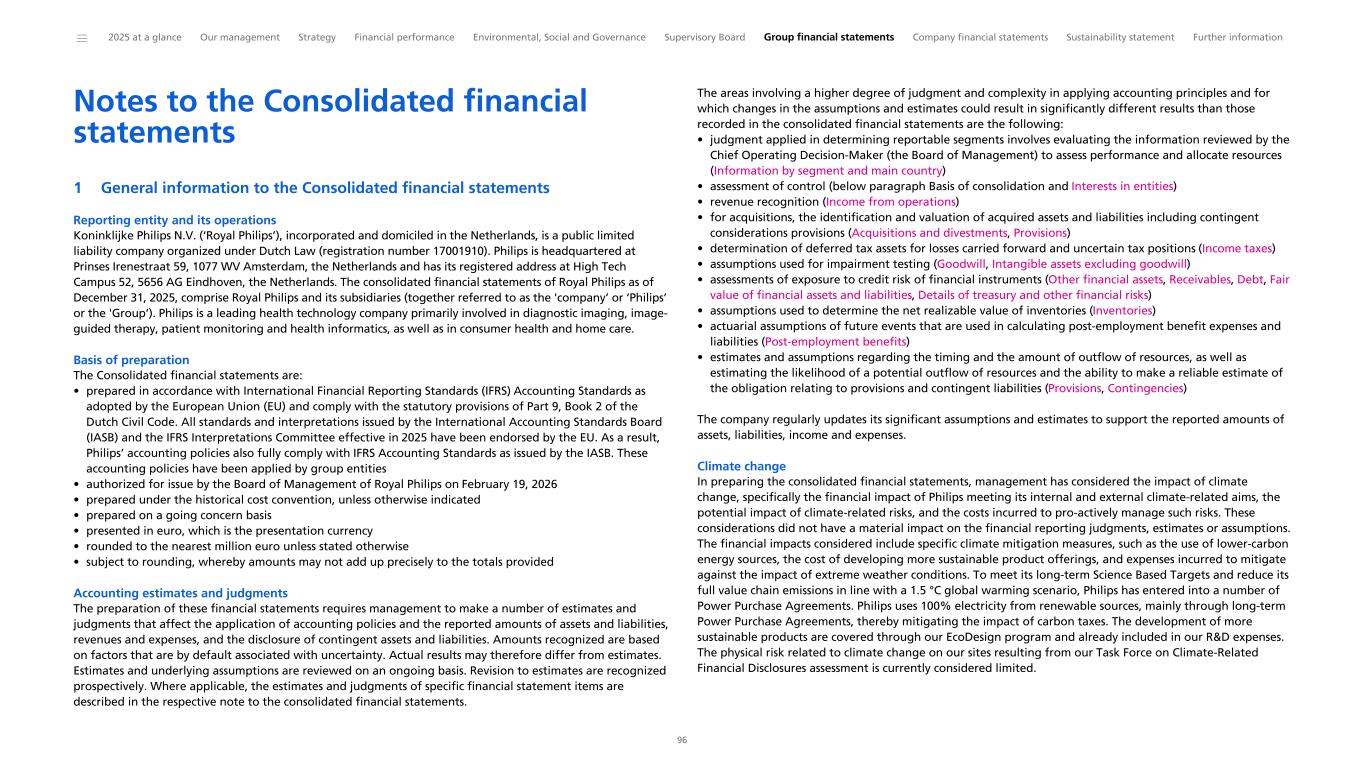
Notes to the Consolidated financial statements 1 General information to the Consolidated financial statements Reporting entity and its operations Koninklijke Philips N.V. (‘Royal Philips’), incorporated and domiciled in the Netherlands, is a public limited liability company organized under Dutch Law (registration number 17001910). Philips is headquartered at Prinses Irenestraat 59, 1077 WV Amsterdam, the Netherlands and has its registered address at High Tech Campus 52, 5656 AG Eindhoven, the Netherlands. The consolidated financial statements of Royal Philips as of December 31, 2025, comprise Royal Philips and its subsidiaries (together referred to as the 'company’ or ‘Philips’ or the 'Group’). Philips is a leading health technology company primarily involved in diagnostic imaging, image- guided therapy, patient monitoring and health informatics, as well as in consumer health and home care. Basis of preparation The Consolidated financial statements are: • prepared in accordance with International Financial Reporting Standards (IFRS) Accounting Standards as adopted by the European Union (EU) and comply with the statutory provisions of Part 9, Book 2 of the Dutch Civil Code. All standards and interpretations issued by the International Accounting Standards Board (IASB) and the IFRS Interpretations Committee effective in 2025 have been endorsed by the EU. As a result, Philips’ accounting policies also fully comply with IFRS Accounting Standards as issued by the IASB. These accounting policies have been applied by group entities • authorized for issue by the Board of Management of Royal Philips on February 19, 2026 • prepared under the historical cost convention, unless otherwise indicated • prepared on a going concern basis • presented in euro, which is the presentation currency • rounded to the nearest million euro unless stated otherwise • subject to rounding, whereby amounts may not add up precisely to the totals provided Accounting estimates and judgments The preparation of these financial statements requires management to make a number of estimates and judgments that affect the application of accounting policies and the reported amounts of assets and liabilities, revenues and expenses, and the disclosure of contingent assets and liabilities. Amounts recognized are based on factors that are by default associated with uncertainty. Actual results may therefore differ from estimates. Estimates and underlying assumptions are reviewed on an ongoing basis. Revision to estimates are recognized prospectively. Where applicable, the estimates and judgments of specific financial statement items are described in the respective note to the consolidated financial statements. The areas involving a higher degree of judgment and complexity in applying accounting principles and for which changes in the assumptions and estimates could result in significantly different results than those recorded in the consolidated financial statements are the following: • judgment applied in determining reportable segments involves evaluating the information reviewed by the Chief Operating Decision-Maker (the Board of Management) to assess performance and allocate resources (Information by segment and main country) • assessment of control (below paragraph Basis of consolidation and Interests in entities) • revenue recognition (Income from operations) • for acquisitions, the identification and valuation of acquired assets and liabilities including contingent considerations provisions (Acquisitions and divestments, Provisions) • determination of deferred tax assets for losses carried forward and uncertain tax positions (Income taxes) • assumptions used for impairment testing (Goodwill, Intangible assets excluding goodwill) • assessments of exposure to credit risk of financial instruments (Other financial assets, Receivables, Debt, Fair value of financial assets and liabilities, Details of treasury and other financial risks) • assumptions used to determine the net realizable value of inventories (Inventories) • actuarial assumptions of future events that are used in calculating post-employment benefit expenses and liabilities (Post-employment benefits) • estimates and assumptions regarding the timing and the amount of outflow of resources, as well as estimating the likelihood of a potential outflow of resources and the ability to make a reliable estimate of the obligation relating to provisions and contingent liabilities (Provisions, Contingencies) The company regularly updates its significant assumptions and estimates to support the reported amounts of assets, liabilities, income and expenses. Climate change In preparing the consolidated financial statements, management has considered the impact of climate change, specifically the financial impact of Philips meeting its internal and external climate-related aims, the potential impact of climate-related risks, and the costs incurred to pro-actively manage such risks. These considerations did not have a material impact on the financial reporting judgments, estimates or assumptions. The financial impacts considered include specific climate mitigation measures, such as the use of lower-carbon energy sources, the cost of developing more sustainable product offerings, and expenses incurred to mitigate against the impact of extreme weather conditions. To meet its long-term Science Based Targets and reduce its full value chain emissions in line with a 1.5 °C global warming scenario, Philips has entered into a number of Power Purchase Agreements. Philips uses 100% electricity from renewable sources, mainly through long-term Power Purchase Agreements, thereby mitigating the impact of carbon taxes. The development of more sustainable products are covered through our EcoDesign program and already included in our R&D expenses. The physical risk related to climate change on our sites resulting from our Task Force on Climate-Related Financial Disclosures assessment is currently considered limited. ______ 2025 at a glance Our management Strategy Financial performance Environmental, Social and Governance Supervisory Board Group financial statements Company financial statements Sustainability statement Further information 96
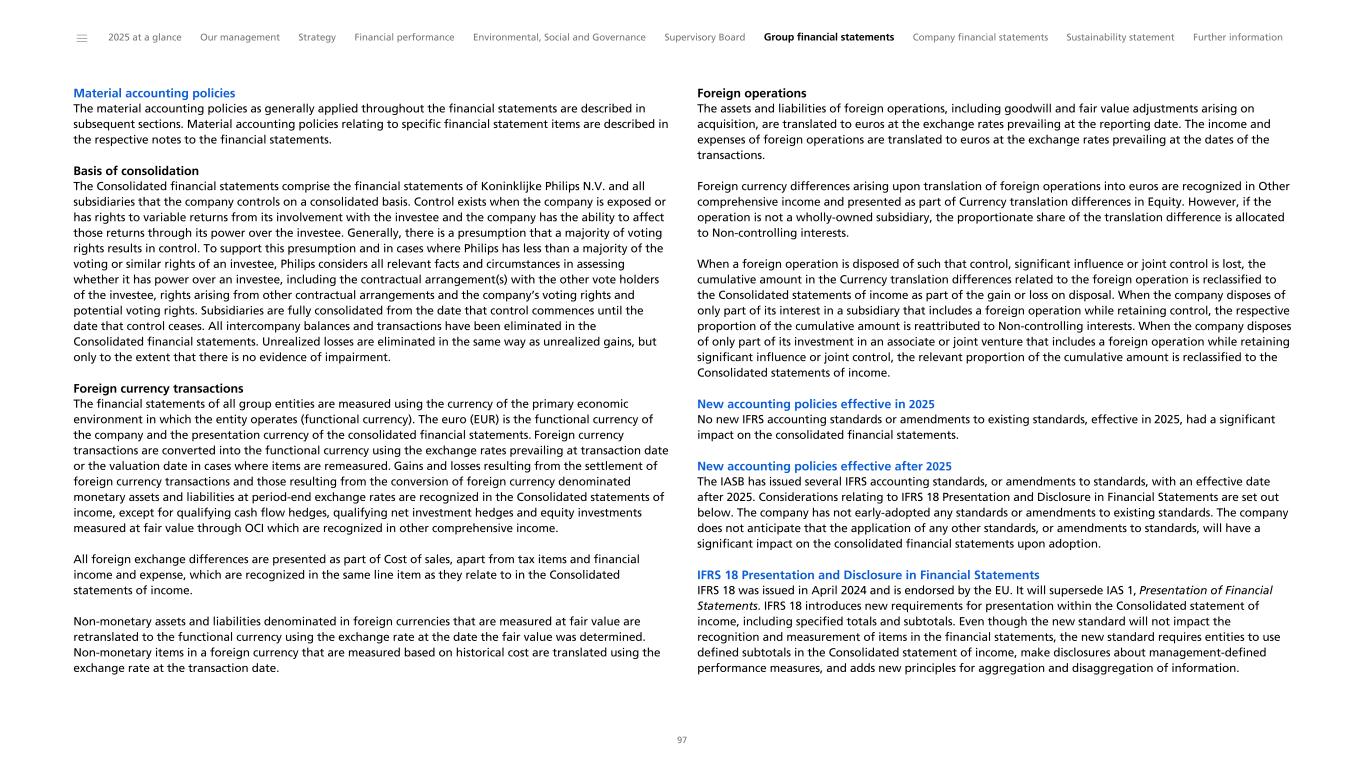
Material accounting policies The material accounting policies as generally applied throughout the financial statements are described in subsequent sections. Material accounting policies relating to specific financial statement items are described in the respective notes to the financial statements. Basis of consolidation The Consolidated financial statements comprise the financial statements of Koninklijke Philips N.V. and all subsidiaries that the company controls on a consolidated basis. Control exists when the company is exposed or has rights to variable returns from its involvement with the investee and the company has the ability to affect those returns through its power over the investee. Generally, there is a presumption that a majority of voting rights results in control. To support this presumption and in cases where Philips has less than a majority of the voting or similar rights of an investee, Philips considers all relevant facts and circumstances in assessing whether it has power over an investee, including the contractual arrangement(s) with the other vote holders of the investee, rights arising from other contractual arrangements and the company’s voting rights and potential voting rights. Subsidiaries are fully consolidated from the date that control commences until the date that control ceases. All intercompany balances and transactions have been eliminated in the Consolidated financial statements. Unrealized losses are eliminated in the same way as unrealized gains, but only to the extent that there is no evidence of impairment. Foreign currency transactions The financial statements of all group entities are measured using the currency of the primary economic environment in which the entity operates (functional currency). The euro (EUR) is the functional currency of the company and the presentation currency of the consolidated financial statements. Foreign currency transactions are converted into the functional currency using the exchange rates prevailing at transaction date or the valuation date in cases where items are remeasured. Gains and losses resulting from the settlement of foreign currency transactions and those resulting from the conversion of foreign currency denominated monetary assets and liabilities at period-end exchange rates are recognized in the Consolidated statements of income, except for qualifying cash flow hedges, qualifying net investment hedges and equity investments measured at fair value through OCI which are recognized in other comprehensive income. All foreign exchange differences are presented as part of Cost of sales, apart from tax items and financial income and expense, which are recognized in the same line item as they relate to in the Consolidated statements of income. Non-monetary assets and liabilities denominated in foreign currencies that are measured at fair value are retranslated to the functional currency using the exchange rate at the date the fair value was determined. Non-monetary items in a foreign currency that are measured based on historical cost are translated using the exchange rate at the transaction date. Foreign operations The assets and liabilities of foreign operations, including goodwill and fair value adjustments arising on acquisition, are translated to euros at the exchange rates prevailing at the reporting date. The income and expenses of foreign operations are translated to euros at the exchange rates prevailing at the dates of the transactions. Foreign currency differences arising upon translation of foreign operations into euros are recognized in Other comprehensive income and presented as part of Currency translation differences in Equity. However, if the operation is not a wholly-owned subsidiary, the proportionate share of the translation difference is allocated to Non-controlling interests. When a foreign operation is disposed of such that control, significant influence or joint control is lost, the cumulative amount in the Currency translation differences related to the foreign operation is reclassified to the Consolidated statements of income as part of the gain or loss on disposal. When the company disposes of only part of its interest in a subsidiary that includes a foreign operation while retaining control, the respective proportion of the cumulative amount is reattributed to Non-controlling interests. When the company disposes of only part of its investment in an associate or joint venture that includes a foreign operation while retaining significant influence or joint control, the relevant proportion of the cumulative amount is reclassified to the Consolidated statements of income. New accounting policies effective in 2025 No new IFRS accounting standards or amendments to existing standards, effective in 2025, had a significant impact on the consolidated financial statements. New accounting policies effective after 2025 The IASB has issued several IFRS accounting standards, or amendments to standards, with an effective date after 2025. Considerations relating to IFRS 18 Presentation and Disclosure in Financial Statements are set out below. The company has not early-adopted any standards or amendments to existing standards. The company does not anticipate that the application of any other standards, or amendments to standards, will have a significant impact on the consolidated financial statements upon adoption. IFRS 18 Presentation and Disclosure in Financial Statements IFRS 18 was issued in April 2024 and is endorsed by the EU. It will supersede IAS 1, Presentation of Financial Statements. IFRS 18 introduces new requirements for presentation within the Consolidated statement of income, including specified totals and subtotals. Even though the new standard will not impact the recognition and measurement of items in the financial statements, the new standard requires entities to use defined subtotals in the Consolidated statement of income, make disclosures about management-defined performance measures, and adds new principles for aggregation and disaggregation of information. ______ 2025 at a glance Our management Strategy Financial performance Environmental, Social and Governance Supervisory Board Group financial statements Company financial statements Sustainability statement Further information 97
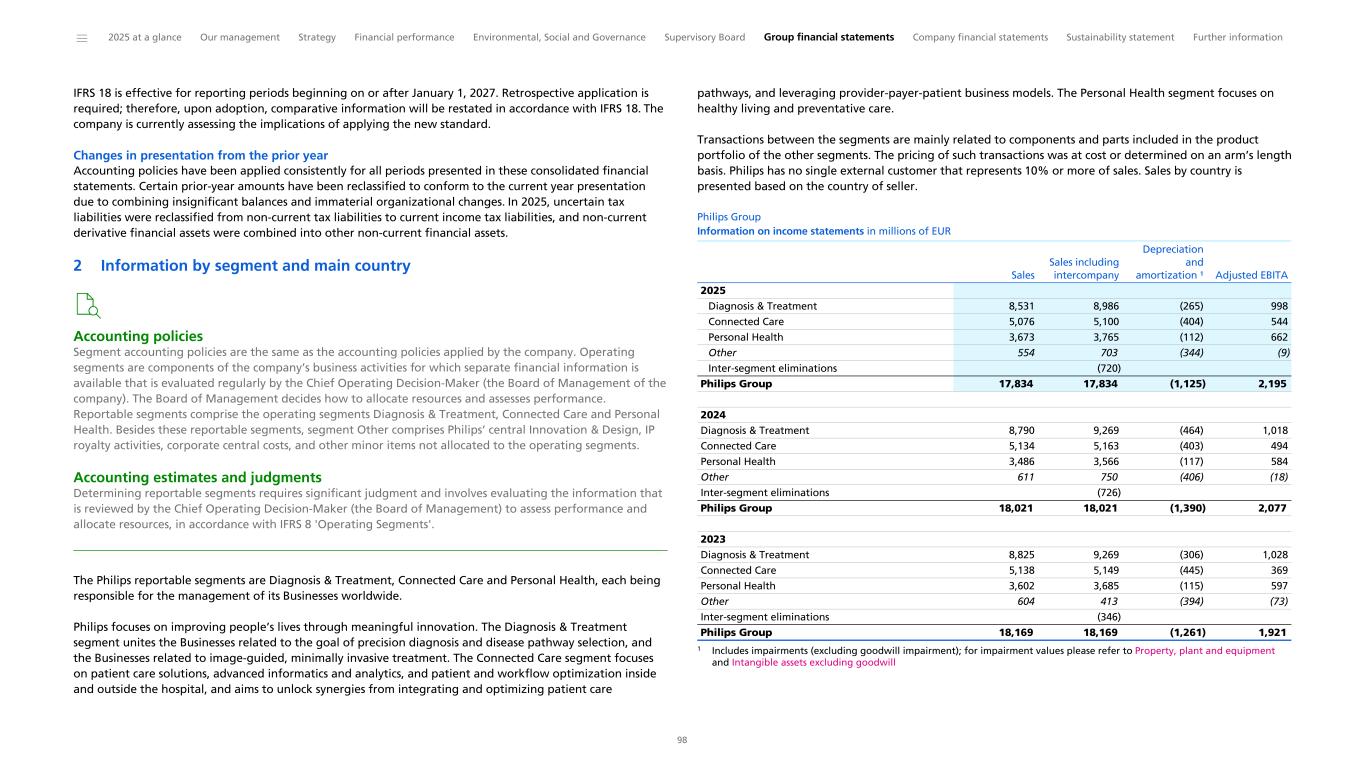
IFRS 18 is effective for reporting periods beginning on or after January 1, 2027. Retrospective application is required; therefore, upon adoption, comparative information will be restated in accordance with IFRS 18. The company is currently assessing the implications of applying the new standard. Changes in presentation from the prior year Accounting policies have been applied consistently for all periods presented in these consolidated financial statements. Certain prior-year amounts have been reclassified to conform to the current year presentation due to combining insignificant balances and immaterial organizational changes. In 2025, uncertain tax liabilities were reclassified from non-current tax liabilities to current income tax liabilities, and non-current derivative financial assets were combined into other non-current financial assets. 2 Information by segment and main country Accounting policies Segment accounting policies are the same as the accounting policies applied by the company. Operating segments are components of the company’s business activities for which separate financial information is available that is evaluated regularly by the Chief Operating Decision-Maker (the Board of Management of the company). The Board of Management decides how to allocate resources and assesses performance. Reportable segments comprise the operating segments Diagnosis & Treatment, Connected Care and Personal Health. Besides these reportable segments, segment Other comprises Philips’ central Innovation & Design, IP royalty activities, corporate central costs, and other minor items not allocated to the operating segments. Accounting estimates and judgments Determining reportable segments requires significant judgment and involves evaluating the information that is reviewed by the Chief Operating Decision-Maker (the Board of Management) to assess performance and allocate resources, in accordance with IFRS 8 'Operating Segments'. The Philips reportable segments are Diagnosis & Treatment, Connected Care and Personal Health, each being responsible for the management of its Businesses worldwide. Philips focuses on improving people’s lives through meaningful innovation. The Diagnosis & Treatment segment unites the Businesses related to the goal of precision diagnosis and disease pathway selection, and the Businesses related to image-guided, minimally invasive treatment. The Connected Care segment focuses on patient care solutions, advanced informatics and analytics, and patient and workflow optimization inside and outside the hospital, and aims to unlock synergies from integrating and optimizing patient care pathways, and leveraging provider-payer-patient business models. The Personal Health segment focuses on healthy living and preventative care. Transactions between the segments are mainly related to components and parts included in the product portfolio of the other segments. The pricing of such transactions was at cost or determined on an arm’s length basis. Philips has no single external customer that represents 10% or more of sales. Sales by country is presented based on the country of seller. Philips Group Information on income statements in millions of EUR 2025 Diagnosis & Treatment 8,531 8,986 (265) 998 Connected Care 5,076 5,100 (404) 544 Personal Health 3,673 3,765 (112) 662 Other 554 703 (344) (9) Inter-segment eliminations (720) Philips Group 17,834 17,834 (1,125) 2,195 2024 Diagnosis & Treatment 8,790 9,269 (464) 1,018 Connected Care 5,134 5,163 (403) 494 Personal Health 3,486 3,566 (117) 584 Other 611 750 (406) (18) Inter-segment eliminations (726) Philips Group 18,021 18,021 (1,390) 2,077 2023 Diagnosis & Treatment 8,825 9,269 (306) 1,028 Connected Care 5,138 5,149 (445) 369 Personal Health 3,602 3,685 (115) 597 Other 604 413 (394) (73) Inter-segment eliminations (346) Philips Group 18,169 18,169 (1,261) 1,921 Sales Sales including intercompany Depreciation and amortization ¹ Adjusted EBITA 1 Includes impairments (excluding goodwill impairment); for impairment values please refer to Property, plant and equipment and Intangible assets excluding goodwill ______ 2025 at a glance Our management Strategy Financial performance Environmental, Social and Governance Supervisory Board Group financial statements Company financial statements Sustainability statement Further information 98
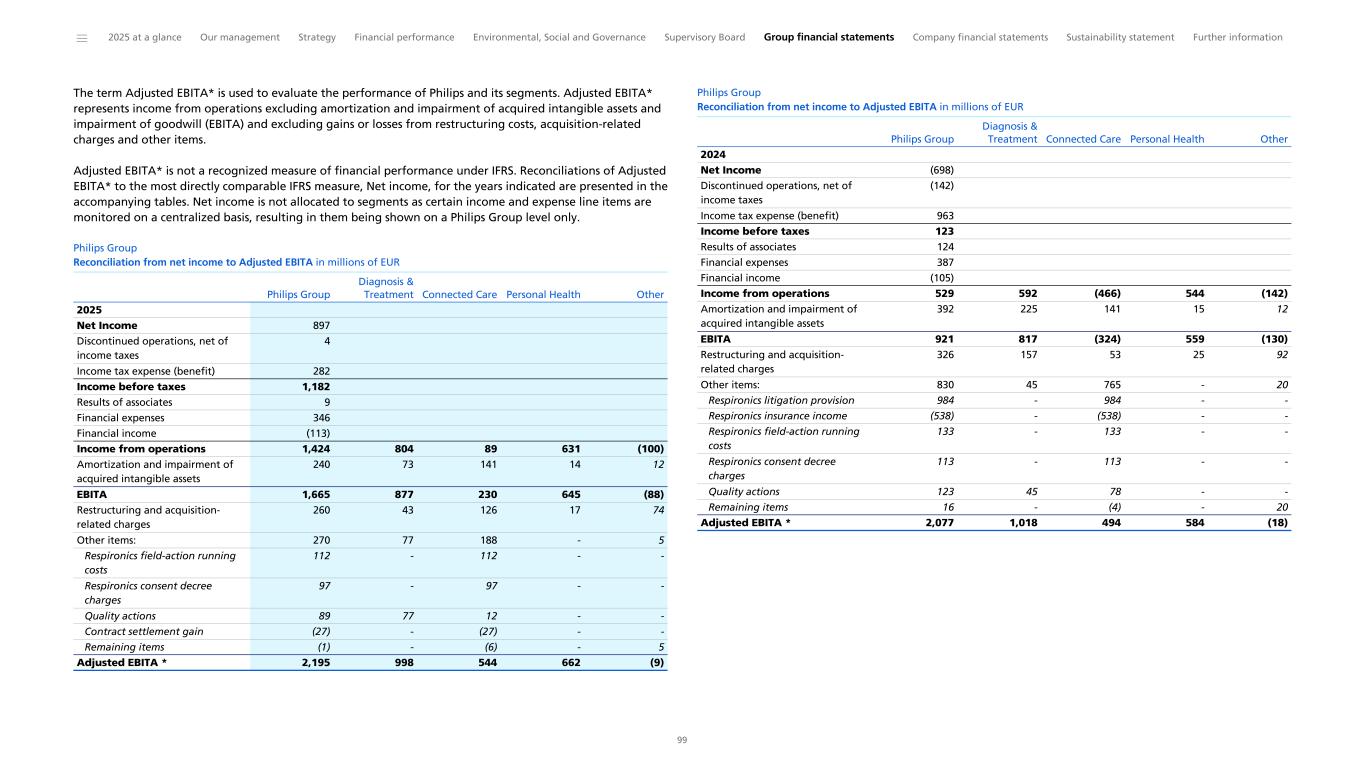
The term Adjusted EBITA* is used to evaluate the performance of Philips and its segments. Adjusted EBITA* represents income from operations excluding amortization and impairment of acquired intangible assets and impairment of goodwill (EBITA) and excluding gains or losses from restructuring costs, acquisition-related charges and other items. Adjusted EBITA* is not a recognized measure of financial performance under IFRS. Reconciliations of Adjusted EBITA* to the most directly comparable IFRS measure, Net income, for the years indicated are presented in the accompanying tables. Net income is not allocated to segments as certain income and expense line items are monitored on a centralized basis, resulting in them being shown on a Philips Group level only. Philips Group Reconciliation from net income to Adjusted EBITA in millions of EUR 2025 Net Income 897 Discontinued operations, net of income taxes 4 Income tax expense (benefit) 282 Income before taxes 1,182 Results of associates 9 Financial expenses 346 Financial income (113) Income from operations 1,424 804 89 631 (100) Amortization and impairment of acquired intangible assets 240 73 141 14 12 EBITA 1,665 877 230 645 (88) Restructuring and acquisition- related charges 260 43 126 17 74 Other items: 270 77 188 - 5 Respironics field-action running costs 112 - 112 - - Respironics consent decree charges 97 - 97 - - Quality actions 89 77 12 - - Contract settlement gain (27) - (27) - - Remaining items (1) - (6) - 5 Adjusted EBITA * 2,195 998 544 662 (9) Philips Group Diagnosis & Treatment Connected Care Personal Health Other Philips Group Reconciliation from net income to Adjusted EBITA in millions of EUR 2024 Net Income (698) Discontinued operations, net of income taxes (142) Income tax expense (benefit) 963 Income before taxes 123 Results of associates 124 Financial expenses 387 Financial income (105) Income from operations 529 592 (466) 544 (142) Amortization and impairment of acquired intangible assets 392 225 141 15 12 EBITA 921 817 (324) 559 (130) Restructuring and acquisition- related charges 326 157 53 25 92 Other items: 830 45 765 - 20 Respironics litigation provision 984 - 984 - - Respironics insurance income (538) - (538) - - Respironics field-action running costs 133 - 133 - - Respironics consent decree charges 113 - 113 - - Quality actions 123 45 78 - - Remaining items 16 - (4) - 20 Adjusted EBITA * 2,077 1,018 494 584 (18) Philips Group Diagnosis & Treatment Connected Care Personal Health Other ______ 2025 at a glance Our management Strategy Financial performance Environmental, Social and Governance Supervisory Board Group financial statements Company financial statements Sustainability statement Further information 99
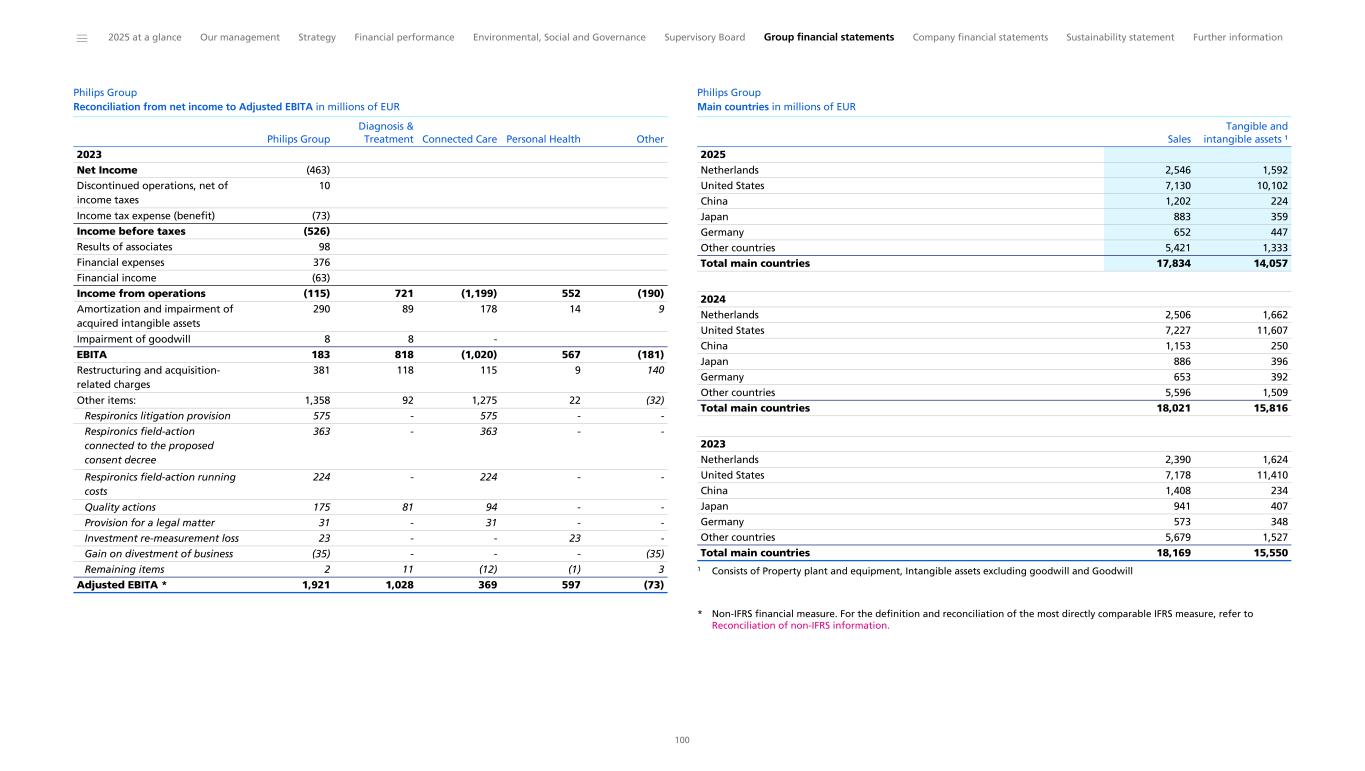
Philips Group Reconciliation from net income to Adjusted EBITA in millions of EUR 2023 Net Income (463) Discontinued operations, net of income taxes 10 Income tax expense (benefit) (73) Income before taxes (526) Results of associates 98 Financial expenses 376 Financial income (63) Income from operations (115) 721 (1,199) 552 (190) Amortization and impairment of acquired intangible assets 290 89 178 14 9 Impairment of goodwill 8 8 - EBITA 183 818 (1,020) 567 (181) Restructuring and acquisition- related charges 381 118 115 9 140 Other items: 1,358 92 1,275 22 (32) Respironics litigation provision 575 - 575 - - Respironics field-action connected to the proposed consent decree 363 - 363 - - Respironics field-action running costs 224 - 224 - - Quality actions 175 81 94 - - Provision for a legal matter 31 - 31 - - Investment re-measurement loss 23 - - 23 - Gain on divestment of business (35) - - - (35) Remaining items 2 11 (12) (1) 3 Adjusted EBITA * 1,921 1,028 369 597 (73) Philips Group Diagnosis & Treatment Connected Care Personal Health Other Philips Group Main countries in millions of EUR 2025 Netherlands 2,546 1,592 United States 7,130 10,102 China 1,202 224 Japan 883 359 Germany 652 447 Other countries 5,421 1,333 Total main countries 17,834 14,057 2024 Netherlands 2,506 1,662 United States 7,227 11,607 China 1,153 250 Japan 886 396 Germany 653 392 Other countries 5,596 1,509 Total main countries 18,021 15,816 2023 Netherlands 2,390 1,624 United States 7,178 11,410 China 1,408 234 Japan 941 407 Germany 573 348 Other countries 5,679 1,527 Total main countries 18,169 15,550 Sales Tangible and intangible assets ¹ 1 Consists of Property plant and equipment, Intangible assets excluding goodwill and Goodwill * Non-IFRS financial measure. For the definition and reconciliation of the most directly comparable IFRS measure, refer to Reconciliation of non-IFRS information. ______ 2025 at a glance Our management Strategy Financial performance Environmental, Social and Governance Supervisory Board Group financial statements Company financial statements Sustainability statement Further information 100
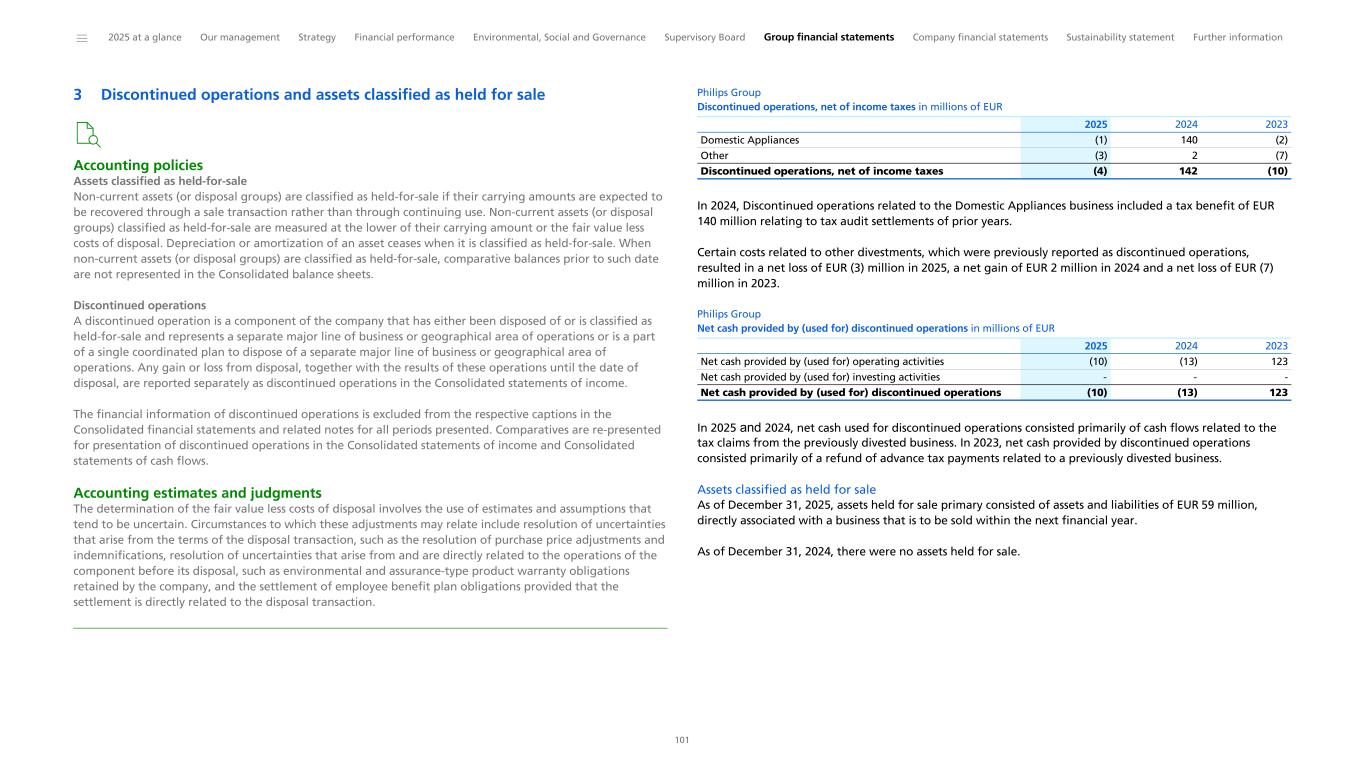
3 Discontinued operations and assets classified as held for sale Accounting policies Assets classified as held-for-sale Non-current assets (or disposal groups) are classified as held-for-sale if their carrying amounts are expected to be recovered through a sale transaction rather than through continuing use. Non-current assets (or disposal groups) classified as held-for-sale are measured at the lower of their carrying amount or the fair value less costs of disposal. Depreciation or amortization of an asset ceases when it is classified as held-for-sale. When non-current assets (or disposal groups) are classified as held-for-sale, comparative balances prior to such date are not represented in the Consolidated balance sheets. Discontinued operations A discontinued operation is a component of the company that has either been disposed of or is classified as held-for-sale and represents a separate major line of business or geographical area of operations or is a part of a single coordinated plan to dispose of a separate major line of business or geographical area of operations. Any gain or loss from disposal, together with the results of these operations until the date of disposal, are reported separately as discontinued operations in the Consolidated statements of income. The financial information of discontinued operations is excluded from the respective captions in the Consolidated financial statements and related notes for all periods presented. Comparatives are re-presented for presentation of discontinued operations in the Consolidated statements of income and Consolidated statements of cash flows. Accounting estimates and judgments The determination of the fair value less costs of disposal involves the use of estimates and assumptions that tend to be uncertain. Circumstances to which these adjustments may relate include resolution of uncertainties that arise from the terms of the disposal transaction, such as the resolution of purchase price adjustments and indemnifications, resolution of uncertainties that arise from and are directly related to the operations of the component before its disposal, such as environmental and assurance-type product warranty obligations retained by the company, and the settlement of employee benefit plan obligations provided that the settlement is directly related to the disposal transaction. Philips Group Discontinued operations, net of income taxes in millions of EUR Domestic Appliances (1) 140 (2) Other (3) 2 (7) Discontinued operations, net of income taxes (4) 142 (10) 2025 2024 2023 In 2024, Discontinued operations related to the Domestic Appliances business included a tax benefit of EUR 140 million relating to tax audit settlements of prior years. Certain costs related to other divestments, which were previously reported as discontinued operations, resulted in a net loss of EUR (3) million in 2025, a net gain of EUR 2 million in 2024 and a net loss of EUR (7) million in 2023. Philips Group Net cash provided by (used for) discontinued operations in millions of EUR Net cash provided by (used for) operating activities (10) (13) 123 Net cash provided by (used for) investing activities - - - Net cash provided by (used for) discontinued operations (10) (13) 123 2025 2024 2023 In 2025 and 2024, net cash used for discontinued operations consisted primarily of cash flows related to the tax claims from the previously divested business. In 2023, net cash provided by discontinued operations consisted primarily of a refund of advance tax payments related to a previously divested business. Assets classified as held for sale As of December 31, 2025, assets held for sale primary consisted of assets and liabilities of EUR 59 million, directly associated with a business that is to be sold within the next financial year. As of December 31, 2024, there were no assets held for sale. ______ 2025 at a glance Our management Strategy Financial performance Environmental, Social and Governance Supervisory Board Group financial statements Company financial statements Sustainability statement Further information 101
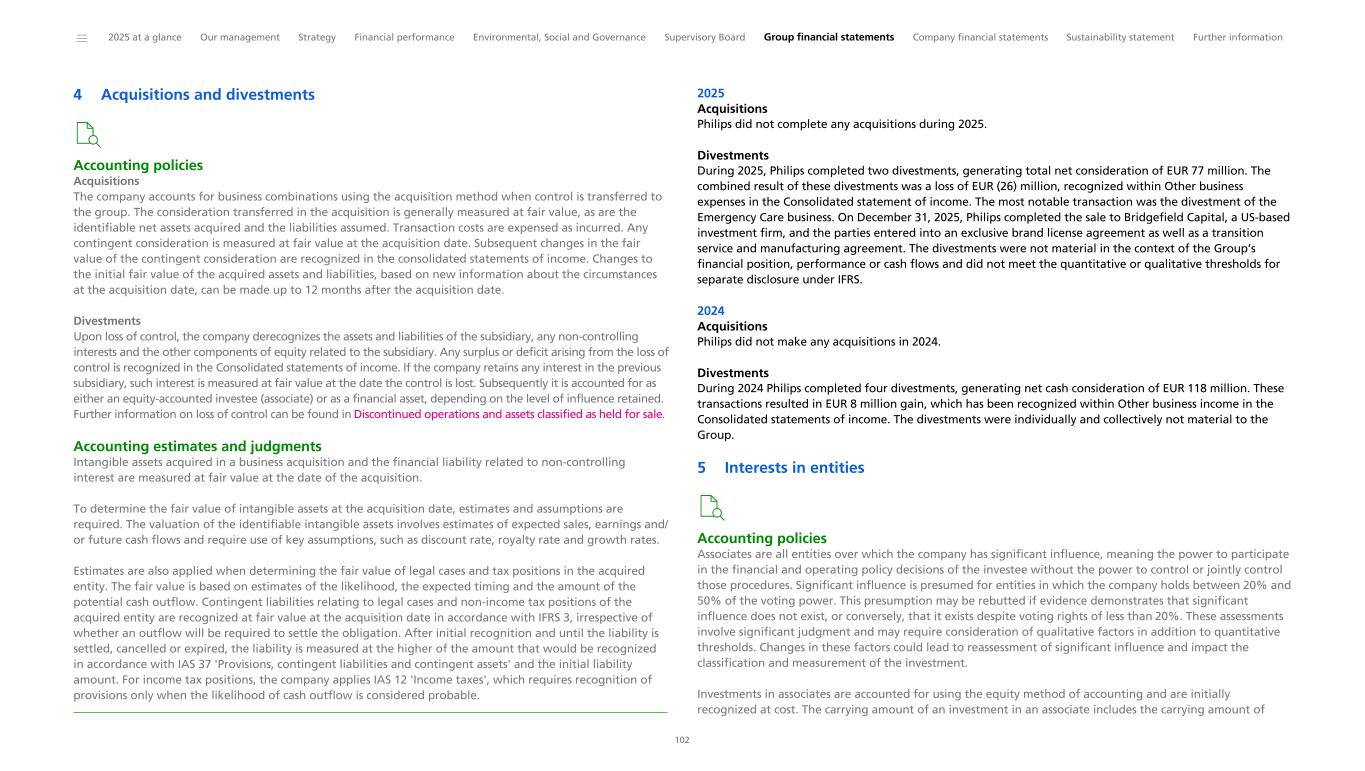
4 Acquisitions and divestments Accounting policies Acquisitions The company accounts for business combinations using the acquisition method when control is transferred to the group. The consideration transferred in the acquisition is generally measured at fair value, as are the identifiable net assets acquired and the liabilities assumed. Transaction costs are expensed as incurred. Any contingent consideration is measured at fair value at the acquisition date. Subsequent changes in the fair value of the contingent consideration are recognized in the consolidated statements of income. Changes to the initial fair value of the acquired assets and liabilities, based on new information about the circumstances at the acquisition date, can be made up to 12 months after the acquisition date. Divestments Upon loss of control, the company derecognizes the assets and liabilities of the subsidiary, any non-controlling interests and the other components of equity related to the subsidiary. Any surplus or deficit arising from the loss of control is recognized in the Consolidated statements of income. If the company retains any interest in the previous subsidiary, such interest is measured at fair value at the date the control is lost. Subsequently it is accounted for as either an equity-accounted investee (associate) or as a financial asset, depending on the level of influence retained. Further information on loss of control can be found in Discontinued operations and assets classified as held for sale. Accounting estimates and judgments Intangible assets acquired in a business acquisition and the financial liability related to non-controlling interest are measured at fair value at the date of the acquisition. To determine the fair value of intangible assets at the acquisition date, estimates and assumptions are required. The valuation of the identifiable intangible assets involves estimates of expected sales, earnings and/ or future cash flows and require use of key assumptions, such as discount rate, royalty rate and growth rates. Estimates are also applied when determining the fair value of legal cases and tax positions in the acquired entity. The fair value is based on estimates of the likelihood, the expected timing and the amount of the potential cash outflow. Contingent liabilities relating to legal cases and non-income tax positions of the acquired entity are recognized at fair value at the acquisition date in accordance with IFRS 3, irrespective of whether an outflow will be required to settle the obligation. After initial recognition and until the liability is settled, cancelled or expired, the liability is measured at the higher of the amount that would be recognized in accordance with IAS 37 'Provisions, contingent liabilities and contingent assets' and the initial liability amount. For income tax positions, the company applies IAS 12 'Income taxes', which requires recognition of provisions only when the likelihood of cash outflow is considered probable. 2025 Acquisitions Philips did not complete any acquisitions during 2025. Divestments During 2025, Philips completed two divestments, generating total net consideration of EUR 77 million. The combined result of these divestments was a loss of EUR (26) million, recognized within Other business expenses in the Consolidated statement of income. The most notable transaction was the divestment of the Emergency Care business. On December 31, 2025, Philips completed the sale to Bridgefield Capital, a US-based investment firm, and the parties entered into an exclusive brand license agreement as well as a transition service and manufacturing agreement. The divestments were not material in the context of the Group’s financial position, performance or cash flows and did not meet the quantitative or qualitative thresholds for separate disclosure under IFRS. 2024 Acquisitions Philips did not make any acquisitions in 2024. Divestments During 2024 Philips completed four divestments, generating net cash consideration of EUR 118 million. These transactions resulted in EUR 8 million gain, which has been recognized within Other business income in the Consolidated statements of income. The divestments were individually and collectively not material to the Group. 5 Interests in entities Accounting policies Associates are all entities over which the company has significant influence, meaning the power to participate in the financial and operating policy decisions of the investee without the power to control or jointly control those procedures. Significant influence is presumed for entities in which the company holds between 20% and 50% of the voting power. This presumption may be rebutted if evidence demonstrates that significant influence does not exist, or conversely, that it exists despite voting rights of less than 20%. These assessments involve significant judgment and may require consideration of qualitative factors in addition to quantitative thresholds. Changes in these factors could lead to reassessment of significant influence and impact the classification and measurement of the investment. Investments in associates are accounted for using the equity method of accounting and are initially recognized at cost. The carrying amount of an investment in an associate includes the carrying amount of ______ 2025 at a glance Our management Strategy Financial performance Environmental, Social and Governance Supervisory Board Group financial statements Company financial statements Sustainability statement Further information 102
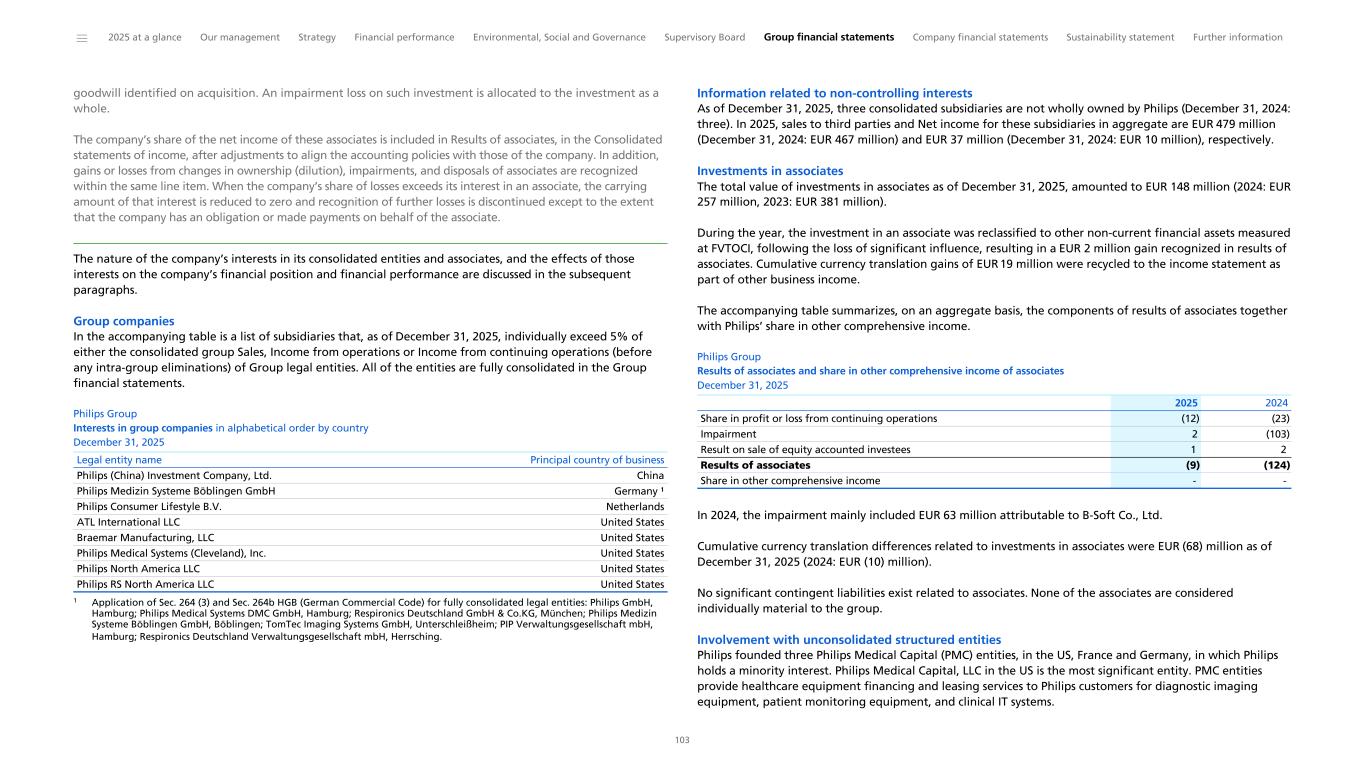
goodwill identified on acquisition. An impairment loss on such investment is allocated to the investment as a whole. The company’s share of the net income of these associates is included in Results of associates, in the Consolidated statements of income, after adjustments to align the accounting policies with those of the company. In addition, gains or losses from changes in ownership (dilution), impairments, and disposals of associates are recognized within the same line item. When the company’s share of losses exceeds its interest in an associate, the carrying amount of that interest is reduced to zero and recognition of further losses is discontinued except to the extent that the company has an obligation or made payments on behalf of the associate. The nature of the company’s interests in its consolidated entities and associates, and the effects of those interests on the company’s financial position and financial performance are discussed in the subsequent paragraphs. Group companies In the accompanying table is a list of subsidiaries that, as of December 31, 2025, individually exceed 5% of either the consolidated group Sales, Income from operations or Income from continuing operations (before any intra-group eliminations) of Group legal entities. All of the entities are fully consolidated in the Group financial statements. Philips Group Interests in group companies in alphabetical order by country December 31, 2025 Philips (China) Investment Company, Ltd. China Philips Medizin Systeme Böblingen GmbH Germany ¹ Philips Consumer Lifestyle B.V. Netherlands ATL International LLC United States Braemar Manufacturing, LLC United States Philips Medical Systems (Cleveland), Inc. United States Philips North America LLC United States Philips RS North America LLC United States Legal entity name Principal country of business 1 Application of Sec. 264 (3) and Sec. 264b HGB (German Commercial Code) for fully consolidated legal entities: Philips GmbH, Hamburg; Philips Medical Systems DMC GmbH, Hamburg; Respironics Deutschland GmbH & Co.KG, München; Philips Medizin Systeme Böblingen GmbH, Böblingen; TomTec Imaging Systems GmbH, Unterschleißheim; PIP Verwaltungsgesellschaft mbH, Hamburg; Respironics Deutschland Verwaltungsgesellschaft mbH, Herrsching. Information related to non-controlling interests As of December 31, 2025, three consolidated subsidiaries are not wholly owned by Philips (December 31, 2024: three). In 2025, sales to third parties and Net income for these subsidiaries in aggregate are EUR 479 million (December 31, 2024: EUR 467 million) and EUR 37 million (December 31, 2024: EUR 10 million), respectively. Investments in associates The total value of investments in associates as of December 31, 2025, amounted to EUR 148 million (2024: EUR 257 million, 2023: EUR 381 million). During the year, the investment in an associate was reclassified to other non-current financial assets measured at FVTOCI, following the loss of significant influence, resulting in a EUR 2 million gain recognized in results of associates. Cumulative currency translation gains of EUR 19 million were recycled to the income statement as part of other business income. The accompanying table summarizes, on an aggregate basis, the components of results of associates together with Philips’ share in other comprehensive income. Philips Group Results of associates and share in other comprehensive income of associates December 31, 2025 2025 2024 Share in profit or loss from continuing operations (12) (23) Impairment 2 (103) Result on sale of equity accounted investees 1 2 Results of associates (9) (124) Share in other comprehensive income - - In 2024, the impairment mainly included EUR 63 million attributable to B-Soft Co., Ltd. Cumulative currency translation differences related to investments in associates were EUR (68) million as of December 31, 2025 (2024: EUR (10) million). No significant contingent liabilities exist related to associates. None of the associates are considered individually material to the group. Involvement with unconsolidated structured entities Philips founded three Philips Medical Capital (PMC) entities, in the US, France and Germany, in which Philips holds a minority interest. Philips Medical Capital, LLC in the US is the most significant entity. PMC entities provide healthcare equipment financing and leasing services to Philips customers for diagnostic imaging equipment, patient monitoring equipment, and clinical IT systems. ______ 2025 at a glance Our management Strategy Financial performance Environmental, Social and Governance Supervisory Board Group financial statements Company financial statements Sustainability statement Further information 103
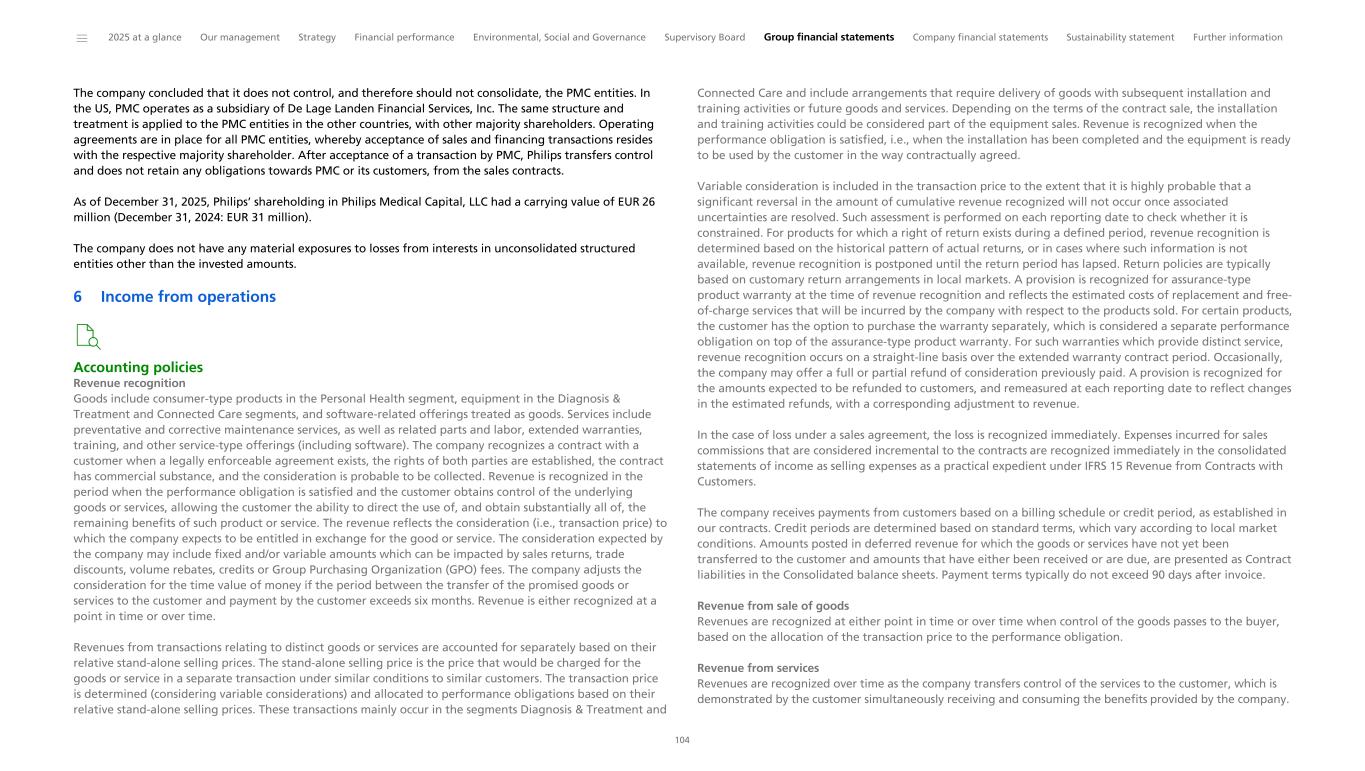
The company concluded that it does not control, and therefore should not consolidate, the PMC entities. In the US, PMC operates as a subsidiary of De Lage Landen Financial Services, Inc. The same structure and treatment is applied to the PMC entities in the other countries, with other majority shareholders. Operating agreements are in place for all PMC entities, whereby acceptance of sales and financing transactions resides with the respective majority shareholder. After acceptance of a transaction by PMC, Philips transfers control and does not retain any obligations towards PMC or its customers, from the sales contracts. As of December 31, 2025, Philips’ shareholding in Philips Medical Capital, LLC had a carrying value of EUR 26 million (December 31, 2024: EUR 31 million). The company does not have any material exposures to losses from interests in unconsolidated structured entities other than the invested amounts. 6 Income from operations Accounting policies Revenue recognition Goods include consumer-type products in the Personal Health segment, equipment in the Diagnosis & Treatment and Connected Care segments, and software-related offerings treated as goods. Services include preventative and corrective maintenance services, as well as related parts and labor, extended warranties, training, and other service-type offerings (including software). The company recognizes a contract with a customer when a legally enforceable agreement exists, the rights of both parties are established, the contract has commercial substance, and the consideration is probable to be collected. Revenue is recognized in the period when the performance obligation is satisfied and the customer obtains control of the underlying goods or services, allowing the customer the ability to direct the use of, and obtain substantially all of, the remaining benefits of such product or service. The revenue reflects the consideration (i.e., transaction price) to which the company expects to be entitled in exchange for the good or service. The consideration expected by the company may include fixed and/or variable amounts which can be impacted by sales returns, trade discounts, volume rebates, credits or Group Purchasing Organization (GPO) fees. The company adjusts the consideration for the time value of money if the period between the transfer of the promised goods or services to the customer and payment by the customer exceeds six months. Revenue is either recognized at a point in time or over time. Revenues from transactions relating to distinct goods or services are accounted for separately based on their relative stand-alone selling prices. The stand-alone selling price is the price that would be charged for the goods or service in a separate transaction under similar conditions to similar customers. The transaction price is determined (considering variable considerations) and allocated to performance obligations based on their relative stand-alone selling prices. These transactions mainly occur in the segments Diagnosis & Treatment and Connected Care and include arrangements that require delivery of goods with subsequent installation and training activities or future goods and services. Depending on the terms of the contract sale, the installation and training activities could be considered part of the equipment sales. Revenue is recognized when the performance obligation is satisfied, i.e., when the installation has been completed and the equipment is ready to be used by the customer in the way contractually agreed. Variable consideration is included in the transaction price to the extent that it is highly probable that a significant reversal in the amount of cumulative revenue recognized will not occur once associated uncertainties are resolved. Such assessment is performed on each reporting date to check whether it is constrained. For products for which a right of return exists during a defined period, revenue recognition is determined based on the historical pattern of actual returns, or in cases where such information is not available, revenue recognition is postponed until the return period has lapsed. Return policies are typically based on customary return arrangements in local markets. A provision is recognized for assurance-type product warranty at the time of revenue recognition and reflects the estimated costs of replacement and free- of-charge services that will be incurred by the company with respect to the products sold. For certain products, the customer has the option to purchase the warranty separately, which is considered a separate performance obligation on top of the assurance-type product warranty. For such warranties which provide distinct service, revenue recognition occurs on a straight-line basis over the extended warranty contract period. Occasionally, the company may offer a full or partial refund of consideration previously paid. A provision is recognized for the amounts expected to be refunded to customers, and remeasured at each reporting date to reflect changes in the estimated refunds, with a corresponding adjustment to revenue. In the case of loss under a sales agreement, the loss is recognized immediately. Expenses incurred for sales commissions that are considered incremental to the contracts are recognized immediately in the consolidated statements of income as selling expenses as a practical expedient under IFRS 15 Revenue from Contracts with Customers. The company receives payments from customers based on a billing schedule or credit period, as established in our contracts. Credit periods are determined based on standard terms, which vary according to local market conditions. Amounts posted in deferred revenue for which the goods or services have not yet been transferred to the customer and amounts that have either been received or are due, are presented as Contract liabilities in the Consolidated balance sheets. Payment terms typically do not exceed 90 days after invoice. Revenue from sale of goods Revenues are recognized at either point in time or over time when control of the goods passes to the buyer, based on the allocation of the transaction price to the performance obligation. Revenue from services Revenues are recognized over time as the company transfers control of the services to the customer, which is demonstrated by the customer simultaneously receiving and consuming the benefits provided by the company. ______ 2025 at a glance Our management Strategy Financial performance Environmental, Social and Governance Supervisory Board Group financial statements Company financial statements Sustainability statement Further information 104
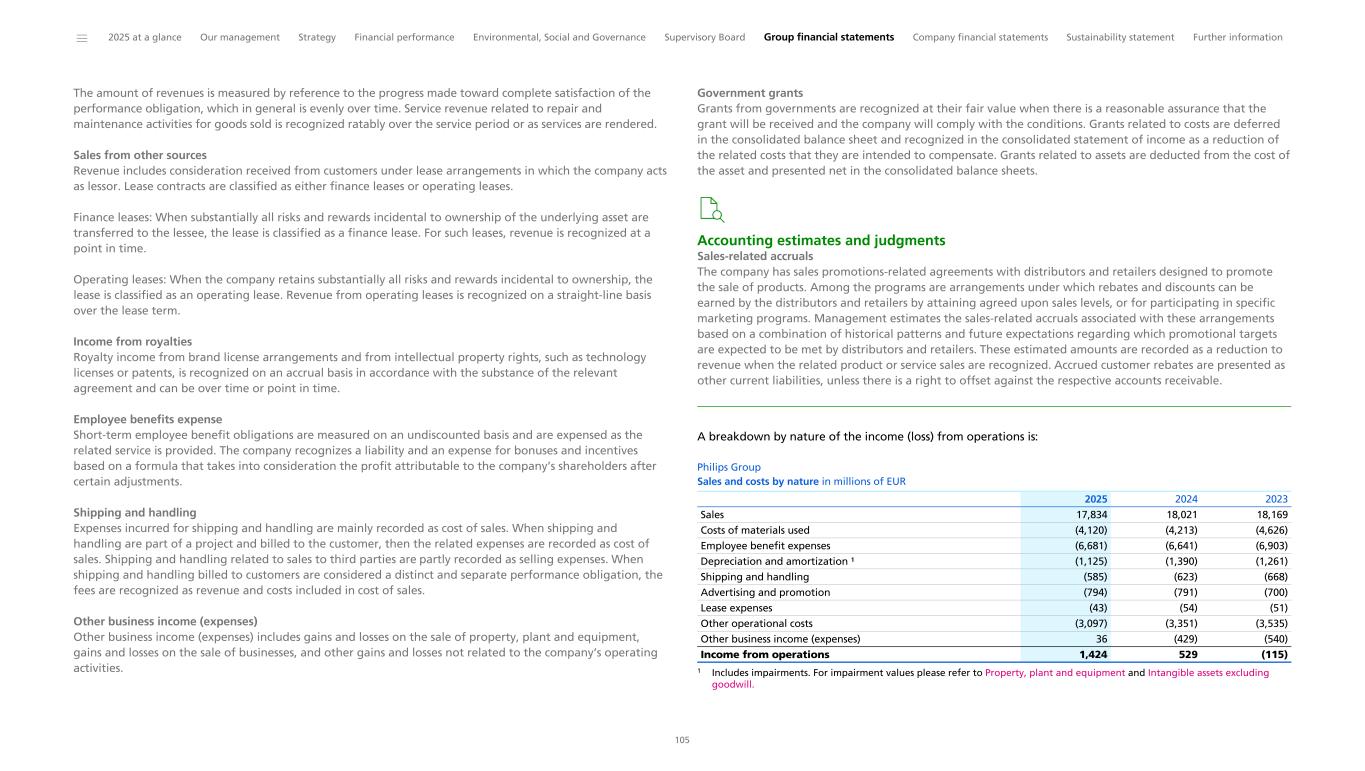
The amount of revenues is measured by reference to the progress made toward complete satisfaction of the performance obligation, which in general is evenly over time. Service revenue related to repair and maintenance activities for goods sold is recognized ratably over the service period or as services are rendered. Sales from other sources Revenue includes consideration received from customers under lease arrangements in which the company acts as lessor. Lease contracts are classified as either finance leases or operating leases. Finance leases: When substantially all risks and rewards incidental to ownership of the underlying asset are transferred to the lessee, the lease is classified as a finance lease. For such leases, revenue is recognized at a point in time. Operating leases: When the company retains substantially all risks and rewards incidental to ownership, the lease is classified as an operating lease. Revenue from operating leases is recognized on a straight-line basis over the lease term. Income from royalties Royalty income from brand license arrangements and from intellectual property rights, such as technology licenses or patents, is recognized on an accrual basis in accordance with the substance of the relevant agreement and can be over time or point in time. Employee benefits expense Short-term employee benefit obligations are measured on an undiscounted basis and are expensed as the related service is provided. The company recognizes a liability and an expense for bonuses and incentives based on a formula that takes into consideration the profit attributable to the company’s shareholders after certain adjustments. Shipping and handling Expenses incurred for shipping and handling are mainly recorded as cost of sales. When shipping and handling are part of a project and billed to the customer, then the related expenses are recorded as cost of sales. Shipping and handling related to sales to third parties are partly recorded as selling expenses. When shipping and handling billed to customers are considered a distinct and separate performance obligation, the fees are recognized as revenue and costs included in cost of sales. Other business income (expenses) Other business income (expenses) includes gains and losses on the sale of property, plant and equipment, gains and losses on the sale of businesses, and other gains and losses not related to the company’s operating activities. Government grants Grants from governments are recognized at their fair value when there is a reasonable assurance that the grant will be received and the company will comply with the conditions. Grants related to costs are deferred in the consolidated balance sheet and recognized in the consolidated statement of income as a reduction of the related costs that they are intended to compensate. Grants related to assets are deducted from the cost of the asset and presented net in the consolidated balance sheets. Accounting estimates and judgments Sales-related accruals The company has sales promotions-related agreements with distributors and retailers designed to promote the sale of products. Among the programs are arrangements under which rebates and discounts can be earned by the distributors and retailers by attaining agreed upon sales levels, or for participating in specific marketing programs. Management estimates the sales-related accruals associated with these arrangements based on a combination of historical patterns and future expectations regarding which promotional targets are expected to be met by distributors and retailers. These estimated amounts are recorded as a reduction to revenue when the related product or service sales are recognized. Accrued customer rebates are presented as other current liabilities, unless there is a right to offset against the respective accounts receivable. A breakdown by nature of the income (loss) from operations is: Philips Group Sales and costs by nature in millions of EUR Sales 17,834 18,021 18,169 Costs of materials used (4,120) (4,213) (4,626) Employee benefit expenses (6,681) (6,641) (6,903) Depreciation and amortization ¹ (1,125) (1,390) (1,261) Shipping and handling (585) (623) (668) Advertising and promotion (794) (791) (700) Lease expenses (43) (54) (51) Other operational costs (3,097) (3,351) (3,535) Other business income (expenses) 36 (429) (540) Income from operations 1,424 529 (115) 2025 2024 2023 1 Includes impairments. For impairment values please refer to Property, plant and equipment and Intangible assets excluding goodwill. ______ 2025 at a glance Our management Strategy Financial performance Environmental, Social and Governance Supervisory Board Group financial statements Company financial statements Sustainability statement Further information 105
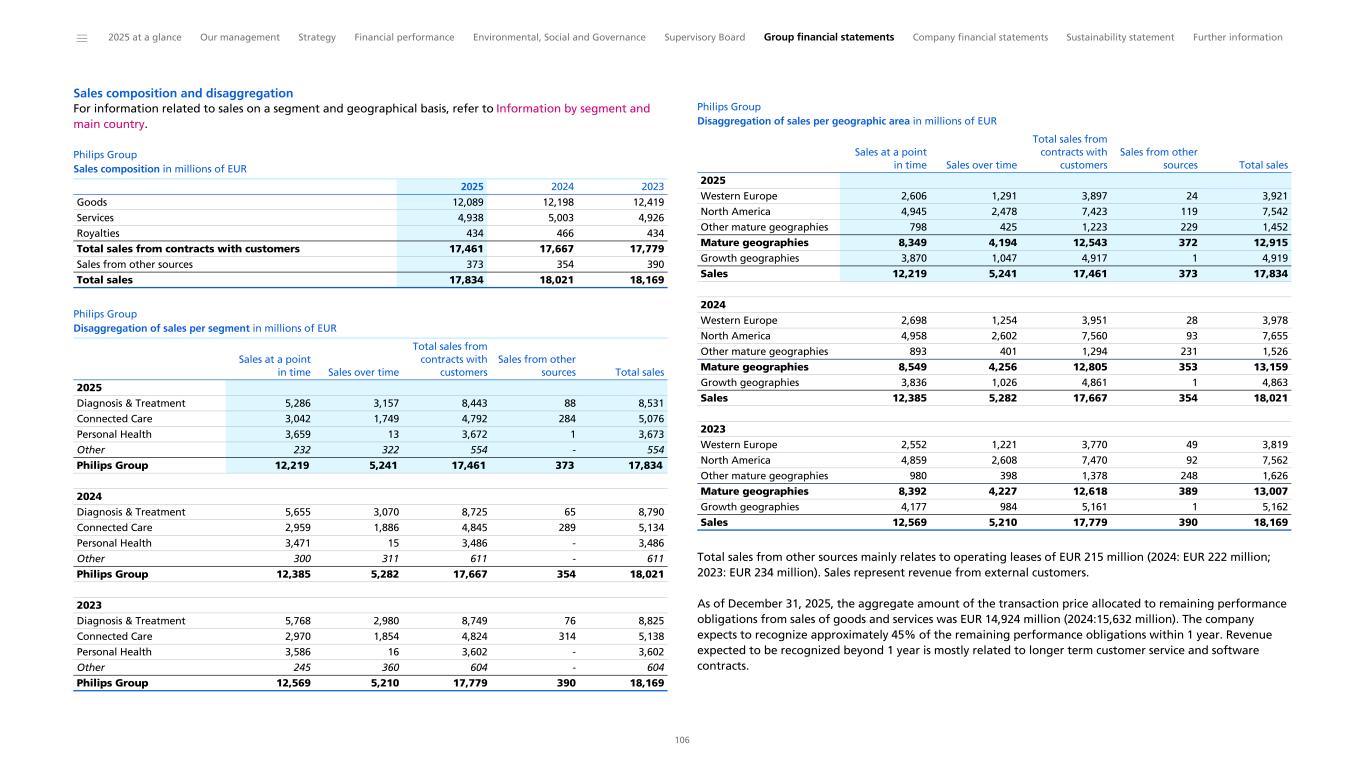
Sales composition and disaggregation For information related to sales on a segment and geographical basis, refer to Information by segment and main country. Philips Group Sales composition in millions of EUR Goods 12,089 12,198 12,419 Services 4,938 5,003 4,926 Royalties 434 466 434 Total sales from contracts with customers 17,461 17,667 17,779 Sales from other sources 373 354 390 Total sales 17,834 18,021 18,169 2025 2024 2023 Philips Group Disaggregation of sales per segment in millions of EUR Diagnosis & Treatment 5,286 3,157 8,443 88 8,531 Connected Care 3,042 1,749 4,792 284 5,076 Personal Health 3,659 13 3,672 1 3,673 Other 232 322 554 - 554 Philips Group 12,219 5,241 17,461 373 17,834 2024 Diagnosis & Treatment 5,655 3,070 8,725 65 8,790 Connected Care 2,959 1,886 4,845 289 5,134 Personal Health 3,471 15 3,486 - 3,486 Other 300 311 611 - 611 Philips Group 12,385 5,282 17,667 354 18,021 2023 Diagnosis & Treatment 5,768 2,980 8,749 76 8,825 Connected Care 2,970 1,854 4,824 314 5,138 Personal Health 3,586 16 3,602 - 3,602 Other 245 360 604 - 604 Philips Group 12,569 5,210 17,779 390 18,169 Sales at a point in time Sales over time Total sales from contracts with customers Sales from other sources Total sales 2025 Philips Group Disaggregation of sales per geographic area in millions of EUR Western Europe 2,606 1,291 3,897 24 3,921 North America 4,945 2,478 7,423 119 7,542 Other mature geographies 798 425 1,223 229 1,452 Mature geographies 8,349 4,194 12,543 372 12,915 Growth geographies 3,870 1,047 4,917 1 4,919 Sales 12,219 5,241 17,461 373 17,834 2024 Western Europe 2,698 1,254 3,951 28 3,978 North America 4,958 2,602 7,560 93 7,655 Other mature geographies 893 401 1,294 231 1,526 Mature geographies 8,549 4,256 12,805 353 13,159 Growth geographies 3,836 1,026 4,861 1 4,863 Sales 12,385 5,282 17,667 354 18,021 2023 Western Europe 2,552 1,221 3,770 49 3,819 North America 4,859 2,608 7,470 92 7,562 Other mature geographies 980 398 1,378 248 1,626 Mature geographies 8,392 4,227 12,618 389 13,007 Growth geographies 4,177 984 5,161 1 5,162 Sales 12,569 5,210 17,779 390 18,169 Sales at a point in time Sales over time Total sales from contracts with customers Sales from other sources Total sales 2025 Total sales from other sources mainly relates to operating leases of EUR 215 million (2024: EUR 222 million; 2023: EUR 234 million). Sales represent revenue from external customers. As of December 31, 2025, the aggregate amount of the transaction price allocated to remaining performance obligations from sales of goods and services was EUR 14,924 million (2024:15,632 million). The company expects to recognize approximately 45% of the remaining performance obligations within 1 year. Revenue expected to be recognized beyond 1 year is mostly related to longer term customer service and software contracts. ______ 2025 at a glance Our management Strategy Financial performance Environmental, Social and Governance Supervisory Board Group financial statements Company financial statements Sustainability statement Further information 106
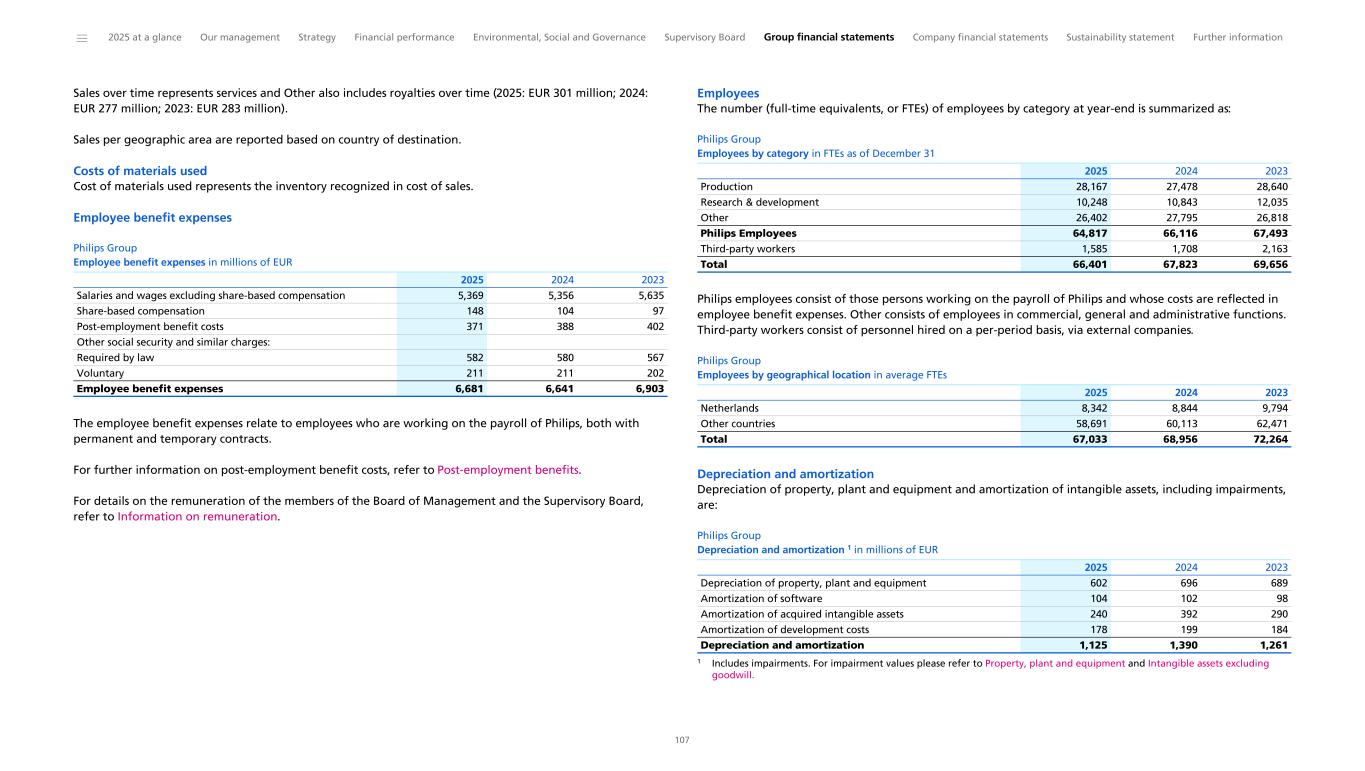
Sales over time represents services and Other also includes royalties over time (2025: EUR 301 million; 2024: EUR 277 million; 2023: EUR 283 million). Sales per geographic area are reported based on country of destination. Costs of materials used Cost of materials used represents the inventory recognized in cost of sales. Employee benefit expenses Philips Group Employee benefit expenses in millions of EUR Salaries and wages excluding share-based compensation 5,369 5,356 5,635 Share-based compensation 148 104 97 Post-employment benefit costs 371 388 402 Other social security and similar charges: Required by law 582 580 567 Voluntary 211 211 202 Employee benefit expenses 6,681 6,641 6,903 2025 2024 2023 The employee benefit expenses relate to employees who are working on the payroll of Philips, both with permanent and temporary contracts. For further information on post-employment benefit costs, refer to Post-employment benefits. For details on the remuneration of the members of the Board of Management and the Supervisory Board, refer to Information on remuneration. Employees The number (full-time equivalents, or FTEs) of employees by category at year-end is summarized as: Philips Group Employees by category in FTEs as of December 31 Production 28,167 27,478 28,640 Research & development 10,248 10,843 12,035 Other 26,402 27,795 26,818 Philips Employees 64,817 66,116 67,493 Third-party workers 1,585 1,708 2,163 Total 66,401 67,823 69,656 2025 2024 2023 Philips employees consist of those persons working on the payroll of Philips and whose costs are reflected in employee benefit expenses. Other consists of employees in commercial, general and administrative functions. Third-party workers consist of personnel hired on a per-period basis, via external companies. Philips Group Employees by geographical location in average FTEs Netherlands 8,342 8,844 9,794 Other countries 58,691 60,113 62,471 Total 67,033 68,956 72,264 2025 2024 2023 Depreciation and amortization Depreciation of property, plant and equipment and amortization of intangible assets, including impairments, are: Philips Group Depreciation and amortization 1 in millions of EUR Depreciation of property, plant and equipment 602 696 689 Amortization of software 104 102 98 Amortization of acquired intangible assets 240 392 290 Amortization of development costs 178 199 184 Depreciation and amortization 1,125 1,390 1,261 2025 2024 2023 1 Includes impairments. For impairment values please refer to Property, plant and equipment and Intangible assets excluding goodwill. ______ 2025 at a glance Our management Strategy Financial performance Environmental, Social and Governance Supervisory Board Group financial statements Company financial statements Sustainability statement Further information 107
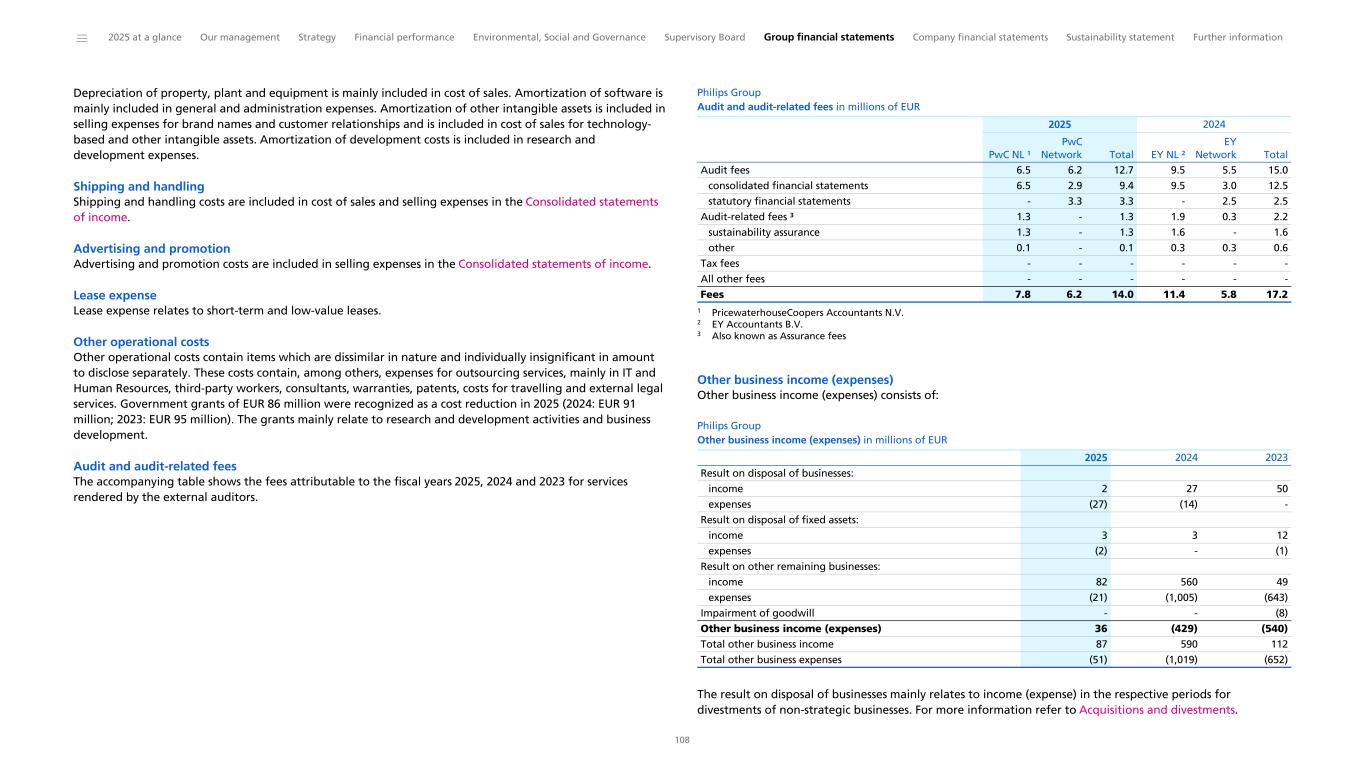
Depreciation of property, plant and equipment is mainly included in cost of sales. Amortization of software is mainly included in general and administration expenses. Amortization of other intangible assets is included in selling expenses for brand names and customer relationships and is included in cost of sales for technology- based and other intangible assets. Amortization of development costs is included in research and development expenses. Shipping and handling Shipping and handling costs are included in cost of sales and selling expenses in the Consolidated statements of income. Advertising and promotion Advertising and promotion costs are included in selling expenses in the Consolidated statements of income. Lease expense Lease expense relates to short-term and low-value leases. Other operational costs Other operational costs contain items which are dissimilar in nature and individually insignificant in amount to disclose separately. These costs contain, among others, expenses for outsourcing services, mainly in IT and Human Resources, third-party workers, consultants, warranties, patents, costs for travelling and external legal services. Government grants of EUR 86 million were recognized as a cost reduction in 2025 (2024: EUR 91 million; 2023: EUR 95 million). The grants mainly relate to research and development activities and business development. Audit and audit-related fees The accompanying table shows the fees attributable to the fiscal years 2025, 2024 and 2023 for services rendered by the external auditors. Philips Group Audit and audit-related fees in millions of EUR Audit fees 6.5 6.2 12.7 9.5 5.5 15.0 consolidated financial statements 6.5 2.9 9.4 9.5 3.0 12.5 statutory financial statements - 3.3 3.3 - 2.5 2.5 Audit-related fees ³ 1.3 - 1.3 1.9 0.3 2.2 sustainability assurance 1.3 - 1.3 1.6 - 1.6 other 0.1 - 0.1 0.3 0.3 0.6 Tax fees - - - - - - All other fees - - - - - - Fees 7.8 6.2 14.0 11.4 5.8 17.2 2025 2024 PwC NL ¹ PwC Network Total EY NL ² EY Network Total 1 PricewaterhouseCoopers Accountants N.V. 2 EY Accountants B.V. 3 Also known as Assurance fees Other business income (expenses) Other business income (expenses) consists of: Philips Group Other business income (expenses) in millions of EUR Result on disposal of businesses: income 2 27 50 expenses (27) (14) - Result on disposal of fixed assets: income 3 3 12 expenses (2) - (1) Result on other remaining businesses: income 82 560 49 expenses (21) (1,005) (643) Impairment of goodwill - - (8) Other business income (expenses) 36 (429) (540) Total other business income 87 590 112 Total other business expenses (51) (1,019) (652) 2025 2024 2023 The result on disposal of businesses mainly relates to income (expense) in the respective periods for divestments of non-strategic businesses. For more information refer to Acquisitions and divestments. ______ 2025 at a glance Our management Strategy Financial performance Environmental, Social and Governance Supervisory Board Group financial statements Company financial statements Sustainability statement Further information 108
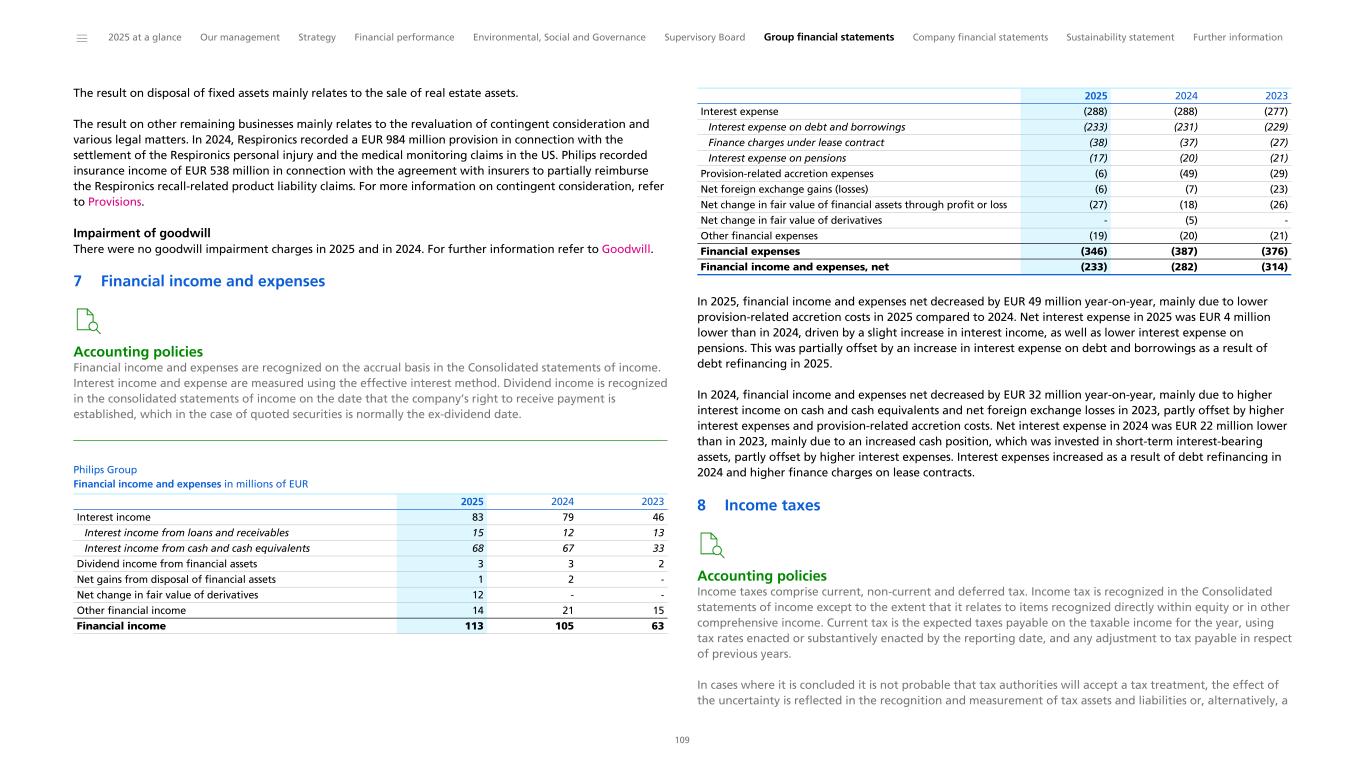
The result on disposal of fixed assets mainly relates to the sale of real estate assets. The result on other remaining businesses mainly relates to the revaluation of contingent consideration and various legal matters. In 2024, Respironics recorded a EUR 984 million provision in connection with the settlement of the Respironics personal injury and the medical monitoring claims in the US. Philips recorded insurance income of EUR 538 million in connection with the agreement with insurers to partially reimburse the Respironics recall-related product liability claims. For more information on contingent consideration, refer to Provisions. Impairment of goodwill There were no goodwill impairment charges in 2025 and in 2024. For further information refer to Goodwill. 7 Financial income and expenses Accounting policies Financial income and expenses are recognized on the accrual basis in the Consolidated statements of income. Interest income and expense are measured using the effective interest method. Dividend income is recognized in the consolidated statements of income on the date that the company’s right to receive payment is established, which in the case of quoted securities is normally the ex-dividend date. Philips Group Financial income and expenses in millions of EUR Interest income 83 79 46 Interest income from loans and receivables 15 12 13 Interest income from cash and cash equivalents 68 67 33 Dividend income from financial assets 3 3 2 Net gains from disposal of financial assets 1 2 - Net change in fair value of derivatives 12 - - Other financial income 14 21 15 Financial income 113 105 63 2025 2024 2023 Interest expense (288) (288) (277) Interest expense on debt and borrowings (233) (231) (229) Finance charges under lease contract (38) (37) (27) Interest expense on pensions (17) (20) (21) Provision-related accretion expenses (6) (49) (29) Net foreign exchange gains (losses) (6) (7) (23) Net change in fair value of financial assets through profit or loss (27) (18) (26) Net change in fair value of derivatives - (5) - Other financial expenses (19) (20) (21) Financial expenses (346) (387) (376) Financial income and expenses, net (233) (282) (314) 2025 2024 2023 In 2025, financial income and expenses net decreased by EUR 49 million year-on-year, mainly due to lower provision-related accretion costs in 2025 compared to 2024. Net interest expense in 2025 was EUR 4 million lower than in 2024, driven by a slight increase in interest income, as well as lower interest expense on pensions. This was partially offset by an increase in interest expense on debt and borrowings as a result of debt refinancing in 2025. In 2024, financial income and expenses net decreased by EUR 32 million year-on-year, mainly due to higher interest income on cash and cash equivalents and net foreign exchange losses in 2023, partly offset by higher interest expenses and provision-related accretion costs. Net interest expense in 2024 was EUR 22 million lower than in 2023, mainly due to an increased cash position, which was invested in short-term interest-bearing assets, partly offset by higher interest expenses. Interest expenses increased as a result of debt refinancing in 2024 and higher finance charges on lease contracts. 8 Income taxes Accounting policies Income taxes comprise current, non-current and deferred tax. Income tax is recognized in the Consolidated statements of income except to the extent that it relates to items recognized directly within equity or in other comprehensive income. Current tax is the expected taxes payable on the taxable income for the year, using tax rates enacted or substantively enacted by the reporting date, and any adjustment to tax payable in respect of previous years. In cases where it is concluded it is not probable that tax authorities will accept a tax treatment, the effect of the uncertainty is reflected in the recognition and measurement of tax assets and liabilities or, alternatively, a ______ 2025 at a glance Our management Strategy Financial performance Environmental, Social and Governance Supervisory Board Group financial statements Company financial statements Sustainability statement Further information 109
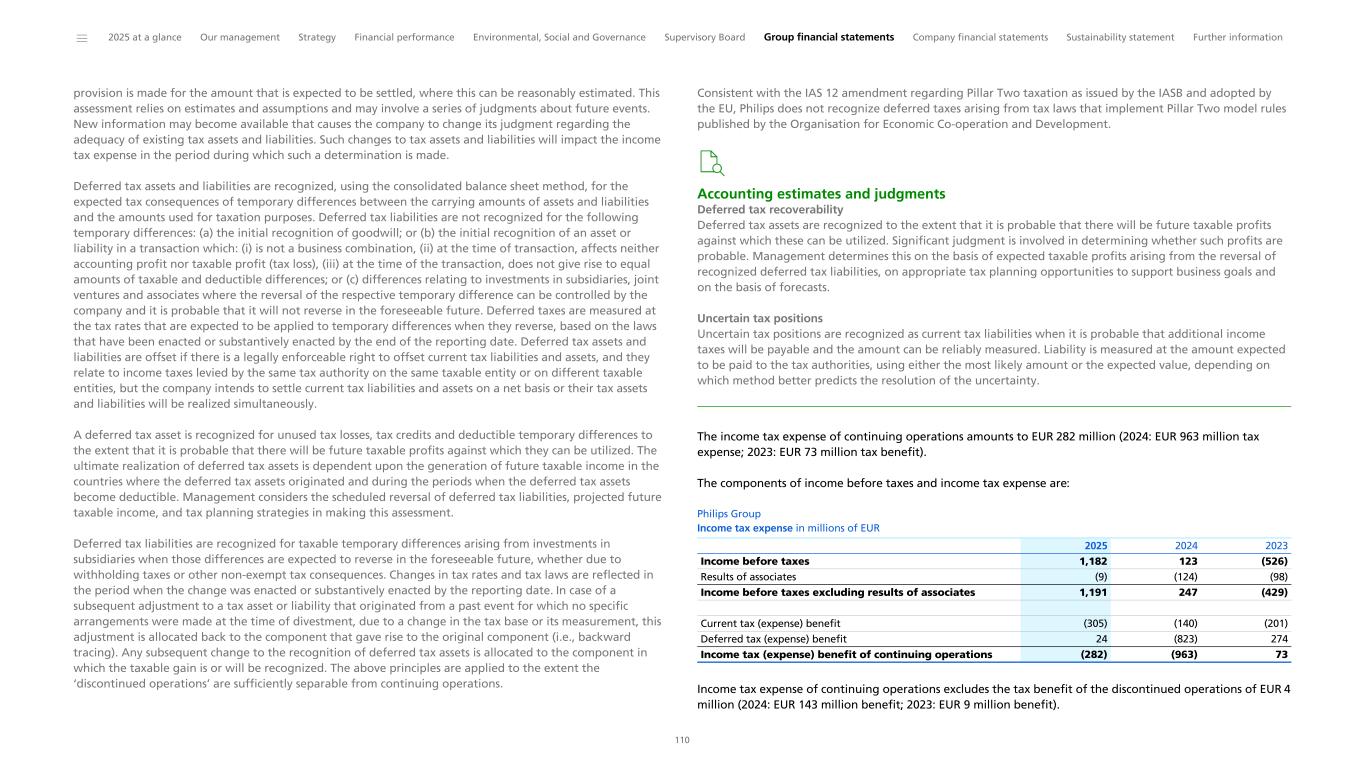
provision is made for the amount that is expected to be settled, where this can be reasonably estimated. This assessment relies on estimates and assumptions and may involve a series of judgments about future events. New information may become available that causes the company to change its judgment regarding the adequacy of existing tax assets and liabilities. Such changes to tax assets and liabilities will impact the income tax expense in the period during which such a determination is made. Deferred tax assets and liabilities are recognized, using the consolidated balance sheet method, for the expected tax consequences of temporary differences between the carrying amounts of assets and liabilities and the amounts used for taxation purposes. Deferred tax liabilities are not recognized for the following temporary differences: (a) the initial recognition of goodwill; or (b) the initial recognition of an asset or liability in a transaction which: (i) is not a business combination, (ii) at the time of transaction, affects neither accounting profit nor taxable profit (tax loss), (iii) at the time of the transaction, does not give rise to equal amounts of taxable and deductible differences; or (c) differences relating to investments in subsidiaries, joint ventures and associates where the reversal of the respective temporary difference can be controlled by the company and it is probable that it will not reverse in the foreseeable future. Deferred taxes are measured at the tax rates that are expected to be applied to temporary differences when they reverse, based on the laws that have been enacted or substantively enacted by the end of the reporting date. Deferred tax assets and liabilities are offset if there is a legally enforceable right to offset current tax liabilities and assets, and they relate to income taxes levied by the same tax authority on the same taxable entity or on different taxable entities, but the company intends to settle current tax liabilities and assets on a net basis or their tax assets and liabilities will be realized simultaneously. A deferred tax asset is recognized for unused tax losses, tax credits and deductible temporary differences to the extent that it is probable that there will be future taxable profits against which they can be utilized. The ultimate realization of deferred tax assets is dependent upon the generation of future taxable income in the countries where the deferred tax assets originated and during the periods when the deferred tax assets become deductible. Management considers the scheduled reversal of deferred tax liabilities, projected future taxable income, and tax planning strategies in making this assessment. Deferred tax liabilities are recognized for taxable temporary differences arising from investments in subsidiaries when those differences are expected to reverse in the foreseeable future, whether due to withholding taxes or other non-exempt tax consequences. Changes in tax rates and tax laws are reflected in the period when the change was enacted or substantively enacted by the reporting date. In case of a subsequent adjustment to a tax asset or liability that originated from a past event for which no specific arrangements were made at the time of divestment, due to a change in the tax base or its measurement, this adjustment is allocated back to the component that gave rise to the original component (i.e., backward tracing). Any subsequent change to the recognition of deferred tax assets is allocated to the component in which the taxable gain is or will be recognized. The above principles are applied to the extent the ‘discontinued operations’ are sufficiently separable from continuing operations. Consistent with the IAS 12 amendment regarding Pillar Two taxation as issued by the IASB and adopted by the EU, Philips does not recognize deferred taxes arising from tax laws that implement Pillar Two model rules published by the Organisation for Economic Co-operation and Development. Accounting estimates and judgments Deferred tax recoverability Deferred tax assets are recognized to the extent that it is probable that there will be future taxable profits against which these can be utilized. Significant judgment is involved in determining whether such profits are probable. Management determines this on the basis of expected taxable profits arising from the reversal of recognized deferred tax liabilities, on appropriate tax planning opportunities to support business goals and on the basis of forecasts. Uncertain tax positions Uncertain tax positions are recognized as current tax liabilities when it is probable that additional income taxes will be payable and the amount can be reliably measured. Liability is measured at the amount expected to be paid to the tax authorities, using either the most likely amount or the expected value, depending on which method better predicts the resolution of the uncertainty. The income tax expense of continuing operations amounts to EUR 282 million (2024: EUR 963 million tax expense; 2023: EUR 73 million tax benefit). The components of income before taxes and income tax expense are: Philips Group Income tax expense in millions of EUR Income before taxes 1,182 123 (526) Results of associates (9) (124) (98) Income before taxes excluding results of associates 1,191 247 (429) Current tax (expense) benefit (305) (140) (201) Deferred tax (expense) benefit 24 (823) 274 Income tax (expense) benefit of continuing operations (282) (963) 73 2025 2024 2023 Income tax expense of continuing operations excludes the tax benefit of the discontinued operations of EUR 4 million (2024: EUR 143 million benefit; 2023: EUR 9 million benefit). ______ 2025 at a glance Our management Strategy Financial performance Environmental, Social and Governance Supervisory Board Group financial statements Company financial statements Sustainability statement Further information 110
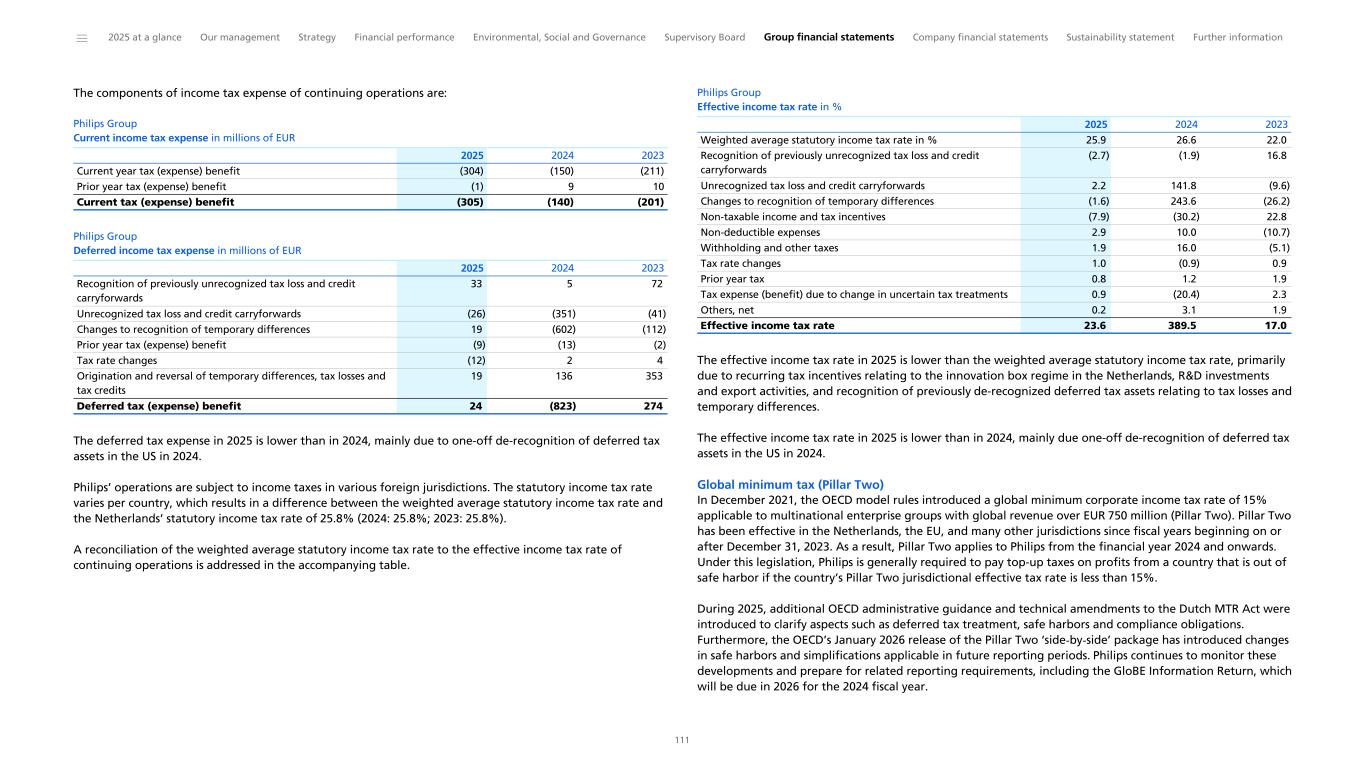
The components of income tax expense of continuing operations are: Philips Group Current income tax expense in millions of EUR Current year tax (expense) benefit (304) (150) (211) Prior year tax (expense) benefit (1) 9 10 Current tax (expense) benefit (305) (140) (201) 2025 2024 2023 Philips Group Deferred income tax expense in millions of EUR Recognition of previously unrecognized tax loss and credit carryforwards 33 5 72 Unrecognized tax loss and credit carryforwards (26) (351) (41) Changes to recognition of temporary differences 19 (602) (112) Prior year tax (expense) benefit (9) (13) (2) Tax rate changes (12) 2 4 Origination and reversal of temporary differences, tax losses and tax credits 19 136 353 Deferred tax (expense) benefit 24 (823) 274 2025 2024 2023 The deferred tax expense in 2025 is lower than in 2024, mainly due to one-off de-recognition of deferred tax assets in the US in 2024. Philips’ operations are subject to income taxes in various foreign jurisdictions. The statutory income tax rate varies per country, which results in a difference between the weighted average statutory income tax rate and the Netherlands’ statutory income tax rate of 25.8% (2024: 25.8%; 2023: 25.8%). A reconciliation of the weighted average statutory income tax rate to the effective income tax rate of continuing operations is addressed in the accompanying table. Philips Group Effective income tax rate in % Weighted average statutory income tax rate in % 25.9 26.6 22.0 Recognition of previously unrecognized tax loss and credit carryforwards (2.7) (1.9) 16.8 Unrecognized tax loss and credit carryforwards 2.2 141.8 (9.6) Changes to recognition of temporary differences (1.6) 243.6 (26.2) Non-taxable income and tax incentives (7.9) (30.2) 22.8 Non-deductible expenses 2.9 10.0 (10.7) Withholding and other taxes 1.9 16.0 (5.1) Tax rate changes 1.0 (0.9) 0.9 Prior year tax 0.8 1.2 1.9 Tax expense (benefit) due to change in uncertain tax treatments 0.9 (20.4) 2.3 Others, net 0.2 3.1 1.9 Effective income tax rate 23.6 389.5 17.0 2025 2024 2023 The effective income tax rate in 2025 is lower than the weighted average statutory income tax rate, primarily due to recurring tax incentives relating to the innovation box regime in the Netherlands, R&D investments and export activities, and recognition of previously de-recognized deferred tax assets relating to tax losses and temporary differences. The effective income tax rate in 2025 is lower than in 2024, mainly due one-off de-recognition of deferred tax assets in the US in 2024. Global minimum tax (Pillar Two) In December 2021, the OECD model rules introduced a global minimum corporate income tax rate of 15% applicable to multinational enterprise groups with global revenue over EUR 750 million (Pillar Two). Pillar Two has been effective in the Netherlands, the EU, and many other jurisdictions since fiscal years beginning on or after December 31, 2023. As a result, Pillar Two applies to Philips from the financial year 2024 and onwards. Under this legislation, Philips is generally required to pay top-up taxes on profits from a country that is out of safe harbor if the country’s Pillar Two jurisdictional effective tax rate is less than 15%. During 2025, additional OECD administrative guidance and technical amendments to the Dutch MTR Act were introduced to clarify aspects such as deferred tax treatment, safe harbors and compliance obligations. Furthermore, the OECD’s January 2026 release of the Pillar Two ‘side-by-side’ package has introduced changes in safe harbors and simplifications applicable in future reporting periods. Philips continues to monitor these developments and prepare for related reporting requirements, including the GloBE Information Return, which will be due in 2026 for the 2024 fiscal year. ______ 2025 at a glance Our management Strategy Financial performance Environmental, Social and Governance Supervisory Board Group financial statements Company financial statements Sustainability statement Further information 111
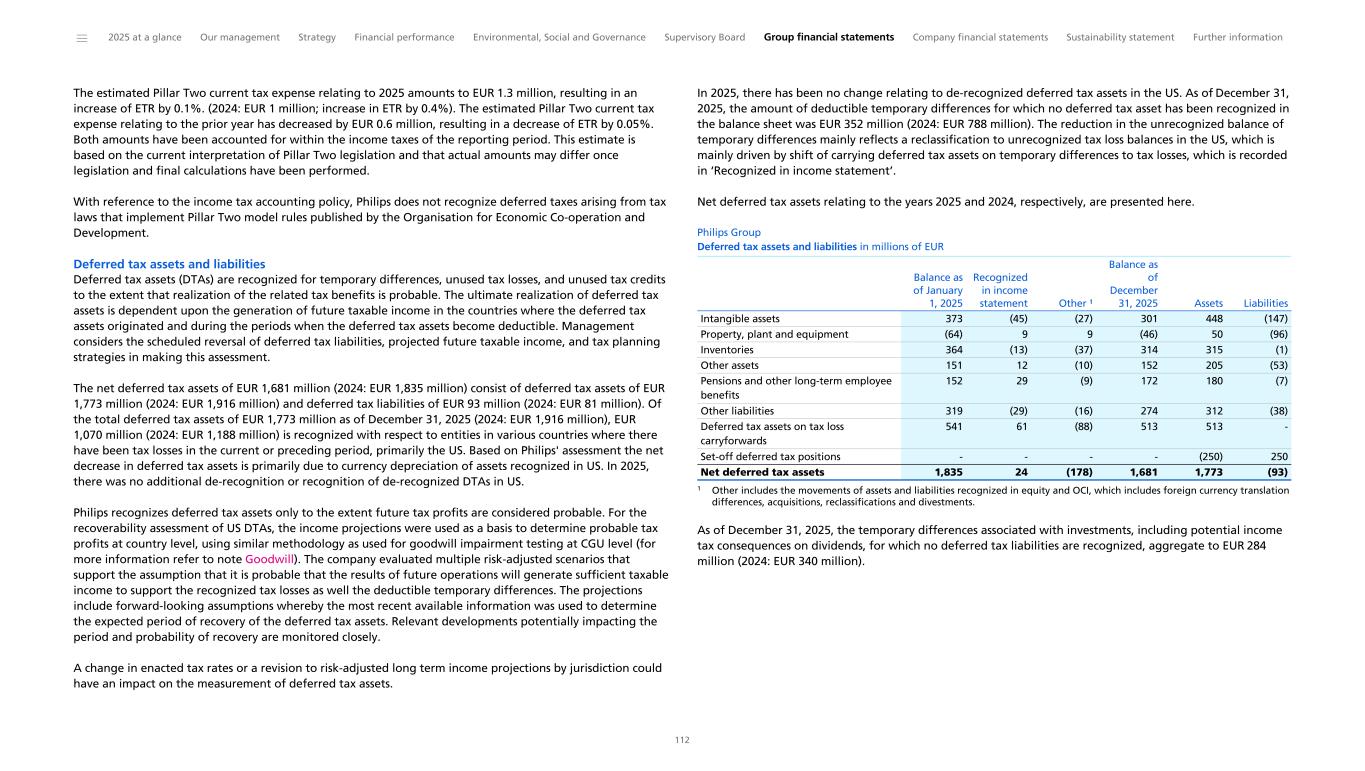
The estimated Pillar Two current tax expense relating to 2025 amounts to EUR 1.3 million, resulting in an increase of ETR by 0.1%. (2024: EUR 1 million; increase in ETR by 0.4%). The estimated Pillar Two current tax expense relating to the prior year has decreased by EUR 0.6 million, resulting in a decrease of ETR by 0.05%. Both amounts have been accounted for within the income taxes of the reporting period. This estimate is based on the current interpretation of Pillar Two legislation and that actual amounts may differ once legislation and final calculations have been performed. With reference to the income tax accounting policy, Philips does not recognize deferred taxes arising from tax laws that implement Pillar Two model rules published by the Organisation for Economic Co-operation and Development. Deferred tax assets and liabilities Deferred tax assets (DTAs) are recognized for temporary differences, unused tax losses, and unused tax credits to the extent that realization of the related tax benefits is probable. The ultimate realization of deferred tax assets is dependent upon the generation of future taxable income in the countries where the deferred tax assets originated and during the periods when the deferred tax assets become deductible. Management considers the scheduled reversal of deferred tax liabilities, projected future taxable income, and tax planning strategies in making this assessment. The net deferred tax assets of EUR 1,681 million (2024: EUR 1,835 million) consist of deferred tax assets of EUR 1,773 million (2024: EUR 1,916 million) and deferred tax liabilities of EUR 93 million (2024: EUR 81 million). Of the total deferred tax assets of EUR 1,773 million as of December 31, 2025 (2024: EUR 1,916 million), EUR 1,070 million (2024: EUR 1,188 million) is recognized with respect to entities in various countries where there have been tax losses in the current or preceding period, primarily the US. Based on Philips' assessment the net decrease in deferred tax assets is primarily due to currency depreciation of assets recognized in US. In 2025, there was no additional de-recognition or recognition of de-recognized DTAs in US. Philips recognizes deferred tax assets only to the extent future tax profits are considered probable. For the recoverability assessment of US DTAs, the income projections were used as a basis to determine probable tax profits at country level, using similar methodology as used for goodwill impairment testing at CGU level (for more information refer to note Goodwill). The company evaluated multiple risk-adjusted scenarios that support the assumption that it is probable that the results of future operations will generate sufficient taxable income to support the recognized tax losses as well the deductible temporary differences. The projections include forward-looking assumptions whereby the most recent available information was used to determine the expected period of recovery of the deferred tax assets. Relevant developments potentially impacting the period and probability of recovery are monitored closely. A change in enacted tax rates or a revision to risk-adjusted long term income projections by jurisdiction could have an impact on the measurement of deferred tax assets. In 2025, there has been no change relating to de-recognized deferred tax assets in the US. As of December 31, 2025, the amount of deductible temporary differences for which no deferred tax asset has been recognized in the balance sheet was EUR 352 million (2024: EUR 788 million). The reduction in the unrecognized balance of temporary differences mainly reflects a reclassification to unrecognized tax loss balances in the US, which is mainly driven by shift of carrying deferred tax assets on temporary differences to tax losses, which is recorded in ‘Recognized in income statement’. Net deferred tax assets relating to the years 2025 and 2024, respectively, are presented here. Philips Group Deferred tax assets and liabilities in millions of EUR Intangible assets 373 (45) (27) 301 448 (147) Property, plant and equipment (64) 9 9 (46) 50 (96) Inventories 364 (13) (37) 314 315 (1) Other assets 151 12 (10) 152 205 (53) Pensions and other long-term employee benefits 152 29 (9) 172 180 (7) Other liabilities 319 (29) (16) 274 312 (38) Deferred tax assets on tax loss carryforwards 541 61 (88) 513 513 - Set-off deferred tax positions - - - - (250) 250 Net deferred tax assets 1,835 24 (178) 1,681 1,773 (93) Balance as of January 1, 2025 Recognized in income statement Other ¹ Balance as of December 31, 2025 Assets Liabilities 1 Other includes the movements of assets and liabilities recognized in equity and OCI, which includes foreign currency translation differences, acquisitions, reclassifications and divestments. As of December 31, 2025, the temporary differences associated with investments, including potential income tax consequences on dividends, for which no deferred tax liabilities are recognized, aggregate to EUR 284 million (2024: EUR 340 million). ______ 2025 at a glance Our management Strategy Financial performance Environmental, Social and Governance Supervisory Board Group financial statements Company financial statements Sustainability statement Further information 112
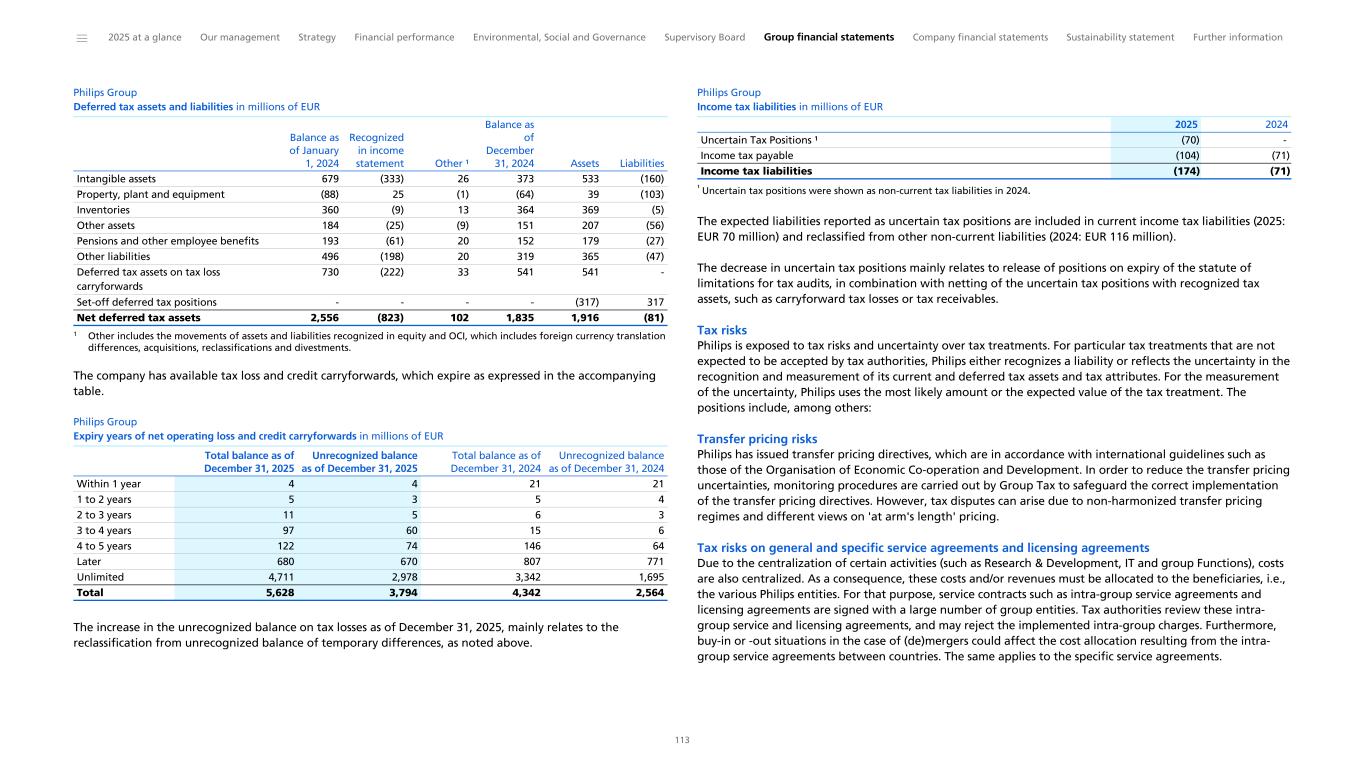
Philips Group Deferred tax assets and liabilities in millions of EUR Intangible assets 679 (333) 26 373 533 (160) Property, plant and equipment (88) 25 (1) (64) 39 (103) Inventories 360 (9) 13 364 369 (5) Other assets 184 (25) (9) 151 207 (56) Pensions and other employee benefits 193 (61) 20 152 179 (27) Other liabilities 496 (198) 20 319 365 (47) Deferred tax assets on tax loss carryforwards 730 (222) 33 541 541 - Set-off deferred tax positions - - - - (317) 317 Net deferred tax assets 2,556 (823) 102 1,835 1,916 (81) Balance as of January 1, 2024 Recognized in income statement Other ¹ Balance as of December 31, 2024 Assets Liabilities 1 Other includes the movements of assets and liabilities recognized in equity and OCI, which includes foreign currency translation differences, acquisitions, reclassifications and divestments. The company has available tax loss and credit carryforwards, which expire as expressed in the accompanying table. Philips Group Expiry years of net operating loss and credit carryforwards in millions of EUR Within 1 year 4 4 21 21 1 to 2 years 5 3 5 4 2 to 3 years 11 5 6 3 3 to 4 years 97 60 15 6 4 to 5 years 122 74 146 64 Later 680 670 807 771 Unlimited 4,711 2,978 3,342 1,695 Total 5,628 3,794 4,342 2,564 Total balance as of December 31, 2025 Unrecognized balance as of December 31, 2025 Total balance as of December 31, 2024 Unrecognized balance as of December 31, 2024 The increase in the unrecognized balance on tax losses as of December 31, 2025, mainly relates to the reclassification from unrecognized balance of temporary differences, as noted above. Philips Group Income tax liabilities in millions of EUR 2025 2024 Uncertain Tax Positions ¹ (70) - Income tax payable (104) (71) Income tax liabilities (174) (71) ¹ Uncertain tax positions were shown as non-current tax liabilities in 2024. The expected liabilities reported as uncertain tax positions are included in current income tax liabilities (2025: EUR 70 million) and reclassified from other non-current liabilities (2024: EUR 116 million). The decrease in uncertain tax positions mainly relates to release of positions on expiry of the statute of limitations for tax audits, in combination with netting of the uncertain tax positions with recognized tax assets, such as carryforward tax losses or tax receivables. Tax risks Philips is exposed to tax risks and uncertainty over tax treatments. For particular tax treatments that are not expected to be accepted by tax authorities, Philips either recognizes a liability or reflects the uncertainty in the recognition and measurement of its current and deferred tax assets and tax attributes. For the measurement of the uncertainty, Philips uses the most likely amount or the expected value of the tax treatment. The positions include, among others: Transfer pricing risks Philips has issued transfer pricing directives, which are in accordance with international guidelines such as those of the Organisation of Economic Co-operation and Development. In order to reduce the transfer pricing uncertainties, monitoring procedures are carried out by Group Tax to safeguard the correct implementation of the transfer pricing directives. However, tax disputes can arise due to non-harmonized transfer pricing regimes and different views on 'at arm's length' pricing. Tax risks on general and specific service agreements and licensing agreements Due to the centralization of certain activities (such as Research & Development, IT and group Functions), costs are also centralized. As a consequence, these costs and/or revenues must be allocated to the beneficiaries, i.e., the various Philips entities. For that purpose, service contracts such as intra-group service agreements and licensing agreements are signed with a large number of group entities. Tax authorities review these intra- group service and licensing agreements, and may reject the implemented intra-group charges. Furthermore, buy-in or -out situations in the case of (de)mergers could affect the cost allocation resulting from the intra- group service agreements between countries. The same applies to the specific service agreements. ______ 2025 at a glance Our management Strategy Financial performance Environmental, Social and Governance Supervisory Board Group financial statements Company financial statements Sustainability statement Further information 113
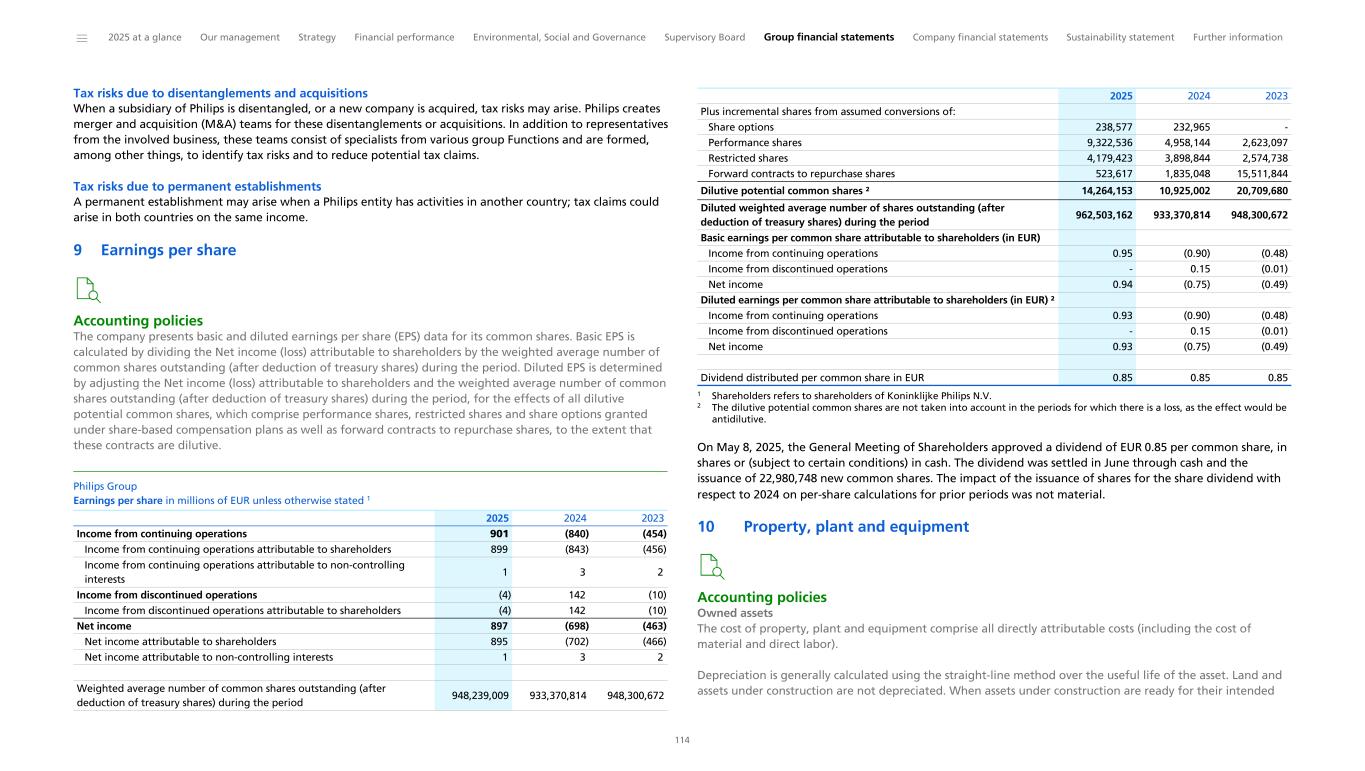
Tax risks due to disentanglements and acquisitions When a subsidiary of Philips is disentangled, or a new company is acquired, tax risks may arise. Philips creates merger and acquisition (M&A) teams for these disentanglements or acquisitions. In addition to representatives from the involved business, these teams consist of specialists from various group Functions and are formed, among other things, to identify tax risks and to reduce potential tax claims. Tax risks due to permanent establishments A permanent establishment may arise when a Philips entity has activities in another country; tax claims could arise in both countries on the same income. 9 Earnings per share Accounting policies The company presents basic and diluted earnings per share (EPS) data for its common shares. Basic EPS is calculated by dividing the Net income (loss) attributable to shareholders by the weighted average number of common shares outstanding (after deduction of treasury shares) during the period. Diluted EPS is determined by adjusting the Net income (loss) attributable to shareholders and the weighted average number of common shares outstanding (after deduction of treasury shares) during the period, for the effects of all dilutive potential common shares, which comprise performance shares, restricted shares and share options granted under share-based compensation plans as well as forward contracts to repurchase shares, to the extent that these contracts are dilutive. Philips Group Earnings per share in millions of EUR unless otherwise stated 1 Income from continuing operations 901 (840) (454) Income from continuing operations attributable to shareholders 899 (843) (456) Income from continuing operations attributable to non-controlling interests 1 3 2 Income from discontinued operations (4) 142 (10) Income from discontinued operations attributable to shareholders (4) 142 (10) Net income 897 (698) (463) Net income attributable to shareholders 895 (702) (466) Net income attributable to non-controlling interests 1 3 2 Weighted average number of common shares outstanding (after deduction of treasury shares) during the period 948,239,009 933,370,814 948,300,672 2025 2024 2023 Plus incremental shares from assumed conversions of: Share options 238,577 232,965 - Performance shares 9,322,536 4,958,144 2,623,097 Restricted shares 4,179,423 3,898,844 2,574,738 Forward contracts to repurchase shares 523,617 1,835,048 15,511,844 Dilutive potential common shares ² 14,264,153 10,925,002 20,709,680 Diluted weighted average number of shares outstanding (after deduction of treasury shares) during the period 962,503,162 933,370,814 948,300,672 Basic earnings per common share attributable to shareholders (in EUR) Income from continuing operations 0.95 (0.90) (0.48) Income from discontinued operations - 0.15 (0.01) Net income 0.94 (0.75) (0.49) Diluted earnings per common share attributable to shareholders (in EUR) ² Income from continuing operations 0.93 (0.90) (0.48) Income from discontinued operations - 0.15 (0.01) Net income 0.93 (0.75) (0.49) Dividend distributed per common share in EUR 0.85 0.85 0.85 2025 2024 2023 1 Shareholders refers to shareholders of Koninklijke Philips N.V. 2 The dilutive potential common shares are not taken into account in the periods for which there is a loss, as the effect would be antidilutive. On May 8, 2025, the General Meeting of Shareholders approved a dividend of EUR 0.85 per common share, in shares or (subject to certain conditions) in cash. The dividend was settled in June through cash and the issuance of 22,980,748 new common shares. The impact of the issuance of shares for the share dividend with respect to 2024 on per-share calculations for prior periods was not material. 10 Property, plant and equipment Accounting policies Owned assets The cost of property, plant and equipment comprise all directly attributable costs (including the cost of material and direct labor). Depreciation is generally calculated using the straight-line method over the useful life of the asset. Land and assets under construction are not depreciated. When assets under construction are ready for their intended ______ 2025 at a glance Our management Strategy Financial performance Environmental, Social and Governance Supervisory Board Group financial statements Company financial statements Sustainability statement Further information 114
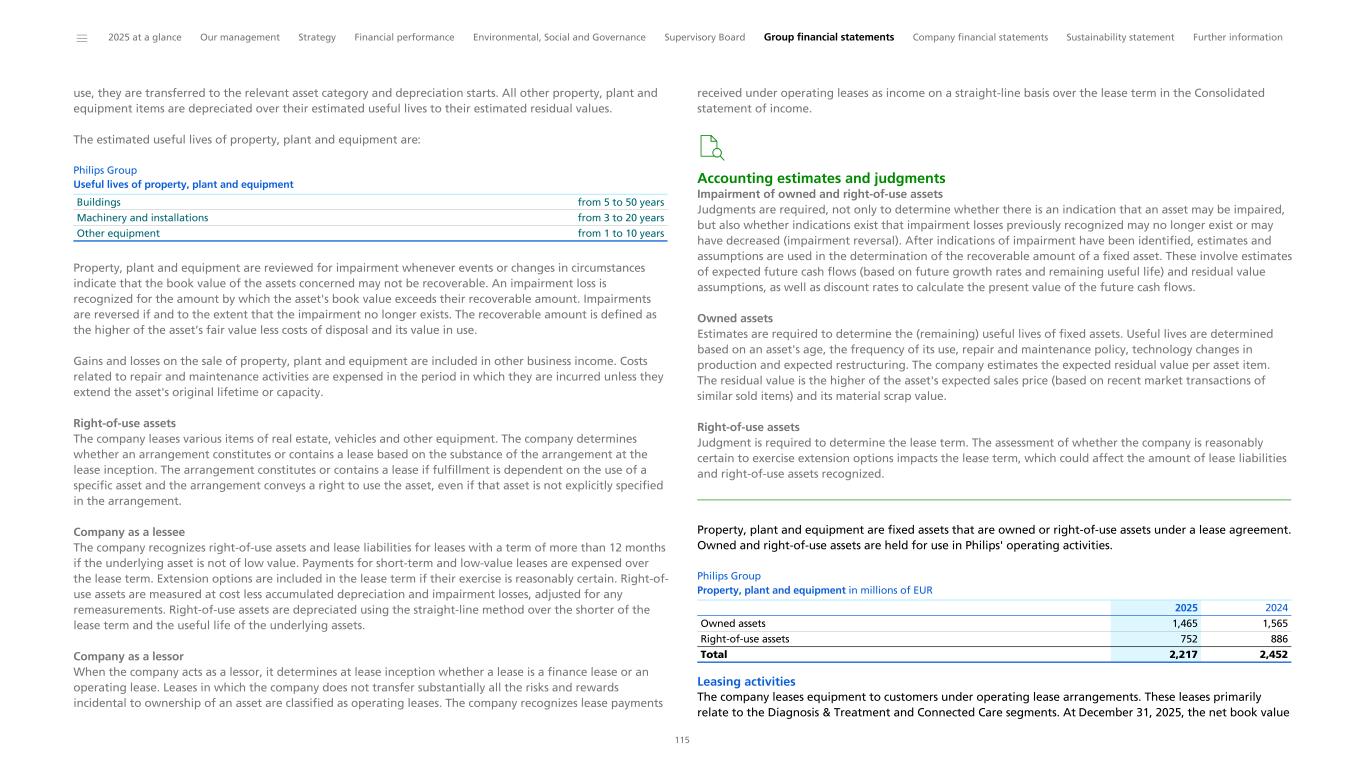
use, they are transferred to the relevant asset category and depreciation starts. All other property, plant and equipment items are depreciated over their estimated useful lives to their estimated residual values. The estimated useful lives of property, plant and equipment are: Philips Group Useful lives of property, plant and equipment Machinery and installations from 3 to 20 years Other equipment from 1 to 10 years Buildings from 5 to 50 years Property, plant and equipment are reviewed for impairment whenever events or changes in circumstances indicate that the book value of the assets concerned may not be recoverable. An impairment loss is recognized for the amount by which the asset's book value exceeds their recoverable amount. Impairments are reversed if and to the extent that the impairment no longer exists. The recoverable amount is defined as the higher of the asset’s fair value less costs of disposal and its value in use. Gains and losses on the sale of property, plant and equipment are included in other business income. Costs related to repair and maintenance activities are expensed in the period in which they are incurred unless they extend the asset's original lifetime or capacity. Right-of-use assets The company leases various items of real estate, vehicles and other equipment. The company determines whether an arrangement constitutes or contains a lease based on the substance of the arrangement at the lease inception. The arrangement constitutes or contains a lease if fulfillment is dependent on the use of a specific asset and the arrangement conveys a right to use the asset, even if that asset is not explicitly specified in the arrangement. Company as a lessee The company recognizes right-of-use assets and lease liabilities for leases with a term of more than 12 months if the underlying asset is not of low value. Payments for short-term and low-value leases are expensed over the lease term. Extension options are included in the lease term if their exercise is reasonably certain. Right-of- use assets are measured at cost less accumulated depreciation and impairment losses, adjusted for any remeasurements. Right-of-use assets are depreciated using the straight-line method over the shorter of the lease term and the useful life of the underlying assets. Company as a lessor When the company acts as a lessor, it determines at lease inception whether a lease is a finance lease or an operating lease. Leases in which the company does not transfer substantially all the risks and rewards incidental to ownership of an asset are classified as operating leases. The company recognizes lease payments received under operating leases as income on a straight-line basis over the lease term in the Consolidated statement of income. Accounting estimates and judgments Impairment of owned and right-of-use assets Judgments are required, not only to determine whether there is an indication that an asset may be impaired, but also whether indications exist that impairment losses previously recognized may no longer exist or may have decreased (impairment reversal). After indications of impairment have been identified, estimates and assumptions are used in the determination of the recoverable amount of a fixed asset. These involve estimates of expected future cash flows (based on future growth rates and remaining useful life) and residual value assumptions, as well as discount rates to calculate the present value of the future cash flows. Owned assets Estimates are required to determine the (remaining) useful lives of fixed assets. Useful lives are determined based on an asset's age, the frequency of its use, repair and maintenance policy, technology changes in production and expected restructuring. The company estimates the expected residual value per asset item. The residual value is the higher of the asset's expected sales price (based on recent market transactions of similar sold items) and its material scrap value. Right-of-use assets Judgment is required to determine the lease term. The assessment of whether the company is reasonably certain to exercise extension options impacts the lease term, which could affect the amount of lease liabilities and right-of-use assets recognized. Property, plant and equipment are fixed assets that are owned or right-of-use assets under a lease agreement. Owned and right-of-use assets are held for use in Philips' operating activities. Philips Group Property, plant and equipment in millions of EUR Owned assets 1,465 1,565 Right-of-use assets 752 886 Total 2,217 2,452 2025 2024 Leasing activities The company leases equipment to customers under operating lease arrangements. These leases primarily relate to the Diagnosis & Treatment and Connected Care segments. At December 31, 2025, the net book value ______ 2025 at a glance Our management Strategy Financial performance Environmental, Social and Governance Supervisory Board Group financial statements Company financial statements Sustainability statement Further information 115
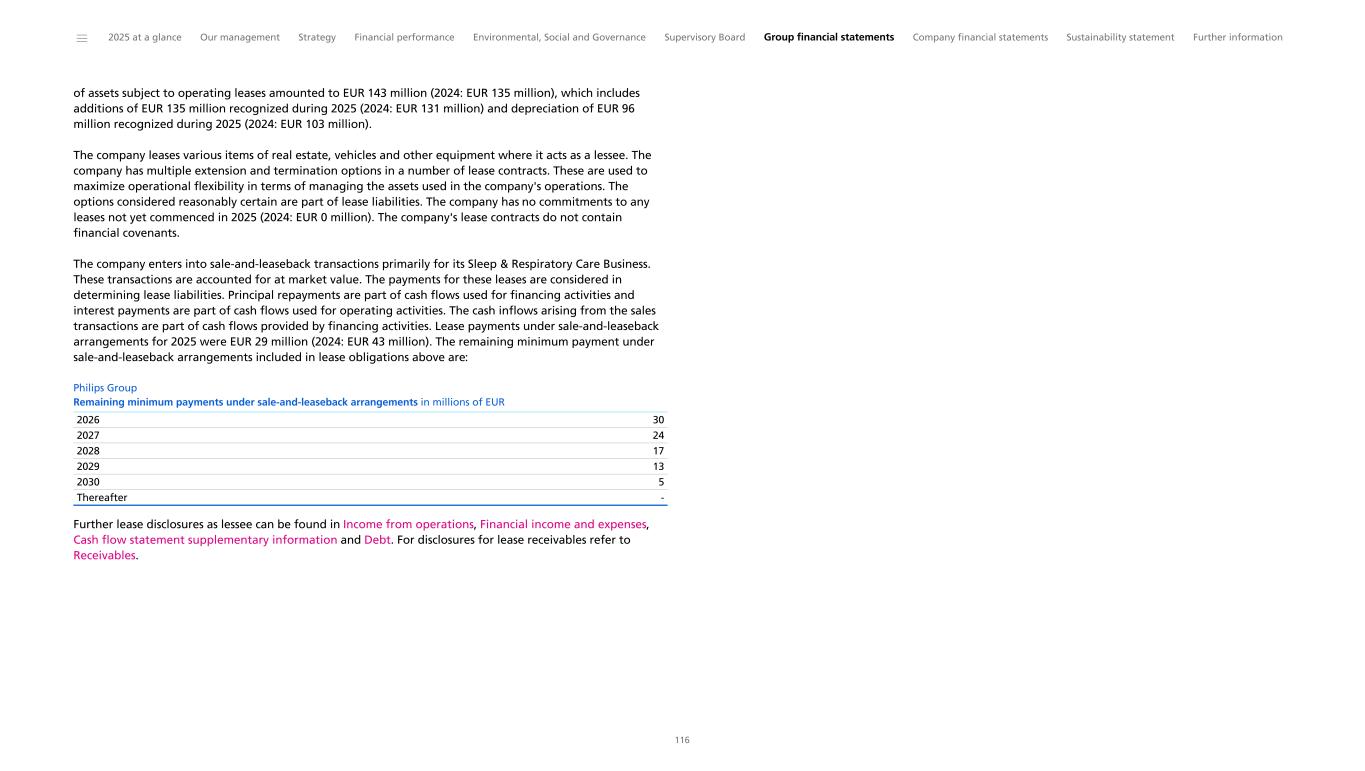
of assets subject to operating leases amounted to EUR 143 million (2024: EUR 135 million), which includes additions of EUR 135 million recognized during 2025 (2024: EUR 131 million) and depreciation of EUR 96 million recognized during 2025 (2024: EUR 103 million). The company leases various items of real estate, vehicles and other equipment where it acts as a lessee. The company has multiple extension and termination options in a number of lease contracts. These are used to maximize operational flexibility in terms of managing the assets used in the company's operations. The options considered reasonably certain are part of lease liabilities. The company has no commitments to any leases not yet commenced in 2025 (2024: EUR 0 million). The company's lease contracts do not contain financial covenants. The company enters into sale-and-leaseback transactions primarily for its Sleep & Respiratory Care Business. These transactions are accounted for at market value. The payments for these leases are considered in determining lease liabilities. Principal repayments are part of cash flows used for financing activities and interest payments are part of cash flows used for operating activities. The cash inflows arising from the sales transactions are part of cash flows provided by financing activities. Lease payments under sale-and-leaseback arrangements for 2025 were EUR 29 million (2024: EUR 43 million). The remaining minimum payment under sale-and-leaseback arrangements included in lease obligations above are: Philips Group Remaining minimum payments under sale-and-leaseback arrangements in millions of EUR 2026 30 2027 24 2028 17 2029 13 2030 5 Thereafter - Further lease disclosures as lessee can be found in Income from operations, Financial income and expenses, Cash flow statement supplementary information and Debt. For disclosures for lease receivables refer to Receivables. ______ 2025 at a glance Our management Strategy Financial performance Environmental, Social and Governance Supervisory Board Group financial statements Company financial statements Sustainability statement Further information 116
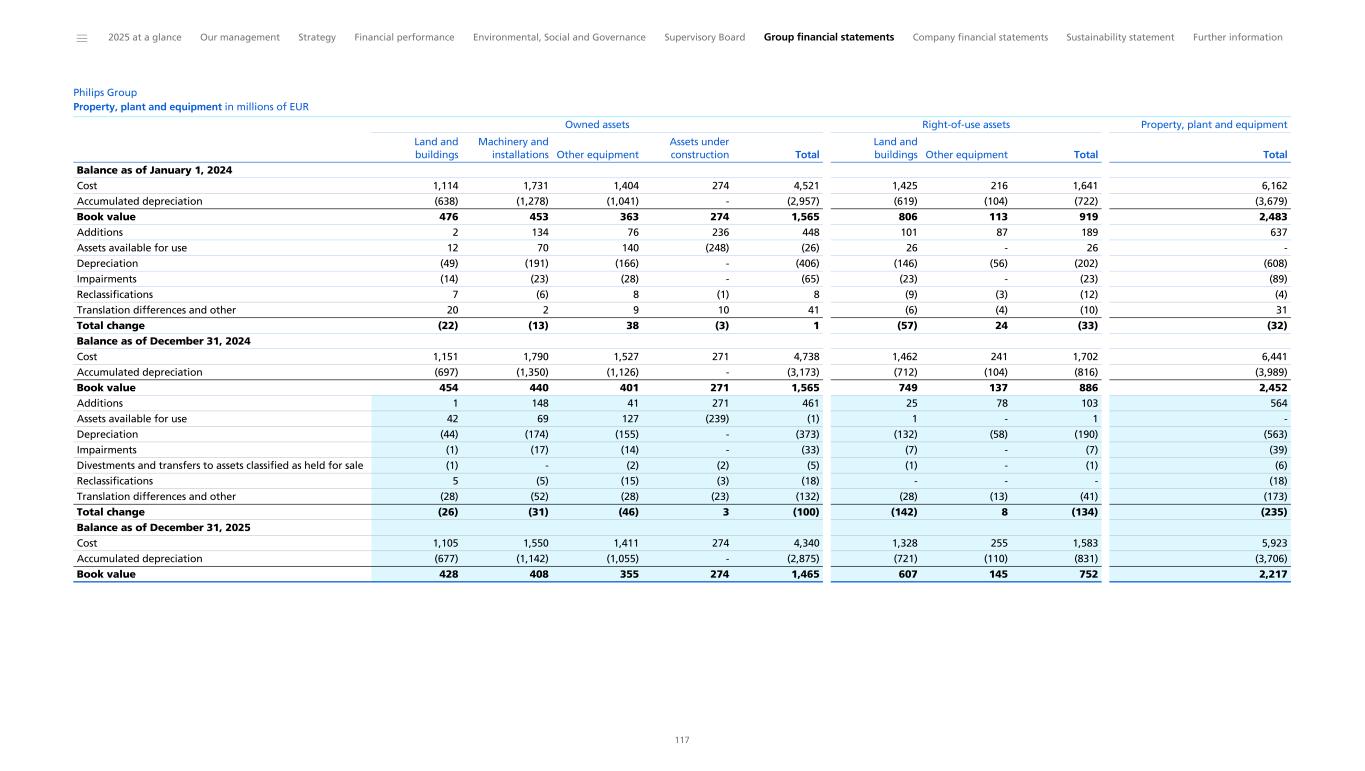
Philips Group Property, plant and equipment in millions of EUR Balance as of January 1, 2024 Cost 1,114 1,731 1,404 274 4,521 1,425 216 1,641 6,162 Accumulated depreciation (638) (1,278) (1,041) - (2,957) (619) (104) (722) (3,679) Book value 476 453 363 274 1,565 806 113 919 2,483 Additions 2 134 76 236 448 101 87 189 637 Assets available for use 12 70 140 (248) (26) 26 - 26 - Depreciation (49) (191) (166) - (406) (146) (56) (202) (608) Impairments (14) (23) (28) - (65) (23) - (23) (89) Reclassifications 7 (6) 8 (1) 8 (9) (3) (12) (4) Translation differences and other 20 2 9 10 41 (6) (4) (10) 31 Total change (22) (13) 38 (3) 1 (57) 24 (33) (32) Balance as of December 31, 2024 Cost 1,151 1,790 1,527 271 4,738 1,462 241 1,702 6,441 Accumulated depreciation (697) (1,350) (1,126) - (3,173) (712) (104) (816) (3,989) Book value 454 440 401 271 1,565 749 137 886 2,452 Additions 1 148 41 271 461 25 78 103 564 Assets available for use 42 69 127 (239) (1) 1 - 1 - Depreciation (44) (174) (155) - (373) (132) (58) (190) (563) Impairments (1) (17) (14) - (33) (7) - (7) (39) Divestments and transfers to assets classified as held for sale (1) - (2) (2) (5) (1) - (1) (6) Reclassifications 5 (5) (15) (3) (18) - - - (18) Translation differences and other (28) (52) (28) (23) (132) (28) (13) (41) (173) Total change (26) (31) (46) 3 (100) (142) 8 (134) (235) Balance as of December 31, 2025 Cost 1,105 1,550 1,411 274 4,340 1,328 255 1,583 5,923 Accumulated depreciation (677) (1,142) (1,055) - (2,875) (721) (110) (831) (3,706) Book value 428 408 355 274 1,465 607 145 752 2,217 Owned assets Right-of-use assets Property, plant and equipment Land and buildings Machinery and installations Other equipment Assets under construction Total Land and buildings Other equipment Total Total ______ 2025 at a glance Our management Strategy Financial performance Environmental, Social and Governance Supervisory Board Group financial statements Company financial statements Sustainability statement Further information 117
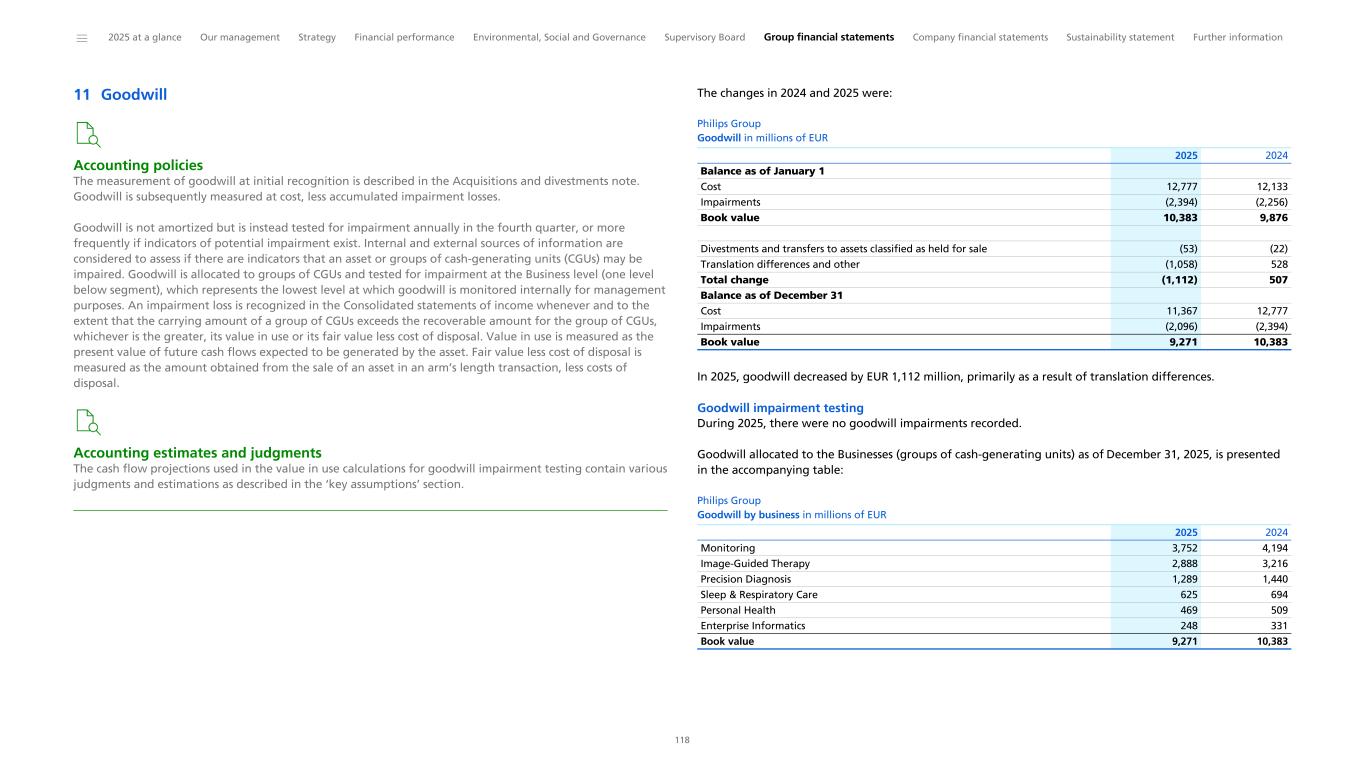
11 Goodwill Accounting policies The measurement of goodwill at initial recognition is described in the Acquisitions and divestments note. Goodwill is subsequently measured at cost, less accumulated impairment losses. Goodwill is not amortized but is instead tested for impairment annually in the fourth quarter, or more frequently if indicators of potential impairment exist. Internal and external sources of information are considered to assess if there are indicators that an asset or groups of cash-generating units (CGUs) may be impaired. Goodwill is allocated to groups of CGUs and tested for impairment at the Business level (one level below segment), which represents the lowest level at which goodwill is monitored internally for management purposes. An impairment loss is recognized in the Consolidated statements of income whenever and to the extent that the carrying amount of a group of CGUs exceeds the recoverable amount for the group of CGUs, whichever is the greater, its value in use or its fair value less cost of disposal. Value in use is measured as the present value of future cash flows expected to be generated by the asset. Fair value less cost of disposal is measured as the amount obtained from the sale of an asset in an arm’s length transaction, less costs of disposal. Accounting estimates and judgments The cash flow projections used in the value in use calculations for goodwill impairment testing contain various judgments and estimations as described in the ‘key assumptions’ section. The changes in 2024 and 2025 were: Philips Group Goodwill in millions of EUR Balance as of January 1 Cost 12,777 12,133 Impairments (2,394) (2,256) Book value 10,383 9,876 Divestments and transfers to assets classified as held for sale (53) (22) Translation differences and other (1,058) 528 Total change (1,112) 507 Balance as of December 31 Cost 11,367 12,777 Impairments (2,096) (2,394) Book value 9,271 10,383 2025 2024 In 2025, goodwill decreased by EUR 1,112 million, primarily as a result of translation differences. Goodwill impairment testing During 2025, there were no goodwill impairments recorded. Goodwill allocated to the Businesses (groups of cash-generating units) as of December 31, 2025, is presented in the accompanying table: Philips Group Goodwill by business in millions of EUR Monitoring 3,752 4,194 Image-Guided Therapy 2,888 3,216 Precision Diagnosis 1,289 1,440 Sleep & Respiratory Care 625 694 Personal Health 469 509 Enterprise Informatics 248 331 Book value 9,271 10,383 2025 2024 ______ 2025 at a glance Our management Strategy Financial performance Environmental, Social and Governance Supervisory Board Group financial statements Company financial statements Sustainability statement Further information 118
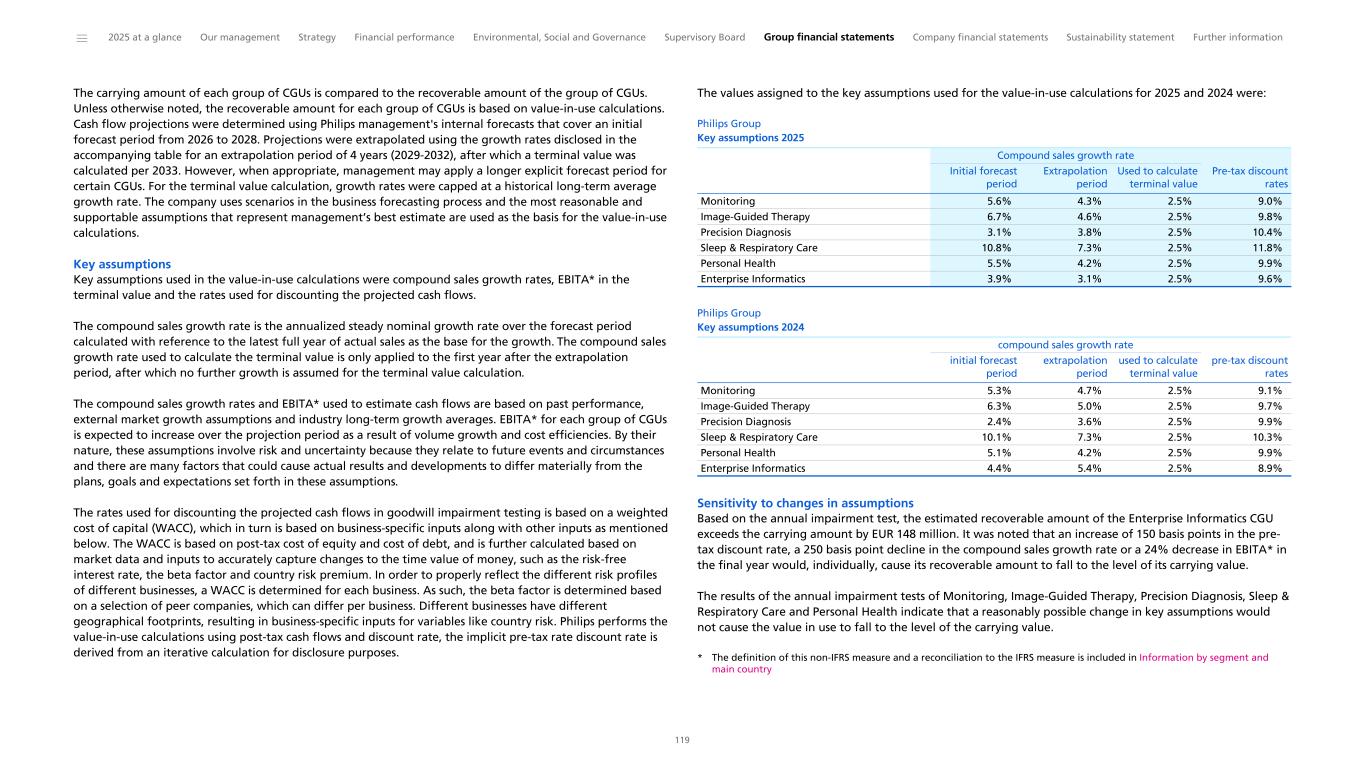
The carrying amount of each group of CGUs is compared to the recoverable amount of the group of CGUs. Unless otherwise noted, the recoverable amount for each group of CGUs is based on value-in-use calculations. Cash flow projections were determined using Philips management's internal forecasts that cover an initial forecast period from 2026 to 2028. Projections were extrapolated using the growth rates disclosed in the accompanying table for an extrapolation period of 4 years (2029-2032), after which a terminal value was calculated per 2033. However, when appropriate, management may apply a longer explicit forecast period for certain CGUs. For the terminal value calculation, growth rates were capped at a historical long-term average growth rate. The company uses scenarios in the business forecasting process and the most reasonable and supportable assumptions that represent management’s best estimate are used as the basis for the value-in-use calculations. Key assumptions Key assumptions used in the value-in-use calculations were compound sales growth rates, EBITA* in the terminal value and the rates used for discounting the projected cash flows. The compound sales growth rate is the annualized steady nominal growth rate over the forecast period calculated with reference to the latest full year of actual sales as the base for the growth. The compound sales growth rate used to calculate the terminal value is only applied to the first year after the extrapolation period, after which no further growth is assumed for the terminal value calculation. The compound sales growth rates and EBITA* used to estimate cash flows are based on past performance, external market growth assumptions and industry long-term growth averages. EBITA* for each group of CGUs is expected to increase over the projection period as a result of volume growth and cost efficiencies. By their nature, these assumptions involve risk and uncertainty because they relate to future events and circumstances and there are many factors that could cause actual results and developments to differ materially from the plans, goals and expectations set forth in these assumptions. The rates used for discounting the projected cash flows in goodwill impairment testing is based on a weighted cost of capital (WACC), which in turn is based on business-specific inputs along with other inputs as mentioned below. The WACC is based on post-tax cost of equity and cost of debt, and is further calculated based on market data and inputs to accurately capture changes to the time value of money, such as the risk-free interest rate, the beta factor and country risk premium. In order to properly reflect the different risk profiles of different businesses, a WACC is determined for each business. As such, the beta factor is determined based on a selection of peer companies, which can differ per business. Different businesses have different geographical footprints, resulting in business-specific inputs for variables like country risk. Philips performs the value-in-use calculations using post-tax cash flows and discount rate, the implicit pre-tax rate discount rate is derived from an iterative calculation for disclosure purposes. The values assigned to the key assumptions used for the value-in-use calculations for 2025 and 2024 were: Philips Group Key assumptions 2025 Monitoring 5.6 % 4.3 % 2.5 % 9.0 % Image-Guided Therapy 6.7 % 4.6 % 2.5 % 9.8 % Precision Diagnosis 3.1 % 3.8 % 2.5 % 10.4 % Sleep & Respiratory Care 10.8 % 7.3 % 2.5 % 11.8 % Personal Health 5.5 % 4.2 % 2.5 % 9.9 % Enterprise Informatics 3.9 % 3.1 % 2.5 % 9.6 % Compound sales growth rate Initial forecast period Extrapolation period Used to calculate terminal value Pre-tax discount rates Philips Group Key assumptions 2024 Monitoring 5.3 % 4.7 % 2.5 % 9.1 % Image-Guided Therapy 6.3 % 5.0 % 2.5 % 9.7 % Precision Diagnosis 2.4 % 3.6 % 2.5 % 9.9 % Sleep & Respiratory Care 10.1 % 7.3 % 2.5 % 10.3 % Personal Health 5.1 % 4.2 % 2.5 % 9.9 % Enterprise Informatics 4.4 % 5.4 % 2.5 % 8.9 % compound sales growth rate initial forecast period extrapolation period used to calculate terminal value pre-tax discount rates Sensitivity to changes in assumptions Based on the annual impairment test, the estimated recoverable amount of the Enterprise Informatics CGU exceeds the carrying amount by EUR 148 million. It was noted that an increase of 150 basis points in the pre- tax discount rate, a 250 basis point decline in the compound sales growth rate or a 24% decrease in EBITA* in the final year would, individually, cause its recoverable amount to fall to the level of its carrying value. The results of the annual impairment tests of Monitoring, Image-Guided Therapy, Precision Diagnosis, Sleep & Respiratory Care and Personal Health indicate that a reasonably possible change in key assumptions would not cause the value in use to fall to the level of the carrying value. * The definition of this non-IFRS measure and a reconciliation to the IFRS measure is included in Information by segment and main country ______ 2025 at a glance Our management Strategy Financial performance Environmental, Social and Governance Supervisory Board Group financial statements Company financial statements Sustainability statement Further information 119
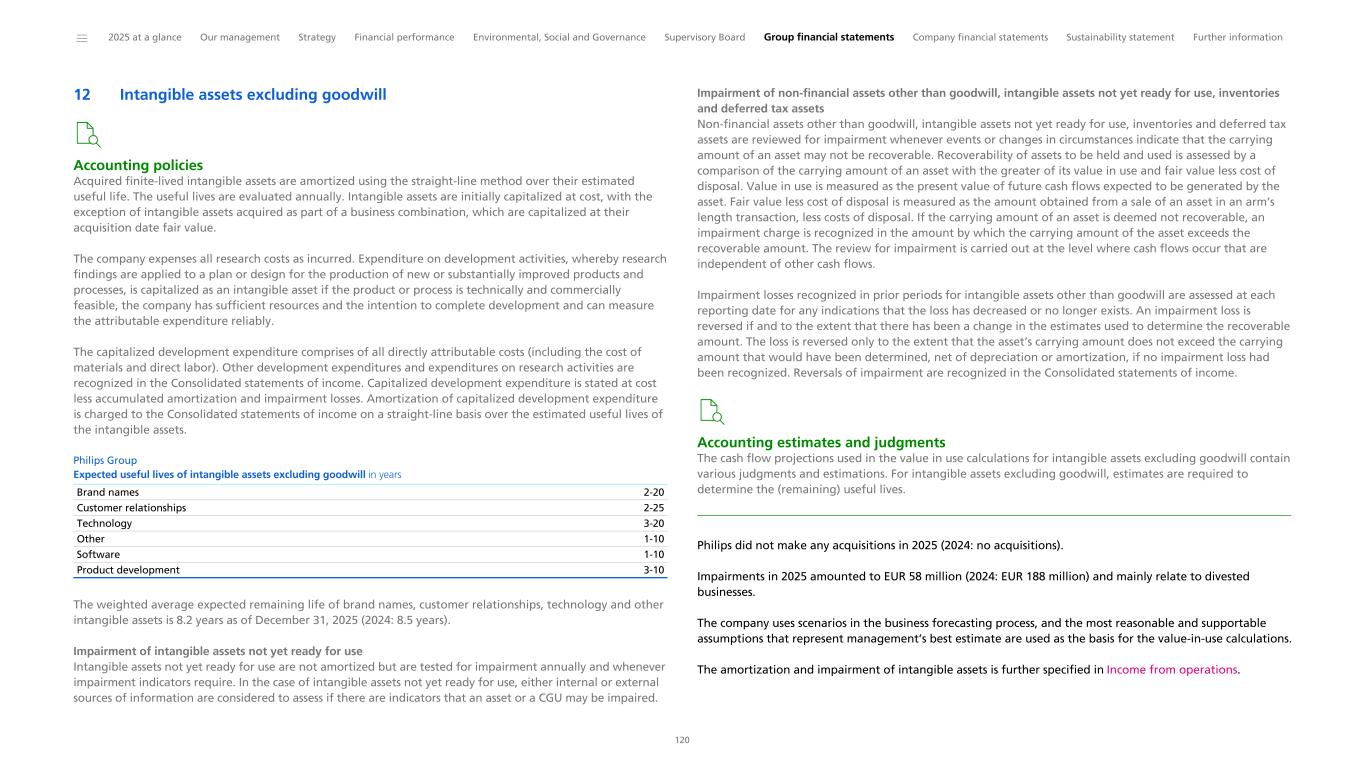
12 Intangible assets excluding goodwill Accounting policies Acquired finite-lived intangible assets are amortized using the straight-line method over their estimated useful life. The useful lives are evaluated annually. Intangible assets are initially capitalized at cost, with the exception of intangible assets acquired as part of a business combination, which are capitalized at their acquisition date fair value. The company expenses all research costs as incurred. Expenditure on development activities, whereby research findings are applied to a plan or design for the production of new or substantially improved products and processes, is capitalized as an intangible asset if the product or process is technically and commercially feasible, the company has sufficient resources and the intention to complete development and can measure the attributable expenditure reliably. The capitalized development expenditure comprises of all directly attributable costs (including the cost of materials and direct labor). Other development expenditures and expenditures on research activities are recognized in the Consolidated statements of income. Capitalized development expenditure is stated at cost less accumulated amortization and impairment losses. Amortization of capitalized development expenditure is charged to the Consolidated statements of income on a straight-line basis over the estimated useful lives of the intangible assets. Philips Group Expected useful lives of intangible assets excluding goodwill in years Brand names 2-20 Customer relationships 2-25 Technology 3-20 Other 1-10 Software 1-10 Product development 3-10 The weighted average expected remaining life of brand names, customer relationships, technology and other intangible assets is 8.2 years as of December 31, 2025 (2024: 8.5 years). Impairment of intangible assets not yet ready for use Intangible assets not yet ready for use are not amortized but are tested for impairment annually and whenever impairment indicators require. In the case of intangible assets not yet ready for use, either internal or external sources of information are considered to assess if there are indicators that an asset or a CGU may be impaired. Impairment of non-financial assets other than goodwill, intangible assets not yet ready for use, inventories and deferred tax assets Non-financial assets other than goodwill, intangible assets not yet ready for use, inventories and deferred tax assets are reviewed for impairment whenever events or changes in circumstances indicate that the carrying amount of an asset may not be recoverable. Recoverability of assets to be held and used is assessed by a comparison of the carrying amount of an asset with the greater of its value in use and fair value less cost of disposal. Value in use is measured as the present value of future cash flows expected to be generated by the asset. Fair value less cost of disposal is measured as the amount obtained from a sale of an asset in an arm’s length transaction, less costs of disposal. If the carrying amount of an asset is deemed not recoverable, an impairment charge is recognized in the amount by which the carrying amount of the asset exceeds the recoverable amount. The review for impairment is carried out at the level where cash flows occur that are independent of other cash flows. Impairment losses recognized in prior periods for intangible assets other than goodwill are assessed at each reporting date for any indications that the loss has decreased or no longer exists. An impairment loss is reversed if and to the extent that there has been a change in the estimates used to determine the recoverable amount. The loss is reversed only to the extent that the asset’s carrying amount does not exceed the carrying amount that would have been determined, net of depreciation or amortization, if no impairment loss had been recognized. Reversals of impairment are recognized in the Consolidated statements of income. Accounting estimates and judgments The cash flow projections used in the value in use calculations for intangible assets excluding goodwill contain various judgments and estimations. For intangible assets excluding goodwill, estimates are required to determine the (remaining) useful lives. Philips did not make any acquisitions in 2025 (2024: no acquisitions). Impairments in 2025 amounted to EUR 58 million (2024: EUR 188 million) and mainly relate to divested businesses. The company uses scenarios in the business forecasting process, and the most reasonable and supportable assumptions that represent management’s best estimate are used as the basis for the value-in-use calculations. The amortization and impairment of intangible assets is further specified in Income from operations. ______ 2025 at a glance Our management Strategy Financial performance Environmental, Social and Governance Supervisory Board Group financial statements Company financial statements Sustainability statement Further information 120
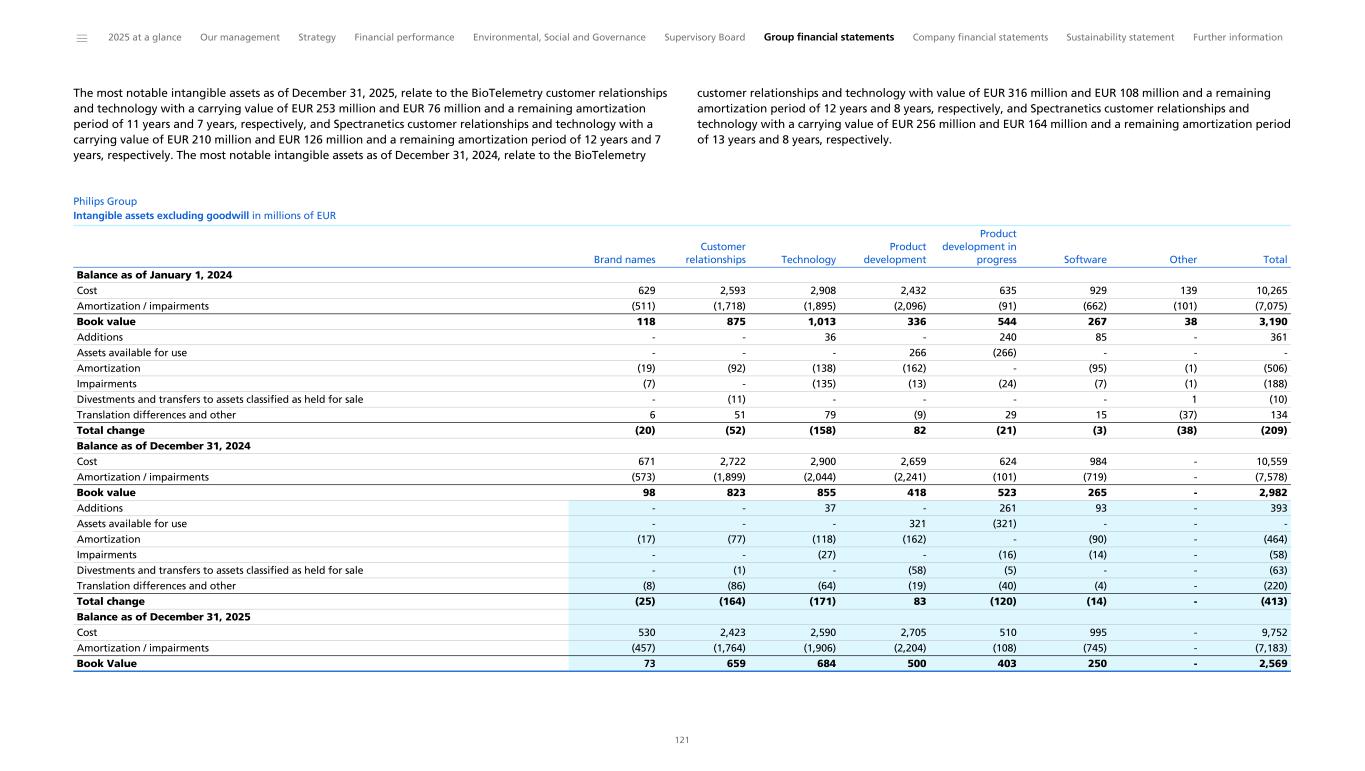
The most notable intangible assets as of December 31, 2025, relate to the BioTelemetry customer relationships and technology with a carrying value of EUR 253 million and EUR 76 million and a remaining amortization period of 11 years and 7 years, respectively, and Spectranetics customer relationships and technology with a carrying value of EUR 210 million and EUR 126 million and a remaining amortization period of 12 years and 7 years, respectively. The most notable intangible assets as of December 31, 2024, relate to the BioTelemetry customer relationships and technology with value of EUR 316 million and EUR 108 million and a remaining amortization period of 12 years and 8 years, respectively, and Spectranetics customer relationships and technology with a carrying value of EUR 256 million and EUR 164 million and a remaining amortization period of 13 years and 8 years, respectively. Philips Group Intangible assets excluding goodwill in millions of EUR Balance as of January 1, 2024 Cost 629 2,593 2,908 2,432 635 929 139 10,265 Amortization / impairments (511) (1,718) (1,895) (2,096) (91) (662) (101) (7,075) Book value 118 875 1,013 336 544 267 38 3,190 Additions - - 36 - 240 85 - 361 Assets available for use - - - 266 (266) - - - Amortization (19) (92) (138) (162) - (95) (1) (506) Impairments (7) - (135) (13) (24) (7) (1) (188) Divestments and transfers to assets classified as held for sale - (11) - - - - 1 (10) Translation differences and other 6 51 79 (9) 29 15 (37) 134 Total change (20) (52) (158) 82 (21) (3) (38) (209) Balance as of December 31, 2024 Cost 671 2,722 2,900 2,659 624 984 - 10,559 Amortization / impairments (573) (1,899) (2,044) (2,241) (101) (719) - (7,578) Book value 98 823 855 418 523 265 - 2,982 Additions - - 37 - 261 93 - 393 Assets available for use - - - 321 (321) - - - Amortization (17) (77) (118) (162) - (90) - (464) Impairments - - (27) - (16) (14) - (58) Divestments and transfers to assets classified as held for sale - (1) - (58) (5) - - (63) Translation differences and other (8) (86) (64) (19) (40) (4) - (220) Total change (25) (164) (171) 83 (120) (14) - (413) Balance as of December 31, 2025 Cost 530 2,423 2,590 2,705 510 995 - 9,752 Amortization / impairments (457) (1,764) (1,906) (2,204) (108) (745) - (7,183) Book Value 73 659 684 500 403 250 - 2,569 Brand names Customer relationships Technology Product development Product development in progress Software Other Total ______ 2025 at a glance Our management Strategy Financial performance Environmental, Social and Governance Supervisory Board Group financial statements Company financial statements Sustainability statement Further information 121
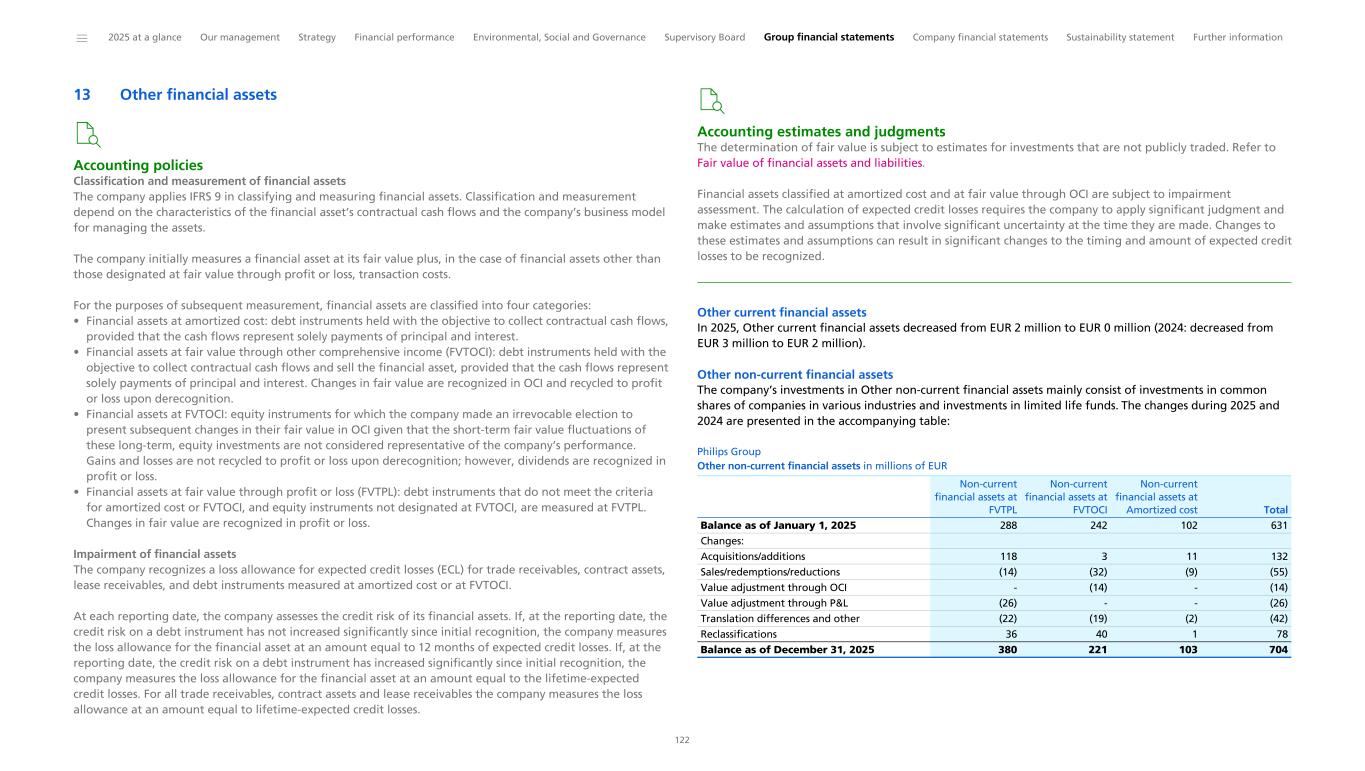
13 Other financial assets Accounting policies Classification and measurement of financial assets The company applies IFRS 9 in classifying and measuring financial assets. Classification and measurement depend on the characteristics of the financial asset’s contractual cash flows and the company’s business model for managing the assets. The company initially measures a financial asset at its fair value plus, in the case of financial assets other than those designated at fair value through profit or loss, transaction costs. For the purposes of subsequent measurement, financial assets are classified into four categories: • Financial assets at amortized cost: debt instruments held with the objective to collect contractual cash flows, provided that the cash flows represent solely payments of principal and interest. • Financial assets at fair value through other comprehensive income (FVTOCI): debt instruments held with the objective to collect contractual cash flows and sell the financial asset, provided that the cash flows represent solely payments of principal and interest. Changes in fair value are recognized in OCI and recycled to profit or loss upon derecognition. • Financial assets at FVTOCI: equity instruments for which the company made an irrevocable election to present subsequent changes in their fair value in OCI given that the short-term fair value fluctuations of these long-term, equity investments are not considered representative of the company’s performance. Gains and losses are not recycled to profit or loss upon derecognition; however, dividends are recognized in profit or loss. • Financial assets at fair value through profit or loss (FVTPL): debt instruments that do not meet the criteria for amortized cost or FVTOCI, and equity instruments not designated at FVTOCI, are measured at FVTPL. Changes in fair value are recognized in profit or loss. Impairment of financial assets The company recognizes a loss allowance for expected credit losses (ECL) for trade receivables, contract assets, lease receivables, and debt instruments measured at amortized cost or at FVTOCI. At each reporting date, the company assesses the credit risk of its financial assets. If, at the reporting date, the credit risk on a debt instrument has not increased significantly since initial recognition, the company measures the loss allowance for the financial asset at an amount equal to 12 months of expected credit losses. If, at the reporting date, the credit risk on a debt instrument has increased significantly since initial recognition, the company measures the loss allowance for the financial asset at an amount equal to the lifetime-expected credit losses. For all trade receivables, contract assets and lease receivables the company measures the loss allowance at an amount equal to lifetime-expected credit losses. Accounting estimates and judgments The determination of fair value is subject to estimates for investments that are not publicly traded. Refer to Fair value of financial assets and liabilities. Financial assets classified at amortized cost and at fair value through OCI are subject to impairment assessment. The calculation of expected credit losses requires the company to apply significant judgment and make estimates and assumptions that involve significant uncertainty at the time they are made. Changes to these estimates and assumptions can result in significant changes to the timing and amount of expected credit losses to be recognized. Other current financial assets In 2025, Other current financial assets decreased from EUR 2 million to EUR 0 million (2024: decreased from EUR 3 million to EUR 2 million). Other non-current financial assets The company’s investments in Other non-current financial assets mainly consist of investments in common shares of companies in various industries and investments in limited life funds. The changes during 2025 and 2024 are presented in the accompanying table: Philips Group Other non-current financial assets in millions of EUR Balance as of January 1, 2025 288 242 102 631 Changes: Acquisitions/additions 118 3 11 132 Sales/redemptions/reductions (14) (32) (9) (55) Value adjustment through OCI - (14) - (14) Value adjustment through P&L (26) - - (26) Translation differences and other (22) (19) (2) (42) Reclassifications 36 40 1 78 Balance as of December 31, 2025 380 221 103 704 Non-current financial assets at FVTPL Non-current financial assets at FVTOCI Non-current financial assets at Amortized cost Total ______ 2025 at a glance Our management Strategy Financial performance Environmental, Social and Governance Supervisory Board Group financial statements Company financial statements Sustainability statement Further information 122
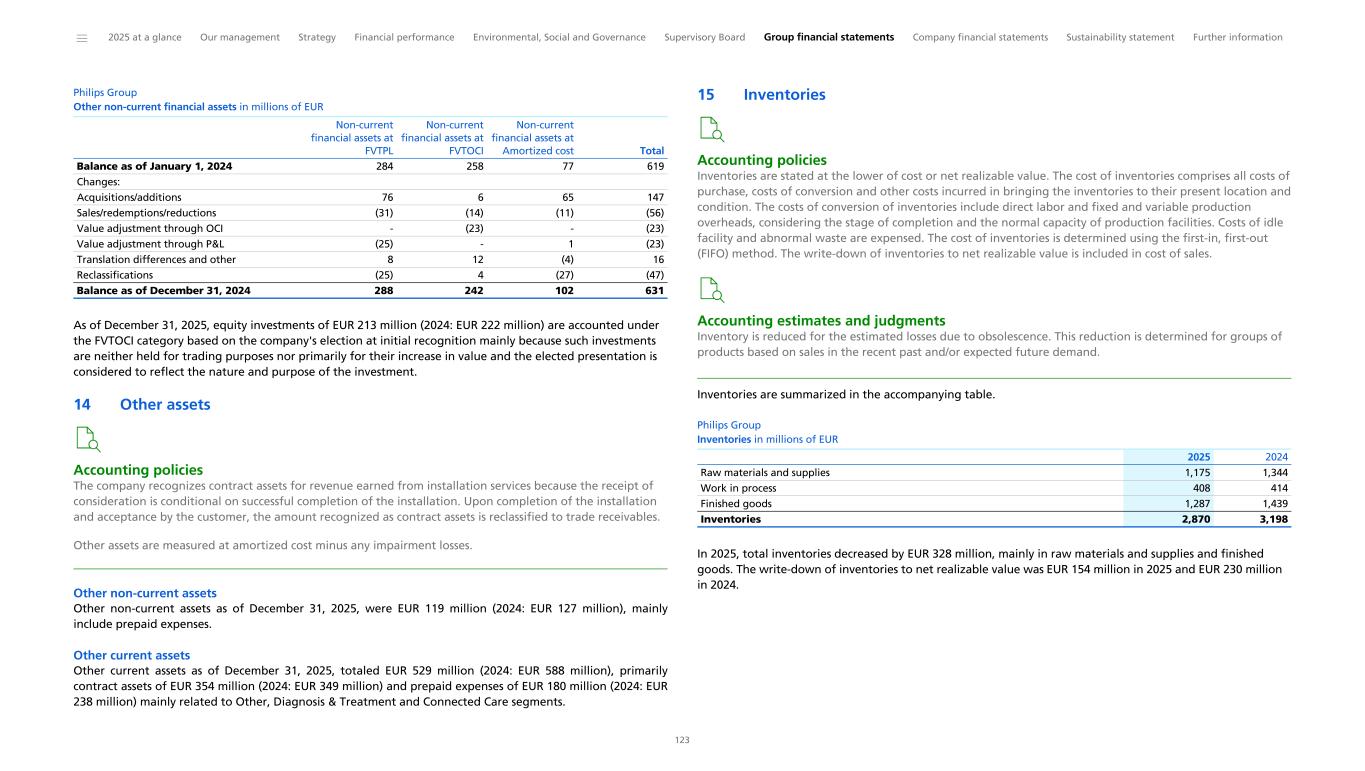
Philips Group Other non-current financial assets in millions of EUR Balance as of January 1, 2024 284 258 77 619 Changes: Acquisitions/additions 76 6 65 147 Sales/redemptions/reductions (31) (14) (11) (56) Value adjustment through OCI - (23) - (23) Value adjustment through P&L (25) - 1 (23) Translation differences and other 8 12 (4) 16 Reclassifications (25) 4 (27) (47) Balance as of December 31, 2024 288 242 102 631 Non-current financial assets at FVTPL Non-current financial assets at FVTOCI Non-current financial assets at Amortized cost Total As of December 31, 2025, equity investments of EUR 213 million (2024: EUR 222 million) are accounted under the FVTOCI category based on the company's election at initial recognition mainly because such investments are neither held for trading purposes nor primarily for their increase in value and the elected presentation is considered to reflect the nature and purpose of the investment. 14 Other assets Accounting policies The company recognizes contract assets for revenue earned from installation services because the receipt of consideration is conditional on successful completion of the installation. Upon completion of the installation and acceptance by the customer, the amount recognized as contract assets is reclassified to trade receivables. Other assets are measured at amortized cost minus any impairment losses. Other non-current assets Other non-current assets as of December 31, 2025, were EUR 119 million (2024: EUR 127 million), mainly include prepaid expenses. Other current assets Other current assets as of December 31, 2025, totaled EUR 529 million (2024: EUR 588 million), primarily contract assets of EUR 354 million (2024: EUR 349 million) and prepaid expenses of EUR 180 million (2024: EUR 238 million) mainly related to Other, Diagnosis & Treatment and Connected Care segments. 15 Inventories Accounting policies Inventories are stated at the lower of cost or net realizable value. The cost of inventories comprises all costs of purchase, costs of conversion and other costs incurred in bringing the inventories to their present location and condition. The costs of conversion of inventories include direct labor and fixed and variable production overheads, considering the stage of completion and the normal capacity of production facilities. Costs of idle facility and abnormal waste are expensed. The cost of inventories is determined using the first-in, first-out (FIFO) method. The write-down of inventories to net realizable value is included in cost of sales. Accounting estimates and judgments Inventory is reduced for the estimated losses due to obsolescence. This reduction is determined for groups of products based on sales in the recent past and/or expected future demand. Inventories are summarized in the accompanying table. Philips Group Inventories in millions of EUR Raw materials and supplies 1,175 1,344 Work in process 408 414 Finished goods 1,287 1,439 Inventories 2,870 3,198 2025 2024 In 2025, total inventories decreased by EUR 328 million, mainly in raw materials and supplies and finished goods. The write-down of inventories to net realizable value was EUR 154 million in 2025 and EUR 230 million in 2024. ______ 2025 at a glance Our management Strategy Financial performance Environmental, Social and Governance Supervisory Board Group financial statements Company financial statements Sustainability statement Further information 123
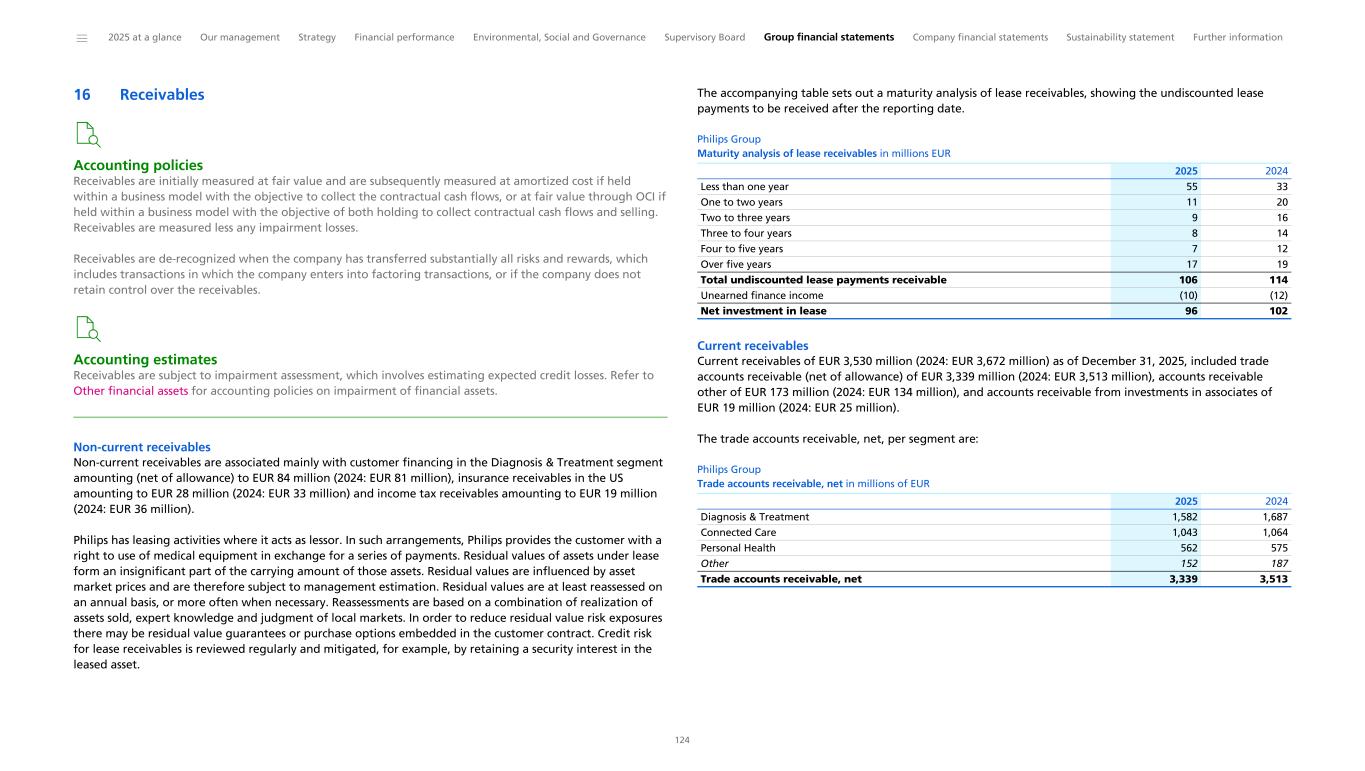
16 Receivables Accounting policies Receivables are initially measured at fair value and are subsequently measured at amortized cost if held within a business model with the objective to collect the contractual cash flows, or at fair value through OCI if held within a business model with the objective of both holding to collect contractual cash flows and selling. Receivables are measured less any impairment losses. Receivables are de-recognized when the company has transferred substantially all risks and rewards, which includes transactions in which the company enters into factoring transactions, or if the company does not retain control over the receivables. Accounting estimates Receivables are subject to impairment assessment, which involves estimating expected credit losses. Refer to Other financial assets for accounting policies on impairment of financial assets. Non-current receivables Non-current receivables are associated mainly with customer financing in the Diagnosis & Treatment segment amounting (net of allowance) to EUR 84 million (2024: EUR 81 million), insurance receivables in the US amounting to EUR 28 million (2024: EUR 33 million) and income tax receivables amounting to EUR 19 million (2024: EUR 36 million). Philips has leasing activities where it acts as lessor. In such arrangements, Philips provides the customer with a right to use of medical equipment in exchange for a series of payments. Residual values of assets under lease form an insignificant part of the carrying amount of those assets. Residual values are influenced by asset market prices and are therefore subject to management estimation. Residual values are at least reassessed on an annual basis, or more often when necessary. Reassessments are based on a combination of realization of assets sold, expert knowledge and judgment of local markets. In order to reduce residual value risk exposures there may be residual value guarantees or purchase options embedded in the customer contract. Credit risk for lease receivables is reviewed regularly and mitigated, for example, by retaining a security interest in the leased asset. The accompanying table sets out a maturity analysis of lease receivables, showing the undiscounted lease payments to be received after the reporting date. Philips Group Maturity analysis of lease receivables in millions EUR 2025 2024 Less than one year 55 33 One to two years 11 20 Two to three years 9 16 Three to four years 8 14 Four to five years 7 12 Over five years 17 19 Total undiscounted lease payments receivable 106 114 Unearned finance income (10) (12) Net investment in lease 96 102 Current receivables Current receivables of EUR 3,530 million (2024: EUR 3,672 million) as of December 31, 2025, included trade accounts receivable (net of allowance) of EUR 3,339 million (2024: EUR 3,513 million), accounts receivable other of EUR 173 million (2024: EUR 134 million), and accounts receivable from investments in associates of EUR 19 million (2024: EUR 25 million). The trade accounts receivable, net, per segment are: Philips Group Trade accounts receivable, net in millions of EUR Diagnosis & Treatment 1,582 1,687 Connected Care 1,043 1,064 Personal Health 562 575 Other 152 187 Trade accounts receivable, net 3,339 3,513 2025 2024 ______ 2025 at a glance Our management Strategy Financial performance Environmental, Social and Governance Supervisory Board Group financial statements Company financial statements Sustainability statement Further information 124
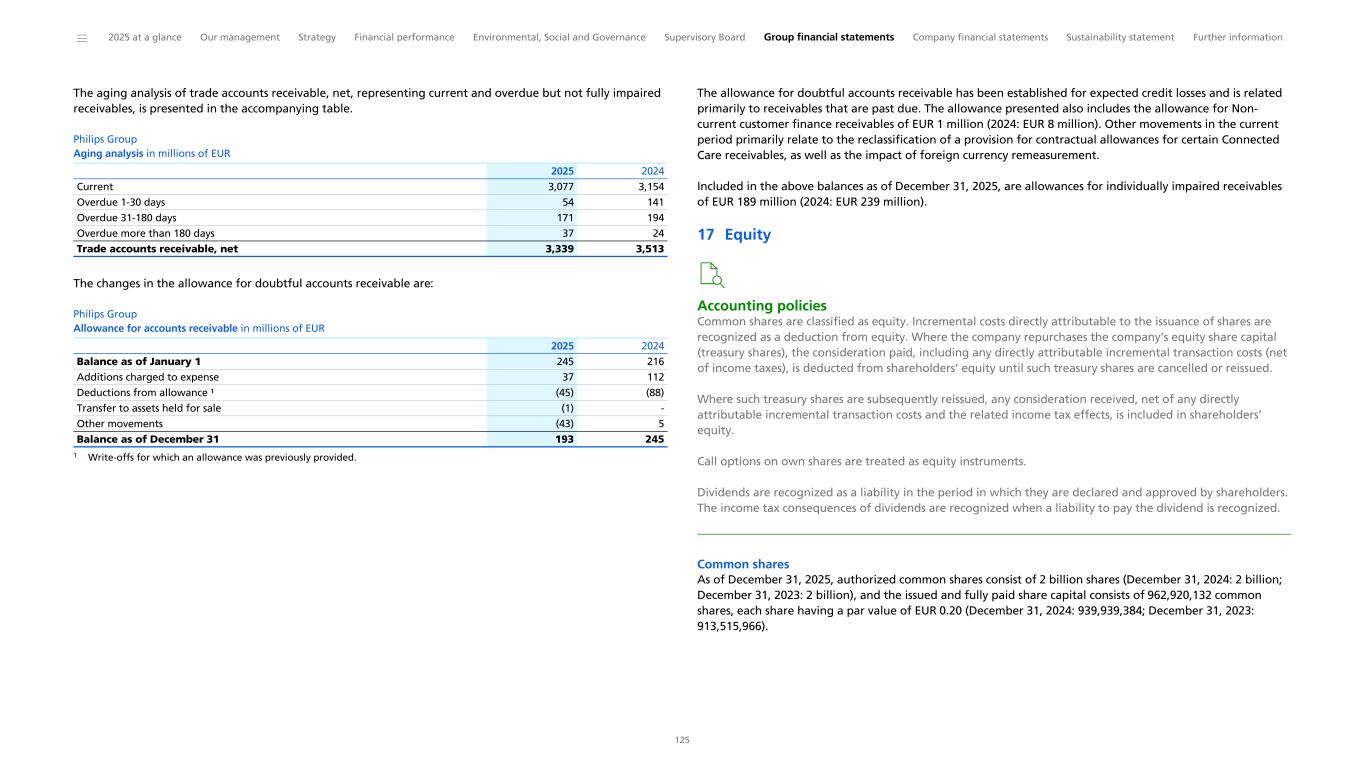
The aging analysis of trade accounts receivable, net, representing current and overdue but not fully impaired receivables, is presented in the accompanying table. Philips Group Aging analysis in millions of EUR Current 3,077 3,154 Overdue 1-30 days 54 141 Overdue 31-180 days 171 194 Overdue more than 180 days 37 24 Trade accounts receivable, net 3,339 3,513 2025 2024 The changes in the allowance for doubtful accounts receivable are: Philips Group Allowance for accounts receivable in millions of EUR Balance as of January 1 245 216 Additions charged to expense 37 112 Deductions from allowance ¹ (45) (88) Transfer to assets held for sale (1) - Other movements (43) 5 Balance as of December 31 193 245 2025 2024 1 Write-offs for which an allowance was previously provided. The allowance for doubtful accounts receivable has been established for expected credit losses and is related primarily to receivables that are past due. The allowance presented also includes the allowance for Non- current customer finance receivables of EUR 1 million (2024: EUR 8 million). Other movements in the current period primarily relate to the reclassification of a provision for contractual allowances for certain Connected Care receivables, as well as the impact of foreign currency remeasurement. Included in the above balances as of December 31, 2025, are allowances for individually impaired receivables of EUR 189 million (2024: EUR 239 million). 17 Equity Accounting policies Common shares are classified as equity. Incremental costs directly attributable to the issuance of shares are recognized as a deduction from equity. Where the company repurchases the company’s equity share capital (treasury shares), the consideration paid, including any directly attributable incremental transaction costs (net of income taxes), is deducted from shareholders’ equity until such treasury shares are cancelled or reissued. Where such treasury shares are subsequently reissued, any consideration received, net of any directly attributable incremental transaction costs and the related income tax effects, is included in shareholders’ equity. Call options on own shares are treated as equity instruments. Dividends are recognized as a liability in the period in which they are declared and approved by shareholders. The income tax consequences of dividends are recognized when a liability to pay the dividend is recognized. Common shares As of December 31, 2025, authorized common shares consist of 2 billion shares (December 31, 2024: 2 billion; December 31, 2023: 2 billion), and the issued and fully paid share capital consists of 962,920,132 common shares, each share having a par value of EUR 0.20 (December 31, 2024: 939,939,384; December 31, 2023: 913,515,966). ______ 2025 at a glance Our management Strategy Financial performance Environmental, Social and Governance Supervisory Board Group financial statements Company financial statements Sustainability statement Further information 125
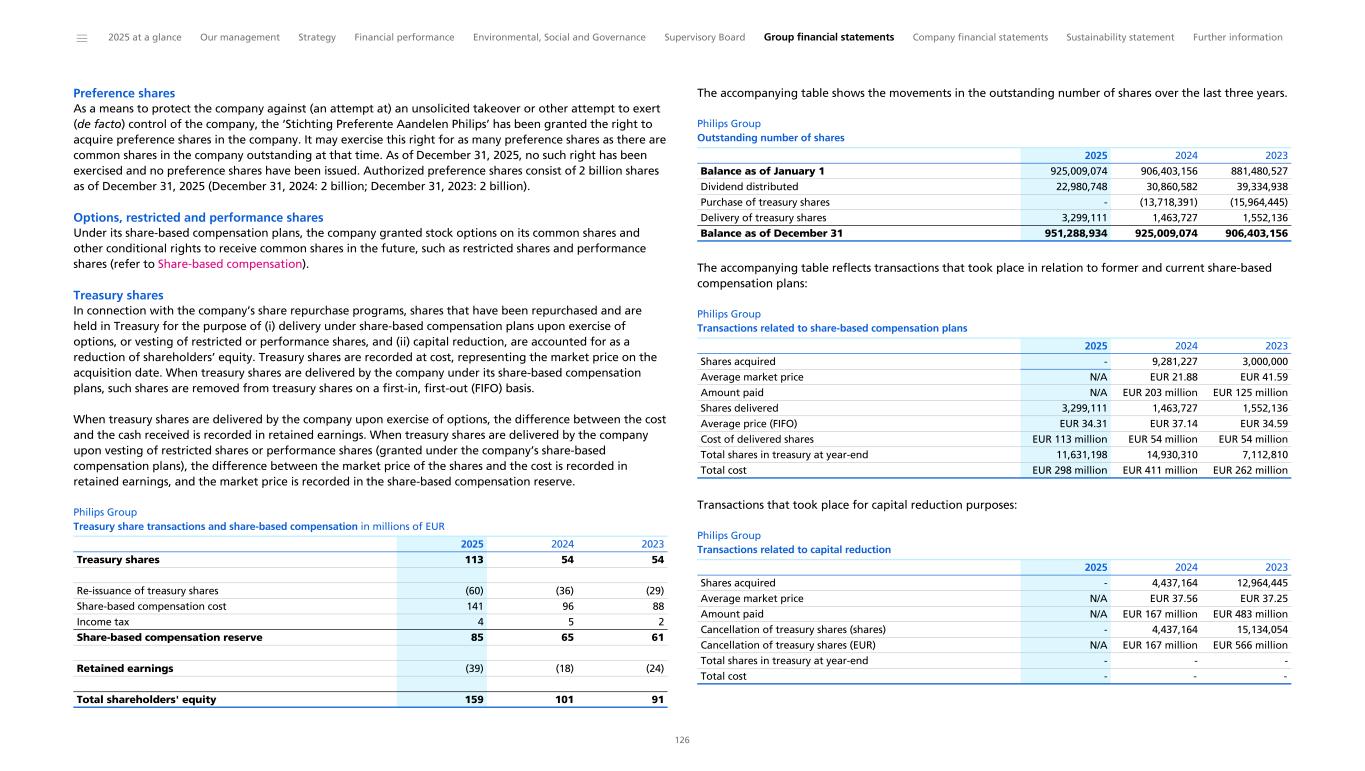
Preference shares As a means to protect the company against (an attempt at) an unsolicited takeover or other attempt to exert (de facto) control of the company, the ‘Stichting Preferente Aandelen Philips’ has been granted the right to acquire preference shares in the company. It may exercise this right for as many preference shares as there are common shares in the company outstanding at that time. As of December 31, 2025, no such right has been exercised and no preference shares have been issued. Authorized preference shares consist of 2 billion shares as of December 31, 2025 (December 31, 2024: 2 billion; December 31, 2023: 2 billion). Options, restricted and performance shares Under its share-based compensation plans, the company granted stock options on its common shares and other conditional rights to receive common shares in the future, such as restricted shares and performance shares (refer to Share-based compensation). Treasury shares In connection with the company’s share repurchase programs, shares that have been repurchased and are held in Treasury for the purpose of (i) delivery under share-based compensation plans upon exercise of options, or vesting of restricted or performance shares, and (ii) capital reduction, are accounted for as a reduction of shareholders’ equity. Treasury shares are recorded at cost, representing the market price on the acquisition date. When treasury shares are delivered by the company under its share-based compensation plans, such shares are removed from treasury shares on a first-in, first-out (FIFO) basis. When treasury shares are delivered by the company upon exercise of options, the difference between the cost and the cash received is recorded in retained earnings. When treasury shares are delivered by the company upon vesting of restricted shares or performance shares (granted under the company’s share-based compensation plans), the difference between the market price of the shares and the cost is recorded in retained earnings, and the market price is recorded in the share-based compensation reserve. Philips Group Treasury share transactions and share-based compensation in millions of EUR 2025 2024 2023 Treasury shares 113 54 54 Re-issuance of treasury shares (60) (36) (29) Share-based compensation cost 141 96 88 Income tax 4 5 2 Share-based compensation reserve 85 65 61 Retained earnings (39) (18) (24) Total shareholders' equity 159 101 91 The accompanying table shows the movements in the outstanding number of shares over the last three years. Philips Group Outstanding number of shares Balance as of January 1 925,009,074 906,403,156 881,480,527 Dividend distributed 22,980,748 30,860,582 39,334,938 Purchase of treasury shares - (13,718,391) (15,964,445) Delivery of treasury shares 3,299,111 1,463,727 1,552,136 Balance as of December 31 951,288,934 925,009,074 906,403,156 2025 2024 2023 The accompanying table reflects transactions that took place in relation to former and current share-based compensation plans: Philips Group Transactions related to share-based compensation plans Shares acquired - 9,281,227 3,000,000 Average market price N/A EUR 21.88 EUR 41.59 Amount paid N/A EUR 203 million EUR 125 million Shares delivered 3,299,111 1,463,727 1,552,136 Average price (FIFO) EUR 34.31 EUR 37.14 EUR 34.59 Cost of delivered shares EUR 113 million EUR 54 million EUR 54 million Total shares in treasury at year-end 11,631,198 14,930,310 7,112,810 Total cost EUR 298 million EUR 411 million EUR 262 million 2025 2024 2023 Transactions that took place for capital reduction purposes: Philips Group Transactions related to capital reduction Shares acquired - 4,437,164 12,964,445 Average market price N/A EUR 37.56 EUR 37.25 Amount paid N/A EUR 167 million EUR 483 million Cancellation of treasury shares (shares) - 4,437,164 15,134,054 Cancellation of treasury shares (EUR) N/A EUR 167 million EUR 566 million Total shares in treasury at year-end - - - Total cost - - - 2025 2024 2023 ______ 2025 at a glance Our management Strategy Financial performance Environmental, Social and Governance Supervisory Board Group financial statements Company financial statements Sustainability statement Further information 126
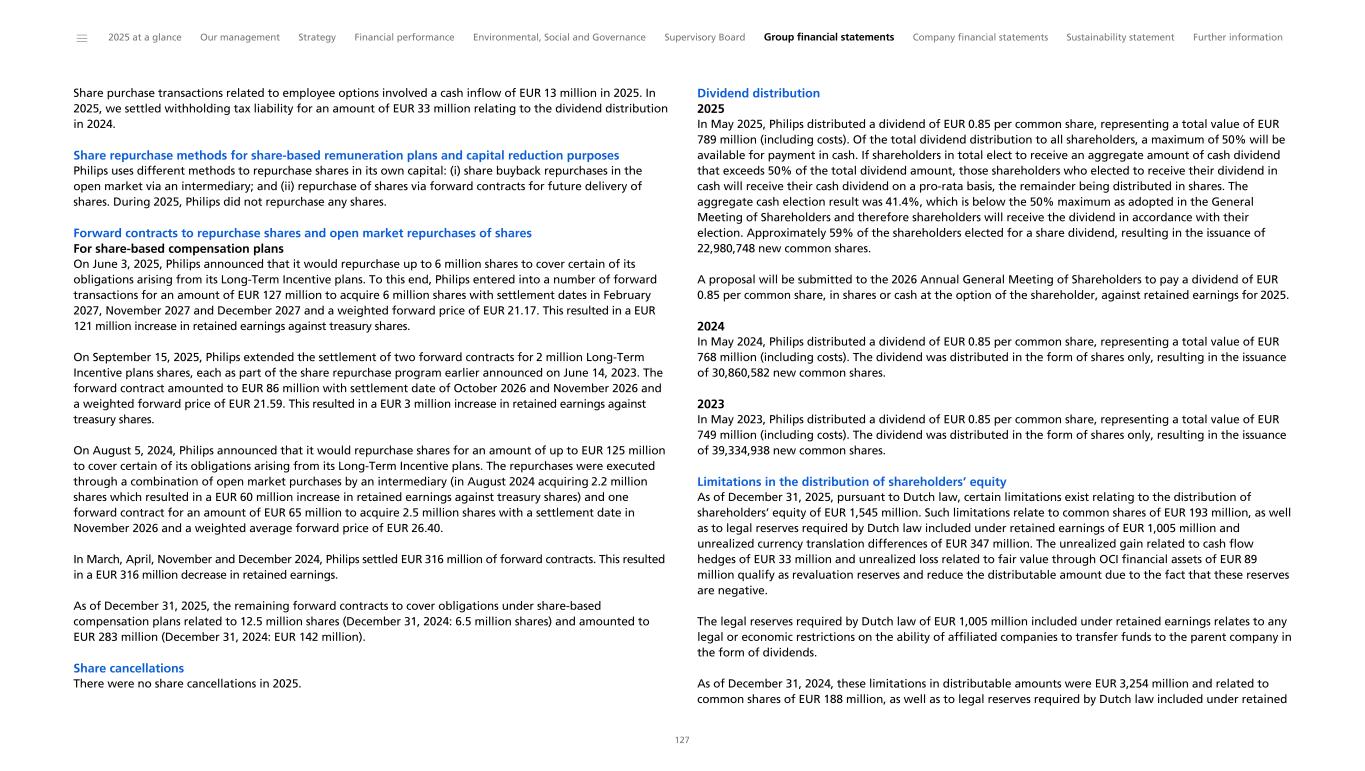
Share purchase transactions related to employee options involved a cash inflow of EUR 13 million in 2025. In 2025, we settled withholding tax liability for an amount of EUR 33 million relating to the dividend distribution in 2024. Share repurchase methods for share-based remuneration plans and capital reduction purposes Philips uses different methods to repurchase shares in its own capital: (i) share buyback repurchases in the open market via an intermediary; and (ii) repurchase of shares via forward contracts for future delivery of shares. During 2025, Philips did not repurchase any shares. Forward contracts to repurchase shares and open market repurchases of shares For share-based compensation plans On June 3, 2025, Philips announced that it would repurchase up to 6 million shares to cover certain of its obligations arising from its Long-Term Incentive plans. To this end, Philips entered into a number of forward transactions for an amount of EUR 127 million to acquire 6 million shares with settlement dates in February 2027, November 2027 and December 2027 and a weighted forward price of EUR 21.17. This resulted in a EUR 121 million increase in retained earnings against treasury shares. On September 15, 2025, Philips extended the settlement of two forward contracts for 2 million Long-Term Incentive plans shares, each as part of the share repurchase program earlier announced on June 14, 2023. The forward contract amounted to EUR 86 million with settlement date of October 2026 and November 2026 and a weighted forward price of EUR 21.59. This resulted in a EUR 3 million increase in retained earnings against treasury shares. On August 5, 2024, Philips announced that it would repurchase shares for an amount of up to EUR 125 million to cover certain of its obligations arising from its Long-Term Incentive plans. The repurchases were executed through a combination of open market purchases by an intermediary (in August 2024 acquiring 2.2 million shares which resulted in a EUR 60 million increase in retained earnings against treasury shares) and one forward contract for an amount of EUR 65 million to acquire 2.5 million shares with a settlement date in November 2026 and a weighted average forward price of EUR 26.40. In March, April, November and December 2024, Philips settled EUR 316 million of forward contracts. This resulted in a EUR 316 million decrease in retained earnings. As of December 31, 2025, the remaining forward contracts to cover obligations under share-based compensation plans related to 12.5 million shares (December 31, 2024: 6.5 million shares) and amounted to EUR 283 million (December 31, 2024: EUR 142 million). Share cancellations There were no share cancellations in 2025. Dividend distribution 2025 In May 2025, Philips distributed a dividend of EUR 0.85 per common share, representing a total value of EUR 789 million (including costs). Of the total dividend distribution to all shareholders, a maximum of 50% will be available for payment in cash. If shareholders in total elect to receive an aggregate amount of cash dividend that exceeds 50% of the total dividend amount, those shareholders who elected to receive their dividend in cash will receive their cash dividend on a pro-rata basis, the remainder being distributed in shares. The aggregate cash election result was 41.4%, which is below the 50% maximum as adopted in the General Meeting of Shareholders and therefore shareholders will receive the dividend in accordance with their election. Approximately 59% of the shareholders elected for a share dividend, resulting in the issuance of 22,980,748 new common shares. A proposal will be submitted to the 2026 Annual General Meeting of Shareholders to pay a dividend of EUR 0.85 per common share, in shares or cash at the option of the shareholder, against retained earnings for 2025. 2024 In May 2024, Philips distributed a dividend of EUR 0.85 per common share, representing a total value of EUR 768 million (including costs). The dividend was distributed in the form of shares only, resulting in the issuance of 30,860,582 new common shares. 2023 In May 2023, Philips distributed a dividend of EUR 0.85 per common share, representing a total value of EUR 749 million (including costs). The dividend was distributed in the form of shares only, resulting in the issuance of 39,334,938 new common shares. Limitations in the distribution of shareholders’ equity As of December 31, 2025, pursuant to Dutch law, certain limitations exist relating to the distribution of shareholders’ equity of EUR 1,545 million. Such limitations relate to common shares of EUR 193 million, as well as to legal reserves required by Dutch law included under retained earnings of EUR 1,005 million and unrealized currency translation differences of EUR 347 million. The unrealized gain related to cash flow hedges of EUR 33 million and unrealized loss related to fair value through OCI financial assets of EUR 89 million qualify as revaluation reserves and reduce the distributable amount due to the fact that these reserves are negative. The legal reserves required by Dutch law of EUR 1,005 million included under retained earnings relates to any legal or economic restrictions on the ability of affiliated companies to transfer funds to the parent company in the form of dividends. As of December 31, 2024, these limitations in distributable amounts were EUR 3,254 million and related to common shares of EUR 188 million, as well as to legal reserves required by Dutch law included under retained ______ 2025 at a glance Our management Strategy Financial performance Environmental, Social and Governance Supervisory Board Group financial statements Company financial statements Sustainability statement Further information 127
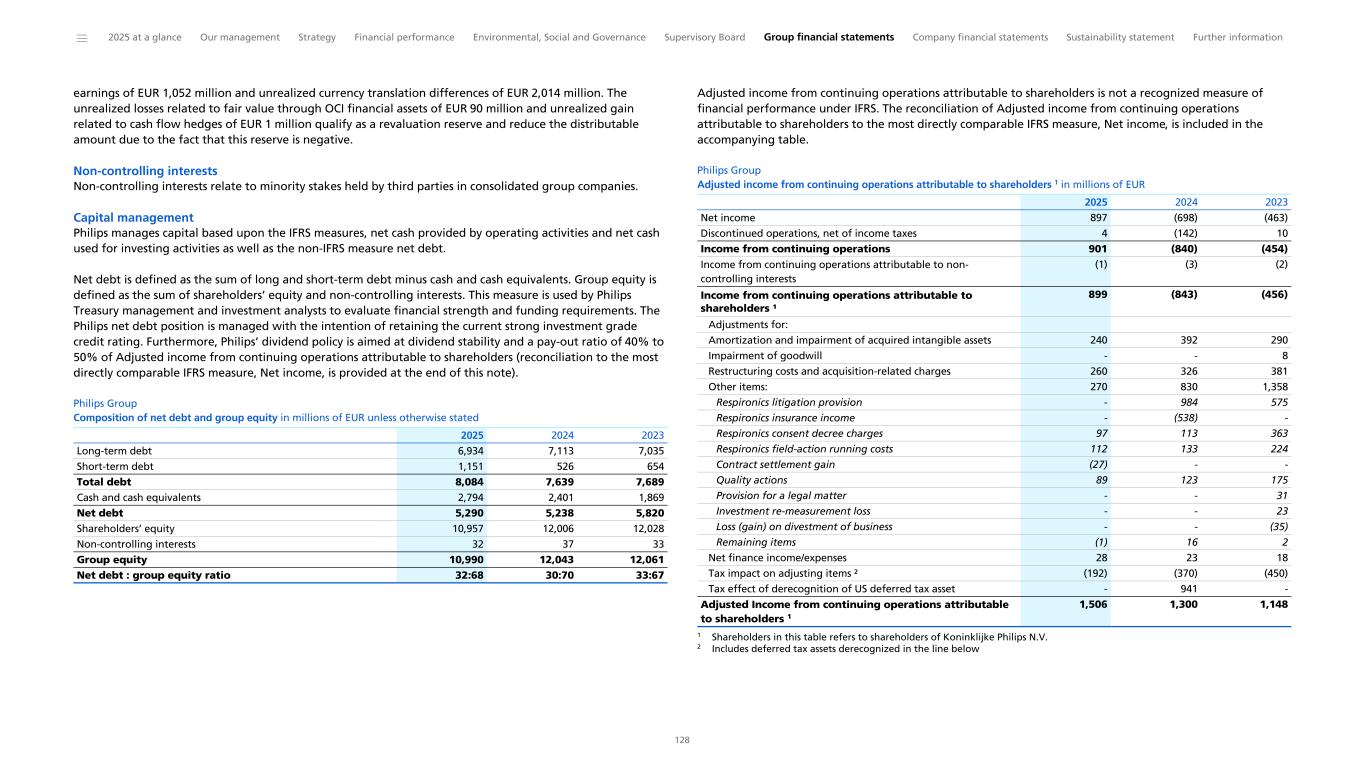
earnings of EUR 1,052 million and unrealized currency translation differences of EUR 2,014 million. The unrealized losses related to fair value through OCI financial assets of EUR 90 million and unrealized gain related to cash flow hedges of EUR 1 million qualify as a revaluation reserve and reduce the distributable amount due to the fact that this reserve is negative. Non-controlling interests Non-controlling interests relate to minority stakes held by third parties in consolidated group companies. Capital management Philips manages capital based upon the IFRS measures, net cash provided by operating activities and net cash used for investing activities as well as the non-IFRS measure net debt. Net debt is defined as the sum of long and short-term debt minus cash and cash equivalents. Group equity is defined as the sum of shareholders’ equity and non-controlling interests. This measure is used by Philips Treasury management and investment analysts to evaluate financial strength and funding requirements. The Philips net debt position is managed with the intention of retaining the current strong investment grade credit rating. Furthermore, Philips’ dividend policy is aimed at dividend stability and a pay-out ratio of 40% to 50% of Adjusted income from continuing operations attributable to shareholders (reconciliation to the most directly comparable IFRS measure, Net income, is provided at the end of this note). Philips Group Composition of net debt and group equity in millions of EUR unless otherwise stated Long-term debt 6,934 7,113 7,035 Short-term debt 1,151 526 654 Total debt 8,084 7,639 7,689 Cash and cash equivalents 2,794 2,401 1,869 Net debt 5,290 5,238 5,820 Shareholders’ equity 10,957 12,006 12,028 Non-controlling interests 32 37 33 Group equity 10,990 12,043 12,061 Net debt : group equity ratio 32:68 30:70 33:67 2025 2024 2023 Adjusted income from continuing operations attributable to shareholders is not a recognized measure of financial performance under IFRS. The reconciliation of Adjusted income from continuing operations attributable to shareholders to the most directly comparable IFRS measure, Net income, is included in the accompanying table. Philips Group Adjusted income from continuing operations attributable to shareholders 1 in millions of EUR Net income 897 (698) (463) Discontinued operations, net of income taxes 4 (142) 10 Income from continuing operations 901 (840) (454) Income from continuing operations attributable to non- controlling interests (1) (3) (2) Income from continuing operations attributable to shareholders ¹ 899 (843) (456) Adjustments for: Amortization and impairment of acquired intangible assets 240 392 290 Impairment of goodwill - - 8 Restructuring costs and acquisition-related charges 260 326 381 Other items: 270 830 1,358 Respironics litigation provision - 984 575 Respironics insurance income - (538) - Respironics consent decree charges 97 113 363 Respironics field-action running costs 112 133 224 Contract settlement gain (27) - - Quality actions 89 123 175 Provision for a legal matter - - 31 Investment re-measurement loss - - 23 Loss (gain) on divestment of business - - (35) Remaining items (1) 16 2 Net finance income/expenses 28 23 18 Tax impact on adjusting items ² (192) (370) (450) Tax effect of derecognition of US deferred tax asset - 941 - Adjusted Income from continuing operations attributable to shareholders 1 1,506 1,300 1,148 2025 2024 2023 1 Shareholders in this table refers to shareholders of Koninklijke Philips N.V. 2 Includes deferred tax assets derecognized in the line below ______ 2025 at a glance Our management Strategy Financial performance Environmental, Social and Governance Supervisory Board Group financial statements Company financial statements Sustainability statement Further information 128
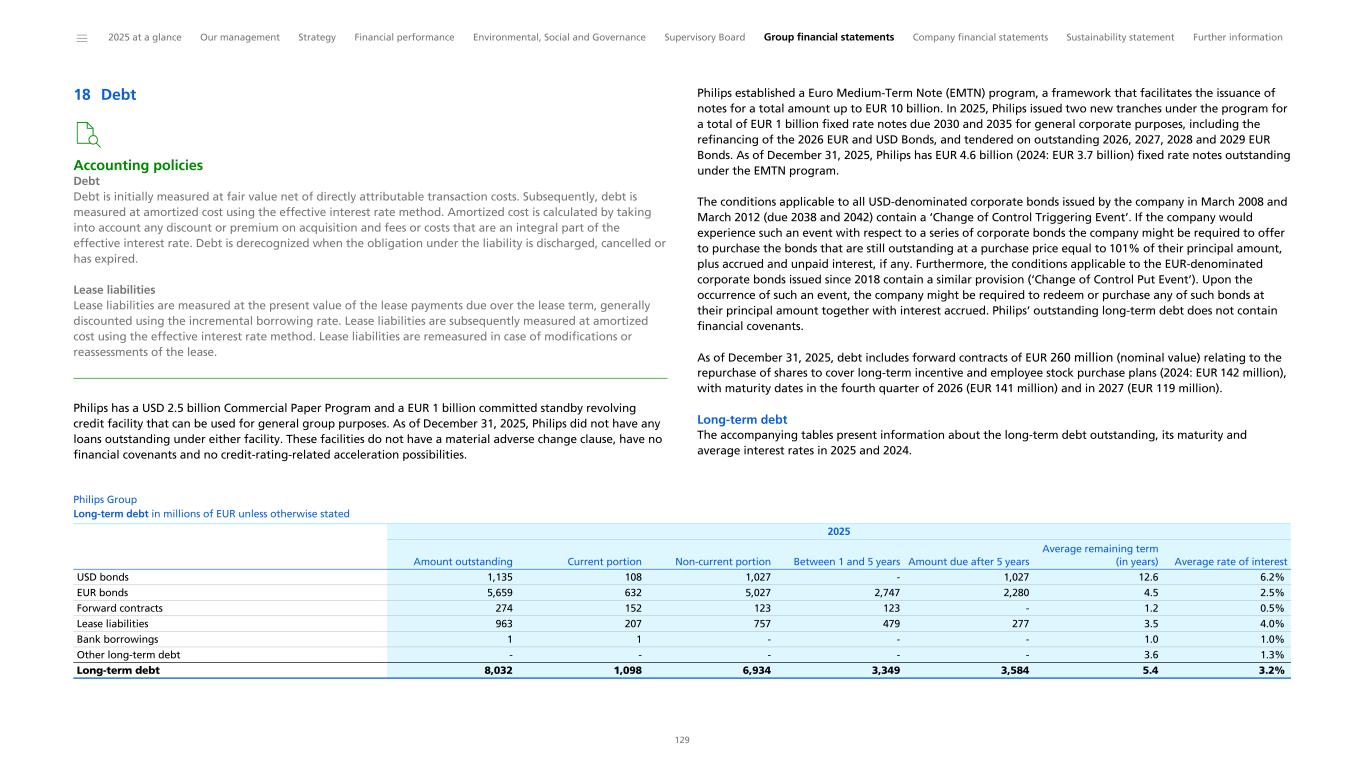
18 Debt Accounting policies Debt Debt is initially measured at fair value net of directly attributable transaction costs. Subsequently, debt is measured at amortized cost using the effective interest rate method. Amortized cost is calculated by taking into account any discount or premium on acquisition and fees or costs that are an integral part of the effective interest rate. Debt is derecognized when the obligation under the liability is discharged, cancelled or has expired. Lease liabilities Lease liabilities are measured at the present value of the lease payments due over the lease term, generally discounted using the incremental borrowing rate. Lease liabilities are subsequently measured at amortized cost using the effective interest rate method. Lease liabilities are remeasured in case of modifications or reassessments of the lease. Philips has a USD 2.5 billion Commercial Paper Program and a EUR 1 billion committed standby revolving credit facility that can be used for general group purposes. As of December 31, 2025, Philips did not have any loans outstanding under either facility. These facilities do not have a material adverse change clause, have no financial covenants and no credit-rating-related acceleration possibilities. Philips established a Euro Medium-Term Note (EMTN) program, a framework that facilitates the issuance of notes for a total amount up to EUR 10 billion. In 2025, Philips issued two new tranches under the program for a total of EUR 1 billion fixed rate notes due 2030 and 2035 for general corporate purposes, including the refinancing of the 2026 EUR and USD Bonds, and tendered on outstanding 2026, 2027, 2028 and 2029 EUR Bonds. As of December 31, 2025, Philips has EUR 4.6 billion (2024: EUR 3.7 billion) fixed rate notes outstanding under the EMTN program. The conditions applicable to all USD-denominated corporate bonds issued by the company in March 2008 and March 2012 (due 2038 and 2042) contain a ‘Change of Control Triggering Event’. If the company would experience such an event with respect to a series of corporate bonds the company might be required to offer to purchase the bonds that are still outstanding at a purchase price equal to 101% of their principal amount, plus accrued and unpaid interest, if any. Furthermore, the conditions applicable to the EUR-denominated corporate bonds issued since 2018 contain a similar provision (‘Change of Control Put Event’). Upon the occurrence of such an event, the company might be required to redeem or purchase any of such bonds at their principal amount together with interest accrued. Philips’ outstanding long-term debt does not contain financial covenants. As of December 31, 2025, debt includes forward contracts of EUR 260 million (nominal value) relating to the repurchase of shares to cover long-term incentive and employee stock purchase plans (2024: EUR 142 million), with maturity dates in the fourth quarter of 2026 (EUR 141 million) and in 2027 (EUR 119 million). Long-term debt The accompanying tables present information about the long-term debt outstanding, its maturity and average interest rates in 2025 and 2024. Philips Group Long-term debt in millions of EUR unless otherwise stated USD bonds 1,135 108 1,027 - 1,027 12.6 6.2% EUR bonds 5,659 632 5,027 2,747 2,280 4.5 2.5% Forward contracts 274 152 123 123 - 1.2 0.5% Lease liabilities 963 207 757 479 277 3.5 4.0% Bank borrowings 1 1 - - - 1.0 1.0% Other long-term debt - - - - - 3.6 1.3% Long-term debt 8,032 1,098 6,934 3,349 3,584 5.4 3.2% 2025 Amount outstanding Current portion Non-current portion Between 1 and 5 years Amount due after 5 years Average remaining term (in years) Average rate of interest ______ 2025 at a glance Our management Strategy Financial performance Environmental, Social and Governance Supervisory Board Group financial statements Company financial statements Sustainability statement Further information 129
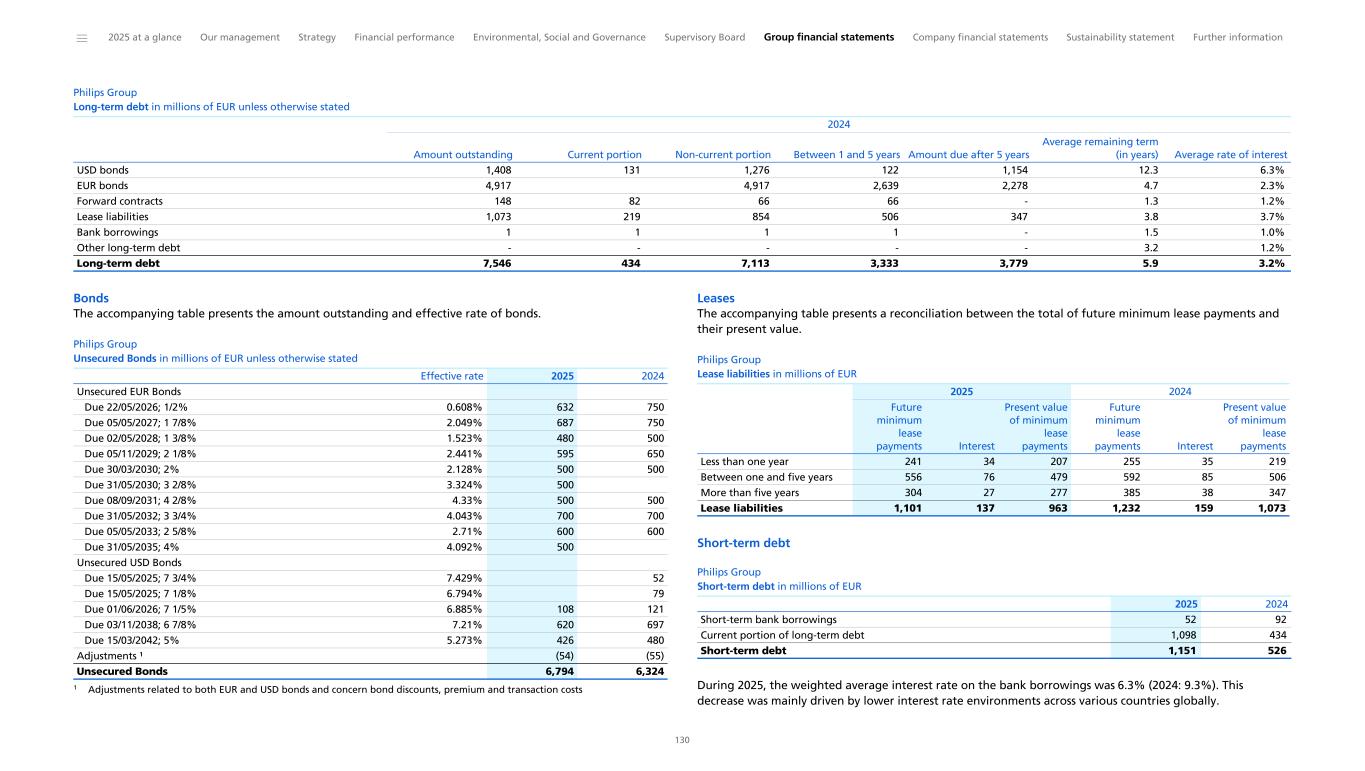
Philips Group Long-term debt in millions of EUR unless otherwise stated USD bonds 1,408 131 1,276 122 1,154 12.3 6.3% EUR bonds 4,917 4,917 2,639 2,278 4.7 2.3% Forward contracts 148 82 66 66 - 1.3 1.2% Lease liabilities 1,073 219 854 506 347 3.8 3.7% Bank borrowings 1 1 1 1 - 1.5 1.0% Other long-term debt - - - - - 3.2 1.2% Long-term debt 7,546 434 7,113 3,333 3,779 5.9 3.2% 2024 Amount outstanding Current portion Non-current portion Between 1 and 5 years Amount due after 5 years Average remaining term (in years) Average rate of interest Bonds The accompanying table presents the amount outstanding and effective rate of bonds. Philips Group Unsecured Bonds in millions of EUR unless otherwise stated Unsecured EUR Bonds Due 22/05/2026; 1/2% 0.608% 632 750 Due 05/05/2027; 1 7/8% 2.049% 687 750 Due 02/05/2028; 1 3/8% 1.523% 480 500 Due 05/11/2029; 2 1/8% 2.441% 595 650 Due 30/03/2030; 2% 2.128% 500 500 Due 31/05/2030; 3 2/8% 3.324% 500 Due 08/09/2031; 4 2/8% 4.33% 500 500 Due 31/05/2032; 3 3/4% 4.043% 700 700 Due 05/05/2033; 2 5/8% 2.71% 600 600 Due 31/05/2035; 4% 4.092% 500 Unsecured USD Bonds Due 15/05/2025; 7 3/4% 7.429% 52 Due 15/05/2025; 7 1/8% 6.794% 79 Due 01/06/2026; 7 1/5% 6.885% 108 121 Due 03/11/2038; 6 7/8% 7.21% 620 697 Due 15/03/2042; 5% 5.273% 426 480 Adjustments ¹ (54) (55) Unsecured Bonds 6,794 6,324 Effective rate 2025 2024 1 Adjustments related to both EUR and USD bonds and concern bond discounts, premium and transaction costs Leases The accompanying table presents a reconciliation between the total of future minimum lease payments and their present value. Philips Group Lease liabilities in millions of EUR Less than one year 241 34 207 255 35 219 Between one and five years 556 76 479 592 85 506 More than five years 304 27 277 385 38 347 Lease liabilities 1,101 137 963 1,232 159 1,073 2025 2024 Future minimum lease payments Interest Present value of minimum lease payments Future minimum lease payments Interest Present value of minimum lease payments Short-term debt Philips Group Short-term debt in millions of EUR Short-term bank borrowings 52 92 Current portion of long-term debt 1,098 434 Short-term debt 1,151 526 2025 2024 During 2025, the weighted average interest rate on the bank borrowings was 6.3% (2024: 9.3%). This decrease was mainly driven by lower interest rate environments across various countries globally. ______ 2025 at a glance Our management Strategy Financial performance Environmental, Social and Governance Supervisory Board Group financial statements Company financial statements Sustainability statement Further information 130
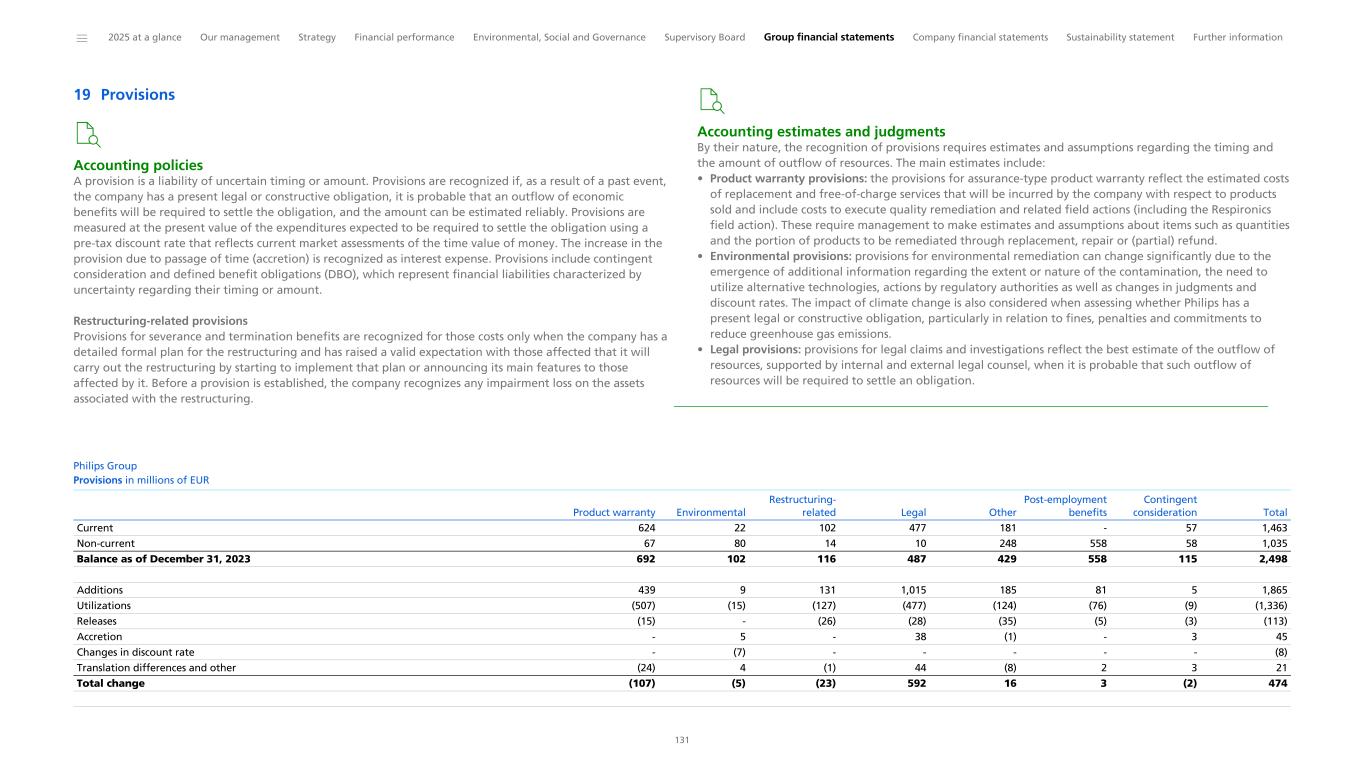
19 Provisions Accounting policies A provision is a liability of uncertain timing or amount. Provisions are recognized if, as a result of a past event, the company has a present legal or constructive obligation, it is probable that an outflow of economic benefits will be required to settle the obligation, and the amount can be estimated reliably. Provisions are measured at the present value of the expenditures expected to be required to settle the obligation using a pre-tax discount rate that reflects current market assessments of the time value of money. The increase in the provision due to passage of time (accretion) is recognized as interest expense. Provisions include contingent consideration and defined benefit obligations (DBO), which represent financial liabilities characterized by uncertainty regarding their timing or amount. Restructuring-related provisions Provisions for severance and termination benefits are recognized for those costs only when the company has a detailed formal plan for the restructuring and has raised a valid expectation with those affected that it will carry out the restructuring by starting to implement that plan or announcing its main features to those affected by it. Before a provision is established, the company recognizes any impairment loss on the assets associated with the restructuring. Accounting estimates and judgments By their nature, the recognition of provisions requires estimates and assumptions regarding the timing and the amount of outflow of resources. The main estimates include: • Product warranty provisions: the provisions for assurance-type product warranty reflect the estimated costs of replacement and free-of-charge services that will be incurred by the company with respect to products sold and include costs to execute quality remediation and related field actions (including the Respironics field action). These require management to make estimates and assumptions about items such as quantities and the portion of products to be remediated through replacement, repair or (partial) refund. • Environmental provisions: provisions for environmental remediation can change significantly due to the emergence of additional information regarding the extent or nature of the contamination, the need to utilize alternative technologies, actions by regulatory authorities as well as changes in judgments and discount rates. The impact of climate change is also considered when assessing whether Philips has a present legal or constructive obligation, particularly in relation to fines, penalties and commitments to reduce greenhouse gas emissions. • Legal provisions: provisions for legal claims and investigations reflect the best estimate of the outflow of resources, supported by internal and external legal counsel, when it is probable that such outflow of resources will be required to settle an obligation. Philips Group Provisions in millions of EUR Current 624 22 102 477 181 - 57 1,463 Non-current 67 80 14 10 248 558 58 1,035 Balance as of December 31, 2023 692 102 116 487 429 558 115 2,498 Additions 439 9 131 1,015 185 81 5 1,865 Utilizations (507) (15) (127) (477) (124) (76) (9) (1,336) Releases (15) - (26) (28) (35) (5) (3) (113) Accretion - 5 - 38 (1) - 3 45 Changes in discount rate - (7) - - - - - (8) Translation differences and other (24) 4 (1) 44 (8) 2 3 21 Total change (107) (5) (23) 592 16 3 (2) 474 Product warranty Environmental Restructuring- related Legal Other Post-employment benefits Contingent consideration Total ______ 2025 at a glance Our management Strategy Financial performance Environmental, Social and Governance Supervisory Board Group financial statements Company financial statements Sustainability statement Further information 131
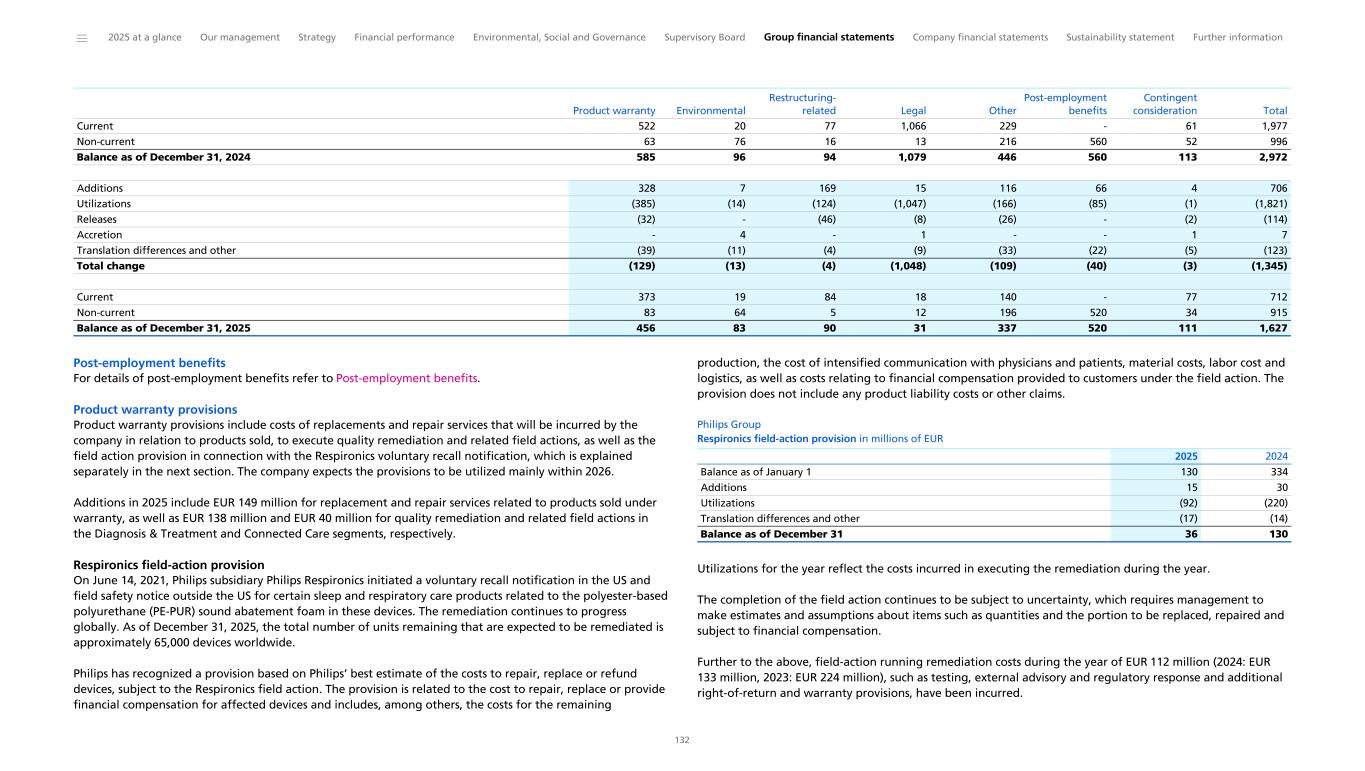
Current 522 20 77 1,066 229 - 61 1,977 Non-current 63 76 16 13 216 560 52 996 Balance as of December 31, 2024 585 96 94 1,079 446 560 113 2,972 Additions 328 7 169 15 116 66 4 706 Utilizations (385) (14) (124) (1,047) (166) (85) (1) (1,821) Releases (32) - (46) (8) (26) - (2) (114) Accretion - 4 - 1 - - 1 7 Translation differences and other (39) (11) (4) (9) (33) (22) (5) (123) Total change (129) (13) (4) (1,048) (109) (40) (3) (1,345) Current 373 19 84 18 140 - 77 712 Non-current 83 64 5 12 196 520 34 915 Balance as of December 31, 2025 456 83 90 31 337 520 111 1,627 Product warranty Environmental Restructuring- related Legal Other Post-employment benefits Contingent consideration Total Post-employment benefits For details of post-employment benefits refer to Post-employment benefits. Product warranty provisions Product warranty provisions include costs of replacements and repair services that will be incurred by the company in relation to products sold, to execute quality remediation and related field actions, as well as the field action provision in connection with the Respironics voluntary recall notification, which is explained separately in the next section. The company expects the provisions to be utilized mainly within 2026. Additions in 2025 include EUR 149 million for replacement and repair services related to products sold under warranty, as well as EUR 138 million and EUR 40 million for quality remediation and related field actions in the Diagnosis & Treatment and Connected Care segments, respectively. Respironics field-action provision On June 14, 2021, Philips subsidiary Philips Respironics initiated a voluntary recall notification in the US and field safety notice outside the US for certain sleep and respiratory care products related to the polyester-based polyurethane (PE-PUR) sound abatement foam in these devices. The remediation continues to progress globally. As of December 31, 2025, the total number of units remaining that are expected to be remediated is approximately 65,000 devices worldwide. Philips has recognized a provision based on Philips’ best estimate of the costs to repair, replace or refund devices, subject to the Respironics field action. The provision is related to the cost to repair, replace or provide financial compensation for affected devices and includes, among others, the costs for the remaining production, the cost of intensified communication with physicians and patients, material costs, labor cost and logistics, as well as costs relating to financial compensation provided to customers under the field action. The provision does not include any product liability costs or other claims. Philips Group Respironics field-action provision in millions of EUR Balance as of January 1 130 334 Additions 15 30 Utilizations (92) (220) Translation differences and other (17) (14) Balance as of December 31 36 130 2025 2024 Utilizations for the year reflect the costs incurred in executing the remediation during the year. The completion of the field action continues to be subject to uncertainty, which requires management to make estimates and assumptions about items such as quantities and the portion to be replaced, repaired and subject to financial compensation. Further to the above, field-action running remediation costs during the year of EUR 112 million (2024: EUR 133 million, 2023: EUR 224 million), such as testing, external advisory and regulatory response and additional right-of-return and warranty provisions, have been incurred. ______ 2025 at a glance Our management Strategy Financial performance Environmental, Social and Governance Supervisory Board Group financial statements Company financial statements Sustainability statement Further information 132
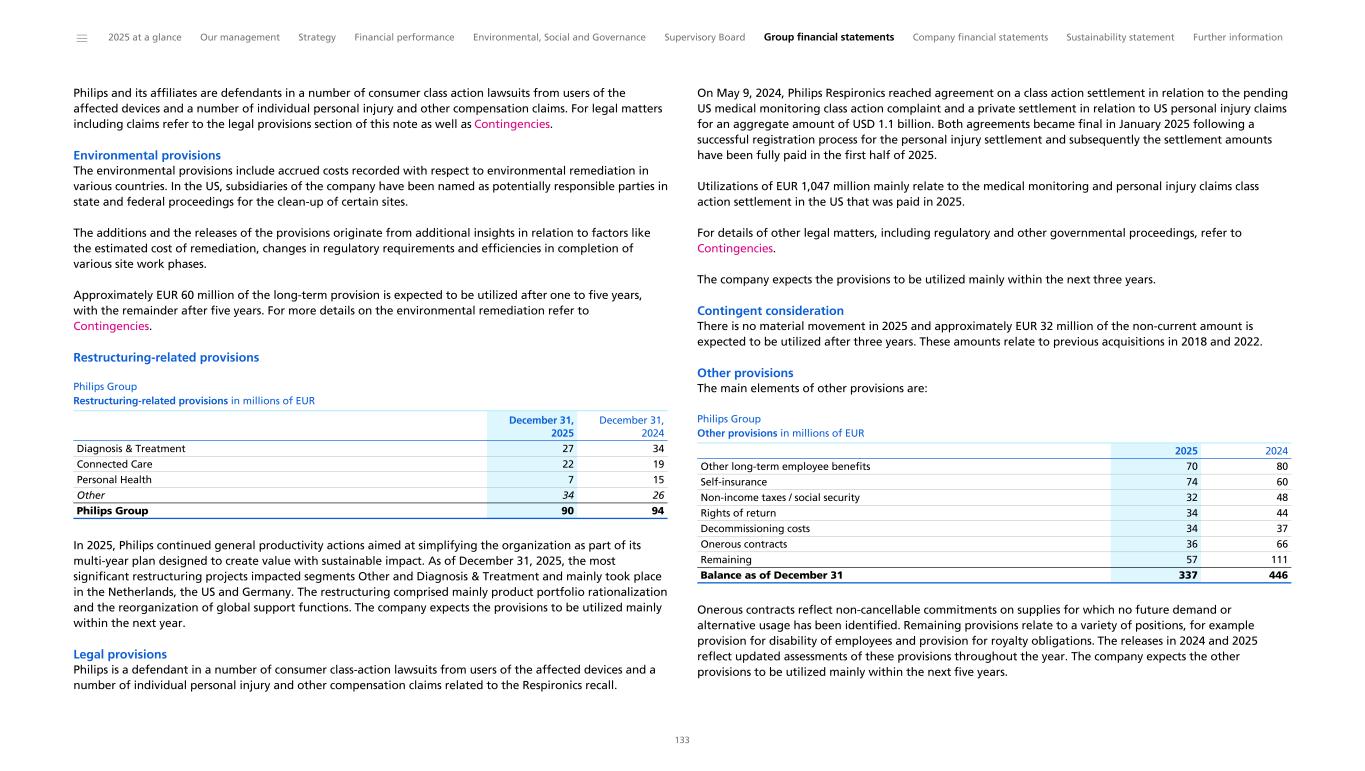
Philips and its affiliates are defendants in a number of consumer class action lawsuits from users of the affected devices and a number of individual personal injury and other compensation claims. For legal matters including claims refer to the legal provisions section of this note as well as Contingencies. Environmental provisions The environmental provisions include accrued costs recorded with respect to environmental remediation in various countries. In the US, subsidiaries of the company have been named as potentially responsible parties in state and federal proceedings for the clean-up of certain sites. The additions and the releases of the provisions originate from additional insights in relation to factors like the estimated cost of remediation, changes in regulatory requirements and efficiencies in completion of various site work phases. Approximately EUR 60 million of the long-term provision is expected to be utilized after one to five years, with the remainder after five years. For more details on the environmental remediation refer to Contingencies. Restructuring-related provisions Philips Group Restructuring-related provisions in millions of EUR Diagnosis & Treatment 27 34 Connected Care 22 19 Personal Health 7 15 Other 34 26 Philips Group 90 94 December 31, 2025 December 31, 2024 In 2025, Philips continued general productivity actions aimed at simplifying the organization as part of its multi-year plan designed to create value with sustainable impact. As of December 31, 2025, the most significant restructuring projects impacted segments Other and Diagnosis & Treatment and mainly took place in the Netherlands, the US and Germany. The restructuring comprised mainly product portfolio rationalization and the reorganization of global support functions. The company expects the provisions to be utilized mainly within the next year. Legal provisions Philips is a defendant in a number of consumer class-action lawsuits from users of the affected devices and a number of individual personal injury and other compensation claims related to the Respironics recall. On May 9, 2024, Philips Respironics reached agreement on a class action settlement in relation to the pending US medical monitoring class action complaint and a private settlement in relation to US personal injury claims for an aggregate amount of USD 1.1 billion. Both agreements became final in January 2025 following a successful registration process for the personal injury settlement and subsequently the settlement amounts have been fully paid in the first half of 2025. Utilizations of EUR 1,047 million mainly relate to the medical monitoring and personal injury claims class action settlement in the US that was paid in 2025. For details of other legal matters, including regulatory and other governmental proceedings, refer to Contingencies. The company expects the provisions to be utilized mainly within the next three years. Contingent consideration There is no material movement in 2025 and approximately EUR 32 million of the non-current amount is expected to be utilized after three years. These amounts relate to previous acquisitions in 2018 and 2022. Other provisions The main elements of other provisions are: Philips Group Other provisions in millions of EUR Other long-term employee benefits 70 80 Self-insurance 74 60 Non-income taxes / social security 32 48 Rights of return 34 44 Decommissioning costs 34 37 Onerous contracts 36 66 Remaining 57 111 Balance as of December 31 337 446 2025 2024 Onerous contracts reflect non-cancellable commitments on supplies for which no future demand or alternative usage has been identified. Remaining provisions relate to a variety of positions, for example provision for disability of employees and provision for royalty obligations. The releases in 2024 and 2025 reflect updated assessments of these provisions throughout the year. The company expects the other provisions to be utilized mainly within the next five years. ______ 2025 at a glance Our management Strategy Financial performance Environmental, Social and Governance Supervisory Board Group financial statements Company financial statements Sustainability statement Further information 133
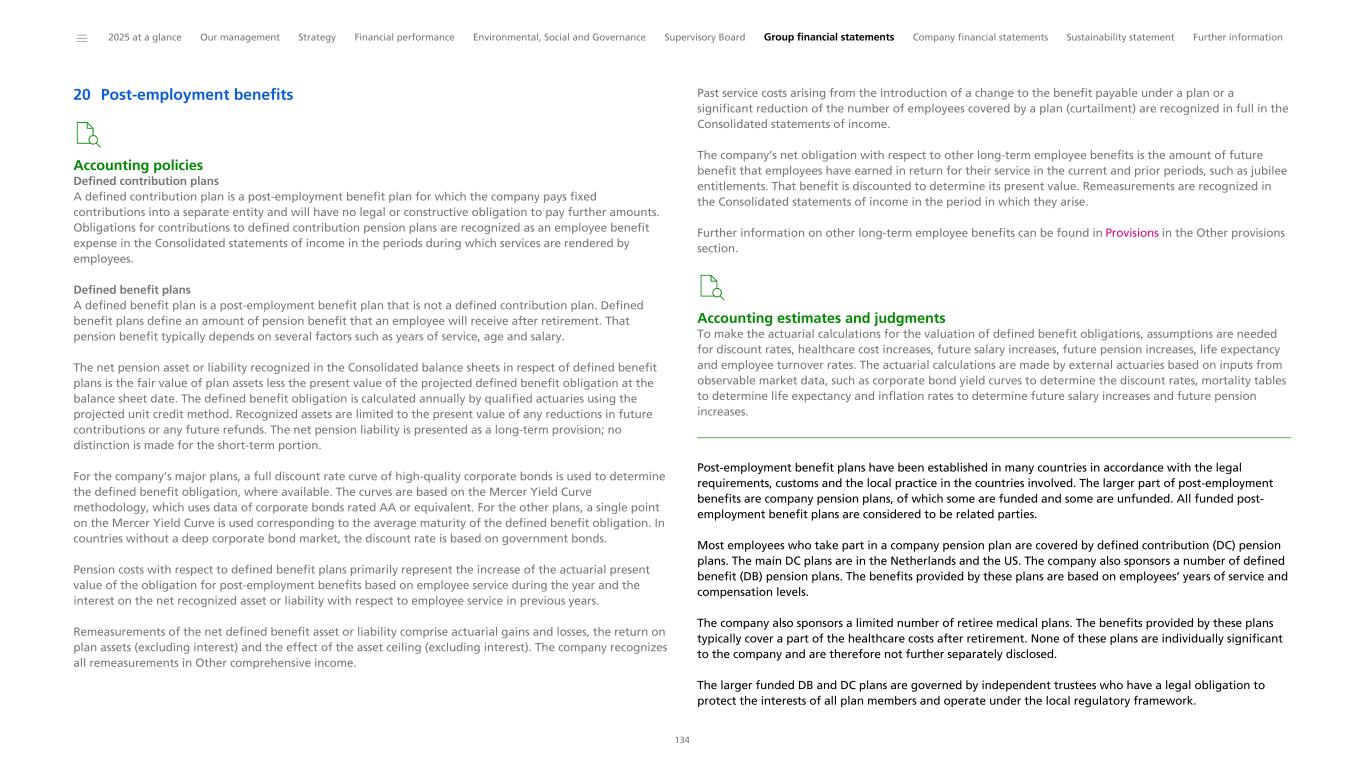
20 Post-employment benefits Accounting policies Defined contribution plans A defined contribution plan is a post-employment benefit plan for which the company pays fixed contributions into a separate entity and will have no legal or constructive obligation to pay further amounts. Obligations for contributions to defined contribution pension plans are recognized as an employee benefit expense in the Consolidated statements of income in the periods during which services are rendered by employees. Defined benefit plans A defined benefit plan is a post-employment benefit plan that is not a defined contribution plan. Defined benefit plans define an amount of pension benefit that an employee will receive after retirement. That pension benefit typically depends on several factors such as years of service, age and salary. The net pension asset or liability recognized in the Consolidated balance sheets in respect of defined benefit plans is the fair value of plan assets less the present value of the projected defined benefit obligation at the balance sheet date. The defined benefit obligation is calculated annually by qualified actuaries using the projected unit credit method. Recognized assets are limited to the present value of any reductions in future contributions or any future refunds. The net pension liability is presented as a long-term provision; no distinction is made for the short-term portion. For the company’s major plans, a full discount rate curve of high-quality corporate bonds is used to determine the defined benefit obligation, where available. The curves are based on the Mercer Yield Curve methodology, which uses data of corporate bonds rated AA or equivalent. For the other plans, a single point on the Mercer Yield Curve is used corresponding to the average maturity of the defined benefit obligation. In countries without a deep corporate bond market, the discount rate is based on government bonds. Pension costs with respect to defined benefit plans primarily represent the increase of the actuarial present value of the obligation for post-employment benefits based on employee service during the year and the interest on the net recognized asset or liability with respect to employee service in previous years. Remeasurements of the net defined benefit asset or liability comprise actuarial gains and losses, the return on plan assets (excluding interest) and the effect of the asset ceiling (excluding interest). The company recognizes all remeasurements in Other comprehensive income. Past service costs arising from the introduction of a change to the benefit payable under a plan or a significant reduction of the number of employees covered by a plan (curtailment) are recognized in full in the Consolidated statements of income. The company’s net obligation with respect to other long-term employee benefits is the amount of future benefit that employees have earned in return for their service in the current and prior periods, such as jubilee entitlements. That benefit is discounted to determine its present value. Remeasurements are recognized in the Consolidated statements of income in the period in which they arise. Further information on other long-term employee benefits can be found in Provisions in the Other provisions section. Accounting estimates and judgments To make the actuarial calculations for the valuation of defined benefit obligations, assumptions are needed for discount rates, healthcare cost increases, future salary increases, future pension increases, life expectancy and employee turnover rates. The actuarial calculations are made by external actuaries based on inputs from observable market data, such as corporate bond yield curves to determine the discount rates, mortality tables to determine life expectancy and inflation rates to determine future salary increases and future pension increases. Post-employment benefit plans have been established in many countries in accordance with the legal requirements, customs and the local practice in the countries involved. The larger part of post-employment benefits are company pension plans, of which some are funded and some are unfunded. All funded post- employment benefit plans are considered to be related parties. Most employees who take part in a company pension plan are covered by defined contribution (DC) pension plans. The main DC plans are in the Netherlands and the US. The company also sponsors a number of defined benefit (DB) pension plans. The benefits provided by these plans are based on employees’ years of service and compensation levels. The company also sponsors a limited number of retiree medical plans. The benefits provided by these plans typically cover a part of the healthcare costs after retirement. None of these plans are individually significant to the company and are therefore not further separately disclosed. The larger funded DB and DC plans are governed by independent trustees who have a legal obligation to protect the interests of all plan members and operate under the local regulatory framework. ______ 2025 at a glance Our management Strategy Financial performance Environmental, Social and Governance Supervisory Board Group financial statements Company financial statements Sustainability statement Further information 134
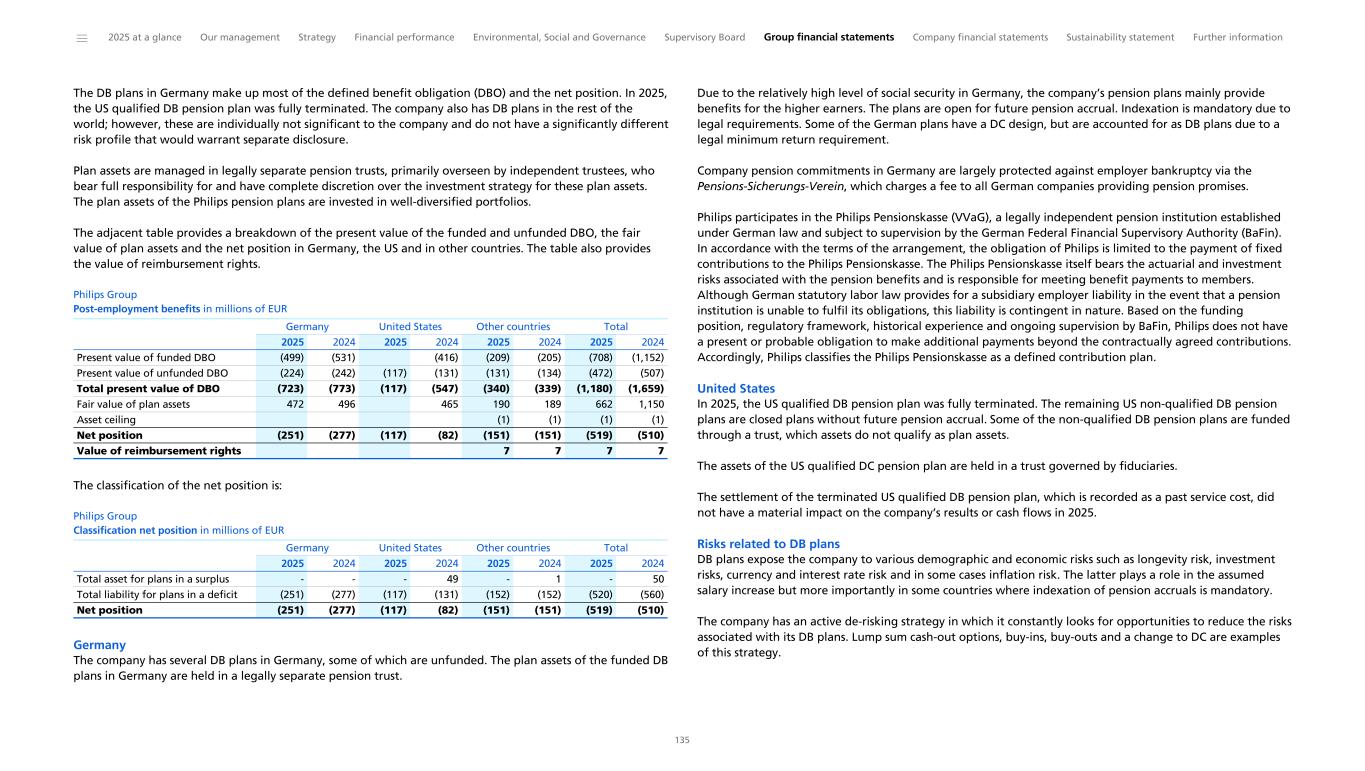
The DB plans in Germany make up most of the defined benefit obligation (DBO) and the net position. In 2025, the US qualified DB pension plan was fully terminated. The company also has DB plans in the rest of the world; however, these are individually not significant to the company and do not have a significantly different risk profile that would warrant separate disclosure. Plan assets are managed in legally separate pension trusts, primarily overseen by independent trustees, who bear full responsibility for and have complete discretion over the investment strategy for these plan assets. The plan assets of the Philips pension plans are invested in well-diversified portfolios. The adjacent table provides a breakdown of the present value of the funded and unfunded DBO, the fair value of plan assets and the net position in Germany, the US and in other countries. The table also provides the value of reimbursement rights. Philips Group Post-employment benefits in millions of EUR Present value of funded DBO (499) (531) (416) (209) (205) (708) (1,152) Present value of unfunded DBO (224) (242) (117) (131) (131) (134) (472) (507) Total present value of DBO (723) (773) (117) (547) (340) (339) (1,180) (1,659) Fair value of plan assets 472 496 465 190 189 662 1,150 Asset ceiling (1) (1) (1) (1) Net position (251) (277) (117) (82) (151) (151) (519) (510) Value of reimbursement rights 7 7 7 7 Germany United States Other countries Total 2025 2024 2025 2024 2025 2024 2025 2024 The classification of the net position is: Philips Group Classification net position in millions of EUR Total asset for plans in a surplus - - - 49 - 1 - 50 Total liability for plans in a deficit (251) (277) (117) (131) (152) (152) (520) (560) Net position (251) (277) (117) (82) (151) (151) (519) (510) Germany United States Other countries Total 2025 2024 2025 2024 2025 2024 2025 2024 Germany The company has several DB plans in Germany, some of which are unfunded. The plan assets of the funded DB plans in Germany are held in a legally separate pension trust. Due to the relatively high level of social security in Germany, the company’s pension plans mainly provide benefits for the higher earners. The plans are open for future pension accrual. Indexation is mandatory due to legal requirements. Some of the German plans have a DC design, but are accounted for as DB plans due to a legal minimum return requirement. Company pension commitments in Germany are largely protected against employer bankruptcy via the Pensions-Sicherungs-Verein, which charges a fee to all German companies providing pension promises. Philips participates in the Philips Pensionskasse (VVaG), a legally independent pension institution established under German law and subject to supervision by the German Federal Financial Supervisory Authority (BaFin). In accordance with the terms of the arrangement, the obligation of Philips is limited to the payment of fixed contributions to the Philips Pensionskasse. The Philips Pensionskasse itself bears the actuarial and investment risks associated with the pension benefits and is responsible for meeting benefit payments to members. Although German statutory labor law provides for a subsidiary employer liability in the event that a pension institution is unable to fulfil its obligations, this liability is contingent in nature. Based on the funding position, regulatory framework, historical experience and ongoing supervision by BaFin, Philips does not have a present or probable obligation to make additional payments beyond the contractually agreed contributions. Accordingly, Philips classifies the Philips Pensionskasse as a defined contribution plan. United States In 2025, the US qualified DB pension plan was fully terminated. The remaining US non-qualified DB pension plans are closed plans without future pension accrual. Some of the non-qualified DB pension plans are funded through a trust, which assets do not qualify as plan assets. The assets of the US qualified DC pension plan are held in a trust governed by fiduciaries. The settlement of the terminated US qualified DB pension plan, which is recorded as a past service cost, did not have a material impact on the company’s results or cash flows in 2025. Risks related to DB plans DB plans expose the company to various demographic and economic risks such as longevity risk, investment risks, currency and interest rate risk and in some cases inflation risk. The latter plays a role in the assumed salary increase but more importantly in some countries where indexation of pension accruals is mandatory. The company has an active de-risking strategy in which it constantly looks for opportunities to reduce the risks associated with its DB plans. Lump sum cash-out options, buy-ins, buy-outs and a change to DC are examples of this strategy. ______ 2025 at a glance Our management Strategy Financial performance Environmental, Social and Governance Supervisory Board Group financial statements Company financial statements Sustainability statement Further information 135
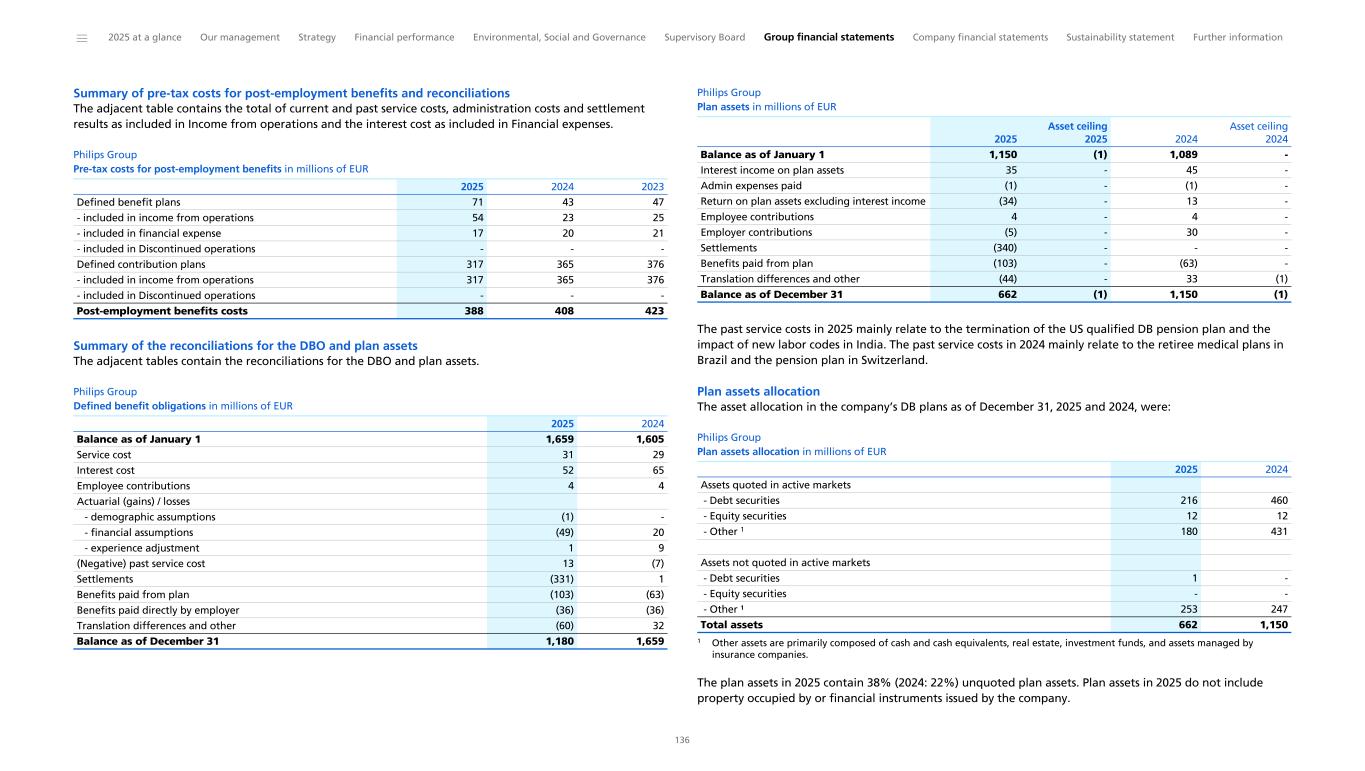
Summary of pre-tax costs for post-employment benefits and reconciliations The adjacent table contains the total of current and past service costs, administration costs and settlement results as included in Income from operations and the interest cost as included in Financial expenses. Philips Group Pre-tax costs for post-employment benefits in millions of EUR Defined benefit plans 71 43 47 - included in income from operations 54 23 25 - included in financial expense 17 20 21 - included in Discontinued operations - - - Defined contribution plans 317 365 376 - included in income from operations 317 365 376 - included in Discontinued operations - - - Post-employment benefits costs 388 408 423 2025 2024 2023 Summary of the reconciliations for the DBO and plan assets The adjacent tables contain the reconciliations for the DBO and plan assets. Philips Group Defined benefit obligations in millions of EUR Balance as of January 1 1,659 1,605 Service cost 31 29 Interest cost 52 65 Employee contributions 4 4 Actuarial (gains) / losses - demographic assumptions (1) - - financial assumptions (49) 20 - experience adjustment 1 9 (Negative) past service cost 13 (7) Settlements (331) 1 Benefits paid from plan (103) (63) Benefits paid directly by employer (36) (36) Translation differences and other (60) 32 Balance as of December 31 1,180 1,659 2025 2024 Philips Group Plan assets in millions of EUR Balance as of January 1 1,150 (1) 1,089 - Interest income on plan assets 35 - 45 - Admin expenses paid (1) - (1) - Return on plan assets excluding interest income (34) - 13 - Employee contributions 4 - 4 - Employer contributions (5) - 30 - Settlements (340) - - - Benefits paid from plan (103) - (63) - Translation differences and other (44) - 33 (1) Balance as of December 31 662 (1) 1,150 (1) 2025 Asset ceiling 2025 2024 Asset ceiling 2024 The past service costs in 2025 mainly relate to the termination of the US qualified DB pension plan and the impact of new labor codes in India. The past service costs in 2024 mainly relate to the retiree medical plans in Brazil and the pension plan in Switzerland. Plan assets allocation The asset allocation in the company’s DB plans as of December 31, 2025 and 2024, were: Philips Group Plan assets allocation in millions of EUR Assets quoted in active markets - Debt securities 216 460 - Equity securities 12 12 - Other 1 180 431 Assets not quoted in active markets - Debt securities 1 - - Equity securities - - - Other ¹ 253 247 Total assets 662 1,150 2025 2024 1 Other assets are primarily composed of cash and cash equivalents, real estate, investment funds, and assets managed by insurance companies. The plan assets in 2025 contain 38% (2024: 22%) unquoted plan assets. Plan assets in 2025 do not include property occupied by or financial instruments issued by the company. ______ 2025 at a glance Our management Strategy Financial performance Environmental, Social and Governance Supervisory Board Group financial statements Company financial statements Sustainability statement Further information 136
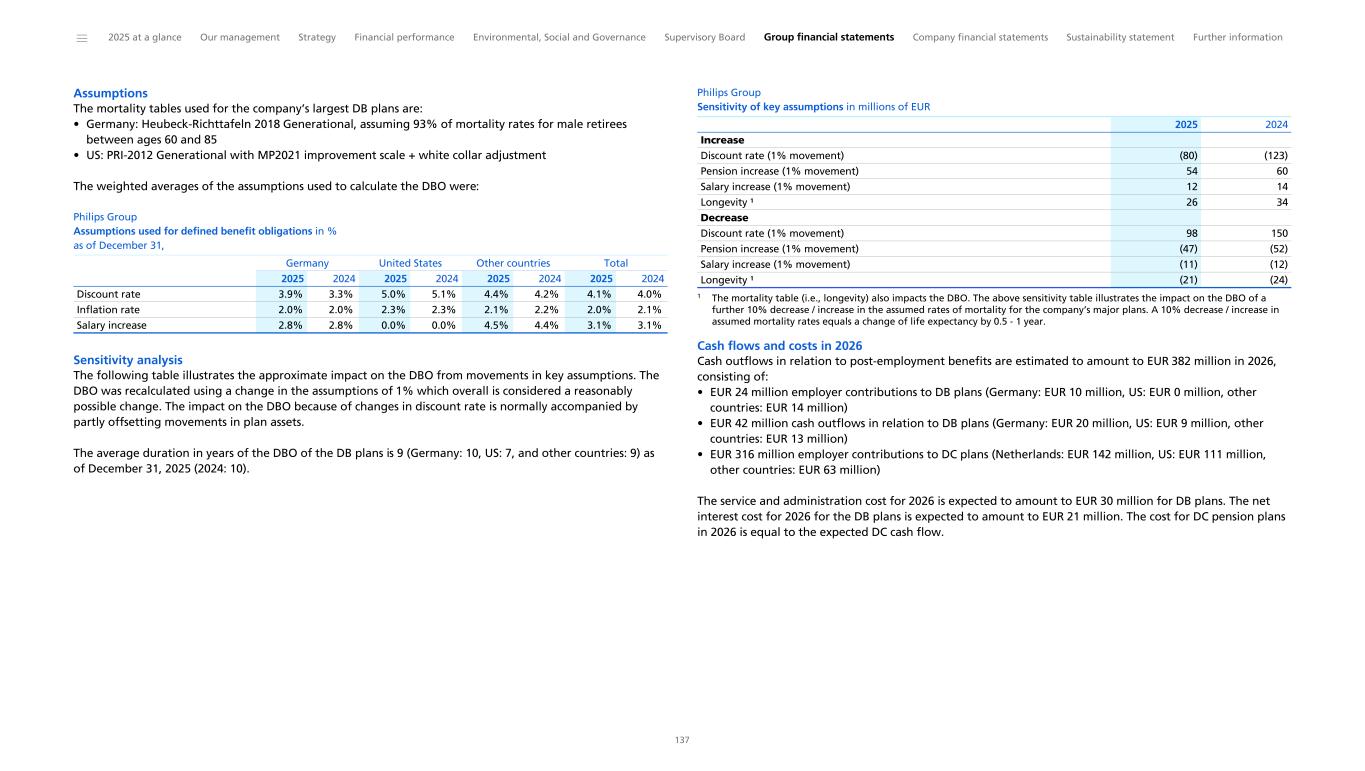
Assumptions The mortality tables used for the company’s largest DB plans are: • Germany: Heubeck-Richttafeln 2018 Generational, assuming 93% of mortality rates for male retirees between ages 60 and 85 • US: PRI-2012 Generational with MP2021 improvement scale + white collar adjustment The weighted averages of the assumptions used to calculate the DBO were: Philips Group Assumptions used for defined benefit obligations in % as of December 31, Discount rate 3.9% 3.3% 5.0% 5.1% 4.4% 4.2% 4.1% 4.0% Inflation rate 2.0% 2.0% 2.3% 2.3% 2.1% 2.2% 2.0% 2.1% Salary increase 2.8% 2.8% 0.0% 0.0% 4.5% 4.4% 3.1% 3.1% Germany United States Other countries Total 2025 2024 2025 2024 2025 2024 2025 2024 Sensitivity analysis The following table illustrates the approximate impact on the DBO from movements in key assumptions. The DBO was recalculated using a change in the assumptions of 1% which overall is considered a reasonably possible change. The impact on the DBO because of changes in discount rate is normally accompanied by partly offsetting movements in plan assets. The average duration in years of the DBO of the DB plans is 9 (Germany: 10, US: 7, and other countries: 9) as of December 31, 2025 (2024: 10). Philips Group Sensitivity of key assumptions in millions of EUR Increase Discount rate (1% movement) (80) (123) Pension increase (1% movement) 54 60 Salary increase (1% movement) 12 14 Longevity ¹ 26 34 Decrease Discount rate (1% movement) 98 150 Pension increase (1% movement) (47) (52) Salary increase (1% movement) (11) (12) Longevity ¹ (21) (24) 2025 2024 1 The mortality table (i.e., longevity) also impacts the DBO. The above sensitivity table illustrates the impact on the DBO of a further 10% decrease / increase in the assumed rates of mortality for the company’s major plans. A 10% decrease / increase in assumed mortality rates equals a change of life expectancy by 0.5 - 1 year. Cash flows and costs in 2026 Cash outflows in relation to post-employment benefits are estimated to amount to EUR 382 million in 2026, consisting of: • EUR 24 million employer contributions to DB plans (Germany: EUR 10 million, US: EUR 0 million, other countries: EUR 14 million) • EUR 42 million cash outflows in relation to DB plans (Germany: EUR 20 million, US: EUR 9 million, other countries: EUR 13 million) • EUR 316 million employer contributions to DC plans (Netherlands: EUR 142 million, US: EUR 111 million, other countries: EUR 63 million) The service and administration cost for 2026 is expected to amount to EUR 30 million for DB plans. The net interest cost for 2026 for the DB plans is expected to amount to EUR 21 million. The cost for DC pension plans in 2026 is equal to the expected DC cash flow. ______ 2025 at a glance Our management Strategy Financial performance Environmental, Social and Governance Supervisory Board Group financial statements Company financial statements Sustainability statement Further information 137
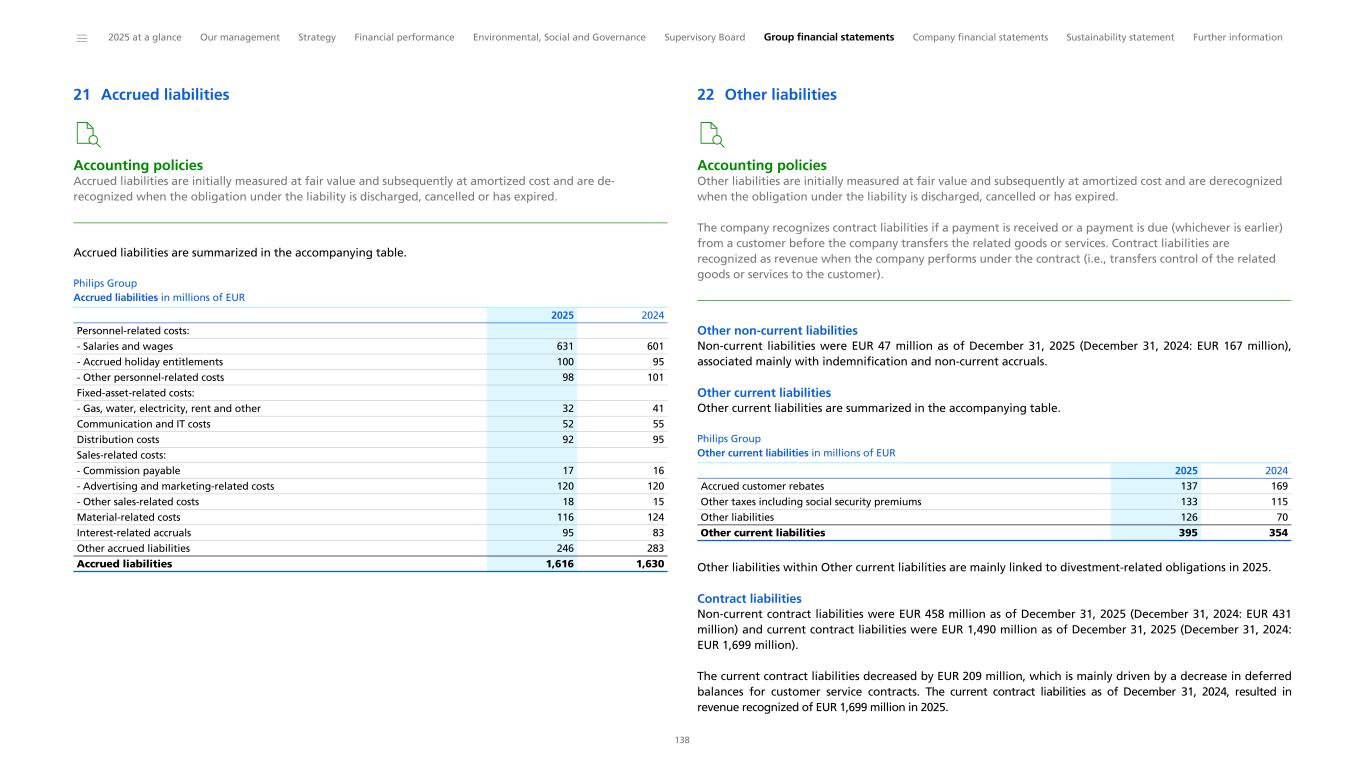
21 Accrued liabilities Accounting policies Accrued liabilities are initially measured at fair value and subsequently at amortized cost and are de- recognized when the obligation under the liability is discharged, cancelled or has expired. Accrued liabilities are summarized in the accompanying table. Philips Group Accrued liabilities in millions of EUR Personnel-related costs: - Salaries and wages 631 601 - Accrued holiday entitlements 100 95 - Other personnel-related costs 98 101 Fixed-asset-related costs: - Gas, water, electricity, rent and other 32 41 Communication and IT costs 52 55 Distribution costs 92 95 Sales-related costs: - Commission payable 17 16 - Advertising and marketing-related costs 120 120 - Other sales-related costs 18 15 Material-related costs 116 124 Interest-related accruals 95 83 Other accrued liabilities 246 283 Accrued liabilities 1,616 1,630 2025 2024 22 Other liabilities Accounting policies Other liabilities are initially measured at fair value and subsequently at amortized cost and are derecognized when the obligation under the liability is discharged, cancelled or has expired. The company recognizes contract liabilities if a payment is received or a payment is due (whichever is earlier) from a customer before the company transfers the related goods or services. Contract liabilities are recognized as revenue when the company performs under the contract (i.e., transfers control of the related goods or services to the customer). Other non-current liabilities Non-current liabilities were EUR 47 million as of December 31, 2025 (December 31, 2024: EUR 167 million), associated mainly with indemnification and non-current accruals. Other current liabilities Other current liabilities are summarized in the accompanying table. Philips Group Other current liabilities in millions of EUR Accrued customer rebates 137 169 Other taxes including social security premiums 133 115 Other liabilities 126 70 Other current liabilities 395 354 2025 2024 Other liabilities within Other current liabilities are mainly linked to divestment-related obligations in 2025. Contract liabilities Non-current contract liabilities were EUR 458 million as of December 31, 2025 (December 31, 2024: EUR 431 million) and current contract liabilities were EUR 1,490 million as of December 31, 2025 (December 31, 2024: EUR 1,699 million). The current contract liabilities decreased by EUR 209 million, which is mainly driven by a decrease in deferred balances for customer service contracts. The current contract liabilities as of December 31, 2024, resulted in revenue recognized of EUR 1,699 million in 2025. ______ 2025 at a glance Our management Strategy Financial performance Environmental, Social and Governance Supervisory Board Group financial statements Company financial statements Sustainability statement Further information 138
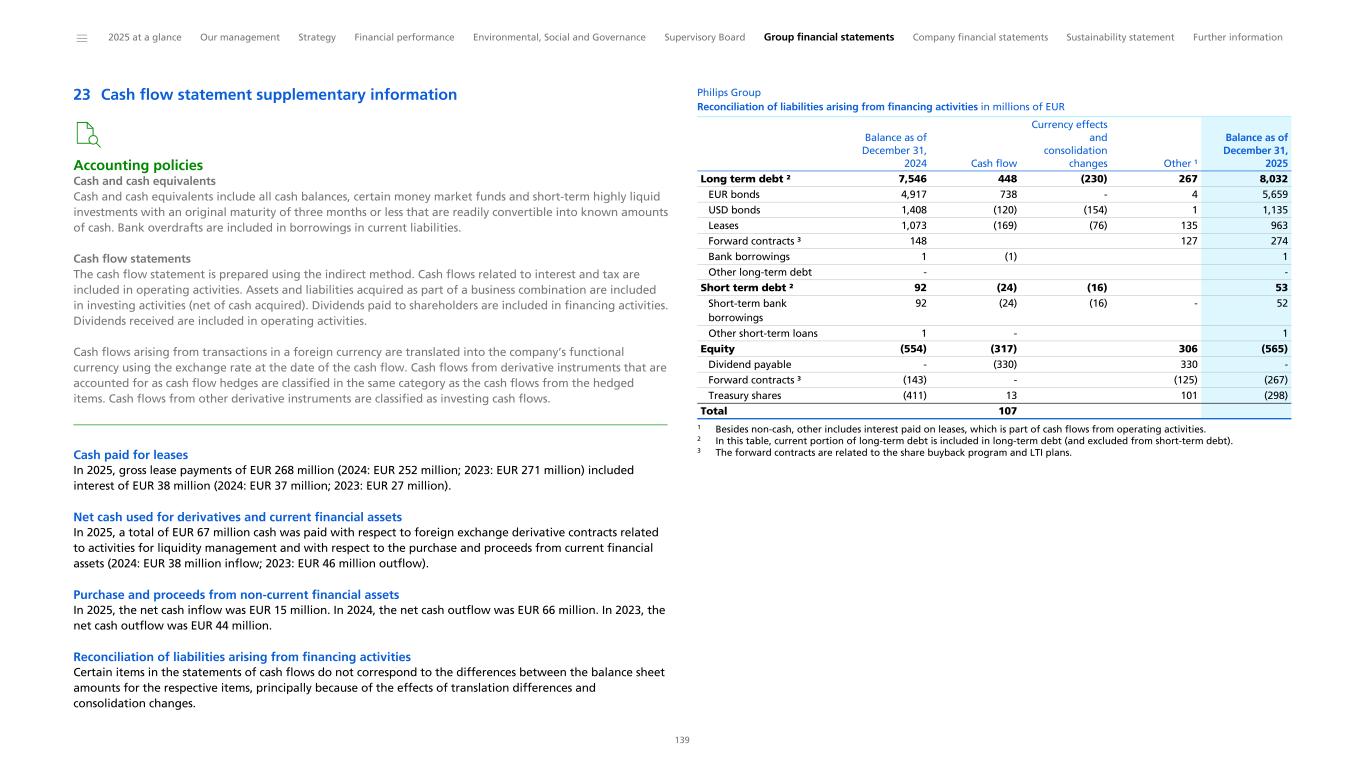
23 Cash flow statement supplementary information Accounting policies Cash and cash equivalents Cash and cash equivalents include all cash balances, certain money market funds and short-term highly liquid investments with an original maturity of three months or less that are readily convertible into known amounts of cash. Bank overdrafts are included in borrowings in current liabilities. Cash flow statements The cash flow statement is prepared using the indirect method. Cash flows related to interest and tax are included in operating activities. Assets and liabilities acquired as part of a business combination are included in investing activities (net of cash acquired). Dividends paid to shareholders are included in financing activities. Dividends received are included in operating activities. Cash flows arising from transactions in a foreign currency are translated into the company’s functional currency using the exchange rate at the date of the cash flow. Cash flows from derivative instruments that are accounted for as cash flow hedges are classified in the same category as the cash flows from the hedged items. Cash flows from other derivative instruments are classified as investing cash flows. Cash paid for leases In 2025, gross lease payments of EUR 268 million (2024: EUR 252 million; 2023: EUR 271 million) included interest of EUR 38 million (2024: EUR 37 million; 2023: EUR 27 million). Net cash used for derivatives and current financial assets In 2025, a total of EUR 67 million cash was paid with respect to foreign exchange derivative contracts related to activities for liquidity management and with respect to the purchase and proceeds from current financial assets (2024: EUR 38 million inflow; 2023: EUR 46 million outflow). Purchase and proceeds from non-current financial assets In 2025, the net cash inflow was EUR 15 million. In 2024, the net cash outflow was EUR 66 million. In 2023, the net cash outflow was EUR 44 million. Reconciliation of liabilities arising from financing activities Certain items in the statements of cash flows do not correspond to the differences between the balance sheet amounts for the respective items, principally because of the effects of translation differences and consolidation changes. Philips Group Reconciliation of liabilities arising from financing activities in millions of EUR Long term debt ² 7,546 448 (230) 267 8,032 EUR bonds 4,917 738 - 4 5,659 USD bonds 1,408 (120) (154) 1 1,135 Leases 1,073 (169) (76) 135 963 Forward contracts ³ 148 127 274 Bank borrowings 1 (1) 1 Other long-term debt - - Short term debt ² 92 (24) (16) 53 Short-term bank borrowings 92 (24) (16) - 52 Other short-term loans 1 - 1 Equity (554) (317) 306 (565) Dividend payable - (330) 330 - Forward contracts ³ (143) - (125) (267) Treasury shares (411) 13 101 (298) Total 107 Balance as of December 31, 2024 Cash flow Currency effects and consolidation changes Other ¹ Balance as of December 31, 2025 1 Besides non-cash, other includes interest paid on leases, which is part of cash flows from operating activities. 2 In this table, current portion of long-term debt is included in long-term debt (and excluded from short-term debt). 3 The forward contracts are related to the share buyback program and LTI plans. ______ 2025 at a glance Our management Strategy Financial performance Environmental, Social and Governance Supervisory Board Group financial statements Company financial statements Sustainability statement Further information 139
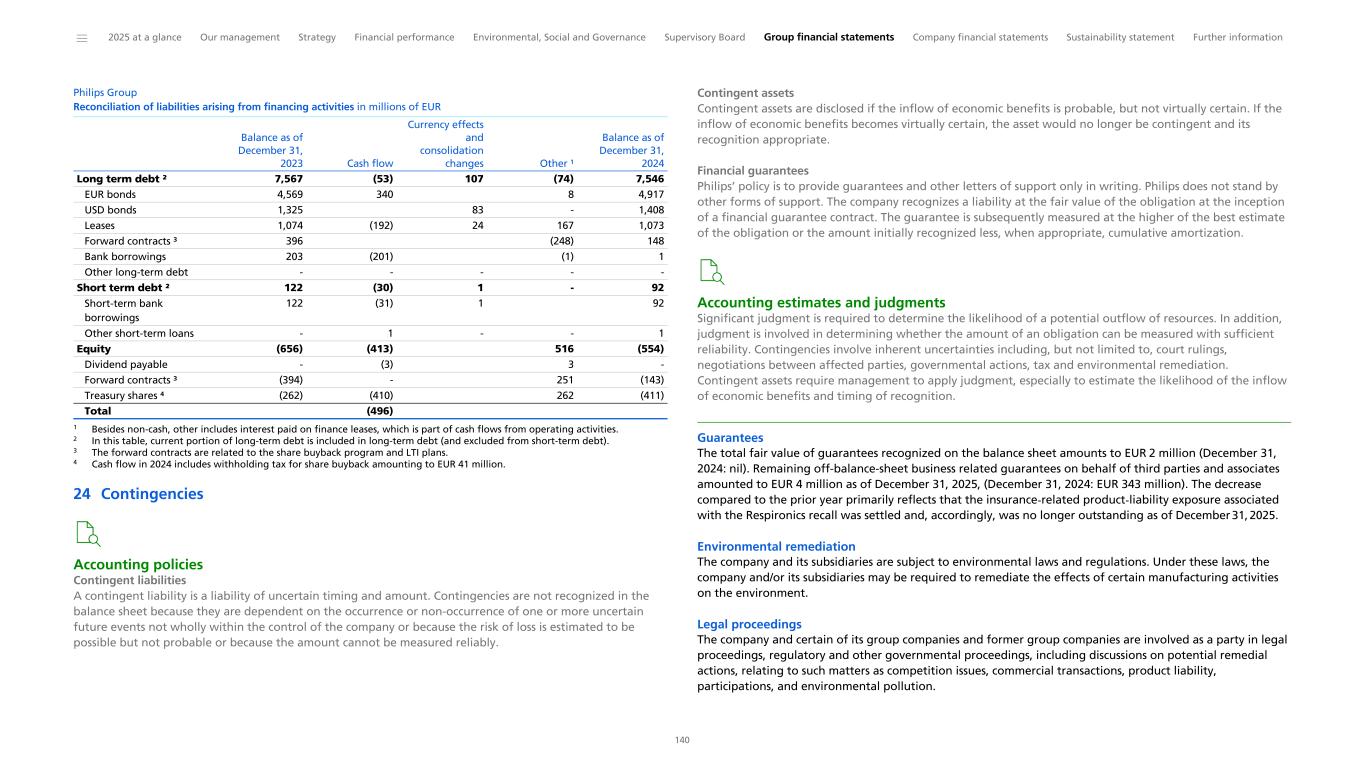
Philips Group Reconciliation of liabilities arising from financing activities in millions of EUR Long term debt ² 7,567 (53) 107 (74) 7,546 EUR bonds 4,569 340 8 4,917 USD bonds 1,325 83 - 1,408 Leases 1,074 (192) 24 167 1,073 Forward contracts ³ 396 (248) 148 Bank borrowings 203 (201) (1) 1 Other long-term debt - - - - - Short term debt ² 122 (30) 1 - 92 Short-term bank borrowings 122 (31) 1 92 Other short-term loans - 1 - - 1 Equity (656) (413) 516 (554) Dividend payable - (3) 3 - Forward contracts ³ (394) - 251 (143) Treasury shares ⁴ (262) (410) 262 (411) Total (496) Balance as of December 31, 2023 Cash flow Currency effects and consolidation changes Other ¹ Balance as of December 31, 2024 1 Besides non-cash, other includes interest paid on finance leases, which is part of cash flows from operating activities. 2 In this table, current portion of long-term debt is included in long-term debt (and excluded from short-term debt). 3 The forward contracts are related to the share buyback program and LTI plans. 4 Cash flow in 2024 includes withholding tax for share buyback amounting to EUR 41 million. 24 Contingencies Accounting policies Contingent liabilities A contingent liability is a liability of uncertain timing and amount. Contingencies are not recognized in the balance sheet because they are dependent on the occurrence or non-occurrence of one or more uncertain future events not wholly within the control of the company or because the risk of loss is estimated to be possible but not probable or because the amount cannot be measured reliably. Contingent assets Contingent assets are disclosed if the inflow of economic benefits is probable, but not virtually certain. If the inflow of economic benefits becomes virtually certain, the asset would no longer be contingent and its recognition appropriate. Financial guarantees Philips’ policy is to provide guarantees and other letters of support only in writing. Philips does not stand by other forms of support. The company recognizes a liability at the fair value of the obligation at the inception of a financial guarantee contract. The guarantee is subsequently measured at the higher of the best estimate of the obligation or the amount initially recognized less, when appropriate, cumulative amortization. Accounting estimates and judgments Significant judgment is required to determine the likelihood of a potential outflow of resources. In addition, judgment is involved in determining whether the amount of an obligation can be measured with sufficient reliability. Contingencies involve inherent uncertainties including, but not limited to, court rulings, negotiations between affected parties, governmental actions, tax and environmental remediation. Contingent assets require management to apply judgment, especially to estimate the likelihood of the inflow of economic benefits and timing of recognition. Guarantees The total fair value of guarantees recognized on the balance sheet amounts to EUR 2 million (December 31, 2024: nil). Remaining off-balance-sheet business related guarantees on behalf of third parties and associates amounted to EUR 4 million as of December 31, 2025, (December 31, 2024: EUR 343 million). The decrease compared to the prior year primarily reflects that the insurance-related product-liability exposure associated with the Respironics recall was settled and, accordingly, was no longer outstanding as of December 31, 2025. Environmental remediation The company and its subsidiaries are subject to environmental laws and regulations. Under these laws, the company and/or its subsidiaries may be required to remediate the effects of certain manufacturing activities on the environment. Legal proceedings The company and certain of its group companies and former group companies are involved as a party in legal proceedings, regulatory and other governmental proceedings, including discussions on potential remedial actions, relating to such matters as competition issues, commercial transactions, product liability, participations, and environmental pollution. ______ 2025 at a glance Our management Strategy Financial performance Environmental, Social and Governance Supervisory Board Group financial statements Company financial statements Sustainability statement Further information 140
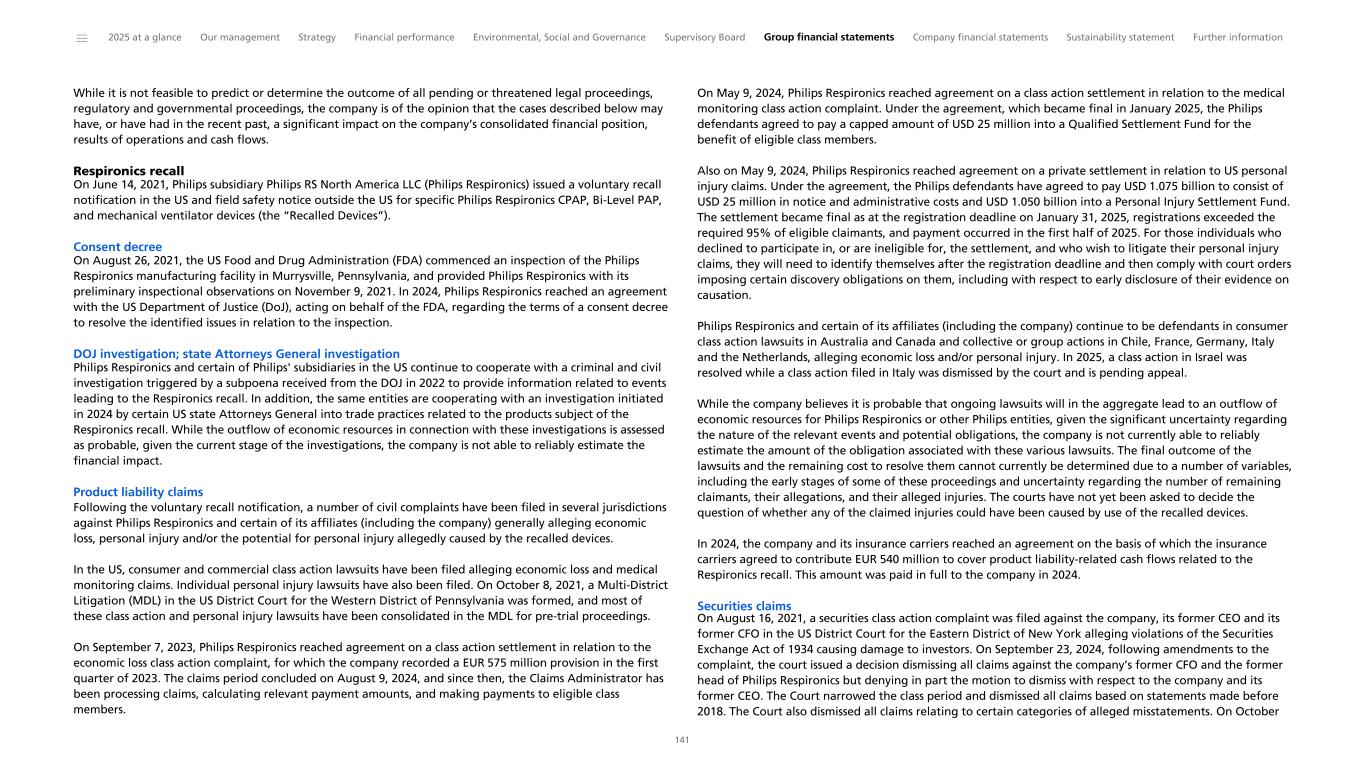
While it is not feasible to predict or determine the outcome of all pending or threatened legal proceedings, regulatory and governmental proceedings, the company is of the opinion that the cases described below may have, or have had in the recent past, a significant impact on the company’s consolidated financial position, results of operations and cash flows. Respironics recall On June 14, 2021, Philips subsidiary Philips RS North America LLC (Philips Respironics) issued a voluntary recall notification in the US and field safety notice outside the US for specific Philips Respironics CPAP, Bi-Level PAP, and mechanical ventilator devices (the “Recalled Devices”). Consent decree On August 26, 2021, the US Food and Drug Administration (FDA) commenced an inspection of the Philips Respironics manufacturing facility in Murrysville, Pennsylvania, and provided Philips Respironics with its preliminary inspectional observations on November 9, 2021. In 2024, Philips Respironics reached an agreement with the US Department of Justice (DoJ), acting on behalf of the FDA, regarding the terms of a consent decree to resolve the identified issues in relation to the inspection. DOJ investigation; state Attorneys General investigation Philips Respironics and certain of Philips' subsidiaries in the US continue to cooperate with a criminal and civil investigation triggered by a subpoena received from the DOJ in 2022 to provide information related to events leading to the Respironics recall. In addition, the same entities are cooperating with an investigation initiated in 2024 by certain US state Attorneys General into trade practices related to the products subject of the Respironics recall. While the outflow of economic resources in connection with these investigations is assessed as probable, given the current stage of the investigations, the company is not able to reliably estimate the financial impact. Product liability claims Following the voluntary recall notification, a number of civil complaints have been filed in several jurisdictions against Philips Respironics and certain of its affiliates (including the company) generally alleging economic loss, personal injury and/or the potential for personal injury allegedly caused by the recalled devices. In the US, consumer and commercial class action lawsuits have been filed alleging economic loss and medical monitoring claims. Individual personal injury lawsuits have also been filed. On October 8, 2021, a Multi-District Litigation (MDL) in the US District Court for the Western District of Pennsylvania was formed, and most of these class action and personal injury lawsuits have been consolidated in the MDL for pre-trial proceedings. On September 7, 2023, Philips Respironics reached agreement on a class action settlement in relation to the economic loss class action complaint, for which the company recorded a EUR 575 million provision in the first quarter of 2023. The claims period concluded on August 9, 2024, and since then, the Claims Administrator has been processing claims, calculating relevant payment amounts, and making payments to eligible class members. On May 9, 2024, Philips Respironics reached agreement on a class action settlement in relation to the medical monitoring class action complaint. Under the agreement, which became final in January 2025, the Philips defendants agreed to pay a capped amount of USD 25 million into a Qualified Settlement Fund for the benefit of eligible class members. Also on May 9, 2024, Philips Respironics reached agreement on a private settlement in relation to US personal injury claims. Under the agreement, the Philips defendants have agreed to pay USD 1.075 billion to consist of USD 25 million in notice and administrative costs and USD 1.050 billion into a Personal Injury Settlement Fund. The settlement became final as at the registration deadline on January 31, 2025, registrations exceeded the required 95% of eligible claimants, and payment occurred in the first half of 2025. For those individuals who declined to participate in, or are ineligible for, the settlement, and who wish to litigate their personal injury claims, they will need to identify themselves after the registration deadline and then comply with court orders imposing certain discovery obligations on them, including with respect to early disclosure of their evidence on causation. Philips Respironics and certain of its affiliates (including the company) continue to be defendants in consumer class action lawsuits in Australia and Canada and collective or group actions in Chile, France, Germany, Italy and the Netherlands, alleging economic loss and/or personal injury. In 2025, a class action in Israel was resolved while a class action filed in Italy was dismissed by the court and is pending appeal. While the company believes it is probable that ongoing lawsuits will in the aggregate lead to an outflow of economic resources for Philips Respironics or other Philips entities, given the significant uncertainty regarding the nature of the relevant events and potential obligations, the company is not currently able to reliably estimate the amount of the obligation associated with these various lawsuits. The final outcome of the lawsuits and the remaining cost to resolve them cannot currently be determined due to a number of variables, including the early stages of some of these proceedings and uncertainty regarding the number of remaining claimants, their allegations, and their alleged injuries. The courts have not yet been asked to decide the question of whether any of the claimed injuries could have been caused by use of the recalled devices. In 2024, the company and its insurance carriers reached an agreement on the basis of which the insurance carriers agreed to contribute EUR 540 million to cover product liability-related cash flows related to the Respironics recall. This amount was paid in full to the company in 2024. Securities claims On August 16, 2021, a securities class action complaint was filed against the company, its former CEO and its former CFO in the US District Court for the Eastern District of New York alleging violations of the Securities Exchange Act of 1934 causing damage to investors. On September 23, 2024, following amendments to the complaint, the court issued a decision dismissing all claims against the company’s former CFO and the former head of Philips Respironics but denying in part the motion to dismiss with respect to the company and its former CEO. The Court narrowed the class period and dismissed all claims based on statements made before 2018. The Court also dismissed all claims relating to certain categories of alleged misstatements. On October ______ 2025 at a glance Our management Strategy Financial performance Environmental, Social and Governance Supervisory Board Group financial statements Company financial statements Sustainability statement Further information 141
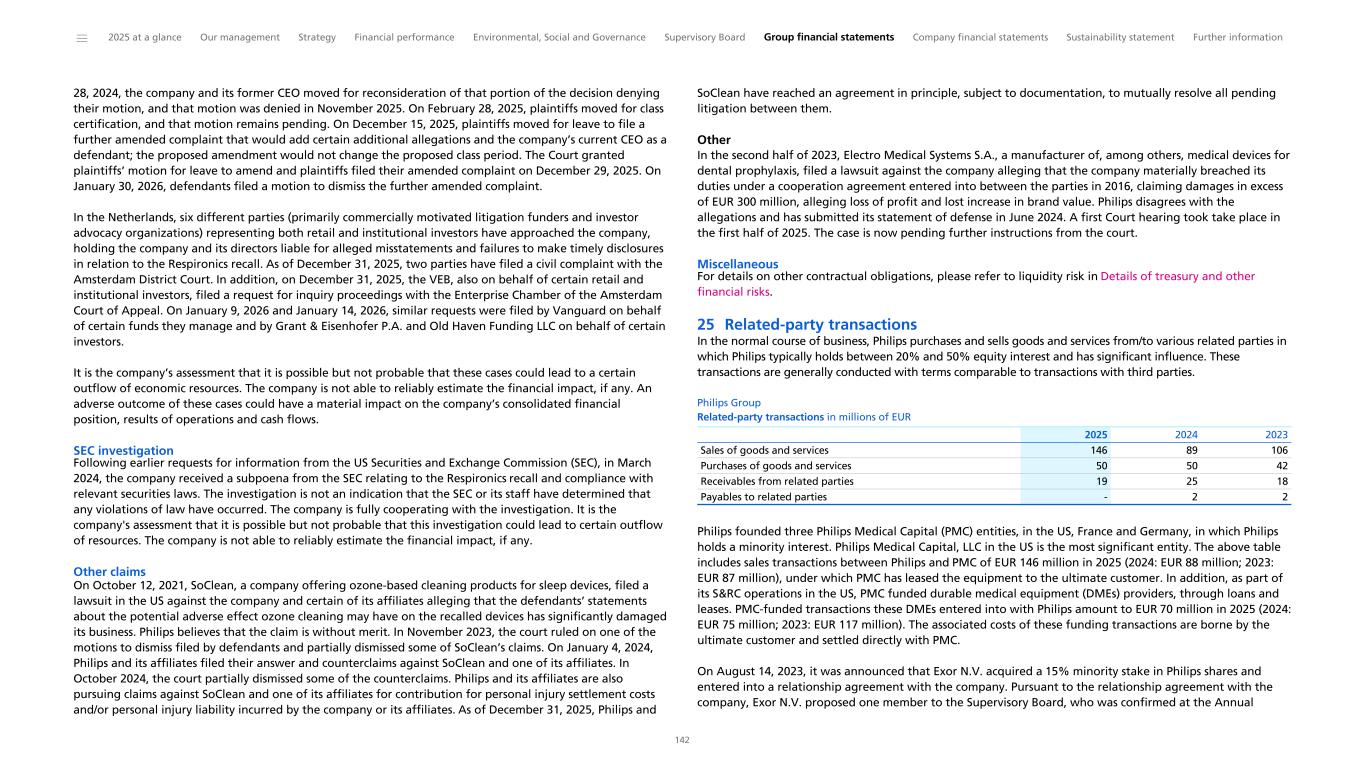
28, 2024, the company and its former CEO moved for reconsideration of that portion of the decision denying their motion, and that motion was denied in November 2025. On February 28, 2025, plaintiffs moved for class certification, and that motion remains pending. On December 15, 2025, plaintiffs moved for leave to file a further amended complaint that would add certain additional allegations and the company’s current CEO as a defendant; the proposed amendment would not change the proposed class period. The Court granted plaintiffs’ motion for leave to amend and plaintiffs filed their amended complaint on December 29, 2025. On January 30, 2026, defendants filed a motion to dismiss the further amended complaint. In the Netherlands, six different parties (primarily commercially motivated litigation funders and investor advocacy organizations) representing both retail and institutional investors have approached the company, holding the company and its directors liable for alleged misstatements and failures to make timely disclosures in relation to the Respironics recall. As of December 31, 2025, two parties have filed a civil complaint with the Amsterdam District Court. In addition, on December 31, 2025, the VEB, also on behalf of certain retail and institutional investors, filed a request for inquiry proceedings with the Enterprise Chamber of the Amsterdam Court of Appeal. On January 9, 2026 and January 14, 2026, similar requests were filed by Vanguard on behalf of certain funds they manage and by Grant & Eisenhofer P.A. and Old Haven Funding LLC on behalf of certain investors. It is the company’s assessment that it is possible but not probable that these cases could lead to a certain outflow of economic resources. The company is not able to reliably estimate the financial impact, if any. An adverse outcome of these cases could have a material impact on the company’s consolidated financial position, results of operations and cash flows. SEC investigation Following earlier requests for information from the US Securities and Exchange Commission (SEC), in March 2024, the company received a subpoena from the SEC relating to the Respironics recall and compliance with relevant securities laws. The investigation is not an indication that the SEC or its staff have determined that any violations of law have occurred. The company is fully cooperating with the investigation. It is the company's assessment that it is possible but not probable that this investigation could lead to certain outflow of resources. The company is not able to reliably estimate the financial impact, if any. Other claims On October 12, 2021, SoClean, a company offering ozone-based cleaning products for sleep devices, filed a lawsuit in the US against the company and certain of its affiliates alleging that the defendants’ statements about the potential adverse effect ozone cleaning may have on the recalled devices has significantly damaged its business. Philips believes that the claim is without merit. In November 2023, the court ruled on one of the motions to dismiss filed by defendants and partially dismissed some of SoClean’s claims. On January 4, 2024, Philips and its affiliates filed their answer and counterclaims against SoClean and one of its affiliates. In October 2024, the court partially dismissed some of the counterclaims. Philips and its affiliates are also pursuing claims against SoClean and one of its affiliates for contribution for personal injury settlement costs and/or personal injury liability incurred by the company or its affiliates. As of December 31, 2025, Philips and SoClean have reached an agreement in principle, subject to documentation, to mutually resolve all pending litigation between them. Other In the second half of 2023, Electro Medical Systems S.A., a manufacturer of, among others, medical devices for dental prophylaxis, filed a lawsuit against the company alleging that the company materially breached its duties under a cooperation agreement entered into between the parties in 2016, claiming damages in excess of EUR 300 million, alleging loss of profit and lost increase in brand value. Philips disagrees with the allegations and has submitted its statement of defense in June 2024. A first Court hearing took take place in the first half of 2025. The case is now pending further instructions from the court. Miscellaneous For details on other contractual obligations, please refer to liquidity risk in Details of treasury and other financial risks. 25 Related-party transactions In the normal course of business, Philips purchases and sells goods and services from/to various related parties in which Philips typically holds between 20% and 50% equity interest and has significant influence. These transactions are generally conducted with terms comparable to transactions with third parties. Philips Group Related-party transactions in millions of EUR Sales of goods and services 146 89 106 Purchases of goods and services 50 50 42 Receivables from related parties 19 25 18 Payables to related parties - 2 2 2025 2024 2023 Philips founded three Philips Medical Capital (PMC) entities, in the US, France and Germany, in which Philips holds a minority interest. Philips Medical Capital, LLC in the US is the most significant entity. The above table includes sales transactions between Philips and PMC of EUR 146 million in 2025 (2024: EUR 88 million; 2023: EUR 87 million), under which PMC has leased the equipment to the ultimate customer. In addition, as part of its S&RC operations in the US, PMC funded durable medical equipment (DMEs) providers, through loans and leases. PMC-funded transactions these DMEs entered into with Philips amount to EUR 70 million in 2025 (2024: EUR 75 million; 2023: EUR 117 million). The associated costs of these funding transactions are borne by the ultimate customer and settled directly with PMC. On August 14, 2023, it was announced that Exor N.V. acquired a 15% minority stake in Philips shares and entered into a relationship agreement with the company. Pursuant to the relationship agreement with the company, Exor N.V. proposed one member to the Supervisory Board, who was confirmed at the Annual ______ 2025 at a glance Our management Strategy Financial performance Environmental, Social and Governance Supervisory Board Group financial statements Company financial statements Sustainability statement Further information 142
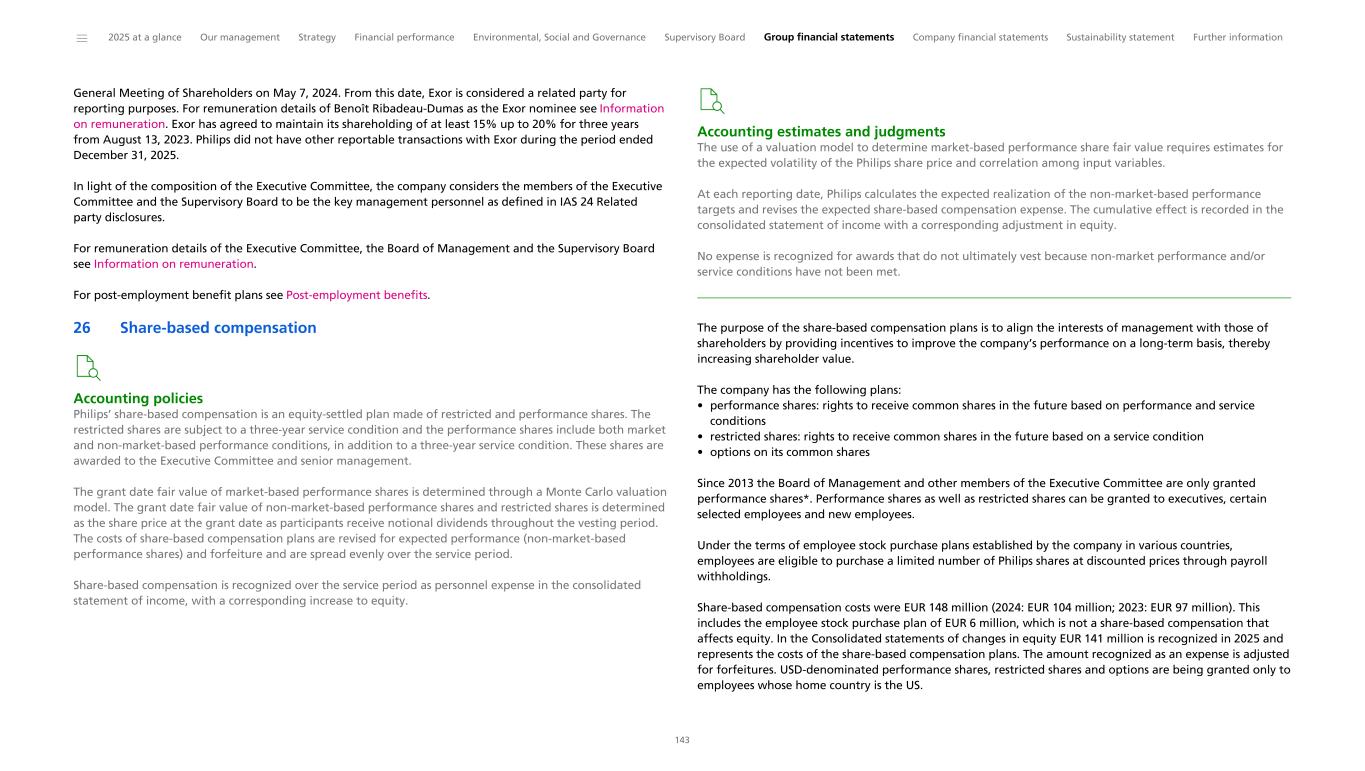
General Meeting of Shareholders on May 7, 2024. From this date, Exor is considered a related party for reporting purposes. For remuneration details of Benoît Ribadeau-Dumas as the Exor nominee see Information on remuneration. Exor has agreed to maintain its shareholding of at least 15% up to 20% for three years from August 13, 2023. Philips did not have other reportable transactions with Exor during the period ended December 31, 2025. In light of the composition of the Executive Committee, the company considers the members of the Executive Committee and the Supervisory Board to be the key management personnel as defined in IAS 24 Related party disclosures. For remuneration details of the Executive Committee, the Board of Management and the Supervisory Board see Information on remuneration. For post-employment benefit plans see Post-employment benefits. 26 Share-based compensation Accounting policies Philips’ share-based compensation is an equity-settled plan made of restricted and performance shares. The restricted shares are subject to a three-year service condition and the performance shares include both market and non-market-based performance conditions, in addition to a three-year service condition. These shares are awarded to the Executive Committee and senior management. The grant date fair value of market-based performance shares is determined through a Monte Carlo valuation model. The grant date fair value of non-market-based performance shares and restricted shares is determined as the share price at the grant date as participants receive notional dividends throughout the vesting period. The costs of share-based compensation plans are revised for expected performance (non-market-based performance shares) and forfeiture and are spread evenly over the service period. Share-based compensation is recognized over the service period as personnel expense in the consolidated statement of income, with a corresponding increase to equity. Accounting estimates and judgments The use of a valuation model to determine market-based performance share fair value requires estimates for the expected volatility of the Philips share price and correlation among input variables. At each reporting date, Philips calculates the expected realization of the non-market-based performance targets and revises the expected share-based compensation expense. The cumulative effect is recorded in the consolidated statement of income with a corresponding adjustment in equity. No expense is recognized for awards that do not ultimately vest because non-market performance and/or service conditions have not been met. The purpose of the share-based compensation plans is to align the interests of management with those of shareholders by providing incentives to improve the company’s performance on a long-term basis, thereby increasing shareholder value. The company has the following plans: • performance shares: rights to receive common shares in the future based on performance and service conditions • restricted shares: rights to receive common shares in the future based on a service condition • options on its common shares Since 2013 the Board of Management and other members of the Executive Committee are only granted performance shares*. Performance shares as well as restricted shares can be granted to executives, certain selected employees and new employees. Under the terms of employee stock purchase plans established by the company in various countries, employees are eligible to purchase a limited number of Philips shares at discounted prices through payroll withholdings. Share-based compensation costs were EUR 148 million (2024: EUR 104 million; 2023: EUR 97 million). This includes the employee stock purchase plan of EUR 6 million, which is not a share-based compensation that affects equity. In the Consolidated statements of changes in equity EUR 141 million is recognized in 2025 and represents the costs of the share-based compensation plans. The amount recognized as an expense is adjusted for forfeitures. USD-denominated performance shares, restricted shares and options are being granted only to employees whose home country is the US. ______ 2025 at a glance Our management Strategy Financial performance Environmental, Social and Governance Supervisory Board Group financial statements Company financial statements Sustainability statement Further information 143
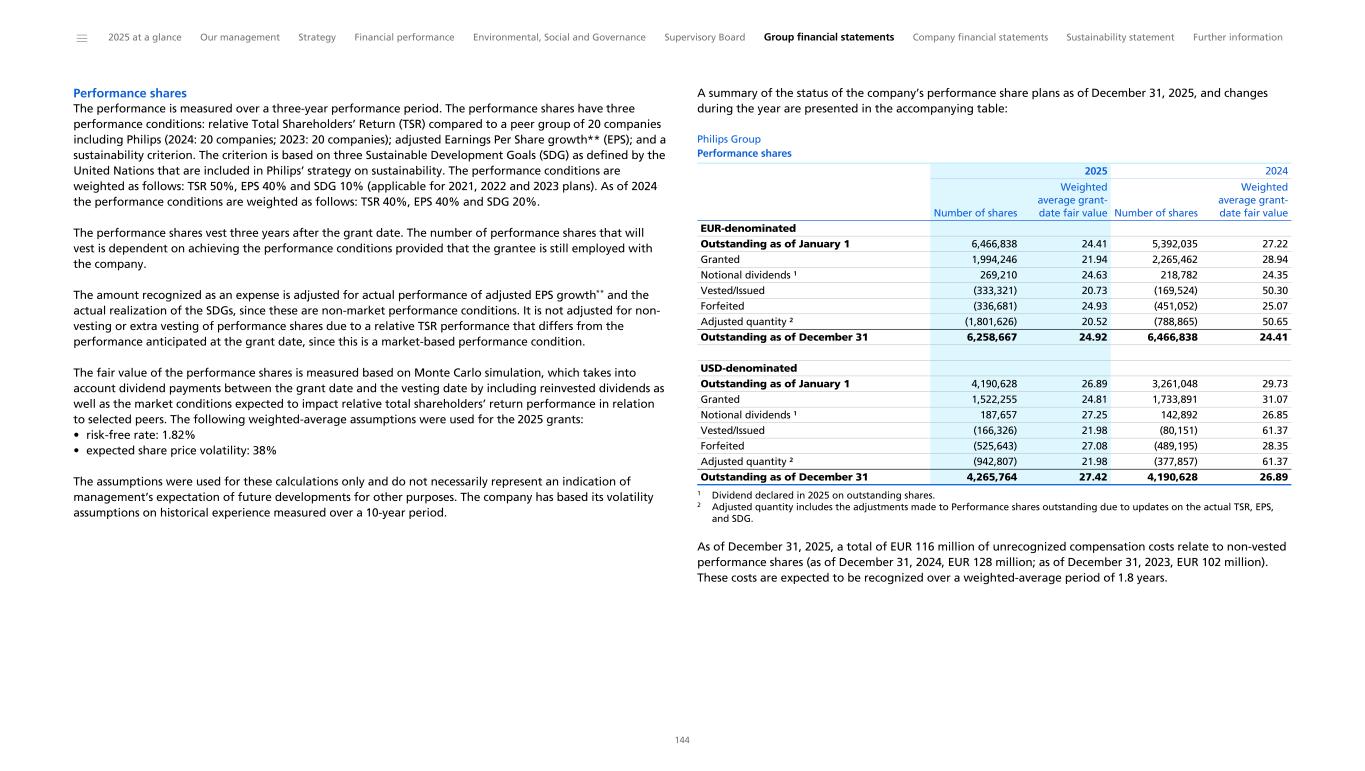
Performance shares The performance is measured over a three-year performance period. The performance shares have three performance conditions: relative Total Shareholders’ Return (TSR) compared to a peer group of 20 companies including Philips (2024: 20 companies; 2023: 20 companies); adjusted Earnings Per Share growth** (EPS); and a sustainability criterion. The criterion is based on three Sustainable Development Goals (SDG) as defined by the United Nations that are included in Philips’ strategy on sustainability. The performance conditions are weighted as follows: TSR 50%, EPS 40% and SDG 10% (applicable for 2021, 2022 and 2023 plans). As of 2024 the performance conditions are weighted as follows: TSR 40%, EPS 40% and SDG 20%. The performance shares vest three years after the grant date. The number of performance shares that will vest is dependent on achieving the performance conditions provided that the grantee is still employed with the company. The amount recognized as an expense is adjusted for actual performance of adjusted EPS growth** and the actual realization of the SDGs, since these are non-market performance conditions. It is not adjusted for non- vesting or extra vesting of performance shares due to a relative TSR performance that differs from the performance anticipated at the grant date, since this is a market-based performance condition. The fair value of the performance shares is measured based on Monte Carlo simulation, which takes into account dividend payments between the grant date and the vesting date by including reinvested dividends as well as the market conditions expected to impact relative total shareholders’ return performance in relation to selected peers. The following weighted-average assumptions were used for the 2025 grants: • risk-free rate: 1.82% • expected share price volatility: 38% The assumptions were used for these calculations only and do not necessarily represent an indication of management’s expectation of future developments for other purposes. The company has based its volatility assumptions on historical experience measured over a 10-year period. A summary of the status of the company’s performance share plans as of December 31, 2025, and changes during the year are presented in the accompanying table: Philips Group Performance shares EUR-denominated Outstanding as of January 1 6,466,838 24.41 5,392,035 27.22 Granted 1,994,246 21.94 2,265,462 28.94 Notional dividends ¹ 269,210 24.63 218,782 24.35 Vested/Issued (333,321) 20.73 (169,524) 50.30 Forfeited (336,681) 24.93 (451,052) 25.07 Adjusted quantity ² (1,801,626) 20.52 (788,865) 50.65 Outstanding as of December 31 6,258,667 24.92 6,466,838 24.41 USD-denominated Outstanding as of January 1 4,190,628 26.89 3,261,048 29.73 Granted 1,522,255 24.81 1,733,891 31.07 Notional dividends ¹ 187,657 27.25 142,892 26.85 Vested/Issued (166,326) 21.98 (80,151) 61.37 Forfeited (525,643) 27.08 (489,195) 28.35 Adjusted quantity ² (942,807) 21.98 (377,857) 61.37 Outstanding as of December 31 4,265,764 27.42 4,190,628 26.89 2025 2024 Number of shares Weighted average grant- date fair value Number of shares Weighted average grant- date fair value 1 Dividend declared in 2025 on outstanding shares. 2 Adjusted quantity includes the adjustments made to Performance shares outstanding due to updates on the actual TSR, EPS, and SDG. As of December 31, 2025, a total of EUR 116 million of unrecognized compensation costs relate to non-vested performance shares (as of December 31, 2024, EUR 128 million; as of December 31, 2023, EUR 102 million). These costs are expected to be recognized over a weighted-average period of 1.8 years. ______ 2025 at a glance Our management Strategy Financial performance Environmental, Social and Governance Supervisory Board Group financial statements Company financial statements Sustainability statement Further information 144
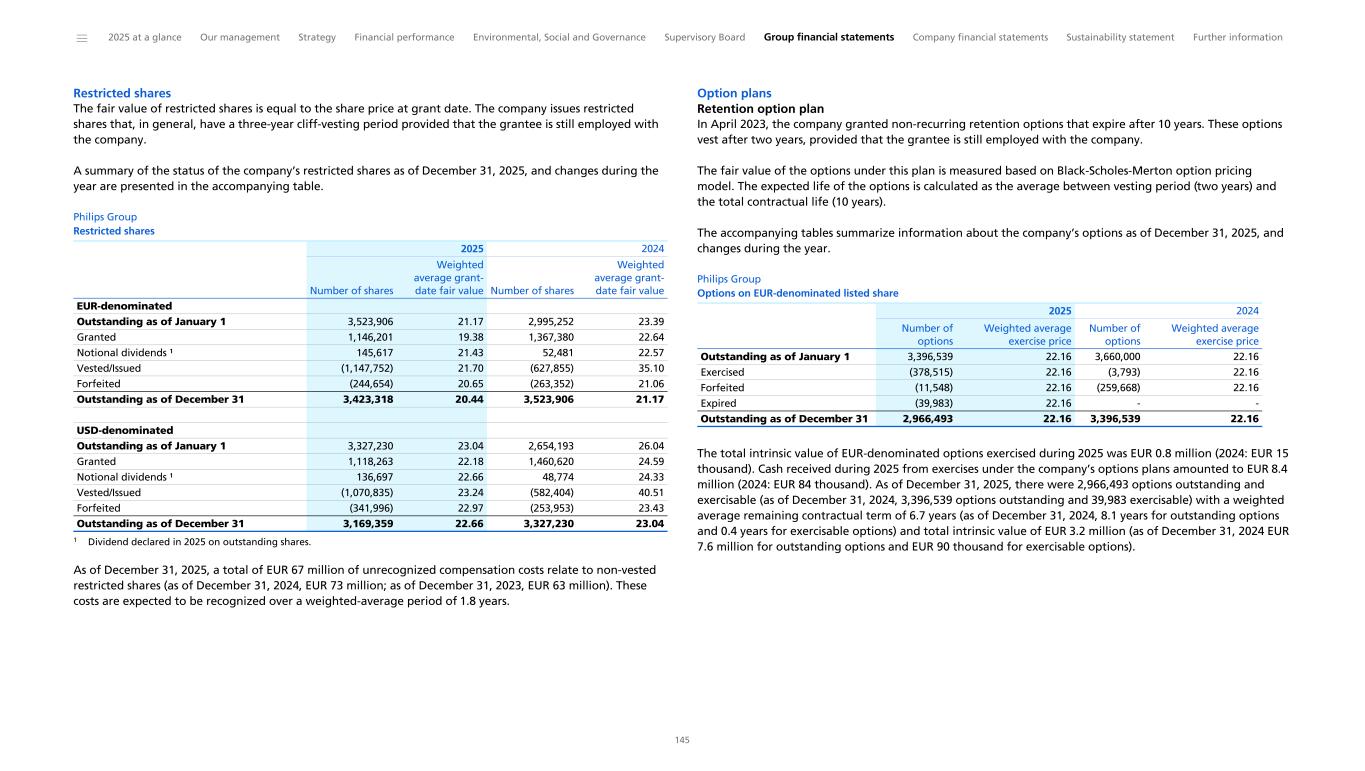
Restricted shares The fair value of restricted shares is equal to the share price at grant date. The company issues restricted shares that, in general, have a three-year cliff-vesting period provided that the grantee is still employed with the company. A summary of the status of the company’s restricted shares as of December 31, 2025, and changes during the year are presented in the accompanying table. Philips Group Restricted shares EUR-denominated Outstanding as of January 1 3,523,906 21.17 2,995,252 23.39 Granted 1,146,201 19.38 1,367,380 22.64 Notional dividends ¹ 145,617 21.43 52,481 22.57 Vested/Issued (1,147,752) 21.70 (627,855) 35.10 Forfeited (244,654) 20.65 (263,352) 21.06 Outstanding as of December 31 3,423,318 20.44 3,523,906 21.17 USD-denominated Outstanding as of January 1 3,327,230 23.04 2,654,193 26.04 Granted 1,118,263 22.18 1,460,620 24.59 Notional dividends ¹ 136,697 22.66 48,774 24.33 Vested/Issued (1,070,835) 23.24 (582,404) 40.51 Forfeited (341,996) 22.97 (253,953) 23.43 Outstanding as of December 31 3,169,359 22.66 3,327,230 23.04 2025 2024 Number of shares Weighted average grant- date fair value Number of shares Weighted average grant- date fair value 1 Dividend declared in 2025 on outstanding shares. As of December 31, 2025, a total of EUR 67 million of unrecognized compensation costs relate to non-vested restricted shares (as of December 31, 2024, EUR 73 million; as of December 31, 2023, EUR 63 million). These costs are expected to be recognized over a weighted-average period of 1.8 years. Option plans Retention option plan In April 2023, the company granted non-recurring retention options that expire after 10 years. These options vest after two years, provided that the grantee is still employed with the company. The fair value of the options under this plan is measured based on Black-Scholes-Merton option pricing model. The expected life of the options is calculated as the average between vesting period (two years) and the total contractual life (10 years). The accompanying tables summarize information about the company’s options as of December 31, 2025, and changes during the year. Philips Group Options on EUR-denominated listed share Number of options Weighted average exercise price Number of options Weighted average exercise price Outstanding as of January 1 3,396,539 22.16 3,660,000 22.16 Exercised (378,515) 22.16 (3,793) 22.16 Forfeited (11,548) 22.16 (259,668) 22.16 Expired (39,983) 22.16 - - Outstanding as of December 31 2,966,493 22.16 3,396,539 22.16 2025 2024 The total intrinsic value of EUR-denominated options exercised during 2025 was EUR 0.8 million (2024: EUR 15 thousand). Cash received during 2025 from exercises under the company’s options plans amounted to EUR 8.4 million (2024: EUR 84 thousand). As of December 31, 2025, there were 2,966,493 options outstanding and exercisable (as of December 31, 2024, 3,396,539 options outstanding and 39,983 exercisable) with a weighted average remaining contractual term of 6.7 years (as of December 31, 2024, 8.1 years for outstanding options and 0.4 years for exercisable options) and total intrinsic value of EUR 3.2 million (as of December 31, 2024 EUR 7.6 million for outstanding options and EUR 90 thousand for exercisable options). ______ 2025 at a glance Our management Strategy Financial performance Environmental, Social and Governance Supervisory Board Group financial statements Company financial statements Sustainability statement Further information 145
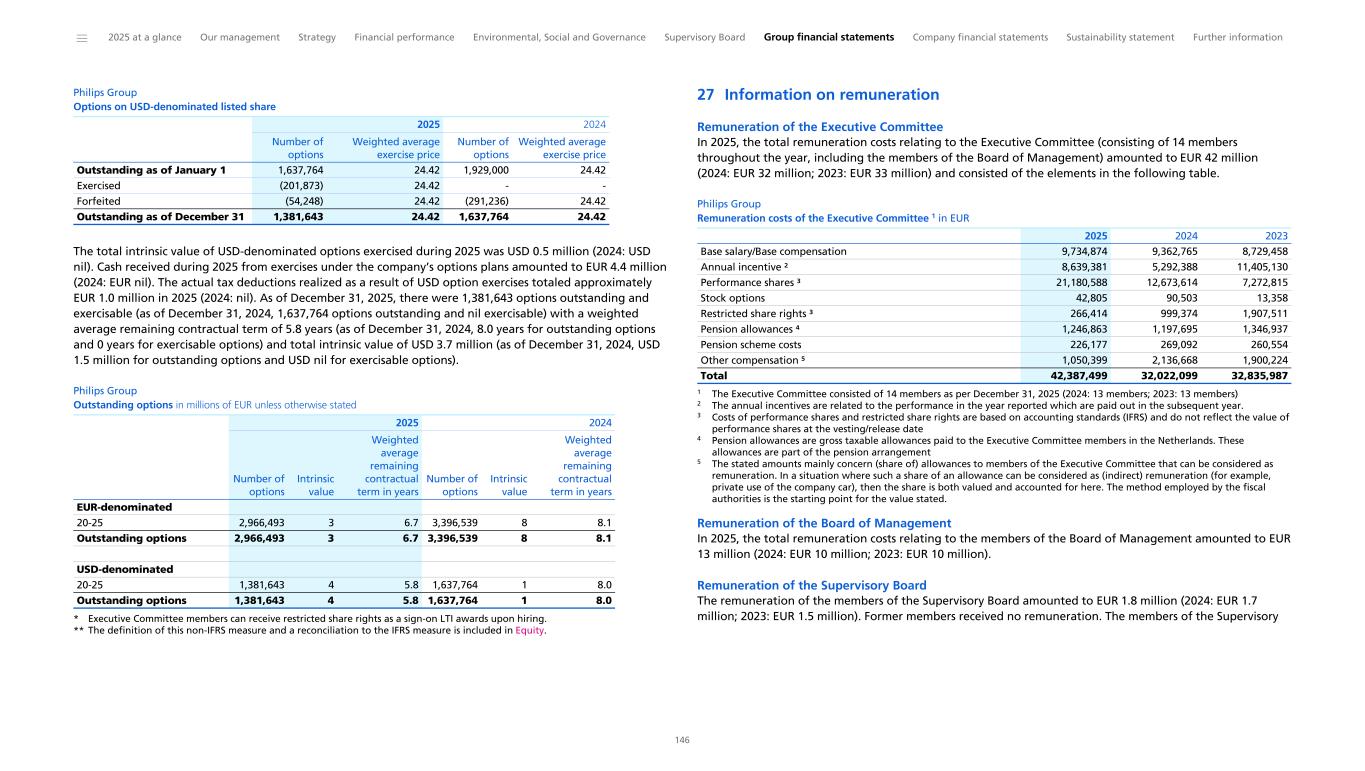
Philips Group Options on USD-denominated listed share Number of options Weighted average exercise price Number of options Weighted average exercise price Outstanding as of January 1 1,637,764 24.42 1,929,000 24.42 Exercised (201,873) 24.42 - - Forfeited (54,248) 24.42 (291,236) 24.42 Outstanding as of December 31 1,381,643 24.42 1,637,764 24.42 2025 2024 The total intrinsic value of USD-denominated options exercised during 2025 was USD 0.5 million (2024: USD nil). Cash received during 2025 from exercises under the company’s options plans amounted to EUR 4.4 million (2024: EUR nil). The actual tax deductions realized as a result of USD option exercises totaled approximately EUR 1.0 million in 2025 (2024: nil). As of December 31, 2025, there were 1,381,643 options outstanding and exercisable (as of December 31, 2024, 1,637,764 options outstanding and nil exercisable) with a weighted average remaining contractual term of 5.8 years (as of December 31, 2024, 8.0 years for outstanding options and 0 years for exercisable options) and total intrinsic value of USD 3.7 million (as of December 31, 2024, USD 1.5 million for outstanding options and USD nil for exercisable options). Philips Group Outstanding options in millions of EUR unless otherwise stated Number of options Intrinsic value Weighted average remaining contractual term in years Number of options Intrinsic value Weighted average remaining contractual term in years EUR-denominated 20-25 2,966,493 3 6.7 3,396,539 8 8.1 Outstanding options 2,966,493 3 6.7 3,396,539 8 8.1 USD-denominated 20-25 1,381,643 4 5.8 1,637,764 1 8.0 Outstanding options 1,381,643 4 5.8 1,637,764 1 8.0 2025 2024 * Executive Committee members can receive restricted share rights as a sign-on LTI awards upon hiring. ** The definition of this non-IFRS measure and a reconciliation to the IFRS measure is included in Equity. 27 Information on remuneration Remuneration of the Executive Committee In 2025, the total remuneration costs relating to the Executive Committee (consisting of 14 members throughout the year, including the members of the Board of Management) amounted to EUR 42 million (2024: EUR 32 million; 2023: EUR 33 million) and consisted of the elements in the following table. Philips Group Remuneration costs of the Executive Committee 1 in EUR Base salary/Base compensation 9,734,874 9,362,765 8,729,458 Annual incentive ² 8,639,381 5,292,388 11,405,130 Performance shares ³ 21,180,588 12,673,614 7,272,815 Stock options 42,805 90,503 13,358 Restricted share rights ³ 266,414 999,374 1,907,511 Pension allowances ⁴ 1,246,863 1,197,695 1,346,937 Pension scheme costs 226,177 269,092 260,554 Other compensation ⁵ 1,050,399 2,136,668 1,900,224 Total 42,387,499 32,022,099 32,835,987 2025 2024 2023 1 The Executive Committee consisted of 14 members as per December 31, 2025 (2024: 13 members; 2023: 13 members) 2 The annual incentives are related to the performance in the year reported which are paid out in the subsequent year. 3 Costs of performance shares and restricted share rights are based on accounting standards (IFRS) and do not reflect the value of performance shares at the vesting/release date 4 Pension allowances are gross taxable allowances paid to the Executive Committee members in the Netherlands. These allowances are part of the pension arrangement 5 The stated amounts mainly concern (share of) allowances to members of the Executive Committee that can be considered as remuneration. In a situation where such a share of an allowance can be considered as (indirect) remuneration (for example, private use of the company car), then the share is both valued and accounted for here. The method employed by the fiscal authorities is the starting point for the value stated. Remuneration of the Board of Management In 2025, the total remuneration costs relating to the members of the Board of Management amounted to EUR 13 million (2024: EUR 10 million; 2023: EUR 10 million). Remuneration of the Supervisory Board The remuneration of the members of the Supervisory Board amounted to EUR 1.8 million (2024: EUR 1.7 million; 2023: EUR 1.5 million). Former members received no remuneration. The members of the Supervisory ______ 2025 at a glance Our management Strategy Financial performance Environmental, Social and Governance Supervisory Board Group financial statements Company financial statements Sustainability statement Further information 146
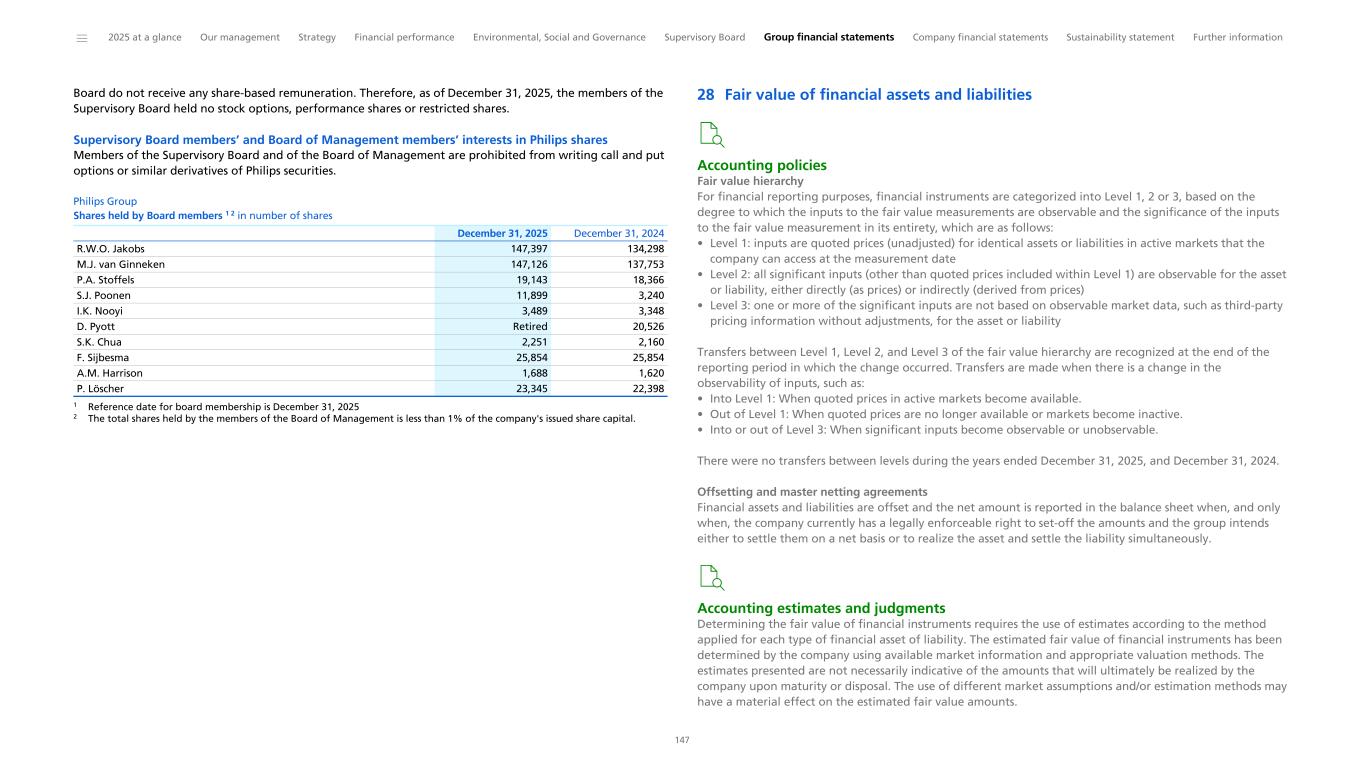
Board do not receive any share-based remuneration. Therefore, as of December 31, 2025, the members of the Supervisory Board held no stock options, performance shares or restricted shares. Supervisory Board members’ and Board of Management members’ interests in Philips shares Members of the Supervisory Board and of the Board of Management are prohibited from writing call and put options or similar derivatives of Philips securities. Philips Group Shares held by Board members 1 2 in number of shares R.W.O. Jakobs 147,397 134,298 M.J. van Ginneken 147,126 137,753 P.A. Stoffels 19,143 18,366 S.J. Poonen 11,899 3,240 I.K. Nooyi 3,489 3,348 D. Pyott Retired 20,526 S.K. Chua 2,251 2,160 F. Sijbesma 25,854 25,854 A.M. Harrison 1,688 1,620 P. Löscher 23,345 22,398 December 31, 2025 December 31, 2024 1 Reference date for board membership is December 31, 2025 2 The total shares held by the members of the Board of Management is less than 1% of the company's issued share capital. 28 Fair value of financial assets and liabilities Accounting policies Fair value hierarchy For financial reporting purposes, financial instruments are categorized into Level 1, 2 or 3, based on the degree to which the inputs to the fair value measurements are observable and the significance of the inputs to the fair value measurement in its entirety, which are as follows: • Level 1: inputs are quoted prices (unadjusted) for identical assets or liabilities in active markets that the company can access at the measurement date • Level 2: all significant inputs (other than quoted prices included within Level 1) are observable for the asset or liability, either directly (as prices) or indirectly (derived from prices) • Level 3: one or more of the significant inputs are not based on observable market data, such as third-party pricing information without adjustments, for the asset or liability Transfers between Level 1, Level 2, and Level 3 of the fair value hierarchy are recognized at the end of the reporting period in which the change occurred. Transfers are made when there is a change in the observability of inputs, such as: • Into Level 1: When quoted prices in active markets become available. • Out of Level 1: When quoted prices are no longer available or markets become inactive. • Into or out of Level 3: When significant inputs become observable or unobservable. There were no transfers between levels during the years ended December 31, 2025, and December 31, 2024. Offsetting and master netting agreements Financial assets and liabilities are offset and the net amount is reported in the balance sheet when, and only when, the company currently has a legally enforceable right to set-off the amounts and the group intends either to settle them on a net basis or to realize the asset and settle the liability simultaneously. Accounting estimates and judgments Determining the fair value of financial instruments requires the use of estimates according to the method applied for each type of financial asset of liability. The estimated fair value of financial instruments has been determined by the company using available market information and appropriate valuation methods. The estimates presented are not necessarily indicative of the amounts that will ultimately be realized by the company upon maturity or disposal. The use of different market assumptions and/or estimation methods may have a material effect on the estimated fair value amounts. ______ 2025 at a glance Our management Strategy Financial performance Environmental, Social and Governance Supervisory Board Group financial statements Company financial statements Sustainability statement Further information 147
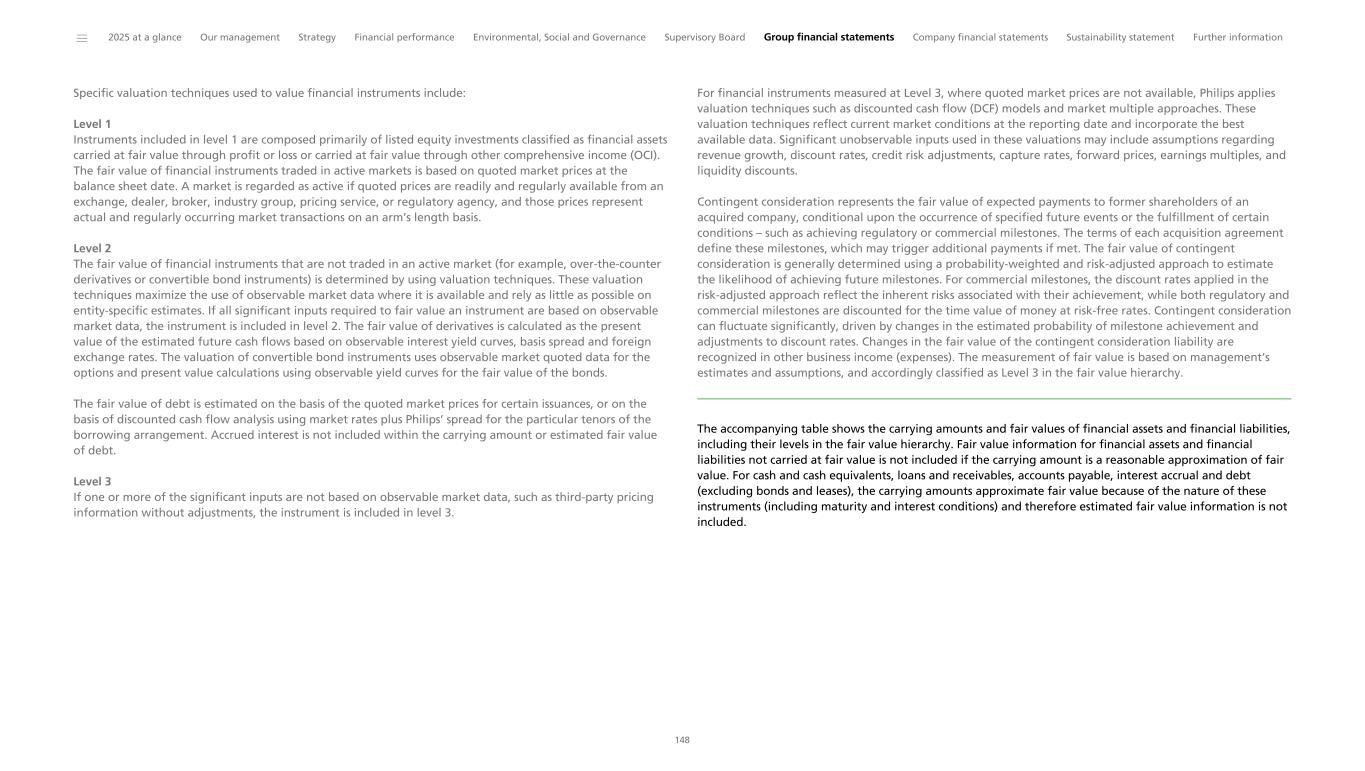
Specific valuation techniques used to value financial instruments include: Level 1 Instruments included in level 1 are composed primarily of listed equity investments classified as financial assets carried at fair value through profit or loss or carried at fair value through other comprehensive income (OCI). The fair value of financial instruments traded in active markets is based on quoted market prices at the balance sheet date. A market is regarded as active if quoted prices are readily and regularly available from an exchange, dealer, broker, industry group, pricing service, or regulatory agency, and those prices represent actual and regularly occurring market transactions on an arm’s length basis. Level 2 The fair value of financial instruments that are not traded in an active market (for example, over-the-counter derivatives or convertible bond instruments) is determined by using valuation techniques. These valuation techniques maximize the use of observable market data where it is available and rely as little as possible on entity-specific estimates. If all significant inputs required to fair value an instrument are based on observable market data, the instrument is included in level 2. The fair value of derivatives is calculated as the present value of the estimated future cash flows based on observable interest yield curves, basis spread and foreign exchange rates. The valuation of convertible bond instruments uses observable market quoted data for the options and present value calculations using observable yield curves for the fair value of the bonds. The fair value of debt is estimated on the basis of the quoted market prices for certain issuances, or on the basis of discounted cash flow analysis using market rates plus Philips’ spread for the particular tenors of the borrowing arrangement. Accrued interest is not included within the carrying amount or estimated fair value of debt. Level 3 If one or more of the significant inputs are not based on observable market data, such as third-party pricing information without adjustments, the instrument is included in level 3. For financial instruments measured at Level 3, where quoted market prices are not available, Philips applies valuation techniques such as discounted cash flow (DCF) models and market multiple approaches. These valuation techniques reflect current market conditions at the reporting date and incorporate the best available data. Significant unobservable inputs used in these valuations may include assumptions regarding revenue growth, discount rates, credit risk adjustments, capture rates, forward prices, earnings multiples, and liquidity discounts. Contingent consideration represents the fair value of expected payments to former shareholders of an acquired company, conditional upon the occurrence of specified future events or the fulfillment of certain conditions – such as achieving regulatory or commercial milestones. The terms of each acquisition agreement define these milestones, which may trigger additional payments if met. The fair value of contingent consideration is generally determined using a probability-weighted and risk-adjusted approach to estimate the likelihood of achieving future milestones. For commercial milestones, the discount rates applied in the risk-adjusted approach reflect the inherent risks associated with their achievement, while both regulatory and commercial milestones are discounted for the time value of money at risk-free rates. Contingent consideration can fluctuate significantly, driven by changes in the estimated probability of milestone achievement and adjustments to discount rates. Changes in the fair value of the contingent consideration liability are recognized in other business income (expenses). The measurement of fair value is based on management’s estimates and assumptions, and accordingly classified as Level 3 in the fair value hierarchy. The accompanying table shows the carrying amounts and fair values of financial assets and financial liabilities, including their levels in the fair value hierarchy. Fair value information for financial assets and financial liabilities not carried at fair value is not included if the carrying amount is a reasonable approximation of fair value. For cash and cash equivalents, loans and receivables, accounts payable, interest accrual and debt (excluding bonds and leases), the carrying amounts approximate fair value because of the nature of these instruments (including maturity and interest conditions) and therefore estimated fair value information is not included. ______ 2025 at a glance Our management Strategy Financial performance Environmental, Social and Governance Supervisory Board Group financial statements Company financial statements Sustainability statement Further information 148
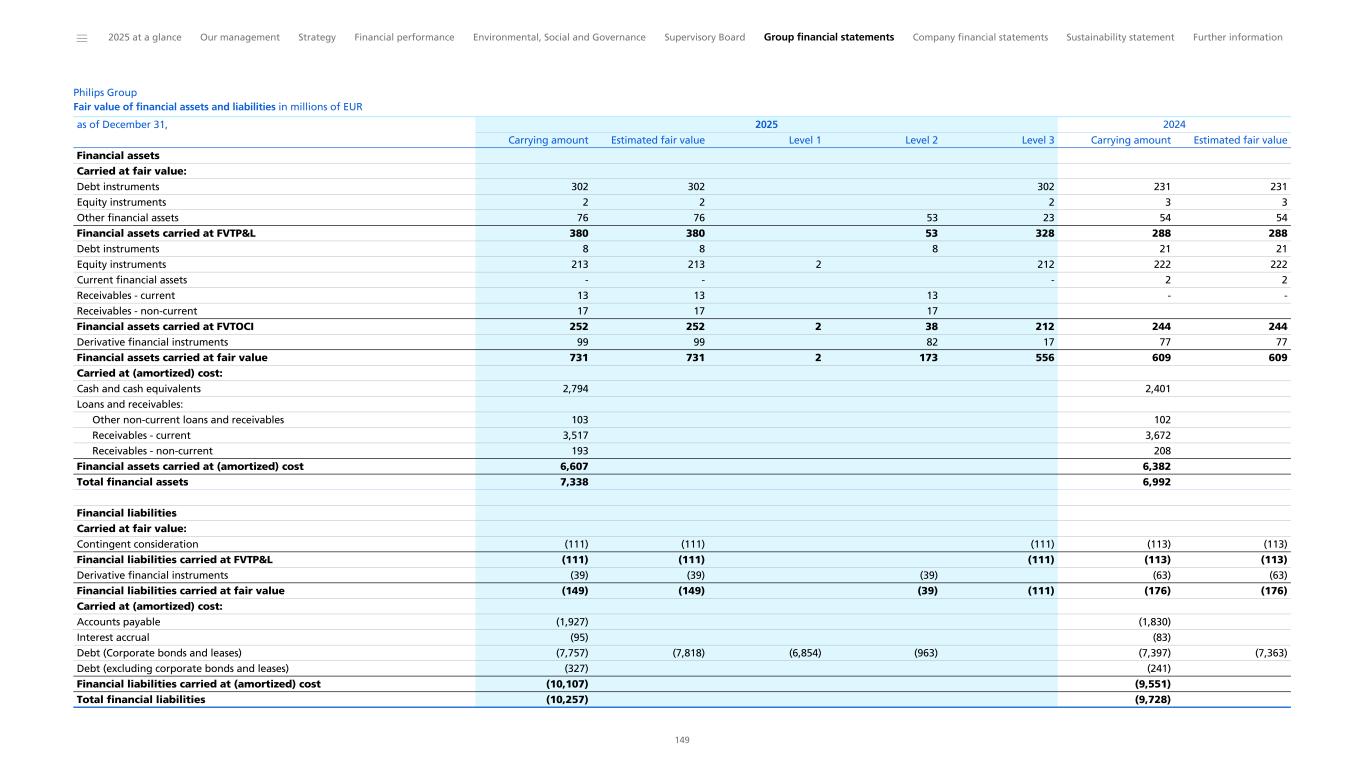
Philips Group Fair value of financial assets and liabilities in millions of EUR Financial assets Carried at fair value: Debt instruments 302 302 302 231 231 Equity instruments 2 2 2 3 3 Other financial assets 76 76 53 23 54 54 Financial assets carried at FVTP&L 380 380 53 328 288 288 Debt instruments 8 8 8 21 21 Equity instruments 213 213 2 212 222 222 Current financial assets - - - 2 2 Receivables - current 13 13 13 - - Receivables - non-current 17 17 17 Financial assets carried at FVTOCI 252 252 2 38 212 244 244 Derivative financial instruments 99 99 82 17 77 77 Financial assets carried at fair value 731 731 2 173 556 609 609 Carried at (amortized) cost: Cash and cash equivalents 2,794 2,401 Loans and receivables: Other non-current loans and receivables 103 102 Receivables - current 3,517 3,672 Receivables - non-current 193 208 Financial assets carried at (amortized) cost 6,607 6,382 Total financial assets 7,338 6,992 Financial liabilities Carried at fair value: Contingent consideration (111) (111) (111) (113) (113) Financial liabilities carried at FVTP&L (111) (111) (111) (113) (113) Derivative financial instruments (39) (39) (39) (63) (63) Financial liabilities carried at fair value (149) (149) (39) (111) (176) (176) Carried at (amortized) cost: Accounts payable (1,927) (1,830) Interest accrual (95) (83) Debt (Corporate bonds and leases) (7,757) (7,818) (6,854) (963) (7,397) (7,363) Debt (excluding corporate bonds and leases) (327) (241) Financial liabilities carried at (amortized) cost (10,107) (9,551) Total financial liabilities (10,257) (9,728) as of December 31, 2025 2024 Carrying amount Estimated fair value Level 1 Level 2 Level 3 Carrying amount Estimated fair value ______ 2025 at a glance Our management Strategy Financial performance Environmental, Social and Governance Supervisory Board Group financial statements Company financial statements Sustainability statement Further information 149
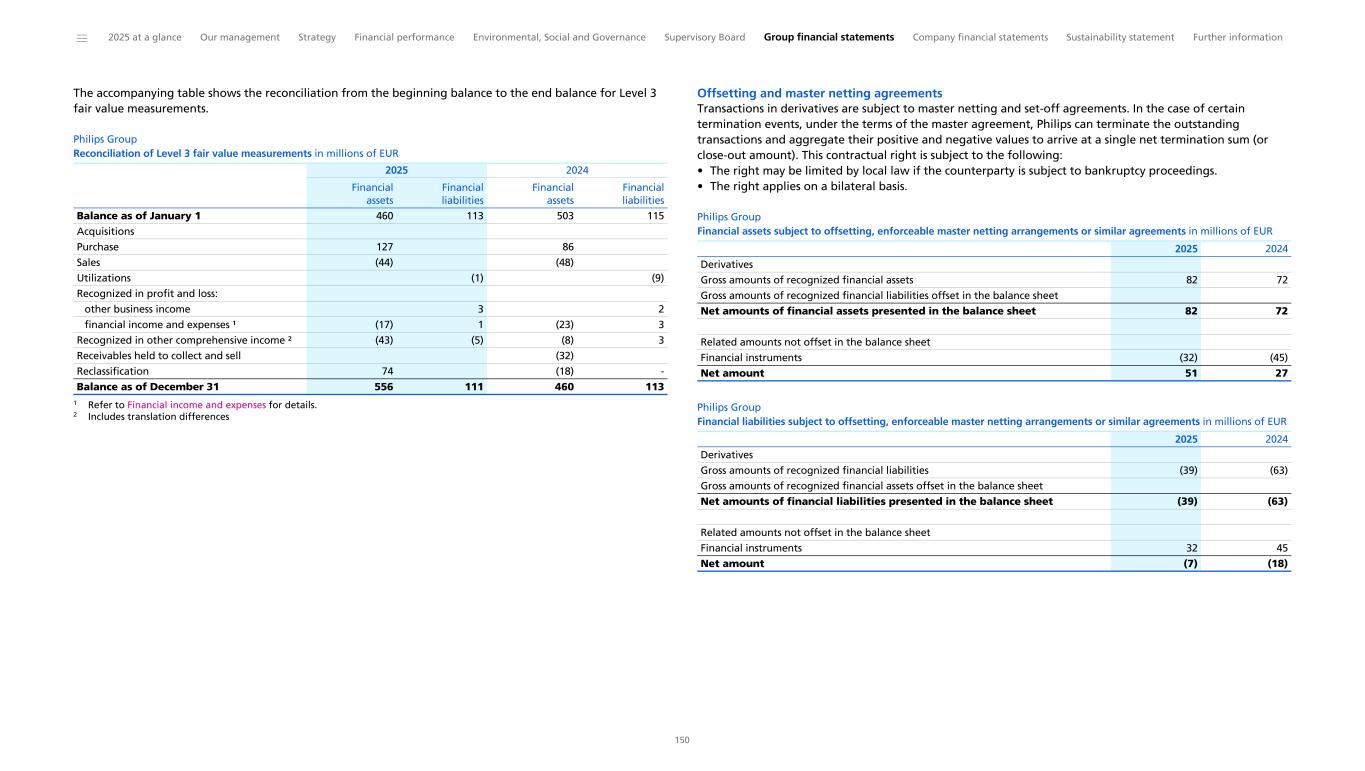
The accompanying table shows the reconciliation from the beginning balance to the end balance for Level 3 fair value measurements. Philips Group Reconciliation of Level 3 fair value measurements in millions of EUR Balance as of January 1 460 113 503 115 Acquisitions Purchase 127 86 Sales (44) (48) Utilizations (1) (9) Recognized in profit and loss: other business income 3 2 financial income and expenses ¹ (17) 1 (23) 3 Recognized in other comprehensive income ² (43) (5) (8) 3 Receivables held to collect and sell (32) Reclassification 74 (18) - Balance as of December 31 556 111 460 113 2025 2024 Financial assets Financial liabilities Financial assets Financial liabilities 1 Refer to Financial income and expenses for details. 2 Includes translation differences Offsetting and master netting agreements Transactions in derivatives are subject to master netting and set-off agreements. In the case of certain termination events, under the terms of the master agreement, Philips can terminate the outstanding transactions and aggregate their positive and negative values to arrive at a single net termination sum (or close-out amount). This contractual right is subject to the following: • The right may be limited by local law if the counterparty is subject to bankruptcy proceedings. • The right applies on a bilateral basis. Philips Group Financial assets subject to offsetting, enforceable master netting arrangements or similar agreements in millions of EUR Derivatives Gross amounts of recognized financial assets 82 72 Gross amounts of recognized financial liabilities offset in the balance sheet Net amounts of financial assets presented in the balance sheet 82 72 Related amounts not offset in the balance sheet Financial instruments (32) (45) Net amount 51 27 2025 2024 Philips Group Financial liabilities subject to offsetting, enforceable master netting arrangements or similar agreements in millions of EUR Derivatives Gross amounts of recognized financial liabilities (39) (63) Gross amounts of recognized financial assets offset in the balance sheet Net amounts of financial liabilities presented in the balance sheet (39) (63) Related amounts not offset in the balance sheet Financial instruments 32 45 Net amount (7) (18) 2025 2024 ______ 2025 at a glance Our management Strategy Financial performance Environmental, Social and Governance Supervisory Board Group financial statements Company financial statements Sustainability statement Further information 150
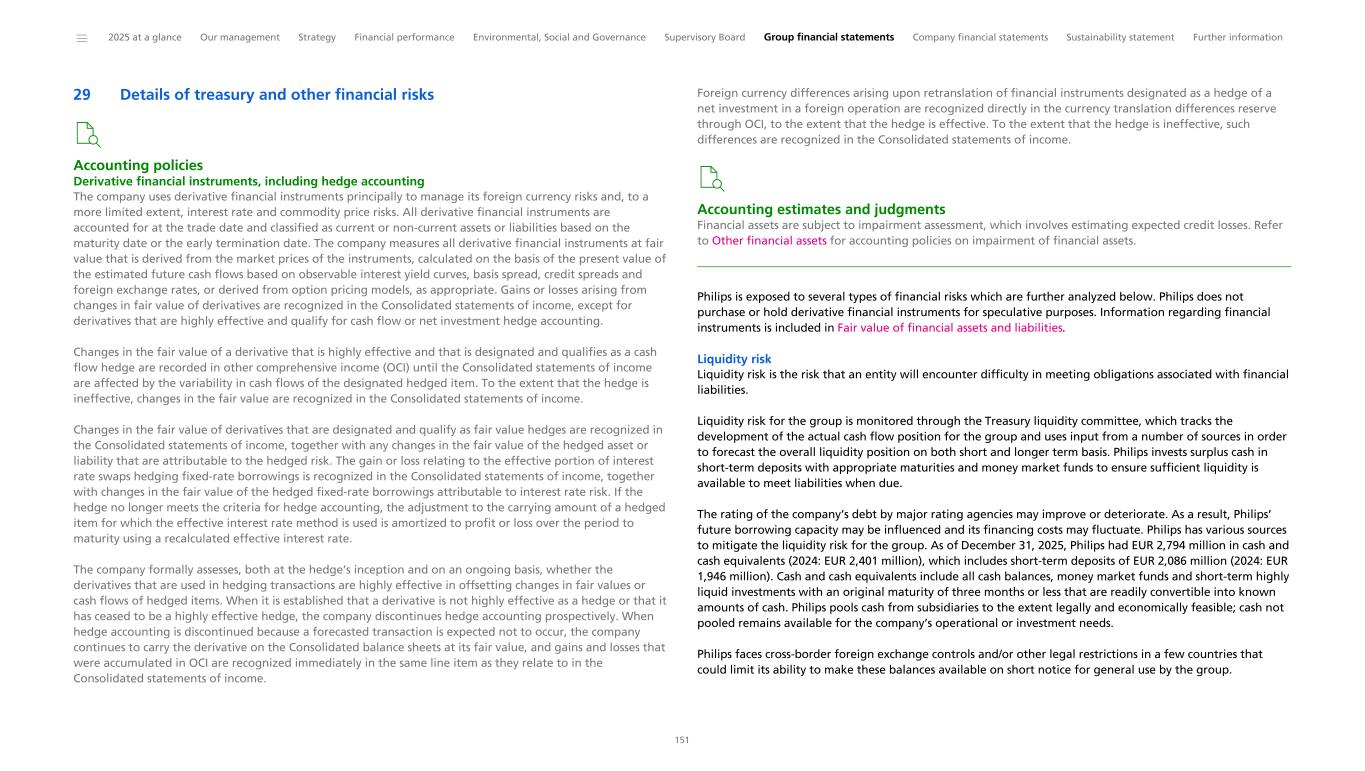
29 Details of treasury and other financial risks Accounting policies Derivative financial instruments, including hedge accounting The company uses derivative financial instruments principally to manage its foreign currency risks and, to a more limited extent, interest rate and commodity price risks. All derivative financial instruments are accounted for at the trade date and classified as current or non-current assets or liabilities based on the maturity date or the early termination date. The company measures all derivative financial instruments at fair value that is derived from the market prices of the instruments, calculated on the basis of the present value of the estimated future cash flows based on observable interest yield curves, basis spread, credit spreads and foreign exchange rates, or derived from option pricing models, as appropriate. Gains or losses arising from changes in fair value of derivatives are recognized in the Consolidated statements of income, except for derivatives that are highly effective and qualify for cash flow or net investment hedge accounting. Changes in the fair value of a derivative that is highly effective and that is designated and qualifies as a cash flow hedge are recorded in other comprehensive income (OCI) until the Consolidated statements of income are affected by the variability in cash flows of the designated hedged item. To the extent that the hedge is ineffective, changes in the fair value are recognized in the Consolidated statements of income. Changes in the fair value of derivatives that are designated and qualify as fair value hedges are recognized in the Consolidated statements of income, together with any changes in the fair value of the hedged asset or liability that are attributable to the hedged risk. The gain or loss relating to the effective portion of interest rate swaps hedging fixed-rate borrowings is recognized in the Consolidated statements of income, together with changes in the fair value of the hedged fixed-rate borrowings attributable to interest rate risk. If the hedge no longer meets the criteria for hedge accounting, the adjustment to the carrying amount of a hedged item for which the effective interest rate method is used is amortized to profit or loss over the period to maturity using a recalculated effective interest rate. The company formally assesses, both at the hedge’s inception and on an ongoing basis, whether the derivatives that are used in hedging transactions are highly effective in offsetting changes in fair values or cash flows of hedged items. When it is established that a derivative is not highly effective as a hedge or that it has ceased to be a highly effective hedge, the company discontinues hedge accounting prospectively. When hedge accounting is discontinued because a forecasted transaction is expected not to occur, the company continues to carry the derivative on the Consolidated balance sheets at its fair value, and gains and losses that were accumulated in OCI are recognized immediately in the same line item as they relate to in the Consolidated statements of income. Foreign currency differences arising upon retranslation of financial instruments designated as a hedge of a net investment in a foreign operation are recognized directly in the currency translation differences reserve through OCI, to the extent that the hedge is effective. To the extent that the hedge is ineffective, such differences are recognized in the Consolidated statements of income. Accounting estimates and judgments Financial assets are subject to impairment assessment, which involves estimating expected credit losses. Refer to Other financial assets for accounting policies on impairment of financial assets. Philips is exposed to several types of financial risks which are further analyzed below. Philips does not purchase or hold derivative financial instruments for speculative purposes. Information regarding financial instruments is included in Fair value of financial assets and liabilities. Liquidity risk Liquidity risk is the risk that an entity will encounter difficulty in meeting obligations associated with financial liabilities. Liquidity risk for the group is monitored through the Treasury liquidity committee, which tracks the development of the actual cash flow position for the group and uses input from a number of sources in order to forecast the overall liquidity position on both short and longer term basis. Philips invests surplus cash in short-term deposits with appropriate maturities and money market funds to ensure sufficient liquidity is available to meet liabilities when due. The rating of the company’s debt by major rating agencies may improve or deteriorate. As a result, Philips’ future borrowing capacity may be influenced and its financing costs may fluctuate. Philips has various sources to mitigate the liquidity risk for the group. As of December 31, 2025, Philips had EUR 2,794 million in cash and cash equivalents (2024: EUR 2,401 million), which includes short-term deposits of EUR 2,086 million (2024: EUR 1,946 million). Cash and cash equivalents include all cash balances, money market funds and short-term highly liquid investments with an original maturity of three months or less that are readily convertible into known amounts of cash. Philips pools cash from subsidiaries to the extent legally and economically feasible; cash not pooled remains available for the company’s operational or investment needs. Philips faces cross-border foreign exchange controls and/or other legal restrictions in a few countries that could limit its ability to make these balances available on short notice for general use by the group. ______ 2025 at a glance Our management Strategy Financial performance Environmental, Social and Governance Supervisory Board Group financial statements Company financial statements Sustainability statement Further information 151
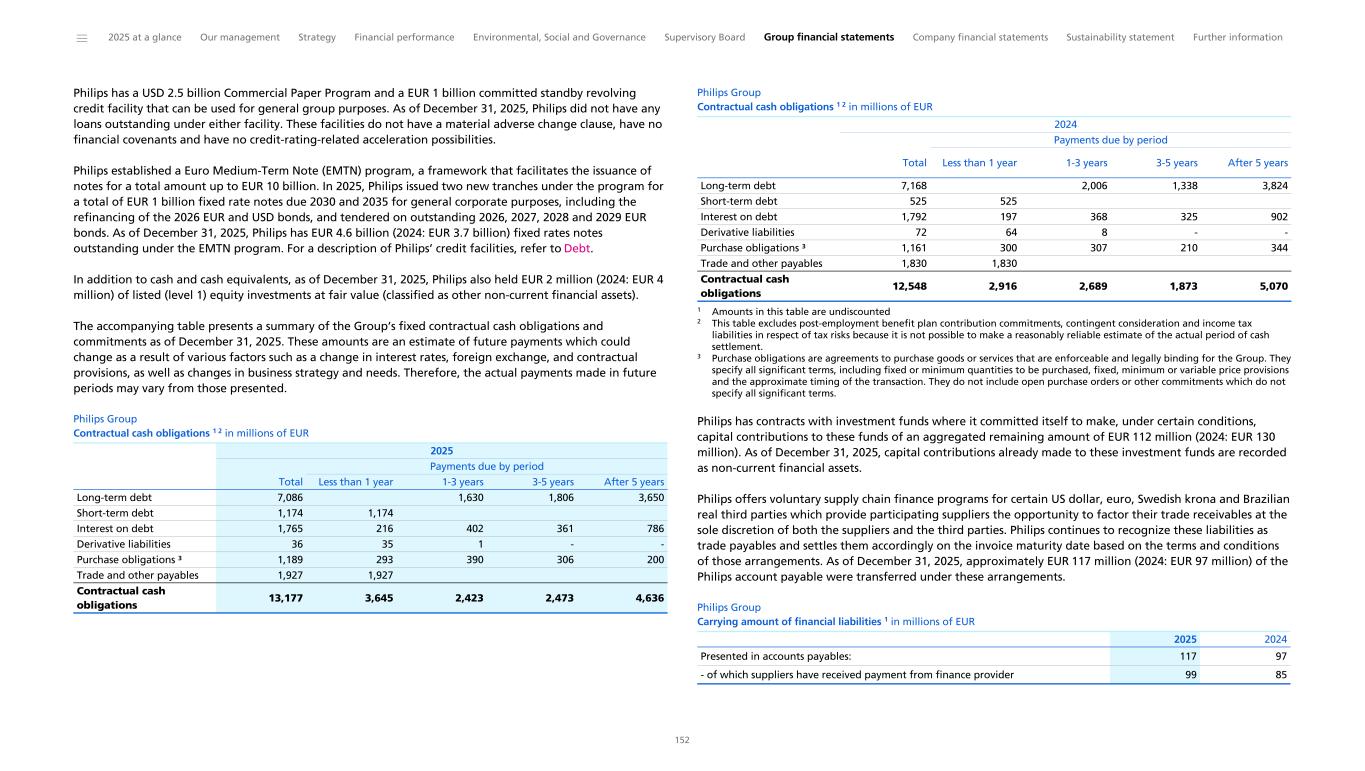
Philips has a USD 2.5 billion Commercial Paper Program and a EUR 1 billion committed standby revolving credit facility that can be used for general group purposes. As of December 31, 2025, Philips did not have any loans outstanding under either facility. These facilities do not have a material adverse change clause, have no financial covenants and have no credit-rating-related acceleration possibilities. Philips established a Euro Medium-Term Note (EMTN) program, a framework that facilitates the issuance of notes for a total amount up to EUR 10 billion. In 2025, Philips issued two new tranches under the program for a total of EUR 1 billion fixed rate notes due 2030 and 2035 for general corporate purposes, including the refinancing of the 2026 EUR and USD bonds, and tendered on outstanding 2026, 2027, 2028 and 2029 EUR bonds. As of December 31, 2025, Philips has EUR 4.6 billion (2024: EUR 3.7 billion) fixed rates notes outstanding under the EMTN program. For a description of Philips’ credit facilities, refer to Debt. In addition to cash and cash equivalents, as of December 31, 2025, Philips also held EUR 2 million (2024: EUR 4 million) of listed (level 1) equity investments at fair value (classified as other non-current financial assets). The accompanying table presents a summary of the Group’s fixed contractual cash obligations and commitments as of December 31, 2025. These amounts are an estimate of future payments which could change as a result of various factors such as a change in interest rates, foreign exchange, and contractual provisions, as well as changes in business strategy and needs. Therefore, the actual payments made in future periods may vary from those presented. Philips Group Contractual cash obligations 1 2 in millions of EUR Total Less than 1 year 1-3 years 3-5 years After 5 years Long-term debt 7,086 1,630 1,806 3,650 Short-term debt 1,174 1,174 Interest on debt 1,765 216 402 361 786 Derivative liabilities 36 35 1 - - Purchase obligations ³ 1,189 293 390 306 200 Trade and other payables 1,927 1,927 Contractual cash obligations 13,177 3,645 2,423 2,473 4,636 2025 Payments due by period Philips Group Contractual cash obligations 1 2 in millions of EUR Total Less than 1 year 1-3 years 3-5 years After 5 years Long-term debt 7,168 2,006 1,338 3,824 Short-term debt 525 525 Interest on debt 1,792 197 368 325 902 Derivative liabilities 72 64 8 - - Purchase obligations ³ 1,161 300 307 210 344 Trade and other payables 1,830 1,830 Contractual cash obligations 12,548 2,916 2,689 1,873 5,070 2024 Payments due by period 1 Amounts in this table are undiscounted 2 This table excludes post-employment benefit plan contribution commitments, contingent consideration and income tax liabilities in respect of tax risks because it is not possible to make a reasonably reliable estimate of the actual period of cash settlement. 3 Purchase obligations are agreements to purchase goods or services that are enforceable and legally binding for the Group. They specify all significant terms, including fixed or minimum quantities to be purchased, fixed, minimum or variable price provisions and the approximate timing of the transaction. They do not include open purchase orders or other commitments which do not specify all significant terms. Philips has contracts with investment funds where it committed itself to make, under certain conditions, capital contributions to these funds of an aggregated remaining amount of EUR 112 million (2024: EUR 130 million). As of December 31, 2025, capital contributions already made to these investment funds are recorded as non-current financial assets. Philips offers voluntary supply chain finance programs for certain US dollar, euro, Swedish krona and Brazilian real third parties which provide participating suppliers the opportunity to factor their trade receivables at the sole discretion of both the suppliers and the third parties. Philips continues to recognize these liabilities as trade payables and settles them accordingly on the invoice maturity date based on the terms and conditions of those arrangements. As of December 31, 2025, approximately EUR 117 million (2024: EUR 97 million) of the Philips account payable were transferred under these arrangements. Philips Group Carrying amount of financial liabilities 1 in millions of EUR Presented in accounts payables: 117 97 - of which suppliers have received payment from finance provider 99 85 2025 2024 ______ 2025 at a glance Our management Strategy Financial performance Environmental, Social and Governance Supervisory Board Group financial statements Company financial statements Sustainability statement Further information 152
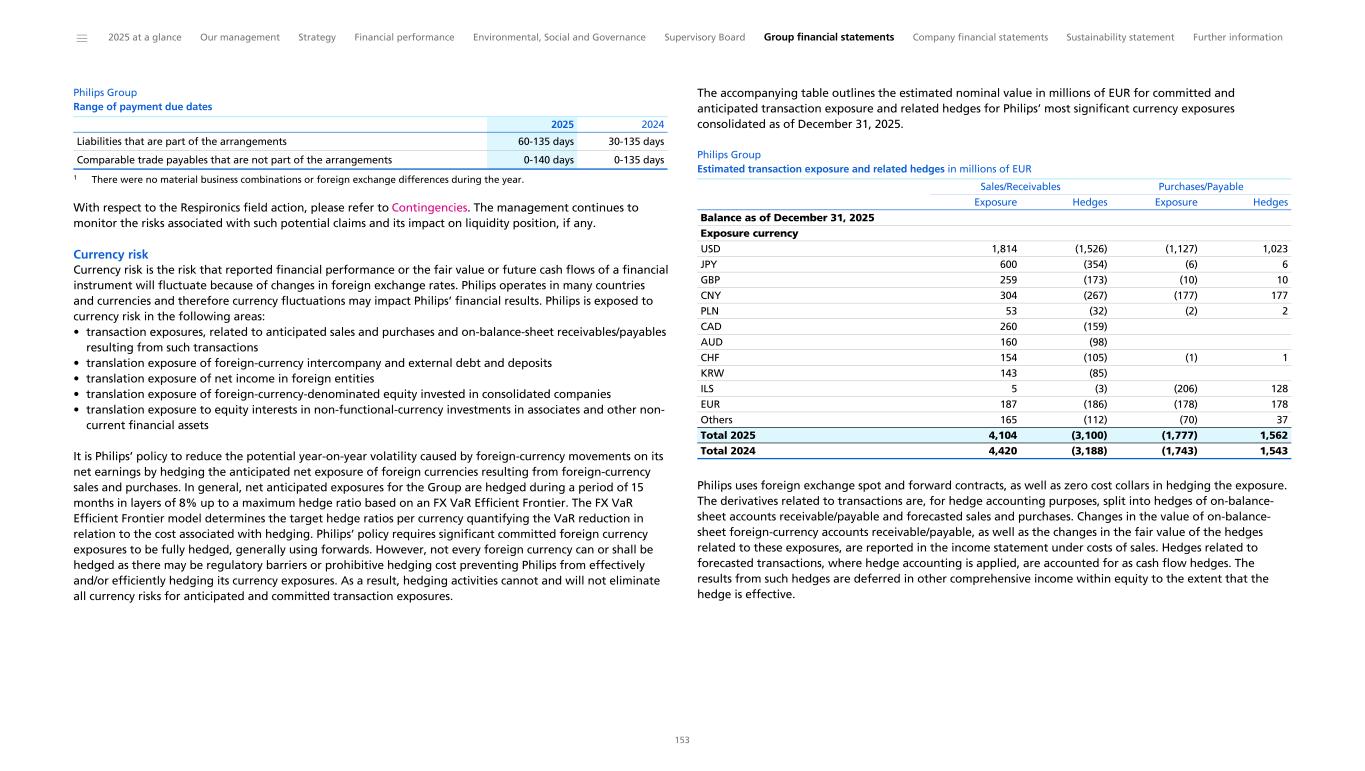
Philips Group Range of payment due dates Liabilities that are part of the arrangements 60-135 days 30-135 days Comparable trade payables that are not part of the arrangements 0-140 days 0-135 days 2025 2024 1 There were no material business combinations or foreign exchange differences during the year. With respect to the Respironics field action, please refer to Contingencies. The management continues to monitor the risks associated with such potential claims and its impact on liquidity position, if any. Currency risk Currency risk is the risk that reported financial performance or the fair value or future cash flows of a financial instrument will fluctuate because of changes in foreign exchange rates. Philips operates in many countries and currencies and therefore currency fluctuations may impact Philips’ financial results. Philips is exposed to currency risk in the following areas: • transaction exposures, related to anticipated sales and purchases and on-balance-sheet receivables/payables resulting from such transactions • translation exposure of foreign-currency intercompany and external debt and deposits • translation exposure of net income in foreign entities • translation exposure of foreign-currency-denominated equity invested in consolidated companies • translation exposure to equity interests in non-functional-currency investments in associates and other non- current financial assets It is Philips’ policy to reduce the potential year-on-year volatility caused by foreign-currency movements on its net earnings by hedging the anticipated net exposure of foreign currencies resulting from foreign-currency sales and purchases. In general, net anticipated exposures for the Group are hedged during a period of 15 months in layers of 8% up to a maximum hedge ratio based on an FX VaR Efficient Frontier. The FX VaR Efficient Frontier model determines the target hedge ratios per currency quantifying the VaR reduction in relation to the cost associated with hedging. Philips’ policy requires significant committed foreign currency exposures to be fully hedged, generally using forwards. However, not every foreign currency can or shall be hedged as there may be regulatory barriers or prohibitive hedging cost preventing Philips from effectively and/or efficiently hedging its currency exposures. As a result, hedging activities cannot and will not eliminate all currency risks for anticipated and committed transaction exposures. The accompanying table outlines the estimated nominal value in millions of EUR for committed and anticipated transaction exposure and related hedges for Philips’ most significant currency exposures consolidated as of December 31, 2025. Philips Group Estimated transaction exposure and related hedges in millions of EUR Balance as of December 31, 2025 Exposure currency USD 1,814 (1,526) (1,127) 1,023 JPY 600 (354) (6) 6 GBP 259 (173) (10) 10 CNY 304 (267) (177) 177 PLN 53 (32) (2) 2 CAD 260 (159) AUD 160 (98) CHF 154 (105) (1) 1 KRW 143 (85) ILS 5 (3) (206) 128 EUR 187 (186) (178) 178 Others 165 (112) (70) 37 Total 2025 4,104 (3,100) (1,777) 1,562 Total 2024 4,420 (3,188) (1,743) 1,543 Sales/Receivables Purchases/Payable Exposure Hedges Exposure Hedges Philips uses foreign exchange spot and forward contracts, as well as zero cost collars in hedging the exposure. The derivatives related to transactions are, for hedge accounting purposes, split into hedges of on-balance- sheet accounts receivable/payable and forecasted sales and purchases. Changes in the value of on-balance- sheet foreign-currency accounts receivable/payable, as well as the changes in the fair value of the hedges related to these exposures, are reported in the income statement under costs of sales. Hedges related to forecasted transactions, where hedge accounting is applied, are accounted for as cash flow hedges. The results from such hedges are deferred in other comprehensive income within equity to the extent that the hedge is effective. ______ 2025 at a glance Our management Strategy Financial performance Environmental, Social and Governance Supervisory Board Group financial statements Company financial statements Sustainability statement Further information 153
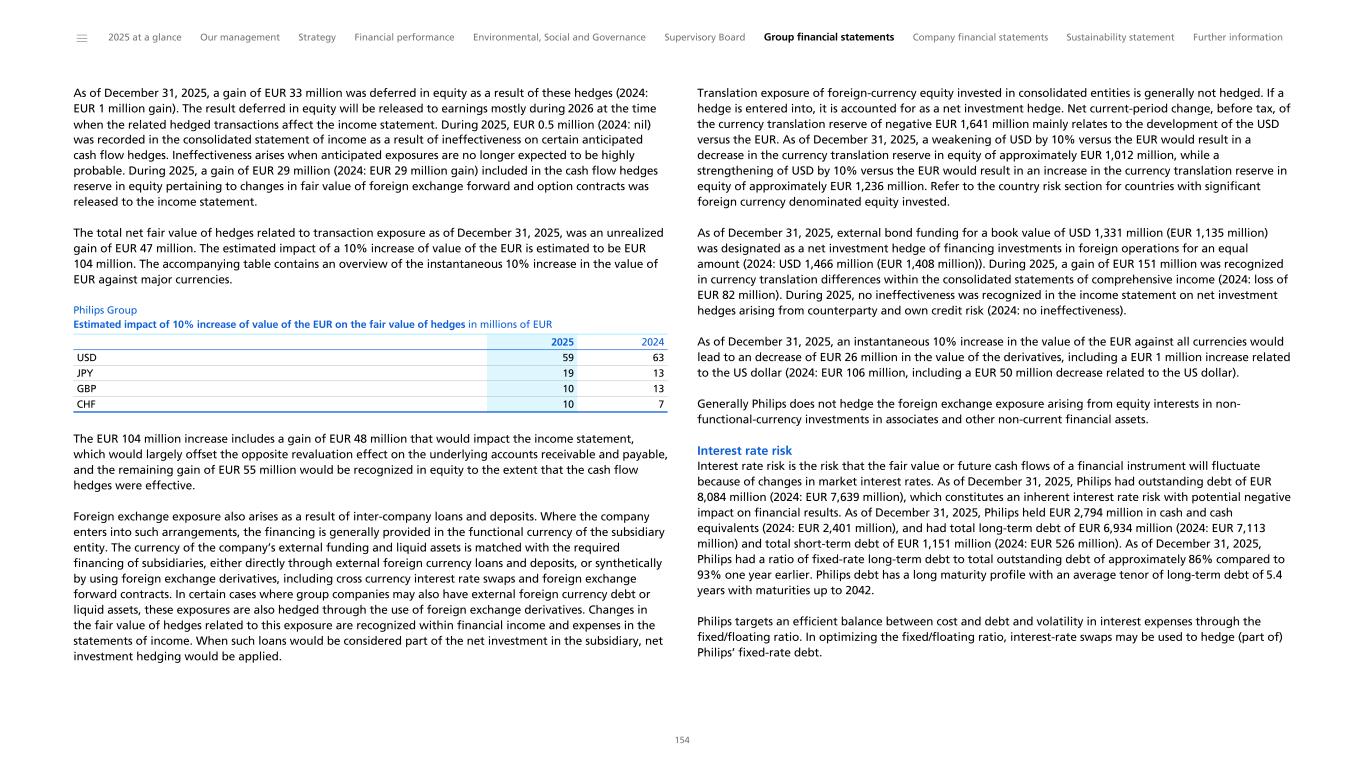
As of December 31, 2025, a gain of EUR 33 million was deferred in equity as a result of these hedges (2024: EUR 1 million gain). The result deferred in equity will be released to earnings mostly during 2026 at the time when the related hedged transactions affect the income statement. During 2025, EUR 0.5 million (2024: nil) was recorded in the consolidated statement of income as a result of ineffectiveness on certain anticipated cash flow hedges. Ineffectiveness arises when anticipated exposures are no longer expected to be highly probable. During 2025, a gain of EUR 29 million (2024: EUR 29 million gain) included in the cash flow hedges reserve in equity pertaining to changes in fair value of foreign exchange forward and option contracts was released to the income statement. The total net fair value of hedges related to transaction exposure as of December 31, 2025, was an unrealized gain of EUR 47 million. The estimated impact of a 10% increase of value of the EUR is estimated to be EUR 104 million. The accompanying table contains an overview of the instantaneous 10% increase in the value of EUR against major currencies. Philips Group Estimated impact of 10% increase of value of the EUR on the fair value of hedges in millions of EUR USD 59 63 JPY 19 13 GBP 10 13 CHF 10 7 2025 2024 The EUR 104 million increase includes a gain of EUR 48 million that would impact the income statement, which would largely offset the opposite revaluation effect on the underlying accounts receivable and payable, and the remaining gain of EUR 55 million would be recognized in equity to the extent that the cash flow hedges were effective. Foreign exchange exposure also arises as a result of inter-company loans and deposits. Where the company enters into such arrangements, the financing is generally provided in the functional currency of the subsidiary entity. The currency of the company’s external funding and liquid assets is matched with the required financing of subsidiaries, either directly through external foreign currency loans and deposits, or synthetically by using foreign exchange derivatives, including cross currency interest rate swaps and foreign exchange forward contracts. In certain cases where group companies may also have external foreign currency debt or liquid assets, these exposures are also hedged through the use of foreign exchange derivatives. Changes in the fair value of hedges related to this exposure are recognized within financial income and expenses in the statements of income. When such loans would be considered part of the net investment in the subsidiary, net investment hedging would be applied. Translation exposure of foreign-currency equity invested in consolidated entities is generally not hedged. If a hedge is entered into, it is accounted for as a net investment hedge. Net current-period change, before tax, of the currency translation reserve of negative EUR 1,641 million mainly relates to the development of the USD versus the EUR. As of December 31, 2025, a weakening of USD by 10% versus the EUR would result in a decrease in the currency translation reserve in equity of approximately EUR 1,012 million, while a strengthening of USD by 10% versus the EUR would result in an increase in the currency translation reserve in equity of approximately EUR 1,236 million. Refer to the country risk section for countries with significant foreign currency denominated equity invested. As of December 31, 2025, external bond funding for a book value of USD 1,331 million (EUR 1,135 million) was designated as a net investment hedge of financing investments in foreign operations for an equal amount (2024: USD 1,466 million (EUR 1,408 million)). During 2025, a gain of EUR 151 million was recognized in currency translation differences within the consolidated statements of comprehensive income (2024: loss of EUR 82 million). During 2025, no ineffectiveness was recognized in the income statement on net investment hedges arising from counterparty and own credit risk (2024: no ineffectiveness). As of December 31, 2025, an instantaneous 10% increase in the value of the EUR against all currencies would lead to an decrease of EUR 26 million in the value of the derivatives, including a EUR 1 million increase related to the US dollar (2024: EUR 106 million, including a EUR 50 million decrease related to the US dollar). Generally Philips does not hedge the foreign exchange exposure arising from equity interests in non- functional-currency investments in associates and other non-current financial assets. Interest rate risk Interest rate risk is the risk that the fair value or future cash flows of a financial instrument will fluctuate because of changes in market interest rates. As of December 31, 2025, Philips had outstanding debt of EUR 8,084 million (2024: EUR 7,639 million), which constitutes an inherent interest rate risk with potential negative impact on financial results. As of December 31, 2025, Philips held EUR 2,794 million in cash and cash equivalents (2024: EUR 2,401 million), and had total long-term debt of EUR 6,934 million (2024: EUR 7,113 million) and total short-term debt of EUR 1,151 million (2024: EUR 526 million). As of December 31, 2025, Philips had a ratio of fixed-rate long-term debt to total outstanding debt of approximately 86% compared to 93% one year earlier. Philips debt has a long maturity profile with an average tenor of long-term debt of 5.4 years with maturities up to 2042. Philips targets an efficient balance between cost and debt and volatility in interest expenses through the fixed/floating ratio. In optimizing the fixed/floating ratio, interest-rate swaps may be used to hedge (part of) Philips’ fixed-rate debt. ______ 2025 at a glance Our management Strategy Financial performance Environmental, Social and Governance Supervisory Board Group financial statements Company financial statements Sustainability statement Further information 154
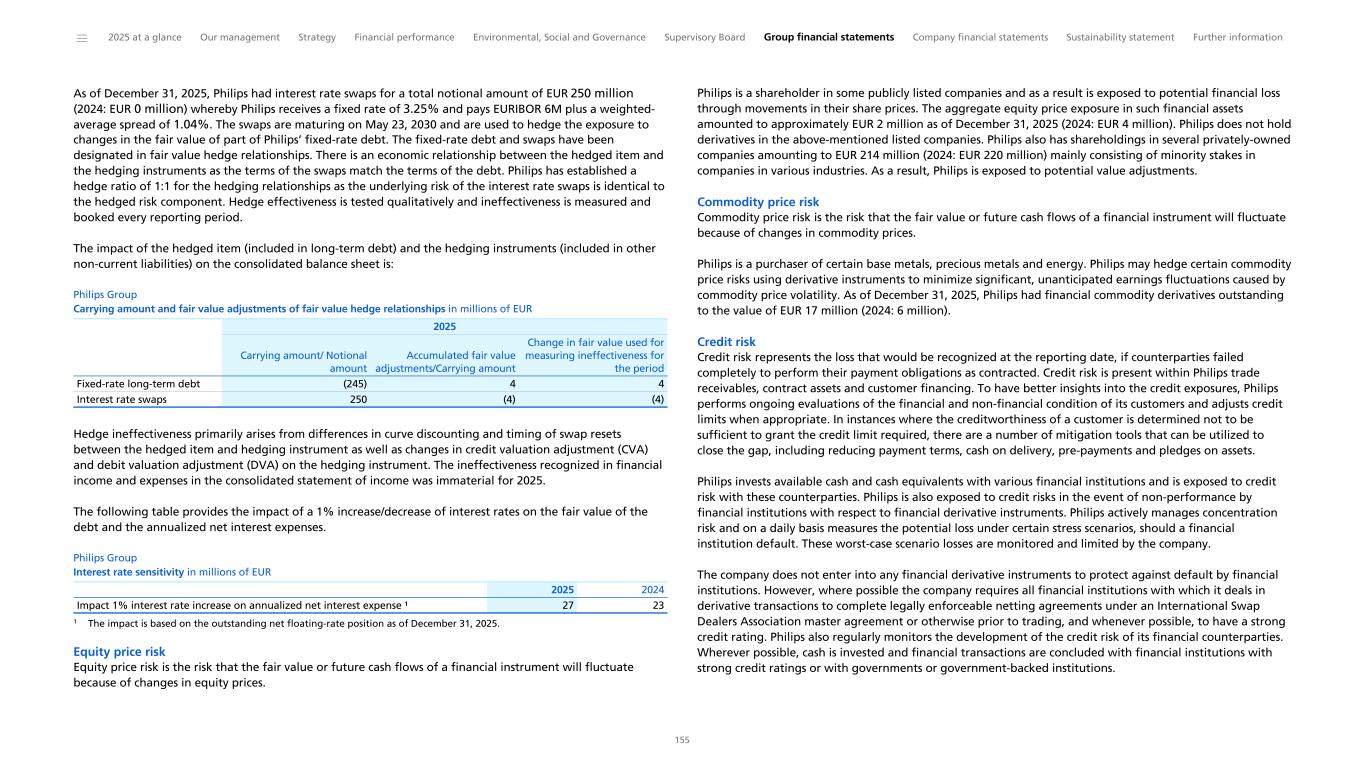
As of December 31, 2025, Philips had interest rate swaps for a total notional amount of EUR 250 million (2024: EUR 0 million) whereby Philips receives a fixed rate of 3.25% and pays EURIBOR 6M plus a weighted- average spread of 1.04%. The swaps are maturing on May 23, 2030 and are used to hedge the exposure to changes in the fair value of part of Philips’ fixed-rate debt. The fixed-rate debt and swaps have been designated in fair value hedge relationships. There is an economic relationship between the hedged item and the hedging instruments as the terms of the swaps match the terms of the debt. Philips has established a hedge ratio of 1:1 for the hedging relationships as the underlying risk of the interest rate swaps is identical to the hedged risk component. Hedge effectiveness is tested qualitatively and ineffectiveness is measured and booked every reporting period. The impact of the hedged item (included in long-term debt) and the hedging instruments (included in other non-current liabilities) on the consolidated balance sheet is: Philips Group Carrying amount and fair value adjustments of fair value hedge relationships in millions of EUR Fixed-rate long-term debt (245) 4 4 Interest rate swaps 250 (4) (4) 2025 Carrying amount/ Notional amount Accumulated fair value adjustments/Carrying amount Change in fair value used for measuring ineffectiveness for the period Hedge ineffectiveness primarily arises from differences in curve discounting and timing of swap resets between the hedged item and hedging instrument as well as changes in credit valuation adjustment (CVA) and debit valuation adjustment (DVA) on the hedging instrument. The ineffectiveness recognized in financial income and expenses in the consolidated statement of income was immaterial for 2025. The following table provides the impact of a 1% increase/decrease of interest rates on the fair value of the debt and the annualized net interest expenses. Philips Group Interest rate sensitivity in millions of EUR 2025 2024 Impact 1% interest rate increase on annualized net interest expense ¹ 27 23 1 The impact is based on the outstanding net floating-rate position as of December 31, 2025. Equity price risk Equity price risk is the risk that the fair value or future cash flows of a financial instrument will fluctuate because of changes in equity prices. Philips is a shareholder in some publicly listed companies and as a result is exposed to potential financial loss through movements in their share prices. The aggregate equity price exposure in such financial assets amounted to approximately EUR 2 million as of December 31, 2025 (2024: EUR 4 million). Philips does not hold derivatives in the above-mentioned listed companies. Philips also has shareholdings in several privately-owned companies amounting to EUR 214 million (2024: EUR 220 million) mainly consisting of minority stakes in companies in various industries. As a result, Philips is exposed to potential value adjustments. Commodity price risk Commodity price risk is the risk that the fair value or future cash flows of a financial instrument will fluctuate because of changes in commodity prices. Philips is a purchaser of certain base metals, precious metals and energy. Philips may hedge certain commodity price risks using derivative instruments to minimize significant, unanticipated earnings fluctuations caused by commodity price volatility. As of December 31, 2025, Philips had financial commodity derivatives outstanding to the value of EUR 17 million (2024: 6 million). Credit risk Credit risk represents the loss that would be recognized at the reporting date, if counterparties failed completely to perform their payment obligations as contracted. Credit risk is present within Philips trade receivables, contract assets and customer financing. To have better insights into the credit exposures, Philips performs ongoing evaluations of the financial and non-financial condition of its customers and adjusts credit limits when appropriate. In instances where the creditworthiness of a customer is determined not to be sufficient to grant the credit limit required, there are a number of mitigation tools that can be utilized to close the gap, including reducing payment terms, cash on delivery, pre-payments and pledges on assets. Philips invests available cash and cash equivalents with various financial institutions and is exposed to credit risk with these counterparties. Philips is also exposed to credit risks in the event of non-performance by financial institutions with respect to financial derivative instruments. Philips actively manages concentration risk and on a daily basis measures the potential loss under certain stress scenarios, should a financial institution default. These worst-case scenario losses are monitored and limited by the company. The company does not enter into any financial derivative instruments to protect against default by financial institutions. However, where possible the company requires all financial institutions with which it deals in derivative transactions to complete legally enforceable netting agreements under an International Swap Dealers Association master agreement or otherwise prior to trading, and whenever possible, to have a strong credit rating. Philips also regularly monitors the development of the credit risk of its financial counterparties. Wherever possible, cash is invested and financial transactions are concluded with financial institutions with strong credit ratings or with governments or government-backed institutions. ______ 2025 at a glance Our management Strategy Financial performance Environmental, Social and Governance Supervisory Board Group financial statements Company financial statements Sustainability statement Further information 155
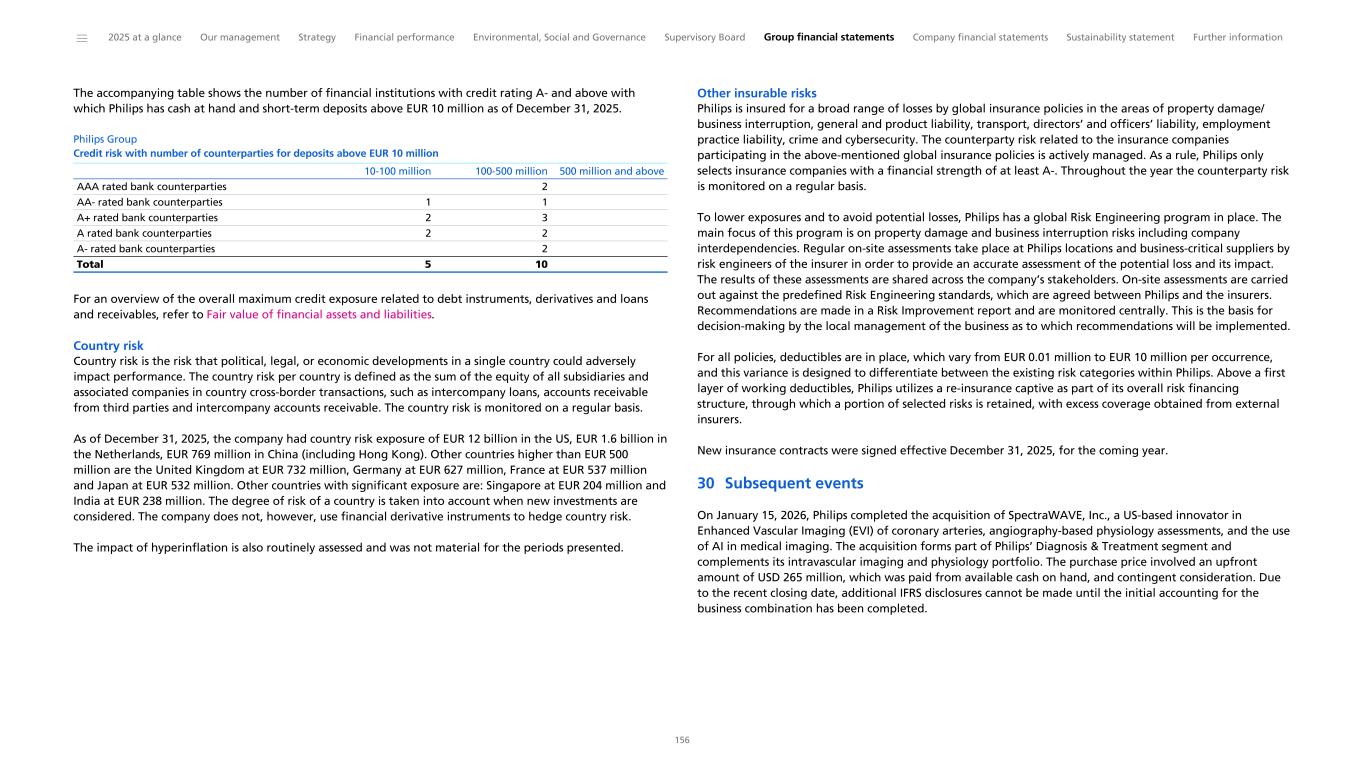
The accompanying table shows the number of financial institutions with credit rating A- and above with which Philips has cash at hand and short-term deposits above EUR 10 million as of December 31, 2025. Philips Group Credit risk with number of counterparties for deposits above EUR 10 million AAA rated bank counterparties 2 AA- rated bank counterparties 1 1 A+ rated bank counterparties 2 3 A rated bank counterparties 2 2 A- rated bank counterparties 2 Total 5 10 10-100 million 100-500 million 500 million and above For an overview of the overall maximum credit exposure related to debt instruments, derivatives and loans and receivables, refer to Fair value of financial assets and liabilities. Country risk Country risk is the risk that political, legal, or economic developments in a single country could adversely impact performance. The country risk per country is defined as the sum of the equity of all subsidiaries and associated companies in country cross-border transactions, such as intercompany loans, accounts receivable from third parties and intercompany accounts receivable. The country risk is monitored on a regular basis. As of December 31, 2025, the company had country risk exposure of EUR 12 billion in the US, EUR 1.6 billion in the Netherlands, EUR 769 million in China (including Hong Kong). Other countries higher than EUR 500 million are the United Kingdom at EUR 732 million, Germany at EUR 627 million, France at EUR 537 million and Japan at EUR 532 million. Other countries with significant exposure are: Singapore at EUR 204 million and India at EUR 238 million. The degree of risk of a country is taken into account when new investments are considered. The company does not, however, use financial derivative instruments to hedge country risk. The impact of hyperinflation is also routinely assessed and was not material for the periods presented. Other insurable risks Philips is insured for a broad range of losses by global insurance policies in the areas of property damage/ business interruption, general and product liability, transport, directors’ and officers’ liability, employment practice liability, crime and cybersecurity. The counterparty risk related to the insurance companies participating in the above-mentioned global insurance policies is actively managed. As a rule, Philips only selects insurance companies with a financial strength of at least A-. Throughout the year the counterparty risk is monitored on a regular basis. To lower exposures and to avoid potential losses, Philips has a global Risk Engineering program in place. The main focus of this program is on property damage and business interruption risks including company interdependencies. Regular on-site assessments take place at Philips locations and business-critical suppliers by risk engineers of the insurer in order to provide an accurate assessment of the potential loss and its impact. The results of these assessments are shared across the company’s stakeholders. On-site assessments are carried out against the predefined Risk Engineering standards, which are agreed between Philips and the insurers. Recommendations are made in a Risk Improvement report and are monitored centrally. This is the basis for decision-making by the local management of the business as to which recommendations will be implemented. For all policies, deductibles are in place, which vary from EUR 0.01 million to EUR 10 million per occurrence, and this variance is designed to differentiate between the existing risk categories within Philips. Above a first layer of working deductibles, Philips utilizes a re-insurance captive as part of its overall risk financing structure, through which a portion of selected risks is retained, with excess coverage obtained from external insurers. New insurance contracts were signed effective December 31, 2025, for the coming year. 30 Subsequent events On January 15, 2026, Philips completed the acquisition of SpectraWAVE, Inc., a US-based innovator in Enhanced Vascular Imaging (EVI) of coronary arteries, angiography-based physiology assessments, and the use of AI in medical imaging. The acquisition forms part of Philips’ Diagnosis & Treatment segment and complements its intravascular imaging and physiology portfolio. The purchase price involved an upfront amount of USD 265 million, which was paid from available cash on hand, and contingent consideration. Due to the recent closing date, additional IFRS disclosures cannot be made until the initial accounting for the business combination has been completed. ______ 2025 at a glance Our management Strategy Financial performance Environmental, Social and Governance Supervisory Board Group financial statements Company financial statements Sustainability statement Further information 156
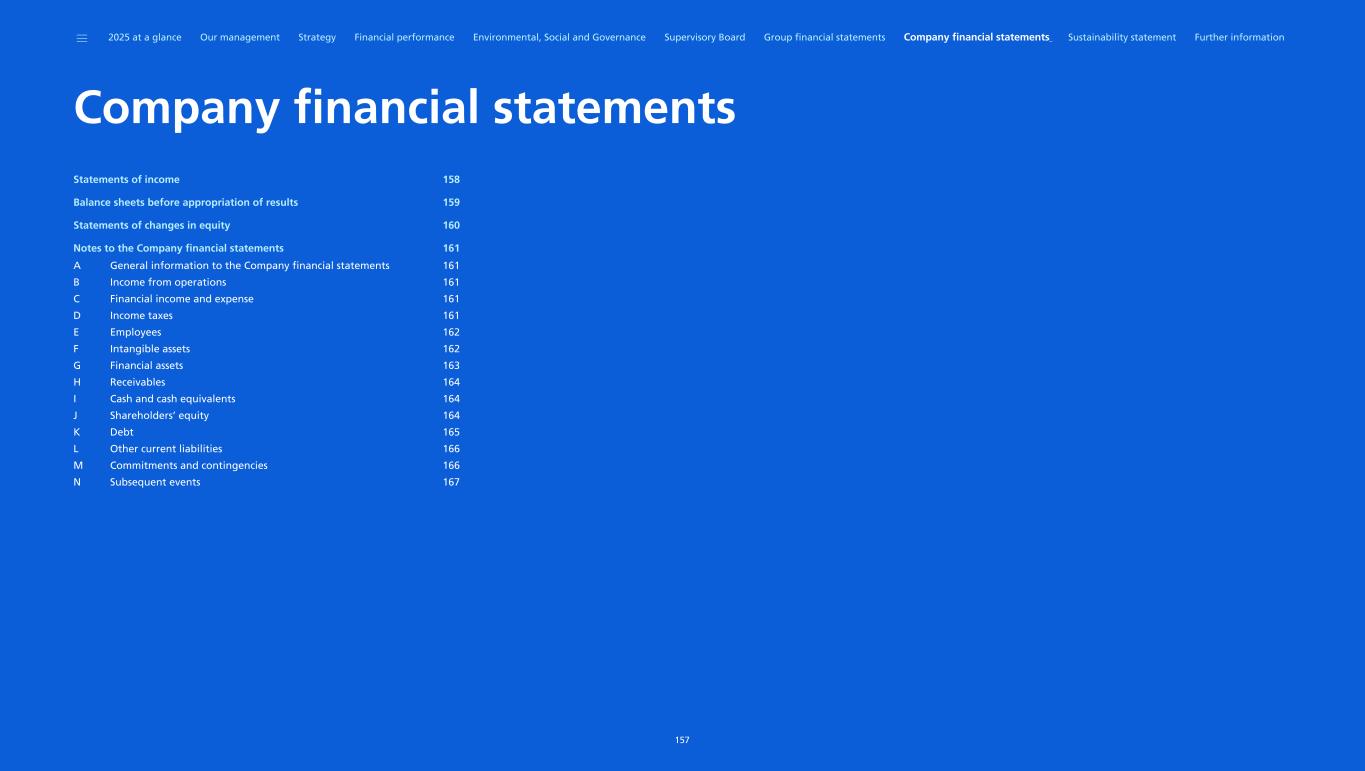
Company financial statements Statements of income 158 Balance sheets before appropriation of results 159 Statements of changes in equity 160 Notes to the Company financial statements 161 A General information to the Company financial statements 161 B Income from operations 161 C Financial income and expense 161 D Income taxes 161 E Employees 162 F Intangible assets 162 G Financial assets 163 H Receivables 164 I Cash and cash equivalents 164 J Shareholders’ equity 164 K Debt 165 L Other current liabilities 166 M Commitments and contingencies 166 N Subsequent events 167 ______ 2025 at a glance Our management Strategy Financial performance Environmental, Social and Governance Supervisory Board Group financial statements Company financial statements Sustainability statement Further information 157
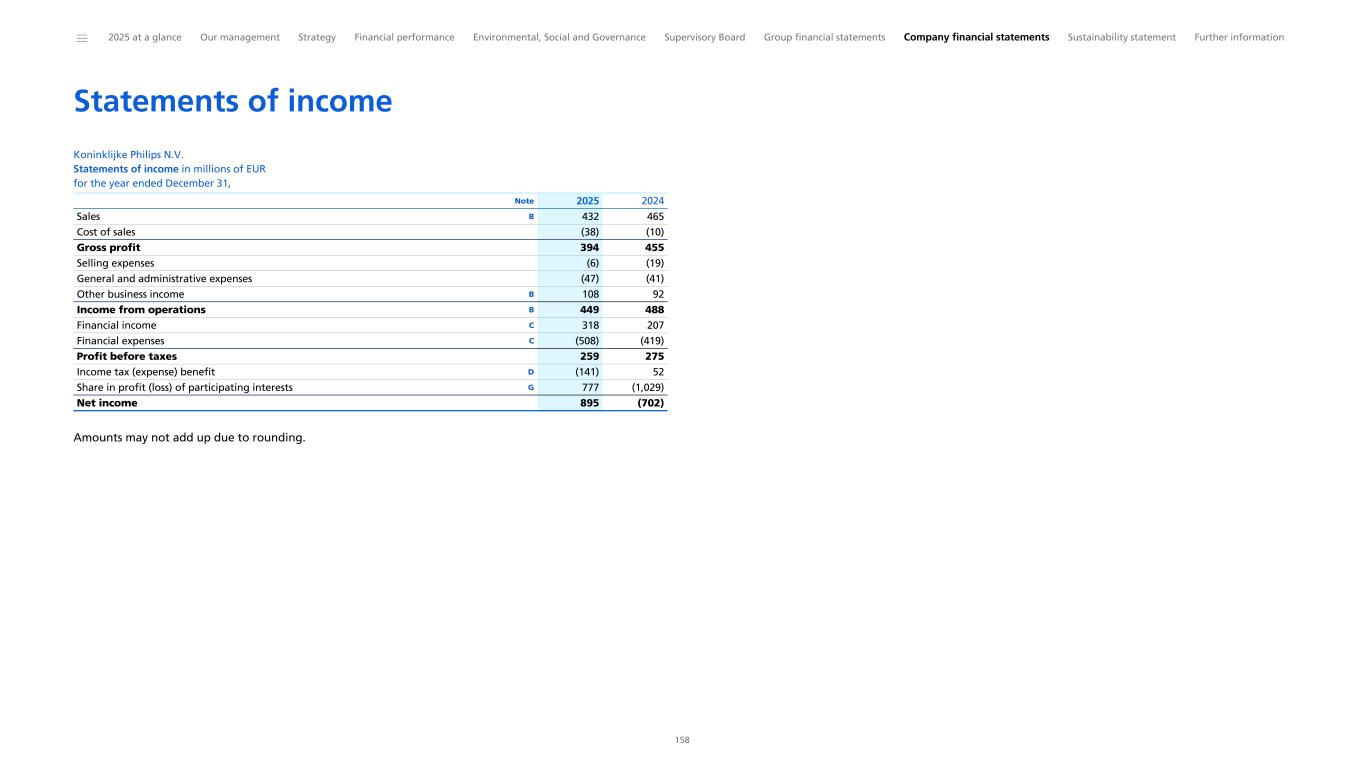
Statements of income Koninklijke Philips N.V. Statements of income in millions of EUR for the year ended December 31, Sales B 432 465 Cost of sales (38) (10) Gross profit 394 455 Selling expenses (6) (19) General and administrative expenses (47) (41) Other business income B 108 92 Income from operations B 449 488 Financial income C 318 207 Financial expenses C (508) (419) Profit before taxes 259 275 Income tax (expense) benefit D (141) 52 Share in profit (loss) of participating interests G 777 (1,029) Net income 895 (702) Note 2025 2024 Amounts may not add up due to rounding. ______ 2025 at a glance Our management Strategy Financial performance Environmental, Social and Governance Supervisory Board Group financial statements Company financial statements Sustainability statement Further information 158
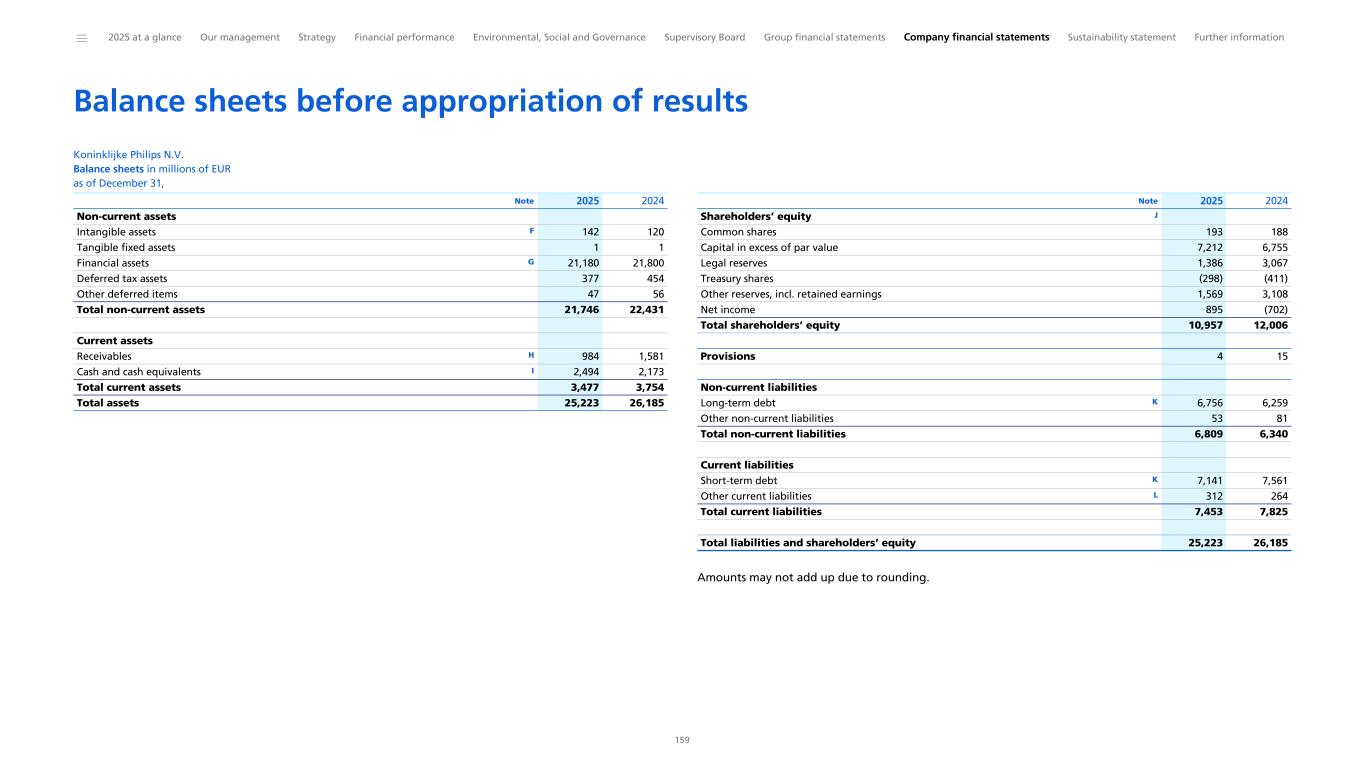
Balance sheets before appropriation of results Koninklijke Philips N.V. Balance sheets in millions of EUR as of December 31, Non-current assets Intangible assets F 142 120 Tangible fixed assets 1 1 Financial assets G 21,180 21,800 Deferred tax assets 377 454 Other deferred items 47 56 Total non-current assets 21,746 22,431 Current assets Receivables H 984 1,581 Cash and cash equivalents I 2,494 2,173 Total current assets 3,477 3,754 Total assets 25,223 26,185 Note 2025 2024 Shareholders’ equity J Common shares 193 188 Capital in excess of par value 7,212 6,755 Legal reserves 1,386 3,067 Treasury shares (298) (411) Other reserves, incl. retained earnings 1,569 3,108 Net income 895 (702) Total shareholders’ equity 10,957 12,006 Provisions 4 15 Non-current liabilities Long-term debt K 6,756 6,259 Other non-current liabilities 53 81 Total non-current liabilities 6,809 6,340 Current liabilities Short-term debt K 7,141 7,561 Other current liabilities L 312 264 Total current liabilities 7,453 7,825 Total liabilities and shareholders’ equity 25,223 26,185 Note 2025 2024 Amounts may not add up due to rounding. ______ 2025 at a glance Our management Strategy Financial performance Environmental, Social and Governance Supervisory Board Group financial statements Company financial statements Sustainability statement Further information 159
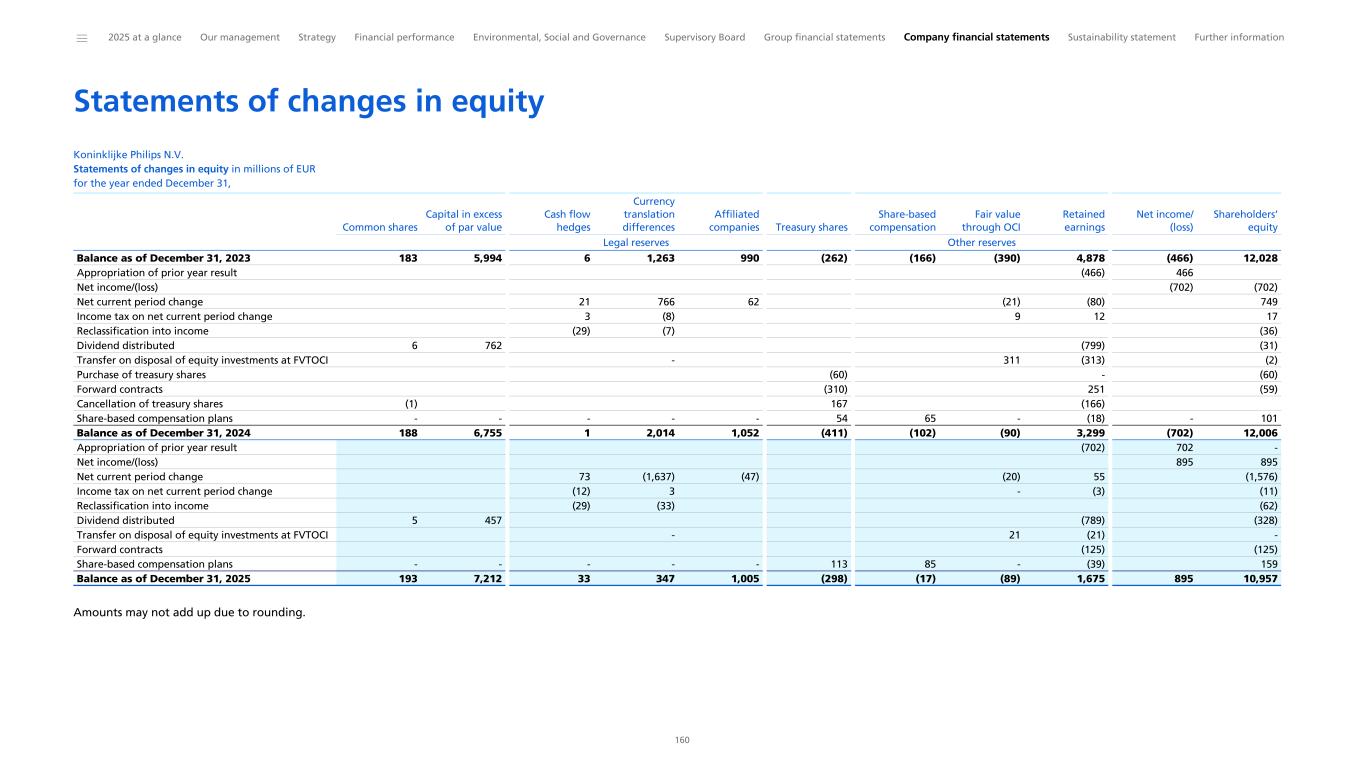
Statements of changes in equity Koninklijke Philips N.V. Statements of changes in equity in millions of EUR for the year ended December 31, Balance as of December 31, 2023 183 5,994 6 1,263 990 (262) (166) (390) 4,878 (466) 12,028 Appropriation of prior year result (466) 466 Net income/(loss) (702) (702) Net current period change 21 766 62 (21) (80) 749 Income tax on net current period change 3 (8) 9 12 17 Reclassification into income (29) (7) (36) Dividend distributed 6 762 (799) (31) Transfer on disposal of equity investments at FVTOCI - 311 (313) (2) Purchase of treasury shares (60) - (60) Forward contracts (310) 251 (59) Cancellation of treasury shares (1) 167 (166) Share-based compensation plans - - - - - 54 65 - (18) - 101 Balance as of December 31, 2024 188 6,755 1 2,014 1,052 (411) (102) (90) 3,299 (702) 12,006 Appropriation of prior year result (702) 702 - Net income/(loss) 895 895 Net current period change 73 (1,637) (47) (20) 55 (1,576) Income tax on net current period change (12) 3 - (3) (11) Reclassification into income (29) (33) (62) Dividend distributed 5 457 (789) (328) Transfer on disposal of equity investments at FVTOCI - 21 (21) - Forward contracts (125) (125) Share-based compensation plans - - - - - 113 85 - (39) 159 Balance as of December 31, 2025 193 7,212 33 347 1,005 (298) (17) (89) 1,675 895 10,957 Common shares Capital in excess of par value Cash flow hedges Currency translation differences Affiliated companies Treasury shares Share-based compensation Fair value through OCI Retained earnings Net income/ (loss) Shareholders’ equity Legal reserves Other reserves Amounts may not add up due to rounding. ______ 2025 at a glance Our management Strategy Financial performance Environmental, Social and Governance Supervisory Board Group financial statements Company financial statements Sustainability statement Further information 160
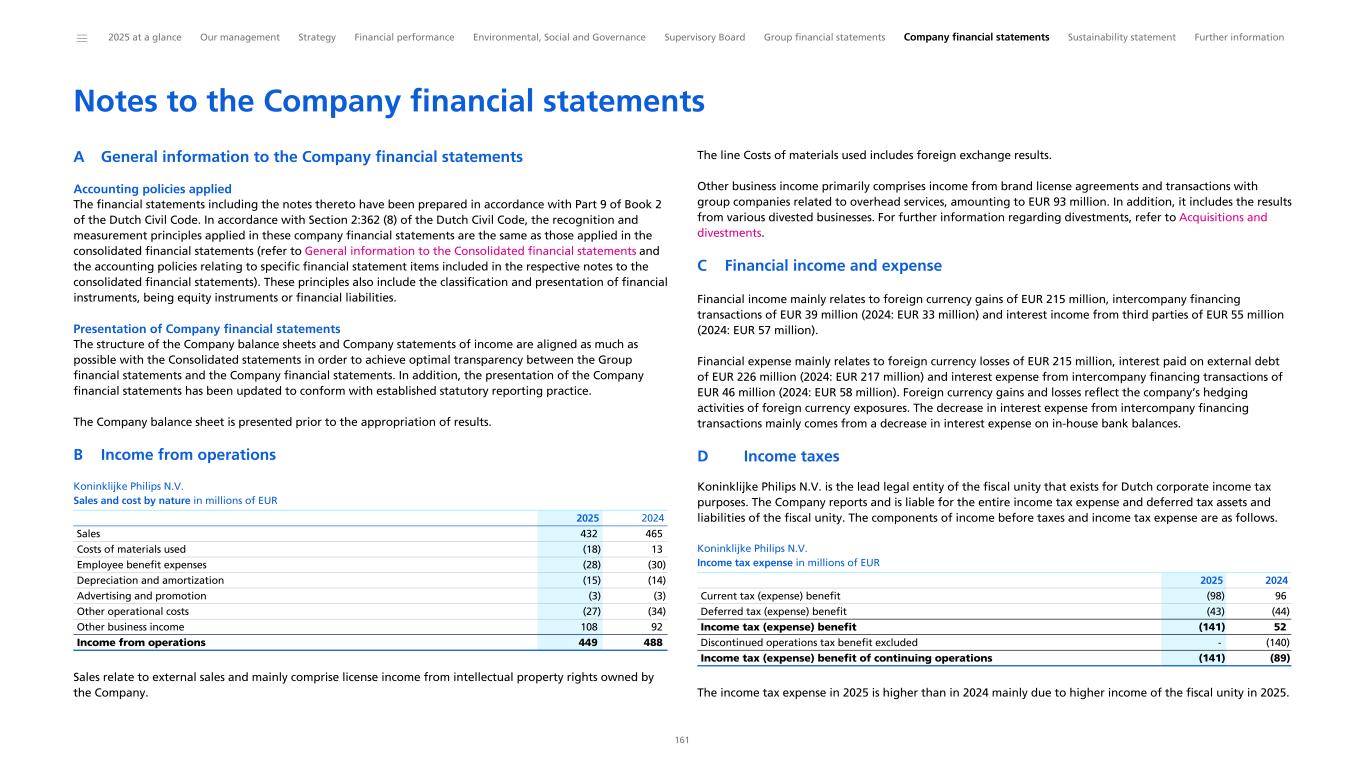
Notes to the Company financial statements A General information to the Company financial statements Accounting policies applied The financial statements including the notes thereto have been prepared in accordance with Part 9 of Book 2 of the Dutch Civil Code. In accordance with Section 2:362 (8) of the Dutch Civil Code, the recognition and measurement principles applied in these company financial statements are the same as those applied in the consolidated financial statements (refer to General information to the Consolidated financial statements and the accounting policies relating to specific financial statement items included in the respective notes to the consolidated financial statements). These principles also include the classification and presentation of financial instruments, being equity instruments or financial liabilities. Presentation of Company financial statements The structure of the Company balance sheets and Company statements of income are aligned as much as possible with the Consolidated statements in order to achieve optimal transparency between the Group financial statements and the Company financial statements. In addition, the presentation of the Company financial statements has been updated to conform with established statutory reporting practice. The Company balance sheet is presented prior to the appropriation of results. B Income from operations Koninklijke Philips N.V. Sales and cost by nature in millions of EUR Sales 432 465 Costs of materials used (18) 13 Employee benefit expenses (28) (30) Depreciation and amortization (15) (14) Advertising and promotion (3) (3) Other operational costs (27) (34) Other business income 108 92 Income from operations 449 488 2025 2024 Sales relate to external sales and mainly comprise license income from intellectual property rights owned by the Company. The line Costs of materials used includes foreign exchange results. Other business income primarily comprises income from brand license agreements and transactions with group companies related to overhead services, amounting to EUR 93 million. In addition, it includes the results from various divested businesses. For further information regarding divestments, refer to Acquisitions and divestments. C Financial income and expense Financial income mainly relates to foreign currency gains of EUR 215 million, intercompany financing transactions of EUR 39 million (2024: EUR 33 million) and interest income from third parties of EUR 55 million (2024: EUR 57 million). Financial expense mainly relates to foreign currency losses of EUR 215 million, interest paid on external debt of EUR 226 million (2024: EUR 217 million) and interest expense from intercompany financing transactions of EUR 46 million (2024: EUR 58 million). Foreign currency gains and losses reflect the company’s hedging activities of foreign currency exposures. The decrease in interest expense from intercompany financing transactions mainly comes from a decrease in interest expense on in-house bank balances. D Income taxes Koninklijke Philips N.V. is the lead legal entity of the fiscal unity that exists for Dutch corporate income tax purposes. The Company reports and is liable for the entire income tax expense and deferred tax assets and liabilities of the fiscal unity. The components of income before taxes and income tax expense are as follows. Koninklijke Philips N.V. Income tax expense in millions of EUR Current tax (expense) benefit (98) 96 Deferred tax (expense) benefit (43) (44) Income tax (expense) benefit (141) 52 Discontinued operations tax benefit excluded - (140) Income tax (expense) benefit of continuing operations (141) (89) 2025 2024 The income tax expense in 2025 is higher than in 2024 mainly due to higher income of the fiscal unity in 2025. ______ 2025 at a glance Our management Strategy Financial performance Environmental, Social and Governance Supervisory Board Group financial statements Company financial statements Sustainability statement Further information 161
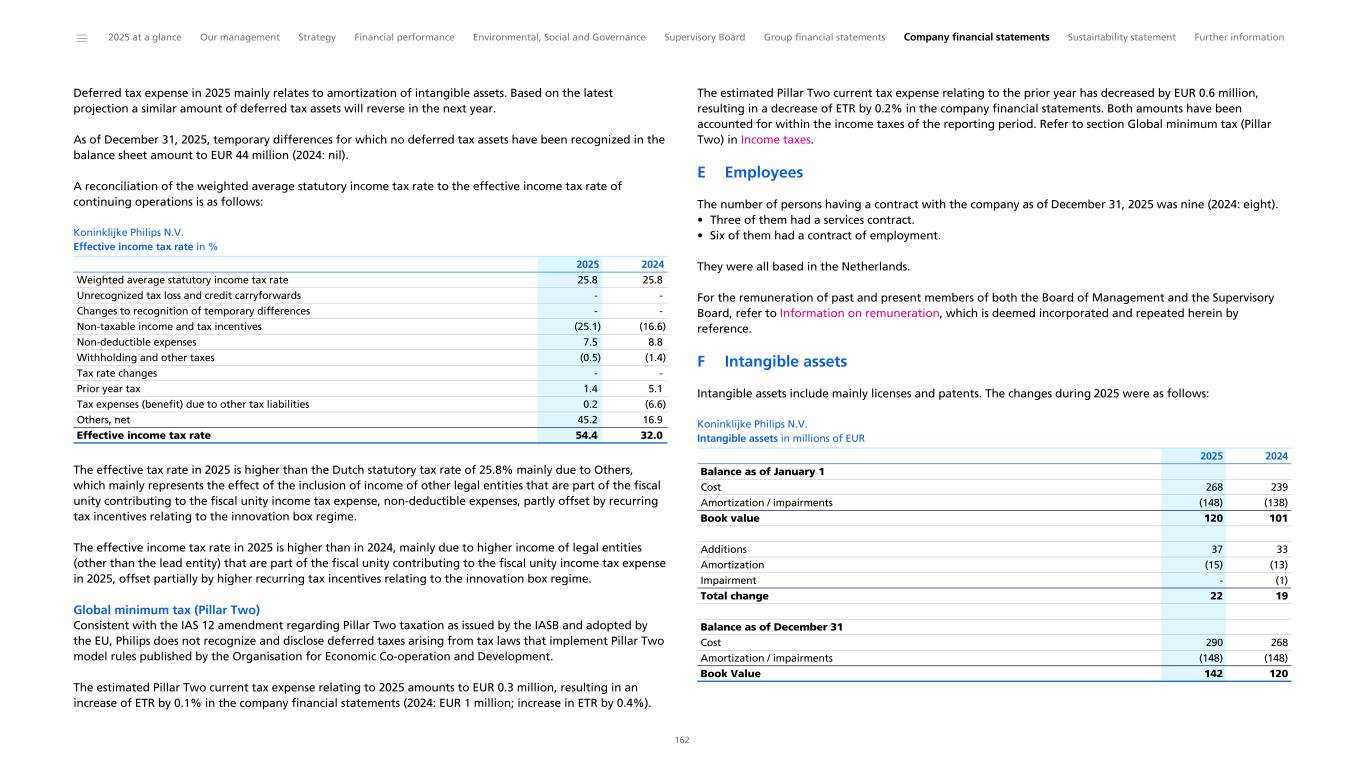
Deferred tax expense in 2025 mainly relates to amortization of intangible assets. Based on the latest projection a similar amount of deferred tax assets will reverse in the next year. As of December 31, 2025, temporary differences for which no deferred tax assets have been recognized in the balance sheet amount to EUR 44 million (2024: nil). A reconciliation of the weighted average statutory income tax rate to the effective income tax rate of continuing operations is as follows: Koninklijke Philips N.V. Effective income tax rate in % Weighted average statutory income tax rate 25.8 25.8 Unrecognized tax loss and credit carryforwards - - Changes to recognition of temporary differences - - Non-taxable income and tax incentives (25.1) (16.6) Non-deductible expenses 7.5 8.8 Withholding and other taxes (0.5) (1.4) Tax rate changes - - Prior year tax 1.4 5.1 Tax expenses (benefit) due to other tax liabilities 0.2 (6.6) Others, net 45.2 16.9 Effective income tax rate 54.4 32.0 2025 2024 The effective tax rate in 2025 is higher than the Dutch statutory tax rate of 25.8% mainly due to Others, which mainly represents the effect of the inclusion of income of other legal entities that are part of the fiscal unity contributing to the fiscal unity income tax expense, non-deductible expenses, partly offset by recurring tax incentives relating to the innovation box regime. The effective income tax rate in 2025 is higher than in 2024, mainly due to higher income of legal entities (other than the lead entity) that are part of the fiscal unity contributing to the fiscal unity income tax expense in 2025, offset partially by higher recurring tax incentives relating to the innovation box regime. Global minimum tax (Pillar Two) Consistent with the IAS 12 amendment regarding Pillar Two taxation as issued by the IASB and adopted by the EU, Philips does not recognize and disclose deferred taxes arising from tax laws that implement Pillar Two model rules published by the Organisation for Economic Co-operation and Development. The estimated Pillar Two current tax expense relating to 2025 amounts to EUR 0.3 million, resulting in an increase of ETR by 0.1% in the company financial statements (2024: EUR 1 million; increase in ETR by 0.4%). The estimated Pillar Two current tax expense relating to the prior year has decreased by EUR 0.6 million, resulting in a decrease of ETR by 0.2% in the company financial statements. Both amounts have been accounted for within the income taxes of the reporting period. Refer to section Global minimum tax (Pillar Two) in Income taxes. E Employees The number of persons having a contract with the company as of December 31, 2025 was nine (2024: eight). • Three of them had a services contract. • Six of them had a contract of employment. They were all based in the Netherlands. For the remuneration of past and present members of both the Board of Management and the Supervisory Board, refer to Information on remuneration, which is deemed incorporated and repeated herein by reference. F Intangible assets Intangible assets include mainly licenses and patents. The changes during 2025 were as follows: Koninklijke Philips N.V. Intangible assets in millions of EUR Balance as of January 1 Cost 268 239 Amortization / impairments (148) (138) Book value 120 101 Additions 37 33 Amortization (15) (13) Impairment - (1) Total change 22 19 Balance as of December 31 Cost 290 268 Amortization / impairments (148) (148) Book Value 142 120 2025 2024 ______ 2025 at a glance Our management Strategy Financial performance Environmental, Social and Governance Supervisory Board Group financial statements Company financial statements Sustainability statement Further information 162
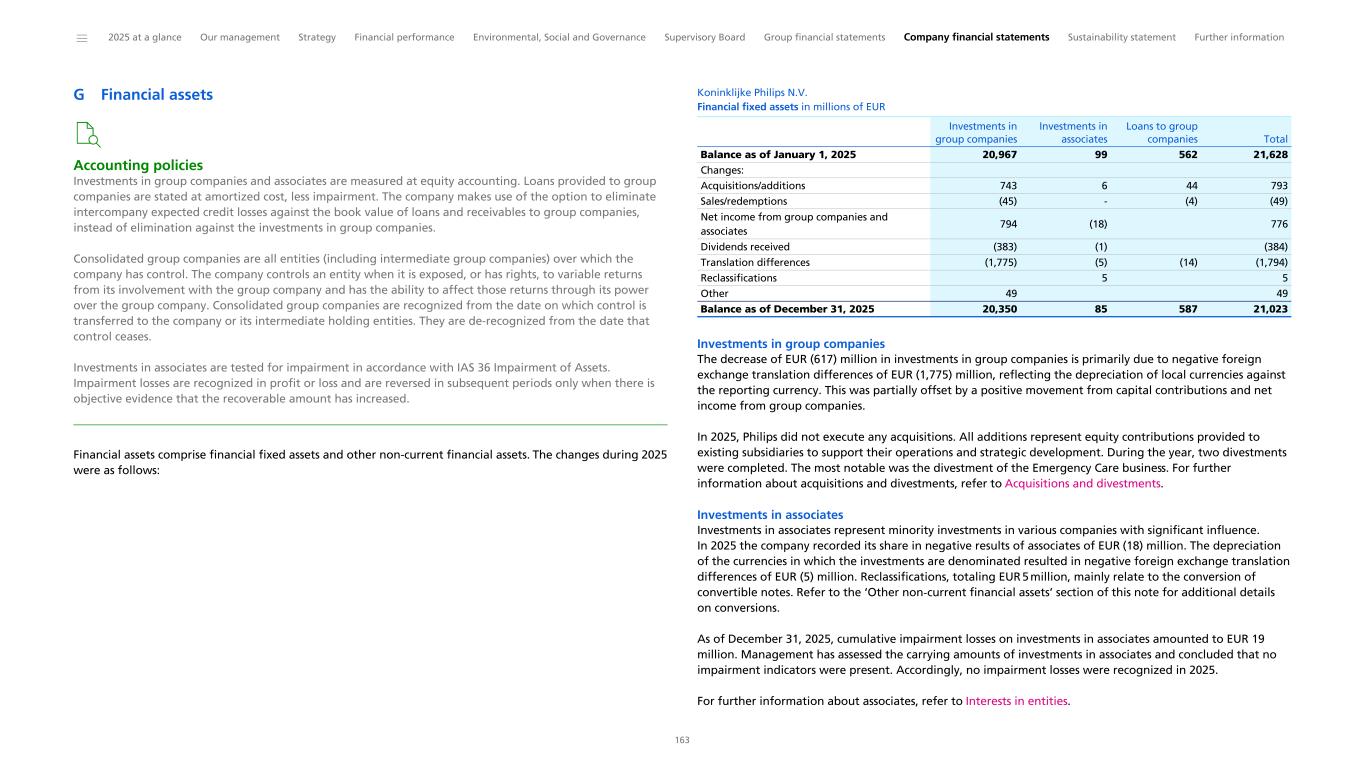
G Financial assets Accounting policies Investments in group companies and associates are measured at equity accounting. Loans provided to group companies are stated at amortized cost, less impairment. The company makes use of the option to eliminate intercompany expected credit losses against the book value of loans and receivables to group companies, instead of elimination against the investments in group companies. Consolidated group companies are all entities (including intermediate group companies) over which the company has control. The company controls an entity when it is exposed, or has rights, to variable returns from its involvement with the group company and has the ability to affect those returns through its power over the group company. Consolidated group companies are recognized from the date on which control is transferred to the company or its intermediate holding entities. They are de-recognized from the date that control ceases. Investments in associates are tested for impairment in accordance with IAS 36 Impairment of Assets. Impairment losses are recognized in profit or loss and are reversed in subsequent periods only when there is objective evidence that the recoverable amount has increased. Financial assets comprise financial fixed assets and other non-current financial assets. The changes during 2025 were as follows: Koninklijke Philips N.V. Financial fixed assets in millions of EUR Balance as of January 1, 2025 20,967 99 562 21,628 Changes: Acquisitions/additions 743 6 44 793 Sales/redemptions (45) - (4) (49) Net income from group companies and associates 794 (18) 776 Dividends received (383) (1) (384) Translation differences (1,775) (5) (14) (1,794) Reclassifications 5 5 Other 49 49 Balance as of December 31, 2025 20,350 85 587 21,023 Investments in group companies Investments in associates Loans to group companies Total Investments in group companies The decrease of EUR (617) million in investments in group companies is primarily due to negative foreign exchange translation differences of EUR (1,775) million, reflecting the depreciation of local currencies against the reporting currency. This was partially offset by a positive movement from capital contributions and net income from group companies. In 2025, Philips did not execute any acquisitions. All additions represent equity contributions provided to existing subsidiaries to support their operations and strategic development. During the year, two divestments were completed. The most notable was the divestment of the Emergency Care business. For further information about acquisitions and divestments, refer to Acquisitions and divestments. Investments in associates Investments in associates represent minority investments in various companies with significant influence. In 2025 the company recorded its share in negative results of associates of EUR (18) million. The depreciation of the currencies in which the investments are denominated resulted in negative foreign exchange translation differences of EUR (5) million. Reclassifications, totaling EUR 5 million, mainly relate to the conversion of convertible notes. Refer to the ‘Other non-current financial assets’ section of this note for additional details on conversions. As of December 31, 2025, cumulative impairment losses on investments in associates amounted to EUR 19 million. Management has assessed the carrying amounts of investments in associates and concluded that no impairment indicators were present. Accordingly, no impairment losses were recognized in 2025. For further information about associates, refer to Interests in entities. ______ 2025 at a glance Our management Strategy Financial performance Environmental, Social and Governance Supervisory Board Group financial statements Company financial statements Sustainability statement Further information 163
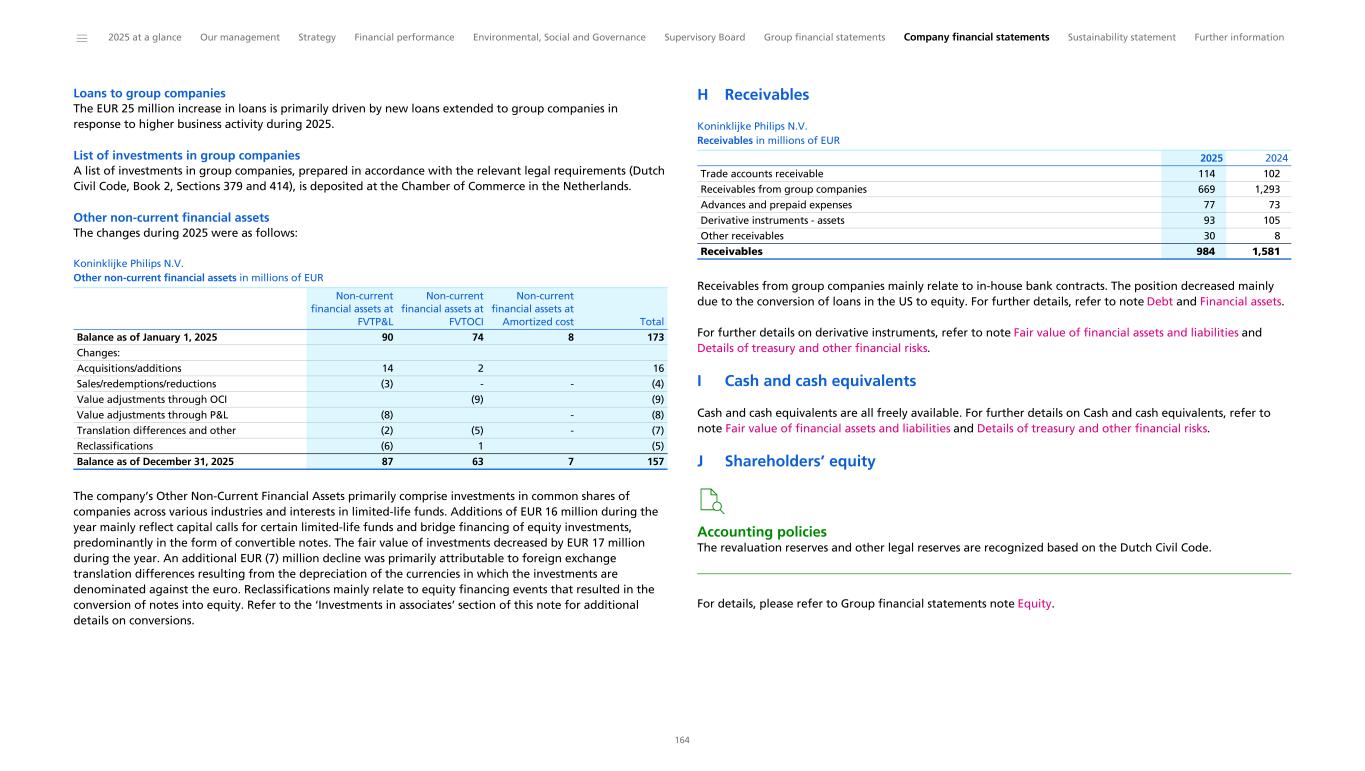
Loans to group companies The EUR 25 million increase in loans is primarily driven by new loans extended to group companies in response to higher business activity during 2025. List of investments in group companies A list of investments in group companies, prepared in accordance with the relevant legal requirements (Dutch Civil Code, Book 2, Sections 379 and 414), is deposited at the Chamber of Commerce in the Netherlands. Other non-current financial assets The changes during 2025 were as follows: Koninklijke Philips N.V. Other non-current financial assets in millions of EUR Balance as of January 1, 2025 90 74 8 173 Changes: Acquisitions/additions 14 2 16 Sales/redemptions/reductions (3) - - (4) Value adjustments through OCI (9) (9) Value adjustments through P&L (8) - (8) Translation differences and other (2) (5) - (7) Reclassifications (6) 1 (5) Balance as of December 31, 2025 87 63 7 157 Non-current financial assets at FVTP&L Non-current financial assets at FVTOCI Non-current financial assets at Amortized cost Total The company’s Other Non-Current Financial Assets primarily comprise investments in common shares of companies across various industries and interests in limited-life funds. Additions of EUR 16 million during the year mainly reflect capital calls for certain limited-life funds and bridge financing of equity investments, predominantly in the form of convertible notes. The fair value of investments decreased by EUR 17 million during the year. An additional EUR (7) million decline was primarily attributable to foreign exchange translation differences resulting from the depreciation of the currencies in which the investments are denominated against the euro. Reclassifications mainly relate to equity financing events that resulted in the conversion of notes into equity. Refer to the ‘Investments in associates’ section of this note for additional details on conversions. H Receivables Koninklijke Philips N.V. Receivables in millions of EUR Trade accounts receivable 114 102 Receivables from group companies 669 1,293 Advances and prepaid expenses 77 73 Derivative instruments - assets 93 105 Other receivables 30 8 Receivables 984 1,581 2025 2024 Receivables from group companies mainly relate to in-house bank contracts. The position decreased mainly due to the conversion of loans in the US to equity. For further details, refer to note Debt and Financial assets. For further details on derivative instruments, refer to note Fair value of financial assets and liabilities and Details of treasury and other financial risks. I Cash and cash equivalents Cash and cash equivalents are all freely available. For further details on Cash and cash equivalents, refer to note Fair value of financial assets and liabilities and Details of treasury and other financial risks. J Shareholders’ equity Accounting policies The revaluation reserves and other legal reserves are recognized based on the Dutch Civil Code. For details, please refer to Group financial statements note Equity. ______ 2025 at a glance Our management Strategy Financial performance Environmental, Social and Governance Supervisory Board Group financial statements Company financial statements Sustainability statement Further information 164
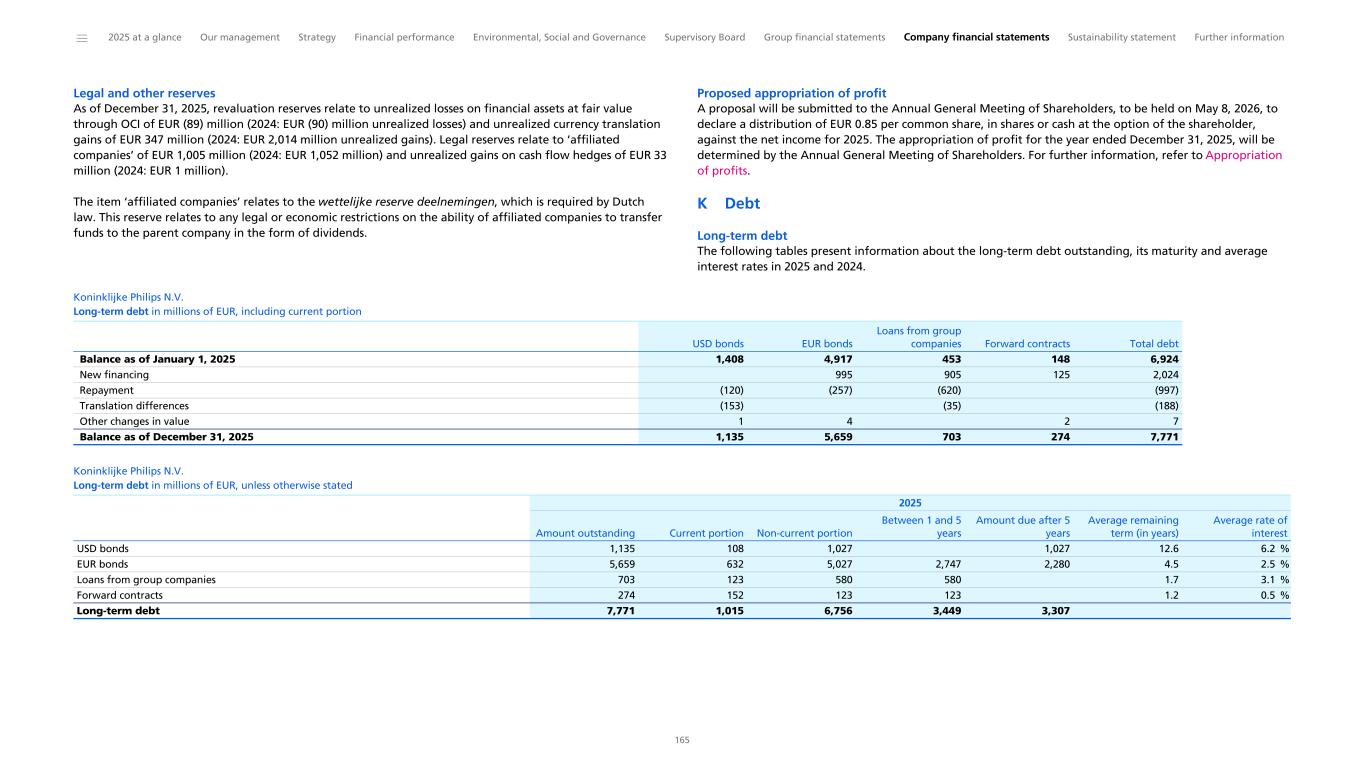
Legal and other reserves As of December 31, 2025, revaluation reserves relate to unrealized losses on financial assets at fair value through OCI of EUR (89) million (2024: EUR (90) million unrealized losses) and unrealized currency translation gains of EUR 347 million (2024: EUR 2,014 million unrealized gains). Legal reserves relate to ‘affiliated companies’ of EUR 1,005 million (2024: EUR 1,052 million) and unrealized gains on cash flow hedges of EUR 33 million (2024: EUR 1 million). The item ‘affiliated companies’ relates to the wettelijke reserve deelnemingen, which is required by Dutch law. This reserve relates to any legal or economic restrictions on the ability of affiliated companies to transfer funds to the parent company in the form of dividends. Proposed appropriation of profit A proposal will be submitted to the Annual General Meeting of Shareholders, to be held on May 8, 2026, to declare a distribution of EUR 0.85 per common share, in shares or cash at the option of the shareholder, against the net income for 2025. The appropriation of profit for the year ended December 31, 2025, will be determined by the Annual General Meeting of Shareholders. For further information, refer to Appropriation of profits. K Debt Long-term debt The following tables present information about the long-term debt outstanding, its maturity and average interest rates in 2025 and 2024. Koninklijke Philips N.V. Long-term debt in millions of EUR, including current portion Balance as of January 1, 2025 1,408 4,917 453 148 6,924 New financing 995 905 125 2,024 Repayment (120) (257) (620) (997) Translation differences (153) (35) (188) Other changes in value 1 4 2 7 Balance as of December 31, 2025 1,135 5,659 703 274 7,771 USD bonds EUR bonds Loans from group companies Forward contracts Total debt Koninklijke Philips N.V. Long-term debt in millions of EUR, unless otherwise stated USD bonds 1,135 108 1,027 1,027 12.6 6.2 % EUR bonds 5,659 632 5,027 2,747 2,280 4.5 2.5 % Loans from group companies 703 123 580 580 1.7 3.1 % Forward contracts 274 152 123 123 1.2 0.5 % Long-term debt 7,771 1,015 6,756 3,449 3,307 2025 Amount outstanding Current portion Non-current portion Between 1 and 5 years Amount due after 5 years Average remaining term (in years) Average rate of interest ______ 2025 at a glance Our management Strategy Financial performance Environmental, Social and Governance Supervisory Board Group financial statements Company financial statements Sustainability statement Further information 165
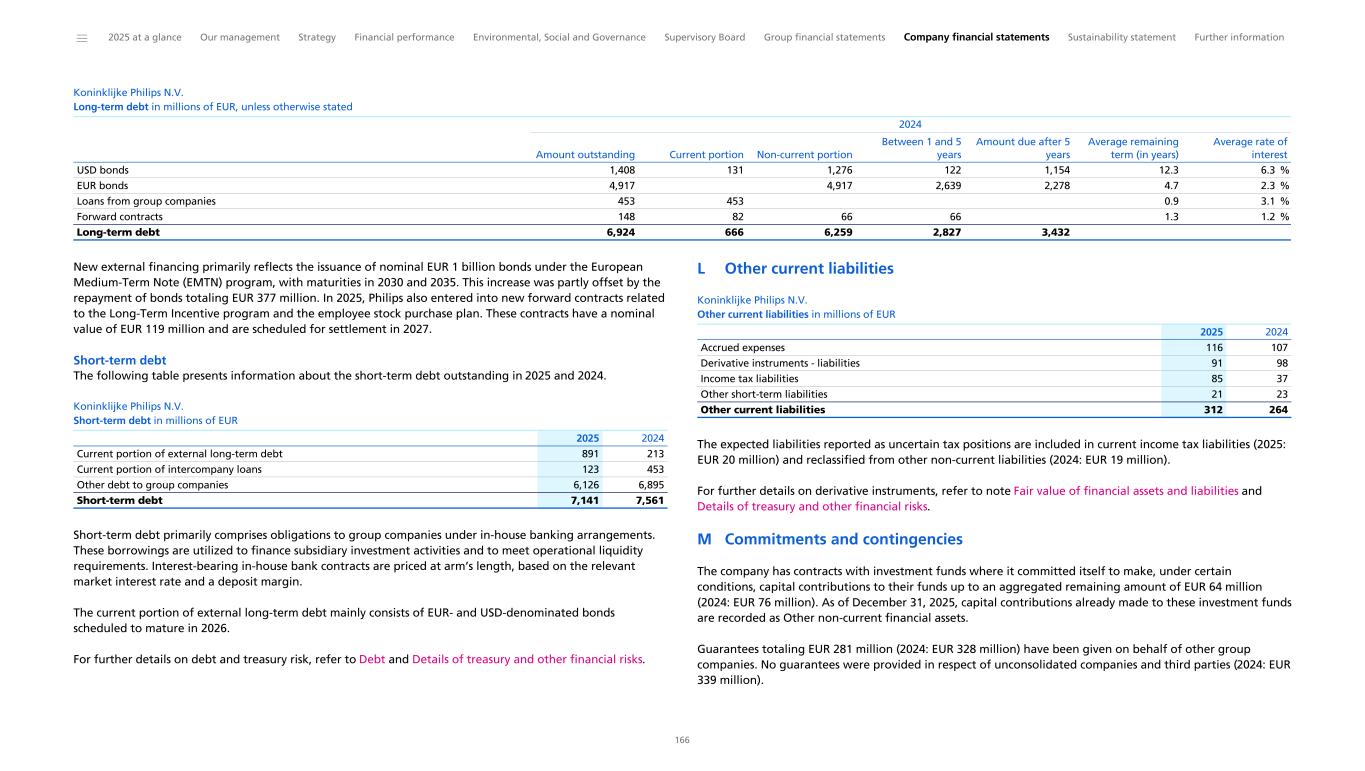
Koninklijke Philips N.V. Long-term debt in millions of EUR, unless otherwise stated USD bonds 1,408 131 1,276 122 1,154 12.3 6.3 % EUR bonds 4,917 4,917 2,639 2,278 4.7 2.3 % Loans from group companies 453 453 0.9 3.1 % Forward contracts 148 82 66 66 1.3 1.2 % Long-term debt 6,924 666 6,259 2,827 3,432 2024 Amount outstanding Current portion Non-current portion Between 1 and 5 years Amount due after 5 years Average remaining term (in years) Average rate of interest New external financing primarily reflects the issuance of nominal EUR 1 billion bonds under the European Medium-Term Note (EMTN) program, with maturities in 2030 and 2035. This increase was partly offset by the repayment of bonds totaling EUR 377 million. In 2025, Philips also entered into new forward contracts related to the Long-Term Incentive program and the employee stock purchase plan. These contracts have a nominal value of EUR 119 million and are scheduled for settlement in 2027. Short-term debt The following table presents information about the short-term debt outstanding in 2025 and 2024. Koninklijke Philips N.V. Short-term debt in millions of EUR Current portion of external long-term debt 891 213 Current portion of intercompany loans 123 453 Other debt to group companies 6,126 6,895 Short-term debt 7,141 7,561 2025 2024 Short-term debt primarily comprises obligations to group companies under in-house banking arrangements. These borrowings are utilized to finance subsidiary investment activities and to meet operational liquidity requirements. Interest-bearing in-house bank contracts are priced at arm’s length, based on the relevant market interest rate and a deposit margin. The current portion of external long-term debt mainly consists of EUR- and USD-denominated bonds scheduled to mature in 2026. For further details on debt and treasury risk, refer to Debt and Details of treasury and other financial risks. L Other current liabilities Koninklijke Philips N.V. Other current liabilities in millions of EUR Accrued expenses 116 107 Derivative instruments - liabilities 91 98 Income tax liabilities 85 37 Other short-term liabilities 21 23 Other current liabilities 312 264 2025 2024 The expected liabilities reported as uncertain tax positions are included in current income tax liabilities (2025: EUR 20 million) and reclassified from other non-current liabilities (2024: EUR 19 million). For further details on derivative instruments, refer to note Fair value of financial assets and liabilities and Details of treasury and other financial risks. M Commitments and contingencies The company has contracts with investment funds where it committed itself to make, under certain conditions, capital contributions to their funds up to an aggregated remaining amount of EUR 64 million (2024: EUR 76 million). As of December 31, 2025, capital contributions already made to these investment funds are recorded as Other non-current financial assets. Guarantees totaling EUR 281 million (2024: EUR 328 million) have been given on behalf of other group companies. No guarantees were provided in respect of unconsolidated companies and third parties (2024: EUR 339 million). ______ 2025 at a glance Our management Strategy Financial performance Environmental, Social and Governance Supervisory Board Group financial statements Company financial statements Sustainability statement Further information 166
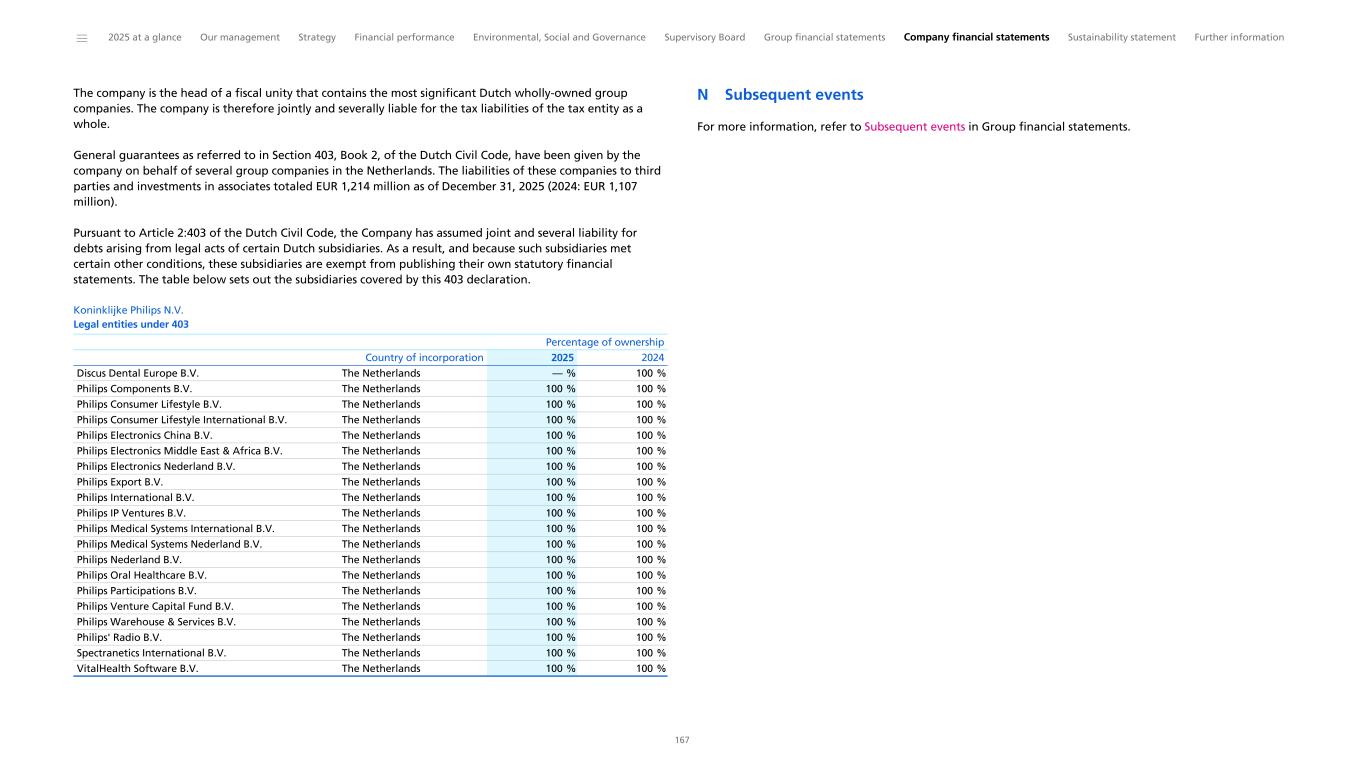
The company is the head of a fiscal unity that contains the most significant Dutch wholly-owned group companies. The company is therefore jointly and severally liable for the tax liabilities of the tax entity as a whole. General guarantees as referred to in Section 403, Book 2, of the Dutch Civil Code, have been given by the company on behalf of several group companies in the Netherlands. The liabilities of these companies to third parties and investments in associates totaled EUR 1,214 million as of December 31, 2025 (2024: EUR 1,107 million). Pursuant to Article 2:403 of the Dutch Civil Code, the Company has assumed joint and several liability for debts arising from legal acts of certain Dutch subsidiaries. As a result, and because such subsidiaries met certain other conditions, these subsidiaries are exempt from publishing their own statutory financial statements. The table below sets out the subsidiaries covered by this 403 declaration. Koninklijke Philips N.V. Legal entities under 403 Percentage of ownership Country of incorporation 2025 2024 Discus Dental Europe B.V. The Netherlands — % 100 % Philips Components B.V. The Netherlands 100 % 100 % Philips Consumer Lifestyle B.V. The Netherlands 100 % 100 % Philips Consumer Lifestyle International B.V. The Netherlands 100 % 100 % Philips Electronics China B.V. The Netherlands 100 % 100 % Philips Electronics Middle East & Africa B.V. The Netherlands 100 % 100 % Philips Electronics Nederland B.V. The Netherlands 100 % 100 % Philips Export B.V. The Netherlands 100 % 100 % Philips International B.V. The Netherlands 100 % 100 % Philips IP Ventures B.V. The Netherlands 100 % 100 % Philips Medical Systems International B.V. The Netherlands 100 % 100 % Philips Medical Systems Nederland B.V. The Netherlands 100 % 100 % Philips Nederland B.V. The Netherlands 100 % 100 % Philips Oral Healthcare B.V. The Netherlands 100 % 100 % Philips Participations B.V. The Netherlands 100 % 100 % Philips Venture Capital Fund B.V. The Netherlands 100 % 100 % Philips Warehouse & Services B.V. The Netherlands 100 % 100 % Philips' Radio B.V. The Netherlands 100 % 100 % Spectranetics International B.V. The Netherlands 100 % 100 % VitalHealth Software B.V. The Netherlands 100 % 100 % N Subsequent events For more information, refer to Subsequent events in Group financial statements. ______ 2025 at a glance Our management Strategy Financial performance Environmental, Social and Governance Supervisory Board Group financial statements Company financial statements Sustainability statement Further information 167
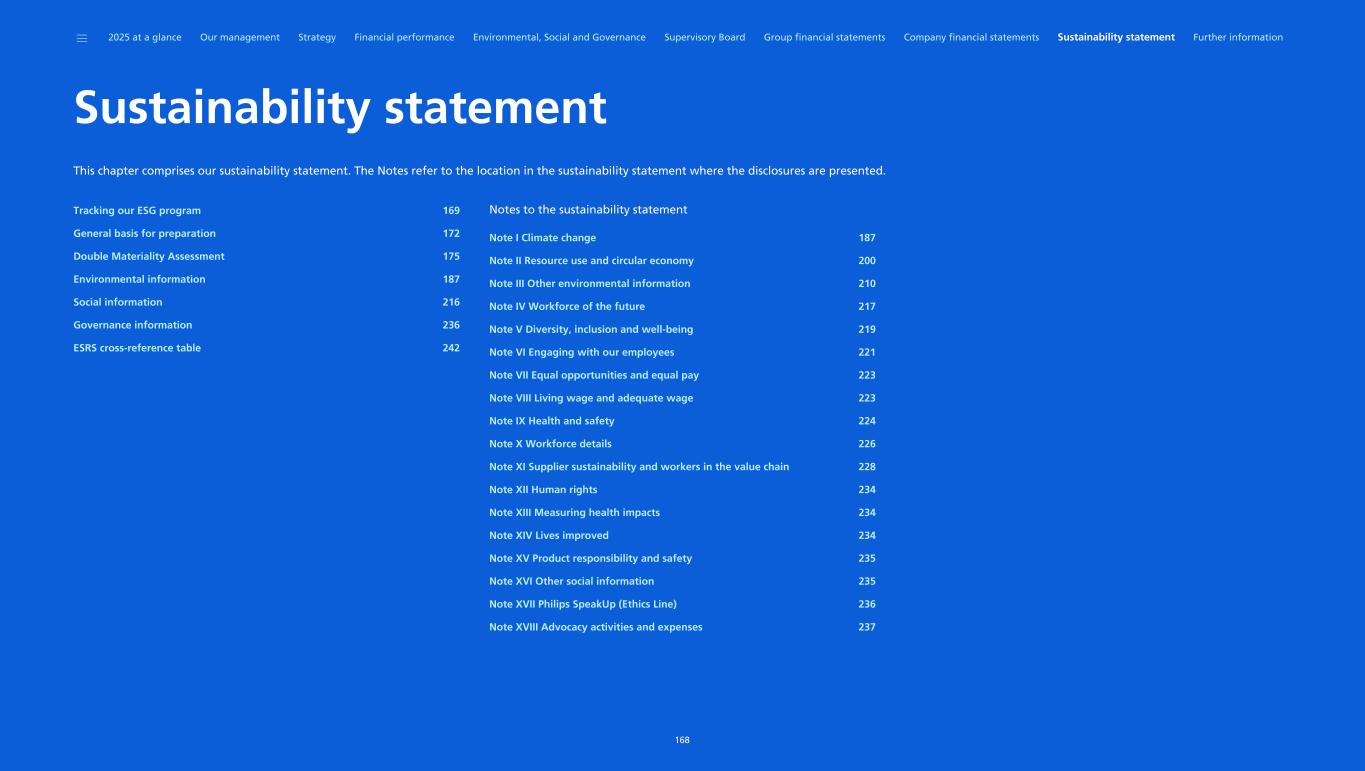
Sustainability statement This chapter comprises our sustainability statement. The Notes refer to the location in the sustainability statement where the disclosures are presented. Tracking our ESG program 169 General basis for preparation 172 Double Materiality Assessment 175 Environmental information 187 Social information 216 Governance information 236 ESRS cross-reference table 242 Notes to the sustainability statement Note I Climate change 187 Note II Resource use and circular economy 200 Note III Other environmental information 210 Note IV Workforce of the future 217 Note V Diversity, inclusion and well-being 219 Note VI Engaging with our employees 221 Note VII Equal opportunities and equal pay 223 Note VIII Living wage and adequate wage 223 Note IX Health and safety 224 Note X Workforce details 226 Note XI Supplier sustainability and workers in the value chain 228 Note XII Human rights 234 Note XIII Measuring health impacts 234 Note XIV Lives improved 234 Note XV Product responsibility and safety 235 Note XVI Other social information 235 Note XVII Philips SpeakUp (Ethics Line) 236 Note XVIII Advocacy activities and expenses 237 ______ 2025 at a glance Our management Strategy Financial performance Environmental, Social and Governance Supervisory Board Group financial statements Company financial statements Sustainability statement Further information 168
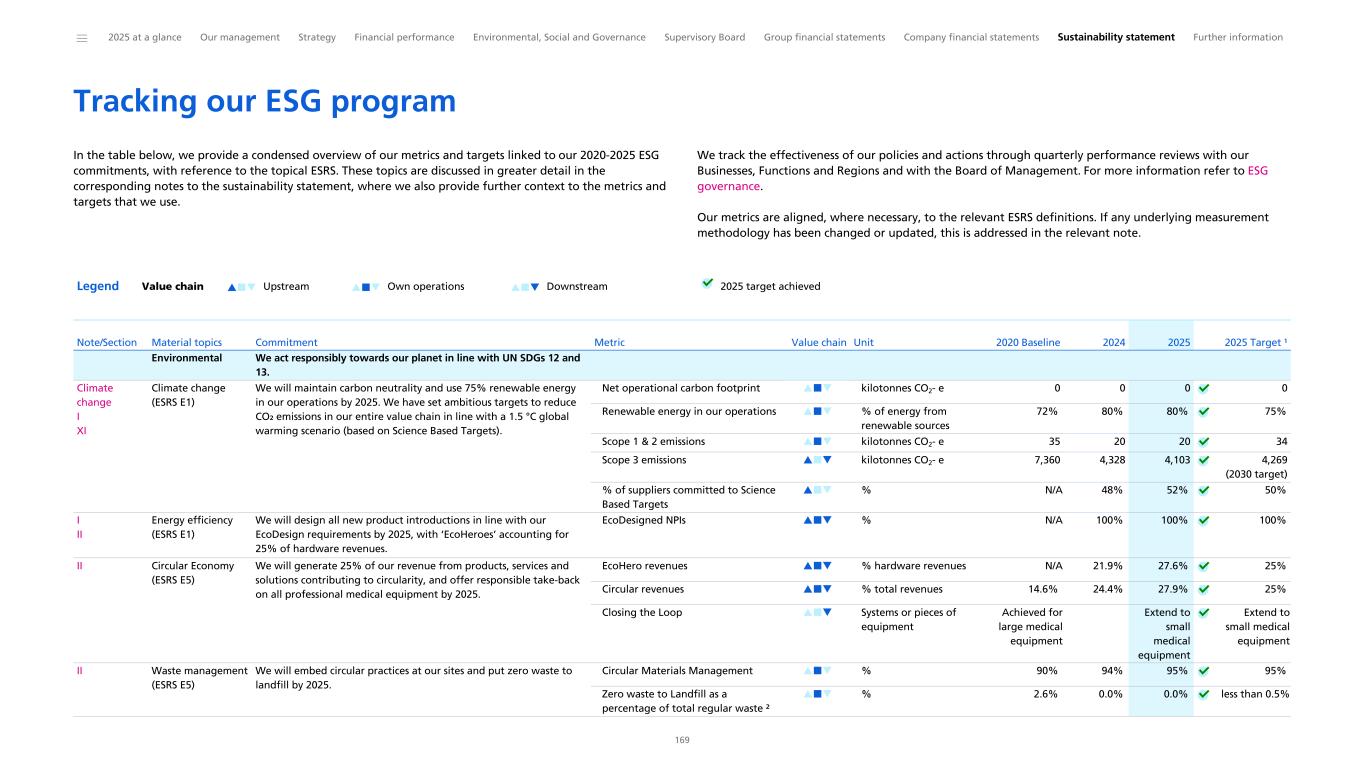
Tracking our ESG program In the table below, we provide a condensed overview of our metrics and targets linked to our 2020-2025 ESG commitments, with reference to the topical ESRS. These topics are discussed in greater detail in the corresponding notes to the sustainability statement, where we also provide further context to the metrics and targets that we use. We track the effectiveness of our policies and actions through quarterly performance reviews with our Businesses, Functions and Regions and with the Board of Management. For more information refer to ESG governance. Our metrics are aligned, where necessary, to the relevant ESRS definitions. If any underlying measurement methodology has been changed or updated, this is addressed in the relevant note. Legend Value chain p¢q Upstream p¢q Own operations p¢q Downstream 2025 target achieved Environmental We act responsibly towards our planet in line with UN SDGs 12 and 13. Climate change I XI Climate change (ESRS E1) We will maintain carbon neutrality and use 75% renewable energy in our operations by 2025. We have set ambitious targets to reduce CO₂ emissions in our entire value chain in line with a 1.5 °C global warming scenario (based on Science Based Targets). Net operational carbon footprint p¢q kilotonnes CO2- e 0 0 0 0 Renewable energy in our operations p¢q % of energy from renewable sources 72% 80% 80% 75% Scope 1 & 2 emissions p¢q kilotonnes CO2- e 35 20 20 34 Scope 3 emissions p¢q kilotonnes CO2- e 7,360 4,328 4,103 4,269 (2030 target) % of suppliers committed to Science Based Targets p¢q % N/A 48% 52% 50% I II Energy efficiency (ESRS E1) We will design all new product introductions in line with our EcoDesign requirements by 2025, with ‘EcoHeroes’ accounting for 25% of hardware revenues. EcoDesigned NPIs p¢q % N/A 100% 100% 100% II Circular Economy (ESRS E5) We will generate 25% of our revenue from products, services and solutions contributing to circularity, and offer responsible take-back on all professional medical equipment by 2025. EcoHero revenues p¢q % hardware revenues N/A 21.9% 27.6% 25% Circular revenues p¢q % total revenues 14.6% 24.4% 27.9% 25% Closing the Loop p¢q Systems or pieces of equipment Achieved for large medical equipment Extend to small medical equipment Extend to small medical equipment II Waste management (ESRS E5) We will embed circular practices at our sites and put zero waste to landfill by 2025. Circular Materials Management p¢q % 90% 94% 95% 95% Zero waste to Landfill as a percentage of total regular waste ² p¢q % 2.6% 0.0% 0.0% less than 0.5% Note/Section Material topics Commitment Metric Value chain Unit 2020 Baseline 2024 2025 2025 Target ¹ ______ 2025 at a glance Our management Strategy Financial performance Environmental, Social and Governance Supervisory Board Group financial statements Company financial statements Sustainability statement Further information 169
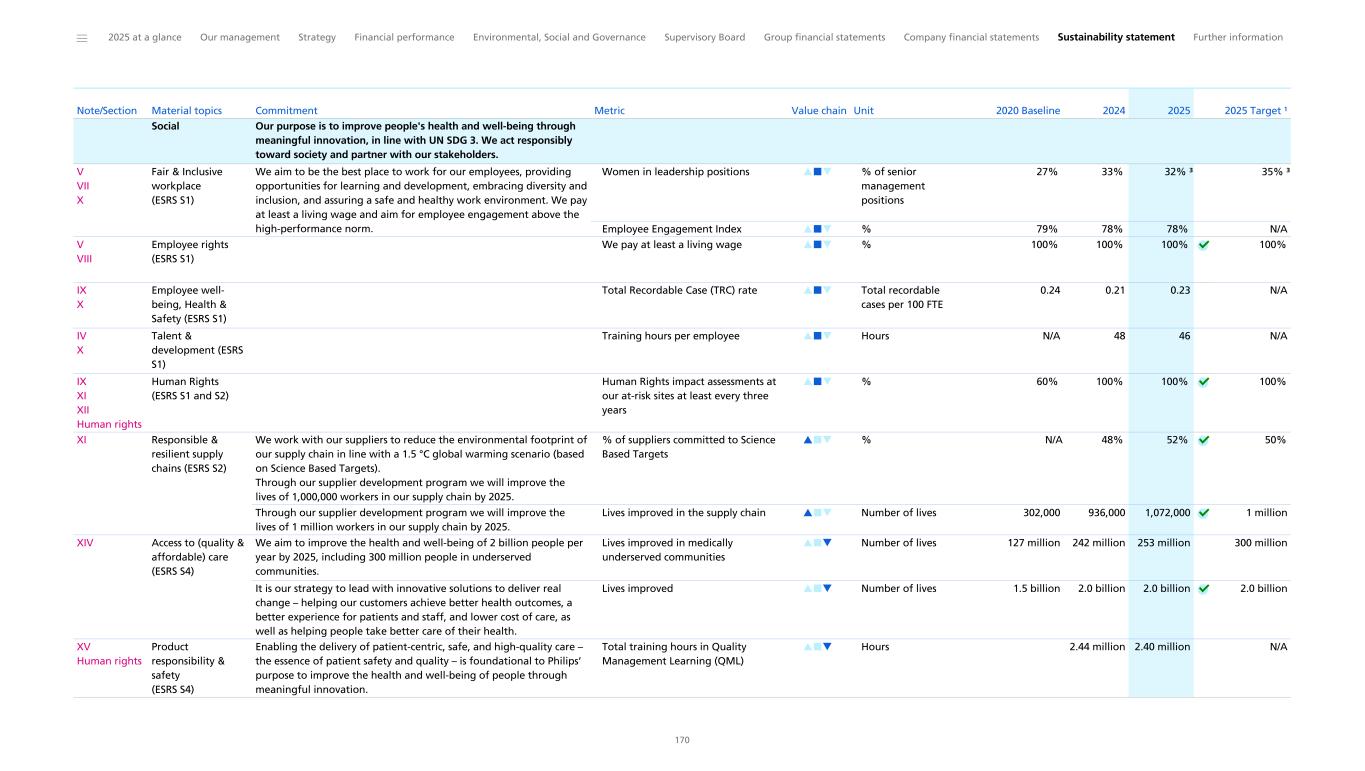
Social Our purpose is to improve people's health and well-being through meaningful innovation, in line with UN SDG 3. We act responsibly toward society and partner with our stakeholders. V VII X Fair & Inclusive workplace (ESRS S1) We aim to be the best place to work for our employees, providing opportunities for learning and development, embracing diversity and inclusion, and assuring a safe and healthy work environment. We pay at least a living wage and aim for employee engagement above the high-performance norm. Women in leadership positions p¢q % of senior management positions 27% 33% 32% ³ 35% ³ Employee Engagement Index p¢q % 79% 78% 78% N/A V VIII Employee rights (ESRS S1) We pay at least a living wage p¢q % 100% 100% 100% 100% IX X Employee well- being, Health & Safety (ESRS S1) Total Recordable Case (TRC) rate p¢q Total recordable cases per 100 FTE 0.24 0.21 0.23 N/A IV X Talent & development (ESRS S1) Training hours per employee p¢q Hours N/A 48 46 N/A IX XI XII Human rights Human Rights (ESRS S1 and S2) Human Rights impact assessments at our at-risk sites at least every three years p¢q % 60% 100% 100% 100% XI Responsible & resilient supply chains (ESRS S2) We work with our suppliers to reduce the environmental footprint of our supply chain in line with a 1.5 °C global warming scenario (based on Science Based Targets). Through our supplier development program we will improve the lives of 1,000,000 workers in our supply chain by 2025. % of suppliers committed to Science Based Targets p¢q % N/A 48% 52% 50% Through our supplier development program we will improve the lives of 1 million workers in our supply chain by 2025. Lives improved in the supply chain p¢q Number of lives 302,000 936,000 1,072,000 1 million XIV Access to (quality & affordable) care (ESRS S4) We aim to improve the health and well-being of 2 billion people per year by 2025, including 300 million people in underserved communities. Lives improved in medically underserved communities p¢q Number of lives 127 million 242 million 253 million 300 million It is our strategy to lead with innovative solutions to deliver real change – helping our customers achieve better health outcomes, a better experience for patients and staff, and lower cost of care, as well as helping people take better care of their health. Lives improved p¢q Number of lives 1.5 billion 2.0 billion 2.0 billion 2.0 billion XV Human rights Product responsibility & safety (ESRS S4) Enabling the delivery of patient-centric, safe, and high-quality care – the essence of patient safety and quality – is foundational to Philips’ purpose to improve the health and well-being of people through meaningful innovation. Total training hours in Quality Management Learning (QML) p¢q Hours 2.44 million 2.40 million N/A Note/Section Material topics Commitment Metric Value chain Unit 2020 Baseline 2024 2025 2025 Target ¹ ______ 2025 at a glance Our management Strategy Financial performance Environmental, Social and Governance Supervisory Board Group financial statements Company financial statements Sustainability statement Further information 170
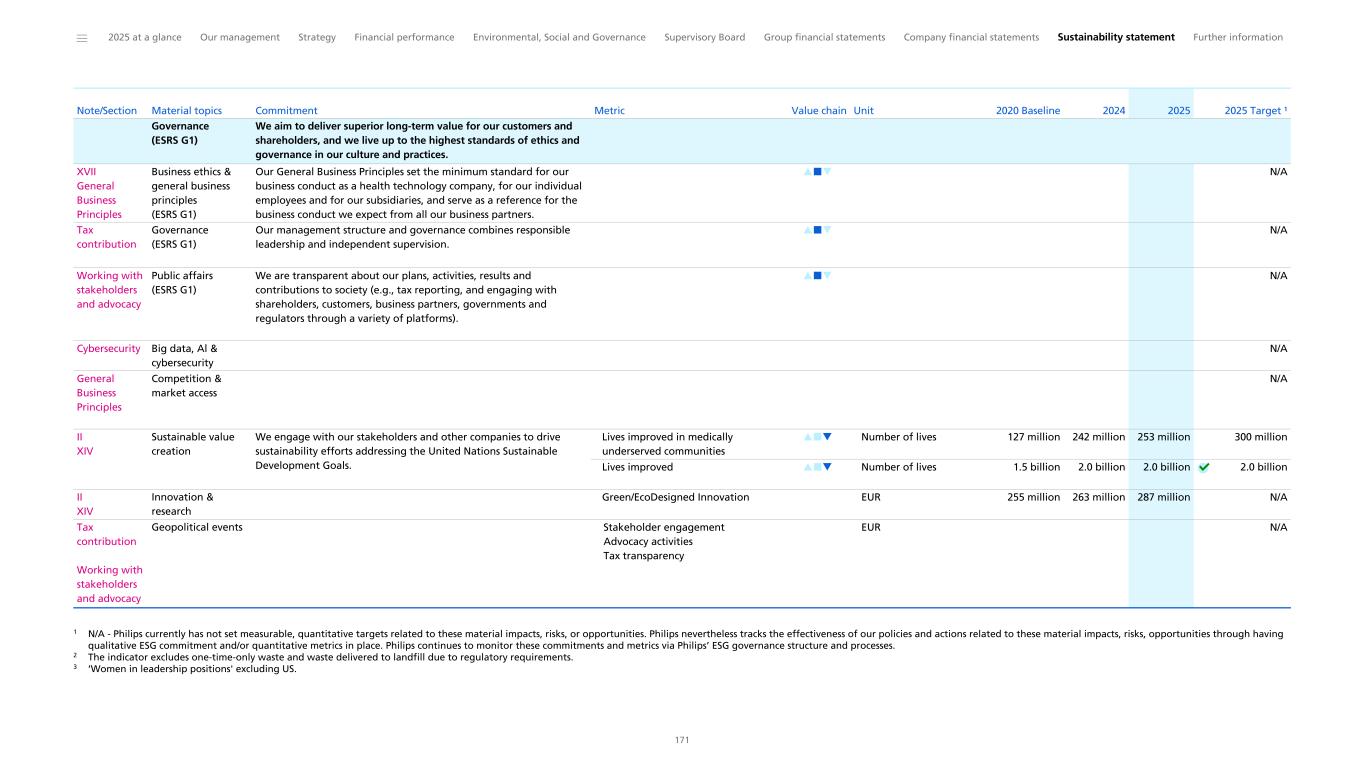
Governance (ESRS G1) We aim to deliver superior long-term value for our customers and shareholders, and we live up to the highest standards of ethics and governance in our culture and practices. XVII General Business Principles Business ethics & general business principles (ESRS G1) Our General Business Principles set the minimum standard for our business conduct as a health technology company, for our individual employees and for our subsidiaries, and serve as a reference for the business conduct we expect from all our business partners. p¢q N/A Tax contribution Governance (ESRS G1) Our management structure and governance combines responsible leadership and independent supervision. p¢q N/A Working with stakeholders and advocacy Public affairs (ESRS G1) We are transparent about our plans, activities, results and contributions to society (e.g., tax reporting, and engaging with shareholders, customers, business partners, governments and regulators through a variety of platforms). p¢q N/A Cybersecurity Big data, Al & cybersecurity N/A General Business Principles Competition & market access N/A II XIV Sustainable value creation We engage with our stakeholders and other companies to drive sustainability efforts addressing the United Nations Sustainable Development Goals. Lives improved in medically underserved communities p¢q Number of lives 127 million 242 million 253 million 300 million Lives improved p¢q Number of lives 1.5 billion 2.0 billion 2.0 billion 2.0 billion II XIV Innovation & research Green/EcoDesigned Innovation EUR 255 million 263 million 287 million N/A Tax contribution Working with stakeholders and advocacy Geopolitical events Stakeholder engagement Advocacy activities Tax transparency EUR N/A Note/Section Material topics Commitment Metric Value chain Unit 2020 Baseline 2024 2025 2025 Target ¹ 1 N/A - Philips currently has not set measurable, quantitative targets related to these material impacts, risks, or opportunities. Philips nevertheless tracks the effectiveness of our policies and actions related to these material impacts, risks, opportunities through having qualitative ESG commitment and/or quantitative metrics in place. Philips continues to monitor these commitments and metrics via Philips’ ESG governance structure and processes. 2 The indicator excludes one-time-only waste and waste delivered to landfill due to regulatory requirements. 3 ‘Women in leadership positions' excluding US. ______ 2025 at a glance Our management Strategy Financial performance Environmental, Social and Governance Supervisory Board Group financial statements Company financial statements Sustainability statement Further information 171
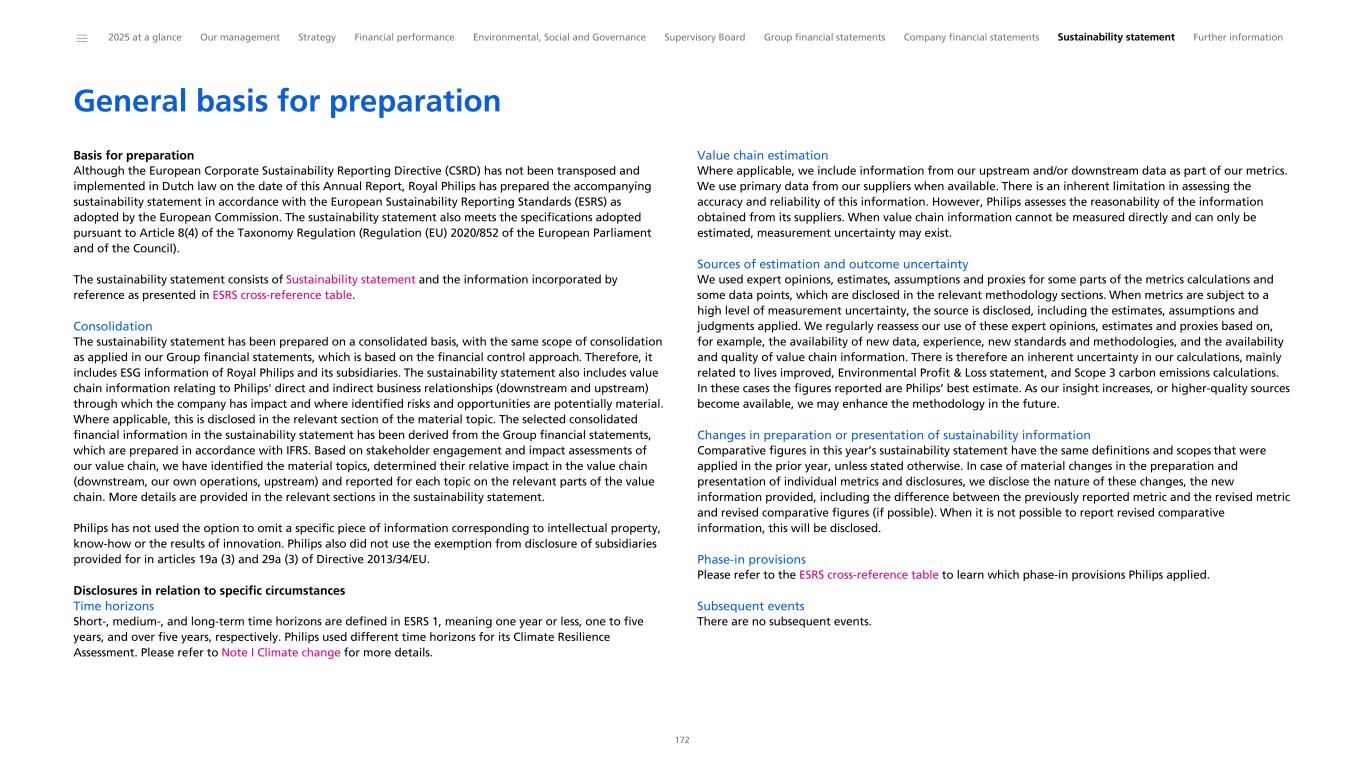
General basis for preparation Basis for preparation Although the European Corporate Sustainability Reporting Directive (CSRD) has not been transposed and implemented in Dutch law on the date of this Annual Report, Royal Philips has prepared the accompanying sustainability statement in accordance with the European Sustainability Reporting Standards (ESRS) as adopted by the European Commission. The sustainability statement also meets the specifications adopted pursuant to Article 8(4) of the Taxonomy Regulation (Regulation (EU) 2020/852 of the European Parliament and of the Council). The sustainability statement consists of Sustainability statement and the information incorporated by reference as presented in ESRS cross-reference table. Consolidation The sustainability statement has been prepared on a consolidated basis, with the same scope of consolidation as applied in our Group financial statements, which is based on the financial control approach. Therefore, it includes ESG information of Royal Philips and its subsidiaries. The sustainability statement also includes value chain information relating to Philips' direct and indirect business relationships (downstream and upstream) through which the company has impact and where identified risks and opportunities are potentially material. Where applicable, this is disclosed in the relevant section of the material topic. The selected consolidated financial information in the sustainability statement has been derived from the Group financial statements, which are prepared in accordance with IFRS. Based on stakeholder engagement and impact assessments of our value chain, we have identified the material topics, determined their relative impact in the value chain (downstream, our own operations, upstream) and reported for each topic on the relevant parts of the value chain. More details are provided in the relevant sections in the sustainability statement. Philips has not used the option to omit a specific piece of information corresponding to intellectual property, know-how or the results of innovation. Philips also did not use the exemption from disclosure of subsidiaries provided for in articles 19a (3) and 29a (3) of Directive 2013/34/EU. Disclosures in relation to specific circumstances Time horizons Short-, medium-, and long-term time horizons are defined in ESRS 1, meaning one year or less, one to five years, and over five years, respectively. Philips used different time horizons for its Climate Resilience Assessment. Please refer to Note I Climate change for more details. Value chain estimation Where applicable, we include information from our upstream and/or downstream data as part of our metrics. We use primary data from our suppliers when available. There is an inherent limitation in assessing the accuracy and reliability of this information. However, Philips assesses the reasonability of the information obtained from its suppliers. When value chain information cannot be measured directly and can only be estimated, measurement uncertainty may exist. Sources of estimation and outcome uncertainty We used expert opinions, estimates, assumptions and proxies for some parts of the metrics calculations and some data points, which are disclosed in the relevant methodology sections. When metrics are subject to a high level of measurement uncertainty, the source is disclosed, including the estimates, assumptions and judgments applied. We regularly reassess our use of these expert opinions, estimates and proxies based on, for example, the availability of new data, experience, new standards and methodologies, and the availability and quality of value chain information. There is therefore an inherent uncertainty in our calculations, mainly related to lives improved, Environmental Profit & Loss statement, and Scope 3 carbon emissions calculations. In these cases the figures reported are Philips’ best estimate. As our insight increases, or higher-quality sources become available, we may enhance the methodology in the future. Changes in preparation or presentation of sustainability information Comparative figures in this year’s sustainability statement have the same definitions and scopes that were applied in the prior year, unless stated otherwise. In case of material changes in the preparation and presentation of individual metrics and disclosures, we disclose the nature of these changes, the new information provided, including the difference between the previously reported metric and the revised metric and revised comparative figures (if possible). When it is not possible to report revised comparative information, this will be disclosed. Phase-in provisions Please refer to the ESRS cross-reference table to learn which phase-in provisions Philips applied. Subsequent events There are no subsequent events. ______ 2025 at a glance Our management Strategy Financial performance Environmental, Social and Governance Supervisory Board Group financial statements Company financial statements Sustainability statement Further information 172
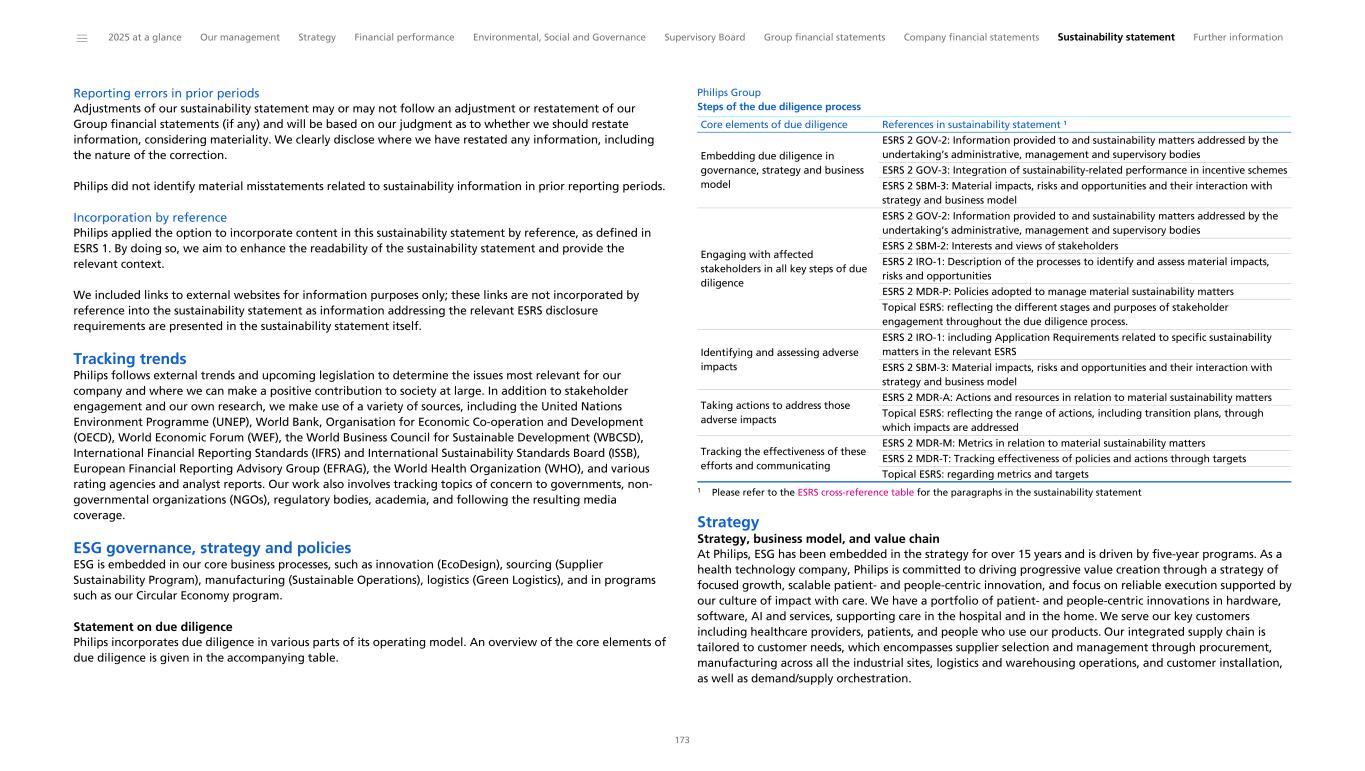
Reporting errors in prior periods Adjustments of our sustainability statement may or may not follow an adjustment or restatement of our Group financial statements (if any) and will be based on our judgment as to whether we should restate information, considering materiality. We clearly disclose where we have restated any information, including the nature of the correction. Philips did not identify material misstatements related to sustainability information in prior reporting periods. Incorporation by reference Philips applied the option to incorporate content in this sustainability statement by reference, as defined in ESRS 1. By doing so, we aim to enhance the readability of the sustainability statement and provide the relevant context. We included links to external websites for information purposes only; these links are not incorporated by reference into the sustainability statement as information addressing the relevant ESRS disclosure requirements are presented in the sustainability statement itself. Tracking trends Philips follows external trends and upcoming legislation to determine the issues most relevant for our company and where we can make a positive contribution to society at large. In addition to stakeholder engagement and our own research, we make use of a variety of sources, including the United Nations Environment Programme (UNEP), World Bank, Organisation for Economic Co-operation and Development (OECD), World Economic Forum (WEF), the World Business Council for Sustainable Development (WBCSD), International Financial Reporting Standards (IFRS) and International Sustainability Standards Board (ISSB), European Financial Reporting Advisory Group (EFRAG), the World Health Organization (WHO), and various rating agencies and analyst reports. Our work also involves tracking topics of concern to governments, non- governmental organizations (NGOs), regulatory bodies, academia, and following the resulting media coverage. ESG governance, strategy and policies ESG is embedded in our core business processes, such as innovation (EcoDesign), sourcing (Supplier Sustainability Program), manufacturing (Sustainable Operations), logistics (Green Logistics), and in programs such as our Circular Economy program. Statement on due diligence Philips incorporates due diligence in various parts of its operating model. An overview of the core elements of due diligence is given in the accompanying table. Philips Group Steps of the due diligence process Embedding due diligence in governance, strategy and business model ESRS 2 GOV-2: Information provided to and sustainability matters addressed by the undertaking’s administrative, management and supervisory bodies ESRS 2 GOV-3: Integration of sustainability-related performance in incentive schemes ESRS 2 SBM-3: Material impacts, risks and opportunities and their interaction with strategy and business model Engaging with affected stakeholders in all key steps of due diligence ESRS 2 GOV-2: Information provided to and sustainability matters addressed by the undertaking’s administrative, management and supervisory bodies ESRS 2 SBM-2: Interests and views of stakeholders ESRS 2 IRO-1: Description of the processes to identify and assess material impacts, risks and opportunities ESRS 2 MDR-P: Policies adopted to manage material sustainability matters Topical ESRS: reflecting the different stages and purposes of stakeholder engagement throughout the due diligence process. Identifying and assessing adverse impacts ESRS 2 IRO-1: including Application Requirements related to specific sustainability matters in the relevant ESRS ESRS 2 SBM-3: Material impacts, risks and opportunities and their interaction with strategy and business model Taking actions to address those adverse impacts ESRS 2 MDR-A: Actions and resources in relation to material sustainability matters Topical ESRS: reflecting the range of actions, including transition plans, through which impacts are addressed Tracking the effectiveness of these efforts and communicating ESRS 2 MDR-M: Metrics in relation to material sustainability matters ESRS 2 MDR-T: Tracking effectiveness of policies and actions through targets Topical ESRS: regarding metrics and targets Core elements of due diligence References in sustainability statement ¹ 1 Please refer to the ESRS cross-reference table for the paragraphs in the sustainability statement Strategy Strategy, business model, and value chain At Philips, ESG has been embedded in the strategy for over 15 years and is driven by five-year programs. As a health technology company, Philips is committed to driving progressive value creation through a strategy of focused growth, scalable patient- and people-centric innovation, and focus on reliable execution supported by our culture of impact with care. We have a portfolio of patient- and people-centric innovations in hardware, software, AI and services, supporting care in the hospital and in the home. We serve our key customers including healthcare providers, patients, and people who use our products. Our integrated supply chain is tailored to customer needs, which encompasses supplier selection and management through procurement, manufacturing across all the industrial sites, logistics and warehousing operations, and customer installation, as well as demand/supply orchestration. ______ 2025 at a glance Our management Strategy Financial performance Environmental, Social and Governance Supervisory Board Group financial statements Company financial statements Sustainability statement Further information 173
We gather stakeholder input as described in Double Materiality Assessment and Working with stakeholders and advocacy. We summarized the current and future expected benefits for our stakeholders in the Impacts, Risks and Opportunities table. For headcount of employees by geographical areas, refer to Employees headcount by contract type and region. Interests and views of stakeholders Philips actively engages with stakeholders, and this engagement is closely aligned with the company’s purpose to improve people’s health and well-being through meaningful innovation. More information on this process can be found in Working with stakeholders and advocacy. Material impacts, risks, and opportunities and their interaction with strategy and business model Philips refreshed its Double Materiality Assessment (DMA) in 2025 to identify material topics, the related impacts, risks and opportunities, and the subsequent reporting scope. Details can be found in Double Materiality Assessment and Material topics and our focus. Policies Policies adopted to manage material sustainability matters Philips policies relating to the material topics identified through the DMA process can be found in the Policy overview. More details on these policies can be found in the topical sections in the sustainability statement. To read the public policies in full, please refer to Sustainability resources on the Philips website. To read the General Business Principles in full, please refer to General Business Principles. To read the SpeakUp Policy in full please refer to Philips SpeakUp Policy. The public policies and the General Business Principles are made available via the Philips website to all potentially affected stakeholders, and to stakeholders who need help to implement them. The scope of the policies includes activities of Philips, including all its Businesses, Regions, and Functions. Key stakeholders, such as employees, customers and NGOs, are engaged to understand their interests. These interests are fully considered, and their inputs inform Philips policies both in their objectives and their governance. For more information on how Philips engages with stakeholders, please refer to Working with stakeholders and advocacy. Actions Actions and resources in relation to material sustainability matters Actions, progress and resources relating to the material topics can be found in the topical sections in the sustainability statement; all disclosed actions are deemed key. In 2020, Philips defined a five-year program to deliver on its 2025 ESG commitments. The scope and time horizon of key actions and results (where targets were defined) can be found in Tracking our 2020-2025 ESG program. This table also shows the progress of our action plans for our five-year program on a target level. No significant financial or other resources have been allocated. External assurance PricewaterhouseCoopers Accountants N.V. (PwC) has issued an assurance report on the information included in our sustainability statement. Refer to Independent auditor’s assurance report on the sustainability statement. Also refer to ESRS cross-reference table where we specify level of assurance provided by PwC. Our full sustainability statement is subject to limited assurance. Further, parts of the sustainability information have been provided with reasonable assurance by PwC. This has been indicated in the same section. For 2025, considering regulatory uncertainties, Philips decided to keep the scope of topics provided with reasonable assurance in 2025 aligned with the topics where EY Accountants B.V. provided reasonable assurance in 2024. Where the measurement of a metric has been validated by an external organization other than PwC, this is clearly indicated in the relevant section. ______ 2025 at a glance Our management Strategy Financial performance Environmental, Social and Governance Supervisory Board Group financial statements Company financial statements Sustainability statement Further information 174
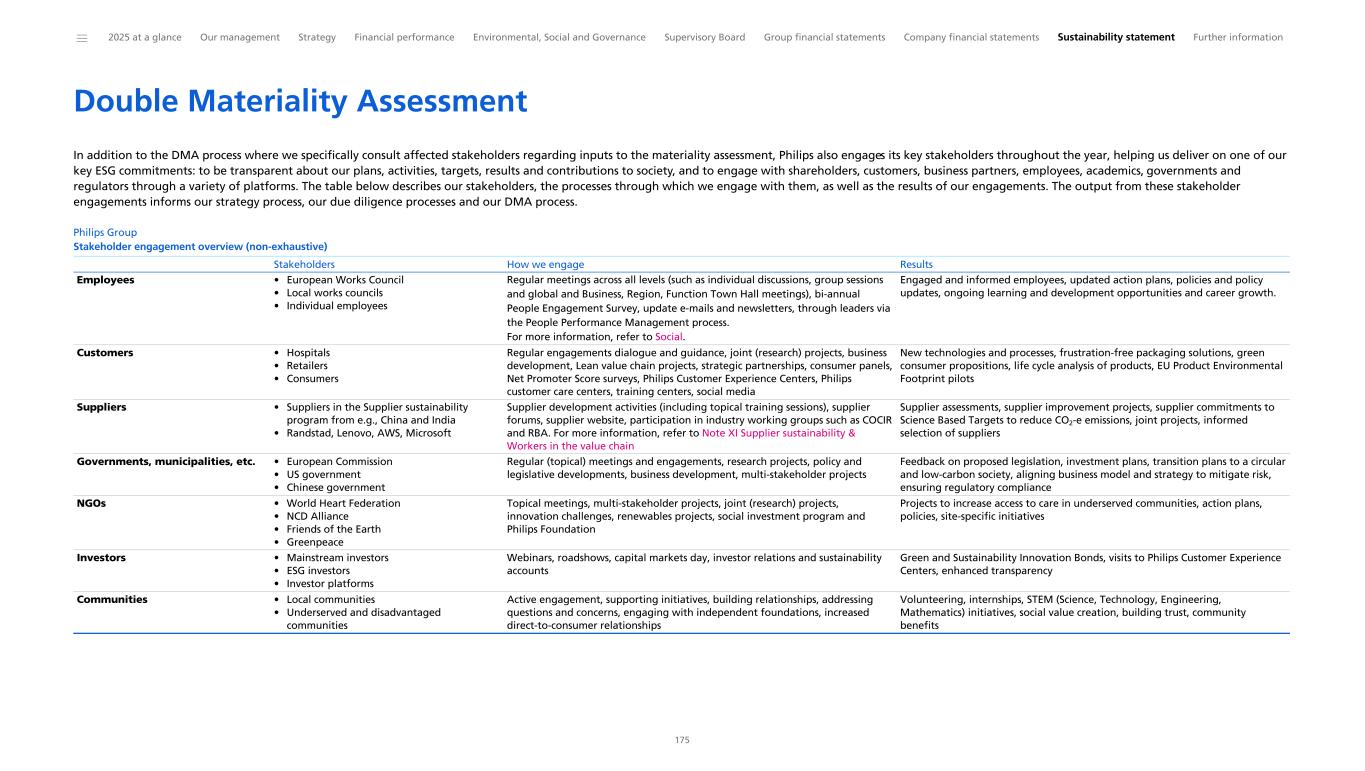
Double Materiality Assessment In addition to the DMA process where we specifically consult affected stakeholders regarding inputs to the materiality assessment, Philips also engages its key stakeholders throughout the year, helping us deliver on one of our key ESG commitments: to be transparent about our plans, activities, targets, results and contributions to society, and to engage with shareholders, customers, business partners, employees, academics, governments and regulators through a variety of platforms. The table below describes our stakeholders, the processes through which we engage with them, as well as the results of our engagements. The output from these stakeholder engagements informs our strategy process, our due diligence processes and our DMA process. Philips Group Stakeholder engagement overview (non-exhaustive) Stakeholders How we engage Results Employees • European Works Council • Local works councils • Individual employees Regular meetings across all levels (such as individual discussions, group sessions and global and Business, Region, Function Town Hall meetings), bi-annual People Engagement Survey, update e-mails and newsletters, through leaders via the People Performance Management process. For more information, refer to Social. Engaged and informed employees, updated action plans, policies and policy updates, ongoing learning and development opportunities and career growth. Customers • Hospitals • Retailers • Consumers Regular engagements dialogue and guidance, joint (research) projects, business development, Lean value chain projects, strategic partnerships, consumer panels, Net Promoter Score surveys, Philips Customer Experience Centers, Philips customer care centers, training centers, social media New technologies and processes, frustration-free packaging solutions, green consumer propositions, life cycle analysis of products, EU Product Environmental Footprint pilots Suppliers • Suppliers in the Supplier sustainability program from e.g., China and India • Randstad, Lenovo, AWS, Microsoft Supplier development activities (including topical training sessions), supplier forums, supplier website, participation in industry working groups such as COCIR and RBA. For more information, refer to Note XI Supplier sustainability & Workers in the value chain Supplier assessments, supplier improvement projects, supplier commitments to Science Based Targets to reduce CO2-e emissions, joint projects, informed selection of suppliers Governments, municipalities, etc. • European Commission • US government • Chinese government Regular (topical) meetings and engagements, research projects, policy and legislative developments, business development, multi-stakeholder projects Feedback on proposed legislation, investment plans, transition plans to a circular and low-carbon society, aligning business model and strategy to mitigate risk, ensuring regulatory compliance NGOs • World Heart Federation • NCD Alliance • Friends of the Earth • Greenpeace Topical meetings, multi-stakeholder projects, joint (research) projects, innovation challenges, renewables projects, social investment program and Philips Foundation Projects to increase access to care in underserved communities, action plans, policies, site-specific initiatives Investors • Mainstream investors • ESG investors • Investor platforms Webinars, roadshows, capital markets day, investor relations and sustainability accounts Green and Sustainability Innovation Bonds, visits to Philips Customer Experience Centers, enhanced transparency Communities • Local communities • Underserved and disadvantaged communities Active engagement, supporting initiatives, building relationships, addressing questions and concerns, engaging with independent foundations, increased direct-to-consumer relationships Volunteering, internships, STEM (Science, Technology, Engineering, Mathematics) initiatives, social value creation, building trust, community benefits ______ 2025 at a glance Our management Strategy Financial performance Environmental, Social and Governance Supervisory Board Group financial statements Company financial statements Sustainability statement Further information 175
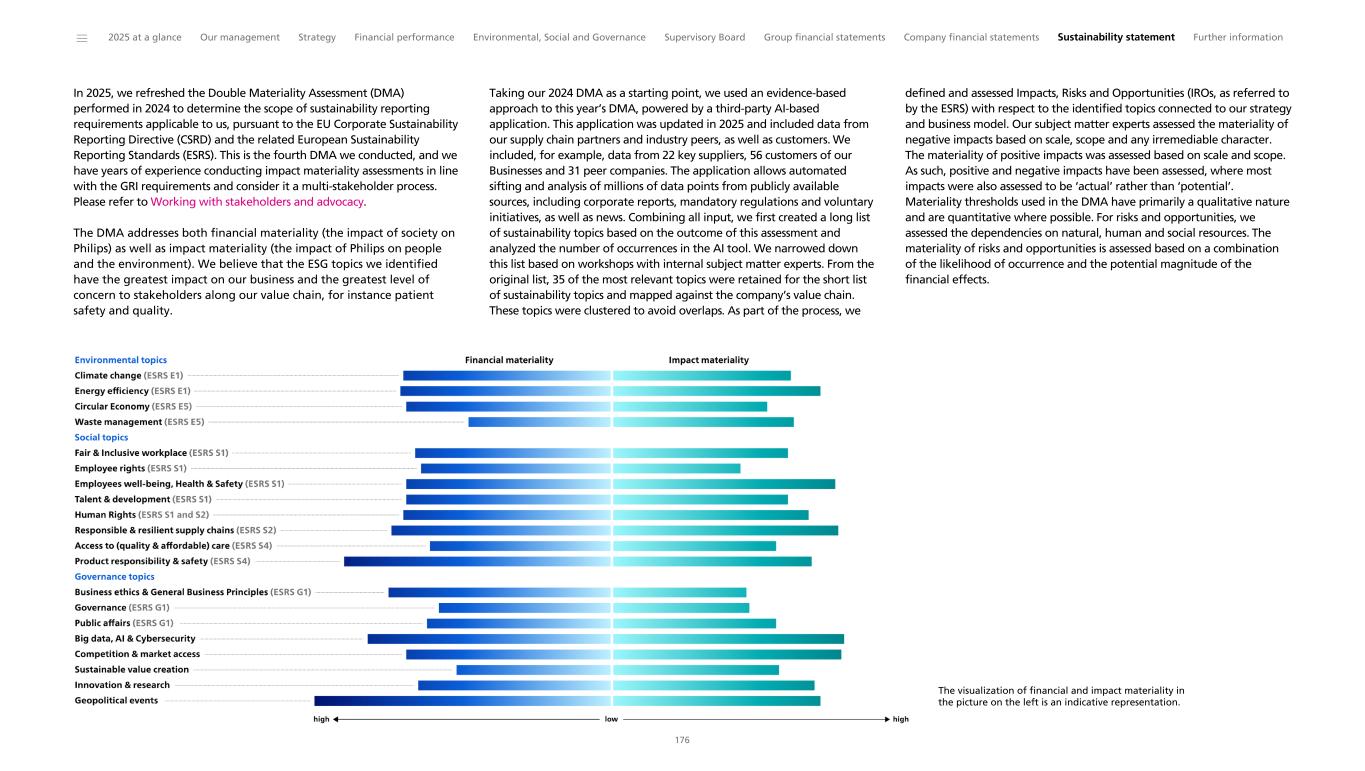
In 2025, we refreshed the Double Materiality Assessment (DMA) performed in 2024 to determine the scope of sustainability reporting requirements applicable to us, pursuant to the EU Corporate Sustainability Reporting Directive (CSRD) and the related European Sustainability Reporting Standards (ESRS). This is the fourth DMA we conducted, and we have years of experience conducting impact materiality assessments in line with the GRI requirements and consider it a multi-stakeholder process. Please refer to Working with stakeholders and advocacy. The DMA addresses both financial materiality (the impact of society on Philips) as well as impact materiality (the impact of Philips on people and the environment). We believe that the ESG topics we identified have the greatest impact on our business and the greatest level of concern to stakeholders along our value chain, for instance patient safety and quality. Taking our 2024 DMA as a starting point, we used an evidence-based approach to this year’s DMA, powered by a third-party AI-based application. This application was updated in 2025 and included data from our supply chain partners and industry peers, as well as customers. We included, for example, data from 22 key suppliers, 56 customers of our Businesses and 31 peer companies. The application allows automated sifting and analysis of millions of data points from publicly available sources, including corporate reports, mandatory regulations and voluntary initiatives, as well as news. Combining all input, we first created a long list of sustainability topics based on the outcome of this assessment and analyzed the number of occurrences in the AI tool. We narrowed down this list based on workshops with internal subject matter experts. From the original list, 35 of the most relevant topics were retained for the short list of sustainability topics and mapped against the company’s value chain. These topics were clustered to avoid overlaps. As part of the process, we defined and assessed Impacts, Risks and Opportunities (IROs, as referred to by the ESRS) with respect to the identified topics connected to our strategy and business model. Our subject matter experts assessed the materiality of negative impacts based on scale, scope and any irremediable character. The materiality of positive impacts was assessed based on scale and scope. As such, positive and negative impacts have been assessed, where most impacts were also assessed to be ‘actual’ rather than ‘potential’. Materiality thresholds used in the DMA have primarily a qualitative nature and are quantitative where possible. For risks and opportunities, we assessed the dependencies on natural, human and social resources. The materiality of risks and opportunities is assessed based on a combination of the likelihood of occurrence and the potential magnitude of the financial effects. The visualization of financial and impact materiality in the picture on the left is an indicative representation. ______ 2025 at a glance Our management Strategy Financial performance Environmental, Social and Governance Supervisory Board Group financial statements Company financial statements Sustainability statement Further information 176
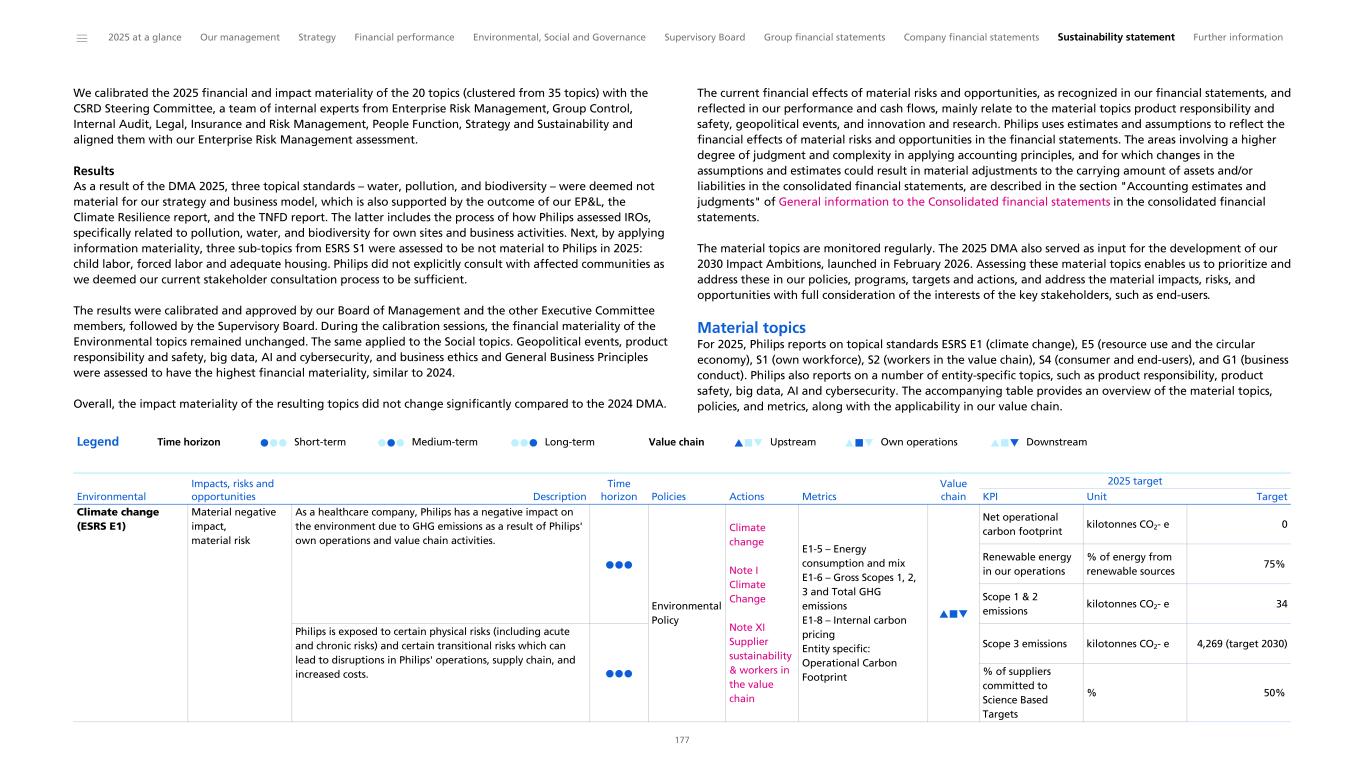
We calibrated the 2025 financial and impact materiality of the 20 topics (clustered from 35 topics) with the CSRD Steering Committee, a team of internal experts from Enterprise Risk Management, Group Control, Internal Audit, Legal, Insurance and Risk Management, People Function, Strategy and Sustainability and aligned them with our Enterprise Risk Management assessment. Results As a result of the DMA 2025, three topical standards – water, pollution, and biodiversity – were deemed not material for our strategy and business model, which is also supported by the outcome of our EP&L, the Climate Resilience report, and the TNFD report. The latter includes the process of how Philips assessed IROs, specifically related to pollution, water, and biodiversity for own sites and business activities. Next, by applying information materiality, three sub-topics from ESRS S1 were assessed to be not material to Philips in 2025: child labor, forced labor and adequate housing. Philips did not explicitly consult with affected communities as we deemed our current stakeholder consultation process to be sufficient. The results were calibrated and approved by our Board of Management and the other Executive Committee members, followed by the Supervisory Board. During the calibration sessions, the financial materiality of the Environmental topics remained unchanged. The same applied to the Social topics. Geopolitical events, product responsibility and safety, big data, AI and cybersecurity, and business ethics and General Business Principles were assessed to have the highest financial materiality, similar to 2024. Overall, the impact materiality of the resulting topics did not change significantly compared to the 2024 DMA. The current financial effects of material risks and opportunities, as recognized in our financial statements, and reflected in our performance and cash flows, mainly relate to the material topics product responsibility and safety, geopolitical events, and innovation and research. Philips uses estimates and assumptions to reflect the financial effects of material risks and opportunities in the financial statements. The areas involving a higher degree of judgment and complexity in applying accounting principles, and for which changes in the assumptions and estimates could result in material adjustments to the carrying amount of assets and/or liabilities in the consolidated financial statements, are described in the section "Accounting estimates and judgments" of General information to the Consolidated financial statements in the consolidated financial statements. The material topics are monitored regularly. The 2025 DMA also served as input for the development of our 2030 Impact Ambitions, launched in February 2026. Assessing these material topics enables us to prioritize and address these in our policies, programs, targets and actions, and address the material impacts, risks, and opportunities with full consideration of the interests of the key stakeholders, such as end-users. Material topics For 2025, Philips reports on topical standards ESRS E1 (climate change), E5 (resource use and the circular economy), S1 (own workforce), S2 (workers in the value chain), S4 (consumer and end-users), and G1 (business conduct). Philips also reports on a number of entity-specific topics, such as product responsibility, product safety, big data, AI and cybersecurity. The accompanying table provides an overview of the material topics, policies, and metrics, along with the applicability in our value chain. Legend Time horizon òòò Short-term òòò Medium-term òòò Long-term Value chain p¢q Upstream p¢q Own operations p¢q Downstream Climate change (ESRS E1) Material negative impact, material risk As a healthcare company, Philips has a negative impact on the environment due to GHG emissions as a result of Philips' own operations and value chain activities. òòò Environmental Policy Climate change Note I Climate Change Note XI Supplier sustainability & workers in the value chain E1-5 – Energy consumption and mix E1-6 – Gross Scopes 1, 2, 3 and Total GHG emissions E1-8 – Internal carbon pricing Entity specific: Operational Carbon Footprint p¢q Net operational carbon footprint kilotonnes CO2- e 0 Renewable energy in our operations % of energy from renewable sources 75% Scope 1 & 2 emissions kilotonnes CO2- e 34 Philips is exposed to certain physical risks (including acute and chronic risks) and certain transitional risks which can lead to disruptions in Philips' operations, supply chain, and increased costs. òòò Scope 3 emissions kilotonnes CO2- e 4,269 (target 2030) % of suppliers committed to Science Based Targets % 50% Environmental Impacts, risks and opportunities Description Time horizon Policies Actions Metrics Value chain 2025 target KPI Unit Target ______ 2025 at a glance Our management Strategy Financial performance Environmental, Social and Governance Supervisory Board Group financial statements Company financial statements Sustainability statement Further information 177
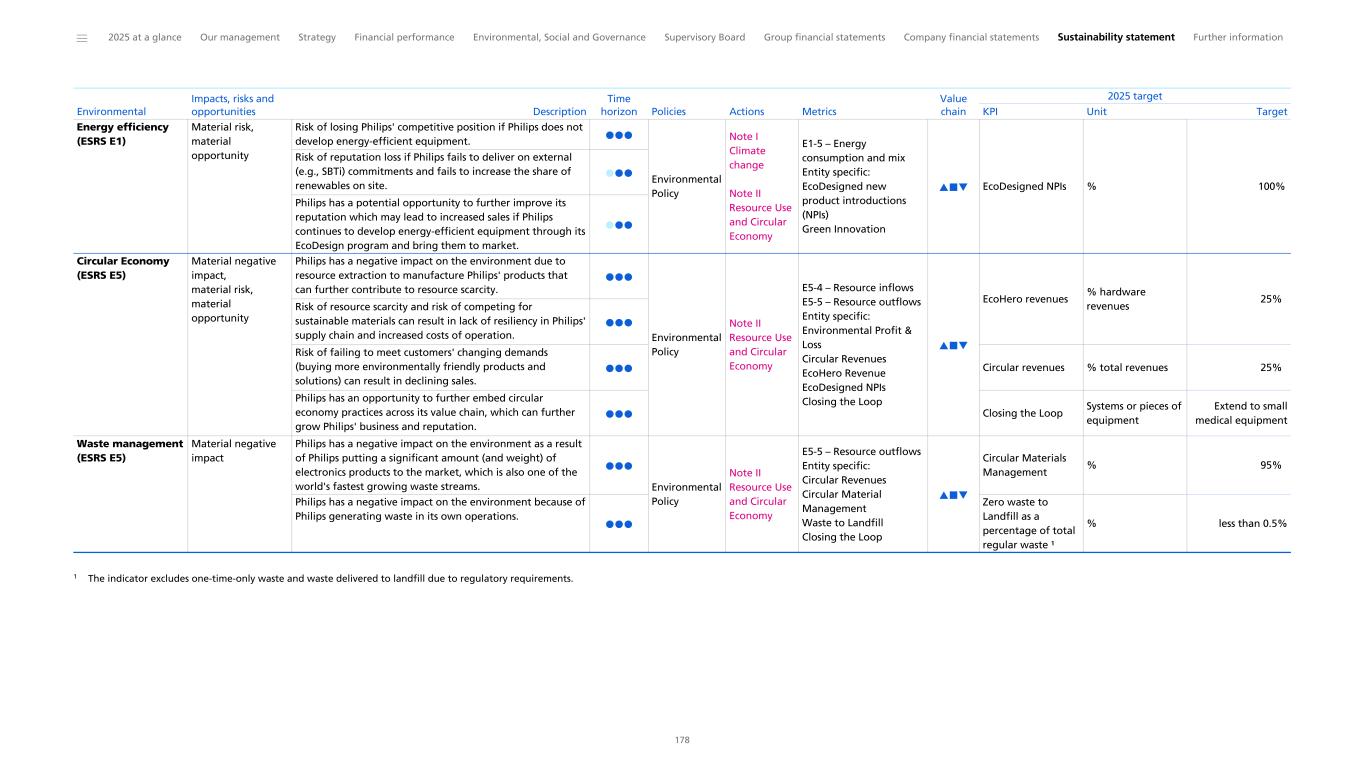
Energy efficiency (ESRS E1) Material risk, material opportunity Risk of losing Philips' competitive position if Philips does not develop energy-efficient equipment. òòò Environmental Policy Note I Climate change Note II Resource Use and Circular Economy E1-5 – Energy consumption and mix Entity specific: EcoDesigned new product introductions (NPIs) Green Innovation p¢q EcoDesigned NPIs % 100% Risk of reputation loss if Philips fails to deliver on external (e.g., SBTi) commitments and fails to increase the share of renewables on site. òòò Philips has a potential opportunity to further improve its reputation which may lead to increased sales if Philips continues to develop energy-efficient equipment through its EcoDesign program and bring them to market. òòò Circular Economy (ESRS E5) Material negative impact, material risk, material opportunity Philips has a negative impact on the environment due to resource extraction to manufacture Philips' products that can further contribute to resource scarcity. òòò Environmental Policy Note II Resource Use and Circular Economy E5-4 – Resource inflows E5-5 – Resource outflows Entity specific: Environmental Profit & Loss Circular Revenues EcoHero Revenue EcoDesigned NPIs Closing the Loop p¢q EcoHero revenues % hardware revenues 25% Risk of resource scarcity and risk of competing for sustainable materials can result in lack of resiliency in Philips' supply chain and increased costs of operation. òòò Risk of failing to meet customers' changing demands (buying more environmentally friendly products and solutions) can result in declining sales. òòò Circular revenues % total revenues 25% Philips has an opportunity to further embed circular economy practices across its value chain, which can further grow Philips' business and reputation. òòò Closing the Loop Systems or pieces of equipment Extend to small medical equipment Waste management (ESRS E5) Material negative impact Philips has a negative impact on the environment as a result of Philips putting a significant amount (and weight) of electronics products to the market, which is also one of the world's fastest growing waste streams. òòò Environmental Policy Note II Resource Use and Circular Economy E5-5 – Resource outflows Entity specific: Circular Revenues Circular Material Management Waste to Landfill Closing the Loop p¢q Circular Materials Management % 95% Philips has a negative impact on the environment because of Philips generating waste in its own operations. òòò Zero waste to Landfill as a percentage of total regular waste ¹ % less than 0.5% Environmental Impacts, risks and opportunities Description Time horizon Policies Actions Metrics Value chain 2025 target KPI Unit Target 1 The indicator excludes one-time-only waste and waste delivered to landfill due to regulatory requirements. ______ 2025 at a glance Our management Strategy Financial performance Environmental, Social and Governance Supervisory Board Group financial statements Company financial statements Sustainability statement Further information 178
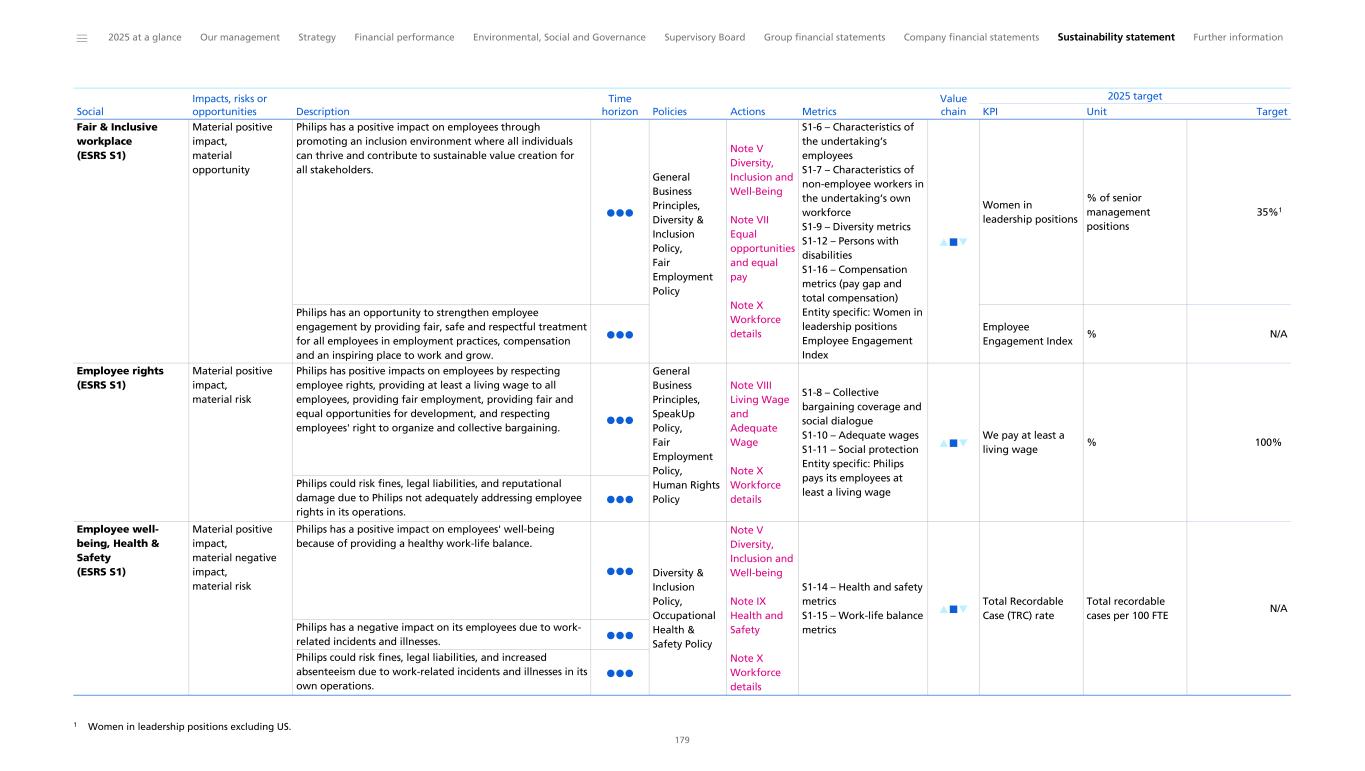
Fair & Inclusive workplace (ESRS S1) Material positive impact, material opportunity Philips has a positive impact on employees through promoting an inclusion environment where all individuals can thrive and contribute to sustainable value creation for all stakeholders. òòò General Business Principles, Diversity & Inclusion Policy, Fair Employment Policy Note V Diversity, Inclusion and Well-Being Note VII Equal opportunities and equal pay Note X Workforce details S1-6 – Characteristics of the undertaking’s employees S1-7 – Characteristics of non-employee workers in the undertaking’s own workforce S1-9 – Diversity metrics S1-12 – Persons with disabilities S1-16 – Compensation metrics (pay gap and total compensation) Entity specific: Women in leadership positions Employee Engagement Index p¢q Women in leadership positions % of senior management positions 35% 1 Philips has an opportunity to strengthen employee engagement by providing fair, safe and respectful treatment for all employees in employment practices, compensation and an inspiring place to work and grow. òòò Employee Engagement Index % N/A Employee rights (ESRS S1) Material positive impact, material risk Philips has positive impacts on employees by respecting employee rights, providing at least a living wage to all employees, providing fair employment, providing fair and equal opportunities for development, and respecting employees' right to organize and collective bargaining. òòò General Business Principles, SpeakUp Policy, Fair Employment Policy, Human Rights Policy Note VIII Living Wage and Adequate Wage Note X Workforce details S1-8 – Collective bargaining coverage and social dialogue S1-10 – Adequate wages S1-11 – Social protection Entity specific: Philips pays its employees at least a living wage p¢q We pay at least a living wage % 100% Philips could risk fines, legal liabilities, and reputational damage due to Philips not adequately addressing employee rights in its operations. òòò Employee well- being, Health & Safety (ESRS S1) Material positive impact, material negative impact, material risk Philips has a positive impact on employees' well-being because of providing a healthy work-life balance. òòò Diversity & Inclusion Policy, Occupational Health & Safety Policy Note V Diversity, Inclusion and Well-being Note IX Health and Safety Note X Workforce details S1-14 – Health and safety metrics S1-15 – Work-life balance metrics p¢q Total Recordable Case (TRC) rate Total recordable cases per 100 FTE N/A Philips has a negative impact on its employees due to work- related incidents and illnesses. òòò Philips could risk fines, legal liabilities, and increased absenteeism due to work-related incidents and illnesses in its own operations. òòò Social Impacts, risks or opportunities Description Time horizon Policies Actions Metrics Value chain 2025 target KPI Unit Target ______ 2025 at a glance Our management Strategy Financial performance Environmental, Social and Governance Supervisory Board Group financial statements Company financial statements Sustainability statement Further information 179 1 Women in leadership positions excluding US.
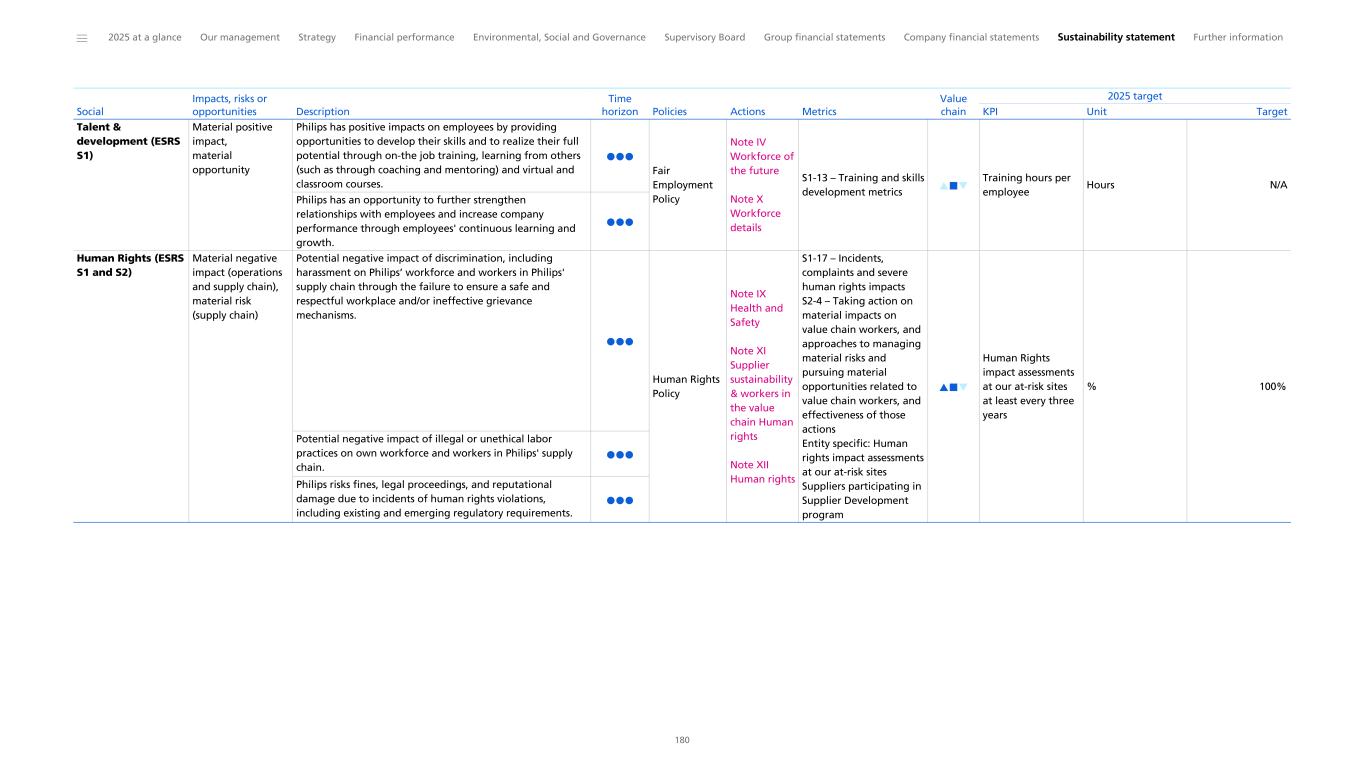
Talent & development (ESRS S1) Material positive impact, material opportunity Philips has positive impacts on employees by providing opportunities to develop their skills and to realize their full potential through on-the job training, learning from others (such as through coaching and mentoring) and virtual and classroom courses. òòò Fair Employment Policy Note IV Workforce of the future Note X Workforce details S1-13 – Training and skills development metrics p¢q Training hours per employee Hours N/A Philips has an opportunity to further strengthen relationships with employees and increase company performance through employees' continuous learning and growth. òòò Human Rights (ESRS S1 and S2) Material negative impact (operations and supply chain), material risk (supply chain) Potential negative impact of discrimination, including harassment on Philips’ workforce and workers in Philips' supply chain through the failure to ensure a safe and respectful workplace and/or ineffective grievance mechanisms. òòò Human Rights Policy Note IX Health and Safety Note XI Supplier sustainability & workers in the value chain Human rights Note XII Human rights S1-17 – Incidents, complaints and severe human rights impacts S2-4 – Taking action on material impacts on value chain workers, and approaches to managing material risks and pursuing material opportunities related to value chain workers, and effectiveness of those actions Entity specific: Human rights impact assessments at our at-risk sites Suppliers participating in Supplier Development program p¢q Human Rights impact assessments at our at-risk sites at least every three years % 100% Potential negative impact of illegal or unethical labor practices on own workforce and workers in Philips' supply chain. òòò Philips risks fines, legal proceedings, and reputational damage due to incidents of human rights violations, including existing and emerging regulatory requirements. òòò Social Impacts, risks or opportunities Description Time horizon Policies Actions Metrics Value chain 2025 target KPI Unit Target ______ 2025 at a glance Our management Strategy Financial performance Environmental, Social and Governance Supervisory Board Group financial statements Company financial statements Sustainability statement Further information 180
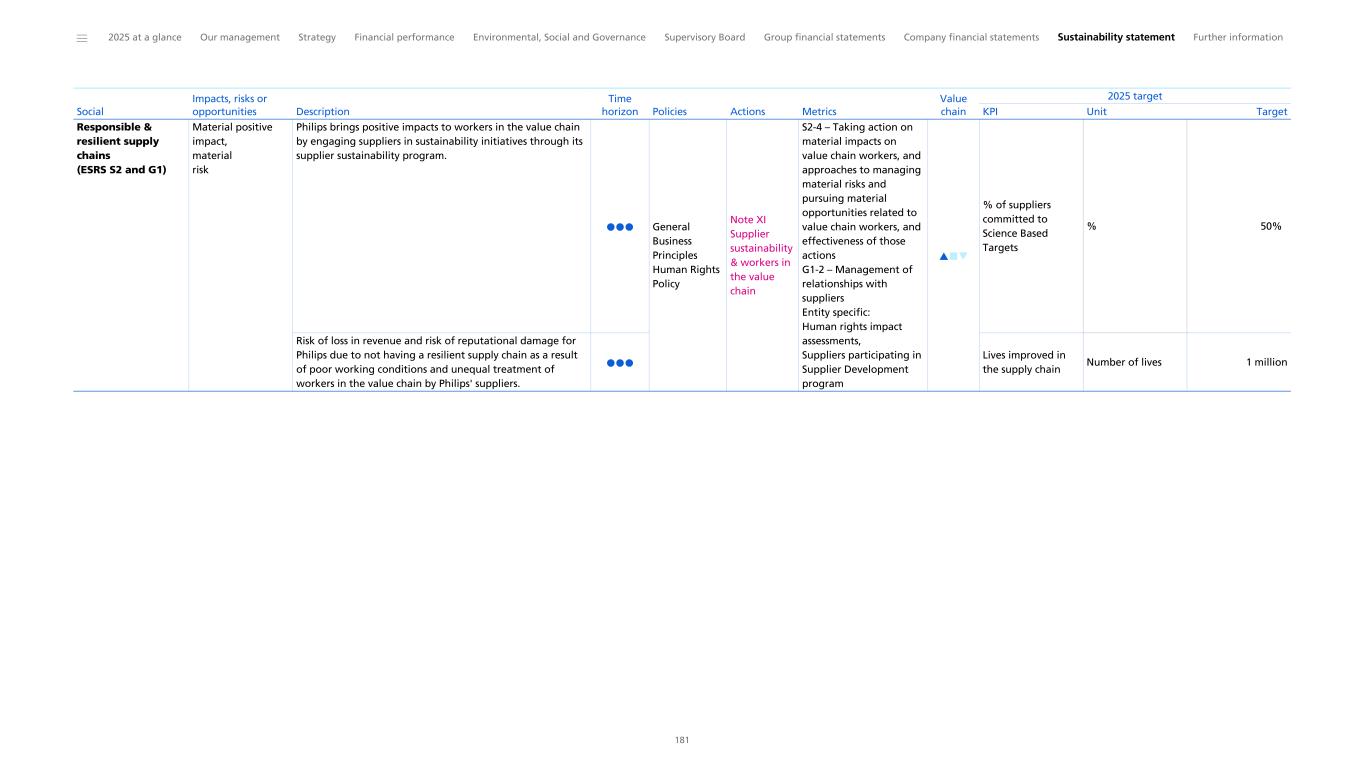
Responsible & resilient supply chains (ESRS S2 and G1) Material positive impact, material risk Philips brings positive impacts to workers in the value chain by engaging suppliers in sustainability initiatives through its supplier sustainability program. òòò General Business Principles Human Rights Policy Note XI Supplier sustainability & workers in the value chain S2-4 – Taking action on material impacts on value chain workers, and approaches to managing material risks and pursuing material opportunities related to value chain workers, and effectiveness of those actions G1-2 – Management of relationships with suppliers Entity specific: Human rights impact assessments, Suppliers participating in Supplier Development program p¢q % of suppliers committed to Science Based Targets % 50% Risk of loss in revenue and risk of reputational damage for Philips due to not having a resilient supply chain as a result of poor working conditions and unequal treatment of workers in the value chain by Philips' suppliers. òòò Lives improved in the supply chain Number of lives 1 million Social Impacts, risks or opportunities Description Time horizon Policies Actions Metrics Value chain 2025 target KPI Unit Target ______ 2025 at a glance Our management Strategy Financial performance Environmental, Social and Governance Supervisory Board Group financial statements Company financial statements Sustainability statement Further information 181
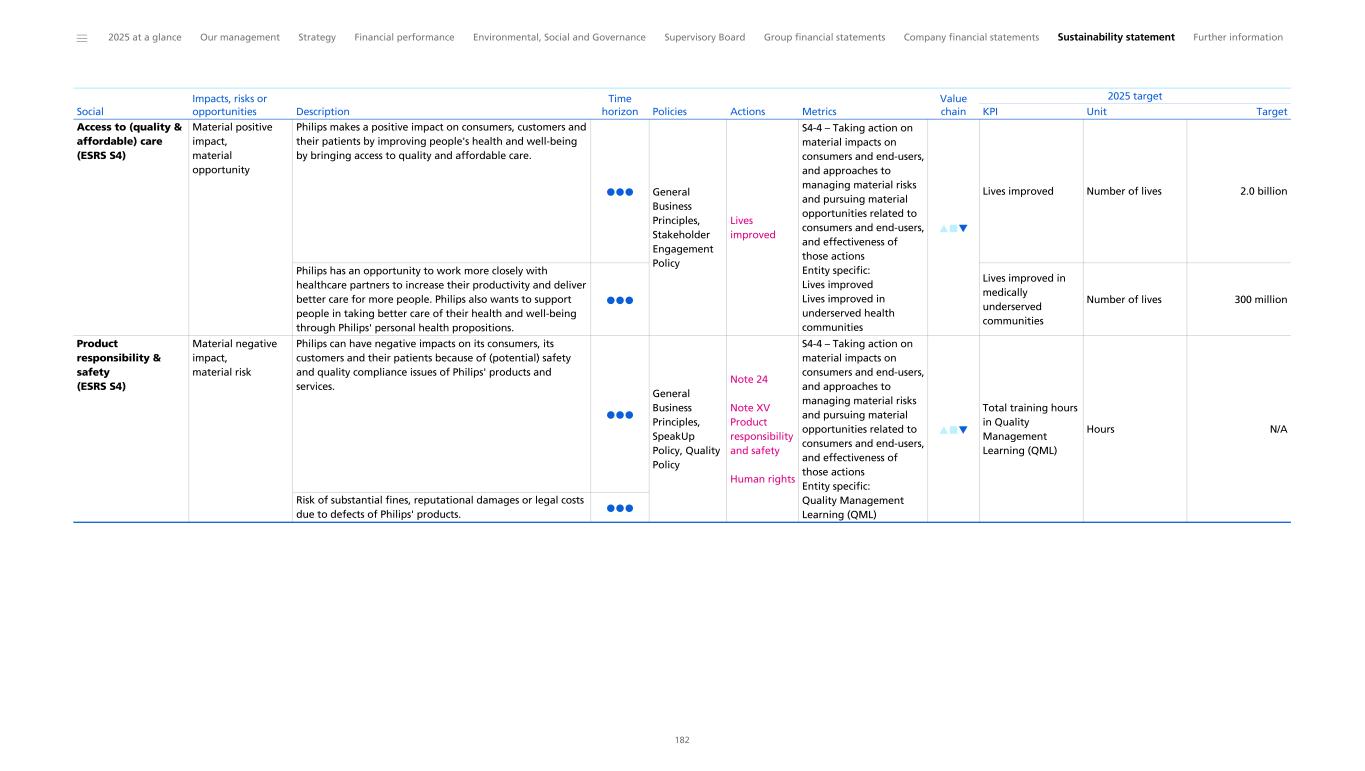
Access to (quality & affordable) care (ESRS S4) Material positive impact, material opportunity Philips makes a positive impact on consumers, customers and their patients by improving people's health and well-being by bringing access to quality and affordable care. òòò General Business Principles, Stakeholder Engagement Policy Lives improved S4-4 – Taking action on material impacts on consumers and end-users, and approaches to managing material risks and pursuing material opportunities related to consumers and end-users, and effectiveness of those actions Entity specific: Lives improved Lives improved in underserved health communities p¢q Lives improved Number of lives 2.0 billion Philips has an opportunity to work more closely with healthcare partners to increase their productivity and deliver better care for more people. Philips also wants to support people in taking better care of their health and well-being through Philips' personal health propositions. òòò Lives improved in medically underserved communities Number of lives 300 million Product responsibility & safety (ESRS S4) Material negative impact, material risk Philips can have negative impacts on its consumers, its customers and their patients because of (potential) safety and quality compliance issues of Philips' products and services. òòò General Business Principles, SpeakUp Policy, Quality Policy Note 24 Note XV Product responsibility and safety Human rights S4-4 – Taking action on material impacts on consumers and end-users, and approaches to managing material risks and pursuing material opportunities related to consumers and end-users, and effectiveness of those actions Entity specific: Quality Management Learning (QML) p¢q Total training hours in Quality Management Learning (QML) Hours N/A Risk of substantial fines, reputational damages or legal costs due to defects of Philips' products. òòò Social Impacts, risks or opportunities Description Time horizon Policies Actions Metrics Value chain 2025 target KPI Unit Target ______ 2025 at a glance Our management Strategy Financial performance Environmental, Social and Governance Supervisory Board Group financial statements Company financial statements Sustainability statement Further information 182
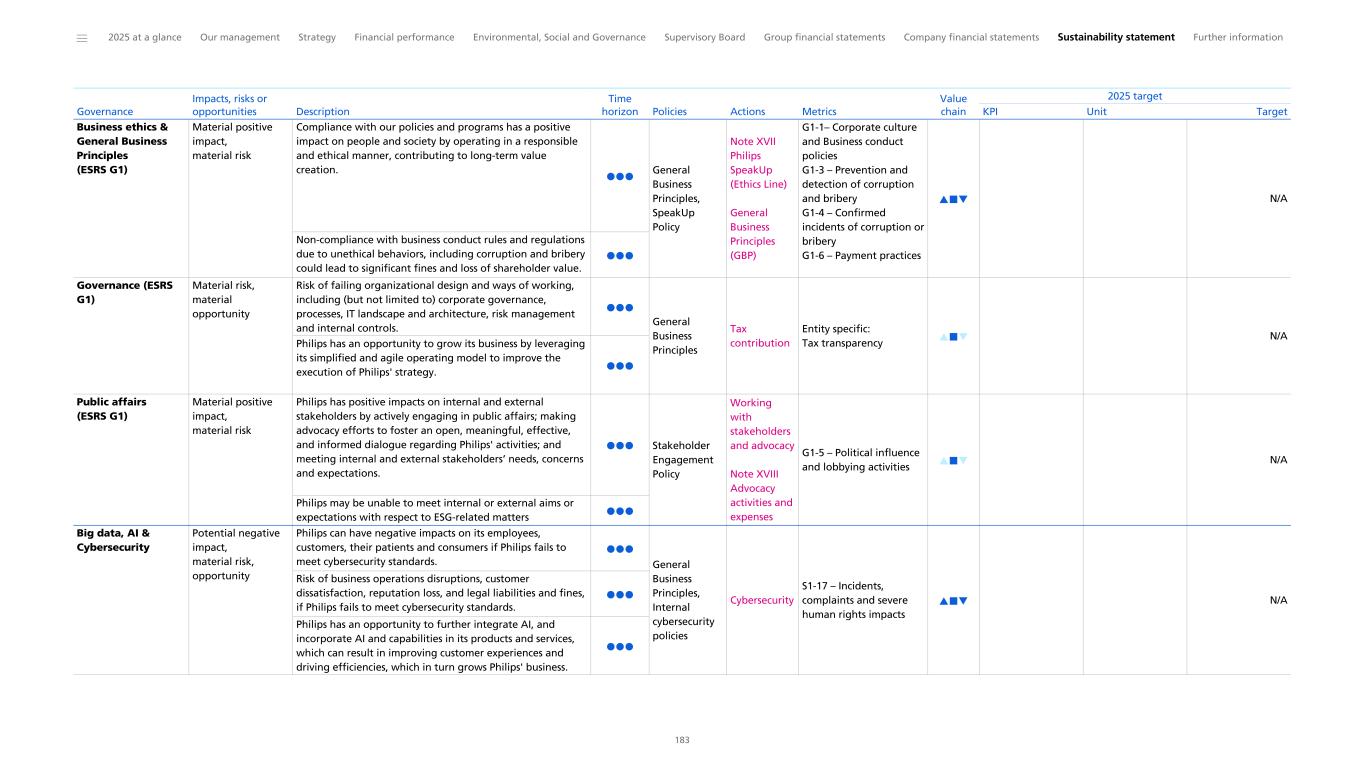
Business ethics & General Business Principles (ESRS G1) Material positive impact, material risk Compliance with our policies and programs has a positive impact on people and society by operating in a responsible and ethical manner, contributing to long-term value creation. òòò General Business Principles, SpeakUp Policy Note XVII Philips SpeakUp (Ethics Line) General Business Principles (GBP) G1-1– Corporate culture and Business conduct policies G1-3 – Prevention and detection of corruption and bribery G1-4 – Confirmed incidents of corruption or bribery G1-6 – Payment practices p¢q N/A Non-compliance with business conduct rules and regulations due to unethical behaviors, including corruption and bribery could lead to significant fines and loss of shareholder value. òòò Governance (ESRS G1) Material risk, material opportunity Risk of failing organizational design and ways of working, including (but not limited to) corporate governance, processes, IT landscape and architecture, risk management and internal controls. òòò General Business Principles Tax contribution Entity specific: Tax transparency p¢q N/A Philips has an opportunity to grow its business by leveraging its simplified and agile operating model to improve the execution of Philips' strategy. òòò Public affairs (ESRS G1) Material positive impact, material risk Philips has positive impacts on internal and external stakeholders by actively engaging in public affairs; making advocacy efforts to foster an open, meaningful, effective, and informed dialogue regarding Philips' activities; and meeting internal and external stakeholders’ needs, concerns and expectations. òòò Stakeholder Engagement Policy Working with stakeholders and advocacy Note XVIII Advocacy activities and expenses G1-5 – Political influence and lobbying activities p¢q N/A Philips may be unable to meet internal or external aims or expectations with respect to ESG-related matters òòò Big data, AI & Cybersecurity Potential negative impact, material risk, opportunity Philips can have negative impacts on its employees, customers, their patients and consumers if Philips fails to meet cybersecurity standards. òòò General Business Principles, Internal cybersecurity policies Cybersecurity S1-17 – Incidents, complaints and severe human rights impacts p¢q N/A Risk of business operations disruptions, customer dissatisfaction, reputation loss, and legal liabilities and fines, if Philips fails to meet cybersecurity standards. òòò Philips has an opportunity to further integrate AI, and incorporate AI and capabilities in its products and services, which can result in improving customer experiences and driving efficiencies, which in turn grows Philips' business. òòò Governance Impacts, risks or opportunities Description Time horizon Policies Actions Metrics Value chain 2025 target KPI Unit Target ______ 2025 at a glance Our management Strategy Financial performance Environmental, Social and Governance Supervisory Board Group financial statements Company financial statements Sustainability statement Further information 183
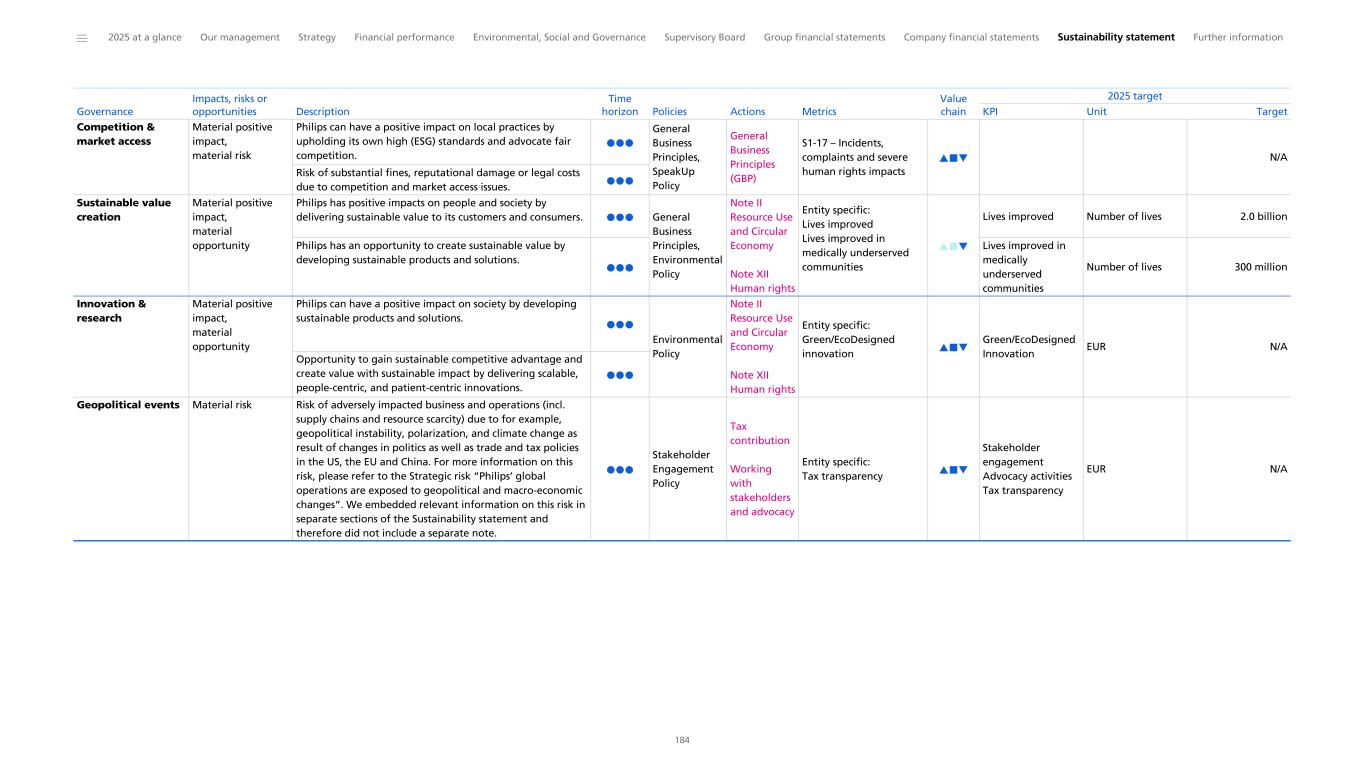
Competition & market access Material positive impact, material risk Philips can have a positive impact on local practices by upholding its own high (ESG) standards and advocate fair competition. òòò General Business Principles, SpeakUp Policy General Business Principles (GBP) S1-17 – Incidents, complaints and severe human rights impacts p¢q N/A Risk of substantial fines, reputational damage or legal costs due to competition and market access issues. òòò Sustainable value creation Material positive impact, material opportunity Philips has positive impacts on people and society by delivering sustainable value to its customers and consumers. òòò General Business Principles, Environmental Policy Note II Resource Use and Circular Economy Note XII Human rights Entity specific: Lives improved Lives improved in medically underserved communities p¢q Lives improved Number of lives 2.0 billion Philips has an opportunity to create sustainable value by developing sustainable products and solutions. òòò Lives improved in medically underserved communities Number of lives 300 million Innovation & research Material positive impact, material opportunity Philips can have a positive impact on society by developing sustainable products and solutions. òòò Environmental Policy Note II Resource Use and Circular Economy Note XII Human rights Entity specific: Green/EcoDesigned innovation p¢q Green/EcoDesigned Innovation EUR N/A Opportunity to gain sustainable competitive advantage and create value with sustainable impact by delivering scalable, people-centric, and patient-centric innovations. òòò Geopolitical events Material risk Risk of adversely impacted business and operations (incl. supply chains and resource scarcity) due to for example, geopolitical instability, polarization, and climate change as result of changes in politics as well as trade and tax policies in the US, the EU and China. For more information on this risk, please refer to the Strategic risk “Philips’ global operations are exposed to geopolitical and macro-economic changes”. We embedded relevant information on this risk in separate sections of the Sustainability statement and therefore did not include a separate note. òòò Stakeholder Engagement Policy Tax contribution Working with stakeholders and advocacy Entity specific: Tax transparency p¢q Stakeholder engagement Advocacy activities Tax transparency EUR N/A Governance Impacts, risks or opportunities Description Time horizon Policies Actions Metrics Value chain 2025 target KPI Unit Target ______ 2025 at a glance Our management Strategy Financial performance Environmental, Social and Governance Supervisory Board Group financial statements Company financial statements Sustainability statement Further information 184
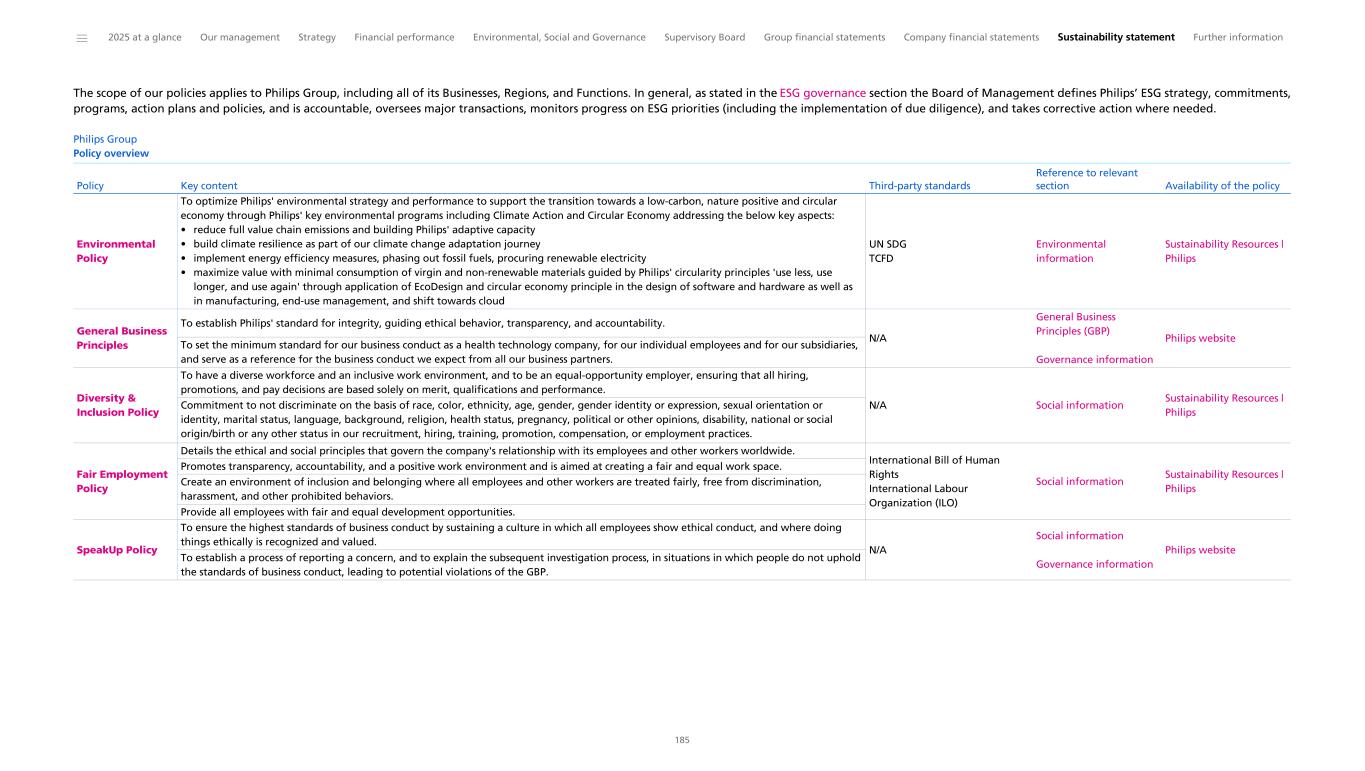
The scope of our policies applies to Philips Group, including all of its Businesses, Regions, and Functions. In general, as stated in the ESG governance section the Board of Management defines Philips’ ESG strategy, commitments, programs, action plans and policies, and is accountable, oversees major transactions, monitors progress on ESG priorities (including the implementation of due diligence), and takes corrective action where needed. Philips Group Policy overview Environmental Policy To optimize Philips' environmental strategy and performance to support the transition towards a low-carbon, nature positive and circular economy through Philips' key environmental programs including Climate Action and Circular Economy addressing the below key aspects: • reduce full value chain emissions and building Philips' adaptive capacity • build climate resilience as part of our climate change adaptation journey • implement energy efficiency measures, phasing out fossil fuels, procuring renewable electricity • maximize value with minimal consumption of virgin and non-renewable materials guided by Philips' circularity principles 'use less, use longer, and use again' through application of EcoDesign and circular economy principle in the design of software and hardware as well as in manufacturing, end-use management, and shift towards cloud UN SDG TCFD Environmental information Sustainability Resources | Philips General Business Principles To establish Philips' standard for integrity, guiding ethical behavior, transparency, and accountability. N/A General Business Principles (GBP) Governance information Philips website To set the minimum standard for our business conduct as a health technology company, for our individual employees and for our subsidiaries, and serve as a reference for the business conduct we expect from all our business partners. Diversity & Inclusion Policy To have a diverse workforce and an inclusive work environment, and to be an equal-opportunity employer, ensuring that all hiring, promotions, and pay decisions are based solely on merit, qualifications and performance. N/A Social information Sustainability Resources | Philips Commitment to not discriminate on the basis of race, color, ethnicity, age, gender, gender identity or expression, sexual orientation or identity, marital status, language, background, religion, health status, pregnancy, political or other opinions, disability, national or social origin/birth or any other status in our recruitment, hiring, training, promotion, compensation, or employment practices. Fair Employment Policy Details the ethical and social principles that govern the company's relationship with its employees and other workers worldwide. International Bill of Human Rights International Labour Organization (ILO) Social information Sustainability Resources | Philips Promotes transparency, accountability, and a positive work environment and is aimed at creating a fair and equal work space. Create an environment of inclusion and belonging where all employees and other workers are treated fairly, free from discrimination, harassment, and other prohibited behaviors. Provide all employees with fair and equal development opportunities. SpeakUp Policy To ensure the highest standards of business conduct by sustaining a culture in which all employees show ethical conduct, and where doing things ethically is recognized and valued. N/A Social information Governance information Philips website To establish a process of reporting a concern, and to explain the subsequent investigation process, in situations in which people do not uphold the standards of business conduct, leading to potential violations of the GBP. Policy Key content Third-party standards Reference to relevant section Availability of the policy ______ 2025 at a glance Our management Strategy Financial performance Environmental, Social and Governance Supervisory Board Group financial statements Company financial statements Sustainability statement Further information 185
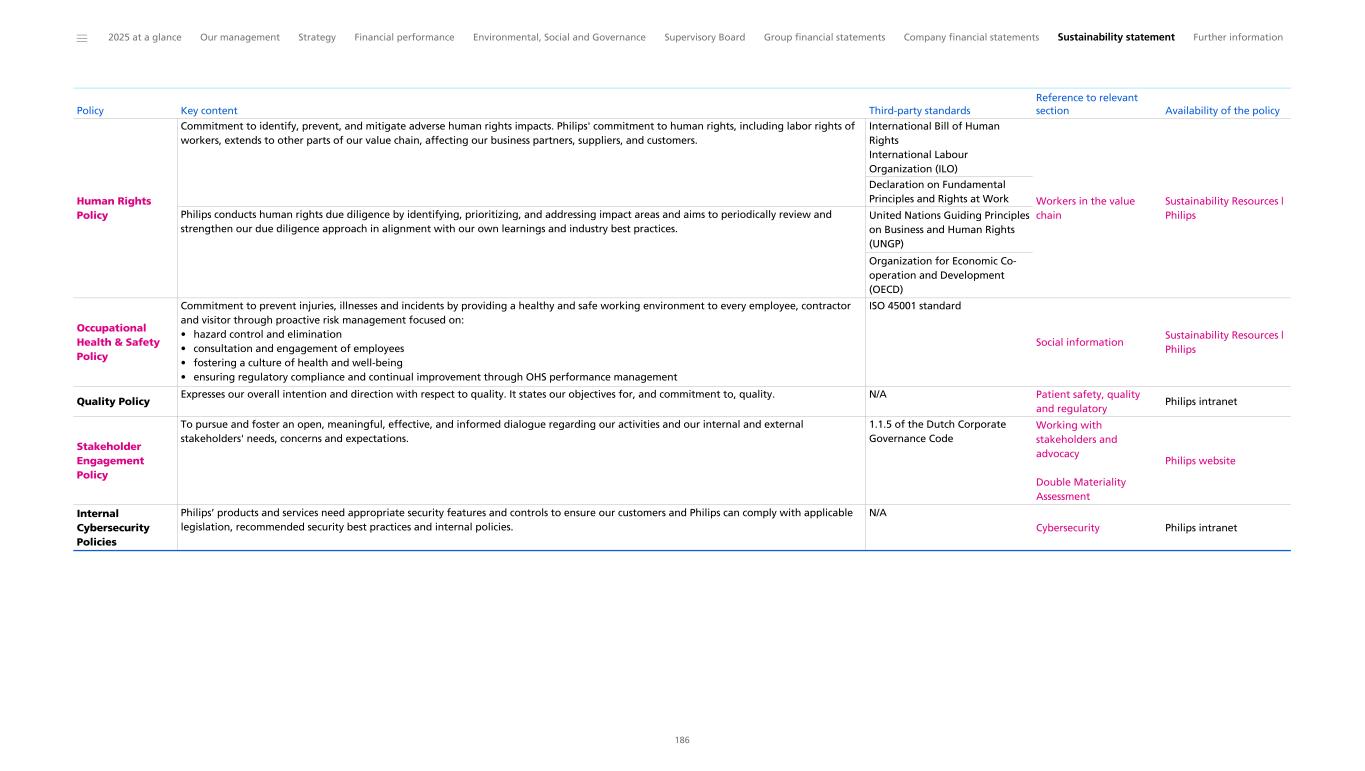
Human Rights Policy Commitment to identify, prevent, and mitigate adverse human rights impacts. Philips' commitment to human rights, including labor rights of workers, extends to other parts of our value chain, affecting our business partners, suppliers, and customers. International Bill of Human Rights International Labour Organization (ILO) Workers in the value chain Sustainability Resources | Philips Declaration on Fundamental Principles and Rights at Work Philips conducts human rights due diligence by identifying, prioritizing, and addressing impact areas and aims to periodically review and strengthen our due diligence approach in alignment with our own learnings and industry best practices. United Nations Guiding Principles on Business and Human Rights (UNGP) Organization for Economic Co- operation and Development (OECD) Occupational Health & Safety Policy Commitment to prevent injuries, illnesses and incidents by providing a healthy and safe working environment to every employee, contractor and visitor through proactive risk management focused on: • hazard control and elimination • consultation and engagement of employees • fostering a culture of health and well-being • ensuring regulatory compliance and continual improvement through OHS performance management ISO 45001 standard Social information Sustainability Resources | Philips Quality Policy Expresses our overall intention and direction with respect to quality. It states our objectives for, and commitment to, quality. N/A Patient safety, quality and regulatory Philips intranet Stakeholder Engagement Policy To pursue and foster an open, meaningful, effective, and informed dialogue regarding our activities and our internal and external stakeholders' needs, concerns and expectations. 1.1.5 of the Dutch Corporate Governance Code Working with stakeholders and advocacy Double Materiality Assessment Philips website Internal Cybersecurity Policies Philips’ products and services need appropriate security features and controls to ensure our customers and Philips can comply with applicable legislation, recommended security best practices and internal policies. N/A Cybersecurity Philips intranet Policy Key content Third-party standards Reference to relevant section Availability of the policy ______ 2025 at a glance Our management Strategy Financial performance Environmental, Social and Governance Supervisory Board Group financial statements Company financial statements Sustainability statement Further information 186
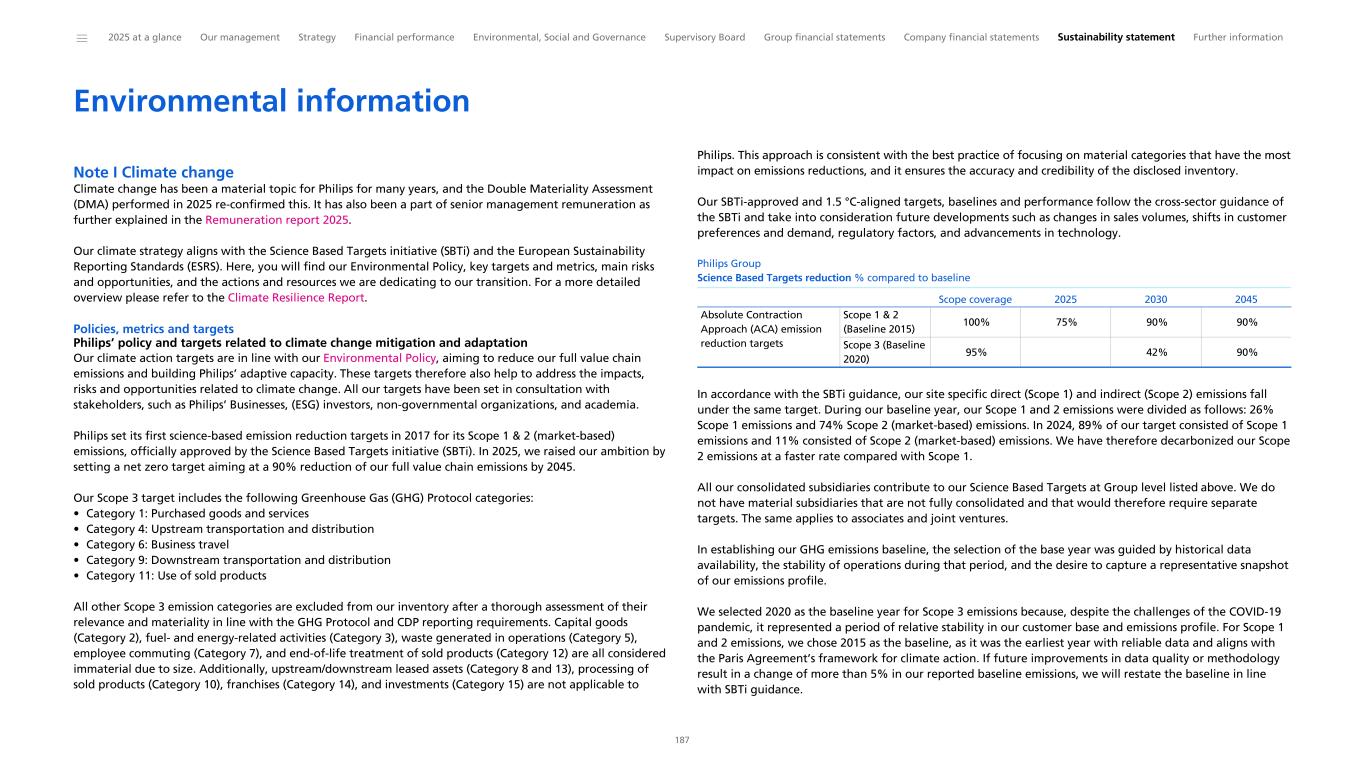
Environmental information Note I Climate change Climate change has been a material topic for Philips for many years, and the Double Materiality Assessment (DMA) performed in 2025 re-confirmed this. It has also been a part of senior management remuneration as further explained in the Remuneration report 2025. Our climate strategy aligns with the Science Based Targets initiative (SBTi) and the European Sustainability Reporting Standards (ESRS). Here, you will find our Environmental Policy, key targets and metrics, main risks and opportunities, and the actions and resources we are dedicating to our transition. For a more detailed overview please refer to the Climate Resilience Report. Policies, metrics and targets Philips’ policy and targets related to climate change mitigation and adaptation Our climate action targets are in line with our Environmental Policy, aiming to reduce our full value chain emissions and building Philips’ adaptive capacity. These targets therefore also help to address the impacts, risks and opportunities related to climate change. All our targets have been set in consultation with stakeholders, such as Philips’ Businesses, (ESG) investors, non-governmental organizations, and academia. Philips set its first science-based emission reduction targets in 2017 for its Scope 1 & 2 (market-based) emissions, officially approved by the Science Based Targets initiative (SBTi). In 2025, we raised our ambition by setting a net zero target aiming at a 90% reduction of our full value chain emissions by 2045. Our Scope 3 target includes the following Greenhouse Gas (GHG) Protocol categories: • Category 1: Purchased goods and services • Category 4: Upstream transportation and distribution • Category 6: Business travel • Category 9: Downstream transportation and distribution • Category 11: Use of sold products All other Scope 3 emission categories are excluded from our inventory after a thorough assessment of their relevance and materiality in line with the GHG Protocol and CDP reporting requirements. Capital goods (Category 2), fuel- and energy-related activities (Category 3), waste generated in operations (Category 5), employee commuting (Category 7), and end-of-life treatment of sold products (Category 12) are all considered immaterial due to size. Additionally, upstream/downstream leased assets (Category 8 and 13), processing of sold products (Category 10), franchises (Category 14), and investments (Category 15) are not applicable to Philips. This approach is consistent with the best practice of focusing on material categories that have the most impact on emissions reductions, and it ensures the accuracy and credibility of the disclosed inventory. Our SBTi-approved and 1.5 °C-aligned targets, baselines and performance follow the cross-sector guidance of the SBTi and take into consideration future developments such as changes in sales volumes, shifts in customer preferences and demand, regulatory factors, and advancements in technology. Philips Group Science Based Targets reduction % compared to baseline Absolute Contraction Approach (ACA) emission reduction targets Scope 1 & 2 (Baseline 2015) 100% 75% 90% 90% Scope 3 (Baseline 2020) 95% 42% 90% Scope coverage 2025 2030 2045 In accordance with the SBTi guidance, our site specific direct (Scope 1) and indirect (Scope 2) emissions fall under the same target. During our baseline year, our Scope 1 and 2 emissions were divided as follows: 26% Scope 1 emissions and 74% Scope 2 (market-based) emissions. In 2024, 89% of our target consisted of Scope 1 emissions and 11% consisted of Scope 2 (market-based) emissions. We have therefore decarbonized our Scope 2 emissions at a faster rate compared with Scope 1. All our consolidated subsidiaries contribute to our Science Based Targets at Group level listed above. We do not have material subsidiaries that are not fully consolidated and that would therefore require separate targets. The same applies to associates and joint ventures. In establishing our GHG emissions baseline, the selection of the base year was guided by historical data availability, the stability of operations during that period, and the desire to capture a representative snapshot of our emissions profile. We selected 2020 as the baseline year for Scope 3 emissions because, despite the challenges of the COVID-19 pandemic, it represented a period of relative stability in our customer base and emissions profile. For Scope 1 and 2 emissions, we chose 2015 as the baseline, as it was the earliest year with reliable data and aligns with the Paris Agreement’s framework for climate action. If future improvements in data quality or methodology result in a change of more than 5% in our reported baseline emissions, we will restate the baseline in line with SBTi guidance. ______ 2025 at a glance Our management Strategy Financial performance Environmental, Social and Governance Supervisory Board Group financial statements Company financial statements Sustainability statement Further information 187
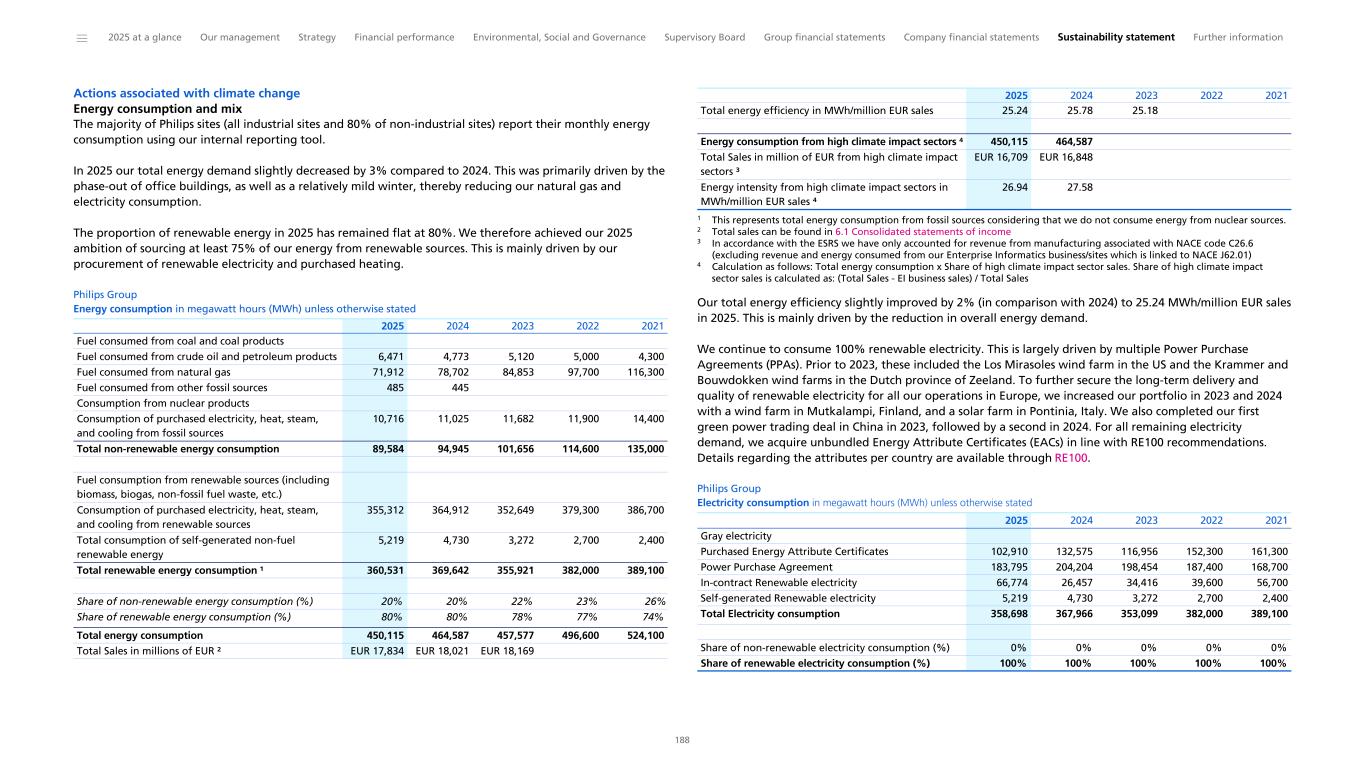
Actions associated with climate change Energy consumption and mix The majority of Philips sites (all industrial sites and 80% of non-industrial sites) report their monthly energy consumption using our internal reporting tool. In 2025 our total energy demand slightly decreased by 3% compared to 2024. This was primarily driven by the phase-out of office buildings, as well as a relatively mild winter, thereby reducing our natural gas and electricity consumption. The proportion of renewable energy in 2025 has remained flat at 80%. We therefore achieved our 2025 ambition of sourcing at least 75% of our energy from renewable sources. This is mainly driven by our procurement of renewable electricity and purchased heating. Philips Group Energy consumption in megawatt hours (MWh) unless otherwise stated Fuel consumed from coal and coal products Fuel consumed from crude oil and petroleum products 6,471 4,773 5,120 5,000 4,300 Fuel consumed from natural gas 71,912 78,702 84,853 97,700 116,300 Fuel consumed from other fossil sources 485 445 Consumption from nuclear products Consumption of purchased electricity, heat, steam, and cooling from fossil sources 10,716 11,025 11,682 11,900 14,400 Total non-renewable energy consumption 89,584 94,945 101,656 114,600 135,000 Fuel consumption from renewable sources (including biomass, biogas, non-fossil fuel waste, etc.) Consumption of purchased electricity, heat, steam, and cooling from renewable sources 355,312 364,912 352,649 379,300 386,700 Total consumption of self-generated non-fuel renewable energy 5,219 4,730 3,272 2,700 2,400 Total renewable energy consumption ¹ 360,531 369,642 355,921 382,000 389,100 Share of non-renewable energy consumption (%) 20% 20% 22% 23% 26% Share of renewable energy consumption (%) 80% 80% 78% 77% 74% Total energy consumption 450,115 464,587 457,577 496,600 524,100 Total Sales in millions of EUR ² EUR 17,834 EUR 18,021 EUR 18,169 2025 2024 2023 2022 2021 Total energy efficiency in MWh/million EUR sales 25.24 25.78 25.18 Energy consumption from high climate impact sectors ⁴ 450,115 464,587 Total Sales in million of EUR from high climate impact sectors ³ EUR 16,709 EUR 16,848 Energy intensity from high climate impact sectors in MWh/million EUR sales ⁴ 26.94 27.58 2025 2024 2023 2022 2021 1 This represents total energy consumption from fossil sources considering that we do not consume energy from nuclear sources. 2 Total sales can be found in 6.1 Consolidated statements of income 3 In accordance with the ESRS we have only accounted for revenue from manufacturing associated with NACE code C26.6 (excluding revenue and energy consumed from our Enterprise Informatics business/sites which is linked to NACE J62.01) 4 Calculation as follows: Total energy consumption x Share of high climate impact sector sales. Share of high climate impact sector sales is calculated as: (Total Sales - EI business sales) / Total Sales Our total energy efficiency slightly improved by 2% (in comparison with 2024) to 25.24 MWh/million EUR sales in 2025. This is mainly driven by the reduction in overall energy demand. We continue to consume 100% renewable electricity. This is largely driven by multiple Power Purchase Agreements (PPAs). Prior to 2023, these included the Los Mirasoles wind farm in the US and the Krammer and Bouwdokken wind farms in the Dutch province of Zeeland. To further secure the long-term delivery and quality of renewable electricity for all our operations in Europe, we increased our portfolio in 2023 and 2024 with a wind farm in Mutkalampi, Finland, and a solar farm in Pontinia, Italy. We also completed our first green power trading deal in China in 2023, followed by a second in 2024. For all remaining electricity demand, we acquire unbundled Energy Attribute Certificates (EACs) in line with RE100 recommendations. Details regarding the attributes per country are available through RE100. Philips Group Electricity consumption in megawatt hours (MWh) unless otherwise stated Gray electricity Purchased Energy Attribute Certificates 102,910 132,575 116,956 152,300 161,300 Power Purchase Agreement 183,795 204,204 198,454 187,400 168,700 In-contract Renewable electricity 66,774 26,457 34,416 39,600 56,700 Self-generated Renewable electricity 5,219 4,730 3,272 2,700 2,400 Total Electricity consumption 358,698 367,966 353,099 382,000 389,100 Share of non-renewable electricity consumption (%) 0% 0% 0% 0% 0% Share of renewable electricity consumption (%) 100% 100% 100% 100% 100% 2025 2024 2023 2022 2021 ______ 2025 at a glance Our management Strategy Financial performance Environmental, Social and Governance Supervisory Board Group financial statements Company financial statements Sustainability statement Further information 188
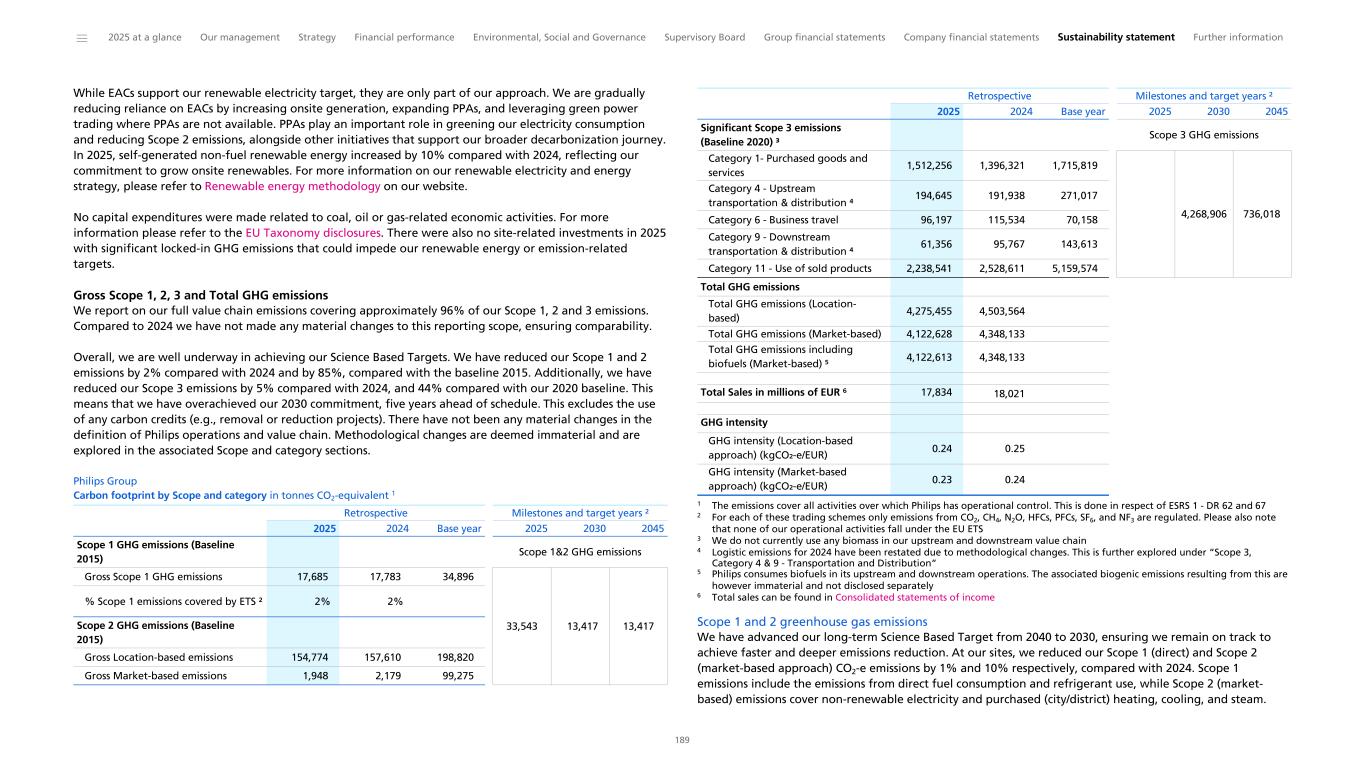
While EACs support our renewable electricity target, they are only part of our approach. We are gradually reducing reliance on EACs by increasing onsite generation, expanding PPAs, and leveraging green power trading where PPAs are not available. PPAs play an important role in greening our electricity consumption and reducing Scope 2 emissions, alongside other initiatives that support our broader decarbonization journey. In 2025, self-generated non-fuel renewable energy increased by 10% compared with 2024, reflecting our commitment to grow onsite renewables. For more information on our renewable electricity and energy strategy, please refer to Renewable energy methodology on our website. No capital expenditures were made related to coal, oil or gas-related economic activities. For more information please refer to the EU Taxonomy disclosures. There were also no site-related investments in 2025 with significant locked-in GHG emissions that could impede our renewable energy or emission-related targets. Gross Scope 1, 2, 3 and Total GHG emissions We report on our full value chain emissions covering approximately 96% of our Scope 1, 2 and 3 emissions. Compared to 2024 we have not made any material changes to this reporting scope, ensuring comparability. Overall, we are well underway in achieving our Science Based Targets. We have reduced our Scope 1 and 2 emissions by 2% compared with 2024 and by 85%, compared with the baseline 2015. Additionally, we have reduced our Scope 3 emissions by 5% compared with 2024, and 44% compared with our 2020 baseline. This means that we have overachieved our 2030 commitment, five years ahead of schedule. This excludes the use of any carbon credits (e.g., removal or reduction projects). There have not been any material changes in the definition of Philips operations and value chain. Methodological changes are deemed immaterial and are explored in the associated Scope and category sections. Philips Group Carbon footprint by Scope and category in tonnes CO2-equivalent 1 Scope 1 GHG emissions (Baseline 2015) Scope 1&2 GHG emissions Gross Scope 1 GHG emissions 17,685 17,783 34,896 33,543 13,417 13,417 % Scope 1 emissions covered by ETS ² 2 % 2 % Scope 2 GHG emissions (Baseline 2015) Gross Location-based emissions 154,774 157,610 198,820 Gross Market-based emissions 1,948 2,179 99,275 Retrospective Milestones and target years ² 2025 2024 Base year 2025 2030 2045 Significant Scope 3 emissions (Baseline 2020) ³ Scope 3 GHG emissions Category 1- Purchased goods and services 1,512,256 1,396,321 1,715,819 4,268,906 736,018 Category 4 - Upstream transportation & distribution ⁴ 194,645 191,938 271,017 Category 6 - Business travel 96,197 115,534 70,158 Category 9 - Downstream transportation & distribution ⁴ 61,356 95,767 143,613 Category 11 - Use of sold products 2,238,541 2,528,611 5,159,574 Total GHG emissions Total GHG emissions (Location- based) 4,275,455 4,503,564 Total GHG emissions (Market-based) 4,122,628 4,348,133 Total GHG emissions including biofuels (Market-based) ⁵ 4,122,613 4,348,133 Total Sales in millions of EUR ⁶ 17,834 18,021 GHG intensity GHG intensity (Location-based approach) (kgCO₂-e/EUR) 0.24 0.25 GHG intensity (Market-based approach) (kgCO₂-e/EUR) 0.23 0.24 Retrospective Milestones and target years ² 2025 2024 Base year 2025 2030 2045 1 The emissions cover all activities over which Philips has operational control. This is done in respect of ESRS 1 - DR 62 and 67 2 For each of these trading schemes only emissions from CO2, CH4, N2O, HFCs, PFCs, SF6, and NF3 are regulated. Please also note that none of our operational activities fall under the EU ETS 3 We do not currently use any biomass in our upstream and downstream value chain 4 Logistic emissions for 2024 have been restated due to methodological changes. This is further explored under “Scope 3, Category 4 & 9 - Transportation and Distribution” 5 Philips consumes biofuels in its upstream and downstream operations. The associated biogenic emissions resulting from this are however immaterial and not disclosed separately 6 Total sales can be found in Consolidated statements of income Scope 1 and 2 greenhouse gas emissions We have advanced our long-term Science Based Target from 2040 to 2030, ensuring we remain on track to achieve faster and deeper emissions reduction. At our sites, we reduced our Scope 1 (direct) and Scope 2 (market-based approach) CO2-e emissions by 1% and 10% respectively, compared with 2024. Scope 1 emissions include the emissions from direct fuel consumption and refrigerant use, while Scope 2 (market- based) emissions cover non-renewable electricity and purchased (city/district) heating, cooling, and steam. ______ 2025 at a glance Our management Strategy Financial performance Environmental, Social and Governance Supervisory Board Group financial statements Company financial statements Sustainability statement Further information 189
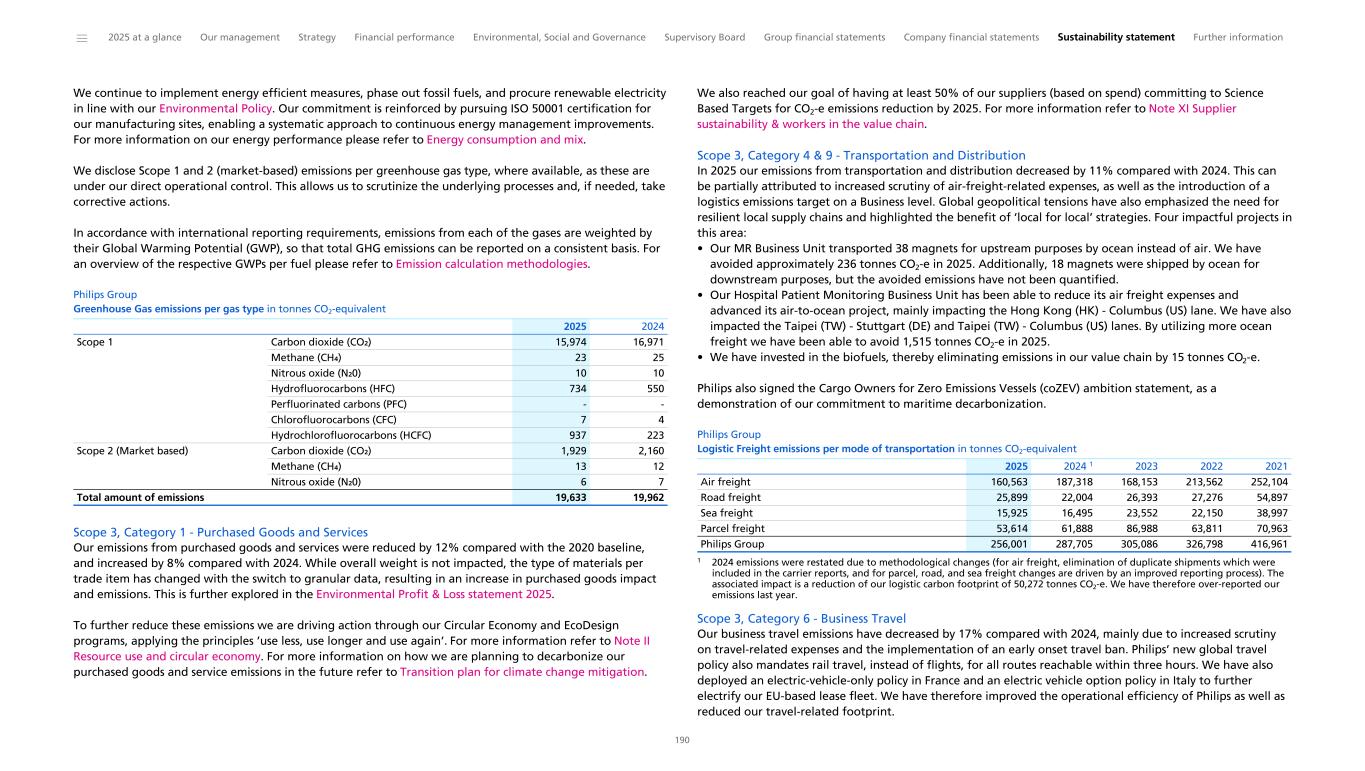
We continue to implement energy efficient measures, phase out fossil fuels, and procure renewable electricity in line with our Environmental Policy. Our commitment is reinforced by pursuing ISO 50001 certification for our manufacturing sites, enabling a systematic approach to continuous energy management improvements. For more information on our energy performance please refer to Energy consumption and mix. We disclose Scope 1 and 2 (market-based) emissions per greenhouse gas type, where available, as these are under our direct operational control. This allows us to scrutinize the underlying processes and, if needed, take corrective actions. In accordance with international reporting requirements, emissions from each of the gases are weighted by their Global Warming Potential (GWP), so that total GHG emissions can be reported on a consistent basis. For an overview of the respective GWPs per fuel please refer to Emission calculation methodologies. Philips Group Greenhouse Gas emissions per gas type in tonnes CO2-equivalent Scope 1 Carbon dioxide (CO₂) 15,974 16,971 Methane (CH₄) 23 25 Nitrous oxide (N₂0) 10 10 Hydrofluorocarbons (HFC) 734 550 Perfluorinated carbons (PFC) - - Chlorofluorocarbons (CFC) 7 4 Hydrochlorofluorocarbons (HCFC) 937 223 Scope 2 (Market based) Carbon dioxide (CO₂) 1,929 2,160 Methane (CH₄) 13 12 Nitrous oxide (N₂0) 6 7 Total amount of emissions 19,633 19,962 2025 2024 Scope 3, Category 1 - Purchased Goods and Services Our emissions from purchased goods and services were reduced by 12% compared with the 2020 baseline, and increased by 8% compared with 2024. While overall weight is not impacted, the type of materials per trade item has changed with the switch to granular data, resulting in an increase in purchased goods impact and emissions. This is further explored in the Environmental Profit & Loss statement 2025. To further reduce these emissions we are driving action through our Circular Economy and EcoDesign programs, applying the principles ’use less, use longer and use again’. For more information refer to Note II Resource use and circular economy. For more information on how we are planning to decarbonize our purchased goods and service emissions in the future refer to Transition plan for climate change mitigation. We also reached our goal of having at least 50% of our suppliers (based on spend) committing to Science Based Targets for CO2-e emissions reduction by 2025. For more information refer to Note XI Supplier sustainability & workers in the value chain. Scope 3, Category 4 & 9 - Transportation and Distribution In 2025 our emissions from transportation and distribution decreased by 11% compared with 2024. This can be partially attributed to increased scrutiny of air-freight-related expenses, as well as the introduction of a logistics emissions target on a Business level. Global geopolitical tensions have also emphasized the need for resilient local supply chains and highlighted the benefit of ‘local for local’ strategies. Four impactful projects in this area: • Our MR Business Unit transported 38 magnets for upstream purposes by ocean instead of air. We have avoided approximately 236 tonnes CO2-e in 2025. Additionally, 18 magnets were shipped by ocean for downstream purposes, but the avoided emissions have not been quantified. • Our Hospital Patient Monitoring Business Unit has been able to reduce its air freight expenses and advanced its air-to-ocean project, mainly impacting the Hong Kong (HK) - Columbus (US) lane. We have also impacted the Taipei (TW) - Stuttgart (DE) and Taipei (TW) - Columbus (US) lanes. By utilizing more ocean freight we have been able to avoid 1,515 tonnes CO2-e in 2025. • We have invested in the biofuels, thereby eliminating emissions in our value chain by 15 tonnes CO2-e. Philips also signed the Cargo Owners for Zero Emissions Vessels (coZEV) ambition statement, as a demonstration of our commitment to maritime decarbonization. Philips Group Logistic Freight emissions per mode of transportation in tonnes CO2-equivalent Air freight 160,563 187,318 168,153 213,562 252,104 Road freight 25,899 22,004 26,393 27,276 54,897 Sea freight 15,925 16,495 23,552 22,150 38,997 Parcel freight 53,614 61,888 86,988 63,811 70,963 Philips Group 256,001 287,705 305,086 326,798 416,961 2025 2024 1 2023 2022 2021 1 2024 emissions were restated due to methodological changes (for air freight, elimination of duplicate shipments which were included in the carrier reports, and for parcel, road, and sea freight changes are driven by an improved reporting process). The associated impact is a reduction of our logistic carbon footprint of 50,272 tonnes CO2-e. We have therefore over-reported our emissions last year. Scope 3, Category 6 - Business Travel Our business travel emissions have decreased by 17% compared with 2024, mainly due to increased scrutiny on travel-related expenses and the implementation of an early onset travel ban. Philips’ new global travel policy also mandates rail travel, instead of flights, for all routes reachable within three hours. We have also deployed an electric-vehicle-only policy in France and an electric vehicle option policy in Italy to further electrify our EU-based lease fleet. We have therefore improved the operational efficiency of Philips as well as reduced our travel-related footprint. ______ 2025 at a glance Our management Strategy Financial performance Environmental, Social and Governance Supervisory Board Group financial statements Company financial statements Sustainability statement Further information 190
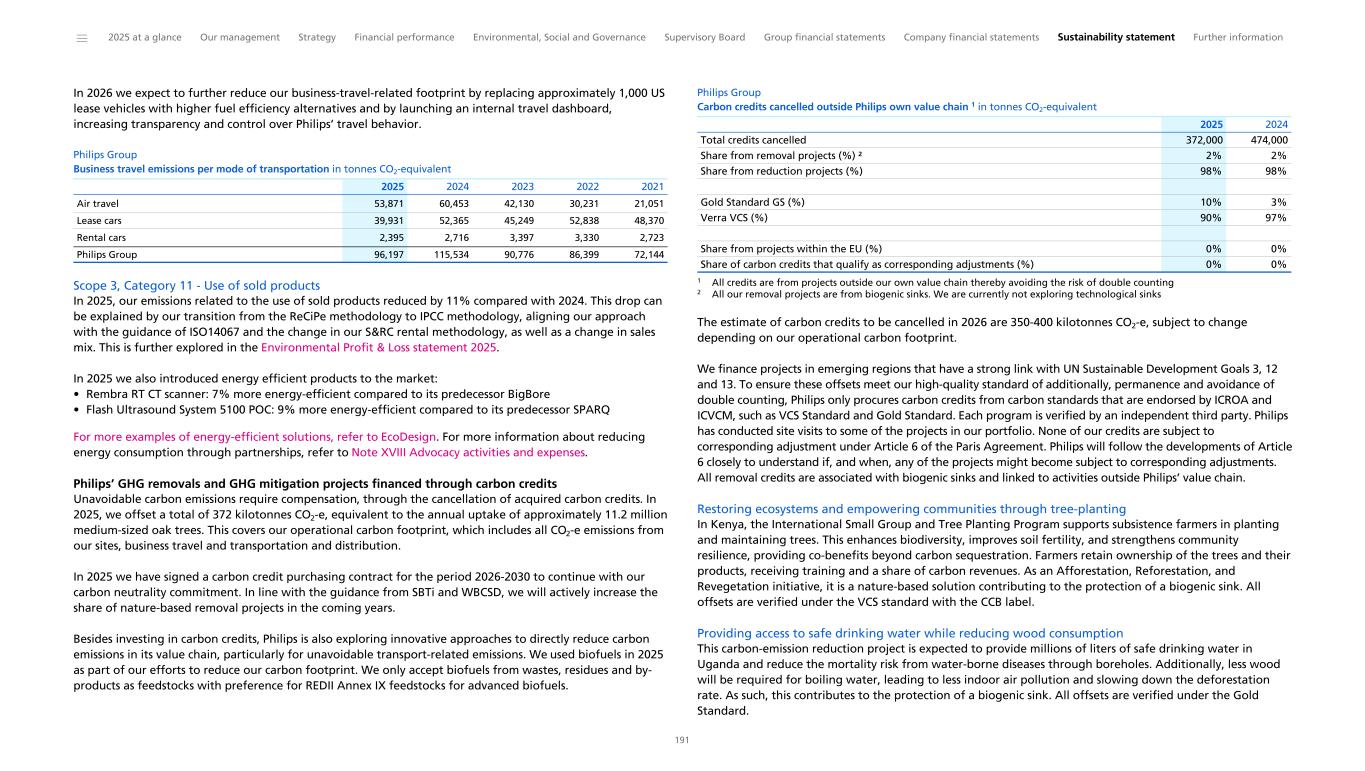
In 2026 we expect to further reduce our business-travel-related footprint by replacing approximately 1,000 US lease vehicles with higher fuel efficiency alternatives and by launching an internal travel dashboard, increasing transparency and control over Philips’ travel behavior. Philips Group Business travel emissions per mode of transportation in tonnes CO2-equivalent Air travel 53,871 60,453 42,130 30,231 21,051 Lease cars 39,931 52,365 45,249 52,838 48,370 Rental cars 2,395 2,716 3,397 3,330 2,723 Philips Group 96,197 115,534 90,776 86,399 72,144 2025 2024 2023 2022 2021 Scope 3, Category 11 - Use of sold products In 2025, our emissions related to the use of sold products reduced by 11% compared with 2024. This drop can be explained by our transition from the ReCiPe methodology to IPCC methodology, aligning our approach with the guidance of ISO14067 and the change in our S&RC rental methodology, as well as a change in sales mix. This is further explored in the Environmental Profit & Loss statement 2025. In 2025 we also introduced energy efficient products to the market: • Rembra RT CT scanner: 7% more energy-efficient compared to its predecessor BigBore • Flash Ultrasound System 5100 POC: 9% more energy-efficient compared to its predecessor SPARQ For more examples of energy-efficient solutions, refer to EcoDesign. For more information about reducing energy consumption through partnerships, refer to Note XVIII Advocacy activities and expenses. Philips’ GHG removals and GHG mitigation projects financed through carbon credits Unavoidable carbon emissions require compensation, through the cancellation of acquired carbon credits. In 2025, we offset a total of 372 kilotonnes CO2-e, equivalent to the annual uptake of approximately 11.2 million medium-sized oak trees. This covers our operational carbon footprint, which includes all CO2-e emissions from our sites, business travel and transportation and distribution. In 2025 we have signed a carbon credit purchasing contract for the period 2026-2030 to continue with our carbon neutrality commitment. In line with the guidance from SBTi and WBCSD, we will actively increase the share of nature-based removal projects in the coming years. Besides investing in carbon credits, Philips is also exploring innovative approaches to directly reduce carbon emissions in its value chain, particularly for unavoidable transport-related emissions. We used biofuels in 2025 as part of our efforts to reduce our carbon footprint. We only accept biofuels from wastes, residues and by- products as feedstocks with preference for REDII Annex IX feedstocks for advanced biofuels. Philips Group Carbon credits cancelled outside Philips own value chain 1 in tonnes CO2-equivalent Total credits cancelled 372,000 474,000 Share from removal projects (%) ² 2% 2% Share from reduction projects (%) 98% 98% Gold Standard GS (%) 10% 3% Verra VCS (%) 90% 97% Share from projects within the EU (%) 0% 0% Share of carbon credits that qualify as corresponding adjustments (%) 0% 0% 2025 2024 1 All credits are from projects outside our own value chain thereby avoiding the risk of double counting 2 All our removal projects are from biogenic sinks. We are currently not exploring technological sinks The estimate of carbon credits to be cancelled in 2026 are 350-400 kilotonnes CO2-e, subject to change depending on our operational carbon footprint. We finance projects in emerging regions that have a strong link with UN Sustainable Development Goals 3, 12 and 13. To ensure these offsets meet our high-quality standard of additionally, permanence and avoidance of double counting, Philips only procures carbon credits from carbon standards that are endorsed by ICROA and ICVCM, such as VCS Standard and Gold Standard. Each program is verified by an independent third party. Philips has conducted site visits to some of the projects in our portfolio. None of our credits are subject to corresponding adjustment under Article 6 of the Paris Agreement. Philips will follow the developments of Article 6 closely to understand if, and when, any of the projects might become subject to corresponding adjustments. All removal credits are associated with biogenic sinks and linked to activities outside Philips’ value chain. Restoring ecosystems and empowering communities through tree-planting In Kenya, the International Small Group and Tree Planting Program supports subsistence farmers in planting and maintaining trees. This enhances biodiversity, improves soil fertility, and strengthens community resilience, providing co-benefits beyond carbon sequestration. Farmers retain ownership of the trees and their products, receiving training and a share of carbon revenues. As an Afforestation, Reforestation, and Revegetation initiative, it is a nature-based solution contributing to the protection of a biogenic sink. All offsets are verified under the VCS standard with the CCB label. Providing access to safe drinking water while reducing wood consumption This carbon-emission reduction project is expected to provide millions of liters of safe drinking water in Uganda and reduce the mortality risk from water-borne diseases through boreholes. Additionally, less wood will be required for boiling water, leading to less indoor air pollution and slowing down the deforestation rate. As such, this contributes to the protection of a biogenic sink. All offsets are verified under the Gold Standard. ______ 2025 at a glance Our management Strategy Financial performance Environmental, Social and Governance Supervisory Board Group financial statements Company financial statements Sustainability statement Further information 191
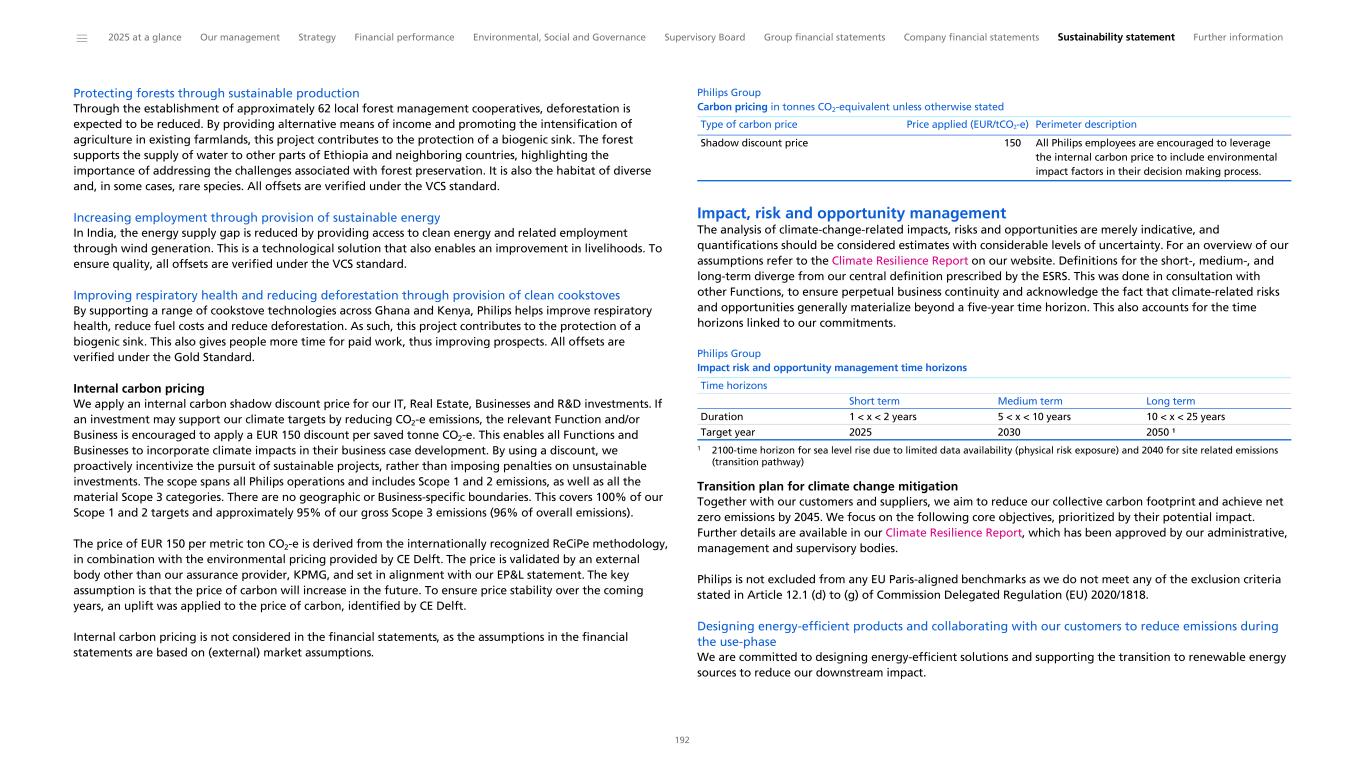
Protecting forests through sustainable production Through the establishment of approximately 62 local forest management cooperatives, deforestation is expected to be reduced. By providing alternative means of income and promoting the intensification of agriculture in existing farmlands, this project contributes to the protection of a biogenic sink. The forest supports the supply of water to other parts of Ethiopia and neighboring countries, highlighting the importance of addressing the challenges associated with forest preservation. It is also the habitat of diverse and, in some cases, rare species. All offsets are verified under the VCS standard. Increasing employment through provision of sustainable energy In India, the energy supply gap is reduced by providing access to clean energy and related employment through wind generation. This is a technological solution that also enables an improvement in livelihoods. To ensure quality, all offsets are verified under the VCS standard. Improving respiratory health and reducing deforestation through provision of clean cookstoves By supporting a range of cookstove technologies across Ghana and Kenya, Philips helps improve respiratory health, reduce fuel costs and reduce deforestation. As such, this project contributes to the protection of a biogenic sink. This also gives people more time for paid work, thus improving prospects. All offsets are verified under the Gold Standard. Internal carbon pricing We apply an internal carbon shadow discount price for our IT, Real Estate, Businesses and R&D investments. If an investment may support our climate targets by reducing CO2-e emissions, the relevant Function and/or Business is encouraged to apply a EUR 150 discount per saved tonne CO2-e. This enables all Functions and Businesses to incorporate climate impacts in their business case development. By using a discount, we proactively incentivize the pursuit of sustainable projects, rather than imposing penalties on unsustainable investments. The scope spans all Philips operations and includes Scope 1 and 2 emissions, as well as all the material Scope 3 categories. There are no geographic or Business-specific boundaries. This covers 100% of our Scope 1 and 2 targets and approximately 95% of our gross Scope 3 emissions (96% of overall emissions). The price of EUR 150 per metric ton CO2-e is derived from the internationally recognized ReCiPe methodology, in combination with the environmental pricing provided by CE Delft. The price is validated by an external body other than our assurance provider, KPMG, and set in alignment with our EP&L statement. The key assumption is that the price of carbon will increase in the future. To ensure price stability over the coming years, an uplift was applied to the price of carbon, identified by CE Delft. Internal carbon pricing is not considered in the financial statements, as the assumptions in the financial statements are based on (external) market assumptions. Philips Group Carbon pricing in tonnes CO2-equivalent unless otherwise stated Shadow discount price 150 All Philips employees are encouraged to leverage the internal carbon price to include environmental impact factors in their decision making process. Type of carbon price Price applied (EUR/tCO₂-e) Perimeter description Impact, risk and opportunity management The analysis of climate-change-related impacts, risks and opportunities are merely indicative, and quantifications should be considered estimates with considerable levels of uncertainty. For an overview of our assumptions refer to the Climate Resilience Report on our website. Definitions for the short-, medium-, and long-term diverge from our central definition prescribed by the ESRS. This was done in consultation with other Functions, to ensure perpetual business continuity and acknowledge the fact that climate-related risks and opportunities generally materialize beyond a five-year time horizon. This also accounts for the time horizons linked to our commitments. Philips Group Impact risk and opportunity management time horizons Duration 1 < x < 2 years 5 < x < 10 years 10 < x < 25 years Target year 2025 2030 2050 ¹ Time horizons Short term Medium term Long term 1 2100-time horizon for sea level rise due to limited data availability (physical risk exposure) and 2040 for site related emissions (transition pathway) Transition plan for climate change mitigation Together with our customers and suppliers, we aim to reduce our collective carbon footprint and achieve net zero emissions by 2045. We focus on the following core objectives, prioritized by their potential impact. Further details are available in our Climate Resilience Report, which has been approved by our administrative, management and supervisory bodies. Philips is not excluded from any EU Paris-aligned benchmarks as we do not meet any of the exclusion criteria stated in Article 12.1 (d) to (g) of Commission Delegated Regulation (EU) 2020/1818. Designing energy-efficient products and collaborating with our customers to reduce emissions during the use-phase We are committed to designing energy-efficient solutions and supporting the transition to renewable energy sources to reduce our downstream impact. ______ 2025 at a glance Our management Strategy Financial performance Environmental, Social and Governance Supervisory Board Group financial statements Company financial statements Sustainability statement Further information 192
All new product introductions adhere to our EcoDesign requirements, where energy efficiency is a key focus. For more information, refer to EcoDesign. This approach allows us to engineer a product portfolio optimized for energy consumption during use, which not only reduces our environmental footprint but also helps our customers lower their operational costs. Moreover, the adoption of renewable energy by our customers also supports our use phase decarbonization by eliminating CO2-e emissions during energy generation. We therefore actively support and encourage our customers in their transition to renewables (see the Champalimaud case study). Our key assumption is that electrical grids will decarbonize in line with the International Energy Agency’s (IEA) Stated Policy Scenario (SPS) or Announced Pledge Scenario (APS). Adopting circular economy practices and transitioning to sustainable alternatives to reduce our purchased goods emissions By retaining materials’ value, we reduce the need for virgin resources and the energy required to produce them, resulting in lower emissions. This approach is led by our Circular Economy team through the principles of ‘use less, use longer, and use again’, which also includes our ambition of ‘closing the loop’. This is further explored in Note II Resource Use and Circular Economy. We focus on increasing circular practices at our sites and responsible waste management according to the waste hierarchy. As such we actively monitor the waste management of our industrial sites with the aim of retaining the value of materials. This is further explained in Sustainable Operations. Lastly, we initiated the process to focus on responsibly reusing products and parts at the end of their use. This includes refurbishment, and responsible takeback. By recirculating products, parts and materials, we increase the market for used products and ensure materials are in use longer. ______ 2025 at a glance Our management Strategy Financial performance Environmental, Social and Governance Supervisory Board Group financial statements Company financial statements Sustainability statement Further information 193
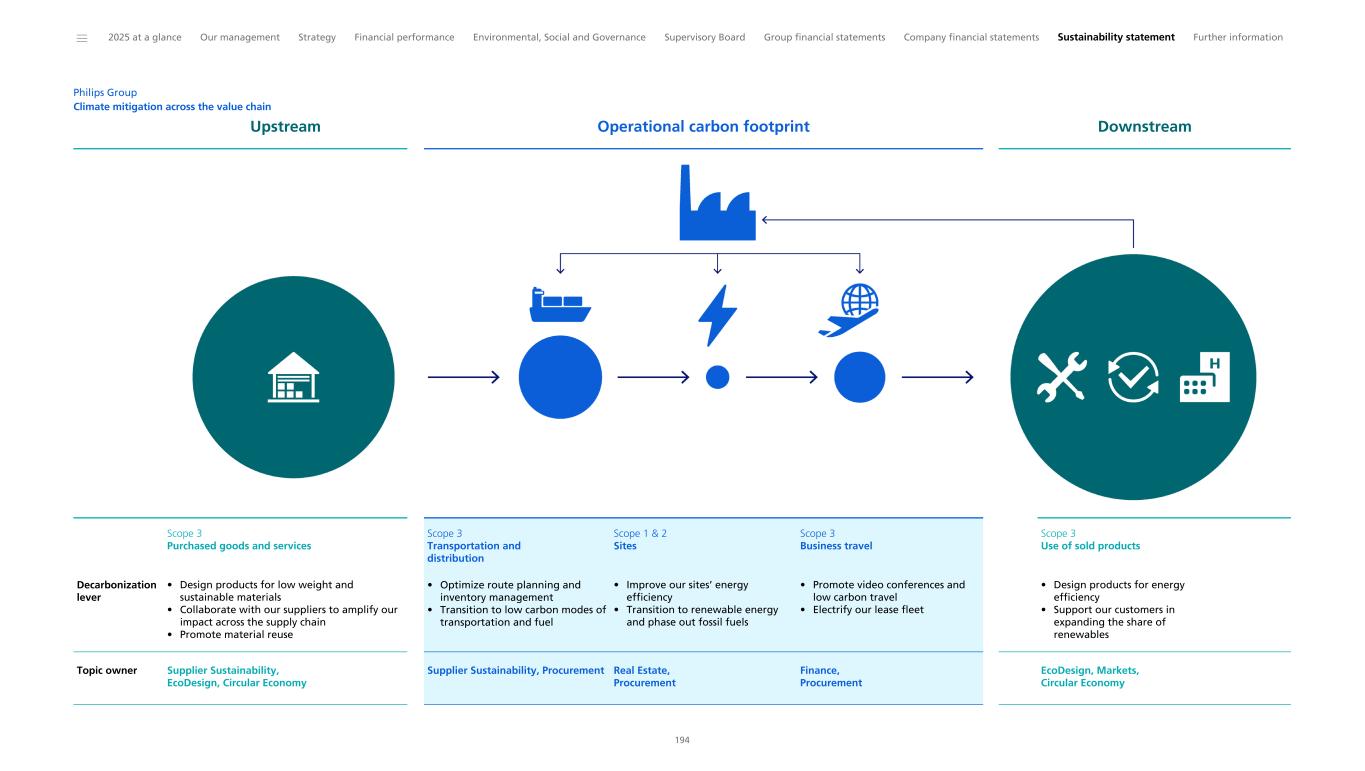
Philips Group Climate mitigation across the value chain Upstream Operational carbon footprint Downstream Scope 3 Purchased goods and services Scope 3 Transportation and distribution Scope 1 & 2 Sites Scope 3 Business travel Scope 3 Use of sold products Decarbonization lever • Design products for low weight and sustainable materials • Collaborate with our suppliers to amplify our impact across the supply chain • Promote material reuse • Optimize route planning and inventory management • Transition to low carbon modes of transportation and fuel • Improve our sites’ energy efficiency • Transition to renewable energy and phase out fossil fuels • Promote video conferences and low carbon travel • Electrify our lease fleet • Design products for energy efficiency • Support our customers in expanding the share of renewables Topic owner Supplier Sustainability, EcoDesign, Circular Economy Supplier Sustainability, Procurement Real Estate, Procurement Finance, Procurement EcoDesign, Markets, Circular Economy ______ 2025 at a glance Our management Strategy Financial performance Environmental, Social and Governance Supervisory Board Group financial statements Company financial statements Sustainability statement Further information 194
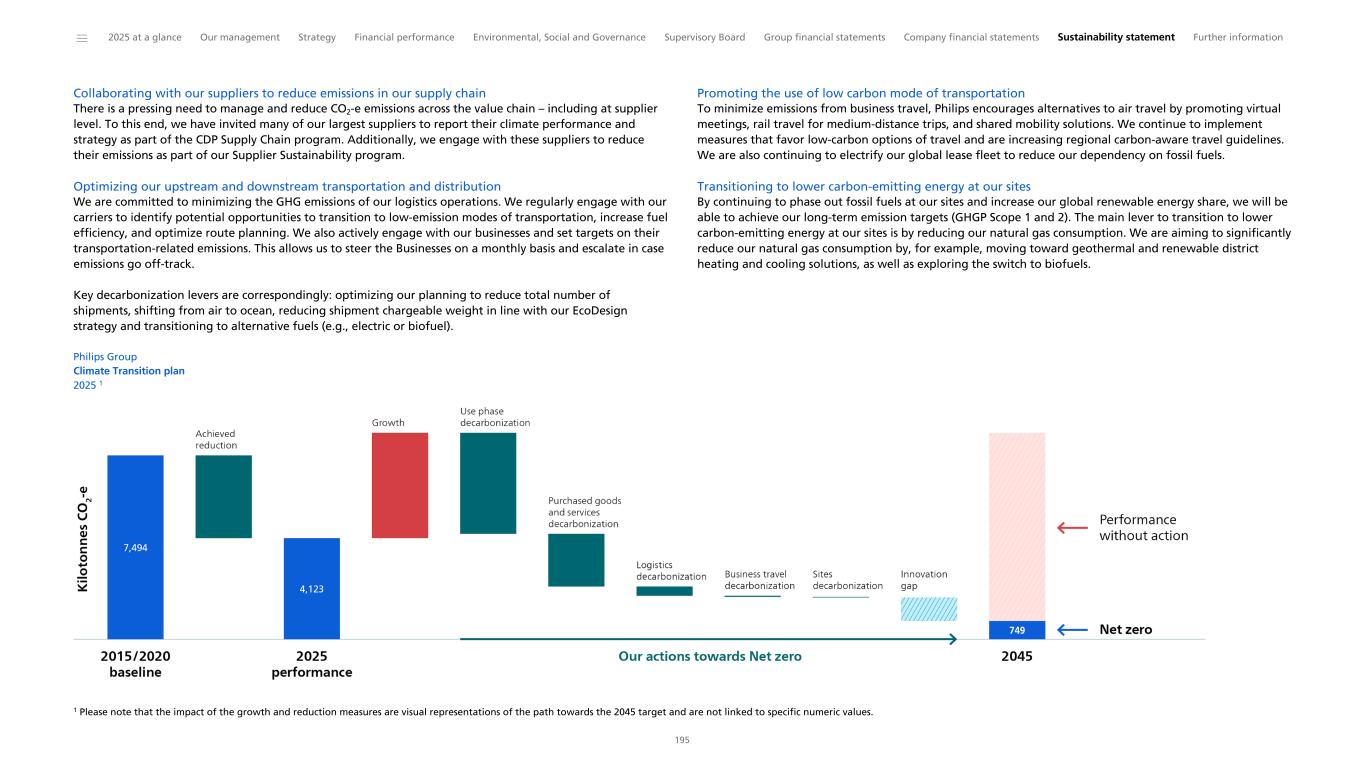
Collaborating with our suppliers to reduce emissions in our supply chain There is a pressing need to manage and reduce CO2-e emissions across the value chain – including at supplier level. To this end, we have invited many of our largest suppliers to report their climate performance and strategy as part of the CDP Supply Chain program. Additionally, we engage with these suppliers to reduce their emissions as part of our Supplier Sustainability program. Optimizing our upstream and downstream transportation and distribution We are committed to minimizing the GHG emissions of our logistics operations. We regularly engage with our carriers to identify potential opportunities to transition to low-emission modes of transportation, increase fuel efficiency, and optimize route planning. We also actively engage with our businesses and set targets on their transportation-related emissions. This allows us to steer the Businesses on a monthly basis and escalate in case emissions go off-track. Key decarbonization levers are correspondingly: optimizing our planning to reduce total number of shipments, shifting from air to ocean, reducing shipment chargeable weight in line with our EcoDesign strategy and transitioning to alternative fuels (e.g., electric or biofuel). Promoting the use of low carbon mode of transportation To minimize emissions from business travel, Philips encourages alternatives to air travel by promoting virtual meetings, rail travel for medium-distance trips, and shared mobility solutions. We continue to implement measures that favor low-carbon options of travel and are increasing regional carbon-aware travel guidelines. We are also continuing to electrify our global lease fleet to reduce our dependency on fossil fuels. Transitioning to lower carbon-emitting energy at our sites By continuing to phase out fossil fuels at our sites and increase our global renewable energy share, we will be able to achieve our long-term emission targets (GHGP Scope 1 and 2). The main lever to transition to lower carbon-emitting energy at our sites is by reducing our natural gas consumption. We are aiming to significantly reduce our natural gas consumption by, for example, moving toward geothermal and renewable district heating and cooling solutions, as well as exploring the switch to biofuels. Philips Group Climate Transition plan 2025 1 ______ 2025 at a glance Our management Strategy Financial performance Environmental, Social and Governance Supervisory Board Group financial statements Company financial statements Sustainability statement Further information 195 1 Please note that the impact of the growth and reduction measures are visual representations of the path towards the 2045 target and are not linked to specific numeric values.
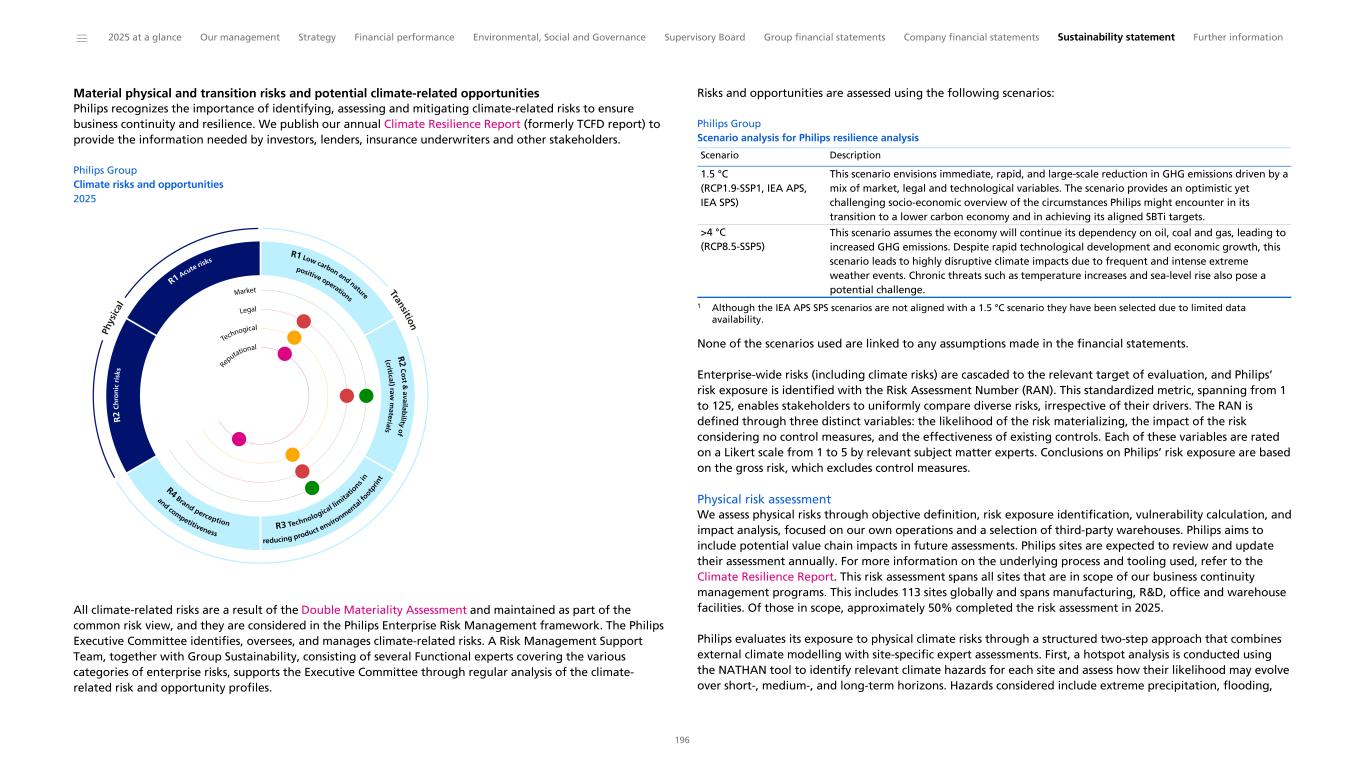
Material physical and transition risks and potential climate-related opportunities Philips recognizes the importance of identifying, assessing and mitigating climate-related risks to ensure business continuity and resilience. We publish our annual Climate Resilience Report (formerly TCFD report) to provide the information needed by investors, lenders, insurance underwriters and other stakeholders. Philips Group Climate risks and opportunities 2025 All climate-related risks are a result of the Double Materiality Assessment and maintained as part of the common risk view, and they are considered in the Philips Enterprise Risk Management framework. The Philips Executive Committee identifies, oversees, and manages climate-related risks. A Risk Management Support Team, together with Group Sustainability, consisting of several Functional experts covering the various categories of enterprise risks, supports the Executive Committee through regular analysis of the climate- related risk and opportunity profiles. Risks and opportunities are assessed using the following scenarios: Philips Group Scenario analysis for Philips resilience analysis 1.5 °C (RCP1.9-SSP1, IEA APS, IEA SPS) This scenario envisions immediate, rapid, and large-scale reduction in GHG emissions driven by a mix of market, legal and technological variables. The scenario provides an optimistic yet challenging socio-economic overview of the circumstances Philips might encounter in its transition to a lower carbon economy and in achieving its aligned SBTi targets. >4 °C (RCP8.5-SSP5) This scenario assumes the economy will continue its dependency on oil, coal and gas, leading to increased GHG emissions. Despite rapid technological development and economic growth, this scenario leads to highly disruptive climate impacts due to frequent and intense extreme weather events. Chronic threats such as temperature increases and sea-level rise also pose a potential challenge. Scenario Description 1 Although the IEA APS SPS scenarios are not aligned with a 1.5 °C scenario they have been selected due to limited data availability. None of the scenarios used are linked to any assumptions made in the financial statements. Enterprise-wide risks (including climate risks) are cascaded to the relevant target of evaluation, and Philips’ risk exposure is identified with the Risk Assessment Number (RAN). This standardized metric, spanning from 1 to 125, enables stakeholders to uniformly compare diverse risks, irrespective of their drivers. The RAN is defined through three distinct variables: the likelihood of the risk materializing, the impact of the risk considering no control measures, and the effectiveness of existing controls. Each of these variables are rated on a Likert scale from 1 to 5 by relevant subject matter experts. Conclusions on Philips’ risk exposure are based on the gross risk, which excludes control measures. Physical risk assessment We assess physical risks through objective definition, risk exposure identification, vulnerability calculation, and impact analysis, focused on our own operations and a selection of third-party warehouses. Philips aims to include potential value chain impacts in future assessments. Philips sites are expected to review and update their assessment annually. For more information on the underlying process and tooling used, refer to the Climate Resilience Report. This risk assessment spans all sites that are in scope of our business continuity management programs. This includes 113 sites globally and spans manufacturing, R&D, office and warehouse facilities. Of those in scope, approximately 50% completed the risk assessment in 2025. Philips evaluates its exposure to physical climate risks through a structured two-step approach that combines external climate modelling with site-specific expert assessments. First, a hotspot analysis is conducted using the NATHAN tool to identify relevant climate hazards for each site and assess how their likelihood may evolve over short-, medium-, and long-term horizons. Hazards considered include extreme precipitation, flooding, ______ 2025 at a glance Our management Strategy Financial performance Environmental, Social and Governance Supervisory Board Group financial statements Company financial statements Sustainability statement Further information 196
heat and cold stress, drought, wildfire, tropical cyclones, sea-level rise, and long-term climate shifts. This analysis provides a consistent baseline for comparing exposure across sites. The hotspot analysis is complemented by site-specific workshops involving experts from Business Continuity Management, Plant Management, and Environmental and Financial Management. During these workshops, participants assess the potential impacts of identified hazards under a hypothetical worst-case scenario, including property damage, business interruption, and operational disruption. The effectiveness of existing controls, such as flood protection, drainage systems, building resilience, fire safety measures, emergency procedures, and monitoring systems, is also evaluated. Combining external modelling with site-level insights enables a quantitative assessment of climate-related risk exposure for each site. Resulting risk scores are aggregated at the company level using asset-weighted averages. From an acute risk perspective, the assessment identifies two sites requiring heightened attention, classified as very high risk: Phoenix and Linwood (US). Phoenix is exposed to elevated risk levels across all time horizons, primarily driven by heat stress and wildfire, with drought conditions projected to intensify over time. Linwood, in contrast, is expected to be exposed to increased risk of precipitation. Three additional sites are classified as high risk and therefore warrant attention: Reedsville (US), Rancho Cordova (US) and Alajuela (Costa Rica). In Alajuela, the predominant risk is increased rainfall, with drought and heat stress expected to escalate over the longer term. In Reedsville, cold stress represents the principal acute risk, with heat stress and rainfall also anticipated to slightly but immaterially increase over time. For Rancho Cordova, the prevailing and future risk is wildfire. As Philips’ operations are not water-intensive, water scarcity is not expected to have a material impact on business continuity. From a chronic risk perspective, overall exposure remains limited. The only sites for which chronic risk are projected to increase materially over time are Alajuela (Costa Rica) and Phoenix (US). Long-term climate trends, including rising average temperatures, are observed across most regions but are not expected to result in short- or medium-term operational impacts. Sea-level rise does not currently present a material risk to any site; however, locations such as Drachten (the Netherlands), Hamburg (Germany), and Batam (Indonesia) continue to be monitored due to their proximity to low-lying areas. Philips has implemented robust adaptation measures across its sites. Among the risks assessed as very high likelihood (26 unique risk and site combinations), 96% are controlled by measures with at least medium effectiveness, with 73% covered by highly or very highly effective controls. Similarly, 84% of high-likelihood risks are mitigated by highly effective measures. These results demonstrate Philips’ accountability in addressing physical climate risks and its commitment to integrating climate resilience into operational and risk management practices. Transition risk and opportunity assessment Conducting a transition risk/opportunity assessment helps us navigate the rapidly evolving global market and regulatory landscape marked by sustainability imperatives. It also enables us to identify opportunities. Overall, through a stringent transition risk and opportunity assessment we are able to ensure the company stays compliant with upcoming regulations, adapts its business strategies, invests in sustainable technologies, minimizes financial disruptions and proactively attracts eco-conscious customers and investors. For more information on the methodology and results of the risk assessment, refer to the Climate Resilience Report. Note that calculation methodologies, critical assumptions and scope of assessment are specific to each risk/ opportunity. Upstream transition events Prices for GHG emissions are expected to rise in the future to incentivize the adoption of low-carbon technologies. This can be driven by mechanisms such as the Emission Trading Schemes (ETS) or carbon taxation. While we endorse this general policy direction, it comes with risks. From an upstream perspective, we expect impacted suppliers to pass on the cost of carbon to Philips, increasing our bill of material cost. Most notably, the EU-ETS is a cap-and-trade system that covers roughly 40% of all EU wide emissions. Sectors in scope are, among others, steel, iron, aluminum, paper and cardboard and glass. With the introduction of the Carbon Border Adjustment Mechanism (CBAM) legislation in 2026, the scope of the EU-ETS will expand to also include importers that currently reside outside the EU. Based on preliminary estimates the impact of CBAM will be limited for Philips. As response, we actively monitor the life cycle emissions of our purchased goods and steer our Businesses toward sustainable product development through our EcoDesign and Circular Economy program. For more information, refer to Note II Resource use and circular economy. Operations transition events We are interested in identifying potential stranded assets, which are concretely planned sites, across the medium- and long-term with significant locked-in GHG emissions. Based on our internal investigations that included members from Integrated Supply Chain, Real Estate and Group Sustainability, we have concluded that there are no expected stranded assets and no assets exposed to transition risks. We have already reduced our Scope 1 and 2 emissions by 85% compared with 2015 – a target achievement rate of 95%. We are well on track to achieving our long-term reduction targets. To manage our remaining energy and GHG intensive sites, we monitor the emissions of our high-impact sites monthly and together with Real Estate are investigating novel ways to eliminate the usage of fossil fuels on-site. All high- impact sites are therefore under control and addressed by climate mitigation plans. Please note that no carbon pricing scheme associated with our Scope 1 and 2 emissions (ETS, carbon tax, etc.) has a current material impact on our financial statements. ______ 2025 at a glance Our management Strategy Financial performance Environmental, Social and Governance Supervisory Board Group financial statements Company financial statements Sustainability statement Further information 197
Downstream transition events Under the given low global warming scenario, it is assumed that there is strong socio-economic drive to shift toward a low-carbon economy. With the majority of our climate impact residing downstream during the use phase of our products, this is our main exposure. This could include energy-efficiency policies, market forces demanding energy efficiency improvements and consumer preferences that drive technological advancements. The rapid change could lead to a situation where Philips’ current technological capabilities lag behind those of our competitors and where the locked-in GHG emissions of our products inhibit our Scope 3 target achievement. For a more detailed overview of this risk refer to our Climate Resilience Report. To manage this risk, we focus on energy efficiency as part of our EcoDesign program. All product introductions are expected to optimize their energy efficiency. For more information on how EcoDesign can help our target achievement, refer to Transition plan for climate change mitigation. For a quantitative assessment of our locked-in GHG emissions associated with our products, please refer to Climate change. Resources allocated to climate change To strengthen our climate resilience from both adaptation and mitigation perspective and meet external commitments (e.g., Science Based Targets) we have allocated resources to reduce our environmental impact and prepare for potential acute and chronic climate related risks. Past and current resources Philips has allocated resources to enhance environmental resilience, including proceeds from the Green and Sustainability Innovation Bonds issued under Philips’ Green and Sustainability Innovation Bond Framework (April 24, 2019). These funds have been invested in Green and Sustainability Eligible Projects aligned with the objectives of reducing value chain emissions (climate mitigation) and building adaptive capacity (climate adaptation). All bonds issued under the framework follow the International Capital Market Association (ICMA) Green Bond Principles 2018, Social Bond Principles 2018 and the ICMA Sustainability Bond Guidelines 2018, to ensure that the selected and disclosed projects meet widely recognized criteria. For more information, visit our Debt structure webpage. We have other expenditures allocated to our environmental objectives. For climate mitigation and adaptation, a subset of the expenditures for the EU Taxonomy reporting are relevant. This is equivalent to approximately EUR 3 million (0.3%) of our EU Taxonomy aligned CapEx related to our actions to improve energy efficiency, phase out fossil fuels and build adaptive capacity on site. Refer to our EU Taxonomy disclosures for more. We have also invested EUR 287 million in Green Innovation in 2025 to support our efforts in reducing our biggest emissions contributors, which are purchased goods and use of sold products. In total, our aforementioned expenditures cover these key actions related to our decarbonization levers: • designing energy-efficient products and collaborating with our customers to reduce emissions during the use-phase • minimizing our purchased goods emissions by adopting circular economy practices and transitioning to sustainable alternatives • collaborating with our suppliers to reduce emissions in our supply chain • reducing emissions from logistics by optimizing our planning horizon • transitioning to lower carbon-emitting energy at our sites Future resources To ensure we meet our future climate targets and continue to build our adaptive capacity, it is important that future resources are allocated to our target achievement, such as: • investments in renewable energy and energy efficiency • development of EcoDesigned product and partnerships • infrastructure resilience, flood defense improvements, and climate-resilient, nature-based solutions The final financial planning, including future financial resources related to our transition plan, is in progress. Philips’ emission calculation methodologies Philips reports in line with the Greenhouse Gas Protocol (GHGP). The GHGP distinguishes three Scopes, as described below. The GHGP requires businesses to report on the first two Scopes to comply with the GHGP reporting standards. As per the updated GHGP Scope 2 reporting guidance, from 2015 onward our Scope 2 emissions reporting includes both the market-based method and the location-based method. The market- based method of reporting will serve as our reference for calculating our total carbon footprint. As part of our carbon footprint, Philips also reports on five Scope 3 categories. These are indirect emissions that reside either upstream or downstream and are included in our net zero target. All emissions are reported as carbon dioxide equivalent (CO2-e), including, among others, the greenhouse gases: CO2, CH4, N2O, HFCs, PFCs, SF6, and NF3 using their most recent Global Warming Potentials (GWPs). Scope 1 greenhouse gas emissions These are direct emissions caused by company-owned and -controlled entities. For example, the burning of fossil fuels and the use of refrigerants or chemicals on-site generates Scope 1-related CO2-e emissions. Sites report their consumption of refrigerants, and anthropogenic or biogenic-based fuels via our internal sustainability reporting system. Consumption per resource is then aggregated across all sites and multiplied by resource-specific emission factors. This approach is being used for all industrial sites and 80% of our non- industrial sites’ floor area. For all other sites, consumption is extrapolated. For Scope 1 emissions we use two sets of emission factors. For fossil fuels and natural gases, we use the UK Department for Energy Security and Net Zero (DESNZ) database (v1.1 2024 – Global Warming Potentials (GWP) 5th Intergovernmental Panel on Climate Change (IPCC) Assessment Report (AR)). For all other relevant Scope 1 refrigerants, we use the IPCC database (Either AR6, v1.2 or v1.5, or AR5, v1.2). Philips does not have any biogenic emissions from the combustion or biodegradation of biomass in its own operation. ______ 2025 at a glance Our management Strategy Financial performance Environmental, Social and Governance Supervisory Board Group financial statements Company financial statements Sustainability statement Further information 198
Philips does not have any activities regulated under the EU-ETS. Scope 2 greenhouse gas emissions These are indirect emissions caused by the purchase of electricity, heating, steam, and cooling. These emissions are not generated on our sites but are still directly impacted by our consumption level and contractual agreements. We can therefore reduce these emissions by reducing consumption or by ensuring purchased energy comes from low-emission sources. We report on both market-based and location-based emissions. For the market-based approach, we first subtract the amount of renewable energy acquired or self- generated in a specific region from the actual amount of electricity consumed. All renewable electricity claimed by Philips is sourced from the same energy market where the electricity-consuming operations are located, and is tracked and redeemed, retired, or cancelled solely on behalf of Philips. To ensure ‘additionality’, all certificates were generated in 2025 – or maximum six months prior – in the market of consumption and are retired on behalf of Philips. The remainder can then be considered gray electricity, meaning a non-renewable source. We then multiply this by a residual mix emission factor. For more information on our renewable energy methodology please refer to our webpage on Sustainability resources. For the location-based approach, we examine energy purchases and disregard any renewable energy certificates acquired. This amount is then multiplied by grid-average emission factors. The grid emission factors used for the market-based approach are dependent on the location. For sites in the US, we apply the eGrid-specific Residual Mix emission factor (Green-e 2024 v1.1 (2022 Data)), and for sites in Europe we use the AIB European Residual Mixes (2023 v1.1). For all other countries, we apply the IEA emission factors because residual mix emission factors are non-existent for these regions (2024 v1.1 - GWP AR4, or 2023 v1.1 – GWP AR4). For the location-based approach we use eGrid and IEA grid average emission factors (Both v1.1 – GWP AR4). For all other energy purchases we use the emission factors from DESNZ (v1.1 2024 – GWP AR5). Philips does not have any biogenic emissions from the combustion or biodegradation of biomass in its own operation. Scope 3, category 1 – Purchased goods and services This includes any emissions generated by the consumption of raw materials, components, packaging, and services that are acquired to create and distribute Philips products. This is partially done in alignment with the Philips EP&L statement and only includes production-related goods (e.g., components and parts) and all services that fall under the GHGP described category. We use estimations and assumptions when determining the raw materials and their weight, for example by using reference products. Goods-related emissions are calculated using an average data method and services using a spend-based method. Components and material specific emission factors are determined using EcoInvent (v3.9.1 – GWP AR6). These factors are regularly updated and consider the sourcing as well as raw material processing. The impact of purchased services is in contrast based on an input-output model. To derive emissions the Exiobase database (v3.8.2 – GWP AR5 and AR6) is leveraged, which factors in all activities connected to the corresponding service. Scope 3, category 4 – Upstream transportation and distribution This includes all emissions generated by transporting components, products, or raw materials from one location to another via a mode owned by a third party. This includes both upstream- and mainstream-related (between Philips facilities) shipments and can include transport via air, road, or sea. Rail transport is rarely used by Philips and therefore has a negligible influence on total emissions. For air freight, road freight or less than a container load ocean freight, the emission factors from DESNZ are leveraged (v1.1 2024 - GWP AR5). For full container load transports the emission factors from Clean Cargo are used (version 2023 – GWP AR6). Scope 3, category 6 – Business travel This covers any mode of transportation that is used by employees for business purposes and operated by a third party, excluding commuting. To calculate business travel emissions, we distinguish air travel and automobile travel. For automobile travel, we include leased vehicles and rented vehicles. All other modes of transportation are not considered due to their minimal usage for business purposes and negligible total impact (e.g., trains in the Netherlands run on renewable electricity). The emissions factors from DESNZ (v1.1 2024 – GWP AR5) are leveraged as these are updated annually. Scope 3, category 9 – Downstream transportation and distribution This includes all emissions generated by transporting finished goods from a Philips facility or third-party warehouse to a customer via a mode owned by a third party. Please note that we are not always able to clearly distinguish shipments paid by Philips or by our customers, thereby slightly deviating from the GHGP. This can include transport via air, road, or sea. Rail transport is rarely used by Philips and therefore has a negligible influence on total emissions. For air freight, road freight or less than a container load ocean freight the emission factors from DESNZ are leveraged (v1.1 2024 - GWP AR5). For full container load transports the emission factors from Clean Cargo are used (version 2023 – GWP AR6). Scope 3, category 11 – Use of sold products To calculate the emissions generated during the use phase of our products we identify three key variables: the lifetime energy per device, number of products sold per country and country specific emission factors. When determining the key variables, Philips uses internal expert opinions, which are based on estimates, assumptions and market intelligence. It should be noted that the energy consumption during the lifetime of the products sold is included in the emission calculation of the year of sale. To calculate emissions, the country grid average emission factors from EcoInvent (v3.9.1 – GWP AR6) are used. Only the direct energy need during use is accounted for (e.g., electricity to power our products). All reported emissions do not include any removals, or any purchased, sold or transferred carbon credits or GHG allowances. For more information on our emission and renewable energy calculation methodologies please refer to our webpage on Sustainability resources. This also includes a detailed analysis of the proportion of emissions calculated using primary data from our suppliers. ______ 2025 at a glance Our management Strategy Financial performance Environmental, Social and Governance Supervisory Board Group financial statements Company financial statements Sustainability statement Further information 199
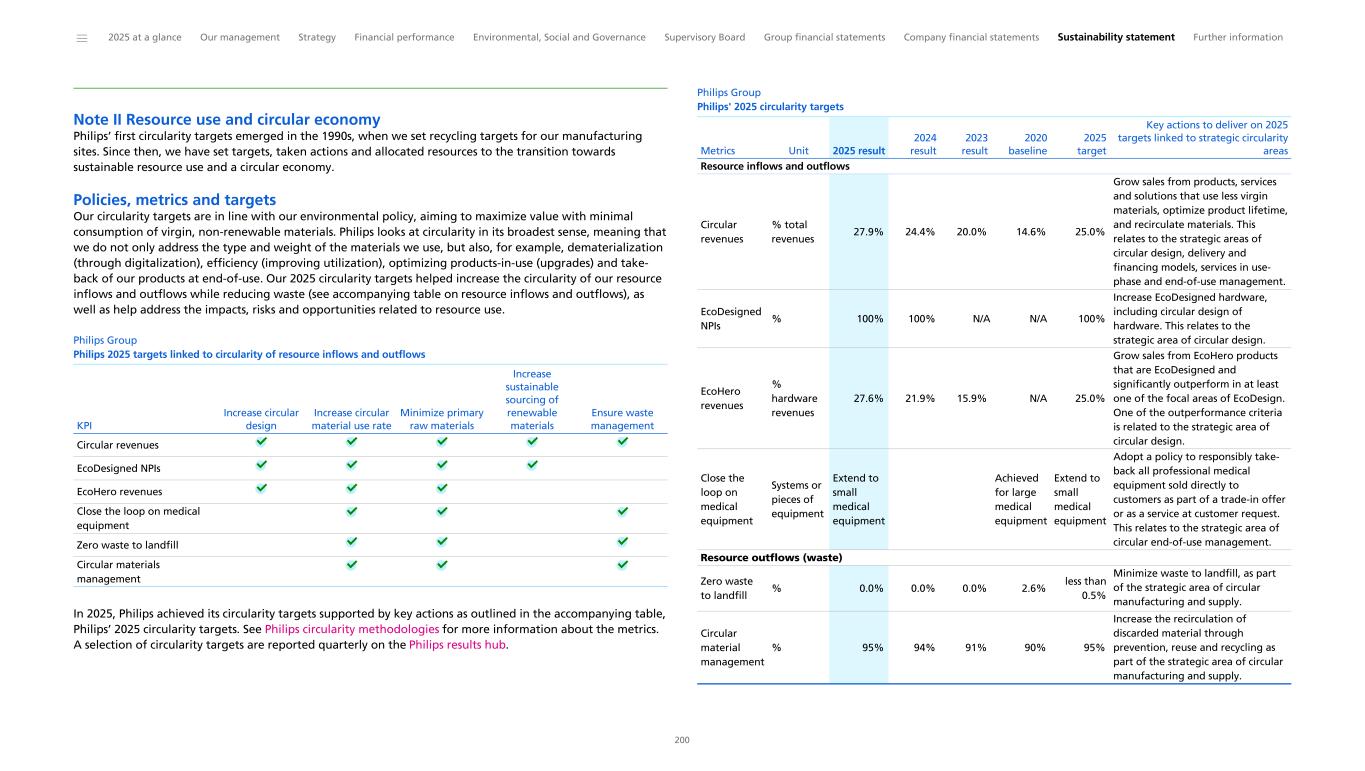
Note II Resource use and circular economy Philips’ first circularity targets emerged in the 1990s, when we set recycling targets for our manufacturing sites. Since then, we have set targets, taken actions and allocated resources to the transition towards sustainable resource use and a circular economy. Policies, metrics and targets Our circularity targets are in line with our environmental policy, aiming to maximize value with minimal consumption of virgin, non-renewable materials. Philips looks at circularity in its broadest sense, meaning that we do not only address the type and weight of the materials we use, but also, for example, dematerialization (through digitalization), efficiency (improving utilization), optimizing products-in-use (upgrades) and take- back of our products at end-of-use. Our 2025 circularity targets helped increase the circularity of our resource inflows and outflows while reducing waste (see accompanying table on resource inflows and outflows), as well as help address the impacts, risks and opportunities related to resource use. Philips Group Philips 2025 targets linked to circularity of resource inflows and outflows Circular revenues EcoDesigned NPIs EcoHero revenues Close the loop on medical equipment Zero waste to landfill Circular materials management KPI Increase circular design Increase circular material use rate Minimize primary raw materials Increase sustainable sourcing of renewable materials Ensure waste management In 2025, Philips achieved its circularity targets supported by key actions as outlined in the accompanying table, Philips’ 2025 circularity targets. See Philips circularity methodologies for more information about the metrics. A selection of circularity targets are reported quarterly on the Philips results hub. Philips Group Philips' 2025 circularity targets Resource inflows and outflows Circular revenues % total revenues 27.9% 24.4% 20.0% 14.6% 25.0% Grow sales from products, services and solutions that use less virgin materials, optimize product lifetime, and recirculate materials. This relates to the strategic areas of circular design, delivery and financing models, services in use- phase and end-of-use management. EcoDesigned NPIs % 100% 100% N/A N/A 100% Increase EcoDesigned hardware, including circular design of hardware. This relates to the strategic area of circular design. EcoHero revenues % hardware revenues 27.6% 21.9% 15.9% N/A 25.0% Grow sales from EcoHero products that are EcoDesigned and significantly outperform in at least one of the focal areas of EcoDesign. One of the outperformance criteria is related to the strategic area of circular design. Close the loop on medical equipment Systems or pieces of equipment Extend to small medical equipment Achieved for large medical equipment Extend to small medical equipment Adopt a policy to responsibly take- back all professional medical equipment sold directly to customers as part of a trade-in offer or as a service at customer request. This relates to the strategic area of circular end-of-use management. Resource outflows (waste) Zero waste to landfill % 0.0% 0.0% 0.0% 2.6% less than 0.5% Minimize waste to landfill, as part of the strategic area of circular manufacturing and supply. Circular material management % 95% 94% 91% 90% 95% Increase the recirculation of discarded material through prevention, reuse and recycling as part of the strategic area of circular manufacturing and supply. Metrics Unit 2025 result 2024 result 2023 result 2020 baseline 2025 target Key actions to deliver on 2025 targets linked to strategic circularity areas ______ 2025 at a glance Our management Strategy Financial performance Environmental, Social and Governance Supervisory Board Group financial statements Company financial statements Sustainability statement Further information 200
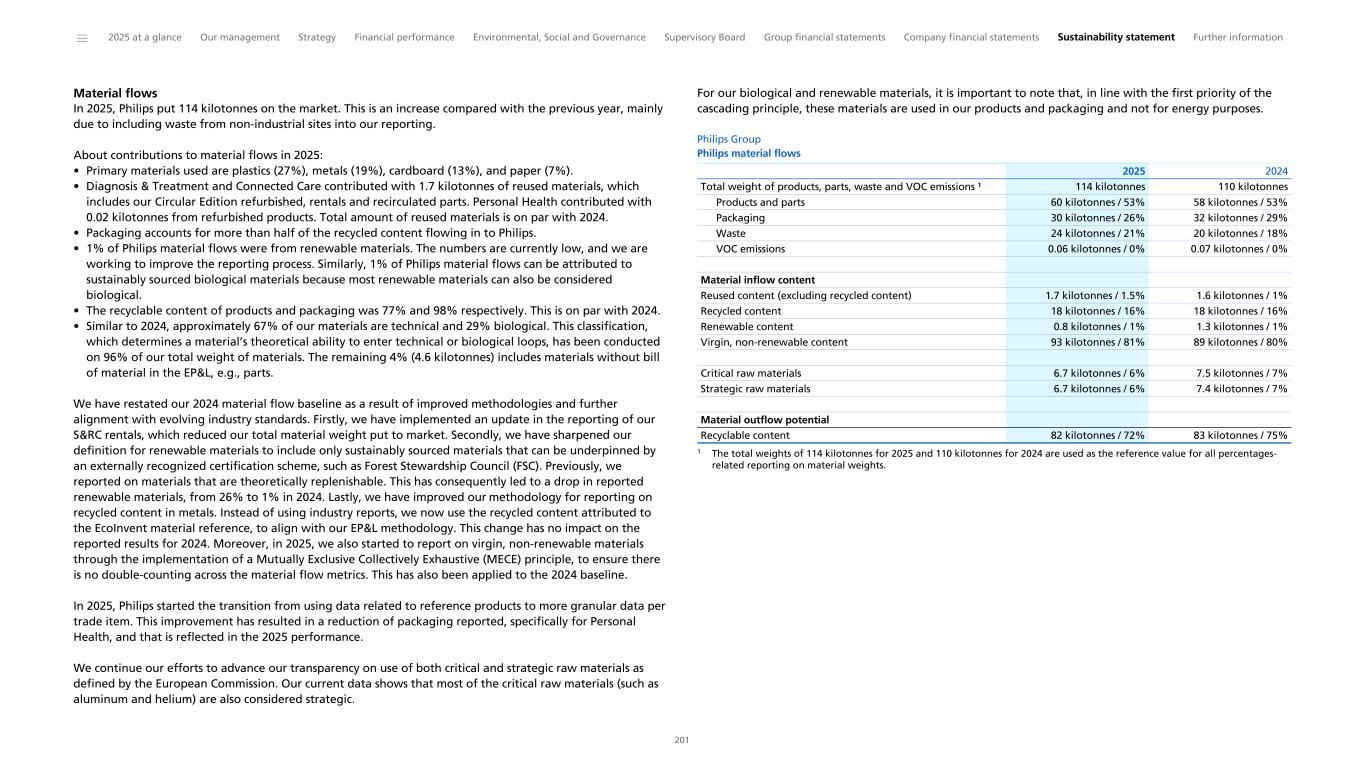
Material flows In 2025, Philips put 114 kilotonnes on the market. This is an increase compared with the previous year, mainly due to including waste from non-industrial sites into our reporting. About contributions to material flows in 2025: • Primary materials used are plastics (27%), metals (19%), cardboard (13%), and paper (7%). • Diagnosis & Treatment and Connected Care contributed with 1.7 kilotonnes of reused materials, which includes our Circular Edition refurbished, rentals and recirculated parts. Personal Health contributed with 0.02 kilotonnes from refurbished products. Total amount of reused materials is on par with 2024. • Packaging accounts for more than half of the recycled content flowing in to Philips. • 1% of Philips material flows were from renewable materials. The numbers are currently low, and we are working to improve the reporting process. Similarly, 1% of Philips material flows can be attributed to sustainably sourced biological materials because most renewable materials can also be considered biological. • The recyclable content of products and packaging was 77% and 98% respectively. This is on par with 2024. • Similar to 2024, approximately 67% of our materials are technical and 29% biological. This classification, which determines a material’s theoretical ability to enter technical or biological loops, has been conducted on 96% of our total weight of materials. The remaining 4% (4.6 kilotonnes) includes materials without bill of material in the EP&L, e.g., parts. We have restated our 2024 material flow baseline as a result of improved methodologies and further alignment with evolving industry standards. Firstly, we have implemented an update in the reporting of our S&RC rentals, which reduced our total material weight put to market. Secondly, we have sharpened our definition for renewable materials to include only sustainably sourced materials that can be underpinned by an externally recognized certification scheme, such as Forest Stewardship Council (FSC). Previously, we reported on materials that are theoretically replenishable. This has consequently led to a drop in reported renewable materials, from 26% to 1% in 2024. Lastly, we have improved our methodology for reporting on recycled content in metals. Instead of using industry reports, we now use the recycled content attributed to the EcoInvent material reference, to align with our EP&L methodology. This change has no impact on the reported results for 2024. Moreover, in 2025, we also started to report on virgin, non-renewable materials through the implementation of a Mutually Exclusive Collectively Exhaustive (MECE) principle, to ensure there is no double-counting across the material flow metrics. This has also been applied to the 2024 baseline. In 2025, Philips started the transition from using data related to reference products to more granular data per trade item. This improvement has resulted in a reduction of packaging reported, specifically for Personal Health, and that is reflected in the 2025 performance. We continue our efforts to advance our transparency on use of both critical and strategic raw materials as defined by the European Commission. Our current data shows that most of the critical raw materials (such as aluminum and helium) are also considered strategic. For our biological and renewable materials, it is important to note that, in line with the first priority of the cascading principle, these materials are used in our products and packaging and not for energy purposes. Philips Group Philips material flows Total weight of products, parts, waste and VOC emissions ¹ 114 kilotonnes 110 kilotonnes Products and parts 60 kilotonnes / 53% 58 kilotonnes / 53% Packaging 30 kilotonnes / 26% 32 kilotonnes / 29% Waste 24 kilotonnes / 21% 20 kilotonnes / 18% VOC emissions 0.06 kilotonnes / 0% 0.07 kilotonnes / 0% Material inflow content Reused content (excluding recycled content) 1.7 kilotonnes / 1.5% 1.6 kilotonnes / 1% Recycled content 18 kilotonnes / 16% 18 kilotonnes / 16% Renewable content 0.8 kilotonnes / 1% 1.3 kilotonnes / 1% Virgin, non-renewable content 93 kilotonnes / 81% 89 kilotonnes / 80% Critical raw materials 6.7 kilotonnes / 6% 7.5 kilotonnes / 7% Strategic raw materials 6.7 kilotonnes / 6% 7.4 kilotonnes / 7% Material outflow potential Recyclable content 82 kilotonnes / 72% 83 kilotonnes / 75% 2025 2024 1 The total weights of 114 kilotonnes for 2025 and 110 kilotonnes for 2024 are used as the reference value for all percentages- related reporting on material weights. ______ 2025 at a glance Our management Strategy Financial performance Environmental, Social and Governance Supervisory Board Group financial statements Company financial statements Sustainability statement Further information 201
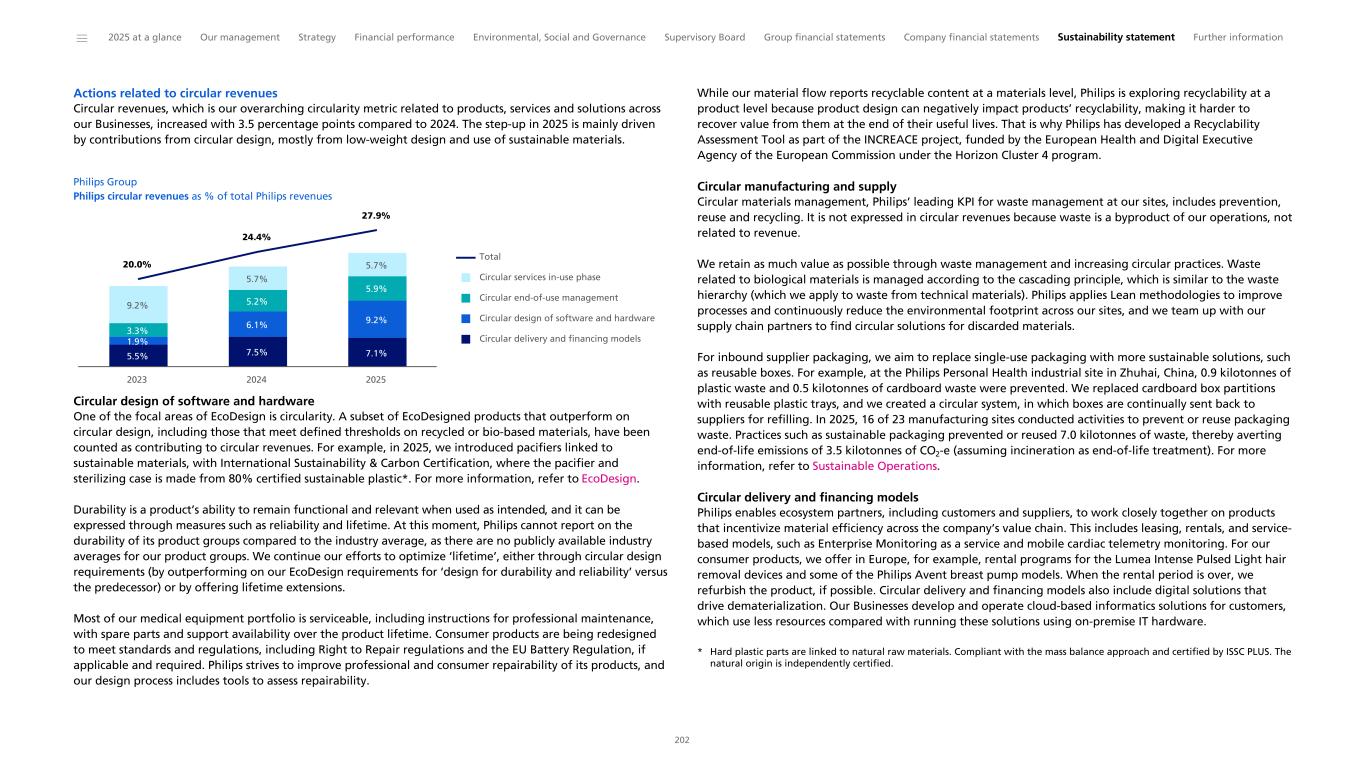
Actions related to circular revenues Circular revenues, which is our overarching circularity metric related to products, services and solutions across our Businesses, increased with 3.5 percentage points compared to 2024. The step-up in 2025 is mainly driven by contributions from circular design, mostly from low-weight design and use of sustainable materials. Philips Group Philips circular revenues as % of total Philips revenues 5.5% 7.5% 7.1% 1.9% 6.1% 9.2% 3.3% 5.2% 5.9% 9.2% 5.7% 5.7%20.0% 24.4% 27.9% Total Circular services in-use phase Circular end-of-use management Circular design of software and hardware Circular delivery and financing models 2023 2024 2025 Circular design of software and hardware One of the focal areas of EcoDesign is circularity. A subset of EcoDesigned products that outperform on circular design, including those that meet defined thresholds on recycled or bio-based materials, have been counted as contributing to circular revenues. For example, in 2025, we introduced pacifiers linked to sustainable materials, with International Sustainability & Carbon Certification, where the pacifier and sterilizing case is made from 80% certified sustainable plastic*. For more information, refer to EcoDesign. Durability is a product’s ability to remain functional and relevant when used as intended, and it can be expressed through measures such as reliability and lifetime. At this moment, Philips cannot report on the durability of its product groups compared to the industry average, as there are no publicly available industry averages for our product groups. We continue our efforts to optimize ‘lifetime’, either through circular design requirements (by outperforming on our EcoDesign requirements for ‘design for durability and reliability’ versus the predecessor) or by offering lifetime extensions. Most of our medical equipment portfolio is serviceable, including instructions for professional maintenance, with spare parts and support availability over the product lifetime. Consumer products are being redesigned to meet standards and regulations, including Right to Repair regulations and the EU Battery Regulation, if applicable and required. Philips strives to improve professional and consumer repairability of its products, and our design process includes tools to assess repairability. While our material flow reports recyclable content at a materials level, Philips is exploring recyclability at a product level because product design can negatively impact products’ recyclability, making it harder to recover value from them at the end of their useful lives. That is why Philips has developed a Recyclability Assessment Tool as part of the INCREACE project, funded by the European Health and Digital Executive Agency of the European Commission under the Horizon Cluster 4 program. Circular manufacturing and supply Circular materials management, Philips’ leading KPI for waste management at our sites, includes prevention, reuse and recycling. It is not expressed in circular revenues because waste is a byproduct of our operations, not related to revenue. We retain as much value as possible through waste management and increasing circular practices. Waste related to biological materials is managed according to the cascading principle, which is similar to the waste hierarchy (which we apply to waste from technical materials). Philips applies Lean methodologies to improve processes and continuously reduce the environmental footprint across our sites, and we team up with our supply chain partners to find circular solutions for discarded materials. For inbound supplier packaging, we aim to replace single-use packaging with more sustainable solutions, such as reusable boxes. For example, at the Philips Personal Health industrial site in Zhuhai, China, 0.9 kilotonnes of plastic waste and 0.5 kilotonnes of cardboard waste were prevented. We replaced cardboard box partitions with reusable plastic trays, and we created a circular system, in which boxes are continually sent back to suppliers for refilling. In 2025, 16 of 23 manufacturing sites conducted activities to prevent or reuse packaging waste. Practices such as sustainable packaging prevented or reused 7.0 kilotonnes of waste, thereby averting end-of-life emissions of 3.5 kilotonnes of CO2-e (assuming incineration as end-of-life treatment). For more information, refer to Sustainable Operations. Circular delivery and financing models Philips enables ecosystem partners, including customers and suppliers, to work closely together on products that incentivize material efficiency across the company’s value chain. This includes leasing, rentals, and service- based models, such as Enterprise Monitoring as a service and mobile cardiac telemetry monitoring. For our consumer products, we offer in Europe, for example, rental programs for the Lumea Intense Pulsed Light hair removal devices and some of the Philips Avent breast pump models. When the rental period is over, we refurbish the product, if possible. Circular delivery and financing models also include digital solutions that drive dematerialization. Our Businesses develop and operate cloud-based informatics solutions for customers, which use less resources compared with running these solutions using on-premise IT hardware. * Hard plastic parts are linked to natural raw materials. Compliant with the mass balance approach and certified by ISSC PLUS. The natural origin is independently certified. ______ 2025 at a glance Our management Strategy Financial performance Environmental, Social and Governance Supervisory Board Group financial statements Company financial statements Sustainability statement Further information 202
Circular service in use-phase We help our customers to optimize the use of our products to maximize their value. In 2025, we upgraded 17,780 medical systems and equipment around the globe across the Image Guided Therapy Business and the Hospital Patient Monitoring, MR, CT, and Ultrasound Business Units. Our MR SmartPath portfolio helps customers re-use their existing magnets and convert these to the next-generation MR. Our software upgrades, such as SmartSpeed, increase imaging speed by up to a factor of 3* while reducing power consumption, on average, by 32% per patient scan** while still using the same equipment. Circular end-of-use management: medical equipment Operationalizing our ‘closing the loop’ commitment has reduced our environmental footprint by enabling us to reclaim more and triage for re-use at highest value. In 2025: • We reclaimed more than 6,300 systems or pieces of equipment, driven largely by the take-back program for patient monitors (more than 4,000 patient monitors). This is lower than in 2024, when we reclaimed 8,600 systems or pieces of equipment. This drop is mainly attributed to fewer Philips systems and equipment made, influenced also by market conditions. • We managed our active refurbished systems (Circular Edition) installed base of over 10,000 systems. • We locally recycled 0.4 kilotonnes of medical systems and equipment through our certified global recycling network. This was on par with 2024. We have more than 30 years of experience providing hospitals with refurbished systems. Our Circular Edition portfolios offer refurbished imaging systems that are ‘as good as new’ across MR, CT, Ultrasound and Image Guided Therapy Systems, with the same high-quality standards, warranty and service performance levels customers expect from new Philips systems. Our refurbishment factories are compliant with ISO standard 13485 and ISO 14001. In 2025, Philips re-used, on average, 79% of material weight from returned MR, CT, US and IGT systems during refurbishment, thereby reducing the need for additional materials. The reuse of materials also drives carbon emission savings. In addition, Philips has also recirculated 110,850 parts for use again with customers. This includes repaired and recovered parts from the take-back of medical equipment and parts, including also AllParts Medical. Circular end-of-used management: products In 16 countries in 2025, we offered refurbished products – including Lumea IPL, shavers, hair care products, baby monitors and toothbrushes – that also came with a warranty. While we proactively engage with our business-to-business customers, including retailers, to responsibly take care of products at end-of-use, products are also discarded by consumers at the end of their useful life, and they are eventually processed by local collection and recycling schemes. In accordance with the recycling rates published for packaging and the EU Waste Electrical and Electronic Equipment (WEEE) regulations, we estimate that in the EU in 2025, approximately 11 kilotonnes of products (in WEEE category 5) and packaging from our Personal Health Business Units were recycled. This is an increase compared to the previous year (9 kilotonnes), mainly attributable to sales growth. The weight of recycled consumer products and packaging is estimated by multiplying the weight of products and packaging put to market (from the Philips EP&L) with the EU WEEE recycling rates. For products, we use a three-year average weight put to market, and for packaging we use the weight put to market in the reporting year only. Impact, risk and opportunity management The Task Force on Nature-related Financial Disclosures (TNFD) report provides information needed by investors, lenders, insurance underwriters, and other stakeholders to appropriately assess nature-related risks and opportunities, including those related to ESRS E5. See Philips circularity methodologies for more information about the approach. To identify and evaluate our impacts and dependencies (actual and potential) and assess related risks and opportunities related to resource use and circular economy, we applied the TNFD-recommended LEAP approach: locate (Philips’ interface with nature), evaluate (Philips’ dependencies and impacts on nature), assess (Philips’ nature-related risks and opportunities) and prepare (to respond to and report on material nature-related issues). By embedding this in existing processes and frameworks we have ensured alignment with the company’s strategy and financial plans for its management. For other implementations of this model, refer to Note I Climate change. • Locate: Teams at our 23 manufacturing sites used tools, such as the NATHAN tool, the Ecosystem Intelligence tool (Ecometrix Solutions Group), and the Philips EP&L, to identify high priority nature-related risks and opportunities. • Evaluate: Dependencies on ecosystem services emerged as a priority. After assessing impacts on material flows, the highest dependencies were plastics (31%), paper and cardboard (23%), and metals (21%). The highest impacts were caused by metals, including processing (39%), cables and electronics components (21%) and PCBs (20%). The majority of the material impacts are found in the upstream value chain. Refer to Philips material flows for more information. • Assess: Using the same time horizons as in the climate-related risk assessments – agreed in the Kunming- Montreal Global Biodiversity Framework (GBF) for ‘halting and reversing nature loss’ and ‘living in harmony with nature’ – we identified physical and transitional risks. • Prepare: We established metrics and targets related to nature-related dependencies and impacts in our ESG 2025 commitments. For targets linked to circularity of resource inflows, outflows and waste management, see Policies, metrics and targets. As part of the improvement opportunities in developing the LEAP approach, we aim to expand the consultations with supply chain and local affected stakeholders in the coming years. * Compared to Philips SENSE imaging. ** Applicable to BlueSeal SE. Philips SmartSpeed power consumption versus Philips SENSE based scanning. Based on COCIR and in- house simulated environment. Results can vary based on site conditions. ______ 2025 at a glance Our management Strategy Financial performance Environmental, Social and Governance Supervisory Board Group financial statements Company financial statements Sustainability statement Further information 203
Physical risks Incidents related to waste infrastructure, such as major waste leaks, can disrupt operations due to water quality issues and affect potable water supply. Secondly, Philips uses limited amounts of water, but some manufacturing sites are located in regions with an extremely high risk of water stress. Continued and/or expansion of business operations could place additional stress on scarcer water supply and place the respective site under local water use limitation regulations. Transitional risks Rising costs from material scarcity, due to various geopolitical drivers as well as developments in the non- renewables market, create risk in the upstream value chain. As response, material scarcity is embedded in the Philips risk management governance as an operational risk, and control measures are taken for relevant materials and locations. Secondly, Philips could face challenges in incorporating EcoDesign criteria from new legislative mandates into its products and services. As response, we actively monitor the materials of our purchased goods and steer our businesses towards sustainable product development through our EcoDesign and Circular Economy programs. Allocated resources Past and current resources In addition to the proceeds of the Green and Sustainability Innovation Bonds issued under Philips’ Green and Sustainability Innovation Bond Framework of April 24, 2019 (refer to Note I Climate change), we have expenditures allocated to our environmental objectives. For circular economy, a subset of the expenditures for the EU Taxonomy reporting are relevant. This is equivalent to approximately EUR 66.4 million (6.9%) of capital expenditures and EUR 291 million (13.6%) of operational expenditures. Refer to EU Taxonomy disclosures. We have also invested EUR 287 million in Green Innovation in 2025, which includes supporting our efforts on circularity, such as increasing circular design and shifting to cloud. Future resources The final financial planning, including future financial resources related to our transition plan, is in progress. EcoDesign EcoDesigned new product introduction (NPI) and Green Innovation EcoDesigned NPIs meet the criteria in four focal areas – energy, substances, circularity and packaging – and are compliant with all applicable legal requirements and Philips policies. Our Green Innovation spend is a combination of the Research & Development spend related to the development of EcoDesigned Innovation and Circular Innovation. See Philips circularity methodologies for more information about the metrics. Philips integrates EcoDesign requirements for packaging into all new product introductions. Our packaging approach focuses on reducing environmental impact by improving materials efficiency, optimizing volume while maintaining packaging protection, avoiding hazardous substances and designing for reuse and recyclability. This includes reducing use of virgin non-renewable materials through low-weight packaging design, shifting to renewable or recycled materials and supporting reuse models. See further examples in the EcoDesign section. Our packaging efforts also extend to our sites where the focus is to reduce packaging waste. This includes working with our suppliers to stimulate the reuse of inbound packaging materials, helping to reduce the need for single-use plastics. See Circular manufacturing and supply for more information. Philips Group Green Innovation per segment in millions of EUR 142 263 287 78 109 115 29 94 97 33 60 75 Other* Personal Health Connected Care Diagnosis & Treatment 2023 2024 2025 * The numbers for 'Other' are negligible compared to the other segments. Diagnosis & Treatment Energy efficiency is a key area of focus, especially for our large imaging systems, such as MR. Through circular design (part of our Circular Economy and EcoDesign programs), Philips also pays particular attention to enabling reduction in use of virgin materials, for example, through designing for low weight and enabling the upgrading and re-use of our products. A notable EcoHero launch in 2024 was Radiography 7000M from Diagnostic X-Ray. Compared to its predecessor (MobileDiagnost wDR), energy consumption is 51% lower. Additional improvements are 22% lower system weight and 13% less packaging weight. Connected Care For hardware designs, we are focusing on reducing energy, phasing out hazardous material and improving circularity. Through Philips EcoDesign, our PM6500 monitor delivers a 31.6% reduction in weight when compared to its predecessor. The Philips Telemetry Monitor 5500 features 61% improvement in battery life. ______ 2025 at a glance Our management Strategy Financial performance Environmental, Social and Governance Supervisory Board Group financial statements Company financial statements Sustainability statement Further information 204
Personal Health Personal Health continued its work on improving the energy efficiency of its products, and the voluntary phase-out of polyvinyl chloride, brominated flame retardants, Bisphenol A and phthalates from, among others, food contact and child care products. Moreover, Personal Health introduced paper-based packaging across the portfolio, including for soothers and brush heads. Switching to paper from plastics in our teat packaging has reduced the carbon emissions with 80% compared to the previous packaging. In addition, Personal Health introduced products with biobased plastics in OneBlade, grooming, female depilation and soother products. Other As part of the new operating model, most investments shifted toward the Businesses. EcoHero revenues and green revenues EcoHero revenues are generated from products that meet all EcoDesign requirements applicable to new product introductions, and accomplish one of the following: • outperform in at least one of the focal areas of EcoDesign, either compared with the predecessor or relevant benchmarks • meet a set threshold, supported by a sustainability claim Green revenues is a measure of revenues generated by EcoDesigned products, refurbished products, rentals, leases, as-a-service, upgrades and green services. See Philips circularity methodologies for more information about the metrics. Philips Group Green revenues per segment in millions of EUR unless otherwise stated 12,811 13,689 13,752 7,112 7,299 7,035 2,924 3,047 3,084 2,723 3,343 3,568 70.5% 76.4% 77.1% As a % of sales Other* Personal Health Connected Care Diagnosis & Treatment 2023 2024 2025 * The numbers for 'Other' are negligible compared to the other segments. Diagnosis & Treatment EcoHero revenues from Diagnosis & Treatment were 36.3% of hardware revenues in 2025. • Notable EcoHero: In comparison to predecessor Philips Allura R8.2, the Philips Azurion products offer significant reduction of energy usage: between 12% (monoplane) and 21% (biplane). Connected Care Connected Care’s EcoHero revenues were 5.3% of hardware revenues in 2025. • Notable EcoHero: In comparison to patient monitor MX800, the MX850 consumes 20% less energy and the MX750 30% less. Personal Health EcoHero revenues from Personal Health were 33.0% of hardware revenues in 2025. • Notable EcoHero: The new Wavepro Styler 9000 curler with SenseIQ technology saves 50% more energy versus a Philips manual curling tong. ______ 2025 at a glance Our management Strategy Financial performance Environmental, Social and Governance Supervisory Board Group financial statements Company financial statements Sustainability statement Further information 205
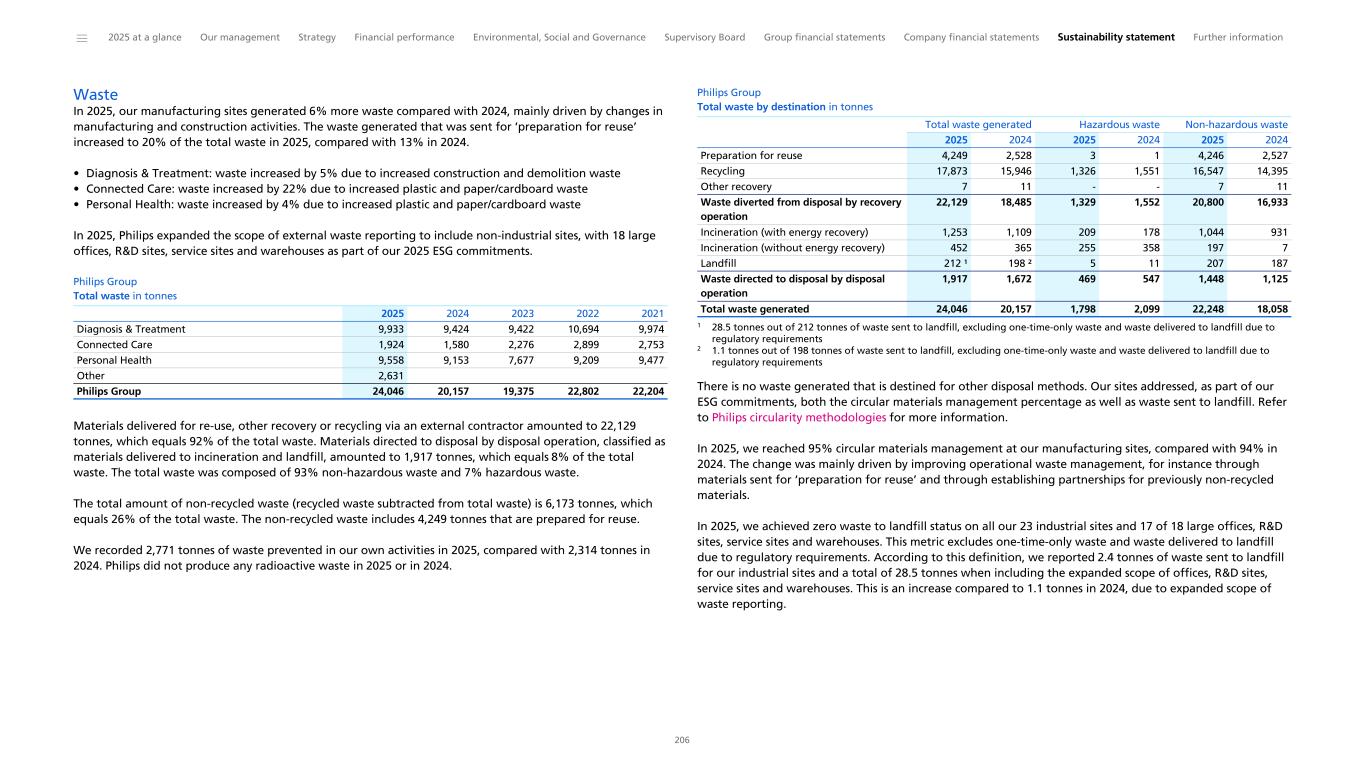
Waste In 2025, our manufacturing sites generated 6% more waste compared with 2024, mainly driven by changes in manufacturing and construction activities. The waste generated that was sent for ‘preparation for reuse’ increased to 20% of the total waste in 2025, compared with 13% in 2024. • Diagnosis & Treatment: waste increased by 5% due to increased construction and demolition waste • Connected Care: waste increased by 22% due to increased plastic and paper/cardboard waste • Personal Health: waste increased by 4% due to increased plastic and paper/cardboard waste In 2025, Philips expanded the scope of external waste reporting to include non-industrial sites, with 18 large offices, R&D sites, service sites and warehouses as part of our 2025 ESG commitments. Philips Group Total waste in tonnes Diagnosis & Treatment 9,933 9,424 9,422 10,694 9,974 Connected Care 1,924 1,580 2,276 2,899 2,753 Personal Health 9,558 9,153 7,677 9,209 9,477 Other 2,631 Philips Group 24,046 20,157 19,375 22,802 22,204 2025 2024 2023 2022 2021 Materials delivered for re-use, other recovery or recycling via an external contractor amounted to 22,129 tonnes, which equals 92% of the total waste. Materials directed to disposal by disposal operation, classified as materials delivered to incineration and landfill, amounted to 1,917 tonnes, which equals 8% of the total waste. The total waste was composed of 93% non-hazardous waste and 7% hazardous waste. The total amount of non-recycled waste (recycled waste subtracted from total waste) is 6,173 tonnes, which equals 26% of the total waste. The non-recycled waste includes 4,249 tonnes that are prepared for reuse. We recorded 2,771 tonnes of waste prevented in our own activities in 2025, compared with 2,314 tonnes in 2024. Philips did not produce any radioactive waste in 2025 or in 2024. Philips Group Total waste by destination in tonnes 2025 2024 2025 2024 2025 2024 Preparation for reuse 4,249 2,528 3 1 4,246 2,527 Recycling 17,873 15,946 1,326 1,551 16,547 14,395 Other recovery 7 11 - - 7 11 Waste diverted from disposal by recovery operation 22,129 18,485 1,329 1,552 20,800 16,933 Incineration (with energy recovery) 1,253 1,109 209 178 1,044 931 Incineration (without energy recovery) 452 365 255 358 197 7 Landfill 212 ¹ 198 ² 5 11 207 187 Waste directed to disposal by disposal operation 1,917 1,672 469 547 1,448 1,125 Total waste generated 24,046 20,157 1,798 2,099 22,248 18,058 Total waste generated Hazardous waste Non-hazardous waste 1 28.5 tonnes out of 212 tonnes of waste sent to landfill, excluding one-time-only waste and waste delivered to landfill due to regulatory requirements 2 1.1 tonnes out of 198 tonnes of waste sent to landfill, excluding one-time-only waste and waste delivered to landfill due to regulatory requirements There is no waste generated that is destined for other disposal methods. Our sites addressed, as part of our ESG commitments, both the circular materials management percentage as well as waste sent to landfill. Refer to Philips circularity methodologies for more information. In 2025, we reached 95% circular materials management at our manufacturing sites, compared with 94% in 2024. The change was mainly driven by improving operational waste management, for instance through materials sent for ‘preparation for reuse’ and through establishing partnerships for previously non-recycled materials. In 2025, we achieved zero waste to landfill status on all our 23 industrial sites and 17 of 18 large offices, R&D sites, service sites and warehouses. This metric excludes one-time-only waste and waste delivered to landfill due to regulatory requirements. According to this definition, we reported 2.4 tonnes of waste sent to landfill for our industrial sites and a total of 28.5 tonnes when including the expanded scope of offices, R&D sites, service sites and warehouses. This is an increase compared to 1.1 tonnes in 2024, due to expanded scope of waste reporting. ______ 2025 at a glance Our management Strategy Financial performance Environmental, Social and Governance Supervisory Board Group financial statements Company financial statements Sustainability statement Further information 206
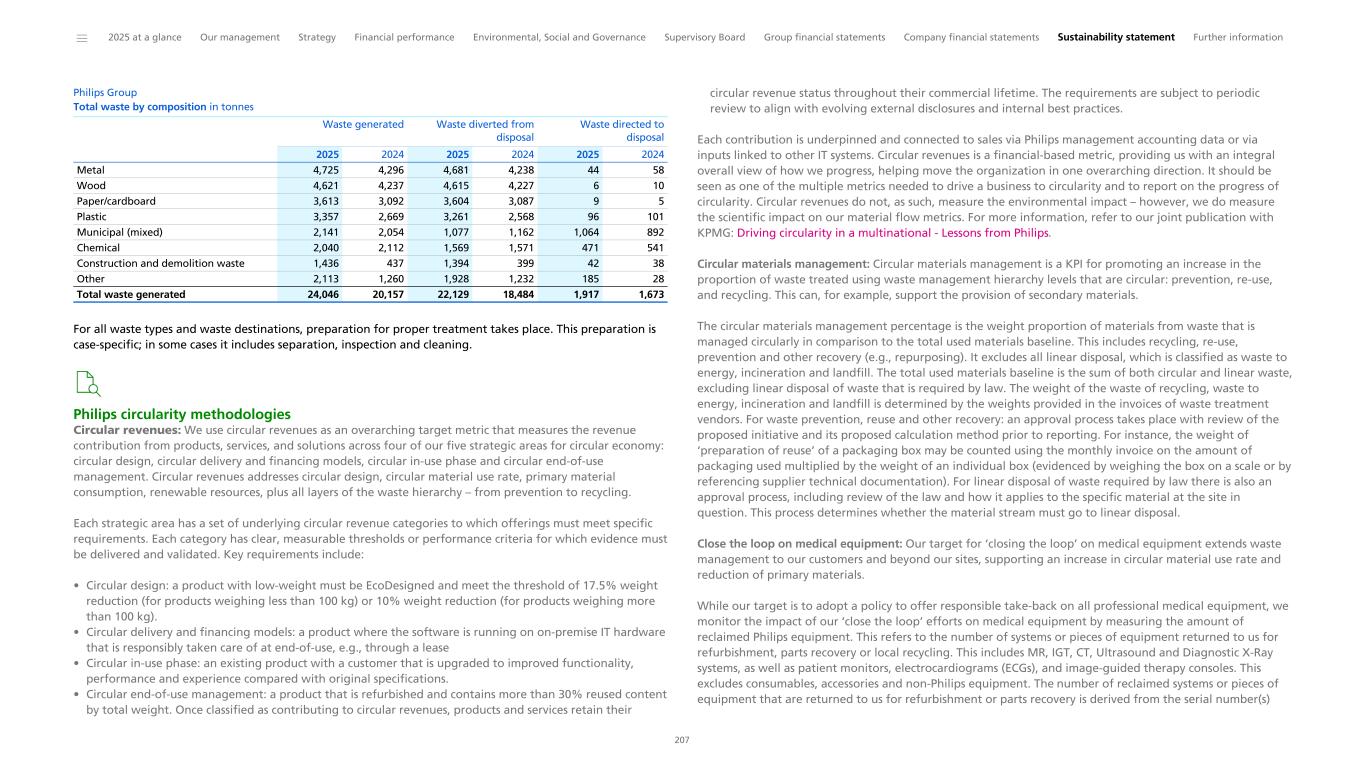
Philips Group Total waste by composition in tonnes 2025 2024 2025 2024 2025 2024 Metal 4,725 4,296 4,681 4,238 44 58 Wood 4,621 4,237 4,615 4,227 6 10 Paper/cardboard 3,613 3,092 3,604 3,087 9 5 Plastic 3,357 2,669 3,261 2,568 96 101 Municipal (mixed) 2,141 2,054 1,077 1,162 1,064 892 Chemical 2,040 2,112 1,569 1,571 471 541 Construction and demolition waste 1,436 437 1,394 399 42 38 Other 2,113 1,260 1,928 1,232 185 28 Total waste generated 24,046 20,157 22,129 18,484 1,917 1,673 Waste generated Waste diverted from disposal Waste directed to disposal For all waste types and waste destinations, preparation for proper treatment takes place. This preparation is case-specific; in some cases it includes separation, inspection and cleaning. Philips circularity methodologies Circular revenues: We use circular revenues as an overarching target metric that measures the revenue contribution from products, services, and solutions across four of our five strategic areas for circular economy: circular design, circular delivery and financing models, circular in-use phase and circular end-of-use management. Circular revenues addresses circular design, circular material use rate, primary material consumption, renewable resources, plus all layers of the waste hierarchy – from prevention to recycling. Each strategic area has a set of underlying circular revenue categories to which offerings must meet specific requirements. Each category has clear, measurable thresholds or performance criteria for which evidence must be delivered and validated. Key requirements include: • Circular design: a product with low-weight must be EcoDesigned and meet the threshold of 17.5% weight reduction (for products weighing less than 100 kg) or 10% weight reduction (for products weighing more than 100 kg). • Circular delivery and financing models: a product where the software is running on on-premise IT hardware that is responsibly taken care of at end-of-use, e.g., through a lease • Circular in-use phase: an existing product with a customer that is upgraded to improved functionality, performance and experience compared with original specifications. • Circular end-of-use management: a product that is refurbished and contains more than 30% reused content by total weight. Once classified as contributing to circular revenues, products and services retain their circular revenue status throughout their commercial lifetime. The requirements are subject to periodic review to align with evolving external disclosures and internal best practices. Each contribution is underpinned and connected to sales via Philips management accounting data or via inputs linked to other IT systems. Circular revenues is a financial-based metric, providing us with an integral overall view of how we progress, helping move the organization in one overarching direction. It should be seen as one of the multiple metrics needed to drive a business to circularity and to report on the progress of circularity. Circular revenues do not, as such, measure the environmental impact – however, we do measure the scientific impact on our material flow metrics. For more information, refer to our joint publication with KPMG: Driving circularity in a multinational - Lessons from Philips. Circular materials management: Circular materials management is a KPI for promoting an increase in the proportion of waste treated using waste management hierarchy levels that are circular: prevention, re-use, and recycling. This can, for example, support the provision of secondary materials. The circular materials management percentage is the weight proportion of materials from waste that is managed circularly in comparison to the total used materials baseline. This includes recycling, re-use, prevention and other recovery (e.g., repurposing). It excludes all linear disposal, which is classified as waste to energy, incineration and landfill. The total used materials baseline is the sum of both circular and linear waste, excluding linear disposal of waste that is required by law. The weight of the waste of recycling, waste to energy, incineration and landfill is determined by the weights provided in the invoices of waste treatment vendors. For waste prevention, reuse and other recovery: an approval process takes place with review of the proposed initiative and its proposed calculation method prior to reporting. For instance, the weight of ‘preparation of reuse’ of a packaging box may be counted using the monthly invoice on the amount of packaging used multiplied by the weight of an individual box (evidenced by weighing the box on a scale or by referencing supplier technical documentation). For linear disposal of waste required by law there is also an approval process, including review of the law and how it applies to the specific material at the site in question. This process determines whether the material stream must go to linear disposal. Close the loop on medical equipment: Our target for ‘closing the loop’ on medical equipment extends waste management to our customers and beyond our sites, supporting an increase in circular material use rate and reduction of primary materials. While our target is to adopt a policy to offer responsible take-back on all professional medical equipment, we monitor the impact of our ‘close the loop’ efforts on medical equipment by measuring the amount of reclaimed Philips equipment. This refers to the number of systems or pieces of equipment returned to us for refurbishment, parts recovery or local recycling. This includes MR, IGT, CT, Ultrasound and Diagnostic X-Ray systems, as well as patient monitors, electrocardiograms (ECGs), and image-guided therapy consoles. This excludes consumables, accessories and non-Philips equipment. The number of reclaimed systems or pieces of equipment that are returned to us for refurbishment or parts recovery is derived from the serial number(s) ______ 2025 at a glance Our management Strategy Financial performance Environmental, Social and Governance Supervisory Board Group financial statements Company financial statements Sustainability statement Further information 207
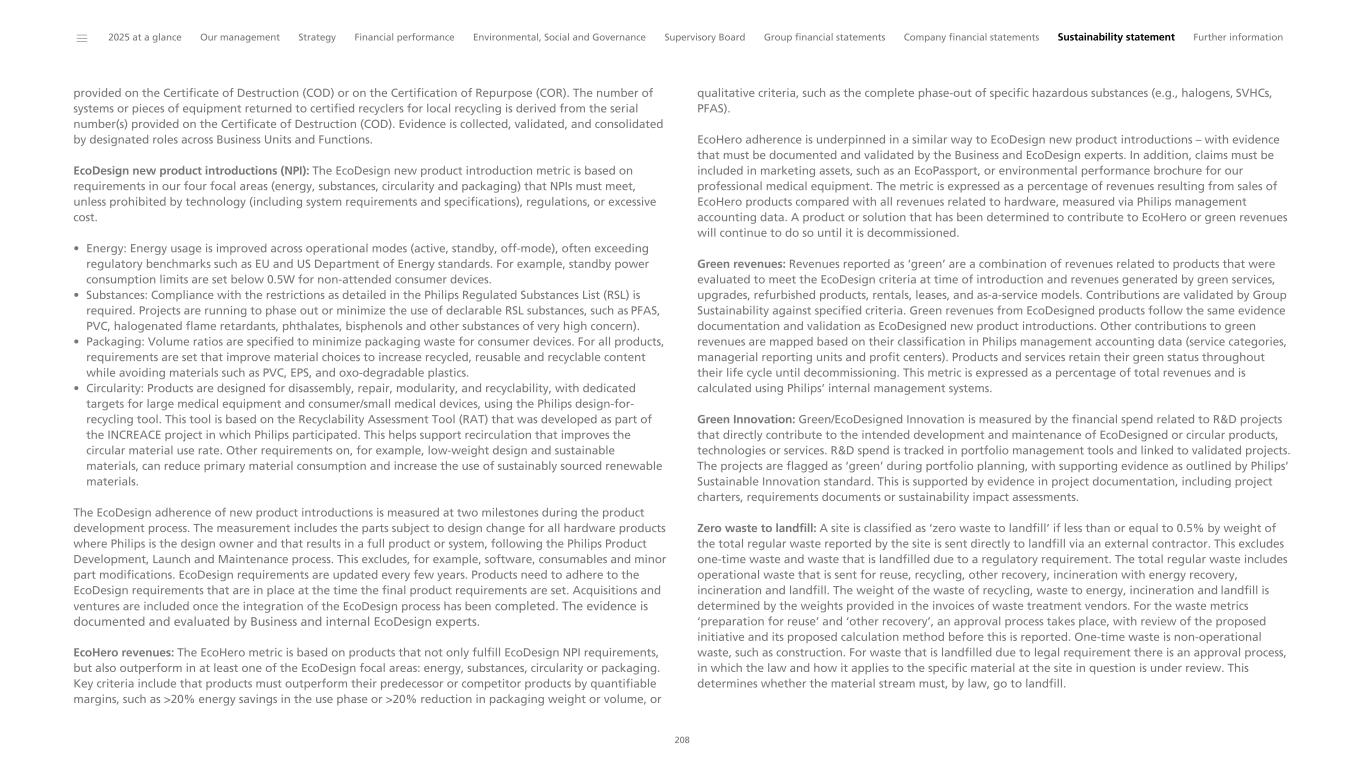
provided on the Certificate of Destruction (COD) or on the Certification of Repurpose (COR). The number of systems or pieces of equipment returned to certified recyclers for local recycling is derived from the serial number(s) provided on the Certificate of Destruction (COD). Evidence is collected, validated, and consolidated by designated roles across Business Units and Functions. EcoDesign new product introductions (NPI): The EcoDesign new product introduction metric is based on requirements in our four focal areas (energy, substances, circularity and packaging) that NPIs must meet, unless prohibited by technology (including system requirements and specifications), regulations, or excessive cost. • Energy: Energy usage is improved across operational modes (active, standby, off-mode), often exceeding regulatory benchmarks such as EU and US Department of Energy standards. For example, standby power consumption limits are set below 0.5W for non-attended consumer devices. • Substances: Compliance with the restrictions as detailed in the Philips Regulated Substances List (RSL) is required. Projects are running to phase out or minimize the use of declarable RSL substances, such as PFAS, PVC, halogenated flame retardants, phthalates, bisphenols and other substances of very high concern). • Packaging: Volume ratios are specified to minimize packaging waste for consumer devices. For all products, requirements are set that improve material choices to increase recycled, reusable and recyclable content while avoiding materials such as PVC, EPS, and oxo-degradable plastics. • Circularity: Products are designed for disassembly, repair, modularity, and recyclability, with dedicated targets for large medical equipment and consumer/small medical devices, using the Philips design-for- recycling tool. This tool is based on the Recyclability Assessment Tool (RAT) that was developed as part of the INCREACE project in which Philips participated. This helps support recirculation that improves the circular material use rate. Other requirements on, for example, low-weight design and sustainable materials, can reduce primary material consumption and increase the use of sustainably sourced renewable materials. The EcoDesign adherence of new product introductions is measured at two milestones during the product development process. The measurement includes the parts subject to design change for all hardware products where Philips is the design owner and that results in a full product or system, following the Philips Product Development, Launch and Maintenance process. This excludes, for example, software, consumables and minor part modifications. EcoDesign requirements are updated every few years. Products need to adhere to the EcoDesign requirements that are in place at the time the final product requirements are set. Acquisitions and ventures are included once the integration of the EcoDesign process has been completed. The evidence is documented and evaluated by Business and internal EcoDesign experts. EcoHero revenues: The EcoHero metric is based on products that not only fulfill EcoDesign NPI requirements, but also outperform in at least one of the EcoDesign focal areas: energy, substances, circularity or packaging. Key criteria include that products must outperform their predecessor or competitor products by quantifiable margins, such as >20% energy savings in the use phase or >20% reduction in packaging weight or volume, or qualitative criteria, such as the complete phase-out of specific hazardous substances (e.g., halogens, SVHCs, PFAS). EcoHero adherence is underpinned in a similar way to EcoDesign new product introductions – with evidence that must be documented and validated by the Business and EcoDesign experts. In addition, claims must be included in marketing assets, such as an EcoPassport, or environmental performance brochure for our professional medical equipment. The metric is expressed as a percentage of revenues resulting from sales of EcoHero products compared with all revenues related to hardware, measured via Philips management accounting data. A product or solution that has been determined to contribute to EcoHero or green revenues will continue to do so until it is decommissioned. Green revenues: Revenues reported as ‘green’ are a combination of revenues related to products that were evaluated to meet the EcoDesign criteria at time of introduction and revenues generated by green services, upgrades, refurbished products, rentals, leases, and as-a-service models. Contributions are validated by Group Sustainability against specified criteria. Green revenues from EcoDesigned products follow the same evidence documentation and validation as EcoDesigned new product introductions. Other contributions to green revenues are mapped based on their classification in Philips management accounting data (service categories, managerial reporting units and profit centers). Products and services retain their green status throughout their life cycle until decommissioning. This metric is expressed as a percentage of total revenues and is calculated using Philips’ internal management systems. Green Innovation: Green/EcoDesigned Innovation is measured by the financial spend related to R&D projects that directly contribute to the intended development and maintenance of EcoDesigned or circular products, technologies or services. R&D spend is tracked in portfolio management tools and linked to validated projects. The projects are flagged as ‘green’ during portfolio planning, with supporting evidence as outlined by Philips’ Sustainable Innovation standard. This is supported by evidence in project documentation, including project charters, requirements documents or sustainability impact assessments. Zero waste to landfill: A site is classified as ‘zero waste to landfill’ if less than or equal to 0.5% by weight of the total regular waste reported by the site is sent directly to landfill via an external contractor. This excludes one-time waste and waste that is landfilled due to a regulatory requirement. The total regular waste includes operational waste that is sent for reuse, recycling, other recovery, incineration with energy recovery, incineration and landfill. The weight of the waste of recycling, waste to energy, incineration and landfill is determined by the weights provided in the invoices of waste treatment vendors. For the waste metrics ‘preparation for reuse’ and ‘other recovery’, an approval process takes place, with review of the proposed initiative and its proposed calculation method before this is reported. One-time waste is non-operational waste, such as construction. For waste that is landfilled due to legal requirement there is an approval process, in which the law and how it applies to the specific material at the site in question is under review. This determines whether the material stream must, by law, go to landfill. ______ 2025 at a glance Our management Strategy Financial performance Environmental, Social and Governance Supervisory Board Group financial statements Company financial statements Sustainability statement Further information 208
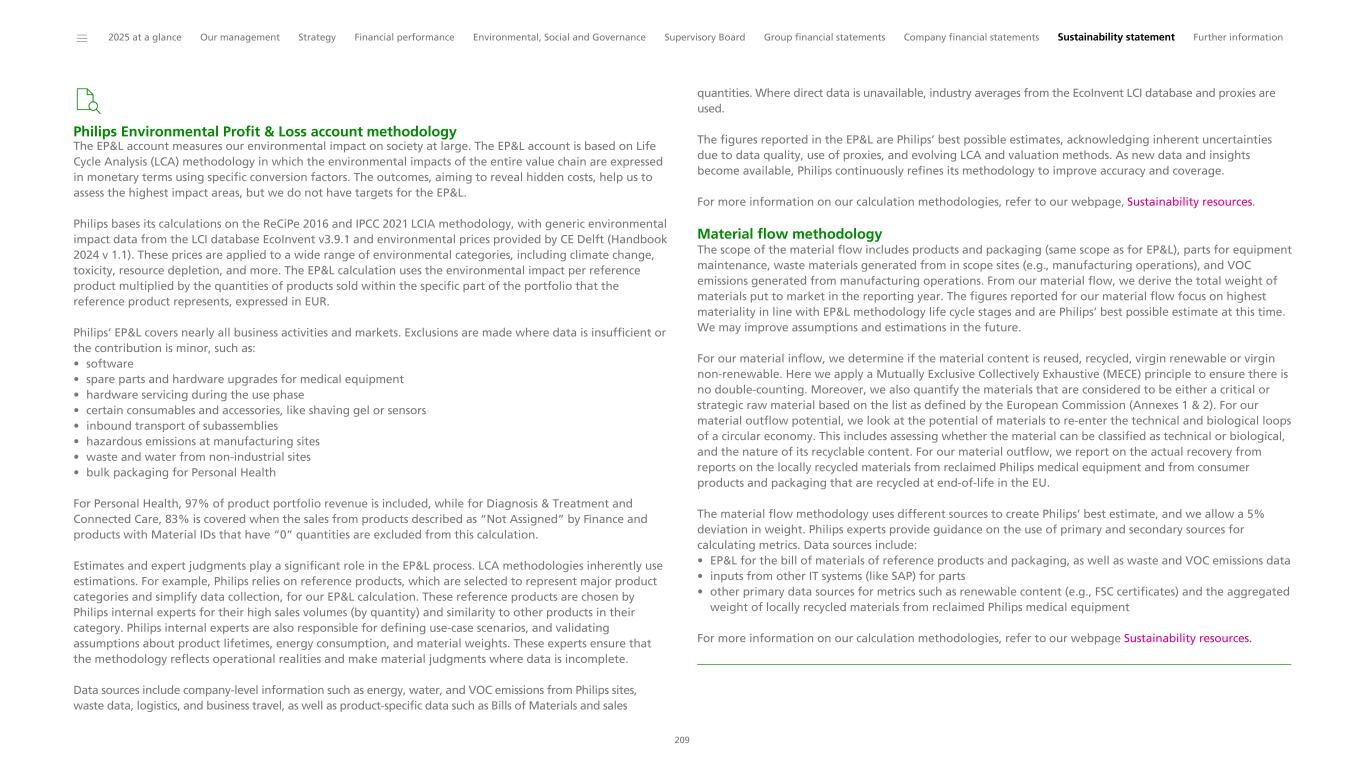
Philips Environmental Profit & Loss account methodology The EP&L account measures our environmental impact on society at large. The EP&L account is based on Life Cycle Analysis (LCA) methodology in which the environmental impacts of the entire value chain are expressed in monetary terms using specific conversion factors. The outcomes, aiming to reveal hidden costs, help us to assess the highest impact areas, but we do not have targets for the EP&L. Philips bases its calculations on the ReCiPe 2016 and IPCC 2021 LCIA methodology, with generic environmental impact data from the LCI database EcoInvent v3.9.1 and environmental prices provided by CE Delft (Handbook 2024 v 1.1). These prices are applied to a wide range of environmental categories, including climate change, toxicity, resource depletion, and more. The EP&L calculation uses the environmental impact per reference product multiplied by the quantities of products sold within the specific part of the portfolio that the reference product represents, expressed in EUR. Philips’ EP&L covers nearly all business activities and markets. Exclusions are made where data is insufficient or the contribution is minor, such as: • software • spare parts and hardware upgrades for medical equipment • hardware servicing during the use phase • certain consumables and accessories, like shaving gel or sensors • inbound transport of subassemblies • hazardous emissions at manufacturing sites • waste and water from non-industrial sites • bulk packaging for Personal Health For Personal Health, 97% of product portfolio revenue is included, while for Diagnosis & Treatment and Connected Care, 83% is covered when the sales from products described as “Not Assigned” by Finance and products with Material IDs that have “0” quantities are excluded from this calculation. Estimates and expert judgments play a significant role in the EP&L process. LCA methodologies inherently use estimations. For example, Philips relies on reference products, which are selected to represent major product categories and simplify data collection, for our EP&L calculation. These reference products are chosen by Philips internal experts for their high sales volumes (by quantity) and similarity to other products in their category. Philips internal experts are also responsible for defining use-case scenarios, and validating assumptions about product lifetimes, energy consumption, and material weights. These experts ensure that the methodology reflects operational realities and make material judgments where data is incomplete. Data sources include company-level information such as energy, water, and VOC emissions from Philips sites, waste data, logistics, and business travel, as well as product-specific data such as Bills of Materials and sales quantities. Where direct data is unavailable, industry averages from the EcoInvent LCI database and proxies are used. The figures reported in the EP&L are Philips’ best possible estimates, acknowledging inherent uncertainties due to data quality, use of proxies, and evolving LCA and valuation methods. As new data and insights become available, Philips continuously refines its methodology to improve accuracy and coverage. For more information on our calculation methodologies, refer to our webpage, Sustainability resources. Material flow methodology The scope of the material flow includes products and packaging (same scope as for EP&L), parts for equipment maintenance, waste materials generated from in scope sites (e.g., manufacturing operations), and VOC emissions generated from manufacturing operations. From our material flow, we derive the total weight of materials put to market in the reporting year. The figures reported for our material flow focus on highest materiality in line with EP&L methodology life cycle stages and are Philips’ best possible estimate at this time. We may improve assumptions and estimations in the future. For our material inflow, we determine if the material content is reused, recycled, virgin renewable or virgin non-renewable. Here we apply a Mutually Exclusive Collectively Exhaustive (MECE) principle to ensure there is no double-counting. Moreover, we also quantify the materials that are considered to be either a critical or strategic raw material based on the list as defined by the European Commission (Annexes 1 & 2). For our material outflow potential, we look at the potential of materials to re-enter the technical and biological loops of a circular economy. This includes assessing whether the material can be classified as technical or biological, and the nature of its recyclable content. For our material outflow, we report on the actual recovery from reports on the locally recycled materials from reclaimed Philips medical equipment and from consumer products and packaging that are recycled at end-of-life in the EU. The material flow methodology uses different sources to create Philips’ best estimate, and we allow a 5% deviation in weight. Philips experts provide guidance on the use of primary and secondary sources for calculating metrics. Data sources include: • EP&L for the bill of materials of reference products and packaging, as well as waste and VOC emissions data • inputs from other IT systems (like SAP) for parts • other primary data sources for metrics such as renewable content (e.g., FSC certificates) and the aggregated weight of locally recycled materials from reclaimed Philips medical equipment For more information on our calculation methodologies, refer to our webpage Sustainability resources. ______ 2025 at a glance Our management Strategy Financial performance Environmental, Social and Governance Supervisory Board Group financial statements Company financial statements Sustainability statement Further information 209
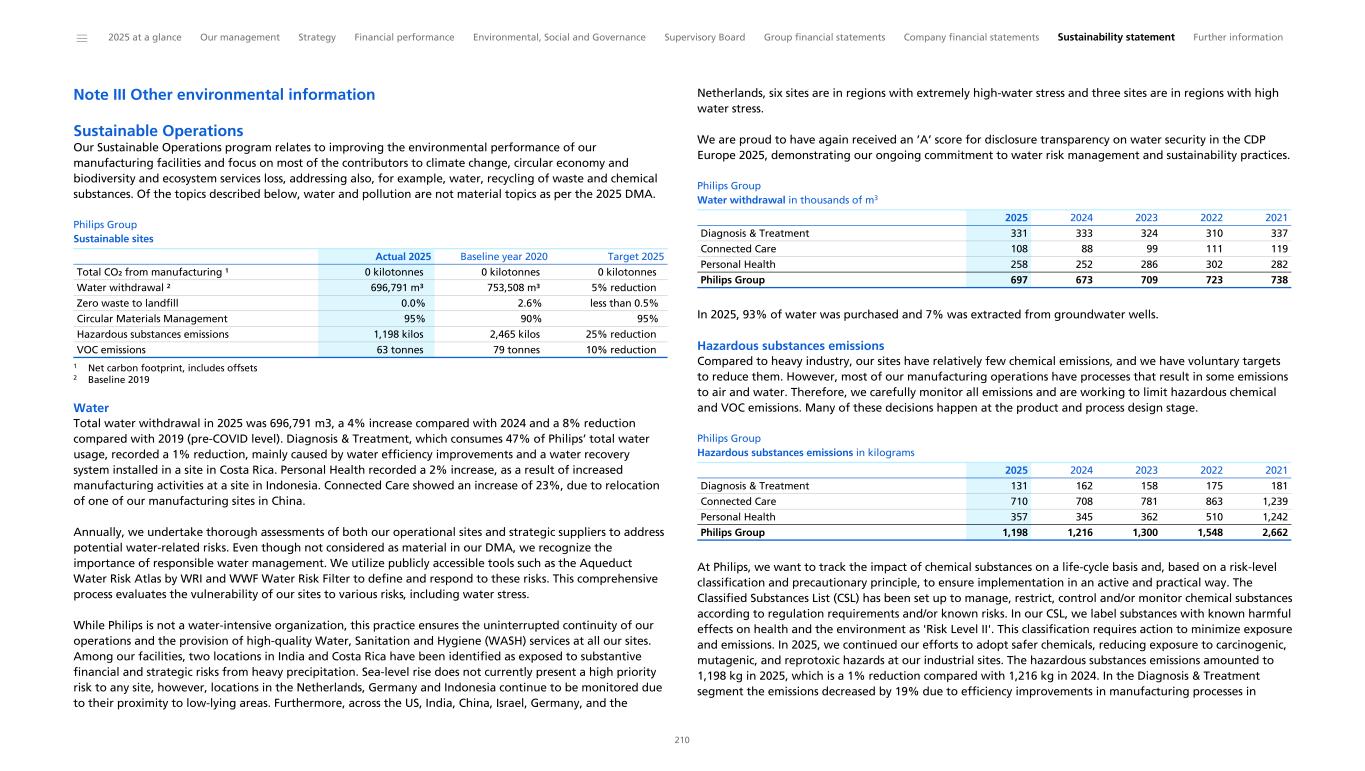
Note III Other environmental information Sustainable Operations Our Sustainable Operations program relates to improving the environmental performance of our manufacturing facilities and focus on most of the contributors to climate change, circular economy and biodiversity and ecosystem services loss, addressing also, for example, water, recycling of waste and chemical substances. Of the topics described below, water and pollution are not material topics as per the 2025 DMA. Philips Group Sustainable sites Total CO₂ from manufacturing ¹ 0 kilotonnes 0 kilotonnes 0 kilotonnes Water withdrawal ² 696,791 m³ 753,508 m³ 5% reduction Zero waste to landfill 0.0 % 2.6 % less than 0.5% Circular Materials Management 95 % 90 % 95 % Hazardous substances emissions 1,198 kilos 2,465 kilos 25% reduction VOC emissions 63 tonnes 79 tonnes 10% reduction Actual 2025 Baseline year 2020 Target 2025 1 Net carbon footprint, includes offsets 2 Baseline 2019 Water Total water withdrawal in 2025 was 696,791 m3, a 4% increase compared with 2024 and a 8% reduction compared with 2019 (pre-COVID level). Diagnosis & Treatment, which consumes 47% of Philips’ total water usage, recorded a 1% reduction, mainly caused by water efficiency improvements and a water recovery system installed in a site in Costa Rica. Personal Health recorded a 2% increase, as a result of increased manufacturing activities at a site in Indonesia. Connected Care showed an increase of 23%, due to relocation of one of our manufacturing sites in China. Annually, we undertake thorough assessments of both our operational sites and strategic suppliers to address potential water-related risks. Even though not considered as material in our DMA, we recognize the importance of responsible water management. We utilize publicly accessible tools such as the Aqueduct Water Risk Atlas by WRI and WWF Water Risk Filter to define and respond to these risks. This comprehensive process evaluates the vulnerability of our sites to various risks, including water stress. While Philips is not a water-intensive organization, this practice ensures the uninterrupted continuity of our operations and the provision of high-quality Water, Sanitation and Hygiene (WASH) services at all our sites. Among our facilities, two locations in India and Costa Rica have been identified as exposed to substantive financial and strategic risks from heavy precipitation. Sea-level rise does not currently present a high priority risk to any site, however, locations in the Netherlands, Germany and Indonesia continue to be monitored due to their proximity to low-lying areas. Furthermore, across the US, India, China, Israel, Germany, and the Netherlands, six sites are in regions with extremely high-water stress and three sites are in regions with high water stress. We are proud to have again received an ’A’ score for disclosure transparency on water security in the CDP Europe 2025, demonstrating our ongoing commitment to water risk management and sustainability practices. Philips Group Water withdrawal in thousands of m3 Diagnosis & Treatment 331 333 324 310 337 Connected Care 108 88 99 111 119 Personal Health 258 252 286 302 282 Philips Group 697 673 709 723 738 2025 2024 2023 2022 2021 In 2025, 93% of water was purchased and 7% was extracted from groundwater wells. Hazardous substances emissions Compared to heavy industry, our sites have relatively few chemical emissions, and we have voluntary targets to reduce them. However, most of our manufacturing operations have processes that result in some emissions to air and water. Therefore, we carefully monitor all emissions and are working to limit hazardous chemical and VOC emissions. Many of these decisions happen at the product and process design stage. Philips Group Hazardous substances emissions in kilograms Diagnosis & Treatment 131 162 158 175 181 Connected Care 710 708 781 863 1,239 Personal Health 357 345 362 510 1,242 Philips Group 1,198 1,216 1,300 1,548 2,662 2025 2024 2023 2022 2021 At Philips, we want to track the impact of chemical substances on a life-cycle basis and, based on a risk-level classification and precautionary principle, to ensure implementation in an active and practical way. The Classified Substances List (CSL) has been set up to manage, restrict, control and/or monitor chemical substances according to regulation requirements and/or known risks. In our CSL, we label substances with known harmful effects on health and the environment as 'Risk Level II'. This classification requires action to minimize exposure and emissions. In 2025, we continued our efforts to adopt safer chemicals, reducing exposure to carcinogenic, mutagenic, and reprotoxic hazards at our industrial sites. The hazardous substances emissions amounted to 1,198 kg in 2025, which is a 1% reduction compared with 1,216 kg in 2024. In the Diagnosis & Treatment segment the emissions decreased by 19% due to efficiency improvements in manufacturing processes in ______ 2025 at a glance Our management Strategy Financial performance Environmental, Social and Governance Supervisory Board Group financial statements Company financial statements Sustainability statement Further information 210
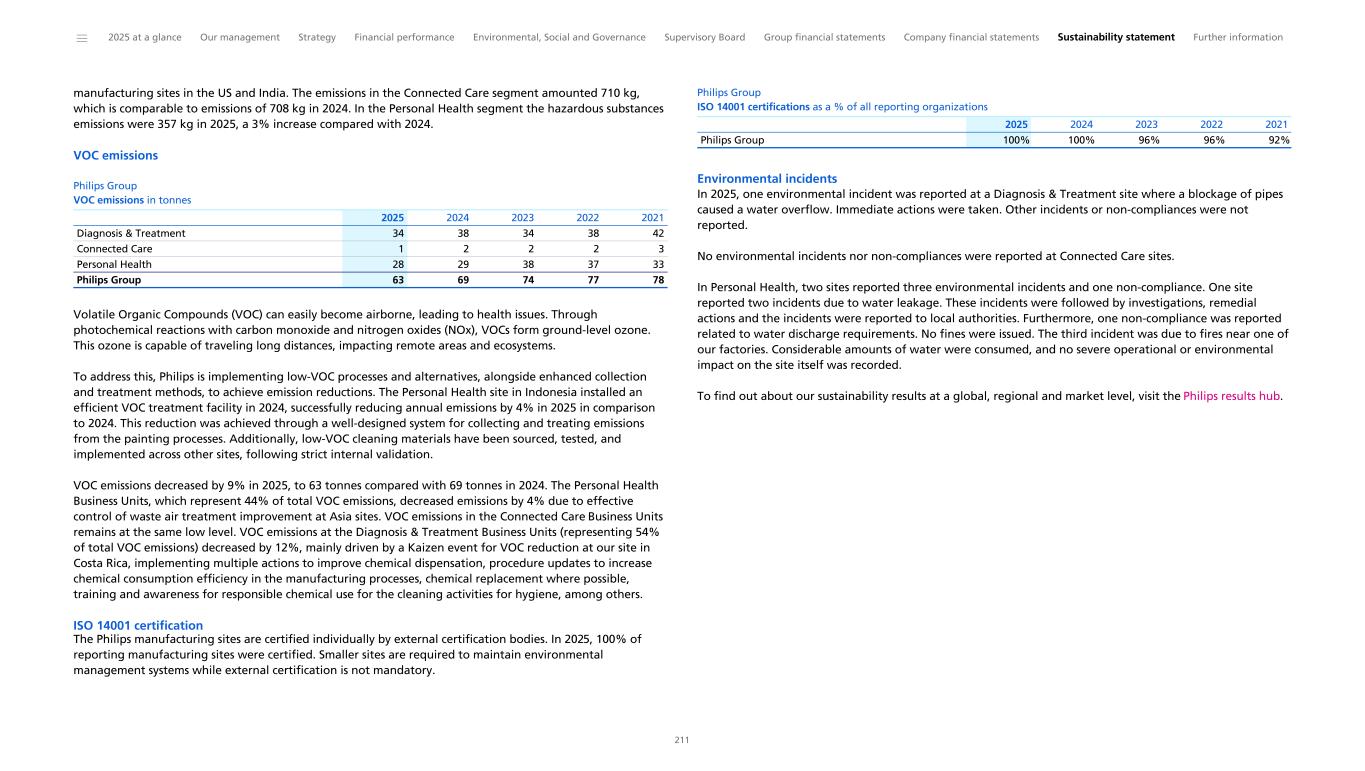
manufacturing sites in the US and India. The emissions in the Connected Care segment amounted 710 kg, which is comparable to emissions of 708 kg in 2024. In the Personal Health segment the hazardous substances emissions were 357 kg in 2025, a 3% increase compared with 2024. VOC emissions Philips Group VOC emissions in tonnes Diagnosis & Treatment 34 38 34 38 42 Connected Care 1 2 2 2 3 Personal Health 28 29 38 37 33 Philips Group 63 69 74 77 78 2025 2024 2023 2022 2021 Volatile Organic Compounds (VOC) can easily become airborne, leading to health issues. Through photochemical reactions with carbon monoxide and nitrogen oxides (NOx), VOCs form ground-level ozone. This ozone is capable of traveling long distances, impacting remote areas and ecosystems. To address this, Philips is implementing low-VOC processes and alternatives, alongside enhanced collection and treatment methods, to achieve emission reductions. The Personal Health site in Indonesia installed an efficient VOC treatment facility in 2024, successfully reducing annual emissions by 4% in 2025 in comparison to 2024. This reduction was achieved through a well-designed system for collecting and treating emissions from the painting processes. Additionally, low-VOC cleaning materials have been sourced, tested, and implemented across other sites, following strict internal validation. VOC emissions decreased by 9% in 2025, to 63 tonnes compared with 69 tonnes in 2024. The Personal Health Business Units, which represent 44% of total VOC emissions, decreased emissions by 4% due to effective control of waste air treatment improvement at Asia sites. VOC emissions in the Connected Care Business Units remains at the same low level. VOC emissions at the Diagnosis & Treatment Business Units (representing 54% of total VOC emissions) decreased by 12%, mainly driven by a Kaizen event for VOC reduction at our site in Costa Rica, implementing multiple actions to improve chemical dispensation, procedure updates to increase chemical consumption efficiency in the manufacturing processes, chemical replacement where possible, training and awareness for responsible chemical use for the cleaning activities for hygiene, among others. ISO 14001 certification The Philips manufacturing sites are certified individually by external certification bodies. In 2025, 100% of reporting manufacturing sites were certified. Smaller sites are required to maintain environmental management systems while external certification is not mandatory. Philips Group ISO 14001 certifications as a % of all reporting organizations Philips Group 100% 100% 96% 96% 92% 2025 2024 2023 2022 2021 Environmental incidents In 2025, one environmental incident was reported at a Diagnosis & Treatment site where a blockage of pipes caused a water overflow. Immediate actions were taken. Other incidents or non-compliances were not reported. No environmental incidents nor non-compliances were reported at Connected Care sites. In Personal Health, two sites reported three environmental incidents and one non-compliance. One site reported two incidents due to water leakage. These incidents were followed by investigations, remedial actions and the incidents were reported to local authorities. Furthermore, one non-compliance was reported related to water discharge requirements. No fines were issued. The third incident was due to fires near one of our factories. Considerable amounts of water were consumed, and no severe operational or environmental impact on the site itself was recorded. To find out about our sustainability results at a global, regional and market level, visit the Philips results hub. ______ 2025 at a glance Our management Strategy Financial performance Environmental, Social and Governance Supervisory Board Group financial statements Company financial statements Sustainability statement Further information 211
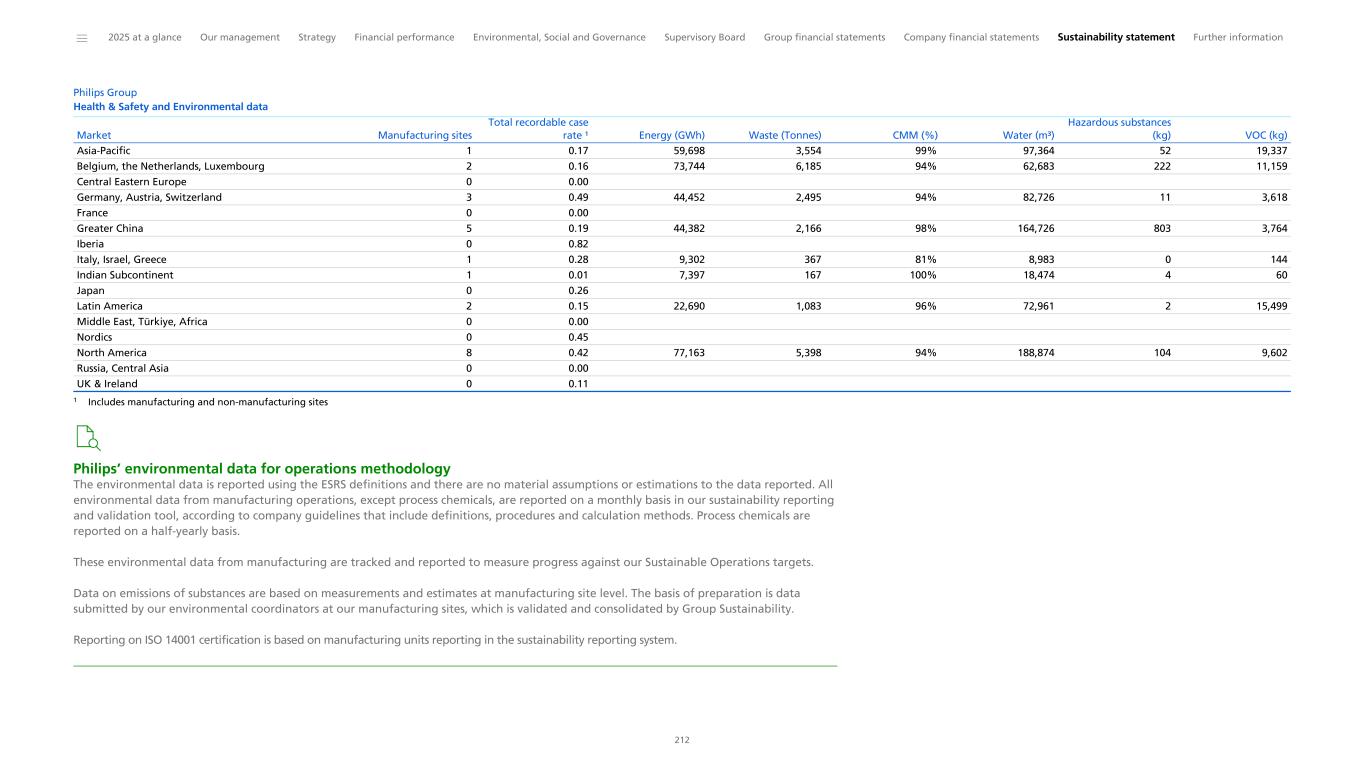
Philips Group Health & Safety and Environmental data Asia-Pacific 1 0.17 59,698 3,554 99% 97,364 52 19,337 Belgium, the Netherlands, Luxembourg 2 0.16 73,744 6,185 94% 62,683 222 11,159 Central Eastern Europe 0 0.00 Germany, Austria, Switzerland 3 0.49 44,452 2,495 94% 82,726 11 3,618 France 0 0.00 Greater China 5 0.19 44,382 2,166 98% 164,726 803 3,764 Iberia 0 0.82 Italy, Israel, Greece 1 0.28 9,302 367 81% 8,983 0 144 Indian Subcontinent 1 0.01 7,397 167 100% 18,474 4 60 Japan 0 0.26 Latin America 2 0.15 22,690 1,083 96% 72,961 2 15,499 Middle East, Türkiye, Africa 0 0.00 Nordics 0 0.45 North America 8 0.42 77,163 5,398 94% 188,874 104 9,602 Russia, Central Asia 0 0.00 UK & Ireland 0 0.11 Market Manufacturing sites Total recordable case rate ¹ Energy (GWh) Waste (Tonnes) CMM (%) Water (m³) Hazardous substances (kg) VOC (kg) 1 Includes manufacturing and non-manufacturing sites Philips’ environmental data for operations methodology The environmental data is reported using the ESRS definitions and there are no material assumptions or estimations to the data reported. All environmental data from manufacturing operations, except process chemicals, are reported on a monthly basis in our sustainability reporting and validation tool, according to company guidelines that include definitions, procedures and calculation methods. Process chemicals are reported on a half-yearly basis. These environmental data from manufacturing are tracked and reported to measure progress against our Sustainable Operations targets. Data on emissions of substances are based on measurements and estimates at manufacturing site level. The basis of preparation is data submitted by our environmental coordinators at our manufacturing sites, which is validated and consolidated by Group Sustainability. Reporting on ISO 14001 certification is based on manufacturing units reporting in the sustainability reporting system. ______ 2025 at a glance Our management Strategy Financial performance Environmental, Social and Governance Supervisory Board Group financial statements Company financial statements Sustainability statement Further information 212
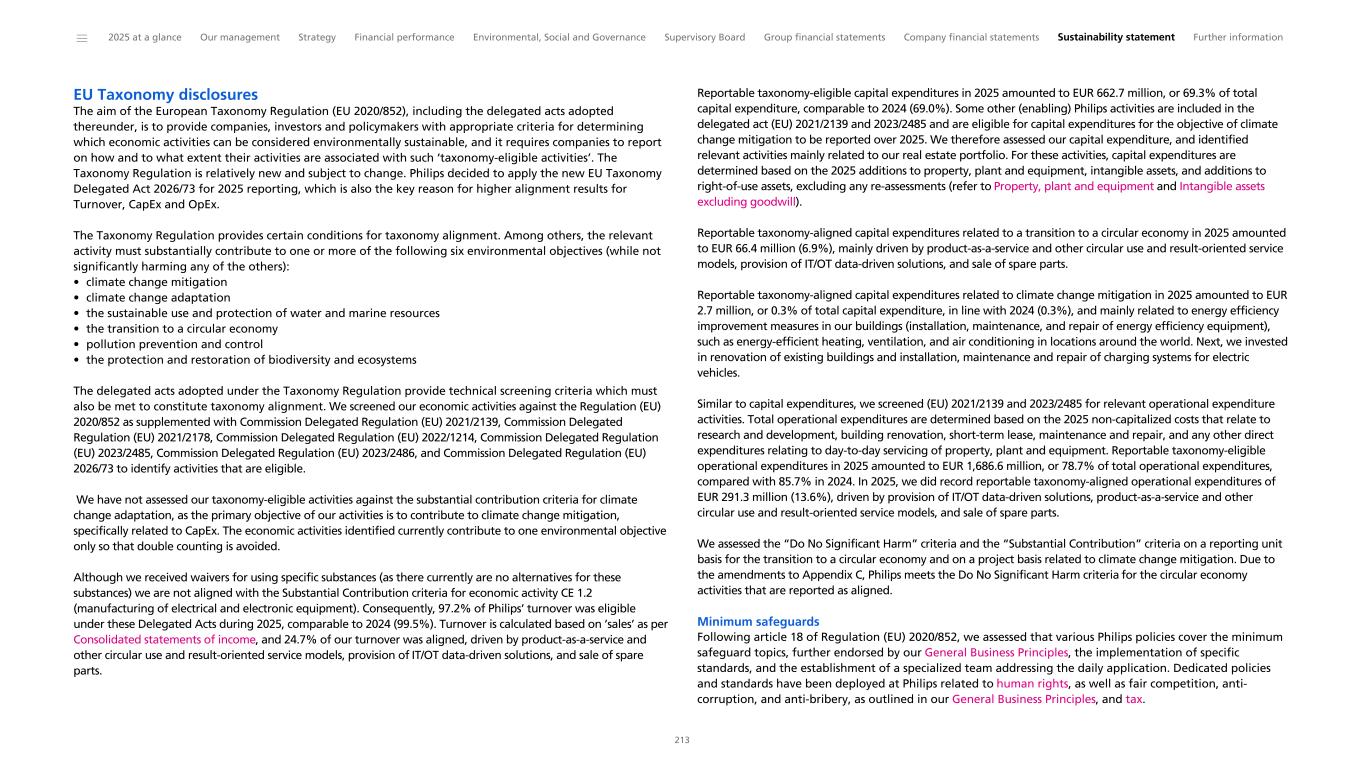
EU Taxonomy disclosures The aim of the European Taxonomy Regulation (EU 2020/852), including the delegated acts adopted thereunder, is to provide companies, investors and policymakers with appropriate criteria for determining which economic activities can be considered environmentally sustainable, and it requires companies to report on how and to what extent their activities are associated with such ‘taxonomy-eligible activities’. The Taxonomy Regulation is relatively new and subject to change. Philips decided to apply the new EU Taxonomy Delegated Act 2026/73 for 2025 reporting, which is also the key reason for higher alignment results for Turnover, CapEx and OpEx. The Taxonomy Regulation provides certain conditions for taxonomy alignment. Among others, the relevant activity must substantially contribute to one or more of the following six environmental objectives (while not significantly harming any of the others): • climate change mitigation • climate change adaptation • the sustainable use and protection of water and marine resources • the transition to a circular economy • pollution prevention and control • the protection and restoration of biodiversity and ecosystems The delegated acts adopted under the Taxonomy Regulation provide technical screening criteria which must also be met to constitute taxonomy alignment. We screened our economic activities against the Regulation (EU) 2020/852 as supplemented with Commission Delegated Regulation (EU) 2021/2139, Commission Delegated Regulation (EU) 2021/2178, Commission Delegated Regulation (EU) 2022/1214, Commission Delegated Regulation (EU) 2023/2485, Commission Delegated Regulation (EU) 2023/2486, and Commission Delegated Regulation (EU) 2026/73 to identify activities that are eligible. We have not assessed our taxonomy-eligible activities against the substantial contribution criteria for climate change adaptation, as the primary objective of our activities is to contribute to climate change mitigation, specifically related to CapEx. The economic activities identified currently contribute to one environmental objective only so that double counting is avoided. Although we received waivers for using specific substances (as there currently are no alternatives for these substances) we are not aligned with the Substantial Contribution criteria for economic activity CE 1.2 (manufacturing of electrical and electronic equipment). Consequently, 97.2% of Philips’ turnover was eligible under these Delegated Acts during 2025, comparable to 2024 (99.5%). Turnover is calculated based on ’sales’ as per Consolidated statements of income, and 24.7% of our turnover was aligned, driven by product-as-a-service and other circular use and result-oriented service models, provision of IT/OT data-driven solutions, and sale of spare parts. Reportable taxonomy-eligible capital expenditures in 2025 amounted to EUR 662.7 million, or 69.3% of total capital expenditure, comparable to 2024 (69.0%). Some other (enabling) Philips activities are included in the delegated act (EU) 2021/2139 and 2023/2485 and are eligible for capital expenditures for the objective of climate change mitigation to be reported over 2025. We therefore assessed our capital expenditure, and identified relevant activities mainly related to our real estate portfolio. For these activities, capital expenditures are determined based on the 2025 additions to property, plant and equipment, intangible assets, and additions to right-of-use assets, excluding any re-assessments (refer to Property, plant and equipment and Intangible assets excluding goodwill). Reportable taxonomy-aligned capital expenditures related to a transition to a circular economy in 2025 amounted to EUR 66.4 million (6.9%), mainly driven by product-as-a-service and other circular use and result-oriented service models, provision of IT/OT data-driven solutions, and sale of spare parts. Reportable taxonomy-aligned capital expenditures related to climate change mitigation in 2025 amounted to EUR 2.7 million, or 0.3% of total capital expenditure, in line with 2024 (0.3%), and mainly related to energy efficiency improvement measures in our buildings (installation, maintenance, and repair of energy efficiency equipment), such as energy-efficient heating, ventilation, and air conditioning in locations around the world. Next, we invested in renovation of existing buildings and installation, maintenance and repair of charging systems for electric vehicles. Similar to capital expenditures, we screened (EU) 2021/2139 and 2023/2485 for relevant operational expenditure activities. Total operational expenditures are determined based on the 2025 non-capitalized costs that relate to research and development, building renovation, short-term lease, maintenance and repair, and any other direct expenditures relating to day-to-day servicing of property, plant and equipment. Reportable taxonomy-eligible operational expenditures in 2025 amounted to EUR 1,686.6 million, or 78.7% of total operational expenditures, compared with 85.7% in 2024. In 2025, we did record reportable taxonomy-aligned operational expenditures of EUR 291.3 million (13.6%), driven by provision of IT/OT data-driven solutions, product-as-a-service and other circular use and result-oriented service models, and sale of spare parts. We assessed the “Do No Significant Harm” criteria and the “Substantial Contribution” criteria on a reporting unit basis for the transition to a circular economy and on a project basis related to climate change mitigation. Due to the amendments to Appendix C, Philips meets the Do No Significant Harm criteria for the circular economy activities that are reported as aligned. Minimum safeguards Following article 18 of Regulation (EU) 2020/852, we assessed that various Philips policies cover the minimum safeguard topics, further endorsed by our General Business Principles, the implementation of specific standards, and the establishment of a specialized team addressing the daily application. Dedicated policies and standards have been deployed at Philips related to human rights, as well as fair competition, anti- corruption, and anti-bribery, as outlined in our General Business Principles, and tax. ______ 2025 at a glance Our management Strategy Financial performance Environmental, Social and Governance Supervisory Board Group financial statements Company financial statements Sustainability statement Further information 213
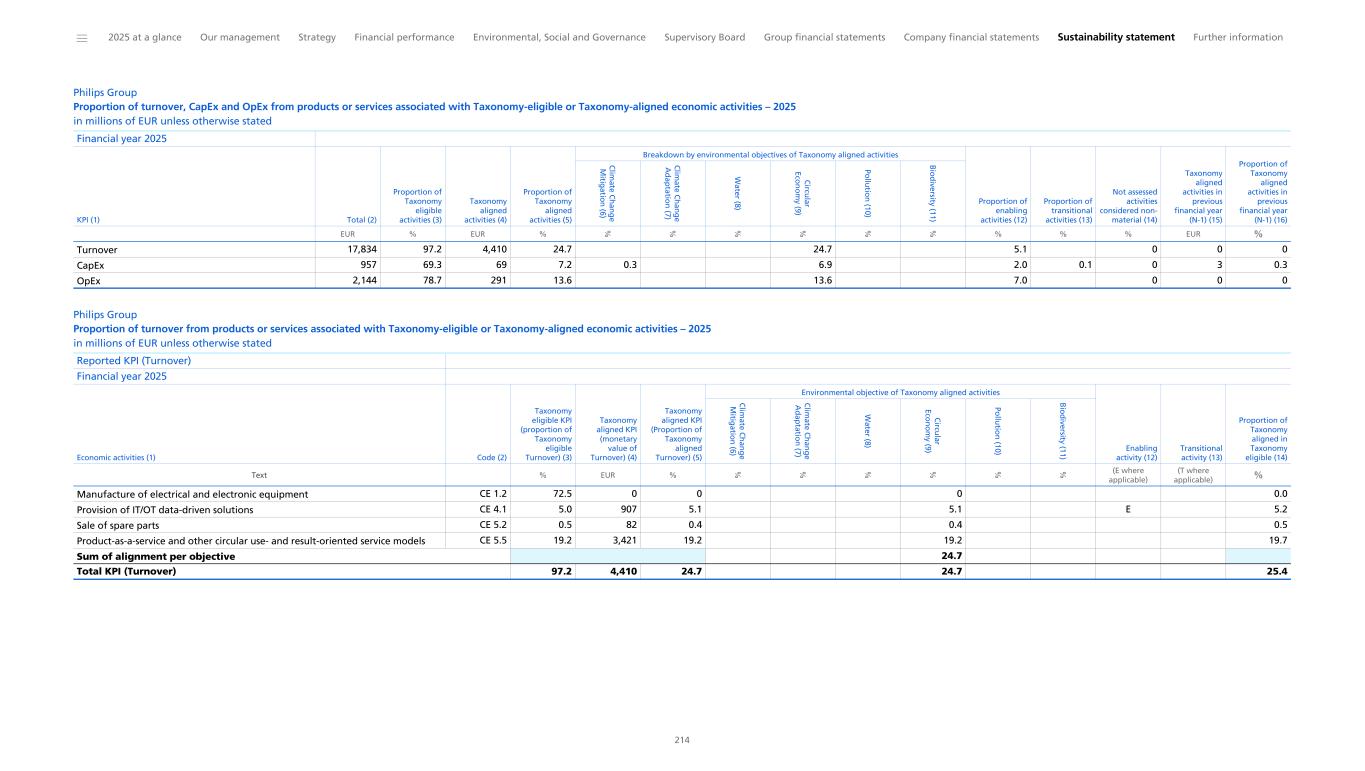
Philips Group Proportion of turnover, CapEx and OpEx from products or services associated with Taxonomy-eligible or Taxonomy-aligned economic activities – 2025 in millions of EUR unless otherwise stated Financial year 2025 KPI (1) Total (2) Proportion of Taxonomy eligible activities (3) Taxonomy aligned activities (4) Proportion of Taxonomy aligned activities (5) Breakdown by environmental objectives of Taxonomy aligned activities Proportion of enabling activities (12) Proportion of transitional activities (13) Not assessed activities considered non- material (14) Taxonomy aligned activities in previous financial year (N-1) (15) Proportion of Taxonomy aligned activities in previous financial year (N-1) (16) C lim ate C h an g e M itig atio n (6) C lim ate C h an g e A d ap tatio n (7) W ater (8) C ircu lar Eco n o m y (9) Po llu tio n (10) B io d iversity (11) EUR % EUR % % % % % % % % % % EUR % Turnover 17,834 97.2 4,410 24.7 24.7 5.1 0 0 0 CapEx 957 69.3 69 7.2 0.3 6.9 2.0 0.1 0 3 0.3 OpEx 2,144 78.7 291 13.6 13.6 7.0 0 0 0 Philips Group Proportion of turnover from products or services associated with Taxonomy-eligible or Taxonomy-aligned economic activities – 2025 in millions of EUR unless otherwise stated Reported KPI (Turnover) Financial year 2025 Economic activities (1) Code (2) Taxonomy eligible KPI (proportion of Taxonomy eligible Turnover) (3) Taxonomy aligned KPI (monetary value of Turnover) (4) Taxonomy aligned KPI (Proportion of Taxonomy aligned Turnover) (5) Environmental objective of Taxonomy aligned activities Enabling activity (12) Transitional activity (13) Proportion of Taxonomy aligned in Taxonomy eligible (14) C lim ate C h an g e M itig atio n (6) C lim ate C h an g e A d ap tatio n (7) W ater (8) C ircu lar Eco n o m y (9) Po llu tio n (10) B io d iversity (11) Text % EUR % % % % % % % (E where applicable) (T where applicable) % Manufacture of electrical and electronic equipment CE 1.2 72.5 0 0 0 0.0 Provision of IT/OT data-driven solutions CE 4.1 5.0 907 5.1 5.1 E 5.2 Sale of spare parts CE 5.2 0.5 82 0.4 0.4 0.5 Product-as-a-service and other circular use- and result-oriented service models CE 5.5 19.2 3,421 19.2 19.2 19.7 Sum of alignment per objective 24.7 Total KPI (Turnover) 97.2 4,410 24.7 24.7 25.4 ______ 2025 at a glance Our management Strategy Financial performance Environmental, Social and Governance Supervisory Board Group financial statements Company financial statements Sustainability statement Further information 214
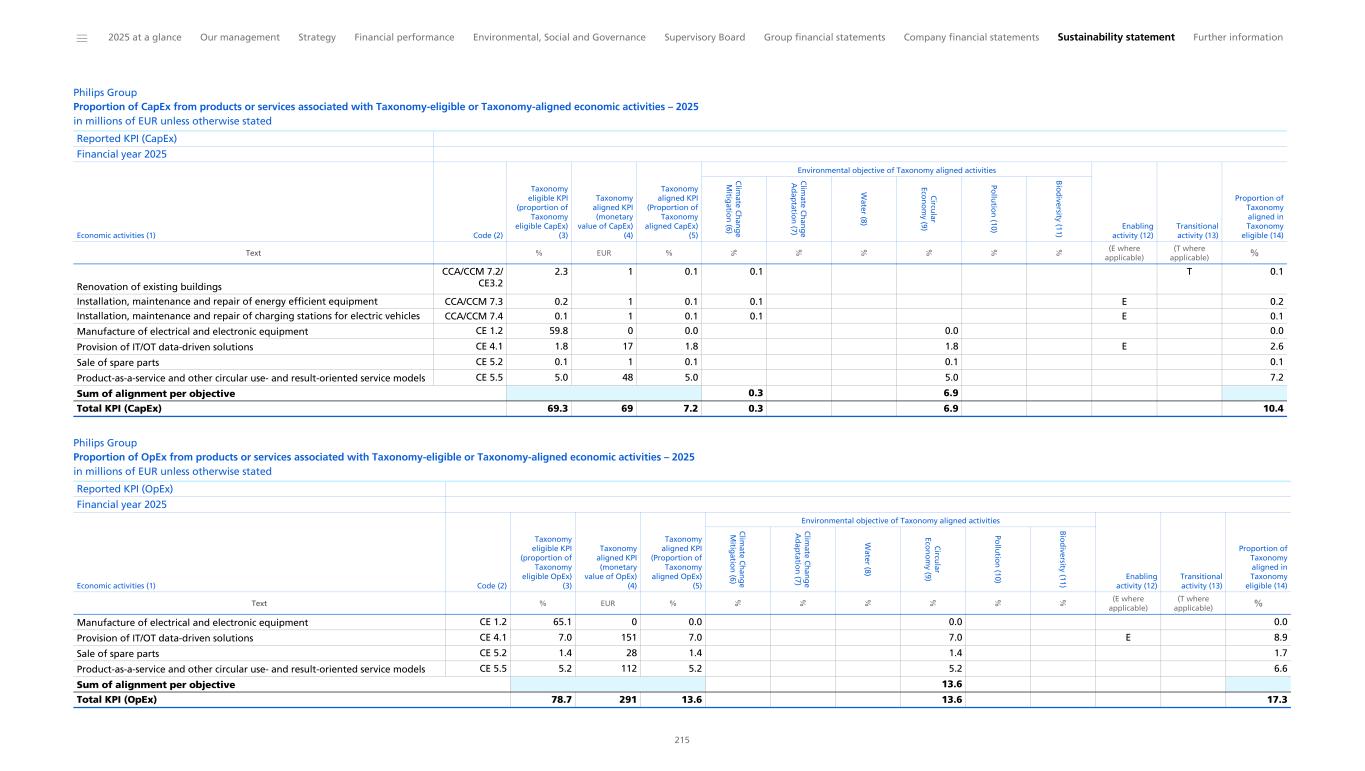
Philips Group Proportion of CapEx from products or services associated with Taxonomy-eligible or Taxonomy-aligned economic activities – 2025 in millions of EUR unless otherwise stated Reported KPI (CapEx) Financial year 2025 Economic activities (1) Code (2) Taxonomy eligible KPI (proportion of Taxonomy eligible CapEx) (3) Taxonomy aligned KPI (monetary value of CapEx) (4) Taxonomy aligned KPI (Proportion of Taxonomy aligned CapEx) (5) Environmental objective of Taxonomy aligned activities Enabling activity (12) Transitional activity (13) Proportion of Taxonomy aligned in Taxonomy eligible (14) C lim ate C h an g e M itig atio n (6) C lim ate C h an g e A d ap tatio n (7) W ater (8) C ircu lar Eco n o m y (9) Po llu tio n (10) B io d iversity (11) Text % EUR % % % % % % % (E where applicable) (T where applicable) % Renovation of existing buildings CCA/CCM 7.2/ CE3.2 2.3 1 0.1 0.1 T 0.1 Installation, maintenance and repair of energy efficient equipment CCA/CCM 7.3 0.2 1 0.1 0.1 E 0.2 Installation, maintenance and repair of charging stations for electric vehicles CCA/CCM 7.4 0.1 1 0.1 0.1 E 0.1 Manufacture of electrical and electronic equipment CE 1.2 59.8 0 0.0 0.0 0.0 Provision of IT/OT data-driven solutions CE 4.1 1.8 17 1.8 1.8 E 2.6 Sale of spare parts CE 5.2 0.1 1 0.1 0.1 0.1 Product-as-a-service and other circular use- and result-oriented service models CE 5.5 5.0 48 5.0 5.0 7.2 Sum of alignment per objective 0.3 6.9 Total KPI (CapEx) 69.3 69 7.2 0.3 6.9 10.4 Philips Group Proportion of OpEx from products or services associated with Taxonomy-eligible or Taxonomy-aligned economic activities – 2025 in millions of EUR unless otherwise stated Reported KPI (OpEx) Financial year 2025 Economic activities (1) Code (2) Taxonomy eligible KPI (proportion of Taxonomy eligible OpEx) (3) Taxonomy aligned KPI (monetary value of OpEx) (4) Taxonomy aligned KPI (Proportion of Taxonomy aligned OpEx) (5) Environmental objective of Taxonomy aligned activities Enabling activity (12) Transitional activity (13) Proportion of Taxonomy aligned in Taxonomy eligible (14) C lim ate C h an g e M itig atio n (6) C lim ate C h an g e A d ap tatio n (7) W ater (8) C ircu lar Eco n o m y (9) Po llu tio n (10) B io d iversity (11) Text % EUR % % % % % % % (E where applicable) (T where applicable) % Manufacture of electrical and electronic equipment CE 1.2 65.1 0 0.0 0.0 0.0 Provision of IT/OT data-driven solutions CE 4.1 7.0 151 7.0 7.0 E 8.9 Sale of spare parts CE 5.2 1.4 28 1.4 1.4 1.7 Product-as-a-service and other circular use- and result-oriented service models CE 5.5 5.2 112 5.2 5.2 6.6 Sum of alignment per objective 13.6 Total KPI (OpEx) 78.7 291 13.6 13.6 17.3 ______ 2025 at a glance Our management Strategy Financial performance Environmental, Social and Governance Supervisory Board Group financial statements Company financial statements Sustainability statement Further information 215
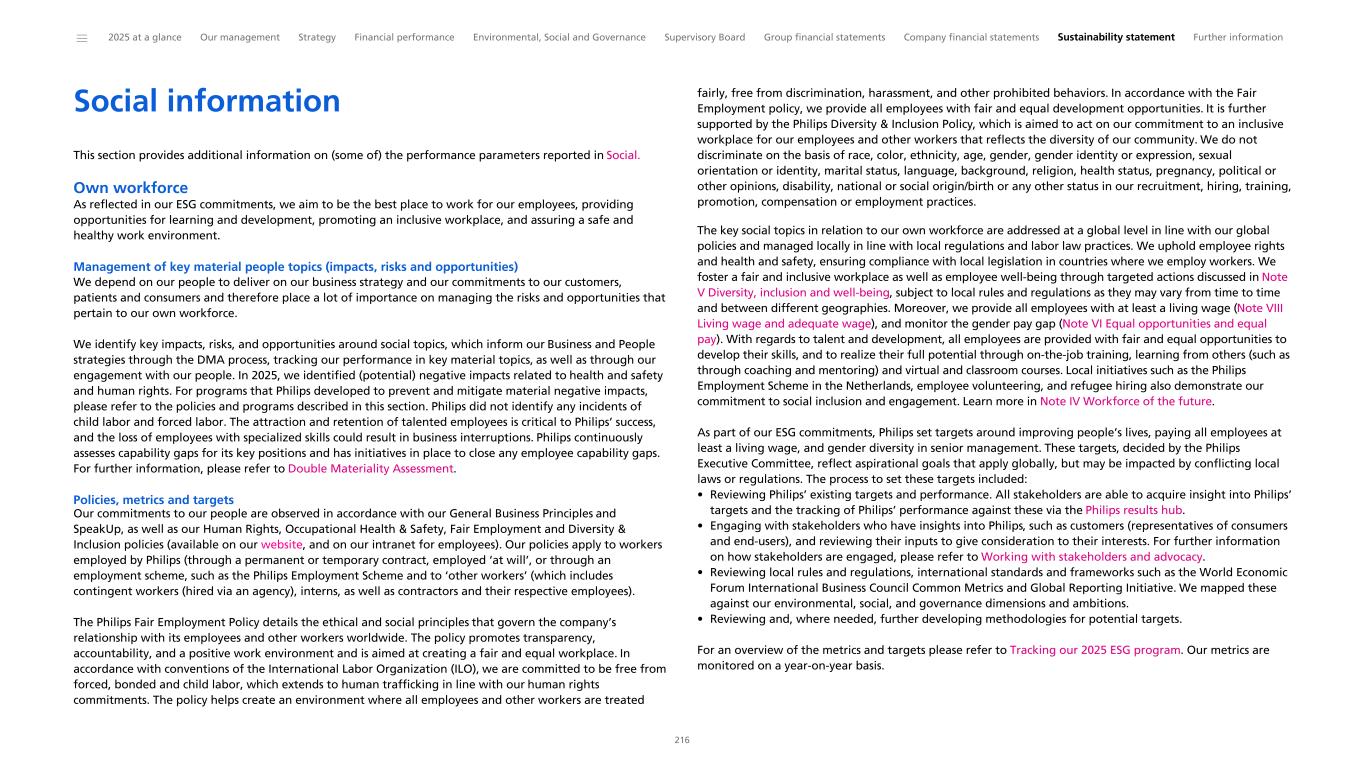
Social information This section provides additional information on (some of) the performance parameters reported in Social. Own workforce As reflected in our ESG commitments, we aim to be the best place to work for our employees, providing opportunities for learning and development, promoting an inclusive workplace, and assuring a safe and healthy work environment. Management of key material people topics (impacts, risks and opportunities) We depend on our people to deliver on our business strategy and our commitments to our customers, patients and consumers and therefore place a lot of importance on managing the risks and opportunities that pertain to our own workforce. We identify key impacts, risks, and opportunities around social topics, which inform our Business and People strategies through the DMA process, tracking our performance in key material topics, as well as through our engagement with our people. In 2025, we identified (potential) negative impacts related to health and safety and human rights. For programs that Philips developed to prevent and mitigate material negative impacts, please refer to the policies and programs described in this section. Philips did not identify any incidents of child labor and forced labor. The attraction and retention of talented employees is critical to Philips’ success, and the loss of employees with specialized skills could result in business interruptions. Philips continuously assesses capability gaps for its key positions and has initiatives in place to close any employee capability gaps. For further information, please refer to Double Materiality Assessment. Policies, metrics and targets Our commitments to our people are observed in accordance with our General Business Principles and SpeakUp, as well as our Human Rights, Occupational Health & Safety, Fair Employment and Diversity & Inclusion policies (available on our website, and on our intranet for employees). Our policies apply to workers employed by Philips (through a permanent or temporary contract, employed ‘at will’, or through an employment scheme, such as the Philips Employment Scheme and to ‘other workers’ (which includes contingent workers (hired via an agency), interns, as well as contractors and their respective employees). The Philips Fair Employment Policy details the ethical and social principles that govern the company’s relationship with its employees and other workers worldwide. The policy promotes transparency, accountability, and a positive work environment and is aimed at creating a fair and equal workplace. In accordance with conventions of the International Labor Organization (ILO), we are committed to be free from forced, bonded and child labor, which extends to human trafficking in line with our human rights commitments. The policy helps create an environment where all employees and other workers are treated fairly, free from discrimination, harassment, and other prohibited behaviors. In accordance with the Fair Employment policy, we provide all employees with fair and equal development opportunities. It is further supported by the Philips Diversity & Inclusion Policy, which is aimed to act on our commitment to an inclusive workplace for our employees and other workers that reflects the diversity of our community. We do not discriminate on the basis of race, color, ethnicity, age, gender, gender identity or expression, sexual orientation or identity, marital status, language, background, religion, health status, pregnancy, political or other opinions, disability, national or social origin/birth or any other status in our recruitment, hiring, training, promotion, compensation or employment practices. The key social topics in relation to our own workforce are addressed at a global level in line with our global policies and managed locally in line with local regulations and labor law practices. We uphold employee rights and health and safety, ensuring compliance with local legislation in countries where we employ workers. We foster a fair and inclusive workplace as well as employee well-being through targeted actions discussed in Note V Diversity, inclusion and well-being, subject to local rules and regulations as they may vary from time to time and between different geographies. Moreover, we provide all employees with at least a living wage (Note VIII Living wage and adequate wage), and monitor the gender pay gap (Note VI Equal opportunities and equal pay). With regards to talent and development, all employees are provided with fair and equal opportunities to develop their skills, and to realize their full potential through on-the-job training, learning from others (such as through coaching and mentoring) and virtual and classroom courses. Local initiatives such as the Philips Employment Scheme in the Netherlands, employee volunteering, and refugee hiring also demonstrate our commitment to social inclusion and engagement. Learn more in Note IV Workforce of the future. As part of our ESG commitments, Philips set targets around improving people’s lives, paying all employees at least a living wage, and gender diversity in senior management. These targets, decided by the Philips Executive Committee, reflect aspirational goals that apply globally, but may be impacted by conflicting local laws or regulations. The process to set these targets included: • Reviewing Philips’ existing targets and performance. All stakeholders are able to acquire insight into Philips’ targets and the tracking of Philips’ performance against these via the Philips results hub. • Engaging with stakeholders who have insights into Philips, such as customers (representatives of consumers and end-users), and reviewing their inputs to give consideration to their interests. For further information on how stakeholders are engaged, please refer to Working with stakeholders and advocacy. • Reviewing local rules and regulations, international standards and frameworks such as the World Economic Forum International Business Council Common Metrics and Global Reporting Initiative. We mapped these against our environmental, social, and governance dimensions and ambitions. • Reviewing and, where needed, further developing methodologies for potential targets. For an overview of the metrics and targets please refer to Tracking our 2025 ESG program. Our metrics are monitored on a year-on-year basis. ______ 2025 at a glance Our management Strategy Financial performance Environmental, Social and Governance Supervisory Board Group financial statements Company financial statements Sustainability statement Further information 216
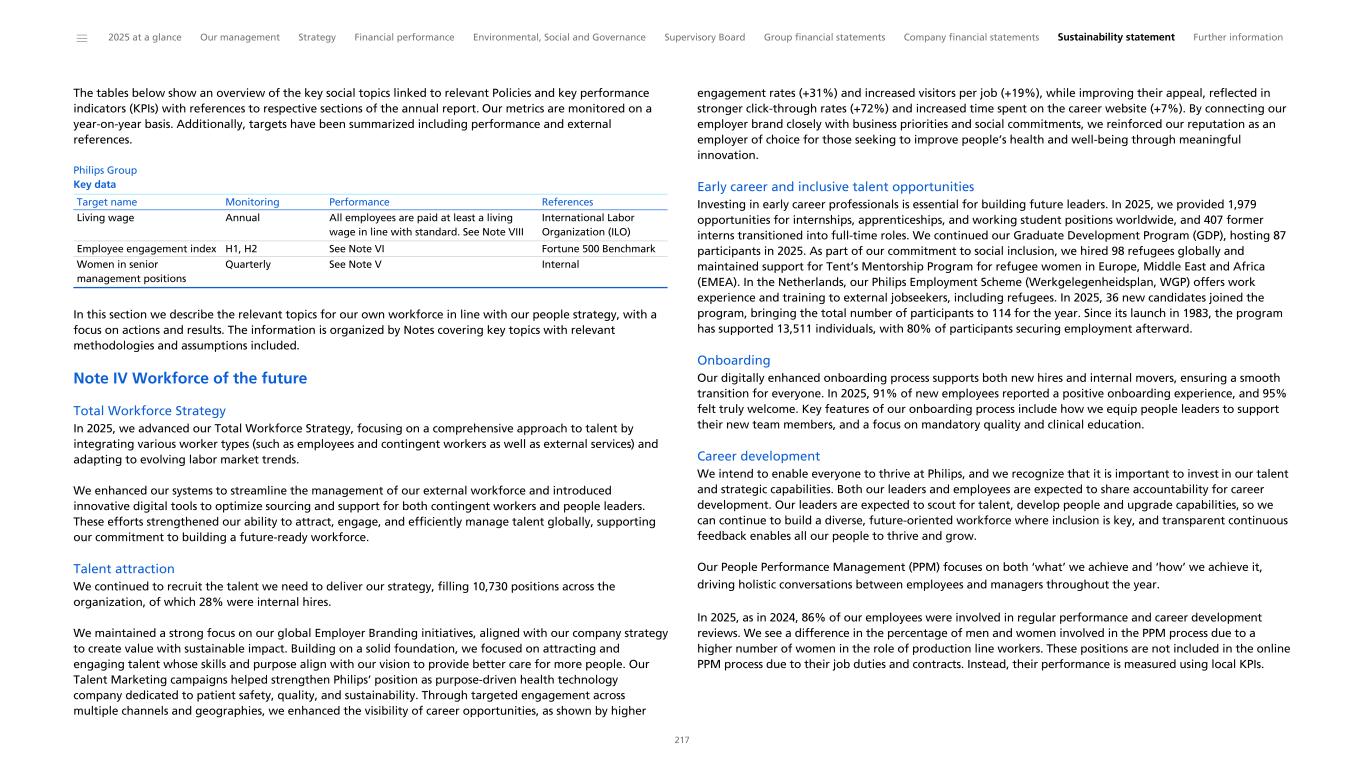
The tables below show an overview of the key social topics linked to relevant Policies and key performance indicators (KPIs) with references to respective sections of the annual report. Our metrics are monitored on a year-on-year basis. Additionally, targets have been summarized including performance and external references. Philips Group Key data Living wage Annual All employees are paid at least a living wage in line with standard. See Note VIII International Labor Organization (ILO) Employee engagement index H1, H2 See Note VI Fortune 500 Benchmark Women in senior management positions Quarterly See Note V Internal Target name Monitoring Performance References In this section we describe the relevant topics for our own workforce in line with our people strategy, with a focus on actions and results. The information is organized by Notes covering key topics with relevant methodologies and assumptions included. Note IV Workforce of the future Total Workforce Strategy In 2025, we advanced our Total Workforce Strategy, focusing on a comprehensive approach to talent by integrating various worker types (such as employees and contingent workers as well as external services) and adapting to evolving labor market trends. We enhanced our systems to streamline the management of our external workforce and introduced innovative digital tools to optimize sourcing and support for both contingent workers and people leaders. These efforts strengthened our ability to attract, engage, and efficiently manage talent globally, supporting our commitment to building a future-ready workforce. Talent attraction We continued to recruit the talent we need to deliver our strategy, filling 10,730 positions across the organization, of which 28% were internal hires. We maintained a strong focus on our global Employer Branding initiatives, aligned with our company strategy to create value with sustainable impact. Building on a solid foundation, we focused on attracting and engaging talent whose skills and purpose align with our vision to provide better care for more people. Our Talent Marketing campaigns helped strengthen Philips’ position as purpose-driven health technology company dedicated to patient safety, quality, and sustainability. Through targeted engagement across multiple channels and geographies, we enhanced the visibility of career opportunities, as shown by higher engagement rates (+31%) and increased visitors per job (+19%), while improving their appeal, reflected in stronger click-through rates (+72%) and increased time spent on the career website (+7%). By connecting our employer brand closely with business priorities and social commitments, we reinforced our reputation as an employer of choice for those seeking to improve people’s health and well-being through meaningful innovation. Early career and inclusive talent opportunities Investing in early career professionals is essential for building future leaders. In 2025, we provided 1,979 opportunities for internships, apprenticeships, and working student positions worldwide, and 407 former interns transitioned into full-time roles. We continued our Graduate Development Program (GDP), hosting 87 participants in 2025. As part of our commitment to social inclusion, we hired 98 refugees globally and maintained support for Tent’s Mentorship Program for refugee women in Europe, Middle East and Africa (EMEA). In the Netherlands, our Philips Employment Scheme (Werkgelegenheidsplan, WGP) offers work experience and training to external jobseekers, including refugees. In 2025, 36 new candidates joined the program, bringing the total number of participants to 114 for the year. Since its launch in 1983, the program has supported 13,511 individuals, with 80% of participants securing employment afterward. Onboarding Our digitally enhanced onboarding process supports both new hires and internal movers, ensuring a smooth transition for everyone. In 2025, 91% of new employees reported a positive onboarding experience, and 95% felt truly welcome. Key features of our onboarding process include how we equip people leaders to support their new team members, and a focus on mandatory quality and clinical education. Career development We intend to enable everyone to thrive at Philips, and we recognize that it is important to invest in our talent and strategic capabilities. Both our leaders and employees are expected to share accountability for career development. Our leaders are expected to scout for talent, develop people and upgrade capabilities, so we can continue to build a diverse, future-oriented workforce where inclusion is key, and transparent continuous feedback enables all our people to thrive and grow. Our People Performance Management (PPM) focuses on both ‘what’ we achieve and ‘how’ we achieve it, driving holistic conversations between employees and managers throughout the year. In 2025, as in 2024, 86% of our employees were involved in regular performance and career development reviews. We see a difference in the percentage of men and women involved in the PPM process due to a higher number of women in the role of production line workers. These positions are not included in the online PPM process due to their job duties and contracts. Instead, their performance is measured using local KPIs. ______ 2025 at a glance Our management Strategy Financial performance Environmental, Social and Governance Supervisory Board Group financial statements Company financial statements Sustainability statement Further information 217
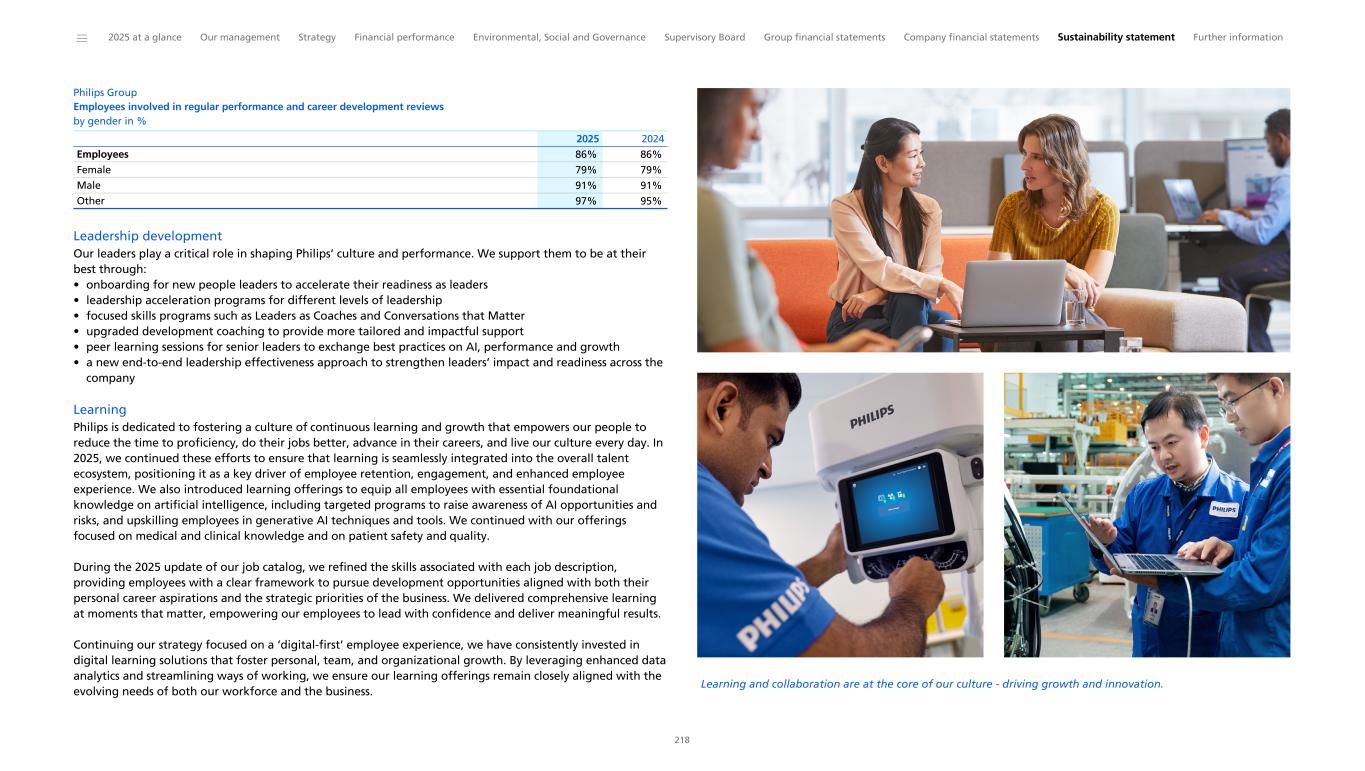
Philips Group Employees involved in regular performance and career development reviews by gender in % Employees 86% 86% Female 79% 79% Male 91% 91% Other 97% 95% 2025 2024 Leadership development Our leaders play a critical role in shaping Philips’ culture and performance. We support them to be at their best through: • onboarding for new people leaders to accelerate their readiness as leaders • leadership acceleration programs for different levels of leadership • focused skills programs such as Leaders as Coaches and Conversations that Matter • upgraded development coaching to provide more tailored and impactful support • peer learning sessions for senior leaders to exchange best practices on AI, performance and growth • a new end-to-end leadership effectiveness approach to strengthen leaders’ impact and readiness across the company Learning Philips is dedicated to fostering a culture of continuous learning and growth that empowers our people to reduce the time to proficiency, do their jobs better, advance in their careers, and live our culture every day. In 2025, we continued these efforts to ensure that learning is seamlessly integrated into the overall talent ecosystem, positioning it as a key driver of employee retention, engagement, and enhanced employee experience. We also introduced learning offerings to equip all employees with essential foundational knowledge on artificial intelligence, including targeted programs to raise awareness of AI opportunities and risks, and upskilling employees in generative AI techniques and tools. We continued with our offerings focused on medical and clinical knowledge and on patient safety and quality. During the 2025 update of our job catalog, we refined the skills associated with each job description, providing employees with a clear framework to pursue development opportunities aligned with both their personal career aspirations and the strategic priorities of the business. We delivered comprehensive learning at moments that matter, empowering our employees to lead with confidence and deliver meaningful results. Continuing our strategy focused on a ‘digital-first’ employee experience, we have consistently invested in digital learning solutions that foster personal, team, and organizational growth. By leveraging enhanced data analytics and streamlining ways of working, we ensure our learning offerings remain closely aligned with the evolving needs of both our workforce and the business. Learning and collaboration are at the core of our culture - driving growth and innovation. ______ 2025 at a glance Our management Strategy Financial performance Environmental, Social and Governance Supervisory Board Group financial statements Company financial statements Sustainability statement Further information 218
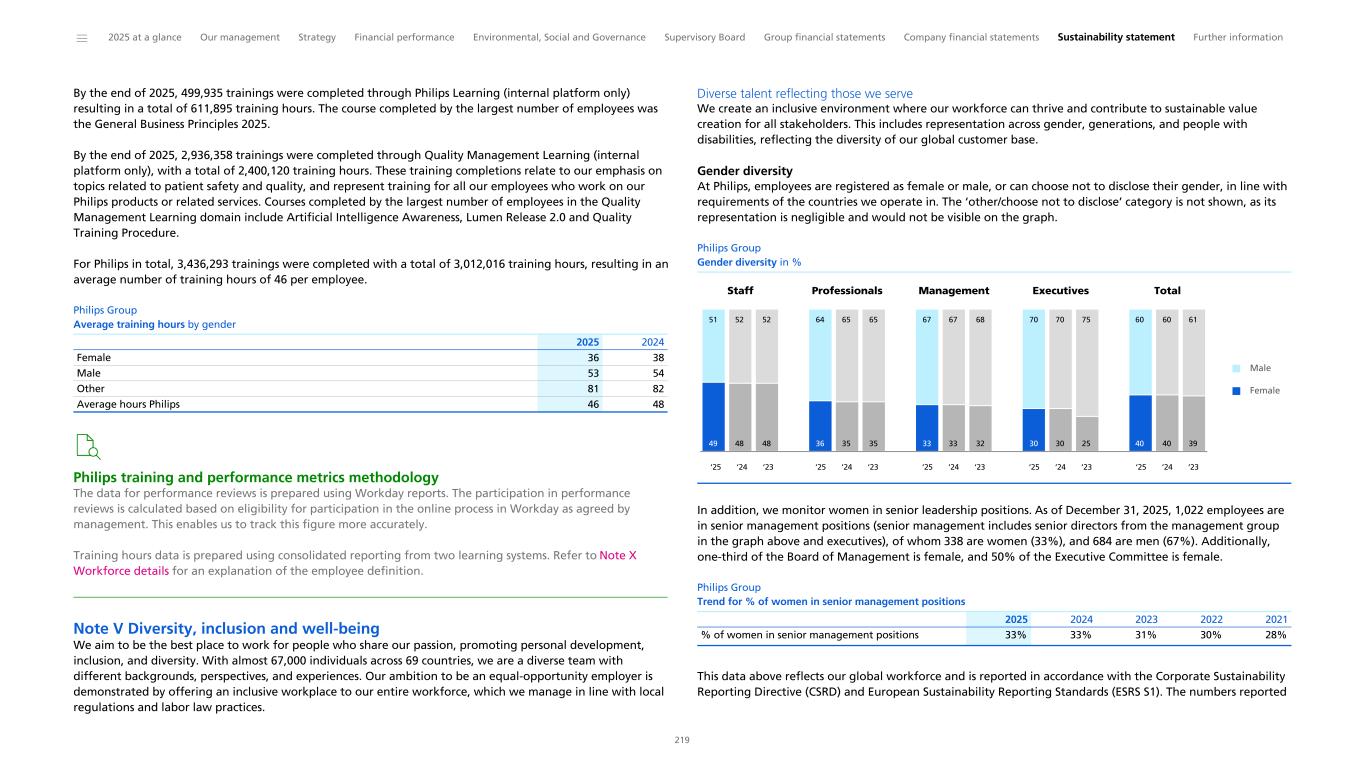
By the end of 2025, 499,935 trainings were completed through Philips Learning (internal platform only) resulting in a total of 611,895 training hours. The course completed by the largest number of employees was the General Business Principles 2025. By the end of 2025, 2,936,358 trainings were completed through Quality Management Learning (internal platform only), with a total of 2,400,120 training hours. These training completions relate to our emphasis on topics related to patient safety and quality, and represent training for all our employees who work on our Philips products or related services. Courses completed by the largest number of employees in the Quality Management Learning domain include Artificial Intelligence Awareness, Lumen Release 2.0 and Quality Training Procedure. For Philips in total, 3,436,293 trainings were completed with a total of 3,012,016 training hours, resulting in an average number of training hours of 46 per employee. Philips Group Average training hours by gender 2025 2024 Female 36 38 Male 53 54 Other 81 82 Average hours Philips 46 48 Philips training and performance metrics methodology The data for performance reviews is prepared using Workday reports. The participation in performance reviews is calculated based on eligibility for participation in the online process in Workday as agreed by management. This enables us to track this figure more accurately. Training hours data is prepared using consolidated reporting from two learning systems. Refer to Note X Workforce details for an explanation of the employee definition. Note V Diversity, inclusion and well-being We aim to be the best place to work for people who share our passion, promoting personal development, inclusion, and diversity. With almost 67,000 individuals across 69 countries, we are a diverse team with different backgrounds, perspectives, and experiences. Our ambition to be an equal-opportunity employer is demonstrated by offering an inclusive workplace to our entire workforce, which we manage in line with local regulations and labor law practices. Diverse talent reflecting those we serve We create an inclusive environment where our workforce can thrive and contribute to sustainable value creation for all stakeholders. This includes representation across gender, generations, and people with disabilities, reflecting the diversity of our global customer base. Gender diversity At Philips, employees are registered as female or male, or can choose not to disclose their gender, in line with requirements of the countries we operate in. The ‘other/choose not to disclose’ category is not shown, as its representation is negligible and would not be visible on the graph. Philips Group Gender diversity in % Staff Professionals Management Executives Total 49 48 48 36 35 35 33 33 32 30 30 25 40 40 39 51 52 52 64 65 65 67 67 68 70 70 75 60 60 61 Male Female ‘25 ‘24 ‘23 ‘25 ‘24 ‘23 ‘25 ‘24 ‘23 ‘25 ‘24 ‘23 ‘25 ‘24 ‘23 In addition, we monitor women in senior leadership positions. As of December 31, 2025, 1,022 employees are in senior management positions (senior management includes senior directors from the management group in the graph above and executives), of whom 338 are women (33%), and 684 are men (67%). Additionally, one-third of the Board of Management is female, and 50% of the Executive Committee is female. Philips Group Trend for % of women in senior management positions % of women in senior management positions 33% 33% 31% 30% 28% 2025 2024 2023 2022 2021 This data above reflects our global workforce and is reported in accordance with the Corporate Sustainability Reporting Directive (CSRD) and European Sustainability Reporting Standards (ESRS S1). The numbers reported ______ 2025 at a glance Our management Strategy Financial performance Environmental, Social and Governance Supervisory Board Group financial statements Company financial statements Sustainability statement Further information 219
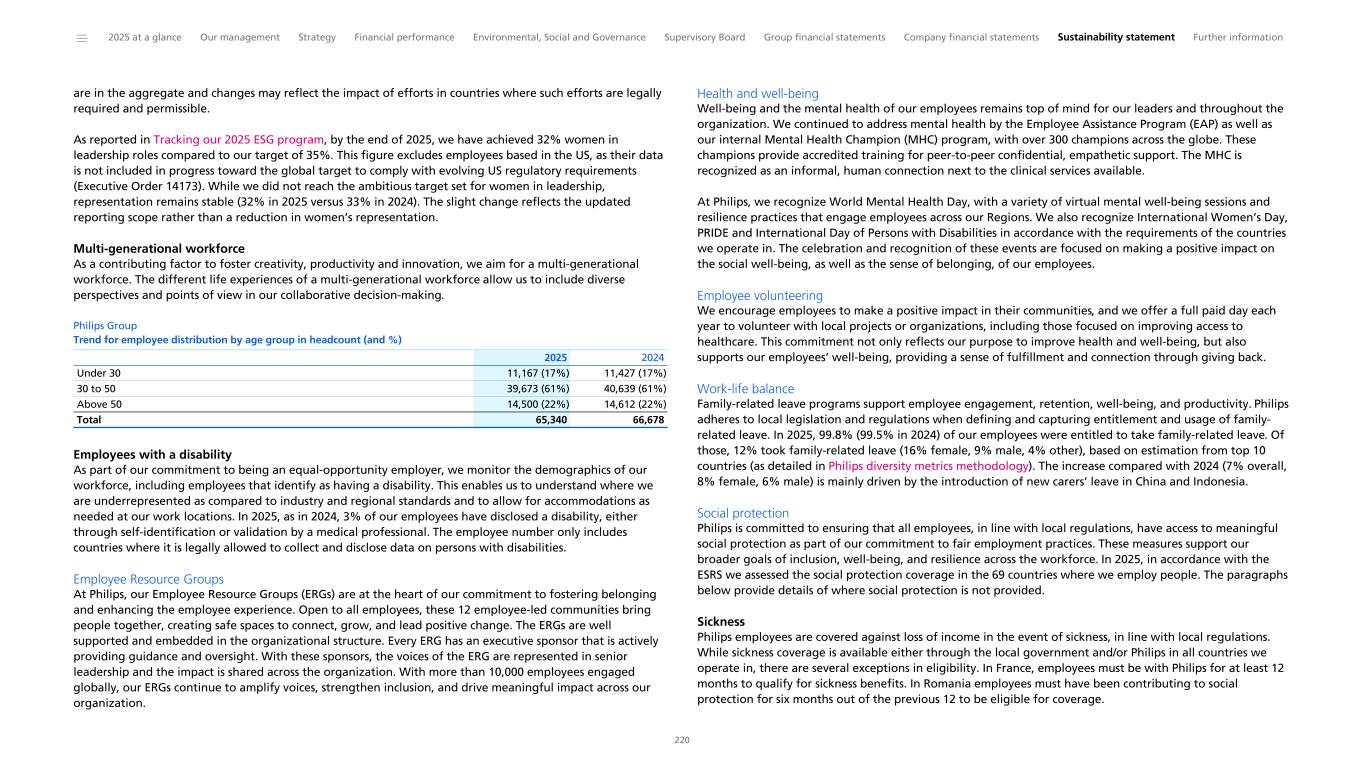
are in the aggregate and changes may reflect the impact of efforts in countries where such efforts are legally required and permissible. As reported in Tracking our 2025 ESG program, by the end of 2025, we have achieved 32% women in leadership roles compared to our target of 35%. This figure excludes employees based in the US, as their data is not included in progress toward the global target to comply with evolving US regulatory requirements (Executive Order 14173). While we did not reach the ambitious target set for women in leadership, representation remains stable (32% in 2025 versus 33% in 2024). The slight change reflects the updated reporting scope rather than a reduction in women’s representation. Multi-generational workforce As a contributing factor to foster creativity, productivity and innovation, we aim for a multi-generational workforce. The different life experiences of a multi-generational workforce allow us to include diverse perspectives and points of view in our collaborative decision-making. Philips Group Trend for employee distribution by age group in headcount (and %) 2025 2024 Under 30 11,167 (17%) 11,427 (17%) 30 to 50 39,673 (61%) 40,639 (61%) Above 50 14,500 (22%) 14,612 (22%) Total 65,340 66,678 Employees with a disability As part of our commitment to being an equal-opportunity employer, we monitor the demographics of our workforce, including employees that identify as having a disability. This enables us to understand where we are underrepresented as compared to industry and regional standards and to allow for accommodations as needed at our work locations. In 2025, as in 2024, 3% of our employees have disclosed a disability, either through self-identification or validation by a medical professional. The employee number only includes countries where it is legally allowed to collect and disclose data on persons with disabilities. Employee Resource Groups At Philips, our Employee Resource Groups (ERGs) are at the heart of our commitment to fostering belonging and enhancing the employee experience. Open to all employees, these 12 employee-led communities bring people together, creating safe spaces to connect, grow, and lead positive change. The ERGs are well supported and embedded in the organizational structure. Every ERG has an executive sponsor that is actively providing guidance and oversight. With these sponsors, the voices of the ERG are represented in senior leadership and the impact is shared across the organization. With more than 10,000 employees engaged globally, our ERGs continue to amplify voices, strengthen inclusion, and drive meaningful impact across our organization. Health and well-being Well-being and the mental health of our employees remains top of mind for our leaders and throughout the organization. We continued to address mental health by the Employee Assistance Program (EAP) as well as our internal Mental Health Champion (MHC) program, with over 300 champions across the globe. These champions provide accredited training for peer-to-peer confidential, empathetic support. The MHC is recognized as an informal, human connection next to the clinical services available. At Philips, we recognize World Mental Health Day, with a variety of virtual mental well-being sessions and resilience practices that engage employees across our Regions. We also recognize International Women’s Day, PRIDE and International Day of Persons with Disabilities in accordance with the requirements of the countries we operate in. The celebration and recognition of these events are focused on making a positive impact on the social well-being, as well as the sense of belonging, of our employees. Employee volunteering We encourage employees to make a positive impact in their communities, and we offer a full paid day each year to volunteer with local projects or organizations, including those focused on improving access to healthcare. This commitment not only reflects our purpose to improve health and well-being, but also supports our employees’ well-being, providing a sense of fulfillment and connection through giving back. Work-life balance Family-related leave programs support employee engagement, retention, well-being, and productivity. Philips adheres to local legislation and regulations when defining and capturing entitlement and usage of family- related leave. In 2025, 99.8% (99.5% in 2024) of our employees were entitled to take family-related leave. Of those, 12% took family-related leave (16% female, 9% male, 4% other), based on estimation from top 10 countries (as detailed in Philips diversity metrics methodology). The increase compared with 2024 (7% overall, 8% female, 6% male) is mainly driven by the introduction of new carers’ leave in China and Indonesia. Social protection Philips is committed to ensuring that all employees, in line with local regulations, have access to meaningful social protection as part of our commitment to fair employment practices. These measures support our broader goals of inclusion, well-being, and resilience across the workforce. In 2025, in accordance with the ESRS we assessed the social protection coverage in the 69 countries where we employ people. The paragraphs below provide details of where social protection is not provided. Sickness Philips employees are covered against loss of income in the event of sickness, in line with local regulations. While sickness coverage is available either through the local government and/or Philips in all countries we operate in, there are several exceptions in eligibility. In France, employees must be with Philips for at least 12 months to qualify for sickness benefits. In Romania employees must have been contributing to social protection for six months out of the previous 12 to be eligible for coverage. ______ 2025 at a glance Our management Strategy Financial performance Environmental, Social and Governance Supervisory Board Group financial statements Company financial statements Sustainability statement Further information 220
Unemployment In line with local practices, employees are not covered for loss of income in case of unemployment in Bangladesh, Colombia, Costa Rica, Egypt, Ghana, India, Indonesia, Kenya, Lebanon, Mexico, Panama, Qatar, and Sri Lanka. In Israel, only employees with a tenure of 18 months or longer are eligible. In Japan and UAE, only employees with a tenure of 12 months or longer are eligible. In Romania, employees need to have contributed to social protection for 12 out of the last 24 months to be eligible. In Malaysia and Saudi Arabia, foreign employees are not eligible for unemployment benefits. Employment injury and acquired disability All employees are covered against loss of income in the event of employment injury and/or acquired disability, either by the government or Philips, with the exception of employees with under 12 months tenure in France, in line with local practices. Parental leave Employees are covered against loss of income during parental leave in most countries where we employ people. In Ghana, Kenya, Lebanon, Serbia, South Africa only maternity leave is available. Since last year, several countries have made paternity leave available. In France only employees with a tenure of 12 months or longer are eligible. In Bulgaria and Romania, only employees with at least 12 months of employment and contributions, including outside of Philips, are eligible (from the last 24 months before a child's birth). In Czechia, employees who have not completed at least 60 working days in the calendar year are not eligible for parental leave coverage. Retirement Employees in Myanmar are not covered for loss of income in the event of retirement, neither by the government nor by Philips, in line with local practices. In Saudi Arabia and Singapore, foreign employees are not eligible for local retirement benefits. External awards and partnerships Many stakeholders, including customers, potential partners, and employees, view third-party assessments as valuable, objective indicators. This past year we were honored with awards recognizing our efforts in being the best place to work. We were named to the Forbes World’s Best Employer list and in the top five of Fortune Europe's Most Innovative Companies. As we continue to focus on embedding well-being into the employee experience, we see value in partnering with diverse professional network organizations and job boards. In 2025, we renewed a partnership with Catalyst and Leqture to provide us with external content, international benchmarks and research data related to well-being and belonging. Philips diversity metrics methodology Philips prepares diversity metrics (gender in senior management and age distribution) using the Philips employee definition, in line with the ESRS definition of employees, and Workday reports. Refer to Note X Workforce details. Philips defines senior management (the category used in the women in senior management positions disclosure) as corporate grade 90 (Senior Director and above), which does not differ from the previous description. The categories used in the diversity graph are Staff (Corporate Grade 10-45), Professional (Corporate Grade 50-70), Management (Corporate Grade 80-90) and Executive. Persons with disability data is collected manually in countries where we operate with headcount and uses the Philips employee definition, in line with the ESRS definition of employees and the definition of persons with disabilities: “persons who have long-term physical, mental, intellectual or sensory impairments which in interaction with various barriers may hinder their full and effective participation in society on an equal basis with others”. Philips adheres to the local legislation and regulations when defining, registering and disclosing information on persons with disabilities among employees, as well as when setting local strategies and targets. Due to the localized nature of the metric, there is no consistent global process in place to collect or validate the data, and official medical records are not a requirement across all countries. Work-life balance data is collected manually in countries where we operate with headcount and uses the Philips employee definition, in line with the ESRS definition of employees and definition of family-related leave: “Family-related leave includes maternity leave, paternity leave, parental leave, and carers’ leave that is available under national law, collective agreements or other policies and regulations.” Work-life balance data on entitled employees who took family-related leave is collected from our top 10 largest countries by headcount and further estimated, based on geographical (regional) variables. Using this method may not adequately represent the diversity of leave practices across all countries in each region and may lead to data inaccuracy. However, as employees in the top 10 countries account for 83% of all employees, this risk is not material. Social protection data, which applies to Philips employees, is collected in the countries in which we operate and is based on local legislation and Philips policy. Note VI Engaging with our employees Employee listening and employee engagement The People Engagement Survey (PES), in which all eligible employees are invited to participate, is a key component of our listening strategy, informing our Business and People strategies on employee sentiment and potential impacts, risks and opportunities. The PES reflects employee perspectives and is analyzed across ______ 2025 at a glance Our management Strategy Financial performance Environmental, Social and Governance Supervisory Board Group financial statements Company financial statements Sustainability statement Further information 221
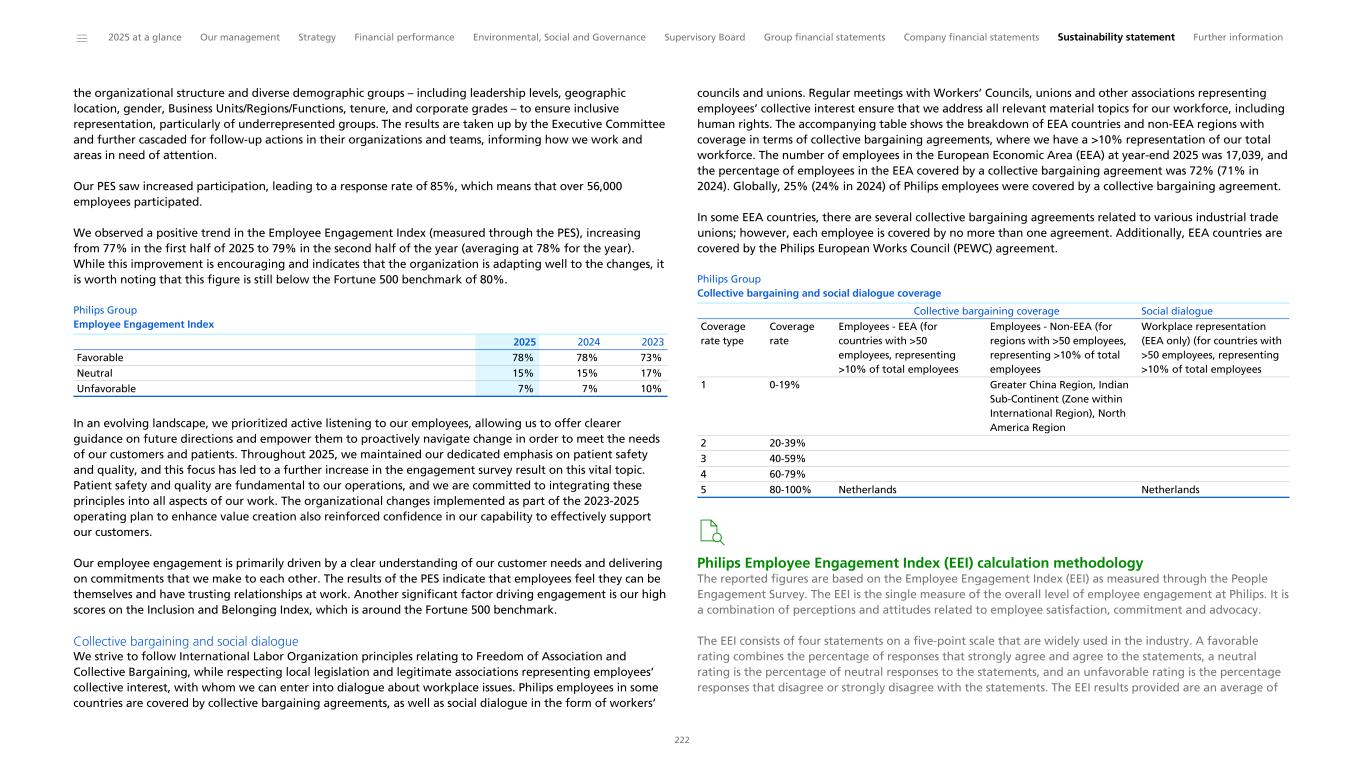
the organizational structure and diverse demographic groups – including leadership levels, geographic location, gender, Business Units/Regions/Functions, tenure, and corporate grades – to ensure inclusive representation, particularly of underrepresented groups. The results are taken up by the Executive Committee and further cascaded for follow-up actions in their organizations and teams, informing how we work and areas in need of attention. Our PES saw increased participation, leading to a response rate of 85%, which means that over 56,000 employees participated. We observed a positive trend in the Employee Engagement Index (measured through the PES), increasing from 77% in the first half of 2025 to 79% in the second half of the year (averaging at 78% for the year). While this improvement is encouraging and indicates that the organization is adapting well to the changes, it is worth noting that this figure is still below the Fortune 500 benchmark of 80%. Philips Group Employee Engagement Index Favorable 78% 78% 73% Neutral 15% 15% 17% Unfavorable 7% 7% 10% 2025 2024 2023 In an evolving landscape, we prioritized active listening to our employees, allowing us to offer clearer guidance on future directions and empower them to proactively navigate change in order to meet the needs of our customers and patients. Throughout 2025, we maintained our dedicated emphasis on patient safety and quality, and this focus has led to a further increase in the engagement survey result on this vital topic. Patient safety and quality are fundamental to our operations, and we are committed to integrating these principles into all aspects of our work. The organizational changes implemented as part of the 2023-2025 operating plan to enhance value creation also reinforced confidence in our capability to effectively support our customers. Our employee engagement is primarily driven by a clear understanding of our customer needs and delivering on commitments that we make to each other. The results of the PES indicate that employees feel they can be themselves and have trusting relationships at work. Another significant factor driving engagement is our high scores on the Inclusion and Belonging Index, which is around the Fortune 500 benchmark. Collective bargaining and social dialogue We strive to follow International Labor Organization principles relating to Freedom of Association and Collective Bargaining, while respecting local legislation and legitimate associations representing employees’ collective interest, with whom we can enter into dialogue about workplace issues. Philips employees in some countries are covered by collective bargaining agreements, as well as social dialogue in the form of workers’ councils and unions. Regular meetings with Workers’ Councils, unions and other associations representing employees’ collective interest ensure that we address all relevant material topics for our workforce, including human rights. The accompanying table shows the breakdown of EEA countries and non-EEA regions with coverage in terms of collective bargaining agreements, where we have a >10% representation of our total workforce. The number of employees in the European Economic Area (EEA) at year-end 2025 was 17,039, and the percentage of employees in the EEA covered by a collective bargaining agreement was 72% (71% in 2024). Globally, 25% (24% in 2024) of Philips employees were covered by a collective bargaining agreement. In some EEA countries, there are several collective bargaining agreements related to various industrial trade unions; however, each employee is covered by no more than one agreement. Additionally, EEA countries are covered by the Philips European Works Council (PEWC) agreement. Philips Group Collective bargaining and social dialogue coverage Coverage rate type Coverage rate Employees - EEA (for countries with >50 employees, representing >10% of total employees Employees - Non-EEA (for regions with >50 employees, representing >10% of total employees Workplace representation (EEA only) (for countries with >50 employees, representing >10% of total employees 1 0-19% Greater China Region, Indian Sub-Continent (Zone within International Region), North America Region 2 20-39% 3 40-59% 4 60-79% 5 80-100% Netherlands Netherlands Collective bargaining coverage Social dialogue Philips Employee Engagement Index (EEI) calculation methodology The reported figures are based on the Employee Engagement Index (EEI) as measured through the People Engagement Survey. The EEI is the single measure of the overall level of employee engagement at Philips. It is a combination of perceptions and attitudes related to employee satisfaction, commitment and advocacy. The EEI consists of four statements on a five-point scale that are widely used in the industry. A favorable rating combines the percentage of responses that strongly agree and agree to the statements, a neutral rating is the percentage of neutral responses to the statements, and an unfavorable rating is the percentage responses that disagree or strongly disagree with the statements. The EEI results provided are an average of ______ 2025 at a glance Our management Strategy Financial performance Environmental, Social and Governance Supervisory Board Group financial statements Company financial statements Sustainability statement Further information 222
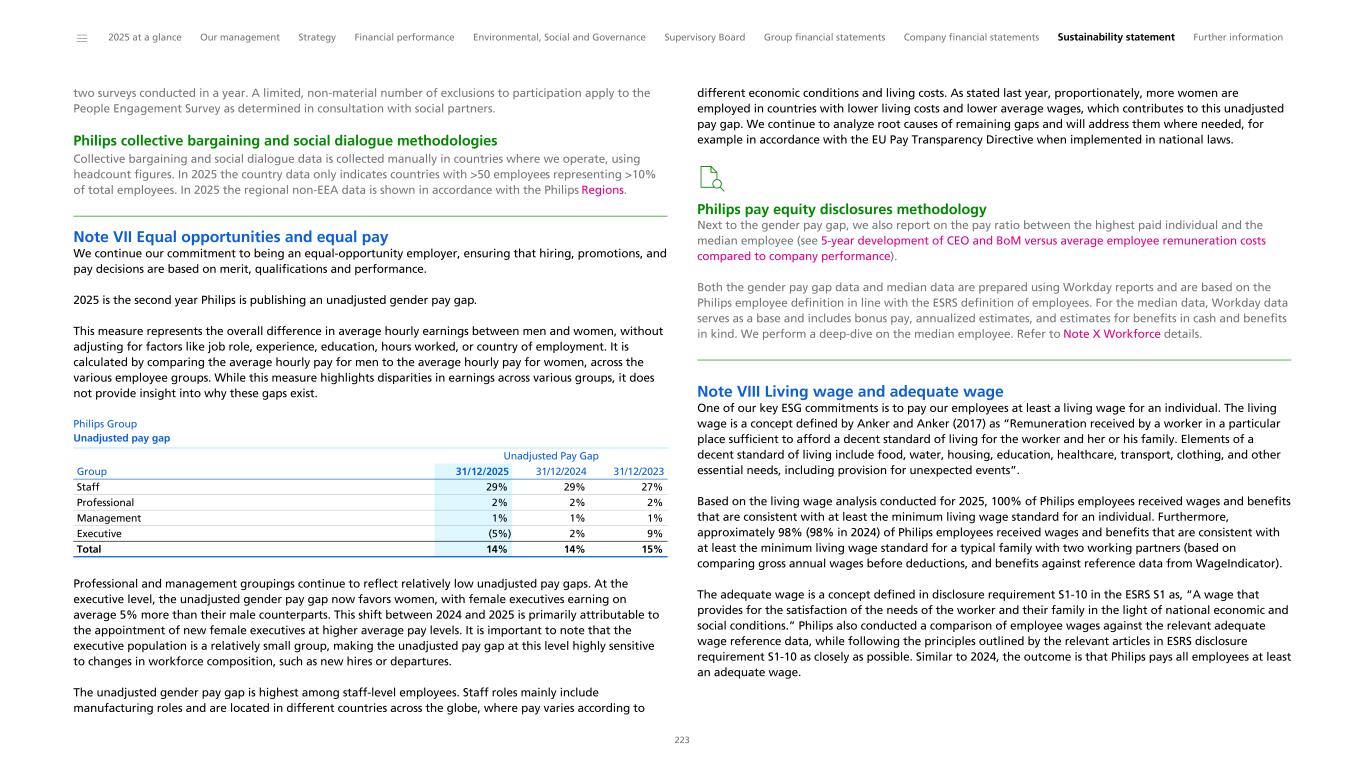
two surveys conducted in a year. A limited, non-material number of exclusions to participation apply to the People Engagement Survey as determined in consultation with social partners. Philips collective bargaining and social dialogue methodologies Collective bargaining and social dialogue data is collected manually in countries where we operate, using headcount figures. In 2025 the country data only indicates countries with >50 employees representing >10% of total employees. In 2025 the regional non-EEA data is shown in accordance with the Philips Regions. Note VII Equal opportunities and equal pay We continue our commitment to being an equal-opportunity employer, ensuring that hiring, promotions, and pay decisions are based on merit, qualifications and performance. 2025 is the second year Philips is publishing an unadjusted gender pay gap. This measure represents the overall difference in average hourly earnings between men and women, without adjusting for factors like job role, experience, education, hours worked, or country of employment. It is calculated by comparing the average hourly pay for men to the average hourly pay for women, across the various employee groups. While this measure highlights disparities in earnings across various groups, it does not provide insight into why these gaps exist. Philips Group Unadjusted pay gap Staff 29% 29% 27% Professional 2% 2% 2% Management 1% 1% 1% Executive (5%) 2% 9% Total 14% 14% 15% Unadjusted Pay Gap Group 31/12/2025 31/12/2024 31/12/2023 Professional and management groupings continue to reflect relatively low unadjusted pay gaps. At the executive level, the unadjusted gender pay gap now favors women, with female executives earning on average 5% more than their male counterparts. This shift between 2024 and 2025 is primarily attributable to the appointment of new female executives at higher average pay levels. It is important to note that the executive population is a relatively small group, making the unadjusted pay gap at this level highly sensitive to changes in workforce composition, such as new hires or departures. The unadjusted gender pay gap is highest among staff-level employees. Staff roles mainly include manufacturing roles and are located in different countries across the globe, where pay varies according to different economic conditions and living costs. As stated last year, proportionately, more women are employed in countries with lower living costs and lower average wages, which contributes to this unadjusted pay gap. We continue to analyze root causes of remaining gaps and will address them where needed, for example in accordance with the EU Pay Transparency Directive when implemented in national laws. Philips pay equity disclosures methodology Next to the gender pay gap, we also report on the pay ratio between the highest paid individual and the median employee (see 5-year development of CEO and BoM versus average employee remuneration costs compared to company performance). Both the gender pay gap data and median data are prepared using Workday reports and are based on the Philips employee definition in line with the ESRS definition of employees. For the median data, Workday data serves as a base and includes bonus pay, annualized estimates, and estimates for benefits in cash and benefits in kind. We perform a deep-dive on the median employee. Refer to Note X Workforce details. Note VIII Living wage and adequate wage One of our key ESG commitments is to pay our employees at least a living wage for an individual. The living wage is a concept defined by Anker and Anker (2017) as “Remuneration received by a worker in a particular place sufficient to afford a decent standard of living for the worker and her or his family. Elements of a decent standard of living include food, water, housing, education, healthcare, transport, clothing, and other essential needs, including provision for unexpected events”. Based on the living wage analysis conducted for 2025, 100% of Philips employees received wages and benefits that are consistent with at least the minimum living wage standard for an individual. Furthermore, approximately 98% (98% in 2024) of Philips employees received wages and benefits that are consistent with at least the minimum living wage standard for a typical family with two working partners (based on comparing gross annual wages before deductions, and benefits against reference data from WageIndicator). The adequate wage is a concept defined in disclosure requirement S1-10 in the ESRS S1 as, “A wage that provides for the satisfaction of the needs of the worker and their family in the light of national economic and social conditions.” Philips also conducted a comparison of employee wages against the relevant adequate wage reference data, while following the principles outlined by the relevant articles in ESRS disclosure requirement S1-10 as closely as possible. Similar to 2024, the outcome is that Philips pays all employees at least an adequate wage. ______ 2025 at a glance Our management Strategy Financial performance Environmental, Social and Governance Supervisory Board Group financial statements Company financial statements Sustainability statement Further information 223
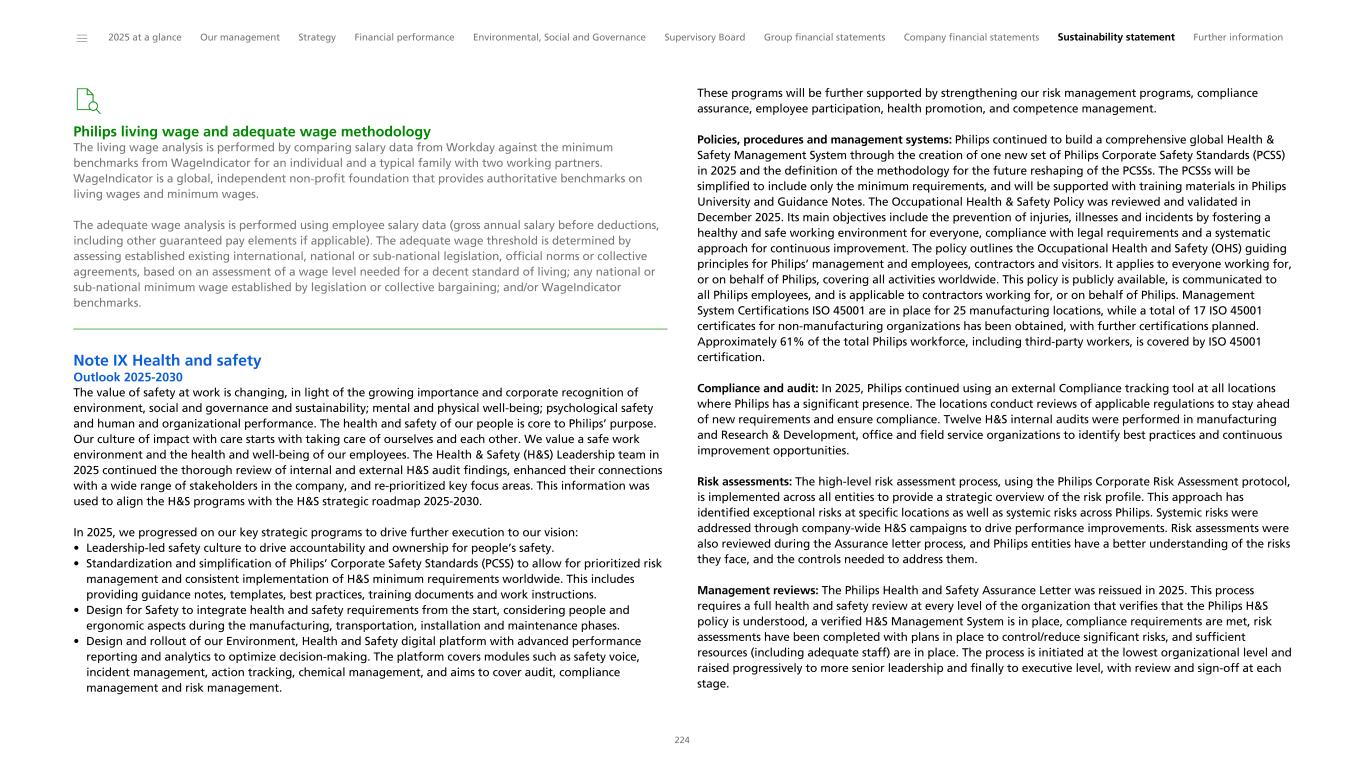
Philips living wage and adequate wage methodology The living wage analysis is performed by comparing salary data from Workday against the minimum benchmarks from WageIndicator for an individual and a typical family with two working partners. WageIndicator is a global, independent non-profit foundation that provides authoritative benchmarks on living wages and minimum wages. The adequate wage analysis is performed using employee salary data (gross annual salary before deductions, including other guaranteed pay elements if applicable). The adequate wage threshold is determined by assessing established existing international, national or sub-national legislation, official norms or collective agreements, based on an assessment of a wage level needed for a decent standard of living; any national or sub-national minimum wage established by legislation or collective bargaining; and/or WageIndicator benchmarks. Note IX Health and safety Outlook 2025-2030 The value of safety at work is changing, in light of the growing importance and corporate recognition of environment, social and governance and sustainability; mental and physical well-being; psychological safety and human and organizational performance. The health and safety of our people is core to Philips’ purpose. Our culture of impact with care starts with taking care of ourselves and each other. We value a safe work environment and the health and well-being of our employees. The Health & Safety (H&S) Leadership team in 2025 continued the thorough review of internal and external H&S audit findings, enhanced their connections with a wide range of stakeholders in the company, and re-prioritized key focus areas. This information was used to align the H&S programs with the H&S strategic roadmap 2025-2030. In 2025, we progressed on our key strategic programs to drive further execution to our vision: • Leadership-led safety culture to drive accountability and ownership for people’s safety. • Standardization and simplification of Philips’ Corporate Safety Standards (PCSS) to allow for prioritized risk management and consistent implementation of H&S minimum requirements worldwide. This includes providing guidance notes, templates, best practices, training documents and work instructions. • Design for Safety to integrate health and safety requirements from the start, considering people and ergonomic aspects during the manufacturing, transportation, installation and maintenance phases. • Design and rollout of our Environment, Health and Safety digital platform with advanced performance reporting and analytics to optimize decision-making. The platform covers modules such as safety voice, incident management, action tracking, chemical management, and aims to cover audit, compliance management and risk management. These programs will be further supported by strengthening our risk management programs, compliance assurance, employee participation, health promotion, and competence management. Policies, procedures and management systems: Philips continued to build a comprehensive global Health & Safety Management System through the creation of one new set of Philips Corporate Safety Standards (PCSS) in 2025 and the definition of the methodology for the future reshaping of the PCSSs. The PCSSs will be simplified to include only the minimum requirements, and will be supported with training materials in Philips University and Guidance Notes. The Occupational Health & Safety Policy was reviewed and validated in December 2025. Its main objectives include the prevention of injuries, illnesses and incidents by fostering a healthy and safe working environment for everyone, compliance with legal requirements and a systematic approach for continuous improvement. The policy outlines the Occupational Health and Safety (OHS) guiding principles for Philips’ management and employees, contractors and visitors. It applies to everyone working for, or on behalf of Philips, covering all activities worldwide. This policy is publicly available, is communicated to all Philips employees, and is applicable to contractors working for, or on behalf of Philips. Management System Certifications ISO 45001 are in place for 25 manufacturing locations, while a total of 17 ISO 45001 certificates for non-manufacturing organizations has been obtained, with further certifications planned. Approximately 61% of the total Philips workforce, including third-party workers, is covered by ISO 45001 certification. Compliance and audit: In 2025, Philips continued using an external Compliance tracking tool at all locations where Philips has a significant presence. The locations conduct reviews of applicable regulations to stay ahead of new requirements and ensure compliance. Twelve H&S internal audits were performed in manufacturing and Research & Development, office and field service organizations to identify best practices and continuous improvement opportunities. Risk assessments: The high-level risk assessment process, using the Philips Corporate Risk Assessment protocol, is implemented across all entities to provide a strategic overview of the risk profile. This approach has identified exceptional risks at specific locations as well as systemic risks across Philips. Systemic risks were addressed through company-wide H&S campaigns to drive performance improvements. Risk assessments were also reviewed during the Assurance letter process, and Philips entities have a better understanding of the risks they face, and the controls needed to address them. Management reviews: The Philips Health and Safety Assurance Letter was reissued in 2025. This process requires a full health and safety review at every level of the organization that verifies that the Philips H&S policy is understood, a verified H&S Management System is in place, compliance requirements are met, risk assessments have been completed with plans in place to control/reduce significant risks, and sufficient resources (including adequate staff) are in place. The process is initiated at the lowest organizational level and raised progressively to more senior leadership and finally to executive level, with review and sign-off at each stage. ______ 2025 at a glance Our management Strategy Financial performance Environmental, Social and Governance Supervisory Board Group financial statements Company financial statements Sustainability statement Further information 224
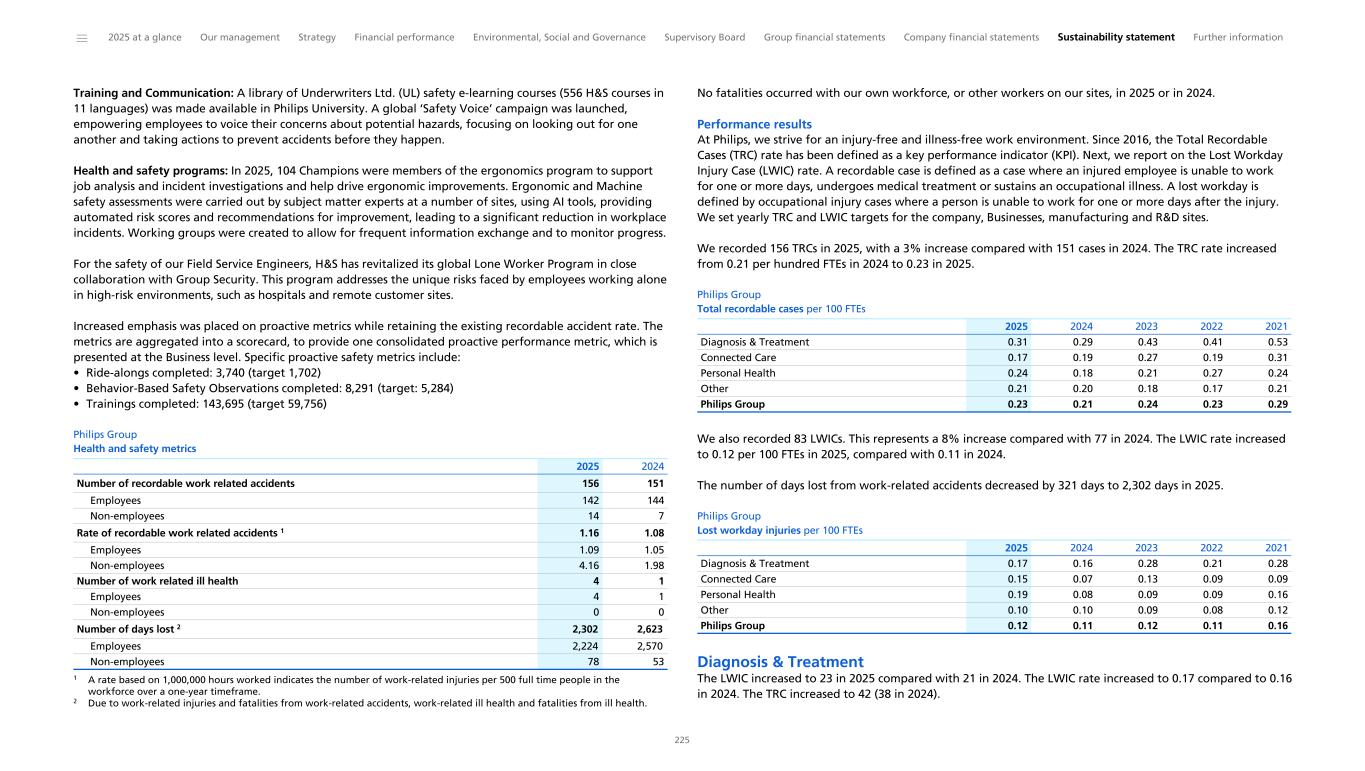
Training and Communication: A library of Underwriters Ltd. (UL) safety e-learning courses (556 H&S courses in 11 languages) was made available in Philips University. A global ‘Safety Voice’ campaign was launched, empowering employees to voice their concerns about potential hazards, focusing on looking out for one another and taking actions to prevent accidents before they happen. Health and safety programs: In 2025, 104 Champions were members of the ergonomics program to support job analysis and incident investigations and help drive ergonomic improvements. Ergonomic and Machine safety assessments were carried out by subject matter experts at a number of sites, using AI tools, providing automated risk scores and recommendations for improvement, leading to a significant reduction in workplace incidents. Working groups were created to allow for frequent information exchange and to monitor progress. For the safety of our Field Service Engineers, H&S has revitalized its global Lone Worker Program in close collaboration with Group Security. This program addresses the unique risks faced by employees working alone in high-risk environments, such as hospitals and remote customer sites. Increased emphasis was placed on proactive metrics while retaining the existing recordable accident rate. The metrics are aggregated into a scorecard, to provide one consolidated proactive performance metric, which is presented at the Business level. Specific proactive safety metrics include: • Ride-alongs completed: 3,740 (target 1,702) • Behavior-Based Safety Observations completed: 8,291 (target: 5,284) • Trainings completed: 143,695 (target 59,756) Philips Group Health and safety metrics Number of recordable work related accidents 156 151 Employees 142 144 Non-employees 14 7 Rate of recordable work related accidents 1 1.16 1.08 Employees 1.09 1.05 Non-employees 4.16 1.98 Number of work related ill health 4 1 Employees 4 1 Non-employees 0 0 Number of days lost 2 2,302 2,623 Employees 2,224 2,570 Non-employees 78 53 2025 2024 1 A rate based on 1,000,000 hours worked indicates the number of work-related injuries per 500 full time people in the workforce over a one-year timeframe. 2 Due to work-related injuries and fatalities from work-related accidents, work-related ill health and fatalities from ill health. No fatalities occurred with our own workforce, or other workers on our sites, in 2025 or in 2024. Performance results At Philips, we strive for an injury-free and illness-free work environment. Since 2016, the Total Recordable Cases (TRC) rate has been defined as a key performance indicator (KPI). Next, we report on the Lost Workday Injury Case (LWIC) rate. A recordable case is defined as a case where an injured employee is unable to work for one or more days, undergoes medical treatment or sustains an occupational illness. A lost workday is defined by occupational injury cases where a person is unable to work for one or more days after the injury. We set yearly TRC and LWIC targets for the company, Businesses, manufacturing and R&D sites. We recorded 156 TRCs in 2025, with a 3% increase compared with 151 cases in 2024. The TRC rate increased from 0.21 per hundred FTEs in 2024 to 0.23 in 2025. Philips Group Total recordable cases per 100 FTEs Diagnosis & Treatment 0.31 0.29 0.43 0.41 0.53 Connected Care 0.17 0.19 0.27 0.19 0.31 Personal Health 0.24 0.18 0.21 0.27 0.24 Other 0.21 0.20 0.18 0.17 0.21 Philips Group 0.23 0.21 0.24 0.23 0.29 2025 2024 2023 2022 2021 We also recorded 83 LWICs. This represents a 8% increase compared with 77 in 2024. The LWIC rate increased to 0.12 per 100 FTEs in 2025, compared with 0.11 in 2024. The number of days lost from work-related accidents decreased by 321 days to 2,302 days in 2025. Philips Group Lost workday injuries per 100 FTEs Diagnosis & Treatment 0.17 0.16 0.28 0.21 0.28 Connected Care 0.15 0.07 0.13 0.09 0.09 Personal Health 0.19 0.08 0.09 0.09 0.16 Other 0.10 0.10 0.09 0.08 0.12 Philips Group 0.12 0.11 0.12 0.11 0.16 2025 2024 2023 2022 2021 Diagnosis & Treatment The LWIC increased to 23 in 2025 compared with 21 in 2024. The LWIC rate increased to 0.17 compared to 0.16 in 2024. The TRC increased to 42 (38 in 2024). ______ 2025 at a glance Our management Strategy Financial performance Environmental, Social and Governance Supervisory Board Group financial statements Company financial statements Sustainability statement Further information 225
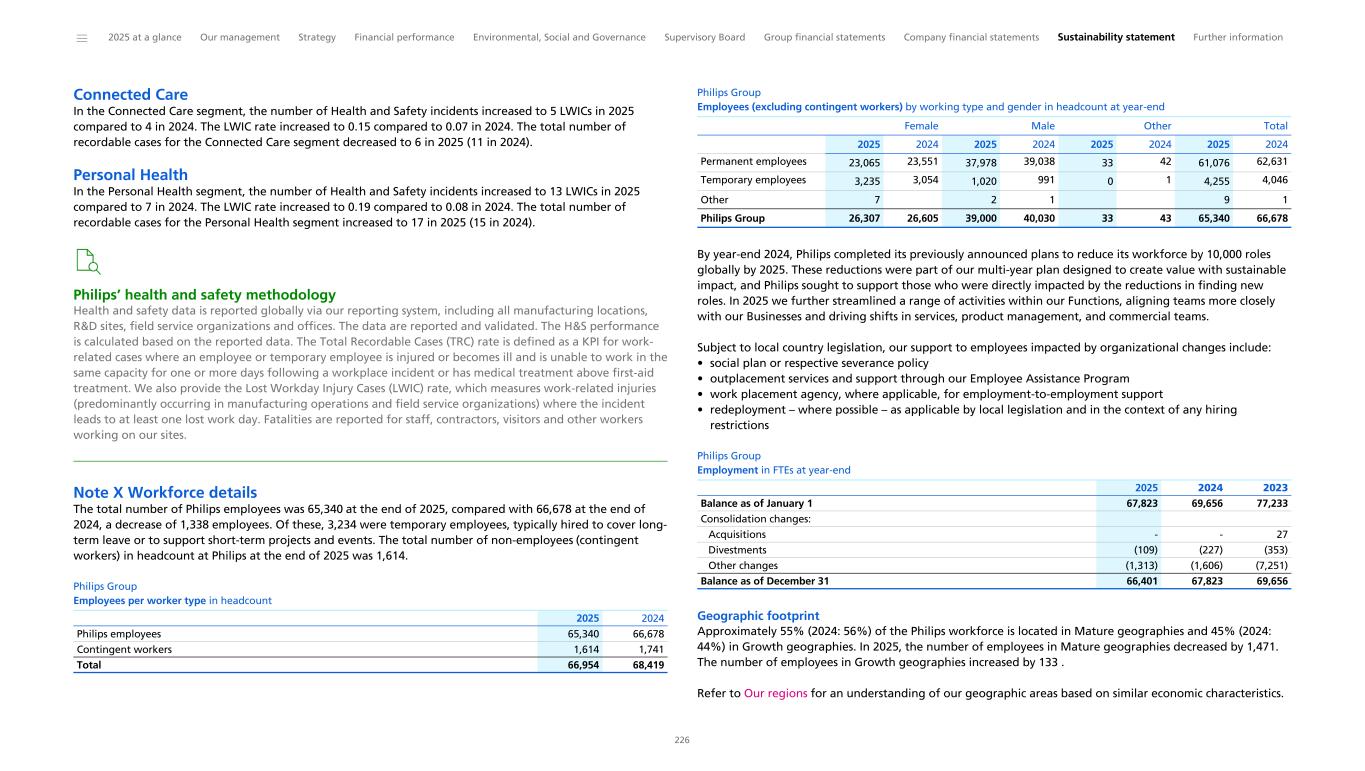
Connected Care In the Connected Care segment, the number of Health and Safety incidents increased to 5 LWICs in 2025 compared to 4 in 2024. The LWIC rate increased to 0.15 compared to 0.07 in 2024. The total number of recordable cases for the Connected Care segment decreased to 6 in 2025 (11 in 2024). Personal Health In the Personal Health segment, the number of Health and Safety incidents increased to 13 LWICs in 2025 compared to 7 in 2024. The LWIC rate increased to 0.19 compared to 0.08 in 2024. The total number of recordable cases for the Personal Health segment increased to 17 in 2025 (15 in 2024). Philips’ health and safety methodology Health and safety data is reported globally via our reporting system, including all manufacturing locations, R&D sites, field service organizations and offices. The data are reported and validated. The H&S performance is calculated based on the reported data. The Total Recordable Cases (TRC) rate is defined as a KPI for work- related cases where an employee or temporary employee is injured or becomes ill and is unable to work in the same capacity for one or more days following a workplace incident or has medical treatment above first-aid treatment. We also provide the Lost Workday Injury Cases (LWIC) rate, which measures work-related injuries (predominantly occurring in manufacturing operations and field service organizations) where the incident leads to at least one lost work day. Fatalities are reported for staff, contractors, visitors and other workers working on our sites. Note X Workforce details The total number of Philips employees was 65,340 at the end of 2025, compared with 66,678 at the end of 2024, a decrease of 1,338 employees. Of these, 3,234 were temporary employees, typically hired to cover long- term leave or to support short-term projects and events. The total number of non-employees (contingent workers) in headcount at Philips at the end of 2025 was 1,614. Philips Group Employees per worker type in headcount Philips employees 65,340 66,678 Contingent workers 1,614 1,741 Total 66,954 68,419 2025 2024 Philips Group Employees (excluding contingent workers) by working type and gender in headcount at year-end 2025 2024 2025 2024 2025 2024 2025 2024 Permanent employees 23,065 23,551 37,978 39,038 33 42 61,076 62,631 Temporary employees 3,235 3,054 1,020 991 0 1 4,255 4,046 Other 7 2 1 9 1 Philips Group 26,307 26,605 39,000 40,030 33 43 65,340 66,678 Female Male Other Total By year-end 2024, Philips completed its previously announced plans to reduce its workforce by 10,000 roles globally by 2025. These reductions were part of our multi-year plan designed to create value with sustainable impact, and Philips sought to support those who were directly impacted by the reductions in finding new roles. In 2025 we further streamlined a range of activities within our Functions, aligning teams more closely with our Businesses and driving shifts in services, product management, and commercial teams. Subject to local country legislation, our support to employees impacted by organizational changes include: • social plan or respective severance policy • outplacement services and support through our Employee Assistance Program • work placement agency, where applicable, for employment-to-employment support • redeployment – where possible – as applicable by local legislation and in the context of any hiring restrictions Philips Group Employment in FTEs at year-end Balance as of January 1 67,823 69,656 77,233 Consolidation changes: Acquisitions - - 27 Divestments (109) (227) (353) Other changes (1,313) (1,606) (7,251) Balance as of December 31 66,401 67,823 69,656 2025 2024 2023 Geographic footprint Approximately 55% (2024: 56%) of the Philips workforce is located in Mature geographies and 45% (2024: 44%) in Growth geographies. In 2025, the number of employees in Mature geographies decreased by 1,471. The number of employees in Growth geographies increased by 133 . Refer to Our regions for an understanding of our geographic areas based on similar economic characteristics. ______ 2025 at a glance Our management Strategy Financial performance Environmental, Social and Governance Supervisory Board Group financial statements Company financial statements Sustainability statement Further information 226
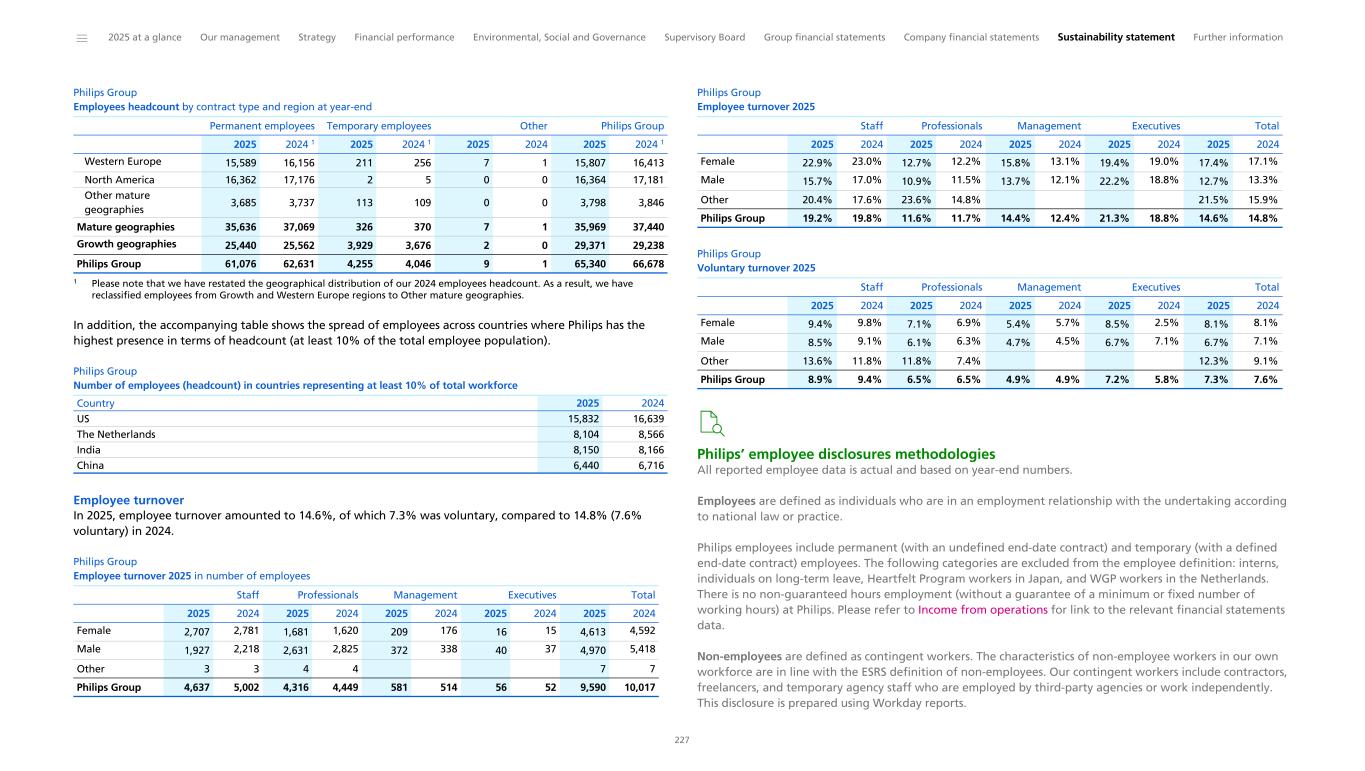
Philips Group Employees headcount by contract type and region at year-end Permanent employees Temporary employees Other Philips Group 2025 2024 1 2025 2024 1 2025 2024 2025 2024 1 Western Europe 15,589 16,156 211 256 7 1 15,807 16,413 North America 16,362 17,176 2 5 0 0 16,364 17,181 Other mature geographies 3,685 3,737 113 109 0 0 3,798 3,846 Mature geographies 35,636 37,069 326 370 7 1 35,969 37,440 Growth geographies 25,440 25,562 3,929 3,676 2 0 29,371 29,238 Philips Group 61,076 62,631 4,255 4,046 9 1 65,340 66,678 1 Please note that we have restated the geographical distribution of our 2024 employees headcount. As a result, we have reclassified employees from Growth and Western Europe regions to Other mature geographies. In addition, the accompanying table shows the spread of employees across countries where Philips has the highest presence in terms of headcount (at least 10% of the total employee population). Philips Group Number of employees (headcount) in countries representing at least 10% of total workforce US 15,832 16,639 The Netherlands 8,104 8,566 India 8,150 8,166 China 6,440 6,716 Country 2025 2024 Employee turnover In 2025, employee turnover amounted to 14.6%, of which 7.3% was voluntary, compared to 14.8% (7.6% voluntary) in 2024. Philips Group Employee turnover 2025 in number of employees Staff Professionals Management Executives Total 2025 2024 2025 2024 2025 2024 2025 2024 2025 2024 Female 2,707 2,781 1,681 1,620 209 176 16 15 4,613 4,592 Male 1,927 2,218 2,631 2,825 372 338 40 37 4,970 5,418 Other 3 3 4 4 7 7 Philips Group 4,637 5,002 4,316 4,449 581 514 56 52 9,590 10,017 Philips Group Employee turnover 2025 Staff Professionals Management Executives Total 2025 2024 2025 2024 2025 2024 2025 2024 2025 2024 Female 22.9% 23.0% 12.7% 12.2% 15.8% 13.1% 19.4% 19.0% 17.4% 17.1% Male 15.7% 17.0% 10.9% 11.5% 13.7% 12.1% 22.2% 18.8% 12.7% 13.3% Other 20.4% 17.6% 23.6% 14.8% 21.5% 15.9% Philips Group 19.2% 19.8% 11.6% 11.7% 14.4% 12.4% 21.3% 18.8% 14.6% 14.8% Philips Group Voluntary turnover 2025 Staff Professionals Management Executives Total 2025 2024 2025 2024 2025 2024 2025 2024 2025 2024 Female 9.4% 9.8% 7.1% 6.9% 5.4% 5.7% 8.5% 2.5% 8.1% 8.1% Male 8.5% 9.1% 6.1% 6.3% 4.7% 4.5% 6.7% 7.1% 6.7% 7.1% Other 13.6% 11.8% 11.8% 7.4% 12.3% 9.1% Philips Group 8.9% 9.4% 6.5% 6.5% 4.9% 4.9% 7.2% 5.8% 7.3% 7.6% Philips’ employee disclosures methodologies All reported employee data is actual and based on year-end numbers. Employees are defined as individuals who are in an employment relationship with the undertaking according to national law or practice. Philips employees include permanent (with an undefined end-date contract) and temporary (with a defined end-date contract) employees. The following categories are excluded from the employee definition: interns, individuals on long-term leave, Heartfelt Program workers in Japan, and WGP workers in the Netherlands. There is no non-guaranteed hours employment (without a guarantee of a minimum or fixed number of working hours) at Philips. Please refer to Income from operations for link to the relevant financial statements data. Non-employees are defined as contingent workers. The characteristics of non-employee workers in our own workforce are in line with the ESRS definition of non-employees. Our contingent workers include contractors, freelancers, and temporary agency staff who are employed by third-party agencies or work independently. This disclosure is prepared using Workday reports. ______ 2025 at a glance Our management Strategy Financial performance Environmental, Social and Governance Supervisory Board Group financial statements Company financial statements Sustainability statement Further information 227
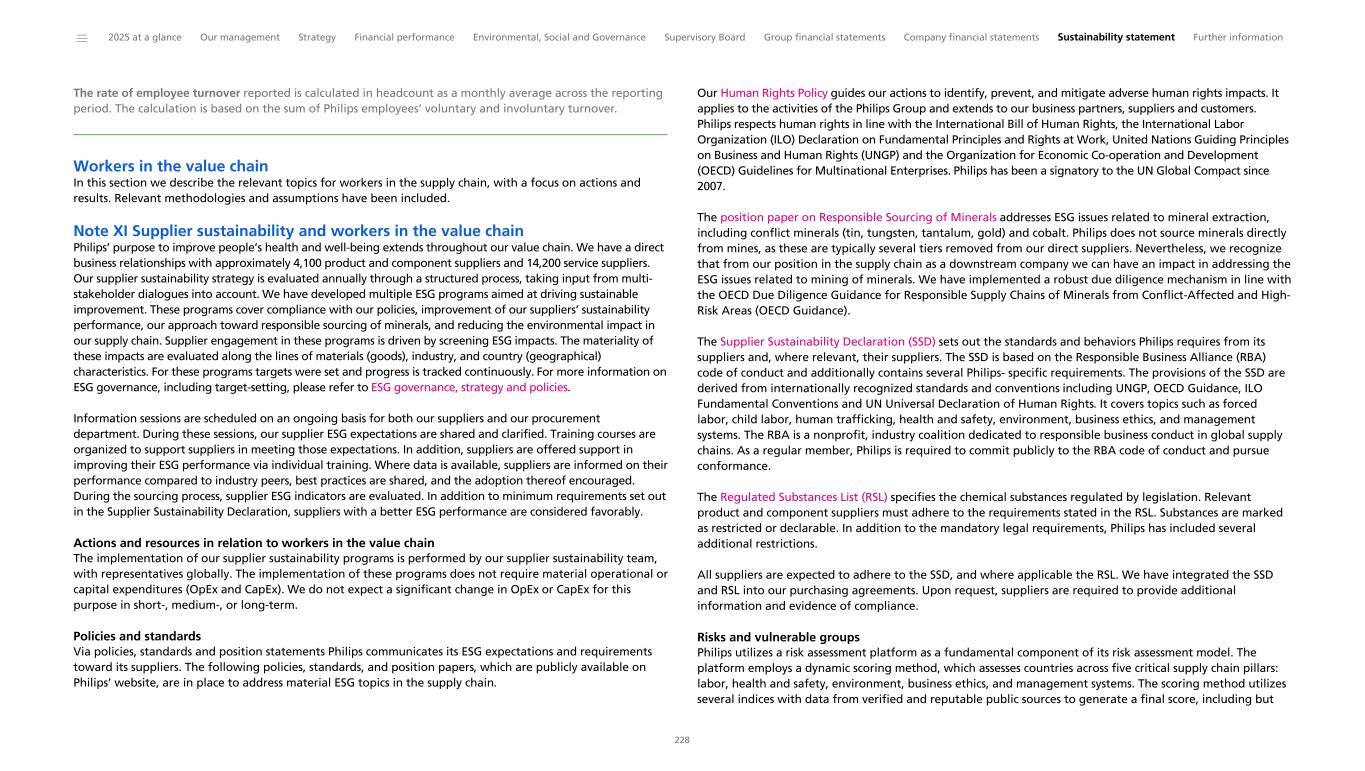
The rate of employee turnover reported is calculated in headcount as a monthly average across the reporting period. The calculation is based on the sum of Philips employees’ voluntary and involuntary turnover. Workers in the value chain In this section we describe the relevant topics for workers in the supply chain, with a focus on actions and results. Relevant methodologies and assumptions have been included. Note XI Supplier sustainability and workers in the value chain Philips’ purpose to improve people’s health and well-being extends throughout our value chain. We have a direct business relationships with approximately 4,100 product and component suppliers and 14,200 service suppliers. Our supplier sustainability strategy is evaluated annually through a structured process, taking input from multi- stakeholder dialogues into account. We have developed multiple ESG programs aimed at driving sustainable improvement. These programs cover compliance with our policies, improvement of our suppliers’ sustainability performance, our approach toward responsible sourcing of minerals, and reducing the environmental impact in our supply chain. Supplier engagement in these programs is driven by screening ESG impacts. The materiality of these impacts are evaluated along the lines of materials (goods), industry, and country (geographical) characteristics. For these programs targets were set and progress is tracked continuously. For more information on ESG governance, including target-setting, please refer to ESG governance, strategy and policies. Information sessions are scheduled on an ongoing basis for both our suppliers and our procurement department. During these sessions, our supplier ESG expectations are shared and clarified. Training courses are organized to support suppliers in meeting those expectations. In addition, suppliers are offered support in improving their ESG performance via individual training. Where data is available, suppliers are informed on their performance compared to industry peers, best practices are shared, and the adoption thereof encouraged. During the sourcing process, supplier ESG indicators are evaluated. In addition to minimum requirements set out in the Supplier Sustainability Declaration, suppliers with a better ESG performance are considered favorably. Actions and resources in relation to workers in the value chain The implementation of our supplier sustainability programs is performed by our supplier sustainability team, with representatives globally. The implementation of these programs does not require material operational or capital expenditures (OpEx and CapEx). We do not expect a significant change in OpEx or CapEx for this purpose in short-, medium-, or long-term. Policies and standards Via policies, standards and position statements Philips communicates its ESG expectations and requirements toward its suppliers. The following policies, standards, and position papers, which are publicly available on Philips’ website, are in place to address material ESG topics in the supply chain. Our Human Rights Policy guides our actions to identify, prevent, and mitigate adverse human rights impacts. It applies to the activities of the Philips Group and extends to our business partners, suppliers and customers. Philips respects human rights in line with the International Bill of Human Rights, the International Labor Organization (ILO) Declaration on Fundamental Principles and Rights at Work, United Nations Guiding Principles on Business and Human Rights (UNGP) and the Organization for Economic Co-operation and Development (OECD) Guidelines for Multinational Enterprises. Philips has been a signatory to the UN Global Compact since 2007. The position paper on Responsible Sourcing of Minerals addresses ESG issues related to mineral extraction, including conflict minerals (tin, tungsten, tantalum, gold) and cobalt. Philips does not source minerals directly from mines, as these are typically several tiers removed from our direct suppliers. Nevertheless, we recognize that from our position in the supply chain as a downstream company we can have an impact in addressing the ESG issues related to mining of minerals. We have implemented a robust due diligence mechanism in line with the OECD Due Diligence Guidance for Responsible Supply Chains of Minerals from Conflict-Affected and High- Risk Areas (OECD Guidance). The Supplier Sustainability Declaration (SSD) sets out the standards and behaviors Philips requires from its suppliers and, where relevant, their suppliers. The SSD is based on the Responsible Business Alliance (RBA) code of conduct and additionally contains several Philips- specific requirements. The provisions of the SSD are derived from internationally recognized standards and conventions including UNGP, OECD Guidance, ILO Fundamental Conventions and UN Universal Declaration of Human Rights. It covers topics such as forced labor, child labor, human trafficking, health and safety, environment, business ethics, and management systems. The RBA is a nonprofit, industry coalition dedicated to responsible business conduct in global supply chains. As a regular member, Philips is required to commit publicly to the RBA code of conduct and pursue conformance. The Regulated Substances List (RSL) specifies the chemical substances regulated by legislation. Relevant product and component suppliers must adhere to the requirements stated in the RSL. Substances are marked as restricted or declarable. In addition to the mandatory legal requirements, Philips has included several additional restrictions. All suppliers are expected to adhere to the SSD, and where applicable the RSL. We have integrated the SSD and RSL into our purchasing agreements. Upon request, suppliers are required to provide additional information and evidence of compliance. Risks and vulnerable groups Philips utilizes a risk assessment platform as a fundamental component of its risk assessment model. The platform employs a dynamic scoring method, which assesses countries across five critical supply chain pillars: labor, health and safety, environment, business ethics, and management systems. The scoring method utilizes several indices with data from verified and reputable public sources to generate a final score, including but ______ 2025 at a glance Our management Strategy Financial performance Environmental, Social and Governance Supervisory Board Group financial statements Company financial statements Sustainability statement Further information 228
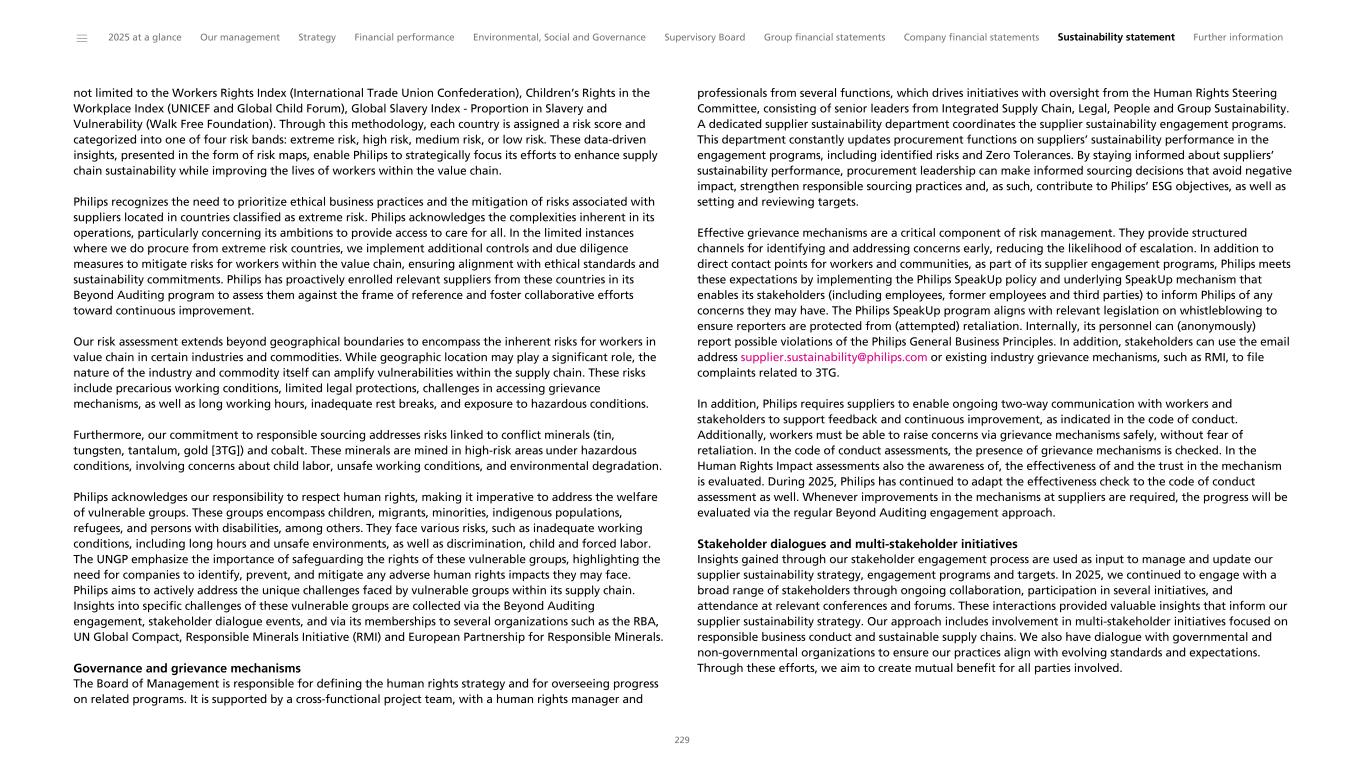
not limited to the Workers Rights Index (International Trade Union Confederation), Children’s Rights in the Workplace Index (UNICEF and Global Child Forum), Global Slavery Index - Proportion in Slavery and Vulnerability (Walk Free Foundation). Through this methodology, each country is assigned a risk score and categorized into one of four risk bands: extreme risk, high risk, medium risk, or low risk. These data-driven insights, presented in the form of risk maps, enable Philips to strategically focus its efforts to enhance supply chain sustainability while improving the lives of workers within the value chain. Philips recognizes the need to prioritize ethical business practices and the mitigation of risks associated with suppliers located in countries classified as extreme risk. Philips acknowledges the complexities inherent in its operations, particularly concerning its ambitions to provide access to care for all. In the limited instances where we do procure from extreme risk countries, we implement additional controls and due diligence measures to mitigate risks for workers within the value chain, ensuring alignment with ethical standards and sustainability commitments. Philips has proactively enrolled relevant suppliers from these countries in its Beyond Auditing program to assess them against the frame of reference and foster collaborative efforts toward continuous improvement. Our risk assessment extends beyond geographical boundaries to encompass the inherent risks for workers in value chain in certain industries and commodities. While geographic location may play a significant role, the nature of the industry and commodity itself can amplify vulnerabilities within the supply chain. These risks include precarious working conditions, limited legal protections, challenges in accessing grievance mechanisms, as well as long working hours, inadequate rest breaks, and exposure to hazardous conditions. Furthermore, our commitment to responsible sourcing addresses risks linked to conflict minerals (tin, tungsten, tantalum, gold [3TG]) and cobalt. These minerals are mined in high-risk areas under hazardous conditions, involving concerns about child labor, unsafe working conditions, and environmental degradation. Philips acknowledges our responsibility to respect human rights, making it imperative to address the welfare of vulnerable groups. These groups encompass children, migrants, minorities, indigenous populations, refugees, and persons with disabilities, among others. They face various risks, such as inadequate working conditions, including long hours and unsafe environments, as well as discrimination, child and forced labor. The UNGP emphasize the importance of safeguarding the rights of these vulnerable groups, highlighting the need for companies to identify, prevent, and mitigate any adverse human rights impacts they may face. Philips aims to actively address the unique challenges faced by vulnerable groups within its supply chain. Insights into specific challenges of these vulnerable groups are collected via the Beyond Auditing engagement, stakeholder dialogue events, and via its memberships to several organizations such as the RBA, UN Global Compact, Responsible Minerals Initiative (RMI) and European Partnership for Responsible Minerals. Governance and grievance mechanisms The Board of Management is responsible for defining the human rights strategy and for overseeing progress on related programs. It is supported by a cross-functional project team, with a human rights manager and professionals from several functions, which drives initiatives with oversight from the Human Rights Steering Committee, consisting of senior leaders from Integrated Supply Chain, Legal, People and Group Sustainability. A dedicated supplier sustainability department coordinates the supplier sustainability engagement programs. This department constantly updates procurement functions on suppliers’ sustainability performance in the engagement programs, including identified risks and Zero Tolerances. By staying informed about suppliers’ sustainability performance, procurement leadership can make informed sourcing decisions that avoid negative impact, strengthen responsible sourcing practices and, as such, contribute to Philips’ ESG objectives, as well as setting and reviewing targets. Effective grievance mechanisms are a critical component of risk management. They provide structured channels for identifying and addressing concerns early, reducing the likelihood of escalation. In addition to direct contact points for workers and communities, as part of its supplier engagement programs, Philips meets these expectations by implementing the Philips SpeakUp policy and underlying SpeakUp mechanism that enables its stakeholders (including employees, former employees and third parties) to inform Philips of any concerns they may have. The Philips SpeakUp program aligns with relevant legislation on whistleblowing to ensure reporters are protected from (attempted) retaliation. Internally, its personnel can (anonymously) report possible violations of the Philips General Business Principles. In addition, stakeholders can use the email address supplier.sustainability@philips.com or existing industry grievance mechanisms, such as RMI, to file complaints related to 3TG. In addition, Philips requires suppliers to enable ongoing two-way communication with workers and stakeholders to support feedback and continuous improvement, as indicated in the code of conduct. Additionally, workers must be able to raise concerns via grievance mechanisms safely, without fear of retaliation. In the code of conduct assessments, the presence of grievance mechanisms is checked. In the Human Rights Impact assessments also the awareness of, the effectiveness of and the trust in the mechanism is evaluated. During 2025, Philips has continued to adapt the effectiveness check to the code of conduct assessment as well. Whenever improvements in the mechanisms at suppliers are required, the progress will be evaluated via the regular Beyond Auditing engagement approach. Stakeholder dialogues and multi-stakeholder initiatives Insights gained through our stakeholder engagement process are used as input to manage and update our supplier sustainability strategy, engagement programs and targets. In 2025, we continued to engage with a broad range of stakeholders through ongoing collaboration, participation in several initiatives, and attendance at relevant conferences and forums. These interactions provided valuable insights that inform our supplier sustainability strategy. Our approach includes involvement in multi-stakeholder initiatives focused on responsible business conduct and sustainable supply chains. We also have dialogue with governmental and non-governmental organizations to ensure our practices align with evolving standards and expectations. Through these efforts, we aim to create mutual benefit for all parties involved. ______ 2025 at a glance Our management Strategy Financial performance Environmental, Social and Governance Supervisory Board Group financial statements Company financial statements Sustainability statement Further information 229
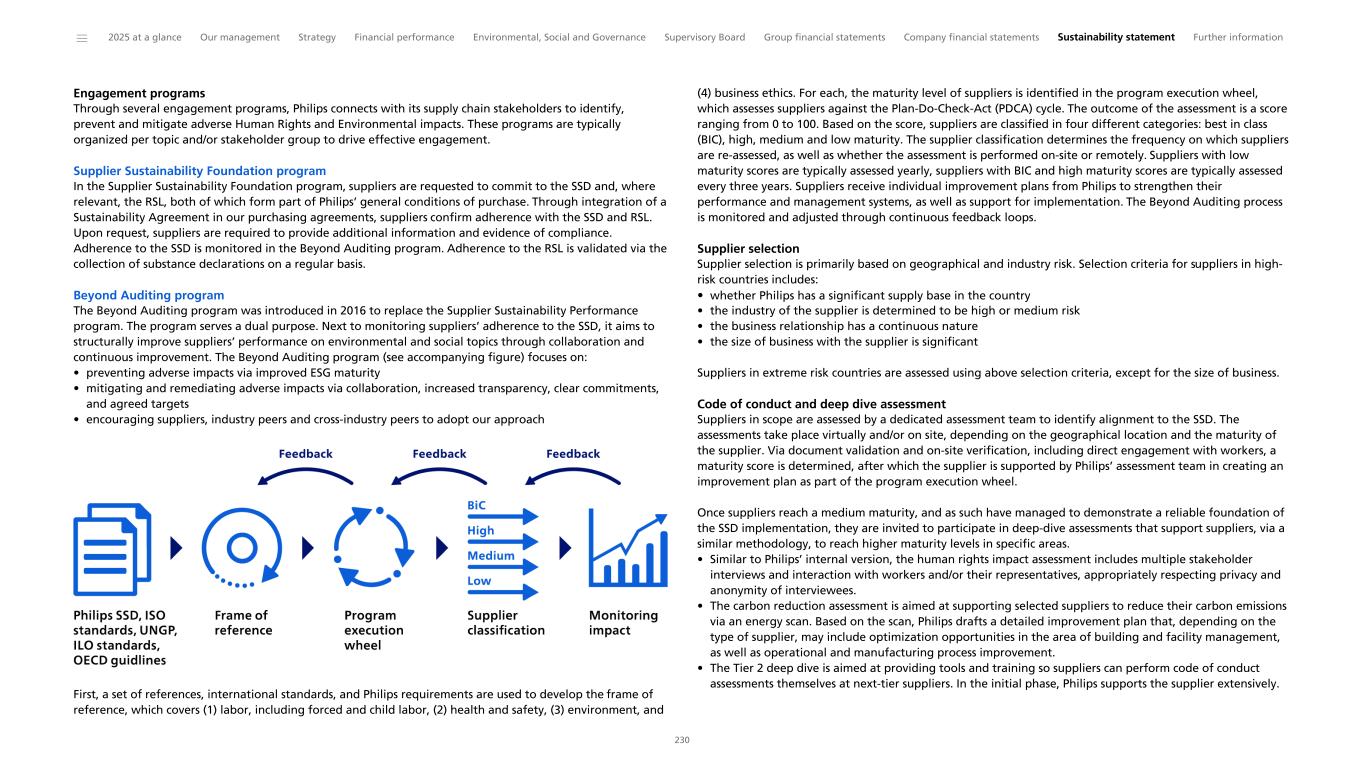
Engagement programs Through several engagement programs, Philips connects with its supply chain stakeholders to identify, prevent and mitigate adverse Human Rights and Environmental impacts. These programs are typically organized per topic and/or stakeholder group to drive effective engagement. Supplier Sustainability Foundation program In the Supplier Sustainability Foundation program, suppliers are requested to commit to the SSD and, where relevant, the RSL, both of which form part of Philips’ general conditions of purchase. Through integration of a Sustainability Agreement in our purchasing agreements, suppliers confirm adherence with the SSD and RSL. Upon request, suppliers are required to provide additional information and evidence of compliance. Adherence to the SSD is monitored in the Beyond Auditing program. Adherence to the RSL is validated via the collection of substance declarations on a regular basis. Beyond Auditing program The Beyond Auditing program was introduced in 2016 to replace the Supplier Sustainability Performance program. The program serves a dual purpose. Next to monitoring suppliers’ adherence to the SSD, it aims to structurally improve suppliers’ performance on environmental and social topics through collaboration and continuous improvement. The Beyond Auditing program (see accompanying figure) focuses on: • preventing adverse impacts via improved ESG maturity • mitigating and remediating adverse impacts via collaboration, increased transparency, clear commitments, and agreed targets • encouraging suppliers, industry peers and cross-industry peers to adopt our approach First, a set of references, international standards, and Philips requirements are used to develop the frame of reference, which covers (1) labor, including forced and child labor, (2) health and safety, (3) environment, and (4) business ethics. For each, the maturity level of suppliers is identified in the program execution wheel, which assesses suppliers against the Plan-Do-Check-Act (PDCA) cycle. The outcome of the assessment is a score ranging from 0 to 100. Based on the score, suppliers are classified in four different categories: best in class (BIC), high, medium and low maturity. The supplier classification determines the frequency on which suppliers are re-assessed, as well as whether the assessment is performed on-site or remotely. Suppliers with low maturity scores are typically assessed yearly, suppliers with BIC and high maturity scores are typically assessed every three years. Suppliers receive individual improvement plans from Philips to strengthen their performance and management systems, as well as support for implementation. The Beyond Auditing process is monitored and adjusted through continuous feedback loops. Supplier selection Supplier selection is primarily based on geographical and industry risk. Selection criteria for suppliers in high- risk countries includes: • whether Philips has a significant supply base in the country • the industry of the supplier is determined to be high or medium risk • the business relationship has a continuous nature • the size of business with the supplier is significant Suppliers in extreme risk countries are assessed using above selection criteria, except for the size of business. Code of conduct and deep dive assessment Suppliers in scope are assessed by a dedicated assessment team to identify alignment to the SSD. The assessments take place virtually and/or on site, depending on the geographical location and the maturity of the supplier. Via document validation and on-site verification, including direct engagement with workers, a maturity score is determined, after which the supplier is supported by Philips’ assessment team in creating an improvement plan as part of the program execution wheel. Once suppliers reach a medium maturity, and as such have managed to demonstrate a reliable foundation of the SSD implementation, they are invited to participate in deep-dive assessments that support suppliers, via a similar methodology, to reach higher maturity levels in specific areas. • Similar to Philips’ internal version, the human rights impact assessment includes multiple stakeholder interviews and interaction with workers and/or their representatives, appropriately respecting privacy and anonymity of interviewees. • The carbon reduction assessment is aimed at supporting selected suppliers to reduce their carbon emissions via an energy scan. Based on the scan, Philips drafts a detailed improvement plan that, depending on the type of supplier, may include optimization opportunities in the area of building and facility management, as well as operational and manufacturing process improvement. • The Tier 2 deep dive is aimed at providing tools and training so suppliers can perform code of conduct assessments themselves at next-tier suppliers. In the initial phase, Philips supports the supplier extensively. ______ 2025 at a glance Our management Strategy Financial performance Environmental, Social and Governance Supervisory Board Group financial statements Company financial statements Sustainability statement Further information 230
Zero tolerance approach During supplier assessments Philips may identify significant compliance gaps with the SSD, so-called zero tolerances. Philips specifies seven types of zero tolerances: • child labor • forced labor • immediate threats to the environment • immediate threats to worker health and safety • remuneration/workers’ monthly income (covering salary for regular hours and overtime, tax deductions, social insurance) failing to meet regulatory requirements • fake or falsified records • failure to comply with regulatory and/or Philips requirements If a potential zero tolerance is identified, additional information is collected and used to conclude whether the zero tolerance can be confirmed. If confirmed, the supplier is required to: • propose a corrective action plan to mitigate and/or resolve the identified zero tolerance(s) • commit to structurally resolving the zero tolerance • provide regular updates and evidence of remediation • avoid quick-fixing to prevent recurrence Results As part of our commitment to improve the lives of 1 million workers in the supply chain by 2025, Philips measures the impact of the Beyond Auditing engagements through the number of lives improved in the supply chain. This is derived from the improvements that suppliers make in their performance. The number of workers at suppliers participating in the Beyond Auditing program, as reported by suppliers at the time of assessment, was approximately 1.072 million in 2025. From 2026 onward, this KPI will be reported as improved working conditions in our supply chain. Philips Group Lives improved in the supply chain in thousands of Lives 2025 2024 2023 Lives improved in the supply chain 1,072 936 723 Philips Group Beyond Auditing supplier coverage 2025 2024 2023 Suppliers added to the scope 106 105 158 Suppliers in scope from previous years 426 350 234 Suppliers removed from scope 29 42 15 In 2025, 214 assessments took place in total. The total number of assessments is lower than the total number of suppliers in scope of the program as mature suppliers are assessed in a two- or three-year cycle. At the end of 2025, we had 532 suppliers participating in the Beyond Auditing program. A breakdown per type of assessment is provided in the accompanying table. Philips Group Beyond Auditing supplier assessment coverage Assessment type 2025 2024 2023 Code of Conduct 113 148 129 Deepdive Human Rights Impact 9 5 8 Deepdive Carbon Reduction 20 22 19 Deepdive Tier 2 72 69 110 Total 214 244 266 By analyzing the improvement of maturity scores over time, Philips can track the development of individual suppliers. In addition, the consolidation of the average improvement can provide insights into the effectiveness of the Beyond Auditing program. The accompanying table indicates the average improvement of suppliers that were assessed in 2025, compared with their previous score. As suppliers mature, incremental improvements generally become more challenging, as the initial, more accessible improvement opportunities have largely been implemented. In addition, the improvement is split out per chapter of the frame of reference. Philips Group Beyond Auditing supplier improvements results Frame of reference chapter Improvement rate Labor 20% Health & safety 30% Environment 16% Business ethics 23% Overall 22% In 2025, eight zero tolerances were found across the following categories: health and safety, remuneration, labor, and environment. Four cases were successfully closed during the year; four cases are being addressed in ongoing corrective actions. In addition, four zero tolerances dating from 2024 were also successfully closed during the year. Additional progress made in 2025 Philips applies the latest insights in data science and machine learning methods to make the Beyond Auditing program more efficient. Using reference data from over 1,600 assessments conducted in the past years, Philips is working to integrate maturity and improvement predictions to help determine the suppliers’ sustainability ______ 2025 at a glance Our management Strategy Financial performance Environmental, Social and Governance Supervisory Board Group financial statements Company financial statements Sustainability statement Further information 231
maturity while increasing the effectiveness of our improvement strategy. On an annual basis, Philips experts organize quality trainings in the sustainability area for suppliers in the scope of the Beyond Auditing program. Leveraging insights from earlier Beyond Auditing assessments, Philips has been developing predictive analytics capabilities to identify adverse and positive impacts. These capabilities will support the expansion of supplier enrollment across other geographies. This strategic approach reinforces Philips’ commitment to enhancing supply chain sustainability and driving positive change. Responsible sourcing of minerals The supply chains for minerals are long and complex. Philips does not source minerals directly from mines as there are many tiers between end-user companies like Philips and the mines where the minerals are extracted. The extraction of minerals can take place in conflict-affected and high-risk areas, where mining is often informal and unregulated, and carried out at artisanal small-scale mines (ASM). These ASMs are vulnerable to exploitation by armed groups and local traders. Within this context, there is an increased risk of severe human rights violations (forced labor, child labor or widespread sexual violence), unsafe working conditions or environmental concerns. Philips addresses the complexities of mineral supply chains through a continuous due diligence process, combined with active participation in multi-stakeholder initiatives to promote responsible sourcing. Conflict minerals due diligence Each year, Philips investigates its supply chain to identify smelters of 3TG in its supply chain, and we have committed to not purchasing raw materials, sub-assemblies, or supplies found to contain conflict minerals. Supplier selection for the conflict minerals program is primarily based on industry and materials (component) risk. Philips uses a system to classify suppliers in commodity groups, for example, plastics, packaging, and metals. The top 80% of suppliers (based on procurement spend) that are in relevant commodities for conflict minerals are selected. Philips does not select suppliers for this program if they are in commodity groups for which it is unlikely that one or more of the 3TGs are contained in the products. For example, software and packaging suppliers. In addition, suppliers that provide a high quantity of 3TG materials are also selected, even if these suppliers are not part of the top 80%. Philips applies collective cross-industry leverage through active engagement via the RMI. RMI, via its Responsible Minerals Assurance Process (RMAP), identifies smelters that can demonstrate, through an independent third-party audit, that the minerals they procure are sourced responsibly. The Philips Conflict Minerals Due Diligence framework, measures, and outcomes are described in the Conflict Minerals Report that we file annually to the US Securities and Exchange Commission (SEC). The conflict minerals report is also publicly available on Philips’ website. Philips aligns its due diligence processes with OECD Due Diligence Guidance for Responsible Supply Chains of Minerals from Conflict-Affected and High-Risk Areas (OECD Guidance). Philips’ approach to responsible sourcing Due diligence The OECD offers a five-step framework for risk-based due diligence in the mineral supply chain. 1 2 3 4 5 Establish strong company management systems u Identify and assess risks in the supply chain u Design and implement a strategy u Carry out independent third-party audit u Report on supply chain due diligence Each year, we work with our suppliers on the quality of their due diligence by setting minimum criteria for the Conflict Minerals Reporting Templates (CMRT). These minimum criteria are annually reviewed and strengthened where relevant. The percentage of CMRTs that satisfied minimum acceptance criteria was 76%. Philips tracks the effectiveness and impact of its program via the response rate of suppliers, as well as CMRTs that satisfied minimum acceptance criteria. Philips Group Conflict Minerals Due Diligence results Response rate of suppliers (%) 98% 97% 95% CMRTs that reached minimum acceptance criteria (%) 76% 78% 65% Key performance indicator 2025 2024 2023 Cobalt Philips uses cobalt predominantly in lithium-ion batteries and has performed due diligence on cobalt since 2019. As part of this initiative, we engaged suppliers that provide materials containing cobalt. In 2025, we again reached a 100% response rate (2024: 100%). ______ 2025 at a glance Our management Strategy Financial performance Environmental, Social and Governance Supervisory Board Group financial statements Company financial statements Sustainability statement Further information 232
Supplier decarbonization program Since 2003, Philips has been looking for ways to improve the environmental performance of its suppliers. When it comes to climate change, we have adopted a multi-pronged approach: reducing the environmental impact of our products, committing to carbon neutrality in our own operations, and engaging with our supply chain to reduce their carbon footprint. Through initiatives such as the CDP supply chain program, Philips motivates its suppliers to disclose emissions, embed board responsibility on climate change, and actively work on reduction activities. In 2025, we achieved our goal, announced during COP26 in October 2021, to have at least 50% of our suppliers (based on spend) committed to science-based targets for carbon reduction. In total, 38% of product and component suppliers and 74% of relevant service suppliers (based on spend) committed. Philips Group % of suppliers committed to science-based targets 2025 2024 2023 % of suppliers committed to Science Based Targets 52% 48% 46% We consider suppliers to have committed when communicated via the Science Based Targets initiative (SBTi), the suppliers’ CDP disclosures, or public websites and announcements (on a ’Science Based Target’, ’Net Zero Target’, or equivalent). We consider spend to be relevant if it relates to product and component suppliers and relevant service providers, such as logistics and information technology suppliers. Multiple activities have been deployed to help us achieve this climate target. CDP engagement: Since 2011 we have been partnering with CDP Supply Chain, through which we invite suppliers to disclose their environmental performance and carbon intensity. With nearly 500 of our suppliers included in the CDP engagement program in 2025, CDP confirmed Philips is in the top tier in terms of its supplier engagement coverage and was recognized again as a supplier engagement leader by CDP. Suppliers are selected based on the size of the relationship (procurement spend) as well as their industry. In 2025, there was a response rate of 90% (2024: 88%). Of the group that responded, 69% has a climate transition plan in place or is committed to developing so. In addition, 39% engages their suppliers on environmental performance and decarbonization. In the 2025 survey, our suppliers reported 80 million metric tonnes CO2-e savings from improvement projects undertaken in 2024. Philips Group Supplier response rate to CDP questionnaire 2025 2024 2023 Supplier response rate to CDP questionnaire 90% 88% 93% Data-driven insights: Through accurate data insights, Philips’ buyers are enabled to consider climate action in their supplier selection. In 2025, 52% of our purchases (in spend) were made at suppliers that have committed to science-based CO2-e reduction targets. Capability building: We support suppliers in advancing their company approach to climate action, offering guidance that is tailored to their climate action maturity. Based on 2025 insights, we provided tailored feedback and guidance for 68% of our suppliers to support their growth in capabilities and help improve their approach. Opportunities for decarbonization: Through on-site assessments we identify energy efficiency opportunities that enable our suppliers to make cost-effective carbon reductions. Our team supports suppliers in their calculations on cost impact as well as the return. In 2025, 20 on-site assessments took place (2024: 22), which resulted in tailored plans for improvement. Payment practices With approximately 4,100 product and component suppliers and 14,200 service providers, Philips strives to ensure timely payments to its business partners (vendors), especially with respect to small and medium enterprises (SMEs). Our suppliers are categorized as SMEs (small and medium enterprises) and non-SMEs using the EU definition of SME, where an enterprise has fewer than 250 employees, their turnover is less than or equal to EUR 50 million, or their balance sheet total is less than EUR 43 million. Philips’ payment terms are 95 days EOM (ninety-five days from the end of the month in which the correct invoice is received) for suppliers located in Asia Pacific (APAC), North America (NAM) and Latin America (LATAM). For suppliers located in the rest of the world, which include Europe, Middle East and Africa (EMEA), Philips’ payment terms are 65 days EOM. Exceptions to the above contractual payment terms can be the result of: • specific country rules and regulations that are legally binding upon Philips and therewith restricting the payment terms to be applied • SME-specific standard payment terms that are country specific, based on legal requirements • specific (sub-)categories referred to as ‘Non-Purchasing Spend’, which includes invoices related to taxes, and sales-related costs, including rebates, customs, personnel related payments, banks, donations, and charities • Specific supply market conditions (e.g., shortages, local market practices, etc.) On average, Philips takes 52 days to pay an SME supplier and 62 days to pay a non-SME supplier (was 78 days in 2024 at Philips Group level). Year-on-year reduction in days to pay is due to a change in payment practice reporting methodology, where 2024 reporting relied on the use of sampling. Payments on-time to SME and non-SME suppliers are at 92% (2024: 96% at Philips Group level). These figures are based on invoices paid to suppliers in 2025 averaging based on the number of invoices, where Philips calculates payment terms from the date or month that the correct invoice is received. ______ 2025 at a glance Our management Strategy Financial performance Environmental, Social and Governance Supervisory Board Group financial statements Company financial statements Sustainability statement Further information 233
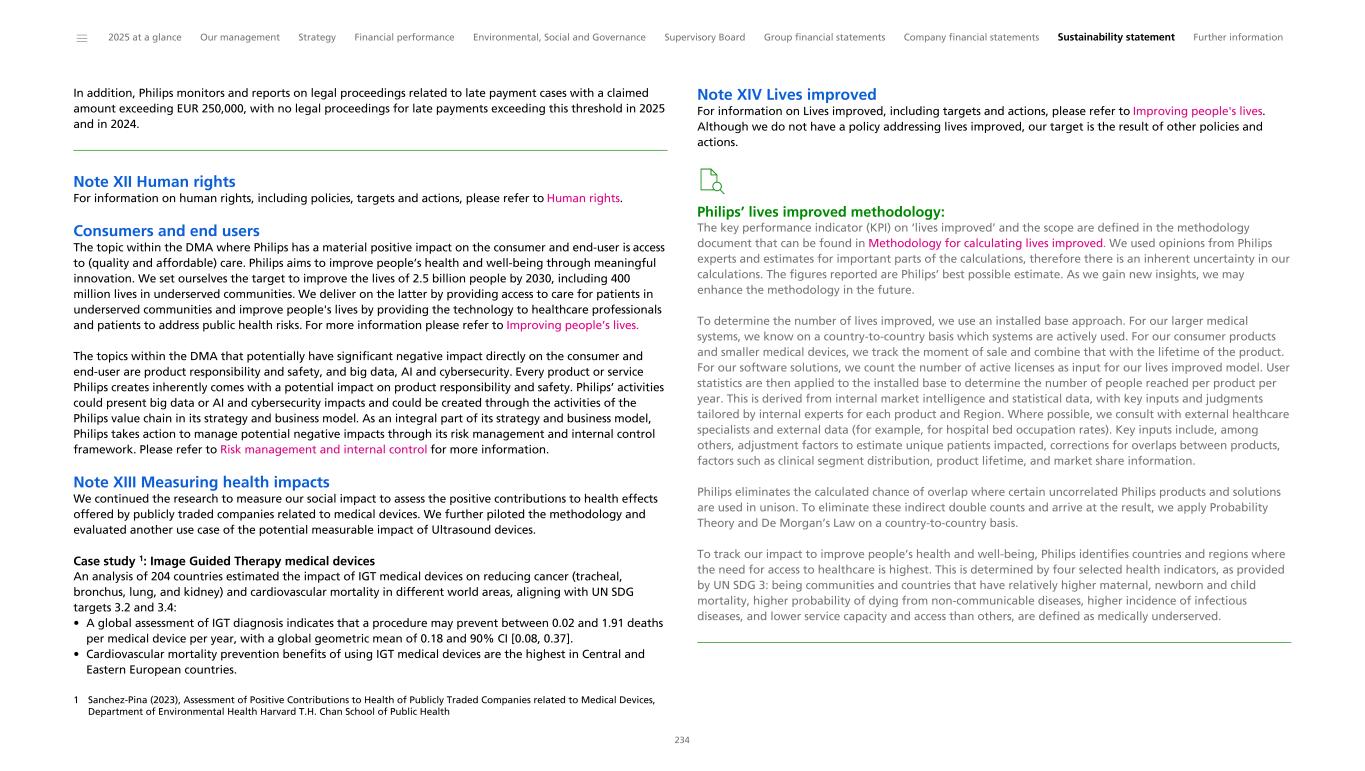
In addition, Philips monitors and reports on legal proceedings related to late payment cases with a claimed amount exceeding EUR 250,000, with no legal proceedings for late payments exceeding this threshold in 2025 and in 2024. Note XII Human rights For information on human rights, including policies, targets and actions, please refer to Human rights. Consumers and end users The topic within the DMA where Philips has a material positive impact on the consumer and end-user is access to (quality and affordable) care. Philips aims to improve people’s health and well-being through meaningful innovation. We set ourselves the target to improve the lives of 2.5 billion people by 2030, including 400 million lives in underserved communities. We deliver on the latter by providing access to care for patients in underserved communities and improve people's lives by providing the technology to healthcare professionals and patients to address public health risks. For more information please refer to Improving people’s lives. The topics within the DMA that potentially have significant negative impact directly on the consumer and end-user are product responsibility and safety, and big data, AI and cybersecurity. Every product or service Philips creates inherently comes with a potential impact on product responsibility and safety. Philips’ activities could present big data or AI and cybersecurity impacts and could be created through the activities of the Philips value chain in its strategy and business model. As an integral part of its strategy and business model, Philips takes action to manage potential negative impacts through its risk management and internal control framework. Please refer to Risk management and internal control for more information. Note XIII Measuring health impacts We continued the research to measure our social impact to assess the positive contributions to health effects offered by publicly traded companies related to medical devices. We further piloted the methodology and evaluated another use case of the potential measurable impact of Ultrasound devices. Case study 1: Image Guided Therapy medical devices An analysis of 204 countries estimated the impact of IGT medical devices on reducing cancer (tracheal, bronchus, lung, and kidney) and cardiovascular mortality in different world areas, aligning with UN SDG targets 3.2 and 3.4: • A global assessment of IGT diagnosis indicates that a procedure may prevent between 0.02 and 1.91 deaths per medical device per year, with a global geometric mean of 0.18 and 90% CI [0.08, 0.37]. • Cardiovascular mortality prevention benefits of using IGT medical devices are the highest in Central and Eastern European countries. 1 Sanchez-Pina (2023), Assessment of Positive Contributions to Health of Publicly Traded Companies related to Medical Devices, Department of Environmental Health Harvard T.H. Chan School of Public Health Note XIV Lives improved For information on Lives improved, including targets and actions, please refer to Improving people's lives. Although we do not have a policy addressing lives improved, our target is the result of other policies and actions. Philips’ lives improved methodology: The key performance indicator (KPI) on ‘lives improved’ and the scope are defined in the methodology document that can be found in Methodology for calculating lives improved. We used opinions from Philips experts and estimates for important parts of the calculations, therefore there is an inherent uncertainty in our calculations. The figures reported are Philips’ best possible estimate. As we gain new insights, we may enhance the methodology in the future. To determine the number of lives improved, we use an installed base approach. For our larger medical systems, we know on a country-to-country basis which systems are actively used. For our consumer products and smaller medical devices, we track the moment of sale and combine that with the lifetime of the product. For our software solutions, we count the number of active licenses as input for our lives improved model. User statistics are then applied to the installed base to determine the number of people reached per product per year. This is derived from internal market intelligence and statistical data, with key inputs and judgments tailored by internal experts for each product and Region. Where possible, we consult with external healthcare specialists and external data (for example, for hospital bed occupation rates). Key inputs include, among others, adjustment factors to estimate unique patients impacted, corrections for overlaps between products, factors such as clinical segment distribution, product lifetime, and market share information. Philips eliminates the calculated chance of overlap where certain uncorrelated Philips products and solutions are used in unison. To eliminate these indirect double counts and arrive at the result, we apply Probability Theory and De Morgan’s Law on a country-to-country basis. To track our impact to improve people’s health and well-being, Philips identifies countries and regions where the need for access to healthcare is highest. This is determined by four selected health indicators, as provided by UN SDG 3: being communities and countries that have relatively higher maternal, newborn and child mortality, higher probability of dying from non-communicable diseases, higher incidence of infectious diseases, and lower service capacity and access than others, are defined as medically underserved. ______ 2025 at a glance Our management Strategy Financial performance Environmental, Social and Governance Supervisory Board Group financial statements Company financial statements Sustainability statement Further information 234
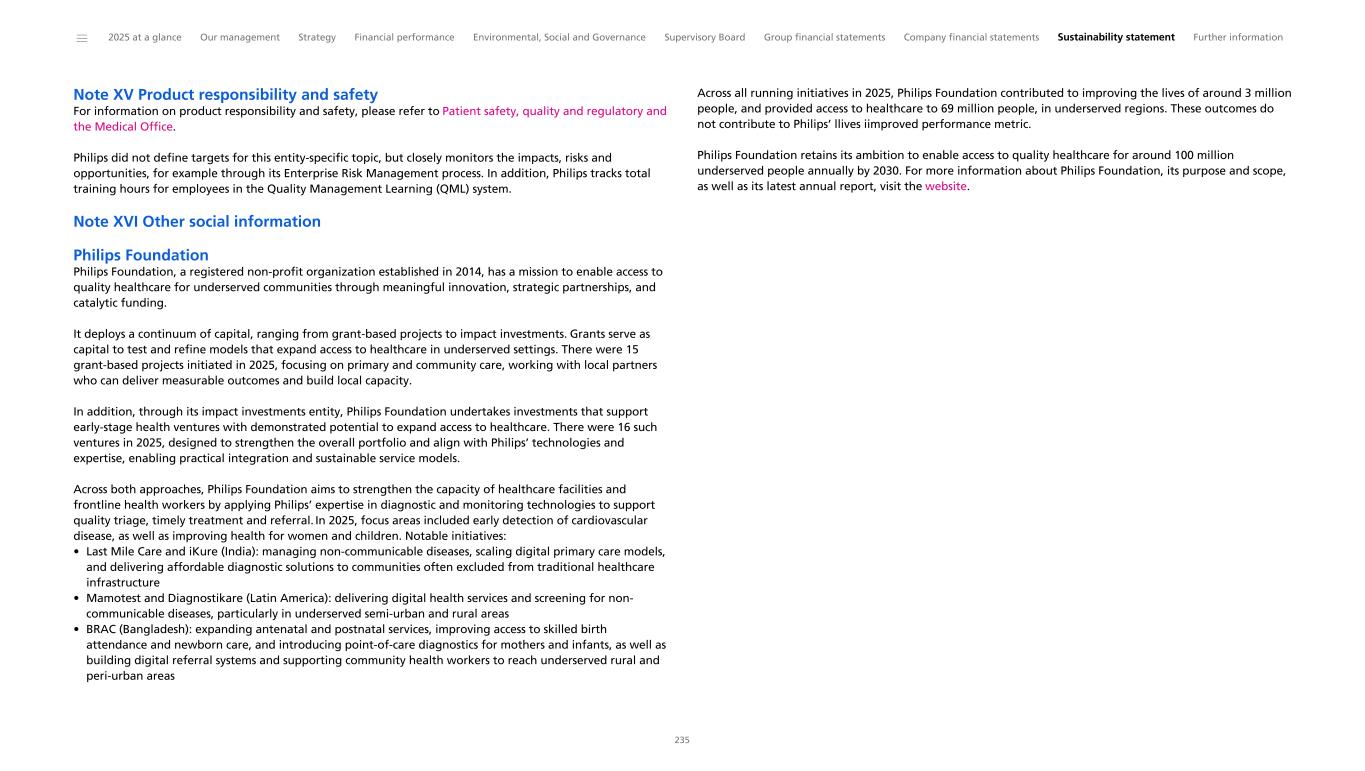
Note XV Product responsibility and safety For information on product responsibility and safety, please refer to Patient safety, quality and regulatory and the Medical Office. Philips did not define targets for this entity-specific topic, but closely monitors the impacts, risks and opportunities, for example through its Enterprise Risk Management process. In addition, Philips tracks total training hours for employees in the Quality Management Learning (QML) system. Note XVI Other social information Philips Foundation Philips Foundation, a registered non-profit organization established in 2014, has a mission to enable access to quality healthcare for underserved communities through meaningful innovation, strategic partnerships, and catalytic funding. It deploys a continuum of capital, ranging from grant-based projects to impact investments. Grants serve as capital to test and refine models that expand access to healthcare in underserved settings. There were 15 grant-based projects initiated in 2025, focusing on primary and community care, working with local partners who can deliver measurable outcomes and build local capacity. In addition, through its impact investments entity, Philips Foundation undertakes investments that support early-stage health ventures with demonstrated potential to expand access to healthcare. There were 16 such ventures in 2025, designed to strengthen the overall portfolio and align with Philips’ technologies and expertise, enabling practical integration and sustainable service models. Across both approaches, Philips Foundation aims to strengthen the capacity of healthcare facilities and frontline health workers by applying Philips’ expertise in diagnostic and monitoring technologies to support quality triage, timely treatment and referral. In 2025, focus areas included early detection of cardiovascular disease, as well as improving health for women and children. Notable initiatives: • Last Mile Care and iKure (India): managing non-communicable diseases, scaling digital primary care models, and delivering affordable diagnostic solutions to communities often excluded from traditional healthcare infrastructure • Mamotest and Diagnostikare (Latin America): delivering digital health services and screening for non- communicable diseases, particularly in underserved semi-urban and rural areas • BRAC (Bangladesh): expanding antenatal and postnatal services, improving access to skilled birth attendance and newborn care, and introducing point-of-care diagnostics for mothers and infants, as well as building digital referral systems and supporting community health workers to reach underserved rural and peri-urban areas Across all running initiatives in 2025, Philips Foundation contributed to improving the lives of around 3 million people, and provided access to healthcare to 69 million people, in underserved regions. These outcomes do not contribute to Philips’ llives iimproved performance metric. Philips Foundation retains its ambition to enable access to quality healthcare for around 100 million underserved people annually by 2030. For more information about Philips Foundation, its purpose and scope, as well as its latest annual report, visit the website. ______ 2025 at a glance Our management Strategy Financial performance Environmental, Social and Governance Supervisory Board Group financial statements Company financial statements Sustainability statement Further information 235
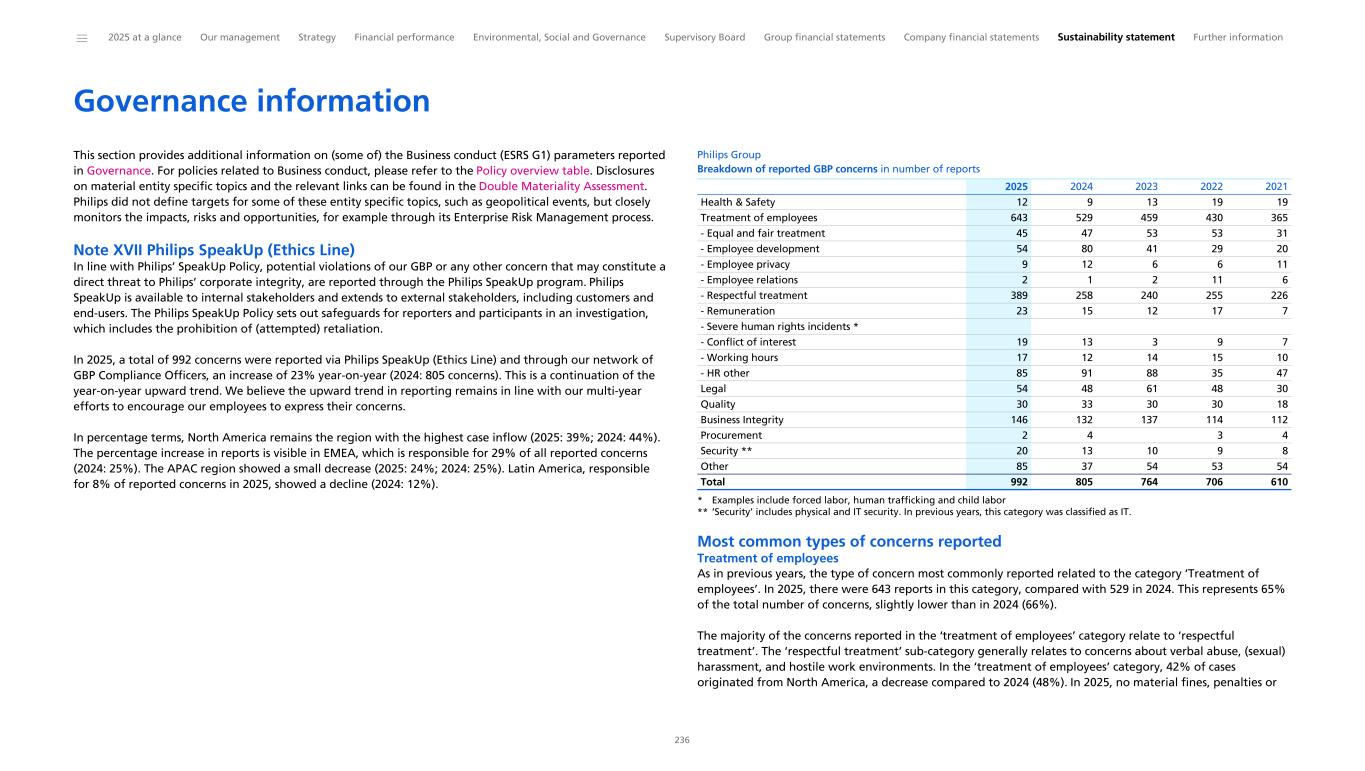
Governance information This section provides additional information on (some of) the Business conduct (ESRS G1) parameters reported in Governance. For policies related to Business conduct, please refer to the Policy overview table. Disclosures on material entity specific topics and the relevant links can be found in the Double Materiality Assessment. Philips did not define targets for some of these entity specific topics, such as geopolitical events, but closely monitors the impacts, risks and opportunities, for example through its Enterprise Risk Management process. Note XVII Philips SpeakUp (Ethics Line) In line with Philips’ SpeakUp Policy, potential violations of our GBP or any other concern that may constitute a direct threat to Philips’ corporate integrity, are reported through the Philips SpeakUp program. Philips SpeakUp is available to internal stakeholders and extends to external stakeholders, including customers and end-users. The Philips SpeakUp Policy sets out safeguards for reporters and participants in an investigation, which includes the prohibition of (attempted) retaliation. In 2025, a total of 992 concerns were reported via Philips SpeakUp (Ethics Line) and through our network of GBP Compliance Officers, an increase of 23% year-on-year (2024: 805 concerns). This is a continuation of the year-on-year upward trend. We believe the upward trend in reporting remains in line with our multi-year efforts to encourage our employees to express their concerns. In percentage terms, North America remains the region with the highest case inflow (2025: 39%; 2024: 44%). The percentage increase in reports is visible in EMEA, which is responsible for 29% of all reported concerns (2024: 25%). The APAC region showed a small decrease (2025: 24%; 2024: 25%). Latin America, responsible for 8% of reported concerns in 2025, showed a decline (2024: 12%). Philips Group Breakdown of reported GBP concerns in number of reports Health & Safety 12 9 13 19 19 Treatment of employees 643 529 459 430 365 - Equal and fair treatment 45 47 53 53 31 - Employee development 54 80 41 29 20 - Employee privacy 9 12 6 6 11 - Employee relations 2 1 2 11 6 - Respectful treatment 389 258 240 255 226 - Remuneration 23 15 12 17 7 - Severe human rights incidents * - Conflict of interest 19 13 3 9 7 - Working hours 17 12 14 15 10 - HR other 85 91 88 35 47 Legal 54 48 61 48 30 Quality 30 33 30 30 18 Business Integrity 146 132 137 114 112 Procurement 2 4 3 4 Security ** 20 13 10 9 8 Other 85 37 54 53 54 Total 992 805 764 706 610 2025 2024 2023 2022 2021 * Examples include forced labor, human trafficking and child labor ** ‘Security’ includes physical and IT security. In previous years, this category was classified as IT. Most common types of concerns reported Treatment of employees As in previous years, the type of concern most commonly reported related to the category ‘Treatment of employees’. In 2025, there were 643 reports in this category, compared with 529 in 2024. This represents 65% of the total number of concerns, slightly lower than in 2024 (66%). The majority of the concerns reported in the ‘treatment of employees’ category relate to ‘respectful treatment’. The ‘respectful treatment’ sub-category generally relates to concerns about verbal abuse, (sexual) harassment, and hostile work environments. In the ‘treatment of employees’ category, 42% of cases originated from North America, a decrease compared to 2024 (48%). In 2025, no material fines, penalties or ______ 2025 at a glance Our management Strategy Financial performance Environmental, Social and Governance Supervisory Board Group financial statements Company financial statements Sustainability statement Further information 236
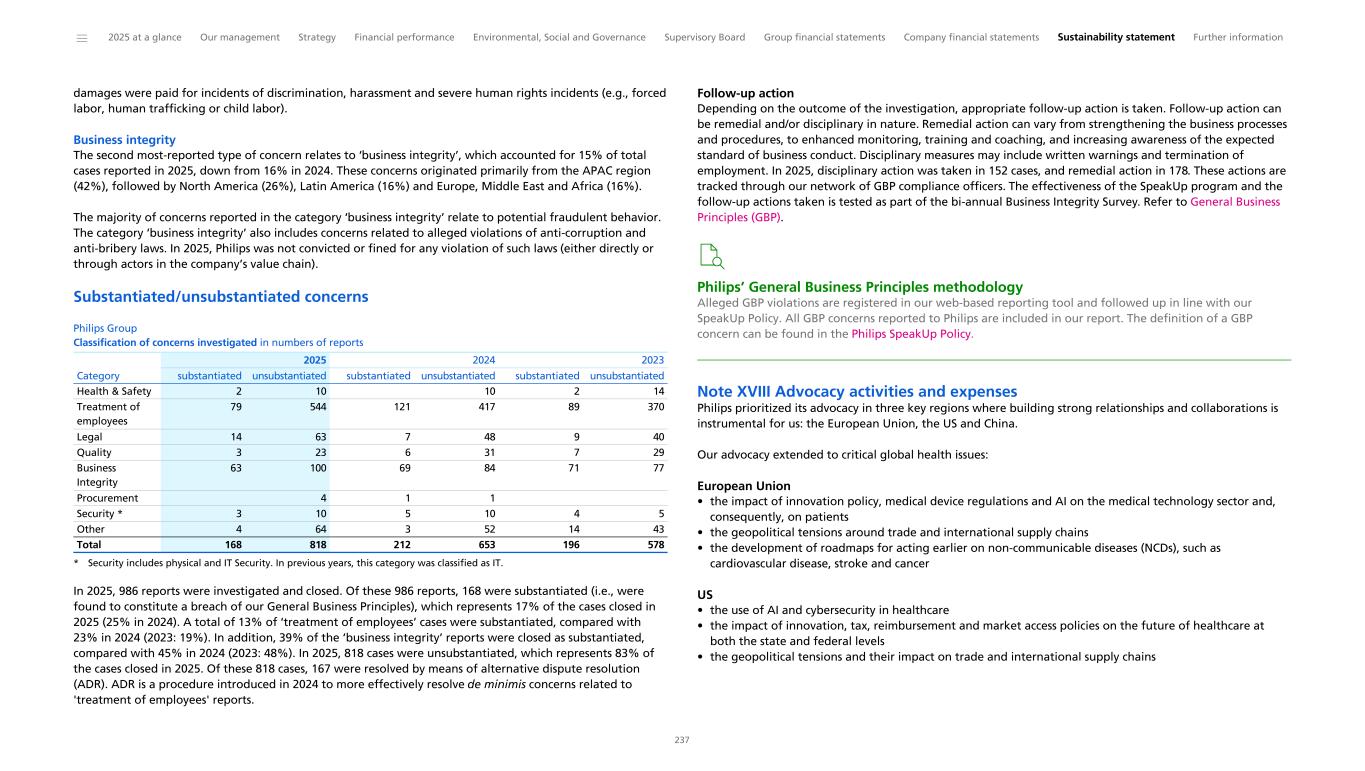
damages were paid for incidents of discrimination, harassment and severe human rights incidents (e.g., forced labor, human trafficking or child labor). Business integrity The second most-reported type of concern relates to ‘business integrity’, which accounted for 15% of total cases reported in 2025, down from 16% in 2024. These concerns originated primarily from the APAC region (42%), followed by North America (26%), Latin America (16%) and Europe, Middle East and Africa (16%). The majority of concerns reported in the category ‘business integrity’ relate to potential fraudulent behavior. The category ‘business integrity’ also includes concerns related to alleged violations of anti-corruption and anti-bribery laws. In 2025, Philips was not convicted or fined for any violation of such laws (either directly or through actors in the company’s value chain). Substantiated/unsubstantiated concerns Philips Group Classification of concerns investigated in numbers of reports Health & Safety 2 10 10 2 14 Treatment of employees 79 544 121 417 89 370 Legal 14 63 7 48 9 40 Quality 3 23 6 31 7 29 Business Integrity 63 100 69 84 71 77 Procurement 4 1 1 Security * 3 10 5 10 4 5 Other 4 64 3 52 14 43 Total 168 818 212 653 196 578 2025 2024 2023 Category substantiated unsubstantiated substantiated unsubstantiated substantiated unsubstantiated * Security includes physical and IT Security. In previous years, this category was classified as IT. In 2025, 986 reports were investigated and closed. Of these 986 reports, 168 were substantiated (i.e., were found to constitute a breach of our General Business Principles), which represents 17% of the cases closed in 2025 (25% in 2024). A total of 13% of ‘treatment of employees’ cases were substantiated, compared with 23% in 2024 (2023: 19%). In addition, 39% of the ‘business integrity’ reports were closed as substantiated, compared with 45% in 2024 (2023: 48%). In 2025, 818 cases were unsubstantiated, which represents 83% of the cases closed in 2025. Of these 818 cases, 167 were resolved by means of alternative dispute resolution (ADR). ADR is a procedure introduced in 2024 to more effectively resolve de minimis concerns related to 'treatment of employees' reports. Follow-up action Depending on the outcome of the investigation, appropriate follow-up action is taken. Follow-up action can be remedial and/or disciplinary in nature. Remedial action can vary from strengthening the business processes and procedures, to enhanced monitoring, training and coaching, and increasing awareness of the expected standard of business conduct. Disciplinary measures may include written warnings and termination of employment. In 2025, disciplinary action was taken in 152 cases, and remedial action in 178. These actions are tracked through our network of GBP compliance officers. The effectiveness of the SpeakUp program and the follow-up actions taken is tested as part of the bi-annual Business Integrity Survey. Refer to General Business Principles (GBP). Philips’ General Business Principles methodology Alleged GBP violations are registered in our web-based reporting tool and followed up in line with our SpeakUp Policy. All GBP concerns reported to Philips are included in our report. The definition of a GBP concern can be found in the Philips SpeakUp Policy. Note XVIII Advocacy activities and expenses Philips prioritized its advocacy in three key regions where building strong relationships and collaborations is instrumental for us: the European Union, the US and China. Our advocacy extended to critical global health issues: European Union • the impact of innovation policy, medical device regulations and AI on the medical technology sector and, consequently, on patients • the geopolitical tensions around trade and international supply chains • the development of roadmaps for acting earlier on non-communicable diseases (NCDs), such as cardiovascular disease, stroke and cancer US • the use of AI and cybersecurity in healthcare • the impact of innovation, tax, reimbursement and market access policies on the future of healthcare at both the state and federal levels • the geopolitical tensions and their impact on trade and international supply chains ______ 2025 at a glance Our management Strategy Financial performance Environmental, Social and Governance Supervisory Board Group financial statements Company financial statements Sustainability statement Further information 237
China • strong clinical partnerships, particularly relevant to China’s healthcare challenges: ◦ supplying national top hospitals with tailor-made solutions for their clinical and research needs ◦ decarbonizing the healthcare sector ◦ improving the resilience of healthcare • the impact of geopolitical tensions on trade and international supply chains, and our localization strategy Health systems sustainability and resilience High-level meeting of the UN General Assembly on NCDs At the 80th UN General Assembly in September 2025, Philips called for urgent actions: 1 Investing in health for a sustainable future 2 Strengthening health systems for greater resilience 3 Prioritizing innovation to improve access and outcome Philips strongly supports the UN’s Political Declaration on NCDs, which sets ambitious targets for the prevention and control of NCDs. We believe these cannot be achieved, however, without investing in diagnostic systems, and we have continued to actively advocate to transform this policy framework into concerted national action. Partnerships for Health Systems Sustainability and Resilience (PHSSR) Through the Partnership for Health System Sustainability and Resilience (PHSSR), Philips collaborates with a diverse international network of stakeholders, which commissions independent research and provides evidence-based recommendations to improve health systems. For more information, refer to Partnership for Health System Sustainability and Resilience (PHSSR). In 2025, PHSSR launched its Policy Roadmaps on Acting Early on NCDs. The PHSSR research findings provided immediate relevance for the UN General Assembly discussions on NCDs held in September 2025, providing evidence-based options for the health system reform required to meet global targets. Engaging with healthcare professionals and key opinion leaders: The Future Health Index is the largest global survey of its kind, analyzing the priorities and perspectives of 1,900 healthcare professionals and over 16,000 patients across multiple countries. In the 10th edition, the Future Health Index 2025 investigated how AI can empower healthcare professionals to deliver better care for more people. For more information refer to Future Health index 2025: Building trust in healthcare AI. Sustainable purchasing criteria for medical imaging equipment Following the publication of globally agreed sustainable purchasing criteria in 2024, sustainability criteria for purchasing medical imaging equipment became available in 2025 in several European languages, including French, German, Dutch, Spanish and Italian, to drive greater global alignment. Dedicated guidance on the application of the criteria is also under development. The criteria provide companies and purchasers with a common framework and guidance on how to improve the sustainability of their imaging equipment, enabling them to ask the right questions. Topic areas range from climate change mitigation over the sustainable use of resources, to corporate ESG performance. The Medical Equipment Proactive Alliance for Sustainable Healthcare (MEPA) is a joint initiative of COCIR, HealthTrust Performance Group and Vizient, Inc., aimed at reducing the climate, environmental and social impacts of medical imaging devices supplied to the healthcare sector. Philips is a member of COCIR, the European trade association representing the medical imaging, radiotherapy, health ICT and electromedical industries. Artificial intelligence In 2025, Philips worked on implementing the EU AI Act. Philips is a founding member of the Sustainable AI Coalition, launched in February 2025 to build a global community of stakeholders willing to contribute to initiatives for aligning AI development with global sustainability goals, and fostering responsible AI that supports environmental policies. Philips was part of a working group that created a global, coordinated approach to AI environmental-sustainability standards. Philips was active in 2025 within trade associations, focusing on implementation and simplification of the EU framework for AI. Philips co-chairs the Technology, AI & Data Working Group of the European Round Table for Industry and is a member of Digital Europe and its Digital Executive Council for Health as well as the AI & Data Working Group. Social impact Philips collaborates with numerous international partners in its efforts to address UN Sustainable Development Goal 3. We also drive progress toward universal health coverage as part of UHC2030, which aims to ensure all people have access to the full range of quality health services they need, when and where they need them, without financial hardship. The Partnership for Maternal, Newborn, and Child Health (PMNCH), the world’s largest alliance for the health and well-being of women and children, continued to be an important platform in 2025. As part of its advocacy for affordable access to high-quality maternal care during pregnancy and after childbirth, Philips hosted a roundtable with PMNCH on the sidelines of the World Economic Forum Annual Meeting in January 2025. The topic was on leveraging public-private partnerships to reduce maternal, newborn and child mortality, linked to a resolution adopted at the World Health Assembly in 2024. Recognizing the funding gap to achieve UHC, Philips continues its work in impact finance. Philips is an active Steering Committee member of the Health Finance Coalition, a coalition of leading health donors, investors and technical partners, seeking to scale blended-finance solutions. ______ 2025 at a glance Our management Strategy Financial performance Environmental, Social and Governance Supervisory Board Group financial statements Company financial statements Sustainability statement Further information 238
Through the Ukraine Partnership Facility in the Netherlands, an initiative that works on the reconstruction and sustainable recovery of Ukraine's economy and society, Philips in 2025 supported the development and opening of a new diagnostics and rehabilitation center in the city of Dnipro in Ukraine. Philips continued its commitment to the Digital Connected Care Coalition (DCCC), initiated by Philips and partners in 2019. This global public-private coalition aims to scale digital health solutions in low- and middle- income countries (LMICs). In 2025, coalition members drove significant progress in end-to-end primary healthcare delivery projects in India and in African countries. The year also marked the start of digital health projects between DCCC members, including Africa CDC. This initiative advocates for increased public-private collaboration to help digital health reach more patients, faster. Access to care in underserved communities Health is a fundamental human right. Yet more than half of the world’s population lacks access to essential health services. Through meaningful and financially sustainable innovation, public-private partnerships, and the work of dedicated team, we seek to overcome barriers that prevent people from enjoying good health, to strengthen health systems and to lower the cost of care. HeartPrint is one example of a Philips innovation specifically developed to increase access in LMICs. The healthcare venture has been designed to provide affordable and efficient cardiovascular diagnostics in India. It empowers people to take care of their own heart health through preventive screening on mobile phones. Since the launch of HeartPrint in 2024, it has reached 250,000 people, offering a scalable, cost-effective model that can be adapted globally, potentially transforming cardiovascular care and improving health outcomes for millions. For more information about strategic partnerships and investment to expand healthcare access, read the information about the Philips Foundation in Note XVI Other social information. Climate action, circularity and nature Philips focuses on making a material impact, which means prioritizing initiatives that deliver tangible value. Our strategy is in line with UN Sustainable Development Goals 12 and 13. Achievements with customers to decarbonize healthcare In 2025, and together with Vanderbilt University Medical Center, Philips published research in the Journal of the American College of Radiology that underscores that sustainability in radiology is achievable through circular business models, renewable energy adoption, and targeted operational improvements. These innovative strategies deliver measurable cost savings, reduce environmental impact, and support healthcare’s transition to a low-carbon future. Research findings include financial and environmental benefits of circular business models and the environmental impact of magnetic resonance (MR) and computed tomography (CT) imaging using life cycle assessment (LCA), focusing on energy and material use in ultrasound, radiography and fluoroscopy. Philips was named Sustainability Supplier of the Year by its largest Group Purchasing Organization partner in North America Region, Vizient, which cited Philips’ environmental product attributes and meaningful engagement with Vizient, and a strong corporate commitment to sustainability. In Germany, Philips received a sustainability award in the category of Health & Social – Medical Technology. Partnerships for climate action Through our collaboration with RE100, Philips committed to 100% renewable electricity following the highest quality standard. Philips also contributes to global efforts aiming to scale Scope 3 reduction, among others, through collaboration with the World Economic Forum’s Alliance of CEO Climate Leaders – representing 130- plus companies and USD 4 trillion in combined revenue. In an open letter endorsed by Philips ahead of the UN Climate Change Conference 2025 (COP30), the Alliance of CEO Climate Leaders stressed the commercial viability of the climate economy, and urged businesses and policymakers to scale the historic opportunity for returns, resilience and growth. For more information refer to Note I Climate Change. Partnerships for circularity In November 2025, the Global Circularity Protocol (GCP) was published, spearheaded by the World Business Council for Sustainable Development (WBSCD), in collaboration with the One Planet network (OPN). It’s the world’s first global framework for standardized and comparable circularity reporting and for managing circularity. Philips is part of the Business Advisory Committee and the Technical Working Group, alongside over 80 organizations. Philips is a long-standing partner of the Ellen MacArthur Foundation and partnered in year-round leadership engagements with key EU policymakers and global businesses to help to clarify how the upcoming EU Circular Economy Act can create enabling conditions to accelerate implementation of circular practices at scale. Philips’ recommendations were submitted to the EU as part of a public consultation. As a consortium partner, Philips contributed to ESCH-R, an interdisciplinary project funded by the Dutch Research Council as part of the Dutch Research Agenda to accelerate the adoption of circular interventions in hospitals. In 2025, Philips co-created a roadmap 2026-2028 to identify value capture and procurement strategies for hospitals and suppliers, as well as optimal circular business models to operationalize the transition. Philips participated in the EU-funded Digital Health in the Circular Economy (DiCE) project to address the issue of increasing digital health waste. As a consortium partner, Philips supported the development and demonstration of circular solutions for digital health devices. In 2025, through small-scale pilots with EU hospitals, Philips evaluated and validated multiple reprocessing workflows for digital health devices, such as ECG lead sets, which are subject to EU medical device regulations. Philips also collaborated with university TU Delft in the Netherlands to redesign a single-patient, hospital-grade monitoring device into a reusable and ______ 2025 at a glance Our management Strategy Financial performance Environmental, Social and Governance Supervisory Board Group financial statements Company financial statements Sustainability statement Further information 239
circular device to reduce its environmental impact while maintaining clinical safety, performance, and regulatory compliance. For more information refer to Note II Resource use and circular economy. Partnerships for nature In 2025, Philips participated in the nature workstream led by the World Business Council for Sustainable Development (WBCSD), supporting efforts to accelerate action through the Assess-Commit-Transform-Disclose approach. Philips also engaged with the Taskforce on Nature-related Financial Disclosures (TNFD), contributing practical input to the TNFD guidance on nature transition planning, and supporting the development of TNFD guidance on nature disclosures for the technology sector. For more information refer to Other environmental information – Biodiversity and ecosystem services. World Economic Forum (WEF) partnership Philips engages with the World Economic Forum (WEF), the international organization for public-private cooperation committed to improving the state of the world, through year-round strategic partnership activities. WEF convenes political, business, and civil society leaders to shape global, regional, and industry agendas. In 2025, Philips participated in the WEF Annual Meeting in Davos, driving discussions on sustainable and just healthcare systems, including climate-focused healthcare models, innovations to improve healthcare access for women, and the importance of public-private partnerships in transforming healthcare. Throughout the year Philips contributed to WEF leadership events and regional roundtables, such as the International Business Council, the Global Future Council focused on international trade and investment, the Sustainable Development Impact Meetings during the UN General Assembly, and the Annual Meeting of the New Champions in China. Since 2023, Philips has been the hosting partner of the SDG Tent at the Davos meeting. For almost 20 years, the SDG Tent has been a critical hub for SDG-focused conversations and initiatives, and in 2025, it hosted over 50 events, attracting more than 4,000 people and many more online. It is a unique and unbiased meeting point where key actors from the private and public sectors can gather, accessible to all in Davos. Advocacy expenses in 2025 Philips does not make direct or indirect contributions, in money or in kind, to political parties, organizations, or individuals in politics. However, we engage with a range of stakeholders – including global partnerships, industry associations, and key event organizers – to influence policy development and support business opportunities. This informed and effective advocacy is essential to achieving our vision for healthcare transformation and sustainability. Philips is also registered in the EU Transparency Register (REG Number 035366013790-68). For more information, refer to the EU Transparency Register. The expenses included in this section are classified into five categories based on contribution level and reported for global partnerships, annual events, and trade associations. We are reporting only on expenses equal to or greater than EUR 40,000. We have grouped these, where applicable, into five bandwidths based on contribution level: EUR 1,300,000-1,000,000; EUR 1,000,000-750,000; EUR 750,000-250,000; EUR 250,000-100,000; and EUR 100,000-40,000. In 2025, Philips retained its membership of most organizations and joined the similar events as in 2024. The expenses incurred remained at similar levels compared to 2024. Global partnerships Long-term collaborations with organizations that share our values and vision involve substantial contributions to support initiatives, research, and programs aimed at addressing healthcare challenges and fostering innovation. Please note that many of the earlier-mentioned partnerships do not require expenses; hence, they have not been included in the listing. Philips Group Global partnerships EUR 750,000-EUR 250,000 World Business Council for Sustainable Development EUR 250,000-EUR 100,000 Partnership for Health System Sustainability and Resilience EUR 100,000-EUR 40,000 Ellen MacArthur Foundation World Stroke Organization Annual events and general contributions These events, as platforms for knowledge exchange, networking, and industry growth, provide opportunities to connect with key stakeholders, showcase our expertise, contribute to the transformation of healthcare, and advance the decarbonization process within the healthcare industry. Philips Group Annual events EUR 1,000,000-EUR 750,000 World Economic Forum Trade associations Our memberships are essential for staying informed about industry developments and standards. We contribute significantly to these associations to support advocacy efforts, research, and collective industry ______ 2025 at a glance Our management Strategy Financial performance Environmental, Social and Governance Supervisory Board Group financial statements Company financial statements Sustainability statement Further information 240
initiatives that benefit Philips and the healthcare sector. In this trade association overview, we also indicate the relevant country or geographical market area for each association, where applicable. Philips Group Trade associations EUR 1,300,000-EUR 1,000,000 Advanced Medical Technology Association (AdvaMed) – US EUR 1,000,000-EUR 750,000 European Coordination Committee of the Radiological, Electromedical and Healthcare IT Industry (COCIR) – European Union EUR 250,000-EUR 100,000 APACMed – Asia-Pacific CardioVascular Coalition – US Dutch Employers' Federation (VNO-NCW) – the Netherlands Medical Device Manufacturers Association – US MedTech Europe – European Union EUR 100,000-EUR 40,000 Appliance Industry in Europe (APPLiA) – European Union DigitalEurope – European Union European Round Table for Industry – European Union MedTech Canada – Canada Philips Political Action Committee In the US, in compliance with federal law, Philips does not make corporate contributions to federal candidates and federal political committees. Additionally, Philips does not make corporate political contributions to any US state or local campaign committees, state or local political committees, state or local political parties, or other state or local 527 political organizations. The company supports the Philips North America LLC Employee Political Action Committee (Philips PAC) that makes contributions to federal, state and local candidates, political committees, political parties, and other 527 political organizations. Philips PAC is funded exclusively by voluntary contributions from US employees who are eligible, in accordance with federal law, to contribute to the Philips PAC. US law prohibits reimbursing employees, directly or indirectly, for contributions to the Philips PAC. Please refer to the US Federal Election Commission website for more information pertaining to Philips PAC financial activity. ______ 2025 at a glance Our management Strategy Financial performance Environmental, Social and Governance Supervisory Board Group financial statements Company financial statements Sustainability statement Further information 241
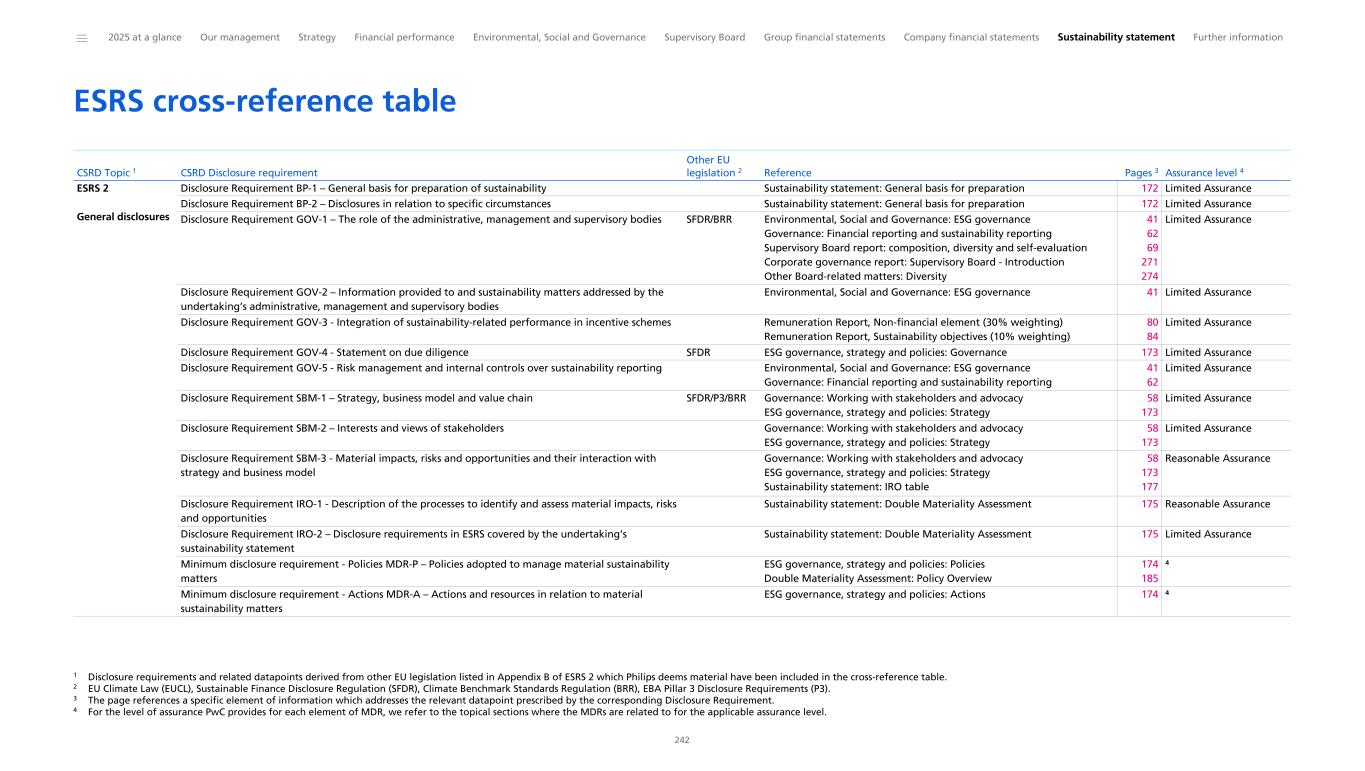
ESRS cross-reference table ESRS 2 General disclosures Disclosure Requirement BP-1 – General basis for preparation of sustainability Sustainability statement: General basis for preparation 172 Limited Assurance Disclosure Requirement BP-2 – Disclosures in relation to specific circumstances Sustainability statement: General basis for preparation 172 Limited Assurance Disclosure Requirement GOV-1 – The role of the administrative, management and supervisory bodies SFDR/BRR Environmental, Social and Governance: ESG governance Governance: Financial reporting and sustainability reporting Supervisory Board report: composition, diversity and self-evaluation Corporate governance report: Supervisory Board - Introduction Other Board-related matters: Diversity 41 62 69 271 274 Limited Assurance Disclosure Requirement GOV-2 – Information provided to and sustainability matters addressed by the undertaking’s administrative, management and supervisory bodies Environmental, Social and Governance: ESG governance 41 Limited Assurance Disclosure Requirement GOV-3 - Integration of sustainability-related performance in incentive schemes Remuneration Report, Non-financial element (30% weighting) Remuneration Report, Sustainability objectives (10% weighting) 80 84 Limited Assurance Disclosure Requirement GOV-4 - Statement on due diligence SFDR ESG governance, strategy and policies: Governance 173 Limited Assurance Disclosure Requirement GOV-5 - Risk management and internal controls over sustainability reporting Environmental, Social and Governance: ESG governance Governance: Financial reporting and sustainability reporting 41 62 Limited Assurance Disclosure Requirement SBM-1 – Strategy, business model and value chain SFDR/P3/BRR Governance: Working with stakeholders and advocacy ESG governance, strategy and policies: Strategy 58 173 Limited Assurance Disclosure Requirement SBM-2 – Interests and views of stakeholders Governance: Working with stakeholders and advocacy ESG governance, strategy and policies: Strategy 58 173 Limited Assurance Disclosure Requirement SBM-3 - Material impacts, risks and opportunities and their interaction with strategy and business model Governance: Working with stakeholders and advocacy ESG governance, strategy and policies: Strategy Sustainability statement: IRO table 58 173 177 Reasonable Assurance Disclosure Requirement IRO-1 - Description of the processes to identify and assess material impacts, risks and opportunities Sustainability statement: Double Materiality Assessment 175 Reasonable Assurance Disclosure Requirement IRO-2 – Disclosure requirements in ESRS covered by the undertaking’s sustainability statement Sustainability statement: Double Materiality Assessment 175 Limited Assurance Minimum disclosure requirement - Policies MDR-P – Policies adopted to manage material sustainability matters ESG governance, strategy and policies: Policies Double Materiality Assessment: Policy Overview 174 185 ⁴ Minimum disclosure requirement - Actions MDR-A – Actions and resources in relation to material sustainability matters ESG governance, strategy and policies: Actions 174 ⁴ CSRD Topic 1 CSRD Disclosure requirement Other EU legislation 2 Reference Pages 3 Assurance level 4 ______ 2025 at a glance Our management Strategy Financial performance Environmental, Social and Governance Supervisory Board Group financial statements Company financial statements Sustainability statement Further information 242 1 Disclosure requirements and related datapoints derived from other EU legislation listed in Appendix B of ESRS 2 which Philips deems material have been included in the cross-reference table. 2 EU Climate Law (EUCL), Sustainable Finance Disclosure Regulation (SFDR), Climate Benchmark Standards Regulation (BRR), EBA Pillar 3 Disclosure Requirements (P3). 3 The page references a specific element of information which addresses the relevant datapoint prescribed by the corresponding Disclosure Requirement. 4 For the level of assurance PwC provides for each element of MDR, we refer to the topical sections where the MDRs are related to for the applicable assurance level.
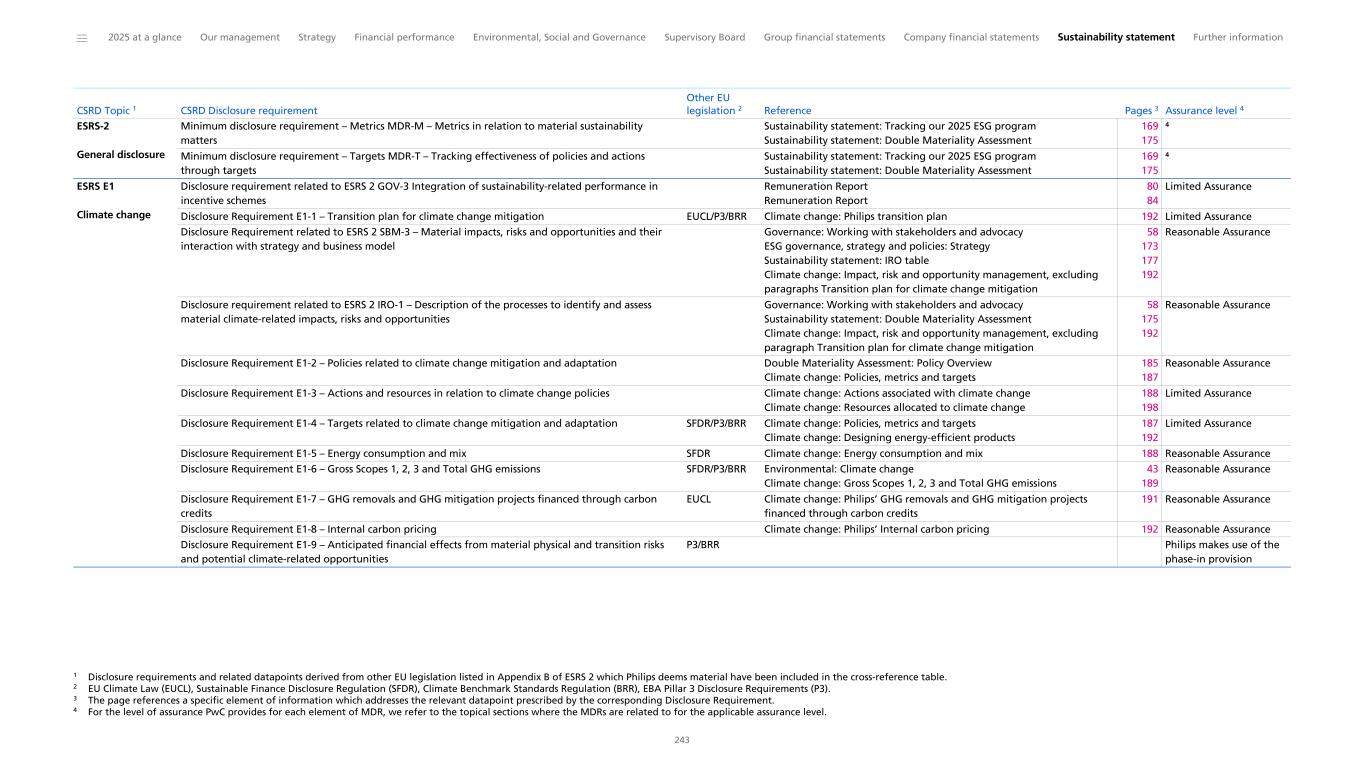
ESRS-2 General disclosure Minimum disclosure requirement – Metrics MDR-M – Metrics in relation to material sustainability matters Sustainability statement: Tracking our 2025 ESG program Sustainability statement: Double Materiality Assessment 169 175 ⁴ Minimum disclosure requirement – Targets MDR-T – Tracking effectiveness of policies and actions through targets Sustainability statement: Tracking our 2025 ESG program Sustainability statement: Double Materiality Assessment 169 175 ⁴ ESRS E1 Climate change Disclosure requirement related to ESRS 2 GOV-3 Integration of sustainability-related performance in incentive schemes Remuneration Report Remuneration Report 80 84 Limited Assurance Disclosure Requirement E1-1 – Transition plan for climate change mitigation EUCL/P3/BRR Climate change: Philips transition plan 192 Limited Assurance Disclosure Requirement related to ESRS 2 SBM-3 – Material impacts, risks and opportunities and their interaction with strategy and business model 1,2,3,4 Governance: Working with stakeholders and advocacy ESG governance, strategy and policies: Strategy Sustainability statement: IRO table Climate change: Impact, risk and opportunity management, excluding paragraphs Transition plan for climate change mitigation 58 173 177 192 Reasonable Assurance Disclosure requirement related to ESRS 2 IRO-1 – Description of the processes to identify and assess material climate-related impacts, risks and opportunities Governance: Working with stakeholders and advocacy Sustainability statement: Double Materiality Assessment Climate change: Impact, risk and opportunity management, excluding paragraph Transition plan for climate change mitigation 58 175 192 Reasonable Assurance Disclosure Requirement E1-2 – Policies related to climate change mitigation and adaptation Double Materiality Assessment: Policy Overview Climate change: Policies, metrics and targets 185 187 Reasonable Assurance Disclosure Requirement E1-3 – Actions and resources in relation to climate change policies Climate change: Actions associated with climate change Climate change: Resources allocated to climate change 188 198 Limited Assurance Disclosure Requirement E1-4 – Targets related to climate change mitigation and adaptation SFDR/P3/BRR Climate change: Policies, metrics and targets Climate change: Designing energy-efficient products 187 192 Limited Assurance Disclosure Requirement E1-5 – Energy consumption and mix SFDR Climate change: Energy consumption and mix 188 Reasonable Assurance Disclosure Requirement E1-6 – Gross Scopes 1, 2, 3 and Total GHG emissions SFDR/P3/BRR Environmental: Climate change Climate change: Gross Scopes 1, 2, 3 and Total GHG emissions 43 189 Reasonable Assurance Disclosure Requirement E1-7 – GHG removals and GHG mitigation projects financed through carbon credits EUCL Climate change: Philips’ GHG removals and GHG mitigation projects financed through carbon credits 191 Reasonable Assurance Disclosure Requirement E1-8 – Internal carbon pricing Climate change: Philips’ Internal carbon pricing 192 Reasonable Assurance Disclosure Requirement E1-9 – Anticipated financial effects from material physical and transition risks and potential climate-related opportunities P3/BRR Philips makes use of the phase-in provision CSRD Topic 1 CSRD Disclosure requirement Other EU legislation 2 Reference Pages 3 Assurance level 4 ______ 2025 at a glance Our management Strategy Financial performance Environmental, Social and Governance Supervisory Board Group financial statements Company financial statements Sustainability statement Further information 243 1 Disclosure requirements and related datapoints derived from other EU legislation listed in Appendix B of ESRS 2 which Philips deems material have been included in the cross-reference table. 2 EU Climate Law (EUCL), Sustainable Finance Disclosure Regulation (SFDR), Climate Benchmark Standards Regulation (BRR), EBA Pillar 3 Disclosure Requirements (P3). 3 The page references a specific element of information which addresses the relevant datapoint prescribed by the corresponding Disclosure Requirement. 4 For the level of assurance PwC provides for each element of MDR, we refer to the topical sections where the MDRs are related to for the applicable assurance level.
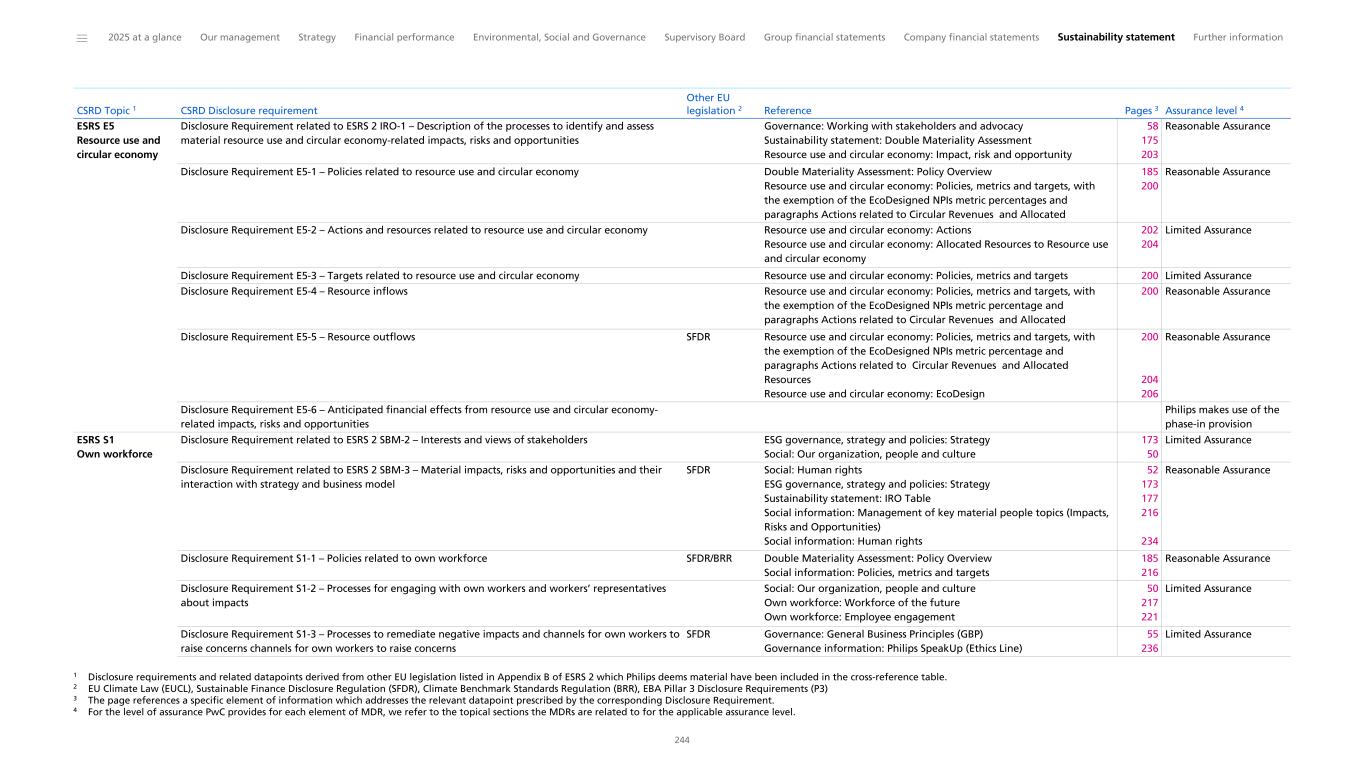
ESRS E5 Resource use and circular economy Disclosure Requirement related to ESRS 2 IRO-1 – Description of the processes to identify and assess material resource use and circular economy-related impacts, risks and opportunities Governance: Working with stakeholders and advocacy Sustainability statement: Double Materiality Assessment Resource use and circular economy: Impact, risk and opportunity 58 175 203 Reasonable Assurance Disclosure Requirement E5-1 – Policies related to resource use and circular economy Double Materiality Assessment: Policy Overview Resource use and circular economy: Policies, metrics and targets, with the exemption of the EcoDesigned NPIs metric percentages and paragraphs Actions related to Circular Revenues and Allocated 185 200 Reasonable Assurance Disclosure Requirement E5-2 – Actions and resources related to resource use and circular economy Resource use and circular economy: Actions Resource use and circular economy: Allocated Resources to Resource use and circular economy 202 204 Limited Assurance Disclosure Requirement E5-3 – Targets related to resource use and circular economy Resource use and circular economy: Policies, metrics and targets 200 Limited Assurance Disclosure Requirement E5-4 – Resource inflows Resource use and circular economy: Policies, metrics and targets, with the exemption of the EcoDesigned NPIs metric percentage and paragraphs Actions related to Circular Revenues and Allocated 200 Reasonable Assurance Disclosure Requirement E5-5 – Resource outflows SFDR Resource use and circular economy: Policies, metrics and targets, with the exemption of the EcoDesigned NPIs metric percentage and paragraphs Actions related to Circular Revenues and Allocated Resources Resource use and circular economy: EcoDesign 200 204 206 Reasonable Assurance Disclosure Requirement E5-6 – Anticipated financial effects from resource use and circular economy- related impacts, risks and opportunities 1,2,3,4 Philips makes use of the phase-in provision ESRS S1 Own workforce Disclosure Requirement related to ESRS 2 SBM-2 – Interests and views of stakeholders ESG governance, strategy and policies: Strategy Social: Our organization, people and culture 173 50 Limited Assurance Disclosure Requirement related to ESRS 2 SBM-3 – Material impacts, risks and opportunities and their interaction with strategy and business model SFDR Social: Human rights ESG governance, strategy and policies: Strategy Sustainability statement: IRO Table Social information: Management of key material people topics (Impacts, Risks and Opportunities) Social information: Human rights 52 173 177 216 234 Reasonable Assurance Disclosure Requirement S1-1 – Policies related to own workforce SFDR/BRR Double Materiality Assessment: Policy Overview Social information: Policies, metrics and targets 185 216 Reasonable Assurance Disclosure Requirement S1-2 – Processes for engaging with own workers and workers’ representatives about impacts Social: Our organization, people and culture Own workforce: Workforce of the future Own workforce: Employee engagement 50 217 221 Limited Assurance Disclosure Requirement S1-3 – Processes to remediate negative impacts and channels for own workers to raise concerns channels for own workers to raise concerns SFDR Governance: General Business Principles (GBP) Governance information: Philips SpeakUp (Ethics Line) 55 236 Limited Assurance CSRD Topic 1 CSRD Disclosure requirement Other EU legislation 2 Reference Pages 3 Assurance level 4 ______ 2025 at a glance Our management Strategy Financial performance Environmental, Social and Governance Supervisory Board Group financial statements Company financial statements Sustainability statement Further information 244 1 Disclosure requirements and related datapoints derived from other EU legislation listed in Appendix B of ESRS 2 which Philips deems material have been included in the cross-reference table. 2 EU Climate Law (EUCL), Sustainable Finance Disclosure Regulation (SFDR), Climate Benchmark Standards Regulation (BRR), EBA Pillar 3 Disclosure Requirements (P3) 3 The page references a specific element of information which addresses the relevant datapoint prescribed by the corresponding Disclosure Requirement. 4 For the level of assurance PwC provides for each element of MDR, we refer to the topical sections the MDRs are related to for the applicable assurance level.
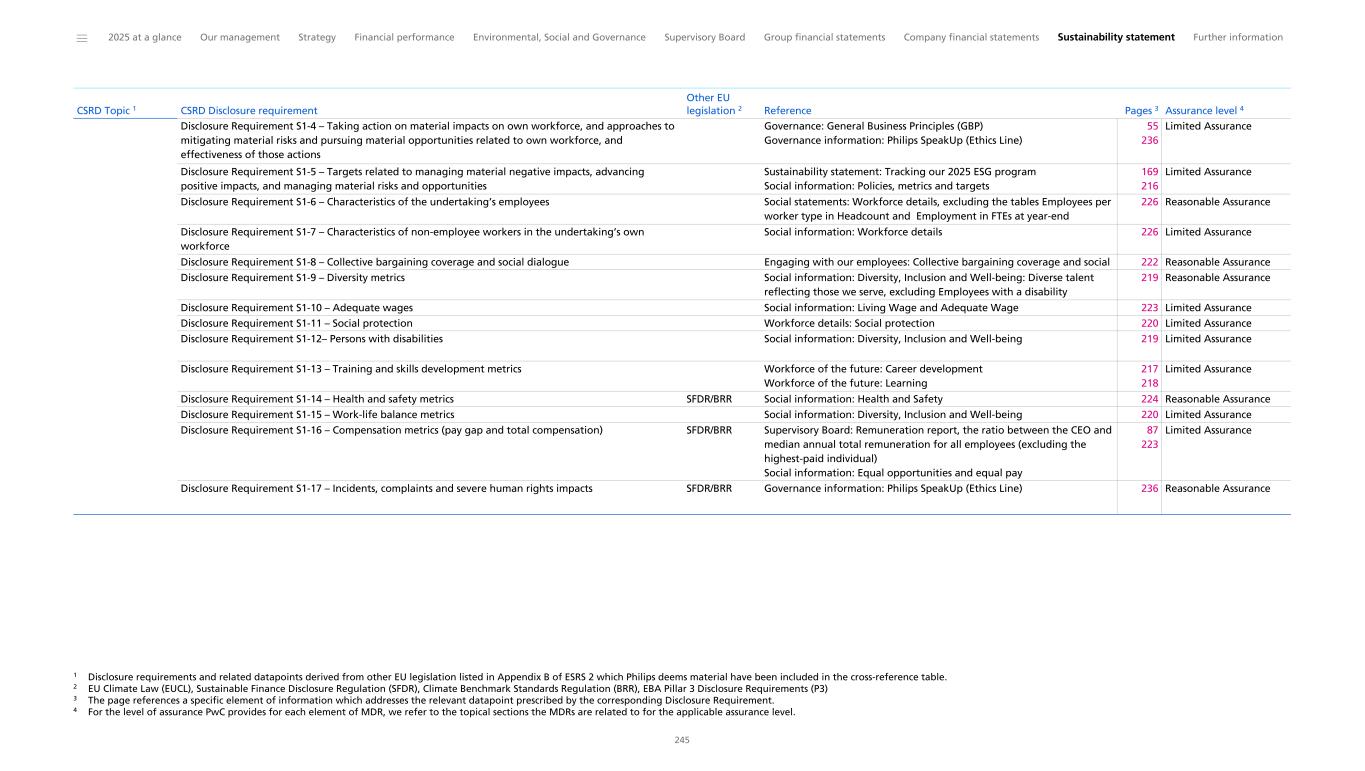
Disclosure Requirement S1-4 – Taking action on material impacts on own workforce, and approaches to mitigating material risks and pursuing material opportunities related to own workforce, and effectiveness of those actions Governance: General Business Principles (GBP) Governance information: Philips SpeakUp (Ethics Line) 55 236 Limited Assurance Disclosure Requirement S1-5 – Targets related to managing material negative impacts, advancing positive impacts, and managing material risks and opportunities Sustainability statement: Tracking our 2025 ESG program Social information: Policies, metrics and targets 169 216 Limited Assurance Disclosure Requirement S1-6 – Characteristics of the undertaking’s employees Social statements: Workforce details, excluding the tables Employees per worker type in Headcount and Employment in FTEs at year-end 226 Reasonable Assurance Disclosure Requirement S1-7 – Characteristics of non-employee workers in the undertaking’s own workforce Social information: Workforce details 226 Limited Assurance Disclosure Requirement S1-8 – Collective bargaining coverage and social dialogue Engaging with our employees: Collective bargaining coverage and social 222 Reasonable Assurance Disclosure Requirement S1-9 – Diversity metrics Social information: Diversity, Inclusion and Well-being: Diverse talent reflecting those we serve, excluding Employees with a disability 219 Reasonable Assurance Disclosure Requirement S1-10 – Adequate wages Social information: Living Wage and Adequate Wage 223 Limited Assurance Disclosure Requirement S1-11 – Social protection Workforce details: Social protection 220 Limited Assurance Disclosure Requirement S1-12– Persons with disabilities Social information: Diversity, Inclusion and Well-being 219 Limited Assurance Disclosure Requirement S1-13 – Training and skills development metrics Workforce of the future: Career development Workforce of the future: Learning 217 218 Limited Assurance Disclosure Requirement S1-14 – Health and safety metrics SFDR/BRR Social information: Health and Safety 224 Reasonable Assurance Disclosure Requirement S1-15 – Work-life balance metrics 1,2,3,4 Social information: Diversity, Inclusion and Well-being 220 Limited Assurance Disclosure Requirement S1-16 – Compensation metrics (pay gap and total compensation) SFDR/BRR Supervisory Board: Remuneration report, the ratio between the CEO and median annual total remuneration for all employees (excluding the highest-paid individual) Social information: Equal opportunities and equal pay 87 223 Limited Assurance Disclosure Requirement S1-17 – Incidents, complaints and severe human rights impacts SFDR/BRR Governance information: Philips SpeakUp (Ethics Line) 236 Reasonable Assurance CSRD Topic 1 CSRD Disclosure requirement Other EU legislation 2 Reference Pages 3 Assurance level 4 ______ 2025 at a glance Our management Strategy Financial performance Environmental, Social and Governance Supervisory Board Group financial statements Company financial statements Sustainability statement Further information 245 1 Disclosure requirements and related datapoints derived from other EU legislation listed in Appendix B of ESRS 2 which Philips deems material have been included in the cross-reference table. 2 EU Climate Law (EUCL), Sustainable Finance Disclosure Regulation (SFDR), Climate Benchmark Standards Regulation (BRR), EBA Pillar 3 Disclosure Requirements (P3) 3 The page references a specific element of information which addresses the relevant datapoint prescribed by the corresponding Disclosure Requirement. 4 For the level of assurance PwC provides for each element of MDR, we refer to the topical sections the MDRs are related to for the applicable assurance level.
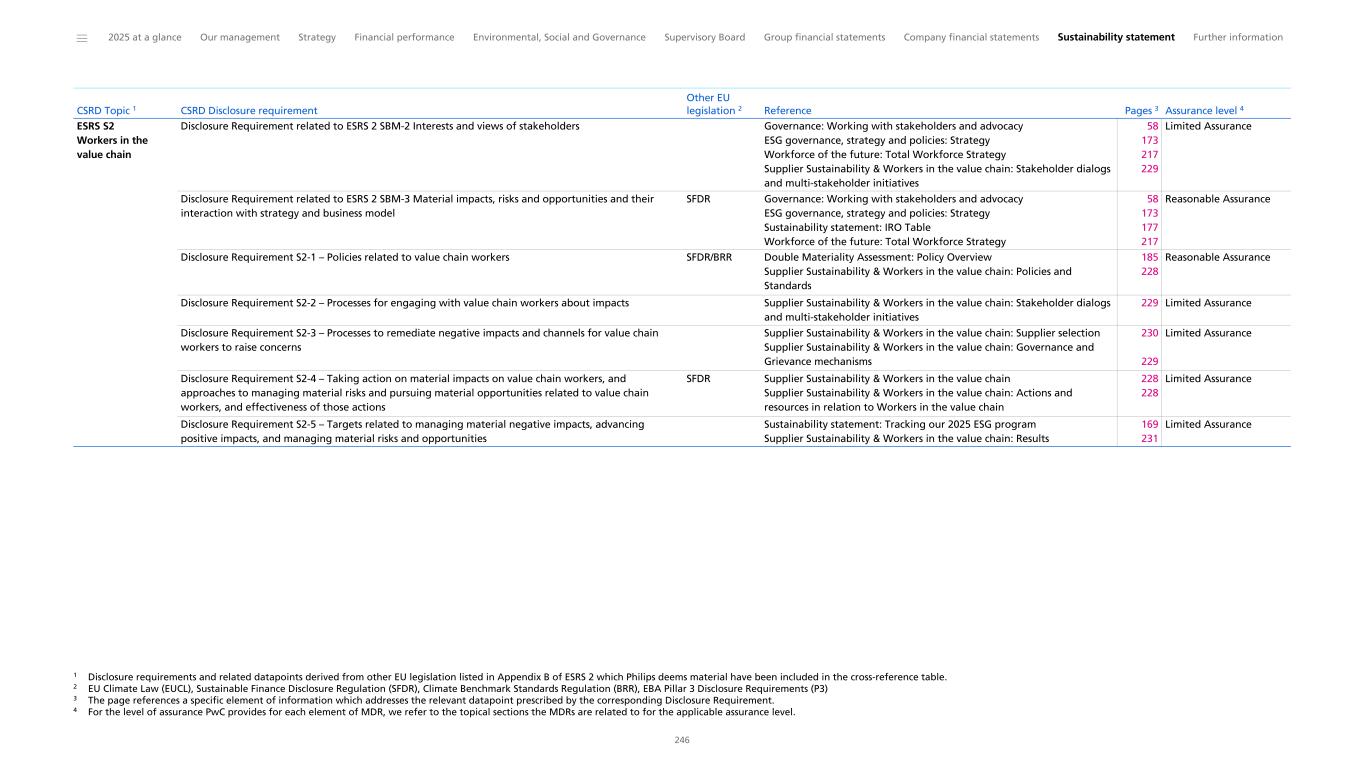
ESRS S2 Workers in the value chain Disclosure Requirement related to ESRS 2 SBM-2 Interests and views of stakeholders Governance: Working with stakeholders and advocacy ESG governance, strategy and policies: Strategy Workforce of the future: Total Workforce Strategy Supplier Sustainability & Workers in the value chain: Stakeholder dialogs and multi-stakeholder initiatives 58 173 217 229 Limited Assurance Disclosure Requirement related to ESRS 2 SBM-3 Material impacts, risks and opportunities and their interaction with strategy and business model SFDR Governance: Working with stakeholders and advocacy ESG governance, strategy and policies: Strategy Sustainability statement: IRO Table Workforce of the future: Total Workforce Strategy 58 173 177 217 Reasonable Assurance Disclosure Requirement S2-1 – Policies related to value chain workers SFDR/BRR Double Materiality Assessment: Policy Overview Supplier Sustainability & Workers in the value chain: Policies and Standards 185 228 Reasonable Assurance Disclosure Requirement S2-2 – Processes for engaging with value chain workers about impacts Supplier Sustainability & Workers in the value chain: Stakeholder dialogs and multi-stakeholder initiatives 229 Limited Assurance Disclosure Requirement S2-3 – Processes to remediate negative impacts and channels for value chain workers to raise concerns 1 Supplier Sustainability & Workers in the value chain: Supplier selection Supplier Sustainability & Workers in the value chain: Governance and Grievance mechanisms 230 229 Limited Assurance Disclosure Requirement S2-4 – Taking action on material impacts on value chain workers, and approaches to managing material risks and pursuing material opportunities related to value chain workers, and effectiveness of those actions SFDR Supplier Sustainability & Workers in the value chain Supplier Sustainability & Workers in the value chain: Actions and resources in relation to Workers in the value chain 228 228 Limited Assurance Disclosure Requirement S2-5 – Targets related to managing material negative impacts, advancing positive impacts, and managing material risks and opportunities 2,3,4 Sustainability statement: Tracking our 2025 ESG program Supplier Sustainability & Workers in the value chain: Results 169 231 Limited Assurance CSRD Topic 1 CSRD Disclosure requirement Other EU legislation 2 Reference Pages 3 Assurance level 4 ______ 2025 at a glance Our management Strategy Financial performance Environmental, Social and Governance Supervisory Board Group financial statements Company financial statements Sustainability statement Further information 246 1 Disclosure requirements and related datapoints derived from other EU legislation listed in Appendix B of ESRS 2 which Philips deems material have been included in the cross-reference table. 2 EU Climate Law (EUCL), Sustainable Finance Disclosure Regulation (SFDR), Climate Benchmark Standards Regulation (BRR), EBA Pillar 3 Disclosure Requirements (P3) 3 The page references a specific element of information which addresses the relevant datapoint prescribed by the corresponding Disclosure Requirement. 4 For the level of assurance PwC provides for each element of MDR, we refer to the topical sections the MDRs are related to for the applicable assurance level.
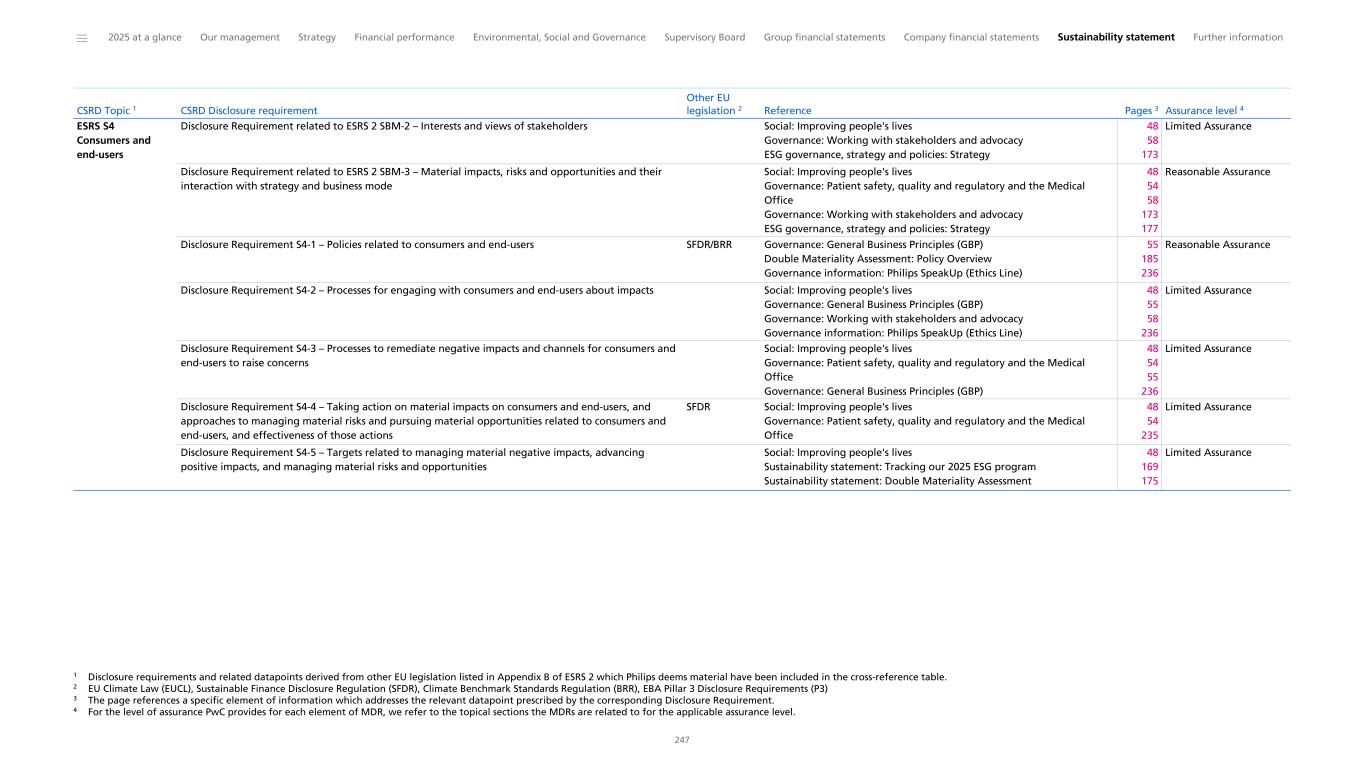
ESRS S4 Consumers and end-users Disclosure Requirement related to ESRS 2 SBM-2 – Interests and views of stakeholders Social: Improving people's lives Governance: Working with stakeholders and advocacy ESG governance, strategy and policies: Strategy 48 58 173 Limited Assurance Disclosure Requirement related to ESRS 2 SBM-3 – Material impacts, risks and opportunities and their interaction with strategy and business mode Social: Improving people's lives Governance: Patient safety, quality and regulatory and the Medical Office Governance: Working with stakeholders and advocacy ESG governance, strategy and policies: Strategy 48 54 58 173 177 Reasonable Assurance Disclosure Requirement S4-1 – Policies related to consumers and end-users SFDR/BRR Governance: General Business Principles (GBP) Double Materiality Assessment: Policy Overview Governance information: Philips SpeakUp (Ethics Line) 55 185 236 Reasonable Assurance Disclosure Requirement S4-2 – Processes for engaging with consumers and end-users about impacts Social: Improving people's lives Governance: General Business Principles (GBP) Governance: Working with stakeholders and advocacy Governance information: Philips SpeakUp (Ethics Line) 48 55 58 236 Limited Assurance Disclosure Requirement S4-3 – Processes to remediate negative impacts and channels for consumers and end-users to raise concerns Social: Improving people's lives Governance: Patient safety, quality and regulatory and the Medical Office Governance: General Business Principles (GBP) 48 54 55 236 Limited Assurance Disclosure Requirement S4-4 – Taking action on material impacts on consumers and end-users, and approaches to managing material risks and pursuing material opportunities related to consumers and end-users, and effectiveness of those actions SFDR Social: Improving people's lives Governance: Patient safety, quality and regulatory and the Medical Office 48 54 235 Limited Assurance Disclosure Requirement S4-5 – Targets related to managing material negative impacts, advancing positive impacts, and managing material risks and opportunities 1,2,3,4 Social: Improving people's lives Sustainability statement: Tracking our 2025 ESG program Sustainability statement: Double Materiality Assessment 48 169 175 Limited Assurance CSRD Topic 1 CSRD Disclosure requirement Other EU legislation 2 Reference Pages 3 Assurance level 4 ______ 2025 at a glance Our management Strategy Financial performance Environmental, Social and Governance Supervisory Board Group financial statements Company financial statements Sustainability statement Further information 247 1 Disclosure requirements and related datapoints derived from other EU legislation listed in Appendix B of ESRS 2 which Philips deems material have been included in the cross-reference table. 2 EU Climate Law (EUCL), Sustainable Finance Disclosure Regulation (SFDR), Climate Benchmark Standards Regulation (BRR), EBA Pillar 3 Disclosure Requirements (P3) 3 The page references a specific element of information which addresses the relevant datapoint prescribed by the corresponding Disclosure Requirement. 4 For the level of assurance PwC provides for each element of MDR, we refer to the topical sections the MDRs are related to for the applicable assurance level.
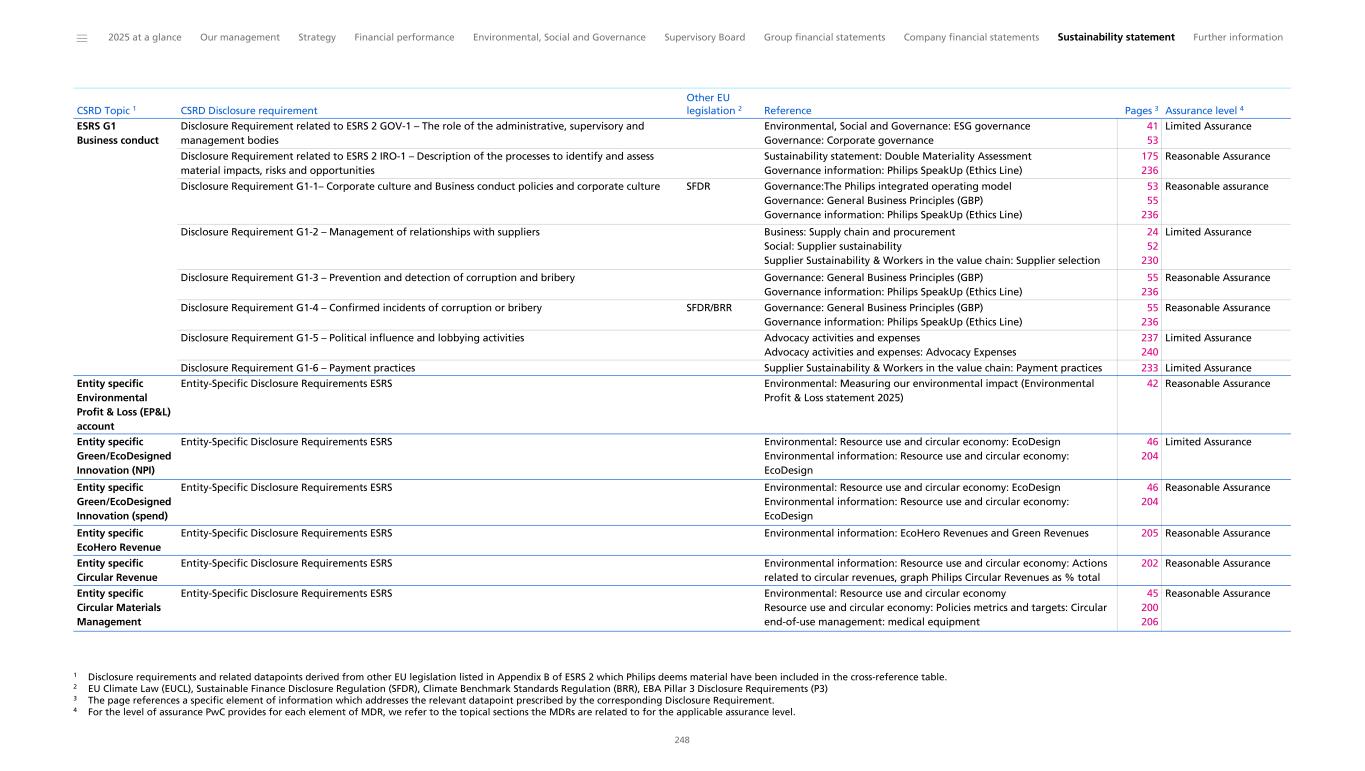
ESRS G1 Business conduct Disclosure Requirement related to ESRS 2 GOV-1 – The role of the administrative, supervisory and management bodies Environmental, Social and Governance: ESG governance Governance: Corporate governance 41 53 Limited Assurance Disclosure Requirement related to ESRS 2 IRO-1 – Description of the processes to identify and assess material impacts, risks and opportunities Sustainability statement: Double Materiality Assessment Governance information: Philips SpeakUp (Ethics Line) 175 236 Reasonable Assurance Disclosure Requirement G1-1– Corporate culture and Business conduct policies and corporate culture SFDR Governance:The Philips integrated operating model Governance: General Business Principles (GBP) Governance information: Philips SpeakUp (Ethics Line) 53 55 236 Reasonable assurance Disclosure Requirement G1-2 – Management of relationships with suppliers Business: Supply chain and procurement Social: Supplier sustainability Supplier Sustainability & Workers in the value chain: Supplier selection 24 52 230 Limited Assurance Disclosure Requirement G1-3 – Prevention and detection of corruption and bribery Governance: General Business Principles (GBP) Governance information: Philips SpeakUp (Ethics Line) 55 236 Reasonable Assurance Disclosure Requirement G1-4 – Confirmed incidents of corruption or bribery SFDR/BRR Governance: General Business Principles (GBP) Governance information: Philips SpeakUp (Ethics Line) 55 236 Reasonable Assurance Disclosure Requirement G1-5 – Political influence and lobbying activities Advocacy activities and expenses Advocacy activities and expenses: Advocacy Expenses 237 240 Limited Assurance Disclosure Requirement G1-6 – Payment practices Supplier Sustainability & Workers in the value chain: Payment practices 233 Limited Assurance Entity specific Environmental Profit & Loss (EP&L) account Entity-Specific Disclosure Requirements ESRS Environmental: Measuring our environmental impact (Environmental Profit & Loss statement 2025) 42 Reasonable Assurance Entity specific Green/EcoDesigned Innovation (NPI) Entity-Specific Disclosure Requirements ESRS Environmental: Resource use and circular economy: EcoDesign Environmental information: Resource use and circular economy: EcoDesign 46 204 Limited Assurance Entity specific Green/EcoDesigned Innovation (spend) Entity-Specific Disclosure Requirements ESRS Environmental: Resource use and circular economy: EcoDesign Environmental information: Resource use and circular economy: EcoDesign 46 204 Reasonable Assurance Entity specific EcoHero Revenue Entity-Specific Disclosure Requirements ESRS Environmental information: EcoHero Revenues and Green Revenues 205 Reasonable Assurance Entity specific Circular Revenue Entity-Specific Disclosure Requirements ESRS Environmental information: Resource use and circular economy: Actions related to circular revenues, graph Philips Circular Revenues as % total 202 Reasonable Assurance Entity specific Circular Materials Management Entity-Specific Disclosure Requirements ESRS 1,2,3,4 Environmental: Resource use and circular economy Resource use and circular economy: Policies metrics and targets: Circular end-of-use management: medical equipment 45 200 206 Reasonable Assurance CSRD Topic 1 CSRD Disclosure requirement Other EU legislation 2 Reference Pages 3 Assurance level 4 ______ 2025 at a glance Our management Strategy Financial performance Environmental, Social and Governance Supervisory Board Group financial statements Company financial statements Sustainability statement Further information 248 1 Disclosure requirements and related datapoints derived from other EU legislation listed in Appendix B of ESRS 2 which Philips deems material have been included in the cross-reference table. 2 EU Climate Law (EUCL), Sustainable Finance Disclosure Regulation (SFDR), Climate Benchmark Standards Regulation (BRR), EBA Pillar 3 Disclosure Requirements (P3) 3 The page references a specific element of information which addresses the relevant datapoint prescribed by the corresponding Disclosure Requirement. 4 For the level of assurance PwC provides for each element of MDR, we refer to the topical sections the MDRs are related to for the applicable assurance level.
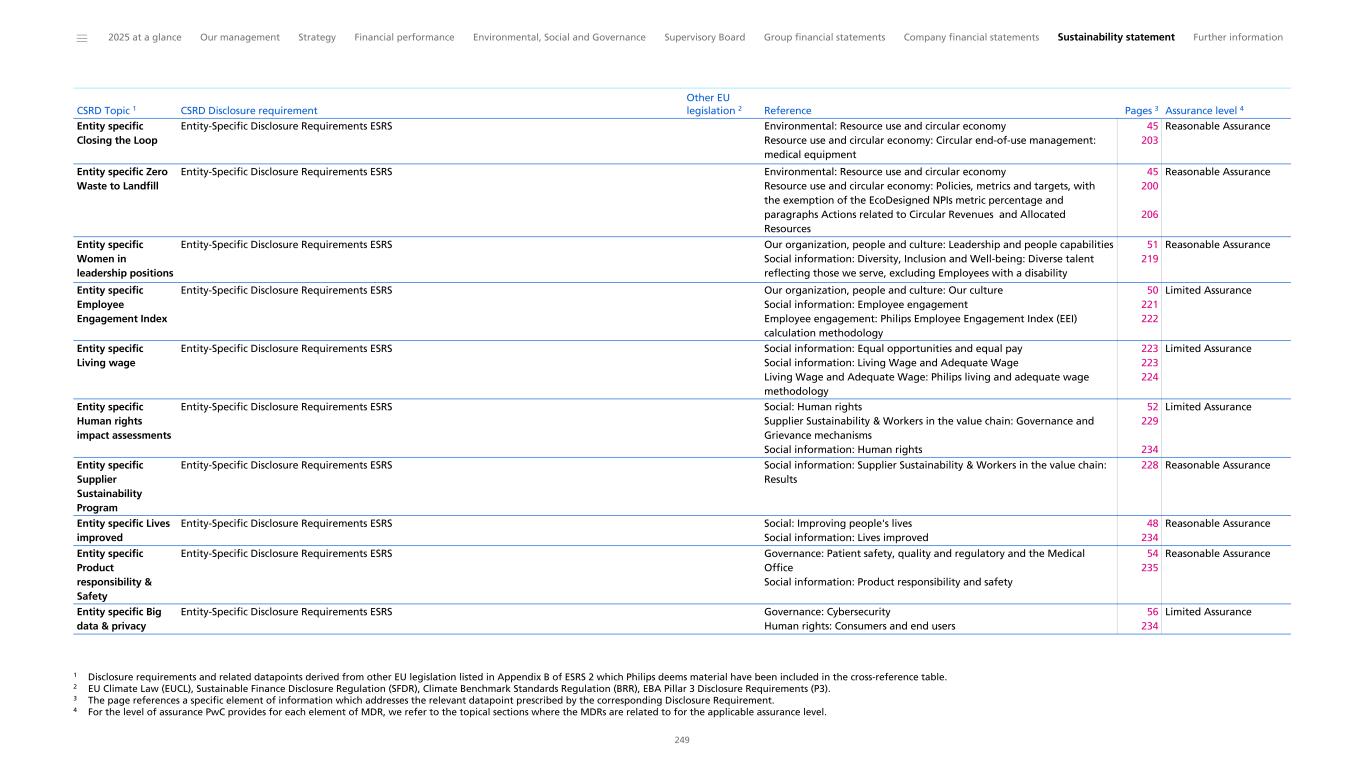
Entity specific Closing the Loop Entity-Specific Disclosure Requirements ESRS Environmental: Resource use and circular economy Resource use and circular economy: Circular end-of-use management: medical equipment 45 203 Reasonable Assurance Entity specific Zero Waste to Landfill Entity-Specific Disclosure Requirements ESRS Environmental: Resource use and circular economy Resource use and circular economy: Policies, metrics and targets, with the exemption of the EcoDesigned NPIs metric percentage and paragraphs Actions related to Circular Revenues and Allocated Resources 45 200 206 Reasonable Assurance Entity specific Women in leadership positions Entity-Specific Disclosure Requirements ESRS Our organization, people and culture: Leadership and people capabilities Social information: Diversity, Inclusion and Well-being: Diverse talent reflecting those we serve, excluding Employees with a disability 51 219 Reasonable Assurance Entity specific Employee Engagement Index Entity-Specific Disclosure Requirements ESRS Our organization, people and culture: Our culture Social information: Employee engagement Employee engagement: Philips Employee Engagement Index (EEI) calculation methodology 50 221 222 Limited Assurance Entity specific Living wage Entity-Specific Disclosure Requirements ESRS 1,2,3,4 Social information: Equal opportunities and equal pay Social information: Living Wage and Adequate Wage Living Wage and Adequate Wage: Philips living and adequate wage methodology 223 223 224 Limited Assurance Entity specific Human rights impact assessments Entity-Specific Disclosure Requirements ESRS Social: Human rights Supplier Sustainability & Workers in the value chain: Governance and Grievance mechanisms Social information: Human rights 52 229 234 Limited Assurance Entity specific Supplier Sustainability Program Entity-Specific Disclosure Requirements ESRS Social information: Supplier Sustainability & Workers in the value chain: Results 228 Reasonable Assurance Entity specific Lives improved Entity-Specific Disclosure Requirements ESRS Social: Improving people's lives Social information: Lives improved 48 234 Reasonable Assurance Entity specific Product responsibility & Safety Entity-Specific Disclosure Requirements ESRS Governance: Patient safety, quality and regulatory and the Medical Office Social information: Product responsibility and safety 54 235 Reasonable Assurance Entity specific Big data & privacy Entity-Specific Disclosure Requirements ESRS Governance: Cybersecurity Human rights: Consumers and end users 56 234 Limited Assurance CSRD Topic 1 CSRD Disclosure requirement Other EU legislation 2 Reference Pages 3 Assurance level 4 ______ 2025 at a glance Our management Strategy Financial performance Environmental, Social and Governance Supervisory Board Group financial statements Company financial statements Sustainability statement Further information 249 1 Disclosure requirements and related datapoints derived from other EU legislation listed in Appendix B of ESRS 2 which Philips deems material have been included in the cross-reference table. 2 EU Climate Law (EUCL), Sustainable Finance Disclosure Regulation (SFDR), Climate Benchmark Standards Regulation (BRR), EBA Pillar 3 Disclosure Requirements (P3). 3 The page references a specific element of information which addresses the relevant datapoint prescribed by the corresponding Disclosure Requirement. 4 For the level of assurance PwC provides for each element of MDR, we refer to the topical sections where the MDRs are related to for the applicable assurance level.
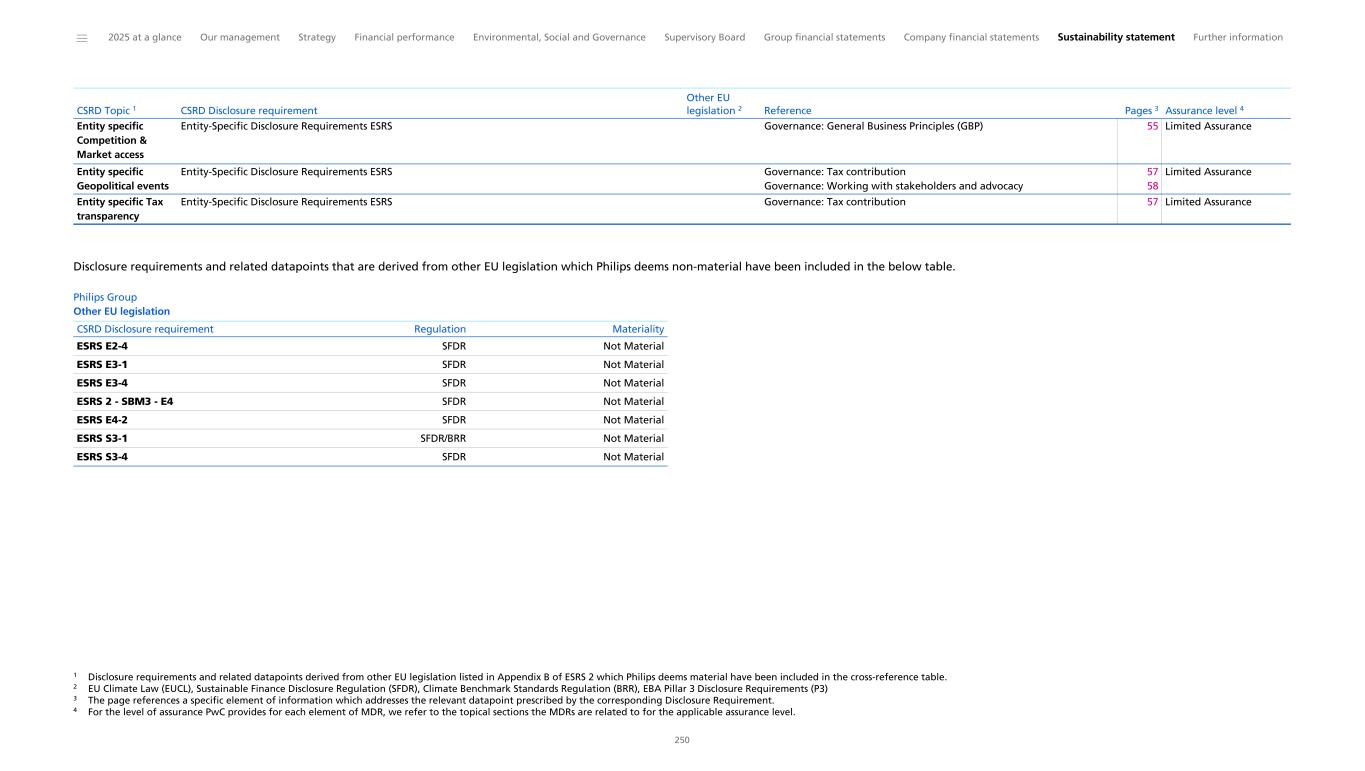
Entity specific Competition & Market access Entity-Specific Disclosure Requirements ESRS Governance: General Business Principles (GBP) 55 Limited Assurance Entity specific Geopolitical events Entity-Specific Disclosure Requirements ESRS Governance: Tax contribution Governance: Working with stakeholders and advocacy 57 58 Limited Assurance Entity specific Tax transparency Entity-Specific Disclosure Requirements ESRS 1,2,3,4 Governance: Tax contribution 57 Limited Assurance CSRD Topic 1 CSRD Disclosure requirement Other EU legislation 2 Reference Pages 3 Assurance level 4 Disclosure requirements and related datapoints that are derived from other EU legislation which Philips deems non-material have been included in the below table. Philips Group Other EU legislation ESRS E2-4 SFDR Not Material ESRS E3-1 SFDR Not Material ESRS E3-4 SFDR Not Material ESRS 2 - SBM3 - E4 SFDR Not Material ESRS E4-2 SFDR Not Material ESRS S3-1 SFDR/BRR Not Material ESRS S3-4 SFDR Not Material CSRD Disclosure requirement Regulation Materiality ______ 2025 at a glance Our management Strategy Financial performance Environmental, Social and Governance Supervisory Board Group financial statements Company financial statements Sustainability statement Further information 250 1 Disclosure requirements and related datapoints derived from other EU legislation listed in Appendix B of ESRS 2 which Philips deems material have been included in the cross-reference table. 2 EU Climate Law (EUCL), Sustainable Finance Disclosure Regulation (SFDR), Climate Benchmark Standards Regulation (BRR), EBA Pillar 3 Disclosure Requirements (P3) 3 The page references a specific element of information which addresses the relevant datapoint prescribed by the corresponding Disclosure Requirement. 4 For the level of assurance PwC provides for each element of MDR, we refer to the topical sections the MDRs are related to for the applicable assurance level.
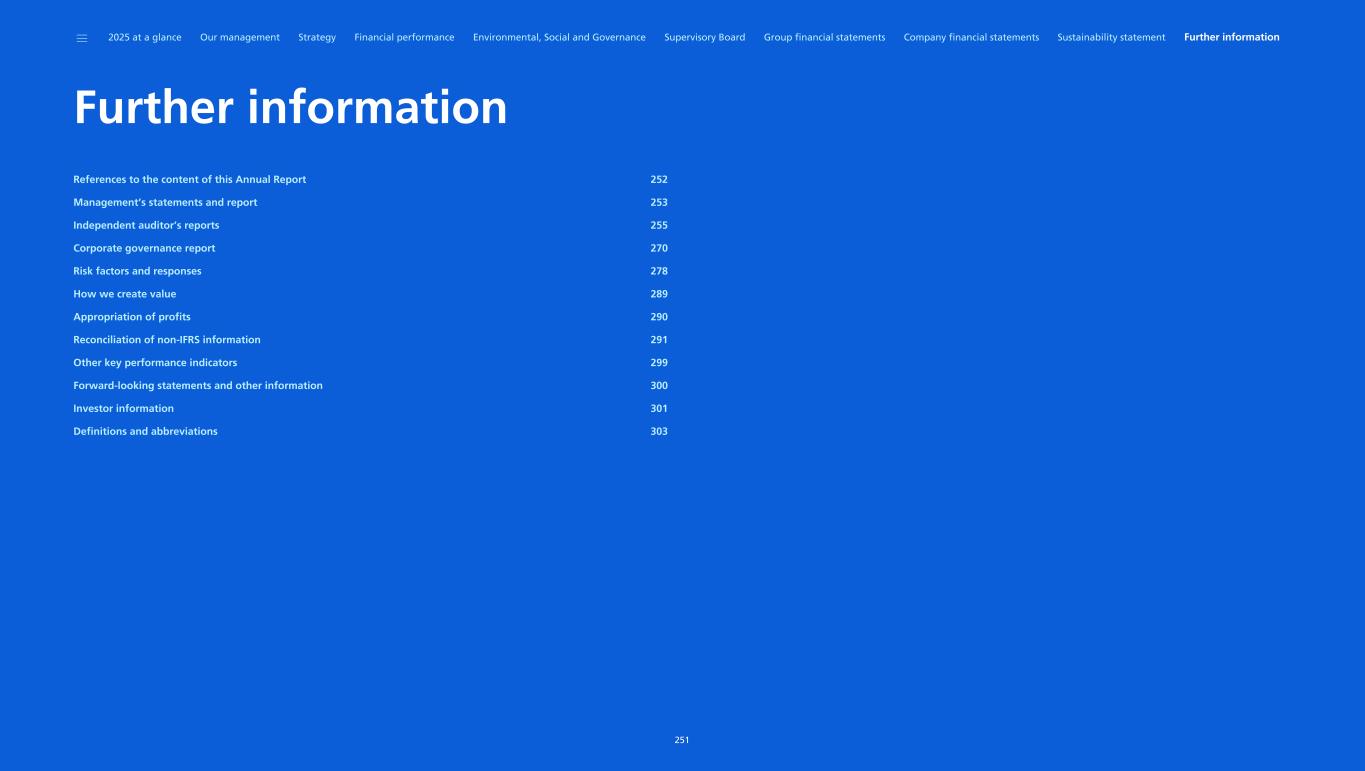
Further information References to the content of this Annual Report 252 Management’s statements and report 253 Independent auditor’s reports 255 Corporate governance report 270 Risk factors and responses 278 How we create value 289 Appropriation of profits 290 Reconciliation of non-IFRS information 291 Other key performance indicators 299 Forward-looking statements and other information 300 Investor information 301 Definitions and abbreviations 303 ______ 2025 at a glance Our management Strategy Financial performance Environmental, Social and Governance Supervisory Board Group financial statements Company financial statements Sustainability statement Further information 251
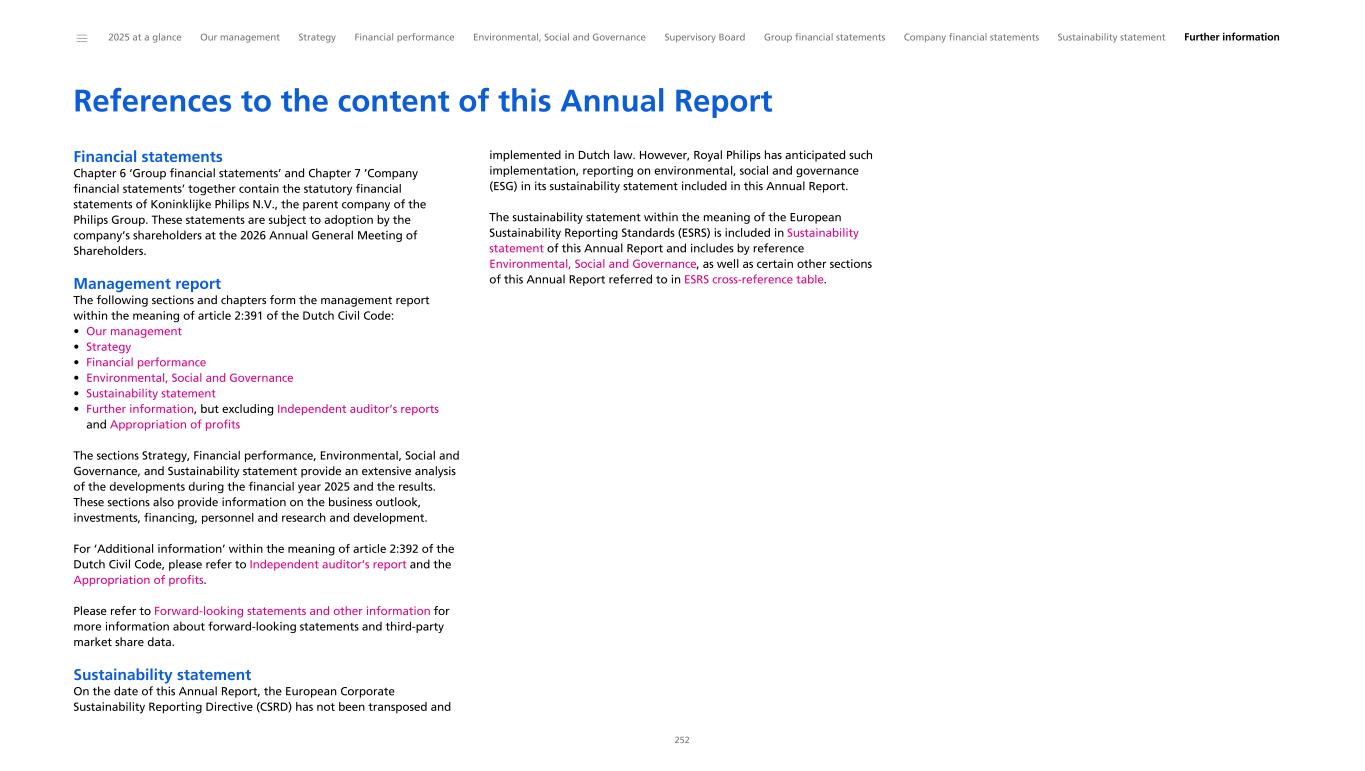
References to the content of this Annual Report Financial statements Chapter 6 ‘Group financial statements’ and Chapter 7 ’Company financial statements’ together contain the statutory financial statements of Koninklijke Philips N.V., the parent company of the Philips Group. These statements are subject to adoption by the company’s shareholders at the 2026 Annual General Meeting of Shareholders. Management report The following sections and chapters form the management report within the meaning of article 2:391 of the Dutch Civil Code: • Our management • Strategy • Financial performance • Environmental, Social and Governance • Sustainability statement • Further information, but excluding Independent auditor’s reports and Appropriation of profits The sections Strategy, Financial performance, Environmental, Social and Governance, and Sustainability statement provide an extensive analysis of the developments during the financial year 2025 and the results. These sections also provide information on the business outlook, investments, financing, personnel and research and development. For ‘Additional information’ within the meaning of article 2:392 of the Dutch Civil Code, please refer to Independent auditor’s report and the Appropriation of profits. Please refer to Forward-looking statements and other information for more information about forward-looking statements and third-party market share data. Sustainability statement On the date of this Annual Report, the European Corporate Sustainability Reporting Directive (CSRD) has not been transposed and implemented in Dutch law. However, Royal Philips has anticipated such implementation, reporting on environmental, social and governance (ESG) in its sustainability statement included in this Annual Report. The sustainability statement within the meaning of the European Sustainability Reporting Standards (ESRS) is included in Sustainability statement of this Annual Report and includes by reference Environmental, Social and Governance, as well as certain other sections of this Annual Report referred to in ESRS cross-reference table. ______ 2025 at a glance Our management Strategy Financial performance Environmental, Social and Governance Supervisory Board Group financial statements Company financial statements Sustainability statement Further information 252
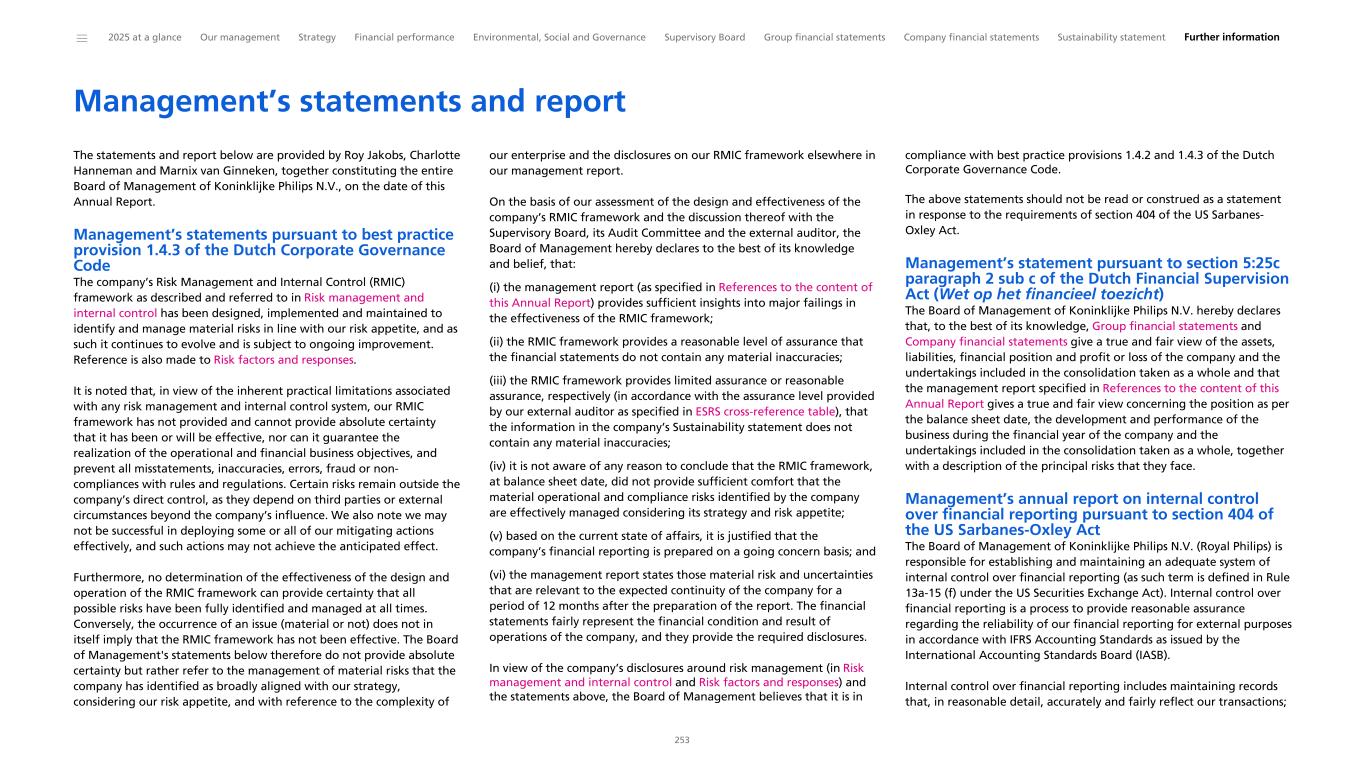
Management’s statements and report The statements and report below are provided by Roy Jakobs, Charlotte Hanneman and Marnix van Ginneken, together constituting the entire Board of Management of Koninklijke Philips N.V., on the date of this Annual Report. Management’s statements pursuant to best practice provision 1.4.3 of the Dutch Corporate Governance Code The company’s Risk Management and Internal Control (RMIC) framework as described and referred to in Risk management and internal control has been designed, implemented and maintained to identify and manage material risks in line with our risk appetite, and as such it continues to evolve and is subject to ongoing improvement. Reference is also made to Risk factors and responses. It is noted that, in view of the inherent practical limitations associated with any risk management and internal control system, our RMIC framework has not provided and cannot provide absolute certainty that it has been or will be effective, nor can it guarantee the realization of the operational and financial business objectives, and prevent all misstatements, inaccuracies, errors, fraud or non- compliances with rules and regulations. Certain risks remain outside the company’s direct control, as they depend on third parties or external circumstances beyond the company’s influence. We also note we may not be successful in deploying some or all of our mitigating actions effectively, and such actions may not achieve the anticipated effect. Furthermore, no determination of the effectiveness of the design and operation of the RMIC framework can provide certainty that all possible risks have been fully identified and managed at all times. Conversely, the occurrence of an issue (material or not) does not in itself imply that the RMIC framework has not been effective. The Board of Management's statements below therefore do not provide absolute certainty but rather refer to the management of material risks that the company has identified as broadly aligned with our strategy, considering our risk appetite, and with reference to the complexity of our enterprise and the disclosures on our RMIC framework elsewhere in our management report. On the basis of our assessment of the design and effectiveness of the company’s RMIC framework and the discussion thereof with the Supervisory Board, its Audit Committee and the external auditor, the Board of Management hereby declares to the best of its knowledge and belief, that: (i) the management report (as specified in References to the content of this Annual Report) provides sufficient insights into major failings in the effectiveness of the RMIC framework; (ii) the RMIC framework provides a reasonable level of assurance that the financial statements do not contain any material inaccuracies; (iii) the RMIC framework provides limited assurance or reasonable assurance, respectively (in accordance with the assurance level provided by our external auditor as specified in ESRS cross-reference table), that the information in the company’s Sustainability statement does not contain any material inaccuracies; (iv) it is not aware of any reason to conclude that the RMIC framework, at balance sheet date, did not provide sufficient comfort that the material operational and compliance risks identified by the company are effectively managed considering its strategy and risk appetite; (v) based on the current state of affairs, it is justified that the company’s financial reporting is prepared on a going concern basis; and (vi) the management report states those material risk and uncertainties that are relevant to the expected continuity of the company for a period of 12 months after the preparation of the report. The financial statements fairly represent the financial condition and result of operations of the company, and they provide the required disclosures. In view of the company’s disclosures around risk management (in Risk management and internal control and Risk factors and responses) and the statements above, the Board of Management believes that it is in compliance with best practice provisions 1.4.2 and 1.4.3 of the Dutch Corporate Governance Code. The above statements should not be read or construed as a statement in response to the requirements of section 404 of the US Sarbanes- Oxley Act. Management’s statement pursuant to section 5:25c paragraph 2 sub c of the Dutch Financial Supervision Act (Wet op het financieel toezicht) The Board of Management of Koninklijke Philips N.V. hereby declares that, to the best of its knowledge, Group financial statements and Company financial statements give a true and fair view of the assets, liabilities, financial position and profit or loss of the company and the undertakings included in the consolidation taken as a whole and that the management report specified in References to the content of this Annual Report gives a true and fair view concerning the position as per the balance sheet date, the development and performance of the business during the financial year of the company and the undertakings included in the consolidation taken as a whole, together with a description of the principal risks that they face. Management’s annual report on internal control over financial reporting pursuant to section 404 of the US Sarbanes-Oxley Act The Board of Management of Koninklijke Philips N.V. (Royal Philips) is responsible for establishing and maintaining an adequate system of internal control over financial reporting (as such term is defined in Rule 13a-15 (f) under the US Securities Exchange Act). Internal control over financial reporting is a process to provide reasonable assurance regarding the reliability of our financial reporting for external purposes in accordance with IFRS Accounting Standards as issued by the International Accounting Standards Board (IASB). Internal control over financial reporting includes maintaining records that, in reasonable detail, accurately and fairly reflect our transactions; ______ 2025 at a glance Our management Strategy Financial performance Environmental, Social and Governance Supervisory Board Group financial statements Company financial statements Sustainability statement Further information 253
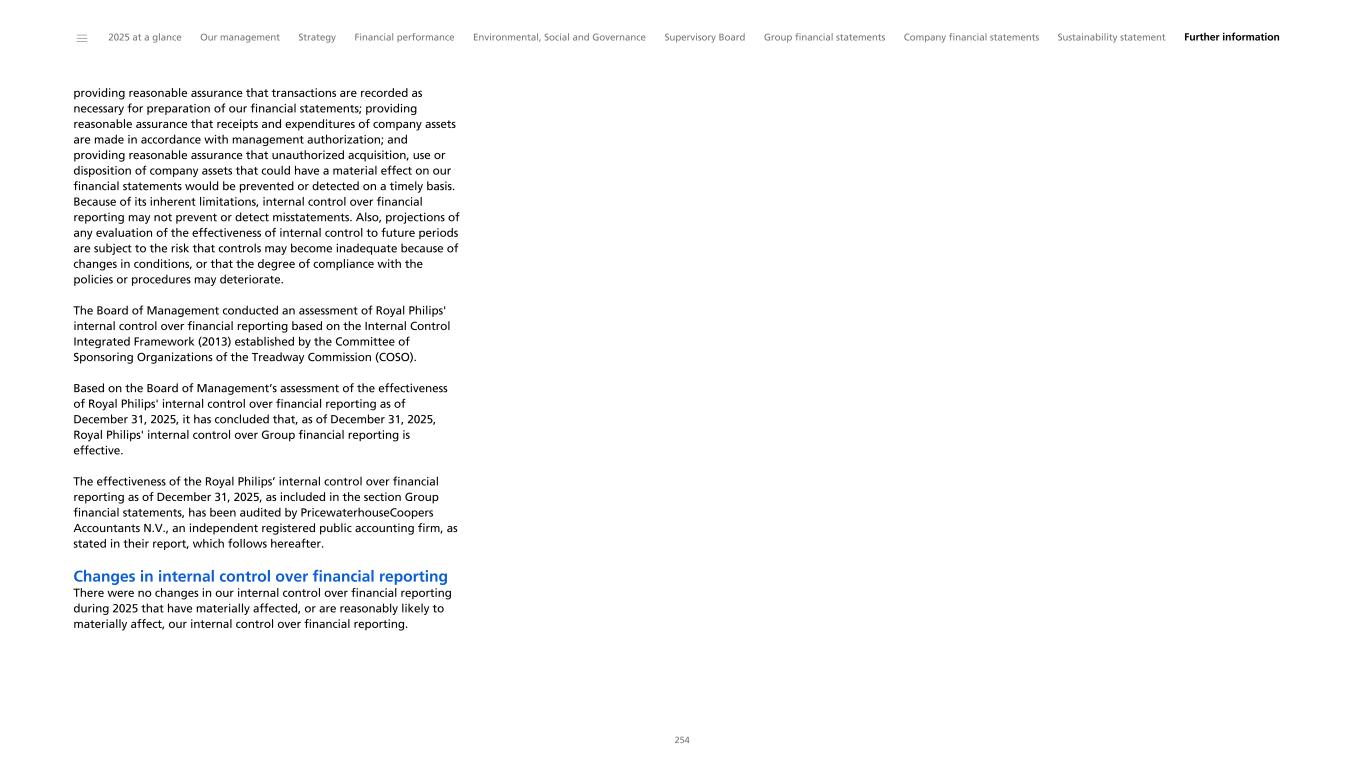
providing reasonable assurance that transactions are recorded as necessary for preparation of our financial statements; providing reasonable assurance that receipts and expenditures of company assets are made in accordance with management authorization; and providing reasonable assurance that unauthorized acquisition, use or disposition of company assets that could have a material effect on our financial statements would be prevented or detected on a timely basis. Because of its inherent limitations, internal control over financial reporting may not prevent or detect misstatements. Also, projections of any evaluation of the effectiveness of internal control to future periods are subject to the risk that controls may become inadequate because of changes in conditions, or that the degree of compliance with the policies or procedures may deteriorate. The Board of Management conducted an assessment of Royal Philips' internal control over financial reporting based on the Internal Control Integrated Framework (2013) established by the Committee of Sponsoring Organizations of the Treadway Commission (COSO). Based on the Board of Management’s assessment of the effectiveness of Royal Philips' internal control over financial reporting as of December 31, 2025, it has concluded that, as of December 31, 2025, Royal Philips' internal control over Group financial reporting is effective. The effectiveness of the Royal Philips’ internal control over financial reporting as of December 31, 2025, as included in the section Group financial statements, has been audited by PricewaterhouseCoopers Accountants N.V., an independent registered public accounting firm, as stated in their report, which follows hereafter. Changes in internal control over financial reporting There were no changes in our internal control over financial reporting during 2025 that have materially affected, or are reasonably likely to materially affect, our internal control over financial reporting. ______ 2025 at a glance Our management Strategy Financial performance Environmental, Social and Governance Supervisory Board Group financial statements Company financial statements Sustainability statement Further information 254
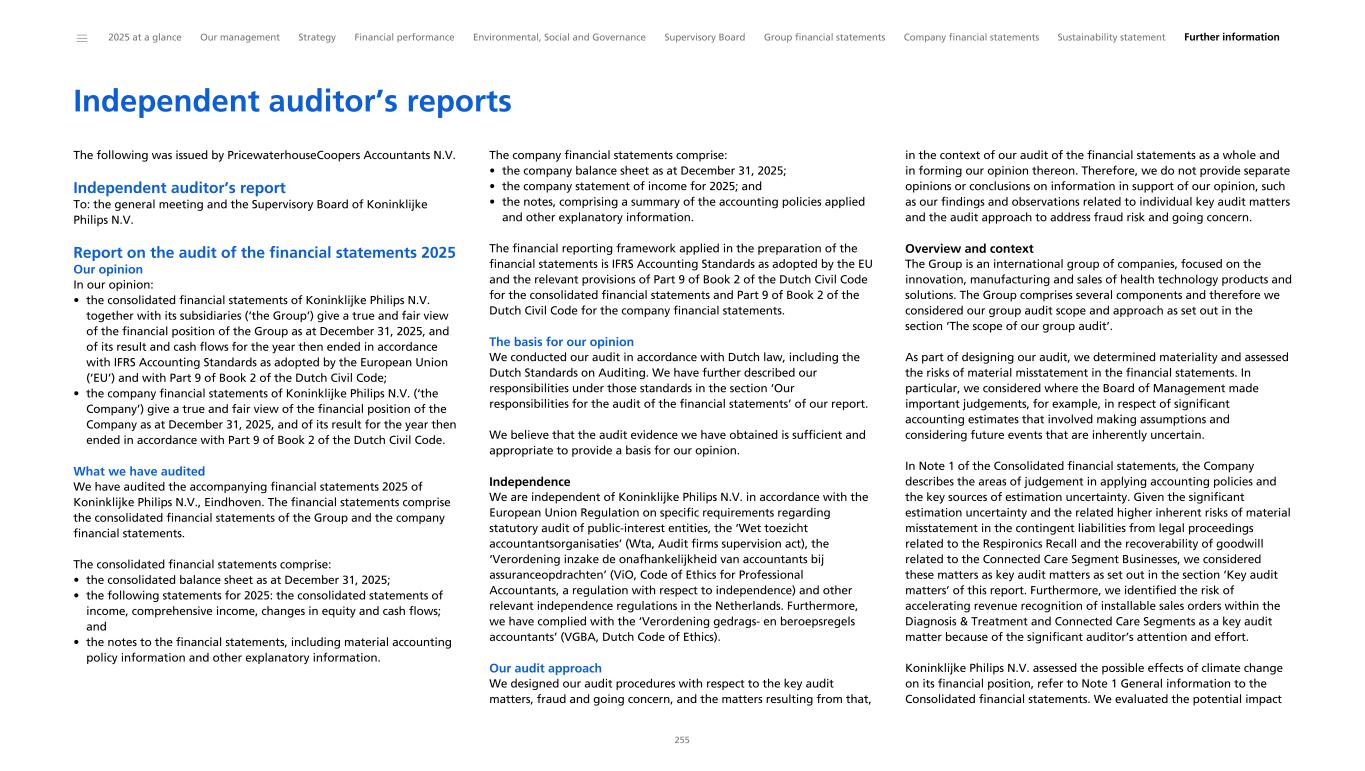
Independent auditor’s reports The following was issued by PricewaterhouseCoopers Accountants N.V. Independent auditor’s report To: the general meeting and the Supervisory Board of Koninklijke Philips N.V. Report on the audit of the financial statements 2025 Our opinion In our opinion: • the consolidated financial statements of Koninklijke Philips N.V. together with its subsidiaries (‘the Group’) give a true and fair view of the financial position of the Group as at December 31, 2025, and of its result and cash flows for the year then ended in accordance with IFRS Accounting Standards as adopted by the European Union (‘EU’) and with Part 9 of Book 2 of the Dutch Civil Code; • the company financial statements of Koninklijke Philips N.V. (‘the Company’) give a true and fair view of the financial position of the Company as at December 31, 2025, and of its result for the year then ended in accordance with Part 9 of Book 2 of the Dutch Civil Code. What we have audited We have audited the accompanying financial statements 2025 of Koninklijke Philips N.V., Eindhoven. The financial statements comprise the consolidated financial statements of the Group and the company financial statements. The consolidated financial statements comprise: • the consolidated balance sheet as at December 31, 2025; • the following statements for 2025: the consolidated statements of income, comprehensive income, changes in equity and cash flows; and • the notes to the financial statements, including material accounting policy information and other explanatory information. The company financial statements comprise: • the company balance sheet as at December 31, 2025; • the company statement of income for 2025; and • the notes, comprising a summary of the accounting policies applied and other explanatory information. The financial reporting framework applied in the preparation of the financial statements is IFRS Accounting Standards as adopted by the EU and the relevant provisions of Part 9 of Book 2 of the Dutch Civil Code for the consolidated financial statements and Part 9 of Book 2 of the Dutch Civil Code for the company financial statements. The basis for our opinion We conducted our audit in accordance with Dutch law, including the Dutch Standards on Auditing. We have further described our responsibilities under those standards in the section ‘Our responsibilities for the audit of the financial statements’ of our report. We believe that the audit evidence we have obtained is sufficient and appropriate to provide a basis for our opinion. Independence We are independent of Koninklijke Philips N.V. in accordance with the European Union Regulation on specific requirements regarding statutory audit of public-interest entities, the ‘Wet toezicht accountantsorganisaties’ (Wta, Audit firms supervision act), the ‘Verordening inzake de onafhankelijkheid van accountants bij assuranceopdrachten’ (ViO, Code of Ethics for Professional Accountants, a regulation with respect to independence) and other relevant independence regulations in the Netherlands. Furthermore, we have complied with the ‘Verordening gedrags- en beroepsregels accountants’ (VGBA, Dutch Code of Ethics). Our audit approach We designed our audit procedures with respect to the key audit matters, fraud and going concern, and the matters resulting from that, in the context of our audit of the financial statements as a whole and in forming our opinion thereon. Therefore, we do not provide separate opinions or conclusions on information in support of our opinion, such as our findings and observations related to individual key audit matters and the audit approach to address fraud risk and going concern. Overview and context The Group is an international group of companies, focused on the innovation, manufacturing and sales of health technology products and solutions. The Group comprises several components and therefore we considered our group audit scope and approach as set out in the section ‘The scope of our group audit’. As part of designing our audit, we determined materiality and assessed the risks of material misstatement in the financial statements. In particular, we considered where the Board of Management made important judgements, for example, in respect of significant accounting estimates that involved making assumptions and considering future events that are inherently uncertain. In Note 1 of the Consolidated financial statements, the Company describes the areas of judgement in applying accounting policies and the key sources of estimation uncertainty. Given the significant estimation uncertainty and the related higher inherent risks of material misstatement in the contingent liabilities from legal proceedings related to the Respironics Recall and the recoverability of goodwill related to the Connected Care Segment Businesses, we considered these matters as key audit matters as set out in the section ‘Key audit matters’ of this report. Furthermore, we identified the risk of accelerating revenue recognition of installable sales orders within the Diagnosis & Treatment and Connected Care Segments as a key audit matter because of the significant auditor’s attention and effort. Koninklijke Philips N.V. assessed the possible effects of climate change on its financial position, refer to Note 1 General information to the Consolidated financial statements. We evaluated the potential impact ______ 2025 at a glance Our management Strategy Financial performance Environmental, Social and Governance Supervisory Board Group financial statements Company financial statements Sustainability statement Further information 255
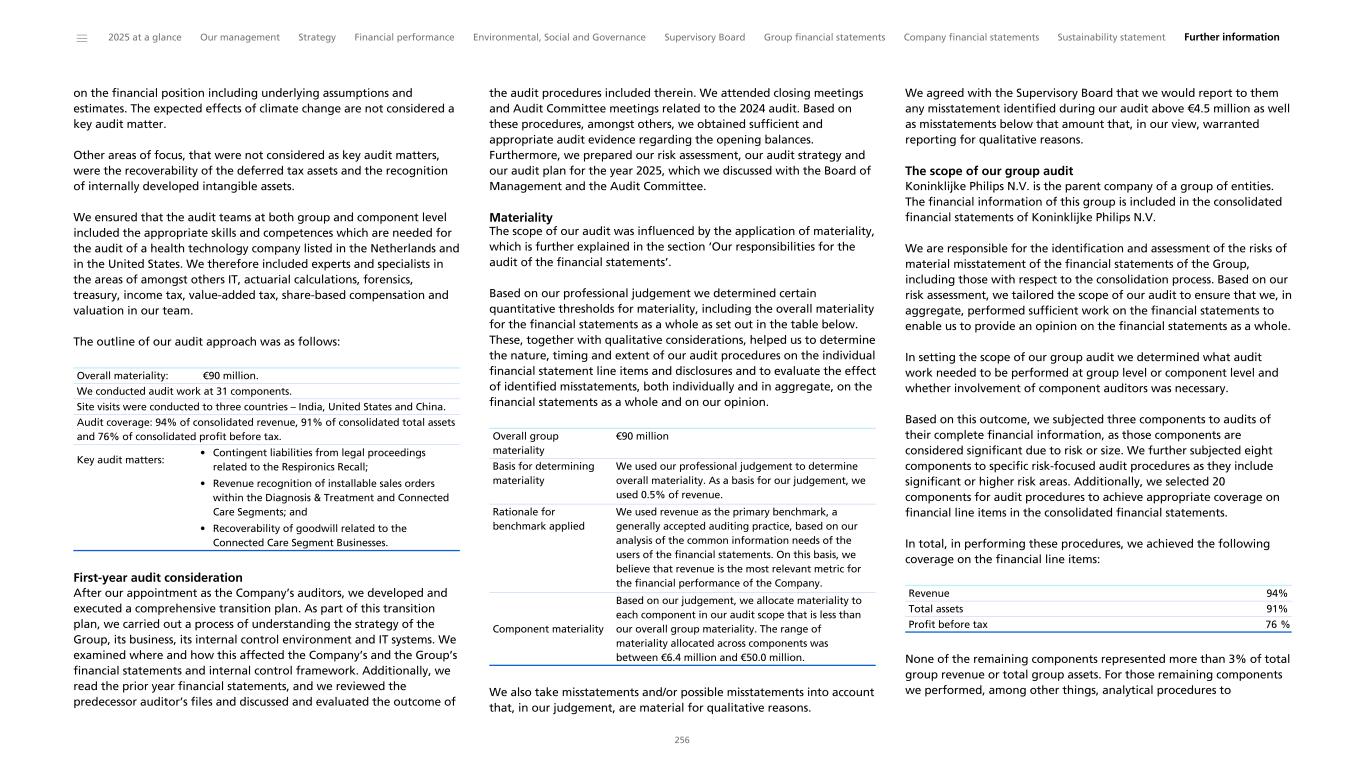
on the financial position including underlying assumptions and estimates. The expected effects of climate change are not considered a key audit matter. Other areas of focus, that were not considered as key audit matters, were the recoverability of the deferred tax assets and the recognition of internally developed intangible assets. We ensured that the audit teams at both group and component level included the appropriate skills and competences which are needed for the audit of a health technology company listed in the Netherlands and in the United States. We therefore included experts and specialists in the areas of amongst others IT, actuarial calculations, forensics, treasury, income tax, value-added tax, share-based compensation and valuation in our team. The outline of our audit approach was as follows: Overall materiality: €90 million. We conducted audit work at 31 components. Site visits were conducted to three countries – India, United States and China. Audit coverage: 94% of consolidated revenue, 91% of consolidated total assets and 76% of consolidated profit before tax. Key audit matters: • Contingent liabilities from legal proceedings related to the Respironics Recall; • Revenue recognition of installable sales orders within the Diagnosis & Treatment and Connected Care Segments; and • Recoverability of goodwill related to the Connected Care Segment Businesses. First-year audit consideration After our appointment as the Company’s auditors, we developed and executed a comprehensive transition plan. As part of this transition plan, we carried out a process of understanding the strategy of the Group, its business, its internal control environment and IT systems. We examined where and how this affected the Company’s and the Group’s financial statements and internal control framework. Additionally, we read the prior year financial statements, and we reviewed the predecessor auditor’s files and discussed and evaluated the outcome of the audit procedures included therein. We attended closing meetings and Audit Committee meetings related to the 2024 audit. Based on these procedures, amongst others, we obtained sufficient and appropriate audit evidence regarding the opening balances. Furthermore, we prepared our risk assessment, our audit strategy and our audit plan for the year 2025, which we discussed with the Board of Management and the Audit Committee. Materiality The scope of our audit was influenced by the application of materiality, which is further explained in the section ‘Our responsibilities for the audit of the financial statements’. Based on our professional judgement we determined certain quantitative thresholds for materiality, including the overall materiality for the financial statements as a whole as set out in the table below. These, together with qualitative considerations, helped us to determine the nature, timing and extent of our audit procedures on the individual financial statement line items and disclosures and to evaluate the effect of identified misstatements, both individually and in aggregate, on the financial statements as a whole and on our opinion. Overall group materiality €90 million Basis for determining materiality We used our professional judgement to determine overall materiality. As a basis for our judgement, we used 0.5% of revenue. Rationale for benchmark applied We used revenue as the primary benchmark, a generally accepted auditing practice, based on our analysis of the common information needs of the users of the financial statements. On this basis, we believe that revenue is the most relevant metric for the financial performance of the Company. Component materiality Based on our judgement, we allocate materiality to each component in our audit scope that is less than our overall group materiality. The range of materiality allocated across components was between €6.4 million and €50.0 million. We also take misstatements and/or possible misstatements into account that, in our judgement, are material for qualitative reasons. We agreed with the Supervisory Board that we would report to them any misstatement identified during our audit above €4.5 million as well as misstatements below that amount that, in our view, warranted reporting for qualitative reasons. The scope of our group audit Koninklijke Philips N.V. is the parent company of a group of entities. The financial information of this group is included in the consolidated financial statements of Koninklijke Philips N.V. We are responsible for the identification and assessment of the risks of material misstatement of the financial statements of the Group, including those with respect to the consolidation process. Based on our risk assessment, we tailored the scope of our audit to ensure that we, in aggregate, performed sufficient work on the financial statements to enable us to provide an opinion on the financial statements as a whole. In setting the scope of our group audit we determined what audit work needed to be performed at group level or component level and whether involvement of component auditors was necessary. Based on this outcome, we subjected three components to audits of their complete financial information, as those components are considered significant due to risk or size. We further subjected eight components to specific risk-focused audit procedures as they include significant or higher risk areas. Additionally, we selected 20 components for audit procedures to achieve appropriate coverage on financial line items in the consolidated financial statements. In total, in performing these procedures, we achieved the following coverage on the financial line items: Revenue 94% Total assets 91% Profit before tax 76 % None of the remaining components represented more than 3% of total group revenue or total group assets. For those remaining components we performed, among other things, analytical procedures to ______ 2025 at a glance Our management Strategy Financial performance Environmental, Social and Governance Supervisory Board Group financial statements Company financial statements Sustainability statement Further information 256
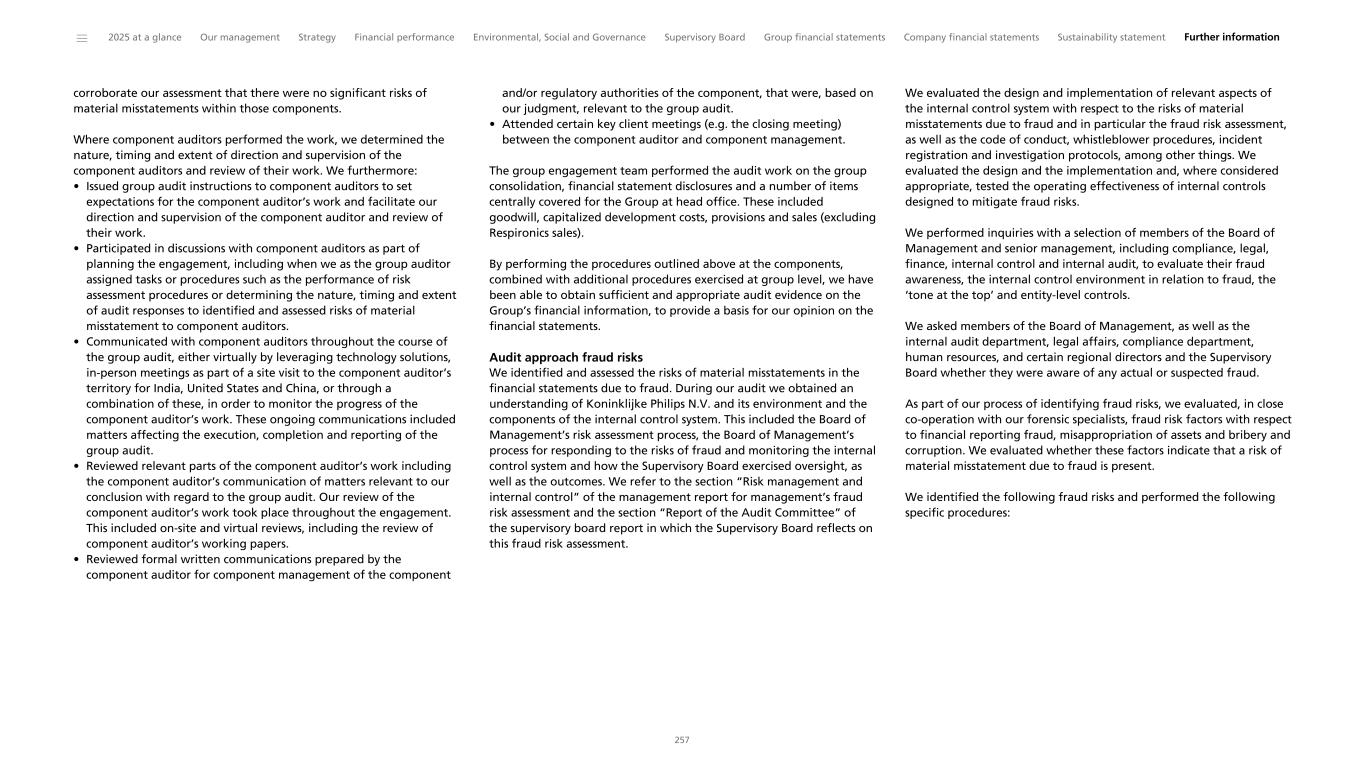
corroborate our assessment that there were no significant risks of material misstatements within those components. Where component auditors performed the work, we determined the nature, timing and extent of direction and supervision of the component auditors and review of their work. We furthermore: • Issued group audit instructions to component auditors to set expectations for the component auditor’s work and facilitate our direction and supervision of the component auditor and review of their work. • Participated in discussions with component auditors as part of planning the engagement, including when we as the group auditor assigned tasks or procedures such as the performance of risk assessment procedures or determining the nature, timing and extent of audit responses to identified and assessed risks of material misstatement to component auditors. • Communicated with component auditors throughout the course of the group audit, either virtually by leveraging technology solutions, in-person meetings as part of a site visit to the component auditor’s territory for India, United States and China, or through a combination of these, in order to monitor the progress of the component auditor’s work. These ongoing communications included matters affecting the execution, completion and reporting of the group audit. • Reviewed relevant parts of the component auditor’s work including the component auditor’s communication of matters relevant to our conclusion with regard to the group audit. Our review of the component auditor’s work took place throughout the engagement. This included on-site and virtual reviews, including the review of component auditor’s working papers. • Reviewed formal written communications prepared by the component auditor for component management of the component and/or regulatory authorities of the component, that were, based on our judgment, relevant to the group audit. • Attended certain key client meetings (e.g. the closing meeting) between the component auditor and component management. The group engagement team performed the audit work on the group consolidation, financial statement disclosures and a number of items centrally covered for the Group at head office. These included goodwill, capitalized development costs, provisions and sales (excluding Respironics sales). By performing the procedures outlined above at the components, combined with additional procedures exercised at group level, we have been able to obtain sufficient and appropriate audit evidence on the Group’s financial information, to provide a basis for our opinion on the financial statements. Audit approach fraud risks We identified and assessed the risks of material misstatements in the financial statements due to fraud. During our audit we obtained an understanding of Koninklijke Philips N.V. and its environment and the components of the internal control system. This included the Board of Management’s risk assessment process, the Board of Management’s process for responding to the risks of fraud and monitoring the internal control system and how the Supervisory Board exercised oversight, as well as the outcomes. We refer to the section “Risk management and internal control” of the management report for management’s fraud risk assessment and the section “Report of the Audit Committee” of the supervisory board report in which the Supervisory Board reflects on this fraud risk assessment. We evaluated the design and implementation of relevant aspects of the internal control system with respect to the risks of material misstatements due to fraud and in particular the fraud risk assessment, as well as the code of conduct, whistleblower procedures, incident registration and investigation protocols, among other things. We evaluated the design and the implementation and, where considered appropriate, tested the operating effectiveness of internal controls designed to mitigate fraud risks. We performed inquiries with a selection of members of the Board of Management and senior management, including compliance, legal, finance, internal control and internal audit, to evaluate their fraud awareness, the internal control environment in relation to fraud, the ‘tone at the top’ and entity-level controls. We asked members of the Board of Management, as well as the internal audit department, legal affairs, compliance department, human resources, and certain regional directors and the Supervisory Board whether they were aware of any actual or suspected fraud. As part of our process of identifying fraud risks, we evaluated, in close co-operation with our forensic specialists, fraud risk factors with respect to financial reporting fraud, misappropriation of assets and bribery and corruption. We evaluated whether these factors indicate that a risk of material misstatement due to fraud is present. We identified the following fraud risks and performed the following specific procedures: ______ 2025 at a glance Our management Strategy Financial performance Environmental, Social and Governance Supervisory Board Group financial statements Company financial statements Sustainability statement Further information 257
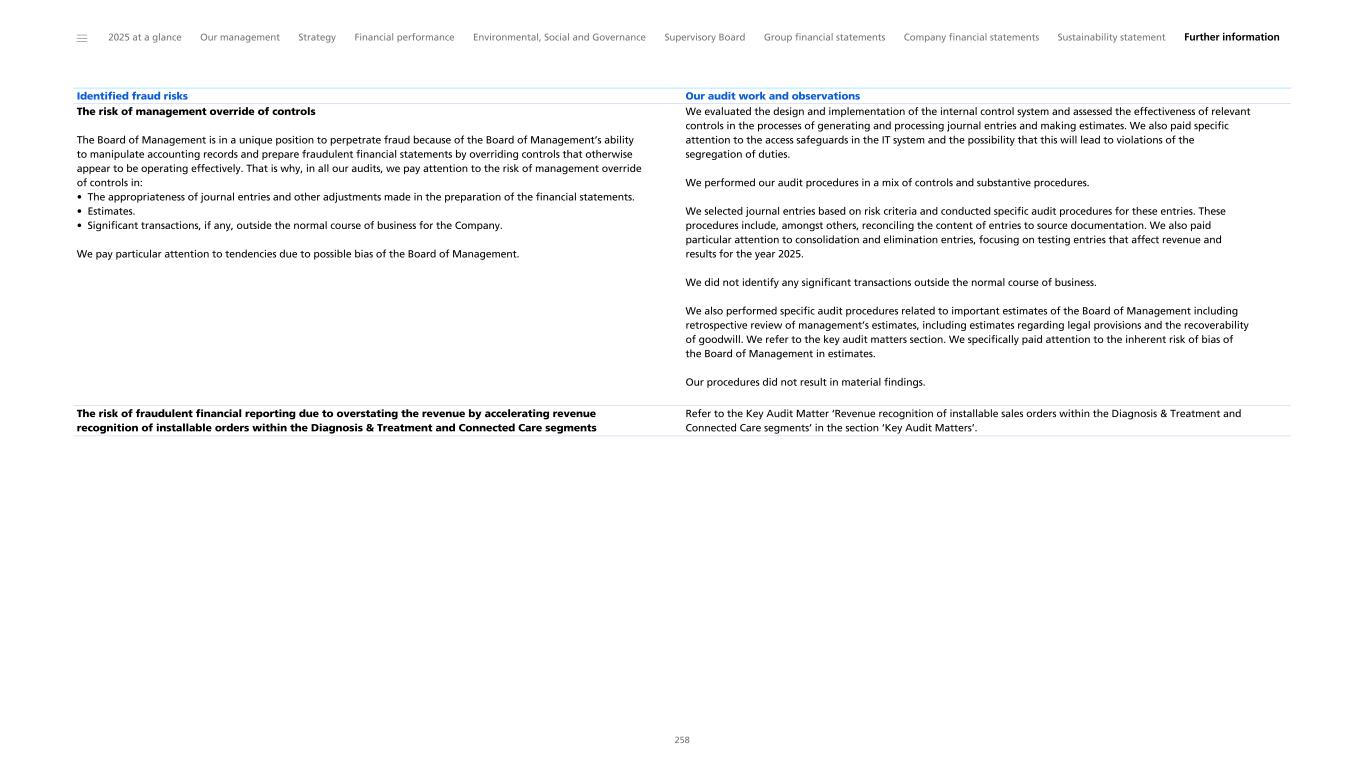
The risk of management override of controls The Board of Management is in a unique position to perpetrate fraud because of the Board of Management’s ability to manipulate accounting records and prepare fraudulent financial statements by overriding controls that otherwise appear to be operating effectively. That is why, in all our audits, we pay attention to the risk of management override of controls in: • The appropriateness of journal entries and other adjustments made in the preparation of the financial statements. • Estimates. • Significant transactions, if any, outside the normal course of business for the Company. We pay particular attention to tendencies due to possible bias of the Board of Management. We evaluated the design and implementation of the internal control system and assessed the effectiveness of relevant controls in the processes of generating and processing journal entries and making estimates. We also paid specific attention to the access safeguards in the IT system and the possibility that this will lead to violations of the segregation of duties. We performed our audit procedures in a mix of controls and substantive procedures. We selected journal entries based on risk criteria and conducted specific audit procedures for these entries. These procedures include, amongst others, reconciling the content of entries to source documentation. We also paid particular attention to consolidation and elimination entries, focusing on testing entries that affect revenue and results for the year 2025. We did not identify any significant transactions outside the normal course of business. We also performed specific audit procedures related to important estimates of the Board of Management including retrospective review of management’s estimates, including estimates regarding legal provisions and the recoverability of goodwill. We refer to the key audit matters section. We specifically paid attention to the inherent risk of bias of the Board of Management in estimates. Our procedures did not result in material findings. The risk of fraudulent financial reporting due to overstating the revenue by accelerating revenue recognition of installable orders within the Diagnosis & Treatment and Connected Care segments Refer to the Key Audit Matter ‘Revenue recognition of installable sales orders within the Diagnosis & Treatment and Connected Care segments’ in the section ‘Key Audit Matters’. Identified fraud risks Our audit work and observations ______ 2025 at a glance Our management Strategy Financial performance Environmental, Social and Governance Supervisory Board Group financial statements Company financial statements Sustainability statement Further information 258
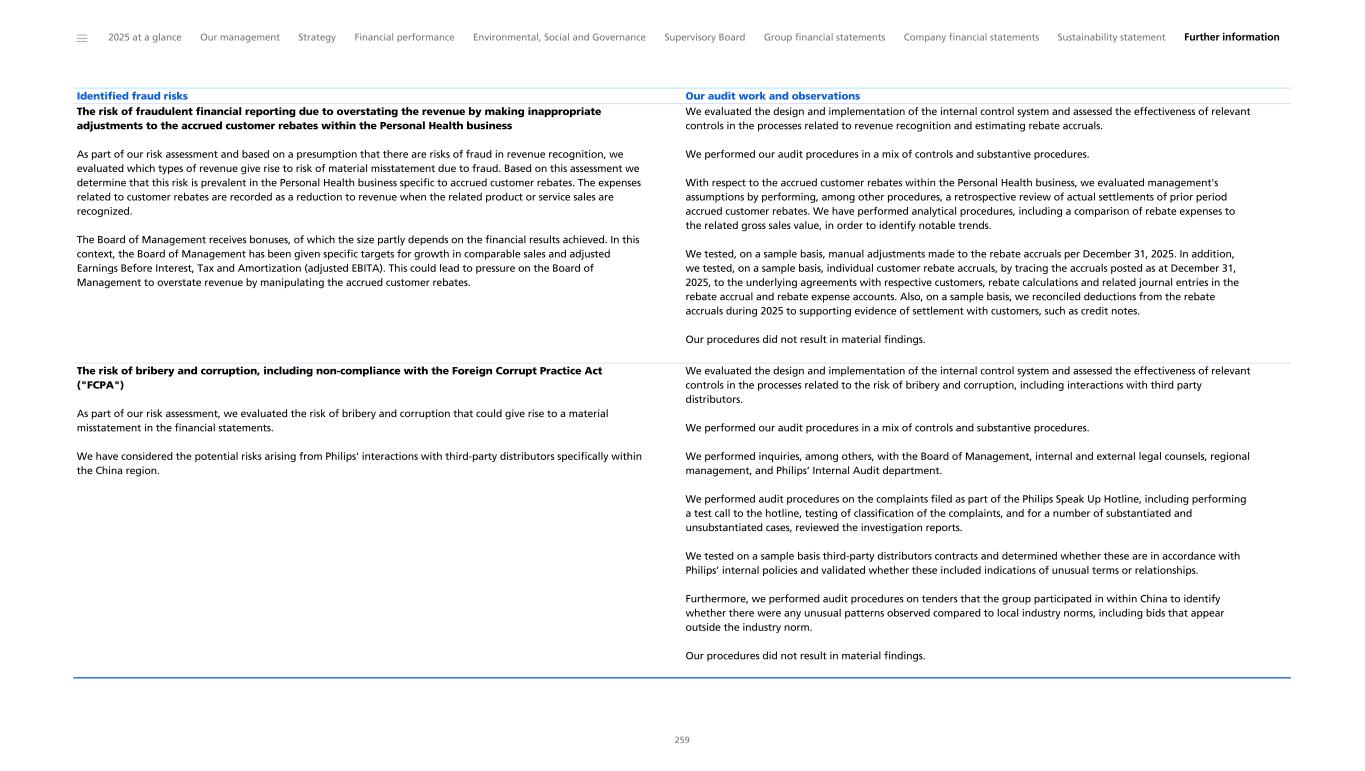
The risk of fraudulent financial reporting due to overstating the revenue by making inappropriate adjustments to the accrued customer rebates within the Personal Health business As part of our risk assessment and based on a presumption that there are risks of fraud in revenue recognition, we evaluated which types of revenue give rise to risk of material misstatement due to fraud. Based on this assessment we determine that this risk is prevalent in the Personal Health business specific to accrued customer rebates. The expenses related to customer rebates are recorded as a reduction to revenue when the related product or service sales are recognized. The Board of Management receives bonuses, of which the size partly depends on the financial results achieved. In this context, the Board of Management has been given specific targets for growth in comparable sales and adjusted Earnings Before Interest, Tax and Amortization (adjusted EBITA). This could lead to pressure on the Board of Management to overstate revenue by manipulating the accrued customer rebates. We evaluated the design and implementation of the internal control system and assessed the effectiveness of relevant controls in the processes related to revenue recognition and estimating rebate accruals. We performed our audit procedures in a mix of controls and substantive procedures. With respect to the accrued customer rebates within the Personal Health business, we evaluated management's assumptions by performing, among other procedures, a retrospective review of actual settlements of prior period accrued customer rebates. We have performed analytical procedures, including a comparison of rebate expenses to the related gross sales value, in order to identify notable trends. We tested, on a sample basis, manual adjustments made to the rebate accruals per December 31, 2025. In addition, we tested, on a sample basis, individual customer rebate accruals, by tracing the accruals posted as at December 31, 2025, to the underlying agreements with respective customers, rebate calculations and related journal entries in the rebate accrual and rebate expense accounts. Also, on a sample basis, we reconciled deductions from the rebate accruals during 2025 to supporting evidence of settlement with customers, such as credit notes. Our procedures did not result in material findings. The risk of bribery and corruption, including non-compliance with the Foreign Corrupt Practice Act ("FCPA") As part of our risk assessment, we evaluated the risk of bribery and corruption that could give rise to a material misstatement in the financial statements. We have considered the potential risks arising from Philips' interactions with third-party distributors specifically within the China region. We evaluated the design and implementation of the internal control system and assessed the effectiveness of relevant controls in the processes related to the risk of bribery and corruption, including interactions with third party distributors. We performed our audit procedures in a mix of controls and substantive procedures. We performed inquiries, among others, with the Board of Management, internal and external legal counsels, regional management, and Philips’ Internal Audit department. We performed audit procedures on the complaints filed as part of the Philips Speak Up Hotline, including performing a test call to the hotline, testing of classification of the complaints, and for a number of substantiated and unsubstantiated cases, reviewed the investigation reports. We tested on a sample basis third-party distributors contracts and determined whether these are in accordance with Philips’ internal policies and validated whether these included indications of unusual terms or relationships. Furthermore, we performed audit procedures on tenders that the group participated in within China to identify whether there were any unusual patterns observed compared to local industry norms, including bids that appear outside the industry norm. Our procedures did not result in material findings. Identified fraud risks Our audit work and observations ______ 2025 at a glance Our management Strategy Financial performance Environmental, Social and Governance Supervisory Board Group financial statements Company financial statements Sustainability statement Further information 259
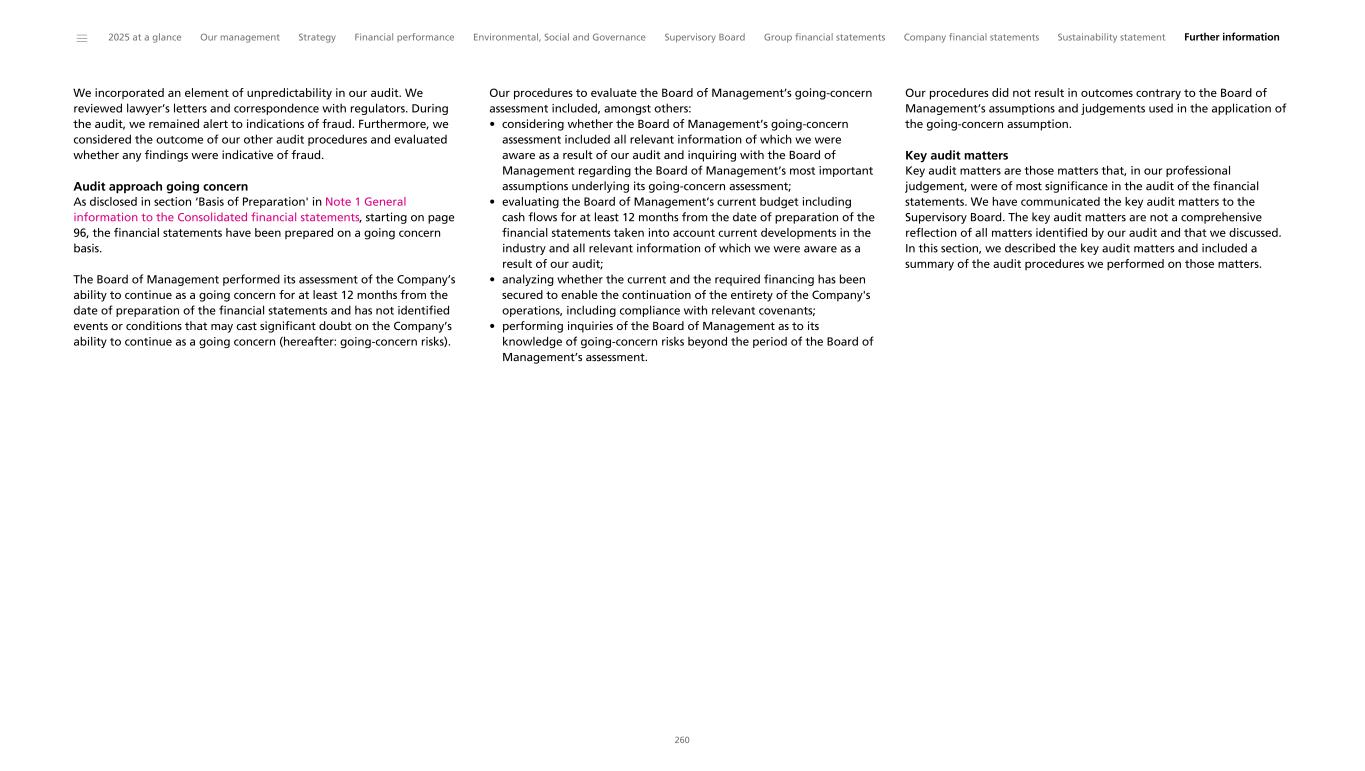
We incorporated an element of unpredictability in our audit. We reviewed lawyer’s letters and correspondence with regulators. During the audit, we remained alert to indications of fraud. Furthermore, we considered the outcome of our other audit procedures and evaluated whether any findings were indicative of fraud. Audit approach going concern As disclosed in section ‘Basis of Preparation' in Note 1 General information to the Consolidated financial statements, starting on page 96, the financial statements have been prepared on a going concern basis. The Board of Management performed its assessment of the Company’s ability to continue as a going concern for at least 12 months from the date of preparation of the financial statements and has not identified events or conditions that may cast significant doubt on the Company’s ability to continue as a going concern (hereafter: going-concern risks). Our procedures to evaluate the Board of Management’s going-concern assessment included, amongst others: • considering whether the Board of Management’s going-concern assessment included all relevant information of which we were aware as a result of our audit and inquiring with the Board of Management regarding the Board of Management’s most important assumptions underlying its going-concern assessment; • evaluating the Board of Management’s current budget including cash flows for at least 12 months from the date of preparation of the financial statements taken into account current developments in the industry and all relevant information of which we were aware as a result of our audit; • analyzing whether the current and the required financing has been secured to enable the continuation of the entirety of the Company's operations, including compliance with relevant covenants; • performing inquiries of the Board of Management as to its knowledge of going-concern risks beyond the period of the Board of Management’s assessment. Our procedures did not result in outcomes contrary to the Board of Management’s assumptions and judgements used in the application of the going-concern assumption. Key audit matters Key audit matters are those matters that, in our professional judgement, were of most significance in the audit of the financial statements. We have communicated the key audit matters to the Supervisory Board. The key audit matters are not a comprehensive reflection of all matters identified by our audit and that we discussed. In this section, we described the key audit matters and included a summary of the audit procedures we performed on those matters. ______ 2025 at a glance Our management Strategy Financial performance Environmental, Social and Governance Supervisory Board Group financial statements Company financial statements Sustainability statement Further information 260
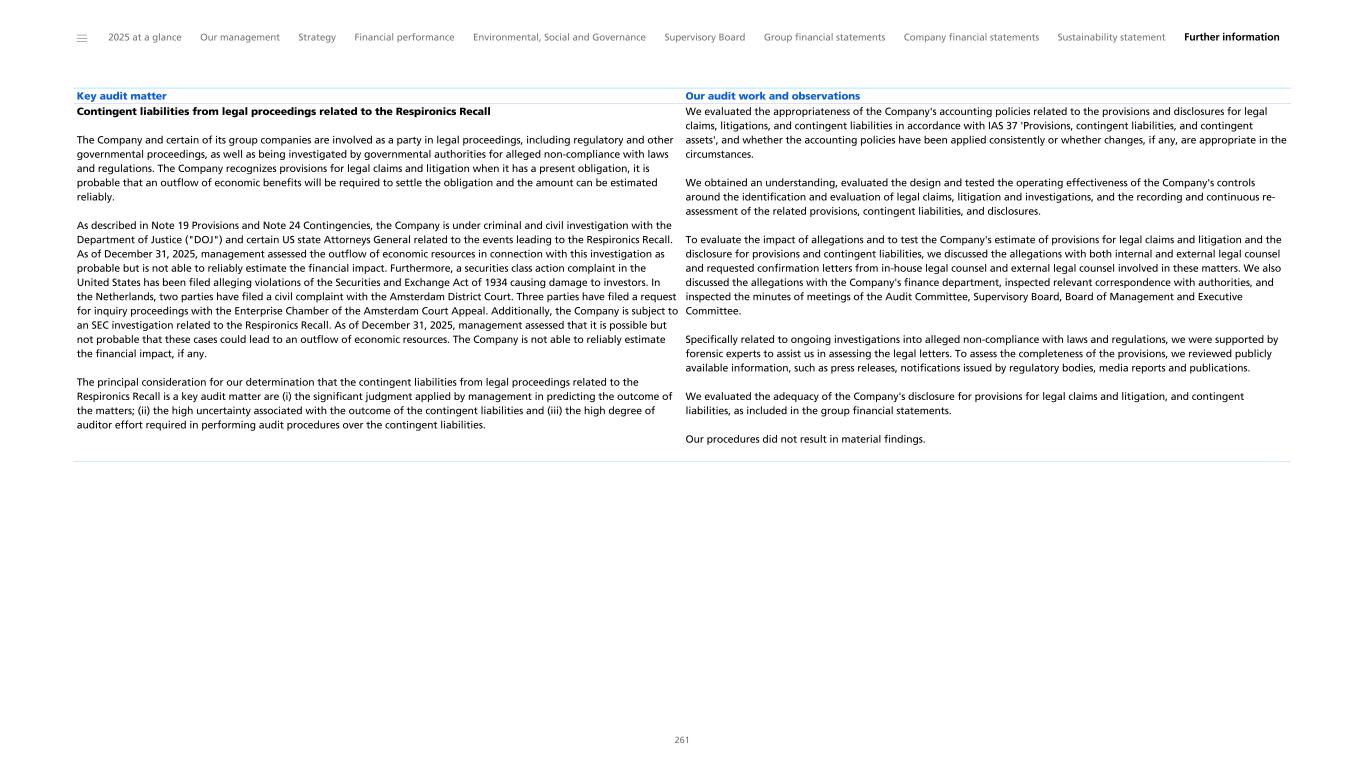
Key audit matter Our audit work and observations Contingent liabilities from legal proceedings related to the Respironics Recall The Company and certain of its group companies are involved as a party in legal proceedings, including regulatory and other governmental proceedings, as well as being investigated by governmental authorities for alleged non-compliance with laws and regulations. The Company recognizes provisions for legal claims and litigation when it has a present obligation, it is probable that an outflow of economic benefits will be required to settle the obligation and the amount can be estimated reliably. As described in Note 19 Provisions and Note 24 Contingencies, the Company is under criminal and civil investigation with the Department of Justice ("DOJ") and certain US state Attorneys General related to the events leading to the Respironics Recall. As of December 31, 2025, management assessed the outflow of economic resources in connection with this investigation as probable but is not able to reliably estimate the financial impact. Furthermore, a securities class action complaint in the United States has been filed alleging violations of the Securities and Exchange Act of 1934 causing damage to investors. In the Netherlands, two parties have filed a civil complaint with the Amsterdam District Court. Three parties have filed a request for inquiry proceedings with the Enterprise Chamber of the Amsterdam Court Appeal. Additionally, the Company is subject to an SEC investigation related to the Respironics Recall. As of December 31, 2025, management assessed that it is possible but not probable that these cases could lead to an outflow of economic resources. The Company is not able to reliably estimate the financial impact, if any. The principal consideration for our determination that the contingent liabilities from legal proceedings related to the Respironics Recall is a key audit matter are (i) the significant judgment applied by management in predicting the outcome of the matters; (ii) the high uncertainty associated with the outcome of the contingent liabilities and (iii) the high degree of auditor effort required in performing audit procedures over the contingent liabilities. We evaluated the appropriateness of the Company's accounting policies related to the provisions and disclosures for legal claims, litigations, and contingent liabilities in accordance with IAS 37 'Provisions, contingent liabilities, and contingent assets', and whether the accounting policies have been applied consistently or whether changes, if any, are appropriate in the circumstances. We obtained an understanding, evaluated the design and tested the operating effectiveness of the Company's controls around the identification and evaluation of legal claims, litigation and investigations, and the recording and continuous re- assessment of the related provisions, contingent liabilities, and disclosures. To evaluate the impact of allegations and to test the Company's estimate of provisions for legal claims and litigation and the disclosure for provisions and contingent liabilities, we discussed the allegations with both internal and external legal counsel and requested confirmation letters from in-house legal counsel and external legal counsel involved in these matters. We also discussed the allegations with the Company's finance department, inspected relevant correspondence with authorities, and inspected the minutes of meetings of the Audit Committee, Supervisory Board, Board of Management and Executive Committee. Specifically related to ongoing investigations into alleged non-compliance with laws and regulations, we were supported by forensic experts to assist us in assessing the legal letters. To assess the completeness of the provisions, we reviewed publicly available information, such as press releases, notifications issued by regulatory bodies, media reports and publications. We evaluated the adequacy of the Company's disclosure for provisions for legal claims and litigation, and contingent liabilities, as included in the group financial statements. Our procedures did not result in material findings. ______ 2025 at a glance Our management Strategy Financial performance Environmental, Social and Governance Supervisory Board Group financial statements Company financial statements Sustainability statement Further information 261
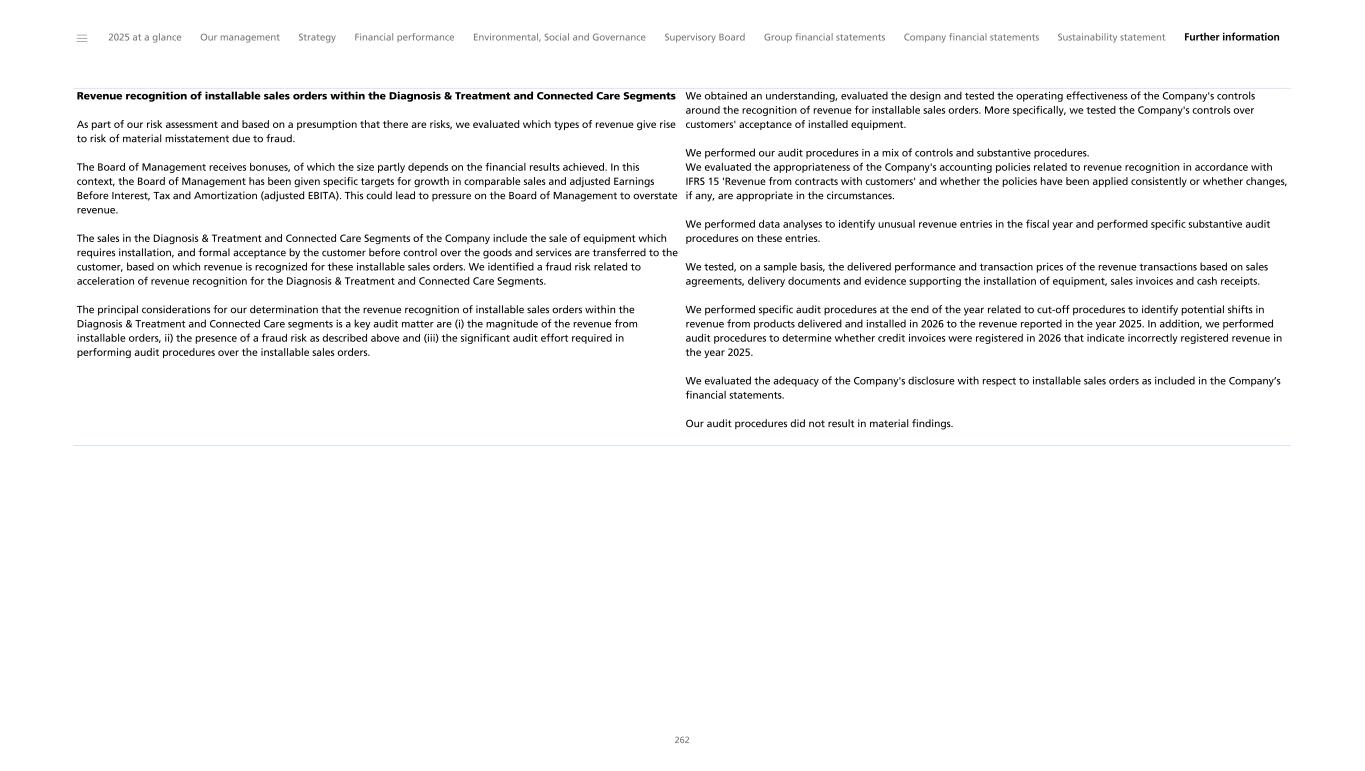
Revenue recognition of installable sales orders within the Diagnosis & Treatment and Connected Care Segments As part of our risk assessment and based on a presumption that there are risks, we evaluated which types of revenue give rise to risk of material misstatement due to fraud. The Board of Management receives bonuses, of which the size partly depends on the financial results achieved. In this context, the Board of Management has been given specific targets for growth in comparable sales and adjusted Earnings Before Interest, Tax and Amortization (adjusted EBITA). This could lead to pressure on the Board of Management to overstate revenue. The sales in the Diagnosis & Treatment and Connected Care Segments of the Company include the sale of equipment which requires installation, and formal acceptance by the customer before control over the goods and services are transferred to the customer, based on which revenue is recognized for these installable sales orders. We identified a fraud risk related to acceleration of revenue recognition for the Diagnosis & Treatment and Connected Care Segments. The principal considerations for our determination that the revenue recognition of installable sales orders within the Diagnosis & Treatment and Connected Care segments is a key audit matter are (i) the magnitude of the revenue from installable orders, ii) the presence of a fraud risk as described above and (iii) the significant audit effort required in performing audit procedures over the installable sales orders. We obtained an understanding, evaluated the design and tested the operating effectiveness of the Company's controls around the recognition of revenue for installable sales orders. More specifically, we tested the Company's controls over customers' acceptance of installed equipment. We performed our audit procedures in a mix of controls and substantive procedures. We evaluated the appropriateness of the Company's accounting policies related to revenue recognition in accordance with IFRS 15 'Revenue from contracts with customers' and whether the policies have been applied consistently or whether changes, if any, are appropriate in the circumstances. We performed data analyses to identify unusual revenue entries in the fiscal year and performed specific substantive audit procedures on these entries. We tested, on a sample basis, the delivered performance and transaction prices of the revenue transactions based on sales agreements, delivery documents and evidence supporting the installation of equipment, sales invoices and cash receipts. We performed specific audit procedures at the end of the year related to cut-off procedures to identify potential shifts in revenue from products delivered and installed in 2026 to the revenue reported in the year 2025. In addition, we performed audit procedures to determine whether credit invoices were registered in 2026 that indicate incorrectly registered revenue in the year 2025. We evaluated the adequacy of the Company's disclosure with respect to installable sales orders as included in the Company’s financial statements. Our audit procedures did not result in material findings. ______ 2025 at a glance Our management Strategy Financial performance Environmental, Social and Governance Supervisory Board Group financial statements Company financial statements Sustainability statement Further information 262
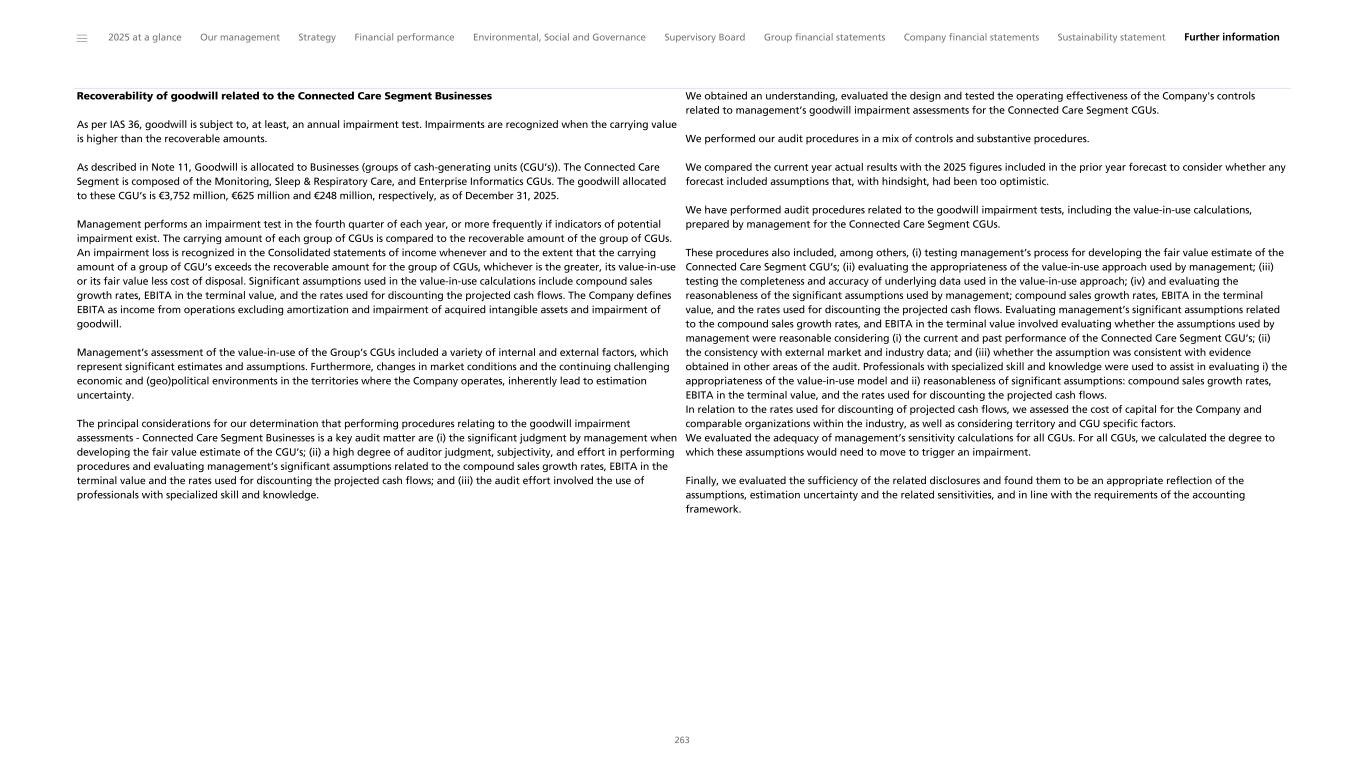
Recoverability of goodwill related to the Connected Care Segment Businesses As per IAS 36, goodwill is subject to, at least, an annual impairment test. Impairments are recognized when the carrying value is higher than the recoverable amounts. As described in Note 11, Goodwill is allocated to Businesses (groups of cash-generating units (CGU’s)). The Connected Care Segment is composed of the Monitoring, Sleep & Respiratory Care, and Enterprise Informatics CGUs. The goodwill allocated to these CGU’s is €3,752 million, €625 million and €248 million, respectively, as of December 31, 2025. Management performs an impairment test in the fourth quarter of each year, or more frequently if indicators of potential impairment exist. The carrying amount of each group of CGUs is compared to the recoverable amount of the group of CGUs. An impairment loss is recognized in the Consolidated statements of income whenever and to the extent that the carrying amount of a group of CGU’s exceeds the recoverable amount for the group of CGUs, whichever is the greater, its value-in-use or its fair value less cost of disposal. Significant assumptions used in the value-in-use calculations include compound sales growth rates, EBITA in the terminal value, and the rates used for discounting the projected cash flows. The Company defines EBITA as income from operations excluding amortization and impairment of acquired intangible assets and impairment of goodwill. Management’s assessment of the value-in-use of the Group’s CGUs included a variety of internal and external factors, which represent significant estimates and assumptions. Furthermore, changes in market conditions and the continuing challenging economic and (geo)political environments in the territories where the Company operates, inherently lead to estimation uncertainty. The principal considerations for our determination that performing procedures relating to the goodwill impairment assessments - Connected Care Segment Businesses is a key audit matter are (i) the significant judgment by management when developing the fair value estimate of the CGU’s; (ii) a high degree of auditor judgment, subjectivity, and effort in performing procedures and evaluating management’s significant assumptions related to the compound sales growth rates, EBITA in the terminal value and the rates used for discounting the projected cash flows; and (iii) the audit effort involved the use of professionals with specialized skill and knowledge. We obtained an understanding, evaluated the design and tested the operating effectiveness of the Company's controls related to management’s goodwill impairment assessments for the Connected Care Segment CGUs. We performed our audit procedures in a mix of controls and substantive procedures. We compared the current year actual results with the 2025 figures included in the prior year forecast to consider whether any forecast included assumptions that, with hindsight, had been too optimistic. We have performed audit procedures related to the goodwill impairment tests, including the value-in-use calculations, prepared by management for the Connected Care Segment CGUs. These procedures also included, among others, (i) testing management’s process for developing the fair value estimate of the Connected Care Segment CGU’s; (ii) evaluating the appropriateness of the value-in-use approach used by management; (iii) testing the completeness and accuracy of underlying data used in the value-in-use approach; (iv) and evaluating the reasonableness of the significant assumptions used by management; compound sales growth rates, EBITA in the terminal value, and the rates used for discounting the projected cash flows. Evaluating management’s significant assumptions related to the compound sales growth rates, and EBITA in the terminal value involved evaluating whether the assumptions used by management were reasonable considering (i) the current and past performance of the Connected Care Segment CGU’s; (ii) the consistency with external market and industry data; and (iii) whether the assumption was consistent with evidence obtained in other areas of the audit. Professionals with specialized skill and knowledge were used to assist in evaluating i) the appropriateness of the value-in-use model and ii) reasonableness of significant assumptions: compound sales growth rates, EBITA in the terminal value, and the rates used for discounting the projected cash flows. In relation to the rates used for discounting of projected cash flows, we assessed the cost of capital for the Company and comparable organizations within the industry, as well as considering territory and CGU specific factors. We evaluated the adequacy of management’s sensitivity calculations for all CGUs. For all CGUs, we calculated the degree to which these assumptions would need to move to trigger an impairment. Finally, we evaluated the sufficiency of the related disclosures and found them to be an appropriate reflection of the assumptions, estimation uncertainty and the related sensitivities, and in line with the requirements of the accounting framework. ______ 2025 at a glance Our management Strategy Financial performance Environmental, Social and Governance Supervisory Board Group financial statements Company financial statements Sustainability statement Further information 263
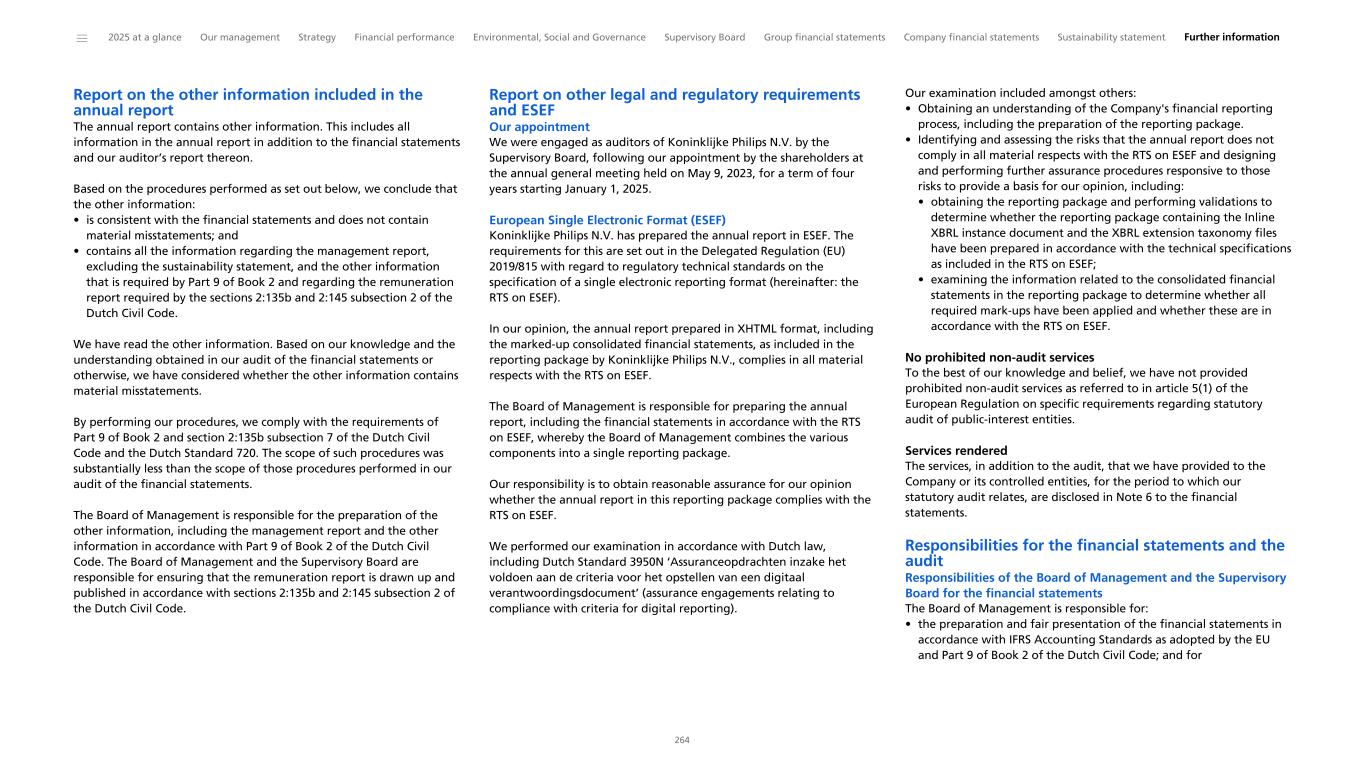
Report on the other information included in the annual report The annual report contains other information. This includes all information in the annual report in addition to the financial statements and our auditor’s report thereon. Based on the procedures performed as set out below, we conclude that the other information: • is consistent with the financial statements and does not contain material misstatements; and • contains all the information regarding the management report, excluding the sustainability statement, and the other information that is required by Part 9 of Book 2 and regarding the remuneration report required by the sections 2:135b and 2:145 subsection 2 of the Dutch Civil Code. We have read the other information. Based on our knowledge and the understanding obtained in our audit of the financial statements or otherwise, we have considered whether the other information contains material misstatements. By performing our procedures, we comply with the requirements of Part 9 of Book 2 and section 2:135b subsection 7 of the Dutch Civil Code and the Dutch Standard 720. The scope of such procedures was substantially less than the scope of those procedures performed in our audit of the financial statements. The Board of Management is responsible for the preparation of the other information, including the management report and the other information in accordance with Part 9 of Book 2 of the Dutch Civil Code. The Board of Management and the Supervisory Board are responsible for ensuring that the remuneration report is drawn up and published in accordance with sections 2:135b and 2:145 subsection 2 of the Dutch Civil Code. Report on other legal and regulatory requirements and ESEF Our appointment We were engaged as auditors of Koninklijke Philips N.V. by the Supervisory Board, following our appointment by the shareholders at the annual general meeting held on May 9, 2023, for a term of four years starting January 1, 2025. European Single Electronic Format (ESEF) Koninklijke Philips N.V. has prepared the annual report in ESEF. The requirements for this are set out in the Delegated Regulation (EU) 2019/815 with regard to regulatory technical standards on the specification of a single electronic reporting format (hereinafter: the RTS on ESEF). In our opinion, the annual report prepared in XHTML format, including the marked-up consolidated financial statements, as included in the reporting package by Koninklijke Philips N.V., complies in all material respects with the RTS on ESEF. The Board of Management is responsible for preparing the annual report, including the financial statements in accordance with the RTS on ESEF, whereby the Board of Management combines the various components into a single reporting package. Our responsibility is to obtain reasonable assurance for our opinion whether the annual report in this reporting package complies with the RTS on ESEF. We performed our examination in accordance with Dutch law, including Dutch Standard 3950N ‘Assuranceopdrachten inzake het voldoen aan de criteria voor het opstellen van een digitaal verantwoordingsdocument’ (assurance engagements relating to compliance with criteria for digital reporting). Our examination included amongst others: • Obtaining an understanding of the Company's financial reporting process, including the preparation of the reporting package. • Identifying and assessing the risks that the annual report does not comply in all material respects with the RTS on ESEF and designing and performing further assurance procedures responsive to those risks to provide a basis for our opinion, including: • obtaining the reporting package and performing validations to determine whether the reporting package containing the Inline XBRL instance document and the XBRL extension taxonomy files have been prepared in accordance with the technical specifications as included in the RTS on ESEF; • examining the information related to the consolidated financial statements in the reporting package to determine whether all required mark-ups have been applied and whether these are in accordance with the RTS on ESEF. No prohibited non-audit services To the best of our knowledge and belief, we have not provided prohibited non-audit services as referred to in article 5(1) of the European Regulation on specific requirements regarding statutory audit of public-interest entities. Services rendered The services, in addition to the audit, that we have provided to the Company or its controlled entities, for the period to which our statutory audit relates, are disclosed in Note 6 to the financial statements. Responsibilities for the financial statements and the audit Responsibilities of the Board of Management and the Supervisory Board for the financial statements The Board of Management is responsible for: • the preparation and fair presentation of the financial statements in accordance with IFRS Accounting Standards as adopted by the EU and Part 9 of Book 2 of the Dutch Civil Code; and for ______ 2025 at a glance Our management Strategy Financial performance Environmental, Social and Governance Supervisory Board Group financial statements Company financial statements Sustainability statement Further information 264
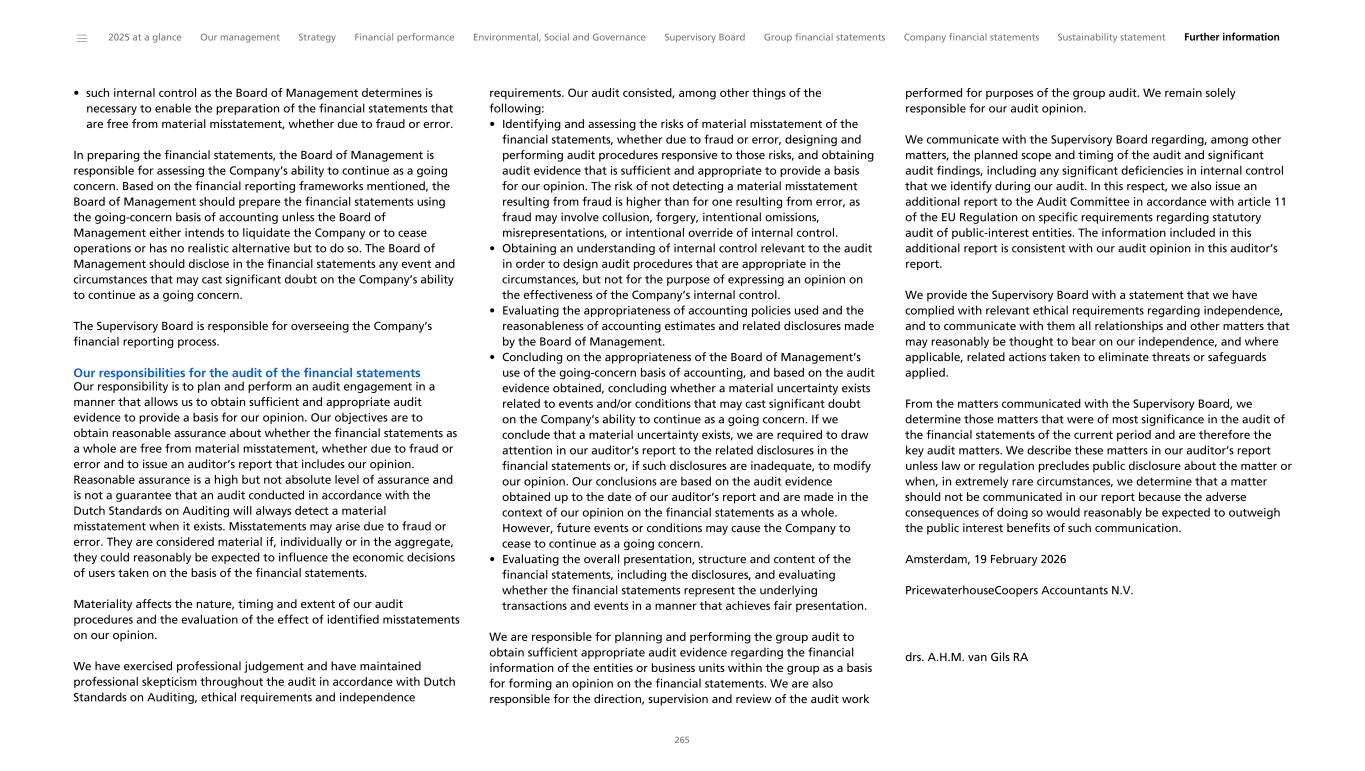
• such internal control as the Board of Management determines is necessary to enable the preparation of the financial statements that are free from material misstatement, whether due to fraud or error. In preparing the financial statements, the Board of Management is responsible for assessing the Company’s ability to continue as a going concern. Based on the financial reporting frameworks mentioned, the Board of Management should prepare the financial statements using the going-concern basis of accounting unless the Board of Management either intends to liquidate the Company or to cease operations or has no realistic alternative but to do so. The Board of Management should disclose in the financial statements any event and circumstances that may cast significant doubt on the Company’s ability to continue as a going concern. The Supervisory Board is responsible for overseeing the Company’s financial reporting process. Our responsibilities for the audit of the financial statements Our responsibility is to plan and perform an audit engagement in a manner that allows us to obtain sufficient and appropriate audit evidence to provide a basis for our opinion. Our objectives are to obtain reasonable assurance about whether the financial statements as a whole are free from material misstatement, whether due to fraud or error and to issue an auditor’s report that includes our opinion. Reasonable assurance is a high but not absolute level of assurance and is not a guarantee that an audit conducted in accordance with the Dutch Standards on Auditing will always detect a material misstatement when it exists. Misstatements may arise due to fraud or error. They are considered material if, individually or in the aggregate, they could reasonably be expected to influence the economic decisions of users taken on the basis of the financial statements. Materiality affects the nature, timing and extent of our audit procedures and the evaluation of the effect of identified misstatements on our opinion. We have exercised professional judgement and have maintained professional skepticism throughout the audit in accordance with Dutch Standards on Auditing, ethical requirements and independence requirements. Our audit consisted, among other things of the following: • Identifying and assessing the risks of material misstatement of the financial statements, whether due to fraud or error, designing and performing audit procedures responsive to those risks, and obtaining audit evidence that is sufficient and appropriate to provide a basis for our opinion. The risk of not detecting a material misstatement resulting from fraud is higher than for one resulting from error, as fraud may involve collusion, forgery, intentional omissions, misrepresentations, or intentional override of internal control. • Obtaining an understanding of internal control relevant to the audit in order to design audit procedures that are appropriate in the circumstances, but not for the purpose of expressing an opinion on the effectiveness of the Company’s internal control. • Evaluating the appropriateness of accounting policies used and the reasonableness of accounting estimates and related disclosures made by the Board of Management. • Concluding on the appropriateness of the Board of Management’s use of the going-concern basis of accounting, and based on the audit evidence obtained, concluding whether a material uncertainty exists related to events and/or conditions that may cast significant doubt on the Company’s ability to continue as a going concern. If we conclude that a material uncertainty exists, we are required to draw attention in our auditor’s report to the related disclosures in the financial statements or, if such disclosures are inadequate, to modify our opinion. Our conclusions are based on the audit evidence obtained up to the date of our auditor’s report and are made in the context of our opinion on the financial statements as a whole. However, future events or conditions may cause the Company to cease to continue as a going concern. • Evaluating the overall presentation, structure and content of the financial statements, including the disclosures, and evaluating whether the financial statements represent the underlying transactions and events in a manner that achieves fair presentation. We are responsible for planning and performing the group audit to obtain sufficient appropriate audit evidence regarding the financial information of the entities or business units within the group as a basis for forming an opinion on the financial statements. We are also responsible for the direction, supervision and review of the audit work performed for purposes of the group audit. We remain solely responsible for our audit opinion. We communicate with the Supervisory Board regarding, among other matters, the planned scope and timing of the audit and significant audit findings, including any significant deficiencies in internal control that we identify during our audit. In this respect, we also issue an additional report to the Audit Committee in accordance with article 11 of the EU Regulation on specific requirements regarding statutory audit of public-interest entities. The information included in this additional report is consistent with our audit opinion in this auditor’s report. We provide the Supervisory Board with a statement that we have complied with relevant ethical requirements regarding independence, and to communicate with them all relationships and other matters that may reasonably be thought to bear on our independence, and where applicable, related actions taken to eliminate threats or safeguards applied. From the matters communicated with the Supervisory Board, we determine those matters that were of most significance in the audit of the financial statements of the current period and are therefore the key audit matters. We describe these matters in our auditor’s report unless law or regulation precludes public disclosure about the matter or when, in extremely rare circumstances, we determine that a matter should not be communicated in our report because the adverse consequences of doing so would reasonably be expected to outweigh the public interest benefits of such communication. Amsterdam, 19 February 2026 PricewaterhouseCoopers Accountants N.V. drs. A.H.M. van Gils RA ______ 2025 at a glance Our management Strategy Financial performance Environmental, Social and Governance Supervisory Board Group financial statements Company financial statements Sustainability statement Further information 265
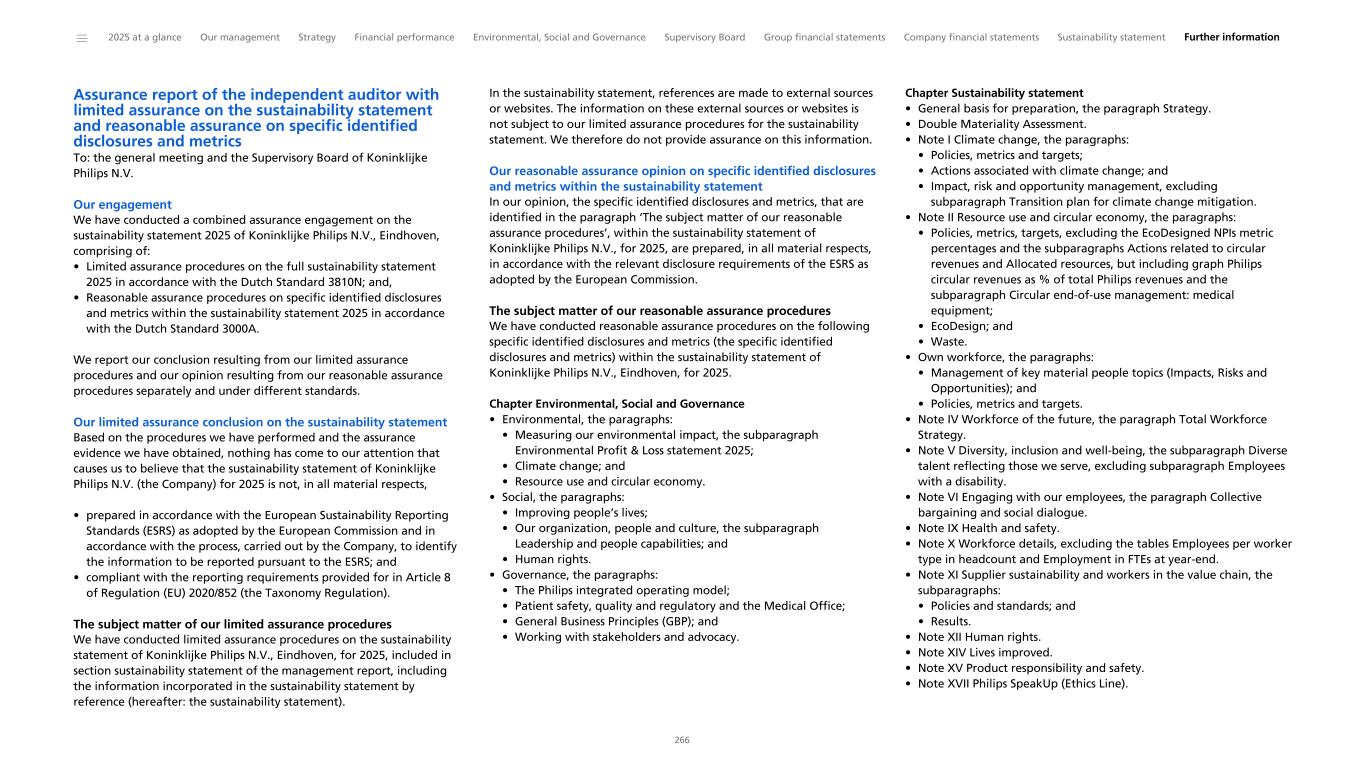
Assurance report of the independent auditor with limited assurance on the sustainability statement and reasonable assurance on specific identified disclosures and metrics To: the general meeting and the Supervisory Board of Koninklijke Philips N.V. Our engagement We have conducted a combined assurance engagement on the sustainability statement 2025 of Koninklijke Philips N.V., Eindhoven, comprising of: • Limited assurance procedures on the full sustainability statement 2025 in accordance with the Dutch Standard 3810N; and, • Reasonable assurance procedures on specific identified disclosures and metrics within the sustainability statement 2025 in accordance with the Dutch Standard 3000A. We report our conclusion resulting from our limited assurance procedures and our opinion resulting from our reasonable assurance procedures separately and under different standards. Our limited assurance conclusion on the sustainability statement Based on the procedures we have performed and the assurance evidence we have obtained, nothing has come to our attention that causes us to believe that the sustainability statement of Koninklijke Philips N.V. (the Company) for 2025 is not, in all material respects, • prepared in accordance with the European Sustainability Reporting Standards (ESRS) as adopted by the European Commission and in accordance with the process, carried out by the Company, to identify the information to be reported pursuant to the ESRS; and • compliant with the reporting requirements provided for in Article 8 of Regulation (EU) 2020/852 (the Taxonomy Regulation). The subject matter of our limited assurance procedures We have conducted limited assurance procedures on the sustainability statement of Koninklijke Philips N.V., Eindhoven, for 2025, included in section sustainability statement of the management report, including the information incorporated in the sustainability statement by reference (hereafter: the sustainability statement). In the sustainability statement, references are made to external sources or websites. The information on these external sources or websites is not subject to our limited assurance procedures for the sustainability statement. We therefore do not provide assurance on this information. Our reasonable assurance opinion on specific identified disclosures and metrics within the sustainability statement In our opinion, the specific identified disclosures and metrics, that are identified in the paragraph ‘The subject matter of our reasonable assurance procedures’, within the sustainability statement of Koninklijke Philips N.V., for 2025, are prepared, in all material respects, in accordance with the relevant disclosure requirements of the ESRS as adopted by the European Commission. The subject matter of our reasonable assurance procedures We have conducted reasonable assurance procedures on the following specific identified disclosures and metrics (the specific identified disclosures and metrics) within the sustainability statement of Koninklijke Philips N.V., Eindhoven, for 2025. Chapter Environmental, Social and Governance • Environmental, the paragraphs: • Measuring our environmental impact, the subparagraph Environmental Profit & Loss statement 2025; • Climate change; and • Resource use and circular economy. • Social, the paragraphs: • Improving people’s lives; • Our organization, people and culture, the subparagraph Leadership and people capabilities; and • Human rights. • Governance, the paragraphs: • The Philips integrated operating model; • Patient safety, quality and regulatory and the Medical Office; • General Business Principles (GBP); and • Working with stakeholders and advocacy. Chapter Sustainability statement • General basis for preparation, the paragraph Strategy. • Double Materiality Assessment. • Note I Climate change, the paragraphs: • Policies, metrics and targets; • Actions associated with climate change; and • Impact, risk and opportunity management, excluding subparagraph Transition plan for climate change mitigation. • Note II Resource use and circular economy, the paragraphs: • Policies, metrics, targets, excluding the EcoDesigned NPIs metric percentages and the subparagraphs Actions related to circular revenues and Allocated resources, but including graph Philips circular revenues as % of total Philips revenues and the subparagraph Circular end-of-use management: medical equipment; • EcoDesign; and • Waste. • Own workforce, the paragraphs: • Management of key material people topics (Impacts, Risks and Opportunities); and • Policies, metrics and targets. • Note IV Workforce of the future, the paragraph Total Workforce Strategy. • Note V Diversity, inclusion and well-being, the subparagraph Diverse talent reflecting those we serve, excluding subparagraph Employees with a disability. • Note VI Engaging with our employees, the paragraph Collective bargaining and social dialogue. • Note IX Health and safety. • Note X Workforce details, excluding the tables Employees per worker type in headcount and Employment in FTEs at year-end. • Note XI Supplier sustainability and workers in the value chain, the subparagraphs: • Policies and standards; and • Results. • Note XII Human rights. • Note XIV Lives improved. • Note XV Product responsibility and safety. • Note XVII Philips SpeakUp (Ethics Line). ______ 2025 at a glance Our management Strategy Financial performance Environmental, Social and Governance Supervisory Board Group financial statements Company financial statements Sustainability statement Further information 266
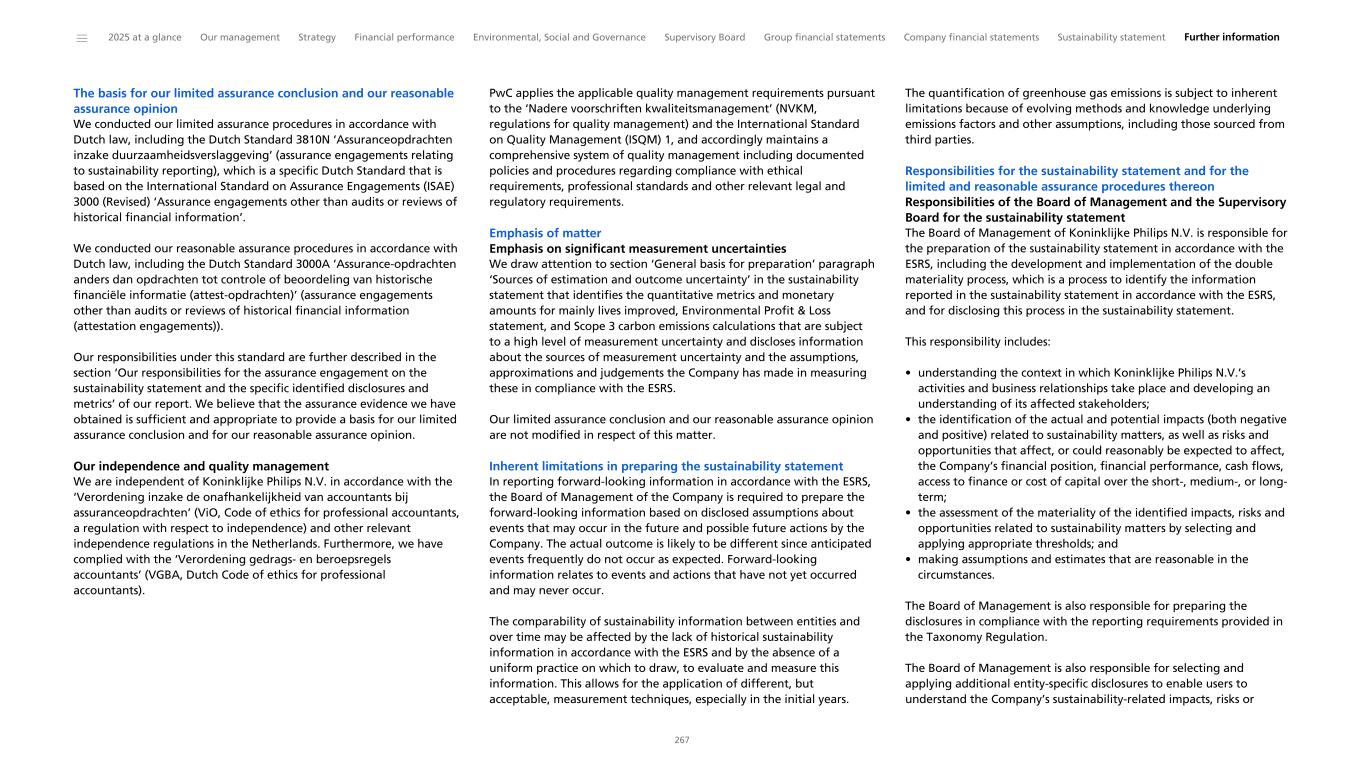
The basis for our limited assurance conclusion and our reasonable assurance opinion We conducted our limited assurance procedures in accordance with Dutch law, including the Dutch Standard 3810N ‘Assuranceopdrachten inzake duurzaamheidsverslaggeving’ (assurance engagements relating to sustainability reporting), which is a specific Dutch Standard that is based on the International Standard on Assurance Engagements (ISAE) 3000 (Revised) ‘Assurance engagements other than audits or reviews of historical financial information’. We conducted our reasonable assurance procedures in accordance with Dutch law, including the Dutch Standard 3000A ’Assurance-opdrachten anders dan opdrachten tot controle of beoordeling van historische financiële informatie (attest-opdrachten)’ (assurance engagements other than audits or reviews of historical financial information (attestation engagements)). Our responsibilities under this standard are further described in the section ‘Our responsibilities for the assurance engagement on the sustainability statement and the specific identified disclosures and metrics’ of our report. We believe that the assurance evidence we have obtained is sufficient and appropriate to provide a basis for our limited assurance conclusion and for our reasonable assurance opinion. Our independence and quality management We are independent of Koninklijke Philips N.V. in accordance with the ‘Verordening inzake de onafhankelijkheid van accountants bij assuranceopdrachten’ (ViO, Code of ethics for professional accountants, a regulation with respect to independence) and other relevant independence regulations in the Netherlands. Furthermore, we have complied with the ‘Verordening gedrags- en beroepsregels accountants’ (VGBA, Dutch Code of ethics for professional accountants). PwC applies the applicable quality management requirements pursuant to the ‘Nadere voorschriften kwaliteitsmanagement’ (NVKM, regulations for quality management) and the International Standard on Quality Management (ISQM) 1, and accordingly maintains a comprehensive system of quality management including documented policies and procedures regarding compliance with ethical requirements, professional standards and other relevant legal and regulatory requirements. Emphasis of matter Emphasis on significant measurement uncertainties We draw attention to section ‘General basis for preparation’ paragraph ‘Sources of estimation and outcome uncertainty’ in the sustainability statement that identifies the quantitative metrics and monetary amounts for mainly lives improved, Environmental Profit & Loss statement, and Scope 3 carbon emissions calculations that are subject to a high level of measurement uncertainty and discloses information about the sources of measurement uncertainty and the assumptions, approximations and judgements the Company has made in measuring these in compliance with the ESRS. Our limited assurance conclusion and our reasonable assurance opinion are not modified in respect of this matter. Inherent limitations in preparing the sustainability statement In reporting forward-looking information in accordance with the ESRS, the Board of Management of the Company is required to prepare the forward-looking information based on disclosed assumptions about events that may occur in the future and possible future actions by the Company. The actual outcome is likely to be different since anticipated events frequently do not occur as expected. Forward-looking information relates to events and actions that have not yet occurred and may never occur. The comparability of sustainability information between entities and over time may be affected by the lack of historical sustainability information in accordance with the ESRS and by the absence of a uniform practice on which to draw, to evaluate and measure this information. This allows for the application of different, but acceptable, measurement techniques, especially in the initial years. The quantification of greenhouse gas emissions is subject to inherent limitations because of evolving methods and knowledge underlying emissions factors and other assumptions, including those sourced from third parties. Responsibilities for the sustainability statement and for the limited and reasonable assurance procedures thereon Responsibilities of the Board of Management and the Supervisory Board for the sustainability statement The Board of Management of Koninklijke Philips N.V. is responsible for the preparation of the sustainability statement in accordance with the ESRS, including the development and implementation of the double materiality process, which is a process to identify the information reported in the sustainability statement in accordance with the ESRS, and for disclosing this process in the sustainability statement. This responsibility includes: • understanding the context in which Koninklijke Philips N.V.’s activities and business relationships take place and developing an understanding of its affected stakeholders; • the identification of the actual and potential impacts (both negative and positive) related to sustainability matters, as well as risks and opportunities that affect, or could reasonably be expected to affect, the Company’s financial position, financial performance, cash flows, access to finance or cost of capital over the short-, medium-, or long- term; • the assessment of the materiality of the identified impacts, risks and opportunities related to sustainability matters by selecting and applying appropriate thresholds; and • making assumptions and estimates that are reasonable in the circumstances. The Board of Management is also responsible for preparing the disclosures in compliance with the reporting requirements provided in the Taxonomy Regulation. The Board of Management is also responsible for selecting and applying additional entity-specific disclosures to enable users to understand the Company’s sustainability-related impacts, risks or ______ 2025 at a glance Our management Strategy Financial performance Environmental, Social and Governance Supervisory Board Group financial statements Company financial statements Sustainability statement Further information 267
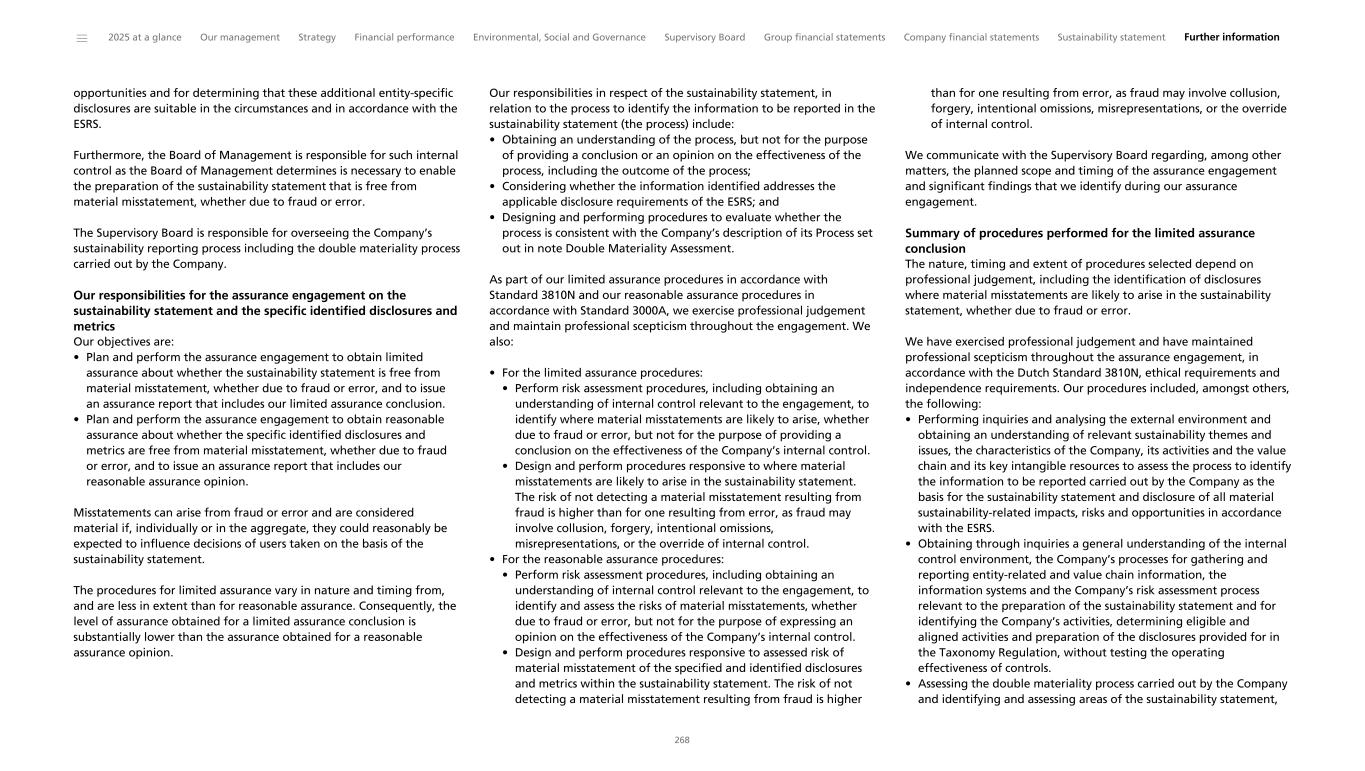
opportunities and for determining that these additional entity-specific disclosures are suitable in the circumstances and in accordance with the ESRS. Furthermore, the Board of Management is responsible for such internal control as the Board of Management determines is necessary to enable the preparation of the sustainability statement that is free from material misstatement, whether due to fraud or error. The Supervisory Board is responsible for overseeing the Company’s sustainability reporting process including the double materiality process carried out by the Company. Our responsibilities for the assurance engagement on the sustainability statement and the specific identified disclosures and metrics Our objectives are: • Plan and perform the assurance engagement to obtain limited assurance about whether the sustainability statement is free from material misstatement, whether due to fraud or error, and to issue an assurance report that includes our limited assurance conclusion. • Plan and perform the assurance engagement to obtain reasonable assurance about whether the specific identified disclosures and metrics are free from material misstatement, whether due to fraud or error, and to issue an assurance report that includes our reasonable assurance opinion. Misstatements can arise from fraud or error and are considered material if, individually or in the aggregate, they could reasonably be expected to influence decisions of users taken on the basis of the sustainability statement. The procedures for limited assurance vary in nature and timing from, and are less in extent than for reasonable assurance. Consequently, the level of assurance obtained for a limited assurance conclusion is substantially lower than the assurance obtained for a reasonable assurance opinion. Our responsibilities in respect of the sustainability statement, in relation to the process to identify the information to be reported in the sustainability statement (the process) include: • Obtaining an understanding of the process, but not for the purpose of providing a conclusion or an opinion on the effectiveness of the process, including the outcome of the process; • Considering whether the information identified addresses the applicable disclosure requirements of the ESRS; and • Designing and performing procedures to evaluate whether the process is consistent with the Company’s description of its Process set out in note Double Materiality Assessment. As part of our limited assurance procedures in accordance with Standard 3810N and our reasonable assurance procedures in accordance with Standard 3000A, we exercise professional judgement and maintain professional scepticism throughout the engagement. We also: • For the limited assurance procedures: • Perform risk assessment procedures, including obtaining an understanding of internal control relevant to the engagement, to identify where material misstatements are likely to arise, whether due to fraud or error, but not for the purpose of providing a conclusion on the effectiveness of the Company’s internal control. • Design and perform procedures responsive to where material misstatements are likely to arise in the sustainability statement. The risk of not detecting a material misstatement resulting from fraud is higher than for one resulting from error, as fraud may involve collusion, forgery, intentional omissions, misrepresentations, or the override of internal control. • For the reasonable assurance procedures: • Perform risk assessment procedures, including obtaining an understanding of internal control relevant to the engagement, to identify and assess the risks of material misstatements, whether due to fraud or error, but not for the purpose of expressing an opinion on the effectiveness of the Company’s internal control. • Design and perform procedures responsive to assessed risk of material misstatement of the specified and identified disclosures and metrics within the sustainability statement. The risk of not detecting a material misstatement resulting from fraud is higher than for one resulting from error, as fraud may involve collusion, forgery, intentional omissions, misrepresentations, or the override of internal control. We communicate with the Supervisory Board regarding, among other matters, the planned scope and timing of the assurance engagement and significant findings that we identify during our assurance engagement. Summary of procedures performed for the limited assurance conclusion The nature, timing and extent of procedures selected depend on professional judgement, including the identification of disclosures where material misstatements are likely to arise in the sustainability statement, whether due to fraud or error. We have exercised professional judgement and have maintained professional scepticism throughout the assurance engagement, in accordance with the Dutch Standard 3810N, ethical requirements and independence requirements. Our procedures included, amongst others, the following: • Performing inquiries and analysing the external environment and obtaining an understanding of relevant sustainability themes and issues, the characteristics of the Company, its activities and the value chain and its key intangible resources to assess the process to identify the information to be reported carried out by the Company as the basis for the sustainability statement and disclosure of all material sustainability-related impacts, risks and opportunities in accordance with the ESRS. • Obtaining through inquiries a general understanding of the internal control environment, the Company’s processes for gathering and reporting entity-related and value chain information, the information systems and the Company’s risk assessment process relevant to the preparation of the sustainability statement and for identifying the Company’s activities, determining eligible and aligned activities and preparation of the disclosures provided for in the Taxonomy Regulation, without testing the operating effectiveness of controls. • Assessing the double materiality process carried out by the Company and identifying and assessing areas of the sustainability statement, ______ 2025 at a glance Our management Strategy Financial performance Environmental, Social and Governance Supervisory Board Group financial statements Company financial statements Sustainability statement Further information 268
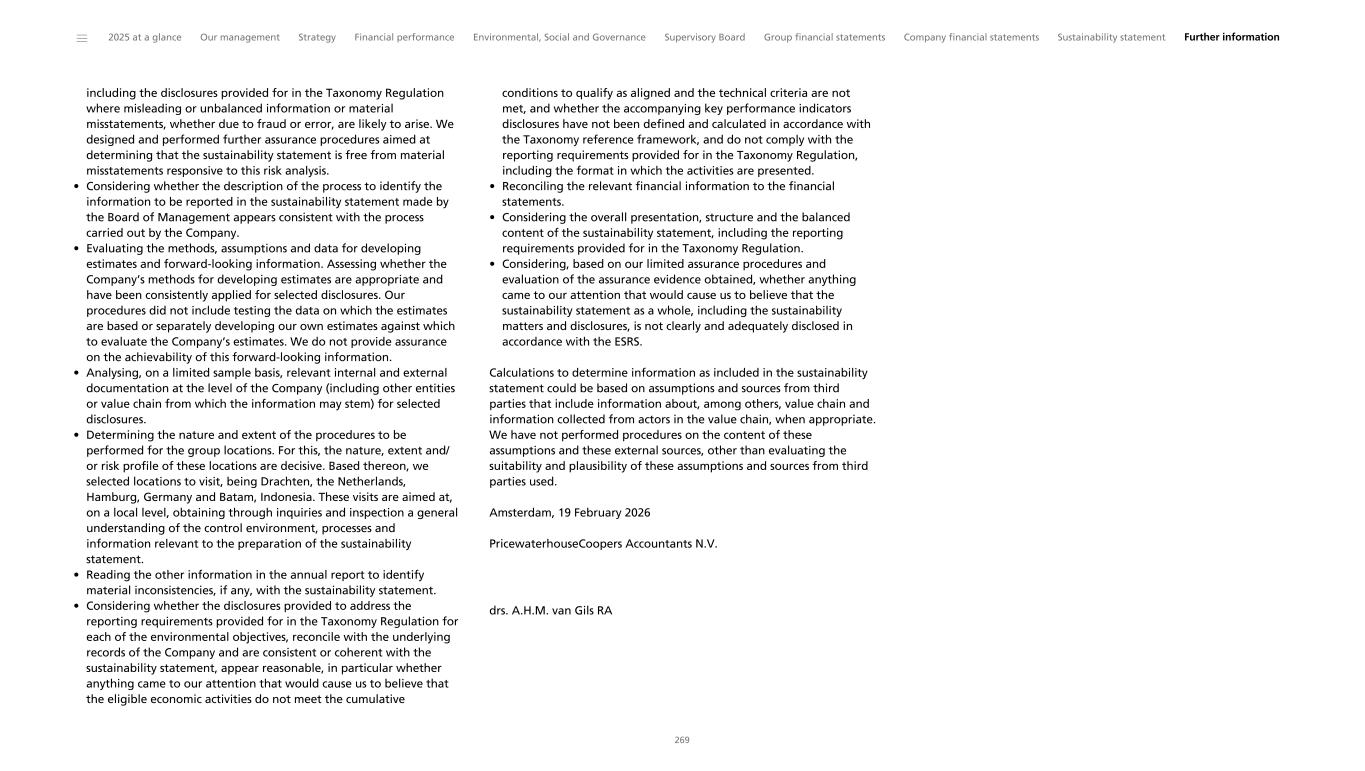
including the disclosures provided for in the Taxonomy Regulation where misleading or unbalanced information or material misstatements, whether due to fraud or error, are likely to arise. We designed and performed further assurance procedures aimed at determining that the sustainability statement is free from material misstatements responsive to this risk analysis. • Considering whether the description of the process to identify the information to be reported in the sustainability statement made by the Board of Management appears consistent with the process carried out by the Company. • Evaluating the methods, assumptions and data for developing estimates and forward-looking information. Assessing whether the Company’s methods for developing estimates are appropriate and have been consistently applied for selected disclosures. Our procedures did not include testing the data on which the estimates are based or separately developing our own estimates against which to evaluate the Company’s estimates. We do not provide assurance on the achievability of this forward-looking information. • Analysing, on a limited sample basis, relevant internal and external documentation at the level of the Company (including other entities or value chain from which the information may stem) for selected disclosures. • Determining the nature and extent of the procedures to be performed for the group locations. For this, the nature, extent and/ or risk profile of these locations are decisive. Based thereon, we selected locations to visit, being Drachten, the Netherlands, Hamburg, Germany and Batam, Indonesia. These visits are aimed at, on a local level, obtaining through inquiries and inspection a general understanding of the control environment, processes and information relevant to the preparation of the sustainability statement. • Reading the other information in the annual report to identify material inconsistencies, if any, with the sustainability statement. • Considering whether the disclosures provided to address the reporting requirements provided for in the Taxonomy Regulation for each of the environmental objectives, reconcile with the underlying records of the Company and are consistent or coherent with the sustainability statement, appear reasonable, in particular whether anything came to our attention that would cause us to believe that the eligible economic activities do not meet the cumulative conditions to qualify as aligned and the technical criteria are not met, and whether the accompanying key performance indicators disclosures have not been defined and calculated in accordance with the Taxonomy reference framework, and do not comply with the reporting requirements provided for in the Taxonomy Regulation, including the format in which the activities are presented. • Reconciling the relevant financial information to the financial statements. • Considering the overall presentation, structure and the balanced content of the sustainability statement, including the reporting requirements provided for in the Taxonomy Regulation. • Considering, based on our limited assurance procedures and evaluation of the assurance evidence obtained, whether anything came to our attention that would cause us to believe that the sustainability statement as a whole, including the sustainability matters and disclosures, is not clearly and adequately disclosed in accordance with the ESRS. Calculations to determine information as included in the sustainability statement could be based on assumptions and sources from third parties that include information about, among others, value chain and information collected from actors in the value chain, when appropriate. We have not performed procedures on the content of these assumptions and these external sources, other than evaluating the suitability and plausibility of these assumptions and sources from third parties used. Amsterdam, 19 February 2026 PricewaterhouseCoopers Accountants N.V. drs. A.H.M. van Gils RA ______ 2025 at a glance Our management Strategy Financial performance Environmental, Social and Governance Supervisory Board Group financial statements Company financial statements Sustainability statement Further information 269
Corporate governance report Introduction Management and oversight responsibilities and accountability within our company are ultimately guided by the corporate governance of the parent company of the Philips Group, Koninklijke Philips N.V. (Royal Philips). Royal Philips is a company organized under Dutch law and its shares have been listed on the Amsterdam stock exchange (Euronext Amsterdam) since 1912. In addition, Royal Philips’ shares have been traded in the United States since 1962 and have been listed on the New York Stock Exchange since 1987. Royal Philips has a two-tier board structure consisting of a Board of Management and a Supervisory Board, each of which is accountable to the General Meeting of Shareholders for the fulfillment of its respective duties. The members of the Board of Management, supported by the other members of the Executive Committee, drive the company’s management agenda and share responsibility for the continuity of the Philips Group, focusing on sustainable long-term value creation. The independent Supervisory Board supervises the Board of Management and the Executive Committee and advises them on general policies related to the activities of the company, including setting and executing the strategy of the Philips Group. These responsibilities include the oversight of the Environmental, Social and Governance (ESG) dimensions and their integration into the company’s overarching strategy, which is a responsibility of the Supervisory Board as a whole because of their significance. Philips is governed by Dutch corporate and securities laws, its Articles of Association, and the Rules of Procedure of the Board of Management and the Executive Committee and of the Supervisory Board, respectively. Our corporate governance framework is also based on the Dutch Corporate Governance Code (dated March 20, 2025) and US laws and regulations applicable to Foreign Private Issuers. In this Corporate governance report, the company addresses the main elements of its corporate governance structure, reports on how it applies the principles and best practices of the Dutch Corporate Governance Code of March 20, 2025, and provides the information required by the Dutch governmental Decree on Corporate Governance (Besluit inhoud bestuursverslag) and governmental Decree on Article 10 Takeover Directive (Besluit artikel 10 overnamerichtlijn). When deemed necessary in the interests of the company, the company may deviate from aspects of the company’s corporate governance structure, and any such deviations will be disclosed in the company’s Corporate governance report. In compliance with the Dutch Corporate Governance Code, other parts of the management report (within the meaning of article 2:391 of the Dutch Civil Code) included in the Annual Report address the strategy and culture of Philips aimed at sustainable long-term value creation. As described in more detail in Strategic focus, Philips’ strategy is driven by our purpose: to improve people’s health and well-being through meaningful innovation. The Message from the CEO explains how this strategy was executed in 2025; refer also to Financial performance. Furthermore, reference is made to our broader governance framework in Governance, which, among others, includes standards for behaviors, quality, and integrity within Philips. Philips’ strategy, and the way it has been developed by the Board of Management, under the supervision of the Supervisory Board as a whole, clearly integrates the company’s impact in the field of sustainability, including the effects on people and planet. Refer to Strategic focus, and Environmental, Social and Governance for references to all other information on Environmental, Social and Governance included in our Sustainability report. We engage with our stakeholders and use a double materiality analysis to identify the ESG topics that we believe have the greatest impact: those having financial materiality (the impact of society on Philips) as well as those having impact materiality (the impact of Philips on society); refer to Working with stakeholders and advocacy and Double Materiality Assessment. Our materiality assessment underpins the relevance of our fully integrated approach to doing business responsibly and sustainably, including a comprehensive set of key commitments across all the ESG dimensions that guided execution of our strategy from 2020 to 2025; refer to Our key ESG commitments. As one of these commitments, Philips considers its tax payments as a significant contribution to the communities in which it operates, and an integral part of its social value creation; refer to Tax contribution. Board of Management and Executive Committee Introduction The Board of Management is entrusted with the management of the company. Certain key officers have been appointed to support the Board of Management in the fulfillment of its managerial duties. The members of the Board of Management and these key officers together constitute the Executive Committee, which consists of 14 members on the date of this Corporate governance report. In this Corporate governance report, wherever the Executive Committee is mentioned, this also includes the members of the Board of Management, unless the context requires otherwise. Please refer to Members of the Board of Management and Executive Committee for an overview of the current members. Under the chairmanship of the President/Chief Executive Officer (CEO), and supported by the other members of the Executive Committee, the members of the Board of Management drive the company’s management agenda and share responsibility for the continuity of the Philips Group. Please refer to the Rules of Procedure of the Board of Management and the Executive Committee, which are published on the Philips website, for a description of further responsibilities and tasks, as well as procedures for meetings, resolutions, and minutes. In fulfilling their duties, the members of the Board of Management and Executive Committee are guided by the interests of Philips and the affiliated enterprise, taking into account the interests of our stakeholders. The Board of Management and the Executive Committee have adopted a division of responsibilities based on the Functions, Businesses and Regions, each of which is monitored and reviewed by ______ 2025 at a glance Our management Strategy Financial performance Environmental, Social and Governance Supervisory Board Group financial statements Company financial statements Sustainability statement Further information 270
the individual members. The Board of Management is accountable for the actions and decisions of the Executive Committee and has ultimate responsibility for external reporting (including reporting to the shareholders). The Board of Management and the Executive Committee are supervised by the Supervisory Board. Members of the Board of Management and the Executive Committee will be present in the meetings of the Supervisory Board, if so invited. In addition, the CEO and other members of the Board of Management (and if needed, the other members of the Executive Committee) meet on a regular basis with the Chairman and other members of the Supervisory Board. The Board of Management and the Executive Committee are required to keep the Supervisory Board informed of all facts and developments concerning Philips that the Supervisory Board may need to be aware of in order to function as required and to properly carry out its duties. Certain important decisions of the Board of Management require Supervisory Board approval, including decisions concerning: the operational and financial objectives and the strategy designed to achieve these objectives; the issue, repurchase or cancellation of shares; and major acquisitions or divestments. Appointment and composition Members of the Board of Management, including the CEO, are appointed by the General Meeting of Shareholders upon a binding recommendation drawn up by the Supervisory Board after consultation with the CEO. This binding recommendation may be overruled by a resolution of the General Meeting of Shareholders adopted by a simple majority of the votes cast and representing at least one-third of the issued share capital. If a simple majority of the votes cast is in favor of the resolution to overrule the binding recommendation, but such majority does not represent at least one-third of the issued share capital, a new meeting may be convened, at which the resolution may be passed by a simple majority of the votes cast, regardless of the portion of the issued share capital represented by such majority. In the event that a binding recommendation has been overruled, a new binding recommendation shall be submitted to the General Meeting of Shareholders. If such second binding recommendation has been overruled, the General Meeting of Shareholders shall be free to appoint a board member. The CEO and the other members of the Board of Management are appointed for a (maximum) term of four years, it being understood that this term expires at the closing of the General Meeting of Shareholders to be held in the fourth calendar year after the year of their appointment or, if applicable, at a later retirement date or other contractual termination date in the fourth year, unless the General Meeting of Shareholders resolves otherwise. The same applies in the case of re-appointment, which is possible for consecutive terms of (a maximum of) four years. A (re-)appointment schedule for the Board of Management is published on the Philips website. Pursuant to Dutch law, the members of the Board of Management are engaged by means of a services agreement (overeenkomst van opdracht). The term of the services agreement is aligned with the term for which the relevant member has been appointed by the General Meeting of Shareholders. In the event of termination of the services agreement by the company, severance payment is limited to a maximum of one year’s base salary. The services agreements provide no additional termination benefits. Members of the Board of Management may be suspended by the Supervisory Board and by the General Meeting of Shareholders, and members of the Board of Management may be dismissed by the General Meeting of Shareholders (in each case in accordance with the Articles of Association). A shareholders’ resolution to suspend or dismiss a member of the Board of Management, other than a resolution proposed by the Board of Management or the Supervisory Board, may only be adopted by a simple majority of the votes cast, representing at least one-third of the issued share capital. The other members of the Executive Committee are appointed, suspended and dismissed by the CEO, subject to approval by the Supervisory Board. Supervisory Board Introduction The Supervisory Board oversees the policies, management and general affairs of Philips, and assists the Board of Management and the Executive Committee with advice on general policies related to Philips’ activities. In fulfilling their duties, the members of the Supervisory Board shall be guided by the interests of Philips and the affiliated enterprise, taking into account the interests of our stakeholders. In the two-tier corporate structure under Dutch law, the Supervisory Board is a separate body that is independent of the Board of Management and the company. Its independent character is also reflected in the requirement that members of the Supervisory Board can be neither a member of the Board of Management nor an employee of the company. On the date of this Corporate governance report, the Supervisory Board as a whole is considered independent, as 10 out of 11 members (91%) are independent under the Dutch Corporate Governance Code, and for Mr Ribadeau-Dumas the independence exception of best practice provision 2.1.7(iii) of the Dutch Corporate Governance Code is deemed to apply. Furthermore, all members of its Audit Committee are independent under the rules of the US Securities and Exchange Commission, applicable to the Audit Committee. The Supervisory Board must approve certain important decisions of the Board of Management. The Supervisory Board and its individual members each have a responsibility to request from the Board of Management, the Executive Committee and the external auditor all information that the Supervisory Board needs in order to be able to carry out its duties properly as a supervisory body. Please refer to the Rules of Procedure of the Supervisory Board, which are published on the Philips website, for a description of further responsibilities and tasks, as well as procedures for meetings, resolutions and minutes. In its report (included in the Philips Annual Report), the Supervisory Board describes the composition and functioning of the Supervisory Board and its committees, their activities in the financial year, the number of committee meetings held and the main items discussed. ______ 2025 at a glance Our management Strategy Financial performance Environmental, Social and Governance Supervisory Board Group financial statements Company financial statements Sustainability statement Further information 271
Please refer to Supervisory Board report. Please also refer to Supervisory Board for an overview of the members of the Supervisory Board. Appointment and composition Members of the Supervisory Board are appointed by the General Meeting of Shareholders upon a binding recommendation drawn up by the Supervisory Board. This binding recommendation may be overruled by a resolution of the General Meeting of Shareholders adopted by a simple majority of the votes cast and representing at least one-third of the issued share capital. If a simple majority of the votes cast is in favor of the resolution to overrule the binding recommendation, but such majority does not represent at least one-third of the issued share capital, a new meeting may be convened. At this new meeting the resolution may be passed by a simple majority of the votes cast, regardless of the portion of the issued share capital represented by such majority. In the event that a binding recommendation has been overruled, a new binding recommendation shall be submitted to the General Meeting of Shareholders. If such second binding recommendation has been overruled, the General Meeting of Shareholders shall be free to appoint a board member. The term of appointment of members of the Supervisory Board expires at the closing of the General Meeting of Shareholders to be held after a period of four years following their appointment. There is no age limit requiring the retirement of board members. In line with the Dutch Corporate Governance Code, members of the Supervisory Board are eligible for re-appointment for a fixed term of four years once, and may subsequently be re-appointed for a period of two years, which appointment may be extended by at most two years. The report of the Supervisory Board must state the reasons for any re- appointment beyond an eight-year period. A (re-)appointment schedule for the Supervisory Board is published on the Philips website. Members of the Supervisory Board may be suspended or dismissed by the General Meeting of Shareholders in accordance with the Articles of Association. A resolution to suspend or dismiss a member of the Supervisory Board, other than a resolution proposed by the Supervisory Board, may only be adopted by a simple majority of the votes cast, representing at least one-third of the issued share capital. Candidates for appointment to the Supervisory Board are selected taking into account the Diversity Policy, which is published on the Philips website. The Supervisory Board’s composition furthermore follows the profile included in the Rules of Procedure of the Supervisory Board, and the size of the board may vary as it considers appropriate to support its profile. Please refer to Supervisory Board report. Typically, newly appointed members of the Supervisory Board follow an induction program and interact with Executive Committee members for deep- dives on matters such as strategy, finance and investor relations, quality, governance, legal, sustainability and digitization. Effective 2022, Dutch law provides a mandatory gender quota, requiring that at least one-third of the Supervisory Board members are women and at least one-third men (for calculation purposes, a total number of board members that cannot be divided by three must be rounded up to the next number that can be divided by three). The quota is applicable to (i) the appointment of new Supervisory Board members, and (ii) the re-appointment of acting board members after eight years following their initial appointment. Except in certain exceptional circumstances, any appointment or re-appointment resulting in a Supervisory Board composition that does not meet (or no longer meets) the quota, will be invalid (null and void). As announced on August 14, 2023, Philips and Exor N.V. entered into a Relationship Agreement on August 13, 2023, which has been published on the Philips website. The relationship agreement includes Exor’s commitment to be a long-term minority investor in Philips and its right to propose one member to the Supervisory Board. In this context, it is noted that, for as long as Exor has such nomination right pursuant to the relationship agreement, the independence exception of best practice provision 2.1.7(iii) of the Dutch Corporate Governance Code is deemed to apply to any Exor nominee that has been appointed upon such nomination in accordance with the Relationship Agreement. Supervisory Board committees The Supervisory Board, while retaining overall responsibility, has assigned certain tasks to four committees: the Corporate Governance and Nomination & Selection Committee, the Remuneration Committee, the Audit Committee, and the Quality & Regulatory Committee. Each committee reports to the full Supervisory Board. Please refer to the charters of the respective committees, which are published on the Philips website as part of the Rules of Procedure of the Supervisory Board, for a description of their responsibilities, composition, meetings and working procedures. The Corporate Governance and Nomination & Selection Committee is responsible for preparing selection criteria and appointment procedures for members of the Supervisory Board, the Board of Management and the Executive Committee. The Committee makes proposals to the Supervisory Board for the (re)appointment of such members, and periodically assesses their functioning. The Committee also periodically assesses the Executive Committee succession planning and the Diversity Policy, and supervises the policy of the Executive Committee on the selection criteria and appointment procedures for Philips executives. At least once a year, the Committee reviews the corporate governance principles applicable to Philips, and advises the Supervisory Board on any changes to these principles that it deems appropriate. The Remuneration Committee is responsible for preparing decisions of the Supervisory Board on the remuneration of individual members of the Board of Management and the Executive Committee. The Committee prepares an annual remuneration report, which is published on the Philips website by the Supervisory Board ahead of the Annual General Meeting of Shareholders. In performing its duties and responsibilities, the Remuneration Committee is assisted by an external consultant and an in-house remuneration expert. The Audit Committee assists the Supervisory Board in fulfilling its oversight responsibilities for: the integrity of the financial statements; the financial and non-financial (ESG) reporting processes; the effectiveness (also in respect of the reporting process) of the risk management and internal control framework; the internal and external audit process; the internal and external auditor’s ______ 2025 at a glance Our management Strategy Financial performance Environmental, Social and Governance Supervisory Board Group financial statements Company financial statements Sustainability statement Further information 272
qualifications, independence and performance; and the process for monitoring compliance with laws and regulations and the General Business Principles (including related manuals, training and tools). It reviews the annual and interim financial statements, including non- financial information, prior to publication and advises the Supervisory Board on the adequacy and appropriateness of internal control policies and internal audit programs and their findings. The Committee furthermore supervises the Internal Audit Function, maintains contact with and supervises the external auditor and prepares the nomination of the external auditor for appointment by the General Meeting of Shareholders. The composition of the Audit Committee meets the relevant requirements under Dutch law and the applicable US rules. All of the members are considered to be independent and financially literate, and the Audit Committee as a whole has competence relevant to the sector in which the company is operating. In addition, Liz Doherty is designated as an Audit Committee financial expert, as defined under the regulations of the US Securities and Exchange Commission. The Supervisory Board considers the expertise and experience available in the Audit Committee, in conjunction with the possibility to take advice from internal and external experts and advisors, to be sufficient for the fulfillment of the tasks and responsibilities of the Audit Committee. The Quality & Regulatory Committee has been established by the Supervisory Board in view of the central importance of the quality and (patient) safety of Philips’ products, systems, services and software, as well as the development, testing, manufacturing, marketing and servicing thereof, and the regulatory requirements relating thereto. The Quality & Regulatory Committee assists the Supervisory Board in fulfilling its oversight responsibilities in this area, while recognizing that the Audit Committee assists the Supervisory Board in its oversight of other areas of regulatory, compliance and legal matters. Other Board-related matters Remuneration and share ownership The remuneration of the individual members of the Board of Management is determined by the Supervisory Board, taking into account the remuneration policy adopted by the General Meeting of Shareholders. The remuneration of the individual members of the Supervisory Board is determined by the General Meeting of Shareholders, also on the basis of a remuneration policy. The current remuneration policies for the Board of Management and the Supervisory Board, respectively, were adopted in 2024 and are published on the Philips website. Pursuant to Dutch law, the shareholders are entitled to vote on the adoption of the separate remuneration policies for the Board of Management and the Supervisory Board at the Annual General Meeting of Shareholders (at least) every four years. The adoption of a remuneration policy will require a special majority of three-quarters of the votes cast (as the Articles of Association do not provide for a lower majority). A description of the composition of the remuneration paid and owed to the individual members of the Board of Management and the Supervisory Board is included in the annual Remuneration Report (as prepared by the Remuneration Committee, adopted by the Supervisory Board and published on the Philips website). Shareholders have an advisory vote at each Annual General Meeting of Shareholders on the Remuneration Report relating to the preceding financial year. Pursuant to Dutch law, the Supervisory Board is authorized to reduce or eliminate unpaid bonuses awarded to members of the Board of Management if payment or delivery of the bonus would be unacceptable according to the principles of reasonableness and fairness. Philips, which in this respect may also be represented by the Supervisory Board or a special representative appointed for this purpose by the General Meeting of Shareholders, may also request return of bonuses already paid or delivered insofar as these have been granted on the basis of incorrect information on the fulfillment of the relevant performance criteria or other conditions. Bonuses are broadly defined as ‘non-fixed’ (variable) remuneration – either in cash or in the form of share-based compensation – that is conditional in whole or in part on the achievement of certain targets or the occurrence of certain circumstances. The explanatory notes to the balance sheet shall report on any moderation and/or claim for repayment of Board of Management remuneration. No such reduction of unpaid bonuses or requests for repayment occurred during the financial year 2025. In compliance with the Dutch Corporate Governance Code, Philips does not grant personal loans to, or guarantees on behalf of, members of the Board of Management or the Supervisory Board. No such loans were granted and no such guarantees were issued in 2025, nor were any loans or guarantees outstanding as of December 31, 2025. Also in compliance with the Dutch Corporate Governance Code, the Articles of Association provide that shares or rights to shares shall not be granted to members of the Supervisory Board. Members of the Board of Management and the Supervisory Board may only hold shares in Philips for the purpose of long-term investment and must refrain from short-term transactions in Philips securities. According to Philips’ internal rules of conduct with respect to inside information, members of the Board of Management and the Supervisory Board are only allowed to trade in Philips securities (including the exercise of stock options) during ‘windows’ of 20 business days following the publication of annual and quarterly results (provided further the person involved has no inside information regarding Philips at that time, unless an exemption is available). Furthermore, members of the Board of Management and the Supervisory Board are prohibited from trading, directly or indirectly, in securities of any of the companies belonging to Philips’ peer group (as determined by the Supervisory Board) during one week preceding the disclosure of Philips’ annual or quarterly results. Transactions in Philips shares carried out by members of the Board of Management and the Supervisory Board are reported to the Dutch Authority for the Financial Markets (AFM) in accordance with the EU Market Abuse Regulation and, if necessary, to other relevant authorities. ______ 2025 at a glance Our management Strategy Financial performance Environmental, Social and Governance Supervisory Board Group financial statements Company financial statements Sustainability statement Further information 273
Indemnification Unless Dutch law provides otherwise, the members of the Board of Management and of the Supervisory Board shall be reimbursed for various costs and expenses, such as the reasonable costs of defending claims, as formalized in the Articles of Association. Under certain circumstances, described in the Articles of Association, such as an act or failure to act by a member of the Board of Management or a member of the Supervisory Board that can be characterized as intentional (opzettelijk), intentionally reckless (bewust roekeloos) or seriously culpable (ernstig verwijtbaar), there will be no entitlement to this reimbursement unless the law or the principles of reasonableness and fairness require otherwise. The company has also taken out liability insurance (D&O – Directors & Officers) for the persons concerned. Diversity The Diversity Policy for the Supervisory Board, Board of Management and Executive Committee was adopted in 2017 and revised in February 2023 and July 2025, and it is published on the Philips website. Pursuant to the Diversity Policy, the selection of candidates for appointments is based on merit and its criteria aim to ensure that the Supervisory Board, the Board of Management and the Executive Committee have sufficient diversity of views and the expertise needed for a good understanding of current affairs and longer-term risks and opportunities related to Philips’ business. The nature and complexity of our business is considered when assessing the optimal mix of perspectives, as well as the social and environmental context in which we operate. The composition of the Supervisory Board furthermore follows its profile as included in the Rules of Procedure of the Supervisory Board. Also, effective 2022, Dutch law provides mandatory gender quota for the Supervisory Board. For more information on the profile and current composition of the Supervisory Board refer to Supervisory Board report. Effective 2022, Dutch law requires listed companies to set appropriate and ambitious gender diversity targets for the Board of Management and for a management level of a seniority to be determined by the company. To this end, the Diversity Policy includes the Supervisory Board’s aim that at least one-third of the members of the Board of Management and Executive Committee are women, and at least one- third are men. The composition of the Board of Management and the Executive Committee, respectively, currently meets this aim. Philips’ commitment to inclusion and diversity is also reflected in the company-wide General Business Principles, the Inclusion & Diversity Policy and the Fair Employment Policy. Conflicts of interest Dutch law on conflicts of interest provides that members of the Board of Management or Supervisory Board may not participate in the adoption of resolutions if they have a direct or indirect personal conflict of interest with the company or related enterprise. If all members of the Board of Management have a conflict of interest, the resolution concerned will be considered by the Supervisory Board. If all members of the Supervisory Board have a conflict of interest, the resolution concerned must be considered by the General Meeting of Shareholders. In compliance with the Dutch Corporate Governance Code, our corporate governance includes rules to specify situations in which a potential or actual conflict may exist, procedures to avoid such conflicts of interest as much as possible, and procedures to deal with such conflicts should they arise. Relevant matters relating to conflicts of interest, if any, must be mentioned in the Annual Report (specifically the management report) for the financial year in question. No decision to enter into any such material transaction in which there is a conflict of interest with a member of the Board of Management or the Supervisory Board, or with any major shareholder (holding at least 10% of shares) was taken during the financial year 2025. Outside directorships In compliance with the Dutch Corporate Governance Code, members of the Board of Management require the approval of the Supervisory Board before they can accept a position as a member of a supervisory board or a position as a non-executive director on a one-tier board (Non-Executive Directorship) at another company. The Supervisory Board must be notified of other important positions (to be) held by a member of the Board of Management. Dutch law provides for certain limitations on the number of Non- Executive Directorships a member of the Board of Management or Supervisory Board may hold. No member of the Board of Management shall hold more than two Non-Executive Directorships at ‘large’ companies (naamloze vennootschappen or besloten vennootschappen) or ‘large’ foundations (stichtingen), as defined under Dutch law, and no member of the Board of Management shall hold the position of chairman of another one-tier board or the position of chairman of another supervisory board. No member of the Supervisory Board shall hold more than five Non-Executive Directorships at such companies or foundations, with a position as chairman counting for two. During the financial year 2025 all members of the Board of Management and the Supervisory Board complied with the limitations described in this paragraph. General Meeting of Shareholders Meetings The Annual General Meeting of Shareholders shall be held no later than six months after the end of the financial year. The agenda for the meeting typically includes: an advisory vote on the Remuneration Report; discussion of the Annual Report; the adoption of the financial statements; policy on additions to reserves and dividends; any proposed dividends or other distributions; discharge of the members of the Board of Management and the Supervisory Board; and any other matters proposed by the Supervisory Board, the Board of Management or shareholders in accordance with Dutch law and the Articles of Association. Shareholders’ meetings are convened by public notice via the Philips website, and registered shareholders are notified by letter or by electronic means of communication at least 42 days prior to the day of the relevant meeting. Shareholders who wish to exercise the rights attached to their shares with respect to a shareholders’ meeting are required to register for such meeting. Shareholders may attend a meeting in person, vote by proxy (via an independent third party) or grant a power of attorney to a third party to attend the meeting and vote on their behalf. Details on registration for meetings, attendance and proxy voting will be included in the notice convening the relevant meeting. ______ 2025 at a glance Our management Strategy Financial performance Environmental, Social and Governance Supervisory Board Group financial statements Company financial statements Sustainability statement Further information 274
Pursuant to Dutch law, the record date for the exercise of voting rights and rights relating to shareholders’ meetings is set at the 28th day prior to the day of the relevant meeting. Shareholders registered on such date are entitled to attend the meeting and to exercise the other shareholder rights (at the relevant meeting) notwithstanding any subsequent sale of their shares after the record date. In accordance with the Articles of Association and Dutch law, requests from shareholders for items to be included on the agenda will generally be honored, subject to the company’s rights to refuse to include the requested agenda item under Dutch law, provided that such requests are made in writing at least 60 days before a General Meeting of Shareholders to the Board of Management and the Supervisory Board by shareholders representing at least 1% of the company’s outstanding capital or, according to the official price list of Euronext Amsterdam, representing a value of at least EUR 50 million. Written requests may be submitted electronically and shall comply with the procedure stipulated by the Board of Management, which is posted on the Philips website. Pursuant to Dutch law, shareholders requesting an item to be included on the agenda of a meeting have an obligation to disclose their full economic interest (i.e., long position and short position). Philips has the obligation to publish such disclosures on our website. Main powers of the General Meeting of Shareholders The powers are: • to appoint, suspend and dismiss members of the Board of Management and the Supervisory Board • to adopt remuneration policies for the Board of Management and the Supervisory Board, to determine the remuneration of the individual members of the Supervisory Board and to approve long- term incentive (equity-based) plans for the Board of Management • to adopt the annual accounts, to declare dividends and to discharge the Board of Management and the Supervisory Board from any liability with respect to the performance of their respective duties for the previous financial year • to appoint the company’s external auditor • to adopt amendments to the Articles of Association and proposals to dissolve or liquidate the company • to issue shares or rights to shares • to restrict or exclude pre-emptive rights of shareholders and to repurchase or cancel outstanding shares • in accordance with Dutch law, to approve decisions of the Board of Management that are so far-reaching that they would greatly change the identity or nature of the company or the business We apply principle 4.1 of the Dutch Corporate Governance Code within the framework of the Articles of Association and Dutch law and in the manner described in this Corporate governance report. All issued and outstanding shares carry voting rights and each share confers the right to cast one vote in a shareholders’ meeting. Pursuant to Dutch law, no votes may be cast at a General Meeting of Shareholders with respect to shares that are held by Philips. Furthermore, there are no special statutory rights attached to the shares of the company, and no restrictions on the voting rights of the company’s shares exist. Subject to certain exceptions provided by Dutch law and/or the Articles of Association, resolutions of the General Meeting of Shareholders are passed by an absolute majority of votes cast and do not require a quorum. Share capital: issue and repurchase of (rights to) shares The authorized share capital of the company amounts to EUR 800 million, divided into 2 billion common shares with a nominal value of 20 eurocents each and 2 billion preference shares, also with a nominal value of 20 eurocents each. On December 31, 2025, the issued share capital amounted to EUR 192,584,026.40 divided into 962,920,132 common shares and no preference shares. All shares are fully paid-up. There are currently no limitations, either under Dutch law or the Articles of Association, to the transfer of the common shares. Only Euroclear shares are traded on Euronext Amsterdam. Only New York Registry Shares are traded on the New York Stock Exchange. Pursuant to article 10:138(2) of the Dutch Civil Code, the laws of the State of New York are applicable to the proprietary regime with respect to the New York Registry Shares, which proprietary regime includes the requirements for a transfer of, or the creation of an in rem right in, such New York Registry Shares. Euroclear shares and New York Registry Shares may be exchanged for each other. As per December 31, 2025, approximately 93% of the common shares were held through the system of Euroclear Nederland (Euroclear shares) and approximately 7% of the common shares were represented by New York Registry Shares issued in the name of approximately 731 holders of record. The latter include Cede & Co. Cede & Co acts as nominee for The Depository Trust Company, which holds the shares (indirectly) for individual investors as beneficiaries. Deutsche Bank Trust Company Americas is Philips’ New York transfer agent, registrar and dividend disbursing agent. Since certain shares are held by brokers and other nominees, these numbers may not be representative of the actual number of US beneficial holders or the number of New York Registry Shares beneficially held by US residents. At the 2025 Annual General Meeting of Shareholders, it was resolved to authorize the Board of Management, subject to the approval of the Supervisory Board, to issue shares or to grant rights to acquire shares, as well as to restrict or exclude the pre-emption right accruing to shareholders for a period of 18 months. This authorization is limited to a maximum of 10% of the number of shares issued as of May 8, 2025. In addition, at the 2025 Annual General Meeting of Shareholders, it was resolved to authorize the Board of Management, for a period of 18 months and subject to the approval of the Supervisory Board, to acquire shares in Philips within the limits of the Articles of Association and within a certain price range. The maximum number of shares Philips may hold will not exceed 10% of the issued share capital as of May 8, 2025. The number of shares may be increased by 10% of the issued capital as of that same date in connection with the execution of share repurchase programs for capital reduction programs. ______ 2025 at a glance Our management Strategy Financial performance Environmental, Social and Governance Supervisory Board Group financial statements Company financial statements Sustainability statement Further information 275
Annual financial statements and external audit The annual financial statements are drawn up by the Board of Management and reviewed by the Supervisory Board upon the advice of its Audit Committee, taking into account the report of the external auditor. Upon approval by the Supervisory Board, the accounts are signed by all members of both the Board of Management and the Supervisory Board and are published together with the opinion of the external auditor. The Board of Management is responsible, under the supervision of the Supervisory Board, for the quality and completeness of such publicly disclosed financial reports. The annual financial statements are presented for discussion and adoption at the Annual General Meeting of Shareholders, to be convened subsequently. The external auditor is appointed by the General Meeting of Shareholders in accordance with the Articles of Association. Philips’ current external auditor, PricewaterhouseCoopers Accountants N.V. (PwC), an independent registered public accounting firm, was appointed at the Annual General Meeting of Shareholders held on May 9, 2023, for a term of four years starting January 1, 2025. European and Dutch law requires the separation of audit and certain non-audit services. The external auditor may only provide audit and audit-related services and is prohibited from providing any other services. This is reflected in the Auditor Policy, which is published on the company’s website. The policy is also in line with (and in some ways stricter than) applicable US rules, under which the appointed external auditor must be independent from the company both in fact and appearance. The Auditor Policy specifies certain audit services and audit-related services (also known as assurance services) that will or may be provided by the external auditor, and includes rules for the pre-approval by the Audit Committee of such services. Audit services must be pre-approved on the basis of the annual audit services engagement agreed with the external auditor. Proposed audit-related services may be pre-approved at the beginning of the year by the Audit Committee (annual pre- approval) or may be pre-approved during the year by the Audit Committee with respect to a particular engagement (specific pre- approval). The annual pre-approval is based on a detailed, itemized list of services to be provided, which is designed to ensure that there is no management discretion in determining whether a service has been approved, and to ensure that the Audit Committee is informed of each of the services it is pre-approving. Unless pre-approval with respect to a specific service has been given at the beginning of the year, each proposed service requires specific pre-approval during the year. Any annually pre-approved services where the fee for the engagement is expected to exceed pre-approved cost levels or budgeted amounts will also require specific pre-approval. The term of any annual pre-approval is 12 months from the date of the pre-approval unless the Audit Committee states otherwise. During 2025, there were no services provided to the company by the external auditor that were not pre- approved by the Audit Committee. Stichting Preferente Aandelen Philips Stichting Preferente Aandelen Philips, a foundation (stichting) organized under Dutch law, has been granted the right to acquire preference shares in the capital of Royal Philips, as stated in the company’s Articles of Association. In addition, the Foundation has the right to file a petition with the Enterprise Chamber of the Amsterdam Court of Appeal to commence an inquiry procedure within the meaning of article 2:344 of the Dutch Civil Code. The object of the Foundation is to represent the interests of Royal Philips, the enterprises maintained by the company and its affiliated companies within the company’s group, in such a way that the interests of the company, these enterprises and all parties involved with them are safeguarded as effectively as possible, and that they are afforded maximum protection against influences which, in conflict with those interests, may undermine the autonomy and identity of Philips and those enterprises, and also to do anything related to the above ends or conducive to them. The Foundation's objectives include the protection of Philips against (an attempt at) an unsolicited takeover or other attempt to exert (de facto) control of the company. The arrangement will allow Philips to determine its position in relation to the relevant third party (or parties) and its (their) plans, to seek alternatives and to defend the company’s interests and those of its stakeholders. The mere notification that the Foundation exercises its right to acquire preference shares will result in such shares being effectively issued. The Foundation may exercise this right for as many preference shares as there are common shares in the company outstanding at that time. No preference shares have been issued as of December 31, 2025. The members of the self-electing Board of the Foundation are Messrs J.P. de Kreij, J.V. Timmermans, J. van der Veer and P.N. Wakkie. No Philips Supervisory Board or Board of Management members or Philips officers are represented on the board of the Foundation. Other protective measures Other than the arrangements made with the Foundation referred to above, the company does not have any measures that exclusively or almost exclusively have the purpose of defending against unsolicited public offers for shares in the capital of the company. It should be noted that the Board of Management and the Supervisory Board remain under all circumstances authorized to exercise all powers vested in them to promote the interests of Philips. The company has issued certain corporate bonds, the provisions of which contain a Change of Control Triggering Event or a Change of Control Put Event. Upon the occurrence of such events, the company might be required to offer to redeem or purchase any outstanding bonds at certain pre-determined prices. Please also refer to Debt. Furthermore, the Relationship Agreement entered into between the company and its long-term minority investor Exor N.V. (published on the company’s website) includes certain temporary lock-up obligations for Exor that fall away when any third party has ‘Acquired’ an ‘Interest’ of 50% or more in the company. Investor relations Philips is continuously focused on maintaining strong and open relations with its shareholders. In addition to communication with its shareholders at shareholders’ meetings, the company may discuss its financial results during conference calls, which are broadly accessible. The company also publishes annual, semi-annual and quarterly reports and press releases, and informs investors via its website. From time to time the company communicates with investors and analysts via roadshows, broker conferences and a Capital Markets Day, which are announced in advance on the company’s website. The purpose of these engagements is to further inform the market of the ______ 2025 at a glance Our management Strategy Financial performance Environmental, Social and Governance Supervisory Board Group financial statements Company financial statements Sustainability statement Further information 276
results, strategy and decisions made, as well as to receive feedback from shareholders. It is the company’s policy to post presentations to investors and analysts on its website. Philips applies the best practice provision 4.2.3 of the Dutch Corporate Governance Code, which it does not view (in line with market practice) as extending to less important analyst meetings and presentations. Furthermore, Philips engages in bilateral communications with investors and analysts. These communications take place either at the initiative of the company or at the initiative of investors/analysts. The company is generally represented by its Investor Relations department during these interactions, however, on a limited number of occasions the Investor Relations department is accompanied by one or more members of the senior management. The subject matter of the bilateral communications ranges from individual queries from investors/ analysts to more elaborate discussions following disclosures that the company has made, such as its Annual and Quarterly reports. Philips complies with applicable rules and regulations on fair and non-selective disclosure and equal treatment of shareholders. Major shareholders The Dutch Act on Financial Supervision imposes an obligation on persons holding certain interests to disclose (inter alia) percentage holdings in the capital and/or voting rights in the company when such holdings reach, exceed or fall below 3, 5, 10, 15, 20, 25, 30, 40, 50, 60, 75 and 95 percent (as a result of an acquisition or disposal by a person, or as a result of a change in the company’s total number of voting rights or capital issued). Certain derivatives (settled in kind or in cash) are also taken into account when calculating the capital interest. The statutory obligation to disclose capital interest relates not only to gross long positions, but also to gross short positions. Required disclosures must be made to the Dutch Authority for the Financial Markets (AFM) without delay. The AFM then notifies the company of such disclosures and includes them in a register, which is published on the AFM’s website. Furthermore, an obligation to disclose (net) short positions is set out in the EU Regulation on Short Selling. The AFM register shows the following notifications of substantial holdings and/or voting rights at or above the 3% threshold: Exor N.V.: substantial holding of 15.00% and 15.00% of the voting rights (August 13, 2023); Artisan Investments GP LLC: substantial holding of 10.01% and 10.01% of the voting rights (June 28, 2024); BlackRock, Inc.: substantial holding of 4.00% and 5.00% of the voting rights (December 16, 2025); T. Rowe Price Group, Inc.: substantial holding of 3.05% and 3.04% of the voting rights (October 29, 2024). Corporate information The company began as a limited partnership with the name Philips & Co in Eindhoven, the Netherlands, in 1891, and was converted into the company with limited liability N.V. Philips Gloeilampenfabrieken on September 11, 1912. The company’s name was changed to Philips Electronics N.V. on May 6, 1994, to Koninklijke Philips Electronics N.V. on April 1, 1998, and to Koninklijke Philips N.V. on May 15, 2013. The majority of the shares in Royal Philips are held through the system maintained by the Dutch Central Securities Depository (Euroclear Nederland). In the past, Philips has also issued (physical) bearer share certificates ('Share Certificates'). A limited number of Share Certificates have never been surrendered. As a result of Dutch legislation that became effective in July 2019, the relevant shares were registered in the name of Royal Philips by operation of law per January 1, 2021. As per January 2, 2026, the remaining entitlements attached to the Share Certificates not surrendered, expired by operation of law. Philips intends to use the relevant 1,017 shares to cover certain of its obligations arising from its Long-Term Incentive plans. For more information, please contact the Investor Relations department by email, investor.relations@philips.com, or telephone, +31-20-59 77222. The statutory seat of the company is Eindhoven, the Netherlands, and the statutory list of all subsidiaries and affiliated companies, prepared in accordance with the relevant legal requirements (Dutch Civil Code, Book 2, articles 379 and 414), forms part of the notes to the financial statements and is deposited at the office of the Commercial Register in Eindhoven, the Netherlands (file no. 17001910). The executive offices of the company are located at the Philips Center, Prinses Irenestraat 59, 1077 WV Amsterdam, the Netherlands, telephone +31-20-59 77777. The Board of Management and the Supervisory Board are of the opinion that the principles and best practice provisions of the Dutch Corporate Governance Code of March 20, 2025 that are addressed to the boards are being applied. The full text of the Dutch Corporate Governance Code can be found on the website of the Monitoring Commission Corporate Governance Code (www.mccg.nl). ______ 2025 at a glance Our management Strategy Financial performance Environmental, Social and Governance Supervisory Board Group financial statements Company financial statements Sustainability statement Further information 277
Risk factors and responses Philips believes the risks set out below are the material risks affecting Philips and its securities. These risk factors may not, however, include all the risks that ultimately may affect Philips. Some risks not yet known to Philips, or currently believed not to be material, may ultimately have a major impact on Philips’ business, revenue, income, assets, liquidity, capital resources, reputation and/or ability to achieve its business and ESG objectives. Please note that this section is not intended to describe risks that have materialized, as these are addressed in other sections and referenced where relevant. Philips defines risks in four main categories: Strategic, Operational, Financial and reporting, and Compliance. Philips presents the risk factors within each category in order of the current view of their expected significance. Compared to the previous year, we have further prioritized risk factors relating to geopolitics and macro-economics, and to AI. We have continued high prioritization of risk factors related to patient safety and quality, supply chain, and the simplification of how we work. Although still relevant, we have de-emphasized risk factors related to global inflation. This does not mean that a lower-listed risk factor may not have a material and adverse impact on Philips’ business, revenue, income, assets, liquidity, capital resources, reputation, and/or ability to achieve its business and ESG objectives. Furthermore, other risk factors not listed below may ultimately prove to have more significant adverse consequences than the listed risk factors. We aim to manage risk within our risk appetite. Pursuing strategic opportunities within the dynamics of the health technology industry typically requires a higher appetite towards the corresponding strategic risks. We may accept considerable strategic risks in a responsible way given the necessity to invest in research and development and to manage the portfolio of businesses to ensure we continually revitalize our offerings. For selected options with very high strategic impact, we may occasionally take a risk-seeking approach subject to careful evaluation. Toward operational risks, we overall take a prudent-to- balanced approach, aiming to optimize productivity and minimize downside risks considering the need for efficient execution, reliable and secure IT systems and continuity of the delivery of our products, services and sustainability commitments. Where operational risks may impact the quality of our products and services and the safety of patients, we take an averse approach. Regarding financial and reporting risks, we adopt a prudent-to-balanced approach aiming at the financial sustainability of the company, investor commitment and stakeholder trust. We manage these risks with the intention of retaining our current strong investment-grade credit rating. As Philips is committed to act with integrity always, we take an averse-to-prudent approach to any risk that would result in breach of compliance with our General Business Principles and mandatory laws and regulations. In the following sections we provide a description of each material risk factor we have identified, as well as our main risk mitigating responses, which we believe help us to manage these risks. However, we may not be successful in deploying some or all of the described mitigating actions effectively, or these actions may not achieve the anticipated effect. If specific circumstances occur or are not sufficiently mitigated, our value creation objectives could be materially adversely affected. In addition, risks and uncertainties could cause actual results to vary from those described (including those described in forward-looking statements), could impact our ability to meet our targets, or could negatively impact the reputation of, or sentiment toward Philips, our products, and our brand. The risk responses described below are designed to manage risks toward, and should be read in conjunction with, the risk appetite as previously described. Strategic risks Philips’ global operations are exposed to geopolitical and macro-economic changes Philips’ business and operations may be adversely impacted by unfavorable macro-economic conditions and geopolitical instability in global and individual markets. In 2025, Mature geographies accounted for 72% of Philips’ revenues, while Growth geographies accounted for the remaining 28%. While Mature geographies are currently the main source of Philips’ revenues, Growth geographies (excluding China) are an increasing source of revenues. Philips produces, sources, and designs its products and services mainly from the US, the EU – primarily the Netherlands – and China, and most of Philips’ assets are located in these geographies. Changes in politics and monetary, trade, tax policies and sanction laws in the US, the EU and China may trigger reactions and countermeasures and may also have an adverse impact on other markets in which Philips is active. Philips continues to expect global market conditions to remain highly uncertain and volatile due to geopolitical and macro-economic factors. Philips observes an increasing trend of geopolitical tensions and deglobalization, which intensifies protectionism. Examples of protectionism measures are trade policies, tariffs, customs duties, taxation, import or export controls and sanctions, local value creation and production requirements, technology and data storage and movement restrictions, talent mobility restrictions, nationalization of assets, and restrictions on repatriation of returns from foreign investments. Tariffs and other trade restrictions introduced or proposed by the US administration, along with retaliatory measures from affected trading partners, continue to pose risks to global trade relations and supply chain stability. These developments may have significant implications for the EU and economic interests of companies organized in jurisdictions in the EU. In addition, protectionism may increase general uncertainty on the development of local regulations that may result in proliferation of and changes to such regulations, causing the company to comply with disparate, evolving standards. Philips observes this trend in the major markets in which it operates and has a particular concern about the development of the US-China relationship and China’s drive to expand its global political footprint and become self-sufficient in critical technologies, including health- related ones. China's anti-corruption campaign has also negatively impacted demand and increased uncertainty within the medical industry. If this trend continues, geopolitical relations deteriorate, and economies decouple, then it is expected that existing global trade and investment restrictions will remain or increase. Further regulatory and compliance challenges for doing business globally may emerge and deteriorate, resulting in continued pressure on market growth and investments. Uncertainty and challenges regarding various global macro-economic factors continue to persist. Examples of general factors potentially affecting Philips are an overall weakening of economic growth and the trend of declining growth of the Chinese economy in particular, reduced government spending, declining customer and consumer confidence and spending, high inflation and interest rates, and the emergence of economic impacts related to the climate crisis. Although the ability to manage pandemics (for example, resurgences ______ 2025 at a glance Our management Strategy Financial performance Environmental, Social and Governance Supervisory Board Group financial statements Company financial statements Sustainability statement Further information 278
of COVID-19 or mutations thereof) has improved, pandemics may continue to affect Philips’ operations in the future. Examples of healthcare-specific potential factors include rising uncertainty over the future direction of public healthcare policy and the risk of declining public investment in healthcare ecosystems. These factors could affect customer demand and sales as well as our manufacturing costs, operating expenses (including wages), and other expenses. We may not be able to compensate for loss of sales through overall sales growth or manage increased costs by improving productivity and increasing our prices to offset increased costs in a timely manner, if at all, which could have a material impact on our revenue, gross margins, profitability and cash flows. The Russia-Ukraine war has continued to contribute to global economic and political uncertainty. Governments in the US, the UK, the EU, Canada, and Japan have each imposed a broad range of export controls on certain products as well as sanctions on certain industry sectors and institutions in Russia, and may expand such controls and sanctions in the future. The conflicts in Ukraine and Russia may escalate or expand, and any current or future sanctions and resulting geopolitical and macro-economic disruptions could be significant. Similarly, Philips remains exposed to elevated geopolitical risks across the Middle East. This situation has intensified regional instability, with potential implications for energy markets, trade routes, and investor sentiment. Economic and political uncertainty may affect the company’s results of operations, financial position and cash flows. Philips is present in Israel with several subsidiaries, mainly in Diagnosis & Treatment and Connected Care, that are primarily involved in manufacturing and research and development activities. Geopolitical conflicts may heighten the impact of other risk factors described herein, including but not limited to: volatility in prices for transportation, energy, commodities and other raw materials; disruptions in the global supply chain; decreased customer and consumer confidence and spending; increased cyberattacks; intensified protectionism; political and social instability; increased exposure to foreign currency fluctuations; rising inflation and interest rates; and constraints, volatility or disruptions in the credit and capital markets. It is possible that the conflicts in Ukraine and Russia and in the Middle East may escalate or expand and current or future sanctions and resulting geopolitical and macro-economic disruptions could be significant. We cannot predict the impact that conflicts may have on the global economy in the future. Changes in geopolitical and macro-economic conditions are difficult to predict, and the factors described previously, or other factors, may lead to adverse impacts on global trade levels and flows, economic growth, and financial markets and political stability, all of which could adversely affect the demand for, and supply of, Philips products and services. This may result in a material adverse impact on Philips’ business, financial condition, and operating results. These factors could also make it more difficult to budget and to make reliable financial forecasts, or could have a negative impact on Philips’ access to funding. Risk response: Philips monitors economic, political, and general societal changes and, where necessary, develops response strategies to such events. We closely monitor market conditions such as inflation, interest rates and foreign currency developments to enable timely response through cost reduction or pricing measures. High-risk markets (for example, markets exposed to high volatility and which have experienced hyperinflation) are regularly assessed for emerging risks, and if necessary, capital structure planning is performed. The Philips Group Crisis Operations team has activated response teams that are running programs on Russia and Ukraine as well as on Israel and the Middle East. To be less exposed to the uncertainty caused by the Russia- Ukraine war, we actively reduced balance sheet exposure in these markets. The response to conflicts in Israel is more complex as we also maintain a manufacturing footprint in the country. Developments in Israel are being monitored carefully by the response team to ensure the safety of our workforce in the country. Philips is active in more than 100 countries, and we believe that this global footprint allows us to better deal with adverse local market developments. Philips establishes a strong local presence in both Mature and Growth geographies through market-specific strategies (for example for China, the US, and the EU). These market strategies cover various local value-creation aspects such as innovation, manufacturing and assembly; hosting of health data; and capability development. These strategies also leverage our in-depth knowledge of healthcare and consumer needs, Research & Development, Quality Management Systems, sustainable global business models, and brand. This local presence enables Philips to create value and tailor its propositions to local market needs. In addition to local measures, Philips also optimizes its integrated supply chain organization, supplier base, and global manufacturing footprint to enable agile responses to large and rapid shifts in demand and supply globally. Philips may be unable to keep pace with the changing health technology environment With Philips’ focus on health technology, our business model is transforming from a transactional, product-focused business model to a customer- and patient-centric, outcome-oriented business model, with multi-year customer partnerships enabled by a portfolio of innovative devices, solutions, platforms, insights and value-added services. If this transformation is not targeted at successful products and services or is made too slowly, Philips may not meet the expectations of customers, patients or other stakeholders. We may face a loss of customer relevance, fail to capture growth, and lose market share. In addition, because of our health technology focus, Philips may have a reduced ability to offset potential negative impacts (including, but not limited to, impacts on sales, operating results, liabilities, compliance, and financing) on its health technology business by other businesses through a more diversified portfolio. As a result of its focus on health technology, Philips is deepening customer engagement and entering into long-term solutions and services business arrangements, becoming more dependent on a number of key customers for long-term recurring revenues, thus increasing the risk that the loss of, or a significant reduction in, orders from one or more of our key customers could cause a significant decline in our revenues. As Philips looks to increase its use of indirect sales channels, Philips will increasingly rely on successfully leveraging new and existing partners to support customers and patients. Any of these factors may have a material adverse impact on Philips’ brand value and reputation, business, financial condition, and operating results. More specific health technology risks and their potential impacts are included in the Operational, Financial and Compliance risk sections that follow, as well as in the note Contingencies. ______ 2025 at a glance Our management Strategy Financial performance Environmental, Social and Governance Supervisory Board Group financial statements Company financial statements Sustainability statement Further information 279
Risk response: Philips is running multiple interconnected initiatives intended to enable, strengthen and accelerate various aspects of our business model to the standards of the health technology business environment. These initiatives include, but are not limited to, patient safety, quality, patient-centric innovation, environmental and social impact, productivity and compliance. For examples of responses to these various aspects we refer to the related risk factors in this section. Furthermore, the Philips integrated business model is intended to promote accountability and agility as we pursue the end-to-end alignment of our governance, processes and IT systems to maintain a people- and patient-centric portfolio of offerings. We are making our solutions and insights available through Software-as-a-Service (SaaS) and Platform-as-a-Service (PaaS) and increasingly with the use of artificial intelligence (AI). We are also expanding digital customer engagement and e-commerce channels, as well as activation of our offerings in markets, either directly or through our managed network of partners. We run a partner management program aimed at maintaining a strong network of committed partners who share our patient-centric mindset. Where Philips engages in long-term service- based business models, we aim to run a disciplined deal process with strict acceptance criteria. Our integrated portfolio of products, solutions and services covers the various stages in health, including healthy living, prevention, diagnosis, treatment and home care, without significant dependence on a single product, solution, service or market. Philips may be unable to gain leadership in AI and health informatics New digital, AI-driven technologies and ways of conducting business are fundamentally changing the health technology industry, and with that, our competitive business environment. Customers are seeking solutions that convert data from our imaging and monitoring systems into actionable insights and drive quality and efficiency in clinical and operational workflows. Philips’ approach to innovation is to look into the broader productivity and workflow support, expanding the use of generative AI in the development of its technologies and increasingly incorporating generative AI capabilities in its products and services to drive quality and efficiency in clinical and operational workflows. The development of AI technologies is complex and Philips may fall behind established and new digital competitors if Philips does not develop the requisite capabilities to innovate its portfolio of AI-enabled products and services, adjust its business models and find ways to globally commercialize new products and services at scale and in a timely, competitive, ethical, sustainable and compliant manner. This could result in an inability to satisfy customer and patient needs, thereby missing out on revenue and margin growth opportunities, which may have a material adverse impact on Philips’ business, financial condition and operating results. Philips is also expanding the use of AI in its internal value chain. If Philips were to lag in adopting AI in internal processes, Philips could miss out on important benefits such as higher productivity, lower costs and faster response to customer needs. Please refer to the operational risk factor “Philips may face challenges in simplifying the organization and the ways of working” for more information. Risk response: To expand the compliant use of AI securely, quickly and responsibly in alignment with industry best practice, Philips is implementing a global AI framework across its businesses and invests in generative AI and data engineering capabilities required to further develop and scale its AI-enabled propositions. When we design, develop, deploy and monitor AI-enabled solutions, we strive to complement and benefit our customers, patients, and society. This also includes responsible data use, as outlined in our AI Principles. In 2023, Philips brought all healthcare informatics businesses together into one end-to-end Business, enabling Philips to build and scale software-first and AI-driven healthcare solutions. The AI, data and software expertise is also leveraged to transform Philips’ traditional modalities, such as imaging and monitoring, toward AI-enabled ‘software-defined systems’ and ‘agent-orchestrated workflows’ with features, functions, and services that are primarily defined in software and continually upgraded over the lifetime to enable continuous value delivery to our customers. Partnering with clinical and technology providers across our value chain enables Philips to extend its propositions with state-of-the-art AI and data capabilities, providing AI-enabled applications that can offer insights at scale to customers. Acquisitions could fail to deliver on Philips’ business plans and value creation expectations, and we may not be able to successfully integrate acquired operations Philips has a selective strategic mergers and acquisitions (M&A) approach. This strategy may not be successful and we may not be able to integrate acquisitions successfully or efficiently with our existing operations, culture and systems, which may expose Philips to risks in areas such as sales and service, logistics, quality, regulatory compliance, legal claims, information technology, and finance. Integration challenges may adversely impact the realization of value creation expectations. Transactions may incur significant costs, result in unforeseen operating difficulties, divert management attention from other business priorities, and may ultimately be unsuccessful. Cost savings expected to be implemented, or other assumptions underlying the business case relating to a particular acquisition, may not be realized. If we are unable to successfully define or accomplish any of our objectives with respect to selective strategic M&A, we may not be able to realize the anticipated benefits of such acquisitions and we may experience lower-than-anticipated profits, or even incur losses. Acquisitions may also lead to a substantial increase in long-lived assets, including goodwill, which may later be subject to write-down or impairment if an acquired business does not perform as expected, which may have a material adverse effect on Philips’ earnings. Risk response: Philips maintains an active Mergers and Acquisitions funnel per Business Unit to monitor organizational fit. Philips aims to use a structured and disciplined acquisition process with strict acceptance criteria, budgets and tollgates, and time allocated for critical review of due diligence, including integration risks and expected integration benefits. A broad range of internal and external experts are involved in this process. Philips develops and deploys a high-quality post-acquisition integration playbook with set milestones and conducts value-creation progress reviews with the responsible Business Unit leader throughout the integration of each acquisition. ______ 2025 at a glance Our management Strategy Financial performance Environmental, Social and Governance Supervisory Board Group financial statements Company financial statements Sustainability statement Further information 280
Philips may be unable to meet internal or external aims or expectations with respect to ESG-related matters Environmental, Social and Governance (ESG) factors may directly and indirectly impact Philips businesses or the business environment in which Philips operates. For instance, customers may choose products or services based on sustainability or other ESG criteria. At the same time, ESG adverse sentiments also exist among certain stakeholders, and we may face scrutiny, reputational risk, product boycotts, lawsuits or market access restrictions from these parties regarding our ESG-related initiatives (including those related to human capital and diversity). Philips may, from time to time, disclose ESG-related initiatives or aims in connection with the conduct of its business and operations. For example, Philips has adopted initiatives with respect to reducing greenhouse gas emissions in its supply chain. However, there is no guarantee that Philips will be able to implement such initiatives or meet such aims within anticipated timeframes, considering, for example, the technological limitations in the research and development process. Philips is also increasingly focused on products and services incorporating AI, and the development and use of our products and services incorporating AI may require more energy than similar products or services not incorporating AI. In addition, there is an increasing focus on ESG matters (both ‘pro-ESG’ and ‘anti-ESG’) from Philips stakeholders – including customers, consumers, employees, regulators, governments and investors – and those stakeholders may also have ESG-related expectations with respect to Philips’ business and operations. For example, customers may focus on ESG-related criteria in buying our products, e.g., through green procurement standards. Any inability by Philips to address concerns or meet expectations about ESG-related matters could negatively impact sentiment toward Philips, our products, and our brand. Improper or incorrect sustainability claims and low ESG scores could also potentially impact Philips’ reputation and affect sales. Expectations regarding ESG-related matters may change as a result of regulatory developments, including if the EU or its Member States or other regions introduce more regulatory and legislative initiatives to advance ESG objectives. Regulatory and legislative initiatives related to ESG matters, in turn, could also affect how customers or other stakeholders perceive our products or business operations. If our products or business operations do not meet the criteria for sustainability according to, for example, the EU Taxonomy Regulation (including the related delegated regulations), Regulation (EU) 2023/1115 (the “EU Deforestation Regulation”) or any other similar regulations, this may negatively affect how customers or other stakeholders view Philips. Philips may fail to fulfill internal or external ESG-related initiatives, aims, goals, targets or expectations, or be perceived to do so, or we may fail to report performance or developments adequately or accurately with respect to such initiatives, aims, goals, targets or expectations. In addition, Philips could be criticized or held responsible if the scope of its initiatives, aims, goals or targets regarding ESG-related matters is deemed insufficient by certain stakeholders (or too expansive by stakeholders with anti-ESG sentiments). Any of these factors may have an adverse impact on Philips’ reputation and brand value, competitiveness, or on Philips’ business, financial condition and operating results. Risk response: We have adopted a comprehensive and integrated ESG framework, including key commitments for the period 2020-2025. The further evolution of these commitments are included in our 2030 Impact Ambitions, as an integral part of our strategy. Environmental: We are working to minimize our impact on the planet by taking climate actions, driving the transition to a circular economy, implementing EcoDesign in our products, and partnering with our suppliers to reduce their environmental footprint. Social: We aim to deliver social impact by improving people’s health and well-being, offering the best place to work, and engaging with our suppliers and the communities where we operate. Governance: At Philips, the way we do business is anchored by ethical and responsible practices. Our corporate governance, the Philips integrated operating model, General Business Principles and robust risk management and internal control framework help us maintain the highest standards. Under ultimate supervision of our Supervisory Board, our Board of Management monitors progress and assesses risks in relation to our ESG strategy and makes recommendations for the continuous improvement of our ESG endeavors. For more information, please refer to the chapter Environmental, Social and Governance. Philips may be unable to secure and maintain intellectual property rights for its products and services or may infringe others’ intellectual property rights Philips is dependent on its ability to obtain and maintain licenses and other intellectual property (IP) rights covering its products and services and its design and manufacturing processes. The IP portfolio is the result of an extensive IP generation process that could be influenced by a number of factors, including innovation and acquisitions. The value of the IP portfolio is dependent on the successful promotion and market acceptance of standards (co-)developed by Philips. This is particularly applicable to the segment ‘Other’, where licenses from Philips to third parties generate IP royalties and contribute to Philips’ results of operations. The timing of licenses from Philips to third parties and associated revenues from IP royalties are uncertain and may vary significantly from period to period. Additionally, royalties are often based on sales by third parties, creating an exposure to macro- economic effects and continuity of these third parties. A loss or impairment in connection with such licenses to third parties could have a material adverse impact on Philips’ financial condition and operating results. The use of AI in the development of our products and services may lead to new risks related to IP. The legal landscape and subsequent legal protection for the use of AI remain uncertain, and development of the law in this area could impact our ability to enforce our proprietary rights or protect against infringing uses. Philips is also exposed to the risk that a third party may claim to own IP rights to technology applied in Philips products and services. The use or adoption of AI technologies into our products and services may heighten the risk of exposure to claims of copyright infringement or other IP misappropriation. Philips may inadvertently use publicly available data sets for testing or training AI algorithms that may contain certain IP conditions that prescribe that Philips can only use such open data for R&D and not for the development of products; if this risk materializes, legal action may be taken against Philips. If any such claims of infringement of these IP rights are successful, Philips may be required to pay damages to such third parties or may incur other costs or losses. ______ 2025 at a glance Our management Strategy Financial performance Environmental, Social and Governance Supervisory Board Group financial statements Company financial statements Sustainability statement Further information 281
Risk response: Philips has an Intellectual Property & Standards organization (IP&S) that proactively pursues the creation of new IP and the protection of existing IP in close co-operation with Philips’ operating businesses and the Innovation & Design and Strategy functions. IP&S is a leading industrial IP organization providing IP solutions to Philips. In addition, Philips believes business is not materially dependent on any particular third-party patent or license, or any particular group of third-party patents and licenses. Operational risks Products and services may fail quality or security standards, which could adversely affect patient safety or customer operations As a health technology company and innovator, our products and services must comply with the rules and regulations that govern our operations, processes, and ways of working. Risks associated with non- compliance with patient safety, quality, regulatory, or security standards can occur throughout the life cycle of our products or services, inclusive of pre-market activities (such as product design, production and supplier quality activities) and post-market activities. As we increase the adoption of AI to support our customers, we may become more exposed to the risks associated with the use of such technologies, such as lack of transparency, cybersecurity and data provenance, bias and deficient or inaccurate outputs and other unintended consequences that are not easily detectable or are inconsistent with our policies and values. Consequences of identified risks include patient harm, negatively impacting customers’ operations and healthcare professionals’ ability to provide care, and unauthorized access to confidential data, including patient records and medical devices. In turn, these may result in damage to our brand, reputation, competitive disadvantage, legal liability and regulatory enforcement, all of which may have a material adverse impact on Philips’ business, reputation, financial condition, and operating results. Risk response: We are continuously enhancing the accountability and strengthening the controls to ensure our products and services, new and in-use, meet product quality, safety and security standards. Through targeted efforts we are scaling up the capabilities in processes such as product design and development, supplier controls, production, and servicing of Philips products and services. For example, we have invested in early medical safety assessments, as well as early detection of safety signals and active monitoring by the Medical Office and product security team. We are focusing on design controls to verify and validate that product designs are robust prior to manufacture. We invest in systems, capabilities and training to facilitate identification, correction, and prevention of potential patient safety, quality or security issues. We emphasize testing and inspection quality checks across the product life cycle, which involves in-process manufacturing, product release, installation, and servicing controls. We drive continuous improvement by increasing first-time-right and targeted reduction of non-conformance rates, stop-use orders, field recalls, repairs, financial claims, and liabilities. With regard to AI, we are exploring efficient and effective ways of validating the quality, security and accuracy of these solutions to mitigate any associated risks through the implementation and adherence to external regulations and standards into Philips’ processes. Moreover, we invest in improvements to our overall ways of working and improving our Quality Management Systems (QMSs) by reducing complexity and consolidating QMSs for more effective and efficient execution. We educate all employees across Philips about the importance of recognizing the need to meet product quality or security standards. Additionally, through a focus on fostering a culture of quality and patient safety, Philips employees are working together to mitigate operational and compliance risks. Also refer to the section Patient safety, quality and regulatory and the Medical Office as well as the notes Provisions and Contingencies. Philips may be unable to ensure a resilient supply chain Most of Philips’ operations are conducted on an international scale, exposing Philips to various supply chain challenges and uncertainties. Philips produces and procures products and parts in various countries. The production and shipping of products and parts, whether from Philips or from third parties, may be subject to interruptions and/or increased costs due to various external factors. These factors include, but are not limited to: regional conflicts, sanctions, tariffs or other trade measures, natural disasters, extreme weather events (the effects of which may be exacerbated by climate change), and geopolitical developments. Philips may fail to obtain or replace components for its medical systems in a timely manner from existing supplies, and alternative sources of components could involve significant costs and regulatory challenges and may not be available to us on reasonable terms, adversely affecting our business and financial performance. While macro trends around materials availability have improved, Philips medical systems stay in production for longer periods than the life cycle of their semi- conductors and require continuous rejuvenation of their electronic components. In 2025 ongoing geopolitical conflicts, increasing trade tensions, tariff developments and heightened volatility around country- and material- specific restrictions have increased the risk of disruptions to our supply chain. Our suppliers and our third-party service providers may also be exposed to potentially worsening macro-economic and geopolitical trends, as well as both acute and chronic physical climate risks, or potential labor shortages. These factors may cause business interruptions, property damage, and inventory loss, increasing lead times and adversely impacting our production capacity, which may negatively affect the delivery of products and services to customers, for example the postponement of equipment installations in hospitals. If Philips is not able to respond swiftly to those factors, this may result in an inability to deliver on customer needs, ultimately resulting in loss of revenue and margin. Philips purchases raw materials, including rare-earth metals, copper, steel, aluminum, noble gases and oil-related products. Philips’ business depends on the availability of raw materials and energy, and there is no assurance that such raw materials and energy will be available for purchase in the future or available at current costs. In particular, the introduction of more stringent regulatory or legislative measures to internalize negative externalities can be expected in response to the threats posed by climate change and environmental degradation. In this context, reference is also made to the EU Corporate Sustainability Due Diligence Directive (CSDDD) introducing or extending a duty of care, requiring Philips to identify and act on adverse environmental and human rights impacts across its supply chain. These initiatives have the potential to affect market dynamics (e.g., green premiums) and the ______ 2025 at a glance Our management Strategy Financial performance Environmental, Social and Governance Supervisory Board Group financial statements Company financial statements Sustainability statement Further information 282
availability of sustainable resources, which may, in turn, increase Philips’ costs associated with purchasing materials and components. The rise in global climate commitments and new regulations on Energy Attribute Certificates (EACs) and Power Purchasing Agreements (PPAs) may also drive fluctuations in energy costs and affect the availability of EACs and PPAs. Certain commodities have experienced unstable market conditions, and this instability is anticipated to persist, leading to rising costs. Additionally, costs may rise due to more stringent laws and regulations related to climate change. Such legislation might necessitate investments in technology aimed at reducing energy consumption and greenhouse gas emissions, exceeding our current expectations, or could lead to higher prices for negative externalities (e.g., carbon pricing). If Philips is not able to compensate for increased costs of energy, (sub-)components, (raw) materials, and transportation – either by reducing reliance thereon or passing on increased costs to customers – then price increases could have a material adverse impact on Philips’ business, financial condition, and operating results. Philips may increase its dependency on a concentration of external suppliers, as a result of the continuing process of creating a leaner supply base and launching initiatives to replace internal capabilities with outsourced products and services. These initiatives also need to be balanced with local-market value-creation requirements, including those relating to local manufacturing and data storage. Although Philips works closely with its suppliers to avoid supply discontinuities, there can be no assurance that Philips will not encounter future supply issues, causing disruptions or unfavorable conditions. Furthermore, while the materials supply has improved, the challenges in our capability for the planning and synchronization of supply with demand continue, which, combined with a drive for inventory reduction and cash flow improvements, can lead to further materials running out of stock. That could have a material adverse impact on Philips’ business, financial condition and operating results. Risk response: Philips has put in place a process to assess and reduce the supply risk of its critical products. The two-pronged mitigation approach addresses the supplier risk and the component obsolescence risk of its printed circuit board assembly (PCBA).The supplier risk management framework is used to evaluate and manage suppliers across multiple dimensions, including strategic fit, financial stability, operational performance and quality, sustainability, compliance, and geographical location. We also maintain close relationships with our suppliers and maintain an ongoing dialogue on our forecast. The PCBA refresh process identifies components that are obsolete or will soon become obsolete, proactively replaces them and ensures continuous availability of active components. Furthermore, Philips is engaging with senior government officials, strategic suppliers and foundries to address healthcare supplies, directly working on component issues across all tiers of suppliers and diversifying sourcing of high-risk components. These actions, together with a trend in improved materials availability in markets, have yielded a normalized materials supply and have reduced the cost of spot buys. Internally, Philips is making balanced investments in global and local supply chain capabilities to improve end-to-end planning, synchronization of supply with demand, and data management. We run various global warming and weather scenarios on the geographical footprint of our facilities, as well as our suppliers’ facilities, in line with the recommendations of the Task Force on Climate-Related Financial Disclosures. Philips also evaluates climate risk assessments on a periodic basis. Related to the carbon pricing risk, Philips invested in reducing its full value-chain carbon footprint, partnering with suppliers to reduce their environmental footprint, and closely monitor carbon regulations, including carbon taxes. Philips manages the risk of rising commodity prices by several means, including engaging in long-term contracts and keeping physical inventory. We continue to deploy our strategy for a more regional versus global approach to our end-to-end network design, considering factors such as customer proximity, manufacturing capabilities, our environmental footprint, and efficiency. We are using our multi-modality sites, in combination with contract manufacturing partners, to regionally ‘multi-source’ many of our products. Philips continues to work on improving end-to-end visibility by digitizing our priority information flows. We have significantly enhanced our planning capabilities, such as advanced scenario planning and inventory management. This enables us to improve customer and consumer experience, by anticipating – and more quickly responding to – changing circumstances, with more control over our inventory. Robust data protection measures are implemented through regular security audits, robust encryption protocols, and continuous monitoring designed to address vulnerabilities in the data models in use. Philips collaborates with industry leading suppliers, who have a proven track record on data security, including the partners leveraged for AI models and/or data. Philips may face challenges in simplifying the organization and the ways of working Having an integrated operating model promoting agility with clear accountability is a priority to improve the execution of our strategy. If we do not effectively simplify the organization and our ways of working – which include, but are not limited to, changes in structure and governance, policies, processes, IT systems and data – we may be limited in our ability to fully realize our business ambitions and to create value with sustainable impact driven by growth, innovation and execution, while increasing quality, speed and productivity. Philips is increasingly using AI within its internal value chain to drive productivity and customer responsiveness by, for example, accelerating R&D through greater use of generative AI code; enhancing customer support with AI agents performing remote system health checks and proactive maintenance; strengthening sales and marketing through AI content creation; managing digital assets; and tracking real-time buyer analytics. Everyone at Philips is expected to use AI safely, ethically and responsibly. However, there is no guarantee that policies and procedures with respect to AI will be applied consistently or will ensure that there are no adverse impacts from the use of AI. The continuous evolution of our business environment requires Philips to continuously evaluate the operating model and make improvements if it proves to be wholly or partly unsuccessful. ______ 2025 at a glance Our management Strategy Financial performance Environmental, Social and Governance Supervisory Board Group financial statements Company financial statements Sustainability statement Further information 283
Risk response: Philips is running various initiatives to drive simplicity, growth and productivity. Examples of these initiatives include but are not limited to: prioritizing R&D platforms, driving commercial and service excellence, manufacturing footprint optimization, planning optimization, and reducing duplications in the supply chain. We continue to strengthen and build our capability to scale the use of AI, in accordance with our enterprise-wide AI principles, which define how we use and innovate responsibly with AI. We continually simplify the Philips process framework, which manages end-to-end connections and defines critical process elements. Philips uses structured IT risk management to identify and address risks to our critical business applications. We regularly validate IT systems and ensure that IT system changes are executed in a controlled way and tested manner. Ongoing IT Business Continuity Management activities include real-time monitoring of availability. Philips is dependent on its people for leadership and specialized skills and may be unable to attract and retain personnel The attraction and retention of talented employees is critical to Philips’ success, and the loss of employees with specialized skills could result in business interruptions, especially given the strong competition for talent in key capability segments. Philips is competing with other companies for the best talent and most sought-after skills, and there is no assurance of succeeding in attracting and retaining the highly qualified employees needed in the future. Wage inflation is increasing the competition for talent, as well as the cost of labor. This may negatively impact our ability to realize our plan for creating value with sustainable impact, and if we are unable to offset the increased costs of labor through higher selling prices and increased productivity, then rising costs could also have a material adverse impact on Philips’ business, financial condition and operating results. Risk response: Philips continually assesses capability gaps for its key positions and has initiatives in place to close any employee capability gaps. This includes monitoring and understanding the drivers behind attrition, maintaining appropriate remuneration structures aimed at attracting and retaining talent, and leveraging its purpose and contribution to societal and environmental challenges, as a differentiating proposition for employees. Philips measures employee engagement through regular surveys and benchmarks the results across the organization against high-performing external norms. Philips performs deep-dives where necessary and drives improvement actions to address any gaps. Philips could be exposed to a significant enterprise cybersecurity breach Philips relies on information technology to operate and manage its businesses, as well as to store and process confidential data (relating to patients, employees, customers, intellectual property, suppliers and other partners). Philips’ products, solutions and services increasingly contain sophisticated and complex information technology, and the use of AI capabilities may further heighten the risks related to cybersecurity attacks and other disruptions to information systems. The healthcare industry is subject to strict privacy, security and safety regulations. At the same time, geopolitical conflicts and criminal activity continue to drive increases in the number, speed and sophistication of cyberattacks globally. Considering the general increase in cybercrime, our customers and other stakeholders are becoming more demanding regarding the cybersecurity of our products and services. As a global health technology company, Philips is inherently and increasingly exposed to the risk of cyberattacks and potential impact of attacks on suppliers. Information systems may be damaged, disrupted (including the provision of services to customers), or shut down due to cyberattacks. In addition, breaches in the security of our systems (or the systems of our customers, suppliers, or other partners) could result in misappropriation, destruction, or unauthorized disclosure of confidential information (including intellectual property) or personal data belonging to us or to our employees, customers, suppliers or other partners. These risks are particularly significant with respect to the safety and medical records of patients. Cyberattacks may result in substantial costs and other negative consequences, which may include, but are not limited to, lost revenues, reputational damage, remediation and enhancement costs, penalties, and other liabilities to regulators, customers and other partners. Philips has not encountered any material breaches or other major cybersecurity incidents in 2025. While Philips deals with the operational threat of cybercrime on a continuous basis and has so far been able to prevent significant damage or significant monetary cost in taking corrective action, there can be no assurance that future cyberattacks will not result in material or other consequences than as described previously, which may result in a material adverse impact on Philips’ business, financial condition and operating results. Risk response: Philips has an established Group Security function and security management processes and controls, and monitors risk trends on material security topics, such as the risk of security breaches, ransomware attacks and developments, e.g., the application of AI with malicious intent, in our information systems and our products and services. The Philips Board of Management continually monitors the risks, as well as required investments and progress made on the programs to reduce security risk. Risk workshops are held across the company to calibrate cybersecurity risks. Philips has largely deployed security risk management further into our Businesses and Functions to enhance the completeness and quality of overall risk reporting and to manage identified improvement actions. Philips assesses industry best practices and the latest regulatory requirements, and continually improves its key security controls (e.g., conducting global vulnerability scans, including mitigation of vulnerabilities, and strengthening endpoints, email security, and network security). The IT function is tasked with keeping IT systems up to date and supporting the design and development of applications with security in mind. We run initiatives to enhance security awareness for all Philips staff. For example, there are mandatory security trainings and specific phishing trainings, multiple times a year, and we give additional focus to groups who need it across the company. Philips continually improves the Philips integrated operating model to support adequate security management of products and services via QMSs. Philips maintains relationships and cooperates with several government intelligence and law enforcement agencies, as well as other multinationals through the Multinational Information Sharing and Analysis Centers, the CISO Circle of Trust foundation, and Gartner Research Board for CISOs. Philips also takes a leading role with the healthcare-specific Information Sharing and Analysis Centers and Cyber Emergency Response Teams to remain abreast of new threats. ______ 2025 at a glance Our management Strategy Financial performance Environmental, Social and Governance Supervisory Board Group financial statements Company financial statements Sustainability statement Further information 284
Philips may face challenges to drive excellence and speed in bringing innovations to market It is important that Philips delivers its innovations in close collaboration with its customers on a timely basis and at scale. The emergence of new low-cost competitors, particularly in Asia, the emergence of healthcare solutions with low-carbon environmental footprints, the continuously and rapidly changing field of AI and data-driven solutions, and the increasing importance of product security and cybersecurity, further underlines the importance of improvements in the innovation process. Success in launching innovations depends on a number of factors, including development of value propositions, architecture and platform creation, product development, market acceptance, production, and delivery ramp-up. It is also dependent on addressing potential quality issues or other defects in the early stages of introduction, and on attracting and retaining skilled employees. Costs of developing new products and solutions may partially be reflected on Philips’ balance sheet and may be subject to write-down or impairment depending on the performance of such products or services. The significance and timing of such write-downs or impairments are uncertain, as is the ultimate commercial success of new product introductions. Accordingly, Philips cannot determine in advance the ultimate effect that innovations will have on its financial condition and operating results. If Philips fails to create and commercialize its innovations in a timely way and at scale, it may lose market share and competitiveness, which could have a material adverse effect on its financial condition and operating results. Risk response: Our Business Units are accountable for meeting customer needs and as such, innovation activities are close to the customer. Philips is in continual dialogue with customers to understand their needs and to reaffirm that its strategy is translated into a balanced portfolio of products, software, services and integrated solutions with a corresponding innovation pipeline close to its strategic core. Ways of working are anchored in standardized processes and tools in all aspects of customer-needs-focused innovation (from exploration to launch in the market and eventually customer success management). Philips also conducts research and advances technologies by closely working with leading strategic innovation partners. In addition, a number of initiatives are running to improve innovation capabilities, within the Business Units and across all Regions, in areas such as software and systems engineering, data and AI, product and cybersecurity and usability. These initiatives, taken together, will improve innovation effectiveness, efficiency, quality, and regulatory compliance. Financial and reporting risks Philips is exposed to a variety of treasury and financing risks, including liquidity, currency, credit and country risk Negative developments impacting the liquidity of global capital markets could affect Philips’ ability to raise or re-finance debt in the capital markets or could lead to significant increases in the cost of such borrowing in the future. If the markets expect a downgrade by the rating agencies, or if such a downgrade has actually taken place, this could increase the cost of borrowing, reduce our potential investor base and adversely affect our business. Philips’ financing and liquidity position may also impact its ability to implement or complete any share-buyback program, or to distribute any dividends in accordance with its dividend policy or at all. Any announced share-buyback program or dividend policy may also be amended, suspended or terminated at any time, including at Philips’ discretion or as a result of applicable law, regulation or regulatory guidance, and any such amendment, suspension or termination could negatively affect the trading price of, increase trading price volatility of, or reduce the market liquidity of Philips shares or other securities. Additionally, any share-buyback program or distribution of dividend could diminish Philips’ cash or other reserves, which may impact its ability to finance future growth and to pursue potential future strategic opportunities. Any share-buyback program or dividend payment will depend on factors such as availability of financing, liquidity position, business outlook, cash flow requirements and financial performance, the state of the market and the general economic climate, and other factors, including tax and other regulatory considerations. Philips and its subsidiaries may also be subject to limitations on the distribution of shareholders’ equity under applicable law. Philips operates in over 100 countries and its reported earnings and equity are therefore inevitably exposed to fluctuations in the exchange rates of foreign currencies against the euro. Philips’ sales and net investments in its foreign subsidiaries are sensitive in particular to movements in the US dollar, Japanese yen, Chinese renminbi, and a wide range of other currencies from developed and emerging economies. Philips’ sourcing and manufacturing spend is concentrated in the EU, the United States and China. Income from operations is particularly sensitive to movements in currencies of countries where Philips has no or very small-scale manufacturing/local sourcing activities but significant sales of its products or services, such as Japan, Canada, Australia, the United Kingdom, and a range of emerging markets, such as Indonesia, India and Brazil. In view of the long life cycle of health technology solution sales and long-term strategic partnerships, the financial risk of counterparties with outstanding payment obligations creates exposure risks for Philips, particularly in relation to accounts receivable from customers, liquid assets, and the fair value of derivatives and insurance contracts with financial counterparties. A default by counterparties in such transactions can have a material adverse effect on Philips’ financial condition and operating results. Contingent liabilities may have a significant impact on the company’s consolidated financial position, results of operations and cash flows. For an overview of current cases please refer to the note Contingencies. Risk response: Liquidity is monitored by the Philips Treasury department, which tracks the actual cash flow for the Group against forecasts of the liquidity requirements on both a short- and longer-term basis. This includes regular reviews of liquidity versus credit rating constraints and scenario analysis to assess the risk of potential downgrades in credit ratings. Philips manages the available liquidity for the Group in several ways, e.g., by spreading maturities of external debt over time and by having appropriate standby credit facilities available. Philips hedges the anticipated net exposure of developed-market foreign currencies resulting from sales, purchases and net investments in its foreign subsidiaries in those currencies. For emerging markets, Philips mainly relies on pricing adjustments for its products and services to counteract any expected depreciation of emerging-market currencies. Philips performs ongoing evaluations of the financial and non-financial condition of its customers and other counterparties and uses various tools to manage credit risks. ______ 2025 at a glance Our management Strategy Financial performance Environmental, Social and Governance Supervisory Board Group financial statements Company financial statements Sustainability statement Further information 285
Please also refer to notes Details of treasury and other financial risks, Debt and Liquidity position. Philips is exposed to tax risks which could have a significant adverse financial impact Philips is exposed to tax risks that could result in double taxation, penalties and interest payments. The source of the risks could originate from local tax laws and regulations as well as international and EU regulatory frameworks. These tax risks include transfer pricing risks on internal cross-border deliveries of goods and services, as well as tax risks relating to changes in the transfer pricing model. Examples of initiatives that may result in changing tax rules include, but are not limited to, the OECD/G20 Inclusive Framework to address the allocation of income to user markets (Pillar One) and a 15% minimum corporate income tax rate (Pillar Two). The formal adoption of the Council Directive (EU) 2022/2523 (the Pillar Two Directive) in December 2022 achieved a coordinated implementation of Pillar Two in EU Member States. The Dutch government adopted the Minimum Tax Rate Act 2024 (MTR Act) in December 2023, and the Pillar Two legislation has been applicable in local law with effect from 2024 in the Netherlands, the EU and many other countries around the world. However, the US withdrawal from the OECD Pillar agreements, the pending implementation in local laws of the statement issued by the Group of Seven (G7) on June 28, 2025 on outlining a compromise on certain aspects of Pillar Two, including the January 5, 2026 ‘side-by-side’ package agreed between the United States and the OECD Inclusive Framework exempting US-parented multinational enterprises from Pillar Two brings uncertainty and potential risk of retaliatory tax measures. As Philips maintains substance in the form of relevant assets and personnel in the countries in which it operates, Philips meets the transitional safe harbor rules enacted by OECD in most countries and therefore exposure to Pillar Two taxation is currently not material from a group perspective. However, the future of the safe harbor rules, including the implementation of the side-by-side safe harbors is uncertain and Pillar Two increases Philips’ tax compliance burden significantly globally. For Pillar One, the OECD’s final guidance on Amount B (a simplified and streamlined approach for applying the arm’s length principle to in- scope baseline marketing and distribution activities, as incorporated into the OECD Transfer Pricing Guidelines), effective for fiscal years commencing on or after January 1, 2025, introduces a standardized approach for determining the arm’s length returns for such activities. While the framework aims to enhance tax certainty and reduce compliance costs, it may also give rise to new tax risks. These include the risk of double taxation due to potential mismatches between implementation in local law and existing transfer pricing policies and challenges in determining eligibility for the simplified regime. The enactment of the One Big Beautiful Bill Act in July 2025 introduces significant changes to US tax rules, including revised R&D expense amortization, enhanced export incentives, and a permanent 10.5% Base Erosion and Anti-Abuse Tax rate effective 2026, favoring US-based companies and operations. While the immediate financial impact on Philips is limited, these measures and ongoing US discussions on tax retaliatory measures, for example against jurisdictions imposing digital service taxes (being a tax on gross revenue derived from a variety of digital services), expose Philips to financial risk and uncertainty. Furthermore, Philips is exposed to tax risks related to acquisition and divestment, permanent establishments, tax loss, interest and tax credits carried forward, and potential changes in tax law that could result in higher tax expenses and payments. The risks may have a significant impact on local financial tax results, which could adversely affect Philips’ financial condition and operating results. The value of the deferred tax assets, such as tax losses carried forward, is subject to the availability of sufficient taxable income within the tax loss-carry- forward period. Accordingly, there can be no absolute assurance that all deferred tax assets, such as (net) tax losses and credits carried forward, will be realized. Implemented and potential tariffs and other restrictions on imports proposed by the US administration, and retaliatory trade measures in response thereto, have impacted and may continue to impact international trade relations, supply chains and pricing strategies, with notable consequences in the countries where we are present. In addition, protectionism may increase general uncertainty on the development of local regulations in response to those measures. These uncertainties expose Philips to financial risk linked to increased trade defense measures resulting in additional tariffs and customs duties. Significant changes in import duties levied on the import of products could materially impact Philips. Risk response: Philips has a globally organized and experienced Tax function, which is accountable for the definition and execution of the tax strategy and for the tax position of Philips worldwide. It advises management on the tax implications of intended decisions, performs appropriate tax planning to support business goals, and safeguards compliance with all local and international tax laws. Philips has a Tax Control and Governance Framework in place, which is designed to create awareness of and ensure adherence to current tax policies. Tax risk oversight is led by the Head of Tax, with regular updates to the Audit Committee. Philips is monitoring legislative developments in relevant jurisdictions to ensure compliance. As of the reporting date, no jurisdiction has enacted OECD Pillar One - Amount B into domestic law. Philips is in compliance with Pillar Two rules, whereby we are leveraging our existing tax systems to support a quality process to determine countries out of scope, calculate the additional tax liability (if any) and enable timely filing of returns and registrations as efficiently as possible. For more details on Pillar Two, please refer to Income taxes. Philips continues to monitor the US tax developments and assess potential long-term implications. Potential risks are carefully monitored and dealt with by tax specialists from relevant areas (e.g., corporate income tax, transfer pricing, indirect taxes, wage tax and tax accounting). There are extensive controls in place on processes and systems to address these risks, which are discussed in more detail in our Country Activity and Tax Report available on our website, and in the note Income taxes. Flaws in internal controls could adversely affect our reporting and management process Accurate disclosures provide investors and other market professionals with significant information for a better understanding of Philips’ Businesses. ______ 2025 at a glance Our management Strategy Financial performance Environmental, Social and Governance Supervisory Board Group financial statements Company financial statements Sustainability statement Further information 286
Failures in internal controls or other issues with respect to Philips’ public disclosures, including disclosures with respect to cybersecurity risks and incidents, could create market uncertainty regarding the reliability of the information (including financial data) presented. This could have a negative impact on the price of Philips securities. In addition, the reliability of revenue and expenditure data is key for steering the Businesses and for managing top-line and bottom-line growth. The long life cycle of health technology solution sales, from order acceptance to accepted installation and servicing, together with the complexity of the accounting rules recognizing revenue in the accounts, presents a challenge in terms of ensuring consistent and correct application of the accounting rules throughout Philips’ global business. Significant changes in the way of working, such as the changes made to our operating model, restructuring, and shifting processes to remote Philips Capability Centers locations, may have an adverse impact on the environment under which controls are executed, monitored, reviewed, and tested. Any flaws in internal controls, or regulatory or investor actions in connection with flaws in internal controls, could have a material adverse effect on Philips’ business, financial condition, operation results, reputation and brand. Risk response: The Philips Control Framework (PCF) provides an integral overview of the various elements of Philips’ risk management and internal control system and provides an important basis for managing reporting reliability risks. A key component of the PCF is Philips’ Business Internal Control over Financial Reporting (ICFR) framework, which sets the standard for risk management and internal control over financial reporting risk, and the Internal Control over Sustainability Reporting (ICSR) framework, which sets the standard for risk management and internal control over sustainability reporting risk (ICSR leverages and builds on the established ICFR framework and processes). Key components of these frameworks include policies and standards on management, internal controls standards, standards for testing of controls, control self-assessments and action tracking, certification and sign-off procedures, and our Finance Code of Ethics. The code is designed to deter wrongdoings; to promote honest and ethical conduct; to ensure full, fair, accurate, timely, and understandable disclosures; and to encourage internal reporting of (suspected) violations. Please also refer to the ‘Non-compliance with business conduct rules and regulations’ risk factor and the Financial reporting and sustainability reporting section in the Governance chapter. Compliance risks Philips products and services may be exposed to the risk of non-compliance with various regulations and standards involving quality, safety, and security Our reputation and license to operate depend on our compliance with global regulations and standards. Operating in a highly regulated health-technology industry, our products and services, including parts and materials from suppliers, are subject to regulation by various government and regulatory agencies, e.g., FDA (US), EMA (Europe), NMPA (China), MHRA (UK), ASNM (France), BfArM (Germany), and IGZ (the Netherlands). In the EU, the Medical Device Regulation (EU MDR) became effective in May 2021 and imposes significant additional pre- market and post-market requirements. The current EU MDR transitional provisions allow medical devices that were CE marked under the previous directives (MDD and AIMDD) to continue being placed on the market or put into service until 2027 or 2028, dependent upon the risk class of the equipment. Examples of other product- related regulations are the EU’s Waste from Electrical and Electronic Equipment (WEEE), Restriction of Hazardous Substances (RoHS), Registration, Evaluation, Authorization and Restriction of Chemicals (REACH) and Energy-using Products (EuP) regulations. We are subject to various domestic and foreign environmental laws and regulations, which are continuing to develop. Any failure to comply with such laws and regulations could jeopardize product quality, safety, and security or expose us to lawsuits, administrative penalties, and civil remedies, all of which may have a material adverse impact on Philips’ business, financial condition, and operating results. Philips has observed an increase in safety and security requirements in new and upcoming legislation dealing with market access of consumer goods, medical devices, information and communication technology products, cloud services, and specific areas such as data protection, cybersecurity, AI, and supply chain. The legal and regulatory environment relating to AI is uncertain and rapidly evolving due to concerns about bias, discrimination, transparency, and security. Despite training and risk management efforts, AI models we use, particularly generative AI models, may produce output or take action that is incorrect, that reflects biases included in the data on which they are trained, that results in the release of private, confidential, or proprietary information, or that is otherwise harmful. The complexity of AI models may make it difficult to understand why they are generating particular outputs, increasing the challenges associated with assessing the proper operation of AI models, understanding and monitoring the capabilities of the AI models, reducing erroneous output, eliminating bias, and complying with regulations that require documentation or explanation of the basis on which decisions are made. Further, we may rely on AI models developed by third parties, and, to that extent, would be dependent in part on the manner in which those third parties develop and train their models, including risks arising from the inclusion of any unauthorized material in the training data for their models and from the effectiveness of the steps these third parties have taken to limit the risks associated with the output of their models, matters over which we may have limited visibility. Any of these risks could expose us to liability or adverse legal or regulatory consequences, and harm our reputation and the public perception of our business or the effectiveness of our security measures. Both regulators and customers require us to demonstrate legal compliance and adequate security management using national and international standards and associated certifications. Non-compliance with conditions imposed by regulatory authorities could result in product recalls, temporary product unavailability, stoppages at production facilities, remediation costs, fines, disgorgement of profits, and/or claims for damages. Product safety incidents or user concerns could jeopardize patient safety and/or trigger inspections by the FDA or other regulatory agencies, which, depending on the results of such inspections, could trigger the impacts described above, as well as other consequences. These issues could adversely impact Philips’ financial condition or operating results through lost revenue and cost of any required remedial actions, penalties or claims for damages. They could also negatively impact Philips’ reputation, brand, relationship with customers and market share. Philips is exposed to the ongoing impact of the Respironics voluntary recall/field action and related matters, including securities claims and regulatory investigations. Please refer to the section Patient ______ 2025 at a glance Our management Strategy Financial performance Environmental, Social and Governance Supervisory Board Group financial statements Company financial statements Sustainability statement Further information 287
safety, quality and regulatory and the Medical Office and the note Contingencies. Risk response: Philips is committed to complying with all applicable laws, regulations, and standards as a means of delivering safe, effective, and high-quality products, services, and solutions. Our Regulatory Affairs team closely monitors developments across the regulatory landscape, with specialist teams operating at Enterprise, Business, and Regional levels. The Regulatory Science and Policy team is helping to shape and define industry standards. Additionally, this team is involved with improving processes and offers programs to make employees aware of – and enable them to comply with – requirements. As part of our enterprise-wide AI principles, we focus on safety and security in the way we design, develop, deploy and monitor AI-enabled solutions. In the event of compliance issues, we actively engage with the regulatory authorities to resolve, mitigate, and work on remediation, as required. We are actively working on remediation related to the June 2021 voluntary recall notification for certain Sleep & Respiratory Care products by our subsidiary. In the first half of 2024, Philips Respironics reached an agreement with the US Department of Justice (DoJ), acting on behalf of the US Food and Drug Administration (FDA), regarding the terms of a consent decree to resolve the identified issues in relation to the Respironics recall. The consent decree was entered by the court in April 2024. Refer to Connected Care for more information about the Sleep & Respiratory Care Business Unit. For more information, refer to Patient safety. quality and regulatory and the Medical Office and notes Provisions and Contingencies. Philips is exposed to the risks of non-compliance with business conduct rules and regulations, including privacy and upcoming ESG disclosure and due diligence requirements In the execution of its strategy, Philips could be exposed to the risk of non-compliance with business conduct rules and regulations and our General Business Principles, including, but not limited to, patient safety, quality, anti-bribery, anti-money laundering, antitrust, sanctions, healthcare compliance, transparency, accountability and fairness in the development and use of AI tools, privacy and data protection, as well as the evolving and expanding ESG disclosure requirements and due diligence requirements across jurisdictions. Examples of compliance risk areas include commission and incentive payments to third parties and remuneration payments to agents, distributors, consultants and similar entities, as well as the acceptance of gifts, which may be considered in some markets to be normal local business practice. The use of AI and ongoing digitalization of Philips products and services, including the processing of personal data, increases the importance of compliance, and the risk of non-compliance, with privacy, data protection and emerging AI governance frameworks such as the EU AI Act. If we do not have sufficient rights to use the data on which AI relies or to the outputs produced by AI applications, we may incur liability through the violation of certain laws, third-party privacy or other rights, or contracts to which we are a party. These risks could adversely affect Philips’ financial condition, reputation and brand and trigger the additional risk of exposure to governmental investigations, inquiries and legal proceedings and fines. The EU or its Member States or other regions may introduce more regulatory and legislative initiatives to advance ESG objectives. Such changes may introduce new compliance requirements and may require Philips to expand the range of mandatory ESG disclosures. Examples of these initiatives are the EU Corporate Sustainability Reporting Directive (CSRD) and European Sustainability Reporting Standards (ESRS), the European Carbon Border Adjustment Mechanism (CBAM), and the EU Deforestation Regulation. Regulatory and legislative initiatives such as the EU Corporate Sustainability Due Diligence Directive (CSDDD) and case law developed by courts will introduce or extend a duty of care, requiring Philips to identify and act on adverse environmental and human rights impacts arising from the organization and operations, and related to our activities, beyond or different from our current efforts. Failure to meet these requirements could trigger the additional risk of exposure to inquiries from supervisory bodies and adversely affect Philips’ reputation or could adversely impact Philips’ financial condition or operating results through lost revenue and cost of any required remedial actions, penalties or claims for damages. The risk of non-compliance is heightened by the evolving and unpredictable nature of ESG-related legislative initiatives, which continue to undergo frequent modifications (e.g., the EU Omnibus legislative measures) with relatively short implementation timelines. In addition, we may also face potentially conflicting supervisory directives, for example, as certain US regulatory and non-US authorities have prioritized ESG-related issues, while others have signaled pursuing potentially conflicting priorities. These circumstances, among others, may result in pressure from investors, unfavorable reputational impacts, including inaccurate perceptions or a misrepresentation of our actual ESG-related practices, and diversion of management’s attention and resources. Any failure or perceived failure by us to adhere to our public statements, comply fully with developing interpretations of ESG-related laws and regulations (both ‘pro-ESG’ and ‘anti-ESG’), or meet evolving and varied stakeholder expectations and standards, could adversely affect Philips’ reputation or could adversely impact Philips’ financial condition or operating results through lost revenue and cost of any required remedial actions, penalties or claims for damages. For further details, please refer to the sub-section Legal proceedings within the note Contingencies. Risk response: Over the years, we have extensively transformed the company and strengthened our business processes. As part of that, we have invested substantially in adherence to our General Business Principles (patient safety, quality and integrity always) through the deployment of compliance and awareness programs, as well as the establishment of policies and processes that reinforce adherence. With respect to privacy and data protection, Philips has established a privacy compliance framework, which includes policies, standards and procedures (such as the Binding Corporate Rules), with the aim of ensuring and demonstrating compliance with applicable data protection laws and regulations. Over the years, the company has gained experience with ESG disclosures, has been closely involved in the development of ESRS and has been working on meeting disclosure requirements under the CSRD and ESRS since 2022. Please refer to Environmental, Social and Governance and the Sustainability statement of this Annual Report. ______ 2025 at a glance Our management Strategy Financial performance Environmental, Social and Governance Supervisory Board Group financial statements Company financial statements Sustainability statement Further information 288
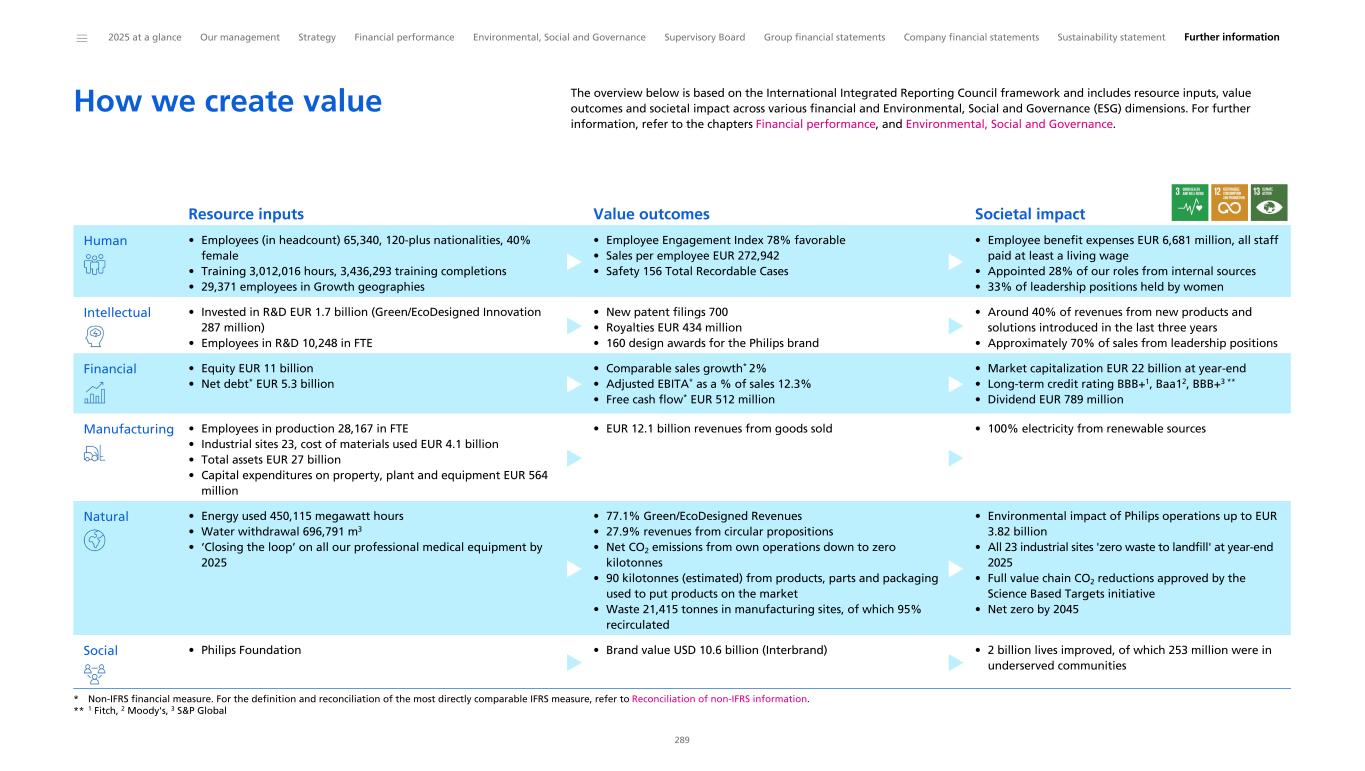
How we create value The overview below is based on the International Integrated Reporting Council framework and includes resource inputs, value outcomes and societal impact across various financial and Environmental, Social and Governance (ESG) dimensions. For further information, refer to the chapters Financial performance, and Environmental, Social and Governance. Resource inputs Value outcomes Societal impact Human • Employees (in headcount) 65,340, 120-plus nationalities, 40% female • Training 3,012,016 hours, 3,436,293 training completions • 29,371 employees in Growth geographies • Employee Engagement Index 78% favorable • Sales per employee EUR 272,942 • Safety 156 Total Recordable Cases • Employee benefit expenses EUR 6,681 million, all staff paid at least a living wage • Appointed 28% of our roles from internal sources • 33% of leadership positions held by women Intellectual • Invested in R&D EUR 1.7 billion (Green/EcoDesigned Innovation 287 million) • Employees in R&D 10,248 in FTE • New patent filings 700 • Royalties EUR 434 million • 160 design awards for the Philips brand • Around 40% of revenues from new products and solutions introduced in the last three years • Approximately 70% of sales from leadership positions Financial • Equity EUR 11 billion • Net debt* EUR 5.3 billion • Comparable sales growth* 2% • Adjusted EBITA* as a % of sales 12.3% • Free cash flow* EUR 512 million • Market capitalization EUR 22 billion at year-end • Long-term credit rating BBB+1, Baa12, BBB+3 ** • Dividend EUR 789 million Manufacturing • Employees in production 28,167 in FTE • Industrial sites 23, cost of materials used EUR 4.1 billion • Total assets EUR 27 billion • Capital expenditures on property, plant and equipment EUR 564 million • EUR 12.1 billion revenues from goods sold • 100% electricity from renewable sources Natural • Energy used 450,115 megawatt hours • Water withdrawal 696,791 m3 • ‘Closing the loop’ on all our professional medical equipment by 2025 • 77.1% Green/EcoDesigned Revenues • 27.9% revenues from circular propositions • Net CO2 emissions from own operations down to zero kilotonnes • 90 kilotonnes (estimated) from products, parts and packaging used to put products on the market • Waste 21,415 tonnes in manufacturing sites, of which 95% recirculated • Environmental impact of Philips operations up to EUR 3.82 billion • All 23 industrial sites 'zero waste to landfill' at year-end 2025 • Full value chain CO2 reductions approved by the Science Based Targets initiative • Net zero by 2045 Social • Philips Foundation • Brand value USD 10.6 billion (Interbrand) • 2 billion lives improved, of which 253 million were in underserved communities * Non-IFRS financial measure. For the definition and reconciliation of the most directly comparable IFRS measure, refer to Reconciliation of non-IFRS information. ** 1 Fitch, 2 Moody's, 3 S&P Global ______ 2025 at a glance Our management Strategy Financial performance Environmental, Social and Governance Supervisory Board Group financial statements Company financial statements Sustainability statement Further information 289
Appropriation of profits Pursuant to article 34 of the articles of association of the company, a dividend will first be declared on preference shares out of net income. The remainder of the net income, after any retention by way of reserve with the approval of the Supervisory Board, shall be available for distribution to holders of common shares subject to shareholder approval after year-end. As of December 31, 2025, the issued share capital consists only of common shares. No preference shares have been issued. Article 33 of the articles of association of the company gives the Board of Management the power to determine what portion of the net income shall be retained by way of reserve, subject to the approval of the Supervisory Board. ______ 2025 at a glance Our management Strategy Financial performance Environmental, Social and Governance Supervisory Board Group financial statements Company financial statements Sustainability statement Further information 290
Reconciliation of non-IFRS information In this Annual Report Philips presents certain financial measures when discussing Philips’ performance that are not measures of financial performance or liquidity under IFRS (‘non-IFRS’). These non-IFRS measures (also known as non-GAAP or alternative performance measures) are presented because management considers them important supplemental measures of Philips’ performance and believes that they are widely used in the industry in which Philips operates as a means of evaluating a company’s operating performance and liquidity. Philips believes that an understanding of its sales performance, profitability, financial strength and funding requirements is enhanced by reporting the following non-IFRS measures: • comparable sales growth • EBITA • Adjusted EBITA • Adjusted EBITDA • adjusted income from continuing operations attributable to shareholders • adjusted income from continuing operations attributable to shareholders per common share (in EUR) - diluted (Adjusted EPS) • free cash flow • net debt : group equity ratio • organic Return on Invested Capital (ROIC) Non-IFRS measures do not have standardized meanings under IFRS and not all companies calculate non-IFRS measures in the same manner or on a consistent basis. As a result, these measures may not be comparable to measures used by other companies that have the same or similar names. Accordingly, undue reliance should not be placed on the non-IFRS measures contained in this Annual Report and they should not be considered as substitutes for sales, net income, net cash provided by operating activities or other financial measures computed in accordance with IFRS. This chapter contains the definitions of the non-IFRS measures used in this Annual Report as well as reconciliations from the most directly comparable IFRS measures. The non-IFRS measures discussed in this Annual Report are cross referenced to this chapter. These non-IFRS measures should not be viewed in isolation or as alternatives to equivalent IFRS measures and should be used in conjunction with the most directly comparable IFRS measures. The non-IFRS financial measures presented are not measures of financial performance or liquidity under IFRS, but measures used by management to monitor the underlying performance of Philips’ business and operations and, accordingly, they have not been audited or reviewed by Philips’ external auditors. Additionally, Philips provides forward-looking targets for comparable sales growth, adjusted EBITA margin improvement, free cash flow and organic ROIC, which are non-IFRS financial measures. Philips has not provided a quantitative reconciliation of these targets to the most directly comparable IFRS measures because certain information needed to reconcile these non-IFRS financial measures to the most comparable IFRS financial measures are dependent on specific items or impacts which are not yet determined, are subject to uncertainty and variability in timing and amount due to their nature, are outside of Philips’ control, or cannot be predicted, including items and impacts such as currency exchange rates, acquisitions and disposals, legal and tax gains and losses and pension settlements, charges and costs such as impairments, restructuring and acquisition-related charges, amortization of intangible assets and net capital expenditures. Accordingly, reconciliations of these non-IFRS forward-looking financial measures to the most directly comparable IFRS financial measures are not available without unreasonable effort. Such unavailable reconciling items could significantly impact the results of operations and financial condition. ______ 2025 at a glance Our management Strategy Financial performance Environmental, Social and Governance Supervisory Board Group financial statements Company financial statements Sustainability statement Further information 291
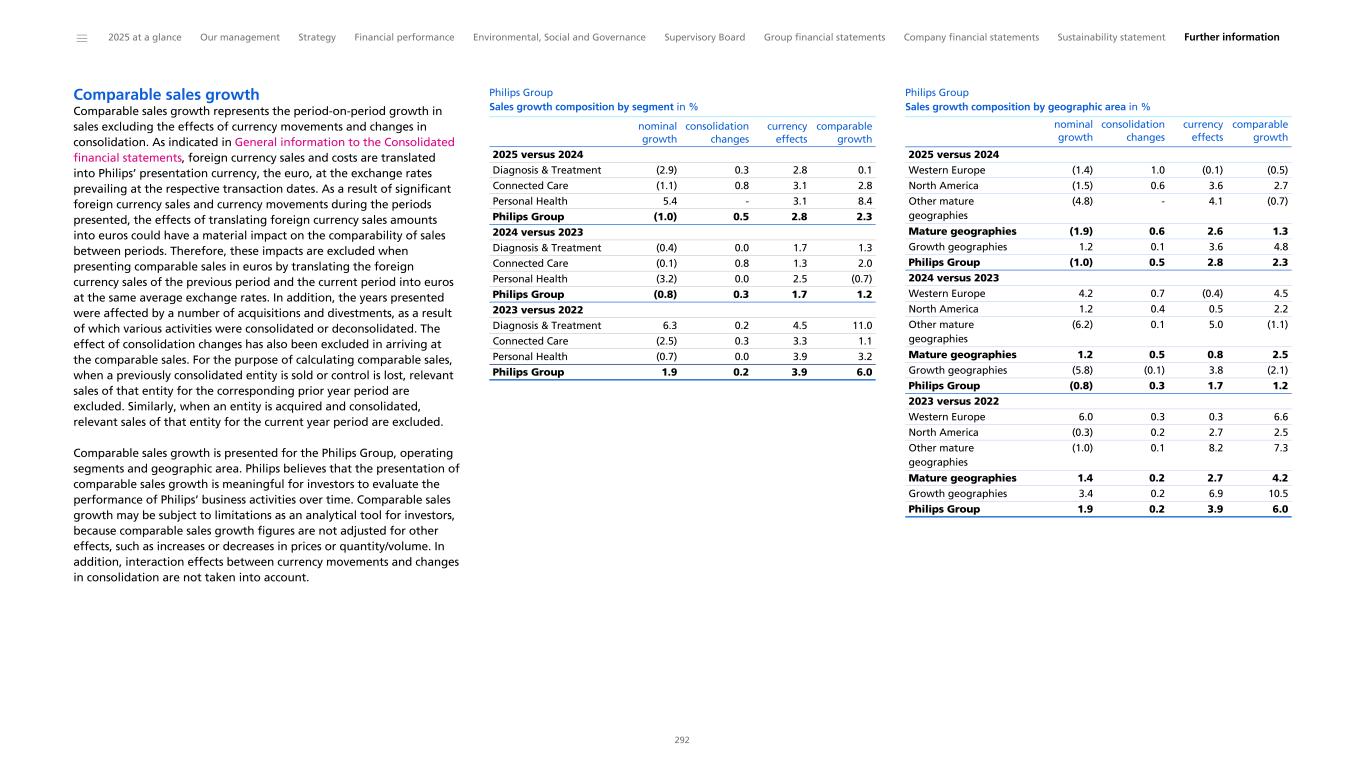
Comparable sales growth Comparable sales growth represents the period-on-period growth in sales excluding the effects of currency movements and changes in consolidation. As indicated in General information to the Consolidated financial statements, foreign currency sales and costs are translated into Philips’ presentation currency, the euro, at the exchange rates prevailing at the respective transaction dates. As a result of significant foreign currency sales and currency movements during the periods presented, the effects of translating foreign currency sales amounts into euros could have a material impact on the comparability of sales between periods. Therefore, these impacts are excluded when presenting comparable sales in euros by translating the foreign currency sales of the previous period and the current period into euros at the same average exchange rates. In addition, the years presented were affected by a number of acquisitions and divestments, as a result of which various activities were consolidated or deconsolidated. The effect of consolidation changes has also been excluded in arriving at the comparable sales. For the purpose of calculating comparable sales, when a previously consolidated entity is sold or control is lost, relevant sales of that entity for the corresponding prior year period are excluded. Similarly, when an entity is acquired and consolidated, relevant sales of that entity for the current year period are excluded. Comparable sales growth is presented for the Philips Group, operating segments and geographic area. Philips believes that the presentation of comparable sales growth is meaningful for investors to evaluate the performance of Philips’ business activities over time. Comparable sales growth may be subject to limitations as an analytical tool for investors, because comparable sales growth figures are not adjusted for other effects, such as increases or decreases in prices or quantity/volume. In addition, interaction effects between currency movements and changes in consolidation are not taken into account. Philips Group Sales growth composition by segment in % 2025 versus 2024 Diagnosis & Treatment (2.9) 0.3 2.8 0.1 Connected Care (1.1) 0.8 3.1 2.8 Personal Health 5.4 - 3.1 8.4 Philips Group (1.0) 0.5 2.8 2.3 2024 versus 2023 Diagnosis & Treatment (0.4) 0.0 1.7 1.3 Connected Care (0.1) 0.8 1.3 2.0 Personal Health (3.2) 0.0 2.5 (0.7) Philips Group (0.8) 0.3 1.7 1.2 2023 versus 2022 Diagnosis & Treatment 6.3 0.2 4.5 11.0 Connected Care (2.5) 0.3 3.3 1.1 Personal Health (0.7) 0.0 3.9 3.2 Philips Group 1.9 0.2 3.9 6.0 nominal growth consolidation changes currency effects comparable growth Philips Group Sales growth composition by geographic area in % 2025 versus 2024 Western Europe (1.4) 1.0 (0.1) (0.5) North America (1.5) 0.6 3.6 2.7 Other mature geographies (4.8) - 4.1 (0.7) Mature geographies (1.9) 0.6 2.6 1.3 Growth geographies 1.2 0.1 3.6 4.8 Philips Group (1.0) 0.5 2.8 2.3 2024 versus 2023 Western Europe 4.2 0.7 (0.4) 4.5 North America 1.2 0.4 0.5 2.2 Other mature geographies (6.2) 0.1 5.0 (1.1) Mature geographies 1.2 0.5 0.8 2.5 Growth geographies (5.8) (0.1) 3.8 (2.1) Philips Group (0.8) 0.3 1.7 1.2 2023 versus 2022 Western Europe 6.0 0.3 0.3 6.6 North America (0.3) 0.2 2.7 2.5 Other mature geographies (1.0) 0.1 8.2 7.3 Mature geographies 1.4 0.2 2.7 4.2 Growth geographies 3.4 0.2 6.9 10.5 Philips Group 1.9 0.2 3.9 6.0 nominal growth consolidation changes currency effects comparable growth ______ 2025 at a glance Our management Strategy Financial performance Environmental, Social and Governance Supervisory Board Group financial statements Company financial statements Sustainability statement Further information 292
EBITA and Adjusted EBITA The term Adjusted EBITA is used to evaluate the performance of Philips and its segments. EBITA represents Income from operations excluding amortization and impairment of acquired intangible assets and impairment of goodwill. Adjusted EBITA represents EBITA excluding gains or losses from restructuring costs, acquisition-related charges and other items. Restructuring costs are defined as the estimated costs of initiated reorganizations, the most significant of which have been approved by the Executive Committee, and which generally involve the realignment of certain parts of the industrial and commercial organization. Acquisition-related charges are defined as costs that are directly triggered by the acquisition of a company, such as transaction costs, purchase accounting related costs and integration-related expenses. Other items are defined as any individual item with an income statement impact (loss or gain) that is deemed by management to be both significant and incidental to normal business activity. This includes the following: litigation costs and settlements in favor of (or against) the company, gains (or losses) on sale of businesses or assets, remediation costs (also referred to as quality actions), impairment of assets, portfolio realignment charges, environmental charges and other items which are individually above an amount of EUR 20 million in a quarter, or an individual item which is above EUR 40 million across multiple quarters. Refer to Restructuring, acquisition-related charges and other items in the Results of operations section of Financial performance. Philips considers the use of Adjusted EBITA appropriate as Philips uses it as a measure of segment performance and as one of its strategic drivers to increase profitability through re-allocation of its resources toward opportunities offering more consistent and higher returns. This is done with the aim of making the underlying performance of the Businesses more transparent. EBITA excludes amortization and impairment of acquired intangible assets (which primarily relates to brand names, customer relationships and technology) and impairment of goodwill, as Philips believes that such amounts are inconsistent in amount and frequency, are significantly impacted by the timing and/or size of acquisitions and do not factor into its decisions on allocation of its resources across segments. Although we exclude amortization and impairment of acquired intangible assets from the Adjusted EBITA measure, Philips believes that it is important for investors to understand that these acquired intangible assets contribute to revenue generation. Philips believes Adjusted EBITA is useful to evaluate financial performance on a comparable basis over time by factoring out restructuring costs, acquisition-related charges and other incidental items that are not directly related to the operational performance of Philips Group or its segments. Adjusted EBITA may be subject to limitations as an analytical tool for investors, as it excludes restructuring costs, acquisition-related charges and other incidental items and therefore does not reflect the expense associated with such items, which may be significant and have a significant effect on Philips’ net income. Adjusted EBITA margin refers to Adjusted EBITA divided by sales expressed as a percentage. Adjusted EBITA is not a recognized measure of financial performance under IFRS. The reconciliation of Adjusted EBITA to the most directly comparable IFRS measure, Net income, for the years indicated is presented in the accompanying table. Net income is not allocated to segments as certain income and expense line items are monitored on a centralized basis, resulting in them being shown on a Philips Group level only. Adjusted EBITDA Adjusted EBITDA is defined as Income from operations excluding amortization and impairment of intangible assets, impairment of goodwill, depreciation and impairment of property, plant and equipment, restructuring costs, acquisition-related charges and other items. Philips understands that Adjusted EBITDA is broadly used by analysts, rating agencies and investors in their evaluation of different companies because it excludes certain items that can vary widely across different industries or among companies within the same industry. Philips considers Adjusted EBITDA useful when comparing its performance to other companies in the health tech industry. However, Adjusted EBITDA may be subject to limitations as an analytical tool because of the range of items excluded and their significance in a given reporting period. Furthermore, comparisons with other companies may be complicated due to the absence of a standardized meaning and calculation framework. Philips management compensates for the limitations of using Adjusted EBITDA by using this measure to supplement IFRS results to provide a more complete understanding of the factors and trends affecting the business rather than IFRS results alone. In addition to the limitations noted above, Adjusted EBITDA excludes items that may be recurring in nature and should not be disregarded in the evaluation of performance. However, we believe it is useful to exclude such items to provide a supplemental analysis of current results and trends compared to other periods. This is because certain excluded items can vary significantly depending on specific underlying transactions or events. Also, the variability of such items may not relate specifically to ongoing operating results or trends, and certain excluded items, while potentially recurring in future periods, may not be indicative of future results. Net income for the years indicated is included in the accompanying table. Net income is not allocated to segments as certain income and expense line items are monitored on a centralized basis, resulting in them being shown on a Philips Group level only. ______ 2025 at a glance Our management Strategy Financial performance Environmental, Social and Governance Supervisory Board Group financial statements Company financial statements Sustainability statement Further information 293
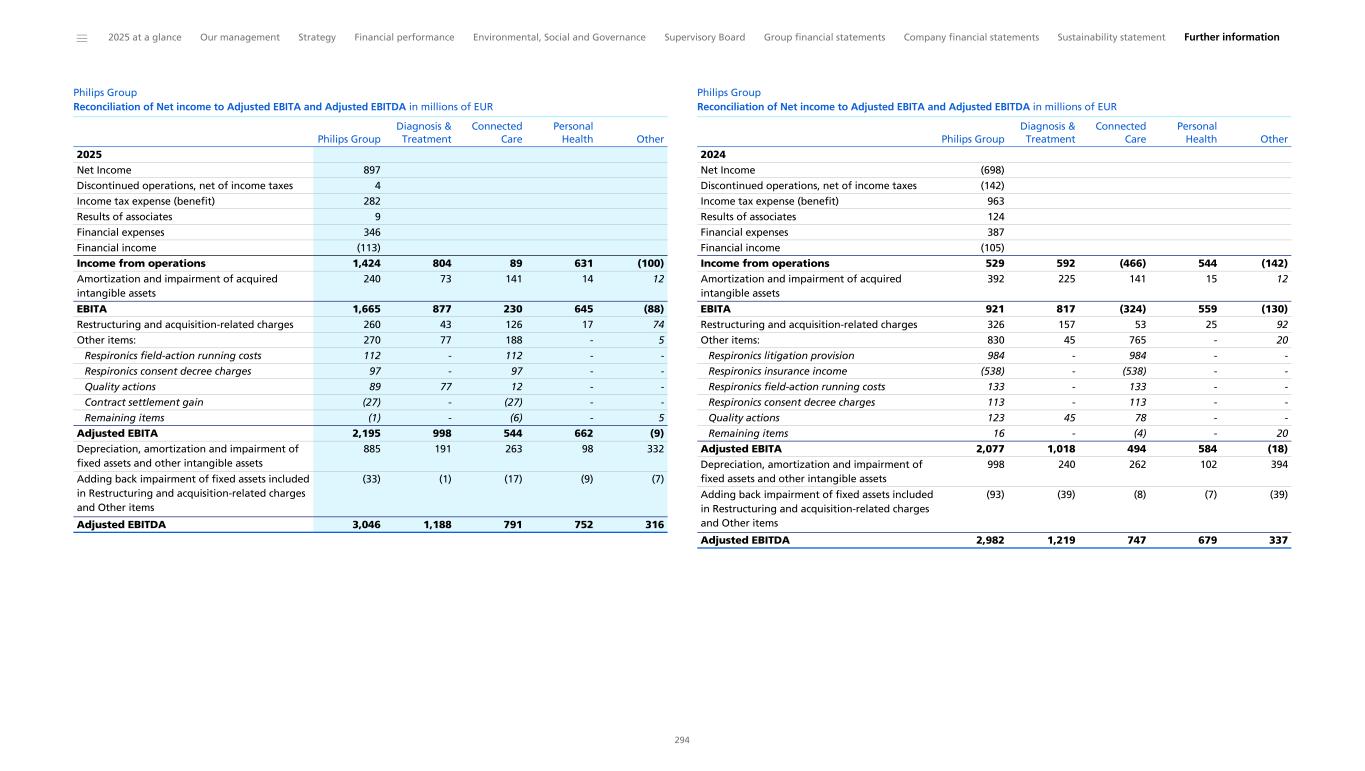
Philips Group Reconciliation of Net income to Adjusted EBITA and Adjusted EBITDA in millions of EUR 2025 Net Income 897 Discontinued operations, net of income taxes 4 Income tax expense (benefit) 282 Results of associates 9 Financial expenses 346 Financial income (113) Income from operations 1,424 804 89 631 (100) Amortization and impairment of acquired intangible assets 240 73 141 14 12 EBITA 1,665 877 230 645 (88) Restructuring and acquisition-related charges 260 43 126 17 74 Other items: 270 77 188 - 5 Respironics field-action running costs 112 - 112 - - Respironics consent decree charges 97 - 97 - - Quality actions 89 77 12 - - Contract settlement gain (27) - (27) - - Remaining items (1) - (6) - 5 Adjusted EBITA 2,195 998 544 662 (9) Depreciation, amortization and impairment of fixed assets and other intangible assets 885 191 263 98 332 Adding back impairment of fixed assets included in Restructuring and acquisition-related charges and Other items (33) (1) (17) (9) (7) Adjusted EBITDA 3,046 1,188 791 752 316 Philips Group Diagnosis & Treatment Connected Care Personal Health Other Philips Group Reconciliation of Net income to Adjusted EBITA and Adjusted EBITDA in millions of EUR 2024 Net Income (698) Discontinued operations, net of income taxes (142) Income tax expense (benefit) 963 Results of associates 124 Financial expenses 387 Financial income (105) Income from operations 529 592 (466) 544 (142) Amortization and impairment of acquired intangible assets 392 225 141 15 12 EBITA 921 817 (324) 559 (130) Restructuring and acquisition-related charges 326 157 53 25 92 Other items: 830 45 765 - 20 Respironics litigation provision 984 - 984 - - Respironics insurance income (538) - (538) - - Respironics field-action running costs 133 - 133 - - Respironics consent decree charges 113 - 113 - - Quality actions 123 45 78 - - Remaining items 16 - (4) - 20 Adjusted EBITA 2,077 1,018 494 584 (18) Depreciation, amortization and impairment of fixed assets and other intangible assets 998 240 262 102 394 Adding back impairment of fixed assets included in Restructuring and acquisition-related charges and Other items (93) (39) (8) (7) (39) Adjusted EBITDA 2,982 1,219 747 679 337 Philips Group Diagnosis & Treatment Connected Care Personal Health Other ______ 2025 at a glance Our management Strategy Financial performance Environmental, Social and Governance Supervisory Board Group financial statements Company financial statements Sustainability statement Further information 294
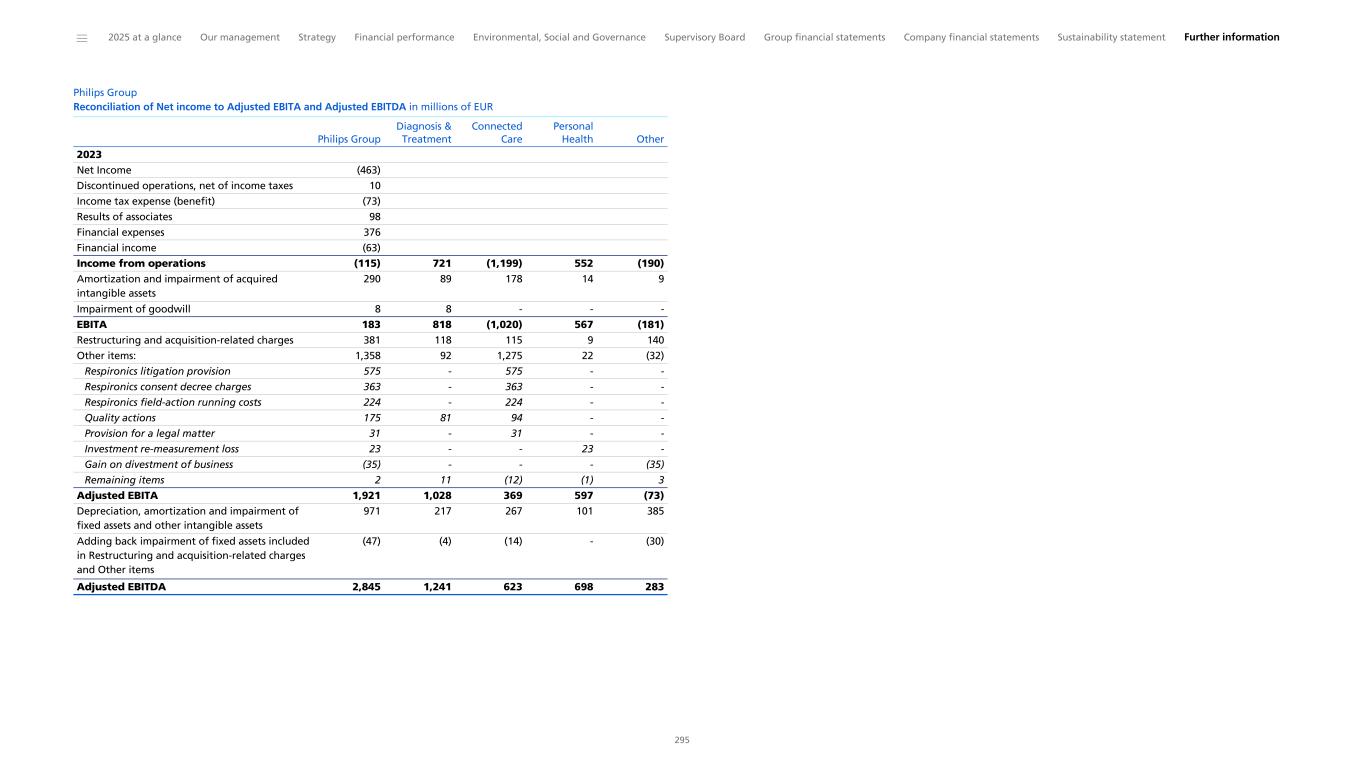
Philips Group Reconciliation of Net income to Adjusted EBITA and Adjusted EBITDA in millions of EUR 2023 Net Income (463) Discontinued operations, net of income taxes 10 Income tax expense (benefit) (73) Results of associates 98 Financial expenses 376 Financial income (63) Income from operations (115) 721 (1,199) 552 (190) Amortization and impairment of acquired intangible assets 290 89 178 14 9 Impairment of goodwill 8 8 - - - EBITA 183 818 (1,020) 567 (181) Restructuring and acquisition-related charges 381 118 115 9 140 Other items: 1,358 92 1,275 22 (32) Respironics litigation provision 575 - 575 - - Respironics consent decree charges 363 - 363 - - Respironics field-action running costs 224 - 224 - - Quality actions 175 81 94 - - Provision for a legal matter 31 - 31 - - Investment re-measurement loss 23 - - 23 - Gain on divestment of business (35) - - - (35) Remaining items 2 11 (12) (1) 3 Adjusted EBITA 1,921 1,028 369 597 (73) Depreciation, amortization and impairment of fixed assets and other intangible assets 971 217 267 101 385 Adding back impairment of fixed assets included in Restructuring and acquisition-related charges and Other items (47) (4) (14) - (30) Adjusted EBITDA 2,845 1,241 623 698 283 Philips Group Diagnosis & Treatment Connected Care Personal Health Other ______ 2025 at a glance Our management Strategy Financial performance Environmental, Social and Governance Supervisory Board Group financial statements Company financial statements Sustainability statement Further information 295
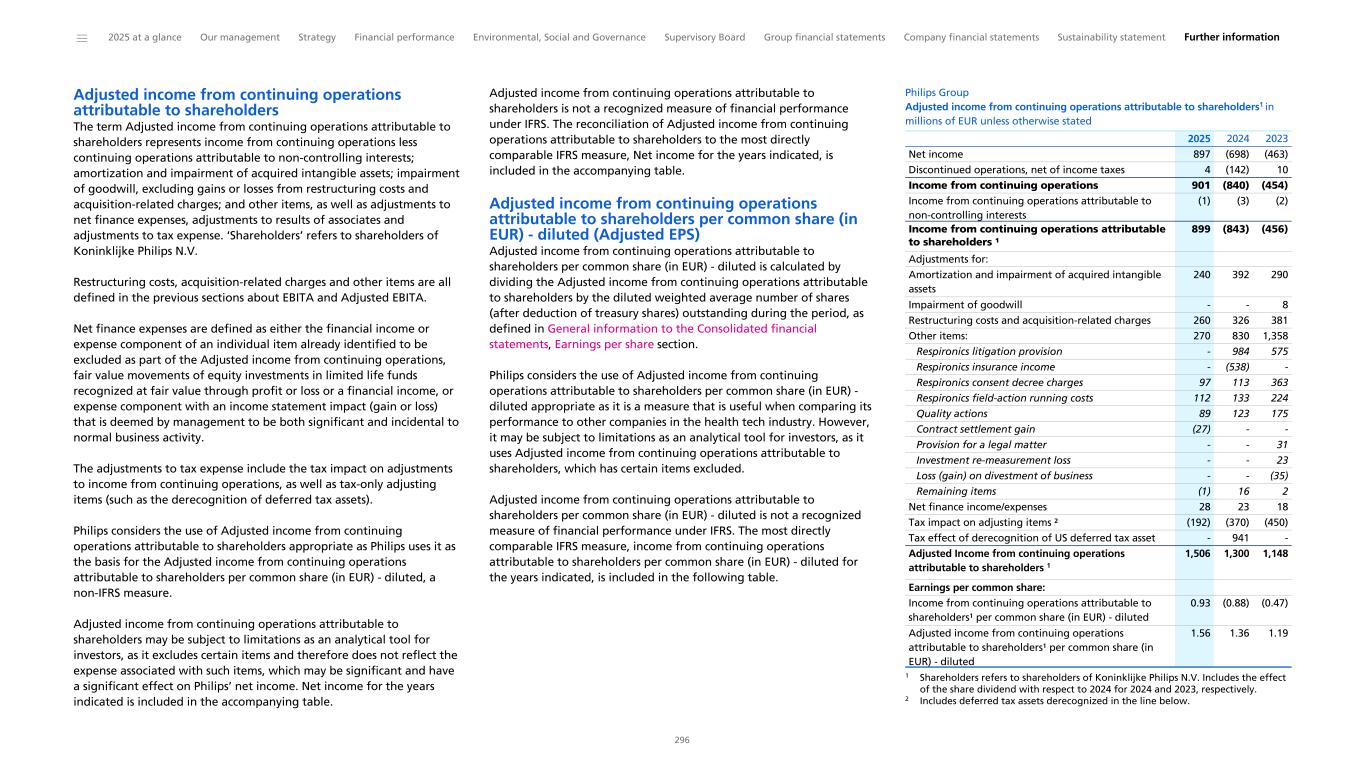
Adjusted income from continuing operations attributable to shareholders The term Adjusted income from continuing operations attributable to shareholders represents income from continuing operations less continuing operations attributable to non-controlling interests; amortization and impairment of acquired intangible assets; impairment of goodwill, excluding gains or losses from restructuring costs and acquisition-related charges; and other items, as well as adjustments to net finance expenses, adjustments to results of associates and adjustments to tax expense. ‘Shareholders’ refers to shareholders of Koninklijke Philips N.V. Restructuring costs, acquisition-related charges and other items are all defined in the previous sections about EBITA and Adjusted EBITA. Net finance expenses are defined as either the financial income or expense component of an individual item already identified to be excluded as part of the Adjusted income from continuing operations, fair value movements of equity investments in limited life funds recognized at fair value through profit or loss or a financial income, or expense component with an income statement impact (gain or loss) that is deemed by management to be both significant and incidental to normal business activity. The adjustments to tax expense include the tax impact on adjustments to income from continuing operations, as well as tax-only adjusting items (such as the derecognition of deferred tax assets). Philips considers the use of Adjusted income from continuing operations attributable to shareholders appropriate as Philips uses it as the basis for the Adjusted income from continuing operations attributable to shareholders per common share (in EUR) - diluted, a non-IFRS measure. Adjusted income from continuing operations attributable to shareholders may be subject to limitations as an analytical tool for investors, as it excludes certain items and therefore does not reflect the expense associated with such items, which may be significant and have a significant effect on Philips’ net income. Net income for the years indicated is included in the accompanying table. Adjusted income from continuing operations attributable to shareholders is not a recognized measure of financial performance under IFRS. The reconciliation of Adjusted income from continuing operations attributable to shareholders to the most directly comparable IFRS measure, Net income for the years indicated, is included in the accompanying table. Adjusted income from continuing operations attributable to shareholders per common share (in EUR) - diluted (Adjusted EPS) Adjusted income from continuing operations attributable to shareholders per common share (in EUR) - diluted is calculated by dividing the Adjusted income from continuing operations attributable to shareholders by the diluted weighted average number of shares (after deduction of treasury shares) outstanding during the period, as defined in General information to the Consolidated financial statements, Earnings per share section. Philips considers the use of Adjusted income from continuing operations attributable to shareholders per common share (in EUR) - diluted appropriate as it is a measure that is useful when comparing its performance to other companies in the health tech industry. However, it may be subject to limitations as an analytical tool for investors, as it uses Adjusted income from continuing operations attributable to shareholders, which has certain items excluded. Adjusted income from continuing operations attributable to shareholders per common share (in EUR) - diluted is not a recognized measure of financial performance under IFRS. The most directly comparable IFRS measure, income from continuing operations attributable to shareholders per common share (in EUR) - diluted for the years indicated, is included in the following table. Philips Group Adjusted income from continuing operations attributable to shareholders1 in millions of EUR unless otherwise stated Net income 897 (698) (463) Discontinued operations, net of income taxes 4 (142) 10 Income from continuing operations 901 (840) (454) Income from continuing operations attributable to non-controlling interests (1) (3) (2) Income from continuing operations attributable to shareholders ¹ 899 (843) (456) Adjustments for: Amortization and impairment of acquired intangible assets 240 392 290 Impairment of goodwill - - 8 Restructuring costs and acquisition-related charges 260 326 381 Other items: 270 830 1,358 Respironics litigation provision - 984 575 Respironics insurance income - (538) - Respironics consent decree charges 97 113 363 Respironics field-action running costs 112 133 224 Quality actions 89 123 175 Contract settlement gain (27) - - Provision for a legal matter - - 31 Investment re-measurement loss - - 23 Loss (gain) on divestment of business - - (35) Remaining items (1) 16 2 Net finance income/expenses 28 23 18 Tax impact on adjusting items ² (192) (370) (450) Tax effect of derecognition of US deferred tax asset - 941 - Adjusted Income from continuing operations attributable to shareholders 1 1,506 1,300 1,148 Earnings per common share: Income from continuing operations attributable to shareholders¹ per common share (in EUR) - diluted 0.93 (0.88) (0.47) Adjusted income from continuing operations attributable to shareholders¹ per common share (in EUR) - diluted 1.56 1.36 1.19 2025 2024 2023 1 Shareholders refers to shareholders of Koninklijke Philips N.V. Includes the effect of the share dividend with respect to 2024 for 2024 and 2023, respectively. 2 Includes deferred tax assets derecognized in the line below. ______ 2025 at a glance Our management Strategy Financial performance Environmental, Social and Governance Supervisory Board Group financial statements Company financial statements Sustainability statement Further information 296
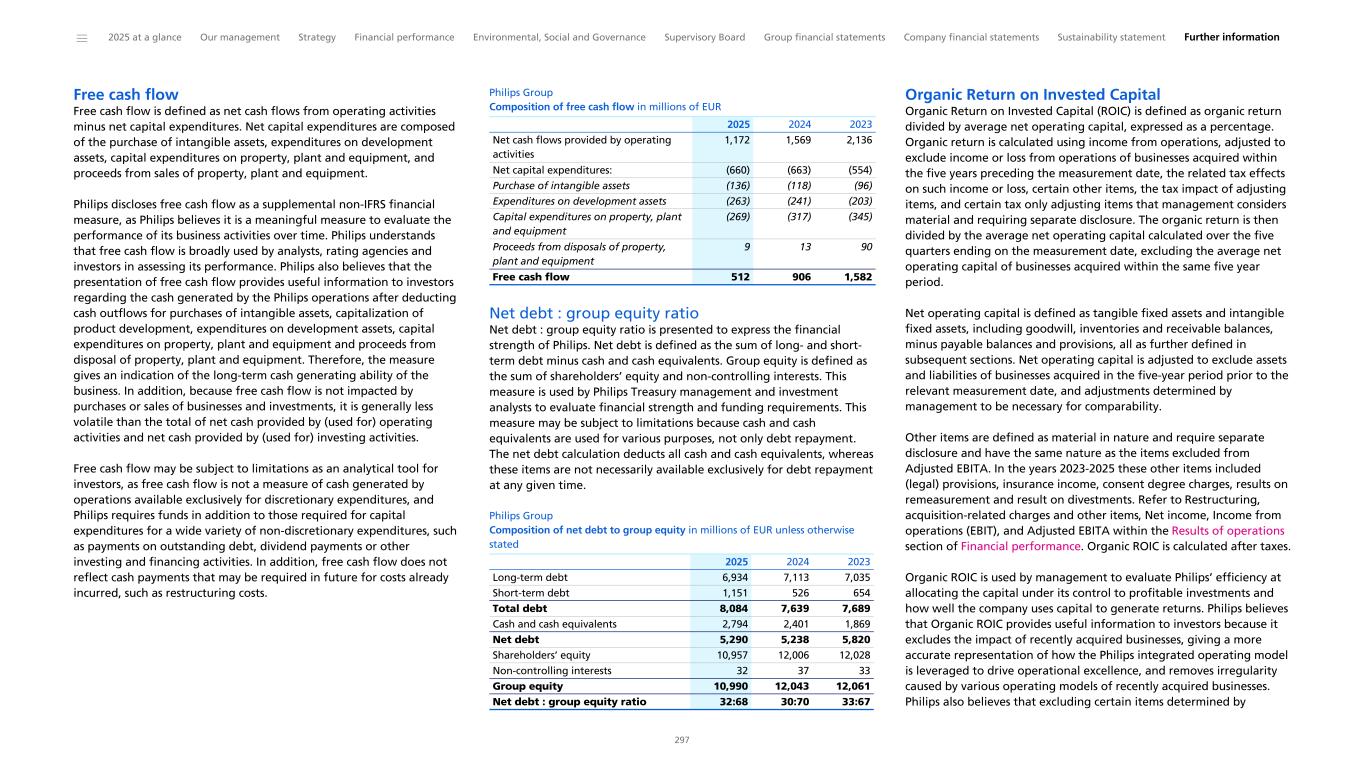
Free cash flow Free cash flow is defined as net cash flows from operating activities minus net capital expenditures. Net capital expenditures are composed of the purchase of intangible assets, expenditures on development assets, capital expenditures on property, plant and equipment, and proceeds from sales of property, plant and equipment. Philips discloses free cash flow as a supplemental non-IFRS financial measure, as Philips believes it is a meaningful measure to evaluate the performance of its business activities over time. Philips understands that free cash flow is broadly used by analysts, rating agencies and investors in assessing its performance. Philips also believes that the presentation of free cash flow provides useful information to investors regarding the cash generated by the Philips operations after deducting cash outflows for purchases of intangible assets, capitalization of product development, expenditures on development assets, capital expenditures on property, plant and equipment and proceeds from disposal of property, plant and equipment. Therefore, the measure gives an indication of the long-term cash generating ability of the business. In addition, because free cash flow is not impacted by purchases or sales of businesses and investments, it is generally less volatile than the total of net cash provided by (used for) operating activities and net cash provided by (used for) investing activities. Free cash flow may be subject to limitations as an analytical tool for investors, as free cash flow is not a measure of cash generated by operations available exclusively for discretionary expenditures, and Philips requires funds in addition to those required for capital expenditures for a wide variety of non-discretionary expenditures, such as payments on outstanding debt, dividend payments or other investing and financing activities. In addition, free cash flow does not reflect cash payments that may be required in future for costs already incurred, such as restructuring costs. Philips Group Composition of free cash flow in millions of EUR Net cash flows provided by operating activities 1,172 1,569 2,136 Net capital expenditures: (660) (663) (554) Purchase of intangible assets (136) (118) (96) Expenditures on development assets (263) (241) (203) Capital expenditures on property, plant and equipment (269) (317) (345) Proceeds from disposals of property, plant and equipment 9 13 90 Free cash flow 512 906 1,582 2025 2024 2023 Net debt : group equity ratio Net debt : group equity ratio is presented to express the financial strength of Philips. Net debt is defined as the sum of long- and short- term debt minus cash and cash equivalents. Group equity is defined as the sum of shareholders’ equity and non-controlling interests. This measure is used by Philips Treasury management and investment analysts to evaluate financial strength and funding requirements. This measure may be subject to limitations because cash and cash equivalents are used for various purposes, not only debt repayment. The net debt calculation deducts all cash and cash equivalents, whereas these items are not necessarily available exclusively for debt repayment at any given time. Philips Group Composition of net debt to group equity in millions of EUR unless otherwise stated Long-term debt 6,934 7,113 7,035 Short-term debt 1,151 526 654 Total debt 8,084 7,639 7,689 Cash and cash equivalents 2,794 2,401 1,869 Net debt 5,290 5,238 5,820 Shareholders’ equity 10,957 12,006 12,028 Non-controlling interests 32 37 33 Group equity 10,990 12,043 12,061 Net debt : group equity ratio 32:68 30:70 33:67 2025 2024 2023 Organic Return on Invested Capital Organic Return on Invested Capital (ROIC) is defined as organic return divided by average net operating capital, expressed as a percentage. Organic return is calculated using income from operations, adjusted to exclude income or loss from operations of businesses acquired within the five years preceding the measurement date, the related tax effects on such income or loss, certain other items, the tax impact of adjusting items, and certain tax only adjusting items that management considers material and requiring separate disclosure. The organic return is then divided by the average net operating capital calculated over the five quarters ending on the measurement date, excluding the average net operating capital of businesses acquired within the same five year period. Net operating capital is defined as tangible fixed assets and intangible fixed assets, including goodwill, inventories and receivable balances, minus payable balances and provisions, all as further defined in subsequent sections. Net operating capital is adjusted to exclude assets and liabilities of businesses acquired in the five-year period prior to the relevant measurement date, and adjustments determined by management to be necessary for comparability. Other items are defined as material in nature and require separate disclosure and have the same nature as the items excluded from Adjusted EBITA. In the years 2023-2025 these other items included (legal) provisions, insurance income, consent degree charges, results on remeasurement and result on divestments. Refer to Restructuring, acquisition-related charges and other items, Net income, Income from operations (EBIT), and Adjusted EBITA within the Results of operations section of Financial performance. Organic ROIC is calculated after taxes. Organic ROIC is used by management to evaluate Philips’ efficiency at allocating the capital under its control to profitable investments and how well the company uses capital to generate returns. Philips believes that Organic ROIC provides useful information to investors because it excludes the impact of recently acquired businesses, giving a more accurate representation of how the Philips integrated operating model is leveraged to drive operational excellence, and removes irregularity caused by various operating models of recently acquired businesses. Philips also believes that excluding certain items determined by ______ 2025 at a glance Our management Strategy Financial performance Environmental, Social and Governance Supervisory Board Group financial statements Company financial statements Sustainability statement Further information 297
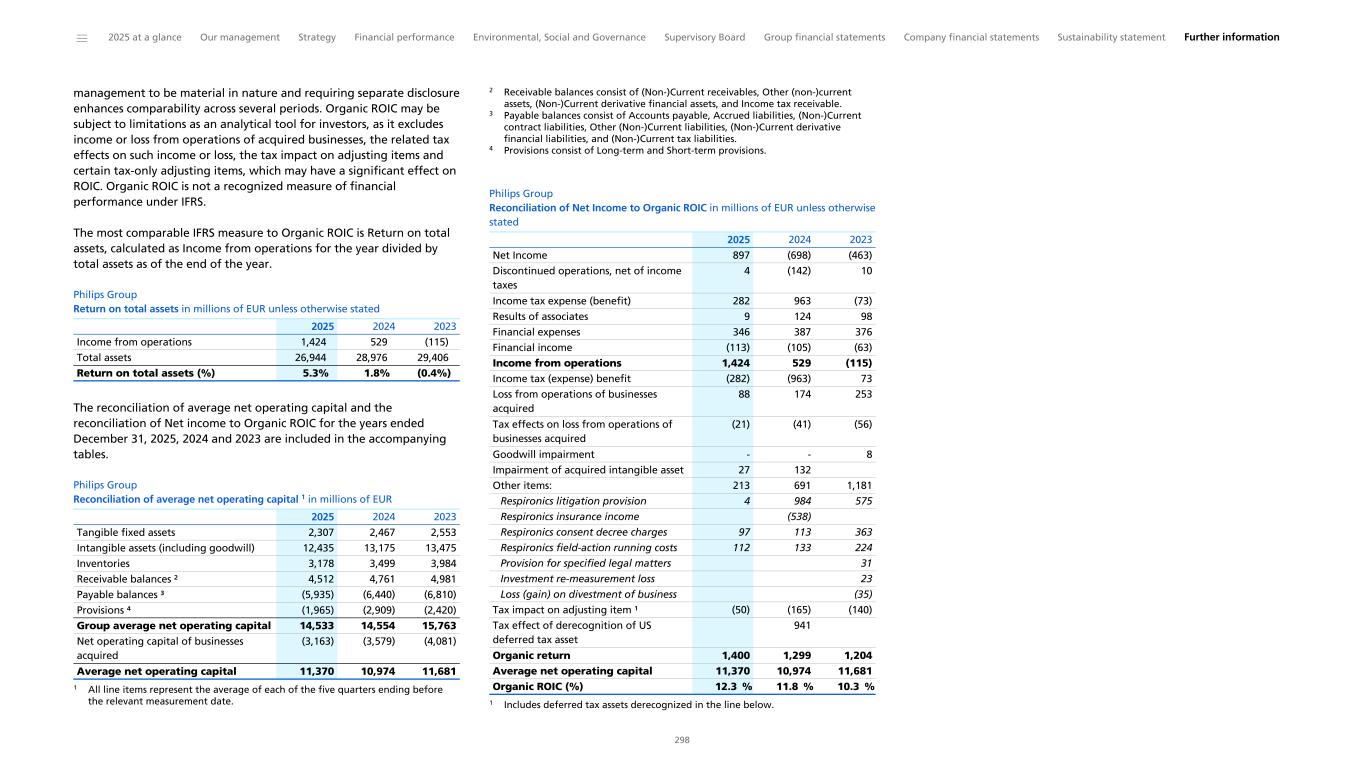
management to be material in nature and requiring separate disclosure enhances comparability across several periods. Organic ROIC may be subject to limitations as an analytical tool for investors, as it excludes income or loss from operations of acquired businesses, the related tax effects on such income or loss, the tax impact on adjusting items and certain tax-only adjusting items, which may have a significant effect on ROIC. Organic ROIC is not a recognized measure of financial performance under IFRS. The most comparable IFRS measure to Organic ROIC is Return on total assets, calculated as Income from operations for the year divided by total assets as of the end of the year. Philips Group Return on total assets in millions of EUR unless otherwise stated Income from operations 1,424 529 (115) Total assets 26,944 28,976 29,406 Return on total assets (%) 5.3 % 1.8% (0.4%) 2025 2024 2023 The reconciliation of average net operating capital and the reconciliation of Net income to Organic ROIC for the years ended December 31, 2025, 2024 and 2023 are included in the accompanying tables. Philips Group Reconciliation of average net operating capital 1 in millions of EUR Tangible fixed assets 2,307 2,467 2,553 Intangible assets (including goodwill) 12,435 13,175 13,475 Inventories 3,178 3,499 3,984 Receivable balances ² 4,512 4,761 4,981 Payable balances ³ (5,935) (6,440) (6,810) Provisions ⁴ (1,965) (2,909) (2,420) Group average net operating capital 14,533 14,554 15,763 Net operating capital of businesses acquired (3,163) (3,579) (4,081) Average net operating capital 11,370 10,974 11,681 2025 2024 2023 1 All line items represent the average of each of the five quarters ending before the relevant measurement date. 2 Receivable balances consist of (Non-)Current receivables, Other (non-)current assets, (Non-)Current derivative financial assets, and Income tax receivable. 3 Payable balances consist of Accounts payable, Accrued liabilities, (Non-)Current contract liabilities, Other (Non-)Current liabilities, (Non-)Current derivative financial liabilities, and (Non-)Current tax liabilities. 4 Provisions consist of Long-term and Short-term provisions. Philips Group Reconciliation of Net Income to Organic ROIC in millions of EUR unless otherwise stated Net Income 897 (698) (463) Discontinued operations, net of income taxes 4 (142) 10 Income tax expense (benefit) 282 963 (73) Results of associates 9 124 98 Financial expenses 346 387 376 Financial income (113) (105) (63) Income from operations 1,424 529 (115) Income tax (expense) benefit (282) (963) 73 Loss from operations of businesses acquired 88 174 253 Tax effects on loss from operations of businesses acquired (21) (41) (56) Goodwill impairment - - 8 Impairment of acquired intangible asset 27 132 Other items: 213 691 1,181 Respironics litigation provision 4 984 575 Respironics insurance income (538) Respironics consent decree charges 97 113 363 Respironics field-action running costs 112 133 224 Provision for specified legal matters 31 Investment re-measurement loss 23 Loss (gain) on divestment of business (35) Tax impact on adjusting item ¹ (50) (165) (140) Tax effect of derecognition of US deferred tax asset 941 Organic return 1,400 1,299 1,204 Average net operating capital 11,370 10,974 11,681 Organic ROIC (%) 12.3 % 11.8 % 10.3 % 2025 2024 2023 1 Includes deferred tax assets derecognized in the line below. ______ 2025 at a glance Our management Strategy Financial performance Environmental, Social and Governance Supervisory Board Group financial statements Company financial statements Sustainability statement Further information 298
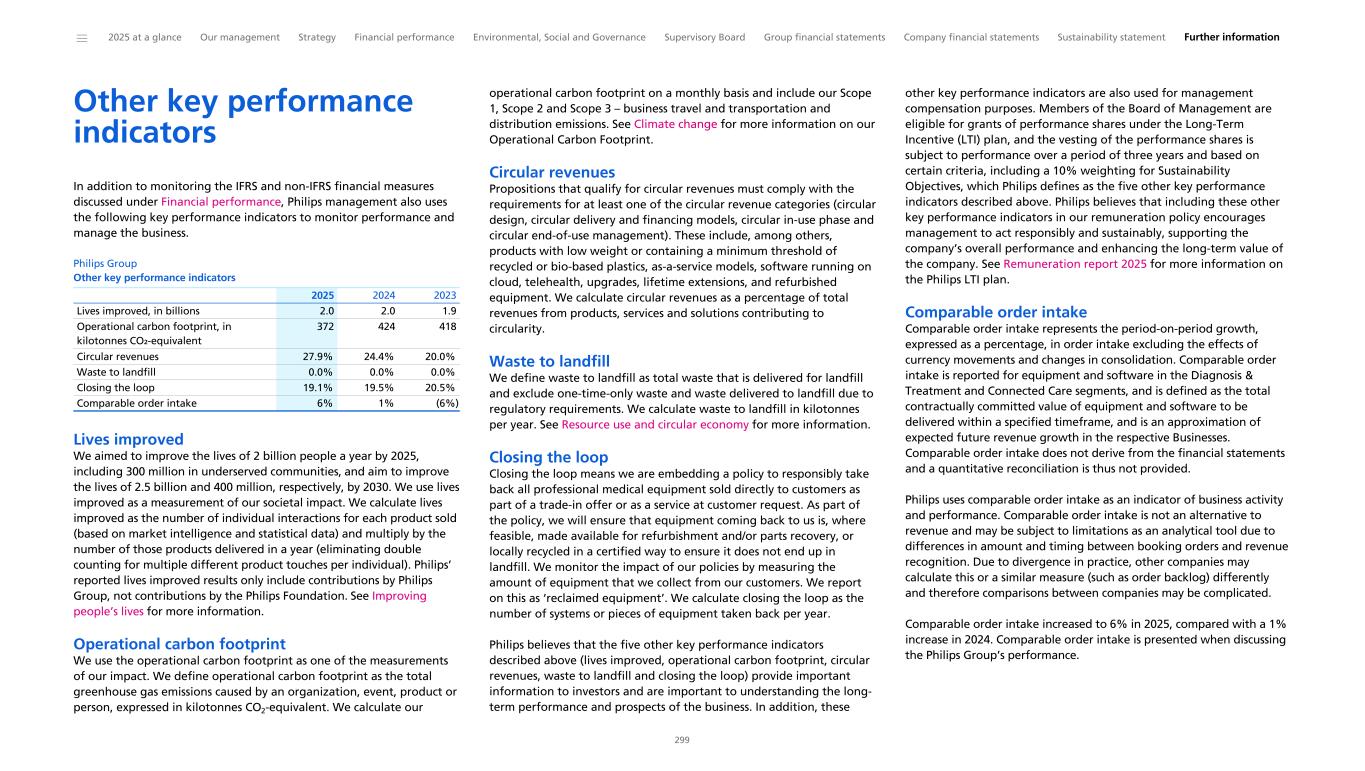
Other key performance indicators In addition to monitoring the IFRS and non-IFRS financial measures discussed under Financial performance, Philips management also uses the following key performance indicators to monitor performance and manage the business. Philips Group Other key performance indicators Lives improved, in billions 2.0 2.0 1.9 Operational carbon footprint, in kilotonnes CO₂-equivalent 372 424 418 Circular revenues 27.9% 24.4% 20.0% Waste to landfill 0.0% 0.0% 0.0% Closing the loop 19.1% 19.5% 20.5% Comparable order intake 6% 1% (6%) 2025 2024 2023 Lives improved We aimed to improve the lives of 2 billion people a year by 2025, including 300 million in underserved communities, and aim to improve the lives of 2.5 billion and 400 million, respectively, by 2030. We use lives improved as a measurement of our societal impact. We calculate lives improved as the number of individual interactions for each product sold (based on market intelligence and statistical data) and multiply by the number of those products delivered in a year (eliminating double counting for multiple different product touches per individual). Philips’ reported lives improved results only include contributions by Philips Group, not contributions by the Philips Foundation. See Improving people’s lives for more information. Operational carbon footprint We use the operational carbon footprint as one of the measurements of our impact. We define operational carbon footprint as the total greenhouse gas emissions caused by an organization, event, product or person, expressed in kilotonnes CO2-equivalent. We calculate our operational carbon footprint on a monthly basis and include our Scope 1, Scope 2 and Scope 3 – business travel and transportation and distribution emissions. See Climate change for more information on our Operational Carbon Footprint. Circular revenues Propositions that qualify for circular revenues must comply with the requirements for at least one of the circular revenue categories (circular design, circular delivery and financing models, circular in-use phase and circular end-of-use management). These include, among others, products with low weight or containing a minimum threshold of recycled or bio-based plastics, as-a-service models, software running on cloud, telehealth, upgrades, lifetime extensions, and refurbished equipment. We calculate circular revenues as a percentage of total revenues from products, services and solutions contributing to circularity. Waste to landfill We define waste to landfill as total waste that is delivered for landfill and exclude one-time-only waste and waste delivered to landfill due to regulatory requirements. We calculate waste to landfill in kilotonnes per year. See Resource use and circular economy for more information. Closing the loop Closing the loop means we are embedding a policy to responsibly take back all professional medical equipment sold directly to customers as part of a trade-in offer or as a service at customer request. As part of the policy, we will ensure that equipment coming back to us is, where feasible, made available for refurbishment and/or parts recovery, or locally recycled in a certified way to ensure it does not end up in landfill. We monitor the impact of our policies by measuring the amount of equipment that we collect from our customers. We report on this as ‘reclaimed equipment’. We calculate closing the loop as the number of systems or pieces of equipment taken back per year. Philips believes that the five other key performance indicators described above (lives improved, operational carbon footprint, circular revenues, waste to landfill and closing the loop) provide important information to investors and are important to understanding the long- term performance and prospects of the business. In addition, these other key performance indicators are also used for management compensation purposes. Members of the Board of Management are eligible for grants of performance shares under the Long-Term Incentive (LTI) plan, and the vesting of the performance shares is subject to performance over a period of three years and based on certain criteria, including a 10% weighting for Sustainability Objectives, which Philips defines as the five other key performance indicators described above. Philips believes that including these other key performance indicators in our remuneration policy encourages management to act responsibly and sustainably, supporting the company’s overall performance and enhancing the long-term value of the company. See Remuneration report 2025 for more information on the Philips LTI plan. Comparable order intake Comparable order intake represents the period-on-period growth, expressed as a percentage, in order intake excluding the effects of currency movements and changes in consolidation. Comparable order intake is reported for equipment and software in the Diagnosis & Treatment and Connected Care segments, and is defined as the total contractually committed value of equipment and software to be delivered within a specified timeframe, and is an approximation of expected future revenue growth in the respective Businesses. Comparable order intake does not derive from the financial statements and a quantitative reconciliation is thus not provided. Philips uses comparable order intake as an indicator of business activity and performance. Comparable order intake is not an alternative to revenue and may be subject to limitations as an analytical tool due to differences in amount and timing between booking orders and revenue recognition. Due to divergence in practice, other companies may calculate this or a similar measure (such as order backlog) differently and therefore comparisons between companies may be complicated. Comparable order intake increased to 6% in 2025, compared with a 1% increase in 2024. Comparable order intake is presented when discussing the Philips Group’s performance. ______ 2025 at a glance Our management Strategy Financial performance Environmental, Social and Governance Supervisory Board Group financial statements Company financial statements Sustainability statement Further information 299
Forward-looking statements and other information Forward-looking statements This document contains certain forward-looking statements with respect to the financial condition, results of operations and business of Philips and certain of the plans and objectives of Philips with respect to these items. Examples of forward-looking statements include statements made about our strategy, estimates of sales growth, future Adjusted EBITA*, future restructuring and acquisition-related charges and other costs, future developments in Philips’ organic business and the completion of acquisitions and divestments. Forward-looking statements can be identified generally as those containing words such as “anticipates”, “assumes”, “believes”, “estimates”, “expects”, “should”, “will”, “will likely result”, “forecast”, “outlook”, “projects”, “may” or similar expressions. By their nature, these statements involve risk and uncertainty because they relate to future events and circumstances and there are many factors that could cause actual results and developments to differ materially from those expressed or implied by these statements. These factors include but are not limited to: macro-economic and geopolitical changes including protectionism measures such as enacted and proposed tariffs and retaliatory trade measures in response thereto; Philips’ ability to keep pace with the changing health technology environment; Philips’ ability to gain leadership in artificial intelligence and health informatics in response to developments in the health technology industry; integration of acquisitions and their delivery on business plans and value creation expectations; ability to meet expectations with respect to ESG-related matters; securing and maintaining Philips’ intellectual property rights, and unauthorized use of third-party intellectual property rights; failure of products and services to meet quality or security standards, adversely affecting patient safety and customer operations; the resilience of our supply chain; challenges in simplifying our organization and our ways of working; attracting and retaining personnel; breach of cybersecurity; challenges in driving operational excellence and speed in bringing innovations to market; treasury and financing risks; tax risks; reliability of internal controls; compliance with regulations and standards involving quality, product safety, (cyber) security and artificial intelligence; and compliance with business conduct rules and regulations including privacy, existing and upcoming ESG disclosure and due diligence requirements. As a result, Philips’ actual future results may differ materially from the plans, goals and expectations set forth in such forward-looking statements. For a discussion of factors that could cause future results to differ from such forward-looking statements, reference is made to the information in Risk factors and responses. Third-party market share data Statements regarding market share, contained in this document, including those regarding Philips’ competitive position, are based on outside sources such as specialized research institutes, industry and dealer panels in combination with management estimates. Where full year information regarding 2025 is not yet available to Philips, market share statements may also be based on estimates and projections prepared by management and/or based on outside sources of information. Management’s estimates of rankings are based on order intake or sales, depending on the business. Use of non-IFRS information In presenting and discussing the Philips Group’s financial position, operating results and cash flows, management uses certain non-IFRS financial measures. These non-IFRS financial measures should not be viewed in isolation as alternatives to the equivalent IFRS measure and should be used in conjunction with the most directly comparable IFRS measures. Non-IFRS financial measures do not have standardized meaning under IFRS and therefore may not be comparable to similar measures presented by other issuers. A reconciliation of these non-IFRS measures to the most directly comparable IFRS measures is contained in Reconciliation of non-IFRS information. * Non-IFRS financial measure. For the definition and reconciliation of the most directly comparable IFRS measure, refer to Reconciliation of non-IFRS information. ______ 2025 at a glance Our management Strategy Financial performance Environmental, Social and Governance Supervisory Board Group financial statements Company financial statements Sustainability statement Further information 300
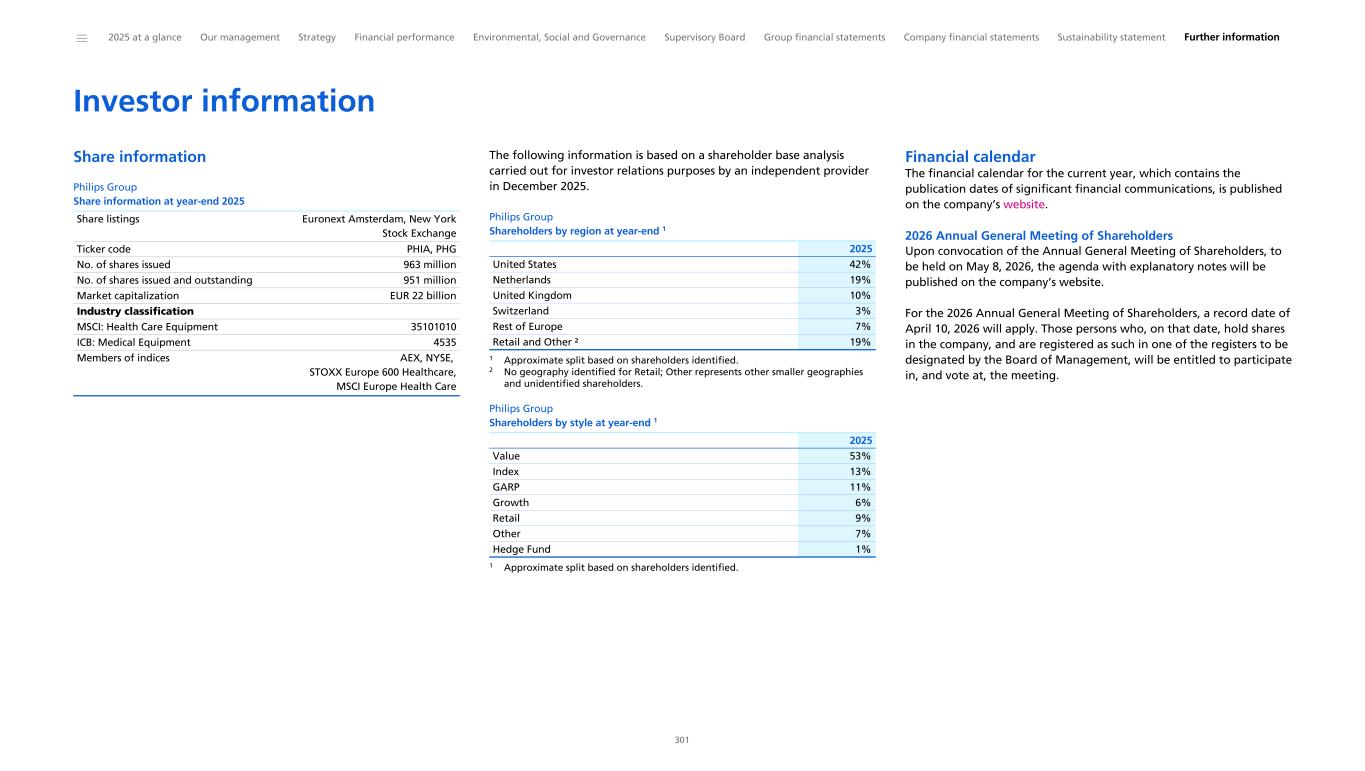
Investor information Share information Philips Group Share information at year-end 2025 Share listings Euronext Amsterdam, New York Stock Exchange Ticker code PHIA, PHG No. of shares issued 963 million No. of shares issued and outstanding 951 million Market capitalization EUR 22 billion Industry classification MSCI: Health Care Equipment 35101010 ICB: Medical Equipment 4535 Members of indices AEX, NYSE, STOXX Europe 600 Healthcare, MSCI Europe Health Care The following information is based on a shareholder base analysis carried out for investor relations purposes by an independent provider in December 2025. Philips Group Shareholders by region at year-end 1 United States 42% Netherlands 19% United Kingdom 10% Switzerland 3% Rest of Europe 7% Retail and Other ² 19% 2025 1 Approximate split based on shareholders identified. 2 No geography identified for Retail; Other represents other smaller geographies and unidentified shareholders. Philips Group Shareholders by style at year-end 1 Value 53% Index 13% GARP 11% Growth 6% Retail 9% Other 7% Hedge Fund 1% 2025 1 Approximate split based on shareholders identified. Financial calendar The financial calendar for the current year, which contains the publication dates of significant financial communications, is published on the company’s website. 2026 Annual General Meeting of Shareholders Upon convocation of the Annual General Meeting of Shareholders, to be held on May 8, 2026, the agenda with explanatory notes will be published on the company’s website. For the 2026 Annual General Meeting of Shareholders, a record date of April 10, 2026 will apply. Those persons who, on that date, hold shares in the company, and are registered as such in one of the registers to be designated by the Board of Management, will be entitled to participate in, and vote at, the meeting. ______ 2025 at a glance Our management Strategy Financial performance Environmental, Social and Governance Supervisory Board Group financial statements Company financial statements Sustainability statement Further information 301
Investor contact Shareholder services Shareholders and other interested parties can make inquiries about the Annual Report 2025 to: Royal Philips Annual Report Office Philips Center Prinses Irenestraat 59 1077 WV Amsterdam, The Netherlands Email: annual.report@philips.com The Annual Report on Form 20-F is filed electronically with the US Securities and Exchange Commission. Holders of shares listed on Euronext Amsterdam Communications concerning share transfers, share certificates, dividends and change of address should be directed to: ABN AMRO Bank N.V. Department Equity Capital Markets/Corporate Broking and Issuer Services HQ7212 Gustav Mahlerlaan 10 1082 PP Amsterdam, The Netherlands Telephone: +31-20-628-6070 Email: corporate.broking@nl.abnamro.com Holders of New York Registry shares Communications concerning share transfers, share certificates, dividends and change of address should be directed to: Deutsche Bank Trust Company Americas C/O Equiniti Trust Company LLC Peck Slip Station, PO Box 2050, New York, NY 10272-2050 Telephone (toll-free US): +1-866-706-8374 Telephone (outside of US): +1-718-921-8137 Website: www.equiniti.com/us/ast-access Email: adr@equiniti.com International direct investment program Royal Philips offers a Dividend Reinvestment and Direct Stock Purchase Plan designed for the US market. This program provides existing shareholders and interested investors with an economical and convenient way to purchase and sell Philips New York Registry shares (listed at the New York Stock Exchange) and to reinvest cash dividends. Deutsche Bank (the registrar of Philips NY Registry shares) has been authorized to implement and administer both plans for registered shareholders of and new investors in Philips NY Registry shares. Philips does not administer or sponsor the program and assumes no obligation or liability for the operation of the plan. For further information on this program and for enrollment forms, contact: Deutsche Bank Trust Company Americas C/O Equiniti Trust Company LLC PO Box 10027, Newark, NJ 07101 Telephone (toll free US): +1-866-706-8374 Telephone (outside of US): +1-718-921-8137 Website: www.equiniti.com/us/ast-access Email: adr@equiniti.com Analysts’ coverage Royal Philips is covered by approximately 20 analysts. For a list of our current analysts, please refer to the company’s website. How to reach us Investor Relations Royal Philips Philips Center Prinses Irenestraat 59 1077 WV Amsterdam, The Netherlands Telephone: +31-20-59 77222 Website: www.philips.com/investor Email: investor.relations@philips.com Sustainability Royal Philips High Tech Campus 34, 4th floor 5656 AE Eindhoven, The Netherlands Website: www.philips.com/sustainability Email: philips.sustainability@philips.com Media and press Royal Philips Philips Center Prinses Irenestraat 59 1077 WV Amsterdam, The Netherlands Email: group.communications@philips.com For media contacts please refer to the company’s website. Registered address High Tech Campus 52, 5656 AG Eindhoven, The Netherlands ______ 2025 at a glance Our management Strategy Financial performance Environmental, Social and Governance Supervisory Board Group financial statements Company financial statements Sustainability statement Further information 302
Definitions and abbreviations Actionable In the context of the Respironics recall, actionable registrations are those that contain the necessary information needed to complete the remediation and are not awaiting further information, including from patient registrants. Artificial intelligence (AI) While recognizing that Philips must abide by definitions of AI set by applicable regulations in different regions in the world, Philips applies the AI definition from the Organization for Economic Cooperation and Development (OECD): “An AI system is a machine-based system that, for explicit or implicit objectives, infers, from the input it receives, how to generate outputs such as predictions, content, recommendations, or decisions that can influence physical or virtual environments. Different AI systems vary in their levels of autonomy and adaptiveness after deployment.” Biodiversity and ecosystem services (BES) Biodiversity is the variability among living organisms from all sources including terrestrial, marine and other aquatic ecosystems and the ecological complexes of which they are part. This includes diversity within species, between species and of ecosystems. Ecosystem services refers to the contributions of ecosystems to the benefits that are used in economic and other human activity. Biome Global-scale zones, generally defined by the type of plant life that they support in response to average rainfall and temperature patterns, e.g., tundra, coral reefs or savannas. Brominated flame retardants (BFR) Brominated flame retardants are a group of chemicals that have an inhibitory effect on the ignition of combustible organic materials. Of the commercialized chemical flame retardants, the brominated variety are most widely used. Business/Business Unit In the Philips operating model, our three operating segments are made up of six Businesses, which are in turn comprised of 15 Business Units. See also the entry under Segment. CO2-equivalent CO2-equivalent or carbon dioxide equivalent is a quantity that describes, for a given mixture and amount of greenhouse gas, the amount of CO2 that would have the same global warming potential (GWP), when measured over a specified timescale (generally 100 years). Circular economy A circular economy aims to decouple economic growth from the consumption of natural resources by optimizing their use, eliminating waste and pollution, and circulating products and materials for as long as possible, while giving natural systems the opportunity to regenerate themselves. Circular innovation Innovation with the objective to create a product, service or solution contributing to circular practices. Circular materials management Circular materials management is a KPI for promoting an increase in the proportion of waste treated using waste management hierarchy levels that are circular: prevention, re-use, and recycling. Circular materials management percentage is the proportion of materials managed circularly in comparison to the total used materials baseline. The total used materials baseline is the total of both circular and linear waste, excluding linear disposal of waste that is required by law. Circular materials management includes recycling, re-use, prevention and other recovery (e.g., repurposing). It excludes all linear disposal, which is classified as waste to energy, incineration and landfill. Circular revenues Circular revenues are revenues from Philips products, services and solutions that contribute to circular practices. Circular revenues can be expressed as percentage of the total Philips revenues. Closing the loop / reclaimed equipment Closing the loop means we are embedding a policy to responsibly take back all professional medical equipment sold directly to customers as part of a trade-in offer or as a service at customer request. As part of the policy, we will ensure that equipment coming back to us is, where feasible, made available for refurbishment and/or parts recovery, or locally recycled in a certified way to ensure it does not end up in landfill. We monitor the impact of our policies by measuring the amount of equipment that we collect from our customers. We report on this as ‘reclaimed equipment’. Dividend yield The dividend yield is the annual dividend payment divided by Philips’ market capitalization. All references to dividend yield are as of December 31 of the previous year. EcoDesigned innovation and products Innovation with the objective a product, service or solution that complies with all applicable legal requirements, Philips policies, and all stated EcoDesigned product requirements in our four focal areas: energy, substances, circularity and packaging. EcoHero product An EcoHero product meets all EcoDesign requirements applicable to new product introductions and outperforms in at least one of the focal areas of EcoDesign, either compared to their predecessor or relevant benchmarks, or meeting a set threshold, supported by a sustainability claim. EcoHero revenues can be expressed as percentage of the total Philips hardware revenues. ______ 2025 at a glance Our management Strategy Financial performance Environmental, Social and Governance Supervisory Board Group financial statements Company financial statements Sustainability statement Further information 303
Employee Engagement Index The Employee Engagement Index (EEI), a value outcome measure as part of the International Integrated Reporting Council framework, is measured at Philips by the People Engagement Survey. The EEI is the single measure of the overall level of employee engagement at Philips. It is a combination of perceptions and attitudes related to employee satisfaction, commitment and advocacy. Energy-using products (EuP) An energy-using product is a product that uses, generates, transfers or measures energy (electricity, gas, fossil fuel). Examples include boilers, computers, televisions, transformers, industrial fans and industrial furnaces. Functions In the Philips operating model, Businesses are supported by lean Functions. The Functions deliver cost-effective services, ensure legal and regulatory requirements are deployed, and propose enterprise policies, standards, guidance and infrastructure, as well as provide capabilities and expertise (e.g., via centers of excellence). Full-time equivalent employee (FTE) Full-time equivalent is a way to measure a worker’s involvement in a project. An FTE of 1.0 means that the person is equivalent to a full-time worker, while an FTE of 0.5 signals that the worker works half-time. Global Reporting Initiative (GRI) The Global Reporting Initiative (GRI) is a network-based organization that pioneered the world’s most widely used sustainability reporting framework. GRI is committed to the framework’s continual improvement and application worldwide. GRI’s core goals include the mainstreaming of disclosure on environmental, social and governance performance. Green Innovation spend Green Innovation comprises all R&D activities directly contributing to the intended development and maintenance of EcoDesigned innovation and circular innovation. Green revenues Green revenues are revenues from EcoDesigned products, refurbished products, rentals, leases, as-a-service, upgrades and green services. Green revenue can be expressed as percentage of the total Philips revenues. Growth geographies Growth geographies consists of the grouping Growth, which comprises the developing geographies Asia Pacific (excluding Japan, South Korea, Australia and New Zealand), Latin America, Central and Eastern Europe, Middle East and Turkey (excluding Israel), and Africa. Hazardous substances Hazardous substances are generally defined as substances posing imminent and substantial danger to public health and welfare or the environment. Income from operations (EBIT) Income from operations as reported on the IFRS consolidated statement of income. The term EBIT (earnings before interest and tax) has the same meaning as income from operations. Income from continuing operations Income from continuing operations as reported on the IFRS consolidated statement of income, which is net income from continuing operations, or net income excluding discontinued operations. Lean The basic insight of Lean thinking is that if every person is trained to identify wasted time and effort in their own job and to better work together to improve processes by eliminating such waste, the resulting enterprise will deliver more value at less expense. Lives improved by Philips To calculate how many lives we are improving, market intelligence and statistical data on the number of people touched by the products contributing to the social or ecological dimension over the lifetime of a product are multiplied by the number of those products delivered in a year. After elimination of double counts – multiple different product touches per individual are only counted once – the number of lives improved by our innovative solutions is calculated. Locate, Evaluate, Assess, and Prepare (LEAP) Integrated approach for the assessment of nature-related issues that involves four phases to identify impact, dependencies, risks and opportunities on nature. Long-term strategic partnership Multi-year contractual agreement that represents a partnership to enable long-term collaboration. Mature geographies Mature geographies are the highly developed markets constituting three geographic areas: Western Europe, North America, and Other mature (including Japan, South Korea, Israel, Australia and New Zealand). Natural capital The stock of renewable and non-renewable natural resources (e.g., plants, animals, air, water, soils, minerals) that combine to yield a flow of benefits to people. Nature The natural world, with an emphasis on the diversity of living organisms (including people) and their interactions among themselves and with their environment. Net Promoter Score Net Promoter Score®, or NPS®, measures customer experience and predicts business growth. NPS is calculated by taking the answer to a key question on a 0-10 scale: How likely is it that you would recommend {brand} to a friend or colleague? Respondents are grouped as follows: • Promoters (score 9-10) are loyal enthusiasts who will keep buying and refer others, fueling growth. • Passives (score 7-8) are satisfied but unenthusiastic customers who are vulnerable to competitive offerings. • Detractors (score 0-6) are unhappy customers who can damage the brand and impede growth through negative word-of-mouth. ______ 2025 at a glance Our management Strategy Financial performance Environmental, Social and Governance Supervisory Board Group financial statements Company financial statements Sustainability statement Further information 304
Subtracting the percentage of detractors from the percentage of promoters yields the Net Promoter Score, which can range from a low of -100 (if every customer is a detractor) to a high of 100 (if every customer is a promoter). Operational carbon footprint A carbon footprint is the total set of greenhouse gas emissions caused by an organization, event, product or person; usually expressed in kilotonnes CO2-equivalent. Philips' operational carbon footprint is calculated on a monthly basis and includes industrial sites (manufacturing and assembly sites), non-industrial sites (offices, warehouses, IT centers and R&D facilities), business travel (lease and rental cars and airplane travel) and logistics (air, sea and road transport). Philips Lighting/Signify References to 'Signify' in this Annual Report relate to Philips' former Lighting segment (prior to deconsolidation as from the end of November 2017 and when reported as discontinued operations), Philips Lighting N.V. (before or after such deconsolidation) or Signify N.V. (after its renaming in May 2018), as the context requires. Polyvinyl chloride (PVC) Polyvinyl chloride, better known as PVC or vinyl, is an inexpensive plastic so versatile it has become pervasive in modern society. REACH Registration, Evaluation, Authorization and Restriction of Chemicals (REACH; Regulation (EC) No 1907/2006) is an EU regulation that addresses the production and use (e.g., in products) of chemical substances, and their potential impact on both human health and the environment. This regulation is covered in the Philips Regulated Substances List. Regulated Substance List The Philips Regulated Substances List (RSL) combines legal, industry, and voluntary Philips requirements regarding chemical substances used in Philips products and their packaging, either on a homogenous material level or present in the product as such. The RSL contains restricted and declarable substances. Respironics recall The voluntary recall notification in the US and field safety notice outside the US for certain sleep and respiratory care products initiated by Philips Respironics in 2021. Responsible Business Alliance (RBA) The Responsible Business Alliance (formerly known as The Electronic Industry Citizenship Coalition) was established in 2004 to promote a common code of conduct for the electronics and information and communications technology industry. RBA now includes more than 100 global companies and their suppliers. Restriction on Hazardous Substances (RoHS) The RoHS Directive prohibits all new electrical and electronic equipment placed on the market in the European Economic Area from containing lead, mercury, cadmium, hexavalent chromium, poly- brominated biphenyls (PBB) or polybrominated diphenyl ethers (PBDE) and four phthalates (DEHP, DBP, BBP and DiHP), except in certain specific applications, in concentrations greater than the values decided by the European Commission. These values have been established as 0.01% by weight per homogeneous material for cadmium and 0.1% for the other nine substances. This regulation is covered in the Philips Regulated Substances List. Segment The Philips operating model identifies three operating segments – Diagnosis & Treatment, Connected Care and Personal Health – comprised of Businesses and Business Units, as well as segment Other. Other includes Innovation & Design, IP royalties, central costs, and other small items. See also the entry under Business/Business Unit. Solution A combination of Philips (and third-party) systems, devices, software, consumables and services, configured and delivered in a way to solve customer (segment)-specific needs and challenges. Sustainable Development Goals The SDGs are a collection of 17 global goals set by the United Nations. The broad goals are interrelated, though each has its own targets. The SDGs cover a broad range of social and economic development issues. These include poverty, hunger, health, education, climate change, water, sanitation, energy, environment and social justice. Sustainable innovation Innovation with the objective to create a sustainable product, service, or solution. Sustainable product Products and solutions that contribute to public health or to lowering the environmental footprint. Philips has distinct categories of sustainable products: healthy products (care, healthy living), circular products, and EcoDesigned products. VOCs Volatile organic compounds (VOCs) are organic chemicals that have a high vapor pressure at ordinary room temperature. Their high vapor pressure results from a low boiling point, which causes large numbers of molecules to evaporate or sublimate from the liquid or solid form of the compound and enter the surrounding air, a trait known as volatility. Voluntary turnover Voluntary turnover covers all employees who resigned of their own volition. Waste Electrical and Electronic Equipment (WEEE) The WEEE Directive is the European Community directive on waste electrical and electronic equipment, setting collection, recycling and recovery targets for all types of electrical goods. The directive imposes the responsibility for the disposal of waste electrical and electronic equipment on the manufacturers of such equipment. Weighted Average Statutory Income Tax Rate (WASTR) The reconciliation of the effective tax rate is based on the applicable statutory tax rate, which is a weighted average of all applicable jurisdictions. This WASTR is the aggregation of the result before tax multiplied by the applicable statutory tax rate without adjustment for losses, divided by the group result before tax. ______ 2025 at a glance Our management Strategy Financial performance Environmental, Social and Governance Supervisory Board Group financial statements Company financial statements Sustainability statement Further information 305

www.philips.com/annualreport2025 © 2026 Koninklijke Philips N.V. All rights reserved