
UNITED STATES
SECURITIES AND EXCHANGE COMMISSION
Washington, DC 20549
SCHEDULE 14A
(Rule 14a-101)
SCHEDULE 14A INFORMATION
Proxy Statement Pursuant to Section 14(a) of the Securities
Exchange Act of 1934 (Amendment No. )
Filed by the Registrant þ
Filed by a Party other than the Registrant ¨
Check the appropriate box:
| ¨ | Preliminary Proxy Statement |
| ¨ | Confidential, for Use of the Commission Only (as permitted by Rule 14a-6(e)(2)) |
| þ | Definitive Proxy Statement |
| ¨ | Definitive Additional Materials |
| ¨ | Soliciting Material Pursuant to § 240.14a-12 |
LoJack Corporation
(Name of Registrant as Specified In Its Charter)
(Name of Person(s) Filing Proxy Statement, if Other Than the Registrant)
Payment of Filing Fee (Check the appropriate box):
| þ | No fee required. | |||
| ¨ | Fee computed on table below per Exchange Act Rules 14a-6(i)(1) and 0-11. | |||
| (1) | Title of each class of securities to which transaction applies: | |||
|
| ||||
| (2) | Aggregate number of securities to which transaction applies: | |||
|
| ||||
| (3) | Per unit price or other underlying value of transaction computed pursuant to Exchange Act Rule 0-11 (set forth the amount on which the filing fee is calculated and state how it was determined): | |||
|
| ||||
| (4) | Proposed maximum aggregate value of transaction: | |||
|
| ||||
| (5) | Total fee paid: | |||
|
| ||||
| ¨ | Fee paid previously with preliminary materials. | |||
| ¨ | Check box if any part of the fee is offset as provided by Exchange Act Rule 0-11(a)(2) and identify the filing for which the offsetting fee was paid previously. Identify the previous filing by registration statement number, or the Form or Schedule and the date of its filing. | |||
| (1) | Amount Previously Paid: | |||
|
| ||||
| (2) | Form, Schedule or Registration Statement No.: | |||
|
| ||||
| (3) | Filing Party: | |||
|
| ||||
| (4) | Date Filed: | |||
April 30, 2015
Dear shareholder:
You are cordially invited to attend the 2015 annual meeting of shareholders of LoJack Corporation. The annual meeting will be held on Monday, June 15, 2015 at 10:00 a.m., Eastern Daylight Savings Time, at the offices of Goodwin Procter LLP located at 53 State Street, Boston, Massachusetts 02109.
We look forward to your attending the meeting either in person or by proxy, but please note that due to security procedures you will be required to show a form of picture identification to gain access to the offices of Goodwin Procter LLP. The notice of meeting and proxy statement that follow describe the business to be conducted at the annual meeting.
Your vote is important. Whether or not you expect to attend the annual meeting, your shares should be represented. Therefore, we urge you to vote your shares in the manner described in the proxy statement. If you attend the annual meeting, you may vote in person even if you have previously returned your proxy card or voted via the Internet or by telephone.
On behalf of the Board of Directors, we would like to express our appreciation for your continued interest in our company.
Sincerely,

Randy L. Ortiz
President and
Chief Executive Officer
LOJACK CORPORATION
NOTICE OF ANNUAL MEETING OF SHAREHOLDERS
To Be Held On June 15, 2015
You are hereby notified that the annual meeting of shareholders of LoJack Corporation, or the Company, will be held on the 15th day of June 2015 at 10:00 a.m., Eastern Daylight Savings Time, at the offices of Goodwin Procter LLP located at 53 State Street, Boston, Massachusetts 02109, for the following purposes:
1. To consider and act upon a proposal to elect nine directors nominated by the Board of Directors for the ensuing year.
2. To consider and act upon a proposal to ratify the appointment by the Audit Committee of the Board of Directors of Grant Thornton LLP as the independent registered public accounting firm of the Company for 2015.
3. To consider and act upon an advisory vote on the compensation of the Company’s Named Executive Officers as described in the accompanying proxy statement.
4. To consider and act upon such other business as may properly come before the meeting or any adjournment or postponement thereof.
The Board of Directors recommends a vote FOR items 1, 2 and 3. The persons named as proxies will use their discretion to vote on other matters that may properly arise at the annual meeting. The proposal for the election of directors relates solely to the election of the director nominees nominated by the Board of Directors. Attached to this notice is a proxy statement relating to the proposals to be considered at the annual meeting. The Board of Directors has fixed the close of business on April 13, 2015 as the record date for the meeting. Only shareholders as of the close of business on the record date are entitled to notice of and to vote at the meeting and at any adjournment or postponement thereof.
Securities and Exchange Commission rules allow us to furnish proxy materials to our shareholders on the Internet. Accordingly, you can access proxy materials and vote at www.proxyvote.com. You may also vote via the Internet or by telephone by following the instructions on that website. In order to vote on the Internet or by telephone, you must have a shareholder identification number, which is being mailed to you on a Notice Regarding the Availability of Proxy Materials.
If you plan to attend the meeting in person, you may pre-register by following the instructions provided on the website indicated in the Notice Regarding the Availability of Proxy Materials or by contacting the Company’s Investor Relations Department at (781) 302-4200. You may obtain directions to the meeting by visiting www.goodwinprocter.com under the heading “Offices-Boston.”
Please note that security requirements at the location where the meeting will be held require identification to enter the building. Thus, for your convenience, please bring the shareholder identification number, which is being mailed on the Notice Regarding the Availability of Proxy Materials, or other evidence of stock ownership with you to the meeting. Only shareholders or those individuals who are guests of the Company may attend and be admitted to the meeting. Photo identification is also required to enter the building.
If your shares are registered in the name of a broker, trust, bank or other nominee, you will need to bring a proxy or a letter from that broker, trust, bank or other nominee or your most recent brokerage account statement that confirms that you are the beneficial owner of those shares. If you do not have either a shareholder identification number or proof that you own shares of the Company, you will not be admitted to the meeting.
By Order of the Board of Directors,
JOSÉ M. OXHOLM, Secretary
April 30, 2015
| IMPORTANT:
WHETHER OR NOT YOU PLAN TO ATTEND THE MEETING, PLEASE READ THE PROXY STATEMENT AND COMPLETE A PROXY FOR YOUR SHARES AS SOON AS POSSIBLE. YOU MAY VOTE YOUR SHARES OVER THE INTERNET OR BY TELEPHONE BY FOLLOWING THE INSTRUCTIONS ON THE WEBSITE INDICATED IN THE NOTICE REGARDING THE AVAILABILITY OF PROXY MATERIALS THAT YOU RECEIVED IN THE MAIL. YOU MAY ALSO REQUEST A PAPER PROXY CARD AT ANY TIME PRIOR TO JUNE 1, 2015 TO SUBMIT YOUR VOTE BY MAIL. IF YOU ATTEND THE MEETING AND VOTE IN PERSON, THAT VOTE WILL REVOKE ANY PROXY YOU PREVIOUSLY SUBMITTED. IF YOU HOLD SHARES IN THE NAME OF A BROKERAGE FIRM, BANK, NOMINEE OR OTHER INSTITUTION, YOU MUST PROVIDE A LEGAL PROXY FROM THAT INSTITUTION IN ORDER TO VOTE YOUR SHARES AT THE MEETING. YOUR VOTE IS IMPORTANT, NO MATTER HOW MANY OR HOW FEW SHARES YOU OWN.
|
LOJACK CORPORATION
40 Pequot Way
Canton, Massachusetts 02021
PROXY STATEMENT
INTRODUCTION
This proxy statement and the accompanying proxy are first being made available, and a Notice Regarding the Availability of Proxy Materials, or the Notice of Internet Availability, is first being mailed by LoJack Corporation, or the Company, to the holders of record of the Company’s outstanding shares of common stock, $.01 par value, or Common Stock, commencing on or about April 30, 2015. The accompanying proxy is being solicited by the Board of Directors of the Company, or the Board, for use at the annual meeting of shareholders of the Company, or the Meeting, to be held on the 15th day of June 2015 at 10:00 a.m., Eastern Daylight Savings Time, at the offices of Goodwin Procter LLP located at 53 State Street, Boston, Massachusetts 02109, and at any adjournment or postponement thereof.
Only shareholders of record as of the close of business on the record date are entitled to notice of and to vote at the Meeting or any adjournment or postponement thereof. The Board has fixed April 13, 2015 as the record date for the Meeting. On April 13, 2015, there were issued and outstanding 18,996,264 shares of Common Stock. Each share of Common Stock is entitled to one vote per share.
The Company’s Bylaws provide that a quorum shall consist of the representation at the Meeting, in person or by proxy, of shareholders entitled to vote 51% in interest of the Common Stock issued and outstanding and entitled to vote at the Meeting. Abstentions may be specified on all proposals and will be counted as present for purposes of determining a quorum. Submitted proxies which are left blank and “broker non-votes” will also be counted as present for purposes of determining a quorum. Broker non-votes are shares held by a broker or nominee which are represented at the Meeting, but with respect to which the broker or nominee is not empowered to vote on a particular proposal.
The affirmative vote of a majority of the votes properly cast at the Meeting, either in person or by proxy, is required for the election of directors in an uncontested election such as the one being conducted at the Meeting. With regard to the election of directors, votes may be cast FOR or AGAINST or indicated as an abstention on a director-by-director basis. A nominee will be elected to the Board only if the votes cast FOR the nominee’s election exceed the votes cast AGAINST the nominee’s election. Where a choice is not specified in a proxy, the shares represented by the proxy will be voted FOR the election of the directors named on the proxy. Abstentions and broker non-votes are not considered “votes cast” and, thus, will have no effect on the election of directors.
The affirmative vote of a majority of the votes properly cast at the Meeting, either in person or by proxy, is required for the approval of any other business which may properly be brought before the Meeting. A majority means that approval of any such action requires more than 50% of the votes cast to be FOR such approval.
| • | With regard to ratification of the appointment of Grant Thornton LLP, or Grant Thornton, as our independent registered public accounting firm, votes may be cast FOR or AGAINST or indicated as an abstention. Abstentions will not be included among the votes cast on the ratification of Grant Thornton and, thus, will have no effect on the voting for this proposal. Because this item is considered a “routine” matter, brokers can vote in their discretion in the absence of instructions and, therefore, there will be no broker non-votes. |
| • | With regard to the advisory vote on executive compensation, votes may be cast FOR or AGAINST or indicated as an abstention. Abstentions and broker non-votes are not considered “votes cast” and, thus, will have no effect on the voting for this proposal. |
With regard to other matters that may properly come before the Meeting, votes will be cast at the discretion of the proxies.
When a properly signed proxy is returned prior to the date of or at the Meeting, the shares represented thereby will be voted by the proxies named in accordance with the shareholder’s instructions indicated on the proxy. Each shareholder is urged to specify the shareholder’s choices on the enclosed proxy. If no such specifications are indicated, such proxies will be voted FOR the election of the director nominees, FOR ratification of the appointment of Grant Thornton as the independent registered public accounting firm of the Company for 2015, and FOR the approval, on an advisory basis, of the compensation of our Named Executive Officers as described in this proxy statement. Sending in a proxy will not affect a shareholder’s right to attend the Meeting and vote in person. Votes provided over the Internet or by telephone must be received by 11:59 p.m., Eastern Daylight Savings Time, on June 14, 2015.
A proxy may be revoked by notice in writing delivered to the Secretary of the Company at any time prior to its use or by voting over the Internet or by telephone at a later time, each in the manner provided on the website indicated in the Notice of Internet Availability. If you submit a proxy card by mail, you may revoke your proxy by submitting a new proxy card relating to the same shares and bearing a later date. You may also revoke your proxy by attending the Meeting and voting in person. A shareholder’s attendance at the Meeting will not by itself revoke a proxy. If your shares are held in the name of a brokerage firm, bank, nominee or other institution, and you have instructed your brokerage firm, bank, nominee or other institution to vote your shares, you must follow the instructions received from your brokerage firm, bank, nominee or other institution to change those instructions.
The cost of solicitation of proxies will be borne by the Company. Directors, officers and employees of the Company may assist in the solicitation of proxies by mail, telephone, telefax, in person or otherwise, without additional compensation. Brokers, custodians and fiduciaries will be requested to forward proxy soliciting materials to the owners of stock held in their names.
Some brokerage firms, banks and other nominee record holders may send only one copy of the Notice of Internet Availability, this proxy statement and/or our annual report to multiple shareholders in the same household unless contrary instructions were received. This procedure, known as “householding,” is intended to reduce the volume of duplicate information shareholders receive and also reduce our printing and postage costs. To obtain additional copies, please contact our Corporate Secretary at the mailing address noted above. To receive a copy of either document in the future, or if you are receiving multiple copies and want to receive only one copy per household, you should contact your brokerage firm, bank or other nominee record holder.
Our website address is included several times in this proxy statement as a textual reference only and the information on our website is not incorporated by reference into this proxy statement.
Important Notice Regarding the Availability of Proxy Materials for the Meeting
In accordance with rules and regulations of the Securities and Exchange Commission, or the SEC, instead of mailing a printed copy of our proxy materials to each shareholder of record, we may furnish proxy materials via the Internet. Accordingly, selected shareholders, including beneficial owners, will receive a Notice of Internet Availability which will be mailed on or about April 30, 2015.
On the date of mailing of the Notice of Internet Availability, such shareholders will be able to access all of the proxy materials on the Internet at www.proxyvote.com. The proxy materials also will be available free of charge at http://investors.lojack.com/financials.cfm. The Notice of Internet Availability will instruct you as to how you may access and review all of the important information contained in the proxy materials (including our Annual Report on Form 10-K) over the Internet or through other methods specified at the website designated in the Notice of Internet Availability. The website contains instructions as to how to vote by Internet or over the telephone. The Notice of Internet Availability also instructs you as to how you may request a paper or email copy of the proxy card. If you received a Notice of Internet Availability and would like to receive printed copies of the proxy materials, you should follow the instructions for requesting such materials included in the Notice of Internet Availability.
2
PROPOSAL NO. 1 — ELECTION OF DIRECTORS
Our Board of Directors has proposed nine directors to be elected to serve until the next annual meeting of shareholders or until their successors have been duly elected and qualified. It is intended that the proxies solicited by the Board will be voted in favor of the nine nominees named below, unless otherwise specified on the proxy. All of the nominees are current members of the Board. There are no family relationships between any nominees, directors or executive officers of the Company. As announced in March 2015, Robert J. Murray will not be standing for re-election to our Board at the Meeting.
A description of the specific experience, qualifications, attributes and skills that led our Board of Directors to conclude that each of the nominees should serve as a director follows the biographical information of each director below.
Principal Employment and Experience of Director Nominees
The following information is furnished with respect to the persons nominated for election as directors:
| Name |
Age |
Present Principal Employer and Prior Business Experience | ||
| Rory J. Cowan |
62 | Mr. Cowan serves as Chairman of the Board. He has served as a director of the Company since 2007 and as Lead Director from February 2011 to May 2012 when he was elected Chairman. He is Chief Executive Officer and Chairman of the Board of Lionbridge Technologies, Inc., a publicly held company that provides language, development and testing solutions. Prior to founding Lionbridge in 1996, Mr. Cowan was Executive Vice President and member of the Management Committee for R.R. Donnelley & Sons, a provider of commercial print and print-related services. He was also Chief Executive Officer of Stream International, Inc., a division of R.R. Donnelley & Sons. Mr. Cowan also currently serves as a director of Costar Technologies Inc., a privately held company. | ||
| Mr. Cowan’s current experience as Chief Executive Officer of a public technology company with a significant international presence enables him to contribute insight into our domestic and international markets, and in particular on matters relating to our capital and liquidity. | ||||
|
Alan L. Bazaar |
45 |
Mr. Bazaar has served as a director of the Company since March 2015. Mr. Bazaar is currently the Chief Executive Officer of Hollow Brook Wealth Management LLC, a position he has held since November 2013, where he is responsible for firm-wide operations, investment research, and portfolio management. Mr. Bazaar is currently Chairman of the board of directors of Wireless Telecom Group, Inc. (NYSEMKT:WTT), which designs and manufactures radio frequency and microwave-based products for wireless and advanced communications industries. Mr. Bazaar was formerly a director of NTS, and served from December 2012 until the completion of its sale in June 2014. From 2004 until April 2008, Mr. Bazaar served as a director of Media Sciences International, Inc. (OTC: MSII), which manufactured and distributed business color printer supplies and industrial ink applications in the United States. From July 1999 until December 2009, Mr. Bazaar was a Managing Director and Portfolio Manager at Richard L. Scott Investments, LLC where he | ||
3
| Name |
Age |
Present Principal Employer and Prior Business Experience | ||
| co-managed the public equity portfolio and was responsible for all elements of due diligence. Previously, Mr. Bazaar served as a director of Airco Industries, Inc., a privately held manufacturer of aerospace products, and was employed by Arthur Andersen LLP in the Assurance and Financial Buyer’s Practices group and in the Business Fraud and Investigation Services Unit. Mr. Bazaar is a Certified Public Accountant. | ||||
| Mr. Bazaar’s successful track record as an accomplished business leader with significant experience as Chief Executive Officer and membership on public boards enables him to provide the Board with strong leadership and operational and financial acumen. | ||||
| Gary E. Dilts |
64 | Mr. Dilts has served as a director of the Company since 2011 and as Chairperson of the Nominating/Corporate Governance Committee since December 2014. He is a Principal of Automotive Command LLC, an automotive consulting group. Previously, he served as Senior Vice President – Global Automotive at J.D. Power and Associates, or J.D. Power, from 2007 to 2010. Before joining J.D. Power, Mr. Dilts spent 29 years at DaimlerChrysler, most recently serving as its Senior Vice President – U.S. Sales from 2001 to 2006. | ||
| Mr. Dilts’ more than 30 years of experience in the automotive industry enables him to provide us with a great deal of insight and experience, particularly as to original equipment manufacturers and automotive dealers. | ||||
| Marcia J. Hooper |
60 | Ms. Hooper has served as a director of the Company since 2011. She is President of HooperLewis, LLC, a private investment and advisory firm, and was General Partner of Castile Ventures, an early-stage venture capital firm, from 2002 to 2007. Previously, she was a partner of Advent International from 1996 to 2002, General Partner of Viking Capital from 1995 to 1996, General Partner of Ampersand Ventures/Paine Webber Ventures from 1985 to 1993, and a regional marketing support representative of IBM Corporation from 1979 to 1983. Ms. Hooper formerly served on the board of publicly held Bowne & Company from 2002 until its acquisition by R.R. Donnelley & Sons in 2010, Polymedica, Inc. from 1989 until its acquisition by Medco in 2007, and Wang Global from 1994 until its acquisition by Getronics in 1999. Ms. Hooper also currently serves as a director of several privately held companies, including Iontera, Inc., Yummly, Inc. and Crowdly, Inc. | ||
| Ms. Hooper’s vast experience with technology development firms focused on software and services expands the breadth of technology experience on the Board. | ||||
| Philip Horlock |
58 | Mr. Horlock has served as a director of the Company since June 2013. Mr. Horlock is President and Chief Executive Officer of Blue Bird Corporation, or Blue Bird. Mr. Horlock joined Blue Bird in January 2010 as Chief Financial Officer and was appointed to President and Chief Executive Officer in April 2011. During his tenure, Mr. Horlock has overseen the company’s restructuring activities while simultaneously launching industry-leading new products and increasing market share. | ||
4
| Name |
Age |
Present Principal Employer and Prior Business Experience | ||
| Prior to joining Blue Bird, Mr. Horlock spent more than 30 years at Ford Motor Company, where he held positions of increasing responsibility in worldwide Finance and Operations.
Mr. Horlock’s extensive transportation industry background, market insights, financial acumen and strategic expertise enable him to provide the Board with strong leadership and industry perspective. | ||||
| John A. Janitz |
72 | Mr. Janitz has served as a director of the Company since April 2015. Mr. Janitz is Chairman and Co-Founding Partner of Evergreen Capital Partners, a financial advisor and investment manager. In this role he also serves as a senior advisor to the private equity firm The Gores Group, where he sources investment opportunities and advises on strategy, technology, manufacturing and operational matters in the industrial sector. Prior to forming Evergreen Capital Partners, Mr. Janitz served as Co-Managing Principal for Questor Partners Funds, a private equity turnaround fund. Mr. Janitz previously served as Chairman – Global Industrial Partners at Credit Suisse, as a member of the Board and Chief Operating Officer of NYSE-listed Textron, Inc., as President of Gulf & Western Manufacturing Co., and as Executive Vice President of global automotive technology company TRW Inc. He began his career at Ford Motor Company. Mr. Janitz is a director of NYSE-listed STR Holdings, Inc. and Eastman Kodak Company.
Mr. Janitz’s significant financial, investment and operating experience, as well as his membership on public and private boards, allows him to contribute strong leadership to the Board and insights into strategic, capital and operational matters. | ||
| John H. MacKinnon |
74 | Mr. MacKinnon has served as a director of the Company since 2000 and as Chairperson of the Audit Committee since 2000. Mr. MacKinnon joined PricewaterhouseCoopers LLP in 1968 and was a partner from 1978 until his retirement in 1999. Mr. MacKinnon is a Certified Public Accountant and is active in community affairs, including serving on the Boards of Trustees of Emmanuel College, Blessed John XXIII National Seminary and Laboure College. | ||
| Mr. MacKinnon’s extensive experience as a partner with PricewaterhouseCoopers LLP is invaluable in his role as Chairperson of the Audit Committee and to our Board’s discussions of the Company’s financial and accounting matters. | ||||
| Randy L. Ortiz |
57 | Mr. Ortiz has served as President and Chief Executive Officer of the Company since November 2011. He has also served as a director of the Company since November 2011. Prior to accepting his position with the Company, he served as Chief Executive Officer of Carmoza LLC, an auto transport services company, from November 2010 to October 2011, and as director of Carmoza LLC from April 2010 to October 2011. From 2002 until his retirement in 2010, Mr. Ortiz held a variety of senior executive positions at Ford Motor Company. He served as Executive Director and General Manager of Ford’s Worldwide Export Operations from 2002 to 2005, General Manager of Sales for Ford’s Customer | ||
5
| Name |
Age |
Present Principal Employer and Prior Business Experience | ||
| Service Division in 2006, and General Manager at Ford and Lincoln-Mercury Sales Operations from 2007 until March 2010, and various other management positions from 1982 through 2002. | ||||
| Mr. Ortiz’s more than 30 years of experience in the automotive industry, together with his executive leadership and knowledge of our company through his role as Chief Executive Officer, enables him to provide unique insight into our markets and detailed knowledge of our technology, operations, challenges and opportunities. | ||||
| David J. Shea |
59 | Mr. Shea has served as a director of the Company since 2013 and as Chairperson of the Compensation, Organization and Succession Committee since May 2014. Mr. Shea served as Chairman and Chief Executive Officer of Bowne & Company, a provider of commercial print and print-related services, until its sale to R.R. Donnelly & Sons in 2010. Mr. Shea joined Bowne & Company in 1998 as Executive Vice President of Business Development and Strategic Technology. From August 2004 until January 2007, Mr. Shea served as Bowne & Company’s President and Chief Operating Officer before he was promoted to lead Bowne & Company as Chairman and Chief Executive Officer. | ||
| Mr. Shea’s experience as Chairman and Chief Executive Officer of a public company, as well as his other management roles, enables him to provide the Board with strong leadership and valuable insight into strategic, operating and corporate governance matters. | ||||
The Board knows of no reason why any of the nominees will be unavailable or unable to serve as a director, but in such event, proxies solicited hereby will be voted for the election of another person or persons to be designated by the Board.
Required Vote
Nominees for director in uncontested elections, such as the election at the Meeting, must receive a majority of the votes cast at the Meeting, in person or by proxy, to be elected. This means a nominee will be elected to the Board only if the votes cast FOR the nominee’s election exceed the votes cast AGAINST the nominee’s election. Abstentions and broker non-votes are not considered “votes cast” and, thus, will have no effect on the election of directors. Under the Company’s Corporate Governance Guidelines, if the number of votes cast FOR a director nominee does not exceed the number of votes cast AGAINST the director nominee, then the director must tender his or her resignation from the Board. The Board will decide within 90 days of the certification of the shareholder vote, through a process managed by the Nominating/Corporate Governance Committee and excluding the nominee in question, whether to accept the resignation. The Board’s explanation of its decision will be promptly disclosed in a filing with the SEC.
The Board recommends a vote FOR the election of each of the director nominees named above.
6
CORPORATE GOVERNANCE
Board Leadership Structure
Since November 2011, our Board has separated the roles of Chairman and Chief Executive Officer. Since May 2012, Rory J. Cowan has served in the role of Chairman of the Board. As the non-executive Chairman, Mr. Cowan’s principal duties, in addition to his regular duties as a director, are to preside at all meetings of the directors, to coordinate the agenda for Board meetings with the Chief Executive Officer, to convene and preside at meetings of the independent directors, and to perform such other non-executive Board administrative duties as the Board may from time to time determine.
Our Board believes that the current structure provides an efficient and effective leadership model for the Company and balances the need for our Chief Executive Officer to run the Company on a day-to-day basis, with the benefit provided to us by significant involvement of an independent member of the Board. In addition, this structure facilitates efficient communication between our directors and management team who frequently and directly work together and share information and ideas.
Role of Board of Directors in Risk Oversight
One of the responsibilities of our Board is to review and evaluate the process used to assess major risks facing the Company and to periodically review assessments prepared by our senior management of such risks, as well as options for their mitigation. We believe that our Board leadership structure assists in this effort, as our Chief Executive Officer is able to provide insight to the Board concerning risks facing the Company while our independent Chairman provides independent leadership of the Board’s risk oversight responsibilities. Communications between our Board and senior management regarding long-term strategic planning and short-term operational practices include matters of material risk inherent in our business.
The Board also plays an active role, as a whole and at the committee level, in overseeing management of the Company’s risks. The entire Board is formally apprised at least annually of the Company’s enterprise risk management efforts. The Board reviews information regarding the Company’s credit, liquidity and operations, as well as the risks associated with each category. The committees of the Board execute their oversight responsibility for risk management as follows:
| • | the Audit Committee is responsible for overseeing the management of financial and accounting risks; |
| • | the Compensation, Organization and Succession Committee, or the Compensation Committee, is responsible for overseeing the management of risks relating to executive compensation plans and arrangements; and |
| • | the Nominating/Corporate Governance Committee is responsible for overseeing the management of risks associated with director independence and conflicts of interest. |
While each committee is responsible for the evaluation and oversight of such risks, the entire Board is regularly informed through committee reports.
Compensation-Related Risk Assessment
The Compensation Committee oversees the Company’s compensation policies and practices with respect to all employees. In setting such compensation policies and practices, the Compensation Committee considers the appropriate metrics to be used to set compensation and incentive types and amounts. In certain business units, such as domestic or international sales, employees are compensated and incentivized based on financial metrics for product sold during a specified period. The Compensation Committee believes this practice is reasonable and appropriate for such business units.
7
The Compensation Committee seeks to minimize unnecessary risk-taking by paying for performance which is sustainable and consistent with both the short-term and long-term interests of our shareholders. The Compensation Committee reviewed and considered potential risks arising from the Company’s compensation policies and practices for its employees. Based on this assessment, the Compensation Committee does not believe that the Company’s compensation program encourages excessive or inappropriate risk taking for the following reasons:
| • | pay is a mix of both fixed and variable compensation, with the fixed portion (i.e., base salary) providing a steady income to our employees regardless of the performance of the Company; |
| • | annual incentive cash compensation and performance-based stock awards are based upon pre-existing, defined goals determined in conjunction with the Company’s overall budget process; |
| • | such goals contain multiple financial targets (e.g., revenue and EBITDA) to encourage a balanced approach to performance; |
| • | performance goals include achievement against both single-year and multi-year metrics; |
| • | annual incentive and long-term equity programs include maximum payouts or “caps”, which limit payouts even if we dramatically exceed our financial targets; |
| • | achievement of metrics once the applicable threshold is met is generally on a graduated basis based on performance against the stated target; |
| • | equity awards vest over multiple years, thereby aligning the interests of our executive officers to long-term shareholder interests, and take into account the volatility in our stock price; and |
| • | equity awards include both restricted stock awards and stock options, with restricted stock retaining value even if our stock price declines. |
Meetings of the Board and Committees
The Board met six times during the fiscal year ended December 31, 2014. The Board has the following standing committees: Audit Committee; Compensation Committee; and Nominating/Corporate Governance Committee. During the fiscal year ended December 31, 2014, each director attended 75% or more of the aggregate of (1) the total number of meetings of the Board held during the period for which he or she served as a director and (2) the total number of meetings of all committees on which he or she served during the period that he or she served on such committee.
The following members of the Board have been determined by the Board to be “independent” based on the application of the Company’s independence standards and under applicable rules and regulations of the SEC and The NASDAQ Stock Market LLC, or NASDAQ: Rory J. Cowan; Alan L. Bazaar; Gary E. Dilts; Marcia J. Hooper; Philip Horlock; John A. Janitz; John H. MacKinnon; Robert J. Murray; and David J. Shea. The Board has determined that to be considered “independent”, a director may not have any direct or indirect material relationships with the Company. In making a determination of whether a material relationship exists, the Board considers all relevant facts and circumstances, including but not limited to such director’s commercial, industrial, banking, consulting, legal, accounting, charitable and familial relationships. Consistent with these considerations, the Board has reviewed all relationships between the Company and the members of the Board and has affirmatively determined that all of the non-management directors standing for election are “independent.”
Our general policy with regard to Board members’ attendance at annual meetings is that Board members are expected to attend. Ordinarily a Board meeting is held before or immediately following the annual meeting of shareholders. All directors who were Board members at the time, attended last year’s annual meeting of shareholders and the Board meeting held immediately thereafter.
8
Executive Sessions of Independent Directors
Executive sessions of the independent directors are held at least five times a year as part of regularly scheduled in-person meetings of our Board of Directors. The Chairman of the Board is responsible for chairing the executive sessions.
Audit Committee
We have a separately-designated standing Audit Committee established in accordance with Section 3(a)(58)(A) of the Securities Exchange Act of 1934, or the Exchange Act. During 2014, the Audit Committee consisted of John H. MacKinnon (Chairperson), Marcia J. Hooper, Philip Horlock and David J. Shea, each of whom is an “independent” director. The Board has determined that Mr. MacKinnon is an “audit committee financial expert” as that term is defined in the rules of the SEC.
The primary purpose of the Audit Committee is to oversee management’s conduct and the integrity of the Company’s accounting and financial reporting process, the system of internal control over financial reporting, the audits of the financial statements of the Company, and the Company’s processes for monitoring compliance with laws and regulations and its Code of Business Conduct and Ethics. The Audit Committee appoints and confers with our independent registered public accounting firm, or independent auditors, regarding the scope and adequacy of annual audits, reviews reports from the independent auditors and meets with such independent auditors and with our financial personnel to review the adequacy of our accounting principles, financial controls and policies.
The Board has adopted a written charter for the Audit Committee which is reviewed and reassessed on an annual basis. The Audit Committee charter is available at our website at www.lojack.com under the heading “Investor Relations.” The Audit Committee held seven meetings during the fiscal year ended December 31, 2014.
Nominating/Corporate Governance Committee
The Nominating/Corporate Governance Committee during 2014 consisted of Robert L. Rewey (Chairperson), Gary E. Dilts, Philip Horlock, John H. MacKinnon and Robert J. Murray, each of whom is an “independent” director. Mr. Rewey passed away on November 29, 2014. Thereafter, the Nominating/Governance Committee recommended to the full Board that Mr. Dilts be appointed Chairperson. The Board unanimously agreed with such recommendation and appointed Mr. Dilts Chairperson effective December 10, 2014. In March 2015, in connection with his appointment to the Board, Mr. Bazaar also joined the Nominating/Corporate Governance Committee.
The Nominating/Corporate Governance Committee leads the Board’s effort at ensuring we have qualified directors by:
| • | identifying individuals qualified to become Board members consistent with criteria approved by the Board and recommending to the Board a group of director nominees for each annual meeting of shareholders; |
| • | recommending nominees to fill any vacancies which may occur during the year; |
| • | considering candidates for nominees as directors of the Company who are recommended by shareholders entitled to do so under our Bylaws; and |
| • | ensuring that the Audit, Compensation and Nominating/Corporate Governance Committees of the Board have qualified and experienced “independent” directors. |
In addition, the Nominating/Corporate Governance Committee develops and monitors a set of effective corporate governance policies and procedures applicable to the Company and leads the Board through the annual evaluation of the performance of committees and of the Board as a whole. The Company’s Corporate
9
Governance Guidelines are available at our website at www.lojack.com under the heading “Investor Relations.” These Guidelines describe our corporate governance practices and address corporate governance issues such as Board composition and responsibilities, qualification and compensation of directors and succession planning. The Board has adopted a written charter for the Nominating/Corporate Governance Committee, which is also available at our website at www.lojack.com under the heading “Investor Relations.” The Nominating/Corporate Governance Committee met five times during the fiscal year ended December 31, 2014.
In the event that the Nominating/Corporate Governance Committee or the Board identifies the need to fill a vacancy or to add a new member to fill a newly created position on the Board with specific criteria, the Nominating/Corporate Governance Committee initiates a search process and keeps the Board apprised of its progress. The Nominating/Corporate Governance Committee may seek input from members of the Board, the Chief Executive Officer and other management personnel and, if necessary, hire a search firm. In addition, as a matter of policy, the Nominating/Corporate Governance Committee will consider candidates for Board membership properly recommended by shareholders. The initial candidate or candidates, including anyone recommended by a shareholder, who satisfies the specific criteria for Board membership and otherwise qualify for membership on the Board are reviewed and evaluated by the Nominating/Corporate Governance Committee. The evaluation process for candidates recommended by shareholders is the same as the process used to evaluate candidates recommended by any other source.
To be considered by the Nominating/Corporate Governance Committee, a shareholder recommendation for a nominee must be made by written notice to the Chairperson of the Nominating/Corporate Governance Committee and the Secretary of the Company, containing, at a minimum, the name, appropriate biographical information and qualifications of the nominee. In considering shareholder recommendations for nominees, the Nominating/Corporate Governance Committee may request additional information concerning the nominee or the applicable shareholder or shareholders.
Although the Company does not have a formal policy regarding diversity in identifying nominees for directors, the Nominating/Corporate Governance Committee has identified a set of characteristics that it believes are necessary to have the most qualified individuals serving on our Board. To that end, the Nominating/Corporate Governance Committee continuously monitors the composition of the Board in relation to that set of characteristics and seeks to ensure that the Board is comprised of individuals that, in the aggregate, possess that set of characteristics identified by our Nominating/Corporate Governance Committee. Generally, the characteristics include: the candidate’s character; integrity; business judgment; experience; technical expertise; age; gender; public company board experience; industry experience; and familiarity with national, international and competitive issues facing the Company. The Board believes these characteristics are effective in identifying and assessing nominees for the Company’s Board.
Our directors bring to our Board a variety of skills and leadership experience. Certain qualifications and skills of our directors that contribute to the Board’s effectiveness as a whole are described under “Principal Employment and Experience of Director Nominees” above on page 3. The process undertaken by the Nominating/Corporate Governance Committee in recommending qualified director candidates is described above.
All of the nominees for election at the Meeting are current members of our Board. We did not pay any third party to identify or to assist in the evaluation of any candidate for election to the Board during the past year.
On March 17, 2015, we entered into an agreement with certain shareholders of the Company, consisting of Engine Group, L.P., Engine Jet Capital, L.P., P Engine Ltd., Engine Group Management, LLC, Engine Investments, LLC and Arnaud Ajdler (collectively, “Engine Group”). Pursuant to this agreement, we agreed to appoint Alan L. Bazaar to our Board of Directors, and to nominate Mr. Bazaar for election as a director at the Meeting. In addition, the Company agreed to work with Engine Group to identify an additional mutually agreeable director for appointment to the Board prior to the Meeting and include such additional director on the slate of nominees recommended by the Board for election at the Meeting. As a result, in April 2015, the
10
Company and Engine Group agreed to the appointment of John A. Janitz to the Board. Engine Group also agreed to vote all of the shares of Common Stock it beneficially owns for the election of each of the Company’s director nominees at the Meeting. For further information regarding the agreement with Engine Group, shareholders are directed to the Company’s Current Report on Form 8-K, which was filed with the SEC on March 18, 2015 and is available on the SEC’s website at www.sec.gov.
Compensation, Organization and Succession Committee
During 2014, the Compensation, Organization and Succession Committee, or the Compensation Committee, consisted of David J. Shea (Chairperson), Gary E. Dilts, Marcia J. Hooper, Robert J. Murray and Robert L. Rewey. Mr. Rewey passed away on November 29, 2014 and the number of seats on the Compensation Committee was reduced from five to four. The Board has determined that all of the members of the Compensation Committee are “independent.” The primary functions of the Compensation Committee are to:
| • | review our compensation philosophy and programs and exercise authority with respect to the payment of annual salary, bonuses and stock-based incentives to directors and executive officers; |
| • | review and approve the establishment of, changes in, or delegations of authority with respect to our stock incentive plan, deferred compensation plan, 401(k) retirement plan, health plans, change in control agreements and any other perquisites; |
| • | annually review and discuss with management the Compensation Discussion and Analysis to be included in our Annual Report on Form 10-K and annual proxy statement; and |
| • | oversee the development and implementation of our senior management succession plan. |
The Compensation Committee believes that actively engaging in the succession planning process is a critical part of the Company’s long-term management continuity preparedness. Succession planning is an ongoing process with respect to management positions across the Company, and is an integral part of the Company’s normal personnel planning activities. Each year, the entire Board participates in a full review of the succession plan for senior management positions and reviews the Company’s leadership development program. In addition, on a regular basis, the entire Board is updated on this process during the executive session of Board meetings.
Each year, the Compensation Committee conducts a full review of our executive compensation program in light of Company performance, competitive practices and corporate governance trends. In 2014, the Compensation Committee’s process to determine executive compensation consisted of three main elements: (a) reviewing a summary, for each executive officer, of all components of executive compensation prepared by our human resources department; (b) benchmarking against data compiled with respect to a group of peer companies based on the Company’s industry and size; and (c) soliciting information from and about the performance of each of our executive officers and the Company, including against targets established in advance by the Compensation Committee.
The Compensation Committee has the authority to obtain advice and seek assistance from both internal and external legal, accounting, compensation and other advisors and consultants. As part of the full review of our executive compensation program, the Compensation Committee periodically obtains the input and expertise of a compensation consultant. During 2012, the Compensation Committee engaged PricewaterhouseCoopers LLP, or PwC, as its compensation consultant in connection with a formal executive compensation study intended to assist the Compensation Committee in evaluating the compensation of our executive officers beginning with fiscal year 2013. The Compensation Committee continued to engage with PwC on a limited basis in 2014 to update the Committee on trends in executive compensation and review the Company’s peer group.
The Compensation Committee considers input from management and often has the opportunity to meet with executive officers at various times during the year, which allows the Compensation Committee to form its own assessment of each individual executive officer’s performance. Although the compensation process is managed, driven and decided by the Compensation Committee, the views of certain executive officers are taken into
11
account in connection with setting the compensation of other executive officers. For example, the Chief Executive Officer generally reports to the Compensation Committee on his evaluation of each executive officer other than himself. These evaluations include a formal review of each executive officer’s contribution and performance over the prior year and an assessment of his strengths and development opportunities. In evaluating the Chief Executive Officer’s performance, the Compensation Committee reviews and discusses written evaluations prepared by each of the independent directors.
The Board has adopted a written charter for the Compensation Committee which is reviewed and reassessed on an annual basis and is available at our website at www.lojack.com under the heading “Investor Relations.” The Compensation Committee met five times during the fiscal year ended December 31, 2014.
Compensation Committee Interlocks and Insider Participation
During the fiscal year ended December 31, 2014, no member of the Compensation Committee (a) was, or had previously been, an executive officer or employee of the Company or any of our subsidiaries nor (b) had any material interest in a transaction of the Company or a business relationship with, or any indebtedness to, the Company, in each case that would require disclosure under applicable rules of the SEC. No other interlocking relationship existed between any member of the Compensation Committee or an executive officer of the Company, on the one hand, and any member of the Compensation Committee (or committee performing equivalent functions or, in the absence of any such committee, the full board of directors) or an executive officer of any other entity, on the other hand.
12
PROPOSAL NO. 2 — RATIFICATION OF THE APPOINTMENT OF INDEPENDENT REGISTERED PUBLIC ACCOUNTING FIRM
The Audit Committee has selected the firm of Grant Thornton LLP to serve as the Company’s independent registered public accounting firm for the fiscal year ending December 31, 2015. Grant Thornton has served as the Company’s independent registered public accounting firm since March 26, 2014.
Although shareholder approval is not legally required, the Audit Committee has voted to recommend that the shareholders ratify the appointment of Grant Thornton as our independent registered public accounting firm for 2015. In the event that our shareholders do not ratify the appointment, the Audit Committee will consider other accounting firms; however, we anticipate that no change in our independent registered public accounting firm would be made for 2015 due to the difficulty of making any change so long after the beginning of the current year. However, any such vote would be considered in connection with the appointment of our independent registered public accounting firm for 2016. A representative of Grant Thornton plans to be present at the Meeting, will have the opportunity to make a statement if he or she desires to do so, and is expected to be available to respond to appropriate questions.
Required Vote
The approval of a majority of the votes properly cast either in person or by proxy is required to ratify the appointment of Grant Thornton as our independent registered public accounting firm.
The Board recommends a vote FOR the proposal to ratify the appointment of Grant Thornton as the independent registered public accounting firm of the Company for 2015.
13
PROPOSAL NO. 3 — ADVISORY VOTE ON EXECUTIVE COMPENSATION
In accordance with the Dodd-Frank Wall Street Reform and Consumer Protection Act (2010) and related rules of the SEC, we have included in this proxy statement a non-binding shareholder vote on our executive compensation as described below (commonly referred to as “Say-on-Pay”).
The Company seeks your advisory vote on our executive compensation program. The Company asks that you support the compensation of our Named Executive Officers as disclosed in the Compensation Discussion and Analysis section (pages 15 to 26) and the accompanying tables contained in this proxy statement. Because this vote is advisory, it will not be binding on the Board or the Company. However, the Board will review the voting results and take them into consideration when making future decisions regarding executive compensation.
The Company strives to align executive compensation with shareholder value. For 2014, the principal elements of our executive compensation program remained inclusive of: (a) base salary; (b) incentive cash compensation; (c) long-term incentive equity compensation; (d) deferred compensation, including the Company’s 401(k) retirement plan and Nonqualified Deferred Compensation Plan; and (e) limited benefits and perquisites. We believe our compensation program is strongly aligned with the interests of our shareholders and sound corporate governance principles. We encourage you to read the Compensation Discussion and Analysis and compensation tables and narrative discussion in this proxy statement for additional details on our executive compensation, including our compensation philosophy and objectives and the compensation components for our Named Executive Officers.
The vote on this proposal is not intended to address any specific element of compensation; rather, the vote relates to the compensation of our Named Executive Officers, as described in this proxy statement in accordance with the compensation disclosure rules of the SEC. To the extent there is any significant vote against our Named Executive Officer compensation as disclosed in this proxy statement, both the Compensation Committee, which is responsible for designing and administering our executive compensation program, and the full Board will evaluate whether any actions are necessary to address the concerns of shareholders.
Based on the above, we request that you indicate your support for our executive compensation philosophy and practices, by voting in favor of the following resolution:
“RESOLVED, that the compensation paid to the Company’s Named Executive Officers, as disclosed pursuant to Item 402 of Regulation S-K, including the Compensation Discussion and Analysis, compensation tables and narrative discussion, is hereby APPROVED.”
Required Vote
The affirmative vote of a majority of the votes properly cast either in person or by proxy is required to approve this Proposal No. 3. However, as an advisory vote, the vote on Proposal No. 3 is not binding upon us and serves only as a recommendation to our Board. Nonetheless, the Compensation Committee and the Board value the opinions expressed by shareholders, and will consider the outcome of the vote when making future compensation decisions for our Named Executive Officers.
The Board recommends a vote FOR the proposal to approve, on an advisory basis, the compensation paid to the Company’s Named Executive Officers as set forth in this proxy statement.
14
EXECUTIVE COMPENSATION
COMPENSATION DISCUSSION AND ANALYSIS
Purpose of Compensation Discussion and Analysis
This Compensation Discussion and Analysis provides comprehensive information about our executive compensation philosophy and practices as well as the 2014 compensation for the following executive officers (who we refer to as our Named Executive Officers):
| • | Randy L. Ortiz, President and Chief Executive Officer |
| • | Kenneth L. Dumas, Senior Vice President, Chief Financial Officer and Treasurer |
| • | José M. Oxholm, Senior Vice President, General Counsel and Secretary |
| • | Emad S. Isaac, Senior Vice President and Chief Technology Officer |
| • | Harold E. Dewsnap, Senior Vice President and General Manager (U.S. Automotive and Marketing) |
| • | Casey Delaney, Vice President Finance/Corporate Controller, former interim Chief Financial Officer |
| • | Donald R. Peck, former Executive Vice President, Chief Financial Officer and Treasurer |
Mr. Peck left the Company on June 30, 2014. Ms. Delaney served as interim Chief Financial Officer from May 27th through Mr. Dumas’ hire date of November 10, 2014.
2014 Business Results
Fiscal year 2014 marked the conclusion of a three-year transitional period in which the Company resolved a significant number of legacy issues while continuing to invest in the future. The Company is in the process of evolving towards being a provider of products and services for the “connected car”, by connecting people with information and technology, both inside and outside their vehicle, tailored to their individual lives and the need to increase the safety and security of their vehicle. Our consolidated revenues for fiscal year 2014 totaled approximately $133.6 million, a decrease of 5% as compared to $140.2 million in 2013. During 2014, our net loss was approximately $17.9 million, or $0.99 per diluted share, compared with net income of $3.2 million or $0.18 per diluted share, in 2013. We continued to experience cost challenges in 2014, and remain focused on maintaining tight control on our operating expenses and managing our balance sheet.
Executive Compensation Philosophy
Our compensation strategy focuses on providing a total compensation program that will ensure we continue to attract and retain motivated, experienced and capable individuals with the skills and dedication to grow and oversee our long-term success. It is important for us to align management and shareholder interests over the short- and long-term future of our business. A large component of our Named Executive Officer’s compensation includes ‘at risk’, performance-based incentives; thus delivering long-term value creation for executives when results are achieved, while ensuring our leaders’ incentives are directly tied to the success and growth of the Company.
In order to achieve these objectives, the Compensation Committee establishes our compensation philosophy and determines the forms of compensation and benefits for all employees, including our executive officers.
The Compensation Committee structures our compensation program to be centered upon:
| • | creating an employment value proposition that attracts and develops exceptionally talented individuals; |
| • | engaging, motivating, and rewarding performance at the highest levels; and |
15
| • | developing a ‘pay-for-performance’ culture by linking executive incentives to results. The funding of our annual incentive cash plan is entirely dependent on the achievement of financial results. The Company’s Long-Term Incentive Program issues 40% of the equity awards as performance-based stock; such stock having no value to the executive officer unless there is achievement of pre-determined goals and defined financial targets measured over a two-year period have been met. |
In evaluating our 2014 executive compensation program, the Compensation Committee also considered the shareholder advisory (“Say-on-Pay”) vote on our executive compensation for fiscal year 2013, which was approved by approximately 83.7% of the votes cast. Based on the results of the vote, the Compensation Committee did not take any specific actions; however, the Compensation Committee regularly reviews the compensation programs for our executive officers to ensure that they achieve the desired goal of aligning our executive compensation structure with our shareholders’ interests. We will hold a Say-on-Pay vote on an annual basis until the next required advisory vote on the frequency of shareholder votes occurs or until the Board of Directors otherwise determines that a different frequency for such advisory votes is in the best interests of shareholders. The next required advisory vote on the frequency of Say-on-Pay votes will occur no later than 2017.
Process for Determining Executive Compensation
Each year, the Compensation Committee conducts a comprehensive review of our executive compensation program for our Named Executive Officers in light of Company and individual executive performance and competitive market and economic trends, as well as corporate governance trends. In 2014, the Compensation Committee’s process to determine executive compensation consisted of three main elements:
| • | reviewing a summary, for each executive officer, of all components of executive compensation prepared by our human resources department; |
| • | benchmarking against data compiled with respect to a group of peer companies based on the Company’s industry and size; and |
| • | soliciting information from and about the performance of each of our executive officers and the Company, including against targets established in advance by the Compensation Committee. |
In addition, the Compensation Committee has the authority to obtain advice and seek assistance from both internal and external legal, accounting, compensation and other advisors and consultants. The Compensation Committee continued to engage with PwC, as its compensation consultant, on a limited basis in 2014 and leverage the formal compensation study performed by PwC in 2012. Specifically, PwC updated the Committee on trends in executive compensation and reviewed our peer group to help ensure compensation levels were appropriate. The Compensation Committee retained the changes in certain design features of our cash, short-term incentive, and equity incentive programs that were implemented in 2013 and disclosed in detail in the Company’s proxy statement for it 2014 annual meeting of shareholders. PwC reported directly to the Compensation Committee for purposes of advising the Committee on executive compensation matters.
The Compensation Committee periodically conducts a review of the compensation paid to our Named Executive Officers. The analysis for 2014 measured the compensation opportunities for our executive officers and actual compensation paid against information from the following sources:
| • | a summary of executive compensation prepared by our human resources department, which identified all components of each executive officer’s total compensation for the prior three years, including: |
| • | base salary and cash incentive compensation; |
| • | equity grant amount and Black-Scholes value for stock options issued; |
| • | equity grant amount and grant values of restricted stock issued (time-based and performance-based); and |
| • | a benchmarking analysis for a group of peer companies identified by the Compensation Committee with the assistance of PwC. |
16
With assistance from PwC and approval from the Compensation Committee, the Company constructed a revised peer group for fiscal year 2013 based on certain criteria, including company size (including both revenue and market capitalization) and industry and including a mix of service and product-based companies. Since 2013, we have periodically updated our peer group based on this criteria. As of December 31, 2014, our current peer group consists of the following nine companies, as five previously listed companies have been removed from our peer group due to no longer fitting such criteria:
| • CalAmp Corp. |
• PCTEL, Inc. | |
| • Digi International Inc. |
• Sparton Corporation | |
| • Identive Group, Inc. |
• STRATTEC SECURITY CORPORATION | |
| • KVH Industries, Inc. |
• VASCO Data Security International, Inc. | |
| • NAPCO Security Technologies, Inc. |
||
For determining 2014 compensation, we also leveraged the companies that are no longer part of our peer group. These companies included Anaren, Inc. (subsequently acquired by Veritas Capital), Cobra Electronics Corporation (subsequently acquired by Monomoy Capital Partners), Globecomm Systems Inc. (subsequently acquired by Wasserstein & Co.), Telular Corporation (subsequently acquired by Avista Capital Partners) and Websense, Inc. (subsequently acquired by Vista Equity Partners).
The Compensation Committee’s continuous review of the Company’s executive compensation program ensures that the elements of our executive officers’ total compensation are designed with a significant amount of incentive tied to company performance. The Committee continues to leverage a comprehensive compensation benchmark study and analysis performed in late 2012 as one of several factors that informs the Compensation Committee’s judgment of appropriate parameters for base salary, incentive cash compensation and long-term incentive equity compensation.
Our senior management participates in reviewing and refining our executive compensation program. On an annual basis, Mr. Ortiz, our President and Chief Executive Officer, conducts performance reviews, assessing the individual performance of each of the Named Executive Officers based on their direct contributions to company results. Each of the executive reviews are discussed with the Compensation Committee at which time, Mr. Ortiz makes recommendations with respect to the appropriate base salary, annual cash incentive and grants of long-term equity incentive awards. In evaluating the Chief Executive Officer’s performance, the Compensation Committee reviews and discusses written evaluations prepared by each of the independent directors. Based in part on these recommendations and other considerations discussed below, the Compensation Committee reviews and approves the annual compensation package of each Named Executive Officer.
Elements of Executive Compensation
The principal elements of our executive compensation program include: (a) base salary; (b) incentive cash compensation; (c) long-term incentive equity compensation; (d) deferred compensation; and (e) limited benefits and perquisites.
| 1. | Base Salary |
Base salary is intended to provide a fixed base level of compensation to executive officers at a level which is appropriate for their position, consistent with the officer’s experience, capabilities and actual performance, and in an amount that is competitive with the level of compensation paid by companies of similar size, complexity, revenue and growth potential. The Compensation Committee annually reviews base salary information relative to peer company data, as well as internal positions to ensure internal equity and alignment of base salaries within the Company. While we have historically targeted the median of our peer group when determining annual base salary, the Compensation Committee has determined to continue to align the base salary of our executive officers closer to the 75th percentile of our peer group to attract and retain top talent to the organization.
17
For fiscal year 2013, the Compensation Committee determined that it was appropriate to keep the base salary levels of our Named Executive Officers unchanged from fiscal year 2012. In 2014, the Compensation Committee awarded minimal merit increases based on individual performance, consistent with other employees in the Company. Each of the Named Executive Officers had a base salary in 2013 and 2014 as follows:
| Name |
2013 Base Salary |
2014 Base Salary |
Increase | |||||||||
| Randy L. Ortiz |
$ | 460,000 | $ | 475,000 | 3.26 | % | ||||||
| Kenneth L. Dumas |
$ | — | $ | 280,000 | — | |||||||
| José M. Oxholm |
$ | 260,000 | $ | 269,100 | 3.50 | % | ||||||
| Emad S. Isaac |
$ | 275,000 | $ | 280,500 | 2.00 | % | ||||||
| Harold E. Dewsnap |
$ | 250,000 | $ | 280,000 | 12.00 | % | ||||||
| Casey Delaney |
$ | 200,850 | $ | 225,000 | 12.02 | % | ||||||
| Donald R. Peck |
$ | 331,500 | $ | 339,788 | 2.50 | % | ||||||
Mr. Dumas joined the Company in 2014. Mr. Dumas’ base salary was determined based on a review of independent benchmarking for the applicable position, his experience and compensation history, and the Company’s current salary structure. Mr. Dumas also received a one-time sign-on bonus in the amount of $50,000 which was determined based on a review of independent benchmarking for the applicable position and market practice. Mr. Dewsnap received a base salary increase of 12%, comprised of his merit increase as well as a market adjustment for the additional responsibilities he assumed within our Sales, Fleet Telematics and Marketing functions. Ms. Delaney received an increase in her salary associated with her role as interim Chief Financial Officer.
| 2. | Incentive Cash Compensation |
Incentive cash compensation under our Annual Short-Term Incentive Plan, or Annual Incentive Plan, is intended to encourage and reward short-term performance of the Company. The plan is designed to include: (a) performance measures that align with the Company’s corporate strategy; (b) funding measures linked to performance metrics to reward for performance of both Revenue and EBITDA achievement; (c) aggressive thresholds for Short-Term Incentive achievement; (d) payouts that place a higher emphasis on the Company’s performance; and (e) a provision that allows for a portion of each participant’s bonus payout to be based on individual performance and contributions to reward top performers in the Company.
Annual cash incentive compensation payments, if any, are made in the first quarter of the next year upon conclusion of the performance review process. Historically, they have occurred on a date set in advance by the Compensation Committee which has been no earlier than the third business day after issuance of the press release reporting financial results for the previous fiscal year, but not later than March 15th.
The funding of Short-Term Incentives under our Annual Incentive Plan is based on the achievement of Company performance financial targets approved in advance by the Compensation Committee. The Compensation Committee believes that the goals it sets are challenging, but achievable, under normal business conditions. These targets typically exclude the effects of pre-defined extraordinary or unusual events, changes in accounting principles or regulatory changes. If one of the pre-defined conditions occurs, the Compensation Committee will consider retroactive adjustments to the targets to take into account any such developments.
The Compensation Committee established Company performance goals for 2014 based on revenue and EBITDA targets derived from the Company’s annual budget. Our executive officers, including our Named Executive Officers, participate in the development of a proposed annual budget that is presented to the Board. The Board ultimately approves a finalized budget based upon executive management’s input. We believe that including Company performance measures based on both revenue and EBITDA provides appropriate emphasis on annual revenue growth as well as current profitability. These measures, which reflect our focus on driving shareholder value, are directly influenced by management’s actions.
18
The table below lists the financial goals and weightings for each Named Executive Officer in 2014:
| Name and Title | Goal Metric and Weighting % | |
| Randy L. Ortiz President and Chief Executive Officer |
LoJack Consolidated Revenue (50%) LoJack Consolidated EBITDA (50%) | |
| Kenneth L. Dumas Senior Vice President, Chief Financial Officer and Treasurer |
LoJack Consolidated Revenue (50%) LoJack Consolidated EBITDA (50%) | |
| José M. Oxholm Senior Vice President, General Counsel and Secretary |
LoJack Consolidated Revenue (50%) LoJack Consolidated EBITDA (50%) | |
| Emad S. Isaac Senior Vice President and Chief Technology Officer |
LoJack Consolidated Revenue (50%) LoJack Consolidated EBITDA (50%) | |
| Harold E. Dewsnap Senior Vice President and General Manager (U.S. Automotive and Marketing) |
LoJack Consolidated Revenue (40%) LoJack Consolidated EBITDA (40%) LoJack Regional Revenue (10%) LoJack Regional EBITDA (10%) | |
| Casey Delaney Vice President Finance/Corporate Controller, former interim Chief Financial Officer |
LoJack Consolidated Revenue (50%) LoJack Consolidated EBITDA (50%) | |
| Donald R. Peck Former Executive Vice President, Chief Financial Officer and Treasurer |
LoJack Consolidated Revenue (50%) LoJack Consolidated EBITDA (50%) | |
The actual performance of the Company as compared to the performance targets is used to determine the overall funding for the plan. The plan includes a minimum performance level, or “threshold”, that must be attained in order for any bonuses to be paid. The threshold for 2014 was achievement of each performance metric at 76%. The plan also includes a maximum achievement level, or “ceiling”, for each metric. For 2014, the ceiling for each performance metric was 120% achievement. Once the achievement level for each metric is determined, a corresponding percentage of target bonus funding with respect to that metric is identified based on a funding grid. The funding grid remained unchanged for 2014 and is set forth below, with each percentage point of achievement between the threshold and ceiling amounts resulting in a 2% increase in the target bonus funding.
| Level of Achievement |
Percentage of Target Bonus Funding for Performance Metric |
|||
| 120% (“Ceiling”) |
140 | % | ||
| 100% (“Target”) |
100 | % | ||
| 76% (“Threshold”) |
52 | % | ||
| Less than or Equal to 75% |
0 | % | ||
The funding percentages for the two performance metrics are then multiplied to determine the overall funding of the plan. For example, if revenue achievement was at 85% and EBITDA achievement was at 100%, each participant in the plan would be eligible for a bonus payout of up to 70% of his target amount (i.e., 70% funding for revenue X 100% funding for EBITDA). If the achievement of either the revenue or EBITDA goal for 2014 was not at least 76%, then no bonuses would be paid under the plan. The minimum potential funding under the plan for 2014 was 27% (i.e., 52% funding for revenue X 52% funding for EBITDA), and the maximum potential funding under the plan was 196% (i.e., 140% funding for revenue X 140% funding for EBITDA). The Compensation Committee believed that this funding mechanism was appropriate as it provides for bonuses to be dependent upon the achievement of both performance metrics and places more emphasis on potential overachievement.
19
The pre-established revenue and EBITDA targets applicable to the Named Executive Officers in 2014 were as follows:
| • | Corporate: Revenue target of $156,397,610 and EBITDA target of $6,954,700; and |
| • | U.S. Regional (which applied to Mr. Dewsnap): Revenue target of $100,830,646 and EBITDA target of $16,306,115. |
The Annual Incentive Plan also included financial metrics for our international business which were applicable to certain participants in the plan (other than the Named Executive Officers) who supported that business.
The actual performance of the Company in 2014 relative to these financial targets is set forth below. EBITDA is calculated by adjusting net income as determined in accordance with generally accepted accounting principles (GAAP) for the provision for income taxes, other income (expense), depreciation and amortization, stock compensation expense and accruals related to certain litigation.
| 2014 |
Target | Actual | % of Target Achieved |
% of Target Bonus Funding |
||||||||||||
| Corporate Revenue |
$ | 156,397,610 | $ | 133,568,148 | 85 | % | 70 | % | ||||||||
| Corporate EBITDA |
$ | 6,954,700 | $ | (13,229,227 | ) | 0 | % | 0 | % | |||||||
| U.S. Revenue |
$ | 100,830,646 | $ | 88,128,665 | 87 | % | 74 | % | ||||||||
| U.S. EBITDA |
$ | 16,306,115 | $ | 6,343,805 | 39 | % | 0 | % | ||||||||
Based on these levels of achievement of the respective financial performance goals, the overall funding of the Annual Incentive Plan was as follows:
| • | 0% for the participants subject to the corporate goals (i.e., 70% funding for revenue multiplied by 0% funding for EBITDA); and |
| • | 0% for the participants subject to the U.S. regional goals (i.e., 74% funding for revenue multiplied by 0% funding for EBITDA). |
At the beginning of the year, the Compensation Committee determined a target cash incentive award for each Named Executive Officer. Annual incentive cash compensation targets for the Named Executive Officers in 2014 were established based on market benchmarking and internal alignment. For 2014, the target award for Mr. Ortiz was 75% of his base salary earnings, and the target award for each other Named Executive Officer was 50% of his base salary earnings (except for Ms. Delaney due to her interim role). The Named Executive Officers could earn more or less than their target cash incentive award depending upon the achievement of the Company’s financial performance targets and their individual contributions and performance.
The target bonus amount is multiplied by the funding percentage determined in the manner described above. All of the Named Executive Officers, other than Mr. Dewsnap, had their cash incentive awards tied to the achievement of the corporate performance metrics, and, thus, received no bonuses under the plan. Mr. Dewsnap’s cash incentive award was tied to the achievement of both the corporate performance metrics (80%) and the U.S. regional performance metrics (20%), which also resulted in funding of 0% of his cash incentive award.
For all eligible employees in the Annual Incentive Plan, provided the incentive plan funds, 75% of this amount (or the “fixed” portion) is payable strictly upon the level of achievement of the Company’s financial performance metrics. The remaining 25% (or the “discretionary” portion) is payable based on the executive’s individual performance and contributions to the Company as determined by the Compensation Committee with input from the Chief Executive Officer with respect to the other Named Executive Officers. The discretionary portion of the cash incentive award may be increased or decreased while remaining within the overall funded pool.
20
Based on the financial performance of the Company, there was no funding of bonus payments to the Named Executive Officers for 2014, and thus discretion did not apply:
| Name |
2014 Target Cash Incentive Award(1) |
2014 Actual Cash Incentive |
||||||
| Randy L. Ortiz |
$ | 346,587 | $ | 0 | ||||
| Kenneth L. Dumas(2) |
$ | 16,154 | $ | 0 | ||||
| José M. Oxholm |
$ | 130,825 | $ | 0 | ||||
| Emad S. Isaac |
$ | 136,865 | $ | 0 | ||||
| Harold E. Dewsnap |
$ | 133,558 | $ | 0 | ||||
| Casey Delaney |
$ | 94,551 | $ | 0 | ||||
| Donald R. Peck(2) |
$ | 92,406 | $ | 0 | ||||
| (1) | The target cash incentive award for each Named Executive Officer is calculated by multiplying the applicable percentage for such Named Executive Officer by the base salary earned by such Named Executive Officer in 2014. |
| (2) | The target cash incentive award listed above for Mr. Dumas is prorated based on his start date, and the target cash incentive award listed above for Mr. Peck is prorated based on his departure date. |
| 3. | Long-Term Incentive Equity Compensation |
Our long-term incentive equity compensation awards are intended to drive long-term Company performance, align the interests of executives with those of our shareholders and retain executives through long-term vesting of equity awards. We rely heavily on long-term equity awards that vest over time because the Compensation Committee believes that such awards are appropriate in attracting and retaining high quality executives and promoting their long-term commitment to the Company. Executive officers’ long-term incentives consist of:
| • | performance-based restricted stock; |
| • | time-based restricted stock; and |
| • | stock options. |
When establishing equity grant levels for our executive officers, the Compensation Committee considers the existing number and value of vested and unvested stock option and restricted stock ownership among the executive officers, previous grants of equity-based awards to our executive officers, our overhang of equity-based awards and targeted burn rate for equity-based awards, and the overall share and value amounts recommended. In addition, the Compensation Committee periodically reviews the equity-based award grant levels of executive officers in our peer group. Individual awards are then determined generally using similar criteria used to set an executive’s incentive cash compensation. For 2014, the target values for the long-term incentive equity compensation for our Named Executive Officers were as follows:
| Name |
2014 Base Salary |
2014 Target LTI |
Percentage of Base Salary |
|||||||||
| Randy L. Ortiz |
$ | 475,000 | $ | 356,250 | 75 | % | ||||||
| Kenneth L. Dumas |
$ | 280,000 | $ | 126,000 | 45 | % | ||||||
| José M. Oxholm |
$ | 269,100 | $ | 121,095 | 45 | % | ||||||
| Emad S. Isaac |
$ | 280,500 | $ | 126,225 | 45 | % | ||||||
| Harold E. Dewsnap |
$ | 280,000 | $ | 126,000 | 45 | % | ||||||
| Casey Delaney |
$ | 225,000 | $ | 78,750 | 35 | % | ||||||
| Donald R. Peck |
$ | 339,788 | — | — | ||||||||
21
In 2014, the annual equity awards issued to our executive officers consisted of 30% stock options with a three-year gradual vesting schedule, 30% time-based restricted stock with a 3-year cliff vesting schedule, and 40% performance-based restricted stock with a two-year performance period. The Compensation Committee believes that this equity mix continues to place a greater emphasis on achievement of our long-term performance objectives as set forth in our strategic plan, while ensuring a portion of the equity awards to our executive officers includes restricted stock with time-based vesting for retention purposes.
Performance-based Restricted Stock. Performance-based restricted stock awards are used to motivate our executive officers to achieve key business priorities and objectives and to align the interests of our executive officers with long-term shareholder interests because such stock has no value to the executive officer unless we achieve defined financial targets generally measured over a two-year period. Any grants of performance-based restricted stock to the Named Executive Officers under this program will be subject to vesting based on the achievement of challenging but attainable goals derived from the Company’s strategic plan.
During 2014, the Compensation Committee approved the following performance-based restricted stock awards to the Named Executive Officers, with vesting based on the achievement of performance criteria over the two-year period consisting of fiscal years 2014 and 2015:
| Name |
Performance Shares Granted |
|||
| Randy L. Ortiz |
25,221 | |||
| Kenneth L. Dumas |
— | |||
| José M. Oxholm |
8,573 | |||
| Emad S. Isaac |
8,936 | |||
| Harold E. Dewsnap |
8,920 | |||
| Casey Delaney |
— | |||
| Donald R. Peck |
— | |||
The performance metrics consist of revenue, EBITDA and new business targets approved by the Compensation Committee toward the beginning of 2014, which are consistent with our strategic plan. The performance metrics will be measured for achievement using the same scale as for determining achievement levels under the Annual Cash Incentive Plan. Thus, upon achievement of the 76% threshold, 52% of the shares awarded would be earned, and if the highest level of performance was achieved, the maximum number of shares earned would be 140% of the awarded shares.
These performance-based restricted stock awards will be forfeited unless the Company achieves in excess of the minimum threshold, and thereafter based on each respective weighting assigned to the performance targets. The performance targets for 2014 consisted of a revenue performance target of approximately $156.4 million, an EBITDA performance target of approximately $14.9 million, and a telematics growth goal over a two-year performance period, supporting our recently launched fleet business as well as other emerging business in the telematics space. Based on the Company’s performance in 2014, the Named Executive Officers could earn up to 140% of their performance shares assuming full achievement of the Company’s strategic plan in 2015; however, performance over the two-year period will ultimately determine the actual number of performance shares achieved.
Time-based Restricted Stock. Executive officers are eligible for time-based restricted stock awards on an annual basis, thus effectively tying a portion of compensation to the individual’s continued employment and the performance of our Common Stock over the vesting period. These time-based restricted stock awards are used as a retention tool. Such awards typically vest at the end of a period of three years, and the Compensation Committee believes that three-year cliff vesting promotes a longer term perspective and enhances retention of key management. Such awards only provide value if the executive officer remains employed until they vest, and then the value to the executive officer depends upon the value of our Common Stock.
22
During 2014, the Named Executive Officers received the following grants of time-based restricted stock:
| Name |
Time-Based Shares Granted |
|||
| Randy L. Ortiz |
38,916 | |||
| Kenneth L. Dumas |
7,463 | |||
| José M. Oxholm |
26,893 | |||
| Emad S. Isaac |
6,702 | |||
| Harold E. Dewsnap |
6,690 | |||
| Casey Delaney |
11,563 | |||
| Donald R. Peck |
— | |||
Mr. Dumas received a time-based restricted stock grant in the amount of 7,643 shares as part of an on-boarding award in connection with the commencement of his employment with the Company. In addition to her annual grant, Ms. Delaney received a one-time stock grant of 9,000 shares associated with her appointment as interim Chief Financial Officer. The Compensation Committee also approved a one-time award to each of Messrs. Ortiz and Oxholm in the amount of 20,000 shares in recognition of the favorable resolution of the arbitration proceeding with the Company’s Brazilian licensee. Such awards are reflected in their total restricted shares awarded for 2014 as set forth above.
Stock Options. Stock options are used to encourage executive stock ownership and to align our executive officers’ interests with those of our shareholders as stock options have no intrinsic value and only generate value when shareholders benefit from an increase in stock price. The number of stock options granted to executive officers is based on a target economic value. Under our 2008 Stock Incentive Plan, or the 2008 Plan, stock options are granted with an exercise price equal to the closing price of our Common Stock on the date of grant and vest over a period of not less than one year. In determining the number of stock options versus shares of restricted stock to be granted to our executive officers, the Compensation Committee has determined that the Black-Scholes value of one and one-half option share is the approximate equivalent of one share of restricted stock.
Executive officers are eligible for annual grants of stock options that generally vest in equal annual installments over a three-year period (beginning on the first anniversary of the grant date) and expire seven years from the date of grant. During 2014, the Named Executive Officers received the following stock option grants:
| Name |
Number of Options Granted |
|||
| Randy L. Ortiz |
31,999 | |||
| Kenneth L. Dumas |
18,987 | |||
| José M. Oxholm |
11,694 | |||
| Emad S. Isaac |
11,338 | |||
| Harold E. Dewsnap |
11,317 | |||
| Casey Delaney |
4,415 | |||
| Donald R. Peck |
— | |||
Mr. Dumas received a stock option grant in the amount of 18,987 shares as part of an on-boarding award in connection with the commencement of his employment with the Company.
| 4. | Deferred Compensation |
Our Named Executive Officers and certain other key employees have been eligible to participate in our Nonqualified Deferred Compensation Plan, which is designed to allow deferral of up to 50% of their salary and 100% of their incentive cash compensation each year. Through December 31, 2014, none of our Named Executive Officers had participated in the Company’s Nonqualified Deferred Compensation Plan.
23
Effective January 2015, the Compensation Committee approved the termination of the Deferred Compensation Plan due to low participation in the program. As of the termination date, no further deferrals have been permitted and any participants have become fully vested. In accordance with Internal Revenue Code Section 409A, all participant balances will be liquidated no earlier than 12 calendar months from the date of the Plan termination, provided the liquidation does not occur proximate to a downturn in the financial health of the Company.
| 5. | Benefits and Perquisites |
The perquisites and other benefits provided to our executive officers are comparable to the benefits offered to all of our employees, and in limited instances, our executive officers are offered certain perquisites not offered to other employees, to contribute to our objective of attracting and retaining top executive talent.
Benefits. We currently pay approximately 70% of health insurance premiums and 50% of dental insurance premiums for all of our employees, including our executive officers. We do not have a traditional defined benefit pension or supplemental executive retirement plan arrangement. Therefore, we believe our executives plan for their retirement substantially through potential wealth accumulation from equity compensation gains.
Our executive officers are eligible to participate in our 401(k) plan, which is available to all employees. Beginning in 2014, the Company match under the 401(k) plan was 50% of each employee’s contributions up to the first 6% of compensation, such that the maximum employer match was 3% of compensation for all employees. Beginning in January 2015, the Company suspended the 401(k) match in its entirety. While the Compensation Committee has no current plan to reinstate the match, it intends to periodically review the potential reinstatement of this feature of the plan.
Executive officers may participate in our charitable contribution matching program on the same basis as all other employees, with matches up to $5,000 in the aggregate per year. For fiscal year 2015, we have suspended this program.
The suspension of the match under our 401(k) plan and our charitable contribution matching program were part of broader, company-wide cost savings initiatives associated with operating costs.
Perquisites. Our executive compensation program includes limited executive perquisites as we strive to make executive compensation primarily performance-based. We do not provide cars, private air travel, family travel reimbursement or other special travel benefits to executive officers. We do not provide club memberships or other personal social or entertainment benefits to executive officers, nor do we reimburse executive officers for any such costs. We do not make loans or provide guarantees to executive officers.
However, given the significant time and expertise that is required for adequate tax, retirement and financial planning, we offer approximately $4,000 in annual financial and tax planning as a taxable benefit intended to allow executive officers to focus on the needs of the Company with fewer distractions. We also provide an executive physical examination program, which is intended to encourage executives to have regular examinations and minimize the risk of losing the services of our executive officers due to unforeseen significant health issues.
In addition, as a condition to Mr. Ortiz’s employment as our Chief Executive Officer in 2011, Mr. Ortiz was required to commute from Michigan and spend the business week in the Company’s executive offices. As a result, we agreed to reimburse Mr. Ortiz for his housing expenses while in Massachusetts, as well as his commuting expenses, and to gross up such reimbursement payments to cover the estimated taxes that he would incur as a result of his receipt of such payments. We also agreed to reimburse Mr. Isaac for limited housing expenses in Massachusetts in connection with his commencement of employment with us and related pending relocation, and to gross up such reimbursement payments to cover the estimated taxes that he would incur as a result of his receipt of such payments.
24
| 6. | Change in Control |
Pursuant to the terms of the LoJack Corporation 2003 Stock Incentive Plan, or the 2003 Plan, and the 2008 Plan, the Compensation Committee has discretion to permit acceleration of stock options and restricted stock awards in the event of a change in control of the Company. The Compensation Committee has exercised this discretion with respect to non-employee director equity awards and, with respect to senior management, performance-based restricted stock awards and other equity awards granted prior to December 31, 2012. Thus, upon a change in control, all such awards will immediately vest in full, as will any previously made matching contributions in the Nonqualified Deferred Compensation Plan (which otherwise cliff vest after three years). Under both the 2003 Plan and the 2008 Plan, a change in control is deemed to occur if (a) any person becomes the beneficial owner of 50% or more of the Company’s outstanding Common Stock and (b) within 24 consecutive months immediately thereafter, individuals (1) other than individuals who constitute the entire board of directors or (2) individuals whose election was approved by at least two-thirds of the directors then still in office who were directors at the beginning of the period, become a majority of the Company’s board of directors.
In addition, we have entered into change-in-control agreements with certain executives. These agreements are designed to ensure executive officers focus on the business during periods of uncertainty and are designed to protect such executives against the loss of their positions following a transaction that involves a change in the ownership or control of the Company, and against the loss of the anticipated benefits of our long-term incentive compensation program. These agreements provide for cash severance payments and the accelerated vesting of equity awards granted after December 31, 2012 in the event of the termination of the executive’s employment with the Company under certain circumstances following a change in control.
In the event of a proposal that could result in a change in control, the executive officers must focus on the best interests of our shareholders, and not be distracted by the need to mitigate or plan for the possibility that a new control group might choose to replace management or combine the business into a larger organization. Thus, the goal of the change-in-control agreements is to allow the executive officers to focus on evaluating strategic opportunities on their merits without being distracted by concerns about the impact of such events on their personal positions. In addition, the Compensation Committee believes that it is in the best interests of the Company and our shareholders to offer such agreements to our executive officers as we compete for executive talent in a highly competitive market in which comparable companies offer similar benefits to senior executives. None of the change-in-control agreements include a tax “gross-up” provision.
| 7. | Severance Arrangements |
In connection with the commencement of his employment with the Company, the Company entered into a short-term severance arrangement with Mr. Dumas. In the event that the Company terminates Mr. Dumas’ employment other than for “cause” within the first twelve months of his employment, the Company will pay him twelve months’ severance, calculated at the rate of his then current annualized base salary, and a prorated bonus payment calculated based on actual performance by the Company.
In connection with his departure from the Company, the Company entered into a letter agreement with Mr. Peck regarding the terms of his separation from employment. The letter agreement provided Mr. Peck with (a) the payment of cash severance equal to 58 weeks of his base salary, (b) the payment of a pro-rated portion of his annual bonus for 2014, if earned, in accordance with the Annual Incentive Plan, (c) payment by the Company of the employer portion of the premium for continued coverage under the Company’s group dental and medical insurance plans under COBRA during the severance pay period, (d) outplacement services, (e) reimbursement for his executive medical examination in 2014, and (f) tax preparation support for calendar year 2014. Mr. Peck also received accelerated vesting of 67,557 shares of time-based restricted stock consistent with the existing award agreements and the ability to exercise any vested stock options for a period of one year following his departure. The letter agreement included a general release of claims by Mr. Peck and covenants relating to his transition of responsibilities to Ms. Delaney, who was appointed as the interim Chief Financial Officer in connection with Mr. Peck’s departure.
25
| 8. | Recoupment Policy |
The Compensation Committee has adopted a Policy Regarding Recoupment of Formulae-Based Performance Compensation. In accordance with this policy, certain performance-based incentive compensation awarded to or earned by our executive officers may be subject to recoupment by us in the event that our reported financial statements are subject to restatement. This policy, which may be amended from time to time, applies to all such compensation awarded or paid to our executive officers on or after March 15, 2014.
Under the policy, if our reported financial statements are restated due to material non-compliance with our financial reporting requirements, and the Compensation Committee, in its sole and absolute discretion, determines that such error was caused in whole or in part by the fraudulent or willful misconduct of one or more of our current or former executive officers, then the Committee will review any formulae driven cash or equity awards granted to such executive officers on the basis of performance during fiscal periods subject to the error. If, in the Compensation Committee’s view, this formulae-based performance compensation would have been lower but for the material reporting error, then we will be entitled to recoup from each such executive officer whose fraudulent or willful misconduct materially contributed to the error, that portion of the value realized by such executive officer that was in excess of what he would have been paid had there been no material reporting error. The Compensation Committee may elect not to seek recoupment from one or more executive officers when the imposition of such penalty would be inappropriate or inequitable under the circumstances or otherwise may not be in the best interests of the Company. Any formulae-based performance compensation which has been earned and vested for three or more years preceding the financial restatement will no longer be subject to potential recoupment under the policy.
Accounting and Tax Implications of Executive Compensation
Section 162(m) of the Internal Revenue Code of 1986, or the Code, disallows a tax deduction to public companies for certain compensation in excess of $1,000,000 paid to the principal executive officer and the three other most highly compensated executive officers, but not including our principal financial officer. Certain performance-based compensation, such as stock options issued under the 2003 Plan and the 2008 Plan, each of which is approved by our shareholders, is not subject to the deduction limit. While we have never paid compensation in excess of this limit, we periodically review the potential consequences of Section 162(m) of the Code. However, in order to maintain flexibility in compensating executive officers in a manner designed to achieve varying corporate goals, the Compensation Committee currently does not have a specific policy that all compensation must be deductible.
Executive Stock Ownership
The Company has previously administered a Stock Ownership Policy, requiring executive officers to own and retain Common Stock of the Company, exclusive of unvested restricted stock, having a value equal to the multiple of annual base salary as follows: (a) President and Chief Executive Officer – two times annual base salary; (b) corporate officers and corporate level vice presidents – one times annual base salary; and (c) other vice presidents, including regional vice presidents – 1/2 times base salary. Due to the continuing uncertain economic conditions and the significant fluctuations in the Company’s Common Stock price, however, the Compensation Committee suspended required compliance with the Stock Ownership Policy in 2009. The Compensation Committee has reviewed this determination periodically, including most recently in February 2014, and each time has decided to maintain the suspension; however, continued discussion is anticipated in 2015.
We also prohibit certain activities by executive officers with respect to Company securities, including pledging Company securities as collateral for a loan, selling any Company securities that are not owned by the executive at the time of such sale (i.e., a “short sale”), or buying or selling puts, calls or other derivative securities.
26
Compensation Committee Report
The Compensation Committee has reviewed and discussed with management the Compensation Discussion and Analysis contained in this proxy statement. Based on its review of, and the discussions with management with respect to, the Compensation Discussion and Analysis, the Compensation Committee recommended to the Board and the Board has agreed that the Compensation Discussion and Analysis be included in this proxy statement and incorporated by reference into the Company’s Annual Report on Form 10-K for the fiscal year ended December 31, 2014.
The foregoing has been furnished by the Compensation Committee:
| David J. Shea (Chairperson) |
Gary E. Dilts | |
| Marcia J. Hooper |
Robert J. Murray |
27
Summary Compensation Table
The following table and footnotes present the compensation earned in the last three fiscal years by: (a) the Company’s principal executive officer, or PEO; (b) the Company’s principal financial officer, or PFO; and (c) the Company’s other three most highly compensated executive officers, other than the PEO and PFO, who were serving as executive officers at December 31, 2014. Donald R. Peck, our former Executive Vice President and Chief Financial Officer, served as our PFO until his departure from the Company in June 2014. In November 2014, Kenneth L. Dumas was named Senior Vice President and Chief Financial Officer (PFO). During the interim period, Casey Delaney served as our interim Chief Financial Officer and PFO.
SUMMARY COMPENSATION TABLE
FOR FISCAL YEARS ENDED DECEMBER 31, 2014, 2013 AND 2012
| Name and Principal Position |
Year | Salary ($) |
Bonus ($)(1) |
Stock Awards ($)(2) |
Option Awards ($)(3) |
Non-Equity Incentive Plan Compensation ($)(4) |
All Other Compensation ($) |
Total ($) |
||||||||||||||||||||||||
| Randy L. Ortiz(5) |
2014 | $ | 462,116 | $ | — | $ | 362,374 | (6) | $ | 106,877 | $ | — | $ | 135,255 | (7) | $ | 1,066,622 | |||||||||||||||
| President and Chief Executive Officer |
|
2013 2012 |
|
$ $ |
460,000 460,000 |
|
$ $ |
— — |
|
$ $ |
375,161 284,309 |
|
$ $ |
99,750 287,933 |
|
$ $ |
310,500 122,475 |
|
$ $ |
106,019 86,362 |
|
$ $ |
1,351,430 1,241,079 |
| ||||||||
| Kenneth L. Dumas(8) |
2014 | $ | 32,308 | $ | 50,000 | $ | 20,001 | (9) | $ | 29,999 | (10) | $ | — | $ | 646 | (11) | $ | 132,954 | ||||||||||||||
| Senior Vice President and Chief Financial Officer |
||||||||||||||||||||||||||||||||
| José M. Oxholm(12) |
2014 | $ | 261,650 | $ | — | $ | 200,382 | (13) | $ | 39,058 | $ | — | $ | 8,375 | (14) | $ | 509,465 | |||||||||||||||
| Senior Vice President and General Counsel |
|
2013 2012 |
|
$ $ |
260,000 195,000 |
|
$ $ |
— — |
|
$ $ |
121,360 50,002 |
|
$ $ |
32,268 74,979 |
|
$ $ |
117,000 34,613 |
|
$ $ |
5,219 3,080 |
|
$ $ |
535,847 357,674 |
| ||||||||
| Emad S. Isaac(15) |
2014 | $ | 273,731 | $ | — | $ | 88,354 | (16) | $ | 37,862 | $ | — | $ | 29,520 | (17) | $ | 429,467 | |||||||||||||||
| Senior Vice President and Chief Technology Officer |
2013 | $ | 243,269 | $ | 75,000 | $ | 134,570 | $ | 35,781 | $ | 109,470 | $ | 56,403 | $ | 654,493 | |||||||||||||||||
| Harold E. Dewsnap(18) |
2014 | $ | 267,116 | $ | — | $ | 88,197 | (19) | $ | 32,527 | $ | — | $ | 8,992 | (20) | $ | 396,832 | |||||||||||||||
| Senior Vice President and General Manager (U.S. Automotive and Marketing) |
2013 | $ | 240,385 | $ | 94,952 | $ | 122,335 | $ | 32,528 | $ | 100,240 | $ | 5,327 | $ | 595,767 | |||||||||||||||||
| Casey Delaney |
2014 | $ | 211,499 | $ | — | $ | 64,431 | (21) | $ | 14,481 | $ | — | $ | 5,869 | (22) | $ | 296,280 | |||||||||||||||
| Vice President Finance/Corporate Controller, former interim Chief Financial Officer |
||||||||||||||||||||||||||||||||
| Donald R. Peck(23) |
2014 | $ | 184,881 | $ | — | $ | 140,239 | (24) | $ | — | $ | — | $ | 181,917 | (25) | $ | 507,037 | |||||||||||||||
| Former Executive Vice President and |
2013 | $ | 331,500 | $ | — | $ | 234,311 | $ | 63,903 | $ | 149,174 | $ | 9,150 | $ | 788,038 | |||||||||||||||||
| Chief Financial Officer |
2012 | $ | 331,500 | $ | — | $ | 213,228 | $ | 215,949 | $ | 58,841 | $ | 11,100 | $ | 830,618 | |||||||||||||||||
| (1) | The amounts in the bonus column include cash bonuses paid to Mr. Dumas, Mr. Isaac and Mr. Dewsnap upon the commencement of their employment with the Company in the amounts of $50,000, $75,000 and $75,000, respectively, and the discretionary portion of the cash award paid to Mr. Dewsnap under our Annual Incentive Plan in 2013. |
| (2) | The amounts in the “Stock Awards” column reflect the aggregate grant date fair value of stock awards in accordance with FASB ASC Topic 718, pursuant to the 2008 Plan. Assumptions used in the calculations of these amounts are included in Notes 1 and 8 to our Consolidated Financial Statements included in our Annual Report on Form 10-K for the year ended December 31, 2014. In the case of the performance-based restricted stock, the fair value is reported for the probable outcome, which for this purpose is 100% (or target) achievement. |
| (3) | The amounts included in the “Option Awards” column reflect the aggregate grant date fair value of option awards in accordance with FASB ASC Topic 718, pursuant to the 2008 Plan. Assumptions used in the calculations of these amounts are included in Notes 1 and 8 to our Consolidated Financial Statements included in our Annual Report on Form 10-K for the year ended December 31, 2014. These options are non-qualified stock options issued under the 2008 Plan and represent the right to purchase shares of Common Stock at a fixed price per share (the grant date fair market value of the shares of Common Stock underlying the options). |
| (4) | The amounts in the “Non-Equity Incentive Plan Compensation” column reflect the cash awards paid to the Named Executive Officers under the applicable year’s Annual Incentive Plan based on the achievement of certain financial performance metrics. |
| (5) | Mr. Ortiz is also a director of the Company; however, he did not receive any fees in connection with such services and his total compensation was paid for his services as an executive officer. |
| (6) | This amount reflects 25,221 shares of performance-based restricted stock and 38,916 time-based restricted shares granted to Mr. Ortiz during 2014. |
28
| (7) | This amount includes (a) $8,750 attributable to the Company’s match of Mr. Ortiz’s 401(k) plan contributions, (b) $2,983 for executive physicals, (c) $85,400 for reimbursement of housing and commuting expenses, and (d) $38,122 to cover the estimated taxes that Mr. Ortiz would incur as a result of his receipt of such housing and commuting reimbursement payments. |
| (8) | Mr. Dumas joined the Company in November 2014. |
| (9) | This amount reflects 7,463 time-based restricted shares granted to Mr. Dumas upon the commencement of his employment with the Company. |
| (10) | This amount reflects the option to purchase 18,987 shares granted to Mr. Dumas upon the commencement of his employment with the Company. |
| (11) | This amount includes $646 attributable to the Company’s match of Mr. Dumas’ 401(k) plan contributions. |
| (12) | Mr. Oxholm joined the Company in April 2012. |
| (13) | This amount reflects 8,573 shares of performance-based restricted stock and 26,893 time-based restricted shares granted to Mr. Oxholm during 2014. |
| (14) | This amount includes $8,375 attributable to the Company’s match of Mr. Oxholm’s 401(k) plan contributions. |
| (15) | Mr. Isaac joined the Company in February 2013. |
| (16) | This amount reflects 8,936 shares of performance-based restricted stock and 6,702 time-based restricted shares granted to Mr. Isaac during 2014. |
| (17) | This amount includes (a) $6,590 attributable to the Company’s match of Mr. Isaac’s 401(k) plan contributions, (b) $15,466 for reimbursement of housing expenses, and (c) $7,464 to cover the estimated taxes that Mr. Isaac would incur as a result of his receipt of such reimbursement payments. |
| (18) | Mr. Dewsnap joined the Company in January 2013. |
| (19) | This amount reflects 8,920 shares of performance-based restricted stock and 6,690 time-based restricted shares granted to Mr. Dewsnap during 2014. |
| (20) | This amount includes (a) $5,337 attributable to the Company’s match of Mr. Dewsnap’s 401(k) plan contributions, (b) $3,055 for executive physicals, and (c) $600 for reimbursement for costs associated with tax preparation expenses. |
| (21) | This amount reflects 11,563 time-based restricted shares granted to Ms. Delaney in 2014. |
| (22) | This amount includes $5,869 attributable to the Company’s match of Ms. Delaney’s 401(k) plan contributions. |
| (23) | Mr. Peck departed the Company in June 2014. |
| (24) | This amount reflects the incremental fair value of 67,557 shares of restricted stock due to accelerated vesting on June 30, 2014. |
| (25) | This amount includes (a) $8,750 attributable to the Company’s match of Mr. Peck’s 401(k) plan contributions, (b) $3,273 for executive physicals, and (c) $169,894 in severance payments per the terms of his letter agreement with the Company. |
The Summary Compensation Table above quantifies the value of the various forms of compensation earned by the Named Executive Officers in fiscal years 2014, 2013 and 2012. The primary elements of each Named Executive Officer’s total compensation reported in the table are base salary, non-equity incentive plan compensation and long-term equity incentive awards. We do not have employment agreements with any of our Named Executive Officers.
During 2014, the Company did not satisfy the performance metrics required for funding under its Annual Incentive Plan and, therefore, no bonuses were paid to the Named Executive Officers. However, the compensation for Mr. Dumas reflects the sign-on bonus paid to him in connection with the commencement of his employment with the Company in 2014.
29
Grants of Plan-Based Awards in the Fiscal Year Ended December 31, 2014
The following table shows all awards granted to each of the Named Executive Officers during the fiscal year ended December 31, 2014.
GRANTS OF PLAN-BASED AWARDS FOR FISCAL YEAR ENDED DECEMBER 31, 2014
| Grant Date |
Date of Comp. Cmte. Action (if different) |
Estimated Future Payouts Under Non-Equity Incentive Plan Awards(1) |
Estimated Future Payouts |
All Other Stock Awards: Number of Shares of Stock (#) |
All Other Option Awards: Number of Securities Underlying Options (#) |
Exercise or Base Price of Option Awards ($/Sh)(3) ($) |
Grant Date Fair Value of Stock and Option Awards(4) ($) |
|||||||||||||||||||||||||||||||||||||||||
| Name |
Threshold ($) |
Target ($) |
Maximum ($) |
Threshold (#) |
Target (#) |
Maximum (#) |
||||||||||||||||||||||||||||||||||||||||||
| Randy L. Ortiz |
2/6/2014 | — | $ | 93,717 | $ | 346,587 | $ | 679,310 | ||||||||||||||||||||||||||||||||||||||||
| 5/28/2014 | 5/21/14 | — | 25,221 | — | $ | 142,499 | ||||||||||||||||||||||||||||||||||||||||||
| 5/28/2014 | 5/21/14 | 38,916 | $ | 219,875 | ||||||||||||||||||||||||||||||||||||||||||||
| 5/28/2014 | 5/21/14 | 31,999 | $ | 5.65 | $ | 106,877 | ||||||||||||||||||||||||||||||||||||||||||
| Kenneth L. Dumas |
11/12/2014 | — | (5) | $ | 4,368 | $ | 16,154 | $ | 31,662 | |||||||||||||||||||||||||||||||||||||||
| 11/12/2014 | — | (6) | — | N/A | — | 7,463 | $ | 20,001 | ||||||||||||||||||||||||||||||||||||||||
| 11/12/2014 | — | (6) | 18,987 | $ | 2.68 | $ | 29,999 | |||||||||||||||||||||||||||||||||||||||||
| José M. Oxholm |
2/6/2014 | — | $ | 35,375 | $ | 130,825 | $ | 256,417 | ||||||||||||||||||||||||||||||||||||||||
| 5/28/2014 | 5/21/14 | — | 8,573 | — | $ | 48,437 | ||||||||||||||||||||||||||||||||||||||||||
| 5/28/2014 | 5/21/14 | 26,893 | $ | 151,945 | ||||||||||||||||||||||||||||||||||||||||||||
| 5/28/2014 | 5/21/14 | 11,694 | $ | 5.65 | $ | 39,058 | ||||||||||||||||||||||||||||||||||||||||||
| Emad S. Isaac |
2/6/2014 | — | $ | 37,008 | $ | 136,865 | $ | 268,256 | ||||||||||||||||||||||||||||||||||||||||
| 5/28/2014 | 5/21/14 | — | 8,936 | — | $ | 50,488 | ||||||||||||||||||||||||||||||||||||||||||
| 5/28/2014 | 5/21/14 | 6,702 | $ | 37,866 | ||||||||||||||||||||||||||||||||||||||||||||
| 5/28/2014 | 5/21/14 | 11,338 | $ | 5.65 | $ | 37,869 | ||||||||||||||||||||||||||||||||||||||||||
| Harold E. Dewsnap |
2/6/2014 | — | $ | 36,114 | $ | 133,558 | $ | 261,773 | ||||||||||||||||||||||||||||||||||||||||
| 5/28/2014 | 5/21/14 | — | 8,920 | — | $ | 50,398 | ||||||||||||||||||||||||||||||||||||||||||
| 5/28/2014 | 5/21/14 | 6,690 | $ | 37,799 | ||||||||||||||||||||||||||||||||||||||||||||
| 5/28/2014 | 5/21/14 | 11,317 | $ | 5.65 | $ | 37,799 | ||||||||||||||||||||||||||||||||||||||||||
| Casey Delaney |
2/6/2014 | — | $ | 25,567 | $ | 94,551 | $ | 185,321 | ||||||||||||||||||||||||||||||||||||||||
| 5/28/14 | 5/21/14 | 2,563 | $ | 14,481 | ||||||||||||||||||||||||||||||||||||||||||||
| 6/27/14 | — | 9,000 | $ | 49,950 | ||||||||||||||||||||||||||||||||||||||||||||
| 5/28/14 | 5/21/14 | 4,415 | $ | 5.65 | $ | 14,481 | ||||||||||||||||||||||||||||||||||||||||||
| Donald R. Peck |
2/6/2014 | — | (7) | $ | 24,986 | $ | 92,406 | $ | 181,115 | |||||||||||||||||||||||||||||||||||||||
| (1) | The amount shown in the “Estimated Future Payouts Under Non-Equity Incentive Plan Awards” column, sub column “Threshold”, represents 27% of the target amount and reflects the minimum amount payable under the Annual Incentive Plan for meeting the established threshold. If attainment falls below the minimum threshold, no payouts will be made under the Annual Incentive Plan. The amount shown in sub column “Target” is the target (100%) of the target cash incentive award for each Named Executive Officer which is then separated into a “fixed” amount of 75% and a “discretionary” amount of 25% upon funding. The amount shown in sub column “Maximum” is 196% of the target amount. |
| (2) | The amounts shown in the “Estimated Future Payouts Under Equity Incentive Plan Awards” column, sub column “Target”, reflect shares of performance-based restricted stock for which the vesting is subject to Company performance over a two-year period. These shares were granted to the Named Executive Officers on May 28, 2014. |
| (3) | In accordance with the 2008 Plan, the exercise price of the stock option awards is equal to the closing price of our Common Stock as reported by NASDAQ on the date of grant. |
| (4) | The amounts included in the column “Grant Date Fair Value of Stock and Option Awards” reflect the aggregate grant date fair value of stock and option awards in accordance with FASB ASC Topic 718, pursuant to the 2008 Plan. Assumptions used in the calculations of these amounts are included in Notes 1 and 8 to our Consolidated Financial Statements included in our Annual Report on Form 10-K for the year ended December 31, 2014. These options are non-qualified stock options issued under the 2008 Plan and represent the right to purchase shares of Common Stock at a fixed price per share (the fair market value of the shares of Common Stock underlying the options as of the grant date). |
| (5) | These amounts have been prorated based on Mr. Dumas’ start date with the Company. |
| (6) | These amounts represent on-boarding awards granted to Mr. Dumas in connection with the commencement of his employment with the Company. |
| (7) | These amounts have been prorated based on Mr. Peck’s date of departure from the Company. |
30
The Compensation Committee established Company performance goals for 2014 for our Annual Incentive Plan based on revenue and EBITDA targets derived from the Company’s annual budget. The actual performance of the Company as compared to the performance targets is used to determine the overall funding for the plan. The plan includes a minimum performance level, or “threshold”, that must be attained in order for any bonuses to be paid. The threshold for 2014 was achievement of each performance metric at 76%, which would result in funding with respect to that metric at the 52% level. The plan also includes a maximum payout level, or “ceiling”, for each performance metric. For 2014, the ceiling for each performance metric was 120% of achievement, which would result in funding at the 140% level for each performance metric.
The funding percentages for the two performance metrics are then multiplied to determine the overall funding of the plan. Thus, the minimum funding under the plan would be achievement of both performance metrics at the 76% level (resulting in funding of 52% X 52%, or 27% of the target), and the maximum funding under the plan would be achievement of both performance metrics at or above the 120% level (resulting in funding of 140% X 140%, or 196% of the target). The Compensation Committee believed that this funding mechanism was appropriate because it provides for bonuses to be dependent upon achievement of both performance metrics and places more emphasis on potential overachievement.
At the beginning of the year, the Compensation Committee determined a target cash incentive award for each Named Executive Officer. Annual incentive cash compensation targets for the Named Executive Officers in 2014 were established based on market benchmarking and internal alignment and ranged from 50% to 75% of base salary for the Named Executive Officers. The target bonus amount is multiplied by the funding percentage determined in the manner described above. Seventy-five percent (75%) of this amount (or the “fixed” portion) is payable strictly upon the achievement of the Company’s performance metrics. The remaining 25% (or the “discretionary” portion) is payable based on the executive’s individual performance and contributions to the Company as determined by the Compensation Committee with input from the Chief Executive Officer with respect to the other Named Executive Officers. The amounts shown in the “Estimated Future Payouts Under Non-Equity Incentive Plan Awards” column, sub column “Target”, in the table above represent the fixed and discretionary portion (75% + 25%) of the target cash incentive award for each Named Executive Officer.
Our long-term incentive equity compensation awards are intended to drive long-term Company performance, align the interests of executives with those of our shareholders and retain executives through long-term vesting of equity awards. Executive officers’ long-term incentives typically consist of: (a) performance-based restricted stock; (b) time-based restricted stock; and (c) stock options. In 2014, equity awards were issued to executive officers based on the value at the time of grant and generally consisted of approximately 30% stock options, 30% time-based restricted stock, and 40% performance-based restricted stock. In addition to annual equity grants, we generally provide new executive officers with on-boarding grants in connection with the commencement of their employment with the Company.
31
Outstanding Equity Awards at December 31, 2014
The following table sets forth information with respect to the Named Executive Officers concerning unexercised stock options, unvested stock awards and equity incentive plan awards as of December 31, 2014.
OUTSTANDING EQUITY AWARDS AT 2014 FISCAL YEAR-END
| Option Awards(1) | Stock Awards | |||||||||||||||||||||||||||||||||||
| Name |
Number of Securities Underlying Unexercised Options (#) Exercisable(2) |
Number of Securities Underlying Unexercised Options (#) Unexercisable(3) |
Equity Incentive Plan Awards: Number of Securities Underlying Unexercised Unearned Options (#) |
Option Exercise Price |
Option Expiration Date |
Number of Shares of Stock That Have Not Vested (#)(4) |
Market Value of Shares of Stock That Have Not Vested ($)(4) |
Equity Incentive Plan Awards: Number of Unearned Shares or Other Rights That Have Not Vested (#)(5) |
Equity Incentive Plan Awards: Market or Payout Value of Unearned Shares or Other Rights That Have Not Vested ($) |
|||||||||||||||||||||||||||
| Randy L. Ortiz |
151,515 | — | $ | 3.25 | 11/1/2018 | |||||||||||||||||||||||||||||||
| 101,009 | 50,506 | — | $ | 3.08 | 5/17/2019 | |||||||||||||||||||||||||||||||
| 17,416 | 34,830 | — | $ | 3.46 | 5/6/2020 | |||||||||||||||||||||||||||||||
| — | 31,999 | — | $ | 5.65 | 5/28/2021 | |||||||||||||||||||||||||||||||
| 55,385 | $ | 140,678 | ||||||||||||||||||||||||||||||||||
| 29,571 | $ | 75,110 | ||||||||||||||||||||||||||||||||||
| 38,916 | $ | 98,847 | ||||||||||||||||||||||||||||||||||
| 25,221 | $ | 64,061 | ||||||||||||||||||||||||||||||||||
| Kenneth L. Dumas |
— | 18,987 | — | $ | 2.68 | 11/12/2021 | ||||||||||||||||||||||||||||||
| 7,463 | $ | 18,956 | ||||||||||||||||||||||||||||||||||
| José M. Oxholm |
22,824 | 11,413 | — | $ | 3.90 | 4/26/2019 | ||||||||||||||||||||||||||||||
| 5,634 | 11,267 | — | $ | 3.46 | 5/6/2020 | |||||||||||||||||||||||||||||||
| — | 11,694 | — | $ | 5.65 | 5/28/2021 | |||||||||||||||||||||||||||||||
| 12,821 | $ | 32,565 | ||||||||||||||||||||||||||||||||||
| 9,566 | $ | 24,298 | ||||||||||||||||||||||||||||||||||
| 26,893 | $ | 68,308 | ||||||||||||||||||||||||||||||||||
| 8,573 | $ | 21,775 | ||||||||||||||||||||||||||||||||||
| Emad S. Isaac |
5,377 | 10,752 | — | $ | 3.34 | 2/11/2020 | ||||||||||||||||||||||||||||||
| 6,247 | 12,494 | — | $ | 3.46 | 5/6/2020 | |||||||||||||||||||||||||||||||
| — | 11,338 | — | $ | 5.65 | 5/28/2021 | |||||||||||||||||||||||||||||||
| 6,006 | $ | 15,255 | ||||||||||||||||||||||||||||||||||
| 10,607 | $ | 26,942 | ||||||||||||||||||||||||||||||||||
| 6,702 | $ | 17,023 | ||||||||||||||||||||||||||||||||||
| 8,936 | $ | 22,697 | ||||||||||||||||||||||||||||||||||
| Harold E. Dewsnap |
8,772 | 15,543 | — | $ | 3.07 | 1/16/2020 | ||||||||||||||||||||||||||||||
| 5,679 | 11,358 | — | $ | 3.46 | 5/6/2020 | |||||||||||||||||||||||||||||||
| — | 11,317 | — | $ | 5.65 | 5/28/2021 | |||||||||||||||||||||||||||||||
| 9,772 | $ | 24,821 | ||||||||||||||||||||||||||||||||||
| 9,643 | $ | 24,493 | ||||||||||||||||||||||||||||||||||
| 6,690 | $ | 16,993 | ||||||||||||||||||||||||||||||||||
| 8,920 | $ | 22,657 | ||||||||||||||||||||||||||||||||||
| Casey Delaney |
7,323 | 2,443 | — | $ | 4.56 | 4/25/2018 | ||||||||||||||||||||||||||||||
| 3,750 | 3,750 | — | $ | 3.08 | 5/17/2019 | |||||||||||||||||||||||||||||||
| — | 4,415 | — | $ | 5.65 | 5/28/2021 | |||||||||||||||||||||||||||||||
| 1,000 | $ | 2,540 | ||||||||||||||||||||||||||||||||||
| 2,563 | $ | 6,510 | ||||||||||||||||||||||||||||||||||
| 9,000 | $ | 22,860 | ||||||||||||||||||||||||||||||||||
| Donald R. Peck |
90,908 | — | — | $ | 3.56 | 6/30/2015 | ||||||||||||||||||||||||||||||
| 75,756 | — | — | $ | 3.08 | 6/30/2015 | |||||||||||||||||||||||||||||||
| 10,877 | — | — | $ | 3.46 | 6/30/2015 | |||||||||||||||||||||||||||||||
32
| (1) | All options vest in three equal annual installments beginning on the first anniversary of the date of grant with the exception of Incentive Stock Options which were granted to Casey Delaney. Incentive Stock Options vest in four equal installments beginning on the first anniversary of the date of grant. |
| (2) | Each outstanding stock option granted that was vested and exercisable as of December 31, 2014 is listed in this column. |
| (3) | Each outstanding stock option that was not yet vested and exercisable as of December 31, 2014 is listed in this column. |
| (4) | The shares in this column represent time-based restricted stock that, as of December 31, 2014, had not yet vested. The corresponding market values are based on the closing price, $2.54, of the Common Stock on December 31, 2014. These time-based restricted stock awards vest on the third anniversary of the date of grant. |
| (5) | The shares in this column represent performance-based restricted stock that, as of December 31, 2014, had not yet vested. The corresponding market values are based on the closing price, $2.54, of the Common Stock on December 31, 2014. |
Option Exercises and Stock Vested Table
The following table sets forth information with respect to the Named Executive Officers concerning stock option exercises and the vesting of stock awards for the fiscal year ended December 31, 2014.
OPTION EXERCISES AND STOCK VESTED FOR FISCAL YEAR ENDED DECEMBER 31, 2014
| Option Awards | Stock Awards | |||||||||||||||
| Name |
Number of Shares Acquired on Exercise (#) |
Value Realized on Exercise ($) |
Number of Shares Acquired on Vesting (#) |
Value Realized on Vesting ($) |
||||||||||||
| Randy L. Ortiz(1) |
— | $ | — | 79,998 | $ | 268,057 | ||||||||||
| Casey Delaney |
— | $ | — | 5,482 | $ | 29,658 | ||||||||||
| Donald R. Peck(2) |
— | $ | — | 81,403 | $ | 437,726 | ||||||||||
| (1) | Mr. Ortiz’s vesting includes 61,536 shares issued on November 1, 2011 that fully vested. The market value at time of vesting was $2.82 per share. Also, 18,462 performance-based restricted shares vested per the terms of the incentive stock award agreement with a market value of $5.12 per share on the vesting date. |
| (2) | Mr. Peck’s vesting includes 13,846 performance-based restricted shares, which vested per the terms of the incentive stock award agreement, with a market value of $5.12 per share on the vesting date. Also, in connection with Mr. Peck’s departure from the Company, a total of 67,557 time-based restricted shares vested in accordance with the existing award agreements, with a market value of $5.43 on the vesting date. See “Accelerated Vesting of Restricted Stock Outside of a Change-in-Control” for further information. |
Nonqualified Deferred Compensation Plan
Under the Company’s Nonqualified Deferred Compensation Plan, executive officers and certain key employees of the Company may defer up to 50% of annual salary and 100% of annual incentive cash compensation which is payable upon termination of employment with the Company, death, disability or retirement or as an in-service withdrawal after a minimum deferral period of three years. The Company’s matching contributions under the plan are discretionary. As of March 2009, the Company suspended matching contributions under the Plan.
Each participating executive officer may request that the deferred amounts be allocated among several available investment options established and offered by us, subject to approval by the Compensation Committee. These investment options provide market rates of return and are not subsidized by the Company. The benefit payable under the plan to a participant following termination of employment is equal to the applicable deferred and matching amounts, plus or minus any earnings or losses attributable to the investment of such deferred amounts.
We have established a trust for the benefit of participants in the Nonqualified Deferred Compensation Plan. Pursuant to the terms of the trust, as soon as possible after any deferred amounts have been withheld from a plan participant, we will contribute such deferred amounts to the trust to be held for the benefit of the participant in
33
accordance with the terms of the plan and the trust. However, the assets in the trust will become available to our creditors if we become insolvent or bankrupt. If the funds in the trust are insufficient to pay amounts due under the Plan to a participant, we remain obligated to pay any deficiency.
Retirement payouts upon an executive officer’s retirement from the Company are payable either in a lump-sum payment or in annual installments over a period of up to ten years. In-service payouts are payable either in a lump sum or substantially equal annual installments over a period of five years. Upon death, disability or termination of employment, all amounts shall be paid in a lump-sum payment as soon as administratively feasible, except for certain key employees for which distributions shall not be made until after six months from the date of termination.
Through December 31, 2014, none of our Named Executive Officers had participated in the Company’s Nonqualified Deferred Compensation Plan. Effective January 2015, the Compensation Committee approved the termination of the Deferred Compensation Plan due to low participation in the program.
Change-in-Control Agreements
We have entered into double trigger change-in-control agreements with all of our Named Executive Officers as well as certain Vice Presidents. A double trigger change-in-control agreement requires both a change in control and a termination of employment either (a) involuntarily, other than for cause, death or disability or (b) voluntarily for good reason.
The Compensation Committee views the potential lump-sum cash payments for an involuntary termination without cause, or a voluntary termination with good reason, following a change in control of the Company, as reasonable and appropriate for the executive officers, as the process of matching high level senior executives to appropriate new positions may take a significant amount of time.
For purposes of the change-in-control agreements, a change in control is deemed to occur, subject to limited exceptions, if: (a) any person becomes the beneficial owner of 50% or more of the Company’s then outstanding stock; (b) there is consummation of any transaction contemplated by a resolution of the Board approving an agreement of consolidation of the Company with, or a merger into, another corporation or business entity, unless following the consolidation or merger more than 50% of the outstanding voting securities are then beneficially owned by all or substantially all of the same individuals or entities who held such shares immediately before the consolidation or merger, no person (excluding any person beneficially owning 50% or more of the outstanding voting securities, directly or indirectly, immediately prior to such consolidation or merger) beneficially owns, directly or indirectly, 50% or more of the combined voting power of the then outstanding voting securities of such corporation or business entity entitled to vote generally in the election of directors, and at least a majority of the board consists of incumbent directors of the Company; or (c) there is consummation of a sale of all or substantially all of the Company’s assets to an unaffiliated entity.
If, within 12 months after a change in control of the Company, such Named Executive Officer’s employment is terminated (a) by the Company other than for cause, death or disability or (b) by the Named Executive Officer, for good reason (as defined below), we have agreed to, in addition to salary, benefits and awards accrued through the date of termination:
| • | pay the individual an amount equal to two (with respect to Mr. Ortiz) or 1.5 (with respect to each other Named Executive Officer) times the sum of (a) his current base salary and (b) the highest of his target bonus for the current year or the actual bonus paid during either of the prior two years; and |
| • | provide the individual with benefits under all employee medical, prescription drug and dental plans, or equivalent approved benefits, for up to 24 months following such termination. |
34
“Good Reason” is defined as termination based on, subject to limited exceptions: (a) a material and adverse change in his status or position as an officer or management employee of the Company, the assignment of duties or responsibilities that are materially inconsistent with such status or position, or any failure to re-appoint or re-elect him to such position; (b) a reduction by the Company in his base salary (other than a 10% or less reduction imposed on all senior executives); (c) the Company’s requirement that he be based at an office that is both more than 50 miles from his then current office and further from his then current residence; or (d) the failure by the Company to obtain from any successor the assent to such change-in-control agreement. With respect to Mr. Ortiz and Mr. Dumas, “Good Reason” also includes termination of his employment with the Company after a change in control of the Company if either (1) he is no longer serving in the office held prior to the change in control, or (2) the surviving entity’s equity securities are not publicly-traded on an established securities market such as the New York Stock Exchange or NASDAQ. In addition, a termination by him for any reason during the twelfth (12th) month following any change in control of the Company shall be deemed to be a termination for good reason under such change-in-control agreements.
Under the change-in-control agreements with each Named Executive Officer, we have further agreed to:
| • | pay 50% of any payment due in a lump sum on the 60th day after the date of termination and 1/24th or 1/18th, as the case may be, of the remaining 50% on a monthly basis with a final lump sum payment of the unpaid balance to be paid no later than March 15th of the calendar year following the calendar year in which the date of termination occurs; and |
| • | reimburse legal fees and any expenses incurred in enforcement of the Named Executive Officer’s rights under the change-in-control agreement. |
Pursuant to the agreements, the Named Executive Officers shall not at any time communicate or disclose to any unauthorized persons any of our proprietary processes or other confidential information concerning the business, products, suppliers or customers which, if disclosed, would have a material adverse effect upon our business or operations.
In the event that any payments made in connection with a change in control or termination would be subjected to the excise tax imposed by Section 4999 of the Code, the payments pursuant to the agreements would be reduced to the greater of (1) the maximum amount that can be paid without the imposition of an excise tax under Section 4999 of the Code and (2) the net after-tax amount that may be retained by the executive if such net after-tax amount exceeds the amount that would be payable under clause (1) by more than $50,000. No change-in-control agreements include a tax “gross-up” provision.
All stock options and time-based restricted stock awards held by the Named Executive Officers that were granted prior to December 31, 2012, and all performance-based restricted stock awards regardless of the date of grant will automatically vest or become nonforfeitable upon a change in control as defined in, and in accordance with the terms of, the related plans and award agreements. All equity awards with time-based vesting that are granted to the Named Executive Officers after December 31, 2012 will vest or become nonforfeitable if, within 12 months after a change in control of the Company, the Named Executive Officer’s employment is terminated (a) by us other than for cause, death or disability or (b) by the Named Executive Officer for good reason (as such terms are defined in the applicable change-in-control agreement).
35
The chart below summarizes the total payments and provision of benefits that would have been payable to the Named Executive Officers if a change in control had occurred on December 31, 2014 and the Named Executive Officer’s employment had terminated in the manner described above:
CHANGE IN CONTROL PAYMENTS
| Name |
Salary/ Bonus(1) |
Accelerated Vesting of Equity Awards(2) |
Medical/ Dental Benefits(3) |
Total | ||||||||||||
| Randy L. Ortiz |
$ | 1,662,501 | $ | 378,696 | $ | 38,979 | $ | 2,080,176 | ||||||||
| Kenneth L. Dumas |
$ | 630,001 | $ | 18,956 | $ | — | $ | 648,957 | ||||||||
| José M. Oxholm |
$ | 605,475 | $ | 146,947 | $ | 43,048 | $ | 795,470 | ||||||||
| Emad S. Isaac |
$ | 631,125 | $ | 81,918 | $ | 43,048 | $ | 756,091 | ||||||||
| Harold E. Dewsnap |
$ | 630,001 | $ | 88,964 | $ | — | $ | 718,965 | ||||||||
| Casey Delaney |
$ | 427,500 | $ | 31,910 | $ | 43,049 | $ | 502,459 | ||||||||
| (1) | The severance amounts represent the maximum amounts that would have been payable to the Named Executive Officers. The change-in-control agreements with the Named Executive Officers provide that the severance payments may be reduced to avoid the application of taxes imposed under the Code and, therefore, the Named Executive Officers may receive an amount less than the amount reflected in this table. |
| (2) | The amounts represent the value of the accelerated vesting of restricted stock awards and in-the-money option awards based on the closing price, $2.54, of the Common Stock on December 31, 2014. Vesting occurs automatically upon a change in control for performance-based restricted stock awards and all other equity awards granted before December 31, 2012. All equity awards with time-based vesting granted after that date are subject to double-trigger acceleration. |
| (3) | In 2014, Mr. Dumas and Mr. Dewsnap had not made an election with respect to medical and/or dental benefit coverage for the 2014 plan year. |
Accelerated Vesting of Restricted Stock Outside of a Change-in-Control
In addition to the change-in-control scenarios described above, any grants of time-based restricted stock to the Named Executives Officers will automatically vest in accordance with the following schedule in the event of the Named Executive Officer’s death or disability or the termination of his employment by the Company other than for “cause”:
| If event occurs after |
Vested Shares | |
| First anniversary of Grant Date |
1/3rd of the Restricted Stock | |
| Second anniversary of Grant Date |
2/3rds of the Restricted Stock | |
| Third anniversary of Grant Date |
All of the Restricted Stock |
If one of these events had occurred unrelated to a change-in-control on December 31, 2014, Mr. Ortiz would have been entitled to accelerated vesting of 59,391 shares (valued at $150,853 based on the closing price, $2.54, of the Common Stock on December 31, 2014); Mr. Dumas would not have been entitled to accelerated vesting of any shares, due to his start date with the Company; Mr. Oxholm would have been entitled to accelerated vesting of 16,023 shares (valued at $40,698); Mr. Isaac would have been entitled to accelerated vesting of 10,006 shares (valued at $25,415); Mr. Dewsnap would have been entitled to accelerated vesting of 10,932 shares (valued at $27,767); and Ms. Delaney would have been entitled to accelerated vesting of 667 shares (valued at $1,694).
With respect to performance-based restricted stock, in the event of the Named Executive Officer’s death or disability or the termination of his employment by the Company other than for “cause” after the end of the calendar year of the grant but before the end of the applicable measuring period, the Named Executive Officer’s
36
rights to one-half of the restricted stock that would otherwise become nonforfeitable on the date the Company publicly releases earnings for the second year of the measuring period shall become nonforfeitable as of such date. In the event of the Named Executive Officer’s termination of employment for any other reason before the end of the measuring period (other than a change-in-control as described above), the Named Executive Officer will automatically forfeit all shares of such restricted stock as of the employment termination date.
Severance Arrangements
In connection with his departure from the Company, we entered into a letter agreement with Donald R. Peck regarding the terms of his separation from employment. The letter agreement provided Mr. Peck with (a) the payment of cash severance equal to 58 weeks of his base salary, (b) the payment of a pro-rated portion of his annual bonus for 2014, if earned, in accordance with the Annual Incentive Plan, (c) payment by the Company of the employer portion of the premium for continued coverage under the Company’s group dental and medical insurance plans under COBRA during the severance pay period, (d) outplacement services, (e) reimbursement for his executive medical examination in 2014, and (f) tax preparation support for calendar year 2014. Mr. Peck also received accelerated vesting of 67,557 shares of time-based restricted stock consistent with the existing award agreements and the ability to exercise any vested stock options for a period of one year following his departure. The letter agreement included a general release of claims by Mr. Peck and covenants relating to his transition of responsibilities to Casey Delaney, who was appointed as the interim Chief Financial Officer in connection with Mr. Peck’s departure.
In connection with the commencement of his employment with the Company in November 2014, we entered into a short-term severance arrangement with Mr. Dumas. In the event that the Company terminates Mr. Dumas’ employment other than for “cause” within the first twelve months of his employment, the Company will pay him twelve months’ severance, calculated at the rate of his then current annualized base salary, and a prorated bonus payment calculated based on actual performance by the Company. If Mr. Dumas’ employment had been terminated under these circumstances on December 31, 2014, he would have been entitled to receive cash severance in the amount of $280,000.
COMPENSATION OF DIRECTORS
The following table and notes present the compensation earned by our non-employee directors in the fiscal year ended December 31, 2014.
DIRECTOR COMPENSATION FOR FISCAL YEAR ENDED DECEMBER 31, 2014
| Name(1) |
Fees Earned or Paid in Cash ($)(2) |
Stock Awards ($)(3) |
Option Awards ($)(4) |
All Other Compensation ($)(5) |
Total ($) | |||||||||||||||
| Rory J. Cowan |
$ | 47,500 | $ | 79,998 | $ | — | $ | — | $ | 127,498 | ||||||||||
| Gary E. Dilts |
$ | 40,000 | $ | 79,998 | $ | — | $ | — | $ | 119,998 | ||||||||||
| Marcia J. Hooper |
$ | 43,750 | $ | 79,998 | $ | — | $ | — | $ | 123,748 | ||||||||||
| Philip Horlock |
$ | 40,000 | $ | 79,998 | $ | — | $ | — | $ | 119,998 | ||||||||||
| John H. MacKinnon |
$ | 50,000 | $ | 79,998 | $ | — | $ | — | $ | 129,998 | ||||||||||
| Robert J. Murray |
$ | 40,000 | $ | 79,998 | $ | — | $ | 5,000 | $ | 124,998 | ||||||||||
| Robert L. Rewey(6) |
$ | 45,000 | $ | 79,998 | $ | — | $ | — | $ | 124,998 | ||||||||||
| David J. Shea |
$ | 43,750 | $ | 79,998 | $ | — | $ | 5,000 | $ | 128,748 | ||||||||||
| (1) | Randy L. Ortiz is not included in this table as he was compensated as an employee of the Company and, thus, received no compensation for his services as a director in 2014. The compensation received by Mr. Ortiz is shown in the Summary Compensation Table on page 28. |
37
| (2) | The fees also represent pro-rated fees to both Ms. Hooper who served as Chairperson of the Compensation Committee until May 22, 2014, at which time Mr. Shea was elected as Chairperson of the Compensation Committee. |
| (3) | The amount in the “Stock Awards” column reflects the aggregate grant date fair value of stock awards in accordance with FASB ASC Topic 718, pursuant to the 2008 Plan. Each non-employee director was granted 14,159 shares of restricted stock in 2014 pursuant to the terms of the 2008 Plan. The grant date fair value of each such award was $5.65 per share, using the closing price of the Company’s Common Stock on NASDAQ on May 28, 2014, the date of the grant. As of December 31, 2014, each director beneficially held the following number of shares of unvested restricted stock issued by the Company: Rory J. Cowan, 29,159 shares; Gary E. Dilts, 29,159 shares; Marcia J. Hooper, 29,159 shares; Philip Horlock, 28,049 shares; John H. MacKinnon, 29,159 shares; Robert J. Murray, 29,159 shares; and David J. Shea, 34,091 shares. |
| (4) | As of December 31, 2014, none of the directors named in the Director Compensation Table held options to purchase shares of the Company’s Common Stock, except as follows: Mr. MacKinnon, options to purchase 5,000 shares; Mr. Murray, options to purchase 5,000 shares; and Mr. Rewey, options to purchase 5,000 shares held in trust following his death. |
| (5) | This amount represents the Company match for each participating director’s charitable contribution. |
| (6) | Mr. Rewey’s term as a director of the Company ended on November 29, 2014 due to his death. |
We use a combination of cash and stock-based incentive compensation to attract and retain qualified candidates to serve on the Board. In setting director compensation, we consider the significant amount of time that directors expend in fulfilling their duties to the Company, as well as the skill-level required by us of members of the Board. There has been no change in our director compensation program, including the amount of fees payable and equity awards granted, to our non-employee directors since 2009.
For fiscal year 2014, each non-employee director received an annual fixed fee retainer of $40,000, payable quarterly. Directors also receive restricted stock awards, as described below, and are eligible to participate in our charitable gift matching program up to $5,000 in the aggregate per year. The Chairperson of the Nominating/Corporate Governance Committee receives an annual stipend of $5,000. The Chairperson of the Board and the Chairperson of the Compensation Committee each receive an annual stipend of $7,500. The Chairperson of the Audit Committee receives an annual stipend of $10,000. Directors are reimbursed for reasonable out-of-pocket travel, hotel and incidental expenses for each Board meeting attended. Annual cash and equity compensation is prorated for new directors taking office in between annual shareholder meeting dates.
Consistent with past practice, on the third business day following an annual meeting of shareholders, each eligible non-employee director elected or re-elected at such meeting receives an annual grant of $80,000 (rounded to the nearest whole number of shares) in value based on the fair market value of our Common Stock on the date of grant (as defined in the 2008 Plan) of restricted stock subject to forfeiture and restrictions on transfer which lapse after two years; provided, however, that such award is limited to a maximum of 15,000 shares of the Company’s Common Stock on such date. Any non-employee director elected other than at the annual meeting of shareholders is granted such restricted stock on a pro-rated basis in the form of an on-boarding award.
Directors are subject to a minimum share ownership requirement. Within two years after joining our Board, each director is required to directly own a minimum of 5,000 shares of the Company’s Common Stock. All of our directors that have served with the Company for more than two years have satisfied this equity ownership requirement. Also, similar to our executive officers, our policies with respect to Company securities prohibit our directors from pledging Company securities as collateral for a loan, making short sales, or buying or selling puts, calls or other derivative securities.
38
AUDIT COMMITTEE REPORT
The Audit Committee is comprised of John H. MacKinnon (Chairperson), Marcia J. Hooper, Philip Horlock and David J. Shea, each of whom is an independent director, as defined by applicable SEC and NASDAQ rules. The Audit Committee operates under a written charter adopted by the Board.
The Audit Committee has reviewed and discussed with management the audited consolidated financial statements for the fiscal year ended December 31, 2014. The Audit Committee has discussed with Grant Thornton LLP, the independent registered public accounting firm, or the independent auditors, the matters required to be discussed by Auditing Standard No. 16, “Communications with Audit Committees,” as adopted by the Public Company Accounting Oversight Board.
The Audit Committee has reviewed the Company’s auditing and accounting principles and practices, periodically discussed with management, internal audit and the independent auditors major financial risk exposures and the quality and adequacy of the Company’s internal controls, and reviewed and reassessed the adequacy of its charter.
The Audit Committee has received the written disclosures and the letter from the independent auditors required by applicable requirements of the Public Company Accounting Oversight Board regarding the independent auditors’ communications with the Audit Committee concerning independence, and has discussed with Grant Thornton LLP that firm’s independence. The Audit Committee has reviewed the independent auditors’ fees for audit and non-audit services for the fiscal year ended December 31, 2014 and has considered whether the provision of non-audit services are compatible with maintaining the independent auditors’ independence prior to pre-approving such services. Based on the above, the Audit Committee has concluded that the provision of non-audit services is compatible with maintaining the independent auditors’ independence at this time.
Based on its review of the audited consolidated financial statements and the various discussions noted above, the Audit Committee recommended to the Board that the audited consolidated financial statements be included in the Company’s Annual Report on Form 10-K for the fiscal year ended December 31, 2014 for filing with the SEC.
The foregoing has been furnished by the Audit Committee:
| John H. MacKinnon (Chairperson) | Philip Horlock | |
| Marcia J. Hooper | David J. Shea |
39
AUDITORS
Change in Auditors
On March 26, 2014, the Audit Committee of our Board of Directors approved the dismissal of KPMG LLP as our independent registered public accounting firm, and the engagement of Grant Thornton LLP as our independent registered public accounting firm beginning with the fiscal quarter ended March 31, 2014.
The audit reports of KPMG on our consolidated financial statements as of and for the years ended December 31, 2013 and 2012 did not contain any adverse opinion or disclaimer of opinion, nor were they qualified or modified as to uncertainty, audit scope, or accounting principles. The audit reports of KPMG on the effectiveness of internal control over financial reporting as of December 31, 2013 and 2012 did not contain any adverse opinion or disclaimer of opinion, nor were they qualified or modified as to uncertainty, scope, or accounting principles. During the fiscal years ended December 31, 2013 and 2012, and through March 26, 2014, there were no (a) disagreements with KPMG on any matter of accounting principles or practices, financial statement disclosure or auditing scope or procedure, which, if not resolved to the satisfaction of KPMG, would have caused it to make reference to the subject matter of the disagreements in connection with its reports; or (b) reportable events (as described in Item 304(a)(1)(v) of Regulation S-K).
During the fiscal years ended December 31, 2013 and 2012, and through March 26, 2014, we did not consult with Grant Thornton with respect to (a) the application of accounting principles to a specified transaction, either completed or proposed, or the type of audit opinion that might have been rendered on the Company’s consolidated financial statements; or (b) any matters that were either the subject of a disagreement (as that term is used in Item 304(a)(1)(iv) of Regulation S-K and the related instructions to Item 304 of Regulation S-K) or a reportable event (as described in Item 304(a)(1)(v) of Regulation S-K).
Audit Fees
The fees for services provided to the Company by Grant Thornton and KPMG in 2014 and KPMG in 2013 were as follows:
| Grant Thornton 2014 |
KPMG 2014 |
KPMG 2013 |
||||||||||
| Audit Fees |
$ | 555,000 | $ | 45,000 | $ | 663,895 | ||||||
| Audit-Related Fees |
— | 25,000 | 72,100 | |||||||||
| Tax Fees |
— | — | — | |||||||||
| All Other Fees |
4,900 | — | — | |||||||||
| Total Fees |
$ | 559,900 | $ | 70,000 | $ | 735,995 | ||||||
Audit Fees. Audit fees are comprised of professional services rendered in connection with the integrated audit of our consolidated financial statements and effectiveness of internal control over financial reporting for the Company’s Annual Report on Form 10-K, the review of our quarterly consolidated financial statements for our quarterly reports on Form 10-Q and international subsidiary statutory audits.
Audit-Related Fees. These fees are comprised of professional services rendered in 2014 related to internal control testing for the Company’s new Enterprise Resource Planning system and in 2014 and 2013 related to the preparation of letters and consents for other SEC filings of the Company.
All Other Fees. These fees include the annual subscription fee payable by the Company for access to an online accounting research tool.
Audit Committee Pre-Approval Policies and Procedures
The Board recognizes the importance of maintaining the independence and objective viewpoint of the independent auditors. The Board also recognizes that the independent auditors possess a unique knowledge of the
40
Company, and can provide necessary and valuable services to us in addition to the annual audit. The Board has adopted guidelines and procedures to be followed by us when retaining the independent auditors to perform audit and non-audit services. Under the policy, all services provided by the independent auditors, both audit and non-audit, must be pre-approved by the Audit Committee in order to assure that the provision of such services does not impair the independent auditors’ independence. Pre-approved fee levels for all services to be provided by the independent auditors are also established by the Audit Committee and any proposed services exceeding these levels require specific pre-approval by the Audit Committee. The Audit Committee may delegate approval authority to one or more of the designated members of the Audit Committee. The Audit Committee will not delegate its responsibilities to approve services performed by the independent auditors to management.
POLICY GOVERNING RELATED PERSON TRANSACTIONS
In recognition of the fact that transactions involving related persons can present potential or actual conflicts of interest or create the appearance that Company decisions are based on considerations other than the best interests of the Company and its shareholders, the Board has adopted a written policy, which provides for the review and approval (or, if completed, ratification, cancellation or annulment) by the Audit Committee of all transactions involving the Company in which a related person is known to have a direct or indirect interest, including transactions required to be reported under paragraph (a) of Item 404 of Regulation S-K promulgated by the SEC. For purposes of this policy, a related person includes: (a) any person who is or was (since the beginning of the last fiscal year for which the Company has filed a Form 10-K, even if they do not presently serve in that role) a director or an executive officer of the Company or a nominee to become a director of the Company; (b) any known beneficial owner of more than 5% of the Company’s Common Stock; or (c) any immediate family member of any of the foregoing. Such transactions may be pursued only if the Audit Committee believes, after considering the matter in good faith, that they are in, or are not inconsistent with, the best interests of the Company and its shareholders.
A copy of our Related Person Transaction Policies and Procedures is available on our website at www.lojack.com under the heading “Investor Relations.” We did not have any related person transactions during 2014 that are required to be disclosed in this proxy statement under SEC rules.
41
SECURITY OWNERSHIP OF CERTAIN BENEFICIAL OWNERS AND MANAGEMENT SHAREHOLDERS
The following table sets forth certain information as of April 13, 2015, with respect to the voting securities of the Company beneficially owned by: (a) any person who is known to the Company to be the beneficial owner of more than 5% of the outstanding shares of the Company’s Common Stock; (b) each director or director nominee of the Company; (c) each of the Named Executive Officers; and (d) all directors, director nominees and executive officers of the Company as a group. A person is deemed to be the beneficial owner of voting securities of the Company if he or she has or shares voting power or investment power with respect to such securities or has the right to acquire beneficial ownership of such securities within sixty days of April 13, 2015, defined as Currently Exercisable Options for purposes of the table and footnotes below. As used herein, “voting power” is the power to vote or direct the voting of shares, and “investment power” is the power to dispose of or direct the disposition of shares. Except as provided in the table or the notes thereto, each person named has sole voting and investment power with respect to the shares listed as being beneficially owned by such person, and has a mailing address c/o LoJack Corporation, 40 Pequot Way, Canton, Massachusetts 02021.
| Name of Beneficial Owner |
Amount and Nature of Beneficial Ownership |
Percent of class |
||||||
| Tieton Capital Management 4700 Tieton Drive, Suite C Yakima, WA 98908 |
1,998,207 | (1) | 10.5 | % | ||||
| Janus Capital Management LLC Plaisance Fund LP 151 Detroit Street Denver, CO 80206 |
1,745,123 | (2) | 9.2 | % | ||||
| Active Owners Fund LP 1800 N. Highland Avenue, 5th Floor Los Angeles, CA 90028 |
991,882 | (3) | 5.2 | % | ||||
| Randy L. Ortiz |
651,220 | (4) | 3.4 | % | ||||
| Donald R. Peck |
258,944 | (5) | 1.4 | % | ||||
| Robert J. Murray |
166,619 | (6) | * | |||||
| José M. Oxholm |
129,860 | (7) | * | |||||
| John H. MacKinnon |
118,619 | (8) | * | |||||
| Rory J. Cowan |
107,368 | (9) | * | |||||
| Harold E. Dewsnap |
101,219 | (10) | * | |||||
| Emad S. Isaac |
82,840 | (11) | * | |||||
| Marcia J. Hooper |
62,626 | (12) | * | |||||
| Gary E. Dilts |
62,626 | (13) | * | |||||
| Casey Delaney |
35,801 | (14) | * | |||||
| David J. Shea |
34,091 | (15) | * | |||||
| Kenneth L. Dumas |
30,983 | (16) | * | |||||
| Philip Horlock |
28,049 | (17) | * | |||||
| Alan L. Bazaar |
2,671 | (18) | * | |||||
| John A. Janitz |
0 | * | ||||||
| All executive officers and directors as a group (16 people) |
1,873,536 | (19) | 9.5 | % | ||||
| * | Less than 1% of the outstanding Common Stock as of April 13, 2015. |
| (1) | According to a Schedule 13G filed with the SEC on February 4, 2015, Tieton Capital Management beneficially owns an aggregate of 1,998,207 shares and exercises shared voting and investment power with respect to such shares. |
| (2) | According to a Schedule 13G/A filed with the SEC on February 17, 2015, Janus Capital Management LLC and Plaisance Fund LP beneficially own an aggregate of 1,745,123 shares and exercise sole voting and |
42
| investment power with respect to 1,745,123 shares. Plaisance Fund LP is a managed portfolio to which Janus Capital Management provides investment advice. |
| (3) | According to a Schedule 13D/A filed with the SEC on August 8, 2014, Active Owners Fund LP, TP-One Holdings LLC, AOF Management LLC, Joseph Pretlow and Ben Terk beneficially own an aggregate of 991,882 shares. Active Owners Fund LP, TP-One Holdings LLC and AOF Management LLC exercise sole voting and investment power with respect to 991,882 shares, and Messrs. Pretlow and Terk have shared voting and investment power with respect to such shares. |
| (4) | Includes 348,528 shares issuable upon exercise of Currently Exercisable Options and 215,593 restricted shares awarded to Mr. Ortiz under our stock-based plans which are subject to restrictions on transfer. |
| (5) | Includes 177,541 shares issuable upon exercise of Currently Exercisable Options. Mr. Peck left the Company in June 2014. |
| (6) | Includes 45,500 shares held jointly with Mr. Murray’s spouse, and a total of 29,159 restricted shares awarded to Mr. Murray under our stock-based plans which are subject to restrictions on transfer. |
| (7) | Includes 49,402 shares issuable upon exercise of Currently Exercisable Options and 80,458 restricted shares awarded to Mr. Oxholm under our stock-based plans which are subject to restrictions on transfer. |
| (8) | Includes 29,159 restricted shares awarded to Mr. MacKinnon under our stock-based plans which are subject to restrictions on transfer. |
| (9) | Includes 29,159 restricted shares awarded to Mr. Cowan under our stock-based plans which are subject to restrictions on transfer. |
| (10) | Includes 32,674 shares issuable upon exercise of Currently Exercisable Options and 58,545 restricted shares awarded to Mr. Dewsnap under our stock-based plans which are subject to restrictions on transfer. |
| (11) | Includes 27,027 shares issuable upon exercise of Currently Exercisable Options and 55,813 restricted shares awarded to Mr. Isaac under our stock-based plans which are subject to restrictions on transfer. |
| (12) | Includes 29,159 restricted shares awarded to Ms. Hooper under our stock-based plans which are subject to restrictions on transfer. |
| (13) | Includes 29,159 restricted shares awarded to Mr. Dilts under our stock-based plans which are subject to restrictions on transfer. |
| (14) | Includes 16,494 shares issuable upon exercise of Currently Exercisable Options and 15,563 restricted shares awarded to Ms. Delaney under our stock-based plans which are subject to restrictions on transfer. |
| (15) | Includes 29,159 restricted shares awarded to Mr. Shea under our stock-based plans which are subject to restrictions on transfer. |
| (16) | Includes 30,983 restricted shares awarded to Mr. Dumas under our stock-based plans which are subject to restrictions on transfer. |
| (17) | Includes 28,049 restricted shares awarded to Mr. Horlock under our stock-based plans which are subject to restrictions on transfer. |
| (18) | Includes 2,671 restricted shares awarded to Mr. Bazaar under our stock-based plans which are subject to restrictions on transfer. |
| (19) | Includes 651,666 shares issuable upon exercise of Currently Exercisable Options and 662,629 restricted shares awarded to our directors and executive officers under our stock-based plans which are subject to restrictions on transfer. |
SECTION 16(a) BENEFICIAL OWNERSHIP REPORTING COMPLIANCE
Section 16(a) of the Exchange Act requires directors, executive officers and persons who own more than 10% of the outstanding Common Stock of the Company to file with the SEC and NASDAQ reports of beneficial ownership and changes in beneficial ownership of voting securities of the Company and to furnish copies of such reports to the Company. Based solely on a review of copies of such reports furnished to the Company during the fiscal year ended December 31, 2014 or written representations from certain persons furnished to the Company that no reports were required to be filed for those persons, the Company believes that all reports required to be filed and all transactions required to be disclosed by Section 16(a) of the Exchange Act were filed or disclosed in a timely fashion during the fiscal year ended December 31, 2014.
43
SHAREHOLDER COMMUNICATIONS
The Nominating/Corporate Governance Committee and other non-management directors will receive and consider communications from interested parties who wish to make their concerns known to non-management directors or the Board as a whole. Such communications may be addressed to the Company, c/o Secretary, 40 Pequot Way, Canton, Massachusetts 02021. The Nominating/Corporate Governance Committee shall receive these communications from the Secretary, and such communications shall not be screened prior to review by the Nominating/Corporate Governance Committee. Any communications addressed to individual directors or other committees of the Board shall be delivered to the addressees promptly following the receipt of such notice.
DEADLINE FOR SUBMISSION OF SHAREHOLDER PROPOSALS
Any shareholder proposal intended to be included in the Company’s proxy statement relating to the Company’s 2016 annual meeting of shareholders must be received at the executive offices of the Company not later than January 1, 2016, and must otherwise satisfy the conditions established by the SEC and by the Company’s Bylaws in order to be considered for inclusion in the Company’s proxy statement and proxy for that meeting. Proposals by shareholders intended for presentation at the 2016 annual meeting, but not intended to be included in the Company’s proxy statement for that meeting, must be received at the executive offices of the Company no earlier than February 16, 2016 and no later than March 17, 2016; however, in the event that the date of the annual meeting is not within 30 days of the first anniversary of the preceding year’s annual meeting, a notice must be received no earlier than the 120th day prior to such annual meeting and no later than the close of business on the later of (a) the 90th day prior to such annual meeting and (b) the seventh day following the day upon which notice of the date of such annual meeting was mailed or public disclosure of the date of such annual meeting was made, whichever occurs first. Any notice must otherwise satisfy the conditions established by the SEC and the Company’s Bylaws, as applicable. Any proposal received before or after such dates will be considered untimely.
OTHER MATTERS
As of the date of this proxy statement, management of the Company knows of no matter not specifically described above as to any action which is expected to be taken at the Meeting. The persons named in the enclosed proxy, or their substitutes, will vote the proxies, insofar as the same are not limited to the contrary, in their best judgment, with regard to such other matters and the transaction of such other business as may properly be brought at the Meeting.
IMPORTANT
If your shares are held in your own name, please complete a proxy card over the Internet or by telephone in the manner provided on the website indicated in the Notice of Internet Availability that you received in the mail, or request, complete and return a proxy card today. If your shares are held in “street name,” you should provide instructions to your broker, bank, nominee or other institution on how to vote your shares. You may provide instructions to your bank, nominee or other institution over the Internet or by telephone if your broker, bank, nominee or other institution offers these options, or you may return a proxy card to your broker, bank, nominee or other institution and contact the person responsible for your account to ensure that a proxy is voted on your behalf.
44
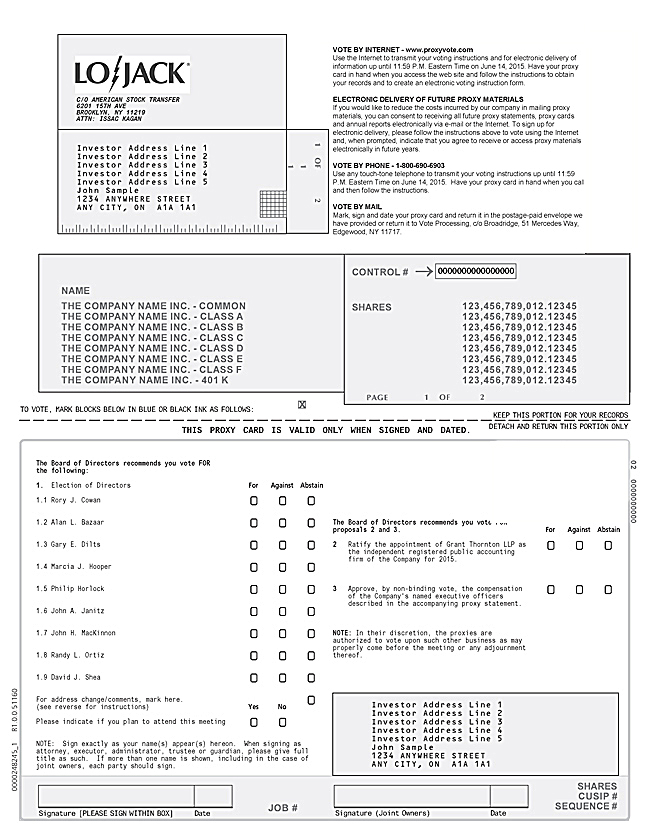
C/O AMERICAN STOCK TRANSFER 6201 15TH AVE BROOKLYN, NY 11219 ATTN: ISSAC KAGAN
Investor Address Line 1 Investor Address Line 2 Investor Address Line 3 Investor Address Line 4 Investor Address Line 5 John Sample 1234 ANYWHERE STREET ANY CITY, ON A1A 1A1 VOTE BY INTERNET—www.proxyvote.com
Use the Internet to transmit your voting instructions and for electronic delivery of information up until 11:59 P.M. Eastern Time on June 14, 2015. Have your proxy card in hand when you access the web site and follow the instructions to obtain your records and to create an electronic voting instruction form. ELECTRONIC DELIVERY OF FUTURE PROXY MATERIALS If you would like to reduce the costs incurred by our company in mailing proxy materials, you can consent to receiving all future proxy statements, proxy cards and annual reports electronically via e-mail or the Internet. To sign up for electronic delivery, please follow the instructions above to vote using the Internet and, when prompted, indicate that you agree to receive or access proxy materials electronically in future years. VOTE BY PHONE—1-800-690-6903
Use any touch-tone telephone to transmit your voting instructions up until 11:59 P.M. Eastern Time on June 14, 2015. Have your proxy card in hand when you call and then follow the instructions. VOTE BY MAIL Mark, sign and date your proxy card and return it in the postage-paid envelope we have provided or return it to Vote Processing, c/o Broadridge, 51 Mercedes Way, Edgewood, NY 11717. NAME THE COMPANY NAME INC. – COMMON THE COMPANY NAME INC.—CLASS A THE COMPANY NAME INC.—CLASS B THE COMPANY NAME INC.—CLASS C THE COMPANY NAME INC.—CLASS D THE COMPANY NAME INC.—CLASS E THE COMPANY NAME INC.—CLASS F THE COMPANY NAME INC.—401 K 123,456,789,012.12345 123,456,789,012.12345 123,456,789,012.12345 123,456,789,012.12345 123,456,789,012.12345 123,456,789,012.12345 123,456,789,012.12345 123,456,789,012.12345 1 OF 2 PAGE CONTROL # SHARES
TO VOTE, MARK BLOCKS BELOW IN BLUE OR BLACK INK AS FOLLOWS:
KEEP THIS PORTION FOR YOUR RECORDS DETACH AND RETURN THIS PORTION ONLY
THIS PROXY CARD IS VALID ONLY WHEN SIGNED AND DATED. The Board of Directors recommends you vote FOR the following: 1. Election of Directors For Against Abstain
1.1 Rory J. Cowan 1.2 Alan L. Bazaar 1.3 Gary E. Dilts 1.4 Marcia J. Hooper 1.5 Philip Horlock 1.6 John A. Janitz 1.7 John H. MacKinnon 1.8 Randy L. Ortiz 1.9 David J. Shea The Board of Directors recommends you vote FOR proposals 2 and 3. For Against Abstain
2 Ratify the appointment of Grant Thornton LLP as the independent registered public accounting firm of the Company for 2015.
3 Approve, by non-binding vote, the compensation of the Company’s named executive officers described in the accompanying proxy statement.
NOTE: In their discretion, the proxies are authorized to vote upon such other business as may properly come before the meeting or any adjournment thereof.
For address change/comments, mark here. (see reverse for instructions) Yes No Please indicate if you plan to attend this meeting
NOTE: Sign exactly as your name(s) appear(s) hereon. When signing as attorney, executor, administrator, trustee or guardian, please give full title as such. If more than one name is shown, including in the case of joint owners, each party should sign. Investor Address Line 1 Investor Address Line 2 Investor Address Line 3 Investor Address Line 4 Investor Address Line 5 John Sample
1234 ANYWHERE STREETANY CITY, ON A1A 1A1 JOB # SHARES CUSIP # SEQUENCE # JOB # Signature [PLEASE SIGN WITHIN BOX] Date Signature (Joint Owners) Date 0000248245_1 R1.0.0.51160 02 0000000000

Important Notice Regarding the Availability of Proxy Materials for the Annual Meeting: The Notice & Proxy Statement, and Form 10-K is/are available at www.proxyvote.com. PROXY LOJACK CORPORATION PROXY SOLICITED ON BEHALF OF THE BOARD OF DIRECTORS FOR THE ANNUAL MEETING OF SHAREHOLDERS June 15, 2015
The undersigned shareholder of LoJack Corporation, a Massachusetts corporation, or the Company, hereby appoints Randy L. Ortiz, Kenneth L. Dumas and José M. Oxholm (or any of them) as proxies for the undersigned, with full power of substitution in each of them, to vote all shares of the Company owned by the undersigned on April 13, 2015, at the Annual Meeting of Shareholders of LoJack Corporation, to be held on June 15, 2015 at 10:00 a.m., Eastern Daylight Savings Time, at the offices of Goodwin Procter LLP, 53 State Street, Boston, Massachusetts 02109, and at any adjournment or postponement thereof, hereby revoking any proxy heretofore given, upon the matters and proposals set forth in the Notice of Annual Meeting of Shareholders and Proxy Statement, dated April 30, 2015, copies of which have been received by the undersigned. The undersigned instructs such proxies to vote as follows:
The shares represented by this proxy will be voted as directed by the shareholder on the reverse side hereof. If no direction is given when the duly executed proxy is returned, such shares will be voted “FOR” all the nominees in Proposal 1, “FOR” Proposals 2 and 3, and in the discretion of the proxies on such other business as may properly come before the meeting.
(If you noted any Address Changes and/or Comments above, please mark corresponding box on the reverse side.) Address change/comments:
Continued and to be signed on reverse side 0000248245_2 R1.0.0.51160