Fiscal 2026 Second Quarter and First Half Financial Results May 2026 Investor
Presentation
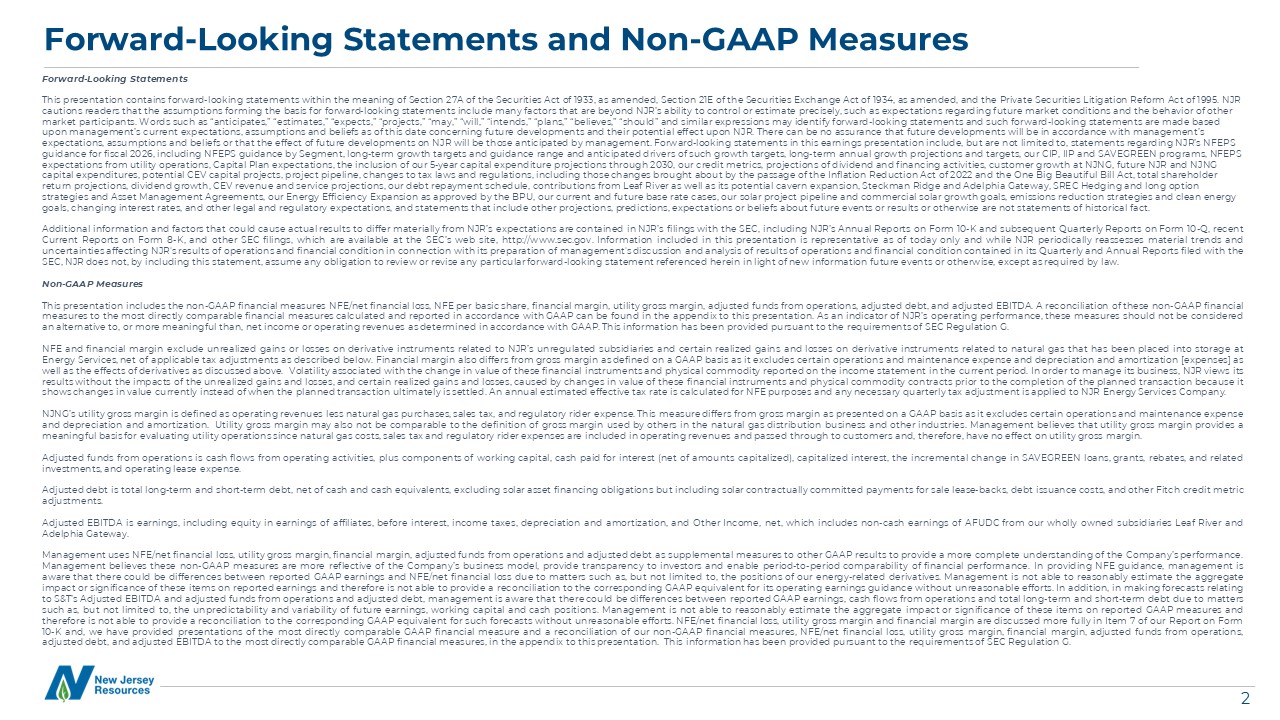
Forward-Looking Statements and Non-GAAP Measures Forward-Looking Statements This
presentation contains forward-looking statements within the meaning of Section 27A of the Securities Act of 1933, as amended, Section 21E of the Securities Exchange Act of 1934, as amended, and the Private Securities Litigation Reform Act of
1995. NJR cautions readers that the assumptions forming the basis for forward-looking statements include many factors that are beyond NJR’s ability to control or estimate precisely, such as expectations regarding future market conditions and
the behavior of other market participants. Words such as “anticipates,” “estimates,” “expects,” “projects,” “may,” “will,” “intends,” “plans,” “believes,” “should” and similar expressions may identify forward-looking statements and such
forward-looking statements are made based upon management’s current expectations, assumptions and beliefs as of this date concerning future developments and their potential effect upon NJR. There can be no assurance that future developments
will be in accordance with management’s expectations, assumptions and beliefs or that the effect of future developments on NJR will be those anticipated by management. Forward-looking statements in this earnings presentation include, but are
not limited to, statements regarding NJR’s NFEPS guidance for fiscal 2026, including NFEPS guidance by Segment, long-term growth targets and guidance range and anticipated drivers of such growth targets, long-term annual growth projections and
targets, our CIP, IIP and SAVEGREEN programs, NFEPS expectations from utility operations, Capital Plan expectations, the inclusion of our 5-year capital expenditure projections through 2030, our credit metrics, projections of dividend and
financing activities, customer growth at NJNG, future NJR and NJNG capital expenditures, potential CEV capital projects, project pipeline, changes to tax laws and regulations, including those changes brought about by the passage of the
Inflation Reduction Act of 2022 and the One Big Beautiful Bill Act, total shareholder return projections, dividend growth, CEV revenue and service projections, our debt repayment schedule, contributions from Leaf River as well as its potential
cavern expansion, Steckman Ridge and Adelphia Gateway, SREC Hedging and long option strategies and Asset Management Agreements, our Energy Efficiency Expansion as approved by the BPU, our current and future base rate cases, our solar project
pipeline and commercial solar growth goals, emissions reduction strategies and clean energy goals, changing interest rates, and other legal and regulatory expectations, and statements that include other projections, predictions, expectations or
beliefs about future events or results or otherwise are not statements of historical fact. Additional information and factors that could cause actual results to differ materially from NJR’s expectations are contained in NJR’s filings with the
SEC, including NJR’s Annual Reports on Form 10-K and subsequent Quarterly Reports on Form 10-Q, recent Current Reports on Form 8-K, and other SEC filings, which are available at the SEC’s web site, http://www.sec.gov. Information included in
this presentation is representative as of today only and while NJR periodically reassesses material trends and uncertainties affecting NJR's results of operations and financial condition in connection with its preparation of management's
discussion and analysis of results of operations and financial condition contained in its Quarterly and Annual Reports filed with the SEC, NJR does not, by including this statement, assume any obligation to review or revise any particular
forward-looking statement referenced herein in light of new information future events or otherwise, except as required by law. Non-GAAP Measures This presentation includes the non-GAAP financial measures NFE/net financial loss, NFE per basic
share, financial margin, utility gross margin, adjusted funds from operations, adjusted debt, and adjusted EBITDA. A reconciliation of these non-GAAP financial measures to the most directly comparable financial measures calculated and reported
in accordance with GAAP can be found in the appendix to this presentation. As an indicator of NJR’s operating performance, these measures should not be considered an alternative to, or more meaningful than, net income or operating revenues as
determined in accordance with GAAP. This information has been provided pursuant to the requirements of SEC Regulation G. NFE and financial margin exclude unrealized gains or losses on derivative instruments related to NJR’s unregulated
subsidiaries and certain realized gains and losses on derivative instruments related to natural gas that has been placed into storage at Energy Services, net of applicable tax adjustments as described below. Financial margin also differs from
gross margin as defined on a GAAP basis as it excludes certain operations and maintenance expense and depreciation and amortization [expenses] as well as the effects of derivatives as discussed above. Volatility associated with the change in
value of these financial instruments and physical commodity reported on the income statement in the current period. In order to manage its business, NJR views its results without the impacts of the unrealized gains and losses, and certain
realized gains and losses, caused by changes in value of these financial instruments and physical commodity contracts prior to the completion of the planned transaction because it shows changes in value currently instead of when the planned
transaction ultimately is settled. An annual estimated effective tax rate is calculated for NFE purposes and any necessary quarterly tax adjustment is applied to NJR Energy Services Company. NJNG’s utility gross margin is defined as operating
revenues less natural gas purchases, sales tax, and regulatory rider expense. This measure differs from gross margin as presented on a GAAP basis as it excludes certain operations and maintenance expense and depreciation and amortization.
Utility gross margin may also not be comparable to the definition of gross margin used by others in the natural gas distribution business and other industries. Management believes that utility gross margin provides a meaningful basis for
evaluating utility operations since natural gas costs, sales tax and regulatory rider expenses are included in operating revenues and passed through to customers and, therefore, have no effect on utility gross margin. Adjusted funds from
operations is cash flows from operating activities, plus components of working capital, cash paid for interest (net of amounts capitalized), capitalized interest, the incremental change in SAVEGREEN loans, grants, rebates, and related
investments, and operating lease expense. Adjusted debt is total long-term and short-term debt, net of cash and cash equivalents, excluding solar asset financing obligations but including solar contractually committed payments for sale
lease-backs, debt issuance costs, and other Fitch credit metric adjustments. Adjusted EBITDA is earnings, including equity in earnings of affiliates, before interest, income taxes, depreciation and amortization, and Other Income, net, which
includes non-cash earnings of AFUDC from our wholly owned subsidiaries Leaf River and Adelphia Gateway. Management uses NFE/net financial loss, utility gross margin, financial margin, adjusted funds from operations and adjusted debt as
supplemental measures to other GAAP results to provide a more complete understanding of the Company’s performance. Management believes these non-GAAP measures are more reflective of the Company’s business model, provide transparency to
investors and enable period-to-period comparability of financial performance. In providing NFE guidance, management is aware that there could be differences between reported GAAP earnings and NFE/net financial loss due to matters such as, but
not limited to, the positions of our energy-related derivatives. Management is not able to reasonably estimate the aggregate impact or significance of these items on reported earnings and therefore is not able to provide a reconciliation to the
corresponding GAAP equivalent for its operating earnings guidance without unreasonable efforts. In addition, in making forecasts relating to S&T’s Adjusted EBITDA and adjusted funds from operations and adjusted debt, management is aware
that there could be differences between reported GAAP earnings, cash flows from operations and total long-term and short-term debt due to matters such as, but not limited to, the unpredictability and variability of future earnings, working
capital and cash positions. Management is not able to reasonably estimate the aggregate impact or significance of these items on reported GAAP measures and therefore is not able to provide a reconciliation to the corresponding GAAP equivalent
for such forecasts without unreasonable efforts. NFE/net financial loss, utility gross margin and financial margin are discussed more fully in Item 7 of our Report on Form 10-K and, we have provided presentations of the most directly comparable
GAAP financial measure and a reconciliation of our non-GAAP financial measures, NFE/net financial loss, utility gross margin, financial margin, adjusted funds from operations, adjusted debt, and adjusted EBITDA to the most directly comparable
GAAP financial measures, in the appendix to this presentation. This information has been provided pursuant to the requirements of SEC Regulation G.
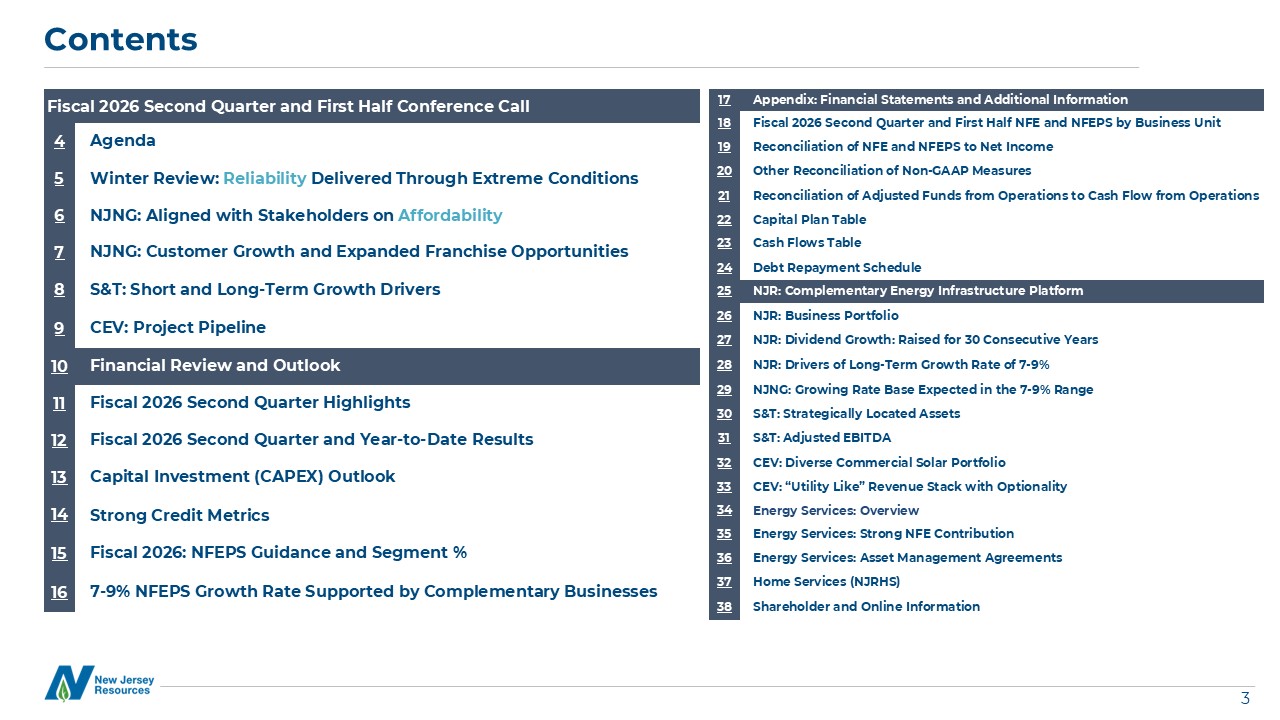
Contents Fiscal 2026 Second Quarter and First Half Conference
Call 4 Agenda 5 Winter Review: Reliability Delivered Through Extreme Conditions 6 NJNG: Aligned with Stakeholders on Affordability 7 NJNG: Customer Growth and Expanded Franchise Opportunities 8 S&T: Short and Long-Term Growth
Drivers 9 CEV: Project Pipeline 10 Financial Review and Outlook 11 Fiscal 2026 Second Quarter Highlights 12 Fiscal 2026 Second Quarter and Year-to-Date Results 13 Capital Investment (CAPEX) Outlook 14 Strong Credit
Metrics 15 Fiscal 2026: NFEPS Guidance and Segment % 16 7-9% NFEPS Growth Rate Supported by Complementary Businesses 17 Appendix: Financial Statements and Additional Information 18 Fiscal 2026 Second Quarter and First Half NFE and NFEPS
by Business Unit 19 Reconciliation of NFE and NFEPS to Net Income 20 Other Reconciliation of Non-GAAP Measures 21 Reconciliation of Adjusted Funds from Operations to Cash Flow from Operations 22 Capital Plan Table 23 Cash Flows
Table 24 Debt Repayment Schedule 25 NJR: Complementary Energy Infrastructure Platform 26 NJR: Business Portfolio 27 NJR: Dividend Growth: Raised for 30 Consecutive Years 28 NJR: Drivers of Long-Term Growth Rate of 7-9% 29 NJNG:
Growing Rate Base Expected in the 7-9% Range 30 S&T: Strategically Located Assets 31 S&T: Adjusted EBITDA 32 CEV: Diverse Commercial Solar Portfolio 33 CEV: “Utility Like” Revenue Stack with Optionality 34 Energy Services:
Overview 35 Energy Services: Strong NFE Contribution 36 Energy Services: Asset Management Agreements 37 Home Services (NJRHS) 38 Shareholder and Online Information
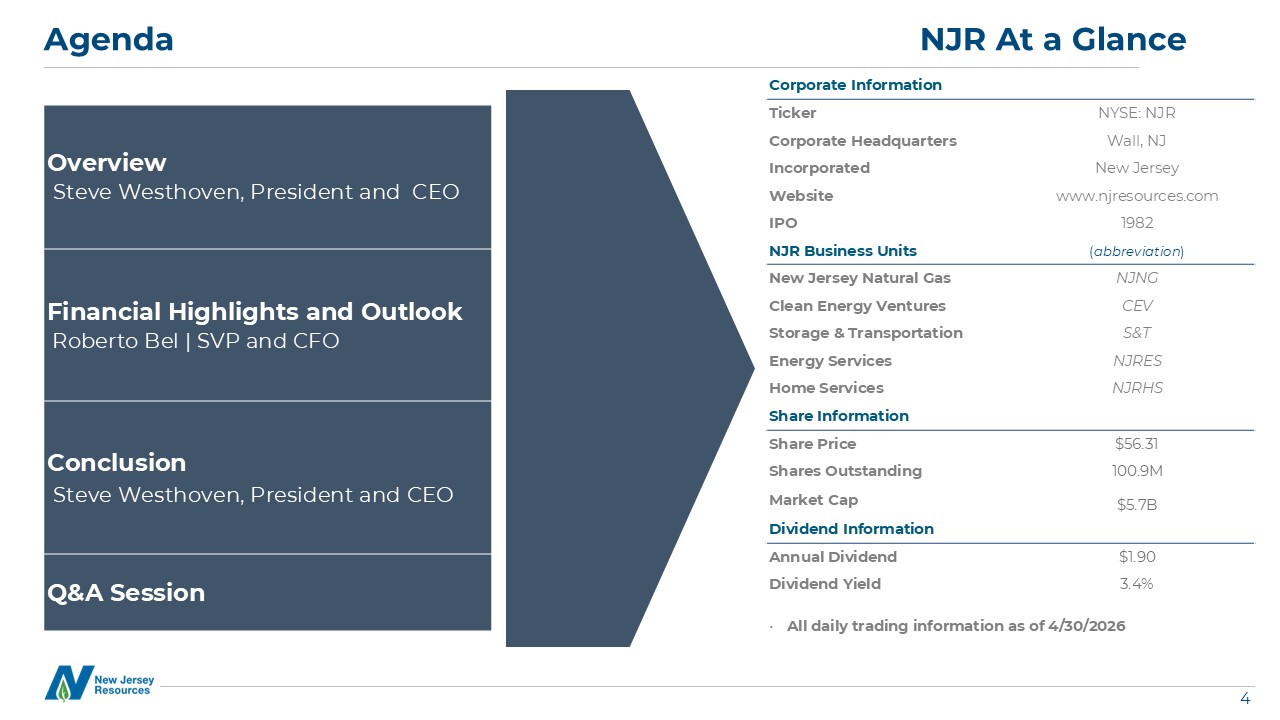
Overview Steve Westhoven, President and CEO Financial Highlights and Outlook
Roberto Bel | SVP and CFO Conclusion Steve Westhoven, President and CEO Q&A Session Agenda NJR At a Glance Corporate Information Ticker NYSE: NJR Corporate Headquarters Wall, NJ Incorporated New
Jersey Website www.njresources.com IPO 1982 NJR Business Units (abbreviation) New Jersey Natural Gas NJNG Clean Energy Ventures CEV Storage & Transportation S&T Energy Services NJRES Home Services NJRHS Share
Information Share Price $56.31 Shares Outstanding 100.9M Market Cap $5.7B Dividend Information Annual Dividend $1.90 Dividend Yield 3.4% All daily trading information as of 4/30/2026
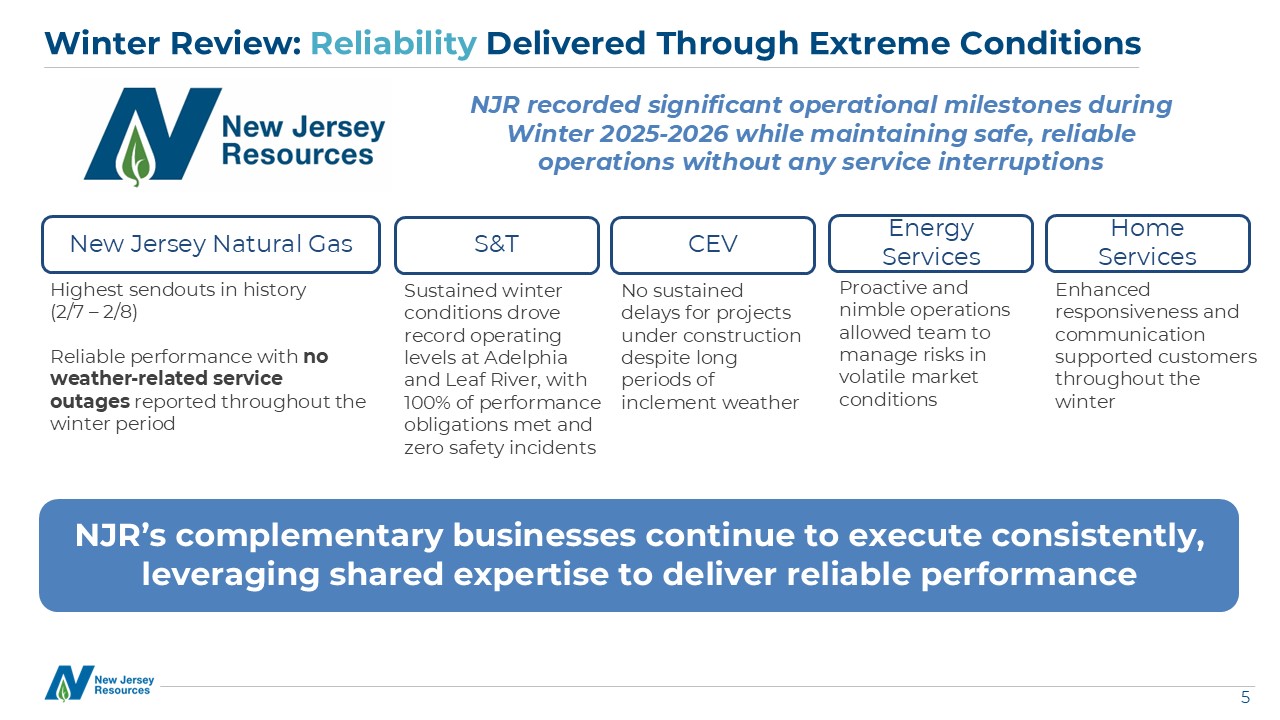
Winter Review: Reliability Delivered Through Extreme Conditions NJR recorded
significant operational milestones during Winter 2025-2026 while maintaining safe, reliable operations without any service interruptions New Jersey Natural Gas Highest sendouts in history (2/7 – 2/8) Reliable performance with no
weather-related service outages reported throughout the winter period Energy Services Proactive and nimble operations allowed team to manage risks in volatile market conditions S&T Sustained winter conditions drove record operating
levels at Adelphia and Leaf River, with 100% of performance obligations met and zero safety incidents CEV No sustained delays for projects under construction despite long periods of inclement weather Home Services Enhanced responsiveness
and communication supported customers throughout the winter NJR’s complementary businesses continue to execute consistently, leveraging shared expertise to deliver reliable performance
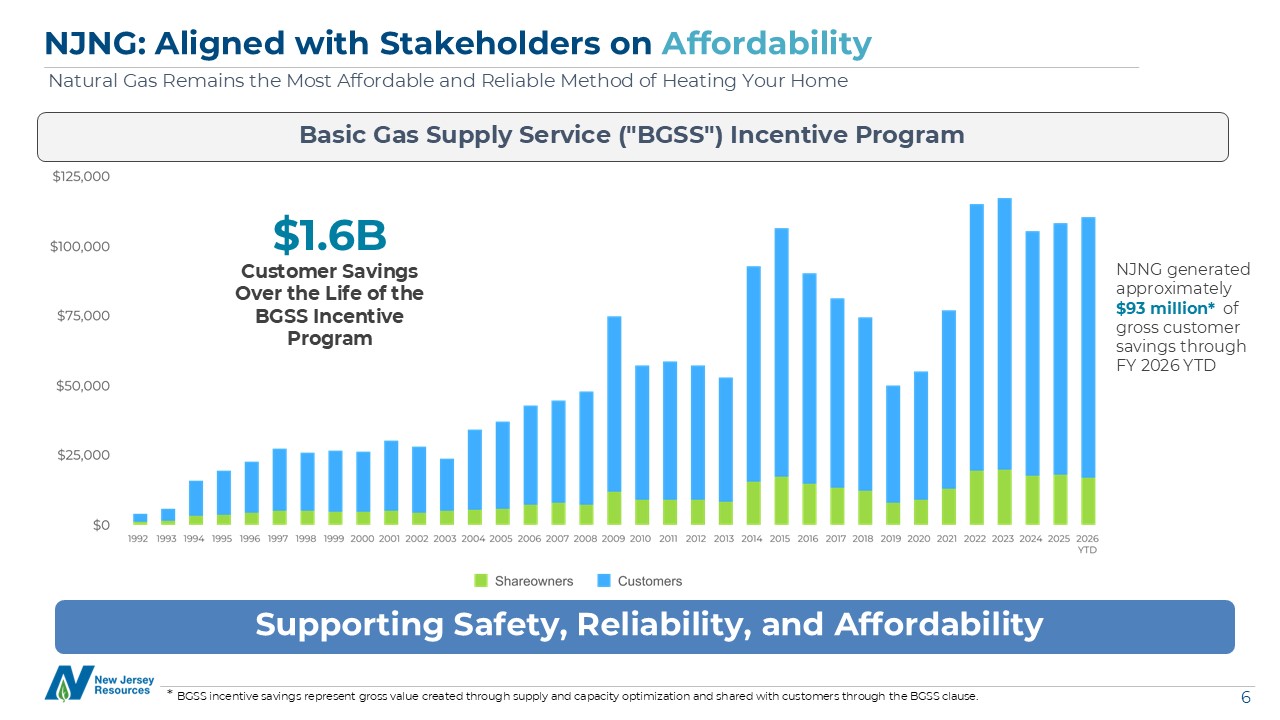
NJNG: Aligned with Stakeholders on Affordability Basic Gas Supply Service
("BGSS") Incentive Program Supporting Safety, Reliability, and Affordability NJNG generated approximately $93 million* of gross customer savings through FY 2026 YTD Natural Gas Remains the Most Affordable and Reliable Method of Heating
Your Home $1.6B Customer Savings Over the Life of the BGSS Incentive Program * BGSS incentive savings represent gross value created through supply and capacity optimization and shared with customers through the BGSS clause.
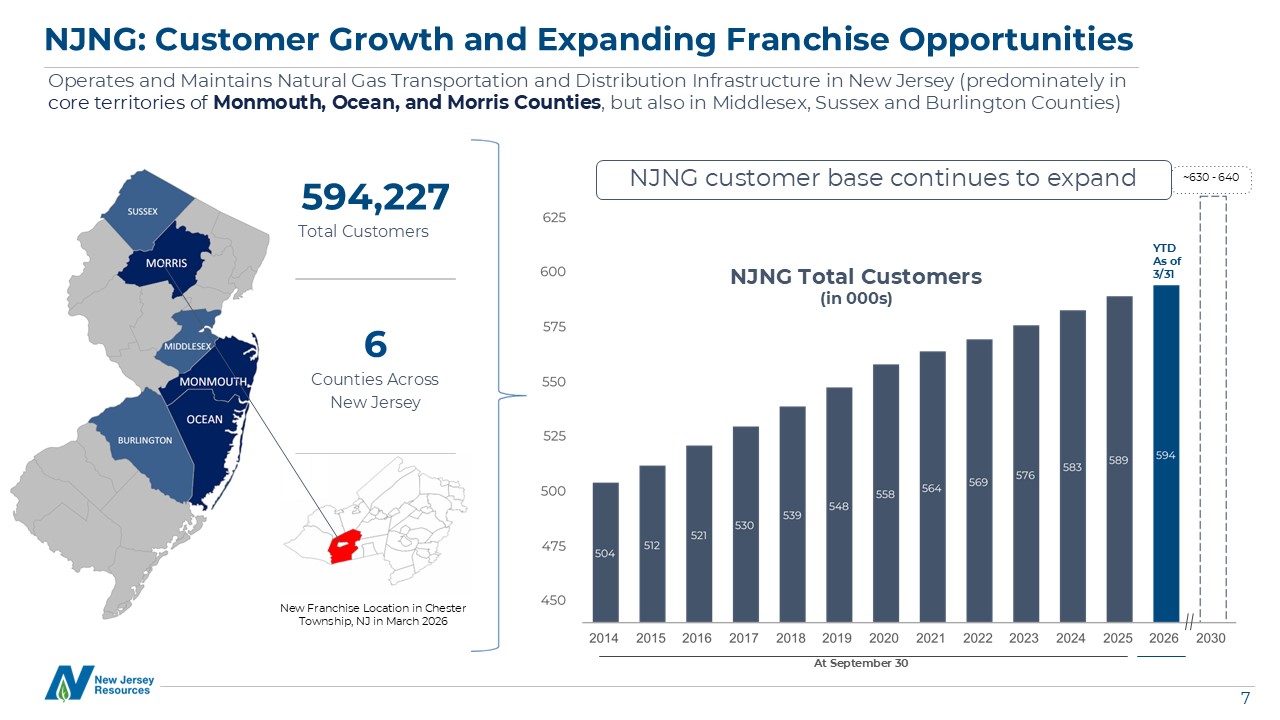
NJNG: Customer Growth and Expanding Franchise Opportunities Operates and
Maintains Natural Gas Transportation and Distribution Infrastructure in New Jersey (predominately in core territories of Monmouth, Ocean, and Morris Counties, but also in Middlesex, Sussex and Burlington Counties) 594,227 Total
Customers 6 Counties Across New Jersey NJNG Total Customers (in 000s) ~630 - 640 NJNG customer base continues to expand New Franchise Location in Chester Township, NJ in March 2026 YTD As of 3/31 At September 30
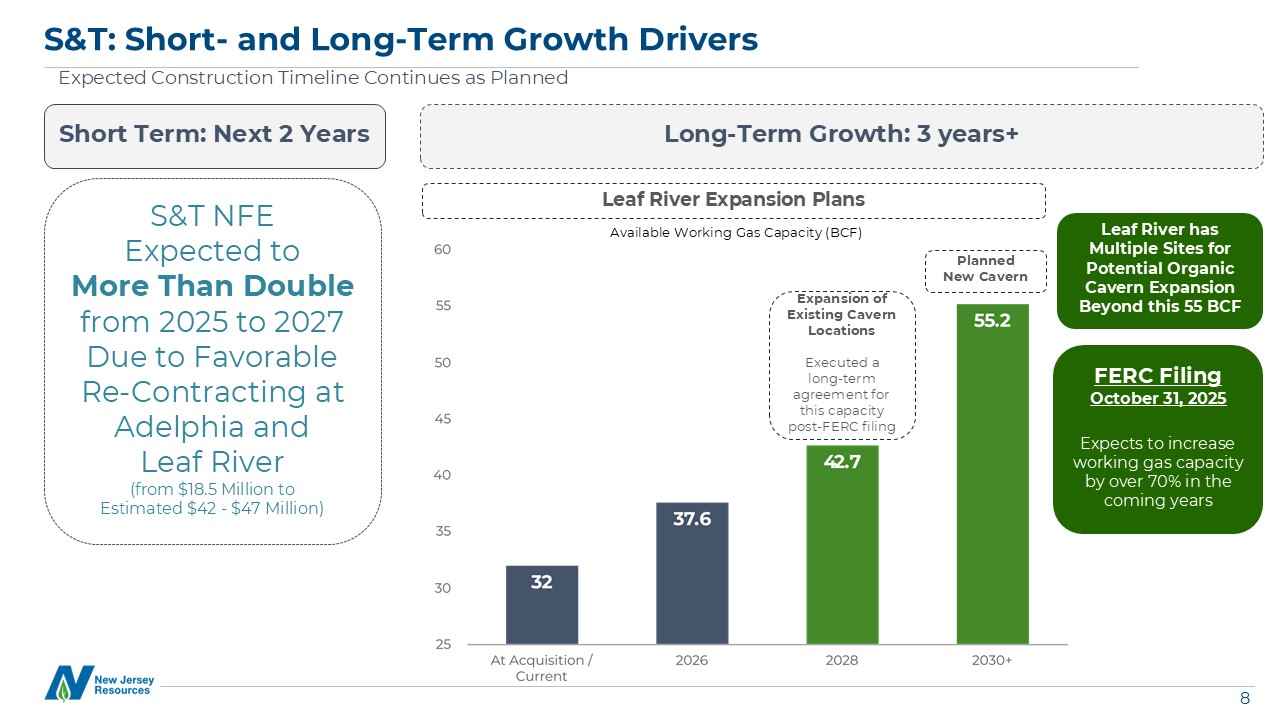
S&T: Short- and Long-Term Growth Drivers Expected Construction Timeline
Continues as Planned Leaf River Expansion Plans Expansion of Existing Cavern Locations Executed a long-term agreement for this capacity post-FERC filing Planned New Cavern Leaf River has Multiple Sites for Potential Organic Cavern
Expansion Beyond this 55 BCF FERC Filing October 31, 2025 Expects to increase working gas capacity by over 70% in the coming years S&T NFE Expected to More Than Double from 2025 to 2027 Due to Favorable Re-Contracting at Adelphia
and Leaf River (from $18.5 Million to Estimated $42 - $47 Million) Short Term: Next 2 Years Long-Term Growth: 3 years+ Available Working Gas Capacity (BCF)
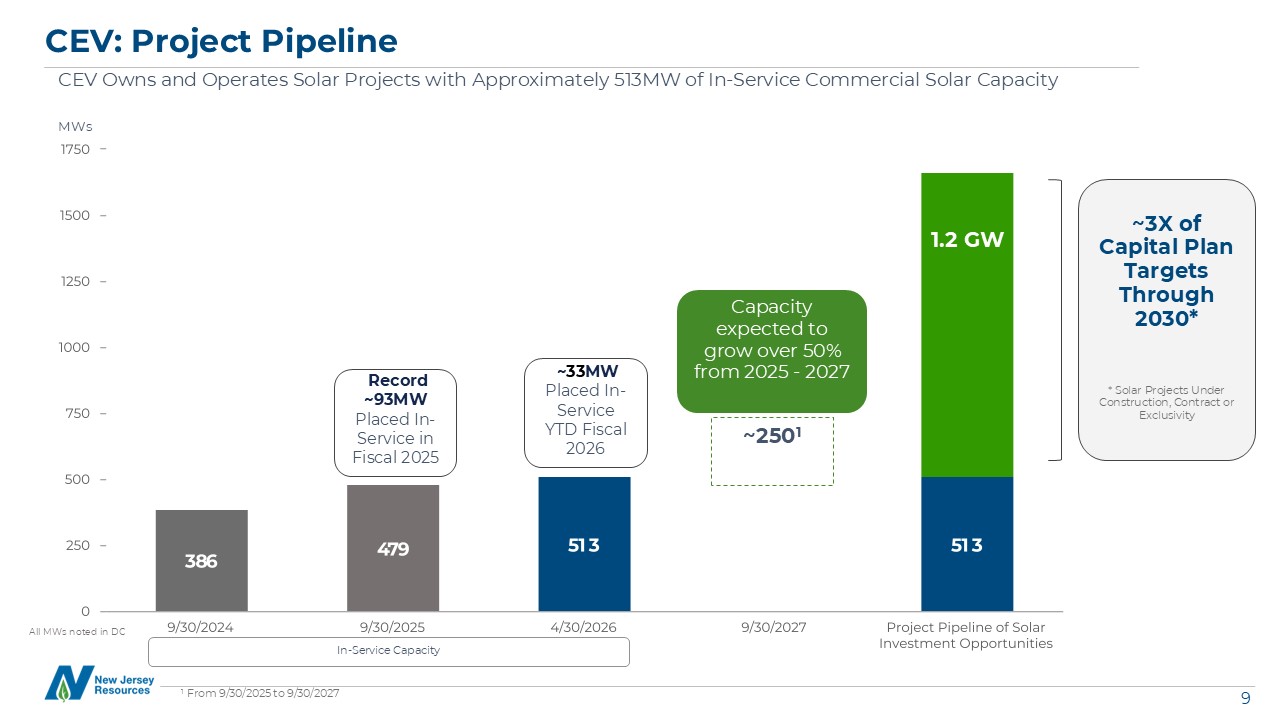
CEV: Project Pipeline CEV Owns and Operates Solar Projects with Approximately
513MW of In-Service Commercial Solar Capacity MWs Record ~93MW Placed In-Service in Fiscal 2025 1.2 GW ~3X of Capital Plan Targets Through 2030* * Solar Projects Under Construction, Contract or Exclusivity Capacity expected to grow
over 50% from 2025 - 2027 1 From 9/30/2025 to 9/30/2027 ~2501 ~33MW Placed In-Service YTD Fiscal 2026 In-Service Capacity All MWs noted in DC

10 Financial Review and Outlook
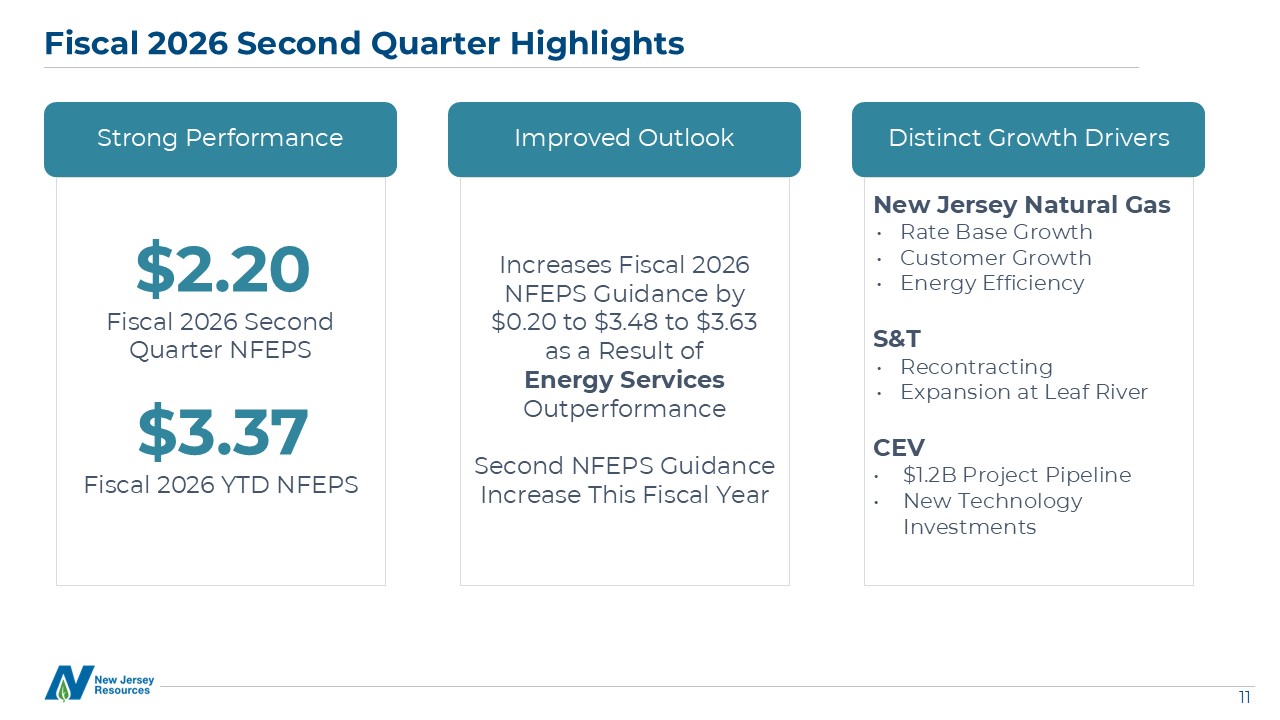
Fiscal 2026 Second Quarter Highlights Strong Performance Improved
Outlook Distinct Growth Drivers $2.20 Fiscal 2026 Second Quarter NFEPS $3.37 Fiscal 2026 YTD NFEPS Increases Fiscal 2026 NFEPS Guidance by $0.20 to $3.48 to $3.63 as a Result of Energy Services Outperformance Second NFEPS Guidance
Increase This Fiscal Year New Jersey Natural Gas Rate Base Growth Customer Growth Energy Efficiency S&T Recontracting Expansion at Leaf River CEV $1.2B Project Pipeline New Technology Investments
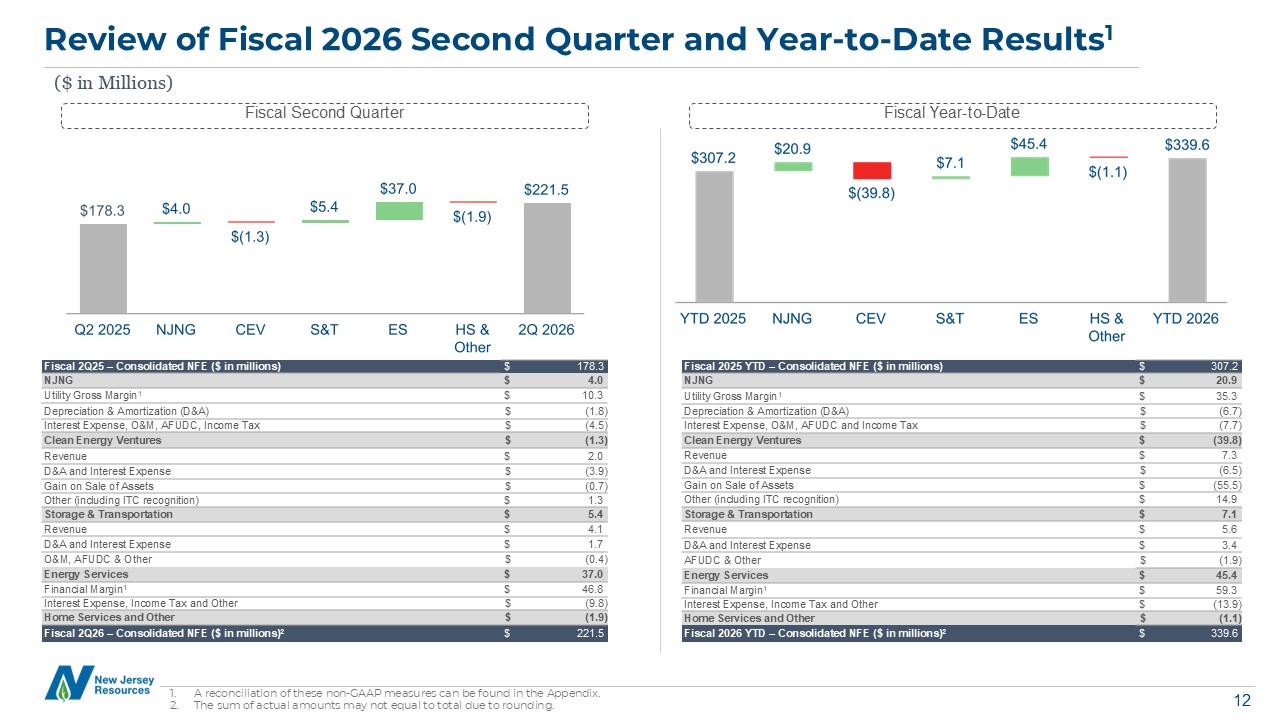
Fiscal 2025 YTD – Consolidated NFE ($ in millions) $ 307.2 NJNG $ 20.9
Utility Gross Margin1 $ 35.3 Depreciation & Amortization (D&A) $ (6.7) Interest Expense, O&M, AFUDC and Income Tax $ (7.7) Clean Energy Ventures $ (39.8) Revenue $ 7.3 D&A and Interest Expense $ (6.5) Gain on
Sale of Assets $ (55.5) Other (including ITC recognition) $ 14.9 Storage & Transportation $ 7.1 Revenue $ 5.6 D&A and Interest Expense $ 3.4 AFUDC & Other $ (1.9) Energy Services $ 45.4 Financial Margin1 $ 59.3
Interest Expense, Income Tax and Other $ (13.9) Home Services and Other $ (1.1) Fiscal 2026 YTD – Consolidated NFE ($ in millions)2 $ 339.6 Fiscal 2Q25 – Consolidated NFE ($ in millions) $ 178.3 NJNG $ 4.0 Utility Gross
Margin1 $ 10.3 Depreciation & Amortization (D&A) $ (1.8) Interest Expense, O&M, AFUDC, Income Tax $ (4.5) Clean Energy Ventures $ (1.3) Revenue $ 2.0 D&A and Interest Expense $ (3.9) Gain on Sale of Assets $
(0.7) Other (including ITC recognition) $ 1.3 Storage & Transportation $ 5.4 Revenue $ 4.1 D&A and Interest Expense $ 1.7 O&M, AFUDC & Other $ (0.4) Energy Services $ 37.0 Financial Margin1 $ 46.8 Interest
Expense, Income Tax and Other $ (9.8) Home Services and Other $ (1.9) Fiscal 2Q26 – Consolidated NFE ($ in millions)2 $ 221.5 A reconciliation of these non-GAAP measures can be found in the Appendix. The sum of actual amounts may not
equal to total due to rounding. Review of Fiscal 2026 Second Quarter and Year-to-Date Results1 ($ in Millions) Fiscal Second Quarter Fiscal Year-to-Date
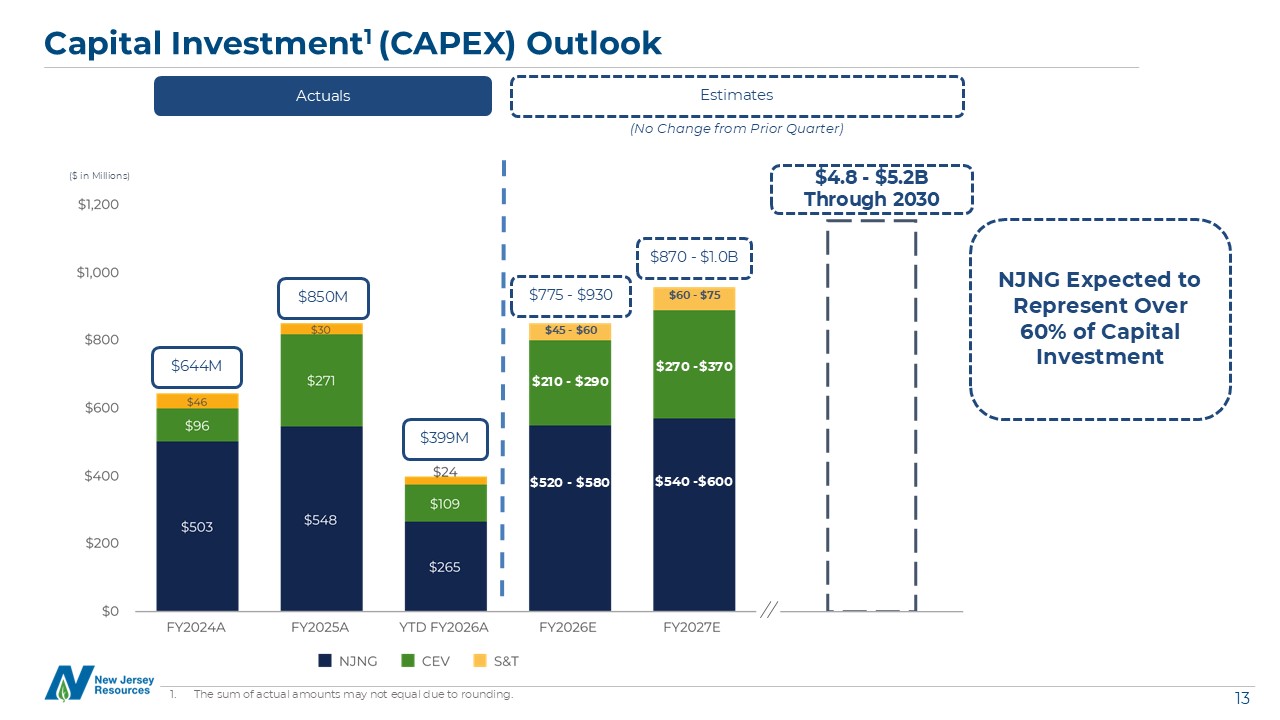
Capital Investment1 (CAPEX) Outlook $775 - $930 Actuals (No Change from Prior
Quarter) $4.8 - $5.2B Through 2030 $870 - $1.0B NJNG Expected to Represent Over 60% of Capital Investment $45 - $60 $60 - $75 $210 - $290 $270 -$370 $520 - $580 $540 -$600 $399M $850M ($ in Millions) The sum of actual amounts may
not equal due to rounding. $644M Estimates
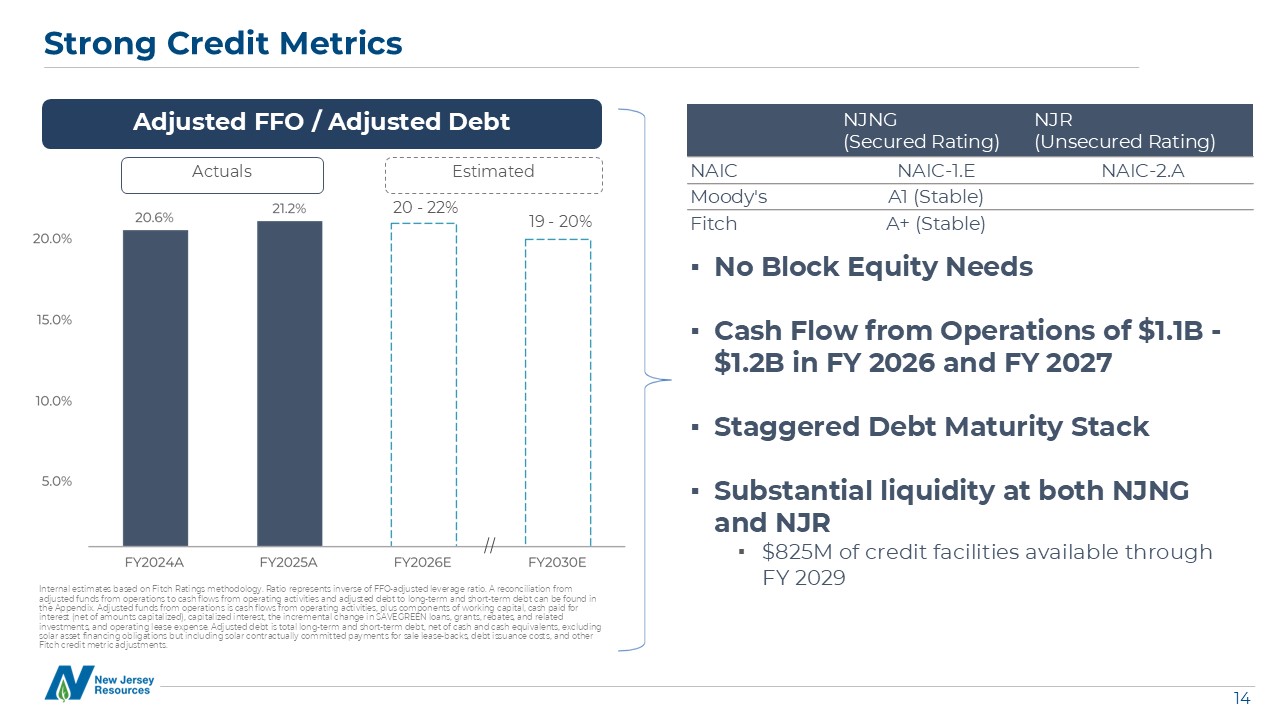
No Block Equity Needs Cash Flow from Operations of $1.1B - $1.2B in FY 2026 and
FY 2027 Staggered Debt Maturity Stack Substantial liquidity at both NJNG and NJR $825M of credit facilities available through FY 2029 Strong Credit Metrics Adjusted FFO / Adjusted Debt NJNG (Secured Rating) NJR (Unsecured
Rating) NAIC NAIC-1.E NAIC-2.A Moody's A1 (Stable) Fitch A+ (Stable) Internal estimates based on Fitch Ratings methodology. Ratio represents inverse of FFO-adjusted leverage ratio. A reconciliation from adjusted funds from operations to
cash flows from operating activities and adjusted debt to long-term and short-term debt can be found in the Appendix. Adjusted funds from operations is cash flows from operating activities, plus components of working capital, cash paid for
interest (net of amounts capitalized), capitalized interest, the incremental change in SAVEGREEN loans, grants, rebates, and related investments, and operating lease expense. Adjusted debt is total long-term and short-term debt, net of cash and
cash equivalents, excluding solar asset financing obligations but including solar contractually committed payments for sale lease-backs, debt issuance costs, and other Fitch credit metric adjustments. Actuals Estimated 19 - 20% 20 - 22%
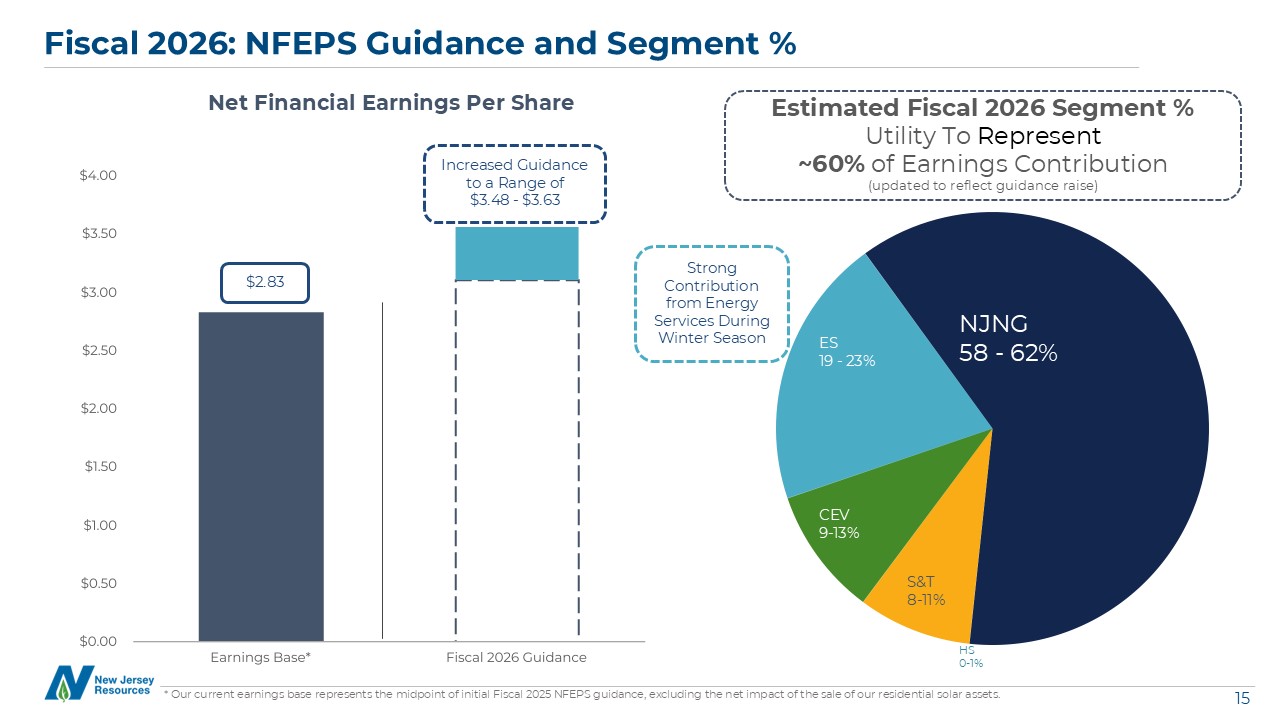
Fiscal 2026: NFEPS Guidance and Segment % Net Financial Earnings Per
Share Increased Guidance to a Range of $3.48 - $3.63 $2.83 * Our current earnings base represents the midpoint of initial Fiscal 2025 NFEPS guidance, excluding the net impact of the sale of our residential solar assets. Estimated Fiscal
2026 Segment % Utility To Represent ~60% of Earnings Contribution (updated to reflect guidance raise) NJNG 58 - 62% S&T 8-11% CEV 9-13% ES 19 - 23% HS 0-1% Strong Contribution from Energy Services During Winter Season
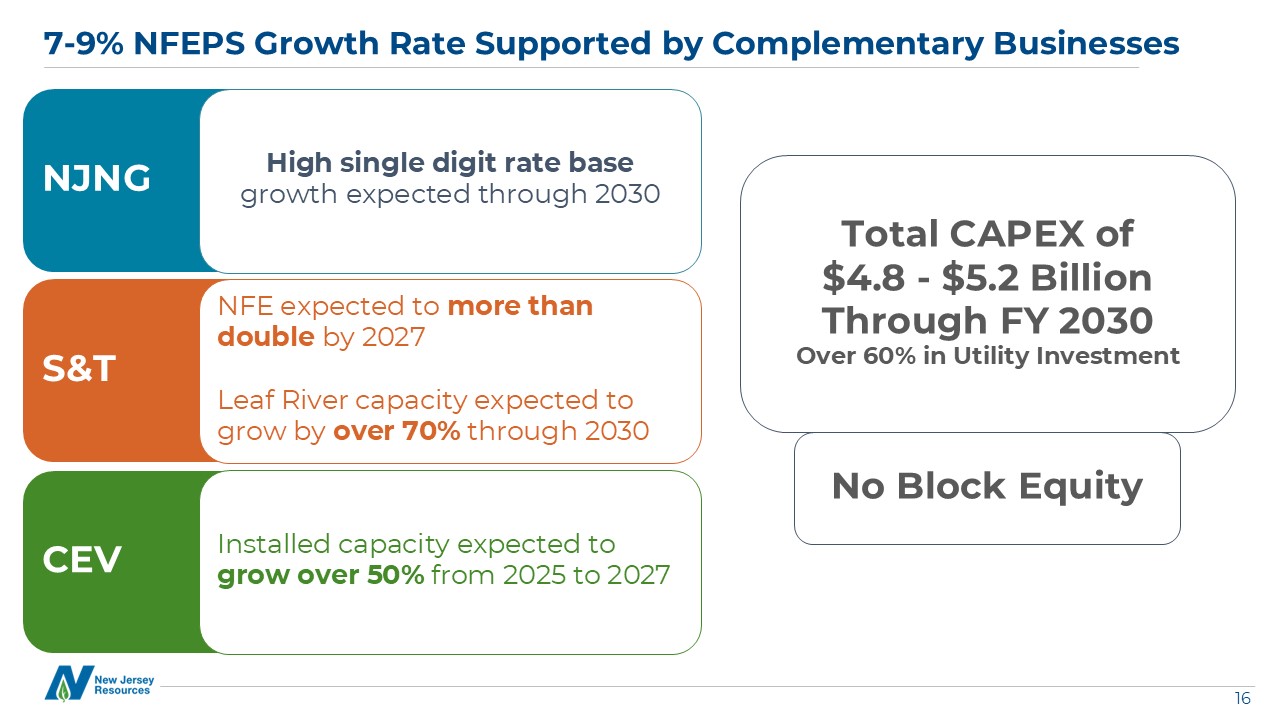
7-9% NFEPS Growth Rate Supported by Complementary Businesses Total CAPEX of
$4.8 - $5.2 Billion Through FY 2030 Over 60% in Utility Investment No Block Equity NJNG High single digit rate base growth expected through 2030 S&T NFE expected to more than double by 2027 Leaf River capacity expected to grow by
over 70% through 2030 CEV Installed capacity expected to grow over 50% from 2025 to 2027
Appendix: Financial Statements and Additional Information 17 18 Fiscal 2026
Second Quarter and First Half NFE and NFEPS by Business Unit 19 Reconciliation of NFE and NFEPS to Net Income 20 Other Reconciliation of Non-GAAP Measures 21 Reconciliation of Adjusted Funds from Operations to Cash Flow from
Operations 22 Capital Plan Table - Two Year Detailed 23 Cash Flows - Two Year Projected 24 Debt Repayment Schedule
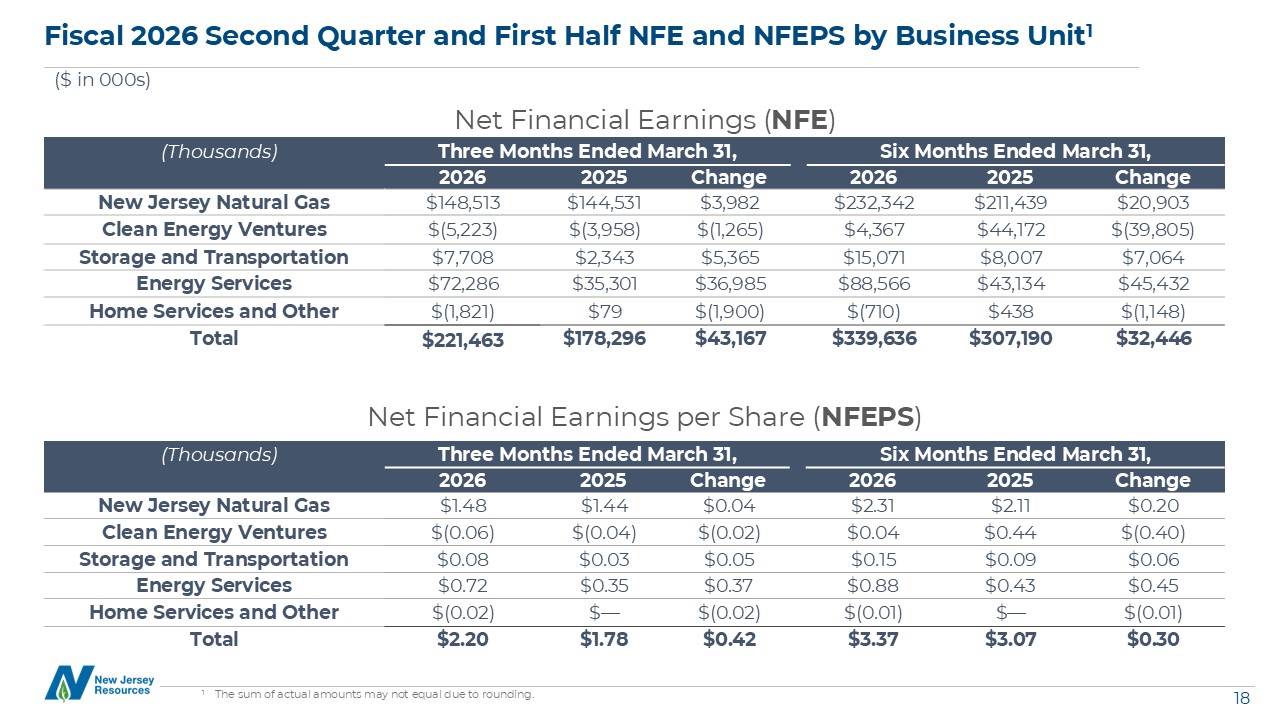
Fiscal 2026 Second Quarter and First Half NFE and NFEPS by Business Unit1 ($ in
000s) Net Financial Earnings (NFE) Net Financial Earnings per Share (NFEPS) (Thousands) Three Months Ended March 31, Six Months Ended March 31, 2026 2025 Change 2026 2025 Change New Jersey Natural
Gas $148,513 $144,531 $3,982 $232,342 $211,439 $20,903 Clean Energy Ventures $(5,223) $(3,958) $(1,265) $4,367 $44,172 $(39,805) Storage and Transportation $7,708 $2,343 $5,365 $15,071 $8,007 $7,064 Energy
Services $72,286 $35,301 $36,985 $88,566 $43,134 $45,432 Home Services and Other $(1,821) $79 $(1,900) $(710) $438 $(1,148) Total $221,463 $178,296 $43,167 $339,636 $307,190 $32,446 (Thousands) Three Months Ended March
31, Six Months Ended March 31, 2026 2025 Change 2026 2025 Change New Jersey Natural Gas $1.48 $1.44 $0.04 $2.31 $2.11 $0.20 Clean Energy Ventures $(0.06) $(0.04) $(0.02) $0.04 $0.44 $(0.40) Storage and
Transportation $0.08 $0.03 $0.05 $0.15 $0.09 $0.06 Energy Services $0.72 $0.35 $0.37 $0.88 $0.43 $0.45 Home Services and Other $(0.02) $— $(0.02) $(0.01) $— $(0.01) Total $2.20 $1.78 $0.42 $3.37 $3.07 $0.30 1 The sum
of actual amounts may not equal due to rounding.
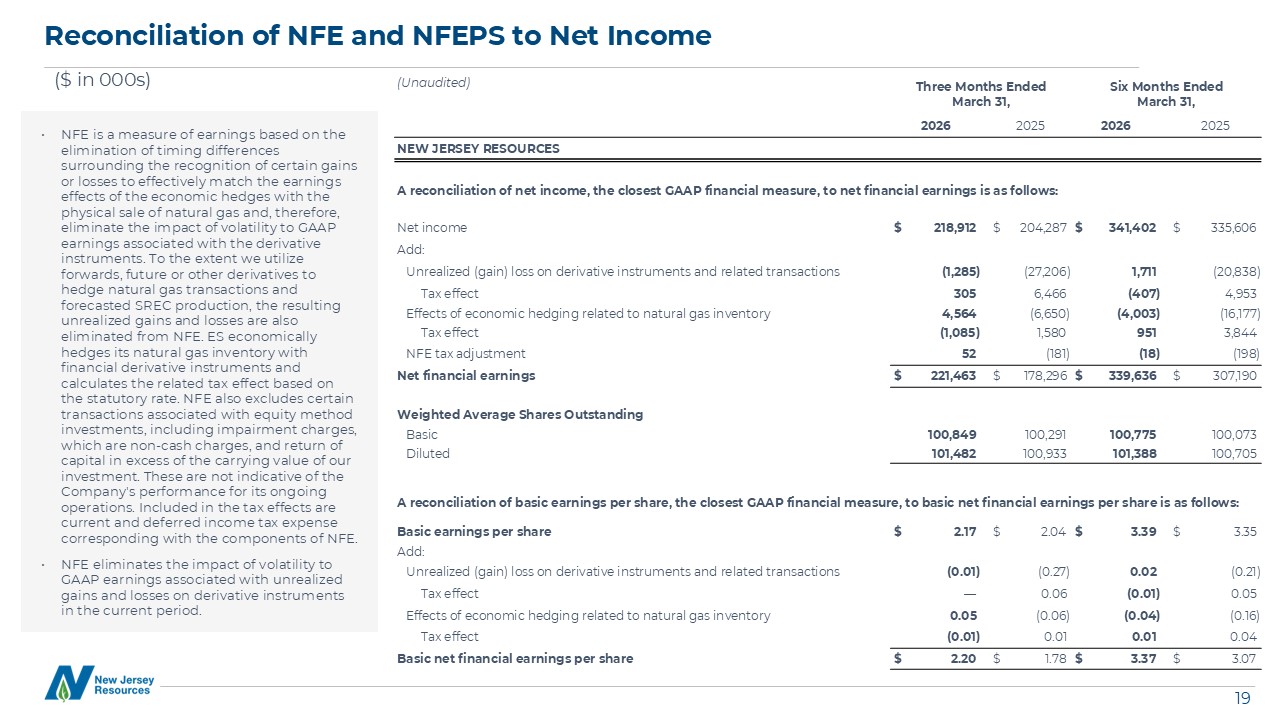
Reconciliation of NFE and NFEPS to Net Income ($ in 000s) NFE is a measure of
earnings based on the elimination of timing differences surrounding the recognition of certain gains or losses to effectively match the earnings effects of the economic hedges with the physical sale of natural gas and, therefore, eliminate the
impact of volatility to GAAP earnings associated with the derivative instruments. To the extent we utilize forwards, future or other derivatives to hedge natural gas transactions and forecasted SREC production, the resulting unrealized gains
and losses are also eliminated from NFE. ES economically hedges its natural gas inventory with financial derivative instruments and calculates the related tax effect based on the statutory rate. NFE also excludes certain transactions associated
with equity method investments, including impairment charges, which are non-cash charges, and return of capital in excess of the carrying value of our investment. These are not indicative of the Company's performance for its ongoing operations.
Included in the tax effects are current and deferred income tax expense corresponding with the components of NFE. NFE eliminates the impact of volatility to GAAP earnings associated with unrealized gains and losses on derivative instruments
in the current period. (Unaudited) Three Months Ended March 31, Six Months Ended March 31, 2026 2025 2026 2025 NEW JERSEY RESOURCES A reconciliation of net income, the closest GAAP financial measure, to net financial earnings is as
follows: Net income $ 218,912 $ 204,287 $ 341,402 $ 335,606 Add: Unrealized (gain) loss on derivative instruments and related transactions (1,285) (27,206) 1,711 (20,838) Tax effect 305 6,466 (407) 4,953 Effects
of economic hedging related to natural gas inventory 4,564 (6,650) (4,003) (16,177) Tax effect (1,085) 1,580 951 3,844 NFE tax adjustment 52 (181) (18) (198) Net financial earnings $ 221,463 $ 178,296 $
339,636 $ 307,190 Weighted Average Shares Outstanding Basic 100,849 100,291 100,775 100,073 Diluted 101,482 100,933 101,388 100,705 A reconciliation of basic earnings per share, the closest GAAP financial measure,
to basic net financial earnings per share is as follows: Basic earnings per share $ 2.17 $ 2.04 $ 3.39 $ 3.35 Add: Unrealized (gain) loss on derivative instruments and related transactions (0.01) (0.27) 0.02 (0.21) Tax
effect — 0.06 (0.01) 0.05 Effects of economic hedging related to natural gas inventory 0.05 (0.06) (0.04) (0.16) Tax effect (0.01) 0.01 0.01 0.04 Basic net financial earnings per share $ 2.20 $ 1.78 $ 3.37
$ 3.07
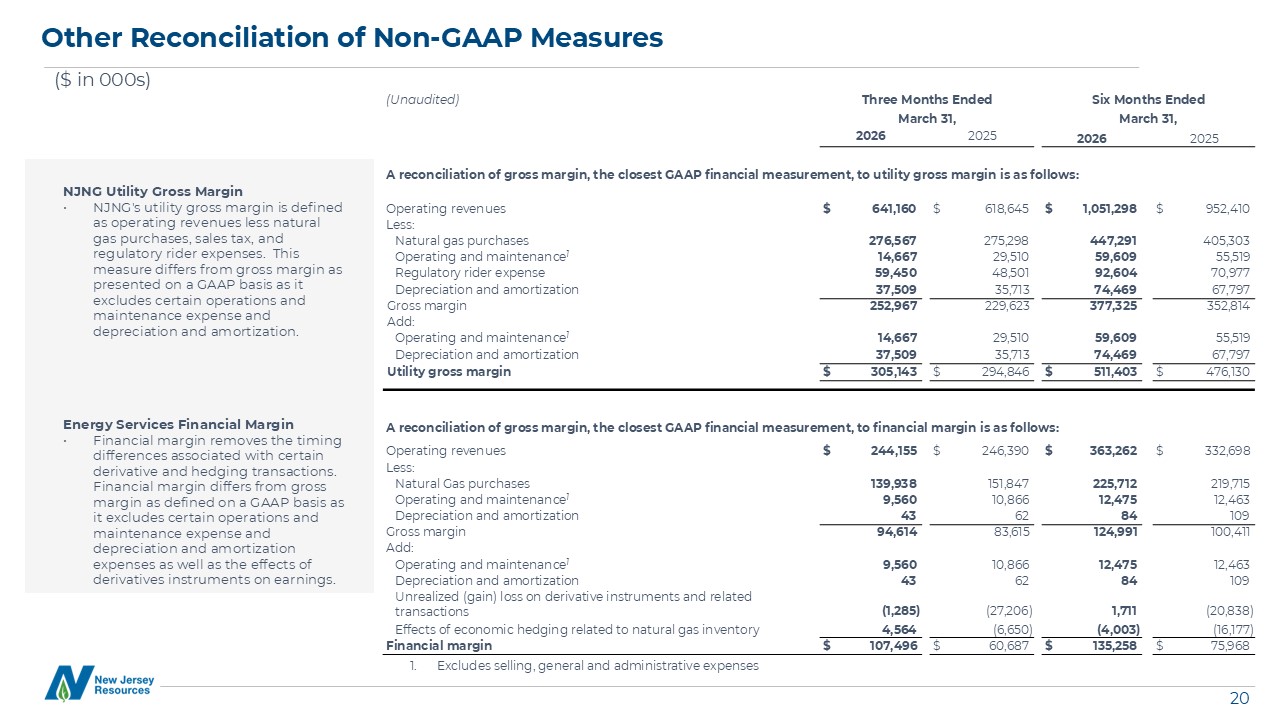
Other Reconciliation of Non-GAAP Measures NJNG Utility Gross Margin NJNG's
utility gross margin is defined as operating revenues less natural gas purchases, sales tax, and regulatory rider expenses. This measure differs from gross margin as presented on a GAAP basis as it excludes certain operations and maintenance
expense and depreciation and amortization. Energy Services Financial Margin Financial margin removes the timing differences associated with certain derivative and hedging transactions. Financial margin differs from gross margin as defined on
a GAAP basis as it excludes certain operations and maintenance expense and depreciation and amortization expenses as well as the effects of derivatives instruments on earnings. ($ in 000s) (Unaudited) Three Months Ended Six Months
Ended March 31, March 31, 2026 2025 2026 2025 A reconciliation of gross margin, the closest GAAP financial measurement, to utility gross margin is as follows: Operating revenues $ 641,160 $ 618,645 $ 1,051,298 $ 952,410
Less: Natural gas purchases 276,567 275,298 447,291 405,303 Operating and maintenance1 14,667 29,510 59,609 55,519 Regulatory rider expense 59,450 48,501 92,604 70,977 Depreciation and amortization
37,509 35,713 74,469 67,797 Gross margin 252,967 229,623 377,325 352,814 Add: Operating and maintenance1 14,667 29,510 59,609 55,519 Depreciation and amortization 37,509 35,713 74,469 67,797
Utility gross margin $ 305,143 $ 294,846 $ 511,403 $ 476,130 A reconciliation of gross margin, the closest GAAP financial measurement, to financial margin is as follows: Operating revenues $ 244,155 $ 246,390 $ 363,262 $
332,698 Less: Natural Gas purchases 139,938 151,847 225,712 219,715 Operating and maintenance1 9,560 10,866 12,475 12,463 Depreciation and amortization 43 62 84 109 Gross margin 94,614 83,615
124,991 100,411 Add: Operating and maintenance1 9,560 10,866 12,475 12,463 Depreciation and amortization 43 62 84 109 Unrealized (gain) loss on derivative instruments and related transactions (1,285)
(27,206) 1,711 (20,838) Effects of economic hedging related to natural gas inventory 4,564 (6,650) (4,003) (16,177) Financial margin $ 107,496 $ 60,687 $ 135,258 $ 75,968 Excludes selling, general and administrative
expenses
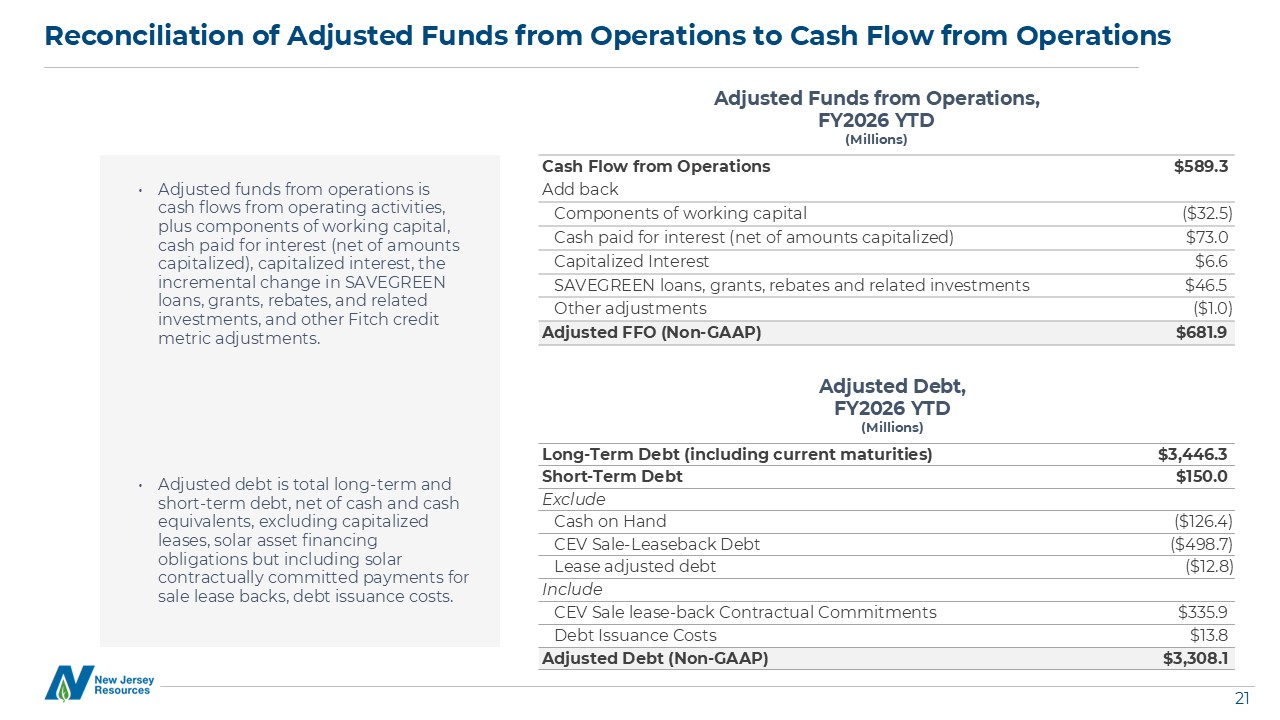
Reconciliation of Adjusted Funds from Operations to Cash Flow from
Operations Adjusted funds from operations is cash flows from operating activities, plus components of working capital, cash paid for interest (net of amounts capitalized), capitalized interest, the incremental change in SAVEGREEN loans,
grants, rebates, and related investments, and other Fitch credit metric adjustments. Adjusted debt is total long-term and short-term debt, net of cash and cash equivalents, excluding capitalized leases, solar asset financing obligations but
including solar contractually committed payments for sale lease backs, debt issuance costs. Cash Flow from Operations $589.3 Add back Components of working capital ($32.5) Cash paid for interest (net of amounts capitalized) $73.0
Capitalized Interest $6.6 SAVEGREEN loans, grants, rebates and related investments $46.5 Other adjustments ($1.0) Adjusted FFO (Non-GAAP) $681.9 Long-Term Debt (including current maturities) $3,446.3 Short-Term Debt
$150.0 Exclude Cash on Hand ($126.4) CEV Sale-Leaseback Debt ($498.7) Lease adjusted debt ($12.8) Include CEV Sale lease-back Contractual Commitments $335.9 Debt Issuance Costs $13.8 Adjusted Debt (Non-GAAP) $3,308.1
Adjusted Debt, FY2026 YTD (Millions) Adjusted Funds from Operations, FY2026 YTD (Millions)
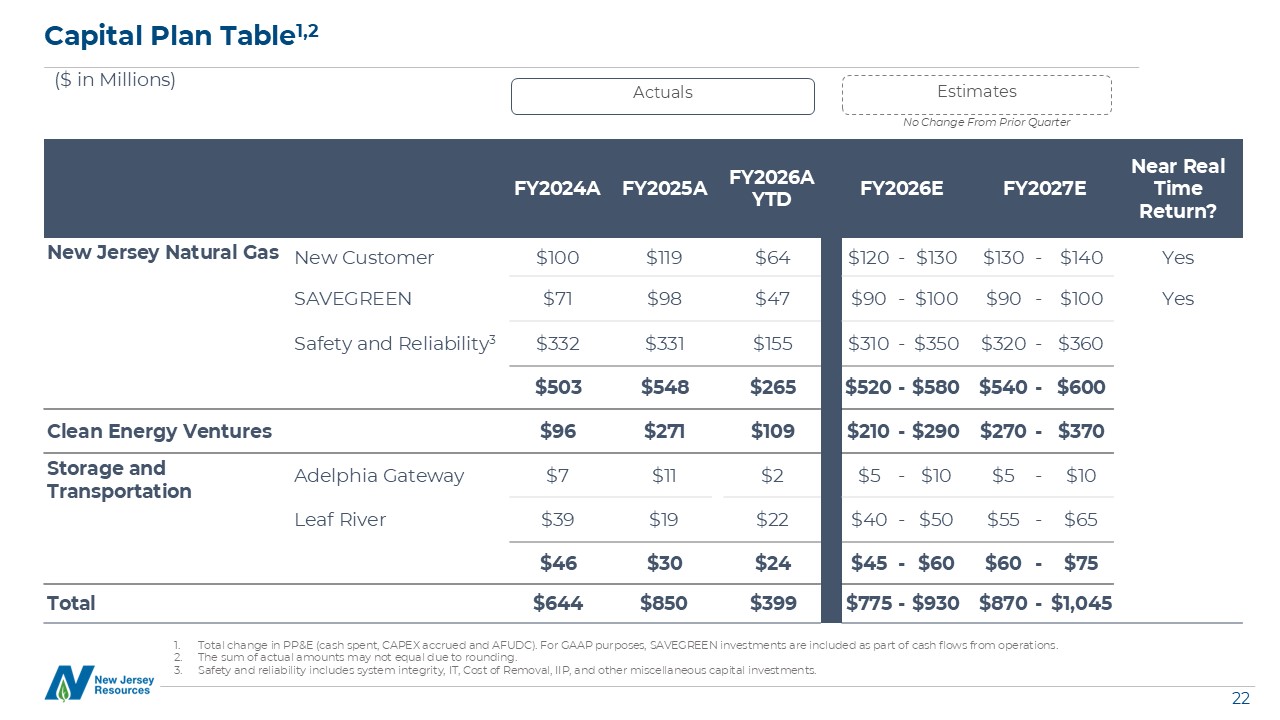
Capital Plan Table1,2 ($ in Millions) Total change in PP&E (cash spent,
CAPEX accrued and AFUDC). For GAAP purposes, SAVEGREEN investments are included as part of cash flows from operations. The sum of actual amounts may not equal due to rounding. Safety and reliability includes system integrity, IT, Cost of
Removal, IIP, and other miscellaneous capital investments. Actuals Estimates FY2024A FY2025A FY2026A YTD FY2026E FY2027E Near Real Time Return? New Jersey Natural Gas New
Customer $100 $119 $64 $120 - $130 $130 - $140 Yes SAVEGREEN $71 $98 $47 $90 - $100 $90 - $100 Yes Safety and
Reliability3 $332 $331 $155 $310 - $350 $320 - $360 $503 $548 $265 $520 - $580 $540 - $600 Clean Energy Ventures $96 $271 $109 $210 - $290 $270 - $370 Storage and Transportation Adelphia
Gateway $7 $11 $2 $5 - $10 $5 - $10 Leaf River $39 $19 $22 $40 - $50 $55 - $65 $46 $30 $24 $45 - $60 $60 - $75 Total $644 $850 $399 $775 - $930 $870 - $1,045 No Change From Prior Quarter
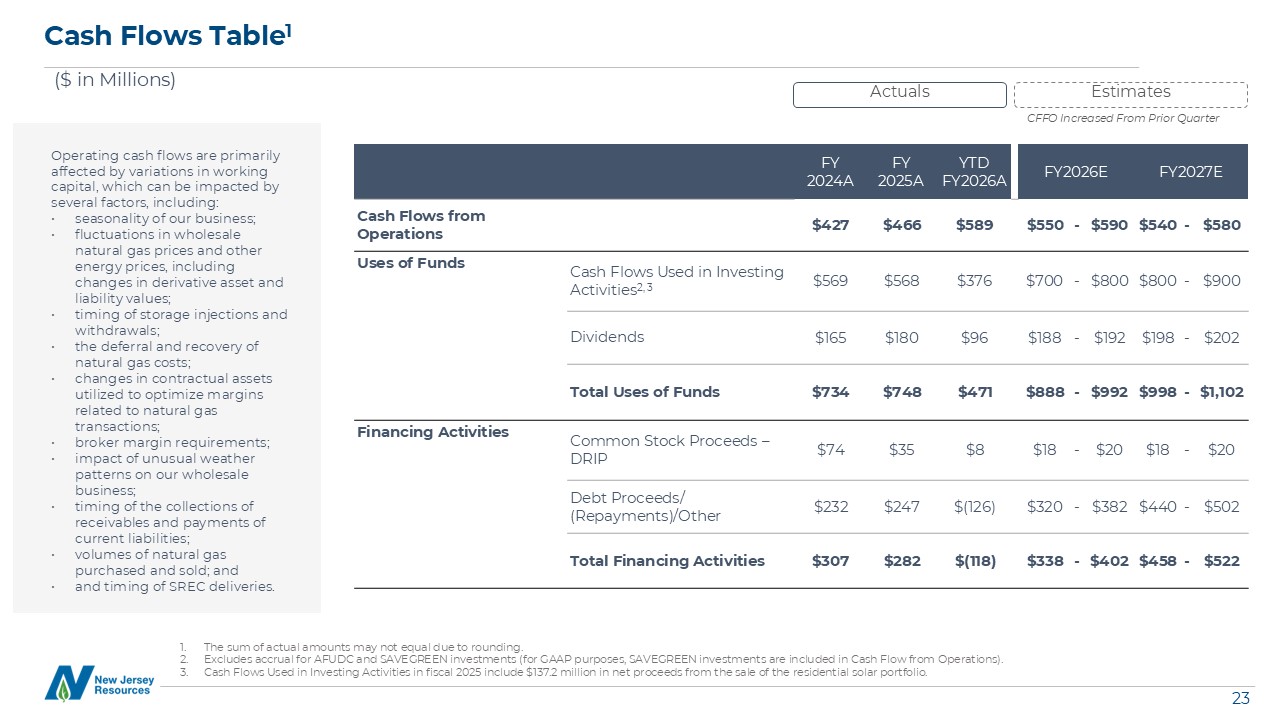
The sum of actual amounts may not equal due to rounding. Excludes accrual for
AFUDC and SAVEGREEN investments (for GAAP purposes, SAVEGREEN investments are included in Cash Flow from Operations). Cash Flows Used in Investing Activities in fiscal 2025 include $137.2 million in net proceeds from the sale of the
residential solar portfolio. Cash Flows Table1 ($ in Millions) Actuals Estimates Operating cash flows are primarily affected by variations in working capital, which can be impacted by several factors, including: seasonality of our
business; fluctuations in wholesale natural gas prices and other energy prices, including changes in derivative asset and liability values; timing of storage injections and withdrawals; the deferral and recovery of natural gas costs;
changes in contractual assets utilized to optimize margins related to natural gas transactions; broker margin requirements; impact of unusual weather patterns on our wholesale business; timing of the collections of receivables and
payments of current liabilities; volumes of natural gas purchased and sold; and and timing of SREC deliveries. FY 2024A FY 2025A YTD FY2026A FY2026E FY2027E Cash Flows from
Operations $427 $466 $589 $550 - $590 $540 - $580 Uses of Funds Cash Flows Used in Investing Activities2, 3 $569 $568 $376 $700 - $800 $800 - $900 Dividends $165 $180 $96 $188 - $192 $198 - $202 Total Uses of
Funds $734 $748 $471 $888 - $992 $998 - $1,102 Financing Activities Common Stock Proceeds – DRIP $74 $35 $8 $18 - $20 $18 - $20 Debt Proceeds/ (Repayments)/Other $232 $247 $(126) $320 - $382 $440 - $502 Total
Financing Activities $307 $282 $(118) $338 - $402 $458 - $522 CFFO Increased From Prior Quarter
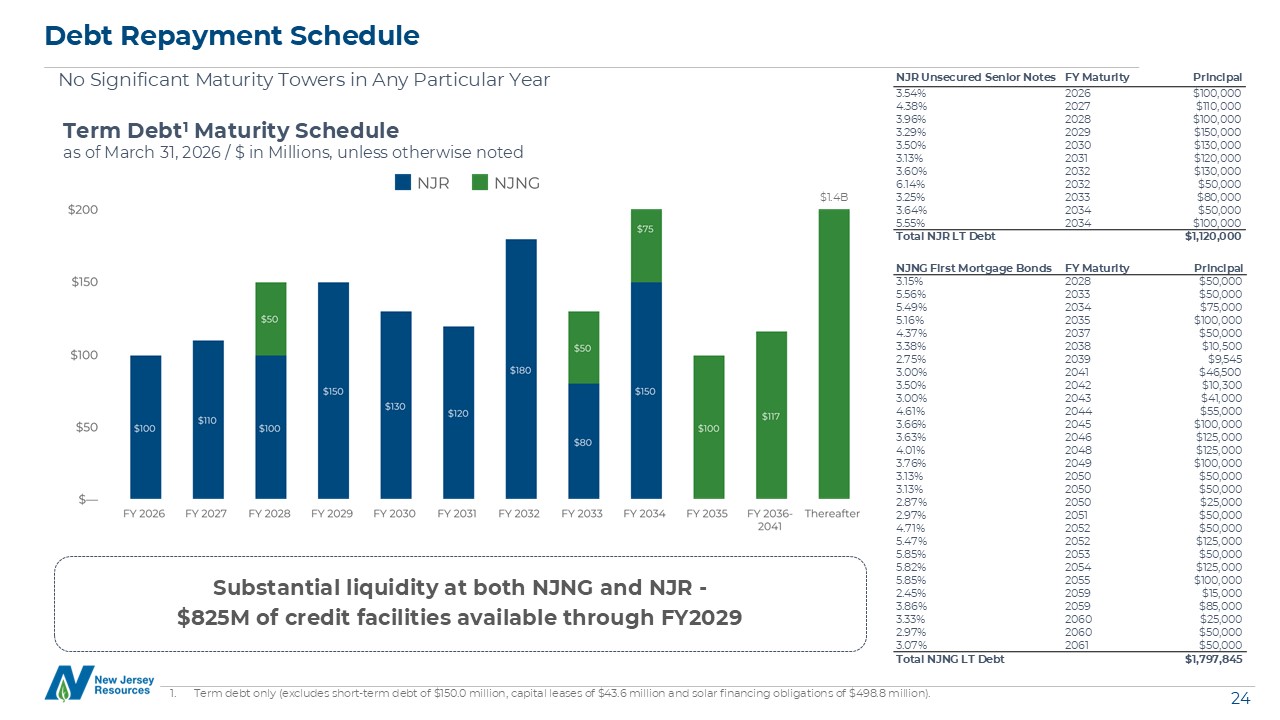
Debt Repayment Schedule No Significant Maturity Towers in Any Particular
Year Term debt only (excludes short-term debt of $150.0 million, capital leases of $43.6 million and solar financing obligations of $498.8 million). NJR Unsecured Senior Notes FY Maturity Principal 3.54% 2026 $100,000 4.38% 2027
$110,000 3.96% 2028 $100,000 3.29% 2029 $150,000 3.50% 2030 $130,000 3.13% 2031 $120,000 3.60% 2032 $130,000 6.14% 2032 $50,000 3.25% 2033 $80,000 3.64% 2034 $50,000 5.55% 2034 $100,000 Total NJR
LT Debt $1,120,000 NJNG First Mortgage Bonds FY Maturity Principal 3.15% 2028 $50,000 5.56% 2033 $50,000 5.49% 2034 $75,000 5.16% 2035 $100,000 4.37% 2037 $50,000 3.38% 2038 $10,500 2.75% 2039 $9,545
3.00% 2041 $46,500 3.50% 2042 $10,300 3.00% 2043 $41,000 4.61% 2044 $55,000 3.66% 2045 $100,000 3.63% 2046 $125,000 4.01% 2048 $125,000 3.76% 2049 $100,000 3.13% 2050 $50,000 3.13% 2050 $50,000
2.87% 2050 $25,000 2.97% 2051 $50,000 4.71% 2052 $50,000 5.47% 2052 $125,000 5.85% 2053 $50,000 5.82% 2054 $125,000 5.85% 2055 $100,000 2.45% 2059 $15,000 3.86% 2059 $85,000 3.33% 2060 $25,000
2.97% 2060 $50,000 3.07% 2061 $50,000 Total NJNG LT Debt $1,797,845 Substantial liquidity at both NJNG and NJR - $825M of credit facilities available through FY2029 Term Debt1 Maturity Schedule as of March 31, 2026 / $ in
Millions, unless otherwise noted $1.4B
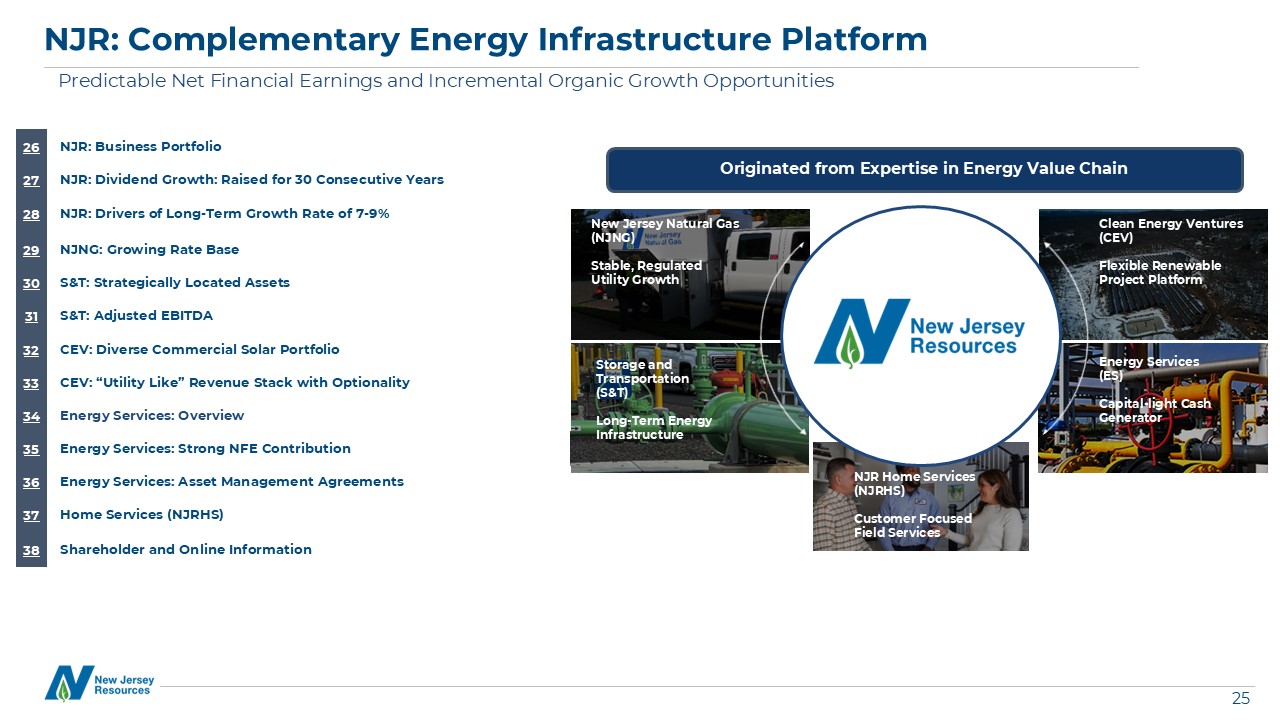
Originated from Expertise in Energy Value Chain Clean Energy
Ventures (CEV) Flexible Renewable Project Platform Storage and Transportation (S&T) Long-Term Energy Infrastructure Energy Services (ES) Capital-light Cash Generator NJR Home Services (NJRHS) Customer Focused Field Services New
Jersey Natural Gas (NJNG) Stable, Regulated Utility Growth NJR: Complementary Energy Infrastructure Platform Predictable Net Financial Earnings and Incremental Organic Growth Opportunities 26 NJR: Business Portfolio 27 NJR: Dividend
Growth: Raised for 30 Consecutive Years 28 NJR: Drivers of Long-Term Growth Rate of 7-9% 29 NJNG: Growing Rate Base 30 S&T: Strategically Located Assets 31 S&T: Adjusted EBITDA 32 CEV: Diverse Commercial Solar
Portfolio 33 CEV: “Utility Like” Revenue Stack with Optionality 34 Energy Services: Overview 35 Energy Services: Strong NFE Contribution 36 Energy Services: Asset Management Agreements 37 Home Services (NJRHS) 38 Shareholder and
Online Information
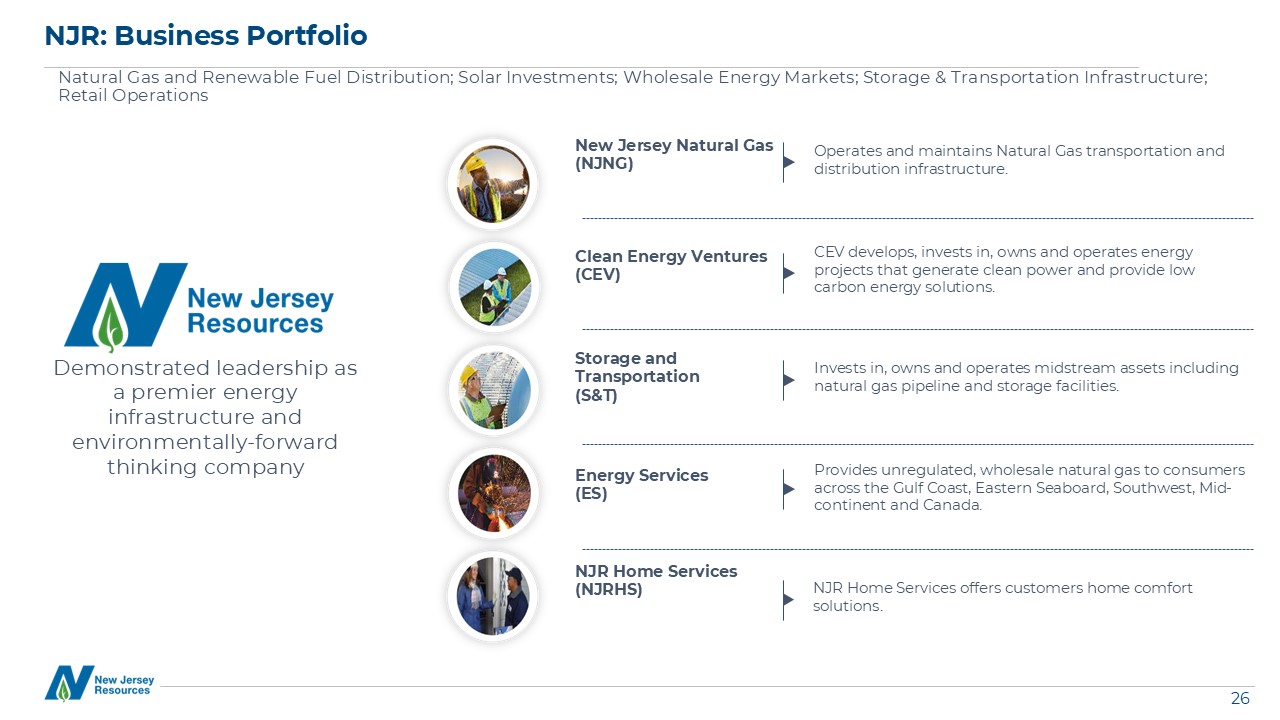
NJR Home Services offers customers home comfort solutions. NJR: Business
Portfolio Natural Gas and Renewable Fuel Distribution; Solar Investments; Wholesale Energy Markets; Storage & Transportation Infrastructure; Retail Operations Operates and maintains Natural Gas transportation and distribution
infrastructure. New Jersey Natural Gas (NJNG) Clean Energy Ventures (CEV) Storage and Transportation (S&T) Energy Services (ES) NJR Home Services (NJRHS) CEV develops, invests in, owns and operates energy projects that generate
clean power and provide low carbon energy solutions. Invests in, owns and operates midstream assets including natural gas pipeline and storage facilities. Provides unregulated, wholesale natural gas to consumers across the Gulf Coast,
Eastern Seaboard, Southwest, Mid-continent and Canada. Demonstrated leadership as a premier energy infrastructure and environmentally-forward thinking company
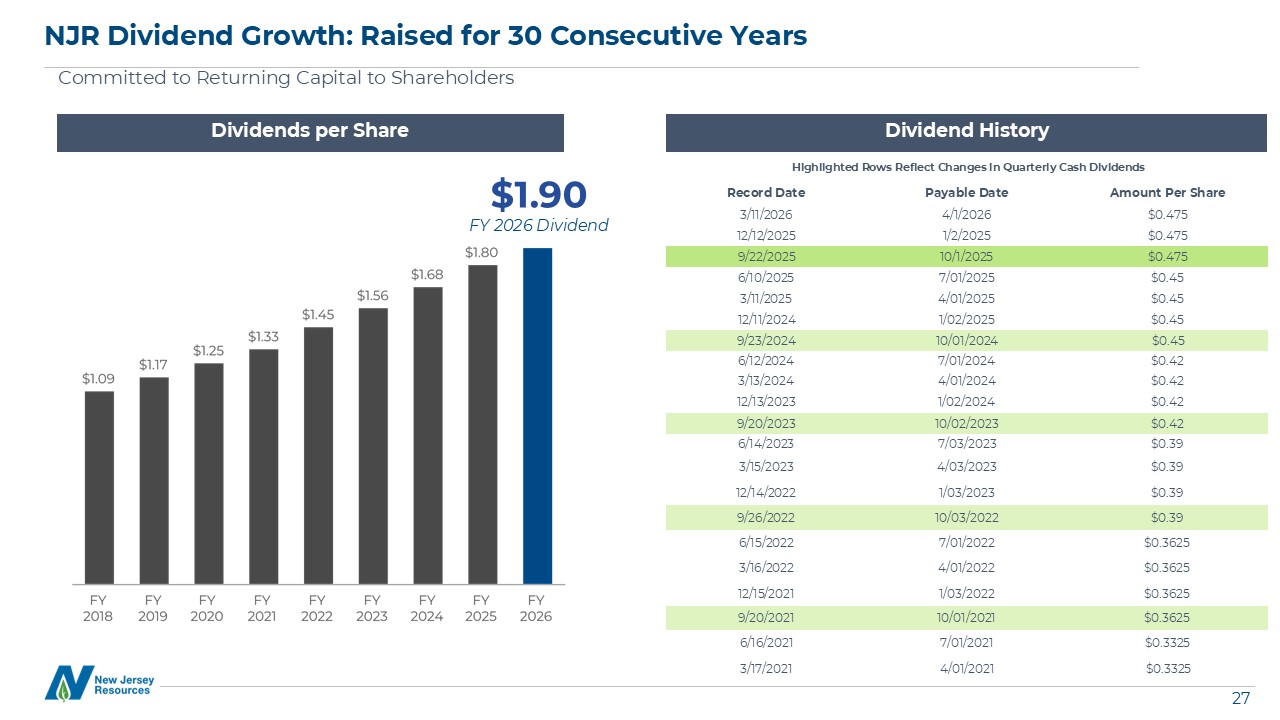
NJR Dividend Growth: Raised for 30 Consecutive Years Committed to Returning
Capital to Shareholders Dividend History Dividends per Share Record Date Payable Date Amount Per
Share 3/11/2026 4/1/2026 $0.475 12/12/2025 1/2/2025 $0.475 9/22/2025 10/1/2025 $0.475 6/10/2025 7/01/2025 $0.45 3/11/2025 4/01/2025 $0.45 12/11/2024 1/02/2025 $0.45 9/23/2024 10/01/2024 $0.45 6/12/2024 7/01/2024 $0.42 3/13/2024 4/01/2024 $0.42 12/13/2023 1/02/2024 $0.42 9/20/2023 10/02/2023 $0.42 6/14/2023 7/03/2023 $0.39 3/15/2023 4/03/2023 $0.39 12/14/2022 1/03/2023 $0.39 9/26/2022 10/03/2022 $0.39 6/15/2022 7/01/2022 $0.3625 3/16/2022 4/01/2022 $0.3625 12/15/2021 1/03/2022 $0.3625 9/20/2021 10/01/2021 $0.3625 6/16/2021 7/01/2021 $0.3325 3/17/2021 4/01/2021 $0.3325 Highlighted
Rows Reflect Changes in Quarterly Cash Dividends $1.90 FY 2026 Dividend
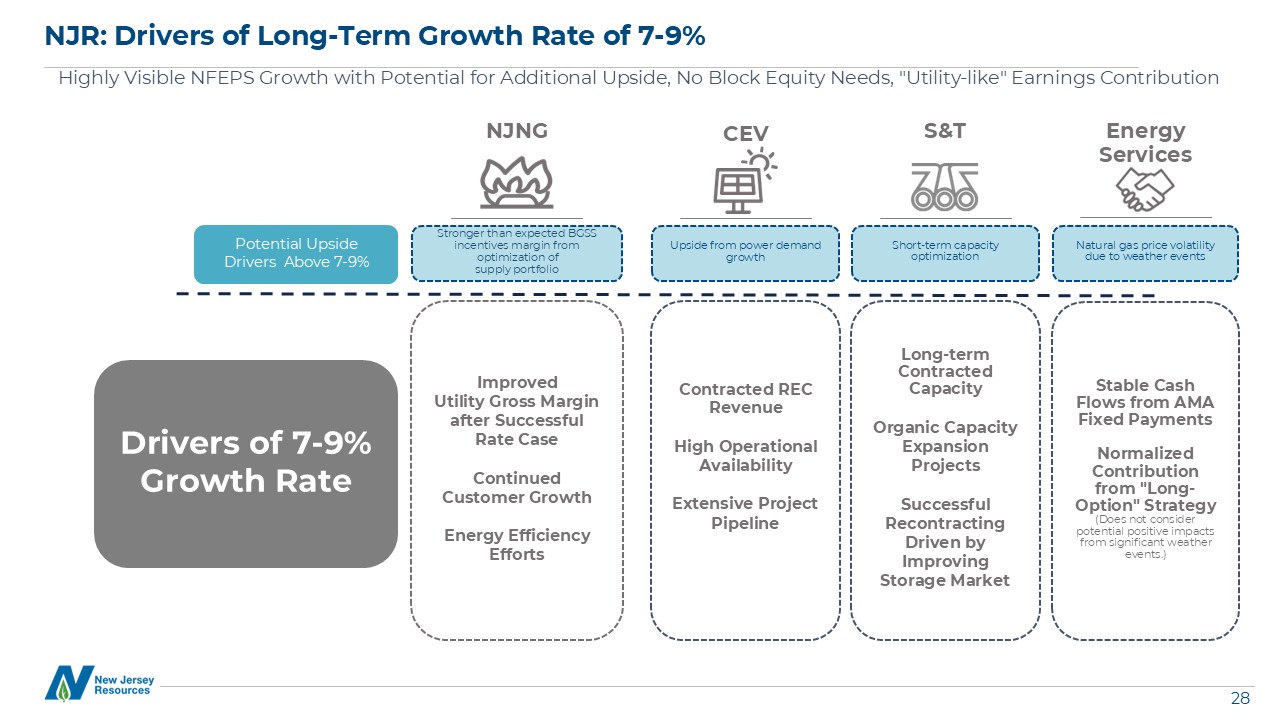
NJR: Drivers of Long-Term Growth Rate of 7-9% Highly Visible NFEPS Growth with
Potential for Additional Upside, No Block Equity Needs, "Utility-like" Earnings Contribution NJNG CEV S&T Energy Services Improved Utility Gross Margin after Successful Rate Case Continued Customer Growth Energy Efficiency Efforts
Drivers of 7-9% Growth Rate Potential Upside Drivers Above 7-9% Contracted REC Revenue High Operational Availability Extensive Project Pipeline Stronger than expected BGSS incentives margin from optimization of supply
portfolio Upside from power demand growth Long-term Contracted Capacity Organic Capacity Expansion Projects Successful Recontracting Driven by Improving Storage Market Short-term capacity optimization Stable Cash Flows from AMA Fixed
Payments Normalized Contribution from "Long-Option" Strategy (Does not consider potential positive impacts from significant weather events.) Natural gas price volatility due to weather events
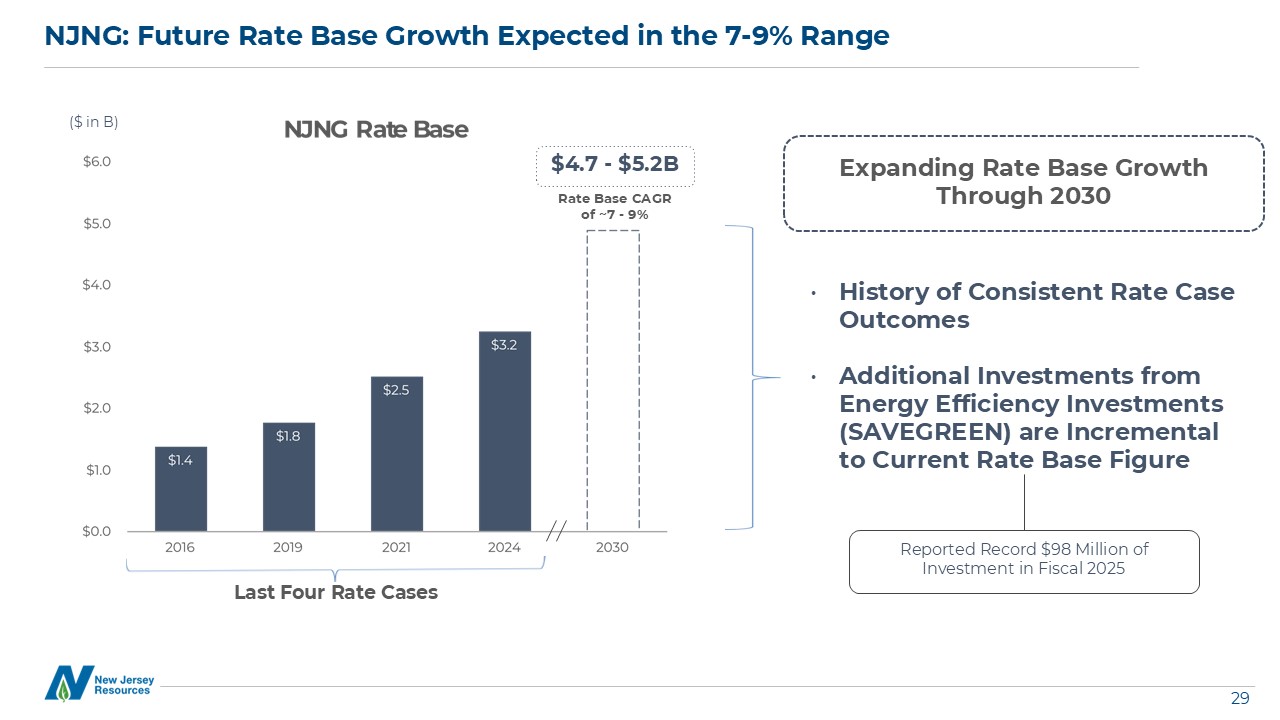
NJNG: Future Rate Base Growth Expected in the 7-9% Range Expanding Rate Base
Growth Through 2030 History of Consistent Rate Case Outcomes Additional Investments from Energy Efficiency Investments (SAVEGREEN) are Incremental to Current Rate Base Figure Last Four Rate Cases $4.7 - $5.2B ($ in B) Rate Base CAGR of ~7
- 9% Reported Record $98 Million of Investment in Fiscal 2025
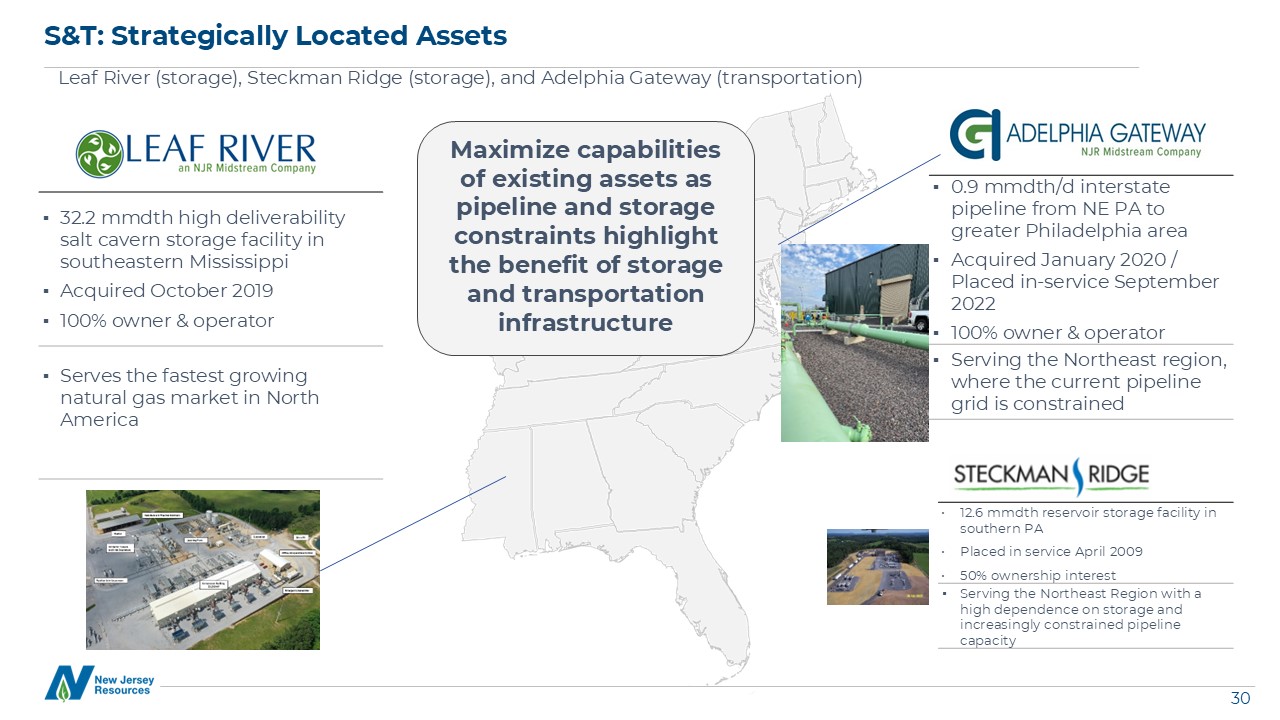
S&T: Strategically Located Assets Leaf River (storage), Steckman Ridge
(storage), and Adelphia Gateway (transportation) 32.2 mmdth high deliverability salt cavern storage facility in southeastern Mississippi Acquired October 2019 100% owner & operator Serves the fastest growing natural gas market in North
America 12.6 mmdth reservoir storage facility in southern PA Placed in service April 2009 50% ownership interest Serving the Northeast Region with a high dependence on storage and increasingly constrained pipeline capacity 0.9 mmdth/d
interstate pipeline from NE PA to greater Philadelphia area Acquired January 2020 / Placed in-service September 2022 100% owner & operator Serving the Northeast region, where the current pipeline grid is constrained Maximize
capabilities of existing assets as pipeline and storage constraints highlight the benefit of storage and transportation infrastructure
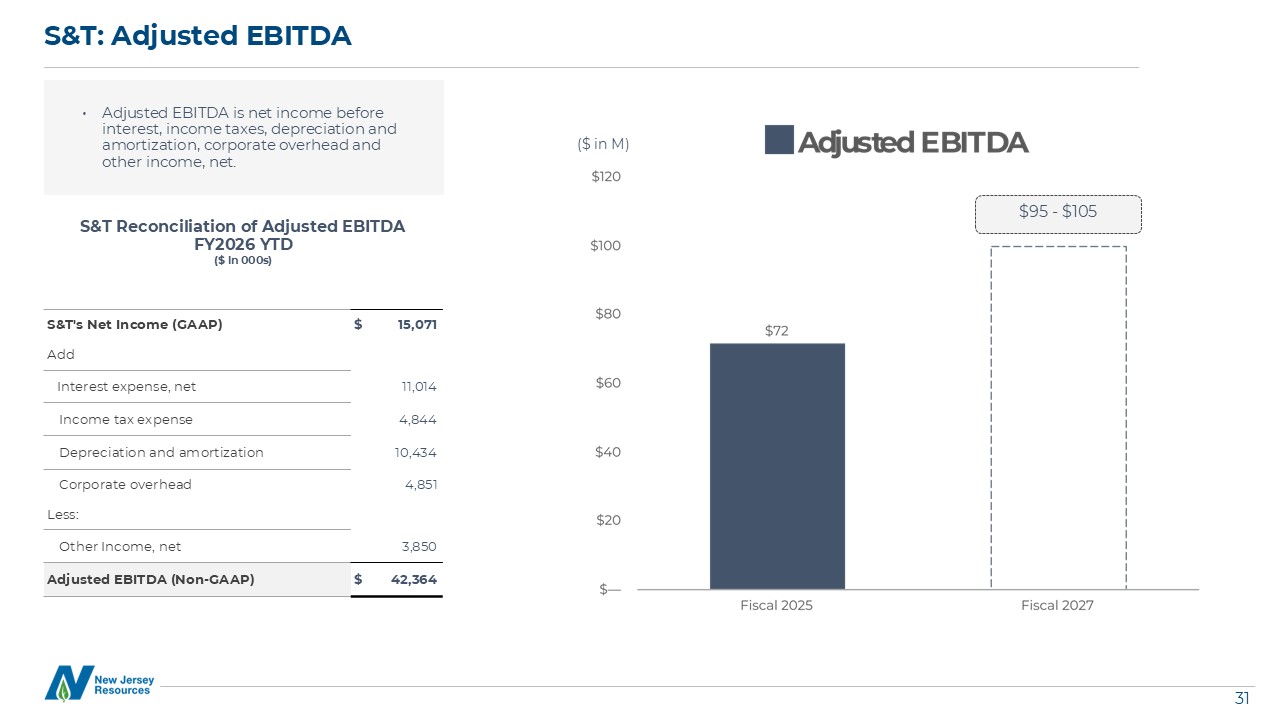
S&T: Adjusted EBITDA Adjusted EBITDA is net income before interest, income
taxes, depreciation and amortization, corporate overhead and other income, net. S&T's Net Income (GAAP) $ 15,071 Add Interest expense, net 11,014 Income tax expense 4,844 Depreciation and amortization 10,434 Corporate
overhead 4,851 Less: Other Income, net 3,850 Adjusted EBITDA (Non-GAAP) $ 42,364 S&T Reconciliation of Adjusted EBITDA FY2026 YTD ($ in 000s) ($ in M) $95 - $105
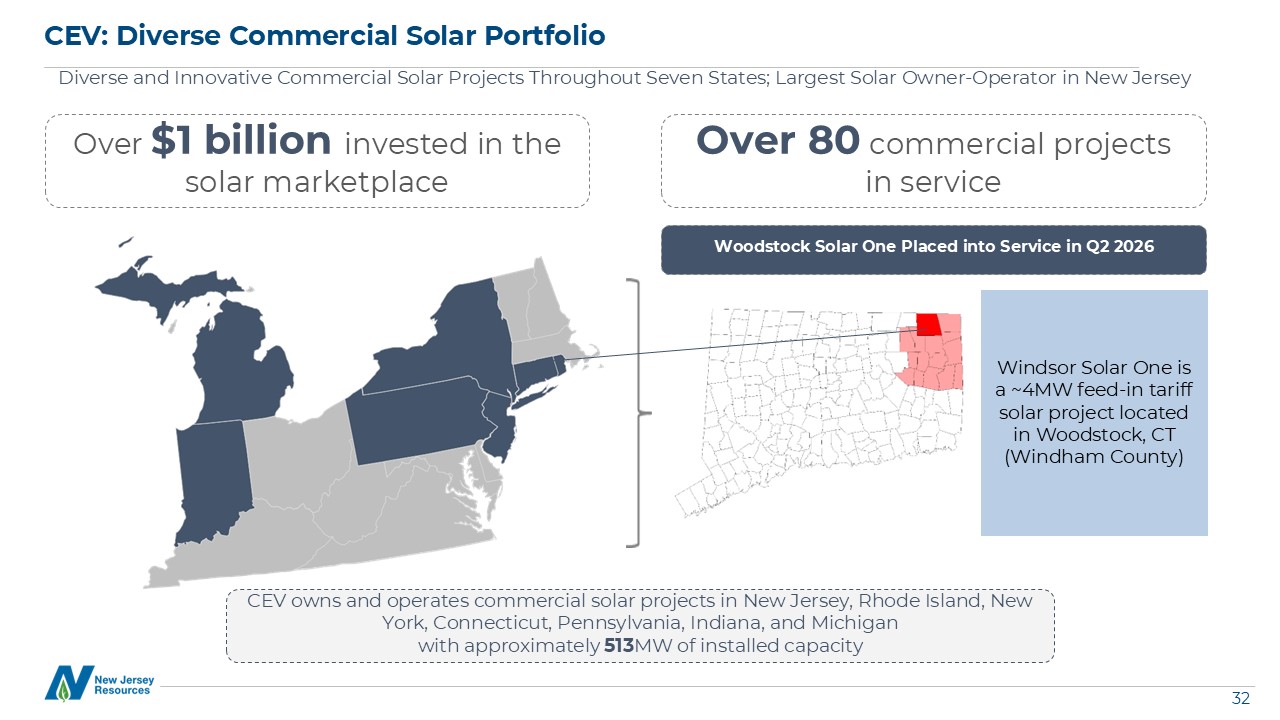
CEV: Diverse Commercial Solar Portfolio Diverse and Innovative Commercial Solar
Projects Throughout Seven States; Largest Solar Owner-Operator in New Jersey CEV owns and operates commercial solar projects in New Jersey, Rhode Island, New York, Connecticut, Pennsylvania, Indiana, and Michigan with approximately 513MW of
installed capacity Over $1 billion invested in the solar marketplace Over 80 commercial projects in service Woodstock Solar One Placed into Service in Q2 2026 Windsor Solar One is a ~4MW feed-in tariff solar project located in
Woodstock, CT (Windham County)
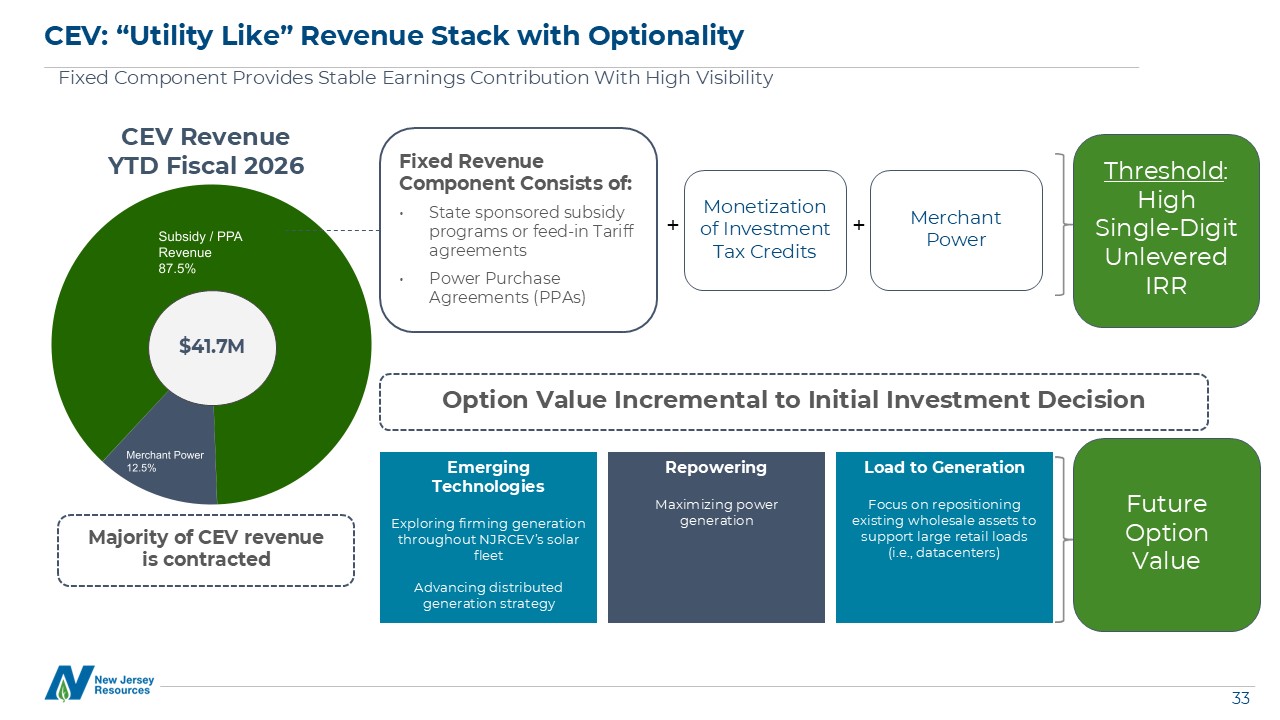
CEV: “Utility Like” Revenue Stack with Optionality Fixed Component Provides
Stable Earnings Contribution With High Visibility CEV Revenue YTD Fiscal 2026 Majority of CEV revenue is contracted Fixed Revenue Component Consists of: State sponsored subsidy programs or feed-in Tariff agreements Power Purchase
Agreements (PPAs) Monetization of Investment Tax Credits Merchant Power Threshold: High Single-Digit Unlevered IRR + + Option Value Incremental to Initial Investment Decision Emerging Technologies Exploring firming generation
throughout NJRCEV’s solar fleet Advancing distributed generation strategy Repowering Maximizing power generation Future Option Value Load to Generation Focus on repositioning existing wholesale assets to support large retail loads
(i.e., datacenters) $41.7M
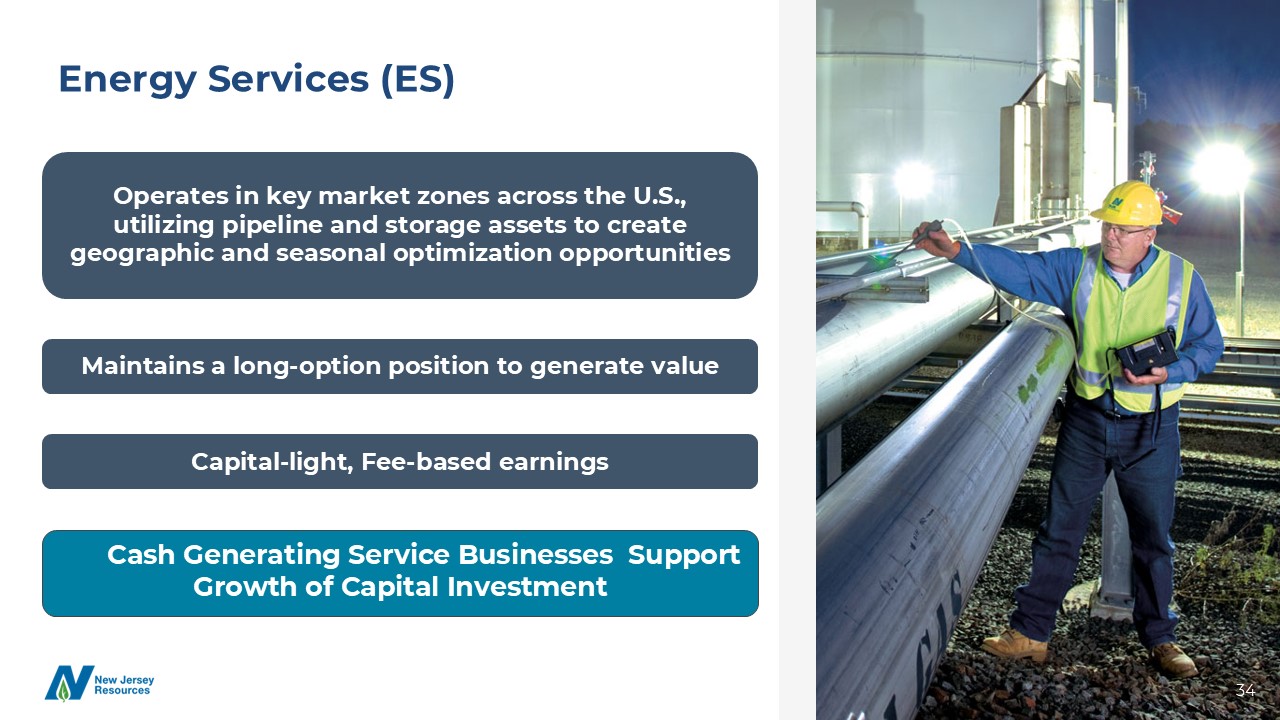
34 34 Energy Services (ES) Operates in key market zones across the U.S.,
utilizing pipeline and storage assets to create geographic and seasonal optimization opportunities Maintains a long-option position to generate value Capital-light, Fee-based earnings Cash Generating Service Businesses Support Growth of
Capital Investment 34
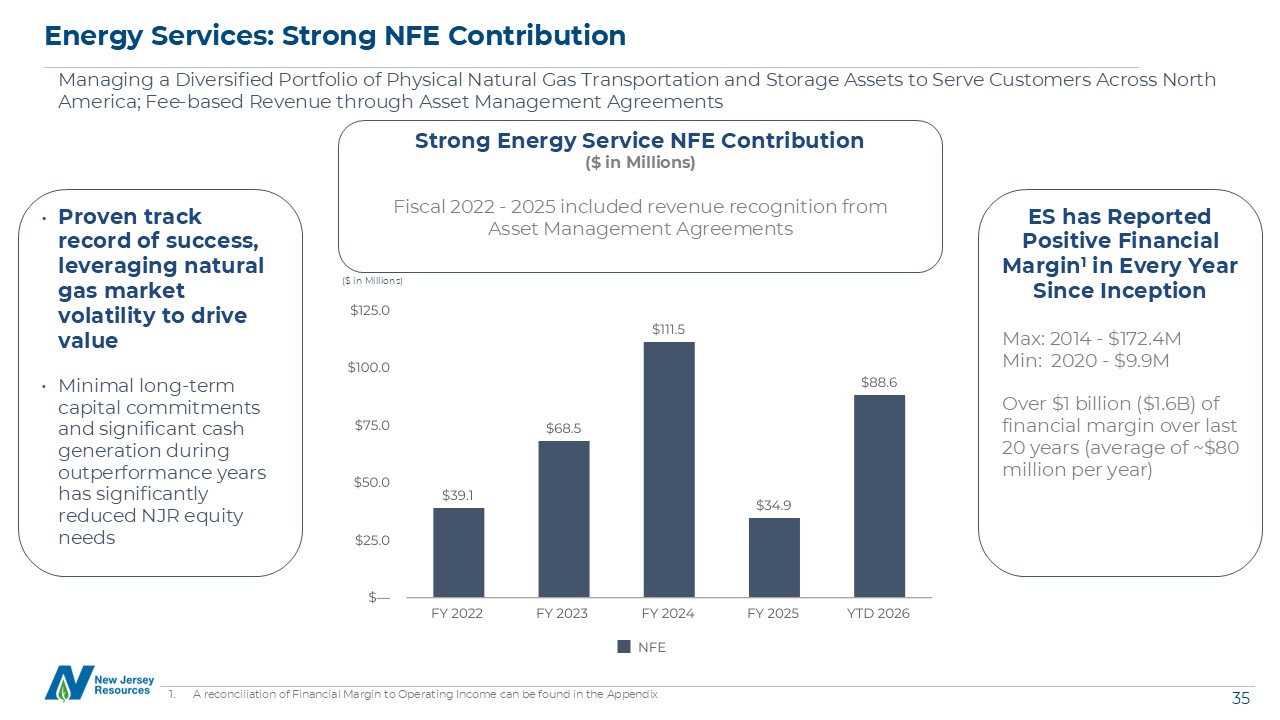
Energy Services: Strong NFE Contribution Managing a Diversified Portfolio of
Physical Natural Gas Transportation and Storage Assets to Serve Customers Across North America; Fee-based Revenue through Asset Management Agreements Proven track record of success, leveraging natural gas market volatility to drive
value Minimal long-term capital commitments and significant cash generation during outperformance years has significantly reduced NJR equity needs A reconciliation of Financial Margin to Operating Income can be found in the Appendix Strong
Energy Service NFE Contribution ($ in Millions) Fiscal 2022 - 2025 included revenue recognition from Asset Management Agreements ES has Reported Positive Financial Margin1 in Every Year Since Inception Max: 2014 - $172.4M Min: 2020 -
$9.9M Over $1 billion ($1.6B) of financial margin over last 20 years (average of ~$80 million per year) ($ in Millions)
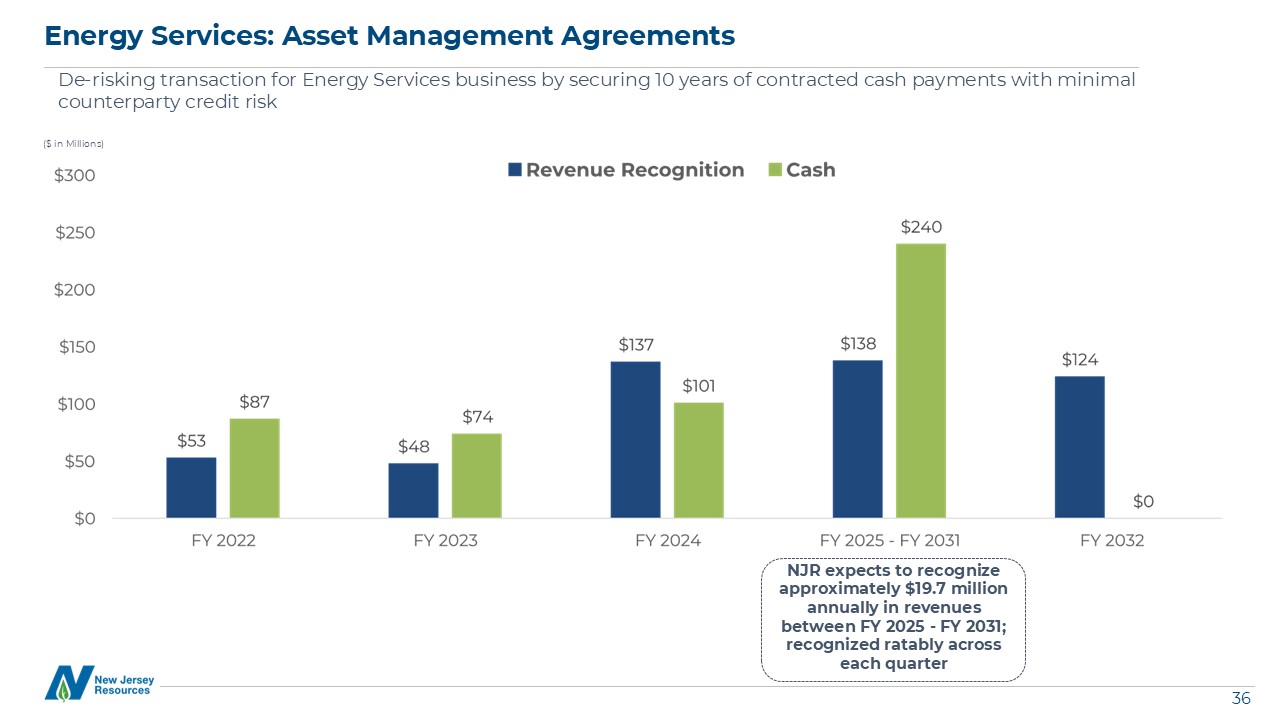
Energy Services: Asset Management Agreements De-risking transaction for Energy
Services business by securing 10 years of contracted cash payments with minimal counterparty credit risk NJR expects to recognize approximately $19.7 million annually in revenues between FY 2025 - FY 2031; recognized ratably across each
quarter ($ in Millions)
Home Services (NJRHS) Delivering Home Comfort Solutions ~ 150 licensed
technicians, installers, plumbers, electricians and skilled workers Provides residential service contracts for heating, cooling, water heating, electrical and standby generators Equipment sales and installations, plumbing and electrical
services and repairs and indoor air quality products Ruud Top Twenty Pro Partner Contractor for the 9th consecutive year Completed 79,000 service calls and 4,000 HVAC, plumbing and generator installations in Fiscal 2025 Maintains a nearly
five-star customer satisfaction rating* * Rating determined by Shopper Approved. See njrhomeservices.com/reviews for more information. Cash Generating Service Businesses Support Growth of Capital Investment Responding to the Storm:
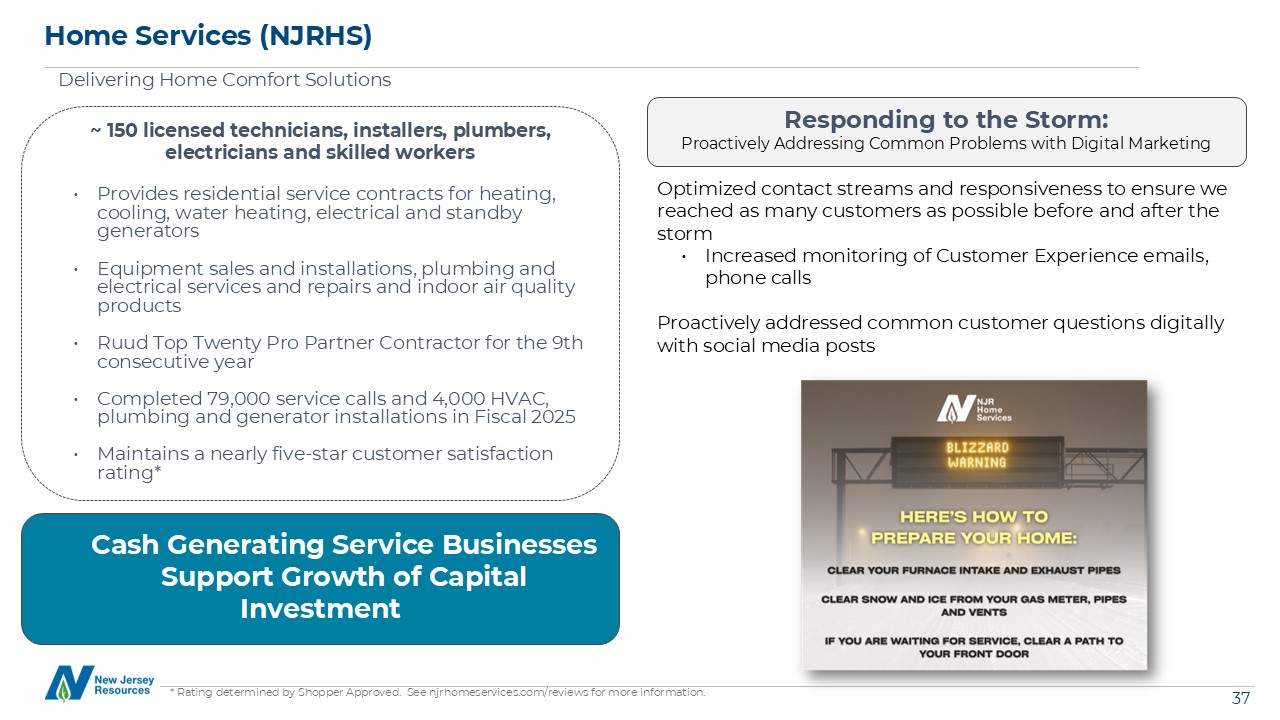
Proactively Addressing Common Problems with Digital Marketing Optimized contact streams and responsiveness to ensure we reached as many customers as possible before and after the storm Increased monitoring of Customer Experience emails,
phone calls Proactively addressed common customer questions digitally with social media posts
The Transfer Agent and Registrar for the company’s common stock is Broadridge
Corporate Issuer Solutions, Inc. (Broadridge). Shareowners with questions about account activity should contact Broadridge investor relations representatives between 9 a.m. and 6 p.m. ET, Monday through Friday, by calling toll-free
800-817-3955. General written inquiries and address changes may be sent to: Broadridge Corporate Issuer Solutions P.O. Box 1342, Brentwood, NY 11717 or For certified and overnight delivery: Broadridge Corporate Issuer Solutions, ATTN: IWS
1155 Long Island Avenue, Edgewood, NY 11717 Shareowners can view their account information online at shareholder.broadridge.com/NJR. Website: www.njresources.com Investor Relations: New Jersey Resources Investor Relations Contact
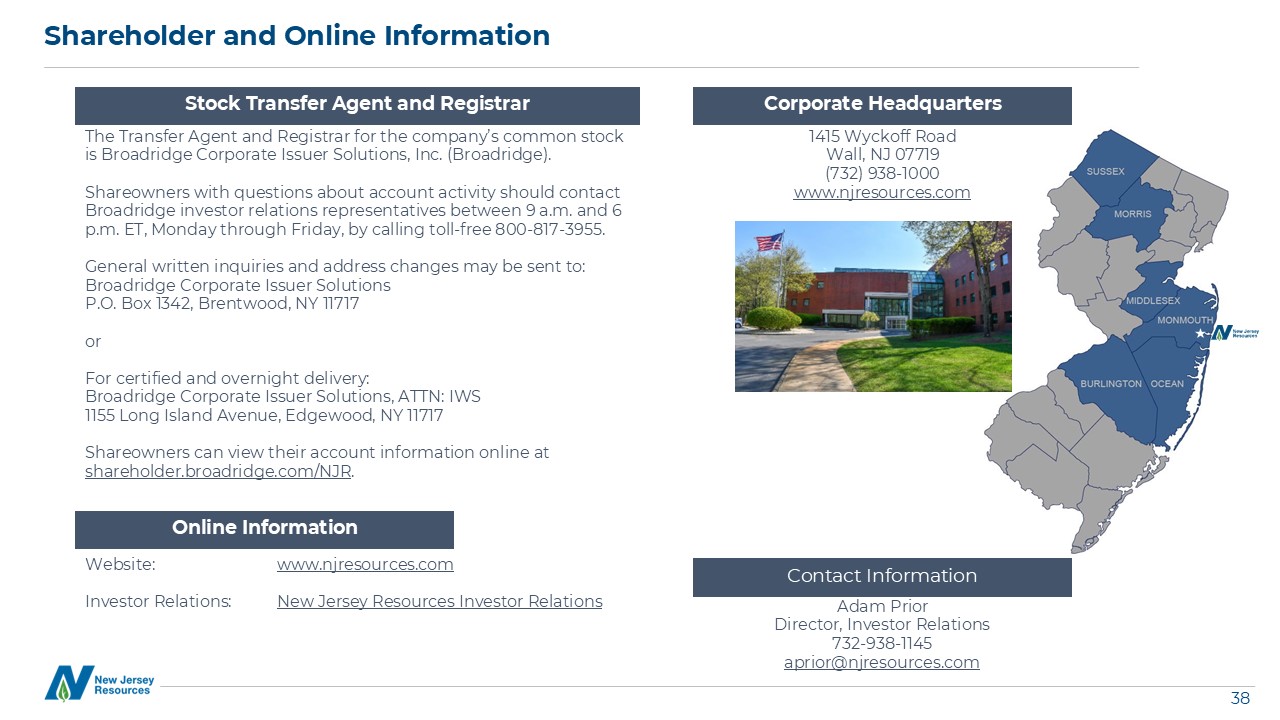
Information Adam Prior Director, Investor Relations 732-938-1145 aprior@njresources.com 1415 Wyckoff Road Wall, NJ 07719 (732) 938-1000 www.njresources.com Corporate Headquarters Online Information Shareholder and Online
Information Stock Transfer Agent and Registrar