UNITED STATES
SECURITIES AND EXCHANGE COMMISSION
Washington, D.C. 20549
Proxy Statement Pursuant to Section 14(a) of the Securities
Exchange Act of 1934
(Amendment No. )
| Filed by the Registrant ☒ | Filed by a Party other than the Registrant ☐ |
Check the appropriate box:
☐ Preliminary Proxy Statement
☐ Confidential, for Use of the Commission Only (as permitted by Rule 14a-6(e)(2))
☒ Definitive Proxy Statement
☐ Definitive Additional Materials
☐ Soliciting Material under §240.14a-12
(Name of Registrant as Specified in Its Charter)
(Name of Person(s) Filing Proxy Statement, if other than the Registrant)
Payment of Filing Fee (Check all boxes that apply):
☒ No fee required
☐ Fee paid previously with preliminary materials
☐ Fee computed on table in exhibit required by Item 25(b) per Exchange Act Rules 14a-6(i)(1) and 0-11
301 Sylvan Avenue
Englewood Cliffs, New Jersey 07632
|
NOTICE OF ANNUAL MEETING OF SHAREHOLDERS |
To Be Held on May 19, 2026
To Our Shareholders:
We invite you to the Annual Meeting (the “Annual Meeting”) of ConnectOne Bancorp, Inc. (the “Company”), the holding company for ConnectOne Bank (the “Bank”), will be held via webcast on May 19, 2026 at 9:15 a.m. for the purpose of considering and voting upon the following matters, all of which are more completely set forth in the accompanying Proxy Statement:
|
1. |
The election of fifteen (15) directors of the Company, each to serve for the terms described in the proxy statement or until his or her successor is elected and shall qualify; |
|
2. |
Approval of the ConnectOne Bancorp, Inc. 2026 Equity Incentive Plan; |
| 3. | To vote, on an advisory basis, to approve the executive compensation of the Company’s named executive officers, as described in this proxy statement; |
|
4. |
To ratify the appointment of Crowe LLP as the Company’s independent registered public accountants for the fiscal year ending December 31, 2026; and |
|
5. |
Such other business as shall properly come before the Annual Meeting. |
This year's Annual Meeting will be a completely virtual meeting of shareholders, which will be conducted via a live webcast. You will be able to participate in the Annual Meeting, vote and submit your questions during the Annual Meeting via live webcast by visiting www.virtualshareholdermeeting.com/CNOB2026.
Because the Annual Meeting is virtual and being conducted via live webcast, shareholders will not be able to attend the Annual Meeting in person. Details regarding how to participate in the meeting online and the business to be conducted at the meeting are more fully described in the accompanying proxy statement.
Only holders of record of shares of the Company’s common stock (the “Common Stock”) at the close of business on March 31, 2026 will be entitled to vote at the Annual Meeting.
|
|
Very truly yours,
FRANK SORRENTINO III Chairman of the Board of Directors |
If you are participating in the Annual Meeting by webcast, you may vote online during the meeting even if you have already returned your proxy.
Englewood Cliffs, New Jersey
April 9, 2026
 |
i |
Table of Contents
| Proxy Statement | |
| About the Annual Meeting | 1 |
| Summary of the Proposals | 3 |
| Proposal 1: Election of Directors | 4 |
| Board Refreshment: Process for Identifying and Evaluating Nominees | 4 |
| Board Refreshment-Identification | 4 |
| Board Refreshment-Evaluation | 5 |
| Board Performance Evaluations | 5 |
| Director Criteria/Characteristics | 6 |
| Nominees For Director | 7 |
| Required Vote | 13 |
| Recommendation | 13 |
| Information about the Board | 14 |
| Security Ownership of Management | 14 |
| Board of Directors; Independence; Committees | 16 |
| Code of Business Conduct and Ethics | 16 |
| Committees | 17 |
| Committees of Our Board of Directors | 17 |
| Audit and Risk Committee | 17 |
| Independence of Audit and Risk Committee Members | 17 |
| Audit and Risk Committee Report | 18 |
| Compensation Committee | 18 |
| Charter | 18 |
| Authority, Processes and Procedures | 18 |
| Independence of Compensation Committee Members | 18 |
| Consultants | 19 |
| Nominating Committee Matters | 19 |
| Independence of Nominating and Corporate Governance Committee Members | 19 |
| Procedures for Considering Nominations Made by Shareholders | 19 |
| Third Party Recommendations | 20 |
| Compensation Committee Interlocks and Insider Participation | 20 |
| Board Leadership; lead Independent Director | 20 |
| Majority Vote Requirement | 21 |
| Risk Oversight | 21 |
| In General | 21 |
| Cybersecurity Risk Oversight | 21 |
| Stewardship | 22 |
| Stewardship and Corporate Citizenship | 22 |
| People | 23 |
| Corporate Governance | 24 |
| Executive Compensation | 25 |
| Executive Summary | 25 |
| Business Results | 25 |
| Compensation Design Principles and Governance Best Practices | 27 |
| Executive Compensation Objectives and Policies | 28 |
| 2025 Executive Compensation Program | 29 |
| Peer Group & Competitive Benchmarking | 29 |
| Benefits and Other Compensation | 33 |
| Roles & Responsibilities | 34 |
| Compensation Committee | 34 |
| Independent Compensation Consultant | 35 |
| Management | 35 |
| Additional Information about Our Compensation Practices | 35 |
| Anti-Hedging/Pledging Policy | 35 |
| Policy on Incentive Compensation Clawback | 36 |
| Stock Ownership Guidelines | 36 |
| Risk Assessment Review | 36 |
| Accounting & Tax Treatment of Compensation | 36 |
| Report of the Compensation Committee | 37 |
| Summary Compensation Table | 38 |
| Time-based Deferred Stock Units Awards | 38 |
| Performance Units Awards | 39 |
| Post-Termination Benefits | 39 |
| Employment Agreements | 39 |
| CEO Pay Ratio | 42 |
| Grants of Plan-Based Awards | 45 |
| Outstanding Equity Awards at Fiscal Year-End | 45 |
| Options Exercised and Stock Vested | 45 |
| Nonqualified Deferred Compensation | 46 |
| Supplemental Executive Retirement Plan | 46 |
| Split Dollar Life Insurance Agreement | 46 |
| Nonqualified Deferred Compensation | 46 |
| Directors Compensation | 47 |
| Interest of Management and Others in Certain Transactions; Review, Approval or Ratification of Transactions With Related Persons | 47 |
| PROPOSAL 2 EQUITY INCENTIVE PLAN | 48 |
| Proposal 3 COMPENSATION | 55 |
| Proposal 4 Independent Auditors | 56 |
| Principal Accounting Firm Fees | 56 |
| Required Vote | 56 |
| Recommendation | 56 |
| Shareholder Proposals | 57 |
| Delinquent Section 16(A) Reports | 57 |
| Other Matters | 57 |
Exhibits
Annex A – The ConnectOne Bancorp, Inc. 2026 Equity Incentive Plan
|
|
ii |

We are distributing our proxy materials to shareholders via the U.S. Securities and Exchange Commission’s “Notice and Access” rules. We believe this approach allows us to provide shareholders with a timely and convenient way to receive proxy materials and vote, while lowering the costs of delivery and reducing the environmental impact of our Annual Meeting. We are mailing to our shareholders a Notice of Internet Availability of Proxy Materials (the “Notice of Internet Availability”) beginning on or about April 9, 2026, rather than paper copies of the Proxy Statement, the proxy card and our annual report on Form 10-K for the fiscal year ended December 31, 2025. The Notice of Internet Availability contains instructions on how to access the proxy materials, vote and obtain, if desired, a paper copy of the proxy materials.
|
|
iii |

This Proxy Statement is being furnished to shareholders of ConnectOne Bancorp, Inc. (the "Company") in connection with the solicitation by the Board of Directors of proxies to be used at the Annual Meeting of Shareholders to be held via webcast at 9:15 a.m. on May 19, 2026. Because the Annual Meeting is virtual via live webcast, shareholders will not be able to attend the Annual Meeting in person but may participate by joining the live webcast. Please go to www.virtualshareholdermeeting.com/CNOB2026 for instructions on how to participate in the Annual meeting.
Any shareholder may participate and listen live to the webcast of the Annual Meeting over the Internet at such site. Shareholders of record as of March 31, 2026 may vote and submit questions either in advance of or while participating in the Annual Meeting via the Internet by using the control number included on the proxy statement or proxy card. The webcast starts at 9:15 a.m. We encourage you to access the meeting prior to the start time. If you encounter any difficulties accessing the virtual meeting during the check-in or meeting time, please call the technical support number that will be posted on the Virtual Shareholder Meeting log-in page.

Why have I received these materials?
The accompanying proxy is solicited by the Board of Directors of ConnectOne Bancorp, Inc. (referred to throughout this Proxy Statement as the “Company” or “we”), the holding company for ConnectOne Bank, in connection with our Annual Meeting that will take place virtually on May 19, 2026. You are cordially invited to electronically participate in the Annual Meeting and are requested to vote on the proposals described in this Proxy Statement.
Who is entitled to vote at the Annual Meeting?
Holders of Common Stock as of the close of business on March 31, 2026, will be entitled to vote at the Annual Meeting. On March 31, 2026, there were outstanding and entitled to vote 50,288,494 shares of Common Stock, each of which is entitled to one vote with respect to each matter to be voted on at the Annual Meeting.
How do I vote my shares at the Annual Meeting?
If you are a “record” shareholder of Common Stock (that is, if you hold Common Stock in your own name as of March 31, 2026 on the Company’s stock records maintained by our transfer agent, Broadridge Financial Solutions, Inc.), you may vote by proxy or online at the Annual Meeting. To vote by proxy, you may use one of the following methods:
|
● |
Telephone voting, by dialing the toll-free number and following the instructions on your proxy card; |
|
● |
Internet voting, by accessing the Internet at the web address stated on the proxy card and following the instructions; or |
|
● |
Vote by mail, by completing and returning the proxy card in the enclosed envelope. The envelope requires no additional postage if mailed in the United States. |
If you hold your shares in “street name”, i.e., through a broker or other custodian, you must follow the voting instructions provided to you by your broker or custodian.
|
|
1 |
Can I change my vote after I return my proxy card?
Any shareholder of record has the power to revoke their proxy at any time before it is voted. You may revoke your proxy before it is voted at the Annual Meeting by:
|
● |
Voting again by telephone or the Internet, or completing a new proxy card with a later date – your latest vote will be counted; |
|
● |
Filing with the Secretary of the Company written notice of such revocation; or |
|
● |
Participating in the virtual Annual Meeting and voting online during the meeting. |
What constitutes a quorum for purposes of the Annual Meeting?
The presence at the Annual Meeting online or by proxy of the holders of a majority of the voting power of all outstanding shares of Common Stock entitled to vote shall constitute a quorum for the transaction of business. Proxies marked as abstaining (including proxies containing broker non-votes) on any matter to be acted upon by shareholders will be treated as present at the meeting for purposes of determining a quorum but will not be counted as votes cast on such matters.
Why is it important to vote my shares?
If we do not have a quorum present at the Annual Meeting, we will need to adjourn the meeting to solicit additional proxies. This will cause additional expense and delay for the Company.
What vote is required to approve each item?
Pursuant to the New Jersey Business Corporation Act (“NJBCA”), directors are elected by affirmative vote of a plurality of the votes cast. Notwithstanding the foregoing, in accordance with the Company’s Bylaws, each of the Company’s directors has submitted an irrevocable resignation from the Board, which shall become effective in the event such director does not receive at least a majority of the votes cast in any uncontested election. In such an event, the director’s resignation will become effective at the earlier of (i) the selection of a replacement director by the Board of Directors, or (ii) 90 days after certification of such stockholder vote. Accordingly, in the event that a nominee for re-election to the Board receives a plurality of the votes cast, but not a majority, he or she shall be re-elected to the Board under the provisions of the NJBCA, but his or her service shall continue only until such resignation becomes effective. Therefore, as a practical matter, re-election to a new term on the Board requires an affirmative vote of a majority of the votes cast at the Annual Meeting.
The proposal to approve the ConnectOne Bancorp. Inc. 2026 Equity Incentive Plan, the nonbinding resolution with respect to executive compensation, and the proposal for the ratification of the appointment of the independent registered public accountants, all require the affirmative vote of a majority of the votes cast at the Annual Meeting by shares represented online or by proxy.
|
|
2 |

How does the Board recommend that I vote my shares?
Unless you give other instructions on your proxy card, the persons named as proxies on the card will vote in accordance with the recommendations of the Board of Directors. The Board’s recommendation is set forth together with the description of each item in this Proxy Statement. In summary, the Board recommends a vote:
|
● |
FOR the directors’ nominees to the Board of Directors; |
| ● | FOR the ConnectOne Bancorp, Inc. Equity Incentive Plan; |
|
● |
FOR approval of the non-binding resolution with respect to executive compensation; |
|
● |
FOR ratification of the appointment of Crowe LLP as the Company’s independent registered public accountants for the fiscal year ending December 31, 2026. |
With respect to any other matters that properly come before the Annual Meeting, the proxy holders will vote as recommended by the Board of Directors or, if no recommendation is given, in their own discretion in the best interests of the Company. On the date this Proxy Statement went to print, the Board of Directors had no knowledge of any business other than that described in this proxy statement that would be presented for consideration at the Annual Meeting.
Who will bear the expense of soliciting proxies?
The Company will bear the cost of soliciting proxies. In addition to the solicitation by mail, proxies may be solicited personally or by telephone, facsimile or electronic transmission by our employees. In addition, we have retained Laurel Hill Advisory Group, LLC at an estimated cost of $7,000 plus reimbursement of out-of-pocket expenses, including per call fees for each call made, to assist in the solicitation of proxies. We also have agreed to indemnify Laurel Hill Advisory Group, LLC against certain liabilities in connection with this proxy solicitation.
|
|
3 |

The Certificate and By-Laws of the Company provide that the number of Directors shall not be less than five or more than 25 and permit the exact number to be determined from time to time by the Board of Directors.
Our fifteen continuing directors have a diversity of experience and backgrounds, including significant and varied operational, financial, risk, technology, compensation and human resources, management, corporate governance, leadership and other experience. Over the past several years, we have enhanced the industry and Company-specific knowledge of our Board of Directors with fresh perspectives brought by individuals added to our board of directors. We believe that our directors are active and engaged and have the skills necessary to guide the Company as it grows, as our business strategy and the banking industry around us continue to evolve and as the financial services sector becomes ever more competitive.

The Board continually seeks to refresh and improve its composition and has added new directors both as a result of the acquisition of other insured institutions and through searches when it was determined that different skill sets or points of view were needed for the Board. Pursuant to the Nominating and Corporate Governance Committee Charter as approved by the Board, the Nominating and Corporate Governance (the “NCG”) Committee is charged with the central role in the process relating to director nominations, including identifying, interviewing and selecting individuals who may be nominated for election to the Board of Directors. As part of the Board’s commitment to refreshment, a mandatory retirement age of 75 for directors has been adopted.
We have had 9 new members join our Board of Directors since 2018, including Messrs. Becker, Haye and Quick, who joined our Board in June of 2025 as a result of our merger with the First of Long Island Corporation. The process the NCG Committee follows when it identifies and evaluates individuals to be nominated for election to the Board of Directors is as follows:

Candidates to serve on the Board will be identified from all available sources, including recommendations made by shareholders. The NCG Committee’s charter provides that there will be no difference in the manner in which the NCG Committee evaluates nominees recommended by shareholders and nominees recommended by the NCG Committee or management, except that no specific process shall be mandated with respect to the nomination of any individuals who have previously served on the Board. The evaluation process for individuals other than existing board members will include:
|
● |
A review of the information provided to the NCG Committee by the proponent of the candidate; |
|
● |
If requested, a review of reference letters from at least two sources determined to be reputable by the NCG Committee; and |
|
● |
An interview with the candidate, together with a review of such other information as the NCG Committee shall determine to be relevant. |
|
|
4 |

The NCG Committee, in evaluating potential director candidates, conducts a check of the individual’s background, interviews the candidate, and determines whether the candidate is eligible and qualified for service on the Board of Directors by evaluating the candidate under the selection criteria set forth herein.
The biography of each of the nominees below contains information regarding the person’s tenure as a director, business experience, other director positions held currently or at any time during the last five years, information regarding involvement in certain legal or administrative proceedings, if applicable, and the experiences, qualifications, attributes or skills that caused the NCG Committee and the Board to determine that the person should serve as a director for the Company. The Board of Directors has determined that the Board as a whole must have the right mix of characteristics and skills for the optimal functioning of the Board in its oversight of the Company. The Company considers the following requirements for each of its members of the Board:
|
● |
Experience: Current and past work and Board experience; knowledge of the banking industry and financial services companies; familiarity with the operations of public companies; and business and management experience and acumen. |
|
● |
Personal characteristics: Ability to work collaboratively with management and as a member of the Board; ability to think strategically and develop a strategic vision or central idea for the Company; familiarity with and participation in the local businesses and the communities served by the Bank; integrity, accountability and independence. |
|
● |
Director commitment: Time and effort available to devote to being a director; awareness and ongoing education; attendance at Board and committee meetings and other Company functions; other board commitments; stock ownership; changes in professional responsibilities; and length of service. |
|
● |
Team and Company considerations: Balancing director contributions; diversity of skills and viewpoints; and financial condition. |

The NCG Committee and the Board both believe that an effective director evaluation process enables it to gain insights into the effectiveness of the Board, its committees and its individual members, with the goal of continually enhancing Board performance. In this regard, each year the Board, through the NCG Committee, conducts an evaluation of the performance, effectiveness, and fulfillment of fiduciary duties of the Board as a whole, and of the performance of each member of the Board. The Board evaluation process generally comprises:
|
● |
An annual, overall board evaluation; |
|
● |
An annual, individual director evaluation; and |
|
● |
A background and skills matrix questionnaire. |
The evaluation is accomplished through completion of a written questionnaire by each director. The responses are provided to the NCG Committee, on an anonymous basis, and then shared with the full Board, also on an anonymous basis.
|
|
5 |
The Board adopted a skills matrix that represents certain skills that the Board identified as particularly valuable to the effective oversight of the Company and execution of its business. The following matrix shows those skills and the number of current directors and Board nominees having each skill, highlighting the diversity of skills currently on the Board, and the table below shows the length of tenure of our current Board members.
|
Leadership & Strategy |
Finance & Capital |
Risk & Governance |
Operations & Talent |
Business & Market Knowledge |
Government Relations |
Non-Financial Regulated Industry Experience |
|
|
Frank Sorrentino III |
√ |
√ |
√ |
√ |
|||
|
Elizabeth Magennis |
√ |
√ |
√ |
√ |
√ |
||
|
Frank W. Baier |
√ |
√ |
√ |
||||
|
Stephen T. Boswell |
√ |
√ |
√ |
√ |
|||
|
Frank Huttle III |
√ |
√ |
√ |
||||
|
Michael W. Kempner |
√ |
√ |
√ |
||||
|
Nicholas Minoia |
√ |
√ |
|||||
|
Anson M. Moise, MD |
√ |
√ |
|||||
|
Katherin Nukk-Freeman |
√ |
√ |
√ |
√ |
|||
|
Susan O’Donnell |
√ |
√ |
√ |
√ |
|||
|
Daniel E. Rifkin |
√ |
√ |
√ |
||||
|
Mark J. Sokolich |
√ |
√ |
|||||
|
Christopher Becker |
√ |
√ |
√ |
√ |
√ |
||
|
Edward J. Haye |
√ |
√ |
√ |
||||
|
Peter Quick |
√ |
√ |
|
*Director Tenure |
|
|
Less than 8 years |
8 |
|
8 - 15 Years |
6 |
|
More than 15 years |
1 |
|
*Does not include prior service as a director of an acquired financial institution. |
|

Although we have not adopted a formal policy on diversity, the Board looks to promote diversity of thought, experience and perspective when selecting candidates for Board service. When the Board determines there is a need to fill a director position, we begin to identify qualified individuals for consideration. We seek individuals that possess skill sets that a prospective director will be required to draw upon in order to contribute to the Board, including professional experience, education, and market knowledge. While education and skills are important factors, we also consider how candidates will contribute to the overall balance of the Board, so that we will benefit from directors with different perspectives, varying viewpoints and wide-ranging backgrounds and experiences. We view and define diversity in its broadest sense, which includes education, experience and leadership qualities.
|
|
6 |

For 2025, there are fifteen (15) nominees for Director. There are no arrangements or understandings between any director, or nominee for directorship, pursuant to which such director or nominee was selected as a director or nominee.
The Board of Directors of the Company has nominated for election to the Board of Directors the persons named below, each of whom currently serves as a member of the Board. If elected, each nominee will serve until the 2027 Annual Meeting of Shareholders, and until his or her replacement has been duly elected and qualified. The Board of Directors has no reason to believe that any of the nominees will be unavailable to serve if elected.
The following table sets forth the names, ages, principal occupations, and business experience for all nominees, as well as their prior service on the Board, if any. Unless otherwise indicated, principal occupations shown for each Director have extended for five or more years.
|
|
7 |
The biography of each nominee is set out below and contains information regarding the nominee’s tenure as a director, his or her age, business experience for at least the last five years, other public company directorships held during the last five years, and the experiences, qualifications, attributes or skills that caused the Nominating Committee and the Board to determine that the person should be nominated to serve as a director. Unless otherwise indicated below, each director nominee has served in his or her current position for at least five years.

AGE: 64 DIRECTOR SINCE: 2014 POSITION: Chairman of the Board & Chief Executive Officer of ConnectOne Bancorp and ConnectOne Bank
|
Frank Sorrentino III Mr. Sorrentino became Chairman and Chief Executive Officer of the Company commencing as of the closing of the Merger with the former ConnectOne Bancorp, Inc. (“Legacy ConnectOne”) on July 1, 2014 (the “Merger”). Prior to this, Mr. Sorrentino served as Chairman and Chief Executive Officer of Legacy ConnectOne and ConnectOne Bank. Prior to becoming Chairman and Chief Executive Officer of Legacy ConnectOne and ConnectOne Bank, Mr. Sorrentino was a founding organizer of ConnectOne Bank and a builder and construction manager in Bergen County, New Jersey. Through his business contacts in our market, Mr. Sorrentino has been able to bring clients and investors to the Company, and his real estate experience in our market is of great value to the Board. In addition, as the Company’s senior executive officer, his insight on the Company’s operations is invaluable to the Board.
|
|
AGE:60 DIRECTOR SINCE: 2014 POSITION: Retired; Formerly Senior Advisor to Continental Grain Company, a diversified operating and investment company; Formerly Executive Vice President and Chief Financial Officer of Continental Grain Company.
|
Frank Baier Mr. Baier served as a senior advisor to Continental Grain Company, a diversified operating and investment company, until his retirement in December, 2025. Previously he was Executive Vice President and Chief Financial Officer of Continental Grain Company from 2012 to 2025. Mr. Baier has held senior financial executive roles at a variety of companies including Capital Access Network, Inc., Independence Community Bank, and ContiFinancial Corporation. He was also a consultant for Meridian Capital Group, LLC, and a partner at Columbia Financial Partners. Mr. Baier has an extensive background in finance. Mr. Baier’s extensive background and understanding of finance proves invaluable to the Board. |
|
|
8 |
|
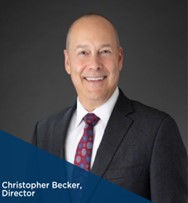
AGE:60 DIRECTOR SINCE: 2025 POSITION: Retired; Formerly President and Chief Executive Officer of The First of Long Island Corporation and its subsidiary bank, The First National Bank of Long Island
|
Christopher Becker Mr. Becker currently serves as our Vice Chairman. Mr. Becker was Director, President and Chief Executive Officer of The First of Long Island Corporation (FLIC) and its banking subsidiary, The First National Bank of Long Island (FNBLI) prior to the merger. Mr. Becker previously served as Chief Risk Officer of FLIC and FNBLI. He has over 35 years of experience in the banking industry. His experience includes serving as Chief Operating Officer and Chief Financial Officer of one Long Island, New York based bank, and Chief Financial Officer of a second Long Island, New York based bank. He also served as Director, President and Chief Executive Officer of a national bank in organization. Both his prior banking experience and ability to assist with the retention of FNBLI clients led our Board to conclude that Mr. Becker should join the Board and become Vice Chairman. |
|
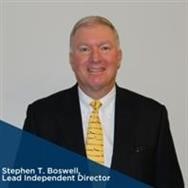
AGE:72 DIRECTOR SINCE: 2014 POSITION: Vice Chairman of the Board at Boswell Engineering, Inc.
|
Stephen T. Boswell Mr. Boswell is a founding organizer of the Bank. His firm, Boswell Engineering, Inc., where he currently serves as Vice Chairman of the Board and formerly served as the President and Chief Executive Officer from 1990-2023, is involved in many projects in our market. Through his business activities, Mr. Boswell has a strong sense of business conditions in our market that is invaluable to the Board. |
|
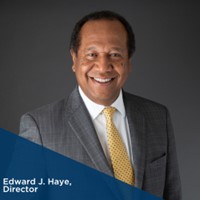
AGE:66 DIRECTOR SINCE: 2025 POSITION: Retired; formerly Partner at Cullen and Dykman LLP.
|
Edward J. Haye Mr. Haye has over 39 years of experience working for regulated companies and for law firms serving various regulated industries and government agencies. Mr. Haye formerly served as Chief Regulatory Counsel for American Water Works Company, Inc., the largest publicly traded water and wastewater utility company in the United States. Mr. Haye’s leadership responsibilities have included corporate governance, contract administration, affiliate transactions, intellectual property and labor and employment law. He currently serves or has served on the boards of various not-for-profit and community organizations. Mr. Haye’s experience in corporate governance, strategic planning, business leadership, corporate responsibility, legal and regulatory, real estate, and marketing and public relations led the Board to conclude that Mr. Haye should serve on the Board.
|
|
|
9 |
|

AGE:72 DIRECTOR SINCE: 2014 POSITION: Partner at Pashman Stein Walder Hayden P.C.
|
Frank Huttle III Mr. Huttle is a founding organizer of the Bank. Mr. Huttle is a partner at the law firm of Pashman Stein Walder Hayden P.C. Mr. Huttle also served as the Mayor of the City of Englewood, New Jersey until December 31, 2018. Prior to entering his legal practice in 1988, he was a Partner with Touche Ross & Co. Mr. Huttle also served as President of Hudson Capital Properties, a real estate management and investment company, and as Executive Vice President and General Counsel of Hudson Media Inc., a diversified magazine service and holding company. Mr. Huttle’s extensive experience in the insurance, mortgage banking and real estate industries provides valuable insight to the Board. |
|

AGE:68 DIRECTOR SINCE: 2014 POSITION: President & Chief Executive Officer, MWWPR
|
Michael Kempner Mr. Kempner is a founding organizer of the Bank. He has over 30 years of public relations and marketing experience and has served as President and Chief Executive Officer for MWWPR since 1985. His experience as the head of a locally based media company has proved invaluable to the Board. |
|
|
10 |
|

AGE: 57 DIRECTOR SINCE: 2023 POSITION: President of ConnectOne Bank
|
Elizabeth Magennis Ms. Magennis became President of the Bank in December of 2020, having previously served as the Bank’s Executive Vice President and Chief Lending Officer beginning in September of 2006, including service to Legacy ConnectOne prior to the Merger. Ms. Magennis also serves as a member of the Board of the Bank. As President of the Bank, Ms. Magennis provides extensive leadership and managerial experience to the Board, and her insight into the Bank’s operations is critical to the Board. |
|
AGE:70 DIRECTOR SINCE: 2009 POSITION: Managing Partner of Diversified Properties
|
Nicholas Minoia Nicholas Minoia is the Founding and Managing Partner of Diversified Properties. Founded in 2000, Mr. Minoia’s leadership has helped Diversified Properties and affiliated entities successfully create dozens of multifamily communities comprising over 10,000 units across NJ, NY, PA, MD and CT and manage an existing portfolio and development pipeline spanning several thousand residential units across multiple properties in three different states. Mr. Minoia’s experience as a principal of a full-service real estate group and his knowledge about the real estate market led the Board to conclude that Mr. Minoia should serve as a director. |
|
AGE: 46 DIRECTOR SINCE: 2021 POSITION: Attending Physician, Englewood Hospital Medical Center |
Anson M. Moise Dr. Moise is a physician, graduating from Cornell Medical College and board certified in both anesthesiology and pain management. Dr. Moise currently serves as a member of the Governing Board of the Health East Ambulatory Surgical Center and as an attending physician at several area hospitals. He also serves as the Chairman of YourDrs Inc., a telemedicine software company, and an owner of Health East Medical Alliance. He previously served as the Medical Director, Pain Specialists of New York & New Jersey. He is the co-founder of a substance abuse clinic, which helps those addicted to opioids and other illicit drugs. Dr. Moise is a long-time resident of our Bergen County market area, and is deeply committed to the community through his medical practice and affiliations with medical organizations and associations. In addition, his viewpoints and experiences will help the Board better ensure that the Company serves all communities in its trade area. These factors led the Nominating and Corporate Governance Committee to conclude that Dr. Moise would make a valuable contribution to the Board.
|
|
|
11 |
|
AGE: 57 DIRECTOR SINCE: 2018 POSITION: Co-founder of Nukk-Freeman & Cerra PC
|
Katherin Nukk-Freeman Ms. Nukk-Freeman is the co-founder of Nukk-Freeman & Cerra, P.C. a labor and employment law firm located in New York and New Jersey, as well as the co-founder of SHIFT HR Compliance Training. She has also served on the Board of Directors of the New York Society of Security Analysts (2010-2016), the Advisory Board of the Healthcare Businesswomen’s Association (2009 – 2019), as General Counsel to The Healthcare Marketing & Communications Council (2005 – 2009), on the Board of Trustees, Susan G. Komen Breast Cancer Foundation, Human Resources Committee (2004 – 2010), the Board of Trustees, The New Jersey Symphony Orchestra; Human Resources Committee (1999-2008) and the Board of Directors of the Commerce and Industry Association of New Jersey (2013 – 2016). Ms. Nukk-Freeman’s expertise in employment law, and best business practices in Human Resources and Diversity, Equity and Inclusion, coupled with her entrepreneurial undertakings, provides the Board with a unique and invaluable perspective.
|
|
AGE: 62 DIRECTOR SINCE: 2024 POSITION: Retired; Formerly Partner of Meridian Compensation Partners LLC
|
Susan O’Donnell Ms. O’Donnell has over 30 years’ experience as an executive and board compensation and governance expert, with the last 20 dedicated to serving the banking industry. Ms. O’Donnell was a Partner at Meridian Compensation Partners, LLC where she retired in 2023 after 10 years. She also led Pearl Meyer & Partners’ banking industry practice for 10 years. She has significant experience in the banking industry and served as a regular speaker and educator at association meetings and conferences. Susan’s expertise includes public company compensation and governance practices, shareholder engagement, investor/SEC perspectives and talent/human resources matters. Her board compensation and corporate governance experience and point of view make her a valuable addition to the Board.
|
|

AGE:70 DIRECTOR SINCE: 2025 POSITION: Retired; Formerly President of the American Stock Exchange
|
Peter Quick Mr. Quick has over 30 years of experience in the securities and financial services industries. Mr. Quick is a retired Partner of Burke and Quick Partners Holdings LLP, the parent company of Burke & Quick Partners LLC, a broker dealer. Mr. Quick was President of the American Stock Exchange from 2000 to 2005. Prior to joining the American Stock Exchange, he served as President of Quick & Reilly Inc., a Quick & Reilly subsidiary and a national discount brokerage firm. Mr. Quick’s experience in corporate governance, banking, strategic planning, business leadership, corporate responsibility, accounting and reporting, finance and investments, technology and cybersecurity, mergers and acquisitions, legal and regulatory, and real estate provide an important perspective to the Board.
|
|
|
12 |
|
AGE: 55 DIRECTOR SINCE: 2019 POSITION: Managing Partner of Rifkin & Company, LLP |
Daniel Rifkin Mr. Rifkin has been a certified public accountant since 1993 and, since 1999, has served as the Managing Partner of Rifkin & Company, LLP. Mr. Rifkin provides accounting services to both business enterprises and individuals, including tax planning, tax preparation, compilations, audits, and reviews. In addition, he serves as the President of Payserv Corporation, a payroll processing and human resource management company. Mr. Rifkin is a member of the American Institute of CPAs and the New York State Society of CPAs. Mr. Rifkin also serves as a trustee of Hackley School in Tarrytown, NY and St. Thomas Aquinas College in Sparkill, NY. Mr. Rifkin joined the Board of Directors in connection with the acquisition by the Company of Greater Hudson Bank, effective as of January 2, 2019. During his tenure at Greater Hudson Bank, he served as Vice Chairman from 2008 until its acquisition, and as Audit Committee Chairman for approximately five years. Mr. Rifkin’s expertise in accounting matters, and as the proprietor of locally owned businesses, provides him with a unique perspective valuable to the Company’s Board,
|
|
AGE: 62 DIRECTOR SINCE: 2020 POSITION: Mayor of Fort Lee, New Jersey
|
Mark Sokolich Mr. Sokolich is an attorney and the Managing Partner of the Law Office of Mark J. Sokolich, a real estate, zoning and commercial law firm in Fort Lee, New Jersey, which he co-founded. Mr. Sokolich has been the Mayor of Fort Lee since 2008 and formerly served on the Fort Lee City Council for two years. Mr. Sokolich’s experience as a Mayor with expertise in municipal, redevelopment and real estate law would enable him to provide a dynamic and valuable perspective to the Board. Mr. Sokolich joined the Board of Directors in connection with the acquisition by the Company of Bank of New Jersey, effective as of January 2, 2020.
|
No Director of the Company is also currently a director of a company having a class of securities registered under Section 12 of the Securities Exchange Act of 1934, as amended, or subject to the requirements of Section 15(d) of such Act or any company registered as an investment company under the Investment Company Act of 1940.
The Company encourages all directors to attend the Company’s annual meeting. Each member of the Company’s Board of Directors participated in the Company’s 2025 virtual Annual Meeting of Shareholders.

IN ORDER TO BE ELECTED TO A FULL TERM ON THE BOARD OF DIRECTORS, DIRECTORS MUST RECEIVE THE AFFIRMATIVE VOTE OF A MAJORITY OF THE SHARES VOTING AT THE ANNUAL MEETING. SEE “WHAT VOTE IS REQUIRED TO APPROVE EACH ITEM?” ABOVE.

THE BOARD OF DIRECTORS RECOMMENDS THAT THE SHAREHOLDERS VOTE “FOR” THE NOMINEES SET FORTH ABOVE.
|
|
13 |


The following table sets forth information as of March 31, 2026 regarding common stock and other equity securities of the Company beneficially owned by all Directors, executive officers described in the compensation table, and by all Directors, nominees to the Board and executive officers as a group, and by shareholders known to the Company to own at least 5% of the Company’s issued and outstanding shares of common stock. Beneficial ownership includes shares, if any, held in the name of the spouse, minor children or other relatives of the nominee living in such person’s home, as well as shares, if any, held in the name of another person under an arrangement whereby the Director or executive officer can vest title in himself at once or within sixty (60) days. Beneficially owned shares also include shares over which the named person has sole or shared voting or investment power, shares owned by corporations controlled by the named person, and shares owned by a partnership in which the named person is a partner.
|
Shares of |
|||
|
Common Stock |
Percentage |
||
|
Directors and Nominees |
|||
|
Frank Sorrentino III |
819,555 (1) |
1.63 |
% |
|
Frank Baier |
107,714 |
0.21 |
|
|
Christopher Becker |
57,240(2) |
0.11 |
|
|
Stephen T. Boswell |
353,143(3) |
0.70 |
|
|
Edward J. Haye |
14,232 |
0.03 |
|
|
Frank Huttle III |
174,221(4) |
0.35 |
|
|
Michael Kempner |
216,447(5) |
0.43 |
|
|
Elizabeth Magennis |
122,458 |
0.24 |
|
|
Nicholas Minoia |
69,760(6) |
0.14 |
|
|
Anson Moise |
13,611 |
0.03 |
|
|
Katherin Nukk-Freeman |
25,042(7) |
0.05 |
|
|
Peter Quick |
38,627(8) |
0.08 |
|
|
Daniel Rifkin |
221,109(9) |
0.44 |
|
|
Mark Sokolich |
111,401 |
0.22 |
|
|
Susan O’Donell |
8,553 |
0.02 |
|
|
Executive Officers Who Are Not Directors or Nominees |
|||
|
William S. Burns |
117,781 |
0.23 |
|
|
Laura Criscione |
98,722(10) |
0.20 |
|
|
Joseph Javitz |
13,327 |
0.03 |
|
|
Directors and Executive Officers As a Group (15 persons) |
2,639,414 |
5.24 |
|
|
5% Shareholders |
|||
|
Black Rock |
4,953,097(11) |
9.85 |
|
|
FMR LLC |
3,170,841(12) |
6.31 |
|
|
Dimensional Fund Advisers LP |
2,924,756(13) |
5.82 |
|
|
The Vanguard Group, Inc. |
2,914,268(14) |
5.80 |
|
|
Wellington Management Company, LLP |
2,882,584(15) |
5.73 |
|
|
|
14 |
|
(1) |
Includes 46,925 shares held in the name of Morgan Stanley f/b/o Frank Sorrentino III, IRA, 263,773 shares held in a trust for which Mr. Sorrentino’s spouse serves as trustee, and 416 shares held by Mr. Sorrentino’s spouse in her IRA Account. |
| (2) |
Includes 3,408 shares held in Mr. Becker’s IRA |
|
(3) |
Includes 272,563 shares held by an irrevocable trust for benefit of Mr. Boswell (of which the reporting person's spouse, adult daughter and unrelated third person are trustees), and to which Mr. Boswell has no economic interest. |
|
(4) |
Includes (i) 37,666 shares held in the name of Morgan Stanley f/b/o Frank Huttle III, IRA, and (ii) 78,724 shares held in the name of Mr. Huttle’s spouse, (v) 6,500 shares held by an LLC in which spouse is a member. |
|
(5) |
Includes 196,005 common shares pledged as collateral for a loan. |
|
(6) |
Includes 1,056 shares owned jointly an unaffiliated third-party. |
|
(7) |
Includes (i) 2,500 shares held jointly with spouse and (ii) 2,431 shares held by Ms. Nukk-Freeman's spouse in his IRA Account. |
|
(8) |
Includes 7,762 shares held by a limited liability company controlled by Mr. Quick and 258 shares held in a trust. |
|
(9) |
Includes (i) 16,194 shares held in the name of Charles Schwab f/b/o Daniel Rifkin IRA, (ii) 155,000 shares held by a trust for the benefit of Mr. Rifkin’s spouse, for which he serves as trustee, and (iii) 16,856 shares held in the name of Charles Schwab f/b/o Sheila Rifkin IRA. |
| (10) |
Includes 780 shares held as custodian for Ms. Criscione’s daughter |
|
(11) |
All information regarding the number of shares beneficially owned and the percent of ownership by BlackRock, Inc., was obtained from the 13F filed with the U.S. Securities and Exchange Commission on January 31, 2026. The address of BlackRock, Inc. is 50 Hudson Yards, New York, NY 10001. |
|
(12) |
All information regarding the number of shares beneficially owned and the percent of ownership by FMR LLC, was obtained from the 13F filed with the U.S. Securities and Exchange Commission on September 30, 2025. The address of Dimensional Fund Advisors, LP is 245 Summer Street, Boston, Massachusetts 02210. |
|
(13) |
All information regarding the number of shares beneficially owned and the percent of ownership by Dimensional Fund Advisors, LP, was obtained from the 13F filed with the U.S. Securities and Exchange Commission on December 31, 2025. The address of Dimensional Fund Advisors, LP is Building One, 6300 Bee Cave Road, Austin, Texas, 78746. |
| (14) |
All information regarding the number of shares beneficially owned and the percent of ownership by The Vanguard Group, Inc. was obtained from the 13F filed with the U.S. Securities and Exchange Commission on December 31, 2025. The address of The Vanguard Group, Inc. is 100 Vanguard Blvd., Malvern, PA 19355. |
|
(15) |
All information regarding the number of shares beneficially owned and the percentage of ownership by Wellinton Management Company, LLP was obtained from the 13F filed with the U.S. Securities and Exchange Commission on September 30, 2025. The address of Wellington Management Company, LLP is 280 Congress Street, Boston, MA 02210. |
There are no shareholders other than those set forth above who are known to the Company to beneficially own 5% or more of the Common Stock of the Company.
The Company considers it inappropriate for any director or officer to enter into speculative transactions in the Company’s securities to attempt to separate the economic risk of holding the Company’s securities from the ownership of the securities. The Company has
|
|
15 |

The Board of Directors held a total of eleven (11) meetings in the year ended December 31, 2025. The Company’s policy is that all Directors make every effort to attend each meeting. For the year ended December 31, 2025, each of the Company’s Directors attended at least 75% of the aggregate number of meetings of the Board of Directors and Board committees on which the respective Directors served.
A majority of the Board consists of individuals who are “independent” under the NASDAQ listing standards. In making this determination the Board has considered the following:
|
● |
The Company and the Bank have used Mr. Kempner’s firm, MWW Group, to provide advertising and public relations assistance and advice. The Board considered, among other factors, the fees paid to MWW Group as a percentage of the firm’s total revenue (less than 1%) and Mr. Kempner’s personal income and determined that the engagement of MWW Group did not interfere with Mr. Kempner’s exercise of independent judgment in carrying out the responsibilities of a director. |
|
● |
Several directors, including Messrs. Boswell, Huttle, and Kempner, each own a direct or indirect interest in a limited liability company which acts as a landlord for one of the Bank’s branches, See – CERTAIN RELATIONSHIPS AND RELATED TRANSACTIONS. The Board has further considered the fact that (i) Director Minoia owns an interest in an entity which owns the Bank’s Summit branch, and (ii) Director Rifkin owns an interest in (x) an entity which owns the Bank’s Bardonia, New York branch, and (y) an entity which owns the Bank’s former Blauvelt, New York branch. The Board has concluded that based on their interest in the rental payments compared to their overall net worth and cash, membership in such limited liability companies does not interfere with their exercise of independent judgment in carrying out the responsibilities of a director. |
Mr. Sorrentino, who serves as the Chairman and Chief Executive Officer, and Ms. Magennis, who serves as Bank President, are not independent. Shareholders wishing to communicate directly with the independent members of the Board of Directors may send correspondence to:
ConnectOne Bancorp, Inc.,
ATTN: Stephen T. Boswell, Lead Independent Director
301 Sylvan Avenue
Englewood Cliffs, New Jersey 07632

The Company periodically reviews its corporate governance policies and procedures to ensure that the Company meets the highest standards of ethical conduct, reports results with accuracy and transparency, and maintains full compliance with the laws, rules and regulations that govern the Company’s operations. As part of this periodic corporate governance review, the Board of Directors reviews and adopts corporate governance policies and best practices for the Company. The board has formally adopted corporate governance guidelines and they are available at https://ir.connectonebank.com/.
The Board of Directors has adopted a Code of Ethics governing our Chief Executive Officer and senior financial and accounting officers, as required by the Sarbanes-Oxley Act and SEC regulations, as well as the Board of Directors and other senior members of management. Our Code of Ethics governs such matters as conflicts of interest, use of corporate opportunity, confidentiality, compliance with law and the like. Our Code of Ethics is available on our website at https://www.connectonebank.com/ under “About”, then “Shareholders”, then “Documents and Notifications.”
|
|
16 |


Our Board of Directors frequently conducts business through committees. Our most significant committees are the Audit Committee, the Risk Committee, the Nominating and Corporate Governance Committee and the Compensation Committee. The table below sets forth the membership of these committees during 2025:
|
Audit Committee |
Risk Committee |
Nominating and Corporate Governance Committee |
Compensation Committee |
|
Frank Baier (Chairman) |
Christopher Becker (Chairman) |
Frank Huttle III (Chairman) |
Stephen T. Boswell (Chairman) |
|
Stephen T. Boswell |
Frank Baier |
Nicholas Minoia |
Katherin Nukk-Freeman |
|
Frank Huttle III |
Edward Haye |
Katherin Nukk-Freeman |
Susan O’Donnell |
|
Nicholas Minoia |
Frank Huttle |
Anson Moise |
|
|
Daniel Rifkin |
Mark Sokolich |
Susan O’Donnell |

We maintain an Audit Committee in accordance with Section 3(a)(58)(A) of the Securities Exchange Act of 1934. The Audit Committee is responsible for the selection of the independent registered public accounting firm for the annual audit and to establish, and oversee the adherence to, a system of internal controls. The Audit Committee reviews and accepts the reports of our independent auditors and regulatory examiners. The Audit Committee arranges for an annual audit through its registered independent public accounting firm, evaluates and implements the recommendations of the auditors as well as interim audits performed by our outsourced internal auditors, receives all reports of examination by bank regulatory agencies, analyzes such regulatory reports, and reports to the Board the results of its analysis of the regulatory reports. The Audit Committee met six (6) times during 2025. The Board of Directors has adopted a written charter for the Audit Committee which is available on our website at https://www.connectonebank.com. The Board has determined that Frank W. Baier, the Chairman of the Audit and Risk Committee, qualifies as an “audit committee financial expert” under the Rules and Regulations of the Securities and Exchange Commission.

All members of the Audit Committee are “independent” under the NASDAQ listing standards, meet the independence standards of the Sarbanes-Oxley Act for service on an audit committee, and are financially literate and can read and understand financial statements, as required by the Audit Committee charter.
|
|
17 |

The Audit Committee meets periodically to consider the adequacy of the Company’s financial controls and the objectivity of its financial reporting. The Audit Committee meets with the Company’s independent auditors and the Company’s internal auditors, and the Company’s Chief Internal Auditor, all of whom have unrestricted access to the Audit Committee.
In connection with this year’s financial statements, the Audit Committee has reviewed and discussed the Company’s audited financial statements with the Company’s officers and Crowe LLP, our independent auditors. The Audit Committee has discussed with Crowe LLP, the matters required to be discussed by Statement on Auditing Standards No. 61, (“Communication with Audit Committees”). We also have received the written disclosures and letters from Crowe LLP required by Independence Standards Board Standard No. 1 (“Independence Discussions with Audit Committees”) and have discussed with representatives of Crowe LLP their independence.
Based on these reviews and discussions, the Audit Committee recommended to the Board of Directors that the audited financial statements be included in the Company’s Annual Report on Form 10-K for the fiscal year 2025 for filing with the U.S. Securities and Exchange Commission.

The board maintains a Risk Committee to assist the Board of Directors in identifying, evaluating and establishing policies for management to utilize in managing the risk profile inherent in, and associated with, the Company’s strategy and business plans and in its oversight of the Company’s enterprise risk management framework, including the Company’s risk appetite statement, risk tolerance levels and limits. During 2025, our Risk Committee consisted of Christopher Becker, Stephen T. Boswell, Edward J. Haye, Frank Huttle, and Mark Sokolich. The Board has defined the duties of the Risk Committee in its written charter. A copy of the current Risk Committee charter is available on the Company’s website at https://www.connectonebank.com/ under “For Shareholders” and then under “Documents and Notifications.”

The board maintains a Compensation Committee to oversee executive compensation for the Company. During 2025, our Compensation Committee consisted of Stephen T. Boswell, Katherin Nukk-Freeman, and Susan O’Donnell. The Board has defined the duties of its Compensation Committee in a charter. A copy of the current Compensation Committee charter is available on the Company’s website at https://www.connectonebank.com/ under “For Shareholders” and then under “Documents and Notifications.”

The Compensation Committee is responsible for administering the Company’s equity compensation plans, for establishing the compensation of the Company’s “Senior Executive Officers” (which include the Company’s CEO, Bank President, Chief Financial Officer and each employee with a title of Executive Vice President or more senior) and for the Board of Directors. The Compensation Committee also establishes policies and monitors compensation for the Company’s employees in general. While the Compensation Committee may, and does in fact, delegate authority with respect to the compensation of employees in general, the Compensation Committee retains overall supervisory responsibility for employee compensation. With respect to executive compensation, the Compensation Committee receives recommendations and information from senior staff members, as well as outside compensation consultants, regarding issues relevant to determinations made by the Compensation Committee. Mr. Sorrentino participates in Committee deliberations regarding the compensation of other executive officers but does not participate in deliberations regarding his own compensation.

The Committee is comprised solely of independent directors.
|
|
18 |

The Compensation Committee recognizes that it is essential to receive objective advice from an outside compensation consultant. Currently, the Compensation Committee utilizes Meridian Compensation Partners, LLC (“Meridian”) as its independent compensation consultant. Meridian reports directly to the Compensation Committee and attends meetings as requested. The Compensation Committee has assessed Meridian’s independence relative to the NASDAQ listing rules and determined that there are no conflicts of interest. The Compensation Committee also closely examines the safeguards and steps Meridian takes to ensure that its executive compensation consulting services are objective. The Compensation Committee takes into consideration that:
|
● |
the Compensation Committee directly hired and has the authority to terminate Meridian’s engagement; |
|
● |
the Compensation Committee solely determined the terms and conditions of Meridian’s engagement, including the fees charged; |
|
● |
Meridian and its consultants have direct access to members of the Compensation Committee during and between meetings; |
|
● |
Meridian does not provide any other services to the Company, the Bank, its directors or executives; and |
|
● |
interactions between Meridian and its consultants and management generally are limited to discussions on behalf of the Compensation Committee and information presented to the Compensation Committee for approval. |

The board maintains a Nominating and Corporate Governance Committee. During 2025 the member of the Committee were Frank Huttle III, Nicholas Minoia, Anson Moise, Katherine Nukk- Freeman and Susan O’Donnell.

All members of the Nominating and Corporate Governance Committee of the Board have been determined to be “independent directors” pursuant to the definition contained in NASDAQ Rule 5605.

The Nominating and Corporate Governance Committee charter describes procedures for nominations to be submitted by shareholders and other third-parties, other than for candidates who have previously served on the Board or who are recommended by the Board. The Company’s bylaws state that a nomination must be delivered to the Company’s Corporate Secretary at the principal executive offices of the Company not later than the close of business on the 50th day or no earlier than the close of business on the 75th day prior to the anniversary of the preceding year’s annual meeting; provided, however, that if less than 60 days’ notice or prior public disclosure of the date of the meeting is given or made to stockholders, notice by the stockholder to be timely must be so received not later than the close of business on the 10th day following the day on which such notice of the date of the meeting was mailed or such public disclosure was made, whichever first occurs. The public announcement of an adjournment or postponement of an annual meeting will not commence a new time period (or extend any time period) for the giving of a notice as described above. The bylaws require a nomination notice to set forth as to each person whom the proponent proposes to nominate for election as a director: (a) all information relating to such person that is required to be disclosed in solicitations of proxies for election of directors in an election contest, or is otherwise required, in each case pursuant to Schedule 14A under the Securities Exchange Act of 1934, as amended (including such person’s written consent to being named in the proxy statement as a nominee and to serving as a director it elected), and (b) information that will enable the Nominating Committee to determine whether the candidate or candidates satisfy the criteria established pursuant to the charter for director candidates.
|
|
19 |

In connection with the 2025 annual meeting, the Nominating and Corporate Governance Committee did not receive any nominations from any shareholder or group of shareholders that owned more than 5% of common stock for at least one year.

There are no compensation committee “interlocks,” which generally means that no executive officer of the Company or the Bank served as a director or member of the compensation committee of another entity, one of whose executive officers serves as a director or member of the Compensation Committee of the Company.

Frank Sorrentino III, the Company’s President and CEO, also serves as Chairman. The Board believes that the combination of these two roles at this time provides the benefit of more consistent communication and coordination throughout the organization. This, in turn, will result in a more effective and efficient implementation of corporate strategy and is important in unifying the Company’s strategy behind a single vision.
Our Board has also appointed Mr. Stephen T. Boswell, an independent director, to serve as Lead Independent Director of the Board. As Lead Independent Director, Mr. Boswell is charged with presiding over all Board meetings when the Chairman is not present and presides over meetings of the non-management directors held in executive session. The Lead Independent Director has the responsibility of meeting and consulting with the Chairman and Chief Executive Officer on Board and committee meeting agendas, acting as a liaison between management and the non-management directors, including maintaining frequent contact with the Chairman and Chief Executive and advising him on the efficiency of the Board meetings, and facilitating teamwork and communication between the non-management directors and management.
|
|
20 |

Although the NJBCA provides that elections to the Board of Directors are approved under a plurality voting standard, the Company’s has adopted a “majority voting” standard in uncontested elections in its bylaws. Pursuant thereto, each director has delivered to the Board an irrevocable resignation, which shall become effective in the event that, in an uncontested election, such director receives fewer “for” votes than “against” or “withhold” votes. Such resignation shall become effective upon (i) the selection of a replacement director, or (ii) 90 days after certification of such stockholder vote. The Board believes that this strategy best places ultimate authority of Board composition in the hands of the Company’s shareholders.


Risk is an inherent part of the business of banking. Financial risks faced by the Bank include credit risk relating to its loans liquidity risk and interest rate risk as it pertains to its entire balance sheet. The Bank is also exposed to non-financial risks relating to its operations, personnel, and regulatory environment, as well as extraneous risks surrounding regional and global socioeconomic conditions. The Board of Directors oversees these risks through the adoption of policies and by delegating oversight to certain committees, such as the Risk Committee, which was formed in 2025 as a separate committee and which is charged with the responsibility to oversee and manage the risk profile of the Bank, and through our Chief Risk Officer. This is accomplished through risk assessments, periodic committee meetings, and reporting from risk owners and control functions. Other committees focus on risks arising from specific Company activities, including the Loan and Asset/Liability Committees of the Bank. These committees exercise oversight by establishing a corporate environment that promotes timely and effective disclosure, fiscal accountability and compliance with all applicable laws and regulations.

Cybersecurity risk is initially overseen at ConnectOne by the management IT Committee (the “ITC”). The members of this committee include, as chair, the Chief Compliance Officer. Additional members are our Information Security Officer, Chief Risk Officer, Chairman & Chief Executive Officer, Chief Digital Officer and Chief Brand and Innovation Officer.
In order to ensure that cybersecurity risk management is integrated into the Company’s overall risk management plans, systems and processes, members of the ITC, along with other lines of business heads, report to the management Enterprise Risk Management Committee (the “ERMC”), which in turn reports to the Board Risk Committee quarterly. The ERMC consists of the Company’s Chief Risk Officer, Chairman & CEO, President, Chief Financial Officer, Treasurer/Chief Corporate Development Officer, Chief Compliance Officer, General Counsel and Chief Credit Officer.
The Company’s cybersecurity risk mitigation program involves a combination of internal resources and the use of third parties. The Company’s internal IT team performs monthly vulnerability scanning and performs an annual risk assessment based on the National Institute of Standards and Technology Cybersecurity Framework. The results are reported to the ITC. The Company’s IT and compliance staff also review potential cybersecurity threats associated with the Company’s third-party vendors, including performing a review of and obtaining a System of Organization Controls report from all vendors rated as “high risk” by the Company’s internal vendor management program. The Company also has an internal Incident Response Plan and Team, which is charged with overseeing the Company’s response to any cybersecurity incident. The team performs a table-top exercise at least annually to prepare to respond in the event of any actual cybersecurity incident.
|
|
21 |
In addition to these internal resources, the Company uses a third-party vendor to undertake annual penetration and vulnerability testing, with the results reported to the ITC. Finally, the Company’s cybersecurity compliance program is audited by the Bank’s outsourced internal auditor annually.

The Company believes it is both socially important, and good business, to conduct its business in a manner that provides a return to its shareholders and contributes to the well-being of its customers, employees, and the communities it serves.
As part of its commitment to being a good corporate citizen, the Board has charged the Nominating and Corporate Governance Committee to oversee the Company’s stewardship and sustainability planning and initiatives. In assigning oversight of these matters to the Nominating and Corporate Governance Committee, the Board sought to ensure that the Board would have direct involvement and supervision of these matters.
Set forth below are some representative examples of the Company’s stewardship, citizenship and sustainability efforts so far:

|
● |
We encourage employee volunteerism to support causes throughout the Bank’s footprint. In 2025, Bank employees donated 1,323 hours in volunteer work both through individual and Bank-organized activities. |
|
● |
We encourage and support financial literacy programs, providing education to approximately 1,400 students and seniors in Palm Beach County, Florida, Bergen County New Jersey and Orange and Westchester Counties, New York during 2025. |
|
● |
We actively contribute to charitable causes in the communities we serve. During 2025 we contributed more than $850,000 to 381 different charitable organizations and schools. |
|
● |
We maintain clear policies prohibiting discrimination in lending based on gender, race or national origin. Our antidiscrimination policies can be found on our website at https://ir.connectonebank.com/. |
|
● |
To provide greater access to our services, we provide digital, mobile and online banking services and continue to make investments in these areas to further enhance these services. |
|
● |
Our Federal regulators have assigned us a Community Reinvestment Act rating of Satisfactory. |
|
|
22 |

The Company believes that creating a positive work environment for its employees is critical to our success and our ability to serve our clients and generate a return for our shareholders. We encourage and support the growth and development of our employees and, wherever possible, seek to fill positions by promotion and transfer from within the organization. We have formalized our commitment to training, education and mentoring through our ConnectOne University program.

ConnectOne University houses our training, leadership development, continuing education and mentorship programs reflecting our culture of continuous learning. Through ConnectOne University, employees:
|
● |
Receive and complete required job training related to their position with the Company, such as compliance training and position specific training. Classes include an ABA approved curriculum as well as other third party and Company proprietary courses; |
|
● |
May take classes to attain job specific certifications to help with career development; |
|
● |
May take continuing education classes related to other positions and operations at the Company; |
|
● |
May take business related continuing education classes at partner community colleges and other institutions; |
|
● |
May participate in career mentoring programs in which employees meet with senior officers of the Company to discuss career development; and |
|
● |
May participate in a tuition reimbursement program under which the Company will reimburse employees for up to $5,250 in tuition expense related to approved business-related course work at any school. |
During 2025, 210 employees participated in our leadership and mentoring programs within ConnectOne University.
Through ConnectOne University, we also sponsor two employees each year to attend the Stonier Graduate School of Banking. This is a competitive process requiring an employee to be nominated by the employee’s manager and then participate in a panel interview.
|
● |
We offer our employees a full benefits program, including health insurance, flexible spending accounts, a 401(k) plan with the Company matching employee contributions up to 5.0% of the employee’s compensation or $17,250, whichever is lower, and an employee discount program under which our employees get discounts at various retailers and service providers. |
|
● |
We solicit employee feedback through the ConnectOne Bank Annual Culture Survey, the results of which are reviewed by our senior management team to identify and implement strategic action items. In 2025, we achieved a high level of engagement with approximately 94% of our workforce participating in the survey. |
|
|
23 |

|
● |
As discussed above, our Nominating and Corporate Governance Committee of our Board of Directors has been appointed to oversee the Company’s sustainability initiatives. |
|
● |
We maintain, through an independent third party, a whistleblower hotline that is available seven days a week, 24 hours a day, and that permits employees to anonymously report concerns and we have policies prohibiting retaliation against any employee raising a good faith concern. |
|
● |
We maintain a detailed code of ethics, which includes provisions on conflicts of interest, and which is available on our website at https://ir.connectonebank.com, as well as detailed policies prohibiting money laundering, bribery and other corrupt practices. |
|
● |
Our Board takes an active role in our cybersecurity risk program, and we maintain a cybersecurity training program for our employees and members of our Board – See “Risk Oversight”. |
|
|
24 |

The Compensation Committee (the “Committee”) and the Company are both committed to a pay-for-performance philosophy. This Compensation Discussion & Analysis (“CD&A”) provides information about the strategies and policies developed to ensure that executive compensation is strongly correlated with the Company’s overall performance and the individual performance of our executives. Our Named Executive Officers (“NEOs”) for 2025 were:
Frank Sorrentino III; Chairman, President & Chief Executive Officer
William S. Burns: Senior Executive Vice President & Chief Financial Officer
Elizabeth Magennis: ConnectOne Bank President
Joseph Javitz: Executive Vice President and Chief Credit Officer
Laura Criscione: Executive Vice President and Chief Compliance Officer


2025 Financial Highlights– A Successful & Transformative Year
Fiscal year 2025 was a transition year for the banking industry, as the new administration began scaling back certain regulatory burdens on the banking industry and the Federal Reserve cut interest rates three times, for a total reduction of 75 basis points, during the year. The year was also transformational for the Company, as it completed its merger with The First of Long Island Corporation in June of 2025, adding an additional 36 offices to our branch network and seamlessly integrating the two banks, while completing a full systems conversion within two weeks of closing. During 2025, and primarily as a result of the merger, our total assets increased by 41.1%, propelling the Company beyond the $10 billion asset level to more than $14 billion in assets, while total loans increased by 38.6% and total deposits increased by 43.6%. For the full year 2025, our net income available to common shareholders increased by 9.7% over 2024, and for the fourth quarter of 2025 our net income available to common shareholders increased by 101.1% compared to the fourth quarter of 2024.
We additionally strengthened our financial performance metrics in the following ways:
|
● |
Our net interest margin improved each quarter, reaching 3.27% during the fourth quarter and widening by 41 basis points from 2.86% for the fourth quarter of 2024. |
|
● |
During the year, noninterest-bearing demand deposits as a percent of total deposits increased from 17% to more than 21% while brokered deposits declined from 12% of total assets to just 6% at year-end |
|
● |
Our liquidity position improved reflecting an improved loan-to-deposit ratio, which declined to 101.9% from 105.8% at year-end 2025 |
|
● |
Our credit quality remained solid, as non-performing assets declined from $57.3 million at December 31, 2024 to $45.9 million at December 31, 2025, and our percentage of non-accrual loans to total loans receivable declined to 0.40% at year-end 2025 from 0.69% at year-end 2024 |
| ● | For the fourth quarter of 2025, we delivered a strong quarterly operating Return on Assets (ROA) of 1.24% and a Return on Tangible Common Equity (ROTCE) of 14.3%. |
|
|
25 |
2025 Compensation Decisions in Support of our Pay for Performance Philosophy
Our executive compensation program, practices and pay decisions are designed to be directly aligned with shareholders through rigorous stock ownership guidelines and equity based long-term incentives. As a result of their ownership, our executive team is better rewarded when our stockholders see greater returns, and rewarded less when returns are not strong.
Our Compensation Approach
Our long-range mission is to produce value for our shareholders by providing outstanding service and responsiveness to the markets and clients we serve. These goals are reflected in the Company’s compensation programs for its executive officers by:
|
● |
Paying for performance through the use of a quantitative cash short-term incentive program and an equity-based long-term incentive program, with 55% of long term awards to our CEO, Bank President, and CFO (and 50% of the awards to our other NEO’s) being performance-based, and therefore directly aligned with shareholder value creation. In addition, we set stretch goals for our annual cash incentive plan and our performance-based shares vest at target only when we exceed 55th percentile performance; |
|
● |
Ensuring that our key NEOs maintain and hold a significant equity interest in the Company, thereby further aligning management interests with those of the shareholders, by making a significant portion of incentive compensation payable in Company stock and through robust stock ownership guidelines; |
|
● |
Creating balanced incentives that do not encourage NEOs to expose the Company to inappropriate risks by providing excessive compensation that could lead to material loss; |
|
● |
Providing a market-competitive overall compensation package so that the Company may attract, retain and reward highly qualified, motivated and productive executives; and |
|
● |
Rewarding individuals based on their responsibility and achievements within a framework that is internally equitable. |
Performance-Based Compensation
A significant portion of our compensation program focuses on performance-based pay that rewards our achievements on an annual basis as well as our ability to deliver long-term value to our stockholders. We have a balanced approach to total compensation that includes a mix of base/fixed pay and variable/performance-based pay, a proportion of cash and equity and a proportion of short- and long-term incentive compensation. For the fiscal year 2025, our compensation targets and pay mix (targeting market median) are shown below and represent our goal to provide a significant portion of target pay that is at-risk and based on performance (69% for CEO and 51% for other NEOs).
For 2025, 55% of our equity share grants for our CEO, Bank President, and CFO will vest only if predetermined 3-year performance goals are achieved. For other NEOs and EVPs, the mix is 50% performance and 50% time vested.
|
CEO Target Pay Mix |
Other NEOs Target Pay Mix (1) |
|
|
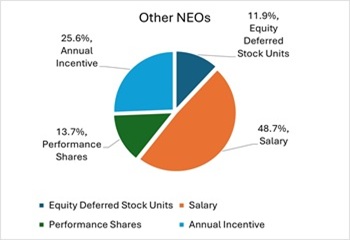 |
|
(1) |
Weighted average of the named executive officers other than the CEO. |
A meaningful portion of target pay is denominated as equity (39% for CEO and 26% for other NEOs).
|
|
26 |

The design principles of our executive compensation programs are intended to protect and promote the interests of our stockholders which include rewarding performance and mitigating risk. Below we summarize key features of our executive compensation program:
What We Do:
Pay for Performance. We provide a significant portion of pay based on performance (short- and long-term incentives, and performance-based equity).
Sound Risk Management. We discourage excessive risk taking and have designed our incentive plans with appropriate risk-mitigating features, as well as the ability of the Committee to negatively adjust payouts.
Caps on Incentives. We subject both short- and long-term incentive payments to caps.
Clawback. We have adopted a clawback policy meeting all NASDAQ requirements requiring the return of incentive compensation in the event of a financial restatement.
Stock Ownership Guidelines. We require our executives and directors to own and hold significant shares in our Company.
Double-Trigger Change-in-Control (“CIC”). CIC benefits pursuant to employment or change-in-control agreements are only paid upon a termination event following a CIC.
Independence. The Committee engages an independent compensation consultant.
Competitive Benchmarking. The Committee engages an independent consultant to benchmark our compensation practices regularly to ensure executive compensation is consistent with market and best practices.
Vesting Requirements. Awards of deferred stock units and performance shares are made subject to vesting requirements, generally three years, to encourage retention of our high performing employees.
What We Don’t Do:
Tax Gross-Ups. We do not provide excise tax gross-ups on benefits or in change-in-control agreements.
Stock Option Repricing. Our equity plans do not permit repricing of stock options that are out-of-the-money.
Excessive Perquisites. We do not provide excessive perquisites for our executives and only have limited benefits that are business-related.
Dividends on Unvested Stock Awards. We do not pay dividends or dividend equivalents on unearned performance units or deferred stock units.
Hedging/Pledging. Our insider trading policy prohibits the purchase or sale of puts, calls, options, or other derivative securities based on the Company’s securities. This prohibition also includes hedging or monetization transactions, such as forward sale contracts, in which the stockholder continues to own the underlying security without all the risks or rewards of ownership. The policy also prohibits our directors and executive officers from pledging Company stock as collateral for a loan or otherwise (although pledges in effect on the date the policy was amended, November 23, 2021, to prohibit pledging were grandfathered and allowed to remain in place).
Say on Pay/Say on Frequency
The Company solicited a shareholder advisory vote on executive compensation in 2025, which received approval of 84.1% of the shares voted. Our shareholders have annually provided an advisory vote on executive compensation, which our Compensation Committee reviews and considers each year. While the say on pay vote is a formal means of soliciting shareholder feedback, the Company welcomes the opportunity to engage directly with shareholders at any time.
|
|
27 |

We use our executive compensation programs to align the interests of executive officers with our shareholders. Our programs are designed to attract, retain and motivate leadership to support our growth and sustain our competitive advantage. Our compensation opportunities are aligned with the competitive market with actual pay that is designed to vary, dependent on performance. We utilize a balance of fixed and variable pay components, cash and equity, and short- and long-term performance horizons to determine our pay. Our compensation program is designed to support our business strategies, align our pay with our performance and reinforce sound compensation governance to mitigate excessive risk taking. The Compensation Committee reviews compensation levels each year based on market benchmarking with the goal of retaining a competitive position with the market as the Company continues to grow. The Committee considers the benchmark data provided by its consultant as well as each executive’s performance, experience and any unique contributions as appropriate. The below gives an overview of the compensation components used in our program and matches each with one or more of the objectives described above.
Base Salary
|
● |
Provides a competitive level of fixed income based on role, experience and individual performance. |
Annual Incentive Plan
|
● |
Motivates and rewards executives for performance on key financial, operational and individual objectives in support of our annual business plan and broader corporate strategies. |
|
● |
Rewards vary based on performance (higher performance will result in above market median pay; lower performance will result in below market median pay). |
Long-Term Incentive Plan
|
● |
Aligns executives’ interests with those of shareholders through equity-based compensation and performance-contingent awards. |
|
● |
Rewards executives for long-term shareholder value creation. |
|
● |
Encourages retention through multiple year vesting. |
|
● |
Motivates and rewards executives for performance – vesting and value is tied to achievement of specific performance and/or stock price appreciation. |
Other Benefits
|
● |
Provides a base level of competitive benefits for executive talent. |
Employment Agreements/Severance & CIC Agreements
|
● |
Provides employment security to key executives. |
|
● |
Focuses executives on company performance and transactions that are in the best interests of shareholders, regardless of the impact such transactions may have on the executive’s employment. |
|
|
28 |

Base Salary
The Compensation Committee reviews salaries each year based on the market benchmarking with the goal of retaining a competitive position with the market as the Company continues to grow. The Committee considers the benchmark data provided by its consultant as well as each executive’s performance, experience and any unique contributions as appropriate. The table below summarizes 2025 salaries and the increase year over year:
|
Executive |
2024 Base Salary |
2025 Base Salary |
% Increase |
|||||||||
|
Frank Sorrentino III |
$ | 972,000 | $ | 992,000 | 2.1 | % | ||||||
|
William S. Burns |
502,000 | 517,000 | 3.0 | |||||||||
|
Elizabeth Magennis |
540,000 | 585,000 | 8.3 | |||||||||
|
Joseph Javitz |
380,000 | 395,000 | 3.9 | |||||||||
|
Laura Criscione |
365,000 | 380,000 | 4.1 | |||||||||
In early 2026, based on updated benchmarking information provided by the Committee’s consultant, and in line with our significant asset growth (41%), the Compensation Committee approved the following base salaries for 2025 and the increase year over year:
|
Executive |
2026 Base Salary |
% Increase From 2025 |
||||||
|
Frank Sorrentino III |
$ | 1,042,000 | 5.0 | % | ||||
|
William S. Burns |
543,000 | 5.0 | ||||||
|
Elizabeth Magennis |
615,000 | 5.1 | ||||||
|
Joseph Javitz |
410,000 | 3.8 | ||||||
|
Laura Criscione |
395,000 | 3.9 | ||||||

The Compensation Committee periodically conducts comprehensive benchmark reviews. The peer group approved by the Committee in November 2024 resulting benchmark data continued to be used to assess and set 2025 compensation levels. Peer banks consisted of publicly traded Northeast and Mid-Atlantic, Connecticut, Massachusetts, and Rhode Island bank holding companies with a total asset range of $8.1 billion to $26.4 billion, with a median that approximated the Company’s assets at the time of selection. Below is a list of the 2025 peer group companies.
|
2025 Peer Group |
|
| Ameris Bancorp |
Flushing Financial Corporation |
|
Brookline Bancorp, Inc.* |
Independent Bank Corp. |
|
Columbia Financial, Inc. |
OceanFirst Financial Services, Inc. |
|
Community Financial System, Inc. |
Provident Financial Services, Inc. |
|
Customers Bancorp, Inc. |
S&T Bancorp, Inc. |
|
Dime Community Bancshares, Inc. |
The Bancorp, Inc. |
|
Eagle Bancorp, Inc. |
WSFS Financial Corporation |
|
First Commonwealth Financial Corporation |
|
|
First Financial Bancorp |
|
*Berkshire Hills Bancorp, Inc. and Brookline Bancorp completed a merger of equals Sept 1, 2025, forming Beacon Financial Corporation.
|
|
29 |
Annual Incentive
An important element of our performance-based pay program is our Executive Annual Incentive Plan, which provides cash incentives based on attaining pre-established goals. Each participant has a target incentive opportunity expressed as a percentage of base salary, although actual payouts can range from a 50% payout at threshold performance to 150% of target for stretch performance, with no payout for performance below threshold. The 2025 incentive targets are summarized below and were consistent with 2024 targets:
|
Executive |
Target Incentive |
||
|
Frank Sorrentino III |
95% | ||
|
William S. Burns |
65 | ||
|
Elizabeth Magennis |
65 | ||
|
Laura Criscione |
35 | ||
| Joseph Javitz | 35 |
The Compensation Committee establishes performance measures on an annual basis that are tied specifically to the Company’s financial performance (return on average assets, operating efficiency ratio, tangible book value, pre-provision net revenue (“PPNR”)) and strategic performance with a modifier for individual executive performance, as appropriate. These metrics were selected by the Compensation Committee to reflect our goal to reward profitability, strategic priorities and shareholder value. Target goals were carefully defined to reflect the merger with FLIC and solid performance reflective to our annual budget, with stretch performance indicating superior performance.
At the end of the year, the Compensation Committee determined a payout percentage based on the Company’s four quantitative financial measures as well as an assessment of strategic performance which resulted in an overall above target payout of 135%, calculated as follows:
|
2025 Performance Results |
||||||||||||||||||||
|
Performance Metric |
Threshold (0.5) |
Target (1.0) |
Stretch (1.5) |
Actual |
Weight |
Interpolated Factor |
Payout |
|||||||||||||
|
Core Return on Assets |
0.83% |
0.94% |
1.16% |
Between Target and Stretch |
1.033% |
18.75% |
1.21 |
23% |
||||||||||||
|
Efficiency Ratio |
52% |
48% |
43% |
Between Threshold and Target |
48.2% |
18.75% |
0.97 |
18% |
||||||||||||
|
Tangible Book Value per Share |
$21.83 |
$22.50 |
$23.18 |
Above Stretch |
$23.52 |
18.75% |
1.50 |
28% |
||||||||||||
|
PPNR |
1.16% |
1.38% |
1.60% |
Above Stretch |
1.601% |
18.75% |
1.50 |
28% |
||||||||||||
|
Strategic Performance |
See analysis below |
Above Stretch |
1.50 |
25.00% |
1.50 |
38% |
||||||||||||||
|
Totals |
100% |
135% |
||||||||||||||||||
Strategic Performance
In determining performance on the strategic portion of the annual incentive, the Committee defined and evaluated several broad categories of performance tied to the Company’s priorities and included:
|
● |
Leadership in obtaining regulatory approval for and consummating our merger with the First of Long Island Corporation; |
|
● |
Successfully focusing on retaining the First of Long Island customer base following the merger; |
|
● |
Creating a client first culture and focus, making our motto, “a better place to be”, a realty for our clients; |
|
● |
Leadership and integration of the expanding executive team, while recruiting additional talent; |
|
● |
Overall franchise value creation; |
|
|
30 |
|
● |
Development, oversight and implementation of technology initiatives while completing the integration of the operations of The Forst of Long Island Corporation following the merger; |
|
● |
Driving financial performance through selected growth, sound risk-adjusted product pricing, solid credit quality, efficiency and capital allocation |
|
● |
Managing and enhancing relationships with all market participants, including investors and analysts; |
|
● |
Ensuring continued strong liquidity; and |
|
● |
Enhancing effective enterprise-wide risk controls reflect the Company’s continued growth. |
At the end of the year, the Committee considered the collective achievements of the executive team during 2025 relative to these performance factors. After considering the factors listed above, the Committee approved payouts of 150% of target for the strategic performance component.
The Committee evaluated individual NEO performance and decided not to utilize the individual modifier in determining the final annual incentive payout for 2025.
The table below illustrates the target award and actual cash incentive award paid to the named executive officers:
|
Executive |
2025 Target Annual Incentive Award |
2025 Actual Annual Incentive Award |
||||||
|
Frank Sorrentino III |
$ | 942,400 | $ | 1,272,240 | ||||
|
William S. Burns |
336,050 | 453,668 | ||||||
|
Elizabeth Magennis |
380,250 | 513,338 | ||||||
|
Laura Criscione |
133,000 | 179,550 | ||||||
|
Joseph Javitz |
138,250 | 186,638 | ||||||
Long-Term Incentives – Equity-Based Awards
The Company’s long-term incentive plan (“LTIP”) is designed to be performance-based, align executives with shareholder interest and promote the long-term success of the Company. In March 2025, the Committee approved a target long-term incentive award (split between performance shares (55%) and time vested deferred stock (45%) for Messrs. Sorrentino and Burns and Ms. Magennis and split equally between performance shares and time vested deferred stock for Ms. Criscione and Mr. Javitz).
Performance-based restricted shares (“Performance shares”). Performance shares are granted at target and earned (i.e. vest) based on our future three-year performance for the period January 1, 2025 through December 31, 2027. The potential number of shares that can vest following the three-year performance period will range from 0% to 150% of the target level depending on our Core Return on Average Assets (Core ROA) performance relative to an industry index and can be modified based on relative Total Shareholder Return (TSR) positioning to ensure shareholder alignment.
Core ROA was selected by the Compensation Committee to be an effective indicator of the profitability of the Company. Strong Core ROA, over time, particularly relative to industry competitors (“Industry Index”), enhances the Company’s performance and aligns with shareholder value. As used herein, “Core ROA” is defined by S&P Capital IQ as net income, excluding the after-tax effect of realized gains/losses on securities, nonrecurring items and amortization of intangibles and goodwill, divided by average assets.
|
|
31 |
Time-vested deferred stock units (“DSU”). Grants have a target opportunity, but the Committee can adjust the grant based on consideration of performance factors including the business environment, affordability, and corporate and individual performance. The actual grant may vary from 0% – 150% of target for this component, based on the Committee’s assessment. Once granted, deferred stock vests ratably over a three-year period, and is subject to forfeiture if the grantee leaves service prior to the vesting date.
In addition, grants are also subject to a relative Total Shareholder Return (“TSR”) modifier to determine the final vesting of performance share awards. After determining the performance achievement on Core ROAA relative to the Performance Index, the payout may be modified based on relative total shareholder return positioning versus the same Performance Index. This modifier can increase the award by 25% for superior performance (75th percentile or higher) or decrease the award by 25% for lower relative performance (less than the 30th percentile).
The Industry Index allows for relative comparison of the Company’s performance to the performance of other banks of similar size/region during the same three-year performance period. The Industry Index companies are objectively determined at the start of the performance period and consist of banks in the Mid-Atlantic and Northeast Region with total assets between $4 billion and $25 billion, traded on the NASDAQ or NYSE exchanges.
Performance shares vest after three years based on the Company’s Core ROA performance (and if applicable, the TSR modifier) relative to the Industry Index banks in accordance with the payout scale below:
|
% of Performance |
||
|
CNOB Ranking vs. |
Units Earned |
|
|
Industry Index |
||
|
75th percentile and above |
150% | |
|
55th percentile |
100 | |
|
30th percentile |
50 | |
|
Below 30th percentile |
0 | |
Below is a summary of the 2025 grants:
|
● |
Performance shares were issued in March 2025 at target, since vesting is dependent upon actual performance during the three-year period commencing January 1, 2025 and ending December 31, 2027. |
|
● |
Deferred stock units were granted in March 2025 at levels ranging from 110% to 150% of target based on the Compensation Committee’s assessment of 2024 Company and individual performance. |
|
Performance Units |
Deferred Stock Units |
Total |
||||||||||||||||||
|
Executive |
Target # Shares |
Grant Value |
Target # Shares |
Grant Value |
Grant Value |
|||||||||||||||
|
Frank Sorrentino III |
38,347 | $ | 920,711 | 31,374 | $ | 753,290 | $ | 1,674,001 | ||||||||||||
|
William S. Burns |
10,392 | 249,512 | 8,503 | 204,157 | 453,669 | |||||||||||||||
|
Elizabeth Magennis |
11,759 | 282,334 | 9,621 | 231,000 | 513,334 | |||||||||||||||
|
Joseph Javitz |
2,879 | 69,125 | 3,455 | 82,955 | 152,080 | |||||||||||||||
|
Laura Criscione |
3,047 | 73,158 | 3,047 | 73,158 | 146,316 | |||||||||||||||
By policy, we do not pay dividends or dividend equivalents on performance units or deferred stock units, until such units are vested.
2023 – 2025 Performance Share Vesting
Performance shares granted in the first quarter of 2023 were designed to vest between 0% to 150% of target based on the Company’s relative core return on assets compared to an objectively determined industry index (i.e., U.S. bank holding companies headquartered in the Northeast and Mid-Atlantic regions with total assets between $4.0 billion and $20.0 billion, as determined in 2023). Based on data reported by S&P Global for the period January 1, 2023 through December 31, 2025, the Company’s actual core return on assets of 0.86% ranked at 33.3% resulting in the vesting of 58.3% of the target performance shares.
Grant Practices and Timing
|
|
32 |

Retirement Benefits and Perquisites
One of the goals of the Company’s compensation program is to provide limited retirement benefits to certain of our NEOs as an additional retention tool. The Company therefore entered into Supplemental Executive Retirement Plans with Frank Sorrentino III, William S. Burns, Elizabeth Magennis, and Laura Criscione during 2019 and supplemented those plans for Messrs. Sorrentino and Burns and Ms. Magennis in 2021. The benefits under each plan differ based upon a number of factors, including, among others, the participant’s age, the reason for any separation from service, and whether the participant has met the vesting requirements set forth in the plan at the time of any payment triggering event. In addition, Executives participate in the ConnectOne Bank 401(k) Retirement Plan, which is offered to all Bank employees. As stated in the Executive Compensation Objectives and Policies section, the Bank does not place emphasis on perquisites for NEOs, although a car allowance is provided to certain of our NEO’s to offset any and all automobile expenses (mileage, tolls, insurance, gas) incurred as part of their job duties.
Employment Agreements
The Company is party to employment agreements and change in control agreements with several executives. The following is a summary of those agreements with its NEOs:
Mr. Sorrentino’s Employment Agreement
The employment agreement with Mr. Sorrentino has an initial three-year term, and will automatically renew for one additional year unless any party provides written notice of its intention not to renew. Under the agreement, Mr. Sorrentino will receive an annual base salary of at least $735,000, subject to an increase as determined by the Board. He will also be eligible to participate in the Company’s incentive plans and other benefit plans for executive officers. Under the agreement, the Company or Bank will reimburse Mr. Sorrentino for his reasonable business expenses, and provide him with a $1,250 monthly car allowance. In the event that Mr. Sorrentino’s employment is terminated without “cause” or he resigns for “good cause”, as such terms are defined in the employment agreement, he is entitled to receive a lump sum cash payment equal to two and a half (2.5) times the sum of his current base salary and target cash bonus; (ii) a prorated bonus for the year of termination and (iii) continued health and welfare benefits for up to 18 months. If such a termination occurs within two years following a change in control (as defined in the employment agreement), Mr. Sorrentino will receive: (i) a lump sum cash payment equal to three (3) times the sum of Mr. Sorrentino’s current base salary and target cash bonus; (ii) a prorated bonus for the year of termination based on actual performance and will be paid at the time annual bonuses for such year are ordinarily paid, and (iii) continued health and welfare benefits for up to 18 months. The severance benefits are subject to reduction in the event the benefits would constitute an “excess parachute payment” under Section 280G of the Internal Revenue Code of 1986, as amended.
Mr. Burns’ Employment Agreement
The employment agreement with Mr. Burns has an initial three-year term and will automatically renew for one additional year unless any party provides written notice of its intention not to renew. Under the agreement, Mr. Burns will receive an annual base salary of at least $381,000, subject to an increase as determined by the Board. He will also be eligible to participate in the Company’s incentive plans and other benefit plans for executive officers. Under the agreement, the Company or Bank will reimburse Mr. Burns for his reasonable business expenses and provide him with a $750 monthly car allowance. In the event that Mr. Burns’ employment is terminated without “cause” or he resigns for “good cause”, as such terms are defined in the employment agreement, he is entitled to receive a lump sum cash payment equal to two and a half (2.5) times the sum of his current base salary and target cash bonus; (ii) a prorated bonus for the year of termination and (iii) continued health and welfare benefits for up to 18 months. If such a termination occurs within two years following a change in control (as defined in the employment agreement), Mr. Burns will receive: (i) a lump sum cash payment equal to three (3) times the sum of Mr. Burns’ current base salary and target cash bonus; (ii) a prorated bonus for the year of termination, based on actual performance and will be paid at the time annual bonuses for such year are ordinarily paid and (iii) continued health and welfare benefits for up to 18 months. The severance benefits are subject to reduction in the event the benefits would constitute an “excess parachute payment” under Section 280G of the Internal Revenue Code of 1986, as amended.
|
|
33 |
Ms. Magennis’ Employment Agreement
The employment agreement with Ms. Magennis has an initial three-year term and will automatically renew for one additional year unless any party provides written notice of its intention not to renew. Under the agreement, Ms. Magennis will receive an annual base salary of at least $525,000, subject to an increase as determined by the Board. She will also be eligible to participate in the Company’s incentive plans and other benefit plans for executive officers. Under the agreement, the Company or Bank will reimburse Ms. Magennis for her reasonable business expenses and provide her with a $750 monthly car allowance. In the event that Ms. Magennis’ employment is terminated without “cause” or she resigns for “good cause”, as such terms are defined in the employment agreement, she is entitled to receive a lump sum cash payment equal to two and a half (2.5) times the sum of her current base salary and target cash bonus; (ii) a prorated bonus for the year of termination and (iii) continued health and welfare benefits for up to 18 months. If such a termination occurs within two years following a change in control (as defined in the employment agreement), Ms. Magennis will receive: (i) a lump sum cash payment equal to three (3) times the sum of Ms. Magennis’ current base salary and target cash bonus; (ii) a prorated bonus for the year of termination, based on actual performance, which will be paid at the time annual bonuses for such year are ordinarily paid and (iii) continued health and welfare benefits for up to 18 months. The severance benefits are subject to reduction in the event the benefits would constitute an “excess parachute payment” under Section 280G of the Internal Revenue Code of 1986, as amended.
Ms. Criscione’s Change in Control Agreement
The Company is subject to a Change in Control Agreement with Ms. Criscione. Under the terms thereof, if the Company were to undergo a “change in control” as defined in the Change in Control Agreement, followed by either (i) involuntary termination of Ms. Criscione’s employment by the Company or the Bank or (ii) voluntary termination of employment by Ms. Criscione under certain circumstances provided for in the agreement, then Ms. Criscione would be entitled a payment equal to (i) the highest annual salary assigned Ms. Criscione by the Bank’s Board or a duly assigned committee thereof during the twenty four months prior to the consummation of the Change in Control plus (ii) the highest annual bonus paid to or accrued for Ms. Criscione over the twenty four months prior to the consummation of the Change in Control. Such amount shall be paid within 10 days, subject to compliance with section 409A of the Internal Revenue Code, after the Company or the Bank receives an executed a general release of claims in favor of the Company, the Bank, its subsidiaries and affiliates and related parties.
Mr. Javitz’s Change in Control Agreement
The Company is subject to a Change in Control Agreement with Mr. Javitz. Under the terms thereof, if the Company were to undergo a “change in control” as defined in the Change in Control Agreement, followed by either (i) involuntary termination of Mr. Javitz’s employment by the Company or the Bank or (ii) voluntary termination of employment by Mr. Javitz under certain circumstances provided for in the agreement, then Mr. Javitz would be entitled a payment equal to (i) his then current annual salary (or, if higher, his annual salary in effect on the day prior to the change in control plus (ii) his target bonus potential for the year in which the change in control occurs, or if no target has been established, an amount equal to thirty percent (30.0%) of his annual salary for the year in which the change in control occurs. Such amount shall be paid within 10 days, subject to compliance with section 409A of the Internal Revenue Code, after the Company or the Bank receives an executed a general release of claims in favor of the Company, the Bank, its subsidiaries and affiliates and related parties. The severance benefits are subject to reduction in the event the benefits would constitute an “excess parachute payment” under Section 280G of the Internal Revenue Code of 1986, as amended.


The Compensation Committee of the Board of Directors is responsible for discharging the Board’s duties in executive compensation matters and for administering the Company’s incentive and equity-based plans. This includes oversight of the total compensation programs for the Company’s CEO and other executive officers, including all Named Executive Officers. The Committee is comprised solely of independent directors. The Committee receives input and data from Finance and Human Resources functions as well as outside consultants and advisors to provide external reference and perspective.
|
|
34 |
The Committee reviews all compensation components for the Company’s Chief Executive Officer and other executive officers, including base salary, annual incentive, long-term incentives/equity and other benefits and perquisites. The Committee reviews the Chief Executive Officer’s performance annually and makes decisions regarding the Named Executive Officers’ compensation, including base salary, incentives and equity grants based on this review. The Compensation Committee reviews its decisions with the full Board of Directors.
The Committee has the sole authority and resources to obtain advice and assistance from internal or external legal, human resources, accounting or other advisors, or consultants as it deems desirable or appropriate. The Committee has direct access to outside advisors and consultants throughout the year as they relate to executive compensation. The Committee has direct access to and meets periodically with the compensation consultant independently of management.

The Compensation Committee retains Meridian Compensation Partners LLC (“Meridian”) as its compensation consultant. Meridian reports directly to the Committee and performs no other work for the Company. The Consultant carries out its responsibilities to the Committee as requested by the Committee. The Committee has reviewed and concluded that Meridian’s consultation services comply with the standards adopted by the SEC and by NASDAQ with respect to compensation advisor independence and conflicts of interest.

Although the Committee makes independent determinations on all matters related to compensation of the Named Executive Officers, certain members of management may be requested to attend or provide input to the Committee. Input may be sought from the Chief Executive Officer, Chief Financial Officer, or others to ensure the Committee has the information and perspective it needs to carry out its duties.
In particular, the Committee seeks input from the Chief Executive Officer on matters relating to strategic objectives, Company performance goals and input on his assessment of the Named Executive Officers, including contribution and individual performance of each of his direct reports. The Chief Executive Officer and the Chief Financial Officer often assist the Committee on matters of design, administration and operation of the Company’s compensation programs.
Although executives may provide insight, suggestions or recommendations regarding executive compensation, they are not present during the Compensation Committee’s deliberations or vote. Only Compensation Committee members vote on decisions regarding executive compensation. The Committee regularly meets in executive session without management present. While the Chief Executive Officer makes recommendations on other Named Executive Officers, the Committee is ultimately responsible for approving compensation for all Named Executive Officers. The Chief Executive Officer’s compensation is discussed in executive session without members of management, including the Chief Executive Officer, present, other than the General Counsel who serves as the recording secretary of the executive session meetings.

As a matter of sound governance, we follow certain practices with respect to our compensation program. We regularly review and evaluate our compensation practices in light of regulatory developments, market standards and other considerations.

Our insider trading policy prohibits the purchase or sale of puts, calls, options, or other derivative securities based on the Company’s securities. This prohibition also includes hedging or monetization transactions, such as forward sale contracts, in which the stockholder continues to own the underlying security without all the risks or rewards of ownership. The policy also prohibits directors and executive officers from pledging the Company’s securities as collateral for a loan or otherwise (although pledges outstanding as of the date the policy was amended to prohibit pledging (November 23, 2021) are allowed to remain in effect).
|
|
35 |

The Company has a Compensation Recoupment Policy requiring the return of incentive compensation in the event of a financial restatement. Specifically, if the Company restates its financial statements, then, to the fullest extent permitted by law, the Company shall require each current or former executive officer to reimburse such compensation that would have been in excess of that which would have been paid to him or her based upon the financial statements as so restated. A copy of our Compensation Recoupment policy is available on our website at https://ir.connectonebank.com/.

The Compensation Committee has a stock ownership policy that requires certain officers, including those Executive Vice Presidents who are deemed “officers” under the Securities Exchange Act of 1934, as amended, together with members of the Board, to own a significant amount of the Company’s stock. Our Guidelines were enhanced in 2026 to provide:
| ● |
Six (6) times the then annual base salary for the Chief Executive Officer, |
| ● |
Three (3) times the then annual base salary for the Bank President and the Senior Executive Vice President, Chief Financial Officer, |
| ● | Two (2) times the then annual base salary for those Executive Vice Presidents subject to the policy, which are those executives deemed “officers” as defined under the Securities Exchange Act of 1034, as amended; |
| ● |
Directors, other than the CEO and Bank President, are expected to achieve ownership equal to seven (7) times the then-current annual cash retainer. This policy is intended to exceed market and best practice. |
The period to achieve compliance is five (5) years from the day the individual becomes subject to the policy. The Compensation Committee monitors ownership levels and compliance on an annual basis. Below is a summary of shares that qualify for the ownership requirements described above (unexercised stock options and unvested performance shares are excluded):
|
● |
Beneficially owned shares that the individual owns or has voting power over, including the power to vote (including restricted shares), or to direct the voting; and/or, investment power including the power to dispose or to direct the disposition. |
The Compensation Committee evaluates compliance with our stock ownership policy annually, and has determined that at year end 2025, all our executive officers were in compliance.

The Committee reviews the structure and components of our compensation arrangements, the material potential sources of risk in our business lines and compensation arrangements, and various policies and practices of the Company that mitigate this risk. Within this framework, the Committee discusses the parameters of acceptable and excessive risk-taking and the general business goals and concerns of the Company. In particular, the Committee focuses on the risks associated with the design of each plan, the mitigation factors that exist for each plan, additional factors that could be considered and an overall risk assessment with respect to the plans. All of our plans have links to corporate or business line results that allow for funding to be adjusted downward, awards are capped, and our governance procedures ensure awards are reviewed for appropriateness before they are distributed.
We have determined our executive and employee incentive compensation plans are not reasonably likely to have a material adverse effect on the Company. Further, it is both the Committee’s and management’s intent to continue to evolve our processes going forward by monitoring regulations and best practices for sound incentive compensation.

The accounting and tax treatment of compensation generally has not been a factor in determining the amounts of compensation for our executive officers. However, the Compensation Committee and management have considered the accounting and tax impact of various program designs to balance the potential cost to the Company with the benefit to the executive.
|
|
36 |

The Compensation Committee has reviewed and discussed the Compensation Discussion and Analysis, or CD&A, contained in this proxy statement with management. Based on the Compensation Committee’s review of and discussion with management with respect to the CD&A, the Compensation Committee has recommended to the Board of Directors of the Company that the CD&A be included in this proxy statement and the Company’s Annual Report on Form 10-K for the fiscal year ended December 31, 2025, for filing with the SEC.
The foregoing report is provided by the Compensation Committee of the Board of Directors:
Compensation Committee
Stephen T. Boswell (Chairman)
Katherin Nukk-Freeman
Susan O’Donnell
|
|
37 |

The following table sets forth for the prior three years the compensation paid to (a) the Company’s Chief Executive Officer and Chief Financial Officer and our three other most highly compensated executive officers earning in excess of $100,000 for the fiscal year ended December 31, 2025 and who were serving as of December 31, 2025, (collectively the “Named Executive Officers”):
|
Name and Principal Position (a) |
Year (b) |
Salary ($)(c) |
Bonus ($)(d) |
Stock Awards(1) ($)(e) |
Option Awards ($)(f) |
Non-equity incentive plan compensation ($)(g) |
Change in pension value and non-qualified deferred compensation earnings ($)(h) |
All Other Compensation(2)($)(i) |
Total ($)(j) |
||||||||||||||||||||||||
|
Frank Sorrentino III, |
2025 |
$ | 992,000 | $ | - | $ | 1,674,001 | $ | - | $ | 1,272,240 | $ | 423,651 | $ | 38,044 | $ | 4,399,936 | ||||||||||||||||
|
Chairman & |
2024 |
972,000 | - | 1,215,005 | - | 931,249 | 648,624 | 38,025 | 3,804,903 | ||||||||||||||||||||||||
|
Chief Executive Officer |
2023 |
945,000 | - | 1,476,571 | - | 878,897 | 182,004 | 38,044 | 3,520,516 | ||||||||||||||||||||||||
|
William S. Burns, |
2025 |
$ | 517,000 | $ | - | $ | 453,669 | $ | - | $ | 453,668 | $ | 33,083 | $ | 37,168 | $ | 1,494,588 | ||||||||||||||||
|
Senior Executive Vice President |
2024 |
502,000 | - | 326,307 | - | 329,074 | 340,435 | 37,363 | 1,535,178 | ||||||||||||||||||||||||
|
& Chief Financial Officer |
2023 |
488,000 | - | 396,504 | - | 310,539 | 192,437 | 37,168 | 1,424,648 | ||||||||||||||||||||||||
|
Elizabeth Magennis, |
2025 |
$ | 585,000 | $ | - | $ | 513,334 | $ | - | $ | 513,338 | $ | 80,466 | $ | 30,112 | $ | 1,722,249 | ||||||||||||||||
|
ConnectOne Bank President |
2024 |
540,000 | - | 351,001 | - | 353,984 | 121,788 | 30,013 | 1,396,785 | ||||||||||||||||||||||||
|
2023 |
525,000 | - | 426,555 | - | 334,084 | (7,461 | ) | 30,112 | 1,308,290 | ||||||||||||||||||||||||
|
Joseph Javitz, |
2025 |
$ | 395,000 | $ | - | $ | 152,080 | $ | - | $ | 186,638 | $ | - | $ | 18,944 | $ | 752,662 | ||||||||||||||||
|
Executive Vice President & |
2024 |
380,000 | - | 132,994 | - | 164,345 | - | 19,296 | 696,636 | ||||||||||||||||||||||||
|
Chief Credit Officer |
2023 |
370,000 | - | 161,872 | - | 126,781 | - | 18,944 | 677,597 | ||||||||||||||||||||||||
|
Laura Criscione, |
2025 |
$ | 380,000 | $ | - | $ | 146,316 | $ | - | $ | 179,550 | $ | 12,090 | $ | 30,112 | $ | 748,068 | ||||||||||||||||
|
Executive Vice President & |
2024 |
365,000 | - | 127,747 | - | 128,836 | 15,482 | 30,013 | 667,078 | ||||||||||||||||||||||||
|
Chief Compliance Officer |
2023 |
341,000 | - | 149,178 | - | 116,844 | (5,559 | ) | 30,112 | 631,575 | |||||||||||||||||||||||
|
(1) |
Stock awards reported in 2025 reflect the grant date fair value of deferred stock units awards and performance units awards under Accounting Standards Codification Topic No. 718, Compensation-Stock Compensation (“ASC Topic 718”) granted by the Compensation Committee under the Equity Incentive Plan, which permits the Compensation Committee to determine to pay awards, in whole or in part, in the form of grants of stock-based awards under the Long-Term Stock Incentive Plan. Deferred stock units awards are time-based, while the performance units awards are performance-based. |
|
(2) |
Mr. Sorrentino’s “All Other Compensation” total includes a $15,000 annual car allowance for 2023, 2024 and 2025. |

The value of the time-based deferred stock units awards reported in column (e) for each of our Named Executive Officers were as follows:
|
Executive |
Value of Deferred Stock Unit Awards Issued in 2025 (a) |
|||
|
Frank Sorrentino III |
$ | 920,711 | ||
|
William S. Burns |
249,512 | |||
|
Elizabeth Magennis |
282,334 | |||
|
Joseph Javitz |
69,125 | |||
|
Laura Criscione |
73,158 | |||
|
(a) |
These values are based on the market value at the time of grant. Restrictions on time-based deferred stock units awards lapse at the rate of one-third each year over a three-year period. |
|
|
38 |

Restrictions on performance-based awards lapse based on achievement of the performance goals set forth in the awards agreement based on performance as compared to peer groups. The following tables detail the value of the performance units award at the time they were granted, assuming a probable outcome regarding performance, and the value assuming the maximum achievement of performance goals.
|
Executive |
Target Value at Grant Date |
Maximum Value at Grant Date |
||||||
|
Frank Sorrentino III |
$ | 753,290 | $ | 1,381,067 | ||||
|
William S. Burns |
204,157 | 374,268 | ||||||
|
Elizabeth Magennis |
231,000 | 423,500 | ||||||
|
Joseph Javitz |
82,955 | 103,687 | ||||||
|
Laura Criscione |
73,158 | 109,738 | ||||||


The Company and the Bank maintain employment agreements with the following executive officers:
|
● |
Frank Sorrentino III: Chairman, Chief Executive Officer, and President |
|
● |
William S. Burns: Senior Executive Vice President and Chief Financial Officer |
|
| ● |
Elizabeth Magennis: Bank President |
Additionally, the Company has entered into a Change in Control Agreement with Joseph Javitz, our Chief Credit Officer, and Laura Criscione, our Chief Compliance Officer. Each of these agreements contains provisions for benefits upon certain termination events, as detailed in the sections below.
In the event that Mr. Sorrentino’s employment is terminated without “cause” or he resigns for “good cause”, as such terms are defined in the employment agreement, he is entitled to receive a lump sum cash payment equal to two and a half (2.5) times the sum of his current base salary and target cash bonus; (ii) a prorated bonus for the year of termination and (iii) continued health and welfare benefits for up to 18 months. If such a termination occurs within two years following a change in control (as defined in the employment agreement), Mr. Sorrentino will receive: (i) a lump sum cash payment equal to three (3) times the sum of Mr. Sorrentino’s current base salary and target cash bonus; (ii) a prorated bonus for the year of termination based on actual performance which will be paid at the time annual bonuses for such year are ordinarily paid, and (iii) continued health and welfare benefits for up to 18 months. The severance benefits are subject to reduction in the event the benefits would constitute an “excess parachute payment” under Section 280G of the Internal Revenue Code of 1986, as amended. The following table summarizes potential payments to Mr. Sorrentino assuming a triggering termination of employment occurred on December 31, 2025, and calculated based on actual performance meeting targeted objectives. The table does not reflect benefits under plans that do not discriminate in favor of executive officers and are available generally to all salaried employees.
|
Payments and Benefits (in dollars) |
Involuntary Termination without Cause or Registration for Good Reason |
Change in Control |
Involuntary Termination without Cause or Resignation for Good Reason following a Change in Control |
|||||||||
|
Cash Compensation |
$ | 4,836,000 | $ | - | $ | 5,803,200 | ||||||
|
Value of Continued Health and Welfare Benefits |
30,504 | - | 30,375 | |||||||||
|
Acceleration of Stock Awards |
- | 3,684,382 | 3,684,382 | |||||||||
|
Acceleration of Benefits Pursuant to Supplemental Executive Retirement Plans |
- | - | 33,872 | |||||||||
* Pursuant to the Supplemental Executive Retirement Plan and the 2021 Supplemental Executive Retirement Plan, Mr. Sorrentino’s benefit will accelerate upon a change of control if followed by a separation of service within 2 years of the date thereof, irrespective of whether it was a termination “without cause” or a resignation for “good reason.”
|
|
39 |
In the event that Mr. Burns’ employment is terminated without “cause” or he resigns for “good cause”, as such terms are defined in the employment agreement, he is entitled to receive a lump sum cash payment equal to two and a half (2.5) times the sum of his current base salary and target cash bonus; (ii) a prorated target bonus for the year of termination and (iii) continued health and welfare benefits for up to 18 months. If such a termination occurs within two years following a change in control (as defined in the employment agreement), Mr. Burns will receive: (i) a lump sum cash payment equal to three (3) times the sum of Mr. Burns’ current base salary and target cash bonus; (ii) a prorated bonus for the year of termination based on actual performance which will be paid at the time annual bonuses for such year are ordinarily paid and (iii) continued health and welfare benefits for up to 18 months. The severance benefits are subject to reduction in the event the benefits would constitute an “excess parachute payment” under Section 280G of the Internal Revenue Code of 1986, as amended. The following table summarizes potential payments to Mr. Burns assuming a triggering termination of employment occurred on December 31, 2025, and calculated based on actual performance meeting targeted objectives. The table does not reflect benefits under plans that do not discriminate in favor of executive officers and are available generally to all salaried employees.
|
Payments and Benefits (in dollars) |
Involuntary Termination without Cause or Registration for Good Reason |
Change in Control |
Involuntary Termination without Cause or Resignation for Good Reason following a Change in Control |
|||||||||
|
Cash Compensation |
$ | 2,132,625 | $ | - | $ | 2,559,150 | ||||||
|
Value of Continued Health and Welfare Benefits |
25,624 | - | 26,490 | |||||||||
|
Acceleration of Stock Awards |
- | 980,313 | 980,313 | |||||||||
|
Acceleration of Benefits Pursuant to Supplemental Executive Retirement Plans |
- | - | - | |||||||||
* Pursuant to the Supplemental Executive Retirement Plan and the 2021 Supplemental Executive Retirement Plan, Mr. Burns’ benefit will accelerate upon a change of control if followed by a separation of service within 2 years of the date thereof, irrespective of whether it was a termination “without cause” or a resignation for “good reason.”
In the event that Ms. Magennis’ employment is terminated without “cause” or she resigns for “good cause”, as such terms are defined in the employment agreement, she is entitled to receive a lump sum cash payment equal to one and a half (1.5) times the sum of her current base salary and target cash bonus; (ii) a prorated bonus for the year of termination and (iii) continued health and welfare benefits for up to 18 months. If such a termination occurs within two years following a change in control (as defined in the employment agreement), Ms. Magennis will receive: (i) a lump sum cash payment equal to two (2) times the sum of Ms. Magennis’ current base salary and target cash bonus; (ii) a prorated bonus for the year of termination based on actual performance which will be paid at the time annual bonuses for such year are ordinarily paid and (iii) continued health and welfare benefits for up to 18 months. The severance benefits are subject to reduction in the event the benefits would constitute an “excess parachute payment” under Section 280G of the Internal Revenue Code of 1986, as amended. The following table summarizes potential payments to Ms. Magennis assuming a triggering termination of employment occurred on December 31, 2025, and calculated based on actual performance meeting targeted objectives. The table does not reflect benefits under plans that do not discriminate in favor of executive officers and are available generally to all salaried employees.
|
Payments and Benefits (in dollars) |
Involuntary Termination without Cause or Registration for Good Reason |
Change in Control |
Involuntary Termination without Cause or Resignation for Good Reason following a Change in Control |
|||||||||
|
Cash Compensation |
$ | 2,413,125 | $ | - | $ | 2,895,750 | ||||||
|
Value of Continued Health and Welfare Benefits |
15,554 | - | 16,971 | |||||||||
|
Acceleration of Stock Awards |
- | 1,096,835 | 1,096,835 | |||||||||
|
Acceleration of Benefits Pursuant to Supplemental Executive Retirement Plans |
- | - | 989,573 | |||||||||
*Pursuant to the Supplemental Executive Retirement Plan and the 2021 Supplemental Executive Retirement Plan, Ms. Magennis’ benefit will accelerate upon a change of control if followed by a separation of service within 2 years of the date thereof, irrespective of whether it was a termination “without cause” or a resignation for “good reason.”
|
|
40 |
In the event of a change in control followed by either (i) involuntary termination of Mr. Javitz employment by the Company or the Bank or (ii) voluntary termination of employment by Ms. Criscione under certain circumstances provided for in the agreement, then Mr. Javitz would be entitled payment of (i) the highest annual salary during the twenty four months prior to the change in control plus (ii) the highest annual bonus paid to or accrued to her over the twenty four months prior to the change in control. The severance benefits are subject to reduction in the event the benefits would constitute an “excess parachute payment” under Section 280G of the Internal Revenue Code of 1986, as amended. The following table summarizes potential payments to Mr. Javitz, assuming a triggering termination of employment occurred on December 31, 2025. The table does not reflect benefits under plans that do not discriminate in favor of executive officers and are available generally to all salaried employees.
|
Payments and Benefits (in dollars) |
Involuntary Termination without Cause or Registration for Good Reason |
Change in Control |
Involuntary Termination without Cause or Resignation for Good Reason following a Change in Control |
|||||||||
|
Cash Compensation |
$ | - | $ | - | $ | 533,250 | ||||||
|
Value of Continued Health and Welfare Benefits |
- | - | - | |||||||||
|
Acceleration of Stock Awards |
- | 366,267 | 366,267 | |||||||||
|
Acceleration of Benefits Pursuant to Supplemental Executive Retirement Plans |
- | - | - | |||||||||
In the event of a change in control followed by either (i) involuntary termination of Ms. Criscione’s employment by the Company or the Bank or (ii) voluntary termination of employment by Ms. Criscione under certain circumstances provided for in the agreement, then Ms. Criscione would be entitled payment of (i) the highest annual salary during the twenty four months prior to the change in control plus (ii) the highest annual bonus paid to or accrued to her over the twenty four months prior to the change in control. The severance benefits are subject to reduction in the event the benefits would constitute an “excess parachute payment” under Section 280G of the Internal Revenue Code of 1986, as amended. The following table summarizes potential payments to Mr. Criscione, assuming a triggering termination of employment occurred on December 31, 2025. The table does not reflect benefits under plans that do not discriminate in favor of executive officers and are available generally to all salaried employees.
|
Payments and Benefits (in dollars) |
Involuntary Termination without Cause or Registration for Good Reason |
Change in Control |
Involuntary Termination without Cause or Resignation for Good Reason following a Change in Control |
|||||||||
|
Cash Compensation |
$ | - | $ | - | $ | 513,000 | ||||||
|
Value of Continued Health and Welfare Benefits |
- | - | - | |||||||||
|
Acceleration of Stock Awards |
- | 350,247 | 350,247 | |||||||||
|
Acceleration of Benefits Pursuant to Supplemental Executive Retirement Plans |
- | - | 141,762 | |||||||||
|
|
41 |

Frank Sorrentino III, our Chairman and Chief Executive Officer, had fiscal 2025 total compensation of $4,399,936, as reflected in the Summary Compensation Table above. We estimate that the median annual compensation for all Company employees, excluding Mr. Sorrentino, was $111,054 for 2025 based on median total cash compensation as of December 31, 2025. As a result, Mr. Sorrentino’s 2025 annual compensation was approximately 39.6 times that of the median annual compensation for all employees.
In accordance with SEC transition relief, this calculation excludes 208 employees who joined the Company in connection with our acquisition of The First of Long Island Corporation on June 1, 2025.
Pay Versus Performance Table for 2025
|
Year |
Summary Compensation Table Total for PEO (1) |
Compensation Actually Paid to PEO (2) |
Average Summary Compensation Table Total for Non-PEO NEOs(3) |
Average Summary Compensation Actually Paid to Non-PEO NEOs(4) |
TSR (5) |
Peer Group TSR(6) |
Net Income (7) (thousands) |
Core Return on Average Assets (8) |
|||||||||||||||||||||||
|
(a) |
(b) |
(c) |
(d) |
(e) |
(f) |
(g) |
(h) |
(i) |
|||||||||||||||||||||||
| 2025 | $ | $ | $ | $ | $ | $ | 123.6 | $ | % | ||||||||||||||||||||||
|
2024 |
|||||||||||||||||||||||||||||||
|
2023 |
|||||||||||||||||||||||||||||||
|
2022 |
|||||||||||||||||||||||||||||||
|
(1) |
The dollar amounts reported in column (b) are the amounts of total compensation reported for |
|
(2) |
The dollar amounts reported in column (c) represent the amount of “compensation actually paid” to Mr. Sorrentino, as computed in accordance with Item 402(v) of SEC Regulation S-K. The dollar amounts reported do not reflect the actual amount of compensation earned by or paid to Mr. Sorrentino during the applicable year. In accordance with the requirements of Item 402(v) of SEC Regulation S-K, the following adjustments were made to Mr. Sorrentino total compensation for each year to determine the compensation actually paid to Mr. Sorrentino: |
|
2025 |
||||
|
Summary Compensation Table Total: |
$ | |||
|
Deduction for amount reported in “Stock Awards” column of the Summary Compensation Table: |
( |
) | ||
|
Addition of fair value at fiscal year (FY) end, of equity awards granted during the FY that remained outstanding: |
||||
|
Addition of change in fair value at FY end versus prior FY end for awards granted in a prior FY that remained outstanding: |
||||
|
Addition of change in fair value at vesting date versus prior FY end for awards granted in a prior FY that vested during the FY: |
||||
|
Deduction for values reported in the “Change in Pension Value and Nonqualified Deferred Compensation Earnings” column of the Summary Compensation Table: |
( |
) | ||
|
Addition of service costs and prior service costs: |
||||
|
Compensation Actually Paid (CAP) |
$ | |||
|
(3) |
The dollar amounts reported in column (d) represent the average of the amounts reported for the Company’s Named Executed Officers (“NEOs”) as a group (excluding Mr. Sorrentino) in the “Total” column of the “Summary Compensation Table for 2024” in each applicable year. The names of the NEOs (excluding Mr. Sorrentino) included for the purpose of calculating the average amounts in each applicable year are William S. Burns, Elizabeth Magennis, Laura Criscione and Michael O’Malley for 2024, William S. Burns, Elizabeth Magennis, Christopher Ewing, Mark Zurlini and Sharif Alexandre for 2023; William S. Burns, Elizabeth Magennis, Christopher Ewing and Michael O’Malley for 2022. |
|
(4) |
The dollar amounts reported in column (e) represent the average amount of “compensation actually paid” to the NEOs as a group (excluding Mr. Sorrentino), as computed in accordance with Item 402(v) of SEC Regulation S-K. The names of the NEOs (excluding Mr. Sorrentino) included for the purpose of calculating the average amounts in each applicable year are William S. Burns, Elizabeth Magennis, Laura Criscione and Michael O’Malley for 2024, William S. Burns, Elizabeth Magennis, Christopher Ewing, Mark Zurlini and Sharif Alexandre for 2023; William S. Burns, Elizabeth Magennis, Christopher Ewing and Michael O’Malley for 2022. The dollar amounts reported do not reflect the actual average amount of compensation earned by or paid to the NEOs as a group (excluding Mr. Sorrentino) during the applicable year. In accordance with the requirements of Item 402(v) of SEC Regulation S-K, the following adjustments were made to average total compensation for the NEOs as a group (excluding Mr. Sorrentino) for each year to determine the compensation actually paid, using the same methodology described above in footnote (2): |
|
|
42 |
|
2025 |
||||
|
Summary Compensation Table Total: |
$ | |||
|
Deduction for amount reported in “Stock Awards” column of the Summary Compensation Table: |
( |
) | ||
|
Addition of fair value at fiscal year (FY) end, of equity awards granted during the FY that remained outstanding: |
||||
|
Addition of change in fair value at FY end versus prior FY end for awards granted in a prior FY that remained outstanding: |
||||
|
Addition of change in fair value at vesting date versus prior FY end for awards granted in a prior FY that vested during the FY: |
||||
|
Deduction for values reported in the “Change in Pension Value and Nonqualified Deferred Compensation Earnings” column of the Summary Compensation Table: |
( |
) | ||
|
Addition of service costs and prior service costs: |
||||
|
Compensation Actually Paid (CAP) |
$ | |||
|
(5) |
Cumulative TSR is calculated by dividing the sum of the cumulative amount of dividends for the measurement period (determined in accordance with Item 402(v) of SEC Regulation S-K), assuming dividend reinvestment, and the difference between the Company’s common share price at the end and the beginning of the measurement period by the Company’s common share price at the beginning of the measurement period. |
|
(6) |
Represents the weighted peer group cumulative TSR, weighted according to the respective companies’ stock market capitalization at the beginning of each measurement period for which a return is indicated. The peer group used for this purpose is the Company’s peer group as defined in the section captioned “EXECUTIVE COMPENSATION – Compensation Discussion and Analysis.” The same financial services holding companies were included in the Company’s Compensation Peer Group disclosed in the section captioned “EXECUTIVE COMPENSATION – Compensation Discussion and Analysis” in the Company’s Proxy Statement for each of the 2025 Annual Meeting and the 2024 Annual Meeting of Shareholders. |
|
(7) |
The dollar amounts reported represent the amount of net income (in thousands) reflected in the Company’s audited consolidated financial statements for the applicable year. |
|
(8) |
While the Company uses numerous financial and non-financial performance measures for the purpose of evaluating performance for the Company’s compensation programs, we have determined that Core Return on Average Assets (“Core ROAA”) is the financial performance measure that, in Company's opinion, represents the most important performance measure (that is not otherwise required to be disclosed in this table) we used to link compensation actually paid to the Company’s NEOs for the most recently completed fiscal year to the Company's performance. Core ROAA is defined as core income as a percentage of average assets. Core income is defined as net income after taxes and before extraordinary items, less net income attributable to noncontrolling interest, gain on sale of held-to-maturity and available-for-sale securities, amortization of intangibles, goodwill and nonrecurring items. Examples of nonrecurring items include, but are not limited to, merger charges, loss on debt extinguishment, and losses on branch closures. Our Compensation Committee believes Core ROAA is the most comprehensive and consistent measure of profitability and the least likely to be impacted by items that can conflict with optimal performance. Set forth below are the most important financial performance measures we used to link compensation actually paid to the CEO and Other NEOs to our performance for the year ended December 31, 2025: |
|
i. |
● |
|
ii. |
● |
|
iii. |
● |
|
| iv. | ● |
|
|
43 |
Compensation Actually Paid Versus Company Performance
The following charts provide a clear, visual depiction of the relationships between compensation actually paid (“CAP”) for our CEO and the average CAP for our Other NEOs, to aspects of the Company’s financial performance.
|
CEO and Average Other NEOs CAP vs. Company TSR and Peer Group TSR 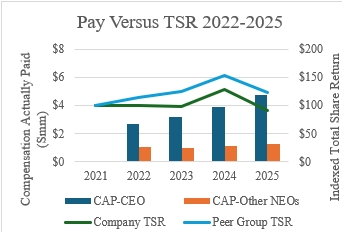 |
CEO and Average Other NEOs CAP vs. GAAP Net Income 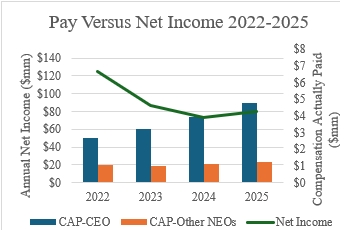 |
|
|
CEO and Average Other NEOs CAP vs. Core ROAA % 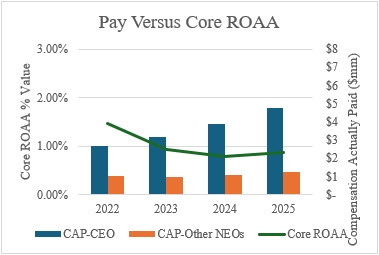
|
||
|
|
44 |

The following table represents the grants of awards to the Named Executive Officers in 2025:
|
Estimated future payouts under non-equity incentive plan awards |
Estimated future payouts under equity incentive plan awards |
||||||||||||||||||||
|
Executive (a) |
Grant Date (b) |
Threshold ($) (c) |
Target ($) (d) |
Maximum ($) (e) |
Threshold (#) (f) |
Target (#) (g) |
Maximum (#) (h) |
All other stock awards: Number of shares of stock or units (#) (i) |
All other stock awards: Number of securities underlying options (#) (j) |
Exercise or base price of option awards ($/share) (k) |
Grant date fair value of stock and option awards ($) (l) |
||||||||||
|
Frank Sorrentino III |
03/20/25 |
$ | - | $ | - | $ | - | 19,174 | 38,347 | 57,521 | 31,374 | $ | - | n/a | $ | 1,674,001 | |||||
|
William S. Burns |
03/20/25 |
- | - | - | 5,196 | 10,392 | 15,588 | 8,503 | - | n/a | 453,669 | ||||||||||
|
Elizabeth Magennis |
03/20/25 |
- | - | - | 5,880 | 11,759 | 17,639 | 9,621 | - | n/a | 513,334 | ||||||||||
|
Joseph Javitz |
03/20/25 |
- | - | - | 1,440 | 2,879 | 4,319 | 3,455 | - | n/a | 152,079 | ||||||||||
| Laura Criscione |
03/20/25 |
- | - | - | 1,524 | 3,047 | 4,571 | 3,047 | - | n/a | 146,317 | ||||||||||

The following table sets forth, for each of the Named Executive Officers, information regarding outstanding stock options and stock awards as of December 31, 2025:
|
Option Awards |
Stock Awards |
|||||||||||||||||
|
Executive (a) |
Number of securities underlying unexercised options (#) exerciseable (#)(b) |
Number of securities underlying unexercised options (#) un-exerciseable (#)(c) |
Equity incentive plan awards: Number of securities underlying unexercised unearned options (#)(d) |
Option exercise price ($)(e) |
Option expiration date (#)(f) |
Number of shares or units of stock that have not vested (#)(g) |
Market value of shares or units of stock that have not vested ($)(h) |
Equity incentive plan awards: Number of unearned shares, units or other rights that have not vested (#)(i) |
Equity incentive plan awards: market or payout value of unearned shares, units or other rights that have not vested ($)(j) |
|||||||||
|
Frank Sorrentino III |
- | - | - | $ | - | n/a | 67,018 | $ | 1,757,212 | 106,441 | $ | 2,790,883 | ||||||
|
William S. Burns |
- | - | - | - | n/a | 18,074 | 473,900 | 28,679 | 751,963 | |||||||||
|
Elizabeth Magennis |
- | - | - | - | n/a | 19,918 | 522,250 | 31,430 | 824,095 | |||||||||
| Joseph Javitz | - | - | - | - | n/a | 7,592 | 199,062 | 9,988 | 261,885 | |||||||||
|
Laura Criscione |
- | - | - | - | n/a | 6,951 | 182,255 | 6,959 | 182,465 | |||||||||

The following table sets forth certain information regarding exercises of options or vesting of shares during the Company’s fiscal year ended December 31, 2025 by our Named Executive Officers:
|
Executive (a) |
Number of shares acquired on exercise (#)(b) |
Value realized on exercise ($)(c) |
Number of shares acquired on vesting (#)(d) |
Value realized on vesting ($)(e) |
||||
|
Frank Sorrentino III |
- | $ | - | 54,490 | $ | 1,294,865 | ||
|
William S. Burns |
- | - | 15,040 | 356,753 | ||||
|
Elizabeth Magennis |
- | - | 16,143 | 383,681 | ||||
| Joseph Javitz | - | - | 2,972 | 70,063 | ||||
|
Laura Criscione |
- | - | 6,051 | 143,828 | ||||
|
|
45 |


Each of the participants listed below are parties to a Supplemental Executive Retirement Plan Agreement. Each of Messrs. Sorrentino and Burns and Ms. Magennis are also parties to a 2021 Supplemental Executive Retirement Plan Agreement dated April 1, 2022 that augments and supplements the original Supplemental Executive Retirement Plan Agreement. Subject to their terms and conditions, each Supplemental Executive Retirement Plan agreement and 2021 Supplemental Executive Retirement Plan Agreement is an unfunded promise intended to provide each of the participants with certain supplemental benefits upon retirement, or if earlier, upon his or her separation from service for certain qualifying terminations of employment. The amount and timing of payment of the supplemental retirement benefits vary based on a number of factors, including, among others, the participant’s age, the reason for any separation from service, and whether the participant has met the vesting requirements set forth in the agreement at the time of any payment triggering event.
The benefit amount payable to each Participant is a certain percentage of the Executive’s final salary, as defined in the Plan, exclusive of bonus, incentive compensation, and benefits as of the date of the termination of employment), as follows:
|
Participant |
Final Salary Percentage |
|
|
Frank Sorrentino III |
37.5 | % |
|
William S. Burns |
30.0 | |
|
Elizabeth Magennis |
30.0 | |
| Laura Criscione | 10.0 | |

Pursuant to each of the Split Dollar Life Insurance Agreements, each of the designated beneficiaries of Messrs. Sorrentino and Burns and Ms. Magennis will be entitled to share in the death proceeds payable under a life insurance policy owned by the Bank in the event of the participant’s death while the Agreement remains in effect. The amounts payable to the participants’ beneficiaries vary among the participants, and the age at which a participant dies.

The following table sets forth certain information regarding nonqualified deferred compensation benefits to the Named Executive Officer of the Company during the Company’s fiscal year ended December 31, 2025:
|
Executive (a) |
Executive contributions in 2025 ($)(b) |
Registrant contributions in 2025 ($)(c) |
Aggregate earnings in 2025 ($)(d) |
Aggregate withdrawals/ distributions ($)(e) |
Aggregate balance at last 2025 ($)(f) |
|||||||||||||||
|
Frank Sorrentino III |
- | $ | 423,651 | - | - | $ | 2,603,288 | |||||||||||||
|
William S. Burns |
- | 33,083 | - | - | 1,484,241 | |||||||||||||||
|
Elizabeth Magennis |
- | 80,466 | - | - | 466,319 | |||||||||||||||
| Joseph Javitz | - | - | - | - | - | |||||||||||||||
|
Laura Criscione |
- | 12,090 | - | - | 76,070 | |||||||||||||||
|
|
46 |

The following table sets forth certain information regarding compensation actually paid to the Directors during the Company’s fiscal year ended December 31, 2025, which is generally paid quarterly in arrears:
|
Nonemployee Directors (a) |
Fees earned or paid in cash ($)(b) |
Stock Awards ($)(c) |
Options awards ($)(d) |
Non-equity incentive plan compensation ($)(e) |
Change in pension value and nonqualified deferred compensation earnings ($)(f) |
All other compensation ($)(g) |
Total ($)(h) |
||||||||||||||
|
Frank W. Baier |
$ | 106,500 | $ | 60,000 | $ | - | $ | - | $ | - | $ | - | $ | 166,500 | |||||||
|
Stephen T. Boswell |
113,500 | 60,000 | - | - | - | - | 173,500 | ||||||||||||||
|
Frank Huttle III |
84,500 | 60,000 | - | - | - | - | 144,500 | ||||||||||||||
|
Michael W. Kempner |
60,000 | 60,000 | - | - | - | - | 120,000 | ||||||||||||||
|
Nicolas Minoia |
106,000 | 60,000 | - | - | - | - | 166,000 | ||||||||||||||
| Anson Moise | 66,000 | 66,000 | - | - | - | - | 126,000 | ||||||||||||||
| Katherin Nukk-Freeman | 72,000 | 60,000 | - | - | - | - | 132,000 | ||||||||||||||
| Susan O’Donnell | 72,000 | 60,000 | - | - | - | - | 132,000 | ||||||||||||||
| Daniel Rifkin | 85,000 | 60,000 | - | - | - | - | 145,000 | ||||||||||||||
| Mark Sokolich | 62,500 | 60,000 | - | - | - | - | 122,500 | ||||||||||||||
| Christopher Becker | 86,265 | 60,000 | - | - | - | - | 146,265 | ||||||||||||||
| Edward J. Haye | 22,500 | 60,000 | - | - | - | - | 82,500 | ||||||||||||||
| Peter Quick | 23,750 | 60,000 | - | - | - | - | 82,500 | ||||||||||||||
During 2025, each non-employee member of the Company’s Board received (i) an annual cash fee of $60,000, plus (ii) an award of restricted stock, subject to forfeiture, with a fair market value on grant date of $60,000. Board members serving as chair of the Audit and Risk Committee, Compensation Committee, or Nominating and Corporate Governance Committee received an additional stipend of $25,000, $13,500, and $12,000, respectively, paid in cash. Non-chair members of the Audit and Risk Committee, Compensation Committee, and Nominating and Corporate Governance Committee received an additional stipend of $10,000, $6,000 and $6,000 respectively, paid in cash. The Lead Independent Director also received an additional $15,000 cash fee. Each board member was awarded 2,613 restricted shares subject to forfeiture, in satisfaction of the stock award component of their annual retainer, in 2025.

We utilize the MWW Group to provide advertising and public relations assistance and advice. Michael Kempner, one of our directors, is the President and CEO of the MWW Group, Inc. During 2025, we paid the MWW Group a total of $366,545 for its services, including marketing, branding and related services. We believe the fees charged the Bank by the MWW Group are at least as favorable to the Bank as we could receive from an unaffiliated third party. We have continued to use the services of the MWW Group during 2026.
Members of our Board of Directors, including our Chairman and CEO Frank Sorrentino III and Messrs. Boswell, Huttle, and Kempner, are, either directly or through their interests in family limited liability companies, members of a limited liability company that is the sole member of a limited liability company that owns our John Street, Hackensack branch locations, which are leased by the Bank. Our Board members collectively own 44.4% of the membership interests in this limited liability company. Each of Messrs. Sorrentino, Huttle, Boswell and Kempner owns an 11.1% interest in the limited liability company. No director is the managing member or a manager or officer or any of the limited liability companies which serve as the landlords or the parent limited liability company. The lease for our John Street, Hackensack branch has a term ending on December 31, 2026. The Bank has the option to extend the lease term for up to one additional five-year period. The initial rent for the branch was $148,000 per year, and the rent will increase annually by the greater of 2.50% or the rate of increase of the consumer price index for the greater New York metropolitan area. During any option period, the rent will be reset to the greater of the prior year’s rent or the “market rent”, as defined in the lease, and will then increase annually by the greater of 2.50% or the rate of increase of the consumer price index for the greater New York metropolitan area. For 2025, the Bank paid a total rent of $326,390 for the John Street, Hackensack branch.
|
|
47 |
Nicholas Minoia, a member of our Board of Directors, is a member of a limited liability company which owns our Summit, New Jersey branch. Mr. Minoia owns approximately 50% of the membership interests in this limited liability company, and serves as its manager. The initial lease for the Summit branch ended on February 1, 2024. The Bank exercised the two of the three five-year options, and the new lease end date is now January 31, 2034. The Bank has the option to extend the lease term for another five-year period. The initial rent for the branch was $81,000 per year, and the rent will increase as set forth in the lease. During any option period, the rent will be as per the amounts set forth in the lease. For 2025, the Bank paid a total rent of $157,848 for the Summit, New Jersey branch.
Daniel Rifkin, a member of our Board of Directors, is a member of a limited liability company which owns the Bardonia branch. Mr. Rifkin owns approximately 50% of the membership interests in this limited liability company, and does not serve as its managing member. The lease for the Bardonia branch has a term ending on August 31, 2028. The Bank has the option to extend the lease term for one additional five-year period. The rent paid by the Bank in 2025 was $228,565, and will increase three (3%) percent yearly, including any extension terms. In the event that the Bank exercises the option to terminate occupancy rights to the second floor office space, the rent will be adjusted as set forth in the lease.
Mr. Rifkin is also a member of a separate limited liability company which owns the Blauvelt branch. Mr. Rifkin owns approximately 50% of the membership interests in this limited liability company, and does not serve as its managing member. The lease for the Blauvelt branch has a term ending on February 28, 2028. The rent paid by the Bank in 2025 was $96,582 with increases as set forth in the lease.

Our growth and future success depend on the efforts of our officers, directors and employees. We believe that equity compensation is an effective means of attracting and retaining qualified key personnel with a long-term focus on maximizing shareholder value. On the recommendation of our Compensation Committee, our Board has unanimously approved, and recommends that our shareholders approve the ConnectOne Bancorp, Inc. 2026 Equity Incentive Plan (the “2026 Plan”). The 2026 Plan is intended to succeed and replace our current stock plan, the Amended and Restated 2017 Equity Compensation Plan (the “Current Plan”). The share reserve under the Current Plan is substantially exhausted, and the Company intends to use the 2026 Plan to continue its equity compensation program. The purpose of the 2026 Plan is to help the Company: (1) attract, retain and motivate key employees (including prospective employees), non-employee directors and consultants of the Company and of ConnectOne Bank; (2) align the interests of such persons with the Company’s shareholders; and (3) promote ownership of the Company’s equity. Upon shareholder approval of the 2026 Plan, the Board of Directors has provided that the Current Plan will automatically terminate and no further awards will be granted under the Current Plan, although the Current Plan will remain effective with respect to outstanding awards thereunder.
Overview of Key Reasons to Approve the 2026 Plan
|
Equity incentive awards are an important element of our compensation philosophy |
We expect that the proposed 1,500,000 share reserve under the 2026 Plan will last at least six years |
|
|
Although our Current Plan will not terminate until May 23, 2027 if the 2026 Plan is not approved, we will have very few shares left for awards thereunder. |
Failure to approve the 2026 Plan will likely result in an increased reliance on cash compensation and may make it more difficult for us to attract and retain the talented individuals we need to continue our growth |
|
|
The Company has a history of prudent use of its share reserve and will continue to prudently use its shares |
We incorporated equity compensation best practices into the design of the 2026 Plan |
The 2026 Plan is summarized below and the full text of the 2026 Plan is attached to this Proxy Statement as Annex A. Because this is a summary, it may not contain all the information that you may consider to be important. You should read Annex A carefully before you decide how to vote on this proposal.
The Board has reviewed and approved the 2026 Plan and recommends shareholders vote “FOR” this proposal.
|
|
48 |
We Have a History of Prudent Use of Shares
In determining to adopt the 2026 Plan, we considered the following:
|
• |
Share Reserve. The Board has approved the reservation of 1,500,000 shares under the 2026 Plan. Upon shareholder approval of the 2026 Plan, the Current Plan will terminate and no new awards will be made thereunder. |
|
• |
Burn Rate. The following table provides data on our annual share usage under our Current Plan for the last three full fiscal years: |
|
Year |
Stock Options Granted |
Time-Based Restricted Stock Granted |
Performance-Based Restricted Stock Vested(1) |
Stock Options and Time-Based Restricted Stock Granted + Performance-Based Restricted Stock Vested |
Weighted Average Basic Common Shares Outstanding |
Burn Rate |
|
2025 |
0 |
155,535 |
43,331 |
198,866 |
45,197,000 |
0.44% |
|
2024 |
0 |
155,679 |
53,041 |
208,720 |
38,270,000 |
0.55% |
|
2023 |
0 |
240,004 |
116,192 |
356,196 |
38,809,000 |
0.92% |
|
3 Year Average Burn Rate |
0.63% |
|||||
|
(1) In FY 2025, 2024, and 2023 88,681, 91,691, and 85,158 Performance-Based Restricted Stock were granted, respectively |
||||||
|
• |
Dilution. Overhang provides a measure of potential dilution. As of March 31, 2026, the record date, we had 50,288,494 shares of Common Stock outstanding. Additionally, as of the same date, 687,913 shares were subject to outstanding full-value awards on which shares had not yet been issued. There are currently no stock options outstanding under any our current compensation plan. Furthermore, 1,500,000 new shares are being requested under this proposal for the 2026 Plan. We do not anticipate issuing additional awards under the Current Plan between March 31, 2026 and shareholder approval of the 2026 Plan, although we reserve the right to issue awards for no more than 25,000 shares during this period. Including the 1,500,000 shares being requested and excluding the remaining shares available under the Current Plan which will terminate upon shareholder approval of the 2026 Plan, our total dilution when the 2026 Plan is approved at the Annual Meeting is 4.4%. The following table shows the calculation of dilution: |
|
Share Information as of March 31, 2026 |
|||
|
Shares |
Dilution |
||
|
Total number of stock options and SARs outstanding (1) |
-- |
0.0% |
|
|
Total number of full-value awards outstanding (2) |
687,913 |
1.4% |
|
|
Total number of shares available under the Current Plan prior to stockholder approval of 2026 Plan |
64,787 |
0.1% |
|
|
Total number of shares available for future grant under the 2026 Plan upon stockholder approval |
1,500,000 |
3.0% |
|
|
Total number of shares available under the 2026 Plan upon stockholder approval of Proposed Amendment plus outstanding awards (3) |
2,212,913 |
4.4% |
|
|
Total number of shares of common stock outstanding |
50,288,494 |
-- |
|
|
(1) There were no options or SARs outstanding as of March 31, 2026. (2) The number of full value-awards outstanding and shares available under the Current Plan as of March 31, 2026, assumes performance-based awards are reserved at stretch. We do not anticipate issuing additional awards under the Current Plan between March 31, 2026 and shareholder approval of the 2026 Plan, although we reserve the right to issue awards for no more than 25,000 shares during this period and therefore the table above assumes that no more than 25,000 shares will be granted under the Current Plan after the March 31, 2026 Measurement Date but prior to the Effective Date of the 2026 Plan. (3) Shares and Dilution assumes a maximum of 25,000 shares have been granted from the Current Plan after the March 31, 2026 Measurement Date but prior to the Effective Date of the 2026 Plan, although we do not anticipate issuing additional awards under the Current Plan. |
|||
|
• |
Expected Duration of the Plan. The 2026 Plan will become effective as of the date of its approval if approved by the Company’s shareholders at the Annual Meeting (the “Effective Date”). Although the 2026 Plan will have a term of 10 years following the Effective Date, we anticipate that based on our current grant practices the proposed share reserve under the 2026 Plan will be sufficient to meet our needs for approximately five years. The actual duration of the 2026 Plan’s share reserve will depend on many factors including future grant date stock prices, number of participants, participation rates, forfeitures, performance share awards, and grant practices. |
|
|
49 |
Equity Compensation Best Practice Provisions
|
No Liberal Share Recycling |
The 2026 Plan prohibits the recycling of shares tendered or withheld in payment of the exercise price of a stock option or to satisfy any tax withholding obligation with respect to an award, shares repurchased by the Company using proceeds from the exercise of a stock option and shares reserved for issuance in respect of a stock appreciation right that exceed the number of shares actually issued upon exercise. |
|
|
Minimum Vesting Requirements |
Awards are subject to a minimum vesting schedule of at least 12 months following the date of grant, subject to certain limited exceptions. |
|
|
No Dividends or Dividend Equivalents on Unvested Awards |
The 2026 Plan prohibits the payment of dividends on unvested restricted shares and payment of dividend equivalents on unvested awards, including restricted stock units and performance-based awards. Dividend equivalents may not be granted in connection with any stock option or stock appreciation right. |
|
|
No Discounted Stock Options or SARs |
Stock options and stock-settled stock appreciation rights (“SARs”) must be granted with an exercise price equal to or greater than the fair market value of a share of our Common Stock on the date of grant. |
|
|
No Repricing or Cash Buyouts |
Stock options and SARs may not be repriced, including through amendment, cancellation in exchange for the grant of a substitute award or repurchase for cash or other consideration without shareholder approval if the effect would be to reduce the exercise price for the shares subject to the award. |
|
|
No Excise Tax Gross-Ups |
The 2026 Plan does not provide for any excise tax gross-up benefits. |
|
|
Clawback |
Awards granted under the 2026 Plan will be subject to the Company’s Compensation Recoupment Policy and any other clawback or recapture policy that the Company may adopt from time to time. |
|
|
Limitation on Non-Employee Director Compensation |
The maximum value of all compensation that may be granted to a non-employee director in a single calendar year is $750,000, subject to certain limited exceptions. |
|
|
Administration by Independent Directors |
Awards are administered by the Compensation Committee, an independent committee of our Board. |
|
|
No “Evergreen” Provision |
Shares authorized for issuance under the 2026 Plan cannot be automatically replenished. |
Failure to Approve the 2026 Plan Will Likely Make it More Difficult for us the Attract and Retain the Talent we Need to Continue our Growth and Result in Increased Reliance on Cash Compensation
If the 2026 Plan is not approved by our shareholders at the Annual Meeting, we may need to significantly increase the cash component of our compensation programs for our executive officers and other employees in order to remain competitive, attract new talent and to appropriately compensate our executive officers and other employees. Replacing equity awards with cash awards may not only misalign the interests of our executive officers and other employees with the interests of our shareholders, but it would also increase our cash compensation expense and necessitate the use of cash that we could use for other business priorities.
Key Terms of the 2026 Plan
The following summary of the material terms of the 2026 Plan is qualified in its entirety by reference to the complete text of the 2026 Plan, which is attached hereto as Annex A. Capitalized terms used in this proposal that are not otherwise defined have the meanings given to them in the 2026 Plan.
Purpose. The purpose of the 2026 Plan is to help the Company: (1) attract, retain and motivate key employees (including prospective employees), non-employee directors and consultants; (2) align the interests of such persons with the Company’s shareholders; and (3) promote ownership of the Company’s equity.
Eligibility. Awards under the 2026 Plan may be made to any employee, consultant or non-employee director of the Company Group. As of March 31, 2026, it is expected that approximately 100 employees and all thirteen (13) of our non-employee directors will be eligible to participate in the 2026 Plan.
Administration of the Plan. The 2026 Plan will be administered by our Board’s Compensation Committee. The Compensation Committee has full authority to interpret the 2026 Plan and award agreements, grant awards and determine the terms of such awards. The Compensation Committee can also delegate its authority as it deems appropriate in its sole discretion in accordance with applicable law.
Shares of Common Stock Available for Awards. The maximum number of shares of the Company’s Common Stock which may be issued under the 2026 Plan is 1,500,000, subject to adjustment by the Compensation Committee for stock splits and other events as set forth in the 2026 Plan.
|
|
50 |
Any shares subject to an award that are forfeited, expire or are settled for cash (in whole or in part), to the extent of such forfeiture, expiration or cash settlement, will be available for future grants of awards under the 2026 Plan and will be added back in the same number of shares as were deducted in respect of the grant of such award. The payment of dividend equivalent rights in cash in relation with any outstanding awards will not be counted against the shares available for issuance under the 2026 Plan. Notwithstanding the foregoing, the following Shares will not become available for purposes of the Plan: Shares tendered by a grantee or withheld by the Company in payment of the exercise price of a stock option or to satisfy any tax withholding obligation with respect to an award, Shares repurchased by the Company using proceeds from the exercise of a stock option, and Shares reserved for issuance upon the grant of a stock appreciation right that exceed the number of Shares actually issued upon exercise.
Minimum Vesting. All awards are subject to a minimum vesting schedule of at least 12 months following the date of grant of such award, except that 5.0% of the shares available for grant under the 2026 Plan may be granted with a shorter minimum vesting period. Vesting may be accelerated in connection with death or retirement (as defined in the 2026 Plan) or involuntary termination of a grantee or a change of control.
Types of Awards
The types of awards that may be granted under the 2026 Plan include:
Stock Options. Stock options may be granted as incentive stock options (within the meaning of Section 422 of the Internal Revenue Code of 1986 (the “Code”)) or nonstatutory stock options. A stock option entitles the grantee to purchase shares of our Common Stock at an exercise price that may never be less than the Fair Market Value of our Common Stock on the date the option is granted. No stock option can be exercised more than 10 years after the date of grant. Dividend equivalent rights may not be granted in connection with any stock option.
Stock Appreciation Rights. Stock Appreciation Rights may be granted as the Compensation Committee may determine. No SAR can be exercised more than 10 years after the date of grant. SARs entitle the grantee to receive a number of shares of our Common Stock, or cash, equal in value to the excess of the Fair Market Value of our Common Stock over the exercise of the SAR, which may never be less than 100% of the Fair Market Value of our Common Stock on the date the SAR is granted. Dividend equivalent rights may not be granted in connection with any stock appreciation right.
Restricted Shares. Restricted shares are shares of our Common Stock that are subject to such terms and conditions as the Compensation Committee may determine. Upon the delivery of such shares, the grantee will have the rights of a shareholder with respect to the restricted shares, subject to any other restrictions and conditions as the Compensation Committee may include in the applicable award agreement. Restricted shares will, during the period of the restriction, have full voting rights. All ordinary cash dividends or other ordinary distributions paid upon any restricted shares will be retained by the Company and will be paid to the relevant grantee (without interest) when the award of restricted shares vests.
Restricted Stock Units. Restricted stock units are unfunded, unsecured rights to receive a share of our Common Stock or its equivalent in cash or other securities or property. A grantee of a restricted stock unit will have only the rights of a general unsecured creditor of the Company until delivery of shares, cash or other securities or property is made as specified in the applicable award agreement. On the delivery date specified in the award agreement, the grantee of each restricted stock unit not previously forfeited or terminated will receive one share of Common Stock, cash or other securities or property equal in value to a share of Common Stock or a combination thereof, as specified by the Compensation Committee. Restricted stock units may include the right to receive dividend equivalents provided that no dividend equivalents may be paid unless and until the restricted stock units vest.
Dividend Equivalent Rights. The Compensation Committee may grant dividend equivalent rights entitling a grantee to receive amounts equal to all or any portion of the regular cash dividends that would be paid on the shares covered by an award if such shares had been delivered pursuant to such award at the time of grant. The grantee will have only the rights of a general unsecured creditor of the Company until such amounts are paid as specified in the applicable award agreement. Dividend equivalents may not be paid unless and until the award to which they relate vests. Dividend equivalent rights may not be granted in connection with any stock option or stock appreciation right.
Other Stock-Based or Cash-Based Awards; Performance-based awards. The Compensation Committee may grant other types of equity-based or equity-related or cash-based awards, including, without limitation, the grant or offer for sale of unrestricted shares, performance share awards and performance units settled in cash. Other stock-based or cash-based awards may include the right to receive dividends or dividend equivalents provided that no dividends or dividend equivalents may be paid until the date the underlying award becomes vested. Such awards may also be subject to the achievement of performance goals based on performance criteria as determined by the Compensation Committee at the time of grant.
Change in Control Upon a “change in control” (as defined in the 2026 Plan), each award granted prior to such change in control will become fully vested and, as applicable, exercisable, unless the Compensation Committee determines otherwise, or as otherwise provided in the applicable award agreement. Any shares deliverable pursuant to restricted stock units will be delivered within 15 days following such “change in control”, unless the Compensation Committee determines otherwise, or as otherwise provided in the applicable award agreement. As of the change in control date, any outstanding performance-based awards shall be deemed earned at the greater of the target level and the actual performance level at the date of the change in control with respect to all open performance periods. In connection with a change in control, the Compensation Committee may determine contingent value rights and cancel underwater options for no consideration.
|
|
51 |
In the event of a merger or other corporate reorganization that does not constitute a change in control, the Compensation Committee has the flexibility (subject to Section 409A), in its sole discretion, to treat a grantee’s award in accordance with one or more of the following methods: (i) settle such awards for an amount of cash or securities equal to their value; (ii) provide for the assumption of or the issuance of substitute awards; (iii) modify the terms of such awards to add events, conditions or circumstances (including termination of employment within a specified period after such transaction) upon which the vesting of such awards or lapse of restrictions thereon will accelerate; (iv) deem any performance conditions satisfied at target, maximum or actual performance through closing or provide for the performance conditions to continue (as is or as adjusted by the Compensation Committee) after closing; or (v) provide that for a period of at least 20 days prior to such transaction, any stock options or stock appreciation rights that would not otherwise become exercisable prior to such transaction will be exercisable as to all shares subject thereto (but any such exercise will be contingent upon and subject to the occurrence of such transaction, and if such transaction does not take place within a specified period after giving such notice for any reason whatsoever, the exercise will be null and void), and that any stock options or stock appreciation rights not exercised prior to the consummation of such transaction will terminate and be of no further force and effect as of the consummation of such transaction.
Nonassignability and No Hedging
Awards under the 2026 Plan will be subject to the terms of the Company’s hedging and pledging policy and any other hedging and pledging policies that the Company may adopt from time to time. Awards granted under the 2026 Plan may not be sold, exchanged, transferred, assigned, pledged, hypothecated or otherwise disposed of or hedged in any manner other than by will or by the laws of descent and distribution, and all such awards will be exercisable during the life of the grantee only by the grantee or the grantee’s legal representative. The Compensation Committee may permit a grantee to transfer any award to any person or entity the Compensation Committee so determines; provided, however, that under no circumstances will a Grantee be permitted to transfer an award to a third-party financial institution without prior stockholder approval. All of the terms and conditions of the 2026 Plan and the award agreements will be binding upon any permitted successors and assigns.
Repricing Prohibited
Reducing the exercise price of stock options or stock appreciation rights issued and outstanding under the 2026 Plan, including through amendment, cancellation in exchange for the grant of a substitute award or repurchase for cash or other consideration (in each case that has the effect of reducing the exercise price), will require approval of the Company’s shareholders, except as otherwise permitted by the 2026 Plan with respect to preventing the enlargement or dilution of rights. The Company will not grant any stock options or stock appreciation rights with automatic reload features.
Clawback/Recapture of Awards
Awards under the 2026 Plan will be subject to the terms of the Company’s Compensation Recoupment Policy and any other clawback or recapture policy that the Company may adopt from time to time, and, in accordance with such policy, may be subject to the requirement that the awards be repaid to the Company Group after they have been distributed to the grantee.
Amendment
The Board may amend, suspend, discontinue or revise the 2026 Plan in any respect, provided that no amendment may materially adversely impair the rights of a grantee without the grantee’s consent. Unless otherwise determined by the Board, shareholder approval of any suspension, discontinuance, revision or amendment will be obtained only to the extent necessary to comply with any applicable laws, regulations or rules of a securities exchange or self-regulatory agency. If the Board determines it is appropriate for the 2026 Plan to comply with the provisions of Section 422 of the Code, no amendment that would require shareholder approval under Section 422 of the Code will be effective without the approval of the Company’s shareholders.
Effective Date and Term of the 2026 Plan
If approved by the shareholders, the 2026 Plan will become effective as of the Effective Date and will terminate on the day before the tenth anniversary of the Effective Date. The Board has the right to terminate the 2026 Plan at any time.
U.S. Federal Income Tax Consequences of Awards Under the 2026 Plan
The following discussion summarizes certain United States federal income tax consequences generally arising with respect to grants of awards under the 2026 Plan under the law as in effect on the date of this Proxy Statement. This summary does not cover federal employment tax or other federal tax consequences associated with awards under the 2026 Plan, nor does it address state or local tax consequences. Grantees who are granted awards under the 2026 Plan should consult their own tax advisors to determine the tax consequences based on their particular circumstances.
|
|
52 |
Nonqualified Stock Options, Stock Appreciation Rights, Restricted Stock Units and Other Stock-Based Awards. A grantee generally is not required to recognize income upon the grant of a nonqualified stock option (“NQSO”), stock appreciation rights (“SAR”), restricted stock units (“RSU”) or other stock-based award. Instead, ordinary income generally is required to be recognized on the date the NQSO or SAR is exercised or, in the case of RSU awards or other stock-based awards, upon the issuance of shares or receipt of cash pursuant to the terms of the award. In general, the amount of ordinary income required to be recognized is: (i) in the case of a NQSO, an amount equal to the excess, if any, of the aggregate fair market value of the shares of our Common Stock underlying the options exercised over the aggregate exercise price, (ii) in the case of a SAR, the amount of cash or the fair market value of any shares received upon exercise, plus the amount of cash or the fair market value of any shares that were withheld in satisfaction of any applicable taxes due upon the exercise of the award, and (iii) in the case of RSU awards or other stock-based awards, the amount of cash or the fair market value of any shares received in respect thereof, plus the amount of cash or the fair market value of any shares that were withheld in satisfaction of any applicable taxes due on the vesting or payment of such awards.
Incentive Stock Options. A grantee is not taxed at the time an incentive stock option (“ISO”) is granted. The tax consequences upon exercise and later disposition depend upon whether the grantee holds the shares received upon exercise of an ISO for more than one year after exercise and two years after the date of grant of the option. If the grantee satisfies this holding period, for regular tax purposes the grantee will not realize income upon exercise of the ISO, and the Company will not be allowed an income tax deduction at any time with respect to the ISO. The difference between the exercise price and the amount realized upon disposition of the shares by the grantee will constitute a long-term capital gain or a long-term capital loss, as the case may be. If the grantee fails to meet the holding period (other than by reason of death), a disqualifying disposition occurs and the grantee generally recognizes as ordinary income, in the year of the disqualifying disposition, an amount equal to the excess of the fair market value of the shares at the date of exercise over the exercise price. Any excess of the sales price over the fair market value at the date of exercise will be recognized by the grantee as long-term or short-term capital gain, depending on the length of time the shares were held after the option was exercised. If, however, the sales price is less than the fair market value at the date of exercise, then the ordinary income recognized by the grantee is generally limited to the excess (if any) of the sales price over the exercise price. In both situations, the Company’s tax deduction is limited to the amount of ordinary income recognized by the grantee. Different consequences apply for a grantee subject to the alternative minimum tax.
Restricted Shares. A grantee generally is not required to recognize ordinary income on the award of restricted shares of Common Stock. Instead, on the date the shares vest (i.e., become transferable and no longer subject to forfeiture), the grantee will be required to recognize ordinary income in an amount equal to the excess, if any, of the fair market value of the shares on such date over the amount, if any, paid for such shares. Any dividends received upon the vesting of the related restricted shares generally will be treated as compensation that is taxable as ordinary income to the recipient. If permitted by the applicable award agreement, a grantee may make an election under Section 83(b) of the Code to recognize ordinary income on the date the restricted shares are granted in an amount equal to the excess (if any) of the fair market value of the shares over any amount paid for such shares.
Disposition of Shares. Unless stated otherwise above, upon the subsequent disposition of shares of Common Stock acquired under any of the preceding awards, a grantee will recognize capital gain or loss based upon the difference between the amount realized on such disposition and the grantee’s basis in the shares, and such amount will be long-term capital gain or loss if such shares were held for more than 12 months. Capital gain is generally taxed at a maximum rate of 20% if the property is held more than one year.
Deductibility by the Company. Unless stated otherwise above, to the extent that a grantee recognizes ordinary income in the circumstances described above, the Company generally will be entitled to a corresponding deduction, provided that, among other things, the deduction is not disallowed under Section 162(m) of the Code.
Effect of Change in Control. Under the “golden parachute” provisions of Section 280G of the Code, the accelerated vesting, exercisability or payout of awards under the 2026 Plan in connection with a change in control may be required to be valued and taken into account in determining whether grantees have received compensatory payments contingent upon the change in control in excess of certain limits. If these limits are exceeded, a portion of the amounts payable to the grantees may be subject to an additional 20% federal tax and may be nondeductible to the Company.
|
|
53 |
Section 409A. Certain awards under the 2026 Plan may constitute nonqualified deferred compensation under Section 409A of the Code. Failure to satisfy the applicable requirements under Section 409A for awards considered deferred compensation would result in the acceleration of income and additional income tax liability to the recipient, including certain penalties. Awards under the 2026 Plan are intended to be designed and administered so that they comply with, or are exempt from, Section 409A to avoid the imposition of additional tax, penalties, and interest on the grantee.
Withholding. Awards under the 2026 Plan may be subject to tax withholding. Where an award results in income subject to withholding, the Company may require the grantee to remit the withholding amount to the Company or cause shares of Common Stock to be withheld or sold in order to satisfy the tax withholding obligations. If shares of Common Stock are withheld or sold to satisfy a grantee’s tax withholding obligations, the grantee will be treated as having received such shares for purposes of the discussion above.
New Plan Benefits
The Compensation Committee has not granted any awards under the 2026 Plan. The amount of each grantee’s awards, if any, for 2026 will be determined in the discretion of the Compensation Committee and therefore cannot be calculated. As a result, the benefits that will be awarded or paid under the 2026 Plan are not currently determinable.
The awards granted in 2026 based upon performance in 2025, which would not have changed if the 2026 Plan had been in place instead of the Current Plan, are set forth in the following table:
|
Name and Position |
Dollar |
Number of (#) (2) |
||
|
Frank Sorrentino III, Chairman, President & Chief Executive Officer |
$1,850,853 |
70,455 |
||
|
William S. Burns, Senior Executive Vice President & Chief Financial Officer |
532,140 |
20,257 |
||
|
Elizabeth Magennis, ConnectOne Bank President |
602,700 |
22,943 |
||
|
Joseph Javitz, Executive Vice President & Chief Credit Officer |
168,613 |
6,418 |
||
|
Laura Criscione, Executive Vice President & Chief Compliance Officer |
162,444 |
6,183 |
||
|
Executive Group (including NEOs) |
5,088,436 |
193,695 |
||
|
Non-Executive Director Group (3) |
- |
- |
||
|
Non-Executive Employee Group |
1,272,177 |
48,427 |
Footnotes:
| (1) |
Represents the aggregate grant date fair value of the awards based on the closing price of the Company’s common stock of $26.27 on March 25, 2026. |
| (2) |
Represents the number of Deferred Stock Units, Performance Units and Restricted Stock granted on March 25, 2026. As these awards were granted under the Current Plan prior to the Annual Meeting, they do not reduce the 1,500,000 shares being requested under the 2026 Plan, but are disclosed here to illustrate the Company’s anticipated annual grant cycle. |
| (3) |
Awards are typically granted to non-executive directors on June 1 of each year. |
Voting
The affirmative vote of a majority of votes cast on this proposal is required for the approval of this proposal. In determining whether the proposal has received the requisite number of affirmative votes, abstentions and broker “non-votes” will be disregarded and will have no effect on the outcome of the vote.
The Board of Directors recommends that shareholders vote “FOR” Proposal 2 to approve the 2026 Plan.
|
|
54 |

Under Section 951 of the Dodd-Frank Wall Street Reform and Consumer Protection Act, companies with securities registered with the Securities and Exchange Commission under the Exchange Act are required to provide shareholders the opportunity to vote on a non-binding advisory proposal to approve the compensation of executives. The Company has determined to implement this requirement by providing shareholders with a simple vote that indicates their position (by a yes or no vote) with respect to our executive compensation.
As a policy we attempt to maintain an ongoing dialogue with our shareholders, including with regard to our compensation practices. See “Compensation Discussion and Analysis – Shareholder Engagement.”
Our Board of Directors annually reviews and approves corporate and/or individual goals and objectives relevant to the compensation of our executive officers, evaluates performance in light of those goals and objectives, and determines compensation levels based on this evaluation, as described elsewhere in this proxy statement. In determining any long-term incentive component of compensation, the Board will consider all such factors as it deems relevant, such as performance and relative shareholder return, the value of similar incentive awards at comparable companies and the awards granted in previous years. We also believe that both the Company and shareholders benefit from these compensation policies.
The Board recommends that shareholders approve, in an advisory vote, the following resolution:
“Resolved, that the shareholders approve the executive compensation of the Company, as described in this proxy statement, including the tabular disclosure regarding executive officers in this Proxy Statement.”
Because your vote is advisory, it will not be binding upon the Board. However, the Board will take into account the outcome of the vote when considering future executive compensation arrangements.
RECOMMENDATION
THE BOARD OF DIRECTORS OF THE COMPANY RECOMMENDS THAT THE SHAREHOLDERS VOTE “FOR” THE ADVISORY PROPOSAL SET FORTH ABOVE.
|
|
55 |

The Audit Committee has appointed the firm of Crowe LLP to act as our independent registered public accounting firm and to audit our consolidated financial statements for the fiscal year ending December 31, 2026. This appointment will continue at the pleasure of the Audit Committee and is presented to the shareholders for ratification as a matter of good governance. In the event that this appointment is not ratified by our shareholders, the Audit Committee will consider that fact when it selects independent auditors for the following fiscal year.
Crowe LLP has served as our independent registered public accounting firm since July 1, 2014, and one or more representatives of Crowe LLP will be present at the Annual Meeting. These representatives will be provided with an opportunity to make a statement at the Annual Meeting if they desire to do so and will be available to respond to appropriate questions from shareholders.
The following table sets forth a summary of the fees billed or expected to be billed to the Company by Crowe for professional services rendered for the years ended December 31, 2025 and 2024.

Aggregate fees billed to the company for the fiscal years ended December 31, 2025 and 2024 by the Company’s principal accounting firm are shown in the following table.
|
Fiscal Year Ended December 31, |
|||||
|
2025 |
2024(1) |
||||
|
Audit Fees (2) |
$ | 1,058,972 | $ | 907,200 | |
|
Audit Related Fees (3) |
393,763 | 145,244 | |||
|
Tax Fee |
- | 17,992 | |||
|
Total Fees |
$ | 1,452,735 | $ | 1,070,436 | |
|
(1) |
Certain amounts in the 2024 presentation have been reclassified to conform to the 2025 presentation. |
|
(2) |
Audit Fees consist of fees billed for professional services rendered for the audit of our consolidated annual financial statements and the review of the interim financial statements included in our quarterly reports. This category also includes services that are normally provided by the accountant in connection with statutory and regulatory filings, including procedures related to the issuance of comfort letters and consents in connection with our registration statements filed during the year. |
|
(3) |
Audit-Related Fees include assurance and related services that are reasonably related to the performance of the audit or review of our financial statements. For 2025, the increase in these fees is primarily attributable to professional services rendered in connection with our acquisition of The First of Long Island Corporation, including pre-acquisition due diligence and the audit of the acquired business. This category also includes fees for the audits of the Company's employee benefit plans." |

THE PROPOSAL TO RATIFY THE SELECTION OF CROWE LLP AS OUR INDEPENDENT REGISTERED PUBLIC ACCOUNTING FIRM FOR THE 2026 FISCAL YEAR REQUIRES AN AFFIRMATIVE VOTE OF THE MAJORITY OF THE SHARES REPRESENTED ONLINE OR BY PROXY AT THE ANNUAL MEETING AND ENTITLED TO VOTE ON THE PROPOSAL.

THE BOARD OF DIRECTORS RECOMMENDS THAT THE SHAREHOLDERS VOTE “FOR” THE RATIFICATION OF CROWE LLP AS THE COMPANY’S INDEPENDENT AUDITORS
|
|
56 |

Proposals of shareholders to be included in the Company’s 2027 proxy material must be received by the secretary of the Company no later than January 21, 2026.

Section 16(a) of the Securities Exchange Act of 1934 requires the Company’s officers and directors, and persons who own more than ten percent of a registered class of the Company’s equity securities, to file reports of ownership and changes in ownership with the Securities and Exchange Commission. Officers, directors and greater than ten percent shareholders are required by regulations of the Securities and Exchange Commission to furnish the Company with copies of all Section 16(a) forms they file. With one exception, the Company believes that all persons associated with the Company and subject to Section 16(a) have made all required filings on a timely basis for the fiscal year ended December 31, 2025. During 2025, Director Michael Kempner filed one late Form 4.

The Board of Directors is not aware of any other matters which may come before the Annual Meeting. However, in the event such other matters come before the meeting, it is the intention of the persons named in the proxy to vote on any such matters in accordance with the recommendation of the Board of Directors.
|
|
57 |
CONNECTONE BANCORP, INC.
2026 EQUITY INCENTIVE PLAN
ARTICLE I
GENERAL
1.1 Purpose
The purpose of the ConnectOne Bancorp, Inc. Equity Incentive Plan (as amended from time to time, the “Plan”) is to help the Company Group (as hereinafter defined): (1) attract, retain and motivate key employees (including prospective employees), non-employee directors and consultants of ConnectOne Bancorp, Inc., a New Jersey corporation (the “Company”) and its wholly owned subsidiary, ConnectOne Bank (the “Bank”); (2) align the interests of such persons with the Company’s shareholders; and (3) promote ownership of the Company’s equity. This Plan is intended to replace the Company’s Amended and Restated 2017 Equity Compensation Plan (the “Prior Plan”), which shall be automatically terminated, replaced and superseded by the Plan on the date on which the Plan is approved by the Company’s shareholders, except that any awards granted under the Prior Plan shall continue to be subject to the terms of the Prior Plan and the Prior Plan’s applicable award agreements and shall remain in effect pursuant to their terms.
1.2 Definitions of Certain Terms
For purposes of this Plan, the following terms have the meanings set forth below:
1.2.1 “Award” means an award granted pursuant to the Plan.
1.2.2 “Award Agreement” means the written document by which each Award is evidenced, and which may, but need not be (as determined by the Committee) executed or acknowledged by a Grantee as a condition to receiving an Award or the benefits under an Award, and which sets forth the terms and provisions applicable to Awards granted under the Plan to such Grantee. Any reference herein to an agreement in writing, and acceptance thereof, will be deemed to include an electronic writing, and acceptance thereof, to the extent permitted by applicable law.
1.2.3 “Board” means the Board of Directors of the Company.
1.2.4 “Cause” means (a) with respect to a Grantee employed pursuant to a written employment agreement, which agreement includes a definition of “Cause,” “Cause” as defined in that agreement, or (b) with respect to any other Grantee, the occurrence of any of the following: (i) willful and continued failure, for a period of at least thirty (30) calendar days, by the Employee to perform his duties for the Company Group after at least one (1) warning in writing from the Compensation Committee, or such person or body to which such body may delegate such authority, identifying specifically any such failure, (ii) the willful engaging by the Employee in misconduct which causes material injury to the Company Group as specified in written notice to the Employee from the Compensation Committee, or such person or body to which such body may delegate such authority; (iii) the material violation by the Employee of the Company Group’s code of conduct or other applicable written policy regarding harassment and unlawful discrimination; (iv) the willful and material breach by the Employee of any restrictive covenant provision or agreement with the Company Group, or (v) conviction of or a plea of nolo contendere to a crime (other than a traffic violation) which is either a felony or an indictable offense or the Employee’s habitual drunkenness, drug abuse, or excessive absenteeism other than due to disability, after a warning (with respect to drunkenness or absenteeism only) in writing from the Compensation Committee, or such person or body to which such body may delegate such authority to refrain from such behavior.
1.2.5 “Change in Control” means
(a) During any period of not more than thirty-six (36) months, individuals who constitute the Board as of the beginning of the period (the “Incumbent Directors”) cease for any reason to constitute at least a majority of the Board, provided that any person becoming a director subsequent to the beginning of such period, whose election or nomination for election was approved by a vote of at least two-thirds of the Incumbent Directors then on the Board (either by a specific vote or by approval of the proxy statement of the Company in which such person is named as a nominee for director, without written objection to such nomination) will be an Incumbent Director; provided, however, that no individual initially elected or nominated as a director of the Company as a result of an actual or publicly threatened election contest with respect to directors or as a result of any other actual or publicly threatened solicitation of proxies by or on behalf of any person other than the Board will be deemed to be an Incumbent Director;
(b) Any “person” (as such term is defined in Section 3(a)(9) of the Securities Exchange Act of 1934, as amended from time to time, or any successor thereto, and the applicable rules and regulations thereunder (the “Exchange Act”) and as used in Sections 13(d)(3) and 14(d)(2) of the Exchange Act), is or becomes a “beneficial owner” (as defined in Rule 13d 3 under the Exchange Act), directly or indirectly, of securities of the Company representing thirty percent (30%) or more of the combined voting power of the Company’s then-outstanding securities eligible to vote for the election of the Board (“Company Voting Securities”); provided, however, that the event described in this paragraph (B) will not be deemed to be a Change in Control by virtue of the ownership, or acquisition, of Company Voting Securities: (i) by the Company, (ii) by any employee benefit plan (or related trust) sponsored or maintained by the Company, (iii) by any underwriter temporarily holding securities pursuant to an offering of such securities or (iv) pursuant to a Non-Qualifying Transaction (as defined in paragraph (C) of this definition);
(c) The consummation of a merger, consolidation, statutory share exchange or similar form of corporate transaction involving the Company that requires the approval of the Company’s stockholders, whether for such transaction or the issuance of securities in the transaction (a “Business Combination”), unless immediately following such Business Combination: (i) more than fifty percent (50%) of the total voting power of (x) the entity resulting from such Business Combination (the “Surviving Entity”), or (y) if applicable, the ultimate parent corporation that directly or indirectly has beneficial ownership of at least ninety-five percent (95%) of the voting power, is represented by Company Voting Securities that were outstanding immediately prior to such Business Combination (or, if applicable, is represented by shares into which such Company Voting Securities were converted pursuant to such Business Combination), and such voting power among the holders thereof is in substantially the same proportion as the voting power of such Company Voting Securities among the holders thereof immediately prior to the Business Combination, (ii) no person (other than any employee benefit plan (or related trust) sponsored or maintained by the Surviving Entity or the parent), is or becomes the beneficial owner, directly or indirectly, of thirty percent (30%) or more of the total voting power of the outstanding voting securities eligible to elect directors of the parent (or, if there is no parent, the Surviving Entity) and (iii) at least a majority of the members of the board of directors of the parent (or, if there is no parent, the Surviving Entity) following the consummation of the Business Combination were Incumbent Directors at the time of the Board’s approval of the execution of the initial agreement providing for such Business Combination (any Business Combination which satisfies all of the criteria specified in (i), (ii) and (iii) of this paragraph (C) will be deemed to be a “Non-Qualifying Transaction”);
(d) The consummation of a sale of all or substantially all of the Company’s assets (other than to any of its Affiliates); or
(e) The Company’s stockholders approve a plan of complete liquidation or dissolution of the Company.
1.2.6 “Code” means the Internal Revenue Code of 1986, as amended from time to time, or any successor thereto, and the applicable rulings and regulations thereunder.
1.2.7 “Committee” has the meaning set forth in Section 1.3.1.
1.2.8 “Common Stock” means the common stock of the Company, no par value per share, and any other securities or property issued in exchange therefor or in lieu thereof pursuant to Section 1.6.3.
1.2.9 “Company” has the meaning set forth in Section 1.1.
1.2.10 “Company Group” means the Company and any Subsidiary, and any successor entity thereto.
1.2.11 “Consent” has the meaning set forth in Section 3.3.2.
1.2.12 “Consultant” means any individual (other than a Non-Employee Director) who provides bona fide consulting or advisory services to the Company Group.
1.2.13 “Covered Person” has the meaning set forth in Section 1.3.4.
1.2.14 “Director” means a member of the Board or a member of the Board of Directors of the Bank.
1.2.15 “Effective Date” has the meaning set forth in Section 3.25.
1.2.16 “Employee” means a regular, active employee and/or a prospective employee of the Company Group, but not including a Non-Employee Director.
1.2.17 “Employment” means an Employee’s performance of services for the Company Group, as determined by the Committee. The terms “employ” and “employed” will have their correlative meanings. The Committee in its sole discretion may determine (a) whether and when an Employee’s leave of absence results in a termination of Employment, (b) whether and when a change in an Employee’s association with the Company Group results in a termination of Employment, and (c) the impact, if any, of any such leave of absence or change in association on outstanding Awards. Unless expressly provided otherwise, any references in the Plan or any Award Agreement to an Employee’s Employment being terminated will include both voluntary and involuntary terminations.
1.2.18 “Exchange Act” means the Securities Exchange Act of 1934, as amended from time to time, or any successor thereto, and the applicable rules and regulations thereunder.
1.2.19 “Fair Market Value” means, with respect to a Share, the closing price reported for the Common Stock on the applicable date as reported on the Nasdaq Stock Market or any other regional market which at the time constitutes the principal market, exchange or system on which Shares are traded, unless determined as otherwise specified herein. In the event the Shares are not publicly traded at the time a determination of their value is required to be made hereunder, the determination of Fair Market Value shall be made by the Committee in such manner as it deems appropriate. For purposes of the grant of any Award, the applicable date will be the trading day on which the Award is granted or, if the date the Award is granted is not a trading day, the trading day immediately prior to the date the Award is granted. For purposes of the exercise of any Award, the applicable date is the date a notice of exercise is received by the Company or, if such date is not a trading day, the trading day immediately following the date a notice of exercise is received by the Company.
1.2.20 “GAAP” has the meaning set forth in Section 2.8.2.
1.2.21 “Grantee” means an Employee, Consultant or Non-Employee Director who receives an Award.
1.2.22 “Incentive Stock Option” means a stock option to purchase Shares that is intended to be an “incentive stock option” within the meaning of Sections 421 and 422 of the Code, as now constituted or subsequently amended, or pursuant to a successor provision of the Code, and which is designated as an Incentive Stock Option in the applicable Award Agreement.
1.2.23 “Non-Employee Director” means a Director who is not an employee of the Company Group.
1.2.24 “Other Stock-Based or Cash-Based Awards” has the meaning set forth in Section 2.8.1.
1.2.25 “Performance-Based Awards” means certain Other Stock-Based or Cash-Based Awards granted pursuant to Section 2.8.2.
1.2.26 “Performance Criteria” has the meaning set forth in Section 2.8.2.
1.2.27 “Performance Goals” means the performance goals established by the Committee in connection with the grant of Awards, which may or may not be based on Performance Criteria.
1.2.28 “Plan” has the meaning set forth in Section 1.1.
1.2.29 “Plan Action” has the meaning set forth in Section 3.3.1.
1.2.30“ Retirement” shall mean, for a Grantee who is an employee of the Company Group, the voluntary cessation of employment with the Company Group by the Grantee (i) after the Grantee has attained age 65 and (ii) after the Grantee has accrued fifteen (15) years of service with the Company Group, and after the Grantee certifies to the Company Group that he or she does not and will not have full time employment in the financial services industry, and in fact is not so employed.
1.2.31 “Section 409A” means Section 409A of the Code, including any amendments or successor provisions to that section, and any regulations and other administrative guidance thereunder, in each case as they may be from time to time amended or interpreted through further administrative guidance.
1.2.32 “Securities Act” means the Securities Act of 1933, as amended from time to time, or any successor thereto, and the applicable rules and regulations thereunder.
1.2.33 “Share Limit” has the meaning set forth in Section 1.6.1.
1.2.34 “Shares” means shares of Common Stock.
1.2.35 “Subsidiary” means any corporation, partnership, limited liability company or other legal entity in which the Company, directly or indirectly, owns stock or other equity interests possessing 25% or more of the total combined voting power of all classes of the then-outstanding stock or other equity interests.
1.2.36 “Ten Percent Stockholder” means a person owning stock possessing more than 10% of the total combined voting power of all classes of stock of the Company and of any Subsidiary or parent corporation of the Company.
1.2.37 “Treasury Regulations” means the regulations promulgated under the Code by the United States Treasury Department, as amended.
1.3 Administration
1.3.1 The Compensation Committee of the Board (as constituted from time to time, and including any successor committee, the “Committee”) will administer the Plan. In particular, and without limitation, the Committee will have the authority in its sole discretion to:
(a) exercise all of the powers granted to it, and make all determinations, under the Plan;
(b) construe, interpret and implement and correct any defect, supply any omission and reconcile any inconsistency in the Plan and all Award Agreements and determine disputed facts related thereto; provided that, with respect to all claims or disputes arising out of any determination of the Committee that materially adversely affects a Grantee’s Award, (i) the affected Grantee shall file a written claim with the Committee for review, explaining the reasons for such claim, and (ii) the Committee’s decision must be written and must explain the decision;
(c) prescribe, amend and rescind rules and regulations relating to the Plan, including rules governing the Committee’s own operations;
(d) grant, or recommend to the Board for approval to grant, Awards and determine the terms of such Awards;
(e) amend the Plan or any outstanding Award Agreement in any respect including, without limitation, to:
|
(1) |
accelerate the time or times at which the Award becomes vested, unrestricted or may be exercised or waive or amend any vesting terms, |
|
(2) |
accelerate the time or times at which Shares are delivered under the Award (and, without limitation on the Committee’s rights, in connection with such acceleration, the Committee may provide that any Shares delivered pursuant to such Award will be restricted Shares, which are subject to vesting, transfer, forfeiture or repayment provisions similar to those in the Grantee’s underlying Award), or |
|
(3) |
reflect a change in the Grantee’s circumstances (e.g., a change to part-time employment status or a change in position, duties or responsibilities); and |
(f) determine at any time whether, to what extent and under what circumstances and method or methods, subject to Section 3.15,
|
(1) |
Awards may be: |
|
(A) |
settled in cash, Shares, other securities, other Awards or other property, |
|
(B) |
exercised, or |
|
(C) |
canceled, forfeited or suspended, |
|
(2) |
Shares, other securities, other Awards or other property and other amounts payable with respect to an Award may be deferred either automatically or at the election of the Grantee thereof or of the Committee, |
|
(3) |
Awards may be settled by the Company, any of its Subsidiaries or affiliates or any of their designees, and |
|
(4) |
the exercise price for any stock option (other than an Incentive Stock Option, unless the Committee determines that such a stock option will no longer constitute an Incentive Stock Option) or stock appreciation right may be reset, in each case, subject to Section 3.20. |
1.3.2 The determination of the Committee on all matters relating to the Plan or any Award or Award Agreement will be entitled to the maximum deference permitted by law and will be final, binding and conclusive and non-reviewable and non-appealable and may be entered as a final judgment in any court having jurisdiction. The Committee may delegate (either generally or specifically) the powers, authorities and discretions conferred on it under this Section 1.3 as it deems appropriate in its sole discretion in accordance with applicable law. The Committee may allocate among its members and delegate to any person who is not a member of the Committee, or to any administrative group within the Company Group, any of its powers, responsibilities or duties. In delegating its authority, the Committee will consider the extent to which any delegation may cause Awards to fail to meet the requirements of Rules 16(b)-3(d)(1) or 16(b)-3(e) under the Exchange Act. Except as specifically provided to the contrary, references to the Committee include any administrative group, individual or individuals to whom the Committee has delegated its duties and powers.
1.3.3 Notwithstanding anything to the contrary contained herein, the Board may, in its sole discretion, at any time and from time to time, grant Awards or administer the Plan. In any such case, the Board will have all of the authority and responsibility granted to the Committee herein.
1.3.4 No member of the Board or Committee or any person to whom the Board or Committee delegates its powers, responsibilities or duties in writing, including by resolution (each such person, a “Covered Person”), will have any liability to any person (including any Grantee) for any action taken or omitted to be taken or any determination made with respect to the Plan or any Award, except as expressly provided by statute. Each Covered Person will be indemnified and held harmless by the Company Group to the extent permitted by applicable law against and from:
(a) any loss, cost, liability or expense (including attorneys’ fees) that may be imposed upon or incurred by such Covered Person in connection with or resulting from any action, suit or proceeding to which such Covered Person may be a party or in which such Covered Person may be involved by reason of any action taken or omitted to be taken under the Plan or any Award Agreement, in each case, in good faith; and
(b) any and all amounts paid by such Covered Person, with the Company Group’s approval, in settlement thereof, or paid by such Covered Person in satisfaction of any judgment in any such action, suit or proceeding against such Covered Person, provided that the Company Group will have the right, at its own expense, to assume and defend any such action, suit or proceeding and, once the Company Group gives notice of its intent to assume the defense, the Company Group will have sole control over such defense with counsel of the Company Group’s choice.
The foregoing right of indemnification will not be available to a Covered Person to the extent that a court of competent jurisdiction in a final judgment or other final adjudication, in either case, not subject to further appeal, determines that the acts or omissions of such Covered Person giving rise to the indemnification claim resulted from such Covered Person’s bad faith, fraud or willful misconduct. The foregoing right of indemnification will not be exclusive of any other rights of indemnification to which Covered Persons may be entitled under the Company’s articles of incorporation or bylaws, pursuant to any indemnification agreements between such Covered Person and the Company Group, as a matter of law, or otherwise, or any other power that the Company Group may have to indemnify such persons or hold them harmless.
1.4 Persons Eligible for Awards
Awards under the Plan may be made to Employees, Consultants and Non-Employee Directors.
1.5 Types of Awards Under Plan
Awards may be made under the Plan in the form of cash-based or stock-based Awards. Stock-based Awards may be in the form of any of the following, in each case in respect of Common Stock: stock options, stock appreciation rights, restricted Shares, restricted stock units, performance based stock awards, dividend equivalent rights and other equity-based or equity-related Awards (as further described in Section 2.8), that the Committee determines to be consistent with the purposes of the Plan and the interests of the Company Group.
1.6 Shares of Common Stock Available for Awards
1.6.1 Common Stock Subject to the Plan. Subject to the other provisions of this Section 1.6, the total number of Shares that may be granted under the Plan will be equal to 1,500,000 (such amount, the “Share Limit”). Shares of Common Stock subject to awards that are assumed, converted or substituted under the Plan as a result of the Company Group’s acquisition of another company (including by way of merger, combination or similar transaction) will not count against the number of shares that may be granted under the Plan. Available shares under a shareholder-approved plan of an acquired company (as appropriately adjusted to reflect the transaction) may be used for Awards under the Plan and will not reduce the maximum number of Shares available for grant under the Plan, subject to applicable stock exchange requirements.
1.6.2 Replacement of Shares. Shares subject to an Award that is forfeited (including any restricted Shares repurchased by the Company at the same price paid by the Grantee so that such Shares are returned to the Company), expires or is settled for cash (in whole or in part), to the extent of such forfeiture, expiration or cash settlement will be available for future grants of Awards under the Plan and will be added back in the same number of Shares as were deducted in respect of the grant of such Award, as applicable. The payment of dividend equivalent rights in cash in conjunction with any outstanding Awards will not be counted against the Shares available for issuance under the Plan. Notwithstanding the foregoing, the following Shares will not become available for purposes of the Plan: Shares tendered by a Grantee or withheld by the Company in payment of the exercise price of a stock option or to satisfy any tax withholding obligation with respect to an Award, Shares repurchased by the Company using proceeds from the exercise of a stock option and Shares reserved for issuance upon the grant of a stock appreciation right that exceed the number of Shares actually issued upon exercise.
1.6.3 Adjustments. The Committee will:
(a) adjust the type of property or securities, and the number, authorized pursuant to Section 1.6.1,
(b) adjust the type of property or securities, and the number, set forth in Section 2.3.2, that can be issued through Incentive Stock Options, and
(c) adjust any other terms of the Plan and the terms of any outstanding Awards (including, without limitation, the number of Shares covered by each outstanding Award, the type of property or securities to which the Award relates and the exercise or strike price of any Award),
in such manner as the Committee deems appropriate (including, without limitation, by payment of cash or other property or securities) to prevent the enlargement or dilution of rights, as a result of any increase or decrease in the number of issued Shares (or issuance of shares of stock or other property or securities other than Shares) resulting from a recapitalization, stock split, reverse stock split, stock dividend, spinoff, split up, combination, reclassification or exchange of Shares, merger, consolidation, rights offering, separation, reorganization or liquidation or any other change in the corporate structure or Shares, including any extraordinary dividend or extraordinary distribution; provided that no such adjustment may be made if or to the extent that it would cause an outstanding Award to cease to be exempt from, or to fail to comply with, Section 409A.
ARTICLE II
AWARDS UNDER THE PLAN
2.1 Agreements Evidencing Awards
Each Award granted under the Plan will be evidenced by an Award Agreement that will contain such provisions and conditions as the Committee deems appropriate. Unless otherwise provided herein, the Committee may grant Awards in tandem with or, subject to Section 3.15, in substitution for or satisfaction of any other Award or Awards granted under the Plan or any award granted under any other plan of the Company Group. By accepting an Award pursuant to the Plan, a Grantee thereby agrees that the Award will be subject to all of the terms and provisions of the Plan and the applicable Award Agreement.
2.2 No Rights as a Shareholder
No Grantee (or other person having rights pursuant to an Award) will have any of the rights of a shareholder of the Company with respect to Shares subject to an Award until the delivery of such Shares. Except as otherwise provided in Section 1.6.3 or the terms of the Award, no adjustments will be made for dividends, distributions or other rights (whether ordinary or extraordinary, and whether in cash, Common Stock, other securities or other property) for which the record date is before the date the share certificates for the Shares are delivered, or in the event the Committee elects to use another system, such as book entries by the transfer agent, before the date in which such system evidences the Grantee’s ownership of such Shares.
2.3 Options
2.3.1 Grant. Stock options may be granted to eligible recipients in such number and at such times during the term of the Plan as the Committee may determine.
2.3.2 Incentive Stock Options. At the time of grant, the Committee will determine:
(a) whether all or any part of a stock option granted to an eligible Employee will be an Incentive Stock Option; and
(b) the number of Shares subject to such Incentive Stock Option; provided, however, that:
|
(1) |
the aggregate Fair Market Value (determined as of the time the option is granted) of the stock with respect to which Incentive Stock Options are exercisable for the first time by an eligible Employee during any fiscal year (under all such plans of the Company and of any Subsidiary or parent corporation of the Company) may not exceed $100,000, and |
|
(2) |
no Incentive Stock Option (other than an Incentive Stock Option that may be assumed or issued by the Company in connection with a transaction to which Section 424(a) of the Code applies) may be granted to a person who is not eligible to receive an Incentive Stock Option under the Code. |
The form of any stock option which is entirely or in part an Incentive Stock Option will clearly indicate that such stock option is an Incentive Stock Option or, if applicable, the number of Shares subject to the Incentive Stock Option. No more than 1,500,000 Shares (as adjusted pursuant to the provisions of Section 1.6.3) that can be delivered under the Plan may be issued through Incentive Stock Options.
2.3.3 Exercise Price. The exercise price per Share with respect to each stock option will be determined by the Committee but, except as otherwise permitted by Section 1.6.3, may never be less than the Fair Market Value of a Share (or, in the case of an Incentive Stock Option granted to a Ten Percent Stockholder, 110% of the Fair Market Value).
2.3.4 Term of Stock Option. In no event will any stock option be exercisable after the expiration of 10 years (or, in the case of an Incentive Stock Option granted to a Ten Percent Stockholder, five years) from the date on which the stock option is granted.
2.3.5 Vesting and Exercise of Stock Option and Payment for Shares. A stock option may vest and be exercised at such time or times and subject to such terms and conditions as will be determined by the Committee at the time the stock option is granted and as set forth in the Award Agreement. Subject to any limitations in the applicable Award Agreement, any Shares not acquired pursuant to the exercise of a stock option on the applicable vesting date may be acquired thereafter at any time before the final expiration of the stock option.
To exercise a stock option, the Grantee must give written notice to the Company specifying the number of Shares to be acquired and accompanied by payment of the full purchase price therefor in cash or by certified or official bank check or in another form as determined by the Company, which may include:
(a) personal check,
(b) Shares, based on the Fair Market Value as of the exercise date,
(c) any other form of consideration approved by the Company and permitted by applicable law, and
(d) any combination of the foregoing.
The Committee may also make arrangements for the cashless exercise of a stock option. Any person exercising a stock option will make such representations and agreements and furnish such information as the Committee may, in its sole discretion, deem necessary or desirable to effect or assure compliance by the Company on terms acceptable to the Company with the provisions of the Securities Act, the Exchange Act and any other applicable legal requirements.
2.4 Stock Appreciation Rights
2.4.1 Grant. Stock appreciation rights may be granted to eligible recipients in such number and at such times during the term of the Plan as the Committee may determine.
2.4.2 Exercise Price. The exercise price per Share with respect to each stock appreciation right will be determined by the Committee but, except as otherwise permitted by Section 1.6.3, may never be less than the Fair Market Value of the Common Stock.
2.4.3 Term of Stock Appreciation Right. In no event will any stock appreciation right be exercisable after the expiration of 10 years from the date on which the stock appreciation right is granted.
2.4.4 Vesting and Exercise of Stock Appreciation Right and Delivery of Shares. Each stock appreciation right may vest and be exercised in such installments as may be determined in the Award Agreement at the time the stock appreciation right is granted. Subject to any limitations in the applicable Award Agreement, any stock appreciation rights not exercised on the applicable vesting date may be exercised thereafter at any time before the final expiration of the stock appreciation right.
To exercise a stock appreciation right, the Grantee must give written notice to the Company specifying the number of stock appreciation rights to be exercised. Upon exercise of stock appreciation rights, Shares, cash or other securities or property, or a combination thereof, as specified by the Committee, equal in value to:
(a) the excess of:
|
(1) |
the Fair Market Value of the Common Stock on the date of exercise over |
|
(2) |
the exercise price of such stock appreciation right |
|
(3) |
multiplied by |
(b) the number of stock appreciation rights exercised, will be delivered to the Grantee.
Any person exercising a stock appreciation right will make such representations and agreements and furnish such information as the Committee may, in its sole discretion, deem necessary or desirable to effect or assure compliance by the Company on terms acceptable to the Company with the provisions of the Securities Act, the Exchange Act and any other applicable legal requirements.
2.5 Restricted Shares
2.5.1 Grants. The Committee may grant or offer for sale restricted Shares in such amounts and subject to such terms and conditions as the Committee may determine. Upon the delivery of such Shares, the Grantee will have the rights of a shareholder with respect to the restricted Shares, subject to any other restrictions and conditions as the Committee may include in the applicable Award Agreement. Each Grantee of an Award of restricted Shares will be issued a certificate in respect of such Shares, unless the Committee elects to use another system, such as book entries by the transfer agent, as evidencing ownership of such Shares. If the restricted Shares are registered in book-entry form, the restrictions will be placed on the book-entry registration. In the event that a certificate is issued in respect of restricted Shares, such certificate may be registered in the name of the Grantee, and will, in addition to such legends required by applicable securities laws, bear an appropriate legend referring to the terms, conditions and restrictions applicable to such Award, but will be held by the Company or its designated agent until the time the restrictions lapse.
2.5.2 Right to Vote and Receive Dividends on Restricted Shares. Each Grantee of an Award of restricted Shares will, during the period of restriction, be the beneficial and record owner of such restricted Shares and will have full voting rights with respect thereto. During the period of restriction, all ordinary cash dividends or other ordinary distributions paid upon any restricted Share will be retained by the Company and will be paid to the relevant Grantee (without interest) when the Award of restricted Shares vests and will revert back to the Company if for any reason the restricted Share upon which such dividends or other distributions were paid reverts back to the Company (any extraordinary dividends or other extraordinary distributions will be treated in accordance with Section 1.6.3).
2.6 Restricted Stock Units
The Committee may grant Awards of restricted stock units, also known as “deferred stock units”, in such amounts and subject to such terms and conditions as the Committee may determine. A Grantee of a restricted stock unit will have only the rights of a general unsecured creditor of the Company, until delivery of Shares, cash or other securities or property is made as specified in the applicable Award Agreement. On the delivery date specified in the Award Agreement, the Grantee of each restricted stock unit not previously forfeited or terminated will receive one Share, cash or other securities or property equal in value to a Share or a combination thereof, as specified by the Committee.
2.7 Dividend Equivalent Rights
The Committee may include in the Award Agreement with respect to any Award a dividend equivalent right entitling the Grantee to receive amounts equal to all or any portion of the regular cash dividends that would be paid on the Shares covered by such Award if such Shares had been delivered pursuant to such Award at the time of grant; provided that no dividend equivalent right may be granted in connection with any stock option or stock appreciation right. The grantee of a dividend equivalent right will have only the rights of a general unsecured creditor of the Company until payment of such amounts is made as specified in the applicable Award Agreement. In the event such a provision is included in an Award Agreement, the Committee will determine whether such payments will be made in cash, in Shares or in another form, the time or times at which they will be made, and such other terms and conditions as the Committee will deem appropriate; provided that in no event may such payments may be made unless and until the Award to which they relate vests.
2.8 Other Stock-Based or Cash-Based Awards
2.8.1 Grant. The Committee may grant other types of equity-based, equity-related or cash-based Awards (including retainers and meeting-based fees, with respect to Non-Employee Directors, and the grant or offer for sale of unrestricted Shares, performance share awards, and performance units settled in cash) (“Other Stock-Based or Cash-Based Awards”) in such amounts and subject to such terms and conditions as the Committee may determine. The terms and conditions set forth by the Committee in the applicable Award Agreement may relate to the achievement of Performance Goals, as determined by the Committee at the time of grant. Such Awards may entail the transfer of actual Shares to Award recipients and may include Awards designed to comply with or take advantage of the applicable local laws of jurisdictions other than the United States.
2.8.2 Performance-Based Awards. Notwithstanding anything to the contrary herein, Other Stock-Based or Cash-Based Awards may, at the discretion of the Committee, be granted subject to the achievement of performance goals.
(a) Establishment of the Performance Period, Performance Goals and Formula. A Grantee’s Performance-Based Award will be determined based on the attainment of written objective Performance Goals approved by the Committee for a performance period established by the Committee. At the same time as the Performance Goals are established, the Committee will prescribe a formula to determine the amount of the Performance-Based Award that may be payable based upon the level of attainment of the Performance Goals during the performance period.
(b) Performance Criteria. The Performance Goals will be based on one or more business criteria (either separately or in combination) with regard to the Company (or a Subsidiary, division, other operational unit or administrative department of the Company) (“Performance Criteria”) as the Committee may determine.
(c) Adjustments. For each fiscal year of the Company, the Committee may (i) designate additional business criteria on which the Performance Goals may be based or (ii) provide for objectively determinable adjustments, modifications or amendments, to any of the Performance Criteria described above, as the Committee may deem appropriate (including, but not limited to, for one or more of the items of gain, loss, profit or expense): (A) determined to be extraordinary or unusual in nature or infrequent in occurrence, (B) related to the disposal of a segment of a business, (C) related to a change in accounting principle under generally accepted accounting principles (“GAAP”), (D) related to discontinued operations that do not qualify as a segment of business under GAAP, or (E) attributable to the business operations of any entity acquired by the Company during the fiscal year or the effect such acquisition may have).
(d) Determination of Performance. Following the completion of each performance period, the Committee will have the sole discretion to determine whether the applicable Performance Goals have been met with respect to a given Grantee and ascertain the amount of the applicable Performance-Based Award. The amount of the Performance-Based Award determined by the Committee for a performance period will be paid to the Grantee at such time as determined by the Committee in its sole discretion after the end of such performance period.
2.9 Repayment If Conditions Not Met
If the Committee determines that all terms and conditions of the Plan and a Grantee’s Award Agreement were not satisfied, and that the failure to satisfy such terms and conditions is material, then the Grantee will be obligated to pay the Company immediately upon demand therefor, (a) with respect to a stock option and a stock appreciation right, an amount equal to the excess of the Fair Market Value (determined at the time of exercise) of the Shares that were delivered in respect of such exercised stock option or stock appreciation right, as applicable, over the exercise price paid therefor, (b) with respect to restricted Shares, an amount equal to the Fair Market Value (determined at the time such Shares became vested) of such restricted Shares and (c) with respect to restricted stock units, an amount equal to the Fair Market Value (determined at the time of delivery) of the Shares delivered with respect to the applicable delivery date, in each case with respect to clauses (a), (b) and (c) of this Section 2.9, without reduction for any amount applied to satisfy withholding tax or other obligations in respect of such Award.
2.10 Minimum Vesting
All Awards shall be subject to a minimum vesting schedule of at least twelve months following the date of grant of the Award, provided that vesting may accelerate in connection with death, Retirement , a Change in Control, involuntary termination (with respect to an Employee or Consultant) or cessation of service to the Company (with respect to a Non-Employee Director), as provided for in any grant agreement memorializing an Award or as provided by the Committee. Notwithstanding the foregoing, up to 5% of the Shares available for grant under the Plan may be granted with a minimum vesting schedule that is shorter than that mandated in this Section 2.10.
ARTICLE III
MISCELLANEOUS
3.1 Amendment of the Plan
3.1.1 Unless otherwise provided in the Plan or in an Award Agreement, the Board may at any time and from time to time suspend, discontinue, revise or amend the Plan in any respect whatsoever but, subject to Sections 1.3, 1.6.3 and 3.6, no such amendment may materially adversely impair the rights of the Grantee of any Award without the Grantee’s consent. Subject to Sections 1.3, 1.6.3 and 3.6, an Award Agreement may not be amended to materially adversely impair the rights of a Grantee without the Grantee’s consent.
3.1.2 Unless otherwise determined by the Board, shareholder approval of any suspension, discontinuance, revision or amendment will be obtained only to the extent necessary to comply with any applicable laws, regulations or rules of a securities exchange or self-regulatory agency; provided, however, if and to the extent the Board determines it is appropriate for the Plan to comply with the provisions of Section 422 of the Code, no amendment that would require shareholder approval under Section 422 of the Code will be effective without the approval of the Company’s shareholders.
3.2 Tax Withholding
Grantees will be solely responsible for any applicable taxes (including, without limitation, income and excise taxes) and penalties, and any interest that accrues thereon, that they incur in connection with the receipt, vesting or exercise of any Award. As a condition to the delivery of any Shares, cash or other securities or property pursuant to any Award or the lifting or lapse of restrictions on any Award, or in connection with any other event that gives rise to a federal or other governmental tax withholding obligation on the part of the Company relating to an Award (including, without limitation, the Federal Insurance Contributions Act (FICA) tax),
(a) the Company may deduct or withhold (or cause to be deducted or withheld) from any payment or distribution to a Grantee whether or not pursuant to the Plan (including Shares otherwise deliverable),
(b) the Committee will be entitled to require that the Grantee remit cash to the Company (through payroll deduction or otherwise), or
(c) the Company may enter into any other suitable arrangements to withhold, in each case in the Company’s discretion, the amounts of such taxes to be withheld based on the individual tax rates applicable to the Grantee.
3.3 Required Consents and Legends
3.3.1 If the Committee at any time determines that any Consent (as hereinafter defined) is necessary or desirable as a condition of, or in connection with, the granting of any Award, the delivery of Shares or the delivery of any cash, securities or other property under the Plan, or the taking of any other action thereunder (each such action a “Plan Action”), then, subject to Section 3.15, such Plan Action will not be taken, in whole or in part, unless and until such Consent will have been effected or obtained to the full satisfaction of the Committee. The Committee may direct that any certificate evidencing Shares delivered pursuant to the Plan will bear a legend setting forth such restrictions on transferability as the Committee may determine to be necessary or desirable, and may advise the transfer agent to place a stop transfer order against any legended Shares.
3.3.2 The term “Consent” as used in this Article III with respect to any Plan Action includes:
(a) any and all listings, registrations, qualifications, consents, clearances or approvals in respect thereof upon any securities exchange or under any federal, state or local law, or law, rule or regulation of a jurisdiction outside the United States, or by any governmental or other regulatory body or any self-regulatory agency,
(b) any and all written agreements and representations by the Grantee with respect to the disposition of Shares, or with respect to any other matter, which the Committee may deem necessary or desirable to administer the Plan and Awards, effect tax withholding, administer applicable policies and comply with the terms of any such listing, registration or qualification or to obtain an exemption from the requirement that any such listing, qualification or registration be made, and
(c) any and all consents or authorizations required to comply with, or required to be obtained under, applicable local law or otherwise required by the Committee. Nothing herein will require the Company to list, register or qualify the Shares on any securities exchange.
3.4 Right of Offset
The Company will have the right to offset against its obligation to deliver Shares (or other property or cash) under the Plan or any Award Agreement any outstanding amounts (including, without limitation, travel and entertainment or advance account balances, loans, repayment obligations under any Awards, or amounts repayable to the Company Group pursuant to other employee programs, including tax equalization) that the Grantee then owes to the Company Group and any amounts the Committee otherwise deems appropriate pursuant to any tax equalization policy or agreement. Notwithstanding the foregoing, the Committee will have no right to offset against its obligation to deliver Shares (or other property or cash) under the Plan or any Award Agreement if such offset could subject the Grantee to the additional tax imposed under Section 409A.
3.5 Nonassignability; No Hedging
Awards under the Plan will be subject to the terms of the Company’s hedging and pledging policy and any other hedging and pledging policies that the Company Group may adopt from time to time.
In addition, unless otherwise provided in an Award Agreement, no Award (or any rights and obligations thereunder) granted to any person under the Plan may be sold, exchanged, transferred, assigned, pledged, hypothecated or otherwise disposed of or hedged, in any manner (including through the use of any cash-settled instrument), whether voluntarily or involuntarily and whether by operation of law or otherwise, other than by will or by the laws of descent and distribution, and all such Awards (and any rights thereunder) will be exercisable during the life of the Grantee only by the Grantee or the Grantee’s legal representative. Notwithstanding the foregoing, the Committee may permit, under such terms and conditions that it deems appropriate in its sole discretion, a Grantee to transfer any Award to any person or entity that the Committee so determines; provided, however, under no circumstances will a Grantee be permitted to transfer an Award to a third-party financial institution without prior shareholder approval. Any sale, exchange, transfer, assignment, pledge, hypothecation, or other disposition in violation of the provisions of this Section 3.5 will be null and void and any Award which is hedged in any manner will immediately be forfeited. All of the terms and conditions of the Plan and the Award Agreements will be binding upon any permitted successors and assigns.
3.6 Change in Control
3.6.1 In the event of a Change in Control, and provided the Grantee remains in continuous service with the Company through the date of such Change in Control, (i) each Award granted to such Grantee prior to such Change in Control will become fully vested (including the lapsing of all restrictions and conditions) and, as applicable, exercisable, and (ii) any Shares deliverable pursuant to restricted stock units will be delivered promptly (but no later than 15 days) following the consummation of the Change in Control. As of the Change in Control date, any outstanding Performance-Based Awards shall be deemed earned at the greater of the target level and the actual performance level at the date of the Change in Control with respect to all open performance periods.
3.6.2 In the event that the consideration paid in the Change in Control includes contingent value rights, earnout or indemnity payments or similar payments, then the Committee will determine if Awards are (a) valued at closing taking into account such contingent consideration (with the value determined by the Committee in its sole discretion) or (b) entitled to a share of such contingent consideration. For the avoidance of doubt, in the event of a Change in Control where all stock options and stock appreciation rights are settled for an amount (as determined in the sole discretion of the Committee) of cash or securities, the Committee may, in its sole discretion, terminate any stock option or stock appreciation right for which the exercise price is equal to or exceeds the per Share value of the consideration to be paid in the Change in Control transaction without payment of consideration therefor.
3.6.3 In the event of a merger or other corporate reorganization that does not constitute a Change in Control, a Grantee’s Award may be treated, to the extent determined by the Committee to be permitted under Section 409A, in accordance with one or more of the following methods as determined by the Committee in its sole discretion: (i) settle such Awards for an amount of cash or securities equal to their value, where in the case of stock options and stock appreciation rights, the value of such awards, if any, will be equal to their in-the-money spread value (if any), as determined in the sole discretion of the Committee; (ii) provide for the assumption of or the issuance of substitute awards that will substantially preserve the otherwise applicable terms of any affected Awards previously granted under the Plan, as determined by the Committee in its sole discretion; (iii) modify the terms of such awards to add events, conditions or circumstances (including termination of Employment within a specified period after such transaction) upon which the vesting of such Awards or lapse of restrictions thereon will accelerate; (iv) deem any performance conditions satisfied at target, maximum or actual performance through closing or provide for the performance conditions to continue (as is or as adjusted by the Committee) after closing; or (v) provide that for a period of at least 20 days prior to such transaction, any stock options or stock appreciation rights that would not otherwise become exercisable prior to such transaction will be exercisable as to all Shares subject thereto (but any such exercise will be contingent upon and subject to the occurrence of such transaction, and if such transaction does not take place within a specified period after giving such notice for any reason whatsoever, the exercise will be null and void), and that any stock options or stock appreciation rights not exercised prior to the consummation of such transaction will terminate and be of no further force and effect as of the consummation of such transaction. The action set forth in Section 3.6.2 may also be taken.
3.7 No Continued Employment or Engagement; Right of Discharge Reserved
Neither the adoption of the Plan nor the grant of any Award (or any provision in the Plan or Award Agreement) will confer upon any Grantee any right to continued Employment, or other engagement, with the Company Group, nor will it interfere in any way with the right of the Company Group to terminate, or alter the terms and conditions of, such Employment or other engagement at any time.
3.8 Nature of Payments
3.8.1 Any and all grants of Awards and deliveries of Common Stock, cash, securities or other property under the Plan will be in consideration of services performed or to be performed for the Company Group by the Grantee. Awards under the Plan may, in the discretion of the Committee, be made in substitution in whole or in part for cash or other compensation otherwise payable to a Grantee. Only whole Shares will be delivered under the Plan. Awards will, to the extent reasonably practicable, be aggregated in order to eliminate any fractional Shares. Fractional Shares may, in the discretion of the Committee, be forfeited or be settled in cash or otherwise as the Committee may determine.
3.8.2 All such grants and deliveries of Shares, cash, securities or other property under the Plan will constitute a special discretionary incentive payment to the Grantee, will not entitle the Grantee to the grant of any future Awards and will not be required to be taken into account in computing the amount of salary or compensation of the Grantee for the purpose of determining any contributions to or any benefits under any pension, retirement, profit-sharing, bonus, life insurance, severance or other benefit plan of the Company Group or under any agreement with the Grantee, unless the Company Group specifically provides otherwise.
3.9 Non-Uniform Determinations
3.9.1 The Committee’s determinations under the Plan and Award Agreements need not be uniform, and any such determinations may be made by it selectively among persons who receive, or are eligible to receive, Awards under the Plan (whether or not such persons are similarly situated). Without limiting the generality of the foregoing, the Committee will be entitled, among other things, to make non-uniform and selective determinations under Award Agreements, and to enter into non-uniform and selective Award Agreements, as to (a) the persons to receive Awards, (b) the terms and provisions of Awards, and (c) whether a Grantee’s Employment or service as a Director or Consultant, as applicable, has been terminated for purposes of the Plan.
3.9.2 To the extent the Committee deems it necessary, appropriate or desirable to comply with local laws or practices of jurisdictions other than the United States and to further the purposes of the Plan, the Committee may, in its sole discretion and without amending the Plan, (a) establish special rules applicable to Awards to Grantees who are non-United States nationals, are employed outside the United States or both and grant Awards (or amend existing Awards) in accordance with those rules, and (b) cause the Company to enter into an agreement with any local Subsidiary pursuant to which such Subsidiary will reimburse the Company for the cost of such equity incentives.
3.10 Other Payments or Awards
Nothing contained in the Plan will be deemed in any way to limit or restrict the Company Group from making any award or payment to any person under any other plan, arrangement or understanding, whether now existing or hereafter in effect.
3.11 Plan Headings
The headings in the Plan are for the purpose of convenience only and are not intended to define or limit the construction of the provisions hereof.
3.12 Termination of Plan
The Board reserves the right to terminate the Plan at any time; provided, however, that in any case, the Plan will terminate on the day before the tenth anniversary of the Effective Date, and provided further, that all Awards made under the Plan before its termination will remain in effect until such Awards have been satisfied or terminated in accordance with the terms and provisions of the Plan and the applicable Award Agreements.
3.13 Clawback/Recapture Policy
Awards under the Plan will be subject to the terms of the Company’s Compensation Recoupment Policy and any other clawback or recapture policy that the Company Group may adopt from time to time to the extent provided in such policy and, in accordance with such policy, may be subject to the requirement that the Awards be repaid to the Company Group after they have been distributed to the Grantee.
3.14 FDIC Limits on Golden Parachute Payments
Notwithstanding anything to the contrary, the Company will not be required to make any payment, take any action, issue any Shares or grant any Award under the Plan or any Award Agreement that would otherwise be a prohibited golden parachute payment within the meaning of Section 18(k) of the Federal Deposit Insurance Act.
3.15 Section 409A
3.15.1 All Awards made under the Plan that are intended to be “deferred compensation” subject to Section 409A will be interpreted, administered and construed to comply with Section 409A, and all Awards made under the Plan that are intended to be exempt from Section 409A will be interpreted, administered and construed to comply with and preserve such exemption. The Board and the Committee will have full authority to give effect to the intent of the foregoing sentence. To the extent necessary to give effect to this intent, in the case of any conflict or potential inconsistency between the Plan and a provision of any Award or Award Agreement with respect to an Award, the Plan will govern.
3.15.2 Without limiting the generality of Section 3.15.1, with respect to any Award made under the Plan that is “deferred compensation” subject to Section 409A, in each case to the extent required to comply with Section 409A:
(a) any payment due upon a Grantee’s termination of Employment or cessation of service as a Director or Consultant, as applicable, will be paid only upon such Grantee’s “separation from service” from the Company Group within the meaning of Section 409A;
(b) any payment due upon a Change in Control of the Company will be paid only if such Change in Control constitutes a “change in ownership” or “change in effective control” within the meaning of Section 409A, and in the event that such Change in Control does not constitute a “change in ownership” or “change in effective control” within the meaning of Section 409A, such Award will vest upon the Change in Control and any payment will be delayed until the first compliant date under Section 409A;
(c) if the Grantee is a “specified employee” within the meaning of Section 409A, any payment to be made with respect to such Award in connection with the Grantee’s “separation from service” from the Company Group within the meaning of Section 409A (and any other payment that would be subject to the limitations in Section 409A(a)(2)(B) of the Code) will be delayed until six months after the Grantee’s separation from service (or earlier death) in accordance with the requirements of Section 409A;
(d) any other securities, other Awards or other property that the Company may deliver in lieu of Shares in respect of an Award will not have the effect of deferring delivery or payment beyond the date on which such delivery or payment would occur with respect to the Shares that would otherwise have been deliverable (unless the Committee elects a later date for this purpose in accordance with the requirements of Section 409A);
(e) with respect to any required Consent described in Section 3.3 or the applicable Award Agreement, if such Consent has not been effected or obtained as of the latest date provided by such Award Agreement for payment in respect of such Award and further delay of payment is not permitted in accordance with the requirements of Section 409A, such Award or portion thereof, as applicable, will be forfeited and terminate notwithstanding any prior earning or vesting;
(f) if the Award includes a “series of installment payments” (within the meaning of Section 1.409A-2(b)(2)(iii) of the Treasury Regulations), the Grantee’s right to the series of installment payments will be treated as a right to a series of separate payments and not as a right to a single payment;
(g) if the Award includes “dividend equivalents” (within the meaning of Section 1.409A-3(e) of the Treasury Regulations), the Grantee’s right to the dividend equivalents will be treated separately from the right to other amounts under the Award; and
(h) for purposes of determining whether the Grantee has experienced a separation from service from the Company Group within the meaning of Section 409A, “subsidiary” will mean a corporation or other entity in a chain of corporations or other entities in which each corporation or other entity, starting with the Company, has a controlling interest in another corporation or other entity in the chain, ending with such corporation or other entity. For purposes of the preceding sentence, the term “controlling interest” has the same meaning as provided in Section 1.414(c)-2(b)(2)(i) of the Treasury Regulations, provided that the language “at least 20 percent” is used instead of “at least 80 percent” each place it appears in Section 1.414(c)-2(b)(2)(i) of the Treasury Regulations.
3.16 Governing Law
THE PLAN AND ALL AWARDS MADE AND ACTIONS TAKEN THEREUNDER WILL BE GOVERNED BY, AND CONSTRUED IN ACCORDANCE WITH, THE LAWS OF THE STATE OF NEW JERSEY, WITHOUT REFERENCE TO PRINCIPLES OF CONFLICT OF LAWS.
3.17 Disputes; Choice of Forum
3.17.1 The Company Group and each Grantee, as a condition to such Grantee’s participation in the Plan, hereby irrevocably submit to the exclusive jurisdiction of any state or federal court, located, for New Jersey state courts, in the County of Bergen, State of New Jersey and for Federal Courts, in Newark, New Jersey, over any suit, action or proceeding arising out of or relating to or concerning the Plan or, to the extent not otherwise specified in any individual agreement between the Company Group and the Grantee, any aspect of the Grantee’s Employment with the Company Group or the termination of that Employment. The Company Group and each Grantee, as a condition to such Grantee’s participation in the Plan, acknowledge that the forum designated by this Section 3.17.1 has a reasonable relation to the Plan and to the relationship between such Grantee and the Company Group. Notwithstanding the foregoing, nothing herein will preclude the Company Group from bringing any action or proceeding in any other court for the purpose of enforcing the provisions of this Section 3.17.1.
3.17.2 The agreement by the Company Group and each Grantee as to forum is independent of the law that may be applied in the action, and the Company Group and each Grantee, as a condition to such Grantee’s participation in the Plan, (i) agree to such forum even if the forum may under applicable law choose to apply non-forum law, (ii) hereby waive, to the fullest extent permitted by applicable law, any objection which the Company Group or such Grantee now or hereafter may have to personal jurisdiction or to the laying of venue of any such suit, action or proceeding in any court referred to in Section 3.17.1, (iii) undertake not to commence any action arising out of or relating to or concerning the Plan in any forum other than the forum described in this Section 3.17.1, and (iv) agree that, to the fullest extent permitted by applicable law, a final and non-appealable judgment in any such suit, action or proceeding in any such court will be conclusive and binding upon the Company Group and each Grantee.
3.17.3 Each Grantee, as a condition to such Grantee’s participation in the Plan, hereby irrevocably appoints the General Counsel of the Company as such Grantee’s agent for service of process in connection with any action, suit or proceeding arising out of or relating to or concerning the Plan which is not arbitrated pursuant to the provisions of Section 3.17.1, who will promptly advise such Grantee of any such service of process.
3.17.4 Each Grantee, as a condition to such Grantee’s participation in the Plan, agrees to keep confidential the existence of, contents or results of any arbitration and any information concerning, any dispute or controversy or any claim waived under Section 3.19. Notwithstanding the foregoing, a Grantee may disclose information concerning such arbitration, dispute, controversy or claim to the arbitrator or court that is considering such dispute, controversy or claim or to such Grantee’s legal counsel (provided that such counsel agrees not to disclose any such information other than as necessary to the prosecution or defense of the dispute, controversy or claim). In addition, a Grantee may provide information to, file a charge with or participate in an investigation conducted by any governmental entity, and a Grantee does not need the Company Group’s permission to do so. Furthermore, a Grantee is not required to notify the Company Group of a request for information from any governmental entity or of such Grantee’s decision to file a charge with or participate in an investigation conducted by any governmental entity.
3.18 Waiver of Jury Trial
EACH GRANTEE WAIVES ANY RIGHT IT MAY HAVE TO TRIAL BY JURY IN RESPECT OF ANY LITIGATION BASED ON, ARISING OUT OF, UNDER OR IN CONNECTION WITH THE PLAN.
3.19 Waiver of Claims
Each Grantee of an Award recognizes and agrees that, before being selected by the Committee to receive an Award, the Grantee has no right to any benefits under the Plan. Accordingly, in consideration of the Grantee’s receipt of any Award hereunder, the Grantee expressly waives any right to contest the amount of any Award, the terms of any Award Agreement, any determination, action or omission hereunder or under any Award Agreement by the Committee, the Company Group or the Board, or any amendment to the Plan or any Award Agreement (other than an amendment to the Plan or an Award Agreement to which the Grantee’s consent is expressly required by the express terms of an Award Agreement). Nothing contained in the Plan, and no action taken pursuant to its provisions, will create or be construed to create a trust of any kind or a fiduciary relationship between the Company Group and any Grantee. The Plan is not intended to be subject to the Employee Retirement Income Security Act of 1974 (ERISA), as amended.
3.20 No Repricing or Reloads
3.20.1 Except as otherwise permitted by Section 1.6.3, reducing the exercise price of stock options or stock appreciation rights issued and outstanding under the Plan, including through amendment, cancellation in exchange for the grant of a substitute Award or repurchase for cash or other consideration (in each case that has the effect of reducing the exercise price), will require approval of the Company’s shareholders. The Company will not grant any stock options or stock appreciation rights with automatic reload features.
3.21 Severability; Entire Agreement
If any of the provisions of the Plan or any Award Agreement is finally held to be invalid, illegal or unenforceable (whether in whole or in part), such provision will be deemed modified to the extent, but only to the extent, of such invalidity, illegality or unenforceability and the remaining provisions will not be affected thereby; provided that if any of such provisions is finally held to be invalid, illegal or unenforceable because it exceeds the maximum scope determined to be acceptable to permit such provision to be enforceable, such provision will be deemed to be modified to the minimum extent necessary to modify such scope in order to make such provision enforceable hereunder. The Plan and any Award Agreements contain the entire agreement of the parties with respect to the subject matter thereof and supersede all prior agreements, promises, covenants, arrangements, communications, representations and warranties between them, whether written or oral with respect to the subject matter thereof.
3.22 No Liability With Respect to Tax Qualification or Adverse Tax Treatment
Notwithstanding anything to the contrary contained herein, in no event will the Company Group be liable to a Grantee on account of an Award’s failure to (a) qualify for favorable United States or non-United States tax treatment or (b) avoid adverse tax treatment under United States or non-United States law, including, without limitation, Section 409A.
3.23 No Third-Party Beneficiaries
Except as expressly provided in an Award Agreement, neither the Plan nor any Award Agreement will confer on any person other than the Company Group and the Grantee of any Award any rights or remedies thereunder. The exculpation and indemnification provisions of Section 1.3.4 will inure to the benefit of a Covered Person’s estate and beneficiaries and legatees.
3.24 Successors and Assigns of the Company
The terms of the Plan, and any Award Agreement, will be binding upon, and inure to the benefit of, the Company and any successor entity, including as contemplated by Section 3.6.
3.25 Date of Adoption and Approval of Shareholders
The Plan was adopted by the Board on March 27, 2026 and was approved by the Company’s stockholders on May 19, 2026 (the “Effective Date”).
3.26 Limits on Compensation to Non-Employee Directors
3.26.1 No Non-Employee Director of the Company may be granted (in any calendar year) compensation, solely with respect to such Non-Employee Director’s service as a Non-Employee Director, with a value in excess of $750,000, with the value of any equity-based awards based on the accounting grant date value of such award, provided that the Board may make exceptions to this limit for a Non-Employee Director serving as a chair or member of a special or newly formed committee or subcommittee, provided that the Non-Employee Director receiving such compensation may not participate in the decision to award such compensation.