No.1-7628
SECURITIES AND EXCHANGE COMMISSION
WASHINGTON, D.C. 20549
FORM 6-K
REPORT OF FOREIGN PRIVATE ISSUER
PURSUANT TO RULE 13a-16 OR 15d-16
UNDER THE SECURITIES EXCHANGE ACT OF 1934
FOR THE MONTH OF JUNE 2026
COMMISSION FILE NUMBER: 1-07628
HONDA GIKEN KOGYO KABUSHIKI KAISHA
(Name of registrant)
HONDA MOTOR CO., LTD.
(Translation of registrant’s name into English)
2-3, Toranomon 2-chome, Minato-ku, Tokyo 105-8404, Japan
(Address of principal executive offices)
Indicate by check mark whether the registrant files or will file annual reports under cover of Form 20-F or Form 40-F:
Form 20-F ☒ Form 40-F ☐
Indicate by check mark if the registrant is submitting the Form 6-K in paper as permitted by Regulation S-T Rule 101(b)(1): ☐
Indicate by check mark if the registrant is submitting the Form 6-K in paper as permitted by Regulation S-T Rule 101(b)(7): ☐
Notice of Convocation of the 102nd Ordinary General Meeting of Shareholders of the Company has been uploaded to the Company’s website shown below.
https://global.honda/investors/stock_bond/meeting.html
The English translation of Report of Independent Directors of the Company.
Pursuant to the requirements of the Securities Exchange Act of 1934, the registrant has duly caused this report to be signed on its behalf by the undersigned, thereunto duly authorized.
| HONDA GIKEN KOGYO KABUSHIKI KAISHA |
| (HONDA MOTOR CO., LTD.) |
| /s/ Koji Ito |
| Koji Ito |
| General Manager |
| Finance Division |
| Honda Motor Co., Ltd. |
Date: June 3, 2026
Securities Code Number: 7267
THE 102ND ORDINARY GENERAL MEETING OF SHAREHOLDERS
TO BE HELD AT BELLESALLE SHINJUKU GRAND, TOKYO, JAPAN
ON JUNE 26, 2026 AT 10:00 A.M.
(This is an abridged translation of the original notice
in the Japanese language mailed on June 8, 2026
to shareholders in Japan, and is for reference purposes only.
In the event of any discrepancy between the translated document and the Japanese original,
the original shall prevail.
The Company assumes no responsibility for this translation
or for direct, indirect or any other forms of damage arising from the translations.)
HONDA MOTOR CO., LTD.
(HONDA GIKEN KOGYO KABUSHIKI KAISHA)
TOKYO, JAPAN
[Abridged Translation]
June 8, 2026
Start date of measures for electronic provision: June 3, 2026
To Shareholders:
Notice of Convocation of the 102nd
Ordinary General Meeting of Shareholders
Dear Shareholders:
You are hereby notified that the 102nd Ordinary General Meeting of Shareholders will be held as stated below.
In convening this meeting, we have taken electronic provision measures and posted the matters subject to electronic provision on the Company’s website linked below.
This meeting will be held as a hybrid participatory virtual general meeting of shareholders so that shareholders who are not able to physically attend the meeting can attend the meeting virtually.
Even if you are not attending the meeting in person, you can still exercise your voting rights in advance via the Internet or by mail with the enclosed form. Please review the reference materials for the general meeting of shareholders posted as matters subject to electronic provision and exercise your voting rights no later than 5:30 p.m. on Thursday, June 25, 2026.
| Yours faithfully, |
| Toshihiro Mibe |
| Director, President and Representative Executive Officer |
| Honda Motor Co., Ltd. 2-3, Toranomon 2-chome |
| Minato-ku, Tokyo |
Particulars
| Time and Date | 10:00 a.m. on Friday, June 26, 2026 (registration desks to open at 9:00 a.m.) | |||
| Place | 1F Event Hall, Bellesalle Shinjuku Grand 8-17-3 Nishi-Shinjuku, Shinjuku-ku, Tokyo *If you wish to attend the meeting in person, you will need to make an application in advance. *Please also note that gifts will not be provided to attending shareholders. | |||
| Agenda
Matters to be reported |
1. The Business Report, Consolidated Financial Statements and Unconsolidated Financial Statements for the 102nd Fiscal Year (from April 1, 2025 to March 31, 2026); | |||
| 2. The Results of the Audit of the Consolidated Financial Statements for the 102nd Fiscal Year (from April 1, 2025 to March 31, 2026) by the Independent Auditors and the Audit Committee | ||||
| Matters to be resolved |
Item | Election of Eleven (11) Directors | ||
2
We will propose the election of the following eleven (11) Directors, including six (6) Outside Director candidates.
| Candidate number |
Name |
Candidate number | Name |
Candidate number | Name | |||||||||||
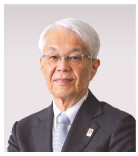
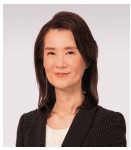
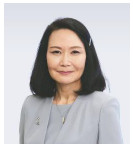
| 1 | Reappointment | Toshihiro Mibe |
5 | Reappointment | Jiro Morisawa |
9 | Reappointment | Kazuhiro Higashi | ||||||||
| 2 | Reappointment | Noriya Kaihara |
6 | Reappointment | Kunihiko
Sakai |
10 | Reappointment | Ryoko Nagata Outside Independent Non-executive Female | ||||||||
| 3 | New appointment | Mahito Shikama Male |
7 | Reappointment | Fumiya
Kokubu |
11 | Reappointment | Mika Agatsuma Outside Independent Non-executive Female | ||||||||
| 4 | Reappointment | Asako Suzuki Non-executive Female |
8 | Reappointment | Yoichiro
Ogawa |
|||||||||||
For details, please refer to the information posted on the websites linked below.
Websites on Which the Matters Subject to Electronic Provision Are Posted
| Company’s website | https://global.honda/en/investors/stock_bond/meeting.html | |
| Tokyo Stock Exchange’s website | https://www2.jpx.co.jp/tseHpFront/JJK020010Action.do?Show=Show Please access the website linked above, enter and search for either the Company’s name (Honda Motor) or the securities code (7267), and then select “Basic information” and “Documents for public inspection/PR information” to view the information. | |
| Net de Shoshu (online notice of convocation) website | https://s.srdb.jp/7267/ You may view this Notice of Convocation and exercise your voting rights via PC, smartphone, or tablet. | |
Matters to Be Noted
| ∎ | Regarding the matters subject to electronic provision, the following items are not included in the paper copy to shareholders who have made a request for delivery of documents (paper copies delivered) in accordance with provisions of laws and regulations and Article 15 of the Company’s Articles of Incorporation. The Audit Committee and the financial auditor have audited documents that are subject to audit, including the following matters. |
• Business Report: |
OUTLINE OF BUSINESS | |
| (Preparing for the Future, Changes in Financial Position and Results of Operations of the Group and the Parent Company, Principal Business Activities, Principal Business Sites, Employees of the Group and the Parent Company); | ||
| COMMON STOCK | ||
| (Total Number of Shares Issued, Number of Shareholders, Major Shareholders, Shares Issued to Corporate Officers as Compensation for the Performance of Their Duties During the Fiscal Year Ended March 31, 2026); | ||
| STOCK WARRANTS; | ||
| CORPORATE OFFICERS | ||
| (Principal Activities of Outside Directors during the Fiscal Year ended March 31, 2026, Summary of Content of Liability Limitation Contract, Summary of Content of Indemnity Contract, Summary of Content of Directors and Officers Liability Insurance Contract); | ||
| FINANCIAL AUDITOR; | ||
| THE COMPANY’S SYSTEMS AND POLICIES | ||
| (Systems to Ensure the Appropriateness of Operations, Overview of Operating Status for Systems to Ensure the Appropriateness of Operations, Policy Regarding Decisions for Distribution of Dividends, Etc.) | ||
• Consolidated Financial Statements: |
Consolidated Statements of Financial Position, Consolidated Statements of Income, Consolidated Statements of Changes in Equity, The Notes to the Consolidated Statutory Report | |
• Audit Report: |
Independent Auditor’s Report, Audit Report of the Audit Committee |
| ∎ | In accordance with laws and regulations, the Company has sent the paper copies delivered only to shareholders who have completed the procedures for request for delivery of documents on or before March 31, 2026. |
| ∎ | If any revision is made to the matters subject to electronic provision, the revised details will be posted on each of the websites linked above. |
3
REFERENCE MATERIALS FOR THE GENERAL MEETING OF SHAREHOLDERS
| ITEM | Election of Eleven (11) Directors |
The term of office of each of the twelve (12) current Directors is due to expire at the close of this general meeting of shareholders.
It is proposed that the following eleven (11) Directors, including six (6) Outside Directors, be elected at this meeting.
The names and particulars of the candidates for the position of Directors are provided below.
| Candidate number | Name |
Current position (including consolidated subsidiaries) |
Responsibilities | |||||
| 1 | Reappointment | Toshihiro Mibe |
Director, President and Representative Executive Officer |
Member of the Nominating Committee Chief Executive Officer Chairman of the Board of Directors Chief Transformation Officer | ||||
| 2 | Reappointment | Noriya Kaihara |
Director, Executive Vice President and Representative Executive Officer |
Member of the Compensation Committee Compliance and Privacy Officer Culture Transformation Officer | ||||
| 3 | New appointment | Mahito Shikama |
Managing Officer, Honda R&D Co., Ltd. *2 |
- *2 | ||||
| 4 | Reappointment | Asako Suzuki |
Director | Member of the Audit Committee (Full-time) | ||||
| 5 | Reappointment | Jiro Morisawa |
Director | Member of the Audit Committee (Full-time) | ||||
| 6 | Reappointment | Kunihiko
Sakai |
Director | Member of the Nominating Committee Member of the Audit Committee | ||||
| 7 | Reappointment | Fumiya
Kokubu |
Director | Member of the Nominating Committee (Chairperson) Member of the Compensation Committee *3 | ||||
| 8 | Reappointment | Yoichiro
Ogawa |
Director | Member of the Audit Committee (Chairperson) Member of the Compensation Committee | ||||
| 9 | Reappointment | Kazuhiro Higashi Outside
Independent |
Director | Member of the Nominating Committee Member of the Compensation Committee (Chairperson) | ||||
| 10 | Reappointment | Ryoko
Nagata |
Director | Member of the Audit Committee | ||||
| 11 | Reappointment | Mika
Agatsuma |
Director | Member of the Nominating Committee | ||||
4
| Name |
Attendance record for the fiscal year ended March 31, 2026 (number of meetings attended/number of meetings held) | |||||||
| Board of Directors |
Nominating Committee |
Audit Committee |
Compensation Committee | |||||
| Toshihiro Mibe | 10/10 100% |
11/11 100% |
— | — | ||||
| Noriya Kaihara | 10/10 100% |
— | — | — | ||||
| Mahito Shikama | — |
— | — | — | ||||
| Asako Suzuki | 10/10 100% |
— | 10/10 100% |
— | ||||
| Jiro Morisawa | 10/10 100% |
— | 10/10 100% |
— | ||||
| Kunihiko Sakai | 10/10 100% |
11/11 100% |
10/10 100% |
— | ||||
| Fumiya Kokubu | 10/10 100% |
11/11 100% |
— | 10/10 100% | ||||
| Yoichiro Ogawa | 10/10 100% |
— | 10/10 100% |
10/10 100% | ||||
| Kazuhiro Higashi | 10/10 100% |
11/11 100% |
— | 10/10 100% | ||||
| Ryoko Nagata | 10/10 100% |
— | 10/10 100% |
— | ||||
| Mika Agatsuma | 10/10 100% |
11/11 100% |
— | — | ||||
| Notes: 1. | These reference materials for the general meeting of shareholders contain information as of the date of preparation of the materials (May 20, 2026). However, the number of shares of the Company held is based on information as of March 31, 2026. |
| 2. | As of June 1, 2026, Mr. Mahito Shikama is scheduled to assume the position of Executive Officer of the Company and the roles of Chief Transformation Officer, Chief Officer for Corporate Strategy Operations, and Chief Officer for Traffic Safety Promotion Operations. |
| 3. | As of June 26, 2026, Mr. Fumiya Kokubu is scheduled to assume the role of Chairman of the Board of Directors. |
| 4. | Please refer to page 6 for information on the committees to which the Director candidates are scheduled to be appointed. |
5
| ∎ | (Reference) Nomination Policy of Director Candidates (from “Honda Corporate Governance Basic Policies”) |
| • | The Director candidates shall be exceptional persons who are familiar with corporate management or the Company Group’s business, and have superior character and insight, irrespective of gender, nationality, and other such individual attributes. In nominating such candidates, the Nominating Committee shall consider the balance of gender, internationality, and experience and specialization in each field. |
| • | The Outside Director candidates shall have abundant experience and deep insight in fields such as corporate management, the legal, public administration, accounting, or education, and shall be capable of overseeing the entire business management of the Company from an objective, highly sophisticated and broader viewpoint based on the standpoint independent from the Company Group. |
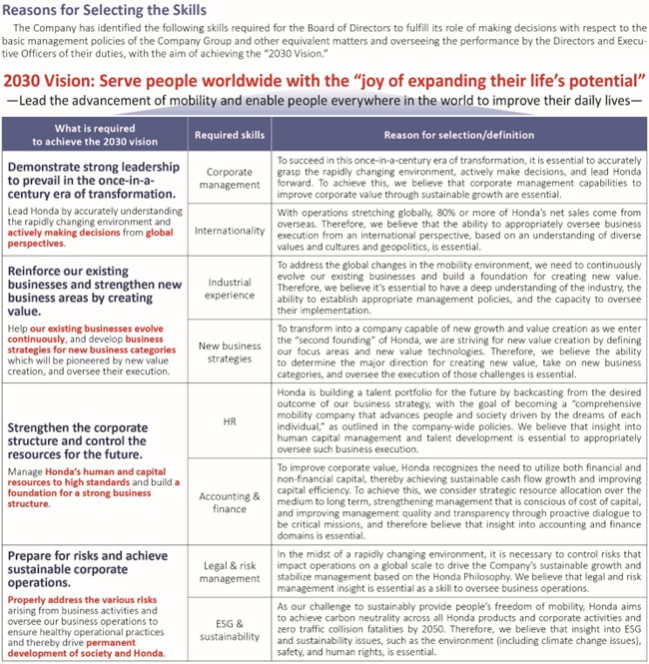
| Name |
Skills | Committee to be appointed | ||||||||||||||||||||
| Corporate management |
Internationality | Industrial experience |
New business strategies |
HR | Accounting & finance |
Legal & risk management |
ESG & sustainability |
Nominating | Audit | Compensation | ||||||||||||
| Toshihiro Mibe |
• | • | • | • | • | • | • | • | ||||||||||||||
| Noriya Kaihara |
• | • | • | • | • | • | ||||||||||||||||
| Mahito Shikama |
• | • | • | • | ||||||||||||||||||
| Asako Suzuki |
• | • | • | • | • | 〇 | ||||||||||||||||
| Jiro Morisawa |
• | • | • | 〇 | ||||||||||||||||||
| Kunihiko Sakai |
• | • | • | 〇 | 〇 | |||||||||||||||||
| Fumiya Kokubu |
• | • | • | • | ◎ | 〇 | ||||||||||||||||
| Yoichiro Ogawa |
• | • | • | • | ◎ | 〇 | ||||||||||||||||
| Kazuhiro Higashi |
• | • | • | • | • | 〇 | ◎ | |||||||||||||||
| Ryoko Nagata |
• | • | • | 〇 | ||||||||||||||||||
| Mika Agatsuma |
• | • | • | 〇 | 〇 | |||||||||||||||||
| ◎: Chairperson of the Committee | ||||||||||||||||||||||
Please refer to the next page for the reasoning behind the selection of the skills.
6
7
| 1 |
Toshihiro Mibe |
Date of birth July 1, 1961 |
Reappointment | |||
|
Current position | Director, President and Representative Executive Officer |
Responsibilities | Member of the Nominating Committee Chief Executive Officer Chairman of the Board of Directors Chief Transformation Officer | ||||
|
● Number of shares of the Company held 301,401 shares
|
● Attendance record of the Board of Directors, etc. (number of meetings attended/number of meetings held) | |||||||
|
● Special interest between the candidate and the Company None
|
Board of Directors 10/10 (100%) Nominating Committee 11/11 (100%) | |||||||
|
● Term of office as Director (as of the close of this Meeting) 6 years
|
||||||||
● Resume, current position, responsibilities and significant concurrent positions | ||||||
| Apr. 1987 |
Joined Honda Motor Co., Ltd. | Apr. 2020 | Senior Managing Officer | |||
| Apr. 2014 |
Operating Officer | Apr. 2020 | In Charge of Mono-zukuri (Research & Development, Production, Purchasing, Quality, Parts, Service, Intellectual Property, Standardization and IT) | |||
| Apr. 2014 |
Executive in Charge of Powertrain Business for Automobile Operations | Apr. 2020 | Risk Management Officer | |||
| Apr. 2014 |
Head of Powertrain Production Supervisory Unit of Automobile Production for Automobile Operations | Jun. 2020 | Senior Managing Director | |||
| Apr. 2015 |
Executive in Charge of Powertrain Business and Drivetrain Business for Automobile Operations | Jun. 2020 | Director in Charge of Mono-zukuri (Research & Development, Production, Purchasing, Quality, Parts, Service, Intellectual Property, Standardization and IT) | |||
| Apr. 2015 |
Head of Drivetrain Business Unit in Automobile Production for Automobile Operations | Apr. 2021 | President and Representative Director | |||
| Apr. 2016 |
Senior Managing Officer and Director of Honda R&D Co., Ltd. | Apr. 2021 | Chief Executive Officer (present) | |||
| Apr. 2018 |
Managing Officer of the Company | Jun. 2021 | Director, President and Representative Executive Officer (present) | |||
| Apr. 2018 |
Executive Vice President and Director of Honda R&D Co., Ltd. | Jun. 2021 | Member of the Nominating Committee (present) | |||
| Apr. 2019 |
President and Representative Director of Honda R&D Co., Ltd. | Apr. 2024 | Chairman of the Board of Directors (present) | |||
| Apr. 2019 |
In Charge of Intellectual Property and Standardization of the Company | Apr. 2026 | Chief Transformation Officer (present) | |||
Reasons for nomination as a candidate for position of Director
Mr. Toshihiro Mibe has broad experience primarily in the areas of R&D and production, and is familiar with the Company Group’s business including overseas operations.
In the fiscal year ended March 31, 2026, he has adequately fulfilled his duties as Chairman of the Board of Directors through managing the Board of Directors and as Director, President and Representative Executive Officer, and Chief Executive Officer of the Company by demonstrating strong leadership and being responsible for the management of the entire Company Group, as well as overseeing business execution.
He has been nominated as a candidate for Director again, given that he is an exceptional person with both superior character and insight and is well qualified for assuming a role in overseeing the entire business management of the Company in order to achieve the realization of 2030 Vision, 2050 carbon neutrality, and zero traffic collision fatalities.
8
| 2 |
Noriya Kaihara |
Date of birth August 4, 1961 |
Reappointment | |||
|
Current position | Director, Executive Vice President and Representative Executive Officer |
Responsibilities | Member of the Compensation Committee Compliance and Privacy Officer Culture Transformation Officer | ||||
|
● Number of shares of the Company held 129,750 shares
|
● Attendance record of the Board of Directors, etc. (number of meetings attended/number of meetings held) | |||||||
|
● Special interest between the candidate and the Company None
|
Board of Directors 10/10 (100%) | |||||||
|
● Term of office as Director (as of the close of this Meeting) 7 years (in total)
|
||||||||
● Resume, current position, responsibilities and significant concurrent positions | ||||||
| Apr. 1984 |
Joined Honda Motor Co., Ltd. | Apr. 2021 | Chief Officer for Customer First Operations | |||
| Apr. 2012 |
General Manager of Automobile Quality Assurance Division | Apr. 2021 | Risk Management Officer | |||
| Apr. 2013 |
Operating Officer | Jun. 2021 | Managing Executive Officer | |||
| Apr. 2013 |
Chief Quality Officer | Oct. 2021 | Managing Officer | |||
| Jun. 2013 |
Operating Officer and Director | Oct. 2021 | Chief Officer for Regional Operations (North America) | |||
| Apr. 2014 |
Chief Officer for Customer Service Operations | Oct. 2021 | President, Chief Executive Officer and Director of American Honda Motor Co., Inc. | |||
| Apr. 2014 |
Head of Service Supervisory Unit for Automobile Operations | Apr. 2023 | Senior Managing Executive Officer of the Company | |||
| Apr. 2016 |
Chief Officer for Customer First Operations | Jun. 2023 | Director, Senior Managing Executive Officer | |||
| Jun. 2017 |
Operating Officer (resigned from position as Director) | Apr. 2024 | Director, Executive Vice President and Representative Executive Officer (present) | |||
| Apr. 2018 |
Managing Officer | Apr. 2024 | Compliance and Privacy Officer (present) | |||
| Apr. 2018 |
Chief Officer for Purchasing Operations | Apr. 2025 | Culture Transformation Officer (present) | |||
| Apr. 2020 |
Head of Business Supervisory Unit for Automobile Operations | Apr. 2026 | Member of the Compensation Committee (present) | |||
Reasons for nomination as a candidate for position of Director
Mr. Noriya Kaihara has broad experience primarily in the area of service, quality and purchasing, as well as abundant international experience, and is familiar with the Company Group’s business including overseas operations.
In the fiscal year ended March 31, 2026, he has adequately fulfilled his duties as Director, Executive Vice President and Representative Executive Officer, Compliance and Privacy Officer, and Culture Transformation Officer by demonstrating strong leadership and contributing to the business of the entire Company Group, as well as overseeing business execution.
He has been nominated as a candidate for Director again, given that he is an exceptional person with both superior character and insight and is well qualified for assuming a role in overseeing the entire business management of the Company in order to achieve the realization of 2030 Vision, 2050 carbon neutrality, and zero traffic collision fatalities.
9
| 3 |
Mahito Shikama |
Date of birth August 8, 1977 |
New appointment | |||
|
Current position (including consolidated |
Managing Officer, Honda R&D Co., Ltd.
|
Responsibilities |
– | ||||
|
● Number of shares of the Company held 1,500 shares
|
||||||||
|
● Special interest between the candidate and the Company None
|
||||||||
|
● Term of office as Director (as of the close of this Meeting) –
|
||||||||
● Resume, current position, responsibilities and significant concurrent positions
| ||||||
| Apr. 2002 | Joined Honda Motor Co., Ltd. | Jun. 2026 | Executive Officer of the Company (scheduled to be appointed) | |||
| Apr. 2022 | General Manager of Advanced Safety and Intelligent Solution Development Division of Software Defined Mobility Development Supervisory Unit for Business Development Operations | Jun. 2026 | Chief Transformation Officer (scheduled to be appointed) | |||
| Apr. 2023 | Operating Executive | Jun. 2026 | Chief Officer for Corporate Strategy Operations (scheduled to be appointed) | |||
| Apr. 2023 | Head of Software Defined Mobility Development Unit of BEV Development Center for Electrification Business Development Operations | Jun. 2026 | Chief Officer for Traffic Safety Promotion Operations (scheduled to be appointed) | |||
| Apr. 2026 | Managing Officer and Chief Operating Officer of SDV R&D Center of Honda R&D Co., Ltd. (present) | |||||
Reasons for nomination as a candidate for position of Director
Mr. Mahito Shikama has abundant experience in the area of automobile development and is familiar with the Company Group’s business, ranging from hybrid control development to the development of advanced technologies and products for the age of intelligence and electrification, having achieved the world’s first commercialization of Level 3 conditional automated vehicles in 2021.
In the fiscal year ended March 31, 2026, he demonstrated strong leadership, including spearheading the in-house development of a new-generation in-vehicle operating system as Head of Software Defined Mobility Development Unit, and contributed to the business from a future perspective to achieve adequate results.
He is scheduled to be in charge of leading the company-wide organizational reform as Chief Transformation Officer.
He has been newly nominated as a candidate for Director, given that he is an exceptional person with both superior character and insight and is well qualified for assuming a role in overseeing the entire business management of the Company in order to achieve the realization of 2030 Vision, 2050 carbon neutrality, and zero traffic collision fatalities.
10
| 4 |
Asako Suzuki |
Date of birth January 28, 1964 |
Reappointment | |||
|
Current position |
Director
|
Responsibilities |
Member of the Audit Committee (Full-time)
| ||||
|
● Number of shares of the Company held 91,400 shares
|
● Attendance record of the Board of Directors, etc. (number of meetings attended/number of meetings held) | |||||||
|
● Special interest between the candidate and the Company None
|
Board of Directors 10/10 (100%) Audit Committee 10/10 (100%) | |||||||
|
● Term of office as Director (as of the close of this Meeting) 5 years
|
||||||||
● Resume, current position, responsibilities and significant concurrent positions | ||||||
| Apr. 1987 |
Joined Honda Motor Co., Ltd. | Apr. 2019 | Chief Officer for Human Resources and Corporate Governance Operations | |||
| Apr. 2014 |
President of Dongfeng Honda Automobile Co., Ltd. | Apr. 2020 | Operating Executive | |||
| Apr. 2016 |
Operating Officer of the Company | Jun. 2021 | Director (present) | |||
| Apr. 2018 |
Vice Chief Officer for Regional Operations (Japan) | Jun. 2021 | Member of the Audit Committee (Full-time) (present) | |||
Reasons for nomination as a candidate for position of Director
Ms. Asako Suzuki has broad experience primarily in the area of sales and marketing, accounting and finance, human resources and corporate governance, as well as abundant international experience, and is familiar with the Company Group’s business including overseas operations.
In the fiscal year ended March 31, 2026, she has adequately fulfilled her duties as Director and a Member of the Audit Committee by auditing and overseeing the execution of duties by Directors and Executive Officers.
She has been nominated as a candidate for Director again, given that she is an exceptional person with both superior character and insight and is well qualified for assuming a role in overseeing the entire business management of the Company with a broad perspective from an objective and highly sophisticated viewpoint.
After her appointment, she will serve as a Member of the Audit Committee.
11
| 5 |
Jiro Morisawa |
Date of birth February 24, 1967 |
Reappointment | |||
|
Current position |
Director
|
Responsibilities |
Member of the Audit Committee (Full-time)
| ||||
|
● Number of shares of the Company held 42,970 shares
|
● Attendance record of the Board of Directors, etc. (number of meetings attended/number of meetings held) | |||||||
|
● Special interest between the candidate and the Company None
|
Board of Directors 10/10 (100%) Audit Committee 10/10 (100%) | |||||||
|
● Term of office as Director (as of the close of this Meeting) 2 years
|
||||||||
● Resume, current position, responsibilities and significant concurrent positions | ||||||
| Apr. 1989 |
Joined Honda Motor Co., Ltd. | Apr. 2020 | Operating Executive | |||
| Apr. 2016 |
General Manager of Regional Operation Planning Office for Regional Operations (Japan) | Apr. 2020 | Chief Officer for Business Management Operations | |||
| Apr. 2017 |
General Manager of Accounting Division for Business Management Operations | Apr. 2021 | President and Director of American Honda Finance Corporation | |||
| Apr. 2018 |
Vice Chief Officer for Business Management Operations and General Manager of Accounting Division for Business Management Operations | Jun. 2024 | Director of the Company (present) | |||
| Apr. 2019 |
Operating Officer | Jun. 2024 | Member of the Audit Committee (Full-time) (present) | |||
| Apr. 2019
|
Chief Officer for Business Management Operations | |||||
Reasons for nomination as a candidate for position of Director
Mr. Jiro Morisawa has broad experience primarily in the area of accounting and finance, as well as abundant international experience, and is familiar with the Company Group’s business including overseas operations.
In the fiscal year ended March 31, 2026, he has adequately fulfilled his duties as Director and a Member of the Audit Committee by auditing and overseeing the execution of duties by Directors and Executive Officers.
He has been nominated as a candidate for Director again, given that he is an exceptional person with both superior character and insight and is well qualified for assuming a role in overseeing the entire business management of the Company with a broad perspective from an objective and highly sophisticated viewpoint.
After his appointment, he will serve as a Member of the Audit Committee.
12
| 6 |
Kunihiko Sakai |
Date of birth March 4, 1954 |
Reappointment Outside Independent Director | |||
|
Current position |
Director
|
Responsibilities |
Member of the Nominating Committee Member of the Audit Committee
| ||||
|
● Number of shares of the Company held 7,900 shares
|
● Attendance record of the Board of Directors, etc. (number of meetings attended/number of meetings held) | |||||||
|
● Special interest between the candidate and the Company None
|
Board of Directors 10/10 (100%) Nominating Committee 11/11 (100%) Audit Committee 10/10 (100%) | |||||||
|
● Term of office as Outside Director (as of the close of this Meeting) 7 years
|
||||||||
● Resume, current position, responsibilities and significant concurrent positions | ||||||
| Apr. 1979 |
Public Prosecutor of Tokyo District Public Prosecutors’ Office | Jun. 2018 | Outside Audit & Supervisory Board Member of Furukawa Electric Co., Ltd. (resigned in June 2025) | |||
| Jul. 2014 |
Superintending Prosecutor of Takamatsu High Public Prosecutors’ Office | Jun. 2019 | Outside Director (Audit and Supervisory Committee Member) of the Company | |||
| Sep. 2016 |
Superintending Prosecutor of Hiroshima High Public Prosecutors’ Office (resigned in March 2017) | Jun. 2021 | Outside Director (present) | |||
| Apr. 2017 |
Registered with the Dai-Ichi Tokyo Bar Association | Jun. 2021 | Member of the Nominating Committee (present) | |||
| Apr. 2017 |
Advisor Attorney to TMI Associates (present) | Jun. 2021 | Member of the Audit Committee (present) | |||
| (Significant concurrent positions) | ||||||
| Lawyer, Advisor Attorney to TMI Associates
| ||||||
| 1. | Reasons for nomination as a candidate for position of Outside Director |
Mr. Kunihiko Sakai has high expertise and abundant experience as a legal affairs specialist having served as Public Prosecutor and a lawyer, including posts of Superintending Prosecutor at High Public Prosecutors’ Offices from July 2014 to March 2017.
He has adequately fulfilled his duties as Outside Director who is an Audit and Supervisory Committee Member since June 2019, and as Outside Director and a Member of the Nominating Committee and the Audit Committee since June 2021, by auditing and overseeing the entire business management of the Company from an independent standpoint.
He has no experience in corporate management except serving as Outside Director or Outside Corporate Auditor. However, he has been nominated as a candidate for Outside Director again, given that he is an exceptional person with both superior character and insight, in order for him to continue to assume a role in overseeing the entire business management of the Company with a broad perspective from an objective and highly sophisticated viewpoint.
| 2. | Roles expected to fulfill after appointment |
After his appointment, he is expected to continue to contribute to strengthening the supervisory function of the Company’s management. He is also expected to fulfill a role in strengthening the transparency and objectivity of the process of selecting candidates for Directors, as well as strengthening the audit function, as a Member of the Nominating Committee and the Audit Committee.
| 3. | Other matters related to the Outside Director candidate |
| (1) | Mr. Kunihiko Sakai is a candidate for the position of Outside Director as defined in Article 2, Paragraph 3, Item 7 of the Enforcement Regulations of the Companies Act. |
| (2) | Mr. Kunihiko Sakai fulfills the “Honda Motor Co., Ltd. Criteria for Independence of Outside Directors.” The Company has appointed him as an Independent Outside Director as stipulated by the rules of the Tokyo Stock Exchange and reported his appointment to the Tokyo Stock Exchange. If he is re-elected and assumes the position of Director, the Company plans to continue his appointment as an Independent Outside Director. |
13
| 7 |
Fumiya Kokubu |
Date of birth October 6, 1952 |
Reappointment Outside Independent Director | |||
|
Current position | Director |
Responsibilities | Member of the Nominating Committee (Chairperson) Member of the Compensation Committee | ||||
|
● Number of shares of the Company held 6,400 shares
|
● Attendance record of the Board of Directors, etc. (number of meetings attended/number of meetings held) | |||||||
|
● Special interest between the candidate and the Company None
|
Board of Directors 10/10 (100%) Nominating Committee 11/11 (100%) Audit Committee 10/10 (100%) | |||||||
|
● Term of office as Outside Director (as of the close of this Meeting) 6 years
|
||||||||
● Resume, current position, responsibilities and significant concurrent positions | ||||||
| Apr. 1975 |
Joined Marubeni Corporation | Jun. 2021 | Member of the Compensation Committee (present) | |||
| Apr. 2013 |
President and CEO, Member of the Board of Marubeni Corporation | May 2022 | Chairperson of Japan Machinery Center for Trade and Investment (present) | |||
| Apr. 2019 |
Chairman of the Board of Marubeni Corporation | May 2022 | Chairman of Japan Foreign Trade Council, Inc. (resigned in May 2024) | |||
| Jun. 2019 |
Outside Director of Taisei Corporation (present) | Apr. 2025 | Director, Member of the Board, Executive Corporate Advisor of Marubeni Corporation (resigned in June 2025) | |||
| Jun. 2020 |
Outside Director of the Company (present) | Jun. 2025 | Chairperson of International University of Japan (present) | |||
| Jun. 2021 |
Member of the Nominating Committee (Chairperson) (present) | Jun. 2025 | Executive Corporate Advisor of Marubeni Corporation (present) | |||
| (Significant concurrent positions) | ||||||
| Outside Director of Taisei Corporation, Chairperson of Japan Machinery Center for Trade and Investment, Chairperson of International University of Japan | ||||||
| 1. | Reasons for nomination as a candidate for position of Outside Director |
Mr. Fumiya Kokubu held positions of President and CEO, and Chairman of the Board of Marubeni Corporation from April 2013 to March 2025, and has abundant experience and deep insight regarding corporate management.
He has adequately fulfilled his duties as Outside Director since June 2020, and additionally as the Chairperson of the Nominating Committee and a Member of the Compensation Committee since June 2021 by overseeing the entire business management of the Company from an independent standpoint.
He has been nominated as a candidate for Outside Director again, given that he is an exceptional person with both superior character and insight, in order for him to continue to assume a role in overseeing the entire business management of the Company with a broad perspective from an objective and highly sophisticated viewpoint.
| 2. | Roles expected to fulfill after appointment |
After his appointment, he is expected to continue to contribute to strengthening the supervisory function of the Company’s management. He is also expected to fulfill a role in strengthening the transparency and objectivity of the process of selecting candidates for Directors and the process of determining the compensation of Directors and Executive Officers, as the Chairperson of the Nominating Committee and a Member of the Compensation Committee.
In addition, after his appointment, he will serve as the new Chairman of the Board of Directors.
| 3. | Other matters related to the Outside Director candidate |
| (1) | Mr. Fumiya Kokubu is a candidate for the position of Outside Director as defined in Article 2, Paragraph 3, Item 7 of the Enforcement Regulations of the Companies Act. |
| (2) | Mr. Fumiya Kokubu fulfills the “Honda Motor Co., Ltd. Criteria for Independence of Outside Directors.” The Company has appointed him as an Independent Outside Director as stipulated by the rules of the Tokyo Stock Exchange and reported his appointment to the Tokyo Stock Exchange. If he is re-elected and assumes the position of Director, the Company plans to continue his appointment as an Independent Outside Director. Marubeni Corporation, where Mr. Fumiya Kokubu served as Chairman of the Board until March 2025, the Company and their respective consolidated subsidiaries have business relationships. However, the amount of transactions between them in the fiscal year ended March 31, 2026 is less than 1% of the consolidated sales revenue of the Company and the other party. |
14
| 8 |
Yoichiro Ogawa |
Date of birth February 19, 1956 |
Reappointment Outside Independent Director | |||
|
|
Current position | Director |
Responsibilities | Member of the Audit Committee (Chairperson) Member of the Compensation Committee | ||||
|
● Number of shares of the Company held 4,900 shares
|
● Attendance record of the Board of Directors, etc. (number of meetings attended/number of meetings held) | |||||||
|
● Special interest between the candidate and the Company None
|
Board of Directors 10/10 (100%) Audit Committee 10/10 (100%) Compensation Committee 10/10 (100%) | |||||||
|
● Term of office as Outside Director (as of the close of this Meeting) 5 years
|
||||||||
● Resume, current position, responsibilities and significant concurrent positions | ||||||
| Oct. 1980 |
Joined Tohmatsu & Aoki Audit Corporation (currently Deloitte Touche Tohmatsu LLC) | Jun. 2018 | Senior Advisor of Deloitte Tohmatsu Group (resigned in October 2018) | |||
| Mar. 1984 |
Registered as Japanese Certified Public Accountant | Nov. 2018 | Founder of Yoichiro Ogawa CPA Office (present) | |||
| Oct. 2013 |
Deputy CEO of Deloitte Touche Tohmatsu LLC | Jun. 2020 | Independent Audit and Supervisory Board Member of Recruit Holdings Co., Ltd. (present) | |||
| Oct. 2013 |
Deputy CEO of Tohmatsu Group (currently Deloitte Tohmatsu Group) | Jun. 2021 | Outside Director of the Company (present) | |||
| Jun. 2015 |
Global Managing Director for Asia Pacific of Deloitte Touche Tohmatsu Limited (United Kingdom) (resigned in May 2018) | Jun. 2021 | Member of the Audit Committee (Chairperson) (present) | |||
| Jul. 2015 |
CEO of Deloitte Tohmatsu Group | Jun. 2021 | Member of the Compensation Committee (present) | |||
| (Significant concurrent positions) | ||||||
| Certified Public Accountant, Founder of Yoichiro Ogawa CPA Office, Independent Audit and Supervisory Board Member of Recruit Holdings Co., Ltd. | ||||||
| 1. | Reasons for nomination as a candidate for position of Outside Director |
Mr. Yoichiro Ogawa has high expertise and abundant experience as an accounting specialist having served as a Certified Public Accountant for many years, including posts of CEO of Deloitte Tohmatsu Group from July 2015 to May 2018.
He has adequately fulfilled his duties as Outside Director, the Chairperson of the Audit Committee and a Member of the Compensation Committee since June 2021 by auditing and overseeing the entire business management of the Company from an independent standpoint.
He has been nominated as a candidate for Outside Director again, given that he is an exceptional person with both superior character and insight, in order for him to continue to assume a role in overseeing the entire business management of the Company with a broad perspective from an objective and highly sophisticated viewpoint.
| 2. | Roles expected to fulfill after appointment |
After his appointment, he is expected to continue to contribute to strengthening the supervisory function of the Company’s management. He is also expected to fulfill a role in strengthening the audit function, as well as strengthening the transparency and objectivity of the process of determining the compensation of Directors and Executive Officers, as the Chairperson of the Audit Committee and a Member of the Compensation Committee.
| 3. | Other matters related to the Outside Director candidate |
| (1) | Mr. Yoichiro Ogawa is a candidate for the position of Outside Director as defined in Article 2, Paragraph 3, Item 7 of the Enforcement Regulations of the Companies Act. |
| (2) | Mr. Yoichiro Ogawa fulfills the “Honda Motor Co., Ltd. Criteria for Independence of Outside Directors.” The Company has appointed him as an Independent Outside Director as stipulated by the rules of the Tokyo Stock Exchange and reported his appointment to the Tokyo Stock Exchange. If he is re-elected and assumes the position of Director, the Company plans to continue his appointment as an Independent Outside Director. Deloitte Tohmatsu Group, where Mr. Yoichiro Ogawa served as CEO until May 2018, the Company and its consolidated subsidiaries have business relationships. However, he has had no relationship with Deloitte Tohmatsu Group since October 2018, and the amount of transactions between them in the fiscal year ended March 31, 2026 is less than 1% of the consolidated sales revenue of the Company and the other party. |
15
| 9 |
Kazuhiro Higashi |
Date of birth April 25, 1957 |
Reappointment Outside Independent Director | |||
|
Current position |
Director
|
Responsibilities |
Member of the Nominating Committee Member of the Compensation Committee (Chairperson)
| ||||
|
● Number of shares of the Company held 4,900 shares
|
● Attendance record of the Board of Directors, etc. (number of meetings attended/number of meetings held) | |||||||
|
● Special interest between the candidate and the Company None
|
Board of Directors 10/10 (100%) Nominating Committee 11/11 (100%) Compensation Committee 10/10 (100%) | |||||||
|
● Term of office as Outside Director (as of the close of this Meeting) 5 years
|
||||||||
● Resume, current position, responsibilities and significant concurrent positions
| ||||||
| Apr. 1982 |
Joined Resona Group | Apr. 2020 | Chairman and Director of Resona Bank, Limited (resigned in June 2022) | |||
| Apr. 2013 |
Director of Resona Holdings, Inc. | Jun. 2020 | Outside Director of Sompo Holdings, Inc. (present) | |||
| Apr. 2013 |
President and Representative, Executive Officer of Resona Holdings, Inc. | Jun. 2021 | Outside Director of the Company (present) | |||
| Apr. 2013 |
Representative Director, President and Executive Officer of Resona Bank, Limited | Jun. 2021 | Member of the Nominating Committee (present) | |||
| Jun. 2013 |
Chairman of Osaka Bankers Association (resigned in June 2014) | Jun. 2021 | Member of the Compensation Committee (Chairperson) (present) | |||
| Apr. 2017 |
Chairman of the Board, President and Representative Director of Resona Bank, Limited | Jun. 2022 | Senior Advisor of Resona Holdings, Inc. (present) | |||
| Jun. 2017 |
Chairman of Osaka Bankers Association (resigned in June 2018) | Jun. 2022 | Senior Advisor of Resona Bank, Limited (present) | |||
| Apr. 2018 |
Chairman of the Board, President, Representative Director and Executive Officer of Resona Bank, Limited | Nov. 2025 | Outside Director of Ryohin Keikaku Co., Ltd. (present) | |||
| Apr. 2020 |
Chairman and Director of Resona Holdings, Inc. (resigned in June 2022) | |||||
(Significant concurrent positions)
Outside Director of Sompo Holdings, Inc., Outside Director of Ryohin Keikaku Co., Ltd.
1. Reasons for nomination as a candidate for position of Outside Director
Mr. Kazuhiro Higashi held positions of President and Chairman of Resona Holdings, Inc. from April 2013 to June 2022, and has abundant experience and deep insight regarding corporate management. He has adequately fulfilled his duties as Outside Director, the Chairperson of the Compensation Committee and a Member of the Nominating Committee since June 2021 by overseeing the entire business management of the Company from an independent standpoint.
He has been nominated as a candidate for Outside Director again, given that he is an exceptional person with both superior character and insight, in order for him to continue to assume a role in overseeing the entire business management of the Company with a broad perspective from an objective and highly sophisticated viewpoint.
2. Roles expected to fulfill after appointment
After his appointment, he is expected to continue to contribute to strengthening the supervisory function of the Company’s management. He is also expected to fulfill a role in strengthening the transparency and objectivity of the process of determining the compensation of Directors and Executive Officers and the process of selecting candidates for Directors, as the Chairperson of the Compensation Committee and a Member of the Nominating Committee.
3. Other matters related to the Outside Director candidate
(1) Mr. Kazuhiro Higashi is a candidate for the position of Outside Director as defined in Article 2, Paragraph 3, Item 7 of the Enforcement Regulations of the Companies Act.
(2) Mr. Kazuhiro Higashi fulfills the “Honda Motor Co., Ltd. Criteria for Independence of Outside Directors.” The Company has appointed him as an Independent Outside Director as stipulated by the rules of the Tokyo Stock Exchange and reported his appointment to the Tokyo Stock Exchange. If he is re-elected and assumes the position of Director, the Company plans to continue his appointment as an Independent Outside Director. The Company Group’s aggregate amount of borrowings in the fiscal year ended March 31, 2026 from banks affiliated with Resona Holdings, Inc., where Mr. Kazuhiro Higashi served as Chairman and Director until June 2022, is less than 1% of the amount of consolidated total assets of the Company and the other party.
(3) Sompo Japan Insurance Inc., a subsidiary of Sompo Holdings, Inc., where Mr. Kazuhiro Higashi serves as Outside Director since June 2020, has been involved in conduct considered to be in conflict with the Antimonopoly Act and improper conduct in light of the same act, inappropriate response in relation to fraudulent automobile insurance claims by used car dealers, leakage of customer information, etc. during his term of office. Further, in January 2024, Sompo Holdings, Inc. received a business improvement order from the Financial Services Agency on the management of Sompo Japan Insurance
16
Inc. in relation to fraudulent automobile insurance claims by used car dealers pursuant to the Insurance Business Act.
While the details of these incidents are as stated in publicly available documents, such as the content of an administrative penalty imposed by the Financial Services Agency and the report of the independent investigation committee consisting of third parties, Mr. Kazuhiro Higashi performed his duties appropriately by making recommendations regularly on exemplary initiatives for the Group’s compliance as necessary, and after the incidents were identified, he made recommendations for legal compliance, customer protection, and importance of strengthening internal controls.
17
| 10 |
Ryoko Nagata |
Date of birth July 14, 1963 |
Reappointment Outside Independent Director | |||
|
Current position | Director |
Responsibilities | Member of the Audit Committee
| ||||
|
● Number of shares of the Company held 4,900 shares
|
● Attendance record of the Board of Directors, etc. (number of meetings attended/number of meetings held) | |||||||
● Special interest between the candidate and the Company None |
Board of Directors 10/10 (100%) Audit Committee 10/10 (100%)
| |||||||
|
● Term of office as Outside Director (as of the close of this Meeting) 5 years
|
||||||||
● Resume, current position, responsibilities and significant concurrent positions | ||||||
| Apr. 1987 |
Joined Japan Tobacco Inc. | Jun. 2021 | Member of the Audit Committee (present) | |||
| Jun. 2008 |
Executive Officer of Japan Tobacco Inc. | Mar. 2023 | External Corporate Auditor of Medley, Inc. (present) | |||
| Mar. 2018 |
Standing Audit & Supervisory Board Member of Japan Tobacco Inc. (resigned in March 2023) | Jun. 2023 | Outside Director of UACJ Corporation (present) | |||
| Jun. 2021 |
Outside Director of the Company (present) | |||||
| (Significant concurrent positions) External Corporate Auditor of Medley, Inc., Outside Director of UACJ Corporation | ||||||
| 1. | Reasons for nomination as a candidate for position of Outside Director |
Ms. Ryoko Nagata held positions of Executive Officer and Audit & Supervisory Board Member of Japan Tobacco Inc. from June 2008 to March 2023, and has abundant experience and deep insight regarding new business strategies and audit.
She has adequately fulfilled her duties as Outside Director and a Member of the Audit Committee since June 2021 by auditing and overseeing the entire business management of the Company from an independent standpoint.
She has been nominated as a candidate for Outside Director again, given that she is an exceptional person with both superior character and insight, in order for her to continue to assume a role in overseeing the entire business management of the Company with a broad perspective from an objective and highly sophisticated viewpoint.
| 2. | Roles expected to fulfill after appointment |
After her appointment, she is expected to continue to contribute to strengthening the supervisory function of the Company’s management. She is also expected to fulfill a role in strengthening the audit function, as a Member of the Audit Committee.
| 3. | Other matters related to the Outside Director candidate |
(1) Ms. Ryoko Nagata is a candidate for the position of Outside Director as defined in Article 2, Paragraph 3, Item 7 of the Enforcement Regulations of the Companies Act.
(2) Ms. Ryoko Nagata fulfills the “Honda Motor Co., Ltd. Criteria for Independence of Outside Directors.” The Company has appointed her as an Independent Outside Director as stipulated by the rules of the Tokyo Stock Exchange and reported her appointment to the Tokyo Stock Exchange. If she is re-elected and assumes the position of Director, the Company plans to continue her appointment as an Independent Outside Director.
18
| 11 |
Mika Agatsuma |
Date of birth June 8, 1964 |
Reappointment Outside Independent Director | |||
|
Current position
|
Director |
Responsibilities | Member of the Nominating Committee | ||||
|
● Number of shares of the Company held 1,500 shares |
● Attendance record of the Board of Directors, etc. (number of meetings attended/number of meetings held) | |||||||
|
● Special interest between the candidate and the Company None
|
Board of Directors 10/10 (100%) Nominating Committee 11/11 (100%) | |||||||
● Term of office as Outside Director (as of the close of this Meeting) 2 years
| ||||||||
● Resume, current position, responsibilities and significant concurrent positions
| ||||||
| Apr. 1987 |
Joined IBM Japan, Ltd. | Jun. 2023 | In Charge of Hybrid Cloud Platform for IBM Consulting of IBM Japan, Ltd. | |||
| Aug. 2017 |
Vice President of IBM Japan, Ltd. | Jun. 2024 | Outside Director of the Company (present) | |||
| Aug. 2017 |
In Charge of Cloud Application Innovation for Global Business Services of IBM Japan, Ltd. | Jun. 2024 | Member of the Nominating Committee (present) | |||
| Oct. 2022 |
Managing Partner of IBM Japan, Ltd. (resigned in March 2024) |
Jun. 2024 | Outside Director of SQUARE ENIX HOLDINGS CO., LTD. (present) | |||
| Oct. 2022 |
In Charge of Hybrid Cloud Services for IBM Consulting of IBM Japan, Ltd. | Oct. 2024 | Executive Corporate Officer of ID Holdings Corporation (present) | |||
(Significant concurrent positions)
Outside Director of SQUARE ENIX HOLDINGS CO., LTD., Executive Corporate Officer of ID Holdings Corporation
| 1. | Reasons for nomination as a candidate for position of Outside Director |
Ms. Mika Agatsuma held a position of Managing Partner of IBM Japan, Ltd. from October 2022 until March 2024 and has abundant experience and deep insight regarding the area of IT.
She has adequately fulfilled her duties as Outside Director and a Member of the Nominating Committee since June 2024 by overseeing the entire business management of the Company from an independent standpoint.
She has been nominated as a candidate for Outside Director again, given that she is an exceptional person with both superior character and insight, in order for her to oversee the entire business management of the Company with a broad perspective from an objective and highly sophisticated viewpoint.
| 2. | Roles expected to fulfill after appointment |
After her appointment, she is expected to continue to contribute to strengthening the supervisory function of the Company’s management. She is also expected to serve as a Member of the Nominating Committee to fulfill a role in strengthening the transparency and objectivity of the process of selecting candidates for Director.
In addition, after her appointment, she will serve as a new Member of the Compensation Committee.
| 3. | Other matters related to the Outside Director candidate |
| (1) | Ms. Mika Agatsuma is a candidate for the position of Outside Director as defined in Article 2, Paragraph 3, Item 7 of the Enforcement Regulations of the Companies Act. |
| (2) | Ms. Mika Agatsuma fulfills the “Honda Motor Co., Ltd. Criteria for Independence of Outside Directors.” The Company has appointed her as an Independent Outside Director as stipulated by the rules of the Tokyo Stock Exchange and reported her appointment to the Tokyo Stock Exchange. If she is re-elected and assumes the position of Director, the Company plans to continue her appointment as an Independent Outside Director. Until March 2024, Ms. Mika Agatsuma served as Managing Partner of IBM Japan, Ltd., a Japanese subsidiary of IBM Corporation, which has business relationships with the Company and its consolidated subsidiaries. However, the amount of transactions between them in the fiscal year ended March 31, 2026 is less than 1% of the consolidated sales revenue of the Company and the other party. |
19
| Notes: | 1. | Summary of Content of Limited Liability Contract | ||
| Based on Article 427, Paragraph 1 of the Companies Act and Article 27, Paragraph 2 of the Articles of Incorporation of the Company, the Company has entered into contracts with all Outside Directors, which limit their liability for damages as stipulated in Article 423, Paragraph 1 of the Companies Act, to the minimum liability amount that is stipulated in Article 425, Paragraph 1 of the Companies Act.
If the candidates who are incumbent Outside Directors are re-elected and assume the positions of Director, the Company plans to continue such limited liability contract with each of them. | ||||
| 2. | Summary of Content of Indemnity Contract | |||
| The Company has entered into indemnity contracts with all Directors and Executive Officers, in accordance with Article 430-2, Paragraph 1 of the Companies Act, and the Company indemnifies them for expenses set forth in Item 1 of the same Paragraph to the extent stipulated by laws.
If the eleven (11) candidates are re-elected or elected and assume the positions of Director, the Company plans to continue or enter into such indemnity contract with each of them. | ||||
| 3. | Summary of Content of Directors and Officers Liability Insurance Contract | |||
| Based on Article 430-3, Paragraph 1 of the Companies Act, the Company has entered into a directors and officers liability insurance contract that includes all Directors and Executive Officers as the insured with an insurance company. The insurance contract covers legal damages and litigation expenses to be borne by the insured.
If the eleven (11) candidates are re-elected or elected and assume the positions of Director, each Director will be an insured in the insurance contract. The Company intends to renew the contract under the same conditions during the term of office. | ||||
∎ Criteria for Independence of Outside Directors |
The Company’s board of directors will determine that an outside director is sufficiently independent from the Company if it determines that the said outside director satisfies the independence criteria stipulated by the Tokyo Stock Exchange and the requirements set forth below:
| 1. | He/She is not, and has never been, any of the following during the last year: |
| 1) | a person who executes the business (*1) of a large shareholder (*2) of the Company; |
| 2) | a person who executes the business of (i) a major customer (*3) of the Company, or (ii) a company of which the Company is a major customer; |
| 3) | a person who executes the business of a major lender (*4) of the Company Group; |
| 4) | a person who executes the business of an audit corporation which conducts statutory audits for the Company or a person who handles the audit functions of the Company; |
| 5) | a consultant, an accounting specialist, or a legal expert (or, if the person in question is a corporation, an association, or any other similar organization, then a person who executes the business of that corporation, etc.) who receives a large amount (*5) of money, etc. from the Company, other than remuneration paid to directors of the Company |
| 2. | No family member or close relative (*6) of the outside director currently falls or at any point of time during the last year fell under any of items 1) through 5) in paragraph 1 above. |
[End]
Established on May 15, 2015
Partly amended on June 15, 2017
Partly amended on February 9, 2021
| *1 | A “person who executes the business” means an executive director, an executive officer, or an important employee including operating officer. |
| *2 | A “large shareholder” means a shareholder who directly or indirectly holds shares representing 10% or more of the total number of voting rights of the Company as of the end of a fiscal year. |
| *3 | A “major customer” means a customer of the Company where the annual amount of transactions between the customer and the Company exceeds 2% of the consolidated sales revenue of the Company or the said customer. |
| *4 | A “major lender” means a financial institution from which the Company Group borrows, where the aggregate amount of such borrowings exceeds 2% of the amount of consolidated total assets of the Company or the financial institution as at the end of a fiscal year. |
| *5 | A person receives a “large amount” if he/she receives consideration from the Company in excess of 10 million yen per year. |
| *6 | A “family member or close relative” means a spouse or first or second degree relative of an outside director. |
20
Corporate Governance Initiatives (reference)
| ∎ | Basic Approach to Corporate Governance |
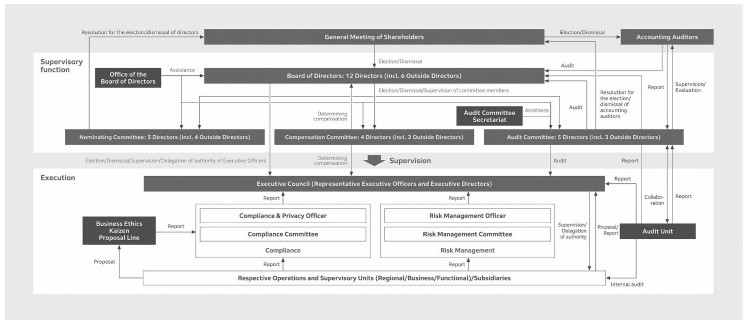
The Company strives to enhance corporate governance as one of the most important tasks for its management, based on the Company’s basic principle, in order to further strengthen the trust of our shareholders/investors and other stakeholders; encourage timely, decisive and risk-considered decision-making; seek sustainable growth and the enhancement of corporate value over the medium- to long-term; and become “a company society wants to exist.”
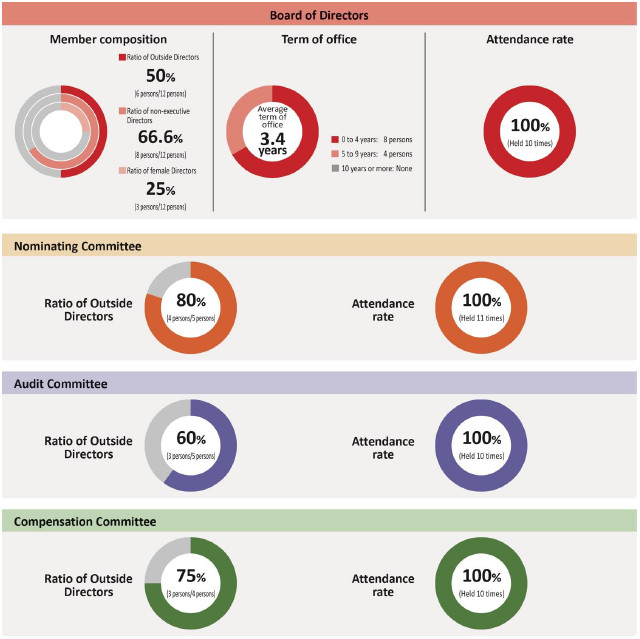
In order to clearly segregate the supervisory function and execution function of management and to strengthen the supervisory function and to enable prompt and flexible decisions, the Company has “Nominating Committee,” “Audit Committee,” and “Compensation Committee,” each of which is composed of more than one half of Outside Directors, and has adopted a company with three committees structure which allows broad delegation of the business execution authority from Board of Directors to the Executive Officers.
We are making efforts to appropriately disclose corporate information including the release and disclosure of quarterly financial results and management policies in a timely and accurate manner to bolster trust and appreciation from shareholders/investors and other stakeholders. Going forward, we will continue to strive to ensure the transparency of our management.
For the Company’s basic approach to corporate governance, please refer to “Honda Corporate Governance Basic Policies” (the URL below).
“Honda Corporate Governance Basic Policies”
https://global.honda/en/investors/policy/governance.html
| ∎ | Corporate Governance System (as of March 31, 2026) |
21
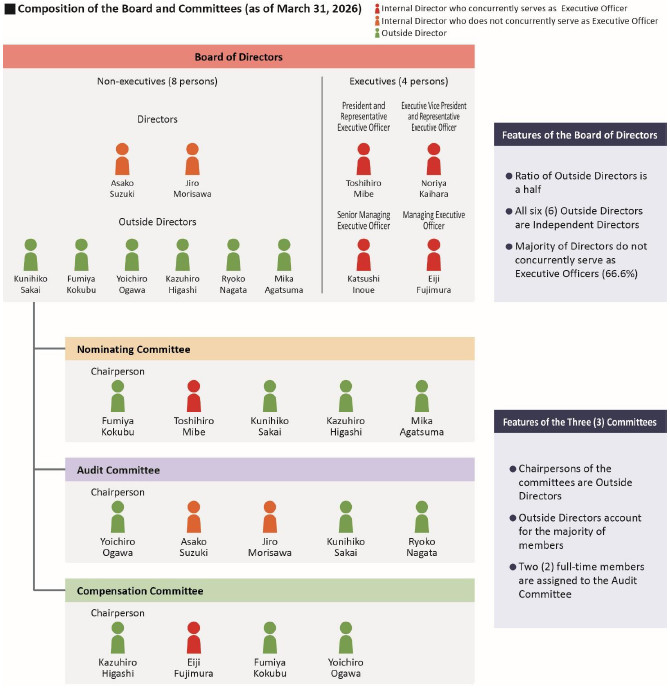
Composition of the Board and Committees (as of March 31, 2026) &internal Director who concurrently serves as Executive Officer I Internal Director who does not concurrently serve as Executive Officer Board of Directors on-executives (8 persons Executives (4 persons) President and ExecutiveVice Presiden Directors Representative and Representativ Executive Officer ExecutiveOfficer I• I• I• I• sako Jir Toshihiro Noriy Suzuki Morisawa e Kaihara Senior Managing Managing Executive Outside Directors ExecutiveOfficer Officer I• I• I• I• I• I• I• I• Kunihiko Fumiya Yoichiro Kazuhiro Ryoko Mika Katsushi Eiji Sakai Kokubu Ogawa Higashi \Nagata Agatsuma Inoue Fujimura Nominating Committee Chairperson• • • • • I I I IFumiya Toshihiro Kunihiko Kazuhiro Mika Kokubu Mibe Sakai Higashi Agatsuma Audit Committe Chairperson • Yoichiro Asako Jiro Kunihiko Ryoko Ogawa Suzuki Morisawa Sakai Nagata Compensation Committee Chairperson • Kazuhiro Eiji Fumiya Yoichiro Higashi Fujimura Kokubu Ogawa Features of the Board of Directors • Ratio of Outside Directors is a half • All six (6) Outside Directors are Independent Directors • Majority of Directors do not concurrently serve as Executive Officers (66.6%) Features of the Three (3) Committees • Chairpersons of the committees are Outside Directors •Outside Directors account for the majority of members • Two (2) fu ll-time members are assigned to the Audit Committee
22
23
| ∎ | Activities of the Board and Committees (FYE Mar. 31, 2026) |
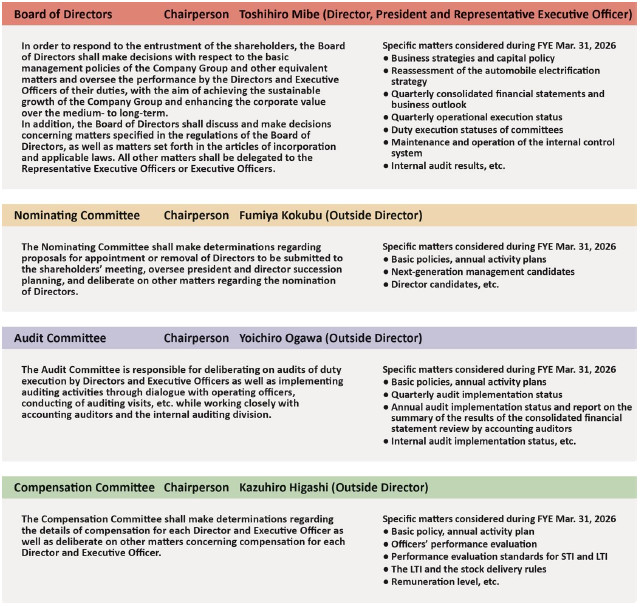
Board of Directors Chairperson Toshihiro Mibe (Director, President and Representative Executive Officer) In order to respond to the entrustment of the shareholders, the Board Specific matters considered during FYE Mar. 31, 2026 of Directors shall make decisions with respect to the basic • Business strategies and capital policy management policies of the Company Group and other equivalent • Reassessment of the automobile electrification matters and oversee the performance by the Directors and Executive strategy Officers of their duties, with the aim of achieving the sustainable • Quarterly consolidated financial statements and growth of the Company Group and enhancing the corporate value business outlook over the medium- to long-term. • Quarterly operational execution status In addition, the Board of Directors shall discuss and make decisions • Duty execution statuses of committees concerning matters specified in the regulations of the Board of Directors, as well as matters set forth in the articles of incorporation • Maintenance and operation ofthe internal control and applicable laws. All other matters shall be delegated to the system Representative Executive Officers or Executive Officers. • Internal audit results, etc. Nominating Committee Chairperson Fumiya Kokubu (Outside Director) The Nominating Committee shall make determinations regarding Specific matters considered during FYE Mar. 31, 2026 asic policies, annual activity plans the shareholders’ meeting, oversee president and director succession • Next-generation management candidates planning, and deliberate on other matters regarding the nomination • Director candidates, etc. of Directors. Audit Committee Chairperson Yoichiro Ogawa (Outside Director) The Audit Committee is responsible for deliberating on audits of duty Specific matters considered during FYE Mar. 31, 2026 execution by Directors and Executive Officers as well as implementing • Basic policies, annual activity plans auditing activities through dialogue with operating officers, • Quarterly audit implementation status conducting of auditing visits, etc. while working closely with • Annual audit implementation status and report on the accounting auditors and the internal auditing division. summary of the results of the consolidated financial statement review by accounting auditors • Internal audit implementation status, etc. Compensation Committee Chairperson Kazuhiro Higashi (Outside Director) The Compensation Committee shall make determinations regarding Specific matters considered during FYE Mar. 31, 2026 the details of compensation for each Director and Executive Officer as • Basic policy, annual activity plan well as deliberate on other matters concerning compensation for each • Officers’ performance evaluation Director and Executive Officer. • Performance evaluation standards for STI and LTI • The LTI and the stock delivery rules • Remuneration level, etc.
24
Corporate Governance Initiatives (reference)
| ∎ | Creating Environment for Maximizing Outside Directors’ Effectiveness |
Orientation for nominees
The Company provides Outside Director nominees with training on industrial trends, the company’s history, businesses, finances, organizations, internal control system, etc.
Preliminary briefings and information sharing
The Company holds a preliminary briefing before each Board meeting in order to provide Outside Directors with sufficient insights into the details and background of the agenda items to be escalated to the Board, their positions in medium-to-long-term management plan, and other basic prerequisites to ensure substantial discussions at Board meetings. In addition, we set up opportunities to share important information about the status of our company-wide risk management and medium- to long-term strategies for each business and hold discussions among Directors.
Discussion on management-related interests
The Company held discussions on Directors’ interests to achieve alignment among the Outside Directors with respect to the Company Group’s long-term challenges and future direction and to help them better understand our management-related initiatives. We also aimed at incorporating their insights into discussions of our future management policies.
Dialogue with Executive Officers/among Outside Directors
The Company provides opportunities for dialogue between Outside Directors and Executive Officers/Internal Directors as well as among Outside Directors as needed in order to enhance communication among Directors.
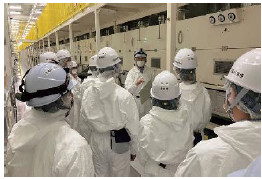
Site visits
The Company held visits to our production, development and other business locations to help Directors better understand our businesses.
Visit to the all-solid-state battery demonstration
production line at Honda R&D Co., Ltd. (Sakura)
25
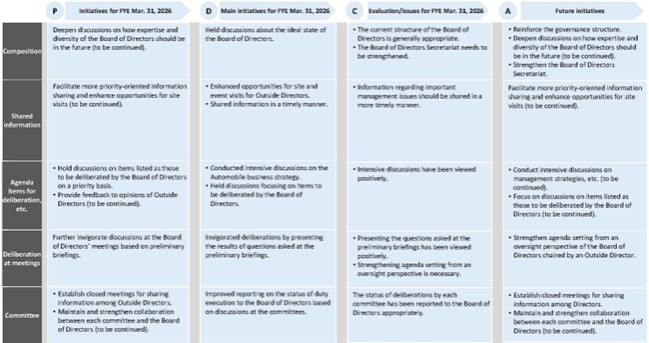
| ∎ | Evaluation of the Effectiveness of the Board |
Each fiscal year, the Company conducts an evaluation of the overall effectiveness of the Board of Directors in order to confirm the current status of the Board’s functions, with the aim of further “improving its effectiveness” and “promoting understanding among shareholders and stakeholders.”
Evaluation Process
Evaluation Results
Summary of evaluation results
The evaluation confirmed that the effectiveness of the Board of Directors has been generally adequately ensured. However, we have reinforced our governance structure in order to ensure the steady execution of each business strategy and to enable decisive and transparent decision-making.
We will further enhance the effectiveness of the Board of Directors through prompt and appropriate agenda setting, timely provision of information on important management matters, and strengthening the Secretariat.
26
Business Report for the 102nd Fiscal Year
For the Period From: April 1, 2025 To: March 31, 2026
| 1. | OUTLINE OF BUSINESS |
| (1) | Review of Operations |
The economic environment surrounding Honda, its consolidated subsidiaries and its affiliates accounted for under the equity method (hereinafter, the “Honda Group”) in the fiscal year ended March 31, 2026 maintained a gradual recovery overall, although some regions showed weakness due to persistent uncertainty in international situations such as Ukraine, the Middle East, and the South China Sea, as well as trade policies of various countries. In the United States, the economy continued a moderate expansion, driven by increased capital investment and robust consumer spending. In Europe, the economy showed signs of pick up, although the pace varied from country to country. In Asia, the economy expanded in India, and the Indonesian economy continued its moderate recovery. In China and Thailand, the economic recovery was limited. In Japan, domestic demand, mainly driven by capital investment and consumer spending, supported the economy, and a gradual recovery continued.
In the Honda Group’s principal markets, compared to the previous fiscal year, the motorcycle market expanded in Brazil, India, Vietnam, Indonesia, and Thailand. Compared to the previous fiscal year, the automobile market expanded in Thailand, India, China, Europe, and Brazil, while it was generally flat in the United States and Japan, and shrank in Indonesia.
In these circumstances, driven by “our dreams”, the Honda Group is striving to further advance mobility products and services with our original technologies and ideas. By doing so, the Honda Group aspires to be a comprehensive mobility company which will play a leading role in society which will only be better in the future. Accordingly, in addition to “environment” and “safety” which have long been highlighted as important themes in our management, we have chosen “people” and “technology,” which drive the Honda Group’s growth, as well as “brand” that encompasses all corporate activities — our five non-financial indicators as key themes. We have been striving to generate both social and economic value by aligning these aspects with our financial strategy. On the research and development front, we made proactive efforts to develop safety and environmental technologies and advanced technologies to enhance the attractiveness of our products and transform mobility, utilizing open innovation with external partners. With regard to production, we strengthened our production structure and implemented production allocation to deal with changes in demand on a global basis. As for sales, we worked to enhance our product lineup through measures such as aggressively launching products that offer new value and delivering products globally.
Honda’s consolidated sales revenue for the fiscal year ended March 31, 2026 increased by 0.5% from the fiscal year ended March 31, 2025 to JPY 21,796.6 billion, mainly due to increased sales revenue in the Motorcycle business, which was partially offset by decreased sales revenue in the Automobile business and negative foreign currency translation effects.
An operating loss was recorded at JPY 414.3 billion, deteriorating by JPY 1,627.8 billion from the previous fiscal year, mainly due to the impact of EV (electric vehicle)-related losses as well as tariff impacts, which were partially offset by increased profit attributable to price and cost impacts. A loss before income taxes was recorded at JPY 403.3 billion, deteriorating by JPY 1,720.9 billion from the previous fiscal year, mainly due to the impact of EV-related losses. The bottom line was a loss for the year attributable to owners of the parent of JPY 423.9 billion, deteriorating by JPY 1,259.7 billion from the previous fiscal year. For the impact of EV-related losses, please refer to “Other Notes” in The Notes to the Consolidated Statutory Report.
27
◾ Sales Revenue Breakdown
| Yen (millions) | ||||||||||||||||
| FYE Mar. 31, 2025 From April 1, 2024 to March 31, 2025 (Reference) |
FYE Mar. 31, 2026 From April 1, 2025 to March 31, 2026 |
Change from the previous fiscal year (Reference) |
||||||||||||||
| (%) | ||||||||||||||||
| Grand Total |
21,688,767 | 21,796,610 | 107,843 | 0.5 | ||||||||||||
| Japan |
2,477,674 | 2,536,909 | 59,235 | 2.4 | ||||||||||||
| North America |
12,798,361 | 12,578,818 | -219,543 | -1.7 | ||||||||||||
| Europe |
938,453 | 1,005,509 | 67,056 | 7.1 | ||||||||||||
| Asia |
4,108,992 | 4,094,879 | -14,113 | -0.3 | ||||||||||||
| Other Regions |
1,365,287 | 1,580,495 | 215,208 | 15.8 | ||||||||||||
| Motorcycle Business |
3,626,603 | 4,018,837 | 392,234 | 10.8 | ||||||||||||
| Japan |
106,632 | 113,294 | 6,662 | 6.2 | ||||||||||||
| North America |
347,504 | 351,787 | 4,283 | 1.2 | ||||||||||||
| Europe |
379,432 | 395,855 | 16,423 | 4.3 | ||||||||||||
| Asia |
2,078,498 | 2,256,555 | 178,057 | 8.6 | ||||||||||||
| Other Regions |
714,537 | 901,346 | 186,809 | 26.1 | ||||||||||||
| Automobile Business |
14,169,240 | 13,863,362 | -305,878 | -2.2 | ||||||||||||
| Japan |
1,807,346 | 1,818,129 | 10,783 | 0.6 | ||||||||||||
| North America |
9,384,627 | 9,213,428 | -171,199 | -1.8 | ||||||||||||
| Europe |
459,756 | 503,217 | 43,461 | 9.5 | ||||||||||||
| Asia |
1,954,479 | 1,765,985 | -188,494 | -9.6 | ||||||||||||
| Other Regions |
563,032 | 562,603 | -429 | -0.1 | ||||||||||||
| Financial Services Business |
3,507,766 | 3,529,484 | 21,718 | 0.6 | ||||||||||||
| Japan |
474,753 | 506,920 | 32,167 | 6.8 | ||||||||||||
| North America |
2,938,239 | 2,895,574 | -42,665 | -1.5 | ||||||||||||
| Europe |
21,406 | 25,446 | 4,040 | 18.9 | ||||||||||||
| Asia |
13,901 | 13,864 | -37 | -0.3 | ||||||||||||
| Other Regions |
59,467 | 87,680 | 28,213 | 47.4 | ||||||||||||
| Power Products and Other Businesses |
385,158 | 384,927 | -231 | -0.1 | ||||||||||||
| Japan |
88,943 | 98,566 | 9,623 | 10.8 | ||||||||||||
| North America |
127,991 | 118,029 | -9,962 | -7.8 | ||||||||||||
| Europe |
77,859 | 80,991 | 3,132 | 4.0 | ||||||||||||
| Asia |
62,114 | 58,475 | -3,639 | -5.9 | ||||||||||||
| Other Regions |
28,251 | 28,866 | 615 | 2.2 | ||||||||||||
| Note: | For principal products and services, and functions of each business, please refer to “(7) Principal Business Activities.” |
28
Motorcycle Business
Consolidated unit sales totaled 14,673 thousand, an increase of 7.2% from the previous fiscal year.
| Unit (Thousands) | ||||||||||||||||||||||||||||||||
| Honda Group Unit Sales | Consolidated Unit Sales | |||||||||||||||||||||||||||||||
| Year ended Mar. 31, 2025 |
Year ended Mar. 31, 2026 |
Year ended Mar. 31, 2025 |
Year ended Mar. 31, 2026 |
|||||||||||||||||||||||||||||
| Change | % | Change | % | |||||||||||||||||||||||||||||
| Motorcycle Business |
20,572 | 22,101 | 1,529 | 7.4 | 13,685 | 14,673 | 988 | 7.2 | ||||||||||||||||||||||||
| Japan |
224 | 205 | -19 | -8.5 | 224 | 205 | -19 | -8.5 | ||||||||||||||||||||||||
| North America |
548 | 538 | -10 | -1.8 | 548 | 538 | -10 | -1.8 | ||||||||||||||||||||||||
| Europe |
475 | 407 | -68 | -14.3 | 475 | 407 | -68 | -14.3 | ||||||||||||||||||||||||
| Asia |
17,478 | 18,738 | 1,260 | 7.2 | 10,591 | 11,310 | 719 | 6.8 | ||||||||||||||||||||||||
| Other Regions |
1,847 | 2,213 | 366 | 19.8 | 1,847 | 2,213 | 366 | 19.8 | ||||||||||||||||||||||||
| Note: | Honda Group Unit Sales is the total unit sales of completed products of Honda, its consolidated subsidiaries, its affiliates, and joint ventures accounted for using the equity method. Consolidated Unit Sales is the total unit sales of completed products corresponding to consolidated sales revenue from external customers, which consists of unit sales of completed products of Honda and its consolidated subsidiaries. |
With respect to Honda’s sales for the fiscal year by business segment, in Motorcycle business operations, sales revenue from external customers increased by 10.8% from the previous fiscal year, to JPY 4,018.8 billion, mainly due to increased consolidated unit sales. Operating profit totaled JPY 731.9 billion, an increase of 10.3% from the previous fiscal year, primarily due to sales impacts as well as an increase in profit attributable to price and cost impacts, which were partially offset by increased expenses and others.
Automobile Business
Consolidated unit sales totaled 2,711 thousand, a decrease of 4.5% from the previous fiscal year.
| Unit (Thousands) | ||||||||||||||||||||||||||||||||
| Honda Group Unit Sales | Consolidated Unit Sales | |||||||||||||||||||||||||||||||
| Year ended Mar. 31, 2025 |
Year ended Mar. 31, 2026 |
Year ended Mar. 31, 2025 |
Year ended Mar. 31, 2026 |
|||||||||||||||||||||||||||||
| Change | % | Change | % | |||||||||||||||||||||||||||||
| Automobile Business |
3,716 | 3,387 | -329 | -8.9 | 2,840 | 2,711 | -129 | -4.5 | ||||||||||||||||||||||||
| Japan |
630 | 605 | -25 | -4.0 | 539 | 515 | -24 | -4.5 | ||||||||||||||||||||||||
| North America |
1,654 | 1,605 | -49 | -3.0 | 1,654 | 1,605 | -49 | -3.0 | ||||||||||||||||||||||||
| Europe |
93 | 90 | -3 | -3.2 | 93 | 90 | -3 | -3.2 | ||||||||||||||||||||||||
| Asia |
1,182 | 929 | -253 | -21.4 | 397 | 343 | -54 | -13.6 | ||||||||||||||||||||||||
| Other Regions |
157 | 158 | 1 | 0.6 | 157 | 158 | 1 | 0.6 | ||||||||||||||||||||||||
| Note: | Honda Group Unit Sales is the total unit sales of completed products of Honda, its consolidated subsidiaries, its affiliates, and joint ventures accounted for using the equity method. Consolidated Unit Sales is the total unit sales of completed products corresponding to consolidated sales revenue from external customers, which consists of unit sales of completed products of Honda and its consolidated subsidiaries. Certain sales of automobiles that are financed with residual value type auto loans, etc., by our Japanese finance subsidiaries and provided through our consolidated subsidiaries are accounted for as operating leases in conformity with IFRS and are not included in consolidated sales revenue from the external customers in our Automobile business. Accordingly, they are not included in Consolidated Unit Sales, but are included in Honda Group Unit Sales of our Automobile business. |
In Automobile business operations, sales revenue from external customers decreased by 2.2% from the previous fiscal year, to JPY 13,863.3 billion, mainly due to decreased consolidated unit sales and negative foreign currency translation effects. An operating loss was recorded at JPY 1,411.1 billion, deteriorating by JPY 1,654.9 billion from the previous fiscal year, primarily due to the impact of EV-related losses and tariff impacts, which were partially offset by an increase in profit attributable to price and cost impacts.
Financial Services Business
Sales revenue from external customers in the Financial Services business operations increased by 0.6% from the previous fiscal year, to JPY 3,529.4 billion, mainly due to an increase in operating lease revenue, which was partially offset by a decrease in revenue from sales of leased vehicles as well as negative foreign currency translation effects. Operating profit decreased by 12.7% to JPY 275.5 billion from the previous fiscal year, mainly due to increased expenses.
29
Power Products and Other Businesses
Consolidated unit sales in the Power Products business totaled 3,589 thousand, a decrease of 3.0% from the previous fiscal year.
| Unit (Thousands) | ||||||||||||||||
| Honda Group Unit Sales/ Consolidated Unit Sales | ||||||||||||||||
| Year ended Mar. 31, 2025 |
Year ended Mar. 31, 2026 |
|||||||||||||||
| Change | % | |||||||||||||||
| Power Products Business |
3,700 | 3,589 | -111 | -3.0 | ||||||||||||
| Japan |
278 | 300 | 22 | 7.9 | ||||||||||||
| North America |
1,020 | 927 | -93 | -9.1 | ||||||||||||
| Europe |
651 | 712 | 61 | 9.4 | ||||||||||||
| Asia |
1,413 | 1,295 | -118 | -8.4 | ||||||||||||
| Other Regions |
338 | 355 | 17 | 5.0 | ||||||||||||
| Note: | Honda Group Unit Sales is the total unit sales of power products of Honda, its consolidated subsidiaries, its affiliates, and joint ventures accounted for using the equity method. Consolidated Unit Sales is the total unit sales of completed products corresponding to consolidated sales revenue from external customers, which consists of unit sales of power products of Honda and its consolidated subsidiaries. In the Power Products business, there is no discrepancy between Honda Group Unit Sales and Consolidated Unit Sales for the year ended March 31, 2025 and 2026, since no affiliates and joint ventures accounted for using the equity method were involved in the sale of Honda power products. |
Sales revenue from external customers in the Power Products and Other businesses amounted to JPY 384.9 billion, roughly flat from the previous fiscal year. An operating loss was recorded at JPY 10.6 billion, deteriorating JPY 1.2 billion from the previous fiscal year, primarily due to increased expenses and negative foreign currency exchange effects, which were partially offset by an increase in profit attributable to sales impacts in the Power Products business. An operating loss was recorded for aircraft and aircraft engines included in the Power Products and Other businesses segment at JPY 37.2 billion, improving by JPY 1.6 billion from the previous fiscal year.
30
| (2) | Capital Expenditures |
Capital expenditures during the fiscal year ended March 31, 2026, totaled JPY 751,380 million. The breakdown of capital expenditures by business segments was as follows:
| Yen (millions), % | ||||||||||||||||
| Business Segment |
FYE Mar. 31, 2025 (Reference) |
FYE Mar. 31, 2026 | Change in amount (Reference) |
Change (%) (Reference) |
||||||||||||
| Motorcycle Business |
75,156 | 104,457 | 29,301 | 39.0 | ||||||||||||
| Automobile Business |
445,707 | 627,753 | 182,046 | 40.8 | ||||||||||||
| Financial Services Business |
149 | 193 | 44 | 29.5 | ||||||||||||
| Power Products and Other Businesses |
16,415 | 18,977 | 2,562 | 15.6 | ||||||||||||
|
|
|
|
|
|
|
|
|
|||||||||
| Total |
537,427 | 751,380 | 213,953 | 39.8 | ||||||||||||
|
|
|
|
|
|
|
|
|
|||||||||
| Equipment on operating leases |
3,134,025 | 2,764,248 | -369,777 | -11.8 | ||||||||||||
Note: Intangible assets are not included in the table above.
In addition to investments for new model introductions, Honda’s capital expenditure was predominantly utilized for expanding, rationalizing, and renovating manufacturing facilities as well as for expanding sales and R&D facilities.
| (3) | Liquidity and Capital Resources |
Honda meets its working capital requirements primarily through cash generated by operations, bank loans, and corporate bonds. The outstanding balance of liabilities for Honda’s manufacturing and sales businesses at the end of the fiscal year ended March 31, 2026 was JPY 1,238.8 billion.
In addition, the Company’s finance subsidiaries fund financial programs for customers and dealers primarily from medium-term notes, bank loans, securitization of finance receivables and equipment on operating leases, commercial paper, and corporate bonds. The outstanding balance of liabilities for Honda’s financial services subsidiaries at the end of the fiscal year ended March 31, 2026 was JPY 12,252.7 billion.
| (4) | Preparing for the Future |
| 1) | Management Policies and Strategies |
The Honda Group has two fundamental beliefs: “Respect for the Individual,” and “The Three Joys” (the Joy of Buying, the Joy of Selling, and the Joy of Creating). “Respect for the Individual” calls on Honda to nurture and promote these characteristics in our company by respecting individual differences and trusting each other as equal partners. “The Three Joys” is based on “Respect for the Individual,” and is the philosophy of creating joy for everyone involved in Honda’s activities, with the joy of our customers as the driving force.
Based on these fundamental beliefs, the Honda Group strives to improve its corporate value by sharing joy with all people, and with its shareholders in particular, by practicing its mission statement: “Maintaining a global viewpoint, we are dedicated to supplying products of the highest quality, yet at a reasonable price for worldwide customer satisfaction.”
Driven by “our dreams,” the Honda Group is striving to further advance mobility products and services with our original technologies and ideas. By doing so, the Honda Group aspires to be a comprehensive mobility company which will play a leading role in society which will only be better in the future. In 2023, the Honda Group redefined the Global Brand Slogan, “The Power of Dreams,” to clearly articulate our desire to offer a broad range of mobility products and services as a comprehensive mobility company while addressing the two major societal challenges of the “environment” and “safety.” We hope to deliver the values of “enabling people to transcend constraints of time and space” and “augmenting their abilities and possibilities.” Powered by “our dreams,” the Honda Group will continue taking on challenges while fully demonstrating our original ideas and technologies.
| 2) | Business Environment and Direction of Our Responses |
The business environment surrounding the Honda Group has come to a major turning point. Values are diversifying, the population is aging, urbanization is accelerating, climate change is worsening, and the industrial structure is changing due to progress in technologies such as the use of electric-powered motors, autonomous driving and IoT, all on a global basis. Additionally, with persistent uncertainty in international situations such as Ukraine, the Middle East, and the South China Sea, as well as trade policies of various countries, geopolitical risks have also become apparent. In these circumstances, in order to achieve future growth, the Honda Group needs to build positive relationships with all stakeholders involved in our corporate activities to solve long-term social issues, as well as constantly working to improve the quality of value we offer.
31
In Automobile business, we made a major strategic shift towards the popularization of EV with a view that it will be the optimal solution from a long-term perspective. However, the expansion of the EV market in the U.S. has slowed down due to several factors, including the easing of fossil fuel regulations and revisions to EV subsidies. Due to a combination of factors, including our inability to flexibly respond to these changes in the business environment and deteriorating profitability of ICE (internal combustion engine)/hybrid vehicles caused by tariffs, the Honda Group’s automobile business has fallen into an extremely challenging earnings situation. In order to respond flexibly to rapid changes in the business environment, the Honda Group is reorganizing our strategic framework and reestablishing our competitive strengths. In light of the slowdown of the EV market expansion in the U.S., we will reassess our resource allocations and strengthen our hybrid models. As for regional business, in addition to the Honda Group’s main markets, namely Japan and the U.S., we will enhance the model lineup and cost competitiveness in India, where market expansion is expected. In other countries in Asia as well, we will strive to enhance our competitiveness by releasing next-generation hybrid models and reassessing resource allocations.
In Motorcycle business, driven by population and economic growth, demand continues to grow particularly in the Global South, including India. While we believe that EV will be the optimal solution from a long-term perspective, given that demand for EV has not grown as much as expected, we are making improvements in fuel economy and deploying flex-fuel models (Note) for ICE vehicles, in addition to expanding our lineup of electric motorcycles, in ways tailored to the realities in each region and the needs of our customers. The Honda Group will seize the dynamism of this growing market and lead its growth by swiftly introducing competitive products and providing high-quality services that are tailored to our customers.
In Power Products and Other businesses, while we believe the long-term global movement toward carbon neutrality will remain unchanged, the pace of electrification is slowing in certain markets due to factors such as relaxed environmental regulations and changes in trade policy trends. To respond to multifaceted changes in the market environment, we need to strategically strengthen both ICE and electrification and enhance our business resilience. Going forward, in the ICE business, the Honda Group will work to establish a stable revenue base by further strengthening the business structure, while accelerating resource investment in electrification and future technologies to enhance competitiveness in anticipation of the next generation.
| Note: | An internal combustion engine vehicle capable of using multiple types of fuel (fuel with different blending ratios), such as gasoline mixed with ethanol. |
Please visit our website for more information on the business environment and the direction of our responses. https://global.honda/en/investors/
| 3) | Financial Strategy |
To enhance corporate value, we recognize the need to utilize both financial and non-financial capital to achieve sustainable cash flow growth and improve capital efficiency. To realize it, we will work on “strategic resource allocation over the medium- to long-term,” “strengthening management with an awareness of capital costs ” and “improving management quality and transparency through proactive dialogue.”
With the goal of “achieving carbon neutrality for all products and corporate activities the Honda Group is involved in by 2050,” we made a major strategic shift towards the popularization of EV with a view that it will be the optimal solution to realize carbon neutrality for small-size mobility products, including passenger cars, from a long-term perspective. However, the profitability of the Automobile business is currently declining due to the impact of changes in U.S. tariff policies on the ICE and hybrid vehicle business, a decline in the competitiveness of our products in Asia stemming from the impact of the allocation of more resources to EV development, and intensifying competition with the rise of new EV manufacturers. Furthermore, the expansion of the EV market in the U.S. has slowed down due to several factors, including the easing of fossil fuel regulations and revisions to EV subsidies.
In light of such changes in the market environment, as part of the reassessment of our product launch plans, we decided to cancel the development of a certain EV model, and to discontinue production or reduce production volume for EV models jointly developed under a certain alliance agreement. In addition, we recognized losses and expenses of JPY 279.3 billion for the Automobile business during the nine months ended December 31, 2025. Furthermore, given the current business environment where demand for EVs is declining significantly, as well as the risk of further future losses, we made a decision in March 2026 to cancel the development and launch of three EV models that had been planned for production in the U.S. In connection with the reassessment of the automobile electrification strategy, including the said cancelation, we estimate that additional losses in our consolidated financial results will be up to JPY 2.5 trillion in total (Note) for the fiscal year ended March 31, 2026 and the fiscal year ending March 31, 2027 or beyond.
To respond flexibly to these EV-related losses and current rapid changes in the business environment, the Honda Group is reorganizing its strategic framework and reestablishing our competitive strengths. In line with the reassessment of resource allocations following the EV lineup reduction, we will enhance the hybrid model lineup and strengthen our cost competitiveness. From a financial perspective, we will ensure disciplined spending control to shift towards a fixed cost structure appropriate for the scale of our business. We will flexibly implement initiatives toward the future introduction of EV models from a long-term perspective, while monitoring the balance between profitability and demand trends. Although there is a possibility that additional expenses and/or losses will be recorded in the fiscal year ending March 31, 2027 or later, we will maintain stable returns to shareholders by improving profitability of Automobile business with the enhancement of the lineup, including next-generation hybrid models, and leveraging solid earnings power and the cash-generating capability of Motorcycle and Financial Services businesses.
| Note: | The amount is estimated based on information available to the Company as of March 31, 2026 and certain assumptions, and as this estimate includes risks and uncertainties, the actual amount to be recorded may differ from this estimate. |
32
Please visit our website for more information on our financial strategy.
https://global.honda/en/investors/
4) Challenges to be Addressed Preferentially
The Honda Group first comprehensively extracts societal issues from the perspective of sustainability, prioritizes them in line with the Honda Group’s direction, and then identifies areas to focus on to determine the “priority issues.” Specifically, we have identified five areas: “environment” and “safety,” as well as “people” and “technology,” which are the driving forces behind the Honda Group’s growth, and “brand,” which can be considered the sum of all corporate activities. By linking initiatives in these nonfinancial areas with our financial strategy, we aim to create social and economic value.
<Five Key Themes>
1. Realization of a zero environmental impact of society
The Honda Group has set “realizing a zero environmental impact society” as one of the company-wide key themes for efforts to exhaustively reduce inter-linking environmental impact for sustainable corporate activities. To “realize a zero environmental impact society,” we envision CO2 emissions neutrality by 2050, 100% utilization of carbon-free energy, and 100% use of sustainable materials, and are working on initiatives centered around the “Triple Action to ZERO,” a concept that consolidates three key initiatives: “carbon neutrality,” “clean energy,” and “resource circulation.”
33
2. To realize a zero traffic collision society
The Honda Group aims to achieve zero traffic collision fatalities involving Honda motorcycles and automobiles worldwide by 2050 (Note 1). As a milestone, Honda aims to halve the number of global traffic collision fatalities involving Honda motorcycles and automobiles worldwide by 2030 (Note 2). All motorcycles and automobiles registered, not limited to new vehicles, are included in the scope.
| Notes: | 1. Traffic accidents that occurred while riding Honda motorcycles and automobiles (including collisions with other parties such as pedestrians and bicycles). However, cases involving intentional and malicious violations of traffic rules or cases of driving while impaired by the use of alcohol, drugs, or other substances, are excluded. |
2. To halve the number of traffic collision fatalities per 10,000 vehicles involving Honda motorcycles and automobiles worldwide by 2030 compared to 2020
3. The evolution of human capital management
The Honda Group’s human capital management involves forming a talent portfolio by backcasting from the desired future state, with the goal of becoming a “sustainably creating the joy and freedom of mobility and becoming the power that supports individuals who start moving toward their dreams,“ as outlined in the company-wide policies. In order to realize this, we have set two human capital materiality issues (Note) to be achieved from the perspectives of a medium to long term and a short to medium term. Further, two themes for each human capital materiality issue, a total of four main themes, are set.
| Note: | Materiality: We select “Priority Issues” by comprehensively analyzing social issues from the perspective of sustainability, aligning them with Honda’s strategic direction, and defining the particularly focused issues for each priority issue as “materialities.” |
4. Creation of innovative technologies
We are committed to expanding the possibilities of mobility and to achieving a future society with zero environmental impact and zero traffic collision fatalities. Having defined key focus areas, experts in each field lead technological development. Furthermore, the Honda Group collaborates with various research institutions worldwide to explore and integrate global knowledge. Strengthening collaboration with external parties through initiatives such as venturing is also one of our efforts for technology creation. We established a department responsible for corporate development in 2021, and have continued to strengthen its functions to enhance corporate competitiveness by consolidating internal and external knowledge, experience, and expertise. In addition, the Honda Group is actively creating new businesses through a bottom-up approach, leveraging associates’ unique ideas and technologies, and is taking on the challenge of solving social issues and creating new value.
5. Brand value enhancement
Honda’s brand has been built over time through all of its corporate activities alongside its customers since its founding. Even in the midst of a significant transformative period said to occur once in a century, enhancing the Honda brand and continuously increasing its value for the future is one of the most important challenges. To achieve this, the Honda Group redefined the Global Brand Slogan (GBS) “The Power of Dreams,” established in 2001, in 2023, and positioned it once again as the “starting point for all brand management.” The Honda Group will continue to place the GBS at the core of brand management and, through various products, services, and corporate activities, integrate individual brand identities with the valuable consistency as the Honda Group, further enhancing the overall value of the Honda brand. In brand management, we believe it is crucial to create synergies between “common values and thought as a company” and “the diversity and uniqueness of products and services” based on the unique personality of the Honda brand. As part of this, we are working on developing and expanding “brand assets” that serve as guidelines for various communications and branding practices to ensure valuable brand commonality on a global scale. We will aim to create an environment in which all associates working at the Honda Group can independently improve the quality of the brand.
Please visit our website for more information on five key themes.
https://global.honda/en/investors/
Through these company-wide activities, the Honda Group aims to be a company that society, which includes our shareholders, our investors and our customers, hopes to exist.
34
(5) Changes in Financial Position and Results of Operations of the Honda Group and the Parent Company
(a) Changes in Results of Operations and Financial Position of the Honda Group
| Yen (millions) | ||||||||||||||||
| Category |
IFRS | |||||||||||||||
| FYE Mar. 31, 2023 99th fiscal year (From April 1, 2022 to March 31, 2023) |
FYE Mar. 31, 2024 100th fiscal year (From April 1, 2023 to March 31, 2024) |
FYE Mar. 31, 2025 101st fiscal year (From April 1, 2024 to March 31, 2025) |
FYE Mar. 31, 2026 102nd fiscal year (From April 1, 2025 to March 31, 2026) |
|||||||||||||
| Sales revenue |
16,907,725 | 20,428,802 | 21,688,767 | 21,796,610 | ||||||||||||
| Operating profit (loss) |
780,769 | 1,381,977 | 1,213,486 | (414,346 | ) | |||||||||||
| Profit (loss) before income taxes |
879,565 | 1,642,384 | 1,317,640 | (403,300 | ) | |||||||||||
| Profit (loss) for the year attributable to owners of the parent |
651,416 | 1,107,174 | 835,837 | (423,941 | ) | |||||||||||
| Basic earnings (loss) per share attributable to owners of the parent (Yen) |
128.01 | 225.88 | 178.93 | (106.06 | ) | |||||||||||
| Total assets |
24,670,067 | 29,774,150 | 30,775,867 | 33,509,285 | ||||||||||||
| Equity attributable to owners of the parent |
11,184,250 | 12,696,995 | 12,326,529 | 11,817,512 | ||||||||||||
| Equity per share attributable to owners of the parent (Yen) |
2,239.98 | 2,629.37 | 2,835.96 | 3,035.91 | ||||||||||||
| Notes: |
1. | Based on the provisions of Article 120-1 of the Ordinance of Companies Accounting, the Company’s consolidated financial statements have been prepared in accordance with IFRS. | ||
| 2. | The results of operations and financial position of the Honda Group are indicated based on IFRS terminology. | |||
| 3. | Basic earnings (loss) per share attributable to owners of the parent is calculated based on the average number of shares outstanding during each year. There were no significant potentially dilutive common shares outstanding. | |||
| 4. | Equity per share attributable to owners of the parent is calculated based on the number of shares outstanding at the end of each fiscal year. | |||
| 5. | As of the effective date of October 1, 2023, the Company implemented a three-for-one stock split of its common stock to shareholders as of the record date of September 30, 2023. Basic earnings (loss) per share attributable to owners of the parent and equity per share attributable to owners of the parent are calculated based on the assumption that the stock split had been implemented at the beginning of the year ended March 31, 2023. | |||
| 6. | Figures for the 99th fiscal year reflect the effect of changes in estimates related to product warranty expenses that occurred after the issuance of the consolidated financial statements prepared in accordance with the Companies Act. | |||
35
(b) Changes in Results of Operations and Financial Position of the Parent Company
| Yen (millions) | ||||||||||||||||
| Category |
FYE Mar. 31, 2023 99th fiscal year (From April 1, 2022 to March 31, 2023) |
FYE Mar. 31, 2024 100th fiscal year (From April 1, 2023 to March 31, 2024) |
FYE Mar. 31, 2025 101st fiscal year (From April 1, 2024 to March 31, 2025) |
FYE Mar. 31, 2026 102nd fiscal year (From April 1, 2025 to March 31, 2026) |
||||||||||||
| Net sales |
3,586,448 | 4,544,669 | 4,596,209 | 4,406,974 | ||||||||||||
| Operating income (loss) |
(5,355 | ) | 161,615 | (12,992 | ) | (160,848 | ) | |||||||||
| Ordinary income |
647,422 | 859,011 | 1,025,746 | 529,933 | ||||||||||||
| Net income (loss) |
630,759 | 692,695 | 930,050 | (194,827 | ) | |||||||||||
| Net income (loss) per share (Yen) |
123.95 | 141.32 | 199.10 | (48.74 | ) | |||||||||||
| Total assets |
4,316,643 | 5,026,367 | 4,501,503 | 4,446,052 | ||||||||||||
| Net assets |
2,991,262 | 3,241,490 | 3,033,806 | 1,896,051 | ||||||||||||
| Net assets per share (Yen) |
599.09 | 671.27 | 697.99 | 487.09 | ||||||||||||
| Notes: | 1. | Figures in millions of yen are rounded down to the nearest million. | ||
| 2. | The decrease in operating income in the 102nd fiscal year compared to the 101st fiscal year is mainly due to decreased income due to fluctuations in sales. The decrease in ordinary income in the 102nd fiscal year compared to the 101st fiscal year is mainly due to a decrease in dividend income. The decrease in net income in the 102nd fiscal year compared to the 101st fiscal year is mainly due to transfer pricing adjustment. | |||
| 3. | As of the effective date of October 1, 2023, the Company implemented a three-for-one stock split of its common stock to shareholders as of the record date of September 30, 2023. Net income (loss) per share and net assets per share are calculated based on the assumption that the stock split had been implemented at the beginning of the year ended March 31, 2023. | |||
| 4. | For the 100th fiscal year, the Company reviewed its presentation method and reclassified certain extraordinary income and extraordinary losses to non-operating income and non-operating expenses, respectively. Accordingly, the figures for the 99th fiscal year have been restated to reflect this change in presentation. | |||
36
(6) Principal Subsidiaries
| Voting Rights |
Principal Business Activities | |||||||||
| Company Name |
Capital |
Ratio |
Business Segment |
Function | ||||||
| Honda R&D Co., Ltd. | (Saitama, Japan) | JPY 7,400 million | 100.0% | Motorcycle Business Automobile Business Power Products and Other Businesses |
Research and Development | |||||
| Honda Finance Co., Ltd. | (Tokyo, Japan) | JPY 11,090 million | 100.0% | Financial Services Business | Finance | |||||
| American Honda Motor Co., Inc. | (U.S.A.) | USD 299 million | 100.0% | Motorcycle Business Automobile Business Financial Services Business Power Products and Other Businesses |
Coordination of Subsidiaries Operation / Research and Development / Manufacturing / Sales | |||||
| American Honda Finance Corporation | (U.S.A.) | USD 1,366 million | *100.0% | Financial Services Business | Finance | |||||
| Honda Development and Manufacturing of America, LLC | (U.S.A.) | USD 561 million | *100.0% | Automobile Business | Research and Development / Manufacturing | |||||
| Honda Canada Inc. | (Canada) | CAD 226 million | *100.0% | Motorcycle Business Automobile Business Power Products and Other Businesses |
Manufacturing / Sales | |||||
| Honda Canada Finance Inc. | (Canada) | CAD 285 million | *100.0% | Financial Services Business | Finance | |||||
| Honda de Mexico, S.A. de C.V. | (Mexico) | MXN 13,655 million | *100.0% | Motorcycle Business Automobile Business Power Products and Other Businesses |
Manufacturing / Sales | |||||
| Honda Motor Europe, Ltd. | (U.K.) | GBP 665 million | 100.0% | Motorcycle Business Automobile Business Financial Services Business Power Products and Other Businesses |
Coordination of Subsidiaries Operation / Sales | |||||
| Honda Finance Europe plc | (U.K.) | GBP 38 million | *100.0% | Financial Services Business | Finance | |||||
| Honda Motor (China) Investment Co., Ltd. | (China) | USD 138 million | 100.0% | Motorcycle Business Automobile Business Power Products and Other Businesses |
Coordination of Subsidiaries Operation | |||||
| Honda Auto Parts Manufacturing Co., Ltd. | (China) | USD 200 million | *100.0% | Automobile Business | Manufacturing | |||||
| Honda Motorcycle and Scooter India (Private) Ltd. | (India) | INR 3,100 million | *100.0% | Motorcycle Business | Manufacturing / Sales | |||||
| Honda Cars India Limited | (India) | INR 10,727 million | *100.0% | Motorcycle Business Automobile Business Power Products and Other Businesses |
Manufacturing / Sales | |||||
| P.T. Honda Prospect Motor | (Indonesia) | USD 70 million | 51.0% | Automobile Business | Manufacturing / Sales | |||||
| Honda Malaysia Sdn Bhd | (Malaysia) | MYR 170 million | 51.0% | Automobile Business | Manufacturing / Sales | |||||
| Asian Honda Motor Co., Ltd. | (Thailand) | THB 10,888 million | 100.0% | Motorcycle Business Automobile Business Financial Services Business Power Products and Other Businesses |
Coordination of Subsidiaries Operation / Sales | |||||
| Honda Automobile (Thailand) Co., Ltd. | (Thailand) | THB 5,460 million | *89.0% | Automobile Business | Manufacturing / Sales | |||||
| Thai Honda Co., Ltd. | (Thailand) | THB 550 million | *72.5% | Motorcycle Business Power Products and Other Businesses |
Manufacturing / Sales | |||||
| Honda Vietnam Co., Ltd. | (Vietnam) | VND 1,190,822 million | *70.0% | Motorcycle Business Automobile Business |
Manufacturing / Sales | |||||
37
| Voting Rights |
Principal Business Activities | |||||||||
| Company Name |
Capital |
Ratio |
Business Segment |
Function | ||||||
| Honda South America Ltda. | (Brazil) | BRL 119 million | 100.0% | Motorcycle Business Automobile Business Financial Services Business Power Products and Other Businesses |
Coordination of Subsidiaries Operation | |||||
| Moto Honda da Amazonia Ltda. | (Brazil) | BRL 2,759 million | *100.0% | Motorcycle Business Power Products and Other Businesses |
Manufacturing / Sales | |||||
| Honda Automoveis do Brasil Ltda. | (Brazil) | BRL 882 million | *100.0% | Automobile Business | Manufacturing / Sales | |||||
| Banco Honda S.A. | (Brazil) | BRL 784 million | *100.0% | Financial Services Business | Finance | |||||
| Notes: | 1. | Amounts of capital are rounded down to the nearest unit as indicated. | ||
| 2. | Ratios with * include ownership by consolidated subsidiaries. | |||
| 3. | For the fiscal year ended March 31, 2026, the number of consolidated subsidiaries was 282, including 24 companies mentioned above, and the number of affiliates accounted for under the equity method was 64. | |||
38
(7) Principal Business Activities
The Honda Group engages in the Motorcycle business, Automobile business, Financial Services business, and Power Products and Other businesses. Principal products and services, and functions of each business are as follows.
| Business |
Principal products and services |
Function | ||
| Motorcycle Business | Motorcycles, all-terrain vehicles (ATVs), side-by-side and relevant parts | Research and development / Manufacturing / Sales and related services | ||
| Automobile Business | Automobiles and relevant parts | Research and development / Manufacturing / Sales and related services | ||
| Financial Services Business | Financial services | Retail loan and lease related to Honda products / Others | ||
| Power Products and Other Businesses | Power products and relevant parts, and others | Research and development / Manufacturing / Sales and related services / Others | ||
(8) Principal Business Sites
(a) The Company
| Name |
Location | |
| Head office | Tokyo, Japan | |
| Suzuka Factory | Mie, Japan | |
| Saitama Factory | Saitama, Japan | |
| Hamamatsu Factory | Shizuoka, Japan | |
| Kumamoto Factory | Kumamoto, Japan |
(b) Subsidiaries
For principal subsidiaries and their locations, please refer to “Principal Subsidiaries.”
(9) Employees of the Honda Group and the Parent Company
(a) Honda Group Employees
| Business Segment |
Number of Employees | |||||||||||||||
| FYE Mar. 31, 2026 | Change (Reference) |
|||||||||||||||
| Motorcycle Business |
52,013 | (9,058 | ) | 2,465 | (-752 | ) | ||||||||||
| Automobile Business |
131,856 | (8,846 | ) | -1,809 | (-1,119 | ) | ||||||||||
| Financial Services Business |
2,542 | (35 | ) | 23 | (-10 | ) | ||||||||||
| Power Products and Other Businesses |
8,698 | (1,545 | ) | 257 | (218 | ) | ||||||||||
|
|
|
|
|
|
|
|
|
|||||||||
| Total |
195,109 | (19,484 | ) | 936 | (-1,663 | ) | ||||||||||
|
|
|
|
|
|
|
|
|
|||||||||
| (b) Employees of the Parent Company | ||||||||||||||||
| FYE Mar. 31, 2026 | Change (Reference) |
|||||||||||||||
| Number of employees |
32,547 | (2,865 | ) | 459 | (56 | ) | ||||||||||
| Average age |
43.9 | -0.6 | ||||||||||||||
| Average number of years employed by the Company |
21.0 | -0.3 | ||||||||||||||
| Note: | The number of employees of the Honda Group and the Parent Company refers to full-time employees. The average number of temporary employees is shown separately in parentheses. |
39
2. COMMON STOCK
| (1) Total Number of Shares Issued | 4,533,000,000 shares |
| Note: | In accordance with a resolution of the Board of Directors on February 10, 2026, the Company canceled 747,000,000 shares of treasury stock on February 27, 2026. |
| (2) Number of Shareholders | 723,837 |
(3) Major Shareholders
| Name |
Number of Shares Held (thousands) |
Percentage against Total Shares Issued (%) | ||
| The Master Trust Bank of Japan, Ltd. (Trust Account) |
682,319 | 17.5 | ||
| Custody Bank of Japan, Ltd. (Trust Account) |
275,945 | 7.1 | ||
| Moxley & Co. LLC |
222,860 | 5.7 | ||
| Meiji Yasuda Life Insurance Company |
138,237 | 3.5 | ||
| STATE STREET BANK AND TRUST COMPANY 505001 |
97,407 | 2.5 | ||
| Nippon Life Insurance Company |
58,565 | 1.5 | ||
| JPMorgan Securities Japan Co., Ltd. |
58,145 | 1.5 | ||
| JPMorgan Chase Bank 385781 |
56,917 | 1.5 | ||
| The Nomura Trust and Banking Co., Ltd. (Investment Trust Account) |
41,236 | 1.1 | ||
| Custody Bank of Japan, Ltd. (Trust Account 4) |
37,673 | 1.0 |
| Notes: | 1. | The number of shares described above rounds off figures of less than 1,000 shares. | ||
| 2. | Ownership percentages are calculated using the total number of shares issued minus treasury stock (634,998 thousand shares). | |||
| 3. | Moxley & Co. LLC is an official holder of stock of JPMorgan Chase Bank, which is a depositary institution for American Depositary Receipts (ADRs). | |||
(4) Shares Issued to Corporate Officers as Compensation for the Performance of Their Duties During the Fiscal Year Ended March 31, 2026
| Category |
Number of Shares (Shares) |
Number of eligible Directors (Number of persons) |
||||||
| Directors (excluding Outside Directors) |
— | — | ||||||
| Outside Directors |
— | — | ||||||
| Executive Officers |
328,050 | 13 | ||||||
| Notes: | 1. | The above Directors do not include five Directors who concurrently serve as Executive Officers. | ||
| 2. | The above number of shares does not include the number of shares converted into cash (169,940 shares for five Executive Officers). | |||
| 3. | The above Directors and Executive Officers include one Director who had concurrently served as Executive Officer and retired on April 7, 2025. | |||
40
3. STOCK WARRANTS
No relevant information
4. CORPORATE OFFICERS
(1) Directors and Executive Officers (As of March 31, 2026)
(i) Directors
| Position |
Name |
Gender |
Area of Responsibility or Principal Occupations | |||
| Director | Toshihiro Mibe | Male | Chairman of the Board of Directors Member of the Nominating Committee | |||
| Director | Noriya Kaihara | Male | ||||
| Director | Katsushi Inoue | Male | ||||
| Director | Eiji Fujimura | Male | Member of the Compensation Committee | |||
| Director | Asako Suzuki | Female | Member of the Audit Committee (Full-time) | |||
| Director | Jiro Morisawa | Male | Member of the Audit Committee (Full-time) | |||
| Director | Kunihiko Sakai | Male | Member of the Nominating Committee Member of the Audit Committee Lawyer Advisor Attorney to TMI Associates | |||
| Director | Fumiya Kokubu | Male | Member of the Nominating Committee (Chairperson) Member of the Compensation Committee Outside Director of Taisei Corporation Chairperson of Japan Machinery Center for Trade and Investment Chairperson of International University of Japan | |||
| Director | Yoichiro Ogawa | Male | Member of the Audit Committee (Chairperson) Member of the Compensation Committee Certified Public Accountant Founder of Yoichiro Ogawa CPA Office Independent Audit and Supervisory Board Member of Recruit Holdings Co., Ltd. | |||
| Director | Kazuhiro Higashi | Male | Member of the Nominating Committee Member of the Compensation Committee (Chairperson) Outside Director of Sompo Holdings, Inc. Outside Director of Ryohin Keikaku Co., Ltd. | |||
| Director | Ryoko Nagata | Female | Member of the Audit Committee External Corporate Auditor of Medley, Inc. Outside Director of UACJ Corporation | |||
| Director | Mika Agatsuma | Female | Member of the Nominating Committee Outside Director of SQUARE ENIX HOLDINGS CO., LTD. Executive Corporate Officer of ID Holdings Corporation | |||
| Notes: |
1. | Directors Mr. Kunihiko Sakai, Mr. Fumiya Kokubu, Mr. Yoichiro Ogawa, Mr. Kazuhiro Higashi, Ms. Ryoko Nagata, and Ms. Mika Agatsuma are Outside Directors in accordance with Article 2, Item 15 of the Companies Act. | ||
| 2. | The Company has appointed Mr. Kunihiko Sakai, Mr. Fumiya Kokubu, Mr. Yoichiro Ogawa, Mr. Kazuhiro Higashi, Ms. Ryoko Nagata, and Ms. Mika Agatsuma as independent directors as provided for by the rules of the Tokyo Stock Exchange and reported their appointment to the Tokyo Stock Exchange. | |||
| 3. | Both Ms. Asako Suzuki and Mr. Jiro Morisawa have been appointed as Full-time Member of the Audit Committee by a resolution of the Board of Directors to ensure the effectiveness of audits. | |||
| 4. | Mr. Jiro Morisawa, a Director who is a Member of the Audit Committee, has sufficient operating experience regarding financial and accounting departments in the Company and its subsidiaries. In addition, Mr. Yoichiro Ogawa, a Director who is a Member of the Audit Committee, has abundant knowledge and experience as a certified public accountant. Mr. Morisawa and Mr. Ogawa have considerable knowledge related to finance and accounting. | |||
41
(ii) Executive Officers
| Position |
Name |
Area of Responsibility | ||
| President and Representative Executive Officer | Toshihiro Mibe | Chief Executive Officer | ||
| Executive Vice President and Representative Executive Officer | Noriya Kaihara | Compliance and Privacy Officer Culture Transformation Officer | ||
| Senior Managing Executive Officer | Katsushi Inoue | Chief Officer for Automobile Operations Risk Management Officer | ||
| Managing Executive Officer | Eiji Fujimura | Chief Financial Officer Chief Officer for Corporate Administration Operations | ||
| Managing Executive Officer | Keiji Ohtsu | President and Representative Director of Honda R&D Co., Ltd. | ||
| Managing Executive Officer | Masayuki Igarashi | Chief Officer for Regional Operations (China) President of Honda Motor (China) Investment Co., Ltd. President of Honda Motor (China) Technology Co., Ltd. | ||
| Managing Executive Officer | Kensuke Oe | President and Director of Honda Development and Manufacturing of America, LLC | ||
| Managing Executive Officer | Manabu Ozawa | Chief Officer for Corporate Strategy Operations Chief Officer for Traffic Safety Promotion Operations | ||
| Managing Executive Officer | Hironao Ito | Executive Vice President of Honda Motor (China) Investment Co., Ltd. Executive Vice President of Honda Motor (China) Technology Co., Ltd. | ||
| Managing Executive Officer | Ayumu Matsuo | Chief Officer for Supply Chain & Purchasing Operations | ||
| Managing Executive Officer | Kazuhiro Takizawa | Chief Officer for Regional Operations (North America) President, Chief Executive Officer and Director of American Honda Motor Co., Inc. | ||
| Executive Officer | Minoru Kato | Chief Officer for Motorcycle and Power Products Operations Head of Motorcycle Business Unit | ||
| Executive Officer | Yutaka Tamagawa | Chief Officer for Quality Innovation Operations | ||
| Executive Officer | Katsuto Hayashi | Executive in Charge of Sales & Customer First, Automobile Operations Chief Officer for Regional Operations (Associated Regions) | ||
| Executive Officer | Takashi Onuma | Chief Officer for Automobile Production Operations Head of Production Unit, Automobile Production Operations | ||
| Executive Officer | Daiki Mihara | Executive in Charge of Motorcycle and Power Products Electrification Business, Motorcycle and Power Products Operations Head of Motorcycle and Power Products Electrification Business Unit, Electrification Business Development Operations | ||
| Executive Officer | Toshihiro Akiwa | Chief Officer of Automobile Development Operations Director of Honda R&D Co., Ltd. | ||
| Notes: |
1. | As of April 1, 2026, the following resignation from the office of Executive Officer was announced by the Company. |
| Position |
Name |
Area of Responsibility or Principal Occupations |
Date of retirement | |||
| Senior Managing Executive Officer | Katsushi Inoue | Chief Officer for Automobile Operations Risk Management Officer |
April 1, 2026 | |||
| Managing Executive Officer | Keiji Ohtsu | President and Representative Director of Honda R&D Co., Ltd. | April 1, 2026 | |||
| Executive Officer | Yutaka Tamagawa | Chief Officer for Quality Innovation Operations | April 1, 2026 | |||
| Executive Officer | Katsuto Hayashi | Executive in Charge of Sales & Customer First, Automobile Operations Chief Officer for Regional Operations (Associated Regions) |
April 1, 2026 |
|
|
2. | The following resignation from the office of Executive Officer is scheduled as of June 26, 2026. |
| Position |
Name |
Area of Responsibility or Principal Occupations |
Date of retirement | |||
| Managing Executive Officer | Manabu Ozawa | Chief Officer for Corporate Strategy Operations Chief Officer for Traffic Safety Promotion Operations |
June 26, 2026 |
42
|
|
3. | As of April 1, 2026, the following promotion and assumption of office of Executive Officers were announced by the Company. |
| Position |
Name |
Area of Responsibility or Principal Occupations |
Current Position as of March 31, 2026 (including consolidated | |||
| Senior Managing Executive Officer | Eiji Fujimura | Chief Officer for Regional Operations (North America) President, Chief Executive Officer and Director of American Honda Motor Co., Inc. |
Managing Executive Officer | |||
| Managing Executive Officer | Minoru Kato | Chief Officer for Motorcycle and Power Products Operations | Executive Officer | |||
| Executive Officer | Ikuo Takeishi | Chief Officer for Quality Innovation Operations Office in Charge of Certification |
Managing Officer of Honda R&D Co., Ltd. Senior Managing Director, Honda Racing Corporation | |||
| Executive Officer | Masao Kawaguchi | Chief Financial Officer Chief Officer for Corporate Administration Operations |
Operating Executive | |||
| Executive Officer | Takashi Imai | Executive in Charge of Business Strategy, Automobile Operations Head of Business Strategy Unit, Automobile Operations |
Operating Executive |
|
|
4. | The following promotion and assumption of office of Executive Officer is scheduled as of June 1, 2026. |
| Position |
Name |
Area of Responsibility or Principal Occupations |
Current Position as of March 31, 2026 | |||
| Executive Officer | Mahito Shikama | Managing Officer of Honda R&D Co., Ltd. | Operating Executive |
|
|
5. | The Company introduced the Operating Executive position effective April 1, 2020, with the aim of advancing its corporate executive structure and enabling the Company to address changes in the business environment with greater speed and flexibility. Operating Executives engage in company operations, with responsibility for business execution in their respective areas under the direction and supervision of management. |
43
(2) Remuneration, etc. of Directors and Executive Officers
(a) Policy for determining remuneration of Directors
The Company views remuneration for directors, the key to its corporate governance, as an important driving force in realizing our fundamental beliefs, management policies, and aspirations. The Compensation Committee has established the following decision-making policy in order to encourage appropriate risk-taking and accurately reflect management responsibility in an effort to promote speedy reforms to achieve our vision amidst a drastically changing environment.
| 1. | The Company’s remuneration structure for the directors and executive officers shall be designed with the aim of motivating them to contribute not only to short term, but also to medium- to long-term business results, to enable the sustainable enhancement of the corporate value, and shall consist of a fixed monthly remuneration paid as compensation for the performance of their duties, a Short Term Incentive (STI) linked to the business results for the relevant business year, and a Long Term Incentive (LTI) linked to medium- to long-term business results. |
| 2. | Monthly remuneration shall be paid as a fixed amount each month based on the remuneration standard resolved by the Compensation Committee. |
| 3. | STI shall be determined and paid by a resolution of the Compensation Committee, taking into consideration the business results of each business year. |
| 4. | Based on standards and procedures resolved by the Compensation Committee, LTI is linked to medium- to long-term performance and paid in the form of the Company’s shares and cash, in order to function as a sound incentive for sustainable growth. |
| 5. | Remuneration paid to Directors who concurrently serve as Executive Officers, and to Executive Officers, shall consist of monthly remuneration, STI and LTI, and the composition rate shall be determined based on the remuneration rate resolved by the Compensation Committee. The composition rate of variable compensation is increased according to the weight of management responsibility attributed to each position. |
| 6. | Remuneration paid to the Outside Directors and other Directors who do not concurrently serve as Executive Officers shall consist only of monthly remuneration. |
| 7. | In order to advance the Company’s sustainable growth and enhance its corporate value over the medium- to long-term by management from the Shareholder’s Perspective through having a shareholding in the Company, even Directors and Executive Officers who are not eligible for LTI shall acquire the Company’s stock by contributing a certain portion of their remuneration to the Officers Shareholding Association. |
| 8. | Directors and Executive Officers shall continuously hold throughout their term of office and for one year after their retirement any stock of the Company acquired as LTI or acquired through the Officers Shareholding Association, except in cases where the Company designates a sale for the purpose of securing funds for tax payment. |
(b) Approach to remuneration level
The remuneration levels for Directors and Executive Officers are set at a level that is highly competitive in order to secure diverse and talented human resources based on objective remuneration data from an outside research organization and information provided by outside consultants, as well as research and analysis of a peer group of approximately 20 to 30 global Japanese companies of similar size. The Company also reviews remuneration from time to time in response to changes in the business environment.
The Company was considering revising the peer group for setting remuneration levels for the fiscal year ended March 31, 2026, but in light of changes in the business environment and other factors, the Compensation Committee decided to postpone the revision.
(c) Remuneration structure
Remuneration paid to Executive Officers consists of monthly remuneration, STI and LTI, and the ratio of STI and LTI is set according to the weight of management responsibility attributed to each position, with a view to providing an incentive to continuously improve corporate value.
44
| 1. | Outline of remuneration system for Executive Officers |
| Type of remuneration |
Linked to performance |
Fluctuation | Payment method |
Payment timing |
Remuneration composition ratio (When STI/LTI are paid at the base amount) | |||||||||||||||||||||||
| President and Executive Officer |
Executive Vice President and Executive Officer |
Senior Managing Executive Officer |
Managing Executive Officer |
Executive Officer | ||||||||||||||||||||||||
| Monthly remuneration |
Fixed | — | Cash | Monthly | 25 | % | 35 | % | 40 | % | 50% | |||||||||||||||||
| STI |
Short-term performance- linked remuneration |
0 to 180 | % | Cash | Annually | 25 | % | 30 | % | 30 | % | 25% | ||||||||||||||||
| LTI |
Medium- to long-term performance- linked remuneration |
40 to 240 | % | Stock | Shares with a restriction on transfer for the points granted each year for one year until retirement |
50 | % | 35 | % | 30 | % | 25% | ||||||||||||||||
| 2. | Monthly remuneration |
Monthly remuneration is paid each month as a fixed monthly amount in cash based on positions as consideration for the execution of duties.
| 3. | STI |
STI is a performance-linked remuneration that is paid once a year in cash, taking into account the Company’s performance of each fiscal year and the individual performance of each Executive Officer.
The final payment amount is determined by multiplying the standard STI amount by the individual performance coefficient after determining the payment level using the Company’s performance coefficient.
The Company’s performance coefficient fluctuates between 0 and 150% depending on the achievement of KPI, which are operating income margin and profit attributable to owners of the parent of consolidated accounting, both of which are important indicators that measure the contribution to corporate value during each fiscal year.
The individual performance coefficient fluctuates between 80 and 120% depending on the achievement of individual targets set according to each Executive Officer’s role. The President’s performance is evaluated by the Compensation Committee, while that of the Executive Officers, excluding the President, is evaluated by the Compensation Committee following an evaluation by the President.
Company’s performance coefficient (Fluctuation range: 0-150%)
| KPIs (Consolidated accounting) |
Evaluation method |
Weight of each KPI | ||
| Operating income margin | Degree of achievement of targets | 50% | ||
| Profit attributable to owners of the parent | 50% |
Individual performance coefficient (Fluctuation range: 80-120%)
| KPIs |
Evaluation method |
Weight of each KPI | ||
| Individual targets set according to role | Degree of achievement of individual targets | 100% |
|
STI payment
|
=
|
Standard STI
|
x
|
Company’s performance coefficient |
x
|
Individual performance coefficient |
| 4. | LTI |
LTI is a non-monetary performance-linked remuneration that provides shares linked to financial and non-financial performance through a trust structure, aiming to raise awareness of the contribution to the sustainable increase in corporate value over the medium to long term, as well as to share profits with shareholders.
Points are granted according to the base amount for each position in April each year, and shares equivalent to the points linked to performance are granted one year after the points are awarded. Furthermore, a restriction period on transfer is placed on the granted shares. In principle, such restriction on transfer is lifted at the time of retirement from both of the Company’s Director and Executive Officer. Any share of the Company acquired as LTI shall be continuously held, throughout their term of office and for one year after their retirement, except in cases where the Company designates a sale for the purpose of securing funds for tax payment.
45
Performance evaluations are based on key indicators that measure the degree of contribution to increasing corporate value over the medium to long term, with the aim to accelerate commitment to the key themes and further support the creation of both social and economic value. Financial indicators use KPI of consolidated operating profit margin and profit for the year attributable to owners of the parent, which are regarded as important indicators to work on for achieving the ROIC target for the fiscal year ending March 31, 2031; Non-financial indicators use KPI of the Company’s brand value, total CO2 emissions and employee engagement, which are regarded as indicators that directly link to the key themes; and Share price indicator use KPI of total shareholder return which is an indicator that reflects the market’s evaluation of the creation of both social and economic value. They will fluctuate between 40 and 240% depending on the actual results of the fiscal year under evaluation.
| KPIs |
Evaluation method |
Weight |
Fluctuation | |||||
| Financial indicators | Consolidated operating profit margin | Evaluated based on degree of achievement of targets for the fiscal year | 60% | 40 to 240% | ||||
| Profit for the year attributable to owners of the parent | ||||||||
| Non-financial indicators | Brand value | 20% | ||||||
| Total CO2 emissions | ||||||||
| Employee engagement | ||||||||
| Share price indicator | Total Shareholder Return | Evaluated based on relative comparison with the dividend-inclusive TOPIX growth rate for the fiscal year | 20% | |||||
Note: Non-financial indicators are evaluated based on the following indicators:
| - | Brand value: Survey of the Company’s brand value by a third-party research firm |
| - | Total CO2 emissions: The amount of CO2 emissions from corporate activities and products based on CO2 emissions calculation methods used commonly in Japan (and globally) |
| - | Employee engagement: Survey of employee activeness by a third-party research firm |
| <LTI before the fiscal year ended March 31, 2024> |
Points are granted according to the base amount for each position in April each year, and shares equivalent to the points linked to performance are granted three years after the points are awarded. Therefore, performance until the fiscal year ended March 31, 2026 is reflected in LTI before the fiscal year ended March 31, 2024. Furthermore, a restriction period on transfer is placed on the granted shares. In principle, such restriction on transfer is lifted at the time of retirement from both of the Company’s Director and Executive Officer. Any share of the Company acquired as LTI shall be continuously held, throughout their term of office and for one year after their retirement, except in cases where the Company designates a sale for the purpose of securing funds for tax payment.
Performance evaluations are based on key indicators that measure the degree of contribution to increasing corporate value over the medium to long term. KPI for financial indicators are consolidated operating profit margin and consolidated profit before income taxes, which vary from 50 to 150% depending on the level of growth over the three fiscal years. KPI for non-financial indicators are brand value, SRI indicators, and employee activeness, which vary from 50 to 150% depending on the degree of achievement of the target values for the year under evaluation.
| KPIs |
Evaluation method |
Weight |
Fluctuation | |||||
| Financial indicators | Consolidated operating profit margin | Evaluated based on growth over the three fiscal years | 35% | 50 to 150% | ||||
| Consolidated profit before income taxes | 35% | |||||||
| Non-financial indicators | Brand value | Evaluated based on degree of achievement of targets | 30% | |||||
| SRI index | ||||||||
| Employee activeness | ||||||||
Note: Non-financial indicators are evaluated based on the following indicators:
| - | Brand value: Survey of motorcycle, automobile, and power products businesses by a third-party research firm |
| - | SRI index: Dow Jones Sustainability World Index |
| - | Employee activeness: Survey of employee activeness in each region by a third-party research firm |
In addition, Executive Officers who are nonresidents of Japan are not eligible for LTI, but shall be eligible for the same addition to or subtraction from the remuneration based on the performance evaluation used in LTI.
| 5. | Actual payments of STI and LTI |
The Compensation Committee has made the following decisions in regard to STI and LTI for the fiscal year ended March 31, 2026, in order to respond to changes in the external environment and ensure they function appropriately as incentives.
| • | As the remuneration levels set at the beginning of the fiscal year are no longer appropriate given the changes in the business environment, the base amount of STI and LTI for Representative Executive Officers will be revised, regardless of the remuneration composition ratio set for each position. |
46
| • | As the target values for the fiscal year ended March 31, 2026 fell significantly below the projections made when the remuneration system had been created, the final performance-linked coefficient will be determined by multiplying the performance-linked coefficient, which is derived from the degree of achievement of target values, by the rate of deviation from the initial target values, thereby reducing the coefficient. |
| • | To clarify responsibility for the losses associated with the reassessment of the automobile electrification strategy, STI will not be paid to President and Representative Executive Officer as well as Executive Vice President and Representative Executive Officer, regardless of the forementioned calculation of the performance-linked coefficient. |
As a result, with regards to remuneration for Representative Executive Officers, STI was decreased by 100% compared to the base amount. For LTI, the points for the fiscal year ended March 31, 2024 with the evaluation period from the fiscal year ended March 31, 2024 to the fiscal year ended March 31, 2026 were granted at a performance-linked coefficient of 61%, while the points for the fiscal year ended March 31, 2026 with the evaluation period of the fiscal year ended March 31, 2026 were granted at a performance-linked coefficient of 40%.
As for remuneration for Executive Officers ranked below Senior Managing Executive Officers, STI was decreased by 50.7% compared to the base amount. For LTI, the points for the fiscal year ended March 31, 2024 with the evaluation period from the fiscal year ended March 31, 2024 to the fiscal year ended March 31, 2026 were granted at a performance-linked coefficient of 82%, while the points for the fiscal year ended March 31, 2026 with the evaluation period of the fiscal year ended March 31, 2026 were granted at a performance-linked coefficient of 43%.
(d) Clawback
In accordance with the rules of the United Sates Securities and Exchange Commission and the New York Stock Exchange, the Company has a policy to recover erroneously awarded compensation.
Under this policy, if it becomes necessary to make a correction to the financial statements, the Company will use the revised financial statements of the STI (Short Term Incentive) and LTI (Long Term Incentive) paid or delivered to the Company’s Executive Officers. As a prerequisite, all portions exceeding the STI and LTI that have been paid or issued will, in principle, shall be returned reasonably promptly. In addition, in the event that an Executive Officer of the Company commits certain misconduct, dereliction of duty, a violation of the laws, etc., the Company shall, as determined by the Compensation Committee, pay part or all of the STI and LTI paid or issued to the Executive Officer to be returned reasonably promptly.
The compensation eligible to refund includes STI and LTI awarded or granted during the fiscal year in which the Company is required to prepare the revised financial results occurred and during the preceding three fiscal years. This refund is required to Executive Officers who served during that period, even if they have since resigned from the Company. Furthermore, LTI which is required to refund includes points awarded before the issuance of shares and shares during the transfer restriction period.
(e) Matters related to non-monetary remuneration, etc.
In order to function as a sound incentive for sustainable growth, in accordance with the criteria and procedures approved by the Compensation Committee, the Company delivers and provides the Company’s shares and dividends accruing on the Company’s shares, in conjunction with medium- to long-term business performance.
The status of such delivery and benefits is as described in “COMMON STOCK (Shares Issued to Corporate Officers as Compensation for the Performance of Their Duties During the Fiscal Year Ended March 31, 2026).”
(f) Overview of Compensation Committee and its activities
The Compensation Committee determines the details of remuneration, etc., for each individual Director and Executive Officer and undertakes other duties as required by laws and regulations and the Articles of Incorporation. The Compensation Committee consists of four Directors, including three Outside Directors, and the Chairperson is selected from among the independent Outside Directors.
A total of ten meetings of Compensation Committee were held in fiscal year ended March 31, 2026, and all members attended all meetings.
The main matters discussed during the fiscal year ended March 31, 2026 are as follows.
| - | Basic policy, annual activity plan |
| - | Officers’ performance evaluation |
| - | Performance evaluation standards for STI and LTI |
| - | The LTI and the stock delivery rules |
| - | Remuneration levels |
(g) Reasons for the Compensation Committee to determine that the details of individual remuneration, etc. for Directors and Executive Officers are in line with the determination policy
The Company examines and deliberates the consistency of remuneration levels, the composition of remuneration, and the setting of targets for performance-linked compensation, etc., with the Company’s basic policy on the determination of remuneration for officers from various perspectives, based on comparisons with the external environment and information provided by external consultants.
Therefore, the Compensation Committee believes that the individual remuneration for Directors and Executive Officers for the fiscal year ended March 31, 2026 is in line with the determination policy.
47
(h) Total amount of remuneration by category
| Yen (millions) | ||||||||||||||||||||
| Category | Total amount of remuneration, etc. |
Total amount by type of remuneration, etc. |
Number of eligible Directors (number of persons) |
|||||||||||||||||
| Fixed remuneration |
Performance-linked remuneration |
|||||||||||||||||||
| STI | LTI | |||||||||||||||||||
| Directors (excluding Outside Directors) | 116 | 116 | — | — | 2 | |||||||||||||||
| Outside Directors | 107 | 107 | — | — | 6 | |||||||||||||||
| Executive Officers | 933 | 711 | 109 | 112 | 15 | |||||||||||||||
| Total | 1,158 | 935 | 109 | 112 | 23 | |||||||||||||||
| Notes: |
1. | The above-stated Directors do not include five Directors who concurrently serve as Executive Officers. | ||
| 2. | The above shows the amounts of remuneration, etc. paid to the Company’s Directors by the Company during the fiscal year ended March 31, 2026, and includes the amount of base remuneration paid to one Director who had concurrently served as Executive Officer and retired as of April 7, 2025. | |||
| 3. | The amount of STI to Executive Officers shown was decided by the meeting of the Compensation Committee held on May 11, 2026. To clarify responsibility for the losses associated with the reassessment of the automobile electrification strategy, the Company decided not to pay STI to President and Representative Executive Officer as well as Executive Vice President and Representative Executive Officer. | |||
| 4. | The total amount of LTI is the amount recorded as expenses related to the share delivery points granted during the fiscal year in connection with the directors’ remuneration BIP (Board Incentive Plan) trust. The remuneration falls under non-monetary remuneration. | |||
| 5. | In light of the seriousness of the resignation of Director who had concurrently served as Executive Officer as a result of inappropriate conduct outside of work, President and Representative Executive Officer voluntarily returned 20% of his monthly base remuneration for a period of two months. The base remuneration amount above reflects the said voluntary repayment of remuneration. | |||
48
(3) Principal Activities of Outside Directors during the Fiscal Year ended March 31, 2026
| Position |
Name |
Attendance Record |
Principal Activities during the Fiscal Year ended March 31, 2026 | |||
| Director | Kunihiko Sakai | Attended all 10 meetings of the Board of Directors Attended all 11 meetings of the Nominating Committee Attended all 10 meetings of the Audit Committee |
As initially expected, he has made proactive statements from an objective and advanced perspective at meetings including the Company’s Board of Directors, Nominating Committee and Audit Committee meetings based on his broad perspectives, extensive knowledge and high level of expertise on law cultivated through his work experience as a public prosecutor and lawyer. He also conducts audits, inspects the Company’s business activities and holds discussions with other Directors and Executive Officers, thereby fully fulfilling his supervisory function over management from an independent standpoint. | |||
| Director | Fumiya Kokubu | Attended all 10 meetings of the Board of Directors Attended all 11 meetings of the Nominating Committee Attended all 10 meetings of the Compensation Committee |
As initially expected, he has made proactive statements from an objective and advanced perspective at meetings including the Company’s Board of Directors, Nominating Committee, and Compensation Committee meetings, based on his broad perspectives and extensive knowledge on corporate management cultivated through his management experience at a trading company engaged in global business activities. As the Chairperson of the Nominating Committee, he also contributed to strengthen the transparency and objectivity of the process for determining candidates for Director, and he also inspects the Company’s business activities and holds discussions with other Directors and Executive Officers, thereby fully fulfilling his supervisory function over management from an independent standpoint. | |||
| Director | Yoichiro Ogawa | Attended all 10 meetings of the Board of Directors Attended all 10 meetings of the Audit Committee Attended all 10 meetings of the Compensation Committee |
As initially expected, he has made proactive statements from an objective and advanced perspective at meetings including the Company’s Board of Directors, Audit Committee, and Compensation Committee meetings, based on his broad perspectives, extensive knowledge on corporate management and high level of expertise in finance cultivated through his work experience as a certified public accountant and his management experience at an audit firm. As the Chairperson of the Audit Committee, he also contributed to strengthen the audit function, and he also conducts audits, inspects the Company’s business activities and holds discussions with other Directors and Executive Officers, thereby fully fulfilling his supervisory function over management from an independent standpoint. | |||
| Director | Kazuhiro Higashi | Attended all 10 meetings of the Board of Directors Attended all 11 meetings of the Nominating Committee Attended all 10 meetings of the Compensation Committee |
As initially expected, he has made proactive statements from an objective and advanced perspective at meetings including the Company’s Board of Directors, Compensation Committee, and Nominating Committee meetings, based on his broad perspectives and extensive knowledge on corporate management cultivated through his management experience at a financial institution. As the Chairperson of the Compensation Committee, he also contributed to strengthen the transparency and objectivity of the process for determining remuneration for Directors and Executive Officers, and he also inspects the Company’s business activities and holds discussions with other Directors and Executive Officers, thereby fully fulfilling his supervisory function over management from an independent standpoint. | |||
49
| Position |
Name |
Attendance Record |
Principal Activities during the Fiscal Year ended March 31, 2026 | |||
| Director | Ryoko Nagata | Attended all 10 meetings of the Board of Directors Attended all 10 meetings of the Audit Committee |
As initially expected, she has made proactive statements from an objective and advanced perspective at meetings including the Company’s Board of Directors and Audit Committee meetings, based on her broad perspectives, and extensive knowledge on corporate management and audits cultivated through her management experience at a manufacturer engaged in global business activities and her work experience as a corporate auditor. She also conducts audits, inspects the Company’s business activities and holds discussions with other Directors and Executive Officers, thereby fully fulfilling her supervisory function over management from an independent standpoint. | |||
| Director | Mika Agatsuma | Attended all 10 meetings of the Board of Directors Attended all 11 meetings of the Nominating Committee |
As initially expected, she has made proactive statements from an objective and advanced perspective at meetings including the Company’s Board of Directors and Nominating Committee meetings, based on her broad perspectives, extensive knowledge on corporate management, and high level of expertise in IT cultivated through her management experience at a technology-related company engaged in global IT business activities. She also inspects the Company’s business activities and holds discussions with other Directors and Executive Officers, thereby fully fulfilling her supervisory function over management from an independent standpoint. | |||
| Note: |
The attendance rate of all Internal Directors was 100% at meetings of the Board of Directors, the Nominating Committee, the Audit Committee and the Compensation Committee, respectively. |
50
(4) Summary of Content of Liability Limitation Contract
The Company has entered into liability limitation contracts with all Outside Directors based on Article 427, Paragraph 1 of the Companies Act and Article 27, Paragraph 2 of the Company’s Articles of Incorporation, to the effect of limiting the liability for damages, in accordance with Article 423, Paragraph 1 of the Companies Act, to the minimum liability amount that is stipulated in Article 425, Paragraph 1 of the Companies Act.
(5) Summary of Content of Indemnity Contract
The Company has entered into indemnity contracts provided for in Article 430-2, Paragraph 1 of the Companies Act with each of its Directors as of April 1, 2025, Toshihiro Mibe, Shinji Aoyama, Noriya Kaihara, Eiji Fujimura, Asako Suzuki, Jiro Morisawa, Kunihiko Sakai, Fumiya Kokubu, Yoichiro Ogawa, Kazuhiro Higashi, Ryoko Nagata and Mika Agatsuma, and its Executive Officers as of April 1, 2025, Katsushi Inoue, Keiji Ohtsu, Masayuki Igarashi, Kensuke Oe, Manabu Ozawa, Hironao Ito, Ayumu Matsuo, Kazuhiro Takizawa, Minoru Kato, Yutaka Tamagawa, Katsuto Hayashi, Takashi Onuma, Daiki Mihara and Toshihiro Akiwa, under which the Company shall indemnify them for the expenses provided for in item 1 of Article 430-2, Paragraph 1 to the extent permitted by law. However, measures are taken to ensure that the appropriateness of the performance of duties is not impaired, by excluding cases where the insured persons have acted maliciously or with gross negligence in the performance of their duties.
The indemnity contract with Shinji Aoyama was terminated as of April 7, 2025 due to his retirement as Director effective on the same date.
(6) Summary of Content of Directors and Officers Liability Insurance Contract
The Company has entered into a directors and officers liability insurance contract that covers the Company’s Directors, Executive Officers and Operating Executives, as well as the Company’s Directors and Executive Officers who concurrently serve as officers of subsidiaries as insured persons, as provided for in Article 430-3, Paragraph 1 of the Companies Act, with an insurance company. Under the insurance contract, legal damages and litigation expenses to be borne by the insured persons shall be covered. However, measures are taken to ensure that the appropriateness of the performance of duties is not impaired, by excluding compensation for damages arising from acts committed with the knowledge that such acts violate laws and regulations.
51
5. FINANCIAL AUDITOR
(1) Name of Financial Auditor
KPMG AZSA LLC
(2) Financial Auditor Remuneration, Etc., for the Fiscal Year ended March 31, 2026
| Category |
Year ended March 31, 2025 (reference) | Year ended March 31, 2026 | ||||||||||||||
| Remuneration for audit certification services (millions of yen) |
Remuneration for non-audit services (millions of yen) |
Remuneration for audit certification services (millions of yen) |
Remuneration for non-audit services (millions of yen) |
|||||||||||||
| The Company |
754 | 4 | 802 | 4 | ||||||||||||
| Consolidated subsidiaries |
430 | 47 | 479 | 41 | ||||||||||||
|
|
|
|
|
|
|
|
|
|||||||||
| Total |
1,184 | 51 | 1,281 | 45 | ||||||||||||
|
|
|
|
|
|
|
|
|
|||||||||
| Notes: |
1. | The Company’s Audit Committee has examined the financial auditor’s audit plan for the current fiscal year and the basis for calculation of estimates used as assumptions for remuneration, based on inspection and evaluation of the previous fiscal year’s auditing performance through materials obtained and reports received as necessary from Executive Officers, relevant internal departments and the financial auditor. As a result, it has agreed to the remuneration of the financial auditor as specified in Article 399, Paragraphs 1 and 4 of the Companies Act of Japan.
| ||
| 2. | The audit contract between the Company and its financial auditor does not itemize remuneration for auditing work based on the Companies Act of Japan, auditing work based on the Financial Instruments and Exchange Act of Japan and auditing work based on the Securities Exchange Act of the United States. Because of this and because it is impractical to itemize these categories of remuneration, the figure shown in “Remuneration for audit certification services” of the Company is a total figure.
| |||
| 3. | Non-audit services for which the Company pays remuneration to its financial auditor for duties other than those stipulated in Article 2, Paragraph 1 of the Certified Public Accountants Act in the current fiscal year consist of advice and guidance on accounting matters and information disclosure.
| |||
| 4. | Of the Company’s principal subsidiaries, overseas subsidiaries are audited by financial audit companies other than the financial auditor employed by the Company.
|
(3) Policy Regarding Dismissal or Non-Re-Employment of Financial Auditor
In the case that the financial auditor is recognized to have committed a serious legal infraction, sharply lowered the quality of its audit services, or otherwise shown grounds for determining it is inappropriate for employment as a financial auditor, the Company’s Audit Committee shall dismiss the financial auditor in accordance with procedures stipulated in the Companies Act, or decide on proposals concerning the dismissal or non re-employment of the financial auditor to be submitted to the general meetings of shareholders.
52
6. THE COMPANY’S SYSTEMS AND POLICIES
(1) Systems to Ensure the Compliance of the Executive Officers’ Execution of Duties with Laws and Regulations and the Articles of Incorporation and Other Systems to Ensure the Appropriateness of Operations of the Company and the corporate group comprised of the Company and its subsidiaries
The Board of Directors of the Company has determined the Basic Policy on Development of Internal Control Systems as follows.
| 1. | Systems for ensuring that the execution of duties by Executive Officers and employees complies with laws and regulations, and the Company’s Articles of Incorporation |
The Company will establish a code of conduct to be observed by its management and employees, such as conformity with applicable laws, regulations, and internal rules, and it will endeavor to ensure that all management personnel and employees are made aware of and observe this code.
The Company will further develop its internal whistle-blowing systems to facilitate compliance.
The Company will install an Executive Officer to oversee all compliance matters and will further develop its compliance systems.
| 2. | Systems related to retention and management of information on execution of duties by the Executive Officers |
The Company will establish a management policy for information related to the execution of duties by the Executive Officers and appropriately retain and manage such information.
| 3. | Rules and other systems related to risk management |
The Company will further develop systems for relevant boards and councils to make decisions regarding material matters of management after assessing and considering associated risks.
The Company will install an Executive Officer to oversee all matters related to risk management, and it will establish rules on risk management and further develop its risk management systems.
| 4. | Systems for ensuring that the duties of the Executive Officers are being executed efficiently |
The Company will assign Executive Officers and other Executives, who are transferred the authority from Representative Executive Officers, to the headquarters of each region, business and function and to main divisions as people responsible for handling business execution in the fields of which they are in charge and will further develop systems that enable prompt and appropriate decision making by clearly defining the scope of authorities delegated to these people responsible and the decision-making process.
To conduct management efficiently and effectively, the Company will establish midterm management plans and annual business plans, endeavor to share these plans, and supervise their progress.
| 5. | Systems for ensuring that the corporate group, comprised of the Company and its subsidiaries, conducts business activities appropriately |
In addition to sharing the Company’s code of conduct for its management and employees as well as its basic policy on development of internal control systems with its subsidiaries, the Company will further develop systems for supervising its subsidiaries and endeavor to enhance the corporate governance of the Group.
The Company will further develop systems for reporting material matters of the management of subsidiaries to the Company.
The Company will share the risk management policy established by the Company with its subsidiaries and will further develop the risk management systems of the Group through such methods as establishing rules regarding reports from subsidiaries on material risks.
The Company will further develop the internal whistle-blowing systems of the Group in order to discover at an early stage and respond to issues such as violations of laws or regulations within the Group.
The Company will enhance the internal auditing systems of the Group.
Note: In the above section, “Group” means the corporate group comprised of the Company and its subsidiaries.
| 6. | Provision of the Directors and employees who should support duties of the Audit Committee, independence of such Directors and employees from other Executive Officers, and ensuring effectiveness of instructions to such Directors and employees |
The Company will establish a staff organization directly under the Board of Directors to provide support for the Audit Committee.
| 7. | Systems for Directors, Executive Officers and employees to report to the Audit Committee and systems for ensuring that no one making such a report will receive any disadvantageous treatment for doing so |
The Company will further develop systems for the managements and employees of the Company and its subsidiaries to report to the Audit Committee. No one making such a report will receive any disadvantageous treatment for doing so.
| 8. | Policy related to processing of expenses incurred in the execution of duties by members of the Audit Committee and other systems for ensuring the effectiveness of audits by the Audit Committee |
In accordance with laws and regulations, the Company will bear the necessary expenses for the members of the Audit Committee to execute their duties.
The Company will further develop other necessary systems for audits by the Audit Committee to be conducted effectively.
53
(2) Overview of Operating Status for Systems to Ensure the Compliance of the Executive Officers’ Execution of Duties with Laws and Regulations and the Articles of Incorporation and Other Systems to Ensure the Appropriateness of Operations of the Company and the corporate group comprised of the Company and its subsidiaries
The Overview of Developing and Operating Status of Basic Policy on Development of Internal Control Systems stated above is as follows.
| 1. | Systems for ensuring that the execution of duties by Executive Officers and employees complies with laws and regulations and the Company’s Articles of Incorporation |
The Company has established the Honda Code of Conduct to clearly define the Company’s policy on legal compliance and the acts of integrity for its management and employees, and the Company endeavors to ensure that all management personnel and employees are made aware of and follow the Honda Code of Conduct through opportunities such as management training, training upon joining the Company, and level-specific employee training.
The Company has also established regulations on legal compliance and other compliance (including anti-bribery and prohibition of insider trading) and has implemented related trainings.
The Company has established the Business Ethics Kaizen Proposal Line as a point of contact for internal whistle-blowing. In addition to internal points of contact, the Company has also established an external point of contact in a law firm. These points of contact are operated under rules that include the protection of anyone making use of the Proposal Line.
Pursuant to a resolution of the Board of Directors, the Director, Executive Vice President and Representative Executive Officer has been appointed as the Compliance and Privacy Officer.
The Company has established the Compliance Committee chaired by the Compliance and Privacy Officer, and the Committee deliberates on material matters related to compliance.
In the fiscal year ended March 31, 2026, the Compliance Committee has held meetings seven times (four regular meetings and three extraordinary meetings) and has deliberated on matters such as the status of establishment and operation of internal control systems, the operating status of the Business Ethics Kaizen Proposal Line and measures to improve compliance.
Each department has conducted an inspection of its legal compliance status using a control self-assessment (CSA) method, and the Audit Division has conducted an internal audit of those results.
| 2. | Systems related to retention and management of information on execution of duties by the Executive Officers |
The Company’s policy on information management is prescribed in the Document Management Policy, which also stipulates the management policy for information related to the execution of duties by the Executive Officers.
In accordance with this Policy, minutes are prepared for each Board of Directors meeting and Executive Council meeting and permanently retained by the department in charge.
Also, in accordance with this Policy, minutes are prepared for each Nominating Committee meeting, Audit Committee meeting and Compensation Committee meeting and retained by the department in charge for 10 years.
Further, the Company has established policies, including the “Global Confidentiality Policy” and “Global Privacy Policy,” in order to prevent the illegal use, disclosure, or divulgence of company information and to appropriately handle confidential and personal information, and the Company endeavors to ensure that all employees are made aware of and follow the content of such policies by holding internal training sessions and through other such means.
The Compliance and Privacy Officer has been appointed as the person responsible for such information management.
| 3. | Rules and other systems related to risk management |
The relevant boards and councils such as the Board of Directors, Executive Council, Business Operating Board, and Regional Operating Boards deliberate upon material matters of management in accordance with each body’s rules of procedure and then make decisions regarding such matters after assessing and considering associated risks.
Pursuant to a resolution of the Board of Directors, the Director, Senior Managing Executive Officer and Chief Officer, Automobile Operations has been appointed as the Risk Management Officer.
The Company has established a Risk Management Committee chaired by the Risk Management Officer, and the Committee deliberates on material matters related to risk management.
In the fiscal year ended March 31, 2026, the Risk Management Committee has held meetings seven times, and identified, responded to, and confirmed the response status to the Group’s material risks.
The Company has established the Honda Global Risk Management Policy, which prescribes the Company’s basic policy on risk management (such as business risks and disaster risks) as well as systems for collecting risk information and responding to risks when they arise.
Each department regularly conducts risk assessments in accordance with the Policy.
The Risk Management Officer monitors and supervises the status of responses to material risks, and sets up the Global Emergency Headquarters as necessary.
| 4. | Systems for ensuring that the duties of the Executive Officers are being executed efficiently |
For strengthening the business execution of each region and on-site, and prompt and appropriate managerial decisions, Executive Officers and other Executives, who are transferred the authority from Representative Executive Officers, are assigned to the headquarters of each region, business, and function and to main divisions as people responsible for handling business execution in the fields of which they are in charge.
In addition to the Board of Directors, the Executive Council and the Business Operating Board have been established as bodies to make decisions on material matters of management, and each body’s rules of procedure clearly define the scope of authorities delegated to Executive Officers and other Executives and the decision-making process. The Company has adopted a “company with three committees” structure, which enables the Company to strengthen the supervisory function of the Board of Directors and to extend the delegation of authority from the Board of Directors to the Executive Council meetings for further increased speed in decision-making.
54

The Board of Directors determines the management vision and the company-wide medium to long-term management plans, which are then shared throughout the Company through Executives including Chief Officers.
The Board of Directors periodically receives reports on the progress of the company-wide medium to long-term management plans and on the progress of the annual business plans, thereby supervising the execution status thereof.
| 5. | Systems for ensuring that the corporate group, comprised of the Company and its subsidiaries, conducts business activities appropriately |
The Company’s department in charge of internal control endeavors to ensure, both directly and through each regional headquarters, that the Company’s subsidiaries are made aware of the Honda Code of Conduct and the basic policy on development of internal control systems.
Each subsidiary has developed internal control systems appropriate to the laws and regulations of the country in which it operates and to the business conditions of the subsidiary and regularly reports to the Company regarding the development and operating status of those systems.
People responsible for the supervision of each subsidiary have been appointed from among the Executive Officers and other Executives with jurisdiction over the area related to the business of the relevant subsidiary. These people responsible regularly receive reports regarding business plans and management conditions from the subsidiaries for which they are responsible and supervise those subsidiaries in cooperation with business management departments and other related departments.
The Company requires subsidiaries to obtain prior approval from or make reports to the Company regarding material matters of the management of the subsidiary in accordance with the Company’s rules of procedure, and each subsidiary has developed its own approval rules that include the requirements of the Company.
The Company’s subsidiaries have developed risk management systems appropriate to their sizes and business conditions based on the Honda Global Risk Management Policy and report to the Company on material risks. The Company’s department in charge of risk management also verifies the development and operating status of the risk management systems of the subsidiaries.
The Business Ethics Kaizen Proposal Line of the Company accepts whistle-blowing reports from management, employees and affiliates of the Company and its subsidiaries, in addition to which each regional headquarters and other major subsidiary has established its own internal whistle-blowing point of contact.
The Audit Unit, which directly reports to the president, conducts internal auditing of each department of the Company, provides supervision and guidance to internal audit departments in major subsidiaries, and conducts audits of subsidiaries directly when necessary.
| 6. | Provision of the Directors and employees who should support duties of the Audit Committee, independence of such Directors and employees from other Executive Officers, and ensuring effectiveness of instructions to such Directors and employees |
The Company has established the Board of Directors Office as an organization that exclusively supports duties of the Board of Directors and each of the Nominating Committee, Audit Committee and Compensation Committee. In addition, in order to clarify that the employees exclusively support the Audit Committee, the Audit Committee Secretariat has been established as of April 1, 2025.
Employees who belong to the Board of Directors Office take orders from the Board of Directors and each Committee and perform their duties. Furthermore, as the consent of the Audit Committee is required for the personnel evaluation, personnel change, and the like of the employees belonging to the Audit Committee Secretariat, the independence from Executive Officers and the effectiveness of instructions from the Audit Committee are ensured.
| 7. | Systems for Directors, Executive Officers and employees to report to the Audit Committee and systems for ensuring that no one making such a report will receive any disadvantageous treatment for doing so |
The Company has established its Standards for the Audit Committee Reports as a set of standards for reports to the Audit Committee, and the relevant departments of the Company regularly report to the Audit Committee regarding the business conditions and the development and operation status of internal control systems, such as those for compliance and risk management, of the Company and its subsidiaries. Additionally, if there are any matters that may significantly affect the Company, those are reported as well.
No one who has made a report to the Audit Committee is treated disadvantageously for having done so.
| 8. | Policy related to processing of expenses incurred in the execution of duties by members of the Audit Committee and other systems for ensuring the effectiveness of audits by the Audit Committee |
In order for the Company to bear the necessary expenses for the members of the Audit Committee to execute their duties, the Company secures the necessary budget every business year based on proposals from the Audit Committee.
The Audit Committee works closely with the Audit Unit, which serves as the Company’s internal audit department, to conduct business audits of the Company and its subsidiaries. Additionally, two full-time members of the Audit Committee are appointed, and they attend Executive Council meetings and other important meetings as necessary.
55
(3) Policy Regarding Decisions for Distribution of Dividends, Etc.
The Company strives to carry out its operations worldwide from a global perspective and to increase its corporate value. With respect to the redistribution of profits to its shareholders, which we consider to be one of the most important management issues, the Company’s basic policy is to determine such distributions after taking into account, among others, its retained earnings for future growth and consolidated earnings performance based on a long-term perspective. With respect to dividends, the Company will strive to pay stable and continuous dividends aiming at DOE (dividend on adjusted equity attributable to owners of the parent*) of approximately 3.0%. We will strive to further improve its capital efficiency and enhance the level of dividends.
The Company may also acquire its own shares at a timing that it deems optimal, with the goal of implementing a flexible capital strategy.
Retained earnings will be allocated toward financing R&D activities that are essential for the future growth of the Company as well as for capital expenditures and investment programs that will expand its operations for the purpose of improving business results and maintaining the Company’s sound financial condition.
The Company’s basic policy for dividends is to make semiannual distributions (an interim dividend and a year-end dividend). The Company may determine dividends from surplus by a resolution of the Board of Directors.
The annual cash dividends per share for the fiscal year ended March 31, 2026 were JPY 70. Semi-annual dividends were medium-term cash dividends of JPY 35, and year-end cash dividends of JPY 35.
Note: “Equity attributable to owners of the parent”, which is the basis for DOE (dividend on adjusted equity attributable to owners of the parent), is based on adjusted amounts that exclude “Other components of equity”, which fluctuate significantly due to the effects of foreign exchange and market conditions.
56
Consolidated Financial Statements
Consolidated Statements of Financial Position
| Yen (millions) | ||||||||
| As of March 31, 2025 and 2026 |
2025 (reference) |
2026 | ||||||
| ASSETS |
||||||||
| Current assets: |
||||||||
| Cash and cash equivalents |
4,528,795 | 5,066,828 | ||||||
| Trade receivables |
1,160,847 | 1,270,476 | ||||||
| Receivables from financial services |
2,755,800 | 3,057,235 | ||||||
| Other financial assets |
208,478 | 296,974 | ||||||
| Inventories |
2,470,590 | 2,531,166 | ||||||
| Other current assets |
563,252 | 852,073 | ||||||
|
|
|
|
|
|||||
| Total current assets |
11,687,762 | 13,074,752 | ||||||
|
|
|
|
|
|||||
| Non-current assets: |
||||||||
| Investments accounted for using the equity method |
1,242,614 | 1,128,118 | ||||||
| Receivables from financial services |
6,172,817 | 6,836,261 | ||||||
| Other financial assets |
873,459 | 1,211,519 | ||||||
| Equipment on operating leases |
5,748,187 | 6,433,793 | ||||||
| Property, plant and equipment |
3,209,921 | 3,196,382 | ||||||
| Intangible assets |
1,126,019 | 784,760 | ||||||
| Deferred tax assets |
143,499 | 301,011 | ||||||
| Other non-current assets |
571,589 | 542,689 | ||||||
|
|
|
|
|
|||||
| Total non-current assets |
19,088,105 | 20,434,533 | ||||||
|
|
|
|
|
|||||
| Total assets |
30,775,867 | 33,509,285 | ||||||
|
|
|
|
|
|||||
57
| Yen (millions) | ||||||||
| As of March 31, 2025 and 2026 |
2025 (reference) |
2026 | ||||||
| LIABILITIES AND EQUITY |
||||||||
| Current liabilities: |
||||||||
| Trade payables |
1,663,487 | 1,781,598 | ||||||
| Financing liabilities |
4,497,747 | 5,004,712 | ||||||
| Accrued expenses |
728,935 | 996,653 | ||||||
| Other financial liabilities |
276,861 | 264,598 | ||||||
| Income taxes payable |
108,562 | 109,036 | ||||||
| Provisions |
388,441 | 948,252 | ||||||
| Other current liabilities |
951,124 | 1,099,631 | ||||||
|
|
|
|
|
|||||
| Total current liabilities |
8,615,157 | 10,204,480 | ||||||
|
|
|
|
|
|||||
| Non-current liabilities: |
||||||||
| Financing liabilities |
6,953,520 | 8,475,151 | ||||||
| Other financial liabilities |
301,439 | 316,498 | ||||||
| Retirement benefit liabilities |
288,472 | 309,885 | ||||||
| Provisions |
667,274 | 735,224 | ||||||
| Deferred tax liabilities |
718,084 | 677,391 | ||||||
| Other non-current liabilities |
604,099 | 642,584 | ||||||
|
|
|
|
|
|||||
| Total non-current liabilities |
9,532,888 | 11,156,733 | ||||||
|
|
|
|
|
|||||
| Total liabilities |
18,148,045 | 21,361,213 | ||||||
|
|
|
|
|
|||||
| Equity: |
||||||||
| Common stock |
86,067 | 86,067 | ||||||
| Capital surplus |
205,299 | 204,894 | ||||||
| Treasury stock |
(1,272,845 | ) | (896,927 | ) | ||||
| Retained earnings |
11,122,187 | 9,375,989 | ||||||
| Other components of equity |
2,185,821 | 3,047,489 | ||||||
|
|
|
|
|
|||||
| Equity attributable to owners of the parent |
12,326,529 | 11,817,512 | ||||||
| Non-controlling interests |
301,293 | 330,560 | ||||||
|
|
|
|
|
|||||
| Total equity |
12,627,822 | 12,148,072 | ||||||
|
|
|
|
|
|||||
| Total liabilities and equity |
30,775,867 | 33,509,285 | ||||||
|
|
|
|
|
|||||
58
Consolidated Statements of Income
| Yen (millions) | ||||||||
| Years ended March 31, 2025 and 2026 |
2025 (reference) |
2026 | ||||||
| Sales revenue |
21,688,767 | 21,796,610 | ||||||
| Operating costs and expenses: |
||||||||
| Cost of sales |
(17,024,788 | ) | (18,193,428 | ) | ||||
| Selling, general and administrative |
(2,351,011 | ) | (2,476,882 | ) | ||||
| Research and development |
(1,099,482 | ) | (1,540,646 | ) | ||||
|
|
|
|
|
|||||
| Total operating costs and expenses |
(20,475,281 | ) | (22,210,956 | ) | ||||
|
|
|
|
|
|||||
| Operating profit (loss) |
1,213,486 | (414,346 | ) | |||||
|
|
|
|
|
|||||
| Share of profit (loss) of investments accounted for using the equity method |
982 | (162,080 | ) | |||||
| Finance income and finance costs: |
||||||||
| Interest income |
191,131 | 179,466 | ||||||
| Interest expense |
(54,907 | ) | (83,562 | ) | ||||
| Other, net |
(33,052 | ) | 77,222 | |||||
|
|
|
|
|
|||||
| Total finance income and finance costs |
103,172 | 173,126 | ||||||
|
|
|
|
|
|||||
| Profit (loss) before income taxes |
1,317,640 | (403,300 | ) | |||||
| Income tax expense |
(414,606 | ) | 50,277 | |||||
|
|
|
|
|
|||||
| Profit (loss) for the year |
903,034 | (353,023 | ) | |||||
|
|
|
|
|
|||||
| Profit (loss) for the year attributable to: |
||||||||
| Owners of the parent |
835,837 | (423,941 | ) | |||||
| Non-controlling interests |
67,197 | 70,918 | ||||||
| Yen | ||||||||
| Earnings (loss) per share attributable to owners of the parent |
||||||||
| Basic and diluted |
178.93 | (106.06 | ) | |||||
59
Consolidated Statements of Changes in Equity
Year ended March 31, 2026
| Yen (millions) | ||||||||||||||||||||||||||||||||
| Equity attributable to owners of the parent | Non-controlling interests |
Total equity |
||||||||||||||||||||||||||||||
| Common stock |
Capital surplus |
Treasury stock |
Retained earnings |
Other components of equity |
Total | |||||||||||||||||||||||||||
| Balance as of April 1, 2025 |
86,067 | 205,299 | (1,272,845 | ) | 11,122,187 | 2,185,821 | 12,326,529 | 301,293 | 12,627,822 | |||||||||||||||||||||||
|
|
|
|
|
|
|
|
|
|
|
|
|
|
|
|
|
|||||||||||||||||
| Comprehensive income for the year |
||||||||||||||||||||||||||||||||
| Profit (loss) for the year |
(423,941 | ) | (423,941 | ) | 70,918 | (353,023 | ) | |||||||||||||||||||||||||
| Other comprehensive income, net of tax |
869,256 | 869,256 | 23,114 | 892,370 | ||||||||||||||||||||||||||||
|
|
|
|
|
|
|
|
|
|
|
|
|
|
|
|
|
|||||||||||||||||
| Total comprehensive income for the year |
(423,941 | ) | 869,256 | 445,315 | 94,032 | 539,347 | ||||||||||||||||||||||||||
| Reclassification to retained earnings |
7,588 | (7,588 | ) | — | — | |||||||||||||||||||||||||||
| Transactions with owners and other |
||||||||||||||||||||||||||||||||
| Dividends paid |
(284,390 | ) | (284,390 | ) | (64,765 | ) | (349,155 | ) | ||||||||||||||||||||||||
| Purchases of treasury stock |
(670,933 | ) | (670,933 | ) | (670,933 | ) | ||||||||||||||||||||||||||
| Disposal of treasury stock |
663 | 663 | 663 | |||||||||||||||||||||||||||||
| Cancellation of treasury stock |
1,046,188 | (1,046,188 | ) | — | — | |||||||||||||||||||||||||||
| Share-based payment transactions |
(405 | ) | (405 | ) | (405 | ) | ||||||||||||||||||||||||||
|
|
|
|
|
|
|
|
|
|
|
|
|
|
|
|
|
|||||||||||||||||
| Total transactions with owners and other |
(405 | ) | 375,918 | (1,330,578 | ) | (955,065 | ) | (64,765 | ) | (1,019,830 | ) | |||||||||||||||||||||
|
|
|
|
|
|
|
|
|
|
|
|
|
|
|
|
|
|||||||||||||||||
| Other changes |
733 | 733 | 733 | |||||||||||||||||||||||||||||
|
|
|
|
|
|
|
|
|
|
|
|
|
|
|
|
|
|||||||||||||||||
| Balance as of March 31, 2026 |
86,067 | 204,894 | (896,927 | ) | 9,375,989 | 3,047,489 | 11,817,512 | 330,560 | 12,148,072 | |||||||||||||||||||||||
|
|
|
|
|
|
|
|
|
|
|
|
|
|
|
|
|
|||||||||||||||||
60
The Notes to the Consolidated Statutory Report
Material Accounting Policy:
| 1. | Consolidated subsidiaries |
Number of consolidated subsidiaries (including structured entities): 282
Corporate names of principal consolidated subsidiaries:
American Honda Motor Co., Inc., Honda Development & Manufacturing of America, LLC, Honda Canada Inc.,
Honda R&D Co., Ltd., Honda Motor Europe Ltd., American Honda Finance Corporation
| 2. | Affiliates and joint ventures accounted for using the equity method |
Number of affiliates and joint ventures: 64
Corporate names of major affiliates and joint ventures:
PT. Astra Honda Motor, GAC Honda Automobile Co., Ltd., Dongfeng Honda Automobile Co., Ltd.
| 3. | Changes of consolidated subsidiaries, affiliates and joint ventures |
Consolidated subsidiaries (including structured entities):
Newly formed consolidated subsidiaries: 13
Reduced through reorganization: 15
Affiliates and joint ventures:
Newly formed affiliates and joint ventures: 1
Reduced through reorganization: 10
| 4. | Accounting standards of consolidated financial statements |
The Company prepares its consolidated financial statements in conformity with International Financial Reporting Standards (“IFRS”) in accordance with Article 120-1 of the Ordinance of Companies Accounting. The Company omits some disclosure items and notes in accordance with the second sentence of Article 120-1 of the Ordinance of Companies Accounting.
| 5. | Basis and method of valuation for financial assets |
| (1) | Non-derivative financial assets |
(Financial assets measured at amortized cost)
A financial asset is classified into financial assets measured at amortized cost when the asset is held within a business model whose objective is to hold the asset in order to collect the contractual cash flows, and the contractual term of the financial asset gives rise on specified dates to cash flows that are solely payments of principal and interest on the principal amount outstanding. Financial assets measured at amortized cost are initially measured at their fair value, and are subsequently measured at amortized cost using the effective interest method.
(Financial assets measured at fair value through other comprehensive income)
A financial asset in debt securities is classified into financial assets measured at fair value through other comprehensive income when the asset is held within a business model whose objectives are to hold the asset in order to collect the contractual cash flows as well as to sell the asset, and the contractual term of the financial asset gives rise on specified dates to cash flows that are solely payments of principal and interest on the principal amount outstanding. Debt securities classified as financial assets measured at fair value through other comprehensive income are initially measured at their fair value, and subsequent changes in fair value of the investment, except for impairment gains or losses and foreign exchange gains or losses, are presented in other comprehensive income.
In addition, Honda elects to designate investments in equity securities, such as shares held for maintaining and strengthening trade relationships, as financial assets measured at fair value through other comprehensive income. Equity securities designated as financial assets measured at fair value through other comprehensive income are initially measured at their fair value, and subsequent changes in fair value of the investment are presented in other comprehensive income.
(Financial assets measured at fair value through profit or loss)
Financial assets measured at fair value that are not classified or designated as financial assets measured at fair value through other comprehensive income are classified into financial assets measured at fair value through profit or loss. Financial assets measured at fair value through profit or loss are initially measured at their fair value, and subsequent changes in fair value are recognized in profit or loss.
| (2) | Derivatives |
Derivatives are initially recognized as assets and measured at fair value, when Honda becomes a party to the contractual provision of the derivatives. Subsequent changes in fair value of derivatives are recognized in profit or loss in the period of the changes, with the exception of derivatives designated as cash flow hedges.
| 6. | Basis and method of valuation for inventories |
Inventories are measured at the lower of cost and net realizable value. The cost of inventories includes purchase costs and conversion costs, and it is determined principally by using the first-in first-out method.
| 7. | Basis and method of valuation and depreciation method for equipment on operating leases |
Equipment on operating leases is initially measured at cost. Depreciation of equipment on operating leases is calculated using the straight-line method over the lease term. The depreciable amount is the cost of the equipment less its residual value.
61
| 8. | Basis and method of valuation and depreciation method for property, plant and equipment |
Property, plant and equipment is initially measured at cost. Depreciation of property, plant and equipment, except for land that is not subject to depreciation, is calculated using the straight-line method over the estimated useful life. The depreciable amount is the cost of the asset less the respective estimated residual values. Right-of-use assets from lease transactions are initially measured at cost and depreciated by the straight-line method from the lease commencement date to the end of the useful life of right-of-use assets or the end of the lease period, whichever is earlier.
| 9. | Basis and method of valuation and amortization method for intangible assets |
(Research and development)
Capitalized development cost is measured at the sum of expenditures for development incurred between when the foregoing conditions for capitalization are initially met and when the development is completed, and includes all directly attributable costs to the development process. Capitalized development cost is amortized using the straight-line method over the expected product life cycle of the developed product.
Expenditures on research and other development expenditures which do not meet the foregoing conditions are expensed as incurred.
(Other intangible assets)
Other intangible assets are initially measured at cost and principally amortized using the straight-line method over their estimated useful lives.
| 10. | Impairment |
| (1) | Financial assets measured at amortized cost |
(Receivables from financial services – Allowance for credit losses)
The allowance for credit losses is management’s estimate of expected credit loss (ECL) on receivables from financial services.
The allowance for credit losses on financial assets which have experienced a significant increase in credit risk since initial recognition is measured at amounts equal to lifetime ECL. The allowance for credit losses on financial assets which have not experienced a significant increase in credit risk is measured at amounts equal to 12-month ECL. Lifetime ECL represents ECL that results from all possible default events over the expected life of a financial asset. 12-month ECL is the portion of lifetime ECL that results from default events that are possible within 12 months after the reporting date. ECL is a probability-weighted estimate of the difference between the contractual cash flows and the cash flows that the entity expects to receive, discounted at the original effective interest rates.
When determining whether credit risk has increased significantly, the finance subsidiaries assess financial assets either individually based primarily on delinquencies or collectively for groups of financial assets with shared risk characteristics such as the period of initial recognition, collateral type, original term and credit score considering relative changes in expected default rates since initial recognition.
| (2) | Equipment on operating leases, property, plant and equipment and intangible assets |
At the end of the reporting period, the carrying amount of equipment on operating leases, property, plant and equipment, and intangible assets are assessed to determine whether or not there is any indication of impairment. If there is such an indication, the recoverable amount of such asset is estimated and compared with the carrying amount of the asset as a test of impairment.
| 11. | Provisions for product warranties |
Honda recognizes provisions for product warranties to cover future product warranty expenses.
(i) Honda provides for general estimated warranty costs at the time products are sold to customers, and estimates the amount based on past repair records and past sales records as well as future estimates including projected number of units to be affected and projected repair expenses per unit.
(ii) For specific warranty programs, including product recalls, Honda estimates the amount of provisions for product warranties as follows.
With respect to products sold of major automobile production bases, we measure provisions for product warranties comprehensively at the time products are sold. Specifically, we estimate the amount of expenses to be incurred after the sale per unit of product (the amount for product recall expenses, etc. per unit) based on past track records and multiply by the number of units sold in the past to measure provisions for product warranties.
In addition to provisions for product warranties measured comprehensively as above, Honda measures individually provisions for expenses related to specific warranty programs, including product recalls, where it is determined appropriate to do so in light of the nature and scale. Provisions for product warranties individually measured are provided for when it is probable that an outflow of resources embodying economic benefits will be required to settle the obligation and a reliable estimate can be made of the amount of the obligation, and estimated based on future estimates including projected number of units to be affected and projected repair expenses per unit.
| 12. | Post-employment benefits |
For defined benefit plans, the present value of defined benefit obligations less the fair value of plan assets is recognized as either a liability or an asset in the consolidated statements of financial position.
The present value of defined benefit obligations and service costs are principally determined for each plan using the projected unit credit method. The discount rate is determined by reference to market yields at the end of the reporting period on high quality corporate bonds that is consistent with the currency and estimated term of the post-employment benefit obligation. Net interest on the net defined benefit liability (asset) for the reporting period is determined by multiplying the net defined benefit liability (asset) by the discount rate.
Past service cost defined as the change in the present value of the defined benefit obligation resulting from a plan amendment or curtailment is recognized in profit or loss upon occurrence of the plan amendment or curtailment.
Honda recognizes the difference arising from remeasurement of present value of the defined benefit obligation and the fair value of the plan asset in other comprehensive income when it is incurred, and reclassifies it immediately to retained earnings.
62
| 13. | Revenue Recognition |
| (1) | Sale of products |
Sales of products are reported by Motorcycle business, Automobile business, Power Products and Other businesses.
Honda recognizes revenue when control over products is transferred to customers. This transfer generally corresponds to the date of delivery of products to customers. Revenue is measured based on consideration specified in a contract with customer and excludes amounts collected on behalf of third parties. The total consideration in the contract is allocated to all products and services based on their stand-alone selling prices. The stand-alone selling prices are determined with reference to the selling prices of similar products or services and other reasonably available information.
Honda provides dealer incentives, which generally represent discounts provided from Honda to the dealer. Honda also provides incentive programs generally in the form of below-market interest rate loans or lease programs for the retail customers to enhance dealer’s sales activities. The amount incurred for these programs is calculated based on the difference between the interest or lease rate offered to retail customers and the market-based interest or lease rate. These incentives are considered variable consideration when determining the transaction price and they are deducted from sales revenue recognized when products are sold to the dealers. Revenue is recognized only to the extent that it is highly probable that a significant reversal will not occur when the uncertainty associated with the variable consideration is subsequently resolved.
Customers usually pay consideration for sales of products within 30 days from the transfers of control over the products to customers.
In addition, product sales contracts with customers include warranty clauses to guarantee that the products comply with agreed-upon specifications and Honda recognizes provisions for product warranties to meet these guarantees. For more information on product warranties, see note “11. Provisions for product warranties.”
| (2) | Rendering of financial services |
Interest income from receivables from financial services is recognized using the effective interest method. Finance receivable origination fees and certain direct origination costs are included in the calculation of the effective interest rate, and the net fee or cost is amortized using the effective interest method over the contractual term of the finance receivables.
The finance subsidiaries of the Company offer financial services that contain a lease. Interest income from receivables held under a finance lease is recognized using the effective interest method. When Honda is the manufacturer or dealer lessor, sales revenue and the corresponding cost for a portion identified as sale of products is recognized in profit or loss in accordance with the policy on revenue recognition for sale of products. Revenue from operating leases is recognized on a straight-line basis over the term of the lease.
Accounting Estimates:
The preparation of consolidated financial statements in accordance with IFRS requires management to make judgments, estimates and assumptions that affect the application of accounting policies, the reported amount of assets, liabilities, revenues and expenses, and the disclosure of contingent assets and liabilities. Actual results could differ from these estimates.
These estimates and underlying assumptions are reviewed on a continuous basis. Changes in these accounting estimates are recognized in the period in which the estimates are revised and in any future periods affected.
Information about accounting estimates and assumptions that have significant effects on the amounts reported in the consolidated financial statements is as follows.
For the impact on Automobile business due to changes in the EV market environment, please refer to “Other Notes” below.
| 1. | Valuation of financial assets measured at amortized cost and debt securities classified into financial assets measured at fair value through other comprehensive income: Yen (millions) |
| Mar. 31, 2025 | Mar. 31, 2026 | |||||||
| Financial assets measured at amortized cost |
||||||||
| Trade receivables |
1,160,847 | 1,270,476 | ||||||
| Receivables from financial services |
8,928,617 | 9,893,496 | ||||||
| Other financial assets |
345,192 | 468,079 | ||||||
| Debt securities classified into financial assets measured at fair value through other comprehensive income |
||||||||
| Other financial assets |
34,872 | 31,920 | ||||||
| 2. | Fair value of financial instruments (Note on Financial Instruments) |
| 3. | Net realizable value of inventories: Yen (millions) |
| Mar. 31, 2025 | Mar. 31, 2026 | |||||||
| Inventories |
2,470,590 | 2,531,166 | ||||||
63
| 4. | Recoverable amount of non-financial assets: Yen (millions) |
| Mar. 31, 2025 | Mar. 31, 2026 | |||||||
| Equipment on operating leases |
5,748,187 | 6,433,793 | ||||||
| Property, plant and equipment |
3,209,921 | 3,196,382 | ||||||
| Intangible assets |
1,126,019 | 784,760 | ||||||
| 5. | Measurement of provisions: Yen (millions) |
| Mar. 31, 2025 |
Mar. 31, 2026 |
|||||||
| Provisions |
1,055,715 | 1,683,476 | ||||||
| 6. | Measurement of net defined benefit liabilities (assets): Yen (millions) |
| Mar. 31, 2025 | Mar. 31, 2026 | |||||||
| Retirement benefit assets |
185,835 | 187,988 | ||||||
| Retirement benefit liabilities |
288,472 | 309,885 | ||||||
Retirement benefit assets is included in other non-current assets in the consolidated statements of financial position.
| 7. | Recoverability of deferred tax assets: Yen (millions) |
| Mar. 31, 2025 | Mar. 31, 2026 | |||||||
| Deferred tax assets |
143,499 | 301,011 | ||||||
| Deferred tax liabilities |
718,084 | 677,391 | ||||||
| 8. | Likelihood and magnitude of outflows of resources embodying economic benefits required to settle contingent liabilities |
| (1) | Claims and Lawsuits |
Honda is subject to potential liability under various lawsuits and claims. Honda recognizes a provision for loss contingencies when it is probable that an outflow of resources embodying economic benefits will be required to settle the obligation, and a reliable estimate can be made of the amount of the obligation. Honda reviews these pending lawsuits and claims periodically and adjusts the amounts recognized for these contingent liabilities, if necessary, by considering the nature of lawsuits and claims, the progress of the case and the opinions of legal counsel.
With respect to product liability, personal injury claims or lawsuits, Honda believes that any judgment that may be recovered by any plaintiff for general and special damages and court costs will be adequately covered by Honda’s insurance and provision. Punitive damages are claimed in certain of these lawsuits.
After consultation with legal counsel, and taking into account all known factors pertaining to existing lawsuits and claims, Honda believes that the ultimate outcome of such lawsuits and pending claims should not result in liability to Honda that would be likely to have an adverse material effect on its consolidated financial position or results of operations.
| (2) | Loss related to airbag inflators |
Honda has been conducting market-based measures in relation to airbag inflators. Honda recognizes a provision for specific warranty costs when it is probable that an outflow of resources embodying economic benefits will be required to settle the obligation, and a reliable estimate can be made of the amount of the obligation. There is a possibility that Honda will need to recognize additional provisions when new evidence related to the product recalls arises. However, it is not possible for Honda to reasonably estimate the amount and timing of potential future losses as of the date of this report.
64
Notes to Consolidated Statements of Financial Position:
1. The allowance for assets are as follows: Yen (millions)
| Mar. 31, 2025 | Mar. 31, 2026 | |||||||
| The allowance for doubtful trade receivables |
8,466 | 8,738 | ||||||
| The allowance for credit losses for receivables from financial services |
82,125 | 108,374 | ||||||
| The allowance for doubtful other financial assets |
2,513 | 2,409 | ||||||
2. Net book value of pledged assets and secured liabilities are as follows: Yen (millions)
| Mar. 31, 2025 | Mar. 31, 2026 | |||||||
| Pledged assets: |
||||||||
| Trade receivables |
27,365 | 28,370 | ||||||
| Receivables from financial services |
1,980,042 | 2,631,644 | ||||||
| Inventories |
1,772 | 1,017 | ||||||
| Equipment on operating leases |
92,822 | 99,137 | ||||||
| Property, plant and equipment |
2,779 | 2,773 | ||||||
| Secured liabilities: |
||||||||
| Financing liabilities (Current liabilities) |
1,010,293 | 1,346,387 | ||||||
| Financing liabilities (Non-current liabilities) |
968,152 | 1,236,246 | ||||||
3. The accumulated depreciation and impairment losses for assets are as follows: Yen (millions)
| Mar. 31, 2025 | Mar. 31, 2026 | |||||||
| Equipment on operating leases |
1,342,932 | 1,645,666 | ||||||
| Property, plant and equipment |
7,903,115 | 8,631,502 | ||||||
4. Honda has entered into various guarantee agreements. A main guarantee agreement is as follows: Yen (millions)
| Mar. 31, 2025 | Mar. 31, 2026 | |||||||
| Guarantee for bank loans of L-H Battery Company, Inc. |
— | 46,848 | ||||||
If L-H Battery Company, Inc. (an affiliate of the Company) defaults on its loan payments, Honda is required to perform under the guarantee. The undiscounted maximum amount of Honda’s obligation to make future payments in the event of defaults is shown above. As of March 31, 2026, no amount has been accrued for any estimated losses under these obligations, as it is probable that L-H Battery Company, Inc. will be able to make all scheduled payments.
65
Notes to Consolidated Statements of Changes in Equity:
| Mar. 31, 2025 | Mar. 31, 2026 | |||||||
| 1. The number of shares outstanding |
5,280,000,000 | 4,533,000,000 | ||||||
| Mar. 31, 2025 | Mar. 31, 2026 | |||||||
| 2. The number of treasury shares |
933,490,429 | 640,419,559 | ||||||
3. The total amount of dividends paid for the fiscal year ended March 31, 2026 was JPY 284,390 million. The total amount of year-end cash dividends for the fiscal year ended March 31, 2026 to the shareholders of record as of March 31, 2026 was JPY 136,430 million.
| Notes: 1. | During the fiscal year ended March 31, 2026, the Company acquired 453,777,400 shares of treasury stock through open market purchase, in accordance with a resolution of the Board of Directors. |
| 2. | The Company canceled 747,000,000 shares of treasury stock on February 27, 2026, in accordance with a resolution of the Board of Directors on February 10, 2026. |
Note on Financial Instruments:
Current Status of Financial Instruments
| 1. | Risk Management |
Honda has manufacturing operations throughout the world and sells products and components to various countries. In the course of these activities, Honda holds trade receivables arising from business activities, receivables from financial services, trade payables, and financing liabilities, and is thus exposed to market risk, credit risk, and liquidity risk associated with the holding of such financial instruments.
These risks are evaluated by Honda through periodic monitoring.
| 2. | Market Risk |
Honda is exposed to the risk that the fair value or future cash flows of a financial instrument fluctuates because of changes in foreign currency exchange rates and interest rates.
Honda uses derivatives that consist mainly of foreign currency forward exchange contracts, foreign currency option contracts, currency swap agreements, and interest rate swap agreements to reduce primarily the risk that future cash flows of a financial instrument fluctuate because of changes in foreign currency exchange rates and interest rates.
Derivatives are used within the scope of actual demand in accordance with risk management policies. In addition, Honda does not hold any derivatives for trading purposes.
| 3. | Credit Risk |
Honda is exposed to the risk that one party to a financial instrument causes a financial loss for the other party by failing to discharge an obligation. Honda reduces the risk of financial assets other than derivatives in accordance with credit administration rules. Honda reduces the risk of derivatives by limiting the counterparties to major international banks and financial institutions that meet internally established credit guidelines.
| 4. | Liquidity Risk |
Honda raises funds by commercial paper, bank loans, medium-term notes, corporate bonds, securitization of finance receivables and equipment on operating leases. Honda is exposed to liquidity risk that Honda would not be able to repay liabilities on the due date due to the deterioration of the financing environment.
Exposure to liquidity risk is managed by maintaining sufficient capital resources, a sufficient level of liquidity, and a sound balance sheet.
Fair Value of Financial Instruments
| 1. | Definition of Fair Value Hierarchy |
Honda uses a three-level hierarchy when measuring fair value. The following is a description of the three hierarchy levels:
| Level 1 | Quoted prices (unadjusted) in active markets for identical assets or liabilities that the Company has the ability to access as of the measurement date |
| Level 2 | Inputs other than quoted prices included within Level 1 that are observable for the assets or liabilities, either directly or indirectly |
| Level 3 | Unobservable inputs for the assets or liabilities |
The level in the fair value hierarchy within which a fair value measurement in its entirety falls is based on the lowest input that is significant to the fair value measurement in its entirety. Honda recognizes the transfers between the levels of the fair value hierarchy at the end of the reporting period during which the change has occurred.
| 2. | Method of Fair Value Measurement |
The fair values of assets and liabilities are determined based on relevant market information and through the use of an appropriate valuation method.
The measurement methods and assumptions used in the measurement of assets and liabilities are as follows:
(Cash and cash equivalents, trade receivables and trade payables)
The fair values approximate their carrying amounts due to their short-term maturities.
66
(Receivables from financial services)
The fair value of receivables from financial services is measured primarily by discounting future cash flows using the current interest rates applicable for these receivables of similar remaining maturities. Fair value measurement for receivables from financial services is classified as Level 3.
(Debt securities)
Debt securities consist mainly of mutual funds, corporate bonds, local bonds and auction rate securities.
The fair value of mutual funds with an active market is measured by using quoted market prices. Fair value measurement for mutual funds with an active market is classified as Level 1.
The fair values of corporate bonds and local bonds are measured based on proprietary pricing models provided by specialists and/or market makers and the models obtain a wide array of market observable inputs such as credit ratings and discount rates. Fair value measurements for corporate bonds and local bonds are classified as Level 2.
The subsidiary’s auction rate securities are A to AAA rated and are insured by qualified guarantee agencies, and reinsured by the Secretary of Education and the United States government, and guaranteed at approximately 95% by the United States government. To measure fair value of auction rate securities, Honda uses a third-party developed valuation model which obtains a wide array of market observable inputs, as well as unobservable inputs including probability of passing or failing auction at each auction. Fair value measurement for auction rate securities is classified as Level 3.
(Equity securities)
The fair value of equity securities with an active market is measured by using quoted market prices. Fair value measurement for equity securities with an active market is classified as Level 1.
The fair value of equity securities with no active market is measured mainly by using a discounted cash flow method, a comparable company valuation method and other appropriate valuation methods. Fair value measurement for equity securities with no active market is classified as Level 3. In addition, in the case that cost represents the best estimate of fair value, fair value for the equity securities with no active market is measured at cost.
Cash flow forecasts and discount rate for the discounted cash flow model and price book-value ratio (PBR) of a comparable company for the comparable company valuation method are used as significant unobservable inputs in the fair value measurement of equity securities classified as Level 3. The fair value increases (decreases) as Cash flow forecasts increase (decrease), discount rate decline (rise) and PBR of a comparable company rise (decline). Such fair value measurements are conducted in accordance with the group accounting policy approved by the appropriate person of authority and based upon valuation methods determined by personnel in accounting divisions of Honda.
(Derivatives)
Derivatives consist mainly of foreign currency forward exchange contracts, foreign currency option contracts, currency swap agreements and interest rate swap agreements.
The fair values of foreign currency forward exchange contracts and foreign currency option contracts are measured by using market observable inputs such as spot exchange rates, discount rates and implied volatility. The fair values of currency swap agreements and interest rate swap agreements are measured by discounting future cash flows using market observable inputs such as interest rates and foreign exchange rates. Fair value measurements for these derivatives are classified as Level 2.
The credit risk of the counterparties is considered in the valuation of derivatives.
(Financing liabilities)
The fair value of financing liabilities is measured by discounting future cash flows using interest rates currently available for liabilities of similar terms and remaining maturities. Fair value measurement of financing liabilities is mainly classified as Level 2.
67
| 3. | Assets and liabilities measured at fair value on a recurring basis |
Assets and liabilities measured at fair value on a recurring basis consist of the following: Yen (millions)
Year ended March 31, 2025
| Level 1 | Level 2 | Level 3 | Total | |||||||||||||
| Other financial assets |
||||||||||||||||
| Financial assets measured at fair value through profit or loss |
||||||||||||||||
| Derivatives |
||||||||||||||||
| Foreign exchange products |
— | 71,516 | — | 71,516 | ||||||||||||
| Interest rate products |
— | 50,612 | — | 50,612 | ||||||||||||
| Other |
— | — | 10,949 | 10,949 | ||||||||||||
|
|
|
|
|
|
|
|
|
|||||||||
| Total |
— | 122,128 | 10,949 | 133,077 | ||||||||||||
|
|
|
|
|
|
|
|
|
|||||||||
| Debt securities |
56,070 | 73,648 | 4,486 | 134,204 | ||||||||||||
| Financial assets measured at fair value through other comprehensive income |
||||||||||||||||
| Debt securities |
— | 34,872 | — | 34,872 | ||||||||||||
| Equity securities |
384,409 | — | 50,183 | 434,592 | ||||||||||||
|
|
|
|
|
|
|
|
|
|||||||||
| Total |
440,479 | 230,648 | 65,618 | 736,745 | ||||||||||||
|
|
|
|
|
|
|
|
|
|||||||||
| Other financial liabilities |
||||||||||||||||
| Financial liabilities measured at fair value through profit or loss |
||||||||||||||||
| Derivatives |
||||||||||||||||
| Foreign exchange products |
— | 70,495 | — | 70,495 | ||||||||||||
| Interest rate products |
— | 101,049 | — | 101,049 | ||||||||||||
| Other |
— | 86 | — | 86 | ||||||||||||
|
|
|
|
|
|
|
|
|
|||||||||
| Total |
— | 171,630 | — | 171,630 | ||||||||||||
|
|
|
|
|
|
|
|
|
|||||||||
| Total |
— | 171,630 | — | 171,630 | ||||||||||||
|
|
|
|
|
|
|
|
|
|||||||||
There were no transfers between Level 1 and Level 2 for the fiscal year ended March 31, 2025.
68
Year ended March 31, 2026
| Level 1 | Level 2 | Level 3 | Total | |||||||||||||
| Other financial assets |
||||||||||||||||
| Financial assets measured at fair value through profit or loss |
||||||||||||||||
| Derivatives |
||||||||||||||||
| Foreign exchange products |
— | 133,616 | — | 133,616 | ||||||||||||
| Interest rate products |
— | 36,465 | — | 36,465 | ||||||||||||
| Other |
— | 209 | 11,954 | 12,163 | ||||||||||||
|
|
|
|
|
|
|
|
|
|||||||||
| Total |
— | 170,290 | 11,954 | 182,244 | ||||||||||||
|
|
|
|
|
|
|
|
|
|||||||||
| Debt securities |
32,936 | 90,102 | 4,796 | 127,834 | ||||||||||||
| Financial assets measured at fair value through other comprehensive income |
||||||||||||||||
| Debt securities |
— | 31,920 | — | 31,920 | ||||||||||||
| Equity securities |
564,285 | — | 69,590 | 633,875 | ||||||||||||
| Derivatives to which hedge accounting is applied |
— | 64,541 | — | 64,541 | ||||||||||||
|
|
|
|
|
|
|
|
|
|||||||||
| Total |
597,221 | 356,853 | 86,340 | 1,040,414 | ||||||||||||
|
|
|
|
|
|
|
|
|
|||||||||
| Other financial liabilities |
||||||||||||||||
| Financial liabilities measured at fair value through profit or loss |
||||||||||||||||
| Derivatives |
||||||||||||||||
| Foreign exchange products |
— | 51,870 | — | 51,870 | ||||||||||||
| Interest rate products |
— | 70,607 | — | 70,607 | ||||||||||||
| Other |
— | — | — | — | ||||||||||||
|
|
|
|
|
|
|
|
|
|||||||||
| Total |
— | 122,477 | — | 122,477 | ||||||||||||
|
|
|
|
|
|
|
|
|
|||||||||
| Total |
— | 122,477 | — | 122,477 | ||||||||||||
|
|
|
|
|
|
|
|
|
|||||||||
There were no transfers between Level 1 and Level 2 for the fiscal year ended March 31, 2026.
| 4. | Financial Assets and Financial Liabilities measured at amortized cost |
The carrying amounts and fair values of financial assets and financial liabilities measured at amortized cost are as follows: Yen (millions)
| Mar. 31, 2025 | Mar. 31, 2026 | |||||||||||||||
| Carrying Amount | Fair Value | Carrying Amount | Fair Value | |||||||||||||
| Receivables from financial services |
8,928,617 | 8,845,750 | 9,893,496 | 9,819,841 | ||||||||||||
| Debt securities |
84,018 | 84,018 | 41,564 | 41,564 | ||||||||||||
| Financing liabilities |
11,451,267 | 11,388,668 | 13,479,863 | 13,407,833 | ||||||||||||
The table does not include financial assets and financial liabilities measured at amortized cost whose fair values approximate their carrying amounts.
69
Notes to Information about Per Common Share:
Equity per share attributable to owners of the parent and basic earnings (loss) per share attributable to owners of the parent are as follows: Yen
| Mar. 31, 2025 | Mar. 31, 2026 | |||||||
| Equity per share attributable to owners of the parent |
2,835.96 | 3,035.91 | ||||||
| Basic earnings (loss) per share attributable to owners of the parent |
178.93 | (106.06 | ) | |||||
Equity per share attributable to owners of the parent has been computed by dividing equity attributable to owners of the parent by the number of shares outstanding at the end of the period. The numbers of shares outstanding at the end of the years ended March 31, 2025 and 2026 were 4,346,509,571 and 3,892,580,441, respectively.
Basic earnings (loss) per share attributable to owners of the parent has been computed by dividing earnings attributable to owners of the parent by the weighted average number of shares outstanding during the period. The weighted average numbers of shares outstanding for the years ended March 31, 2025 and 2026 were 4,671,383,489 and 3,997,276,887, respectively. There were no significant potentially dilutive common shares outstanding for the years ended March 31, 2025 or 2026.
Notes to Sales Revenue:
| 1. | Disaggregation of revenue |
Based on Honda’s organizational structure and characteristics of products and services, Honda discloses segment information in four categories: Reportable segments of the Motorcycle business, the Automobile business, the Financial Services business, and other segments that are not reportable. The other segments are combined and disclosed in Power Products and Other businesses.
The sales revenue disaggregated by geographical markets based on the location of the customer and the reconciliation of the disaggregated sales revenue with the four reportable segments for the years ended March 31, 2025 and March 31, 2026 are as follows: Yen (millions)
Year ended March 31, 2025
| Motorcycle Business |
Automobile Business |
Financial Services Business |
Power Products and Other Businesses |
Total | ||||||||||||||||
| Revenue recognized from contracts with customers |
||||||||||||||||||||
| Japan |
106,632 | 1,794,911 | 193,188 | 88,943 | 2,183,674 | |||||||||||||||
| North America |
347,503 | 9,379,001 | 1,456,899 | 127,991 | 11,311,394 | |||||||||||||||
| Europe |
379,432 | 459,755 | — | 77,859 | 917,046 | |||||||||||||||
| Asia |
2,071,481 | 1,953,109 | 15 | 62,018 | 4,086,623 | |||||||||||||||
| Other Regions |
714,537 | 563,025 | — | 28,251 | 1,305,813 | |||||||||||||||
|
|
|
|
|
|
|
|
|
|
|
|||||||||||
| Total |
3,619,585 | 14,149,801 | 1,650,102 | 385,062 | 19,804,550 | |||||||||||||||
|
|
|
|
|
|
|
|
|
|
|
|||||||||||
| Revenue recognized from other sources* |
7,018 | 19,439 | 1,857,664 | 96 | 1,884,217 | |||||||||||||||
|
|
|
|
|
|
|
|
|
|
|
|||||||||||
| Total |
3,626,603 | 14,169,240 | 3,507,766 | 385,158 | 21,688,767 | |||||||||||||||
|
|
|
|
|
|
|
|
|
|
|
|||||||||||
Year ended March 31, 2026
| Motorcycle Business |
Automobile Business |
Financial Services Business |
Power Products and Other Businesses |
Total | ||||||||||||||||
| Revenue recognized from contracts with customers |
||||||||||||||||||||
| Japan |
113,293 | 1,803,549 | 206,813 | 98,565 | 2,222,220 | |||||||||||||||
| North America |
351,787 | 9,208,711 | 1,256,995 | 118,029 | 10,935,522 | |||||||||||||||
| Europe |
395,855 | 503,213 | — | 80,991 | 980,059 | |||||||||||||||
| Asia |
2,252,025 | 1,764,489 | 44 | 58,453 | 4,075,011 | |||||||||||||||
| Other Regions |
901,346 | 562,603 | — | 28,866 | 1,492,815 | |||||||||||||||
|
|
|
|
|
|
|
|
|
|
|
|||||||||||
| Total |
4,014,306 | 13,842,565 | 1,463,852 | 384,904 | 19,705,627 | |||||||||||||||
|
|
|
|
|
|
|
|
|
|
|
|||||||||||
| Revenue recognized from other sources* |
4,531 | 20,797 | 2,065,632 | 23 | 2,090,983 | |||||||||||||||
|
|
|
|
|
|
|
|
|
|
|
|||||||||||
| Total |
4,018,837 | 13,863,362 | 3,529,484 | 384,927 | 21,796,610 | |||||||||||||||
|
|
|
|
|
|
|
|
|
|
|
|||||||||||
Note:
| * | Revenue arising from the other sources primarily includes lease revenues recognized under IFRS 16 and interest recognized under IFRS 9. |
| 2. | Basic information for understanding revenue |
Basic information for understanding revenue is as stated in “13. Revenue Recognition” under Material Accounting Policy.
70
Notes to Significant Subsequent Event:
Subsequent Event Related to the Reassessment of the Automobile Electrification Strategy
The Company and its consolidated subsidiaries had historically entered into contracts with suppliers for the procurement of parts. During the fiscal year ended March 31, 2026, the Company decided to cancel the development and market launch of EV models that were planned for production in North America. For details of the decision, please refer to Other Notes below. Accordingly, in the following fiscal year, the Company and its consolidated subsidiaries initiated an assessment to identify the impact of such decision on the suppliers. Additional payments to suppliers may arise in the future as a result of this assessment and related negotiations with them. However, as the assessment is ongoing, the Company and its consolidated subsidiaries cannot estimate the financial effects of such expenditures on the consolidated financial position or results of operations. As of March 31, 2026, a provision was not recognized as the response to the cancellation of model development requires discussions with suppliers and the amount of the obligation cannot be measured with sufficient reliability.
Other Notes:
Impact on Automobile Business due to Changes in the EV Market Environment
The Company has been promoting initiatives toward electrification of its automobile business with the aim of achieving carbon neutrality for all products and corporate activities Honda is involved in by 2050. However, the business environment surrounding the Company has been changing rapidly, and the outlook remains uncertain. In the United States, the expansion of the EV market has slowed due to revisions to EV incentives and the easing of fossil fuel regulations, resulting in impacts such as a decrease in EV sales volume and an increase in sales incentives. Given the changes in the market environment, as part of the revision of its product launch plans, the Company decided during the fiscal year ended March 31, 2026 to cancel the launch and development of a certain EV model, and to discontinue production or reduce production volume for EV models jointly developed under a certain alliance agreement. Furthermore, on March 12, 2026, the Company reassessed its automobile electrification strategy and made additional decisions, including the cancellation of development and market launch of certain EV models that had been planned for production in North America. In addition, for certain EV models jointly developed with our joint venture and scheduled to be manufactured by the Company’s subsidiary in North America, the joint venture decided to cancel their development and market launch. In China, while the EV market continues to grow, competition has intensified due to the rapid emergence of new EV manufacturers. Under such a challenging and competitive environment, the Company has also revised its product launch plans for certain EV models.
As a result, for the fiscal year ended March 31, 2026, the Company and its certain consolidated subsidiaries recognized losses and expenses of JPY 1,047,918 million in cost of sales, JPY 7,889 million in selling, general and administrative expenses, JPY 397,870 million in research and development expenses, and JPY 124,128 million in share of profit (loss) of investments accounted for using the equity method in the consolidated statements of income. These losses and expenses are included in Automobile business. The breakdown of these losses and expenses is as follows.
| (1) | Impairment losses and losses on disposal of non-financial assets |
Impairment losses (JPY 521,377 million) and losses on disposal (JPY 331,426 million) of non-financial assets mainly consist of the following items and are recorded in cost of sales of JPY 454,933 million and research and development expenses of JPY 397,870 million in the consolidated statements of income for the fiscal year ended March 31, 2026.
| • | Impairment losses (JPY 521,377 million): Impairment losses mainly on property, plant and equipment and other non-current assets (including manufacturing equipment) related to EV models in North America for which the Company decided to discontinue production or cancel development and market launch, as well as impairment losses on intangible assets (capitalized development costs) related to EV models discontinued in North America and certain EV models in China. The recoverable amount of these non-financial assets is measured at fair value less costs of disposal; however, as the assets cannot be practically sold or repurposed, the Company assessed the fair value less costs of disposal as zero. A Level 3 fair value hierarchy is assigned since observable inputs are not available. |
| • | Losses on disposal (JPY 331,426 million): Losses resulting from derecognition of intangible assets (capitalized development costs) related to EV models in North America for which development was canceled prior to market launch. |
For certain EV models in North America for which development and market launch were canceled, the Company’s subsidiary in North America is entitled to reimbursement from the joint venture for the expenditures incurred due to the cancellation. The reimbursement has been recognized as other receivables, which is presented within trade receivables in the consolidated statements of financial position and is included in cost of sales in the consolidated statements of income. In addition, the reimbursement costs recognized by the joint venture are included in the share of profit (loss) of investments accounted for using the equity method.
| (2) | Share of profit (loss) of investments accounted for using the equity method |
Share of profit (loss) of investments accounted for using the equity method (JPY 124,128 million) includes, in addition to the reimbursement costs recognized by the joint venture described above, impairment losses of JPY 90,882 million on investments accounted for using the equity method related to certain joint ventures in China.
| (3) | Provisions for EV-related losses |
Provisions for EV-related losses include provisions recognized due to changes in the EV market environment and the reassessment of the automobile electrification strategy. Additional provisions (JPY 667,366 million) mainly consist of the following items:
| • | Additional provisions of JPY 106,296 million were recognized for an onerous contract under the alliance agreement, primarily due to a shift in the United States government policy, including the imposition of tariffs, the elimination of tax incentives for EV purchases, and the easing of emissions regulations, as well as a reduction in production volume, which resulted in decreased economic benefits and increased costs. |
| • | Additional provisions of JPY 561,070 million were recognized for losses or expenses arising from contracts entered into with other parties in relation to EV models, including compensation related to alliance agreements and contracts for parts supply and procurement. |
71
Regarding the Notes for the Previous Fiscal Year:
The notes for the previous fiscal year are contained as additional information for reference.
72
Independent Auditor’s Report
To the Board of Directors of Honda Motor Co., Ltd.:
Opinion
We have audited the consolidated financial statements, which comprise the consolidated statement of financial position, the consolidated statement of income, the consolidated statement of changes in equity and the related notes of Honda Motor Co., Ltd. (“the Company”) and its consolidated subsidiaries (collectively referred to as “the Group”), as at March 31, 2026 and for the year from April 1, 2025 to March 31, 2026 in accordance with Article 444-4 of the Companies Act.
In our opinion, the consolidated financial statements referred to above, which were prepared in accordance with the second sentence of Article 120-1 of the Ordinance of Companies Accounting that prescribes some omissions of disclosure items required under International Financial Reporting Standards, present fairly, in all material respects, the consolidated financial position and the results of operations of the Group for the period, for which the consolidated financial statements were prepared.
Basis for Opinion
We conducted our audit in accordance with auditing standards generally accepted in Japan. Our responsibilities under those standards are further described in the Auditor’s Responsibilities for the Audit of the Consolidated Financial Statements section of our report. We are independent of the Group in accordance with the ethical requirements that are relevant to our audit of the consolidated financial statements of public interest entities in Japan, and we have fulfilled our other ethical responsibilities in accordance with these requirements. We believe that the audit evidence we have obtained is sufficient and appropriate to provide a basis for our opinion.
Other Information
The other information comprises the business report and its supplementary schedules. Management is responsible for the preparation and presentation of the other information. The audit committee is responsible for overseeing the executive officers and directors’ performance of their duties with regard to the design, implementation and maintenance of the reporting process for the other information.
Our opinion on the consolidated financial statements does not cover the other information and we do not express any form of assurance conclusion thereon.
In connection with our audit of the consolidated financial statements, our responsibility is to read the other information and, in doing so, consider whether the other information is materially inconsistent with the consolidated financial statements or our knowledge obtained in the audit, or otherwise appears to be materially misstated.
If, based on the work we have performed, we conclude that there is a material misstatement of this other information, we are required to report that fact.
We have nothing to report in this regard.
Responsibilities of Management and the Audit Committee for the Consolidated Financial Statements
Management is responsible for the preparation and fair presentation of the consolidated financial statements in accordance with the second sentence of Article 120-1 of the Ordinance of Companies Accounting that prescribes some omissions of disclosure items required under International Financial Reporting Standards, and for such internal control as management determines is necessary to enable the preparation of consolidated financial statements that are free from material misstatement, whether due to fraud or error.
In preparing the consolidated financial statements, management is responsible for assessing the Group’s ability to continue as a going concern, disclosing, as applicable, matters related to going concern in accordance with the second sentence of Article 120-1 of the Ordinance of Companies Accounting that prescribes some omissions of disclosure items required under International Financial Reporting Standards.
The audit committee is responsible for overseeing the executive officers and directors’ performance of their duties with regard to the design, implementation and maintenance of the Group’s financial reporting process.
Auditor’s Responsibilities for the Audit of the Consolidated Financial Statements
Our objectives are to obtain reasonable assurance about whether the consolidated financial statements as a whole are free from material misstatement, whether due to fraud or error, and to issue an auditor’s report that includes our opinion. Misstatements can arise from fraud or error and are considered material if, individually or in the aggregate, they could reasonably be expected to influence the economic decisions of users taken on the basis of these consolidated financial statements.
As part of our audit in accordance with auditing standards generally accepted in Japan, we exercise professional judgment and maintain professional skepticism throughout the audit. We also:
| • | Identify and assess the risks of material misstatement of the consolidated financial statements, whether due to fraud or error, design and perform audit procedures responsive to those risks, and obtain audit evidence that is sufficient and appropriate to provide a basis for our opinion. |
73
| • | Obtain an understanding of internal control relevant to the audit in order to design audit procedures that are appropriate in the circumstances, while the objective of the audit is not to express an opinion on the effectiveness of the Group’s internal control. |
| • | Evaluate the appropriateness of accounting policies used and the reasonableness of accounting estimates and related disclosures made by management. |
| • | Conclude on the appropriateness of management’s use of the going concern basis of accounting and based on the audit evidence obtained, whether a material uncertainty exists related to events or conditions that may cast significant doubt on the Group’s ability to continue as a going concern. If we conclude that a material uncertainty exists, we are required to draw attention in our auditor’s report to the related disclosures in the consolidated financial statements or, if such disclosures are inadequate, to modify our opinion. Our conclusions are based on the audit evidence obtained up to the date of our auditor’s report. However, future events or conditions may cause the Group to cease to continue as a going concern. |
| • | Evaluate whether the presentation and disclosures in the consolidated financial statements are in accordance with the second sentence of Article 120-1 of the Ordinance of Companies Accounting that prescribes some omissions of disclosure items required under International Financial Reporting Standards, the overall presentation, structure and content of the consolidated financial statements, including the disclosures, and whether the consolidated financial statements represent the underlying transactions and events in a manner that achieves fair presentation. |
| • | Plan and perform the group audit to obtain sufficient appropriate audit evidence regarding the financial information of the entities or business activities within the Group as a basis for forming an opinion on the group financial statements. We are responsible for the direction, supervision and review of the audit work performed for the purpose of the group audit. We remain solely responsible for our audit opinion. |
We communicate with the audit committee regarding, among other matters, the planned scope and timing of the audit, significant audit findings, including any significant deficiencies in internal control that we identify during our audit.
We also provide the audit committee with a statement that we have complied with relevant ethical requirements regarding independence, and communicate with them all relationships and other matters that may reasonably be thought to bear on our independence, and where applicable, actions taken to eliminate threats or safeguards applied.
Interest required to be disclosed by the Certified Public Accountants Act of Japan
Our firm and its designated engagement partners do not have any interest in the Company and its subsidiaries which is required to be disclosed pursuant to the provisions of the Certified Public Accountants Act of Japan.
Notes to the Readers of Independent Auditor’s Report:
The Independent Auditor’s Report herein is the English translation of the Independent Auditor’s Report as required by the Companies Act for the conveniences of the readers.
Takashi Kondo
Designated Engagement Partner
Certified Public Accountant
Takeshi Kamada
Designated Engagement Partner
Certified Public Accountant
Kohei Noma
Designated Engagement Partner
Certified Public Accountant
KPMG AZSA LLC
Tokyo Office, Japan
May 18, 2026
74
Audit Report of the Audit Committee
Mr. Toshihiro Mibe
Director,
President and Representative Executive Officer of
Honda Motor Co., Ltd.
Audit Report
The Audit Committee audited the performance of duties by the Directors and the Executive Officers for the 102nd fiscal year from April 1, 2025 to March 31, 2026, and hereby reports on the methods and results of the audit as follows.
1. Auditing Methods and Details of Such Methods
With respect to the resolutions of the meetings of the Board of Directors on matters set forth in Article 416, Paragraph 1, Item 1 (b) and (e) of the Company Law and the systems established based on such resolutions (Internal Control System), the Audit Committee received reports periodically from the Directors and Executive Officers and other employees, etc. regarding its establishment and operation status, sought explanations as necessary and expressed opinions, and conducted audits using the following methods.
| (1) | Audit Committee Members, in accordance with the auditing standards of the Audit Committee, following the auditing policies, assignment of duties and other relevant matters, coordinated with the internal audit divisions, etc. participated in important meetings, received reports from Directors and Executive Officers, etc. on the performance of their duties, sought explanations as necessary, examined important documents on business decisions, etc., and surveyed the status of operations and assets concerning the head office and principle business offices. With respect to subsidiaries, the Audit Committee communicated and exchanged information with Directors and Corporate Auditors of subsidiaries, and received business reports from subsidiaries as necessary. |
| (2) | Monitored and verified whether the Accounting Auditor maintained its independence and implemented appropriate audits, and received reports from the Accounting Auditor regarding the performance of its duties and sought explanations as necessary. In addition, the Audit Committee received notice from the Accounting Auditor that “System for ensuring that duties are performed properly” (matters set forth in each item of Article 131 of the Company Accounting Regulations) is established in accordance with the “Quality Control Standards Regarding Audits” (Business Accounting Council), etc., and sought explanations as necessary. |
Based on the above methods, Audit Committee Members examined the business report and the supplementary schedules thereto, unconsolidated financial statements (unconsolidated balance sheets, unconsolidated statement of income, unconsolidated statements of changes in net assets and notes to the unconsolidated financial statements) and the supplementary schedules thereto, and the consolidated financial statements (the consolidated statements of financial position, the consolidated statement of income, the consolidated statements of changes in equity and notes to consolidated financial statements) for the fiscal year ended March 31, 2026.
2. Results of Audit
| (1) | Results of Audit of Business Report, etc. |
| 1) | The business report and the supplementary schedules thereto fairly represent the status of the Company in accordance with the applicable laws and regulations and Articles of Incorporation. |
| 2) | No misconduct or material violation of laws, regulations or the Articles of Incorporation was found with regard to the performance of duties by the Directors or the Executive Officers. |
| 3) | The content of the resolution of the Board of Directors regarding the Internal Control Systems is appropriate. In addition, no matters were found for comment with regard to the content of the business report as it is related to Internal Control Systems or with regard to the performance of duties by the Directors or the Executive Officers. |
| (2) | Results of Audit of unconsolidated financial statements and the supplementary schedules thereto. |
The methods and results of the audit performed by the Accounting Auditor, KPMG AZSA LLC, are appropriate.
| (3) | Results of Audit of consolidated financial statements. |
The methods and results of the audit performed by the Accounting Auditor, KPMG AZSA LLC, are appropriate.
May 18, 2026
Audit Committee
Honda Motor Co., Ltd.
| Audit Committee Member (Chairperson) | Yoichiro Ogawa (Seal) | |||||||
| Full-time Audit Committee Member | Asako Suzuki (Seal) | |||||||
| Full-time Audit Committee Member | Jiro Morisawa (Seal) | |||||||
| Audit Committee Member | Kunihiko Sakai (Seal) | |||||||
| Audit Committee Member | Ryoko Nagata (Seal) |
| Note: | Audit Committee Members Yoichiro Ogawa, Kunihiko Sakai and Ryoko Nagata are Outside Directors, as set forth in Article 2, Item 15 and Article 400, Paragraph 3 of the Company Law. |
- End -
75
Honda Motor Co., Ltd.
Independent Directors/Auditors (ID/A) Notification Form
1. Basic information
| Company Name | Honda Motor Co., Ltd. | Code | 7267 | |||||||||
| Submission Date | 6/3/2026 | (Scheduled) Revision Date | 6/26/2026 | |||||||||
| Reason for Submitting ID/A Notification |
To discuss the relevant agenda of electing outside directors at an Ordinary General Meeting of Shareholders. | |||||||||||
| ☑ | All persons who satisfy the qualifications of ID/A are designated as ID/As (*1) | |||||||||||
2. Information on Independence of ID/As and Outside Officers
| # | Name |
Outside Director/ Company |
ID/A |
Attributes (*2-3) | Details of |
Consent of | ||||||||||||||||||||||||||||||||||||||||||||||||||||||
|
|
a |
b |
c |
d |
e |
f |
g |
h |
i |
j |
k |
l |
N/A | |||||||||||||||||||||||||||||||||||||||||||||||
| 1 | Kunihiko Sakai | Outside Director |
o | o | Yes | |||||||||||||||||||||||||||||||||||||||||||||||||||||||
| 2 | Fumiya Kokubu | Outside Director |
o | Δ | Yes | |||||||||||||||||||||||||||||||||||||||||||||||||||||||
| 3 | Yoichiro Ogawa | Outside Director |
o | Δ | Yes | |||||||||||||||||||||||||||||||||||||||||||||||||||||||
| 4 | Kazuhiro Higashi | Outside Director |
o | Δ |
|
Δ |
|
Yes | ||||||||||||||||||||||||||||||||||||||||||||||||||||
| 5 | Ryoko Nagata | Outside Director |
o | o | Yes | |||||||||||||||||||||||||||||||||||||||||||||||||||||||
| 6 | Mika Agatsuma | Outside Director |
o | Δ | Yes | |||||||||||||||||||||||||||||||||||||||||||||||||||||||
3. Explanation of the Attributes of the ID/As and the Reasons for their Appointment
| # |
Explanation of the Attributes (*4) |
Reasons for Appointment (*5) | ||
| 1 | Mr. Kunihiko Sakai has high expertise and abundant experience as a legal affairs specialist having served as Public Prosecutor and a lawyer, including posts of Superintending Prosecutor at High Public Prosecutors’ Offices from July 2014 to March 2017. The Company appoints him as a Director because he is an exceptional person with both superior character and insight, in order for him to continue to assume a role in overseeing the entire business management of the Company with a broad perspective from an objective and highly sophisticated viewpoint. The Company expects Mr. Kunihiko Sakai to contribute to strengthening the supervisory function of the Company’s management. He is also expected to fulfill a role in strengthening the transparency and objectivity of the process of selecting candidates for Directors, as well as strengthening the audit function, as a member of the Nominating Committee and the Audit Committee. There are no personal relationships, business relationships, or other relationships which apply to the matters described in the “Criteria for Independence of Outside Directors” between the Company and Mr. Kunihiko Sakai. The Company judges there is no risk of conflicts of interest with general shareholders and accordingly he is specified as an independent director. | |||
| 2 | Marubeni Corporation, where Mr. Fumiya Kokubu served as Chairman of the Board until March 2025, the Company and their respective consolidated subsidiaries have business relationships. However, the amount of transactions between them in the fiscal year ended March 31, 2026 is less than 1% of the consolidated sales revenue of the Company and the other party.
Mr. Fumiya Kokubu fulfills the “Honda Motor Co., Ltd. Criteria for Independence of Outside Directors.” |
Mr. Fumiya Kokubu held positions of President and CEO, and Chairman of the Board of Marubeni Corporation from April 2013 to March 2025, and has abundant experience and deep insight regarding corporate management. The Company appoints him as a Director because he is an exceptional person with both superior character and insight, in order for him to continue to assume a role in overseeing the entire business management of the Company with a broad perspective from an objective and highly sophisticated viewpoint. The Company expects Mr. Fumiya Kokubu to contribute to strengthening the supervisory function of the Company’s management, as the Chairperson of the Board of Directors . He is also expected to fulfill a role in strengthening the transparency and objectivity of the process of selecting candidates for Directors and the process of determining the remuneration of Directors and Executive Officers, as the Chairperson of the Nominating Committee and a Member of the Compensation Committee. There are no personal relationships, business relationships, or other relationships which apply to the matters described in the “Honda Motor Co., Ltd. Criteria for Independence of Outside Directors” between the Company and Mr. Fumiya Kokubu, including applicability of attributes as shown on the left column. The Company judges there is no risk of conflicts of interest with general shareholders and accordingly he is specified as an independent director. | ||
| 3 | Deloitte Tohmatsu Group, where Mr. Yoichiro Ogawa served as CEO until May 2018, the Company and its consolidated subsidiaries have business relationships. However, he has had no relationship with Deloitte Tohmatsu Group since October 2018, and the amount of transactions between them in the fiscal year ended March 31, 2026 is less than 1% of the consolidated sales revenue of the Company and the other party.
Mr. Yoichiro Ogawa fulfills the “Honda Motor Co., Ltd. Criteria for Independence of Outside Directors.” |
Mr. Yoichiro Ogawa has high expertise and abundant experience as an accounting specialist having served as a Certified Public Accountant for many years, including posts of CEO of Deloitte Tohmatsu Group from July 2015 to May 2018. The Company appoints him as a Director because he is an exceptional person with both superior character and insight, in order for him to continue to assume a role in overseeing the entire business management of the Company with a broad perspective from an objective and highly sophisticated viewpoint. The Company expects Mr. Yoichiro Ogawa to contribute to strengthening the supervisory function of the Company’s management. He is also expected to fulfill a role in strengthening the audit function, as well as strengthening the transparency and objectivity of the process of determining the compensation of Directors and Executive Officers, as the Chairperson of the Audit Committee and a Member of the Compensation Committee. There are no personal relationships, business relationships, or other relationships which apply to the matters described in the “Honda Motor Co., Ltd. Criteria for Independence of Outside Directors” between the Company and Mr. Yoichiro Ogawa, including applicability of attributes as shown on the left column. The Company judges there is no risk of conflicts of interest with general shareholders and accordingly he is specified as an independent director. | ||
| 4 | The Company Group’s aggregate amount of borrowings in the fiscal year ended March 31, 2026 from banks affiliated with Resona Holdings, Inc., where Mr. Kazuhiro Higashi served as Chairman and Director until June 2022,
is less than 1% of the amount of consolidated total assets of the Company and the other party. Mr. Kazuhiro Higashi fulfills the “Honda Motor Co., Ltd. Criteria for Independence of Outside Directors.” Although Resona Holdings, Inc.—where Mr. Kazuhiro Higashi served as Chairman of the Board until June 2022—and our company have been in a “mutual appointment of outside directors” relationship since June 2021, Mr. Fumihiko Ike, who is currently an outside director of Resona Holdings, Inc., stepped down as Representative Director and Chairman of our company in June 2016 and has not been involved in our company’s management or business operations since then. |
Mr. Kazuhiro Higashi held positions of President and Chairman of Resona Holdings, Inc. from April 2013 to June 2022, and has abundant experience and deep insight regarding corporate management. The Company appoints him as a
Director because he is an exceptional person with both superior character and insight, in order for him to continue to assume a role in overseeing the entire business management of the Company with a broad perspective from an objective and highly
sophisticated viewpoint. The Company expects Mr. Kazuhiro Higashi to contribute to strengthening the supervisory function of the Company’s management. He is also expected to fulfill a role in strengthening the transparency and objectivity of the process of determining the remuneration of Directors and Executive Officers and the process of selecting candidates for Directors, as the Chairperson of the Compensation Committee and a Member of the Nominating Committee. There are no personal relationships, business relationships, or other relationships which apply to the matters described in the “Honda Motor Co., Ltd. Criteria for Independence of Outside Directors” between the Company and Mr. Kazuhiro Higashi, including applicability of attributes as shown on the left column. The Company judges there is no risk of conflicts of interest with general shareholders and accordingly he is specified as an independent director. | ||
| 5 | Ms. Ryoko Nagata held positions of Executive Officer and Audit & Supervisory Board Member of Japan Tobacco Inc. from June 2008 to March 2023, and has abundant experience and deep insight regarding new business
strategies and audit. The Company appoints her as a Director because she is an exceptional person with both superior character and insight, in order for her to continue to assume a role in overseeing the entire business management of the Company
with a broad perspective from an objective and highly sophisticated viewpoint. The Company expects Ms. Ryoko Nagata to contribute to strengthening the supervisory function of the Company’s management. She is also expected to fulfill a role in strengthening the audit function, as a Member of the Audit Committee. There are no personal relationships, business relationships, or other relationships which apply to the matters described in the “Criteria for Independence of Outside Directors” between the Company and Ms. Ryoko Nagata. The Company judges there is no risk of conflicts of interest with general shareholders and accordingly she is specified as an independent director. | |||
| 6 | Until March 2024, Ms. Mika Agatsuma served as Managing Partner of IBM Japan, Ltd., a Japanese subsidiary of IBM Corporation, which has business relationships with the Company and its consolidated subsidiaries. However, the
amount of transactions between them in the fiscal year ended March 31, 2026 is less than 1% of the consolidated sales revenue of the Company and the other party. Ms. Mika Agatsuma fulfills the “Honda Motor Co., Ltd. Criteria for Independence of Outside Directors.” |
Ms. Mika Agatsuma held a position of Managing Partner of IBM Japan, Ltd. from October 2022 until March 2024 and has abundant experience and deep insight regarding the area of IT. The Company appoints her as a Director because
she is an exceptional person with both superior character and insight, in order for her to continue to assume a role in overseeing the entire business management of the Company with a broad perspective from an objective and highly sophisticated
viewpoint. The Company expects Ms. Mika Agatsuma to contribute to strengthening the supervisory function of the Company’s management. She is also expected to fulfill a role in strengthening the transparency and objectivity of the process of selecting candidates for Directors and the process of determining the remuneration of Directors and Executive Officers, as a member of the Nominating Committee and the Compensation Committee. There are no personal relationships, business relationships, or other relationships which apply to the matters described in the “Honda Motor Co., Ltd. Criteria for Independence of Outside Directors” between the Company and Ms. Mika Agatsuma, including applicability of attributes as shown on the left column. The Company judges there is no risk of conflicts of interest with general shareholders and accordingly she is specified as an independent director. | ||
4. Supplementary Explanation
The Company has established its “Criteria for Independence of Outside Directors” as follows.
<Honda Motor Co., Ltd. Criteria for Independence of Outside Directors>
The Company’s board of directors will determine that an outside director is sufficiently independent from the Company if it determines that the said outside director satisfies the independence criteria stipulated by the Tokyo Stock Exchange and the requirements set forth below:
| 1. | He/She is not, and has never been, any of the following during the last year: |
| 1) | a person who executes the business (*1) of a large shareholder (*2) of the Company; |
| 2) | a person who executes the business of (i) a major customer (*3) of the Company, or (ii) a company of which the Company is a major customer; |
| 3) | a person who executes the business of a major lender (*4) of the Company Group; |
| 4) | a person who executes the business of an audit corporation which conducts statutory audits for the Company or a person who handles the audit functions of the Company; |
| 5) | a consultant, an accounting specialist, or a legal expert (or, if the person in question is a corporation, an association, or any other similar organization, then a person who executes the business of that corporation, etc.) who receives a large amount (*5) of money, etc. from the Company, other than remuneration paid to directors of the Company; |
| 2. | No family member or close relative (*6) of the outside director currently falls or at any point of time during the last year fell under any of items 1) through 5) in paragraph 1 above. |
Established on May 15, 2015
Partly amended on June 15, 2017
Partly amended on February 9, 2021
Notes
| *1 | A “person who executes the business” means an executive director, an executive officer, or an important employee including operating officer. |
| *2 | A “large shareholder” means a shareholder who directly or indirectly holds shares representing 10% or more of the total number of voting rights of the Company as of the end of a fiscal year. |
| *3 | A “major customer” means a customer of the Company where the annual amount of transactions between the customer and the Company exceeds 2% of the consolidated sales revenue of the Company or the said customer. |
| *4 | A “major lender” means a financial institution from which the Company Group borrows, where the aggregate amount of such borrowings exceeds 2% of the amount of consolidated total assets of the Company or the financial institution as at the end of a fiscal year. |
| *5 | A person receives a “large amount” if he/she receives consideration from the Company in excess of 10 million yen per year. |
| *6 | A “family member or close relative” means a spouse or first or second degree relative of an outside director. |
| *1 | Checklist of board member attributes |
| a. | An executive of the listed company or its subsidiary |
| *2 | b. A director or accounting advisor who is not an executive of the listed company or its subsidiary. (limited to case of the outside company auditor) |
| c. | A director or accounting advisor who is not an executive of the listed company’s parant company |
| d. | A company auditor of the listed company’s parent company (limited to case of the outside company auditor) |
| e. | An executive of the listed company’s sister company |
| f. | An entity or an executive of the entity for which the listed company is a major client |
| g. | The listed company’s major client or an executive of said client |
| h. | A consulting firm, accounting firm, or legal firm which receives a large amount of money or other assets from the company, in addition to their remuneration as an officer |
| i. | A major shareholder of the listed company (if the major shareholder is a legal entity, its executive) |
| j. | An executive of a client of the listed company (excluding cases falling under f., g. or h.) (applies to outside officer him/herself only) |
| k. | An executive of another company that holds cross-outside directorships/auditorships with the listed company (applies to outside officer him/herself only) |
| l. | An executive of an entity receiving donations from the listed company (applies to outside officer him/herself only) |
Please note that the above notations of items a through l are asummary of the wording of the items specified in theTSE’s regulations.
Please use “○” when the outside officer presently falls or has recently fallen under the category; and “△” when they fell under the category in the past.
| *3 | Please use “•” when a close relative of the outside officer presently falls or has recently fallen under the category ; and “▲” when a close relative of them |
fell under the category in the past.
If any of the item a through l apply, please state to that effect and outline threof.
| *4 | Please state the reason for the appointment of the ID/A. |
| *5 | If a situation arises in which the listed company is unable to secure at least one ID/A and one outside director, this will constitute a violation of |
| *6 | the code of corporate conduct under the Securities Listing Regulations. In such case, please contact a Tokyo Stock Exchange listed company representative immediately. |