Murphy Oil Corporation Proved Reserves Audit Effective December 31, 2025 Project Number 25020 SEC Reseves Definitions Hibernia and Terra Nova Assets, Canada GLJ Ltd 1920, 401 - 9 Avenue SW Calgary Alberta T2P 3C5 .5 Page: 2 of 19 PROVED RESERVES AUDIT - SEC RESERVES DEFINITIONS COVERING LETTER 3 INDEPENDENT PETROLEUM CONSULTANTS' CONSENT 5 INTRODUCTION 6 SEC RESERVES DEFINITIONS 8 AUDIT PROCEDURE 11 PRODUCT PRICE AND MARKET FORECASTS 14 APPENDIX I 15 Certificates of Qualification February 10, 2026 07:10:01
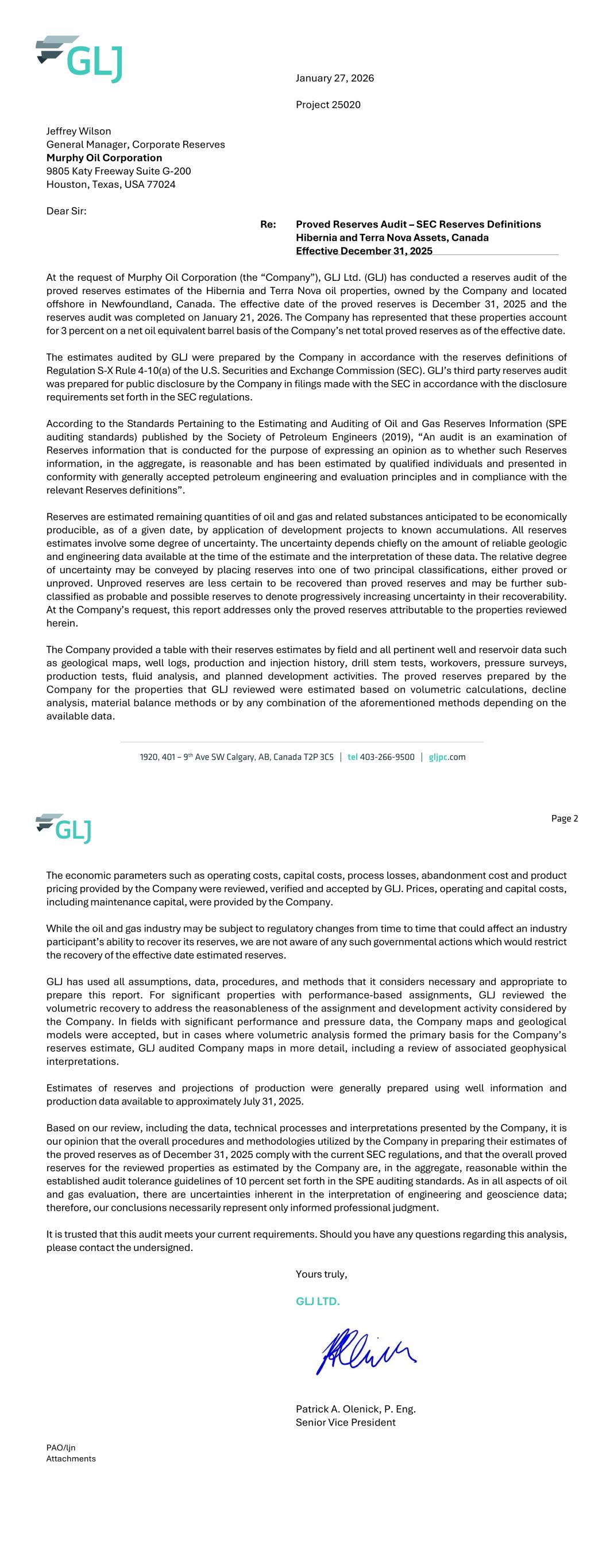
January 27, 2026 Project 25020 Jeffrey Wilson General Manager, Corporate Reserves Murphy Oil Corporation 9805 Katy Freeway Suite G-200 Houston, Texas, USA 77024 Dear Sir: Re: Proved Reserves Audit – SEC Reserves Definitions Hibernia and Terra Nova Assets, Canada Effective December 31, 2025 At the request of Murphy Oil Corporation (the “Company”), GLJ Ltd. (GLJ) has conducted a reserves audit of the proved reserves estimates of the Hibernia and Terra Nova oil properties, owned by the Company and located offshore in Newfoundland, Canada. The effective date of the proved reserves is December 31, 2025 and the reserves audit was completed on January 21, 2026. The Company has represented that these properties account for 3 percent on a net oil equivalent barrel basis of the Company’s net total proved reserves as of the effective date. The estimates audited by GLJ were prepared by the Company in accordance with the reserves definitions of Regulation S-X Rule 4-10(a) of the U.S. Securities and Exchange Commission (SEC). GLJ’s third party reserves audit was prepared for public disclosure by the Company in filings made with the SEC in accordance with the disclosure requirements set forth in the SEC regulations. According to the Standards Pertaining to the Estimating and Auditing of Oil and Gas Reserves Information (SPE auditing standards) published by the Society of Petroleum Engineers (2019), “An audit is an examination of Reserves information that is conducted for the purpose of expressing an opinion as to whether such Reserves information, in the aggregate, is reasonable and has been estimated by qualified individuals and presented in conformity with generally accepted petroleum engineering and evaluation principles and in compliance with the relevant Reserves definitions”. Reserves are estimated remaining quantities of oil and gas and related substances anticipated to be economically producible, as of a given date, by application of development projects to known accumulations. All reserves estimates involve some degree of uncertainty. The uncertainty depends chiefly on the amount of reliable geologic and engineering data available at the time of the estimate and the interpretation of these data. The relative degree of uncertainty may be conveyed by placing reserves into one of two principal classifications, either proved or unproved. Unproved reserves are less certain to be recovered than proved reserves and may be further sub- classified as probable and possible reserves to denote progressively increasing uncertainty in their recoverability. At the Company’s request, this report addresses only the proved reserves attributable to the properties reviewed herein. The Company provided a table with their reserves estimates by field and all pertinent well and reservoir data such as geological maps, well logs, production and injection history, drill stem tests, workovers, pressure surveys, production tests, fluid analysis, and planned development activities. The proved reserves prepared by the Company for the properties that GLJ reviewed were estimated based on volumetric calculations, decline analysis, material balance methods or by any combination of the aforementioned methods depending on the available data. 1920, 401 – 9th Ave SW Calgary, AB, Canada T2P 3C5 | tel 403-266-9500 | gljpc.com The economic parameters such as operating costs, capital costs, process losses, abandonment cost and product pricing provided by the Company were reviewed, verified and accepted by GLJ. Prices, operating and capital costs, including maintenance capital, were provided by the Company. While the oil and gas industry may be subject to regulatory changes from time to time that could affect an industry participant’s ability to recover its reserves, we are not aware of any such governmental actions which would restrict the recovery of the effective date estimated reserves. GLJ has used all assumptions, data, procedures, and methods that it considers necessary and appropriate to prepare this report. For significant properties with performance-based assignments, GLJ reviewed the volumetric recovery to address the reasonableness of the assignment and development activity considered by the Company. In fields with significant performance and pressure data, the Company maps and geological models were accepted, but in cases where volumetric analysis formed the primary basis for the Company’s reserves estimate, GLJ audited Company maps in more detail, including a review of associated geophysical interpretations. Estimates of reserves and projections of production were generally prepared using well information and production data available to approximately July 31, 2025. Based on our review, including the data, technical processes and interpretations presented by the Company, it is our opinion that the overall procedures and methodologies utilized by the Company in preparing their estimates of the proved reserves as of December 31, 2025 comply with the current SEC regulations, and that the overall proved reserves for the reviewed properties as estimated by the Company are, in the aggregate, reasonable within the established audit tolerance guidelines of 10 percent set forth in the SPE auditing standards. As in all aspects of oil and gas evaluation, there are uncertainties inherent in the interpretation of engineering and geoscience data; therefore, our conclusions necessarily represent only informed professional judgment. It is trusted that this audit meets your current requirements. Should you have any questions regarding this analysis, please contact the undersigned. Yours truly, GLJ LTD. Patrick A. Olenick, P. Eng. Senior Vice President PAO/ljn Attachments Page 2
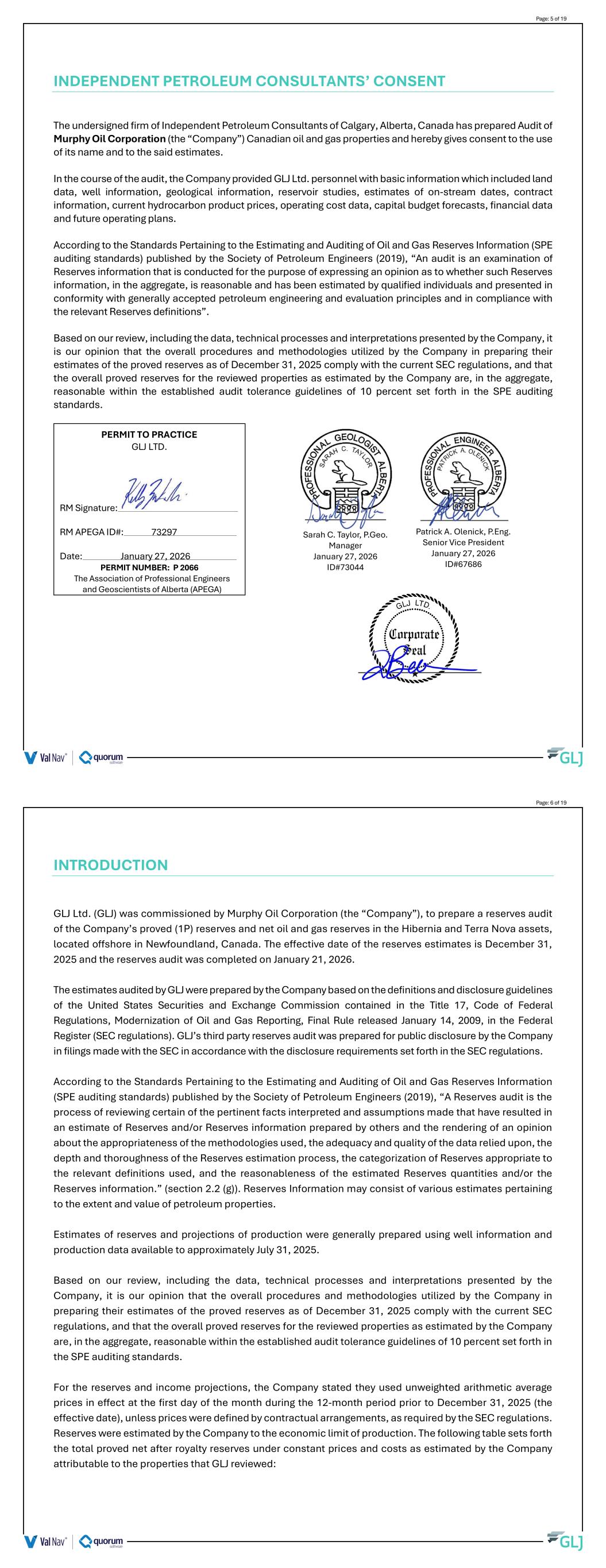
INDEPENDENT PETROLEUM CONSULTANTS’ CONSENT The undersigned firm of Independent Petroleum Consultants of Calgary, Alberta, Canada has prepared Audit of Murphy Oil Corporation (the “Company”) Canadian oil and gas properties and hereby gives consent to the use of its name and to the said estimates. In the course of the audit, the Company provided GLJ Ltd. personnel with basic information which included land data, well information, geological information, reservoir studies, estimates of on-stream dates, contract information, current hydrocarbon product prices, operating cost data, capital budget forecasts, financial data and future operating plans. According to the Standards Pertaining to the Estimating and Auditing of Oil and Gas Reserves Information (SPE auditing standards) published by the Society of Petroleum Engineers (2019), “An audit is an examination of Reserves information that is conducted for the purpose of expressing an opinion as to whether such Reserves information, in the aggregate, is reasonable and has been estimated by qualified individuals and presented in conformity with generally accepted petroleum engineering and evaluation principles and in compliance with the relevant Reserves definitions”. Based on our review, including the data, technical processes and interpretations presented by the Company, it is our opinion that the overall procedures and methodologies utilized by the Company in preparing their estimates of the proved reserves as of December 31, 2025 comply with the current SEC regulations, and that the overall proved reserves for the reviewed properties as estimated by the Company are, in the aggregate, reasonable within the established audit tolerance guidelines of 10 percent set forth in the SPE auditing standards. Sarah C. Taylor, P.Geo. Manager January 27, 2026 ID#73044 Patrick A. Olenick, P.Eng. Senior Vice President January 27, 2026 ID#67686 PERMIT TO PRACTICE GLJ LTD. RM Signature: RM APEGA ID#: 73297 Date: January 27, 2026 PERMIT NUMBER: P 2066 The Association of Professional Engineers and Geoscientists of Alberta (APEGA) Page: 5 of 19 INTRODUCTION GLJ Ltd. (GLJ) was commissioned by Murphy Oil Corporation (the “Company”), to prepare a reserves audit of the Company’s proved (1P) reserves and net oil and gas reserves in the Hibernia and Terra Nova assets, located offshore in Newfoundland, Canada. The effective date of the reserves estimates is December 31, 2025 and the reserves audit was completed on January 21, 2026. The estimates audited by GLJ were prepared by the Company based on the definitions and disclosure guidelines of the United States Securities and Exchange Commission contained in the Title 17, Code of Federal Regulations, Modernization of Oil and Gas Reporting, Final Rule released January 14, 2009, in the Federal Register (SEC regulations). GLJ’s third party reserves audit was prepared for public disclosure by the Company in filings made with the SEC in accordance with the disclosure requirements set forth in the SEC regulations. According to the Standards Pertaining to the Estimating and Auditing of Oil and Gas Reserves Information (SPE auditing standards) published by the Society of Petroleum Engineers (2019), “A Reserves audit is the process of reviewing certain of the pertinent facts interpreted and assumptions made that have resulted in an estimate of Reserves and/or Reserves information prepared by others and the rendering of an opinion about the appropriateness of the methodologies used, the adequacy and quality of the data relied upon, the depth and thoroughness of the Reserves estimation process, the categorization of Reserves appropriate to the relevant definitions used, and the reasonableness of the estimated Reserves quantities and/or the Reserves information.” (section 2.2 (g)). Reserves Information may consist of various estimates pertaining to the extent and value of petroleum properties. Estimates of reserves and projections of production were generally prepared using well information and production data available to approximately July 31, 2025. Based on our review, including the data, technical processes and interpretations presented by the Company, it is our opinion that the overall procedures and methodologies utilized by the Company in preparing their estimates of the proved reserves as of December 31, 2025 comply with the current SEC regulations, and that the overall proved reserves for the reviewed properties as estimated by the Company are, in the aggregate, reasonable within the established audit tolerance guidelines of 10 percent set forth in the SPE auditing standards. For the reserves and income projections, the Company stated they used unweighted arithmetic average prices in effect at the first day of the month during the 12-month period prior to December 31, 2025 (the effective date), unless prices were defined by contractual arrangements, as required by the SEC regulations. Reserves were estimated by the Company to the economic limit of production. The following table sets forth the total proved net after royalty reserves under constant prices and costs as estimated by the Company attributable to the properties that GLJ reviewed: Page: 6 of 19
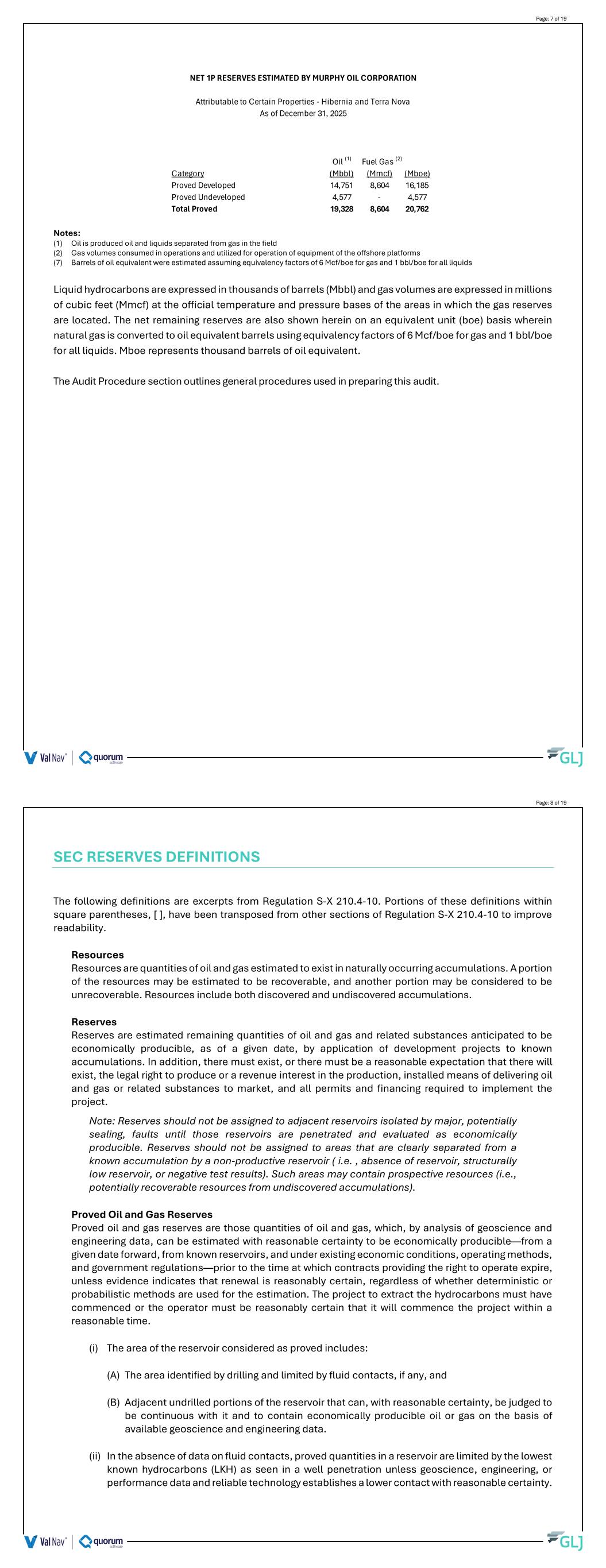
Notes: (1) Oil is produced oil and liquids separated from gas in the field (2) Gas volumes consumed in operations and utilized for operation of equipment of the offshore platforms (7) Barrels of oil equivalent were estimated assuming equivalency factors of 6 Mcf/boe for gas and 1 bbl/boe for all liquids Liquid hydrocarbons are expressed in thousands of barrels (Mbbl) and gas volumes are expressed in millions of cubic feet (Mmcf) at the official temperature and pressure bases of the areas in which the gas reserves are located. The net remaining reserves are also shown herein on an equivalent unit (boe) basis wherein natural gas is converted to oil equivalent barrels using equivalency factors of 6 Mcf/boe for gas and 1 bbl/boe for all liquids. Mboe represents thousand barrels of oil equivalent. The Audit Procedure section outlines general procedures used in preparing this audit. Oil (1) Fuel Gas (2) Category (Mbbl) (Mmcf) (Mboe) Proved Developed 14,751 8,604 16,185 Proved Undeveloped 4,577 - 4,577 Total Proved 19,328 8,604 20,762 As of December 31, 2025 Attributable to Certain Properties - Hibernia and Terra Nova NET 1P RESERVES ESTIMATED BY MURPHY OIL CORPORATION Page: 7 of 19 SEC RESERVES DEFINITIONS The following definitions are excerpts from Regulation S-X 210.4-10. Portions of these definitions within square parentheses, [ ], have been transposed from other sections of Regulation S-X 210.4-10 to improve readability. Resources Resources are quantities of oil and gas estimated to exist in naturally occurring accumulations. A portion of the resources may be estimated to be recoverable, and another portion may be considered to be unrecoverable. Resources include both discovered and undiscovered accumulations. Reserves Reserves are estimated remaining quantities of oil and gas and related substances anticipated to be economically producible, as of a given date, by application of development projects to known accumulations. In addition, there must exist, or there must be a reasonable expectation that there will exist, the legal right to produce or a revenue interest in the production, installed means of delivering oil and gas or related substances to market, and all permits and financing required to implement the project. Note: Reserves should not be assigned to adjacent reservoirs isolated by major, potentially sealing, faults until those reservoirs are penetrated and evaluated as economically producible. Reserves should not be assigned to areas that are clearly separated from a known accumulation by a non-productive reservoir ( i.e. , absence of reservoir, structurally low reservoir, or negative test results). Such areas may contain prospective resources (i.e., potentially recoverable resources from undiscovered accumulations). Proved Oil and Gas Reserves Proved oil and gas reserves are those quantities of oil and gas, which, by analysis of geoscience and engineering data, can be estimated with reasonable certainty to be economically producible—from a given date forward, from known reservoirs, and under existing economic conditions, operating methods, and government regulations—prior to the time at which contracts providing the right to operate expire, unless evidence indicates that renewal is reasonably certain, regardless of whether deterministic or probabilistic methods are used for the estimation. The project to extract the hydrocarbons must have commenced or the operator must be reasonably certain that it will commence the project within a reasonable time. (i) The area of the reservoir considered as proved includes: (A) The area identified by drilling and limited by fluid contacts, if any, and (B) Adjacent undrilled portions of the reservoir that can, with reasonable certainty, be judged to be continuous with it and to contain economically producible oil or gas on the basis of available geoscience and engineering data. (ii) In the absence of data on fluid contacts, proved quantities in a reservoir are limited by the lowest known hydrocarbons (LKH) as seen in a well penetration unless geoscience, engineering, or performance data and reliable technology establishes a lower contact with reasonable certainty. Page: 8 of 19
(iii) Where direct observation from well penetrations has defined a highest known oil (HKO) elevation and the potential exists for an associated gas cap, proved oil reserves may be assigned in the structurally higher portions of the reservoir only if geoscience, engineering, or performance data and reliable technology establish the higher contact with reasonable certainty. (iv) Reserves which can be produced economically through application of improved recovery techniques (including, but not limited to, fluid injection) are included in the proved classification when: (A) Successful testing by a pilot project in an area of the reservoir with properties no more favorable than in the reservoir as a whole, the operation of an installed program in the reservoir or an analogous reservoir, or other evidence using reliable technology establishes the reasonable certainty of the engineering analysis on which the project or program was based; and (B) The project has been approved for development by all necessary parties and entities, including governmental entities. (v) Existing economic conditions include prices and costs at which economic producibility from a reservoir is to be determined. The price shall be the average price during the 12-month period prior to the ending date of the period covered by the report, determined as an unweighted arithmetic average of the first-day-of-the-month price for each month within such period, unless prices are defined by contractual arrangements, excluding escalations based upon future conditions. Developed Oil and Gas Reserves Developed oil and gas reserves are reserves of any category that can be expected to be recovered: (i) Through existing wells with existing equipment and operating methods or in which the cost of the required equipment is relatively minor compared to the cost of a new well; and (ii) Through installed extraction equipment and infrastructure operational at the time of the reserves estimate if the extraction is by means not involving a well. Undeveloped Oil and Gas Reserves Undeveloped oil and gas reserves are reserves of any category that are expected to be recovered from new wells on undrilled acreage, or from existing wells where a relatively major expenditure is required for recompletion. (i) Reserves on undrilled acreage shall be limited to those directly offsetting development spacing areas that are reasonably certain of production when drilled, unless evidence using reliable technology exists that establishes reasonable certainty of economic producibility at greater distances. (ii) Undrilled locations can be classified as having undeveloped reserves only if a development plan has been adopted indicating that they are scheduled to be drilled within five years, unless the specific circumstances, justify a longer time. Page: 9 of 19 (iii) Under no circumstances shall estimates for undeveloped reserves be attributable to any acreage for which an application of fluid injection or other improved recovery technique is contemplated, unless such techniques have been proved effective by actual projects in the same reservoir or an analogous reservoir [see Other Definitions below], or by other evidence using reliable technology establishing reasonable certainty. OTHER PERTINENT DEFINITIONS Analogous Reservoir Analogous reservoirs, as used in resources assessments, have similar rock and fluid properties, reservoir conditions (depth, temperature, and pressure) and drive mechanisms, but are typically at a more advanced stage of development than the reservoir of interest and thus may provide concepts to assist in the interpretation of more limited data and estimation of recovery. When used to support proved reserves, an “analogous reservoir” refers to a reservoir that shares the following characteristics with the reservoir of interest: (i) Same geological formation (but not necessarily in pressure communication with the reservoir of interest); (ii) Same environment of deposition; (iii) Similar geological structure; and (iv) Same drive mechanism. Reasonable Certainty If deterministic methods are used, reasonable certainty means a high degree of confidence that the quantities will be recovered. If probabilistic methods are used, there should be at least a 90% probability that the quantities actually recovered will equal or exceed the estimate. A high degree of confidence exists if the quantity is much more likely to be achieved than not, and, as changes due to increased availability of geoscience (geological, geophysical, and geochemical), engineering, and economic data are made to estimated ultimate recovery (EUR) with time, reasonably certain EUR is much more likely to increase or remain constant than to decrease. Reliable Technology Reliable technology is a grouping of one or more technologies (including computational methods) that has been field tested and has been demonstrated to provide reasonably certain results with consistency and repeatability in the formation being evaluated or in an analogous formation. Reservoir A porous and permeable underground formation containing a natural accumulation of producible oil and/or gas that is confined by impermeable rock or water barriers and is individual and separate from other reservoirs. Page: 10 of 19
AUDIT PROCEDURE The following outlines the methodology employed by GLJ Ltd. (GLJ) in conducting the evaluation of the Company’s oil and gas properties. GLJ evaluation procedures are in compliance with standards and guidelines contained with the Society of Petroleum Engineers (SPE) Petroleum Resources Management System (PRMS) INTEREST DESCRIPTIONS The Company provided GLJ with current land interest information. The Company provided a representation letter confirming accuracy of land information. Certain cross-checks of land and accounting information were undertaken by GLJ in the audit of the assets. In this process, nothing came to GLJ’s attention that indicated that information provided by the Company was incomplete or unreliable. DATA PROVIDED The Company provided a table with their reserves estimates by field. Additionally, all pertinent well, reservoir and economic data such as geological maps, well logs, production and injection history, drill stem tests, workovers, pressure surveys, production tests, fluid analysis, planned development activities, operating expenses, capital costs, abandonment cost, process losses, liquid yields, etc., were provided by the Company. TECHNICAL REVIEW GLJ performs a bottoms-up analysis where individual properties are audited. Auditors review historical production, well activity, mapping, pressure data and development plans as well as the evaluation approach used by the Company. Meetings with the Company were held to determine the Company’s view of the reservoirs and technical justification for future development. The reserves estimates prepared by the Company for the properties that GLJ reviewed were estimated based on volumetric calculations, decline analysis or material balance methods or by any combination of the aforementioned methods depending on the available data and the significance of the property within the overall corporate portfolio. Where possible, performance-based reserve assignments were made by the Company. For significant properties with performance-based assignments, GLJ reviewed the volumetric recovery to address the reasonableness of the assignment and development activity considered by the Company. In fields with significant performance and pressure data, the Company maps and geological models were accepted, but in cases where volumetric analysis formed the primary basis for the Company’s reserves estimate, GLJ audited Company maps in more detail, including a review of associated geophysical interpretations. Data used in the audit were obtained from Company personnel and Company files. In the preparation of our report GLJ accepted as presented, and have relied, without independent verification, upon a variety of information furnished by the Company such as interests and burdens, production, product transportation and marketing and sales agreements, capital costs, operating expense data, and capital cost estimates. If, in the course of the audit, the validity or sufficiency of any material information was brought into question, GLJ did not rely on such information until such concerns were satisfactorily resolved. The economic parameters such as operating costs, capital costs, process losses, abandonment cost and product pricing provided by the Company were reviewed, verified and accepted by GLJ. Prices, operating and capital costs, including maintenance capital, were provided by the Company. Page: 11 of 19 Reserves were estimated by the Company to the economic limit of production. MARKETABLE PRODUCTS Recoverable reserves were estimated by the Company to the following products: Oil Produced oil and liquids separated from gas in the field Fuel Gas Gas volumes consumed in operations and utilized for operation of equipment on the offshore platforms. In this report, quantities of hydrocarbons have been converted to barrels of oil equivalent (boe); or to sales gas equivalent (sge) using factors of 6 Mcf/boe for gas, 1 bbl/boe for all liquids, and 0 boe for sulphur. Users of oil equivalent values are cautioned that while boe based metrics are useful for comparative purposes, they may be misleading when used in isolation. LIST OF ABBREVIATIONS AOF absolute open flow bbl barrels Bcf billion cubic feet of gas at standard conditions BIIP bitumen initially-in-place boe barrel of oil equivalent, in this evaluation determined using 5.2 Mcf/boe for gas, 1 bbl/boe for all liquids, and 0 boe for sulphur bopd barrels of oil per day Btu British thermal units bwpd barrels of water per day DSU drilling spacing unit GCA gas cost allowance GIIP gas initially-in-place GOC gas-oil contact GOR gas-oil ratio GORR gross overriding royalty GWC gas-water contact Mbbl thousand barrels Mboe thousand boe Mcf thousand cubic feet of gas at standard conditions Mcfe thousand cubic feet of gas equivalent Mlt thousand long tons M$ thousand dollars Page: 12 of 19
MM$ million dollars MMbbl million barrels MMboe million boe MMBtu million British thermal units MMcf million cubic feet of gas at standard conditions MRL maximum rate limitation Mstb thousand stock tank barrels MMstb million stock tank barrels NGL natural gas liquids (ethane, propane, butane and condensate) NPI net profits interest OIIP oil initially-in-place ORRI overriding royalty interest OWC oil-water contact P&NG petroleum and natural gas PIIP petroleum initially-in-place psia pounds per square inch absolute psig pounds per square inch gauge PVT pressure-volume-temperature RLI reserves life index, calculated by dividing reserves by the forecast of first year production scf standard cubic feet sge sales gas equivalent – if presented in this evaluation, determined using 1 barrel of oil or natural gas liquid = 5.2 Mcfe; 0 for sulphur stb stock tank barrel WI working interest WTI West Texas Intermediate Page: 13 of 19 PRODUCT PRICE AND MARKET FORECASTS December 31, 2025 The Company provided its SEC constant pricing for the West Texas Intermediate oil (WTI), Brent oil and Henry Hub natural gas benchmarks, which are calculated as the unweighted arithmetic average of the first day-of- the-month price for each month within the period prior to the effective date of the report. The table presented below summarizes the benchmark pricing provided by the Company and utilized in the reserves audit. The Company realizes an average received oil price of $68.21 USD/bbl after adjustments for oil quality and transportation. There are no gas sales within the Company’s assets, all gas production is either re-injected or consumed in operation as fuel gas. Brent Crude Oil (38.3 API, 0.37%S) CADUSD UK Exchange Constant Then Then Inflation Rate 2026 $ Current Current Year % USD/CAD USD/bbl USD/bbl USD/bbl 2026 0.0 0.7142 65.34 65.34 69.42 2027 0.0 0.7142 65.34 +0%/yr +0%/yr WTI Crude Oil (39.6 API, 0.24%S) Cushing, OK Page: 14 of 19
CERTIFICATES OF QUALIFICATION Patrick A. Olenick Ryan Campbell Jordan J.K. Hughes Julisa Rocabado Page: 15 of 19 CERTIFICATION OF QUALIFICATION I, Patrick A. Olenick, Professional Engineer, 1920, 401 – 9th Avenue S.W., Calgary, Alberta, Canada hereby certify: 1. That I am an employee of GLJ Ltd., which company did prepare a detailed audit of certain oil and gas properties of Murphy Oil Corporation (the “Company”). The effective date of this audit is December 31, 2025. 2. That I do not have, nor do I expect to receive any direct or indirect interest in the securities of the Company or its affiliated companies. 3. That I attended the University of Calgary where I graduated with a Bachelor of Science Degree in Mechanical Engineering in 2003; that I am a Registered Professional Engineer in the Province of Alberta; and, that I have in excess of twenty-four years’ experience in engineering studies relating to oil and gas fields. 4. That a personal field inspection of the properties was not made; however, such an inspection was not considered necessary in view of the information available from public information and records, the files of the Company, and the appropriate provincial regulatory authorities. January 27, 2026 ID# 67686 Page: 16 of 19

CERTIFICATION OF QUALIFICATION I, Ryan Campbell, Professional Engineer, 1920, 401 – 9th Avenue S.W., Calgary, Alberta, Canada hereby certify: 1. That I am an employee of GLJ Ltd., which company did prepare a detailed audit of certain oil and gas properties of Murphy Oil Corporation (the “Company”). The effective date of this audit is December 31, 2025. 2. That I do not have, nor do I expect to receive any direct or indirect interest in the securities of the Company or its affiliated companies. 3. That I attended the University of Calgary and that I graduated with a Chemical Engineering Degree and Minor in Petroleum Engineering in 2008; that I am a Registered Professional Engineer in the Province of Alberta; and, that I have in excess of eighteen years experience in engineering studies relating to oil and gas fields. 4. That a personal field inspection of the properties was not made; however, such an inspection was not considered necessary in view of the information available from public information and records, the files of the Company, and the appropriate provincial regulatory authorities. January 27, 2026 Page: 17 of 19 CERTIFICATION OF QUALIFICATION I, Jordan James Keith Hughes, Professional Geoscientist, 1920, 401 – 9th Avenue S.W., Calgary, Alberta, Canada hereby certify: 1. That I am an employee of GLJ Ltd., which company did prepare a detailed audit of certain oil and gas properties of Murphy Oil Corporation (the “Company”). The effective date of this audit is December 31, 2025. 2. That I do not have, nor do I expect to receive any direct or indirect interest in the securities of the Company or its affiliated companies. 3. That I attended the University of Calgary where I graduated with a Bachelor of Science Degree in Geophysics, 2013; that I am a Registered Professional Geoscientist in the Province of Alberta; and, that I have in excess of twelve years experience in geoscience studies relating to oil and gas fields. 4. That a personal field inspection of the properties was not made; however, such an inspection was not considered necessary in view of the information available from public information and records, the files of the Company, and the appropriate provincial regulatory authorities. January 27, 2026 ID# 164074 Page: 18 of 19

CERTIFICATION OF QUALIFICATION I, Julisa Rocabado, Professional Engineer, 1920, 401 – 9th Avenue S.W., Calgary, Alberta, Canada hereby certify: 1. That I am an employee of GLJ Ltd., which company did prepare a detailed audit of certain oil and gas properties of Murphy Oil Corporation (the “Company”). The effective date of this audit is December 31, 2025. 2. That I do not have, nor do I expect to receive any direct or indirect interest in the securities of the Company or its affiliated companies. 3. That I attended the Universidad Autonoma Gabriel Rene Moreno where I graduated with a Bachelor Degree in Petroleum Engineering in 2012; and that I have in excess of eleven years experience in engineering studies relating to oil and gas fields. 4. That a personal field inspection of the properties was not made; however, such an inspection was not considered necessary in view of the information available from public information and records, the files of the Company, and the appropriate provincial regulatory authorities. January 27, 2026 Page: 19 of 19