Please wait
Mar 1 2023Aug 1 20252023-04-012025-07-01CO2e emissions (ktonnes): 132–113Increasing the representation of women leaders in the Group: Range 22%–24%CO2e emissions (ktonnes): 265–200Increasing the representation of women leaders in the Group: Range 23%–25%CO2e emissions (ktonnes): 122–104Increasing the representation of women leaders in the Group: Range 26%–28%CO2e emissions (ktonnes): 138–114CO2e emissions (ktonnes): 133–110CO2e emissions (ktonnes): 126–102Increasing the representation of women leaders in the Group: Range 25%–27%CO2e emissions (ktonnes): 142–121STOXX EUROPE 600; equal to index–22.5%CO2e emissions (ktonnes): 3-year averageThe Annual General Meeting 2025 resolved that non-employee Directors may choose to receive the Board fee (i.e., exclusive of Committee fee) as follows: i) 25% of the Board fee in cash and 75% in the form of synthetic shares, ii) 50% in cash and 50% in the form of synthetic shares, or iii) 75% in cash and 25% in the form of synthetic shares. Directors may also choose not to participate in the synthetic share program and receive 100% of the Board fee in cash. Committee fees are always paid in cash.P5D
Exhibit 15.1
 
Swedish annual report for 2025 in English (adjusted version)
Although the financial statements were authorized for issue on March 3, 2026, which is stated in the financial statements, certain additional disclosures and updates have been made in the document due to subsequent events.


Table of Contents
Contents
 
 
Financial
Report


Corporate
Governance
Report


Remuneration
Report


Ericsson Annual Report 2025
The statutory Annual Report consists of three parts published as one document:
The Financial Report, containing the Board of Directors’ Report and the financial statements and notes
The Corporate Governance Report
The Remuneration Report
Ericsson’s annual financial statements and consolidated financial statements are included on pages 14–76, 82–100 in the Financial Report and are reported on by Deloitte in the Auditor’s Report. The official version of the Annual Report is prepared in Swedish in the European single electronic format (Esef). The Corporate Governance Report and the Remuneration Report. Ericsson also files a separate Annual Report on Form
20-F
with the U.S. Securities and Exchange Commission (SEC). All parts of the statutory Annual Report are available on Ericsson’s website.

Table of Contents
LOGO
Part of Ericsson Annual Report 2025 Financial Report Annual Report 2025 Financial Corporate Remuneration Report Governance Report Report

Table of Contents
 
 
Financial
Report 2025


The Financial Report, containing the Board of Directors’ Report and the financial statements and notes. Comments in this report include alternative performance measures. “Adjusted” metrics are adjusted to exclude restructuring charges and are
non-IFRS
measures. See information on “Alternative performance measures” on page 101 in the Financial Report.

Table of Contents
1
 
Financial Report 2025 | This is Ericsson
 
Ericsson Annual Report on Form 20-F 2025


This is Ericsson
 
LOGO
 
1)
 
Map illustrates general market area coverage and does not imply commercial presence or engagement in every country.
2)
 
Market area Other primarily includes IPR licensing revenues and segment Enterprise sales.
 
Ericsson 2025
  
This is Ericsson  

Table of Contents
2
 
Financial Report 2025 | CEO comment
 
Ericsson Annual Report on Form 20-F 2025


LOGO
 
AI may be the most impactful technology that mankind has ever seen. It will likely be a key driver of future productivity. Falling behind on AI adoption will hurt the competitiveness of companies and countries.
Until now, the AI race has revolved around semiconductors, data center and large models. The next phase in AI will be wide dissemination of
AI-powered
devices and applications, which will drive the demand for flexible cellular connectivity and edge compute. New AI use cases will change the nature of traffic with more demand for higher uplink speeds, low latency and high availability.
Best-effort connectivity options like 5G
non-standalone,
4G and
Wi-Fi
cannot deliver the highest level of reliability, security or performance that AI will require. Guaranteed and differentiated connectivity for different use cases based on 5G standalone – and, over time, 6G – will be essential to provide the necessary uplink capacity, network performance and extreme connection density these use cases will require. This puts Ericsson at the center of AI developments and future growth opportunities.
Investments in communications infrastructure continue. At the end of 2025, around 370 communications service providers (CSPs) have launched commercial 5G services and around 90 have launched 5G standalone in public networks. An increasing number of CSPs are investing in 5G standalone, but there is still much more
build-out
needed in order to scale AI.
It is worth noting that China has built out a very strong and dense 5G standalone network that has allowed the roll out of advanced use cases, such as factory automation, robotics and drones, where industrial AI leveraging efficient AI models provides significant advantages.
Ericsson is well positioned in this environment with around 37% market share, outside
China
1)
. At the end of 2025, Ericsson supplied 206 live 5G networks in 85 countries, including 55 live 5G standalone networks, with around 50% of all mobile traffic outside China carried over Ericsson networks. In addition, we were consistently recognized as the leader in RAN and 5G core networks by industry analysts.
Ericsson concluded the year with an adjusted gross margin of just over 48% and adjusted EBITA of SEK 42.9 billion. Excluding the gain from the iconectiv sale, the EBITA margin was 14.9%, bringing us close to our long-term ambition. Our solid financial performance underscores the competitiveness of our solutions, our commercial discipline and our continuous focus on operational improvements.
Technology leadership remains our foundation. To make the required investments, we must continuously drive operational efficiencies, including cost reduction initiatives. As a consequence, we reduced our head-count by 5,000 during 2025, making room for investments in our growth areas such as 5G Core, autonomous networks, mission critical, defense and enterprise.
Forging a path to growth
During 2025, Ericsson played a key role in helping communications service providers transition from their traditional
one-size-fits-all,
best-effort mobile broadband to a new era of performance-based models built upon differentiated connectivity. This includes, among others, key agreements with Telstra and Vodafone, to transform their networks into programmable platforms for innovation that enable differentiated connectivity and new monetization opportunities.
We also focused on scaling the mobile platform to new use cases and new sectors. The most mature use case is Fixed Wireless Access (FWA), which during 2025 reached
over 150 million residential connections globally, with better customer satisfaction than other access technologies. Given this, I find it surprising that many countries still subsidize fiber rollout instead of a more cost efficient 5G rollout.
We are starting to see traction in mission critical applications, which we view as a key growth opportunity. During 2025, we executed multiple new agreements in the public safety sector and we’re also pursuing opportunities in national security and defense. Over the next year, we will ramp up investments in this area, with costs front-loaded.
On the enterprise side, we’re continuing to strengthen our position. The market for network APIs is starting to develop. In 2025, Vonage was first to offer aggregated access to network APIs across all three major US carriers – such as advanced fraud detection with significant customer interest. And our joint venture, Aduna, achieved full coverage in five countries namely the US, Spain, Germany, Canada, and the Netherlands. Following the decision in 2024 to exit a number of areas, it was encouraging to see that we returned to year-over-year growth while strengthening the gross margin in Q4. Our investments in building the market for network APIs will continue impacting near-term profitability.
In Enterprise Wireless Solutions, we’re seeing the market for private 5G starting to industrialize. One example is Airbus’s deployment of our private 5G solution at the production site in Hamburg with plans to extend private 5G across their strategic sites. Our wireless WAN business continues to grow with healthy gross margins. The most important strategic initiatives in Enterprise Wireless Solutions are to build a multi-channel
go-to-market
model, and we expect to continue investing in this area, while continuing to reduce
run-rate
losses.
Looking ahead, new devices and applications will represent further opportunity.
 
1)
 
Source: Dell’Oro, 2026
CEO comment Positioned for growth Investments in market and technology leadership combined with disciplined strategy execution position Ericsson for the next phase of AI with industrialization of AI applications and devices.

Table of Contents
3
 
Financial Report 2025 | CEO comment
 
Ericsson Annual Report on Form 20-F 2025


Strategic achievements
in 2025
 
 
Telstra programmable network (February 2025)
 
 
Japan R&D investment (May 2025)
 
 
AI factory in Sweden (May 2025)
 
 
India antenna manufacturing (June 2025)
 
 
Ericsson on Demand with Google Cloud (June 2025)
 
 
Level 4 autonomy certification (June 2025)
 
 
Vodafone Europe programmable network (October 2025)
 
 
Full coverage in the US for aggregated network APIs (November 2025)


In 2025, we commercially launched Ericsson’s connectivity management tool for 5G laptops. During the year we signed agreements with two leading mobile operators, secured an extension with our first customer in Asia, and onboarded the first US customer.
Through our investments in growth areas, we have been able to achieve modest
top-line
growth despite a flat RAN market. Looking ahead, our high-performing, programmable and autonomous networks will enable our CSP customers to deliver differentiated performance and create new applications and use cases to monetize.
As an example, we partnered with Google Cloud during 2025 to develop a core network as a service (aaS) offering. Ericsson
On-Demand
is a ground-breaking shift for the telecom industry for how network services can be deployed, managed and scaled. In addition, we are seeing interest from customers in other industry segments.
By delivering programmable networks, expanding use cases to enterprises and mission critical networks, and leveraging developers for new applications, Ericsson is forging a path to sustainable future growth. We will continue to build this ecosystem by partnering with hyperscalers, developers, and AI companies.
The next wave of connectivity
This is a very exciting moment for Ericsson as we enter an era of hyperconnectivity where everything that can be connected will be. Our strategy is to offer the best networks for AI, with AI, supporting applications and devices that need
ultra-low
latency, faster uplink speeds and edge compute capabilities. We are also leveraging AI to improve performance, increase efficiency, enhance customer experience and enable new business models and use cases.
We are leading AI for telecom networks. In 2025, Ericsson and a consortium of Swedish companies, announced plans to build an AI factory to accelerate the training of domain-specific AI models and large-scale inference, so that AI can make large-scale predictions, classifications, or decisions.
AI will fundamentally change our business through autonomous and programmable networks, where operations can be aligned with business objectives. As networks evolve, AI will be inseparable from the underlying mobile technology and will be a critical enabler for autonomous operations. In June of 2025, Ericsson received the industry’s first verification of Level 4 autonomy
1)
– where the network can make full operational decisions with minimal human intervention.
Deployments of the next generation of mobile technology, 6G, are expected to begin before 2030. Our strategy is to be first and take a leading role in defining and standardizing 6G, leveraging the business foundation established through 5G monetization, such as network APIs and differentiated connectivity. Migration to 5G standalone is an essential first step as it provides the cloud-native architecture needed to fully enable
AI-driven
automation and advanced network slicing. As mentioned earlier, China has bolstered its position in the global AI race through significant investments in 5G standalone.
Technology and geopolitics
Technology is at the heart of geopolitics and AI, together with cloud and mobile connectivity, is part of a digital stack which global powers are heavily investing in. Mobile connectivity is especially important as it provides the flexibility and necessary performance to scale cloud and AI. Consumers have already digitalized on the mobile platform and now it is time for enterprises.
Ericsson is a strong advocate of an open ecosystem. Our future-proof, hardware-agnostic software architecture, that already embeds AI, supports both Ericsson silicon and third-party CPUs and GPUs, and is already integrated with more than 10 third-party radios. This allows customers to choose the hardware stack that best fits their needs, while delivering the best performance and lowest total cost of ownership. We are strong advocates of an open ecosystem that supports faster innovation, robust security and greater resilience – all key issues for national security.
We are also bolstering our efforts to become a domestic champion in key markets such as the US, India and Japan, while also working to preserve an open and competitive ecosystem at scale. In 2025, we announced new R&D investments in Japan, antenna production in India as well as continued investments into our USA 5G Smart Factory in Texas, which also celebrated five years of 5G manufacturing.
Europe faces a clear strategic challenge in the digital domain. Rather than framing the debate around an elusive notion of full digital sovereignty, a more pragmatic approach would be to recognize European strategic interdependence with US and like-minded technology ecosystems and focus on where Europe can realistically lead. That opportunity lies in the application layer. Europe has deep pools of entrepreneurial talent and domain expertise that can translate digital technologies into globally competitive solutions. To unlock this potential, Europe needs to accelerate investment across the digital stack, most notably in the connectivity layer, including widespread deployment of 5G standalone. Strengthening these foundations would position Europe to build distinctive leadership in
AI-enabled
applications, transforming structural interdependence into a world-leading platform for innovation and growth.
Summary
Connectivity is critical for AI to scale, and high-performing, programmable networks underpin accelerated digitization and new growth opportunities. Ericsson today is well positioned to capture value from deployment of AI in society.
Ericsson continues to invest in technology leadership, but it is not enough to just lead on technology, we must take the lead on culture as well. During the past year, we reinforced our culture to support and drive our strategy forward. We are convinced that diverse teams, where everyone feels included and safe, leads to better performance. By serving customers in over 175 countries, we have a deep talent pool with a rich range of backgrounds and perspectives. All our talent decisions are merit-based, and we have no tolerance for discrimination of any kind. Our commitment to diversity and inclusion remains rock solid.
We have also reached a significant milestone – the 150th anniversary of Ericsson’s founding. While that is worth celebrating, our efforts are focused on positioning Ericsson for the next 150 years. Through our focus on technology and innovation leadership, we have managed numerous technology transitions in the past, and we are committed to doing that for the future as well.
Before I conclude, I want to thank the incredible Ericsson team for all their efforts during 2025. Their hard work and perseverance have laid the foundation for an even stronger company. Ericsson is in a strong position. Our leadership in mobile networks, combined with investments to scale the mobile platform into new areas, will expand the market for connectivity and drive new monetization for us.
Börje Ekholm
President and CEO
 
1)
 
Level 4 Autonomy: the network predicts, decides, and executes most actions automatically with limited human intervention.

Table of Contents
4
 
Financial Report 2025 | Strategy
 
Ericsson Annual Report on Form 20-F 2025


Strategy
Leading mobile networks to drive
an
AI-powered
world
 
Ericsson’s strategy is to lead the telecom industry by building the world’s most advanced mobile networks – powered by and optimized for AI. To drive growth, Ericsson is expanding mobile networks across sectors, with a focus on enterprises, mission-critical networks, and Fixed Wireless Access. Through its hyperscale network platform, the Company is also making advanced network capabilities globally accessible to unlock new value and accelerate innovation.
 
  
developers – in the best and most cost-efficient way.
Over the next five years, Ericsson expects mobile data traffic to continue to grow driven by
AI-workloads
such as immersive AR/VR experiences, autonomous vehicles and interpretive computer vision. Traffic patterns are also expected to change, placing new requirements on the network. Satisfying these demands will require investment in densification and rapid migration to 5G standalone.
In order to stimulate growth and investment in the connectivity layer, new business models are needed for the telecom industry. Ericsson is extending mobile networks into new sectors, with a particular focus on enterprise and mission-critical networks as well as high-impact use cases such as Fixed Wireless Access. Network slicing, only available through 5G standalone, will also be a key driver of future monetization. In addition, Ericsson is leveraging advanced network capabilities to offer more value-driven alternatives to current best-effort business models. Through a hyperscale network platform, Ericsson is making advanced network capabilities, such as fraud prevention and differentiated performance, globally accessible, empowering customers and partners to unlock new value and accelerate innovation.
Being the leading mobile networks provider with more than 50% of traffic outside of China and leading in AI for networks, Ericsson is well positioned to drive growth and capture value to power the next wave of AI.
Ericsson’s leadership position
 
37%
 
Global RAN market share,
outside China, 2025
1)
 
206
 
Live 5G networks in 85 countries
deployed by Ericsson
 
55
 
Live 5G SA networks
deployed by Ericsson
  
AI is a transformational technology – fundamentally changing the way companies, governments and consumers operate. To date, the focus in AI has been on rapidly building out capacity – through semiconductor production, new data centers and training AI models. But as AI transitions from centralized cloud environments to distributed AI inference applications, Ericsson expects the demand for high-performance connectivity and advanced network capabilities to grow.
In this next industrial phase of AI,
best-effort
connectivity, such as 4G and
Wi-Fi,
will not be sufficient to provide the required reliability, security or performance. Instead, advanced connectivity based on 5G, and over time 6G, will be needed to deliver guaranteed performance. Ericsson’s strategy is to capture the value of connectivity by providing the best networks for AI to communications service providers (CPSs), enterprises and application
Ericsson’s strategy
LOGO
 
1)
 
Source: Dell’Oro, 2026

Table of Contents
5
 
Financial Report 2025 | Strategy
 
Ericsson Annual Report on Form 20-F 2025


Leadership in mobile networks
 
Ericsson’s technology leadership in mobile networks is the foundation of its strategy. The Company has industry-leading hardware and software solutions for Communications Service Providers (CSPs) encompassing radio, core networks, transport and antennas, along with network management and support systems, network deployment and advanced network services. Ericsson is a trusted partner, delivering secure, open,
AI-enabled
5G, and verifiable security within a multi-vendor, standards-aligned ecosystem.
Ericsson’s portfolio of mobile network solutions is constantly evolving to provide the best performance, security, and sustainability at the lowest total cost of ownership (TCO). In addition, the Company’s high-performing,
AI-powered,
and increasingly autonomous, networks are helping to break the energy curve of mobile networks and reduce CSPs’ energy use, costs and greenhouse gas emissions. Leadership in radio technology, including application specific semiconductors, will remain critical for the Company as AI functionality moves from the compute layer to radio access.
AI is transforming networks and Ericsson is embedding
AI-based
autonomous functions – including agentic AI – into its radio, core and orchestration layers. AI is improving operational efficiency and, more importantly, enabling differentiated, tailored services for different customer segments. Looking ahead, AI will be further embedded into the fabric of how networks are designed, built, and operated.
Ericsson is leading in the transition toward autonomous networks, which are more agile, reliable and cost-efficient compared to today’s manual or semi-automated operations. Today, Ericsson is the first vendor certified to deliver level 4 autonomy
1)
– where the network can plan, decide and execute operational tasks with minimal human intervention. Autonomous networks, powered by AI, are a prerequisite for delivering tailored experiences enabled by network slicing and programmable networks at scale.
In the future, networks will need to be more flexible to allow for new and differentiated services that will be critical for AI use cases and for further digitalization in
society. Ericsson has increased investments in programmable networks and in doing so is enabling a single network to be used for multiple use cases through network slices, where specific performance levels can be offered depending on the specific requirements of each application.
Consistent with Open RAN specifications, Ericsson has implemented a disaggregated architecture for its software and hardware in the compute layer of the network. This has allowed the Company to benefit from innovation in advanced silicon ecosystems and has enabled Ericsson’s software to run on the industry’s latest central processing (CPUs) and graphics processing units (GPUs).
As networks evolve towards 6G, the industry will see AI further embedded in every layer, enabling the networks to learn, predict and adapt in real time in order to deliver tailored, guaranteed experiences. The Company’s strategy is to be first and to lead in 6G, building on its strong position in 5G, including performance differentiation, cloudification, automation and new technologies such as sensing.
 
Scaling the mobile platform
 
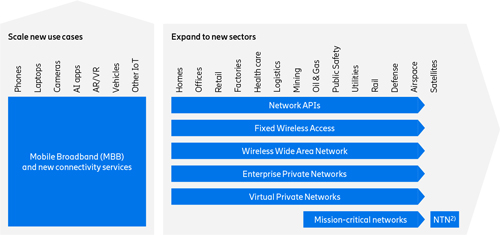
New use cases based on current 5G networks are emerging, and Ericsson is evolving its business by expanding the market for connectivity with new applications for new sectors.
Fixed Wireless Access (FWA) – which connects homes and businesses using wireless broadband – is the most mature of the new use cases, with over 150 million global subscriptions and better customer satisfaction than other access technologies. Other promising growth areas include
5G-enabled
laptops, private network for industrial environments and mission-critical networks for first responders and defense operations.
Mission-critical networks leverage commercial 5G to enable national security and defense operations to maintain resilient communications, protect critical infrastructure, and protect lives.
Looking ahead, new devices and applications – such as AI and AR glasses – will represent further opportunity. This type of performance can only be reliably delivered through 5G standalone networks.
In addition, enterprises continue to digitalize and mobility remains a central part of this journey. Ericsson’s offerings for this area
 
Mobile platform scaling to new use cases and new sectors
 
LOGO
 
 
include
pre-packaged
wireless solutions that provide secure and reliable connectivity, for example
Wireless-WAN
(WWAN) and cloud security (Security Access Service Edge – or SASE). Ericsson also offers a solution for
5G-enabled
laptops that allow companies to easily manage their connectivity and security.
Furthermore, Ericsson is developing new ways to consume network capabilities via Application Programming Interfaces (APIs) – giving developers and enterprises access to advanced 5G network capabilities in a format that is user friendly and easy to
  
consume and pay for. Through its subsidiary, Vonage, Ericsson is providing developers with unparalleled access to advanced capabilities – such as
ultra-low
latency, advanced fraud protection and positioning – so they can create new value-added services. The first network APIs, including SIM card swap detection and location verification for fraud prevention, have started to gain traction. By making network APIs globally available to enterprises and developers, Ericsson is giving national CSPs hyperscale in delivering network capabilities.
    
 
1)
 
Level 4 Autonomy: the network predicts, decides, and executes most actions automatically with limited human intervention.
 
2)
 
Non-Terrestrial
Networks.

Table of Contents
6
 
Financial Report 2025 | Strategy
 
Ericsson Annual Report on Form 20-F 2025


To further accelerate this new market, Ericsson created Aduna, a pioneering joint venture with some of the world’s leading CSPs, to aggregate and standardize network APIs. Aduna is an open and global ecosystem that is growing with partners continuing to join.
With its leading mobile networks, a multichannel
go-to-market
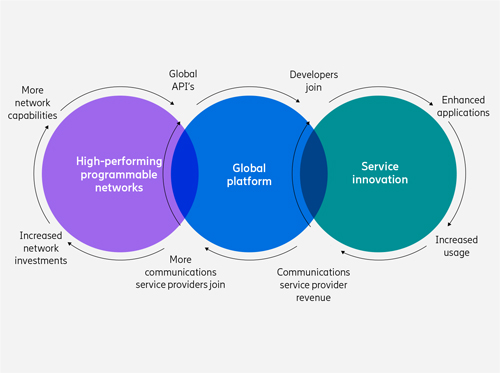
model and a global network platform, Ericsson has the necessary building blocks to power the next era of mobile innovation. By providing network capabilities such as authentication and specific levels of service quality, CSPs can add network services and evolve their business models to enable a better return on their investments. This has the potential to drive a network effect of growth and innovation – gaining momentum when network APIs become broadly available and more developers join the platform and create new applications. As more developers join, more enhanced applications are made available to the market, driving increased usage, traffic and devices – leading to increased revenue for CSPs and prompting further investments into their networks.
  
The network effect
 
LOGO
Strategic foundation
 
Technology leadership
Ericsson invests in technology as a key differentiator. Ericsson’s strategic investments in R&D include AI capabilities in its portfolio as well as purpose-built chipsets for its mobile network solutions. These investments position the Company to further extend its technology leadership in terms of cost and performance. In addition, the Company creates, secures, protects, and licenses a portfolio of patents – currently totaling more than 60,000 granted patents.
We are on an evolutionary path towards 6G, the next generation of mobile technology, which is now in the standardization phase. Mobile networks are being scaled to new sectors and use cases such as FWA and mission-critical networks, as well as by adding new capabilities through network APIs. 5G standalone networks and embedded AI are accelerating this transition. 6G will further extend these capabilities, with new spectrum and scaling capabilities such as uplink performance. 6G is
AI-native
by design, and AI will become a key enabler across the full technology lifecycle, enabling full network autonomy, breakthrough levels of performance, efficiency and resilience, tailored experiences at scale, and full support for capabilities beyond communication such as sensing. Ericsson is leading through innovation, research, and collaboration with global industry and academic partners, developing
AI-native
and energy-efficient network architectures. The Company’s strategy is to sustain
technology leadership into 6G with the first commercial deployments of 6G expected around 2030.
Trusted partner
By delivering advanced, secure and trusted 5G, and in the future 6G, to underpin an
end-to-end-digital
stack – which includes Cloud and AI - Ericsson is helping to ensure resilient, secure and trusted digital communications. The Company is committed to open interfaces,
AI-native
design and verifiable security within a multi-vendor, standards-aligned trusted stack. Ericsson works with customers, government agencies and partners to strengthen digital infrastructure while preserving an open and competitive ecosystem – at scale. Secure and reliable digital infrastructure protects critical systems and secures customer trust, with cybersecurity and data privacy at the core of operations and product development, and
secure-by-design
principles.
Intelligent operations
Ericsson strives to prudently manage its costs, investments and balance sheet while investing to enhance the technology leadership, market share and profitability. The focus on performance and cost leadership enables the Company to provide products and solutions with the lowest TCO to improve productivity and capital efficiency across the supply chain. Ericsson is driving extensive deployment
of AI for internal efficiency and has started to generate sustainable productivity gains across the Company.
In addition, Ericsson ensures supply chain stability through a diversified global footprint with production hubs in key regions, adapting to market changes and prioritizing ethical practices. Sustainability considerations are integrated into supply chain management through Ericsson’s Code of Conduct for Business Partners, supported by risk assessments and supplier audits. The Company also participates in industry initiatives to address systemic challenges such as labor rights, responsible mineral sourcing and health and safety in the value chain.
Global skill & scale
Ericsson’s global presence, skills and expertise, together with close customer partnerships, create opportunities for profitable growth and economies of scale. Ericsson’s unique engineering talent is key to maintaining technology leadership.
Ericsson prioritizes employee engagement, job satisfaction and well-being, together with a commitment to equal opportunities and work-life balance, to attract talent globally. Investments in continuous learning,
re-skilling,
and AI integration drive innovation and productivity. Merit-based recruitment and transparent compensation practices foster diversity and ensure a fair, enriching workplace, strengthening Ericsson’s culture, for long-term success.

Table of Contents
7
 
Financial Report 2025 | Strategy
 
Ericsson Annual Report on Form 20-F 2025


People, Talent and Diversity
 
  
Diversity and inclusion are central to our culture, enabling us to effectively execute our strategy. Ericsson’s success is underpinned by having the best people and we are committed to retaining and recruiting top talent, to promoting strong leadership, to investing in our employees and working together as a team. With customers served in more than 175 countries, we actively promote a diverse and inclusive talent base. Offering career opportunities for our people is a central aspect of the Ericsson culture.
At Ericsson, we cultivate an inclusive environment where everyone belongs and feels supported. We have no tolerance for any type of discrimination. Our decisions are inclusive and merit-based, and we foster a culture built on respect and professionalism. Fostering an inclusive environment is critical, as we know that when our people feel safe being themselves and they know they have the freedom and empowerment to make decisions, they will be more productive and innovative. This has allowed us to manage many technology cycles over the past 150 years. It is important at all levels that each individual feels they belong and can contribute authentically. High quality decision-making and good risk management in a highly complex and competitive
  
global environment require a highly capable workforce with a broad range and diversity of perspectives.
We strive to have our workforce composition better reflect the diversity of the societies and communities that we operate in. We continue in our efforts to increase gender equality (especially at our leadership levels) and achieve pay equality by continuously monitoring data, such as hires, promotions and compensation levels by gender and seniority. While we do not have quotas, we do have a continuing ambition to increase the overall proportion of our women leaders and to achieve pay equality through our efforts of unbiased and
non-discriminatory
recruitment, advancement and compensation based on merit.
We actively promote Employee Resource Groups, open to everyone, as a source of input on a wide range of topics. In addition, we conduct recurring employee engagement surveys. We are always focused on frequently receiving employee feedback, while in turn, providing clarity to all on the strategic direction of the organization.
Competition for global talent and skills is intense. Ericsson’s merit-based recruitment, employment and management decisions
  
are central to our technology leadership and for sustaining long-term competitiveness. We provide equal opportunity and work-life balance to our people, and inclusive access to all workplace programs, activities and resources. Further, we combine
in-person
collaboration with flexible working to support careers and life commitments and remain an attractive employer globally.
Ericsson expects our people and leaders to uphold equal opportunity and merit-based actions and decisions. We support our people in learning critical skills to foster innovation, retain employees, and ensure the right people are in the right roles. We continually map critical skills to strategic priorities across the organization, in areas such as technology, business and leadership, and invest in focused ongoing learning including through Group-wide AI adoption. These efforts enhance decision-making, increase productivity, transform how Ericsson works, and enable faster, smarter outcomes – building capabilities for today while preparing for future opportunities.
 
Integrity and ethics at the core
 
Ericsson places integrity and ethics at the core of its operations, ensuring responsible, transparent, and compliant decision- making aligned with its values. Ethics and compliance are strategic priorities, strengthened through adaptive measures like data-driven insights and risk assessments to address gaps and reinforce accountability. By embedding compliance into its culture, training employees to uphold its values, and aligning actions with its policies, Ericsson fosters trust among stakeholders while safeguarding its reputation through a consistent commitment to integrity.
   LOGO
  

Table of Contents
8
 
Financial Report 2025 | Strategy
 
Ericsson Annual Report on Form 20-F 2025


Segments
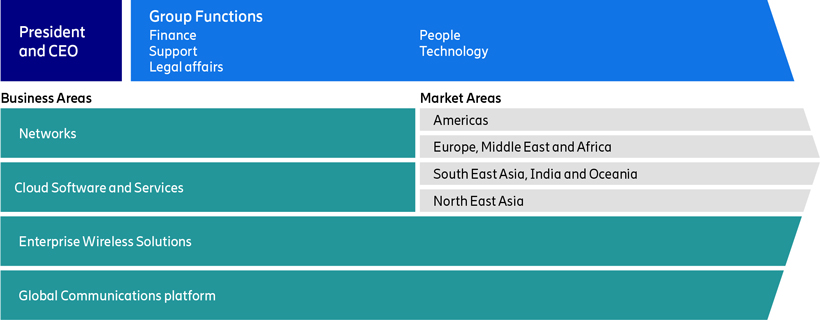
 Networks
  
Networks empowers communications service providers with solutions combining hardware, software and services to meet the increasing demand for intelligent, reliable, and flexible 5G networks – driving growth and competitive advantages.
 
– Enhance network capacity and coverage through advanced Radio Access Network (RAN) components to meet the continuous growth in data traffic and demand for new enterprise and consumer AI applications.
– Reduce total cost of ownership (TCO) and accelerate service delivery through energy-efficient RAN, with a software architecture that is
AI-native
and deployable across multiple hardware platforms that include Ericsson silicon and third-party CPUs/GPUs.
– Ensure
end-to-end
performance through resilient transport networks.
– Improve spectral efficiency through advanced active/passive antennas that boost coverage and uplink.
– Lower commercialization risk and operating costs while maximizing asset utilization via rapid deployment and lifecycle management.
  
Net sales,
share of group   
 
64%
 
Net sales and adjusted EBITA margin
 
LOGO
 
 Cloud Software and Services
Cloud Software and Services offers
AI-powered
software and services that help our customers enhance network performance, monetize their networks, create new business opportunities based on differentiated connectivity, and achieve business agility and operational efficiency with automated networks.
– Ensures high-performing, secure, resilient and efficient data and voice traffic connections through core network solutions.
– Accelerates customers’ revenue growth and improves user experience by enabling intelligent service monetization, network orchestration and operations through business and operations support solutions.
– Enhances operational efficiency and network performance through network management and cognitive networks solutions.
– Network operations delivered as managed services to help customers ensure high network performance, excellent customer experience, and cost-efficiency.
  
Net sales,
share of group   
 
26%
 
Net sales and adjusted EBITA margin
 
LOGO
 
 Enterprise
  
Enterprise leads the next era of enterprise digital transformation with high-performance, programmable mobile network solutions.
– Delivering secure and reliable enterprise connectivity through private 5G, indoor 5G coverage, and Wireless WAN to support business-critical and operationally essential applications.
– Orchestrating cloud-managed wireless platforms that unify
AI-enhanced
security, network operations, and intelligence, enabling centralized control, real-time visibility, and continuous optimization at scale.
– Unlocking new enterprise value through network APIs that expose advanced mobile network capabilities to developers.
– Powering enterprise hyperconnectivity with next generation, network aware communications solutions.
  
Net sales,
share of group   
 
9%
 
Net sales and adjusted EBITA margin
 
LOGO
 
 Other
Other consists of media businesses and other
non-allocated
businesses.
– RedBee Media: Prepares and distributes live and
on-demand
video services for broadcasters, sports leagues and communications service providers.
  
Net sales,
share of group   
 
1%
 
Net sales
 
LOGO

Table of Contents
9
 
Financial Report 2025 | Strategy
 
Ericsson Annual Report on Form 20-F 2025


Targets and outcomes
 
Long-term targets
Ericsson’s goal is to enhance profitability by leveraging its leadership in
AI-native
mobile networks, expanding across sectors and scaling its network platform. The financial targets are expressed in terms of adjusted EBITA margin and free cash flow before mergers and acquisitions (M&A) as a percentage of net sales.
To drive value creation and competitiveness, Ericsson prioritizes strategic investments in research and development (R&D), ensuring that technology leadership is maintained and operational efficiency is enhanced. Financial discipline and a strong focus on profitability and returns are at the heart of every decision. The Company is committed to an investment grade credit rating, and strives for a solid net cash
position over time. The capital allocation principles are: (1) maintain technology leadership and ensure strong customer confidence through continued investments in R&D, even during periods of increased market volatility or low visibility, (2) stable to progressive ordinary dividends, (3) selective inorganic investments to complement the existing product portfolio and/or market footprint, (4) ensure capital discipline through distributing excess cash to shareholders.
Sustainability goals are integral to Ericsson’s strategy, helping to build resilience across the Company. By addressing climate change and prioritizing health and safety, the Company believes it is mitigating material impacts and risks throughout its operations and value chain.
 
 Financial targets
  
 
Sustainability goals
Adjusted EBITA margin
 
 
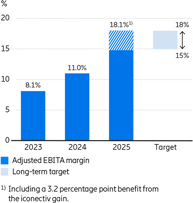
15–18%
 
Important drivers
– Increased IPR revenues
– Market and product mix
– Operational leverage
    
Free cash flow before M&A
as a percentage of net sales
 
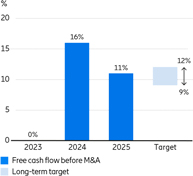
9–12%
 
Focus
– Delivering solid cash conversion
from EBITA
    
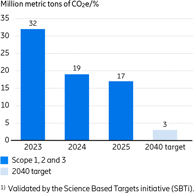
– Net Zero carbon emissions across value chain by 2040
1)
.
– Zero fatalities and lost workday incidents. Outcome 2025: 3 fatalities and 60 lost workday incidents. Ericsson continues to analyze root causes and strengthen preventive measures to reduce and ultimately eliminate work-related accidents.
 
 
Adjusted EBITA margin
 
LOGO


Free cash flow before M&A
 
LOGO


Value chain carbon footprint
 
LOGO
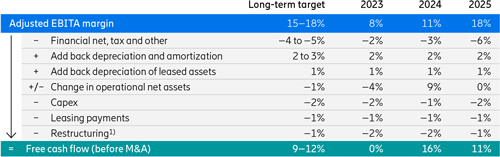
Free cash flow generation
Adjusted EBITA to free cash flow bridge (% of net sales, illustrative)
LOGO
All numbers are in relation to net sales.
1)
 
Restructuring charges as reported in the income statement for each year.

Table of Contents
10
 
Financial Report 2025 | Comment from the Chair of the Board
 
Ericsson Annual Report on Form 20-F 2025


LOGO
Dear shareholders,
 
2025 marks yet another exceptional year for Ericsson. The external environment saw increased geopolitical tension, including threats of steep tariffs, outlining a new set of rules for global trade. Naturally, this is impacting global businesses, and the Board has spent a significant amount of time navigating the changing conditions. At the same time, the world is fast approaching the next phase in the AI era. This will include
AI-driven
applications and devices and can create a truly hyperconnected society. These developments will require advanced wireless connectivity – an area where Ericsson is the world’s leader.
Against this fast-paced and dynamic external backdrop, Ericsson has demonstrated resilience and progress, underscored by a number of significant achievements around the world and across the business.
Strategy and Technology
In 2025, the Company continued to execute on its strategy to lead in mobile networks and to scale the mobile platform to new use cases and new sectors. Today, Ericsson is recognized as an industry leader, and our customers rely on our world-leading products and solutions to allow them to offer differentiated services and increase monetization opportunities. We saw several key agreements in the mobile infrastructure business as well as good traction in new sectors, including mission critical applications and enterprise solutions. Successful execution of this strategy, will put Ericsson on a growth trajectory, and the Board works actively with the management team to capitalize on this momentum.
Although the next phase in the AI era will require advanced wireless connectivity, short-term, we still see little or no growth in our core mobile infrastructure market. This means that we have to plan accordingly. Thus, the
Company is continuing to strengthen operational excellence and structurally improve the business through cost management and by improving working capital.
At the foundation of Ericsson’s success is technology leadership. Safeguarding this position is the key priority for the Board. This includes ensuring that the Company can continue to make critical investments to lead in the 6G and AI era and preserve customer confidence throughout varied market environments, as well as securing the ability to make selective
add-on
acquisitions. To this end, we’re happy to enter 2026 in a strong position with a solid financial position, allowing the Company to continue critical investments in R&D while at the same time increasing shareholder returns.
Capital structure
For the full-year 2025, the Company reported net sales of SEK 236.7 billion, an adjusted gross margin of 48.1%, an adjusted EBITA margin of 14.9% (excluding the capital gain from the iconectiv sale) and free cash flow before M&A came in at 26.8 billion. This means the Company reached its cash flow generation target of 9–12% of net sales before M&A and is tracking very close to its long-term EBITA target of 15–18%. The Company ended the year with a net cash position of SEK 61.2 billion. These results reflect Ericsson’s competitive portfolio and the actions taken in recent years to strengthen the position of the business.
A key focus of the Board over 2025 has been capital allocation. During the year, the Board has worked to more clearly define its view on capital allocation and to articulate what we see as a desirable balance sheet. The overarching aim is to maintain a solid net cash position to secure technology leadership.
In conjunction with the Company’s Q4 earnings report, the Board presented its key capital allocation principles which are:
1.
Maintain technology leadership and ensure strong customer confidence through continued investments in R&D, even during periods of increased market volatility or low visibility
2.
Stable to progressive ordinary dividends
3.
Selective inorganic investments to complement the existing product portfolio and/or market footprint
4.
Ensure capital discipline through distributing excess cash to shareholders.
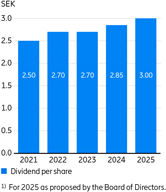
In line with these principles, for the financial year 2025, the Board recommended total shareholder return of approximately SEK 25 billion consisting of an increased dividend of SEK 3.00 per share and a share buyback program of up to SEK 15 billion. This represents the largest shareholder return in Ericsson’s history and reflects both the Board’s confidence in Ericsson’s strategy execution and its view that excess cash should be distributed to shareholders.
Sustainability, people and culture leadership
Throughout 2025, Ericsson continued to embed sustainability and responsible business practices into its operations. This includes driving the industry’s shift toward high-performing networks with a reduced carbon footprint. As reduced energy consumption can reduce our customers’ total cost of ownership, our work in this area provides a competitive advantage for the Company while also supporting our own journey towards Net Zero greenhouse gas (GHG) emissions.
 
Comment from the Chair of the Board

Table of Contents
11
 
Financial Report 2025 | Comment from the Chair of the Board
 
Ericsson Annual Report on Form 20-F 2025


A prerequisite for Ericsson’s technology leadership is its people and leading engineering skills. To this end, the Company remains focused on making sure it can attract, retain and motivate the right employees in today’s increasingly competitive global talent market. As a truly global company our talent decisions are merit-based and made without discrimination.
During 2025, we’ve seen a significant shift in the global ESG landscape, particularly in the US, which is our largest market and accounts for 40% of total revenue. Like all businesses, we have had to carefully consider balancing regulatory risks and business imperatives. As a result, the Board will propose to the AGM to focus our sustainability target in our 2026 Long Term Variable compensation program entirely on climate. In this changing ESG landscape, Ericsson remains fully committed to fostering an inclusive workplace across all levels of the organization.
Ericsson continues to strengthen its ethics and compliance program; fully embedding it in the business and fostering accountability remain top priorities for the Company. The Board continues to be actively involved in overseeing the compliance program and supporting management in this crucial work.
Governance
Throughout the year, the work of the Board and its committees has proceeded well, covering a wide range of crucial topics for the Company and its strategy. Our current directors bring a wide variety of qualifications, perspectives and skills that support the Board’s ability to carry out its oversight role on behalf of the shareholders.
In 2025, I have continued the dialogue with major Swedish and international shareholders, to discuss topics important to our owners, including our long-term compensation programs. These discussions continue to be very productive and provide the Board with valuable feedback as we make decisions for the future direction of Ericsson.
Concluding remarks
Lars Magnus Ericsson founded his company in 1876 with the firm belief that communication is a basic human need. This year, which marks the Company’s
150-year
anniversary, we can reflect on a history of innovation, industry leadership and investment in transformative technologies. These are innovations that have brought people closer and improved societies all over the world. With Ericsson’s current focus on programmable,
AI-powered
networks and sustained R&D investments, the Company is well positioned to capture further value and continue driving opportunities as the digital economy expands.
The Board remains fully supportive of Ericsson’s management as they execute on the strategy and commitment to long-term technology leadership. We are confident in the company’s momentum in programmable networks and new connectivity markets. Although it might take time to show in sales, we believe we are entering a pivotal period as connectivity in the AI era will become more important. On behalf of the Board, I want to express my sincere thanks to CEO Börje Ekholm, the management team and all employees for their commitment and contributions during 2025.
Jan Carlson
Chair of the Board

Table of Contents
12
 
Financial Report 2025 | 150 Years of connectivity
 
Ericsson Annual Report on Form 20-F 2025


LOGO
150 years of connectivity
From a small workshop in 1876 to a global leader in communications, Ericsson’s history is defined by relentless innovation, standards leadership and investments in technology that have transformed the telecommunications industry.
1876–1920
An innovation star is born
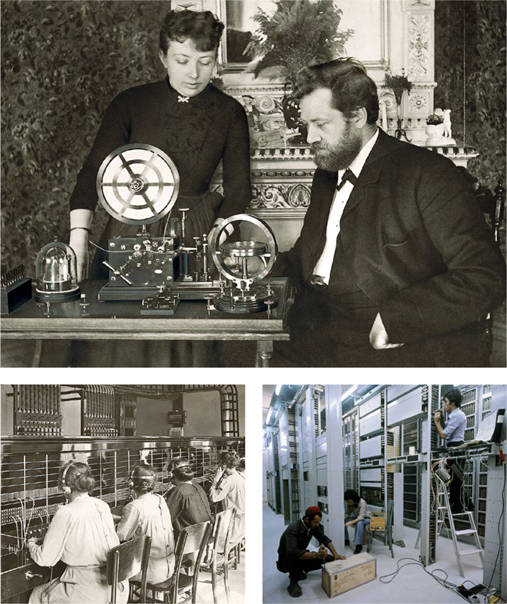
Ericsson’s story begins in 1876, when Lars Magnus Ericsson opened a small Stockholm workshop repairing telegraph instruments and other electrical and mechanical equipment. Shortly thereafter, the Company began manufacturing its first telephones and by 1896 Ericsson had produced over 100,000 phones and had 500 employees.
 International expansion quickly followed. Ericsson entered neighboring Norway and Finland and secured major contracts in Russia and Great Britain. By the early 1900s, the Company had also expanded beyond Europe, building a production plant in the US and played a formative role in building Shanghai’s telephone network. By the early 1900s Ericsson had established offices in Mexico, Argentina and Poland, cementing its legacy as a global telecommunications leader.
LOGO
Read more at ericsson.com
LOGO
 
1920–1960
Transforming communication
In 1919, Ericsson was listed on the Stockholm stock market and the period that followed saw the Company turn visionary ideas into scalable infrastructure.
In 1920, Ericsson developed the
500-Series
telephone switch – a commercial breakthrough that automated thousands of connections previously handled by human operators. The first commercial deployments followed in Rotterdam (1923) and Stockholm (1924) demonstrating the Company’s ability to deliver modern, scalable communication infrastructure. One original
500-switch
in Stockholm wasn’t taken out of service until 1985 – after 62 years in service – a proof of the product’s reliability.
Ericsson navigated market turbulence and ownership changes during the 1930s but ultimately rebuilt its business upon a foundation of engineering excellence and commercial discipline. By the
mid-20th
century, the Company was again well positioned to lead in the next chapter in telecommunications.
1960–1980
The dawn of digital communications
In the 1960s, the first integrated circuits arrived and paved the way for the digital era. This included new semiconductor technology that offered opportunities to significantly improve the existing switching technology. In the 1970s, Ericsson began working to develop a fully digital, software-controlled switching platform.
The resulting digital AXE system delivered improved reliability and operational efficiency. By 1992, Ericsson had a 40% market share in this area. The modular, software-driven approach anticipated later industry trends and underpinned a long-term competitive advantage.

Table of Contents
13
 
Financial Report 2025 | 150 Years of connectivity
 
Ericsson Annual Report on Form 20-F 2025
 
LOGO
The mobile miracle Ericsson had experimented with mobility early on. Its first ”mobile” phone in 1956 weighed around 40 kilos. But it was AXE that made cellular networks viable at national and eventually global scale. A major breakthrough came in 1981 with NMT, the Nordic Mobile Telephone system. It was the world’s first mobile network that enabled multinational roaming, and it established Ericsson as a serious player in mobile technology. The development and industry adoption of the GSM standard transformed mobile phones from niche devices into mass-market consumer products. Across Europe, having one common technology made roaming possible and the economies of scale reduced costs significantly. GSM also improved efficiency and capacity and included a new feature – Short Message Service (SMS) – that would once again transform how the world communicates. By 1995, GSM networks served some 10 million subscribers worldwide, and mobile handset sales exceeded total handset sales for the entire 1980s. By the year 2000, network equipment sales accounted for roughly 65 percent of Ericsson’s revenue, reflecting the company’s leadership position. As networks continued to evolve, the focus of mobile communication went from carrying voice conversations to enabling the democratization of information. 2000–2015 The internet in your pocket During the early 2000s, as the dot-com bubble burst and a global economic downturn battered the telecom sector, Ericsson weathered the crisis and continued to invest in R&D and product development. In 2001, Ericsson emerged as a 3G technology leader, leveraging its telecom platforms and standards leadership. As packet-based technologies matured, Ericsson committed to the Long-Term Evolution (LTE) standard and in December 2009, together with TeliaSonera, launched one of the world’s first commercial 4G networks. The next generation of mobile technology saw the emergence of smartphones and the app economy. 4G delivered the throughput and capacity improvements needed for video streaming, social platforms, and accelerating consumer demand and platform innovation. By 2015, mobile broadband subscriptions had grown substantially, underpinning new services and revenue streams for the industry. What comes next Mobile innovation has delivered exponential increases in capacity and capability and 5G has become critical digital infrastructure – enabling differentiated services for consumers, enterprises and society. The next generation of mobile technology, 6G, will be AI-native with embedded intelligence across the network enabling real-time adaptation, new devices, greater spectrum and energy efficiency, as well as new value streams such as integrated sensing and immersive services. Over its 150-year history, one thing has remained constant: Ericsson’s commitment to connecting people and organizations through innovation in communications. Through sustained R&D investment, standards leadership, selective M&A and close operator partnerships – Ericsson has established a strong position to deliver long-term value for shareholders, customers and society. As the digital economy grows, Ericsson aims to leverage its scale, portfolio and ecosystem position to capture further value through programmable, AI-powered networks that continue to enable economic and social opportunity. 2015–2025 A generation like no other In order to serve both consumers and enterprises, Ericsson began releasing 5G-capable products in 2015 and contributed significantly to 3GPP standardization efforts. This early engagement positioned the company to capture rapid adoption when commercial 5G networks were launched in 2018. By 2020, 5G was the fastest-adopted mobile generation in history, reaching one billion subscribers in three years. Ericsson networks now power the majority of global 5G traffic outside China. Importantly, 5G has expanded the addressable market beyond consumer mobile broadband to include mission critical networks, industrial automation, AR/VR, and AI-driven enterprise applications. Fixed Wireless Access (FWA) has also emerged as a clear commercial use case, offering operators a path to extend high-speed broadband without full fiber rollouts. Ericsson has also begun reaching out to a new set of network consumers: application developers. The 2022 acquisition of Vonage enables Ericsson to expose advanced network capabilities via network APIs, making advanced capabilities, such as low-latency connectivity and precise positioning, easier for enterprises and developers to integrate and monetize. To further accelerate the network API market, Ericsson co-founded Aduna in 2024 – a joint venture with leading telecom operators – to aggregate and standardize network APIs and simplify enterprise adoption at scale. Together, these strategic moves have put Ericsson at the center of enterprise digitalization.

Table of Contents
14
 
Financial Report 2025 | Board of Directors’ Report
 
Ericsson Annual Report on Form 20-F 2025


Board of Directors’ Report
2025 highlights
 
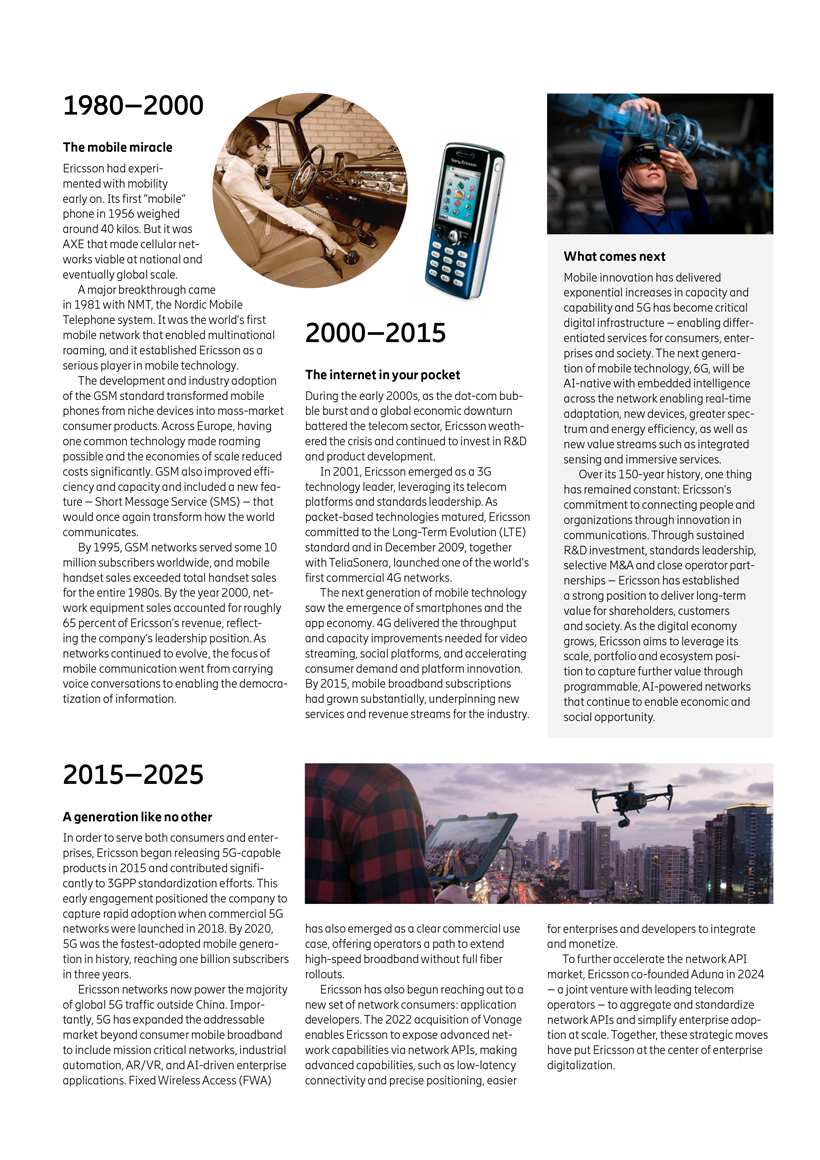
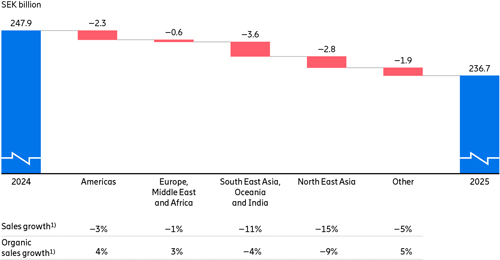
Net sales decreased by –5% to SEK 236.7 (247.9) billion, primarily impacted by a sales decline in Networks of –5%. Group organic sales grew by 2%.
 
 
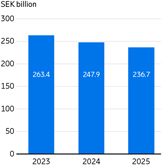
Gross income increased to SEK 112.7 (109.4) billion, primarily driven by Mobile Networks, and despite a currency impact of SEK
-7.2 billion.
Gross margin was 47.6% (44.1%). Adjusted gross income was SEK 113.9 (111.4) billion, with a margin of 48.1% (44.9%).
 
 
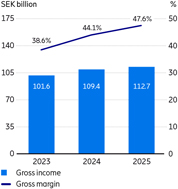
EBIT amounted to SEK 38.6 (4.3) billion, with an EBIT margin of 16.3% (1.7%) including the gain from the divestment of iconectiv. Adjusted EBIT was SEK 41.0 (9.3) billion, with an adjusted EBIT margin of 17.3% (3.8%).
 
 
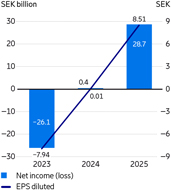
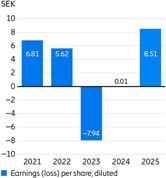
Net income was SEK 28.7 (0.4) billion. Earnings per share (diluted) was SEK 8.51 (0.01), including a SEK 1.70 per share benefit from the gain related to the divestment of iconectiv.
 
 
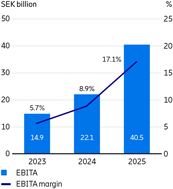
EBITA increased to SEK 40.5 (22.1) billion, with an EBITA margin of 17.1% (8.9%). Adjusted EBITA was SEK 42.9 (27.2) billion, with an adjusted EBITA margin of 18.1% (11.0%).
 
 
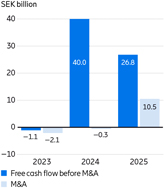
Cash flow from operating activities was SEK 33.0 (46.3) billion. Free cash flow before M&A was SEK 26.8 (40.0) billion.
 
 
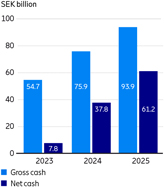
Cash and cash equivalents were SEK 43.9 (43.9) billion and net cash was SEK 61.2 (37.8) billion on December 31, 2025.
 
 
The Board of Directors proposes a dividend for 2025 of SEK 3.00 (2.85) per share and a share buyback program of up to SEK 15 billion to the Annual General Meeting.
 
Financial highlights
 
Net sales
Net sales decreased by SEK –11.2 billion, or
–5%, to SEK 236.7 (247.9) billion, including a currency impact of SEK –13.9 billion. Organic sales grew by 2%. Networks sales declined by –5% to SEK 151.0 billion, while organic sales grew by 1%. Cloud Software and Services sales were stable at SEK 62.7 billion, while organic sales grew by 6%. Enterprise sales declined by –15% to SEK 21.1 billion, while organic sales declined by –5%. Sales in segment Other declined by –16% to
SEK 1.8 billion, while organic sales declined by
–13%.
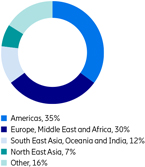
Sales declined in all market areas. In Americas sales increase in North America was offset by lower sales in Latin America. In market area Europe, Middle East and Africa sales growth in Africa was offset by lower sales in Middle East and Europe. Sales declined in the other market areas, with the largest reduction in market area South East Asia, Oceania and India, primarily due to reduced investment levels in India.
IPR licensing revenues increased to SEK 14.5 (14.0) billion as a result of new 5G license agreements and renewals.
The sales mix by commodity was 37% (38%) hardware, 23% (23%) software and 39% (39%) services.
Gross income and margin
Gross income increased to SEK 112.7 (109.4) billion with a gross margin of 47.6% (44.1%). The improved gross margin was driven by cost-reduction actions and operational efficiency as well as favorable market mix. Gross income included a year-over-year currency impact of SEK –7.2 billion.
Adjusted gross income increased to SEK 113.9 (111.4) billion. Adjusted gross margin increased to 48.1% (44.9%).
Research and Development (R&D) expenses
R&D expenses decreased to SEK –48.9 (–53.5) billion, including restructuring charges of
SEK –0.6 (–2.1) billion and a currency benefit of SEK 1.2 billion. In 2024, R&D expenses were impacted by an impairment of intangible assets of SEK –1.4 billion. When adjusted for restructuring, currency and impairment impacts, R&D expenses decreased by SEK –0.5 billion year-over-year. Investments in R&D, for technology leadership and operational resilience, were more than offset by savings from cost-reduction actions in Cloud Software and Services.
The number of granted patents exceeded 60,000.
Net sales
 
 
LOGO
Gross income and margin
 
 
LOGO

Table of Contents
15
 
Financial Report 2025 | Board of Directors’ Report
 
Ericsson Annual Report on Form 20-F 2025


Selling and Administrative (SG&A) expenses
SG&A expenses decreased to SEK –33.7
(–51.7) billion including restructuring charges of SEK –0.5 (–0.8) billion and a currency benefit of SEK 1.3 billion. In 2024, SG&A expenses were impacted by an impairment of intangible assets of SEK –12.6 billion. When adjusted for restructuring, currency and impairment impacts, SG&A expenses decreased by
SEK –3.6 billion year-over-year as a result of cost-reduction actions. The decline was also supported by the divestments in Enterprise.
Other operating income and expenses
Other operating income and expenses were SEK 8.2 (0.6) billion, reflecting a SEK 7.6 billion capital gain from the divestment of iconectiv and a SEK 0.4 billion benefit from a divestment of a minority interest.
Restructuring charges
Restructuring charges amounted to SEK –2.3 (–5.0) billion, mainly related to redundancy activities. Gross income included restructuring charges of SEK –1.3 (–2.0) billion, while operating expenses included restructuring charges of SEK –1.1 (–3.0) billion.
Earnings before financial items and income tax (EBIT)
EBIT increased to SEK 38.6 (4.3) billion, including a SEK 7.6 billion capital gain from the divestment of iconectiv and a currency impact of SEK –4.7 billion. EBIT was supported by lower operating expenses and higher gross income. The EBIT margin was 16.3% (1.7%), driven by EBIT margin improvements in Mobile Networks and a 3.2 percentage point benefit from the iconectiv gain. In 2024 EBIT was impacted by a SEK –15.3 billion
non-cash
impairment charge related to the impairment of intangible assets.
Adjusted EBIT was SEK 41.0 (9.3) billion, with a margin of 17.3% (3.8%).
Financial income and expenses, net
Net financial income and expenses were
SEK –0.3 (–1.7) billion, benefiting from lower interest rates and reduced borrowings, a reduction in other financial expenses as well as a positive impact from currency hedges. The currency hedge effect was SEK 0.4 (0.1) billion.
Taxes
Taxes were SEK –9.6 (–2.2) billion. The effective tax rate was 25% for 2025, reflecting higher taxable income in jurisdictions with lower statutory tax rates. The effective tax rate for 2024 was 28%, excluding impairment charges, mainly goodwill and intangible assets related to Vonage.
Net income
Net income increased to SEK 28.7 (0.4) billion, primarily driven by improved EBIT partly offset by higher taxes. Diluted EPS increased to SEK 8.51 (0.01), including a SEK 1.70 per share benefit from the gain related to the divestment of iconectiv.
Earnings before interest, income tax and amortizations (EBITA)
EBITA increased to SEK 40.5 (22.1) billion including a SEK 7.6 billion capital gain from the divestment of iconectiv and a currency impact of SEK –4.8 billion. EBITA was supported by lower operating expenses and higher gross income. The EBITA margin was 17.1% (8.9%), driven by EBITA margin improvements in Mobile Networks and a 3.2 percentage point benefit from the iconectiv gain.
Adjusted EBITA increased to SEK 42.9 (27.2) billion. The adjusted EBITA margin was 18.1% (11.0%).
Employees
The number of employees on December 31, 2025, was 88,826 compared with 94,236 on December 31, 2024.
Cash flow
Cash flow from operating activities was SEK 33.0 (46.3) billion driven by earnings. Operating net assets remained broadly stable.
Cash flow from operating activities decreased compared with 2024. While adjusted EBITA improved, prior year operating cash flow benefited from a strong working capital reduction.
Cash flow from investing activities was
SEK –11.4 (–16.0) billion, driven by net investments in interest-bearing securities, following the increase in gross cash, partly offset by the proceeds from the divestment of iconectiv.
Cash flow from financing activities was
SEK –14.2 (–23.9) billion including SEK 9.5 billion of dividends paid. SEK 1.6 billion of commercial paper and SEK 2.4 billion of maturing debt that were repaid during the year, were partly offset by the benefit of received collateral on derivatives.
Financial position
Gross cash increased by SEK 18.1 billion to SEK 93.9 billion, driven by positive free cash flow before M&A and the proceeds from the iconectiv divestment, partly offset by dividends paid and a negative exchange rate translation effect on cash and cash equivalents. Ericsson had unutilized committed credit facilities of
SEK 23.0 billion (USD 2.5 billion) as of December 31, 2025.
Net cash increased by SEK 23.4 billion to SEK 61.2 billion.
EBIT (loss) and EBIT margin


Net income (loss) and EPS diluted


EBITA and EBITA margin


Free cash flow


Table of Contents
16
 
Financial Report 2025 | Board of Directors’ Report
 
Ericsson Annual Report on Form 20-F 2025


Liabilities for post-employment benefits decreased in 2025 to SEK 18.6 billion from SEK 24.4 billion reflecting a higher Swedish discount rate. The Swedish defined benefit obligation (DBO) was calculated using a discount rate based on the yields of Swedish government bonds. If the discount rate had been based on Swedish covered mortgage bonds, the liability for post-employment benefits would have been approximately SEK 10.9 billion, which is SEK 7.7 billion lower than current DBO.
Credit ratings were unchanged in 2025; Moody’s changed the outlook to positive from stable. S&P and Fitch have a long-term
BBB-
rating on Ericsson, with stable outlook, while Moody’s has a Ba1 rating with positive outlook.
Seasonality
Group sales, income and operating cash flow vary between quarters and are generally lowest in Q1 and highest in Q4, reflecting customers’ seasonal purchase patterns.
Three-year average seasonality (2023–2025)
 
     
First
quarter
    
Second
quarter
    
Third
quarter
    
Fourth
quarter
 
Share of annual Group sales
  
 
23%


24%


24%


29%
 
Capital expenditure
In 2025, capital expenditure was SEK 2.6 (2.3) billion, representing 1.1% of sales. Expenditure was largely related to test sites and equipment for R&D, network operations centers, and manufacturing and repair operations. Annual capital expenditure is normally approximately
1–2% of sales.
The Board of Directors regularly reviews the Company’s investment plans and proposals. As of December 31, 2025, no material land, buildings, machinery or equipment were pledged as collateral for outstanding indebtedness.
Capital expenditure 2023–2025
 
SEK billion
  
2023
    
2024
    
2025
 
Capital expenditure
  
 
3.3


2.3


2.6
 
of which in Sweden
  
 
1.2


0.6


1.1
 
Share of annual sales
  
 
 1.3%


 1.0%


 1.1%
 
Capitalized development expenses
The capitalization of development expenses was SEK 1.1 (1.3) billion.
Cash position


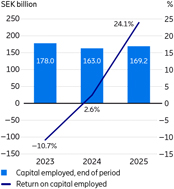
Return on capital employed


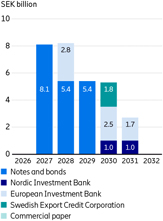
Parent Company borrowings –
maturity profile


Table of Contents
17
 
Financial Report 2025 | Board of Directors’ Report
 
Ericsson Annual Report on Form 20-F 2025


Business results – Segments
 
Networks
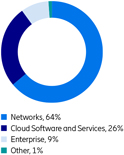
Networks represented 64% (64%) of Group net sales in 2025. The segment offers hardware, software, and services for intelligent, reliable and flexible 5G networks. It includes
energy-efficient
RAN with an
AI-native
software architecture deployable on Ericsson silicon and third-party CPUs/GPUs, cost-efficient transport networks, and advanced active/passive antennas. The services portfolio covers deployment and lifecycle management.
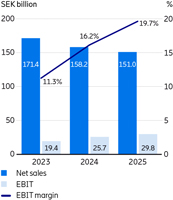
Net sales
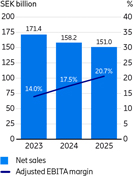
Sales decreased by –5% to SEK 151.0 (158.2) billion, including a currency impact of SEK –9.2 billion. Sales were broadly stable in market area Europe, Middle East and Africa. Sales growth in Africa and the Middle East, driven by ongoing network modernization and new 5G launches, was largely offset by a sales decline in Europe.
Sales declined in the other market areas. In Americas, sales growth in North America was offset by lower sales in Latin America. Sales declined in South East Asia, Oceania and India, primarily in India. In North East Asia sales declined in certain 5G front-runner markets. Organic sales growth was 1%.
Gross income and margin
Gross margin increased to 49.7% (46.6%) as a result of continued cost-reduction actions and operational efficiency. Gross income increased to SEK 75.1 (73.6) billion, despite lower net sales and a currency impact of SEK–5.0 billion. Adjusted gross income increased to SEK 75.5 (74.7) billion, with an adjusted gross margin of 50.0% (47.2%).
EBIT and EBITA
EBIT increased to SEK 29.8 (25.7) billion, with an EBIT margin of 19.7% (16.2%). EBITA increased to SEK 30.2 (25.9) billion, with an EBITA margin of 20.0% (16.3%). The increase was supported by higher gross income and lower operating expenses. Operating expenses decreased, benefiting from continued efficiency improvements and positive currency impacts. R&D investments remained stable, supporting the strategy of building the best high-performing,
AI-native,
programmable networks and maintaining technology leadership.
EBIT and EBITA included restructuring charges of SEK –1.0 (–1.9) billion. They were also impacted by a currency effect of
SEK –3.9 billion.
Adjusted EBIT increased to SEK 30.8 (27.6) billion, with an adjusted EBIT margin of 20.4% (17.4%), while adjusted EBITA increased to SEK 31.2 (27.8) billion, with an adjusted EBITA margin 20.7% (17.5%).
Cloud Software and Services
Cloud Software and Services represented 26% (25%) of Group net sales in 2025. The segment provides core networks, network management, business and operations support systems, and network operations delivered as managed services. Offerings include secure data and voice connectivity, service monetization and orchestration tools, and network management with intent-based operations to improve network performance, business agility and operational efficiency.
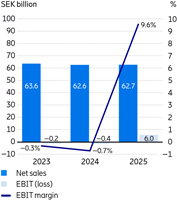
Net sales
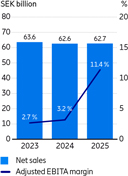
Sales were stable at SEK 62.7 (62.6) billion, including a currency impact of SEK –3.4 billion. Services accounted for 62% (64%) of net sales. Core network sales grew across all market areas.
Sales grew in market area South East Asia, Oceania and India, driven by India. In market area North East Asia, sales growth was driven by Japan. In market area Americas, growth in North America was offset by lower sales in Latin America. In market area Europe, Middle East and Africa, growth in Europe and Africa was offset by a decline in the Middle East. Organic sales growth was 6%.
Gross income and margin
Gross margin increased to 41.7% (36.8%) benefiting from strong strategy execution with improved delivery efficiency and performance, higher share of software sales and continued focus on commercial discipline. Gross income increased to SEK 26.1 (23.0) billion despite a SEK –1.5 billion currency impact.
Adjusted gross income increased to SEK 26.9 (23.9) billion, with an adjusted gross margin of 43.0% (38.2%).
EBIT and EBITA
EBIT and EBITA were both SEK 6.0 (–0.4) billion. EBIT margin was 9.6% (–0.7%) and EBITA margin 9.6% (–0.6%). EBIT and EBITA were supported by higher gross income and lower operating expenses, reflecting strong strategy execution. Operating expenses decreased, benefiting from continued efficiency improvements and positive currency impacts, more than offsetting the increased investments in technology leadership. EBIT and EBITA included restructuring charges of SEK –1.2
(–2.4) billion. They were also impacted by a currency effect of SEK –0.9 billion. Adjusted EBIT and adjusted EBITA increased to SEK 7.2 (2.0) billion, with an adjusted margin of 11.4% (3.2%).
Sales share by segment
 
 
LOGO
Networks
 
 
LOGO
Cloud Software and Services
 
 
LOGO

Table of Contents
18
 
Financial Report 2025 | Board of Directors’ Report
 
Ericsson Annual Report on Form 20-F 2025


Enterprise
Enterprise represented 9% (10%) of Group net sales in 2025. Enterprise provides secure, reliable connectivity through private 5G, indoor coverage and Wireless WAN, while orchestrating cloud-managed wireless platforms with
AI-enhanced
security and real-time optimization. The offerings also include next-generation, network-aware communications solutions that expose advanced mobile network capabilities to developers and support enterprise hyperconnectivity. The portfolio includes Global Communications Platform, Wireless Wide Area Networks (WWAN) and private 5G networks.
Net sales
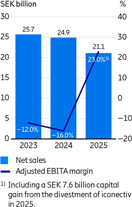
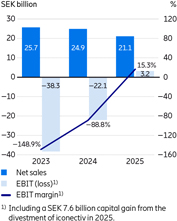
Sales decreased by –15% to SEK 21.1 (24.9) billion, including a currency impact of
SEK –1.2 billion. Sales were impacted by the divestment of iconectiv in Q3 2025. Sales in Global Communications Platform declined reflecting the 2024 decision to reduce activities in some countries as well as lower sales in legacy solutions. Sales in Enterprise Wireless Solutions declined slightly, mainly due to lower sales in private 5G solutions. Organic sales declined by –5%.
Gross income and margin
Gross margin increased to 53.9% (51.4%), benefiting from the decision to focus on more profitable markets in Global Communications Platform and a stronger product mix in Enterprise Wireless Solutions. Gross income decreased to SEK 11.4 (12.8) billion primarily reflecting the divestment of iconectiv in Q3 2025 and a currency impact of SEK –0.6 billion.
EBIT (loss) and EBITA(loss)
EBIT (loss) was SEK 3.2 (–22.1) billion, with an EBIT margin of 15.3% (–88.8%). EBITA (loss) was 4.7 (–4.5) billion, with an EBITA margin of 22.3% (–18.0%). EBIT and EBITA increased, primarily driven by the SEK 7.6 billion capital gain from the divestment of iconectiv, and were also supported by operational improvements in Enterprise Wireless Solutions. In 2024 EBIT was impacted by a
non-cash
impairment charge of SEK –15.3 billion mainly related to the Vonage acquisition. EBIT and EBITA included restructuring charges of SEK –0.1
(–0.5) billion. EBIT was also impacted by a SEK –0.1 billion currency effect, while there was no currency impact on EBITA. Adjusted EBIT (loss) was SEK 3.4 (–21.6) billion with an EBIT margin of 16.0% (–86.8%). Adjusted EBITA (loss) was SEK 4.9 (–4.0) billion, with an adjusted EBITA margin of 23.0% (–16.0%).
Other
Other represented 1% (1%) of Group net sales in 2025. It comprises media businesses and other
non-allocated
activities.
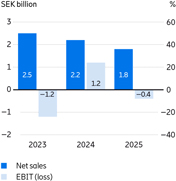
Net sales
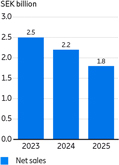
Sales declined to SEK 1.8 (2.2) billion, primarily due to the divestment of the IoT business.
Gross income
Gross income was SEK 0.1 (–0.1) billion with a gross margin of 3.0% (–4.2%).
Adjusted gross income was SEK 0.1 (0.0) billion, with an adjusted gross margin of 4.8%
(–1.5%).
EBIT (loss) and EBITA (loss)
EBIT(loss) and EBITA(loss) were SEK –0.4 (1.2) billion. 2024 included a
one-time
gain of SEK 1.9 billion from the resolution of a commercial dispute. EBIT and EBITA were impacted by restructuring charges of SEK 0.0 (–0.2) billion.
Adjusted EBIT(loss) and adjusted EBITA(loss) were SEK –0.4 (1.3) billion.
Enterprise
 
 
LOGO
Other
 
 
LOGO

Table of Contents
19
 
Financial Report 2025 | Board of Directors’ Report
 
Ericsson Annual Report on Form 20-F 2025


Business results – Market areas
 
Market area Americas
Sales decreased by –3% to SEK 83.4 billion, including a currency impact of SEK –5.5 billion. Networks sales declined by –3%. Growth in North America, as a result of increased market share and selective network investments by some large customers in the US and in Canada, was more than offset by lower sales in Latin America due to continued intense competition and reduced customer network investments. Cloud Software and Services sales decreased by –2%, as growth in core networks in North America was offset by a decline in Latin America. Organic sales increased by 4% year-over-year.
Market Area Europe, Middle East
and Africa
Sales decreased by –1% to SEK 70.7 billion, including a currency impact of SEK –2.6 billion. Sales were supported by growth in mission-critical networks. Network sales were broadly stable. Strong growth in Middle East and Africa, primarily driven by ongoing network modernization in Saudi Arabia and Algeria, as well as new 5G launches in Egypt and Morocco, was partly offset by lower sales in Europe. In Europe, sales increase from recent contract wins in the UK and Spain and a new 5G rollout in Turkey, offset sales decline due to the completion of modernization projects elsewhere. Cloud Software and Services sales increased in Europe, driven by recent market share wins in the UK as well as in Africa. This growth was offset by a decline in Middle East. Organic sales increased by 3% year-over-year.
Market area South East Asia, Oceania and India
Sales declined by –11% to SEK 28.8 billion, including a currency impact of SEK –2.2 billion. Networks sales declined, primarily due to reduced network investment levels in India, as well as increased competition in South East Asia. Sales in Cloud Software and Services grew, primarily driven by timing of project deliverables. Organic sales decreased by –4% year-over-year.
Market area North East Asia
Sales declined by –15% to SEK 16.0 billion, including a currency impact of SEK –1.0 billion. Networks sales declined due to reduced customer investments in some 5G front-runner markets. Cloud Software and Services sales grew, reflecting recent core networks contract wins. Organic sales declined by –9% year-over-year.
Market area Other
Market area Other primarily includes IPR licensing revenues and almost all sales in segment Enterprise. Sales declined by –5% to SEK 37.7 billion. IPR licensing revenues increased to SEK 14.5 (14.0) billion as a result of new 5G license agreements and renewals. Opportunities to further grow IPR licensing revenues remain. The increase in IPR licensing revenues were offset by decline in Enterprise sales mainly due to the divestment of iconectiv. Organic sales increased by 5%.
Sales share by market area
 
 
LOGO
 
Reported sales by market area
 
 
LOGO
 
1)
 
Year-over-year change.

Table of Contents
20
 
Financial Report 2025 | Board of Directors’ Report
 
Ericsson Annual Report on Form 20-F 2025


Corporate governance
In accordance with the Swedish Annual Accounts Act and the Swedish Corporate Governance Code, a separate Corporate Governance Report, including an internal control section, has been prepared and appended to this Financial Report.
Shareholder engagement
As part of Ericsson’s ongoing shareholder engagement, and in addition to the ordinary course communication between shareholders and Ericsson’s Investor Relations and management team throughout the year, during the first and fourth financial quarters of 2025, the Chair of Ericsson’s Board, Jan Carlson, had dialogues with shareholders and held Company-initiated substantive discussions with shareholders representing approximately 65% of shares outstanding. These are typically focused on a broad range of governance topics with the objective to understand and receive shareholder feedback and respond to questions. Further information about shareholder engagement is included on page 5 of the Corporate Governance Report.
Risk management
Risk management is an important element of strategic decision-making and value creation. Ericsson strives to capture the opportunities and threats relating to the Company’s strategic objectives. Ericsson’s risk management activities operate in tandem with the development and deployment of Ericsson’s business plans and operational strategies. The Company has made significant strides in recent years toward ensuring that strategic, external and internal risks are properly identified, assessed, internally reported, escalated, and effectively addressed.
Financial risk management is overseen by the Finance function. For further information on financial risk management, see Notes to the consolidated financial statements – note F1 “Financial risk management” in the Financial Report.
For information on risks that could impact the fulfilment of objectives, and form the basis for mitigating activities, see the other sections of the Board of Directors’ Report, notes A2 “Critical accounting estimates and judgments”, F1 “Financial risk management”, F4 “Interest bearing liabilities” and the chapter Risk factors. Further information about risk management is included on pages 4–5 of the Corporate Governance Report.
Material contracts
Material contractual obligations are outlined in note D4, “Contractual obligations”. These are primarily related to leases of office and production facilities, certain customer
contracts, purchase contracts for outsourced manufacturing, R&D and IT operations, as well as the purchase of components for Ericsson’s own manufacturing.
Ericsson is party to certain agreements, which include provisions that may take effect or be altered or invalidated by a change in control of the Company as a result of a public takeover offer. Such provisions are not unusual for certain types of agreements, such as financing agreements and certain license agreements. However, considering, among other things, Ericsson’s strong financial position, the Company believes that none of the agreements currently in effect would in and of itself entail any material consequence for Ericsson due to a change in control of the Company.
Legal proceedings involving governmental authorities
In February 2022, Ericsson publicly disclosed that an internal investigation in 2019 included a review of the conduct of Ericsson employees, vendors and suppliers in Iraq during the period between 2011 to 2019. The investigators could not determine the ultimate recipients of any payments, nor identify that any Ericsson employee was directly involved in financing terrorist organizations. The Company’s 2019 internal Iraq investigation did not conclude that Ericsson made or was responsible for any payments to any terrorist organization.
The Company continues to fully cooperate with the US Department of Justice (DOJ) in its investigation into matters discussed in the 2019 internal Iraq investigation report and related topics concerning jurisdictions including Iraq, and the Company is providing additional documents and other information which continue to be requested by the DOJ. As additional information continues to be identified and evaluated in continued cooperation with the DOJ during its ongoing investigation, it is expected that there will not be any conclusive determinations on the outcome until the investigation is completed. The scope and duration of the investigation remain uncertain.
In April 2019, Ericsson was informed by China’s State Administration for Market Regulation Anti-monopoly Bureau (SAMR) that SAMR has initiated an investigation into Ericsson’s patent licensing practices in China. Ericsson is cooperating with the investigation, which is still in a fact-finding phase. The next steps include continued fact-finding and meetings with SAMR in order to facilitate the authority’s assessment and conclusions. In case of adverse findings, SAMR has the power to impose behavioral and financial remedies.
Legal proceedings not involving governmental authorities
In August 2022, a civil lawsuit was filed in the United States District Court for the District of Columbia against Telefonaktiebolaget LM Ericsson and Ericsson Inc. (collectively, the “Ericsson defendants”). The lawsuit was brought by US military service members, employees of US government contractors and other civilians who were killed or injured in terrorist attacks in Iraq, Afghanistan and Syria from 2005 to 2021, as well as by their family members. The lawsuit asserts claims against the Ericsson defendants under the U.S. Anti-Terrorism Act alleging that the Ericsson defendants made payments that ultimately aided the terrorist organizations that committed, planned or authorized the attacks. In November 2022, the Ericsson defendants filed a motion to dismiss the complaint. On December 20, 2022, plaintiffs filed an amended complaint, which added additional plaintiffs, including a plaintiff injured in Turkey, and also named Ericsson AB (collectively with the Ericsson defendants, the “Ericsson corporate defendants”), President and CEO Börje Ekholm and a former employee (who has not been served with process) as additional defendants and also asserted additional allegations and claims. In March 2023, the Ericsson corporate defendants and Mr. Ekholm filed motions to dismiss the amended complaint. Plaintiffs filed their oppositions to defendants’ motions to dismiss the amended complaint in June 2023, and defendants filed reply briefs in support of their motions to dismiss in July 2023. All briefing has been submitted, and resolution of the matter is pending with the District Court. All defendants will continue to vigorously defend this matter.
In February 2024, a second civil lawsuit also alleging violations of the U.S. Anti-Terrorism Act was filed in the United States District Court for the District of Columbia. The lawsuit was filed by the same law firm and involves substantially similar factual allegations and claims as those made in the Anti-Terrorism Act lawsuit originally filed in August 2022, and similarly names the same Ericsson corporate defendants, President and CEO Börje Ekholm and a former employee as defendants. The new lawsuit was brought by additional US military service members, employees of US government contractors and other civilians who were killed or injured in terrorist attacks in Iraq, Afghanistan, Syria, Turkey, Niger, and France from 2005 to 2021, as well as by their family members. The District Court for the District of Columbia has stayed the proceedings in this matter pending its decision on the motions to dismiss in the earlier-filed suit. The defendants will vigorously defend this matter.

Table of Contents
21
 
Financial Report 2025 | Board of Directors’ Report
 
Ericsson Annual Report on Form 20-F 2025


In November 2025, a third civil lawsuit also alleging violations of the US Anti-Terrorism Act was filed in the US District Court for the District of Columbia. The lawsuit was filed by a law firm not involved in the August 2022 and February 2024 lawsuits and involves substantially similar factual allegations and claims to those made in the Anti-Terrorism Act lawsuits filed in August 2022 and February 2024, and similarly names the same Ericsson corporate defendants, CEO Börje Ekholm and a former employee as defendants. The new lawsuit was brought by additional US military service members, employees of US government contractors and other civilians who were killed or injured in terrorist attacks in France, Afghanistan, and Belgium from 2012 to 2018, as well as by their family members. The District Court for the District of Columbia has stayed the proceedings in this matter pending its decision on the motions to dismiss in the earlier-filed suit. The defendants will vigorously defend this matter.
Beginning on August 4, 2023, a number of civil lawsuits have been filed against Telefonaktiebolaget LM Ericsson in Solna District Court, Sweden. 93 claimants have filed suit, which are coordinated and financed by a
UK-based
litigation funder. The claimants consist of a group of
non-Swedish
funds and financial institutions that allegedly are or have been shareholders of the Company. Their damages claims are primarily based on alleged inadequate disclosure of the contents of the Company’s 2019 internal Iraq investigation report. Ericsson filed its statement of defense on March 15, 2024. On February 14, 2025, the District Court ordered Ericsson to produce the 2019 internal Iraq investigation report to the claimants’ external counsel. Ericsson appealed the decision and on August 15, 2025, the Court of Appeal overturned the District Court’s decision. The claimants have appealed the decision to the Supreme Court. Proceedings on the merits of the case are stayed pending final resolution of the document production issue. Ericsson will continue to vigorously defend this matter.
The Company actively manages its IPR portfolio and its need for third-party licenses and is involved from time to time, in the ordinary course of business, in litigation related thereto, as plaintiff, defendant and other capacities.
In addition to the proceedings discussed above, the Company is, and in the future may be, involved in various other regulatory investigations, enforcement actions, lawsuits, claims (including claims by third-parties the Company has indemnified against infringement liability or provided guarantees to) and proceedings incidental to the ordinary course of business and transactions.
Group structure
The Group is comprised of more than 200 legal entities, and approximately 90 branch offices, and serves customers in more than 175 countries.
Parent Company
Telefonaktiebolaget LM Ericsson’s (the Parent Company) business consists mainly of corporate management, holding company functions, internal banking activities and customer credit management.
Financial information
Income after financial items was SEK 31.3 (6.6) billion. The Parent Company had no sales in 2025 or 2024 to subsidiaries, while 27% (37%) of total purchases of goods and services were from subsidiaries.
Significant changes in the Parent Company’s financial position for the year included:
Dividends from subsidiaries and associated companies of SEK 31.2 billion.
Gross cash increased by SEK 19.1 billion to SEK 77.8 (58.7) billion.
At the end of the year,
non-restricted
equity amounted to SEK 43.1 (22.3) billion, and total equity amounted to SEK 91.4 (70.6) billion.
Share information
As of December 31, 2025, the total number of shares issued was 3,371,351,735, of which 261,755,983 were Class A shares, each carrying one vote, and 3,109,595,752 were Class B shares, each carrying one tenth of one vote. Both classes of shares have the same rights of participation in the net assets and earnings. The largest shareholders of the
Parent Company at
year-end
were Investor AB with approximately 24.8% of the votes (9.9% of the shares), AB Industrivärden with approximately 15.0% of the votes (2.6% of the shares) and AMF Tjänstepension and AMF Fonder with approximately 5.1% of the votes (3.2% of the shares). In accordance with the conditions of the Long-Term Variable Compensation Program (LTV) for Ericsson employees, 677,285 treasury shares were distributed to employees or sold in 2025. The quotient value of these shares was SEK 5.00 per share, totaling SEK 3.4 million, representing less than 1% of capital stock, and compensation received for shares sold amounted to SEK 6 million. The holding of treasury stock on December 31, 2025 was 38,002,276 Class B shares. The quotient value of these shares is SEK 5.00, totaling SEK 190.0 million, representing 1.13% of capital stock, and the purchase price amounts to SEK 190.0 million.
The Annual General Meeting 2025 resolved to approve the transfer of treasury stock to employees and on an exchange, a directed share issue of 23.1 million Class C shares and an authorization for the Board of Directors to decide on an acquisition offer for the previously resolved LTV 2025 and 2024 for Ericsson’s Top Management. In accordance with the authorization from the Annual General Meeting, in the second quarter 2025, the Board of Directors resolved to repurchase the newly issued shares, which were subsequently converted into Class B shares. The quotient value of the repurchased shares was SEK 5.00, totaling SEK 115.5 million, representing 0.7% of capital stock, and the acquisition cost was SEK 115.7 million.
Proposed disposition of earnings
The Board of Directors will propose to the Annual General Meeting (AGM) an ordinary dividend of SEK 3.00 (2.85) per share. The dividend is proposed to be paid in two installments, SEK 1.50 per share with the record date April 2, 2026 (payment date April 9, 2026), and SEK 1.50 per share with the record date September 29, 2026 (payment date October 2, 2026). For the Parent Company’s treasury shares of Class B, no dividend will be distributed.

Table of Contents
22
 
Financial Report 2025 | Board of Directors’ Report
 
Ericsson Annual Report on Form 20-F 2025


The Board of Directors proposes that earnings be distributed as follows (assuming that no treasury shares are held on the record date):
 
Amount to be paid to the shareholders
  
 
10,114,055,205 SEK
 
Amount to be retained by the Parent Company
  
 
32,937,412,763 SEK
 
Total
non-restricted
equity of the Parent Company
  
 
43,051,467,968 SEK
 
As a basis for its dividend proposal, the Board of Directors has made an assessment in accordance with Chapter 18, Section 4 of the Swedish Companies Act of the Parent Company’s and the Group’s need for financial resources as well as the Parent Company’s and the Group’s liquidity, financial position in other respects and long-term ability to meet their commitments. As of 31 December 2025, the Group’s equity ratio amounted to 39.5% (31.8%) and the net cash amounted to SEK 61.2 (37.8) billion.
The Parent Company’s
non-restricted
equity would have been approximately SEK 0.86 billion lower if assets and liabilities had not been valued at fair value pursuant to Chapter 4, Section 14a of the Swedish Annual Accounts Act.
The Board of Directors has also considered the Parent Company’s result and financial position and the Group’s position in general. In this respect, the Board of Directors has taken into account known circumstances that may have an impact on the financial positions of the Parent Company and its subsidiaries.
 
The proposed dividend does not limit the Group’s ability to make investments or raise funds. It is the Board of Directors’ assessment that the proposed dividend is justified considering the requirements that the nature, scope and risks of the business impose on the Parent Company’s and Group’s equity, as well as the Parent Company’s and the Group’s consolidation level, liquidity, and position in general, considering coming years’ business plans and economic development.
Proposed share buyback program
The Board of Directors will further propose to the AGM to authorize the Board to initiate a share buyback program to repurchase shares, with purchases expected to begin following the publication of the Q1 2026 report. The proposed program targets to return up to SEK 15 billion of cash to shareholders over the period extending to the 2027 AGM at the latest, with a formal mandate to buy back a maximum of 10% of shares outstanding. The share repurchase is proposed to include Class B shares traded on Nasdaq Stockholm. The repurchased shares are expected to be cancelled or partially used to fund approved LTV programs.

Table of Contents
23
 
Financial Report 2025 | Board of Directors’ Report
 
Ericsson Annual Report on Form 20-F 2025


Guidelines for Remuneration to Group Management approved by the Annual General Meeting of shareholders 2023
 
Introduction
These Guidelines for Remuneration to Group Management (the “
Guidelines
”) apply to the Executive Team of Telefonaktiebolaget LM Ericsson (the “
Company
” or “
Ericsson
”), including the President and Chief Executive Officer (the “
President
and
CEO
”) (“
Group Management
”). These Guidelines apply to remuneration agreed and changes to previously agreed remuneration after the date of approval of the Guidelines and are intended to remain in place for four years until the Annual General Meeting of shareholders 2027. For employments outside of Sweden, due adaptations may be made to comply with mandatory local rules or established local practices. In such cases, the overall purpose of these Guidelines shall be accommodated to the largest extent possible. These Guidelines do not cover remuneration resolved by the general meeting of shareholders, such as long-term variable compensation programs (“
LTV
”).
Objective
These Guidelines aim to ensure alignment with the current remuneration philosophy and practices applicable for the Company’s employees based on the principles of competitiveness, fairness, transparency, and performance. In particular to:
attract and retain highly competent, performing, and motivated people that have the ability, experience, and skill to deliver on the Ericsson strategy;
encourage behavior consistent with Ericsson’s culture and core values;
ensure fairness in reward by delivering total remuneration that is appropriate but not excessive, and clearly explained;
have a total compensation mix of fixed pay, variable pay and benefits that is competitive where Ericsson competes for talent; and
encourage variable remuneration which aligns employees with clear and relevant targets, reinforces their performance and enables flexible remuneration costs for Ericsson.
The Guidelines and the Company’s strategy and sustainable long-term interest
A successful implementation of the Company’s strategy and sustainable long-term interests requires that the Company can attract, retain, and motivate the right talent and can offer competitive remuneration. These Guidelines aim to allow the Company to offer the members of the Group Management attractive and competitive total remuneration. Variable compensation covered by these
guidelines shall be awarded against specific
pre-defined
and measurable business targets derived from the short and long-term business plan approved by the Board of Directors. Targets will include financial targets at Group, Business Area and/or Market Area level. In addition, strategic targets, operational targets, employee engagement targets, customer satisfaction targets, sustainability and corporate responsibility targets or other lead indicator targets will be applied as deemed appropriate by the Remuneration Committee.
The Company operates long-term variable compensation programs for the Group Management as approved by the Annual General Meeting (“
AGM
”). Such decisions are not covered by these Guidelines. Details of Ericsson’s current remuneration policy and how we deliver on our policy and guidelines and information on previously decided long-term variable compensation programs that have not yet become due for payment, including applicable performance criteria, can be found in the Remuneration Report and in Note G2, “Information regarding members of the Board of Directors, the Group management” and Note G3, “Share-based compensation” in the annual report.
Governance of remuneration to Group Management
The Board has established a Remuneration Committee (the “
Committee
”) to handle compensation policies and principles and matters concerning remuneration to Group Management. The Board has authorized the Committee to determine and handle certain issues in specific areas. The Board may also on occasion provide extended authorization for the Committee to determine specific matters.
The Committee is authorized to review and prepare for resolution by the Board salary and other remuneration for the President and CEO. Further, the Committee shall prepare for resolution by the Board proposals to the AGM on Guidelines for Remuneration to Group Management at least every fourth year and on Long-term Variable compensation programs and similar equity arrangements.
The Committee has the mandate to resolve salary and other remuneration for the other members of Group Management except for the President and CEO, including targets for short-term variable compensation (“
STV
”), and payout of STV based on achievements and performance.
To conduct its responsibilities, the Committee considers trends in remuneration, legislative changes, disclosure rules and the general global executive remuneration
environment. Before preparing salary adjustment recommendations for the President and CEO for resolution by the Board and approving any salary adjustments for the other members of Group Management the Committee reviews salary survey data, Company results and individual performance. No employee is present at the Committee’s meetings when issues relating to their own remuneration are being discussed. Similarly, the President and CEO is not present at Board meetings when issues relating to the President and CEO’s own remuneration are being discussed. The Committee may appoint independent expert advisors to assist and advise in its work.
The Chair of the Remuneration Committee along with the Chair of the Board work together with Ericsson’s Investor Relations team, striving to ensure that healthy contact is maintained as necessary and appropriate with shareholders regarding remuneration to Group Management.
Overview of remuneration package covered by these Guidelines
For Group Management the remuneration package may consist of fixed salary, short-term and long-term variable compensation (STV and LTV), pension and other benefits.
Below are the key components of remuneration of Group Management covered by these Guidelines, including why they are used, their operation, opportunity levels and related performance measures. In addition, the AGM has resolved and may in the future decide to implement LTV for Group Management. The ongoing share-based LTV programs resolved by the AGM have been designed to provide long-term incentives for the members of Group Management and to incentivize the Company’s performance creating long-term value. The aim is to attract, retain and motivate executives in a competitive market through performance-based share related incentives and to encourage the
build-up
of significant equity holdings to align the interests of the members of Group Management with those of shareholders. The vesting period under the ongoing share-based LTV programs resolved by the shareholders is three years and vesting is subject to the satisfaction of identified performance criteria. Although LTV is an important component of the remuneration of Group Management, it is not covered by these Guidelines, because these programs are resolved separately by the AGM.

Table of Contents
24
 
Financial Report 2025 | Board of Directors’ Report
 
Ericsson Annual Report on Form 20-F 2025


Element and purpose
 
  
Description
     
Fixed salary
Fixed compensation paid at set times.
Purpose:
–  attract and retain the executive talent required to implement Ericsson’s strategy
–  deliver part of the annual compensation in a predictable format.


Salaries shall be set taking into account:
 
– Ericsson’s overall business performance
 
– business performance of the Unit that the individual leads
 
year-on-year
performance of the individual
 
– external economic environment
 
– size and complexity of the position
 
– external market data
 
– pay and conditions for other employees based in locations considered to be relevant to the role.
 
When setting fixed salaries, the impact on total remuneration, including pensions and associated costs, shall be taken into consideration.
     
Short-term variable compensation (STV)
STV is a variable compensation plan that shall be measured against targets derived from the business plan and paid over a single year. Purpose:
–  align members of Group Management with clear and relevant targets to Ericsson’s strategy and sustainable long-term interests,
–  provide individuals an earning opportunity for performance at flexible cost to the Company.


The STV shall be paid in cash every year after the Committee and, as applicable, the Board have reviewed and approved performance against targets which are normally determined at the start of each year for each member of Group Management.
 
Target
pay-out
opportunity for any financial year may be up to 150% of annual fixed salary of the individual. This shall normally be determined in line with the external market practices of the country of employment. Maximum
pay-out
shall be up to two times the target
pay-out
opportunity (i.e., no more than 300% of annual fixed salary). Any existing long-term variable
pay-opportunity
should be taken into account when determining target opportunity for STV (and vice versa).
 
The STV shall be based on measures linked to the annual business plan and to Ericsson’s long-term strategy and sustainability. Measures will include financial targets at Group, Business Area and/or Market Area level (for relevant members of Group Management). Other potential measures may include strategic targets, operational targets, employee engagement targets, customer satisfaction targets, sustainability and corporate responsibility targets or other lead indicator targets.
 
At the end of the performance period for each STV cycle, the Board and the Committee shall assess performance versus the measures and determine the formula-based outcome using the financial information made public by the Company for the financial targets when applicable.
 
The Board and the Committee reserve the right to:
 
–  revise any or all of the STV targets at any time,
 
–  adjust the STV targets retroactively under extraordinary circumstances,
 
–  reduce or cancel STV if Ericsson faces severe economic difficulties, for instance in circumstances as serious as no dividend being paid,
 
–  adjust STV in the event that the results of the STV targets are not a true reflection of business performance,
 
–  reduce or cancel STV for individuals either whose performance evaluation or whose documented performance feedback is below an acceptable level or who are on performance counselling.
 
The Board and the Committee shall have the right in their discretion to:
 
–  deny, in whole or in part, the entitlement of an individual to the STV payout in case an individual has acted in breach of Ericsson’s Code of Business Ethics,
 
–  claim repayment in whole or in part the STV paid in case an individual has acted in breach of Ericsson’s Code of Business Ethics,
 
–  reclaim STV paid to an individual on incorrect grounds such as restatement of financial results due to incorrect financial reporting,
non-compliance
with a financial reporting requirement etc.
     
Pension
Contributions paid towards retirement fund. Purpose:
–  attract and retain the executive talent required to implement Ericsson’s strategy,
–  facilitate planning for retirement by way of providing competitive retirement arrangements in line with local market practices.


The operation of the pension plan shall follow competitive practice in the individual’s home country and may contain various supplementary plans in addition to any national system for social security.
 
Pension plans should be defined contribution plans unless the individual concerned is subject to defined benefit pension plan under mandatory collective bargaining agreement provisions or mandatory local regulations.
 
For Group Management members in Sweden:
 
–  pension benefits shall be granted based on a defined contribution plan except where law or collective bargaining agreement require a defined benefit pension. The pensionable salary shall include fixed salary and, where required by law or collective bargaining agreement, any variable salary.
 
–  a supplementary pension contribution can be paid amounting to a maximum of 35% of the fixed annual salary that exceeds any cap in collective pension plans, unless a higher percentage is obliged by law or collective bargaining agreement.
 
–  the supplementary pension contribution can, as an alternative to a pension contribution, be exchanged for a cash payment provided that it is done in a way that is cost-neutral for the Company.
 
Members of Group Management employed outside of Sweden may participate in the local market competitive pension arrangements that apply in their home countries in line with what is offered to other employees in the same country. In some special circumstances where individuals cannot participate in the local pension plans of their home countries of employment:
 
–  cash equivalent to pension may be provided as a taxable benefit, or
 
–  contributions may be made to an international pension fund on behalf of the individual on a costneutral basis
 
In all cases the annual pension contributions shall be capped at 70% of annual fixed salary.
     
Other benefits
Additional tangible or intangible compensation paid annually which do not fall under fixed salary, short-term and long-term variable compensation, or pension.
Purpose:
–  attract and retain the executive talent required to implement Ericsson’s strategy,
–  deliver part of the annual compensation in a predictable format.


Benefits offered shall consider the competitive practices in the individual’s country of employment and should be in line with what is offered to other senior employees in the same country and may evolve year on year.
 
Benefits may for example include Company phones, Company cars, wellbeing assistance, medical and other insurance benefits, tax support, travel, Company gifts and any international relocation and/or commuting benefits if the individual is required to relocate and/or commute internationally to execute the requirements of the role.
 
Benefit opportunities shall be set in line with competitive market practices and shall reflect what is offered to other senior employees in the individual’s country of employment.
 
The levels of benefits provided may vary year on year depending on the cost of the provision of benefits to the Company.
 
Other benefits shall be capped at 10% of annual fixed salary for members of Group Management located in Sweden.
 
Additional benefits and allowances for members of Group Management who are commuters into Sweden or who are on long-term assignment (“
LTA
”) in countries other than their home countries of employment, shall be determined in line with the Company’s international mobility policy which may include (but is not limited to) commuting or relocation costs; cost of living adjustment, housing, home travel or education allowance; tax and social security equalization assistance.
 

Table of Contents
25
 
Financial Report 2025 | Board of Directors’ Report
 
Ericsson Annual Report on Form 20-F 2025


Consideration of remuneration offered to the Company’s employees
When developing these Guidelines, the Board and the Committee have considered the total remuneration and employment conditions of the Company’s employees by reviewing the application of Ericsson’s remuneration policy for the wider employee population to ensure consistency.
There is clear alignment in the remuneration components for the members of Group Management and the Company’s employees in the way that remuneration policy is applied as well as the methods followed in determining fixed salaries, short-term and long-term variable compensation, pension, and benefits, which are to be applied broadly and consistently throughout the Company. The targets under short-term variable compensation are similar and the performance measures under long-term variable compensation program are the same for the members of Group Management and other eligible employees of the Company. However, the proportion of pay that is linked to performance is typically higher for Group Management in line with market practice and the higher levels of total compensation applicable at that level.
Employment contracts and termination of employment
The members of Group Management are employed on permanent rolling contracts. The maximum mutual notice period is no more than 12 months. In case of termination by the employee, the employee has no right to severance pay.
In any case, the fixed salary paid during the notice period plus any severance pay payable will not together exceed an amount equivalent to the individual’s 24 months fixed salary unless otherwise determined by local legislation or collective bargaining agreements.
The employee may be entitled to severance pay up until the agreed retirement age or, if a retirement age has not been agreed, until the month when the employee turns 65. In a case where the employee is entitled to severance pay from a date later than 12 months prior to retirement, the severance pay shall be reduced in proportion to the time remaining and calculated only for the time as of the date when the employee’s employment ceases (i.e., the end of the period of notice) and until the time of retirement.
Severance pay shall be reduced by 50 percent of the remuneration or equivalent compensation the employee receives, or has become entitled to, from any other employer or from his/her own or other activities during
the period that severance is paid to the employee by the Company.
The Company shall have the right to terminate the employment contract and dismiss the employee with immediate effect, without giving any advance notice and entitlement to severance pay, if the employee commits a serious breach of his/her obligations towards the Company.
Normally disputes regarding employment agreements or any other agreements concerning the employment of the members of Group Management, the way such agreements have been arrived at, interpreted, or applied, as well as any other litigation proceedings from legal relations based on such agreements, shall be settled by arbitration by three arbitrators in accordance with the Rules of the Arbitration Institute of the Stockholm Chamber of Commerce. Irrespective of the outcome of any arbitral award, the Company may, in the relation between the parties, carry all fees and expenses charged by the arbitrators and all of its own litigation costs (including attorney’s fees), except in the event the arbitration proceedings were initiated by the employee without reasonable cause.
Recruitment policy for new members of Group Management
In determining the remuneration of a new member of Group Management, the Board and the Committee shall take into consideration all relevant factors to ensure that arrangements are in the best interests of the Company and its shareholders. These factors include:
The role being taken on
The skills, experience and caliber of the candidate
The level and type of remuneration opportunity received at a previous employer
The geography in which the candidate is being recruited from and whether any relocation allowance is required
The circumstances of the candidate
The current external market and salary practice
Internal relativities
Additional arrangements
By way of exception, additional arrangements can be made when deemed appropriate and necessary to recruit or retain an individual. Such arrangement could be in the form of short-term or long-term variable compensation or fixed component and can be renewed, but each such arrangement shall be limited in time and shall not exceed a period of 36 months and twice the annual fixed salary that the individual would have received
if no additional arrangements were made. In addition, if appropriate, different measures and targets may be applied to the new appointment’s incentives in the first year.
In addition, it may on a
case-by-case
basis be decided by the Board and the Committee respectively to compensate an individual for remuneration forfeited from a previous employer during recruitment. The Board and the Committee will consider on a
case-by-case
basis if all or some of the remuneration including incentives forfeited need to be
‘bought-out’.
If there is a
buy-out
of forfeited incentives, this will take into account relevant factors including the form they were granted (cash vs. shares), performance conditions attached to these awards and the time they would have vested/paid. Generally,
buy-out
awards will be made on a comparable basis to those forfeited.
In the event of an internal candidate being promoted to Group Management, legacy terms and conditions may be honored, including pension and benefit entitlements and any outstanding incentive awards. If a Group Management member is appointed following a merger or acquisition with/of another company, legacy terms and conditions may also be honored for a maximum period of 36 months.
Board of Directors’ discretions
The Board upon recommendation from the Committee may in a specific case decide to temporarily deviate from these Guidelines in whole or in part based on its full discretion in unusual circumstances such as:
upon change of the President and CEO,
upon material changes in the Company structure, organization, ownership, and business (for example takeover, acquisition, merger, demerger etc.) which may require adjustments in STV and LTV or other elements to ensure continuity of Group Management, and
in any other circumstances, provided that the deviation is required to serve the long-term interests and sustainability of the Company or to assure its financial viability.
The Committee is responsible for preparing matters for resolution by the Board, and this includes matters relating to deviations from these Guidelines. Any such deviation will be disclosed in the Remuneration Report for the relevant year.

Table of Contents
26
 
Financial Report 2025 | Board of Directors’ Report
 
Ericsson Annual Report on Form 20-F 2025


Events after the reporting period
Ericsson announces a proposed staff reduction in Sweden
On January 15, 2026, Ericsson announced a proposed headcount reduction in Sweden. Ericsson has submitted a notice to the Swedish Public Employment Service. Approximately 1,600 positions could be impacted in Sweden.
Ericsson’s Board of Directors proposes a share buyback program
On January 23, 2026, Ericsson announced that a share buyback program up to SEK 15 billion will be proposed to the AGM by the Board of Directors. For more information, see note E1 ”Equity”.

Table of Contents
27
 
Financial Report 2025 | Board of Directors’ Report
 
Ericsson Annual Report on Form 20-F 2025


Board assurance
 
The Board of Directors and the CEO certify that the consolidated financial statements have been prepared in accordance with IFRS Accounting Standards, as adopted by the EU, and give a true and fair view of the Group’s position and results of operations. The annual report have been prepared in accordance with generally accepted accounting principles in Sweden and give a true and fair view of the Parent Company’s position and results of operations.
The Board of Directors’ Report for the Group and the Parent Company provides a fair view of the development of the Group’s and the Parent Company’s operations, position and results of operations and describes material risks and uncertainties facing the Parent Company and the companies included in the Group.
The Board of Directors and the CEO certify that the Sustainability Statement has been prepared in accordance with European Sustainability Reporting Standards (ESRS) and the specifications adopted pursuant to the EU Taxonomy Regulation, as adopted by the EU.

Table of Contents
28
 
Financial Report 2025 | Report of independent registered public accounting firm
 
Ericsson Annual Report on Form 20-F 2025


Report
of independent registered public accounting
firm
To the shareholders and the Board of Directors of Telefonaktiebolaget LM Ericsson (publ)
 
Opinion on Internal Control over Financial Reporting
We have audited the internal control over financial reporting of Telefonaktiebolaget LM Ericsson (publ) and subsidiaries (the “Company”) as of December 31, 2025, based on criteria established in Internal Control — Integrated Framework (2013) issued by the Committee of Sponsoring Organizations of the Treadway Commission (COSO). In our opinion, the Company maintained, in all material respects, effective internal control over financial reporting as of December 31, 2025, based on criteria established in Internal Control — Integrated Framework (2013) issued by COSO.
We have also audited, in accordance with the standards of the Public Company Accounting Oversight Board (United States) (PCAOB), the consolidated financial statements as of and for the year ended December 31, 2025, of the Company and our report dated March 12, 2026, expressed an unqualified opinion on those financial statements.
Basis for Opinion
The Company’s management is responsible for maintaining effective internal control over financial reporting and for its assessment of the effectiveness of internal control over financial reporting, included in the accompanying Management’s report on internal control over financial reporting. Our responsibility is to express an opinion on the Company’s internal control over financial reporting based on our audit. We are a public accounting firm registered with the PCAOB and are required to be independent with respect to the Company in accordance with the U.S. federal securities laws and the applicable rules and regulations of the Securities and Exchange Commission and the PCAOB.
We conducted our audit in accordance with the standards of the PCAOB. Those standards require that we plan and perform the audit to obtain reasonable assurance about whether effective internal control over financial reporting was maintained in all material respects. Our audit included obtaining an understanding of internal control over financial reporting, assessing the risk that a material weakness exists,
testing and evaluating the design and operating effectiveness of internal control based on the assessed risk, and performing such other procedures as we considered necessary in the circumstances. We believe that our audit provides a reasonable basis for our opinion.
Definition and Limitations of Internal Control over Financial Reporting
A company’s internal control over financial reporting is a process designed to provide reasonable assurance regarding the reliability of financial reporting and the preparation of financial statements for external purposes in accordance with generally accepted accounting principles. A company’s internal control over financial reporting includes those policies and procedures that (1) pertain to the maintenance of records that, in reasonable detail, accurately and fairly reflect the transactions and dispositions of the assets of the company; (2) provide reasonable assurance that transactions are recorded as necessary to permit preparation of financial statements in accordance with generally accepted accounting principles, and that receipts and expenditures of the company are being made only in accordance with authorizations of management and directors of the company; and (3) provide reasonable assurance regarding prevention or timely detection of unauthorized acquisition, use, or disposition of the company’s assets that could have a material effect on the financial statements.
Because of its inherent limitations, internal control over financial reporting may not prevent or detect misstatements. Also, projections of any evaluation of effectiveness to future periods are subject to the risk that controls may become inadequate because of changes in conditions, or that the degree of compliance with the policies or procedures may deteriorate.
/s/Deloitte AB
Stockholm, Sweden
March 12, 2026

Table of Contents
29
 
Financial Report 2025 | Report of independent registered public accounting firm
 
Ericsson Annual Report on Form 20-F 2025


Report of
independent
registered public accounting firm
To the shareholders and the Board of Directors of Telefonaktiebolaget LM Ericsson (publ)
 
 
Opinion on the Financial Statements
We have audited the accompanying consolidated balance sheets of Telefonaktiebolaget LM Ericsson (publ) and subsidiaries (the “Company”) as of December 31, 2025 and 2024, the related consolidated statements of income, comprehensive income (loss), changes in equity, and cash flows, for each of the three years in the period ended December 31, 2025, and the related notes (collectively referred to as the “financial statements”). In our opinion, the financial statements present fairly, in all material respects, the financial position of the Company as of December 31, 2025 and 2024, and the results of its operations and its cash flows for each of the three years in the period ended December 31, 2025, in conformity with IFRS Accounting Standards as issued by the International Accounting Standards Board (IASB).
We have also audited, in accordance with the standards of the Public Company Accounting Oversight Board (United States) (PCAOB), the Company’s internal control over financial reporting as of December 31, 2025, based on criteria established in Internal Control — Integrated Framework (2013) issued by the Committee of Sponsoring Organizations of the Treadway Commission and our report dated March 
12
, 2026, expressed an unqualified opinion on the Company’s internal control over financial reporting.
Basis for Opinion
These financial statements are the responsibility of the Company’s management. Our responsibility is to express an opinion on the Company’s financial statements based on our audits. We are a public accounting firm registered with the PCAOB and are required to be independent with respect to the Company in accordance with the U.S. federal securities laws and the applicable rules and regulations of the Securities and Exchange Commission and the PCAOB.
We conducted our audits in accordance with the standards of the PCAOB. Those standards require that we plan and perform the audit to obtain reasonable assurance about whether the financial statements are free of material misstatement, whether due to error or fraud. Our audits included performing procedures to assess the risks of material misstatement of the financial statements, whether due to error or fraud, and performing procedures that respond to those risks. Such procedures included examining, on a test basis, evidence regarding the amounts and disclosures in the financial statements. Our audits also included evaluating the accounting principles used and significant estimates made by management, as well as evaluating the overall presentation of the financial statements. We believe that our audits provide a reasonable basis for our opinion.
Critical Audit Matters
The critical audit matters communicated below are matters arising from the current-period audit of the financial statements that were communicated or required to be communicated to the audit committee and that (1) relate to accounts or disclosures that are material to the financial statements and (2) involved our especially challenging, subjective, or complex judgments. The communication of critical audit matters does not alter in any way our opinion on the financial statements, taken as a whole, and we are not, by communicating the critical audit matters below, providing separate opinions on the critical audit matters or on the accounts or disclosures to which they relate.
Revenue recognition from large contracts with customers
– Refer to Notes B1 and B2 to the financial statements
Critical Audit Matter Description
Ericsson generates revenues primarily from sales of hardware, software, and services to its customers. The majority of these revenues are related to large multi-year framework agreements with customers which often include discount and incentive arrangements. The associated customers issue purchase orders under these framework agreements that in combination constitute a contract and commitment to purchases of products and services over the duration of the agreement with the customer. These large contracts with customers may give rise to a risk of material misstatement due to incorrect amount and timing of revenue recognition for the respective obligation, that could have a material impact on the financial statements.
Ericsson conducts an assessment at contract inception to determine which promised goods and services in a contract are distinct and accordingly identified as performance obligations. The amount and timing of revenue recognized is determined in relation to the individual performance obligations of the contract.
Application of accounting standards for revenue recognition of large contracts with customers is associated with complexity in determining the amount and timing of revenue recognized in relation to individual elements of the contracts and involves inherent management judgment. We identified revenue recognition from large contracts with customers as a critical audit matter due to the significant degree of audit effort, especially in evaluating the sufficiency of audit evidence, in performing audit procedures to evaluate the adherence to the accounting standards.
How the Critical Audit Matter Was Addressed in the Audit
Our audit procedures related to the amount and timing of revenue recognized in relation to large contracts included, but were not limited to the following:
We tested the effectiveness of the Company’s controls over revenue recognition with particular focus on the controls related to the amount and timing of revenue recognition for each performance obligation within large contracts with customers.
We tested a sample of large contracts with customers to assess management’s judgments related to the timing of recognition for each revenue obligation based on the contract.
We tested a sample of revenue transactions related to large contracts with customers recorded during the year by tracing them to supporting evidence of delivery and acceptance and assessed the revenue recorded in the period by comparing it to contract terms such as, delivery terms, transaction prices including, discount and incentive agreements.
We tested a sample of ongoing negotiations with existing customers and analyzed reversals of revenue subsequent to year end for indicators of unrecorded discounts and concessions during the period.

Table of Contents
30
 
Financial Report 2025 | Report of independent registered public accounting firm
 
Ericsson Annual Report on Form 20-F 2025


Valuation of acquired customer relationships, intellectual property rights and other intangible assets, including goodwill related to Global Communications Platform (Vonage) — Refer to Note C1 to the financial statements
Critical Audit Matter Description
Acquired customer relationships, intellectual property rights and other intangible assets, including goodwill, related to Global Communications Platform (Vonage) are collectively significant assets in the consolidated balance sheet. The Company’s evaluation of these acquired customer relationships, intellectual property rights and other intangible assets, including goodwill, for impairment involves the comparison of the recoverable amount to its carrying value. The Company’s assessment of the recoverable amount is based on discounted future cash flow models derived from internal business plans covering five years followed by a gradually declining cash flow development in the following period to its terminal value. The assessment requires management to make significant estimates and assumptions regarding forecasts of future sales growth, operating income, working capital and capital expenditure requirements, as well as assumptions on discount rates and terminal growth rates.
We identified valuation of acquired customer relationships, intellectual property rights and other intangible assets, including goodwill related to Global Communications Platform (Vonage) as a critical audit matter due to the significant judgments and estimates used in determining the forecasts of future sales growth, operating income, working capital and capital expenditure requirements, as well as assumptions on discount and terminal growth rates. Changes in these assumptions could have a significant impact on either the recoverable amount, the amount of any impairment charge, or both. The assessment of management’s assumptions regarding recoverable amount requires a high degree of auditor judgment, including an increased extent of audit effort and the need to involve our valuation specialists.
How the Critical Audit Matter Was Addressed in the Audit
Our audit procedures related to the assumptions regarding recoverable amount of acquired customer relationships, intellectual property rights and other intangible assets, including goodwill related to Global Communications Platform (Vonage) included, but were not limited to the following:
We tested the effectiveness of the Company’s controls over impairment evaluation and determination of the recoverable amount with particular focus on the controls over management’s preparation and review of assumptions for future sales growth, operating income, working capital, capital expenditure requirements and method for determining the discount and terminal growth rates used.
We evaluated management’s ability to accurately forecast future sales growth, operating income, working capital and capital expenditure requirements by comparing actual results to management’s historical forecasts, the Company’s historical results, external analyst reports and internal communications to management and the Board of Directors.
With the assistance of our valuation specialists, we evaluated the discount and terminal growth rates, including testing the underlying source information and the mathematical accuracy of the calculations, and developing a range of independent estimates and comparing those to the discount rates selected by management.
With the assistance of our valuation specialists, we further evaluated the company’s sensitivity analysis by comparing to our own sensitivity analysis to corroborate the disclosures around assumptions that are most sensitive to a reasonably possible change that could cause the carrying amount to exceed its recoverable amount for a cash generating unit.
/s/ Deloitte AB
Stockholm, Sweden
March 
12
, 2026
We have served as the Company’s auditor since 2020.

Table of Contents
31
 
Financial Report 2025 | Consolidated financial statements with notes
 
Ericsson Annual Report on Form 20-F 2025


Consolidated financial statements with notes


A
    
 
36
 
A1
    
 
36
 
A2
    
 
41
 
    
B
    
 
44
 
B1
    
 
44
 
B2
    
 
47
 
B3
    
 
47
 
B4
    
 
47
 
B5
    
 
47
 
B6
    
 
48
 
B7
    
 
48
 
B8
    
 
48
 
B9
    
 
48
 
    
C
    
 
49
 
C1
    
 
49
 
C2
    
 
51
 
C3
    
 
52
 
    
D
    
 
53
 
D1
    
 
53
 
D2
    
 
54
 
D3
    
 
54
 
D4
    
 
54
 
 
E
    
 
55
 
E1
    
 
55
 
E2
    
 
56
 
E3
    
 
57
 
    
F
    
 
58
 
F1
    
 
58
 
F2
    
 
63
 
F3
    
 
63
 
F4
    
 
64
 
    
G
    
 
65
 
G1
    
 
65
 
G2
    
 
69
 
G3
    
 
71
 
G4
    
 
75
 
    
H
    
 
76
 
H1
    
 
76
 
H2
    
 
77
 
H3
    
 
78
 
H4
    
 
78
 
H5
    
 
79
 
H6
    
 
79
 

Table of Contents
32
 
Financial Report 2025 | Consolidated financial statements with notes
 
Ericsson Annual Report on Form 20-F 2025


Consolidated financial statements
Consolidated income statement
 
January–December, SEK million
  
Notes  
  
   2025
    
   2024
    
   2023
 
Net sales
  
B1, B2
  
 
236,681


247,880
  
 
263,351
 
Cost of sales


124,013


  –138,515


  –161,749
 
Gross income
     
 
112,668


109,365
    
 
101,602
 
Research and development expenses


48,852


53,514


50,664
 
Selling and administrative expenses


33,685


51,657


39,255
 
Impairment reversals/losses on trade receivables
  
F1
  
 
239


265


268
 
Operating expenses
     
 
82,298


105,436


90,187
 
Other operating income
  
B4
  
 
9,389


3,229
  
 
994
 
Other operating expenses
  
B4
  
 
1,179


2,599


32,859
 
Share of earnings of associated companies
  
B1, E3   
  
 
54


246


124
 
Earnings (loss) before financial items and income tax (EBIT)
  
B1
  
 
38,634


4,313
    
 
20,326
 
Financial income
  
F2
  
 
2,480


2,734
  
 
2,145
 
Financial expenses
  
F2
  
 
3,047


4,103


4,118
 
Net foreign exchange gains/losses
  
F2
  
 
235


355


1,020
 
Income (loss) after financial items
     
 
38,302


2,589
    
 
23,319
 
Income tax
  
H1
  
 
9,588


2,215


2,785
 
Net income (loss)
     
 
28,714


374
    
 
26,104
 
Net income (loss) attributable to:
           
Owners of the Parent Company


28,428


20
  
 
26,446
 
Non-controlling
interests


286


354
  
 
342
 
Other information
           
Average number of shares, basic (million)
  
H2
  
 
3,333


3,332
  
 
3,330
 
Earnings (loss) per share attributable to owners of the Parent Company, basic (SEK)
  
H2
  
 
8.53


0.01
  
 
7.94
 
Earnings (loss) per share attributable to owners of the Parent Company, diluted (SEK)
  
H2
  
 
8.51


0.01
  
 
7.94
 
Consolidated statement of comprehensive income (loss)
 
January–December, SEK million


   2025
    
   2024
    
     2023
 
Net income (loss)


28,714


374


26,104
 
Other comprehensive income (loss)
           
Items that will not be reclassified to profit or loss
           
Remeasurements of defined benefit pension plans


6,744


877
  
 
905
 
Revaluation of credit risk on borrowings


30


     –567


667
 
Tax on items that will not be reclassified to profit or loss


1,380


28


114
 
Items that have been or may be reclassified to profit or loss
           
Cash flow hedge reserves
           
Gains/losses arising during the period


5,047


3,892


754
 
Reclassification to profit or loss


218


725
  
 
1,090
 
Translation reserves


Changes in translation reserves


12,721


6,461
  
 
2,375
 
Reclassification to profit and loss


1,395


73
  
 
59
 
Share of other comprehensive income of associated companies


93


40
  
 
10
 
Tax on items that have been or may be reclassified to profit or loss


995


652
  
 
380
 
Other comprehensive income (loss), net of tax


2,191


4,341
    
 
738
 
Total comprehensive income (loss)
     
 
26,523


4,715


26,842
 
Total comprehensive income (loss) attributable to:
           
Owners of the Parent Company


26,125


4,515


27,233
 
Non-controlling
interests


398


200


391
 

Table of Contents
33
 
Financial Report 2025 | Consolidated financial statements with notes
 
Ericsson Annual Report on Form 20-F 2025


Consolidated balance sheet
 
SEK million
  
Notes 
  
   Dec 31
2025
    
   Dec 31
2024
 
Assets
        
Non-current
assets
        
Intangible assets
  
C1


Capitalized development expenses


3,866


4,593
Goodwill


46,882


56,077
Customer relationships, IPRs and other intangible assets


5,631


7,954
Property, plant and equipment
  
C2
  
 
8,789


10,545
Right-of-use
assets
  
C3
  
 
6,738


6,487
Financial assets


Investments in associated companies
  
E3
  
 
1,507


1,179
Other investments in shares and participations
  
F3
  
 
1,909


2,029
Customer finance,
non-current
  
B6, F1   
  
 
238


190
Interest-bearing securities,
non-current
  
F1, F3
  
 
37,298


19,440
Other financial assets,
non-current
  
F3
  
 
5,960


5,161
Deferred tax assets
  
H1
  
 
16,851


24,412
     
 
135,669


  138,067
 
Current assets
        
Inventories
  
B5
  
 
23,451


27,125
Contract assets
  
B6, F1
  
 
7,333


6,924
Trade receivables
  
B6, F1
  
 
40,327


44,151
Customer finance, current
  
B6, F1
  
 
852


4,332
Current tax assets


5,030


6,083
Other current receivables
  
B7
  
 
9,920


9,261
Interest-bearing securities, current
  
F1
  
 
12,715


12,546
Cash and cash equivalents
  
H3
  
 
43,926


43,885


143,554


154,307
 
Total assets
     
 
279,223


292,374
 
Equity and liabilities
        
Equity
        
Capital stock
  
E1
  
 
16,859


16,743
Additional paid in capital
  
E1
  
 
24,731


24,731
Translation reserves
  
E1
  
 
1,254


12,788
Cash flow hedge reserves
  
E1
  
 
2,064


1,770
 
Revaluation of borrowings
  
E1
  
 
479


503
 
Retained earnings
  
E1
  
 
65,106


42,295
Equity attributable to owners of the Parent Company
  
E1
  
 
109,535


94,284
 
Non-controlling
interests
  
E1
  
 
729


1,301


110,264


92,983
 
Non-current
liabilities
        
Post-employment benefits
  
G1
  
 
18,648


24,448
Provisions,
non-current
  
D1
  
 
2,993


3,511
Deferred tax liabilities
  
H1
  
 
152


1,295
Borrowings,
non-current
  
F4
  
 
29,165


31,904
Lease liabilities,
non-current
  
C3
  
 
5,772


5,363
Other
non-current
liabilities


1,292


996
     
 
58,022


67,517
 
Current liabilities
        
Provisions, current
  
D1
  
 
5,691


8,204
Borrowings, current
  
F4
  
 
3,538


6,137
Lease liabilities, current
  
C3
  
 
1,789


2,132
Contract liabilities
  
B6
  
 
36,867


41,229
Trade payables
  
B8
  
 
26,335


30,173
Current tax liabilities


2,679


3,322
Other current liabilities
  
B9
  
 
34,038


40,677


110,937


131,874
 
Total equity and liabilities
     
 
279,223


292,374
 

Table of Contents
34
 
Financial Report 2025 | Consolidated financial statements with notes
 
Ericsson Annual Report on Form 20-F 2025


Consolidated statement of cash flows
 
January–December, SEK million
  
Notes  
  
   2025
    
   2024
    
   2023
 
Operating activities
           
Net income (loss)


28,714


374
  
 
26,104
 
Adjustments to reconcile net income to cash
  
H3
  
 
10,793


30,617
  
 
51,710
     
 
39,507


   30,991
    
 
   25,606
 
Changes in operating net assets
           
Inventories


929


10,208
  
 
9,304
Customer finance, current and
non-current


3,033


2,755
  
 
1,708
 
Trade receivables and contract assets


4,301


2,576
  
 
6,333
Trade payables


462


496
  
 
10,037
 
Provisions and post-employment benefits


1,435


53


1,308
Contract liabilities


1,485


4,598
  
 
7,088
 
Other operating assets and liabilities, net


205


2,237
  
 
10,111


378


22,817
    
 
11,999
 
Interest received


2,283


1,800
  
 
1,218
Interest paid


2,205


3,043


2,280
 
Taxes paid


7,009


6,304


5,368
 
Cash flow from operating activities
     
 
32,954


46,261
    
 
7,177
 
Investing activities
           
Investments in property, plant and equipment
  
C2
  
 
2 630


2,340


3,297
 
Sales of property, plant and equipment


192


116
  
 
163
Acquisitions of subsidiaries and other operations
  
H3, E2
  
 
1 099


397


1,515
 
Divestments of subsidiaries and other operations
  
H3, E2   
  
 
11 638


86
  
 
625
 
Product development
  
C1
  
 
1 138


1,300


2,173
 
Purchase of interest-bearing securities


38 758


19,622


15,304
 
Sale of interest-bearing securities


16 688


11,247
  
 
11,739
Other investing activities


3 670


3,742


2,299
Cash flow from investing activities
     
 
11 437


15,952


8,713
 
Financing activities
           
Proceeds from issuance of borrowings
  
F4
  
 
398


3,615
  
 
19,728
Repayment of borrowings
  
F4
  
 
3,538


15,917


7,884
 
Dividends paid


9,545


9,233


9,104
 
Repayment of lease liabilities
  
F4
  
 
2,115


2,492


2,857
 
Other financing activities


577


162
  
 
1,124
Cash flow from financing activities
     
 
14,223


23,865


1,007
 
Effect of exchange rate changes on cash


7,253


2,251
  
 
2,630
 
Net change in cash and cash equivalents
     
 
41


8,695
    
 
3,159
 
Cash and cash equivalents, beginning of period


43,885


35,190
    
 
38,349
 
Cash and cash equivalents, end of period
  
H3
  
 
43,926


43,885
    
 
35,190
 

Table of Contents
35
 
Financial Report 2025 | Consolidated financial statements with notes
 
Ericsson Annual Report on Form 20-F 2025


Consolidated statement of changes in equity
 
SEK million
  
Capital
stock
    
Additional
paid in
capital
    
Trans-
lation
reserves
    
Cash
flow
hedge
reserves
    
Revalu-
ation of
borrowings
    
Retained
earnings
    
Stock-
holders’
equity
    
Non-
controlling
interests
    
Total
equity
 
2025
                          
January 1, 2025
  
 
16,743


24,731


12,788


1,770


503


42,295


94,284


1,301


92,983
 
Net income


28,428


28,428


286


28,714
 
Other comprehensive income (loss), net of tax


11,534


3,834


24


5,373


2,303


112


2,191
 
Total comprehensive income (loss)


11,534


3,834


24


33,801


26,125


398


26,523
 
Transaction with owners
                          
Share issue, net
  
 
116


116


116
 
Sale/Repurchase of own shares, Group


110


110


110
 
Sale/Repurchase of own shares, Associates


6


6


6
 
Long–term variable compensation plans, Group


175


175


175
 
Long–term variable compensation plans, Associates


4


4


4
 
Dividends paid


9,499


9,499


46


9,545
 
Transactions with non–controlling interest


1,554


1,554


1,678


124
 
December 31, 2025
  
 
16,859


24,731


1,254


2,064


479


65,106


  109,535


729


110,264
 
2024
                          
January 1, 2024
  
 
16,722


24,731


6,067


745


53


50,461


98,673


1,265


97,408
 
Net income


20


20


354


374
 
Other comprehensive income (loss), net of tax


6,721


2,515


450


739


4,495


154


4,341
 
Total comprehensive income (loss)


6,721


2,515


450


759


4,515


200


4,715
 
Transaction with owners
                          
Share issue, net
  
 
21


21


21
 
Repurchase of own shares, Group


21


21


21
 
Long-term variable compensation plans, Group


93


93


93
 
Dividends paid


8,997


8,997


236


9,233
 
December 31, 2024
  
 
16,743


24,731


12,788


1,770


503


42,295


94,284


1,301


92,983
 
2023
                          
January 1, 2023
  
 
16,672


24,731


8,443


719


477


85,210


134,814


1,510


133,304
 
Net income (loss)


26,446


26,446


342


26,104
 
Other comprehensive income (loss), net of tax


2,376


1,464


530


655


787


49


738
 
Total comprehensive income (loss)


2,376


1,464


530


25,791


27,233


391


26,842
 
Transaction with owners
                          
Share issue, net
  
 
50


50


50
 
Repurchase of own shares, Group


50


50


50
 
Long-term variable compensations plans, Group


82


82


82
 
Dividends paid


8,991


8,991


113


9,104
 
Transactions with non-controlling interests


1


1


33


32
 
December 31, 2023
  
 
16,722


24,731


6,067


745


53


50,461


98,673


1,265


97,408
 

Table of Contents
36
 
Financial Report 2025 | Notes to the consolidated financial statements
 
Ericsson Annual Report on Form 20-F 2025


Notes to the consolidated financial statements
Section A – Basis of presentation
 
LOGO  
Material accounting policies
 
 
Basis of presentation
Introduction
The consolidated financial statements comprise Telefonaktiebolaget LM Ericsson, the Parent Company, and its subsidiaries (”the Company”) and the Company’s interests in associated companies. The Parent Company is domiciled in Sweden at Torshamnsgatan 21,
SE-164
83 Stockholm. Ericsson provides mobile connectivity solutions to communications service providers, enterprises and the public sector.
The consolidated financial statements for the year ended December 31, 2025, have been prepared in accordance with IFRS
®
Accounting standards as issued by the International Accounting Standards Board (IASB), and as endorsed by the EU and RFR 1 ”Additional rules for Group Accounting”, related interpretations issued by the Swedish Corporate Reporting Board (Rådet för hållbarhets- och finansiell rapportering), and the Swedish Annual Accounts Act. For the financial reporting of 2025, the Company has applied IFRS as issued by the IASB (IFRS effective as per December 31, 2025). There is no difference between IFRS effective as per December 31, 2025, and IFRS as endorsed by the EU, nor is RFR 1 related interpretations issued by the Swedish Corporate Reporting Board (Rådet för hållbarhets- och finansiell rapportering) or the Swedish Annual Accounts Act in conflict with IFRS, for all periods presented.
The financial statements were approved by the Board of Directors on March 3, 2026. The financial statements are subject to approval by the Annual General Meeting of shareholders.
Disclosure about new standards and amendments applied as from January 1, 2025, and the preparations for the adoption of new standards and interpretations not adopted in 2025 are disclosed at the end of this note, see heading Other.
Basis of presentation
The financial statements are presented in millions of Swedish Krona (SEK). They are prepared on a going concern and historical cost basis, except for certain financial assets and liabilities that are stated at fair value: financial instruments classified as fair value through profit or loss (FVTPL), financial instruments classified as fair value through other comprehensive income (FVOCI) and plan assets related to defined benefit pension plans. Financial information in the consolidated income statement, the consolidated statement of comprehensive income, the consolidated statement of cash flows and the consolidated statement of changes in equity with related notes are presented with two comparison years. For the consolidated balance sheet, financial information with related notes is presented with one comparison year.
Basis of consolidation and composition of the Group
Subsidiaries are all companies for which Telefonaktiebolaget LM Ericsson, is the direct or indirect parent. To be classified as a parent, Telefonaktiebolaget LM Ericsson must, directly or indirectly, control another company. Control requires that the Parent Company has power over that other company, is exposed to variable returns from its involvement and has the ability to use its power over that other company. The financial statements of subsidiaries are included in the consolidated financial statements from the date that control commences until the date that such control ceases.
The Company comprises the parent company, Telefonaktiebolaget LM Ericsson and its generally fully owned subsidiaries in many countries of the world. The largest operating subsidiaries are the fully owned companies Ericsson AB (incorporated in Sweden) and Ericsson Inc. (incorporated in the US.)
Foreign currency remeasurement and translation
Items included in the financial statements of each entity of the Company are measured using the currency of the primary economic environment in which the entity operates (”the functional currency”). The consolidated financial statements are presented in Swedish Krona (SEK), which is the Parent Company’s functional and presentation currency.
Transactions and balances
Foreign currency transactions are translated into the functional currency using the exchange rates prevailing at the dates of each respective transaction. For practical reasons, the Company uses the closing rate of the previous month end as approximation of the prevailing rate at the date of transaction, although spot rate is used for material transaction where appropriate.
Foreign currency exchange effect is presented as a net item within Financial income and expenses, reported separately from other financial income and expenses items as this reflects the way the Company manages its foreign exchange risks on a net basis.
Translations of Group companies
The results and financial position of all the group entities that have a functional currency different from the presentation currency are translated into the presentation currency as follows:
Assets and liabilities for each balance sheet presented are translated at the closing rate at the date of that balance sheet. This includes goodwill arising on the acquisition of a foreign entity.
Period income and expenses for each income statement are translated at period average exchange rates. For practical reason, the Company uses the closing rate of the previous month end as approximation of the period average exchange rates.
All resulting net exchange differences are recognized as a separate component of Other comprehensive income (OCI), i.e. changes in translation reserves.
The Company is continuously monitoring the economies with high inflation, the risk of hyperinflation and their potential impact on the Company. There is no significant impact due to any currency translation of a hyper-inflationary economy.
 
 
Business and operations
For further disclosure, see the notes under section B.
Segment reporting
The presentation of the segments is based on the Company’s accounting policies as disclosed in this note. An operating segment is a component of a company whose operating results are regularly reviewed by the Company’s chief operating decision maker (CODM), to make decisions about resources to be allocated to the segment and assess its performance. The President and CEO is defined as the CODM function in the Company.
The Company’s segment disclosure about geographical areas is based on the country in which transfer of control of products and services occur.
For further information, see note B1 ”Segment information”.
Revenue recognition for standard products and services
Products and services are classified as standard solutions as they do not require significant installation and integration services to be delivered. Installation and integration services are generally completed within a short period of time, from the delivery of the related products. These products

37
 
Financial Report 2025 | Notes to the consolidated financial statements
 
Ericsson Annual Report on Form 20-F 2025


Note A1, cont’d.
 
 
and services are viewed as separate distinct performance obligations. This type of customer contract is usually signed as a frame agreement and the customer issues individual purchase orders to commit to purchases of products and services over the duration of the agreement.
For hardware sales, transfer of control and revenue recognition, is usually deemed to occur when the equipment arrives at the customer site.
Standard product software is sold as an
on-premises
software license that provides a right to use the software as it exists when made available to the customer. Control is transferred when software licenses are provided to the customer at a point in time and already activated, or as a released software version, ready to be activated by the customer at a later stage. Revenue is recognized when control of the software is transferred and unconditional right to payment exists.
Software licenses are also sold on a
when-and-if
available basis or delivered to the customer network over a period of time. In such cases, the customer is billed on a subscription basis, and revenue is recognized over time. For software revenue based on usage the revenue is recognized upon usage measurement and right to invoice. Revenue for installation and integration services is recognized upon completion of the service.
Revenue for recurring services such as customer support and managed services is recognized as the services are delivered,
pro-rata
over time. Transaction price for managed services contracts may include variable consideration that is estimated based on performance and prior experience with the customer. Contracts for standard products and services apply to all segments.
For more information, see note A2 ”Judgments and critical accounting estimates”.
Revenue recognition for enterprise solutions
Enterprise solutions comprise mainly of software platform solutions, delivered
as-a-service
through a cloud delivery model. These are generally sold as subscription contracts with revenue recognized
pro-rata
over time or on a usage basis.
Cloud services allow the customer to use hosted software over the contract period without taking possession of the software. Cloud services are highly integrated with the software and the individual components are not considered distinct, hence all revenue is recognized in the period these services are provided. Contract duration ranges from one month to 5 years.
Revenue for fixed fee arrangement is recognized on a
pro-rata
basis over the contract duration. Revenue for fees based on usage is recognized when usage occurs.
Services sold through wholesalers or distributors are assessed for principal or agent relationship. Wholesalers are treated as agents for services that are activated upon delivery of equipment to the end users since the Company still has the primary responsibility to the customers for providing the services, hence revenue (in the gross amount) is recognized rateably from activation until the end of the contract.
Revenue recognition for Intellectual Property Rights (IPR)
This type of contract relates to the patent and licensing business. The Company has assessed that the nature of its IPR contracts is such that they provide customers a license with the right to access the Company’s intellectual properties over time, therefore revenue shall be recognized over the duration of the contract. Royalty revenue based on sales or usage is recognized when the sales and usage occur.
Customer contract related balances
Trade receivables include amounts that are billed in accordance with customer contract terms and amounts that the Company has an unconditional right to, with only passage of time before the amounts can be billed in accordance with the customer contract terms.
Prices on standard products and services contracts are usually fixed, and mostly billed upon delivery of the hardware or software, or completion of installation services. A proportion of the transaction price may be billed upon formal acceptance of the related installation services, which will result in a contract asset for the proportion of the transaction price that is not yet billed. Amounts billed are normally subject to payments terms within 60 days from invoice date.
Standard recurring services contracts are billed over time, often on a quarterly basis. Amounts billed are normally subject to payments terms
within 60 days from invoice date. Contract liabilities or receivables may arise depending on whether the quarterly billing is in advance or in arrears.
For Enterprise solution fixed fee contracts, billing is typically in advance, resulting in contract liability. For usage-based contracts, billing is in arrears, resulting in a receivable. Typical credit term is 30 to 45 days.
IPR contracts are usually structured as a royalty fee based on sales or usage over the period, measured on a quarterly basis. This results in a receivable balance if the billing is performed the following quarter after measurement. Some contracts include lump sum amounts, payable either upfront at commencement or on an annual basis. This results in a contract liability balance if payment is in advance of revenue, as revenue is recognized over time. Amounts billed are normally subject to payments terms within 60 days from invoice date.
Customer finance credits arise from credit terms exceeding 179 days in the customer contract or a separate financing agreement signed with the customer. Customer finance is a class of financial assets that is managed separately from receivables. See note F1 ”Financial risk management”, for further information on credit risk management of trade receivables and customer finance credits. Where financing is provided to the customer, revenue is adjusted to reflect the impact of the financing transaction. These transactions could arise from the customer finance credits above if the contracted interest rate is below the market rate over the duration of the financing period.
Deferred sales commissions
The Company has various incremental commission costs for internal sales personnel and channel partners that relate to the acquisition of customer contracts in the Enterprise segment. These costs are capitalized as deferred contract acquisition costs (within Other
non-current
assets and Other current assets) and amortized on a straight-line basis to selling and administrative expenses over the contract period. The average contract period is 3 years. The Company expenses sales commissions for commission plans related to customer arrangements with a duration of one year or less. The Company periodically assesses for changes in its business or market conditions which would indicate that its amortization period shall be changed or if there are potential indicators of impairment.
Inventories
Inventories are measured at the lower of cost or net realizable value and using cost formula
first-in,
first-out
(FIFO) related to the Company’s owned production and weighted average cost formula for externally purchased components within the Company’s production units. The cost of inventories related to work in progress is measured at its individual costs.
Risks of obsolescence have been measured by estimating market value based on future customer demand and changes in technology and customer acceptance of new products. An inventory obsolescence provision is recognized as cost of sales in the income statement when identified.
For more information, see note A2 ”Judgments and critical accounting estimates”.
 
 
Long-term assets
For further disclosure, see the notes under section C.
Goodwill
As from the acquisition date, goodwill acquired in a business combination is allocated to each cash-generating unit (CGU) expected to benefit from the future synergies of the combination.
An annual impairment test for the CGUs or groups of CGUs to which goodwill has been allocated is performed in the fourth quarter, or when there is an indication of impairment. An impairment loss is recognized if the carrying amount of an asset or its cash-generating unit exceeds its recoverable amount. The recoverable amount is the higher of the value in use and the fair value less costs of disposal. In assessing the value in use, the estimated future cash flows after tax are discounted to their present value using an
after-tax
discount rate that reflects current market assessments of the time value of money and the risks specific to the asset. The
after-tax
amounts, both in relation to cash flows and discount rate, are applied to the calculation because available models for calculating the discount rate include a tax component. The effect of
after-tax
discount rates applied by the Company is not

38
 
Financial Report 2025 | Notes to the consolidated financial statements
 
Ericsson Annual Report on Form 20-F 2025


Note A1, cont’d.
 
 
materially different from a discounting based on
before-tax
future cash flows and
before-tax
discount rates, as required by IFRS. Write-downs of goodwill are reported under Other operating expenses in the income statement.
For more information, see note A2 ”Judgments and critical accounting estimates” and note C1 ”Intangible assets”.
Intangible assets other than goodwill
Intangible assets other than goodwill comprise intangible assets acquired through business combination such as customer relationships, technology (patents), and trademarks. In addition, there are capitalized development expenses and separately acquired intangible assets, mainly consisting of software. At initial recognition, acquired intangible assets relating to business combinations are stated at fair value, and capitalized development expenses and software are stated at cost. Subsequent to initial recognition, these intangible assets are stated at the initially recognized amounts less accumulated amortization and any impairment losses. Research and development expenses include amortization and impairment losses mainly relating to capitalized development expenses and technology. Selling and administrative expenses include amortization and impairment losses mainly relating to customer relationships and brands.
Amortization is charged to the income statement, on a straight-line basis, over the estimated useful life of each intangible asset. For acquired intangible assets, such as patents, customer relationships, trademarks, and software estimated useful lives do not exceed 10 years, and capitalized development expenses usually have a useful life of 3 years.
On an asset level, impairment tests are performed when there is an indication of impairment. However, intangible assets not yet available for use are tested annually for impairment.
For more information, see note A2 ”Judgments and critical accounting estimates”.
Property, plant, and equipment
Property, plant, and equipment consists of land, buildings, machinery and other technical assets, other equipment, tools, installations, and construction in progress, and are stated at cost less accumulated depreciation and impairment losses.
Depreciation is charged to the income statement on a straight-line basis over the estimated useful life of each component of an item of property, plant, and equipment. Estimated useful lives are, generally, 2550 years for buildings and 310 years for machinery and equipment. Depreciation and impairment charges are included in Cost of sales, Research and development, or Selling and administrative expenses.
Gains and losses on disposals are reported within Other operating income and expenses in the income statement.
Leases
When the Company acts as a lessee the main types of assets leased by the Company are real estate and vehicles.
The Company recognizes
right-of-use
assets and lease liabilities arising from all leases on the balance sheet, with some exceptions. In the assessment of a lease contract the lease components are separated from
non-lease
components. The lease term is defined based on the contract lease term and when reasonably certain estimated extension or termination options are included. The average remaining lease term including estimated extension or termination options for real estate contracts is around four years. For lease extensions not included in the lease liability there can be multiple options for different periods (overlapping) and they can have different stipulations for how the various options can be applied to be valid (limitations on size/scope) that must be maintained for extension. As a result, the future payments for these lease extensions are not known.
At commencement date the lease liabilities are measured at the present value of the lease payments not paid at the commencement date, discounted using the Company’s incremental borrowing rate. The Group estimates its incremental borrowing rate to measure lease liabilities at the present value of lease payments because the interest rate implicit in the lease is not readily determinable. The incremental borrowing rate is calculated considering interest swap rates, the creditworthiness of the entity that signs the lease and an adjustment for the asset being collateralized. Lease payments included in the liability are fixed payments, variable payments depending on an index or rate and penalties for termination of contracts.
The
right-of-use
asset is depreciated over the lease term on a straight-line basis. Depreciation and any impairment charges are included in Cost of sales, Research and development expenses or Selling and administrative expenses.
The Company applies the recognition exemption for short-term leases and leases for which the underlying asset is of low value and recognizes the lease payments for those leases as an expense on a straight-line basis over the lease term.
When the Company acts as a lessor, it is mainly in relation to real estate sublease. For more information, see note C3 ”Leases”.
 
 
Obligations
For further disclosure, see the notes under section D.
Provisions and Contingent Liabilities
Provisions are made when there are legal or constructive obligations as a result of past events and when it is probable that an outflow of resources will be required to settle the obligations and the amounts can be reliably estimated. When the effect of the time value of money is material, the estimated cash flows are discounted to present value. However, the actual outflows as a result of the obligations may differ from such estimates. Provisions mainly relate to restructuring, customer and supplier-related provisions, warranty commitments, cash-settled share-based payments, claims or obligations as a result of patent infringement, and other litigations.
A restructuring obligation is considered to have arisen when the Company has a detailed formal plan for the restructuring (approved by management), which has been communicated in such a way that a valid expectation has been raised among those affected. Curtailment gains and losses on defined benefit plans are reported as part of the net restructuring costs when the restructuring provision is raised for the underlying program.
Customer-related provisions mainly consist of estimated losses on onerous contracts. For losses on customer contracts, a provision equal to the total estimated loss is recorded immediately when a loss from a contract is probable and can be estimated reliably. The loss is calculated based on the lower of the unavoidable costs to fulfill a contract and the exit penalty. The unavoidable cost includes both the incremental and allocated costs to fulfill the contract.
Supplier-related provisions relate to contractual commitments, mostly relating to inventories. The provision is based on a risk assessment comparing the forecasted sales volumes with the committed purchase obligations. If the contractually committed purchase obligations are assessed to be at risk of not being met, a provision is raised equal to the lower of the unavoidable costs to fulfill the contract and the exit penalty.
Product warranty commitments consider probabilities of all material quality issues based on historical performance for established products and expected performance for new products, estimates of repair cost per unit, and volumes sold still under warranty up to the reporting date.
Share-based payment provision relates to cash-settled share-based programs. Refer to the accounting policy under ”Cash-settled plans”.
Other provisions relate mainly to patent infringements, litigations, and other provisions which do not fall within the defined categories. The Company provides for estimated future settlements related to patent infringements based on the probable outcome of each infringement. The actual outcome or actual cost of settling an individual infringement may vary from the Company’s estimate. The Company estimates the outcome of any potential patent infringement made known to the Company through assertion and the Company’s monitoring of patent-related cases in the relevant legal systems.
In the ordinary course of business, the Company is subject to proceedings, lawsuits, and other unresolved claims. These matters are often resolved over a long period of time. The Company regularly assesses the likelihood of any adverse judgments in or outcomes of these matters, as well as potential ranges of possible losses.
Present or possible obligations that do not meet the provision recognition criteria are reported as contingent liabilities.
For more information, see note A2 ”Judgments and critical accounting estimates” and note D2 ”Contingent liabilities”.

39
 
Financial Report 2025 | Notes to the consolidated financial statements
 
Ericsson Annual Report on Form 20-F 2025


Note A1, cont’d.


Group structure
For further disclosure, see the notes under section E.
Business combinations
At the acquisition of a business, the cost of the acquisition, being the purchase price, is measured as the fair value of the assets acquired, and liabilities incurred or assumed at the date of exchange, including any cost related to contingent consideration. Transaction costs attributable to the acquisition are expensed as incurred. The acquisition cost is allocated to acquired assets, liabilities, and contingent liabilities based upon appraisals made, including assets and liabilities that were not recognized on the acquired entity’s balance sheet, for example, intangible assets such as customer relationships, brands, patents, and financial liabilities. The Company, on an
acquisition-by-acquisition
basis, chooses to measure any
non-controlling
interest in the acquiree either at fair value or at the
non-controlling
interest’s proportionate share of the acquiree’s net assets.
The acquired entity is consolidated into the Group results from the date of acquisition. Accordingly, the consolidated stockholders’ equity includes equity in subsidiaries and associated companies earned only after their acquisition.
Associated companies
Investments in associated companies is when the Company has significant influence and the ability to participate in the financial and operating policy decisions of the associated company but is not in control or joint control over those policies. Normally, this is the case in voting stock interest, including effective potential voting rights, which stand at least at 20% but not more than 50%. Associated companies are accounted for in accordance with the equity method. Any change in other comprehensive income of the associated companies is presented as part of other comprehensive income. The Company’s share of losses in associates are also recognized to reduce the carrying value of any long-term interest that forms part of its net investment.
 
 
Financial instruments and risk management
For further disclosure, see the notes under section F. Plan assets under IAS 19 are excluded from the financial risk management policy and financial instruments disclosures in section F.
Financial assets
Financial assets are recognized when the Company becomes a party to the contractual provisions of the instrument. Regular purchases and sales of financial securities are recognized on the settlement date. Financial assets are derecognized when the rights to receive cash flows from the assets have expired or have been transferred and the Company has transferred substantially all risks and rewards of ownership. The Company sells its receivables with the expectation that all derecognition criteria are fully satisfied thereby no material asset or liability is retained. The Company classifies its financial assets in the following categories: at amortized cost, at fair value through other comprehensive income (FVOCI), and at fair value through profit or loss (FVTPL). The classification depends on the cash flow characteristics of the asset and the business model in which it is held.
The fair values of quoted financial investments and derivatives are based on quoted market prices or rates. If official rates or market prices are not available, fair values are calculated using observable inputs such as market prices for implied volatility, foreign exchange and interest rates. Where there are no observable market data, fair values are calculated using other inputs such as data from transactions, external evidence on exit price or other analytical techniques.
Financial assets at amortized cost
Interest bearing assets, including cash equivalents, held with the objective to collect contractual cash flows, are classified as amortized cost assets. These include securities and deposits not managed on a fair value basis and loans to associates.
Financial assets at fair value through other comprehensive income (FVOCI)
Trade receivables are classified as FVOCI because the business model is primarily to collect, with occasional sales. Sale of trade receivables are made when the liquidity need arises and competitive prices are available for such a sale.
Financial assets at fair value through profit or loss (FVTPL)
All financial assets that are not classified as either amortized cost or FVOCI are classified as FVTPL. Derivatives are classified as FVTPL, unless they are designated as hedging instruments for the purpose of hedge accounting. Derivatives assets and liabilities are offset where there is legally enforceable right to offset, and the Company settles on a net basis with the counterparties. Derivatives assets and liabilities (after offset) are classified as current and
non-current
based on the maturity of the contract, unless they are intended and expected to be settled within 12 months.
Interest-bearing assets including investment in securities and money market funds are classified as FVTPL where they are either held in a portfolio managed on a fair value basis or held for short-term liquidity purposes.
Customer finance receivables are classified as FVTPL because they are primarily held for sale. These assets are presented on the balance sheet based on their maturity date (i.e., those with a maturity longer than one year are presented as
non-current).
For more information, see note A2 ”Judgments and critical accounting estimates”.
Investments in shares and participations are classified as FVTPL and presented as
non-current
financial assets, unless they are expected to be sold within 12 months thereby presented as other current receivables.
Gains or losses arising from changes in the fair values of investment in shares and participations are presented in the income statement within other operating income, except where investments are viewed as
non-operational
in nature, in which case gains and losses are presented within financial income.
Gains and losses on derivatives are presented in the income statement as follows: Gains and losses on derivatives used to hedge foreign exchange risks are presented within net foreign exchange gains and losses. Gains and losses on interest rate derivatives used to hedge financial assets and liabilities are presented in financial income and financial expense, respectively.
Gains and losses on revaluation of customer financing receivables are presented in the income statement as selling expenses. Gains and losses arising from changes in the fair values of all other assets in the FVTPL category are presented in the income statement within financial income.
Dividends on equity instruments are recognized in the income statement as part of financial income when the Company’s right to receive payments is established.
Impairment in relation to financial assets
At each balance sheet date, financial assets classified as either amortized cost or FVOCI and contract assets are assessed for impairment based on Expected Credit Losses (ECL). The Company adopts a simplified approach for trade receivables and contract assets whereby allowances are always equal to lifetime ECL. The Company has established a provision matrix based on historical credit loss experience, which has been adjusted for current conditions and expectations of future economic conditions. The losses are recognized on a separate line in the income statement. When there is no reasonable expectation of collection, the asset is written off.
Other amortized costs assets are mainly deposits with banks that are deemed to be low risk hence credit risk is assumed not to have increased significantly since initial recognition. If the Company identifies evidence of significant change in credit risk on the assets, lifetime ECL is used to calculate allowance on the asset. Default is deemed if the asset is more than 90 days past due, after which lifetime ECL is also used to calculate allowance on the asset.
Financial liabilities
Financial liabilities are recognized when the Company becomes bound to the contractual obligations of the instrument.
Financial liabilities are derecognized when they are extinguished, i.e., when the obligation specified in the contract is discharged, cancelled or expired.

40
 
Financial Report 2025 | Notes to the consolidated financial statements
 
Ericsson Annual Report on Form 20-F 2025


Note A1, cont’d.
 
 
Trade payables
Trade payables are recognized as amortized cost liabilities. Under the Company’s supplier payment program, some suppliers sell their Ericsson receivables to banks and the Company can if requested introduce a bank interested in purchasing such receivables. The Company does not pay or receive a fee, nor provide additional security under the program. This arrangement does not lead to any significant change in the nature or function of the Company’s liabilities because the supplier invoices are considered part of working capital used in the Company’s normal operating cycle. The maximum credit period agreed with any supplier does not exceed six months. Therefore, these liabilities remain classified as trade payables with separate disclosure in the notes, see note B8 ”Trade payables”.
Borrowings
Borrowings issued by the Parent Company are designated as FVTPL where they are managed on a fair value basis. These are long term borrowings held in an Asset and liability management portfolio where the interest rate risk is managed by matching fixed and floating interest rates of interest-bearing balance sheet items. Changes in fair value of this portfolio are recognized in financial expense, except for changes in fair value due to changes in credit risk which are recognized in other comprehensive income.
Borrowings not managed on a fair value basis are classified as amortized cost liabilities. These include revolving credit facilities and commercial papers program which are used for short term liquidity purposes and cash collaterals received.
Borrowings are presented as current liabilities unless the Company has an unconditional right to defer settlement of the liability for at least 12 months after the balance sheet date.
Cash flow hedge accounting
The Company has the following recurring hedge programs:
a)
Certain customer contracts where a fluctuation in the SEK/USD foreign exchange (FX) rate would significantly impact net sales. These contracts are multi-year contracts denominated in USD with highly probable payments at fixed points in time.
b)
Highly probable forecasted sales denominated in USD in Ericsson AB (EAB) for the next 7 to 18 months are hedged on a monthly rolling basis.
For both programs, the Company enters into FX forward contracts that match the terms of the foreign exchange exposure as closely as possible and designates these as hedging instruments.
At inception, the Company documents the economic relationship between the hedged item and hedging instrument. For FX hedges, the hedge ratio is usually 1:1. The Company designates changes in forward rates as the hedged risk. When applying hedge accounting, the effective portion of changes in the fair value of derivatives that is designated and qualifies as cash flow hedges is recognized in OCI. The gain or loss relating to an ineffective portion is recognized immediately in Financial income and expenses, net. Upon recognition of the hedged net sales, the cumulative amount in cash flow hedge reserve is released in the OCI as a reclassification adjustment and recognized in net sales.
 
 
Employee related
For further disclosure, see the notes under section G.
Post-employment benefits
Pensions and other post-employment benefits are classified as either defined contribution plans or defined benefit plans. These also include gratuity plans, medical plans and leave encashment plans which are expected to be provided to employees over a period longer than 12 months.
The present value of the defined benefit obligations for current and former employees is calculated using the Projected Unit Credit Method. The discount rate for each country is determined by reference to market yields on high-quality corporate bonds that have maturity dates approximating the terms of the Company’s obligations. In countries where there is no deep market for such bonds such as Sweden, the market yields on government bonds are used. The calculations are based upon actuarial assumptions that are updated annually. The Company’s net liability for each defined benefit
plan consists of the present value of pension commitments less the fair value of plan assets and is recognized net on the balance sheet. When the result is a net benefit to the Company, the recognized asset is limited to the present value of any future refunds from the plan or reductions in future contributions to the plan, referred to as ’asset ceiling’. The pension asset is presented as Other Financial assets,
non-current.
Interest cost on the defined benefit obligation and interest income on plan assets is calculated as a net interest amount and presented within Financial expenses. Curtailment gains and losses due to restructuring programs are recognized as part of the restructuring costs. Settlement events are considered as risk management activities driven by Group Treasury functions, therefore any gains and losses are presented within Financial expenses. Swedish special payroll tax is accounted for as a part of the pension cost, and the pension liability respectively.
Payroll taxes related to actuarial gains and losses are included in determining actuarial gains and losses, reported under OCI.
For more information, see note A2 ”Judgment and critical accounting estimates”.
Share-based compensation to employees and the Board of Directors
Share-based compensation relates to remuneration to employees, including Top Management and the Board of Directors, and could be settled in either shares or cash.
The majority of the granted share-based programs are cash-settled. The programs for Top Management are share-settled. Share-settled plans will be settled in the Parent Company Class B shares provided the market-related and
non-market-related
vesting conditions are met.
Share-settled plans
Compensation costs are recognized over the vesting period, based on the fair value of the Ericsson share at the grant date, and considers the performance and market-related vesting conditions. All plans have service conditions, while some have performance and market-related vesting conditions. Examples of performance conditions could be revenue and profit targets and market conditions relate to the development of the Parent Company’s share price in relation to a group of reference shares.
For further detailed information, see note G3 ”Share-based compensation”.
Cash-settled plans
The total compensation expense for a cash-settled plan is equal to the payments made to the employees at the end of the service period. The fair value of the synthetic shares, being the cash equivalents of shares, is therefore reassessed and amended during the service period, and accounted for as a provision. Otherwise the accounting is similar to a share-settled plan. Cash-settled plans relating to employees’ share-based payment programs have similar vesting criteria to share-settled plans. All plans have service conditions, while some have performance and market-related vesting conditions.
Non-executive
directors can elect to receive part of their remuneration as synthetic shares however this was not an option in 2023. The synthetic shares will be converted to cash at the end of a specified vesting period based upon the market value of the class B shares in the Parent Company at the time of payment.
For further detailed information, see notes G2 ”Information regarding members of the Board of Directors and Group management” and G3 ”Share-based compensation”.
 
 
Other
For further disclosure, see the notes under section H.
Income taxes
Income taxes in the consolidated financial statements include both current and deferred taxes. Income taxes do not include VAT, sales/use taxes, or other taxes not based on taxable profits. Income taxes are reported in the income statement unless the underlying item is reported directly in equity or OCI. For those items, the related income tax is also reported directly in equity or OCI. A current tax liability or asset is recognized for the estimated taxes payable or refundable for the current year or prior years.

41
 
Financial Report 2025 | Notes to the consolidated financial statements
 
Ericsson Annual Report on Form 20-F 2025


Note A1, cont’d.
 
 
Current income tax and deferred taxes are measured at the tax rate that is expected to be applied based on the tax laws that have been enacted or substantially enacted for the reporting period in the corresponding jurisdiction.
Deferred tax is recognized for temporary differences between the book values of assets and liabilities and their tax values for unused tax loss carry-forwards and for unused tax credits. A deferred tax asset is recognized only to the extent that it is probable that future taxable profits will be available against which the deductible temporary differences, tax loss carry-forwards and tax credits can be utilized. In the recognition of income taxes, the Company offsets current tax receivables against current tax liabilities and deferred tax assets against deferred tax liabilities in the balance sheet, when the Company has a legal right to offset these items and the intention to do so. Deferred tax is not recognized for temporary differences when it is probable that the temporary difference will not reverse in the foreseeable future.
For more information, see note A2 ”Judgment and critical accounting estimates”.
Statement of cash flows
The statement of cash flows is prepared using the indirect method. Cash flows from foreign subsidiaries are translated at the average exchange rate during the period. For practical reasons, the Company uses the closing rate of the previous month end as approximation of the period average exchange rate, although spot rate is used to report cash flow for material transaction where appropriate. Payments for subsidiaries acquired or divested are reported as cash flow from investing activities, net of cash and cash equivalents acquired or disposed of respectively. Movements in cash collaterals received and bank borrowings less than 3 months (used for short-term liquidity purposes) are presented net within ”Other financing activities”.
Cash and cash equivalents consist of cash, bank, and interest-bearing securities that are highly liquid monetary financial instruments with a remaining maturity of three months or less at the date of acquisition.
Government grants
Government grants are recognized when there is reasonable assurance that the Company will comply with the conditions attached to them and the grants will be received. Government grants received are mainly recognized in the consolidated income statement as a deduction against the related expense.
Climate-related considerations
The Company has considered climate-related factors when preparing the financial statements, see note B5 ”Inventories”. In note G3 ”Share-based compensation” information can be found on specific climate-related targets for long-term incentive plans.
New accounting standards and interpretations
On January 1, 2025, the following amendments issued by the IASB were adopted with no material impact on the results and financial position of the Company.
Amendments to IAS 21 The Effects of Changes in Foreign Exchange Rates: Lack of Exchangeability (issued on August 15, 2023).
The following new standards, amendments to standards and interpretations are not yet effective for the year ended December 31, 2025, and have not been applied in preparing these consolidated financial statements.
IASB has issued the following new amendments with effective date January 1, 2026. The Company has finished its assessment and concluded that these amendments will not have a material impact on the results and financial position of the Company:
Annual Improvements Volume 11 (issued on July 18, 2024).
Amendments to the Classification and Measurement of Financial Instruments (Amendments to IFRS 9 and IFRS 7) (issued on May 30, 2024).
Amendments to Contracts Referencing Nature-dependent Electricity (Amendments to IFRS 9 and IFRS 7) (issued December 2024).
IASB has issued the following new standard with effective date of January 1, 2027:
In April 2024, IASB issued a new standard, IFRS 18 that will replace IAS 1 Presentation of Financial Statements. The standard sets out the requirements for the presentation and disclosure of information in the financial statements to ensure better comparability, consistency and faithful representation of an entity’s assets, liabilities, equity, income, and expenses. The new standard’s biggest impact is on the statement of profit or loss (income statement), where it includes more specific guidance on how the statement of profit or loss shall be presented mandating certain income and expense classification and subtotals to be presented.
Impact at transition: The standard is effective for the annual periods beginning on or after January 1, 2027. The Company will apply the new standard as from January 1, 2027. At transition, the Company will apply the new presentation and disclosure requirements retrospectively for all periods presented. As the standard only impacts the presentation and disclosure requirements, and not the measurement of any items presented in the financial statements, there will be no effect on retained earnings at transition date. The largest effect is on the presentation of the income statement where certain items such as foreign exchange differences will be classified differently within the income statement. In addition there will be new subtotals introduced such as Operating profit. Accordingly the information for prior years will be restated. The transition note will include a bridge between the IAS 1 presentation and the new IFRS 18 presentation when the standard is applied.
The Company is still assessing the detailed impact that the transition to IFRS 18 will have on the financial statements.
 
LOGO  
Judgments and critical accounting estimates
The preparation of financial statements and application of accounting standards often involve management’s judgment and the use of estimates and assumptions deemed to be reasonable at the time they are made. However, other results may be derived with different judgments or using different assumptions or estimates, and events may occur that could require a material adjustment to the carrying amount of the asset or liability affected. Examples of this could occur with a change in strategy or restructuring. Judgments for accounting policies to be applied as well as estimates may also be impacted due to this. The following are the most important accounting policies subject to such judgments and the key sources of estimation uncertainty that the Company believes could have the most material impact on the reported results and financial position.

42
 
Financial Report 2025 | Notes to the consolidated financial statements
 
Ericsson Annual Report on Form 20-F 2025


Judgments
Judgments made in the process of applying the Company’s accounting policies that have most significant effect on the financial statements are as follows:
Inventory valuation
In situations where excess inventory balances are identified, estimates of net realizable values for the excess volumes are made.
Allowances for obsolescence in inventory considers aging, historical consumption and judgments around market demands. There may also be judgments around internal and external circumstances, e.g. withdrawal of a product or economic and political changes in the global market.
Acquired customer relationships, intellectual property rights and other intangible assets, including goodwill
At initial recognition and subsequent remeasurement, management judgments are made, both for key assumptions and impairment indicators.
Management judgment is required when a purchase price allocation is made, for example when determining the fair values of acquired intangible assets. Judgment is also required in defining the cash-generating units for impairment testing purposes.
Provisions and contingent liabilities
Management applies judgment in determining the probability of outflow of economic resources to settle the obligation or possible obligation. Further judgment is required in determining the value of the present or possible obligation as this is based on the Company’s best estimate of the expenditure required to settle the obligation or possible obligation.
Pensions and other post-employment benefits
The discount rate assumptions are based on rates for high-quality fixed-income investments with durations as close as possible to the Company’s pension plans. In countries where there is not a deep market in high-quality corporate bonds, the market yields on government bonds shall be applied. Judgment is applied in determining the depth of the high-quality corporate bond market in each country when concluding on the most suitable market yield to be used. In Sweden, the Company uses market yield for government bonds to value its pension liability.
Key sources of estimation uncertainty
The key assumptions concerning the future and other key sources of estimation uncertainty at the reporting date, that have a significant risk of causing a material adjustment to the carrying amounts of assets and liabilities within the next financial year, are as follows:
Revenue recognition
The Company uses estimates in determining the amount and timing of revenue particularly when determining the transaction price and its allocation to performance obligations identified under the contract.
Transaction price, including variable considerations impacting contract liabilities, for example volume rebate earnings, is estimated at the commencement of the contract (and periodically thereafter). Judgment is used in the estimation process based on historical experience with the type of business and customer. This includes assessment of price concession based on latest available information on contract negotiations that could have retrospective impact on prices for products and services already ordered or delivered.
The variable amount of consideration, and its impact on contract liabilities, may also be dependent based upon a final reconciliation event with the customer. In order for a reliable estimate of that amount prior to the event, judgments may be applied using both historical information and evaluation of probability of occurrence of the contingent event.
Above types of estimation uncertainty are included in the Contract liabilities. At December 31, 2025, the total carrying amount of Contract liabilities amounted to SEK 36.9 (41.2) billion. For further detailed information, see note B6 ”Customer contract related balances”.
Inventory valuation
Inventories are valued at the lower of cost and net realizable value. Estimates of the inventory value, write-downs and any reversal of such, are required in relation to forecasted sales volumes, prices and inventory balances. Inventory write-downs during the period, amounted to SEK 2.1 (3.3) billion or 8% (11%) of gross inventory at year end. Write-downs were reduced in respect of reversals by SEK 1.5 (2.0) billion or 6% (7%) of gross inventory at year end. For further detailed information, see note B5 ”Inventories”.
Acquired customer relationships, intellectual property rights and other intangible assets, including goodwill
At initial recognition, future cash flows are estimated, to ensure that the initial carrying values do not exceed the expected discounted cash flows for the items of this type of asset. After initial recognition, impairment testing is performed when there is an indication of impairment. Additionally, goodwill impairment testing is performed once per year aligned with updated business plans. An indication of impairment may be a material deviation in actual cash flows compared to the business plan as well as new estimates that indicate lower future cash flows. The estimation uncertainty is considered higher for the Enterprise segment than the other segments in the next twelve months. This is due to uncertainties regarding the market uptake of new technologies. Impairment losses for intangible assets and goodwill amounted to SEK –0.1 (–15.3) billion for 2025.
At December 31, 2025, the carrying amount of acquired intangible assets amounted to SEK 52.5 (64.0) billion, including goodwill of SEK 46.9 (56.1) billion.
For further discussion on goodwill and intangible assets other than goodwill, see note A1 ”Material accounting policies”. Estimates related to acquired intangible assets are based on similar assumptions and risks as goodwill. For more information, see note C1 ”Intangible assets”.
Provisions and contingent liabilities
The key sources of estimation uncertainty relating to provisions are the assessment of the probability of outflow and whether a reliable estimate can be made. Estimation uncertainty exists with respect to ongoing internal investigations, proceedings and other matters with government and regulatory authorities. The Company continues to fully cooperate with the DOJ in its investigation into matters discussed in the 2019 internal Iraq investigation report and related topics concerning jurisdictions including Iraq, and the Company is providing additional documents and other information which continue to be requested by the DOJ. The scope and duration of the investigation remains uncertain. Estimation uncertainty over the expected settlement relating to litigation and disputes including intellectual property related topics such as patents exists as they may continue over several years and the outcome is unknown.
Estimation uncertainty exists with respect to supplier commitments and supplier onerous contracts. When the company enters into agreements with suppliers with committed volumes, there is estimation uncertainty in determining whether the committed volumes will be met in the long term and, if applicable, the amount of the onerous contract provision.
The same estimation uncertainties described above for provisions exist for contingent liabilities. As the contingent liabilities will only be confirmed in the future based on the resolution of the litigation or dispute, management is required to estimate the possibility of an adverse outcome occurring and the potential settlement value. A contingent liability may exist at year end, and/ or expense (provision) may have to be recognized at a later stage based on the latest conditions and progress of the potential obligation.
Provisions and contingent liabilities are regularly reassessed based on the latest information available and are adjusted to reflect the Company’s best estimate of the eventual outcome.
At December 31, 2025, provisions amounted to SEK 8.7 (11.7) billion. For further detailed information, see note D1 ”Provisions”.
At December 31, 2025, contingent liabilities disclosed amounted to SEK 4.1 (3.6) billion. For further detailed information, see note D2 ”Contingent liabilities” including a description of contingent liabilities which cannot be quantified.

43
 
Financial Report 2025 | Notes to the consolidated financial statements
 
Ericsson Annual Report on Form 20-F 2025


Note A2, cont’d.
 
 
Pensions and other post-employment benefits
Accounting for the costs of defined benefit pension plans and other applicable post-employment benefits is based on actuarial valuations, relying on key estimates for discount rates, future salary increases, employee turnover rates and mortality tables. The impact of applying an alternative discount rate based on Swedish covered bonds and the sensitivities of key estimates and assumptions used in valuing the main pension plans are disclosed in note G1, ”Post-employment benefits”. At December 31, 2025, defined benefit obligations for pensions and other post-employment benefits amounted to SEK 73.7 (86.6) billion and fair value of plan assets amounted to SEK 57.8 (64.4) billion.
Deferred tax
The measurement of deferred tax assets involves an assessment regarding the deductibility of costs not yet subject to taxation and estimates regarding sufficient future taxable income to enable utilization of unused tax losses and/or tax credits in different tax jurisdictions. All deferred tax assets are subject to annual review of probable utilization.
The valuation of temporary differences, tax loss carry-forwards and tax credits are based on management’s estimates of future taxable profits in different tax jurisdictions against which the temporary differences, loss carry-forwards and tax credits may be utilized. These estimates are primarily based on business plans for the Company’s estimated outcome of future taxable profits.
At December 31, 2025, the value of deferred tax assets amounted to SEK 16.9 (24.4) billion. For further detailed information, see note H1 ”Taxes”.
Accounting for income tax, value added tax, and other taxes
Accounting for income taxes is based upon evaluation of taxable income in all jurisdictions where the profits arise. As prescribed in IFRIC 23, only uncertainty over income tax treatment is considered if and when recognizing and measuring income tax items in the financial statements.
Assets relating to value added tax, and other taxes are separately assessed for recoverability in each jurisdiction according to the local regulations.
The total complexity of rules related to taxes and the accounting for these require management’s involvement in judgments regarding classification of transactions and in estimates of probable outcomes of claimed deductions and/or disputes.

Table of Contents
44
 
Financial Report 2025 | Notes to the consolidated financial statements
 
Ericsson Annual Report on Form 20-F 2025


Section B – Business and operations
 
LOGO  
Segment information
 
Segments
When determining Ericsson’s operating segments, consideration has been given to the financial reporting reviewed by the Chief Operating Decision Maker (CODM). Markets and what type of customers the products and services aim to attract have been considered, as well as the distribution channels they are sold through. Commonality regarding technology, research and development has also been taken into account. To best reflect the business focus, three operating segments are presented:
Networks
Cloud Software and Services
Enterprise.
Segment Networks
offers hardware, software, and services for intelligent, reliable and flexible 5G networks. It includes energy-efficient RAN with an
AI-native
software architecture deployable on Ericsson silicon and third-party CPUs/GPUs, cost-efficient transport networks, and advanced active/ passive antennas. The services portfolio covers deployment and lifecycle management. 82% (82% in both 2024 and 2023) of the IPR licensing revenues are reported as part of segment Networks.
Segment Cloud Software and Services
provides core networks, network management, business and operations support systems, and network operations delivered as managed services. Offerings include secure data and voice connectivity, service monetization and orchestration tools, and network management with intent-based operations to improve network performance, business agility and operational efficiency. 18% (18% in both 2024 and 2023) of the IPR licensing revenues are reported as part of segment Cloud Software and Services.
Segment Enterprise
provides intelligent networking and advanced communications software solutions and enables developers to accelerate AI adoption across enterprises and the public sector by leveraging secure, reliable. and programmable networks. The portfolio includes Global Communications Platform, Wireless Wide Area Networks (WWAN) and private
5G
networks.
Other
comprises media businesses and other non allocated activities.
Market areas
The market areas are the Company’s primary sales channel with the responsibility to sell and deliver Mobile Networks customer solutions. The number of market areas have been reduced from five to four compared to last year.
The Company operates worldwide and reports its operations divided into four geographical market areas:
Americas
Europe, Middle East and Africa
South East Asia, Oceania and India
North East Asia.
Segment Enterprise has a multi-channel
go-to-market
distribution model. Sales from segment Enterprise and Other, and the IPR licensing revenues are externally reported as market area Other.
Major customers
The Company derives most of its sales from large, multi-year agreements with a limited number of significant customers. Out of a customer base of more than 500 customers, mainly consisting of communications service providers, the 10 largest customers accounted for 46% (44% in 2024 and 43% in 2023) of net sales. These customers were reported under segments Networks and Cloud Software and Services. The largest customer accounted for approximately 14% (13% in 2024 and 8% in 2023) and the second largest customer accounted for 8% (8% in 2024 and 7% in 2023) of net sales.
 
Segment information 2025
 
     
Networks
    
Cloud Software
and Services
    
 Enterprise
    
Other
    
 Group/Total
segments
 
Segment sales
  
 
151,014


62,715


21,117


1,835


236,681
 
Net sales
  
 
151,014


62,715


21,117


1,835


236,681
 
Gross income
  
 
75,103


26,132


11,378


55


112,668
 
Gross margin (%)
  
 
49.7%


41.7%


53.9%


3.0%


47.6%
 
Earnings before financial items and income tax (EBIT)
1)
  
 
29,809


5,996


3,239


410


38,634
 
EBIT margin (%)
  
 
19.7%


9.6%


15.3%


 –22.3%


16.3%
 
Financial income and expenses, net


332
 
Income after financial items
              
 
38,302
 
Income tax


9,588
 
Net income
              
 
28,714
 
Other segment items
              
Share of earnings of associated companies
  
 
131


9


93


7


54
 
Amortizations
  
 
1,865


19


1,726


1


3,611
 
Depreciations
  
 
3,835


1,212


208


43


5,298
 
Impairment losses
  
 
180


58


91


3


332
 
Restructuring charges
  
 
1,006


1,154


138


39


2,337
 
Gains/losses on investments and sale of operations
1)
  
 
266


20


7,907


267


7,886
 
 
1)
 
Segment Enterprise includes a gain of SEK 7.6 billion due to the divestment of iconectiv. For more information, see note B4 ”Other operating income and expenses.”

45
 
Financial Report 2025 | Notes to the consolidated financial statements
 
Ericsson Annual Report on Form 20-F 2025


Note B1, cont’d.
 
 
Segment information 2024
 
     
Networks
    
Cloud Software
and Services
    
 Enterprise
    
  Other
    
 Group/Total
segments
 
Segment sales
  
 
158,207


62,635


24,863


2,175


247,880
 
Net sales
  
 
158,207


62,635


24,863


2,175


247,880
 
Gross income
  
 
73,648


23,021


12,788


92


109,365
 
Gross margin (%)
  
 
46.6%


36.8%


51.4%


4.2%


44.1%
 
Earnings (loss) before financial items and income tax (EBIT)
1)2)
  
 
25,665


435


22,083


1,166


4,313
 
EBIT margin (%)
  
 
16.2%


0.7%


88.8%


53.6%


1.7%
 
Financial income and expenses, net


1,724
 
Income after financial items
              
 
2,589
 
Income tax


2,215
 
Net income
              
 
374
 
Other segment items
              
Share of earnings of associated companies
  
 
94


2


342


246
 
Amortizations
  
 
1,288


30


2,661


1


3,980
 
Depreciations
  
 
4,187


1,381


274


198


6,040
 
Impairment losses
1)
  
 
305


87


15,308


14


15,714
 
Restructuring charges
  
 
1,899


2,434


511


168


5,012
 
Gains/losses on investments and sale of operations
  
 
7


10


165


17


145
 
 
1)
 
Segment Enterprise includes impairment of goodwill and intangible assets of SEK –15.3 billion, mainly related to the acquisition of Vonage in 2022. For more information, see note C1 ”Intangible assets”.
2)
 
Segment Other includes a gain of SEK 1.9 billion from the resolution of a commercial dispute, see note B4 ”Other operating income and expenses.”
Segment information 2023
 
     
Networks
    
Cloud Software
and Services
    
 Enterprise
    
  Other
    
 Group/Total
segments
 
Segment sales
  
 
171,442


63,630


25,745


2,534


263,351
 
Net sales
  
 
171,442


63,630


25,745


2,534


263,351
 
Gross income
  
 
67,959


22,088


12,016


461


101,602
 
Gross margin (%)
  
 
39.6%


34.7%


46.7%


18.2%


38.6%
 
Earnings (loss) before financial items and income tax (EBIT)
1)
  
 
19,382


220


38,336


1,152


20,326
 
EBIT margin (%)
  
 
11.3%


0.3%


148.9%


45.5%


7.7%
 
Financial income and expenses, net


2,993
 
Income (loss) after financial items


23,319
 
Income tax


2,785
 
Net income (loss)
              
 
26,104
 
Other segment items
              
Share of earnings of associated companies
  
 
83


41


124
 
Amortizations
  
 
1,013


43


3,401


1


4,458
 
Depreciations
  
 
4,460


1,470


274


495


6,699
 
Impairment losses
1)
  
 
527


176


31,952


77


32,732
 
Restructuring charges
  
 
4,437


1,924


173


13


6,521
 
Gains/losses on investments and sale of operations
  
 
24


39


16


206


285
 
 
1)
 
Segment Enterprise includes impairment of goodwill of SEK –31.9 billion related to the acquisition of Vonage. For more information, see note C1 ”Intangible assets”.
Products and Services by Segments
 
     
Networks
    
Cloud Software
and Services
    
 Enterprise
    
  Other
    
       Total
 
2025
              
Products
  
 
115,488


24,016


4,230


143,734
 
Services
  
 
35,526


38,699


16,887


1,835


92,947
 
Total
  
 
151,014


62,715


21,117


1,835


236,681
 
2024
              
Products
  
 
121,814


22,409


5,927


150,150
 
Services
  
 
36,393


40,226


18,936


2,175


97,730
 
Total
  
 
158,207


62,635


24,863


2,175


247,880
 
2023
              
Products
  
 
131,393


21,672


5,704


4


158,765
 
Services
  
 
40,049


41,958


20,041


2,538


104,586
 
Total
  
 
171,442


63,630


25,745


2,534


  263,351
 

46
 
Financial Report 2025 | Notes to the consolidated financial statements
 
Ericsson Annual Report on Form 20-F 2025


Note B1, cont’d.


Market area
2025
                  
Net sales
                           
Non-current

assets
5)
 
     
Networks
    
Cloud Software
and Services
    
 Enterprise
    
  Other
    
       Total
            
Total
 
Americas
1)
  
 
64,700


18,248


486


1


83,433


13,427
 
Europe, Middle East and Africa
2)
  
 
42,485


27,387


876


70,748


57,812
 
South East Asia, Oceania and India
3)
  
 
19,269


9,499


46


28,814


1,350
 
North East Asia4)
  
 
11,691


4,308


12


16,011


1,271
 
Other
1)2)3)4)6)
  
 
12,869


3,273


19,697


1,836


37,675


Total
  
 
151,014


62,715


21,117


1,835


236,681


73,860
 
1)
of which in the United States
6)


96,467


10,932
 
2)
of which in EU
6)


34,665


43,559
 
of which in Sweden
6)


3,384


42,565
 
3)
of which in India
6)


12,267


962
 
4)
of which in Japan
6)


8,493


202
 
4)
of which in China
6)


8,197


944
 
 
5)
 
Total
non-current
assets excluding financial instruments, deferred tax assets, and post-employment benefit assets.
6)
 
Including IPR licensing revenue reported under Market area Other which is allocated based on the country location of the customer.
Other sales are attributed to countries based on the destination of products or services delivered.
 
Market area 2024
                  
Net sales
                           
Non-current

assets
5)
 
     
Networks
    
Cloud Software
and Services
    
 Enterprise
    
 Other
    
       Total
            
Total
 
Americas
1)7)
  
 
66,466


18,569


619


87


85,741


19,567
 
Europe, Middle East and Africa
2)7)
  
 
42,597


27,783


942


12


71,310


65,594
 
South East Asia, Oceania and India
3)
  
 
23,259


9,114


37


32,410


1,005
 
North East Asia
4)
  
 
14,477


4,142


18


124


18,761


1,374
 
Other
1)2)3)4)6)7)
  
 
11,408


3,027


23,247


1,976


39,658


Total
  
 
158,207


62,635


24,863


2,175


247,880


87,540
 
1)
of which in the United States
6)


98,265


17,175
 
2)
of which in EU
6)


35,264


62,126
 
of which in Sweden
6)


2,341


61,065
 
3)
of which in India
6)


15,194


569
 
4)
of which in Japan
6)


9,072


199
 
4)
of which in China
6)


10,221


1,007
 
 
5)
 
Total
non-current
assets excluding financial instruments, deferred tax assets, and post-employment benefit assets.
6)
 
Including IPR licensing revenue reported under Market area Other which is allocated based on the country location of the customer.
Other sales are attributed to countries based on the destination of products or services delivered.
7)
 
2024 is restated to reflect the changes in the market area structure implemented in 2025.
 
Market area 2023
                  
Net sales
                           
Non-current

assets
5)
 
     
Networks
    
Cloud Software
and Services
    
 Enterprise
    
  Other
    
       Total
            
Total
 
Americas
1)7)
  
 
54,800


18,433


274


125


73,632


34,714
 
Europe, Middle East and Africa
2)7)
  
 
45,031


28,457


614


72


74,174


63,170
 
South East Asia, Oceania and India
3)
  
 
43,235


10,038


36


9


53,318


886
 
North East Asia
4)
  
 
18,986


4,720


37


189


23,932


1,775
 
Other
1)2)3)4)6)7)
  
 
9,390


1,982


24,784


2,139


38,295


1
 
Total
  
 
171,442


63,630


25,745


2,534


263,351


100,546
 
1)
of which in the United States
6)


85,313


32,133
 
2)
of which in EU
6)


34,257


59,456
 
of which in Sweden
6)


1,774


58,728
 
3)
of which in India
6)


31,205


535
 
4)
of which in Japan
6)


10,139


132
 
4)
of which in China
6)


10,716


1,449
 
 
5)
 
Total
non-current
assets excluding financial instruments, deferred tax assets, and post-employment benefit assets.
6)
 
Including IPR licensing revenue reported under Market area Other which is allocated based on the country location of the customer.
Other sales are attributed to countries based on the destination of products or services delivered.
7)
 
2023 is restated to reflect the changes in the market area structure implemented in 2025.

Table of Contents
47
 
Financial Report 2025 | Notes to the consolidated financial statements
 
Ericsson Annual Report on Form 20-F 2025


LOGO   Net sales
 
     
   2025
    
   2024
    
   2023
 
Hardware
  
 
88,612


93,521


99,642
 
Software
  
 
55,122


56,629


59,123
 
Services
  
 
92,947


97,730


104,586
 
Total
  
 
236,681


247,880


263,351
 
of which IPR licensing revenues
  
 
14,506


13,962


11,101
 
of which export sales from Sweden
  
 
134,341


133,339


125,242
 
 
LOGO  
Expenses by nature
 
     
   2025
    
   2024
    
   2023
 
Goods and services
  
 
104,762


127,649


127,214
 
Employee remuneration
  
 
90,649


93,405


101,438
 
Amortizations and depreciations
  
 
8,909


10,020


11,157
 
Impairments, obsolescence allowances and revaluation
  
 
2,200


3,969


4,996
 
Inventory changes, net
  
 
929


10,208


9,304
 
Additions to capitalized development
  
 
1,138


1,300


2,173
 
Expenses charged to cost of sales and operating expenses
  
 
206,311


243,951


251,936
 
Total restructuring charges in 2025 were SEK 2.3 (5.0 in 2024 and 6.5 in 2023) billion, which relates to cost reduction activities during the year. Restructuring charges are included in the expenses presented above, and consist mainly of employee remunerations.
Restructuring charges by function
 
     
   2025
    
   2024
    
   2023
 
Cost of sales
  
 
  1,277


  2,046


  2,802
 
R&D expenses
  
 
579


2,119


2,431
 
Selling and administrative expenses
  
 
481


847


1,288
 
Total
  
 
2,337


5,012


6,521
 
 
LOGO  
Other operating income and expenses
 
     
   2025
    
   2024
    
   2023
 
Other operating income
        
Gains on sales of intangible assets and PP&E
  
 
65


13


17
 
Gains on investments and sale of operations
1)
  
 
8,489


409


136
 
Other operating income
2)
  
 
835


2,807


841
 
Total
  
 
  9,389


  3,229


    994
 
Other operating expenses
        
Losses on sales of intangible assets and PP&E
  
 
3


21


Losses on investments and sale of operations
1)
  
 
603


554


421
 
Impairment of goodwill
3)


1,260


31,897
 
Other operating expenses
  
 
573


764


541
 
Total
  
 
1,179


2,599


32,859
 
 
1)
 
2025 includes a gain of SEK 7.6 billion due to the divestment of iconectiv. Information about divestments is presented in note E2 ”Business combinations”.
2)
 
2024 includes a gain of SEK 1.9 billion from the resolution of a commercial dispute.
3)
 
Includes an impairment of SEK –1.3 billion in 2024 and –31.9 billion in 2023 mainly related to the acquisition of Vonage. For more information about the impairment of goodwill, see note C1 ”Intangible assets”.
LOGO  
Inventories
 
     
   2025
    
   2024
 
Components
  
 
5,603


6,948
 
Finished goods
  
 
10,111


11,701
 
Contract work in progress
  
 
7,737


8,476
 
Total
  
 
23,451


27,125
 
The amount of inventories recognized as expense and included in Cost of sales was SEK 34,817 (56,275) million.
During the period, write-downs of inventory to net realizable values were expensed for an amount of SEK 2,094 (3,329) million. Write-downs were reduced by SEK 1,461 (2,004) million in respect of reversals. Previous write-downs have been reversed primarily as a result of changes in estimated customer demand.
Contract work in progress consists of costs incurred to date on customer projects where the performance obligations are yet to be fully met. These costs will be recognized as cost of sales when the related revenue is recognized in the income statement.
The Company’s current climate-related strategy’s aim to have a portfolio of energy efficient products may affect recoverability of inventories as customers push for fast substitution and uptake of volume towards the most energy efficient products. The current radio product offering largely reflects the latest and most energy efficient technologies and ongoing improvements are expected in future. These factors have been included in the inventory obsolescence risk assessment at year end.
Potential climate-related risk to the Company’s operations are mitigated through having appropriate insurance policies for damage to inventories and fixed assets, as well as potential business interruptions. The Company also has a global production capability as well as geographically diverse sourcing channels to mitigate risks of supply interruptions due to natural disasters, including severe weather events.

Table of Contents
48
 
Financial Report 2025 | Notes to the consolidated financial statements
 
Ericsson Annual Report on Form 20-F 2025


LOGO  
Customer contract related balances
 
     
2025
    
2024
 
Customer finance credit
  
 
1,090


4,522
 
Trade receivables
1)
  
 
   40,327


   44,151
 
Contract assets
  
 
7,333


6,924
 
Contract liabilities
  
 
36,867


41,229
 
Deferred sales commissions
2)
  
 
954


1,195
 
 
1)
 
Total trade receivables include SEK 144 (177) million relating to associated companies.
2)
 
Of the total Deferred sales commissions balance SEK 506 (491) million is current. The
non-current
balance is presented within Other financial assets,
non-current
(see note F3 ”Financial assets,
non-current”)
and the current balance is presented within Other current receivables (see note B7 ”Other current receivables”).
Deferred sales commissions amortized in the year is SEK 610 (571) million.
For information about credit risk and impairment of customer contract related balances, see note F1, ”Financial
risk
management”.
Revenue recognized in the period
 
     
2025
    
2024
 
Revenue recognized relating to the opening contract liability balance
  
 
   30,249


   23,980
 
Revenue recognized relating to performance obligations satisfied, or partially satisfied, in prior reporting periods
  
 
780


138
 
Transaction price allocated to the remaining performance obligations 
 
     
2025
    
2024
 
Aggregate amount of transaction price allocated to unsatisfied, or partially unsatisfied, performance obligations
  
 
  122,539


  134,199
 
The Company expects that the transaction price allocated to the remaining performance obligations will be converted into revenue in accordance with the following estimates: 71% in 2026, 19% in 2027 and the remaining 10% in 2028 and beyond.
 
LOGO  
Other current receivables
 
     
2025
    
2024
 
Prepaid expenses
  
 
2,390


2,659
 
Advance payments to suppliers
  
 
46


47
 
Derivative assets
1)
  
 
    2,933


185
 
Other taxes
2)
  
 
2,035


    3,044
 
Other
3)
  
 
2,516


3,326
 
Total
  
 
9,920


9,261
 
 
1)
 
See also note F1 ”Financial risk management”.
2)
 
Other taxes mainly includes VAT receivables.
3)
 
Includes items such as loans to associates, deferred sales commissions and deposits paid to third parties.
LOGO  
Trade payables
 
     
2025
    
2024
 
Trade payables to associates
  
 
471


413
 
Trade payables excluding associates
  
 
   25,864


   29,760
 
Total
  
 
26,335


30,173
 
Of the trade payables, invoices included in the supplier payment program (SPP) are as follows:
 
     
2025
    
2024
 
Opening balance
  
 
8,210


    8,255
 
New invoices
  
 
   26,319


24,984
 
Payments to bank
  
 
24,369


25,615
 
Translation difference
  
 
523


586
 
Closing balance
1)
  
 
9,637


8,210
 
1)
Of which suppliers already received payments from bank at year end
  
 
6,301


6,398
 
Range of payment due dates for year end invoices 
 
     
2025
    
2024
 
Trade payables in SPP
  
 
76 to 180
days


76 to 180
days
 
 
Trade payables not in SPP
  
 
0 to 154
days


0 to 180
days


LOGO  
Other current liabilities
 
     
2025
    
2024
 
Accrued interest
  
 
333


373
 
Accrued expenses
  
 
   28,369


   31,377
 
of which employee-related
  
 
15,987


17,869
 
of which supplier-related
  
 
8,622


8,592
 
of which other
1)
  
 
3,760


4,916
 
Derivative liabilities
2)
  
 
168


3,337
 
Other
3)
  
 
5,168


5,590
 
Total
  
 
34,038


40,677
 
 
1)
 
Major balance relates to accrued expenses for customer projects.
2)
See also note F1 ”Financial risk management”.
3)
 
Includes items such as VAT and other payroll deductions.

Table of Contents
49
 
Financial Report 2025 | Notes to the consolidated financial statements
 
Ericsson Annual Report on Form 20-F 2025


Section C – Long-term assets
 
LOGO  
Intangible assets
 
$
                           
$
                           
$
                           
$
                           
$
                           
$
                           
    
Capitalized
                            
Customer relationships,
 
    
development expenses
         
Goodwill
         
IPR, and other intangible assets
1)
 
     
2025
    
2024
          
2025
    
2024
          
2025
    
2024
 
Cost
                       
Opening balance
  
 
24,571


22,983


95,202


91,185


85,060


80,810
 
Additions
  
 
1,138


1,300


772


376
 
Balances regarding acquired/divested business
2)
  
 
1,625


1,569


375


2,473


249
 
Disposals


314
 
Reclassifications


20


Translation differences
  
 
437


268


8,101


4,392


8,415


4,437
 
Closing balance
  
 
23,647


24,571


85,532


95,202


74,944


85,060
 
Accumulated amortizations
                       
Opening balance
  
 
16,233


14,560


54,688


50,405
 
Amortizations
  
 
1,790


1,480


1,821


2,500
 
Balances regarding divested business
2)
  
 
1,625


2,282


184
 
Disposals


314
 
Translation differences
  
 
362


193


4,791


2,281
 
Closing balance
  
 
16,036


16,233


49,436


54,688
 
Accumulated impairment losses
                       
Opening balance
  
 
3,745


3,745


39,125


38,241


22,418


7,738
 
Balances regarding divested business
2)


475


375


122


65
 
Impairment losses


1,260


77


14,073
 
Translation differences


0


1


2,496


672
 
Closing balance
  
 
3,745


3,745


38,650


39,125


19,877


22,418
 
Net carrying value
  
 
3,866


4,593


46,882


56,077


5,631


7,954
 
 
1)
 
Intellectual property rights.
2)
 
For more information on acquired/divested businesses, see note E2 ”Business combinations”.
 
The total goodwill for the Company is SEK 46.9 (56.1) billion and is allocated to the operating segments Networks, with SEK 26.2 (29.6) billion, Cloud Software and Services, with SEK 3.3 (3.7) billion and Enterprise, with SEK 17.5 (22.7) billion. Within segment Enterprise, Global Communications Platform (Vonage) carries SEK 9.1 (11.6) billion and Enterprise Wireless Solutions (Cradlepoint) SEK 8.3 (9.9) billion. Segment Other does not carry goodwill. More information is disclosed in note B1 ”Segment information.”
Impairment losses
In 2025 in CGU Enterprise Wireless Solutions an impairment charge of SEK –77 million was made to an intangible asset due to a change in strategy and it was reported on the line item Research and development expenses in the income statement of segment Enterprise
In 2024 impairment charges attributed to the acquisition of Vonage were made for intangibles and goodwill by SEK –14.7 billion in the group of cash generating units (CGU) Global Communications Platform. The impairment charge was reported in the income statement of segment Enterprise by SEK –1.2 billion on line item Research and development expenses, SEK –12.6 billion on line item Selling and administrative expenses and SEK –0.9 billion on Other operating expenses. The reason for the impairment included lower market growth outlook and reduction of activities in some countries. In addition, some minor impairment charges of SEK – 0.6 billion were made in segment Enterprise mainly related to goodwill.
In 2023 an impairment charge of goodwill attributed to the acquisition of Vonage by SEK –31.9 billion was made in the cash generating unit, CGU, Global Communications Platform and reported on the line item Other operating expenses in the income statement of segment Enterprise.
Goodwill allocation
During 2025 the CGU iconectiv was divested and the related goodwill of SEK 1.1 billion was derecognized in segment Enterprise. In 2024 there were no changes in goodwill allocation.
Impairment tests
Each of segment Networks and segment Cloud Software and Services is a CGU. There are several CGUs within segment Enterprise. The value in use method (VIU) has been applied for goodwill impairment testing. For VIU it means that the recoverable amounts for CGUs are established as the present value of expected future cash flows based on business plans approved by management. The assumptions are also based on the Company’s market share ambition and upon information gathered in the Company’s long-term strategy process, including assessments of new technology, the Company’s competitive position and new types of business and customers.
Estimation of future cash flows includes assumptions mainly for the following key financial parameters:
Sales growth.
Development of EBIT (based on EBIT margin or cost of goods sold and operating expenses relative to sales).
Related development of working capital and capital expenditure requirements.
The assumptions regarding industry-specific market drivers and market growth are based on industry sources as input to the projections made within the Company for the development 2026–2030 for key telecom industry parameters:
By 2030, approximately 40 years after the introduction of digital mobile technology, it is predicted that there will be 9.4 billion mobile subscriptions (excl. Cellular IoT) compared to 8.8 billion in 2025. Out of all mobile subscriptions, 8.3 billion will be associated with a smartphone.
The number of 5G subscriptions is forecasted to reach 6.1 billion (excluding Cellular IoT) by the end of 2030 compared to 2.9 billion in 2025.
By 2030, approximately 55 billion connected devices are forecasted compared to 33 billion in 2025, of the 55 billion around 43 billion will be related to Internet of Things, IoT. Connected IoT devices includes connected cars, machines, meters, sensors,
point-of-sale
terminals, consumer electronics and wearables.

50
 
Financial Report 2025 | Notes to the consolidated financial statements
 
Ericsson Annual Report on Form 20-F 2025


Note C1, cont’d.
 
 
Cellular IoT is predicted to grow from 4.5 billion devices in end of 2025 to 7.2 billion devices in end of 2030.
Mobile data traffic volume is estimated to increase almost two times up to 2030. The mobile traffic is driven by smartphone users and video traffic, with mobile video traffic forecasted to grow by around 16% annually through 2030 to account for more than 80% of all mobile data traffic.
Fixed Wireless Access traffic is another contributor to mobile traffic, growing with around 23% annually in the period to account for almost 35% of all mobile data traffic in 2030.
Sales growth in the Enterprise segment is driven by the adoption of 5G and the convergence of 5G and Cloud communications in the enterprise market. The Enterprise Wireless WAN market and the global CPaaS market growth is assumed to be ~10% CAGR until 2028. The CGUs in Global Communications Platform and Enterprise Wireless Solutions have assumed a forecasted compounded annual growth rate above 15% (15%) over the next five years followed by a gradual decline in growth rates. The assumptions reflect the expected high growth market conditions in which both CGUs are present. Market maturity and market growth at long term sustainable levels are not expected to be reached until after the
5-year
forecast period.
It is noted that it is more difficult to estimate market conditions the further into the future they are forecasted.
For VIU the forecasted cash flows to calculate recoverable amounts are based on five-year explicit business plans. For the CGUs in Global Communications Platform and Enterprise Wireless Solutions additional two years have been added to reflect the progression towards the steady state cash flow projections.
There are no reasonably possible changes that would lead to the carrying value not being recoverable for any CGU or group of CGUs, except for Global Communications Platform. The recoverable amount of Global Communications Platform exceeds the carrying amount by SEK 2.7 billion. The recoverable amount for the group of CGUs in Global Communications Platform would equal the carrying value if the long-term EBIT margin would be decreased by 2.5%. Likewise, an increase of 1.6% in the applied WACC would give the same outcome.
An
after-tax
discount rate has been applied for the discounting of projected
after-tax
cash flows. This discounting is not materially different from a discounting based on
before-tax
future cash flows and
before-tax
discount rates, as required by IFRS. The higher rate for Global Communications Platform is partly driven by increased uncertainty and partly by the higher risk-free rate implied by USD treasury bonds. Global Communications Platform and Enterprise Wireless Solutions forecast their cash flows in USD.
In note A1 ”Material accounting policies,” and note A2 ”Judgments and critical accounting estimates,” further disclosures are given regarding goodwill impairment testing. The assumptions for 2024 are disclosed in note C1 ”Intangible assets” in the Annual Report of 2024. Risk assessment on the business plans is carried out on a regular basis and an impairment review will be performed if conditions suggest that assets may be impaired.
 
Rates per cash generated unit (CGU)
 
    
  Post-tax discount rates (%)  
        
  Terminal growth rates (%)  
 
Cash Generating Unit
  
2025
    
2024
         
2025
    
2024
 
Networks
  
 
10.5


9.5


2.0


2.0
 
Cloud Software and Services
  
 
10.5


10.0


1.5


1.5
 
Global Communications Platform
  
 
13.5


13.5


3.5


3.5
 
Enterprise Wireless Solutions
  
 
12.0


11.0


3.5


3.5
 

Table of Contents
51
 
Financial Report 2025 | Notes to the consolidated financial statements
 
Ericsson Annual Report on Form 20-F 2025


LOGO  
Property, plant and equipment
 
     
Land and
buildings
    
Machinery and
 other technical assets
    
Other equipment,
 tools and installations
    
 Construction in progress
and advance payments
    
     Total
 
2025
              
Cost
              
Opening balance
  
 
8,085


4,034


38,007


780


50,906
 
Additions
  
 
55


180


1,143


1,252


2,630
 
Balances regarding acquired/divested business
  
 
146


366


63


575
 
Disposals
  
 
161


149


2,972


153


3,435
 
Reclassifications
  
 
474


99


498


1,071


Translation differences
  
 
758


416


2,422


67


3,663
 
Closing balance
  
 
7,549


3,382


34,191


741


45,863
 
Accumulated depreciations
              
Opening balance
  
 
4,786


3,179


30,134


38,099
 
Depreciations
  
 
423


269


2,555


3,247
 
Balances regarding divested business
  
 
118


249


57


424
 
Disposals
  
 
138


129


2,853


3,120
 
Reclassifications
  
 
1


1


Translation differences
  
 
473


324


1,998


2,795
 
Closing balance
  
 
4,481


2,746


27,780


35,007
 
Accumulated impairment losses
              
Opening balance
  
 
486


184


1,592


2,262
 
Impairment losses
  
 
135


8


90


17


234
 
Disposals
  
 
17


24


128


17


186
 
Translation differences
  
 
62


23


158


243
 
Closing balance
  
 
542


129


1,396


2,067
 
Net carrying value
  
 
2,526


507


5,015


741


8,789
 
2024
              
Cost
              
Opening balance
  
 
7,336


3,752


37,397


1,058


49,543
 
Additions
  
 
208


239


949


944


2,340
 
Disposals
  
 
301


127


1,928


213


2,569
 
Reclassifications
  
 
507


14


524


1,045


Translation differences
  
 
335


156


1,065


36


1,592
 
Closing balance
  
 
8,085


4,034


38,007


780


50,906
 
Accumulated depreciations
              
Opening balance
  
 
4,265


2,898


28,091


35,254
 
Depreciations
  
 
469


346


3,046


3,861
 
Disposals
  
 
277


103


1,820


2,200
 
Reclassifications
  
 
128


86


42


Translation differences
  
 
201


124


859


1,184
 
Closing balance
  
 
4,786


3,179


30,134


38,099
 
Accumulated impairment losses
              
Opening balance
  
 
437


211


1,446


2,094
 
Impairment losses
  
 
28


17


174


97


282
 
Disposals
  
 
22


8


118


97


245
 
Reclassifications
  
 
17


15


2


Translation differences
  
 
26


13


92


131
 
Closing balance
  
 
486


184


1,592


2,262
 
Net carrying value
  
 
2,813


671


6,281


780


10,545
 
Contractual commitments for the acquisition of property, plant and equipment as per December 31, 2025, amounted to SEK 538 (565) million.

Table of Contents
52
 
Financial Report 2025 | Notes to the consolidated financial statements
 
Ericsson Annual Report on Form 20-F 2025


LOGO  
Leases
Leases with the Company as lessee
Right-of-use
assets
 
    
2025
    
2024
 
     
 Real estate
    
  Vehicles
    
  Other
    
  Total
    
  Real estate
    
  Vehicles
    
  Other
    
  Total
 
Cost
                       
Opening balance
  
 
17,079


786


311


18,176


16,003


769


300


17,072
 
Additions
  
 
2,900


300


3,200


2,295


265


2,560
 
Balances regarding acquired/divested business
  
 
368


108


476


31


31
 
Terminations
  
 
1,608


237


184


2,029


1,794


270


2,064
 
Translation differences
  
 
1,556


57


18


1,631


606


22


11


639
 
Closing balance
  
 
16,447


792


1


17,240


17,079


786


311


18,176
 
Accumulated depreciations
                       
Opening balance
  
 
10,006


442


230


10,678


9,180


489


184


9,853
 
Depreciations
  
 
1,825


208


18


2,051


1,950


190


39


2,179
 
Balances regarding divested business
  
 
234


108


342


31


31
 
Terminations
  
 
1,001


227


123


1,351


1,421


252


1,673
 
Translation differences
  
 
909


31


17


957


328


15


7


350
 
Closing balance
  
 
9,687


392


10,079


10,006


442


230


10,678
 
Accumulated impairment losses
                       
Opening balance
  
 
529


61


590


453


61


514
 
Impairment losses
  
 
21


21


99


99
 
Terminations
  
 
66


61


127


47


47
 
Translation differences
  
 
61


61


24


24
 
Closing balance
  
 
423


423


529


61


590
 
Financial sublease
                       
Opening balance
  
 
421


421


385


385
 
Derecognition for sublease
  
 
412


412


Translation differences
  
 
9


9


36


36
 
Closing balance


421


421
 
Net carrying value
  
 
6,337


400


1


6,738


6,123


344


20


6,487
 
 
Lease liabilities
The lease liabilities amounted to SEK 7,561 (7,495) million, of which SEK 1,789 (2,132) million is classified as current. The remaining contractual maturities as of December 31, 2025, is shown in note D4 ”Contractual obligations”.
Lease cost
The total lease cost amounted to SEK 2,968 (3,603) million, of which depreciation was SEK 2,051 (2,179) million, impairment losses were SEK 21 (99) million, lease expense relating to
low-value
assets was SEK 291 (432) million, interest expense was SEK 402 (421) million and variable lease expense was SEK 203 (472) million. Variable lease expense consists mainly of property tax and lease termination fees.
Cash payments
 
     
  2025
    
  2024
 
Repayment of the lease liabilities
1)
  
 
2,115


2,492
 
Interest expense of the lease liabilities
  
 
402


421
 
Low-value
asset not included in the measurement of the liabilities
  
 
291


432
 
Variable lease payments not included in the measurement of the lease liabilities
  
 
203


472
 
Total cash outflow
  
 
3,011


3,817
 
1)
Including advance payments.
Future cash outflow
Future cash outflows from leases not yet commenced in 2025 to which the Company is committed as the lessee is SEK 621 (568) million.
Leases with the Company as lessor
There are no material transactions/amounts for agreements where Ericsson is a lessor.

Table of Contents
53
 
Financial Report 2025 | Notes to the consolidated financial statements
 
Ericsson Annual Report on Form 20-F 2025


Section D – Obligations
 
LOGO  
Provisions
 
     
Restructuring
    
  Customer
related
    
  Supplier
related
    
  Warranty
    
  Share-based
payments
    
   Other
    
   Total
 
2025
                    
Opening balance
  
 
3,872


1,760


743


766


2,992


1,582


11,715
 
Additions
  
 
2,011


464


256


523


2,075


1,408


6,737
 
Reversal of excess amounts
  
 
294


359


213


156


127


107


1,256
 
 Charged to income statement
                    
 
5,481
 
Utilization
  
 
3,572


1,037


99


489


1,654


927


7,778
 
Reclassifications


2


2
 
Translation differences
  
 
128


80


26


6


304


192


736
 
Closing balance
  
 
1,889


748


661


638


2,982


1,766


8,684
 
of which current provisions
  
 
1,473


370


23


523


1,896


1,406


5,691
 
of which
non-current
provisions
  
 
416


378


638


115


1,086


360


2,993
 
2024
                    
Opening balance
  
 
3,720


2,857


954


956


1,584


1,635


11,706
 
Additions
  
 
4,498


686


324


389


2,209


1,239


9,345
 
Reversal of excess amounts
  
 
252


485


399


209


101


313


1,759
 
 Charged to income statement
                    
 
7,586
 
Utilization
  
 
4,175


748


230


376


820


941


7,290
 
Reclassifications
  
 
3


632


83


73


479
 
Translation differences
  
 
84


82


11


6


120


111


192
 
Closing balance
  
 
3,872


1,760


743


766


2,992


1,582


11,715
 
of which current provisions
  
 
2,993


1,648


274


560


1,633


1,096


8,204
 
of which
non-current
provisions
  
 
879


112


469


206


1,359


486


3,511
 
 
Provisions will fluctuate over time depending on the business mix, market mix and technology shifts. Risk assessment in the ongoing business is performed monthly to identify the need for new additions and reversals of excess amounts. Management uses its best judgment to estimate provisions based on this assessment. Under certain circumstances, provisions are no longer required due to outcomes being more favorable than anticipated, which affect the provision balance as a reversal. In other cases, the outcome can be negative, and if so, a charge is recorded in the income statement.
For 2025, the total provision value is SEK 8.7 (11.7) billion, of which SEK 3.0 (3.5) billion is classified as
non-current.
The significant restructuring provision utilization of SEK 3.6 (4.2) billion is due to cost-reduction activities and utilization of prior year provisions. For more information, see note A1 ”Material accounting policies” and note A2 ”Judgments and critical accounting estimates” for key estimation uncertainty regarding timing and amount.
Restructuring provisions
Restructuring provisions relate to structural efficiency programs that are planned and controlled by management and have a material impact on either the scope of the business undertaken or the manner in which the business is conducted. Restructuring provisions in 2025 relate to the cost- reduction activities that have resulted in fundamental reorganizations of the impacted units. Restructuring provisions are recognized based on the expected costs of the respective restructuring programs and primarily consist of personnel costs. Estimation uncertainty exists regarding the execution of the restructuring programs, which may impact the expected timing and realization of costs. Restructuring provisions are reviewed and adjusted regularly based on management’s best estimate. The expected timing and amount of outflows are dependent on whether the plan execution is in line with management’s assessment. The majority of the restructuring provision will be utilized within 1 year. For more information about the restructuring charges booked in the income statement, see note B3 ”Expenses by nature.”
Customer-related provisions
Customer-related provisions mainly consist of provisions for losses on customer contracts. To measure the customer-related provisions, management estimates the unavoidable costs to fulfill the obligations under the customer contract. If the exit penalty is lower than the estimated costs
to fulfill the contract, then the provision value is limited to the exit penalty value. The unavoidable costs to fulfill the contract sometimes differ from management’s estimates. Provisions raised for loss-making customer contracts are therefore regularly reviewed and adjusted based on the latest information available considering the realization of the costs estimated. The expected timing and amount of outflows are dependent on whether the customer contract execution is in line with management’s assessment. The majority of the customer-related provisions will be utilized over 3 years.
Supplier-related provisions
Supplier-related provisions are for supplier claims/guarantees based on the contractual commitments mostly relating to inventory. The provision is calculated by comparing the committed purchase obligations with the expected usage based on forecasted sales volumes, and the lower of the unavoidable cost to fulfill the contract or the exit penalty is provided for. Estimation uncertainty exists regarding the expected usage and sales volumes forecast and, if applicable, the assessment of the risk of obsolescence, as these are based on management’s expectations. If applicable, when the committed inventory is purchased, the provision is reclassified from provisions to inventory allowances. The expected timing and amount of outflows are dependent on the actual outcome of the supplier claims and guarantees. The majority of the supplier-related provisions will be utilized over 2 years.
Warranty provisions
Warranty provisions are based on historic
quality
rates for established products as well as estimates regarding quality rates for new products and costs to remedy the various types of faults predicted. Uncertainty exists regarding the timing and amount as management utilizes the historical trends to estimate the warranty provisions as well as the cost to repair or replace, which may differ from the actual outcomes. New product warranty provisions require further estimation since historical information is not available. These provisions do not include costs for service in addition within customer contracts that are accounted for as separate performance obligations. The expected timing and amount of outflows are dependent on the actual product faults which may occur. The majority of the warranty provisions are expected to be utilized within 1 year.

54
 
Financial Report 2025 | Notes to the consolidated financial statements
 
Ericsson Annual Report on Form 20-F 2025


Note D1, cont’d.
 
 
Share-based payments provisions
Share-based payments provisions relate to cash-settled share-based programs. The provision is recognized over the vesting period by estimating the number of synthetic shares and fair value of the instruments expected to vest, see note G3 ”Share-based compensation” for more information. The uncertainty regarding outflows is relating to the fair value of the underlying instrument during the service period and expected fulfilment of the service conditions. Share-based payment provisions will be utilized according to the awards’ vesting dates and will be utilized over a period of 3 years.
Other provisions
Other provisions mostly relate to litigation and patent infringement disputes. Management regularly assesses the likelihood of any adverse outcomes relating to ongoing litigations and disputes, and if deemed probable then a provision is raised based on the best estimate of the expenditure required to settle with the counterpart. There is uncertainty in the final outcome and settlement, therefore management reviews the estimation regularly. Outflows relating to litigations are inherently uncertain regarding timing and amount, and therefore the majority of the provisions are classified as current, but outflows may happen over a number of years depending on when settlement is reached.
 
LOGO  
Contingent liabilities
 
     
   2025
    
   2024
 
Contingent liabilities
  
 
4,091


3,559
 
Total
  
 
4,091


3,559
 
Contingent liabilities mainly relate to, in order of materiality, litigations and disputes including intellectual property matters, tax litigations in subsidiaries, pension guarantees and losses on customer contracts, which are assessed to be possible obligations for the Company. The Company actively manages its IPR portfolio and its need for third-party licenses and is involved from time to time, in the ordinary course of business, in litigation related thereto, as plaintiff, defendant and other capacities. The Company also monitors the performance of obligations due to it by third-party vendors and other suppliers and takes appropriate action where necessary to secure such performance.
Outflows relating to litigation, both tax and legal, due to their nature are inherently uncertain regarding timing and amount. All ongoing litigations are, therefore, regularly evaluated, their potential economic outflows and probability estimated, and necessary provisions made, or contingent liabilities disclosed. In note A2 ”Judgments and critical accounting estimates,” further disclosure is presented in relation to (i) key sources of estimation uncertainty and (ii) the decision made in relation to accounting policies applied.
In April 2019, Ericsson was informed by China’s State Administration for Market Regulation (SAMR) Anti-monopoly bureau that SAMR has initiated an investigation into Ericsson’s patent licensing practices in China. Ericsson is cooperating with the investigation, which is still in a fact-finding phase. The next steps include continued fact finding and meetings with SAMR in order to facilitate the authority’s assessments and conclusions. In case of adverse findings, SAMR has the power to impose behavioral and financial remedies.
The above matter relating to SAMR is a possible obligation which cannot be quantified and is, therefore, not included in the contingent liability amount disclosed in the table.
LOGO  
Assets pledged as collateral
 
     
   2025
    
   2024
 
Chattel mortgages
1)
  
 
7,651


7,697
 
Bank deposits
  
 
384


1,443
 
Marketable securities
  
 
660


298
 
Total
  
 
8,695


9,438
 
1)
See also note G1 ”Post-employment benefits.”
 
LOGO  
Contractual obligations
 
    
   Payment due by period   
        
SEK billion
  
<1
year
    
1–3
years
    
3–5
years
    
>5
years
    
Total
 
2025
              
Current and
non-current
debt
1)
  
 
4.0


18.0


11.6


2.8


36.4
 
Lease obligations
2)
  
 
2.1


3.2


2.1


1.5


8.9
 
Other
non-current
liabilities


0.2


0.8


0.3


1.3
 
Purchase obligations
3)
  
 
22.1


9.5


3.4


0.8


35.8
 
Trade payables
  
 
26.3


26.3
 
Commitments for customer finance
4)
  
 
32.9


21.0


2.0


55.9
 
Derivatives liabilities
4)
  
 
0.2


0.2
 
Total
  
 
87.6


51.9


19.9


5.4


164.8
 
2024
              
Current and
non-current
debt
1)
  
 
6.8


10.9


16.3


10.2


44.2
 
Lease obligations
2)
  
 
2.5


3.3


1.6


1.2


8.6
 
Other
non-current
liabilities


0.1


0.8


0.1


1.0
 
Purchase obligations
3)
  
 
18.7


2.7


0.7


22.1
 
Trade payables
  
 
30.2


30.2
 
Commitments for customer finance
4)
  
 
28.8


18.9


47.7
 
Derivatives liabilities
4)
  
 
1.4


1.8


0.1


3.3
 
Total
  
 
88.4


37.7


19.5


11.5


157.1
 
1)
Current and
non-current
debt, including interest commitments.
2)
Future lease obligations, nominal lease liability, see also note C3 ”Leases.”
3)
The amounts of purchase obligations are gross, before deduction of any related provisions.
4)
See also note F1 ”Financial risk management.”
Demand for customer finance arrangements continues to be strong. The increase in purchase obligations is primarily relating to contractual commitments for supply chain resilience.

Table of Contents
55
 
Financial Report 2025 | Notes to the consolidated financial statements
 
Ericsson Annual Report on Form 20-F 2025


Section E – Group structure
 
LOGO  
Equity
 
Capital stock
 
Parent Company
  
Class A shares
    
 Class B shares
    
   Total
 
December 31, 2025
  
 
1,309


15,550


16,859
 
December 31, 2024
  
 
1,309


15,434


16,743
 
The capital stock of the Parent Company is divided into two classes: Class A shares (quota value SEK 5.00) and Class B shares (quota value SEK 5.00). Both classes have the same rights of participation in the net assets and earnings. Class A shares, however, are entitled to one vote per share while Class B shares are entitled to one tenth of one vote per share.
The Annual General Meeting (AGM) 2025 resolved to issue 23,100,000 Class C shares for the Long-Term Variable Compensation Program LTV 2025 and LTV 2024 for Ericsson’s Top Management. In accordance with an authorization from the AGM, the Board of Directors resolved to repurchase the new issued shares, which were subsequently converted into Class B shares. The quotient value of the repurchased shares was SEK 5.00, totaling SEK 115.5 million, representing 0.7% of capital stock. The acquisition cost was SEK 115.7 million.
At December 31, 2025, the total number of treasury shares was 38,002,276 (15,579,561 in 2024 and 14,009,306 in 2023) Class B shares.
Number of shares
 
     
Class A shares
    
 Class B shares
    
Total
 
2025
        
As of January 1
  
 
261,755,983


3,086,495,752


3,348,251,735
 
As of December 31
  
 
261,755,983


3,109,595,752


3,371,351,735
 
2024
        
As of January 1
  
 
261,755,983


3,082,395,752


3,344,151,735
 
As of December 31
  
 
261,755,983


3,086,495,752


3,348,251,735
 
Dividends
The Board of Directors proposes to the Annual General Meeting an ordinary dividend to the shareholders of SEK 3.00 per share (SEK 2.85 in 2024 and SEK 2.70 in 2023), representing a total dividend of SEK 10.1 (9.5) billion. The dividend is proposed to be paid in two installments, SEK 1.50 per share with the record date April 2, 2026 (payment date April 9, 2026), and SEK 1.50 per share with the record date September 29, 2026 (payment date October 2, 2026).
Dividends paid per share amounted to SEK 2.85 (SEK 2.70 in 2024 and SEK 2.70 in 2023). Total dividends paid to the shareholders was SEK 9.5 (9.0) billion.
Proposed share buyback program
The Board of Directors further proposes to the AGM to authorize the Board to initiate a share buyback program to repurchase shares, with purchases expected to begin following the publication of the Q1 2026 report. The proposed program targets to return up to SEK 15 billion of cash to shareholders over the period extending to the 2027 Annual General Meeting at the latest, with a formal mandate to buy back a maximum of 10% of shares outstanding. The share repurchase is proposed to include Class B shares traded on Nasdaq Stockholm. The repurchased shares are expected to be canceled or partially used to fund approved LTV programs.
Additional paid in capital
Additional paid in capital relates to payments made by owners and includes share premiums paid.
Translation reserves
The translation reserves comprise all foreign currency translation reserves arising from the translation of the financial statements of foreign operations to the Group presentation currency and changes regarding revaluation of excess value in local currency.
Cash flow hedge reserves
For further information, see note F1 ”Financial risk management.”
Revaluation of borrowings
For further information, see note F4 ”Interest-bearing liabilities.”
Retained earnings
Retained earnings, including net income for the year, comprise the earned profits of the Parent Company and its share of net income in subsidiaries, and associated companies. Retained earnings also include remeasurements related to post-employment benefits.
Remeasurements related to post-employment benefits
Actuarial gains and losses resulting from experience-based events and changes in actuarial assumptions, fluctuations in the effect of the asset ceiling, and adjustments related to the Swedish special payroll taxes. For more information, see note G1 ”Post-employment benefits.”
Non-controlling
interests
Equity in a subsidiary not attributable, directly or indirectly, to a parent.

56
 
Financial Report 2025 | Notes to the consolidated financial statements
 
Ericsson Annual Report on Form 20-F 2025


Note E1, cont’d.
 
 
Changes in OCI by components of equity (net of tax)


Translation
reserves
 
1)


Cash flow
 hedge reserves


 Revaluation of
borrowings


  Retained
earnings


Total equity
 
2025
             
Remeasurements of defined benefits pension plans


5,373


5,373
 
Revaluation of credit risk on borrowings


24


24
 
Cash flow hedge reserves


4,052


4,052
 
Cash flow hedge reserves reclassification to profit and loss


218


218
 
Translation reserves changes
  
 
12,836


12,836
 
Translation reserves reclassification to profit and loss
  
 
1,395


1,395
 
Share of other comprehensive income of associates
  
 
93


93
 
Movement attributable to
non-controlling
interests
  
 
115


3


112
 
Total
  
 
11,419


3,834


24


5,370


2,191
 
2024
             
Remeasurements of defined benefits pension plans


739


739
 
Revaluation of credit risk on borrowings


450


450
 
Cash flow hedge reserves


3,240


3,240
 
Cash flow hedge reserves reclassification to profit and loss


725


725
 
Translation reserves changes
  
 
6,608


6,608
 
Translation reserves reclassification to profit and loss
  
 
73


73
 
Share of other comprehensive income of associates
  
 
40


40
 
Movement attributable to
non-controlling
interests
  
 
147


7


154
 
Total
  
 
6,574


2,515


450


732


4,341
 
2023
             
Remeasurements of defined benefits pension plans


655


655
 
Revaluation of credit risk on borrowings


530


530
 
Cash flow hedge reserves


374


374
 
Cash flow hedge reserves reclassification to profit and loss


1,090


1,090
 
Translation reserves changes
  
 
2,425


2,425
 
Translation reserves reclassification to profit and loss
  
 
59


59
 
Share of other comprehensive income of associates
  
 
10


10
 
Movement attributable to
non-controlling
interests
  
 
50


1


49
 
Total
  
 
2,326


1,464


530


654


738
 
 
1)
 
Changes in translation reserves include changes regarding translation of goodwill in local currency of SEK –8,101 million (SEK 4,393 million in 2024 and SEK –77 million in 2023), and realized gains/losses net from divested/liquidated companies, SEK 1,395 million (SEK 73 million in 2024 and SEK 59 million in 2023).
 
 
LOGO  
Business combinations
Acquisitions
     
   2025
    
   2024
    
   2023
 
Consideration
        
Purchase price paid on acquisition      516               579  
Total consideration, all cash and cash equivalents
  
 
516


579
 
Net assets (liabilities) acquired
        
Intangible assets                    306  
Property, plant and equipment                    1  
Right-of-use
of assets
                   2  
Investments in associates      516                
Cash and cash equivalents                    7  
Other assets                    83  
Other liabilities                    168  
Total identifiable net assets (liabilities)
  
 
516


231
 
Goodwill


348
 
Total
  
 
516


579
 
Acquisition-related costs
1)
     1               36  
 
1)
Acquisition-related costs are included in Selling and administrative expenses in the consolidated income statement.
In July 2025, the Company made an investment in the associate company Aduna amounting to SEK 516 million. At the same time a divestment of a number of Ericsson subsidiaries, which was the foundation of Aduna was divested. This resulted in a net cash out of SEK 264 million for the Aduna investment, see also note H3 ”Statement of cash flows.”

57
 
Financial Report 2025 | Notes to the consolidated financial statements
 
Ericsson Annual Report on Form 20-F 2025


Note E2, cont’d.
 
 
Acquisitions 2023–2025
 
Business
  
Description
  
     Transaction date
Aduna
  
A US based associated company that combines and sells aggregated network Application Programming Interfaces (APIs) globally.
  
Jul 2025
Ericom
  
An Israel based enterprise cloud security platform provider.
  
Apr 2023
Divestments
 
     
   2025
    
  2024
    
  2023
 
Proceeds
        
Cash and cash equivalents
  
 
11,200


633
 
Total proceeds
  
 
11,200


633
 
Net assets disposed of
        
Property, plant and equipment
  
 
285


121
 
Investments in associates
  
 
313


Other assets
  
 
5,554


Other liabilities
  
 
2,857


39


35
 
Total net assets
  
 
3,295


39


156
 
Net gains/losses from divestments
1)
  
 
7,905


39


789
 
Cash flow effect
  
 
11,200


633
 
 
1)
 
Includes net gains/losses for liquidated subsidiaries.
In 2025, the Company made divestments with a cash flow effect amounting to SEK 11.2 billion. Net gains/losses from the divestments are presented in Other operating income/Other operating expenses in the income statement, see also note B4 “Other operating income and expenses.”
For more information, see note H3 “Statement of cash flow.”
In August 2025, the Company divested iconectiv, which was an acquired US subsidiary (83.3% ownership) forming part of Segment Enterprise and is a provider of network number portability solutions and data exchange services. The transaction resulted in a capital gain of SEK 7.6 billion. iconectiv’s consolidated contribution to Ericsson’s 2024 net income was approximately SEK 1.0 billion.
 
Divestments 2023–2025
 
Business
  
Description
  
     Transaction date
iconectiv
  
A US company providing network number portability solutions and data exchange services.
  
Aug 2025
IoT
  
IoT accelerator and connected vehicle cloud businesses and related assets.
  
Mar 2023
 
LOGO  
Investments in associated companies
 
     
   2025
    
   2024
 
Opening balance
  
 
1,179


1,150
 
Additions
  
 
516


Share of earnings/loss
  
 
54


246
 
Distribution of capital stock
  
 
13


16
 
Contributions to associates
  
 
219


49
 
Taxes
  
 
35


102
 
Reclassifications
  
 
71


415
 
Dividends
  
 
76


111
 
Divested business
  
 
313


Sale / repurchase of own shares
  
 
6


Long-term variable compensation plan
  
 
4


Translation differences
  
 
93


40
 
Closing balance
  
 
1,507


1,179
 
The Company owns 49.07% of the shares in Ericsson Nikola Tesla d.d., located in Croatia. During 2025 an investment of 50% of the shares in Aduna Global Holding LLC., located in the US was made. A divestment of 35.6% of the shares in ConcealFab Inc., located in the US was also made in 2025.
See also note H4 “Related party transactions.”

Table of Contents
58
 
Financial Report 2025 | Notes to the consolidated financial statements
 
Ericsson Annual Report on Form 20-F 2025


Section F – Financial instruments
 
LOGO  
Financial risk management
 
The Company’s financial risk management is governed by a policy approved by the Board of Directors. The Board of Directors is responsible for overseeing the capital structure and financial management of the Company, approving certain matters (such as investments, customer finance commitments and borrowing) and setting limits on the exposure to financial risks.
For the Company, a robust financial position with an investment grade rating, low leverage and ample liquidity is deemed important. This provides financial flexibility and independence to operate and manage variations in working capital needs as well as to invest in business opportunities.
The Company’s overall capital structure should support the financial targets. The capital structure is managed by balancing equity, debt financing and liquidity in such a way that the Company can secure funding of operations at a reasonable cost of capital, and maintain technology leadership and ensure strong customer confidence through continued investments in R&D, even during periods of increased market volatility or low visibility. Regular borrowings are complemented with committed credit facilities to give additional flexibility to manage unforeseen funding needs. The Company strives to deliver strong free cash flow.
The Company’s capital objectives are:
Free cash flow before M&A of 9–12% of net sales
Solid net cash position
Investment grade rating by Moody’s (Baa3), S&P Global (BBB–) and Fitch Ratings (BBB–).
Capital objectives-related information
 
     
2025
    
2024
 
Free cash flow before M&A as % of net sales
1)
  
 
11.3%


16.2%
 
Positive net cash (SEK billion)
1)
  
 
61.2


37.8
 
Credit rating and outlook
     
Fitch Ratings
  
 
BBB–, stable


BBB–, stable
 
S&P Global
  
 
BBB–, stable


BBB–, stable
 
Moody’s
  
 
Ba1, positive


Ba1, stable
 
 
1)
 
For more information about the measures, see Alternative performance measures and Financial terminology.
In November 2025, Moody’s changed its outlook from stable to positive, whilst maintaining its rating at Ba1.
The Company has a Group Treasury organization with the principal role to ensure that appropriate financing is in place through loans and committed credit facilities, actively manage the Company’s liquidity as well as financial assets and liabilities, and manage and control financial risk exposures in a manner consistent with underlying business risks and financial policies. Treasury may support with suitable third-party financing solutions for customers to facilitate their purchases from Ericsson. In some cases, and to the extent that customer loans are not provided directly by banks, the Parent Company may provide vendor finance credits to customers directly. It also monitors the exposure from outstanding vendor credits and credit commitments.
The Company classifies financial risks as:
Foreign exchange risk
Interest rate risk
Credit risk
Liquidity risk
Refinancing risk
Market price risk in own and other equity instruments.
The Board of Directors has established risk limits for defined exposures to foreign exchange and interest rate risks as well as to political risks in certain countries.
For further information about accounting policies, see note A1 “Material accounting policies.”
Foreign exchange risk
The Company is global, with the majority of its sales generated outside Sweden. Sales and costs incurred are to a large extent denominated in currencies other than SEK and therefore the financial results of the Company are impacted by currency fluctuations. The Company reports the financial statements in SEK. Movements in exchange rates between currencies that affect these statements will impact the comparability between periods.
Line items, primarily sales, are impacted by translation exposure incurred when converting foreign entities’ financial statements into SEK. Line items and profitability, such as EBIT are impacted by transaction exposure incurred when financial assets and liabilities, primarily trade receivables and trade payables, are initially recognized and subsequently remeasured due to changes in foreign exchange rates.
The table below presents the external net sales and cost exposures for the largest currencies which impact profitability. The internal exposures will not impact group profitability if all related transactions occur and are recognized in the profit and loss in the same month. Any effect on profit and loss from internal transactions is a function of timing and FX volatility, therefore impossible to predict.
Currency exposure, SEK billion
 
Currency


Sales
trans-
lation


Sales
trans-
action


Sales
net


Cost
 trans-
lation


Cost
 trans-
action
 
 
1)


Cost
net
 
 
USD
2)
  
 
91.0


45.9


136.9


54.8


40.7


 –95.5
 
EUR
  
 
35.2


3.4


38.6


28.7


2.3


31.0
 
JPY
  
 
8.5


8.5


2.9


0.2


2.7
 
SAR
  
 
5.7


0.1


5.8


3.0


0.1


2.9
 
INR
  
 
12.2


1.4


10.8


8.4


0.1


8.3
 
CAD
  
 
3.7


3.7


1.8


0.2


1.6
 
CNY
  
 
3.7


3.7


2.6


1.1


1.5
 
BRL
  
 
3.0


3.0


2.3


1.4


0.9
 
 
1)
 
External purchases in foreign currency translated to functional currency.
2)
 
Sales transaction exposure in 2025 includes volume in the cash flow hedge of USD 2,140 million. Based on the outstanding cash flow hedge volume at year end, the hedged sales volume that will occur in 2026 is USD 1,613 million.
Translation exposure
Translation exposure relates to sales and cost incurred in foreign entities when converted into SEK upon consolidation. These exposures cannot be addressed by hedging.
Transaction exposure
The Company considers the following transaction exposures.
a) Transaction risk impacting net sales and net income
Transaction exposure relates to sales and cost incurred in
non-reporting
currencies in individual group companies. Foreign exchange risk is as far as possible concentrated in Swedish group companies, primarily Ericsson AB, by selling to foreign subsidiaries in either the functional currency of the customers, EUR or USD. This transaction risk can be hedged, although it is only done for material cash inflows or outflows that are highly certain. The Board of Directors has provided a mandate for the following recurring hedge programs:
i) The Company has identified certain customer contracts where a fluctuation in the SEK/USD foreign exchange rate would significantly impact net sales. These contracts are multi-year contracts with highly probable payments at fixed points in time denominated in USD.
ii) Hedge of highly probable forecasted sales and purchases denominated in USD in EAB for the next 7 to 18 months, on a monthly rolling basis.
For both programs, hedge accounting is applied, whereby the Company enters into foreign exchange forward contracts that match the terms of the foreign exchange exposure as closely as possible and designates them as hedging instruments. Hedge ineffectiveness is expected to be minimal but may arise due to differences in timing of the cash flows between the hedged items and the hedging instruments.

59
 
Financial Report 2025 | Notes to the consolidated financial statements
 
Ericsson Annual Report on Form 20-F 2025


Note F1, cont’d.
 
 
b) Transaction exposure in individual balance sheet
According to Company policy, transaction exposure in subsidiaries’ balance sheets (e.g., trade receivables and trade payables that are remeasured due to change in foreign exchange rates) should be fully hedged. Foreign exchange exposures in balance sheet items are hedged through offsetting balances or derivatives. Foreign exchange exposures are managed net, and its effects are presented net within Financial income and expenses. This is not designated as hedge accounting.
c) FX execution risk in Ericsson AB (EAB)
As balance sheet hedging is done net on a monthly basis, significant volatility in USD hedge volumes exposes EAB to FX execution risk. In order to spread the FX execution risk over the year, 14% of each of the next 6 months’ forecasted sales and purchases in EAB are hedged monthly, whereby forecasted sales and purchases (excluding volume in the 7 to 18 month cash flow hedge program) are hedged using internal derivatives against its parent company. This is not designated as cash flow hedge accounting, therefore the FX impact on revaluation of the internal derivatives is recognized in net FX as incurred.
The sensitivity of the FX impact is dependent on changes in foreign exchange rates, forecasts and seasonality. USD is the only currency being hedged. The outstanding derivatives volume at year end is USD 190 million, valued at SEK 10 million. Net realized FX gain of SEK 338 million was recognized in the year.
Interest rate risk
The Company is exposed to interest rate risk through market value fluctuations in certain balance sheet items and through changes in interest income and expenses.
Sensitivity analysis
The Company uses the Value at Risk (VaR) methodology to measure foreign exchange and interest rate risks managed by Treasury. This statistical method expresses the maximum potential loss that can arise with a certain degree of probability during a certain period of time. For the VaR measurement, the Company has chosen a probability level of 99% and a
one-day
time horizon.
The daily VaR measurement uses market volatilities and correlations based on historical daily data (one year), with the limitation that historical data does not necessarily reflect future events.
Treasury operates under two mandates. In the liquidity management activity, it has a mandate to deviate from floating interest on net liquidity and take foreign exchange positions up to an aggregated risk of VaR SEK 45 million given a confidence level of 99% and a
one-day
horizon. The average VaR calculated for 2025 was SEK 6.8 (12.4) million. No VaR limits were exceeded during 2025.
In the asset-liability management activity, the interest rate risk is managed by matching fixed and floating interest rates in interest-bearing balance sheet items. The policy is that the net sensitivity on a one basis point move on interest-bearing assets matching interest-bearing liabilities, taking derivatives into consideration, is less than SEK 10 million. The average exposure during 2025 was SEK 0.3 (0.8) million per basis point shift.
Sensitivity to interest rate increase of 1 basis point, SEK million
 
     
< 3M
    
 3–12M
    
 1–3Y
    
 3–5Y
    
  >5Y
    
  Total
 
Interest-bearing assets


1


3


7


11
 
Interest-bearing liabilities
1)


2


2


4
 
Derivatives
  
 
1


4


2


5
 
Total
  
 
1


1


1


1


2


2
 
 
1)
 
Borrowings are included as they are designated FVTPL.
Derivatives
Outstanding derivatives
 
     
Gross
amount
recognized
    
 Offset  
 
Net
amount
presented
    
Related
 amounts not
offset
– collaterals
    
 Net
 
2025
             
Currency
             
derivatives
1)
             
Assets
  
 
2,965


33


2,932


2,782


150
 
Liabilities
  
 
201


33


168


3


165
 
Interest rate
             
derivatives
             
Assets
  
 
1


1


1
 
Liabilities


2024
             
Currency
             
derivatives
1)
             
Assets
  
 
214


29


185


92


93
 
Liabilities
  
 
3,361


29


3,332


3,237


95
 
Interest rate
             
derivatives
             
Assets


Liabilities
  
 
5


5


5
 
 
1)
 
Currency derivatives designated as cash flow hedge of SEK 2,600 (0) million are included in Other current receivables and SEK 0 (2,229) million in Other current liabilities.
Cash collaterals paid or received under Credit Support Annex (CSA) to ISDA for cross-currency derivatives are recognized as Interest-bearing securities, current or Borrowings, current, respectively.
The Company holds the following currency derivatives designated as hedging instruments:
Foreign exchange forward contracts
 
     
< 3
months
    
3–12
 months
    
> 1 year
    
Total
 
Notional Amount (USD millions)
  
 
1,023


590


714


2,327
 
Average forward rate (SEK/USD)
  
 
10.14


10.53


  10.16


Hedge ratio is 1:1 and changes in forward rate have been designated as the hedged risk. Hedge effectiveness is assessed periodically to ensure critical terms of hedging instrument matches the hedged item. Forecasted sales and purchases are updated periodically and reviewed to ensure hedged item remains highly probable. Ineffectiveness will arise if critical terms no longer match, or if timing of forecast transactions materially changes. No hedge ineffectiveness was recognized in the income statement in 2025. See note E1 “Equity” for movement in the cash flow hedge reserve.
Credit risk
Credit risk is divided into three categories: credit risk in trade receivables and contract assets, customer finance risk and financial credit risk, see note A1 “Material accounting policies.”
Credit risk in trade receivables and contract assets
Credit risk in trade receivables and contract assets is governed by a policy applicable to all legal entities in the Company. The purpose of the policy is to:
Avoid credit losses through establishing internal standard credit approval routines in all the Company’s legal entities.
Ensure monitoring and risk mitigation of defaulting accounts, i.e. events of
non-payment.
Ensure efficient credit management within the Company and thereby improve days sales outstanding and cash flow.
Define escalation path and approval process for customer credit limits.

60
 
Financial Report 2025 | Notes to the consolidated financial statements
 
Ericsson Annual Report on Form 20-F 2025


Note F1, cont’d.
 
 
The credit risk of all customers is regularly assessed. Through credit management system functionality, credit checks are performed every time a sales order is generated in the source system. These are based on the credit limit and risk profile set on the customer. Credit blocks appear if credit limit is reached or if past due receivables are higher than permitted levels. Release of a credit block requires authorization.
Letters of credits are used as a method for securing payments from customers operating in emerging markets, in particular in markets with unstable political and/or economic environments. By having banks confirming the letters of credit, the political and commercial credit risk exposures to the Company are mitigated.
Impairment of trade receivables and contract assets
Trade receivables and contract assets are assessed for impairment under a unified model. The Company has determined that credit risk largely depends on both the risk in the country where the customer resides (e.g. ability to make cross border payments) as well as the payment pattern of the customer. Therefore, expected credit losses (ECLs) are calculated using a provision matrix that specifies a fixed rate depending both on the number of days past due and the country risk rating. The country risk ratings depend on the ratings used by all Export Credit Agencies within the OECD. The rates defined in the provision matrix are based on historical loss patterns for that grouping of customers. These rates are adjusted for current conditions as well as management expectations of changes to political risks and payment patterns in the future. The provision rates are higher on high risk countries compared to low risk countries and also higher on amounts that remain unpaid for longer periods of time. The Company has assessed the recent global economic conditions on the expected credit losses model for trade receivables and updated the provision matrix as appropriate.
Exposure of trade receivables and contract assets
 
     
  2025
    
  2024
 
Gross balance
  
 
49,987


53,902
 
Allowance for expected credit losses
  
 
2,327


2,827
 
Net balance and carrying value
  
 
47,660


51,075
 
Aging analysis of gross values of trade receivables and contracts assets by risk category
           
Days past dues
        
     
Not due
    
1–90
    
91–180
    
181–360
    
>360
    
Total
 
2025
                 
Country risk: Low      33,195        908        92        171        233        34,599  
Country risk: Medium      9,514        915        174        241        438        11,282  
Country risk: High      2,103        382        93        81        1,447        4,106  
Total
  
 
44,812


2,205


359


493


2,118


49,987
 
2024
                 
Country risk: Low      33,801        2,914        243        270        261        37,489  
Country risk: Medium      9,379        1,025        164        168        659        11,395  
Country risk: High      2,684        449        117        133        1,635        5,018  
Total
  
 
45,864


4,388


524


571


2,555


53,902
 
The distribution of trade receivables and contract assets closely follows the distribution of the Company’s sales, see note B1 “Segment information.” The 10 largest customers represented 47% (45%) of the total trade receivables and contract assets in 2025.
 
Movements in allowances for impairment of trade
receivables and contract assets
  
   2025
    
   2024
 
Opening balance
  
 
2,827


2,585
Balances regarding acquired business
  
 
17


Decrease/Increase in allowance
  
 
239


265
Write-offs
  
 
19


21
 
Translation difference
  
 
225


2
 
Closing balance
  
 
2,327


2,827
 
Total past due more than 360 days has decreased, resulting in a lower allowance as a percentage of gross exposure at year end. The Company’s write-offs have historically been low. During the year SEK 19 (21) million were written off due to the Company having no reasonable expectation of collection.
Customer finance credit risk
All commitments to provide customer finance are made only after approval in accordance with the work procedure for the Board of Directors and the established credit approval process.
Prior to the approval of new facilities reported as customer finance, an internal credit risk assessment is conducted in order to assess the credit rating of each transaction for political and commercial risk. The credit risk analysis is made by using an assessment tool, where the political risk rating is similar to the rating used by all Export Credit Agencies within the OECD. The commercial risk is assessed by analyzing a large number of parameters, which may affect the level of the future credit risk exposure. The output from the assessment tool for the credit rating also includes an internal pricing of the risk. This is expressed as a risk margin per annum over the relevant base rate. The reference pricing for political and commercial risks, on which the tool is based, is reviewed using information from OECD Market Pricing Benchmark and/or prevailing pricing in bank loan and bond markets for similar structured financed deals. The objective is that the internally set risk margin shall reflect the assessed risk and that the pricing is as close as possible to the current market pricing. A reassessment of the credit rating for each customer finance facility is made on a regular basis.
The geographical split of the year end gross exposure is as follows: Europe, Middle East and Africa 70% (57%), Americas 29% (12%), South East Asia, Oceania and India 1% (31%).
Fair value assessment of customer finance credits
Customer finance risk exposures are held at fair value and are classified as Level 3 in the fair value hierarchy. The Company has an established process with respect to measurement of fair values. The quarterly credit review uses an internal model to determine a commercial rating for each outstanding credit and calculation of its fair value. The model is based on external credit rating, political/country rating and bank pricing. Regular monitoring of customer behavior is also a part of the internal assessment.
Customer finance fair value reconciliation 
 
     
   2025
    
   2024
 
Opening balance
  
 
4,522


6,917
Additions
  
 
18,102


20,758
Disposals/repayments
  
 
21,189


23,920
 
Revaluation/amortization of interest
1)
  
 
54


407
Translation difference
  
 
399


360
Closing balance
  
 
1,090


4,522
 
of which
non-current
  
 
238


190
 
 
1)
 
Revaluation loss recognized in Selling and administrative expenses of SEK 90 (gain of 6) million, of which loss of SEK 90 (gain of 6) million relate to credits held at the end of the year.
Demand for customer finance arrangements continues to be strong. Most of such financing arrangements have been transferred to banks. Unutilized customer finance commitments in 2025 is SEK 55.9 (47.8) billion. The increase in commitments is primarily from new customer financing arrangements entered in the fourth quarter.
Financial credit risk
Financial instruments carry an element of risk in that counterparts may be unable to fulfill their payment obligations. This exposure arises in the investments in cash, cash equivalents, interest-bearing securities and from derivative positions with positive unrealized results against banks and other counterparties.
The Company mitigates these risks by investing cash primarily in high rated securities such as treasury bills, government bonds, commercial papers, and mortgage-covered bonds (see Liquidity risk section below). Separate credit limits are assigned to each counterpart in order to manage risk concentration. All derivative transactions are covered by ISDA netting agreements to reduce the credit risk. For cross-currency derivatives a Credit Support Annex (CSA) to ISDA is signed selectively to further reduce the credit risk by exchanging collateral weekly against market value. Derivatives with clearing counterparties are deemed not to have credit risk.
At December 31, 2025, the credit risk in financial cash instruments was equal to the instruments’ carrying value. Credit exposure in derivative instruments was SEK 0.2 (0.1) billion.

61
 
Financial Report 2025 | Notes to the consolidated financial statements
 
Ericsson Annual Report on Form 20-F 2025


Note F1, cont’d.
 
 
Liquidity risk
The Company minimizes the liquidity risk by maintaining a sufficient cash position, centralized cash management, investments in highly liquid interest-bearing securities, and by having sufficient committed credit lines in place to meet potential funding needs. For information about contractual obligations, analyzed by contractual maturity, see note D4 “Contractual obligations.” The short-term commitment on debt in the next 12 months are sufficiently covered by cash and other interest-bearing assets at year end. Ongoing collection from customers are expected to satisfy operational requirements including trade payables and other purchase obligations. Commitments for new customer finance is not expected to have negative short-term effect on collection as majority are sold within a short period.
The Company also has access to supplier payment program whereby extended payment terms up to 180 days are agreed with some suppliers. The Company expects to maintain the current level of supplier balances on these arrangements. The appetite for sale and purchase of invoices by financial institutions may be affected by current market conditions, which potentially affect the Company’s working capital adversely. However, such effect is expected to be gradual as business terms are renegotiated with customers and suppliers on an ongoing basis. Where required, the Company expects short-term borrowing facilities to be drawn down or rolled over to meet liquidity needs.
Cash, cash equivalents and interest bearing securities
 
     
Rating
or equi-
valent
    
< 3 M
    
3–12 M
    
1–5 Y
    
>5 Y
    
Total
 
2025
                 
Bank deposits


39,386


226


39,612
 
Other financial institutions


384


384
 
Type of issuer:
                 
Governments
  
 
AAA


2,488


835


11,754


845


15,922
 
Corporates
  
 
A2/P2


5,901


547


6,448
 
Mortgage institutes
  
 
AAA


1,001


5,873


24,699


31,573


49,160


7,481


36,453


845


93,939
 
2024
                 
Bank deposits


40,749


389


41,138
 
Other financial institutions


1,437


1,437
 
Type of issuer:
                 
Governments
  
 
AA/AAA


4,639


995


3,175


603


9,412
 
Corporates
  
 
A2/P2


2,672


198


2,870
 
Mortgage institutes
  
 
AAA


5,353


14,878


783


21,014


49,497


6,935


18,053


1,386


75,871
 
Refinancing risk
Refinancing risk is the risk that the Company is unable to refinance outstanding debt on reasonable terms and conditions, or at all, at a given point in time. The Company mitigates the risk by having diversified funding sources through a mix of bonds, bilateral loans, and private placements, with a spread of debt maturing over time. The funding strategy is flexible to enable
pre-financing
before loan maturities and funding in various currencies. In addition to the long-term funding programs, the Company has a commercial paper program and a committed liquidity revolving credit facility for short-term liquidity purposes. All unused committed revolving credit facilities can be used to mitigate the refinancing risks when liabilities fall due.
The average maturity of Parent Company borrowings was 3.0 years (3.6 years) at December 31, 2025.
Funding programs
1
)
 
     
 Amount
    
 Utilized
    
 Unutilized
 
Euro Medium Term Note program (USD million)
  
 
5,000


2,259


2,741
 
Commercial Paper Program (SEK million)
  
 
10,000


10,000
 
 
1)
 
There are no financial covenants related to these programs.
During Q1 2025, Ericsson repaid all outstanding amounts under the Commercial Paper Program. In May 2025, Ericsson replaced its USD 1.0 billion liquidity revolving credit facility, maturing in May 2026, with a new USD 0.5 billion facility maturing in May 2027. In December 2025, the Company repaid the USD 150 million Private Placement with Swedish Export Credit Corporation (SEK) and the USD 150 million bilateral facility with Nordic Investment Bank.
Committed credit facilities
 
     
 Amount
    
 Utilized
    
 Unutilized
 
Multi-currency revolving credit facility (USD million)
1)
  
 
2,000


2,000
 
Liquidity revolving credit facility (USD million)
2)
  
 
500


500
 
 
1)
 
The facility does not have interest rates linked to credit rating or financial covenants but is linked to two of Ericsson’s sustainability KPIs. The facility matures in September 2028.
2)
 
The facility matures in May 2027.
Fair valuation of the Company’s financial instruments
The Company’s financial instruments accounted for at fair value generally meet the requirements of level 1 valuation as they are based on quoted prices in active markets for identical assets. For some of the Company’s financial assets and liabilities, especially derivatives, quoted prices are not readily available and fair values are calculated using market inputs such as interest rate quotes and currency rates.
For financial liabilities designated at fair value to profit and loss, the carrying amount reflects the effect in own credit spreads either in quoted prices or quoted Credit Default Swap (CDS) for Investment Grade companies.
Valuation hierarchy
– Quoted market prices – level 1
Assets and liabilities are classified as level 1 if their value is observable in an active market. Such instruments are valued by reference to unadjusted quoted prices for identical assets or liabilities in active markets where the quoted price is readily available, and the price represents actual and regularly occurring market transactions.
– Valuation technique using observable inputs – level 2
Assets and liabilities classified as level 2 have been valued using models whose inputs are observable either directly or indirectly. Valuations based on observable inputs include cash equivalents (e.g. discounted papers, term deposits) and interest rate derivatives which are valued using interest rate yield curves. Other market observable inputs include credit spreads and FX forward rates. Inputs for base interest rates are quoted fixing rates, interest rates swaps and IBOR rates.
FX derivatives are valued by using observable forward rates, discounted using base interest rate curve. Valuation of foreign exchange options are made using the Black-Scholes formula. The value of credit risks in derivative contracts are monitored regularly. Derivative credit and debit valuations adjustments are calculated based on outstanding market values and default probabilities from the CDS market, and if effect on valuation is material, are included in the fair value of the derivatives.
– Valuation technique using significant unobservable inputs – level 3
Assets and liabilities are classified as level 3 if their valuation incorporates significant inputs that are not based on observable market data (unobservable inputs). Apart from trade receivables and customer finance receivables, this valuation technique mainly applies to investment in shares and other participations whereby valuation input is considered observable if it can be directly observed from transactions in an active market, or if there is compelling external evidence demonstrating an executable exit price. Using a market approach to valuation, unobservable inputs are generally determined via reference to observable inputs, historical observations or other analytical techniques.

62
 
Financial Report 2025 | Notes to the consolidated financial statements
 
Ericsson Annual Report on Form 20-F 2025


Note F1, cont’d.
 
 
Reconciliation of Level 3 fair value of other financial assets
 
     
Investment in shares
and participations
Opening balance
  
1,867
Additions
  
523
Disposals
  
149
Gains or losses
1)
  
319
Translation differences
  
13
Closing balance
  
1,909
 
1)
 
Table shows net gains or losses recognized in Other operating income or expenses, of which SEK 314 million unrealized loss relate to Level 3 assets held at the end of the year.
Financial instruments carried at amortized cost
Financial instruments, such as some cash equivalents, interest-bearing securities, borrowings and payables, are carried at amortized cost which is deemed to be equal to fair value. When a market price is not readily available and there is insignificant interest rate exposure and credit spreads affecting the value, the carrying value is considered to represent a reasonable estimate of fair value.
 
 
Financial instruments
 
    
2025
        
2024
    
Amortized
    
  Fair
    
Fair value hierarchy level
        
 Amortized
    
  Fair
    
Fair value hierarchy level
SEK billion
  
cost
    
  value
    
 Level 1
    
 Level 2
    
 Level 3
   
  
 cost
    
  value
    
 Level 1
    
 Level 2
    
 Level 3
Assets at fair value through profit or loss
                               
Customer finance


1.1


1.1


4.5


4.5
Interest-bearing securities


49.9


45.4


4.5


31.7
  
 
30.4
  
 
1.3
  
Cash equivalents
1)


25.3


25.3


24.3
  
 
0.3
  
 
24.0
  
Other financial assets


1.9


1.9


2.7
  
 
0.8


1.9
Other current assets


2.9


2.9


0.2


0.2
  
Assets at fair value through OCI
                               
Trade receivable


40.3


40.3


44.2


44.2
Assets at amortized cost
                               
Interest-bearing securities
  
 
0.1


0.3


Other financial assets
  
 
0.1


0.3


Financial assets
  
 
0.2


121.4


0.6
    
 
107.6
          
Financial liabilities at designated FVTPL
                               
Parent Company borrowings


29.6


18.8


10.8


35.7


19.7


16.0
 
  
Financial liabilities at FVTPL
                               
Other current liabilities


0.2


0.2


3.3


3.3
 
  
Liabilities at amortized cost
                               
Trade payables
  
 
26.3


30.2


Borrowings
  
 
3.1


2.3


Financial liabilities
  
 
29.4


29.8


32.5


39.0


1)
 
Total Cash and cash equivalent is SEK 43.9 (43.9) billion, of which SEK 25.3 (24.3) billion relating to Cash equivalents are presented in the table above.
 
Market price risk in own shares and other listed equity investments
The Company is exposed to fluctuations in its own share price through share-based compensation for employees and the Board of Directors. Some of the plans are share-settled and some are cash-settled as further disclosed in note A1 “Material accounting policies”, note G2 “Information regarding members of the Board of Directors and Group management” and note G3 “Share-based compensation.”
Share-based plans for employees
The obligation to deliver shares under the Long-Term Variable compensation programs (LTV) for the Top Management is covered by holding Ericsson Class B shares as treasury stock. The cash flow exposure is managed through the holding of Ericsson Class B shares as treasury stock shall be sold to generate funds, which also cover social security payments, when shares are delivered to participants at the end of their service period.
Cash-settled plans to employees and the Board of Directors
In the case of synthetic share programs (a cash-settled program as defined in IFRS 2) to Board members and cash-settled plans to employees, the Company is exposed to risks in relation to own share price, both with regard to compensation expenses and social security charges. The obligations to pay compensation amounts under the synthetic share-based compensations to the Board of Directors and employees are covered by a provision in the balance sheet. For further information about LTV, the cash- settled plans to employees and the synthetic share-based compensations to the Board of Directors, see note G2 “Information regarding members of the Board of Directors and Group management” and note G3 “Share-based compensation.”

Table of Contents
63
 
Financial Report 2025 | Notes to the consolidated financial statements
 
Ericsson Annual Report on Form 20-F 2025


LOGO  
Financial income and expenses
 
     
    2025
    
    2024
    
    2023
Contractual interest on financial assets
  
 
2,322


2,515
  
1,897
of which on financial assets at amortized cost
  
 
330


538
    
403
Net revaluation gains and losses on financial assets
  
 
141


137
  
64
Other financial income
  
 
17


82
  
184
Financial income
  
 
2,480


2,734
    
2,145
Contractual interest on financial liabilities
  
 
1,636


2,486
 
  
2,282
of which on financial liabilities at amortized cost
  
 
96


277
 
  
501
Net revaluation gains and losses on financial liabilities
  
 
56


82
  
134
Lease interest expense
  
 
402


421
 
  
464
Net interest on pension liabilities
  
 
681


647
 
  
517
Other financial expenses
  
 
272


631
 
  
721
Financial expenses
  
 
3,047


4,103
 
  
4,118
Net foreign exchange gains/losses
  
 
235


355
 
  
1,020
Financial income and expenses, net
  
 
332


1,724
 
  
2,993
Net gains and losses on financial instruments exclude effect of foreign exchange translations:
        
Financial instruments at fair value through profit or loss
1)
  
 
497


289
 
  
885
Financial liabilities designated at fair value through profit or loss
  
 
472


378
 
  
1,100
 
1)
 
Excludes net loss from revaluation of customer finance receivables of SEK 90 million (net gain of SEK 6 million in 2024 and net loss of SEK 209 million in 2023), reported as Selling and administrative expenses, and net loss on revaluation of investments in shares and participations of SEK 303 million (net loss of SEK 202 million in 2024 and net loss of SEK 186 million in 2023) reported as Other operating income or expenses.
 
 
LOGO  
Financial assets,
non-current
 
    
 Other investments in shares 
and participations
      
  Interest-bearing securities,  

non-current
      
  Other financial assets,  
non-current
1)
     
2025
    
   2024
       
2025
    
   2024
       
2025
    
   2024
Opening balance
  
 
2,029
 
  
2,091


19,440
 
  
9,931


5,161
 
  
6,350
Additions
  
 
615
 
  
207


28,788
 
  
15,950


1,691
 
  
2,919
Disposals/repayments/deductions
  
 
419
 
  
64


3,209
 
  
224


14
 
  
2,585
Amortization


520
 
  
136
Change in value in funded pension plans
2)


611
 
  
960
Revaluation
  
 
303
 
  
202


11
 
  
160


2
 
  
21
Reclassification


7,710
 
  
6,377


522
 
  
455
Translation differences
  
 
13
 
  
3


449
 
  
7
Closing balance
  
 
1,909
 
  
2,029
    
 
37,298
 
  
19,440
    
 
5,960
 
  
5,161
 
1)
 
Includes items such as pension surplus assets, tax credit receivables, deferred sales commissions and loans to associates.
2)
 
This amount includes changes in the asset ceiling. For further information, see note G1 "Post-employment benefits.”

Table of Contents
64
 
Financial Report 2025 | Notes to the consolidated financial statements
 
Ericsson Annual Report on Form 20-F 2025


LOGO  
Interest-bearing liabilities
As of December 31, 2025, the Company’s outstanding interest-bearing liabilities were SEK 32.7 (38.0) billion.
Interest-bearing liabilities (excluding lease obligations)
 
     
   2025
    
   2024
Borrowings, current
     
Current part of
non-current
borrowings
  
 
518
 
  
3,953
Other borrowings, current
  
 
3,020
 
  
2,184
Total borrowings, current
  
 
3,538
 
  
6,137
Borrowings,
non-current
     
Notes and bond loans
  
 
29,115
 
  
31,799
Other borrowings,
non-current
  
 
50
 
  
105
Total borrowings,
non-current
  
 
29,165
 
  
31,904
Total interest-bearing liabilities
  
 
32,703
 
  
38,041
Reconciliation of liabilities arising from financing activities
(including lease obligations)
 
     
   2025
    
   2024
Opening balance
  
 
45,536
 
  
54,328
Cash flows
     
Proceeds from issuance borrowings
  
 
398
 
  
3,615
Repayment of borrowings
  
 
3,538
 
  
15,917
Other financing activities
  
 
1,224
 
  
152
Lease payments
  
 
2,115
 
  
2,492
Divestment
  
 
146
 
  
Non-cash
changes
     
Effect of foreign exchange movement
  
 
4,627
 
  
2,705
Revaluation due to changes in credit risk
  
 
30
 
  
567
Other changes in fair value
  
 
490
 
  
343
New and extended lease contracts
  
 
3,163
 
  
2,536
Other
non-cash
movements
  
 
91
 
  
301
Closing balance
  
 
40,264
 
  
45,536
 
Notes, bonds, bilateral loans, syndicated loans and commercial papers in the Parent Company 
 
Issued-maturing
  
Nominal
amount
    
 Coupon
    
 Currency
    
 Maturity
date
    
 Carrying value
2025
    
Changes in
 fair value due
to changes
in credit risk
2025
    
Cumulative
 changes in fair value
due to changes in
credit risk
2025
    
 Carrying value
2024
Notes and bond loans
                       
2017–2025
1)
  
 
150


2.741%


USD
  
 
Dec 22, 2025


24


1,611
2020–2030
1)
  
 
200


3.020%


USD
  
 
Dec 30, 2030


1,703


20


100
 
  
1,918
2021–2029
  
 
500


1.000%


EUR


May 26, 2029


5,045


33


70
 
  
5,222
2022–2027
  
 
750


1.125%


EUR


Feb 8, 2027


7,990


16


61
 
  
8,314
2023–2028
  
 
500


5.375%


EUR


May 29, 2028


5,708


37


220
 
  
6,123
Total notes and bond loans
              
 
20,446


64


451
 
  
23,188
Bilateral loans and syndicated loans
 
                    
2019–2025
2)
  
 
150


USD
  
 
Dec 18, 2025


15


1,664
2021–2028
3)
  
 
305


USD
  
 
Jun 21, 2028


2,812


32


9
 
  
3,329
2023–2030
2)
  
 
107


USD


Dec 16, 2030


1,026


5


44
 
  
1,223
2023–2030
3)
  
 
273


USD


Dec 18, 2030


2,561


12


49
 
  
3,041
2024–2031
3)
  
 
184


USD


Feb 15, 2031


1,726


8


31
 
  
2,050
2024–2031
2)
  
 
108


USD


Jul 14, 2031


1,014


2


21
 
  
1,207
Total bilateral and syndicated loans
              
 
9,139


34


154
 
  
12,514
Commercial papers
                       
2024–2025
4)
  
 
1,615


SEK
  
 
Feb–Mar 2025


1,607
Total commercial papers


1,607
 
1)
 
Private Placement, Swedish Export Credit Corporation (SEK).
2)
 
Nordic Investment Bank (NIB), R&D project financing.
3)
 
European Investment Bank (EIB), R&D project financing.
4)
 
Commercial papers are classified as amortized cost liabilities, with weighted average yield of 2.788%.
 
To secure long-term funding, the Company uses notes and bond programs together with bilateral research and development loans, as well as private placements. All outstanding notes and bond loans are issued by the Parent Company under its Euro Medium Term Note (EMTN) program. Bonds issued at a fixed interest rate are normally swapped to a floating interest rate using interest rate swaps under the Asset and liability management mandate described in note F1 “Financial risk management.” In addition
to the long-term funding programs, the Company has a commercial paper program and a committed liquidity revolving
credit
facility to efficiently manage liquidity needs, further described in note F1 “Refinancing risk.” For Parent Company funding, the total weighted average interest rate during the year was 4.35% (5.88%), with average borrowings of SEK 36.1 (39.9) billion. Borrowings in subsidiaries amount to SEK 0.3 (0.7) billion and comprise
primarily
short-term bank loans.

Table of Contents
65
 
Financial Report 2025 | Notes to the consolidated financial statements
 
Ericsson Annual Report on Form 20-F 2025


Section G – Employee related
 
LOGO  
Post-employment benefits
Ericsson sponsors a number of post-employment benefit plans throughout the Company, which are in line with market practice in each country.
The Company has updated the assumptions used to value the defined benefit pension liabilities based on the latest market conditions. Financial assumption changes resulted in net actuarial gains on defined benefit obligations of SEK 6.3 billion.
Swedish plans
Sweden has both defined benefit and defined contribution plans based on collective agreement between the parties in the Swedish labor market:
A defined benefit plan, known as ITP 2 (occupational pension for salaried employees in manufacturing industries and trade), complemented by a defined contribution plan, known as ITPK (supplementary retirement benefits). This is a final salary-based plan.
A defined contribution plan, known as ITP 1, for employees born in 1979 or later.
A defined contribution plan ITP 1 or alternative ITP, for employees earning more than 10 income base amount and who have opted out of the defined benefit plan ITP 2, where rules are set by the Company and approved by each employee selected to participate.
The Company has by far most of its Swedish pension liabilities under defined benefit plans which according to IAS 19 is funded to 72% (63%) by the assets of Ericsson Pensionsstiftelse (a Swedish Pension Foundation). These liabilities, if valued using different methodology and assumptions established by the Swedish PRI Pensionsgaranti, are funded to 99% (96%) by the assets of Ericsson Pensionsstiftelse. There are no funding requirements for the Swedish plans.
The disability and survivors’ pension part of the
ITP-plan
is secured through an insurance solution with the company Alecta, see section about Multi-employer plans.
The Company pays benefits directly to the pensioners as the obligations fall due. The responsibility for governance of the plans and the plan assets lies with the Company and the Pensionsstiftelse. The Swedish Pensionsstiftelse is managed with the objective to achieve a good risk adjusted return while reducing the need for unexpected funding requirements. Traditional asset-liability matching (ALM) studies are undertaken on a regular basis to allocate within different asset classes.
The plans are exposed to various risks, e.g., a sudden decrease in the bond yields, which would lead to an increase in the plan liability. A sudden instability in the financial market might also lead to a decrease in fair value of plan assets held by the Pensionsstiftelse, as the holdings of plan assets are partly exposed to equity markets; however, this may be partly offset by higher values in fixed income holdings. Swedish plans are linked to inflation and higher inflation will most likely lead to a higher liability.
Multi-employer plans
The Company has secured the disability and survivors’ pension part of the ITP Plan through an insurance solution with the insurance company Alecta. Although this part of the plan is classified as a multi-employer defined benefit plan, it is not possible to apply defined benefit accounting as information regarding how earnings are allocated between employers for most of the accrued pension benefits is not available. Full vesting is instead registered on the last employer. Since Alecta is not able to provide a breakdown of assets and provisions by employer, the disability and survivors’ pension portion of the ITP Plan has been accounted for as a defined contribution plan.
Alecta has a collective funding ratio which acts as a buffer for its insurance commitments to protect against fluctuations in investment return and insurance risks. Alecta’s collective funding ratio ranges from 125% to 170% and reflects the market value of Alecta’s plan assets as a percentage of its commitments to policy holders (both guaranteed and
non-guaranteed),
measured in accordance with Alecta’s actuarial assumptions, which are different from those in IAS 19. Alecta’s collective funding ratio was 167% (162%) as of December 31, 2025. The Company’s share of Alecta’s saving premiums is 0.3% and the total share of active members in Alecta is 2%. The expected contribution to the plan is SEK 73 million for 2026.
Contingent liabilities/Assets pledged as collateral
Contingent liabilities include the Company’s mutual responsibility as a credit insured company of PRI Pensionsgaranti in Sweden. This mutual responsibility can only be imposed in the instance that PRI Pensionsgaranti has consumed all of its assets, and it amounts to a maximum of 2% of the Company’s pension liability in Sweden. The Company has a pledged business mortgage of SEK 7,4 billion to PRI Pensionsgaranti at year end. PRI continuously measures the Company credit risk levels according to the credit insurance terms and conditions.
US plans
The Company operates both defined contribution
and
defined benefit pension plans in the US, which are a combination of final salary pension plans and contribution-based arrangements. The final salary pension plans provide benefits to members in the form of a guaranteed level of pension payable for life. The level of benefits provided depends on members’ length of service and their salary in the final years leading up to retirement. Retirees generally do not receive inflationary increases once in payment.
The other type of plan is a contribution-based pension plan, which provides a benefit determined using a “cash balance” approach. The balance is credited monthly with interest credits and contribution credits, based on a combination of current year salary and length of service.
The majority of benefit payments are from trustee-administered funds; however, there are also unfunded plans where the Company meets the benefit payment obligation as it falls due. In the US, the Company’s policy is at least to meet or exceed the funding requirements of federal regulations. The funded level in the US Pension Plan is above the point at which minimum funding would be required for fiscal year 2025.
Plan assets held in trusts are governed by local regulations and practice, as is the nature of the relationship between the Company and the trustees (or equivalent) and their composition. Responsibility for governance of the plans, including investment decisions and contribution schedules, lies with the Plan Administrative Committee (PAC). The PAC is composed of representatives from the Company.
The Company’s plans are exposed to various risks associated with pension plans, i.e., a sudden decrease in bond yields would lead to an increase in the present value of the defined benefit obligation. A sudden instability in the financial markets might also lead to a decrease in the fair value of plan assets held by the trust. Pension benefits in the US are not linked to inflation; however, higher inflation poses the risk of increased final salaries being used to determine benefits for active employees. There is also a risk that the duration of payments to retirees will exceed the life expectancy in mortality tables.
UK plans
The Company operates both defined benefit and defined contribution plans in the UK. All defined benefit plans in the UK are closed to future pension accrual.
The defined benefit plans provide benefits to members in the form of a guaranteed level of pension payable for life. The level of benefits provided is defined by the Trust Deed and Rules and depends on members’ length of service and their salary. Pensions in payment are generally updated in line with the UK retail price index, subject to caps defined by the rules.
The plans’ assets are held in trusts and are invested in a diverse range of assets. The plans are governed by local regulations and responsibility for the governance of the plans lies with the Trustee Directors, who are appointed by the Company from its employees and from the plans’ members. Independent professional trustees sit on the Boards for all the defined benefit plans.
The risks of most of the UK defined benefit plans have been transferred to insurance companies through annuity
buy-in
contracts - this equates to 87% of the total defined benefit pension obligations at
year-end.
This significantly reduced the financial exposure to the Company as changes to the value of defined benefit obligations are directly met by the insurers. The Company retains the legal responsibility to pay all scheme benefits hence the plan liabilities remain on the balance sheet alongside the corresponding
buy-in
asset.

66
 
Financial Report 2025 | Notes to the consolidated financial statements
 
Ericsson Annual Report on Form 20-F 2025


Note G1, cont’d.
 
 
Other plans
The Company also sponsors plans in other countries. The main plans are in Brazil, India and Ireland. The main pension plans in Brazil are wholly funded with a net surplus of assets. The plan in Ireland is a final salary pension plan and is fully funded with a net surplus of assets. The plans are managed by corporate trustees with directors appointed partly by the local company and partly by the plan members. The trustees are independent from the local company and subject to the specific country’s pension laws.
The Provident Fund Plan in India was self-managed through a registered Exempted Trust and according to local legislation, investment returns shall be guaranteed at minimum rates of return specified by the government. During the year, the Company elected to transfer the Trust assets to the
 
Indian government. The members affected were informed of the transfer of Ericsson PF Trust to EPFO in May 2025, with an effective date of transfer of 1 June 2025. The asset transfer to EPFO were completed in several tranches in June 2025. On transfer date, the asset value of SEK 5.0 billion was higher than the defined benefit obligation of SEK 4.9 billion, therefore a settlement loss of SEK 0.1 billion was recognized in other financial expenses. At the end of November 2025, the Government of India announced the implementation of a number of material updates to its Labour Code regulations with immediate effect. The combined impact of the Labour Code changes has been factored into the valuation results for the Ericsson India plans, resulting in past service cost of SEK 0.6 billion recognized in 2025. Service costs for 2026 is expected to increase by 82% as a result of the Labour Code changes.
 
Amount recognized in the Consolidated balance sheet
 
$                          $                          $                          $                          $                         
     
Sweden
    
US
    
UK
    
Other
    
Total
 
2025
              
Defined benefit obligation (DBO)
  
 
45,209


4,429


9,814


14,254


73,706
 
Fair value of plan assets
  
 
32,566


4,322


10,493


10,445


57,826
 
Deficit/surplus (+/–)
  
 
12,643


107


679


3,809


15,880
 
Plans with net surplus, excluding asset ceiling
1)


320


690


1,758


2,768
 
Provision for post-employment benefits
2)
  
 
12,643


427


11


5,567


18,648
 
2024
              
Defined benefit obligation (DBO)
  
 
49,423


5,340


10,473


21,362


86,598
 
Fair value of plan assets
  
 
31,191


5,153


11,195


16,820


64,359
 
Deficit/surplus (+/–)
  
 
18,232


187


722


4,542


22,239
 
Plans with net surplus, excluding asset ceiling
1)


330


727


1,152


2,209
 
Provision for post-employment benefits
2)
  
 
18,232


517


5


5,694


24,448
 
 
1)
 
Plans with a net surplus, i.e., where plan assets exceed DBO, are reported as Other financial assets,
non-current,
see note F3 ‘Financial assets,
non-current.”
The asset ceiling decreased during the year to SEK 583 (635) million.
2)
 
Plans with net liabilities are reported in the balance sheet as Post-employment benefits,
non-current.
Total pension cost recognized in the Consolidated income statement
The costs for post-employment benefits within the Company are distributed between defined contribution plans and defined benefit plans.
 
$                          $                          $                          $                          $                         
     
Sweden
    
US
    
UK
    
Other
    
Total
 
2025
              
Pension cost for defined contribution plans
  
 
1,189


386


159


1,301


3,035
 
Pension cost for defined benefit plans
1)
  
 
1,659


50


2


1,551


3,262
 
Total
  
 
2,848


436


161


2,852


6,297
 
Total pension cost expressed as a percentage of wages and salaries


8.4%
 
2024
              
Pension cost for defined contribution plans
  
 
1,306


500


178


1,626


3,610
 
Pension cost for defined benefit plans
1)
  
 
1,624


79


56


1,248


2,895
 
Total
  
 
2,930


579


122


2,874


6,505
 
Total pension cost expressed as a percentage of wages and salaries


8.3%
 
2023
              
Pension cost for defined contribution plans
  
 
1,223


522


148


1,571


3,464
 
Pension cost for defined benefit plans
1)
  
 
2,013


67


67


1,166


3,179
 
Total
  
 
3,236


589


81


2,737


6,643
 
Total pension cost expressed as a percentage of wages and salaries


7.8%
 
 
1)
 
For the UK plans, negative pension costs in 2024 and 2023 were primarily driven by interest income exceeding interest costs. Interest income amounted to SEK 624 million in 2024 and SEK 626 million in 2023 compared with interest costs of SEK 532 million in 2024 and SEK 514 million in 2023, respectively. In 2025, pension costs increased due to administrative expenses of SEK 38 million, although interest income of SEK 565 million continued to exceed interest costs of SEK 529 million.

67
 
Financial Report 2025 | Notes to the consolidated financial statements
 
Ericsson Annual Report on Form 20-F 2025


Note G1, cont’d.
 
 
Change in the net defined benefit obligation 
 
$
                        
$
                        
$
                        
$
                        
$
                        
$
                        
    
2025
         
2024


Present value
of obligation
 
1)


Fair value
of plan
assets


Total


Present value
of obligation
 
1)


Fair value
of plan
assets


Total
 
Opening balance
  
 
86,598


64,359


22,239


85,535
 
 
62,593


22,942
Included in the income statement
2)
                  
Current service cost
  
 
1,875


1,875


2,210


2,210
Past service cost and gains and losses on settlements
  
 
630


630


82


82
 
Interest cost/income (+/–)
  
 
2,803


2,223


580


2,953
 
 
2,377


576
Taxes and administrative expenses


62


62


64
  
 
64
Other
  
 
48


5


53


41
 
 
22
  
 
63
  
 
5,356


2,156


3,200


5,122
   
 
2,291


2,831
 
Remeasurements
                  
Return on plan assets excluding amounts in interest expense/income


456


456


1,583
  
 
1,583
Actuarial gains/losses (–/+) arising from changes in demographic assumptions
  
 
92


92


229


229
 
Actuarial gains/losses (–/+) arising from changes in financial assumptions
  
 
6,286


6,286


4,958


4,958
 
Experience-based gains/losses (–/+)
  
 
33


33


2,825


2,825
  
 
6,227


456


6,683


2,362


1,583
    
 
779
 
Other changes
                  
Translation difference
  
 
4,089


3,714


375


1,781
 
 
1,760


21
Contributions and payments from:


Employers
3)
  
 
1,869


632


2,501


2,097


682


2,779
 
Plan participants
  
 
153


148


5


362
 
 
357


5
Payments from plans:


Benefit payments
  
 
1,562


1,562


1,825


1,825


Settlements
  
 
5,020


5,011


9


Other
  
 
366


362


4


82
 
 
84


2
 
Closing balance
  
 
73,706


57,826


15,880


86,598
   
 
64,359


22,239
 
 
1)
 
The weighted average duration of DBO is 16.9 (16.8) years.
2)
 
Excludes the impact of the asset ceiling of SEK 63 (65) million in 2025.
3)
 
The expected contribution to the plans during 2026 is SEK 2.6 billion.
Present value of the defined benefit obligation
 
$                             $                             $                             $                             $                            
     
Sweden
    
US
    
UK
    
Other
    
Total
 
2025
              
DBO, closing balance
  
 
45,209


4,429


9,814


14,254


73,706
 
of which partially or fully funded
  
 
45,209


4,002


9,814


11,485


70,510
 
of which unfunded


427


2,769


3,196
 
2024
              
DBO, closing balance
  
 
49,423


5,340


10,473


21,362


86,598
 
of which partially or fully funded
  
 
49,423


4,823


10,473


18,064


82,783
 
of which unfunded


517


3,298


3,815
 

68
 
Financial Report 2025 | Notes to the consolidated financial statements
 
Ericsson Annual Report on Form 20-F 2025


Note G1, cont’d. 
 
 
Asset allocation by asset type and geography
1)
 
$
                     
$
                     
$
                     
$
                     
$
                     
$


Sweden


US


UK


Other


Total


of which
unquoted
 
2)
 
2025
                 
Cash and cash equivalents
  
 
384


69


976


537


1,966


13%
 
Equity securities
  
 
8,838


364


776


1,754


11,732


25%
 
Debt securities
  
 
14,750


3,432


203


4,215


22,600


24%
 
Real estate
  
 
5,579


493


6,072


100%
 
Investment funds
  
 
2,728


702


632


924


4,986


81%
 
Assets held by insurance company


7,482


2,150


9,632


100%
 
Other
  
 
287


245


424


372


838


48%
 
Total
  
 
32,566


4,322


10,493


10,445


57,826
 
  
of which real estate occupied by the Company


of which securities issued by the Company


2024
                 
Cash and cash equivalents
  
 
231


206


1,025


572


2,034


15%
 
Equity securities
  
 
8,557


431


914


1,920


11,822


24%
 
Debt securities
  
 
14,559


4,052


118


9,717


28,446


26%
 
Real estate
  
 
5,760


516


6,276


100%
 
Investment funds
  
 
2,139


792


308


2,120


5,359


68%
 
Assets held by insurance company


8,002


1,909


9,911


100%
 
Other
  
 
55


328


828


66


511


1%
 
Total
  
 
31,191


5,153


11,195


16,820


64,359
 
  
of which real estate occupied by the Company


of which securities issued by the Company


1)
 
Asset class is presented based on the underlying exposure of the investment. This includes direct investment in securities or investment through pooled funds that invest in an asset class.
2)
 
Unquoted refers to assets classified as fair value level 2 and 3. Unquoted assets comprise mainly investments in pooled investment vehicles.
Actuarial assumptions 
 
$                                         $                                         $                                         $                                         $                                         $                                        
    
2025
         
2024
 
     
Sweden
    
US
    
UK
          
Sweden
    
US
    
UK
 
Financial assumptions
                    
Discount rate
  
 
3.0%


5.3%


5.6%


2.4%


5.6%


5.6%
 
Inflation rate
  
 
2.0%


2.5%


2.9%


2.0%


2.5%


3.1%
 
Salary increase rate
  
 
2.5%


4.0%


2.5%


4.0%


Demographic assumptions
                    
Life expectancy after age 65 in years
  
 
24


22


23


23
  
 
22
  
 
23
 
Actuarial assumptions are assessed on a quarterly basis. See also note A1 “Material accounting policies” and note A2 “Judgments and critical accounting estimates.”
Sweden
The defined benefit obligation (DBO) has been calculated using a discount rate based on the yields of Swedish government bonds. IAS 19 Employee Benefits prescribes that if there is not a deep market in high-quality corporate bonds, the market yields on government bonds shall be applied for the pension liability calculation. As of December 31, 2025, the discount rate applied in Sweden was 3.0% (2.4%). If the discount rate had been based on Swedish covered mortgage bonds, the discount rate as of December 31, 2025 would have been 4.0% (3.6%). If the discount rate based on Swedish covered mortgage bonds had been applied for the pension liability calculation, the DBO at December 31, 2025 would have been approximately SEK 7.7(10.5) billion lower.
US and UK
The defined benefit obligation has been calculated using a discount rate based on yields of high-quality corporate bonds, where “high-quality” has been defined as a rating of AA and above.
Total remeasurements in Other comprehensive income 
related to post-employment benefits 
 
$
                        
$
                        
     
2025
    
2024
 
Actuarial gains and losses (+/–)
  
 
5,567


340
The effect of asset ceiling
  
 
62


99
Swedish special payroll taxes
  
 
1,115


438
Total
  
 
6,744


877
 
 
$
                        
$
                        
$
                        
Sensitivity analysis of significant actuarial assumptions, SEK billion
 
  
Impact on the DBO of a change
in assumptions
  
Sweden
    
US
    
UK
 
Financial assumptions
        
Discount rate –0.5%
  
 
4.5


0.2


0.6
 
Discount rate +0.5%
  
 
4.0


0.2


0.5
 
Inflation rate –0.5%
  
 
4.1


0.4
 
Inflation rate +0.5%
  
 
4.5


0.4
 
Salary increase rate –0.5%
  
 
1.3


Salary increase rate +0.5%
  
 
1.4


Demographic assumptions
        
Longevity – 1 year
  
 
2.0


1.0


0.2
 
Longevity + 1 year
  
 
2.0


0.1


0.2
 

Table of Contents
69
 
Financial Report 2025 | Notes to the consolidated financial statements
 
Ericsson Annual Report on Form 20-F 2025


LOGO  
Information regarding members of the Board of Directors and Group management
Remuneration to the Board of Directors
 
SEK
  
 
Board fees


Number of
synthetic
shares/portion
of Board fee


Value at
grant date of
synthetic
shares
allocated in
2025


Number of
previously
allocated
synthetic
shares
outstanding


Net change
in value of
synthetic
shares


1)


Committee
fees


Total fees
paid in cash
 
2)


Total
remu-
neration
2025


Total
remu-
neration
2024


A


B


C


(A+B+C


Board member
                     
Jan Carlson
  
 
5,000,000


47,336/75%


3,749,958


78,724


926,675


450,000


1,700,000


6,376,633


8,067,547
 
Jacob Wallenberg
  
 
1,300,000


12,307/75%


974,961


32,408


362,696


200,000


525,000


1,862,657


2,793,416
 
Jon Fredrik Baksaas
  
 
1,300,000


8,204/50%


649,921


21,605


241,785


555,000


1,205,000


2,096,706


2,663,919
 
Börje Ekholm


Eric A. Elzvik
  
 
1,343,655
4)


4,102/25%


324,960


10,802


120,888


560,000


1,567,741


2,013,589


2,189,425
 
Kristin S. Rinne
  
 
1,392,639
5)


4,102/25%


324,960


16,370


176,416


405,000


1,449,479


1,950,855


2,229,130
 
Marachel Knight
  
 
1,440,035
6)


12,307/75%


974,961


140,054


205,000


565,009


1,680,024


Jonas Synnergren
  
 
1,300,000


12,307/75%


974,961


15,705


196,121


520,000


845,000


2,016,082


2,210,316
 
Christy Wyatt
  
 
1,440,035
6)


12,307/75%


974,961


15,705


196,121


205,000


565,009


1,736,091


1,905,316
 
Karl Åberg
  
 
1,300,000


8,204/50%


649,921


93,362


200,000


850,000


1,593,283


1,370,000
 
Christian Cederholm
  
 
1,300,000


12,307/75%


974,961


140,054


325,000


1,440,015


Employee Representatives
                     
Ulf Rosberg
  
 
49,500


16,200


65,700


65,700


66,150
 
Kjell-Åke Soting
  
 
49,500


21,600


71,100


71,100


73,350
 
Annika Salomonsson
  
 
49,500


12,600


62,100


62,100


71,550
 
Loredana Roslund (deputy)
  
 
49,500


49,500


49,500


51,750
 
Frans Frejdestedt (deputy)
  
 
49,500


49,500


49,500


51,750
 
Stefan Wänstedt (deputy)
  
 
49,500


49,500


49,500


53,550
 
Total
  
 
17,413,364


133,483


10,574,525


191,319


2,594,172


3,350,400


9,944,638


23,113,335
3)


23,797,169
9)
 
Total including resigned Board members
  
 
17,413,364


133,483


10,574,525


212,457
7)


2,794,945
8)


3,350,400


9,944,638


23,314,108
3)


26,639,512
10)
 
 
1)
 
The difference in value as of the time for payment, compared to December 31, 2024, for synthetic shares allocated in 2020 (for which payment was made in 2025). The difference in value as of December 31, 2025 compared to December 31, 2024, for synthetic shares allocated in 2021, 2022 and 2024. Calculated on a share price of SEK 90.60. The value of synthetic shares allocated in 2021, 2022, 2023 and 2024 includes respectively SEK 2.50, SEK 2.70, SEK 2.70 and SEK 2.85 per share in compensation for dividends resolved by the Annual General Meetings 2022, 2023, 2024 and 2025, and the value of the synthetic shares allocated in 2020 includes dividend compensation for dividends resolved in 2021, 2022, 2023 and 2024.
2)
 
Committee fee and cash portion of the Board fee.
3)
 
Excluding social security charges in the amount of SEK 5,800,245.
4)
 
Received additional fee of EUR 4,000 (SEK 43,655) for participating in physical meetings in Sweden 2025.
5)
 
Received additional fee of USD 10,000 (SEK 92,639) for participating in physical meetings in Sweden 2025.
6)
 
Received additional fee of USD 15,000 (SEK 140,035) for participating in physical meetings in Sweden 2025.
7)
 
Including synthetic shares previously allocated to the former Directors Carolina Dybeck Happe and Helena Stjernholm.
8)
 
Including synthetic shares previously allocated to the former Directors Carolina Dybeck Happe and Helena Stjernholm. For these synthetic shares the net change in value corresponds to the difference in value as of the time for the payment compared to December 31, 2024.
9)
 
Excluding the former Directors Carolina Dybeck Happe and Helena Stjernholm.
10)
 
Including the former Directors Carolina Dybeck Happe, Helena Stjernholm, Kurt Jofs, Ronnie Leten and Nora Denzel.
 
Comments to the table
The Chair of the Board was entitled to a Board fee of SEK 5,000,000.
The other
non-employee
Directors were entitled to a Board fee of SEK 1,300,000 each.
The Chair of the Audit and Compliance Committee was entitled to a fee of SEK 560,000 and the other
non-employee
members of the Audit and Compliance Committee were entitled to a fee of SEK 320,000 each. The Chair of the Enterprise Business and Technology Committee was entitled to a fee of SEK 235,000 and the other
non-employee
members of the Enterprise Business and Technology Committee were entitled to a fee of SEK 205,000 each. The Chairs of the Finance and Remuneration Committees were entitled to a fee of SEK 225,000 each and the other
non-employee
members of these Committees were entitled to a fee of SEK 200,000 each.
The
non-employee
Directors have not received any remuneration other than the fees and synthetic shares as above. None of the Directors have entered into a service contract with the Parent Company or any of its subsidiaries, providing for termination benefits.
Members and deputy members of the Board who are Ericsson employees received no remuneration or benefits other than their entitlements as employees and a fee to the employee representatives and their deputies of SEK 2,250 per attended Board meeting and SEK 1,800 per attended Committee meeting.
The Annual General Meeting 2025 resolved that
non-employee
Directors may choose to receive the Board fee (i.e., exclusive of Committee
fee) as follows: i) 25% of the Board fee in cash and 75% in the form of synthetic shares, ii) 50% in cash and 50% in the form of synthetic shares, or iii) 75% in cash and 25% in the form of synthetic shares. Directors may also choose not to participate in the synthetic share program and receive 100% of the Board fee in cash. Committee fees are always paid in cash.
The number of synthetic shares allocated is based on a volume-weighted average of the market price of Ericsson’s Class B shares on Nasdaq Stockholm during
the five trading days
immediately following the publication of Ericsson’s interim report for the first quarter 2025, which was SEK 79.22. The number of synthetic shares is rounded down to the nearest whole number of shares.
The synthetic shares are vested during the Directors’ term of office and the right to receive payment with regard to the allocated synthetic shares occurs after the publication of the Company’s
year-end
financial statement during the fifth year following the Annual General Meeting, which resolved on the synthetic share program, i.e., in 2030. The amount payable shall be determined based on the volume-weighted average price for Ericsson’s Class B shares on Nasdaq Stockholm during the five trading days immediately following the publication of the
year-end
financial statement.
Synthetic shares were allocated to members of the Board for the first time in 2008 and have been allocated annually since then on equal terms and conditions. Payment based on synthetic shares allocated in 2020 occurred in 2025. The amounts paid in 2025 under the synthetic share programs were determined based on the volume-weighted average price for Ericsson’s Class

70
 
Financial Report 2025 | Notes to the consolidated financial statements
 
Ericsson Annual Report on Form 20-F 2025


Note G2, cont’d.
 
 
B shares on Nasdaq Stockholm during the five trading days immediately following the publication of the
year-end
financial statements for 2024, which was SEK 85.14 and totaled SEK 3,619,776, excluding social security charges. The payments made do not constitute a cost for the Company in 2025. The Company’s costs for the synthetic shares have been disclosed each year and the net change in value of the synthetic shares for which payment was made in 2025, is disclosed in the table above “Remuneration to members of the Board of Directors”.
The value of all outstanding synthetic shares fluctuates in line with the market value of Ericsson’s Class B share and may differ from year to year compared to the original value on their respective grant dates. The change in value of the outstanding synthetic shares is established each year and affects the total recognized costs that year. As of December 31, 2025, the total outstanding number of synthetic shares under the programs is 345,940 and the total accounted debt is SEK 32,465,100.
Remuneration to the Group management
The Company’s costs for remuneration to the Group management are the costs recognized in the income statement during the financial year. These costs are disclosed under Remuneration costs below.
Costs recognized during a financial year in the income statement are not fully paid by the Company at the end of the fiscal year. The unpaid amounts that the Company has in relation to the Group management are disclosed under Outstanding balances.
Remuneration costs
The total remuneration to the President and CEO and to other members of the Group management, consisting of the Executive Team (ET), includes fixed salary, short- and long-term variable compensation, pension and other benefits. These remuneration elements are based on the guidelines for remuneration to Group management (the Guidelines) as approved by the Annual General Meetings (AGM) of shareholders held in 2023.
 
Remuneration costs for the President and CEO and other members of the Executive Team (ET) 
 
SEK
  
President
and CEO
2025
    
President
and CEO
2024
    
President
and CEO
2023
    
Other
members
of ET
2025
    
Other
members
of ET
2024
    
Other
members
of ET
2023
    
Total
2025
    
Total
2024
    
Total
2023
 
Salary
1)
  
 
20,050,525


20,526,329


19,520,568


117,718,567


145,880,088


135,208,734


137,724,092


166,406,417


154,729,302
 
Termination benefits


52,292,700


57,092,817


52,292,700


57,092,817


Annual variable remuneration provision earned for the year
  
 
22,373,471


15,036,644


150,081,742


162,568,816


48,399,226


173,318,213


177,605,460


48,399,226
 
Long-term variable compensation provision
  
 
21,996,809


19,780,629


31,708,587


50,159,593


33,628,636


30,547,582


72,156,402


53,409,265


62,256,169
 
Pension costs
2)
  
 
10,151,804


10,151,804


10,151,804


19,233,094


22,964,759


24,607,643


29,384,898


33,116,563


34,759,447
 
Other benefits
  
 
1,309,906


584,168


828,287


24,069,664


27,184,306


19,575,733


25,100,570


27,768,474


20,404,020
 
Social charges and taxes
  
 
23,754,624


20,762,202


19,546,145


60,174,513


65,013,883


45,222,286


83,929,137


85,776,085


64,768,431
 
Total
  
 
99,358,139


86,841,776


81,755,391


473,393,873


514,333,305


303,561,204


573,329,012


601,175,081


385,316,595
 
 
1)
Includes compensation for unused vacation days.
2)
 
Includes cash payments to the President and CEO in lieu of defined contribution payment in a cost neutral way to Ericsson.
 
Comments to the table
 
Per Narvinger was appointed Executive Vice President by the Board of Directors effective March 15, 2025. He did not substitute the President and CEO as the deputy to the President and CEO in 2025. Information regarding Per Narvinger is included in the group “Other members of ET.” The details of Per Narvinger’s remuneration in 2025 can be found in the Remuneration Report 2025.
Fredrik Jejdling was appointed as Executive Vice President by the Board of Directors effective November 7, 2017. He did not substitute the President and CEO as the deputy to the President and CEO in 2025. He stepped down from his duties as Executive Vice President on March 14, 2025. Information regarding Fredrik Jejdling is included in the group “Other members of ET”. The details of Fredrik Jejdling’s remuneration in 2025 for the period he served as Executive Vice President can be found in the Remuneration report 2025.
The group “Other members of ET 2025” includes a total of 17 persons. The group partly consists of: Yossi Cohen, Scott Dresser, Erik Ekudden, Moti Gyamlani, Niklas Heuveldop, Chris Houghton, Patrick Johansson, Jenny Lindqvist, Per Narvinger, Chafic Nassif, Lars Sandström, Åsa Tamsons and Andrés Vicente. In addition, Charlotte Levert joined ET on February 10 and the following persons who left ET during 2025: MajBritt Arfert on February 9, Fredrik Jejdling on March 14 and Stella Medlicott on December 31 2025.
The group ”Other members of ET 2024” includes a total of 20 persons. The group partly consists of: MajBritt Arfert, Scott Dresser, Erik Ekudden, Moti Gyamlani, Niklas Heuveldop, Chris Houghton, Fredrik Jejdling, Jenny Lindqvist, Stella Medlicott, Per Narvinger and Åsa Tamsons. In addition are the following persons who joined ET during 2024: Yossi Cohen on February 1, Chafic Nassif on February 26, Lars Sandström on April 1, Andrés Vicente on May 1, Patrick Johansson on August 1, and the following persons who left ET during 2024: Rory Read on February 1, Carl Mellander on April 1, Nunzio Mirtillo on May 1 and Fadi Pharaon on August 1.
The group “Other members of ET 2023” includes a total of 16 persons. The group partly consists of: MajBritt Arfert, Scott Dresser, Erik Ekudden, Moti Gyamlani, Niklas Heuveldop, Chris Houghton, Fredrik Jejdling, Stella Medlicott, Carl Mellander, Nunzio Mirtillo, Per Narvinger, Fadi Pharaon, Rory Read and Åsa Tamsons. In addition Jenny Lindqvist, joined ET on February 1, 2023, and George Mulhern, left ET effective November 1, 2023.
The salary stated in the table for the President and CEO and other members of the ET includes vacation pay paid during 2025, as well as other contracted compensation expenses in 2025.
“Long-term variable compensation provision” refers to the compensation costs for full year 2025 for all outstanding share-based plans.
Outstanding balances
The Company has recognized the following liabilities relating to unpaid remunerations in the balance sheet:
Ericsson’s commitments for defined benefit-based pensions as of December 31, 2025, for other members of ET under IAS 19 amounted to SEK 28.1 (34.2) million which refers to the ITP plan. The disability and survivor’s pension benefits are insured. The President and CEO does not have a Swedish defined benefit-based pension plan, hence, Ericsson bears no commitment.
For previous Presidents and CEOs, the Company has made provisions for defined benefit pension plans in connection with their active service periods within the Company.
Severance terms and severance pay for the President and
CEO and members of Group Management
Upon termination by the company, salary and pension benefits for six or 12 months (period of notice) is paid. Thereafter severance pay, according to agreement, equivalent to a maximum of 12 or 18 months of salary, based on their fixed salary, is paid. The fixed salary during the notice period plus any severance pay cannot exceed an amount corresponding to 24 months fixed

71
 
Financial Report 2025 | Notes to the consolidated financial statements
 
Ericsson Annual Report on Form 20-F 2025


salary. Severance pay shall be reduced by 50% of income from other employment during the same period. In the event of termination by the employee, a notice period of 6 or 12 months with salary and pension benefits applies. No severance pay can then be requested unless it is a question of significant
 
structural changes within the Group or other events, which have a significant negative impact on the content of the work. Agreements on severance pay contain both a
non-competition
clause,
non-solicit
and a post-employment cooperation clause.
 
LOGO  
Share-based compensation
 
Accounting treatment of Long-Term Variable
Compensation Programs
In note A1 “Material accounting policies”, the overall accounting policies for share-based payments within the Company are disclosed. In summary:
Share-settled programs, the total compensation expense is calculated based on the fair value (FV) at grant date and recognized over the service period of three years.
Cash-settled plans, the accounting principles are the same as for any other accruals or provisions. Prior to payout an accrual or provision is recognized every period based on the present period’s best estimate of the total amount. Any difference between total payout and the sum of accruals or provisions is recognized in the income statement in the period of final payout.
 
LTV and EPP performance criteria
 
Program
year
  
Target
  
Criteria
  
Weight
 
  
Performance period
 
 
Vesting opportunity
(linear
pro-rata)


Achievement
3)
 
 
Achieved
vesting level
2025
  
Group operating income
(EBITA)
  
Range (SEK billion):
3-year
average
  
45%


Jan 1, 2025Dec 31, 2028
 
 
0%–200%


2025
  
Absolute TSR
  
Range: 6%–14%
  
25%


Jan 1, 2025Dec 31, 2028
 
 
0%–200%


STOXX EUROPE 600;
             
2025
  
Relative TSR
  
equal to index–22.5%
  
20%


Jan 1, 2025Dec 31, 2028
 
 
85%–200%


2025
  
Group Environmental,
  
CO
2
e emissions (ktonnes):
  
5%
    
Jan 1, 2025Dec 31, 2028
 
 
0%–200%


Social and Governance
  
3-year
average


(“ESG”)
  
Increasing the representation
  
5%
    
Jan 1, 2025Dec 31, 2028
 
 
0%–200%


of women leaders in the Group:


Range 26%–28%


2025 Total
        
100%
      
 
0%–200%
 
   
2024
  
2024 Group operating
  
Range (SEK billion): 16.7–30.7
  
45%
    
Jan 1, 2024Dec 31, 2024
 
 
0%–200%


SEK 26.0
2)
 
 
132.82%
 
  
income (EBITA)


billion


2024
  
Absolute TSR
  
Range: 6%–14%
  
25%


Jan 1, 2024Dec 31, 2026
 
 
0%–200%


2024
  
Relative TSR
  
Ranking of Ericsson: 6–2
  
20%


Jan 1, 2024Dec 31, 2026
 
 
0%–200%
1)


2024
  
Group Environmental,
  
CO
2
e emissions (ktonnes):
  
1.66%
    
Jan 1, 2024Dec 31, 2024
 
 
0%–200%


105.6 ktonne
 
 
200%
  
Social and Governance
  
138–114


CO
2


(“ESG”)
  
CO
2
e emissions (ktonnes):
  
1.66%
    
Jan 1, 2025Dec 31, 2025
 
 
0%–200%


88.04 ktonne
 
 
200%
     
133–110


CO
2


CO
2
e emissions (ktonnes):
  
1.68%
    
Jan 1, 2026Dec 31, 2026
 
 
0%–200%


126–102


Increasing the representation
  
5%
    
Jan 1, 2024Dec 31, 2026
 
 
0%–200%


of women leaders in the Group:


Range 25%–27%


2024 Total
        
100%
      
 
0%–200%
 
   
2023
  
2023 Group operating
  
Range (SEK billion): 26.4–40.4
  
45%
    
Jan 1, 2023Dec 31, 2023
 
 
0%–200%


SEK 21.4
2)
 
 
0%
 
  
income (EBITA)


billion


2023
  
Absolute TSR
  
Range: 6%–14%
  
25%


Jan 1, 2023Dec 31, 2025
 
 
0%–200%


16.23%
 
 
200%
2023
  
Relative TSR
  
Ranking of Ericsson: 6–2
  
20%


Jan 1, 2023Dec 31, 2025
 
 
0%–200%
1)


4 out of 12
 
 
108.44%
2023
  
Group Environmental,
  
CO
2
e emissions (ktonnes):
  
1.66%
    
Jan 1, 2023Dec 31, 2023
 
 
0%–200%


121.9 ktonne
 
 
193.72%
  
Social and Governance
  
142–121


CO
2


(“ESG”)
  
CO
2
e emissions (ktonnes):
  
1.66%
    
Jan 1, 2024Dec 31, 2024
 
 
0%–200%


105.6 ktonne
 
 
200%
     
132–113


CO
2


CO
2
e emissions (ktonnes):
  
1.68%
    
Jan 1, 2025Dec 31, 2025
 
 
0%–200%


88.04 ktonne
 
 
200%
     
122–104


CO
2


Increasing the representation
  
5%
    
Jan 1, 2023Dec 31, 2025
 
 
0%–200%


24.93%
 
 
193%
     
of women leaders in the Group:


Range 23%–25%


2023 Total
        
100%
      
 
0%–200%
 
   
91.23%
2022
  
2022 Group operating
  
Range (SEK billion): 24.1–34.1
  
45%
    
Jan 1, 2022Dec 31, 2022
 
 
0%–200%


SEK 32.2
2)
 
 
162.76%
 
  
income (EBIT)


billion


2022
  
Absolute TSR
  
Range: 6%–14%
  
25%


Jan 1, 2022Dec 31, 2024
 
 
0%–200%


0.54%
 
 
0.00%
2022
  
Relative TSR
  
Ranking of Ericsson: 6–2
  
20%


Jan 1, 2022Dec 31, 2024
 
 
0%–200%
1)


10 out of 12
 
 
0.00%
2022
  
Group Environmental,
  
CO
2
e emissions (ktonnes):
  
5%
    
Jan 1, 2022Dec 31, 2024
 
 
0%–200%


201.3 ktonne
 
 
189.52%
  
Social and Governance
  
265–200


CO
2


(“ESG”)
  
Increasing the representation
  
5%
    
Jan 1, 2022Dec 31, 2024
 
 
0%–200%


24.15%
 
 
200%
     
of women leaders in the Group:


Range 22%–24%


2022 Total
        
100%
      
 
0%–200%
 
   
92.72%
 
1)
The portion of the Performance Share Awards granted to a participant based on the relative TSR performance condition is subject to fulfilment of the related performance criteria over the performance period compared to peer groups consisting of 11 companies (12 companies including Ericsson) for the program year 2024, 2023 and 2022. The vesting of the Performance Share Awards under this performance condition will vary depending on the Company’s TSR performance ranking versus the other companies in the peer group at the end of the performance period.
2)
Excludes restructuring charges and items not included in target performance criterion.
3)
Resolved by the Board of Directors.

72
 
Financial Report 2025 | Notes to the consolidated financial statements
 
Ericsson Annual Report on Form 20-F 2025


Note G3, cont’d.
 
 
Long-Term Variable Compensation
All long-term variable compensation programs have been designed to form a part of a well-balanced total remuneration package and in general to span over a minimum of three years (service period). As these are variable compensation programs, the outcomes cannot be predicted when the programs are introduced and rewards depend on long-term personal commitment, corporate performance and the share price performance. Details of each respective LTV plan are described in the Remuneration report.
The LTV 2025 for Top Management will grant, vest and be delivered in Ericsson
Class B-shares.
All programs are share-based payment programs as defined by IFRS 2 “Share-based Payment,” either share- or cash-settled. The significant share-based payment programs are described below.
Share-Settled Programs
Long-Term Variable Compensation Program for Top Management
The Long-Term Variable Compensation Program for Top Management as approved by the shareholders, is designed to provide long-term incentives for Top Management, to incentivize the Company’s performance creating long-term value.
Awards under LTV (Performance Share Awards) are granted to the participants, provided that certain performance conditions are met, to receive a number of shares, free of charge, following expiration of a three-year vesting period (vesting period). Allotment of shares pursuant to Performance Share Awards are subject to the achievement of performance criteria which are defined specific to each year’s program when the program is introduced.
Which portion, if any, of the Performance Share Awards for LTV will vest is determined at the end of the relevant performance period based on the satisfaction of the predetermined performance criteria for that year’s LTV program (performance period). The performance criteria for the currently running LTV and EPP are summarized in the above table along with the satisfaction and achieved vesting levels for the ones where the performance period has lapsed. It is generally required that the participant retains his or her employment over a period of three years from the date of grant of awards to be eligible for receiving the performance awards.
Provided that the performance criteria have been met during the performance period and that the participant has retained his or her employment (unless special circumstances are at hand) during the service period, allotment of vested shares will take place as soon as practicably possible following the expiration of the vesting period.
When determining the final vesting level of Performance Share Awards, the Board of Directors examines whether the vesting level is reasonable considering the Company’s financial results and position, conditions on the stock market and other circumstances, and if not, reserves the right to reduce the vesting level to a lower level deemed appropriate.
In the event delivery of shares to the participants cannot take place under applicable law or at a reasonable cost and employing reasonable administrative measures, the Board of Directors is entitled to decide that participants may, instead, be offered cash settlement.
All major decisions relating to outcome of LTV are taken by the Remuneration Committee, with approval by the full Board of Directors as required.
2025 Long-Term Variable Compensation Program for
Top Management (LTV 2025)
LTV 2025 was approved at the Annual General Meeting (AGM) of shareholders held in 2025 and includes all members of Top Management, a total of 172 members in 2025, including the President and CEO.
The participants were granted Performance Share Awards on May 12, 2025. The share price used to calculate the number of shares to which the Performance Share Awards entitles was calculated as the volume weighted average of the market price of Ericsson B shares on Nasdaq Stockholm during the five trading days immediately following the publication of the Company’s interim report for the fourth quarter of 2024.
The performance criteria for LTV 2025 along with the details on how the performance criteria will be calculated and measured are explained in minutes from the AGM 2025 under Item 16.
The Board of Directors resolved on the achieved vesting level as outlined in the table “LTV and EPP Performance criteria”.

2024 Long-Term Variable Compensation Program for
Top Management (LTV 2024)
The share price used to calculate the number of shares to which the Performance Share Awards entitles was calculated as the volume weighted average of the market price of Ericsson B shares on Nasdaq Stockholm during the five trading days immediately following the publication of the Company’s interim report for the fourth quarter of 2023.
The performance criteria for LTV 2024 along with the details on how the performance criteria will be calculated and measured are explained in minutes from the AGM 2024 under Item 16.
The Board of Directors resolved on the achieved vesting level as outlined in the table “LTV and EPP Performance criteria”.
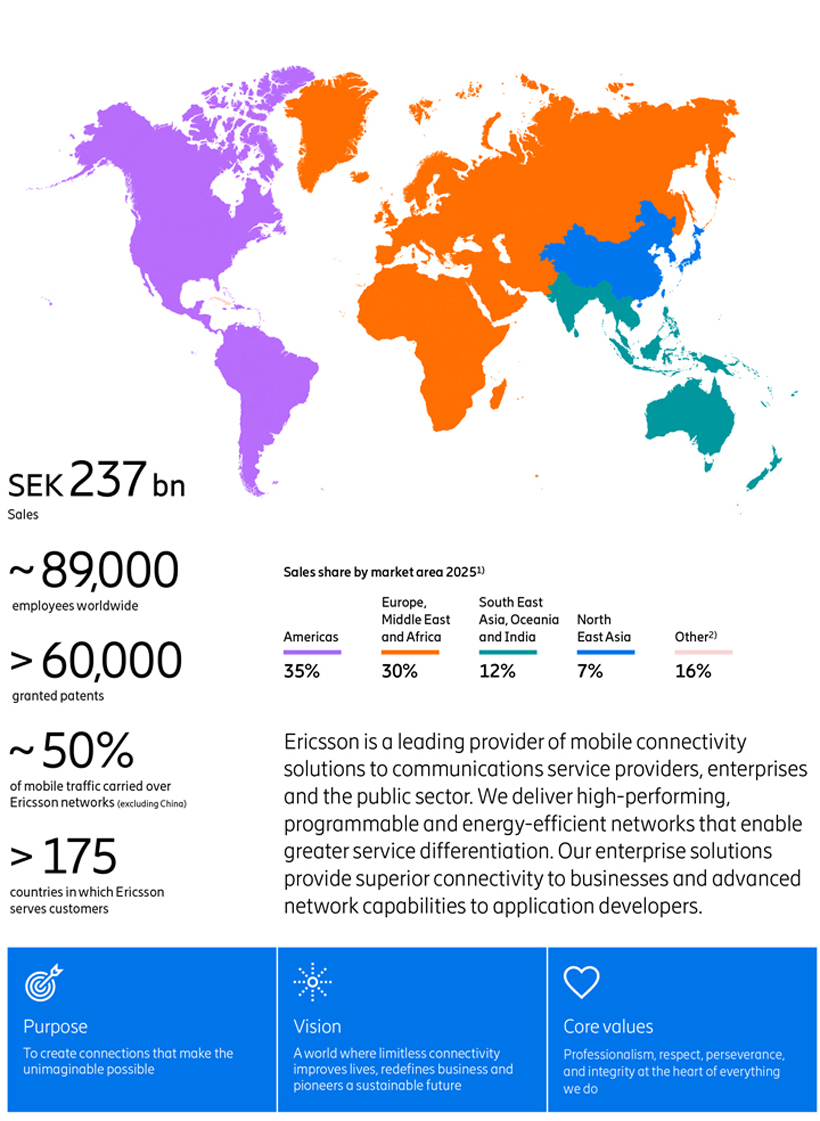
2023 Long-Term Variable Compensation Program for
Top Management (LTV 2023)
The share price used to calculate the number of shares to which the Performance Share Awards entitles was calculated as the volume weighted average of the market price of Ericsson B shares on Nasdaq Stockholm during the five trading days immediately following the publication of the Company’s interim report for the fourth quarter of 2022.
The performance criteria for LTV 2023 along with the details on how the performance criteria will be calculated and measured are explained in minutes from the AGM 2023 under Item 16.
The Board of Directors resolved on the achieved vesting level as outlined in the table “LTV and EPP Performance criteria”.
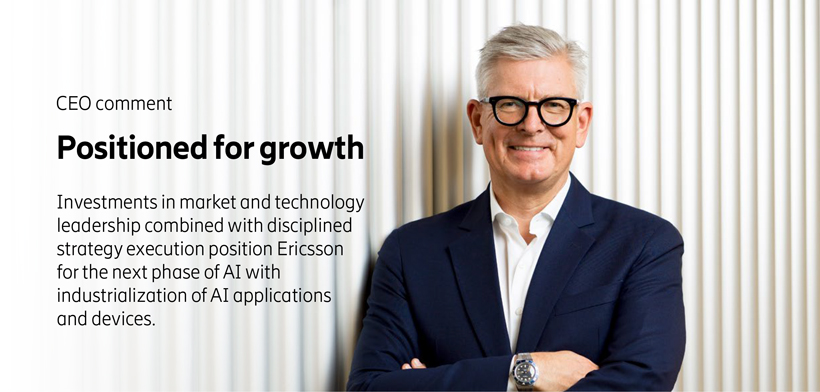
2022 Long-Term Variable Compensation Program for the
Executive Team (LTV 2022)
The share price used to calculate the number of shares to which the Performance Share Awards entitles was calculated as the volume weighted average of the market price of Ericsson B shares on Nasdaq Stockholm during the five trading days immediately following the publication of the Company’s interim report for the fourth quarter of 2021.
The performance criteria for LTV 2022 along with the details on how the performance criteria will be calculated and measured are explained in minutes from the AGM 2022 under Item 16.
The Board of Directors resolved on the achieved vesting level as outlined in the table “LTV and EPP Performance criteria”.
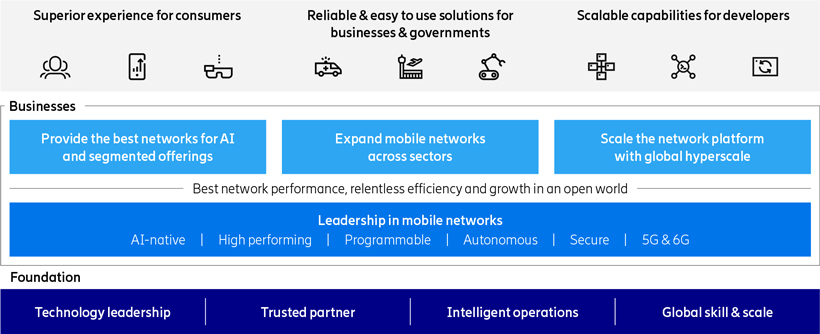
Cash-Settled Plans
Executive Performance Plan 2022 (EPP 2022)
165 senior managers were selected to participate in EPP 2022. The regular award level is set at 15% and the high award level is set at 25% for all countries except for the US/Canada. The regular and high award levels are set at 35% and 45% respectively in the US/Canada. Vesting of LTV 2022 was completed in February 2022.
Key Contributor Plans (KC Plans)
The KC Plan is a cash-settled retention plan. Employees are selected as participants to KC Plan annually through a nomination process that identifies individuals according to performance, potential, critical skills, and business critical roles. Participants are assigned a potential award based on a percentage of their annual gross salary, which is converted into a number of synthetic shares based on the same market price of Ericsson B shares used for the respective year’s LTV.
There are no performance criteria for vesting of awards. There is a three-year service period for receiving the award in full and the award is subject only to continued employment during the service period. The payout is distributed over the entire service period with staggered payments according to the below schedule:
 
25% of the award to be paid at the end of the first year,
 
25% of the award to be paid at the end of the second year, and
the remaining 50% of the award to be paid at the end of the third year.
Accounting wise, the plans are seen as three separate tranches. The tranches are accounted for as separate awards and accrued in parallel with the same grant date but different vesting dates. The consequence of the staggered payments is a
front-end
loaded cost for these plans. The accounting model is referred to as staged vesting.

73
 
Financial Report 2025 | Notes to the consolidated financial statements
 
Ericsson Annual Report on Form 20-F 2025


Note G3, cont’d.
 
 
The value of each synthetic share is driven by the absolute share price performance of Ericsson B shares during the service period. At the end of the service period, the allotted synthetic shares are converted into a cash amount, based on the market price of Ericsson B shares Nasdaq Stockholm at the vesting date, and this final amount is paid to the participant in cash gross before tax.
Key Contributor Plans 2025 (KC Plan 2025)
9,785 employees were selected to participate in KC Plan 2025. In general there are multiple levels between 10%–50% of the participants’ annual gross salary.
Key Contributor Plans 2024 (KC Plan 2024)
9,538 employees were selected to participate in KC Plan 2024. In general there are multiple levels between 10%–50% of the participants’ annual gross salary (deviation exists in legal entities Vonage).
Key Contributor Plans 2023 (KC Plan 2023)
10,154 employees were selected to participate in KC Plan 2023. There are multiple levels between 10%–50% of the participants’ annual gross salary. The former Vonage entitlements are included and updated in the numbers
and accordingly expensed. In addition, former Vonage has issued a retention plan to 87 participants with a
two-year
service period, no performance criteria and the vesting is 50%/50% on each annual anniversary.
Key Contributor Plan 2022 (KC Plan 2022)
7,704 employees were selected to participate in KC Plan 2022. There are at multiple levels between 10%–40% of the participants’ annual gross salary.
Claw back policy
In 2023, the Board of Directors of the Company adopted a written claw back policy for the purpose of recovering certain incentive compensation from executive officers in the event of a required accounting restatement, and to disclose any recovered compensation. This policy is applicable in parallel to the claw back rights contained in the guidelines for remuneration to Group management, and ongoing compensation programs (which are connected to breaches of Ericsson’s Code of Business Ethics).
Number of shares
The awards granted to the participants of the LTV programs and the development of the granted shares over time, considering the fulfilment of performance conditions, are displayed in the below table.
 
Number of shares for Top Management 
 
(million)
Share-settled programs
  
LTV
2025
    
LTV
  2024
    
LTV
  2023
    
LTV
  2022
 
Maximum shares required
  
 
12.7


10.4


4.1


2.0
 
Granted shares
  
 
3.1


4.0


3.7


0.7
 
of which the president and CEO
  
 
0.3


0.5


0.6


0.3
 
Outstanding number of shares 
 
    
Top Management programs
           
of which the President and CEO
 
(million)
Share-settled programs
  
 
LTV 2025


LTV 2024


LTV 2023


LTV 2022
1)


  Total


LTV 2025


LTV 2024


LTV 2023


LTV 2022


  Total
 
Outstanding number of shares, beginning of period


4.7


1.9


0.6


7.2


0.6


0.3


0.3


1.2
 
Granted shares for current year program
  
 
3.1


3.1


0.3


0.3
 
Exercised


0.6


0.6


0.3


0.3
 
Forfeited
  
 
0.2


0.5


0.1


0.8


0.0
 
Increase/decrease due to performance condition
  
 
0.5


0.1


1.0


1.6


0.1


0.2


0.3
 
Outstanding number of shares, end of period
  
 
3.4


4.3


2.8


10.5


0.4


0.6


0.5


1.5
 
 
1)
 
LTV 2022 include only Executive Team
 
Compensation expense
The table below, Compensation expense for LTV 2022–2025, shows the compensation expense relating to the open programs in the current year. Therefore, the expense shown in the prior year columns will not necessarily agree to the expense in the income statement for that financial period. The compensation expense under the current year column is the expense in the income statement for 2025.
The compensation expense is based on the fair value and the number of shares or synthetic shares. The compensation expense for the share-settled
 
long-term variable compensation programs for the President and CEO and Top Management during 2025 was SEK 175 (93) million. The compensation expense for the EPP and the KC Plans during 2025, which are cash settled, was SEK 5 (27) million and SEK 1,610 (1,953) million respectively. The total compensation expense during 2025 amounted to SEK 1,790 (2,073) million.
The total provision for the cash-settled plans amounted to SEK 2,982 (2,992) million, including social security charges of SEK 292 (272 ) million, at the end of 2025.

74
 
Financial Report 2025 | Notes to the consolidated financial statements
 
Ericsson Annual Report on Form 20-F 2025


Note G3, cont’d.
 
 
Compensation expense for LTV 2022–2025 
(million)
  
    2025
    
  2024
    
  2023
    
  2022
    
  Total
 
Share-settled programs
              
LTV 2025      63                             63  
LTV 2024      79        44                      123  
LTV 2023      22        24        25               71  
LTV 2022
1)
     11        18        20        12        61  
Total share-settled programs
  
 
175


86


45


12


318
 
of which the President and CEO
  
 
27


18


11


5


61
 
Cash-settled plans
              
EPP 2022      5        30        20        12        67  
Total executive performance plans
  
 
5


30


20


12


67
 
KC 2025      726                             726  
KC 2024      571        1,127                      1,698  
KC 2023      320        620        811               1,751  
KC 2022      7        217        330        280        820  
Total key contributor plans
  
 
1,610


1,964


1,141


280


4,995
 
Total cash-settled plans
  
 
1,615


1,994


1,161


292


5,062
 
Total compensation expense
  
 
1,790


2,080


1,206


304


5,380
 
 
1)
 
LTV 2022 include only Executive Team.
 
Fair value (FV)
The compensation expense for the share-settled plans is based on FV and the number of shares. The FV for the LTV programs includes adjustments for absolute and relative total shareholder return (TSR) development performance criteria at the grant date, using a Monte Carlo model, which uses a number of inputs, including expected dividends, expected share price volatility and the expected period to exercise. The performance criteria of the LTV program are also based on the outcome of the Group operating
 
income (EBITA) as per fiscal years 2025, 2024 and 2023 and Group operating income (EBIT) as per fiscal year 2022. The FV for the Group operating income (EBITA and EBIT) performance criteria is calculated as the share price at grant date, reduced by the net present value of the dividend expected during the three-year vesting period. For the performance criteria the number of shares is adjusted in relation to the achievement level of the performance criteria at the end of the performance period.
 
Fair values (SEK)
                               
Top Management programs
  
 
 LTV 2025
    
 
  LTV 2024


  LTV 2023


  LTV 2022
 
Share price at grant
  
 
82.74


61.46


55.59


78.88
 
Fair value Absolute TSR
  
 
54.43


59.05


32.75


41.18
 
Fair value ESG – Environmental (1,2,3)
  
 
74.62


53.61


47.80


71.45
 
Fair value ESG – Social
  
 
74.62


53.61


47.80


71.45
 
Fair value Relative TSR
  
 
71.20


55.61


39.40


54.48
 
Fair value Group operating income (EBITA and EBIT)
  
 
74.62


53.61


47.80


71.45
 
 
Payout of Cash-settled Plan
During 2025 four plans vested: EPP 2022, KC Plan 2022 tranche 3, KC Plan 2023 tranche 2 and KC Plan 2024 tranche 1 (vesting February ). The share price for the plan that vested February 18, 2025 was SEK 85.12, for the plan that vested February 19, 2025 was SEK 85.50 and for the plan that vested February 20, 2025 was SEK 84.84. The accumulated payout to all LTV plan participants amounted over 2025 to SEK 1,590 million.
The Ericsson share purchase plan (ESPP)
Ericsson is committed to helping employees thrive and to recognizing them for the impact they create by providing opportunities to enrich their working experience. In order to encourage employees to play an active role in achieving the Company’s purpose, further create sense of belonging and ownership, the Ericsson share purchase plan is offered. At the end of 2025 the plan is implemented in 72 countries to 73,879 eligible employees.
The ESPP is an
all-employee
share purchase plan that enables employees to purchase Ericsson
B-shares
up to a maximum value of SEK 55,000 per year via monthly payroll deduction. In recognition of the employees’ commitment, Ericsson supports the participants with a net cash payment up to 15% of their elected contribution amounts and will cover the tax on the Company supported amount, which is payable via payroll. Under the ESPP participants will acquire Ericsson B shares at market price on the stock exchange and the ESPP does therefore not have any dilutive effect.
Ericsson share purchase plan 
 
Eligible
employees
  
Number of
countries with
ESPP
    
Number of
  participants
    
Take-up
rate
  – percent of eligible
employees
 
73,879
  
 
72


13,653


18.48%
 
Option agreements
In 2024, Board Chair Jan Carlson entered into an option agreement with Investor AB, a shareholder of Ericsson, for the acquisition of 132,538 call options relating to shares in Telefonaktiebolaget LM Ericsson. Under the agreement, Investor AB has issued call options to Jan Carlson on market terms (valuation conducted, using the Black & Scholes model, by an independent third party) and Jan Carlson purchased the call options at a price of SEK 15.09 per call option. Each call option entitles the purchase of one Ericsson Class B share from Investor AB at a strike price of SEK 68.62 per share (to be recalculated to neutralize the effects of dividend payments during the option period) after a
six-year
period starting May 7, 2024. The exercise period is one year with the possibility to be extended for up to one year in the event that the holder is unable to exercise the option during the exercise period due to a regulatory restriction or prohibition. Due to the fact that the call options were purchased on market terms as described above, no compensation expense has been recognized by the Company during the option period and will not be recognized during the remaining part of the option period.

Table of Contents
75
 
Financial Report 2025 | Notes to the consolidated financial statements
 
Ericsson Annual Report on Form 20-F 2025


LOGO  
Employee information 
Average number of employees by market area 
 
    
2025
           
2024
2)
 
     
 Women
    
Men
    
Total
            
 Women
    
Men
    
Total
 
Americas
  
 
4,173


11,468


15,641


4,423


12,327


16,750
 
Europe, Middle East and Africa
1)
  
 
9,818


28,495


38,313


10,165


30,212


40,377
 
South East Asia, Oceania and India
  
 
6,065


19,478


25,543


6,199


20,453


26,652
 
North East Asia
  
 
3,512


6,416


9,928


3,941


7,434


11,375
 
Total
  
 
23,568


65,857


89,425


24,728


70,426


95,154
 
1)
of which in EU
  
 
8,053


22,776


30,829


8,314


23,856


32,170
 
  of which in Sweden
  
 
3,107


9,023


12,130


3,125


9,259


12,384
 
 
2)
2024 is restated to reflect the changes in the market area structure implemented in 2025. 
 
Number of employees by market area at
year-end 
 
     
   2025
    
  2024
2)
 
Americas
  
 
15,050


16,034
 
Europe, Middle East and Africa
1)
  
 
39,045


41,387
 
South East Asia, Oceania and India
  
 
25,189


26,389
 
North East Asia
  
 
9,542


10,426
 
Total
  
 
88,826


94,236
 
1)
of which in EU
  
 
31,735


33,342
 
  of which in Sweden
  
 
12,806


13,420
 
 
2)
2024 is restated to reflect the changes in the market area structure implemented in 2025.
Number of employees by age at
year-end
2025 
 
     
Women
    
  Men
    
  Percent
of total
 
Under 25 years old
  
 
1,041


1,151


2%
 
25–35 years old
  
 
7,678


14,685


25%
 
36–45 years old
  
 
8,035


24,275


37%
 
46–55 years old
  
 
4,755


16,788


24%
 
Over 55 years old
  
 
2,209


8,209


12%
 
Percent of total
  
 
27%


73%


100%
 
Employee movements 
 
     
  2025
    
  2024
 
Headcount at
year-end
  
 
88,826


94,236
 
Employees who have left the Company
  
 
11,526


11,919
 
Employees who have joined the Company
  
 
6,116


6,203
 
Temporary employees
  
 
328


339
 
Board members, Presidents and Group management at year end 
 
    
2025
           
2024
 
     
  Women
    
  Men
            
  Women
    
  Men
 
Parent Company
              
Board members and President
  
 
29%


71%


25%


75%
 
Group Management
  
 
25%


75%


24%


76%
 
Subsidiaries
              
Board members and Presidents
  
 
21%


79%


23%


77%
 
Amounts related to the President and CEO and the Executive Leadership Team are included in the table below.
Wages and salaries and social security expenses
 
SEK million
  
   2025
    
   2024
 
Wages and salaries
  
 
74,645


77,983
 
Social security expenses
  
 
16,004


15,422
 
of which pension costs
  
 
5,718


5,929
 
Remuneration to Board members and Presidents in subsidiaries 
 
SEK million
  
   2025
    
   2024
 
Salary and other remuneration
  
 
557


535
 
of which annual variable remuneration
  
 
133


112
 
Pension costs
1)
  
 
36


36
 
 
1)
Pension costs are over and above any social security charges and taxes. 

Table of Contents
76
 
Financial Report 2025 | Notes to the consolidated financial statements
 
Ericsson Annual Report on Form 20-F 2025


Section H – Other
 
LOGO  
Taxes
The Company’s tax expense was SEK –9,588 (–2,215) million or 25.0% (85.6%) of income after financial items. The tax rate may vary between years depending on business and geographical mix.
Income taxes recognized in the income statement
 
     
   2025
    
   2024
    
   2023
 
Current income taxes for the year
  
 
8,828


6,461


4,289
 
Current income taxes related to prior years
  
 
610


162


118
 
Deferred tax income/expense (+/–)
  
 
54


4,563
  
 
1,406
Share of taxes in associated companies
  
 
35


102


20
 
Pillar Two tax expense
  
 
61


53


Income tax expense
  
 
9,588


2,215


2,785
 
A reconciliation between
reported
tax expense for the year and the theoretical tax expense that would arise when applying the statutory tax rate in Sweden, 20.6%, on the consolidated income/loss before taxes, is shown in the table below.
In 2024 the tax rate was negatively impacted by the effect on
non-tax
deductible goodwill and the remeasurement of tax loss carry-forwards and positively impacted by the other intangible asset impairments mainly related to Vonage of SEK 15.1 billion.
Reconciliation of Swedish income tax rate with effective tax rate
 
     
   2025
    
   2024
    
   2023
 
Calculated tax expense at Swedish tax rate of 20.6%
  
 
7,891


533


4,804
Effect of foreign tax rates
  
 
908


430
  
 
884
 
Current income taxes related to prior years
  
 
610


162


118
Remeasurement of tax loss carry-forwards
  
 
73


973


28
 
Remeasurement of deductible temporary differences
  
 
288


308
  
 
394
Withholding tax expense
  
 
378


780


217
 
Tax effect of
non-deductible
expenses
  
 
136


1,045


7,311
 
Tax effect of
non-taxable
income
  
 
164


655
  
 
335
Tax effect of changes in tax rates
  
 
17


62


4
Pillar Two tax expense
  
 
61


53


Income tax expense
  
 
9,588


2,215


2,785
 
Effective tax rate
  
 
25.0%


85.6%


11.9%
 
The Group has applied the temporary exception issued by the IASB in May 2023 from the accounting requirements for deferred taxes in IAS 12. Accordingly, the Group neither recognizes nor discloses information about any deferred tax assets or liabilities related to Pillar Two income taxes.
Deferred tax balances
Deferred tax assets and liabilities are derived from the balance sheet items as shown in the table below.
Tax effects of temporary differences and tax loss carry-forwards
 
     
Deferred
tax assets
    
Deferred tax
liabilities
    
Net
  balance
 
2025
        
Intangible assets and property, plant and equipment
  
 
1,222


2,789


Right-of-use
assets and similar assets


1,281


Current assets
  
 
1,701


77


Post-employment benefits
  
 
3,555


373


Provisions
  
 
4,633


Lease liabilities and similar liabilities
  
 
1,345


Deferred tax credits
  
 
2,042


Other
  
 
2,088


437


Loss carry-forwards
  
 
5,070


Deferred tax assets/liabilities
  
 
21,656


4,957


16,699
 
Netting of assets/liabilities
  
 
4,805


4,805


Deferred tax assets/liabilities, net
  
 
16,851


152


16,699
 
2024
        
Intangible assets and property, plant and equipment
  
 
1,447


3,457


Right-of-use
assets and similar assets


1,199


Current assets
  
 
4,340


1,323


Post-employment benefits
  
 
4,778


229


Provisions
  
 
4,788


Lease liabilities and similar liabilities
  
 
1,307


Deferred tax credits
  
 
5,027


Other
  
 
2,394


359


Loss carry-forwards
  
 
5,603


Deferred tax assets/liabilities
  
 
29,684


6,567


23,117
 
Netting of assets/liabilities
  
 
5,272


5,272


Deferred tax assets/liabilities, net
  
 
24,412


1,295


23,117
 
Changes in deferred taxes, net
 
     
   2025
    
   2024
 
Opening balance, net
  
 
23,117


18,495
Recognized in net income
  
 
54


4,563
Recognized in other comprehensive income
  
 
2,371


505
Balances regarding acquired/divested businesses
  
 
81


Deferred tax credits increase (+) / utilization (–)
  
 
2,700


685
 
Translation difference
  
 
1,212


239
Closing balance, net
  
 
16,699


23,117
 
Tax on items charged to Equity and Other comprehensive income
 
     
2025
    
    2024
    
   2023
 
Remeasurements of defined benefits pension plans
  
 
  –1,376


147


251
 
Revaluation of credit risk on borrowings
  
 
6


117
  
 
137
 
Cash flow hedge reserves
  
 
995


652
  
 
380
 
Non-controlling
interests
  
 
2


2


Total
  
 
2,375


624
    
 
494
 
Tax on items charged to Equity and Other comprehensive income (OCI) is presented in the table above. Of the total tax effect reported in OCI, SEK –2,369 (507) million is deferred tax and SEK –6 (117) million is current tax.
As a result of Parent Company exemptions
from
tax on dividends from subsidiaries and on capital gains on disposal, there are no significant taxable temporary differences associated with investments in subsidiaries, branches and associates.

Table of Contents
77
 
Financial Report 2025 | Notes to the consolidated financial statements
 
Ericsson Annual Report on Form 20-F 2025


Note H1, cont’d.
 
 
Tax loss carry-forwards
Significant tax assets regarding tax loss carry-forwards are reported to the extent that realization of the related tax benefit through future taxable profits is probable also when considering the period during which these can be utilized, as described below.
The majority of the recognized tax loss carry-forwards pertain to Sweden, US, Germany and Brazil. These countries have long or indefinite periods of utilization. Of the total SEK 5,070 (5,603) million recognized deferred tax assets related to tax loss carry-forwards, SEK 3,711 (3,815) million relates to Sweden.
Future profit projections support the conclusion that the deferred tax assets will be utilized in the foreseeable future.
 
As of December 31, 2025, the recognized tax loss carry-forwards amounted to SEK 23,153 (25,354) million. The tax value of the tax loss carry-forwards is reported as a tax asset based on the utilization periods and the expectation that the Group will realize a significant taxable income to offset these loss carry-forwards. The tax loss carry-forwards of SEK 10,757 (11,025) million at a tax value of SEK 2,308 (2,399) million have not been recognized due to judgments that they are unlikely to be utilizable against future taxable profits in the respective jurisdictions. The majority of both recognized and unrecognized tax loss carry-forwards have an expiration date in excess of five years. The majority of the unrecognized tax loss carry-forwards pertains to US, Ireland, Hungary and Brazil. The final years in which the recognized and unrecognized tax loss carry-forwards
can
be utilized are shown in the following table.
 
Tax loss carry-forwards
  
    Recognized tax loss    
    
    Unrecognized tax loss    
 
Year of expiration
  
Tax loss
   carry-forwards
            
Tax value
    
Tax loss
carry-forwards
            
Tax value
 
2026
  
 
25


6


150


24
 
2027
  
 
75


22


1,119


273
 
2028
  
 
7


2


407


94
 
2029
  
 
164


45


73


11
 
2030
  
 
841


217


38


7
 
2031 or later (also includes unlimited carry-forwards)
  
 
22,041


4,778


8,970


1,899
 
Total
  
 
23,153


5,070


10,757


2,308
 
 
Deferred tax credits
In addition to deferred tax credits of SEK 2,042 (5,027) million recognized in 2025, unused deferred tax credits, relating mainly to R&D tax
credit
s, for which no deferred tax asset was recognized in the consolidated balance sheet amounted to SEK 946 (1,114) million. The final years in which the tax credits can be utilized are shown in the below table.
Risk assessment on the
business
plans is carried
out
on a regular basis, and deferred tax asset recoverability analysis will be performed if conditions suggest that such assets might need to be impaired.
Deferred tax credits
  
Recognized
    
Unrecognized
 
    
 deferred tax credits
    
 deferred tax credits
 
Year of expiration
  
Tax value
    
Tax value
 
2026      28        111  
2027      27        104  
2028      9         
2029      9         
2030      15        11  
2031 or later      1,954        720  
Total
  
 
2,042


946
 
 
LOGO  
Earnings per share
 
     
  2025
    
  2024
    
  2023
 
Basic
        
Net income (loss) attributable to owners of the Parent Company (SEK million)
  
 
28,428


20
  
 
26,446
 
Average number of shares outstanding, basic (millions)
  
 
3,333


3,332
  
 
3,330
Earnings (loss) per share, basic (SEK)
  
 
8.53


0.01
    
 
7.94
 
Diluted
        
Net income (loss) attributable to owners of the Parent Company (SEK million)
  
 
28,428


20
  
 
26,446
 
Average number of shares outstanding, basic (millions)
  
 
3,333


3,332


3,330
Dilutive effect for share-based compensation programs (millions)
  
 
9


7


Average number of shares outstanding, diluted (millions)
  
 
3,342


3,339
  
 
3,330
Earnings (loss) per share, diluted (SEK)
  
 
8.51


0.01
    
 
7.94
 

Table of Contents
78
 
Financial Report 2025 | Notes to the consolidated financial statements
 
Ericsson Annual Report on Form 20-F 2025


LOGO  
Statement of cash flows
Cash and cash equivalents include cash of SEK 18,617 (19,622) million and cash equivalents of SEK 25,309 (24,263) million. For more information regarding the disposition of cash and cash equivalents and unutilized credit commitments, see note F1 “Financial risk management.”
Cash and cash equivalents as of December 31, 2025, include SEK 404 (727) million in countries where there exist significant cross-border conversion restrictions due to hard currency shortage or strict government controls. This amount is not directly available for distribution to the Parent Company or be used to pay normal business expenditures in the local jurisdictions for the next 12 months.
Adjustments to reconcile net income to cash
 
     
  2025
    
  2024
    
  2023
 
Property, plant and equipment
        
Depreciations
  
 
3,247


3,861
  
 
4,272
Impairment losses
  
 
234


282
  
 
662
Total
  
 
3,481


4,143
    
 
4,934
 
Right-of-use
assets
        
Depreciations
  
 
2,051


2,179
  
 
2,427
Impairment losses
  
 
21


99
  
 
154
Total
  
 
2,072


2,278
    
 
2,581
 
Intangible assets
        
Amortizations
        
Capitalized development expenses
  
 
1,790


1,480
  
 
1,137
Customer relationships, IPRs and other intangible assets
  
 
1,821


2,500
  
 
3,321
Total amortizations
  
 
3,611


3,980
    
 
4,458
 
Impairments
        
Customer relationships, IPRs and other intangible assets
  
 
77


14,073
  
 
19
Goodwill


1,260
  
 
31,897
Total impairments
  
 
77


15,333
    
 
31,916
 
Total
  
 
3,688


19,313
    
 
36,374
 
Total depreciation, amortization and impairment losses on property, plant and equipment and intangible assets
  
 
9,241


25,734
    
 
43,889
 
Taxes
  
 
10,074


2,540
  
 
3,189
Dividends from associates
1)
  
 
76


111
  
 
46
Undistributed earnings in associates
1)
  
 
19


348
  
 
104
 
Gains/losses on investments and sale of operations, intangible assets and PP&E, net
2)
  
 
7,936


153
  
 
268
Other
non-cash
items
3)
  
 
643


1,731
  
 
4,422
Total adjustments to reconcile net income to cash
  
 
10,793


30,617
    
 
51,710
 
 
1)
 
See note E3 ”Investments in associated companies.”
2)
 
Includes revaluation gains and losses on investments, see note B4 ”Other operating income and expenses.
3)
 
Relates mainly to unrealized foreign exchange, gains/losses on financial instruments.
For information about reconciliation of liabilities arising from financing activities, see note F4 ”Interest-bearing liabilities.”
Acquisitions/divestments of subsidiaries and other operations
 
     
Acquisitions
    
Divestments
 
2025
     
Cash flow from business combinations
1)
  
 
264


11,200
 
Acquisitions/divestments of other investments/associates
  
 
835


438
 
Total
  
 
1,099


11,638
 
2024
     
Cash flow from business combinations
1)
  
 
141


Acquisitions/divestments of other investments/associates
  
 
256


86
 
Total
  
 
397


86
 
2023
     
Cash flow from business combinations
1)
  
 
1,309


633
 
Acquisitions/divestments of other investments
  
 
206


8
 
Total
  
 
1,515


625
 
 
1)
 
See also note E2 ”Business combinations.”
 
LOGO  
Related party transactions
 
SEK billion
  
  2025
    
  2024
    
  2023
 
Sales to Ericsson Nikola Tesla
  
 
0.4


0.4
  
 
0.4
Purchases from Ericsson Nikola Tesla
  
 
1.5


1.6
  
 
1.6
IAS 24, ”Related Party Disclosures” requires disclosure of related party relationships, transactions and outstanding balances.
During 2025, various minor related party transactions were executed pursuant to contracts based on terms customary in the industry and negotiated on an arm’s length basis. The main related party transactions related to Ericsson Nikola Tesla d.d located in Croatia, where Ericsson holds 49.07% of the shares. For information regarding equity and Ericsson’s share of assets, liabilities and income in associated companies, see note E3 ”Investments in associated companies.”
For information regarding transactions with the Board of Directors and Group management, see note G2 ”Information regarding members of the Board of Directors and Group management.”
For information about the Company’s pension trusts, see note G1 ”Post-employment benefits.”

Table of Contents
79
 
Financial Report 2025 | Notes to the consolidated financial statements
 
Ericsson Annual Report on Form 20-F 2025


LOGO  
Fees to auditors
 
     
  Deloitte
    
  Others
    
  Total
 
2025
        
Audit fees
  
 
181


1


182
 
Audit-related fees
  
 
3


3


6
 
Tax fees
  
 
6


46


52
 
All other fees
  
 
3


8


11
 
Total
  
 
193


58


251
 
2024
        
Audit fees
  
 
178


21


199
 
Audit-related fees
  
 
4


3


7
 
Tax fees
  
 
3


50


53
 
All other fees
  
 
2


35


37
 
Total
  
 
187


109


296
 
2023
        
Audit fees
  
 
164


8


172
 
Audit-related fees
  
 
6


6
 
Tax fees
  
 
12


13


25
 
All other fees


37


37
 
Total
  
 
182


58


240
 
At the 2025 Annual General Meeting, Deloitte was appointed auditor for the period until the 2026 Annual General Meeting.
The audit-related services include quarterly reviews and assurance regarding Ericsson’s Sustainability and Corporate Responsibility Report. The tax services include corporate tax compliance work. Other services include work related to agreed-upon-procedures engagements.
LOGO  
Events after the reporting period
Ericsson announces a proposed staff reduction in Sweden
On January 15, 2026, Ericsson announced a proposed headcount reduction in Sweden. Ericsson has submitted a notice to the Swedish Public Employment Service. Approximately 1,600 positions could be impacted in Sweden.
Ericsson’s Board of Directors proposes a share buyback program
On January 23, 2026, Ericsson announced that a share buyback program up to SEK 15 billion will be proposed to the AGM by the Board of Directors. For more information, see note E1 “Equity”.

Table of Contents
80
 
Financial Report 2025 | Management’s report on internal control over financial reporting
 
Ericsson Annual Report on Form 20-F 2025


Management’s report on internal control over financial reporting
 
Internal control over financial reporting
Ericsson’s management is responsible for establishing and maintaining adequate internal control over financial reporting for the Company.
Ericsson’s internal control system related to financial reporting is designed to provide reasonable assurance regarding the reliability of financial reporting and the preparation of financial statements for external purposes in accordance with IFRS accounting standards as issued by the IASB and includes those policies and procedures that:
pertain to the maintenance of records that, in reasonable detail, accurately and fairly reflect the transactions and dispositions of the assets of the Company;
provide reasonable assurance that transactions are recorded as necessary to permit preparation of financial statements in accordance with IFRS accounting standards as issued by the IASB, and that receipts and expenditures of the Company are being made only in accordance with authorizations of management and directors of the Company; and
provide reasonable assurance regarding prevention or timely detection of unauthorized acquisition, use or disposition of the Company’s assets that could have a material effect on the financial statements.
Although the purpose of internal control systems is to ensure adequate risk management, all internal control systems, no matter how well designed, have inherent limitations, which may result in misstatements
not being prevented or detected. Therefore, even systems determined to be effective can provide only reasonable assurance with respect to the reliability of financial statement preparation and presentation.
Ericsson’s management assessed the effectiveness of Ericsson’s internal control over financial reporting as of December 31, 2025.
In making this assessment, management used the criteria set forth in “Internal Control – Integrated Framework (2013)”, issued by the Committee of
Sponsoring
Organizations of the Treadway Commission.
Based on this assessment, management has concluded that, as of December 31, 2025, Ericsson’s internal control over financial reporting was effective at a reasonable assurance level.
Attestation report of registered public accounting firm
The
effectiveness
of the Company’s internal control over financial reporting as of December 31, 2025, has been audited by Deloitte AB, an independent registered public accounting firm, as stated in their report on page 28.
Changes in internal control over financial reporting
There were no changes in the group’s internal control over financial reporting that occurred during the period covered by the annual report on Form
20-F
that have materially affected or are reasonably likely to materially affect our internal control over financial reporting.

Table of Contents
81
 
Financial Report 2025 | Risk factors
 
Ericsson Annual Report on Form 20-F 2025


Risk factors
 
This Risk factors section should be read in conjunction with all of the information contained in this Annual Report, including this Financial Report and the consolidated financial statements and accompanying notes.
Ericsson’s business is subject to a number of risks and uncertainties that may affect its business, operating results and financial condition, or the trading price of its common stock or other securities. Ericsson cautions the reader that these risk factors may not be exhaustive. Ericsson operates in a continually changing business and regulatory environment, and new risks and uncertainties emerge from time to time. Management cannot predict such new risks and uncertainties, nor can it assess the extent to which any of the risk factors below or any such new risks and uncertainties, or any combination thereof, may impact Ericsson’s business. See also “Forward-Looking Statements”.

 
1
Risks related to business activities and industry
 
1.1 Ongoing geopolitical and trade uncertainty from a range of factors may have a material adverse impact on Ericsson’s business, operations, and ability to meet its targets, as well as the information and telecommunications industry as a whole.

Geopolitical alliances are shifting as global tensions over trade and influence drive growing economic, technological, military, and political competition across the world, particularly between the US and China. Geopolitical tensions and ongoing conflicts such as those in the broader Middle East, Russia and Ukraine, amplify the risk of government intervention, including state-based armed conflicts and protectionist interventions, such as tariffs, and security-related requirements, which include increased regulatory barriers, restrictions on technology transfers, telecommunications and digital infrastructure to promote national security, as well as trade restrictions, export controls and enhanced sanctions measures. Additionally, geopolitical instability increasingly leads some governments to use the private sector for political objectives, including by restricting or enabling market access based on national security interests, leveraging influence over industry standards, providing financial support to domestic companies or restricting the use of foreign equipment or technology in critical infrastructure.
Many countries, including the US and China, view technology, including telecommunications infrastructure and mobile wireless technologies, as critical infrastructure and aim to lead and influence global policy and regulations around such technologies. Due to the strategic nature of the industry in which Ericsson operates, foreign countries could support a competitor as a national champion or develop a national champion as an alternative to the established global vendors, such as Ericsson, in order to have further control over local communication networks and infrastructure. Additionally, foreign countries could support or establish a national champion competitor in markets of strategic importance to Ericsson, such as the US, India and Japan, resulting in a loss of market share and global scale. Collaborative arrangements between competitors and influential technology partners or national stakeholders could shape public perception, influencing national champion narratives in certain markets. In particular, strategic alliances between competitors and influential technology partners, or the emergence of a favored national champion competitor, could prompt policy preferences, trade measures or procurement decisions from interested governments that favor those competitors
irrespective of technical merit, heightening geopolitical and trade uncertainty and potentially impairing Ericsson’s market share, access to critical components or government contracts.
While Ericsson is a global company with a global presence, it faces unique challenges as a Swedish company because Sweden and Europe have historically exerted limited influence in shaping global technology policies compared to more prominent technology regulators and have not committed similar levels of investment in technology infrastructure. Neither Sweden nor the European Union has developed a common and cohesive technology agenda or technology geopolitical strategy. Where regulations in the European Union have been introduced, such regulations have focused on consumer pricing, rather than promoting or protecting European-based technology or telecommunications companies. Consequently, Ericsson remains exposed to changes in global policy dynamics that it cannot directly or indirectly influence, and which may be influenced to benefit competitors. Furthermore, as a Swedish company operating globally during a period of rapidly evolving government and regulatory priorities, and, in certain cases, conflicting or changing requirements (including, for example, regarding environmental, climate and diversity and inclusion policies), Ericsson may be required to make operational adjustments, which impair its ability to implement consistent global policies, expose it to enforcement or litigation risk, and harm its reputation or brand.
Due to the strategic nature of the information and telecommunications industry, Ericsson is exposed to competitive risks from state-supported enterprises, particularly from countries with significant government-backed industries. Companies in government-backed industries may receive financial support, favorable regulatory environments, the advantage of a closed home market and selective enforcement of rules that enable them to operate at a scale and with a cost structure that private sector companies cannot match. They may also receive market and technology access that grants them significant competitive advantages. This dynamic can create competitive pressures, particularly in international markets where these government-supported enterprises can operate with significantly lower margins compared to private sector companies. Additionally, such state-backed entities may pursue opportunities in pursuit of strategic objectives of their government owners and supporters, with less focus on financial returns, allowing for these companies to increase their market share disproportionately.

Table of Contents
82
 
Financial Report 2025 | Risk factors
 
Ericsson Annual Report on Form 20-F 2025


There are particular uncertainties for the future relationship between China and a number of countries (such as the US, India, Sweden and other EU countries), as a result of, among other things, the restrictions imposed on Chinese vendors or components in 5G networks. These restrictions have been adopted in many countries and have resulted and may continue to result in constraints on access to hardware and software products and components. Ericsson may be affected by any further deterioration of the relationships between these countries. In addition, the Company has business operations in China, and further changes in economic and political policies in or relating to China could have a material adverse effect on the Company’s business.
In addition, the US government has imposed and continues to threaten to impose a broad range of tariffs on certain imports to the US from most jurisdictions. Some of these measures have already taken effect and have and may continue to result in retaliatory tariffs or other trade restrictions from other countries. These developments could have significant negative impacts throughout the information and telecommunications industry, including the Company’s international product development and global value and supply chains. Restrictions on international trade, such as tariffs and other controls on imports or exports of goods, technology or data, could increase compliance costs, negatively affect selling prices and margins, reduce demand, and otherwise have a material adverse effect on Ericsson’s business.
During the last several years, there have been sustained challenges to the global free trade system, including towards the World Trade Organization dispute settlement body. Certain countries have moved away from the multilateral system and instead have imposed tariffs and other trade barriers, price or exchange controls, restrictions of imports and other government policies. Any increased prospect of government restrictions on international trade could negatively impact Ericsson’s ability to benefit from open markets and free trade and could limit Ericsson’s operations, increase costs and decrease Ericsson’s profitability. Furthermore, the mandated or otherwise required localization of manufacturing and R&D or use of local suppliers or production, as well as their digital counterparts (including data localization of
IT-infrastructure
and restrictions on data flows), has been steadily growing, motivated by protectionism, domestic industrial policies and national security concerns. Geopolitical uncertainty has led to reduced efficiency in R&D, including restrictions on use of R&D resources, and opportunities to scale or grow with increasing logistical and administrative burdens, while polarization of the industry and fragmentation of global standards continues to develop. There is a risk of moves away from global value and supply chains and towards more regional or national alternatives. Governments may continue to impose conditions that require the use of local suppliers and local production or partnerships with local companies for R&D and
IT-infrastructure,
require the license or other transfer of intellectual property, or engage in other efforts to promote local businesses and local competitors, which could have a significant adverse impact on Ericsson’s ability to operate its global business efficiently.
There are numerous ongoing local and regional conflicts, including the ongoing military conflicts between Ukraine and Russia (which market Ericsson has exited) and in the broader Middle East. While the ultimate impact of these events is unclear, the uncertainty they create is expected to continue. These geopolitical developments, including consequential trade or security restrictions and export controls, enhanced sanctions measures and vendor consolidation, can negatively impact global market conditions, including market share, access and position. The strategic and sensitive nature of the information and telecommunications industry also heightens exposure to cyber-attacks and corporate espionage, with respect to both technology and commercial matters, resulting in an increased risk of cyber threats from state-backed and criminal threat actors, including digital attacks
aimed at disrupting, damaging or infiltrating another’s critical infrastructure, network and systems. Governments have been increasingly focused on mitigating the risk of cyber espionage, geolocation and data control, and the protection of critical national infrastructure and information through policy measures and otherwise.
The continually evolving global geopolitical environment has had and will continue to have consequences for the entire information and telecommunications industry, with the possibility of further industry splits, separation of global value and supply chains and separation of global standards for mobile telecommunications. These developments have also led to several countries evaluating how to ensure uninterrupted access to telecommunication network infrastructure, for example through promoting disaggregation of the Radio Access Network, although the timing and extent of this remain unclear.
All of the above may have a material and potentially lasting adverse impact on Ericsson’s international product development and global value and supply chains and necessitate a flexible and adaptive organizational setup, therefore negatively impacting its profitability and business as a whole.
1.2 Challenging global economic conditions may adversely impact the demand, cost and pricing for Ericsson’s products and services as well as limit the Company’s ability to grow.
Challenging global economic conditions, including due to downturns in the global economy, political unrest and uncertainty, evolving regulatory environments, labor and supply shortages or increased costs, periods of elevated interest rates or inflation, fluctuations in currency exchange rates, falling consumer confidence, or geopolitical risks and trade frictions may have adverse, wide-ranging effects on demand for Ericsson’s products and for the products and services of Ericsson’s customers. These conditions are also impacted by government fiscal and monetary policies, including adverse changes relating to government grants, tax credits or other government incentives. Ericsson operates in a cyclical industry, where customer demand, investment and spending are highly sensitive to macroeconomic conditions, fluctuating market dynamics and broader investment cycles. If Ericsson’s customers anticipate or experience reduced consumer spending, communications service provider customers and other customers may postpone, reduce or cancel investments, including significantly reduced expenditures for the Company’s products and services, or initiate other cost-cutting measures to maintain or improve their financial position. This reduced demand for products and services could result in increased price competition or deferrals of purchases, leading to lower revenues not fully offset by reduced costs. If Ericsson’s financial performance is constrained due to an economic downturn, its ability to reinvest in product innovation, market expansion, or other strategic initiatives important to Ericsson’s long-term growth could be limited. Furthermore, if economic conditions lead to reduced investment in technology sectors broadly, Ericsson’s growth prospects could be adversely impacted.
Challenging global economic conditions combined with an evolving regulatory environment has led to a technology landscape in Europe with high regulatory pressure and relatively low investment levels in technology infrastructure and development. Due to challenging global economic conditions, Europe’s regulatory environment has heavily focused on consumer protection, including lowering costs for consumers and privacy and data rights, which, while critical for customer trust, has adversely impacted the demand, cost and pricing of products and services in the sectors in which Ericsson operates. Inadequate investment in technology infrastructure in over-regulated markets may reduce demand for infrastructure products, as companies and governments hesitate to invest in more advanced solutions amid economic uncertainties and stringent compliance requirements. The combination of these factors may limit Ericsson’s ability to adjust pricing effectively across markets, leading to lower margins and decreased

Table of Contents
83
 
Financial Report 2025 | Risk factors
 
Ericsson Annual Report on Form 20-F 2025


financial performance. Challenging macroeconomic conditions could also lead to financial difficulties or failures among Ericsson’s customers or suppliers, increased demand for customer financing, difficulties in collection of accounts receivable and increased counterparty credit risks.
Ericsson’s financial results have fluctuated and will continue to fluctuate between interim financial periods, and
period-to-period
comparisons of Ericsson’s results of operations may not be meaningful. Ericsson’s net sales, net income and cash flow from operating activities are generally the lowest in the first quarter of the year and the highest in the fourth quarter. Additionally, the level of demand from communications service providers and other customers who buy Ericsson’s products and services is seasonal and can vary over short periods of time, including from month to month. As a result, Ericsson’s performance in one financial period may not be directly comparable to prior or future financial periods and such comparisons may not fully reflect Ericsson’s financial performance, which could lead to unpredictable financial results or trends in Ericsson’s overall performance.
Macroeconomic volatility can also lead to increased difficulties in forecasting sales and financial results, as well as increased volatility in Ericsson’s reported results and potential impairment losses related to Ericsson’s intangible assets as a result of lower forecasted sales of certain products. Should any of the foregoing factors persist or worsen, the adverse impacts on Ericsson’s business, operating results and financial condition could become more pronounced.
1.3 Ericsson’s business depends upon the continued growth of mobile communications and the success of Ericsson’s existing and targeted customer base, which can impact customer demand, as well as Ericsson’s product mix and margins.
A substantial portion of Ericsson’s business depends on the continued growth of mobile communications in terms of both the number of subscriptions and usage per subscriber, which in turn drives the continued deployment and expansion of network systems by Ericsson’s customers. If communications service providers fail to increase the number of subscribers and/or usage does not increase, or if they fail to capitalize on opportunities created through technological evolution, Ericsson’s business and operating results could be materially adversely affected. If communications service providers fail to monetize services (including identifying monetizable use cases), fail to adapt their business models or experience a decline in their revenues or profitability, their willingness to further invest in their existing and new networks may decrease, which will reduce their demand for Ericsson’s products and services and have an adverse effect on the Company’s business, operating results, and financial condition.
During 2025, macroeconomic conditions continued to be challenging, which has led to a continuation in reduced volumes and pace of investment by many of Ericsson’s customers. The timing and magnitude of market recovery has been slower than expected, and there can be no assurance as to when levels of market investment will fully recover. The global telecommunications market has become increasingly saturated, and in the absence of technology innovation to create new revenue streams, there is a risk of overall industry decline.
Fixed and mobile networks converge, and new technologies, such as IP and broadband, enable communications service providers to deliver services in both fixed and mobile networks. Ericsson is dependent on the uptake of such services and the outcome of regulatory and standardization activities such as spectrum allocation. Delays in uptake, standardization or regulation could adversely affect Ericsson’s business, operating results, and financial condition.
In addition, Ericsson’s sales volumes and gross margin levels can be reduced by an unfavorable mix and order time of Ericsson’s products and services. Ericsson’s sales to communications service providers and other customers represent a mix of equipment, software and services, which normally generate different gross margins.
The communications service providers still represent the main part of Ericsson’s business and are also the focus for sales going forward. Ericsson provides the Company’s customers with solutions based on Ericsson’s own products as well as third-party products, which normally have lower margins than Ericsson’s own products. As a consequence, Ericsson’s reported gross margin in a specific period will be affected by the overall mix of products and services as well as the relative content of third-party products. In the Company’s Cloud Software and Services and Other segments, third-party products and services represent a larger portion of Ericsson’s business than the Company’s traditional sales, which impact Ericsson’s business models. Further, network expansions and upgrades have much shorter lead times for delivery than initial network build outs. Orders for such network expansions and upgrades are normally placed on a short notice by customers, often less than a month in advance, and, consequently, variations in demand are difficult to forecast. As a result, changes in Ericsson’s product and service mix and the short order time for certain of Ericsson’s products may affect Ericsson’s ability to accurately forecast sales and margins or detect in advance whether actual results will deviate from market consensus and expectations. Product and delivery lead times of certain products may be prolonged due to the potentially restricted market availability of certain components caused by supply chain delays. Short-term variations could have a material adverse effect on Ericsson’s business, operating results, financial condition and cash flow.
1.4 Ericsson may not be successful in executing on its key strategies, including improving profitability, capturing 5G market opportunities (including 5G standalone), capitalizing on the network API and enterprise opportunity, maintaining technology leadership (including leading in 6G) or achieving expected benefits from restructuring activities.
There can be no assurance that Ericsson will be able to successfully implement its strategy, achieve future profitability, growth or create shareholder value. Successful execution of Ericsson’s strategy to build the best, high performing and programmable networks and to successfully expand into the enterprise space depends on a number of factors, many of which are outside of its control. There are no guarantees that Ericsson’s specific restructuring or cost-saving initiatives will be sufficient, successful or executed in time to deliver improvements in Ericsson’s financial results.
Ericsson’s 5G market opportunity will depend on availability of attractive spectrum for 5G, and the timing of spectrum allocations, amount of spectrum, and type of frequency bands, such as low bands (below 1 GHz),
mid-bands
(3–6 GHz) and high bands (above 24 GHz). Additionally, the amount of monetizable use cases (such as Fixed Wireless Access) may impact 5G consumer and enterprise demand, causing customer service providers to delay anticipated adoption and transition to 5G standalone, in turn delaying Ericsson’s product investments which are connected to capabilities enabled by 5G standalone. Furthermore, the terms of spectrum licenses, such as cost and duration, may not align with strategic plans, which could delay or reduce the 5G market. Operator usage of this spectrum could be restricted by regulatory authorities in different geographical areas, due to unforeseen circumstances such as interference with other electronic equipment at sensitive locations, e.g., airports. The Company cannot guarantee that it will not become the subject of related liability claims (such as product liability or claims associated with the configuration or installation of equipment), all of which could have a material adverse impact on Ericsson’s business, reputation, operating results, financial condition and cash flow.
Operator speed and scale to adopt 5G could also be changed due to market conditions, including industry consolidation and government incentives to deploy 5G. Operator 5G deployment plans could also be delayed by operational issues, such as site access, permits,

Table of Contents
84
 
Financial Report 2025 | Risk factors
 
Ericsson Annual Report on Form 20-F 2025


and availability of installation crews. The timing, size and technology choices of market opportunities beyond enhanced mobile broadband, such as fixed wireless access, industrial IoT and private networks, may materialize differently than estimated. Ericsson or its suppliers may encounter unforeseen technical challenges that can affect Ericsson’s ability to develop, supply or deploy 5G networks. Many of Ericsson’s customers remain cautious regarding further capital allocation to network infrastructure and will require viable new use cases leveraging advanced network capabilities to justify additional investment.
Ericsson’s future growth is partly dependent on enterprises in several industries that are digitalizing and increasingly utilizing wireless network solutions (including Private Cellular Networks), as well as increasingly utilizing and offering automated services, which are growth drivers for network APIs. Ericsson can provide no assurance regarding the timing or magnitude of growth of these network APIs. Competing technologies, macroeconomic headwinds, and customers’ unwillingness to pay for services might slow down this development. Legal and regulatory restrictions such as Net neutrality can also slow down or restrict global expansion of this business. In addition, as described in Risk Factor 3.3 below, Vonage and Ericsson have been engaged in a remediation process relating to ongoing compliance with obligations under the National Security Agreement entered into in connection with Ericsson’s acquisition of Vonage. The ongoing compliance efforts and related remediation have adversely affected the Vonage business and may continue to do so, including changes required to business structure and additional compliance costs. The Enterprise strategy is subject to a number of uncertainties, including demand for network APIs, the success of joint ventures and other business partnerships and customer investment in Ericsson’s wireless network offerings. Furthermore, access to devices, sensors, and spectrum might also impact the pace and ability for enterprises to adopt cellular wireless technology.
Ericsson may fail to develop, commercialize or timely deploy new technologies, products and services that meet evolving customer requirements or that keep pace with competitor innovation, including Ericsson’s ability to timely and effectively commercialize and deploy 6G before its competitors or capture strategic market opportunities. As further described in Risk Factors 1.1 above and 1.5 below, if a competitor develops, commercializes and deploys 6G before Ericsson or subsequently captures 6G opportunities in markets of strategic importance, Ericsson’s competitive position, technology leadership, market share, pricing and future growth could be materially and adversely affected, irrespective of the merit of Ericsson’s products and technologies. Additionally, if Ericsson’s offerings become technologically stale, the Company could lose customers or market share, face increased pricing pressure, and incur higher costs to remediate legacy systems or accelerate replacement programs. As further described in Risk Factor 1.14 below, failure to attract or retain key engineering and product talent or to form effective technology partnerships could further impair Ericsson’s ability to innovate and monetize opportunities, which could materially and adversely affect the Company’s revenue, margins and long term growth prospects.
Furthermore, the Company may not achieve some or all of the expected benefits of its restructuring activities, and restructuring may adversely affect its business. Restructuring activities may be costly and disruptive to Ericsson’s business, and Ericsson may not be able to achieve and retain the cost savings and benefits that were initially anticipated. Additionally, restructuring activities can result in a loss of continuity, loss of accumulated knowledge and/or inefficiency during transitional periods. Reorganization and restructuring can require a significant amount of management and other employees’ time and focus, which may divert attention from operating and growing Ericsson’s business. Restructuring activities can create unanticipated consequences and negative impacts on the business, such as Ericsson’s ability to develop, sell and deliver its products and services,
and there is no assurance that any ongoing or future restructuring efforts will be successful or generate expected cost savings. Factors that may impede a successful implementation include the retention of key employees, the impact of regulatory matters, and adverse market and macroeconomic conditions. If Ericsson fails to achieve some or all of the expected benefits of its restructuring initiatives, the Company’s competitive position, business, financial condition, operating results, cash flows, reputation and share price could all be negatively impacted.
1.5 Ericsson faces intense competition from the Company’s existing competitors and new market entrants, as well as vendor consolidation resulting in stronger competitors.
The markets in which Ericsson operates are highly competitive in terms of price, functionality, service quality, customization, timing of development, and the introduction of new products and services. The Company faces intense competition from significant competitors, many of which are very large companies with substantial technological and financial resources and established relationships with communications service providers.
Ericsson’s current and future competitors have engaged and will continue to engage in strategic mergers, acquisitions, joint ventures or strategic collaborative arrangements with each other to combine and leverage their financial resources and portfolios. Consolidation activity may result in new competitors with greater scale, a broader footprint, larger financial resources or more competitive pricing, and such competitor may be established or operate in markets of strategic importance to Ericsson, such as the US, resulting in a loss of market share. In addition, vendor consolidation may lead to stronger competitors who are able to benefit from integration, scale and greater resources, which could increase competition in Ericsson’s market. Industry convergence and consolidation among equipment and services suppliers could potentially result in stronger competitors that operate as
end-to-end
suppliers, as well as competitors more specialized in particular areas, which could, for example, negatively impact certain of Ericsson’s segments such as Cloud Software and Services and Enterprise. If established actors in adjacent markets acquire players with new technologies in Ericsson’s markets, strong new competitors could emerge. Additionally, collaborative arrangements between competitors and influential technology partners or national stakeholders, even where such competitors do not offer superior technical solutions, could allow such parties to shape public perception, standards, government procurement decisions or national champion narratives in certain markets. If competitors are able to leverage such influence to gain first-mover advantage or preferential treatment, Ericsson’s competitive position, technology leadership, market share, pricing and future growth could be materially and adversely affected, irrespective of the merit of Ericsson’s products and technologies. Any of these events could have a materially adverse effect on Ericsson’s business, operating results, financial condition and market share.
Ericsson also faces competition from state-owned or state-backed companies or companies that receive explicit or implicit government support that are increasingly competing for opportunities outside of their home countries. In some cases, these state-owned or state-backed entities may pursue opportunities in furtherance of strategic objectives of their government owners or supporters and could be motivated by political or other factors in making their business decisions with less focus on financial returns than other companies. As an independent public company, Ericsson is constrained in ways that certain of its competitors are not. Accordingly, when competing for customers or bidding for projects, Ericsson could find itself at a competitive disadvantage because these state-owned and state-backed entities may not require a competitive financial return. Anti-competitive pricing and other anti-competitive activities could lead to a market share loss for Ericsson in a range of countries and markets.

Table of Contents
85
 
Financial Report 2025 | Risk factors
 
Ericsson Annual Report on Form 20-F 2025


Additionally, Ericsson faces competition from more diverse vendors, many of which are better able to cross-subsidize. Ericsson’s communications service provider customers, which represent the main part of Ericsson’s business, are also large and highly sophisticated and exercise significant buying power through the common use of a competitive bidding process. Ericsson also encounters increased competition from new market entrants and alternative technologies, such as satellites, as industry standards evolve. In addition, if Ericsson chooses to enter a new market segment, it might underestimate the skills and practices of the relevant competitors. The Company’s competitors may implement new technologies before Ericsson does, offer more attractively priced or enhanced products, services or solutions, or offer other incentives that Ericsson does not provide. Increased competition, and the crystallization of any of the risks above, could result in reduced profit margins, loss of market share and increased research and development costs, as well as increased sales and marketing expenses, which could have a material adverse effect on Ericsson’s business, operating results, financial condition and market share.
Ericsson operates in markets in which the technology and the manner in which it is being brought to market is rapidly changing. This has resulted and may continue to result in continuous price pressure on Ericsson’s products and services, especially in light of global macroeconomic uncertainty. If Ericsson’s counter measures, including enhanced products and business models or
end-to-end
cost reductions, cannot be achieved in a timely manner or at all, there could be adverse impacts on Ericsson’s business, operating results, financial condition and market share.
1.6 Ericsson engages in acquisitions and divestments that may be disruptive and require the Company to incur significant expenses, and Ericsson may not be successful in consummating such transactions, protecting the value of acquisitions during integration or creating the value anticipated from the acquisition.
From time to time, Ericsson makes acquisitions to obtain various benefits, such as reduced
time-to-market,
access to technology and competence, increased scale or a broadened product portfolio or customer base. Acquisitions can result in the incurrence of material contingent liabilities or an increase in amortization expenses related to intangible assets or impairment of goodwill, which could have a material adverse effect on Ericsson’s business, operating results, financial condition and liquidity. The Company has previously recorded material impairment charges and may record additional impairment charges in future.
From time to time, Ericsson may acquire a company in a sector or geographic region where Ericsson has limited or no experience in and may face increased challenges in understanding and executing on the unique operational, technological and market dynamics of such business. Such limited experience may increase the difficulty of accurately assessing the acquired company’s risks and effectively integrating its operations, technologies, products and personnel. Furthermore, integration efforts in unfamiliar areas are complex and resource-intensive, and the risk of encountering unanticipated operational challenges is increased if Ericsson misjudges market or customer needs. Moreover, if the acquired company must operate independently due to regulatory, operational or market requirements, Ericsson will face additional risks in managing appropriate oversight and compliance effectively. Any inconsistencies in risk management or inefficiencies in operations may cause reputational harm or negative financial consequences if the acquired business does not align with Ericsson’s corporate standards or faces unforeseen challenges.
Further risks Ericsson could face with respect to acquisitions include:
Inability to consummate acquisitions that it considers important to the future of its business.
Underperformance of the acquired company, failure to realize expected benefits and synergies and/or inability to deliver on anticipated business plans to the extent or in the timeframe anticipated.
Insufficiencies of technologies and products acquired, including unexpected quality, security and operational problems.
Difficulties in the full or partial integration of the operations, technologies, products and personnel of the acquired company to materialize expected synergies or to maintain independent operations in these companies at a risk-appropriate level.
Risks of entering markets in which the Company has no or limited prior experience, or in creating such market or
eco-system
as envisioned.
Potential loss of key employees.
Disruption of Ericsson’s ongoing business and diversion of management’s attention away from other business concerns.
Failure to identify significant problems, liabilities, or other challenges during due diligence.
Risks and expenses of any disclosed, undisclosed or potential legal liabilities of or other adverse financial impacts on the acquired company, including failure to comply with laws or regulations or other requirements or conditions, e.g., from foreign direct investment reviews and decisions such as the Committee on Foreign Investment in the US (CFIUS) review process. See Risk Factor 3.3 for further information related to the CFIUS review process.
From time to time, Ericsson also divests parts of the Company business to optimize the product portfolio or operations or may decide to exit certain
non-core
operations. Any decision to dispose of or otherwise exit businesses may result in the recording of special charges, such as workforce reduction costs and industry- and technology-related write-downs. Risks Ericsson could face with respect to divestments include:
Difficulties in the separation of the operations, technologies, products and personnel of the business divested.
Significant amount of management and other employees’ time and focus, which may divert attention from operating and growing Ericsson’s business.
Potential loss of key employees.
Potential loss of accumulated knowledge and/or inefficiency during transitional periods.
Impairment losses or write-downs of the carrying value of the relevant assets.
Exposure to litigation, disputes or other claims in connection with, or as a result of, a divestment.
Difficulties completing divestitures or successfully transitioning divested businesses.
Expenses of any undisclosed or potential legal liabilities of the business divested.
Inability to timely consummate divestments mandated by regulatory requirements on commercial terms or at all.
The risks associated with acquisitions and divestments could have a material adverse effect upon Ericsson’s business, operating results, financial condition, and liquidity.
1.7 Ericsson has entered into and may in the future enter into joint venture and partnership arrangements, which may not be successful and could expose the Company to future costs.
Ericsson’s joint venture and partnership arrangements may fail to perform as expected for various reasons, including an incorrect assessment of the Company’s needs and synergies, an inability to take action without the approval of Ericsson’s partners, difficulties in implementing business plans, the lack of capabilities or financial instability of the Company’s strategic partners, or the inability to properly oversee or manage the joint venture. Furthermore, certain of Ericsson’s current

Table of Contents
86
 
Financial Report 2025 | Risk factors
 
Ericsson Annual Report on Form 20-F 2025


and future joint ventures may involve multiple partners, and the interests of such joint venture partners may not be fully aligned or may directly conflict with Ericsson’s or another partner’s interests. Ericsson may have limited ability to control or influence joint venture partners, which may impact Ericsson’s ability to realize anticipated benefits. If Ericsson or another party within the joint venture fails to adequately anticipate potential competing interests or changing circumstances, the joint venture may be unsuccessful or such partner may seek to terminate the joint venture early or renegotiate the terms of the joint venture. Ericsson is party to particularly complex joint venture arrangements with numerous partners that may prove difficult to manage effectively and compromise the Company’s ability to successfully implement strategic plans.
Ericsson’s ability to work with these partners or develop new products and solutions, e.g., as part of Ericsson’s 5G portfolio or as part of the strategic development of the Enterprise business’s Network API platform, may become constrained, which could harm the Company’s competitive position in the market and impact its ability to deliver on its strategy. In addition, any adverse regulatory, governmental or other authority decision towards a partner could negatively impact Ericsson or the joint venture, and Ericsson’s brand or reputation could also be harmed if a partner does not adhere to Ericsson’s compliance and other conduct standards. Additionally, Ericsson’s share of any losses from or commitments to contribute additional capital or borrowings to such joint venture and partnership arrangements may adversely affect Ericsson’s business, operating results, financial condition and cash flow.
1.8 Ericsson’s ability to benefit from intellectual property rights, which are critical to the Company’s business, may be limited by changes in regulation relating to patents, inability to prevent infringement, the loss of licenses to or from third parties, infringement claims brought against the Company by competitors and others and changes in the area of open standards when it comes to licensing of open standard essential patents.
Ericsson’s business, competitive position and ability to generate significant licensing and product revenues depend materially on the strength, enforceability and commercial value of its intellectual property rights, including a substantial patent portfolio developed through sustained investments in research and development. There can be no assurance that the Company’s patents will not be challenged, invalidated, or circumvented, or that any rights granted in relation to Ericsson’s patents will in fact provide the Company with competitive advantages.
Ericsson’s use of a combination of trade secrets, confidentiality policies, and nondisclosure and other contractual arrangements, in addition to relying on patent, copyright and trademark laws to protect Ericsson’s intellectual property rights, may not be adequate to prevent or deter infringement or other misappropriation. In addition, Ericsson relies on many software patents, and limitations on the patentability of software may materially affect Ericsson’s business.
Moreover, the Company may not be able to detect unauthorized use or take appropriate and timely steps to establish and enforce Ericsson’s proprietary rights. The legal systems of some countries in which Ericsson conducts business offer limited, if any, protection of intellectual property rights. The Company’s solutions may also require it to license technologies from third parties. It may be necessary in the future to seek or renew licenses, and there can be no assurance that they will be available on acceptable terms, or at all. Moreover, the inclusion in Ericsson’s products of software or other intellectual
property licensed from third parties on a
non-exclusive
basis could limit the Company’s ability to protect proprietary rights in Ericsson’s products.
Many key aspects of telecommunications and data network technology are governed by industry-wide standards usable by all market participants. As the number of market entrants and the complexity of technology increases, the possibility of functional overlap and inadvertent infringement of intellectual property rights (IPR) also increases, which has been the case with the introduction of 5G technology. In addition to industry-wide standards, other key industry-wide software solutions are currently developed by market participants as free and open-source software. Contributing to the development and distribution of software developed as free and open-source software may limit Ericsson’s ability to enforce applicable patents in the future. Using free and open-source software may allow third parties to further investigate the Company’s software due to the accessibility of source code, which may in turn make this software more prone to assertions from third parties.
Third parties have asserted, and may assert in the future, claims directly against Ericsson or against Ericsson’s customers, alleging infringement of their intellectual property rights. Recently, patent infringement litigations and customer indemnity claims involving Ericsson have significantly increased, including claims with significantly increased amounts of sought damages. Defending such claims may be expensive, time-consuming and divert the efforts of Ericsson’s management and/or technical personnel. Intellectual property rights disputes are complex and often take many years to resolve, with parties pursuing remedies across multiple forums and jurisdictions. Interim judgements and verdicts are common and not necessarily indicative of the ultimate outcome. As a result of litigation, Ericsson could be required to pay damages and other compensation directly or to indemnify Ericsson’s customers for such damages and other compensation, develop
non-infringing
products/technology or enter into royalty or licensing agreements. However, the Company cannot be certain that such licenses will be available to the Company on commercially reasonable terms or at all, and such judgments could have a material adverse effect on Ericsson’s business, reputation, operating results and financial condition.
Investigations by antitrust authorities, court judgments and legislative and regulatory change could potentially affect Ericsson’s ability to benefit from its patent portfolio when licensing patents necessary to conduct an open standard (e.g., 4G and 5G technology), which could have a material adverse effect on Ericsson’s business, reputation, operating results and financial condition. As a result of research and development investments, Ericsson holds a leading patent portfolio in open standards, and possible changes regarding such a portfolio may materially affect Ericsson’s reputation, business, operating results and financial condition.
Ericsson’s ability to benefit from intellectual property rights (IPR) may be limited by the loss of patent licenses to or from third parties. Patent licensing agreements are generally multi-year and term based and the process for renewal of these licenses normally requires negotiations, particularly in conjunction with technology shifts and the introduction of new standards, such as 5G. Such renewals and negotiations may take time to resolve, sometimes involve litigation and may have material adverse impacts on Ericsson’s business and financial position, including on the timing for and level of revenues from the intellectual property rights licensing contract portfolio. Additionally, Ericsson may inadvertently encumber patents in commercial agreements and, therefore, cannot license such patents resulting in lost revenue.

Table of Contents
87
 
Financial Report 2025 | Risk factors
 
Ericsson Annual Report on Form 20-F 2025


Challenging global economic conditions and political unrest and uncertainty, geopolitical risks and trade frictions may increase the uncertainty around the direction of the global cellular
eco-systems
and standards, which could have adverse effects on Ericsson’s intellectual property rights licensing revenues as well as on the ability to acquire licenses. Additionally, Ericsson’s research and development investment decisions could result in a less relevant patent portfolio, affecting Ericsson’s ability to generate revenue.
1.9 Operating in the defense and mission-critical network sectors may subject Ericsson to heightened regulatory scrutiny, greater operational and reputational risk, and increased exposure to severe consequences in the event of compliance failures, performance deficiencies, or security incidents.
Operating on defense or mission-critical network related projects frequently involves highly sensitive technologies and information, stringent operational requirements, and heightened security expectations from customers and regulators. Demand for defense material is dependent on the political mandate and willingness of national governments, as well as fiscal flexibility. The defense industry is affected by a number of macroeconomic factors, e.g. global economic growth, trade barriers and changes in exchange rates, as well as geopolitical risks and uncertainty.
Participation in these sectors subjects the Company to additional and evolving laws, regulations, contractual obligations, and compliance frameworks in the US and other countries, including restrictions related to access to classified information, export controls, cybersecurity, supply chain integrity, national security reviews, conflicts of interest, anti-fraud, anti-corruption, and ongoing obligations under mitigation agreements. In addition, the continually evolving definition of what constitutes military equipment or modifications to
non-military
equipment expose Ericsson to additional regulatory and operational uncertainty.
The defense and mission-critical network industries are characterized by rigorous bid qualification standards, extensive due diligence, and long procurement cycles, as well as heightened competition from established domestic and foreign providers. These projects may also be subject to sudden changes in government budgets, priorities, or procurement policies, including in response to geopolitical developments, economic conditions, changes to monetary or fiscal policy, changes in administration, or emerging national security concerns. Some of the company’s agreements with these customers may be subject to periodic funding approval. Funding reductions or delays could adversely impact public sector demand for Ericsson’s products and services. Contract performance often requires meeting exacting technical specifications under tight deadlines, with significant consequences for delay, defect, or
non-performance,
including reputational damage, contract termination, liquidated damages, and reduced eligibility for future awards. Also, some agreements may contain provisions allowing the customer to terminate without cause and providing for higher liability limits for certain losses.
In addition, negative publicity, including reports from the press or social media coverage, regardless of accuracy or completeness, and which could pertain to employee or subcontractor misconduct, conflicts of interest, poor contract performance, deficiencies in services, reports, products or other deliverables, security breaches or other security incidents or other aspects of Ericsson’s business, could harm its reputation with these customers. Due to the sensitive nature of this work and Ericsson’s confidentiality obligations to its customers, we may be unable to or limited in its ability to respond to such negative publicity or otherwise engage with stakeholders, which could also harm its reputation and its business.
Engagement in defense and mission-critical network work increases exposure to risks of cyber intrusion, information security breaches, supply chain attacks, insider threats, and espionage targeting the Company’s technologies, personnel, or data. Any breach or security incident could result in loss or compromise of sensitive information that may be vital to a customer’s national security, which could result in regulatory enforcement, contractual remedies, operational disruption, and harm to customer and government trust. In the US and certain other markets, participation in defense programs may require compliance with additional security regulations and contractual requirements, export licensing, and fulfillment of flow down obligations under prime or subcontract arrangements. Failure to follow these regulatory and contractual requirements could, among other things, result in termination of Ericsson’s ability to access sensitive or classified information, which in turn would preclude us from being awarded certain contracts or, under certain circumstances, performing on its existing contracts. These obligations may necessitate material investment in enhanced compliance systems, physical and logical security measures, and personnel screening. Failure to comply, even inadvertently, with such requirements may trigger investigations, penalties, suspension or debarment from government contracting, or other significant adverse consequences.
Furthermore, the Company’s involvement in mission-critical networks outside the defense sector, including national infrastructure for communications, energy, emergency services, and transportation, carries similar high stakes, especially in high risk jurisdictions. Outages, technical failures, or security breaches in such networks could have broad public safety or national security implications, amplifying potential financial liability, operational restrictions, and reputational harm. Operating within the defense and mission-critical network markets may therefore subject Ericsson to heightened regulatory scrutiny, greater operational and reputational risk, and increased exposure to severe consequences in the event of compliance failures, performance deficiencies, or security incidents. Any of these factors could materially affect Ericsson’s reputation, business, operating results and financial condition.
1.10 Ericsson may not be able to properly respond to market trends in the industries in which it operates, including virtualization of network functions and fluctuations in investments in the telecommunications industry.
Ericsson is affected by market conditions and trends in the industries in which the Company operates, including the convergence of the IT and telecommunications industries. Technological developments largely drive convergences enabling digitalization and a move from dedicated hardware to software and cloud-based services. This also includes a disaggregation of the Radio Access Network, although the timing and extent of this remains unclear. In particular, the emergence of Open RAN architectures could lower barriers to entry and enable new or alternative radio and software suppliers to participate in networks, increasing multi-vendor deployments, intensifying price competition and potentially impacting Ericsson’s market share and margins in certain segments. This is changing the competitive landscape of Ericsson’s business as well as value chains and business models and affects Ericsson’s objective-setting, risk assessment and strategies. The change makes access to market easier for new competitors, including new competitors to Ericsson’s business that have entered and may continue to enter the market, and negatively impacts Ericsson’s market share in selected areas. If Ericsson fails to understand or anticipate market trends and developments or fails to acquire the necessary competencies to develop and sell products, services and solutions that are competitive in this changing business environment, the Company’s business, operating results and financial condition will be adversely affected.

Table of Contents
88
 
Financial Report 2025 | Risk factors
 
Ericsson Annual Report on Form 20-F 2025


The telecommunications industry has historically experienced downturns in which communications service providers substantially reduced their capital spending on new equipment. Uncertainty surrounding global economic growth and geopolitical impacts may materially harm actual market conditions, which could have a material adverse effect on Ericsson’s business. Moreover, market conditions are subject to substantial fluctuation and could vary geographically and across technologies. Uncertainties can have an impact on both the capital expenditures driven market as well as the operating expenditures market (e.g., Managed Services). Ericsson’s strategy includes an expansion towards the Enterprise segment, which is a market that is more affected by the overall economic conditions than the communications service provider markets. Even if global conditions improve, conditions in the specific industry segments in which the Company participates could be weaker than in other segments. In that case, the Company’s revenue and operating results may be adversely affected. If capital expenditures by communications service providers and other customers are weaker than anticipated, the Company’s revenues, operating results and profitability may be adversely affected. The level of demand from communications service providers and other customers who buy Ericsson’s products and services can vary over short periods of time, including from month to month. Due to the uncertainty and variations in the telecommunication industry, as well as in the information and telecommunications industry, accurately forecasting revenues, results, and cash flow remains difficult.
With 5G volume at scale shifting from early 5G markets into markets with higher volatility and as Ericsson is establishing business relationship with new customers, the levels of uncertainty and fluctuation can increase going forward. For example, both sales and profit can be impacted due to a significant variation in underlying market and/or product and services mix. Furthermore, Ericsson might fail to anticipate customer demand properly, leading to an over or under supply of components, production capacity and deployment capabilities.
1.11 Ericsson relies on certain single-source or highly concentrated third-party suppliers, which exposes the Company to supply chain and other risks.
Ericsson’s ability to deliver its products and services according to market demands and contractual commitments depends significantly on obtaining a timely and adequate supply of materials, components, production capacity, R&D and IT services, and other vital services on competitive terms. Certain of these come from single-source suppliers or a very limited number of qualified suppliers on which Ericsson depends, for example, in the case of the development and supply of key integrated circuit components, printed circuit boards, standard electronics or semiconductors (including foundry node availability). Some of these suppliers have very limited geographical redundancy, making them vulnerable to natural disasters, macroeconomic impacts, conflicts or other potentially disruptive events. Dependency on these suppliers can also make Ericsson vulnerable to changes in pricing and other commercial terms over which it may have limited leverage. Since these third-party suppliers have limited redundancy or may be geographically concentrated, disruptions, capacity constraints, adverse pricing or changes in commercial terms, or trade and geopolitical restrictions affecting those suppliers could materially delay deliveries, require redesigns, increase costs, or otherwise impair Ericsson’s ability to meet market demand and contractual commitments.
Due to the current volatile geopolitical environment, including tensions between the US and China and the potential imposition of tariffs, which could have significant negative impacts throughout the information and telecommunications industry, including the Company’s international product development and global value and supply chains, supply chain risk has increased. For example, the US government has imposed and continues to threaten to impose a broad range of tariffs on certain imports to the US from most jurisdictions.
Some of these measures have already taken effect and have and may continue to result in retaliatory tariffs or other trade restrictions from other countries. These developments could have significant negative impacts throughout the information and telecommunications industry, including the Company’s international product development and global value and supply chains. Restrictions on international trade, such as tariffs and other controls on imports or exports of goods, technology or data, could increase compliance costs, negatively affect selling prices and margins, reduce demand, and otherwise have a material adverse effect on Ericsson’s business. During the last several years, there have been sustained challenges to the global free trade system, including towards the World Trade Organization dispute settlement body. Certain countries have moved away from the multilateral system and instead have imposed tariffs and other trade barriers, price or exchange controls, restrictions of imports and other government policies. Any increased prospect of government restrictions on international trade could negatively impact Ericsson’s ability to benefit from open markets and free trade and could limit Ericsson’s operations, increase costs and decrease Ericsson’s profitability.
Accordingly, there is a risk that Ericsson will be unable to obtain key inputs necessary to produce its products and provide its services on commercially reasonable terms, on schedule, or at all. This is particularly critical in connection with large, complex projects or those subject to deadlines and deliverables on a strict timeline. Failure or refusal to perform by any of its suppliers could delay or interrupt Ericsson’s products or services supply or operations and significantly limit sales or materially increase Ericsson’s costs, for example through contractual damages or penalties. In the event of a supply chain disruption, it may take significant time to find an alternative supplier or redesign products to replace components, which could cause significant delays or interruptions in the delivery of Ericsson’s products and services. Ericsson has, from time to time, experienced interruptions of supply, and the Company may experience such interruptions in the future, which could hamper Ericsson’s ability to procure adequate supplies at commercially reasonable prices, or at all.
Furthermore, the Company’s procurement of supplies requires Ericsson to predict future customer demands. If Ericsson fails to anticipate customer demand properly, an over or under supply of components and production capacity could occur. In many cases, some of Ericsson’s competitors utilize the same suppliers, and if they have purchased capacity ahead of Ericsson, the Company could be blocked from acquiring necessary products. This could limit Ericsson’s ability to supply its customers and increase its costs. At the same time, Ericsson commits to certain capacity levels and/or component quantities, which, if unused, will result in charges for unused capacity or unrecoverable costs. The Company is also exposed to financial counterparty risks to suppliers when Ericsson pays in advance for supplies. Such supply disruptions and cost increases may negatively affect the Company’s business, operating results and financial condition.
1.12 A significant portion of Ericsson’s revenue is currently generated from large, multi-year agreements with a limited number of key customers, and operator consolidation may increase Ericsson’s dependence on key customers and key markets.
Ericsson derives most of its business from large, multi-year agreements with a limited number of significant customers, many of whom are concentrated by industry, product or geography. These agreements may significantly affect the timing and results of Ericsson’s operations. Many of these agreements do not contain committed purchase volumes or prices and may include commitments to future price reductions, requiring the Company to constantly manage and control its cost base. However, there can be no assurance that Ericsson’s actions to reduce costs will be sufficient or timely enough to maintain the Company’s anticipated gross margin from such contracts, which may have a material adverse effect on Ericsson’s business, operating

Table of Contents
89
 
Financial Report 2025 | Risk factors
 
Ericsson Annual Report on Form 20-F 2025


results and financial condition. In 2025, Ericsson’s largest customer represented approximately 14% of the Company’s net sales, and its ten largest customers accounted for 46% of net sales. The loss of, or a reduction in purchases from, a key customer could have a significant adverse impact on the Company’s financial results and market share for an extended period. This concentration also reduces Ericsson’s bargaining power in negotiating contractual arrangements with key customers. In addition, the imposition or expansion of tariffs, trade restrictions or other protectionist measures could increase Ericsson’s costs, disrupt its global value and supply chains, and adversely affect pricing, margins and demand for its products and services. Such measures may also require operational adjustments or sourcing changes that could have a negative impact on Ericsson’s operational efficiency and its ability to meet customer and contractual commitments.
If the financial condition of its customers deteriorates, Ericsson will be exposed to increased credit and commercial risks. Challenging financial conditions have impacted some of Ericsson’s customers’ ability to pay their invoices, and the Company may encounter difficulty collecting accounts receivables in whole or in part. In certain circumstances, Ericsson also provides customer financing, and in adverse financial markets or more competitive environments for the customers, demands for these arrangements may increase. If a customer experiences financial distress, the Company may recognize losses on credit extended to such customer, losses relating to Ericsson’s commercial risk exposure, and loss of the customer’s ongoing business. If customers fail to meet their obligations to Ericsson, the Company may experience reduced cash flows, which could have a material adverse effect on its operating results and financial condition.
In addition, during the past decade, communications service providers and suppliers have undergone significant consolidation, resulting in fewer communications service providers with activities in several countries. This trend is expected to continue due to competitive pressure and market dynamics. A market with fewer and larger communications service providers will increase Ericsson’s reliance on key customers and may negatively impact Ericsson’s bargaining position and profit margins. Moreover, if the combined companies operate in the same geographic areas, networks may be shared, and less network equipment and fewer associated services may be required. Network investments could be delayed by the consolidation process, which may include, among others, actions relating to merger or acquisition agreements, securing necessary regulatory approvals, or integration of businesses. Network service providers also share parts of their network infrastructure through cooperation agreements rather than legal consolidations, which may adversely affect demand for network equipment. Accordingly, operator consolidation may have a material adverse effect on Ericsson’s business, operating results, market share and financial condition.
Product, solution or service quality issues or delays in delivery could lead to reduced revenue and gross margins and declining sales to existing and new customers, as well as penalties, claims or damages. Sales contracts normally include warranty undertakings for faulty products and often include provisions regarding penalties and/or termination rights in the event of a failure to deliver ordered products or services on time or with required quality, and sometimes include damages incurred on customer businesses. Ericsson’s quality assurance measures may be unable to prevent certain issues related to reliability, product and service quality, security, privacy or service performance, which may negatively affect Ericsson’s reputation, business, operating results and financial condition. This could also include poor quality of artificial intelligence (AI)-based solutions, or third-party products that are part of Ericsson’s solutions. If significant warranty obligations arise due to reliability, security, privacy or quality issues with Ericsson’s products, solutions or services, Ericsson’s operating results, reputation and financial position could be negatively impacted by costs associated with fixing software or hardware defects, including replacement,
high service and warranty expenses, high inventory obsolescence expense, adapting or creating a replacement service, delays in collecting accounts receivable or declining sales to existing and new customers. Additionally, the Company could enter into large, multi-year agreements on terms that prove unfavorable, including insufficient pricing, inadequate scope or performance protections, onerous liability or termination provisions, or misaligned timing with the Company’s cost structure, which could materially reduce the Company’s margins, constrain cash flows, increase exposure to disputes or write downs, and impair its ability to compete effectively with key customers or in key markets.
Furthermore, some of the communications service providers may become more willing to partner with hyperscalers to build and run the telecommunication provider’s access networks. Ericsson risks having more complex relations wherein new relationships with its customers or competitors could appear, e.g., Ericsson’s customers could also become its competitors by selling telecommunications cloud solutions to communications service providers, or Ericsson’s competitors could also become its partners when its software would potentially run on their hardware
run-time
environment. Moreover, communications service providers including Ericsson’s key customers may be adversely impacted by new competition, especially in rural mobile broadband growth affected by the emerging competition from the greenfield satellite broadband sector. Furthermore, due to open interfaces, Ericsson’s customers are no longer required to purchase from one vendor and could buy components from different vendors using standardized interfaces, which may result in reduced revenue and gross margins and declining sales to existing and new customers. This could also result in further integration and infringement risk from combination claims.
1.13 Ericsson may not be successful in maintaining technology leadership, including developing new products and enhancements to existing products.
Ericsson depends on the development of new products and enhancements to the Company’s existing products, and the success of Ericsson’s substantial research and development investments is uncertain. Rapid technology and market changes in Ericsson’s industry require the Company to make significant investments in research and development to be innovative. Ericsson invests significantly in new technology, products and solutions, e.g., related to 5G and 6G, machine learning, and AI. To be successful, technologies, products and solutions must often be accepted by relevant standardization bodies and/or by the industries and markets as a whole. Ericsson faces significant research and development competition, and competitors may have higher research and development budgets or resources, including due to benefits such as government subsidies. The failure of Ericsson’s research and development efforts to be technically or commercially successful could have adverse effects on Ericsson’s business, operating results and financial condition. If Ericsson invests in the development of technologies, products and solutions that do not function as expected, are not adopted by the industry, are not ready in time, or are not successful in the marketplace, the Company’s sales and earnings may materially suffer. Additionally, it is common for research and development projects to encounter delays due to changing requirements and unforeseen problems. Delays in production and research and development may increase the cost of research and development efforts and put Ericsson at a disadvantage compared to its competitors. Furthermore, Ericsson enters into contracts with customers committing to future production during its innovation process, and delays in production and research and development may result in contractual breach if Ericsson is unable to innovate in accordance with the terms of its commitments. These could have a material adverse effect upon the Company’s business, customer relationships, operating results and financial condition.

Table of Contents
90
 
Financial Report 2025 | Risk factors
 
Ericsson Annual Report on Form 20-F 2025


Ericsson may be unable to meet its Cloud Software and Services business objectives, and several risks related to market, technology and operations can impact the plan. 5G market development and subscriber growth, as well as the uptake of cloud native technologies and consequent adoption of Ericsson’s new offerings, and automated delivery and life-cycle-management of the products can be slower than expected. Increased competition from both emerging and established competitors may impact Ericsson’s market position. The Company could be too slow to adapt to and adopt new technologies like AI and machine learning to drive more automation in products, solutions and services. The transformation to the cloud native solutions that 5G core standards are built on could also include greater complexity and take longer than expected. In addition, the increasing influence of open-source initiatives could drive a best of breed approach in Ericsson’s customers, driving prices down and adversely impact the Company’s full suite of offerings. For managed services, most contracts span more than one year, with a long sales cycle for new contracts. Risk of termination and reduced scope or renegotiation of existing contracts may have a negative impact on sales and earnings. In the operational dimension, Ericsson may be unable to successfully execute on continued
end-to-end
efficiency measures to simplify the operating model, as well as being unable to mitigate risks in the customer projects, which could have a material adverse effect on Ericsson’s business.
1.14 Ericsson may not be successful in continuing to attract and retain the highly qualified employees and agile and engaged workforce with a diversity of perspectives which are necessary to remain competitive.
Ericsson believes that the Company’s future success largely depends on Ericsson’s continued ability to hire, develop, motivate and retain engineers and other qualified employees who develop new products and solutions, support Ericsson’s existing product range and provide services to the Company’s customers and create great customer experience. In order to successfully implement its strategy, Ericsson requires an agile and engaged global workforce with a diversity of perspectives.
Competition for highly qualified people in the industries in which the Company operates remains intense, including from adjacent sectors. The increased availability of hybrid or remote working arrangements within Ericsson’s industry has further expanded the pool of companies that can compete for Ericsson’s employees and employment candidates. The Company’s ability to succeed depends in part on maintaining a favorable corporate reputation that can be adversely impacted by many factors, including ongoing litigation, investigations, and adverse media reports. Ericsson must also manage leadership development and succession planning throughout its business. Competition for and changes in senior leadership can also disrupt strategic execution, business continuity, and internal and external relationships, and negatively impact Ericsson’s performance.
Ericsson has a global workforce. Managing a global employee cohort is challenging and ensuring appropriate communication and engagement while maintaining a cohesive culture, transfer of critical knowledge, and necessary business momentum can be difficult to balance. In order to execute on its strategy and enhance the culture of operational excellence, Ericsson must effectively manage the impacts of frequent and complex organizational change initiatives. Ericsson has reduced headcount in many countries as part of cost saving and other strategic measures as well as implementing other strategic organizational initiatives and expects this to continue. These processes are time-consuming and resource intensive and can have a negative impact on employee morale and engagement due to the volume and pace of change.
If Ericsson is unable to make decisions quickly, assess its opportunities and risks and successfully implement new governance, strategic and other processes needed to execute its strategy in the
increasingly dynamic and competitive business and regulatory environment, its financial condition, results of operations and relationships with employees, customers, partners and other stakeholders could be adversely impacted. There are no guarantees that Ericsson will be successful in attracting and retaining employees with the right skills in the future or an agile and engaged workforce with a diversity of perspectives, and such failure could have a material adverse effect on Ericsson’s business and brand.
1.15 Unforeseen risks and disruptions, whether due to natural or
man-made
events, may be highly damaging to the operation of Ericsson’s business.
Ericsson’s operations are complex, and several critical operations are centralized in single locations. The Company’s business operations and those of its suppliers and customers are vulnerable to interruption by fire, earthquake, hurricane, flood or other natural disasters and adverse weather conditions (including climate-change related events), power loss, security incidents, systems failure, telecommunications failure, pandemics, quarantines, national catastrophes, terrorist activities, war and other events beyond the Company’s control. If any of the foregoing events were to occur, Ericsson’s or its suppliers’ and customers’ ability to operate could be seriously impaired, and Ericsson could experience material harm to its business, operating results and financial condition.
Having outsourced significant portions of Ericsson’s operations, such as parts of manufacturing, IT, finance and people operations, Ericsson depends on the performance of external companies, including their security and reliability measures. Regardless of protection measures, systems and communications networks are susceptible to disruption due to failure, vandalism, security incidents, natural disasters, power outages and other events. Ericsson also has a concentration of operations on certain sites, including R&D, production, manufacturing, workforce concentrated areas, network operation centers, information and telecommunications centers and logistic centers and shared services centers, where business interruptions could cause material damage and costs. In addition, these disasters could significantly disrupt Ericsson’s business by, among other things, reducing demand for its products and services, impairing its customers’ ability to purchase or pay for its products or services, delaying or preventing its suppliers from providing the Company with critical components, damaging or destroying inventory, preventing communications service providers from upgrading their wireless networks to meet new technology standards, or preventing a significant number of its employees, including those who perform critical functions, from performing their duties. Interruptions to Ericsson’s systems and communications may have an adverse effect on the Company’s operations and financial condition.
Ericsson’s belief that communication is a fundamental right can involve operating in areas of high risk related to local conflicts, warfare, terrorism, civil unrest, political instability, organized crime, criminality, kidnappings, authoritarian rule, health crises,
man-made
accidents or naturally caused crises, such as flooding, earthquakes, tsunamis or other natural disasters. Operating in high-risk areas can present significant challenges that could affect employee and
sub-contractor
safety and well-being, disrupt Ericsson’s business, increase costs, and impair Ericsson’s ability to execute its strategic objectives, and the unpredictability of such events makes it difficult to secure safe work environments consistently.
Such high-risk areas and situations may risk the lives or welfare of employees, subcontractors’ employees, or their families. Ericsson’s internal frameworks, contractual agreements, protective measures, and emergency response plans may not be enough to protect employees or subcontractors’ employees from harm. If Ericsson cannot maintain a safe work environment for its employees or fails to provide protection or support, it could have material adverse effects on Ericsson’s business and reputation and could lead to litigation or other damages.

Table of Contents
91
 
Financial Report 2025 | Risk factors
 
Ericsson Annual Report on Form 20-F 2025


Additionally, Ericsson’s ability to attract and retain skilled talent may be constrained by the heightened concerns associated with certain locations. In response, Ericsson may be required to implement costly security measures, make accommodations or periodically suspend or alter business activities, which could increase operational costs and impact its ability to meet its strategic objectives and customer demand. Furthermore, international businesses and critical infrastructure are also at an increased risk in regions prone to political instability, terrorism and armed conflict, and Ericsson may need to implement costly protective measures to mitigate these risks.
 
2
Risks related to Ericsson’s financial condition
2.1 Due to having a significant portion of Ericsson’s costs in SEK and revenues in other currencies, the Company’s business is exposed to foreign exchange fluctuations that could negatively impact its revenues and operating results.
Ericsson incurs a significant portion of the Company’s expenses in SEK. As a result of Ericsson’s international operations, Ericsson generates, and expects to continue to generate, a significant portion of the Company’s revenue in currencies other than SEK, including US dollars, Indian rupees, Japanese yen and Euros. To the extent Ericsson is unable to match revenue received in foreign currencies with costs paid in the same currency, exchange rate fluctuations could have a negative impact on Ericsson’s consolidated income statement, balance sheet and cash flows when foreign currencies are exchanged or translated to SEK, which increases volatility in reported results.
As market prices are predominantly established in US dollars or Euros, Ericsson presently has a net revenue exposure in foreign currencies, which means that a stronger SEK exchange rate would generally have a negative effect on Ericsson’s reported results. The Company’s attempts to reduce the effects of exchange rate fluctuations through a variety of natural and financial hedging activities may not be sufficient or successful, resulting in an adverse impact on Ericsson’s results and financial condition.
2.2 Ericsson’s debt increases its vulnerability to general adverse economic and industry conditions, limits its ability to borrow additional funds, and may limit its flexibility in planning for, or reacting to, changes in its business and industry.
Ericsson is rated investment grade by S&P Global
(BBB-)
and Fitch Ratings
(BBB-)
and one step below investment grade by Moody’s (Ba1). These debt levels and any deterioration of the Company’s credit ratings could have important adverse consequences, including:
Increasing Ericsson’s vulnerability to general economic and industry conditions.
Requiring a substantial portion of cash flow from operating activities to be dedicated to the payment of principal and interest on the Company’s indebtedness, thereby reducing Ericsson’s ability to use its cash flow to fund the Company’s operations, capital expenditures and future business opportunities.
Restricting Ericsson from making strategic acquisitions or causing Ericsson to make
non-strategic
divestitures.
Limiting Ericsson’s ability to obtain additional financing for adjusted working capital, capital expenditures, debt service requirements, acquisitions and general corporate or other purposes.
Limiting the Company’s ability to adjust to changing market conditions and placing Ericsson at a competitive disadvantage compared to Ericsson’s competitors.
Ericsson may choose to incur substantial additional indebtedness in the future. If new indebtedness is added to the Company’s current debt levels, the related risks that Ericsson now faces could increase. If Ericsson’s financial performance were to deteriorate, the Company may not be able to generate sufficient cash to service all of its indebtedness and may be forced to take other actions, including delaying
investments or capital expenditures or selling assets, to satisfy its obligations, which may not be successful.
In addition, if Ericsson were to refinance its existing indebtedness, the conditions in the financial markets at that time could make it difficult to refinance Ericsson’s existing indebtedness on acceptable terms or at all. If such alternative measures proved unsuccessful, Ericsson could face substantial liquidity problems and might be required to dispose of material assets or operations to meet the Company’s debt service and other obligations.
Furthermore, Ericsson relies on various sources for short-term and long-term capital for the funding of the Company’s business. Should such capital become unavailable or available in insufficient amounts or on unreasonable terms, Ericsson’s business, financial condition and cash flow may materially suffer. Ericsson’s business requires a significant amount of cash. If Ericsson does not generate sufficient amounts of capital to support the Company’s operations, service its debt and continue Ericsson’s research and development programs, or if the Company cannot raise sufficient amounts of capital at the required times and on reasonable terms, Ericsson’s business, financial condition and cash flow are likely to be adversely affected. Access to funding may decrease or become more expensive as a result of Ericsson’s operational and financial condition, market conditions, or due to deterioration in Ericsson’s credit rating. There can be no assurance that additional sources of funds that Ericsson may need from time to time will be available on reasonable terms or at all. If the Company cannot access capital on a commercially reasonable basis, Ericsson’s business, financial condition and cash flow could materially suffer.
2.3 Impairment of goodwill, other intangible assets, property and equipment (PP&E) and
right-of-use
(RoU) assets leased by the Company have impacted and may continue to negatively impact Ericsson’s financial condition and operating results.
Ericsson has a significant amount of these assets; for example, patents, customer relations, trademarks, software, PP&E and RoU.
Goodwill is the only intangible asset the Company has recognized to have an indefinite useful life. Other intangible assets are mainly amortized on a straight-line basis over their estimated useful lives, and the assets are reviewed for impairment whenever events such as product discontinuances, product dispositions or other changes in circumstances indicate that the carrying amount may not be fully recoverable. Those intangible assets not yet in use are tested for impairment annually or when there is an indication of impairment.
Historically, the Company has recognized impairment charges mainly due to restructuring, which is usually limited, but occasionally significant. Additional impairment charges may be incurred in the future and could be significant due to various reasons, including strategy changes, restructuring actions or adverse market conditions that are either specific to Ericsson or the broader industries in which Ericsson operates, or more general in nature and that could have an adverse effect on Ericsson’s operating results and financial condition. For example, the Company has previously recorded material impairment charges and may record additional impairment charges in future.
Negative deviations in actual cash flows compared to estimated cash flows as well as new estimates that indicate lower future cash flows might result in recognition of impairment charges. Other impairment indicators, such as the impact of increased interest rates, inflation, macroeconomic conditions, and other market events can also lead to the recognition of impairment charges.
Non-cash
impairment charges reduce the Company’s
non-restricted
equity and, consequently, impact dividend capacity. Estimates require management judgment as well as the definition of cash-generating units for impairment testing purposes. Other judgments might result in significantly different results and may differ from the actual financial condition in the future.

Table of Contents
92
 
Financial Report 2025 | Risk factors
 
Ericsson Annual Report on Form 20-F 2025


3
Risks related to legal and regulatory matters
3.1 Ericsson’s global operations, including those in high-risk jurisdictions, markets and businesses, expose the Company to a wide range of risks.
Ericsson conducts business throughout the world and is subject to the effects of general global economic conditions as well as the legal and regulatory environments unique to specific countries or regions, which can change rapidly. The Company serves customers in more than 175 countries. Ericsson’s extensive global operations, including in high-risk and/or developing jurisdictions and markets, subject the Company to additional risks on many fronts, including civil disturbances, acts of terrorism, acts of war, economic and geopolitical instability and conflict, misuse of technology, human rights violations, pandemics, the imposition of exchange controls, tariffs or other restrictions on trade, economies that are subject to significant fluctuations, nationalization of private assets or other governmental actions affecting the flow of goods and currency, changes to government policies on foreign investment, labor, health and safety issues, effects from changing climate, and difficulty of enforcing agreements and collecting receivables through local legal systems.
When Ericsson contracts with governments or government-affiliated entities, including on mission-critical, defense related or other sensitive or classified projects, it may be subject to additional legal and regulatory requirements and enhanced reputational risks. An increase in the volume of these projects may also expose Ericsson to higher levels of geopolitical risk as it seeks to manage relationships with government and military entities who may serve as the Company’s customers, partners and regulators. These types of projects may be subject to scrutiny and challenge by external stakeholders. Failure to adequately manage these risks could result in potential liability, and adverse financial and reputational consequences.
Ericsson reviews its geographic footprint on an ongoing basis and has in the past decided and may in the future decide to change its business model in or exit certain jurisdictions where it is deemed to be in the best interest of the Company. These exits can be time consuming and resource intensive and involve complex legal and regulatory proceedings that can take many years to resolve. There can be no assurance that Ericsson will be able to successfully manage the risks arising from its global footprint, which could result in adverse impacts on its business, financial condition and reputation.
3.2 Ericsson’s substantial international operations are subject to regulatory uncertainties that could adversely affect the Company. Compliance with existing or changed laws, rules or regulations may subject Ericsson to increased costs or reduced products and services demand and may adversely affect the Company.
Ericsson conducts business globally and is consequently exposed to a broad and rapidly evolving range of laws and regulations. Laws, regulations and other expectations are not uniform across jurisdictions, and may conflict or be inconsistently interpreted or applied, which can increase the complexity and costs of compliance as well as associated litigation or enforcement risks. The Company could experience penalties and adverse rulings in enforcement or other proceedings for
non-compliance
with applicable laws, rules or regulations governing its business, which could have a material adverse effect on Ericsson and its customers, including its reputation, business, financial condition, operations, research and development, operating results, cash flows, prospects or its current or future customer relationships, including both private sector and government customers. Ericsson strives for compliance, but the burden of monitoring and maintaining compliance across global operations in a rapidly changing world and evolving industry is significant. There can be no assurance that Ericsson’s compliance policies and programs, including those developed in connection with the
now-concluded
monitorship, will be
effective. The Company has not been in compliance with all such laws, rules and regulations in the past and cannot assure that all past violations have been addressed or that additional violations will not occur in the future. Ericsson’s
non-compliance
with laws, rules and regulations may also affect its customers’ compliance requirements and/or lead to actual or perceived breach of Ericsson’s contractual obligations to its customers resulting in contract claims and loss of revenue. It may also impact Ericsson’s ability to gain new customers. Further changes in laws, rules, regulations or policies could subject Ericsson to liability, increased costs, or reduced products and services demand, market access restrictions, inability to deliver products of certain origin and have a material adverse effect on Ericsson, including its reputation, business, financial condition, operating results, cash flows or prospects.
Changes to laws, rules or regulations may adversely affect both Ericsson’s customers’ and its own operations. For example, regulations imposing more stringent, time-consuming or costly planning and zoning requirements or building approvals for radio base stations and other network infrastructure could adversely affect the timing and costs of network construction or expansion, and ultimately the commercial launch and success of these networks. Additionally, data protection and cybersecurity regulations could influence customers’ desires to invest in technology solutions that involve data processing. Compliance with these rapidly evolving regulations, both in its own operations and its customers’ operations, is time and resource intensive. Similarly, regulations focused on lowering consumer prices and regulations or rules on net neutrality could also affect communications service providers ability or willingness to invest in network infrastructure, which in turn could affect the sales of Ericsson’s systems and services. Additionally, delay in radio frequency spectrum allocation, and allocation between different types of usage may adversely affect communications service provider spending or force Ericsson to develop new products to be able to compete. Furthermore, the rapid development and deployment of tools that leverage AI is also causing governments to consider and enact regulation of AI, even for AI that does not pertain to personal data, which could influence development and compliance efforts.
Ericsson develops many of its products and services based on existing laws, rules, regulations and technical standards. Changes to these existing laws and standards, or the implementation of new laws, rules, regulations, restrictions and technical standards relating to products and services not previously regulated, could adversely affect Ericsson’s development or supply efforts by increasing compliance costs and causing delay or disruptions. Demand for those products and services could also decline. Regulatory changes related to license fees, environment, health and safety, security, data localization, privacy (including the cross-border transfer of personal data for example between the EU and the US), and other regulatory areas may increase costs and restrict Ericsson’s operations or the operations of network communications service providers. Also, indirect impacts of such changes and changes to laws, rules or regulations in other fields, such as pricing regulations, could have an adverse impact on Ericsson, even though the specific laws, rules or regulations may not apply directly to the Company or its products.
Due to the strategic importance of the industry in which Ericsson operates, countries are increasingly focused on technology and infrastructure policy and regulations, and governments may impose new regulations with additional compliance obligations, particularly in areas such as cybersecurity and data privacy. Compliance with evolving regulatory requirements is resource-intensive and may require ongoing investments and operational adjustments. In certain markets where Ericsson operates, there is a risk that national governments actively favor or establish local vendors or introduce requirements for local content in their respective markets at the expense of foreign

Table of Contents
93
 
Financial Report 2025 | Risk factors
 
Ericsson Annual Report on Form 20-F 2025


competitors or introduce other requirements impacting how Ericsson can provide products and services to its customers. The implementation of such measures could adversely affect Ericsson’s net sales, market share and ability to purchase or supply critical products or components.
Compliance with applicable export control regulations and sanctions or other trade embargoes in force is paramount for the Company. Export control regulations, tariffs, sanctions or other forms of trade restrictions targeting countries in which Ericsson is active may result in a reduction of commitments in those countries and may be further affected by changes in governments. As an example, an escalation of trade tensions between the US and China has resulted in additional trade restrictions including export controls, and increased tariffs, which if further developed could harm the Company’s ability to compete effectively in both US and Chinese markets and could negatively impact Ericsson’s operations in both countries. The need to terminate activities as a result of further trade restrictions may also expose Ericsson to customer claims and other risks. Furthermore, the global geopolitical situation in parts of the world remains volatile and uncertain, and the level of export controls and sanctions is still relatively high from a historical perspective. This level could continue to increase, significantly impacting Ericsson’s operations. For example, increases in export controls has particularly targeted China’s ability to develop advanced super computers and artificial intelligence, including the semiconductors needed for those operations. A universal element of the sanctions is the financial restrictions with respect to individuals and legal entities, but sanctions can also restrict certain exports and ultimately lead to a complete trade embargo towards a country.
Export control and sanctions laws, rules and regulations are complex, frequently changing and increasing in number. The Company has not been in compliance with all such export control and sanctions rules or regulations in the past and cannot assure that all past violations have been addressed or that additional violations will not occur in the future. Such violations could have material adverse effects on Ericsson, including its reputation, business, financial condition, operating results, cash flows, or prospects and could constitute a violation of the consent judgment with the U.S. Securities and Exchange Commission.
Ericsson cannot guarantee that it will not become the subject of product liability claims or be required to comply with future changed regulatory requirements. Ericsson may, in addition, be affected by regulatory or other restrictions imposed on the Company’s customers use of radio equipment that may have a material adverse effect on Ericsson’s business, operating results, financial condition, reputation and brand.
All of the above may have a material and potentially lasting adverse impact on Ericsson, including its reputation, business, including sales market share, market access, supply chain and R&D activities, financial condition, operating results, cash flows, or prospects.
3.3 Ericsson is subject to a broad range of laws, rules and regulations and other regulatory requirements, including conditions imposed as a result of foreign direct investment reviews and decisions, and may be subject to heightened scrutiny by governmental authorities.
Ericsson is, from time to time, involved in legal proceedings and regulatory investigations, and is subject to certain laws, rules and regulations (including anti-corruption, anti-bribery, anti-money-laundering, sanctions, terror finance, anti-terrorism, national security, antitrust and anti-cartel conduct and fraud prevention) and other regulatory requirements, conditions and agreements. If any of these lawsuits or legal proceedings are determined unfavorably against the Company
or it is determined that the Company is not in compliance with any of these regulatory requirements, conditions or agreements, the Company could be required to pay substantial damages, fines and/or penalties, be subject to public scrutiny, negative reputational consequences, or become subject to additional enforcement actions, regulatory review and/or adverse decisions. Ericsson could face potential debarment from government contracting in the US and elsewhere, reputational risk, as well as potential counterparty reluctance to continue business relationships. In addition, these ongoing matters and investigations require significant resources and costs for investigation, compliance and remediation that could lead to adverse financial and reputational consequences.
Additionally, due to the strategic nature of the industry in which Ericsson operates and its previously disclosed regulatory investigations, Ericsson is closely monitored by government authorities and may be subject to heightened scrutiny from regulators. As previously disclosed, Ericsson has resolved matters with government agencies through settlements, which increase regulatory scrutiny of its current and future compliance practices. This heightened scrutiny exposes Ericsson to an elevated risk of compliance audits, investigations and enforcement actions and any future perceived or actual
non-compliance
with applicable laws and regulations could result in more significant penalties, restrictions on its operations, or reputational harm that may impact its business relationships and customer trust.
In connection with the acquisition of Vonage by Ericsson, and as a condition to CFIUS’s approval of the acquisition, Vonage, Ericsson and the U.S. Department of Justice and the U.S. Department of the Treasury, in their capacity as CFIUS monitoring agencies, entered into a National Security Agreement in July 2022, which imposes restrictions on access to certain types of sensitive data, equipment and systems. Vonage and Ericsson are engaged and cooperating with the CFIUS monitoring agencies in relation to ongoing compliance with the National Security Agreement restrictions, related remediation efforts to address concerns raised by the CFIUS monitoring agencies regarding such access, and the CFIUS monitoring agencies’ requests for information. The ongoing compliance efforts and related remediation have required changes to the Vonage business, including reduction and cessation of operations in certain jurisdictions. Further changes may be required which could adversely affect the Vonage business, including changes to business structure and additional compliance measures with associated costs. The CFIUS monitoring agencies’ review of integrations and connections of Ericsson and Vonage technologies could also increase time to market. Vonage and Ericsson continue to cooperate with the CFIUS monitoring agencies in investigating historical and ongoing compliance with the terms of the National Security Agreement. The ultimate outcome of these investigations remains uncertain. Violations of a CFIUS mitigation agreement, such as the National Security Agreement, can result in an enforcement action imposing monetary penalties or other remedies, which can be material, and this is an area of increased focus for CFIUS. CFIUS has increased its resources and focus on enforcement and has imposed major financial penalties for violations of mitigation agreements involving unauthorized access to sensitive data and failure to report such incidents promptly to CFIUS.
In February 2022, Ericsson publicly disclosed that an internal investigation in 2019 included a review of the conduct of Ericsson employees, vendors and suppliers in Iraq during the period between 2011 to 2019. The investigators could not determine the ultimate recipients of any payments, nor identify that any Ericsson employee was directly involved in financing terrorist organizations. The Company’s 2019 internal Iraq investigation did not conclude that Ericsson made or was responsible for any payments to any terrorist organization.

Table of Contents
94
 
Financial Report 2025 | Risk factors
 
Ericsson Annual Report on Form 20-F 2025


The Company continues to fully cooperate with the DOJ in its investigation into matters discussed in the 2019 internal Iraq investigation report and related topics concerning jurisdictions including Iraq, and the Company is providing additional documents and other information which continue to be requested by the DOJ. As additional information continues to be identified and evaluated in continued cooperation with the DOJ during its ongoing investigation, it is expected that there will not be any conclusive determinations on the outcome until the investigation is completed. The scope and duration of the investigation remains uncertain.
Recent actions by the U.S. government designating certain narcotics cartels as foreign terrorist organizations may broaden the scope of applicable counterterrorism, anti-money laundering, and related enforcement regimes, which could increase Ericsson’s investigatory and compliance burdens, and well as increased enforcement risks, due to operating in regions where such organizations are active, such as Latin America.
Ericsson is required to comply with anticorruption and anti-bribery laws in the jurisdictions in which it operates, including the U.S. Foreign Corrupt Practices Act, the UK Bribery Act and other similar laws in other countries in which the Company does business. As a result of doing business in foreign countries, including through channel partners and agents, Ericsson is exposed to risks of violating anticorruption laws. As a company that operates in certain regulated sectors, Ericsson deals with both governments and state-owned business enterprises, the employees of which are often considered foreign officials for purposes of the U.S. Foreign Corrupt Practices Act and other applicable anti-bribery legislation. Some of the international locations in which Ericsson operates have developing legal systems and may have higher levels of corruption than more developed jurisdictions. Actual or alleged
non-compliance
with anti-corruption laws and other laws governing the conduct of business with government entities and/ or officials (including local laws) could subject Ericsson to criminal and civil penalties and other remedial measures, which could have a material adverse effect on Ericsson, including its reputation, business, financial condition, operating results, cash flows or prospects. For additional information regarding certain of the legal proceedings and inquiries in which Ericsson is involved, see “Legal proceedings” in the Board of Directors’ Report.
3.4 Ericsson’s extensive international operations are subject to a wide range of taxes, the interpretation and application of which vary across jurisdictions. Changes to applicable tax laws or regulations may increase the Company’s tax burden or compliance costs and could have a material adverse effect on the Company.
Ericsson’s business operations are complex, involving the development, production and delivery of telecommunications solutions to customers in a very large number of jurisdictions. Each jurisdiction has its own tax laws, rules and regulations subject to updates or changes in interpretation or enforcement, and the Company has to comply with such diverse and frequently changing tax laws, rules and regulations, covering income taxes, indirect taxes, social security charges and other taxes. Variations in how these rules are applied increase the complexity and heighten the Company’s exposure to
tax-related
risks. Tax authorities may challenge Ericsson’s positions on transfer pricing and other tax matters, and related audits or dispute resolution processes can be lengthy and unpredictable. If resolved unfavorably, these matters may result in additional tax burden, potentially with retroactive effect, and financial penalties or required adjustments to financial or operational processes, which could have a material adverse impact on the Company’s business. Ericsson may also face double taxation where the same income is taxed in multiple jurisdictions. These factors, individually or collectively, could have a material adverse effect on the Company’s reputation, business, financial condition, operating results, cash flows or prospects.
3.5 Ericsson is involved in lawsuits and legal proceedings, which, if determined unfavorably, could require the Company to pay substantial damages, fines and/or penalties.
Ericsson is involved in legal proceedings in the ordinary course of its business. These proceedings include matters such as commercial and contractual disputes, intellectual property rights (IPR) disputes, labor disputes and other government or authority inquiries or investigations, e.g., antitrust and tax disputes. Legal proceedings can be expensive, lengthy and disruptive to normal business operations. Moreover, the results of complex legal proceedings are difficult to predict. An unfavorable resolution of a particular matter could have a material adverse effect on Ericsson’s business, operating results, financial condition and reputation. As a publicly listed company, Ericsson may be exposed to lawsuits in which plaintiffs allege that the Company or its officers have failed to comply with securities laws, stock market regulations or other laws, regulations or requirements. Whether or not there is merit to such claims, the time and costs incurred to defend the Company and/or its officers and the potential settlement or compensation to the plaintiffs could have significant impact on Ericsson’s reported results and reputation.
In addition, the Company is from time to time and may in the future be subject to additional inquiries, litigation or other proceedings or actions, regulatory or otherwise, arising in relation to the matters described above and related or other litigation and investigative matters. An unfavorable outcome of any such litigation or regulatory proceeding or action could have a material adverse effect on Ericsson’s business, financial condition and operating results.
Enforcement priorities in the U.S., U.K., and elsewhere have recently intensified in several areas, including national security-related compliance (such as restrictions on access to sensitive data and technology), prevention of dealings with or support for foreign terrorist organizations, prevention and detection of cartel activity (including
bid-rigging
and market allocation), and the newly enacted “failure to prevent fraud” offense within the UK under the Economic Crime and Corporate Transparency Act. For example, decisions in ongoing and pending civil actions under the U.S. Anti-Terrorism Act could raise Ericsson’s public profile in relation to allegations related to foreign terrorist organizations, which could increase enforcement risks or have a material adverse effect on Ericsson’s reputation and brand. Ericsson may not be able to predict how such enforcement priorities or case law might evolve under the current U.S. administration, nor its potential impact on regulatory posture, legal exposure, or reputation in the market. Any of these developments may result in further heightened scrutiny from governmental authorities, increased investigatory activity, and more severe potential penalties for any perceived or actual
non-compliance,
which could have a material adverse effect on Ericsson, including its reputation, business, financial condition, operating results, cash flows or prospects.
For additional information regarding certain of the legal proceedings and inquiries in which Ericsson is involved, see “Legal proceedings” in the Board of Directors’ Report.
3.6 Ericsson is subject to a broad range of rapidly evolving privacy, security and data localization regulations, as well as corresponding contractual obligations, and may be subject to regulatory penalties and/or breach of contract claims for failure to comply.
Ericsson and certain of its third-party providers receive, store, handle, transmit, use and otherwise process proprietary information, including personal information, belonging to the Company’s business and information about actual and prospective customers, end users, employees and service providers (collectively, ”Confidential Information”). More stringent privacy, security and data localization regulations are developing at a rapid pace in many countries and markets in which Ericsson operates, including the General Data Protection Regulation (EU/UK), and national privacy regimes in India, China and some states of the

Table of Contents
95
 
Financial Report 2025 | Risk factors
 
Ericsson Annual Report on Form 20-F 2025


US (such as the California Consumer Privacy Act and similar laws in other states). These regulations require subject entities to, among other things, notify individuals about how personal information is used and provide individuals certain rights with respect to such information, including rights to access, correct and delete such information and to
opt-out
of certain uses and disclosures of such information. In addition, cybersecurity regulatory requirements are evolving globally, including regulations and laws related to cybersecurity incident notifications, supply chain security, secure development, and baseline cybersecurity requirements such as the Network and Information Security Directive 2 (EU), the Cyber Resilience Act (EU), and 2024 Telecommunications (telecom cyber security) Rules (India), applicable to parts of Ericsson’s internal operations, portfolio and customers’ operations.
Ericsson is also subject to contractual obligations to its customers and third parties relating to privacy, security and use of data generally, which, amongst other things, requires Ericsson to ensure appropriate security and limit the use of customer Confidential Information. While Ericsson strives to comply with applicable privacy, security and data localization regulations and its contractual obligations, the complexity, uncertainty, pace of implementation of new laws, challenges in applying the concepts to new technologies and contradictions in local and regional privacy, security and data localization regulations may mean that Ericsson is found to be
non-compliant
with these requirements or its contractual obligations, and subject to penalties and breach of contract claims, along with potential damage to Ericsson’s brand and reputation. Ericsson continues to periodically review its privacy and cybersecurity compliance across its global operations to comply with these varied global and ever-changing requirements, which does and will continue to require significant investments and resources. For example, Ericsson is reviewing data management in connection with its customer support function and is in the process of identifying and implementing certain changes, for example, changes to data access and amendments to customer contracts and policies and procedures and effective AI adoption. A lack of strong data management across the Group could lead to lower data utilization possibilities and higher regulatory and contractual risk exposure. Due to the diverse nature of privacy, security and data localization regulations around the world, any single incidence of
non-compliance,
or serious breach of confidentiality or disruption of secure operations, by Ericsson may lead to regulatory agencies in various jurisdictions leveling separate penalties or judgments against Ericsson. Due to the nature of Ericsson’s business, which involves telecommunications and critical infrastructure, and the amount of personal information of which Ericsson is the controller or processor, such an event could have
far-ranging
consequences, such as orders to change its operations or cease processing personal information, even if it was accidental or caused by a third party outside of the control of Ericsson. Consequences could include large fines, as well as significant damage claims and the loss of trust of customers, end users and employees, which may have material adverse effects on Ericsson’s business, reputation, financial condition and operating results and may require it to change its business practices and potentially the services, features, integrations and other capabilities of its offerings.
3.7 Ericsson may be found
non-compliant
with existing, new and emerging human rights and environmental due diligence regulations and may be subject to administrative penalties and/or civil liability.
The regulatory landscape addressing corporate conduct in relation to human rights and environmental impacts is rapidly evolving. New legislation, imposing more stringent due diligence requirements (for example, the US Uyghur Forced Labor Prevention Act, the Norwegian Transparency Act, the UK Modern Slavery Act, the Australia Modern Slavery Act, the Canada Fighting Against Forced Labour and Child
Labour in Supply Chains Act and the German Supply Chain Due Diligence Law), have already entered into force and requires Ericsson to assess risks from a value chain perspective, including full supply chain perspective, beyond first-tier suppliers. Additionally, emerging and new legislation in multiple jurisdictions, such as those from the EU with phased implementation (for example, the Corporate Sustainability Due Diligence Directive, as modified by the Omnibus package, the Forced Labor Regulation and Battery Regulation) will put additional significant requirements on Ericsson to adopt and refine additional mechanisms to identify, address, prevent and mitigate certain human rights and environmental risks in its operations and business relationships, and on Ericsson’s management to oversee these matters. Because of existing and future regulations, Ericsson may be expected to engage in increasingly more detailed due diligence with respect to its third parties, such as customers, suppliers and employees, some of which may not have the controls and data necessary to assist Ericsson with its compliance. Due to the global reach of the EU Corporate Sustainability Due Diligence Directive, an impact in any country of operation or where Ericsson engages with suppliers, customers or other third parties may lead to
non-compliance
and thereby potential administrative penalties or civil or other liability or reputational harm. Moreover, similar to the US Uyghur Forced Labor Prevention Act, the upcoming EU Forced Labor Regulation, enables customs authorities to seize and destroy shipments that include components produced with forced labor, unless the company in question provides credible evidence of full supply chain due diligence efforts that prove the absence of forced labor. Such actions by law enforcement or any related civil liability claims would have significant financial and reputational impacts on Ericsson’s operations and business relationships. In order to comply with the relevant legislation, Ericsson needs to increase supply chain transparency and knowledge of supplier base and material content. Ericsson might also need to shift its supply chains from high-risk countries, which could have adverse financial implications, including increasing the total costs associated with its businesses.
 
4
Risks related to cybersecurity matters
4.1 Vulnerabilities (and threat actors exploiting vulnerabilities), including in Ericsson’s products, services and operations may lead to compromise of identities, target of work force, misuse of accounts, network disruption, cybersecurity incidents, and material harm to Ericsson or Ericsson’s customers, any of which may have a material adverse effect on Ericsson’s business, operations, financial performance, customer and vendor relationships, reputation and brand, and may lead to significant penalties or litigation, or to regulatory investigations or actions.
Ericsson relies on IT systems, i.e., hardware, software, technology infrastructure and networks for both internal and external operations that are critical to its business. Ericsson develops, owns and manages some of these IT systems but also relies on third parties for a range of IT systems and related products and services, including but not limited to cloud computing services. Ericsson faces numerous and evolving cybersecurity risks, including from diverse threat actors, such as state-sponsored organizations, opportunistic hackers and hacktivists, as well as through diverse attack vectors, such as social engineering/phishing, malware (including ransomware), malfeasance by insiders, human or technological error, and as a result of bugs, misconfigurations or exploited vulnerabilities in software or hardware.
Cyberattacks and security incidents are expected to accelerate in both frequency and impact as attacks are increasingly sophisticated and utilize tools and techniques that are designed to circumvent controls, avoid detection, and remove or obfuscate forensic evidence, which means that Ericsson may be unable to detect, investigate, contain or recover from future attacks or incidents in a timely or effective manner. For example, the presence of vulnerabilities in Ericsson’s

Table of Contents
96
 
Financial Report 2025 | Risk factors
 
Ericsson Annual Report on Form 20-F 2025


products, services or operations, may not be detected during product development and operations, and may be leveraged by a threat actor to cause material harm to Ericsson or Ericsson’s customers. Moreover, certain threat groups, including those that are state-sponsored, are well funded and have access to significant resources and advanced expertise, including AI technologies, against which Ericsson may lack sufficient capabilities to detect or respond.
Vulnerabilities in Ericsson’s products, solutions or services not detected and treated during product development or solution delivery may be exploited by a threat actor to cause harm to Ericsson’s customers, end users or Ericsson with potential societal or double material adverse effects. Vulnerabilities could be brought in through different stages of the product life cycle. Given the nature of complex systems, software and services like Ericsson’s, and the scanning tools that Ericsson deploys across its networks, infrastructure and products, Ericsson regularly identifies and tracks security vulnerabilities. Ericsson is unable to comprehensively apply patches or confirm that measures are in place to mitigate all such vulnerabilities, or that patches will be applied before vulnerabilities are exploited by a threat actor. In other situations, vulnerabilities persist even after Ericsson has issued security patches because its customers may fail to apply patches or update their systems to newer software versions. Further, as almost any modern software can contain open source and third-party components, so does software in networks, and unmitigated security exposures can put Ericsson customers at varying levels of risk and expose Ericsson to liabilities or loss of business.
Moreover, threat actors exploiting vulnerabilities in Ericsson’s IT systems, processes or personnel due to insufficient or delayed installation of patches or implementation of mitigating measures or controls, such as lack of access management or use of more sophisticated attack techniques, can result in security incidents that impact the confidentiality, availability or integrity of Ericsson’s IT systems, Confidential Information, personnel, products, services, or solutions. These incidents include data breaches, intrusions, espionage, sabotage, disruptive attacks utilizing malware (such as ransomware or other extortion-based tactics), exploitation of hardware or software vulnerabilities, bugs, hardware or software misconfigurations in Ericsson’s IT systems, data privacy infringements, leakage of Confidential Information, unauthorized or accidental usage or modification of data or accounts, fraud and general malfeasance.
Ericsson utilizes third parties to a large extent to whom the Company has outsourced significant aspects of Ericsson’s IT systems, product development, services, finance and other internal and external-facing operations. Events or incidents caused as a result of vulnerabilities in their operations or products could have a material adverse effect on Ericsson, Ericsson’s business, potentially disrupting operations, leaking valuable or sensitive information, personal data or damaging Ericsson’s products that have been installed in the Company’s customers’ networks. For example, in 2025, a vulnerability concerning a third-party remote connectivity technology deployed by Ericsson, was publicly disclosed by the supplier. This prompted an evaluation of potential indications of compromise across Ericsson’s IT environment. An analysis of Ericsson’s systems found no evidence of any compromise. Furthermore, Ericsson has acquired and continues to acquire companies that may have cybersecurity vulnerabilities and/or unsophisticated fraud detection, authentication controls or other security measures, which may expose the Company to significant cybersecurity, operational, and financial risks.
A cybersecurity incident in Ericsson’s operations or supply chain could have an adverse impact on the integrity of solutions or services provided by Ericsson as well as Ericsson’s ability to comply with legal, regulatory or contractual requirements. These incidents may include tampering with components, the inclusion of backdoors or implants, the unintentional inclusion of vulnerabilities in components or software, and cybersecurity incidents which prevent a supplier from being able to fulfill commitments to Ericsson.
Any cybersecurity incident including unintended use, abuse, misconfiguration, or unintended actions, involving Ericsson’s operations, supply chain, product development, services, third-party providers or installed product base, could cause severe harm to Ericsson.
Ericsson’s IT systems and storage and other business applications, and the systems, storage and other business applications maintained by the Company’s third-party providers, have been in the past, and are expected to be in the future, subject to cybersecurity incidents. Ericsson expects continued attempts to gain unauthorized access to breach Ericsson’s IT systems and/or Confidential Information, and other forms of malfeasance and disruptive attacks. In some cases, such incidents are difficult to anticipate or to detect immediately and the damage caused thereby. Ericsson also cannot guarantee that a material incident will not occur in the future.
If an actual or perceived breach of security occurs in Ericsson’s network or any of its third-party providers’ networks, Ericsson could incur significant costs, and the Company’s reputation could be harmed. While Ericsson works to safeguard Ericsson’s internal network systems and assess and validate the security of the Company’s third-party providers to mitigate these potential risks, including through security requirements and employee awareness and training, there is no assurance that such actions will be sufficient to prevent security incidents. Ericsson cannot guarantee that the Company’s cybersecurity program and processes will be fully implemented, complied with or effective in protecting Ericsson’s IT systems and Confidential Information. Any insurance that Ericsson carries may be partially or wholly insufficient to cover losses or costs associated with responding to and remediating any or all cybersecurity incidents that the Company may experience.
Ericsson deploys AI technology in products and services and in operations leading to AI risks that include model misuse, data leakage, biased outputs, adversarial attacks, insecure integrations, supply chain compromise, hallucinated or unreliable decisions, loss of model integrity, regulatory
non-compliance,
and over-reliance on automated systems leading to operational, ethical, and security failures. To safeguard against these risks Ericsson has established responsible AI frameworks and adjustments to risk assessment methods to include AI risks.
In addition, insiders may steal or monitor Confidential Information or disrupt networks related to Ericsson or its customers, through technological or
non-technological
means. To gain strategic access or to steal specific information, competitors or governments may induce insiders or recruit employees who sell information or services for personal gain. Any insider incident could cause severe harm to Ericsson.
If Ericsson or customer identities are misused or compromised, it can be difficult to differentiate authorized parties undertaking normal account activities from the threat actor’s use of a compromised identity or credential. Identity and access management routines are required to access Ericsson’s customers’ networks, and any limitation of this capability would adversely impact Ericsson’s ability to offer services and products to Ericsson’s customers.
Furthermore, threat actors may target employees, or other members of Ericsson’s workforce, through technological and
non-technological
means. End users remains one of the most common attack vectors for access to enterprises. With a diverse workforce of approximately 89,000 employees and 8,000
non-employees,
Ericsson is susceptible to risks of ransomware, disruption, extortion or information loss resulting from large scale attacks towards Ericsson’s employees, or society at large. Additionally, remote and hybrid working arrangements at Ericsson (and at many third-party providers) also increase this risk due to the challenges associated with managing remote computing assets and security vulnerabilities that are present in many
non-corporate
and home networks.
The forgoing risks are increasing and rapidly evolving, and any of the above could result in a material adverse effect on Ericsson’s business, operations, financial performance, customer and vendor relationships, reputation and brand and result in financial penalties, litigation, regulatory investigations and other governmental actions.

Table of Contents
97
 
Financial Report 2025 | Risk factors
 
Ericsson Annual Report on Form 20-F 2025


4.2 Ericsson incorporates AI technologies into certain products, services and processes, which may present operational and reputational risks.
Ericsson has incorporated and intends to continue to incorporate AI technologies into its products, services and processes. The market for such technologies is subject to rapid technological change, innovation, evolving industry standards, changing customer needs, requirements, and preferences. Ericsson’s success depends on its ability to continue to innovate and enhance existing products and services, expand offerings, and anticipate and respond to the rapidly changing landscape and develop and introduce new offerings that will keep pace with technological and competitive developments. As with many innovations, AI presents risks and challenges that could adversely impact Ericsson’s business. If Ericsson fails to keep pace with rapidly evolving technological developments in AI, its competitive position and business results may suffer. The introduction of these technologies, particularly generative AI, into internal processes and new and existing product and service offerings may result in new or expanded risks and liabilities, including enhanced governmental or regulatory scrutiny, litigation, compliance issues, ethical concerns, intellectual property, confidentiality or security risks, as well as other risks that could adversely affect Ericsson’s reputation, business, operating results and financial condition.
Ericsson may be unable to predict or fully mitigate the environmental impacts associated with deploying and scaling AI capabilities, including materially higher energy and water consumption and emissions from increased data center compute and cooling demands, higher lifecycle emissions across hardware and supply chains, and greater demand for renewable energy, which could increase the Company’s operating costs, impact the Company’s ability to achieve its Net Zero goal, expose the Company to evolving regulatory requirements and reporting obligations, and harm the Company’s reputation and brand if the Company’s mitigation measures prove inadequate.
Ericsson may be unsuccessful in identifying or resolving
AI-related
ethical and legal issues before they arise. Regulation of AI technology is rapidly changing, complicating both compliance and development efforts.
AI-related
issues, deficiencies and/or failures could give rise to legal and/or regulatory action, including with respect to proposed legislation regulating AI in certain jurisdictions, such as the European Union, which evolves from time to time, and as a result of new applications of existing data protection regulation, which could damage Ericsson’s reputation or otherwise materially harm its business.
AI technologies can create accuracy issues, unintended biases, and discriminatory outcomes, or may create or rely on content that is inaccurate or flawed. If Ericsson fails to appropriately respond to this evolving landscape, or the recommendations, content, or analyses that AI applications produce are or are alleged to be deficient or inaccurate, Ericsson could be subjected to competitive harm, potential legal liability, and brand or reputational harm. The legal and regulatory landscape surrounding AI technologies is rapidly evolving and uncertain, including in the areas of intellectual property, cybersecurity, and privacy and data protection. For example, there is uncertainty around the validity and enforceability of intellectual property rights related to the use, development, and deployment of AI technologies. Compliance with new or changing laws, regulations or industry standards relating to AI may impose significant operational costs and may limit Ericsson’s ability to develop, deploy or use AI technologies. There can be no assurance that the measures Ericsson has taken to mitigate the potential risks related to AI will be sufficient. Ericsson may also be exposed to these and other risks through the increased use of AI by its manufacturers, suppliers, and other business partners. Any of the above could result in a material adverse effect on Ericsson’s reputation, business, operating results and financial condition.
5
Risks related to environmental, social and business conduct matters
5.1 Failure to comply with environmental, human rights, business conduct and occupational health and safety regulations and laws in applicable jurisdictions may expose Ericsson to significant penalties and other sanctions or liabilities.
Ericsson is subject to environmental, human rights, business conduct and occupational health and safety laws, rules and regulations as well as related requirements, which apply to Ericsson’s operations, facilities, products and services. Ericsson expects these laws, rules and regulations, and the resources needed for complying with them to increase as governments impose new laws, rules, regulations and other requirements or amend existing ones. Ericsson’s measures for managing compliance with these laws, rules, regulations and other requirements may not be effective at avoiding potential liabilities arising from Ericsson’s current, historical and future processes, operations and business relationships.
Ericsson has failed to comply with some of these laws, rules, regulations and other requirements in the past, and if it fails to comply in the future, the Company could be subject to significant penalties and other sanctions or liabilities that could have a material adverse effect on Ericsson. If suppliers do not adhere to Ericsson’s Code of Conduct for Business Partners and laws related to environmental, human rights, business conduct or occupational health and safety, this could also have a material adverse effect on Ericsson. Additionally, there is a risk that Ericsson may have to incur expenditures to cover environmental, human rights, occupational health and safety liabilities to maintain compliance with current or future applicable laws and regulations or to undertake any necessary remediation. Future regulations or judgments, as well as any change in interpretation of existing laws, could have a significant adverse effect on Ericsson. These
changing
rules, regulations, and requirements have resulted, and are likely to result in increased general and administrative expenses and increased management time and attention. For example, developing and acting on environmental, social and business conduct initiatives, and collecting, measuring, auditing and reporting environmental, social and business conduct information and metrics can be costly, difficult and time consuming and is subject to evolving disclosure standards. Failure to meet applicable diversity, equity and inclusion regulations, rules and requirements, workforce reporting obligations or evolving stakeholder expectations, including disclosure and
non-discrimination
rules, regulations and requirements, could expose Ericsson to regulatory enforcement, litigation, decreased access to talent, reduced customer or investor confidence, and reputational harm. Failure to manage the foregoing risks could furthermore have an adverse impact on Ericsson’s business, operating results, financial condition, reputation and brand.
New environmental, human rights, occupational health and safety laws, rules, regulations and standards are being developed, such as those related to climate change and the potential environmental impact resulting therefrom, that may affect the Company, its suppliers, and its customers. Such laws, rules, regulations and standards could cause Ericsson to incur additional direct costs for compliance, including costs associated with changes to manufacturing processes, or costs associated with the procurement of raw materials and components used in Ericsson’s products, as well as increased indirect costs resulting from its suppliers incurring additional costs that are passed on to the Company. These foregoing risks may adversely impact the Company, including its reputation, business, financial condition, operating results, cash flows or prospects. It is difficult to reasonably estimate the future impact of environmental matters, such as climate change and extreme weather events, including potential liabilities.

Table of Contents
98
 
Financial Report 2025 | Risk factors
 
Ericsson Annual Report on Form 20-F 2025


Additionally, the US Securities Exchange Commission’s disclosure requirements regarding specified minerals (conflict minerals) could adversely affect the sourcing, availability and pricing of minerals used in the manufacture of certain of Ericsson’s products, which may have a material adverse effect on its business. In addition, since Ericsson’s supply chain is complex, the Company may not be able to sufficiently verify the origins for all these minerals contained in its products through the due diligence procedures that Ericsson implements, which may harm its reputation and its business. Ericsson may also encounter challenges if customers request that all Ericsson’s product components be certified as ”conflict-free” or not have any exposure to certain regions. Ericsson acknowledges that similar challenges exist for other minerals and metals, outside the scope of the US Securities and Exchange Commission disclosure rule.
In addition, the legislative initiatives under the EU Critical Raw Materials Act, which seeks to improve the EU’s access to a secure and sustainable supply of certain raw materials that are to be designated strategic or critical, entered into force and may impact Ericsson’s current supply chains in relation to the sourcing of certain materials, and such impact may therefore have an adverse effect on its business.
5.2 The Company is subject to increasing scrutiny from a broad range of stakeholders on environmental, social, and governance business conduct matters.
Investors, customers, policymakers and other stakeholders are increasingly attuned to companies’ management of climate change, human capital, and other environmental, social and governance (ESG) business conduct matters. Ericsson engages in various initiatives to manage such matters and address stakeholder expectations; however, such initiatives can be costly and may not have the desired effect. For example, many of Ericsson’s initiatives leverage methodologies, standards, and data that are complex, at times reliant on third-parties, and continue to evolve. Moreover, stakeholders have different, and at times conflicting, expectations, and proponents and opponents of varying topics are increasingly resorting to activism, including litigation, to advance their perspectives.
In recent years,
“anti-ESG”
sentiment has gained momentum, notably in the US, with a number of governmental and regulatory bodies having proposed, enacted or indicated an intent to pursue
”anti-ESG”
policies, legislation or initiatives, issued related legal opinions and guidance, and pursued related investigations and litigation. Certain stakeholders could view Ericsson’s environmental, social or other programs and initiatives as being in contradiction of such
”anti-ESG”
policies, legislation, initiatives, opinions and guidance. Conversely, Ericsson remains subject to European regulations, particularly regarding ESG reporting, and has other stakeholders who place significant emphasis on the continuation of policies and activities in support of ESG matters.
In addition, corporate diversity, equity and inclusion (DEI) practices in particular have recently come under increasing scrutiny. For example, in January 2025, the US government signed a number of Executive Orders focused on DEI, which caution the private sector to end policies and practices that the DOJ considers illegal, including certain
DEI policies. The DOJ has also highlighted its intent to investigate and penalize DEI practices in the private sector, targeting large corporations among others. Agencies across the federal government, including the Department of Justice, the Federal Communications Commission, and the Equal Employment Opportunity Commission (EEOC), have been focusing on
DEI-related
investigations and enforcement. In March 2025, the EEOC released its technical guidance on
DEI-related
discrimination in the workplace and directed parties suspected of having experienced
DEI-related
discrimination to promptly contact the EEOC. In December 2025, the EEOC confirmed that federal inquiries into corporate DEI programs are underway. It is uncertain how the interpretation, application, and enforcement of laws (including US state and federal nondiscrimination laws), policies, and public sentiment related to DEI will evolve, and it may become increasingly challenging to establish global
DEI-related
policies and programs that meet the varied laws, policies, and norms of the different jurisdictions where Ericsson operates. Such scrutiny of both ESG and
DEI-related
practices could expose Ericsson to the risk of litigation, investigations or challenges by governmental or regulatory authorities or result in reputational harm.
Addressing stakeholder expectations, including evolving legal requirements relating to ESG and DEI, entails costs, and any failure to successfully navigate such expectations, as well as evolving interpretations of any existing laws or regulations, may result in reputational harm, loss of customers or employees, regulatory or investor engagement, or other adverse impacts to Ericsson’s business.
5.3 Potential health risks related to radiofrequency electromagnetic fields may subject Ericsson to various product liability claims and result in regulatory changes.
The mobile telecommunications industry is subject to claims that mobile devices and other equipment that generate radiofrequency electromagnetic fields may expose individuals to health risks. At present, a substantial number of scientific reviews conducted by various independent research bodies have concluded that radiofrequency electromagnetic fields, when used at levels within the limits prescribed by public health authority safety standards and recommendations, cause no adverse effects to human health. However, the US Department of Health and Human Services have announced plans to launch a new study on possible health effects of cell phone usage, and any perceived risk or new scientific findings of adverse health effects from mobile communication devices and equipment could adversely affect Ericsson through a reduction in sales or through liability claims.
Although Ericsson’s products are designed to comply with currently applicable safety standards and regulations regarding radio frequency electromagnetic fields, the Company cannot guarantee that Ericsson will not become the subject of product liability claims. Ericsson also cannot guarantee that the Company will not be held liable for such claims or be required to comply with future changed regulatory requirements. Ericsson may, in addition, be affected by regulatory or other restrictions imposed on the Company’s customers use of radio equipment that may have a material adverse effect on Ericsson’s business, operating results, financial condition, reputation and brand.

Table of Contents
99
 
Financial Report 2025 | Forward-looking statements
 
Ericsson Annual Report on Form 20-F 2025


Forward-looking statements
 
This Annual Report includes forward-looking statements, including statements reflecting the Company’s current views relating to the growth of the market, future market conditions, future events, financial condition, and expected operational and financial performance, including, in particular the following:
 
Potential material additional liability resulting from past conduct, including allegations of past conduct that remains unresolved or unknown in multiple jurisdictions, including Iraq, which remains the subject of ongoing investigations by Ericsson and US governmental authorities.
Risks related to internal controls and governance, including the potential to incur material liability in connection with internal controls surrounding payments made to third parties in connection with past conduct in multiple jurisdictions, including Iraq, which remains the subject of ongoing investigations by Ericsson and US governmental authorities.
The risk that the ongoing investigations by Ericsson and US governmental authorities result in a conclusion by Ericsson or US governmental authorities that the Company’s past conduct included making or having responsibility for making payments to a terrorist organization or other improper payments, which could lead to material additional liability.
Risks related to the Company’s ongoing compliance with obligations under the National Security Agreement entered into in connection with Ericsson’s acquisition of Vonage Holdings Corp. (Vonage), which may adversely affect the Vonage business and subject the Company to additional liabilities.
Ericsson’s goals, strategies, planning assumptions and operational or financial performance expectations.
Macroeconomic conditions, including inflationary pressures and effects on customer investments, market recovery and growth.
Ongoing geopolitical and trade uncertainty, including challenging global economic conditions, market trends and the imposition of tariffs and sanctions.
Continued growth of mobile communications, the success of Ericsson’s existing and targeted customer base, and Ericsson’s ability to maintain technology leadership.
Success in implementing key strategies, including improving profitability, leading in 6G, capturing 5G market opportunities, capitalizing on network API and Enterprise opportunities, incorporation of AI technologies into certain products, services and processes, and expected benefits from restructuring activities.
Risks related to cybersecurity and privacy, security and data localization.
Industry trends, future characteristics and development of the markets in which Ericsson operates.
Risks of global operations, including legal and regulatory requirements and uncertainties, and unfavorable lawsuits and legal proceedings.
Ericsson’s future liquidity, capital resources, capital expenditures, cost savings and profitability, and risks related to financial condition.
The expected demand for Ericsson’s existing and new products and services as well as plans to launch new products and services, including research and development expenditures.
Ericsson’s ability to deliver on future plans and achieve future growth.
The expected operational or financial performance of strategic cooperation activities and joint ventures.
Risks related to acquisitions and divestments that may be disruptive and incur significant expenses, including Ericsson’s ability to successfully consummate such transactions, protect the value of acquisitions during integration, or achieve the value anticipated with an acquisition.
Trends related to Ericsson’s industry, including Ericsson’s regulatory environment, competition and customer structure.
Intense competition from existing competitors, and new entrants, including vendor consolidation.
Limited number of third-party suppliers, large, multi-year agreements with limited number of key customers, and operator consolidation.
Risks related to intellectual property, key employees, and unforeseen risks and disruptions due to natural or
man-made
events.
Risks related to environmental, social, governance, diversity, equity and inclusion and business conduct.
Other factors included in Ericsson’s filings with the US Securities and Exchange Commission (the ”SEC”), including the factors described throughout this report, included in the section Risk Factors, as updated by subsequent reports filed with the SEC.
The words “believe,” “expect,” “foresee,” “anticipate,” “assume,” “intend,” “likely,” “projects,” “may,” “could,” “plan,” “estimate,” “forecast,” “will,” “should,” “would,” “predict,” “aim,” “ambition,” “seek,” “potential,” “target,” “might,” “continue,” or, in each case, their negative or variations, and similar words or expressions are used to identify forward-looking statements. Any statement that refers to the Company’s strategy, future financial performance, expectations, projections or

Table of Contents
100
 
Financial Report 2025 | Forward-looking statements
 
Ericsson Annual Report on Form 20-F 2025


other characterizations of future events or circumstances, including any underlying assumptions, are forward-looking statements. Such statements are based on management’s expectations as of the date of this report, unless an earlier date is specified, including expectations based on third-party information and projections that management believes to be reputable.
Ericsson cautions investors that these statements are subject to risks and uncertainties many of which are difficult to predict and generally beyond Ericsson’s control that could cause actual results to differ materially and adversely from those expressed in, or implied or projected by, the forward-looking information and statements. Important factors that could affect whether and to what extent any of Ericsson’s forward-looking statements materialize include but are not limited to the factors described throughout this Annual Report, including in the section Risk factors. These forward-looking statements also represent Ericsson’s estimates, assumptions and expectations only as of the date that they were made, and to the extent they represent third-party data, Ericsson has not undertaken to independently verify such third-party data and do not intend to do so.
Given these risks and uncertainties, readers are cautioned not to place undue reliance on such forward-looking statements. Readers are urged to carefully review and consider the various disclosures made in this Annual Report and in other documents Ericsson files from time to time with Ericsson’s regulators that disclose risks and uncertainties that may affect Ericsson’s business. Unless specifically indicated otherwise, the forward-looking statements in this Annual Report do not reflect the potential impact of any divestitures, mergers, acquisitions,
or other business combinations that have not been completed as of the date of this report. Ericsson expressly disclaims a duty to provide updates to these forward-looking statements, and the estimates and assumptions associated with them, after the date of this Annual Report, to reflect events or changes in circumstances or changes in expectations or the occurrence of anticipated events, whether as a result of new information, future events or otherwise, except as required by applicable law or stock exchange regulation. This Annual Report includes websites or references to additional company reports. These are intended to provide inactive, textual references only.
The information on websites and contained in those reports is not part of this report and not incorporated by reference in this report. This Annual Report contains statements based on hypothetical scenarios and assumptions as well as estimates that are subject to a high level of uncertainty, and these statements should not necessarily be viewed as being representative of current or actual risk or performance, or forecasts of expected risk or performance. In addition, historical, current, and forward-looking environmental and social-related statements may be based on standards for measuring progress that are still developing and on internal controls and processes that continue to evolve. While certain matters discussed in this Annual Report may be significant, any significance should not be taken, or otherwise assumed, as necessarily rising to the level of materiality used for purposes of complying with Ericsson’s public company reporting obligations pursuant to the US federal securities laws and regulations, even if the report uses the words ”material” or “materiality.”

Table of Contents
101
 
Financial Report 2025 | Alternative performance measures
 
Ericsson Annual Report on Form 20-F 2025


Alternative performance measures
 
 
In this section, the Company presents its Alternative Performance Measures (APMs), which are not recognized measures of financial performance under IFRS. This section includes a reconciliation of the APM’s to the most directly reconcilable line items in the financial statements. The presentation of APMs has limitations as analytical tools and should not be considered in isolation or as a substitute for related financial measures prepared in accordance with IFRS.
APMs are presented to enhance an investor’s evaluation of ongoing operating results, to aid in forecasting future periods and to facilitate meaningful comparison of results between periods.
Management uses these APMs to, among other things, evaluate ongoing operations in relation to historical results, for internal planning
and forecasting purposes and in the calculation of certain performance-based compensation. APMs should not be viewed as substitutes for income statement or cash flow items computed in accordance with IFRS.
The definition of Return on capital employed (ROCE) and Capital turnover (CTO) have been updated and is based on a rolling average rather than an average of the beginning and the end of the period. Operating working capital has been added as an APM replacing Adjusted working capital. The Company believes the updated definitions better reflect the underlying results of the Company’s operations over time.
The APMs presented in this report may differ from similarly titled measures used by other companies.
 
Capital employed
 
SEK million
  
      2025
    
      2024
    
      2023
    
      2022
    
      2021
 
Total assets
  
 
279,223


292,374


297,036


349,537


305,614
 
Less:
Non-interest-bearing
provisions and liabilities


Provisions,
non-current
  
 
2,993


3,511


4,927


3,959


3,722
 
Deferred tax liabilities
  
 
152


1,295


3,880


4,784


884
 
Other
non-current
liabilities
  
 
1,292


996


755


745


1,587
 
Provisions, current
  
 
5,691


8,204


6,779


7,629


5,782
 
Contract liabilities
  
 
36,867


41,229


34,416


42,251


32,834
 
Trade payables
  
 
26,335


30,173


27,768


38,437


35,684
 
Current tax liabilities
  
 
2,679


3,322


3,561


2,640


2,917
 
Other current liabilities
  
 
34,038


40,677


36,985


46,193


37,921
 
Capital employed
  
 
169,176


162,967


177,965


202,899


184,283
 
 
Definition
Total assets less
non-interest-bearing
provisions and liabilities (which includes
non-current
provisions, deferred tax liabilities, contract liabilities, other
non-current
liabilities, current provisions, trade payables, current tax liabilities and other current liabilities).
Reason to use
Capital employed represents the value of the balance sheet assets that contributes to revenue and profit generation. It is also used in the calculation of return on capital employed.
 
Capital turnover
 
SEK million
  
      2025
    
      2024
    
      2023
    
      2022
    
      2021
 
Net sales
  
 
236,681


247,880


263,351


271,546


232,314
 
Capital employed at beginning of period
  
 
162,967


177,965


202,899


184,283


161,990
 
Capital employed at end of first quarter
  
 
149,106


177,181


195,403


188,845


155,188
 
Capital employed at end of second quarter
  
 
154,339


156,496


197,676


192,638


165,830
 
Capital employed at end of third quarter
  
 
165,737


153,610


170,926


204,257


172,020
 
Capital employed at end of period
  
 
169,176


162,967


177,965


202,899


184,283
 
Average capital employed
  
 
160,265


165,644


188,974


194,584


167,862
 
Capital turnover (times)
  
 
1.5


1.5


1.4


1.4


1.4
 
 
Definition
Net sales divided by quarterly five-point average for capital employed. The definition is updated from 2025. Prior periods are updated accordingly.
Reason to use
Capital turnover indicates how effectively investment capital is used to generate revenues.

Table of Contents
102
 
Financial Report 2025 | Alternative performance measures
 
Ericsson Annual Report on Form 20-F 2025


EBIT margin/Adjusted EBIT and Adjusted EBIT margin /
Adjusted EBIT and Adjusted EBIT margin excluding impairment of goodwill and intangible assets
 
SEK million
  
      2025
    
      2024
    
      2023
    
      2022
    
      2021
 
EBIT (loss)
  
 
38,634


4,313


–20,326


27,020


31,780
 
Net sales
  
 
236,681


247,880


263,351


271,546


232,314
 
EBIT margin, %
  
 
16.3%


1.7%


–7.7%


10.0%


13.7%
 
Restructuring charges
  
 
2,337


5,012


6,521


399


549
 
Adjusted EBIT (loss)
  
 
40,971


9,325


–13,805


27,419


32,329
 
Adjusted EBIT margin, %
  
 
17.3%


3.8%


–5.2%


10.1%


13.9%
 
Impairment of goodwill and intangible assets


15,333


31,916


61


313
 
Adjusted EBIT excluding impairment of goodwill and intangible assets
  
 
40,971


24,658


18,111


27,480


32,642
 
Adjusted EBIT margin excl. impairment of goodwill and intangible assets, %
  
 
17.3%


9.9%


6.9%


10.1%


14.1%
 
 
Definition
EBIT: Earnings (loss) before financial items and income tax.
EBIT margin: EBIT as a percentage of net sales.
Adjusted EBIT: EBIT excluding restructuring charges.
Adjusted EBIT margin: Adjusted EBIT as a percentage of net sales.
Adjusted EBIT excluding impairment of goodwill and intangible assets: EBIT excluding restructuring charges and impairment of goodwill and intangible assets.
Adjusted EBIT margin excluding impairment of goodwill and intangible assets as a percentage of net sales.
Reason to use
EBIT margin shows the EBIT in percentage of net sales. EBIT margin is a key internal measure as the Company believes that it provides users of the financial statements with a better understanding of the Group’s short- and long-term financial performance. The Company’s view is that adjusted EBIT margin excluding impairment of goodwill and intangible assets gives a fair view of the profitability of the ongoing business.
The Company decided to change the adjusted EBIT excluding impairment of goodwill to also exclude the impairment of intangible assets. The comparison years have been updated accordingly.
 
EBITA and EBITA margin/Adjusted EBITA and Adjusted EBITA margin
 
SEK million
  
      2025
    
      2024
    
      2023
    
      2022
    
      2021
 
Net income (loss)
  
 
28,714


374


–26,104


19,112


22,980
 
Income tax
  
 
9,588


2,215


2,785


5,497


6,270
 
Financial income and expenses, net
  
 
332


1,724


2,993


2,411


2,530
 
Amortizations and write-downs of acquired intangible assets
  
 
1,898


17,832


35,238


2,051


1,477
 
EBITA
  
 
40,532


22,145


14,912


29,071


33,257
 
Net sales
  
 
236,681


247,880


263,351


271,546


232,314
 
EBITA margin, %
  
 
17.1%


8.9%


5.7%


10.7%


14.3%
 
Restructuring charges
  
 
2,337


5,012


6,521


399


549
 
Adjusted EBITA
  
 
42,869


27,157


21,433


29,470


33,806
 
Adjusted EBITA margin, %
  
 
18.1%


11.0%


8.1%


10.9%


14.6%
 
 
Definition
EBITA: earnings (loss) before interest, income tax, amortizations and write-downs of acquired intangible assets (including goodwill).
EBITA margin: EBITA as a percentage of net sales.
Adjusted EBITA: EBITA excluding restructuring charges.
Adjusted EBITA margin: Adjusted EBITA as a percentage of net sales.
Reason to use
Amortizations and write-downs of intangible assets are normally
non-cash
items in the income statement. EBITA margin gives an indication of the financial performance without the impact from acquired companies. The Company’s view is that adjusted EBITA margin gives a fair view of the profitability of the ongoing business.
 
Additionally, Ericsson provides forward-looking targets for adjusted EBITA margin and Free cash flow before M&A as a percentage of net sales, which are
non-IFRS
financial measures. Ericsson has not provided quantitative reconciliation of these targets to the most directly comparable IFRS measures because certain information needed to reconcile these
non-IFRS
financial measures to the most comparable IFRS financial measures are dependent on specific items or impacts that are not yet determined, are subject to incarcerating and variability in timing and amount due to their nature, are
outside of Ericsson’s control or cannot be predicted, including items and impacts such as currency exchange rate changes, acquisitions and disposals, and charges such as impairments or acquisition related charges. Accordingly, reconciliations of these
non-IFRS
forward-looking financial measures to the most directly comparable IFRS financial measures are not available without unreasonable efforts. Such unavailable reconciling items could significantly impact our results of operations and financial condition.
 
Equity ratio
 
SEK million
  
      2025
    
      2024
    
      2023
    
      2022
    
      2021
 
Equity ratio


Total equity
  
 
110,264


92,983


97,408


133,304


107,099
 
Total assets
  
 
279,223


292,374


297,036


349,537


305,614
 
Equity ratio, %
  
 
39.5%


31.8%


32.8%


38.1%


35.0%
 
 
Definition
Equity expressed as a percentage of total assets.
 
Reason to use
This supports financial flexibility and independence to operate and manage variations in working capital needs as well as to capitalize on business opportunities.

Table of Contents
103
 
Financial Report 2025 | Alternative performance measures
 
Ericsson Annual Report on Form 20-F 2025


Free cash flow before M&A/Free cash flow after M&A/Free cash flow before M&A (% of net sales)
 
SEK million
  
      2025
    
      2024
    
      2023
    
      2022
    
      2021
 
Cash flow from operating activities
  
 
32,954


46,261


7,177


30,863


39,065
 
Net capital expenditures and other investments (excluding M&A)


Investments in property, plant and equipment
  
 
–2,630


–2,340


–3,297


–4,477


–3,663
 
Sales of property, plant and equipment
  
 
192


116


163


249


115
 
Product development
  
 
–1,138


–1,300


–2,173


–1,720


–962
 
Other investments
1)
  
 
–493


–211


–97


–126


–131
 
Repayment of lease liabilities
  
 
–2,116


–2,492


–2,857


–2,593


–2,368
 
Free cash flow before M&A
  
 
26,769


40,034


–1,084


22,196


32,056
 
Acquisitions of subsidiaries and other operations
  
 
–879


–397


–1,515


–51,995


–389
 
Divestments of subsidiaries and other operations
  
 
11,418


86


–625


307


448
 
Free cash flow after M&A
  
 
37,308


39,723


–3,224


–29,492


32,115
 
Net sales
  
 
236,681


247,880


263,351


271,546


232,314
 
Free cash flow before M&A as percentage of net sales, %
  
 
11.3%


16.2%


–0.4%


8.2%


13.8%
 
 
1)
 
Other investments is part of the line item Other investing activities in the Consolidated cash flow statement. The differences are movements in other interest-bearing assets, which are not to be part of the definition of Free cash flow.
 
Definition
Free cash flow before M&A: Cash flow from operating activities less net capital expenditures, other investments (excluding M&A) and repayment of lease liabilities. Free cash flow after M&A: Cash flow from operating activities less net capital expenditures, other investments and repayment of lease liabilities.
Free cash flow before M&A as a percentage of net sales.
Reason to use
Free cash flow before M&A represents the cash that the Company generates after capital expenditures, other investments and repayment of lease liabilities. The Company believes that free cash flow before M&A is a good way of reflecting the cash flows generated by the Company that can be used to expand the business, invest in subsidiaries, pay dividends and reduce debt.
Free cash flow after M&A represents the cash that the Company generates after capital expenditures, other investments, repayment of lease liabilities and acquisitions/ divestments of subsidiaries. The Company believes that free cash flow after M&A is a good way of reflecting the cash flows generated by the Company that can be used to expand the business, pay dividends and reduce debt.
Free cash flow before M&A as a percentage of net sales is used by the Company as one of the long-term targets, as it reflects the Company’s ability to convert net sales into free cash flow.
 
Gross cash
 
SEK million
  
      2025
    
      2024
    
      2023
    
      2022
    
      2021
 
Cash and cash equivalents
  
 
43,926


43,885


35,190


38,349


54,050
 
Interest-bearing securities, current
  
 
12,715


12,546


9,584


8,736


12,932
 
Interest-bearing securities,
non-current
  
 
37,298


19,440


9,931


9,164


30,626
 
Gross cash
  
 
93,939


75,871


54,705


56,249


97,608
 
 
Definition
Cash and cash equivalents plus interest-bearing securities (current and
non-current).
Reason to use
Gross cash shows total available cash and interest-bearing securities and is a parameter for calculating the net cash position.
 
Gross margin/Adjusted gross income/Adjusted gross margin
 
SEK million
  
      2025
    
      2024
    
      2023
    
      2022
    
      2021
 
Gross income
  
 
112,668


109,365


101,602


113,295


100,749
 
Net sales
  
 
236,681


247,880


263,351


271,546


232,314
 
Gross margin, %
  
 
47.6%


44.1%


38.6%


41.7%


43.4%
 
Restructuring charges included in cost of sales
  
 
1,277


2,046


2,802


195


273
 
Adjusted gross income
  
 
113,945


111,411


104,404


113,490


101,022
 
Adjusted gross margin, %
  
 
48.1%


44.9%


39.6%


41.8%


43.5%
 
 
Definition
Gross margin: Gross income as a percentage of net sales.
Adjusted gross income: Gross income excluding restructuring charges.
Adjusted gross margin: Adjusted gross income as a percentage of net sales.
Reason to use
Gross margin shows the difference between net sales and cost of sales, in percentage of net sales. Gross margin is impacted by several factors such as business mix, service share, price development and cost reductions. Gross margin is an important internal measure, and this measure is also provided in the income statement as the Company believes that it provides users of the financial statements with a better understanding of the Group’s business development. The Company’s view is that gross margin excluding restructuring charges gives a fair view of the profitability of the ongoing business.

Table of Contents
104
 
Financial Report 2025 | Alternative performance measures
 
Ericsson Annual Report on Form 20-F 2025


Net cash
 
SEK million
  
      2025
    
      2024
    
      2023
    
      2022
    
      2021
 
Cash and cash equivalents
  
 
43,926


43,885


35,190


38,349


54,050
 
+ Interest-bearing securities, current
  
 
12,715


12,546


9,584


8,736


12,932
 
+ Interest-bearing securities,
non-current
  
 
37,298


19,440


9,931


9,164


30,626
 
– Borrowings, current
  
 
3,538


6,137


17,655


5,984


9,590
 
– Borrowings,
non-current
  
 
29,165


31,904


29,218


26,946


22,241
 
Net cash
  
 
61,236


37,830


7,832


23,319


65,777
 
 
Definition
Cash and cash equivalents plus interest-bearing securities (current and
non-current)
less borrowings (current and
non-current).
Reason to use
A positive net cash position is one of the company’s capital targets. This creates financial flexibility and independence to operate and manage variations in working capital needs.
 
Operating working capital
 
SEK million
  
      2025
    
      2024
    
      2023
    
      2022
    
      2021
 
Inventories
  
 
23,451


27,125


36,073


45,846


35,164
 
Contract assets
  
 
7,333


6,924


7,999


9,843


10,506
 
Trade receivables
  
 
40,327


44,151


42,215


48,413


45,399
 
Customer finance, current
  
 
852


4,332


5,570


4,955


2,719
 
Customer finance,
non-current
  
 
238


190


1,347


415


568
 
Advance payments to suppliers
1)
  
 
46


47


128


473


426
 
Prepaid expenses
1)
  
 
2,390


2,659


2,552


2,506


2,290
 
Less: Contract liabilities
  
 
36,867


41,229


34,416


42,251


32,834
 
Less: Trade payables
  
 
26,335


30,173


27,768


38,437


35,684
 
Operating working capital
  
 
11,435


14,026


33,700


31,763


28,554
 
 
1)
 
Part of Other current receivables in the consolidated balance sheet.
 
Definition
Inventories, contract assets, trade receivables, customer finance (current and
non-current),
advances to suppliers and prepaid expenses less contract liabilities and trade payables.
Reason to use
Due to the need to optimize cash generation to create value for Ericsson’s shareholders, management focuses on working capital and reducing lead times between orders booked and cash received.
 
Return on capital employed
 
SEK million
  
      2025
    
      2024
    
      2023
    
      2022
    
      2021
 
EBIT (loss)
  
 
38,634


4,313


–20,326


27,020


31,780
 
Capital employed at beginning of period
  
 
162,967


177,965


202,899


184,283


161,990
 
Capital employed at end of first quarter
  
 
149,106


177,181


195,403


188,845


155,188
 
Capital employed at end of second quarter
  
 
154,339


156,496


197,676


192,638


165,830
 
Capital employed at end of third quarter
  
 
165,737


153,610


170,926


204,257


172,020
 
Capital employed at end of period
  
 
169,176


162,967


177,965


202,899


184,283
 
Average capital employed
  
 
160,265


165,644


188,974


194,584


167,862
 
Return on capital employed, %
  
 
24.1%


2.6%


–10.8%


13.9%


18.9%
 
 
Definition
EBIT (loss) divided by five-point average for average capital employed. The definition is updated from 2025. Prior periods are updated accordingly.
Reason to use
Return on capital employed is a measure of the profitability after taking into account the amount of capital used. A higher return on capital employed indicates a more efficient use of capital.

Table of Contents
105
 
Financial Report 2025 | Alternative performance measures
 
Ericsson Annual Report on Form 20-F 2025


Return on equity
 
SEK million
  
      2025
    
      2024
    
      2023
    
      2022
    
      2021
 
Net income (loss) attributable to owners of the Parent Company
  
 
28,428


20


–26,446


18,724


22,694
 
Average stockholders’ equity


Stockholders’ equity, beginning of period
  
 
94,284


98,673


134,814


108,775


86,674
 
Stockholders’ equity, end of period
  
 
109,535


94,284


98,673


134,814


108,775
 
Average stockholders’ equity
  
 
101,910


96,479


116,744


121,795


97,725
 
Return on equity, %
  
 
27.9%


0.0%


–22.7%


15.4%


23.2%
 
 
Definition
Net income (loss) attributable to owners of the Parent Company as a percentage of average stockholders’ equity (based on the amounts on January 1 and December 31).
Reason to use
Return on equity is a measure of the profitability in relation to the book value of stockholders’ equity. Return on equity is a measure of how investments are used to generate earnings growth.
 
Sales growth adjusted for comparable units and currency
 
SEK million
  
      2025
    
      2024
    
      2023
    
      2022
    
      2021
 
Net sales
  
 
236,681


247,880


263,351


271,546


232,314
 
Acquired/divested business


–9,048


–7,015


–1,201
 
Net FX impact
  
 
13,869


3,277


–9,421


–25,968


11,607
 
Comparable net sales, excluding FX impact
  
 
250,550


251,157


244,882


238,563


242,720
 
Comparable net sales adjusted for acquired/divested business
  
 
246,441


263,351


271,373


232,314


232,390
 
Sales growth adjusted for comparable units and currency, %
  
 
2%


–5%


–10%


3%


4%
 
 
Definition
Sales growth adjusted for the impact of acquisitions and divestments as well as the effects of foreign currency fluctuations. Also named organic sales growth.
Reason to use
Ericsson’s presentation currency is in SEK while the total revenues are mainly in other currencies. Reported sales growth is dependent on fluctuations in SEK versus other currencies and in addition acquired or divested business can have an impact on reported net sales. Sales growth adjusted for comparable units and currency shows the underlying sales development without these impacts.

Table of Contents
106
 
Financial Report 2025 | The Ericsson share
 
Ericsson Annual Report on Form 20-F 2025


The Ericsson share
Share trading
 
The Telefonaktiebolaget LM Ericsson (the Parent Company) Class A and Class B shares (Ericsson shares) are listed on Nasdaq Stockholm. In the United States, the Class B shares are listed on Nasdaq New York in the form of American Depositary Shares (ADS) evidenced by American Depositary Receipts (ADR) under the symbol ERIC. Each ADS represents one Class B share.
In 2025, approximately 1.6 (1.9) billion Class B shares were traded on Nasdaq Stockholm and approximately 4.5 (4.2) billion ADS were traded in the United States (including Nasdaq New York). A total of 6.1
(6.1) billion Ericsson Class B shares were thus traded on the exchanges in Stockholm and in the United States. According to Nasdaq, trading volume in Ericsson shares decreased by approximately –16% on Nasdaq Stockholm and increased by approximately 7% in the United States when compared to 2024.
Total trading in Ericsson B shares on all venues combined has increased over the past five years from 7.4 billion shares in 2021 to 11.3 billion shares in 2025. Over the same period, trading of Ericsson ADS in the US has increased from 1.6 billion shares in 2021 to 4.5 billion shares in 2025.
Share trading on different market places (B shares and ADS)
 
LOGO
 
The Ericsson share
 
Share/ADS listings


Nasdaq Stockholm


Nasdaq New York


Share data
       
Total number of shares in issue      3,371,351,735  
of which Class A shares,
each carrying one vote
1)
  
 
261,755,983
 
of which Class B shares, each
carrying one tenth of one vote
1)
  
 
3,109,595,752
 
Ericsson treasury shares, Class B      38,002,276  
Quotient value      SEK 5.00  
Market capitalization,
December 31, 2025
     SEK 305 billion  
ICB (Industry Classification
Benchmark)
     9,500  
 
1)
 
Both classes of shares have the same rights of participation in the net assets and earnings.
Ticker codes
       
Nasdaq Stockholm      ERIC A/ERIC B  
Nasdaq New York      ERIC  
Bloomberg Nasdaq Stockholm      ERICA:SS/ERICB:SS  
Bloomberg Nasdaq      ERIC:US  
Reuters Nasdaq Stockholm      ERICa.ST/ERICb.ST  
Reuters Nasdaq      ERIC.O  
 
 
Changes in number of shares and capital stock 2021–2025
 
           
Number of shares
    
    Share capital (SEK)
 
2021    
  
December 31
  
 
3,334,151,735


16,670,758,678
 
2022
  
December 31
  
 
3,334,151,735


16,670,758,678
 
2023
  
May 2, new issue (Class C shares, later converted to Class B shares)
1)
  
 
10,000,000


50,000,000
 
2023
  
December 31
  
 
3,344,151,735


16,720,758,678
 
2024
  
May 2, new issue (Class C shares, later converted to Class B shares)
2)
  
 
4,100,000


20,500,000
 
2024
  
December 31
  
 
3,348,251,735


16,741,258,678
 
2025
  
May 5, new issue (Class C shares, later converted to Class B shares)
3)
  
 
23,100,000


115,500,000
 
2025
  
December 31
  
 
3,371,351,735


16,856,758,678
 
 
1)
 
The Annual General Meeting 2023 resolved to issue 10,000,000 Class C shares for the Long-Term Variable Compensation Programs LTV II 2023, LTV 2022 and LTV 2021 for Ericsson’s Top Management. In accordance with an authorization from the AGM, the Board of Directors resolved to repurchase the new issued shares, which were subsequently converted into Class B shares.
The quotient value of the repurchased shares was SEK 5.00, totaling SEK 50 million, representing less than 0.3% of capital stock. The acquisition cost was approximately SEK 50.2 million.
2)
 
The Annual General Meeting 2024 resolved to issue 4.1 million Class C shares for the Long-Term Variable Compensation Program (LTV) I 2023 for Ericsson’s Top Management.
In accordance with an authorization from the Annual General Meeting, the Board of Directors resolved to repurchase the new issued shares, which were subsequently converted into Class B shares.
The quotient value of the repurchased shares was SEK 5.00, totaling SEK 20.5 million, representing approximately 0.1% of capital stock, and the acquisition cost was SEK 20.7 million.
3)
 
The Annual General Meeting 2025 resolved to issue 23.1 million Class C shares for the Long-Term Variable Compensation Programs LTV 2025 and LTV 2024 for Ericsson’s Top Management. In accordance with an authorization from the Annual General Meeting, the Board of Directors resolved to repurchase the new issued shares, which were subsequently converted into Class B shares. The quotient value of the repurchased shares was SEK 5.00, totaling SEK 115.5 million, representing approximately 0.7% of capital stock, and the acquisition cost was SEK 115.7 million.
Share performance indicators
 
     
     2025
    
     2024
    
     2023
    
     2022
    
     2021
 
Earnings (loss) per share, diluted, SEK
1)
  
 
8.51


0.01


–7.94


5.62


6.81
 
Dividend per share, SEK
2)
  
 
3.00


2.85


2.70


2.70


2.50
 
Total shareholder return, %
  
 
4


47


8


–36


4
 
P/E ratio
  
 
11


14,962


–8


11


15
 
 
1)
 
Calculated on average number of shares outstanding, diluted.
2)
 
For 2025 as proposed by the Board of Directors.
For definitions of the financial terms used, including a description of alternative performance measure, see Glossary and Financial Terminology.

Table of Contents
107
 
Financial Report 2025 | The Ericsson share
 
Ericsson Annual Report on Form 20-F 2025


Share and ADS prices
 
Principal trading market – Nasdaq Stockholm – share prices
The tables state the high and low share prices for the Class A and Class B shares as reported by Nasdaq Stockholm for the periods indicated. Trading on the exchange generally continues until 5:30 p.m. (CET) each business day. In addition to trading on the exchange, there is trading off the exchange and on alternative venues during trading hours and also after 5:30 p.m. (CET).
Nasdaq Stockholm publishes a daily Official Price List of Shares, which includes the volume of recorded transactions in each listed stock, together with the prices of the highest and lowest recorded trades of the day. The Official Price List of Shares reflects price and volume information for trades completed by the members.
Host market – Nasdaq New York – ADS prices
The tables state the high and low share prices quoted for the ADSs on Nasdaq New York for the periods indicated. The Nasdaq New York quotations represent prices between dealers, not including retail markups, markdowns or commissions, and do not necessarily represent actual transactions.
 
Share prices on Nasdaq Stockholm
 
SEK
  
  2025
    
  2024
    
  2023
    
  2022
    
  2021
 
Class A at last day of trading
  
 
90.50


89.80


63.80


66.00


100.20
 
Class A high (Nov. 3, 2025)
  
 
98.80


92.20


73.00


118.40


128.80
 
Class A low (Apr. 7, 2025)
  
 
66.10


54.20


50.00


63.50


91.90
 
Class B at last day of trading
  
 
90.60


89.88


63.11


60.90


99.79
 
Class B high (Nov. 3, 2025)
  
 
98.56


92.34


68.50


117.32


121.80
 
Class B low (Apr. 7, 2025)
  
 
65.94


53.02


48.53


58.81


91.00
 
Source: Nasdaq Stockholm
Share prices on Nasdaq New York
 
USD
  
  2025
    
  2024
    
  2023
    
  2022
    
  2021
 
ADS at last day of trading
  
 
9.65


8.08


6.30


5.84


10.87
 
ADS high (Oct. 30/Nov. 3, 2025)
  
 
10.35


8.62


6.43


12.78


15.32
 
ADS low (Apr. 7/Apr. 9, 2025)
  
 
6.64


4.77


4.33


5.16


9.93
 
Source: Nasdaq New York
 
Share prices on Nasdaq Stockholm and Nasdaq New York
    
Nasdaq Stockholm
           
Nasdaq New York
 
    
SEK per Class A share
           
SEK per Class B share
           
USD per ADS
1)
 
Period
  
   High
    
   Low
            
   High
    
   Low
            
   High
    
   Low
 
Annual high and low
                       
2021      128.80        91.90     


     121.80        91.00     


     15.32        9.93  
2022      118.40        63.50     


     117.32        58.81     


     12.78        5.16  
2023      73.00        50.00     


     68.50        48.53     


     6.43        4.33  
2024      92.20        54.20     


     92.34        53.02     


     8.62        4.77  
2025      98.80        66.10     


     98.56        65.94     


     10.35        6.64  
Quarterly high and low
                       
2024 First Quarter      67.00        55.20     


     65.33        54.88     


     6.28        5.20  
2024 Second Quarter      67.30        54.20     


     67.10        53.02     


     6.34        4.77  
2024 Third Quarter      80.30        65.00     


     79.04        64.58     


     7.83        6.12  
2024 Fourth Quarter      92.20        75.00     


     92.34        74.72     


     8.62        7.31  
2025 First Quarter      98.00        77.50     


     97.68        77.34     


     8.90        7.35  
2025 Second Quarter      85.90        66.10     


     85.94        65.94     


     9.00        6.64  
2025 Third Quarter      83.00        70.10     


     82.36        69.90     


     8.64        7.16  
2025 Fourth Quarter      98.80        77.50     


     98.56        77.50     


     10.35        8.12  
Monthly high and low
                       
August 2025      77.00        70.10     


     76.82        69.90     


     7.99        7.87  
September 2025      78.60        72.60     


     78.58        72.52     


     8.38        8.27  
October 2025      96.80        77.50     


     96.76        77.50     


     10.35        10.09  
November 2025      98.80        90.00     


     98.56        88.88     


     10.35        9.60  
December 2025      91.80        88.70     


     91.68        88.58     


     9.82        9.65  
January 2026      99.10        84.50     


     99.00        84.56     


     11.22        9.21  
 
1)
One ADS = 1 Class B share.
  
Source: Nasdaq Stockholm and Nasdaq New York

Table of Contents
108
 
Financial Report 2025 | The Ericsson share
 
Ericsson Annual Report on Form 20-F 2025


Shareholders
 
As of December 31, 2025, the Parent Company had 371,385 shareholders registered at Euroclear Sweden AB (the Central Securities Depository – CSD), of which 788 holders had a US address. According to information provided by the Company’s depositary bank, Deutsche Bank, there were 267,084,867 ADSs outstanding as of December 31, 2025, and 2,443 registered holders of such ADSs. A significant number of Ericsson ADSs are held by banks, brokers and/or nominees for the accounts of their customers. As of January 14, 2026, there were 233,362 accounts.
According to information known at
year-end
2025, approximately 88% of the Class A and Class B shares were owned by Swedish and foreign institutions. The major shareholders do not have different voting rights than other shareholders holding the same classes of shares. As far as Ericsson knows, the Company is not directly or indirectly owned or controlled by another corporation, by any foreign government or by any other natural or legal person(s) separately or jointly.
The table below shows the total number of shares in the Parent Company owned by the Executive Team and Board members (including Deputy employee representatives as well as holdings by spouses, children who are minors, and private company holdings, if applicable) as of December 31, 2025.
The Executive Team and Board members, ownership
 
     
Number of
Class A shares
    
Number of
Class B shares
    
Voting rights,
percent
 
The Executive Team and Board members (31 persons)
  
 
0


3,126,672


0.05%
 
For individual holdings, see Corporate Governance Report.
Geographical ownership breakdown of share capital
including retail shareholders and treasury shares
Percent of capital
 
LOGO
Ownership breakdown by type of owner
Percentage of voting rights
 
LOGO
 
Number of shares
1)
 
Holding
  
No. of
  shareholders
    
No. of
    A shares
    
No. of
    B shares
    
Percentage
  of share capital
    
Percentage
  of voting rights
    
   Market value,
MSEK
 
1–500
  
 
294,708


1,255,698


36,345,242


1.12%


0.85%


3,407
 
501–1,000
  
 
33,690


866,761


24,589,701


0.76%


0.58%


2,306
 
1,001–5,000
  
 
34,652


2,505,797


72,877,454


2.24%


1.71%


6,829
 
5,001–10,000
  
 
4,610


956,510


32,171,413


0.98%


0.73%


3,001
 
10,001–15,000
  
 
1,294


366,061


15,585,125


0.47%


0.34%


1,445
 
15,001–20,000
  
 
589


308,759


10,182,621


0.31%


0.23%


950
 
20,001–
  
 
1,842


255,495,596


2,917,384,135


94.11%


95.55%


287,437
 
Total, December 31, 2025
2)
  
 
371,385


261,755,983


3,109,595,752


100%


100%


305,377
 
 
1)
 
Source: Euroclear.
2)
 
Includes a nominee reporting discrepancy of 460,861 shares.
The following table shows share information as of December 31, 2025 with respect to the 15 largest shareholders ranked by voting rights as well as their percentage of voting rights as of December 31, 2025, 2024 and 2023.
Largest shareholders December 31, 2025 and percentage of voting rights December 31, 2025, 2024 and 2023
 
Identity of person or group
1)
  
Number of
Class A shares
    
Of total
Class A shares
percent
    
Number of
Class B shares
    
Of total
Class B shares
percent
    
Of total Class
A+B shares
percent
    
2025
Voting rights
percent
    
2024
Voting rights
percent
    
2023
Voting rights
percent
 
Investor AB
  
 
120,762,803


46.14


213,729,738


6.87


9.92


24.82


24.52


23.75
 
AB Industrivärden
  
 
86,052,615


32.88


1,000,000


0.03


2.58


15.04


15.10


15.11
 
AMF Tjänstepension and AMF Fonder
  
 
20,650,000


7.89


87,231,343


2.81


3.20


5.13


5.00


4.52
 
BlackRock Institutional Trust Company, N.A.
  
 
0


0.00


137,868,481


4.43


4.09


2.41


2.41


2.42
 
The Vanguard Group, Inc.
  
 
1,161,057


0.44


106,223,709


3.42


3.19


2.06


1.97


1.90
 
Cevian Capital
  
 
339,228


0.13


106,833,362


3.44


3.18


1.92


2.73


2.73
 
Fidelity International
  
 
0


0.00


106,465,638


3.42


3.16


1.86


2.32


3.56
 
Hotchkis and Wiley Capital Management, LLC
  
 
0


0.00


96,401,190


3.10


2.86


1.68


2.04


2.49
 
Swedbank Robur Fonder AB (EX Folksam)
  
 
7,977


0.00


93,142,444


3.00


2.76


1.63


1.64


1.88
 
Acadian Asset Management LLC
  
 
0


0.00


72,785,149


2.34


2.16


1.27


0.85


0.02
 
DNB Asset Management AS
  
 
11,927


0.00


62,477,127


2.01


1.85


1.09


1.06


1.86
 
Handelsbanken Kapitalförvaltning AB
  
 
21,012


0.01


59,091,460


1.90


1.75


1.04


1.16


1.12
 
State Street Investment Management (US)
  
 
2,697


0.00


51,927,102


1.67


1.54


0.91


0.93


0.94
 
SEB Investment Management AB
  
 
0


0.00


51,696,942


1.66


1.53


0.90


0.66


0.61
 
Norges Bank Investment Management (NBIM)
  
 
1,352,211


0.52


35,633,510


1.15


1.10


0.86


0.80


0.71
 
Others
  
 
31,394,456


11.99


1,827,088,557


58.76


55.13


37.38


36.80


36.40
 
Total
  
 
261,755,983


100


3,109,595,752


100


100


100


100


100
 
 
1)
 
Source: Nasdaq.

Table of Contents
109
 
Financial Report 2025 | The Ericsson share
 
Ericsson Annual Report on Form 20-F 2025


Share trend
In 2025, Ericsson’s total market capitalization increased by 1.5% to SEK 305 billion, from SEK 301 billion in 2024 (which represented an increase by 42.3% against 2023). In 2025, the index, OMX Stockholm 30, on Nasdaq Stockholm increased by 16.1%, the Nasdaq composite index increased by 20.4% and the S&P 500 Index increased by 16.4%.
 
Share turnover and price trend, Nasdaq Stockholm
  
Earnings (loss) per share, diluted
 
LOGO   
LOGO
 
LOGO   
Dividend per share
LOGO
Share turnover and price trend, Nasdaq New York
 
  
LOGO   

Table of Contents
110
 
Financial Report 2025 | Shareholder information
 
Ericsson Annual Report on Form 20-F 2025


Shareholder information
 
Telefonaktiebolaget LM Ericsson’s Annual General Meeting 2026 will be held on Tuesday, March 31, 2026 at 2 p.m. CET at Ericsson’s premises: Open Box, Grönlandsgatan 8, Kista/Stockholm, Sweden.
Shareholders are also able to exercise their voting rights by post before the meeting.
Information on registration and notice of participation, on how shareholders will be able to exercise their voting rights, and on proxies and assistants is found in the notice of the Annual General Meeting. Information is also available on the Company’s website www.ericsson.com.
Capital Allocation
The Ericsson Board of Directors has undertaken a review of the capital allocation priorities and balance sheet structure during 2025.
The capital allocation principles are; (1) Maintain technology leadership and ensure strong customer confidence through continued investments in R&D, even during periods of increased market volatility or low visibility;
(2) Stable to progressive ordinary dividends;
(3) Selective inorganic investments to complement the existing product portfolio and/ or market footprint; and (4) Ensure capital discipline through distributing excess cash to shareholders.
Ericsson strives for a solid net cash position over time to secure its top priorities of technology leadership and customer confidence, while remaining committed to an investment grade credit rating.
Based on the review and the full-year 2025 results, and in line with the updated capital allocation principles, the Board has concluded there is excess cash available to distribute to shareholders.
The Board of Directors will propose to the Annual General Meeting (AGM) an ordinary dividend of SEK 3.00 (2.85) per share. The dividend is proposed to be paid in two installments, SEK 1.50 per share with the record date April 2, 2026 (payment date April 9, 2026), and SEK 1.50 per share with the record date September 29, 2026 (payment date October 2, 2026). The proposed dividend takes into consideration 2025 earnings, the balance sheet, future business plans, and expected economic developments. For the Parent Company’s treasury shares of Class B, no dividend will be distributed.
Ericsson’s Board of Directors will further propose to the AGM to authorize the Board to initiate a share buyback program to repurchase shares, with purchases expected to begin following the publication of the Q1 2026 report. The proposed program targets to return up to SEK 15 billion of cash to shareholders over the period extending to the 2027 AGM at the latest, with a formal mandate to buy back a maximum of 10% of shares outstanding. The share repurchase is proposed to include Class B shares traded on Nasdaq Stockholm. The repurchased shares are expected to be canceled or partially used to fund approved LTV programs.
In total, the proposals amount to a potential distribution to shareholders of up to SEK 25.0 billion for the financial year 2025. Adjusted for the proposed shareholder distributions, the net cash position at year end 2025 remains at a solid level when considering future investments to maintain technology leadership.
Financial information from Ericsson
2025 Form
20-F
for the US market:
March 2026
Interim Reports 2026:
Q1, April 17, 2026
Q2, July 14, 2026
Q3, October 15, 2026
Q4, January 22, 2027
Annual Report 2026:
March 2027

Table of Contents
111
 
Financial Report 2025 | Financial terminology
 
Ericsson Annual Report on Form 20-F 2025


Financial terminology
1)
 
Adjusted
Adjusted metrics are adjusted to exclude restructuring charges.
CAPEX
Capital expenditures.
Capital employed
Total assets less
non-interest-bearing
provisions and liabilities (which includes
non-current
provisions, deferred tax liabilities, contract liabilities, other
non-current
liabilities, current provisions, trade payables, current tax liabilities and other current liabilities).
Capital turnover
Net sales divided by five-point average for capital employed.
CGU
Cash generated unit.
Compound annual growth rate (CAGR)
The year-over-year growth rate over a specified period of time.
Days payables outstanding (DPO)
Five quarter average of advances to suppliers and prepaid expenses less trade payables divided by absolute value of cost of sales excluding restructuring charges multiplied by 365, expressed as number of days.
Days sales outstanding (DSO)
Five quarter average of contract assets, trade receivables and customer finance (current and
non-current)
less contract liabilities divided by net sales multiplied by 365, expressed as number of days.
Earnings (loss) per share (EPS basic)
Basic earnings (loss) per share: profit or loss attributable to stockholders of the Parent Company divided by the weighted average number of ordinary shares outstanding during the period.
Earnings (loss) per share diluted (EPS diluted)
Earnings (loss) per share, using the weighted average number of shares outstanding adjusted for the effects of dilutive potential ordinary shares.
EBIT
Earnings (loss) before financial items and income tax.
EBIT margin
EBIT as a percentage of net sales.
EBITA
Earnings (loss) before interest, income tax, amortizations and write-downs of acquired intangible assets (including goodwill).
EBITA margin
EBITA as a percentage of net sales.
Equity ratio
Equity expressed as a percentage of total assets.
Financial income and expenses, net
Financial income, financial expenses, and net foreign exchange gains/losses. Also named as financial net.
Free cash flow after M&A
Cash flow from operating activities less net capital expenditures, other investments and repayment of lease liabilities.
Free cash flow before M&A
Cash flow from operating activities less net capital expenditures, other investments (excluding M&A) and repayment of lease liabilities.
Gross cash
Cash and cash equivalents plus interest-bearing securities (current and
non-current).
Gross margin
Gross income as a percentage of net sales.
Inventory turnover days (ITO days)
Five quarter average inventory divided by absolute value of cost of sales excluding restructuring charges multiplied by 365, expressed as number of days.
M&A
Mergers and Acquisitions.
Net cash
Cash and cash equivalents plus interest-bearing securities (current and
non-current)
less borrowings (current and
non-current).
OCI
Other comprehensive income.
Operating working capital
Inventories, contract assets, trade receivables, customer finance (current and
non-current),
advances to suppliers and prepaid expenses less contract liabilities and trade payables.
OPEX
Operating expenses.
P/E ratio
The P/E ratio is calculated as the price of a Class B share at last day of trading divided by earnings per basic share.
Return on capital employed
EBIT divided by five-point average for capital employed.
Return on equity
Net income (loss) attributable to owners of the Parent Company as a percentage of average stockholders’ equity (based on the amounts at January 1 and December 31).
Sales growth adjusted for comparable units and currency
Sales growth adjusted for the impact of acquisitions and divestments as well as the effects of foreign currency fluctuations. Also named as organic sales growth.
SG&A
Selling, General and Administrative operating expenses.
Total shareholder return (TSR)
The increase or decrease in Class B share price during the period, including dividend, expressed as a percentage of the share price at the start of the period.
Value at Risk (VaR)
A statistical method for calculating the maximum potential loss that may occur with a given confidence level over a given time period.
Exchange rates
Exchange rates in consolidation
 
    
January–December
 
     
2025
    
2024
 
SEK/EUR
     
Average rate
1)
  
 
11.09


11.42
 
Closing rate
  
 
10.82


11.49
 
 
SEK/USD
     
Average rate
1)
  
 
9.90


10.51
 
Closing rate
  
 
9.19


10.99
 
 
1)
 
Average for the year for disclosure purpose only. Period income and expenses for each income statement are translated at period average exchange rates.
 
1)
 
For further information of certain financial terms, see Alternative performance measures on pages 102–106.

Table of Contents
112
 
Financial Report 2025 | Glossary
 
Ericsson Annual Report on Form 20-F 2025


Glossary
 
3G
Third generation mobile systems. Includes WCDMA/HSPA, CDMA2000 and
TD-SCDMA.
4G/LTE
Fourth generation mobile systems, also known as LTE.
5G
The fifth generation of mobile systems. An evolution of 4G/LTE.
ABC
Anti-bribery and corruption.
AI
Artificial Intelligence. The ability of a machine to perform tasks commonly associated with intelligent beings.
AI-native
Designed and built with artificial intelligence as a foundational component of its architecture, functionality, and user experience, rather than adding AI capabilities to an existing system as a supplementary feature.
API
Applications Programming Interface. An API is a set of rules and specifications that allow one software application to interact with another. It defines how to request services or data and how responses are formatted.
Autonomous
Operating independently without human intervention, using embedded systems, software, or artificial intelligence to perceive the environment, make decisions, and execute actions.
Business and Operations Support Systems
IT-systems
used by communications service providers to run the commercial business and manage their networks
end-to-end.
BSS covers customer- and revenue-facing functions such as product catalog, sales and ordering, billing/charging, and customer care, while OSS covers network- and service-facing functions such as service design and inventory, provisioning/orchestration, configuration, monitoring, and assurance.
Cloud
When data and applications reside in accessible data centers.
Cloud native
Software approach of building, deploying, and managing modern applications in cloud computing environments.
CO
2
e
Carbon dioxide equivalents. The amount of a particular greenhouse gas, expressed as the amount of carbon dioxide that gives the same greenhouse effect.
Communications service provider
A communications service provider is a company or entity that offers various communication-related services, such as telecommunications, internet, and messaging services, to individuals, businesses, or other organizations.
Connectivity
The ability of mobile devices to establish and maintain a wireless link to a network, allowing for communication, data exchange, and access to internet services.
Core network
The mobile network’s core part, which offers numerous services to the end users who are interconnected by the access network. Its key function is to direct voice calls and route data traffic.
CPaaS
Communications Platform as a Service. A cloud-based solution that provides businesses with tools and APIs for integrating real-time communication capabilities, such as voice, video, and messaging, into their applications.
Downstream in value chain/ Downstream emissions
Activities (and related greenhouse gas emissions) occurring post manufacturing/production, primarily associated with a product’s distribution, use and
end-of-life
phases.
ESG
Environment, Social, and Governance. Refers to the three overarching themes for assessing
non-financial
factors that can impact a company’s value-creating abilities.
FWA
Fixed Wireless Access is a high-speed internet technology using wireless communication instead of cables.
GHG
Greenhouse gases. Naturally occurring and
man-made
gases that trap heat in the atmosphere, contributing to the greenhouse effect warming the earth.
ICT
Information and Communications Technology.
Inference
The process by which a trained machine learning model applies learned patterns to new data in order to generate predictions, classifications, or decisions.
IoT
Internet of Things. A network of physical objects, such as devices, sensors, and actuators, embedded with electronics and connectivity so they can collect, send, and receive data.
ITU
International Telecommunication Union.
IPR
Intellectual Property Rights, or specifically patents.
Latency
Latency refers to the time delay between when a device sends a request and when it receives a response from the network.
LCA
Life-Cycle Assessment. An approach for calculating the environmental impact of a product or service across all its life-cycle phases, ranging from extraction of raw materials and manufacturing to usage and
end-of-life
management.
 
The terms “Ericsson”, “the Company”, “the Group”, “us”, “we”, and “our” all refer to Telefonaktiebolaget LM Ericsson and its subsidiaries.

Table of Contents
113
 
Financial Report 2025 | Glossary
 
Ericsson Annual Report on Form 20-F 2025


LWI
Lost workday incidents. An incident resulting in one or more lost workdays.
Managed services
Management of operator networks and/or hosting of their services.
Mission Critical
A mission-critical network is a highly reliable and secure communication infrastructure essential for uninterrupted core operations, where any failure can cause significant disruption or harm.
Mobile broadband
Wireless high-speed internet access using the HSPA, LTE,
CDMA2000EV-DO
and 5G technologies.
Network slicing
Logical partitioning of a shared physical mobile network into multiple virtual networks (slices), each configured with its own performance, security and operational characteristics to support different services or customers.
Net Zero
A state in which no net additions of greenhouse gases are released into the atmosphere. Organizations can achieve this primarily by reducing their emissions as well as using certain accepted carbon capture, removal and storage technologies to neutralize any unavoidable remaining emissions.
The Paris Agreement
A legally binding international treaty on climate change, adopted by 196 Parties at the UN Climate Change Conference (COP21) in Paris 2015. The Paris Agreement sets out a global framework to avoid dangerous climate change by limiting global warming to well below 2 C and pursuing efforts to limit it to 1.5 C.
Private Cellular Networks
A private cellular network is a dedicated wireless communication system that uses cellular technology to provide secure, customized connectivity for a specific organization or location, independent of public mobile networks.
Programmable network
A flexible and adaptable communication infrastructure that allows network behavior to be dynamically modified and controlled through software, enabling rapid deployment of new services, protocols, and configurations.
RAN
Radio Access Network, consists of a large number of radio base stations that handsets and devices can connect to.
SASB
Sustainability Accounting Standards Board. An organization publishing sustainability reporting standards. Now part of the IFRS (International Financial Reporting Standards) Foundation.
SASE
Secure Access Service Edge. It is a network architecture that combines network security functions with WAN capabilities to support the dynamic, secure access needs of organizations, often delivered as a cloud-based service.
SBTi
The Science Based Target initiative, A partnership between CDP, the United Nations Global Compact, World Resources Institute (WRI) and the World Wide Fund for Nature (WWF) that defines and promotes best practice in emissions reductions and
net-zero
targets in line with climate science, including providing a second opinion on the ambition level of targets set by corporates and other entities.
Scope 1
Direct GHG emissions derived from assets/ sources that are owned or controlled by an organization, typically through combustion of fossil fuels.
Scope 2
Indirect GHG emissions derived from the energy purchased and consumed, but not generated by, an organization, typically from acquired electricity, heating and cooling.
Scope 3
Other indirect GHG emissions that are a consequence of the activities of an organization but are derived from sources not owned or controlled by that same organization. These include emissions occurring in the supply chain as well as those occurring when customers use a company’s products and services.
SIM
A SIM (Subscriber Identity Module) is a card in mobile devices that stores subscriber information for network authentication.
Standalone Access (SA)
Refers to a deployment model where the 5G network operates independently of existing 4G infrastructure, utilizing its own 5G core network to fully enable advanced features and capabilities.
UNGP
United Nations Guiding Principles on Business and Human Rights. The companies’ responsibility to protect and respect human rights is defined in the UN’s guiding principles for business and human rights.
Upstream in value chain/ upstream emissions
Activities (and related greenhouse gas emissions) occurring in an organization’s supply chain, including extraction of raw materials, manufacturing, assembly and distribution of purchased products and components, and other acquired services.
VR and AR
Technologies that includes virtual reality (VR) and augmented reality (AR), enabling users to experience and interact with computer- generated simulations.
WWAN
WWAN (Wireless Wide Area Network) is a type of wireless network that provides internet connectivity over a broad geographical area, typically using cellular technologies like 3G, 4G, or 5G to connect mobile devices.
 
The terms “Ericsson”, “the Company”, “the Group”, “us”, “we”, and “our” all refer to Telefonaktiebolaget LM Ericsson and its subsidiaries.

Table of Contents
LOGO
Part of Ericsson Annual Report 2025 Corporate Governance Report Annual Report 2025 Financial Corporate Remuneration Report Governance Report Report

Table of Contents
 
Corporate
Governance
Report 2025


This Corporate Governance Report is rendered as a separate report added to the Financial Report in accordance with the Annual Accounts Act ((SFS 1995:1554) Chapter 6, Sections 6 and 8) and the Swedish Corporate Governance Code. The report has been reviewed by Ericsson’s auditor in accordance with the Annual Accounts Act. A report from the auditor is appended hereto.

Table of Contents
1
 
Corporate Governance Report 2025
 
Ericsson Annual Report on Form 20-F 2025


Introduction and key 2025 governance updates
To be an industry leader, technology leadership needs to be combined with operational excellence, including in how Ericsson conducts its business. Ericsson believes that strong corporate governance leads to better decision-making, enhancing its competitiveness, improving its ability to effectively execute on its strategy and, ultimately, driving shareholder value.
Ericsson’s corporate governance
Ericsson is committed to maintaining the highest standards of corporate governance and has established a corporate governance framework that:
Empowers the business, enabling strategic execution and operational excellence.
Promotes and facilitates effective oversight across the organization by the Board of Directors (the “Board”), the President and CEO, and the Executive Team, throughout all levels of the organization.
Facilitates high-quality decision-making with clear accountabilities at all levels.
Instills a robust approach to risk management to effectively identify, consider, manage and mitigate risks and capture opportunities.
Drives simplification, facilitating the organizational drive to improve ways of working and clear up processes that are no longer fit for their intended purpose nor underpin strong execution.
Key corporate governance actions in 2025
Ericsson continued its intensive work on strengthening and simplifying its corporate governance practices throughout 2025, including solidifying and clarifying the top tier of Group governance through a set of core governance pillars.
Governance pillars
The governance pillars were established to further embed an improved and clear, principles-based governance framework that guides its people while building on their strengths – fostering a culture of transparency, collaboration and open dialogue, sound and ethical business decisions, strong risk management, clear and consistent remediation of misconduct, and cross- functional coordination. Throughout 2025, Ericsson focused on refining the structure of its steering documents and solidified the core governance pillars framework, consisting of a set of core Group principles, protocols and policies, as the top tier of Group governance steering documents.
These governance pillars are the cornerstone of Ericsson’s governance framework and form the foundation of the Group’s operations. The governance pillars set principles and requirements to guide and empower high-quality decision-making, strong oversight, improved risk management and simplification across the Group and articulate the core rules, expectations and relevant standards (both internal and external) for Ericsson and its employees, while enabling cross-functional coordination and collaboration.
House of Policies:
Comprised of all Group-wide policies, the House of Policies establishes the requirements and expectations on the relevant topics covered by each policy and together, they comprise the essential “rules of the road” for conduct across the Group, articulating the core principles necessary to operate Ericsson’s business and satisfy its internal standards and relevant external standards. During 2025, Ericsson continued to simplify, refresh and develop the House of Policies to establish policies that are streamlined, relevant and designed to be universally applicable across the Group. For example, in 2025, Ericsson established the:
Development, Innovation and Use of Technology Group Policy,
which clarifies the principles for decision-making regarding the design, development, sale, deployment and use of Ericsson’s products and the framework and governance for implementing these principles; and
Artificial Intelligence Group Directive,
which is designed to accelerate the adoption of AI technology within Ericsson in a responsible and trustworthy manner in alignment with its values and good governance.
Group Decision-Making Protocol
: Clarifies decision-making authority and accountability, providing an effective and cohesive framework to promote collaboration and cross-functional coordination and help ensure key matters are escalated appropriately, while also empowering its people and facilitating simplification and decision-making agility.
Priority Group Contract Protocol:
Clarifies accountabilities, ownership and oversight regarding the most important Group contracts and successfully implemented the Priority Group Contract Committee to provide rigor in relation to the most important contracts.
Material Group Risk Protocol:
Sets out clear requirements for identifying and escalating material group risks within Ericsson. During 2025, Ericsson continued to leverage the successful implementation of the Material Group Risk Protocol and Business Risk Committee into the Group’s governance and risk management frameworks to support effective risk identification, mitigation and monitoring.
 
 
LOGO
 
Ericsson’s core values
 
The Company’s core values are the touchstones of its culture. They guide employees’ daily work, in how they relate to each other and the world around them and in the way the Company does business. As Ericsson executes its strategy, people are the foundation, embracing and carrying forward Ericsson’s core values of professionalism, perseverance, respect and integrity. At Ericsson, the satisfaction and well-being of employees is both consistent with its core values and a key element of its ability to compete and succeed in the future.
High quality decision-making and good risk management in a highly complex and competitive global environment require a highly capable workforce with a broad range and diversity of perspectives. At Ericsson, we cultivate an inclusive environment where everyone belongs and feels supported. Our decisions are inclusive and merit-based, and we foster a culture built on respect and professionalism. Fostering an inclusive environment is critical, as we know that when our people feel safe being themselves and they know they have the freedom and empowerment to make decisions, they will be more productive and innovative. These efforts enhance decision-making and productivity, transform how Ericsson works, and enable faster, smarter outcomes – building capabilities for today while preparing for future opportunities.
 

Table of Contents
2
 
Corporate Governance Report 2025
 
Ericsson Annual Report on Form 20-F 2025


During 2025, Ericsson continued emphasizing simplification, cross-functional collaboration, shared accountability for risk, and a strong Speak Up culture. Actions included:
Strengthened performance management at all levels of the organization, while also implementing clear, consistent and appropriately severe remediation measures where misconduct has occurred.
Rigorous testing of the Ethics and Compliance Program’s effectiveness, including targeted risk assessments on compliance risks across market areas and business units.
Promotion of data-driven insights, responsible use of AI, and digitalization across the business.
A centralized, standardized approach to allegation management, investigations and remediation, strengthening intake and case management while reinforcing clear, consistent accountability and remediation for misconduct.
Simplifying and restructuring the corporate center to facilitate a more agile, accountable, business-driven organization.
Ericsson continues to embed compliance in the business, fostering true ownership and accountability of risks where decisions and actions are taken. Self-testing is ingrained in the Company’s business operations and is now fully driven by the business owners, using a risk-based approach. As part of Ericsson’s process to prioritize of an
integrity-led
culture and embed the Ethics and Compliance Program across the entire, global organization, Ericsson reviews its geographic footprint, including in high-risk and developing jurisdictions, on an ongoing basis and has in the past and may in the future decide to exit certain jurisdictions where it is deemed to be in the best interest of the Company.
Governance structure
Ericsson’s governance structure is comprised of the following:
 
LOGO
Under the Swedish Companies Act, Ericsson’s shareholders retain certain decision-making rights, including any matters that do not expressly fall within the exclusive competence of another corporate body. Shareholder decision-making rights include, among other things, the power to elect the Board of Directors, and approval of any amendments to the articles of association and certain corporate restructurings.
The Board consists of members elected annually at the General Meeting, as well as employee representatives and their deputies (which the unions have the right to appoint under Swedish law). The Board is ultimately responsible for the organization of Ericsson and the management of Ericsson’s operations and is thus ultimately responsible for overseeing the Company’s strategy, organization and operations, and has established four Committees: (1) the Audit and Compliance Committee, (2) the Finance Committee, (3) the Remuneration Committee and (4) the Enterprise Business and Technology Committee.
The President and CEO is appointed by the Board and is responsible for the
day-to-day
management of the Group in accordance with the Swedish Companies Act, as well as in accordance with guidelines from the Board. The President and CEO updates the Board regularly on issues of importance to Ericsson, including matters of business development, results, financial position and liquidity.
The President and CEO is supported by the Executive Team. The Executive Team consists of the President and CEO, the Chief Legal Officer, the Chief Financial Officer (CFO), the Chief Operating Officer, the Chief People Officer, the Chief Technology Officer and the Heads of business areas and market areas. As part of the process to define a lean and strong corporate center, certain group functions have been dissolved during 2025 and distributed to other parts of the business with the relevant Executive Team positions eliminated.
The members of the Executive Team, led by the President and CEO, are responsible for: (1) steering the Group and defining Group strategies and policies, driving the corporate strategy and establishing and maintaining the corporate culture, (2) Group-wide oversight and providing an effective framework for decision-making and risk management (including through the implementation of effective governance, a strong compliance program and related internal controls), and (3) leading on operational excellence and
performance management, optimizing competitiveness and realizing global synergies through efficient organization of the Group. The Executive Team sets the tone for the entire organization by promoting high standards of performance and critical thinking, exemplifying collaboration and maintaining a holistic perspective for the entire organization.
Ericsson’s organizational structure consists of central group functions, which serve as the corporate center, including Finance, Legal Affairs and Compliance, Technology, People and Group Support, together with four business areas and four geographical market areas.
The corporate center of the Group plays a critical role in: (1) defining Group strategy, governance and policies, (2) driving the corporate strategy and establishing and maintaining the corporate culture, including being responsible for group-wide oversight and ensuring an effective and cohesive framework for decision-making and risk management, (3) managing and executing on central corporate matters (including corporate governance, corporate and risk management controls, capital structure, financing and other corporate transactions, listing compliance and disclosure obligations), (4) Group financial management and reporting (including determining targets for operational units, allocating resources and monitoring market area and business area performance), and (5) providing value-adding, subject-matter expertise to further execute on strategic priorities (including on legal, mergers and acquisitions, finance, compliance, technology, communications, security, sustainability, health and safety, and people matters).
In 2025, as part of its strategy to facilitate a more agile, business-driven organization, Ericsson restructured and simplified the corporate center, including redefining the role of Group Functions as strong and lean centers of expertise and strengthening accountability within the Business Areas and Market Areas to improve decision-making and execution.
Business areas are responsible for developing competitive, business solutions and for investing in research and development for technology and cost leadership.
Market areas are responsible for selling and delivering customer solutions and engaging with customers to establish leading positions, with a focus on strategically important markets.

Table of Contents
3
 
Corporate Governance Report 2025
 
Ericsson Annual Report on Form 20-F 2025


Ethics and compliance
Ethics and Compliance Program
Ericsson prioritizes an
integrity-led
culture and ethics and compliance in everything it does, driving integrity into and across the organization. The Ethics and Compliance Program guides decisions and enables Ericsson to conduct business responsibly, transparently and in compliance with both laws and its values. Ethics and compliance remain strategic priorities for Ericsson, and the Company continues to strengthen and adapt its program to meet evolving regulatory expectations and stakeholder needs.
Since 2019, Ericsson has invested significant resources and efforts to strengthen its Ethics and Compliance Program, implementing and maintaining strong systems, controls and policies to effectively prevent and detect wrongdoing, including in the areas of ethics, anti-bribery and corruption, conflicts of interests, anti-money laundering and competition law. Importantly, this effort has been underpinned by work across the organization to transform the Company’s culture and enhance governance frameworks to strengthen Ericsson’s operations.
Ericsson also invests significant resources to help all employees understand and apply its policies and procedures in practice, with additional, targeted training for people in roles exposed to higher business conduct risks. The Code of Business Ethics sets out the Company’s expectations, principles and requirements for employees as they conduct business. It provides the framework for ethical decision-making and guides employees in managing risk as they engage with colleagues, customers, partners, suppliers, and other stakeholders. It supports Ericsson’s Speak Up culture and prohibits retaliation for raising compliance concerns in good faith. All employees were required in 2025 to confirm their understanding of the Code of Business Ethics. The Code of Business Ethics, together with the other core governance pillars, guides and supports employees as they make decisions and operate in a dynamic and complex environment and helps ensure that the Company’s decisions and actions are ethical while acting as a positive global force.
Integrated and Effective
Compliance Program
Ericsson believes that driving integrity into
day-to-day
decision-making requires constant focus to ensure that compliance and ethics are embedded into the business. The work over the last several years has significantly strengthened Ericsson’s ability to identify and address actual and alleged misconduct as incidents arise and seeks to ensure they are effectively remediated in a clear and consistent manner. Regular risk assessments and streamlined workflows help identify and address gaps quickly, while reinforcing accountability, and compliance processes and related controls are fit for their intended purpose and that they are tested and refined as appropriate. Measures and systems alone are not enough, however; sustaining integrity requires a culture where doing the right thing is instinctive, where every decision, large or small, reflects the values Ericsson stands for. Ericsson’s continued efforts to strengthen this culture of integrity and embedding it across the organization will help the Company sustain the trust of its customers, employees and other stakeholders. Furthermore, due to the breadth of its global organization and the industry in which it operates, continuous improvement is a cornerstone of the Ethics and Compliance Program. The Executive Team and Board are committed to continuing to improve the Ethics and Compliance Program so that it remains both effective and sustainable and fit for its intended purpose as the business evolves.
The Company continues to invest in digital capabilities that enable more efficient ways of working through improved access to compliance-relevant data and streamlined Ethics and Compliance processes that help employees make integrity-driven decisions. As the digital landscape evolves, the use of AI and data analytics continues to strengthen management of compliance risks and further embeds compliance into Ericsson’s operations.
Compliance reporting and investigations
The Company promotes transparency through the Ericsson Compliance Line, a dedicated communication channel for employees and external stakeholders to report any compliance concerns. The Ericsson Compliance Line is operated by a third party and
is available 24/7, 365 days per year, and enables reporting from multiple countries in many languages, anonymously if chosen when permitted by law. Employees are expected to report concerns related to a violation of the Code of Business Ethics, including violations relating to corruption, fraud, accounting, internal controls, human rights matters, breach of law, or matters that could harm the business or reputation of Ericsson, its employees and shareholders. Where applicable, Ericsson employees and external stakeholders have the option to report certain matters via local channels, which have been implemented in accordance with the European Union Directive on the protection of persons who report breaches of Union law.
Ericsson’s Compliance Office and Investigations team is responsible for assessing allegations of potential misconduct, investigating allegations of potential compliance violations, and enabling swift, consistent and appropriate remediation. During 2025, the Corporate and Government Investigations unit concluded 62 (61) investigations and found substantiated violations of the Code of Business Ethics. The Company took corrective and disciplinary actions against 118 (196) individuals in connection with investigations by the Corporate and Government Investigations unit, including 47 (82) terminations of employment and 41 (60) written warnings. Ericsson has a centralized, standardized investigations and remediation framework – strengthening intake and case management while reinforcing clearer, consistent accountability and remediation of misconduct. The Head of Compliance Office and Investigations regularly reports on investigations to the Audit and Compliance Committee.
The Company frequently publishes an
all-employee
newsletter, the Integrity Insider (formerly known as the Speak Up newsletter), featuring anonymized examples of actual misconduct and resulting remediation, including corrective and disciplinary actions. The Integrity Insider also includes examples of situations in which employees facing difficult choices choose to do the right thing, as well as lessons from ethical or compliance matters at other companies. The willingness by Ericsson’s employees to speak up is an essential safeguard to help ensure that the Company conducts business with integrity.

Table of Contents
4
 
Corporate Governance Report 2025
 
Ericsson Annual Report on Form 20-F 2025


Risk management
Risk management is an important element of strategic decision-making and value creation. Ericsson strives to capture the opportunities and threats relating to the Company’s strategic objectives. Ericsson’s risk management activities operate in tandem with the development and deployment of Ericsson’s business plans and operational strategies. The Company has made significant strides in recent years toward ensuring that strategic, external and internal risks are properly identified, assessed, internally reported, escalated, and effectively addressed. Establishing accountability for risk management at all levels of the organization is a key priority. Ericsson’s management emphasizes the importance of identifying and addressing risks in its decision-making at all levels and has integrated this in Ericsson’s relevant operational and functional processes. Ericsson strives to ensure that risk is appropriately assessed, transparently considered, and escalated within the organization as circumstances warrant.
Ericsson’s Material Group Risk Protocol governs the analysis and escalation of material risk across the Group. The Business Risk Committee provides executive oversight and promotes accountability for potentially material risks. The Business Risk Committee is
co-chaired
by the Chief Legal Officer and the CFO and serves as a fully-embedded risk escalation and oversight forum that has strengthened management’s decision-making and handling of risks. The Business Risk Committee process and Group-wide assessment of risk have enhanced Ericsson’s holistic insights into enterprise risk and have increased alignment and the ability to effectively address risks that impact various parts of the organization. In particular, the Business Risk Committee reviews risk matters with potential material impact (including risks that arise in “high risk” jurisdictions) and provides a management forum for monitoring and reviewing risks identified in the Enterprise Risk Management system. The framework establishes an enterprise-level baseline for transparency and risk oversight. Group-level Enterprise Risk Management activities are overseen by the Business Risk Committee, which reports relevant matters to the Board, as the Audit and Compliance Committee has oversight responsibility for the Company’s risk management and its Enterprise Risk Management framework.
Financial risk management is overseen by the Finance function. For further information on financial risk management, please see Notes to the consolidated financial statements – note F1 “Financial risk management” in the Financial Report.
The Material Group Risk Protocol, the Business Risk Committee and Ericsson’s Enterprise Risk Management framework operate in a complementary manner to provide the Board and management with a consolidated view of Group risk.
The Enterprise Risk Management framework is designed to promote a risk identification and management culture with
bottom-up
identification and management of risks that present uncertainty in Ericsson’s ability to achieve its long- and short-term objectives.
 
 
LOGO
The Group Risk Management function drives Enterprise Risk Management strategy execution and Enterprise Risk Management operations at the Group level. The head of each central Group function, market area and business area oversees risk management of the respective unit risks with one or more enterprise risk managers within the unit.
Ericsson’s Enterprise Risk Management process provides a system for assessment and mitigation of risks across the Group and for all roles with responsibilities for risk management activities. This process seeks to ensure that Group functions, market areas and business areas consider risk in relation to strategic objectives and decision-making, while ensuring escalation of material Group risks to the Business Risk Committee. The Company continues to bolster its transactional controls and data analytics, including increased due diligence and monitoring of third-party relationships. Ericsson has also expanded anti-corruption risk assessments to address country-specific compliance risks, developed a State-Owned Entities Map to identify public officials and state-owned customers, expanded
on-the-ground,
in-country
compliance officers and increased personnel levels in both compliance and other gatekeeper functions.
Risk assessment includes the maintenance of a global risk register with views for each unit, which has responsibility for escalating potentially material risks to the Business Risk
Committee when appropriate. The Group Risk Management function maintains a consolidated risk register of material risk.
Material risks are then escalated to the Business Risk Committee in accordance with the Material Group Risk Protocol.
Ericsson takes a holistic approach to risk management that covers the spectrum of probability and impact. Risk analysis classifies the probability of an identified risk and the impact across four dimensions: (1) financial, (2) strategic, (3) occupational health and safety, and (4) reputational. Each unit’s key risks are documented in the global risk register, based on risk ownership, alignment with managerial responsibility and functional responsibility.
For all material risks in each unit’s risk register, management considers risk treatment options. These options may include risk responses or other actions, such as avoiding or accepting the risk, mitigating the probability or impact of the risk, transferring the risk management or potential impact to a third party, or increasing strategic business risk to pursue an opportunity. After implementation of the risk management plan, its effectiveness is assessed on an ongoing basis to facilitate corrective actions when appropriate.
The Group Risk Management function monitors the efficiency and effectiveness of the Enterprise Risk Management framework. This is done with the help of a risk management tool and through self-assessments, as well as by providing assessment requirements regarding risk management to the ISO 9001 internal assessment process and following up on the internal assessment results. The Group Risk Management function also reviews internal and external audit results to address identified weaknesses as part of the continuous improvements of the Enterprise Risk Management framework.
Effective communication is important to enable employees to share information, collaborate, and support each other in managing risks in the business. The Group Risk Management function works to create awareness and improve knowledge with respect to risk management issues across the Group. Ericsson has established a Group Risk Council to facilitate cross-group alignment and improvements of the Enterprise Risk Management framework, as well as of the management of actual risks, chaired by the Head of Group Risk Management, and in which enterprise risk managers from all market areas, business areas and Group function units participate.
The Head of Group Risk Management consolidates and summarizes the risks reported to the Business Risk Committee on a quarterly and annual basis.

Table of Contents
5
 
Corporate Governance Report 2025
 
Ericsson Annual Report on Form 20-F 2025


Enterprise Risk Management Process map
 
LOGO
 
Regulation
External rules
As a Swedish public limited liability company with securities traded on Nasdaq Stockholm as well as on Nasdaq New York, Ericsson is subject to a variety of rules that affect its governance. The primary external rules applicable to Ericsson’s governance include:
The Swedish Companies Act
Applicable EU regulations
The Swedish Corporate Governance Code
The Nasdaq Stock Market Rules, including the Nasdaq Nordic Main Market Rulebook for Issuers of Shares and applicable Nasdaq New York corporate governance requirements (subject to certain exemptions principally reflecting mandatory Swedish legal requirements)
Applicable requirements of the US Securities and Exchange Commission
Internal rules and policies
Ericsson’s articles of association, the work procedure for the Board of Directors (and its respective Committees) and the Board-approved Group Decision-Making Protocol establish the foundation for Ericsson’s internal corporate governance, including its decision making.
In addition, to promote compliance with legal and regulatory requirements and the high standards that Ericsson has set, Ericsson has established core governance pillars for the Group and has implemented practices and procedures that establish clear rules of governance covering a wide range of areas
that are integral to the proper functioning and management of the organization, including: matters requiring approval of the Company’s shareholders and its Board; the framework for decision-making, risk management and delegation of authority; the Group’s approach to the use of technology and handling of data; rules relating to bribery and anti-corruption; and director and management duties and obligations.
Compliance with securities market regulations
Compliance with the Swedish Corporate Governance Code
The Swedish Corporate Governance Code is based on the principle of “comply or explain” and is published on the website of the Swedish Corporate Governance Board, which administers the Swedish Corporate Governance Code: www.bolagsstyrning.se/. Ericsson is committed to complying with best-practice corporate governance standards on a global level. Ericsson does not report any deviations from the rules of the Swedish Corporate Governance Code in 2025.
Compliance with applicable stock exchange rules
There has been no infringement by Ericsson of applicable stock exchange rules and no breach of good practice on the securities market reported by the disciplinary committee of Nasdaq Stockholm or the Swedish Securities Council in 2025.
Ownership structure
As of December 31, 2025, the Parent Company had 371,385 registered shareholders, of which 360,428 were resident or located in Sweden (according to the share register kept by Euroclear Sweden AB). Swedish institutions held approximately 58.7% of the votes. The largest shareholders, as of December 31, 2025, were Investor AB with approximately 24.8% of the votes (9.9% of the shares), AB Industrivärden with approximately 15.0% of the votes (2.6% of the shares) and AMF Tjänstepension and AMF Fonder with approximately 5.1% of the votes (3.2% of the shares).
A significant number of the shares held by foreign investors are nominee-registered, i.e., held of record by banks, brokers and/or nominees (acting on behalf of underlying shareholders). This means that the actual shareholder is not displayed in the share register kept by Euroclear Sweden AB and might not be included in the shareholding statistics.
Further information on Ericsson’s shareholders can be found in the chapter “The Ericsson Share” in the Financial Report.
Shares and voting rights
The share capital of the Parent Company consists of two classes of shares listed on Nasdaq Stockholm: A and B shares. Each Class A share carries one vote, and each Class B share carries one tenth of one vote. Class A and B shares entitle the holder to the same proportion of assets and earnings and carry equal rights to dividends.

Table of Contents
6
 
Corporate Governance Report 2025
 
Ericsson Annual Report on Form 20-F 2025


The Parent Company may also issue Class C shares, which may be converted into Class B shares to create treasury stock to finance and hedge long-term variable compensation programs resolved by the General Meeting of shareholders.
In the US, the Ericsson Class B shares are listed on Nasdaq New York in the form of American Depositary Shares evidenced by American Depositary Receipts. Each American Depositary Share represents one Class B share.
The members of the Board of Directors and the Executive Team have the same voting rights on shares as other shareholders holding the same class of shares.
Shareholder engagement on governance topics
As part of Ericsson’s ongoing shareholder engagement, and in addition to the ordinary course communication between shareholders and Ericsson’s Investor Relations and management team throughout the year,
during the first and fourth financial quarters of 2025, the Chair of the Board, Jan Carlson, had dialogues with shareholders and held Company-initiated substantive discussions with shareholders representing approximately 65% of shares outstanding. These meetings are typically focused on a broad range of governance and remuneration topics with the objective of understanding and receiving shareholder feedback and responding to questions.
 
Governance structure
 
 
LOGO


Shareholders as of
December 31, 2025
Ownership percentage (voting rights)      
 
LOGO
 
General Meetings of shareholders
Decision-making at General Meetings
The decision-making rights of Ericsson’s shareholders are exercised at General Meetings of shareholders. Most resolutions at General Meetings are passed by a simple majority. However, the Swedish Companies Act requires qualified majorities in certain cases, for example, in the case of a resolution on amendments to the articles of association or a resolution to transfer treasury stock to employees participating in long-term variable compensation programs.
The Annual General Meeting of shareholders
The Annual General Meeting of shareholders is held in Kista, Stockholm. The date and venue for the meeting are announced on the Ericsson website no later than the time of release of the third quarter interim financial report in the preceding year.
Shareholders who cannot participate in person may be represented by proxy. The Board of Directors may decide, in accordance with the articles of association, that the shareholders also shall be able to exercise their voting rights by post before the Annual General Meeting pursuant to the procedure stated in the Swedish Companies Act. Only shareholders registered in the share register have voting rights. Nominee-registered shareholders who wish to vote must request to be entered into the share register by the record date for the Annual General Meeting.
The Annual General Meeting is held in Swedish and is simultaneously translated into English. Documentation provided by the Company is available in both Swedish and English.
The Annual General Meeting gives attending shareholders the opportunity to raise questions relating to the operations of the Group to members of the Executive Team and Board.
The external auditor is present at the Annual General Meeting.
Ericsson’s Annual General Meeting 2025
Including shareholders represented by proxy, 3,254 shareholders were represented at the Annual General Meeting held on March 25, 2025 in Kista, Stockholm, representing approximately 72% of the votes.
The shareholders were also able to exercise their voting rights by post before the meeting. In addition to the shareholders, the meeting was attended by members of the Board, members of the Executive Team, members of the Nomination Committee and the external auditor.
Decisions of the Annual General Meeting 2025 included:
Discharge of liability for the members of the Board.
Dividend of SEK 2.85 per share.
Election of Christian Cederholm and Marachel Knight as new members of the Board and
re-election
of Board members Jon Fredrik Baksaas, Jan Carlson, Börje Ekholm, Eric A. Elzvik, Kristin S. Rinne,

Table of Contents
7
 
Corporate Governance Report 2025
 
Ericsson Annual Report on Form 20-F 2025


    Jonas Synnergren, Jacob Wallenberg and Christy Wyatt and Karl Åberg, as well as
re-election
of Jan Carlson as Chair of the Board.
– Approval of Board fees in accordance with the Nomination Committee’s proposal.
– Re-appointment
of Deloitte AB as auditor and approval of the auditor fee.
– Implementation of the Long-Term Variable Compensation Program (LTV) 2025.
– Approval of transfer of treasury stock, directed share issue and authorization for an acquisition offer for the LTV program 2025.
– Approval of the transfer of treasury stock to employees and on an exchange, directed share issue, and authorization for an acquisition offer for the LTV program 2024.
– Approval of the transfer of treasury stock on an exchange for previously resolved LTV programs 2022, I 2023, II 2023.
 
The minutes and the detailed voting results of the resolutions from the Annual General Meeting 2025 are available at:
www.ericsson.com/495823
/assets/local/about-ericsson/corporate-governance/documents/shareholder-meetings/2025/agm-minutes-2025-03-25-with-links.pdf
.
 
Nomination Committee
 
The Nomination Committee is appointed each year in accordance with the Instruction for the Nomination Committee adopted by the Annual General Meeting. The Instruction for the Nomination Committee includes the tasks of the Nomination Committee and the procedures for appointing its members and applies until the Annual General Meeting resolves otherwise.
Under the Instruction, the Nomination Committee shall consist of representatives of the four largest shareholders by voting power by the end of the month in which the Annual General Meeting was held, and the Chair of the Board.
The Nomination Committee may also include additional members following a request by a shareholder. The request must be justified by changes in the shareholder’s ownership of shares and be received by the Nomination Committee no later than December 31
  
of each year. No fees are paid to the members of the Nomination Committee. However, the Company shall bear reasonable expenses related to the assignment of the Nomination Committee.
 
Members of the Nomination Committee
The current Nomination Committee members are:
– Johan Forssell (appointed by Investor AB), Chair of the Nomination Committee.
– Helena Stjernholm (appointed by AB Industrivärden).
– Anders Oscarsson (appointed by AMF Tjänstepension and AMF Fonder).
– Christer Gardell (appointed by Cevian Capital).
– Jan Carlson (the Chair of the Board of Directors).
 
The tasks of the Nomination Committee
The principal task of the Nomination Committee is to propose Board members for election by the Annual General Meeting. As a member of the Nomination Committee, the Chair of the Board fulfills an important role in keeping the Nomination Committee informed of the Company’s strategy and position. Such insights are necessary for the Nomination Committee to be able to assess the competence and experience that is required by the Board. In addition, the Nomination Committee must consider independence rules applicable to the Board and its Committees.
The Nomination Committee also makes the following proposals for resolution by the Annual General Meeting:
– Remuneration to
non-employee
Board members elected by the Annual General Meeting and remuneration of the auditor.
– Appointment of auditor, who is proposed in consultation with the Audit and Compliance Committee of the Board.
– Election of Chair at the Annual General Meeting.
– Changes to the Instruction for the Nomination Committee (if any).
 
Work of the Nomination Committee for the Annual General Meeting 2026
In preparation of the Annual General Meeting 2026, the Nomination Committee reviewed the general criteria that members of the Board should fulfill, including independence
  
requirements, analyzed the required competencies in the Board and considered the results of the Board work evaluation led by the Chair of the Board. The Nomination Committee applied Swedish Corporate Governance Code, section 4.1 as its diversity policy.
Additionally, to ensure a thorough understanding of Ericsson’s business and strategy, both the Chair of the Board and the President and CEO presented their views to the Nomination Committee on the Company’s strategy and position.
On this basis, the Nomination Committee sought to identify the most qualified candidates, assessing the competence and experience required by Ericsson Board members as well as the importance of the Board of Directors’ composition in terms of a diversity of perspectives and experiences that will drive innovation and sound decision-making in the Board. The Nomination Committee primarily searches for potential Board member candidates for the upcoming mandate period but also considers longer term future competence needs. In assessing the appropriate composition of the Board of Directors, the Nomination Committee seeks to identify, in compliance with applicable laws, the most qualified candidates and considers, among other things, the experience and competence needed on the Board and its Committees, the value of a diversity of perspectives and experiences, as well as the need for periodic renewal. The Nomination Committee also takes into account other commitments Board members may have in order to ensure that each Board member is able to devote the time required to fulfill their Board duties.
The Nomination Committee also met with the Chair of the Audit and Compliance Committee to acquaint itself with the assessments made by the Company and the Audit and Compliance Committee regarding the quality and efficiency of external auditor work. The Audit and Compliance Committee also provided its recommendations on external auditor and audit fees.
As of February 24, 2026, the Nomination Committee has held five meetings.
The complete proposals of the Nomination Committee were presented in connection with the notice convening the Annual General Meeting 2026.
     
Contact the Nomination Committee
Telefonaktiebolaget LM Ericsson
The Nomination Committee
c/o The Board of Directors Secretariat
SE-164
83 Stockholm
Sweden
nomination.committee@ericsson.com
  
Proposals to the Nomination Committee
Shareholders may submit proposals to the Nomination Committee at any time but should do so in due time before the Annual General Meeting to ensure that the proposals can be considered by the Nomination Committee. Further information is available on Ericsson’s website.


Table of Contents
8
 
Corporate Governance Report 2025
 
Ericsson Annual Report on Form 20-F 2025


Board of Directors
The Board is ultimately responsible for the organization of Ericsson and the management of Ericsson’s operations. The Board appoints the President and CEO, who is responsible for managing the
day-to-day
operations in accordance with guidelines from the Board. The President and CEO updates the Board regularly on issues of importance to Ericsson, including business development, results, financial position and liquidity.
Board members serve from the close of one Annual General Meeting to the close of the next but can serve any number of consecutive terms.
The President and CEO may be elected as a Director of the Board (and Börje Ekholm is currently a Director) but may not be elected Chair of the Board under the Swedish Companies Act.
Conflicts of interest
Ericsson maintains rules and procedures regarding conflicts of interest. Members of the Board are required to promptly disclose any situations that may constitute a conflict of interest and are asked periodically to certify that they have disclosed any relevant situations. Board members are disqualified from participating in any decision regarding agreements between themselves and Ericsson. The same applies to agreements between Ericsson and any third party or legal entity in which the Board member has an interest that may be contrary to the interests of Ericsson.
The Audit and Compliance Committee oversees the procedures for related party transactions. The Audit and Compliance Committee has also implemented a
pre-approval
process for
non-audit
services carried out by the external auditor.
Composition of the Board of Directors
The current Board of Directors consists of eleven Board members elected by the shareholders at the Annual General Meeting 2025 for the period until the close of the Annual General Meeting 2026. The Board of Directors also consists of three employee representatives and three deputies, appointed by the trade unions for the same period.
The Nomination Committee advised before the Annual General Meeting 2025 that it had applied the Swedish Corporate Governance Code, section 4.1, as its diversity policy. The current Board composition is the result of the work of the Nomination Committee
prior to the Annual General Meeting 2025. The Board consists of Board members with appropriate and diverse qualifications and experiences, and competences from different industry sectors. From the elected Board members at the Annual General Meeting 2025, three are women and seven are men, excluding the President and CEO. As the Nomination Committee assess the appropriate composition of the Board, it seeks to identify, in compliance with applicable laws, the most qualified candidates and considers, among other things, the experience and competence needed on the Board and its Committees, the value of a diversity of perspectives and experiences that will drive innovation and sound decision-making to the Board, as well as the need for periodic renewal.
Work procedure
In accordance with the Swedish Companies Act, the Board of Directors has adopted a work procedure for the Board and its Committees outlining rules for the distribution of tasks among the Board, its Committees and the President and CEO. This complements the rules in the Swedish Companies Act and in the articles of association of the Company. The work procedure is reviewed, evaluated and amended by the Board as required or appropriate, and is formally adopted by the Board at least once a year.
Independence
The Board of Directors and its Committees are subject to a variety of independence rules under applicable Swedish law, the Swedish Corporate Governance Code and applicable US securities laws, US Securities and Exchange Commission rules and the Nasdaq Stock Market Rules as a foreign private issuer. Ericsson can rely on exemptions from certain US and US Securities and Exchange Commission requirements and may decide to follow Swedish practices in lieu of some Nasdaq Stock Market independence rules.
The composition of the Board of Directors meets all applicable independence criteria. The Nomination Committee concluded before the Annual General Meeting 2025 that, for purposes of the Swedish Corporate Governance Code, seven of the nominated Board members were independent from Ericsson, its senior management and its major shareholders. These were Jon Fredrik Baksaas, Jan Carlson, Eric A. Elzvik, Marachel Knight, Kristin S. Rinne, Jonas Synnergren and Christy Wyatt.
At Board meetings where the Board members meet in person, a session of only the
non-executive
Directors is normally held, which gives the
non-executive
Directors the opportunity to have discussions without Ericsson management present.
Structure of the work of the Board of Directors
The work of the Board follows an annual cycle. This enables the Board to appropriately address each of its duties and to keep strategy, risk assessment and value creation high on the agenda.
As the Board is responsible for financial oversight, financial information is presented and evaluated at Board meetings. Furthermore, the Chair of each Committee reports on Committee work at Board meetings, and minutes from the Committee meetings are made available to all Board members.
At Board meetings, the President and CEO reports on business and market developments as well as on the financial performance of the Group. Strategic issues and risks are also addressed at most Board meetings. The Board is regularly informed of developments in legal and regulatory matters of importance. Board and Committee meetings may, as appropriate, be held by way of telephone or video conference, and resolutions may be taken per capsulam.
The 2025 annual work cycle of the Board
In order to facilitate Group strategy development and its setting of fundamental priorities, the Board annually sets out and refreshes a framework agenda and priority areas of focus, oversight and engagement for the upcoming year to guide its work.
In addition to its oversight of Ericsson’s strategy, financial and business performance, core focus areas of the Board in 2025 included:
Maintaining and strengthening technology leadership
Geopolitics
Global competitive landscape
Talent management and succession planning
Continuing cultural transformation and maintaining the highest standards of corporate governance (including a focus on transparency, accountability and operating ethically)
Effectively managing risk and overseeing operational effectiveness

Table of Contents
9
 
Corporate Governance Report 2025
 
Ericsson Annual Report on Form 20-F 2025


Key customer transactions, ethics and compliance, geopolitics and regulatory matters, are among the matters that have been in focus with the Board during the year. Compliance, strategy and risk management are always high on the Board’s agenda, as well as sustainability and corporate responsibility, which are integrated into the strategy. The Board continuously monitors international developments and their possible impact on Ericsson.
The Board follows an annual work cycle to appropriately address its duties during the year, as well as to facilitate alignment with the Company’s global processes to allow appropriate Board involvement and oversight at key stages in the business and financial year. Throughout 2025, the Board held regular meetings, including those listed below, as well as extraordinary meetings as needed.
Training
New Board members receive training tailored to their individual needs. Introductory training typically includes meetings with heads of business areas and Group functions, as well as training required by Nasdaq Stockholm on listing issues and insider rules.
The Board’s strategy discussions are usually combined with
in-depth
sessions on issues of importance for the Group, including business area and market area deep-dive sessions. Board members’ knowledge in these fields is crucial to allow well-founded Board resolutions, and to allow the Company to take due advantage of the different competencies of the Board members.
Auditor involvement
At the Annual General Meeting 2025, Deloitte AB was reappointed as external auditor.
The Board meets with Ericsson’s external auditor in closed sessions at least once a year to receive and consider the auditor’s observations. The auditor provides reports to management on the accounting and financial reporting of the Group.
The Audit and Compliance Committee also meets regularly with the auditor to receive and consider observations on the interim reports and the Annual Report. The auditor reports on whether the accounts and the general financial position of the Group are presented fairly in all material respects.
In addition, the Board reviews and assesses the process for financial reporting, as described on page 26 under Internal control over financial reporting. Combined with other steps taken internally, the Board’s and the auditor’s review of the interim and annual reports are deemed to give reasonable assurance of the effectiveness of the internal controls over financial reporting.
Work of the Board of Directors in 2025
In 2025, the Board held 14 meetings. For attendance at Board meetings, see the table on page 13. In addition to the Board meetings held as a part of the annual work cycle of the Board, the Board receives information updates in writing or in telephone or video conference meetings, as deemed appropriate.
 
Board work evaluation
A key objective of the Board work evaluation is to ensure that the Board is functioning effectively. This includes gaining an understanding of the issues that the Board thinks warrant greater focus, as well as determining areas where additional competence is needed within the Board and whether the Board composition is appropriate. The evaluation also serves as guidance for the work of the Nomination Committee.
Each year, the Chair of the Board initiates and leads the evaluation of the Board and Committee work and procedures. Evaluation tools include detailed questionnaires and discussions. The services of an external corporate advisory firm have been retained by the Company to assist in developing questionnaires, carrying out surveys and summarizing responses.
In 2025, Board members responded to a written questionnaire covering the Board’s work in general, as well as the work of the Chair of the Board, the Audit and Compliance Committee, the Finance Committee, the Remuneration Committee and the Enterprise Business and Technology Committee. In addition, each Director responded to a questionnaire on the Director’s individual performance. As part of the evaluation process, the Chair of the Board discussed the evaluation with the Board members.
The results from the evaluations were presented to the Board and were thoroughly discussed. The Nomination Committee was informed of the results of the Board work evaluation.
 
 
The Board’s annual work cycle 2025
 
LOGO

Table of Contents
10
 
Corporate Governance Report 2025
 
Ericsson Annual Report on Form 20-F 2025


Committees of the Board of Directors
The Board of Directors currently has four established Committees: the Audit and Compliance Committee, the Finance Committee, the Remuneration Committee and the Enterprise Business and Technology Committee. Members of each Committee are appointed following the Annual General Meeting for
one-year
terms.
The Committees provide focused oversight on their relevant subject matter areas, as authorized by the Board, and review specific matters as appropriate prior to any resolutions made by the Board. Additionally, the Board may also, on occasion, resolve on an extended authorization for one or several Committee(s) to resolve on additional specific matters outside of the ordinary authorization. If deemed appropriate, the Board and each Committee may engage independent external expertise, either in general or with respect to specific matters.
The minutes from the Committee meetings are made available to all Board members and the Chair of each Committee reports on the work of their Committee at Board meetings.
Audit and Compliance Committee
On behalf of the Board, the Audit and Compliance Committee monitors:
The scope and correctness of the financial statements
Compliance with legal and regulatory requirements
Internal control over financial reporting.
Risk management
The effectiveness, appropriateness and implementation of the Group’s compliance programs, including the Ethics and Compliance Program
ESG reporting and performance
Information security and data privacy matters
Cybersecurity
The Audit and Compliance Committee also reviews the annual and interim financial reports and oversees the external audit process. In order to ensure the auditor’s independence, there are
pre-approval
policies and procedures in place for audit and
non-audit
related services to be performed by the external auditor.
Pre-approval
authority may not be delegated to management.
Ericsson’s external auditor is appointed by the shareholders at the Annual General Meeting. The Audit and Compliance Committee is involved in the preparatory work for the Nomination Committee to propose external auditor and auditor fees for resolution by the Annual General Meeting. It also monitors the ongoing performance and independence of the auditor with the aim to avoid conflicts of interest.
The role of the Audit and Compliance Committee is to provide oversight. The Head of Ericsson’s internal audit function reports directly to the Audit and Compliance Committee. The Head of Ericsson´s internal audit function has in camera sessions with the Audit and Compliance Committee without the presence of any other members of management at least quarterly and has unrestricted access to the Audit and Compliance Committee in her discretion.
The Audit and Compliance Committee oversees matters relating to compliance risk and regularly receives reporting on compliance-related matters from the Chief Legal Officer and the Head of Compliance Office and Investigations. The Chief Legal Officer has a direct reporting line to the Audit and Compliance Committee on compliance matters that fall outside the scope of the Ethics and Compliance Program, and on the holistic management of legal, compliance, ethical and associated reputational risks arising in the Company’s operations. In addition to reporting to the Chief Legal Officer, the Head of Compliance Office and Investigations has a further independent reporting line to the
Audit and Compliance Committee on the areas of the Ethics and Compliance Program. The Head of Compliance Office and Investigations regularly reports to the Audit and Compliance Committee on the effective operation of the Ethics and Compliance Program, including on actual or suspected serious Code of Business Ethics violations, insights from investigations and remediation, the identification of patterns of failures, and emerging risks and challenges in the legal and regulatory environment. Such reports enable proper oversight over the identification of emerging risks and the adequacy of actions to prevent, detect and remediate such risks. In addition to the above, the Head of Compliance Office and Investigations has in camera sessions with the Audit and Compliance Committee, without the presence of any other members of management at least quarterly, and has unrestricted access to the President and CEO, as well as to the Audit and Compliance Committee in her discretion, which can be used as an extraordinary reporting line to the Audit and Compliance Committee in the event she is impeded or obstructed in fulfilling her duties.
The Audit and Compliance Committee also oversees Ericsson’s process for reviewing transactions with related parties and Ericsson’s whistleblower procedures. Further, the Audit and Compliance Committee reviews the Group’s handling of information and cybersecurity as well as data privacy, and the Group’s ESG reporting and performance.
On an annual basis, the Audit and Compliance Committee receives training on topics of special relevance to the Audit and Compliance Committee, within areas such as finance, legal, compliance and security. During 2025, the Audit and Compliance Committee received training on several topics, including accounting principles and upcoming changes to relevant accounting standards, tax, governance, AI governance and data management, and matters relating to the Company’s internal audit function.
 
Organization of the Committee Work
Number of Committee members as of December 31, 2025
 
Board of Directors
 
14 Board members
            
Audit and Compliance Committee
(4 Board members)
 
Oversight of financial reporting
 
Oversight of internal controls
 
Oversight of internal audit
 
Oversight of the Group’s Ethics
and Compliance program
 
Oversight of risk management
Oversight of ESG reporting and
performance
 
Oversight of information security
and data privacy matters
  
Finance Committee
(4 Board members)
 
Finance strategy
 
Funding plan
  
Remuneration Committee
(4 Board members)
 
Guidelines for remuneration
to Group management
 
Long-Term Variable
Remuneration
 
Executive remuneration
  
Enterprise Business and
Technology Committee
(5 Board members)
 
Enterprise business and technology
strategy and planning
 
Technology ecosystem and
partnerships
 
Science direction

Table of Contents
11
 
Corporate Governance Report 2025
 
Ericsson Annual Report on Form 20-F 2025


Members of the Audit and Compliance Committee
The Audit and Compliance Committee consists of four Board members appointed by the Board in connection with the Annual General Meeting 2025: Eric A. Elzvik (Chair), Jon Fredrik Baksaas, Jonas Synnergren and Annika Salomonsson (employee representative).
The Board has appointed shareholder elected Board members with CFO or President and CEO experience to the Committee.
The composition of the Audit and Compliance Committee meets all applicable independence requirements, including the conditions for reliance on an exemption for employee representatives. The Board of Directors has determined that Eric A. Elzvik is an “audit committee financial expert,” as defined under the US Securities and Exchange Commission rules and regulations, and that he qualifies as financially sophisticated under the applicable Nasdaq listing rules and is familiar with the accounting practices of an international company, such as Ericsson.
Work of the Audit and Compliance Committee in 2025
The Audit and Compliance Committee held seven meetings in 2025. Board members’ attendance is reflected in the table on page
13. During the year, the Audit and Compliance Committee reviewed the scope and results of external financial audits and the independence of the external auditor. Prior to publishing, the Audit and Compliance Committee also reviewed and discussed each interim report and the Annual Report with the external auditor. The Audit and Compliance Committee also monitored the external audit fees and approved
non-audit
services performed by the external auditor in accordance with such policies and procedures.
The Audit and Compliance Committee approved the audit plan for the internal audit function, based on, among other things, the annual risk assessment and reviewed the reports of the internal audit function. The Audit and Compliance Committee also received and reviewed updates and reports to the Ericsson Compliance Line and from other internal reporting channels, including updates regarding ongoing investigations within the Group, as well as regular briefings from the Chief Security Officer on cybersecurity matters.
The Audit and Compliance Committee monitored the continued compliance with the Sarbanes-Oxley Act as well as the internal control and risk management process and monitored and evaluated the effectiveness and appropriateness of Ericsson’s Ethics and Compliance Program.
Finance Committee
The Finance Committee is responsible for preparing matters for resolution by the Board related to the finance strategy, such as capital structure and allocation priorities, capital targets, funding strategy and treasury operations.
Members of the Finance Committee
The Finance Committee consists of four Board members appointed by the Board in connection with the Annual General Meeting 2025: Jan Carlson (Chair), Jacob Wallenberg Karl Åberg and Ulf Rosenberg (employee representative). The Board has appointed shareholder elected Board members with extensive industrial and financial experience to the Committee.
Work of the Finance Committee in 2025
The Finance Committee held four meetings in 2025. Board members’ attendance is reflected in the table on page 13. During 2025, the Finance Committee assessed the
Company’s financial strength and balance sheet and reviewed the finance strategy, including capital structure and allocation priorities, capital targets, rating strategy, funding strategy and treasury operations.
Remuneration Committee
The Remuneration Committee’s responsibilities include:
Preparing proposals for resolution by the Board on salary and other remuneration, including retirement compensation for the President and CEO.
Preparing proposals for the Annual General Meeting on the guidelines for remuneration to the Executive Team.
Preparing proposals for the Annual General Meeting on the Long-Term Variable Compensation Program (LTV) and similar equity arrangements for consideration at the Annual General Meeting.
Approving proposals on salary and other remuneration, including retirement compensation for the members of the Executive Team (other than the President and CEO).
Approving proposals on target levels for the short-term variable compensation (STV) for the members of the Executive Team (other than the President and CEO).
Approving
pay-out
of the STV for the members of the Executive Team (other than the President and CEO) based on achievements and performance.
In its work, the Remuneration Committee considers trends in remuneration, legislative changes, disclosure rules and the general global executive remuneration environment. It reviews salary survey data before preparing salary adjustment recommendations for the President and CEO for resolution by the Board and before approving any salary adjustments for the other members of the Executive Team.
 
Members of the Committees as of December 31, 2025
 
Members of the Committees of the Board of Directors
            
     
Audit and Compliance Committee
 
Eric A. Elzvik (Chair)
 
Jon Fredrik Baksaas
 
Jonas Synnergren
 
Annika Salomonsson
  
Finance Committee
 
Jan Carlson (Chair)
 
Jacob Wallenberg
 
Karl Åberg
 
Ulf Rosberg
  
Remuneration Committee
 
Jan Carlson (Chair)
 
Kristin S. Rinne
 
Jonas Synnergren
 
Kjell-Åke Soting
  
Enterprise Business and Technology Committee
 
Jon Fredrik Baksaas (Chair)
 
Kristin S. Rinne
 
Christy Wyatt
 
Marachel Knight
 
Ulf Rosberg

Table of Contents
12
 
Corporate Governance Report 2025
 
Ericsson Annual Report on Form 20-F 2025


Members of the Remuneration Committee
The Remuneration Committee appointed by the Board in connection with the Annual General Meeting 2025 consists of four Board members: Jan Carlson (Chair), Kristin S. Rinne, Jonas Synnergren and Kjell-Åke Soting (employee representative). The Board has appointed shareholder elected Board members to the Committee with experiences from different markets of competence and experience relevant to the Group.
During the year 2025, Peter Boreham from Mercer advised and assisted the Remuneration Committee as an independent advisor.
Work of the Remuneration Committee in 2025
The Remuneration Committee held five meetings in 2025. Director’s attendance is reflected in the table on page 13.
The Remuneration Committee reviewed and prepared a proposal for LTV 2025 for the Executive Team and their direct reports (Top Management) for resolution by the Board and further approval by the Annual General Meeting 2025. It further approved salaries and STV 2025 for the members of the Executive Team (other than the President and CEO) and reviewed the vesting results for LTV 2022. In addition, the Committee reviewed the result of the 2024 EBITA and reduction of GHG emissions performance conditions for LTV 2023 and for LTV 2024. The Committee prepared proposals regarding remuneration to the President and CEO for resolution by the Board.
It reviewed the alignment of Guidelines for remuneration to Group management approved in 2023 and resolved not to propose any changes. It also proposed the Remuneration Report 2024 to be approved by the Board and subsequently referred to the Annual General Meeting 2025 for adoption.
For further information on fixed and variable remuneration, please see Notes to the consolidated financial statements – note G2 “Information regarding members of the Board of Directors and Group management” and note G3 “Share-based compensation” in the Financial Report and the Remuneration Report.
The Enterprise Business and Technology Committee
The responsibilities of the Enterprise Business and Technology Committee include:
Reviewing and preparing for consideration and/or resolution by the Board proposals on the enterprise business and technology matters of key importance to the Board of Directors.
Reviewing and preparing for consideration and/or resolution by the Board proposals for overall direction of the technology and industry strategy for the Group to ensure technology leadership and world-class research and development.
Reviewing and preparing for consideration and/or resolution by the Board matters related to science direction and influence on a geopolitical level.
Members of the Enterprise Business and Technology Committee
The Enterprise Business and Technology Committee consists of five Board members appointed by the Board in connection with the Annual General Meeting 2025: Jon Fredrik Baksaas (Chair), Kristin S. Rinne, Christy Wyatt, Marachel Knight and Ulf Rosberg (employee representative). The Board has appointed Board members to the Committee with extensive experience within business and technology.
Work of the Enterprise Business and Technology Committee in 2025
The Enterprise Business and Technology Committee held five meetings in 2025. Board members’ attendance is reflected in the table on page 13. The Enterprise Business and Technology Committee has, during the year, reviewed selected focus areas from technology, business and market perspectives:
AI
6G
Enterprise networking and security solutions
Communication platform providers and network aggregators
Open Radio Access Networks
Mission Critical Networks
Ericsson Research and Development status and direction
Remuneration to Board Members
Remuneration to
non-employee
Board members is proposed by the Nomination Committee for resolution by the Annual General Meeting.
The Annual General Meeting 2025 approved the Nomination Committee’s proposal for fees to
non-employee
Board members for Board and Committee work. For further information on Board of Directors’ fees 2025, please refer to Notes to the consolidated financial statements – note G2 “Information regarding members of the Board of Directors and Group management” in the Financial Report.
The shareholders at the Annual General Meeting 2025 also approved the Nomination Committee’s proposal that Board members may be paid part of their Board fee in the form of synthetic shares. A synthetic share gives the right to receive a future cash payment of an amount that corresponds to the market value of a Class B share in Ericsson at the time of payment. The Board members’ right to receive payment with regard to allocated synthetic shares occurs, as a general rule, after the publication of the Company’s
year-end
financial statement during the fifth year following the General Meeting that resolved on the allocation of the synthetic shares. The purpose of paying part of the Board fee in the form of synthetic shares is to further align the Board members’ interests with shareholder interests. For further information on the terms and conditions of the synthetic shares, please refer to the minutes from the Annual General Meeting 2025, which are available at Ericsson’s website.

Table of Contents
13
 
Corporate Governance Report 2025
 
Ericsson Annual Report on Form 20-F 2025


Board members’ attendance and fees 2025
 
    
Fees resolved by the
Annual General Meeting 2025
1)
           
Number of Board/Committee
meetings attended in 2025
2)
        
 Board member
  
 
Board fees,
SEK
 
3)


Committee fees,

SEK


Board
4)


Audit and

Compliance
Committee


Finance
Committee


Remuneration

Committee
 

5)


Enterprise

Business and
Technology
Committee


Attendance,

%
 

6)
 
Jan Carlson
  
 
5,000,000


450,000


14


4


5


100
 
Jacob Wallenberg
  
 
1,300,000


200,000


14


4


100
 
Jon Fredrik Baksaas
  
 
1,300,000


555,000


14


7


5


100
 
Börje Ekholm
  
 
7)


14


100
 
Eric A. Elzvik
  
 
1,343,655
8)


560,000


14


7


100
 
Kristin S. Rinne
  
 
1,392,639
9)


405,000


11


5


4


83
 
Marachel Knight
  
 
1,440,035
10)


205,000


11


4


100
 
Jonas Synnergren
  
 
1,300,000


520,000


14


7


5


100
 
Christy Wyatt
  
 
1,440,035
11)


205,000


13


5


93
 
Karl Åberg
  
 
1,300,000


200,000


14


4


100
 
Christian Cederholm
  
 
1,300,000
12)


11


100
 
Ulf Rosberg
  
 
49,500
13)


16,200


14


4


5


100
 
Kjell-Åke Soting
  
 
49,500
13)


21,600


14


5


100
 
Annika Salomonsson
  
 
49,500
13)


12,600


14


7


100
 
Loredana Roslund
  
 
49,500
13)


14


Frans Frejdestedt
  
 
49,500
13)


14


Stefan Wänstedt
  
 
49,500
13)


14


Total number of meetings
          
 
14


7


4


5


5


1)
 
For further information on fixed and variable remuneration, please see Notes to the consolidated financial statements – note G2 “Information regarding members of the Board of Directors and Group management” in the Financial Report.
2)
 
This table reflects the attendance of Board members who are formal members of the Committee at the relevant Committee meetings. Board and Committee meetings may, as appropriate, be held by way of telephone or video conference, and resolutions may be taken per capsulam.
3)
 
Non-employee
Board members can choose to receive part of their Board fee (exclusive of Committee fees) in the form of synthetic shares. The AGM 2025 resolved on additional compensation per each meeting to
non-employee
Board members for attending physical meetings in Sweden: EUR 2,000 if the Board member resides in Europe
(non-Nordic
country) or USD 5,000 if the Board member resides outside Europe.
4)
 
Excluding 9 resolutions taken per capsulam.
5)
 
Excluding 7 resolutions taken per capsulam.
6)
 
Board attendance in percentage based on the number of Board and Committee meetings the respective Board member or deputy was eligible to attend.
7)
 
Board member remuneration resolved by the Annual General Meeting is only for
non-employee
Board member elected by the shareholders.
8)
 
Received additional fee of EUR 4,000 (SEK 43,655) for participating in physical meetings in Sweden during 2025.
9)
 
Received additional fee of USD 10,000 (SEK 92,639) for participating in physical meetings in Sweden during 2025.
10)
 
Elected as member of the Board of Directors at the Annual General Meeting held on March 25, 2025. Received additional fee of USD 15,000 (SEK 140,035) for participating in physical meetings in Sweden during 2025.
11)
 
Received additional fee of USD 15,000 (SEK 140,035) for participating in physical meetings in Sweden during 2025.
12)
 
Elected as member of the Board of Directors at the Annual General Meeting held on March 25, 2025.
13)
 
Employee representative Board members and their deputies are not entitled to a Board fee but instead get paid compensation in the amount of SEK 2,250 per attended Board meeting and SEK 1,800 per attended Committee meeting. In 2025, the Employee representative Board members and their deputies were paid compensation for their respective attendance at Board and Committee meetings and at per capsulam resolutions.

Table of Contents
14
 
Corporate Governance Report 2025
 
Ericsson Annual Report on Form 20-F 2025


Members of the Board of Directors
Board members elected by the Annual General Meeting 2025
 
    LOGO     LOGO     LOGO
   
Jan Carlson
 
 
Jacob Wallenberg
 
 
Jon Fredrik Baksaas


Chair of the Board of Directors
since 2023, Chair of the Finance Committee and of the Remuneration Committee


Deputy Chair of the Board of Directors, Member of the Finance Committee


Chair of the Enterprise Business and Technology Committee, Member of the Audit and Compliance Committee
First elected


2017


2011


2017
Born


1960


1956


1954
Education


Master of Science in Engineering Physics and Electrical Engineering, Linköping University, Sweden.


Bachelor of Science in Economics and Master of Business Administration, Wharton School, University of Pennsylvania, US. Officer of the Reserve, Swedish Navy.


Siviløkonom (Master of Science in Economics), NHH Norwegian School of Economics and Business Administration, Norway.
Nationality


Sweden


Sweden


Norway
Board Chair


Autoliv Inc.


Investor AB and the Confederation of Swedish Enterprise Board Vice Chair FAM, Patricia Industries and Wallenberg Investments AB


Stiftelsen Det Norske Veritas
DNV Group AS
BKK AS
Board Member


AB Volvo


The Knut and Alice Wallenberg Foundation


Scale Leap Capital I AS
Holdings in Ericsson


70,000 Class B shares
1)
, 126,060 synthetic shares
2)
and 132,538 call options
3)


427,703 Class B shares
1)
and 44,715 synthetic shares
2)


29,809 synthetic shares
2)
Principal work experience and other information


Chair and President and CEO of Veoneer Inc. (2018–2022). President and CEO of Autoliv Inc. (2007–2018) and Chair of Autoliv Inc. since 2014. Previous positions within the Autoliv Group since 1999, including President Autoliv Europe, Vice President Engineering of Autoliv and President Autoliv Electronics. Previous positions include President of Saab Combitech and of Swedish Gate Array. Honorary Doctor at the Technical faculty of Linköping University.


Chair of the Board of Investor AB since 2005. President and CEO of SEB in 1997 and Chair of SEB’s Board of Directors (1998–2005). Executive Vice President and CFO of Investor AB (1990–1993). Honorary Chair of IBLAC (Mayor of Shanghai’s International Business Leaders Advisory Council) and member of the steering committee of the European Round Table of Industrialists, Deputy Chair of the Swedish-American Chamber of Commerce US, member of the International Advisory Board of the Atlantic Council, Washington DC, member of the International Business Council of the World Economic Forum, Trilateral Commission and the Advisory Board of Tsinghua University Management School.


President and CEO of Telenor Group (2002–2015). Previous positions within the Telenor Group since 1989, including Deputy CEO, CFO and CEO of TBK AS. Positions before Telenor include CFO of Aker AS, finance director of Stolt Nielsen Seaway AS and controller at Det Norske Veritas, Norway and Japan. Member of the GSMA Board (2008– 2016), Chair of the GSMA Board (2014–2016) and member of the Board Svenska Handelsbanken AB (2002–2025).
The Board memberships and holdings in Ericsson reported above are as of December 31, 2025.
1)
The number of shares and American Depositary Shares includes holdings by spouses, children who are minors and private company holdings, if applicable.
2)
 
Since 2008, the Annual General Meeting has each year resolved that part of the Board fee may be received in the form of synthetic shares. A synthetic share is a right to receive in the future a payment corresponding to the value of the Class B share in Ericsson at the time of payment. For further information, see page 12.
3)
Call options issued by Investor AB, each entitling the purchase of one Ericsson B share from Investor AB (further information is available in the Notes to the consolidated financial statements – note G3 “Share-based compensation” in the Financial Report).

Table of Contents
15
 
Corporate Governance Report 2025
 
Ericsson Annual Report on Form 20-F 2025


Board members elected by the Annual General Meeting 2025, cont’d.


    LOGO     LOGO     LOGO
   
Christian Cederholm
 
 
Börje Ekholm
 
 
Eric A. Elzvik


President, CEO


Chair of the Audit and Compliance Committee
First elected


2025


2006


2017
Born


1978


1963


1960
Education


Master of Science in Economics and Business Administration, Stockholm School of Economics, Sweden and Stanford Executive Program, Stanford University Graduate School of Business, USA.


Master of Science in Electrical Engineering, KTH Royal Institute of Technology, Stockholm, Sweden. Master of Business Administration, INSEAD, France.


Master of Business Administration, Stockholm School of Economics, Sweden.
Nationality


Sweden


Sweden and US


Sweden and Switzerland
Board Chair


Trimble Inc.


Global Connect Group
 
Advisory Board Chair Deutsche Glasfaser Group
Board Member


Investor, Mölnlycke, Patricia Industries and the Confederation of Swedish Enterprise.


Member of the Board of the Swedish-American Chamber of Commerce, New York.


Landis+Gyr Group AG and AB Volvo
Holdings in Ericsson


7,000 Class B shares
1)
and 12,307 synthetic shares
2)


854,288 Class B shares
1)
and 1,009,000 American Depositary Shares
1)


10,000 Class B shares
1)
and 14,904 synthetic shares
2)
Principal work experience and other information


President and CEO of Investor since 2024. Previous positions within Investor and Patricia Industries since 2001, including Head of Patricia Industries and Investment Manager at Investor. Prior board assignments in Aleris, Advisory Committee to Nasdaq European Markets, Permobil, SignUp Software and Hi3G Scandinavia. Member of the Council of the Stockholm Chamber of Commerce.


President and CEO of Telefonaktiebolaget LM Ericsson since 2017. CEO of Patricia Industries, a division within Investor AB (2015–2017). President and CEO of Investor AB (2005–2015). Formerly Head of Investor Growth Capital Inc. and New Investments. Previous positions at Novare Kapital AB and McKinsey & Co Inc. Holds honorary Doctorate at KTH Royal Institute of Technology, Sweden. Since 2017, member of the Steering Committee of the World Economic Forum Digital Communication Governors.


CFO and member of the Group Executive Committee of ABB Ltd (2013–2017). Division CFO ABB Discrete Automation & Motion (2010–2012) and division CFO Automation Products Division (2006–2010). Previous positions within the ABB Group since 1984, including senior management positions within finance, M&A and new ventures. Currently, senior industrial advisor to EQT.


Börje Ekholm was the
only Director who held an
operational management
position at Ericsson in 2025.
   
The Board memberships and holdings in Ericsson reported above are as of December 31, 2025.
1)
 
The number of shares and American Depositary Shares includes holdings by spouses, children who are minors and private company holdings, if applicable.
2)
 
Since 2008, the Annual General Meeting has each year resolved that part of the Board fee may be received in the form of synthetic shares. A synthetic share is a right to receive in the future a payment corresponding to the value of the Class B share in Ericsson at the time of payment. For further information, see page 12.

Table of Contents
16
 
Corporate Governance Report 2025
 
Ericsson Annual Report on Form 20-F 2025


Board members elected by the Annual General Meeting 2025, cont’d.


    LOGO     LOGO     LOGO
   
Marachel Knight
 
 
Kristin S. Rinne
 
 
Jonas Synnergren


Member of the Enterprise Business and Technology Committee


Member of the Remuneration Committee and of the Enterprise Business and Technology Committee


Member of the Audit and Compliance Committee and of the Remuneration Committee
First elected


2025


2016


2023
Born


1972


1954


1977
Education


Master of Science in Information Networking, Carnegie Mellon University, US and a Bachelor of Science in Electrical Engineering from Florida State University, US.


Bachelor of Arts, Washburn University, US.


Master of Science in Business and Economics, Stockholm School of Economics, Sweden.
Nationality


US


US


Sweden
Board Chair


Board Member


Marvell Technology Group.


Synchronoss


Nordea Oyj
Holdings in Ericsson


12,307 synthetic shares
1)


20,472 synthetic shares
1)


28,012 synthetic shares
1)
Principal work experience and other information


Various technology leadership positions within AT&T (2005–2022) including Senior Vice President of Strategic Program Realization, Senior Vice President of Technology Planning and Operations, and Senior Vice President of Engineering and Operations. Various general manager and technical positions within SBC Communications (1995-2005).


Previously Senior Vice President, Network Technology, Network Architecture and Planning, at AT&T (2007–2014). Chief Technology Officer of Cingular Wireless (2005– 2007) and VP Technology and New Product Development of Cingular Wireless (2000–2005). Previous positions within Southwestern Bell and SBC (1976–2000). Trustee of Washburn University Foundation. Member of the Advisory Board of Link Labs. Honorary Doctorate of Science, Washburn University.


Senior Partner at Cevian Capital AB since 2020. Various positions within Cevian Capital AB since 2007, including Head of Cevian’s Swedish office since 2012. Various positions at The Boston Consulting Group AB (2000–2006).
 
The Board memberships and holdings in Ericsson reported above are as of December 31, 2025.
1)
 
Since 2008, the Annual General Meeting has each year resolved that part of the Board fee may be received in the form of synthetic shares. A synthetic share is a right to receive in the future a payment corresponding to the value of the Class B share in Ericsson at the time of payment. Please see page 12 for further information.

Table of Contents
17
 
Corporate Governance Report 2025
 
Ericsson Annual Report on Form 20-F 2025


Board members elected by the Annual General Meeting 2025, cont’d.


    LOGO     LOGO    
   
Christy Wyatt
 
 
Karl Åberg


Member of the Enterprise Business
and Technology Committee


Member of the Finance Committee
   
First elected


2023


2024
   
Born


1972


1979
   
Education


Diploma, Scientific Computer Programming Technology, College of Geographic Sciences, Canada.


Master of Science in Economics and Business Administration from Stockholm School of Economics, Sweden.
   
Nationality


Canada and US


Sweden
   
Board Chair


Board Member


Silicon Laboratories Inc. and Absolute Security


Alleima and Essity
   
Holdings in Ericsson


28,012 synthetic shares
1)


8,204 synthetic shares
1)
   
Principal work experience and other information


President and CEO of privately held company, Absolute Security (formerly Absolute Software) since 2018. President and CEO of DTEX Systems (2016–2018). President and CEO (2013–2015) as well as Chair (2014–2015) of Good Technology (now BB). Global Head, Consumer eBusiness and Mobile Technology at Citigroup (2012). Various positions at Motorola (2005–2011), including SVP, Ecosystem and GM, Enterprise Business. Director, Developer Relations at Apple (2003–2005). Various positions at Palm (1999–2003), at Sun Microsystems JavaSoft (1995–1999) and at Esri (1994–1995). Member of the Board in Quotient (2018–2022).


Deputy Chief Executive Officer, Head of the Investment Organization and the Finance Function at AB Industrivärden since 2023. Head of Investments and Analysis at AB Industrivärden since 2017. Partner and
Co-founder
at Zeres Capital Partners AB (2012–2017). Partner at CapMan Public Market Fund (2012-2015). Investment Director at CapMan Public Market Fund (2009–2012). Various positions within Handelsbanken Capital Markets (2002–2008).
   
The Board memberships and holdings in Ericsson reported above are as of December 31, 2025.
1)
Since 2008, the Annual General Meeting has each year resolved that part of the Board fee may be received in the form of synthetic shares. A synthetic share is a right to receive in the future a payment corresponding to the value of the Class B share in Ericsson at the time of payment. For further information, see page 12.

Table of Contents
18
 
Corporate Governance Report 2025
 
Ericsson Annual Report on Form 20-F 2025


Board members and deputies appointed by the trade unions
 
    LOGO     LOGO     LOGO
   
Ulf Rosberg
   
Annika Salomonsson
   
Kjell-Åke Soting


Employee representative, Member of the Finance Committee and of the Enterprise Business and Technology Committee
   
Employee representative, Member of the Audit and Compliance Committee
   
Employee representative, Member of the Remuneration Committee
First appointed


2021
   
2022
   
2016
Born


1964
   
1972
   
1963
Appointed by


PTK
   
LO
   
PTK
Nationality


Sweden
   
Sweden
   
Sweden
Holdings in Ericsson


110 Class B shares
1)
   
2,152 Class B shares
1)
   
10,489 Class B shares
1)
Employed since


1985
Working as System Developer within research and development, Business Area Networks.
   
1997–2003 and since 2005. Working as Verification Engineer.
   
1996
Working as Global SQA Manager within Business Area Networks.
 
    LOGO     LOGO     LOGO
   
Frans Frejdestedt
   
Loredana Roslund
   
Stefan Wänstedt


Employee representative – Deputy
   
Employee representative – Deputy
   
Employee representative – Deputy
First appointed


2023
   
2017
   
2023
Born


1979
   
1967
   
1964
Appointed by


PTK
   
PTK
   
LO
Nationality


Sweden
   
Sweden
   
Sweden
Holdings in Ericsson


2,504 Class B shares
1)
   
3,544 Class B shares
1)
Employed since


2008
Working as R&D manager within Business Area Cloud Software and Services.
   
1994
Working as Project Manager R&D, Business Area Networks.
   
1999
Working as a Master Researcher.
 
1)
 
The number of shares reflects ownership as of December 31, 2025, and includes holdings by spouses, children who are minors and private company holdings, if applicable.

Table of Contents
19
 
Corporate Governance Report 2025
 
Ericsson Annual Report on Form 20-F 2025


Management
The President and CEO and
the Executive Team
The Executive Team members as of December 31, 2025 are presented on pages 20–24.
Guidelines for remuneration to Group management were approved by the Annual General Meeting 2023 and are expected to remain in place until the Annual General Meeting 2027. For further information on
fixed and variable remuneration, see the Remuneration Report and note G2, “Information regarding members of the Board of Directors and Group management” in the Financial report.
 
Organizational Structure
 
LOGO

Table of Contents
20
 
Corporate Governance Report 2025
 
Ericsson Annual Report on Form 20-F 2025


Members of the Executive Team as of December 31, 2025
 
    LOGO     LOGO     LOGO
   
Börje Ekholm
 
 
Per Narvinger
 
 
Yossi Cohen


President and Chief Executive Officer (CEO)


Executive Vice President, Head of Business Area Networks


Senior Vice President, Market Area North Americas
Functions


President and CEO and
Head of Segment Enterprise


Head of Business Area Networks
and Head of Segment Networks


Head of Market Area North
Americas
Born


1963


1974


1971
Education


Master of Science in Electrical Engineering, KTH Royal Institute of Technology, Sweden. Master of Business Administration, INSEAD, France.


Master of Science in Electrical Engineering, KTH Royal Institute of Technology, Sweden.


Bachelor of Business Administration, University of West London. Diploma in Electronic Technical Engineering from Mosenson Elite academy, Israel.
Nationality


Sweden and US


Sweden


Israel and US
Employed since


2017


1997


2000
Member of the
Executive team since


2017


2022


2024
Board Member


Telefonaktiebolaget LM Ericsson and Trimble Inc. (Chair). The Steering Committee of the World Economic Forum Digital Communication Governors. The Swedish-American Chamber of Commerce, New York.


Svenskt Näringsliv and Teknikföretagen.


Cellular Telecommunications and Internet Association (CTIA).
Holdings in Ericsson
1)


854,288 Class B shares and 1,009,000 American Depositary Shares


61,495 Class B shares


Previous positions


CEO of Patricia Industries, a division within Investor AB. President and CEO of Investor AB. Head of Investor Growth Capital Inc. and New Investments. Previous senior leadership roles at Novare Kapital AB and McKinsey & Co Inc.


Senior Vice President and Head of Cloud Software and Services. Previously held several senior leadership roles within the Ericsson Group including Head of Product Area Networks, within Business Unit Networks, Head of Customer Unit Northern and Central Europe within Market Area Europe and Latin America and other senior leadership roles including in research and development, customer solutions sales and product management.


Head of Strategy, Technology, Marketing and Business Development of Ericsson North America. Previously held several senior leadership roles within the Ericsson Group including Head of Customer Unit Verizon, Global Head of Radio Sales and Business Management, Head of Global Customer Unit Softbank, Key Account Manager Bezeq Group, Chief Technology Officer for Ericsson Israel. Prior to joining Ericsson, held positions in a telecommunication technology startup company and a mobile operator.
The Board memberships and holdings in Ericsson reported above are as of December 31, 2025.
1)
 
The number of shares and American Depositary Shares includes holdings by spouses, children who are minors and private company holdings, if applicable.

Table of Contents
21
 
Corporate Governance Report 2025
 
Ericsson Annual Report on Form 20-F 2025


Members of the Executive Team, cont’d.


    LOGO     LOGO     LOGO
   
Scott Dresser
 
 
Erik Ekudden
 
 
Moti Gyamlani


Senior Vice President, Chief Legal Officer and secretary of the Board of Directors of Telefonaktiebolaget LM Ericsson


Senior Vice President, Chief Technology Officer


Senior Vice President,
Group Function Global Operations
Functions


Head of Group Function Legal
Affairs and Compliance


Head of Group Function Technology


Head of Group Function Global Operations
Born


1967


1968


1973
Education


Juris Doctorate, Vanderbilt University Law School, Bachelor of Science Business Administration and Finance, University of New Hampshire, US.


Master of Science in Electrical Engineering, KTH Royal Institute of Technology, Sweden.


Master of Business Administration, Arizona State University, US, and Bachelor of Mechanical engineering, MIT, India.
Nationality


US


Sweden


US
Employed since


2022


1993


2019
Member of the


2022


2018


2022
Executive team since


Board Member


BirdLife International, Cambridge
UK: member of Advisory Board.
Council on Foreign Relations.


ASSA ABLOY AB.
The Royal Swedish Academy of Engineering Sciences (IVA). The Broadband Commission for Sustainable Development. TM Forum.


Board advisor to Smart eMobility
Holdings in Ericsson
1)


48,616 Class B shares


60,193 Class B shares and 10,474 American Depositary Shares


29,985 Class B Shares
Previous positions


Group General Counsel at VEON. Previously held several senior leadership roles including General Counsel of Virgin Media, leadership positions with BirdLife International, White Mountains Re and Conservation International. Attorney at law firms Lord Day & Lord and Morgan Lewis, specializing in in corporate law, governance, and M&A.


Group Chief Technology Officer and Head of Technology and Architecture within Group Function Technology and Emerging Business. Previously held several senior leadership roles within the Ericsson Group including Head of Technology Strategy, Chief Technology Officer Americas, and Head of Standardization and Industry.


Head of Group Sourcing. Prior to joining Ericsson held several senior leadership roles including Chief Procurement and Supply Chain Officer and Chief Cost Transformation Officer of Airtel, Group Vice President Global Supply Chain and Sourcing at General Electric Power Conversion, Vice President Global Sourcing at Honeywell, and Executive Director at General Motors.
The Board memberships and holdings in Ericsson reported above are as of December 31, 2025.
1)
 
The number of shares and American Depositary Shares includes holdings by spouses, children who are minors and private company holdings, if applicable.

Table of Contents
22
 
Corporate Governance Report 2025
 
Ericsson Annual Report on Form 20-F 2025


Members of the Executive Team, cont’d.


    LOGO     LOGO     LOGO
   
Niklas Heuveldop
 
 
Chris Houghton
 
 
Patrick Johansson


Senior Vice President, Business Area Global Communications Platform and CEO of Vonage


Senior Vice President, Chief Operating Officer, Group Function Group Support


Senior Vice President, Market Area Europe, Middle East and Africa
Functions


Head of Business Area Global Communications Platform


Head of Group Function Support and Head of Business Area Technology and New Businesses


Head of Market Area Europe, Middle East and Africa
Born


1968


1966


1971
Education


Master of Science in Industrial Engineering and Management, Linköping Institute of Technology, Sweden.


Bachelor of Law, Huddersfield Polytechnic, United Kingdom.


Master of Business Administration/ Managerial Economics degree from the Gothenburg School of Business, Economics and Law at University of Gothenburg, Sweden.
Nationality


Sweden


United Kingdom and Sweden


Sweden
Employed since


1993–2001, 2005


1988


1997
Member of the
Executive team since


2016


2015


2024
Board Member


The Swedish-American Chamber of Commerce.


Holdings in Ericsson
1)


184,018 Class B shares and 15,470 American Depositary Shares


201,852 Class B shares


2,210 Class B shares
Previous positions


Head of Market Area North America. Previously held several senior leadership roles within the Ericsson Group including Chief Strategy Officer and Head of Group Function Technology and Emerging Business, Chief Customer Officer and Head of Group Function Sales, Head of Global Customer Unit AT&T, Head of Market Unit Central America and Caribbean. Previous positions outside Ericsson include CEO of ServiceFactory and Chief Operating Officer of WaterCove Networks.


Head of Market Area North East Asia. Previously held several senior leadership roles within the Ericsson Group including Head of Region North East Asia, Head of Region India, Head of Customer Unit UK and Ireland as well as various management positions within the Group.


Vice President and Head of Business Control and Operations at Ericsson’s Business Area Cloud Software and Services. Previously held several senior leadership roles within the Ericsson Group including Global Head of Sales and Commercial Management for Business Area Networks, Head of Customer Unit Korea, as well as several executive Finance and Business roles.
The Board memberships and holdings in Ericsson reported above are as of December 31, 2025.
1)
The number of shares and American Depositary Shares includes holdings by spouses, children who are minors and private company holdings, if applicable.

Table of Contents
23
 
Corporate Governance Report 2025
 
Ericsson Annual Report on Form 20-F 2025


Members of the Executive Team, cont’d.


    LOGO     LOGO     LOGO
   
Charlotte Levert
 
 
Jenny Lindqvist
 
 
Chafic Nassif


Senior Vice President,
Chief People Officer


Senior Vice President, Head of Business Area Cloud Software and Services


Senior Vice President,
Market Area North East Asia
Functions


Head of Group Function People


Head of Business Area Cloud Software and Services and Head of Segment Cloud Software and Services


Head of Market Area
North East Asia
Born


1984


1982


1981
Education


Bachelor in Business Management & Human Resources, Royal Holloway, University of London, UK.


Master of Science in Business and Economics, Stockholm School of Economics, Sweden.


Master of Science in ICT Entrepreneurship and Master of Science Wireless Systems, KTH Royal Institute of Technology, Sweden.
Nationality


Sweden


Sweden


Sweden
Employed since


2019


2010


2010
Member of the
Executive team since


2025


2023


2024
Board Member


Epiroc


Holdings in Ericsson
1)


888 Class B shares


6,425 Class B shares
Previous positions


Head of People Business Area Cloud Software and Services. Previously held the role of Head of People Business Area Managed Services. Prior to joining Ericsson held several senior leadership roles within human resources including Head of HR Sweden & Global HR business partner at Tieto, and leadership positions with GE Healthcare.


Head of Market Area Europe and Latin America. Previously held several senior leadership roles within the Ericsson Group including Head of Northern and Central Europe within Market Area Europe and Latin America, Head of Global Customer Unit Telia Company, Head of Solution Line Intelligent Transport Systems, Key Account Manager Telenor, Managed Services Engagement Lead and Business Manager Multimedia. Prior to joining Ericsson, held positions in consulting, as well as in pharmaceuticals.


Head of Customer Unit North Latin America and Caribbean within Market Area Europe and Latin America. Previously held several senior leadership roles within the Ericsson Group including President and Board Member of Ericsson Taiwan, Key Account Manager, VP Business Development and Head of TV & Enterprise Segments for Global Customer Unit Vodafone, Head of TV & Media Sales for EMEA. Prior to joining Ericsson, held positions in consulting and business development in the technology industry.
The Board memberships and holdings in Ericsson reported above are as of December 31, 2025.
1)
 
The number of shares includes holdings by spouses, children who are minors and private company holdings, if applicable.

Table of Contents
24
 
Corporate Governance Report 2025
 
Ericsson Annual Report on Form 20-F 2025


Members of the Executive Team, cont’d.


    LOGO     LOGO     LOGO
   
Lars Sandström
 
 
Åsa Tamsons
 
 
Andres Vicente


Senior Vice President,
Chief Financial Officer


Senior Vice President, Business Area Enterprise Wireless Solutions and CEO of Cradlepoint


Senior Vice President, Market Area South East Asia, Oceania and India
Functions


Head of Group Function Finance


Head of Business Area Enterprise Wireless Solutions


Head of Market Area South East Asia, Oceania and India
Born


1972


1981


1970
Education


Master of Science in Business Administration, Halmstad University, Sweden.


Master of Business Administration, Stockholm School of Economics, Sweden.


Master of Business Administration, Alliance Manchester Business School, United Kingdom. Bachelor of Law, Universidad Autonoma de Madrid.
Nationality


Sweden


Sweden


Spain
Employed since


2024


2018


2021
Member of the
Executive team since


2024


2018


2024
Board Member


CNH Industrial Milkywire AB The Swedish-American Chamber of Commerce


Holdings in Ericsson
1)


41,900 Class B shares


89,895 Class B shares


1,896 Class B shares
Previous positions


Chief Financial Officer at Getinge, Senior Vice President Group reporting, Tax & Control at AB Volvo. Prior to these roles held several senior leadership roles within the Scania Group including Vice President Financial Services, Head of Group Financial reporting and Head of Group Reporting and Control as well as Chief Financial Officer Swedish Orphan Biovitrum AB.


Head of Business Area Technology and New Businesses. Previously held several senior leadership roles within the Ericsson Group including IPR and Licensing, Group Strategy and M&A. Prior to joining Ericsson held several senior positions including partner at McKinsey & Company.


Head of Ericsson Iberia (Spain and Portugal) and Head of Global Customer Unit Telefónica. Prior to joining Ericsson held several senior leadership roles within Vodafone Spain.
 
The Board memberships and holdings in Ericsson reported above are as of December 31, 2025.
1)
The number of shares includes holdings by spouses, children who are minors and private company holdings, if applicable.

Table of Contents
25
 
Corporate Governance Report 2025
 
Ericsson Annual Report on Form 20-F 2025


Changes in the Executive Team
during 2025 and 2026
On August 27, 2025, the Company announced that Stella Medlicott would step down from her position as Senior Vice President, Chief Marketing and Communications Officer, and Head of Corporate Relations. She left her position and stepped down from the Executive Team on December 31, 2025.
On November 11, 2025, the Company announced that Moti Gyamlani would step down from his role as Senior Vice President and Head of Group Function Global Operations, effective January 12, 2026; he will remain at the Company for a transitional period.
As part of the Company’s initiative to establish a leaner corporate center, organizational changes have been implemented. The Group Communications and Government & Policy Advocacy functions, formerly part of Marketing & Communications and Corporate Relations, have been transferred to Group Function Group Support and now report to the Head of Group Function Group Support and the Chief Operating Officer. The Group Marketing function has been moved to the Business Area Cloud Software and Services (BCSS) and will be responsible for both Group Marketing and Business Area Cloud Software and services BCSS Marketing & Communications; this combined function reports to the Head of Business Area Cloud Software and Services.
A transition plan for Group Function Global Operations is underway, with functions being located closer to the business.

Table of Contents
26
 
Corporate Governance Report 2025
 
Ericsson Annual Report on Form 20-F 2025


The Ericsson Group Management System
To ensure transparency and consistency across the organization regarding operational expectations and requirements relating to governance, decision-making and risk management, among other things, Ericsson maintains the Ericsson Group Management System. The Ericsson Group Management System ensures that selected International Organization for Standardization (ISO) standards and certifications are effectively maintained and that the Company’s operations are continually evaluated and improved.
The Ericsson Group Management System is founded on ISO 9001 (international standard for quality management systems) and is designed as a dynamic system to enable Ericsson to adapt to evolving demands and expectations, including new and changing regulation and legislation as well as customers’ and other stakeholders’ requirements.
Ericsson business processes are a set of defined Group-wide processes integrated in the Ericsson Group Management System. They describe how Ericsson delivers value to customers, proactively and
on-demand.
Ericsson business processes offer capabilities to translate customer requirements into defined hardware, software, solutions, and services offered by Ericsson.
Audits, assessments, and certification
The purpose of assurance activities, such as audits and assessments, is to determine the level of compliance and to provide valuable information for understanding, analyzing, and continually improving performance, to ensure that the Ericsson Group Management System is adequate and effective in managing Ericsson’s operations. Management monitors compliance with policies, directives, instructions, and processes through internal self-assessment activities within the respective units. This is complemented by internal and external audits and assessments.
To ensure fulfillment of demands and requirements from customers and other stakeholders, Ericsson takes conscious decisions on certification. Certification means that Ericsson’s interpretation of standards or requirements is confirmed by a third party via an assessment activity.
ISO certificates are issued by a third-party certification body proving that the system is efficient throughout the operations as well as compliant to the ISO standards in scope. Ericsson’s operations are currently certified to ISO 9001 (Quality), ISO 14001 (Environment), ISO 45001 (Health and Safety) and ISO 27001 (Information Security Management Systems). Selected Ericsson units are also certified to TL 9000 (telecom-specific standard). The Ericsson Group Management System is also assessed within the scope of the audit plan of Ericsson’s internal audit function (Corporate Audit).
ISO and management system assessments were performed by DNV (Det Norske Veritas) in 2025. Internal audits are performed by the Company’s internal audit function, which reports to the Audit and Compliance Committee.
With a risk-based approach, Ericsson conducts audits of suppliers to secure compliance with Ericsson’s Code of Conduct for Business Partners, including rules with which suppliers to the Group must comply. Ericsson’s external financial audits are performed by Deloitte AB.
Different types of assurance as described above have differing scope and rationale. All assurance providers have defined and established accountabilities and responsibilities.
Auditor
According to the articles of association, the Parent Company shall have no less than one and no more than three registered public accounting firms as external independent auditor. Ericsson’s auditor is appointed each year at the Annual General Meeting for a
one-year
mandate period.
The auditor reports to the shareholders at General Meetings.
The duties of the auditor include:
Updating the Board of Directors regarding the planning, scope and content of the annual audit work.
Reviewing the interim reports to assess that the financial statements are presented fairly in all material respects and providing review opinions over the interim reports for the third and fourth quarters and the
year-end
financial statements.
Providing an audit opinion over the Annual Report.
Advising the Board of Directors of
non-audit
services performed, the consideration paid and other issues that determine the auditor’s independence.
Auditing work is carried out by the auditor continuously throughout the year. For further information on the contacts between the Board and the auditor, please see “Work of the Board of Directors” earlier in this Corporate Governance Report.
Current auditor
Deloitte AB was reappointed auditor at the Annual General Meeting 2025 for a period of one year, i.e., until the close of the Annual General Meeting 2026. Deloitte AB has appointed Jonas Ståhlberg, Authorized Public Accountant, to serve as auditor in charge.
Fees to the auditor
Ericsson paid the fees (including expenses) for audit-related and other services listed in the table in note H5, “Fees to auditors” in the Financial Report.
Internal Control Over Financial
Reporting
This section has been prepared in accordance with the Annual Accounts Act and the Swedish Corporate Governance Code and is limited to internal control over financial reporting. Since Ericsson is listed in the US, the requirements outlined in the Sarbanes-Oxley Act apply, subject to certain exceptions. These regulate the establishment and maintenance of internal control over financial reporting as well as management’s assessment of the effectiveness of the controls. Management’s internal control report, according to the Sarbanes-Oxley Act, will be included in Ericsson’s Annual Report on Form
20-F
and filed with the US Securities and Exchange Commission.
To support these regulations, the Company has implemented a framework for internal control that is based on the 2013 Integrated Framework issued by the Committee of Sponsoring Organizations of the Treadway Commission. As defined in the Committee of Sponsoring Organizations of the Treadway Commission framework, internal control is an aggregation of components such as a control environment, risk assessment, control activities, information and communication and monitoring. To help ensure an effective system of internal control over financial reporting, the Company’s internal control framework is updated regularly to reflect items such as changes in business processes, tools usage, outcome of risk assessments and changes in legislation. The application of the Committee of Sponsoring Organizations framework is described below.
Control environment
The Company’s control environment is based on the division of duties and responsibilities between the Board of Directors, its Committees and the President and CEO. The Company has implemented a management system that is based on:
Steering documents, such as policies and directives, and the Code of Business Ethics.
A strong corporate culture.
The Company’s organization and mode of operations, with well-defined roles and responsibilities and delegations of authority.
Several well-defined Group-wide processes for planning, operations and support.
The most essential parts of the control environment relative to financial reporting are included in steering documents and processes for accounting and financial reporting. These steering documents are updated regularly to include, among other things, changes to laws and regulations, including financial

Table of Contents
27
 
Corporate Governance Report 2025
 
Ericsson Annual Report on Form 20-F 2025


reporting standards, listing requirements, IFRS
®
Accounting Standards as issued by the International Accounting Standards Board and the Sarbanes-Oxley Act. Relevant business processes include specific controls to be performed to ensure high-quality financial reports.
The management of each reporting legal entity, market area and business area is supported by finance functions in the execution of controls related to transactions and reporting. The Finance function is organized with dedicated units for each market area and business area and has dedicated financial control units, each supporting a number of legal entities within a geographical area or business unit, in addition to receiving support from the group-level finance units to help ensure group business and financial oversight and insight.
For larger or newly acquired entities, most finance and control execution functions remain within the respective legal entity in close collaboration with relevant group finance functions.
Risk assessment
To help ensure reliable financial reporting, the Company is continuously performing risk assessments to identify risks of material misstatements in accounting and financial reporting that may exist in relation to recognition of revenue and cost, measurement of assets, liabilities, or insufficient disclosure. Other risks related to financial reporting include fraud, loss or misappropriation of assets and undue favorable treatment of counterparties at the expense of the Company.
Control activities
The Company has implemented controls to ensure that financial statements are reliable, accurate and prepared in accordance with applicable accounting standards such as IFRS and relevant listing regulations such as Sarbanes-Oxley Act. Controls include business process controls, IT controls and entity-level controls that are deployed and performed in significant subsidiaries or operational units, covering accounts with significant materiality and risk.
At the group-level, the group function finance control unit manages the requirements of the reporting process to help ensure reasonable assurance that financial statements are reliable, accurate and prepared in accordance with applicable accounting standards such as IFRS.
The Company’s business processes include financial controls regarding the approval and accounting of business transactions. In the financial closing and reporting
process there are controls regarding recognition, measurement, and disclosure. These include the application of critical accounting policies and estimates, in individual subsidiaries as well as in the consolidated accounts. Regular analysis of the financial results for each subsidiary, market area and business area covers the significant elements of assets, liabilities, revenues, costs and cash flow. Together with further analysis of the consolidated financial statements performed at Group level, these procedures are designed to ensure financial reports without material errors. For external financial reporting purposes, the Disclosure Committee performs additional control procedures to review whether the disclosure requirements are fulfilled. The Company has implemented controls to ensure that financial reports are prepared in accordance with its internal accounting and reporting policies and IFRS, as well as with the relevant listing regulations. It maintains detailed documentation on internal controls related to accounting and financial reporting. It also keeps records on the monitoring of the execution and results of such controls. This allows the President and CEO and the CFO to assess the effectiveness of the controls in a way that is compliant with the Sarbanes-Oxley Act. Entity-wide controls, focusing on the control environment and compliance with financial reporting policies and directives, are implemented at the Group level and in the subsidiaries or operational units. Detailed process controls and documentation of controls performed are also implemented in the significant subsidiaries or operational units covering these subsidiaries, covering the items with significant materiality and risk. To secure compliance, governance and risk management in the areas of legal entity accounting and taxation, as well as securing funding and equity levels, the Company operates through Financial Control and Global Finance Services units/Shared services units, covering subsidiaries in each geographical area. Based on a common IT platform, a common chart of accounts and common master data, the Financial Control and Global Finance Services unit/Shared services unit perform accounting and financial reporting services for most subsidiaries.
Information and communication
The Company’s information and communication channels support complete, correct and timely financial reporting by making all relevant internal process instructions and policies accessible to all the employees concerned. Regular updates and briefing documents regarding changes in accounting policies, reporting and disclosure requirements are also supplied. Subsidiaries and operating
units prepare regular financial and management reports for internal steering groups and Company management. These include analysis and comments on financial performance and risks. The Board of Directors receives financial reports monthly. Ericsson has established a whistleblower tool, the Ericsson Compliance Line, that can be used for the reporting of alleged violations that are conducted by Group or local management, and relate to corruption, questionable accounting, deficiencies in the internal control of accounting or auditing matters, or otherwise seriously affect vital interests of the Group or personal health, safety and other concerns.
Disclosure policies
Ericsson’s financial reporting and disclosure policies follow IFRS and aim to ensure transparent, relevant and consistent communication with equity and debt investors on a timely, fair and equal basis. This will support a fair market value for Ericsson securities. Ericsson wants current and potential investors to have a good understanding of how the Company works, including operational performance, prospects and potential risks. To achieve these objectives, financial reporting and disclosure must be Transparent, Consistent, Simple, Relevant, Timely, Fair, Equal and Complete:
Transparent
– enhancing understanding of the financial drivers and operational performance of the business, building trust and credibility.
Consistent
– comparable in scope and level of detail to facilitate comparison between reporting periods.
Simple
– to support the understanding of the business operations and performance, and to avoid misinterpretations.
Relevant
– with focus on what is relevant to Ericsson’s stakeholders or required by regulation or listing agreements, to avoid information overload.
Timely
– with regularly scheduled disclosures as well as
ad-hoc
information, such as press releases on important events, performed in a timely manner.
Fair and equal
– where all material information is published via press releases to ensure that the whole investor community receives the information at the same time.
Complete
– free from material errors and a reflection of best practice – disclosures compliant with applicable financial reporting standards and listing requirements and in line with industry norms. Ericsson’s website includes information about the Group, including an archive of annual and interim financial reports and access to recent news.

Table of Contents
28
 
Corporate Governance Report 2025
 
Ericsson Annual Report on Form 20-F 2025


Disclosure controls and procedures
Ericsson has controls and procedures in place to support timely disclosure in accordance with applicable laws and regulations, including the (EU) Market Abuse Regulation, the US Securities Exchange Act of 1934, as amended, and Nasdaq Stockholm and Nasdaq New York. These procedures also require that such information is provided to management, including the President and CEO and the CFO, so timely decisions can be made regarding the required disclosures.
The Disclosure Committee assists management in fulfilling their responsibility regarding disclosures made to the shareholders and the investment community. One of the main tasks of the committee is to monitor the integrity and effectiveness of the disclosure controls and procedures. The Disclosure Committee comprises members with various expertise including representation from the segments. Ericsson also has an Insider Committee, which makes assessments relating to the disclosure of Inside Information. The Insider Committee comprises the Chief Legal Officer, the CFO and the Chief Operating Officer. Ericsson has investments in certain entities that the Company does not control or
manage. With respect to such entities, disclosure controls and procedures are substantially more limited than those maintained with respect to subsidiaries. Controls and procedures, no matter how well designed and operated, can only provide reasonable assurance of achieving the desired control objectives. Ericsson’s President and CEO and the CFO evaluated the Company’s disclosure controls and procedures and concluded that they were effective at a reasonable assurance level as of December 31, 2025.
Monitoring
The Company’s process for financial reporting is reviewed annually by management. This forms a basis for evaluating the internal management system and internal steering documents to ensure that they cover all significant areas and risks related to financial reporting.
Subsidiaries and operational units are responsible for testing the effectiveness of internal controls through control self-assessment in accordance with the group risk and control framework. At the group level, the Group Function Finance control unit monitors the effectiveness of internal controls and
follow-up
management actions on remediations
for ineffective controls. Results and actions are also reported to the CFO and are also included in Audit and Compliance Committee meetings.
Compliance with policies and directives is monitored through annual self-assessments and representation letters from company heads and company controllers in subsidiaries as well as in business areas and market areas. The Company’s financial performance is also reviewed at Board meetings. The Committees of the Board fulfill important monitoring functions regarding remuneration, loans, investments, customer finance, cash management, financial reporting and internal control. The Audit and Compliance Committee and the Board of Directors review all interim and annual financial reports before they are released to the market.
The Audit and Compliance Committee also receives regular reports from the external auditor. The Audit and Compliance Committee follows up on any actions taken to improve or modify controls. The Company’s internal audit function reports directly to the Audit and Compliance Committee.
 
Board of Directors
Stockholm, March 3, 2026
Telefonaktiebolaget LM Ericsson (publ)
Reg. no. 556016-0680

Table of Contents
LOGO
Part of Ericsson Annual Report 2025 Remuneration Report Annual Report 2025 Financial Corporate Remuneration Report Governance Report Report

Table of Contents
 
 
Remuneration
Report 2025


The report has been prepared in accordance with Chapter 8, Sections 53a and 53b of the Swedish Companies Act (2005:551) and the Rules on Remuneration of the Board and Executive Management and on Incentive Programmes (January 1, 2021) administered by the Swedish Stock Market Self-Regulation Committee. Information required by Chapter 5, Sections 40–44 of the Annual Accounts Act (1995:1554) is included in note G1–G4 in the Financial Report. Information on the work of the Remuneration Committee in 2025 can be found in the Corporate Governance Report.

Table of Contents
1
 
Remuneration Report 2025
 
Ericsson Annual Report on Form 20-F 2025


Introduction
 
This report provides an overview of Ericsson’s remuneration philosophy and practices, and describes the Guidelines for Remuneration to Group Management (the “Guidelines”), adopted at the Annual General Meeting in 2023. The report contains information on the total remuneration, including fixed and variable remuneration, of the President and CEO and the Executive Vice Presidents. The report has been prepared in accordance with the Swedish Companies Act and the Rules on Remuneration of the Board and Executive Management and on Incentive Programs.
Further information on executive remuneration is available in note G2 in the Annual Report 2025. Information on the work of the Remuneration Committee in 2025 is set out in the Corporate Governance Report, available in the Annual Report 2025.
Remuneration of the Board of Directors is not included in this report. Board remuneration is resolved annually by the Annual General Meeting and disclosed in the Financial Report and in the Corporate Governance Report for 2025.
Driving growth and value through Ericsson’s remuneration practices
The Company’s remuneration practices are designed to align with Ericsson’s strategic objectives and the long-term interests of shareholders. They enable the Company to attract, retain, and motivate individuals with a wide range of backgrounds, skills, and abilities, fairly reward exceptional performance, and further strengthen Ericsson’s culture.
To ensure that the remuneration packages are competitive, a rigorous evaluation of total remuneration is conducted annually with independent support. Each remuneration element at target level is thoroughly benchmarked against the respective local markets and companies with which we compete for talent.
Ericsson’s Guidelines, remuneration philosophy and practices are firmly grounded in principles of global competitiveness, fairness, transparency, and performance. In 2025, there was no deviation from the Guidelines.
The Guidelines can be found in the Financial Report 2025.
Key remuneration highlights of 2025
In 2025, the Remuneration Committee and the Board of Directors made a number of key decisions:
In response to investor feedback during 2023, the 2024 remuneration package for the President and CEO was enhanced to include a short-term incentive component with a target opportunity of 50% of the base salary. As of
 
January 1, 2025, the variable compensation for the President and CEO consists of a 65% target opportunity for short-term variable (STV) remuneration and a 150% target opportunity for long-term variable (LTV) remuneration, totaling a target opportunity equal to 215% of the annual base pay. This represents a 4.24% increase in total remuneration compared to 2024, where the total variable remuneration at target opportunity was 200% of the annual base salary. The updated remuneration package is aligned with the typical structure of CEO packages in the market and follows Ericsson’s Guidelines. No base salary increase was awarded to the President and CEO in 2025.
Effective from March 15, 2025, Per Narvinger was appointed as Executive Vice President (EVP) and Head of Business Area Networks, hence his remuneration for this period is included in this report. Fredrik Jejdling left the position as Executive Vice President (EVP) and Head of Business Area Networks on March 14, 2025.
The STV 2025 plan for the President and CEO resulted in a SEK 22,373,471 outcome, as performance was 183.09% against all target performance measures (92% of maximum).
The STV plan for the Executive Vice President Per Narvinger resulted in a SEK 5,523,268 outcome
1)
, as performance was 149.28% against all target performance measures (75% of maximum).
In LTV 2025, Group Profitability (EBITA
2)
) is determined by a three-year EBITA target, calculated as the average of the achievement of three annual preset EBITA targets. The performance condition for EBITA 2025 (which represents 1/3 of the total target) was assessed at 200% of the target (100% of maximum). Similarly, the GHG (greenhouse gases) emissions reduction target is calculated as the average of three annual preset targets. The performance condition for GHG 2025 (which represents 1/3 of the total target) was assessed at 171.17% of the target (86% of maximum).
The achievement for the LTV 2023 program was at 91.23% of the target (46% of maximum). This resulted from Company performance over the performance period January 1, 2023, through December 31, 2025, against the preset 2023 LTV performance targets including Environmental, Social and Governance (ESG) targets, consisting of, reduction of CO
2
and increase of women leaders, and the three-year absolute and relative total shareholder return (TSR). As presented in the 2023 Remuneration Report, the
one-year
Group Profitability (EBITA
2)
) target in LTV 2023 did not vest.
Proposed changes to remuneration in 2026
The Remuneration Committee and the Board have resolved to propose a 2026 LTV remuneration program to the Annual General Meeting (AGM) 2026.
In response to investor feedback, the Remuneration Committee and the Board continued to evaluate the LTV programs and changes in LTV performance metrics. The main purpose of the proposed changes to LTV 2026 is to further enhance the long-term focus of top management (the Executive Team and their direct reports) to ensure alignment with the long-term interests of shareholders and to strengthening Ericsson’s commitment to long-term sustainability and responsible business practices. The following three-year performance metrics for the 2026 LTV program will be proposed at the AGM 2026:
Group Profitability (45% Weight): Group Profitability in LTV 2026 will be determined by a three-year profitability target, calculated as the average of the achievement of three annual preset EBITA
2)
targets or Adjusted Operating Profit
2)
in accordance with the accounting standard applied by the Company. This approach accounts for the fact that Ericsson’s business is highly cyclical, with a very concentrated customer base, which has historically led to significant volatility in earnings year over year. A multiannual profitability target based on a three-year average would allow the Board of Directors to more accurately account for industry dynamics impacting Ericsson’s business, while continuing to focus on long-term performance.
Total Shareholder Return (TSR) (45% Weight): Total Shareholder Return (TSR) in LTV 2026 will be determined by performance targets based on Relative and Absolute TSR. For relative TSR
2)
(RTSR, weight 20%) in LTV 2026, the Board has proposed the comparison group to be a stock index, with a focus on European companies (STOXX EUROPE 600). This comparison group provides quality and relevance by establishing a broad comparison group with geographical consistency. Absolute TSR
2)
(ATSR, weight 25%) is measured as the compound annual growth rate of Ericsson class B shares, including dividends, over a three-year period, which is consistent with previous LTV plans.
Sustainability and Corporate Responsibility
2)
(10% Weight): The metric for Group Sustainability and Corporate Responsibility is proposed to be determined by a three year CO
2
emissions reduction target. The CO
2
emissions reduction target is calculated as the average of three annual preset targets, which enables more accurate and rigorous target setting.
 
1)
 
For the period from March 15, 2025, until December 31, 2025.
2)
 
For definitions of incentive targets see section for STV and LTV respectively.

Table of Contents
2
 
Remuneration Report 2025
 
Ericsson Annual Report on Form 20-F 2025


Total remuneration 2025
 
Guidelines
The current Guidelines were approved by the AGM 2023. The Guidelines are intended to remain in place for four years until the AGM 2027.
The Guidelines are aligned with Ericsson’s culture and values and reflect our commitment to ethics, integrity, and compliance—core values that drive our long-term success. These guidelines align rewards with ethical behaviors, accountability, and performance, ensuring our compensation practices uphold our commitment to responsible business. This alignment strengthens trust with stakeholders and enables us to create lasting value for customers, employees, investors, and communities.
The Guidelines have been designed to support the Company strategy and ensure that the long-term interests of the Company are realized, while maintaining consistency with Ericsson’s philosophy and practices, emphasizing competitiveness, fairness, transparency, and performance.
The main objectives of the Guidelines are to:
Attract and retain highly competent, performing, and motivated individuals who have the ability, experience, and skill to deliver on the Ericsson strategy.
Encourage behaviors consistent with Ericsson’s culture and core values.
Ensure fairness by delivering total remuneration that is appropriate but not excessive, and clearly explained.
Have a total compensation mix of fixed pay, variable remuneration and benefits that are competitive.
Have variable remuneration that aligns employees with clear and relevant targets, reinforces performance and enables flexibility in remuneration costs for Ericsson.
Implementation of the Guidelines has enabled the Company to offer attractive and globally competitive total remuneration to the Executive Team.
Total remuneration earned in 2025
Fixed salary, Pension and Benefits
Fixed salary includes monthly paid base salary not subject to performance metrics during the year. Pensions represent pension contributions paid as a multiple of fixed salary during the year. Benefits include amounts paid to assist employees such as company car, tax assistance or other benefits.
Short-term variable remuneration
Annual short-term variable remuneration (STV) is paid through cash-based programs that are earned solely based on the Company’s financial performance against preset targets. The information presented for 2025 covers the 2025 financial year and the information presented for 2024 and 2023 covers the 2024 and 2023 financial years, respectively.
Long-term variable remuneration
Annual long-term variable remuneration (LTV) is in the form of share-based programs that are earned based on the Company’s performance against targets. The information presented for 2025 includes LTV 2023, whose performance period concluded at the end of fiscal year 2025. Information for 2024 and 2023 include LTV 2022 and LTV 2021, with performance periods ending at the close of fiscal years 2024 and 2023, respectively.
 
Remuneration earned in 2025
 
 
Börje Ekholm
President and CEO
 
Fredrik Jejdling (from January 1, 2025,
until March 14, 2025)
Executive Vice President
 
Per Narvinger (from March 15, 2025)
Executive Vice President
LOGO   LOGO   LOGO
Performance outcome in 2025
 
 
LOGO   LOGO   LOGO

Table of Contents
3
 
Remuneration Report 2025
 
Ericsson Annual Report on Form 20-F 2025


LOGO
Overview of the total remuneration to the President and CEO and the Executive Vice Presidents
The table below sets out the total remuneration in SEK between 2023 and 2025 for Ericsson’s President and CEO and the Executive Vice Presidents.
 
LOGO
 
1)
 
Vacation pay and car allowance are included under “other benefits and vacation pay”. In prior years’ remuneration reports, these items were reported as part of fixed salary.
2)
 
For further information about other benefits, see table regarding the implementation of fixed remuneration, pension and other benefits for the President and CEO and the Executive Vice Presidents.
3)
 
Amounts represent cash payment in lieu of pension (for the President and CEO) or pension premium (for the Executive Vice Presidents) paid during the financial year.
4)
 
The amounts represent STV earned during the financial year and paid in the following year, i.e., for 2025, the amounts represent STV 2025, for 2024, the amounts represent STV 2024 and for 2023, the amounts represent STV 2023.
5)
 
Amounts represent LTVs for which all performance periods expired during the fiscal year. For 2025, the amounts represent LTV 2023, for 2024, the amounts represent LTV 2022 and for 2023, the amounts represent LTV 2021. For LTV 2021, LTV 2022 and LTV 2023, the amounts are calculated based on the number of Performance Shares that will vest at the end of the vesting period multiplied by the volume weighted average of the last five trading days of each financial year.
6)
 
Amounts represent additional discretionary arrangements approved by the Remuneration Committee or the Board of Directors and entered during the financial year. The amount is included under other benefits in Note G2 in the Financial Report.
7)
 
The amounts represent the sum of fixed remuneration, variable remuneration, additional agreements, and pension. All remuneration for the President and CEO is paid from Telefonaktiebolaget LM Ericsson. All remuneration for the Executive Vice Presidents is paid from Ericsson AB except multiannual variable remuneration which is paid from Telefonaktiebolaget LM Ericsson.
8)
 
The ratios represent the sum of fixed remuneration and pension divided by total remuneration.
9)
 
The ratios represent the sum of variable remuneration and additional agreements divided by total remuneration.
10)
 
Fredrik Jejdling left the position as Executive Vice President March 14, 2025. All values for 2025, except accrual of LTV, are calculated
pro-rata
for the period of January 1, 2025, to March 14, 2025.
11)
 
One-time
performance based remuneration related to a significant business achievement, approved as an Additional Arrangement under the Guidelines for Remuneration to Group Management.
12)
 
Per Narvinger was appointed Executive Vice President on March 15, 2025. All values, except accrual of LTV, for 2025 are calculated
pro-rata
for the period of March 15, 2025, to December 31, 2025.

Table of Contents
4
 
Remuneration Report 2025
 
Ericsson Annual Report on Form 20-F 2025


Fixed remuneration
Implementation of fixed remuneration, pension and other benefits for the President and CEO and the Executive Vice Presidents
The table below shows the implementation of fixed remuneration, other benefits and pension for the President and CEO and the Executive Vice Presidents.
 
Fixed salary
      
Other benefits
      
Pension


Purpose and link to strategy
      
Purpose and link to strategy
      
Purpose and link to strategy
                 
Attract and retain the executive talent required to implement Ericsson’s strategy.
 Deliver part of the annual compensation in a predictable format.
 The fixed salary level for 2025 is considered appropriate in relation to the responsibility of being the President and CEO or the Executive Vice President (EVP) of a leading global provider of Information and Communication Technologies (ICT) solutions, compared to the remuneration packages for the similar positions of comparable international companies.
    
Attract and retain the executive talent required to implement Ericsson’s strategy.
 Deliver part of the annual compensation in a predictable format.
    
Provide long-term financial security and planning for retirement by offering competitive pension solutions that are in line with local market practice.
           
     
Arrangement in brief
      
Arrangement in brief
      
Arrangement in brief
           
Salaries are normally reviewed to be effective in January, taking into account:
– Ericsson’s overall business performance
– The business performance of the unit that the employee manages
– Employee performance over time.
– External economic conditions
– The scope and complexity of the position.
– External market salary data
– Pay and conditions of other employees in countries considered relevant to the role
– When determining fixed salaries, the impact on total remuneration must also be taken into account
    
Benefits are aligned with competitive market practices in the individual’s country of employment.
 The benefits amount to a maximum of 10% of the annual fixed salary for members of the Executive Team in Sweden.
 Members of the Executive Team are entitled to a company car or equivalent cash remuneration and other benefits as other employees in country of employment.
    
The pension plans follow competitive practices in the individual’s home country.
 The pension plans for the President and CEO and the Executive Vice Presidents are defined contribution plans.
           
     
Implementation during the financial year
ending December 31, 2025
      
Implementation during the financial year
ending December 31, 2025
      
Implementation during the financial year
ending December 31, 2025
           
 
President and CEO:
Fixed annual salary of SEK 18,799,636 represents no change since 2024.
 
Executive Vice President Fredrik Jejdling:
Fixed annual salary of SEK 1,952,831, during the period of January 1, 2025, until March 14, 2025, representing a 3% change versus the comparable period in 2024.
 
Executive Vice President Per Narvinger:
Fixed annual salary of SEK 7,400,000 during the period of March 15, 2025, until December 31, 2025.


President and CEO:
Börje Ekholm is a resident of the US, and he is eligible for US health insurance, additional health care services and advisory services related to his tax return. Other benefits including vacation pay totaled SEK 2,281,794.
 
Executive Vice President Fredrik Jejdling:
Other benefits including vacation pay totaled SEK 20,299 for the period of January 1, 2025, until March 14, 2025.
 
Executive Vice President Per Narvinger:
Other benefits including vacation pay totaled SEK 910,964 for the period of March 15, 2025, until December 31, 2025.


President and CEO:
Börje Ekholm receives a cash payment in lieu of participation in the Swedish defined contribution pension plan (ITP1), as he is a U.S. resident and therefore ineligible for enrollment. The cash payment is treated as salary for tax and social security purposes. According to his employment contract, the pension supplement shall include an additional premium on top of the fixed annual salary to take into account an assumed achieved target level of STV. Amount paid in 2025: SEK 10,151,804.
 
Executive Vice President Fredrik Jejdling:
Fredrik Jejdling participates in the Swedish defined contribution pension plan (ITP1). He is also entitled to supplementary pension contribution at 30% of base salary parts exceeding the cap in the pension plan (ITP1). Amount paid in 2025: SEK 598,438 for the period January 1, 2025, to March 14, 2025.
 
Executive Vice President Per Narvinger:
Per Narvinger participates in the Swedish defined contribution pension plan (ITP1). He is also entitled to supplementary pension contribution at 30% of base salary parts exceeding the cap in the pension plan (ITP1). Amount paid in 2025: SEK 2,186,229 for the period March 15, 2025, to December 31, 2025.
 

Table of Contents
5
 
Remuneration Report 2025
 
Ericsson Annual Report on Form 20-F 2025


Variable remuneration
 
Ericsson believes that, where possible, variable remuneration should form an integral part of total remuneration. The aim is to link performance and pay by aligning the employees’ interests with Ericsson’s strategic business objectives and sustainable long-term and relevant unit performance.
 All variable remuneration programs have defined maximum grant and vesting levels.
 Short-term variable remuneration depends on a combination of Ericsson’s performance at Group level and performance at the employee’s relevant unit, while long-term variable remuneration depends on Ericsson’s performance at the Group level.
Ethics, Integrity, and Compliance in
Variable remuneration
To further drive accountability throughout the organization and to support the integration of ethics and compliance into all aspects of its business, the Company has the right to unilaterally decide to withhold all or part of such awards for a participant in respect of years in which the participant has violated Ericsson’s Code of Business Ethics. The Company also has the right to unilaterally decide to demand repayment, in whole or in part, of awards relating to years in which a participant has violated Ericsson’s Code of Business Ethics.
 In addition to termination, the Company reserves the discretion to fully or partially reduce the STV/LTV of employees who have not met our standards of conduct. For Executive Team members and the President and CEO, no clawback or
reduction of remuneration has been made during 2025. In addition, the Top Management are subject to evaluation according to a set of
pre-defined
integrity criteria, which relate to training in security, compliance and work-environment, Code of Business Ethics, and other items tied to the Company’s Ethics and Compliance Program. Underperformance against these
pre-defined
criteria can fully or partially reduce STV
pay-out.
Short-term variable remuneration (STV)
Annual STV remuneration is earned through cash-based programs based solely on financial performance against preset targets. The business objectives are aligned with the annual business plan approved by the Board of Directors, which in turn is based on the Company’s long-term strategy. Ericsson strives for industry-leading operating margins and return on investment, as well as solid cash generation. Therefore the starting point is a financial profitability target, which measures operating profit net of capital costs.
 The financial profitability targets defined for the Executive Team are:
A combination of Group level and Business Area level targets for Group Functions and Business Area managers.
A combination of Group level and Market Area level targets for Market Area managers.
The Remuneration Committee evaluates and approves all STV targets set for all members of the Executive Team and the Board of Directors
decides the STV targets for the President and CEO. These targets are broken down into
unit-related
targets across the Group, where applicable. The Remuneration Committee monitors the appropriateness and fairness of the target levels for the Group, Business Areas and Market Areas throughout the performance year and has the authority to revise them if they are no longer relevant, or if they no longer contribute to shareholder value. The 2025 weighting for the President and CEO is made up of 25% Economic Profit for the Group and 25% for each of the business areas. The 2025 weighting for the Executive Vice Presidents is made up of 25% Economic Profit for the Group and 75% Economic Profit for Business Area Networks.
 The tables below describe the STV 2025 outcome for the President and CEO and the Executive Vice Presidents, which is determined by evaluating performance against the applicable financial metrics.
Definition of targets used in STV
Group Economic Profit
Group EBITA excluding restructuring charges, less cost of capital on invested capital (invested capital: total assets less
non-interest-bearing
provisions, liabilities, and
non-operational
cash).
Business Area Economic Profit
Business area contribution excluding restructuring charges and amortization, minus cost of capital on business area working capital.
 
Börje Ekholm, President and CEO
For the President and CEO, the target level is 65% of the fixed salary, and the maximum is 130% of the fixed salary
 
      
Threshold level, BSEK
           
Target level, BSEK
           
Maximum level, BSEK
           
Outcome, % of target
 
Performance measures
  
Weighing
    
SEK outcome at
 threshold performance
            
SEK outcome at
   target performance
            
SEK outcome at
 maximum performance
            
SEK actual
  performance outcome
 
Group Economic Profit
  
 
25%


7.9


13.9


19.9


200%


0


3,054,941


6,109,882


6,109,882
 
Economic Profit Business Area Networks
  
 
25%


19.1


24.7


30.2


132.37%


0


3,054,941


6,109,882


4,043,825
 
Economic Profit Business Area
Cloud Software and Services
  
 
25%


2.5


4.1


5.7


200%


0


3,054,941


6,109,882


6,109,882
 
Economic Profit Business Area Enterprise
  
 
25%


–6.1


–5.1


–4.3


200%


0


3,054,941


6,109,882


6,109,882
 
Total
  
 
100%


0


12,219,764


24,439,528


22,373,471
 
Fredrik Jejdling, Executive Vice President (from January 1, 2025, until March 14, 2025)
For the Executive Vice President the target level is 50% of the fixed salary, and the maximum is 100% of the fixed salary
 
      
Threshold level, BSEK
           
Target level, BSEK
           
Maximum level, BSEK
           
Outcome, % of target
 
Performance measures
  
Weighing
    
SEK outcome at
 threshold performance
            
SEK outcome at
   target performance
            
SEK outcome at
 maximum performance
            
SEK actual
  performance outcome
 
Group Economic Profit
  
 
25%


7.9


13.9


19.9


200%


0


244,104


488,208


488,208
 
Economic Profit Business Area Networks
  
 
75%


19.1


24.7


30.2


132.37%


0


732,312


1,464,623


969,361
 
Total
  
 
100%


0


976,416


1,952,831


1,457,569
 
Fredrik Jejdling left the position as Executive Vice President on March 14, 2025. The SEK outcomes for threshold, target, maximum, and actual performance are calculated on a
pro-rata
basis for the period January 1, 2025 to March 14, 2025,

Table of Contents
6
 
Remuneration Report 2025
 
Ericsson Annual Report on Form 20-F 2025


Per Narvinger, Executive Vice President (from March 15, 2025, until December 31, 2025)
For the Executive Vice President the target level is 50% of the fixed salary, and the maximum is 100% of the fixed salary
 
      
Threshold level,
BSEK
           
Target level,
BSEK
           
Maximum level,
BSEK
           
Outcome,
% of target
 
Performance measures
  
Weighing
    
SEK outcome at
 threshold performance
            
SEK outcome at
   target performance
            
SEK outcome at
 maximum performance
            
SEK actual
  performance outcome
 
Group Economic Profit
  
 
25%


7.9


13.9


19.9


200%


0


925,000


1,850,000


1,850,000
 
Economic Profit Business Area Networks
  
 
75%


19.1


24.7


30.2


132.37%


0


2,775,000


5,550,000


3,673,268
 
Total
  
 
100%


0


3,700,000


7,400,000


5,523,268
 
Per Narvinger was appointed Executive Vice President on March 15, 2025. The SEK outcomes for threshold, target, maximum, and actual performance are calculated on a
pro-rata
basis for the period March 15, 2025 to December 31, 2025.
 
Long-term variable remuneration
(LTV)
The current LTV programs have been designed to encourage long-term commitment and value creation in line with Ericsson’s long-term strategic goals and shareholders’ interests. They form part of an overall remuneration package and normally extend over at least three years. The LTV programs include distinct performance criteria that differ from those in the STV program. As these are variable remuneration programs, it is not possible to predict the outcome when they are launched, and the remuneration earned depends on Company’s performance, share price performance, and relevant ESG performance against preset targets over a three-year performance period.
 The LTV programs implemented at Ericsson consist of share-based remuneration for members of the Top Management. The objective of the LTV programs is to encourage the building of a significant shareholding, in order to create a common ownership interest between Top Management and shareholders, and attract, retain and motivate Top Management in a competitive market through performance-based and share-based incentives. Awards under LTV remuneration programs (Performance Share Awards) are made free of charge and entitle participants, subject to the achievement of certain performance targets, to receive a number of shares free of charge after the expiry of a three-year vesting period for each program. Performance Share Awards are earned upon the achievement of challenging performance conditions, which are defined for each year’s program at the time of its launch. The portion of the LTV Performance Share Awards that will potentially vest will be determined at the end of the relevant performance period based on whether the predefined criteria for the applicable year’s LTV program have been met. It is a general requirement that the participants remain employed for three years from the date of grant of the Performance Share Awards in order to be eligible to receive the outcome. Provided that the performance conditions have been met during the performance period and the participant has continued to be employed (except in exceptional circumstances) during the vesting period, shares will be awarded as soon as possible after the vesting period has expired. When deciding on the final achievement level of the Performance Share Awards, the Board of
Directors considers whether the level is reasonable in light of the Company’s financial performance and position, stock market conditions and other circumstances. Otherwise, the Board of Directors reserves the right to reduce the level of output to a lower level it deems appropriate.
 The Board may, at any time up to the last day of the vesting period, reduce (including cancel) the number of shares to which the Performance Share Awards are entitled, to the extent deemed appropriate in view of:
the Company’s financial performance and position,
stock market conditions, and/or
such other circumstances and reasons as the Board of Directors considers relevant.
To comply with legal and regulatory trading restrictions, Ericsson may choose to temporarily restrict trading in its shares by board members, the Executive Team, or the Company as a prudential measure.
 The details of each of the ongoing long-term variable remuneration programs at Ericsson, including the programs for other employees, are described in the notes to the consolidated financial statements – note G3 “Share-based compensation”, in the Financial Report.
Descriptions of targets used in LTV
EBITA (from LTV I and LTV II 2023)
Earnings (loss) before interest, taxes, amortizations and excluding write-downs of acquired intangible assets and restructuring charges.
Adjusted Operating Profit (from LTV 2026 upon implementation of IFRS 18)
Operating profit (loss) before investing income (expenses), financing expenses, taxes and excluding amortizations and write downs of acquired intangible assets, restructuring charges and material
one-off
items.
EBIT (until LTV 2022)
Earnings (loss) before interest, taxes, and excluding write-downs of acquired intangible assets and restructuring charges.
Absolute Total Shareholder Return
Compound annual growth rate of Ericsson B class share including dividends.
Relative Total Shareholder Return vs peer group (until LTV 2025)
Ericsson class B share performance compared to share performance for a peer group consisting of 11 peer companies.
Relative Total Shareholder Return vs Index (from LTV 2025)
Ericsson class B share performance compared to performance of STOXX EUROPE 600 Index.
ESG Sustainability and Corporate Responsibility (from LTV 2022)
Incorporating Environmental, Social, and Governance (ESG) criteria into variable remuneration aligns leadership incentives with Ericsson’s sustainability and corporate responsibility objectives. The Board believes this approach serves the long-term interests of shareholders and other stakeholders by supporting the Company in meeting customer expectations, driving business performance and operational efficiency.
The reduction of greenhouse gas (GHG) emissions from Ericsson’s own operations and employees’ business travel is a key target. This initiative positions the Company to capitalize on the transition to a
low-carbon
economy while supporting customers in reducing the overall environmental footprint of operating mobile networks.
Increasing the percentage of women in leadership roles at Ericsson through merit-based people management drives both talent attraction and retention, while fostering innovation. Inclusive leadership contributes to broad organizational health and equal opportunities for all (from LTV 2022 to LTV 2025).
Long-term variable remuneration program 2025 (LTV 2025)
LTV 2025 was approved at the AGM 2025 and covers top management, including the President and CEO and the Executive Vice President. Participants were awarded Performance Shares on May 12, 2025. The Performance Share Awards granted to the President and CEO and the Executive Vice Presidents are summarized in the table on pages 8–10.

Table of Contents
7
 
Remuneration Report 2025
 
Ericsson Annual Report on Form 20-F 2025


Award information, long-term variable remuneration 2025 (LTV 2025) program
 
Participants
6)
  
Allocation 
value
1)
    
    
Allocation value 
as a percentage of 
annual base salary
2)
    
    
Number of 
Performance 
Shares granted
3)
    
    
Percentage of the award 
to which performance 
conditions apply
4)
    
    
Maximum number of 
Performance Shares 
that can be earned
5)
 
Börje Ekholm
  
 
28,199,455 


150% 


331,212 


100% 


662,424 
 
Per Narvinger
  
 
5,580,000 


60% 


65,539 


100% 


131,078 
 
 
1)
 
Represents the allocated amount in SEK.
2)
 
Represent percentage of annual base salary at the date of award.
3)
 
Calculated as the respective grant value divided by the volume weighted average price of Ericsson’s class B shares on Nasdaq Stockholm during the five trading days immediately following the publication of the Company’s fourth quarter report for 2024.
4)
 
All Performance Shares are subject to challenging performance conditions. These are measured over
pre-defined
performance periods spanning over three years. Performance conditions for LTV 2025 are: (1) Group EBITA (weighted at 45%) performance criterion for the 2025, 2026 and 2027 financial years, calculated as the average of the achievement of the three annual EBITA targets, (2) absolute TSR performance (weighted 25%) in the range 6%–14% annual growth rate, (3) relative TSR performance (weighted 20%) of Ericsson’s class B share, TSR performance compared to performance of STOXX EUROPE 600 Index, (4) reduction of CO2 emissions (weighted 5%) and (5) increased percentage of women leaders (weighted 5%) within the Company. All performance criteria are measured over the period January 1, 2025, to December 31, 2027. Details of how performance conditions will be calculated and measured are set out in the minutes of the 2025 AGM under item 16.
5)
 
The maximum number of shares that can be allotted will result in a dilution of approximately 0.1% of the total number of outstanding shares. The effect on key ratios is marginal.
6)
 
Per Narvinger was appointed to the position as Executive Vice President on March 15, 2025. Fredrik Jejdling left the position as Executive Vice President on March 14, 2025, i.e., before the grant date of LTV 2025.
LTV 2023 performance outcome
The outcome of LTV 2023, with performance periods ending on December 31, 2023, December 31, 2024, and December 31, 2025, is summarized in the table below.
 
Program
  
Target
  
Conditions
  
Weight
    
Performance period
    
Possible outcome
(Linear distribution)
    
Outcome
    
Target
achievement
level
 
LTV 2023
  
Group Operating income (EBITA) 2023
  
Range (billion SEK) 26.4–40.4
  
 
45%


Jan 1, 2023–Dec 31, 2023


0–200%


SEK 21.4 billion


0%
2)
 
LTV 2023
  
Absolute TSR
  
Range 6–14%
  
 
25%


Jan 1, 2023–Dec 31, 2025


0–200%


16.23%


200%
1)
 
LTV 2023
  
Relative TSR
  
Ericsson’s ranking 6–2
  
 
20%


Jan 1, 2023–Dec 31, 2025


0–200%


3.83 out of 12


108.44%
1)
 
LTV 2023
  
Reduction of CO
2
e 2023
  
ktonne of CO
2
e 142–121
  
 
1.66%


Jan 1, 2023–Dec 31, 2023


0–200%


121.9 ktonne CO
2


193.72%
 
  
Reduction of CO
2
e 2024
  
ktonne of CO
2
e 132–113
  
 
1.66%


Jan 1, 2024–Dec 31, 2024


0–200%


105.6 ktonne CO
2


200%
 
  
Reduction of CO
2
e 2025
  
ktonne of CO
2
e 122–104
  
 
1.68%


Jan 1, 2025–Dec 31, 2025


0–200%


88.04 ktonne CO
2


200%
 
LTV 2023
  
Female managers
  
Percentage of female managers Range: 23–25%
  
 
5%


Jan 1, 2023–Dec 31, 2025


0–200%


24.93%


193%
 
Total
        
 
100%


0–200%


91.23%
 
 
1)
 
The Board of Directors decided that the target achievement level for the performance conditions of absolute TSR and relative TSR amounted to 200% and 108.44% respectively, based on the achievements of 16.23% absolute TSR and ranking 3.83 for relative TSR, resulting in an overall achieved target achievement level of 91.23% for LTV 2023.
2)
 
As announced in the 2023 Annual Report, the Board decided that the target achievement level for the performance condition for the Group’s 2023 Operating Income EBITA was 0% for the part of the Performance Share Awards based on an outcome of the Group’s 2023 operating income.

Table of Contents
8
 
Remuneration Report 2025
 
Ericsson Annual Report on Form 20-F 2025


Long-term variable remuneration (LTV) to the President and CEO and the Executive Vice President
The table below sets out relevant information of LTV 2022, 2023, 2024 and 2025 with regards to the President and CEO and the Executive Vice Presidents.
Börje Ekholm, President and CEO
 
    
Main conditions for share-based plans
           
Information concerning the reported financial year
 
Program
  
Target
(weight)
   
Date of
award
3)
    
Perfor-
mance
period
4)
    
End date
of the per-
formance
period
5)
    
End date
of vesting
period
6)
    
Performance 
share awards 
granted
7)
 
No. of shares 
(SEK) 
    
Maximum 
number of 
performance 
shares 
that can be 
awarded
8)
 
No. of shares 
(SEK) 
            
Balance at 
beginning of 
the year
9)
 
No. of shares 
(SEK) 
    
Performance  
share awards  
earned during  
the year
10)
 
No. of shares  
(SEK)  
    
Performance  
share awards  
still subject to  
performance  
conditions
11)
 
No. of shares  
(SEK)  
    
Performance  
share awards  
paid in  
shares during  
the year
12)
 
No. of shares  
(SEK)  
    
Balance at  
year-end,  
performance  
shares earned  
but not  
paid
13)
 
No. of shares  
(SEK)  
 
LTV 2025
  
 
Group EBITA
(45%)


12/5/2025


3 years


31/12/2027


12/5/2028


149,045 

(12 689,691) 


298,090 

(25,379,383) 


298,090  

(26,878,775)  


TSR
performance
conditions
(45%)
1)


12/5/2025


3 years


31/12/2027


12/5/2028


149,045 

12,689,691 


298,090 

(25,379,383) 


298,090  

(26,878,775)  


ESG targets
(10%)
2)


12/5/2025


3 years


31/12/2027


12/5/2028


33,122 

(2,820,007) 


66,244 

(5,640,014) 


66,244  

(5,973,221)  


LTV 2024


Group
Operating
income
(EBITA)
(45%)


17/5/2024


1 year


31/12/2024


17/5/2027


210,477 

(12,689,658) 


420,954 

(25,379,317) 


279,556 

(24,894,373) 


279,556  

(25,207,565)  


TSR
performance
conditions
(45%)
1)


17/5/2024


3 years


31/12/2026


17/5/2027


210,479 

(12,689,779) 


420,958 

(25,379,558) 


420,958  

(37,957,783)  


ESG targets
(10%)
2)


17/5/2024


3 years


31/12/2026


17/5/2027


46,774 

(2,820,004) 


93,548 

(5,640,009) 


15,528 

(1,382,768) 


15,528  

(1,400,160)  


62,492  

(5,634,904)  


31,056  

(2,800,320)  


LTV 2023


Group
Operating
income
(EBITA)
(45%)


18/5/2023


1 year


31/12/2023


18/5/2026


268,297 

(16,073,673) 


536,594 

(32,147,346) 


0 

(0) 


0  

(0)  


TSR
performance
conditions
(45%)
1)


18/5/2023


3 years


31/12/2025


18/5/2026


268,297 

(16,073,673) 


536,594 

(32,147,346) 


427,415  

(38,540,011)  


427,415  

(38,540,011)  


ESG targets
(10%)
2)


18/5/2023


3 years


31/12/2025


18/5/2026


59,622 

(3,571,954) 


119,244 

(7,143,908) 


38,966 

(3,469,922) 


77,569  
(6,994,417)  


116,535  

(10,507,982)  


LTV 2022
14)


Group
Operating
income
(EBIT)

(45%)


18/5/2022


1 year


31/12/2022


18/5/2025


137,994 

(15,605,741) 


275,988 

(31,211,483) 


224,599 

(20,000,541) 


224,599  

(18,579,826)  


TSR
performance
conditions
(45%)
1)


18/5/2022


3 years


31/12/2024


18/5/2025


137,991 

(15,605,402) 


275,982 

(31,210,804) 


ESG targets
(10%)
2)


18/5/2022


3 years


31/12/2024


18/5/2025


30,664 

(3,467,792) 


61,328 

(6,935,584) 


59,721 

(5,318,155) 


59,721  

(4,940,386)  


Total


618,370 

(55,065,849) 


520,512  

(46,934,588)  


1,145,874  

(103,323,459)  


284,320  

(23,520,212)  


854,562  

(77,055,876)  


1)
 
TSR performance conditions include both absolute and relative performance conditions for each program.
2)
 
ESG performance conditions include both reduction of GHG and Female Leaders performance conditions for each program.
3)
 
The date of award represents the date on which the award was made.
4)
 
Performance period represents the period over which the performance conditions are measured.
5)
 
The end date of the performance period represents the date on which the performance period ends.
6)
 
The Vesting Period End Date represents the date on which any Performance Shares will vest and entitle participants to receive shares.
7)
 
The figures represent the original number of Performance Share Awards granted. Values in SEK represent the corresponding value on the date of award.
8)
 
The figures represent the maximum number of Performance Share Awards that can be earned for each performance condition. Values in SEK represent the corresponding value on the date of award.
9)
 
The figures represent the balance at the beginning of the applicable year, which includes Performance Share Awards earned for prior years that have not yet been awarded. Values in SEK are calculated as the number of vested Performance Share awards multiplied by the volume weighted average share price for the last five trading days of the previous financial year.
10)
 
The figures represent the number of Performance Share Awards earned that had a performance period that expired during the financial year. Values in SEK are calculated as the number of Performance Share Awards earned multiplied by the volume weighted average share price for the last five trading days of the financial year.
11)
 
The figures represent the maximum number of outstanding Performance Shares that are still subject to an ongoing performance period. Values in SEK are calculated as the number of outstanding Performance Shares still subject to a performance period multiplied by the volume weighted average share price for the last five trading days of the financial year.
12)
 
The figures represent the number of Performance Share Awards that had a vesting period expiring during the financial year and that entitled the participant to receive shares free of charge. Values in SEK represent the fair value of shares granted to the participant at the end of the vesting period.
13)
 
The figures represent the balance at the end of the year, which includes Performance Share Awards earned during the financial year as well as previous Performance Share Awards earned but not forfeited. Values in SEK are calculated as the number of Performance Share Awards earned multiplied by the volume weighted average share price for the last five trading days of the financial year.
14)
 
LTV 2022 vested during Q2 2025.

Table of Contents
9
 
Remuneration Report 2025
 
Ericsson Annual Report on Form 20-F 2025


Long-term variable remuneration (LTV) to the President and CEO and to the Executive Vice President, cont’d.
Fredrik Jejdling, Executive Vice President
 
               
Main conditions for share-based plans
              
Information concerning the reported financial year
Program  
 
Target (weight)
 
 
Date of
award
3)


Perfor-
mance
period
4)


End date
of the per-
formance
period
5)


End date
of vesting
period
6)


Performance
share awards
granted
 
No. of shares
(SEK)
 
 
7)


Maximum
number of
performance
shares
that can be
awarded
 
No. of shares
(SEK)


8)


Balance at
beginning of
the year
 
No. of shares
(SEK)
 
 
9)


Performance
share awards
earned during
the year
 
No. of shares
(SEK)


10)


Performance
share awards
still subject to
performance
conditions
 
No. of shares
(SEK)


11)


Performance

share awards
paid in
shares during
the year
 
No. of shares
(SEK)


12)


Balance at
year-end,
performance shares earned
but not
paid
13)
 
No. of shares (SEK)
LTV 2024
 
Group Operating income (EBITA) (45%)
 
 
17/5/2024


1 year


31/12/2024


17/5/2027


41,559

(2,505,592)


83,118

(5,011,184)


55,199

(4,915,382)


55,198
(4,977,204)
 
TSR
 
 
17/5/2024


3 years


31/12/2026


17/5/2027


41,560


83,120


83,120


performance
         
 
(2,505,652)


(5,011,305)


(7,494,930)


conditions
                       
 
(45%)
1)


ESG targets
 
 
17/5/2024


3 years


31/12/2026


17/5/2027


9,236


18,472)


3,066


3,066


12,340
 
   
6,132
 
 
(10%)
2)


(556,838)


(1,113,677)


(273,027)


(276,461)


(1,112,698)


(552,922)
LTV 2023
 
Group
 
 
18/5/2023


1 year


31/12/2023


18/5/2026


34,852


69,704


0
 
       
0
 
Operating
         
 
(2,087,983)


(4,175,966)


(0)
 
       
(0)
 
income
                       
 
(EBITA)
                       
 
(45%)


TSR
 
 
18/5/2023


3 years


31/12/2025


18/5/2026


34,853


69,706


55,523
 
     
55,523
 
performance
         
 
(2,088,043)


(4,176,086)


(5,006,509)
 
     
(5,006,509)
 
conditions
                       
 
(45%)
1)


ESG targets
 
 
18/5/2023


3 years


31/12/2025


18/5/2026


7,746


15,492


5,063


10,076
 
     
15,139
 
 
(10%)
2)


(464,062)


(928,125)


(450,860)


(908,553)


(1,365,084)
LTV 2022
 
Group
 
 
18/5/2022


1 year


31/12/2022


18/5/2025


17,257


34,514


28,087
 
       
28,087
 
Operating
         
 
(1,951,594)


(3,903,188)


(2,501,147)
 
       
(2,532,605)
 
income
                       
 
(EBIT)
                       
 
(45%)


TSR
 
 
18/5/2022


3 years


31/12/2024


18/5/2025


17,255


34,510


0
 
       
0
 
performance
         
 
(1,951,368)


(3,902,736)


(0)
 
       
(0)
 
conditions
                       
 
(45%)
1)


ESG targets (10%)
2)
 
 
18/5/2022


3 years


31/12/2024


18/5/2025


3,834

(433,587)


7,668

(867,174)


7,467

(664,936)


7,467
(673,299)
Total
                 
 
98,882


68,665


95,460
 
   
167,547
                 
 
(8,805,442)


(6,191,523)


(8,607,628)
 
   
(15,107,713)
 
1)
 
TSR performance conditions include both absolute and relative performance conditions for each program.
2)
ESG performance conditions include both Reduction of GHG and Female Leaders performance conditions for each program.
3)
The date of award represents the date on which the award was made.
4)
Performance period represents the period over which the performance conditions are measured.
5)
The end date of the performance period represents the date on which the performance period ends.
6)
The Vesting Period End Date represents the date on which any Performance Shares will vest and entitle participants to receive shares.
7)
The figures represent the original number of Performance Share Awards granted. Values in SEK represent the corresponding value on the date of award.
8)
 
The figures represent the maximum number of Performance Share Awards that can be earned for each performance condition. Values in SEK represent the corresponding value on the date of award.
9)
The figures represent the balance at the beginning of the applicable year, which includes Performance Share Awards earned for prior years that have not yet been awarded. Values in SEK are calculated as the number of vested Performance Share awards multiplied by the volume weighted average share price for the last five trading days of the previous financial year.
10)
The figures represent the number of Performance Share Awards earned that had a performance period that expired during the financial year. Values in SEK are calculated as the number of Performance Share Units earned multiplied by the volume weighted average share price for the last five trading days of the financial year.
11)
The figures represent the maximum number of outstanding Performance Shares that are still subject to an ongoing performance period. Values in SEK are calculated as the number of outstanding Performance Shares still subject to a performance period multiplied by the volume weighted average share price for the last five trading days of the financial year.
12)
The figures represent the number of Performance Share Awards that had a vesting period expiring during the financial year and that entitled the participant to receive shares free of charge. Values in SEK represent the fair value of shares granted to the participant at the end of the vesting period.
13)
The figures represent the balance at the end of the year, which includes Performance Share Awards earned during the financial year as well as previous Performance Share Awards earned but not forfeited. Values in SEK are calculated as the number of Performance Share Awards earned multiplied by the volume weighted average share price for the last five trading days of the financial year.

Table of Contents
10
 
Remuneration Report 2025
 
Ericsson Annual Report on Form 20-F 2025


Long-term variable remuneration (LTV) to the President and CEO and to the Executive Vice President, cont’d.
Per Narvinger, Executive Vice President
 
               
Main conditions for share-based plans
              
Information concerning the reported financial year
Program  
 
Target (weight)
 
 
Date of
award
3)


Perfor-
mance
period
4)


End date
of the per-
formance
period
5)


End date
of vesting
period
6)


Performance
share awards
granted
 
No. of shares
(SEK)
 
 
7)


Maximum
number of
performance
shares
that can be
awarded
 
No. of shares
(SEK)


8)


Balance at
beginning of
the year
 
No. of shares
(SEK)
 
 
9)


Performance
share awards
earned during
the year
 
No. of shares
(SEK)


10)


Performance
share awards
still subject to
performance
conditions
 
No. of shares
(SEK)


11)


Performance

share awards
paid in
shares during
the year
 
No. of shares
(SEK)


12)


Balance at
year-end,
performance shares earned
but not
paid
13)
 
No. of shares (SEK)
LTV 2025
 
Group EBITA
 
 
12/5/2025


3 years


31/12/2027


12/5/2028


29,492


58,984


58,984


(45%)


(2,510,949)


(5,021,898)


(5,318,587)


TSR
 
 
12/5/2025


3 years


31/12/2027


12/5/2028


29,493


58,986


58,986


performance
         
 
(2,511,034)


(5,022,068)


(5,318,768)


conditions
                       
 
(45%)
1)


ESG targets
 
 
12/5/2025


3 years


31/12/2027


12/5/2028


6,554


13,108


13,108


(10%)
2)


(558,008)


(1,116,015)


(1,181,948)


LTV 2024
 
Group
 
 
17/5/2024


1 year


31/12/2024


17/5/2027


30,887


61,774


41,024
 
       
41,024
 
Operating
         
 
(1,862,177)


(3,724,354)


(3,653,187)
 
       
(3,699,134)
 
income
                       
 
(EBITA)
                       
 
(45%)


TSR
 
 
17/5/2024


3 years


31/12/2026


17/5/2027


30,886


61,772


61,772


performance
         
 
(1,862,117)


(3,724,234)


(5,569,981)


conditions
                       
 
(45%)
1)


ESG targets
 
 
17/5/2024


3 years


31/12/2026


17/5/2027


6,864


13,728


2,278


2,278


9,172
 
   
4,556
 
 
(10%)
2)


(413,831)


(827,661)


(202,856)


(205,407)


(827,039)


(410,815)
LTV 2023
 
Group
 
 
18/5/2023


1 year


31/12/2023


18/5/2026


25,147


50,294


0
 
       
0
 
Operating
         
 
(1,506,557)


(3,013,114)


(0)
 
       
(0)
 
income
                       
 
(EBITA)
                       
 
(45%)


TSR
 
 
18/5/2023


3 years


31/12/2025


18/5/2026


25,148


50 296


40,062
 
     
40,062
 
performance
         
 
(1,506,617)


(3,013,233)


(3,612,391)
 
     
(3,612,391)
 
conditions
                       
 
(45%)
1)


ESG targets
 
 
18/5/2023


3 years


31/12/2025


18/5/2026


5,588


11,176


3,654


7,268
 
     
10,922
 
 
(10%)
2)


(334,777)


(669,554)


(325,389)


(655,393)


(984,875)
LTV 2022
14)
 
Group
 
 
18/5/2022


1 year


31/12/2022


18/5/2025


12,179


24,358


19,823


Operating
         
 
(1,377,323)


(2,754,646)


(1,639,847)


income
                       
 
(EBIT)
                       
 
(45%)


TSR
 
 
18/5/2022


3 years


31/12/2024


18/5/2025


12,177


24,354


5,270


performance
         
 
(1,377,097)


(2,754,194)


(435,958)


conditions
                       
 
(45%)
1)


ESG targets (10%)
2)
 
 
18/5/2022


3 years


31/12/2024


18/5/2025


2,706
(306,022)


5,412
(612,043)


Total
                 
 
72,049


49,608


202,022


25,093
 
 
96,564
                 
 
(6,415,963)


(4,473,191)


(18,216,324)


(2,075,804)
 
 
(8,707,214)
 
1)
 
TSR performance conditions include both absolute and relative performance conditions for each program.
2)
 
ESG performance conditions include both Reduction of GHG and Female Leaders performance conditions for each program.
3)
 
The date of award represents the date on which the award was made.
4)
 
Performance period represents the period over which the performance conditions are measured.
5)
 
The end date of the performance period represents the date on which the performance period ends.
6)
 
The Vesting Period End Date represents the date on which any Performance Shares will vest and entitle participants to receive shares.
7)
The figures represent the original number of Performance Share Awards granted. Values in SEK represent the corresponding value on the date of award.
8)
The figures represent the maximum number of Performance Share Awards that can be earned for each performance condition. Values in SEK represent the corresponding value on the date of award.
9)
 
The figures represent the balance at the beginning of the applicable year, which includes Performance Share Awards earned for prior years that have not yet been awarded. Values in SEK are calculated as the number of vested Performance Share awards multiplied by the volume weighted average share price for the last five trading days of the previous financial year.
10)
 
The figures represent the number of Performance Share Awards earned that had a performance period that expired during the financial year. Values in SEK are calculated as the number of Performance Share Units earned multiplied by the volume weighted average share price for the last five trading days of the financial year.
11)
The figures represent the maximum number of outstanding Performance Shares that are still subject to an ongoing performance period. Values in SEK are calculated as the number of outstanding Performance Shares still subject to a performance period multiplied by the volume weighed average share price for the last five trading days of the financial year.
12)
The figures represent the number of Performance Share Awards that had a vesting period expiring during the financial year and that entitled the participant to receive shares free of charge. Values in SEK represent the fair value of shares granted to the participant at the end of the vesting period.
13)
The figures represent the balance at the end of the year, which includes Performance Share Awards earned during the financial year as well as previous Performance Share Awards earned but not forfeited. Values in SEK are calculated as the number of Performance Share Awards earned multiplied by the volume weighted average share price for the last five trading days of the financial year.
14)
LTV 2022 vested during Q2 2025.

Table of Contents
11
 
Remuneration Report 2025
 
Ericsson Annual Report on Form 20-F 2025


Information on guidelines for shareholdings by the Executive Team
 
The Board adopted the following shareholding guidelines, to apply to current and future members of the Executive Team effective January 1, 2019, and are intended to encourage management to build and maintain a shareholding that fosters a common ownership interest between the Company’s shareholders and members of the Executive Team:
The President and CEO must build up and maintain a shareholding equivalent to at least 200% of the annual fixed salary.
Other members of the Executive Team must build up and maintain a shareholding equivalent to at least 75% of their respective annual fixed salary.
At the time these shareholding guidelines were adopted, current members of the Executive Team were given the opportunity to build up the required shareholding over a
six-year
period beginning January 1, 2019. Employees promoted or appointed to the Executive Team on or after January 1, 2019, are expected to meet the shareholding requirement by the fifth anniversary of the grant of their first Performance Shares under the LTV Plans. If an Executive Team member undergoes changes in responsibilities, such as
promotion or relocation, he/she will be expected to meet the higher shareholding requirement after completing one full LTV plan cycle, from grant to vesting, under his/her new terms, in addition to the regular required periods. If an Executive Team member is appointed as President and CEO, he/ she will be expected to meet the higher shareholding requirement by the fifth anniversary following receipt of his/her first LTV grant as President and CEO.
The Board of Directors considers the following for the purpose of meeting the shareholding requirement:
Holdings of Ericsson Class B shares held or acquired by the Executive Team member.
Vested but unexercised options (value calculated after tax and after utilization costs).
Share rights held by the member of the Executive Team, for which performance and/or employment conditions have been met, but which must be held for a certain period of time (value calculated after tax).
Shares, synthetic shares, or options that are subject to performance conditions and continued employment, but which have not vested, should not be counted under the shareholding guidelines.
The shareholding requirement shall be considered fulfilled for those Executive Team members whose requirement date is on or before December 31, 2025. This determination applies to the following Executive Team members: Börje Ekholm, Chris Houghton and Erik Ekudden. The shareholding requirement is fulfilled for Niklas Heuveldop and Åsa Tamsons even though the requirement date is further in the future. For all other Executive Team members, the applicable requirement dates will occur in subsequent years in accordance with the shareholding guidelines.
The Remuneration Committee monitors compliance with the shareholding guidelines, reports regularly to the Board of Directors and informs Executive Team members of the extent to which the shareholding guidelines have been met.
The holdings of each Executive Team member are disclosed in the Corporate Governance Report and in the table below.
 
Holdings in Ericsson by Executive Team members
     
Executive Team members
  
 
Class B shares
1)


    American Depositary Shares
1)
 
Börje Ekholm
  
 
854,288 


1,009,000
 
Per Narvinger
  
 
61,495 


Yossi Cohen
  
 
– 


Scott Dresser
  
 
48,616 


Erik Ekudden
  
 
60,193 


10,474
 
Moti Gyamlani
  
 
29,985 


Niklas Heuveldop
  
 
184,018 


15,470
 
Chris Houghton
  
 
201,852 


Patrick Johansson
  
 
2,210 


Charlotte Levert
  
 
– 


Jenny Lindqvist
  
 
888 


Chafic Nassif
  
 
6,425 


Lars Sandström
  
 
41,900 


Åsa Tamsons
  
 
89,895 


Andres Vicente
  
 
1,896 


1)
 
The number of shares and American Depositary Shares includes holdings by spouses, children who are minors and private company holdings, if applicable.

Table of Contents
12
 
Remuneration Report 2025
 
Ericsson Annual Report on Form 20-F 2025


Comparative information on changes in remuneration
and the Company’s performance
Comparison table of the change in remuneration and the Company’s
performance over the last five financial years reported
 
                               
Ericsson’s performance
 
                          
Average remuneration 
                
Share price at
 
Remuneration to the
        
Fredrik Jejdling
  
Per Narvinger
    
of employees 
  
Group operating
    
Group
    
December 31
 
President and CEO and to
  
Börje Ekholm
   
Executive
  
Executive
    
converted to full-time 
  
income (EBIT)
    
Net Sales
    
for the
 
the Executive Vice President
  
President and CEO
   
Vice President
  
Vice President
    
equivalents
5)
  
SEK million
    
SEK million
    
financial year
 
2025
 
Fixed
  
 
21,081,431
 
 
1,973,130 
3)
  
 
8,310,964 
4)
 
  
1,079,550 
        
(% change)
 
remuneration
1)
  
 
(–0.14%)
 
 
(-83.05%)


(0.86%) 
  
 
38,634


236,681


90,17
 
 
Variable
  
 
38,535,683
 
 
10,715,549 
3)
  
 
8,438,725 
4)
 
  
199,928 
  
 
(795.76%)


(-4.52%)


(0.32%)


remuneration
2)
  
 
(–35.45%)
 
 
(54.48%)


(124.27%) 


2024
 
Fixed
  
 
21,110,497
 
 
11,642,073 
6)
     
1,070,395 
        
(% change)
 
remuneration
1)
  
 
(3.74%)
 
 
(14.33%)


(5.32%) 
  
 
4,313


247,880


89.88
 
 
Variable
  
 
59,703,270 
7)
 
 
6,936,565 
7)
     
89,147 
  
 
(121.2%)


(–5.87%)


(42.42%)


remuneration
2)


(10.97%)


(–49.43%) 


2023
 
Fixed
  
 
20,348,855
 
 
10,182,837
     
1,016,295 
        
(% change)
 
remuneration
1)
  
 
(5.49%)
 
 
(5.34%)


(5%) 
  
 
–20,326


263,351


63.11
 
 
Variable


6,251,115
     
176,279 
  
 
(–175.23%)


(–3.02%)


(3.63%)


remuneration
2)


(–6%)


(–24%) 


2022
 
Fixed
  
 
19,290,595
 
 
9,666,757
     
966,031 
        
(% change)
 
remuneration
1)
  
 
(3%)
 
 
(5.72%)


(8.5%) 
  
 
27,020


271,546


60.9
 
 
Variable
    
6,671,595
     
230,928 
  
 
(–14.98%)


(16.89%)


(–38.97%)


remuneration
2)


(–54.39%)


(–22%) 


2021
 
Fixed
  
 
18,764,547
 
 
9,144,067
     
889,538 
        
 
remuneration
1)


31,780


232,314


99.79


Variable
  
 
88,782,271
 
 
14,626,469
     
295,139 
 
 
remuneration
2)


1)
Fixed remuneration includes fixed salary and other benefits.
2)
Variable remuneration for the President and CEO and for the Executive Vice President includes applicable STV and LTV. For Company employees, variable remuneration includes short-term and long-term variable remuneration. For the sake of comparison, variable remuneration represents figures paid during the financial year. This is because performance reviews and long-term variable remuneration programs for employees with performance periods expiring in fiscal year 2025 have not yet been completed.
3)
Fredrik Jejdling left the position as Executive Vice President on March 14, 2025. Fixed remuneration is prorated from January 1, 2025 to March 14, 2025. Variable remuneration refers to accrued STV 2024 and LTV 2022.
4)
Per Narvinger was appointed to the position as Executive Vice President on March 15, 2025. Fixed remuneration is prorated from March 15, 2025 to December 31, 2025. Variable remuneration refers to accrued STV 2024 and LTV 2022.
5)
Employees of Telefonaktiebolaget LM Ericsson, excluding the President and CEO and other members of the Executive Team employed by the Company.
6)
Updated compared to 2024 Remuneration report. Includes the
one-time
performance based remuneration related to a significant business achievement.
7)
Updated compared to 2024 Remuneration report. Includes both benefit value shares and cash settlement related to LTV vesting.
 
Stockholm, March 3, 2026
Board of Directors
Telefonaktiebolaget LM Ericsson (publ)
Reg. no. 556016-0680

Table of Contents
13
     
Ericsson Annual Report on Form 20-F 2025


Signatures
The registrant hereby certifies that it meets all of the requirements for filing on Form
20-F
and that it has duly caused and authorized
the undersigned to sign this Annual Report on its behalf.
TELEFONAKTIEBOLAGET LM ERICSSON
March 12, 2026
 
 
   By:/s/ Jakob Stenmark   
     Jakob Stenmark   
     Head of Group Control   
   By:/s/ Lars Sandström   
     Lars Sandström   
     Senior Vice President and Chief Financial Officer