SCHAWK, INC.
1695 South River Road
Des Plaines, Illinois 60018
NOTICE OF 2011 ANNUAL MEETING OF STOCKHOLDERS
TO BE HELD MAY 18, 2011
To the Stockholders of Schawk, Inc.:
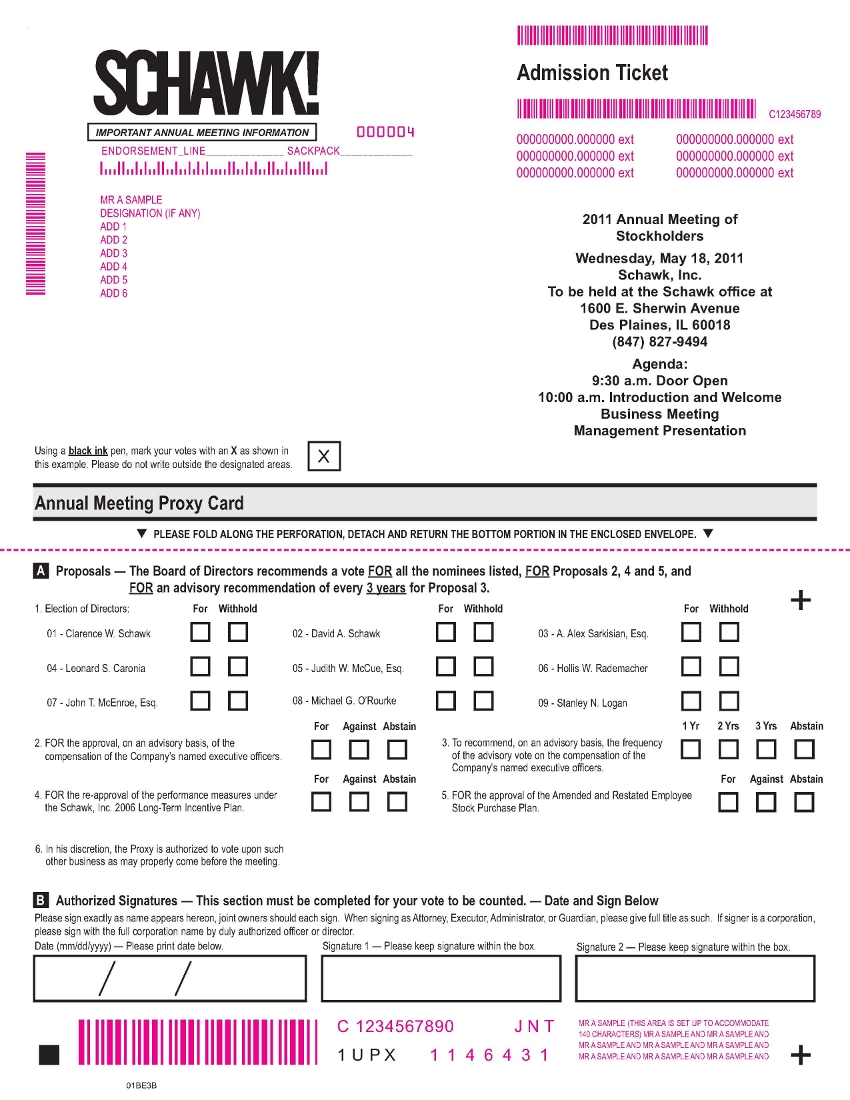
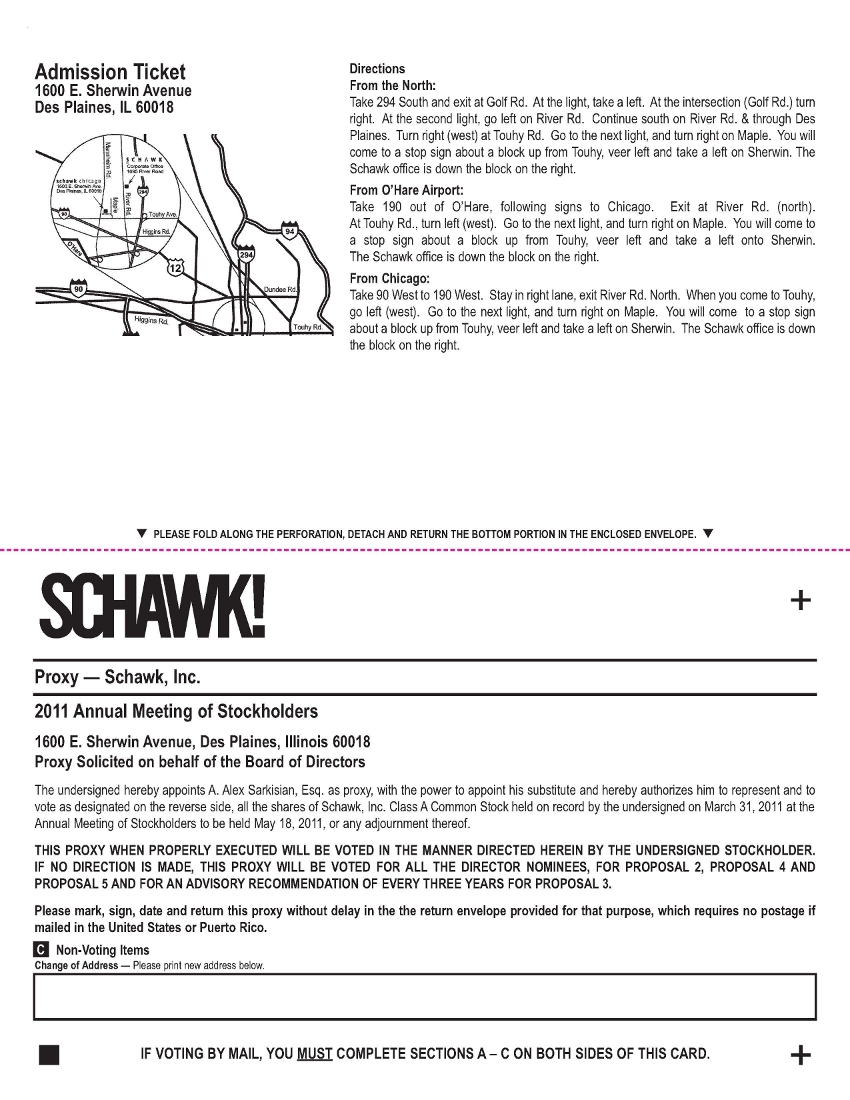
Notice is hereby given that the 2011 Annual Meeting of Stockholders of Schawk, Inc. (the “Company”) will be held at 10:00 a.m. local time, Wednesday, May 18, 2011, at Schawk Des Plaines, 1600 E. Sherwin Avenue, Des Plaines, Illinois, for the following purposes:
|
|
1.
|
To elect nine directors identified in the accompanying proxy statement to the Board of Directors of Schawk, Inc.
|
|
|
2.
|
To approve, on an advisory basis, the compensation of the Company’s named executive officers.
|
|
|
3.
|
To recommend, on an advisory basis, the frequency of holding the advisory vote on the compensation of the Company’s named executive officers.
|
|
|
4.
|
To reapprove the performance measures under the Schawk, Inc. 2006 Long-Term Incentive Plan.
|
|
|
5.
|
To approve the Schawk, Inc. Amended and Restated Employee Stock Purchase Plan to, among other things, increase the maximum amount of Common Stock that a plan participant may purchase annually under the plan.
|
|
|
6.
|
To transact such other business as may properly come before the meeting or any adjournment of the meeting.
|
The close of business on March 31, 2011, has been fixed as the record date for the determination of stockholders entitled to receive notice of and to vote at the Annual Meeting and any adjournment of the meeting. The stock transfer books of Schawk, Inc. will not be closed.
|
By Order of the Board of Directors,
 |
|
|
Des Plaines, Illinois
April 18, 2011
|
A. Alex Sarkisian, Esq.
Executive Vice President
and Chief Operating Officer
|
SCHAWK, INC.
1695 South River Road
Des Plaines, Illinois 60018
(847) 827-9494
PROXY STATEMENT
FOR THE 2011 ANNUAL MEETING OF STOCKHOLDERS
TO BE HELD MAY 18, 2011
INTRODUCTION
This proxy statement is being furnished in connection with the solicitation of proxies by the Board of Directors of Schawk, Inc. (“Schawk” or the “Company”) for use at the 2011 Annual Meeting of Stockholders to be held at 10:00 a.m. local time, Wednesday, May 18, 2011, at Schawk Des Plaines, 1600 E. Sherwin, Des Plaines, Illinois, and at any adjournment thereof (the “Annual Meeting”). This proxy statement and the accompanying proxy are first being mailed on or about April 18, 2011, to stockholders of record at the close of business on March 31, 2011.
Purpose
The purpose of the Annual Meeting is to: (i) elect the Board of Directors of the Company; (ii) approve, by non-binding advisory vote, the compensation of the Company’s named executive officers as described in this proxy statement; (iii) recommend, by non-binding advisory vote, the frequency of the advisory vote on the compensation of the Company’s named executive officers; (iv) reapprove the performance measures under the Schawk, Inc. 2006 Long-Term Incentive Plan; (v) approve the Amended and Restated Employee Stock Purchase Plan; and (vi) transact such other business as may properly come before the meeting or any adjournment of the meeting.
Proxies and Solicitation
Any person signing and mailing the enclosed proxy may revoke the proxy at any time prior to its exercise by: (i) executing a subsequent proxy; (ii) notifying the Corporate Secretary of the Company of such revocation in a written notice received by him at Schawk, Inc., 1695 South River Road, Des Plaines, Illinois 60018, prior to the Annual Meeting; or (iii) attending the Annual Meeting and voting in person.
The cost of solicitation of proxies will be borne by the Company. In addition to the use of the mails, proxies may be solicited personally or by telephone or facsimile by directors of the Company and by executive officers and other employees of the Company. The Company does not expect to pay any compensation for the solicitation of proxies, but may reimburse brokers and other persons holding shares in their names, or in the names of nominees, for their expenses in sending proxy materials to principals and obtaining their proxies. Computershare Investor Services, the transfer agent and registrar of the Company’s Class A Common Stock (the “common stock”), may aid in the solicitation of proxies and will be reimbursed for any expenses incurred as a result of any such activity.
Shares of the Company represented by properly executed proxies will, unless such proxies have been previously revoked, be voted in accordance with the instructions indicated in the proxies. Unless otherwise instructed in the proxy, the agents named in the proxy intend to cast the proxy votes in the following manner: (i) FOR the election of the nominees for the Board of Directors of the Company; (ii) FOR approval, on an advisory basis, of the compensation of the Company’s named executive officers as described in this proxy statement; (iii) FOR a frequency of every three years for future advisory votes
1
on the compensation of the named executive officers; (iv) FOR reapproval of the performance measures under the Schawk, Inc. 2006 Long-Term Incentive Plan; (v) FOR approval of the Amended and Restated Employee Stock Purchase Plan; and (vi) in the best judgment of the persons named in the proxy, as agents, upon any other matters that may properly come before the Annual Meeting.
Quorum Requirements and Voting
The presence, in person or by proxy, of the holders of a majority of the Company’s Class A Common Stock outstanding on the record date is required for a quorum at the Annual Meeting. Abstentions will be treated as shares present and entitled to vote for purposes of determining whether a quorum is present, but will not be voted for purposes of determining the approval of any matter submitted to the stockholders for a vote. With respect to any matter submitted to stockholders for a vote, if a proxy returned by a broker indicates that the broker does not have discretionary authority to vote some or all of the shares covered thereby with respect to such matter, such shares will be considered to be present for purposes of determining whether a quorum is present, but will not be considered to be present and entitled to vote.
As to all anticipated votes, each share of Class A Common Stock will have one vote as to each matter to be voted on at the Annual Meeting. Directors shall be elected by a plurality of the votes cast for the election of directors at the meeting. Approval of other proposals to be considered at the Annual Meeting require the requisite votes indicated under the description of each proposal contained elsewhere in this proxy statement. Stockholders entitled to vote or to execute proxies are stockholders of record at the close of business on March 31, 2011. The Company had 25,891,663 shares of Class A Common Stock outstanding on such date. The stock transfer books of the Company will not be closed.
Interest of Certain Persons in Matters To Be Acted Upon
No other person being nominated as a director is being proposed for election pursuant to any agreement or understanding between any such person and the Company.
Important Notice Regarding the Availability of Proxy Materials for the Annual Meeting of Stockholders To Be Held on May 18, 2011: This proxy statement and our 2010 Annual Report on Form 10-K are available at: www.edocumentview.com/SGK.
PROPOSAL 1
ELECTION OF DIRECTORS
At the Annual Meeting, stockholders will be asked to elect nine directors to the Company’s Board. The size of the Company’s Board of Directors has been fixed at nine members in accordance with the Company’s By-laws.
Each of the director nominees elected at the Annual Meeting will hold office for a term of one year, expiring at the 2012 Annual Meeting of Stockholders, and thereafter until a successor has been duly elected and qualified. Unless authority to vote is withheld, proxies received in response to this solicitation will be voted FOR the election of the nominees named hereafter, each of whom presently serves as a director of the Company. It is not contemplated that any of the nominees will be unable or will decline to serve; however, if such a situation arises, the shares represented by the proxies being solicited will be voted FOR the election of a nominee or nominees designated by the Board of Directors of the Company.
2
Assuming a quorum is present, an affirmative vote of the holders of a plurality of the shares, present and voting at the meeting, is required for a nominee to be elected as a director. A proxy marked to withhold authority for the election of one or more directors will not be voted with respect to the director or directors indicated. Abstentions and shares for which authority to vote is not given will have no effect on the election of directors.
The following is a list of the nominees for election as directors of the Company, all of whom have been nominated by the Board in accordance with its nominating criteria and procedures described below, followed by a brief biographic statement concerning each nominee and a statement concerning each nominee’s specific experience, qualifications, attributes or skills that helped lead to a determination he or she should serve as a director in light of the Company’s business and structure.
|
Nominees for Election as
Directors of the Company
|
|
Clarence W. Schawk
|
|
David A. Schawk
|
|
A. Alex Sarkisian, Esq.
|
|
Judith W. McCue, Esq.
|
|
John T. McEnroe, Esq.
|
|
Hollis W. Rademacher
|
|
Leonard S. Caronia
|
|
Michael G. O’Rourke
|
|
Stanley N. Logan
|
Clarence W. Schawk, 85, has been Chairman of the Board of the Company since September 1992, when he was also appointed to the Executive Committee. He served as Chief Executive Officer of Filtertek Inc., the Company’s predecessor (“Filtertek”), from September 1992 until February 1993. Clarence W. Schawk also served as Chairman of the Board of the corporation previously known as Schawk, Inc. (“Old Schawk”) from 1953 until the merger (the “Merger”) of Old Schawk and affiliated companies into Filtertek in 1994 and served as Chief Executive Officer until June 1994. He is the father of David A. Schawk, President and Chief Executive Officer of the Company. Clarence W. Schawk previously served as President and a Director of the International Prepress Association. Mr. Schawk also served as a Director of Old Schawk until the Merger. Mr. Schawk’s qualifications to serve on the Board of Directors include his significant history with and commitment to the Company and his extensive experience in and knowledge of the Company’s industry, which provides the Board with a unique insight into the Company and its business. Mr. Schawk also is a member of the Schawk family, which holds a controlling interest in the Company’s common stock.
David A. Schawk, 55, was appointed Chief Executive Officer and President in February 1993. He served as Chief Operating Officer of the Company from September 1992 through February 2004. He was appointed to the Board of Directors in September 1992 and currently serves on its Executive Committee. Mr. Schawk served as the President of Old Schawk from 1987 until the Merger and is the son of Clarence W. Schawk. David A. Schawk currently serves as a Director of the International Prepress Association. Mr. Schawk also served as a Director of Old Schawk until the Merger. Mr. Schawk’s qualifications to serve on the Board of Directors include his experience with the Company, as Chief Executive Officer and in prior positions with the Company, and his extensive knowledge of the Company’s industry. This experience and knowledge adds critical perspective to all aspects of the Board’s decision-making, including in areas of strategy, operations and finance. Mr. Schawk also is a member of the Schawk family, which holds a controlling interest in the Company’s common stock.
3
A. Alex Sarkisian, Esq., 59, was appointed Chief Operating Officer in March 2004 and was appointed Executive Vice President in 1994. Mr. Sarkisian has served on the Company’s Board of Directors and as Corporate Secretary since September 1992. Mr. Sarkisian was the Executive Vice President and Secretary of Old Schawk from 1988 and 1986, respectively, until the Merger. Mr. Sarkisian also served as a Director of Old Schawk until the Merger. He is a member of the Executive Committee. Mr. Sarkisian’s qualifications to serve on our Board of Directors include his experience with the Company, as Chief Operating Officer and in prior positions with the Company, and his extensive knowledge of the Company’s industry. Mr. Sarkisian’s experience and skills as Chief Operating Officer provide the Board with first-hand knowledge and insight regarding the Company’s operations and client-base as well as developments in the Company’s and its clients’ industries that have an impact on Board oversight and decision-making.
Judith W. McCue, Esq., 63, has been a partner with McDermott Will & Emery LLP since 1995. Prior thereto, Ms. McCue was a partner with Keck, Mahin & Cate where she practiced from 1972 to 1995. Ms. McCue was appointed Director of the Company in September 1992 and is a member of the Audit and Option/Compensation Committees. Ms. McCue’s 17 years of service to the Company as a director, her knowledge of the Company’s business, operations and risks and her legal acumen provide the Board with informed perspectives that help guide the Board’s decision-making and oversight functions.
John T. McEnroe, Esq., 59, has been a shareholder with the law firm of Vedder Price P.C., counsel to the Company, since May 1992. Prior to this position, he was a partner with the law firm of Keck, Mahin & Cate where he practiced from 1976 to 1992. Mr. McEnroe was appointed a Director of the Company in September 1992 and is a member of the Executive and Option/Compensation Committees. Mr. McEnroe’s service to the Company as its principal outside counsel facilitates bringing to the Board’s attention key legal and business issues as the Board fulfills its duties, including its risk oversight responsibilities, and provides the Board with opportunities to receive current legal perspectives in the course of its deliberations on and oversight of the Company’s affairs.
Hollis W. Rademacher, 75, was appointed a Director of the Company in 1994 and is a member of the Executive and Option/Compensation Committees and serves as Chairman of the Audit Committee. He held various positions with Continental Bank, N.A., Chicago, Illinois, from 1957 to 1993 and was Chief Financial Officer of Continental Bank Corporation, Chicago, Illinois, from 1988 to 1993. Mr. Rademacher is currently self-employed in the fields of consulting and investments in Chicago, Illinois. Mr. Rademacher also serves as a director of Wintrust Financial Corporation (NasdaqGS: WTFC) and its various subsidiaries and, prior to its merger with Fairfax Financial Holdings, Ltd., in February 2011, First Mercury Financial, together with several other privately held companies. Mr. Rademacher’s 16 years of experience as a director of the Company, his service as Chairman of the Audit Committee, and the resultant knowledge he has obtained of the Company’s industry, along with his prior experience as chief financial officer at a publicly held company and his service on the boards of directors of other publicly held firms brings a depth of experience and financial and accounting skills to the Board as well as to the Audit Committee.
Leonard S. Caronia, 59, was appointed a Director of the Company in October 2000. Mr. Caronia has served as co-chairman of the global financial institutions business of Macquarie Capital since the November 2009 acquisition by Macquarie Group of Fox-Pitt Kelton Cochran Caronia Waller, an investment banking firm for which he served as Chairman. Mr. Caronia was a co-founder and Managing Director of Cochran Caronia Waller prior to its merger with Fox-Pitt, Kelton in September 2007. Prior to forming his company in 1997, Mr. Caronia served as Managing Director of Coopers & Lybrand Securities, LLC. Prior to that, Mr. Caronia was employed at First Chicago Corporation from 1980 until 1993 and was Corporate Senior Vice President and Head of Investment Banking. He is also a member of
4
the Option/Compensation Committee. Mr. Caronia’s skills acquired as an advisor for many years to firms across various industries provides the Board with knowledge unique to other members of the Board, particularly in the areas of strategic initiatives and acquisitions.
Michael G. O’Rourke¸ 42, was appointed a Director in February 2007 and is a member of the Audit Committee. Mr. O’Rourke currently serves as President and Chief Executive Officer of Signature Bank located in Chicago, Illinois. He previously served as Executive Vice President and Manager of Commercial Lending and Commercial Real Estate at Associated Bank Chicago from 2001 until 2005, when he left to organize Signature Bank. Mr. O’Rourke has a strong background working with entrepreneurial companies as a commercial lender and as the founder and president of a bank start-up in Illinois and accordingly brings perspectives gleaned from his particular experiences in those roles as well as his financial expertise to bear on Board duties and deliberation.
Stanley N. Logan, 56, was appointed a Director in November 2007 and is a member of the Audit Committee. Mr. Logan served as a managing director for LECG Corporation (NasdaqGS: XPRT), responsible for the Chicago and Asia/Pacific regions, from February 2010 to March 2011. Prior to joining LECG, Mr. Logan served as a vice president of Huron Consulting Group (NasdaqGS: HURON) and headed Huron’s Western Region and Japan. Prior to joining Huron, Mr. Logan was managing partner of KPMG’s Chicago office. He also served as National Sector Leader for Consumer Products at KPMG. Before joining KPMG in 2002, Mr. Logan held a number of significant client and leadership roles at Arthur Andersen in Chicago. He has held audit and nonaudit lead partner roles with large corporations in the consumer, retail and industrial spaces throughout his career at both KPMG and Arthur Andersen. With over 30 years in the consulting and public accounting professions, Mr. Logan has financial and accounting expertise and experience in global-account related matters, which provides a valuable perspective to the Board as the Company’s business continues to expand globally.
The Board of Directors recommends a vote FOR the election of the nominees
named in this proxy statement.
The following is a brief biographical statement of Timothy J. Cunningham, the Chief Financial Officer of the Company:
Timothy J. Cunningham, 57, was appointed Executive Vice President and Chief Financial Officer of the Company in September 2008. Mr. Cunningham joined the Company in March 2008 as an advisor to the Chief Executive Officer, was appointed Vice President, Finance in April 2008, and served as the Company’s Interim Chief Financial Officer and Chief Accounting Officer from June 2008 until September 2008. He previously served as chief financial officer of Pregis Corporation, a packaging solutions company, from May 2006 until September 2007, and in a transitional role with Pregis until December 2007. Prior to joining Pregis, Mr. Cunningham served as the interim chief financial officer of a $1.4 billion division of a $12 billion food company from February 2005 to April 2006. From November 1999 though January 2005, he was with eLoyalty Corporation, an enterprise customer relationship management services and solutions company, serving most recently as vice president and chief financial officer. Mr. Cunningham formerly was a partner with Tatum LLC, a consulting and executive services firm, from February 2005 until April 2006 and from January 2008 until September 2008. He is a member of the American Institute of Certified Public Accountants and the Illinois CPA Society, and has a BBA in Accountancy from the University of Notre Dame and a Master of Business Management from Northwestern University, Kellogg Graduate School of Management.
Officers are elected by the Board of Directors at the first meeting of the newly elected Board of Directors held after each Annual Meeting.
5
CORPORATE GOVERNANCE
Meetings of the Board of Directors; Leadership Structure
The Board of Directors is responsible for the overall affairs of the Company. The Board of Directors held six meetings in 2010. Each member of the Board of Directors attended at least 75% of the total number of meetings of the Board of Directors and of all committees of the Board of Directors on which such Director served, except Clarence Schawk who was unable to attend two board meetings. The Board of Directors has a policy requiring director attendance at the annual meeting of stockholders. All members of the Board of Directors attended the 2010 Annual Meeting.
Executive Sessions. Meetings of non-employee directors are held in which such directors meet without management participation, with the non-employee directors rotating presiding over such meetings. Non-employee directors include all independent directors as well as any other directors who are not officers of the Company, whether or not “independent” by virtue of a material relationship with the Company or otherwise. Interested parties may communicate directly with the non-employee directors as a group or to the presiding director by addressing their correspondence to Mr. John T. McEnroe, c/o Schawk, Inc., 1695 South River Road, Des Plaines, Illinois 60018.
Leadership Structure and Risk Oversight. The Company’s Chairman of the Board of Directors position is held by Mr. Clarence W. Schawk, and the Chief Executive Officer position is held by Mr. David A. Schawk, who also serves as a director of the company. Clarence Schawk served as the Chief Executive Officer of the Company for 40 years, has served on the Board of Directors for over 50 years, and is the Company’s largest shareholder. Given his wealth of industry and executive management experience and his extensive knowledge of the history and operations of the Company, the Company believes that Mr. Schawk is the best suited to lead the Board, and this Board leadership structure is the most appropriate for the Company.
As part of the Board’s responsibilities, the entire Board is engaged in risk oversight, including reviewing management’s operational and financial planning and associated risks. Additionally, the Audit Committee of the Board specifically oversees the identification and management of business and financial risks, including management’s plans to address and prepare for risks identified in the Company’s comprehensive business risk assessment. The Audit Committee also has been actively involved over the past several years in overseeing the Company’s efforts to remediate weaknesses in and strengthen the Company’s disclosure and internal controls to better ensure safeguards against financial, legal and operational risks. Both the Chief Financial Officer and the Company’s internal audit function may report directly to the Audit Committee regarding the Company’s risk management activities.
As part of its oversight of the Company’s compensation programs, the Option/Compensation Committee, in considering annual changes and improvements in the Company’s compensation practices, also will consider risks associated with the compensation paid to its executives and other employees and any propensity to incentivize inappropriate risk-taking. The Company believes that its historical compensation practices serve to mitigate risk principally by (1) providing that a significant portion of an officer’s compensation (e.g., his or her base salary) be fixed, rather than variable or performance-based, to disincentive personnel from taking unnecessary or excessive risks; (2) using objective, company-wide targets, such as operating income and earnings per share, as substantial components of the performance measures underlying performance-based awards, instead of performance measures based on disparate business-unit performance goals or that vary significantly in type among personnel; (3) linking a significant portion of executive compensation to rolling three-year operating income and earnings-per-share targets, which is intended to encourage behavior that focuses on the Company’s long-term growth and profitability rather than short-term results; and (4) limiting the maximum annual cash bonus
6
opportunity at one times base salary regardless of the level of achievement over the maximum performance goal. Accordingly, the Company does not believe that its compensation policies and practices for its employees are reasonably likely to have a material adverse effect on the Company.
Director Independence
The Board of Directors of the Company has determined that Judith W. McCue, Hollis W. Rademacher, Michael G. O’Rourke and Stanley N. Logan are “independent directors”. The Board of Directors has affirmatively determined that none of the current independent directors has a material relationship with the Company (either directly as a partner, stockholder or officer of an organization that has a relationship with the Company). In making such a determination the Board of Directors applied the standards set forth in Rule 303A.02(b) of the New York Stock Exchange Listed Company Manual and those set forth in the Company’s Corporate Governance Guidelines, a copy of which is available on the Company’s website at www.schawk.com. The remaining members of the Board of Directors are not considered independent.
In reaching the Board’s independence determinations, each director’s background is reviewed for any possible material affiliations with, or any compensation received (other than compensation for service on the Company’s Board of Directors or committees thereof) from, the Company, including those affiliations described under “Transactions with Related Persons” in this proxy statement. In addition, in assessing the independence of Mr. O’Rourke, the Board considered the equity investments made by certain members of the Company’s executive management in Signature Bank, for which Mr. O’Rourke serves as chief executive officer, and in assessing the independence of Mr. Rademacher, was aware that North Shore Community Bank & Trust Company, a subsidiary of Wintrust Financial Corporation on whose board of directors Mr. Rademacher serves, is part of the syndicate of lenders under the Company’s current revolving credit facility. The Board of Directors determined that all of the independent directors were “independent” for purposes of the New York Stock Exchange listing standards and the Company’s Corporate Governance Guidelines because, during the past three years, no independent director (or any member of an independent director’s immediate family) has:
|
·
|
been employed by the Company or any subsidiary;
|
|
·
|
accepted direct compensation from the Company or any subsidiary in excess of $120,000 during any of the last three fiscal years, or plans to accept such payments in the current fiscal year (other than compensation for board or committee service and pension or other forms of deferred compensation for prior service);
|
|
·
|
been affiliated with or employed by an auditor (present or former) of the Company or an affiliate of the Company;
|
|
·
|
been employed as an executive officer of another entity where at any time during the past three years any of the Company’s executive officers served on that entity’s compensation committee; or
|
|
·
|
been employed as an executive officer of an entity (including charitable organizations) that made payments to, or received payments from, the Company for property or services in the current or any of the past three fiscal years that exceed the greater of $1 million or 2% of such other entity’s consolidated gross revenues for that year.
|
The Board of Directors has determined that the Company is a “controlled company,” as defined by the NYSE listing standards, as more than 50% of the voting power of the Company’s common stock is
7
held by members of the Schawk family and in trusts for the benefit of Schawk family members. As a result, the Company is exempt from certain requirements of the listing standards, including the requirement to maintain a majority of independent directors on the Company’s Board of Directors and the requirements regarding the determination of compensation of executive officers and the nomination of directors by independent directors.
Committees
The Board of Directors currently has an Executive Committee, an Audit Committee, and an Option/Compensation Committee, whose members are directors appointed by the Board of Directors. The Board of Directors has determined that because it is a controlled company, it is not necessary to have a standing Nominating Committee and the entire Board of Directors acts in this capacity.
Executive Committee. The present members of the Executive Committee are: Clarence W. Schawk, David A. Schawk, A. Alex Sarkisian, John T. McEnroe and Hollis W. Rademacher. The Executive Committee is authorized to act on behalf of the Board of Directors in the management of the business and the affairs of the Company as may be necessary or advisable from time to time.
Audit Committee. Hollis W. Rademacher, Stanley N. Logan, Judith W. McCue and Michael G. O’Rourke currently serve as members of the Audit Committee. The Audit Committee, which operates under a written charter, recommends the selection of the Company’s independent public accountants, reviews and approves their fee arrangements, examines their detailed findings and reviews areas of possible conflicts of interest and sensitive payments. The Board of Directors has adopted a written charter for the Audit Committee that outlines the responsibilities and processes of the Audit Committee, a copy of which is available on the Company’s website. The Board of Directors has determined that the members of the Audit Committee are “independent” directors as such term is defined in the NYSE’s listing standards, as currently in effect, and each member meets the SEC’s heightened independence requirements for audit committee members. The Board of Directors has determined that Mr. Rademacher and Mr. Logan each is an “audit committee financial expert” as that term is defined in Item 407(d)(5)(ii) of Regulation S-K under the Securities Act. The designation of an “audit committee financial expert” does not impose on Mr. Rademacher or Mr. Logan any duties, obligations or liability greater than those that are generally imposed on them as members of the Audit Committee and of the Board of Directors. The Audit Committee met in person or telephonically eight times in 2010.
Option/Compensation Committee. The Option/Compensation Committee members are Judith W. McCue, Hollis W. Rademacher, John T. McEnroe and Leonard S. Caronia. The Option/Compensation Committee is responsible for reviewing and recommending the compensation of the Company’s executive officers, including the Chief Executive Officer, and reviewing and recommending director compensation. The Option/Compensation Committee evaluates the performance of key personnel and makes incentive awards in the form of stock options and other equity and cash-based long-term incentive awards under the Company’s incentive plan. The Compensation Committee also advises and assists management in formulating policies regarding compensation and submits its Compensation Discussion and Analysis included elsewhere in this proxy statement. The Compensation Committee currently does not operate under a written charter. The Option/Compensation Committee met in person or telephonically two times in 2010.
Director Compensation
Each non-executive member of the Board (except for Mr. McEnroe) is entitled to receive an annual retainer of $20,000, a fee of $1,150 for attendance at each board meeting and a fee of $600 for
8
attendance at each meeting of a committee of the Board on which such director serves. All directors are also reimbursed for ordinary and necessary expenses incurred in attending Board or committee meetings.
The Company’s Outside Directors’ Plan provides that each “outside director” (defined in the Outside Directors’ Plan as any director who is not a compensated employee of the Company) receive a nonqualified stock option to purchase 2,500 shares of Company common stock upon his or her election, and any subsequent reelection, to the Board of Directors at an exercise price equal to the fair value of such shares on the date of election or reelection as a director. Only the number of shares specified by the formula under the Outside Directors’ Plan is eligible for grant under the Outside Directors’ Plan. The options granted to the outside directors are exercisable for a term of 10 years from the date of grant and vest in one-third increments on the date of grant and on the first and second anniversaries of the date of grant.
The following table sets forth information regarding the fees paid to the Company’s directors in 2010 (other than directors who are also named executive officers) and option expense incurred by the Company in connection with their service as directors during 2010.
|
Name
|
Fees earned or paid in cash
($)
|
Option
Awards(1)
($)
|
Total
($)
|
|||||||||
|
Clarence W. Schawk
|
— | (2) | — | — | ||||||||
|
Judith W. McCue
|
29,950 | 22,250 | 52,200 | |||||||||
|
John T. McEnroe
|
— | 22,250 | 22,250 | |||||||||
|
Hollis W. Rademacher
|
29,950 | 22,250 | 52,200 | |||||||||
|
Leonard S. Caronia
|
24,600 | 22,250 | 46,850 | |||||||||
|
Michael G. O’Rourke
|
29,950 | 22,250 | 52,200 | |||||||||
|
Stanley N. Logan
|
29,950 | 22,250 | 52,200 | |||||||||
_______________
|
(1)
|
Represents the total grant date fair value of option awards computed in accordance with FASB ASC Topic 718.
|
|
|
The following table shows the aggregate number of option awards outstanding to the directors shown above as of December 31, 2010:
|
|
(2)
|
Does not include amounts Mr. Schawk received pursuant to existing agreements with the Company. See “Executive Compensation – Employment Agreements.”
|
|
Name
|
Outstanding Option Awards
|
|||
|
Clarence W. Schawk
|
50,000 | |||
|
Judith W. McCue
|
42,500 | |||
|
John T. McEnroe
|
42,500 | |||
|
Hollis W. Rademacher
|
42,500 | |||
|
Leonard S. Caronia
|
42,500 | |||
|
Michael G. O’Rourke
|
17,500 | |||
|
Stanley N. Logan
|
9,200 | |||
Director Nomination Criteria and Procedures
Criteria for Board Nomination. The Board considers the appropriate balance of experience, skills, and characteristics required of the Board of Directors and seeks to insure that members of the Company’s Audit Committee are independent and meet the financial literacy requirements under the rules of the New York Stock Exchange and the SEC’s heightened independence requirements. Nominees for director are selected on the basis of their depth and breadth of experience, wisdom, integrity, ability to make independent analytical inquiries, understanding of the Company’s business, and willingness to devote adequate time to Board duties. A board of directors that is diverse in opinion, experience, skills and professional background also is recognized as an important attribute to a effective board. While the
9
Company believes the current Board reflects such diversity, board diversity considerations are not typically a key consideration in evaluating nominees. Because qualified incumbent directors generally can provide the benefits of continuity of leadership and seasoned judgment gained through experience as a director of the Company, the Board typically considers as potential candidates incumbent directors interested in standing for re-election, provided that the Board believes they have satisfied director performance and participation expectations.
Board Nomination Process. The process for identifying and evaluating nominees to the Board of Directors begins with a slate of candidates who meet the criteria for selection as a nominee and have the specific qualities or skills being sought based on input from members of the Board. The Board generally considers renomination of incumbent directors, provided they continue to meet the qualification criteria adopted by the Board of Directors. New director candidates are evaluated by reviewing the candidates’ biographical information and qualification and checking the candidates’ references. Qualified new candidates are interviewed by at least the Chairman of the Board. The Board evaluates which of the prospective candidates is qualified to serve as a director and should be nominated or appointed to fill a vacancy. Candidates selected by the Board as nominees are then presented for the approval of the stockholders or for appointment to fill a vacancy.
Stockholder Recommendations. The Board uses a similar process to evaluate candidates recommended by stockholders. To date, however, the Company has not received any stockholder proposal to nominate a director.
To recommend a prospective nominee for the Board’s consideration, please submit the candidate’s name and qualifications to the Board of Directors of Schawk, Inc., 1695 South River Road, Des Plaines, Illinois 60018. Submissions must contain: (a) the proposed nominee’s name and qualifications (including five year employment history with employer names and a description of the employer’s business, whether such individual can read and understand basic financial statements, and board memberships (if any)) and the reason for such recommendation, (b) the name and the record address of the stockholder or stockholders proposing such nominee, (c) the number of shares of stock of the Company which are beneficially owned by such stockholder or stockholders, and (d) a description of any financial or other relationship between the stockholder or stockholders and such nominee or between the nominee and the Company or any of its subsidiaries. The submission must be accompanied by a written consent of the individual to stand for election if nominated by the board and to serve if elected by the stockholders. Recommendations received by December 21, 2011, will be considered for nomination at the 2012 Annual Meeting of Stockholders. Recommendations received after December 21, 2011, will be considered for nomination at the 2013 Annual Meeting of Stockholders.
COMPENSATION DISCUSSION AND ANALYSIS
Objectives of Schawk’s Compensation Program
Schawk’s compensation program seeks to enhance the profitability of the Company, and thus stockholder value, by aligning the financial interests of the Company’s senior executive officers with those of its stockholders. It is designed to reward superior performance by linking a significant portion of each senior executive officer’s compensation to the achievement of the Company’s financial and performance goals. In addition to these goals, the Company’s compensation program seeks to attract and retain highly qualified senior officers and other key employees.
10
Overview of the Compensation Program
The Option/Compensation Committee (referred to in this discussion as the “Committee”) of the Board of Directors of the Company has the responsibility for establishing, granting awards under, and monitoring the compensation and benefit programs of the Company and ensuring adherence with the Company’s compensation objectives. The Committee has the authority to review, determine and, at its discretion, adjust the annual compensation, including base salary and bonuses, for the senior executive officers of the Company, including the named executive officers for 2010: David A. Schawk, President and Chief Executive Officer; A. Alex Sarkisian, Executive Vice President and Chief Operating Officer; and Timothy J. Cunningham, Executive Vice President and Chief Financial Officer. The Committee also has the authority to make grants of long-term incentive awards to senior executive officers under the Company’s incentive plan.
In performing its duties and determining compensation for the senior officers, including the named executive officers, the Committee considers the recommendations and input of the Company’s Chief Executive Officer, Chief Operating Officer, Chief Financial Officer and Senior Vice President, Global Human Resources, with respect to the Company’s executive compensation program and arrangements. These officers are involved in the compensation process by recommending general compensation arrangements and components, providing input on materials to be presented to the Committee, evaluating employee performance and recommending business goals to serve as a basis for the Company’s performance-based compensation. In particular, the Company’s Chief Executive Officer assists with evaluating senior officer performance and provides background regarding the Company’s business and strategic goals that have a bearing on the Committee’s compensation decisions, although he did not attend any meetings of the Committee during 2010.
The Committee typically seeks to establish compensation levels of its senior officers, in the aggregate and for each principal component of compensation, near the median compensation of senior executives of comparable companies comprising a general survey group. The Committee believes that these target levels allow the Company to remain competitive in recruiting and retaining talent while still providing an effective link between compensation and achievement of the Company’s financial and performance goals. Decisions made with respect to 2010 compensation, however, also were driven by the desire to reverse certain compensation reduction measures that had been taken in 2009 in response to the impact and uncertainty of the global economic recession on the Company’s business, as more fully described below.
Compensation Surveys
2010 Survey Data. For 2010, consistent with prior years’ practice of seeking to maintain total compensation and each material element of compensation near a market median, the base salary, target annual cash bonus and long-term incentive compensation (“LTI”) for each of the named executive officers placed them at or slightly above median market compensation levels based on a general survey of compensation further described below. In establishing 2010 target compensation, the Committee relied on an analysis of the competitiveness of the Company’s compensation arrangements that had been prepared by Towers Watson, a third-party compensation consultant retained by the Company. Consistent with the Company’s historical practice of updating the market survey analysis on a biennial or less frequent basis and given the expected uncertain effects that the global economic downturn would have on competitive compensation levels in 2009, neither the Company nor the Committee retained a compensation consultant in 2009.
For 2010, Towers Watson provided an update on the analysis of the competitiveness of the Company’s executive compensation arrangements that it had provided in 2008. Consistent with its 2008
11
assessment, Towers Watson gathered competitive compensation data for companies within two market samples. The primary sample was a general industry group comprised of over 700 public and private companies across various industries in Towers Watson’s 2009 CDB General Industry Executive Database (the “2010 Survey Group”), a listing of which is included as Appendix A-1 to this proxy statement.
To provide an industry-specific perspective, Towers Watson also gathered competitive compensation data for a market sample that focused on professional services firms and advertising companies from the following published survey sources: Watson Wyatt’s 2009/2010 Survey Report of Marketing Personnel Compensation, Watson Wyatt’s 2009/2010 Top Management Comp Calculator and William M. Mercer’s 2009 Executive Compensation Survey. This survey data was not referenced with respect to the named executive officers as it primarily was used as a reference point for those Company positions that did not correlate with comparable positions in the 2010 Survey Group.
With respect to the named executive officers, survey data was size-adjusted to reflect revenues of approximately $500 million. The Committee deemed data reflecting this revenue size to be more in-line with the Company’s revenues over the past several years, which reflected, in part, the adverse effect of the global economic downturn on the Company’s business and growth plans. Accordingly, given the general correlation between revenues and compensation, with larger companies generally paying more than smaller companies to similarly situated executives, survey data that better correlates with the Company’s recent revenue levels was expected to result in more competitive compensation levels for the Company’s named executive officers.
Towers Watson compared the principal components of compensation of each of the Company’s named executive officers—base salary, target bonus, target total cash compensation (base salary plus target annual incentives), long-term incentives, and target total direct compensation (target total cash compensation plus long-term incentives)—against these elements of compensation paid to similarly positioned officers of companies within the 2010 Survey Group described above. Similar to the 2008 assessment, for all compensation survey information, Towers Watson provided only aggregate data (i.e., 25th, 50th and 75th percentile statistics) and did not provide data specific to any individual company.
For 2010, based on a comparison against the 2010 Survey Group described above, the total base salary, target annual cash bonus and LTI for each of the named executive officers (other than Mr. Schawk) placed them slightly above the median with respect to total base salary, target cash bonus and LTI, respectively, of the 2010 Survey Group, and slightly below the median with respect to Mr. Schawk. However, adjusting the survey data to assume a general industry sample of companies with revenues near $1 billion, the base salary, target annual cash bonus and LTI for each of the named executive officers placed them below the median for each component of pay.
In determining compensation, the Committee also may take into account other factors, such as individual performance, the weighting of each component of compensation and the compensation history of the individual and the Company, as well as management’s recommendations and internal data, when setting compensation levels. Accordingly, the Committee may deviate from its general practice of seeking to target compensation at or near the median compensation of the survey data in light of other factors. For 2010, no material deviations were made except with respect to Mr. Cunningham’s long-term incentives as described below.
2011 Survey Data. For 2011, the Company engaged Grant Thornton to conduct a study of the market competitiveness of the compensation of the named executive officers as well as other officers of the Company. For purposes of determining market competitive data for the roles of the named executive officers, Grant Thornton developed a primary peer group of 16 publicly traded companies with median annual revenues of approximately $524 million (as compared to the Company’s 2010 revenues of
12
approximately $461 million) in industries that correlate with the Company’s business, such as business and professional services, commercial printing solutions, marketing and consulting (the “2011 Survey Group”). A listing of these companies appears on Appendix A-2 to this proxy statement. In addition, Grant Thornton developed a supplementary peer group comprising companies with a median revenues of approximately $1 billion. In order to determine market competitive data for certain executives other than the named executive officers, Grant Thornton also used data from several widely published surveys: Watson Wyatt’s 2010/2011 Survey Report on Top Management Compensation; 2010 US Mercer Benchmark Database – Executive; and Economic Research Institute’s October 2010 (ERI) Executive Compensation Survey.
For each of the named executive officers, Grant Thornton compared the principal components of compensation—base salary, target bonus, target total cash compensation (base salary plus target annual incentives), long-term incentives, and target total direct compensation (target total cash compensation plus long-term incentives)—against elements of compensation paid to similarly positioned officers of companies within the 2011 Survey Group. Grant Thornton provided only aggregate data (i.e., 25th, 50th and 75th percentile statistics) and did not provide data specific to any individual company.
In comparing the principal elements of the named executive officer’s 2011 compensation against the 2011 Survey Group, the base salary for each of the named executive officers was slightly above the median, the target cash bonus for each of the named executive officers was slightly below the median and the LTI target opportunity was at the median. In comparing these elements of compensation against Grant Thornton’s $1 billion survey group, the base salary, target annual cash bonus and LTI for each of the named executive officers placed them below the median for each component of pay.
Overview of the Principal Elements of the Company’s Senior Executive Compensation
To meet its objectives, Schawk has designed a total compensation package for senior executive officers that includes:
|
·
|
base salary
|
|
·
|
annual cash bonus
|
|
·
|
long-term incentives, comprised of three components:
|
|
·
|
stock options
|
|
·
|
restricted stock
|
|
·
|
performance awards
|
The Committee also considers income deferral, life insurance, retirement/post-employment and other benefits as important facets of its compensation package.
The Committee believes that each of these principal elements of total compensation contributes to one or more of the goals the Committee seeks to achieve through its compensation program:
|
·
|
Base salaries. The Company provides the opportunity for the senior executive officers to earn a market competitive annual base salary in order to attract and retain highly qualified individuals and to provide a base wage that is not subject to Company-performance risk.
|
13
|
·
|
Annual and long-term incentive awards. The Company relies to a large degree on an annual bonus, if any, and long-term equity and cash incentives to attract and retain its senior executive officers and key employees. The Committee also uses these awards to motivate its senior officers, on an individual basis and collectively as a team, to achieve annual financial goals and longer term Company performance goals. Both annual and long-term incentive compensation are closely tied to the performance of the Company and the individual in a manner that the Committee believes encourages a sharp and continuing focus on building profitability and improving the opportunities for greater stockholder value.
|
|
·
|
Other benefits. Providing retirement benefits, income deferral and other benefits is consistent with Schawk’s desire and ability to attract and retain skilled executives and recognizes that similar benefits are commonly provided at other companies that it competes with for talent.
|
Base Salaries
In setting annual base salaries and in determining the basis for any base salary increases, the Committee reviews survey data and considers individual and Company performance and the recommendations submitted by the Chief Executive Officer and other members of management. For the named executive officers, base salaries reflect the Committee’s desire to establish salaries at or near the median of the base salary range for the survey group companies.
In February and August 2010, new base salaries were approved for Messrs. Schawk, Sarkisian and Cunningham. The base salaries at the end of 2010 reflected the restoration of the 10% decrease in base salary for Mr. Schawk and the 5% decrease in base salaries for Messrs. Sarkisian and Cunningham that occurred in 2009. The Committee had reduced base salaries in 2009 as part of the Company’s overall commitment to reduce operating costs in light of the then current and foreseeable adverse economic conditions affecting the Company.
The table below reflects base salaries and percentage increases in base salary for the Company’s named executive officers in 2010.
|
Name
|
2009
|
February
2010
|
Percent
Increase
|
August
2010
|
Percent
Increase
|
|||||||||||||||
|
David A. Schawk
|
$ | 535,500 | $ | 571,200 | 6.7 | % | $ | 595,000 | 4.2 | % | ||||||||||
|
A. Alex Sarkisian
|
418,000 | 431,200 | 3.2 | 440,000 | 2.0 | |||||||||||||||
|
Timothy J. Cunningham
|
356,250 | 367,500 | 3.2 | 375,000 | 2.0 | |||||||||||||||
The base salaries at the end of 2010 were at or slightly above the median base salaries of similarly situated executives in the companies comprising the 2010 Survey Group.
No adjustments have been made to 2011 base salaries for Messrs. Schawk, Sarkisian and Cunningham, which are expected to remain the same as the base salaries for 2010. The current 2011 base salaries are slightly above the median base salaries of similarly situated executives in the companies comprising the 2011 Survey Group.
14
Annual Bonuses
As part of each named executive officer’s compensation package, the Company provides them with an incentive to maintain high performance and to achieve certain annual Company financial goals through opportunities to earn cash bonuses each year. Consistent with prior years, the Committee chose achievement of targeted levels of consolidated operating income (net operating profit), or “COI,” as the performance measure by which 2010 annual award opportunities may be earned. The Committee determined that, for 2010, COI remained a good indicator of enhanced shareholder value. Each named executive officer’s bonus opportunity amount is based on a percentage of his annual base salary. Depending on the level of achievement of the established COI target, each named executive officer is eligible to earn a threshold, target or maximum level of bonus award. For 2010, Mr. Schawk was eligible to receive a bonus equal to 45% of his base salary upon achievement of a threshold level of COI, up to 75% of base salary upon achievement of up to the target COI and up to 100% of base salary upon achievement of up to a maximum level of COI. For Messrs. Sarkisian and Cunningham, the amount payable upon achieving the threshold, target or maximum COI level was 40%, up to 60% and up to 90%, respectively, of base salary. The higher level of bonus opportunity as a percentage of base salary for Mr. Schawk in comparison to Messrs. Sarkisian and Cunningham reflects consistency with the allocations among the 2010 Survey Group companies and the Committee’s determination that a higher percentage of performance-based compensation relative to base salary should be attributed to Mr. Schawk.
In 2010, the Company achieved a COI (before payout of bonuses) of $51.18 million, which exceeded the threshold COI goal for 2010 but was approximately 96% of the target goal of $53.27 million. Accordingly, bonuses of slightly less than the target opportunity were paid to the named executive officers in 2011: $428,846 for Mr. Schawk, $253,704 for Mr. Sarkisian and $216,225 for Mr. Cunningham.
For 2011, the Committee approved the annual performance targets to be used for the 2011 annual bonus opportunity. As in 2010, a key performance measurement will be COI; however, the Committee determined that including additional types of performance metrics would encourage increased focus on other areas of the Company’s business that contribute to growth and shareholder value. Accordingly, the Committee approved for the named executive officers an annual bonus opportunity for 2011 based primarily on the achievement of a COI goal, with a smaller portion based on the achievement of company-wide revenue growth goals and, for Mr. Cunningham, key milestones with respect to the implementation of the Company’s information technology and business process improvement initiative.
Long-Term Incentives
The following discussion contains statements regarding future individual and Company performance targets and goals. These targets and goals are disclosed in the limited context of the Company’s compensation programs and should not be viewed as statements of management’s expectations concerning the Company’s future results, or as earnings or other financial guidance. We specifically caution investors not to apply these statements to other contexts.
General. Each fiscal year, the Committee considers the desirability of granting senior executive officers and other key employees of the Company equity-based and other long-term incentive awards. The Committee considers the overall performance of the Company and individual performance in determining the amounts to be granted. In addition, the Committee typically receives and considers compensation recommendations from management, including the Chief Executive Officer (except specifically respecting himself), who evaluates market data and reviews performance for all senior executive officers. The Committee believes its pattern of awards focuses the Company’s senior executive officers and other key employees on building profitability and stockholder value. The purpose of these
15
awards is to reward such officers for their performance toward meeting the Company’s financial and business goals, to give officers a stake in the Company’s future, which is directly aligned with the creation of stockholder value, to provide incentives for continued service with the Company, and to provide an appropriate mix of types of awards to reflect a diversified array of performance goals.
The Company’s long-term compensation goals for each named executive officer are fulfilled through awards, under the Company’s incentive plan, of stock options and restricted stock as well as cash-based long-term performance awards that represent opportunities to earn cash payments. These components of the long-term incentive awards were selected as the most appropriate incentive mix to link compensation to increased profitability and increased stockholder value. The mix of these components can vary for each executive based on factors such as alignment with stockholders’ interests, retention objectives, internal performance measures and tax, accounting and dilution considerations. The mix of 2010 long-term incentives for Messrs. Schawk, Sarkisian and Cunningham based on the economic value of each component were as set forth below.
|
Name
|
Award Type
|
2010 Proportion
|
|
David A. Schawk
|
Cash Performance Awards
|
50.0%
|
|
Stock Options
|
12.5
|
|
|
Restricted Stock
|
37.5
|
|
|
A. Alex Sarkisian
|
Cash Performance Awards
|
35.0
|
|
Stock Options
|
30.0
|
|
|
Restricted Stock
|
35.0
|
|
|
Timothy J. Cunningham
|
Cash Performance Awards
|
35.0
|
|
Stock Options
|
30.0
|
|
|
Restricted Stock
|
35.0
|
For Mr. Schawk, in light of his significant equity ownership in the Company, the allocation of long-term incentives is more heavily weighted towards cash-based performance awards in comparison to the other named executive officers. Messrs. Sarkisian and Cunningham’s long-term mix is weighted more toward equity to encourage company ownership and retention objectives.
In 2009, the Committee decreased the aggregate target value of the LTI awards for each officer by 15%. For 2010, the Committee determined to further decrease by 10% the aggregate target value of the LTI awards for Mr. Sarkisian to better align with the 2010 Survey Group. Mr. Sarkisian’s 2010 LTI value was set at $270,000 from $297,000 for 2009. Because Mr. Schawk was already below market on the aggregate target value of LTI awards, his 2010 target value remained unchanged at $680,000 from 2009. The Committee also determined to set Mr. Cunningham’s 2010 LTI value at $270,000, from $297,000 for 2009, to align with Mr. Sarkisian. Although establishing Mr. Cunningham’s aggregate LTI value at $270,000 resulted in Mr. Cunningham’s LTI value being above the median LTI value of similarly situated positions in the 2010 Survey Group, the Committee determined that internal pay equity and historical practice warranted this approach. The Committee made no changes to the 2010 LTI award allocation mix from the allocation mix established for the 2009 LTI awards.
In 2011, the Committee increased the aggregate target value of the 2011 LTI awards for each officer so that they were consistent with the market median derived from the 2011 Survey Group. Mr. Sarkisian’s 2011 LTI value was set at $540,000 from $270,000 for 2010. Mr. Schawk’s 2011 LTI value was set at $1,360,000 from $680,000 for 2010. Mr. Cunningham’s 2011 LTI value was set at $500,000, from $270,000 for 2010. The primary consideration in determining 2011 LTI awards was to position LTI values at the LTI median of the 2011 Survey Group. The overall increase in the aggregate target value of
16
LTI from the prior year primarily reflects an increase in the LTI median as established by the 2011 Survey Group, which is comprised of companies that the Committee believes are more representative of the Company in terms of size and other characteristics than the broad-based, general list of companies comprising the 2010 Survey Group. Additional considerations in determining the 2011 LTI awards were to address a perceived deficiency in the long-term retention value of existing awards held by the named executive officers and the desire to underscore the focus on the Company’s long-term growth by having a more significant portion of overall compensation tied to the Company’s long-term success.
Stock Options. Awards of stock options, when granted, generally will vest in three equal annual installments beginning on the first anniversary of the grant date. The exercise price for each stock option grant is determined by the Committee in its sole discretion and is specified in the applicable award agreement; provided, however, the exercise price on the date of grant shall be at least equal to 100% of the fair market value of the shares on the date of grant, which is the closing price of the Company’s common stock on the date of grant as reported by the New York Stock Exchange.
Detail concerning awards granted in 2010 can be found under “Executive Compensation—Plan-Based Award Grants in Last Fiscal Year.” For 2011, Mr. Schawk received an award of options to purchase 18,003 shares of common stock, Mr. Sarkisian received an award of options to purchase 17,156 shares of common stock and Mr. Cunningham received an award of options to purchase 15,885 shares of common stock, in each case at an exercise price of $18.21 per share. The value of these awards on the grant date reflects the overall increase in the aggregate value of their LTI awards from 2010.
Restricted Stock. Restricted stock that may be awarded generally will cliff vest on the third anniversary of the grant date. Each award represents a grant of a fixed number of shares of common stock of the Company that are subject to forfeiture (i.e., vesting) restrictions. Upon vesting, the shares become unrestricted and nonforfeitable.
Detail concerning awards of restricted stock granted in 2010 can be found under “Executive Compensation—Plan-Based Award Grants in Last Fiscal Year.” For 2011, Mr. Schawk received an award of 27,869 shares of restricted stock, Mr. Sarkisian received an award of 10,328 shares of restricted stock and Mr. Cunningham received an award of 9,563 shares of restricted stock. The grant date value of these awards reflect the overall increase in the aggregate value of LTI awards from 2010.
Performance Awards. The long-term cash performance awards granted to senior executives represent an opportunity to receive cash payments at the end of a specified performance period that are contingent on the achievement of specified threshold, target and maximum performance goals as of the end of such performance period. Currently under the Company’s incentive plan, four performance periods, or cycles, are presently active or were completed in 2010: fiscal years 2008-2010, 2009-2011, 2010-2012 and 2011-2013. The value of the performance awards for all cycles are measured by attaining previously approved Company cumulative earnings per share (“EPS”) and COI. Goals based on the Company’s EPS and COI were chosen as the best indicators of long-term performance that effectively enhance shareholder value. For each cycle the value of the awards was set as part of the Committee’s overall desire to target the median compensation of the general survey group being referenced at the time the awards were made. A discussion of the currently ongoing performance periods and performance periods with respect to which action was taken in 2010 and 2011 follows below.
For the 2008 to 2010 three-year performance period, which began on January 1, 2008 and ended December 31, 2010, Mr. Schawk received an award that provided him with the opportunity to receive $588,000 if the target level of performance was achieved, and Mr. Sarkisian received an award providing him an opportunity to receive $128,000 if the target level of performance is achieved. Mr. Cunningham was not a participant in the 2008-2010 performance period. In order to receive 100% of the target award
17
opportunity, the Company needed to achieve previously approved target levels for cumulative EPS of $4.17 per share and COI of approximately $211.0 million over the three-year performance period. Because the Company’s actual performance was less than the threshold level to be attained for COI (70% of the target cumulative COI over the performance period) and for cumulative EPS (70% of the target cumulative EPS over the performance period), no awards were earned by the named executive officers at the end of the performance period.
In March 2009, the Committee approved a new three-year performance period, which runs from January 1, 2009 through December 31, 2011. In order to receive 100% of the target opportunity under the award, the Company must meet target levels for cumulative EPS of $2.17 per share and COI of approximately $115 million over the three-year period. Mr. Schawk is entitled to receive $496,000 if the target level of performance is achieved. Messrs. Sarkisian and Cunningham are entitled to receive $152,000 if the target level of performance is achieved. The reduction of target levels for cumulative EPS and COI for the performance period ending in 2011 as compared to prior periods reflected the Committee’s consideration of the effect of economic conditions on the ability to meet the historically higher-targeted EPS and COI, as evidenced by the failure to achieve the threshold level of achievement for the then prior completed performance period (2006-2008) and the unlikelihood of achieving the threshold level of achievement for the 2007-2009 performance period (which ultimately was not achieved). The increase in the amount of the target payout for Mr. Sarkisian in comparison to the target payout for the prior year’s cycle for his position reflects the adjustment of the LTI mix to increase the performance award component weighting, partially offset by the overall reduction in value of the LTI component, as further discussed under “Long-Term Incentives—General” above.
In March 2010, the Committee approved a new three-year performance period, which will run from January 1, 2010 through December 31, 2012. In order to receive 100% of the target opportunity under the award, the Company must meet target levels for cumulative EPS over the three-year period of $2.69 per share and COI over the three-year period of approximately $154.2 million. Mr. Schawk is entitled to receive $454,866 if the target level of performance is achieved. Messrs. Sarkisian and Cunningham are entitled to receive $126,426 if the target level of performance is achieved. The EPS and COI targets were set higher than the prior year’s performance period to retain the awards’ incentive objectives in light of the expected better economic conditions during the performance period.
In February 2011, the Committee approved a new three-year performance period, which will run from January 1, 2011 through December 31, 2013. In order to receive 100% of the target opportunity under the award, the Company must meet target levels for cumulative EPS over the three-year period of $2.90 per share and COI over the three-year period of approximately $168.4 million. Mr. Schawk is entitled to receive $680,000 if the target level of performance is achieved. Mr. Sarkisian is entitled to receive $189,000 if the target level of performance is achieved, and Mr. Cunningham is entitled to receive $175,000 if the target level of performance is achieved. The EPS and COI targets were set higher than the prior year’s performance period to retain the awards’ incentive objectives in light of the expected better economic conditions during the performance period.
Other Compensation and Benefit Arrangements
Retirement Plans
The Company offers a tax-qualified 401(k) retirement savings plan to which generally all U.S.-based non-union employees are eligible to participate, including senior executive officers. Employees may contribute up to 100% of annual salary subject to the limits prescribed by the Internal Revenue Service (IRS). The Company historically has matched employee contributions up to a prescribed percentage; however, the match is discretionary and is subject to change or elimination. There is a
18
graduated vesting schedule whereby matching contributions are fully vested following six years of service. As members of the highly compensated group, to satisfy applicable tax-qualified nondiscrimination tests, the senior executives are generally limited to a 8% deferral, effective as of January 1, 2010.
In March 2009 the Company’s discretionary match was suspended as part of the Company’s efforts to reduce costs in light of the Company’s then difficult operating environment. The Company reinstated the discretionary match opportunity effective January 1, 2010, but made it subject to attainment of certain Company performance goals. The discretionary match, if made in any particular year, is based on the Company achieving targeted levels of an adjusted EBITDA (earnings before interest, taxes, depreciation, amortization and other nonoperating measures) for the year. Since any match by the Company directly impacts the Company’s costs and cash levels, the use of adjusted EBITDA values makes the discretionary match dependent on objective indicators of the Company’s operational and financial health. The Plan provides that if the Company achieves a threshold range of adjusted EBITDA, the discretionary match would be 100% of the first 1.5% contributed by the employee. If the Company meets a target range of adjusted EBITDA, the discretionary match would be 2.0% and if the targeted range is exceeded, the discretionary match would be 2.5%. For 2010, the Company exceeded the targeted range, and a discretionary match of 2.5% was made in 2011.
Income Deferral Plan
To provide a comprehensive and competitive total rewards package, Schawk also offers a non-qualified retirement plan to highly compensated employees. Because of certain 401(k) limits imposed by the Internal Revenue Code, the plan allows eligible participants to defer up to an additional $25,000 annually on a tax-deferred basis irrespective of the 401(k) limitations. The plan is designed and administered to meet the provisions of the American Jobs Creation Act of 2004 including Internal Revenue Code section 409A. None of the currently serving named executive officers presently participate in this plan.
Life Insurance
The Company maintains life insurance policies for Messrs. Schawk and Sarkisian. These policies are designed to encourage these executives to remain in the service of the Company. The policies provide each executive’s beneficiary with a cash payment in the event the executive terminates service as a result of his death. For each policy, the portion of the annual premium due under the policy that can be attributed to benefits payable to a beneficiary designated by the executive is treated as taxable compensation by the executive. As of December 31, 2010, under the policies, Mr. Schawk’s beneficiary would be entitled to an estimated death benefit of $4,288,000 and Mr. Sarkisian’s beneficiary would be entitled to receive an estimated death benefit of $1,178,000.
Arrangements upon Termination of Service
The Company provides a severance pay plan for all U.S. based full time employees, including senior executive officers, but excluding members of a collective bargaining unit. Under the terms of the Company’s incentive plan, the terms of the agreements underlying long-term incentive awards made to named executive officers and, with respect to Mr. Cunningham, his employment agreement, outstanding stock options, restricted stock and performance awards may become exercisable, vested or payable in the event of death, disability, retirement and certain other terminations of service, as well as in the event of a change in control. In addition, Mr. Schawk and Mr. Cunningham (or each officer’s respective beneficiaries in the event of death) are entitled to certain payments upon death, disability or in an event of a change in control under each officer’s employment agreement. Please refer to “Executive
19
Compensation—Potential Payments Upon Termination or Change in Control” and the related tables and footnotes for additional information concerning severance arrangements.
The Company provides severance and retirement benefits to facilitate the Company’s ability to attract and retain executives as the Company competes for talent in a marketplace where such protections are commonly offered. The Committee believes that the provision of severance arrangements under its incentive plan with change-in-control compensation protection provisions encourages employees to remain focused on the Company’s business in the event of rumored or actual fundamental corporate changes.
Other Benefits
The Company has permitted in the past the personal use of a corporate aircraft in which the Company owns a fractional interest by the Company’s Chief Executive Officer and his family provided that the Company receive reimbursement of all incremental costs to the Company related to its personal use. Effective 2010, as part of the Chief Executive Officer’s compensation, Mr. Schawk is entitled to personal use of corporate aircraft at the Company’s expense, provided that the value of the flights attributed to Mr. Schawk as compensation does not exceed $100,000 annually (excluding amounts to tax effect (gross up) such compensation). The Committee believes that personal use of the Company’s aircraft represents a valuable perquisite for Mr. Schawk that is appropriate considering his value to the Company and that such benefit can be provided by the Company for relatively minimal cost.
Accounting and Tax Considerations
The Company believes it has structured its compensation program to comply with Internal Revenue Code sections 162(m) and 409A as currently in effect.
Compensation Committee Report
The Option/Compensation Committee of the Board of Directors of the Company oversees the Company’s compensation program on behalf of the Board. In fulfilling its oversight responsibilities, the Compensation Committee reviewed and discussed with management the Compensation Discussion and Analysis set forth in this proxy statement.
In reliance on the review and discussions referred to above, the Option/Compensation Committee recommended to the Board that the Compensation Discussion and Analysis be included in the Company’s proxy statement in connection with the Company’s 2011 Annual Meeting of Stockholders, to be filed with the Securities and Exchange Commission.
This report is submitted by the members of the Company’s Option/Compensation Committee.
Judith W. McCue
John T. McEnroe
Hollis W. Rademacher
Leonard S. Caronia
The Compensation Committee Report shall not be deemed incorporated by reference by any general statement incorporating by reference this Proxy Statement into any filing under the Securities Act of 1933, as amended (the “Securities Act”) or under the Securities Exchange Act of 1934, as amended (the “Exchange Act”), except to the extent that the Company specifically incorporates this information by reference, and shall not otherwise be deemed filed under such Acts.
20
EXECUTIVE COMPENSATION
Summary Compensation Table
The table below sets forth certain information for fiscal years 2010, 2009 and 2008 with respect to the annual cash and non-cash compensation earned by: (i) the President and Chief Executive Officer (the principal executive officer); (ii) the Company’s Chief Financial Officer (the principal financial officer); and (iii) other executive officers of the Company who were the most highly compensated executive officers of the Company as of the end of 2010 (collectively, the “named executive officers”) for services rendered in all capacities to the Company.
Summary Compensation Table
|
Name and
Principal Position
|
Year
|
Salary ($)
|
Bonus(1)
($)
|
Stock Awards(2)
($)
|
Option Awards(3)
($)
|
Non-Equity Incentive Plan Compensation(4)
($)
|
Change in Pension Value & Nonqualified Deferred Compensation Earnings
($)
|
All Other Compen-sation(5)
($)
|
Total
($)
|
|||||||||||||||||||||||||||
|
David A. Schawk
President and
CEO
|
2010 2009 2008 | 574,862 535,500 595,000 | 428,846 535,500 — | 78,575 294,790 346,817 | 294,723 82,226 91,850 |
—
—
—
|
—
—
—
|
146,660 21,166 28,477 | 1,523,666 1,469,182 1,062,144 | |||||||||||||||||||||||||||
|
A. Alex Sarkisian
Executive Vice
President and
Chief Operating
Officer
|
2010 2009 2008 | 432,554 418,000 440,000 | 253,704 376,200 — | 74,876 120,374 101,154 | 109,228 86,337 160,741 | — — — |
—
— — |
18,701 16,059 24,871 | 889,063 1,016,970 726,766 | |||||||||||||||||||||||||||
|
Timothy J.
Cunningham
Executive Vice
President and
Chief Financial
Officer(6)
|
2010 2009 2008 | 368,654 356,250 281,935 | 216,225 320,625 156,170 | 74,876 120,367 201,750 | 109,228 86,335 206,315 |
—
—
— |
—
— — |
6,125 4,469
—
|
775,108 888,046 846,170 | |||||||||||||||||||||||||||
_______________
|
(1)
|
See “Compensation Discussion and Analysis—Principal Elements of the Company’s Senior Executive Compensation—Annual Bonuses” for a description of the Company’s annual bonus award opportunity. For Mr. Cunningham, the 2008 bonus includes a $125,000 cash award earned in 2008 pursuant to the terms of his employment agreement that was paid in January 2009. The remaining 2008 bonus amount for Mr. Cunningham consists of bonus amounts earned prior to his appointment as Executive Vice President and Chief Financial Officer.
|
|
(2)
|
Represents the total grant date fair value for each year shown attributable to restricted stock grants computed in accordance with FASB ASC Topic 718. Stock awards are valued using the closing market price of our common stock on the grant date. Assumptions used in the calculation of these amounts are included in Note 15 to the Company’s audited financial statements in its Form 10-K for the fiscal year ended December 31, 2010.
|
|
(3)
|
Represents the total grant date fair value for each year shown attributable to stock options computed in accordance with FASB ASC Topic 718. Assumptions used in the calculation of these amounts are included in Note 15 to the Company’s audited financial statements in its Form 10-K for the fiscal year ended December 31, 2010.
|
|
(4)
|
Represents cash settlement of long-term performance awards following the completion of the applicable performance period. For 2008, the performance period commenced on January 1, 2006 and ended on December 31, 2008. For 2009, the performance period commenced on January 1, 2007 and ended on December 31, 2009. For 2010, the performance period commenced on January 1, 2008 and ended on December 31, 2010. See “Compensation Discussion and Analysis—Principal Elements of Compensation—Long-Term Incentives—Performance Awards” for a description of the terms and calculation methodology for these awards.
|
|
(5)
|
For 2010 for Mr. Schawk, these amounts represent the actual costs paid for auto allowance ($10,200), matching contributions to the Company’s 401(k) plan ($6,125), life insurance premiums ($5,292), and the incremental cost to the Company of Mr. Schawk’s personal use of corporate aircraft in which the Company owns a fractional interest ($125,043, including $23,328 in related tax gross-ups). For purposes of this disclosure, the Company calculates its incremental cost based on the direct cost to the Company of these personal trips, which primarily consist of hourly usage and other variable costs charged to the Company by the aircraft’s management company. Fixed costs that do not change based on usage are excluded. The Company allows limited personal use of the aircraft so long as such use does not interfere with the availability and use of the aircraft for business purposes. No amounts have been included for personal use of corporate aircraft for which the Company received full reimbursement of all incremental costs of such personal use.
|
21
|
For 2010 for Mr. Sarkisian, these amounts represent the actual costs paid for auto allowance ($10,200), matching contributions to the Company’s 401(k) plan ($6,125) and life insurance premiums ($2,376). For 2010 for Mr. Cunningham, the amount represents matching contributions to the Company’s 401(k) plan.
|
|
(6)
|
Mr. Cunningham commenced service with the Company on March 28, 2008 and was appointed Executive Vice President and Chief Financial Officer on September 18, 2008. The 2008 compensation disclosed for Mr. Cunningham includes amounts earned since March 28, 2008.
|
Plan-Based Award Grants in Last Fiscal Year
The following table provides information regarding stock, option and cash-based awards made to each named executive officer in 2010.
|
Estimated Future Payouts Under Non-Equity Incentive Plan Awards(1)
|
|||||||||||||||||||||||||||||||||
|
Name
|
Grant
Date
|
Threshold
($)
|
Target
($)
|
Maximum
($)
|
All Other Stock Awards: Number of Shares of Stock or Units(2)
(#)
|
All Other Option Awards: Number of Securities Underlying Options
(#)
|
Exercise or Base Price of Option Awards
($/Sh)
|
Closing Market Price on Grant Date
($/Sh)
|
Grant Date Fair Value of Stock and Option Awards
($)
|
||||||||||||||||||||||||
|
David A. Schawk
|
2/19/2010
|
113,716 | 454,866 | 682,299 | 22,900 | 13,150 | 12.87 | 12.87 | 373,298 | ||||||||||||||||||||||||
|
A. Alex Sarkisian
|
2/19/2010
|
31,606 | 126,426 | 189,639 | 8,487 | 12,531 | 12.87 | 12.87 | 184,104 | ||||||||||||||||||||||||
|
Timothy J.
Cunningham
|
2/19/2010
|
31,606 | 126,426 | 189,639 | 8,487 | 12,531 | 12.87 | 12.87 | 184,104 | ||||||||||||||||||||||||
_______________
|
(1)
|
These values represent estimated possible payouts under cash-based performance awards for the 2010-2012 performance period. No amounts are earned and paid under the awards until a determination as to the achievement of specified performance goals has been made after the completion of the three-year performance period. See “Compensation Discussion and Analysis—Principal Elements of Compensation—Long-Term Incentives” and “Compensation Discussion and Analysis—Other Compensation and Benefit Arrangements—Arrangements upon Termination of Service” for a discussion of the terms of these awards.
|
|
(2)
|
Shares under this column represent shares of restricted stock that cliff-vest three years from the date of grant. See “Compensation Discussion and Analysis—Principal Elements of Compensation—Long-Term Incentives” and “Compensation Discussion and Analysis—Other Compensation and Benefit Arrangements—Arrangements upon Termination of Service” for a discussion of the terms of the restricted stock.
|
Outstanding Equity Awards at Fiscal Year End
The following table summarizes for each named executive officer the number of shares of common stock subject to outstanding equity awards and the value of such awards that were unexercised or that have not vested at December 31, 2010.
Outstanding Equity Awards as of December 31, 2010
|
Option Awards
|
Stock Awards
|
||||||||||||||||||||
|
Name
|
Number of Securities Underlying Unexercised Options
(#)
Exercisable
|
Number of Securities Underlying Unexercised Options
(#)
Unexercisable(1)(2)
|
Option Exercise Price
($)
|
Option
Expiration
Date
|
Number of Shares or Units of Stock That Have Not Vested
(#)(1)(3)(4)
|
Market Value of Shares or Units of Stock That Have Not Vested
($)
|
|||||||||||||||
|
David A. Schawk
|
120,000 | — | 9.6100 |
03/05/2012
|
|||||||||||||||||
| 160,000 | — | 9.2200 |
02/27/2013
|
||||||||||||||||||
| 170,000 | — | 14.2500 |
03/02/2014
|
||||||||||||||||||
| 100,000 | — | 18.7250 |
04/07/2015
|
||||||||||||||||||
| 12,200 | — | 17.4300 |
08/08/2016
|
||||||||||||||||||
| 13,500 | — | 18.4700 |
03/23/2017
|
||||||||||||||||||
| 10,999 | 5,500 | 15.8400 |
03/20/2018
|
21,895 | 450,599 | ||||||||||||||||
| 9,407 | 18,813 | 6.9400 |
04/09/2019
|
42,477 | 874,177 | ||||||||||||||||
| — | 13,150 | 12.8700 |
02/19/2020
|
22,900 | 471,282 | ||||||||||||||||
|
A. Alex Sarkisian
|
60,000 | — | 9.6100 |
03/05/2012
|
|||||||||||||||||
| 60,000 | — | 9.2200 |
02/27/2013
|
||||||||||||||||||
| 70,000 | — | 14.2500 |
03/02/2014
|
||||||||||||||||||
22
|
Option Awards
|
Stock Awards
|
|||||
|
Name
|
Number of Securities Underlying Unexercised Options
(#)
Exercisable
|
Number of Securities Underlying Unexercised Options
(#)
Unexercisable(1)(2)
|
Option
Exercise Price
($)
|
Option Expiration
Date
|
Number of Shares or Units of Stock That Have Not Vested
(#)(1)(3)(4)
|
Market Value of Shares or Units of Stock That Have Not Vested
$
|
| 70,000 | — | 18.7250 |
04/07/2015
|
||||||||||||||||||
| 20,400 | — | 17.4300 |
08/08/2016
|
||||||||||||||||||
| 22,600 | — | 18.4700 |
03/23/2017
|
||||||||||||||||||
| 19,249 | 9,625 | 15.8400 |
03/20/2018
|
6,386 | 131,424 | ||||||||||||||||
| 9,877 | 19,754 | 6.9400 |
04/09/2019
|
17,345 | 356,960 | ||||||||||||||||
| — | 12,531 | 12.8700 |
02/19/2020
|
8,487 | 174,662 | ||||||||||||||||
|
Timothy J. Cunningham
|
— | 31,250 | 16.1400 |
09/18/2018
|
12,500 | 257,250 | |||||||||||||||
| — | 19,753 | 6.9400 |
04/09/2019
|
17,344 | 356,940 | ||||||||||||||||
| — | 12,531 | 12.8700 |
02/19/2020
|
8,487 | 174,662 | ||||||||||||||||
_______________
|
(1)
|
See “Compensation Discussion and Analysis—Principal Elements of Compensation—Long-Term Incentives” for a discussion of vesting schedules and other terms of restricted stock awards and stock options.
|
|
(2)
|
The vesting dates of the respective stock options held at December 31, 2010 that were unexercisable are summarized as follows: (i) for the remaining unvested options from the grant that expires on March 20, 2018, all vest on March 20, 2011, (ii) for the remaining unvested options from the grant that expires on April 9, 2019, approximately 50% vest on April 9, 2011 and 50% vest on April 9, 2012, (iii) for the options from the grant that expires on September 18, 2018, 100% vest on September 18, 2011, and (iv) for the options that expire on February 19, 2020, 33% vest on February 19, 2011, 33% vest on February 19, 2012 and 34% vest on February 19, 2013.
|
|
(3)
|
The vesting dates of the respective unvested stock awards held at December 31, 2010 are summarized as follows: For Mr. Schawk, 21,895 shares cliff-vest March 20, 2011, 42,477 shares cliff-vest on April 9, 2012 and 22,900 shares cliff-vest on February 19, 2013; for Mr. Sarkisian, 6,386 shares cliff-vest on March 20, 2011, 17,345 shares cliff-vest on April 9, 2012 and 8,487 shares cliff-vest on February 19, 2013; and for Mr. Cunningham, 12,500 shares cliff-vest on September 18, 2011, 17,344 shares cliff-vest on April 9, 2012, and 8,487 shares cliff-vest on February 19, 2013.
|
|
(4)
|
Holders of unvested restricted stock awards accrue dividends and may exercise voting rights as if the underlying shares were beneficially owned by the named executive officer.
|
2010 Option Exercises and Stock Vested
The following table shows the number of stock option awards exercised by each named executive officer in 2010 and the value realized on exercise.
|
Option Awards
|
Stock Awards
|
|||||||||||||||
|
Name
|
Number of Shares Acquired on Exercise
(#)
|
Value Realized on Exercise(1)
($)
|
Number of Shares Acquired on Vesting
(#)
|
Value Realized on Vesting
($)
|
||||||||||||
|
David A. Schawk
|
100,000 | 725,720 | 13,800 | 244,122 | ||||||||||||
|
A. Alex Sarkisian
|
58,072 | 490,390 | 3,800 | 67,222 | ||||||||||||
|
Timothy J. Cunningham
|
9,877 | 95,511 | — | — | ||||||||||||
_______________
|
(1)
|
Represents the aggregate dollar amount realized by the named executive officer upon exercise of one or more stock options during 2010. The dollar amount reported represents the number of shares acquired on exercise multiplied by the difference between the market closing price of our common stock on the exercise date and the exercise price of the option.
|
23
2010 Non-Qualified Deferred Compensation
None of the Company’s named executive officers participated in the Company’s income deferral plan or any other plan that provides for the deferral of compensation on a basis that is not tax-qualified during 2010.
Employment Agreements
None of the Company’s named executive officer’s employment is subject to a written employment agreement, except David A. Schawk and Timothy J. Cunningham.
Agreements with David Schawk and Clarence Schawk. The Company is party to amended and restated employment agreement, effective as of October 1, 1994, with David A. Schawk, which provides for an initial employment term of 10 years (through December 31, 2004), with one-year extensions thereafter unless terminated by either the Company or the executive. The employment agreement provides for an annual salary, cash bonus and an annual grant of stock options. The terms governing the annual salary, bonus and equity compensation amounts in the employment agreement for Mr. Schawk have been superseded by the new compensation parameters adopted in 2005 as further described under “Compensation Discussion and Analysis.”
Clarence W. Schawk and the Company also are party to an employment agreement with terms similar to the agreement with David A. Schawk. In 2010, Clarence W. Schawk elected to receive an annualized base salary of $50,000 through August 2010, and an annualized base salary of $100,000 thereafter, although his employment agreement permits a higher annual base salary amount. Additionally, for 2010, Clarence Schawk waived receipt of the cash and stock option bonus amounts to which he was entitled under the terms of his agreement. The Company has a deferred compensation agreement with Clarence Schawk dated June 1, 1983, which was ratified in his restated employment agreement. No amounts currently are being deferred. The Company had deferred compensation liability equal to $815,000 at December 31, 2010 and December 31, 2009.
The agreements permit termination by the Company “for cause,” as defined in the agreements, at any time prior to a change in control. Under the terms of the employment agreements, if the Company chooses to terminate either executive without cause (as defined in the agreements) prior to a change in control (as defined in the agreements), he will be entitled to receive severance in the amount of his base salary provided for in the agreement for four years following termination. Following a change in control, each agreement provides that the Company shall have no further right to terminate either executive’s employment without cause.
Each agreement also contains certain noncompetition and nonsolicitation provisions that prohibit the executive from soliciting or rendering services to clients of the Company or rendering services to certain competitors of the Company for a two-year period after termination without the consent of the Company.
Employment Agreement with Timothy Cunningham. In connection with Mr. Cunningham’s appointment, the Company entered into an employment agreement with Mr. Cunningham, effective as of September 18, 2008. The terms of the agreement provide for an initial annual base salary that may be increased from time to time; an award of 12,500 shares of restricted common stock and options to purchase 31,250 shares of common stock, each of which cliff-vests three years from the effective date of the agreement; and the opportunity to earn a cash bonus of $125,000 upon the achievement of certain performance goals and objectives mutually agreed to by Mr. Cunningham and the Company, which was earned and paid in January 2009. In addition, beginning January 1, 2009, Mr. Cunningham became
24
eligible to participate in the Company’s existing annual and long-term incentive programs, including awards of cash and equity that may be granted from time-to-time under the Company’s long-term incentive plan.
Under the agreement, Mr. Cunningham’s employment may be terminated by the Company at any time with or without “cause,” as defined in the agreement, upon his death or upon his “disability,” as defined in the agreement, and may be terminated by Mr. Cunningham upon his resignation with or without “good reason,” as defined in the agreement. In the event the Company terminates Mr. Cunningham for cause, or if he resigns without good reason, he would be entitled to earned but unpaid salary and certain benefits accrued during the term of his employment. If Mr. Cunningham chooses to resign with good reason, or if the Company terminates his employment without cause, he also will be entitled to receive an amount equal to one times his then-current base annual salary; a pro rata bonus based on the target bonus amount for the year in which the termination occurs; immediate accelerated vesting of unvested equity and other awards issued under the Company’s long-term incentive plan; and continuation of certain health benefits for up to one year. In the event of Mr. Cunningham’s death or disability, he or his estate will be entitled to earned but unpaid salary and certain benefits accrued during the term of his employment; a pro rata bonus based on the target bonus amount for the year in which the termination occurs; immediate accelerated vesting of unvested equity and other awards issued under the Company’s long-term incentive plan; and continuation of certain health benefits for up to one year.
The agreement contains certain non-competition and nonsolicitation provisions that, subject to certain exceptions, prohibit Mr. Cunningham from becoming involved in any business that competes with the Company or provides similar products and services, and from soliciting any clients or employees of the Company. These non-competition and nonsolicitation provisions remain in effect during the term of the agreement and for a period of one year after the termination of his employment.
Compensation Committee Interlocks and Insider Participation
Decisions regarding the compensation paid to the Company’s executive officers were made by the Option/Compensation Committee of the Board of Directors for fiscal year 2010, which is comprised of Judith W. McCue, John T. McEnroe, Hollis W. Rademacher and Leonard S. Caronia. See “Transactions with Related Persons” regarding certain services provided by firms affiliated with Mr. McEnroe and Ms. McCue.
Section 16(a) Beneficial Ownership Reporting Compliance
Section 16 of the Securities Exchange Act of 1934, as amended (the “Exchange Act”), requires Directors, certain officers and certain other owners to periodically file notices of changes in beneficial ownership of the Company’s common stock with the Securities and Exchange Commission. To the best of the Company’s knowledge, during 2010 all required reports of beneficial ownership were timely submitted, except (i) a Form 4 filed on March 26, 2010 on behalf of Stanley Logan to report an exercise of options on March 18, 2010; (ii) Form 4s filed on March 26, 2010 on behalf of David Schawk and Alex Sarkisian to report shares surrendered to cover income tax liability related to the vesting of restricted shares on March 23, 2010; and (iii) a Form 4 filed on December 6, 2010 on behalf of Alex Sarkisian to report shares sold on November 26, 2010.
Deductibility of Executive Compensation
The Internal Revenue Code limits the allowable tax deduction that may be taken by the Company for compensation paid to the Chief Executive Officer and certain other highest paid executive officers
25
required to be named in the “Summary Compensation Table.” The limit is $1 million per executive per year, although compensation payable solely based on attaining performance goals is excluded from the limitation. The Company seeks to structure annual and long-term performance-based compensation in a manner that qualifies it for exclusion from the deductibility limitation.
Potential Payments upon Termination or Change in Control
The Company has employment agreements with Mr. David A. Schawk and Mr. Cunningham and maintains a severance plan and an incentive plan covering named executive officers that will require the Company to provide incremental compensation in the event of involuntary termination of employment, retirement or a change in control of the Company.
Overview
Employment Agreements. The Company is party to an amended and restated employment agreement with David A. Schawk and an employment agreement with Mr. Cunningham. See “Executive Compensation—Employment Agreements” for a description of the material terms of the employment agreements. Under each employment agreement, these executives and/or their beneficiaries are entitled to certain payments upon death, disability, termination without cause or in an event of a change in control as further described below. No other named executive officer has a written employment contract with the Company that contains provisions regarding potential payments upon termination or a change in control of the Company.
Severance Pay Plan. The Company provides a Severance Pay Plan for all U.S.-based full-time employees, including the named executive officers, but excluding members of a collective bargaining unit. The plan allows for three days of severance per year of service up to a maximum of eight weeks severance. Under one year of service equates to five days of severance.
Equity and Cash-based Awards. Under the terms of the Company’s incentive plan and the terms of the agreements underlying awards made to named executive officers, outstanding stock options, restricted stock and cash-based performance awards (collectively referred to as “LTI awards”) may become exercisable, vested or payable in the event of death, disability, retirement and other terminations of service, as well as in the event of a change in control. These provisions apply to all outstanding LTI awards of the named executive officers except, with respect to Mr. Cunningham, to the extent the employment agreement with Mr. Cunningham provides for different terms. The provisions of the Company’s incentive plan and award agreements with respect to LTI awards are summarized below.
Stock Options. If a named executive officer terminates employment with the Company for any reason other than “for cause” (as defined in the incentive plan), he forfeits any options that are not yet vested. If employment is terminated for cause, he forfeits all outstanding options. In the event of death during employment, a named executive’s estate can exercise outstanding options to the extent exercisable within three months after his death. In the event of a change in control of the Company, all outstanding options become immediately fully vested and exercisable.
Restricted Stock. If a named executive’s employment with the Company terminates for any reason, other than for death, disability, or retirement, or in connection with a change in control of the Company, before the third anniversary of the date of grant, shares of restricted stock granted will be forfeited and transferred to the Company. If a named executive’s employment with the Company terminates because of death, disability or retirement, shares of restricted stock will become 100% vested and unrestricted, provided that the executive has continued in the employment of the Company through the occurrence of such event. In the event of a change in control, shares of restricted stock immediately
26
vest and become payable in a prorated amount equal to the portion of the vesting period elapsed through the date of the change in control.
Cash-based Performance Awards. The treatment of outstanding cash-based performance awards in the event of death, disability, retirement or upon a change in control is described under each such termination scenario below. Termination of employment for any reason other than death, disability, retirement, or upon a change in control of the Company during the performance period or prior to payout of an incentive award will result in forfeiture of the award with no payment to the executive, subject to the discretion of the Option/Compensation Committee.
The following discussion takes each termination of employment scenario—voluntary resignation or retirement, death or disability, termination for cause, termination without cause and a change in control of the Company—and describes the additional amounts, if any, that the Company would pay or provide to each named executive officer or his beneficiaries as a result. The discussion below and the amounts shown reflect certain assumptions made in accordance with SEC rules. These assumptions are that the termination of employment or change in control occurred on December 31, 2010 and that the value of a share of the Company’s common stock on that day was $20.58, the closing price on the New York Stock Exchange on December 31, 2010, the last trading day of 2010.
In addition, in keeping with SEC rules, the following discussion and amounts do not include payments and benefits that are not enhanced by the termination of employment or change in control. These payments and benefits include:
|
·
|
benefits accrued under the Company’s tax-qualified 401(k) Plan in which all employees participate;
|
|
·
|
accrued vacation pay, health plan continuation and other similar amounts payable when employment terminates under programs applicable to the Company’s salaried employees generally;
|
|
·
|
account balances held under the Income Deferral Plan described under “Compensation Discussion and Analysis”; and
|
|
·
|
stock options, restricted stock and performance awards that have vested and become exercisable or non-forfeitable, as applicable, prior to the employment termination or change in control.
|
The payments and benefits described above are referred to in the following discussion as the executive officer’s “vested benefits.”
Voluntary Resignation and Retirement
Resignation. The Company is not obligated to pay amounts over and above vested benefits in the event of employment termination due to voluntary resignation, unless the executive’s age and years of service qualify for special provisions applicable for retirement.
Retirement. The Company is not obligated to pay amounts over and above vested benefits in the event of retirement other than with respect to outstanding LTI awards. The treatment of options and restricted stock upon retirement is discussed above under “Overview—Treatment of Equity and Cash-based Awards.” With respect to outstanding cash-based performance awards, if a named executive officer retires during a performance period after turning 55 and completing ten complete years of service,
27
he will receive the amount he would have been eligible to receive had he remained employed through the end of the applicable performance period based on the actual performance results of the Company during the performance period but as prorated through the date employment terminated. If a named executive retires after turning 65 and completing twenty-five complete years of service, he will receive the entire amount of the award he would have been eligible to receive had he remained employed through the end of the performance period based on the actual performance results of the Company during the performance period.
None of the Company’s named executive officers qualified under any special retirement provisions of any outstanding long-term incentive awards as of December 31, 2010 except Mr. Sarkisian. If Mr. Sarkisian had retired as of December 31, 2010, under the terms of his performance award and restricted stock award agreements, he would be entitled to the following amounts:
|
Performance Award Periods
|
Restricted Stock
|
||||||||||||||||||||||
|
Name
|
2008- 2010(1) | 2009-2011(2) | 2010-2012(2) |
Number of Shares(3)
|
Value
|
Total Value
|
|||||||||||||||||
|
A. Alex Sarkisian
|
$ | — | $ | 101,333 | $ | 42,142 | 32,218 | $ | 663,046 | $ | 806,521 | ||||||||||||
_______________
|
(1)
|
Amount represents the value that would be payable based on the Company’s actual performance results at the end of this performance period. No award was payable for the 2008-2010 performance period due to performance below the minimum threshold level of achievement. See “Compensation Discussion and Analysis—Long-Term Incentives—Performance Awards” for further detail of these amounts.
|
|
(2)
|
Amounts represent the potential value that would be payable based on the Company meeting the target level of achievement at the end of each applicable performance period, as prorated from the beginning of the performance period through December 31, 2010, the assumed date of retirement. In the event of retirement, the terms of the award require payout based on the actual performance results of the Company at the end of the performance period. For purposes of this calculation, Company performance at target level of achievement is assumed.
|
|
(3)
|
Upon retirement, all outstanding shares of restricted stock become 100% vested and unrestricted.
|
Death or Disability
David Schawk. Under the terms of Mr. Schawk’s employment agreement, in the event of Mr. Schawk’s death, the Company is obligated to pay to his beneficiaries an amount equal to his annual salary each year for a period of ten years measured from the date of death. As of December 31, 2010, based on Mr. Schawk’s 2010 base salary, this amount would be $595,000 per year. Mr. Schawk or his beneficiaries also would be entitled to amounts under “Life Insurance” and “Treatment of LTI Awards” below.
In the event Mr. Schawk becomes totally and permanently disabled, the Company may determine the amount of disability income to pay Mr. Schawk and the duration of the payments, provided that the amount and duration of the disability payments is not less than 50% of his monthly base salary prior to becoming disabled per month for the remainder of his life. Based on Mr. Schawk’s 2010 base salary, this amount would be a minimum of approximately $24,792 per month. Mr. Schawk or his beneficiaries also would be entitled to certain amounts under “Treatment of LTI Awards” below.
In the event Mr. Schawk is unable to perform his duties under the employment agreement due to an extended illness or disability (other than a total and permanent disability) that continues uninterrupted for more than 24 months, the Company may terminate Mr. Schawk. In such an event, the Company has agreed to pay Mr. Schawk an amount not less than his last monthly base salary prior to termination for a period of 24 months. Based on Mr. Schawk’s 2010 base salary, this amount would be approximately $49,583 per month.
28
Timothy Cunningham. Under the terms of the Mr. Cunningham’s employment agreement, in the event Mr. Cunningham dies or his employment terminates due to a disability, Mr. Cunningham would be entitled to receive (i) a pro-rata portion of his target annual bonus, if any, for the year in which his termination occurs ($225,000 as of December 31, 2010) and (ii) immediate vesting of unvested equity and other awards as described under “Treatment of LTI Awards” below. In addition, if COBRA continuation coverage is elected, the Company would be obligated to pay the full cost of his and his dependents’ health insurance premiums for one year following the termination date. The approximate value of the COBRA benefit for 2010 would be $18,310.
Life Insurance. The Company provides its employees, including its named executive officers, with group life, accidental death and dismemberment, and disability insurance coverage. In addition, the Company maintains life insurance policies for Messrs. Schawk and Sarkisian. The policies provide each executive’s beneficiary with a cash payment in the event the executive terminates service as a result of his death. As of December 31, 2010, under the policies, Mr. Schawk’s beneficiary would be entitled to an estimated death benefit of $4,288,000 and Mr. Sarkisian’s beneficiary would be entitled to receive an estimated death benefit of $1,178,000.
Treatment of LTI Awards.
Options. Under the award agreements underlying long-term incentive awards made under the Company’s incentive plan, in the event a named executive officer dies, his vested stock options would remain exercisable for three months following his death but not beyond the original term of the option, except that under the terms of Mr. Cunningham’s employment agreement, vested stock options would remain exercisable for 120 days following his death but not beyond the original term of the option. Additionally, pursuant to the terms of Mr. Cunningham’s employment agreement, any unvested stock option awards would become fully vested and immediately exercisable in the event of his death or disability. At December 31, 2010, Mr. Cunningham had unvested options to purchase 63,534 shares of common stock at exercise prices ranging from $6.94 per share to $16.14 per share, which exercise prices were less than the closing price of the Company’s common stock on December 31, 2010.
Restricted stock. In the event of death or disability of a named executive officer, his unvested restricted stock awards will vest at that time provided that he has continued in the employment of the Company through the date of death or disability. The following table reflects the value of those awards for each of the named executive officers assuming death or disability as of December 31, 2010.
|
Unvested Restricted Stock Awards
|
||||||||
|
Name
|
Total
Number
of Shares
|
Value
($)
|
||||||
|
David A. Schawk
|
87,272 | 1,796,058 | ||||||
|
A. Alex Sarkisian
|
32,218 | 663,046 | ||||||
|
Timothy J. Cunningham
|
38,331 | 788,852 | ||||||
Performance awards. In the event of the death of a named executive officer during a performance period (other than Mr. Cunningham), his estate will be entitled to a pro rata portion of each outstanding performance award assuming target level of achievement. In the event of disability of an named executive officer (other than Mr. Cunningham), he will receive the amount, if any, based on the actual performance results of the Company for each applicable performance period but as prorated through the date employment terminated. In the event of Mr. Cunningham’s death or disability during a performance period, the terms of his employment agreement provide that he would be entitled to 100% of
29
the award assuming target level of achievement. The following tables reflect the value of those awards for each named executive officer assuming death or disability as of December 31, 2010.
|
Performance Award Periods(1)
(Death)
|
||||||||||||||||
|
Name
|
2008-2010 | 2009-2011 | 2010-2012 |
Total Value
|
||||||||||||
|
David A. Schawk
|
$ | 588,000 | $ | 330,667 | $ | 151,622 | $ | 1,070,289 | ||||||||
|
A. Alex Sarkisian
|
128,000 | 101,333 | 42,142 | 271,475 | ||||||||||||
|
Timothy J. Cunningham
|
— | (2) | 152,000 | 126,426 | 278,426 | |||||||||||
_______________
|
(1)
|
The amounts in this table represent the potential amounts payable under each outstanding cash-based performance award based on the Company meeting the target level of achievement at the end of each applicable performance period, as prorated where applicable for Messrs. Schawk and Sarkisian from the beginning of the performance period through December 31, 2010, the assumed date of death.
|
|
(2)
|
Mr. Cunningham did not participate in the 2008-2010 performance award opportunity.
|
|
Performance Award Periods(1)
(Disability)
|
||||||||||||||||
|
Name
|
2008-2010(2) | 2009-2011 | 2010-2012 |
Total Value
|
||||||||||||
|
David A. Schawk
|
$ | — | $ | 330,667 | $ | 151,622 | $ | 482,289 | ||||||||
|
A. Alex Sarkisian
|
— | 101,333 | 42,142 | 143,475 | ||||||||||||
|
Timothy J. Cunningham
|
— | 152,000 | 126,426 | 278,426 | ||||||||||||
_______________
|
(1)
|
Except as disclosed in footnote (2) with respect to the 2008-2010 performance period, amounts in this table represent the potential amounts payable under each outstanding cash-based performance award based on the Company meeting the target level of achievement at the end of each applicable performance period, as prorated where applicable for Messrs. Schawk and Sarkisian from the beginning of the performance period through December 31, 2010, the assumed date of disability. In the event of disability, the terms of the awards require payout based on the actual performance results of the Company at the end of the performance period. For purposes of disability, this table assumes Company performance at target level of achievement.
|
|
(2)
|
Amounts in this column represent potential amounts payable based on the Company’s actual performance results at the end of this performance period, which were below the threshold level of achievement and resulted in no payments to the named executive officers. See “Compensation Discussion and Analysis—Long-Term Incentives—Performance Awards” for further detail of these amounts. In addition, Mr. Cunningham was not a participant in the 2008-2010 performance award period.
|
Termination for Cause
The Company is not obligated to pay amounts over and above vested benefits if a named executive officer’s employment terminates because of a termination for cause. A named executive officer’s right to exercise vested options expires upon termination for cause. Generally, under the terms of award agreements underlying currently outstanding options, “cause” means, as determined by the Option/Compensation Committee, commission of a felony; dishonesty, misrepresentation or serious misconduct in the performance of the executive’s responsibilities to the Company; unauthorized use of Company trade secrets or confidential information; or aiding a competitor of the Company.
Termination Without Cause
The Company provides a severance plan for all U.S.-based full time employees, including named executive officers, but excluding members of a collective bargaining unit. The plan allows for severance equal to three days pay per year of service to a maximum of eight weeks severance, unless further extended at the Company’s discretion. If Mr. Sarkisian was terminated without cause as of December 31, 2010, the amount payable by the Company would be $67,692. Messrs. Schawk and Cunningham would not receive any amounts under the severance plan upon termination without cause because, in the case of Mr. Schawk, the amount he would be eligible to receive under his employment agreement exceeds his
30
potential severance plan payment amount and, in the case of Mr. Cunningham, the payments and benefits he would be entitled to pursuant to the terms of his employment agreement supercede the amounts payable under the severance plan.
The employment agreement with Mr. Schawk obligates the Company to pay severance benefits if his employment is terminated by the Company without cause at any time prior to a change in control, as defined in Mr. Schawk’s employment agreement. The Company’s primary obligation under these circumstances would be to provide compensation for a 48-month continuation period based on Mr. Schawk’s base salary. Using Mr. Schawk’s base salary in effect at December 31, 2010, Mr. Schawk would be entitled to 48 monthly payments of approximately $49,583 each.
The employment agreement with Mr. Cunningham obligates the Company to pay severance benefits if his employment is terminated by the Company without cause or if Mr. Cunningham resigns with “good reason.” If Mr. Cunningham’s employment terminated as of December 31, 2010 under either event, he would have been be entitled to receive (i) severance pay equal to one year of his base salary ($375,000 as of December 31, 2010), (ii) a pro-rata bonus (based on the number of days elapsed in the current bonus measurement period) based on his target bonus for the year in which his termination occurs ($225,000 as of December 31, 2010), (iii) immediate vesting of any then unvested equity and other awards, as described below, and (iv) if COBRA continuation coverage is elected, the Company would be obligated to pay the full cost of his and his dependents’ health insurance premiums for one year following the termination date ($18,310 at 2011 rates).
Other than with respect to Mr. Cunningham, no additional or accelerated vesting of outstanding stock options or restricted stock awards would occur in the event of a termination without cause for any of the named executive officers, nor would any payouts occur under performance awards for which the applicable performance period had not yet completed.
The following table reflects the value of Mr. Cunningham’s unvested equity awards outstanding as of December 31, 2010 that would immediately vest under the terms of his employment agreement if he had been terminated without cause as of December 31, 2010:
|
Equity Awards
|
||||||||||||||||||||
|
Options
|
Restricted Stock
|
|||||||||||||||||||
|
Name
|
Number
|
Value
|
Number
|
Value
|
Total Value
|
|||||||||||||||
|
Timothy J. Cunningham
|
63,534 | $ | 504,795 | 38,331 | $ | 788,852 | $ | 1,293,647 | ||||||||||||
Change in Control
Following a change in control, Mr. Schawk’s agreement provides that the Company shall have no further right to terminate his employment without cause. For purposes of Mr. Schawk’s employment agreement, a change in control generally would occur if any person or group (other than a Schawk family member) directly or indirectly acquired ownership of a majority of the voting power of Company’s common stock, or if a majority of the Company’s board of directors ceases to consist of members recommended or approved by the board of directors.
With respect to all named executive officers other than Mr. Cunningham, in the event of a change in control of the Company (as described below):
|
·
|
all outstanding options become immediately fully vested and exercisable;
|
31
|
·
|
all shares of restricted stock immediately vest and become payable in a prorated amount equal to the portion of the vesting period elapsed through the date of the change in control; and
|
|
·
|
the performance period for each performance award outstanding will lapse and the performance goals associated with a performance award will be deemed to have been met at the maximum level of achievement, and the award will be immediately vested and payable in a prorated amount equal to the portion of the performance period elapsed through the date of the change in control; provided, the committee may determine in connection with the grant of an award as reflected in the applicable award agreement that vesting more favorable to the executive should apply.
|
With respect to Mr. Cunningham, in the event of a change in control of the Company (as described below):
|
·
|
all outstanding options become immediately fully vested and exercisable;
|
|
·
|
all shares of restricted stock immediately vest and become payable; and
|
|
·
|
the performance period for each performance award outstanding will lapse and the performance goals associated with a performance award will be deemed to have been met at the target level of achievement, and 100% of the award will be immediately vested and payable.
|
The table below summarizes the additional payments the Company would be obligated to make pursuant to outstanding awards made under the Company’s incentive plan if a change in control occurred as of December 31, 2010.
|
Performance Awards
|
Equity Awards
|
||||||||||||||||||||||||||||||
|
Name
|
2008-
2010(1)
|
2009-
2011
|
2010-
2011
|
Options
|
Restricted Stock
|
Total Value
|
|||||||||||||||||||||||||
|
Number(2)
|
Value(3)
|
Number (4)
|
Value(5)
|
||||||||||||||||||||||||||||
|
David A. Schawk
|
— | $ | 496,000 | $ | 227,443 | 37,463 | $ | 384,066 | 87,272 | $ | 1,796,058 | $ | 2,903,557 | ||||||||||||||||||
|
A. Alex Sarkisian
|
— | 152,000 | 63,213 | 41,910 | 411,681 | 32,218 | 663,046 | 1,289,940 | |||||||||||||||||||||||
|
Timothy J. Cunningham
|
— | 152,000 | 126,426 | 63,534 | 504,795 | 38,331 | 788,852 | 1,572,073 | |||||||||||||||||||||||
_______________
|
(1)
|
Amounts in this column represent potential amounts payable based on the Company’s actual performance results at the end of this performance period, which were below the threshold level of achievement and resulted in no payments to the named executive officers. See “Compensation Discussion and Analysis—Long-Term Incentives—Performance Awards” for further detail of these amounts.
|
|
(2)
|
Total number of unvested options as of December 31, 2010.
|
|
(3)
|
Difference between $20.58, the closing stock price on December 31, 2010, and the exercise price of each unvested option.
|
|
(4)
|
Number of unvested restricted shares as of December 31, 2010.
|
|
(5)
|
Value of shares based on $20.58, the closing stock price on December 31, 2010.
|
For purposes of outstanding awards made under the Company’s incentive plan, a change in control would occur upon any of the following events:
|
·
|
a person or group acquires 30% or more of the combined voting power of the Company’s common stock, subject to certain exceptions including acquisitions by persons or groups who were holders of 30% or more of the outstanding common stock of the Company as of May 17, 2006;
|
|
·
|
the board of directors ceases to be comprised of at least a majority of the members of the board of directors serving at May 17, 2006 and who joined the board subsequent to that date with the board’s approval or recommendation;
|
32
|
·
|
upon the consummation of a reorganization, merger or consolidation of the Company, or the sale of substantially all of the Company’s assets, other than transactions in which specified requirements of equity ownership in the successor corporation and in its board composition are met;
|
|
·
|
a transaction that results in the Company or its successor no longer being registered under the Securities Act of 1933; or
|
|
·
|
a complete liquidation or dissolution of the Company.
|
Unless the named executive officer is terminated without cause in connection with a change in control, no other amounts would have been payable upon a change of control as of December 31, 2009.
33
PROPOSAL 2
NON-BINDING ADVISORY VOTE ON THE COMPENSATION OF THE COMPANY’S NAMED EXECUTIVE OFFICERS
In 2010, Congress adopted the Dodd-Frank Wall Street Reform and Consumer Protection Act (the “Dodd-Frank Act”), which requires that public companies give their stockholders the opportunity to cast advisory votes relating to executive compensation. The SEC subsequently adopted rules to implement the provisions of the Dodd-Frank Act relating to this requirement. Accordingly, at the 2011 Annual Meeting, stockholders will be asked to vote on a proposal, commonly known as a “say-on-pay” proposal, that gives them the opportunity to approve, on a non-binding advisory basis, the compensation of the Company’s named executive officers through the following resolution:
“RESOLVED, that the stockholders approve, on an advisory basis, the compensation of the Company’s named executive officers as disclosed pursuant to the compensation disclosure rules of the Securities and Exchange Commission in the Compensation Discussion and Analysis, the compensation tables and the accompanying narrative in the Company’s proxy statement for the 2011 annual meeting of stockholders.”
Stockholders are urged to consider the various factors regarding our executive compensation programs, policies and practices as detailed in the Compensation Discussion and Analysis, beginning on page 10 of this proxy statement. As discussed in the Compensation Discussion and Analysis, the Company believes that its executive compensation programs are competitive and emphasize compensation opportunities that reward results. The Company’s use of stock-based incentives reinforce the alignment of the interests of our executives with those of our long-term stockholders. In doing so, we believe our executive compensation program supports the strategic objectives further outlined in the Compensation Discussion and Analysis.
The affirmative vote of a majority of the shares of common stock of the Company represented in person or by proxy at the meeting and entitled to vote will be deemed to be the approval, on an advisory basis, of the compensation of the named executive officers under this proposal. Because stockholders’ votes are advisory, the outcome of the vote on this proposal will not be binding upon the Company or the Board of Directors. However, the Board of Directors (including the Option/Compensation Committee) may take the results of the vote into consideration with respect to future decisions affecting the compensation of the Company’s named executive officers as it deems appropriate.
The Board of Directors recommends that stockholders vote FOR Proposal No. 2, the advisory resolution approving the compensation of the Company’s named executive officers as described in this proxy statement.
PROPOSAL 3
ADVISORY VOTE ON THE FREQUENCY OF A STOCKHOLDER VOTE ON THE COMPENSATION OF OUR NAMED EXECUTIVE OFFICERS
In addition to requiring “say-on-pay” advisory votes, the Dodd-Frank Act and rules promulgated by the SEC also require that public companies hold an advisory vote pursuant to which stockholders can recommend the frequency of the say-on-pay votes. Accordingly, stockholders are being asked to indicate their preference on how often the Company should conduct an advisory (say-on-pay) stockholder vote on the compensation of its named executive officers through the following resolution:
34
“RESOLVED, that the Company’s stockholders determine, on an advisory basis, whether the preferred frequency of an advisory vote on the compensation of the Company’s named executive officers as set forth in the Company’s proxy statement should be every year, every two years, or every three years.”
Stockholders are given the option on the proxy card of selecting a frequency of every one, two or three years, or a stockholder may abstain from voting. For the reasons set forth below, the Board recommends that you select a frequency of every three years.
The Board and the Company believe that determining whether the compensation paid to its named executive officers is appropriate, effective and properly calibrated to Company performance is best viewed over a multi-year period rather than any single year. This is particularly the case in light of the Company’s long-term compensation arrangements, which often are measured over a three-year period. In addition, it may take more than a year for the Company to understand any issues raised by stockholders in the say-on-pay vote, consider possible alternatives to the Company’s current programs, implement any warranted changes to the Company’s compensation programs, and for it and its stockholders to assess whether such changes were effective. This is particularly true when one considers the longer period of time needed to evaluate effectiveness of long-term incentive programs, which often make up a significant portion of a named executive officer’s pay.
In light of the above, the Company believes that its resources in preparing for and seeking an advisory vote on the compensation of its named executive officers will be more effectively deployed every three years as opposed to a shorter time period, without sacrificing the ability of its stockholders to be heard.
Because the vote with respect to this proposal is advisory, it will not be binding upon the Company or the Board of Directors. The Board anticipates taking into account the results of the vote when determining how often the Company should conduct an advisory vote on the compensation of its named executive officers as it deems appropriate.
Stockholders are not being asked to vote “for” or “against” the Board of Directors’ recommendation. You are being asked to select from one of the four choices set forth in the proxy card. The alternative (other than “abstention”) that receives the most votes will be deemed to be the preferred frequency of the stockholders.
The Board of Directors recommends that stockholders vote for a frequency of every three years for future advisory votes on compensation of our named executive officers.
PROPOSAL 4
REAPPROVAL OF THE PERFORMANCE MEASURES UNDER THE 2006 LONG-TERM INCENTIVE PLAN
At the Annual Meeting, there will be submitted to stockholders a proposal to reapprove the performance measures under the Schawk, Inc. 2006 Long-term Incentive Plan (the “Plan”).
Under the Plan, the Option/Compensation Committee (the “Committee”) is authorized, at its discretion, to grant equity-based and cash-based incentives to officers, other employees and directors of the Company upon the achievement of performance targets that are based on pre-established performance measures under the Plan. The Plan provides the Committee the discretion to apply stockholder-approved performance measures consistent with Section 162(m) of the Internal Revenue Code of 1986, as amended (the “Code”). Section 162(m) of the Code limits the deductibility of executive compensation paid to the
35
Company’s “covered employees” (i.e., the chief executive officer and the next three highest paid executive officers employed at the end of the fiscal year, other than the chief financial officer) to $1,000,000 per year, but contains an exception for qualifying performance-based compensation.
Among the qualifications provided under regulations promulgated under Section 162(m) of the Code is the requirement that the Company’s stockholders approve the performance measures associated with performance-based compensation. In addition, because the Committee has the discretion to change the performance objectives applied under the performance measures, stockholders also are required to reapprove such performance measures every five years in order to continue to fully deduct for federal income tax purposes performance-based compensation paid under the Plan to its “covered employees.”
The Plan provides that performance measures may consist of one or more or any combination of the following strategic, financial, net asset or share price performance measures:
|
·net earnings or net income (before or after taxes)
|
·productivity ratios
|
|
·earnings per share
|
·share price (including, but not limited to, growth measures and total shareholder return)
|
|
·revenues, sales, net sales or revenue growth
|
·expense targets
|
|
·net operating profit
|
·margins
|
|
·return measures (including, but not limited to, return on assets, capital, invested capital, equity, sales, or revenue)
|
·operating efficiency
|
|
·cash flow (including, but not limited to, operating cash flow, free cash flow, cash flow return on equity, and cash flow return on investment)
|
·market share
|
|
·earnings before or after taxes, interest, depreciation, and/or amortization
|
·customer satisfaction
|
|
·gross or operating margins
|
·working capital targets
|
|
·net earnings or net income (before or after taxes)
|
·economic value added or EVA® (net operating profit after tax minus the sum of capital multiplied by the cost of capital)
|
|
·budget targets
|
·strategic and operational initiatives.
|
Any one or more of the above performance measures may be used to measure the performance of the Company, a subsidiary and/or an affiliate as a whole or any business unit of the Company, a subsidiary and/or an affiliate, or any combination thereof, as the Committee may deem appropriate. Any of the above performance measures also may be used to measure the performance of the Company, a subsidiary and/or an affiliate as compared to the performance of a group of comparator companies, or published or special indices that the Committee, in its discretion, deems appropriate.
Stockholders are not being asked to approve any additional shares for issuance under the Plan, and this proposal will not modify any terms and conditions of the Plan as it currently exists. Stockholder approval only is required for the reapproval of the existing performance measures as currently set forth in the Plan (and listed above) so that the Committee, in its discretion, may continue to
36
grant performance-based compensation to “covered employees” that can comply with the regulatory requirements of Section 162(m) of the Code.
The reapproval of the performance measures contained in the Plan requires the affirmative vote of a majority in voting power of the shares of common stock of the Company represented in person or by proxy at the meeting and entitled to vote.
The Board of Directors recommends a vote FOR Proposal 4 to reapprove the performance measures under the 2006 Long-Term Incentive Plan.
Description of the Plan
In 2006, the Company’s board of directors and stockholders approved the Plan. The following description of the Plan is qualified by reference to the full text of the plan document, which is attached as Annex A to the proxy statement for the Company’s 2006 Annual Meeting filed with the Securities and Exchange Commission on April 21, 2006.
Purpose
Generally, the Plan seeks to facilitate a sense of proprietorship and personal involvement among employees and directors in the development and financial success of the Company, thereby advancing the interests of the Company and its stockholders. Through the Plan, the Company desires to attract and retain able individuals to become employees or serve as directors of the Company and to provide a means whereby those individuals can acquire and maintain stock ownership, thereby strengthening their concern for the welfare of the Company.
Administration
The Plan is administered by the Option/Compensation Committee of the Company’s board of directors (referred to in this section as the “committee”) and may be administered by a subcommittee thereof. This committee selects the individuals who will receive awards from among the eligible participants and determines the form of those awards, the number of shares or dollar targets of the awards, and all terms and conditions of the awards, except that awards granted to non-employee directors are granted and administered by the full board of directors. The committee has the power to delegate to an officer of the Company the right to designate employees (other than to officers of the Company) to be recipients of awards and to determine the size of each award subject to a maximum aggregate number of awards approved by the committee. The committee is empowered to approve and certify the level of attainment of any performance targets established in connection with awards to “covered employees” under the Plan as may be required under Section 162(m) of the Code.
Eligibility
Employees, including officers, and directors, are eligible to receive awards under the Plan. Approximately 15 employees comprising members of the Company’s management team have been the primary participants to date in the Company’s Plan.
Award Forms
Under the Plan, the committee may grant incentive stock options (except to directors) that meet the criteria of Section 422 of the Internal Revenue Code, and non-qualified stock options, which are not intended to qualify as incentive stock options. Both types of stock option awards will be exercisable for shares of common stock of the Company. The committee may also grant stock appreciation rights
37
(“SARs”) payable in cash, common stock of the Company or a combination thereof. The committee may also grant restricted stock, restricted stock units (“RSUs”), performance-based awards and other cash- and stock-based awards.
Stock-based awards (other than awards of options and SARs) that are outstanding on a dividend record date for the Company’s common stock may, in the discretion of the committee, earn (a) dividends in the case of restricted stock awards or (b) dividend equivalents in the case of all other awards based on the dividends or other distributions that would have been paid on the shares covered by such award had the covered shares been issued and outstanding on the dividend record date.
Maximum Stock Award Levels
The maximum number of shares available for awards made pursuant to the Plan as of the Plan’s effective date (May 17, 2006) is 1,025,031. Under the Plan, not more than 800,000 shares may be issued pursuant to exercises of incentive stock options. To the extent any shares of stock covered by an award are not delivered to a participant or beneficiary because the award expired or is forfeited or canceled, or shares of stock are not delivered because an award is settled in cash or the shares are exchanged prior to issuance, such shares shall again be available for grant under the Plan. Any shares of common stock delivered to the Company by a participant upon exercise of an option in payment of all or part of the option, or delivered or withheld in satisfaction of withholding taxes with respect to an award, shall be additional shares available for awards under the Plan.
The following additional limits apply to annual awards under the Plan to any participant who is or is expected to be a “covered employee” under Section 162(m) of the Internal Revenue Code to the extent such awards are intended to qualify as performance-based compensation:
|
·
|
The maximum number of shares of common stock that may be made subject to option grants in any calendar year to any one participant is 350,000.
|
|
·
|
The maximum number of shares of common stock that may be made subject to SARs in any calendar year to any one participant is 350,000.
|
|
·
|
The maximum number of shares of common stock that may be made subject to restricted stock or RSU awards that are subject to performance objectives is 100,000.
|
|
·
|
Performance awards to any one participant may not be granted during any calendar year that exceed 100,000 shares or the value of 100,000 shares determined as of the date of vesting or payout.
|
|
·
|
Cash-based awards and other stock-based awards to any one participant may not exceed the value of $2 million or 100,000 shares per calendar year.
|
The foregoing numbers of shares may be increased or decreased by the events described in “Adjustments” below.
Stock Option Awards
Stock options awards may be either incentive stock options or non-qualified stock options. For U.S.-based participants, options will expire no later than the tenth anniversary of the date of grant. The exercise price of stock options may not be less than the fair market value of a share of the Company’s common stock on the date of grant. The committee in its discretion may establish vesting requirements or other restrictions or conditions to exercise that must be met prior to the exercise. The committee also has
38
the discretion to determine the extent to which granted options may be exercised after a participant’s termination of employment or service with the Company.
Stock Appreciation Rights
The committee may grant stock appreciation rights, or SARs. For U.S.-based participants, SARs will expire no later than the tenth anniversary of the date of grant, and the exercise price of a SAR may not be less than the fair market value of a share of common stock on the date of grant. Generally, upon exercise, a SAR entitles a participant to receive (in cash, shares of common stock or a combination thereof as determined by the committee) the excess of the fair market value of a share of common stock on the date the SAR is exercised over the fair market value of a share of common stock on the date the SAR is granted. The committee in its discretion may establish restrictions or conditions to exercise that must be met prior to the exercise of a SAR. The committee also has the discretion to determine the extent to which SARs may be exercised after a participant’s termination of employment or service with the Company.
Restricted Stock and Restricted Stock Unit Awards
Under the Plan, the committee may also grant shares of restricted stock and restricted stock units, or RSUs, which as to each RSU award represents the right to receive at a specified future date payment equal to the fair market value of the number of shares of common stock specified in such RSU award. Restricted stock and RSU awards are generally subject to restrictions including, but not limited to, the payment of a stipulated purchase price for each share of restricted stock or each RSU, the achievement of performance criteria established at the discretion of the committee and/or time-based restrictions following attainment of specific performance goals. During the restriction period, the participant would generally be entitled to vote shares of restricted stock but not RSUs. Upon the lapse or satisfaction of the applicable conditions and/or restrictions, shares covered by a restricted stock award become fully transferable and an RSU may be settled for cash, common stock or part in cash and part in stock. The committee also has the discretion to determine the extent to which unvested restricted stock and RSUs may be forfeited or be unrestricted and payable after a participant’s termination of employment or service with the Company.
Performance Units and Performance Shares
The committee may also grant performance units or performance shares under the Plan. A performance unit or performance share award is a grant of a right to receive cash, shares of common stock or a combination of cash and stock, which grant is contingent on the achievement of performance or other objectives during a specified period. Each performance unit granted will have an initial dollar value established by the committee at the time of grant. Each performance share granted will have an initial value based on the fair market value of a share of the Company’s common stock. The committee has the discretion to determine the extent to which unvested performance units and performance shares may be forfeited or payable after a participant’s termination of employment or service with the Company.
Any awards designated as intended to be “performance-based compensation” to a “covered employee” will be conditioned on the achievement of one or more performance measures, to the extent required by Section 162(m) of the Internal Revenue Code. The Plan specifies the performance measures that may be used by the committee for performance-based awards, which are listed on page 36 of this proxy statement. These measures are generally based on strategic business objectives, earnings and earnings growth targets, financial measures and share price performance goals.
39
Any one or more of the performance measures may be used to measure the performance of the Company, a subsidiary and/or an affiliate as a whole or any business unit of the Company, a subsidiary and/or an affiliate or any combination thereof, as the committee may deem appropriate, or any of the performance measures as compared to the performance of a group of comparator companies, or published or special index that the committee, in its discretion, deems appropriate. The committee also has the authority to provide for accelerated vesting of any award based on the achievement of performance goals pursuant to the Plan’s performance measures.
The committee may provide in any award that any evaluation of performance may include or exclude any of the following events that occurs during a performance period: (a) asset write-downs; (b) litigation or claim judgments or settlements; (c) the effect of changes in tax laws, accounting principles, or other laws or provisions affecting reported results; (d) any reorganization and restructuring programs; (e) certain extraordinary nonrecurring items; (f) acquisitions or divestitures; and (g) foreign exchange gains and losses. To the extent such inclusions or exclusions affect awards to “covered employees,” they will be prescribed in a form intended to meet the requirements of Section 162(m) of the Code for deductibility.
Cash Awards and Other Stock-based Awards
The committee may grant awards denominated in cash or other types of equity-based or equity-related awards under the Plan in such amounts and upon such terms and conditions as the committee may determine consistent with the purposes and restrictions of the Plan.
Transferability
Awards granted under the Plan generally are exercisable only by the participant and may not be transferred except by will or the laws of descent and distribution; however, at the committee’s discretion, a participant may be permitted to transfer an award and the transferee may exercise such award provided that the award is not transferred for value.
Participant Forfeiture Events
The committee may specify in an award agreement that the participant’s rights, payments, and benefits with respect to an award shall be subject to reduction, cancellation, forfeiture, or recoupment upon the occurrence of certain specified events, in addition to any otherwise applicable vesting or performance conditions of an award. Such events may include termination of employment for cause, termination of the participant’s employment with or provision of services to the Company, violation of material policies, breach of noncompetition, confidentiality, or other restrictive covenants that may apply to a participant, or other conduct by the participant that is detrimental to the Company’s business or reputation.
Additionally, in certain situations, a participant will be required to reimburse the Company for amounts previously received by the participant upon settlement of an award if the participant engages in misconduct or knowingly fails to prevent misconduct that leads to the Company having to prepare an accounting restatement.
Adjustments
In the event of a corporate event or transaction involving the Company (including, without limitation, a merger, consolidation, reorganization, recapitalization, liquidation, stock dividend, stock split, split-up, spin-off, share combination or exchange of shares), the committee may modify the terms of
40
outstanding awards, including adjusting the number or type of security underlying outstanding awards, as it deems appropriate, to maintain the rights of the participants under the Plan.
Awards that are intended to qualify as performance-based compensation to “covered employees” may not be adjusted upward. The committee retains the discretion to adjust awards downward, either on a formula or discretionary basis, or any combination as the committee determines.
Change in Control
Generally, upon a change in control of the Company (as defined in the Plan) all outstanding options and SARs will become fully exercisable. Unless more favorable terms are approved by the committee (a) all restricted stock and RSUs will become immediately vested and payable, and (b) all performance awards will become payable in full, with the performance objectives applicable to such award deemed satisfied at the maximum level of performance, in each case in a pro-rated amount equal to the portion of the vesting period elapsed through the date of the change in control.
The committee may in its discretion cancel all outstanding awards upon a change in control and provide cash or other payment in consideration for any outstanding awards.
Amendment and Termination
Except for certain situations requiring stockholder approval, the committee may, at any time, amend, suspend or terminate the Plan or any award agreement; provided that no such amendment, suspension or termination may adversely affect the rights of any participant or beneficiary under any award granted under the plan prior to the date such amendment, suspension or termination is adopted (other than amendments required in order to conform to applicable laws) in the absence of written consent to the change by the affected participant. Unless the Plan is earlier terminated in accordance with the terms of the Plan or extended (subject to shareholder approval), the Plan will terminate on May 17, 2016.
Tax Consequences
The following is a brief summary of the principal federal income tax consequences of stock option awards under the Plan. The summary is based on current federal income tax laws and interpretations thereof, all of which are subject to change at any time, possibly with retroactive effect. The summary is not intended to be exhaustive.
Non-Qualified Stock Options. A participant who receives a non-qualified option does not recognize taxable income upon the grant of the option, and the Company is not entitled to a tax deduction. The participant will recognize ordinary income upon the exercise of the option in an amount equal to the excess of the fair market value of the option shares on the exercise date over the option price. Such income will be treated as compensation to the participant subject to applicable withholding requirements. The Company generally is entitled to a tax deduction in an amount equal to the amount taxable to the participant as ordinary income in the year the income is taxable to the participant. Any appreciation in value after the time of exercise will be taxable to the participant as capital gain and will not result in a deduction by the Company.
Incentive Stock Options. A participant who receives an incentive stock option does not recognize taxable income upon the grant or exercise of the option, and the Company is not entitled to a tax deduction. The difference between the option price and the fair market value of the option shares on the date of exercise, however, will be treated as a tax preference item for purposes of determining the
41
alternative minimum tax liability, if any, of the participant in the year of exercise. The Company will not be entitled to a deduction with respect to any item of tax preference.
A participant will recognize gain or loss upon the disposition of shares acquired from the exercise of incentive stock options. The nature of the gain or loss depends on how long the option shares were held. If the option shares are not disposed of pursuant to a “disqualifying disposition” (i.e., no disposition occurs within two years from the date the option was granted nor one year from the date of exercise), the participant will recognize long-term capital gain or capital loss depending on the selling price of the shares. If option shares are sold or disposed of as part of a disqualifying disposition, the participant must recognize ordinary income in an amount equal to the lesser of the amount of gain recognized on the sale, or the difference between the fair market value of the option shares on the date of exercise and the option price. Any additional gain will be taxable to the participant as a long-term or short-term capital gain, depending on how long the option shares were held. The Company generally is entitled to a deduction in computing federal income taxes for the year of disposition in an amount equal to any amount taxable to the participant as ordinary income.
Equity Compensation Plan Information
The following table gives information, as of December 31, 2010, relating to equity compensation plans of the Company pursuant to which equity securities are authorized for issuance (shares in thousands).
|
Plan category
|
Number of securities to be issued upon exercise of outstanding options, warrants and rights
|
Weighted-average exercise price of outstanding options, warrants and rights
|
Number of securities remaining available for future issuance under equity compensation plans
|
|||||||||
|
Equity compensation plans approved by security holders
|
2,054 | $ | 13.77 | 1,193 | ||||||||
|
Equity compensation plans not approved by security holders
|
— | — | — | |||||||||
|
Total
|
2,054 | $ | 13.77 | 1,193 | ||||||||
PROPOSAL 5
APPROVAL OF THE SCHAWK, INC. AMENDED AND RESTATED EMPLOYEE STOCK PURCHASE PLAN
The Board of Directors has adopted the Schawk, Inc. Amended and Restated Employee Stock Purchase Plan (the “Amended ESPP”) pursuant to which employees of the Company have the opportunity to purchase shares of common stock of the Company. The Amended ESPP includes certain changes to the Company’s employee stock purchase plan, as previously amended (the “ESPP”), principally to increase the maximum amount of common stock that may be purchased by a participant pursuant to the plan from $15,000 to $25,000, the statutory maximum amount currently permitted under the Code.
Certain amendments of the ESPP require stockholder approval, including any amendment that has the effect of increasing the maximum number of shares a participant may purchase under the ESPP. Because the Amended ESPP will have the effect of increasing the number of shares of common stock that a participant may purchase annually, the Amended ESPP is being submitted to the Company’s stockholders for approval. Stockholders are not otherwise being asked to approve any increase in the maximum number of shares, in the aggregate, that may be issued under Plan.
42
The approval of the Amended ESPP requires the affirmative vote of a majority in voting power of the shares of common stock of the Company represented in person or by proxy at the meeting and entitled to vote.
The Board of Directors recommends a vote FOR Proposal 5 to approve the Amended and Restated Employee Stock Purchase Plan.
The following is a summary of the Amended ESPP. The full text of the Amended ESPP is attached as Appendix B to this proxy statement. Stockholders are encouraged to read the Amended ESPP in its entirety.
Purpose
The purpose of the Amended ESPP is to encourage greater stock ownership among employees, thereby promoting their alignment with the interests of the Company’s stockholders, stimulating their commitment to the Company’s business objectives and maintaining their motivation through the opportunity to share in the growth of the Company.
Reservation of Shares
There continues to be reserved for issuance under the Amended ESPP a maximum of 1,000,000 shares of common stock of the Company (subject to adjustment at the discretion of the Board of Directors in the event of stock splits and combinations, stock dividends and other enumerated events), less shares issued to date under the ESPP, and no additional shares are being reserved under the Amended ESPP. As of March 31, 2011, 742,036 shares had been issued under the ESPP.
Authorized but unissued shares and treasury shares may be made available for issuance under the Amended ESPP. If an option to purchase shares under the Amended ESPP pursuant to a participant’s election (each, an “Option”) expires or is terminated, surrendered or canceled without being exercised, the shares that were subject to such Option will again be available for grant under the Amended ESPP and will not reduce the aggregate number of shares available for grant under the Amended ESPP.
Administration
The Amended ESPP is administered, construed and interpreted by the Option/Compensation Committee of the Board of Directors of the Company (the “Committee”). The services of the Company’s transfer agent or one or more brokerage firms or financial institutions may be engaged to perform certain ministerial and procedural duties under the Amended ESPP.
Eligibility
As previously provided under the ESPP, employees of the Company and certain participating subsidiaries are eligible to participate in the Amended ESPP six months after their first day of employment, except for employees whose customary employment is for not more than 20 hours per week or 5 months in any calendar year. In addition, no Option may be granted to any employee owning 5% or more of the total combined voting power or value of all classes of stock of the Company. Certain non-U.S. employees may be excluded from participation in the Amended ESPP if such participation is prohibited under the laws of any applicable foreign jurisdiction.
43
Operation of the Amended ESPP
Eligible employees participating in the Amended ESPP may elect to contribute on an after-tax basis from 1% to 15% of their compensation (salary, overtime, commissions and bonuses) to purchase common stock of the Company. Each eligible employee is entitled to purchase up to the number of full and fractional shares as his or her accumulated payroll deductions during any calendar quarter permit. However, during any calendar year an employee may not purchase common stock through the Amended ESPP with an aggregate value (determined as of the date each option is granted) that exceeds $25,000.
Options are granted on the first trading day of January, April, July and October, or such other day(s) as the Committee may determine, subject to a maximum 5,000 shares per quarter and the annual maximum dollar amount stated above. Shares are issued by the Company on the last trading day of each calendar quarter (or such other date(s) as determined by the Committee) at a purchase price per share equal to 95% of the fair market value per share of the common stock on the applicable purchase date.
Upon exercise of an Option, the employee is deemed to have consented to the deposit (in book-entry form) of all of the shares purchased pursuant to such exercise in a designated brokerage account maintained by the Amended ESPP’s third-party administrator for the greater of (i) two years after such Option’s grant date or (ii) one year after the relevant purchase date respecting such Option.
If an employee terminates his or her employment before the last trading day of a quarter, amounts credited to his or her purchase account will be paid in cash, and will not be used to purchase his or her common stock at the end of the quarter.
Amendment and Termination of the Amended ESPP
The Board of Directors may at any time amend, modify, suspend, discontinue or terminate the Amended ESPP without stockholder approval except where the amendment has the effect of increasing the total number of shares issuable under the plan, increasing the maximum number of shares a participant may purchase under the plan or increasing or improving the rights of existing or future participants under the plan. However, any amendment or termination may not adversely affect any existing Options.
Limited Transferability of Options
Options granted under the Amended ESPP and the related purchase account are not assignable or transferable except by will or the laws of descent and distribution.
Certain Federal Income Tax Consequences
The Amended ESPP is intended to be a qualified employee stock purchase plan under Section 423 of the Internal Revenue Code (the “Code”). It is not, however, intended to be a tax qualified retirement plan. Employees pay no federal income tax when they enroll in the Amended ESPP or when they purchase shares of common stock pursuant to the Amended ESPP.
Employees will have a taxable gain or loss, as applicable, when any shares of common stock purchased through the Amended ESPP are sold. If an employee disposes shares within two years after the related Option was granted or within one year after the date the shares were purchased (the “restricted period”), then the difference between the purchase price and market value of the shares on the purchase date (i.e., the 5% discount on purchase) will be taxed as ordinary income. Any difference between the market value of the shares on the purchase date and the sale price will be capital gains or losses for income tax purposes. In addition, if an employee withdraws shares from his or her account that are still
44
subject to the restricted period, the Company will treat such a withdrawal as a disposition of shares for federal income tax reporting purposes. Any dividends that are paid with respect to shares of common stock purchased through the Amended ESPP will be taxable as ordinary income.
If an employee sells shares after the restricted period described above, then the difference between the market price on the grant date and the actual purchase price will be taxed as ordinary income (but only to the extent of gain) and the balance of his or her gain, if any, will be capital gain.
The Board of Directors recommends that stockholders vote for approval of the Amended and Restated Employee Stock Purchase Plan.
SECURITY OWNERSHIP OF CERTAIN
BENEFICIAL OWNERS AND MANAGEMENT
The following table sets forth information regarding the shares beneficially owned as of March 31, 2011 (i) by each person who is known by the Company to own beneficially more than 5% of the outstanding shares of the Company’s common stock; (ii) by each of the Company’s directors; (iii) by each of the Company’s named executive officers; and (iv) by all directors and executive officers as a group. All information with respect to beneficial ownership has been furnished or made available to us by the respective stockholders.
|
Name
|
Outstanding Shares Beneficially Owned(1)***
|
Currently Exercisable Options(2)
|
Total
|
Percentage of Class Outstanding
|
||||||||||||
|
Directors and Named Executive Officers
|
||||||||||||||||
|
Clarence W. Schawk(3)
|
7,477,170 | — | 7,477,170 | (4) | 28.9 | % | ||||||||||
|
Marilyn G. Schawk(3)
|
7,477,170 | — | 7,477,170 | (5) | 28.9 | |||||||||||
|
A. Alex Sarkisian**
|
3,022,449 | (6) | 355,805 | 3,378,254 | 12.9 | |||||||||||
|
David A. Schawk(3)**
|
1,364,086 | (7) | 615,397 | 1,979,483 | 7.5 | |||||||||||
|
Timothy J. Cunningham
|
57,771 | 14,054 | 71,825 | * | ||||||||||||
|
John T. McEnroe
|
54,761 | (8) | 39,984 | 94,745 | * | |||||||||||
|
Judith W. McCue
|
21,000 | (9) | 39,984 | 60,984 | * | |||||||||||
|
Hollis W. Rademacher
|
16,000 | 39,984 | 55,984 | * | ||||||||||||
|
Leonard S. Caronia
|
9,000 | 39,984 | 48,984 | * | ||||||||||||
|
Michael G. O’Rourke
|
1,000 | 14,984 | 15,984 | * | ||||||||||||
|
Stanley N. Logan
|
2,475 | 6,684 | 9,159 | * | ||||||||||||
|
Other 5% or Greater Stockholders
|
||||||||||||||||
|
Cathy Ann Schawk(3)
|
1,905,766 | (10) | — | 1,905,766 | 7.4 | |||||||||||
|
FMR LLC
|
2,072,846 | (11) | — | 2,072,846 | 8.0 | |||||||||||
|
Executive officers and directors as a group (10 persons)
|
12,025,712 | 1,166,860 | 13,192,572 | 48.8 | ||||||||||||
_______________
|
*
|
Less than 1%
|
|
**
|
Denotes a person who serves as a director and who is also a named executive officer.
|
|
***
|
Beneficial ownership is determined in accordance with SEC Rule 13d-3 promulgated under the Securities Exchange Act of 1934, as amended. At March 31, 2011, the Company had 25,891,663 shares of common stock outstanding.
|
|
(1)
|
Unless otherwise indicated, beneficial ownership is direct and the person indicated has sole voting and investment power.
|
|
(2)
|
Represents options exercisable within 60 days of March 31, 2011.
|
|
(3)
|
The address for each of the Schawk family members is c/o Schawk, Inc., 1695 South River Road, Des Plaines, Illinois 60018.
|
|
(4)
|
Includes 1,536,501 shares held directly by Mr. Schawk’s wife, Marilyn Schawk; 299,420 shares held by The Clarence & Marilyn Schawk Family Foundation, with respect to which Mr. Schawk or his wife has voting and/or investment power.
|
45
|
|
but no pecuniary interest; 2,305,061 shares held in the Clarence W. Schawk 1998 Revocable Trust, with respect to which Mr. Schawk has sole voting power and investment power; and 3,336,188 shares held in trusts for the benefit of children of Mr. Schawk with respect to which Mr. Schawk’s wife serves as trustee with voting and investment power. Does not include shares beneficially owned by Mr. Schawk’s children, David A. Schawk, Cathy Ann Schawk, Judith Lynn Gallo and Lisa Beth Stearns, or held in family trusts for the benefit of certain of his grandchildren for which neither Mr. Schawk or his spouse serve as trustee.
|
|
(5)
|
Includes 2,305,061 shares held directly by Mrs. Schawk’s husband, Clarence Schawk, and through the Clarence W. Schawk 1998 Revocable Trust, with respect to which Mr. Schawk has sole voting power and investment power; 299,420 shares held by The Clarence & Marilyn Schawk Family Foundation, with respect to which Mrs. Schawk or her husband has voting and/or investment power but no pecuniary interest; and 3,336,188 shares held in trusts for the benefit of children of Mrs. Schawk for which she serves as trustee. Does not include shares beneficially owned by Mrs. Schawk’s children, David A. Schawk, Cathy Ann Schawk, Judith Lynn Gallo and Lisa Beth Stearns, or held in family trusts for the benefit of certain of her grandchildren for which neither Mrs. Schawk nor her spouse serve as trustee.
|
|
(6)
|
Includes 2,950,447 shares held by various Schawk Family trusts for the benefit of certain of Clarence W. Schawk’s grandchildren, for which Mr. Sarkisian serves as the trustee, or custodian, with voting and investment power over the shares.
|
|
(7)
|
Includes 79,800 shares held in the David and Teryl Schawk Family Foundation over which Mr. Schawk has voting and investment control but no pecuniary interest; 197,325 shares held in the Teryl Alyson Schawk 1998 Trust; 250,297 shares held in trusts for the benefit of Mr. Schawk’s children for which Mr. Schawk or his spouse serves as trustee; 706,206 shares held in the David A. Schawk 1998 Trust for which Mr. Schawk serves as trustee with voting and investment power over these shares; and 475 shares held as custodian.
|
|
(8)
|
Includes 53,760 shares owned indirectly through his spouse and 1,001 shares held in a retirement trust account.
|
|
(9)
|
Includes indirect ownership of 10,000 shares held in retirement trust accounts.
|
|
(10)
|
Ms. Schawk is the daughter of Clarence W. Schawk and sister of David A. Schawk.
|
|
(11)
|
Based on information disclosed in a Schedule 13G filed by FMR LLC and Edward C. Johnson 3d with the Securities and Exchange Commission on February 14, 2011. Mr. Johnson and FMR LLC report sole dispositive power with respect to all shares beneficially owned by FMR LLC and no voting power with respect to the shares beneficially owned by FMR LLC. The mailing address of FMR LLC is 82 Devonshire Street, Boston, MA 02109.
|
TRANSACTIONS WITH RELATED PERSONS
Because of the heightened risk of conflicts of interest and the potential, whether real or perceived, for improper valuation, the Company has a policy that the Audit Committee of the Board of Directors approve or disapprove in advance material transactions between the Company and related persons or parties. Related persons or parties include senior officers, directors, director nominees, significant stockholders of the Company, immediate family members of these persons and entities in which one of these persons has a direct or indirect material interest. Material transactions requiring pre-approval by the Audit Committee are those transactions that would be required to be disclosed in the Company’s annual report or proxy statement for the Company’s annual stockholder meetings in accordance with Securities and Exchange Commission rules, though other transactions and conflicts of interest apart from those that require disclosure may, in the best interests of the Company, be determined to require review and approval by the Audit Committee.
The Company’s 54,751 square foot facility at 1600 East Sherwin Avenue, Des Plaines, Illinois is leased from Graphics IV, Ltd., an Illinois limited partnership “Graphics IV,” whose partners are the children of Clarence W. Schawk. On January 22, 2010, the Company entered into a lease extension agreement pursuant to which the then current lease was extended to March 31, 2010 for a monthly base rent equal to the monthly base rent then in effect. On March 23, 2010, the Company entered into a new four-year lease with Graphics IV for the facility at an initial annual base rent of $574,886, subject to annual adjustments to reflect increases in the Consumer Price Index. The initial base rent was established based on a market-rent appraisal performed by a third-party appraisal firm engaged by the Company. The total amount paid in 2010 under the lease was approximately $574,000.
During 2010, the Company retained the law firm of Vedder Price P.C., to perform various legal services. John T. McEnroe, one of the Company’s Directors, is a shareholder of that firm. During 2010,
46
McDermott Will & Emery LLP, a law firm in which Ms. McCue, one of the Company’s Directors, is a partner, provided estate planning legal services for certain members of the Schawk family.
The Company is party to an amended and restated registration rights agreement, dated January 31, 2005, with certain Schawk family members and related trusts (collectively, “Schawk Family Holders”). The agreement grants demand registration rights for the shares held by the Schawk Family Holders.
INDEPENDENT PUBLIC ACCOUNTANTS
The Company’s independent registered public accountant for the fiscal year ended December 31, 2010 was Ernst & Young, LLP. Representatives of Ernst & Young LLP are expected to be present at the Annual Meeting and will be available to respond to any appropriate questions raised at the meeting and to make a statement if such representatives so wish. The Audit Committee has not yet selected a firm to serve as the Company’s independent public accountant for the fiscal year ending December 31, 2011, but will do so later this year as the meeting at which such selection takes place has not yet occurred.
Fees for Services Provided by Independent Public Accountants
Fees for all services provided by Ernst & Young LLP for the fiscal years ended December 31, 2010 and 2009 are as follows:
Audit Fees. Audit fees for 2010 and 2009 related to the audit of the financial statements contained in the Company’s Annual Report on Form 10-K and the Company’s internal controls over financial reporting, reviews of quarterly financial statements contained in the Company’s quarterly reports on Form 10-Q and statutory audits of various other subsidiaries totaled approximately $2,622,000 and $3,695,000, respectively.
Audit-Related Fees. Fees for audit-related services were $15,000 in 2010. There were no fees for audit-related services in 2009.
Tax Fees. Fees for tax services in 2010 were $35,000. There were no fees for tax services in 2009.
All Other Fees. There were no fees for other services in 2010 or 2009.
The Audit Committee pre-approves all audit and permissible non-audit services provided by the independent auditors. These services may include audit services, audit-related services, tax services and other services. For each proposed service, the independent auditors must provide detailed back-up documentation at the time of approval. The Audit Committee may delegate pre-approval authority to one or more of its members. Such member must report any decisions to the Audit Committee at the next scheduled meeting. The Audit Committee may not delegate to management its responsibilities to pre-approve services performed by the independent auditors.
All of the services provided by the independent auditors described above were pre-approved by the Audit Committee.
47
AUDIT COMMITTEE REPORT
The Audit Committee of the Company’s Board of Directors is composed of at least three independent Directors in accordance with NYSE and SEC rules as currently in effect and operates under a written charter adopted by the Board of Directors and the Audit Committee, a copy of which is available on the Company’s website. The Board appoints the members of the Audit Committee, which may consist of no fewer than three Directors. The Audit Committee assists the Board, through review and recommendation, in its oversight responsibility related to the quality and integrity of the Company’s financial information and reporting functions, the adequacy and effectiveness of the Company’s system of internal accounting and financial controls, and oversees the independent audit process.
The responsibility for the quality and integrity of the Company’s financial statements and the completeness and accuracy of its internal controls and financial reporting process rests with the Company’s management. The Company’s independent public accountants, Ernst & Young LLP (“Ernst & Young”), are responsible for performing an audit and expressing an opinion as to whether the Company’s financial statements are fairly presented, in all material respects, in conformity with generally accepted accounting principles.
The Audit Committee reviewed and discussed with management and Ernst & Young the audited financial statements of the Company for the year ended December 31, 2010. The Audit Committee also reviewed and discussed with Ernst & Young the matters required to be discussed by Statement on Auditing Standards No. 61, as amended, as currently in effect.
Ernst & Young also provided to the Audit Committee the written disclosures and the letter required by the applicable requirements of the Public Company Accounting Oversight Board, as currently in effect, regarding Ernst & Young’s communications with the Audit Committee concerning independence. The disclosures described the relationships and fee arrangements between the firm and the Company. The Audit Committee considered whether the provision of non-audit services by Ernst & Young to the Company for the fiscal year ended December 31, 2010 is compatible with maintaining Ernst & Young’s independence, and has discussed with representatives of Ernst & Young the firm’s independence from the Company.
Based on the above-mentioned reviews and discussions with management and Ernst & Young, and subject to the limitations on the role and responsibilities of the Audit Committee referred to above, and as described in its charter, the Audit Committee, exercising its business judgment, recommended to the Board of Directors that the Company’s audited financial statements be included in its Annual Report on Form 10-K for the year ended December 31, 2010, for filing with the SEC.
This report is submitted on behalf of the members of the Audit Committee:
|
Hollis W. Rademacher (Chairman)
Stanley N. Logan
Judith W. McCue
Michael G. O’Rourke
|
The foregoing Audit Committee Report shall not be deemed incorporated by reference by any general statement incorporating by reference this proxy statement into any filing under the Securities Act or the Exchange Act, except to the extent that the Company specifically incorporates this information by reference, and shall not otherwise be deemed filed under such Acts.
48
OTHER MATTERS
The Board of Directors knows of no matters other than those described above that may come before the Annual Meeting. As to other matters, if any, that properly may come before the Annual Meeting, the Board of Directors intends that proxies in the accompanying form will be voted in respect thereof in accordance with the judgment of the person voting the proxies.
Stockholder Access to Directors
Generally, stockholders who have questions or concerns regarding the Company should contact the Investor Relations department at (847) 827-9494. Any stockholders, however, who wish to address questions regarding the business or affairs of the Company directly with the Board of Directors, or any individual director, should direct his or her questions in writing to any director or to all directors c/o Schawk, Inc., 1695 South River Road, Des Plaines, Illinois 60018.
Stockholders Sharing the Same Address
The SEC’s proxy rules permit companies and intermediaries to satisfy delivery requirements for proxy statements with respect to two or more stockholders sharing the same address by delivering a single proxy statement to those stockholders. This method of delivery, often referred to as “householding,” should reduce the amount of duplicate information that stockholders receive and lower printing and mailing costs for companies. If a broker, bank or other nominee holds your shares, this may mean that only one proxy statement (and accompanying annual report) will be delivered to multiple stockholders sharing your address unless you notify Broadridge at (888) 603-5847 or Householding Department, 51 Mercedes Way, Edgewood, NY 11717, to inform them of your request. Be sure to include your name, the name of your brokerage firm and your account number. You also can contact the Company by calling (847) 827-9494 or by writing to Schawk, Inc., 1695 South River Road, Des Plaines, Illinois 60018, Attention: Corporate Secretary, to request a separate copy of the proxy statement for the Annual Meeting and for future meetings, or you can contact your broker to make the same request.
STOCKHOLDER PROPOSALS FOR 2012 ANNUAL MEETING
Stockholder proposals for inclusion in the Company’s proxy statement for the 2012 Annual Meeting of Stockholders must be received by the Company not later than December 21, 2011. The inclusion of any such proposal will be subject to and governed by Rule 14a-8 under the Securities Exchange Act of 1934.
Additionally, if a proponent of a stockholder proposal or a matter to be raised at the 2012 Annual Meeting of Stockholders fails to provide notice of the intent to bring such proposal or matter before the annual meeting by personal delivery or mail to the Company on or before March 4, 2012 (or by an earlier or later date, if such date is established by amendment to the Company’s By-laws), then any proxy solicited by management may confer discretionary authority to vote on such proposal.
49
|
By Order of the Board of Directors,
|
|
|
Des Plaines, Illinois
April 18, 2011
|
A. Alex Sarkisian, Esq.
Executive Vice President
and Chief Operating Officer
|
The Company’s Form 10-K for the year ended December 31, 2010 (excluding exhibits unless specifically incorporated by reference therein) and the Company’s Audit Committee Charter, Code of Ethics and Corporate Governance Guidelines are available free of charge on the Company’s website at www.schawk.com or upon request to A. Alex Sarkisian, Esq., Corporate Secretary, at Schawk, Inc., 1695 South River Road, Des Plaines, Illinois 60018, (847) 827-9494.
50
APPENDIX A-1
Towers Watson 2009 CDB General Industry
Executive Database
| 3M
7-Eleven
A&P
A.O. Smith
A.T. Cross
AAA of Science
Abbott Laboratories
ABC
Accenture
ACH Food
Advance Publications
Advanced Micro Devices
Advanstar Communications
Aegon USA
AEI Services
Aerojet
Aeropostale
AFLAC
Agilent Technologies
AGL Resources
Agrium U.S.
AIG
Air Products and Chemicals
Alcatel-Lucent
Alcoa
Allegheny Energy
Allergan
Allete
Alliance Data Systems
Alliant Energy
Allianz
Allstate
Amazon.com
Ameren
American Airlines
American Chemical Society
American Crystal Sugar
American Electric Power
American Express
American Family Insurance
American United Life
American Water Works
AMERIGROUP
Ameriprise Financial
Ameritrade
Ameron
AMETEK
Amgen
Amway
Anadarko Petroleum
APL
Apollo Group
Applied Materials
ARAMARK
Areva NP
Armstrong World Industries
Arrow Electronics
ArvinMeritor
Arysta LifeScience North America
Ascend Media
Associated Banc-Corp
AstraZeneca
|
AT&T
ATC Management
Atmos Energy
Atos Origin
Aurora Healthcare
Auto Club Group
Automatic Data Processing
Avery Dennison
Avis Budget Group
Avista
Avon Products
AXA Equitable
B&W Y-12
BAE Systems
Ball
Bank of America
Barrick Gold of North America
Battelle Memorial Institute
Baxter International
Bayer
Bayer CropScience
BB&T
Beckman Coulter
Belo
Benjamin Moore
Best Buy
BG US Services
Big Lots
Biogen Idec
Bio-Rad Laboratories
Blockbuster
Blue Cross Blue Shield of Florida
Blue Shield of California
Blyth
Bob Evans Farms
Boehringer Ingelheim
Boeing
BOK Financial
Booz Allen Hamilton
Boston Scientific
Bovis Lend Lease
BP
Brady
Bremer Financial
Bright Business Media
Bristol-Myers Squibb
Brown-Forman
Bush Brothers
CA
Cablevision Systems
CACI International
Cadbury North America
Calgon Carbon
California Independent System Operator
Callaway Golf
Calpine
Cameron International
Capital One Financial
Capitol Broadcasting - WRAL
Cardinal Health
Cargill
|
Carlson Companies
Carmeuse Lime & Stone
Carpenter Technology
Catalent Pharma Solutions
Caterpillar
Catholic Healthcare West
CDI
Cedar Rapids TV - KCRG
Celestica
Celgene
CenterPoint Energy
Century Aluminum
Cephalon
CH2M Hill
Chevron
Chicago Mercantile Exchange
Chiquita Brands
Choice Hotels International
Chrysler
CHS
CIGNA
CIT Group
CITGO Petroleum
City National Bank
Cleco
CNA
Cobank
Coca-Cola Enterprises
Colgate-Palmolive
Colorado Springs Utilities
Columbia Sportswear
Comcast Cable Communications
Comerica
Commerce Insurance
CommScope
Compass Bancshares
CompuCom Systems
ConAgra Foods
Connell
ConocoPhillips
Consolidated Edison
Constellation Energy
Consumers Energy
Consumers Union
Continental Airlines
Continental Automotive Systems
Continental Energy Systems
ConvaTec
Convergys
Covance
Covidien
Cox Enterprises
CPS Energy
Crown Castle
CSR
CSX
Cubic
Curtiss-Wright
CVS Caremark
Daiichi Sankyo
Daimler Trucks North America
Dana
|
-1-
|
Dannon
DCP Midstream
Dean Foods
Deere & Company
Delta Airlines
Deluxe
Denny's
Dentsply
Devon Energy
Diageo North America
DIRECTV
Dominion Resources
Donaldson
Dow Chemical
Dow Jones
DPL
Dr Pepper Snapple
Duke Energy
DuPont
Dynegy
E*Trade
E.ON U.S.
E.W. Scripps
Eastman Chemical
Eastman Kodak
Eaton
eBay
Ecolab
Edison International
Education Management
Eisai
El Paso Corporation
Electric Power Research Institute
Eli Lilly
Embarq
Embraer
EMC
EMCOR Group
EMI Music
Emulex
Enbridge Energy
Endo Pharmaceuticals
Energen
Energy Future Holdings
Energy Northwest
Entergy
EPCO
Equifax
Equity Office Properties
ERCOT
Erie Insurance
Ernst & Young
ESRI
Evening Post Publishing - KOAA
Evergreen Packaging
Exelon
Exterran
ExxonMobil
F & W Media
Fairchild Controls
Fannie Mae
FANUC Robotics America
Farm Progress Companies
Federal Home Loan Bank of Pittsburgh
Federal Home Loan Bank of
San Francisco
Federal Reserve Bank of Cleveland
Federal Reserve Bank of Dallas
|
Federal Reserve Bank of New York
Federal Reserve Bank of Philadelphia
Federal Reserve Bank of San Francisco
Federal Reserve Bank of St. Louis
Federal-Mogul
Ferrellgas
Fidelity Investments
Fifth Third Bancorp
Fireman's Fund Insurance
First American
First Data
First Horizon National
First Solar
FirstEnergy
Fiserv
Fluor
FMA Communications
Ford
Forest Laboratories
Fortune Brands
Forum Communications - WDAY
FPL Group
Franklin Resources
Freddie Mac
Freedom Communications
Freeport-McMoRan Copper & Gold
Frontier Airlines
G&K Services
GAF Materials
Gannett
Gap
Garland Power & Light
Garmin
GATX
Gavilon
GDF SUEZ Energy North America
Genentech
General Atomics
General Dynamics
General Electric
General Mills
General Motors
GenTek
Genworth Financial
Genzyme
GEO Group
Getty Images
Gilead Sciences
GlaxoSmithKline
Goodrich
Goodyear Tire & Rubber
Google
Gorton's
Great-West Life Annuity
Greif
GS1 US
GTECH
Guardian Life
Guideposts
GXS
H.B. Fuller
Hanesbrands
Hannaford
Harland Clarke
Harley-Davidson
Harman International Industries
Harris Enterprises
Harry Winston
|
Hartford Financial Services
Hawaiian Electric
Hayes Lemmerz
HBO
HCA Healthcare
Health Care Services
Health Net
Healthways
Hearst
Hearst-Argyle Television
Henkel of America
Henry Ford Health Systems
Herman Miller
Hershey
Hertz
Hess
Hexion Specialty Chemicals
Hitachi Data Systems
HNI
HNTB
Hoffmann-La Roche
Honeywell
Horizon Lines
Hormel Foods
Hospira
Houghton Mifflin
Hovnanian Enterprises
HSBC North America
Hubbard Broadcasting
Humana
Hunt Consolidated
Huntington Bancshares
Hyatt Hotels
IBM
IDACORP
Idearc Media
IDEXX Laboratories
IKON Office Solutions
IMS Health
ING
Ingersoll-Rand
Integrys Energy Group
Intel
Intercontinental Hotels
International Data
International Flavors & Fragrances
International Game Technology
International Paper
Invensys Controls
Invensys Process Systems
Irvine Company
Irwin Financial
ISO New England
J. Crew
J.C. Penney Company
J.M. Smucker
J.R. Simplot
Jack in the Box
Jacobs Engineering
Jarden
JetBlue
JM Family
John Hancock
Johns-Manville
Johnson & Johnson
Johnson Controls
Kaiser Foundation Health Plan
|
-2-
|
Kaman Industrial Technologies
Kansas City Southern
KB Home
KBR
KCTS Television
Kellogg
Kelly Services
Kerry Ingredients & Flavours
KeyCorp
Kimberly-Clark
Kimco Realty
Kindred Healthcare
Kinross Gold
Kiplinger
KLA-Tencor
Knight
Koch Industries
Kohler
Kohl's
KPMG
L.L. Bean
L-3 Communications
Lafarge North America
Land O'Lakes
Leggett and Platt
Lenovo
Level 3 Communications
Lexmark International
Liberty Mutual
Life Technologies
Life Touch
Limited
Lincoln Financial
Lockheed Martin
Loews
LOMA
Lorillard Tobacco
Lower Colorado River Authority
M&T Bank
Magellan Midstream Partners
Marathon Oil
Marriott International
Marshall & Ilsley
Martin Marietta Materials
Mary Kay
Masco
Massachusetts Mutual
Mattel
Matthews International
McClatchy
McDermott
McDonald's
McKesson
MDU Resources
MeadWestvaco
Medco Health Solutions
Media General
MediaTec Publishing
MedImmune
Medtronic
Meister Media Worldwide
Merck & Co
Meredith
Metavante Technologies
MetLife
MetroPCS Communications
MGE Energy
Microsoft
|
Midwest Independent Transmission System Operator
Millennium Pharmaceuticals
Millipore
Mine Safety Appliances
Mirant
Molson Coors Brewing
MoneyGram International
Morgan Murphy Stations — WISC
Mosaic
Motorola
MSC Industrial Direct
Munich Reinsurance America
National Renewable Energy Laboratory
Nationwide
Navistar International
Navy Federal Credit Union
NBC Universal
NCCI Holdings
NCR
Neoris USA
Nestle USA
New York Life
New York Power Authority
New York Times
New York University
Newmont Mining
NewPage
Nicor
NIKE
Nokia
Noranda Aluminum
Norfolk Southern
Northeast Utilities
Northern Trust
NorthWestern Energy
Northwestern Mutual
Novartis
Novartis Consumer Health
Novell
Novo Nordisk Pharmaceuticals
NRG Energy
NSTAR
NuStar Energy
NV Energy
NW Natural
NXP Semi-Conductor
Nycomed US
Occidental Petroleum
Office Depot
OGE Energy
Oglethorpe Power
Omaha Public Power
Omnova Solutions
OneBeacon Insurance
Orange Business Services
Oshkosh Truck
Otter Tail
Owens Corning
Owens-Illinois
Pacific Gas & Electric
Pacific Life
Panasonic of North America
Papa John's
Parametric Technology
Parker Hannifin
Parsons
|
Pearson Education
People's Bank
Pepco Holdings
PepsiCo
Perot Systems
PetSmart
Pfizer
Philips Healthcare
Phillips-Van Heusen
Phoenix Companies
PhRMA
Pinnacle West Capital
Pioneer Hi-Bred International
Pitney Bowes
Pittsburgh Corning
PJM Interconnection
PlainsCapital
Plexus
PMI Group
PNC Financial Services
PNM Resources
Polaris Industries
Polymer Group
PolyOne
Portland General Electric
Potash
PPG Industries
PPL
Praxair
Principal Financial
Progress Energy
Progressive
Providence Health & Services
Prudential Financial
Public Service Enterprise Group
Puget Energy
Pulte Homes
Purdue Pharma
QUALCOMM
Quest Diagnostics
Quintiles
Qwest Communications
R.H. Donnelley
R.R. Donnelley
Ralcorp Holdings
Rayonier
Raytheon
RBC Dain Rauscher
Reader's Digest
Reed Business Information
Reed Exhibitions
Regal-Beloit
Regency Energy Partners LP
Regions Financial
Reliant Energy
Research in Motion
RF Micro Devices
RGA Reinsurance Group of America
Rio Tinto
Robb Report
Roche Diagnostics
Rockwell Automation
Rockwell Collins
Rolls-Royce North America
S.C. Johnson
Safety-Kleen Systems
SAIC
|
-3-
|
Salt River Project
Sanmina-SCI
Sanofi Pasteur
Sanofi-Aventis
Sara Lee
Sarkes Tarzian — KTVN
Sarkes Tarzian — WRCB
SAS Institute
Savannah River Nuclear Solutions
SCA Americas
SCANA
Schering-Plough
Schlumberger
Schneider Electric
School Specialty
Schreiber Foods
Schurz - KYTV
Schurz - WDBJ
Schwan's
Scripps Networks Interactive
Seagate Technology
Sealed Air
Securian Financial Group
Securitas Security Services USA
Security Benefit Group
Sempra Energy
Sensata Technologies
Shell Oil
Sherwin-Williams
Shire Pharmaceuticals
Siemens
Sinclair Broadcast Group
Sirius XM Radio
SLM
Smurfit-Stone Container
Sodexo USA
Sonoco Products
Sony Corporation of America
South Financial Group
Southern Company Services
Southern Union Company
Southwest Airlines
Southwest Power Pool
Sovereign Bancorp
Spectra Energy
Sprint Nextel
SPX
Stanford University
Stantec
Staples
Starbucks
Starwood Hotels & Resorts
State Farm Insurance
State Street
Steelcase
Sterling Bancshares
STP Nuclear Operating
String Letter Publishing
Summit Business Media
Sun Life Financial
Sun Microsystems
|
Sundt Construction
Sunoco
SunTrust Banks
Target
Taubman Centers
Taunton Press
Taylor-Wharton International
TD Banknorth
TECO Energy
TeleTech Holdings
Tellabs
Temple-Inland
Tenet Healthcare
Teradata
Terex
Terra Industries
Tesoro
Textron
Thomas & Betts
Thomas Publishing
Thrivent Financial for Lutherans
TIAA-CREF
Time
Time Warner
Time Warner Cable
Timex
T-Mobile USA
Toro
TransCanada
TransUnion
Travelers
Tribune
TUI Travel
Tupperware
Twin Cities Public Television - TPT
Tyco Electronics
U.S. Bancorp
U.S. Foodservice
UC4 Software
UIL Holdings
Unilever United States
Union Bank of California
Union Pacific
UniSource Energy
Unisys
United Airlines
United Rentals
United States Cellular
United States Enrichment
United States Steel
United Technologies
United Water
UnitedHealth
Unitil
Univar
Universal Studios Orlando
University of Texas - M.D. Anderson Cancer Center
Unum Group
|
US Airways
USAA
USG
Valero Energy
Verizon
Vertex Pharmaceuticals
VF
Viacom
Viad
Virgin Mobile USA
Visa USA
Visiting Nurse Service
Visteon
Volvo Group North America
Vulcan
Vulcan Materials
VWR International
W.R. Grace
W.W. Grainger
Wachovia
Walt Disney
Warnaco
Waste Management
Watson Pharmaceuticals
Webster Bank
Wellcare Health Plans
Wellpoint
Wells Fargo
Wendy's/Arby's Group
Westar Energy
Western Digital
Western Union
Westinghouse Electric
Weyerhaeuser
Whirlpool
Whole Foods Market
Williams Companies
Williams-Sonoma
Winn-Dixie Stores
Wisconsin Energy
Wm. Wrigley Jr.
Wolters Kluwer US
WPP
Wray Edwin - KTBS
Wyeth Pharmaceuticals
Wyndham Worldwide
Xcel Energy
Xerox
Yahoo!
Young Broadcasting - KFLY
Young Broadcasting - KRON
Yum! Brands
Zale
Zurich North America
|
-4-
APPENDIX A-2
2011 Grant Thornton Survey Group
American Reprographics Company
Bowne & Co., Inc.
Consolidated Graphics, Inc.
DG Fastchannel, Inc.
Exponent, Inc.
Harte-Hanks, Inc.
Huron Consulting Group Inc.
ICF International, Inc.
InnerWorkings, Inc.
Lamar Advertising Company
MDC Partners Inc.
Multi-Color Corporation
The Advisory Board Company
The Corporate Executive Board Company
ValueClick, Inc.
Viad Corp.
APPENDIX B
SCHAWK, INC.
AMENDED AND RESTATED
EMPLOYEE STOCK PURCHASE PLAN
(EFFECTIVE JANUARY 1, 2011)
1. Purpose. The purpose of the Schawk, Inc. Employee Stock Purchase Plan (the “Plan”), is to provide employees of Schawk, Inc. (“Schawk”) and its Participating Subsidiaries (Schawk and the Participating Subsidiaries being collectively referred to as the “Company”) an opportunity to purchase an equity interest in Schawk and, through such ownership, to promote alignment with the interests of shareholders of Schawk, to stimulate their commitment to the business objectives of Schawk and to maintain their motivation through the opportunity to share in the growth of Schawk. It is intended that options issued pursuant to the Plan shall constitute options issued pursuant to an “employee stock purchase plan” within the meaning of Section 423 of the Code.
2. Definitions. As used herein, the terms set forth below have the meanings assigned to them in this Section 2 and shall include the plural as well as the singular.
Administrator means, collectively, one or more of the brokerage firm, financial institution or transfer agent (if any) retained to perform administrative services described in Section 5(b).
Board of Directors means the board of directors of Schawk, Inc.
Brokerage Account means the account in which the Deposited Shares are held.
Code means the Internal Revenue Code of 1986, as amended.
Committee means the committee that administers the Plan and which is appointed pursuant to Section 5(a).
Company has the meaning defined in Section 1.
Compensation means the Participant’s base salary, overtime, commissions and bonuses while a Participant in the Plan, but excluding stock option awards, stock grants and other forms of compensation, as determined from time to time with respect to each payroll payment date.
Deposited Shares means the whole and fractional Shares that have been purchased for or issued on behalf of a Participant pursuant to the exercise of Options under the Plan and which are held for the Participant in a Brokerage Account.
Elected Percentage means the percentage of Compensation that the Participant elects to contribute toward the purchase of Shares pursuant to Options granted under the Plan.
Entry Date means the first day of January, April, July and October.
Fair Market Value means for a Trading Day the closing price for Shares as reported by the New York Stock Exchange (“NYSE”) in The Wall Street Journal or, if the Shares are no longer listed on the NYSE, as reported on such other exchange on which the Shares are listed.
-1-
Grant Date has the meaning defined in Section 10(a).
Option means an option granted under the Plan that will entitle a Participant to purchase Shares.
Participant has the meaning defined in Section 6(a).
Participating Subsidiary means a Subsidiary listed in Appendix A whose employees are eligible to be granted Options under the Plan, subject to Section 15(b) for certain International Employees.
Plan has the meaning defined in Section 1.
Purchase Account has the meaning defined in Section 8.
Purchase Date has the meaning defined in Section 10(b).
Purchased Shares means the whole and fractional Shares purchased or issued pursuant to the exercise of Options under the Plan.
Restricted Period means the period of time during which Shares are held in the Deposit Account pursuant to Section 11(d).
Schawk has the meaning defined in Section 1.
Shares means the Class A common stock of Schawk, par value $.01 per share.
Statutory Limitation has the meaning defined in Section 7.
Sub-Plan has the meaning defined in Section 15(b). Any reference to the “Plan” shall also refer to any Sub-Plan.
Subsidiary means any corporation of which stock possessing at least 50% of the total combined voting power of all classes of stock entitled to vote is owned by Schawk or any other Subsidiary or Subsidiaries.
Trading Day means any day on which Shares are traded on the NYSE or, if the Shares are no longer listed on the NYSE, any such other exchange on which the Shares may then be listed.
3. Stock to be Issued Under the Plan.
(a) Schawk Shares. The stock subject to Options shall be the Shares, as traded on the NYSE or on any such other exchange as the Shares may be listed.
(b) Limits Upon Number of Shares Issuable. Subject to adjustment pursuant to Section 12, the maximum number of Shares issuable upon the exercise of Options shall not exceed 1,000,000. Shares granted under the Plan may be either authorized but unissued shares or shares now or hereafter held in the treasury of Schawk. In the event that any Option granted pursuant to the Plan expires or is terminated, surrendered or canceled without being exercised, in whole or in part, for any reason, the Shares which were subject to such Option shall again be available for grant as an Option under the Plan and shall not reduce the aggregate number of Shares available for grant under the Plan.
4. Approval by Shareholders. Continuance of the Plan shall be subject to approval by the shareholders of Schawk within twelve months before or after the date the Plan is adopted, or amended in
-2-
a manner that is subject to shareholder approval under Section 15(a), by the Board of Directors. If such shareholder approval is obtained at a duly held shareholders’ meeting, it may be obtained by the affirmative vote of the holders of a majority of the Shares of Schawk present at the meeting or represented and entitled to vote thereon.
5. Administration.
(a) Powers and Duties of Committee. The Plan shall be administered, in accordance with the provisions hereof, by a duly authorized committee the members of which shall be appointed by the Board of Directors (the “Committee”). Subject to the provisions of the Plan and Section 423 of the Code, the Committee shall have the discretionary authority to (i) determine the time and frequency of granting Options, the terms and conditions of the Options and the number of Shares subject to each Option not otherwise inconsistent with the terms of the Plan and (ii) do everything necessary and appropriate to administer the Plan, including, without limitation, interpreting the provisions of the Plan. All actions, decisions and determinations of, and interpretations by, the Committee with respect to the Plan shall be final and binding upon all Participants and upon their executors, administrators, personal representatives, heirs and legatees.
(b) Administrator. Schawk, any Participating Subsidiary or the Committee may engage the services of one or more of a brokerage firm, financial institution or transfer agent (collectively, the “Administrator”) to perform certain ministerial and procedural duties under the Plan including, but not limited to, mailing and receiving notices contemplated under the Plan, determining the number of Purchased Shares for each Participant, maintaining or causing to be maintained the Purchase Account and the Brokerage Account, disbursing funds maintained in the Purchase Account or proceeds from the sale of Shares through the Brokerage Account, and filing with the appropriate tax authorities proper tax returns and forms (including information returns) and providing to each Participant statements as required by law or regulation.
(c) Indemnification. No member of the Board of Directors or the Committee, nor any officer or other employee of the Company acting on behalf of the Board of Directors or the Committee, shall be personally liable for any action, determination, or interpretation taken or made in good faith with respect to the Plan, and all members of the Board of Directors and the Committee, each officer of the Company and each employee of the Company acting on behalf of the Board of Directors or the Committee, shall, to the extent permitted by law, be fully indemnified and protected by the Company in respect of any such action, determination, or interpretation.
6. Eligibility.
(a) Employees Only; Non-Discrimination. Only employees of the Company shall be eligible to be granted Options under the Plan. Every employee of the Company shall be eligible to participate on the first Entry Date that occurs six months after such employee’s first day of employment; provided, that such employee completes and submits an electronic or written election by the deadline prescribed by the Committee, upon which the employee shall become a Participant”. Notwithstanding anything in the foregoing to the contrary, employees whose customary employment is for not more than 20 hours per week or 5 months in any calendar year shall not be eligible to participate. International Employees shall be subject to the provisions of Section 15(b). An employee who does not become a Participant on the first Entry Date on which he/she is eligible may thereafter become a Participant on any subsequent Entry Date by completing and submitting an election by the deadline prescribed by the Committee. All employees eligible to be granted Options under the Plan shall have the same rights and privileges with respect to Options granted at the same time.
-3-
(b) 5% Shareholders Excluded. Notwithstanding the foregoing, in no event may an employee be granted an Option if such employee, immediately after the Option is granted, owns stock possessing 5% or more of the total combined voting power or value of all classes of stock of Schawk or a Subsidiary. For purposes of determining such stock ownership, the rules of Section 424(d) of the Code shall apply, and stock which the employee may purchase under outstanding options (whether issued pursuant to the Plan or otherwise) shall be treated as stock owned by the employee.
7. Limitations on Number of Shares to be Purchased. In no event shall a Participant be granted an Option which would permit his/her rights to purchase Shares under all employee stock purchase plans (within the meaning of Section 423 of the Code) of his/her employing Participating Subsidiary and its parent and subsidiary corporations (as defined in Section 424 of the Code) to accrue at a rate which exceeds $25,000 in value of such Shares, subject to approval by the shareholders and in the absence of such approval such limit shall be $15,000, (determined at the Grant Date relating to such Option) for each calendar year in which any such Option is outstanding at any time (such limitation is referred to herein as the “Statutory Limitation”). The Statutory Limitation applies only to Options granted under “employee stock purchase plans” within the meaning of Section 423 of the Code and does not limit the amount of Shares or other stock of Schawk which an employee may purchase outright or under any other stock or bonus plans then in effect.
8. Purchase Account. A non-interest-bearing memorandum account shall be established on the books and records of the Company (the “Purchase Account”) for the purpose of purchasing Shares by Participants under the Plan. Shares purchased under the Plan shall be purchased with funds credited to the Purchase Account in accordance with the Participant’s election under Section 9.
9. Payroll Deductions.
(a) A Participant who elects to purchase Shares under the Plan shall be deemed to have authorized his/her employer to withhold from 1% to 15% (in whole percentages) from the periodic payment of his/her Compensation (the “Elected Percentages”). The Participant’s employer shall withhold the Elected Percentage from each payment of Compensation, commencing on the Entry Date on which the employee becomes a Participant and continuing until such election is changed or terminated. Such Participant shall be deemed to have given instruction to his/her employer to credit the amount so deducted to the Purchase Account. The amounts so credited in the Purchase Account during each calendar quarter (or other applicable option period) may only be applied toward the purchase of a whole or fractional number of Shares pursuant to Options granted on the immediately preceding Grant Date.
(b) Changing the Election. A Participant may change his/her Elected Percentage under Section 9(a) as of a subsequent Entry Date by completing and submitting an electronic or written change-of-election via online access or a paper form approved by the Company by the deadline prescribed by the Committee. A Participant may terminate his/her election under Section 9(a), and receive a refund of his/her payroll deductions, by completing and submitting a change-of-election in the same manner as other changes of election at any time prior to the Purchase Date.
10. Grant and Exercise of Options.
(a) Grant. Options to purchase up to the number of Shares equal to from 1% to 15% of each Participant’s Compensation as so elected, but not exceeding 5,000 Shares and subject to the Statutory Limitation, for the current calendar quarter divided by the Purchase Price shall be deemed to have been granted on the first Trading Day of January, April, July and October, or other such date(s) as may be determined by the Committee prior to the date of grant, (each such date being a “Grant Date”).
-4-
(b) Exercise. The Options shall be exercised and whole and fractional Shares shall be purchased or issued using amounts credited to each Participant’s Purchase Account as of the last Trading Day of the calendar quarter containing the Grant Date, or such other date(s) as shall be established by the Committee prior to such Grant Date (but not later than twenty-seven (27) months following the Grant Date, (each such date being a “Purchase Date”).
(c) Termination of Employment. If a Participant terminates employment with the Company prior to a Purchase Date, any amounts in his/her Purchase Account shall be paid to the Participant and shall not be used to exercise Options.
11. Terms and Conditions of Options. Options granted hereunder shall be subject to the following terms and conditions:
(a) Purchase Price. The purchase price of each Share subject to an Option under the Plan shall be 95 percent of the Fair Market Value of a Share on the applicable Purchase Date.
(b) Term of Options. An Option granted hereunder shall expire immediately after the applicable Purchase Date next following the Grant Date.
(c) Assignability of Options. No Option granted hereunder shall be assignable or transferable except by will or by the laws of descent and distribution, and shall be exercisable, during the lifetime of the Participant, only by the Participant.
(d) Restricted Period. Upon exercise of an Option, and subject to Section 11(e), the Participant shall be deemed to have consented to the deposit of all of the whole and fractional Shares purchased pursuant to such exercise (the “Deposited Shares”) in a designated brokerage account maintained by the Administrator for such benefit (the “Brokerage Account”) for the greater of a two year period after the Grant Date respecting such Option or a one year period after the Purchase Date respecting such Option (the “Restricted Period”). The Deposited Shares will be held in book-entry form in the name of the Administrator as nominee.
(e) Withdrawal and Sale of Deposited Shares. A Participant (or if the Participant has died, his/her executor or personal representative) may instruct the Administrator (either in writing or in accordance with such procedures as established by the Committee) to (i) sell the Participant’s Deposited Shares through the Brokerage Account at any time and (ii) pay over to such Participant (or executor or personal representative) the proceeds (less any expenses and withholding taxes, including, without limitation, wage and employment withholding taxes) of such sale. In addition, a Participant (or if the Participant has died, his/her executor or personal representative) may withdraw the Participant’s Deposited Shares at any time at his/her own expense. Such withdrawal shall be contingent on the Participant satisfying all Federal income tax obligations. If the employment of a Participant is terminated (for any reason) and such termination occurs subsequent to the Restricted Period with respect to any Deposited Shares or subsequent to such termination the Restricted Period lapses, the Administrator may require the Participant to withdraw such Deposited Shares from the Brokerage Account at the Participant’s own expense.
12. Adjustment of Number of Shares Subject to Options. The aggregate number of Shares with respect to which Options may be granted, the aggregate number of Shares subject to each outstanding Option, and the Option price per Share may all be appropriately adjusted as the Board of Directors may determine for any increase or decrease in the number of issued and outstanding Shares resulting from a subdivision or consolidation of Shares, whether through reorganization, recapitalization, stock split-up, stock distribution or combination of Shares, or the payment of a Share dividend or other
-5-
increase or decrease in the number of such Shares outstanding effected without receipt of consideration by Schawk. Adjustments under this Section 12 shall be made according to the sole discretion of the Board of Directors, and its decision shall be binding and conclusive; provided, however, that Options granted pursuant to the Plan shall not be adjusted in a manner that causes the Options to fail to qualify as options issued pursuant to an “employee stock purchase plan” within the meaning of Section 423.
13. Rights as a Shareholder. A Participant shall have rights as a shareholder of Shares of Schawk with respect to each Deposited Share under the Plan.
14. Other Regulatory Actions. The obligation of the Company to sell and deliver Shares under the Plan is subject to applicable laws and to the approval of any governmental authority required in connection with the authorization, issuance, sale or delivery of such common stock. The Company may, without liability to Participants, defer or cancel delivery of shares or take other action it deems appropriate in cases where applicable laws, regulations or stock exchange rules impose constraints on the normal Plan operations or delivery of shares.
15. Amendments; Termination of the Plan; International Employees.
(a) The Board of Directors may at any time and from time to time amend, modify, suspend, discontinue or terminate the Plan without prior notice; provided, that: (i) subject to Section 14, no Participant’s existing rights in respect of existing Options are adversely affected thereby; (ii) upon any such amendment or modification, all Participants shall continue to have the same rights and privileges in respect of existing Options; and (iii) no such amendment of the Plan shall, except as provided in Section 12: (A) increase the total number of Shares issuable under the Plan, (B) increase the maximum number of Shares which any Participant may purchase under the Plan or (C) increase, enlarge or improve the rights of existing or future Participants under the Plan unless such amendment shall have been approved by shareholders of Schawk within the twelve month period either before or after the adoption of such amendment.
(b) Subject to the provisions of Section 15(a), with respect to employees who are citizens or residents of a foreign jurisdiction (without regard to whether they are also citizens of the United States or resident aliens (within the meaning of Section 7701(b)(1)(A) of the Code)) (“International Employees”), the Board of Directors may amend the terms of the Plan or of Option grants for such Participants in order to conform such terms with the provisions of local law, and the Board of Directors may, where appropriate, establish one or more sub-plans to reflect such amended or varied provisions, not otherwise inconsistent with the purposes of the Plan (each a “Sub-Plan”). Such grants and Sub-Plans may, but need not satisfy the provisions of Section 423 of the Code. The Committee shall determine from time to time the method for allocating the number of Shares, from the total number of Shares authorized for issuance hereunder, to be offered under each such Sub-Plan. Subject to the Board of Directors’ discretion in this Section 15(b) above, International Employees shall be excluded from participation if the grant of an Option to such International Employee is prohibited under the laws of such jurisdiction or compliance with the laws of such foreign jurisdiction would cause the Plan to violate the requirements of Section 423 of the Code.
16. No Other Obligations. The receipt of an Option pursuant to the Plan shall impose no obligation upon the Participant to purchase any Shares covered by such Option. Nor shall the granting of an Option pursuant to the Plan constitute an agreement or an understanding, express or implied, on the part of Schawk or any Participating Subsidiary to employ the Participant for any specified period.
17. Notices. Any notice which the Company or any Participant may be required or permitted to give to the other shall be in writing and may be delivered personally or by mail, postage prepaid,
-6-
addressed: if to the Company (or to the Administrator), to such address as the Company, by notice to such Participant, may designate in writing from time to time; and, if to the Participant, at his/her address as shown on the payroll records of the Company.
18. Governing Law. The Plan and all Options granted hereunder shall be construed in accordance with and governed by the laws of the State of Illinois without reference to choice of law principles and subject in all cases to the Code and the regulations thereunder.
-7-
APPENDIX A
PARTICIPATING SUBSIDIARIES
(As of January 1, 2011)
1. Schawk USA Inc. and the following subsidiaries:
(a) Schawk USA Inc.
(b) Schawk Digital Solutions Inc.
2. Schawk Canada, Inc. and its subsidiary:
(a) Protopak Innovations, Inc.
3. Schawk Asia Pacific Pte Ltd and its subsidiary:
(a) Anthem Design Singapore Pte Ltd.
Participating Subsidiaries shall be added to or deleted from this Appendix A as shall be determined by the Board of Directors and, for employees other than International Employees, consistent with Section 423 of the Code. Participating Subsidiaries shall be deemed deleted if they cease to be identified on this Appendix A as it may be amended from time to time.
-8-
Proxy Card Page 1