Please wait
UNITED STATES
SECURITIES AND EXCHANGE COMMISSION
Washington, D.C. 20549
SCHEDULE 14A
(RULE 14a-101)
SCHEDULE 14A INFORMATION
Proxy Statement Pursuant to Section 14(a) of the Securities
Exchange Act of 1934 (Amendment No. )
Filed by the Registrant þ
Filed by a Party other than the Registrant o
Check the appropriate box:
|
o |
|
Preliminary Proxy Statement |
|
o |
|
Confidential, for Use of the Commission Only (as permitted by Rule 14c-6(e)(2)) |
|
þ |
|
Definitive Proxy Statement |
|
o |
|
Definitive Additional Materials |
|
o |
|
Soliciting Material Pursuant to §240.14a-12 |
SCHAWK, INC.
(Name of Registrant as Specified In Its Charter)
(Name of Person(s) Filing Proxy Statement, if other than the Registrant)
Payment of Filing Fee (Check the appropriate box):
|
þ |
|
No fee required. |
|
o |
|
Fee computed on table below per Exchange Act Rules 14a-6(i)(4) and 0-11. |
| |
(1) |
|
Title of each class of securities to which transaction applies: |
| |
| |
|
|
|
| |
|
|
|
| |
| |
(2) |
|
Aggregate number of securities to which transaction applies: |
| |
| |
|
|
|
| |
|
|
|
| |
| |
(3) |
|
Per unit price or other underlying value of transaction computed pursuant to Exchange Act
Rule 0-11 (set forth the amount on which the filing fee is calculated and state how it was
determined.): |
| |
| |
|
|
|
| |
|
|
|
| |
| |
(4) |
|
Proposed maximum aggregate value of transaction: |
| |
| |
|
|
|
| |
|
|
|
| |
| |
(5) |
|
Total fee paid: |
| |
| |
|
|
|
| |
|
|
|
|
o |
|
Fee paid previously with preliminary materials. |
| |
|
o |
|
Check box if any part of the fee is offset as provided by Exchange Act Rule 0-11(a)(2)
and identify the filing for which the offsetting fee was paid previously. Identify the
previous filing by registration statement number, or the Form or Schedule and the date of its
filing. |
| |
(1) |
|
Amount Previously Paid: |
| |
| |
|
|
|
| |
|
|
|
| |
| |
(2) |
|
Form, Schedule or Registration Statement No.: |
| |
| |
|
|
|
| |
|
|
|
| |
| |
(3) |
|
Filing Party: |
| |
| |
|
|
|
| |
|
|
|
| |
| |
(4) |
|
Date Filed: |
| |
| |
|
|
|
| |
|
|
|
SCHAWK, INC.
1695 South River Road
Des Plaines, Illinois 60018
NOTICE OF 2009 ANNUAL MEETING OF STOCKHOLDERS
TO BE HELD JULY 14, 2009
To the Stockholders of Schawk, Inc.:
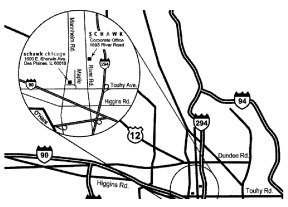
Notice is hereby given that the 2009 Annual Meeting of Stockholders of Schawk, Inc. will be held at
10:00 a.m. local time, Tuesday, July 14, 2009, at Schawk Des Plaines, 1600 E. Sherwin Avenue, Des
Plaines, Illinois, for the following purposes:
| |
1. |
|
To elect nine directors identified in the accompanying proxy statement to the
Board of Directors of Schawk, Inc. |
| |
| |
2. |
|
To transact such other business as may properly come before the meeting or any
adjournment of the meeting. |
The close of business on May 20, 2009, has been fixed as the record date for the determination of
stockholders entitled to receive notice of and to vote at the Annual Meeting and any adjournment of
the meeting. The stock transfer books of Schawk, Inc. will not be closed.
| |
|
|
|
|
|
|
By Order of the Board of Directors, |
|
|
|
|
|
|
|
Des Plaines, Illinois
June 19, 2009
|
|
/s/ A. Alex Sarkisian, Esq.
A. Alex Sarkisian, Esq.
Executive Vice President
and Chief Operating Officer
|
|
|
TABLE OF CONTENTS
SCHAWK, INC.
1695 South River Road
Des Plaines, Illinois 60018
(847) 827-9494
PROXY STATEMENT
FOR THE 2009 ANNUAL MEETING OF STOCKHOLDERS
TO BE HELD JULY 14, 2009
INTRODUCTION
This Proxy Statement is being furnished in connection with the solicitation of proxies by the
Board of Directors of Schawk, Inc. (“Schawk” or the “Company”) for use at the 2009 Annual Meeting
of Stockholders to be held at 10:00 a.m. local time, Tuesday, July 14, 2009, at Schawk Des Plaines,
1600 E. Sherwin, Des Plaines, Illinois, and at any adjournment thereof (the “Annual Meeting”).
This Proxy Statement and the accompanying proxy are first being mailed on or about June 19, 2009 to
stockholders of record at the close of business on May 20, 2009.
Purpose
The purpose of the Annual Meeting is to elect the Board of Directors of the Company and to
transact such other business as may properly come before the meeting or any adjournment of the
meeting.
Proxies and Solicitation
Any person signing and mailing the enclosed proxy may revoke the proxy at any time prior to
its exercise by: (i) executing a subsequent proxy; (ii) notifying the Corporate Secretary of the
Company of such revocation in a written notice received by him at Schawk, Inc., 1695 South River
Road, Des Plaines, Illinois 60018, prior to the Annual Meeting; or (iii) attending the Annual
Meeting and voting in person.
The cost of solicitation of proxies will be borne by the Company. In addition to the use of
the mails, proxies may be solicited personally or by telephone or facsimile by directors of the
Company and executive officers and regular employees of the Company. The Company does not
currently expect to pay any compensation for the solicitation of proxies, but may reimburse brokers
and other persons holding shares in their names, or in the names of nominees, for their expenses in
sending proxy materials to principals and obtaining their proxies. Computershare Investor
Services, the transfer agent and registrar of the Company’s Class A Common Stock, may aid in the
solicitation of proxies and will be reimbursed for any expenses incurred as a result of any such
activity.
Shares of the Company represented by properly executed proxies will, unless such proxies have
been previously revoked, be voted in accordance with the instructions indicated in the proxies.
Unless otherwise instructed in the proxy, the agent named in the proxy intends to cast the proxy
votes in the following manner: (i) FOR the election of the nominees for the Board of Directors of
Schawk; and (ii) in the best judgment of the persons named in the proxy, as agent, upon any other
matters that may properly come before the Annual Meeting.
Quorum Requirements and Voting
The presence, in person or by proxy, of the holders of a majority of the Company’s Class A
Common Stock outstanding on the record date is required for a quorum at the Annual Meeting.
1
Abstentions will be treated as shares present and entitled to vote for purposes of determining
whether a quorum is present, but will not be voted for purposes of determining the approval of any
matter submitted to the stockholders for a vote. If a proxy returned by a broker indicates that
the broker does not have discretionary authority to vote some or all of the shares covered thereby
for any matter submitted to the stockholders for a vote, such shares will be considered to be
present for purposes of determining whether a quorum is present, but will not be considered to be
present and entitled to vote at the Annual Meeting.
As to all anticipated votes, each share of Class A Common Stock will have one vote as to each
matter to be voted on at the Annual Meeting. Directors shall be elected by a plurality of the
votes cast for the election of directors at the meeting. A proxy marked to withhold authority for
the election of one or more directors will not be voted with respect to the director or directors
indicated. Stockholders entitled to vote or to execute proxies are stockholders of record at the
close of business on May 20, 2009. The Company had 24,934,274 shares of Class A Common Stock
outstanding on such date. The stock transfer books of the Company will not be closed.
Interest of Certain Persons in Matters To Be Acted Upon
No other person being nominated as a director is being proposed for election pursuant to any
agreement or understanding between any such person and the Company.
Important Notice Regarding the Availability of Proxy Materials for the Annual Meeting of
Stockholders To Be Held on July 14, 2009: This proxy statement and our 2008 Annual Report on
Form 10-K are available at: www.proxydocs.com/sgk.
PROPOSAL 1: ELECTION OF DIRECTORS
At the Annual Meeting, stockholders will be asked to elect nine directors to the Company’s
Board. The size of the Company’s Board of Directors has been fixed at nine members in accordance
with the Company’s By-laws.
Each of the director nominees elected at the Annual Meeting will hold office for a term of one
year, expiring at the 2010 Annual Meeting of Stockholders, and thereafter until a successor has
been duly elected and qualified. Unless authority to vote is withheld, proxies received in
response to this solicitation will be voted FOR the election of the nominees named hereafter, each
of whom presently serves as a director of the Company. It is not contemplated that any of the
nominees will be unable or will decline to serve; however, if such a situation arises, the shares
represented by the proxies being solicited will be voted FOR the election of a nominee or nominees
designated by the Board of Directors of the Company.
Assuming a quorum is present, an affirmative vote of the holders of a plurality of the shares,
present and voting at the meeting, is required for a nominee to be elected as a director.
Therefore, abstentions and shares for which authority to vote is not given will have no effect on
the election of directors.
2
The following is a list of the nominees for election as directors of the Company, all of whom
have been nominated by the Board in accordance with its nominating criteria and procedures
described below, followed by a brief biographic statement concerning each nominee:
| |
|
|
Nominees for Election as
Directors of the Company |
| Clarence W. Schawk |
| David A. Schawk |
| A. Alex Sarkisian, Esq. |
| Judith W. McCue, Esq. |
| John T. McEnroe, Esq. |
| Hollis W. Rademacher |
| Leonard S. Caronia |
| Michael G. O’Rourke |
| Stanley N. Logan |
Clarence W. Schawk has been Chairman of the Board of the Company since September 1992, when he
was also appointed to the Executive Committee. He served as Chief Executive Officer of Filtertek
Inc., the Company’s predecessor (“Filtertek”), from September 1992 until February 1993. Clarence
W. Schawk also served as Chairman of the Board of the corporation previously known as Schawk, Inc.
(“Old Schawk”) from 1953 until the merger (the “Merger”) of Old Schawk and affiliated companies
into Filtertek in 1994 and served as Chief Executive Officer until June 1994. He is the father of
David A. Schawk, President and Chief Executive Officer of the Company. Clarence W. Schawk
previously served as President and a Director of the International Prepress Association. Mr.
Schawk also served as a Director of Old Schawk until the Merger. Age: 83
David A. Schawk was appointed Chief Executive Officer and President in February 1993. He
served as Chief Operating Officer of the Company from September 1992 through February 2004. He was
appointed to the Board of Directors in September 1992 and currently serves on its Executive
Committee. David A. Schawk served as the President of Old Schawk from 1987 until the Merger.
David A. Schawk serves on the Company’s Executive Committee. David A. Schawk is the son of
Clarence W. Schawk. David A. Schawk currently serves as a Director of the International Prepress
Association. Mr. Schawk also served as a Director of Old Schawk until the Merger. Age: 53
A. Alex Sarkisian, Esq., was appointed Chief Operating Officer in March 2004 and was appointed
Executive Vice President in 1994. Mr. Sarkisian has served on the Company’s Board of Directors and
as Corporate Secretary since September 1992. Mr. Sarkisian was the Executive Vice President and
Secretary of Old Schawk from 1988 and 1986, respectively, until the Merger. Mr. Sarkisian also
served as a Director of Old Schawk until the Merger. He is a member of the Executive Committee.
Age: 57
Judith W. McCue, Esq., has been a partner with McDermott Will & Emery LLP since 1995. Prior
thereto, Ms. McCue was a partner with Keck, Mahin & Cate where she practiced from 1972 to 1995.
Ms. McCue was appointed Director of the Company in September 1992 and is a member of the Audit and
Option/Compensation Committees. Age: 61
John T. McEnroe, Esq., has been a shareholder with the law firm of Vedder Price P.C., counsel
to the Company, since May 1992. Prior to this position, he was a partner with the law firm of
Keck, Mahin & Cate where he practiced from 1976 to 1992. Mr. McEnroe was appointed a Director of
the Company in September 1992 and is a member of the Executive and Option/Compensation Committees.
Age: 57
Hollis W. Rademacher was appointed a Director of the Company in 1994 and is a member of the
Executive and Option/Compensation Committees and serves as Chairman of the Audit Committee. He
3
held various positions with Continental Bank, N.A., Chicago, Illinois, from 1957 to 1993 and
was Chief Financial Officer of Continental Bank Corporation, Chicago, Illinois, from 1988 to 1993.
Mr. Rademacher is currently self-employed in the fields of consulting and investments in Chicago,
Illinois. Mr. Rademacher also serves as a director of Wintrust Financial Corporation (NasdaqGS:
WTFC) and First Mercury Financial (NYSE: FMR), together with several other privately held
companies. Age: 73
Leonard S. Caronia was appointed a Director of the Company in October 2000. Mr. Caronia
currently serves as a Chairman of Fox-Pitt Kelton Cochran Caronia Waller, an investment banking
firm, and was a co founder and Managing Director of Cochran Caronia Waller prior to its merger with
Fox-Pitt, Kelton in September 2007. Prior to forming his company in 1997, Mr. Caronia served as
Managing Director of Coopers & Lybrand Securities, LLC. Prior to that, Mr. Caronia was employed at
First Chicago Corporation from 1980 until 1993 and was Corporate Senior Vice President and Head of
Investment Banking. He is also a member of the Option/Compensation Committee. Age: 57
Michael G. O’Rourke was appointed a Director on February 12, 2007 and is a member of the Audit
Committee. Mr. O’Rourke currently serves as President and Chief Executive Officer of Signature
Bank located in Chicago, Illinois. He previously served as Executive Vice President and Manager of
Commercial Lending and Commercial Real Estate at Associated Bank Chicago from 2001 until 2005, when
he left to organize Signature Bank. Age: 40
Stanley N. Logan was appointed a Director on November 6, 2007 and is a member of the Audit
Committee. Mr. Logan currently serves as a vice president of Huron Consulting Group (NasdaqGS:
HURON) and heads Huron’s Western Region and Japan. Prior to joining Huron, Mr. Logan was most
recently managing partner of KPMG’s Chicago office. He also served as National Sector Leader for
Consumer Products at KPMG. Before joining KPMG in 2002, Mr. Logan held a number of significant
client and leadership roles at Arthur Andersen in Chicago. He has held audit and nonaudit lead
partner roles with large corporations in the consumer, retail and industrial spaces throughout his
career at both KPMG and Arthur Andersen. Age: 54
The Board of Directors recommends a vote FOR the election of the nominees
named in this proxy statement.
The following is a brief biographical statement of Timothy J. Cunningham, the Chief Financial
Officer of the Company:
Timothy J. Cunningham was appointed Executive Vice President and Chief Financial Officer of
the Company in September 2008. Mr. Cunningham joined the Company in March as an advisor to the
Chief Executive Officer, was appointed Vice President, Finance in April 2008, and served as the
Company’s Interim Chief Financial Officer and Chief Accounting Officer from June 2008 until
September 2008. He previously served as chief financial officer of Pregis Corporation, a packaging
solutions company, from May 2006 until September 2007, and in a transitional role with Pregis until
December 2007. Prior to joining Pregis, Mr. Cunningham served as the interim chief financial
officer of a $1.4 billion division of a $12 billion food company from February 2005 to April 2006.
From November 1999 though January 2005, he was with eLoyalty Corporation, an enterprise customer
relationship management services and solutions company, serving most recently as vice president and
chief financial officer. Mr. Cunningham formerly was a partner with Tatum LLC, a consulting and
executive services firm, from February 2005 until April 2006 and from January 2008 until September
2008. He is a member of the American Institute of Certified Public Accountants and the Illinois
CPA Society, and has a BBA in Accountancy from the University of Notre Dame and a Master of
Business Management from Northwestern University, Kellogg Graduate School of Management. Age: 55
4
Officers are elected by the Board of Directors at the first meeting of the newly elected Board
of Directors held after each Annual Meeting. Officers hold office for a term of one year and until
a successor has been duly elected and qualified.
CORPORATE GOVERNANCE
Meetings of the Board of Directors
The Board of Directors is responsible for the overall affairs of the Company. The Board of
Directors held six meetings in 2008. Each member of the Board of Directors attended at least 75%
of the total number of meetings of the Board of Directors and of all committees of the Board of
Directors on which such Director served, except Clarence Schawk. The Board of Directors has a
policy requiring director attendance at the annual meeting of stockholders. All members of the
Board of Directors attended the 2008 Annual Meeting.
Executive Sessions. Meetings of non-employee directors are held in which such directors meet
without management participation. Non-employee directors include all independent directors as well
as any other directors who are not officers of the Company, whether or not “independent” by virtue
of a material relationship with the Company or otherwise. John T. McEnroe presides over any
meetings of non-employee directors.
Interested parties may communicate directly with Mr. McEnroe, or with the non-employee
directors as a group, by writing to them c/o Schawk, Inc., 1695 South River Road, Des Plaines,
Illinois 60018.
Director Independence
The Board of Directors of the Company has determined that Judith W. McCue, Hollis W.
Rademacher, Michael G. O’Rourke and Stanley N. Logan are “independent directors”. The Board of
Directors has affirmatively determined that none of the current independent directors has a
material relationship with the Company (either directly as a partner, stockholder or officer of an
organization that has a relationship with the Company). In making such a determination the Board
of Directors applied the standards set forth in Rule 303A.02(b) of the New York Stock Exchange
Listed Company Manual and those set forth in the Company’s Corporate Governance Guidelines, a copy
of which is available on the Company’s website at www.schawk.com. The remaining members of the
Board of Directors are not considered independent.
In reaching the Board’s independence determinations, each director’s background is reviewed
for any possible material affiliations with, or any compensation received (other than compensation
for service on the Company’s Board of Directors or committees thereof) from, the Company, including
those affiliations described under “Transactions with Related Persons” in this proxy statement. In
addition, in assessing the independence of Mr. O’Rourke, the Board considered the equity
investments made by certain members of the Company’s executive management in Signature Bank, for
which Mr. O’Rourke serves as chief executive officer. The Board of Directors determined that all
of the independent directors were “independent” for purposes of the New York Stock Exchange listing
standards and the Company’s Corporate Governance Guidelines because, during the past three years,
no independent director (or any member of an independent director’s immediate family) has:
| |
• |
|
been employed by the Company or any subsidiary; |
5
| |
• |
|
accepted direct compensation from the Company or any subsidiary in excess of
$120,000 during any of the last three fiscal years, or plans to accept such payments in
the current fiscal year (other than compensation for board or committee service and
pension or other forms of deferred compensation for prior service); |
| |
| |
• |
|
been affiliated with or employed by an auditor (present or former) of the Company or
an affiliate of the Company; |
| |
| |
• |
|
been employed as an executive officer of another entity where at any time during the
past three years any of the Company’s executive officers served on that entity’s
compensation committee; or |
| |
| |
• |
|
been employed as an executive officer of an entity (including charitable
organizations) that made payments to, or received payments from, the Company for
property or services in the current or any of the past three fiscal years that exceed
the greater of $1 million or 2% of such other entity’s consolidated gross revenues for
that year. |
The Board of Directors has determined that the Company is a “controlled company,” as defined
by the NYSE listing standards, as more than 50% of the voting power of the Company’s Class A Common
Stock is held by members of the Schawk family and in trusts for the benefit of Schawk family
members. As a result, the Company is exempt from certain requirements of the listing standards,
including the requirement to maintain a majority of independent directors on the Company’s Board of
Directors and the requirements regarding the determination of compensation of executive officers
and the nomination of directors by independent directors.
Committees
The Board of Directors currently has an Executive Committee, an Audit Committee, and an
Option/Compensation Committee, whose members are directors appointed by the Board of Directors.
The Board of Directors has determined that because it is a controlled company, it is not necessary
to have a standing Nominating Committee and the entire Board of Directors acts in this capacity.
Executive Committee. The present members of the Executive Committee are: Clarence W. Schawk,
David A. Schawk, A. Alex Sarkisian, John T. McEnroe and Hollis W. Rademacher. The Executive
Committee is authorized to act on behalf of the Board of Directors in the management of the
business and the affairs of the Company.
Audit Committee. Hollis W. Rademacher, Stanley N. Logan, Judith W. McCue and Michael G.
O’Rourke currently serve as members of the Audit Committee. The Audit Committee, which operates
under a written charter, recommends the selection of the Company’s independent public accountants,
reviews and approves their fee arrangements, examines their detailed findings and reviews areas of
possible conflicts of interest and sensitive payments. The Board of Directors has adopted a
written charter for the Audit Committee that outlines the responsibilities and processes of the
Audit Committee, a copy of which is available on the Company’s website. The Board of Directors has
determined that the members of the Audit Committee are “independent” directors as such term is
defined in the NYSE’s listing standards, as currently in effect, and each member meets the SEC’s
heightened independence requirements for audit committee members. The Board of Directors has
determined that Mr. Rademacher and Mr. Logan each is an “audit committee financial expert” as that
term is defined in Item 407(d)(5)(ii) of Regulation S-K under the Securities Act. The designation
of an “audit committee financial expert” does not impose on Mr. Rademacher or Mr. Logan any duties,
obligations or liability greater than those that are generally imposed on them as members of the
Audit Committee and of the Board of Directors. The Audit Committee met in person or telephonically
14 times in 2008.
6
Option/Compensation Committee. The Option/Compensation Committee members are Judith W. McCue,
Hollis W. Rademacher, John T. McEnroe and Leonard S. Caronia. The Compensation Committee is
responsible for reviewing and recommending the compensation of the Company’s officers, including
the Chief Executive Officer, and reviewing and recommending director compensation. The
Option/Compensation Committee evaluates the performance of key personnel and makes incentive awards
in the form of stock options and other equity and cash-based long-term incentive awards under the
Company’s incentive plan. The Compensation Committee also advises and assists management in
formulating policies regarding compensation and submits its Compensation Discussion and Analysis
included elsewhere in this proxy statement. The Compensation Committee currently does not operate
under a written charter. The Option/Compensation Committee met twice in 2008.
Director Compensation
Each non-executive member of the Board (except for Mr. McEnroe) is entitled to receive an
annual retainer of $20,000, a fee of $1,150 for attendance at each board meeting and a fee of $600
for attendance at each meeting of a committee of the Board on which such director serves. All
directors are also reimbursed for ordinary and necessary expenses incurred in attending Board or
committee meetings.
The Company’s Outside Directors’ Plan, as amended, provides that each “outside director”
(defined in the Outside Directors’ Plan as any director who is not a compensated employee of the
Company) receive a nonqualified stock option to purchase shares of Company common stock upon his or
her election, and any subsequent reelection, to the Board of Directors at an exercise price equal
to the fair value of such shares on the date of election or reelection as a director. Beginning
with the annual grant for 2008, the number of shares subject to options granted to each director
upon reelection (or to any non-director nominee upon election) was reduced from 5,000 shares to
2,500 shares. Only the number of shares specified by the formula under the Outside Directors’ Plan
is eligible for grant under the Outside Directors’ Plan. The options granted to the outside
directors are exercisable for a term of 10 years from the date of grant and vest in one-third
increments on the date of grant and on the first and second anniversaries of the date of grant.
The following table sets forth information regarding the fees paid to the Company’s directors
in 2008 (other than directors who are also named executive officers) and option expense incurred by
the Company in connection with their service as directors during 2008.
| |
|
|
|
|
|
|
|
|
|
|
|
|
| |
|
Fees earned or paid |
|
Option |
|
|
| |
|
in cash |
|
Awards(1) |
|
Total |
| Name |
|
($) |
|
($) |
|
($) |
Clarence W. Schawk |
|
|
— |
|
|
|
— |
|
|
|
— |
|
Judith W. McCue |
|
|
27,000 |
|
|
|
23,034 |
|
|
|
50,034 |
|
John T. McEnroe |
|
|
— |
|
|
|
23,034 |
|
|
|
23,034 |
|
Hollis W. Rademacher |
|
|
27,000 |
|
|
|
23,034 |
|
|
|
50,034 |
|
Leonard S. Caronia |
|
|
24,600 |
|
|
|
23,034 |
|
|
|
47,634 |
|
Michael G. O’Rourke |
|
|
27,000 |
|
|
|
29,635 |
|
|
|
56,635 |
|
Stanley N. Logan |
|
|
27,000 |
|
|
|
19,578 |
|
|
|
46,578 |
|
|
|
|
| (1) |
|
Represents the dollar amount of expense recognized for financial statement reporting purposes
with respect to 2008 attributable to stock options in accordance with SFAS 123R but with no
discount for estimated forfeitures. |
7
|
|
|
| |
|
The grant date fair value of option awards granted in 2008 was $89,892. The following table
shows the aggregate number of option awards outstanding to the directors shown above as of
December 31, 2008: |
| |
|
|
|
|
| Name |
|
Outstanding Option Awards |
Clarence W. Schawk |
|
|
100,000 |
|
Judith W. McCue |
|
|
47,500 |
|
John T. McEnroe |
|
|
42,500 |
|
Hollis W. Rademacher |
|
|
47,500 |
|
Leonard S. Caronia |
|
|
42,500 |
|
Michael G. O’Rourke |
|
|
12,500 |
|
Stanley N. Logan |
|
|
7,500 |
|
Director Nomination Criteria and Procedures
Criteria for Board Nomination. The Board considers the appropriate balance of experience,
skills, and characteristics required of the Board of Directors and seeks to insure that members of
the Company’s Audit Committee are independent and meet the financial literacy requirements under
the rules of the New York Stock Exchange and the SEC’s heightened independence requirements.
Nominees for director are selected on the basis of their depth and breadth of experience, wisdom,
integrity, ability to make independent analytical inquiries, understanding of the Company’s
business, and willingness to devote adequate time to Board duties. Because qualified incumbent
directors generally can provide the benefits of continuity of leadership and seasoned judgment
gained through experience as a director of the Company, the Board typically considers as potential
candidates incumbent directors interested in standing for re-election, provided that the Board
believes they have satisfied director performance and participation expectations.
Board Nomination Process. The process for identifying and evaluating nominees to the Board of
Directors is initiated by identifying a slate of candidates who meet the criteria for selection as
a nominee and have the specific qualities or skills being sought based on input from members of the
Board. The Board generally considers renomination of incumbent directors, provided they continue
to meet the qualification criteria adopted by the Board of Directors. New director candidates are
evaluated by reviewing the candidates’ biographical information and qualification and checking the
candidates’ references. Qualified new candidates are interviewed by at least the Chairman of the
Board. The Board evaluates which of the prospective candidates is qualified to serve as a director
and should be nominated or appointed to fill a vacancy. Candidates selected by the Board as
nominees are then presented for the approval of the stockholders or for appointment to fill a
vacancy.
Stockholder Recommendations. The Board uses a similar process to evaluate candidates
recommended by stockholders. To date, however, the Company has not received any stockholder
proposal to nominate a director.
To recommend a prospective nominee for the Board’s consideration, please submit the
candidate’s name and qualifications to the Board of Directors of Schawk, Inc., 1695 South River
Road, Des Plaines, Illinois 60018. Submissions must contain: (a) the proposed nominee’s name and
qualifications (including five year employment history with employer names and a description of the
employer’s business, whether such individual can read and understand basic financial statements,
and board memberships (if any)) and the reason for such recommendation, (b) the name and the record
address of the stockholder or stockholders proposing such nominee, (c) the number of shares of
stock of the Company which are beneficially owned by such stockholder or stockholders, and (d) a
description of any financial or other relationship between the stockholder or stockholders and such
nominee or between the nominee and the Company or any of its subsidiaries. The submission must be
accompanied by a written consent of the individual to stand for election if nominated by the board
and to serve if elected by
8
the stockholders. Recommendations received by February 20, 2010, will be considered for
nomination at the 2010 Annual Meeting of Stockholders. Recommendations received after February 20,
2010, will be considered for nomination at the 2011 Annual Meeting of Stockholders.
COMPENSATION DISCUSSION AND ANALYSIS
Objectives of Schawk’s Compensation Program
Schawk’s compensation program seeks to enhance the profitability of the Company, and thus
stockholder value, by aligning the financial interests of the Company’s senior executive officers
with those of its stockholders. It is designed to reward superior performance by linking a
significant portion of each senior executive officer’s compensation to the achievement of the
Company’s financial and performance goals. In addition to these goals, the Company’s compensation
program seeks to attract and retain highly qualified senior officers and other key employees.
Overview of the Compensation Program
The Option/Compensation Committee (referred to in this discussion as the “Committee”) of the
Board of Directors of the Company has the responsibility for establishing and monitoring the
compensation and benefit programs of the Company and ensuring adherence with the Company’s
compensation objectives. The Committee has the authority to review, determine and, at its
discretion, adjust the annual compensation, including base salary and bonuses, for the senior
executive officers of the Company, including the named executive officers for 2008: David A.
Schawk, President and Chief Executive Officer; A. Alex Sarkisian, Executive Vice President and
Chief Operating Officer; Timothy J. Cunningham, who commenced service with the Company as its
Executive Vice President and Chief Financial Officer in September 18, 2008; and James J. Patterson,
the Company’s former Senior Vice President and Chief Financial Officer who resigned from this
position as of May 31, 2008. The Committee also has the authority to make grants of long-term
incentive awards to senior executive officers under the Company’s incentive plan. In performing
its duties and determining compensation for the senior officers, including the named executive
officers, the Committee considers the recommendations and input of the Company’s Chief Executive
Officer, Chief Operating Officer, and Vice President, Global Human Resources, with respect to the
Company’s executive compensation program and arrangements.
As part of a three-year plan that began in 2005 to bring the total compensation of its senior
executives to more market-competitive levels, the Committee has sought to establish compensation
levels of its senior officers, in the aggregate and for each principal component of compensation,
at or slightly below the median compensation of senior executives of comparable companies
comprising a peer group. The Committee believes that these target levels allow the Company to
remain competitive in recruiting and retaining talent while still providing an effective link
between compensation and achievement of the Company’s financial and performance goals.
In 2008, to update its comparable executive compensation data and information, the Company
retained Towers Perrin, a third-party compensation consultant, to provide an update on the analysis
of the competitiveness of the Company’s compensation arrangements. In preparing its analysis,
Towers Perrin compared the principal components of compensation of each of the Company’s named
executive officers—base salary, target bonus, target total cash compensation (base salary plus
target annual incentives), long-term incentives, and total compensation—against these elements of
compensation paid to similarly positioned officers of companies of a general industry reference
group. This reference group is comprised of approximately 200 private and public companies among
various industries with 2007 revenues under $1 billion (the “Reference Group”). Companies
classified as media, information or entertainment companies comprised the largest industry
component at 40% of the Reference Group.
9
Companies classified as financial services and banking firms comprised the second largest
industry component at 11.5% of the Reference Group, and companies classified as energy and energy
services firms comprised the third largest industry component at 11% of the Reference Group. In
evaluating compensation levels for the named executive officers, Towers Perrin also provided the
Committee with summarized compensation data from a general professional services/advertising
industry reference group comprised of the approximately 270 companies and divisions of the Watson
Wyatt Services Companies survey and approximately 150 companies and firms (and in some cases
multiple divisions of the same company or firm) of the William M. Mercer Professional Services
Companies survey. In performing its analysis, Towers Perrin used compensation data from its own
proprietary databases and surveys as well as published compensation surveys prepared by other
firms.
For 2008, consistent with prior years’ practice of targeting total compensation and each
material element of compensation near the median compensation of the Reference Group, the base
salary, target annual cash bonus and long-term incentive compensation (“LTI”) for each of the named
executive officers (other than Mr. Cunningham) placed them at or slightly below the median of the
base salary, target cash bonus and LTI, respectively, paid by the Reference Group companies. Mr.
Cunningham’s annualized 2008 compensation placed him slightly above the median for each principal
component of compensation of the Reference Group, other than for target annual cash bonus. In
determining compensation, the Committee also takes into account other factors, such as individual
performance, the weighting of each component of compensation and the compensation history of the
individual and the Company, as well as management’s recommendations and internal data, when setting
compensation levels. Accordingly, the Committee may deviate from its general practice of seeking
to target compensation at or near the median compensation of the Reference Group in light of other
factors; however, for 2008, no such adjustments were made except with respect to Mr. Cunningham as
described more fully in this discussion.
In determining 2009 compensation, no adjustments were made to the companies that make up the
Reference Group. The Committee in prior years has factored in an approximately 3% upwards
adjustment per year from the date of the peer or reference group data to account for annual
increases in compensation expected to occur among the companies comprising Reference Group. In
setting 2009 compensation, however, in light of the probable effects of the deterioration in
economic and business conditions that have occurred across a number of industries in which the
Reference Group companies operate, no upward adjustments were made.
Overview of the Principal Elements of the Company’s Senior Executive Compensation
To meet its objectives, Schawk has designed a total compensation package for senior executive
officers that includes:
| |
• |
|
base salary |
| |
| |
• |
|
annual cash bonus |
| |
| |
• |
|
long-term incentives, comprised of three components: |
| |
• |
|
stock options |
| |
| |
• |
|
restricted stock |
| |
| |
• |
|
performance awards |
10
The Committee also considers income deferral, life insurance, and retirement and
post-employment benefits as important facets of its compensation package.
The Committee believes that each of these principal elements of total compensation contributes
to one or more of the goals the Committee seeks to achieve through its compensation program:
| |
• |
|
Base salaries. The Company provides the opportunity for the senior executive
officers to earn a market competitive annual base salary in order to attract and retain
highly qualified individuals and to provide a base wage that is not subject to
Company-performance risk. |
| |
| |
• |
|
Annual and long-term incentive awards. The Company relies to a large degree on an
annual bonus, if any, and long-term equity and cash incentives to attract and retain
its senior executive officers and key employees. The Committee also uses these awards
to motivate its senior officers, on an individual basis and collectively as a team, to
achieve annual financial goals and longer term Company performance goals. Both annual
and long-term incentive compensation is closely tied to the performance of the Company
and the individual in a manner that the Committee believes encourages a sharp and
continuing focus on building profitability and improving the opportunities for greater
stockholder value. |
| |
| |
• |
|
Other benefits. Providing retirement benefits, income deferral and other benefits
is consistent with Schawk’s desire and ability to attract and retain skilled executives
and recognizes that similar benefits are commonly provided at other companies that it
competes with for talent. |
Principal Elements of Compensation
Base Salary
In setting annual base salaries and in determining the basis for any base salary increases,
the Committee reviews benchmark data and considers individual and Company performance and the
recommendations submitted by the Chief Executive Officer and other members of management. For the
named executive officers, base salaries reflect the Committee’s desire to establish salaries at or
near the median of the base salary range for the Reference Group companies.
The table below reflects base salaries and percentage increases in base salary for the
Company’s named executive officers in 2008.
| |
|
|
|
|
|
|
|
|
|
|
|
|
| |
|
Base Salary |
|
|
| Name |
|
2007 |
|
2008 |
|
Percentage Increase |
David A. Schawk |
|
$ |
575,000 |
|
|
$ |
595,000 |
|
|
|
3.5 |
% |
A. Alex Sarkisian |
|
|
415,000 |
|
|
|
440,000 |
|
|
|
6.0 |
|
James J. Patterson |
|
|
295,000 |
|
|
|
295,000 |
|
|
|
0.0 |
|
Timothy J. Cunningham |
|
|
— |
|
|
|
375,000 |
|
|
|
N/A |
|
The 2008 base salaries were at or slightly below the median base salaries of similar
executives in the comparable companies comprising the Reference Group with the exception of
Mr. Cunningham, who was appointed Executive Vice President and Chief Financial Officer in September
2008. In determining Mr. Cunningham’s base salary, the Committee took into consideration his
experience with public companies and accounting background, his several months of prior service
with the Company as interim Chief Financial Officer, the need to quickly retain a permanent chief
financial officer in light of Mr. Patterson’s resignation as well as the special circumstances
under which he would be serving as chief financial officer. In particular, the Company’s
then-recent financial restatements and ongoing remediation of internal control material weaknesses
would require Mr. Cunningham to devote additional
11
efforts and time to his duties as Chief Financial Officer. In light of these factors,
Mr. Cunningham’s 2008 salary on an annualized basis was set slightly above the median base salary
of similarly situated executives at companies comprising the Reference Group.
Effective February 4, 2009, new base salaries were approved for Messrs. Schawk, Sarkisian and
Cunningham of $535,500 and $418,000, and $356,250 respectively. The 2009 base salaries represent a
10% decrease for Mr. Schawk and a 5% decrease each for Messrs. Sarkisian and Cunningham, from each
officer’s 2008 base salary on an annualized basis. The Committee made these reductions as part of
the Company’s overall commitment to reduce costs in light of the current and foreseeable adverse
economic conditions affecting the Company.
Annual Bonus
As part each named executive officer’s compensation package, the Company provides them with an
incentive to maintain high performance and to achieve certain Company financial goals through
opportunities to earn annual cash bonuses. For the 2008 annual award opportunities, the committee
chose achievement of targeted levels of consolidated operating income (“COI”) as the performance
measure by which awards may be earned. The Committee determined that COI is a good indicator of
enhanced shareholder value. Each named executive officer’s bonus opportunity amount is based on a
percentage of his annual base salary (other than, with respect to 2008, Mr. Cunningham, who was not
eligible to participate in the 2008 annual bonus opportunity as described below). Depending on the
level of achievement of the established COI target, each named executive officer is eligible to
earn a threshold, target or maximum level of bonus award. Upon achievement of a threshold level of
COI of approximately $51.0 million, Mr. Schawk was eligible to receive a payout equal to 45% of his
base salary, and upon achievement of the target or maximum level of COI of approximately $53.8
million and $76.6 million, respectively, Mr. Schawk was eligible to receive 75% and 100%,
respectively, of his base salary. For Messrs. Sarkisian and Patterson, the amount payable upon
achieving the threshold, target or maximum COI level was 40%, 60% and 90%, respectively, of base
salary. The higher level of bonus opportunity as a percentage of base salary for Mr. Schawk in
comparison to Messrs. Sarkisian and Patterson reflects consistency with the allocations among the
Reference Group companies and the Committee’s determination that a higher percentage of
performance-based compensation relative to base salary should be attributed to Mr. Schawk.
The committee has the discretion to adjust annual incentive amounts and targets though no such
adjustments were made with respect to 2008 bonus opportunity. In 2008, because the Company did not
achieve the threshold COI, no annual bonuses were earned or paid to the named executive officers in
2008.
Because Mr. Cunningham joined the Company as chief financial officer in September 2008, he was
not eligible to participate in the 2008 annual award opportunity. However, pursuant to the terms
of his employment agreement, he was eligible to receive a cash bonus of $125,000 for 2008
performance based on the achievement of certain performance goals and objectives mutually agreed to
by Mr. Cunningham and Mr. Schawk. As established, these goals and objectives related to
Mr. Cunningham achieving progress toward restructuring and strengthening the Company’s internal
audit function, facilitating the Company’s response to SEC inquiries concerning prior restatements,
and remediating weaknesses in the Company’s internal controls, all of which the Committee believes
are critical to the success of the Company. In January 2009, Mr. Cunningham received 100% of his
bonus upon a determination that the established goals and objectives had been achieved.
For 2009, the Committee approved the annual performance targets to be used for the 2009 annual
bonus opportunity. As in 2008, the key performance measurement will be COI. The percentage of
base salary of comprising the threshold, target and maximum award levels remained the same as for
2008.
12
Long-Term Incentives
The following discussion contains statements regarding future individual and Company
performance targets and goals. These targets and goals are disclosed in the limited context of the
Company’s compensation programs and should not be viewed as statements of management’s expectations
concerning the Company’s future results, or as earnings or other financial guidance. We
specifically caution investors not to apply these statements to other contexts.
General. Each fiscal year, the committee considers the desirability of granting senior
executive officers and other key employees of the Company equity-based and other long-term awards.
The Committee considers the overall performance of the Company and individual performance in
determining the amounts to be granted. In addition, the Committee typically receives and considers
compensation recommendations from the Chief Executive Officer, who evaluates market data and
reviews performance for all senior executive officers. The Committee believes its pattern of
awards focuses the Company’s senior executive officers and other key employees on building
profitability and stockholder value. The purpose of these awards is to reward such officers for
their performance toward meeting the Company’s financial and business goals, to give officers a
stake in the Company’s future, which is directly aligned with the creation of stockholder value,
and to provide incentives for continued service with the Company.
The Company’s long-term compensation goals for each named executive officer are fulfilled
through awards, under the Company’s incentive plan, of stock options and restricted stock as well
as cash-based performance awards that represent opportunities to earn cash payments. These
components of the long-term incentive awards were selected as the most appropriate incentive mix to
link compensation to increased profitability and increased stockholder value. The mix of these
components can vary for each executive based on factors such as alignment with stockholders’
interests, retention objectives, internal performance measures and tax, accounting and dilution
considerations. The mix of 2008 long-term incentives for Messrs. Schawk, Sarkisian and Cunningham
based on the economic value of each component were as set forth below. For 2008, Mr. Patterson did
not receive a grant of long-term incentive awards.
| |
|
|
|
|
|
|
| Name |
|
Award Type |
|
2008 Proportion |
David A. Schawk |
|
Cash Performance Awards |
|
|
50.0 |
% |
|
|
Stock Options |
|
|
12.5 |
|
|
|
Restricted Stock |
|
|
37.5 |
|
|
|
|
|
|
|
|
A. Alex Sarkisian |
|
Cash Performance Awards |
|
|
25.0 |
|
|
|
Stock Options |
|
|
50.0 |
|
|
|
Restricted Stock |
|
|
25.0 |
|
|
|
|
|
|
|
|
Timothy J. Cunningham |
|
Cash Performance Awards |
|
|
0.0 |
|
|
|
Stock Options |
|
|
50.0 |
|
|
|
Restricted Stock |
|
|
50.0 |
|
Beginning with LTI awards made in 2008, in an effort to improve the competitiveness of the
Company’s executive compensation, the Committee determined to adjust upwards the aggregate value of
the LTI awards as the Committee believed that the LTI component of senior officers’ compensation
was below market, particularly when viewed against the LTI median value of the Reference Group.
For Mr. Schawk, in light of his significant equity ownership in the Company, the allocation of
long-term incentives was more heavily weighted towards cash-based performance awards than the other
named executive officers. Mr. Sarkisian’s long-term mix was weighted more toward equity to
encourage company ownership and retention objectives. Mr. Cunningham’s 2008 LTI award mix is
comprised entirely of equity in an effort to rapidly promote company ownership and retention
objectives given his
13
recent hiring. He did not receive any cash performance awards, on a pro rata basis or
otherwise, in 2008. For 2009, these allocations were adjusted as more fully described below.
For 2009, the Compensation Committee determined to decrease the aggregate target value of the
LTI awards for each officer by 15%, from approximately $800,000 to $680,000 for Mr. Schawk, and
from approximately $350,000 to $297,500 for Mr Sarkisian and Mr. Cunningham, which placed the LTI
component of each named executive officer below the LTI median of the Reference Group. The
Committee believed that the target goals for the performance award component provided more
opportunity for achievement than the goals previously established for the performance cycles that
were then in-process. That consideration, in addition to the Committee’s belief that the market
value of the Company’s stock reflected a depressed value, drove the decision to reduce the
aggregate value of the LTI component. In addition, the Committee changed the LTI allocation among
stock options, restricted stock and performance awards. For Messrs. Sarkisian and Cunningham, the
allocation was modified to reduce the value of the stock option component from 50% of the total
award to 30% of the total award, which increased each of the restricted stock and performance award
components to 35% of the total award. For Mr. Schawk the allocation did not change since his
allocation is already more heavily weighted towards cash-based performance awards. The Committee
made this change to limit possible excess benefits in the future that could be derived considering,
in the Committee’s view, the Company’s low stock price prior to and at the time of the awards,
which the Committee believed did not reflect the true value and prospects of the Company.
Stock Options. Awards of stock options, when granted, will generally vest in three equal
annual installments beginning on the first anniversary of the grant date. The exercise price for
each stock option grant is determined by the committee in its sole discretion and is specified in
the applicable award agreement; provided, however, the exercise price on the date of grant shall be
at least equal to 100% of the fair market value of the shares on the date of grant, which in past
practice has been the closing price of the Company’s common stock on the date of grant as reported
by the New York Stock Exchange.
Detail concerning awards granted in 2008 can be found under “Executive Compensation—Plan-Based
Award Grants in Last Fiscal Year.” In connection with Mr. Cunningham’s hiring, he received options
to purchase 12,500 shares of common stock at an exercise price of $16.14 per share. The higher
number of options in comparison to Mr. Sarkisian’s 2008 grant reflects the greater weighting of
options in the case of Mr. Cunningham, coupled with increased value attributable to the option
award component due to the Committee’s desire to enhance retention and stock ownership goals for
Mr. Cunningham.
For 2009 Mr. Schawk received options to purchase 28,220 shares of common stock at an exercise
price of $6.94 per share. Messrs. Sarkisian and Cunningham received options to purchase 29,631 and
29,630 shares of common stock, respectively, at an exercise price of $6.94 per share. The value of
these awards on the grant date reflects the change in LTI mix described above and the overall
reduction in the aggregate value of LTI awards.
Restricted Stock. Restricted stock that may be awarded generally will cliff vest on the third
anniversary of the grant date. Each award represents a grant of a fixed number of shares of common
stock of the Company that are subject to forfeiture (i.e., vesting) restrictions. Upon vesting,
the shares become unrestricted and nonforfeitable.
Detail concerning awards of restricted stock granted in 2008 can be found under “Executive
Compensation—Plan-Based Award Grants in Last Fiscal Year.” In connection with Mr. Cunningham’s
hiring, he received an award of 31,250 shares of restricted stock. The greater number of shares of
restricted stock granted to Mr. Cunningham in comparison to Mr. Sarkisian’s 2008 grant reflects the
greater weighting of restricted stock in the case of Mr. Cunningham, coupled with increased value
14
attributable to the restricted award component due to the Committee’s desire to enhance
retention and stock ownership goals for Mr. Cunningham.
For 2009, Mr. Schawk received an award of 42,477 shares of restricted stock and Mr. Sarkisian
and Mr. Cunningham received an award of 17,345 and 17,344 shares of restricted stock, respectively.
The grant date value of these awards reflect the change in LTI mix as described above and the
overall reduction in the aggregate value of LTI awards.
Performance Awards. The long-term cash performance awards granted to senior executives
represent an opportunity to receive cash at the end of a specified performance period that is
contingent on the achievement of specified performance or other objectives during the performance
period. Currently under the Company’s incentive plan, four performance periods, or cycles, are
active or were completed in 2008: fiscal years 2006-2008, 2007-2009, 2008-2010 and 2009-2011. The
value of the performance awards for all cycles are measured by the Company’s cumulative earnings
per share (“EPS”) and consolidated operating income (“COI”). Goals based on the Company’s EPS and
COI were chosen as the best indicators of long-term performance that effectively enhance
shareholder value. These award parameters were set as part of a 2005 compensation study performed
by the Company’s prior compensation consultant and, for more recent awards, using the updated
executive compensation data from the Towers Perrin. For each cycle, other than 2009-2011, the
value of the awards was set as part of the Committee’s overall desire to target the median
compensation of the Reference Group. A discussion of the currently ongoing performance periods and
performance periods with respect to which action was taken in 2008 and 2009 follows below.
For the 2006 to 2008 performance period, which began January 1, 2006 and ended December 31,
2008, Mr. Schawk received an award that provided him with an opportunity to receive $625,000 at
target level of achievement, and Messrs. Sarkisian and Patterson received an award providing an
opportunity to receive $86,800 at target level of achievement. Because the Company’s actual
performance was less than the threshold level to be attained for COI (70% of the target cumulative
COI of $246.6 million over the performance period) and for cumulative EPS (70% of the target
cumulative EPS of $5.19 per share over the performance period), no awards were earned by the named
executive officers at the end of the performance period.
In March 2007, the Committee approved the 2007 to 2009 three-year performance period, which
began on January 1, 2007 and ends December 31, 2009. In order to receive 100% of the payout
opportunity under the award, the Company must meet previously approved target levels for cumulative
EPS of $4.48 per share and COI of approximately $221.69 million over the three-year performance
period. Under this performance period, Mr. Schawk is entitled to receive $625,000 if the target
level of performance is achieved. Mr. Sarkisian is entitled to receive $86,800 if the target level
of performance is achieved.
In March 2008, the Committee approved a new three-year performance period, which will run from
January 1, 2008 through December 31, 2010. In order to receive 100% of the payout opportunity
under the award, the Company must meet target levels for cumulative EPS over the three-year period
of $4.17 per share and COI over the three-year period of approximately $211 million. Mr. Schawk is
entitled to receive $588,000 if the target level of performance is achieved. Mr. Sarkisian is
entitled to receive $128,000 if the target level of performance is achieved.
In March 2009, the Committee approved a new three-year performance period, which will run from
January 1, 2009 through December 31, 2011. In order to receive 100% of the payout opportunity
under the award, the Company must meet target levels for cumulative EPS over the three-year period
of $2.17 per share and COI over the three-year period of approximately $115 million. Mr. Schawk is
entitled to receive $496,000 if the target level of performance is achieved. Messrs. Sarkisian and
15
Cunningham are entitled to receive $152,000 if the target level of performance is achieved.
The reduction of target levels for cumulative EPS and COI for the performance period ending in 2011
as compared to prior periods reflect the Committee’s consideration of the effect of recent economic
market conditions on the ability to meet the historically higher-targeted EPS and COI. The
increase in the amount of the target payouts for Mr. Sarkisian and Mr. Cunningham in comparison to
the target payout for the prior year’s cycle for their positions reflect the adjustment of the LTI
mix to increase the performance award component weighting, partially offset by the overall
reduction in value of the LTI component.
Other Compensation and Benefit Arrangements
Retirement Plans
The Company offers a tax qualified 401(k) retirement savings plan to which all U.S. based
employees are eligible to participate, including senior executive officers, but excluding members
of a collective bargaining unit. Employees may contribute up to 100% of annual salary subject to
the limits prescribed by the Internal Revenue Service (IRS). The Company match for 2008 was 100%
of the first 5% contributed by the employee. The match is discretionary and subject to change in
subsequent years. There is a six-year graduated vesting schedule whereby the matching
contributions are fully vested following six years of service. As members of the highly
compensated group, to satisfy applicable tax-qualified nondiscrimination tests, the senior
executives are generally limited to a 7% deferral and a maximum match of $11,500.
Effective January 1, 2009 the discretionary match was reduced from 100% of the first 5%
contributed by the employee to 100% of the first 2% contributed by the employee. On March 23, 2009
the discretionary match was suspended as part of the Company’s efforts to reduce costs in light of
the Company’s difficult operating environment.
Income Deferral Plan
To provide a comprehensive and competitive total rewards package, Schawk also offers a
non-qualified retirement plan to highly compensated employees (as defined by the IRS). Because of
certain 401(k) limits imposed by the Internal Revenue Code, the plan allows eligible participants
to defer up to $25,000 annually on a tax-deferred basis irrespective of the 401(k) limitations.
The plan was administered to meet the provisions of the American Jobs Creation Act of 2004
including Section 409A compliance. None of the currently serving named executive officers
presently participate in this plan.
Life Insurance
The Company maintains life insurance policies for Messrs. Schawk and Sarkisian. These
policies are designed to encourage these executives to remain in the service of the Company. The
policies provide each executive’s beneficiary with a cash payment in the event the executive
terminates service as a result of his death. For each policy, the portion of the annual premium
due under the policy that can be attributed to benefits payable to a beneficiary designated by the
executive is treated as taxable compensation by the executive. As of December 31, 2008, under the
policies, Mr. Schawk’s beneficiary would be entitled to an estimated death benefit of $2,443,525
and Mr. Sarkisian’s beneficiary would be entitled to receive an estimated death benefit of
$618,446.
Arrangements upon Termination of Service
The Company provides a severance pay plan for all U.S. based full time employees, including
senior executive officers, but excluding members of a collective bargaining unit. Under the terms
of the Company’s incentive plan, the terms of the agreements underlying awards made to named
executive
16
officers and, with respect to Mr. Cunningham, his employment agreement, outstanding stock
options, restricted stock and performance awards may become exercisable, vested or payable in the
event of death, disability, retirement and certain other terminations of service, as well as in the
event of a change in control. In addition, Mr. Schawk and Mr. Cunningham (and/or each officer’s
respective beneficiaries) are entitled to certain payments upon death, disability or in an event of
a change in control under each officer’s employment agreement. Please refer to “Executive
Compensation—Potential Payments Upon Termination or Change in Control” and the related tables and
footnotes for additional information concerning severance arrangements.
The Company provides severance and retirement benefits to facilitate the Company’s ability to
attract and retain executives as the Company competes for talent in a marketplace where such
protections are commonly offered. The Committee believes that the provision of severance
arrangements under its incentive plan with change-in-control compensation protection provisions
encourages employees to remain focused on the Company’s business in the event of rumored or actual
fundamental corporate changes.
As of May 31, 2008, the Company and Mr. Patterson entered into a separation agreement in
connection with Mr. Patterson’s resignation as Chief Financial Officer. The material terms of the
separation agreement are provided under “Executive Compensation—Employment Agreements.” In light
of prior service to the Company, Mr. Patterson received a cash severance amount in excess of what
he would have been entitled to under the Company’s severance pay plan. The terms of
Mr. Patterson’s severance agreement governing the treatment of his unvested, outstanding LTI awards
were consistent with terms of those awards, which by their terms were forfeited upon separation
from the Company, and no discretion was exercised by the Committee with respect to Mr. Patterson’s
outstanding awards except with respect to 4,100 shares of restricted stock, which were permitted to
continue to remain outstanding and will vest on August 8, 2009.
Accounting and Tax Considerations
The Company believes it has structured its compensation program to comply with Internal
Revenue Code Sections 162(m) and 409A as currently in effect.
Compensation Committee Report
The Option/Compensation Committee of the Board of Directors of the Company oversees the
Company’s compensation program on behalf of the Board. In fulfilling its oversight
responsibilities, the Compensation Committee reviewed and discussed with management the
Compensation Discussion and Analysis set forth in this proxy statement.
In reliance on the review and discussions referred to above, the Option/Compensation Committee
recommended to the Board that the Compensation Discussion and Analysis be included in the Company’s
proxy statement in connection with the Company’s 2009 Annual Meeting of Stockholders, to be filed
with the Securities and Exchange Commission.
This report is submitted by the members of the Company’s Option/Compensation Committee.
Judith W. McCue
John T. McEnroe
Hollis W. Rademacher
Leonard S. Caronia
17
The Compensation Committee Report shall not be deemed incorporated by reference by any general
statement incorporating by reference this Proxy Statement into any filing under the Securities Act
of 1933, as amended (the “Securities Act”) or under the Exchange Act except to the extent that the
Company specifically incorporates this information by reference, and shall not otherwise be deemed
filed under such Acts.
EXECUTIVE COMPENSATION
Summary Compensation Table
The table below sets forth certain information for fiscal years 2006, 2007 and 2008 with
respect to the annual cash and non-cash compensation earned by: (i) the President and Chief
Executive Officer (the principal executive officer); (ii) individuals who served as the Company’s
Chief Financial Officer during 2008 (each a principal financial officer); and (iii) other executive
officers of the Company who were the most highly compensated executive officers of the Company as
of the end of 2008 (collectively, the “named executive officers”) for services rendered in all
capacities to the Company.
Summary Compensation Table
| |
|
|
|
|
|
|
|
|
|
|
|
|
|
|
|
|
|
|
|
|
|
|
|
|
|
|
|
|
|
|
|
|
|
|
|
|
| |
|
|
|
|
|
|
|
|
|
|
|
|
|
|
|
|
|
|
|
|
|
|
|
|
|
Change in |
|
|
|
|
| |
|
|
|
|
|
|
|
|
|
|
|
|
|
|
|
|
|
|
|
|
|
|
|
|
|
Pension |
|
|
|
|
| |
|
|
|
|
|
|
|
|
|
|
|
|
|
|
|
|
|
|
|
|
|
|
|
|
|
Value & |
|
|
|
|
| |
|
|
|
|
|
|
|
|
|
|
|
|
|
|
|
|
|
|
|
|
|
|
|
|
|
Nonqualified |
|
|
|
|
| |
|
|
|
|
|
|
|
|
|
|
|
|
|
|
|
|
|
|
|
|
|
Non-Equity |
|
Deferred |
|
All Other |
|
|
| |
|
|
|
|
|
|
|
|
|
|
|
|
|
Stock |
|
Option |
|
Incentive Plan |
|
Compensation |
|
Compen- |
|
|
| Name and |
|
|
|
|
|
Salary |
|
Bonus(1) |
|
Awards(2) |
|
Awards(3) |
|
Compensation(4) |
|
Earnings |
|
sation(5) |
|
Total |
| Principal Position |
|
Year |
|
($) |
|
($) |
|
($) |
|
($) |
|
($) |
|
($) |
|
($) |
|
($) |
David A. Schawk |
|
|
2008 |
|
|
|
595,000 |
|
|
|
— |
|
|
|
204,352 |
|
|
|
76,800 |
|
|
|
— |
|
|
|
— |
|
|
|
28,477 |
|
|
|
904,629 |
|
President and CEO |
|
|
2007 |
|
|
|
575,000 |
|
|
|
258,750 |
|
|
|
94,404 |
|
|
|
96,929 |
|
|
|
343,800 |
|
|
|
— |
|
|
|
27,576 |
|
|
|
1,396,459 |
|
|
|
|
2006 |
|
|
|
575,000 |
|
|
|
258,750 |
|
|
|
11,369 |
|
|
|
167,452 |
|
|
|
434,760 |
|
|
|
— |
|
|
|
26,709 |
|
|
|
1,474,040 |
|
|
|
|
|
|
|
|
|
|
|
|
|
|
|
|
|
|
|
|
|
|
|
|
|
|
|
|
|
|
|
|
|
|
|
|
|
|
A. Alex Sarkisian |
|
|
2008 |
|
|
|
440,000 |
|
|
|
— |
|
|
|
73,748 |
|
|
|
130,342 |
|
|
|
— |
|
|
|
— |
|
|
|
24,871 |
|
|
|
668,961 |
|
Executive Vice |
|
|
2007 |
|
|
|
415,000 |
|
|
|
166,000 |
|
|
|
41,948 |
|
|
|
108,791 |
|
|
|
47,750 |
|
|
|
— |
|
|
|
24,318 |
|
|
|
803,807 |
|
President and Chief |
|
|
2006 |
|
|
|
390,000 |
|
|
|
156,000 |
|
|
|
9,507 |
|
|
|
121,537 |
|
|
|
60,383 |
|
|
|
— |
|
|
|
23,705 |
|
|
|
761,132 |
|
Operating Officer |
|
|
|
|
|
|
|
|
|
|
|
|
|
|
|
|
|
|
|
|
|
|
|
|
|
|
|
|
|
|
|
|
|
|
|
|
|
|
|
|
|
|
|
|
|
|
|
|
|
|
|
|
|
|
|
|
|
|
|
|
|
|
|
|
|
|
|
|
|
|
|
|
|
James J. Patterson |
|
|
2008 |
|
|
|
173,354 |
|
|
|
— |
|
|
|
5,672 |
(7) |
|
|
(5,233 |
)(8) |
|
|
— |
|
|
|
— |
|
|
|
97,088 |
(9) |
|
|
270,881 |
|
Former Senior Vice |
|
|
2007 |
|
|
|
295,000 |
|
|
|
118,000 |
|
|
|
41,948 |
|
|
|
108,791 |
|
|
|
47,750 |
|
|
|
— |
|
|
|
21,450 |
|
|
|
632,939 |
|
President and Chief |
|
|
2006 |
|
|
|
286,384 |
|
|
|
114,554 |
|
|
|
9,507 |
|
|
|
121,537 |
|
|
|
60,383 |
|
|
|
— |
|
|
|
21,200 |
|
|
|
613,565 |
|
Financial
Officer(6) |
|
|
|
|
|
|
|
|
|
|
|
|
|
|
|
|
|
|
|
|
|
|
|
|
|
|
|
|
|
|
|
|
|
|
|
|
|
|
|
|
|
|
|
|
|
|
|
|
|
|
|
|
|
|
|
|
|
|
|
|
|
|
|
|
|
|
|
|
|
|
|
|
|
Timothy J. Cunningham |
|
|
2008 |
|
|
|
281,935 |
|
|
|
156,170 |
|
|
|
19,328 |
|
|
|
19,766 |
|
|
|
— |
|
|
|
— |
|
|
|
— |
|
|
|
477,199 |
|
Executive Vice President
and Chief Financial
Officer (10) |
|
|
|
|
|
|
|
|
|
|
|
|
|
|
|
|
|
|
|
|
|
|
|
|
|
|
|
|
|
|
|
|
|
|
|
|
|
|
|
| (1) |
|
See “Compensation Discussion and Analysis—Principal Elements of the Company’s Senior
Executive Compensation—Annual Bonus” for a description of the Company’s annual bonus award
opportunity. For Mr. Cunningham, bonus includes a $125,000 cash award earned in 2008 pursuant
to the terms of his employment agreement that was paid in January 2009. See “Compensation
Discussion and Analysis—Annual Bonus” for a discussion of this award. The remaining amount
for Mr. Cunningham consists of bonus amounts earned prior to his appointment as Executive Vice
President and Chief Financial Officer. |
| |
| (2) |
|
Represents the dollar amount of expense recognized for financial statement reporting purposes
in each year, as applicable, attributable to restricted stock grants in accordance with SFAS
123R but with no discount for estimated forfeitures. Stock awards are valued using the
closing market price of our common stock on the grant date. Assumptions used in the
calculation of these amounts are included in Note 17 to the Company’s audited financial
statements in its Form 10-K for each of the fiscal years ended December 31, 2008, 2007 and
2006. |
| |
| (3) |
|
Represents the dollar amount of expense recognized for financial statement reporting purposes
in each year, as applicable, attributable to stock options in accordance with SFAS 123R but
with no discount for estimated forfeitures. Assumptions used in the calculation of these
amounts are included in Note 17 to the Company’s audited financial statements in its Form 10-K
for each of the fiscal years ended December 31, 2008, 2007 and 2006. |
| |
| (4) |
|
Represents cash settlement of long-term performance awards following the completion of the
applicable performance period. For the 2006 award amounts shown, the performance period
commenced on July 1, 2005 and ended on December 31, 2006. For the 2007 award amounts shown,
the performance period commenced on July 1, 2005 and ended |
18
|
|
|
| |
|
on December 31, 2007. For the 2008 award amounts shown, the performance period commenced on
January 1, 2006 and ended on December 31, 2008. See “Compensation Discussion and
Analysis—Principal Elements of Compensation—Long-Term Incentives—Performance Awards” for a
description of the terms and calculation methodology for these awards. |
| |
| (5) |
|
For 2008 for Messrs. Schawk and Sarkisian, these amounts represent the actual costs paid for
the following: auto allowance ($10,200), matching contributions to the Company’s 401(k) plan
($11,500) and life insurance premiums ($6,777 for Mr. Schawk and $3,171 for Mr. Sarkisian).
No amounts have been included for personal use of corporate aircraft during 2008 for which the
Company received full reimbursement. The Company has a fractional interest in a corporate
aircraft for business purposes. The Company allows limited personal use of the aircraft by
certain named executive officers and directors so long as such use does not interfere with the
availability and use of the aircraft for business purposes, and in each case so long as all
incremental costs of such personal use are borne by the executive. |
| |
| (6) |
|
Mr. Patterson resigned as Senior Vice President and Chief Financial Officer effective May 31,
2008. A portion of the salary earned in 2008 represents payments to Mr. Patterson under a
consulting arrangement following his resignation. See “Employment Agreements—Separation
Agreement with James Patterson” below. |
| |
| (7) |
|
In accordance with Mr. Patterson’s separation agreement, unvested options to purchase an
aggregate 28,667 shares of common stock were forfeited as of May 31, 2008. |
| |
| (8) |
|
In accordance with Mr. Patterson’s separation agreement, 3,800 shares of restricted stock
were forfeited as of May 31, 2008. |
| |
| (9) |
|
Amount shown for Mr. Patterson under “All Other Compensation” includes severance of $73,750,
401(k) matching contributions of $11,500, amounts paid in respect of an auto allowance, and
outplacement services and certain medical benefits pursuant to Mr. Patterson’s severance
agreement. |
| |
| (10) |
|
Mr. Cunningham commenced service with the Company on March 28, 2008 and was appointed
Executive Vice President and Chief Financial Officer on September 18, 2008. The compensation
disclosed for Mr. Cunningham includes amounts earned since March 28, 2008. |
Plan-Based Award Grants in Last Fiscal Year
The following table provides information regarding stock, option and cash-based awards made to
each named executive officer in 2008.
| |
|
|
|
|
|
|
|
|
|
|
|
|
|
|
|
|
|
|
|
|
|
|
|
|
|
|
|
|
|
|
|
|
|
|
|
|
| |
|
|
|
|
|
|
|
|
|
|
|
|
|
|
|
|
|
All Other |
|
All Other |
|
|
|
|
|
|
|
|
|
|
| |
|
|
|
|
|
|
|
|
|
|
|
|
|
|
|
|
|
Stock |
|
Option |
|
|
|
|
|
|
|
|
|
Grant |
| |
|
|
|
|
|
|
|
|
|
|
|
|
|
|
|
|
|
Awards: |
|
Awards: |
|
Exercise |
|
Closing |
|
Date Fair |
| |
|
|
|
|
|
|
|
|
|
|
|
|
|
|
|
|
|
Number of |
|
Number of |
|
or Base |
|
Market |
|
Value of |
| |
|
|
|
|
|
Estimated Future Payouts Under Non- |
|
Shares of |
|
Securities |
|
Price of |
|
Price on |
|
Stock and |
| |
|
|
|
|
|
Equity Incentive Plan Awards(1) |
|
Stock or |
|
Underlying |
|
Option |
|
Grant |
|
Option |
| |
|
Grant |
|
Threshold |
|
Target |
|
Maximum |
|
Units(2) |
|
Options |
|
Awards |
|
Date |
|
Awards |
| Name |
|
Date |
|
($) |
|
($) |
|
($) |
|
(#) |
|
(#) |
|
($/Sh) |
|
($/Sh) |
|
($) |
David A. Schawk |
|
|
3/20/2008 |
|
|
|
147,000 |
|
|
|
588,000 |
|
|
|
882,000 |
|
|
|
21,895 |
|
|
|
16,499 |
|
|
|
15.84 |
|
|
|
15.84 |
|
|
|
438,667 |
|
A. Alex Sarkisian |
|
|
3/20/2008 |
|
|
|
32,000 |
|
|
|
128,000 |
|
|
|
192,000 |
|
|
|
6,386 |
|
|
|
28,874 |
|
|
|
15.84 |
|
|
|
15.84 |
|
|
|
261,895 |
|
Timothy J.
Cunningham |
|
|
9/18/2008 |
|
|
|
— |
|
|
|
— |
|
|
|
— |
|
|
|
12,500 |
|
|
|
31,250 |
|
|
|
16.14 |
|
|
|
16.14 |
|
|
|
408,065 |
|
James J. Patterson |
|
|
— |
|
|
|
— |
|
|
|
— |
|
|
|
— |
|
|
|
— |
|
|
|
— |
|
|
|
— |
|
|
|
— |
|
|
|
— |
|
|
|
|
| (1) |
|
These values represent estimated possible payouts under cash-based performance awards for the
2008-2010 performance period. See “Compensation Discussion and Analysis—Principal Elements of
Compensation—Long-Term Incentives” and “Compensation Discussion and Analysis—Other
Compensation and Benefit Arrangements—Arrangements upon Termination of Service” for a
discussion of the terms of these awards. |
| |
| (2) |
|
Shares under this column represent shares of restricted stock that cliff-vest three years
from the date of grant. See “Compensation Discussion and Analysis—Principal Elements of
Compensation—Long-Term Incentives” and “Compensation Discussion and Analysis—Other
Compensation and Benefit Arrangements—Arrangements upon Termination of Service” for a
discussion of the terms of the restricted stock. |
19
Outstanding Equity Awards at Fiscal Year End
The following table summarizes for each named executive officer the number of shares of common
stock subject to outstanding equity awards and the value of such awards that were unexercised or
that have not vested at December 31, 2008.
Outstanding Equity Awards as of December 31, 2008
| |
|
|
|
|
|
|
|
|
|
|
|
|
|
|
|
|
|
|
|
|
|
|
|
|
| Option Awards |
|
Stock Awards |
| |
|
|
|
|
|
|
|
|
|
|
|
|
|
|
|
|
|
|
|
|
|
Market |
| |
|
Number of |
|
Number of |
|
|
|
|
|
|
|
|
|
Number of |
|
Value of |
| |
|
Securities |
|
Securities |
|
|
|
|
|
|
|
|
|
Shares or |
|
Shares or |
| |
|
Underlying |
|
Underlying |
|
|
|
|
|
|
|
|
|
Units of |
|
Units of |
| |
|
Unexercised |
|
Unexercised |
|
Option |
|
|
|
|
|
Stock that |
|
Stock that |
| |
|
Options |
|
Options |
|
Exercise |
|
Option |
|
have not |
|
have not |
| |
|
(#) |
|
(#) |
|
Price |
|
Expiration |
|
Vested |
|
Vested |
| Name |
|
Exercisable |
|
Unexercisable(1)(2) |
|
($) |
|
Date |
|
(#)(1)(3)(4) |
|
($) |
David A. Schawk |
|
|
14,477 |
|
|
|
— |
|
|
|
9.4375 |
|
|
|
02/23/2009 |
|
|
|
|
|
|
|
|
|
|
|
|
30,719 |
|
|
|
— |
|
|
|
7.6250 |
|
|
|
02/22/2010 |
|
|
|
|
|
|
|
|
|
|
|
|
100,000 |
|
|
|
— |
|
|
|
8.9000 |
|
|
|
02/27/2011 |
|
|
|
|
|
|
|
|
|
|
|
|
120,000 |
|
|
|
— |
|
|
|
9.6100 |
|
|
|
03/05/2012 |
|
|
|
|
|
|
|
|
|
|
|
|
160,000 |
|
|
|
— |
|
|
|
9.2200 |
|
|
|
02/27/2013 |
|
|
|
|
|
|
|
|
|
|
|
|
170,000 |
|
|
|
— |
|
|
|
14.2500 |
|
|
|
03/02/2014 |
|
|
|
|
|
|
|
|
|
|
|
|
100,000 |
|
|
|
— |
|
|
|
18.7250 |
|
|
|
04/07/2015 |
|
|
|
|
|
|
|
|
|
|
|
|
8,133 |
|
|
|
4,067 |
|
|
|
17.4300 |
|
|
|
08/08/2016 |
|
|
|
4,900 |
|
|
|
56,154 |
|
|
|
|
4,500 |
|
|
|
9,000 |
|
|
|
18.4700 |
|
|
|
03/23/2017 |
|
|
|
13,800 |
|
|
|
158,148 |
|
|
|
|
— |
|
|
|
16,499 |
|
|
|
15.8400 |
|
|
|
03/20/2018 |
|
|
|
21,895 |
|
|
|
250,917 |
|
A. Alex Sarkisian |
|
|
27,176 |
|
|
|
— |
|
|
|
9.4375 |
|
|
|
02/23/2009 |
|
|
|
|
|
|
|
|
|
|
|
|
13,072 |
|
|
|
— |
|
|
|
7.6250 |
|
|
|
02/22/2010 |
|
|
|
|
|
|
|
|
|
|
|
|
45,000 |
|
|
|
— |
|
|
|
8.9000 |
|
|
|
02/27/2011 |
|
|
|
|
|
|
|
|
|
|
|
|
60,000 |
|
|
|
— |
|
|
|
9.6100 |
|
|
|
03/05/2012 |
|
|
|
|
|
|
|
|
|
|
|
|
60,000 |
|
|
|
— |
|
|
|
9.2200 |
|
|
|
02/27/2013 |
|
|
|
|
|
|
|
|
|
|
|
|
70,000 |
|
|
|
— |
|
|
|
14.2500 |
|
|
|
03/02/2014 |
|
|
|
|
|
|
|
|
|
|
|
|
70,000 |
|
|
|
— |
|
|
|
18.7250 |
|
|
|
04/07/2015 |
|
|
|
|
|
|
|
|
|
|
|
|
13,600 |
|
|
|
6,800 |
|
|
|
17.4300 |
|
|
|
08/08/2016 |
|
|
|
4,100 |
|
|
|
46,986 |
|
|
|
|
7,533 |
|
|
|
15,067 |
|
|
|
18.4700 |
|
|
|
03/23/2017 |
|
|
|
3,800 |
|
|
|
43,548 |
|
|
|
|
— |
|
|
|
28,874 |
|
|
|
15.8400 |
|
|
|
03/20/2018 |
|
|
|
6,386 |
|
|
|
73,184 |
|
James J. Patterson |
|
|
23,700 |
|
|
|
|
|
|
|
9.4375 |
|
|
|
02/23/2009 |
|
|
|
|
|
|
|
|
|
|
|
|
19,200 |
|
|
|
|
|
|
|
7.6250 |
|
|
|
02/22/2010 |
|
|
|
|
|
|
|
|
|
|
|
|
35,000 |
|
|
|
|
|
|
|
8.9000 |
|
|
|
02/27/2011 |
|
|
|
|
|
|
|
|
|
|
|
|
50,000 |
|
|
|
|
|
|
|
9.6100 |
|
|
|
03/05/2012 |
|
|
|
|
|
|
|
|
|
|
|
|
50,000 |
|
|
|
|
|
|
|
9.2200 |
|
|
|
02/27/2013 |
|
|
|
|
|
|
|
|
|
|
|
|
70,000 |
|
|
|
|
|
|
|
14.2500 |
|
|
|
03/02/2014 |
|
|
|
|
|
|
|
|
|
|
|
|
70,000 |
|
|
|
|
|
|
|
18.7250 |
|
|
|
04/07/2015 |
|
|
|
|
|
|
|
|
|
|
|
|
6,800 |
|
|
|
|
|
|
|
17.4300 |
|
|
|
08/08/2016 |
|
|
|
4,100 |
|
|
|
46,986 |
|
|
|
|
7,533 |
|
|
|
|
|
|
|
18.4700 |
|
|
|
03/23/2017 |
|
|
|
|
|
|
|
|
|
Timothy J.
Cunningham |
|
|
— |
|
|
|
31,250 |
|
|
|
16.1400 |
|
|
|
09/18/2018 |
|
|
|
12,500 |
|
|
|
143,250 |
|
|
|
|
| (1) |
|
See “Compensation Discussion and Analysis—Principal Elements of Compensation—Long-Term
Incentives” for a discussion of vesting schedules and other terms of restricted stock awards
and stock options. |
| |
| (2) |
|
The vesting dates of the respective stock options held at December 31, 2008 that were
unexercisable are summarized as follows: (i) for the remaining unvested options from the
grant that expires on August 8, 2016, all will vest on August 8,
2009, (ii) for the remaining unvested options from the grant that expires on March 23, 2017,
approximately 50% vest on March 23, 2009 and 50% vest on March 23, 2010, (iii) for the
options that expire on March 20, 2018, 33% vest on |
20
|
|
|
| |
|
March 20, 2009, 33% vest on March 20, 2010
and 34% vest on March 20, 2011 and (iv) for the options that expire on September 18, 2018,
33% vest on September 18, 2009, 33% vest on September 18, 2010 and 34% vest on September 18,
2011. |
| |
| (3) |
|
The vesting dates of the respective unvested stock awards held at December 31, 2007 are
summarized as follows: For Mr. Schawk, 4,900 shares cliff-vest on August 8, 2009, 13,800
shares cliff-vest March 23, 2010 and 21,895 shares cliff-vest on March 20, 2011; for
Mr. Sarkisian, 4,100 shares cliff-vest on August 8, 2009, 3,800 shares cliff-vest on March 23,
2010 and 6,386 shares cliff-vest on March 20, 2011; for Mr. Patterson, 4,100 shares cliff-vest
on August 8, 2009; and for Mr. Cunningham, 12,500 shares cliff-vest on September 18, 2011. |
| |
| (4) |
|
Holders of unvested restricted stock awards accrue dividends and may exercise voting rights
as if the underlying shares were beneficially owned by the named executive officer. |
2008 Option Exercises and Stock Vested
The following table shows the number of stock option awards exercised by each named executive
officer in 2008 and the value realized on exercise.
| |
|
|
|
|
|
|
|
|
|
|
|
|
|
|
|
|
| |
|
Option Awards |
|
Stock Awards |
| |
|
Number of |
|
|
|
|
|
Number of Shares |
|
|
| |
|
Shares Acquired |
|
Value Realized on |
|
Acquired on |
|
Value Realized on |
| |
|
on Exercise |
|
Exercise(1) |
|
Vesting |
|
Vesting |
| Name |
|
(#) |
|
($) |
|
(#) |
|
($) |
David A. Schawk |
|
|
19,690 |
|
|
|
63,040 |
|
|
|
— |
|
|
|
— |
|
A. Alex Sarkisian |
|
|
5,824 |
|
|
|
18,826 |
|
|
|
— |
|
|
|
— |
|
Timothy J. Cunningham |
|
|
— |
|
|
|
— |
|
|
|
— |
|
|
|
— |
|
James J. Patterson |
|
|
7,100 |
|
|
|
40,275 |
|
|
|
— |
|
|
|
— |
|
|
|
|
| (1) |
|
Represents the aggregate dollar amount realized by the named executive officer upon exercise
of one or more stock options during 2008. The dollar amount reported represents the number of
shares acquired on exercise multiplied by the difference between the market closing price of
our common stock on the exercise date and the exercise price of the option. |
2008 Non-Qualified Deferred Compensation
The following table summarizes information about non-qualified deferred compensation
contributions and distributions made during 2008 with respect to the Company’s named executive
officers:
| |
|
|
|
|
|
|
|
|
|
|
|
|
|
|
|
|
|
|
|
|
| |
|
Executive |
|
Registrant |
|
Aggregate |
|
|
|
|
|
Aggregate |
| |
|
Contributions |
|
Contributions |
|
Earnings in |
|
Aggregate |
|
Balance at Last |
| |
|
in Last Fiscal |
|
in Last Fiscal |
|
Last Fiscal |
|
Withdrawals / |
|
Fiscal Year- |
| |
|
Year(1) |
|
Year |
|
Year |
|
Distributions |
|
End |
| Name |
|
($) |
|
($) |
|
($) |
|
($) |
|
($) |
James J. Patterson |
|
|
21,654 |
|
|
$ |
0 |
|
|
|
(46,357 |
) |
|
$ |
0 |
|
|
|
75,253 |
|
|
|
|
| (1) |
|
See “Compensation Discussion and Analysis—Other Compensation and Benefit Arrangements—Income
Deferral Plan” for a description of the terms of Company’s income deferral plan for executive
officers. Mr. Patterson is entitled to distribution of the aggregate balance under the plan
as of June 30, 2009 on July 31, 2009. |
Employment Agreements
None of the Company’s named executive officer’s employment is subject to a written employment
agreement, except David A. Schawk and Timothy J. Cunningham.
Agreements with David Schawk and Clarence Schawk. The Company is party to amended and
restated employment agreement, effective as of October 1, 1994, with David A. Schawk, which
provides for an initial employment term of 10 years (through December 31, 2004), with one-year
extensions
21
thereafter unless terminated by either the Company or the executive. The employment
agreement provides for an annual salary, cash bonus and an annual grant of stock options. The
terms governing the annual salary, bonus and equity compensation amounts in the employment
agreement for Mr. Schawk have been superseded by the new compensation parameters adopted in 2005 as
further described under “Compensation Discussion and Analysis.”
Clarence W. Schawk and the Company also are party to an employment agreement with terms
similar to the agreement with David A. Schawk. Clarence W. Schawk elected to receive a base salary
of $50,000 for the calendar year 2008 although his employment agreement permits a higher annual
base salary amount. Additionally, for 2008, Clarence Schawk waived receipt of the cash and stock
option bonus amounts to which he was entitled under the terms of his agreement. The Company has a
deferred compensation agreement with Clarence Schawk dated June 1, 1983, which was ratified in his
restated employment agreement. No amounts currently are being deferred. The Company had deferred
compensation liability equal to $815,000 at December 31, 2008 and December 31, 2007.
The agreements permit termination by the Company “for cause,” as defined in the agreements, at
any time prior to a change in control. Under the terms of the employment agreements, if the
Company chooses to terminate either executive without cause (as defined in the agreements) prior to
a change in control (as defined in the agreements), he will be entitled to receive severance in the
amount of his base salary provided for in the agreement for four years following termination.
Following a change in control, each agreement provides that the Company shall have no further right
to terminate either executive’s employment without cause.
Each agreement also contains certain noncompetition and nonsolicitation provisions that
prohibit the executive from soliciting or rendering services to clients of the Company or rendering
services to certain competitors of the Company for a two-year period after termination without the
consent of the Company.
Employment Agreement with Timothy Cunningham. In connection with Mr. Cunningham’s
appointment, the Company entered into an employment agreement with Mr. Cunningham, effective as of
September 18, 2008. The terms of the agreement provide for an annual base salary of $375,000,
which may be increased from time to time; an award of 12,500 shares of restricted common stock and
options to purchase 31,250 shares of common stock, each of which cliff-vest three years from the
effective date of the agreement; and the opportunity to earn a cash bonus of $125,000, payable in
January 2009, upon the achievement of certain performance goals and objectives mutually agreed to
by Mr. Cunningham and the Company. In addition, effective January 1, 2009, Mr. Cunningham was
eligible to participate in the Company’s existing annual and long-term incentive programs,
including awards of cash and equity that may be granted from time-to-time under the Company’s
long-term incentive plan.
Under the agreement, Mr. Cunningham’s employment may be terminated by the Company at any time
with or without “cause,” as defined in the agreement, upon his death or upon his “disability,” as
defined in the agreement, and may be terminated by Mr. Cunningham upon his resignation with or
without “good reason,” as defined in the agreement. In the event the Company terminates Mr.
Cunningham for cause, or if he resigns without good reason, he would be entitled to earned but
unpaid salary and certain benefits accrued during the term of his employment. If Mr. Cunningham
chooses to resign with good reason, or if the Company terminates his employment without cause, he
also will be entitled to receive an amount equal to one times his then-current base annual salary;
a pro rata bonus based on the target bonus amount for the year in which the termination occurs;
immediate accelerated vesting of unvested equity and other awards issued under the Company’s long-term incentive
plan; and continuation of certain health benefits for up to one year. In the event of Mr.
Cunningham’s death or disability, he or his estate will be entitled to earned but unpaid salary and
certain benefits accrued during
22
the term of his employment; a pro rata bonus based on the target
bonus amount for the year in which the termination occurs; immediate accelerated vesting of
unvested equity and other awards issued under the Company’s long-term incentive plan; and
continuation of certain health benefits for up to one year.
The agreement contains certain non-competition and nonsolicitation provisions that, subject to
certain exceptions, prohibit Mr. Cunningham from becoming involved in any business that competes
with the Company or provides similar products and services, and from soliciting any clients or
employees of the Company. These non-competition and nonsolicitation provisions remain in effect
during the term of the agreement and for a period of one year after the termination of his
employment.
Separation Agreement with James Patterson. Pursuant to the terms of a Separation Agreement
and General Release entered into between Mr. Patterson and the Company on May 31, 2008, Mr.
Patterson agreed to continue to serve the Company in a consulting capacity to assist with the
transition of his responsibilities following his resignation through December 31, 2008. During
this transition period, Mr. Patterson was paid a weekly salary of $1,200 and was eligible to
participate in the Company’s medical, dental and vision plans. Mr. Patterson also received a
severance payment equal to 13 weeks of base salary totaling $73,750 that was payable weekly in
equal installments during the transition period. All equity awards that were unvested as of the
separation date were forfeited by Mr. Patterson other than 4,100 shares of restricted stock, which
will vest on August 8, 2009 as if Mr. Patterson were employed by the Company at that time. The
agreement also provides for the reimbursement or payment by the Company for certain outplacement
services and medical benefits. As a condition to receipt of the payments under the agreement,
Mr. Patterson agreed to certain covenants in connection with the termination of his employment,
including non-solicitation provisions for a period of one-year from his termination date.
Compensation Committee Interlocks and Insider Participation
Decisions regarding the cash compensation paid to the Company’s named executive officers,
David A. Schawk, Mr. Sarkisian, Mr. Cunningham and Mr. Patterson, were made by the
Option/Compensation Committee of the Board of Directors for fiscal year 2008. Awards under the
stock incentive plan are administered by the Option/Compensation Committee, which is comprised of
Judith W. McCue, John T. McEnroe, Hollis W. Rademacher and Leonard S. Caronia. Mr. McEnroe does
not receive cash compensation for services provided as a director of the Company. Messrs. David A.
Schawk and Sarkisian participated in the deliberations of the Option/Compensation Committee with
regard to the compensation of executive officers other than themselves.
Section 16(a) Beneficial Ownership Reporting Compliance
Section 16 of the Securities Exchange Act of 1934, as amended (the “Exchange Act”), requires
Directors, certain officers and certain other owners to periodically file notices of changes in
beneficial ownership of the Company’s Class A Common Stock with the Securities and Exchange
Commission. To the best of the Company’s knowledge, during 2008 all required reports of beneficial
ownership were timely submitted, except for a Form 4 filed on May 16, 2008 on behalf of Hollis
Rademacher to report an exercise of options on May 13, 2000, as well as beneficial ownership
reports required to report certain gifts made by Clarence Schawk and David Schawk to trusts and
charitable foundations.
Deductibility of Executive Compensation
The Internal Revenue Code limits the allowable tax deduction that may be taken by the Company
for compensation paid to the Chief Executive Officer and the other highest paid executive officers
required to be named in the “Summary Compensation Table.” The limit is $1 million per executive
per year, although compensation payable solely based on attaining performance goals is excluded
from the
23
limitation. The Company believes that all 2008 compensation of executive officers is
fully tax deductible by the Company.
Potential Payments upon Termination or Change in Control
The Company has employment agreements with Mr. David A. Schawk and Mr. Cunningham and
maintains a severance plan and an incentive plan covering named executive officers that will
require the Company to provide incremental compensation in the event of involuntary termination of
employment, retirement or a change in control of the Company.
Overview
Employment Agreements. The Company is party to an amended and restated employment agreement
with David A. Schawk and an employment agreement with Mr. Cunningham. See “Executive
Compensation—Employment Agreements” for a description of the material terms of the employment
agreements. Under each employment agreement, these executives and/or their beneficiaries are
entitled to certain payments upon death, disability, termination without cause or in an event of a
change in control as further described below. No other named executive officer has a written
employment contract with the Company that contains provisions regarding potential payments upon
termination or a change in control of the Company.
Severance Pay Plan. The Company provides a Severance Pay Plan for all U.S.-based full-time
employees, including the named executive officers, but excluding members of a collective bargaining
unit. The plan allows for three days of severance per year of service up to a maximum of eight
weeks severance. Under one year of service equates to five days of severance.
Equity and Cash-based Awards. Under the terms of the Company’s incentive plan and the terms
of the agreements underlying awards made to named executive officers, outstanding stock options,
restricted stock and cash-based performance awards (collectively referred to as “LTI awards”) may
become exercisable, vested or payable in the event of death, disability, retirement and other
terminations of service, as well as in the event of a change in control. These provisions apply to
all outstanding LTI awards of the named executive officers except, with respect to Mr. Cunningham,
to the extent the employment agreement with Mr. Cunningham provides for different terms. The
provisions of the Company’s incentive plan and award agreements with respect to LTI awards are
summarized below.
Stock Options. If a named executive officer terminates employment with the Company for any
reason other than “for cause” (as defined in the incentive plan), he forfeits any options that are
not yet vested. If employment is terminated for cause, he forfeits all outstanding options. In
the event of death during employment, a named executive’s estate can exercise outstanding options
to the extent exercisable within three months after his death. In the event of a change in control
of the Company, all outstanding options become immediately fully vested and exercisable.
Restricted Stock. If a named executive’s employment with the Company terminates for any
reason, other than for death, disability, or retirement, or in connection with a change in control
of the Company, before the third anniversary of the date of grant, shares of restricted stock
granted will be forfeited and transferred to the Company. If a named executive’s employment with
the Company terminates because of death, disability or retirement, shares of restricted stock will become
100% vested and unrestricted, provided that the executive has continued in the employment of the
Company through the occurrence of such event. In the event of a change in control, shares of
restricted stock immediately vest and become payable in a prorated amount equal to the portion of
the vesting period elapsed through the date of the change in control.
24
Cash-based Performance Awards. The treatment of outstanding cash-based performance awards in
the event of death, disability, retirement or upon a change in control is described under each such
termination scenario below. Termination of employment for any reason other than death, disability,
retirement, or upon a change in control of the Company during the performance period or prior to
payout of an incentive award will result in forfeiture of the award with no payment to the
executive, subject to the discretion of the Option/Compensation Committee.
The following discussion takes each termination of employment scenario—voluntary resignation
or retirement, death or disability, termination for cause, termination without cause and a change
in control of the Company—and describes the additional amounts, if any, that the Company would pay
or provide to each named executive officer or his beneficiaries as a result. Because Mr. Patterson
resigned from the Company as a named executive officer in May 2008, no amounts are shown for
Mr. Patterson other than under “Voluntary Resignation and Retirement.” The discussion below and
the amounts shown reflect certain assumptions made in accordance with SEC rules. These assumptions
are that the termination of employment or change in control occurred on December 31, 2008 and that
the value of a share of the Company’s common stock on that day was $11.46, the closing price on the
New York Stock Exchange on December 31, 2008, the last trading day of 2008.
In addition, in keeping with SEC rules, the following discussion and amounts do not include
payments and benefits that are not enhanced by the termination of employment or change in control.
These payments and benefits include:
| |
• |
|
benefits accrued under the Company’s tax-qualified 401(k) Plan in which all
employees participate; |
| |
| |
• |
|
accrued vacation pay, health plan continuation and other similar amounts payable
when employment terminates under programs applicable to the Company’s salaried
employees generally; |
| |
| |
• |
|
account balances held under the Income Deferral Plan described under “Compensation
Discussion and Analysis”; and |
| |
| |
• |
|
stock options, restricted stock and performance awards that have vested and become
exercisable or non-forfeitable, as applicable, prior to the employment termination or
change in control. |
The payments and benefits described above are referred to in the following discussion as the
executive officer’s “vested benefits.”
Voluntary Resignation and Retirement
Resignation. The Company is not obligated to pay amounts over and above vested benefits in
the event of employment termination due to voluntary resignation, unless the executive’s age and
years of service qualify for special provisions applicable for retirement. In connection with Mr.
Patterson’s resignation as Chief Financial Officer as of May 31, 2008, the Company entered into a
severance agreement that provided Mr. Patterson with benefits and payments in excess of what he
would have been entitled to under the Company’s severance plan. These amounts are included as part of the
compensation disclosed in the Summary Compensation Table for Mr. Patterson. See also “Executive
Compensation—Employment Agreements” for a description of the severance agreement.
Retirement. The Company is not obligated to pay amounts over and above vested benefits in the
event of retirement other than with respect to outstanding LTI awards. The treatment of options
and
25
restricted stock upon retirement is discussed above under “Overview—Treatment of Equity and
Cash-based Awards.” With respect to outstanding cash-based performance awards, if a named
executive officer retires during a performance period after turning 55 and completing ten complete
years of service, he will receive the amount he would have been eligible to receive had he remained
employed through the end of the applicable performance period based on the actual performance
results of the Company during the performance period but as prorated through the date employment
terminated. If a named executive retires after turning 65 and completing twenty-five complete
years of service, he will receive the entire amount of the award he would have been eligible to
receive had he remained employed through the end of the performance period based on the actual
performance results of the Company during the performance period.
None of the Company’s named executive officers qualified under any special retirement
provisions of any outstanding long-term incentive awards as of December 31, 2008 except
Mr. Sarkisian. If Mr. Sarkisian had retired as of December 31, 2008, under the terms of his
performance award and restricted stock award agreements, he would be entitled to the following
amounts:
| |
|
|
|
|
|
|
|
|
|
|
|
|
|
|
|
|
|
|
|
|
|
|
|
|
| |
|
Performance Award Periods |
|
Restricted Stock |
| |
|
2006- |
|
2007- |
|
2008- |
|
Number of |
|
|
|
|
|
Total |
| Name |
|
2008(1) |
|
2009(2) |
|
2010(2) |
|
Shares(3) |
|
Value |
|
Value |
A. Alex Sarkisian |
|
|
— |
|
|
$ |
57,867 |
|
|
$ |
42,667 |
|
|
|
14,286 |
|
|
$ |
163,718 |
|
|
$ |
264,252 |
|
|
|
|
| (1) |
|
Amount represents the value that would be payable based on the Company’s actual performance
results at the end of this performance period. No award was payable for the 2006-2008
performance period due to performance below the minimum threshold level of achievement. See
“Compensation Discussion and Analysis—Long-Term Incentives—Performance Awards” for further
detail of these amounts. |
| |
| (2) |
|
Amounts represent the potential value that would be payable based on the Company meeting the
target level of achievement at the end of each applicable performance period, as prorated from
the beginning of the performance period through December 31, 2008, the assumed date of
retirement. In the event of retirement, the terms of the award require payout based on the
actual performance results of the Company at the end of the performance period. For purposes
of this calculation, Company performance at target level of achievement is assumed. |
| |
| (3) |
|
Upon retirement, all outstanding shares of restricted stock become 100% vested and
unrestricted. |
Death or Disability
David Schawk. Under the terms of Mr. Schawk’s employment agreement, in the event of
Mr. Schawk’s death, the Company is obligated to pay to his beneficiaries an amount equal to his
annual salary each year for a period of ten years measured from the date of death. As of
December 31, 2008, based on Mr. Schawk’s 2008 base salary, this amount would be $595,000 per year.
Mr. Schawk or his beneficiaries also would be entitled to amounts under “Life Insurance” and
“Treatment of LTI Awards” below.
In the event Mr. Schawk becomes totally and permanently disabled, the Company may determine
the amount of disability income to pay Mr. Schawk and the duration of the payments, provided that
the amount and duration of the disability payments is not less than 50% of his monthly base salary
prior to becoming disabled per month for the remainder of his life. Based on Mr. Schawk’s 2008
base salary, this amount would be a minimum of approximately $24,792 per month. Mr. Schawk or his
beneficiaries also would be entitled to certain amounts under “Treatment of LTI Awards” below.
In the event Mr. Schawk is unable to perform his duties under the employment agreement due to
an extended illness or disability (other than a total and permanent disability) that continues
uninterrupted for more than 24 months, the Company may terminate Mr. Schawk. In such an event, the
Company has agreed to pay Mr. Schawk an amount not less than his last monthly base salary prior to
termination for a
26
period of 24 months. Based on Mr. Schawk’s 2008 base salary, this amount would
be approximately $49,583 per month.
Timothy Cunningham. Under the terms of the Mr. Cunningham’s employment agreement, in the
event Mr. Cunningham dies or his employment terminates due to a disability, Mr. Cunningham would be
entitled to receive (i) a pro-rata portion of his target annual bonus, if any, for the year in
which his termination occurs and (ii) immediate vesting of unvested equity and other awards as
described under “Treatment of LTI Awards” below. In addition, if COBRA continuation coverage is
elected, the Company would be obligated to pay the full cost of his and his dependents’ health
insurance premiums for one year following the termination date. Mr. Cunningham did not participate
in the Company’s annual bonus program for 2008. The approximate value of the COBRA benefit for
2009 would be $15,523.
Life Insurance. The Company provides its employees, including its named executive officers,
with group life, accidental death and dismemberment, and disability insurance coverage. In
addition, the Company maintains life insurance policies for Messrs. Schawk and Sarkisian. The
policies provide each executive’s beneficiary with a cash payment in the event the executive
terminates service as a result of his death. As of December 31, 2008, under the policies,
Mr. Schawk’s beneficiary would be entitled to an estimated death benefit of $2,443,525 and
Mr. Sarkisian’s beneficiary would be entitled to receive an estimated death benefit of $618,446.
Treatment of LTI Awards.
Options. Under the award agreements underlying long-term incentive awards made under the
Company’s incentive plan, in the event a named executive officer dies, his vested stock options
would remain exercisable for three months following his death but not beyond the original term of
the option, except that under the terms of Mr. Cunningham’s employment agreement, vested stock
options would remain exercisable for 120 days following his death but not beyond the original term
of the option. Additionally, pursuant to the terms of Mr. Cunningham’s employment agreement, any
unvested stock option awards would become fully vested and immediately exercisable in the event of
his death or disability. At December 31, 2008, Mr. Cunningham had unvested options to purchase
31,250 shares of common stock at an exercise price in excess of the closing price of the Company’s
common stock on December 31, 2008.
Restricted stock. In the event of death or disability of a named executive officer, his
unvested restricted stock awards will vest at that time provided that he has continued in the
employment of the Company through the date of death or disability. The following table reflects
the value of those awards for each of the named executive officers assuming death or disability as
of December 31, 2008.
| |
|
|
|
|
|
|
|
|
| |
|
Unvested Restricted Stock Awards |
| |
|
Total |
|
|
| |
|
Number |
|
Value |
| Name |
|
of Shares |
|
($) |
David A. Schawk |
|
|
40,595 |
|
|
|
465,219 |
|
A. Alex Sarkisian |
|
|
14,286 |
|
|
|
163,718 |
|
Timothy J. Cunningham |
|
|
12,500 |
|
|
|
143,250 |
|
Performance
awards. In the event of the death of a named executive officer during a
performance period (other than Mr. Cunningham), his estate will be entitled to a pro rata portion
of each outstanding performance award assuming target level of achievement. In the event of
disability of an named executive officer (other than Mr. Cunningham), he will receive the amount,
if any, based on the actual performance results of the Company for each applicable performance
period but as prorated
27
through the date employment terminated. In the event of Mr. Cunningham’s
death or disability during a performance period, the terms of his employment agreement provide that
he would be entitled to 100% of the award assuming target level of achievement. The following
tables reflect the value of those awards for each named executive officer assuming death or
disability as of December 31, 2008.
| |
|
|
|
|
|
|
|
|
|
|
|
|
|
|
|
|
| |
|
Performance Award Periods(1) |
|
|
| |
|
(Death) |
|
|
| Name |
|
2006-2008 |
|
2007-2009 |
|
2008-2010 |
|
Total Value |
David A. Schawk |
|
$ |
625,000 |
|
|
$ |
416,666 |
|
|
$ |
196,000 |
|
|
$ |
1,237,666 |
|
A. Alex Sarkisian |
|
|
86,800 |
|
|
|
57,866 |
|
|
|
42,666 |
|
|
|
187,332 |
|
Timothy J. Cunningham(2) |
|
|
— |
|
|
|
— |
|
|
|
— |
|
|
|
— |
|
|
|
|
| (1) |
|
The amounts in this table represent the potential amounts payable under each outstanding
cash-based performance award based on the Company meeting the target level of achievement at
the end of each applicable performance period, as prorated from the beginning of the
performance period through December 31, 2008, the assumed date of death. Payment upon death
requires a prorated payout based on the assumption that target level of achievement has been
achieved. |
| |
| (2) |
|
No cash-based performance awards were outstanding for Mr. Cunningham at December 31, 2008. |
| |
|
|
|
|
|
|
|
|
|
|
|
|
|
|
|
|
| |
|
Performance Award Periods(1) |
|
|
| |
|
(Disability) |
|
|
| Name |
|
2006-2008(2) |
|
2007-2009 |
|
2008-2010 |
|
Total Value |
David A. Schawk |
|
|
— |
|
|
$ |
416,666 |
|
|
$ |
196,000 |
|
|
$ |
612,666 |
|
A. Alex Sarkisian |
|
|
— |
|
|
|
57,866 |
|
|
|
42,666 |
|
|
|
100,532 |
|
Timothy J. Cunningham(3) |
|
|
— |
|
|
|
— |
|
|
|
— |
|
|
|
— |
|
|
|
|
| (1) |
|
Except as disclosed in footnote (2) with respect to the 2006-2008 performance period, amounts
in this table represent the potential amounts payable under each outstanding cash-based
performance award based on the Company meeting the target level of achievement at the end of
each applicable performance period, as prorated from the beginning of the performance period
through December 31, 2008, the assumed date of disability. In the event of disability, the
terms of the awards require payout based on the actual performance results of the Company at
the end of the performance period. For purposes of disability, this table assumes Company
performance at target level of achievement. |
| |
| (2) |
|
Amounts in this column represent potential amounts payable based on the Company’s actual
performance results at the end of this performance period, which were below the threshold
level of achievement and resulted in no payments to the named executive officers. See
“Compensation Discussion and Analysis—Long-Term Incentives—Performance Awards” for further
detail of these amounts. |
| |
| (3) |
|
No cash-based performance awards were outstanding for Mr. Cunningham at December 31, 2008. |
Termination for Cause
The Company is not obligated to pay amounts over and above vested benefits if a named
executive officer’s employment terminates because of a termination for cause. A named executive
officer’s right to exercise vested options expires upon termination for cause. Generally, under
the terms of award agreements underlying currently outstanding options, “cause” means, as
determined by the Option/Compensation Committee, commission of a felony; dishonesty,
misrepresentation or serious misconduct in the performance of the executive’s responsibilities to
the Company; unauthorized use of Company trade secrets or confidential information; or aiding a
competitor of the Company.
Termination Without Cause
The Company provides a severance plan for all U.S.-based full time employees, including named
executive officers, but excluding members of a collective bargaining unit. The plan allows for
severance equal to three days pay per year of service to a maximum of eight weeks severance, unless
further extended at the Company’s discretion. If Mr. Sarkisian was terminated without cause as of
December 31,
28
2008, the amount payable by the Company would be $40,615. Messrs. Schawk and
Cunningham would not receive any amounts under the severance plan upon termination without cause
because, in the case of Mr. Schawk, the amount he would be eligible to receive under his employment
agreement exceeds his potential severance plan payment amount and, in the case of Mr. Cunningham,
the payments and benefits he would be entitled to pursuant to the terms of his employment agreement
supercede the amounts payable under the severance plan.
The employment agreement with Mr. Schawk obligates the Company to pay severance benefits if
his employment is terminated by the Company without cause at any time prior to a change in control,
as defined in Mr. Schawk’s employment agreement. The Company’s primary obligation under these
circumstances would be to provide compensation for a 48-month continuation period based on
Mr. Schawk’s base salary. Using Mr. Schawk’s 2008 base salary, Mr. Schawk would be entitled to 48
monthly payments of approximately $49,583 each.
The employment agreement with Mr. Cunningham obligates the Company to pay severance benefits
if his employment is terminated by the Company without cause or if Mr. Cunningham resigns with
“good reason.” If Mr. Cunningham’s employment terminated as of December 31, 2008 under either
event, he would have been be entitled to receive (i) severance pay equal to one year of his base
salary ($375,000 as of December 31, 2008), (ii) a pro-rata bonus (based on the number of days
elapsed in the current bonus measurement period) based on his target bonus for the year in which
his termination occurs ($125,000 as of December 31, 2008), (iii) immediate vesting of any then
unvested equity and other awards, as described below, and (iv) if COBRA continuation coverage is
elected, the Company would be obligated to pay the full cost of his and his dependents’ health
insurance premiums for one year following the termination date ($15,523 at 2009 rates).
Mr. Cunningham did not participate in the Company’s annual bonus program for 2008.
Other than with respect to Mr. Cunningham, no additional or accelerated vesting of outstanding
stock options or restricted stock awards would occur in the event of a termination without cause
for any of the named executive officers, nor would any payouts occur under performance awards for
which the applicable performance period had not yet completed. The following table reflects the
value of Mr. Cunningham’s unvested awards outstanding as of December 31, 2008 that would
immediately vest under the terms of his employment agreement if he had been terminated without
cause as of December 31, 2008:
| |
|
|
|
|
|
|
|
|
|
|
|
|
|
|
|
|
|
|
|
|
| |
|
Equity Awards |
|
|
| Name |
|
Options |
|
Restricted Stock |
|
Total Value |
| |
|
Number |
|
Value |
|
Number |
|
Value |
|
|
|
|
Timothy J. Cunningham |
|
|
31,250 |
|
|
$ |
0 |
|
|
|
12,500 |
|
|
$ |
143,250 |
|
|
$ |
143,250 |
|
Change in Control
Following a change in control, Mr. Schawk’s agreement provides that the Company shall have no
further right to terminate his employment without cause. For purposes of Mr. Schawk’s employment
agreement, a change in control generally would occur if any person or group (other than a Schawk
family member) directly or indirectly acquired ownership of a majority of the voting power of
Company’s common stock, or if a majority of the Company’s board of directors ceases to consist of
members recommended or approved by the board of directors.
29
With respect to all named executive officers other than Mr. Cunningham, in the event of a
change in control of the Company (as described below):
| |
• |
|
all outstanding options become immediately fully vested and exercisable; |
| |
| |
• |
|
all shares of restricted stock immediately vest and become payable in a prorated
amount equal to the portion of the vesting period elapsed through the date of the
change in control; and |
| |
| |
• |
|
the performance period for each performance award outstanding will lapse and the
performance goals associated with a performance award will be deemed to have been met
at the maximum level of achievement, and the award will be immediately vested and
payable in a prorated amount equal to the portion of the performance period elapsed
through the date of the change in control; provided, the committee may determine in
connection with the grant of an award as reflected in the applicable award agreement
that vesting more favorable to the executive should apply. |
With respect to Mr. Cunningham, in the event of a change in control of the Company (as
described below):
| |
• |
|
all outstanding options become immediately fully vested and exercisable; |
| |
| |
• |
|
all shares of restricted stock immediately vest and become payable; and |
| |
| |
• |
|
the performance period for each performance award outstanding will lapse and the
performance goals associated with a performance award will be deemed to have been met
at the target level of achievement, and 100% of the award will be immediately vested
and payable. |
The table below summarizes the additional payments the Company would be obligated to make
pursuant to outstanding awards made under the Company’s incentive plan if a change in control
occurred as of December 31, 2008.
| |
|
|
|
|
|
|
|
|
|
|
|
|
|
|
|
|
|
|
|
|
|
|
|
|
|
|
|
|
|
|
|
|
| |
|
Performance Awards |
|
Equity Awards |
|
|
| Name |
|
2006-2008(1) |
|
2007-2009 |
|
2008-2010 |
|
Options |
|
Restricted Stock |
|
Total Value |
| |
|
|
|
|
|
|
|
|
|
|
|
|
|
Number(2) |
|
Value(3) |
|
Number(4) |
|
Value(5) |
|
|
|
|
David A. Schawk |
|
$ |
0 |
|
|
$ |
625,000 |
|
|
$ |
294,000 |
|
|
|
29,566 |
|
|
$ |
0 |
|
|
|
17,787 |
|
|
$ |
203,839 |
|
|
$ |
1,122,839 |
|
A. Alex Sarkisian |
|
|
0 |
|
|
|
86,800 |
|
|
|
64,000 |
|
|
|
50,741 |
|
|
|
0 |
|
|
|
7,190 |
|
|
|
82,392 |
|
|
|
233,192 |
|
Timothy J. Cunningham |
|
|
— |
|
|
|
— |
|
|
|
— |
|
|
|
31,250 |
|
|
|
0 |
|
|
|
12,500 |
|
|
|
143,250 |
|
|
|
143,250 |
|
|
|
|
| (1) |
|
Amounts in this column represent potential amounts payable based on the Company’s actual
performance results at the end of this performance period, which were below the threshold
level of achievement and resulted in no payments to the named executive officers. See
“Compensation Discussion and Analysis—Long-Term Incentives—Performance Awards” for further
detail of these amounts. |
| |
| (2) |
|
Total number of unvested options as of December 31, 2008. |
| |
| (3) |
|
Difference between $11.46, the closing stock price on December 31, 2008, and the exercise
price of each unvested option. |
| |
| (4) |
|
Prorated number of unvested restricted shares as of December 31, 2008. |
| |
| (5) |
|
Value of shares based on $11.46, the closing stock price on December 31, 2008. |
For purposes of outstanding awards made under the Company’s incentive plan, a change in
control would occur upon any of the following events:
| |
• |
|
a person or group acquires 30% or more of the combined voting power of the Company’s
common stock, subject to certain exceptions including acquisitions by persons or groups
who |
30
| |
|
|
were holders of 30% or more of the outstanding common stock of the Company as of
May 17, 2006; |
| |
| |
• |
|
the board of directors ceases to be comprised of at least a majority of the members
of the board of directors serving at May 17, 2006 and who joined the board subsequent
to that date with the board’s approval or recommendation; |
| |
| |
• |
|
upon the consummation of a reorganization, merger or consolidation of the Company,
or the sale of substantially all of the Company’s assets, other than transactions in
which specified requirements of equity ownership in the successor corporation and in
its board composition are met; |
| |
| |
• |
|
a transaction that results in the Company or its successor no longer being
registered under the Securities Act of 1933; or |
| |
| |
• |
|
a complete liquidation or dissolution of the Company. |
Unless the named executive officer is terminated without cause in connection with a change in
control, no other amounts would have been payable upon a change of control as of December 31, 2008.
31
SECURITY OWNERSHIP OF CERTAIN
BENEFICIAL OWNERS AND MANAGEMENT
The following table sets forth information regarding the shares beneficially owned as of
April 30, 2009 (i) by each person who is known by the Company to own beneficially more than 5% of
the outstanding shares of the Company’s common stock; (ii) by each of the Company’s directors;
(iii) by each of the Company’s named executive officers; and (iv) by all directors and executive
officers as a group. All information with respect to beneficial ownership has been furnished or
made available to us by the respective stockholders.
| |
|
|
|
|
|
|
|
|
|
|
|
|
|
|
|
|
| |
|
Outstanding |
|
|
|
|
|
|
|
|
| |
|
Shares |
|
Currently |
|
|
|
|
|
Percentage of |
| |
|
Beneficially |
|
Exercisable |
|
|
|
|
|
Class |
| Name |
|
Owned(1)*** |
|
Options(2) |
|
Total |
|
Outstanding |
Directors and Named Executive Officers |
|
|
|
|
|
|
|
|
|
|
|
|
|
|
|
|
Clarence W. Schawk |
|
|
7,414,766 |
(4) |
|
|
100,000 |
|
|
|
7,514,766 |
|
|
|
30.0 |
% |
Marilyn G. Schawk(3) |
|
|
7,414,766 |
|
|
|
— |
|
|
|
7,514,766 |
(5) |
|
|
30.0 |
|
A. Alex Sarkisian** |
|
|
3,254,603 |
(6) |
|
|
356,362 |
|
|
|
3,610,965 |
|
|
|
14.3 |
|
David A. Schawk(3)** |
|
|
1,410,016 |
(7) |
|
|
703,351 |
|
|
|
2,113,367 |
|
|
|
8.2 |
|
Timothy J. Cunningham |
|
|
29,844 |
|
|
|
— |
|
|
|
29,844 |
|
|
|
|
* |
John T. McEnroe |
|
|
52,237 |
(9) |
|
|
41,650 |
|
|
|
93,887 |
|
|
|
|
* |
Judith W. McCue |
|
|
20,454 |
(10) |
|
|
46,650 |
|
|
|
67,104 |
|
|
|
|
* |
Hollis W. Rademacher |
|
|
16,000 |
|
|
|
46,650 |
|
|
|
62,650 |
|
|
|
|
* |
Leonard S. Caronia |
|
|
4,000 |
|
|
|
41,650 |
|
|
|
45,650 |
|
|
|
|
* |
Michael G. O’Rourke |
|
|
1,000 |
|
|
|
11,650 |
|
|
|
12,650 |
|
|
|
|
* |
Stanley N. Logan |
|
|
— |
|
|
|
6,650 |
|
|
|
6,650 |
|
|
|
|
* |
Other 5% or Greater Stockholders |
|
|
|
|
|
|
|
|
|
|
|
|
|
|
|
|
Rutabaga Capital Management |
|
|
1,550,710 |
(11) |
|
|
— |
|
|
|
1,550,710 |
|
|
|
6.2 |
% |
Cathy Ann Schawk(3)(8) |
|
|
1,915,466 |
|
|
|
— |
|
|
|
1,915,466 |
|
|
|
7.7 |
|
Executive officers and directors as a
group (10 persons) |
|
|
12,194,920 |
|
|
|
1,354,613 |
|
|
|
13,549,533 |
|
|
|
51.5 |
% |
|
|
|
| * |
|
Less than 1% |
| |
| ** |
|
Denotes a person who serves as a director and who is also a named executive officer. |
| |
| *** |
|
Beneficial ownership is determined in accordance with SEC Rule 13d-3 promulgated under the
Securities Exchange Act of 1934, as amended. At April 30, 2009, the Company had 24,934,265
shares of common stock outstanding. |
| |
| (1) |
|
Unless otherwise indicated, beneficial ownership is direct and the person indicated has sole
voting and investment power. |
| |
| (2) |
|
Represents options exercisable within 60 days of April 30, 2009. |
| |
| (3) |
|
The address for each of the Schawk family members is c/o Schawk, Inc., 1695 South River Road,
Des Plaines, Illinois 60018. |
| |
| (4) |
|
Includes 1,536,348 shares held directly by Mr. Schawk’s wife, Marilyn Schawk; 367,253 shares
held by The Clarence & Marilyn Schawk Family Foundation, with respect to which Mr. Schawk or
his wife has voting and/or investment power; and 3,336,188 shares held in trusts for the
benefit of children of Mr. Schawk with respect to which Mr. Schawk’s wife serves as trustee
with voting and investment power. Does not include shares beneficially owned by Mr. Schawk’s
children, David A. Schawk, Cathy Ann Schawk, Judith Lynn Gallo and Lisa Beth Stearns, or held
in family trusts for the benefit of certain of his grandchildren for which neither Mr. Schawk
or his spouse serve as trustee. |
| |
| (5) |
|
Includes 2,274,977 shares (including currently exercisable options to purchase 100,000
shares) held directly by Mrs. Schawk’s husband, Clarence Schawk, and through the Clarence
W. Schawk 1998 Revocable Trust, with respect to which Mr. Schawk has sole voting power and
investment power; 367,253 shares held by The Clarence & Marilyn Schawk Family Foundation, with
respect to which Mrs. Schawk or her husband has voting and/or investment power; and 3,336,188
shares held in trusts for the benefit of children of Mrs. Schawk for which she serves as
trustee. Does not include shares beneficially owned by Mrs. Schawk’s children, David A.
Schawk, Cathy Ann Schawk, Judith Lynn Gallo and Lisa Beth Stearns, or held in family trusts
for the benefit of certain of her grandchildren for which neither Mrs. Schawk nor her spouse
serve as trustee. |
32
|
|
|
| (6) |
|
Includes 3,184,990 shares held by various Schawk family trusts for the benefit of certain of
Clarence W. Schawk’s grandchildren, for which Mr. Sarkisian serves as the trustee, or
custodian, with voting and investment power over the shares. |
| |
| (7) |
|
Includes 58,800 shares held in the David and Teryl Schawk Family Foundation; 475 shares held
as custodian; 198,000 shares held in the Teryl Alyson Schawk 1998 Trust; and 804,837 shares
held in the David A. Schawk 1998 Trust for which David Schawk serves as trustee with voting
and investment power over these shares. |
| |
| (8) |
|
Ms. Schawk is the daughter of Clarence W. Schawk and sister of David A. Schawk. |
| |
| (9) |
|
Includes 51,236 shares owned indirectly through his spouse and 1,001 shares held in a
retirement trust account. |
| |
| (10) |
|
Includes indirect ownership of 10,000 shares held in retirement trust accounts. |
| |
| (11) |
|
Based on information disclosed in a Schedule 13G filed by Rutabaga Capital Management with
the Securities and Exchange Commission on February 9, 2009. The mailing address of Rutabaga
Capital Management is 64 Broad Street, 3rd floor, Boston, MA 02109. |
TRANSACTIONS WITH RELATED PERSONS
Because of the heightened risk of conflicts of interest and the potential, whether real or
perceived, for improper valuation, the Company has a policy that the Audit Committee of the Board
of Directors approve or disapprove in advance material transactions between the Company and related
persons or parties. Related persons or parties include senior officers, directors, director
nominees, significant stockholders of the Company, immediate family members of these persons and
entities in which one of these persons has a direct or indirect material interest. Material
transactions requiring pre-approval by the Audit Committee are those transactions that would be
required to be disclosed in the Company’s annual report or proxy statement for the Company’s annual
stockholder meetings in accordance with Securities and Exchange Commission rules, though other
transactions and conflicts of interest apart from those that require disclosure may, in the best
interests of the Company, be determined to require review and approval by the Audit Committee.
The Company’s facility at 1600 East Sherwin Avenue, Des Plaines, Illinois is leased from
Graphics IV, Ltd., an Illinois limited partnership, whose partners are the children of Clarence W.
Schawk. The amount paid in 2008 under the current lease was approximately $725,000.
During 2008, the Company retained the law firm of Vedder Price P.C., to perform various legal
services. John T. McEnroe, one of the Company’s Directors, is a shareholder of that firm. During
2008, McDermott Will & Emery LLP, a law firm in which Ms. McCue, one of the Company’s Directors, is
a partner, provided estate planning legal services for certain members of the Schawk family.
The Company is party to an amended and restated registration rights agreement, dated
January 31, 2005, with certain Schawk family members and related trusts (collectively, “Schawk
Family Holders”). The agreement grants demand registration rights for the shares held by the
Schawk Family Holders.
INDEPENDENT PUBLIC ACCOUNTANTS
The Company’s independent registered public accountant for the fiscal year ended December 31,
2008 was Ernst & Young, LLP. Representatives of Ernst & Young LLP are expected to be present at
the Annual Meeting and will be available to respond to any appropriate questions raised at the
meeting and to make a statement if such representatives so wish. The Audit Committee has not yet
selected a firm to serve as the Company’s independent public accountant for the fiscal year ending
December 31, 2009, but will do so later this year as the meeting at which such selection takes
place has not yet occurred.
33
Fees for Services Provided by Independent Public Accountants
Fees for all services provided by Ernst & Young LLP for the fiscal years ended December 31,
2008 and 2007 are as follows:
Audit Fees. Audit fees for 2008 and 2007 related to the audit of the financial statements
contained in the Company’s Annual Report on Form 10-K and the Company’s internal controls over
financial reporting, reviews of quarterly financial statements contained in the Company’s quarterly
reports on Form 10-Q and statutory audits of various other subsidiaries totaled approximately
$4,009,000 and $3,295,000, respectively.
Audit-Related Fees. There were no fees for audit-related services in 2008 or 2007.
Tax Fees. There were no fees for tax services in 2008 or 2007.
All Other Fees. Other fees for 2008 related to the Company’s ongoing investigation by the SEC
totaled approximately $49,000. There were no fees for other services for 2007.
The Audit Committee pre-approves all audit and permissible non-audit services provided by the
independent auditors. These services may include audit services, audit-related services, tax
services and other services. For each proposed service, the independent auditors must provide
detailed back-up documentation at the time of approval. The Audit Committee may delegate
pre-approval authority to one or more of its members. Such member must report any decisions to the
Audit Committee at the next scheduled meeting. The Audit Committee may not delegate to management
its responsibilities to pre-approve services performed by the independent auditors.
All of the services provided by the independent auditors described above were pre-approved by
the Audit Committee.
34
AUDIT COMMITTEE REPORT
The Audit Committee of the Company’s Board of Directors is composed of at least three
independent Directors in accordance with NYSE and SEC rules as currently in effect and operates
under a written charter adopted by the Board of Directors and the Audit Committee, a copy of which
is available on the Company’s website. The Board appoints the members of the Audit Committee,
which may consist of no fewer than three Directors. The Audit Committee assists the Board, through
review and recommendation, in its oversight responsibility related to the quality and integrity of
the Company’s financial information and reporting functions, the adequacy and effectiveness of the
Company’s system of internal accounting and financial controls, and oversees the independent audit
process.
The responsibility for the quality and integrity of the Company’s financial statements and the
completeness and accuracy of its internal controls and financial reporting process rests with the
Company’s management. The Company’s independent public accountants, Ernst & Young LLP (“Ernst &
Young”), are responsible for performing an audit and expressing an opinion as to whether the
Company’s financial statements are fairly presented, in all material respects, in conformity with
generally accepted accounting principles.
The Audit Committee reviewed and discussed with management and Ernst & Young the audited
financial statements of the Company for the year ended December 31, 2008. The Audit Committee also
reviewed and discussed with Ernst & Young the matters required to be discussed by Statement on
Auditing Standards No. 61, as amended, as currently in effect.
Ernst & Young also provided to the Audit Committee the written disclosures and the letter
required by the applicable requirements of the Public Company Accounting Oversight Board, as
currently in effect, regarding Ernst & Young’s communications with the Audit Committee concerning
independence. The disclosures described the relationships and fee arrangements between the firm
and the Company. The Audit Committee considered whether the provision of non-audit services by
Ernst & Young to the Company for the fiscal year ended December 31, 2008 is compatible with
maintaining Ernst & Young’s independence, and has discussed with representatives of Ernst & Young
the firm’s independence from the Company.
Based on the above-mentioned reviews and discussions with management and Ernst & Young, and
subject to the limitations on the role and responsibilities of the Audit Committee referred to
above, and as described in its charter, the Audit Committee, exercising its business judgment,
recommended to the Board of Directors that the Company’s audited financial statements be included
in its Annual Report on Form 10-K for the year ended December 31, 2008, for filing with the SEC.
This report is submitted on behalf of the members of the Audit Committee:
Hollis W. Rademacher (Chairman)
Judith W. McCue
Michael G. O’Rourke
Stanley N. Logan
The foregoing Audit Committee Report shall not be deemed incorporated by reference by any
general statement incorporating by reference this Proxy Statement into any filing under the
Securities Act or the Exchange Act, except to the extent that the Company specifically incorporates
this information by reference, and shall not otherwise be deemed filed under such Acts.
35
OTHER MATTERS
The Board of Directors knows of no matters other than those described above that may come
before the Annual Meeting. As to other matters, if any, that properly may come before the Annual
Meeting, the Board of Directors intends that proxies in the accompanying form will be voted in
respect thereof in accordance with the judgment of the person voting the proxies.
Stockholder Access to Directors
Generally, stockholders who have questions or concerns regarding the Company should contact
the Investor Relations department at (847) 827-9494. Any stockholders, however, who wish to
address questions regarding the business or affairs of the Company directly with the Board of
Directors, or any individual director, should direct his or her questions in writing to any
director or to all directors c/o Schawk, Inc., 1695 South River Road, Des Plaines, Illinois 60018.
Stockholders Sharing the Same Address
The SEC’s proxy rules permit companies and intermediaries to satisfy delivery requirements for
proxy statements with respect to two or more stockholders sharing the same address by delivering a
single proxy statement to those stockholders. This method of delivery, often referred to as
“householding,” should reduce the amount of duplicate information that stockholders receive and
lower printing and mailing costs for companies. If a broker, bank or other nominee holds your
shares, this may mean that only one proxy statement (and accompanying annual report) will be
delivered to multiple stockholders sharing your address unless you notify Broadridge at (888)
603-5847 or Householding Department, 51 Mercedes Way, Edgewood, NY 11717, to inform them of your
request. Be sure to include your name, the name of your brokerage firm and your account number.
You also can contact the Company by calling (847) 827-9494 or by writing to Schawk, Inc., 1695
South River Road, Des Plaines, Illinois 60018, Attention: Corporate Secretary, to request a
separate copy of the proxy statement for the Annual Meeting and for future meetings, or you can
contact your broker to make the same request.
STOCKHOLDER PROPOSALS FOR 2010 ANNUAL MEETING
Stockholder proposals for inclusion in the Company’s Proxy Statement for the 2010 Annual
Meeting of Stockholders must be received by the Company not later than February 20, 2010. The
inclusion of any such proposal will be subject to and governed by Rule 14a-8 under the Securities
Exchange Act of 1934.
36
Additionally, if a proponent of a stockholder proposal or a matter to be raised at the 2010
Annual Meeting of Stockholders fails to provide notice of the intent to bring such proposal or
matter before the annual meeting by personal delivery or mail to the Company on or before May 5,
2010 (or by an earlier or later date, if such date is established by amendment to the Company’s
By-laws), then any proxy solicited by management may confer discretionary authority to vote on such
proposal.
| |
|
|
|
|
By Order of the Board of Directors, |
|
|
|
|
|
/s/ A. Alex Sarkisian, Esq. |
Des Plaines, Illinois
|
|
A. Alex Sarkisian, Esq. |
June 19, 2009
|
|
Executive Vice President |
|
|
and Chief Operating Officer |
The Company’s Form 10-K for the year ended December 31, 2008 (excluding exhibits unless
specifically incorporated by reference therein) and the Company’s Audit Committee Charter, Code of
Ethics and Corporate Governance Guidelines are available free of charge on the Company’s website at
www.schawk.com or upon request to A. Alex Sarkisian, Esq., Corporate Secretary, at Schawk, Inc.,
1695 South River Road, Des Plaines, Illinois 60018, (847) 827-9494.
37
2009 Annual Meeting of
Stockholders
Tuesday, July 14, 2009
Schawk, Inc.
To be held at Schawk Chicago
1600 E. Sherwin Avenue
Des Plaines, IL 60018
(847) 827-9494
Agenda:
9:30 a.m. Door Open
10:00 a.m. Introduction and Welcome
Business Meeting
Management Presentation
| |
|
|
|
Using a black ink pen, mark your votes
with an X as shown in
this example. Please
do not write outside the designated areas.
|
|
x |
|
| |
|
|
|
|
|
|
|
|
|
|
|
|
|
|
Annual Meeting Proxy Card
|
|
|
|
|
|
|
|
|
|
|
|
|
|
|
|
6PLEASE FOLD ALONG THE PERFORATION, DETACH AND RETURN THE BOTTOM PORTION IN THE ENCLOSED ENVELOPE. 6
A
Election of Directors — The Board of Directors recommends a vote FOR all the nominees listed.
| |
|
|
|
|
|
|
|
|
|
|
|
|
|
|
|
|
|
|
|
|
| 1. Nominees: |
|
For |
|
Withhold |
|
|
|
For |
|
Withhold |
|
|
|
For |
|
Withhold |
|
+ |
|
|
|
|
|
|
|
|
|
|
|
|
|
|
|
|
|
|
|
|
|
|
|
01 - Clarence W. Schawk
|
|
o
|
|
o
|
|
02 - David A. Schawk
|
|
o
|
|
o
|
|
03 - A. Alex Sarkisian, Esq.
|
|
o
|
|
o |
|
|
|
|
|
|
|
|
|
|
|
|
|
|
|
|
|
|
|
|
|
|
|
|
|
04 - Leonard S. Caronia
|
|
o
|
|
o
|
|
05 - Judith W. McCue, Esq.
|
|
o
|
|
o |
|
06 - Hollis W. Rademacher |
|
o |
|
o |
|
|
|
|
|
|
|
|
|
|
|
|
|
|
|
|
|
|
|
|
|
|
|
|
|
07 - John T. McEnroe, Esq.
|
|
o
|
|
o
|
|
08 - Michael G. O’Rourke
|
|
o
|
|
o |
|
09 - Stanley N. Logan |
|
o |
|
o |
|
|
| |
|
|
|
|
|
|
|
|
|
|
|
|
|
|
|
|
|
|
|
|
|
|
|
|
|
|
|
|
|
|
|
|
|
|
|
|
|
|
|
|
|
2.
|
|
In his discretion, the Proxy is authorized to vote upon such
other business as may properly come before the meeting.
|
|
|
|
|
|
|
|
|
|
|
|
|
|
|
|
|
|
|
B
Non-Voting Items
| |
Change of Address — Please print new address below.
|
| |
|
C
Authorized Signatures — This section must be completed for your vote to be counted. — Date and Sign Below
Please sign exactly as name appears hereon, joint owners should each sign. When signing as Attorney, Executor, Administrator, or Guardian, please give full title as such. If signer is a corporation,
please sign with the full corporation name by duly authorized officer or director.
| |
|
|
|
|
Date (mm/dd/yyyy) — Please print date below.
|
|
Signature 1 — Please keep signature within the box.
|
|
Signature 2 — Please keep signature within the box. |
/ / |
|
|
|
|
|
|
|
|
|
 +
+
<STOCK#> 011VNC
Admission Ticket
1600 E. Sherwin Avenue
Des Plaines, IL 60018
Directions
From the
North:
Take 294 South and exit at Golf Rd. At the light, take a left. At the
intersection (Golf Rd.) turn right. At the second light, go left on River
Rd. Continue south on River Rd. & through Des Plaines. Turn right (west) at
Touhy Rd. Go to the next light, and turn right on Maple. You will come to a
stop sign about a block up from Touhy, veer left and take a left on Sherwin.
Schawk Chicago is down the block to the right.
From O’Hare Airport:
Take 190 out of O’Hare, following signs to Chicago. Exit at River Rd.
(north). At Touhy Rd., turn left (west). Go to the next light, and turn right
on Maple. You will come to a stop sign about a block up from Touhy, veer left
and take a left onto Sherwin. Schawk Chicago is down the block on the right.
From Chicago:
Take 90 West to 190 West. Stay in right lane, exit River Rd. North. When you
come to Touhy, go left (west). Go to the next light, and turn right on
Maple. You will come to a stop sign about a block up from Touhy, veer left
and take a left on Sherwin. Schawk Chicago is down the block on the right.
6 PLEASE FOLD ALONG THE PERFORATION, DETACH AND RETURN THE BOTTOM PORTION IN THE ENCLOSED ENVELOPE. 6
Proxy — Schawk, Inc.
2009 Annual Meeting of Stockholders
1600 E. Sherwin Avenue, Des Plaines, Illinois 60018
Proxy Solicited on behalf of the Board of Directors
The undersigned hereby appoints A. Alex Sarkisian, Esq. as proxy, with the power to appoint his
substitute and hereby authorizes him to represent and to vote as designated on the reverse side,
all the shares of Schawk, Inc. Class A Common Stock held on record by the undersigned on May 20,
2009; at the Annual Meeting of Stockholders to be held July 14, 2009, or any adjournment thereof.
THIS PROXY WHEN PROPERLY EXECUTED WILL BE VOTED IN THE MANNER DIRECTED HEREIN BY THE UNDERSIGNED
STOCKHOLDER. IF NO DIRECTION IS MADE, THIS PROXY WILL BE VOTED FOR PROPOSAL 1.
Please mark, sign, date and return this proxy without delay in the the return envelope provided for
that purpose, which requires no postage if mailed in the United States or Puerto Rico.
| |
|
|
|
Using a black ink pen, mark your votes
with an X as shown in
this example. Please
do not write outside the designated areas.
|
|
x |
|
| |
|
|
|
|
|
|
|
|
|
|
|
|
|
|
Annual Meeting Proxy Card
|
|
|
|
|
|
|
|
|
|
|
|
|
|
|
|
6 PLEASE FOLD ALONG THE PERFORATION, DETACH AND RETURN THE BOTTOM PORTION IN THE ENCLOSED ENVELOPE. 6
A
Election of Directors — The Board of Directors recommends a vote FOR all the nominees listed.
| |
|
|
|
|
|
|
|
|
|
|
|
|
|
|
|
|
|
|
|
|
| 1. Nominees: |
|
For |
|
Withhold |
|
|
|
For |
|
Withhold |
|
|
|
For |
|
Withhold |
|
+ |
|
|
|
|
|
|
|
|
|
|
|
|
|
|
|
|
|
|
|
|
|
|
|
01 - Clarence W. Schawk
|
|
o
|
|
o
|
|
02 - David A. Schawk
|
|
o
|
|
o
|
|
03 - A. Alex Sarkisian, Esq.
|
|
o
|
|
o |
|
|
|
|
|
|
|
|
|
|
|
|
|
|
|
|
|
|
|
|
|
|
|
|
|
04 - Leonard S. Caronia
|
|
o
|
|
o
|
|
05 - Judith W. McCue, Esq.
|
|
o
|
|
o |
|
06 - Hollis W. Rademacher |
|
o |
|
o |
|
|
|
|
|
|
|
|
|
|
|
|
|
|
|
|
|
|
|
|
|
|
|
|
|
07 - John T. McEnroe, Esq.
|
|
o
|
|
o
|
|
08 - Michael G. O’Rourke
|
|
o
|
|
o |
|
09 - Stanley N. Logan |
|
o |
|
o |
|
|
| |
|
|
|
|
|
|
|
|
|
|
|
|
|
|
|
|
|
|
|
|
|
|
|
|
|
|
|
|
|
|
|
|
|
|
|
|
|
|
|
|
|
2.
|
|
In his discretion, the Proxy is authorized to vote upon such
other business as may properly come before the meeting.
|
|
|
|
|
|
|
|
|
|
|
|
|
|
|
|
|
|
|
B
Authorized Signatures — This section must be completed for your vote to be counted. — Date and Sign Below
Please sign exactly as name appears hereon, joint owners should each sign. When signing as Attorney, Executor, Administrator, or Guardian, please give full title as such. If signer is a corporation,
please sign with the full corporation name by duly authorized officer or director.
| |
|
|
|
|
Date (mm/dd/yyyy) — Please print date below.
|
|
Signature 1 — Please keep signature within the box.
|
|
Signature 2 — Please keep signature within the box. |
/ / |
|
|
|
|
|
|
|
|
|
 +
+
<STOCK#> 011VOB
Admission Ticket
1600 E. Sherwin Avenue
Des Plaines, IL 60018
Directions
From the
North:
Take 294 South and exit at Golf Rd. At the light, take a left. At the intersection (Golf Rd.) turn right. At the second light, go
left on River Rd. Continue south on River Rd. &
through Des Plaines. Turn right (west) at Touhy Rd. Go to the next light, and turn right on Maple. You will come to a stop sign
about a block up from Touhy, veer left and take a left on Sherwin. Schawk Chicago is down the block to the right.
From O’Hare Airport:
Take 190 out of O’Hare, following signs to Chicago. Exit at River Rd. (north). At Touhy Rd., turn left (west). Go to
the next light, and turn right on Maple. You will come to a stop sign about a block up from Touhy, veer left and take a left onto Sherwin.
Schawk Chicago is down the block on the right.
From Chicago:
Take 90 West to 190 West. Stay in right lane, exit River Rd. North. When you come to Touhy, go left (west). Go to the next light,
and turn right on Maple. You will come to a stop sign about a block up from Touhy, veer left and take a left on Sherwin. Schawk
Chicago is down the block on the right.
6 PLEASE FOLD ALONG THE PERFORATION, DETACH AND RETURN THE BOTTOM PORTION IN THE ENCLOSED ENVELOPE. 6
Proxy — Schawk, Inc.
2009 Annual Meeting of Stockholders
1600 E. Sherwin Avenue, Des Plaines, Illinois 60018
Proxy Solicited on behalf of the Board of Directors
The undersigned hereby appoints A. Alex Sarkisian, Esq. as proxy, with the power to appoint his substitute and
hereby authorizes him to represent and to vote as designated on the reverse side, all the shares of Schawk, Inc.
Class A Common Stock held on record by the undersigned on May 20, 2009; at the Annual Meeting of Stockholders to be
held July 14, 2009, or any adjournment thereof.
THIS PROXY WHEN PROPERLY EXECUTED WILL BE VOTED IN THE MANNER DIRECTED HEREIN BY THE UNDERSIGNED STOCKHOLDER.
IF NO DIRECTION IS MADE, THIS PROXY WILL BE VOTED FOR PROPOSAL 1.
Please mark, sign, date and return this proxy without delay in the the return envelope provided for that purpose,
which requires no postage if mailed in the United States or Puerto Rico.