Please wait
UNITED STATES SECURITIES AND EXCHANGE COMMISSION
Washington, D.C. 20549
SCHEDULE 14A
(RULE 14a-101)
SCHEDULE 14A INFORMATION
Proxy Statement Pursuant to Section 14(a) of the Securities
Exchange Act of 1934
Filed by the Registrant þ
Filed by a Party other than the Registrant o
Check the appropriate box:
| |
|
|
o
|
|
Preliminary proxy statement |
|
|
|
o
|
|
Confidential, for use of the
Commission Only
(as permitted by Rule
14c-6(e)(2)) |
|
|
|
þ
|
|
Definitive Proxy Statement |
|
|
|
o
|
|
Definitive Additional Materials |
|
|
|
o
|
|
Soliciting Material Pursuant to §240.14a-12 |
SCHAWK, INC.
(Name of Registrant as Specified in Its Charter)
(Name of Person(s) Filing Proxy Statement, if other than the Registrant)
Payment of filing fee (Check the appropriate box):
| |
|
|
þ
|
|
No fee required |
|
|
|
o
|
|
Fee computed on table below per Exchange Act Rules 14a-6(i)(4) and 0-11. |
|
|
|
(1)
|
|
Title of each class of securities to which transaction applies: |
|
|
|
| |
(2)
|
|
Aggregate number of securities to which transaction applies: |
|
|
|
| |
(3)
|
|
Per unit price or other underlying value of transaction computed pursuant
to Exchange Act Rule 0-11 (set forth the amount on which the filing fee is
calculated and state how it was determined.): |
|
|
|
| |
(4)
|
|
Proposed maximum aggregate value of transaction: |
|
|
|
| |
(5)
|
|
Total fee paid: |
|
|
|
| |
o
|
|
Fee paid previously with preliminary materials. |
|
|
|
| |
o
|
|
Check box if any part of the fee is offset as provided by Exchange Act
Rule 0-11(a)(2) and identify the filing for which the offsetting fee was paid
previously. Identify the previous filing by registration statement number, or
the Form or Schedule and the date of its filing. |
|
|
|
(1)
|
|
Amount Previously Paid: |
|
|
|
| |
(2)
|
|
Form, Schedule or Registration Statement No.: |
|
|
|
| |
(3)
|
|
Filing Party: |
|
|
|
| |
(4)
|
|
Date Filed: |
|
|
|
| |
TABLE OF CONTENTS
SCHAWK, INC.
1695 River Road
Des Plaines, Illinois 60018
NOTICE OF 2006 ANNUAL MEETING OF STOCKHOLDERS
TO BE HELD MAY 17, 2006
To the Stockholders of Schawk, Inc.:
Notice is hereby given that the 2006 Annual Meeting of Stockholders of Schawk, Inc. will be held at
9:30 a.m. local time, Wednesday, May 17, 2006, at Schawk Chicago, 1600 E. Sherwin Avenue, Des
Plaines, Illinois, for the following purposes:
| |
1. |
|
To elect the Board of Directors of Schawk, Inc. |
| |
| |
2. |
|
To consider and approve certain cash-based long-term performance awards granted
in 2005 and the related performance goals and maximum individual payment amount. |
| |
| |
3. |
|
To consider and approve the Schawk, Inc. 2006 Long-term Incentive Plan. |
| |
| |
4. |
|
To ratify the selection of Ernst & Young LLP as the independent auditors of
Schawk, Inc. for fiscal year 2006. |
| |
| |
5. |
|
To transact such other business as may properly come before the meeting or any
adjournment of the meeting. |
The close of business on March 31, 2006, has been fixed as the record date for the determination of
stockholders entitled to receive notice of and to vote at the Annual Meeting and any adjournment of
the meeting. The stock transfer books of Schawk, Inc. will not be closed.
| |
|
|
|
|
By Order of the Board of Directors, |
|
|
|
Des Plaines, Illinois
|
|
A. ALEX SARKISIAN, Esq. |
April 21, 2006
|
|
Executive Vice President and Chief Operating Officer |
SCHAWK, INC.
1695 River Road
Des Plaines, Illinois 60018
(847) 827-9494
PROXY STATEMENT
FOR THE 2006 ANNUAL MEETING OF STOCKHOLDERS
TO BE HELD MAY 17, 2006
INTRODUCTION
This Proxy Statement is being furnished in connection with the solicitation of proxies by the
Board of Directors of Schawk, Inc. (“Schawk” or the “Company”) for use at the 2006 Annual Meeting
of Stockholders to be held at 9:30 a.m. local time, Wednesday, May 17, 2006, at Schawk Chicago,
1600 E. Sherwin, Des Plaines, Illinois, and at any adjournment thereof (the “Annual Meeting”).
This Proxy Statement and the accompanying proxy are first being mailed on or about April 21, 2006
to stockholders of record at the close of business on March 31, 2006.
Purpose
The purpose of the Annual Meeting is to: (i) elect the Board of Directors of the Company;
(ii) consider and approve certain cash-based long-term performance awards granted to certain
executives of the Company in 2005 and the related performance goals and maximum individual payment
amount (the “2005 Awards”); (iii) consider and approve the Schawk, Inc. 2006 Long-term Incentive
Plan (the “2006 Plan”); (iv) ratify the appointment of Ernst & Young LLP as the independent
auditors of the Company for fiscal year 2006; and (v) transact such other business as may properly
come before the meeting or any adjournment of the meeting.
Proxies and Solicitation
Any person signing and mailing the enclosed proxy may revoke the proxy at any time prior to
its exercise by: (i) executing a subsequent proxy; (ii) notifying the Corporate Secretary of the
Company of such revocation in a written notice received by him at Schawk, Inc., 1695 River Road,
Des Plaines, Illinois 60018, prior to the Annual Meeting; or (iii) attending the Annual Meeting and
voting in person.
The cost of solicitation of proxies will be borne by the Company. In addition to the use of
the mails, proxies may be solicited personally or by telephone or facsimile by directors of the
Company (each a “Director” and collectively, the “Directors”) and executive officers and regular
employees of the Company. The Company does not currently expect to pay any compensation for the
solicitation of proxies, but may reimburse brokers and other persons holding shares in their names,
or in the names of nominees, for their expenses in sending proxy materials to principals and
obtaining their proxies. Computershare Investor Services, the transfer agent and registrar of the
Company’s Class A Common Stock, may aid in the solicitation of proxies and will be reimbursed for
any expenses incurred as a result of any such activity.
Shares of the Company represented by properly executed proxies will, unless such proxies have
been previously revoked, be voted in accordance with the instructions indicated in the proxies.
Unless otherwise instructed in the proxy, the agent named in the proxy intends to cast the proxy
votes in the following manner: (i) FOR the election of the nominees for Directors of Schawk; (ii)
FOR the approval of the 2005 Awards; (iii) FOR the approval of the 2006 Plan; (iv) FOR the
ratification of the appointment of Ernst & Young LLP as the independent auditors of the Company for
fiscal year 2006; and (v) in the
1
best judgment of the persons named in the proxy, as agent, upon any other matters that may
properly come before the Annual Meeting.
Quorum Requirements and Voting
The presence, in person or by proxy, of the holders of a majority of the Company’s Class A
Common Stock outstanding on the record date is required for a quorum at the Annual Meeting.
Abstentions will be treated as shares present and entitled to vote for purposes of determining
whether a quorum is present, but will not be voted for purposes of determining the approval of any
matter submitted to the stockholders for a vote. If a proxy returned by a broker indicates that
the broker does not have discretionary authority to vote some or all of the shares covered thereby
for any matter submitted to the stockholders for a vote, such shares will be considered to be
present for purposes of determining whether a quorum is present, but will not be considered to be
present and entitled to vote at the Annual Meeting.
As to all anticipated votes, each share of Class A Common Stock will have one vote as to each
matter to be voted on at the Annual Meeting. Directors shall be elected by a plurality of the
votes cast for the election of Directors at the meeting. A proxy marked to withhold authority for
the election of one or more Directors will not be voted with respect to the Director or Directors
indicated. The affirmative vote of a majority in voting power of the shares of common stock
represented in person or by proxy at the meeting is necessary for approval of Items 2, 3 and 4.
Stockholders entitled to vote or to execute proxies are stockholders of record at the close of
business on March 31, 2006. The Company had 26,425,071 shares of Class A Common Stock outstanding
on such date. The stock transfer books of the Company will not be closed.
Interest of Certain Persons in Matters To Be Acted Upon
No other person being nominated as a Director is being proposed for election pursuant to any
agreement or understanding between any such person and the Company.
PROPOSAL 1: ELECTION OF DIRECTORS
At the Annual Meeting, eight Directors will be elected to the Company’s Board. The size of
the Company’s Board of Directors has been fixed at eight members in accordance with the Company’s
By-laws.
Each of the Directors elected at the Annual Meeting will hold office for a term of one year,
expiring at the 2007 Annual Meeting of Stockholders, and thereafter until a successor has been duly
elected and qualified. Unless authority to vote is withheld, proxies received in response to this
solicitation will be voted FOR the election of the nominees named hereafter, each of whom presently
serves as a Director of the Company. It is not contemplated that any of the nominees will be
unable or will decline to serve; however, if such a situation arises, the shares represented by the
proxies being solicited will be voted FOR the election of a nominee or nominees designated by the
Board of Directors of the Company.
Assuming a quorum is present, an affirmative vote of the holders of a plurality of the shares,
present and voting at the meeting, is required for a nominee to be elected as a Director.
Therefore, abstentions and shares for which authority to vote is not given will have no effect on
the election of Directors.
The following is a list of the nominees for election as Directors of the Company, all of whom
have been nominated by the Board in accordance with its nominating criteria and procedures
described below, followed by a brief biographic statement concerning each nominee:
2
Nominees for Election as
Directors of the Company
Clarence W. Schawk
David A. Schawk
A. Alex Sarkisian, Esq.
Judith W. McCue, Esq.
John T. McEnroe, Esq.
Hollis W. Rademacher
Leonard S. Caronia
Christopher Lacovara
Clarence W. Schawk has been Chairman of the Board of the Company since September 1992, when he
was also appointed to the Executive Committee. He served as Chief Executive Officer of Filtertek
Inc., the Company’s predecessor (“Filtertek”), from September 1992 until February 1993. Clarence
W. Schawk also served as Chairman of the Board of the corporation previously known as Schawk, Inc.
(“Old Schawk”) from 1953 until the merger (the “Merger”) of Old Schawk and affiliated companies
into Filtertek in 1994 and served as Chief Executive Officer until June 1994. He is the father of
David A. Schawk, President and Chief Executive Officer of the Company. Clarence W. Schawk
previously served as President and a Director of the International Prepress Association. Mr.
Schawk also served as a Director of Old Schawk until the Merger. Age: 80
David A. Schawk was appointed Chief Executive Officer and President in February 1993. He
served as Chief Operating Officer of the Company from September 1992 through February 2004. He was
appointed to the Board of Directors in September 1992. David A. Schawk served as the President of
Old Schawk from 1987 until the Merger. David A. Schawk serves on the Company’s Executive
Committee. David A. Schawk is the son of Clarence W. Schawk. David A. Schawk currently serves as
a Director of the International Prepress Association. Mr. Schawk also served as a Director of Old
Schawk until the Merger. Age: 50
A. Alex Sarkisian, Esq., was appointed Chief Operating Officer in March 2004 and was appointed
Executive Vice President in 1994. Mr. Sarkisian has served on the Company’s Board of Directors and
as Corporate Secretary since September 1992. Mr. Sarkisian was the Executive Vice President and
Secretary of Old Schawk from 1988 and 1986, respectively, until the Merger. Mr. Sarkisian also
served as a Director of Old Schawk until the Merger. He is a member of the Executive and 401(k)
Administration Committees. Age: 54
Judith W. McCue has been a partner with McDermott Will & Emery LLP since 1995. Prior thereto,
Ms. McCue was a partner with Keck, Mahin & Cate where she practiced from 1972 to 1995. Ms. McCue
was appointed Director of the Company in September 1992 and is a member of the Audit and
Option/Compensation Committees. Age: 58
John T. McEnroe, Esq., has been a shareholder with the law firm of Vedder, Price, Kaufman &
Kammholz, P.C., counsel to the Company, since May 1992. Prior to this position, he was a partner
with the law firm of Keck, Mahin & Cate where he practiced from 1976 to 1992. Mr. McEnroe was
appointed a Director of the Company in September 1992 and is a member of the Executive and
Option/Compensation Committees. Age: 54
Hollis W. Rademacher held various positions with Continental Bank, N.A., Chicago, Illinois,
from 1957 to 1993 and was Chief Financial Officer of Continental Bank Corporation, Chicago,
Illinois, from 1988 to 1993. Mr. Rademacher is currently self-employed in the fields of consulting
and
3
investments in Chicago, Illinois. Mr. Rademacher was appointed a director of the Company in
1994 and is a member of the Executive, Audit and Option/Compensation Committees. Mr. Rademacher
also serves as a director of Wintrust Financial Corporation together with several other privately
held companies. Age: 70
Leonard S. Caronia was appointed a Director of the Company in October 2000. Mr. Caronia is
the Co-Founder and Managing Director of the investment banking firm Cochran Caronia Waller. Prior
to forming his company in 1997, Mr. Caronia served as Managing Director of Coopers & Lybrand
Securities, LLC. Prior to that, Mr. Caronia was employed at First Chicago Corporation from 1980
until 1993 and was Corporate Senior Vice President and Head of Investment Banking. He is also a
member of the Option/Compensation Committee. Age: 54
Christopher Lacovara was appointed a Director of the Company in January 2005 and has been a
member of the Audit Committee and Option/Compensation Committee since March 2005. Mr. Lacovara has
been a principal of Kohlberg & Company since 1995 and was president of KAGT Holdings, Inc., the
parent company of Seven Worldwide, Inc., until the completion of the acquisition of Seven Worldwide
by the Company in January 2005. Prior to joining Kohlberg & Company in 1988, he was an associate
with Lazard Frères & Company and a financial analyst with Goldman, Sachs & Company. Mr. Lacovara
is a member of the board of directors of Allied Aerospace Engineering, Inc., CUSA Busways, L.L.C.,
Holley Performance Products, Inc., Katy Industries, Inc., Redaelli Tecna, S.p.A., SVP Holdings,
Ltd. and Stanadyne Corporation. Age: 41
The Board of Directors recommends a vote FOR the election of the nominees
named in this proxy statement.
The following is a brief biographical statement of James J. Patterson, the Chief Financial
Officer of the Company:
James J. Patterson was appointed Senior Vice President and Chief Financial Officer in December
1997. Prior to joining the Company, Mr. Patterson was Vice President — Strategic Purchasing of IMC
Global Inc. from March 1996 to September 1997. Mr. Patterson was Vice President and Chief
Financial Officer of The Vigoro Corporation from 1993 until it was acquired by IMC Global Inc. in
1996. From 1990 to 1992, Mr. Patterson was Vice President and Controller of Great American
Management and Investment, Inc., a diversified holding company, and Vice President and Controller
of Capsure Holdings, Inc., a holding company in the specialty insurance business. Mr. Patterson is
a Certified Public Accountant. Age: 49
Officers are elected by the Board of Directors at the first meeting of the newly elected Board
of Directors held after each Annual Meeting. Officers hold office for a term of one year and until
a successor has been duly elected and qualified.
Meetings and Committees of the Board of Directors
The Board of Directors is responsible for the overall affairs of the Company. The Board of
Directors held five meetings in 2005. Each member of the Board of Directors attended at least 75%
of the total number of meetings of the Board of Directors and of all committees of the Board of
Directors on which such Director served except Clarence W. Schawk, who was not able to attend two
meetings due to travel related to Company business. The Board of Directors has a policy requiring
director attendance at the annual meeting of Stockholders. All of the Company’s directors except
Clarence W. Schawk attended the 2005 Annual Meeting.
The Board of Directors has determined that Judith W. McCue, Hollis W. Rademacher and
Christopher Lacovara are “independent directors”. The Board of Directors of the Company has
4
determined that none of the current independent directors has a material relationship with the
Company (either directly as a partner, stockholder or officer of an organization that has a
relationship with the Company). In making such a determination the Board of Directors applied the
standards set forth in Rule 303A.02(b) of the New York Stock Exchange Listed Company Manual and
those set forth in the Company’s Corporate Governance Guidelines, a copy of which is available on
the Company’s website at www.schawk.com. The remaining members of the Board of Directors are not
considered independent under the NYSE rules.
The Board of Directors has determined that the Company is a “controlled company,” as defined
by the NYSE listing standards, as more than 50% of the voting power of the Company’s Class A Common
Stock is held by the Schawk family. As a result, the Company is exempt from certain requirements
of the listing standards, including the requirement to maintain a majority of independent directors
on the Company’s Board of Directors and the requirements regarding the determination of
compensation of executive officers and the nomination of directors by independent directors.
Executive Sessions. The Company holds meetings of non-employee directors in which such
directors meet without management participation. Non-employee directors include all independent
directors as well as any other directors who are not officers of the Company, whether or not
“independent” by virtue of a material relationship with the Company or otherwise. John T. McEnroe
presides over any meetings of non-employee directors.
Interested parties may communicate directly with Mr. McEnroe, or with the non-employee
directors as a group by writing to them c/o Schawk, Inc., 1695 River Road, Des Plaines, Illinois
60018.
Committees. The Board of Directors currently has an Executive Committee, an Audit Committee,
a 401(k) Administration Committee and an Option/Compensation Committee, whose members are elected
by the Board of Directors. The Board of Directors has determined that because it is a controlled
company, it is not necessary to have a standing Nominating Committee and the entire Board of
Directors acts in this capacity.
The present members of the Executive Committee are: Clarence W. Schawk, David A. Schawk, A.
Alex Sarkisian, John T. McEnroe and Hollis W. Rademacher. The Executive Committee is authorized to
act on behalf of the Board of Directors in the management of the business and the affairs of the
Company.
Judith W. McCue, Hollis W. Rademacher and Christopher Lacovara have been appointed and
currently serve as members of the Audit Committee. On March 1, 2005, the Board of Directors
appointed Christopher Lacovara to the Audit Committee to fill the vacancy in the Audit Committee
caused by the resignation of Mr. Caronia, who resigned from the Committee effective January 1,
2005. The Audit Committee recommends the selection of the Company’s independent public
accountants, reviews and approves their fee arrangements, examines their detailed findings and
reviews areas of possible conflicts of interest and sensitive payments. The Board of Directors has
adopted a written charter for the Audit Committee that outlines the responsibilities and processes
of the Audit Committee, a copy of which is available on the Company’s website. The Board of
Directors has determined that the members of the Audit Committee are “independent” directors as
such term is defined in the NYSE’s listing standards, as currently in effect, and each member meets
the SEC’s heightened independence requirements for audit committee members. The Board of Directors
has determined that Mr. Lacovara is an “audit committee financial expert”, as that term is defined
in Section 401(h) of regulation S-K under the Securities Act. The Audit Committee met four times
in 2005.
5
The 401(k) Administration Committee is composed of David A. Schawk and A. Alex Sarkisian. The
401(k) Administration Committee reviews and selects the agent managing the 401(k) plan and
evaluates the participative values.
The Option/Compensation Committee members are Judith W. McCue, Hollis W. Rademacher, John T.
McEnroe, Christopher Lacovara and Leonard S. Caronia. The Option/Compensation Committee evaluates
the performance of key personnel and makes incentive awards in the form of stock options and other
equity and cash-based long-term incentive awards. The Option/Compensation Committee met twice in
2005.
Director Compensation
Currently, all nonemployee Directors of the Company (except for Mr. McEnroe) receive a $500
fee for attendance at each regularly scheduled or special board or committee meeting, except that
Audit Committee members receive a fee of $1,000 for attendance at each regularly scheduled Audit
Committee meeting. All Directors are also reimbursed for ordinary and necessary expenses incurred
in attending Board or committee meetings.
The Company’s Outside Directors’ Plan, as amended, provides that each “Outside Director”
(defined in the Outside Directors’ Plan as any Director who is not a compensated employee of the
Company) receive a nonqualified stock option to purchase 5,000 shares upon his or her election, and
subsequent reelection, to the Board of Directors at an exercise price equal to the fair value of
such shares on the date of election or reelection as a Director. Only the number of shares
specified by such formula is eligible for grant under the Outside Directors’ Plan. In May 2005,
Mr. McEnroe, Ms. McCue, Mr. Rademacher and Mr. Caronia each received an annual option grant to
purchase 5,000 shares of common stock at a per share exercise price of $20.65. In January 2005
upon his appointment to the Board of Directors, Mr. Lacovara received options to purchase 5,000
shares at a per share exercise price of $18.18. The options granted to the Outside Directors in
2005 are exercisable for a term of 10 years from the date of grant and vest in one-third increments
on the date of grant and on the first and second anniversaries of the date of grant.
Director Nomination Criteria and Procedures
Criteria for Board Nomination. The Board considers the appropriate balance of experience,
skills, and characteristics required of the Board of Directors and seeks to insure that members of
the Company’s Audit Committee are independent and meet the financial literacy requirements under
the rules of the New York Stock Exchange and the SEC’s heightened independence requirements, and
that at least one of them qualifies as an “audit committee financial expert” under SEC rules.
Nominees for director are selected on the basis of their depth and breadth of experience, wisdom,
integrity, ability to make independent analytical inquiries, understanding of the Company’s
business, and willingness to devote adequate time to Board duties.
Board Nomination Process. The process for identifying and evaluating nominees to the Board of
Directors is initiated by identifying a slate of candidates who meet the criteria for selection as
a nominee and have the specific qualities or skills being sought based on input from members of the
Board. The Board generally considers renomination of incumbent directors, provided they continue
to meet the qualification criteria adopted by the Board of Directors. New director candidates are
evaluated by reviewing the candidates’ biographical information and qualification and checking the
candidates’ references. Qualified nominees are interviewed by at least the Chairman of the Board.
The Board evaluates which of the prospective candidates is qualified to serve as a director and the
Board should nominate, or elect to fill a vacancy, these final prospective candidates. Candidates
selected by the Board as nominees are then presented for the approval of the stockholders or for
election to fill a vacancy.
6
The Board of Directors has made an affirmative determination that each of Judith W. McCue,
Hollis W. Rademacher and Christopher Lacovara (each, an “Independent Director” and together, the
“Independent Directors”) has no material relationship with the Company. These conclusions were
based on a separate review of each Independent Director’s background for any possible affiliations
with or any compensation received (other than compensation for service on the Company’s Board of
Directors or committees thereof) from the Company. Following these reviews, the Board of Directors
determined that all of the Independent Directors were “independent” for purposes of the New York
Stock Exchange listing standards and the Company’s Corporate Governance Guidelines because, during
the past three years, no Independent Director (or any member of an Independent Director’s immediate
family) has:
| |
• |
|
been employed by the Company or any subsidiary; |
| |
| |
• |
|
accepted direct compensation from the Company or any subsidiary in excess of
$100,000 during any of the last three fiscal years, or plans to accept such payments in
the current fiscal year (other than compensation for board or committee service and
pension or other forms of deferred compensation for prior service); |
| |
| |
• |
|
been affiliated with or employed by an auditor (present or former) of the Company or
an affiliate of the Company; |
| |
| |
• |
|
been employed as an executive officer of another entity where at any time during the
past three years any of the Company’s executive officers served on that entity’s
compensation committee; or |
| |
| |
• |
|
been employed as an executive officer of an entity (including charitable
organizations) that made payments to, or received payments from, the Company for
property or services in the current or any of the past three fiscal years that exceed
the greater of $1 million or 2% of such other entity’s consolidated gross revenues for
that year. |
Stockholder Recommendations. The Board uses a similar process to evaluate candidates
recommended by stockholders. To date, however, the Company has not received any stockholder’s
proposal to nominate a director.
To recommend a prospective nominee for the Board’s consideration, please submit the
candidate’s name and qualifications to the Board of Directors of Schawk, Inc., 1695 River Road, Des
Plaines, Illinois 60018. Submissions must contain: (a) the proposed nominee’s name and
qualifications (including five year employment history with employer names and a description of the
employer’s business, whether such individual can read and understand basic financial statements,
and board memberships (if any)) and the reason for such recommendation, (b) the name and the record
address of the stockholder or stockholders proposing such nominee, (c) the number of shares of
stock of the Company which are beneficially owned by such stockholder or stockholders, and (d) a
description of any financial or other relationship between the stockholder or stockholders and such
nominee or between the nominee and the Company or any of its subsidiaries. The submission must be
accompanied by a written consent of the individual to stand for election if nominated by the board
and to serve if elected by the stockholders. Recommendations received by December 22, 2006, will
be considered for nomination at the 2007 Annual Meeting of Stockholders. Recommendations received
after December 22, 2006, will be considered for nomination at the 2008 Annual Meeting of
Stockholders.
7
EXECUTIVE COMPENSATION
Summary Compensation Table
The table below sets forth certain information for fiscal years 2005, 2004 and 2003 with
respect to the annual and other compensation paid by the Company to: (i) the Chairman of the Board
of Directors; (ii) the President and Chief Executive Officer; and (iii) the other executive
officers of the Company who were most highly compensated in 2005 (collectively, the “named
executive officers”) for services rendered in all capacities to the Company.
Summary Compensation Table
| |
|
|
|
|
|
|
|
|
|
|
|
|
|
|
|
|
|
|
|
|
|
|
|
|
| |
|
|
|
|
|
|
|
|
|
|
|
|
|
|
|
|
|
Long-Term |
|
|
| |
|
|
|
|
|
|
|
|
|
|
|
|
|
|
|
|
|
Compensation |
|
|
| |
|
|
|
|
|
|
|
|
|
|
|
|
|
|
|
|
|
Awards |
|
|
| |
|
|
|
|
|
|
|
|
|
|
|
|
|
|
|
|
|
Securities |
|
|
| |
|
|
|
|
|
|
|
|
|
|
|
|
|
Other Annual |
|
Underlying |
|
|
| Name and |
|
|
|
|
|
|
|
|
|
|
|
|
|
Compensation |
|
Options/ |
|
All Other |
| Principal Position |
|
Year |
|
Salary |
|
Bonus |
|
(1) |
|
SARs(2) |
|
Compensation(3) |
Clarence W. Schawk, |
|
|
2005 |
|
|
$ |
50,000 |
|
|
|
— |
|
|
|
— |
|
|
|
— |
|
|
$ |
2,800 |
|
Chairman |
|
|
2004 |
|
|
|
50,000 |
|
|
|
— |
|
|
|
— |
|
|
|
— |
|
|
|
2,800 |
|
|
|
|
2003 |
|
|
|
50,000 |
|
|
|
— |
|
|
|
— |
|
|
|
— |
|
|
|
2,520 |
|
|
|
|
|
|
|
|
|
|
|
|
|
|
|
|
|
|
|
|
|
|
|
|
|
|
David A. Schawk, |
|
|
2005 |
|
|
$ |
545,008 |
|
|
$ |
412,500 |
|
|
$ |
4,672 |
|
|
|
100,000 |
|
|
$ |
10,500 |
|
President and CEO |
|
|
2004 |
|
|
|
499,351 |
|
|
|
390,000 |
|
|
|
4,603 |
|
|
|
170,000 |
|
|
|
10,250 |
|
|
|
|
2003 |
|
|
|
469,560 |
|
|
|
209,000 |
|
|
|
4,945 |
|
|
|
160,000 |
|
|
|
9,000 |
|
|
|
|
|
|
|
|
|
|
|
|
|
|
|
|
|
|
|
|
|
|
|
|
|
|
A. Alex Sarkisian, |
|
|
2005 |
|
|
$ |
340,500 |
|
|
$ |
207,000 |
|
|
$ |
1,903 |
|
|
|
70,000 |
|
|
$ |
10,500 |
|
Executive Vice President |
|
|
2004 |
|
|
|
299,769 |
|
|
|
165,000 |
|
|
|
1,874 |
|
|
|
70,000 |
|
|
|
10,250 |
|
and Chief Operating Officer |
|
|
2003 |
|
|
|
279,719 |
|
|
|
140,000 |
|
|
|
1,617 |
|
|
|
60,000 |
|
|
|
9,000 |
|
|
|
|
|
|
|
|
|
|
|
|
|
|
|
|
|
|
|
|
|
|
|
|
|
|
James J. Patterson, |
|
|
2005 |
|
|
$ |
261,500 |
|
|
$ |
159,000 |
|
|
|
— |
|
|
|
70,000 |
|
|
$ |
10,500 |
|
Senior Vice President and |
|
|
2004 |
|
|
|
229,885 |
|
|
|
135,798 |
|
|
|
— |
|
|
|
70,000 |
|
|
|
10,250 |
|
Chief Financial Officer |
|
|
2003 |
|
|
|
219,923 |
|
|
|
119,815 |
|
|
|
— |
|
|
|
50,000 |
|
|
|
9,000 |
|
|
|
|
| (1) |
|
Consists primarily of life insurance premiums. |
| |
| (2) |
|
Represents stock options granted under the 2003 Equity Option Plan or predecessor plan. The
exercise price with respect to the options equals the fair market value of the Company’s
common stock on the date of grant. The right of the recipient to exercise the options is
subject to vesting and forfeiture requirements and provisions, and all granted options must be
exercised within ten years of the date of grant. |
| |
| (3) |
|
Reflects matching contributions made pursuant to the Company’s 401(k) plans to the accounts
of such individuals. |
Stock Options
The table below sets forth certain information with respect to stock options granted during
fiscal year 2005 to the named executive officers.
Options Granted in Last Fiscal Year
| |
|
|
|
|
|
|
|
|
|
|
|
|
|
|
|
|
|
|
|
|
|
|
|
|
| |
|
Number of |
|
|
|
|
|
|
|
|
|
|
|
|
| |
|
Shares of |
|
|
|
|
|
|
|
|
|
|
|
|
| |
|
Class A |
|
Percentage of |
|
|
|
|
|
|
|
|
|
Potential Realizable Value at |
| |
|
Common Stock |
|
Total Options |
|
|
|
|
|
|
|
|
|
Assumed Annual Rates of |
| |
|
Underlying |
|
Granted to |
|
|
|
|
|
|
|
|
|
Stock Price Appreciation for |
| |
|
Options |
|
Employees in |
|
Exercise |
|
Expiration |
|
Option Term |
| Name |
|
Granted |
|
Fiscal Year |
|
Price ($/Sh) |
|
Date |
|
5%($) |
|
10%($) |
Clarence W. Schawk |
|
|
— |
|
|
|
— |
|
|
|
— |
|
|
|
— |
|
|
|
— |
|
|
|
— |
|
David A. Schawk |
|
|
100,000 |
|
|
|
18.77 |
% |
|
$ |
18.725 |
|
|
|
4/7/15 |
|
|
$ |
1,177,605 |
|
|
$ |
2,984,283 |
|
A. Alex Sarkisian |
|
|
70,000 |
|
|
|
13.14 |
|
|
|
18.725 |
|
|
|
4/7/15 |
|
|
|
824,324 |
|
|
|
2,088,998 |
|
James J. Patterson |
|
|
70,000 |
|
|
|
13.14 |
|
|
|
18.725 |
|
|
|
4/7/15 |
|
|
|
824,324 |
|
|
|
2,088,998 |
|
8
The table below sets forth certain information with respect to options exercised by the
named executive officers during fiscal year 2005 and with respect to options held by the named
executive officers at the end of fiscal year 2005. There were no stock appreciation rights (SARs)
held or exercised during 2005. The value of unexercised options at the end of fiscal year 2005 is
based on the closing price of $20.75 reported on the New York Stock Exchange on December 30, 2005.
Aggregated Option Exercises in Last Fiscal Year
and Fiscal Year-End Option Values
| |
|
|
|
|
|
|
|
|
|
|
|
|
|
|
|
|
|
|
|
|
|
|
|
|
| |
|
|
|
|
|
|
|
|
|
Number of Securities |
|
|
| |
|
|
|
|
|
|
|
|
|
Underlying |
|
Value of Unexercised In-the- |
| |
|
|
|
|
|
|
|
|
|
Unexercised Options at |
|
Money Options at December 31, |
| |
|
Shares |
|
|
|
|
|
December 31, 2005 |
|
2005 |
| |
|
Acquired on |
|
Value |
|
|
|
|
|
|
|
|
|
|
|
|
|
Unexercisable |
| Name |
|
Exercise (#) |
|
Realized($) |
|
Exercisable |
|
Unexercisable |
|
Exercisable($) |
|
($) |
Clarence W. Schawk |
|
|
— |
|
|
$ |
— |
|
|
|
261,111 |
|
|
|
— |
|
|
$ |
5,418,053 |
|
|
$ |
— |
|
David A. Schawk |
|
|
— |
|
|
|
— |
|
|
|
810,086 |
|
|
|
124,800 |
|
|
|
16,809,285 |
|
|
|
2,589,600 |
|
A. Alex Sarkisian |
|
|
25,000 |
|
|
|
313,250 |
|
|
|
317,372 |
|
|
|
70,700 |
|
|
|
6,585,469 |
|
|
|
1,467,025 |
|
James J. Patterson |
|
|
— |
|
|
|
— |
|
|
|
269,300 |
|
|
|
70,700 |
|
|
|
5,589,975 |
|
|
|
1,467,025 |
|
Long-term Incentives
The following table provides information concerning long-term compensation awards made during
2005 to the named executive officers.
Long-Term Incentive Plans—Awards in Last Fiscal Year
| |
|
|
|
|
|
|
|
|
|
|
|
|
|
|
|
|
|
|
|
|
| |
|
|
|
|
|
Performance |
|
|
| |
|
Number of |
|
or Other |
|
|
| |
|
Shares, Units |
|
Period Until |
|
Estimated Future Payouts Under Non-stock |
| |
|
or Other |
|
Maturation or |
|
Price-based Plans |
| Name |
|
Rights (#)(1) |
|
Payout (2) |
|
Threshold (#) |
|
Target (#) |
|
Maximum (#) |
Clarence W. Schawk |
|
|
— |
|
|
|
— |
|
|
|
— |
|
|
|
— |
|
|
|
— |
|
David A. Schawk
2005-2006 performance
period |
|
|
600,000 |
|
|
2 yrs. |
|
$ |
150,000 |
|
|
$ |
600,000 |
|
|
$ |
900,000 |
|
2005-2007 performance
period |
|
|
600,000 |
|
|
3 yrs. |
|
|
150,000 |
|
|
|
600,000 |
|
|
|
900,000 |
|
A. Alex Sarkisian
2005-2006 performance
period |
|
|
83,333 |
|
|
2 yrs. |
|
|
20,833 |
|
|
|
83,333 |
|
|
|
125,000 |
|
2005-2007 performance
period |
|
|
83,333 |
|
|
3 yrs. |
|
|
20,833 |
|
|
|
83,333 |
|
|
|
125,000 |
|
James J. Patterson
2005-2006 performance
period |
|
|
83,333 |
|
|
2 yrs. |
|
|
20,833 |
|
|
|
83,333 |
|
|
|
125,000 |
|
2005-2007 performance
period |
|
|
83,333 |
|
|
3 yrs. |
|
|
20,833 |
|
|
|
83,333 |
|
|
|
125,000 |
|
|
|
|
| (1) |
|
Represents performance awards payable in cash at the end of applicable performance periods.
The cash value of awards to be delivered for the 2005–2006 performance period and the
2005–2007 performance period is based on the level of achievement of cumulative earnings per
share and operating profit targets of the Company specified for each such performance period.
For each performance period, the target award amount will be earned if 100% of the targeted
earnings per share and operating profit is achieved. Additional amounts of up to 150% of the
target award amount will be earned if the earnings per share and operating profit targets are
exceeded. The threshold amount will be earned upon the achievement of 70% of either the
earnings per share target or operating profit target. |
| |
| (2) |
|
The 2005-2006 performance period commenced on March 5, 2005 and ends on December 31, 2006,
and the 2005-2007 performance period commenced on March 5, 2005 and ends on December 31, 2007. |
9
Employment Agreements
In January 1991, the Company entered into employment agreements with Clarence W. Schawk and
David A. Schawk (referred to collectively in this section as “executives”) to serve as executive
officers. These agreements, upon review of comparable base salaries for executives of similarly
situated companies, were amended and restated effective October 1, 1994. Each employment
agreement, as amended and restated, provides for an initial term of 10 years (through December 31,
2004), with one-year extensions thereafter unless terminated by either the Company or the
executive. Each employment agreement provides for payment of a minimum base salary, which is
adjustable annually by the Board of Directors based upon a merit review and to account for
inflation. For 2005, Clarence W. Schawk elected to receive a base salary of $50,000 for the
calendar year 2005, although his employment agreement permits a higher annual base salary amount.
Effective February 1, 2005, David A. Schawk’s annual base salary was increased to $550,000.
The employment agreements also provide for an annual cash bonus and an annual grant of stock
options. For 2005, Clarence Schawk waived receipt of the cash and stock option bonus amounts to
which he was entitled under the terms of his agreement. The terms governing the annual cash and
stock option bonus amounts in the employment agreement for David Schawk have been superseded by new
compensation parameters adopted in 2005 as further described in the “Report on Executive
Compensation.” In accordance with those parameters, the 2005 cash bonus for David Schawk was based
on a percentage of his salary and the achievement of Company performance targets in lieu of the
award formula contained in his employment agreement. The Board of Directors also awarded David
Schawk 100,000 options in April 2005. This award was made in lieu of the award formula contained
in Mr. Schawk’s employment agreement.
Under the terms of the employment agreements, if the Company chooses to terminate either
executive without cause (as defined in the agreements) prior to a change in control (as defined in
the agreements), he will be entitled to receive severance in the amount equal to twice his
then-current annual base salary. Following a change in control, each agreement provides that the
Company shall have no further right to terminate either executive’s employment without cause.
Each agreement also contains certain noncompetition and nonsolicitation provisions that
prohibit the executive from soliciting or rendering services to clients of the Company or rendering
services to certain competitors of the Company for a two-year period after termination.
Compensation Committee Interlocks and Insider Participation
Decisions regarding the cash compensation paid to the Company’s executive officers, Clarence
W. Schawk, David A. Schawk, Mr. Sarkisian and Mr. Patterson, were made by the Option/Compensation
Committee of the Board of Directors for fiscal year 2005. Awards under the stock incentive plan
are administered by the Option/Compensation Committee, which is comprised of the Company’s outside
directors. The members of the Option/Compensation Committee are Judith W. McCue, John T. McEnroe,
Hollis W. Rademacher, Leonard S. Caronia and Christopher Lacovara. Mr. McEnroe does not receive
cash compensation for services provided as a director of the Company. Messrs. Clarence W. Schawk,
David A. Schawk and Sarkisian participated in the deliberations of the Option/Compensation
Committee with regard to the compensation of executive officers other than themselves.
Section 16(a) Beneficial Ownership Reporting Compliance
Section 16 of the Securities Exchange Act of 1934, as amended (the “Exchange Act”), requires
Directors, certain officers and certain other owners to periodically file notices of changes in
beneficial
10
ownership of the Company’s Class A Common Stock with the Securities and Exchange Commission.
To the best of the Company’s knowledge, during 2005 all required filings were timely submitted,
except as follows: (i) option grants to each of Messrs. Patterson, Sarkisian, and David Schawk on
April 7, 2005, which were reported on Form 4s filed on May 4, 2005; (ii) option grants to each of
Messrs. Rademacher, McEnroe and Caronia and Ms. McCue on May 17, 2005, which were reported on Form
4s filed on March 16, 2006; and (iii) sales by David Schawk on April 27, 2005 and July 1, 2005,
which were reported on Form 4s filed on May 4, 2005 and November 3, 2005, respectively.
11
REPORT ON EXECUTIVE COMPENSATION
Under the supervision of the Option/Compensation Committee (referred to in this report as the
“committee”), the Company has developed and implemented compensation policies, plans and programs
that seek to enhance the profitability of the Company, and thus stockholder value, by aligning the
financial interests of the Company’s senior officers with those of its stockholders. In
furtherance of these goals, the Company seeks to set base salaries at or slightly below competitive
levels and relies to a large degree on an annual bonus, if any, and equity incentives to attract
and retain senior officers and other key employees of outstanding ability, and to motivate them to
perform to the full extent of their abilities. Both types of incentive compensation are closely
tied to the performance of the Company and the individual in a manner that encourages a sharp and
continuing focus on building profitability and stockholder value.
In 2004, the committee retained Hewitt Associates, a third-party compensation consultant, to
assess and advise the committee on the competitiveness of compensation for the Company’s senior
officers, including base salary, cash bonuses, and long-term incentives relative to a group of
comparable companies. The committee worked with Hewitt during 2004 and 2005 on a review of the
Company’s compensation philosophy and its alignment with the Company’s business strategies and
goals. The analysis included comparing the Company’s compensation levels and features against a
comparable group of similarly sized companies with similar revenues and profitability as the
Company (referred to in this report as the “comparable companies”), which reflect a more
statistically relevant sample than the Peer Group of companies identified in the Performance Graph
below. Based on this analysis and the Company’s business strategy and compensation philosophy, and
in light of the Company’s increased size due to the January 2005 acquisition of Seven Worldwide,
Inc., the committee in 2005 approved new compensation parameters for its senior officers that
generally reflect total target compensation at the median of compensation levels for the comparable
companies.
Base Salaries and Bonuses
Based on the revised compensation parameters discussed above, the 2005 base salaries for David
A. Schawk, President and Chief Executive Officer, A. Alex Sarkisian, Chief Operating Officer, and
James J. Patterson, Chief Financial Officer (each a named executive officer as defined by Item
402(a)(3) of Regulation S-K), were increased effective as of February 1, 2005. The new base
salaries were determined in accordance with the Company’s salary and bonus guidelines and reflect
salaries at or near the median of the base salary range for the comparable companies. In
accordance with these guidelines, the annual base salaries for Messrs. Schawk, Sarkisian and
Patterson were set at $550,000, $345,000 and $265,000, respectively.
As approved, the committee also established for Messrs. Schawk, Sarkisian and Patterson and
certain other officers new target bonus amounts, which were calculated as a percentage of each
officer’s base salary. For each officer, 90% of such bonus was based on the Company meeting
consolidated net income targets and the remaining 10% was based on such officer’s attainment of
certain individual goals. Bonus amounts are subject to increase if performance exceeds established
targets up to a maximum bonus amount. The 2005 target potential bonus and maximum potential bonus
for each of the following named executive officers is set forth below. For 2005, bonus amounts for
these officers were paid at the target level.
12
| |
|
|
|
|
|
|
|
|
| |
|
2005 Annual Bonus Payment as a |
| |
|
Percentage of Base Salary |
| Name/Title |
|
Target |
|
Maximum |
David A. Schawk |
|
|
75 |
% |
|
|
100 |
% |
A. Alex Sarkisian |
|
|
60 |
% |
|
|
90 |
% |
James J. Patterson |
|
|
60 |
% |
|
|
90 |
% |
The committee also utilized the new compensation parameters in establishing 2005 base
salaries and cash bonus compensation for the Company’s other senior officers. The 2005 base
salaries and target cash bonuses for the Company’s senior officers, including the named executive
officers, placed them at or slightly below the median base salary and target cash bonus levels
relative to base salaries and bonuses paid by the comparable companies.
The Company has employment contracts with Clarence W. Schawk and David A. Schawk,
respectively. The agreements provide for base salary and annual bonuses based on formula
performance measures; however, such measures for David A. Schawk were superseded by the
compensation parameters approved by the committee in 2005. See “Executive Compensation—Employment
Agreements.” Clarence W. Schawk, Chairman of the Board, elected to receive a base salary of
$50,000 for 2005, although his employment agreement permits a higher annual base salary amount; Mr.
Schawk also waived his bonus amount for 2005.
Long-term Incentives
Each fiscal year, the committee considers the desirability of granting executive officers and
other key employees of the Company equity-based and other long-term awards based upon the overall
performance of the Company and the performance of each particular employee. The committee
considers such performance and the recommendations of management in determining the amounts
recommended to be granted. The committee believes its pattern of awards has successfully focused
the Company’s executive officers and other key employees on building its profitability and
stockholder value. The purpose of these awards is to reward such officers for their performance
with respect to the Company and to give such officers a stake in the Company’s future, which is
directly aligned with the creation of stockholder value.
In 2005, the committee approved new long-term incentive compensation parameters for its named
executive officers and other executives. The Company’s long-term compensation goals for each such
executive will be fulfilled through awards of stock options, restricted stock, and performance
awards that represent opportunities to earn cash payments. The mix of these components will vary
for each executive based on factors such as alignment with stockholders’ interests, retention
objectives, internal performance measures and tax, accounting and dilution considerations. Awards
of stock options, when granted, will generally vest in three equal annual installments beginning on
the first anniversary of the grant date. Restricted stock that may be awarded under this program
generally will vest on the third anniversary of the grant date. Performance awards granted under
the program will be based on the Company meeting certain performance targets during a two-year or
three-year period. In furtherance of these parameters, cash-based long-term performance awards
were granted to ten executives in 2005. The performance awards are based on the level of
achievement of cumulative earnings per share and operating profit targets of the Company at the
conclusion of overlapping two- and three-year performance periods.
Deductibility of Executive Compensation
The Internal Revenue Code limits the allowable tax deduction that may be taken by the Company
for compensation paid to the Chief Executive Officer and the other highest paid executive officers
required to be named in the “Summary Compensation Table.” The limit is $1 million per executive
per
13
year, although compensation payable solely based on attaining performance goals is excluded
from the limitation. The Company believes that all 2005 compensation of executive officers is
fully tax deductible by the Company.
This report is submitted by the members of the Company’s Option/Compensation Committee.
Option/Compensation
Committee
Judith W. McCue
John T. McEnroe
Hollis W. Rademacher
Leonard S. Caronia
Christopher Lacovara
April 21, 2006
14
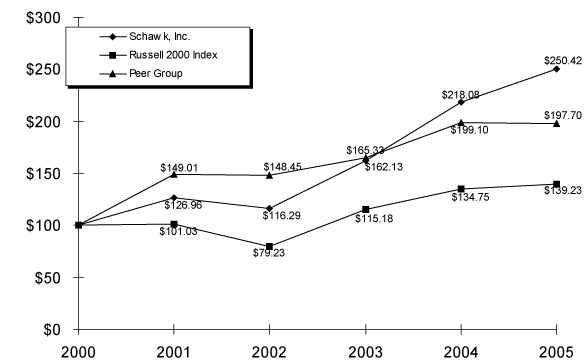
PERFORMANCE GRAPH
The graph below sets forth a comparison of the yearly percentage change in the cumulative
total return for the five-year period beginning December 31, 2000, on the Company’s Class A Common
Stock, the Russell 2000 Index, a broad-based market index representing small-cap stocks, and a peer
group (the “Peer Group”) of common stocks which includes Schawk, Inc. and four other companies that
the Company selected based on the comparable businesses of these companies. Currently, the Peer
Group consists of Bemis Company, Inc., Bowne & Co., Inc., Matthews International Corporation,
Multi-Color Corp. and the Company. The Company intends to continue to evaluate and identify
potential companies that may be appropriate for its Peer Group.
Comparison of Five-Year Cumulative Total Return*
Schawk, Inc., Russell 2000 Index and Peer Group
(Performance Results Through 12/31/05)
| * |
|
Assumes $100 invested at the close of trading on December 31, 2000 in Schawk, Inc.
common stock, the Russell 2000 Index, and the Peer Group, respectively, and reinvestment
of dividends. |
The relative performance of the Company’s Class A Common Stock, the Russell 2000 Index and the
Peer Group is as follows:
| |
|
|
|
|
|
|
|
|
|
|
|
|
|
|
|
|
|
|
|
|
|
|
|
|
| Name |
|
2000 |
|
2001 |
|
2002 |
|
2003 |
|
2004 |
|
2005 |
Schawk, Inc. |
|
$ |
100 |
|
|
$ |
126.96 |
|
|
$ |
116.29 |
|
|
$ |
162.13 |
|
|
$ |
218.08 |
|
|
$ |
250.42 |
|
Russell 2000 Index |
|
|
100 |
|
|
|
101.03 |
|
|
|
79.23 |
|
|
|
115.18 |
|
|
|
134.75 |
|
|
|
139.23 |
|
Peer Group |
|
|
100 |
|
|
|
149.01 |
|
|
|
148.45 |
|
|
|
165.33 |
|
|
|
199.10 |
|
|
|
197.70 |
|
The Report on Executive Compensation and the Performance Graph shall not be deemed
incorporated by reference by any general statement incorporating by reference this Proxy Statement
into
15
any filing under the Securities Act of 1933, as amended (the “Securities Act”) or under the
Exchange Act except to the extent that the Company specifically incorporates this information by
reference, and shall not otherwise be deemed filed under such Acts.
SECURITY OWNERSHIP OF CERTAIN
BENEFICIAL OWNERS AND MANAGEMENT
The following table sets forth information regarding the shares beneficially owned as of March
31, 2006 (i) by each person who is known by the Company to own beneficially more than 5% of the
outstanding shares of the Company’s common stock; (ii) by each of the Company’s directors; (iii) by
each of the Company’s named executive officers; and (iv) by all directors and executive officers as
a group. All information with respect to beneficial ownership has been furnished to us by the
respective stockholders.
| |
|
|
|
|
|
|
|
|
| |
|
Amount of Beneficial |
Percentage of |
| Name of Beneficial Owner |
|
Ownership(1)*** |
Class Outstanding |
Clarence W. Schawk(2)** |
|
|
7,486,300 |
(3) |
|
|
28.1 |
% |
Marilyn G. Schawk(2) |
|
|
7,486,300 |
(4) |
|
|
28.1 |
|
Schawk 2005 Three Year GRAT |
|
|
4,647,351 |
(5) |
|
|
17.6 |
|
A. Alex Sarkisian** |
|
|
3,547,237 |
(6)(7) |
|
|
13.2 |
|
David A. Schawk(2)** |
|
|
2,219,880 |
(8) |
|
|
8.1 |
|
Cathy Ann Schawk(2) |
|
|
1,928,466 |
(9) |
|
|
7.3 |
|
Christopher Lacovara |
|
|
3,300 |
(10) |
|
|
* |
|
James J. Patterson |
|
|
331,800 |
(11) |
|
|
1.2 |
|
John T. McEnroe |
|
|
80,537 |
(12) |
|
|
* |
|
Judith W. McCue |
|
|
61,973 |
(13) |
|
|
* |
|
Hollis W. Rademacher |
|
|
49,300 |
(14) |
|
|
* |
|
Leonard S. Caronia |
|
|
32,300 |
(15) |
|
|
* |
|
Myron M. Kaplan |
|
|
2,074,400 |
(16) |
|
|
7.9 |
|
J.P. Morgan Chase & Co. |
|
|
1,480,407 |
(17) |
|
|
5.6 |
|
Executive Officers and Directors as a group (9 persons) |
|
|
13,812,627 |
(18) |
|
|
48.6 |
|
|
|
|
| * |
|
Less than 1% |
| |
| ** |
|
Denotes a person who serves as a director and who is also a named executive officer. |
| |
| *** |
|
Beneficial ownership is determined in accordance with SEC Rule 13d-3 promulgated under the
Securities Exchange Act of 1934, as amended. |
| |
| (1) |
|
Unless otherwise indicated, beneficial ownership is direct and the person indicated has sole
voting and investment power. |
| |
| (2) |
|
Each is a member of Clarence W. Schawk’s immediate family (the “Schawk Family”). The address
for each of the Schawk Family members is 1695 River Road, Des Plaines, Illinois 60018. |
| |
| (3) |
|
Includes currently exercisable options to purchase 261,111 shares; 1,536,348 shares held
directly by his wife, Marilyn Schawk; 217,777 shares held by The Clarence & Marilyn Schawk
Family Foundation, with respect to which Mr. Schawk or his wife has voting and/or investment
power; and 4,647,351 shares held in the Schawk 2005 Three Year GRAT, with respect to which Mr.
Schawk’s wife serves as trustee and has sole voting power and Mr. Schawk shares investment
power. Does not include shares beneficially owned by Mr. Schawk’s children, David Schawk,
Cathy Ann Schawk, Judith Lynn Gallo and Lisa Beth Stearns, or held in family trusts for the
benefit of certain of his grandchildren. Mr. Schawk does not share voting power or investment
power over shares of the company held by or on behalf of his children or grandchildren. |
| |
| (4) |
|
Includes 1,084,824 shares (including currently exercisable options to purchase 261,111
shares) held directly by her husband, Clarence Schawk; 217,777 shares held by The Clarence &
Marilyn Schawk Family Foundation, with respect to which Mrs. Schawk or her husband has voting
and/or investment power; and 4,647,351 shares held in the Schawk 2005 Three Year GRAT, with
respect to which Mrs. Schawk serves as trustee and has sole voting power and Clarence Schawk
shares investment power. Does not include shares beneficially owned by Mrs. Schawk’s
children, David A. Schawk, Cathy Ann Schawk, Judith Lynn Gallo and Lisa Beth Stearns, or held
in family trusts for the benefit of certain of her grandchildren. Mrs. Schawk does not share
voting power or investment power over shares of the company held by or on behalf of her
children or grandchildren. |
| |
| (5) |
|
Shares included in beneficial ownership of both Clarence Schawk and Marilyn Schawk.
|
16
|
|
|
| (6) |
|
Includes currently exercisable options to purchase 359,272 shares. |
| |
| (7) |
|
Includes 3,149,990 shares held by various Schawk Family trusts for the benefit of certain of
Clarence W. Schawk’s grandchildren, for which Mr. Sarkisian serves as the trustee, or
custodian, with voting and investment power over the shares. |
| |
| (8) |
|
Includes currently exercisable options to purchase 880,886 shares; 21,000 shares held in the
David and Teryl Schawk Family Foundation; 500,000 shares held in the David A. Schawk 2005
Three Year GRAT; and 811,134 shares held in the David A. Schawk 1998 Trust for which David
Schawk serves as trustee with voting and investment power over these shares. |
| |
| (9) |
|
Ms. Schawk is the daughter of Clarence W. Schawk and sister of David A. Schawk. |
| |
| (10) |
|
Includes currently exercisable options to purchase 3,300 shares. |
| |
| (11) |
|
Includes currently exercisable options to purchase 316,200 shares. |
| |
| (12) |
|
Includes currently exercisable options to purchase 43,300 shares, 36,236 shares owned
indirectly by his spouse and 1,001 shares held in a retirement trust account. |
| |
| (13) |
|
Includes currently exercisable options to purchase 43,300 shares and the indirect ownership
of 10,000 shares held in retirement trust accounts. |
| |
| (14) |
|
Includes currently exercisable options to purchase 43,300 shares. |
| |
| (15) |
|
Includes currently exercisable options to purchase 28,300 shares. |
| |
| (16) |
|
Based on information disclosed in Amendment No. 6 to Schedule 13G filed by Mr. Kaplan with
the Securities and Exchange Commission on February 9, 2006. Mr. Kaplan’s address is P.O. Box
385, Leonia, New Jersey 07605. |
| |
| (17) |
|
Based on information disclosed in Amendment No. 1 to Schedule 13G filed by J.P. Morgan Chase
& Co. with the Securities and Exchange Commission on February 8, 2006. J.P. Morgan Chase &
Co.’s mailing address is 270 Park Ave., New York, NY 10017. |
| |
| (18) |
|
Includes currently exercisable options to purchase an aggregate of 1,978,969 shares held by
certain executive officers and directors. |
RELATED PARTY TRANSACTIONS
The Company’s facility at 1600 East Sherwin Avenue, Des Plaines, Illinois is leased from
Graphics IV, Ltd., an Illinois limited partnership, whose partners are the children of Clarence W.
Schawk. The amount paid in 2005 under the current lease was $687,000.
During 2005, the Company retained the law firm of Vedder, Price, Kaufman & Kammholz, P.C., to
perform various legal services. John T. McEnroe, one of the Company’s Directors, is a shareholder
of that firm. During 2005, McDermott Will & Emery LLP, a law firm in which Ms. McCue, one of the
Company’s Directors, is a partner, provided estate planning legal services for certain members of
the Schawk family.
In October 2004, the Company retained Cochran Caronia & Co. (now known as Cochran Caronia
Waller) to perform certain advisory services in connection with the Company’s purchase of the
outstanding stock of KAGT Holdings, Inc., the parent company of Seven Worldwide, Inc., in January
2005. Leonard S. Caronia, one of the Company’s Directors, is a principal of Cochran Caronia
Waller. The amount paid in March 2005 for these services was approximately $800,000. The Company
also retained the services of Cochran Caronia Waller in connection with the sale of assets related
to its publications group to Caps Group Acquisition, LLC in March 2006. The amount payable to
Cochran Caronia Waller is $622,500.
On December 20, 2004, the Company entered into a Stock Purchase Agreement with Seven
Worldwide, Inc. (“Seven Worldwide”), KAGT Holdings, Inc. (“KAGT Holdings”), the parent of Seven
Worldwide, and the stockholders of KAGT Holdings (the “KAGT Holders”) in connection with the
acquisition of all of the outstanding stock of KAGT Holdings (the “Seven Worldwide Acquisition”).
On January 31, 2005, in connection with the closing of the Seven Worldwide Acquisition, the Company
entered into a registration rights agreement with certain KAGT Holders and Clarence W. Schawk,
Marilyn G. Schawk, David A. Schawk, and A. Alex Sarkisian, as trustee of certain Schawk family
trusts (collectively, the “Schawk Principal Holders”). One of the Company’s Directors, Christopher
Lacovara, is a principal at Kohlberg & Company, which is affiliated with certain of the KAGT
Holders. In 2005,
17
the KAGT Holders executed a demand registration right in full, pursuant to which
the Company registered the shares held by the KAGT Holders. All registered shares of the KAGT
Holders were subsequently sold in an underwritten public offering that closed in February 2006 (the
“KAGT Offering”).
The Company also entered into an amended and restated registration rights agreement on January
31, 2005 with the Schawk Principal Holders, Cathy Ann Schawk and other Schawk family members party
to the original registration rights agreement (collectively, “Schawk Family Holders”). The
agreement grants demand registration rights for the shares held by the Schawk Family Holders and
sets forth certain terms concerning priority among shares registered by Schawk Family Holders
pursuant to demand registrations and shares registered pursuant to incidental registration rights
held by certain KAGT Holders under the registration rights agreement described above.
Also in connection with the Seven Worldwide Acquisition, the Company entered into a governance
rights agreement with the KAGT Holders and the Schawk Principal Holders pursuant to which, among
other things, the Company agreed to take the necessary actions to appoint the KAGT Holders’
designee, Christopher Lacovara, to the Company’s Board of Directors. Under the terms of the
agreement the KAGT Holders retained the right to designate one director to the Company’s Board of
Directors for so long as they owned more than 10% of the outstanding common stock of the Company.
As a result of the closing of the KAGT Offering, the KAGT Holders no longer retain a board member
designation right.
PROPOSAL 2: APPROVAL OF CERTAIN CASH-BASED
LONG-TERM PERFORMANCE AWARDS
At the Annual Meeting, there will be submitted to stockholders a proposal to approve
cash-based long-term performance awards granted to certain executives in 2005. Payment of these
awards is conditioned on stockholder approval.
In 2005, the Company granted to ten executives, including all of the executives identified in
the Summary Compensation Table under “Executive Compensation” above, long-term performance awards,
payable in cash, under the Schawk, Inc. 2003 Equity Option Plan, as amended. These awards provide
for payment of cash compensation to the executives at the conclusion of overlapping two- and
three-year performance periods based on the Company’s achievement of operating profit and earnings
per share performance goals specified under each award. The maximum amount that could be paid to
any individual employee under any one of these awards is $900,000, which reflects payment at 150%
of the target award amount. The Long-Term Incentive Plans table under “Executive Compensation”
above provides additional information about the awards to the named executive officers.
The Board of Directors recommends that you vote FOR the approval of the 2005 cash-based
long-term performance awards and the foregoing performance goals and maximum
individual payment amount.
PROPOSAL 3: APPROVAL OF SCHAWK, INC. 2006 LONG-TERM INCENTIVE PLAN
At the Annual Meeting, there will be submitted to stockholders a proposal to approve the
Schawk, Inc. 2006 Long-term Incentive Plan (the “2006 Plan”). The 2006 Plan will provide for the
grant of nonqualified stock options, incentive stock options, stock appreciation rights, restricted
stock, restricted stock units, performance awards and other stock-based incentives to officers,
other employees and directors of the Company. The total number of shares of common stock that will
be available for issuance
18
under the 2006 Plan will be the number of shares available for issuance
under the Company’s 2003 Equity Option Plan (the “2003 Plan”) as of May 17, 2006. As a result, no
additional shares are being reserved for issuance under the 2006 Plan. In comparison to the 2003
Plan, the 2006 Plan, among other things:
| |
• |
|
includes provisions related to the Company’s compliance with new Internal Revenue
Code Section 409A deferred compensation rules and Internal Revenue Code Section 162(m); |
| |
| |
• |
|
expressly permits awards to directors and to offshore employees; |
| |
| |
• |
|
provides a broader range of events that would constitute a “change in control” of
the Company and modifies or clarifies provisions relating to vesting and non-forfeiture
of awards upon a change in control; and |
| |
| |
• |
|
provides greater discretion to the committee in setting award exercise restrictions
and in permitting the transfer of awards. |
The Board of Directors recommends that you vote FOR the approval of the 2006 Plan.
Description of the 2006 Plan
In March 2006, the Company’s board of directors approved the 2006 Plan, subject to stockholder
approval, which is intended to replace the 2003 Plan. The following description of the 2006 Plan
is qualified by reference to the full text of the plan document, which is attached as Annex A to
this proxy statement.
Purpose
Generally, the 2006 Plan seeks to facilitate a sense of proprietorship and personal
involvement among employees and directors in the development and financial success of the Company,
thereby advancing the interests of the Company and its stockholders. Through the 2006 Plan, the
Company desires to attract and retain able individuals to become employees or serve as directors of
the Company and to provide a means whereby those individuals can acquire and maintain stock
ownership, thereby strengthening their concern for the welfare of the Company.
Administration
The 2006 Plan is administered by the Option/Compensation committee of the Company’s board of
directors (referred to in this section as the “committee”) and may be administered by a
subcommittee thereof. This committee selects the individuals who will receive awards from among
the eligible participants and determines the form of those awards, the number of shares or dollar
targets of the awards, and all terms and conditions of the awards, except that awards granted to
non-employee directors are granted and administered by the full board of directors. The committee
has the power to delegate to an officer of the Company the right to designate employees (other than
to officers of the Company) to be recipients of awards and to determine the size of each award
subject to a maximum aggregate number of awards approved by the committee. The committee is
empowered to approve and certify the level of attainment of any performance targets established in
connection with awards to “covered employees” under the 2006 Plan as may be required under Section
162(m) of the Internal Revenue Code.
19
Eligibility
Employees, including officers, and directors, are eligible to receive awards under the 2006
Plan. Approximately twelve employees comprising members of the Company’s management team have been
the primary participants to date in the Company’s 2003 Plan.
Award Forms
Under the 2006 Plan, the committee may grant incentive stock options (except to directors)
that meet the criteria of Section 422 of the Internal Revenue Code, and non-qualified stock
options, which are not intended to qualify as incentive stock options. Both types of stock option
awards will be exercisable for shares of common stock of the Company. The committee may also grant
stock appreciation rights (“SARs”) payable in cash, common stock of the Company or a combination
thereof. The committee may also grant restricted stock, restricted stock units (“RSUs”),
performance-based awards and other cash- and stock-based awards.
Stock-based awards (other than awards of options and SARs) that are outstanding on a dividend
record date for the Company’s common stock may, in the discretion of the committee, earn (a)
dividends
in the case of restricted stock awards or (b) dividend equivalents in the case of all other
awards based on the dividends or other distributions that would have been paid on the shares
covered by such award had the covered shares been issued and outstanding on the dividend record
date.
Maximum Stock Award Levels
The maximum number of shares available for awards under the 2006 Plan will be the number of
shares of Schawk, Inc. common stock available for issuance but not subject to outstanding awards
under the 2003 Plan as of May 17, 2006. As of March 31, 2006, there were 1,025,031 shares of
common stock available for issuance under the 2003 Plan. Under the 2006 Plan, not more than
800,000 shares may be issued pursuant to exercises of incentive stock options. To the extent any
shares of stock covered by an award are not delivered to a participant or beneficiary because the
award expired or is forfeited or canceled, or shares of stock are not delivered because an award is
settled in cash or the shares are exchanged prior to issuance, such shares shall again be available
for grant under the 2006 Plan. Any shares of common stock delivered to the Company by a
participant upon exercise of an option in payment of all or part of the option, or delivered or
withheld in satisfaction of withholding taxes with respect to an award, shall be additional shares
available for awards under the 2006 Plan.
The following additional limits apply to annual awards under the 2006 Plan to any participant
who is or is expected to be a “covered employee” under Section 162(m) of the Internal Revenue Code
to the extent such awards qualify as performance-based compensation:
| |
• |
|
The maximum number of shares of common stock that may be made subject to option
grants in any calendar year to any one participant is 350,000. |
| |
| |
• |
|
The maximum number of shares of common stock that may be made subject to SARs in any
calendar year to any one participant is 350,000. |
| |
| |
• |
|
The maximum number of shares of common stock that may be made subject to restricted
stock or RSU awards that are subject to performance objectives is 100,000. |
| |
| |
• |
|
Performance awards to any one participant may not be granted during any calendar
year that exceed 100,000 shares or the value of 100,000 shares determined as of the
date of vesting or payout. |
20
| |
• |
|
Cash-based awards and other stock-based awards to any one participant may not exceed
the value of $2 million or 100,000 shares per calendar year. |
The foregoing numbers of shares may be increased or decreased by the events described in
“Adjustments” below.
Stock Option Awards
Stock options awards may be either incentive stock options or non-qualified stock options.
For U.S.-based participants, options will expire no later than the tenth anniversary of the date of
grant. The exercise price of stock options may not be less than the fair market value of a share
of the Company’s common stock on the date of grant. The committee in its discretion may establish
vesting requirements or other restrictions or conditions to exercise that must be met prior to the
exercise. The committee also has the discretion to determine the extent to which granted options
may be exercised after a participant’s termination of employment or service with the Company.
Stock Appreciation Rights
The committee may grant stock appreciation rights, or SARs. For U.S.-based participants, SARs
will expire no later than the tenth anniversary of the date of grant, and the exercise price of a
SAR may not be less than the fair market value of a share of common stock on the date of grant.
Generally, upon exercise, a SAR entitles a participant to receive (in cash, shares of common stock
or a combination thereof as determined by the committee) the excess of the fair market value of a
share of common stock on the date the SAR is exercised over the fair market value of a share of
common stock on the date the SAR is granted. The committee in its discretion may establish
restrictions or conditions to exercise that must be met prior to the exercise of a SAR. The
committee also has the discretion to determine the extent to which SARs may be exercised after a
participant’s termination of employment or service with the Company.
Restricted Stock and Restricted Stock Unit Awards
Under the 2006 Plan, the committee may also grant shares of restricted stock and restricted
stock units, or RSUs, which as to each RSU award represents the right to receive at a specified
future date payment equal to the fair market value of the number of shares of common stock
specified in such RSU award. Restricted stock and RSU awards are generally subject to restrictions
including, but not limited to, the payment of a stipulated purchase price for each share of
restricted stock or each RSU, the achievement of performance criteria established at the discretion
of the committee and/or time-based restrictions following attainment of specific performance goals.
During the restriction period, the participant would generally be entitled to vote shares of
restricted stock but not RSUs. Upon the lapse or satisfaction of the applicable conditions and/or
restrictions, shares covered by a restricted stock award become fully transferable and an RSU may
be settled for cash, common stock or part in cash and part in stock. The committee also has the
discretion to determine the extent to which unvested restricted stock and RSUs may be forfeited or
be unrestricted and payable after a participant’s termination of employment or service with the
Company.
Performance Units and Performance Shares
The committee may also grant performance units or performance shares under the 2006 Plan. A
performance unit or performance share award is a grant of a right to receive cash, shares of common
stock or a combination of cash and stock, which grant is contingent on the achievement of
performance or other objectives during a specified period. Each performance unit granted will have
an initial dollar value established by the committee at the time of grant. Each performance share
granted will have an initial
21
value based on the fair market value of a share of the Company’s
common stock. The committee has the discretion to determine the extent to which unvested
performance units and performance shares may be forfeited or payable after a participant’s
termination of employment or service with the Company.
Any awards designated as intended to be “performance-based compensation” to a “covered
employee” shall be conditioned on the achievement of one or more performance measures, to the
extent required by Section 162(m) of the Internal Revenue Code. The 2006 Plan specifies the
performance measures that may be used by the committee for performance-based awards. These
measures are generally based on strategic business objectives, earnings and earnings growth
targets, financial measures and share price performance goals.
Cash Awards and Other Stock-based Awards
The committee may grant awards denominated in cash or other types of equity-based or
equity-related awards under the 2006 Plan in such amounts and upon such terms and conditions as the
committee may determine consistent with the purposes and restrictions of the 2006 Plan.
Transferability
Awards granted under the 2006 Plan generally are exercisable only by the participant and may
not be transferred except by will or the laws of descent and distribution; however, at the
committee’s discretion, a participant may be permitted to transfer an award and the transferee may
exercise such award provided that the award is not transferred for value.
Participant Forfeiture Events
The committee may specify in an award agreement that the participant’s rights, payments, and
benefits with respect to an award shall be subject to reduction, cancellation, forfeiture, or
recoupment upon the occurrence of certain specified events, in addition to any otherwise applicable
vesting or performance conditions of an award. Such events may include termination of employment
for cause, termination of the participant’s employment with or provision of services to the
Company, violation of material policies, breach of noncompetition, confidentiality, or other
restrictive covenants that may apply to a participant, or other conduct by the participant that is
detrimental to the Company’s business or reputation.
Additionally, in certain situations, a participant will be required to reimburse the Company
for amounts previously received by the participant upon settlement of an award if the participant
engages in misconduct or knowingly fails to prevent misconduct that leads to the Company having to
prepare an accounting restatement.
Adjustments
In the event of a corporate event or transaction involving the Company (including, without
limitation, a merger, consolidation, reorganization, recapitalization, liquidation, stock dividend,
stock split, split-up, spin-off, share combination or exchange of shares), the committee may modify
the terms of outstanding awards, including adjusting the number or type of security underlying
outstanding awards, as it deems appropriate, to maintain the rights of the participants under the
2006 Plan.
Change in Control
Generally, upon a change in control of the Company (as defined in the 2006 Plan) all
outstanding options and SARs will become fully exercisable. Unless more favorable terms are
approved by the committee (a) all restricted stock and RSUs will become immediately vested and
payable, and (b) all
22
performance awards will become payable in full, with the performance
objectives applicable to such award deemed satisfied at the maximum level of performance, in each
case in a pro-rated amount equal to the portion of the vesting period elapsed through the date of
the change in control.
The committee may in its discretion cancel all outstanding awards upon a change in control and
provide cash or other payment in consideration for any outstanding awards.
Amendment and Termination
Except for certain situations requiring stockholder approval, the committee may, at any time,
amend, suspend or terminate the 2006 Plan or any award agreement; provided that no such amendment,
suspension or termination may adversely affect the rights of any participant or beneficiary under
any award granted under the plan prior to the date such amendment, suspension or termination is
adopted (other than amendments required in order to conform to applicable laws) in the absence of
written consent to the change by the affected participant.
Tax Consequences
The following is a brief summary of the principal federal income tax consequences of stock
option awards under the 2006 Plan. The summary is based on current federal income tax laws and
interpretations thereof, all of which are subject to change at any time, possibly with retroactive
effect. The summary is not intended to be exhaustive.
Non-Qualified Stock Options. A participant who receives a non-qualified option does not
recognize taxable income upon the grant of the option, and the Company is not entitled to a tax
deduction. The participant will recognize ordinary income upon the exercise of the option in an
amount equal to the excess of the fair market value of the option shares on the exercise date over
the option price. Such income will be treated as compensation to the participant subject to
applicable withholding requirements. The Company generally is entitled to a tax deduction in an
amount equal to the amount taxable to the participant as ordinary income in the year the income is
taxable to the participant. Any appreciation in value after the time of exercise will be taxable
to the participant as capital gain and will not result in a deduction by the Company.
Incentive Stock Options. A participant who receives an incentive stock option does not
recognize taxable income upon the grant or exercise of the option, and the Company is not entitled
to a tax deduction. The difference between the option price and the fair market value of the
option shares on the date of exercise, however, will be treated as a tax preference item for
purposes of determining the alternative minimum tax liability, if any, of the participant in the
year of exercise. The Company will not be entitled to a deduction with respect to any item of tax
preference.
A participant will recognize gain or loss upon the disposition of shares acquired from the
exercise of incentive stock options. The nature of the gain or loss depends on how long the option
shares were held. If the option shares are not disposed of pursuant to a “disqualifying
disposition” (i.e., no disposition occurs within two years from the date the option was granted nor
one year from the date of exercise), the participant will recognize long-term capital gain or
capital loss depending on the selling price of the shares. If option shares are sold or disposed
of as part of a disqualifying disposition, the participant must recognize ordinary income in an
amount equal to the lesser of the amount of gain recognized on the sale, or the difference between
the fair market value of the option shares on the date of exercise and the option price. Any
additional gain will be taxable to the participant as a long-term or short-term capital gain,
depending on how long the option shares were held. The Company generally is entitled to a
deduction in computing federal income taxes for the year of disposition in an amount equal to any
amount taxable to the participant as ordinary income.
23
Equity Compensation Plan Information
The following table gives information, as of December 31, 2005, relating to equity
compensation plans of the Company pursuant to which equity securities are authorized for issuance
(shares in thousands).
| |
|
|
|
|
|
|
|
|
|
|
|
|
| |
|
Number of securities |
|
|
|
|
|
|
Number of securities |
|
| |
|
to be issued upon |
|
|
Weighted-average |
|
|
remaining available for |
|
| |
|
exercise of |
|
|
exercise price of |
|
|
future issuance under |
|
| |
|
outstanding options, |
|
|
outstanding options, |
|
|
equity compensation |
|
| Plan category |
|
warrants and rights |
|
|
warrants and rights |
|
|
plans |
|
Equity compensation
plans approved by
security holders |
|
|
3,333 |
|
|
$ |
11.73 |
|
|
|
1,025 |
|
Equity compensation
plans not approved
by security holders |
|
|
— |
|
|
|
— |
|
|
|
— |
|
|
|
|
|
|
|
|
|
|
|
Total |
|
|
3,333 |
|
|
$ |
11.73 |
|
|
|
1,025 |
|
PROPOSAL 4: RATIFICATION OF INDEPENDENT AUDITORS
The Audit Committee has selected Ernst & Young LLP as the independent auditors for the Company
for fiscal year 2006. Ernst & Young, LLP served as the independent auditors for the Company for
the fiscal year ended December 31, 2005. The affirmative vote of a majority of the holders of the
outstanding shares of the Class A Common Stock of the Company present or represented and entitled
to vote at the Annual Meeting is required to ratify the selection of Ernst & Young LLP. Abstentions
will have the effect of voting against Proposal 3.
Representatives of Ernst & Young LLP are expected to be present at the Annual Meeting and will
be available to respond to any appropriate questions raised at the meeting and to make a statement
if such representatives so wish.
The Board of Directors recommends a vote FOR proposal 4 to ratify the selection of the
independent auditors.
Fees for Services Provided by Independent Auditors
Fees for all services provided by Ernst & Young LLP for the fiscal years ended December 31,
2005 and 2004 are as follows:
Audit Fees. Audit fees for 2005 and 2004 related to the annual financial statement audit and
report on management’s assessment of the Company’s internal controls, reviews of quarterly
financial statements contained in the Company’s quarterly reports on Form 10-Q and statutory audits
totaled approximately $1,923,000 and $387,000, respectively.
Audit-Related Fees. Fees for audit-related services in 2005 and 2004, primarily related to
acquisition due diligence and assistance with compliance with the Sarbanes-Oxley Act of 2002,
totaled approximately $215,000 and $1,608,000, respectively.
Tax Fees. Fees for tax services, including tax compliance, tax advice and tax planning
totaled approximately $20,000 and $137,000 for 2005 and 2004, respectively.
24
All Other Fees. There were no fees for other services for 2005 and 2004.
The Audit Committee pre-approves all audit and permissible non-audit services provided by the
independent public accountants. These services may include audit services, audit-related services,
tax services and other services. For each proposed service, the Auditors must provide detailed
back-up
documentation at the time of approval. The Audit Committee may delegate pre-approval
authority to one or more of its members. Such member must report any decisions to the Audit
Committee at the next scheduled meeting. The Audit Committee may not delegate to management its
responsibilities to pre-approve services performed by the independent auditors.
All of the services provided by the Auditors described above were pre-approved by the Audit
Committee.
25
AUDIT COMMITTEE REPORT
The Audit Committee of the Company’s Board of Directors is composed of three independent
Directors in accordance with NYSE and SEC rules as currently in effect and operates under a written
charter adopted by the Board of Directors and the Audit Committee, a copy of which is available on
the Company’s website. The Board appoints the members of the Audit Committee, which may consist of
no fewer than three Directors. The Audit Committee assists the Board, through review and
recommendation, in its oversight responsibility related to the quality and integrity of the
Company’s financial information and reporting functions, the adequacy and effectiveness of the
Company’s system of internal accounting and financial controls, and oversees the independent audit
process.
The responsibility for the quality and integrity of the Company’s financial statements and the
completeness and accuracy of its internal controls and financial reporting process rests with the
Company’s management. The Company’s independent public accountants, Ernst & Young LLP (“Ernst &
Young”), are responsible for performing an audit and expressing an opinion as to whether the
Company’s financial statements are fairly presented, in all material respects, in conformity with
generally accepted accounting principles.
The Audit Committee reviewed and discussed with management and Ernst & Young the audited
financial statements of the Company for the year ended December 31, 2005. The Audit Committee also
reviewed and discussed with Ernst & Young the matters required to be discussed by Statement on
Auditing Standards No. 61, as amended (“Communication with Audit Committees”), as currently in
effect.
Ernst & Young also provided to the Audit Committee the written disclosures and the letter
required by Independence Standards Board Standard No. 1 (“Independence Discussions with Audit
Committees”), as currently in effect. The disclosures described the relationships and fee
arrangements between the firm and the Company. Consistent with Independence Standards Board
Standard No. 1 and the SEC’s “Revision of the Commission’s Auditor Independence Requirements,”
which became effective February 5, 2001, the Audit Committee considered whether the provision of
non-audit services by Ernst & Young to the Company for the fiscal year ended December 31, 2005 is
compatible with maintaining Ernst & Young’s independence, and has discussed with representatives of
Ernst & Young the firm’s independence from the Company.
Based on the above-mentioned reviews and discussions with management and Ernst & Young, and
subject to the limitations on the role and responsibilities of the Audit Committee referred to
above, and as described in its charter, the Audit Committee, exercising its business judgment,
recommended to the Board of Directors that the Company’s audited financial statements be included
in its Annual Report on Form 10-K for the year ended December 31, 2005, for filing with the SEC.
This report is submitted on behalf of the members of the Audit Committee:
Hollis W. Rademacher (Chairman)
Judith W. McCue
Christopher Lacovara
26
The foregoing Audit Committee Report shall not be deemed incorporated by reference by any
general statement incorporating by reference this Proxy Statement into any filing under the
Securities Act or the Exchange Act, except to the extent that the Company specifically incorporates
this information by reference, and shall not otherwise be deemed filed under such Acts.
OTHER MATTERS
The Board of Directors knows of no matters other than those described above that may come
before the Annual Meeting. As to other matters, if any, that properly may come before the Annual
Meeting, the Board of Directors intends that proxies in the accompanying form will be voted in
respect thereof in accordance with the judgment of the person voting the proxies.
Stockholder Access to Directors
Generally, stockholders who have questions or concerns regarding the Company should contact
the Investor Relations department at (847) 827-9494. Any stockholders, however, who wish to
address questions regarding the business or affairs of the Company directly with the Board of
Directors, or any individual director, should direct his or her questions in writing to any
director or to all directors c/o Schawk, Inc., 1695 River Road, Des Plaines, Illinois 60018.
Stockholders Sharing the Same Address
The SEC’s proxy rules permit companies and intermediaries to satisfy delivery requirements for
proxy statements with respect to two or more stockholders sharing the same address by delivering a
single proxy statement to those stockholders. This method of delivery, often referred to as
“householding,” should reduce the amount of duplicate information that stockholders receive and
lower printing and mailing costs for companies. If a broker, bank or other nominee holds your
shares, this may mean that only one proxy statement (and accompanying annual report) will be
delivered to multiple stockholders sharing your address unless you notify ADP at (888) 603-5847 or
Householding Department, 51 Mercedes Way, Edgewood, NY 11717, to inform them of your request. Be
sure to include your name, the name of your brokerage firm and your account number. You also can
contact the Company by calling (847) 827-9494 or by writing to Schawk, Inc., 1695 River Road, Des
Plaines, Illinois 60018, Attention: Corporate Secretary, to request a separate copy of the proxy
statement for the Annual Meeting and for future meetings, or you can contact your broker to make
the same request.
STOCKHOLDER PROPOSALS FOR 2007 ANNUAL MEETING
Stockholder proposals for inclusion in the Company’s Proxy Statement for the 2007 Annual
Meeting of Stockholders must be received by the Company not later than December 22, 2006. The
person submitting the proposal must have been a record or beneficial owner of shares of Class A
Common Stock for at least one year, and the securities so held must have a market value of at least
$2,000.
27
Additionally, if a proponent of a stockholder proposal at the 2007 Annual Meeting of
Stockholders fails to provide notice of the intent to make such proposal by personal delivery or
mail to the Company on or before March 7, 2007 (or by an earlier or later date, if such date is
established by amendment to the Company’s By-laws), then any proxy solicited by management may
confer discretionary authority to vote on such proposal.
| |
|
|
|
|
By Order of the Board of Directors, |
|
|
|
Des Plaines, Illinois
|
|
A. ALEX SARKISIAN, Esq. |
April 21, 2006
|
|
Executive Vice President and Chief Operating Officer |
The Company’s Form 10-K for the year ended December 31, 2005 (excluding exhibits unless
specifically incorporated by reference therein) and the Company’s Audit Committee Charter, Code of
Ethics and Corporate Governance Guidelines are available free of charge on the Company’s website at
www.schawk.com or upon request to A. Alex Sarkisian, Esq., Corporate Secretary, at Schawk, Inc.,
1695 River Road, Des Plaines, Illinois 60018, (847) 827-9494.
28
Annex A
Schawk, Inc.
2006 Long-Term Incentive Plan
Effective May 17, 20061
|
|
|
| 1 |
|
Subject to approval at the 2006 Annual Meeting of Schawk, Inc. stockholders |
Contents
| |
|
|
|
|
Article 1. Establishment, Purpose, and Duration |
|
|
A-2 |
|
Article 2. Definitions |
|
|
A-2 |
|
Article 3. Administration |
|
|
A-8 |
|
Article 4. Shares Subject to This Plan and Maximum Awards |
|
|
A-9 |
|
Article 5. Eligibility and Participation |
|
|
A-10 |
|
Article 6. Stock Options |
|
|
A-11 |
|
Article 7. Stock Appreciation Rights |
|
|
A-12 |
|
Article 8. Restricted Stock and Restricted Stock Units |
|
|
A-14 |
|
Article 9. Performance Units/Performance Shares |
|
|
A-15 |
|
Article 10. Cash-Based Awards and Other Stock-Based Awards |
|
|
A-16 |
|
Article 11. Transferability of Awards |
|
|
A-17 |
|
Article 12. Performance Measures |
|
|
A-18 |
|
Article 13. Nonemployee Director Awards |
|
|
A-19 |
|
Article 14. Dividend Equivalents |
|
|
A-19 |
|
Article 15. Beneficiary Designation |
|
|
A-19 |
|
Article 16. Rights of Participants |
|
|
A-20 |
|
Article 17. Change in Control |
|
|
A-20 |
|
Article 18. Amendment, Modification, Suspension, and Termination |
|
|
A-21 |
|
Article 19. Withholding |
|
|
A-21 |
|
Article 20. Successors |
|
|
A-22 |
|
Article 21. General Provisions |
|
|
A-22 |
|
A-1
Schawk, Inc. 2006 Long-Term Incentive Plan
Article 1. Establishment, Purpose, and Duration
1.1 Establishment. Schawk, Inc., a Delaware corporation (hereinafter referred to as the
“Company”), establishes an incentive compensation plan to be known as the Schawk, Inc. 2006
Long-Term Incentive Plan (hereinafter referred to as the “Plan”), as set forth in this document.
This Plan permits the grant of Nonqualified Stock Options, Incentive Stock Options, Stock
Appreciation Rights, Restricted Stock, Restricted Stock Units, Performance Shares, Performance
Units, Cash-Based Awards, and Other Stock-Based Awards.
This Plan shall become effective upon shareholder approval (the “Effective Date”) and shall
remain in effect as provided in Section 1.3 hereof.
1.2 Purpose of this Plan. The purpose of this Plan is to provide a means whereby Employees and
Directors of the Company develop a sense of proprietorship and personal involvement in the
development and financial success of the Company, and to encourage them to devote their best
efforts to the business of the Company, thereby advancing the interests of the Company and its
shareholders. A further purpose of this Plan is to provide a means through which the Company may
attract and retain able individuals to become Employees or serve as Directors of the Company and to
provide a means whereby those individuals can acquire and maintain stock ownership, thereby
strengthening their concern for the welfare of the Company.
1.3 Duration of this Plan. Unless sooner terminated as provided herein, this Plan shall
terminate ten (10) years from the Effective Date. After this Plan is terminated, no Awards may be
granted but Awards previously granted shall remain outstanding in accordance with their applicable
terms and conditions and this Plan’s terms and conditions. Notwithstanding the foregoing, no
Incentive Stock Options may be granted more than ten (10) years after the earlier of: (a) adoption
of this Plan by the Board, or (b) the Effective Date.
Article 2. Definitions
Whenever used in this Plan, the following terms shall have the meanings set forth
below, and when the meaning is intended, the initial letter of the word shall be capitalized:
| |
2.1 |
|
“Affiliate” shall mean any corporation or other entity (including, but not limited
to, a partnership or a limited liability company) that is affiliated with the Company
through stock or other equity ownership, and is designated as an Affiliate for purposes of
this Plan by the Committee. For purposes of granting stock options or stock appreciation
rights, an entity may not be considered an Affiliate if it results in noncompliance with
Code Section 409A. |
| |
| |
2.2 |
|
“Annual Award Limit” or “Annual Award Limits” have the meaning set forth in Section
4.3. |
A-2
| |
2.3 |
|
“Award” means, individually or collectively, a grant under this Plan of Nonqualified
Stock Options, Incentive Stock Options, Stock Appreciation Rights, Restricted Stock,
Restricted Stock Units, Performance Shares, Performance Units, Cash-Based Awards, or
Other Stock-Based Awards, in each case subject to the terms of this Plan. |
| |
| |
2.4 |
|
“Award Agreement” or “Agreement” means either: (i) a written agreement entered into
by the Company and a Participant setting forth the terms and provisions applicable to an
Award granted under this Plan, or (ii) a written statement issued by the Company to a
Participant describing the terms and provisions of such Award, including any amendment or
modification thereof. The Committee may provide for the use of electronic, Internet, or
other nonpaper Award Agreements, and the use of electronic, Internet, or other nonpaper
means for the acceptance thereof and actions thereunder by the Participant. |
| |
| |
2.5 |
|
“Beneficial Owner” or “Beneficial Ownership” shall have the meaning ascribed to such
term in Rule 13d-3 of the General Rules and Regulations under the Exchange Act. |
| |
| |
2.6 |
|
“Board” or “Board of Directors” means the Board of Directors of the Company. |
| |
| |
2.7 |
|
“Cash-Based Award” means an Award, denominated in cash, granted to a Participant as
described in Article 10. |
| |
| |
2.8 |
|
“Change in Control” means any of the following events: |
| |
(a) |
|
The acquisition by any Person of Beneficial Ownership of thirty percent
(30%) or more of the combined voting power of the then outstanding voting
securities of the Company entitled to vote generally in the election of Directors
(the “Outstanding Company Voting Securities”); provided, however, that for purposes
of this Section 2.8, the following acquisitions shall not constitute a Change in
Control: (i) any acquisition by a Person who on the Effective Date is the
Beneficial Owner of thirty percent (30%) or more of the Outstanding Company Voting
Securities; (ii) any acquisition directly from the Company, including without
limitation, a public offering of securities; (iii) any acquisition by the Company;
(iv) any acquisition by any employee benefit plan (or related trust) sponsored or
maintained by the Company or any of its Subsidiaries; or (v) any acquisition by any
corporation pursuant to a transaction that complies with subparagraphs (i), (ii),
and (iii) of Section 2.8(c); |
| |
| |
(b) |
|
Individuals who constitute the Board as of the Effective Date hereof
(the “Incumbent Board”) cease for any reason to constitute at least a majority of
the Board, provided that any individual becoming a Director subsequent to the
Effective Date whose election, or nomination for election by the Company’s
shareholders, was approved by a vote of at least a majority of the Directors then
comprising the Incumbent Board shall be considered as though such individual were a
member of the Incumbent Board, but excluding, for this purpose, any such individual
whose initial assumption of office is in connection with an actual or threatened
election contest relating to the election or removal of the Directors of the
Company or other actual or threatened solicitation of proxies or consents by or on
behalf of a Person other than the Board; |
A-3
| |
(c) |
|
Consummation of a reorganization, merger, or consolidation to which the
Company is a party or a sale or other disposition of all or substantially all of
the assets of the Company (a “Business Combination”), in each case unless,
following such Business Combination: (i) all or substantially all of the
individuals and entities (provided, for such purpose, the Schawk Group shall be
considered a single such individual) who were the Beneficial Owners of Outstanding
Company Voting Securities immediately prior to such Business Combination
beneficially own, directly or indirectly, more than sixty percent (60%) of the
combined voting power of the outstanding voting securities entitled to vote
generally in the election of directors of the corporation resulting from the
Business Combination (including, without limitation, a corporation which as a
result of such transaction owns the Company or all or substantially all of the
Company’s assets either directly or through one or more subsidiaries) (the
“Successor Entity”) in substantially the same proportions as their ownership
immediately prior to such Business Combination of the Outstanding Company Voting
Securities; and (ii) no Person (excluding any Successor Entity or any employee
benefit plan, or related trust, of the Company or such Successor Entity)
beneficially owns, directly or indirectly, thirty percent (30%) or more of the
combined voting power of the then outstanding voting securities of the Successor
Entity, except to the extent that such ownership existed prior to the Business
Combination; and (iii) at least a majority of the members of the board of directors
of the Successor Entity were members of the Incumbent Board (including individuals
deemed to be members of the Incumbent Board by reason of the proviso to paragraph
(b) of this Section 2.8) at the time of the execution of the initial agreement or
of the action of the Board providing for such Business Combination; |
| |
| |
(d) |
|
The Company is merged or consolidated with another corporation,
conducts a reverse stock split, conducts a tender offer, adopts a plan of
reorganization or liquidation or engages in any similar transaction that results in
equity securities of the Company or its successors no longer being registered under
the Securities Act of 1933; or |
| |
| |
(e) |
|
Approval by the shareholders of the Company of a complete liquidation
or dissolution of the Company. |
| |
| |
|
|
For purposes of this Section 6.8, the Schawk Group shall be considered a
“Person.” The “Schawk Group” shall mean those persons comprised of Clarence
Schawk and all lineal descendants of Clarence Schawk, the spouse of Clarence
Schawk and the spouse of each such descendant, a trustee for the benefit of any
of the foregoing individuals or a partnership in which the foregoing individuals
and trustees own more than 50% of the capital and profits interests. |
| |
2.9 |
|
“Code” means the U.S. Internal Revenue Code of 1986, as amended from time to time.
For purposes of this Plan, references to sections of the Code shall be deemed to include
references to any applicable regulations thereunder and any successor or similar
provision. |
| |
| |
2.10 |
|
“Committee” means the Option Committee of the Board or a subcommittee thereof, or any
other committee designated by the Board to administer this Plan. The members of the |
A-4
| |
|
|
Committee shall be appointed from time to time by and shall serve at the discretion of the
Board. If the Committee does not exist or cannot function for any reason, the Board may
take any action under the Plan that would otherwise be the responsibility of the
Committee. |
| |
| |
2.11 |
|
“Company” means Schawk, Inc., a Delaware corporation, and any successor thereto as
provided in Article 20 herein. |
| |
| |
2.12 |
|
“Covered Employee” means any key Employee who is or may become a “Covered Employee,”
as defined in Code Section 162(m), and who is designated by the Committee as a “Covered
Employee” under this Plan for an applicable Performance Period. |
| |
| |
2.13 |
|
“Director” means any individual who is a member of the Board of Directors of the
Company. |
| |
| |
2.14 |
|
“Effective Date” has the meaning set forth in Section 1.1. |
| |
| |
2.15 |
|
“Employee” means any individual designated as an employee of the Company, its
Affiliates, and/or its Subsidiaries on the payroll records thereof. An Employee shall not
include any individual during any period he or she is classified or treated by the
Company, Affiliate, and/or subsidiary as an independent contractor, a consultant, or any
employee of an employment, consulting, or temporary agency or any other entity other than
the Company, Affiliate, and/or Subsidiary, without regard to whether such individual is
subsequently determined to have been, or is subsequently retroactively reclassified as a
common-law employee of the Company, Affiliate, and/or Subsidiary during such period. |
| |
| |
2.16 |
|
“Exchange Act” means the Securities Exchange Act of 1934, as amended from time to
time, or any successor act thereto. |
| |
| |
2.17 |
|
“Fair Market Value” or “FMV” means a price that is based on the opening, closing,
actual, high, low, or average selling prices of a Share reported on the New York Stock
Exchange or other established stock exchange (or exchanges) on the applicable date, the
preceding trading day, the next succeeding trading day, or an average of trading days, as
determined by the Committee in its discretion. Unless the Committee determines otherwise,
Fair Market Value shall be deemed to be equal to the closing price of a Share on the most
recent date on which Shares were publicly traded. In the event Shares are not publicly
traded at the time a determination of their value is required to be made hereunder, the
determination of their Fair Market Value shall be made by the Committee in such manner as
it deems appropriate, provided that in the case of stock options and stock appreciation
rights, such determination shall be made in compliance with Code Section 409A. To the
extent that the Committee determines otherwise, such definition of FMV shall be specified
in each Award Agreement and may differ depending on whether FMV is in reference to the
grant, exercise, vesting, settlement, or payout of an Award. |
| |
| |
2.18 |
|
“Full-Value Award” means an Award other than in the form of an ISO, NQSO, or SAR, and
which is settled by the issuance of Shares. |
A-5
| |
2.19 |
|
“Grant Price” means the price established at the time of grant of an SAR pursuant to
Article 7, used to determine whether there is any payment due upon exercise of the SAR. |
| |
| |
2.20 |
|
“Incentive Stock Option” or “ISO” means an Option to purchase Shares granted under
Article 6 to an Employee and that is designated as an Incentive Stock Option and that by
its terms and conditions is intended to meet the requirements of Code Section 422, or any
successor provision. |
| |
| |
2.21 |
|
“Insider” shall mean an individual who is, on the relevant date, an officer or
Director of the Company, or a more than ten percent (10%) Beneficial Owner of any class of
the Company’s equity securities that is registered pursuant to Section 12 of the Exchange
Act, as determined by the Board in accordance with Section 16 of the Exchange Act. |
| |
| |
2.22 |
|
“Nonemployee Director” means a Director who is not an Employee. |
| |
| |
2.23 |
|
“Nonemployee Director Award” means any NQSO, SAR, or Full-Value Award granted,
whether singly, in combination, or in tandem, to a Participant who is a Nonemployee
Director pursuant to such applicable terms, conditions, and limitations as the Board or
Committee may establish in accordance with this Plan. |
| |
| |
2.24 |
|
“Nonqualified Stock Option” or “NQSO” means an Option that is not intended to meet
the requirements of Code Section 422, or that otherwise does not meet such requirements. |
| |
| |
2.25 |
|
“Option” means an Incentive Stock Option or a Nonqualified Stock Option, as described
in Article 6. |
| |
| |
2.26 |
|
“Option Price” means the price at which a Share may be purchased by a Participant
pursuant to an Option. |
| |
| |
2.27 |
|
“Other Stock-Based Award” means an equity-based or equity-related Award not otherwise
described by the terms of this Plan, granted pursuant to Article 10. |
| |
| |
2.28 |
|
“Participant” means any eligible individual as set forth in Article 5 to whom an
Award is granted. |
| |
| |
2.29 |
|
“Performance-Based Compensation” means compensation under an Award that is intended
to satisfy the requirements of Code Section 162(m) for certain performance-based
compensation paid to Covered Employees. Notwithstanding the foregoing, nothing in this
Plan shall be construed to mean that an Award which does not satisfy the requirements for
performance-based compensation under Code Section 162(m) does not constitute
performance-based compensation for other purposes, including Code Section 409A. |
| |
| |
2.30 |
|
“Performance Measures” means measures as described in Article 12 on which the
performance goals are based and which are approved by the Company’s shareholders pursuant
to this Plan in order to qualify Awards as Performance-Based Compensation. |
A-6
| |
2.31 |
|
“Performance Period” means the period of time during which the performance goals
shall be met in order to determine the degree of payout and/or vesting with respect to an
Award. |
| |
| |
2.32 |
|
“Performance Share” means an Award under Article 9 herein and subject to the terms of
this Plan, denominated in Shares, the value of which at the time it is payable is
determined as a function of the extent to which corresponding performance criteria have
been achieved. |
| |
| |
2.33 |
|
“Performance Unit” means an Award under Article 9 herein and subject to the terms of
this Plan, denominated in units, the value of which at the time it is payable is
determined as a function of the extent to which corresponding performance criteria have
been achieved. |
| |
| |
2.34 |
|
“Period of Restriction” means the period when Restricted Stock or Restricted Stock
Units are subject to a substantial risk of forfeiture (based on the passage of time, the
achievement of performance goals, or upon the occurrence of other events as determined by
the Committee, in its discretion), as provided in Article 8. |
| |
| |
2.35 |
|
“Person” shall have the meaning ascribed to such term in Section 3(a)(9) of the
Exchange Act and used in Sections 13(d) and 14(d) thereof, including a “group” as defined
in Section 13(d) thereof. |
| |
| |
2.36 |
|
“Plan” means the Schawk, Inc. 2006 Long-Term Incentive Plan. |
| |
| |
2.37 |
|
“Plan Year” means the calendar year. |
| |
| |
2.38 |
|
“Prior Plan” means the Schawk, Inc. 2003 Equity Option Plan. |
| |
| |
2.39 |
|
“Restricted Stock” means an Award granted to a Participant pursuant to Article 8. |
| |
| |
2.40 |
|
“Restricted Stock Unit” means a Restricted Stock Unit Award granted to a Participant
pursuant to Article 8. |
| |
| |
2.41 |
|
“Share” means a share of Class A Common Stock of the Company, $0.008 par value per
share, and any shares into which such Class A Common Stock shall thereafter be changed by
reason of a recapitalization, merger, consolidation, split-up, combination, exchange of
shares or other similar transaction. |
| |
| |
2.42 |
|
“Stock Appreciation Right” or “SAR” means an Award, designated as an SAR, pursuant to
the terms of Article 7 herein. |
| |
| |
2.43 |
|
“Subsidiary” means any corporation or other entity, whether domestic or foreign, in
which the Company has or obtains, directly or indirectly, a proprietary interest of more
than fifty percent (50%) by reason of stock ownership or otherwise.
|
A-7
Article 3. Administration
3.1 General. The Committee shall be responsible for administering this Plan, subject to
this Article 3 and the other provisions of this Plan. The Committee may employ attorneys,
consultants, accountants, agents, and other individuals, any of whom may be an Employee, and the
Committee, the Company, and its officers and Directors shall be entitled to rely upon the advice,
opinions, or valuations of any such individuals. All actions taken and all interpretations and
determinations made by the Committee shall be final and binding upon the Participants, the Company,
and all other interested individuals.
3.2 Authority of the Committee. The Committee shall have full and exclusive discretionary
power to interpret the terms and the intent of this Plan and any Award Agreement or other agreement
or document ancillary to or in connection with this Plan, to determine eligibility for Awards and
to adopt such rules, regulations, forms, instruments, and guidelines for administering this Plan as
the Committee may deem necessary or proper. Such authority shall include, but not be limited to,
selecting Award recipients, establishing all Award terms and conditions, including the terms and
conditions set forth in Award Agreements, granting Awards as an alternative to or as the form of
payment for grants or rights earned or due under compensation plans or arrangements of the Company
and, subject to Article 18, adopting modifications and amendments to this Plan or any Award
Agreement, including without limitation, any that are necessary to comply with the laws of the
countries and other jurisdictions in which the Company, its Affiliates, and/or its Subsidiaries
operate.
3.3 Delegation. The Committee may delegate to one or more of its members or to one or more
officers of the Company and/or its Subsidiaries and Affiliates, or to one or more agents or
advisors such administrative duties or powers as it may deem advisable, and the Committee or any
individuals to whom it has delegated duties or powers as aforesaid may employ one or more
individuals to render advice with respect to any responsibility the Committee or such individuals
may have under this Plan. The Committee may, by resolution, authorize one or more officers of the
Company to do one or both of the following on the same basis as can the Committee: (a) designate
Employees to be recipients of Awards; and (b) determine the size of any such Awards; provided,
however, (i) the Committee shall not delegate such responsibilities to any such officer for Awards
granted to an Employee who is considered an Insider; (ii) the resolution providing such
authorization sets forth the total number of Awards such officer(s) may grant; and (iii) the
officer(s) shall report periodically to the Committee regarding the nature and scope of the Awards
granted pursuant to the authority delegated.
A-8
Article 4. Shares Subject to This Plan and Maximum Awards
4.1 Number of Shares Available for Awards.
| |
(a) |
|
Subject to adjustment as provided in Section 4.4, the maximum number of
Shares available for grant to Participants under this Plan on or after the
Effective Date shall be [1,025,031]2 Shares (the “Share Authorization”),
which consist of the number of Shares remaining available for issuance under the
Prior Plan but not subject to outstanding awards as of the Effective Date. |
| |
| |
(b) |
|
The maximum number of Shares of the Share Authorization that may be
issued pursuant to ISOs under this Plan shall be eight hundred thousand (800,000)
Shares. |
4.2 Share Usage. Shares covered by an Award shall be counted as used as of the date of grant.
Any Shares related to Awards under this Plan or under the Prior Plan which terminate by expiration,
forfeiture, cancellation, or otherwise without the issuance of such Shares, are settled in cash in
lieu of Shares, or are exchanged with the Committee’s permission, prior to the issuance of Shares,
for Awards not involving Shares, shall be available again for grant under this Plan. Moreover, if
the Option Price of any Option granted under this Plan or the tax withholding requirements with
respect to any Award granted under this Plan are satisfied by tendering Shares to the Company (by
either actual delivery or by attestation), such tendered Shares shall again be available for grant
under this Plan. Furthermore, if an SAR is exercised and settled in Shares, the difference between
the total Shares exercised and the net Shares delivered shall again be available for grant under
this Plan, with the result being that only the number of Shares issued upon exercise of an SAR are
counted against the Shares available. The Shares available for issuance under this Plan may be
authorized and unissued Shares or treasury Shares.
4.3 Annual Award Limits. Unless and until the Committee determines that an Award to a Covered
Employee shall not be designed to qualify as Performance-Based Compensation, the following limits
(each an “Annual Award Limit” and, collectively, “Annual Award Limits”) shall apply to grants of
such Awards under this Plan:
| |
(a) |
|
Options: The maximum aggregate number of Shares subject to Options
granted in any one Plan Year to any one Participant shall be three hundred fifty
thousand (350,000). |
| |
| |
(b) |
|
SARs: The maximum number of Shares subject to Stock Appreciation Rights
granted in any one Plan Year to any one Participant shall be three hundred fifty
thousand (350,000). |
| |
| |
(c) |
|
Restricted Stock or Restricted Stock Units: The maximum aggregate grant
with respect to Awards of Restricted Stock or Restricted Stock Units, that are
subject to |
|
|
|
| 2 |
|
Amount reflects the total number of shares available for
issuance under the Prior Plan as of March 31, 2006. This number will be
adjusted, if necessary, to reflect the total number of shares available for
issuance under the Prior Plan on the Effective Date. |
A-9
| |
|
|
one or more performance goals set forth in Section 12.1, in any one Plan Year to any one Participant shall be one hundred thousand (100,000) Shares. |
| |
| |
(d) |
|
Performance Units or Performance Shares: The maximum aggregate Award of
Performance Units or Performance Shares that a Participant may receive in any one
Plan Year shall be one hundred thousand (100,000) Shares, or equal to the value of
one hundred thousand (100,000) Shares determined as of the date of vesting or
payout, as applicable. |
| |
| |
(e) |
|
Cash-Based Awards and Other Stock-Based Awards: The maximum aggregate
amount awarded or credited with respect to Cash-Based or Other Stock-Based Awards
to any one Participant in any one Plan Year may not exceed the value of two million
dollars ($2,000,000) or one hundred thousand (100,000) Shares determined as of the
date of vesting or payout, as applicable. |
4.4 Adjustments in Authorized Shares. In the event of any corporate event or transaction
(including, but not limited to, a change in the Shares of the Company or the capitalization of the
Company) such as a merger, consolidation, reorganization, recapitalization, separation, partial or
complete liquidation, stock dividend, stock split, reverse stock split, split up, spin-off, or
other distribution of stock or property of the Company, combination of Shares, exchange of Shares,
dividend in-kind, or other like change in capital structure, the Committee, in its sole discretion,
in order to prevent dilution or enlargement of Participants’ rights under this Plan, shall
substitute or equitably adjust, as applicable, the number and kind of Shares that may be issued
under this Plan or under particular forms of Awards, the number and kind of Shares subject to
outstanding Awards, the Option Price or Grant Price applicable to outstanding Awards, the Annual
Award Limits, and other value determinations applicable to outstanding Awards.
The Committee, in its sole discretion, may also make appropriate adjustments in the terms of
any Awards under this Plan to reflect or related to such changes or distributions and to modify any
other terms of outstanding Awards, including modifications of performance goals and changes in the
length of Performance Periods. Notwithstanding anything herein to the contrary, the Committee may
not take any such action as described in this Section 4.4 if such action would result in a
violation of the requirements of Code Section 409A. The determination of the Committee as to the
foregoing adjustments, if any, shall be conclusive and binding on Participants under this Plan.
Subject to the provisions of Article 18 and notwithstanding anything else herein to the
contrary, without affecting the number of Shares reserved or available hereunder, the Committee may
authorize the issuance or assumption of benefits under this Plan in connection with any merger,
consolidation, acquisition of property or stock, or reorganization upon such terms and conditions
as it may deem appropriate, subject to compliance with the rules under Code Sections 409A, 422, and
424, as and where applicable.
Article 5. Eligibility and Participation
5.1 Eligibility. Individuals eligible to participate in this Plan include all Employees
and Directors.
A-10
5.2 Actual Participation. Subject to the provisions of this Plan, the Committee may, from time
to time, select from all eligible individuals, those individuals to whom Awards shall be granted
and shall determine, in its sole discretion, the nature of any and all terms permissible by law,
and the amount of each Award.
Article 6. Stock Options
6.1 Grant of Options. Subject to the terms and provisions of this Plan, Options may be
granted to Participants in such number, and upon such terms, and at any time and from time to time
as shall be determined by the Committee, in its sole discretion, provided that ISOs may be granted
only to eligible Employees of the Company or of any parent or subsidiary corporation (as permitted
under Code Sections 422 and 424). However, an Employee who is employed by an Affiliate and/or
Subsidiary may only be granted Options to the extent the Affiliate and/or Subsidiary is part of:
(i) the Company’s controlled group of corporations, or (ii) a trade or business under common
control, as of the date of grant as determined within the meaning of Code Section 414(b) or 414(c),
and substituting for this purpose ownership of at least fifty percent (50%) of the Affiliate and/or
Subsidiary to determine the members of the controlled group of corporations and the entities under
common control.
6.2 Award Agreement. Each Option grant shall be evidenced by an Award Agreement that shall
specify the Option Price, the maximum duration of the Option, the number of Shares to which the
Option pertains, the conditions upon which an Option shall become vested and exercisable, and such
other provisions as the Committee shall determine which are not inconsistent with the terms of this
Plan. The Award Agreement also shall specify whether the Option is intended to be an ISO or an
NQSO.
6.3 Option Price. The Option Price for each grant of an Option under this Plan shall be
determined by the Committee in its sole discretion and shall be specified in the Award Agreement;
provided, however, the Option Price on the date of grant shall be at least equal to one hundred
percent (100%) of the FMV of the Shares on the date of grant.
6.4 Term of Options. Each Option granted to a Participant shall expire at such time as the
Committee shall determine at the time of grant; provided, however, no Option shall be exercisable
later than the tenth (10th) anniversary date of its grant. Notwithstanding the
foregoing, for Nonqualified Stock Options granted to Participants outside the United States, the
Committee shall have the authority to grant Nonqualified Stock Options that have a term greater
than ten (10) years.
6.5 Exercise of Options. Options granted under this Article 6 shall be exercisable at such
times and be subject to such restrictions and conditions as the Committee shall in each instance
approve, which terms and restrictions need not be the same for each grant or for each Participant.
6.6 Payment. Options granted under this Article 6 shall be exercised by the delivery of a
notice of exercise to the Company or an agent designated by the Company in a form specified or
accepted by the Committee, or by complying with any alternative procedures which may be authorized
by the Committee, setting forth the number of Shares with respect to which the Option is to be
exercised, accompanied by full payment for the Shares.
A-11
A condition of the issuance of the Shares as to which an Option shall be exercised shall be
the payment of the Option Price. The Option Price of any Option shall be payable to the Company in
full either: (a) in cash or its equivalent; (b) by tendering (either by actual delivery or
attestation) previously acquired Shares having an aggregate Fair Market Value at the time of
exercise equal to the Option Price (provided that except as otherwise determined by the Committee,
the Shares that are tendered shall have been held by the Participant for at least six (6) months
(or such other period, if any, as the Committee may permit) prior to their tender to satisfy the
Option Price if acquired under this Plan or any other compensation plan maintained by the Company
or have been purchased on the open market); (c) by a cashless (broker-assisted) exercise in
accordance with such rules and procedures as are approved by the Committee; (d) by a combination of
(a), (b), and/or (c); or (e) any other method approved or accepted by the Committee in its sole
discretion.
Subject to any governing rules or regulations, as soon as practicable after receipt of written
notification of exercise and full payment (including satisfaction of any applicable tax
withholding), the Company shall deliver to the Participant evidence of book entry Shares.
Unless otherwise determined by the Committee, all payments under all of the methods indicated
above shall be paid in U.S. dollars.
6.7 Restrictions on Share Transferability. The Committee may impose such restrictions on any
Shares acquired pursuant to the exercise of an Option granted under this Article 6 as it may deem
advisable, including, without limitation, minimum holding period requirements, restrictions under
applicable federal securities laws, under the requirements of any stock exchange or market upon
which such Shares are then listed and/or traded, or under any blue sky or state securities laws
applicable to such Shares.
6.8 Termination of Employment. Each Participant’s Award Agreement shall set forth the extent
to which the Participant shall have the right to exercise the Option following termination of the
Participant’s employment or provision of services to the Company, its Affiliates, and/or its
Subsidiaries, as the case may be. Such provisions shall be determined in the sole discretion of the
Committee, shall be included in the Award Agreement entered into with each Participant, need not be
uniform among all Options issued pursuant to this Article 6, and may reflect distinctions based on
the reasons for termination.
6.9 Notification of Disqualifying Disposition. If any Participant shall make any disposition
of Shares issued pursuant to the exercise of an ISO under the circumstances described in Code
Section 421(b) (relating to certain disqualifying dispositions), such Participant shall notify the
Company of such disposition within ten (10) days thereof.
6.10 No Other Feature of Deferral. No Option granted pursuant to this Plan shall provide for
any feature for the deferral of compensation other than the deferral of recognition of income until
the later of the exercise or disposition of the Option, or the time the stock acquired pursuant to
the exercise of the Option first becomes substantially vested.
Article 7. Stock Appreciation Rights
7.1 Grant of SARs. Subject to the terms and conditions of this Plan, SARs may be
granted to Participants at any time and from time to time as shall be determined by the Committee.
However, an
A-12
Employee who is employed by an Affiliate and/or Subsidiary may only be granted SARs to
the extent the Affiliate and/or Subsidiary is: (i) part of the Company’s controlled group of
corporations, or (ii) a trade or business under common control, as of the date of grant as
determined within the meaning of Code Section 414(b) or 414(c) and substituting for this purpose
ownership of at least fifty percent (50%) of the Affiliate and/or Subsidiary to determine the
members of the controlled group of corporations and the entities under common control.
Subject to the terms and conditions of this Plan, the Committee shall have complete discretion
in determining the number of SARs granted to each Participant and, consistent with the provisions
of this Plan, in determining the terms and conditions pertaining to such SARs.
The Grant Price for each grant of an SAR shall be determined by the Committee and shall be
specified in the Award Agreement; provided, however, the Grant Price on the date of grant shall be
at least equal to one hundred percent (100%) of the FMV of the Shares as determined on the date of
grant.
7.2 SAR Agreement. Each SAR Award shall be evidenced by an Award Agreement that shall specify
the Grant Price, the term of the SAR, and such other provisions as the Committee shall determine.
7.3 Term of SAR. The term of an SAR granted under this Plan shall be determined by the
Committee, in its sole discretion, and except as determined otherwise by the Committee and
specified in the SAR Award Agreement, no SAR shall be exercisable later than the tenth
(10th) anniversary date of its grant. Notwithstanding the foregoing, for SARs granted to
Participants outside the United States, the Committee has the authority to grant SARs that have a
term greater than ten (10) years.
7.4 Exercise of SARs. SARs may be exercised upon whatever terms and conditions the Committee,
in its sole discretion, imposes.
7.5 Settlement of SARs. Upon the exercise of an SAR, a Participant shall be entitled to
receive payment from the Company in an amount determined by multiplying:
| |
(a) |
|
The excess of the Fair Market Value of a Share on the date of exercise
over the Grant Price; by |
| |
| |
(b) |
|
The number of Shares with respect to which the SAR is exercised. |
At the discretion of the Committee, the payment upon SAR exercise may made be in cash, Shares,
or any combination thereof, or in any other manner approved by the Committee in its sole
discretion. The Committee’s determination regarding the form of SAR payout shall be set forth in
the Award Agreement pertaining to the grant of the SAR.
7.6 Termination of Employment. Each Award Agreement shall set forth the extent to which the
Participant shall have the right to exercise the SAR following termination of the Participant’s
employment with or provision of services to the Company, its Affiliates, and/or its Subsidiaries,
as the case may be. Such provisions shall be determined in the sole discretion of the Committee,
shall be included in the Award Agreement entered into with each Participant, need not be uniform
among
A-13
all SARs issued pursuant to this Plan, and may reflect distinctions based on the reasons for
termination.
7.7 Other Restrictions. The Committee shall impose such other conditions and/or restrictions
on any Shares received upon exercise of an SAR granted pursuant to this Plan as it may deem
advisable or desirable. These restrictions may include, but shall not be limited to, a requirement
that the Participant hold the Shares received upon exercise of an SAR for a specified period of
time.
7.8 No Other Feature of Deferral. No SAR granted pursuant to this Plan shall provide for any
feature for the deferral of compensation other than the deferral of recognition of income until the
exercise of the SAR.
Article 8. Restricted Stock and Restricted Stock Units
8.1 Grant of Restricted Stock or Restricted Stock Units. Subject to the terms and
provisions of this Plan, the Committee, at any time and from time to time, may grant Shares of
Restricted Stock and/or Restricted Stock Units to Participants in such amounts as the Committee
shall determine. Restricted Stock Units shall be similar to Restricted Stock except that no Shares
are actually awarded to the Participant on the date of grant.
8.2 Restricted Stock or Restricted Stock Unit Agreement. Each Restricted Stock and/or
Restricted Stock Unit grant shall be evidenced by an Award Agreement that shall specify the
Period(s) of Restriction, the number of Shares of Restricted Stock or the number of Restricted
Stock Units granted, the conditions on payment of the Award in the case of a Restricted Stock Unit
Award, whether the Participant shall be entitled to receive dividends or dividend equivalents on
such Award and the terms and conditions of payment of such dividends or dividend equivalents, and
such other provisions as the Committee shall determine.
8.3 Other Restrictions. The Committee shall impose such other conditions and/or
restrictions on any Shares of Restricted Stock or Restricted Stock Units granted pursuant to this
Plan as it may deem advisable including, without limitation, a requirement that Participants pay a
stipulated purchase price for each Share of Restricted Stock or each Restricted Stock Unit,
restrictions based upon the achievement of specific performance goals, time-based restrictions on
vesting following the attainment of the performance goals, time-based restrictions and/or
restrictions under applicable laws or under the requirements of any stock exchange or market upon
which such Shares are listed or traded, or holding requirements or sale restrictions placed on the
Shares by the Company upon vesting of such Restricted Stock or Restricted Stock Units.
To the extent deemed appropriate by the Committee, the Company may retain the certificates
representing Shares of Restricted Stock in the Company’s possession until such time as all
conditions and/or restrictions applicable to such Shares have been satisfied or lapse.
Except as otherwise provided in this Article 8, Shares of Restricted Stock covered by each
Restricted Stock Award shall become freely transferable by the Participant after all conditions and
restrictions applicable to such Shares have been satisfied or lapse (including satisfaction of any
applicable tax withholding obligations), and Restricted Stock Units shall be paid in cash, Shares,
or a combination of cash and Shares as the Committee, in its sole discretion shall determine.
A-14
8.4 Certificate Legend. In addition to any legends placed on certificates pursuant to Section
8.3, each certificate representing Shares of Restricted Stock granted pursuant to this Plan may
bear a legend such as the following or as otherwise determined by the Committee in its sole
discretion:
The sale or transfer of Shares of stock represented by this certificate,
whether voluntary, involuntary, or by operation of law, is subject to
certain restrictions on transfer as set forth in the Schawk, Inc. 2006
Long-Term Incentive Plan, and in the associated Award Agreement. A copy of
this Plan and such Award Agreement may be obtained from Schawk, Inc.
8.5 Voting Rights. Unless otherwise determined by the Committee and set forth in a
Participant’s Award Agreement, to the extent permitted or required by law, as determined by the
Committee, Participants holding Shares of Restricted Stock granted hereunder may be granted the
right to exercise full voting rights with respect to those Shares during the Period of Restriction.
A Participant shall have no voting rights with respect to any Restricted Stock Units granted
hereunder.
8.6 Termination of Employment. Each Award Agreement shall set forth the extent to which the
Participant shall have the right to retain Restricted Stock and/or Restricted Stock Units following
termination of the Participant’s employment with or provision of services to the Company, its
Affiliates, and/or its Subsidiaries, as the case may be. Such provisions shall be determined in the
sole discretion of the Committee, shall be included in the Award Agreement entered into with each
Participant, need not be uniform among all Shares of Restricted Stock or Restricted Stock Units
issued pursuant to this Plan, and may reflect distinctions based on the reasons for termination.
8.7 Section 83(b) Election. The Committee may provide in an Award Agreement that the Award of
Restricted Stock is conditioned upon the Participant making or refraining from making an election
with respect to the Award under Code Section 83(b). If a Participant makes an election pursuant to
Code Section 83(b) concerning a Restricted Stock Award, the Participant shall be required to file
promptly a copy of such election with the Company.
8.8 Compliance with Section 409A. Unless the Committee provides otherwise in an Award
Agreement, each Restricted Stock Unit shall be paid in full to the Participant no later than March
15 of the first calendar year following the year in which the Restricted Stock Unit is no longer
subject to a “substantial risk of forfeiture” within the meaning of Code Section 409A. If the
Committee provides in an Award Agreement that a Restricted Stock Unit is intended to be subject to
Code Section 409A, the Award Agreement shall include the terms that are designed to satisfy the
requirements of Section 409A.
Article 9. Performance Units/Performance Shares
9.1 Grant of Performance Units/Performance Shares. Subject to the terms and provisions
of this Plan, the Committee, at any time and from time to time, may grant Performance Units and/or
Performance Shares to Participants in such amounts and upon such terms as the Committee shall
determine.
9.2 Value of Performance Units/Performance Shares. Each Performance Unit shall have an initial
dollar value that is established by the Committee at the time of grant. Each Performance Share
shall have an initial value equal to the Fair Market Value of a Share on the date of grant. The
Committee shall set performance goals in its discretion which, depending on the extent to
A-15
which
they are met, will determine the value and/or number of Performance Units/Performance Shares that
will be paid out to the Participant.
9.3 Earning of Performance Units/Performance Shares. Subject to the terms of this Plan, after
the applicable Performance Period has ended, the holder of Performance Units/Performance Shares
shall be entitled to receive payout on the value and number of Performance Units/Performance Shares
earned by the Participant over the Performance Period, to be determined as a function of the extent
to which the corresponding performance goals have been achieved.
9.4 Form and Timing of Payment of Performance Units/Performance Shares. Payment of earned
Performance Units/Performance Shares shall be as determined by the Committee and as evidenced in
the Award Agreement. Subject to the terms of this Plan, the Committee, in its sole discretion, may
pay earned Performance Units/Performance Shares in the form of cash or in Shares (or in a
combination thereof) equal to the value of the earned Performance Units/Performance Shares at the
close of the applicable Performance Period, or as soon as practicable after the end of the
Performance Period. Any Shares may be granted subject to any restrictions deemed appropriate by the
Committee. The determination of the Committee with respect to the form of payout of such Awards
shall be set forth in the Award Agreement pertaining to the grant of the Award.
9.5 Termination of Employment. Each Award Agreement shall set forth the extent to which the
Participant shall have the right to retain Performance Units and/or Performance Shares following
termination of the Participant’s employment with or provision of services to the Company, its
Affiliates, and/or its Subsidiaries, as the case may be. Such provisions shall be determined in the
sole discretion of the Committee, shall be included in the Award Agreement entered into with each
Participant, need not be uniform among all Awards of Performance Units or Performance Shares issued
pursuant to this Plan, and may reflect distinctions based on the reasons for termination.
9.6 Compliance with Section 409A. Unless the Committee provides otherwise in an Award
Agreement, each Performance Share or Performance Unit Award shall be paid in full to the
Participant no later than March 15 of the first calendar year following the year in which the
Performance Share or Performance Unit is no longer subject to a “substantial risk of forfeiture”
within the meaning of Code Section 409A. If the Committee provides in an Award Agreement that a
Performance Share or Performance Unit is intended to be subject to Code Section 409A, the Award
Agreement shall include the terms that are designed to satisfy the requirements of Section 409A.
Article 10. Cash-Based Awards and Other Stock-Based Awards
10.1 Grant of Cash-Based Awards. Subject to the terms and provisions of the Plan, the
Committee, at any time and from time to time, may grant Cash-Based Awards to Participants in such
amounts and upon such terms as the Committee may determine.
10.2 Other Stock-Based Awards. The Committee may grant other types of equity-based or
equity-related Awards not otherwise described by the terms of this Plan (including the grant or
offer for sale of unrestricted Shares) in such amounts and subject to such terms and conditions as
the Committee shall determine. Such Awards may involve the transfer of actual Shares to
Participants, or payment in cash or otherwise of amounts based on the value of Shares, and may
include, without limitation, Awards designed to comply with or take advantage of the applicable
local laws of jurisdictions other than the United States.
A-16
10.3 Value of Cash-Based and Other Stock-Based Awards. Each Cash-Based Award shall specify a
payment amount or payment range as determined by the Committee. Each Other Stock-Based Award shall
be expressed in terms of Shares or units based on Shares, as determined by the Committee. The
Committee may establish performance goals in its discretion. If the Committee exercises its
discretion to establish performance goals, the number and/or value of Cash-Based Awards or Other
Stock-Based Awards that will be paid out to the Participant will depend on the extent to which the
performance goals are met.
10.4 Payment of Cash-Based Awards and Other Stock-Based Awards. Payment, if any, with respect
to a Cash-Based Award or an Other Stock-Based Award shall be made in accordance with the terms of
the Award, in cash or Shares, as the Committee determines.
10.5 Termination of Employment. The Committee shall determine the extent to which the
Participant shall have the right to receive Cash-Based Awards or Other Stock-Based Awards following
termination of the Participant’s employment with or provision of services to the Company, its
Affiliates, and/or its Subsidiaries, as the case may be. Such provisions shall be determined in the
sole discretion of the Committee, shall be included in the Award Agreement entered into with each
Participant, need not be uniform among all Awards of Cash-Based Awards or Other Stock-Based Awards
issued pursuant to the Plan, and may reflect distinctions based on the reasons for termination.
10.6 Compliance With Section 409A. Unless the Committee provides otherwise in an Award
Agreement, each Cash-Based Award or Other Stock-Based Award shall be paid in full to the
Participant no later than March 15 of the first calendar year following the year in which the
Cash-Based Award or Other Stock-Based Award is no longer subject to a “substantial risk of
forfeiture” within the meaning of Code Section 409A. If the Committee provides in an Award
Agreement that a Cash-Based Award or Other Stock-Based Award is intended to be subject to Code
Section 409A, the Award Agreement shall include the terms that are designed to satisfy the
requirements of Section 409A.
Article 11. Transferability of Awards
11.1 Transferability. Except as provided in Section 11.2 below, during a Participant’s
lifetime, his or her Awards shall be exercisable only by the Participant. Awards shall not be
transferable other than by will or the laws of descent and distribution; no Awards shall be
subject, in whole or in part, to attachment, execution, or levy of any kind; and any purported
transfer in violation hereof shall be null and void. The Committee may establish such procedures as
it deems appropriate for a Participant to designate a beneficiary to whom any amounts payable or
Shares deliverable in the event of, or following, the Participant’s death, may be provided.
11.2 Committee Action. The Committee may, in its discretion, determine that notwithstanding
Section 11.1, any or all Awards (other than ISOs) shall be transferable to and exercisable by such
transferees, and subject to such terms and conditions, as the Committee may deem appropriate;
provided, however, no Award may be transferred for value (as defined in the General Instructions to
Form S-8).
11.3 Domestic Relations Orders. Without limiting the generality of Section 11.1, and
notwithstanding Section 11.2, no domestic relations order purporting to authorize a transfer of an
Award shall be recognized as valid.
A-17
Article 12. Performance Measures
12.1 Performance Measures. The performance goals upon which the payment or vesting of
an Award to a Covered Employee that is intended to qualify as Performance-Based Compensation shall
be limited to the following Performance Measures:
| |
(a) |
|
Net earnings or net income (before or after taxes); |
| |
| |
(b) |
|
Earnings per share; |
| |
| |
(c) |
|
Revenues, sales, net sales or revenue growth; |
| |
| |
(d) |
|
Net operating profit; |
| |
| |
(e) |
|
Return measures (including, but not limited to, return on assets,
capital, invested capital, equity, sales, or revenue); |
| |
| |
(f) |
|
Cash flow (including, but not limited to, operating cash flow, free
cash flow, cash flow return on equity, and cash flow return on investment); |
| |
| |
(g) |
|
Earnings before or after taxes, interest, depreciation, and/or
amortization; |
| |
| |
(h) |
|
Gross or operating margins; |
| |
| |
(i) |
|
Productivity ratios; |
| |
| |
(j) |
|
Share price (including, but not limited to, growth measures and total
shareholder return); |
| |
| |
(k) |
|
Expense targets; |
| |
| |
(l) |
|
Margins; |
| |
| |
(m) |
|
Operating efficiency; |
| |
| |
(n) |
|
Market share; |
| |
| |
(o) |
|
Customer satisfaction; |
| |
| |
(p) |
|
Working capital targets; |
| |
| |
(q) |
|
Economic value added or EVA® (net operating profit after tax
minus the sum of capital multiplied by the cost of capital); |
| |
| |
(r) |
|
Budget targets; and |
| |
| |
(s) |
|
Strategic and operational initiatives. |
Any one or more of the above Performance Measure(s) may be used to measure the performance of
the Company, Subsidiary, and/or Affiliate as a whole or any business unit of the Company,
Subsidiary, and/or Affiliate or any combination thereof, as the Committee may deem appropriate, or
any of the above Performance Measures as compared to the performance of a group of comparator
companies, or published or special index that the Committee, in its sole discretion, deems
appropriate, or the Company may select Performance Measure (j) above as compared to various stock
market indices. The Committee also has the authority to provide for accelerated vesting of any
Award based on the achievement of performance goals pursuant to the Performance Measures specified
in this Article 12.
12.2 Evaluation of Performance. The Committee may provide in any such Award that any
evaluation of performance may include or exclude any of the following events that occurs during a
Performance Period: (a) asset write-downs; (b) litigation or claim judgments or settlements; (c)
the effect of changes in tax laws, accounting principles, or other laws or provisions affecting
reported results; (d) any reorganization and restructuring programs; (e) extraordinary nonrecurring
items as described in Accounting Principles Board Opinion No. 30 and/or in management’s discussion
and
A-18
analysis of financial condition and results of operations appearing in the Company’s annual
report to shareholders for the applicable year; (f) acquisitions or divestitures; and (g) foreign
exchange gains and losses. To the extent such inclusions or exclusions affect Awards to Covered
Employees, they shall be prescribed in a form that meets the requirements of Code Section 162(m)
for deductibility.
12.3 Adjustment of Performance-Based Compensation. Awards that are intended to qualify as
Performance-Based Compensation shall not be adjusted upward. The Committee shall retain the
discretion to adjust such Awards downward, either on a formula or discretionary basis, or any
combination as the Committee determines.
12.4 Committee Discretion. In the event that applicable tax and/or securities laws change to
permit Committee discretion to alter the governing Performance Measures without obtaining
shareholder approval of such changes, the Committee shall have sole discretion to make such changes
without obtaining shareholder approval provided the exercise of such discretion does not violate
Code Section 409A. In addition, in the event that the Committee determines that it is advisable to
grant Awards that shall not qualify as Performance-Based Compensation, the Committee may make such
grants without satisfying the requirements of Code Section 162(m) and base vesting on Performance
Measures other than those set forth in Section 12.1.
Article 13. Nonemployee Director Awards
The Board shall determine all Awards to Nonemployee Directors. The terms and conditions
of any grant to any such Nonemployee Director shall be set forth in an Award Agreement.
Article 14. Dividend Equivalents
Any Participant selected by the Committee may be granted dividend equivalents based on
the dividends declared on Shares that are subject to any Award, to be credited as of dividend
payment dates during the period between the date the Award is granted and the date the Award is
exercised, vests, or expires, as determined by the Committee. Such dividend equivalents shall be
converted to cash or additional Shares by such formula and at such time and subject to such
limitations as may be determined by the Committee; provided, however, that no dividend equivalents
may be granted on any Award of Options or SARs.
Article 15. Beneficiary Designation
Each Participant under this Plan may, from time to time, name any beneficiary or
beneficiaries (who may be named contingently or successively) to whom any benefit under this Plan
is to be paid in case of his death before he receives any or all of such benefit. Each such
designation shall revoke all prior designations by the same Participant, shall be in a form
prescribed by the Committee, and will be effective only when filed by the Participant in writing
with the Company during the Participant’s lifetime. In the absence of any such beneficiary
designation, benefits remaining unpaid or rights remaining unexercised at the Participant’s death
shall be paid to or exercised by the Participant’s executor, administrator, or legal
representative.
A-19
Article 16. Rights of Participants
16.1 Employment. Nothing in this Plan or an Award Agreement shall interfere with or
limit in any way the right of the Company, its Affiliates, and/or its Subsidiaries to terminate any
Participant’s employment or service on the Board or to the Company at any time or for any reason
not prohibited by law, nor confer upon any Participant any right to continue his employment or
service as a Director for any specified period of time.
Neither an Award nor any benefits arising under this Plan shall constitute an employment
contract with the Company, its Affiliates, and/or its Subsidiaries and, accordingly, subject to
Articles 3 and 18, this Plan and the benefits hereunder may be terminated at any time in the sole
and exclusive discretion of the Committee without giving rise to any liability on the part of the
Company, its Affiliates, and/or its Subsidiaries.
16.2 Participation. No individual shall have the right to be selected to receive an Award
under this Plan, or, having been so selected, to be selected to receive a future Award.
16.3 Rights as a Shareholder. Except as otherwise provided herein, a Participant shall have
none of the rights of a shareholder with respect to Shares covered by any Award until the
Participant becomes the record holder of such Shares.
Article 17. Change in Control
Notwithstanding any other provision of this Plan to the contrary, the provisions of
this Article 17 shall apply in the event of a Change in Control:
| |
(a) |
|
All outstanding Options and Stock Appreciation Rights shall become immediately fully
vested and exercisable; |
| |
| |
(b) |
|
Each Restricted Stock and Restricted Stock Unit Award shall become immediately vested
and payable in a prorated amount equal to the portion of the vesting period elapsed
through the date of such Change in Control and, if any performance goals apply to any such
Award, the performance period shall lapse and such performance goals shall be deemed to
have been met at the maximum level; provided, the Committee may determine in connection
with the grant of an Award as reflected in the applicable Award Agreement that vesting
more favorable to the Participant shall apply. |
| |
| |
(c) |
|
The Performance Period for each Performance Share and Performance Unit Award shall
lapse and the performance goals associated with such Awards shall be deemed to have been
met at their maximum level, and such Awards shall be immediately vested and payable in a
prorated amount equal to the portion of the Performance Period elapsed through the date of
such Change in Control; provided, the Committee may determine in connection with the grant
of an Award as reflected in the applicable Award Agreement that vesting more favorable to
the Participant shall apply. |
The Committee may, in its sole discretion, determine that any or all outstanding Awards
granted under the Plan, whether or not exercisable, shall be canceled and terminated and that in
connection with such cancellation and termination the holder of such Award may receive for each
Share of
A-20
common stock subject to such Awards a cash payment (or the delivery of shares of stock,
other securities or a combination of cash, stock and securities equivalent to such cash payment)
equal to the difference, if any, between the consideration received by shareholders of the Company
in respect of a Share of common stock in connection with such transaction and the purchase price
per share, if any, under the Award multiplied by the number of Shares of common stock subject to
such Award; provided that if such product is zero or less or to the extent that the Award is not
then exercisable, the Awards may be canceled and terminated without payment therefore.
Article 18. Amendment, Modification, Suspension, and Termination
18.1 Amendment, Modification, Suspension, and Termination. Subject to Section 18.3, the
Committee may, at any time and from time to time, alter, amend, modify, suspend, or terminate this
Plan and any Award Agreement in whole or in part; provided, however, that without the prior
approval of the Company’s shareholders and except as provided in Section 4.4, Options or SARs
issued under this Plan shall not be repriced, replaced, or regranted through cancellation or by
lowering the Option Price of a previously granted Option or the Grant Price of a previously granted
SAR, and no amendment of this Plan shall be made without shareholder approval if shareholder
approval is required by law, regulation, or stock exchange listing rule.
18.2 Adjustment of Awards Upon the Occurrence of Certain Unusual or Nonrecurring Events. The
Committee may make adjustments in the terms and conditions of, and the criteria included in, Awards
in recognition of unusual or nonrecurring events (including, without limitation, the events
described in Section 4.4 hereof) affecting the Company or the financial statements of the Company
or of changes in applicable laws, regulations, or accounting principles, whenever the Committee
determines that such adjustments are appropriate in order to prevent unintended dilution or
enlargement of the benefits or potential benefits intended to be made available under this Plan.
The determination of the Committee as to the foregoing adjustments, if any, shall be conclusive and
binding on Participants under this Plan.
18.3 Awards Previously Granted. Notwithstanding any other provision of this Plan to the
contrary (other than Section 18.4), no termination, amendment, suspension, or modification of this
Plan or an Award Agreement shall adversely affect in any material way any Award previously granted
under this Plan without the written consent of the Participant holding such Award.
18.4 Amendment to Conform to Law. Notwithstanding any other provision of this Plan to the
contrary, the Board of Directors may amend the Plan or an Award Agreement, to take effect
retroactively or otherwise, as deemed necessary or advisable for the purpose of conforming the Plan
or an Award Agreement to any present or future law relating to plans of this or similar nature
(including, but not limited to, Code Section 409A), and to the administrative regulations and
rulings promulgated thereunder.
Article 19. Withholding
19.1 Tax Withholding. The Company shall have the power and the right to deduct or
withhold, or require a Participant to remit to the Company, the minimum statutory amount to satisfy
federal, state, and local taxes, domestic or foreign, required by law or regulation to be withheld
with respect to any taxable event arising as a result of this Plan.
A-21
19.2 Share Withholding. With respect to withholding required upon the exercise of Options or
SARs, upon the lapse of restrictions on Restricted Stock and Restricted Stock Units, or upon the
achievement of performance goals related to Performance Shares or any other taxable event arising
as a result of an Award granted hereunder, Participants may elect, subject to the approval of the
Committee in its sole discretion, to satisfy the withholding requirement, in whole or in part, by
having the Company withhold Shares having a Fair Market Value on the date the tax is to be
determined equal to the minimum statutory total tax that could be imposed on the transaction. All
such elections shall be irrevocable, made in writing, and signed by the Participant, and shall be
subject to any restrictions or limitations that the Committee, in its sole discretion, deems
appropriate.
Article 20. Successors
All obligations of the Company under this Plan with respect to Awards granted hereunder
shall be binding on any successor to the Company, whether the existence of such successor is the
result of a direct or indirect purchase, merger, consolidation, or otherwise, of all or
substantially all of the business and/or assets of the Company.
Article 21. General Provisions
21.1 Forfeiture Events.
| |
(a) |
|
The Committee may specify in an Award Agreement that the Participant’s
rights, payments, and benefits with respect to an Award shall be subject to
reduction, cancellation, forfeiture, or recoupment upon the occurrence of certain
specified events, in addition to any otherwise applicable vesting or performance
conditions of an Award. Such events may include, but shall not be limited to,
termination of employment for cause, termination of the Participant’s provision of
services to the Company, Affiliate, and/or Subsidiary, violation of material
Company, Affiliate, and/or Subsidiary policies, breach of noncompetition,
confidentiality, or other restrictive covenants that may apply to the Participant,
or other conduct by the Participant that is detrimental to the business or
reputation of the Company, its Affiliates, and/or its Subsidiaries. |
| |
| |
(b) |
|
If as a result of misconduct the Company is required to prepare an
accounting restatement due to the material noncompliance of the Company with any
financial reporting requirement under the securities laws, if the Participant
knowingly or grossly negligently engaged in the misconduct, or knowingly or grossly
negligently failed to prevent the misconduct, or if the Participant is one of the
individuals subject to automatic forfeiture under Section 304 of the Sarbanes-Oxley
Act of 2002, the Participant shall reimburse the Company the amount of any payment
in settlement of an Award earned or accrued during the twelve (12) month period
following the first public issuance or filing with the United States Securities and
Exchange Commission (whichever just occurred) of the financial document embodying
such financial reporting requirement. |
21.2 Legend. The certificates for Shares may include any legend which the Committee deems
appropriate to reflect any restrictions on transfer of such Shares.
A-22
21.3 Gender and Number. Except where otherwise indicated by the context, any masculine term
used herein also shall include the feminine, the plural shall include the singular, and the
singular shall include the plural.
21.4 Severability. In the event any provision of this Plan shall be held illegal or invalid
for any reason, the illegality or invalidity shall not affect the remaining parts of this Plan, and
this Plan shall be construed and enforced as if the illegal or invalid provision had not been
included.
21.5 Requirements of Law. The granting of Awards and the issuance of Shares under this Plan
shall be subject to all applicable laws, rules, and regulations, and to such approvals by any
governmental agencies or national securities exchanges as may be required.
21.6 Delivery of Title. The Company shall have no obligation to issue or deliver evidence of
title for Shares issued under this Plan prior to:
| |
(a) |
|
Obtaining any approvals from governmental agencies that the Company
determines are necessary or advisable; and |
| |
| |
(b) |
|
Completion of any registration or other qualification of the Shares
under any applicable national or foreign law or ruling of any governmental body
that the Company determines to be necessary or advisable. |
21.7 Inability to Obtain Authority. The inability of the Company to obtain authority from any
regulatory body having jurisdiction, which authority is deemed by the Company’s counsel to be
necessary to the lawful issuance and sale of any Shares hereunder, shall relieve the Company of any
liability in respect of the failure to issue or sell such Shares as to which such requisite
authority shall not have been obtained.
21.8 Investment Representations. The Committee may require any individual receiving Shares
pursuant to an Award under this Plan to represent and warrant in writing that the individual is
acquiring the Shares for investment and without any present intention to sell or distribute such
Shares.
21.9 Employees Based Outside of the United States. Notwithstanding any provision of this Plan
to the contrary, in order to comply with the laws in other countries in which the Company, its
Affiliates, and/or its Subsidiaries operate or have Employees or Directors, the Committee, in its
sole discretion, shall have the power and authority to:
| |
(a) |
|
Determine which Affiliates and Subsidiaries shall be covered by this
Plan. |
| |
| |
(b) |
|
Determine which Employees and/or Directors outside the United States
are eligible to participate in this Plan. |
| |
| |
(c) |
|
Modify the terms and conditions of any Award granted to Employees
and/or Directors outside the United States to comply with applicable foreign laws. |
| |
| |
(d) |
|
Establish subplans and modify exercise procedures and other terms and
procedures, to the extent such actions may be necessary or advisable. Any subplans
and modifications to Plan terms and procedures established under this |
A-23
| |
|
|
Section 21.9
by the Committee shall be attached to this Plan document as appendices. |
| |
| |
(e) |
|
Take any action, before or after an Award is made, that it deems
advisable to obtain approval or comply with any necessary local government
regulatory exemptions or approvals. |
Notwithstanding the above, the Committee may not take any actions hereunder, and no Awards
shall be granted, that would violate applicable law.
21.10 Uncertificated Shares. To the extent that this Plan provides for issuance of
certificates to reflect the transfer of Shares, the transfer of such Shares may be effected on a
noncertificated basis, to the extent not prohibited by applicable law or the rules of any stock
exchange.
21.11 Unfunded Plan. Participants shall have no right, title, or interest whatsoever in or to
any investments that the Company, and/or its Subsidiaries, and/or its Affiliates may make to aid it
in meeting its obligations under this Plan. Nothing contained in this Plan, and no action taken
pursuant to its provisions, shall create or be construed to create a trust of any kind, or a
fiduciary relationship between the Company and any Participant, beneficiary, legal representative,
or any other individual. To the extent that any individual acquires a right to receive payments
from the Company, its Subsidiaries, and/or its Affiliates under this Plan, such right shall be no
greater than the right of an unsecured general creditor of the Company, a Subsidiary, or an
Affiliate, as the case may be. All payments to be made hereunder shall be paid from the general
funds of the Company, a Subsidiary, or an Affiliate, as the case may be, and no special or separate
fund shall be established and no segregation of assets shall be made to assure payment of such
amounts except as expressly set forth in this Plan.
21.12 No Fractional Shares. No fractional Shares shall be issued or delivered pursuant to this
Plan or any Award. The Committee shall determine whether cash, Awards, or other property shall be
issued or paid in lieu of fractional Shares or whether such fractional Shares or any rights thereto
shall be forfeited or otherwise eliminated.
21.13 Retirement and Welfare Plans. Neither Awards made under this Plan nor Shares or cash
paid pursuant to such Awards may be included as “compensation” for purposes of computing the
benefits payable to any Participant under the Company’s or any Subsidiary’s or Affiliate’s
retirement plans (both qualified and nonqualified) or welfare benefit plans unless such other plan
expressly provides that such compensation shall be taken into account in computing a Participant’s
benefit.
21.14 Deferred Compensation. It is intended that any Award made under this Plan that results
in the deferral of compensation (as defined under Code Section 409A) comply with the requirements
of Code Section 409A.
21.15 Nonexclusivity of this Plan. The adoption of this Plan shall not be construed as
creating any limitations on the power of the Board or Committee to adopt such other compensation
arrangements as it may deem desirable for any Participant.
21.16 No Constraint on Corporate Action. Nothing in this Plan shall be construed to: (i)
limit, impair, or otherwise affect the Company’s or a Subsidiary’s or an Affiliate’s right or power
A-24
to make adjustments, reclassifications, reorganizations, or changes of its capital or business
structure, or to merge or consolidate, or dissolve, liquidate, sell, or transfer all or any part of
its business or assets; or (ii) limit the right or power of the Company or a Subsidiary or an
Affiliate to take any action which such entity deems to be necessary or appropriate.
21.17 Governing Law. The Plan and each Award Agreement shall be governed by the laws of the
state of Illinois (except as provided at Section 21.18), excluding any conflicts or choice of law
rule or principle that might otherwise refer construction or interpretation of this Plan to the
substantive law of another jurisdiction. Unless otherwise provided in the Award Agreement,
recipients of an Award under this Plan are deemed to submit to the exclusive jurisdiction and venue
of the federal or state courts of Illinois, to resolve any and all issues that may arise out of or
relate to this Plan or any related Award Agreement.
21.18 Indemnification. Subject to requirements of Delaware law, each individual who is or
shall have been a member of the Board, or a Committee appointed by the Board, or an officer of the
Company to whom authority was delegated in accordance with Article 3, shall be indemnified and held
harmless by the Company against and from any loss, cost, liability, or expense that may be imposed
upon or reasonably incurred by him or her in connection with or resulting from any claim, action,
suit, or proceeding to which he or she may be a party or in which he or she may be involved by
reason of any action taken or failure to act under this Plan and against and from any and all
amounts paid by him or her in settlement thereof, with the Company’s approval, or paid by him or
her in satisfaction of any judgment in any such action, suit, or proceeding against him or her,
provided he or she shall give the Company an opportunity, at its own expense, to handle and defend
the same before he or she undertakes to handle and defend it on his/her own behalf, unless such
loss, cost, liability, or expense is a result of his/her own willful misconduct or except as
expressly provided by statute.
The foregoing right of indemnification shall not be exclusive of any other rights of
indemnification to which such individuals may be entitled under the Company’s Certificate of
Incorporation or Bylaws, as a matter of law, or otherwise, or any power that the Company may have
to indemnify them or hold them harmless.
21.19 No Guarantee of Favorable Tax Treatment. Although the Company intends to administer the
Plan so that Awards will be exempt from, or will comply with, the requirements of Code Section
409A, the Company does not warrant that any Award under the Plan will qualify for favorable tax
treatment under Code Section 409A or any other provision of federal, state, local, or foreign law.
The Company shall not be liable to any Participant for any tax, interest tax or penalty the
Participant might owe as a result of the grant, holding, vesting, exercise, or payment of any Award
under the Plan.
A-25
SCHAWK, INC.
Schawk, Inc.
1695 River Road, Des Plaines, Illinois 60018
PROXY
This Proxy is Solicited on Behalf of the Board of Directors. The undersigned hereby appoints
each of David A. Schawk and A. Alex Sarkisian, Esq. as Proxy, with the power to appoint his
substitute and hereby authorizes each of them to represent and to vote as designated below, all the
shares of Schawk, Inc. Class A Common Stock held on record by the undersigned on March 31, 2006, at
the Annual Meeting of Stockholders to be held on May 17, 2006, or any adjournment thereof.
| |
|
|
|
|
| 1. |
|
FOR the election of the nominees for Director of Schawk, Inc. |
|
|
|
|
|
| |
|
FOR all nominees listed below (except as withheld in the space provided) |
|
|
|
|
|
| |
|
WITHHOLD AUTHORITY to vote for all nominees listed below |
|
|
|
|
|
|
|
Clarence
W. Schawk
|
|
John T. McEnroe, Esq. |
|
|
David
A. Schawk
|
|
Hollis W. Rademacher |
|
|
A.
Alex Sarkisian, Esq.
|
|
Leonard S. Caronia |
|
|
Judith
W. McCue, Esq.
|
|
Christopher Lacovara |
|
|
|
|
|
|
|
___( ) FOR
|
|
___( ) WITHHOLD FOR ALL |
|
|
|
|
|
| |
|
|
| Instruction: To withhold authority to vote for any individual nominee, write
that nominee’s name on the lines provided below. |
|
|
|
|
|
|
|
|
|
|
|
|
| |
|
|
|
|
|
|
| 2. |
|
FOR the approval of the 2005 cash-based long-term performance awards and
related performance goals and maximum individual payment amount. |
|
|
|
|
|
|
|
|
|
( ) FOR
|
|
( ) AGAINST
|
|
( ) ABSTAIN |
|
|
|
|
|
|
|
| 3. |
|
FOR the approval of the Schawk, Inc. 2006 Long-Term Incentive Plan. |
|
|
|
|
|
|
|
|
|
( ) FOR
|
|
( ) AGAINST
|
|
( ) ABSTAIN |
|
|
|
|
|
|
|
| 4. |
|
FOR ratification of the selection of Ernst & Young LLP as the independent
auditors of Schawk, Inc. for fiscal year 2006. |
|
|
|
|
|
|
|
|
|
( ) FOR
|
|
( ) AGAINST
|
|
( ) ABSTAIN |
|
|
|
|
|
|
|
| 5. |
|
In his discretion, the Proxy is authorized to vote upon such other business as
may properly come before the meeting. |
The proxy when properly executed will be voted in the manner directed herein by the undersigned
stockholder. If no direction is made, this proxy will be voted FOR Proposals 1, 2, 3 and 4.
THE BOARD OF DIRECTORS OF SCHAWK, INC. RECOMMENDS A VOTE FOR PROPOSALS 1, 2, 3 and 4. Please mark,
sign, date, and return your proxy without delay in the return envelope provided for that purpose,
which requires no postage if mailed within the United States or Puerto Rico.
| |
|
|
Dated , 2006 |
|
|
|
|
|
|
|
Signature |
|
|
|
|
|
|
|
|
Signature if held jointly |
|
|
|
|
|
Please sign exactly as name appears hereon; joint owners
should each sign. When signing as Attorney, Executor,
Administrator, or Guardian, please give full title as such.
If signer is a corporation, please sign with the full
corporation name by duly authorized officer or director. |
2