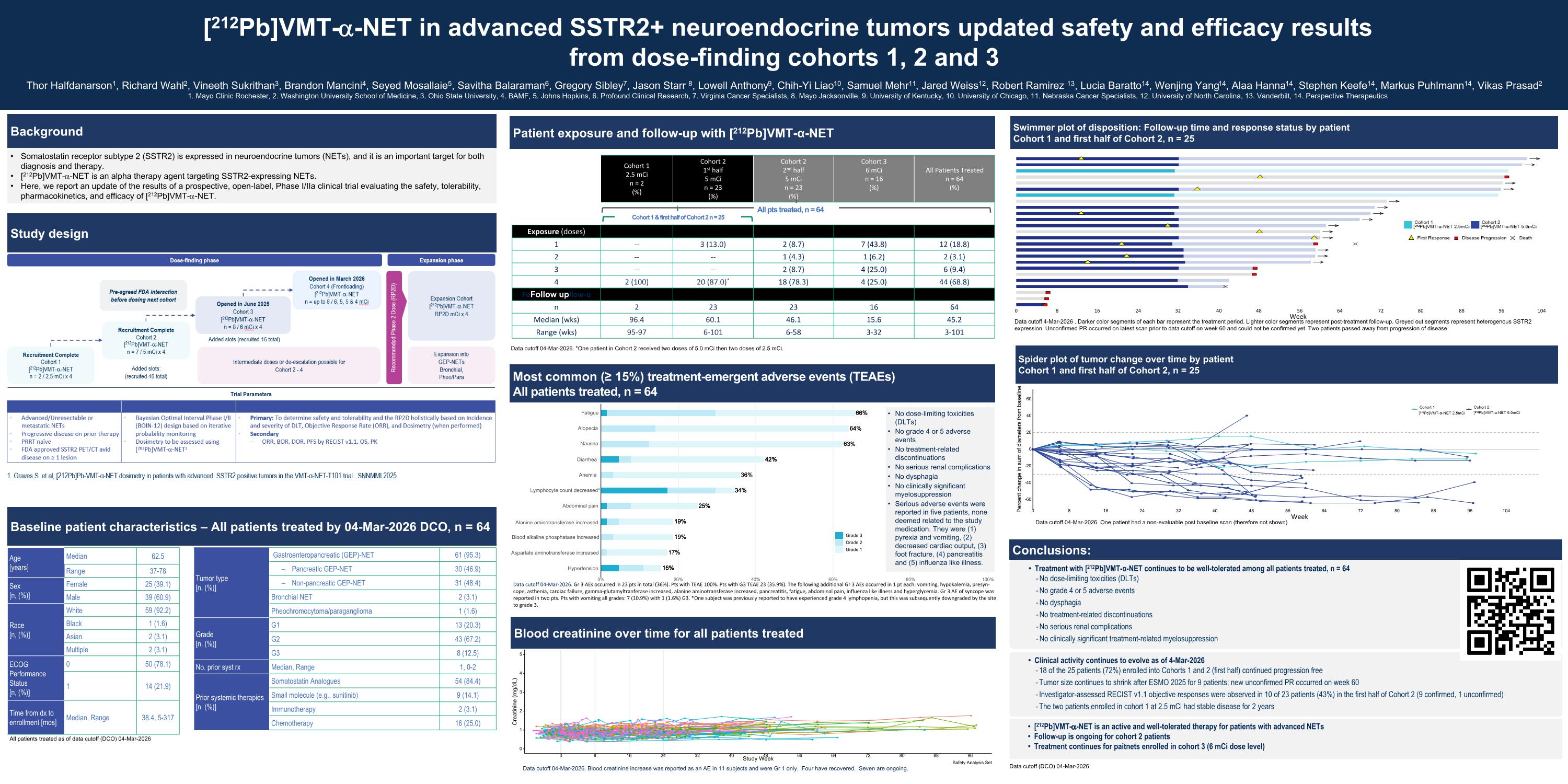
-60 -40 -20 0 20 40 60 0 8 16 24 32 40 48 56 64 72 80 88 96 104 Percent change in sum of diameters from baseline 0 1 2 3 4 5 0 8 16 24 32 40 48 56 64 72 80 88 96 Study Week Creatinine (mg/dL) Safety Analysis Set Somatostatin receptor subtype 2 (SSTR2) is expressed in neuroendocrine tumors (NETs), and it is an important target for both diagnosis and therapy. [212Pb]VMT--NET is an alpha therapy agent targeting SSTR2-expressing NETs. Here, we report an update of the results of a prospective, open-label, Phase I/IIa clinical trial evaluating the safety, tolerability, pharmacokinetics, and efficacy of [212Pb]VMT--NET. Background [212Pb]VMT-a-NET in advanced SSTR2+ neuroendocrine tumors updated safety and efficacy results from dose-finding cohorts 1, 2 and 3 Thor Halfdanarson1, Richard Wahl2, Vineeth Sukrithan3, Brandon Mancini4, Seyed Mosallaie5, Savitha Balaraman6, Gregory Sibley7, Jason Starr 8, Lowell Anthony9, Chih-Yi Liao10, Samuel Mehr11, Jared Weiss12, Robert Ramirez 13, Lucia Baratto14, Wenjing Yang14, Alaa Hanna14, Stephen Keefe14, Markus Puhlmann14, Vikas Prasad2 1. Mayo Clinic Rochester, 2. Washington University School of Medicine, 3. Ohio State University, 4. BAMF, 5. Johns Hopkins, 6. Profound Clinical Research, 7. Virginia Cancer Specialists, 8. Mayo Jacksonville, 9. University of Kentucky, 10. University of Chicago, 11. Nebraska Cancer Specialists, 12. University of North Carolina, 13. Vanderbilt, 14. Perspective Therapeutics Baseline patient characteristics – All patients treated by 04-Mar-2026 DCO, n = 64 All patients treated as of data cutoff (DCO) 04-Mar-2026 Patient exposure and follow-up with [212Pb]VMT-α-NET Swimmer plot of disposition: Follow-up time and response status by patient Cohort 1 and first half of Cohort 2, n = 25 Spider plot of tumor change over time by patient Cohort 1 and first half of Cohort 2, n = 25 Conclusions: Treatment with [212Pb]VMT-α-NET continues to be well-tolerated among all patients treated, n = 64 No dose-limiting toxicities (DLTs) No grade 4 or 5 adverse events No dysphagia No treatment-related discontinuations No serious renal complications No clinically significant treatment-related myelosuppression Data cutoff 04-Mar-2026. Blood creatinine increase was reported as an AE in 11 subjects and were Gr 1 only. Four have recovered. Seven are ongoing. Data cutoff 04-Mar-2026. One patient had a non-evaluable post baseline scan (therefore not shown) Age [years] Median 62.5 Range 37-78 Sex [n, (%)] Female 25 (39.1) Male 39 (60.9) Race [n, (%)] White 59 (92.2) Black 1 (1.6) Asian 2 (3.1) Multiple 2 (3.1) ECOG Performance Status [n, (%)] 0 50 (78.1) 1 14 (21.9) Time from dx to enrollment [mos] Median, Range 38.4, 5-317 Tumor type [n, (%)] Gastroenteropancreatic (GEP)-NET 61 (95.3) Pancreatic GEP-NET 30 (46.9) Non-pancreatic GEP-NET 31 (48.4) Bronchial NET 2 (3.1) Pheochromocytoma/paraganglioma 1 (1.6) Grade [n, (%)] G1 13 (20.3) G2 43 (67.2) G3 8 (12.5) No. prior syst rx Median, Range 1, 0-2 Prior systemic therapies [n, (%)] Somatostatin Analogues 54 (84.4) Small molecule (e.g., sunitinib) 9 (14.1) Immunotherapy 2 (3.1) Chemotherapy 16 (25.0) Most common (≥ 15%) treatment-emergent adverse events (TEAEs) All patients treated, n = 64 16% 16% 16% 17% 17% 19% 19% 19% 19% 19% 25% 25% 25% 34% 34% 34% 36% 36% 42% 42% 42% 63% 63% 64% 64% 66% 66% 66% Hypertension Aspartate aminotransferase increased Blood alkaline phosphatase increased Alanine aminotransferase increased Abdominal pain Lymphocyte count decreased* Anemia Diarrhea Nausea Alopecia Fatigue 0% 20% 40% 60% 80% 100% Grade 3 Grade 2 Grade 1 No dose-limiting toxicities (DLTs) No grade 4 or 5 adverse events No treatment-related discontinuations No serious renal complications No dysphagia No clinically significant myelosuppression Serious adverse events were reported in five patients, none deemed related to the study medication. They were (1) pyrexia and vomiting, (2) decreased cardiac output, (3) foot fracture, (4) pancreatitis and (5) influenza like illness. Data cutoff 04-Mar-2026. Gr 3 AEs occurred in 23 pts in total (36%). Pts with TEAE 100%. Pts with G3 TEAE 23 (35.9%). The following additional Gr 3 AEs occurred in 1 pt each: vomiting, hypokalemia, presyn-cope, asthenia, cardiac failure, gamma-glutamyltranferase increased, alanine aminotransferase increased, pancreatitis, fatigue, abdominal pain, influenza like illness and hyperglycemia. Gr 3 AE of syncope was reported in two pts. Pts with vomiting all grades: 7 (10.9%) with 1 (1.6%) G3. *One subject was previously reported to have experienced grade 4 lymphopenia, but this was subsequently downgraded by the site to grade 3. Blood creatinine over time for all patients treated Data cutoff 4-Mar-2026 . Darker color segments of each bar represent the treatment period. Lighter color segments represent post-treatment follow-up. Greyed out segments represent heterogenous SSTR2 expression. Unconfirmed PR occurred on latest scan prior to data cutoff on week 60 and could not be confirmed yet. Two patients passed away from progression of disease. Data cutoff (DCO) 04-Mar-2026 Clinical activity continues to evolve as of 4-Mar-2026 18 of the 25 patients (72%) enrolled into Cohorts 1 and 2 (first half) continued progression free Tumor size continues to shrink after ESMO 2025 for 9 patients; new unconfirmed PR occurred on week 60 Investigator-assessed RECIST v1.1 objective responses were observed in 10 of 23 patients (43%) in the first half of Cohort 2 (9 confirmed, 1 unconfirmed) The two patients enrolled in cohort 1 at 2.5 mCi had stable disease for 2 years [212Pb]VMT-a-NET is an active and well-tolerated therapy for patients with advanced NETs Follow-up is ongoing for cohort 2 patients Treatment continues for paitnets enrolled in cohort 3 (6 mCi dose level) Study design Data cutoff 04-Mar-2026. *One patient in Cohort 2 received two doses of 5.0 mCi then two doses of 2.5 mCi. Cohort 1 2.5 mCi n = 2 (%) Cohort 2 1st half 5 mCi n = 23 (%) Cohort 2 2nd half 5 mCi n = 23 (%) Cohort 3 6 mCi n = 16 (%) All Patients Treated n = 64 (%) Exposure (doses) 1 -- 3 (13.0) 2 (8.7) 7 (43.8) 12 (18.8) 2 -- -- 1 (4.3) 1 (6.2) 2 (3.1) 3 -- -- 2 (8.7) 4 (25.0) 6 (9.4) 4 2 (100) 20 (87.0)* 18 (78.3) 4 (25.0) 44 (68.8) FoFollow upllow-u n 2 23 23 16 64 Median (wks) 96.4 60.1 46.1 15.6 45.2 Range (wks) 95-97 6-101 6-58 3-32 3-101 All pts treated, n = 64 Cohort 1 & first half of Cohort 2 n = 25 0 8 16 24 32 40 48 56 64 72 80 88 96 104 Week Week